Obama ignoring troops in Afghanistan

0

Rep. McKeon says Obama is ignoring troops in Afghanistan

A lack of communication has created confusion about US military objectives in Afghanistan.

The chairman of the House Armed Services Committee on Tuesday said President Barack Obama is ignoring service members who are deployed to Afghanistan and not speaking enough about the war.

Å“He has not for months talked to the American people about the situation [in Afghanistan]. He has not given any [verbal] support or succor or help to our troops that are serving. He hasnâ„¢t buoyed them up in their mission and the things that theyâ„¢ve been asked to do. Theyâ„¢re over there every day putting their life on the line, and they donâ„¢t hear from the commander-in-chief,” Republican Rep. Buck McKeon told reporters following a closed committee briefing on Afghanistan by administration officials.

McKeon said a lack of communication has created confusion about US military objectives in Afghanistan.

Å“When I talk to the troops, sometimes they have questions about what the mission is, about why theyâ„¢re there. And itâ„¢s incumbent upon the commander-in-chief to talk to them [and] to talk to the American people,” he said.

The vice chairman of the committee voiced similar criticism.

Å“It is absolutely wrong for the president to expect our military to perform a mission that heâ„¢s not willing to publicly support, publicly explain [and] publicly defend,” GOP Rep. Mac Thornberry told reporters.

When asked what, specifically, Obama needed to say to service members and the American people about Afghanistan, McKeon offered several suggestions.

Å“He could talk about the achievements that we have — that we have achieved there,” McKeon said. Å“He could tell the troops that what theyâ„¢re doing is important, that theyâ„¢re saving lives, theyâ„¢re bringing freedom to that part of the world … There are very few al- Qaeda at this time in Afghanistan.”

McKeon said the president should deliver the message in a televised address from the White House or a special joint meeting of Congress.

Å“If he went on national television to give an update on one of the most pressing issues facing our nation right now, I think they (the American people and service members) would tune in and pay attention to it,” he said.

McKeon said Obama seems to lack Å“the will and the desire” to speak publicly about the war.

When contacted by a Stars and Stripes reporter, White House officials would not comment specifically on McKeonâ„¢s remarks, but directed the reporter to comments Obama made on Monday following an Oval Office meeting with Spanish President Mariano Rajoy.

Å“Iâ„¢ve had unwavering confidence in our troops and their performance in some of the most difficult situations imaginable. That job is not yet done. And I do think itâ„¢s important for Americans to recognize that we still have young men and women in harmâ„¢s way, along with coalition partners who are continuing to make sacrifices, and we need to see this job all the way through. And that is going to be the case through the end of this year, and weâ„¢re going to continue to have significant interest in the region for years to come,” Obama said in response to a reporterâ„¢s question about Afghanistan.

National Security Staff spokeswoman Laura Lucas said Obama will discuss his foreign policy priorities in his State of the Union address to Congress on Jan. 28, but she would not provide any details or say whether he will talk about Afghanistan.

Obama has visited Afghanistan three times since becoming president five years ago. The last time was May 2012, when he traveled to Kabul to sign the Strategic Partnership Agreement with President Hamid Karzai that provides a framework for Americaâ„¢s long-term relationship with the war-torn country. He delivered his latest primetime national address devoted exclusively to Afghanistan during this trip, although he has spoken about the war in other major speeches since then.

In the press conference, McKeon and Thornberry also expressed concerns that the security situation in Afghanistan will deteriorate if Karzai doesnâ„¢t sign the Bilateral Security Agreement which would enable some US troops to remain the country beyond 2014.

Å“We see whatâ„¢s happened now in Iraq “ the terrorism [and] the deaths that are being caused because of a lack of our presence,” McKeon said.

Å“Just turn and look at what has happened with Iraq where we didnâ„¢t have that (troop presence after 2011). We cannot afford to have that sort of vacuum happen in Afghanistan because it presents real dangers to us,” Thornberry said.

Administration officials and military leaders have said that all American troops will be withdrawn from Afghanistan without a BSA that provides legal immunity to US service members deployed there. This is known as the Å“zero option.”

McKeon said he didnâ„¢t get the impression from the briefing that anyone in the administration favors the zero option.

Å“I donâ„¢t think anybody is hoping for it, planning for it, or in any other way looking toward it. What I see more is what happened in Iraq is we stumble our way and fall into it. Thatâ„¢s the biggest danger that I see,” McKeon told reporters.

Å“The president needs to take the leadership in telling the American people why we have a lot at stake and why a zero option would be very detrimental to our national security. Thatâ„¢s what weâ„¢re not hearing,” Thornberry said. Å“I donâ„¢t think anybody wants it … The danger is you stumble towards it. But one way to prevent those stumbles is to stand up and say, this is why our troops are there, this is what theyâ„¢re sacrificing for, and this is why itâ„¢s important to us now. Now maybe heâ„¢s got to expend some political capital to do that, but when youâ„¢re dealing with a major national security issue, he needs to.” Stars and Stripes

AT/HJ

Source: Press TV

Martin Luther King’s Historic Plea to Break the Silence on Militarism

0

“A nation that continues year after year to spend more money on military defense than on programs of social uplift is approaching spiritual death.” – Martin Luther King, in his famous speech at the Riverside Church in New York City on April 4, 1967

King’s Riverside Church speech was titled “Beyond Vietnam: A Time to Break Silence.” It was delivered exactly one year before his April, 4, 1968 assassination in Memphis.

The people who heard that speech recognized it as one of the most powerful speeches ever given articulating the immorality of the Vietnam War and its destructive impact on social progress in the United States. In explaining his decision to follow his conscience and speak out against US militarism, King said:

“I knew that America would never invest the necessary funds or energies in rehabilitation of its poor so long as adventures like Vietnam continued to draw men and skills and money like some demonic destructive suction tube. So I was increasingly compelled to see the war as an enemy of the poor and to attack it as such.”

But King went farther, diagnosing the broader disease of militarism and violence that was endangering the soul of the United States.

King said,

“I could never again raise my voice against the violence of the oppressed in the ghettos without having first spoken clearly to the greatest purveyor of violence in the world today – my own government.”

The Poisoning of America’s Soul

King knew very well that the disease of violence was killing off more than social progress in America. Violence was sickening the nation’s soul as well. He added “If America’s soul becomes totally poisoned, part of the autopsy must read ‘Vietnam’.”

King urged his fellow citizens to take up the causes of the world’s oppressed, rather than taking the side of the oppressors.

He said: “I am convinced that if we are to get on the right side of the world revolution, we as a nation must undergo a radical revolution of values. We must rapidly begin the shift from a ‘thing-oriented’ society to a ‘person-oriented’ society.

“When machines and computers, profit motives and property rights are considered more important than people, the giant triplets of racism, materialism and militarism are incapable of being conquered.

“We are confronted with the fierce urgency of now. In this unfolding conundrum of life and history there is such a thing as being too late. Procrastination is still the thief of time. Life often leaves us standing bare, naked and dejected with a lost opportunity.

“We still have a choice today; nonviolent coexistence or violent co-annihilation. We must move past indecision to action. We must find new ways to speak for peace and justice throughout the developing world — a world that borders on our doors.

“If we do not act we shall surely be dragged down the long, dark and shameful corridors of time reserved for those who possess power without compassion, might without morality and strength without sight.”

King pointed to an alternate path into the future:

“Now let us rededicate ourselves to the long and bitter — but beautiful — struggle for a new world. This is the calling of the sons of God, and our brothers wait eagerly for our response.

“Shall we say the odds are too great? Shall we tell them the struggle is too hard?”

Signing His Own Death Warrant

By denouncing so forcefully the war crimes that the U.S. military was committing daily in the killing fields of Vietnam, some of King’s followers understood that he had just signed his own death warrant.

But King, being a person of conscience, was compelled to express his deep sense of moral outrage over the horrific maiming, suffering and dying of millions of innocent Vietnamese civilians in that unjust war that afflicted mostly unarmed women and children and that was going to leave behind lethal poisons in the soil, water and unborn babies that would last for generations.

He knew that non-combatants are always the major victims of modern warfare, especially wars that indiscriminately used highly lethal weapons that rained down from the air, especially the U.S. Air Force’s favorite weapon, napalm – the flaming, jellied gasoline that burned the flesh off of whatever part of the burning child it splashed onto.

King also connected the racist acts (of American soldiers joyfully killing dispensable non-white “gooks” and “slants” – often shooting at “anything that moves”) on the battlefields of Southeast Asia to the oppression, impoverishment, imprisoning and lynching of dispensable, deprived non-white “niggers” in America.

King saw the connections between the violence of racism and the violence of poverty. He saw that the withholding of economic and educational opportunities came from the fear of “the other” and the perceived need to protect the white culture’s wealth and privilege — with violence if necessary.

King knew, too, that fortunes are made in every war, and the war in Vietnam was no exception. In his speeches, he talked about that unwelcome reality that the ruling class preferred not be discussed. That meant his well-attended Riverside Church speech threatened not only the powerful interests already arrayed against his civil rights struggle but also the interests of the war profiteers and the national security establishment.

War Profiteers on Wall Street Know That War is Good Business and That Peace Generates no Profits for Them

The longer the Vietnam War lasted, the more the weapons manufacturers thrived. With their huge profits, there was no incentive for these financial elites to want to stop the carnage. And therefore the Wall Street war profiteers financed, out of their ill-gotten gains, battalions of industry lobbyists and pro-military propagandists, who descended upon Washington, DC and the Pentagon to claim even more tax dollars for weapons research, development and manufacture.

With that funding secured, armies of desperate jobs-seekers were hired to work in thousands of weapons factories that were strategically placed in congressional districts almost everywhere, with weapons research grants likewise being awarded to virtually every university in the nation. Thus, weapons-manufacturing and R & D soon became vitally important for most every legislator’s home district economy as well as for the household budgets of millions of American voters who indirectly benefitted from the US military’s killing, maiming, displacement, starvation and suffering of non-white refugees in war zones that most war workers tried not to think about.

King’s anti-war stance was based on his Christianity and on the ethics and life of Jesus, but it was also based on his standing as a revered international peace and justice icon. Those factors made him a dangerous threat to the military/industrial/congressional/security complex.

The powerful forces that were working hard to discredit King had already infiltrated the civil rights movement. Their efforts, cunningly led by the proto-fascist and racist J. Edgar Hoover and his obedient FBI, accelerated after the Riverside speech. The FBI ramped up the smear campaigns against King and eventually decided to permanently “neutralize” King with a bullet to the head – fired by a paid assassin other that the framed patsy James Earl Ray. (See attorney William F. Pepper’s well researched and documented book, “An Act of State: The Execution of Martin Luther King”, that told the story that absolved Ray and that culminated in the 1999 jury trial that, in a wrongful death suit brought on behalf of the King family, convicted Loyd Jowers and various co-conspirators that included J. Edgar Hoover, the FBI, CIA Director Richard Helms, the CIA, the military, local Memphis police and organized crime figures from New Orleans and Memphis. The trial was uniformly boycotted by the US media, so most Americans have never heard about it.) For a Pepper interview about the 4 week jury trial, click on: https://archive.org/details/William.Pepper.An.Act.of.State.The.Execution.of.MLK.

King’s Prophetic Vision

Now, almost five decades after his anti-war speech (which was widely kept from the public), it is clear how prophetic King’s observations were. America is indeed losing its soul and violence, racism, militarism and economic oppression are still American epidemics.

Both upper- and middle-class investors of get-rich-quick schemes in America have succumbed to predatory lenders, cannibalistic corporate mergers and acquisitions, psychopathic multinational corporate schemers, corrupt crony capitalists, and the rapist/exploiters of the land and water by extractive industries — all schemes that will eventually tank in the predictable economic bubbles, all of which are destined to burst.

Those busted bubbles regularly wipe out investors (except for the large, deep-pocketed “insiders” who, usually being forewarned, will have sold their holdings just in time, before the publicly revealed “bust”), leaving the taxpayers to bail out the financial messes that were created by the so-called “invisible hand of the market”. (Note: the “invisible hand” myth actually represents cunning operations controlled by conscienceless corporate gamblers whose dirty deals are done in the proverbial “smoke-filled rooms” that guarantee the success of the deal.)

King was trying to warn us not just about the oncoming epidemic of domestic violence victims but also about the tens of millions of people around the world who were and are still being victimized by U.S. military misadventures.

King was also warning us about the multinational corporate war profiteers whose interests are facilitated and protected by the US military — whether they are operating in Asia, Latin America, Africa or the Middle East.

Nearly one trillion US tax dollars are lavishly spent every year on endless wars, which are often illegal and unconstitutional. Hundreds of millions of tax dollars are spent annually paying down never-ending interest payments on past military debt. Hundreds of millions of scarce dollars are also being spent on the totally preventable costs of the physical and mental health costs needed for the palliative care for the permanently maimed and psychologically-traumatized veterans.

All those potentially bankrupting costs represent money that will never be available for programs of social uplift like combating racism, poverty and hunger, or paying for affordable housing/healthcare, universal education or meaningful job creation. Can anyone else hear a demonic laugh reverberating down Wall Street?

King was warning America about its oncoming spiritual death if it didn’t convert itself away from military violence. But most observers of the US see America still worshipping at the altars of the Gods of War and Greed. Our children may be doomed.

The vast majority of American Christian churches (whether fundamentalist, conservative, moderate or liberal, with very few exceptions) have failed King’s vision, despite the lip service they sometimes give to King on MLK Day. Churches whose members were brought up on the Myth of American Exceptionalism (and the myth of being “God’s chosen people”) consistently refuse to take a stand against the satanic nature of war.

Is America Past the Point of No Return?

King’s central warnings about the “triple evils” of militarism, racism and economic oppression must be heeded. The financial and moral hemorrhaging from the unending hot and cold wars that have entangled the United States around the globe must be ended. There must be a retreat from the 130 countries where the U.S. maintains budget-busting military bases. And, if America wants to shed the justified label of “Rogue Nation”, the covert killing operations of our secret black ops mercenary military units all around the world must be stopped, as should the infamous extrajudicial assassinations by America’s un-manned drones.

The Pentagon budget averages well over $700 billion per year which amounts to $2 billion per day with no visible return on investment, except for the military contractors, the oil industries and Wall Street financiers.

If King’s 47-year-old warning continues to be ignored, America’s future is bleak. The future holds the dark seeds of economic chaos, hyperinflation, unendurable poverty, increasing racial/minority hostility, worsening malnutrition, armed rebellion, street fighting, and perhaps, ultimately, institution of a reactionary totalitarian/surveillance police state in order to control citizen protests and quell rebellions.

In 1967, many Americans considered King hopeful vision for a better future as irrational idealism. He was told that the task was too great, the obstacles were too imposing and that there was no will for even the churches to reverse their age-old, conservative (pseudo)patriotism and society’s institutional racism. I suspect that many of the churches that called King a communist and therefore ignored him back then wish that they could turn back the clock and give King’s (and Jesus’s) path a try.

King finished his speech with these challenges:

“War is not the answer. We still have a choice today; nonviolent coexistence or violent co-annihilation. We must move past indecision to action. We must find new ways to speak for peace and justice throughout the developing world — a world that borders on our doors. If we do not act we shall surely be dragged down the long dark and shameful corridors of time reserved for those who possess power without compassion, might without morality and strength without sight.”

And he had these sobering words for the churches that are immersed in a polytheistic culture (the worship of multiple gods, including the gods of war and mammon) and thus are tempted to quietly ally themselves with those gods rather than the monotheistic God of Love that King was devoted to:

“I have traveled the length and breadth of Alabama, Mississippi and all the other southern states. I have looked at her beautiful churches with their lofty spires pointing heavenward. I have beheld the impressive outlay of her massive religious education buildings. Over and over again I have found myself asking: ‘What kind of people worship here? Who is their God?’”

Today, the task is even tougher, the obstacles much more imposing, but the path that King outlined remains. MLK Day should be a good time to start seriously reconsidering King’s radical message.

Dr Kohls is a retired physician who writes about peace, justice, militarism, mental health and religious issues.

Source: Global Research

TV’s Freddie Starr arrested for third time over sex abuse claims

TV comedian Freddie Starr has been arrested for the third time in connection to sexual abuse allegations made against him.

The 71-year-old was arrested at a police station in Warwickshire after the claim was made to detectives working on Operation Yewtree  after voluntarily attending the station. He also faces further allegations of sexual offences.

Starr was first arrested in November 2012 over claims involving Jimmy Savile and others, following allegations that he tried to molest a 14-year-old girl in Savile’s BBC dressing room in the 1970s.

He was then re-arrested in April last year over additional allegations, the details of which have not been made available.

Upon his arrest Scotland Yard did not name the TV star, but said:

“On Tuesday January 14, “Yewtree 2” was further arrested after attending a police station in Warwickshire by prior appointment.

“The arrest relates to a further allegation made to Operation Yewtree, which falls under the strand of the investigation we have termed ‘others’. We are not prepared to discuss further.

“Yewtree 2 was arrested on November 1 2012 on suspicion of sexual offences and taken into custody. These allegations fall under the strand we have termed ‘Savile and others’.

“He was subsequently released on bail pending further inquiries.”

Starr denies any wrong doing.

Despite Dangerously High Radiation Levels, No Caution Signs at Surfer’s Beach

0

No action taken to protect the public at radioactive hotspot

Infowars.com
January 14, 2013

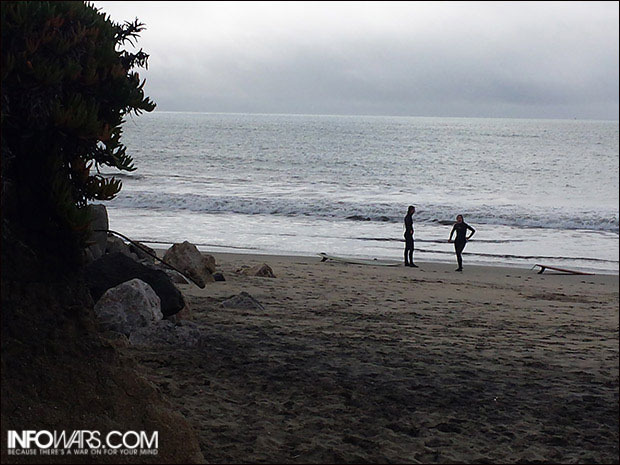
As we highlighted last week, our investigation of the abnormally high levels of radiation discovered in California led us to Surfer’s Beach, the site where one man shot a viral Youtube video depicting levels higher than normal radiation levels.

Black silt found at Surfer’s Beach had the highest radiation at 374 CPM, however, no signs warning of radioactivity in the vicinity.

According to the Half Moon Bay Review, normal radiation levels at Surfer’s Beach should hover around 30 CPM. We ourselves encountered readings of upwards of 370 CPM, over 12 times higher than what is normally expected.

However, despite the media’s coverage of the anomaly, or lack thereof, little has been done to protect visitor’s at Surfer’s Beach.

As one can see in photos taken of the area where extremely high levels were found, not only by Infowars but by Steve Weiss, an electrical engineer who has worked on Geiger Counters for 40 plus years, there are disturbingly no signs warning surfers and beachgoers of the high levels.

Infowars reporter stands on most irradiated area of California’s coastline. Notice there are no signs warning surfers or visitors.

Family plays with dog near area with dangerously high radiation because no sign warns them not to.

Surfers oblivious of dangerous black silt due to no warning sign.

The Surfer’s Beach area of Half Moon Bay, CA needs a sign similar to the one we encountered at Mclellan Air Force Base that reads “Radioactive Materials.”

Even more startling is one woman’s testimony to Infowars on camera that her friend recently began losing his hair after swimming right off the coast of Half Moon Bay. When asked if the hair loss could possibly be natural, she reiterated she believed it was due to his exposure to Surfer’s Beach.

The town’s local publication has already admitted to finding levels in excess of 1,400 percent at the site, but why, if they know levels are so out of the ordinary, are there no signs warning the public?

This article was posted: Tuesday, January 14, 2014 at 6:14 pm


<!– this is where we need to show the related articles

–>

Source: Infowars

​Single cinder block was used to contain toxic chemical prior to mass W. Virginia spill

0

State inspectors found that the company involved in a major chemical spill in West Virginia had set up a simple cinder block and one 50-pound bag of a safety absorbent powder, according to the Charleston Gazette.
Read Full Article at RT.com

Source: RT

U.S. Government and Top Mexican Drug Cartel Exposed as Partners

0

For over a decade, under multiple administrations, the U.S. government had a secret agreement with the ruthless Mexican Sinaloa drug cartel that allowed it to operate with impunity, an in-depth investigation by a leading Mexican newspaper confirmed this week. In exchange for information and assistance in quashing competing criminal syndicates, the Bush and Obama administrations let the Sinaloa cartel import tons of drugs into the United States while wiping out Sinaloa competitors and ensuring that its leaders would not be prosecuted for their long list of major crimes. Other revelations also point strongly to massive but clandestine U.S. government involvement in drug trafficking.

Relying on over 100 interviews with current and former government functionaries on both sides of the border, as well as official documents from the U.S. and Mexican governments, Mexico’s El Universal concluded that the U.S. Drug Enforcement Administration (DEA), Immigration and Customs Enforcement (ICE), and the U.S. Justice Department had secretly worked with Mexican drug lords. The controversial conspiring led to increased violence across Mexico, where many tens of thousands have been murdered in recent years, the newspaper found after its year-long probe. The U.S. agents and their shady deals with Mexican drug lords even sparked what the paper called a “secret war” inside Mexico.

The newspaper’s investigation also confirmed long-held suspicions that U.S. authorities were signing secret agreements with Mexican drug cartels – especially Sinaloa, which CIA operatives have said was a favorite for use in achieving geo-political objectives. Supposedly without the knowledge or approval of officials in Mexico, ICE and DEA, with a green light from Washington, D.C., made deals with criminal bosses allowing them to avoid prosecution for a vast crime spree that has included mass murder, corruption, bribery, drug trafficking, extortion, and more. In exchange, cartel leaders simply had to help U.S. officials eliminate their competitors – certainly a win-win scenario for crime bosses who prefer to operate without competition or fear of prosecution.

As The New American first reported in early 2011, a high-ranking operative with the Sinaloa cartel had outlined elements of the criminal agreements with U.S. authorities in official court documents. “The government of the United States and its various agencies have a long history of providing benefits, permission, and immunity to criminals and their organizations to commit crimes, including murder, in exchange for receiving information against other criminals and other organizations,” trafficker Jesus Vicente “El Vicentillo” Zambada-Niebla argued in U.S. court filings cited by El Universal. The New American has also reported extensively on the Zambada-Niebla case and what it reveals.

Experts quoted in the Mexican paper echoed other analysts who have spoken out in recent years, saying that the U.S. government scheming handed the Sinaloa cartel de facto status as the primary powerhouse. In fact, during the period when El Universal says the relationship between American officials and Sinaloa chieftains was most active – 2006 through 2012 – drug war-fueled violence in Mexico surged to unprecedented levels. There are numerous indications that despite official denials, top Mexican officials may have been aware of the schemes, or even involved in them.

Also part of the U.S. government deal with Sinaloa, analysts and Zambada-Niebla have said, was the Obama administration’s “Fast and Furious” gun-running program to arm Mexican cartels at U.S. taxpayer expense. Most recently, a whistleblower from the Bureau of Alcohol, Tobacco, Firearms, and Explosives (ATF) said that U.S. Border Patrol agent Brian Terry, killed with a Fast and Furious gun, was murdered by criminals working for the FBI. “It is clear that some of the weapons were deliberately allowed by the FBI and other government representatives to end up in the hands of the Sinaloa Cartel,” stated a motion filed in U.S. court by Zambada-Niebla’s defense team, adding that the U.S. government has documents showing that the weapons were provided by authorities pursuant to the agreement with Sinaloa.

According to former officials and drug kingpins, the agreements between Sinaloa and Washington also allowed the criminal empire to ship multi-ton quantities of hard drugs across the border into the United States. In all, El Universal said there had been at least 50 meetings in Mexico between U.S. government agents and senior Sinaloa bosses, along with many more phone calls and e-mails. The criminal syndicate’s leaders “were given carte blanche to continue to smuggle tons of illicit drugs into Chicago and the rest of the United States and were also protected by the United States government from arrest and prosecution,” Zambada-Niebla’s court filings state, adding that the U.S. government has the documents proving it. “Indeed, United States government agents aided the leaders of the Sinaloa Cartel.”

Unsurprisingly, none of the American federal agencies implicated in the machinations would comment on the revelations. However, citing court documents and official records it published online – as well as numerous interviews with federal agents, convicts, and analysts – the paper was able to conclusively confirm what experts and even officials have been arguing for years: The U.S. government is deeply intertwined with the drug trade. It was not clear what statutory or constitutional authority Washington, D.C., believes would authorize its functionaries to participate in, protect, and facilitate wanton criminal activity.

Mexican authorities, meanwhile, were reportedly kept largely out of the loop surrounding DEA meetings and agreements with top leaders in Mexico’s most notorious criminal syndicates. Officials in Mexico also claimed to be in the dark about the Obama administration’s program to arm the cartels with U.S. weapons. According to analysts quoted in the El Universal report, if it is true that Mexico City was unaware, that only adds to the troubling implications of the unlawful scheming between U.S. officials and criminal bosses from Mexico and Colombia to Afghanistan and Southeast Asia.

Among other concerns, experts highlighted violations of human rights, infringements on the sovereignty of other nations, and more. It also helped fuel the devastating violence that has plagued the nation and claimed the lives of between 50,000 and 100,000 people in less than a decade. If Mexican authorities in fact approved the U.S. government’s drug-running schemes in Mexico, they broke the law, too, legal experts told the paper, saying the Mexican Constitution could not be trumped by bilateral agreements or anything else.

The latest revelations in the El Universal report came just days after the emergence of more explosive information implicating the CIA in drug-trafficking yet again. In an investigative article for Narco News entitled “DEA Case Threatens to Expose US Government-Sanctioned Drug-Running,” veteran drug-war journalist Bill Conroy highlights another U.S. government investigation that, perhaps inadvertently, ended up implicating the infamous American intelligence agency in major cocaine trafficking operations once more. Citing official documents and numerous U.S. officials, the piece also notes that CIA-sponsored drug running has been a persistent and ongoing problem.

In fact, it would not be the first time that the DEA has stumbled on major CIA drug-running operations. Even former DEA chief Robert Bonner, during an explosive interview with CBS, revealed that his agency had learned that the U.S. intelligence outfit unlawfully imported a ton of cocaine into the United States in cooperation with the Venezuelan government. According to the agency’s inspector general, the CIA was indeed working with traffickers but received a “waiver” from the Justice Department purporting to allow the government crime spree to remain secret. More recently, a Mexican official accused the CIA of “managing” the global drug trade.

The Mexican investigation follows decades of explosive revelations and accusations, many documented by The New American, suggesting that Washington, D.C., plays a crucial role in facilitating the international drug trade. In fact, more than a few officials, drug lords, and analysts have even said that the CIA and other secretive U.S. and foreign agencies actually run the global trade in narcotics, laundering the profits, and more. The DEA was even investigated by Congress last year for helping to launder drug money, while the ATF was exposed supplying U.S. weapons to Mexican cartels. ICE has reportedly been allowing cartel hit men into the United States to murder. So far, none of the high-ranking officials responsible for the lawlessness has truly been held accountable.

Photo shows alleged hit men working for Sinaloa drug cartel along with grenades, automatic weapons, and body armor: AP Images

Alex Newman, a foreign correspondent for The New American, is normally based in Europe after growing up in Latin America, including seven years in Mexico. He can be reached at This email address is being protected from spambots. You need JavaScript enabled to view it. .

Related articles:

CIA “Manages” Drug Trade, Mexican Official Says

Reports: CIA Working with Mexican Drug Cartels

Trafficker: U.S. Feds Aided Mexican Drug Cartel

Mexican Drug Trafficker Says He Worked With Feds

Stratfor Sources: U.S. Troops in Mexico as Feds Aid Cartels

Congress Probes DEA Drug Money Laundering Scheme

Feds Let Mexican Cartel Hit Men Kill in U.S., Senior Lawman Told Stratfor

Fast and Furious: FBI Now Linked to Murder of U.S. Border Agent

U.S. Judge: Obama Homeland Security Aiding Criminal Conspiracies

Impeachment Support Soars as Voters Say Feds “Out of Control”

Source: The New American

CCTV shows News of the World staff hiding evidence from police

0

CCTV footage broadcast in the  Old Bailey yesterday showed News of the World staff allegedly hiding potentially damaging evidence before police arrived at Mr and Mrs Brooks’ flat in London.

The Scotsman reports:

Mr Brooks was captured on CCTV taking a padded envelope and a laptop into an underground car park. He disappears behind a column and comes back into view empty-handed less than a minute later.

Hanna later arrived at the car park in a black Range Rover. He picked up the laptop and bag and left in a blue car driven by another security worker.

Police searched the flat later the same afternoon and seven police officers accompanied by Mrs Brooks’ solicitor are seen on CCTV leaving with large boxes at 5:04pm. Meanwhile, police also searched the couple’s Oxford address, the court heard.

Later that evening, Hanna texted security guard Daryl Jorsling: “Del, have a plan. Can you call please, Mark.”

An hour later, Mr Jorsling arrived at the car park, removed a black bag from the boot and moved towards the bin area, returning empty handed.

A man is then seen collecting pizza boxes and Mr Jorsling leaves in a black Golf.

Mr Jorsling then contacted his colleague Daniel Johnson. Referring to the 1968 film Where Eagles Dare, he texts: “Calling Danny Boy — pizza delivered and the chicken is in the pot.”

Johnson replied: “Ha, f****** amateurs. We should have done a DLB [dead letter box] or brush contact on the riverside. Log the hours as pizza delivery.’’

Mrs Brooks left the police station and is seen in the footage arriving in the car park at 12:30am on 18 July, met by her husband.

Later that morning a cleaner collecting large bins in the car park found “various pieces of property”, the jury heard.

That afternoon, Mr Brooks, his driver Paul Edwards and Mr Jorsling were shown going back to the car park and appearing to search the bin area before heading off to the building’s office empty-handed.

That evening, police were handed a brown briefcase and black laptop bag which had been found behind the bins, the court was told.

Mr Brooks, 50, and Mrs Brooks, 45, of Churchill, Oxfordshire, and Hanna, 50, of Buckingham, deny conspiracy to pervert the course of justice between 5 and 19 July, 2011.

The court heard the incident of the missing bag at Chelsea Harbour was dubbed “Pizzagate” by security staff.

Witness William Geddes was managing director of the security firm that led the 24-hour “Blackhawk” operation around Mrs Brooks.

On 18 July, the day after her arrest, it came to Mr Geddes’s attention that property, then described as belonging to Charles Brooks which was delivered by a security guard to the Chelsea Harbour flat, had gone missing.

The Good and Bad News About West Coast Radiation

0

The reality is there is no good news about the radiation levels we’re finding

Adan Salazar
Infowars.com
January 13, 2014

There is no doubt the radiation levels we’ve encountered during our tour of the West Coast should be of concern to everyone. The equipment we’re using is designed to detect particles of ionizing radiation. According to the Environmental Protection Agency, “Any living tissue in the human body can be damaged by ionizing radiation in a unique manner.”

“The body attempts to repair the damage, but sometimes the damage is of a nature that cannot be repaired or it is too severe or widespread to be repaired,” the EPA’s FAQ page on the health effects of radiation states. The agency also admits that ionizing radiation causes cancer and can spur genetic mutations which can be passed on to offspring.

This is bad news. Normal background radiation levels should typically hover below or around 30 CPM (counts per minute). It is concerning that up and down the West Coast, nearly every place monitored tested well above this level, the highest concentration of course being found at Surfer’s Beach in Half Moon Bay, California and further south.

The readings below document locations investigated from Half Moon Bay up to Portland, Oregon:

Half Moon Bay (Surfer’s beach), California: 374 CPM
Golden Gate Bridge (southside): 50 CPM
Crescent City, California: 54 CPM
Eugene, Oregon (University of Oregon campus): 58 CPM
Charleston, Oregon: 54 CPM
Portland, Oregon (Columbia River): 76 CPM

We also found that the California coastline south of Half Moon Bay had increased radiation levels three times higher than what is considered to be normal, with a reading of 112 CPM taken at Salinas River State Beach.

Also bad news is the fact that residents are almost completely oblivious of the threatening dangers surrounding them, in part due to media brainwashing and the downplaying of the significance of the fallout from the Fukushima nuclear disaster. As far as we can tell, Infowars is the only media organization taking the initiative to conduct readings and report the actual facts.

Additionally, there is the matter of bioaccumulation to worry about. As the beaches and local communities continue being showered with high radiation, the real issue is that bioaccumulation is occurring in sea life, meaning that radiation is building up and accumulating in the foods many people eat.

However, there is also some good news to report.

The extremely high level of radiation encountered at Surfer’s Beach does not appear to be widespread throughout the coast, according to our measurements.

Also, fish we tested at local markets showed only slightly elevated levels of radiation, meaning the people eating it are likely not ingesting high levels.

See the readings below:
Eureka, CA, Ahi Tuna: 40 CPM
Beaverton, Oregon: Columbia River King Salmon fillet: 31 CPM
Beaverton, Oregon: Sashimi hamachi raw yellowtail (imported from Japan): 18 CPM
Beaverton, Oregon: Uni (sea urchin): 34 CPM
Beaverton, Oregon: Raw sashimi (from: Atlantic Ocean — Canada): 40 CPM

However there were still fish that tested higher. For instance a wild Tako imported from Japan gave a reading of 44 CPM, in addition to an albacore tuna, imported from Canada, which also read 44 CPM.

Two small croakers caught off of Hartford Pier in Avila Bay, California right near the Diablo Canyon nuclear facility read in at 60 CPM, nearly twice the normal radiation level for the region.

In Crescent City, California, fresh crabs measured at 56 CPM, and two small croakers a man caught off the Hartford Pier in Avila Bay, near the Diablo Canyon nuclear facility, scanned in at 60 CPM, double the standard 30 CPM for the Half Moon Bay area.

Fresh crab purchased in Crescent City read in at 56 CPM, higher than normal levels for the region.

Fresh crab purchased in Crescent City, California read in at 56 CPM, higher than normal levels for the region.

We were unable, however, to test what is believed to be one of the most highly irradiated fish in the ocean, the blue fin tuna. One fish market owner in Eureka, California told us he specifically doesn’t carry that type of fish due to public concerns about radiation.

It is also no exaggeration that ambient radiation readings taken at almost every location climbed into the 70s, a startling indicator that the ionizing radiation is unknowingly and constantly bombarding the people of California.

In reality, there is no real good news about the radiation levels we’re finding. As documented, very few places and foods are giving low readings.

We encourage everyone to independently research the unusual levels of radiation which the federal government and even academic officialdom says is perfectly safe. As the EPA admits on their own site, “There is no firm basis for setting a ‘safe’ level of exposure above background” levels.

This article was posted: Tuesday, January 14, 2014 at 6:00 pm


<!– this is where we need to show the related articles

–>

Source: Infowars

US to give $1.5 billion in aid to Egypt

0

The US is trying to show Washingtonâ„¢s support for the Egyptian military-backed referendum on a new constitution.

The United States is planning to give $1.5 billion in aid to Egypt in order to show Washingtonâ„¢s support for the military-backed referendum on a new constitution.

The House and Senate will unveil a year-long spending bill which will relax restrictions on US aid to Egypt despite a law that prohibits the US from supporting a foreign military that has launched a coup against a democratically elected government.

According to the draft spending bill which is expected to be ratified as early as Friday, Congress will allow the Obama administration to give $975 million to Egypt.

The bill will also permit the release of an additional $576 million dollars if Egypt holds parliamentary and presidential elections.

According to experts and congressional aides, the move is the latest twist in an unsuccessful effort to maintain influence over the Arab country.

The US decision comes as the upcoming constitutional referendum would cement the rule of the military-led regime in the country.

The Egyptian government has been clamping down on protestors, with recent clashes which left five people dead across the country.

Clashes erupted on Tuesday after security forces attacked demonstrators in several provinces.

Tuesday was the first day of a two-day national vote on the countryâ„¢s constitution that has been drafted by the army-backed interim government.

The draft charter bans the formation of religious political parties. It also allows prosecution of civilians in military courts and also empowers the army to appoint the defense minister and keep its budget beyond any civilian scrutiny.

If approved, the new charter will replace the current constitution passed under ousted president Mohamed Morsi.

Washington had halted the delivery of $1.5 billion of annual military aid to Egypt in October, which included Apache helicopters, F-16 fighter jets, Abrams tanks, and Harpoon missiles.

AT/HJ

Source: Press TV

Free Speech v. Buffer Zone in Abortion Clinic Case

0

The U.S. Supreme Court on Wednesday will hear arguments for and against a Massachusetts law that forbids abortion opponents from entering a 35-foot buffer zone in front of entrances to facilities where abortions are performed. The law, aimed at preventing conflicts among abortion protestors or counselors and clients and escorts at abortion clinics, is being contested by Eleanor McCullen (shown), who regularly stands outside a Planned Parenthood clinic in Boston and attempts to persuade young women entering the site against having an abortion. McCullen and the Becket Fund for Religious Liberty contend the ban on approaching and speaking to people within the buffer zone is an unconstitutional violation of the free speech rights protected by the First Amendment of the Constitution of the United States. Martha Coakley, the Massachusetts attorney general and the defendant named in the suit, claims the current law strikes the right balance among legitimate, but competing interests.

“This law is access balanced with speech balanced with public safety,” Coakley told the New York Times. “It has worked extremely well.” McCullen, 77, told the Times that the semi-circular yellow line, within which all contact and communication with people approaching the clinic is forbidden, frustrates her efforts to speak to women entering the clinic grounds. In a 2011 deposition, McCullen said she has been able to persuade more than 80 women not to have an abortion even after the buffer zone was imposed, but said the 2007 law has caused her to miss four to five opportunities to speak with clinic-bound women on each day that she maintains her twice-weekly vigil.

The buffer zone is on a public sidewalk where pedestrians going elsewhere may freely pass. People going into or coming from the clinic are obviously allowed to go through the zone, as are clinic employees and volunteer escorts who are likely to speak to and encourage the women they accompany into the clinic to go through with whatever planning and procedures they are seeking, including abortion. That makes the restriction on speech content-based, argues Becket Fund’s Mark L. Rienzi, who is representing McCullen and other protestors and sidewalk counselors.

“The government does not have the ability to decide that its public sidewalks are open for speakers on one side but not speakers on the other side,” Rienzi told the Times.

Coakley said the law is a necessary measure taken by the state in an effort to deal with a history of harassment and sometimes violence at abortion clinics in Massachusetts, including a December 1994 shooting rampage at two Brookline clinics that left two clinic workers dead and five others wounded. The shooter, John C. Salvi III of North Hampton, New Hampshire, was convicted and sentenced to life in prison without parole in March 1996 and was found dead in his prison cell in an apparent suicide in November of that year. While Massachusetts has no death sentence, it seems unlikely that anyone willing to risk imprisonment for murder or other acts of violence would be deterred by a painted line on a sidewalk where mere speech by abortion foes is prohibited.

The state in McCullen v. Coakley is asking the high court to follow the precedent of Hill v. Colorado, a 2000 ruling in which the court upheld a law creating 100-foot buffer zones outside all healthcare facilities, in addition to a prohibition on coming closer than eight feet of anyone within the zone. The composition of the court has changed since then, with two key members of that six to three majority – the late Chief Justice William Rehnquist and retired Justice Sandra Day O’Connor – replaced by Chief Justice John Roberts and Justice Samuel Alito. Justice Anthony, who continues to be a closely watched “swing vote” between the court’s conservative and liberal blocs, was one of the three dissenters in the Colorado case.

The ruling, Kennedy wrote, ran contrary to “more than a half-century of well-established First Amendment principles” by upholding “a law which bars a private citizen from passing a message, in a peaceful manner and on a profound moral issue, to a fellow citizen on a public sidewalk.” In an e-mail to the Times, constitutional lawyer Floyd Abrams said the Massachusetts law likewise constitutes an abridgement of constitutionally protected freedom of speech.

“The protections of the First Amendment do not evaporate the closer one comes to an abortion clinic,” Abrams wrote. “Access must be protected; so must speech.”

Should the court rule in McCullen’s favor, however, it may be looked upon as the latest in a long series of precedents that say, in proper legal and scholarly language, that legislators and other citizens must do as the justices say, not as the justices do. In a brief filed for Planned Parenthood in defense of the Massachusetts law, former acting U.S. solicitor general Walter E. Dellinger III reminded the justices that they forbid protests on the Supreme Court’s plaza.

Photo of Eleanor McCullen: AP Images

Source: The New American

Spain’s Youth Unemployment Now At Unbelievably High Levels

0

Jay McQuade
Policy Mic
January 14, 2014

The news: During tough economic times, Spain’s youth unemployment has reached a record 57.7%. As of November 2013, a total of 983,000 people in Spain under age 25 are out of work.

The previous record was held by Greece, which had 58.4% of their youth unemployed in August of last year. That number went down to 54.8% two months later. Total European unemployment sits at 12.1%, an all-time high.

Spain hopes that employment will rise if their economic recovery goes according to plan, which entails meeting bailout demands, something Greece hasn’t done.

This article was posted: Tuesday, January 14, 2014 at 5:14 pm


<!– this is where we need to show the related articles

–>

Source: Infowars

Obama is using executive power to affect immigration law

0

Anita Kumar
McClatchy
January 14, 2014

President Barack Obama didn’t wait for Congress to rewrite the nation’s immigration laws to help millions who are in the United States illegally stay in the country.

He halted deportations of those who came to the United States when they were young, those who care for children and those who haven’t committed crimes. And he’s started allowing some relatives of U.S. service members living in the country illegally to stay as a way to alleviate additional stress on the military and reward veterans.

With a proposed immigration overhaul stalled in Congress, Obama is changing the policy step by step on his own. He’s using executive actions to affect millions of people, part of a pattern he’s embraced on a variety of topics in recent years to bypass Capitol Hill.

This article was posted: Tuesday, January 14, 2014 at 5:18 pm


<!– this is where we need to show the related articles

–>

Source: Infowars

“They Got Away With Murdering My Son”: Mother of Police Beating Victim

0

Jason Kandel
NBC Los Angeles
January 14, 2014

Protesters gathered on Monday evening to rally against the not guilty verdicts of two former officers in the beating death of a mentally ill homeless man.

An Orange County jury found Manuel Ramos and Jay Cicinelli not guilty of all charges – including manslaughter – in the 2011 death of Kelly Thomas. A surveillance video showed police pummeling and stun-gunning him.

Ron and Cathy Thomas told reporters that the verdict effectively tells police officers that they can kill people and get away with it.

This article was posted: Tuesday, January 14, 2014 at 5:05 pm


<!– this is where we need to show the related articles

–>

Source: Infowars

Deadly clashes erupt between police, Morsi supporters

0

Fox News
January 14, 2014

The Health Ministry says clashes between police and protesters loyal to former President Mohammed Morsi have left at least 11 people dead on the first day of a vote on Egypt’s new constitution.

The clashes began hours after Egyptians began voting on the new charter that represents a key milestone in a military-backed roadmap put in place since the ouster of Morsi last July.

The ministry says the deaths occurred in Cairo, the adjacent province of Giza and two provinces south of the capital, Bani Suef and Sohag. The statement says 28 people also have been wounded.

This article was posted: Tuesday, January 14, 2014 at 5:07 pm


<!– this is where we need to show the related articles

–>

Source: Infowars

Al-Qaeda Syria branch executes dozens of rival Islamists, activists claim

0

RT
January 14, 2014

The Islamist State of Iraq and the Levant has killed dozens of rival Islamist rebels in Syria over the last couple of days as the Al-Qaeda-linked group regained most of the territory it lost in the northeastern Raqqa province, according to activists.

The red dot shows the approximate location of Tel Abiad, which is on the shared border of Turkey and Syria. Base image: NordNordWest via Wiki

Up to 100 rebel fighters from the Nusra Front, another Al-Qaeda-linked group, and Ahrar al-Sham brigade were executed after being captured by Islamic State of Iraq and the Levant (ISIL) in the town of Tel Abiad, on the border with Turkey, Reuters quoted activists as saying.

“About 70 bodies, most shot in the head, were collected and sent to the Raqqa National hospital,” an unnamed activist said. “Many of those executed had been wounded in the fighting. The fact that Nusra Front and Ahrar al-Sham are ideologically similar to the ISIL did not matter.”

The in-fighting between rebel groups and ISIL intensified over the past week. The Britain-based Syrian Observatory for Human Rights stated on Saturday that at least 482 people were killed since the fighting between moderates and mainstream rebel factions versus ISIL intensified on January 3.

According to opposition sources, Nusra Front’s commander for Raqqa province Abu Saad al-Hadram was among the militants killed over the weekend.

Activists said that the ISIL was able to recapture much of its stronghold in Raqqa with its offensive. Also, they gained back control over Tel Abyad, a town on the border with Turkey, over the weekend.

A member of the opposition Syrian National Coalition from Raqqa, Abdallah Farraj, believes that rebels will have a hard time getting rid of ISIL’s control over Raqqa.

“The rebels lack the organization and the firepower to win. It will be difficult to defeat ISIL without military strikes from someone like Turkey,” Farraj said.

On top of that, groups like Ahrar al-Sham are choosing not to fight ISIL, as they have relatives inside the militant group.

“Many did not see a point in fighting their own relatives. ISIL is now in control of 95 percent of Raqqa and its rural environs. Tel Abyad is also back with it,” he said.

Initially the ISIL were fighting on the side of the moderates to oust Syrian President Bashar Assad in a conflict that began in March 2011.

In the meantime, 29 terrorists have been killed by the government forces in the Damascus countryside, SANA reported Sunday. Also, the army carried out other offensives in Madaya, Yabroud, Adra al-Balad, and Joubar.

Some experts point to a change in the discourse as extremist groups take hold of Syria. Political analyst Sharmine Narwani told RT that many key players are starting to view Syrian President Bashar Assad as a lesser evil.

“Recently we’ve been hearing a change in the discourse whether in fact Assad might be in fact better than some of the extremists we are seeing on the ground now,” Narwani said.

“We are hearing some changes, particularly from the US, who are so worried about this uncontrolled extremism spreading throughout the region. They started to change the discourse, even initiate contact with former foes like Iran via Geneva nuclear talks, that we could not have conceived a year ago.”

Narwani added that there is no chance for a united opposition at this point. “It has become a turf war, money powered, the stakes had become so high after three years,” she said, noting that on top of that the Geneva peace talks have become a “circus.”

“We have been distracted by who is being invited and the posturing before the talks. Unless we are realistic about the military solution on the ground, targeting militants, terrorists, jihadists, you are never going to arrive at a political solution. And my fear is that as the Geneva ‘circus’ continued to the extent that it becomes institutionalized like Geneva 3, 4, 5 and 6 in the same way Middle East peace process was over 20 years ago. That will absolutely distract from a Syrian solution and we cannot afford that.”

This article was posted: Tuesday, January 14, 2014 at 5:02 pm


<!– this is where we need to show the related articles

–>

Source: Infowars

Two US students shot in school

0

Students are escorted from Berrendo Middle School following a shooting.

A student opened fire in a school in the southeastern New Mexico City of Roswell on Tuesday injuring several students, authorities said.

The shooting happened in the Berrendo Middle Schoolâ„¢s gym, where the gunman shot a 14-year-old boy twice in the face and a 13-year-old girl in the arm. The victims were rushed to a local hospital both in critical conditions.

Hospital spokesman Eric Finley said the information he obtained from the nurses treating the boy shows that he was the target of the shooter.

Odiee Carranza, an eighth grader, who witnessed the shooting, said the gunman was a boy who she thought was being bullied.

Carranza said a teacher grabbed the shooter after he fired a shot into the sky and dropped the gun,

The shooter was arrested by police and was taken in custody, a spokeswoman from the Roswell Police Department said.

Following the incident, the students were all taken to a nearby mall by bus so that parents could pick them up.

According to an investigation by the Daily Beast, one school shooting has taken place in America every two weeks on average over the past year.

A new poll found that an estimated 40 percent of households in the United States have at least one gun owner.

The Economist/YouGov poll found that about 24 percent of American adults surveyed said they personally own a gun and 15 percent said they do not personally own one but someone in their home does.

AT/HJ

Source: Press TV

Security Crackdown as Egyptians Hold ‘Fake’ Constitution Vote

0

A soldier stands guard in front of a polling station as Egyptians wait to cast their vote for the constitutional referendum in Cairo. (Photo: Anadolu Agency/Getty Images)As Egyptians lined up outside polls Tuesday for a contentious and largely symbolic vote on a constitutional referendum, deadly clashes with police underscored the strong-arm tactics of the current regime which many say undermine any show of democracy.

The Muslim Brotherhood, whose members largely supported ousted President Mohamed Morsi, called to boycott the elections after being branded a “terrorist organization” and expelled from political circles in late December.

Brotherhood supporters staged protests in at least four cities Tuesday and, according to Egypt’s Health Ministry, 11 protesters were killed and an additional 28 were wounded in clashes with security forces. The ministry says the deaths occurred in Cairo, the adjacent province of Giza and two provinces south of the capital, Bani Suef and Sohag, Al Jazeera reports.

Sixty-five additional protesters were arrested after allegedly attempting to obstruct voting.

For Egyptian voters the symbolism of the vote has largely out shown the contents of the referendum. As the Guardian’s Patrick Kingsley reported from Cairo:

The referendum, which continues on Wednesday, ostensibly seeks national consent for a series of amendments to Egypt’s constitution. But the state and its supporters have also positioned it as not just a poll on the text’s contents, but as a ratification of Morsi’s overthrow, and as the only means of re-establishing order in a country ravaged by three years of post-revolutionary chaos.

The draft constitution deletes much of the Islamic language written into law under Morsi’s rule. However, opponents highlight certain clauses which they say allow for civilians to be tried in army courts, curb workers’ rights and limit religious freedoms to members of the three Abrahamic religions.

Though political officials and supporters of the referendum touted the “historic turnout” of the vote, circulating images of long voting queues, observers note that the reports of violence highlight the divisive state of Egyptian politics.

As Kingsley notes, few individuals “have been either willing or given the space to express an alternative view — and most journalists could not find a single person planning to vote no.”

Outside of the protests, evidence of opposition was scarce after 35 members of the “no” campaign group Strong Egypt–a moderate Islamist party opposed to the military crackdown that followed Morsi’s ouster–were arrested on the campaign trail.

As Washington Post Cairo Bureau Chief, Abigail Hauslohner, tweeted Tuesday:

“It’s a fake process,” Mohamed el-Baqr, an official with Strong Egypt, told the Guardian. “The choice on the ballot paper is effectively between a box for yes, and a box for handcuffs.”

_____________________

This work is licensed under a Creative Commons Attribution-Share Alike 3.0 License.

Source: Common Dreams

US to sell Osprey aircraft to Israel

0

Two US Navy V-22 Osprey aircraft operate from the flight deck of the USS Iwo Jima (LHD 7) during developmental testing on July 1, 2004.

The Pentagon plans to sell six Osprey aircraft to Israel in a deal worth more than $1 billion.

The Pentagon notified Congress on Tuesday about the details of the long-planned deal, AFP reports.

Members of Congress have 15 days to raise any objections to the $1.13 billion arms package.

Apart from the six tilt-rotor Osprey V-22s, the package includes radar, missile warning systems, radios, night vision goggles, navigation systems and other equipment for the Ospreys, according to the Defense Security Cooperation Agency.

The arms package will improve Israelâ„¢s special operations capabilities, the agency said in a statement. “The V-22B provides the capability to move personnel and equipment to areas not accessible by fixed wing lift assets.”

The US Air Force relies on the Osprey to conduct special operations overseas. The aircraft was plagued by accidents and technical problems in its early years but has been heavily used in the war in Afghanistan.

The US provides $3.1 billion annual military aid to Israel making the Zionist regime the largest recipient of US aid in the world.

In a visit to Israel in March, 2013, US President Barack Obama pledged to extend annual military aid to Tel Aviv through 2027.

The pending 10-year military aid package would commit the United States to give up to $40 billion in military grant assistance to Israel. It would automatically kick in after the current 10-year, $30 billion agreement expires in 2017.

HJ/HJ

Source: Press TV

HD 4203c: New Giant Exoplanet Discovered

0

Sci-news.com
January 14, 2014

A team of astronomers led by Dr Stephen Kane of San Francisco State University has discovered a new giant extrasolar planet circling the nearby G5 star HD 4203.

The newly discovered alien world, named HD 4203c, orbits its host star every 18.2 years, and has a minimum mass about 2.17 times that of Jupiter.

The star, HD 4203, lies in the constellation Pisces, around 250 light years from our planet.

This article was posted: Tuesday, January 14, 2014 at 4:46 pm


<!– this is where we need to show the related articles

–>

Source: Infowars

Chemtrails: Spraying in Our Sky. Petition to Canadian Parliament. Government’s Response

0

The Petition was presented to the Canadian Parliament on 21 October 2013 by NDP MP Alex Atamanenko of the riding of British Columbia Southern Interior — see: Atamanenko website. We are very grateful to Mr. Atamanenko for doing this as certain other MPs declined or even totally ignored our approaches.

Close to 3,500 petitioners from coast to coast signed in both English and French versions. It made for a hefty bundle! Here is the text of the presentation as recorded in Hansard, the official record of House of Commons proceedings: Hansard record:

Mr. Speaker, I have well over 1,000 names of petitioners from the Slocan Valley, Grand Forks and Nelson in my riding as well as other parts of B.C., Ontario, Manitoba, Quebec and Alberta, who are concerned about what they call aerial spraying or chemtrails. They say that aerial spraying is being carried out by aerial entities at high altitudes that create long-lasting plumes. They do not act as traditional aircraft condensation trails. This is being carried out without the knowledge of the people of Canada.

The petitioners call upon the government to fully inform the people of Canada about this aerial activity occurring at high skies and to explain why it is taking place and also to cease this activity forthwith.


In addition here is the video from the parliament video service of Mr Atamanenko making the presentation. Less than a minute on YouTube: YouTube.

The Government now has 45 calendar days to respond. A petition changes nothing unless the Government acts so we shall see what is offered…

Update 28 December 2013:

Finally the government response arrived — and much as anticipated it was the usual tired old evasions… with the core of the response being that we are seeing regular aircraft condensation trails.

The text of the petition prayer was clear enough in that only some of these plumes are being seen by observers as chemtrails: …this aerial spraying is being carried out by aerial entities at high altitude that create long lasting plumes that do not act as traditional aircraft condensation trails…

Three Ministers contributed to the response: Environment, Health and Transport. For the full text of their responses please click on the image below.

Ten years ago we organized a similar official petition, in both official languages, that was presented to the House of Commons.

No action was taken by Ottawa at that time but the evidence with respect to aerial spraying over Canada has increased and become a feature of Canadian radio talk shows, TV documentaries (including the Discovery Channel), Internet blogs, discussion forums, many thousands of Canadian YouTube videos plus “chemtrail” is now part of the lexicon recognized by the Oxford English Dictionary.

The time has come for the people of Canada to collectively demand answers from their MPs and put an end to what is going on up there in our skies!

We suggest that you deliver a copy of this petition to the local office of your MP — make certain they are aware of your thoughts and that they know of this Petition in their constituency.

The download links are below. The Petition has now ended — thank you to everyone who participated!

Chemtrail Petition packageThe previous 2003 Petition about to be sent to Ottawa.

Link to the original Holmestead Chemtrail Petition of 2003 web page.

Although an online petition appears to be a simple and attractive option — just click and it is done — they are virtually useless because the parties that the petitioners are attempting to influence pay little attention to anything unless it follows their official rules and contains original signatures. For more see: Canadian government petition requirements.

Therefore we have a new public Petition here that is drawn up for presentation to Parliament by a Member of Parliament. The prayer, or request, contained in the Petition has been reviewed by Jacques Maziade, Procedural Clerk and Clerk of Petitions, House of Commons, and found to meet the official requirements.

The files, English or French, are in Adobe Acrobat, or .pdf format, for the purposes of uniformity of presentation and printing. Most computers have the file reader installed but if not the free reader is available here for download: Adobe web site PDF

Print out or photocopy as many pages of the Petition as you think you can fill with signatures of family, friends and associates. Any number of signatures on a sheet is acceptable as all will be gathered together in total before submission. We hope to gather signatures from coast to coast. If you have any questions please e-mail us — there is a link below.

Needless to say this Petition is only for those who qualify as residents of Canada — any other signatures will be deemed invalid.

Although we have set a date of 15 May 2013 to gather the Petition together and submit it to Ottawa please send along any completed sheets whenever you have them. The specific instructions are included in a cover page in the .pdf files:

Download .pdf: The Petition has endedDownload .pdf: La pétition est terminée

Chemtrail Petition aircraft

You are invited to contact us at the “Holmestead“.Holmestead chemtrail index page

Source: Global Research

Police Monitoring Social Media For Death Threats Over Kelly Thomas Verdict

0

Fury rampant after police officers acquitted

Paul Joseph Watson
Infowars.com
January 14, 2014

Police are monitoring social media networks for death threats aimed at the officers acquitted over the beating death of Kelly Thomas.

Fury is running high after officer Manuel Ramos and officer Jay Cicinelli were found not guilty on all charges of murder and manslaughter, despite the jury being shown a video where Thomas begs for his life as he is pummeled, pistol whipped and tasered.

“We’re taking necessary precautions that I can’t go into,” Sgt. Jeff Stuart, spokesman for the Fullerton Police Department, told the L.A. Times. “We’re prepared for any eventuality that may come.”

Protesters reacted to the verdict by marching from the spot where Thomas was killed to the Fullerton Police Department while chanting their disgust at how in their eyes the cops got away with murder.

“We’re coming for you,” shouted one protester.

“Now you be afraid of us,” remarked another.

Some have even called on the Anonymous hacking collective to divulge the addresses of the two acquitted officers so that retribution can be taken.

Watch the full video of the Kelly Thomas incident below, which is extremely disturbing.

Facebook @ https://www.facebook.com/paul.j.watson.71
FOLLOW Paul Joseph Watson @ https://twitter.com/PrisonPlanet

*********************

Paul Joseph Watson is the editor and writer for Infowars.com and Prison Planet.com. He is the author of Order Out Of Chaos. Watson is also a host for Infowars Nightly News.

This article was posted: Tuesday, January 14, 2014 at 4:40 pm

Tags:


<!– this is where we need to show the related articles

–>

Source: Infowars

Forex: Confidence In The Dollar Wavering

0

Dean Popplewell
Forbes
January 14, 2014

Today’s U.S. retail sales report is this week’s headliner — it is the definitive measure of consumer spending during the holiday shopping season on this side of the Atlantic. Investors require a relatively strong distraction from last Friday’s disappointing job numbers. So far, they have been kept awake by a parade of Federal Reserve speakers, and today is no different with the Federal Reserve Bank of Philadelphia President, Charles Plosser (2014 voter, hawk), and Richard Fisher, President of the Federal Reserve Bank of Dallas (voter, hawk), due to hop on separate soapboxes this afternoon. The danger is that American retail sales data may not be enough to appease the dollar bulls. They certainly do need a win, with weaker USD longs beginning to waver, and especially now that the 18-member single currency has surpassed its nonfarm payrolls (NFP) report highs earlier this morning.

It’s early in the New Year and already investors are buying into the theory that nasty winter weather has more to do with grim U.S. jobs numbers than what was expected. True, the weather can play a distorting role despite seasonal adjustment procedures. But was last month’s employment report an aberration or not? Other employment data has been more favorable, including the ADP National Employment Report, and various other surveys. If investors are to suddenly take their cues from meteorologists, it would imply that the foreign exchange (forex) market should be expecting an unpredictable but sluggish January.

This article was posted: Tuesday, January 14, 2014 at 4:32 pm


<!– this is where we need to show the related articles

–>

Source: Infowars

Is Your Cell Phone Worth Risking Your Life?

1

Two dead and one person injured after dropping cell phone into river

Pete Wichert
Planet Infowars
January 14, 2014

Two people have been killed and one person is in critical condition after falling into the Chicago River on Sunday night. A cell phone was dropped over the rail onto the river which was still frozen slightly. The man apparently jumped over the rail to retrieve his cell phone and fell into the icy river and the two other friends jumped in after in an attempt to save their friend. An eyewitness reported hearing screaming and running to the area to find nobody around. The police have found two of the three friends but the third friend has been presumed dead and only one person survived.

This unfortunate situation which caused the death of two people and another severe injury whose wellbeing is in many people’s thoughts and prayers as well as for the families hurt in this incident.

This tragic event unfortunately has pointed out a major problem that plagues our current society and its dependence or love of technology that a person is willing to risk their life for a cell phone. I can understand why the friends would try to rescue a friend from falling into a frozen river but this situation would not have occurred if the phone was just left alone. This is a microcosm of the problem which has plagued the entire United States and its obsession and dependence on technology even willing to risk your life in order to save a cell phone proves how far people will go for something which can be replaced.

This post appeared in the Technology category.

All of the views expressed are not necessarily endorsed by Infowars.com.

This article was posted: Tuesday, January 14, 2014 at 4:21 pm


<!– this is where we need to show the related articles

–>

Source: Infowars

Ultimate Nightmare: Anti-Gun Michael Bloomberg As Future Defense Secretary

0

A potential future candidate, Bloomberg will likely expand current gun confiscation training by the military if appointed head of Pentagon

Kit Daniels
Infowars.com
January 14, 2014

Former New York City mayor Michael Bloomberg, known for his anti-gun agenda, was considered to succeed Robert Gates as Secretary of Defense and will likely be a candidate in the future, a nightmare scenario considering that the military is already training to confiscate firearms from Americans.

Former New York City mayor Michael Bloomberg was caught registering the domain name for “Mayors Against Illegal Guns” through the New York City Department of Information Technology & Telecommunications.

In his latest book Duty: Memoirs of a Secretary at War, Gates revealed that Bloomberg was on his “short list” of candidates considered to succeed him.

“For my own job, my short list included Hillary [Clinton], Colin Powell, [former CIA director Leon] Panetta and New York Mayor Michael Bloomberg,” Gates wrote on page 537 of his book.

As Bloomberg is well known for abusing his authority to attack gun rights, this revelation, combined with past revelations of soldiers already training to disarm Americans, is very concerning for peaceful gun owners.

In 2012, we revealed that a United States Army document instructed soldiers to deny access to “armories, arsenals, hardware, and sporting good stores, pawnshops, and gunsmith establishments or other places where weapons or ammunition are stored” during a “civil disturbance.”

“To conserve manpower, consideration may be given to evacuating sensitive items, such as weapons from stores and storing them in a central facility,” the document added.

“In other words, during martial law or a government declared civil disturbance in reaction to ‘radical or extremist elements,’ guns will be confiscated and held by the military,” Kurt Nimmo wrote on the subject.

More recently, former Navy SEAL Ben Smith revealed that the Obama administration is asking top military officials if they would be prepared to disarm Americans.

“Going back to the beginning of this administration, I’ve had friends within the community talking about how they were brought in and questioned with people from more towards the top side,” Smith said. “The questioning… where it was pointing was do you feel comfortable disarming American citizens?”

Considering that Bloomberg falls right in line with the Obama administration on gun bans and that he was caught using taxpayer-funded resources to operate “Mayors Against Illegal Guns,” it’s safe to say that he would no doubt expand training for gun confiscations during martial law or a government-declared emergency.

This article was posted: Tuesday, January 14, 2014 at 4:02 pm


<!– this is where we need to show the related articles

–>

Source: Infowars

Public: We Don’t Want AIPAC’s War Bill

0

A congressional drive for new sanctions on Iran, backed by the lobbying muscle of the American Israeli Public Affairs Committee, is meeting growing push-back from a public that does not want another war.(Photo: Bill Hughes)

“We have an opportunity to stand up and say we’re not going to support legislation that will only move us towards war,” said Greg Broseus, Chicago-based member of Iraq Veterans Against the War, in an interview with Common Dreams. “The goal now is to stop another war before it even starts.”

According to the latest count, 59 senators –16 of them Democrats – have thrown their public support behind the Iran Nuclear Weapon Free Act of 2013 (S. 1881), which would advance further sanctions on Iran and impose near-impossible conditions on a final agreement – in what critics, including the Obama administration, say amounts to a call for war. Sixteen democratic senators now publicly oppose the bill, Jamal Abdi of the National Iranian American Council told Common Dreams. Senate majority leader Harry Reid is reportedly holding off a vote on the bill as a bulk of Democrats refuse to declare their position.

Meanwhile, the House GOP is moving to bring the Senate bill to the House floor in a bid to pressure the Senate, according to a report from the Wall Street Journal published Tuesday. This is despite an agreement reached Sunday by Iran and the six world leaders of the P5+1 to start implementing the interim deal January 20.

Lawmakers who oppose diplomacy must contend with mounting opposition from a war-weary public.

“The reports we’ve been getting back from congressional offices is that a majority of people calling are against the Iran sanctions bill,” said Robert Naiman, policy director for Just Foreign Policy, in an interview with Common Dreams. “We’re doing much of what we did to stop the bombing of Syria.”

“Lawmakers are feeling the pressure,” said Abdi, confirming that “calls and letters to lawmakers overwhelmingly oppose this bill.” He added, “You have senators coming out who have co-sponsored this bill now saying they have second thoughts.”

Sixty-two organizations–including the National Iranian American Council, Havaar, MoveOn, and Daily Kos–released an open letter (pdf) to U.S. senators declaring, “By foreclosing diplomatic prospects, new sanctions would set us on a path to war… We strongly urge you to withhold co-sponsorship of S.1881 and delay consideration of new Iran sanctions while negotiations are ongoing.”

This is in addition to numerous petitions urging an alternative to war, as well as public polling that shows a majority of people in the U.S. support diplomacy.

Military veterans and allies kicked off the new year with a rally at the Chicago office of U.S. Senator Mark Kirk (R-IL)–one of the key backers of the bill–to condemn the legislation. New Jersey groups protested outside of the Newark offices of Senator Robert Menendez (D-NJ) and Senator Cory Booker (D-NJ) to demand they drop their support for the legislation.

“Efforts by the US Congress to derail [diplomacy with Iran] would, if successful, constitute a self-inflicted strategic wound even more myopic than its vote to endorse the 2003 invasion of Iraq,” writes Stephen Kinzer for The Guardian.

“Sanctions which result in the suffering of ordinary Iranians are a morally bankrupt response to human rights violations,” said organizers with Havaar–a group of Iranians, Iranian-Americans, and allies who oppose sanctions, war, and state repression. “The timing of such actions, speak more directly to the interventionist policies of some members of Congress and their primary objective of obstructing diplomatic engagement with Iran.”

_____________________

This work is licensed under a Creative Commons Attribution-Share Alike 3.0 License.

Source: Common Dreams

‘Israel lobby undermining Iran deal’

0

The Israeli lobby in the US is trying to undermine the Geneva agreement reached between Iran and world powers by suggesting that Tehran would Å“cheat” on the deal, a political commentator says.

Iran and the five permanent members of the UN Security Council plus Germany agreed Sunday to start implementing the six-month deal.

Several influential lobby groups, including the American Israel Public Affairs Committee (AIPAC), are working hard to build support for new sanctions on Iran.

Å“What the Israeli intelligence has been doing here with all their espionage and fifth column people, particularly in Congress, they have focused on trying to back up their legislation for sanctions with their new theme that they tried it out about a week and a half ago that Iran is already cheating on the current sanctions that are in place,” Jim W Dean of Veterans Today told Press TV on Monday.

By doing so Israel is trying to suggest that Iran would be Å“cheating on any type of agreement” and that the US has Å“to be ready to pull the trigger with new sanctions right away,” he added.

Israeli Prime Minister Benjamin Netanyahu, who strongly criticized the interim nuclear accord, is deeply concerned about the easing of tensions between Iran and the United States.

Dean said Israelâ„¢s position will get weaker if sanctions are reduced as part of the nuclear agreement. Å“If sanctions are going to start getting rolled back, they start getting in a weaker and weaker position with this silly thing of trying to kill the talks by passing new sanctions because Iran has said they would withdraw from the talks if they do that.”

A majority of US senators have supported a new Iran sanctions bill that was introduced by Senate Foreign Relations Committee Chairman Robert Menendez and Senator Mark Kirk last month.

However, President Barack Obama warned Congress against imposing new economic sanctions on Iran, saying it will veto any measure taken against Tehran.

AT/HJ

Source: Press TV

Enjoy The Radioactive Fish: Tests Show Fukushima Fish Are Up To 124X Above Safe Level

0

Are you purchasing radioactive fish at the grocery store? Are you absolutely certain that you know the answer to that question? You are about to read about a test that discovered that a fish recently caught off the coast of the Fukushima prefecture was found to have 12,400 becquerels per kilogram of radioactive cesium.

That is 124 times above the level that is considered to be safe. But it is not just fish caught off the coast of Japan that you need to be concerned about. In this article I will also discuss a report by the National Academy of Sciences which states unequivocally that Pacific Bluefin tuna have “transported Fukushima-derived radionuclides across the entire North Pacific Ocean”.

In fact, if you just had a tuna sandwich for lunch you may have ingested radioactive material without even knowing it. Each day, another 300 tons of highly radioactive water is released into the Pacific Ocean at Fukushima, and that means that the total amount of radioactive material that is getting into our food chain is constantly increasing. And since some of these radioactive elements have a half-life of about 30 years, that means that our food chain is going to be contaminated for a very, very long time.

Strangely, the mainstream media in the United States has been extremely quiet about all of this. The following is an article from a Russian news source about this highly radioactive fish that was just caught off the coast of the Fukushima prefecture…

Fish with deadly levels of radioactive cesium have been caught just off the coast of Fukushima prefecture, as scientists continue to assess the damage caused to the marine food chain by the 2011 nuclear disaster.

One of the samples of the 37 black sea bream specimens caught some 37 kilometers south of the crippled power plant tested at 12,400 becquerels per kilogram of radioactive cesium, making it 124 times deadlier than the threshold considered safe for human consumption, Japan’s Fisheries Research Agency announced.

That same article also noted that a fish that was caught last year near Fukushima contained a level of cesium that was actually far greater…

The record cesium reading was recorded last year when a fish caught near the plant carried 740,000 becquerels of cesium per kilogram.

Would you eat such a fish?

The truth is that there might be one in your freezer right now.

According to an absolutely shocking report put out by the National Academy of Sciences, it has been proven that Pacific Bluefin tuna have transported highly radioactive material “across the entire North Pacific Ocean”…

“We report unequivocal evidence that Pacific Bluefin tuna, Thunnus orientalis, transported Fukushima-derived radionuclides across the entire North Pacific Ocean.”

Do you buy a lot of tuna?

If so, you might want to start asking some questions.

And there is a lot of other evidence that the food chain in the Pacific Ocean is becoming highly contaminated. The following are just a few facts from one of my previous articles entitled “36 Signs The Media Is Lying To You About How Radiation From Fukushima Is Affecting The West Coast“…

–The population of sockeye salmon along the coastlines of Alaska is at a “historic low”.

–Something is causing Pacific herring to bleed from their gills, bellies and eyeballs.

–Experts have found very high levels of cesium-137 in plankton living in the waters of the Pacific Ocean between Hawaii and the west coast.

–One test in California found that 15 out of 15 Bluefin tuna were contaminated with radiation from Fukushima.

–Back in 2012, the Vancouver Sun reported that cesium-137 was being found in a very high percentage of the fish that Japan was selling to Canada…

– 73 percent of the mackerel

– 91 percent of the halibut

– 92 percent of the sardines

– 93 percent of the tuna and eel

– 94 percent of the cod and anchovies

– 100 percent of the carp, seaweed, shark and monkfish

You can read the rest of that article right here.

So once again, are you absolutely certain that you are not purchasing radioactive fish at the grocery store?

The U.S. government says that the fish are safe.

But the government also promised the sailors on the USS Ronald Reagan that they would be safe when they went over to provide assistance in the aftermath of the Japanese earthquake back in 2011. It turns out that was a lie too…

The roll call of U.S. sailors who say their health was devastated when they were irradiated while delivering humanitarian help near the stricken Fukushima nuke is continuing to soar.

So many have come forward that the progress of their federal class action lawsuit has been delayed.

Bay area lawyer Charles Bonner says a re-filing will wait until early February to accommodate a constant influx of sailors from the aircraft carrier USS Ronald Reagan and other American ships.

More than 70 sailors from that aircraft carrier have reported that they have developed conditions such as testicular cancer, thyroid cancer, Leukemia, “unremitting gynecological bleeding” and brain tumors. Their lives have been ruined, and nobody wants to step forward and take responsibility.

So are you going to just blindly trust that the government is telling you the truth about all of this?

Out in California, one team of researchers from California State University is so concerned that they are going to start monitoring California’s kelp forest for signs of radiation…

Researchers from California State University, Long Beach (CSULB) and the Lawrence Berkeley National Laboratory have launched “Kelp Watch 2014,” a scientific campaign designed to determine the extent of radioactive contamination of the state’s kelp forest from Japan’s damaged Fukushima nuclear power plant following the March 11, 2011, earthquake and tsunami.

Initiated by CSULB Biology Professor Steven L. Manley and the Berkeley Lab’s Head of Applied Nuclear Physics Kai Vetter, the project will rely on samples of Giant Kelp and Bull Kelp from along the California coast.

“The California kelp forest is a highly productive and complex ecosystem and a valuable state resource. It is imperative that we monitor this coastal forest for any radioactive contaminants that will be arriving this year in the ocean currents from Fukushima disaster,” said Manley, an expert in marine algae and kelp.

And as I noted the other day, one independent researcher recently discovered radiation levels near the water at Pacifica State Beach that were up to five times higher than normal background radiation.

The evidence is piling up, and it is becoming clear that the Japanese government and the U.S. government are not telling us the truth. Of course governments all over the world have not been telling us the truth about a lot of things for a very long time. This is a theme that I explored extensively in my new novel. In this day and age, it is imperative that we all learn to break out of “the matrix” and learn to think for ourselves.

Sadly, most Americans choose not to do that. In the video posted below, activist Mark Dice asks average Americans to sign a petition to repeal the 3rd Amendment and allow U.S. soldiers to commandeer anyone’s home and live there for free. As you can see, many of the “sheeple” were quite happy to sign the petition without asking any questions…

So what do you believe?

Are the fish that you are purchasing at the grocery store safe to eat?

Please feel free to share your thoughts by posting a comment below…

About the author: Michael T. Snyder is a former Washington D.C. attorney who now publishes The Truth. His new thriller entitled “The Beginning Of The End” is now available on Amazon.com.

Snowden joins Ellsberg, Greenwald as newest Freedom of the Press Foundation board member

0

Former intelligence contractor Edward Snowden will join the likes of Pentagon Papers whistleblower Daniel Ellsberg and journalist Glenn Greenwald on the executive board of the non-profit Freedom of the Press Foundation, the group announced Tuesday.
Read Full Article at RT.com

Source: RT

Now, More Than Ever, Time to Audit the Fed

0

QE3 or no QE3? For the past year – and especially over the past several months – central bankers, mortgage bankers, financial analysts, business leaders, politicians, and commentators have been engaged in a great debate over whether or not Ben Bernanke and the Federal Reserve will – and should – initiate a third round of “quantitative easing,” or QE3. (Loosely, quantitative easing is a bankers’ term for expanding the money supply.) The debate often rages over whether more “easing” would be “too” inflationary, and whether some inflation is acceptable if the tradeoff is a boost to employment and housing purchases.

Fed chairman Bernanke and other Federal Reserve officers have been making statements that are seemingly contradictory, fueling the controversy over if, and when, QE3 may launch. According to many astute observers, however, the debate is largely a diversion meant to conceal the fact that the Fed has already started QE3. Legendary commodities trader Jim Rogers, who is a regular guest on many financial programs, says that “QE3 is already here.” The M2 money supply numbers show, he says, “They [the Fed] are in there buying already. ”

Considering that literally trillions of dollars are at stake, not to mention the potential collapse of the dollar and global financial mayhem, QE3 is no trifling matter, and worthy of real and rigorous investigation, not rigged debate. There are now more than $1.47 trillion in funds from QE1 and QE2 parked in banks as “excess reserves” that could unleash a tidal wave of hyperinflation if they were released into the economy.

What Is Quantitative Easing?

Although it has been with us now for several years, “quantitative easing” is not a term that is generally understood by the common man, or even by many of the financial types who regularly use it. The term was introduced into the common economic jargon during the 2007-2008 global financial crisis to describe the process by which the world’s central banks were buying up the toxic balance sheets of commercial banks. Or, it might be argued, it was introduced not to describe, but to conceal and obfuscate the corrupt transfer of assets between the commercial and central banks. The toxic balance sheets were loaded with malinvestments, especially in the housing sector, that had been encouraged by the central banks’ easy money policies of the previous decade.

Investopedia provides this definition for “quantitative easing”:

A government monetary policy occasionally used to increase the money supply by buying government securities or other securities from the market. Quantitative easing increases the money supply by flooding financial institutions with capital, in an effort to promote increased lending and liquidity.

That’s fairly straightforward and accurate. Investopedia goes on to explain that central banks “tend to use quantitative easing when interest rates have already been lowered to near 0% levels and have failed to produce the desired effect.” “The major risk of quantitative easing,” it notes, “is that, although more money is floating around, there is still a fixed amount of goods for sale. This will eventually lead to higher prices or inflation.”

In November 2008 the Fed began its first round of quantitative easing (since dubbed QE1), buying up the mortgage-backed securities (MBS), thus bailing out the Wall Street banks that had unwisely loaded up on the bad loans. This was only an “emergency” measure, Bernanke insisted, and would be a temporary, short-term solution aimed at averting a banking collapse. The Fed had an “exit strategy,” Bernanke assured everyone, that would enable the institution to unwind the huge credit mess and then clean up the Fed’s balance sheet and return it to pre-crisis levels. Those predictions have proven to be about as honest and accurate as the promised “cakewalk” in-and-out invasions/occupations of Iraq and Afghanistan – which have turned into decade-long quagmires. The Fed’s initial $500-$600 billion purchase of MBS debt from the banks and the government-sponsored enterprises (GSE) Fannie Mae, Freddie Mac, and Ginnie Mae was followed by the announcement in March 2009 that the Fed was initiating another $750 billion MBS buy-up binge. The Fed further announced that it was sinking another $100 billion into Fannie-Freddie-Ginnie and spending up to $300 billion for U.S. Treasury securities.

That concluded QE1, or at least what we have public knowledge of thus far. We don’t really know the full extent of the Fed’s QE1 since it has never been subjected to a full, honest audit, something that Congressman Ron Paul has been trying to force Congress to implement for many years. Many free-market economists warned that QE1 would fail to solve the crisis and would simply lead to additional calls for further “easing.” That is precisely what has happened. One of those who opposed and exposed QE1 from the start is economist Dr. Philipp Bagus, an associate professor at Spain’s Universidad Rey Juan Carlos and author of The Tragedy of the Euro.

Writing in the December 31, 2010 issue of Mises Daily online, Bagus noted:

In the winter of 2010, no one is talking about reducing the Fed’s balance sheet or about exit strategies anymore. On the contrary, the Fed has chosen the path of more inflation and dubbed this strategy “QE2.” QE2 has a slightly different purpose than QE1. QE1 directly supported struggling banks by buying their problematic assets. QE2 supports the government.

“The inflationary policies of the Fed have been coupled with the Keynesian fiscal policies of the US government,” Professor Bagus explained. “The US government engaged in deficit spending to bail out financial institutions and automakers, disrupting a fast liquidation of malinvestments and a smooth adaption of the structure of production to consumer wants.” Bagus continues:

QE2 is a direct response to this deficit spending, which obliges the government to issue more bonds. With QE2, the Fed supports the government by buying these bonds. The Fed thereby actively helps the government in its Keynesian policies, which disrupt recovery…. The banking system finances the government that in turn grants the privilege of fractional reserve banking and implicitly gives guarantees for banks’ losses.

Bagus’ essay for Mises Daily was presciently entitled, “Will There Be QE3, QE4, QE5…?” anticipating the ongoing Fed policy for continuous debauching of the dollar.

Contrary to the claims of Bernanke and the Fed’s usual cheering sections on Wall Street, and in the media and academia, quantitative easing is inflationary in multiple ways. Bagus points out:

First, base money (bank reserves) increases. When the Fed buys a government bond, it creates money that it transfers to the bank selling the bond. At the end of the operation, the bank has more bank reserves and the Fed owns the government bond.

Second, the quality of money tends to decrease. The average quality of assets that the Fed holds decreases when it buys government bonds. The percentage of gold of total assets that could be used in a monetary reform decreases, while the percentage of government bonds increases….

Third, prices will be higher than they would have been otherwise. Prices would probably have fallen substantially without QE1 and QE2….

Fourth, the exchange rate will be lower than it would have been otherwise. Market participants will value the dollar lower, given that the base-money supply increases and the dollar’s quality decreases.

Bagus suggests we stop aiding and abetting the QE scheme, by calling it what it is. He offers a number of possible alternatives for the term “Quantitative Easing”: “Quantitative Destruction II,” “Crisis Prolongation III,” “Currency Debasement I,” “Bank Bailout I,” “Government Bailout II,” “Consumer Impoverishment” – or, simply, “Money Printing I and II.”

Wall Street Loves QE

The big Wall Street firms love the Fed’s QE policies and will undoubtedly cheer on QE4, QE5 … QE20, ad infinitum. Why? Because money created by QE flows into the stock market, bidding up stock prices. In March 2009, when QE1 got cooking, the Dow Jones was below 7,000 but quickly rose to 10,800. When QE1 expired and the Dow fell below 10,000 again, the push was on for QE2.

Goldman Sachs, the epitome of Wall Street insiders, is a big booster of QE3. In a Q&A Goldman Sachs issued in August 2011, following the Federal Reserve’s Federal Open Market Committee (FOMC) meeting, the firm stated:

Q: Will Fed officials ease monetary policy further?
A: Yes, we think so….
Q: Should Fed officials ease monetary policy further?
A: Yes, we think so.

The folks at Goldman Sachs even indicate they hope that the Fed will inaugurate “much bigger,” “more radical,” and “extreme” versions of the QE program. The Goldman Sachs Q&A continues:

There are three main ways in which the Fed could be more radical: (1) an extension of the QE program into markets other than Treasuries and agency MBS, e.g., private sector securities, (2) a much bigger QE program, up to the extreme version of a promise to buy as many securities as needed to hit a specific yield target…, and (3) an explicit or implicit change in the Fed’s policy targets.

Goldman Sachs has been one of the biggest beneficiaries of the Fed’s largess. And there is more than a mere hint of corruption and inappropriate conduct involved with the steady revolving door of top Goldman Sachs executives into top positions of the Fed and the U.S. Treasury. Much the same can be said for the execs at Citibank, JPMorgan Chase, and the other top-tier Wall Street banks, which have profited handsomely from the Fed’s QE policies.

Where’s the Inflation?

But if QE1 and QE2 are inflationary, as Ron Paul, Bagus, and others insist, why aren’t we experiencing more inflation? After all, according to the Fed and the U.S. Bureau of Labor Statistics (BLS), annual inflation (by which they mean price inflation) has continued to hover around a mere three percent. Economists aligned with the Fed deem that “moderate” and acceptable. However, as we have noted in these pages before, many analysts and economists have taken the BLS to task for manipulating its Consumer Price Index (CPI) to drastically understate the true extent of price inflation and falsely peg the annual rate in the Fed’s pre-ordained one-three percent acceptable range.

In order to accomplish this the BLS has dramatically changed its calculation methodologies twice, and jiggled them many other times. Significantly, it dropped home mortgages from its equation, coming up with a complicated and ever-changing owner-renter housing formula that masks much of the inflation. The CPI also excludes food and energy, two very volatile and not insignificant core components of every family’s budget. These and many other sleight-of-hand statistical tricks allow the government’s economic soothsayers to produce any outcome that may be deemed desirable to justify any current or proposed policy.

What is the real level of annual price inflation, then? No one knows precisely, but the evidence supports estimates that we are already in the double digits. Financial analyst John Williams at Government Shadow Statistics (shadowstats.com) is one of many experts presenting data supporting the claim that our true price inflation rate is already closer to 10 percent.

However, another answer to the inflation puzzle points to the gargantuan overhang of “excess reserves” that have not yet made their way into the system. “Excess reserves parked at the Fed have now risen to a record $1.47 trillion,” notes the National Inflation Association (NIA), in a January 25, 2012 posting on its website. “Much of the $600 billion in newly printed money created by the Fed as part of QE2 has gone straight into the excess reserves and has not yet expanded the U.S. money supply.”

The NIA reports:

The Fed is currently paying 0.25% interest on these excess reserves, which is encouraging banks to keep these excess reserves parked at the Fed instead of making loans. The Fed is basically allowing banks to generate risk free profits doing nothing by paying out this 0.25% interest.

The NIA warns that “even if the Fed doesn’t implement QE3, or decides to pause before launching QE3, the Fed can create tremendous price inflation simply by pushing these $1.47 trillion in excess reserves into the U.S. economy. This $1.47 trillion is high-powered money that could potentially multiply by ten times and increase the U.S. money supply by nearly $15 trillion.”

These “parked” excess reserves hang by a thread like the proverbial Sword of Damocles above our heads. Monetary expert Terry Coxon, president of Passport Financial, Inc., warns that these reserves could unleash “inflation rates far beyond anything the U.S. has ever experienced.” “The monetary base has more than doubled,” noted Coxon in an interview last July with David Galland of Casey Research, “and without the Federal Reserve paying interest on the recently created boatload of reserves that is essentially keeping them immobilized in accounts at the Federal Reserve Bank in New York, the M1 money supply would more than double and we would have inflation rates that would make the worst days of inflation in Brazil and Argentina look tame.”

Congressman Ron Paul has been sounding the warning about this deadly overhang from the get-go, which is why he has been censored, scorned, reviled, and smeared by the powers that be who aid and abet the Fed’s illicit and immoral policies.

Photo of Federal Reserve Board headquarters in Washington, D.C.

Source: The New American

UN Arms Trade Treaty: Every U.S. Senator Must Be Held Accountable (Video)

0

For several decades now we have been warning that globalist politicians in one administration after another, as well as in Congress, have been working to disarm the American people through international agreements and United Nations treaties. For decades those warnings, which were statements of fact, were dismissed by the “progressive-minded” as paranoia. Well, the Obama administration has signed the Arms Trade Treaty and the battle now goes to the Senate.

For decades, the United Nations has been pushing an agenda for all nations of the world to disarm their peoples. Civilians – individual citizens – must not have recourse to arms, says the UN. Governments must have a monopoly on force. According to the UN, only authorized state parties – that is, governments and their military and police agencies – should be allowed to possess or have access to guns and ammunition.

What was the Obama Administration’s response to the UN’s demands for disarmament? On October 14 of 2009, former Secretary of State Hillary Clinton, released a press statement on the United States’ support for the Arms Trade Treaty. On September 25, 2013, current Secretary of State John Kerry, signed it.

Obama, Clinton, and Kerry, and many of their like-minded cohorts in government and the media, have been in favor of disarming the American people. Their records show it, even though, at times, they pretend to defer to their oath of office to defend the Constitution, including even the Second Amendment.

President Obama has issued one executive order after another directly violating the Constitution. His administration has not missed an opportunity to use any and every murderous act of armed violence – from the Aurora shooting to Newtown to the Washington Navy Yard – as a pretext for further infringing the natural right of self defense of all law abiding Americans. The federal government’s still-unfolding “Fast and Furious” gunrunning operation to Mexico’s murderous drug cartels is another case in point. It has demonstrated that this administration is even willing to break the law and illegally funnel arms to foreign criminals – and then turn around and use the inevitable homicidal mayhem that is unleashed with those weapons that they have provided as a further argument to disarm the American people.

On September 25, 2013, Secretary of State John Kerry signed the UN Arms Trade Treaty, “On behalf of President Obama and the United States of America.”

Now the battle moves to the United States Senate. Last March, 53 senators went on record in opposition to the treaty. If they mean what they say and stand firm, the administration will not have the two-thirds majority it needs to ratify the treaty. But that is a big “if,” and some senators can be sure to flip-flop unless they receive constant, overwhelming public pressure to hold fast.

Related articles:

50 Senators Warn Obama: We Will Not Ratify UN Arms Treaty

Kerry Signs UN Arms Trade Treaty – Civilian Disarmament Advancing

Global Gun Grab on Track Following UN Arms Trade Treaty Conference (Video)

Source: The New American

Pope Says Abortion “Horrific” Symptom of “Throwaway Culture”

0

During his yearly address to diplomats (known as the “State of the World” address), Pope Francis on January 13 described abortion as “horrific.”

“It is horrific even to think that there are children, victims of abortion, who will never see the light of day,” said the Pope.

The Pope’s remarks about abortion were made in the context of a statement that also lamented the plight of children around the world who suffer from hunger.

“We cannot be indifferent to those suffering from hunger, especially children, when we think of how much food is wasted every day in many parts of the world immersed in what I have often termed ‘the throwaway culture,’” said Francis.

“Unfortunately, what is thrown away is not only food and dispensable objects, but often human beings themselves, who are discarded as ‘unnecessary.’ For example, it is frightful even to think there are children, victims of abortion, who will never see the light of day.”

A LifeNews.com report on this topic noted:

This is just the latest example of Pope Francis taking a consistent and frequent public position against abortion and it comes less than 10 days away from the day Americans will mourn the loss of 56 million unborn children to abortion following Roe v. Wade.

Many reports in the major media have characterized this latest papal statement as an indication that Pope Francis has resumed teaching the traditional Catholic position on abortion, suggesting that he has previously softened on the important moral issue.

Life News rejected the view of the mainstream media, however, referencing one of their articles from last September that explained exactly what the Pope had said. In essence, Francis stated that in addition to condemning abortion, the Church must emulate the mercy that Jesus showed toward sinners and be willing to forgive post-abortive women who had repented. He stated in an interview with America (Jesuit) magazine last September 30:

I also consider the situation of a woman with a failed marriage in her past and who also had an abortion. Then this woman remarries, and she is now happy and has five children. That abortion in her past weighs heavily on her conscience and she sincerely regrets it. She would like to move forward in her Christian life. What is the confessor to do?

The BBC’s Rome correspondent Alan Johnston reported that, several months ago, Pope Francis acknowledged that he had said little on issues such as abortion and contraception, but he explained that he felt it was not necessary to talk about these controversial questions “all the time.”

A reporter in Britain’s Daily Mail wrote, “Since his election in March, the pope, while showing no signs of changing the Church’s position against abortion, has not spoken out against it as sternly or as repeatedly as his predecessors Pope Benedict XVI and the late John Paul II. Both of those popes often delivered sermons against abortion, which the Church considers murder.” (Emphasis added.)

The above wording reflects a basic misunderstanding of Catholic teaching among the secular media, which often reports church news using political terminology such as “conservative” and “liberal.” While it is true that the Catholic religion does include conservative and liberal factions, which either uphold or attempt to loosen traditional practices, respectively, the Catholic Church teaches that defined doctrine cannot be changed.

For example, the church’s teachings related to abortion are explained in the Catechism of the Catholic Church (paragraphs 2271-2272):

2271 Since the first century the Church has affirmed the moral evil of every procured abortion. This teaching has not changed and remains unchangeable. Direct abortion, that is to say, abortion willed either as an end or a means, is gravely contrary to the moral law:

You shall not kill the embryo by abortion and shall not cause the newborn to perish.75

God, the Lord of life, has entrusted to men the noble mission of safeguarding life, and men must carry it out in a manner worthy of themselves. Life must be protected with the utmost care from the moment of conception: abortion and infanticide are abominable crimes.76

2272 Formal cooperation in an abortion constitutes a grave offense. The Church attaches the canonical penalty of excommunication to this crime against human life. “A person who procures a completed abortion incurs excommunication latae sententiae,” 77 “by the very commission of the offense,” 78 and subject to the conditions provided by Canon Law. 79 The Church does not thereby intend to restrict the scope of mercy. Rather, she makes clear the gravity of the crime committed, the irreparable harm done to the innocent who is put to death, as well as to the parents and the whole of society.

Articles in the media that describe Catholics’ positions on abortion as either “conservative” or “liberal” miss the point entirely. A person who advocates abortion is not a “liberal” Catholic, but one who has rejected Catholic teaching.

Photo of Pope Francis at the Vatican on January 13: AP Images

Source: The New American

Wisconsin Bill Gives Relatives Ability to Stop Women From Obtaining Abortions

0

The Wisconsin bill would also prohibit abortions solely on the basis of the sex of the child, even though sex-based abortions are rare.


One of the anti-abortion bills being debated in Wisconsin has a provision that could give the relatives – even in-laws – of a woman the power to stop an abortion. Daily Kos’ Jud Lounsbury points outthat the provision is part of a law that prohibits abortions solely on the basis of the sex of the child, though those are quite rare.

Under the law, the mother, father, or grandparent of a fetus that is aborted because of its sex could seek injunctive relief. A court would be able to enjoin the woman who performed the abortion from performing another sex-selective abortion. In other words, if a relative of a woman proves that an abortion was carried out on the basis of sex, the relative could petition a court to enjoin the woman from getting another abortion.

Lounsbury writes that the only catch is that “the mother-in-law must have some sort of evidence that the abortion will be performed ‘solely on account of the sex of the child,’” though its unclear how the evidence threshold could be met.

The bill passed the Wisconsin Assembly in June. In the State Senate, it has been passed out of committee and bill sponsor Sen. Glenn Grothman is demanding a vote before the legislative session comes to an end in three months.

Related Stories

Source: Alternet

How Toxic Are Your Personal Care Products? California Wants You to Know

0

Consumers who want to know if their personal care products contain carcinogens or toxins have a new tool available to them.

The California Department of Public Health’s new database offers “a snapshot of a Wild West industry where cosmetics companies can and are using a shocking array of unsafe and cancer-causing chemicals in seemingly innocent products,” says Janet Nudelman. (Photo: _Frankenstein_/cc/flickr) The California Department of Public Health (CDPH) unveiled on Friday a searchable database that allows consumers to look up a particular ingredient, product or brand to see if it is potentially harmful.

“Inclusion in this website means a product contains a chemical that has been identified as a known or suspected carcinogen or reproductive toxin by one of the authoritative bodies named in the Safe Cosmetics Act such as the International Agency for Research on Cancer or the National Toxicology Program,” stated Dr. Ron Chapman, CDPH director and state health officer.

“It does not mean that the cosmetic product itself has been shown to cause cancer, but since most products are not extensively tested for safety, providing information on chemical components will allow consumers to make more informed choices,” Chapman stated.

What the database also reveals, as Janet Nudelman, co-founder of the Campaign for Safe Cosmetics, said, is “a snapshot of a Wild West industry where cosmetics companies can and are using a shocking array of unsafe and cancer-causing chemicals in seemingly innocent products.”

And while consumers may be able to make more informed decisions based on the database, “This doesn’t ban anything. This doesn’t restrict anything,” Gretchen Salter, senior program and policy manager at the San Francisco-based Breast Cancer Fund, an organization that belongs to the Campaign for Safe Cosmetics coalition, stated.

Still, adds Salter, “The searchable public database exerts pressure on companies to clean up their act or be forced to acknowledge that they are intentionally adding toxic chemicals linked to cancer and birth defects to lotions, lipsticks and makeup that people use on their skin every day.”

The new site is the result of the California Safe Cosmetics Act of 2005, which “requires the manufacturer, packer, and/or distributor named on the product label to provide to the California Safe Cosmetics Program in the California Department of Public Health a list of all cosmetic products that contain any ingredients known or suspected to cause cancer, birth defects, or other reproductive harm,” following a campaign led by Breast Cancer Action, the Breast Cancer Fund and the National Environmental Trust.

__________________

This work is licensed under a Creative Commons Attribution-Share Alike 3.0 License.

Source: Common Dreams

​Google moves into home hardware with purchase of Nest, sparking privacy concerns

0

Google announced Monday it acquired Nest, a maker of futuristic “smart” thermostats and smoke alarms founded by two former Apple executives in 2011.
Read Full Article at RT.com

Source: RT

NATO’s Ukrainian target: The Black Sea Fleet

0

In the coming year the activities of US/NATO in the Arctic, Africa, Eastern Europe and Asia will be of particular interest as the US/NATO continues to attempt to expand globally into a historically unprecedented military power unto itself. Voice of Russia regular Rick Rozoff spoke about these issues and more in an end of the year interview in which he recapped the previous years’ events and forecast what is to come. According to Mr. Rozoff the key reason for pulling Ukraine into the EU is to eventually ensnare it in NATO and evict Russia’s Black Sea Fleet.

This is John Robles. You are listening to an interview with Rick Rozoff, the owner and manager of the Stop NATO website and international mailing list. This is part 3 of an interview in progress. You can find the rest of this interview on our website at Voiceofrussia.com.

PART 1, PART 2

Robles: Coming up in the next year what countries, what areas should we be watching out for with regard to NATO expansion? We talked a little bit before about the Arctic, it’s heating up, about Scandinavia I think. What other areas do you think NATO is going to try to expand into? And I’d like you, if you could, comment on what does the loss of Ukraine mean for NATO?

Rozoff: Those are good questions. On the first I would say it is the international analogue of what we in Chicago would call a crime alert. There are street gangs or burglary rings or something other operating in the area and you want to alert people to where they are likely to strike, and we are doing the world a service I think by anticipating that, but let’s be real clear, the Ukraine indeed is one of them. Let me reserve that, discussion of that for a moment.

Let’s look at what is happening in Central Africa. We have seen French military intervention in Mali, direct military intervention with the assistance of the United States, the US Africa Command and US Air Forces Africa, US Air Forces in Europe and Africa, directly involved in ferrying and/or transporting French troops and armored vehicles and so forth, for what is a direct military action in Mali. We are seeing that replicated right now in the Central African Republic.

And these action … and now we see US Osprey helicopters attacked in South Sudan, where the US is going to become directly involved militarily, there are already calls for US direct military action in retaliation for that attack. We do have to recollect, that maybe a year and a half ago, the Obama Administration signaled, they announced formally, they were deploying special operations troops to foreign nations in Central Africa. Those are exactly the Central African Republic, South Sudan, Congo and what is the fourth — Uganda.

So that the US is already massively involved in Uganda; Ugandan troops are the US’s proxies in Somali for the most part, as well as there are some Burundi and Kenyan. So Central Africa is clearly marked up. There is a massive propaganda campaign, many of your listeners may be aware of, by some shadowy mysterious individual to hunt down Joseph Kony of the Lord’s Resistance Army, in a video that … promoted by the likes of Oprah Winfrey went viral and to build up a humanitarian justification for direct US involvement in Central Africa, now we are seeing what that really means.

What that really means is a direct US military role in the newest nation in the world South Sudan. It means the US once again supporting their French NATO ally in military conflicts in Africa, following that of Ivory Coast in 2011 where they overthrew the government of Laurent Gbagbo. And recently, last year in Mali, this year in Central African Republic, it is likely to shift into nations like Chad in not too distant future.

So we are seeing what African command was set up to do, which is to oversee, coordinate or to wage war in Africa in conjunction with the US’s military allies and NATO friends it appears currently in the first place. So that is one area I would look at.

Robles: What are the US NATO Western interests in Africa for those of our listeners who aren’t really aware of what they have to offer down there?

Rozoff: The American political leader Malcolm X said in entertaining but illustrative speech in the early 1960s called ‘I don’t mean bananas’. And he was talking about that, at that time, the Patrice Lumumba government in Belgian Congo had been overthrown. It is now clear, for all the conspiracy theorists, that the US all but admits that the Central Intelligence Agency was instrumental in the overthrow of his regime, and in his murder.

But what 40 years ago Malcolm X was talking about was the fact that Africa is one of the resource-richest continents in the world and increasingly now with material needed for computer technology and energy, of oil in the first place, natural gas secondarily, that Africa is invaluable to the world. And what it represents is an opportunity for the United States and its allies to reclaim control of the African continent, effectively.

We do have to remember that every major colonial power in Africa, former colonial power, is a member of NATO: France, Britain, Spain, Portugal, Germany, Turkey, Italy — every single one. So NATO in many ways is a collective of the Western colonial powers internationally, in Asia and in the Western Hemisphere as well, South and the Central America, the Caribbean.

But vis-a-vis Africa that we are talking about is a consortium of Western military powers that want to control the dealing in raw materials, precious and semiprecious metals, or stones and metals and so forth. The diamond trade in South Africa alone is worth looking at.

But we are looking at what are reported to be fairly large reserves of petroleum in Central Africa exactly, with at least tentative plans to have those reserves piped out through countries like Uganda to the Pacific Ocean or the Indian Ocean. And I think it is important that these economic factors be taken into consideration when we look at where our militaries are being deployed and what overall military strategy may be.

The fact that the US set up its first unified combatant command, its first overseas integrated military command since the Cold War, in Africa, is a significant fact and it is not a fortuitous one. It suggests that the battle for Africa is in many ways a strategically important battle for world resources and control and domination. Africa now is, with the population of over a billion people as of maybe three years ago, the second most populous nation, continent rather, in the world, next to Asia.

So it is significant from a number of points of view and the US military is not going to sit aside and watch through diplomatic and economic measures countries like Russia and China become more actively involved in China without putting up a battle to beat them on that board.

Robles: You mean more active in Africa?

Rozoff: Oh, I’m sorry, Africa indeed, pardon me.

Robles: Africa we should be watching at for, what about Scandinavia and the Arctic? Where do you see things — you are usually ahead of the curve Rick — so where do you see things going in the Arctic with NATO expansion and in Scandinavia? And with the continuing ABM placement, the missile shield, do you think they are going to keep doing it?

Rozoff: Yes, there seems to be a renewed interest in, or at least reporting on, what five years ago would have been referred to, I certainly referred to it as such at that time, as the scramble for the Arctic and what occurred in — it will be shortly five years as a matter of fact the very beginning of 2009 — is that the North Atlantic Treaty Organization held a conference in Iceland, I believe it was called the conference on the High North. High North is the NATO term or euphemism, if you will, for the Arctic.

And what they were talking about at that time, this came immediately on the heels incidentally of kind of a parting shot by the George W. Bush Administration in January of 2009 — immediately before his leaving the Oval Office George W Bush — a National Security Agency directive was issued on the Arctic. And it was evident at that time that there aree five official claimants to parts of the Arctic Ocean and four of those five were members of NATO: they are the US, Canada, Norway and Denmark.

But other countries like Britain, other NATO members like Britain and Scandinavian countries like Finland and Sweden are getting involved in the oil rush, if I could put it that [way], amongst other things in the High North, with countries outside the region including China interested in what’s occurring there. But the fact that four of the five official claimants are members of NATO and that the US is a major one amongst them, signals another potential bone of contention between NATO and Russia.

Russia has the most sizable and I would argue the most legitimate claim to areas, particularly the Lomonosov Ridge comes to mind, in the Arctic Circle. And in fact I think it was about three or four years ago that Norway became the first country in the world to base its military headquarters within the Arctic Circle; it moved it north within the Arctic region.

Robles: I see.

Rozoff: So that we have that going on at the same time as I think you alertly allude to that Scandinavia is being targeted for all but effective formal incorporation into the North Atlantic Treaty Organization. With Denmark and Norway being founding members of NATO, then that leaves of course Finland and Sweden, which historically have been neutral, Finland at least since World War 2, Sweden for 200 years, but both of whom have been supplying troops, have been killing and dying in northern Afghanistan under NATO command, International Security Assistance Force. Sweden provided Gripen war planes for NATO’s war against Libya in 2011.

So you have Sweden, which had been not involved in military conflicts, had been neutral for 200 years, engage in NATO wars in Asia and Africa. I don’t know how much of the Swedish people really pay attention to this, but Sweden now is formally joining the NATO Response Force, the international strike force, as well as Finland, Georgia and up until recently the plan was for Ukraine to join them.

So what do we have is, that is not coincidental, that suggests that NATO feels it not only needs to encroach yet further on the Russian border, Finland has a sizable border with Russia of course, but also in the push to the North, to the High North, to the Arctic. And that those two, as you indicate in your question, are related issues, they really cannot be separated and that the US wants dominance at the top of the world as it does in most every other part of the world.

Robles: Can we segue into Ukraine then? And I’d like to get your year end summary on our President Vladimir Putin.

Rozoff: Ukraine became after what appears to be the resolution of the crisis of the crisis, of the catastrophe in fact, in Syria to have been the next point on the chessboard where the US and its Western allies decided to face down Russia or challenge Russia by intervening, really interfering in the internal affairs of a sovereign nation, pressuring the government of Victor Yanukovich and his allies in Kiev, which was elected expressly to foster cooperative relations with Russia after the government of his predecessor Victor Yushchenko, whose wife of course was born here in Chicago and worked in various capacities for the Ronald Reagan and George H.W. Bush administrations, people should recall, and after he had turned on Russia, including on pipeline arrangements where Russia was disadvantaged vis-a-vis Western Europe.

But the Yanukovich government was elected in large part to foster friendly relations with its neighbor of some 1,400 km and to have them then be strong armed or pressured by the US and its Western allies to sign an Association Agreement with the European Union at the very moment that Russia, Ukraine, Kazakhstan and Belarus are in the course of consolidating a Customs Union, it is quite evident that the intent is to pull Ukraine away from Russia, shift it in the direction of the European Union — and NATO.

And that the European Union, again, as we had occasion to discuss is really the cloak under which Ukraine is to be integrated into NATO. And ships provided by the government of Ukraine already active in two ongoing and presumably permanent North Atlantic Treaty Organization naval operations, one in the Mediterranean Sea, the other in the Arabian Sea, first is Operation Active Endeavor, the second is Operation Ocean Shield, and the US continues to hold, again as we’ve discussed before, the annual Sea Breeze military exercises in the Crimea in Ukraine, which is also where the Russian Black Sea fleet is based.

Keep in mind, if you want to talk about geopolitics, if people can envision in their mind a map of that part of the world, were the government of Syria to have been overthrown and Russia to lose its naval docking facility, at least, in Tartus, and if the government of Yanukovich is to be overthrown in one manner or another through a violent street uprising, of the sort that the West has proven to be quite adept at pulling off in countries from Yugoslavia to Ukraine nine years ago, or through a rigged or extra constitutional election that brings about a change of regime in the country and the Russian Black Sea fleet were to be ordered out of the Crimea, which is I’m sure what the US is ordering its allies and the Ukraine to do, or to consider. Then you would have seen the eviction of Russia not only from the Mediterranean, but except for a narrow strip of Russian territory, out of the Black Sea. And this is pretty heavy-duty geopolitics, and I think in that sense, too, the two are not unrelated.

That was the end of part 3 of an interview with Rick Rozoff, the Owner and Manager of the Stop NATO website and international mailing list. You can find the remaining parts of this interview on our website at Voiceofrussia.com. Thanks for listening and I wish you the best.

Source: Global Research

South Texas school district closed over water bill dispute

0

The school district in La Villa, Texas, has closed all its schools, leaving students unsure of when they’ll be back in the classroom — all over a disputed water bill.
Read Full Article at RT.com

Source: RT

Did a Federal Court Just Kill the Open Internet?

0

The court said that the Federal Communications Commission did not have the authority to impose regulations that ensure “net neutrality.”


A federal court has struck down regulations meant to ensure that all consumers have equal access to content on the Internet. The decision by an appeals court is a blow to the efforts those who want to enshrine “net neutrality” rules in U.S. law.

“Net Neutrality” refers to the principle that Internet users should be able to access the web in any way they want, without limitations imposed by Internet Service Providers. Big companies like Verizon, though, want to be able to create what would amount to a “tiered Internet,” where preferred content would load faster while competing services would be slower. The court ruling could allow the Internet to become more like cable television.

The court said that the Federal Communications Commission (FCC) did not have the authority to impose regulations that ensure “net neutrality.” It’s a win for Verizon, which brought the lawsuit.

The group Common Cause is urging supporters to write the FCC to push for a renewed government effort for “net neutrality.”

“The FCC can fix this mess — today. The Court left the FCC an opportunity to write new, stronger rules, but the Comission won’t do that unless they hear a sustained public outcry,” Common Cause stated. They’re trying to collect signatures for a petition that will be sent to the FCC.

The petition to the FCC reads: “You can preserve the openness that made the Internet the transformative force it is. We call on you to reclassify broadband as a telecommunications service and write strong Open Internet rules that keep the Internet open and uncensored.”

Related Stories

Source: Alternet

US Refuses to Promise to Stop Spying on German Officials, German Paper Reports

0

(Photo: Jakob Huber/Campact/flickr)The U.S. has refused to give assurances it will not spy on German officials, a German newspaper is reporting.

According to Sueddeutsche Zeitung, the U.S. refusal has put talks towards a no-spying agreement between the two counties in jeopardy.

Outrage in Berlin erupted in October when leaks showed that the National Security Agency had targeted the mobile phone of German Chancellor Angela Merkel. That revelation came just months after the U.S. and its spy partner had agreed to begin negotiations towards an accord not to spy on each other.

Reporting on the news from Munich paper, the Guardian writes:

“We are not getting anything,” the newspaper quotes a source from within the German foreign intelligence agency. “The Americans have lied to us,” said another source.

As well as refusing to inform German authorities of when the NSA had been bugging the chancellor’s mobile phone, the US is not commenting on plans for current or future surveillance activities in relation to German political leaders.

Reuters reported on the story as well:

The widely respected Sueddeutsche Zeitung reported the talks were close to collapse because U.S. officials refused to promise that Washington will refrain from eavesdropping on German ministers or other top government officials.

“We’re not getting anything,” a German BND intelligence agency source was quoted by the Munich daily as saying.

A government source in Berlin told Reuters the United States remained interested in a deal but was loath to give a blanket pledge not to try to monitor government members.

Other U.S. and German officials said discussions towards a no-spying accord were continuing, though Agence France-Presse adds that

Senior US officials have signaled for months they will not agree to a blanket “no spying” pact, fearing such an agreement would set a precedent that would lead to similar demands from other nations.

__________________

This work is licensed under a Creative Commons Attribution-Share Alike 3.0 License.

Source: Common Dreams

Rising Seas, Sinking Coasts Spell ‘Enormous Risk’ for Eastern US

0

Before washing out to sea, this house was the last remaining structure on the sunken island town of Holland Island, Maryland. (Photo: Baldeaglebluff/ cc via Flickr) The devastating impact of global warming induced sea level rise has become increasingly clear as powerful surges, coastal flooding and rapid erosion are more and more frequently wreaking havoc along the eastern seaboard of the United States.

A new report published Tuesday by the New York Times explains that, as the waters continue to rise, the land along the East Coast is also sinking, spelling disaster for coastal communities.

Accumulating scientific evidence suggests that the East Coast “will be a global hot spot for a rising sea level over the coming century,” notes New York Times reporter Justin Gillis.

“Scientists say the East Coast will be hit harder for many reasons, but among the most important is that even as the seawater rises, the land in this part of the world is sinking,” spelling “enormous risk for the United States,” Gillis reports.

Scientists have discovered that an ice sheet, which blanketed the upper half of North America following the last Ice Age, had caused the land along the Eastern Seaboard to buckle and rise. The subsequent melting of that ice is now causing the adjacent land to fall, meeting the rising sea.

The sinking, the New York Times reports, is occurring “all the way from southern Maine to northern Florida,” and is most dramatic in the Chesapeake Bay region where whole island communities have already washed out to sea.

Scientists estimate that since 1880, the global average sea level rose a little over eight inches.

However, due to increasingly high levels of carbon pollution in the atmosphere, by 2100 that amount could surge to more than four feet over today’s levels which–according to a study published earlier this year–at high tide could “submerge more than half of today’s population in 316 coastal cities and towns (home to 3.6 million) in the lower 48 states.”

According to the study, the U.S. cities most under threat from future coastal flooding include Miami, Virginia Beach, Va., and Jacksonville, Fla. with Boston and New York City closely following.

_____________________

This work is licensed under a Creative Commons Attribution-Share Alike 3.0 License.

Source: Common Dreams

Hamburg residents push back against police control zones

1

The cops iron grip on Hamburg has slackened slightly after police decided to somewhat downplay their game following pressure from the streets and in the media. The police presence has been scaled back and the Gefahrgebiet or “Danger Zone” laws are now “only” being enforced between the hours of 6pm and 6am,

The Danger Zone was established after riots kicked over gentrification in Hamburg.

Since Sunday(5th) when the DZ was established there have been numerous protests. There was an impromptu demonstration on the day held by eight hundred demonstrators against the zone being enforced in the red light district of the Reeperbahn, the Old Town, St Pauli and Altona Nord, where Rote Flora is located.

On that night alone 263 people were stopped, according to a police report, with sixty being forced to leave the area. The Hamburg Morgenpost reported “that people were told to the leave the area because they looked like leftists”. According to the German daily tabloid paper the police intend to uphold the ban until the spring, so local residents have months of police harassment to look forward to.
BRUSH WITH THE LAW

Following an incident where a cop became really confused when he found a toilet brush during a search conducted on someone within the danger zone there was a call-out for people to take toilet brushes into the danger zone. The cops are now turning up hundreds of bog-brushes in the zones. There’s also been a call out for a Fridaypillow fight on the Spielbudenplatz. Online posts say “Please bring pillows of any kind, filled with soft material, to put a smile on your face and if available: the whole family! From 17:30 let the feathers fly!”
That this declaration of martial law has the full support of the governing party of Hamburg, is not so surprising, especially as in recent months the mayor of Hamburg, Olaf Scholz, has been continually slashing democratic rights, instating a police state rule and clashing with anarchist groups to further highlight the “need” for police action.

Scholz is national deputy chairman of the SDP who hold an absolute majority in the state government. Last October the SDP had asked Hamburg police to capture and conduct searches on all citizens with dark skin so they could verify whether they were part of the 300 migrants that had escaped from the Libyan conflict. They had reached the Italian island of Lampedusa and from there were taken to various refugee camps.When the Libyan crisis ended at the beginning of 2013, the Italian authorities moved quickly and closed down the interim camp for refugees, giving asylum-seekers valid European travel documents plus five hundred euros each and then left them to their own devices.

They eventually arrived in Hamburg. In October 2013 around 80 of the men had found sanctuary in the St Pauli church. Because of the police checks, they were stuck within the church grounds and were restricted from moving around the city. This led to regular demonstrations in the city of Hamburg in solidarity with the refugees that often led to confrontations between the police and protesters. Culminating with the Rote Flora demonstration on the 21st December which ended in riots throughout the city and the establishment of the danger zone.

Republished from SchNEWS with permission. 

The Level Of Economic Freedom In The United States Is At An All-Time Low

0

Photo by U.S. Senator Mike LeeAmericans have never had less economic freedom than they do right now. The 2014 Index of Economic Freedom has just been released, and it turns out that the level of economic freedom in the United States has now fallen for seven consecutive years. But of course none of us need a report or a survey to tell us that. All we have to do is open our eyes and look around. At this point our entire society is completely dominated by control freaks and bureaucrats. Our economy is literally being suffocated to death by millions of laws, rules and regulations and each year brings a fresh tsunami of red tape. As you will see below, the U.S. government issued more than 80,000 pages of brand new rules and regulations last year on top of what we already had. Even if we didn’t have all of the other monumental economic problems that we are currently facing, all of this bureaucracy alone would be enough to kill our economy.

Yes, every society needs a few basic rules. We would have total chaos if we did not have any laws at all. But in general, when there is more economic freedom there tends to be more economic prosperity. In fact, the greatest period of economic growth in U.S. history was during a time when the federal government was much smaller, there was no Federal Reserve and there was no income tax. Most Americans do not know this.

Those that founded this nation intended for it to be a place where freedom was maximized and government intrusion into our lives was minimized.

If they were still alive today, they would be absolutely horrified. We are literally drowning in red tape.

The photo posted below was shared by U.S. Senator Mike Lee on his Facebook page. Study it carefully…

Photo by U.S. Senator Mike Lee

The following is what he had to say about this photo…

“Behold my display of the 2013 Federal Register. It contains over 80,000 pages of new rules, regulations, and notices all written and passed by unelected bureaucrats. The small stack of papers on top of the display are the laws passed by elected members of Congress and signed into law by the president.”

I didn’t even see the small stack of paper at the top of the cabinet until I read his explanation. Most of the time everyone is so focused on what Congress is doing, but the truth is that the real oppression is happening behind the scenes as unelected federal bureaucrats pump out millions upon millions of useless regulations that are systematically killing our economic freedom.

On Tuesday, an article about the 2014 Index of Economic Freedom was published by the Wall Street Journal. As I mentioned above, the United States has fallen for seven years in a row…

World economic freedom has reached record levels, according to the 2014 Index of Economic Freedom, released Tuesday by the Heritage Foundation and The Wall Street Journal. But after seven straight years of decline, the U.S. has dropped out of the top 10 most economically free countries.

That same article mentioned some of the reasons why the United States is falling…

It’s not hard to see why the U.S. is losing ground. Even marginal tax rates exceeding 43% cannot finance runaway government spending, which has caused the national debt to skyrocket. The Obama administration continues to shackle entire sectors of the economy with regulation, including health care, finance and energy. The intervention impedes both personal freedom and national prosperity.

And of course the results are predictable. Our economy has been steadily declining for many years, and that decline appears to be ready to start picking up speed once again. The following is an excerpt from a recent article by Dave in Denver…

In the latest retail sales report for December, auto sales were nailed – down 1.8%. The only reason overall retail sales from November to December showed a slight “gain” that November’s number was revised lower. Electronics fell off of a cliff. The housing market is about to get crushed. Feedback I’m getting from my Seeking Alpha articles and blog posts on housing from housing market professionals all around the country tells me that the housing market hit a wall at the end of 2013, as I have been forecasting.

What he said about the housing market is definitely true. In recent months, mortgage originations have been falling like a rock. Just check out this chart.

And as I wrote about the other day, there has been absolutely no employment recovery since the end of the last recession. In fact, 1,687,000 fewer Americans have jobs today compared to exactly six years ago even though the population has grown significantly since then.

Unfortunately, these are not just “cyclical problems”. Long ago we abandoned the fundamental principles that once made our economy great, and now we are paying a tremendous price for that.

Posted below is a story that has been circulating all over the Internet for quite some time. It is a fake story. Once again, let me repeat that. This is a fake story. But I think that it does a great job of illustrating what is happening to America as we march toward full-fledged socialism…

An economics professor at a local college made a statement that he had never failed a single student before, but had recently failed an entire class. That class had insisted that Obama’s socialism worked and that no one would be poor and no one would be rich, a great equalizer.

The professor then said, “OK, we will have an experiment in this class on Obama’s plan”.. All grades will be averaged and everyone will receive the same grade so no one will fail and no one will receive an A…. (substituting grades for dollars — something closer to home and more readily understood by all).

After the first test, the grades were averaged and everyone got a B. The students who studied hard were upset and the students who studied little were happy. As the second test rolled around, the students who studied little had studied even less and the ones who studied hard decided they wanted a free ride too so they studied little.

The second test average was a D! No one was happy. When the 3rd test rolled around, the average was an F. As the tests proceeded, the scores never increased as bickering, blame and name-calling all resulted in hard feelings and no one would study for the benefit of anyone else.

To their great surprise, ALL FAILED and the professor told them that socialism would also ultimately fail because when the reward is great, the effort to succeed is great, but when government takes all the reward away, no one will try or want to succeed. Could not be any simpler than that.

But of course it would be disingenuous to pin all of the blame for this just on Obama. The truth is that our nation has continued to march toward socialism no matter who has been in the White House and no matter who has been in control of Congress. So if you want to place some of the blame on a “Bush” or a “Clinton” or a “Boehner” or a “Pelosi” please feel free.

And the American people are getting sick and tired of this one party system that has two heads. According to a recent Gallup survey, only 29 percent of all Americans consider themselves to be Democrats right now. And the news was even worse for Republicans. According to that survey, only 24 percent of all Americans consider themselves to be Republicans at this point.

A staggering 45 percent of all Americans now consider themselves to be Independents. Deep down, most Americans know that something is seriously wrong with our nation and that they are being lied to be our politicians and the mainstream media.

Unfortunately, there is very little agreement about how to fix things because Americans do not have a set of shared values that we all agree on anymore.

So what do you think? Do you believe that you know how to fix things? If so, please feel free to share your plan by posting a comment below…

With the White House’s Blessing, Rand Moves to Formally End the Iraq War

0

John Hudson
thecable.foreignpolicy.com
January 14, 2014

It’s been more than two years since U.S. troops withdrew from Iraq. But a loophole in the 2002 Iraq War Resolution allows future presidents to re-invade Iraq anytime they want. Now, Republican Senator Rand Paul wants to change that.

On Tuesday, the Kentucky libertarian is set to formally introduce a bill to repeal the Authorization of the Use of Military Force in Iraq. The bill, obtained by The Cable, has the support of a handful of Republicans and Democrats. But, in a bit of a surprise, it also has the support of the White House – at least in principle.

“The Administration supports the repeal of the Iraq AUMF since it is no longer used for any U.S. Government activities,” White House spokeswoman Caitlin Hayden said in a statement. “We understand that some in Congress are considering legislation related to the Iraq AUMF, and we will certainly examine these proposals as they come forward.”

This article was posted: Tuesday, January 14, 2014 at 2:24 pm


<!– this is where we need to show the related articles

–>

Source: Infowars

If Your Doctor Insists That Vaccines Are Safe, Then Have Them Sign This Form

0

realfarmacy.com
January 14, 2014

The average person that consents to a vaccine injection, either for themselves or for their children, genuinely believes it is for the betterment of health. What they are not aware of is that even their doctor is likely unfamiliar with the toxic ingredients contained in vaccines which can immediately begin to degrade both short- and long-term health. If your doctor insists that vaccines are safe, then they should have absolutely no problem in signing this form so that you may archive it for your own records on the event of an adverse reaction.

The reality of vaccines is that they are a far greater risk to human health than benefit and always have been. In fact, two centuries of official death statistics show conclusively and scientifically that modern medicine is not responsible for and played little part in substantially improving life expectancy and survival from diseases in developed nations.

In North America, Europe, and the South Pacific, major declines in life-threatening infectious diseases occurred historically either without, or far in advance vaccination efforts for specific diseases.

This article was posted: Tuesday, January 14, 2014 at 2:33 pm


<!– this is where we need to show the related articles

–>

Source: Infowars

Obama Nominates Three Fed Governors

0
Obama Nominates Three Fed Governors
by Stephen Lendman
It’s official. A White House statement headlined “President Obama Announces his Intent to Nominate Three to Serve on the Board of Governors of the Federal Reserve System.”
Nominees include Stanley Fischer as vice chairman, Lael Brainard as governor, and Jerome Powell for a second term as governor.
None deserve appointments to local school or other municipal boards. Giving Wall Street favorites money creation power is unconstitutional.
A recent article discussed 100 years of financial terrorism. Monied interests run things. They operate lawlessly.
They’re self-serving. They’re predatory crooks. They benefit at the expense of most Americans.
Their record is deplorable. It includes grand theft, rampant speculation, market rigging, booms, busts, inflation, deflation, instability, crises, recessions, depressions, deprivation and despair.
Returning money power to public hands where it belongs is essential. Not as long as corrupt politicians work in league with Wall Street. Not as long as they benefit by doing so.
Obama’s announcement made saints out of scoundrels. He lied, saying:
“These three distinguished individuals have the proven experience, judgment and deep knowledge of the financial system to serve at the Federal Reserve during this important time for our economy.”  
“Stanley Fischer brings decades of leadership and expertise from various roles, including serving at the International Monetary Fund and the Bank of Israel.”  
“He is widely acknowledged as one of the world’s leading and most experienced economic policy minds and I’m grateful he has agreed to take on this new role, and I am confident that he and Janet Yellen will make a great team.”  
“Lael Brainard has served as one of my top and most trusted international economic advisors during a challenging time not just at home, but for our global economy as well, and her knowledge of international monetary and economic issues will be an important addition to the Fed.”  
“I’m also thankful that Jerome Powell, who has proven to be an effective and wise voice at the Fed, has agreed to serve a second term. I’m confident that these individuals will serve their country well.”
For sure they’re self-serving. They serve Wall Street. They serve other corporate interests. They serve America’s super-rich. They serve corrupt politicians. 
They do it at the expense of popular interests. They wreck economic conditions. They do it to enrich bankers. It’s longstanding practice. 
It’s been ongoing for over 100 years. It’s much worse now than ever. Fed governors are appointed to steal. Multi-trillions of dollars are involved.
Wall Street never had it so good. Casino capitalism flourishes. Grand theft is greater than ever. Class warfare harms ordinary people.
A handful of powerful winners hurts most others. Wealth disparity is more extreme than ever. Exploiting ordinary people for profit is official policy.
Bipartisan complicity endorses what demands condemnation. Obama is a bought and paid for Wall Street tool.
No one ascends to the nation’s highest office any other way. Gore Vidal explained saying:
“By the time a man gets to be presidential material, he’s been bought ten times over.”
Fed governors are reliable Wall Street tools. Otherwise they wouldn’t be appointed. A previous article discussed Stanley Fischer.
He’s a deplorable choice. He ran the Bank of Israel. It serves monied interests. It operates like the Fed. He’s AIPAC’s man. He’s Israel’s man.
He’s a dual US/Israeli citizen. He’s a Zionist zealot. Imagine one influencing US monetary policy. Imagine harming ordinary people at the same time.
As Bank of Israel governor, Fischer helped AIPAC’s Iran sanctions campaign. He’ll operate the same way in Washington.
He’ll support America’s imperial wars. He’ll make them more possible. He’ll help enrich war profiteers. 
He’ll do whatever Wall Street wants. He’ll give AIPAC more control over US foreign policy. He’ll back the worst of wrong over right.
He’s new Fed vice chairman. Senate confirmation is automatic. It’s virtually rubber-stamp.
Lael Brainard is another longstanding Washington insider. She held various Clinton administration posts. She was Deputy National Economic Advisor.
She was chair of the Deputy Secretaries Committee on International Economics. She was Deputy Director of the National Economic Council.
She was involved in various global economic scams. They included the 1997 Asian financial crisis. Washington’s dirty hands complicit with predatory investors bore full responsibility.
So-called Tiger economies embarrassed America’s free market model. They flourished successfully. They avoided IMF debt entrapment. They were cut down to size.
They were looted. They needed IMF help. Painful structural adjustments followed. State enterprises were sold at fire sale prices. Millions lost jobs. The entire region suffered. Predatory capitalism works this way. 
Brainard was directly involved. She was Obama’s Under Treasury Secretary for International Affairs. She worked closely with Tim Geithner. 
She was complicit in his crimes. They were high crimes. They helped Wall Street fleece America. They let crooked bankers steal multi-trillions of dollars. They’re still stealing.
Brainard’s appointment helps them steal more. She’ll do so as a Fed governor. Her mandate is grand theft. 
Her husband, Kurt Campbell, was Obama’s Assistant Secretary of State for East Asian and Pacific Affairs. He served from June 2009 through early February 2013. 
He currently heads The Asia Group. It’s a Washington-based strategic and capital advisory firm.
Previously he headed the Center for a New American Security (CNAS). It’s a right wing think tank.
Prior to CNAS, he held the Center for Strategic and International Studies (CSIS) National Security Policy Henry Kissinger Chair.
Most recently, Brainard was Brookings Institution Global Economy and Development Program vice president. 
She held the Bernard Schwartz Chair in International Economics. She directed the Brookings Initiative on Competitiveness.
Earlier she taught applied economics at MIT. She worked on West African micro-finance at McKinsey & Co.
Jerome Powell is one of many Washington insiders. On May 25, 2012, he was appointed to fill an unexpired Fed Board of Governors term. On January 31, it ends.
Prior to his appointment, he was a visiting Bipartisan Policy Center visiting scholar. It’s a well-connected Washington think tank. 
It was founded by former Senate Majority Leaders Howard Baker, Tom Daschle, Bob Dole and George Mitchell.
It focuses on major issues. They include economic policies, national security, energy, healthcare, and housing among others. 
It supports Social Security, Medicare, Medicaid, and other social benefit cuts. It wants ordinary people forced to survive best they can. It wants America’s resources directed to corporate interests and super-rich elites.
From 1997 – 2005, Powell was a Carlyle Group partner. It’s a major war profiteering firm. It profits from death and destruction. It’s one of America’s most disreputable arms dealers.
GHW Bush served earlier as senior advisor. Other top officials included former UK Prime Minister John Major, former US Defense Secretary Frank Carlucci, and former Secretary of State/Treasury Secretary James Baker.
Powell was GHW Bush’s Treasury Undersecretary. His responsibilities included policies related to financial institutions, the Treasury debt market and related areas.
Earlier he was a New York-based Dillon Read investment banker. He served as senior vice president.
Confirmation for all three nominees is automatic. It’s virtually rubber-stamp. Unless otherwise indicated, they’ll begin their terms on February 1.
They’re licensed to steal. As much as possible. They’re experts at it. They’re up to the task. 
Their mandate is making Wall Street crooks richer. It’s doing it at the expense of ordinary Americans. It’s impoverishing growing millions at the same time.
Wall Street crooks work this way. Fed governors serve at their behest. So do chairmen and chairwomen. They’re partners in crime.
Stephen Lendman lives in Chicago. He can be reached at lendmanstephen@sbcglobal.net. 
His new book is titled “Banker Occupation: Waging Financial War on Humanity.”
http://www.claritypress.com/LendmanII.html
Visit his blog site at sjlendman.blogspot.com. 
Listen to cutting-edge discussions with distinguished guests on the Progressive Radio News Hour on the Progressive Radio Network.
It airs Fridays at 10AM US Central time and Saturdays and Sundays at noon. All programs are archived for easy listening.

http://www.progressiveradionetwork.com/the-progressive-news-hour

Only One-Quarter of ObamaCare Enrollees are Young, Healthy

0

Along with Monday’s announcement that less than one-fourth of the 2.2 million people who have signed up for ObamaCare are young and healthy – between ages 18 and 34 – have come questions about the viability of ObamaCare itself. What if those young and healthy don’t sign up, but decide to pay the penalty instead? What happens to the health insurance companies’ “model” – the actuarial assumptions made to estimate premiums? What will happen to premiums in the future?

At least 20 million people need to sign up in order for ObamaCare to be viable, according to health insurance expert Robert Laszewski. That’s a far cry from the two million presently enrolled, the 3.3 million expected to be enrolled by now, or the seven million anticipated to be enrolled by March 31. And 40 percent of those 20 million need to be in that 18-34 age bracket for the projections to work out.

At present all marketing efforts are focused on the benefits of having health insurance, most of which are directed at that young and healthy group. But come March 31, the “witching hour” – the date by which everyone must decide whether to buy insurance or pay the penalty – the die will be cast.

At first blush, the first-year’s penalty for not buying insurance appears modest: It’s $95 for an individual and $47.50 per child (up to $285 per family), or one percent of family income, whichever is greater. In 2015 the penalty jumps to $325 per adult and $162.50 per child (up to $975 per family), or two percent of family income, whichever is greater. In 2016 the penalty jumps again, to $695 for an adult and $347.50 per child (up to $2,085 per family), or 2.5 percent of family income, whichever is greater. According to the Congressional Budget Office, the maximum could reach $5,000 in 2016 and move ever higher each year thereafter through inflation adjustments.

By that time, the coercive power of ObamaCare is likely to have forced everyone thinking of avoiding buying coverage into a plan, even if it doesn’t fit their needs, simply because it’s the least painful way out. At present, however, the low penalties could dramatically impact ObamaCare long before 2016. As Laszewski said:

I don’t think ObamaCare can survive without people wanting to buy it. How … are you going to enforce a mandate to buy something that people don’t think is valuable enough to buy?

Enforcement has already been spelled out in the law. The IRS is free to use any means at its disposal, but it may not apply liens or levies or criminal prosecutions, according to the White House. So in essence, what’s likely to happen is that the IRS will go after federal income tax refunds to collect the penalties.

But what happens if those means are insufficient? According to Laszewski:

If the uninsured don’t start to see value in ObamaCare and buy it, is the Democratic solution to fine the heck out of them until it hurts so much they have to buy it?

[What a] great political strategy!

At present, half of uninsured citizens consider ObamaCare a bad idea, the very group ObamaCare allegedly was designed to help. If fines and penalties for not buying health coverage increase, how persuasive is that going to be among those already disenchanted with the law?

Laszewski noted the conundrum:

The problem is that the government will be hard pressed to collect a fine on something lots of people don’t believe has value.

This is when it will become a huge political albatross.

At its core Obamacare is not sustainable, and the mandate/fine is not politically sustainable.

This is to be expected of a government program designed to solve a perceived problem through coercive political means. It’s the perfect example of requiring the purchase of something most people don’t want at higher and higher prices. This could inevitably create the political storm that will end those mandates (and penalties), spelling the doom of the law altogether.

A graduate of Cornell University and a former investment advisor, Bob is a regular contributor to The New American magazine and blogs frequently at www.LightFromTheRight.com, primarily on economics and politics. He can be reached at This email address is being protected from spambots. You need JavaScript enabled to view it.

Source: The New American

Pope Francis Calls For Renewed Effort To End Syrian Conflict

0

huffingtonpost.com
January 14, 2014

Pope Francis on Monday called for renewed political will to end the conflict in Syria and lamented a “general indifference” to the plight of refugees around the world.

In his first “State of the World” address to diplomats from 180 countries accredited to the Vatican, Francis also spoke of his concern over violence in Lebanon, Iraq, Egypt and parts of Africa.

“What is presently needed is a renewed political will to end the conflict,” the pope said of the civil war in Syria which has killed more than 100,000 people, forced more than 2 million to flee abroad and displaced another 4 million inside the country.

This article was posted: Tuesday, January 14, 2014 at 2:20 pm


<!– this is where we need to show the related articles

–>

Source: Infowars

Former CIA head on data collection: “The program only has to be successful once to be invaluable.”

0

Tom McCarthy
theguardian.com
January 14, 2014

Grassley asks Morrell about an op-ed he wrote last month describing how bulk phone data collection could be useful in preventing terrorism.

Morrell says he wrote the op-ed to clarify that the panel had not recommended ending 215, bulk phone data collection, but changing the way it works. “The program only has to be successful once to be invaluable,” he says.

There is value in a negative query of the 215 data, Morrell says. If you pick up chatter by a foreign terrorist planning an attack, he says, it’s important to be able to query the database to ensure there is no US nexus.

This article was posted: Tuesday, January 14, 2014 at 2:16 pm


<!– this is where we need to show the related articles

–>

Source: Infowars

Al Qaeda Syria unit executes dozens of rival Islamists

0

Infowars.com
January 14, 2014

Al Qaeda Syria unit executes dozens of rival Islamists: activists http://t.co/auL6XwIZ97

– Reuters Top News (@Reuters) January 12, 2014

This article was posted: Tuesday, January 14, 2014 at 2:10 pm


<!– this is where we need to show the related articles

–>

Source: Infowars

Police Beat Elderly Deaf Man For ‘Refusing Orders’

0

An elderly deaf Oklahoma man was beat by two highway patrol troopers earlier this month for allegedly refusing to comply during a traffic stop.

Pearlpearson.com

According to reports, 64-year-old Pearl Pearson left the scene of a minor automobile accident before being pulled over by Oklahoma Highway Patrol on January 3.

After issuing several vocal commands from their police vehicle, troopers claim Pearson refused to show his hands. Despite a large placard on his driver’s door stating, “Driver is deaf,” Pearson claims troopers immediately began hitting his face as he attempted to show his ID, which also states that he is hearing-impaired.

After a seven-minute altercation, Pearson was arrested and charged with resisting arrest and leaving the scene of an accident. According to Pearson, he was denied an interpreter for the entire duration of his detainment in and out of jail.

“Not during the booking, hospital, or time at the jail was an interpreter provided, even through Pearl requested one,” a statement reads.

Another statement on PearlPearson.com reveals that Pearson has several family members in law enforcement, making it seem highly unlikely that Pearson would cause issues for police.

“Pearl’s own son is a police officer, as was his son-in-law, who is now a deputy sheriff. He respects law enforcement and knows how to respond when pulled over. There is no reason for someone like Pearl to be hurt like this by those who are meant to protect and serve,” the statement reads.

Sacia Law, Pearson’s next-door neighbor, agreed that there must have been a major misunderstanding during the traffic stop.

“He’s hearing impaired, you can’t yell at him from behind his car and get a response,” Law told Fox 4. “I know they do dangerous jobs and they put their lives on the line, but that is over the top.”

Despite the obvious misunderstanding, the highway patrol claims they are going forward with the charges while a review of the incident is conducted. The police affidavit made no mention whether or not the troopers realized Pearson was deaf.

Pearson is now receiving financial help from the Total Source for Hearing-Loss and Access group, an agency which provides assistance to the deaf and hard of hearing. A benefit dinner has been scheduled for Thursday at the Garnett Assembly of God church in Tulsa from 5-7 p.m.

Unfortunately, an increasingly violent militarized police force has created a real danger for not only the public, but the country’s countless constitution-abiding officers.

The post Police Beat Elderly Deaf Man For ‘Refusing Orders’ appeared first on Storyleak.

Source: Storyleak

High-Tech Tyranny in the Gulf: Biometric Technology to Become Mandatory for All Citizens in the UAE

0

Timothy Alexander Guzman
RINF Alternative News

As war continues to ravage many parts of the Middle East, Orwellian technology continues to make its presence more apparent. Israel uses biometric technology and now the Gulf States is following in the same direction. It was just announced that the United Arab Emirates (UAE) will mandate its citizenry to participate in“biometric tests” to obtain visas if they were to visit Saudi Arabia or any other country.

In a report by www.emirates247.com called ‘Saudi visa fee to rise as UAE residents set to undergo biometric tests soon’ reported that“All UAE residents going to Saudi Arabia for Hajj, Umrah or any other visit are expected to undergo biometrics tests very soon, an official said on Monday” in collaboration with Saudi Arabia that“Saudi Arabia’s Ministry of Foreign Affairs (MoFA) has designated Dubai-based VFS TasHeel International to launch biometrics pilot project for visa purposes in the UAE and other countries.” The project is officially set to launch within a 3 to 6 month time period.

Raghu Athimoolam who is the Chief Operating Officer of VFS TasHeel International based in the UAE said that “We’re meeting with the MoFA officials every week and it’s progressing very well. 80% of the work is done. Once it’s officially launched in the UAE, it’ll be mandatory for all residents — both Emiratis and expatriates — to have biometrics before travelling to Saudi Arabia for Hajj, Umrah, business or any other purpose,” the report said.

As tyrannical as both Saudi Arabia and the UAE governments are towards their citizenry, this development is certainly troubling. VFS TasHeel has partnered with VFS Global which is based in London. “VFS TasHeel is a joint venture between global visa processing firm VFS Global and TasHeel of Saudi Arabia. It currently has three offices in UAE — Dubai, Abu Dhabi and Sharjah — where 127 employees cater around 700 applicants on average every day.” The report also stated that “VFS TasHeel International has been mandated by Saudi to offer visas for business and commercial visits, education, escort, family, government meetings, medical purpose, merchandise delivery, personal visit and transit.”

It only means that for whatever reason you decide to visit Saudi Arabia you must be registered with the biometric system to enter the country. It was reported back on February 11th, 2013 that the UAE had the world’s largest biometric database. The report was conducted by gulfnews.com as it stated what the UAE has accomplished as an Orwellian state:

The UAE has built its national population register which is the world’s largest civil biometric database, a senior official said on Monday. “The UAE population register system, the world’s largest civil biometric database, was completed by the end of last year,” Dr Ali Al Khoury, director general of the Emirates Identity Authority, told the sixth ID World Abu Dhabi being held at the Emirates Centre for Strategic Studies and Research.

The two-day summit tackles the ICT challenges in modern society, bringing together high-level international government representatives and leading players in security, mobility and traceability.

Dr Al Khoury said on the sidelines of the World ID Summit that the UAE’s biometric database had a total of around 140 million fingerprints, palm and hand prints, facial prints and digital signatures which belonged to citizens and residents from more than 206 nationalities, but declined to disclose the population census figure or whether any other official assessment of the country’s population was accurate.

The detailed report by Gulf news describes what the UAE’s purpose of the biometric system will be intended for:

Dr Al Khoury said it was anticipated that the database of inhabitants’ biometrics will contribute and support projects related to the UAE’s national vision 2021. “This is aimed at enhancing security and supporting e-government projects through authenticating personal identity in e-transactions conducted over the internet,” he said.

The Emirates Identity Authority, Dr Al Khoury added, was founded in September o2004 and has completed this sophisticated population register system to provides unique identification and secured verification for every citizen or resident in UAE by giving them unique personal numbers linked to his/her biometric characteristics such as fingerprints.

“Having completed its digital infrastructure, the Emirates ID and 15 government authorities in six sectors, mainly education, health, labour, interior and justice have agreed on infrastructure necessary for e-linking. We plan to complete linking to the Interior Ministry and the Ministry of Justice during this year. It is also planned that the ID card replaces the e-signature card held by Public Relation Officers dealing with the Labour Ministry this year,” Dr Al Khoury said.

He added the ID card was widely accepted by up to 200 authorities nowadays.

Dr Al Khoury said the newly used technology in the Population Register System helps use the latest methods of protecting data and information in addition to providing a safer environment to identify and verify the identity of the individual, achieve linkage and integration with the various government and semi- government authorities, provide statistical information in support of planning and decision-making, provide a solid infrastructure for the e-government project, upgrade and ease of the governmental services level and eliminate forgery.

The trend in biometric technology should be no surprise as the Monarchies of the Gulf States (who are also allies of Western governments including the US, UK and France) rule their populations with an iron fist becomes more difficult to maintain as the world witnessed in Bahrain, when the people protested against government oppression. The UAE has been accused of numerous human rights violations against migrant workers in the past and has restricted the freedom of speech among its citizens. RT News reported in 2012 the UAE imposed internet restrictions on its citizens fearing an Arab uprising in their own backyard. According to RT News:

The Arab uprisings that swept the Middle East largely bypassed the Persian Gulf’s authoritarian regimes; the UAE in particular has not seen any street protests since the social unrest began over a year ago. But the crackdowns on internet freedoms in several countries in the Gulf betray concern that their regimes may go through a similar social upheaval.

Under the guise of a probe into foreign-linked groups planning “crimes against the security of the state,” the UAE’s authorities have detained around 60 Islamist dissidents since the beginning of the year.

Back in August the UAE’s Minister for Foreign Affairs Anwar Gargash slammed criticism against the measures, condemning them as attempts to slander UAE “with very little reference to our many achievements.”

The UAE along with Saudi Arabia and Bahrain remain virtually untouched by Western government criticism of their authoritarian regimes and measures restricting freedom of expression. Social networking sites and forums have become a new platform for citizens in these countries to voice opinions on their rulers.

The UAE also tortures prisoners according to Reprieve; a human rights charity organization based in the UK who reported that 75% of prisoners in the UAE are systematically tortured by the police. Although Women in the UAE have access to education and health services, foreign female domestic workers are often trafficked and abused. Women are also at risk of being imprisoned for adultery when reporting sexual violence to local authorities.

Saudi Arabia is also known as a human rights violator as its leadership rules as an “Absolute Monarchy”. Saudi Arabia is one of the worst human rights violators in the world where it uses torture to obtain admissions of guilt from suspected criminals or those who criticize the Monarchy. Saudi Arabia also uses “corporal punishment” where local courts order “floggings” that consists of hundreds of lashes, sometimes even thousands that is inflicted upon those who are convicted. Women may be “flogged” as well. It has been reported in the past that hundreds of these flogging sentences are imposed every week without any publicity. Women are constantly discriminated under the religious and political program called the “Guardianship System”. The basis of the “Guardianship System” is that women may not be involved in politics and certain professions. Women cannot travel without a male and certain “medical procedures” cannot be done unless a male is present and “authorizes” it. Violence against women is prevalent since domestic violence laws are not enforced.

Biometric technology gives the ruling monarchies an advantage to spy on its citizens and those who are just visiting the country for business or are just vacationing with their families. It opens the door for other countries with human rights violations in the Middle East to follow in the same footsteps as in the case of the UAE. The biometric technology is already expanding into Egypt as Raghu Athimoolam, of VFS TasHeel International reportedly said to Emirates 247“He said the company is planning to open offices in Egypt this year. VFS TasHeel has been mandated by Saudi Arabia’s MoFA to process visa applications in 33 countries.” The Electronic Frontier Foundation (EFF) says that biometrics causes numerous concerns regarding privacy and how governments such as the UAE and Saudi Arabia can use the technology to monitor and control their populations:

Biometrics’ biggest risk to privacy comes from the government’s ability to use it for surveillance. As face recognition technologies become more effective and cameras are capable of recording greater and greater detail, surreptitious identification and tracking could become the norm.

The problems are multiplied when biometrics databases are “multimodal,” allowing the collection and storage of several different biometrics in one database and combining them with traditional data points like name, address, social security number, gender, race, and date of birth. Further, geolocation tracking technologies built on top of large biometrics collections could enable constant surveillance. And if the government gets its way, all of this data could be obtained without a warrant and without notice or warning.

Biometric technology will be used to locate dissidents and migrant workers (who protest against harsh working conditions) who oppose the ruling dictatorship. It is what George Orwell warned us about more than 50 years ago. Biometric technology would be imposed on the people through corrupt governments like those in the Gulf States. The UAE and Saudi Arabia are perfect examples of what new technologies can be used for. It’s a very scary world indeed.

Timothy Alexander Guzman is an independent researcher and writer with a focus on political, economic, media and historical spheres, he also runs Silent Crow News. 

High-Tech Tyranny in the Gulf: Biometric Technology Mandatory for All Citizens in the UAE

0

As war continues to ravage many parts of the Middle East, Orwellian technology continues to make its presence more apparent. Israel uses biometric technology and now the Gulf States is following in the same direction. It was just announced that the United Arab Emirates (UAE) will mandate its citizenry to participate in “biometric tests” to obtain visas if they were to visit Saudi Arabia or any other country.

In a report by www.emirates247.com called ‘Saudi visa fee to rise as UAE residents set to undergo biometric tests soon’ we learn that “All UAE residents going to Saudi Arabia for Hajj, Umrah or any other visit are expected to undergo biometrics tests very soon, an official said on Monday. Saudi Arabia’s Ministry of Foreign Affairs (MoFA) has designated Dubai-based VFS TasHeel International to launch biometrics pilot project for visa purposes in the UAE and other countries.” The project is officially set to launch within a 3 to 6 month time period.

Raghu Athimoolam who is the Chief Operating Officer of VFS TasHeel International based in the UAE said that “We’re meeting with the MoFA officials every week and it’s progressing very well. 80% of the work is done. Once it’s officially launched in the UAE, it’ll be mandatory for all residents — both Emiratis and expatriates — to have biometrics before travelling to Saudi Arabia for Hajj, Umrah, business or any other purpose,” the report said.

As tyrannical as both Saudi Arabia and the UAE governments are towards their citizenry, this development is certainly troubling. VFS TasHeel has partnered with VFS Global which is based in London. “VFS TasHeel is a joint venture between global visa processing firm VFS Global and TasHeel of Saudi Arabia. It currently has three offices in UAE — Dubai, Abu Dhabi and Sharjah — where 127 employees cater around 700 applicants on average every day.” The report also stated that “VFS TasHeel International has been mandated by Saudi to offer visas for business and commercial visits, education, escort, family, government meetings, medical purpose, merchandise delivery, personal visit and transit.” It only means that for whatever reason you decide to visit Saudi Arabia you must be registered with the biometric system to enter the country. It was reported back on February 11th, 2013 that the UAE had the world’s largest biometric database. The report was conducted by gulfnews.com as it stated what the UAE has accomplished as an Orwellian state:

The UAE has built its national population register which is the world’s largest civil biometric database, a senior official said on Monday. “The UAE population register system, the world’s largest civil biometric database, was completed by the end of last year,” Dr Ali Al Khoury, director general of the Emirates Identity Authority, told the sixth ID World Abu Dhabi being held at the Emirates Centre for Strategic Studies and Research.

The two-day summit tackles the ICT challenges in modern society, bringing together high-level international government representatives and leading players in security, mobility and traceability.

Dr Al Khoury said on the sidelines of the World ID Summit that the UAE’s biometric database had a total of around 140 million fingerprints, palm and hand prints, facial prints and digital signatures which belonged to citizens and residents from more than 206 nationalities, but declined to disclose the population census figure or whether any other official assessment of the country’s population was accurate.

The detailed report by Gulf news describes what the UAE’s purpose of the biometric system will be intended for:

Dr Al Khoury said it was anticipated that the database of inhabitants’ biometrics will contribute and support projects related to the UAE’s national vision 2021. “This is aimed at enhancing security and supporting e-government projects through authenticating personal identity in e-transactions conducted over the internet,” he said.

The Emirates Identity Authority, Dr Al Khoury added, was founded in September 2004 and has completed this sophisticated population register system to provide unique identification and secured verification for every citizen or resident in UAE by giving them unique personal numbers linked to his/her biometric characteristics such as fingerprints.

“Having completed its digital infrastructure, the Emirates ID and 15 government authorities in six sectors, mainly education, health, labour, interior and justice have agreed on infrastructure necessary for e-linking. We plan to complete linking to the Interior Ministry and the Ministry of Justice during this year. It is also planned that the ID card replaces the e-signature card held by Public Relation Officers dealing with the Labour Ministry this year,” Dr Al Khoury said.

He added the ID card was widely accepted by up to 200 authorities nowadays.

Dr Al Khoury said the newly used technology in the Population Register System helps use the latest methods of protecting data and information in addition to providing a safer environment to identify and verify the identity of the individual, achieve linkage and integration with the various government and semi- government authorities, provide statistical information in support of planning and decision-making, provide a solid infrastructure for the e-government project, upgrade and ease of the governmental services level and eliminate forgery.

The trend in biometric technology should be no surprise as the Monarchies of the Gulf States (who are also allies of Western governments including the US, UK and France) rule their populations with an iron fist becomes more difficult to maintain as the world witnessed in Bahrain, when the people protested against government oppression. The UAE has been accused of numerous human rights violations against migrant workers in the past and has restricted the freedom of speech among its citizens. RT News reported in 2012 the UAE imposed internet restrictions on its citizens fearing an Arab uprising in their own backyard. According to RT News:

The Arab uprisings that swept the Middle East largely bypassed the Persian Gulf’s authoritarian regimes; the UAE in particular has not seen any street protests since the social unrest began over a year ago. But the crackdowns on internet freedoms in several countries in the Gulf betray concern that their regimes may go through a similar social upheaval.

Under the guise of a probe into foreign-linked groups planning “crimes against the security of the state,” the UAE’s authorities have detained around 60 Islamist dissidents since the beginning of the year.

Back in August the UAE’s Minister for Foreign Affairs Anwar Gargash slammed criticism against the measures, condemning them as attempts to slander UAE “with very little reference to our many achievements.”

The UAE along with Saudi Arabia and Bahrain remain virtually untouched by Western government criticism of their authoritarian regimes and measures restricting freedom of expression. Social networking sites and forums have become a new platform for citizens in these countries to voice opinions on their rulers.

The UAE also tortures prisoners according to Reprieve; a human rights charity organization based in the UK who reported that 75% of prisoners in the UAE are systematically tortured by the police. Although Women in the UAE have access to education and health services, foreign female domestic workers are often trafficked and abused. Women are also at risk of being imprisoned for adultery when reporting sexual violence to local authorities.

Saudi Arabia is also known as a human rights violator as its leadership rules as an “Absolute Monarchy”. Saudi Arabia is one of the worst human rights violators in the world where it uses torture to obtain admissions of guilt from suspected criminals or those who criticize the Monarchy. Saudi Arabia also uses “corporal punishment” where local courts order “floggings” that consists of hundreds of lashes, sometimes even thousands that is inflicted upon those who are convicted. Women may be “flogged” as well. It has been reported in the past that hundreds of these flogging sentences are imposed every week without any publicity. Women are constantly discriminated under the religious and political program called the “Guardianship System”. The basis of the “Guardianship System” is that women may not be involved in politics and certain professions. Women cannot travel without a male and certain “medical procedures” cannot be done unless a male is present and “authorizes” it. Violence against women is prevalent since domestic violence laws are not enforced.

Biometric technology gives the ruling monarchies an advantage to spy on its citizens and those who are just visiting the country for business or are just vacationing with their families. It opens the door for other countries with human rights violations in the Middle East to follow in the same footsteps as in the case of the UAE. The biometric technology is already expanding into Egypt as Raghu Athimoolam, of VFS TasHeel International reportedly said to Emirates 247 “He said the company is planning to open offices in Egypt this year. VFS TasHeel has been mandated by Saudi Arabia’s MoFA to process visa applications in 33 countries.” The Electronic Frontier Foundation (EFF) says that biometrics causes numerous concerns regarding privacy and how governments such as the UAE and Saudi Arabia can use the technology to monitor and control their populations:

Biometrics’ biggest risk to privacy comes from the government’s ability to use it for surveillance. As face recognition technologies become more effective and cameras are capable of recording greater and greater detail, surreptitious identification and tracking could become the norm.

The problems are multiplied when biometrics databases are “multimodal,” allowing the collection and storage of several different biometrics in one database and combining them with traditional data points like name, address, social security number, gender, race, and date of birth. Further, geolocation tracking technologies built on top of large biometrics collections could enable constant surveillance. And if the government gets its way, all of this data could be obtained without a warrant and without notice or warning.

Biometric technology will be used to locate dissidents and migrant workers (who protest against harsh working conditions) who oppose the ruling dictatorship. It is what George Orwell warned us about more than 50 years ago. Biometric technology would be imposed on the people through corrupt governments like those in the Gulf States. The UAE and Saudi Arabia are perfect examples of what new technologies can be used for. It’s a very scary world indeed.

Source: Global Research

NSA Bulk Surveillance has had no Impact on Fighting Terrorism

0

Jon Queally
juancole.com
January 14, 2014

An in-depth analysis of 227 individuals recruited by al Qaida or like-minded groups, and charged in the U.S. with an act of terrorism since 9/11, shows the contribution of NSA’s bulk surveillance programs to these cases was minimal, and that traditional investigative methods were more helpful.”Overblown.” “Even Misleading.”

That’s a how a new analysis and report characterizes the claims made by the Obama administration and other government officials about the role of National Security Agency “bulk” surveillance programs on preventing potential terrorists attacks in the post 9/11 era.

Though the White House, NSA officials, and various lawmakers have repeated the claims that as many as 54 separate acts of terrorism were prevented due to the vast array of data-mining surveillance programs employed, New American Foundation report–which asks the question, Do NSA’s Bulk Surveillance Programs Stop Terrorism?–found that of the 225 individuals charged as al-Qaeda affiliated or inspired for acts, or potential acts, of terrorism since 9/11 only a small fraction of those cases stemmed from information made possible by NSA surveillance.

According to the report’s authors:

Surveillance of American phone metadata has had no discernible impact on preventing acts of terrorism and only the most marginal of impacts on preventing terrorist-related activity, such as fundraising for a terrorist group. Furthermore, our examination of the role of the database of U.S. citizens’ telephone metadata in the single plot the government uses to justify the importance of the program — that of Basaaly Moalin, a San Diego cabdriver who in 2007 and 2008 provided $8,500 to al-Shabaab, al-Qaeda’s affiliate in Somalia — calls into question the necessity of the Section 215 bulk collection program. According to the government, the database of American phone metadata allows intelligence authorities to quickly circumvent the traditional burden of proof associated with criminal warrants, thus allowing them to “connect the dots” faster and prevent future 9/11-scale attacks. Yet in the Moalin case, after using the NSA’s phone database to link a number in Somalia to Moalin, the FBI waited two months to begin an investigation and wiretap his phone. Although it’s unclear why there was a delay between the NSA tip and the FBI wiretapping, court documents show there was a two-month period in which the FBI was not monitoring Moalin’s calls, despite official statements that the bureau had Moalin’s phone number and had identified him. This undercuts the government’s theory that the database of Americans’ telephone metadata is necessary to expedite the investigative process, since it clearly didn’t expedite the process in the single case the government uses to extol its virtues.

As the Washington Post reports, the NAF analysis study “comes as President Obama is deliberating over the future of the NSA’s bulk collection program. Since it was disclosed in June, the program has prompted intense debate over its legality, utility and privacy impact.”

Responding to the findings of the analysis, journalist Glenn Greenwald, who has done much of the reporting on NSA surveillance and the leaks provided by whistleblower Edward Snowden, tweeted:

In their final assessment, Monday’s report says “the overall problem for U.S. counterterrorism officials is not that they need vaster amounts of information from the bulk surveillance programs, but that they don’t sufficiently understand or widely share the information they already possess.”

This article was posted: Tuesday, January 14, 2014 at 1:49 pm


<!– this is where we need to show the related articles

–>

Source: Infowars

Benghazi survivors blamed attack on terrorism

0

Infowars.com
January 14, 2014

Senator: #Benghazi survivors blamed attack on terrorism in FBI interviews http://t.co/xN2WD1Q9rk via @foxnewspolitics

– Fox News (@FoxNews) January 13, 2014

This article was posted: Tuesday, January 14, 2014 at 1:52 pm


<!– this is where we need to show the related articles

–>

Source: Infowars

Politics Versus Education

0

Anyone who has still not yet understood the utter cynicism of the Obama administration in general, and Attorney General Eric Holder in particular, should look at the Justice Department’s latest interventions in education.

If there is one thing that people all across the ideological spectrum should be able to agree on, it is that better education is desperately needed by black youngsters, especially in the ghettoes. For most, it is their one chance for a better life.

Among the few bright spots in a generally dismal picture of the education of black students are those successful charter schools or voucher schools to which many black parents try to get their children admitted. Some of these schools have not only reached but exceeded national norms, even when located in neighborhoods where the regular public schools lag far behind.

Where admission to these schools is by a lottery, the cheers and tears that follow announcements of who has been admitted – and, by implication, who will be forced to continue in the regular public schools – tell the story better than words can.

When the state of Louisiana decided to greatly expand the number of schools available to students by parental choice, rather than by the rigidities of the usual public school system, Attorney General Holder’s Justice Department objected on grounds that this was at cross-purposes with the federal government’s racial integration goals for the schools.

In short, Louisiana’s attempt to improve the education of children is subordinated by Holder to the federal government’s attempt to mix and match black and white students.

If we have learned nothing else after decades of socially divisive and educationally futile racial busing, it should be obvious that seating black kids next to white kids is neither necessary nor sufficient to get them a better education.

The truly despicable intervention by Attorney General Holder is his warning to schools against discipline policies that result in a higher proportion of minority students than white students being punished.

This racial body count method of determining whether there is discrimination by the schools might make sense if we were certain that there could be no differences in behavior that would explain the differences in punishment. But does any sane adult really believe that there cannot be any difference between the behavior of black boys and Asian girls, for example?

There is a lot of make-believe when it comes to racial issues, whether out of squeamishness, political correctness, or expediency. There is also a lot of deliberate racial polarization, and attempts to promote a sense of grievance and fear among black voters, in order to keep their votes in the Democrats’ column.

What makes this playing politics with school discipline so unconscionable is that a lack of discipline is one of the crushing handicaps in many ghetto schools. If 10 percent of the students in a classroom are disruptive, disrespectful, and violent, the chances of teaching the other 90 percent effectively are very low.

Yet, in the words of the New York Times, “The Obama administration speaks out against zero tolerance discipline.” It quotes Attorney General Holder and says that he was “on the mark” when he said that a “routine school disciplinary infraction should land a student in the principal’s office, not in a police precinct.”

In other words, Eric Holder, sitting in Washington, knows better than the thousands of people who run public schools across the country what kinds of sanctions are necessary to preserve some semblance of order in the classrooms, so that hoodlums do not make the education of their classmates impossible.

Like the New York Times, Attorney General Holder has made this an issue of “The Civil Rights of Children.” More important, the implied threat of federal lawsuits based on racial body count among students who have been disciplined means that hoodlums in the classroom seem to have a friend in Washington.

But even the hoodlums can end up worse off, if lax discipline in the school lets them continue on in a way of life that usually ends up inside prison walls. Nevertheless, if all this means black votes for the Democrats, that may well be the bottom line for Holder and the Obama administration.

Thomas Sowell is a senior fellow at the Hoover Institution, Stanford University, Stanford, CA 94305. His website is www.tsowell.com. To find out more about Thomas Sowell and read features by other Creators Syndicate columnists and cartoonists, visit the Creators Syndicate Web page at www.creators.com.
COPYRIGHT 2014 CREATORS.COM

Source: The New American

British government took advantage of ‘bedroom tax’ loophole – charging thousands of exempt tenants

1

A loophole in the Tories’ bedroom tax legislation means the government owes hundreds of pounds to tenants who have paid the hated tax for the past nine months.

Dave Sewell
RINF Alternative News

Thousands of people have been wrongly charged the bedroom tax since April last year.

A loophole in the legislation means that tenants who have lived in their homes for 17 years or more should have been exempt.

The Department for Work and Pensions claims the loophole affects 5,000 people. But independent housing consultant Joe Halewood says the statistics suggest it could be as many as 40,000 people.

Tragically this would have included Stephanie Bottrill, the Solihull pensioner who killed herself last year. She blamed the government for making her life impossible.

“It’s unforgivable,” said her son Steven. “The government are quick to chase you when they want cash but when it comes to helping you or giving you the right information, they don’t do it.

“People who knew about this should resign or be sacked. These are strong words, but the government and Iain Duncan Smith have my mum’s blood on their hands.”

Elizabeth Barry, a carer in Manchester, has been charged £20 a week bedroom tax–meaning that by now Duncan Smith owes her over £800.

“I was made to feel like my disabled son and I didn’t exist and don’t matter,” she told Socialist Worker.

“I told them about people who stay over to help me look after him and they said it didn’t matter–he can’t have that room.

“I went to bed crying. It made me realise how vulnerable he was.”

Press

Elizabeth has been spared one year of the bedroom tax with a discretionary housing payment, after speaking out in the local press.

But the stress caused her health problems. And she has had to look for a residential home for her son Ryan to spare him the prospect of losing his home.

“They haven’t even put a letter through the door to say I’m exempt,” she said.

“Politicians try to make out that people like us are a drain on the world, to divide us against each other and against immigrants. But they are the ones making everything worse.”

Campaigners in Manchester protested outside the court on Wednesday of last week. Southway Homes had brought eviction proceedings against another tenant, Michael (pictured).

Michael said, “I’ve lived in my home for 12 years. But now Southways is out to evict me for rent arrears due to the bedroom tax.

“One ‘bedroom’ is really only a box room. I don’t see why I should be made to leave my home.”

Southway has 1,200 tenants affected by the bedroom tax–but just eight available one bedroom properties. Michael’s case was adjourned.

Campaigners protested against the scapegoating of claimants on Monday of this week outside the London office of Love Productions, the firm behind the Benefits Street programme.

Dave Sewell writes for the Social Worker.

Abortion rights activists plan to go on offense in 2014

0

cbsnews.com
January 14, 2014

For years, the anti-abortion rights movement has focused on advancing their cause at the state level, electing state officials supportive of their views on reproductive rights and passing state and local laws.

That strategy has clearly paid off: Currently, there are just seven states with governments dominated by pro-abortion rights lawmakers. By contrast, there are 21 where both the governor and a majority of the state legislature are opposed to abortion rights, according to an assessment from the group NARAL Pro-Choice America. In 2013, there were 53 measures passed at the state level that NARAL characterizes as “anti-choice,” and just 16 it calls pro-choice.

The conservative movement’s bold strategy has tested the bounds of the Supreme Court’s past rulings on abortion restrictions, and it has left abortion rights supporters playing defense. But this midterm election year, NARAL president Ilyse Hogue told reporters Tuesday, her organization plans on taking a page from its opponents’ playbook – it is shifting its focus from federal elections to gubernatorial and state legislative races.

This article was posted: Tuesday, January 14, 2014 at 1:40 pm


<!– this is where we need to show the related articles

–>

Source: Infowars

Seven Nobel Laureates Endorse Increase in U.S. Minimum Wage

0

economicpolicyjournal.com
January 14, 2014

Seven recipients of the Nobel Prize in ecoomics were among 75 economists endorsing an increase in the minimum wage for U.S. workers, reports Bloomberg.

In a letter released today, the group called for the hourly minimum wage to reach $10.10 by 2016 from its current $7.25, and then be indexed for inflation thereafter. They said “the weight” of economic research shows higher pay doesn’t lead to fewer jobs.

Past increases in hourly pay have had “little or no negative effect on the employment of minimum wage workers, even during times of weakness in the labor market,” the economists wrote. “A minimum wage increase could have a small stimulative effect on the economy as low-wage workers spend their additional earnings.”

More than anything, this is probably a reflection o the true value of the Nobel Prize in economics and the poor quality of thinking by many who are awarded the prize.

These “economists” apparently hold their minimum wage position with a straight face, when it is clear that the least skilled, black youth, already suffer from the current minimum wage, with an unemployment rate of 35.5%.

(ht Prashanth Perumal)

This article was posted: Tuesday, January 14, 2014 at 1:29 pm


<!– this is where we need to show the related articles

–>

Source: Infowars

Family of brain-dead Texas woman sues hospital over right-to-die law

0

theguardian.com
January 14, 2014

The husband of a brain-dead, pregnant Texas woman on Tuesday sued the hospital keeping her on life support, saying doctors are doing so against her and her family’s wishes.

The lawsuit filed in state district court asks a judge to order John Peter Smith hospital in Fort Worth to remove life support for Marlise Munoz, a north Texas woman who fell unconscious in November while pregnant.

Erick Munoz has said a doctor told him his wife is considered brain-dead. Munoz says that he and his wife are both paramedics and are very familiar with end-of-life issues. He says his wife had made her wishes clear to him that she would not want life support in this kind of situation. Marlise Munoz’s parents agree.

This article was posted: Tuesday, January 14, 2014 at 1:24 pm


<!– this is where we need to show the related articles

–>

Source: Infowars

New Mexico judge rules assisted suicide a ‘fundamental right’

0

New Mexico is set to become the fifth US state where doctors are allowed to aid the death of terminally ill patients after a landmark court ruling.
Read Full Article at RT.com

Source: RT

Key provision of net-neutrality law struck down by court

0

Should internet service providers be allowed to restrict access to websites and block certain content from customers depending on how much they pay to be connected? On Tuesday, a federal appeals court said yes.
Read Full Article at RT.com

Source: RT

The Presidential Task Force on the NSA, A Diversionary Tactic Not Meant to Uncover All The Wrongdoing

0

Dave Lefcourt 
RINF Alternative News

What seems par for the course in America, after a serious trauma affects the nation such as the Kennedy assassination or 9/11 or now over revelations of government wrongdoing exposed by Edward Snowden’s whistleblowing of the NSA’s collection of electronic communications of just about everyone here and abroad, what usually happens is the president calls for a commission to investigate.

Call it something to soothe the public’s anguish, (Kennedy and 9/11) or indignation over violation of people’s privacy rights (NSA) but in reality these commissions are a sideshow, a diversionary tactic where the investigation isn’t thorough and complete and the truth behind the wrongdoing is far from being discovered.

As to the latest commission, a presidential task force looking into the NSA’s data mining operation, has recently concluded there is no evidence in any instance where the NSA’s snooping operations prevented a terrorist attack. None!

But even so this task force’s investigation was too limited in scope and wouldn’t go near the question of whether the NSA’s activities violated the Constitution’s 4 th Amendment protection against the government’s illegal search and seizure.

Yet now we’re hearing many of Obama’s closest advisors are embracing the idea that one of the NSA’s data collection programs could have prevented the 9/11 attacks if the government at the time had the vast storage of telephone records it holds now. No surprise; when in a pinch always play the 9/11 terrorism card.

Though President Obama has yet to make his judgment known, need we guess what the final outcome will be? More on that a little later.

Looking back in time the closest example of a real investigation by government these old eyes have witnessed were the hearings held by then Senator Sam Irvin of North Carolina in 1972 and 73 over President Nixon’s involvement in the Watergate scandal. Irvin’s hearings and the likelihood of Nixon’s impeachment in the House and conviction in the Senate forced him to resign.

Shortly thereafter, then Senator Frank Church of Idaho held hearings about the governments clandestine surveillance activities, (including the NSA) at the time and the Foreign Intelligence Surveillance Act and the FISA Court was born in 1978 to oversee and approve specific requests to wiretap suspects with evidence presented justifying the government’s actions. That was then.

Some 36 years later we now know the FISA Court has essentially become a rubber stamp for the government spooks to do as they please as almost all requests are approved without dissent and no oversight of the Court’s decisions.

Then with Bush after 9/11, his mob decided to just bi-pass the FISA Court entirely and warrantless wiretapping became the norm.

Now the Snowden revelations about the NSA have shook the current administration to the core as trust in the U.S. government intentions from friend and foe alike is at an all time low.

So what else, there’s a call for a presidential commission to investigate.

But really, there’s never been a presidential commission that did a thorough, no holds barred investigation of every aspect, every possible witness whether it was the Warren Commission Report on the Kennedy assassination or the presidential commission investigating 9/11.

Both reports were dubious in their findings and left more questions than they answered.

From here, these commission type investigations were never intended to get to the bottom of what really happened and who were the real perpetrators.

And now we have the latest presidential commission looking into the NSA’s massive secret data collecting operations.

I don’t think it takes some wild guess in the dark to imagine what actions Obama is likely to take with regards to the NSA.

Not when we consider both the head of the NSA, General Keith Alexander and James Clapper, the head of the Office of National Security both lied directly to Congress, a federal offense, when each was asked if the NSA spied on Americans and both said, “No”.

Both men continue on the job with neither facing the consequences of their lying directly to Congress.

So why should we expect the president to constrain the NSA in any meaningful way.

Dave Lefcourt is the author of “DECEIT AND EXCESS IN AMERICA, HOW THE MONEYED INTERESTS HAVE STOLEN AMERICA AND HOW WE CAN GET IT BACK”, Authorhouse, 2009.

House Republicans voice support for $1.1 trillion spending bill

0

David Lawder
reuters.com
January 14, 2014

Republicans in the House of Representatives voiced tentative support on Tuesday for a $1.1 trillion spending bill, signaling likely passage and removing one source of potential drama ahead of the 2014 elections.

The 1,582-page measure provides a $45 billion increase in military and domestic spending to ease automatic, “sequester” budget cuts and about $85 billion in Afghanistan war funding this fiscal year. It is scheduled for a House vote on Wednesday after passage of a three day stop-gap funding measure to allow time for consideration in the Senate.

Enactment will eliminate the threat of another government shutdown like the 16-day standoff in October that dropped public opinion of Congress to new depths in polls.

This article was posted: Tuesday, January 14, 2014 at 1:09 pm


<!– this is where we need to show the related articles

–>

Source: Infowars

Al Qaeda group in Lebanon vows to strike at Iran

0

cbsnews.com
January 14, 2014

An al Qaeda-linked group that has carried out attacks across the Middle East has vowed to target Iran and Hezbollah following the death of its leader in Lebanon.

Majid al-Majid was arrested by the Lebanese army last month and authorities said he later died at a military hospital in Beirut from chronic illness.

A statement issued by the Abdullah Azzam Brigades accused Hezbollah of killing al-Majid, saying his condition worsened in detention. It did not elaborate, but extremist Sunnis in Lebanon have accused the army of being complicit with the Iranian-backed Shiite Muslim group.

This article was posted: Tuesday, January 14, 2014 at 1:13 pm


<!– this is where we need to show the related articles

–>

Source: Infowars

Major California Drought Could Spell ‘Catastrophe’ for Nation’s Food Supply

0

(U.S. Drought Monitor)A major and unyielding drought in California is causing concern in the nation’s “food basket,” as farmers there say the U.S. food supply could be hit hard if the conditions in their state don’t rapidly improve, Al Jazeera America reports Tuesday.

“This is the driest year in 100 years,” grower Joe Del Bosque told Al Jazeera, expressing concern that the hundreds of workers he employs for each year’s harvest could be without a job this season.

According to the U.S. Drought Monitor, 2013 was the driest on record for most areas of California, “smashing previous record dry years” across the state, including regions where approximately half the fruits, vegetables and nuts in the U.S. are grown.

And those conditions have not relented as 2014 begins with most of the state experiencing official ‘severe’ or ‘extreme drought’ conditions.

And as Al Jazeera reports, reservoirs, which store water that flows from the snow pack in the Sierra Nevada mountains are at less than 50 percent capacity–20 percent below average for this time of year.

“That’s rather dismal,” said Nancy Vogel, spokeswoman for the California Department of Water Resources. “If we don’t get big storms to build up that snow pack, we can’t expect much in reservoirs.”

Additionally, earlier this month firefighters were forced to Northern California to battle wildfires that were unprecedented for the time of year, and officials are concerned more fires could be on the way.

Fire experts in the state are worried, The San Francisco Chronicle reported earlier this month, “because January is a time of year when the northern reaches of the state normally are too wet to ignite.”

“It’s unprecedented for us to do this in January,” said Battalion Chief Mike Giannini, whose Marin County Fire Department is one of the first to be called upon to send aid north.

“We’ve sent crews this early in the year in the past to Southern California, because their fire season never seems to end,” Giannini said. “But not up there. Not to places like Humboldt, which has coastal, high-humidity, forested types of conditions we would normally equate with low fire danger.”

All of these conditions, particularly those in mid-to-nothern California, where a large percentage of U.S. food is produced, have implications far beyond the state. As the Al Jazeera report continues:

The drought’s effects will ripple far beyond the fields. Consumers can expect tighter supplies and higher prices for some fruits and vegetables by summer. And farm suppliers will feel the pinch.

“We’re in the middle of what potentially is looking like a huge catastrophe,” said Ryan Jacobsen, chief executive of the Fresno County Farm Bureau. “We’re looking at some very harsh realities, as far as water allocations.”

“Possibly hundreds of thousands of acres of land will go fallow,” Jacobsen said.

_______________________

This work is licensed under a Creative Commons Attribution-Share Alike 3.0 License.

Source: Common Dreams

Exposed: Serious Flaws in the Kirk-Menendez Iran Sanctions (Wag the Dog) Bill

0

Contrary to claims by the bill’s Democratic co-sponsors, the Iran Nuclear Weapon Free Act of 2013, authored by Sen. Kirk (R- Ill.) and Sen. Menendez (D-NJ), is designed to torpedo the ongoing nuclear agreement negotiations between Iran and the P5+1.Ed Levine, an arms control specialist who worked for both Republican and Democratic senators for 20 years on the Intelligence Committee and another ten on the Foreign Relations Committee, has written a detailed and devastating analysis of S. 1881, the Kirk-Menendez bill, for the Center for Arms Control and Non-Proliferation on whose advisory board he currently serves. We have reproduced it below, but it makes clear that, contrary to claims by the bill’s Democratic co-sponsors, the Iran Nuclear Weapon Free Act of 2013 is designed to torpedo the Nov. 24 “first step” nuclear agreement between Iran and the P5+1. Passage of the bill, Levine concludes, would “leave the United States closer to a Hobson’s choice between going to war with Iran and accepting Iran as an eventual nuclear weapons state.”

Indeed, it’s quite clear from Sen. Mark Kirk’s reaction (as well as those of other Republicans, including that of House Majority Leader Eric Cantor) to the implementation accord between the P5+1 that the entire purpose of the bill is to derail the Nov. 24 agreement, as opposed to acting as a “diplomatic insurance policy” to ensure that its terms are fulfilled, as Sen. Menendez argued last week in the Washington Post. Indeed, Senate Republicans, all but two of whom have co-sponsored the bill, are clearly doing the bidding of AIPAC and Israeli Prime Minister Bibi Netanyahu in trying to subvert the Nov. 24 agreement, while the 16 Democratic senators who have signed as co-sponsors have insisted that the bill is intended to support that accord. One would think the very partisan difference in the understanding of the intent of the bill would lead some of these 16 Democrats to reconsider their support. That may well be beginning to happen anyway as a result of Sunday’s successful conclusion of the implementation accord, as pointed out in this report by Reuters. But the difference in intent will probably make it easier for the White House to keep the majority of Democrats from breaking ranks.

As of now, the bill has 59 co-sponsors, but the magic number is 67 – a veto-proof majority. While Senate staffers close to AIPAC claimed anonymously last week that they had that many, and at least ten more, committed “yes” votes if the bill came to the floor, the combination of Sunday’s implementation agreement and the clarity of purpose shown by Kirk and Cantor in their reactions to the accord probably diminishes the chances of their reaching that goal. Moreover, unless they get at least half a dozen more Democrats to co-sponsor, Majority Leader Harry Reid is considered unlikely to schedule a vote and almost certainly not before the Presidents’ Day recess in mid-February in any case. And if even a few current Democratic co-sponsors decide to drop their support, the bill may never see the light of day. (AIPAC’s annual Policy Conference here in Washington is March 2-4.)

This is Levine’s analysis:

S.1881, the “Nuclear Weapon Free Iran Act of 2013,” will undercut President Obama’s efforts to obtain a comprehensive solution to Iran’s nuclear activities. To the extent that it removes the diplomatic option, moreover, it will leave the United States closer to a Hobson’s choice between going to war with Iran and accepting Iran as an eventual nuclear weapons state.

Supporters of the bill, which was introduced on December 19 by Senators Menendez (D-NJ) and Kirk (R-IL), claim that enactment of it would not impede the E3+3 (AKA the P5+1) negotiations with Iran, but the text of Title III of the bill manifestly contradicts such claims. Specifically:

  • Section 301(a)(2)(I) requires the President to certify, in order to suspend application of the new sanctions, that “Iran has not conducted any tests for ballistic missiles with a range exceeding 500 kilometers.” While this objective may be consistent with a UN Security Council resolution, it moves the goalposts by making the new sanctions contingent not just on Iran’s nuclear activities, but also on its missile programs. This paragraph also does not specify a time period (although the requirement in section 301(a)(1) for a certification every 30 days might imply one), so Iran’s past missile tests beyond 500 km might make it impossible for the President ever to make this certification.
  • Section 301(a)(2)(H) requires the President also to certify that “Iran has not directly, or through a proxy, supported, financed, planned, or otherwise carried out an act of terrorism against the United States or United States persons or property anywhere in the world.” Once again, there is no time period specified, so Iran’s past support of terrorism might make it impossible for the President ever to make this certification. Even if a time period were clear, however, this language would mean that if, say, Hezbollah were to explode a bomb outside a U.S. firm’s office in Beirut, the sanctions would go into effect (because Iran gives financial and other support to Hezbollah) even if Iran’s nuclear activities and negotiations were completely in good faith. So, once again, the goalposts are being moved.
  • Section 301(a)(2)(F) requires the President to certify that the United States seeks an agreement “that will dismantle Iran’s illicit nuclear infrastructure.” But while Iran may agree in the end to dismantle some of its nuclear infrastructure, there is no realistic chance that it will dismantle all of its uranium enrichment capability. In order for the President to make this certification, therefore, he will have to argue either that “you didn’t say all of Iran’s illicit nuclear infrastructure” (although that is clearly the bill’s intent) or that “if the negotiators agree to allow some level of nuclear enrichment in Iran, then the facilities are no longer illicit” (which begins to sound like statements by Richard Nixon or the Queen of Hearts).
  • Section 301(a)(3), regarding a suspension of sanctions beyond 180 days, adds the requirement that an agreement be imminent under which “Iran will…dismantle its illicit nuclear infrastructure…and other capabilities critical to the production of nuclear weapons.” This raises the same concerns as does the paragraph just noted, plus the new question of what those “other capabilities” might be. At a minimum, such ill-defined requirements invite future partisan attacks on the President.
  • Section 301(a)(4) reimposes previously suspended sanctions if the President does not make the required certifications. This paragraph applies not only to the sanctions mandated by this bill, but also to “[a]ny sanctions deferred, waived, or otherwise suspended by the President pursuant to the Joint Plan of Action or any agreement to implement the Joint Plan of Action.” Thus, it moves the goalposts even for the modest sanctions relief that the United States is currently providing to Iran. To the extent that the currently-provided sanctions relief relates to sanctions imposed pursuant to the President’s own powers, moreover, section 301(a)(4) may run afoul of the separation of powers under the United States Constitution.
  • Section 301(b) allows the President to suspend the bill’s sanctions annually after a final agreement is reached with Iran, but only if a resolution of disapproval of the agreement is not enacted pursuant to section 301(c). The primary effect of this insertion of Congress into the negotiating process will be to cast doubt upon the ability of the United States to implement any agreement that the E3+3 reaches with Iran. The provision is also unnecessary, as most of the sanctions relief that would be sought in a final agreement would require statutory changes anyway.
  • Section 301(b)(1) imposes a certification requirement to suspend the bill’s new sanctions after a final agreement with Iran has been reached, even if a resolution of disapproval has been defeated. This certification requirement imposes maximalist demands upon the E3+3 negotiators. Paragraph (A) requires that the agreement include dismantlement of Iran’s “enrichment and reprocessing capabilities and facilities, the heavy water reactor and production plant at Arak, and any nuclear weapon components and technology.” How one dismantles technology is left to the imagination. Paragraph (B) requires that Iran come “into compliance with all United Nations Security Council resolutions related to Iran’s nuclear program,” which would require its suspension, at least, of all uranium enrichment. In all likelihood, however, the complete suspension of enrichment either will be impossible to achieve through diplomacy or will be achieved only for a short time before Iran is permitted to resume an agreed level of enrichment of an agreed quantity of uranium under international verification. Paragraph (C) requires that all the IAEA’s issues regarding past or present Iranian nuclear activities be resolved — an objective that the United States and its allies surely share, but that may prove difficult to achieve even if the other objectives are realized. Paragraph (D) requires “continuous, around the clock, on-site inspection…of all suspect facilities in Iran,” which would likely be inordinately expensive and unnecessary, and might also impose safety hazards.

Taken as a whole, these requirements, however desirable in theory, build a bridge too far for the E3+3 to reach. If they are enacted, all parties to the negotiations will interpret them as barring the United States from implementing the sanctions relief proposed in any feasible agreement. Rather than buttressing the U.S. position in the negotiations, therefore, they will bring an end to those negotiations. Worse yet, they will create large fissures in the E3+3 coalition that has imposed international sanctions on Iran. Thus, even though the bill purports to support sanctions, it may well result in the collapse of many of them.

© 2014 LobeLog

Source: Common Dreams

GMO Victory: Maine Second State to Enact GMO Labeling

0

In another blow against the propaganda machine that has been fueled by GMO juggernauts like Monsanto and others, Maine will now become the second state (after Connecticut) to launch mandatory labeling for food products that contain genetically modified ingredients.

A major victory, though it does contain a stipulation: Five nearby states must also adopt GMO labeling legislation.

It’s certainly not what we wanted, though it does open the floor for the nearby states to get started on their own legislation. And amazingly, this move would affect a whopping 70% or so of all of the products that currently reside in Maine grocery stores in the event the neighboring states join on – a major hit against manufacturers that continue to cling to including genetically altered ingredients within their food items. It will be no surprise, then, when Monsanto and its goons attempt to sue the law out of existence by citing worthless science that GMOs are ‘the exact same’ as natural ingredients.

Unfortunately, Monsanto has been successful in assaulting GMO labeling in the past both monetarily and legally. After all, you may remember when Monsanto openly impersonated federal agencies in order to quell California’s Prop 37 GMO labeling campaign – a move that they were able to get away with.

The Maine decision is indeed a victory for awareness regarding the necessity and popularity of GMO labeling, but it is now up to us to push other states to adopt similar legislation in order to activate the campaign to the fullest level.

The post GMO Victory: Maine Second State to Enact GMO Labeling appeared first on Storyleak.

Source: Storyleak

Orwell, Snowden, and Privacy in Light of Ong’s Cultural History

0

Thomas James Farrell
RINF Alternative News

As everybody knows, George Orwell’s 1948 dystopian novel Nineteen Eighty-Four was a big success in the United States in the early years of the Cold War.

In the early years of the Cold War, both Republicans and Democrats were fervent anti-communists. In those years self-described communists were not in the ascendant in American culture, to say the least. Even though Orwell was a self-described socialist, his dystopian novel was a critique of Soviet communism — and Big Brother was based on Stalin.

Now, today Tea Party Republicans like to denounce Big Government, with special reference to the federal government. Granted their expression “Big Government” sounds a wee bit less personal than the expression “Big Brother” sounds. But their expression “Big Government” sounds even more ominous because it sounds like an impersonal force that threatens us. (QUESTION: Shouldn’t we expect the federal government to grow in size as the population of the country grows in size? The country is bigger now than it was in the early years of our Republic.)

Of course the recent revelations that Edward Snowden has made suggest that the National Security Agency is an Orwellian name for the National Surveillance Agency. As a result of his revelations about the NSA’s surveillance, many progressives and liberals are concerned about this “big government” intrusion into the private lives of Americans. Ironically, many conservatives have defended this “big government” intrusion into the private lives of Americans.

So the typographic lesson I have drawn here is twofold:

(1) When conservatives denounce supposed intrusions of the federal government, they are denouncing “Big Government.”

(2) When progressives and liberals denounce supposed intrusions of the federal government, they are denouncing “big government.”

Got that?

As you may have surmised by now, my clever typographic distinction does not work when we use these words in oral speech. But, hey, I’m writing written speech. So play along with me for a moment.

And please remember that in the early years of the Cold War both Republicans and Democrats were fervent anti-communists — even though the Republicans kept accusing the Democrats as being soft on communism.

Incidentally, American concern about the rise of communism goes back to the Bolshevik Revolution in Russia in 1917. However, after the Allied Forces, including Stalin’s Soviet Union, emerged victorious in World War II, Americans shifted their attention back to their concern about communism.

But why have Americans been concerned about the rise of communism in other parts of the world? Does the rise of communism in other parts of the world really threaten our American way of life? By definition, our American way of life is characterized by political freedom (also known as our experiment in representative democracy) and economic freedom (also known as capitalism).

In light of this recent historical precedent, perhaps it is not surprising to find that today conservatives denounce “Big Government” for supposed intrusions, on the one hand, and, on the other, progressives and liberals denounce “big government” for supposed intrusions.

But why do so many Americans today criticize the federal government — the crown jewel in our American experiment in representative democracy — for supposed intrusions?

I know, I know, it is a well-established American tradition to criticize the government.

But is something more going on today?

To help us get our cultural bearings about what is going on today, I will use the framework of our Western cultural history that Walter J. Ong, S.J. (1912-2003) has ably delineated.

LITERACY, TECHNOLOGY, AND SOCIETY

For years, I taught Orwell’s famous novel in my course Literacy, Technology, and Society. In this course I used Ong’s account of Western cultural history in his most widely known bookOrality and Literacy: The Technologizing of the Word (1982) as the basic framework for discussing Literacy, Technology and Society in Western culture — with special attention to American society.

During the years in which I taught Orwell’s novel (I’m retired now), I pointed out in class just how commonplace surveillance cameras of the sort mentioned in the novel had become in recent years in the United States — without arousing protests regarding privacy concerns. But the almost ubiquitous use of surveillance cameras suggests that we are culturally undergoing a shift in our sense of privacy.

Our sense of privacy is culturally conditioned.

In my course I also had the students read Chinua Achebe’s novel Things Fall Apart (1958). The main character’s name is Okonkwo. He lives in a relatively remote village in Nigeria — around the turn of the century. In his village everybody knows everybody’s business. Those villagers do not have the culturally conditioned sense of privacy that most Americans had who read Orwell’s novel in the early years of the Cold War. In Ong’s terminology, their American sense of privacy was part of their cultural conditioning in print culture.

Ong’s former teacher (around 1939-1941) and life-long friend Marshall McLuhan (1911-1980) helped popularize the expression “the global village” in the 1960s and 1970s. In McLuhan’s view, the communication media were making people aware of news from around the globe, thus producing a global village in which everybody knows everybody’s business — or at least everybody who has access to global news media knows everybody’s business in the global village.

For years, though, we Americans were not always sure that we were getting reliable news about the (now former) Soviet Union and certain other countries around the globe. Nevertheless, McLuhan’s expression “the global village” was a handy way to encapsulate our emerging sense that our awareness about events and people around the world was undergoing a shift.

In this respect, our consciousness was undergoing a shift. As a matter of fact, we Americans are still undergoing this shift in consciousness.

However, in addition to the content that news from around the globe feeds into our consciousness (i.e., our conscious awareness), Ong sees the communication media that accentuate sound as bringing about a shift from the highly visualist orientation of our American cultural conditioning in print culture.

Out of considerations of space, I am not going to give a full-blown explanation of Ong’s account of Western cultural history here. Instead, I highlight only certain selected points. For example, I highlight here the aural-to-visual shift. But Ong takes into account a number of other related cultural infrastructures that I do not happen to discuss here.

The Gutenberg printing press emerged in the 1450s. Over subsequent centuries print culture developed in Western culture.

Ong highlights the role of the Gutenberg printing press in advancing the aural-to-visual shift in cognitive processing that Ong sees as emerging in distinctively literate thought in ancient Greek philosophy as exemplified in the work of Plato and Aristotle. But Ong also sees this aural-to-visual shift carried forward in ancient Greek and Roman philosophy and in ancient and medieval Catholic theology.

However, according to Ong, the Gutenberg printing press led to a far fuller flowering of the aural-to-visual shift than anything that had happened before the emergence of print culture.

For Ong, the flowering of the aural-to-visual shift represents one of the central psychodynamisms the contributed historically to the development of print culture and the development of modern capitalism, modern science, modern democracy (including our American experiment in democracy), the Industrial Revolution, and the Romantic Movement in literature and the arts.

In addition, our Western and American cultural conditioning produced the sense of privacy that forms the backdrop in Orwell’s Nineteen Eighty-Four and the backdrop for Snowden’s NSA leaks.

But Ong also works with the historical aural-to-visual shift to formulate his account of the contemporary communication media that accentuate sound.

In terms of our Western and American cultural conditioning, the communication media that accentuate sound serve as a countervailing force against the communication media in print culture that accentuate sight.

As a result, Ong suggests that the communication media that accentuate sound are moving contemporary consciousness in deep new ways, bringing about a slow-moving tectonic shift in our contemporary consciousness.

CONCLUSION

So if Ong is correct in suggesting that we are undergoing such a tectonic shift in contemporary consciousness, then we should expect that this shift will shake up and modify our sense of privacy. This is the cultural backdrop we should take into consideration as we discuss Snowden’s NSA leaks.

It remains for me to situate the concerns many Americans have had about communism, at least from the time of the Bolshevik Revolution in Russia in 1917. In theory, communism is supposedly an economic system.

In my course I also had the students read Edward Bellamy’s 1888 utopian novel Looking Backward: 2000-1887. Arguably, Bellamy is the American equivalent of Karl Marx. In nineteenth-century American literature, Bellamy’s utopian novel ranks second only to Harriet Beecher Stowe’s 1852 novel Uncle Tom’s Cabin in terms of sales and influence. So we Americans had a lively bunch of American ancestors who were communists in spirit well before the Bolshevik Revolution in Russia in 1917.

So why should Americans be concerned about a supposed economic system that happens to differ from our capitalist economic system in certain significant ways? The Cold War is over now. Instead of being concerned about the communist economic systems as a rival to our capitalist economic system, we Americans today should concern ourselves with improving our economic and political systems.

Finally, I see no good reason for Americans to think that all governments in the world should be democratic. Arguably, in an ideal world, perhaps all governments would be democratic. But we do not live in an ideal world.

Thomas James Farrell is professor emeritus of writing studies at the University of Minnesota Duluth (UMD). He started teaching at UMD in Fall 1987, and he retired from UMD at the end of May 2009. He was born in 1944.

Police serve the state and the rich

1

The function of police forces under capitalism is to maintain order for the ruling class.  They do this by instilling fear of repression into people.

The police aren’t interested in helping working class people–they are concerned with keeping working class people in their place.

The inquest conclusion that Mark Duggan was “lawfully killed” despite being unarmed shows that the state is not neutral.

Mark was a working class, black man. If he had shot and killed a police officer the state would have used all its power to make sure he felt the full force of the law.

There have been 1,476 deaths at the hands of the police in England and Wales since 1990.

Not a single cop has been brought to justice.

Compare this to the sentences handed down to those involved in the 2011 riots where people were jailed for a total of more than 1,800 years.

Judges and magistrates were directed to ignore sentencing guidelines for those accused of involvement in the riots.

Magistrates’ courts stayed open through the night and held unprecedented Sunday sittings.

This tells us that the law acts in the interest of the ruling class and above all else will punish those who challenge the state.

And as the state uses racism to scapegoat and divide us, so racism is in turn institutionalised in the police force.

It is not about one “rotten apple”–racism runs to the core of the entire police force.

Why else do a disproportionate number of black people die in police custody?

Just look at the case of Christopher Alder, another black working class man, who died in Hull police station in 1998.

As he lay dying after being restrained and beaten by police they made monkey noises at him.

And police spied on his sister Janet as she fought for justice during the inquest into his death.

Some campaigners have supported a police plan for officers to wear cameras on their uniforms to record their actions.

But this will not change the way cops treat black people and working class people.

It will not make them accountable because the system is skewed against finding the police responsible.

There is CCTV evidence of Christopher’s death.  Yet the judge in the police’s manslaughter trial told the jury to find them not guilty on all charges.

Four of the five cops involved retired on medical grounds and received payouts of between £44,000 and £66,000 each.

From the killing of Mark Duggan to the huge number of deaths in custody it is clear that the police have a license to kill.

On the streets the anger may be subdued at the moment.

But the massive inequalities of the system mean that politicians and the police cannot keep a lid on the fermenting rage forever.

Published with permission from Socialist Worker. 

Many younger U.S. adults skipping flu shots

0

ca.news.yahoo.com
January 14, 2014

Just over a third of U.S. adults ages 18 to 65 got the flu shot during the 2012-2013 flu season, according to an analysis released on Tuesday, and if that trend holds for the current flu season, many adults may be at risk.

According to the U.S. Centers for Disease Control and Prevention, the most prevalent flu strain this season is H1N1 — the same strain that caused the 2009 pandemic and afflicts otherwise healthy children and young adults.

Flu is now widespread in 35 states, according to the CDC. Rates are particularly high in 13 states, mostly in the South and Southwest: Alabama, Arkansas, Indiana, Kansas, Louisiana, Mississippi, Missouri, Nevada, New Mexico, North Carolina, Oklahoma, Texas and Utah.

This article was posted: Tuesday, January 14, 2014 at 1:03 pm


<!– this is where we need to show the related articles

–>

Source: Infowars

Fla. ex-cop resolves cinema SMS argument by shooting moviegoer dead

0

Retired police captain Curtis Reeves killed a moviegoer after using his gun during an argument over texting during the film, officials said.
Read Full Article at RT.com

Source: RT

Church-goers are less likely to shoplift, take drugs and download music illegally

0

Victoria Woollaston
dailymail.co.uk
January 14, 2014

People who regularly visit a place of worship are less likely to get involved in low level crime and delinquency, according to new research.

A survey from Manchester University found a direct correlation between higher visits to religious places and lower crime figures, especially in relation to shoplifting, drug use and music piracy.

Researchers believe this is because religion not only teaches people about ‘moral and behavioural norms’, but also spending time with like-minded people makes it less likely they’ll get mixed up with the ‘wrong crowd’.

This article was posted: Tuesday, January 14, 2014 at 12:49 pm


<!– this is where we need to show the related articles

–>

Source: Infowars

Federal Court Delivers Blow to “Net Neutrality”

0

The court said that the Federal Communications Commission did not have the authority to impose regulations that ensure “net neutrality.”


A federal court has struck down regulations meant to ensure that all consumers have equal access to content on the Internet. The decision by an appeals court is a blow to the efforts those who want to enshrine “net neutrality” rules in U.S. law.

“Net Neutrality” refers to the principle that Internet users should be able to access the web in any way they want, without limitations imposed by Internet Service Providers. Big companies like Verizon, though, want to be able to create what would amount to a “tiered Internet,” where preferred content would load faster while competing services would be slower. The court ruling could allow the Internet to become more like cable television.

The court said that the Federal Communications Commission (FCC) did not have the authority to impose regulations that ensure “net neutrality.” It’s a win for Verizon, which brought the lawsuit.

The group Common Cause is urging supporters to write the FCC to push for a renewed government effort for “net neutrality.”

“The FCC can fix this mess — today. The Court left the FCC an opportunity to write new, stronger rules, but the Comission won’t do that unless they hear a sustained public outcry,” Common Cause stated. They’re trying to collect signatures for a petition that will be sent to the FCC.

The petition to the FCC reads: “You can preserve the openness that made the Internet the transformative force it is. We call on you to reclassify broadband as a telecommunications service and write strong Open Internet rules that keep the Internet open and uncensored.”

Related Stories

Source: Alternet

Third of Mississippians to have diabetes by 2030, doctors claim

0

As Mississippi continues to struggle in the fight against obesity, a leading state physician estimates that one third of the local population could have diabetes by 2030.
Read Full Article at RT.com

Source: RT

Record Growth For Privacy Search Engines In Wake Of NSA Revelations

0

“Snowden Effect” Sees Web Browsers Steering Clear Of Big Names

Steve Watson
Infowars.com
January 14, 2014

When you “Google” something, you do not necessarily have to Google it, particularly if the NSA has backdoor access to your search terms. That’s what record numbers of web users are discovering as they flock to privacy oriented search engines in the wake of Whistleblower Edward Snowden’s ongoing leaks.

Google shares a shady past with the NSA

In 2013, the search engines StartPage.com and Ixquick.com saw their traffic numbers double, with more than 5 million total daily searches, amounting to over 1.25 billion searches for the year. Now the operators of those services say they are bracing for record numbers of new users in 2014.

“Every time Edward Snowden shares a new revelation about government spying, we get an influx of new users,” said company spokesperson and privacy expert Dr. Katherine Albrecht. “He has promised to reveal more in 2014, and from what we’ve heard, he’s got two more years of content, at least.”

Albrecht, a regular guest on the Alex Jones show told Infowars “Consumers are rightfully outraged that governments are eavesdropping on those services and commandeering access to those databases.”

StartPage and Ixquick market themselves as “the only third-party certified search engines in the world that do not record your IP address or track your searches.” StartPage allows users to access Google results with privacy, while Ixquick is a meta search engine that provides private search results that do not include Google results.

“Our privacy policy is very simple,” Albrecht noted. “We don’t collect any information–Nada. Zilch. Zero. No IP addresses are recorded, and no tracking cookies are used. If any government comes knocking, there’s nothing for them to get. Period.”

The company is based in the Netherlands, meaning that it is not beholden to US jurisdiction, and can credibly vow to not adhere to US government surveillance or data collection programs.

The same cannot be said of Google, which has a detailed relationship with US intelligence.

While Google’s chief legal officer has urged that the company is not “in cahoots with NSA”, we have exhaustively highlighted how Google has an intimate and secret relationship with the National Security Agency, as well as ties to the CIA going back to the company’s inception.

Both Google and the agencies in question have refused to elaborate on the relationship, and the Department of Justice has actively worked to keep the information out of the public domain.

The NSA PRISM spying scandal has engulfed practically every major online company, and despite blanket denials of involvement from the likes of Google, Apple, Yahoo and Microsoft, alternative privacy oriented internet tools have consequently seen a huge boost in traffic as web users are ditching the giants that apparently aided government snoopers.

As reported by Search Engine Watch last year, other privacy search engines, such as DuckDuckGo, have also experienced record levels of traffic. Tools such as as Cryptocat, which encrypts chat messages before they are sent and Tor, which facilitates anonymous surfing, saw downloads increase exponentially. It was then revealed by Snowden that the NSA had rather unsuccessfully attempted to crack such tools.

The Demand that StartPage and Ixquick have seen has led executives to launch a new privacy-friendly email company: StartMail.com. While they were optimistic over it’s inception, while it was being developed, they never expected over 50,000 people to sign up to beta test the new service, which is rolling out this year.

“We thought we’d get interest from a few thousand people, but the response was so overwhelming, we were forced to close the beta signup early,” said Albrecht.

“It may have taken Internet users a while to make sense of Snowden’s revelations and figure out what to do about them, but now they are clearly responding in huge numbers,” Albrecht observed. “The backlash against government intrusion into the lives of average citizens is making private search and email services a hot commodity in 2014.”

–––––––––––––––––––––-

Steve Watson is the London based writer and editor for Alex Jones’ Infowars.com, and Prisonplanet.com. He has a Masters Degree in International Relations from the School of Politics at The University of Nottingham, and a Bachelor Of Arts Degree in Literature and Creative Writing from Nottingham Trent University.

This article was posted: Tuesday, January 14, 2014 at 12:38 pm

Tags: ,


<!– this is where we need to show the related articles

–>

Source: Infowars

Okinawa: Testing Ground for US Biological Weapons

0

Protesters hold a sign at a mass anti-U.S. base rally in Ginowan, Okinawa on November 8, 2009. (Reuters/Kim Kyung-Hoon)The U.S. military used Okinawa, Japan as a testing ground for biological weapons during the early 1960s while the prefecture was under U.S. rule, Kyodo News revealed Sunday.

In over a dozen tests conducted between 1961 and 1962, rice paddies were showered with rice blast fungus to evaluate its threat to rice crops, according to U.S. military documents reported by Kyodo News.

The fungus, described by scientists as a “threat to global food security,” causes lesions to form on plants and is estimated to ruin enough rice crops to feed 60 million people each year.

Kyodo News reports that similar experiments were conducted in Taiwan, in addition to previously disclosed chemical and biological tests in the United States.

“The United States is believed to have had China and Southeast Asia in mind in developing such crop-harming agents,” the report states.

For decades, Okinawa residents have resisted the U.S. military on the island, with continuous protests against the presence of U.S. service members, industrial pollution, sexual assaults, and the overall danger of neighboring a military installation.

A majority of Japan’s U.S. military bases, and half of the 50,000 U.S. troops in the country, are located in Okinawa.

_____________________

This work is licensed under a Creative Commons Attribution-Share Alike 3.0 License.

Source: Common Dreams

$10.10: The Low-End of Minimum Wage Hopes Gets DC Push

0

Joining a growing national push for an increase of the federal minimum wage, a letter signed by more than 75 prominent economists, including seven Nobel laureates, urges congressional leaders to support legislation that would raise the lowest allowable hourly wage for U.S. workers from $7.25 to $10.10 by 2016 and index the wage to inflation for continued increases going forward.

Wage protesters stand outside a McDonald’s in Oakland last year. (Photo: Ben Margot / Associated Press)
Known as the Fair Minimum Wage Act, the bill supported by the economists was introduced by Sen. Tom Harkin (D-Iowa) in the Senate and Rep. George Miller (D-Calif.) in the House. If enacted, the law would raise the federal minimum wage in three incremental increases of $0.95 from its current level of $7.25 to the $10.10 level over two years.

“Let’s be clear: our federal minimum wage of just $7.25, which has not budged in more than four years, is now a poverty wage,” said Harkin, who chairs the Senate Health, Education, Labor, and Pensions Committee, in a statement on Tuesday. “No American who works a full-time job should have to struggle to put food on the table or pay the bills. All around the country, we’re seeing the impact of growing income inequality and stagnant wages on millions of American families. Raising the minimum wage will help narrow the income gap and enable millions of low-wage working Americans to make ends meet.”

The joint letter by dozens of economists–including Heidi Shierholz, Robert Pollin, Dean Baker, Robert Reich, and Joseph Stiglitz–was orchestrated by the Economic Policy Institute and the Center for Economic and Policy Research in Washington D.C. and presented at a press briefing on Tuesday aimed at attracting support for the Harkin-Miller proposal.

According to the economists’ letter: “The increase to $10.10 would mean that minimum-wage workers who work full time, full year would see a raise from their current salary of roughly $15,000 to roughly $21,000. These proposals also usefully raise the tipped minimum wage to 70% of the regular minimum.”

“This letter shows that moderate increases in the minimum wage are embraced by a broad array of prominent economists,” said EPI president Lawrence Mishel. “Research proves that raising the minimum wage is an important and effective policy instrument.”

Mishel use of the word “moderate” reflects the view of many that a much larger increase to the minimum wage is warranted given current economic inequality, the growth in poverty rates resulting from wage stagnation and a systematic assault on the social safety net now emanating from Congress. Even the economic think tank’s own research shows that a $10.70 wage would be needed in order to bring pay back to levels, adjusted for inflation, that workers experienced in the late 1960’s.

Going further, a group in Seattle called 15Now.org launched a national drive on Sunday calling for a $15 dollar minimum wage from coast to coast.

According to organizers there, all fights for minimum wage increases are commendable but what working people really need is a “living wage”–which means a wage that brings workers out of poverty in order to meet minimum standards of modern living. Though the exact hourly rate can vary depending on geographic differences, most calculators show–including the Living Wage Calculator at MIT and a recent report by the Alliance for a Just Society–that a truly living wage for most Americans is well above $15 an hour.

Throughout 2013 low-wage workers from the retail and fast food sectors staged rallies and protests calling for a living wage and dignity in the work place, paving the way for bolder calls from elected officials and a growing grassroots movement focused on wage disparity and the plague of inequality nationwide.

Despite more radical calls for a larger increase, the Harkin-Miller bill in Congress–which closely follows President Obama’s public statements about the kind of wage increase he would support–remains the legislation receiving the broadest public support from elected leaders in Washington.

Tuesday’s EPI press conference, featuring Sen. Harkin and Rep. Miller, can be watched here:

And the full letter supporting the bill and its signatories follows:

Dear Mr. President, Speaker Boehner, Majority Leader Reid, Congressman Cantor, Senator McConnell, and Congresswoman Pelosi:

July will mark five years since the federal minimum wage was last raised. We urge you to act now and enact a three-step raise of 95 cents a year for three years–which would mean a minimum wage of $10.10 by 2016–and then index it to protect against inflation. Senator Tom Harkin and Representative George Miller have introduced legislation to accomplish this. The increase to $10.10 would mean that minimum-wage workers who work full time, full year would see a raise from their current salary of roughly $15,000 to roughly $21,000. These proposals also usefully raise the tipped minimum wage to 70% of the regular minimum.

This policy would directly provide higher wages for close to 17 million workers by 2016. Furthermore, another 11 million workers whose wages are just above the new minimum would likely see a wage increase through “spillover” effects, as employers adjust their internal wage ladders. The vast majority of employees who would benefit are adults in working families, disproportionately women, who work at least 20 hours a week and depend on these earnings to make ends meet. At a time when persistent high unemployment is putting enormous downward pressure on wages, such a minimum-wage increase would provide a much-needed boost to the earnings of low-wage workers.

In recent years there have been important developments in the academic literature on the effect of increases in the minimum wage on employment, with the weight of evidence now showing that increases in the minimum wage have had little or no negative effect on the employment of minimum-wage workers, even during times of weakness in the labor market. Research suggests that a minimum-wage increase could have a small stimulative effect on the economy as low-wage workers spend their additional earnings, raising demand and job growth, and providing some help on the jobs front.

Sincerely,

Henry Aaron, Brookings Institution

Katharine Abraham, University of Maryland

Daron Acemoglu, Massachusetts Institute of Technology

Sylvia Allegretto, University of California, Berkeley

Eileen Appelbaum, Center for Economic and Policy Research

Kenneth Arrow, Stanford University*+

David Autor, Massachusetts Institute of Technology

Dean Baker, Center for Economic and Policy Research

William Baumol, New York University+

Jared Bernstein, Center on Budget and Policy Priorities

Josh Bivens, Economic Policy Institute

David Blanchflower, Dartmouth College

Alan Blinder, Princeton University

Heather Boushey, Washington Center for Equitable Growth

Clair Brown, University of California, Berkeley

Gary Burtless, Brookings Institution

David Cutler, Harvard University

Sheldon Danziger, Russell Sage Foundation

Angus Deaton, Princeton University+

Gregory DeFreitas, Hofstra University

Peter Diamond, Massachusetts Institute of Technology*+

Avinash Dixit, Princeton University+

Arindrajit Dube, University of Massachusetts, Amherst

Ronald Ehrenberg, Cornell University

Henry Farber, Princeton University

Nancy Folbre, University of Massachusetts, Amherst

Robert Frank, Cornell University

Richard Freeman, Harvard University

Claudia Goldin, Harvard University+

Robert Gordon, Northwestern University

Darrick Hamilton, The New School

Heidi Hartmann, Institute for Women’s Policy Research

Raúl Hinojosa-Ojeda, University of California, Los Angeles

Harry Holzer, Georgetown University

Marc Jarsulic, Center for American Progress

Lawrence Katz, Harvard University

Melissa Kearney, University of Maryland

Adriana Kugler, Georgetown University

Mark Levinson, SEIU

Frank Levy, Massachusetts Institute of Technology

Lisa Lynch, Brandeis University

Julianne Malveaux, Past President, Bennett College

Ray Marshall, University of Texas, Austin

Alexandre Mas, Princeton University

Eric Maskin, Harvard University*

Patrick Mason, Florida State University

Lawrence Mishel, Economic Policy Institute

Alicia Munnell, Boston College

Samuel Myers, University of Minnesota

Manuel Pastor, University of Southern California

Robert Pollin, University of Massachusetts, Amherst

Michael Reich, University of California, Berkeley

Robert Reich, University of California, Berkeley

William Rodgers, Rutgers University

Dani Rodrik, Institute for Advanced Study

Jesse Rothstein, University of California, Berkeley

Cecilia Rouse, Princeton University

Jeffrey Sachs, Columbia University

Emmanuel Saez, University of California, Berkeley

Isabel Sawhill, Brookings Institution

Thomas Schelling, University of Maryland*+

John Schmitt, Center for Economic and Policy Research

Robert Shapiro, Georgetown University

Heidi Shierholz, Economic Policy Institute

Dan Sichel, Wellesley College

Timothy Smeeding, University of Wisconsin, Madison

Robert Solow, Massachusetts Institute of Technology*+

A. Michael Spence, New York University*

William Spriggs, AFL-CIO

Joseph Stiglitz, Columbia University*

Lawrence Summers, Harvard University

Peter Temin, Massachusetts Institute of Technology

Mark Thoma, University of Oregon

Laura Tyson, University of California, Berkeley

Paula Voos, Rutgers University

* Nobel laureate
+ Has served as American Economic Association president

_________________________

This work is licensed under a Creative Commons Attribution-Share Alike 3.0 License.

Source: Common Dreams

NYC legislator guilty in bribery trial

0

A state legislator from New York City was convicted of taking bribes from Russian businessmen seeking a monopoly on adult daycare.

A jury in federal court in Manhattan deliberated for about an hour before finding Assemblyman Eric Stevenson guilty of 55 corruption counts, WCBS-TV reported.

“As a unanimous jury swiftly found, Assemblyman Stevenson brazenly betrayed the public that elected him,” Manhattan US Attorney Preet Bharara said. “Graft and greed are intolerable in Albany, and we will go to trial as often as we have to until government in New York is cleaned up.”

Stevenson, a Democrat and the son and grandson of Bronx politicians, represents an impoverished district in the East Bronx. He took office in 2011 and was charged with corruption just over two years later.

Federal prosecutors said he took more than $20,000 in bribes to push a law that would have prevented more adult daycare centers from being opened in his district, preventing any competition for two Russian businessmen. The evidence included tapes of Stevenson referring to a “nice little package” of money.

Stevenson’s attorney did not put on any witnesses. He argued in his closing argument the prosecution witness who made the tapes was conning both prosecutors and the lawmaker.

Stevenson faces a lengthy prison term when he is sentenced. UPI

AGB/AGB

Source: Press TV

Report: U.S. May Continue to Spy on German Political Leaders

0

Despite assurance from Barack Obama, the United States has not ruled out bugging foreign leaders’ calls, claims German paper.


America is refusing to enter a bilateral no-spy agreement with Germany and has declined to rule out bugging the calls of German political leaders in the immediate future, according to reports in the German media.

Last October, revelations that the National Security Agency had been bugging Angela Merkel‘s mobile were met with outrage in Berlin and apologetic soundbites from Washington.

President Barack Obama had reportedly assured the German leader that the US “is not monitoring and will not monitor the communications of chancellor Merkel”. Barely three months on, the mood seems to have changed.

Initial hopes in Germany that the US would enter into some kind of non-spying pact similar to the one between America and Britain have been dashed, according to information obtained by Süddeutsche Zeitung newspaper.

“We are not getting anything,” the newspaper quotes a source from within the German foreign intelligence agency. “The Americans have lied to us,” said another source.

As well as refusing to inform German authorities of when the NSA had been bugging the chancellor’s mobile phone, the US is not commenting on plans for current or future surveillance activities in relation to German political leaders.

A request for access to what is assumed to be a surveillance centre in the top floor of the US embassy next to Berlin’s Brandenburg Gate has also been rejected.

The German government has told the Obama administration it would consider such a “nest of spies” a breach of the Vienna Convention on Diplomatic Relations.

Talks about a surveillance agreement between Germany and the US started months before it emerged that Merkel’s mobile phone had been targeted. In August 2013, the German government answered an official query on the subject, saying there had already been a verbal agreement and that a pact had been suggested by the US.

Government spokespeople on both side of the Atlantic have so far refused to comment on the newspaper reports. The official line from within the German chancellory is that the government is still hoping for an agreement with the US in the next few months.

Related Stories

Source: Alternet

WARNING: Nullfication is Catching On

0

Infowars.com
January 14, 2014

Neoconfederatism! Racism! Slavery!

This article was posted: Tuesday, January 14, 2014 at 11:57 am


<!– this is where we need to show the related articles

–>

Source: Infowars

Obama’s NSA ‘Reform’ Plan: ‘No More Edward Snowdens’

0

(Image: castigated fish/ cc via Flickr)As President Obama puts the final touches on what is being billed as his “overhaul of the NSA,” sources close to the administration have told The Hill that his number one goal is to stop any future whistleblowers like Edward Snowden.

Despite the strong public outcry over the extreme overreach of the NSA’s suveillance powers–made public by former defense contractor and NSA whistleblower Edward Snowden–the president is expected to do very little in regards to any “substantial overhaul to the NSA,” outside of increasing scrutiny of those given access to information about the agency’s controversial dragnet programs.

The Hill, which reported on the reform package–set to be announced during a speech at the Department of Justice on Friday–says Obama is “embracing” plans put forth by a White House-appointed advisory panel, which recommends enhanced vetting of security clearances for NSA analysts and employees.

Critics have slammed the panel’s recommendations as insufficient despite some indications that it had gone further than most expected, including the White House.

Citing “sources familiar with the administration’s plans,” The Hill reports that the Obama administration will adopt recommendations designed “to guard against future Snowdens,” explaining:

The panel recommended security clearances become more highly differentiated and that a new clearance level be created to limit the sensitive material that information technology workers can access.

Those with security clearances may also be subject to “continuous monitoring,” with things like changes in credit ratings, arrests, or suspicious reports from fellow employees becoming incorporated regularly into a review of employees’ clearances.

Additionally:

[The White House] plans to continue to study another recommendation from the advisory panel to consolidate the background review process so that checks could only be performed by the government or a designated nonprofit entity, according to sources familiar with its deliberations. And the administration will examine implementing new restrictions on how and when cleared personnel can access specific information.

Separately, the president is expected to reject recommendations from the advisory panel of a substantial overhaul to the NSA.

Instead, Friday’s speech is expected to focus primarily on “privacy protections” and “increases to transparency,” sources report.

_____________________

This work is licensed under a Creative Commons Attribution-Share Alike 3.0 License.

Source: Common Dreams

The virtual world is being built: refining the Matrix

0

The virtual society is being built: refining the Matrix


by Jon Rappoport

January 14, 2014

www.nomorefakenews.com


Research on simulating the human brain is marching forward. Corporations are attempting to build devices that talk to their users in a “realistic” fashion.


These computers would continuously update profiles of their owners, seeking to read their emotional states and preferences and respond to them.


The old phrase, “the machine age,” takes on new meaning. Sellers are betting that consumers want machines that understand them. This bet has a corollary: human to human interaction is just too complicated and unpredictable.


Instead, machines can be programmed to reflect their users. Narcissism wins.


“I’m your machine. I’m not here to criticize you or challenge you. I’m here to be like you and serve your needs. I’m here to talk to you in ways you understand and appreciate.”


This is a far cry from the robotic telephone operator who puts you on hold for 20 minutes. This is friendship. This is happiness.


There’s one major stumbling block.. The emotional range of an alive and alert human is too wide, too subtle, and too varied to embed in a machine that is supposed to stand in as a friend and companion.


The response to that problem is: reduce the range of the human user.


This campaign has been underway for some time. Watch movies, watch television shows and video games, listen to popular music, listen to politicians. It’s all about reduction. Simplification. Lowest common denominators.


Observe the slogans of social movements. If you have the stomach for it, go into a public school and watching what teachers are doing to your children.


Check out New Age-type spiritual movements. Notice how they tend to sell oversimplified slogans and encourage focusing on empty generalizations.


You see, the individual is too complex for this new machine age. His range of feeling and thought must be diminished.


Eventually, he’ll interact with a sophisticated talking computer and feel right at home. He’ll believe his emotions are being mirrored and appreciated.


Reduction. Never proliferation.


If you’ve ever studied infomercials, you know the whole business is based on back-end sales. It’s not the product you buy for $19.95, it’s the products they can hook you into after you spend the $19.95.


So it is with Google Glass. It’s all about the apps that’ll be attached. .


Glass gives the wearer short-hand reality as he taps in. That’s what it’s for. The user is “on the go.” If he’s driving his Lexus and suddenly thinks about Plato, he’s not going to download the full text of The Republic to mull while he’s crashing into big trucks on the Jersey Turnpike. He’s going to take a shorthand summary. A few lines.


People want boiled-down info while they’re on the move. Reduction. The “essentials.”


This is perfectly in line with the codes of the culture. Ads, quick-hitter seminars, headlines, two-sentence summaries, ratings for products, news with no context. Stripped-down.


Well, here is a look into right now. A student at Stanford is developing a Google app that “reads other people.”


From SFGate, 8/26/13, “Google Glass being designed to read emotions”: “The [emotion-recognition] tools can analyze facial expressions and vocal patterns for signs of specific emotions: Happiness, sadness, anger, frustration, and more.”


This is the work of Catalin Voss, an 18-year-old student at Stanford and his start-up company, Sension.


So you’re wearing Google Glass at a meeting and it checks out the guy across the table who has an empty expression on his mug and, above your right eye, you see the word “neutral.” Now he smiles, and the word “happy” appears.


This information is supposed to guide you in your communication. The number of things that can go wrong? Count the ways, if you’re able. I’m personally looking forward to that guy across the table saying, “Hey, you, schmuck with the Glass, what is your app saying about me now? Angry?” That should certainly enhance the communication.


Or a husband, just back from his 12-mile morning bike ride, enters his Palo Alto home, wearing Glass, of course, and as he looks at his wife, who is sitting at the kitchen table reading a book, he sees the word “sad” appear above his eye. “Honey,” he says, recalling the skills he picked up in a 26-minute webinar, “have you been pursuing a negative line of thinking?”


She slowly gazes up at the goggle-eyed monster in his spandex and grasshopper helmet, rises from her chair and tosses a plate of hot eggs in his face. YouTube, please!


But wait. There’s more. The Glass app is also being heralded as a step forward in “machine-human relationships.” With recognition services like Google Now and Siri, when computers and human users talk to each other, the computers will be able to respond not only to the content of the user’s words, but also to his tone, his feelings.


This should be a real marvel. The emotion-recognition tool is all about reduction. It shrinks human feelings to simplistic labels. Therefore, what machines say back to humans will be something to behold.


Machine version of NLP, anyone?


The astonishing thing about this new app is that many tech people are so on-board with it. In other words, they believe that human feelings can be broken down and worked with on an androidal basis, with no loss incurred. These people are already boiled down, cartoonized.


You think you’ve observed predictive programing in movies? That’s nothing. The use of apps like this one will help bring about a greater willingness on the part of humans to reduce their own thoughts and feelings to…FIT THE SPECS OF THE MACHINES AND THE SOFTWARE.


Count on it.


This isn’t really about machines acting more like humans. It’s about humans acting like machines.


The potential range of human emotions is extraordinary. Our language, when used with imagination, actually extends that range. It’s something called art.


No matter how subtle the machines and their emotion-recognition algorithms become, there will always be a wide, wide gap between what they produce and the expression of humans.


The most profound kind of mind control seeks to eliminate that gap by encouraging us to mimic technology. That means people will think and feel less, and what they think and feel will mean less.


The machines won’t say, “I’m sorry, I can’t identify that emotion, it’s too complex.” They’ll say “sad” or “happy” or “upset” or whatever they have to say to give the appearance that they’re on top of the human condition.


Eventually, significant numbers of people will tailor their self-awareness to what the machines point to, name, label, declare.


Thus, inventing reality.


The wolf becomes a lamb, the lamb becomes a flea.


And peace prevails. You can wear it and see with it.


Eventually, realizing that Glass is too obvious and obnoxious and bulky, companies will develop something they might call Third Eye, a chip the size of half a grain of rice, made flat, and inserted under the skin of the forehead.


Perfect. Invisible. Of course, cops will have them. And talk to them.


“I’m parked at the corner of Wilshire and Westwood. Suspicious male standing outside the Harmon Building.”


“I see him. Searching relevant data.”


Which means any past arrests, race, conditions noted in his medical records, tax status, questionable statements he’s made in public or private, significant known associates, group affiliations, etc. And present state of mind.


The cop: “Recommendation?”


“Passive-aggressive, right now he’s peaking at 3.2 on the Hoover Bipolar scale. Bring subject into custody for general questioning.”


“Will do.”


No one will wonder why, because such analysis resonates with the vastly reduced general perception of what reality is all about.


People mimic how machines see them and adjust their human thinking accordingly.


Hand and glove, key and lock. Wonderful.


As the cop is transporting the suspect to the station, Third Eye intercedes: “Sorry, Officer Crane, it took me a minute to dig further. Suspect is an important business associate of (REDACTED). This is a catch and release. Repeat, catch and release. Printing out four backstage passes to Third Memorial Rolling Stones concert at the Hollywood Bowl. Apologize profusely, give subject the tickets, and release him immediately.”


“I copy.”


“This arrest and attendant communication is being deleted…now.”


Here is another long-term trend that’s conspired to produce humans who want to interact with machines in a virtual world: child-entitlement.


Give a child what he wants when he wants it. Every time. Become a slave to your child’s immediate needs. (And when you’re exhausted from that routine, just set him up in front of the television set, where he can experience fast-cutting shows that entrain his brain to accept a shortened attention span. More reduction.)


It’s easy. And 30 years from now, a child won’t even want his parents, because his companion, friend, and guide, his personal machine, a little cube he carries around with him, will understand him so much better.


“Good morning, Jimmy. It’s me again, your friend Oz. How are you feeling? Happy, sad? Let me do a quick scan. I see you’re a little sad…”


Jon Rappoport

The author of two explosive collections, THE MATRIX REVEALED and EXIT FROM THE MATRIX, Jon was a candidate for a US Congressional seat in the 29th District of California. He maintains a consulting practice for private clients, the purpose of which is the expansion of personal creative power. Nominated for a Pulitzer Prize, he has worked as an investigative reporter for 30 years, writing articles on politics, medicine, and health for CBS Healthwatch, LA Weekly, Spin Magazine, Stern, and other newspapers and magazines in the US and Europe. Jon has delivered lectures and seminars on global politics, health, logic, and creative power to audiences around the world. You can sign up for his free emails at www.nomorefakenews.com


Filed under: Uncategorized

Confirmed: The DEA Struck A Deal With Mexico’s Most Notorious Drug Cartel

0

Michael Kelley
Business Insider
January 14, 2014

An investigation by El Universal found that between the years 2000 and 2012, the U.S. government had an arrangement with Mexico’s Sinaloa drug cartel that allowed the organization to smuggle billions of dollars of drugs while Sinaloa provided information on rival cartels.

Sinaloa, led by Joaquin “El Chapo” Guzman, supplies 80% of the drugs entering the Chicago area and has a presence in cities across the U.S.

There have long been allegations that Guzman, considered to be “the world’s most powerful drug trafficker,” coordinates with American authorities.

RELATED: Feds Caught Shipping Cocaine into U.S.
Feds Laundered Millions for Mexican Drug Cartel
Insider: CIA Orchestrated Operation Fast and Furious

This article was posted: Tuesday, January 14, 2014 at 11:40 am


<!– this is where we need to show the related articles

–>

Source: Infowars

Why Should Congress Enjoy Special ObamaCare Subsidies? (Video)

0

What happens when the governing class is not held accountable to the same laws that they have imposed on the people such as ObamaCare?

Thomas Jefferson believed that “legislators ought not to stand above the law they create but ought generally to be bound by it as are ordinary persons.”

James Madison expounded on this principle in Federalist No. 57, explaining that Congress “can make no law which will not have its full operation on themselves and their friends, as well as on the great mass of the society.”

It is a principle based on plain fairness and common sense. And it is going to play a key role in the ongoing battle over ObamaCare.

Every member of Congress who voted for the deceptively named Patient Protection and Affordable Care Act, better known as ObamaCare, knows that they are facing potential political extinction in the November 2014 elections because of that vote.

There is plenty in the ObamaCare program to outrage everyone. The New American has reported extensively on the many oppressive and unconstitutional features of this federal takeover, which makes up one-sixth of the American economy. Employer mandates, individual mandates, IRS snooping and fines, a dysfunctional healthcare website, security nightmares, identity theft, etc. But perhaps one of the most troubling issues that will plague incumbents in the upcoming congressional elections is the matter of the controversial exemptions to ObamaCare that the Washington ruling class arranged for themselves. ObamaCare cheerleaders vehemently insist that it is wrong to call the special privileges they are receiving “exemptions.” Technically they may be correct, but substantively they are wrong.

Thanks to pressure from constitutionalists and Tea Partiers, ObamaCare now requires that members of Congress and their staffs purchase healthcare insurance provided under ObamaCare. However, as we have reported, Democrat and Republican leaders later connived with President Obama to have the Office of Personnel Management come up with an illegal ruling that has us, the taxpayers, subsidize 75 percent of the premium costs for members of Congress and their staffs. As a result, they can keep their luxurious Federal Employee Health Benefits Program. This amounts to $5,000 in subsidy for an individual plan and $11,000 for a family plan. Is this the same treatment under the law as “ordinary persons,” as Thomas Jefferson put it? Not hardly. Tens of millions of Americans have had their health insurance canceled due to ObamaCare and now are facing ObamaCare sticker shock. But they cannot simply vote themselves fat subsidies.

In relation, James Madison also stated:

If it be asked, what is to restrain the House of Representatives from making legal discriminations in favor of themselves and a particular class of the society? I answer: the genius of the whole system; the nature of just and constitutional laws; and above all, the vigilant and manly spirit which actuates the people of America.

He then concluded:

If this spirit shall ever be so far debased as to tolerate a law not obligatory on the legislature, as well as on the people, the people will be prepared to tolerate any thing but liberty.

Have we become so debased as to tolerate this law, but not liberty? Will we degenerate into tyranny, as Jefferson warned? Or will we revive the vigilant and manly spirit that once typified America, and force Congress to repeal ObamaCare? We can speed that day by forcing Congress to give up their special subsidies and be subject to the same pains and burdens of ObamaCare they are forcing on us, the “ordinary persons” Jefferson referred to.

Related articles:

Obama’s “Apology” – Substituting New Lies for Old

ObamaCare: The Plan Is to Transition to “Single-Payer” Socialized Medicine

ObamaCare Killing Employer-sponsored Health Insurance – Millions Affected

Leaks Expose Bipartisan Plot to Save Congress From ObamaCare

Source: The New American

Met Police Admit They Made A Mess In The Aftermath Of Mark Duggan’s Death

1

Today assistant commissioner Mark Rowley admitted to MPs that the Metropolitan Police force had made a “mess” in the aftermath of Mark Duggan’s death, whose fatal shooting by police lead to a series of riots across London in 2011.

“I think what you saw in 2011 was a hesitance,” he told the the committee, according to Politics.co.uk.

“What you would see today is regardless of the niceties the important thing is whoever it’s going to be, somebody needs to talk to the family as quickly as possible and we would certainly do that rather than stand on ceremony and make a mess of it.

He admitted officers had been “unnecessarily hesitant” in speaking to relatives but claimed that Duggan’s “complicated extended family” had made this difficult.

“It sounds like I’m offering excuses and I don’t mean to, ” he added. “We didn’t do it as well as we should do.”

Last week an inquest found that the 29-year-old  was killed lawfully, by a majority of 8 to 2. The verdict has widely been regarded as  an ‘unfair attempt to protect police’.

Federal Court Sides With Telecom, Deals Blow to Open Internet

0

Developing…

Image: Free Press In a decision that may “serve as a sorry memorial to the corporate abrogation of free speech,” a U.S. appeals court on Tuesday struck down the Federal Communications Commission’s rules on “net neutrality.”

Net neutrality means that Internet Service Providers (ISPs) must treat all content the same. Internet freedom group Free Press explains that with net neutrality, ISPs “may not discriminate between different kinds of online content and apps. It guarantees a level playing field for all websites and Internet technologies.”

Reuters reports that during oral argument in the lawsuit brought by Verizon Communications Inc,

Verizon’s lawyer said the regulations violated the company’s right to free speech and stripped control of what its networks transmit and how.

Ahead of the ruling Josh Levy of Free Press warned that “If Verizon gets its way, the FCC’s rules protecting Internet users from corporate abuse will disappear.”

Tuesday’s ruling siding with Verizon “is a game-changer,” business and technology site Gigaom reports,

because it upsets the FCC’s current practice of requiring broadband internet providers to act akin to “common carriers.” In plain English, this means that they have had to behave in a similar way to phone companies and not give special preference to one type of call (or traffic) over another, even though the FCC’s authority to regulate the broadband providers was not clear cut.

Net neutrality advocates are calling Tuesday’s ruling “disappointing,” and warning that big telecommunications companies will be able to turn what was a move towards an open Internet into “something that looks like cable TV.”

The ruling “is poised to end the free, open, and uncensored Internet that we have come to rely on,” former FCC Commissioner Michael Copps, special adviser to advocacy group Common Cause‘s Media and Democracy Initiative, said in a statement.

Craig Aaron, President and CEO of Free Press, issued a statement saying that “ruling means that Internet users will be pitted against the biggest phone and cable companies–and in the absence of any oversight, these companies can now block and discriminate against their customers’ communications at will.”

“The compromised Open Internet Order struck down today left much to be desired, but it was a step toward maintaining Internet users’ freedom to go where they wanted, when they wanted, and communicate freely online. Now, just as Verizon promised it would in court, the biggest broadband providers will race to turn the open and vibrant Web into something that looks like cable TV. They’ll establish fast lanes for the few giant companies that can afford to pay exorbitant tolls and reserve the slow lanes for everyone else,” Aaron added.

“Without prompt corrective action by the Commission to reclassify broadband, this awful ruling will serve as a sorry memorial to the corporate abrogation of free speech,” Copps added.

The FCC may appeal the ruling.

______________

This work is licensed under a Creative Commons Attribution-Share Alike 3.0 License.

Source: Common Dreams

Cops acquitted of killing homeless man could face federal charges

0

The two police officers acquitted of violently killing a homeless man in California still might face federal charges as the FBI prepares to reexamine the case.
Read Full Article at RT.com

Source: RT

Did the NSA kill Hugo Chavez?

0

During 2013, Venezuela experienced one of the most difficult times in its history with the death of President Hugo Chavez on March 5. Chavez, a major leader whose policies transformed the country, was the victim of an aggressive cancer that killed him in less than two years. The charismatic Venezuelan president faced large and powerful enemies during his 14 years in power ever democratically elected majorities and strong. Coups, economic sabotage, electoral interventions, psychological warfare, U.S. billionaire from his opponents and attempts on his life funding agencies were some of the tactics and strategies of destabilization that Chavez had to fight during his tenure.

He headed the lists of the Central Intelligence Agency (CIA) and the Pentagon as the main target of their attacks, and the United States significantly expanded its military presence open and clandestine-around Venezuela during his administration. So his sudden and unexpected death caused much suspicion among his followers and those scholars of his socio-political vision. Chavez defied the most powerful interests in the world, and in turn, controlled the largest oil reserves on the planet. Could it have been a political assassination Chavez’s death?

Maybe a few years ago that question would have caused laughter in a majority of readers.However, today, with the vast amount of information that has come to light as whistleblower WikiLeaks and excontratista National Security Agency United States (NSA) Edward Snowden on grave violations of human rights and sovereignty committed by the U.S. government, questions like that not only do the ‘conspiracy theorists’ and connoisseurs of dirty Washington politics. Today the world knows how the U.S. government spy on their friends, allies, enemies and citizens: no one is safe from the eyes and ears of Washington. Today it is known that almost all U.S. embassies worldwide are centers of espionage and intelligence operations, violating all international norms and rules regardless of the consequences. Serious human rights abuses committed by U.S. forces in Iraq and Afghanistan are known, and how the Obama administration expanded the use of drone-o’-drones’ to murder innocent people via remote control.

Today the Government of the first African-American known how the Presidency pursued with fury to tell truths about the abuses of Washington, and even more so when are U.S. citizens and Bradley (Chelsea) Manning, Edward Snowden and Jeremy Hammond. It is known that Washington used its economic power to try to neutralize WikiLeaks and freeze their finances, blocking access to Visa, Mastercard and Paypal only in order to silence him and prevent its continued publication of documents revealing the dirty laundry of the White House.

Both knowledge has become the global public less skeptical and more realistic when it comes to the ability of the U.S. government to silence its enemies, cover their mistakes and use any measure to achieve its domain.

Hugo Chavez was always a stone in the imperial shoe. Underestimated by analysts and consultants ‘Cold War mind’ in Washington, Chavez ended the influence and domination of the United States in Latin America in less than a decade. Transformed Venezuela from a dependent country and delivered to American culture and politics to be a sovereign, free, independent, dignified and proud of its roots, its history and its Indo-Afro-American culture.He rescued the control of strategic resources not only in Venezuela, but throughout Latin America, always with the banner of social justice. He promoted regional integration and the creation of organizations such as the Union of South American Nations (UNASUR), the Bolivarian Alliance for the Peoples of Our America (ALBA) and the Community of Latin American and Caribbean States (CELAC), among others. His stand against U.S. aggression hand gave an example and an inspiration to millions around the world, who viewed with hope the revolution in Venezuela and its regional expansion.

No doubt many powerful interests in Washington and elsewhere wanted the passing of Hugo Chavez. They tried to do it in April 2002 with a coup promoted by the U.S. government that failed. Months after strong economic sabotage that almost destroyed the country’s oil industry sought to overthrow him, but failed. Year and a half later paramilitary mercenaries were sent from Colombia to assassinate him, only to be captured by Venezuelan authorities, neutralized plot. In the following years there were many attempts on his life and destabilization plans to overthrow his government, none worked. Meanwhile, Chavez’s popularity grew and his socialist project began to take root in the country.

The leaked documents from the NSA by Edward Snowden revealed that President Chavez and his government were on the list of the six main targets of U.S. intelligence since at least 2007. Just one year ago, the White House created a special intelligence mission to Venezuela that reported directly to the National Director of Intelligence, above the CIA and 15 other intelligence agencies in the United States. A special mission was completely illegal, with great resources and capabilities. There were only two other missions that style: for Iran and North Korea. Venezuela include two enemy countries was held in Washington indicator of threat posed by Hugo Chavez to U.S. power.

DISEASE

Chavez suffered cancer that ended his life so suddenly was weird. As explained by the current president Nicolas Maduro, his cancer was unusual, unnamed and extremely aggressive. It was organ-specific. The Chavez family had no other cancer cases, there was a genetic predisposition. It was detected in June 2011 and in less than two years, despite strong treatments, killed him.

U.S. Army declassified and obtained by AP in 1995 by the Law on Access to Information (FOIA) documents were evidence that since 1948 the Pentagon sought to create a weapon of radiation to political assassinations .

Another study of U.S. Army intelligence in 1969 confirmed that the illegal use of radiation as a weapon could cause death or serious illness in political adversaries. In other words, it was a method of murder who were actively trying.

Can you imagine if Washington since 1948 was experimenting with radiation as a weapon of political assassination, would have come this far in the twenty-first century technology.

MURDER VIA SPY

A secret State Department cable of January 31, 1976 warned of the serious health effects caused by radioactive microwaves used by the KGB to spy on the U.S. Embassy in Moscow: “Our medical experts are of the view that prolonged exposure to microwave radioactivelevels measured at the Embassy of the United States constitute a threat to health. “

However, Washington proceeded to develop more powerful tools and with greater frequency radiation espionage.

NSA filtered by Edward Snowden Documents and recently published in the German newspaper ‘Der Spiegel’ refer to a powerful team developed by the U.S. agency that issues continuous high frequency radio waves against a target to monitor and capture all your communications . According to the document-secret NSA, equipment, CTX4000, is “a portable radar unit continuous wave (CW). It can be used to illuminate a target to retrieve information out of the network. “

“The ability to collect supplies CTX4000 signals that otherwise would not be collected, or would be extremely difficult to collect and process.” The document details their capabilities, “Frequency range: 1-2 GHz; Broadband: 45 MHz, Output Power: 2W to using internal enlarger, enlarger up to 1 kW external”.

A kilowatt is a strong capacity and amount of radioactive waves. This projected against a person for a continuous period amount may cause serious harm to your health. The study of the U.S. Army in 1969 (mentioned above) on the health effects of radiation as a weapon stresses that the impact-or event desired, in other words, the death of the white-may manifest years after exposure to the agent radioactive.

Within the NSA documents published in Der Spiegel there are also details of other forms of espionage through cell phones, wifi mobile systems and networks that might also have serious health effects for whites. However, the use of a portable radar equipment that emits continuous wave high power against a person appears to be a spy mechanism could be an instrument of murder.

Hugo Chavez was the main target of NSA for years. The possibility that their spy tools have contributed to or caused his illness no longer seems as science fiction may have been a while ago.

Eva Golinger Twitter

Behind the news program in Spanish RT

Eva Golinger on Facebook

Source: Global Research

DEA Agent: American Government Backed Murderous Mexican Drug Cartel Between 2000 and 2012

0

DEA Agent and Justice Department Official Testify In Court that the U.S. Backed the Sinaloa Drug Cartel Between 2000 and 2012

Time reports:

The U.S. government allowed the Mexican Sinaloa drug cartel to carry out its business unimpeded between 2000 and 2012 in exchange for information on rival cartels, an investigation by El Universal claims.

***

Dr. Edgardo Buscaglia, a senior research scholar in law and economics at Columbia University, says that the tactic has been previously used in Colombia, Cambodia, Thailand and Afghanistan.

“Of course, this modus operandi involves a violation of public international law, besides adding more fuel to the violence, violations of due process and of human rights,” he toldEl Universal.

Myles Frechette, a former U.S. ambassador to Colombia, said while that the problem of drug trafficking in Colombia persists, the tactic of secret agreements had managed to reduce it.The period when the relationship between the DEA and Sinaloa was supposed to have been the closest, between 2006 and 2012, saw a major surge of violence in Mexico, and was the time when the Sinaloa cartel rose significantly in prominence.

Business Insider writes:

There have long been allegations that Guzman, considered to be “the world’s most powerful drug trafficker,” coordinates with American authorities.

But the El Universal investigation is the first to publish court documents that include corroborating testimony from a DEA agent and a Justice Department official.

Fox News reports:

According to the motion, the deal was part of a ‘divide and conquer’ strategy, where the U.S. helped finance and arm the Sinaloa cartel, through Operation Fast and Furious, in exchange for information that allowed the D.E.A. and FBI to destroy and dismantle rival Mexican cartels.

***

“Under that agreement, the Sinaloa Cartel, through Loya, was to provide information accumulated by Mayo, Chapo, and others, against rival Mexican Drug Trafficking Organizations to the United States government. In return, the United States government agreed to dismiss the prosecution of the pending case against Loya, not to interfere with his drug trafficking activities and those of the Sinaloa Cartel, to not actively prosecute him, Chapo, Mayo, and the leadership of the Sinaloa Cartel, and to not apprehend them.”

***

The motion claims Mayo, Chapo and Zambada- Niebla routinely passed information through Loya to the D.E.A. that allowed it to make drug busts. In return, the U.S. helped the leaders evade Mexican police.

It says: “In addition, the defense has evidence that from time to time, the leadership of the Sinaloa Cartel was informed by agents of the DEA through Loya that United States government agents and/or Mexican authorities were conducting investigations near the home territories of cartel leaders so that the cartel leaders could take appropriate actions to evade investigators– even though the United States government had indictments, extradition requests, and rewards for the apprehension of Mayo, Chapo, and other alleged leaders, as well as Mr. Zambada-Niebla.”

Salon notes:

Under the remit of the War on Drugs, millions of U.S. citizens have faced arrest and jail time for minor, nonviolent charges. All the while, it has been revealed, the U.S. government has been enabling billions of dollars worth of drugs to flood into the country from Mexico because of shady deals with the notorious Sinaloa cartel.

***

Sinaloa (believed to supply 80 percent of Chicago’s street drugs) has been working with U.S. authorities since 2000 to provide information in return for immunity and undisturbed drug trafficking. Court documents obtained by El Universal show testimony from DEA and DOJ officials affirming the relationship.

The U.S. government has — at least at some times in some parts of the world — long protected drug operations. (Big American banks also launder money for drug cartels. See this, this, this and this. Indeed,drug dealers kept the banking system afloat during the depths of the 2008 financial crisis.)

And opium production is at an all-time high under the American occupation of Afghanistan.

Is American backing of the Sinaloa drug cartel another instance of U.S. government involvement in the drug trade? Or a misconceived attempt to back one devil (the Sinaloa cartel has been responsible formassive violence in Mexico) against another?

This is analogous to America’s backing of the most dangerous and violent Muslim terrorists for decades … in order to contain rival Muslim factions.

Absolutely idiotic …

Source: Global Research

BBC’s Dave Lee Travis in Court over Sexual Abuse Claims

Today the courts heard how former BBC Radio 1 DJ, Dave Lee Travis, was an “opportunist” who targeted young women over a 32-year campaign of sex attacks.

Travis is charged with 13 counts of indecent assault dating between 1976 and 2003, and one count of sexual assault in 2008.

In her opening statements, Prosecutor Miranda Moore QC said:

“The offences vary in gravity. All are sexual in nature, involving unwanted contact by this defendant on much younger women, both over clothing and under clothing.

“Young women who are vulnerable and he’s an opportunist who takes the opportunity when it presents itself to him”.

She then told how he allegedly attacked a young fan:

“He ran his hands up her thigh. She began to scream. She was crying. She thought he was going to rape her. She was terrified.”

Travis denies all the charges.

DANGER: Nullify NSA Gaining Ground (Racism! Slavery!)

0

by James Corbett
BoilingFrogsPost.com
January 14, 2014

Here at The Eyeopener we always have an eye out for potential dangers on the road ahead. With that in mind, Democratic party spokesman Rachel Maddow has identified one of the greatest potential dangers to the stability of the US homeland: nullification. Helpfully, Maddow has also identified the roots of this evil nullification idea in the civil war.

That’s right. Slavery. Neo-confederates. Bloodshed…Did we mention slavery? Oh, and racism. That’s what nullification is all about.

Oh, sure, there are those like Michael Maharrey of the Tenth Amendment Center who will argue that this portrayal of nullification as a pro-slavery movement actually gets the history of the idea precisely 180 degrees opposite to the truth, but you shouldn’t listen to him, because he’s a Tenther. Don’t know what a Tenther is? Whatever you do, don’t look up their ideas at TenthAmendmentCenter.com. Like truther, birther, prepper or any of these other scary “er” words it must refer to some kooky philosophy that you don’t have to bother investigating. Just remember, Tenther equals slavery.

One of the most prominent of these neo-confederate Tenther agitators is Tom Woods, a Harvard and Columbia educated New York Times bestselling extremist who has written an entire book on the subject, which you definitely SHOULD NOT purchase from TomWoods.com. Thankfully, one of our top reporters managed to sit down with him for a hard-hitting interview to expose his crank ideas for the wild lunacy that they are.

And yet, despite having his ideas so thoroughly discredited by our reporter’s hard-hitting questions, people like Woods and Maharrey and others continue to discuss ways that this idea can be used to undermine the peaceful actions of the loving federal government. (see this and this and this and this

Is nothing sacred anymore? Do these people not realize that federal laws like the Patriot Act and Obamacare and the NDAA are passed by our wise and benevolent overlords only after thoughtful and careful deliberation?

Even worse, the idea is now in the hands of those silly conspiracy theorists that believe that the NSA is actually breaking the law by spying on all of their communications. As we know, this crazy theory has been thoroughly debunked by federal officials themselves, but that’s not enough to satisfy these rabid defenders of the Fourth Amendment. (Fourthers?) Now, they’ve started their own campaign at OffNow.org to Nullify the NSA by turning off the taps, literally, on the agency and its resources.

Amazingly, this idea actually seems to be catching on. As Michael Maharrey told James Corbett of the insane conspiracy theory website corbettreport.com yesterday, the campaign is already bearing fruit in various state legislatures and striking a chord with the public.

As worrying as this development is for the federal government, though, the bigger danger is that this is the thin edge of the wedge of a movement that is gaining ground. What’s next after this, police agencies refusing federal funds to provide their law enforcement officials with tanks and riot gear and sound cannons? County sheriffs refusing the TSA permission to grope and humiliate passengers in their airports? Individuals rejecting imaginary obligations to pay the federal government the blood money needed to keep the military-industrial complex running? I think we know where all of this is heading: a neo-confederate reinstitution of slavery itself in the USA!

Did we mention racism and slavery?

So, dear viewer, consider yourself warned. There is a nullification movement taking shape that is seeking to undermine the authority of the federal government to continue transforming the country into a tyrannical police state. And do you really want that to happen? If so, then the previous spokesman for the federal government has a warning for you.

This has been a public service announcement made possible by the subscribers and supporters of BoilingFrogsPost.com. Unless you agree with the nullifiers, please DON’T subscribe to the website today.

Court Deals Blow to Anonymity and First Amendment

0

Ruling runs counter to tradition of anonymous speech in the United States

Kurt Nimmo
Infowars.com
January 14, 2014

The US Supreme Court has repeatedly recognized rights to speak anonymously derived from the First Amendment.

The Virginia Court of Appeals has ruled that Yelp users have no right to anonymity when they post negative comments about a business online. The ruling was handed down after the owner of a carpet-cleaning business said criticism about his business was not posted by customers.

“The Virginia statute makes the judge a gatekeeper to decide whether or not there’s a common-sense reason for someone in our position to get this information” on a Yelp user, a lawyer for Hadeed Oriental Carpet Cleaning argued. “In order for someone like Joe Hadeed to find out who these people are, he has to explain his case, and if he can convince the judge that there might be a real lawsuit against this person, the judge can then say, ‘Yes, you can get this information.’”

“Generally, a Yelp review is entitled to First Amendment protection because it is a person’s opinion about a business that they patronized,” the judge in the case ruled. “If the reviewer was never a customer of the business, then the review is not an opinion; instead the review is based on a false statement” and the reviewer is not entitled to anonymity.

“We are disappointed that the Virginia Court of Appeals has issued a ruling that fails to adequately protect free speech rights on the internet, and which allows businesses to seek personal details about website users – without any evidence of wrongdoing – in efforts to silence online critics,” a lawyer for Yelp said.

Vince Sollitto, a spokesman for Yelp, said Virginia should adopt “strong protections in order to prevent online speech from being stifled by those upset with what has been said.”

The court ruling runs counter to the tradition of anonymous speech in the United States. The Supreme Court has recognized on numerous occasions the right to speak anonymously and has associated this right to the First Amendment. The right to speak anonymously transcends any supposed harm a business claims negative comments have done to its reputation.

“Protections for anonymous speech are vital to democratic discourse. Allowing dissenters to shield their identities frees them to express critical minority views,” the Supreme Court ruled in the McIntyre v. Ohio Elections Commission in 1995. “Anonymity is a shield from the tyranny of the majority…. It thus exemplifies the purpose behind the Bill of Rights and of the First Amendment in particular: to protect unpopular individuals from retaliation… at the hand of an intolerant society.”

“The tradition of anonymous speech is older than the United States,” notes the Electronic Freedom Foundation. “Founders Alexander Hamilton, James Madison and John Jay wrote the Federalist Papers under the pseudonym ‘Publius’ and ‘the Federal Farmer’ spoke up in rebuttal. The US Supreme Court has repeatedly recognized rights to speak anonymously derived from the First Amendment.”

Polls show Americans value the First Amendment and the right to online anonymity. In September, Pew Internet posted the result of a poll showing that nearly 60 percent of those surveyed believe people should have the ability to use the internet completely anonymously.

This article was posted: Tuesday, January 14, 2014 at 10:53 am


<!– this is where we need to show the related articles

–>

Source: Infowars

The Sharon Formula

0

He had been in a coma for eight years after suffering a massive stroke. Now, world leaders have paid their respects to Ariel Sharon’s passing at an official ceremony at the Knesset, prior to the body’s burial on the site of Sycamore Farm in the Negev. At the funeral’s end, two missiles were fired into southern Israel. Retaliatory air strikes followed on two militant camps in Gaza. Such was Sharon’s busy, brutal and often opportunistic life, a fate he has shared with his country.

Gushing tributes have piled up on the funeral pyre. From the comments of unnamed people lining up outside the Knesset to pay their respects, to the usual suspects in power, they have crested on the media waves. “He was one of a kind, a real leader,” claimed a woman paying her respects on the BBC. Veterans spoke of their memories of the wars of 1967 and 1973. Tamir Ezra from Bat Yam, a reserve soldier in 1973, “felt this was someone we could trust and who could do the right thing” (BBC, Jan 13).

For Israel’s Prime Minister Benjamin Netanyahu: “I believe that his memory as one of the most outstanding leaders and daring commanders will remain in the hearts of the Israeli people for eternity.” UN Secretary General Ban Ki-moon came up with his own sugary tribute. “Prime Minister Sharon will be remembered for his political courage and determination to carry through with the painful and historic decision to withdraw Israeli settlers and troops from the Gaza Trip.”

An anonymous insider within the UN, with links to the Department of Political Affairs in New York, was taken aback by Ban’s statement. The statement on Sharon “brings the UN’s obsequiousness towards Israel to a new high and the UN’s standing in the Middle East to a new low” (Electronic Intifada, Jan 13).

Others chomp at the pragmatic line — Sharon was, in the words of Yoaz Hendel, head of the Institute for Zionist Studies, “the most pragmatic Israeli and the most Zionistic Israeli. He believed in the Zionistic idea and he believed that if you want to survive and to maintain and strengthen Israel, you need to be pragmatic in the neighbourhood.”

Sharon’s mark, much like his bulky frame, impressed itself on Israeli — and Palestinian — history. It was not merely the engagements in battle. He was housing minister during the 1990s, a period which saw a fanatically expansive drive of construction in the settlements. The military man had turned social engineer and manipulating colonist. Settler leader Danny Dayan remembers “the Ariel Sharon that established thousands of communities al around Israel, changing forever the landscape of the country.”

Sharon was a political hybrid, an unbalanced mix of spontaneous insubordination and calculation — in the words of historian Tom Segev, a political soldier and a military politician. Such a legacy proved “more harmful than useful.” Such a mix could also prove bumbling — Sharon’s visit to the al-Aqsa Mosque in 2000 prompted the second intifada, though this did not deter his election as prime minister the following the year.

He could also prove opportunistically exciting — some might remember his efforts after the 1973 war, when he attempted to start a party of his own. The gist of his action was simple: form a party with a peace platform, and make peace with a crushed enemy who would never have any illusions about compassion or understanding about their cause. The experiment was short lived.

Sharon’s career was also punctuated by brutal exercises of power, some of which are documented by the late Christopher Hitchens in Slate (Jan 5, 2006) — as an enforcer of the occupation of Gaza in 1967, as an important figure in the attack of Egypt in 1956 in collusion with Britain and France, as a leader of Unit 101, responsible for the massacre of the inhabitants of Qibya, a village located in the then Jordanian West Bank (1953). Certainly, when it came to Sharon, Hitch was no cruise missile leftist.

During the 1980s, when the Israeli war machine started to stutter, Sharon would make his presence felt again. His finger prints were all over the 1982 massacre of Palestinians and Lebanese in the Sabra and Shatila refugee camps in Beirut, an outgrowth of Israel’s disastrous invasion of Lebanon. The massacre, which comprised anywhere between 700 to 3,500 civilians, were the enthusiastic labour of the Lebanese Christian militia, which had wrongly assumed that Palestinians were behind the killing of Lebanese president Bachir Gemayel.

The catastrophe, and here Sharon has much to answer for as then Defence Minister, was furthered by Israeli complicity — the IDF, at the request of the blood enthused militants, sealed off the exits to the camps as the massacres took place.

The Lion of God had turned bloodied slayer, transforming into the Butcher of Beirut. Much of the gruesomeness of the event was documented in the Kahane Commission Report of 1983, which investigated the events surrounding Sabra and Shatila. The Commission’s ultimate recommendation was the removal of Sharon from office. That said, the finding of “indirect responsibility” on his part raised more than a few eyebrows, including those of Noam Chomsky, who penned an aggressive critique of the findings in his Fateful Triangle.

The final play of the Sharon dice came during his years as Prime Minister (2001-6). He announced that an Israel complete in the grand scheme of things would have to be abandoned. The Palestinian territories were, in fact, being subjected to occupation. Land had to be bartered, or at the every least, exited. To that end, he evacuated 8,000 settlers, and withdrew troops from Gaza in August 2005. The Likud Party was incensed and split, leading to the formation of the centrist Kadima grouping.

Sharon’s political gymnastics at the time, as it always was, proved expeditious, a case of tactical re-ordering. This was, after all, the man behind the building of the 400-mile barrier in West Bank, purportedly designed to limit the effects of suicide bombers in Israel. In any negotiations, it was imperative that Israel retain the upper hand, the Palestinians, a significantly withered lower one.

Ghassan Khatib of Bir Zeit University sums this byzantine legacy rather well, charting the moral, or rather moral free territory Sharon traversed. “The difference between him and other right wing leaders is that he wouldn’t hesitate in pursuing massacres or war crimes in order to achieve political objectives; he might be a soldier but that doesn’t tell a lot because there are good soldiers and there are bad soldiers and I think Sharon was a bad soldier in the moral sense.”

Dr. Binoy Kampmark was as Commonwealth Scholar at Selwyn College, Cambridge. He lectures at RMIT University, Melbourne. Email: bkampmark@gmail.com

Source: Counterpunch

Wisconsin Bill Gives Relatives Ability to Stop Woman From Obtaining Abortion

0

The Wisconsin bill would also prohibit abortions solely on the basis of the sex of the child, even though sex-based abortions are rare.


One of the anti-abortion bills being debated in Wisconsin has a provision that could give the relatives – even in-laws – of a woman the power to stop an abortion. Daily Kos’ Jud Lounsbury points outthat the provision is part of a law that prohibits abortions solely on the basis of the sex of the child, though those are quite rare.

Under the law, the mother, father, or grandparent of a fetus that is aborted because of its sex could seek injunctive relief. A court would be able to enjoin the woman who performed the abortion from performing another sex-selective abortion. In other words, if a relative of a woman proves that an abortion was carried out on the basis of sex, the relative could petition a court to enjoin the woman from getting another abortion.

Lounsbury writes that the only catch is that “the mother-in-law must have some sort of evidence that the abortion will be performed ‘solely on account of the sex of the child,’” though its unclear how the evidence threshold could be met.

The bill passed the Wisconsin Assembly in June. In the State Senate, it has been passed out of committee and bill sponsor Sen. Glenn Grothman is demanding a vote before the legislative session comes to an end in three months.

Related Stories

Source: Alternet

Crime study: No rise in mass shootings despite media hype

0

Paul Bedard
Washington Examiner
January 14, 2014

Media hype about mass shootings in America has fostered a myth that the killings are on the rise and that an assault weapon ban, expanded background checks and greater attention to the mentally ill will curb a rampaging epidemic, according to an authoritative and exhaustive study by a noted criminologist.

Instead, according to James Alan Fox, author and criminology professor at Northeastern University, mass shootings have remained stagnant over 34 years, averaging 20 a year, and few were committed by the type of berserk psychos portrayed by the media.

“Public discourse is grounded in myth and misunderstanding about the nature of the offense and those who perpetrate it,” he writes in the journal “Homicide Studies.” He added: “Without minimizing the pain and suffering of the hundreds of those who have been victimized in recent attacks, the facts clearly say that there has been no increase in mass shootings and certainly no epidemic.”

This article was posted: Tuesday, January 14, 2014 at 10:41 am


<!– this is where we need to show the related articles

–>

Source: Infowars

The Revenants of Fallujah

0

The angry, violent Sunni city of Fallujah in western Iraq was as “iconic” in George Bush’s invasion as Bastogne in World War Two and the siege of Hue in Vietnam. The Fallujah battles “stood for” something brave, atrocious, brutal, bloody, photogenic and a kind of wrapup for everything wrong we did to a country that had zip to do with 9/11.

The latest round has various “rebel” groups, such as Islamic State of Iraq (ISIS), retaking Fallujah wrongly thought to be “pacified”. Once again a few days ago Fallujah “fell”, was retaken (by whom?), fell again and now is the target of Shiite boss Nouri al-Maliki’s attempt with U.S. weapons to wipe out the city once again.

Put yourself in the boots of a Marine who survived Fallujah or a mother who lost a soldier son in this city in western Iraq. Or try to identify with an Iraqi man or woman living in that tormented place forever caught between quarreling Arab factions, either homegrown or volunteer jihadists spilling over from the Syrian civil war, and wondering when lent U.S. Hellfire missiles fired from borrowed U.S. Apache gunships will blast them to hell…again.

What we did in Fallujah in the 2004 and 2007 sieges was a war crime, leaving behind not only hundreds of dead Iraqis and dead and wounded Marines, but many children with what local doctors call “congential birth deformities” due to our use of “Willie Pete” or banned, incendiary white phospherus shells and depeted uranium ammo. A 2010 pubic health survey found that the forms of cancer in Fallujah are similar to those found among the Hiroshima and Nagasaki atomic bomb survivors, who were exposed to intense fallout radiation.

In Bush/Çheney/Rumsfeld’s invasion (for which Hilary Clinton voted and has since defended) we “made an example” of Fallujah to teach the ragheads a lesson. Our military’s basic principle was the 13th century Catholic commandment to troops in the massacre of the rebel Cathar stronghold of Beziers: “Caedite eos. Novit enim Dominus qui sunt eius — Kill them all for the Lord knoweth them that are His”

Thus, Fallujah was the scene of the most intense door-to-door house-to-house combat in which our soldiers were shot by Iraqi snipers and our snipers shot anyone who moved or failed to speak English. The Iraqi crime, then as now, was that Fallujah, a Sunni town, resisted the Shiite government we imposed on the country. Anbar province has a very long history of incredibly complicated resistance to…well, just about anybody disliked by tribal chiefs or Sunni religious leaders. A hornet’s nest of maze-like intrigues over land, oil, honor, theology and last but not least Kurds.

What we did in Fallujah can reasonably be compared to the methodical June 1944 slaughter by SS soldiers in the village of Oradour-sur-Glane in central France where 642 men, women and children were wiped out by shooting or being burned alive. Oradour’s crime was that some French Resistance guerrillas ambushed an SS doctor on a nearby road. (A few days ago German prosecutors charged an 88-year-old former member of Hitler’s elite Waffen SS with taking part in the massacre.)

Who do we punish and who do we praise in a war that never had to be fought?

In my view any Marine or trooper who fought at Fallujah deserves to be proud and, perhaps on reflection, depending on afterthoughts, remorseful. Any general or politician who sent them there deserves indictment as a war criminal.

Meanwhile, lest we forget, this in from a serious analyst:

doone3

doone4

doone5

Clancy Sigal is a screenwriter and novelist. His latest book is Hemingway Lives.

Source: Counterpunch

FBI won’t file charges against IRS over treatment of Tea Party groups

0

Following a months-long investigation, the FBI does not plan to file criminal charges related to the Internal Revenue Services’ increased examination of conservative groups, according to a new Wall Street Journal Report.
Read Full Article at RT.com

Source: RT

Scientists to Monitor California Kelp Forests For Fukushima Radiation

0

19 government & academic institutions involved in testing

Paul Joseph Watson
Infowars.com
January 14, 2014

Image: Sea Kelp (Wikimedia Commons).

While publicly downplaying the threat posed by Fukushima radiation to the west coast, government scientists are preparing to monitor kelp forests across the entire state of California for contamination from the crippled nuclear power plant.

19 academic and government institutions will take part in the project, dubbed Kelp Watch 2014, which will collect samples of Giant Kelp and Bull Kelp from across the entire Californian coastline.

Sampling will begin next month and end in late winter, with scientists from Lawrence Berkeley National Laboratory involved in the study.

“It is imperative that we monitor this coastal forest for any radioactive contaminants that will be arriving this year in the ocean currents from the Fukushima disaster,” CSULB biology professor Steven L. Manley Manley told CBS News.

Experts at the Institute for Cross-Disciplinary Physics and Complex Systems in Spain have concluded that the plume of radioactive cesium-137 released by the Fukushima disaster in 2011 will begin reaching U.S. coastal waters in early 2014.

While publicly scoffing at independent researchers concerned about Fukushima radiation, public health authorities have been making preparations which many see as being connected to the ongoing crisis at the Daiichi nuclear plant.

The Department of Health and Human Services recently ordered 14 million doses of potassium iodide, the compound that protects the body from radioactive poisoning in the aftermath of severe nuclear accidents, but a DHHS official denied that the purchase was connected to the Fukushima crisis.

High levels of radioactivity have already been detected on beaches in San Francisco, although officials were quick to assert that the findings had no connection to Fukushima.

Facebook @ https://www.facebook.com/paul.j.watson.71
FOLLOW Paul Joseph Watson @ https://twitter.com/PrisonPlanet

*********************

Paul Joseph Watson is the editor and writer for Infowars.com and Prison Planet.com. He is the author of Order Out Of Chaos. Watson is also a host for Infowars Nightly News.

This article was posted: Tuesday, January 14, 2014 at 10:29 am

Tags: ,


<!– this is where we need to show the related articles

–>

Source: Infowars

Half of U.S. Counties Haven’t Recovered From Recession

0

Ben Leubsdorf
The Wall Street Journal
January 14, 2014

About half of the nation’s 3,069 county economies are still short of their prerecession economic output, reflecting the uneven economic recovery, according to a new report from the National Association of Counties.

The overall U.S. economy had reached its prerecession level of gross domestic product three years ago, Commerce Department figures show.

National statistics “mask the reality on the ground,” where some county economies were in recession long before December 2007 and others never experienced one at all, said Emilia Istrate, the association’s director of research and one of the authors of the report. “That’s where Americans feel the economy. They feel it locally.”

This article was posted: Tuesday, January 14, 2014 at 10:37 am


<!– this is where we need to show the related articles

–>

Source: Infowars

Israel Conducts Funeral for Former Prime Minister Sharon

0

Former Prime Minister of Israel Ariel Sharon (shown), who died on January 11 after spending eight years in a coma following a major stroke in 2006, was laid to rest on January 13.

Israel’s Haaretz daily newspaper reported that Sharon’s funeral ceremonies began Monday morning with an official ceremony at the Knesset, where the late prime minister’s body lay in state on Sunday. Among those delivering speeches at the ceremony were Israel’s President Shimon Peres and Prime Minister Benjamin Netanyahu, as well as U.S. Vice President Joe Biden.

Other world dignitaries attending the memorial ceremonies were Russian Foreign Minister Sergey Lavrov, former British Prime Minister Tony Blair, German Foreign Minister Frank-Walter Steinmeier and Czech Prime Minister Jirí Rusnok.

Following the ceremony at the Knesset, the funeral procession traveled from Jerusalem to Sycamore Ranch, Sharon’s farm in the Negev region of southern Israel, where he was buried. Peres, Netanyahu, Biden and many of the other visiting foreign dignitaries laid wreaths on Sharon’s grave.

JTA (the Jewish Telegraphic Agency) noted that Sharon left a mixed legacy, having achieved fame as a commander of the Israeli Army, where he was considered by his peers to be one of the country’s greatest military strategists. After retiring from the military, Sharon entered politics, joining the center-Right Likud Party and serving in several ministerial posts in Likud-led governments from 1977—92 and 1996—99. Sharon became the leader of the Likud in 2000, and served as Israel’s prime minister from 2001 to 2006. Sharon left the Likud party in 2005 to form the new Kadima party. The major area of disagreement between Sharon and his supporters and Likud was resistance to the unilateral disengagement plan he had proposed. The plan aimed to resettle all Israelis from the Gaza Strip and four settlements in the northen West Bank.

The JTA writer noted:

For Israelis, Sharon has been both hero and bete noir. For much of his career he was an outspoken founder of the settlement movement, declaring in 2002 that the fate of the Gaza settlement of Netzarim was tied to the fate of Tel Aviv. A year later, he betrayed his pro-settlement base by withdrawing from Gaza entirely. And while most Israelis admired Sharon as a dogged hero of Israel’s first four wars, his orchestration of the controversial 1982 Lebanon War … and his role in the Sabra and Shatila massacre would forever tarnish his reputation.

JTA noted that President Peres (who left the Labor Party in 2005 to support Sharon and his new Kadima party) portrayed Sharon as an example of a military hero who later came to champion peace. Peres described Sharon as a “military legend in his lifetime [who] then turned his gaze to the day Israel would dwell in safety, when our children would return to our borders and peace would grace the Promised Land.”

Israeli Prime Minister Benjamin Netanyahu, a Likud Party chairman who quit Sharon’s government in protest of the Gaza disengagement, but who is now engaged in peace negotiations with the Palestinians, recalled his past disagreements with Sharon but nevertheless praised him.

“I did not always agree with Arik [Sharon’s nickname] and he did not always agree with me,” Netanyahu said Monday. “But when we served in each other’s governments we worked in cooperation for the benefit of Israel’s security and economy. Arik was a practical and pragmatic man.”

Aljazeera America also noted the shift in Sharon’s position on Israeli settlement building in Palestinian lands, first favoring such settlements but “then, as prime minister, [Sharon made] the shock decision to withdraw from Gaza in 2005.”

The Jerusalem Post reported that Prime Minister Netanyahu met Vice President Joe Biden in his Jerusalem residence Monday evening following the Sharon funeral, but that neither party had made a public statement. Before meeting Netanyahu, Biden met President Peres and said Israel’s security rested in “genuine accommodation” with a Palestinian state. Biden described the Arab Spring as an “incredibly historical phenomenon,” and said “the only place where there is a possibility for an island of stability is quite frankly between the Palestinian people and the Israeli people, in two secure states respecting one another’s sovereignty and security.”

Biden’s remarks at the funeral were posted on the White House website. The Vice President said, in part:

Like all historic leaders, Prime Minister Sharon was a complex man about whom, as you’ve already heard from his colleagues, who engendered strong opinions from everyone. But like all historic leaders, all real leaders, he had a North Star that guided him – a North Star from which he never, in my observation, never deviated. His North Star was the survival of the State of Israel and the Jewish people, wherever they resided.

Biden recalled Sharon’s controversial decision to withdraw Israeli settlers fro Gaza:

The political courage it took, whether you agreed with him or not, when he told 10,000 Israelis to leave their homes in Gaza in order, from his perspective, to strengthen Israel. I can’t think of much more controversial; as a student of the Jewish state, I can’t think of a much more difficult and controversial decision that’s been made. But he believed it and he did it.

The vice president also offered this explanation for Sharon’s apparent change in sentiment upon becoming a political leader:

As prime minister, he surprised many. I’ve been told that, in reflecting on the difference between how he viewed things as a general and as prime minister, he would paraphrase an Israeli song lyric that said, things you see from here, look different from over there.

Haaretz published an opinion piece on January 13 written by Rabbi Eric H. Yoffie of Westfield, New Jersey. In his commentary, in which Yoffie explains why Sharon was his hero, the rabbi says that, at present, “Israel’s standing with the U.S. and Western Europe has continued to deteriorate, while the right in Israel and America curses Obama, holding him responsible.”

In contrast, notes Yoffie, “Under Sharon, such a scenario is impossible to imagine. He would never have permitted it. There were ups and downs with America during his years, to be sure, but never a true crisis. He cultivated close personal ties with George W. Bush, who liked and respected him”

Yoffie also wrote: “Ariel Sharon was absolutely right to get out of Gaza. If Israel had controlled Gaza for the last 8 years, with fewer than 10,000 settlers remaining among the 1.7 million residents of the area, Israel’s situation there, and in the world, would be far worse than it currently is.”

As Israel and the world bids farewell to Ariel Sharon, his career as a military leader is almost universally praised; his tenure as a political leader, less so. However, Sharon dis exhibit one uncommon trait indicating that he possessed a rare commodity in his part of the world – he was a man wiling to compromise in the interest of peace.

Source: The New American

Why Has US Ladies Bronze Medalist Mirai Nagasu Been Shut Out of the Olympics?

0

Despite the fact Mirai Nagasu won the bronze medal in the U.S. Figure Skating Championships in Boston last weekend, her Olympic dreams have been sacrificed in favor of fourth-place finisher Ashley Wagner’s. Only three women get to go to Sochi, and U.S. Figure Skating (USFS), the official governing body of the sport, decides who. Traditionally, it’s the top finishers at the national championships. Occasionally, however, an older, more experienced skater who just had an off day at the nationals is chosen over a younger skater.

Few in the skating community would question the wisdom of sending Wagner, who’s built a solid international reputation. But why did they sacrifice Nagasu rather than newcomer Polina Edmunds, who won the silver medal? Edmunds unquestionably wowed the crowd with her performance, but she was less than perfect and fell once. Yes, she placed higher than Nagasu, but she’s new to senior-level competition. Nagasu has far more competitive experience. including a fourth-place finish at the 2010 Olympics. To send Edmonds to Sochi instead of Nagasu not only violates common sense, it violates a longstanding USFS tradition.

USFS’s decisions have long been controversial. For example, Brian Boitano outperformed everyone at the senior men’s competition at the 1982 United States Figure Skating Championships. According to Scott Hamilton, however, Boitano was kept off the podium simply because he was the new kid on the block. David Santee, writes Hamilton in his autobiography, Landing It: My Life on and Off the Ice (Kensington, 1999), was given “lifetime achievement marks” for his substandard performance. That is, his marks were inflated because of his status in the sport, because he had been around a long time and had proven that he could perform at the international level. “When judges are forming the world team,” writes Hamilton, “they tend to make allowances for the betterment of the team and are willing to cut someone a little slack if they believe they will represent the country well and contend for a medal … David was the reigning world silver medalist who had a good reputation with international judges, and I think everyone in the building knew this was his last shot” (p. 140).

Fortunately, the marks for the ladies at this year’s nationals seemed more or less in line with how people actually skated. Edmunds probably deserved her silver medal., despite her fall. But does she deserve to go to the Olympics? She’s only 15. Nagasu is 20, is a former national champion (2008), and narrowly missed winning the bronze medal at the 2010 Olympics. None of the women selected for this year’s team has any Olympic experience. Edmunds could easily make both the 2018 and the 2022 Olympics, but this is more than likely Nagasu’s last chance. To send an inexperienced 15 year old to the Olympics instead of an experienced 20-year old national medalist makes no sense—or does it?

Edmunds’ mother is Russian, and this may incline USFS to hope that the Russian public will respond well to her. There is an ineradicably subjective element in the judging of all sports that have an aesthetic dimension. The opinions of the judges about the general merits of a skater are often influenced by the public’s reception of that skater. If the Russian public likes little Polina, then the judges will probably like her, too.

There may be more, though, behind USFS’s decision. David Glynn, Edmunds’ primary coach, is quoted in an article in the New York Times, written Saturday while USFS was deciding which women to send to Sochi, as saying, “[t]his is the toughest competition of the year. Whoever can be one of the top three goes to the Olympics.” But legendary coach Frank Carroll, who also works with Edmunds, said in this same article that while Polina is “the future,” at the Olympics,“[w]e need people who have reputations and who are the best.”

Nagasu has a reputation, but that may be part of her problem. Her competitive history has been erratic. That, speculates John Powers in The Boston Globe, is probably what kept her off the Sochi team. Nagasu was back in force this weekend though. She received a standing ovation for her moving performance.

Nagasu has shown she can deliver in international competition, but she’s also shown that she’s not the typical toe-the-line skater, such as David Santee was, that USFS favors. She not only tends to be more candid in interviews than USFS likes its skaters to be, but she actually showed up at the national championships without a coach – which is almost unheard of in the sport. Nagasu, who initially challenged the official decision to leave her off the Sochi team, may just be a little too anti-authoritarian for USFS, an organization that prizes loyalty above all else.

That is the only reason I can think of for Scott Hamilton’s dismissive reaction to Nagasu’s announcement that she was going to appeal the USFS decision. Hamilton, who was an NBC announcer for the event, sniffed that the officials at U.S. Figure Skating had the discretion to select the athletes for the team and that there was, therefore, really nothing to challenge.

But Hamilton reacted to USFS’s decision to send Wagner to Sochi by observing that she had “earned her spot” with her earlier placements at international-level competitions. Why the double standard? Hasn’t Nagasu also earned her spot? Or is there more to earning a spot than Hamilton is willing to admit?

M.G. Piety teaches philosophy at Drexel University. She is the editor and translator of Soren Kierkegaard’s Repetition and Philosophical Crumbs. Her latest book is: Ways of Knowing: Kierkegaard’s Pluralist Epistemology. She is currently working on a book on skating entitled Sequins and Scandals: Reflections on Figure Skating, Culture, and the Philosophy of Sport, that will be out in January from Gegensatz Press. She can be reached at: mgpiety@drexel.edu

Source: Counterpunch

US attacks Israel for offending Kerry

0

This file photo shows Ya’alon (L) and Kerry after a meeting.

The United States has lashed out at Israeli Minister of Military Affairs Moshe Ya’alon for making Å“offensive and inappropriate” comments about Secretary of State John Kerry.

Israeli media reported earlier that during a meeting behind closed doors Ya’alon called Kerryâ„¢s efforts for Israeli-Palestinian peace Å“messianic and obsessive.”

In a strong response on Wednesday, US State Department spokeswoman Jen Psaki said that the remarks are “offensive and inappropriate especially given all that the US is doing to support Israel’s security needs.”

“Secretary Kerry and his team including General (John) Allen have been working day and night to try to promote a secure peace for Israel because of the Secretary’s deep concern for Israel’s future,” she added.

“To question his motives and distort his proposals is not something we would expect from the Defense Minister of a close ally,” Psaki said.

According to Israeli newspaper Yedioth Ahronoth, the Israeli minister said Kerry, Å“who has come to us determined and is acting out of an incomprehensible obsession and a messianic feeling, cannot teach me a single thing about the conflict with the Palestinians.”

“The only thing that can save us is if Kerry wins the Nobel Prize and leaves us alone,” Ya’alon was quoted as saying by the paper.

In recent weeks, the Obama administration has been trying to nudge Israelis and Palestinians towards a peace framework.

The latest US quest for a long-elusive Å“peace deal” between Israel and Palestine has shown little sign of progress since the top US diplomat revived direct talks in July 2013 after a three-year deadlock.

Earlier this month, Kerry arrived in Tel Aviv and immediately headed for al-Quds (Jerusalem) to broker negotiations aimed at creating a Palestinian state alongside Israel.

Israeli Prime Minister Benjamin Netanyahu accuses the Palestinian leaders of not being committed to negotiations.

However, Palestinian authorities say that Israelâ„¢s refusal to stop building settlements in the occupied territories is one of the stumbling blocks to the US-brokered direct talks.

AGB/AGB

Source: Press TV

Do You Play Video Games or Do They Play You?

0

Since the spread of smart mobile devices – smartphones and tablets – the video games industry has learned a lesson in economic Darwinism: develop your mobile business or face extinction. The growth of gaming on the move means a new global division of labour, and the industry is revising its profit margins.

The French games publisher Ubisoft’s next sure success, Watch_Dogs, is designed for the new consoles (Xbox One, PlayStation 4). In this open-world game a player’s avatar can roam through a virtual city based on Chicago; its leading character is a computer hacker and former mob fixer, whose main advantage is an ability to hack the city’s information infrastructure to open security barriers or take control of traffic lights and cameras, and elude the surveillance network. The Watch_Dogs marketing team has come up with a free mobile app, Hide, for release alongside the game, which will allow users to “disappear from the network” – ironic, given that mobile gamers generate huge volumes of data, which developers analyse in minute detail to help optimise the game and maximise revenues.

There are also plans for a companion app to allow players to stay in contact with the game even after they put down their games console and switch off the television set; they will be able to use a phone or tablet to undertake missions in cooperative multiplayer mode. This app will be synchronised, so missions accomplished on mobile screens will transfer to their main screens when they resume play there. Some big publishers are taking advantage of improved connectivity to combine technologies, both to increase returns on the long, costly development of blockbusters, and to create new “franchises”, brands that can be divided into episodes and released for a range of platforms. Besides Hide and the companion app, there could be a third app, if Watch_Dogs is then released in original versions for Apple’s iOS, Google’s Android, Windows Phone, Blackberry and Nintendo DS. Adapting games for other platforms is known as “porting” (1); porting to mobile devices is an assembly line-like process, and traditional development studios often outsource it to subsidiaries or outside contractors in countries with lower costs.

France has a porting company, Playsoft, which works with major publishers (Electronic Arts, Disney, Sega, Konami), but will not specify who and what because of confidentiality agreements. The headquarters in Paris signs the contracts, then the apps are developed by a Polish subsidiary, which employs about 100, though this is not mentioned in the credits. The traditional studios are trying to adapt to changing patterns of gaming (2) and cut costs (see Minions of the game). They aim to reach more casual gamers, who don’t track the latest releases on news sites, but download an occasional game if it’s free.

Pyramid of a business model

Ubisoft has recently acquired Futures Games of London, developer of the Hungry Shark franchise, and Digital Chocolate, in Barcelona, a publisher of social and mobile games. Ubisoft continues to invest in Quebec, which yields an excellent return (see Canada’s games industry success,),but Electronic Arts (FIFA, Battlefield) has cut two-thirds of its local workforce, claiming the cost of labour is too high when its games sell for 99 US cents. In 2011 Electronic Arts acquired free online games creator PopCap Games (Plants vs Zombies) for $850m, signalling a change of direction. This summer the Vivendi group gave up its holding in Activision Blizzard, which is number one in the sector, claiming its business was “too cyclical and uncertain”.

Nomadic players of Watch_Dogs may look down on gamers playing Candy Crush Saga on their mobile screens. The mobile and social network version of this game, launched in 2012, attracts 200 million players every month and generates more than $860,000 of revenue a day, according to Think Gaming. But rearranging virtual sweets on a grid, lining up shapes and colours, is a hackneyed theme, reminiscent of Tetris or fruit machines, and loses appeal when you realise that, like other F2P (free-to-play) games, it is calculated to exploit your frustration.

That calculation is shaped like a pyramid if you are looking at the game itself, or a funnel if you are looking at the business model (3). The first stage is acquisition – attracting gamers. The game is usually a loop: one or more levels are always available. Movement is often automated: your avatar advances of its own accord, and all you do is touch the screen or tilt the device to guide it around obstacles. The game is free: it’s included in your network subscription fee (though online stores often ask customers to supply a bank card number). So it attracts lots of players, through word of mouth and player rankings.

Value of virtual currency

At the second stage – retention – the player is encouraged to come back for more, through frequent updates, rewards and personalisation. In Candy Crush Saga, the player has a finite number of lives. When these are used up, he can either wait for them to regenerate, or beg one from a fellow gamer on Facebook, which means he has every interest in recruiting gamers as “friends”. There will be a “currency” for use within the game – it doesn’t matter what form this takes, as long as players quickly get used to it. Robert Weber, co-creator of mobile advertising platform NativeX, says: “The sooner users recognise the virtual currency’s value to their gameplay experience, the sooner they’ll be willing to buy more” (4).

The third stage is monetisation. A small core of players attached to the brand will be ready to pay for new lives. They will make up fewer than 2% of all players, but yield considerable profits for the publishers. The business model for “freemium” or free-to-play games seems to have been developed in South Korea in 2001, and is based on micro-transactions; it is becoming dominant in the sector, overtaking premium games (paid games without in-game stores) and “paymium” games (medium-priced games with in-game stores) (5). This has led to many games with life spans as short as a few months, and continually modified. The model depends on constant tracking of user behaviour, and often carries advertising, which generates around 20% of freemium game revenue. However, there may be trouble ahead: in September 2013 the UK Office of Fair Trading was concerned about the “blurring [of] the distinction between spending in-game currency and real money”, confusing for younger children (6).

The transformation of the industry by the spread of mobile devices has allowed independent developers to do without publishers as distributors. There are many success stories, including Finnish company Rovio Entertainment, which created Angry Birds, currently licensed to toy manufacturer Hasbro and soon to be a film (7). Plague Inc.,a 99-cent game in which the player creates and controls a pathogen, aiming to destroy Earth’s population, was developed by a team of four in the UK, with a budget of $5,000. A week after its release in May 2012, it topped the download charts in the UK and the US (8). The secret of Plague Inc.‘s success is not originality: it is accused of plagiarising Pandemic 2, released in 2008, itself inspired by Contamination, a 1985 game for PC. Plagiarism is a frequent complaint, because of “the gray area between what the law expressly forbids and what ethically feels wrong, where many clones, remakes and ports will reside” (9).

Plague Inc. illustrates the crucial role of intellectual property and platforms in the transformation of the industry. The developers who lead the market for games for mobile connected devices (King, Zynga, Gameloft) have accepted the dominance of the platform over intellectual property. Smaller firms, which often specialise in a single programming language, are unable to compete with these wealthy listed companies. They can distribute their games via online stores, as long as they are willing to accept the terms (10), but few can extend their good ideas across a range of platforms, so the money finds its way into the same pockets (11).

‘The data that glues together’

This seems to contradict the claim of the mobile analytics and monetisation platform, Flurry, that there is a middle class of mobile app developers. Flurry tracks user behaviour (it tracks more phones than Google or Facebook, according to Forbes magazine) and offers its clients a marketplace for the buying and selling of advertising, mostly for other apps. According to CEO Simon Khalaf, Flurry has “the data that glues [supply and demand] together” (12). Seven out of 10 applications on phones contain Flurry code that collects information: number of active users per day, session length, payments. This is useful to developers who want to fine-tune games (if a lot of players have stopped at level 3, you need to make your game less difficult). When linked to very specific categories of consumer, it can be used to target them: those who commission the information-gathering then base ads on it. The platforms, and their software, seem to be offering imaginative pleasure, but they’re really part of an advertising industry.

Are mobile games leading to a new “mass culture”? The advocates of the expression mass culture “use [it] in the hope of making us believe it is a culture that has arisen spontaneously from popular culture,” Theodor W Adorno said in a 1963 talk on the culture industry (Kulturindustrie), a concept he and Max Horkheimer formulated in Dialectic of Enlightenment, published in 1947. They chose the term to describe something that conforms to a “plan for a product intended for mass consumption, and which to a great extent determines that consumption”– which distinguishes it from popular culture.

Though a video game can be a “work” in the true sense, mobile gaming, supported by software platforms, is the ultimate in commodification. There will soon be a potential alternative: Valve (Half-Life, Counter-Strike) will shortly launch SteamOS, a Linux-based system free to download for users and freely licensable for manufacturers. Markus Persson, alias Notch, creator of Minecraft, recently tweeted that Valve is “saving the entire gaming world” (13), but it may not save us from the Kulturindustrie.

Translated by Charles Goulden

Thibault Henneton is a journalist.

Notes.

(1) Porting does not always mean adapting console or PC games for mobile devices; it can also go the other way. Angry Birds was initially created for iOS, and later ported to PlayStation 3.

(2) In 2013, 600m smartphones and 200m tablets were sold worldwide. Around 25% of Android apps and 30% of Apple apps are games. Games account for 50% of the time people spend on their mobile phones.

(3) See Nicholas Lovell, “The Pyramid of Free-to-Play game design”; gamasutra.com

(4) Robert Weber, “The Future of Mobile User Acquisition and Monetization”; nativex.com.

(5) In September 2013, this type of game accounted for 94 of the Apple Store’s 100 highest-grossing iPhone games. See Brooks Barnes, “Disney Struggles to Make Its Free Gaming Apps Pay”, The New York Times, 18 November 2013.

(6) “Games industry should not pressure children to purchase, says OFT”, Office of Fair Trading press release, 26 September 2013.

(7) See Danny Graydon, Angry Birds: Hatching a Universe, Titan Books, 2013.

(8) Ryan Rigney, “How to Get Rich Simulating the Deaths of Billions of People”, Wired, 12 April 2012.

(9) Jonathan Bailey, “Plagiarism in Video Games”, PlagiarismToday, 30 January 2012. A representative example is Order & Chaos Online, Gameloft’s World of Warcraft clone.

(10) Online stores generally charge 30% of sales, and the developer must pay €100 ($135) to Apple for publishing in its online store. A player who buys a game on one of their platforms never really owns it: the day the platform decides to withdraw it from the store, he will no longer be able to download it.

(11) Apple and Google both claim to handle over 700,000 applications. According to a report by US research firm Niko Partners, China’s 80,000 developers release 100 games every day (see “As New Entrants Rush In, China’s Booming Mobile Game Business Faces Consolidation”, Forbes, 6 September 2013). See also Neill McAllister,“Half of all app store revenue goes to just 25 developers”, The Register, 4 December 2012.

(12) Parmy Olson, “Meet The Company That Tracks More Phones Than Google Or Facebook”, Forbes, 18 November 2013.

(13) twitter.com/notch/status/382192790454534144.

This article appears in the excellent Le Monde Diplomatique, whose English language edition can be found at mondediplo.com. This full text appears by agreement with Le Monde Diplomatique. CounterPunch features two or three articles from LMD every month.

Source: Counterpunch

Identity Thieves Increasingly Target Tax Returns

0

Herb Weisbaum
CNBC
January 14, 2014

Thieves usually just make up phony income numbers for the tax returns they file. Credit: 401(K) 2012 via Flickr

What’s worse than filing your taxes? Having an identity thief steal your return check.

Identity theft is already a serious problem–the No. 1 complaint to the Federal Trade Commission, and tax-related identity theft is a growing part of this crime spree. In 2010, about 15 percent of all identity theft complaints to the FTC dealt with tax returns. In 2013, that jumped to 43 percent.

“It’s a lucrative crime and relatively easy to commit,” said Adam Levin, chairman and founder of Identity Theft 911. “All you need is a Social Security number and some counterfeit documents. It’s much easier than selling drugs or stealing cars and a lot less risky for the bad guys.”

This article was posted: Tuesday, January 14, 2014 at 10:08 am


<!– this is where we need to show the related articles

–>

Source: Infowars

What’s at Stake in Privatizing Education

0

Forms of Privatization in Public Education

The idea that government can’t do anything right has been trumpeted by the right wing for decades, particularly by its recently deceased leader Milton Friedman, a former economist at the University of Chicago. He campaigned to reduce government functions to a minimum while letting private enterprise step in and take full responsibility for running all industries, health care, retirement pensions, and even education, which he viewed as socialist when run by the government. Private enterprise, he argued, employs the most efficient means while always producing superior outcomes.

These ideas were typically regarded as fringe, but have gradually moved to center stage, embraced by liberals and conservatives alike. George W. Bush succeeded in privatizing many of the operations associated with the functioning of the U.S. military overseas, including the supply of food, the necessary infrastructure for housing soldiers, the use of special security forces such as Blackwater in Iraq, etc. He would have privatized Social Security had he not encountered vehement resistance on the part of the American public.

Obama’s contribution to the privatization campaign has centered for the most part on education. But before we can evaluate its impact, it is necessary to consider the different forms privatization can take in relation to schools, since it can occupy different positions on a wide spectrum of possibilities.

At one end of the spectrum lie completely privatized schools that provide their own financing and govern themselves. But many schools are more like hybrids, a mixture of private and public. Charter schools, whose numbers are growing rapidly, are funded with public money (that previously would have gone to public schools) but are privately operated. Often they are run by for-profit or non-profit national companies, as opposed to simply a group of teachers who want to break away from traditional schools and experiment with an alternative curriculum.

Similarly, essentially public universities or K-12 schools might make use of online courses produced by private, for-profit companies, and, of course, private companies produce textbooks.

Another hybrid example is where public universities have aggressively raised tuition fees at public universities so that funding shifts from the public coffers to the students themselves as private citizens. At the University of California at Berkeley students now contribute more for their education than the state does. In the 1960s the state paid for the vast majority of their expenses.

Still another example is where a publicly funded and operated school imports the corporate culture from the private sector. For example, many public universities are abandoning their former practice of promoting faculty into administrative positions, paying them only slightly more than before and, instead, are drawing on administrators from the private sector and paying them exorbitant salaries while paying part-time faculty less than a living wage. Some presidents of public universities now make over $1 million a year. Under such circumstances democratic institutions of shared governance are dismantled while power tends to be concentrated at the top, thereby destroying any spirit of collegiality.

Another cultural import from the private sector involves measuring “student learning outcomes” in order to evaluate teachers, as if one is counting gadgets churned out on a factory assembly line. Of course, the result of the evaluation will depend of the choice of measurement, and although highly controversial, standardized tests now represent the most prevalent alternative.

Still another cultural import is the hyper emphasis on competition. Not only are students required to compete against one another for grades, teachers must compete against one another in order to hold their jobs. There is a strong drive to fire teachers whose students have low test scores while retaining and rewarding those with high student test scores with “merit” pay. Thus far teacher unions have been vigorously resisting this practice.

But with Obama’s Race to the Top even schools are forced to compete against one another. By tying federal funding to the acceptance of charter schools, Obama is establishing a framework where traditional public schools must compete with the newer charter schools for students, especially for the students who will raise their school’s test scores.

Finally, partial privatization can occur simply by setting the goal of education as exclusively producing skilled workers primarily for the private sector rather than emphasizing the full development of the student or the training of a critically thinking individual who is prepared to assume the obligations of citizenship in a democratic society. City College of San Francisco, for example, in its fight for accreditation was forced to delete from its mission statement reference to teaching “life skills,” “cultural enrichment,” and “lifelong learning.” Pressure has mounted on all public institutions of higher learning to move students through quickly so that they can graduate with a degree and enter the labor market.

Why Privatize?

There are basically two distinct motives. As mentioned before, many believe that competition, emblematic of the private sector, is the best guarantee for the best outcomes. Competition compels participants to adopt the most efficient means and maximizes motivation by threatening extinction if a company does not excel.

But on a more pragmatic and less ideological level, education offers a tremendous source of profits when private, for-profit companies are allowed to move in. For this reason for-profit educational institutions have mushroomed during the past several decades.

The privatization movement is now in full force as a consequence of the growing inequalities in wealth. With the decimation of those with middle income, wealth has become concentrated at the top. With wealth comes power. Corporate owners have therefore found it much easier to impose their will and values on the rest of society.

What Is At Stake?

Nothing short of genuine education itself is at stake. What particularly vitiates the learning process is the introduction of a corporate culture or “market” forces that insist on measuring “student learning outcomes” by “objective” standards such as standardized tests; that place an emphasis on competition so that there are inevitably “winners” and “losers;” that regard democratic structures that include teachers with disdain; that narrow the curriculum so that job skills alone are valued; and that think in terms of education as valuable only as a means to material rewards.

Students will not become genuine learners unless they are imbued with a love of learning, meaning they regard learning as an end in itself, an asset not easily measured. Every teacher is fully aware that in competitive environments students will concentrate their efforts on achieving a high grade, not on truly understanding the material. They will memorize for tests and then forget everything. They will take great pains to hide their ignorance, not raise critical questions, let alone questions about material they do not understand. We know that in moments of desperation the vast majority of high school students at one time or another will cheat, which is hardly one of the skills we want them to acquire.

We also know that when teachers are judged by their students’ standardized test scores, they will teach to the test, where the highest goal is to get the “right” answer, with or without understanding the material. Here students are drilled, so that for them school becomes painfully dull and boring. And who knows if those who create the tests have themselves identified the “right” answer or even asked an appropriate question. There is absolutely no opportunity to raise critical questions.

What is particularly vile about judging teachers by their students’ scores is that we have volumes of evidence that prove that the student’s performance in the classroom is far more a function of their family situation than what the teacher does.

Knowledge is best pursued as a cooperative venture where students work together to find solutions to problems and share their information. New teachers do best, for example, when partnered with a mentor who can share with them what they have found that does and does not work. This won’t happen when teachers and schools are competing against one another.

When the search for the Higgs Boson particle, otherwise known as the “god particle,” got underway, two teams of scientists of 3000 each were created, not as a source of motivation through competition but to provide independent confirmation of the other team’s results. Those on each team worked in close cooperation with one another. Although external rewards existed, the participants were driven by their love of physics. As one veteran member told a newcomer: he will have “the time of his life.”

Because of its cooperative nature, the pursuit of knowledge cannot be disentangled from a sense of community where each participant acquires the ability to listen to different points of view, weigh their respective merits, and synthesize the best aspects of each view into a more sophisticated vision. Here everyone must enjoy an equal voice so that no one’s contribution can be routinely dismissed because of an individual’s status.

Consequently, institutions of learning that operate with a corporate top-down structure – where brute power continually preempts the force of the better argument – inevitably undermine the learning process within the classroom. If educators do not practice what they preach, then learning is transformed into a type of obedience and academic achievement becomes a form of deception.

Of course, the most valuable moments in education cannot be measured. When students get carried away with a discussion where each responds to the others and where each contributes to the other’s response, it is impossible to quantify the performance of each student, as if each contribution could be isolated from the others. And, of course, any attempt to quantify their performances would only serve to undermine the spiritual pleasure that students derive from collaborating with one another where each one plays an essential role in creating a richer outcome.

Conclusion

The vast preponderance of evidence unambiguously supports the conclusion that the corporate culture in all its forms is antithetic to education. And this doesn’t even take into account the inevitable and prevalent corporate corruption that has infused education in the past several decades where the well-being of students is sacrificed for the pursuit of profits. But those who champion it, including the Obama administration, Bill Gates, and all the reactionary education foundations, display little regard for the conclusions of scientific studies. In their fanatical zeal they have demonstrated a willingness to impose a corporate culture despite the resistance of protesting parents and teachers. Lacking rational justifications, they shamelessly make recourse to force, closing community schools, for example, over the objections of the families they serve.

There can be little wonder that these zealots display no interest in the indispensable role our public schools play in nurturing students into citizens who are prepared to participate in a democratic society. For them, democracy only serves as an annoying hindrance to producing compliant workers who will follow the example of the politicians and uncritically dedicate their lives to serving their corporate masters.

Note: Diane Ravitch’s new book, THE REIGN OF ERROR, provides an excellent analysis of many of the issues raised in this article and is a must-read for anyone serious about education

Ann Robertson is a Lecturer at San Francisco State University and a member of the California Faculty Association.

Bill Leumer is a member of the International Brotherhood of Teamsters, Local 853 (ret.). Both are writers for Workers Action and may be reached at sanfrancisco@workerscompass.org

Source: Counterpunch

Top Ten Examples of Welfare for the Rich

0

Here are the top ten examples of corporate welfare and welfare for the rich. There are actually thousands of tax breaks and subsidies for the rich and corporations provided by federal, state and local governments but these ten will give a taste.

One. State and Local Subsidies to Corporations. An excellent New York Times study by Louise Story calculated that state and local government provide at least $80 billion in subsidies to corporations. Over 48 big corporations received over $100 million each. GM was the biggest at a total of $1.7 billion extracted from 16 different states but Shell, Ford and Chrysler all received over a billion dollars each. Amazon, Microsoft, Prudential, Boeing and casino companies in Colorado and New Jersey received well over $200 million each.

Two. Direct Federal Subsidies to Corporations. The Cato Institute estimates that federal subsidies to corporations costs taxpayers almost $100 billion every year.

Three. Federal Tax Breaks for Corporations. The tax code gives corporations special tax breaks which reduced what is supposed to be a 35 percent tax rate to an actual tax rate of 13 percent, saving these corporations an additional $200 billion annually, according to the US Government Accountability Office.

Four. Federal Tax Breaks for Wealthy Hedge Fund Managers. Special tax breaks for hedge fund managers allow them to pay only 15% rate while the people they earned the money for usually pay 35% rate. This is the break where the multimillionaire manager pays less of a percentage in taxes than her secretary. The National Priorities Project estimates this costs taxpayers $83 billion annually and 68% of those who receive this special tax break earn more than $462,500 per year (the top one percent of earners).

Five. Subsidy to Fast Food Industry. Research by the University of Illinois and UC Berkeley documents that taxpayers pay about $243 billion each year in indirect subsidies to the fast food industry because they pay wages so low that taxpayers must put up $243 billion to pay for public benefits for their workers.

Six. Mortgage Deduction. The home mortgage deduction, which costs taxpayers $70 billion per year, is a huge subsidy to the real estate, banking and construction industries. The Center of Budget and Policy Priorities estimated that 77 percent of the benefit goes to homeowners with incomes over $100,000 per year.

Seven. The billions above do not even count the government bailout of Wall Street which all parties have done their utmost to tell the public they did not need, they paid back, or it was a great investment. The Atlantic Monthly estimates that $7.6 trillion was made available by the Federal Reserve to banks, financial firms and investors. The Cato Institute estimates (using government figures) the final costs at $32 to $68 billion, not including the takeover of Fannie Mae and Freddie Mac which alone cost more than $180 billion.

Eight. Each major piece of legislation contains new welfare for the rich and corporations. The Boston Globe analyzed the emergency tax legislation passed by Congress in early 2013 and found it contained 43 business and energy tax breaks worth $67 billion.

Nine. Huge corporations which engage in criminal or other wrongful activities protect their leaders from being prosecuted by paying huge fees or fines to the government. You and I would be prosecuted. These corporations protect their bosses by paying off the government. For example, Reuters reported that JPMorgan Chase, which made a preliminary $13 billion mortgage settlement with the US government, is allowed to write off a majority of the deal as tax deductible, saving the corporation $4 billion.

Ten. There are thousands of smaller special breaks for corporations and businesses out there. There is a special subsidy for corporate jets which cost taxpayers $3 billion a year. The tax deduction for second homes costs $8 billion a year. Fifty billionaires received taxpayer funded farm subsidies in the past twenty years.

If you want to look at the welfare for the rich and corporations start with the federal Internal Revenue Code. That is the King James Bible of welfare for the rich and corporations. Special breaks in tax code is the reason there are thousands of lobbyists in the halls of Congress, hundreds of lobbyists around each state legislature and tens of thousands of tax lawyers all over the country.

Bill Quigley is a law professor at Loyola University New Orleans and can be reached at quigley77@gmail.com

Source: Counterpunch

Vidéo : ¿Mató la NSA a Hugo Chávez al espiarlo?, se pregunta Eva Golinger

0

(Caracas, 2 de enero. Noticias24) – La abogada e investigadora Eva Golinger se pregunta hoy si pudiera ser responsable la NSA de la enfermedad que provocó la muerte del presidente Hugo Chávez al intentar espiarlo, y aclara que la interrogante “ya no parece tan ciencia ficción como tal vez hubiese sido hace un tiempo”.

Golinger también explica que el cáncer de Chávez fue “inusual, sin nombre y sumamente agresivo”, añadiendo que no fue “específico de un órgano”.

“En la familia de Chávez no había otros casos de cáncer, no existía una predisposición genética. Fue detectado en junio de 2011 y en menos de dos años, a pesar de fuertes tratamientos, lo mató”, argumenta.

Durante el año 2013, Venezuela experimentó uno de los momentos más difíciles de su historia con el fallecimiento del presidente Hugo Chávez el 5 de marzo. Chávez, un líder de gran envergadura cuyas políticas transformaron el país, fue víctima de un cáncer agresivo que le quitó la vida en menos de dos años.

El carismático presidente venezolano enfrentó grandes y poderosos enemigos durante sus 14 años en el poder —siempre electo democráticamente y con mayorías contundentes—. Golpes de estado, sabotajes económicos, intervenciones electorales, guerra psicológica, financiamiento multimillonario desde agencias estadounidenses a sus opositores y atentados contra su vida fueron algunas de las tácticas y estrategias de desestabilización que Chávez tuvo que combatir durante su mandato.

Él encabezaba las listas de la Agencia Central de Inteligencia (CIA) y el Pentágono como blanco principal de sus agresiones, y Estados Unidos amplió de manera significativa su presencia militar —abierta y clandestina— alrededor de Venezuela durante su Gobierno. Por eso, su muerte abrupta e inesperada causó muchas sospechas entre sus seguidores y aquellos estudiosos de su visión socio-política. Chávez desafiaba a los intereses más poderosos del mundo, y a la vez, controlaba las más grandes reservas petroleras del planeta.¿Pudo haber sido un asesinato político la muerte de Chávez?

Tal vez hace unos años esa pregunta hubiese causado risa en una mayoría de lectores. No obstante, hoy en día, con la inmensa cantidad de información que ha salido a la luz pública de denunciantes como WikiLeaks y el excontratista de la Agencia Nacional de Seguridad de Estados Unidos (NSA) Edward Snowden sobre las graves violaciones de derechos humanos y soberanía cometidas por el Gobierno estadounidense, las preguntas de ese estilo no solo se las hacen los ‘conspiranoicos’ y los conocedores de la política sucia de Washington.

Hoy el mundo conoce cómo espía el Gobierno estadounidense a sus amigos, aliados, ciudadanos y enemigos: nadie se salva de los ojos y oídos de Washington. Hoy se conoce que casi todas las embajadas de Estados Unidos en el mundo son centros de espionaje y operaciones de inteligencia, violando todos las normas y reglas internacionales sin importar las consecuencias. Se conocen los graves abusos de derechos humanos cometidos por las fuerzas estadounidenses en Irak y Afganistán, y cómo el Gobierno de Barack Obama amplió el uso de aviones no tripulados —o ‘drones’— para asesinar a personas inocentes vía control remoto.

Hoy se conoce cómo el Gobierno del primer afro-estadounidense en la Presidencia persigue con furia a quienes dicen verdades sobre los abusos de Washington, y más aún cuando son ciudadanos estadounidenses como Bradley (Chelsea) Manning, Edward Snowden y Jeremy Hammond. Se conoce que Washington utilizó su poder económico para intentar neutralizar a WikiLeaks y congelar sus finanzas, bloqueando su acceso a Visa, Mastercard y Paypal solo con el objetivo de silenciarlo e impedir su continua publicación de documentos que revelaban los trapos sucios de la Casa Blanca.

Tanto conocimiento ha convertido al público mundial en menos escéptico y más realista cuando se trata de la capacidad del Gobierno estadounidense de silenciar a sus enemigos, tapar sus errores y utilizar cualquier medida para lograr su dominio.

Hugo Chávez siempre era una piedra en el zapato imperial. Subestimado por los analistas y asesores de ‘mente guerra fría’ en Washington, Chávez acabó con la influencia y dominación de Estados Unidos en América Latina en menos de una década. Transformó a Venezuela de un país dependiente y entregado a la cultura y política estadounidense para ser una nación soberana, libre, independiente, digna y orgullosa de sus raíces, su historia y su cultura afro-indo-americana. Rescató el control de los recursos estratégicos no solamente en Venezuela, sino en toda América Latina, siempre con la bandera de la justicia social. Impulsó la integración regional y la creación de organizaciones como la Unión de Naciones Suramericanas (UNASUR), la Alianza Bolivariana para los Pueblos de Nuestra América (ALBA) y la Comunidad de Estados Latinoamericanos y Caribeños (CELAC), entre otras. Su mano firme frente a las agresiones estadounidenses dio un ejemplo y fue una inspiración para millones alrededor del mundo, que vieron con esperanza la revolución en Venezuela y su expansión regional.

Sin duda, muchos intereses poderosos en Washington y en otros lugares deseaban la desaparición física de Hugo Chávez. Intentaron hacerlo en abril de 2002 con un golpe de Estado promovido desde el Gobierno estadounidense que fracasó. Meses después un fuerte sabotaje económico que casi destruyó la industria petrolera del país buscó derrocarlo, pero también falló. Año y medio después paramilitares mercenarios fueron enviados desde Colombia para asesinarlo, solo para ser capturados por autoridades venezolanas, complot neutralizado. En los años siguientes hubo múltiples atentados contra su vida y planes de desestabilización para tumbar su Gobierno, ninguno funcionó. Mientras tanto, la popularidad de Chávez creció y su proyecto socialista comenzó a consolidarse en el país.

Los documentos filtrados de la NSA por Edward Snowden han revelado que el presidente Chávez y su Gobierno estaban en la lista de los seis blancos principales del espionaje estadounidense desde por lo menos 2007. Apenas un año antes, la Casa Blanca creó una misión especial de inteligencia para Venezuela que reportaba directamente al director nacional de Inteligencia, por encima de la CIA y las otras 15 agencias de inteligencia en Estados Unidos. La misión especial era completamente clandestina, contando con grandes recursos y capacidades. Solo existían otras dos misiones de ese estilo: para Irán y Corea del Norte. Incluir a Venezuela con dos países enemigos declarados de Washington era indicador del nivel de amenaza que representaba Hugo Chávez para el poder estadounidense.

La enfermedad

El cáncer que sufrió Chávez que acabó con su vida tan de repente era raro.Como ha explicado el actual presidente Nicolás Maduro, su cáncer fue inusual, sin nombre y sumamente agresivo. No era específico de un órgano. En la familia de Chávez no había otros casos de cáncer, no existía una predisposición genética. Fue detectado en junio de 2011 y en menos de dos años, a pesar de fuertes tratamientos, lo mató.

Documentos desclasificados del Ejército estadounidense y obtenidos por AP en 1995 a través de la Ley de Acceso a la Información (FOIA) evidenciaban que desde el año 1948 el Pentágono buscaba crear un arma de radiación para asesinatos políticos.

Otro estudio de inteligencia del Ejército estadounidense en 1969 confirmaba que el uso clandestino de la radiación como arma podría causar la muerte o graves enfermedades en adversarios políticos. En otras palabras, era un método de asesinato que estaban probando activamente.

Se puede imaginar si desde 1948 Washington estaba experimentando con radiación como arma de asesinato político, hasta dónde habría llegado esta tecnología en el siglo XXI.

Asesinato vía espionaje

Un cable secreto del Departamento de Estado del 31 de enero de 1976 alertaba sobre los graves efectos en la salud causados por microondas radioactivas usadas por la KGB para espiar a la embajada de Estados Unidos en Moscú:“Nuestros expertos médicos son de la opinión de que la exposición prolongada a microondas radioactivas de los niveles medidos en la embajada de Estados Unidos constituyen una amenaza para la salud”.

No obstante, Washington procedió a desarrollar herramientas de espionaje mucho más poderosas y con mayores frecuencias de radiación.

Documentos filtrados de la NSA por Edward Snowden y recientemente publicados en el periódico alemán ‘Der Spiegel’ hacen referencia a un poderoso equipo desarrollado por la agencia estadounidense que emite radioondas continuas de alta frecuencia contra un blanco para monitorear y capturar todas sus comunicaciones. Según el documento ultrasecreto de la NSA, el equipo, el CTX4000, es “una unidad radar portátil de ondas continuas (CW). Puede ser utilizado para iluminar a un blanco para recuperar información fuera de la red”.

“El CTX4000 suministra capacidad para recolectar señales que de otra manera no serían recolectadas, o serían extremadamente difíciles de recolectar y procesar”. El documento detalla sus capacidades: “Rango de frecuencias: 1-2 GHz; Banda ancha: a 45 MHz; Potencia de salida: hasta 2W usando la ampliadora interna; ampliadora externa hasta 1 kW”.

Un kilowatt es una fuerte capacidad y cantidad de ondas radioactivas. Esta cantidad proyectada contra una persona por un periodo continuo podría causar graves daños a su salud. El estudio del Ejército estadounidense en 1969 (mencionado anteriormente) sobre los efectos en la salud de la radiación como arma destaca que el impacto —o el evento deseado, en otras palabras, la muerte del blanco— podría manifestarse años después de la exposición al agente radiactivo.

Dentro de los documentos de la NSA publicados en ‘Der Spiegel’ también hay detalles sobre otras formas de espionaje a través de teléfonos celulares, sistemas wifi y redes móviles que también podrían tener graves efectos contra la salud de los blancos. No obstante, el uso de un equipo radar portátil que emite ondas continuas de alta potencia contra una persona parece ser más que un mecanismo de espionaje, podría ser un instrumento de asesinato.

Hugo Chávez fue blanco principal de la NSA durante años. La posibilidad de que sus herramientas de espionaje hubieran contribuido o causado su enfermedad ya no parece tan ciencia ficción como tal vez hubiese sido hace un tiempo.

Source: Global Research

We Will Be Told Hyperinflation is Necessary, Proper, Patriotic and Ethical

0

Patrick Barron
Mises
January 14, 2014

Hyperinflation leads to the complete breakdown in the demand for a currency, which means simply that no one wishes to hold it. Everyone wants to get rid of that kind of money as fast as possible. Prices, denominated in the hyper-inflated currency, suddenly and dramatically go through the roof. The most famous examples, although there are many others, are Germany in the early 1920s and Zimbabwe just a few years ago. German Reichsmarks and Zim dollars were printed in million and even trillion unit denominations.

A man sweeping Hungarian pengő currency off of a street circa 1946. The pengő suffered the worst hyperinflation in history. Credit: Mizerák István via Wiki

We may scoff at such insanity and assume that America could never suffer from such an event. We are modern. We know too much. Our monetary leaders are wise and have unprecedented power to prevent such an awful outcome.

Think again.

Our monetary leaders do not understand the true nature of money and banking; thus, they advocate monetary expansion as the cure for every economic ill. The multiple quantitative easing programs perfectly illustrate this mindset. Furthermore, our monetary leaders actually advocate a steady increase in the price level, what is popularly known as inflation. Any perceived reduction in the inflation rate is seen as a potentially dangerous deflationary trend, which must be countered by an increase in the money supply, a reduction in interest rates, and/or quantitative easing. So an increase in inflation will be viewed as success, which must be built upon to ensure that it continues. This mindset will prevail even when inflation runs at extremely high rates.

Like previous hyperinflations throughout time, the actions that produce an American hyperinflation will be seen as necessary, proper, patriotic, and ethical; just as they were seen by the monetary authorities in Weimar Germany and modern Zimbabwe. Neither the German nor the Zimbabwean monetary authorities were willing to admit that there was any alternative to their inflationist policies. The same will happen in America.

The most likely trigger to hyperinflation is an increase in prices following a loss of confidence in the dollar overseas and its repatriation to our shores. Committed to a low interest rate policy, our monetary authorities will dismiss the only legitimate option to printing more money – allowing interest rates to rise. Only the noninflationary investment by the public in government bonds would prevent a rise in the price level, but such an action would trigger a recession. This necessary and inevitable event will be vehemently opposed by our government, just as it has been for several years to this date.

Instead, the government will demand and the Fed will acquiesce in even further expansions to the money supply via direct purchases of these government bonds, formerly held by our overseas trading partners. This will produce even higher levels of inflation, of course. Then, in order to prevent the loss of purchasing power by politically connected groups, the government will print even more money to fund special payouts to these groups. For example, government will demand that Social Security beneficiaries get their automatic increases; likewise for the quarter of the population getting disability benefits. Military and government employee pay will be increased. Funding for government cost-plus contracts will ratchet up. As the dollar drops in value overseas, local purchases by our overextended military will cost more in dollar terms (as the dollar buys fewer units of the local currencies), necessitating an emergency increase in funding. Of course, such action is necessary, proper, patriotic, and ethical.

Other federal employee sectors like air traffic controllers and the TSA workers will likely threaten to go on strike and block access to air terminal gates unless they get a pay increase to restore the purchasing power of their now meager salaries.

State and local governments will also be under stress to increase the pay of their public safety workers or suffer strikes which would threaten social chaos. Not having the ability to increase taxes or print their own money, the federal government will be asked to step in and print more money to placate the police and firemen. Doing so will be seen as necessary, proper, patriotic, and ethical.

Each round of money printing eventually feeds back into the price system, creating demand for another round of money printing … and another … and another, with each successive increase larger than the previous one, as is the nature of foolishly trying to restore money’s purchasing power with even more money. The law of diminishing marginal utility applies to money as it does to all goods and services. The political and social pressure to print more money to prevent a loss of purchasing power by the politically connected and government workers will be seen as absolutely necessary, proper, patriotic, and ethical.

Many will not survive. Just as in Weimar Germany, the elderly who are retired on the fruits of a lifetime of savings will find themselves impoverished to the point of despair. Suicides among the elderly will be common. Prostitution will increase, as one’s body becomes the only saleable resource for many. Guns will disappear from gun shops, if not through panic buying then by outright theft by armed gangs, many of whom may be your previously law-abiding neighbors.

Businesses will be vilified for raising prices. Goods will disappear from the market as producer revenue lags behind the increase in the cost of replacement resources. Government’s knee-jerk solution is to impose wage and price controls, which simply drive the remaining goods and services from the white market to the gangster-controlled black market. Some will sit out the insanity. Better to build inventory than sell it at a loss. Better still to close up shop and wait out the insanity. So government does the necessary, proper, patriotic, and ethical thing: it prints even more money and prices increase still more.

The money you have become accustomed to using and saving eventually becomes worthless; it no longer serves as a medium of exchange. No one will accept it. Yet the government continues to print it in ever greater quantities and attempts to force the citizens to accept it. Our military forces overseas cannot purchase food or electrical power with their now worthless dollars. They become a real danger to the local inhabitants, most of whom are unarmed. The US takes emergency steps to evacuate dependents back to the States. It even considers abandoning our bases and equipment and evacuating our uniformed troops when previously friendly allies turn hostile.

And yet the central bank continues to print money. Politically-connected constituents demand that it do so, and it is seen as the absolutely necessary, proper, patriotic, and ethical thing to do.

This post originally appeared at the Mises Daily Blog.

This article was posted: Tuesday, January 14, 2014 at 9:54 am


<!– this is where we need to show the related articles

–>

Source: Infowars

On the Ground in Palestine

0

“To promote a homogeneous collective in modern times, it was necessary to provide, among other things, a long narrative suggesting a connection in time and space between the fathers and the “forefathers” of all the members of the present community. Since such a close connection, supposedly pulsing within the body of the nation, has never actually existed in any society, the agents of memory worked hard to invent it. With the help of archaeologists, historians, and anthropologists, a variety of findings were collected. These were subjected to major cosmetic improvements carried out by essayists, journalists, and the authors of historic novels. From this surgically improved past emerged the proud and handsome portrait of the nation.”

— The Invention of the Jewish People, Shlomo Sand

EK How did you get interested in Palestine support work? Were you a student at Hampshire College when divestment from Israel was adopted?

AK I am a white cisfemale 24 years of age from New York City, currently working as a farm hand. I graduated with a BA from Hampshire College after four years of studying visual arts and political philosophy. I believe that I inherited an investment in Palestine solidarity through the work of my father, who has been involved in Palestine solidarity work for as long as I can remember. The discussions of our Jewish heritage and the United States support of fascism throughout history led me to questions about Zionism and the illegal occupation of Palestine. I was a student when Hampshire College divested from Israel. Students for Justice in Palestine (SJP) were incredibly active. SJP consistently organized lectures, screenings and rallies. I attended their activities but was not a member.

EK Were you with any particular group in Palestine? How did you find out about it? How many internationalists were involved? Did you encounter any sexism, racism, etc.? In what town did you live and for how long?

AK I went to Palestine to work with the International Women’s Peace Service (IWPS). I was there for about four months in 2013. I was encouraged to apply by a fellow organizer I met through the Direct Action Working Group during the Occupy Wall Street encampment at Zuccotti Park in 2011. The group is entirely international women. In fact, women with Israeli/Palestinian citizenship can be involved but cannot be members of IWPS. While I was a part of the house team in the West Bank, IWPS consisted of two to eight women from all over the world. There are two kinds of IWPS memberships with different responsibilities: short-term volunteers and long-term volunteers who then participate in various working groups.

Sexism is incredibly challenging to deal with, especially for a white, western, non-Muslim woman. Gender roles are ingrained in tradition, social interaction and so many facets of life that there is no simple way to address patriarchy. I had to be careful to strike a balance between cultural sensitivity and working in line with my values. The vast majority of the people I worked with were very respectful, yet sexual harassment and rape culture are pervasive everywhere, including occupied Palestine and activist communities.

To describe the extent of racism is a challenge. I am a non-Muslim white person who can pass as Jewish, so the privilege that I experienced when interacting with the military, crossing borders, etc. is a product of a racist hierarchy that favors European whiteness and oppresses Palestinians and those of African descent. It was racism that enabled me to cross checkpoints where Palestinians were stopped, questioned and searched. If Palestinians were arrested, their treatment was atrocious. They could expect countless acts of torture and complete disregard of the law whereas those internationals or Israelis arrested, once identified as such, received more humane treatment.

I lived in a village called Deir Istiya in the Salfit district for four months. This area, known as the Ariel Finger, was chosen by IWPS because of the number of illegal settlements there. The villages in this area are plagued by settler attacks, night raids by the military and encroaching settlements whose populations are continuously expanding. The illegal settlement industrial zones manufacture goods for export internationally. These industrial zones dispose of their waste on Palestinian land as a form of biological warfare. The illegal settlements of Ariel’s industrial zone are polluting the agricultural land of the Salfit district, causing various illnesses including cancer. After I left Deir Istitya, I spent my last few weeks living in the city of Nablus.

EK What were your duties on a daily basis? Were there any political or social restrictions placed on you as a woman or non-Palestinian? What role did your art play?

AK My daily duties varied based on personal connections, day of the week, what was going on in the area and the calls that we received. If there were arrests, we would go and meet with the family and write a human rights report or incident report for our website, iwps.info. Not using names, we would document any material damages, physical abuses and arrests. The reports, organized by topics such as human rights, prisoners’ rights, minors and agriculture, would be sent to various contacts. If someone was arrested, efforts would be made to track their processing. A lot of time was dedicated to coordinating locals, solidarity groups, legal aid and media.

We also kept a database of “village profiles” that document standards of living, land use, income and various social, economic and political statistics as well as a shorter but broader look at the land stolen or not in use due to Israeli settlers, arrests, attacks and human rights abuses. These profiles have multiple purposes beyond documentation. Keeping this information updated ensures that local contacts are preserved. This could easily be the most important aspect. Local participation and individual connections are what makes organizations like IWPS function. The vast majority of the activities and work that I participated in was at the request of local Palestinian contacts and leadership seeking support. Attending rallies and demonstrations, accompanying farmers to their land and participating in conferences, demolition defense and damage documentation would not be possible without the action of local Palestinians who are working every day to survive under occupation.

From my limited understanding, the reaction of the Israeli military to the presence of foreigners has changed immensely since the second intifada. Where the presence of a European descendant used to have the ability to raise caution in the soldiers’ actions, this is no longer as pronounced.

In order to play a productive, useful role supporting the people of Palestine, I had to forge my own connections. Visual art is one skill that encourages social and political development because of the time spent collaborating on an image and executing a mural, for example. While working on mural projects, I was able to meet a lot of young people and spend time in public painting and discussing life. I am always trying to use skills I have, but I wanted the direction and leadership of the mural projects to come from the local people, since I was aware of my position as an outsider and as someone who would eventually leave Palestine.

EK Did you have any political duties? What were they? Did you work with any Jewish-Israeli supporters of Palestine?

AK Your question concerning political duties is challenging to answer because of course everything we do is political, and most people that I worked with are affiliated with various political parties. Individuals’ membership and political affiliation are none of my concern. My concern is to support the Palestinian people, their human rights and the right of self-determination. I met many people of Jewish descent and identity, as well as Israelis who disagree with the occupation of Palestine from groups such as Anarchists Against the Wall, Combatants for Peace, Taayush and Students for Justice in Palestine.

EK Did you have any interactions of any sort with Jewish settlers, police or the army? How many were US born? Did they respect your non-violent status?

AK While I was in the West Bank, there were Jewish settler attacks on the Palestinians weekly, if not daily. Settlers were usually easy to recognize because of their dress. They came in groups accompanied by the Israeli military. There were a few incidents when they were harder to recognize, such as on May 30th, when a group of 30 young settlers masked their faces with T-shirts and attacked homes bare-chested with stones and slingshots. After the attack, I watched them jog back to the illegal outpost and fall into a formation before loading into a truck with the efficiency that I associate only with military training. With the protection of the armed Israeli military using tear gas, the mob of settlers was able to inflict injuries with stones, damage homes and set fire to the land. On other days, I saw hate graffiti, destruction of olive trees and agricultural land, livestock harassed or stolen and many other atrocities. The Israeli army usually accompanies settlers during these attacks and helps them by tear-gassing Palestinians and their supporters who come to put out fires and defend families, homes or a village. The Israeli army serves as protection for the settlers by setting up checkpoints on the roads and not letting Palestinians or their supporters pass. They fire rubber-coated steel bullets and obscene amounts of tear gas to enforce their rule. There was often a tangible tension between the settlers and the Israeli military. I heard soldiers say things like “I don’t want to be here” or “There is nothing we can do” when asked to remove settlers or prevent violent attacks in villages. Although there were exceptions, it was clearly observable that the settlers were more extremist than the soldiers. Border police were often present during interactions between Palestinians and settlers or during settler attacks and demonstrations, adding immediate deportation to my personal risk assessment.

The Israeli military did not respect our non-violent status. I, along with local villagers and whoever else happened to be present, was suffocated to the point of dry gagging or losing consciousness. They fired tear gas, and excessive amounts of skunk water without warning and with the clear intention of inflicting injury. Others I knew suffered worse injuries after being shot with rubber-coated steel bullets. The soldiers showed no concern for the elderly or children present who would be badly injured and sustain permanent injuries during their attacks. It was hard to tell if and how many soldiers were born in the United States because many of them spoke English. However, it was consistently confirmed through accent or in conversation that one or two were indeed US citizens.

EK Were the Palestinians or you afraid of the settlers/Israeli army/police at any point, considering the death of Rachel Corrie, the sailors on the USS Liberty and the injuries to so many others like Tristan Anderson and Emily Henchowicz? Do you think the US allows the Israelis to attack or kill US citizens with impunity? Were Palestinians killed or wounded with impunity?

AK Whether or not I was afraid of the soldiers, settlers or police depended on the situation and what was happening. I was aware of their presence at all times, the way their bodies were positioned, how many of them there were, what they were doing and which one of them was holding the large gun that shot the tear gas.

During one olive tree planting session, a group of local Palestinians, IWPS and International Solidarity Movement (ISM) members had already completed most of the planting over the course of the morning when a dozen soldiers and one settler arrived in two jeeps and one white settlement security vehicle. They approached us all individually, telling us we had to stop. We continued to work while the Palestinian farmer who owned the land explained to them that it was his right to grow and tend his crops. Moments later, with little physical struggle, the soldiers grabbed our shovels and tools and put them in the jeeps. Everyone formed two huddled groups of conversation. I was aware of how young the soldiers were and how increasingly nervous they became while the villagers of Urif stated their right to work the land. An ISM member speaking to one of the higher-ranking soldiers in English concerning the return of the tools was detained and released an hour or so later. It is not that I would stand next to them or look at their faces and feel afraid, but what I felt was the rising tension in the group and the adrenaline from the rising threat of violence with the position of their hands on their weapons, the volume of the shouting and pushing and the detainment of people who pissed them off.

I became nervous immediately when the soldiers approached us from surrounding hills holding their weapons, keeping at a distance where they could only communicate by shooting their guns. This sort of incident occurred in the village of Sabastiya when the villagers began to walk down to pray in the olive fields that were being polluted by waste water from a pipe from the illegal settlement of Shave Shomron. Sometimes the Israeli soldiers would begin shooting tear gas before the prayer, other times they began the tear gas attack after the prayer and discussion. The entire time it was known that the soldiers would decide when it was time to force everyone to leave, and you just had to keep your eyes open so as not to get hit when they opened fire. There was often a team of Red Crescent volunteers standing by with an ambulance long before a shot had been fired. The people of Sabastiya kept up this form of resistance by inviting people to congregate and have tea and then walking down to the fields to pray before getting attacked by soldiers who positioned themselves in the village hills surrounding the polluted fields. The villagers of Sabastiya invited the media, politicians and solidarity groups for this kind of demonstration every Friday. Months later, the sewage pipe ceased to pollute the fields. The threat is still there, but the community considered this to be a huge success.

Sometimes fear became closer to the anticipation of adrenaline like at Kufr Qaddum, where the main road had been closed because of the illegal settlement of Qedumin. Every Friday, people would arrive in the morning for coffee, conversation and prayer and then march down the main road, where the settlement blocks the only road to the city of Nablus. I attended rallies at Kufr Qaddum every Friday for four months. Every week, the soldiers would be in formation ready to charge, gas and shoot locals for walking down the road. In this setting, the locals of Kufr Qaddum were in good spirits, generous and looking forward to the day even though it would undoubtedly include choking on tear gas and running from the military. On one particular day in Kufr Qaddum, when numerous waves of gas and running soldiers had pushed the march back towards the entrance to the village, someone had bought boxes of ice cream. As the soldiers stood 100 feet away from the marchers eating ice cream, some villagers jokingly asked the soldiers why they weren’t enjoying this summer day on the beach in Tel Aviv.

Though people ran from the Israeli soldiers when they used their weapons, most did not appear afraid of their presence. If I had been injured or killed by a gas canister to the head, as many have been, I would not have expected any reaction from the US government. I never heard any international expect a reaction from their government if they were to sustain injuries. There were no repercussions for the Israeli soldiers who murdered Amer Nasser (17), Naji Abdul-Karim Balbisi (18) and countless others, or for the endless torture of Palestinian minors in Israeli military prisons. The Israeli state is largely an ethnic cleansing project where these tactics are a primary part of how it functions.

EK Since Palestinians are not allowed on the Jews-only roads, how do they get around inside Palestine? Are hospital or other medical visits done easily? Are they allowed to visit relatives or friends in Gaza or within the Green Line? What was life like for Palestinians on a daily basis: Food, water, school, athletic events, recreation, religious observance, checkpoints, house searches, etc.?

AK Transportation in Palestine is a combination of public buses, services (smaller buses) and taxis. Hitchhiking is as common as riding the buses, the driver accepting the same fee between distances. Many roads are permanently or sporadically closed by the Israeli military using gates that are installed at the entrances to villages or at checkpoints to cities. This enables the Israeli military to shut down transportation and access to hospitals and schools or movement of any kind. As in the case of Kufr Qaddum, to access a hospital or obtain medical care inside Israel (or, as it is called, ’48), individuals must have references and apply for a permit. The process is lengthy and difficult; there are organizations that will advocate and help obtain such paperwork. Some go to Jordan for care if it is available. Being able to go to Gaza or Israel to visit family and friends can be nearly impossible, especially if the individual is between 15 and 60 years old. Even children and the elderly do not obtain travel permits easily. If one has an Israeli ID or work permit, crossing the Green Line into the ’48 is easier. Work permits are rarely issued now and are often revoked as punishment or for intimidation purposes.

The Israeli military targets basic resources such as water in an attempt to force Palestinians off the land. This is the case with the attacks on the people of Asira. Every time the people of Asira would try to fix their water well, the settlers from Yitzhar would attack them by throwing stones. Restating statistics (for example, Palestinians use only 17% of the water in the West Bank) does not communicate the image of masked men throwing stones and shouting racial slurs, or ten-foot-tall fences flying Israeli flags in the middle of farm land or soldiers swimming naked in the spring and pissing in a family’s well, but this is how resource warfare plays out in the daily lives of Palestinians in the occupied West Bank.

Raids in the middle of the night happened frequently. Numerous families I spoke to described similar procedures. Soldiers would enter their homes by force in the early hours of the morning between 3AM and 5 AM. After they brought all the family members into one room of the house, the young men would be singled out, served with papers to appear for interrogation, blindfolded, arrested and often beaten. This is the case with the Hares boys, five minors from the village of Hares who have now been in prison for ten months after being tortured and coerced into giving false confessions.

Checkpoints are everywhere in the West Bank. They are used to control the movement of the people and as psychological warfare to continuously waste people’s time and demonstrate the extent of Israeli control.

EK Were people depressed, morose, disinterested or optimistic about their future? What did the young people want out of life?

AK I can’t speak for young Palestinians, and like any other group of young people, they all want different things. That being said, it’s fair to say they all want to be able to travel freely, to study where they wish, to sleep at night knowing they will be safe and that their families are safe. They want to get rid of Israeli Apartheid. Simply put, they want to be free.

EK What do Americans need to know about Palestine?

AK The US gives Israel over three billion dollars of aid per year despite all of the economic challenges we are facing within our own communities. The economic and social systems of the US and Israel are intertwined and so is the responsibility of their respective citizens. In Palestine, many would say things like “The US—love the people, hate the government.” Where the confusion comes in is why the people of the US have so little control over the bloated military budget and why so much racism goes unchallenged. If you go to the website whoprofits.org, a searchable database of the Israeli occupation industry, there are over one hundred companies who manufacture goods in the occupied Palestinian territories and whose businesses operate internationally, including in the USA. I think the people in the US need to understand that because of our government we have a negative impact on the Palestinian people. However, we can personally express our support of the Palestinians by participating in campaigns like “Free The Hares Boys!” in which we are demanding humane treatment and a fair trial for the five minors who have suffered immense brutality at the hands of the Israeli military. (To learn more, visit haresboys.wordpress.com.) Americans can also join the Boycott, Divest, Sanctions movement (BDS) and confront the racism, Zionism and Islamophobia we see at home every day.

Edwin Krales can be contacted at edwinkrales@hotmail.com

Source: Counterpunch

Why Cory Booker Is Trying to Deep-Six Obama’s Historic Efforts at Peacemaking with Iran

0

The newly minted New Jersey senator has joined forces with the country’s most reactionary forces in foreign policy.


On the eve of Thanksgiving, President Obama and other major world powers reached a historic dealwith Iran that would see a freeze in parts of that nation’s nuclear program in exchange for a softening of sanctions that have taken a heavy tollon Iran’s civilian economy.

The deal was widely praised across the world, but brought sharp criticism from the Israeli government, with Israeli Prime Minister Bibi Netanyahu calling it a “historic mistake.” Yet in a rare display of daylight between the two governments, Obama administration officials have stuck to their guns, and are adamant about keeping the agreement in place.

Members of Congress allied to pro-Israel votes and money, however, are not so keen on allowing Obama’s refreshing diplomacy to take its course. Senators who have long been allies of the nation’s Israel lobby — such as Sens. Mark Kirk (R-IL), who said Israel is the “reason why I ran for Senate,” and Sen. Bob Menendez (D-NJ) — quickly prepared new sanctions legislation, which is especially perilous at this time because the Iranian government has vowed to pull out of talks if Congress passes any more sanctions.

This threat is taken so seriously by the Obama administration that the President has vowed to vetoany new sanctions bills. During a late December press conference, Obama castigated thosepushing for new sanctions. “I’m not surprised that there’s been some talk from some members of Congress about new sanctions,” said Obama. “I think the politics of trying to look tough on Iran are often good when you’re running for office, or if you’re in office.”

47 Senators have co-sponsored the Kirk-Menendez legislation, curiously called the Nuclear Weapon Free Iran Act of 2013 — given that forcing Iran out of the talks makes it more likely that it would pursue nuclear weapons — including fifteen Democrats.

One of the Democrats most out front in promoting the sanctions is Senator Chuck Schumer (D-NY), the third-ranking Democrat in the Senate. Schumer is an almost lockstep ally to the president in most policy areas, with a voting record to the left of most Senate Democrats. However, on this issue, him and ultra-reactionaries like Sen. Ted Cruz (R-TX) are aligned. MapLight ranks him as the twelfth-highest recipient of pro-Israel money all Senators, an important source of campaign cash especially in his state of New York.

Shortly after Obama and other world leaders struck their deal with Iran, Schumer attended a gala event with OHEL Children’s Home and Family Services, a staunchly pro-Israel crowd in his state (its co-president Mel Zechter is a significant donor to pro-Israel Democrats). “Democrats and Republicans are going to work together to see that we don’t let up on these sanctions…until Iran gives up not only its nuclear weapons, but all nuclear weapon capability, all enriched uranium,” Schumer thundered.”Every time the Arab world, the Palestinians, have risen against us, we have risen to defeat them. The one existential threat to Israel’s existence is a nuclear Iran.” When the Iran sanctions bill was introduced on December 19th, he was an original co-sponsor.

The fact that hawkish allies of the Israel lobby like Menendez, Schumer, and Kirk introduced the sanctions legislation is no surprise. What may be surprising to some is that the body’s newest member — Sen. Cory Booker (D-NJ), who has said “there is nothing in the realm of progressive politics where you won’t find me” and is prone to quoting Gandhi — is a proud co-sponsor as well.

But when you look at Booker’s back story, who he counts as his closest advisers, who helped him fundraise, and the traditional power of the Israel lobby in his home state, his support for the Senate Iran hawks becomes less and less curious and more and more expected.

A PROVEN ALLY TO THE ISRAEL LOBBY

The nation’s most effective foreign policy lobby is the Israel lobby. Comprised of a network of political action committees (PACs), skillful lobbyists, and grassroots networks, this lobby has effectively frozen U.S. Congressional policy on Israel, ensuring that there are traditionally few differences between the Israeli Prime Minister and the U.S. Congress.

Long before Booker made his 2013 run for the U.S. Senate, he was courting this lobby, letting them know that he was a reliable ally. In late October of 2008, Booker spoke at the America Israel Public Affairs Committee (AIPAC) Nation Summit in Chicago. “Only when I saw Israel, did it really become a part of my being,” he explained to the crowd about a trip he took to Israel. “And you understand that we must defend that nation. We understand that security is about land. Anybody who goes to the Golan Heights can see. You can stand there with water balloons and throw them down on the people below and saturate it with water. And we cannot allow the valley to be saturated with the blood of Jews!”

This line drew thunderous applause from the crowd, as it was a signal that Booker had adopted its narrative: Israel is under siege and in constant threat of annihilation, and the United States must have complete policy alignment with its government to prevent the deaths of Jews, who live perilously close to Arabs who want to destroy them.

Ironically, this speech was given just weeks before the Gaza-Israel war that would lead to the deaths of 1400 Palestinians and just 13 Israelis (four from friendly fire). Booker has never spoken about preventing Arab deaths at Israeli hands, which occurred in a ratio of 100-to-1 during that conflict, but that isn’t how you build support from AIPAC hardliners.

But Booker’s hardline support for Israeli policy isn’t explained just by his past few years of pandering to crowds at AIPAC conventions. Before Booker spoke that day in Chicago, he was introducedby his long-time friend and mentor, Rabbi Shmuley Boteach.

Boteach has worn many hats, but he is one of the most famous rabbis in the world for his prominence in pop media. He’s a best-selling author for his book Kosher Sex and was a close spiritual adviser to the late Michael Jackson.

He is also a consistently hardline supporter of Israel’s government. In 2012, Boteach, enraged at what he perceived to be President Obama’s weak support for Israel’s government, ran for Congress as a Republican. With $1 million in backing from Sheldon Adelson’s Super PAC, Boteach campaigned on traditional Republican issues like school choice and lower taxes. But Israel was never far from the campaign, as he made one of the cornerstones of his attack on his Democratic opponent, Rep. Bill Pascrell (D-NJ), the fact that he signed a letter protesting the humanitarian impact of Israel’s embargo on Gaza. Boteach went on to lose by almost 50 percentage points.

After Booker began his run in the summer of 2013, liberal Zionist writer Peter Beinart noted his close relationship to Boteach, who he has known for twenty years and reportedly studies Torah with on a weekly basis. Beinart noted Boteach’s opposition to a Palestinian state, his praise for Israeli settlers who are colonizing the West Bank, and his utter denial of Israeli mistreatment of Palestinians writ large. Reflecting on Booker’s close relationship to Boteach, Beinart concluded:

But Booker is no longer just a spiritual seeker looking for community in unusual places. He’s on his way to being one of the most important politicians in the country. He says he supports a Palestinian state but when he speaks on the Middle East he generally recites the standard AIPAC half-truths. Indeed, although he reminds audiences that the word “Israel” means “struggle,” he doesn’t appear to have struggled with Israel’s treatment of Palestinians at all. To truly become the moral leader he’s capable of being, he’s going to have to start. Maybe, after his next Shabbat meal with his old friend Shmuley Boteach, he can suggest that they go and really see [occupied] Hebron.

Perhaps this sharp missive from the prominent Beinart impacted Booker, especially in light of a Democratic primary where he was being attacked from the left. On his campaign site, he affirmed that “the president is right to keep all options, including military action, on the table while vigorously pursuing both international sanctions and a negotiated settlement that prevents Iran from gaining nuclear weapons.” He also noted that Iran “elected a new President who has taken a less confrontational tone and positioned himself as open to negotiation.”

But even if amidst this softened rhetoric, Booker still emerged as a hardline ally of anti-Iran lobbyists. His fundraising may help explain why. Although AIPAC often brings together influential donors and activists, it has no fundraising PAC of its own. That’s where, in Booker’s case, NORPAC comes in. A New Jersey-based PAC that bills itself as supporting candidates who “demonstrate a genuine commitment to the strength, security, and survival of Israel,” it has been a big fundraiser for Menendez and other Senate hawks. NORPACs president raised at least $100,000 for Booker, and told New Jersey Jewish News that during the private event then Mayor Booker spoke to “our key concern, Iran.” Alex Kane notes that Booker also was backed by a Super PAC called the Mobilization Fund that received hundreds of thousands of dollars from hedge funders who also funded Israel lobby causes.

Put together, Booker’s courting of the influential Israel lobby, which is powerful in his state of New Jersey, his long friendship with a hardliner like Boteach, and the fundraising dollars from NORPAC and others results in the Booker Paradox: a Senator who hates the War On Drugs, a spending far too much on the military budget, and commits himself to the words of Dr. Martin Luther King, Jr. but who sides with Iran war hawks.

JUMPING ON THE WRONG BANDWAGON

While Iran sanctions have typically been an easy pass in the U.S. Senate, there are signs that Booker’s crowd may lose this fight. In addition to the White House’s veto threat — which pushes the threshold of votes needed to 67 — there has been major organizing against the sanctions for the first time. Ten Senate Democratic committee chairmen wrote a letter to Majority Leader Harry Reid (D-NV) asking him to deny a vote on new sanctions; progressive organizations like MoveOn and Credo are openly petitioning against the sanctions legislation, with Credo even promising to “hold any politician — whether Republican or Democrat — accountable who ties the hands of the White House in negotiating peace with Iran and pushes us into another unnecessary and costly war.” And the new pro-peace, pro-Israel lobby — groups like Jewish Voice for Peace, Americans for Peace Now, and J Street — are petitioning against the bill as well.

Senator Bernie Sanders (I-VT) has said if any of his Democratic caucus colleagues bring up new sanctions, they “will not have my support.” And unlike Booker, another freshman Democratic Senator — Elizabeth Warren (MA) — has endorsed Obama’s interim deal with Iran, and criticized adding new sanctions during a committee hearing in December.

This comes at a time when AIPAC is actively demanding new sanctions, meaning that, for the second time in less than a year — the other being its failure to muster congressional support for a resolution striking Syria — it may be losing a battle in Congress.

It’s ironic that Booker, who in many ways represents a fresh face for the Democratic Party, is hitching his wagon to a political force that is anything but fresh — and may soon, as is frequently discussed, may lose control of the debate altogether.

Related Stories

Source: Alternet

Feminism’s War on Women

0

When decades ago feminists promised to liberate women, they didn’t say it would be liberation from morality. But the movement that once protested the viewing of females as sex objects, now is turning them into sex rejects.

A case in point is Feminista Jones, who recently appeared on the Jesse Lee Peterson Radio Show. Described by Salon.com as a “sex-positive black feminist” and “social worker,” Jones wrote in a recent article that “you don’t have to love someone to have sex, but you should, at the very least, respect your partners and yourself enough to make what goes on between you pleasurable and safe.” And how many “partners” should a person have? Jones told Peterson, “A person can have as many sexual partners as they want.”

After Peterson mentioned that such promiscuity makes you a “whore,” Jones objected to the use of the word; not surprisingly, she rejected the concept of shame as well, maintaining that it doesn’t actually serve to control behavior. (I wonder, has she ever heard of political correctness and its social pressure?)

Of course, we might first note that while Jones rejects traditional sexual mores in typical relativistic style – implying that Peterson’s whore label merely reflected his values – she certainly doesn’t mind applying hers. After all, why “should” you “respect your partners and yourself”? Is that divine injunction? Or just the best of leftist dysfunction? What it is, is hypocrisy that brings to mind C.S. Lewis’ comments about such people in his book The Abolition of Man:

Their scepticism about values is on the surface: it is for use on other people’s values; about the values current in their own set they are not nearly sceptical enough. And this phenomenon is very usual. A great many of those who “debunk” traditional or (as they would say) “sentimental” values have in the background values of their own which they believe to be immune from the debunking process.

Yet the debunking process has been so thorough that, as a lady friend of mine put it, “Years ago you knew who the bad girls were; now you know who the good girls are.” That is, if you can even identify good.

Just consider the blurring of the distinctions between good and bad in the sexual arena. For instance, the 1983 film Trading Places and the 1990 comedy Pretty Woman both portray prostitutes in a positive light. In 1996’s Independence Day, one of the main female characters is a stripper who defends her choice of profession by saying, “My baby’s worth it.” And the pattern is generally the same: These women are portrayed as intelligent, well-spoken, responsible, and well-adjusted. They just have a different job than you – you know, the butcher, the baker, the bordello maker.

Then again, because society is keeping up with the (Feminista) Joneses, the job isn’t as different as it used to be. For instance, the Daily Mail ran a 2010 article entitled, “How did the oldest profession become a career choice for middle-class girls?” and wrote, “Something strange is happening to [prostitution]…. It’s switching off its red light and becoming respectable.” How did this happen, they ask? Refer to my previous paragraph.

The consequences of this surround us. For example, consider the 2006 Duke University rape frame-up case, in which three white lacrosse players were falsely accused of rape by black stripper Crystal Mangum – who is now in prison for murder – and were put through the wringer by a corrupt district attorney. Sure, race was a major factor. But there was another: All involved, in the media, university, and prosecutor’s office, behaved as if they were blithely unaware that intoxicated strippers aren’t exactly the most credible witnesses. They instead turned reality on its head and placed disproportionate onus on the college students. And was this just life imitating art, art that had already turned reality on its head? Whatever the case, such things are the least of the downsides of the consequence-free-promiscuity myth.

One thing Peterson and Jones did agree upon – that men and women view and react to sex differently – brings to mind a memorable experience from my athletics days. I was playing the National Amateur (tennis) Circuit and overheard one of the young ladies in the women’s event talking on the phone. She’d just had a sexual encounter with one of the guys, and she was beaming, giddily talking about him as if she’d found her knight in shining armor.

The next day or thereabouts, she was crying her eyes out.

While I don’t know whether or not the young man “respected her in the morning,” he obviously had jilted her. It’s an old story – involving a jarring, heart-rending reaction.

Her fallen knight, however, wasn’t shedding any tears.

To frame this scientifically, some studies indicate that the hormone oxytocin, released during sexual congress, creates a romantic bond in an individual. I’ve also heard that the coitus-induced release of “bonding” hormones such as oxytocin, and perhaps vasopressin, is greater in women than in men. This would explain the sexes’ different reactions to post-coital unrequited love.

But while I don’t like boiling people down to chemicals and while we can’t be sure of the science, of the phenomenon there’s no question: Women generally form an extremely strong bond with the first fellow with whom they have relations.

And the rupturing of that bond is generally disastrous. Since the woman never again wants to experience such excruciating emotional pain, she hardens her heart, never letting another fellow get that close. In addition, since her dream of becoming “one flesh” with a man has been shattered and now appears a pipe dream, she directs her energies elsewhere (this can intensify a careerism that supplants motherhood).

Note that men can and do suffer broken hearts as well; the only thing that varies is the likelihood and severity.

Consequently, sexual promiscuity also fosters the “divorce mentality,” where the bond-breakup pattern becomes second nature. For just as ankle bones’ “bond” becomes weaker with every damaging twist of their tissues (ligaments), the romantic bond generally becomes weaker with every relationship. For those who like scientific explanations, as former Department of Health and Human Services official and obstetrician/gynecologist Dr. Eric Keroack put it, “People who have misused their sexual faculty and become bonded to multiple persons will diminish the power of oxytocin to maintain a permanent bond with an individual.”

There is one last consequence of promiscuity. “Heaven has no rage like love to hatred turned, [n]or hell a fury like a woman scorned,” wrote William Congreve. Jilted women are deeply hurt and can feel great rage; a man has disappointed them, a man has crushed their dreams, and that man cannot be trusted. This is often then extrapolated to all men – and this is how many a feminist is born.

And it is a major reason young women turn to liberalism in college. Sure, academia’s leftist indoctrination cannot be overlooked, but the reality is that modern universities – with their coed dorms, sexuality courses, and party atmosphere – are occasions of sin on steroids. And if you delve and observe, you’ll notice that a woman’s embrace of leftism often coincides with her first broken heart. You won’t find many women who were chaste before marriage who are leftists, and you won’t find many loose women who are not.

And, of course, this helps explain why the Left works to destroy traditional sexual mores. Votes can be won through the bedroom just as they can through the schoolroom.

Source: The New American

Five Lessons From the Boeing Fiasco

0

For those who didn’t follow the Boeing story, here’s a thumbnail sketch. Apologies if I over-simplify. Boeing threatens IAM union members in Seattle with economic homicide by issuing an ultimatum: either re-open the current contract, which doesn’t expire until 2016, and let us ravage the health, pension, strike and wage provisions, or we move assembly of the 777X (its new airliner) to another state, and you’re all out of a job.

But the local union surprises everyone. By a 2 to 1 margin, they vote down the offer. Stunned by the rejection, Boeing pretends to follow through on its plan to pull up stakes and relocate. Meanwhile, the IAM’s executive board has a series of minor nervous breakdowns as they sift through the wreckage of what they thought was a done deal.

Panicky that this rejection could turn into a real battle, the IAM insists that the local take another ratification vote, after Boeing makes a big deal of pretending to sweeten the pot. This second vote narrowly passes. The members ratify the offer. The 777X stays in Seattle.

Here are 5 lessons we can take away from it.

Lesson #1: Opportunity. There is virtually no limit to how much leverage a company will exert, or how hard it will squeeze its workers, in order to increase profits. Even though everything is going Boeing’s way, even though it is riding a wave of record profits, and even though it managed to extort from the state of Washington more than $8 billion in tax breaks (the largest corporate subsidy in U.S. history), it still wants more.

Lesson #2: Defiance. You can’t predict how a union will vote. This is especially true when it’s a proud union, a savvy union, a union that recognizes when it’s being mugged. Unions accept inferior contracts all the time. Sometimes they feel it’s the best offer they’ll get, sometimes it’s done for tactical reasons, sometimes it’s the result of fatigue and despair. But these IAM workers don’t fit those categories. They saw the Boeing offer for the sleazy power-play it was and weren’t going to roll over. They should be congratulated. What they did was heroic.

Lesson #3: Caution. Second votes often result in ratification. That’s partly because the members get nervous, and partly because they think it’s the best offer they’re going to get. As a former negotiator, I never faulted people for voting to ratify, even when we begged them not to. They vote “No” the first time to show solidarity, but if we negotiators can’t jack it up, can’t get the company to budge, they vote “Yes” the second time. It happens. And to accuse these good people of being weak or gutless is ignorant and unfair.

Lesson #4: Bureaucracy. In a union hierarchy, the higher up the ladder a person goes, the more tight-assed, timid, and unimaginative he becomes. What the IAM board should have done when the local rejected Boeing’s initial offer was go to the company with shit-eating grins on their faces, and say, “Gee, now what?” They should’ve insisted the current contract be allowed to expire, or that the company rethink the concessions it demanded. Instead, they played into Boeing’s hands by pushing for another vote.

Lesson #5: Perception. Unions can’t count on public support. Unfortunately, there are too many workers out there who don’t understand unions, or resent unions for providing their members with things (wages, benefits, working conditions) they don’t have, or are too ignorant and hard-headed to realize that without resistance–without workers organizing themselves–these companies will take all they can. (See Lesson #1)

David Macaray, an LA playwright and author (“It’s Never Been Easy: Essays on Modern Labor,” 2nd edition), was a former union rep. He can be reached at dmacaray@earthlink.net

Source: Counterpunch

The Deadly Wages of Free Trade

0

Back in the mid-1990’s, the signatories to the North American Free Trade Agreement promised that the border town of Ciudad Juarez, Mexico would become the model city for the new “free trade” pact. Indeed, it has become a model city for NAFTA, but not in the way its architects had intended. Thus, rather than becoming a showcase for economic development and prosperity which “free trade” promised to usher in, Ciudad Juarez instead has become a city plagued by murder rates equivalent to nations at war, and has witnessed the bizarre phenomenon of “femicide” which has violently claimed the lives of around 400 girls and young women since the passage of NAFTA. [1]

In a similar vein, the port town of Buenaventura has become the poster child for the Colombia Free Trade Agreement. Even before the FTA was finally ratified by Congress and signed into law by President Obama in October of 2011, violence began to plague Buenaventura as armed paramilitary groups vied for control of the new ports being built in preparation for the influx of trade which the FTA was to bring. Thus, in September of 2011, acclaimed human rights advocate, Father Javier Giraldo, S.J., wrote to U.S. Ambassador P. Michael McKinley of

the permanent genocide that is being carried out in Buenaventura, where the neighborhoods and the Community Councils around the port are being invaded by paramilitaries supported or tolerated by the armed forces. They cut people in pieces with horrifying cruelty throwing the body parts in to the sea, if any of them dare to resist the megaproject for the new port. This included the expulsion of people living in the poorest areas and it includes the expropriation of the plots of garbage dumps where these people, in the midst of their misery, have over decades tried to survive. [2]

Since the passage of the Colombia FTA, the violence in Buenaventura has only increased, and sadly bears resemblances to the violence in Ciudad Juarez after the passage of NAFTA. Thus, as explained by a recent report on the growing post-FTA violence in Colombia by two top Democrats on the U.S. House Committee on Education and the Workforce (“Committee report”):

three illegal post paramilitary demobilization groups or re-grouped paramilitaries (La Empresa, Los Urabeňos and Los Rastrojos) are engaged in a violent battle for control of the neighborhoods in the port areas [of Buenaventura]. These groups utilize brutal terror tactics to exert control and dominate the population. The Member and his staff were told about the use of chainsaws to dismember persons in broad daylight or in “torture houses” where residents can hear the screams. Among the victims were a large number of women who were first raped or sexually tortured before being killed in a sadistic manner and their body parts displayed publicly to set an example to others. Local groups estimate that at least eight Afro-Colombian women have been assassinated in this fashion in 2013 alone. This situation unfolds in areas where the public and security armed forces (police and military) are either present or very close by. [3]

The Committee report further explains that, “[w]hile Buenaventura is a strategic hub for international commerce, the riches of this growing global economy fomented by the U.S.-Colombia FTA mainly pass through Buenaventura and do not integrate or benefit the local Afro-Colombian population.” Thus, “[s]ixty-three percent of Buenaventura’s residents who are Afro-Colombian live under the poverty line, and unemployment is 64 percent.”

Mass displacements from Buenaventura, caused by violence and the threat of violence by the paramilitary groups fighting for control of the ports, are also a growing problem. As the Committee report explains, relying upon figures from the UN High Commissioner of Refugees, an estimated 9,000 persons became internally displaced in 11 massive displacements in Buenaventura. In 2013, four displacements totaling some 1,600 persons have taken place thus far.”

And sadly, just after this Committee report was released, the UN Office for the Coordination of Humanitarian Affairs (OCHA) reported on but another incident of mass displacement in Buenaventura. As the OCHA explained,

at least 2,516 people from 629 families from comunes 3 and 4 in the Pacific port city of Buenaventura, Valle, have displaced from their neighborhoods to the local headquarters of Caritas Colombia following threats by Post-demobilization Armed Groups (PDAGs) and pressure caused by repeated armed confrontations between these groups. The displacements began early in the morning on Wednesday 6 November [2013] and affected the areas of La Playita, Alfonso López, Calle El Ramiro and Viento Libre. [4]

Of course, Buenaventura is but a microcosm of the havoc being wrought as a direct consequence of the FTA. Thus, the FTA, which is accelerating the land grab by multi-national agribusiness and mining interests, has helped to make Colombia the number one country in the world for internal displacements, with nearly 5 million internally displaced peoples (IDPs) and growing, and with indigenous peoples and Afro-Colombians disproportionate victims of this displacement. [5] Again, this displacement mirrors that of Mexico after NAFTA when nearly 2 million small farmers were displaced as a direct consequence of the agricultural provisions of that arrangement.

I leave you with the words of the founding father of the modern “free trade” treaty, former President Bill Clinton, who in testimony before the Senate in 2010 admitted this has “failed everywhere it’s been tried.” Sadly, Colombia, as Mexico, proves these words of Mr. Clinton to be all too true. [6]

Daniel Kovalik teaches International Human Rights at the University of Pittsburgh School of Law.

[1] For a very good description of the connection between NAFTA and the “femicide” in Ciduad Juarez, read, “Capitalism, A Structural Genocide” by Garry Leech. See, http://www.amazon.com/Capitalism-Structural-Genocide-Garry-Leech/dp/1780321996

[2] http://www.javiergiraldo.org/spip.php?article212

[3]http://democrats.edworkforce.house.gov/sites/democrats.edworkforce.house.gov/files/documents/Colombia%20trip%20report%20-%2010.29.13%20-%20formatted%20-%20FINAL.pdf

[4] http://reliefweb.int/report/colombia/flash-update-no-1-—-mass-intra-urban-displacement-buenaventura-valle-del-cauca

[5] http://www.hrw.org/news/2013/09/17/colombia-victims-face-reprisals-reclaiming-land

[6] See, http://www.democracynow.org/2010/4/1/clinton_rice Bill Clinton was speaking of the free trade agricultural policies in Haiti which undermined that country’s ability to feed itself. These are the very same policies which undermined the livelihoods of the approximately 2 million small farmers in Mexico who were displaced as a consequence, and which are devastating the Colombian country side now.

Source: Counterpunch

Spending bill takes first swipe at NSA over domestic spying

0

Stephen Dinan
washingtontimes.com
January 14, 2014

Tucked inside the massive new government spending bill are several demands from Congress that the National Security Agency finally report to Congress on the details of its snooping programs, including the number of telephone records collected and the number actually viewed by NSA employees.

The 1,532-page bill, which funds the government for fiscal year 2014, also demands the NSA report on all of its other bulk data collection programs, which could expose some of the email tracking programs the government has reportedly run.

Together, they mark the first major swipes Congress will have taken against the NSA since the secretive agency’s snooping programs were revealed by former government contractor Edward Snowden.

This article was posted: Tuesday, January 14, 2014 at 9:19 am


<!– this is where we need to show the related articles

–>

Source: Infowars

What Secrets Your Phone Is Sharing About You

0

Elizabeth Dwoskin
The Wall Street Journal
January 14, 2013

By enabling location services on an app such as Twitter, you are broadcasting your location. Credit: williamhook via Flickr

Fan Zhang, the owner of Happy Child, a trendy Asian restaurant in downtown Toronto, knows that 170 of his customers went clubbing in November. He knows that 250 went to the gym that month, and that 216 came in from Yorkville, an upscale neighborhood.

And he gleans this information without his customers’ knowledge, or ever asking them a single question.

Mr. Zhang is a client of Turnstyle Solutions Inc., a year-old local company that has placed sensors in about 200 businesses within a 0.7 mile radius in downtown Toronto to track shoppers as they move in the city.

This article was posted: Tuesday, January 14, 2014 at 9:10 am


<!– this is where we need to show the related articles

–>

Source: Infowars

Retired Cop Accused of Murdering Man at Cinema for Texting

0

theguardian.com
January 14, 2014

Authorities say a retired police officer has been charged with fatally shooting a man during an argument over text messaging at a Florida theatre.

Sheriff’s spokeswoman Melanie Snow said two couples had been watching Lone Survivor on Monday at a cinema north of Tampa. She said 71-year-old Curtis Reeves asked 43-year-old Chad Oulson to stop texting and an argument led to the shooting.

Oulson and his wife, Nichole, were taken to a local hospital where he later died. His wife’s injuries were not considered life-threatening.

This article was posted: Tuesday, January 14, 2014 at 8:57 am


<!– this is where we need to show the related articles

–>

Source: Infowars

Google’s reach expands into your home more via $3.2 billion Nest acquisition

0

Larry DignanBetween the Lines
January 14, 2013

The Nest thermostat can record energy history. Credit: grantsewell via Flickr

Google said Monday that it will pay $3.2 billion in cash for Nest, which makes smart thermostats and smoke alarms. Rest assured that Google is hoping to plug smart homes together with Android devices, its developer ecosystem and treasure trove of data.

Nest launched in 2011 to strong reviews. Since its launch, Nest’s smart thermostat has been replicated by larger players such as Honeywell.

Google CEO Larry Page said that Google is “excited to bring great experiences to more homes in more countries.”

This article was posted: Tuesday, January 14, 2014 at 9:20 am


<!– this is where we need to show the related articles

–>

Source: Infowars

La invasión israelí de Gaza y los campos marinos de gas

0

La invasión militar de Gaza por parte del ejército israelí en diciembre de 2008 tiene una relación directa con el control y posesión de las estratégicas reservas marinas de gas.

Se trata de una guerra de conquista. En la costa de Gaza hay unas inmensas reservas de gas que se descubrieron en 2000.

En un acuerdo firmado en noviembre 1999 la Autoridad Palestina (AP) concedió los derechos durante 25 años de prospección de gas y de petróleo a British Gas (BG Group) y a su socio ubicado en Atenas Consolidated Contractors International Company (CCC), propiedad de las familias libanesas Sabbagh y Koury.

Estos derechos sobre los campos marinos de gas corresponden en un 60% a British Gas, un 30% a Consolidated Contractors y un 10% al Fondo de Inversión de la Autoridad Palestina (Haaretz, 21 de octubre de 2007).

El acuerdo entre la AP y BG-CCC incluye la explotación de los campos y las construcción de un gaseoducto (Middle East Economic Digest, 5 de enero de 2001).

La licencia de BG cubre toda la zona marítima de Gaza, que es contigua a varias instalaciones marítimas de gas israelíes (véase el mapa abajo). Hay que indicar que el 60% de las reservas de gas a lo largo del litoral de Gaza e Israel pertenece a Palestina.

El grupo BG perforó dos pozos en 2000: Gaza Marina-1 y Gaza Marina-2. British Gas calcula que las reservas son del orden de 1.4 billones de metros cúbicos, valorados en unos 4.000 millones de dólares, según cifras hechas públicas por British Gas. El tamaño de las reservas de gas de Palestina podría ser mucho mayor.

Mapa 1

Mapa 2

¿Quién es dueño de los campos de gas?

La cuestión de la soberanía sobre los campos de gas de Gaza es fundamental. Desde un punto de vista legal, las reservas corresponden a Palestina.

La muerte de Yasser Arafat, la elección del gobierno de Hamas y la debacle de la Autoridad Palestina han permitido a Israel establecer un control de facto sobre las reservas marítimas de gas de Gaza.

British Gas (Grupo BG) ha estado tratando con el gobierno de Tel Aviv y ha ignorado al gobierno de Hamas en lo que concierne a la explotación y derechos de prospección de los campos de gas.

La elección del primer ministro Ariel Sharon en 2001 supuso un momento crucial. El Tribunal Supremo israelí puso en tela de juicio la soberanía palestina sobre los campos marítimos de gas. Sharon declaró taxativamete que “Israel nunca compraría gas de Palestina”, dando a entender que las reservas marítimas de gas de Gaza pertenecen a Israel.

En 2003 Ariel Sharon vetó un acuerdo inicial que permitiría a British Gas suministrar a Israel gas natural de los pozos marítimos de Gaza (The Independent, 19 de agosto de 2003).

La victoria electoral de Hamas en 2006 provocó la desaparición de la Autoridad Palestina, que quedó confinada a Cisjordania, bajo el régimen mandatario de Mahmoud Abbas.

En 2006 British Gas “estuvo cerca de firmar un acuerdo para bombear gas a Egipto” (The Times, 23 de mayo de 2007). Según se informaba, el primer ministro británico Tony Blair intervino en nombre de Israel con el objetivo de hacer fracasar el acuerdo con Egipto.

Al año siguiente, en mayo de 2007, el gobierno israelí aprobó una propuesta del primer ministro israelí Ehud Olmert “de comprar gas a la Autoridad Palestina”. Se proponía un contrato de 4.000 millones de dólares, con unos beneficios del orden de 2.000 millones, mil de los cuales iba a los palestinos.

Sin embargo, Tel Aviv no tenía intención de compartir los ingresos con los palestinos. El gobierno israelí nombró un equipo de negociadores para discutir un acuerdo con el Grupo BG pasando por encima tanto del gobierno de Hamas como de la Autoridad Palestina: “Las autoridades de defensa israelíes quieren que se pague a los palestinos en bienes y servicios, e insisten en que no irá dinero alguno al gobierno controlado por Hamas” (Ibid).

El objetivo era fundamentalmente anular el contrato firmado en 1999 entre el Grupo BG y la Autoridad Palestina bajo Yasser Arafat.

Según el acuerdo propuesto en 2007 con BG, el gas palestino de la costa de Gaza iba a ser canalizado a través de un gaseoducto submarino al puerto israelí de Ashkelon y, por consiguiente, se iba a transferir a Israel el control sobre la venta del gas natural.

El plan fracasó y se suspendieron las negociaciones:

“El director del Mossad Meir Dagan se opuso a la transacción por motivos de seguridad, [afirmando] que el dinero recaudado serviría para financiar el terrorismo” (Miembro del Knesset Gilad Erdan, comparecencia ante el Knesset sobre “La intención del viceprimer ministro Ehud Olmert de comprar gas a los palestinos cuando el dinero pagado servirá a Hamas”, 1 de marzo de 2006, citado por el teniente genera (retirado) Moshe Yaalon, Does the Prospective Purchase of British Gas from Gaza’s Coastal Waters Threaten Israel’s National Security? , Jerusalem Center for Public Affairs, octubre de 2007).

La intención de Israel era evitar que se pagaran tasas a los palestinos. En diciembre de 2007 el Grupo BG abandonó las negociaciones con Israel y en enero de 2008 cerró su oficina en Israel (Página web de BG).

El plan de invasión sobre la mesa

Según fuentes militares israelíes, el plan de invasión de Gaza bajo la “Operación Plomo Fundido” se puso en marcha en junio de 2008:

“Fuentes de defensa afirmaron que el ministro de Defensa Ehud Barak ordenó al ejército israelí que se preparara para la operación hace unos seis meses [junio o antes de junio], a pesar de que Israel estaba empezando a negociar un acuerdo de alto el fuego con Hamas.”(Barak Ravid, Operation “Cast Lead”: Israeli Air Force strike followed months of planning, Haaretz, 27 de diciembre de 2008).

Ese mismo mes las autoridades israelíes contactaron con British Gas con vistas a reanudar las negociaciones concernientes a la compra de gas natural de Gaza:

“Tanto el director general del ministerio de Finanzas Yarom Ariav como el director general del ministerio de Infraestructuras Hezi Kugler han acordado comunicar a BG la intención de Israel de reanudar las negociaciones. Las fuentes añadieron que BG todavía no ha respondido oficialmente a la petición de Israel, pero es probable que ejecutivos de la compañía acudan a Israel dentro de pocas semanas para entablar negociaciones con los funcionarios del gobierno [israelí] ” (Globes online, Israel’s Business Arena, 23 de junio de 2008).

La decisión de acelerar las negociaciones con British Gas (Grupo BG) coincidió en el tiempo con la planificación de la invasión de Gaza que se inició en junio. Parecía que Israel anhelaba llegar a un acuerdo con el Grupo BG antes de la invasión, cuya planificación ya se encontraba muy avanzada.

Además, el gobierno de Ehud Olmert encabezó estas negociaciones sabiendo que se estaba planificando la invasión. Lo más probable era que gobierno israelí también contemplara un acuerdo político-territorial “post guerra” para Gaza.

De hecho, en octubre de 2008, dos o tres meses antes del comienzo de los bombardeos el 27 de diciembre, estaban en marcha las negociaciones entre British Gas y los altos cargos israelíes.

En noviembre de 2008 el ministro israelí de Finanzas y el de Infraestructuras ordenaron a Israel Electric Corporation (IEC) que entrara en las negociaciones con British Gas sobre la compra de gas natural de la concesión marítima de BG en Gaza (Globes, 13 de noviembre de 2008).

“El director general del ministerio de Finanzas Yarom Ariav como el director general del ministerio de Infraestructuras Hezi Kugler escribieron recientemente al director de IEC Amos Lasker para informarle de la decisión del gobierno de permitir que las negociaciones siguieran adelante, en la línea de la propuesta marco que aprobó a principios de este año.

El consejo de administración de IEC, encabezado por su presidente Moti Friedman, aprobó los principios de la propuesta marco hace unas semanas. Las conversaciones con el Grupo BG empezarán una vez que el consejo de administración apruebe la exención de la oferta” (Globes, 13 de noviembre 2008).

Gaza y la geopolítica de la energía

El objetivo de la ocupación militar de Gaza es transferir a Israel la soberanía de los campos de gas en violación del derecho internacional.

¿Qué se puede esperar tras la invasión?

¿Cuál es la intención de Israel respecto a las reservas naturales de gas de Palestina? ¿Un nuevo acuerdo territorial, con el estacionamiento de tropas israelíes y/o de “tropas de mantenimiento de paz”? ¿La militarización de toda la costa de Gaza, que es estratégica para Israel? ¿Confiscar pura y simplemente los campos de gas palestinos y declarar unilateralmente la soberanía israelí sobre las zonas marítimas de Gaza?

En ese caso, los campos de gas de Gaza entraría a formar parte de las instalaciones marítimas de Israel, que son contiguas a las de la costa de Gaza (véase supra Mapa 1).

Todas estas instalaciones marítimas también están unidas al corredor de transporte de energía de Israel que se extiende desde el puerto de Eilat, que es una vieja terminal de oleoducto, al puerto-terminal de oleoducto del mar Rojo y por el norte a Haifa. La idea es que se acabe uniendo por medio de oleoducto israelo-turco, en fase de estudio, al puerto turco de Ceyhan. Cyhan es la terminal de oleoducto transcaspio Baku-Tblisi-Ceyhan (BTC): “Lo que se está considerando es unir el oleoducto BTC al oleoducto Trans-Israel Eilat-Ashkelon, también conocido como Israel’s Tipline” (véase Michel Chossudovsky, The War on Lebanon and the Battle for Oil, Global Research, 23 de julio de 2006)


Mapa 3

Fuente original: http://www.globalresearch.ca/war-and-natural-gas-the-israeli-invasion-and-gaza-s-offshore-gas-fields/11680

Traducido del inglés para Rebelión por Beatriz Morales Bastos.

Source: Global Research

Retired Cop Murders Man at Cinema for Texting

0

theguardian.com
January 14, 2014

Authorities say a retired police officer has been charged with fatally shooting a man during an argument over text messaging at a Florida theatre.

Sheriff’s spokeswoman Melanie Snow said two couples had been watching Lone Survivor on Monday at a cinema north of Tampa. She said 71-year-old Curtis Reeves asked 43-year-old Chad Oulson to stop texting and an argument led to the shooting.

Oulson and his wife, Nichole, were taken to a local hospital where he later died. His wife’s injuries were not considered life-threatening.

This article was posted: Tuesday, January 14, 2014 at 8:57 am


<!– this is where we need to show the related articles

–>

Source: Infowars

The Nanny Secretary of Defense

0

Infowars.com
January 14, 2014

Soldiers came this close to having their personal lives micromanaged by the social engineer of the Big Apple.

Robert Gates suggested NYC Mayor Michael Bloomberg as his successor as defense secretary.
http://t.co/qrudBhl1D4

– Yahoo News (@YahooNews) January 14, 2014

This article was posted: Tuesday, January 14, 2014 at 8:53 am


<!– this is where we need to show the related articles

–>

Source: Infowars

New Australian school curriculum to promote war and nationalism

1

Patrick O’Connor
RINF Alternative News

The Liberal-National government has announced a “review” of the national school curriculum. Education Minister Christopher Pyne declared that revising the history syllabus would ensure that more “prominence” was given to Anzac Day, the public holiday that initially commemorated those killed in the World War I Gallipoli campaign but which has been promoted by successive Labor and Liberal governments as a rallying point for the promotion of war and militarism.

Pyne added that he wants the curriculum “to celebrate Australia.” The education minister previously complained that the January 26 Australia Day public holiday, marking the 1788 beginning of British colonisation, was not taught in schools until Year 3 (eight- and nine-year-olds).

The move to glorify past wars in schools across the country forms part of the government’s preparation for a new series of wars. Tony Abbott’s government is continuing where the former Labor government left off in integrating Australia into the Obama administration’s aggressive “pivot to Asia” that aims to militarily encircle China to maintain Washington’s domination over the Asia-Pacific region. The Australian military has been involved in nearly every US-initiated war of aggression since the launching of the so-called war on terror, and it is now actively involved in Washington’s advanced strategic plans to wage a war against China.

These military preparations have been accompanied by highly conscious ideological preparations for war, aimed at breaking down the deeply rooted anti-militarist traditions within the Australian working class and among young people. The upcoming centenary “celebrations” of World War I is a particularly striking example of the effort to promote predatory and bloody conflagrations as noble campaigns for “democracy” and “human rights” (see: “Australian government plans to celebrate World War I”).

Pyne has announced that the curriculum review will report to the government by the middle of the year, with changes to the school agenda introduced for 2015. Kenneth Wiltshire, a professor at the University of Queensland Business School, and Kevin Donnelly, an ex-Liberal Party staffer and long time associate of various right-wing think tanks, will head the review.

Donnelly’s appointment is especially revealing about the government’s intentions. In March 2003 he authored an opinion piece in the Agedenouncing school teachers for opposing the illegal US-led invasion of Iraq. He castigated them for not teaching students to “congratulate members of the Australian Defence Force for putting their lives at risk or thank the ‘coalition of the willing’ for seeking to overthrow a dictator and bring freedom to an oppressed people.”

Both Donnelly and Pyne have long demanded that the curriculum champion Australia’s so-called “Judeo-Christian heritage.” This includes covering up and whitewashing the brutal history of Britain’s colonisation of Australia and the destruction of Aboriginal society. The education minister has insisted the government does not agree with a “black armband view” of Australian history. When the national curriculum was first released in 2010, Pyne complained that “grade nines will consider the personal stories of Aboriginal people and examine massacres and ‘indigenous displacement,’ without any reference to the benefit to our country of our European heritage and the sacrifice of our forebears to build a nation.”

Last Friday, Pyne declared that “certainly we need to know that the treatment of indigenous Australians by the early colonists, right through to the current time, has not always been as good as it should have been.” This denial of the genocide and dispossession of Aborigines that accompanied the establishment of Australia as a capitalist state was accompanied by the insistence that “there should be just as much concentration on the benefits of Western civilisation in the history curriculum, as there should be on the truth about the way we treated indigenous Australians for the last 200 years.”

Every aspect of the curriculum review involves the promotion of reactionary politics.

Pyne and Donnelly have indicated their intention to include anti-communism in what is taught in schools. The education minister previously complained that the drafting of the history curriculum involved University of Melbourne Professor Stuart Macintyre, who he described as an “ex-communist.” Pyne also denounced the history syllabus for focussing too much on the role of the trade unions in Australia’s past, and not sufficiently promoting corporate figures. In 2010, Donnelly complained that under the national curriculum “one doubts whether students will learn about the failure of socialism as an economic system [or] the success of Margaret Thatcher and Ronald Reagan in staring down totalitarian regimes.”

Donnelly has also declared that religion is not taught properly in the country’s “very secular curriculum.”

The opposition Labor Party has called on Pyne to desist from “politicising” the curriculum with his “partisan” appointment of Donnelly as review head. However, Labor has no differences with the central agenda behind the review–the promotion of nationalism and war. When the former Labor government introduced the national syllabus in 2010, for the first time supplanting the separate state curriculums, then education minister Peter Garrett boasted that he had ensured that studying Australia Day was made compulsory.

Labor’s national curriculum was part of the pro-business “education revolution” promoted by prime ministers Kevin Rudd and Julia Gillard that aimed to further undermine the public education system in favour of private schools and meet corporate demands for a more productive and literate workforce through the new NAPLAN standardised testing regime. Now the Abbott government is going further. Pyne has said that one aspect of the review will be to place even more emphasis on literacy and numeracy, which will undermine the teaching of subjects deemed “non-productive,” including arts and music.

The government’s review has been widely denounced by education experts. Nearly 200 academics and educationalists signed an open letter to Pyne, noting the timing of the revised curriculum would have “disruptive consequences for students and teachers.” Former head of the New South Wales education department Ken Boston told the Australian ABC that Donnelly was a “polemicist” who “doesn’t engage with reasoned argument or evidence … [his] publications are regarded as specious nonsense.”

Patrick writes for WSWS, reprinted with permission. 

US appeases Israel over Iran sanctions

0

Israeli PM Benjamin Netanyahu (L) shakes hands with US VP Joe Biden (R) at the memorial service for the former Israeli PM Ariel Sharon in Israel, January 13, 2014.

US Vice President Joe Biden says Washington is committed to enforcing its “sanctions architecture” against Iran in an attempt to appease Israeli Prime Minister Benjamin Netanyahu.

During his visit to Israel on Monday, Biden briefed Netanyahu on a nuclear agreement reached between Iran and the six world powers in November, a top American official said on Tuesday.

“It is safe to say that the issue of ensuring the continued enforcement of the sanctions architecture is an important priority for us, is an important priority for Israel and was a subject of conversation,” the unnamed official was quoted as saying by Reuters.

Netanyahu, who strongly criticized the interim nuclear accord, is deeply concerned about the easing of tensions between Iran and the United States.

The hawkish premier has repeatedly called on Washington to toughen sanctions and the language of military threat until Tehran dismantles its uranium enrichment program.

The US official also said Biden made clear to the Israeli prime minister that the Obama administration is against a congressional push for new sanctions during talks on a long-term deal with Iran.

A majority of US senators have supported a new Iran sanctions bill that was introduced by Senate Foreign Relations Committee Chairman Robert Menendez and Senator Mark Kirk last month.

The Senate bill initially had the backing of 26 senators, but now 59 members have publically announced support for the measure.

Several important lobby groups, including the American Israel Public Affairs Committee (AIPAC), are working hard to build support for the measure.

The White House has said President Barack Obama will veto the bill if it passes Congress.

The White House suggested some US lawmakers want the country to attack Iran as they are supporting the sanctions legislation.

Å“If certain members of Congress want the United States to take military action, they should be up front with the American public and say so,” National Security Council spokeswoman Bernadette Meehan said.

Iran has warned that fresh US sanctions against the Islamic Republic will end the nuclear talks.

It is still not clear when the sanctions bill may come to the floor for a vote despite the support in the Senate for the legislation.

Senate Majority Leader Harry Reid has not pledged to bring the bill to a vote.

“Ain’t coming to the floor any time soon. No matter what Kirk and Menendez say,” a Senate Democratic aide said.

AGB/AGB

Source: Press TV

Cops Who Beat Homeless Man To Death Walk Free

0

Kelly Thomas, schizophrenic and homeless, cried for his dad as he was beaten. His assaulters were found not guilty.


Kelly Thomas, a homeless man who suffered from schizophrenia, died in hospital in 2011. He had beaten, tasered and kicked to death by cops from the Fullerton County Police Department while begging for mercy. The sickening incident of police brutality was caught by a surveillance camera.

On Monday, three former police officers (removed from the force following the incident) walked free: Two were found “not guilty” of murder by a jury while charges against a third officer were then dropped. Those familiar with the case have reacted with disgust at the impunity.

We know from surveillance footage that former Fullerton officers Manuel Ramos and Joseph Wolfe and former Cpl. Jay Cicinelli gave the 37-year-old, unarmed, mentally ill man confusing orders that he could not follow. We know that he tried. He cried out “I’m trying,” “I’m sorry.” We saw some of the six officers involved in the incident stretch Thomas’ arms behind him until he cried out in pain. We heard Thomas scream “Dad! Dad!” 30 times as he was lying on the ground gasping. We saw that the beating continued. Officer Ramos said to Thomas, “Now see my fists? They are getting ready to fuck you up.” A graphic (warning) image of Thomas’ face following the beating surfaced on line and can be seen here.

But a jury has ruled these men not guilty of murder.

As the verdict was read Monday, NBC reported, the victim’s father Ron (himself a former Fullerton PD deputy) “burst into tears, kicking or stomping his foot.” ”Where do we really find justice any more in our justice system? It has been proven right here today that they will get away with it. They will get away with it,” Thomas’ father said.

And it indeed seems the courts will provide no justice here at all. And so what is left to say, except: No justice, no peace.

The video of Thomas’ police beating can be seen below. Warning: graphic and disturbing.

Related Stories

Source: Alternet

South Sudan, Central African Republic Targeted for US Political and Military Intervention

0

U.S. admits that military advisers are functioning in Somalia

Fierce battles have taken place in two states in South Sudan. Unity state, an oil-producing area, was retaken by the Sudan People’s Liberation Movement/Army (SPLM/A).

Other gains in Jonglei state by Juba around the capital of Bor have occurred with the assistance of the Ugandan military during the first full week of January. (Associated Press, January 8)

The intervention of Uganda, a close political and military ally of the United States, demonstrates the side in the conflict in which Washington has taken. There has been increased military and political pressure on the forces loyal to ousted Vice-President Riek Machar to drop demands for the release of political prisoners and to declare a ceasefire along with the government of President Salva Kiir.

In Jonglei state, the capital of Bor is poised for an attack by the SPLA in order to drive out the final bastion of control by the dissidents loyal to Machar within key areas inside the country. On January 12 it was announced by the U.S. State Department that a special envoy had met with Machar to urge him to reach accommodation with Kiir. (BBC, January 12)

Earlier in the week on January 6, Republic of Sudan President Omar Hassan al-Bashir visited Juba the capital of South Sudan. He held talks with his counterpart Salva Kiir on developments involving the factional power struggle that erupted on December 15 in Juba.

Later reports indicated that there was a secret agreement between Bashir and Kiir to form a joint military force to contain the expansion of territory controlled by the units of the SPLA that are aligned with Machar. Bashir denied that such an agreement had been reached with South Sudan. (Sudan Tribune, January 12)

Nonetheless on January 11 the spokesperson for the SPLA acknowledged reports that forces loyal to Machar were prevented from entering the Republic of Sudan around the oil-producing area of Heglig. The dissident troops under the command of Machar denied that such an incident took place.

According to Phillip Aguer, the spokesperson for South Sudan army (SPLA) confirmed reports from his Sudanese counterpart, saying they are still pursuing remnants of the Machar-allied forces. “We have reports that some of those who fled towards Sudan have reported themselves to Heglig. And we are told some have been disarmed by the Sudan Armed Forces. Other refused and retreated”, he told the Sudan Tribune.

Aguer said the Sudanese Armed Forces had tracked down a number of them in Karasana, north of Heglig, saying, “They reached there yesterday [Friday, January 10] evening”.

Central African Republic Government Removed at Regional Meeting

Also in the neighboring Central African Republic the government of interim President Michel Djotodia was forced to resign during a meeting with regional leaders on January 10 in N’Djamena, the capital of Chad. The entire regional council appointed by Djotodia last year was flown to Chad where France and the host country’s government expressed their deep dissatisfaction with developments inside the CAR.

After the announcement of Djotodia’s removal, there were scenes of jubilation in the streets of Bangui, the capital. An effort to broker a truce between the Muslim former Seleka coalition groupings and the Christian-dominated Anti-Balaka militias took place on January 11. (AFP, January 12)

Although groups within the respective camps pledged to work together to repair the damage done to the country since last March, there were reports of fighting throughout the weekend. Some mosques were reportedly looted as Christian youth sought to exact revenge on what was perceived as a Djotodia regime that represented the Muslims who total 15 percent of the population in the country of 4.7 million people.

France has deployed 1,600 troops to the CAR which has drawn the scorn of Muslim community. Chad has approximately 800 troops along with other forces from the Republic of Congo (Brazzaville).

Paris has continued to appeal to the United Nations Security Council for additional peacekeeping soldiers. A report surfaced that the European Union would possibly send a contingent of troops to the CAR as well.

Both the CAR and South Sudan are a reflection of the crisis in the post-colonial and neo-colonial state in Africa. Imperialism still dominates the economic relations of production inside its former colonies. France and the U.S., which is supporting President Francois Hollande’s military interventions in Africa, are seeking broader avenues of economic exploitation on the continent.

U.S. Admits to Military Advisers in Somalia

The Pentagon also revealed in the Washington Post during early January that it has military advisers operating in the Horn of Africa nation of Somalia. This comes as no surprise to anti-imperialists who have followed the situation inside the country for the last two decades.

Even though U.S. Marines were forced to withdraw from Somalia during 1993-94, they have maintained a presence through the Central Intelligence Agency (CIA) and Special Forces for many subsequent years. The CIA maintains an office in the capital of Mogadishu and a drone station exists in Somalia which is coordinated with similar operations throughout the Horn of Africa region out into the Indian Ocean islands Seychelles.

Over 20,000 troops are occupying Somalia with the full financial, intelligence, diplomatic and military support of Washington. The African Union Mission for Somalia (AMISOM) is staffed largely by troops from Uganda, Burundi, Djibouti and Sierra Leone, states that are closely aligned with the U.S. and Britain.

The ongoing factional conflicts in Central and East Africa provide a rationale for the deepening of military involvement by the U.S. and other imperialist states and their allies. The Kenyan Defense Forces, which has several thousand troops in southern Somalia, was reported to have carried out aerial bombardments of areas in the region where the Al-Shabaab Islamic resistance organization has bases. (BBC, January 10)

These interventions will continue until an anti-imperialist foreign policy is adopted by the majority of African Union member-states. The genuine independence of Africa cannot occur as long as the various military apparatuses of the nation-states are controlled and directed by the imperatives of imperialism.

Interventions by the imperialist states in Africa and in other parts of the world are not a reflection of their strength but of their weaknesses. The crisis in world capitalism provides very few alternatives to war abroad and increasing economic exploitation and repression within their own borders.

By Abayomi Azikiwe Editor, Pan-African News Wire

Source: Global Research

Judge: Ohio ‘Free to Innovate’ When It Comes to State Murder

0

A federal judge in Ohio has approved the state’s plan to kill convicted killer Dennis McGuire by using an untested mixture of drugs that his lawyers, informed by experts, say could leave the man writhing in pain from the “agony and terror of air hunger” as his lungs shut down.

A federal appeals court has rejected arguments by Dennis McGuire, a condemned Ohio killer facing a never-tried execution method. (Photograph: AP) A state prosecutor in the case told the court that McGuire–convicted in the rape and murder of a woman named Joy Stewart in 1989–”is not entitled to a pain-free execution” as he won the case before presiding Judge Gregory Frost.

“Ohio is free to innovate and to evolve its procedures for administering capital punishment,” Frost said in his ruling against McGuire’s lawyers who were pushing for a stay of exectuion based on the use of the un-tested drugs.

Ohio plans to use a dose of midazolam, a sedative, combined with hydromorphone, a painkiller, to put McGuire to death, but his lawyers contend that the unproven combination could result in extreme pain. McGuire could be put to death as early as Thursday.

The situation stems from a shortage of other drugs tradtionally used in lethal injection executions. As the Guardian’s Ed Pilkington describes:

Ohio’s use of the new two-drug combination is a move of desperation, one forced by shortages of the anaesthetic pentobarbital that had been relied upon in the three-drug cocktail used for executions by lethal injection all over the US. The approved supplies of pentobarbital in death penalty states across the US have all passed their expiration dates following European restrictions on exportation of the substance and a strict prohibition of sales to prison services imposed in 2011 by the drug’s Danish manufacturer Lundbeck.

The dearth of approved pentobarbital may also lie behind a disturbing event at an execution in Oklahoma last week that could provide a preview of what will happen when states turn to new procedures as Ohio has. On Thursday, Michael Lee Wilson, 38, was put to death amid evidence that the procedure caused him considerable pain.

About 20 seconds into the execution, Wilson uttered what were, according to an Associated Press reporter who witnessed the execution, his final words: “I feel my whole body burning”.

_______________________________________

This work is licensed under a Creative Commons Attribution-Share Alike 3.0 License.

Source: Common Dreams

Why Does Anyone Still Believe the NSA?

0

The NSA and other intelligence officials have been repeatedly caught lying about their spying programs.

Officials in the legislative, judicial and executive branches of government all say that the mass surveillance on Americans is unnecessary:

  • 3 Senators with top secret clearance “have reviewed this surveillance extensively and have seen no evidence that the bulk collection of Americans’ phone records has provided any intelligence of valuethat could not have been gathered through less intrusive means”

A member of the White House review panel on NSA surveillance said he was “absolutely” surprised when he discovered the agency’s lack of evidence that the bulk collection of telephone call records had thwarted any terrorist attacks.“It was, ‘Huh, hello? What are we doing here?’” said Geoffrey Stone, a University of Chicago law professor….

“That was stunning. That was the ballgame,” said one congressional intelligence official, who asked not to be publicly identified. “It flies in the face of everything that they have tossed at us.”

The conclusions of the panel’s reports were at direct odds with public statements by President Barack Obama and U.S. intelligence officials.

Top terrorism and security experts also agree, saying that:

Indeed, the NSA itself no longer claims that its mass spying program has stopped terror attacks or saved lives. Instead, intelligence spokesmen themselves now claim that mass spying is just an “insurance policy” to give “peace of mind”.

But given that mass surveillance by governments on their own people have always been used — for at least 500 years — to crush dissent, that the NSA has a long history of spying on Congress for political purposes, and that high-level NSA whistleblowers say that the NSA is using spying to blackmail politicians and social critics and to prosecute people the government dislikes, the question is whose peace of mind the programs preserve

And while the NSA claims that disclosure of its spying programs hurts America’s security, that’s what authoritarians always say. For example:

  • When leakers disclosed that the FBI was conducting mass spying on — and smearing — anti-war Americans, attorney general John Mitchell said that the leaks would “endanger” the lives of government agents

So how can anyone believe the NSA at this point?

Unfortunately, fear of terror makes people unable to think straight … and when the government undertakes a large, idiotic project — like launching the Iraq war — many people will go to great lengths to grasp at straws to try to rationalize the government’s ill-conceived campaign.

The minority of Americans who believe the NSA have — sadly — fallen for the same trick …

Source: Global Research

I am the new working poor in America

0

Like my father, I had to start working at the age of 16 to help the family pay medical bills.

On December 23, 2013 two days before my 60th birthday, I swallowed a stomach full of pride and walked into the Department of Social Services to ask for help. It is something I never imagined I would do. I am ashamed to admit that I am one of those people who thought it would always be someone else, someone worse off who just didn’t or couldn’t work hard enough, who would need that type of assistance. I was wrong, because I am the new working poor.

Both my parents were children of the Great Depression, both knew hunger — the real, not-having-food-for-several-days kind of hunger. Both knew disappointment. My father had to turn down a scholarship to Notre Dame to work alongside his father, delivering coal to the wealthy. Neither of my parents ever caught a break. Every time an illness or disaster would set them back, they would work that much harder to make my life and those of my four siblings better. We didn’t have much, hand-me-downs and second-hand everything. But unlike our parents, we never went hungry. After all, this is America, they would tell us, and your life is not dictated by the circumstances of your birth.

Like my father, I had to start working at the age of 16 to help the family pay medical bills. At 30, I was able to enroll in college classes through a tuition assistance program. Over the next few years circumstances changed, my marriage ended amicably, so I never attained a degree. Overall, I still did much better than my parents had. In my early thirties, I was able to buy a small home despite the fact that mortgage rates were above 16 percent. I worked steadily up through the ranks as a technician, engineer, and manager in small and mid-sized companies, and then I spent the nineties at a large corporation. I did well.

I had no trouble refinancing my home for a lower interest rate; I paid my bills and, unlike my parents, I was able to save money for the future. I could go out for dinner when I wished, and could indulge in my passion for the new home computers. I never went anywhere on vacation and I didn’t buy expensive luxury goods but even so, I believed that I was safely ensconced in the middle class. I was wrong.

At the beginning of 2000, I left my mid-level corporate position to start my own Web design and hosting business. Although neither of my parents lived to see it, I had attained their dream for me. I earned more money than I ever had, and I invested my corporate pension into a small business retirement fund.

In March of 2002, one month after my health insurance ran out and three days before I planned to pay off my mortgage early in a lump sum, I had a stroke. Over the next two years, I spent all my savings, including what I intended to use to pay off the mortgage, all my business capital and a second mortgage, to regain the use of the left side of my body. For the second time in my life, I learned how to walk.

Although I was financially trapped, I began rebuilding my business and my clients remained loyal. Then in 2009, the Great Recession decimated my client-base and obliterated my retirement fund.

Most of the small and mid-sized business I worked with were either closed or sold off, and my corporate clients brought their work in-house. Over the next two years my company bled money, and I was forced to move the business into my house to stay afloat.

Looking back I could have survived the stroke or the recession, but not both. Last summer the bank began foreclosure on my home of 30 years, forcing me to file chapter 13 bankruptcy to save it. After 44 years of working full-time as a contributing middle-class citizen, I find myself embarrassed and ashamed that I now earn well below the poverty line and that I am close to losing everything.

The thing is, I did everything right. I worked hard all my life. I saved when I could. I educated myself. I didn’t live above my means. I started my business with enough capital, had a viable business model and planned for the unexpected. But I never considered a one-two punch of a medical crisis followed by a global financial collapse.

As a result of the stroke, I have changed. I am angry at myself for not taking better care of my health. I am angry that I am dizzy and my balance is now a conscience act. I am angry that the side of my face always buzzes. And I am tired of being angry.

I am still in business, but I am now the working poor. I can barely afford to upgrade my equipment, and I only spend money on basic essentials. When the DVD player died, I couldn’t replace it the same with the stereo, and the garage door opener. I haven’t purchased new clothes in years, or replaced the damaged side view mirror on my car. If it’s not essential, I do without.

My doctor was willing to work with me to reduce my $700 a month cost for medications. And together we found ways to lower it but I still pay over $100 a month.

So there I was, the Thursday before Christmas, sitting at my computer resigned to not having cable TV because I couldn’t pay the bill, and unsure of how long I could put off paying the phone bill before they turned it off. When it hit me: I was living my parents’ life. I had come full circle; from the poverty of the Great Depression to the poverty of the Great Recession. The “better life” that my parents worked so hard to make for me, that I worked so hard to improve, had come down to this decision: whether to purchase food for my belly or the medication to prevent another stroke.

So after spending half of Monday at the Waterbury Department of Social Services, I started the New Year with SNAP assistance and a state issued debit card loaded for January with $189. I’m seeking energy assistance, and I hope to afford health insurance on the state’s exchange. More than anything, however, I’m working to rebuild my business. I want my position back in the middle class, and don’t want my nieces and nephews to struggle like my parents did.

If things don’t improve, I may still lose my home and business and then, at the age of 60, I’ll have to figure out how to start over from scratch. I am the face of the new working poor in America and I am not alone.

AGB/AGB

Source: Press TV

World leaders shouldn’t let Rodman monopolize N. Korea engagement

0

As tension mounts on the Korean Peninsula ahead of annual joint US-South Korea military exercises that routinely generate condemnation from Pyongyang, it’s clear that high-level engagement from someone other than Dennis Rodman is sorely needed.

The bizarre friendship between former the NBA star and North Korean leader Kim Jong-un has been the subject of intense ridicule and debate following Rodman’s latest visit to Pyongyang. To mark the birthday of Kim Jong-un, Rodman organized a basketball match between retired NBA veterans and North Korean players, with the home side emerging as victors. The famously flamboyant Rodman was ridiculed for singing, “Happy Birthday” to Kim, but more so for his disastrous live interview with CNN, where the former slam-dunker struggled for coherency in a drunken stupor. Rodman issued an explanation for the interview shortly after claiming that he had too much to drink, and apologized for making insensitive statements about Kenneth Bae, the American evangelical activist arrested by North Korean authorities while on a trip as a tourist in 2012 over accusations that he incited citizens to overthrow the government in Pyongyang.

Rodman was deeply criticized for not doing enough to promote the plight of Bae, and for traveling to the country so shortly after the high-profile purge of Kim Jong-un’s uncle-in-law, Jang Song-thaek, who handled much of Pyongyang’s economic affairs and its trade relations with China.

Rodman has always been frank toward the media about how his trips to Pyongyang have no political objectives, but the less-apparent benefits of his “basketball diplomacy” tour are often lost on Western commentators

Read the full story on RT.com

Nile Bowie is a Malaysia-based political analyst and a columnist with Russia Today. He can be reached at nilebowie@gmail.com.

Supreme Court Hands Monsanto Victory Over Farmers on GMO Seed Patents and Ability to Sue

0

Photo: Reuters / Darren Hauck

The US Supreme Court upheld biotech giant Monsanto’s claims on genetically-engineered seed patents and the company’s ability to sue farmers whose fields are inadvertently contaminated with Monsanto materials.

The high court left intact Monday a federal appeals court decision that threw out a 2011 lawsuit from the Organic Seed Growers and Trade Association and over 80 other plaintiffs against Monsanto that sought to challenge the agrochemical company’s aggressive claims on patents of genetically-modified seeds. The suit also aimed to curb Monsanto from suing anyone whose field is contaminated by such seeds.

The group of plaintiffs, which included many individual American and Canadian family farmers, independent seed companies and agricultural organizations, were seeking preemptive protections against Monsanto’s patents. The biotech leviathan has filed over 140 lawsuits against farmers for planting the company’s genetically-engineered seeds without permission, while settling around 700 other cases without suing.

None of the plaintiffs are customers of Monsanto and none have licensing agreements with the company. The group argued that they do not want Monsanto’s genetically-modified organisms (GMOs) and want legal protection in case of inadvertent contact with the company’s products.

The appeals court decision was based on Monsanto’s supposed promise not to sue farmers whose crops — including corn, soybeans, cotton, canola and others — contained traces of the company’s biotechnology products.

In a June 2013 ruling, the US Court of Appeals for the Federal Circuit in Washington, DC said it was inevitable, as the farmers’ argued, that contamination from Monsanto’s products would occur. Yet the appeals panel also said the plaintiffs do not have standing to prohibit Monsanto from suing them should the company’s genetic traits end up on their holdings “because Monsanto has made binding assurances that it will not ‘take legal action against growers whose crops might inadvertently contain traces of Monsanto biotech genes (because, for example, some transgenic seed or pollen blew onto the grower’s land).’”

The panel’s reference to “traces” of Monsanto’s patented genes means farms that are affected by less than 1 percent.

The plaintiffs asked Monsanto to pledge not to sue, but the company rebuffed the request, saying, “A blanket covenant not to sue any present or future member of petitioners’ organizations would enable virtually anyone to commit intentional infringement.”

Monsanto’s GMO seeds are designed to withstand the company’s own ubiquitous herbicide, Roundup. Recently, questions have begun to arise from the bioengineered seed’s resistance to pestilence, which has caused some farmers to increase their use of traditional pesticides.

“Monsanto never has and has committed it never will sue if our patented seed or traits are found in a farmer’s field as a result of inadvertent means,” said Kyle McClain, the Monsanto’s chief litigation counsel, according to Reuters.

“The lower courts agreed there was no controversy between the parties,” McClain added, “and the Supreme Court’s decision not to review the case brings closure on this matter.”

Organic Seed Growers and Trade Association President Jim Gerritsen expressed disappointment that the Supreme Court reaffirmed the previous ruling, refusing to hear the case.

“The Supreme Court failed to grasp the extreme predicament family farmers find themselves in,” said Gerritsen, an organic seed farmer in Maine. “The Court of Appeals agreed our case had merit. However … safeguards they ordered are insufficient to protect our farms and our families.”

In addition to Monday’s news and the appeals court decision against them, the plaintiffs — many of them non-GMO farmers and who make up over 25 percent of North America’s certified organic farmers — also lost a district court case.

“If Monsanto can patent seeds for financial gain, they should be forced to pay for contaminating a farmer’s field, not be allowed to sue them,” said Dave Murphy, founder and executive director of Food Democracy Now!, in a statement “Once again, America’s farmers have been denied justice, while Monsanto’s reign of intimidation is allowed to continue in rural America.”

“Monsanto has effectively gotten away with stealing the world’s seed heritage and abusing farmers for the flawed nature of their patented seed technology,” said Murphy. “This is an outrage of historic proportions and will not stand.”

The case is Organic Seed Growers and Trade Association, et al., v. Monsanto Company, et al. Supreme Court Case No. 13-303.

Source: Global Research

Lecture: The Global Economic Crisis, the IMF and the Middle East. Michel Chossudovsky at National University of Singapore

0
Date: January 16, 2014 Time: 3:00 PM — 5:00 PM
Speaker(s): Prof Michel Chossudovsky,
Director
Center for Research on Globalization, Montreal
Venue: MEI Seminar Room
29 Heng Mui Keng Terrace
Block B, #06-06 Singapore 119620
CLICK HERE TO REGISTER

Abstract

Professor Michel Chossudovsky will present a brief analysis of the 2008 Global Economic Crisis and its aftermath. He will also give a background of the evolution of the Global Economy with particular reference to the economic policy solutions proposed by the International Monetary Fund (IMF) both in the developing and developed countries.

The nature of IMF-World Bank reforms applied in selected countries of the Middle East North African region will also be discussed at length. Among the questions to be addressed here are: What are the social consequences of these reforms? How do these reforms imposed on national governments relate to the “Arab Spring” protest movement?

About the Speaker

Michel Chossudovsky is an award-winning author, Professor of Economics (emeritus) at the University of Ottawa, Founder and Director of the Centre for Research on Globalization (CRG), Montreal and Editor of the globalresearch.ca website.

He has taught as visiting professor in Western Europe, Southeast Asia, the Pacific and Latin America. He has served as economic adviser to governments of developing countries and has acted as a consultant for several international organizations.

He is the author of The Globalization of Poverty and The New World Order (2003), America’s “War on Terrorism” (2005), The Global Economic Crisis, The Great Depression of the 21st Century (2009) (co-editor), Towards a World War III Scenario: The Dangers of Nuclear War (2011). He is also a contributor to the Encyclopaedia Britannica. His writings have been published in more than twenty languages.

List of Chossudovsky’s Global Research online publications at: http://www.globalresearch.ca/author/michel-chossudovsky

Kindly note that the seminar will be held at MEI’s new premises at the following address:
No. 29, Heng Mui Keng Terrace
Tower B, #06-06 Singapore 11962 (Ample parking in 4 floors of Car Park spaces)
For Maps and Directions, CLICK HERE

About the author:

Michel Chossudovsky is an award-winning author, Professor of Economics (emeritus) at the University of Ottawa, Founder and Director of the Centre for Research on Globalization (CRG), Montreal and Editor of the globalresearch.ca website. He is the author of The Globalization of Poverty and The New World Order (2003) and America’s “War on Terrorism”(2005). His most recent book is entitled Towards a World War III Scenario: The Dangers of Nuclear War (2011). He is also a contributor to the Encyclopaedia Britannica. His writings have been published in more than twenty languages. He can be reached at [email protected] ——————————————————————————————————————Michel Chossudovsky est directeur du Centre de recherche sur la mondialisation et professeur émérite de sciences économiques à l’Université d’Ottawa. Il est l’auteur de “Guerre et mondialisation, La vérité derrière le 11 septembre”, “La Mondialisation de la pauvreté et nouvel ordre mondial” (best-seller international publié en plus de 10 langues). Contact : [email protected]

Disclaimer: The contents of this article are of sole responsibility of the author(s). The Centre for Research on Globalization will not be responsible for any inaccurate or incorrect statement in this article. The Center of Research on Globalization grants permission to cross-post original Global Research articles on community internet sites as long as the text & title are not modified. The source and the author’s copyright must be displayed. For publication of Global Research articles in print or other forms including commercial internet sites, contact: [email protected]

www.globalresearch.ca contains copyrighted material the use of which has not always been specifically authorized by the copyright owner. We are making such material available to our readers under the provisions of “fair use” in an effort to advance a better understanding of political, economic and social issues. The material on this site is distributed without profit to those who have expressed a prior interest in receiving it for research and educational purposes. If you wish to use copyrighted material for purposes other than “fair use” you must request permission from the
copyright owner.

For media inquiries: [email protected]

Source: Global Research

California Bill aims to regulate 3-D ‘ghost guns’

0

A state Senator proposed legislation that seeks to thwart the proliferation of undetectable plastic firearms that can be produced using 3-D printers.
Read Full Article at RT.com

Source: RT

California Bill aims to regulate 3-D ‘ghost guns’

0

A state Senator proposed legislation that seeks to thwart the proliferation of undetectable plastic firearms that can be produced using 3-D printers.
Read Full Article at RT.com

Source: RT

Kelly Thomas Verdict: Cops Now Have License to Murder

0

“This is carte blanche to police officers to do whatever they want”

Paul Joseph Watson
Infowars.com
January 14, 2014

The acquittal of two Fullerton, California police officers in the beating death of Kelly Thomas, a homeless man who was pummeled into a coma as he begged for his life, underscores the fact that cops now have a license to murder.

Thomas, a mentally disabled homeless man, was beaten, tasered, suffocated and pistol whipped as he lay on a street corner being sat on by no less than six police officers during an incident in July 2011.

In what is undoubtedly one of if not the most disturbing police brutality videos ever, Thomas can be heard pleading for his father, moaning, “Daddy, daddy, they are killing me,” as officers prolong the assault.

According to the jury in the case, who found officer Manuel Ramos and officer Jay Cicinelli not guilty on all charges of murder and manslaughter, Thomas just coincidentally chose to die of an undiagnosed heart condition in hospital five days after the beating having never regained consciousness.

Police claimed that the brutal pummeling they inflicted on Thomas, illustrated by shocking photos of his bloodied and swollen body, was a justified response to his pathetic attempts to resist being murdered.

“These peace officers were doing their job. They had no malice in their heart,” said John Barnett, an attorney for Ramos.

Ramos’ lack of malice was clearly evident during the encounter, when he grunts at Thomas, “You see these fists? They’re about to f**k you up.”

Claims made by police that Thomas was resisting because he was on drugs were disproved by toxicology reports which found no drugs in Thomas’ system.

“I’m just horrified. They got away with murdering my son,” Cathy Thomas, the victim’s mother, told reporters.

“This is carte blanche to police officers to do whatever they want,” said Ron Thomas, the victim’s father and a retired Sheriff’s Deputy.

The jury bought the argument made by the prosecution that a prostrate and unarmed Thomas posed a threat to six armed police officers, which as William Norman Grigg highlights, now means that any meager form of resistance against sustained violence metered out by police officers is justification for murder.

“John Barnett, the police union attorney who represented the killer cops, insisted that the beating was an appropriate response to Thomas’s pathetic, doomed struggle to save his life, writes Grigg, adding, “The jury validated the argument that the act of resisting such criminal violence is a capital offense worthy of summary execution.”

Watch the full video of cops beating Thomas to death below.

Facebook @ https://www.facebook.com/paul.j.watson.71
FOLLOW Paul Joseph Watson @ https://twitter.com/PrisonPlanet

*********************

Paul Joseph Watson is the editor and writer for Infowars.com and Prison Planet.com. He is the author of Order Out Of Chaos. Watson is also a host for Infowars Nightly News.

This article was posted: Tuesday, January 14, 2014 at 5:49 am

Tags:


<!– this is where we need to show the related articles

–>

Source: Infowars

What Should Be Done To A Country That Kills 56 Million Of Its Own People?

0

Michael Snyder
American Dream
January 14, 2013

Do you know how many babies have been murdered in America since 1973? It is a number that is almost too horrible to think about. An astounding 56 million American babies have been killed by various abortion methods since Roe v. Wade was decided back in 1973. So what should be done to a country that kills 56 million of its own people? We rightly condemn other totalitarian regimes throughout history such as Nazi Germany, the USSR and Communist China that have killed millions (or tens of millions) of their own people. But what about us? What do we deserve for slaughtering more than 50 million of our own precious children on the altar of convenience? What kind of punishment would be large enough to fit such a monstrous crime? I hope that you will share what you think by posting a comment at the end of this article. Sadly, most Americans don’t even think much about abortion these days. Most Americans consider it to be a “political issue” that has already been “settled”. But of course that is what most Germans thought about the treatment of the Jews during World War II as well. And the truth is that the percentage of Americans that consider themselves to be “pro-choice” has been declining over time. Perhaps it is still possible to see a shift on this issue in the United States. We just need more people to start standing up for those that cannot stand up for themselves. The following are 26 facts about abortion in America that every American should know…

#1 There have been more than 56 million abortions performed in the United States since Roe v. Wade was decided back in 1973.

#2 There have been well over a billion abortions performed around the world since 1980.

#3 When you total up all forms of abortion, including those caused by the abortion drug RU 486, the grand total comes to more than a million abortions performed in the United States every single year.

#4 Approximately 47 percent of the women that get an abortion each year in the United States have also had a previous abortion.

#5 The number of American babies killed by abortion each year is roughly equal to the number of U.S. military deaths that have occurred in all of the wars that the United States has ever been involved in combined.

#6 About one-third of all American women will have had an abortion by the age of 45.

#7 Approximately 3,000 Americans lost their lives as a result of the destruction of the World Trade Center towers on 9/11. Every single day, more than 3,000 American babies are killed by abortion when you include all forms of abortion.

#8 The United States has the highest abortion rate in the western world.

#9 It has been reported that a staggering 41 percent of all New York City pregnancies end in abortion.

#10 Most women that get abortions in the United States claim to be Christian. Protestant women get 42 percent of all abortions and Catholic women get 27 percent of all abortions.

#11 According to Pastor Clenard Childress, approximately 52 percent of all African-American pregnancies now end in abortion.

#12 About 18 percent of all abortions in the United States each year are performed on teenagers.

#13 One very shocking study found that 86 percent of all abortions are done for the sake of convenience.

#14 At 8 weeks or older, an unborn baby feels very real physical pain during an abortion.

#15 According to the Guttmacher Institute, the average cost of a first trimester abortion at the ten week mark is $451.

#16 The average cost of a vaginal birth with no complications in the United States is now over $9,000.

#17 A Department of Homeland Security report that was released in January 2012 says that if you are “anti-abortion”, you are a potential terrorist. Unfortunately, there have also been other government reports that have also identified “anti-abortion” protesters as potential threats to national security.

#18 A while back, one Philadelphia abortionist was charged with killing seven babies that were born alive, but witnesses claim that he actually slaughtered hundreds “of living, breathing newborn children by severing their spinal cords or slitting their necks.”

#19 Some abortion clinics have been caught selling aborted baby parts to medical researchers.

#20 Planned Parenthood Founder Margaret Sanger once said the following…

“The most merciful thing that a family does to one of its infant members is to kill it.”

#21 In a 1922 book entitled “Woman, Morality, and Birth Control”, Planned Parenthood Founder Margaret Sanger wrote the following…

“Birth control must lead ultimately to a cleaner race.”

#22 Planned Parenthood performs more than 300,000 abortions every single year.

#23 Planned Parenthood specifically targets the poor. A staggering 72 percentof Planned Parenthood’s “customers” have incomes that are either equal to or beneath 150 percent of the federal poverty level. And most of those “customers” live in minority neighborhoods.

#24 There are 30 Planned Parenthood executives that make more than $200,000 a year. A few of them actually make more than $300,000 a year.

#25 Planned Parenthood receives hundreds of millions of dollars from the federal government every single year.

#26 The following is a description of the five steps involved in a partial birth abortion…

1) Guided by ultrasound, the abortionist grabs the baby’s legs with forceps.

2) The baby’s leg is pulled out into the birth canal.

3) The abortionist delivers the baby’s entire body, except for the head.

4) The abortionist jams scissors into the baby’s skull. The scissors are then opened to enlarge the skull.

5) The scissors are removed and a suction catheter is inserted. The child’s brains are sucked out, causing the skull to collapse. The dead baby is then removed.

Are you disgusted yet?

You should be.

It would be one thing if our nation had already repented for this tremendous slaughter and was looking back in horror on this great holocaust.

But that is not the case at all. In fact, most of the country seems totally unconcerned about it. Only a very small minority of Americans are troubled enough by abortion to do anything about it.

If we continue down this road as a nation, it is inevitable that we will end up paying a very great price.

And from time to time, it seems like we get a reminder that “someone up there” is not too pleased with us.

For example, on Sunday a “sewage pipe break” spewed black sewage all over the red carpet at the Golden Globe awards in Hollywood.

What do you think the odds are of such a thing happening at that specific moment by chance?

Was “someone up there” sending us a not too subtle message about what He thinks about our behavior?

Please feel free to share what you think by posting a comment below…

This article was posted: Tuesday, January 14, 2014 at 5:26 am

Tags: ,


<!– this is where we need to show the related articles

–>

Source: Infowars

Kelly Thomas Verdict: Support Your Local Police Uber Alles

0

William Norman Grigg
Lew Rockwell Blog
January 14, 2013

Kelly Thomas died as a result of being beaten, tasered, and suffocated by a thugswarm of police on the July 5, 2011. A jury in Orange County, California – an authoritarian conservative community in which the “Support Your Local Police” movement took root and flourished in the mid-1960s – has acquitted the two ringleaders of that police gang, Manuel Ramos and Ken Cincinelli, of all charges arising from that atrocity.

Manuel Ramos, who harassed, taunted, and terrorized Thomas for nearly a half-hour before the beating began, was charged with second degree murder and involuntary manslaughter, and faced up to 15 years in prison. Cincinelli, charged with criminal assault, confronted a four-year prison term. Both were fired from the Fullerton Police Department following a public outcry.

“You see these fists?” Ramos grunted at Kelly, a mentally ill homeless man who was sitting peacefully on the curb. “They’re about to f**k you up.” Such language comes easily to Ramos, who in both his private and professional lives is an enthusiast of gang culture. Thomas had done nothing to warrant attention on the part of the police, let alone a violent arrest. He was beaten with fists, batons, and the butt end of a taser; at various times during the assault, all six police officers – nearly three-quarters of a ton of privileged, tax-fattened, costumed suet – piled on top of the 160-pound man, crushing his chest and causing terminal asphyxia. Thomas died crying out for this father, retired Sheriff’s Deputy Ron Thomas.

The Department had initially claimed that neither Ramos nor Cincinelli, nor the six other officers who joined in the orgy of officially sanctioned violence, had violated department policy. During the trial, Corporal Stephen Rubio, a training officer at the at the Fullerton PD, insisted that the actions of the officers – including the sadistic threat by Ramos – were compatible with department policy. Defense “expert” witness Stephen Karch, a paid shill who flogs spurious medical theories on behalf of abusive cops, testified that the police beating didn’t kill Thomas, but rather than the mentally troubled man simply chose that time to die from an undiagnosed heart condition.

John Barnett, the police union attorney who represented the killer cops, insisted that the beating was an appropriate response to Thomas’s pathetic, doomed struggle to save his life. In his closing argument, Orange County DA Tony Rakauckus emphasized that Thomas had the right to resist an unlawful arrest, and to defend himself against the criminal violence initiated by Ramos and Cincincelli.

The jury validated the argument that the act of resisting such criminal violence is a capital offense worthy of summary execution. Apart from the transparent sophistries offered by Dr. Karch, and the inventive restructuring of the crime by Barnett – who invited the jury to pretend that the unarmed, terrified Thomas posed a threat to a half-dozen armed police officers – the defense had no case. The only way a guilty verdict could be avoided was if the jury, which was drawn from a population deeply tainted (yes, that is the proper word) with Law & Order conservatism, would accept the premise that police have an unqualified license to kill anybody upon whom they focus their malign attention.

Rather than upholding the law, the jury supported “law enforcement” – thereby fulfillingwhat the Support Your Local Police Committee describes as a moral obligation of citizens:

“The local police are not your enemy. Your committee is not here to attack them, blame them for violating the Constitution or your civil liberties…. We urge all responsible citizens in this community to…[s]upport our local police in the performance of their duties [and] oppose all harassment or interference with law enforcement personnel as they carry out their assigned tasks…. [We must accept] our responsibilities to our local police, to defend them against unjust attacks, make them proud and secure in their vital profession, and to offer them our support in word and deed wherever possible.”

This article was posted: Tuesday, January 14, 2014 at 5:28 am

Tags:


<!– this is where we need to show the related articles

–>

Source: Infowars

Why Is Goldman Sachs Warning That The Stock Market Could Decline By 10 Percent Or More?

0

Michael Snyder
Economic Collapse
January 14, 2013

Why has Goldman Sachs chosen this moment to publicly declare that stocks are overpriced? Why has Goldman Sachs suddenly decided to warn all of us that the stock market could decline by 10 percent or more in the coming months? Goldman Sachs has to know that when they release a report like this that it will move the market. And that is precisely what happened on Monday. U.S. stocks dropped precipitously. So is Goldman Sachs just honestly trying to warn their clients that stocks may have become overvalued at this point, or is another agenda at work here? To be fair, the truth is that all of the big banks should be warning their clients about the stock market bubble. Personally, I have stated that the stock market has officially entered “crazytown territory“. So it would be hard to blame Goldman Sachs for trying to tell the truth. But Goldman Sachs also had to know that a warning that the stock market could potentially fall by more than 10 percent would rattle nerves on Wall Street.

This report that has just been released by Goldman Sachs has gotten a lot of attention. In fact, an article about this report was featured at the top of the CNBC website for quite a while on Monday. Needless to say, news of this report spread on Wall Street like wildfire. The following is a short excerpt from the CNBC article…

A stock market correction is approaching the level of near certainty as Wall Street faces a major paradigm shift in how to achieve price gains, according to aGoldman Sachs analysis.

In a market outlook that garnered significant attention from traders Monday, the firm’s strategists called the S&P 500 valuation “lofty by almost any measure” and attached a 67 percent probability to the chance that the market would fall by 10 percent or more, which is the technical yardstick for a correction.

Of course Goldman Sachs is quite correct to be warning about an imminent stock market correction. Right now stocks are overvalued according to just about any measure that you could imagine…

The current valuation of the S&P 500 is lofty by almost any measure, both for the aggregate market as well as the median stock: (1) The P/E ratio; (2) the current P/E expansion cycle; (3) EV/Sales; (4) EV/EBITDA; (5) Free Cash Flow yield; (6) Price/Book as well as the ROE and P/B relationship; and compared with the levels of (6) inflation; (7) nominal 10-year Treasury yields; and (8) real interest rates. Furthermore, the cyclically-adjusted P/E ratio suggests the S&P 500 is currently 30% overvalued in terms of (9) Operating EPS and (10) about 45% overvalued using As Reported earnings.

There is a lot of technical jargon in the paragraph above, but essentially what it is saying is that stock prices are unusually high right now according to a whole host of key indicators.

And in case you were wondering, stocks did fall dramatically on Monday. The Dow fell by 179 points, which was the biggest decline of the year by far.

So is Goldman Sachs correct about what could be coming?

Well, the truth is that there are many other analysts that are far more pessimistic than Goldman Sachs is. For example, David Stockman, the Director of the Office of Management and Budget under President Reagan, believes that the U.S. stock market is heading for “a pretty rude day of awakening”…

“This (2014) is the year of the end game. The party is over. We are now just at the point where they are rounding up the Wall Street drunks who are swilling on the fifth consecutive seasonally maladjusted phony recovery. That will become evident in the weeks and months ahead. Then I think the markets are going to have a pretty rude day of awakening.”

For many more forecasts that are similar to this, please see my previous article entitled “Dent, Faber, Celente, Maloney, Rogers — What Do They Say Is Coming In 2014?”

There are also some other signs that we are rapidly heading toward a major “turning point” in the financial world in 2014. One of those signs is the continual decline of Comex gold inventories. Someone out there (China?) is voraciously gobbling up physical gold. The following is a short excerpt from a recent article by Steve St. Angelo…

After a brief pause in the decline of Comex Gold inventories, it looks like it has continued once again as there were several big withdrawals over the past few days. Not only was there a large removal of gold from the Comex today, the Registered (Dealer) inventories are now at a new record low.

And of course the overall economy continues to get even weaker. The Baltic Dry Index (a very important indicator of global economic activity) has fallen by more than 40 percent over the past couple of weeks…

We noted Friday that the much-heralded Baltic Dry Index has seen the worst start to the year in over 30 years. Today it got worse. At 1,395, the the Baltic Dry index, which reflects the daily charter rate for vessels carrying cargoes such as iron ore, coal and grain, is now down 18% in the last 2 days alone (biggest drop in 6 years), back at 4-month lows. The shipping index has utterly collapsed over 40% in the last 2 weeks.

So does this mean that tough times are just around the corner?

Maybe.

Or perhaps things will stabilize again and this little bubble of false prosperity that we have been enjoying will be extended for a little while longer.

The important thing is to not get too caught up in the short-term numbers.

If you look at our long-term national “balance sheet numbers” and the long-term trends that are systematically destroying our economy, it becomes abundantly clear that a massive economic collapse is on the way. Our national debt is on pace to more than double during the Obama years, our “too big to fail” banks are now much bigger and much more reckless than they were before the financial crash of 2008, and the middle class in America is steadily shrinking. In other words, our long-term national “balance sheet numbers” are worse than ever.

We consume far more wealth than we produce, and our entire nation is drowning in a massive ocean of red ink that stretches from sea to shining sea.

This is not sustainable, and it is inevitable that the stock market will catch up with economic reality at some point.

It is just a matter of time.

This article was posted: Tuesday, January 14, 2014 at 5:13 am

Tags: , , ,


<!– this is where we need to show the related articles

–>

Source: Infowars

The Truth About Karl Marx

0

Stefan Molyneux
Infowars.com
January 14, 2013

Karl Heinrich Marx is known as a German philosopher, economist and revolutionary socialist. How did the man who railed against economic and sexual exploitation treat those around him? What is the truth about Karl Marx?

This article was posted: Tuesday, January 14, 2014 at 5:03 am

Tags:


<!– this is where we need to show the related articles

–>

Source: Infowars

Only a FOOL Still Believes the NSA

0

Washington’s Blog
January 14, 2013

The NSA and other intelligence officials have been repeatedly caught lying about their spying programs.

Officials in the legislative, judicial and executive branches of government all say that the mass surveillance on Americans is unnecessary:

  • 3 Senators with top secret clearance “have reviewed this surveillance extensively and have seen no evidence that the bulk collection of Americans’ phone records has provided any intelligence of valuethat could not have been gathered through less intrusive means”

A member of the White House review panel on NSA surveillance said he was “absolutely” surprised when he discovered the agency’s lack of evidence that the bulk collection of telephone call records had thwarted any terrorist attacks.“It was, ‘Huh, hello? What are we doing here?’” said Geoffrey Stone, a University of Chicago law professor….

“That was stunning. That was the ballgame,” said one congressional intelligence official, who asked not to be publicly identified. “It flies in the face of everything that they have tossed at us.”

The conclusions of the panel’s reports were at direct odds with public statements by President Barack Obama and U.S. intelligence officials.

Top terrorism and security experts also agree, saying that:

Indeed, the NSA itself no longer claims that its mass spying program has stopped terror attacks or saved lives. Instead, intelligence spokesmen themselves now claim that mass spying is just an “insurance policy” to give “peace of mind”.

But given that mass surveillance by governments on their own people have always been used — for at least 500 years — to crush dissent, that the NSA has a long history of spying on Congress for political purposes, and that high-level NSA whistleblowers say that the NSA is using spying to blackmail politicians and social critics and to prosecute people the government dislikes, the question is whose peace of mind the programs preserve

And while the NSA claims that disclosure of its spying programs hurts America’s security, that’s what authoritarians always say. For example:

  • When leakers disclosed that the FBI was conducting mass spying on — and smearing — anti-war Americans, attorney general John Mitchell said that the leaks would “endanger” the lives of government agents

So how can anyone believe the NSA at this point?

Unfortunately, fear of terror makes people unable to think straight … and when the government undertakes a large, idiotic project — like launching the Iraq war — many people will go to great lengths to grasp at straws to try to rationalize the government’s ill-conceived campaign.

The minority of Americans who believe the NSA have — sadly — fallen for the same trick …

This article was posted: Tuesday, January 14, 2014 at 5:02 am

Tags: , ,


<!– this is where we need to show the related articles

–>

Source: Infowars

NSA ‘abjectly’ violated Constitution

0

An American journalist and commentator says the National Security Agency has Å“abjectly” violated the US Constitution and should be Å“reined” by authorities.

Å“Spying on United States citizens is forbidden by the Constitution,” said Mike Harris, a Phoenix-based editor with Veterans Today, in a phone interview with Press TV on Monday. Å“The NSA is abjectly in violation of the US Constitution.”

Harris urged the government to Å“reform” the NSA in a way that Americans can be Å“safe and secure” because the agency is abusing its power. Å“Power corrupts,” he warned.

The journalist warned against possible consequences of the agencyâ„¢s snooping, saying Å“if they have the ability to read everyoneâ„¢s emails and other correspondence, then the contention for them to glean information” will allow them Å“to blackmail” individuals or Å“force decisions that are not in the best interest of the American public.”

President Obama is under pressure from all sides to announce major reforms to the NSA.

Privacy and civil liberties groups as well as lawmakers on the left have urged for a wholesale termination of much of the governmentâ„¢s snooping. Foreign leaders, rankled by the notion that the US might be spying on them, are also pressing for change in the agencyâ„¢s surveillance laws.

After revelations that the NSA is spying on Americans and other nationals, agencyâ„¢s officials claimed their spying efforts were aimed at foiling terrorist operations.

A new study however suggests that the massive data collection has barely helped the US thwart terrorist attacks.

The study by the New American Foundation has analyzed 225 terrorism cases in the US since the 9/11 attacks, showing that the NSA surveillance program Å“has had no discernible impact on preventing acts of terrorism.”

ARA/ARA

Source: Press TV

Interview 806 — #NullifyNSA is Catching On Says Michael Maharrey

0

Michael Maharrey of the Tenth Amendment Center joins us once again for an update to our previous conversation on the #NullifyNSA campaign at OffNow.org. We talk about some of the newest states to begin implementing the 4th Amendment Protection Act and how American citizens can help to nullify the NSA at the state and local level.

Big Pharma’s Best Kept Secret: A Mediterranean Diet Can Save Your Life

0

This diet wards off heart attacks, strokes and death, so why are we still focusing on the fallacy of a cholesterol model of heart disease?


For those looking to start the New Year off on the right track with a health kick that’s easy and can help you live longer, it’s time to bring out the olive oil and wine!

Recent major clinical trials have confirmed years of research showing that heart disease can not only be prevented by following a Mediterranean diet, but this eating pattern is proven to reduce heart attacks, strokes and death in both heart patients and healthy people.

Scientists first noticed the benefits of the diet in the 1950s when it was observed that Mediterranean people from countries like Spain, Italy, Southern France and Turkey experienced far fewer deaths from heart disease and lower death rates compared with most other populations, including the United States. Speculative studies pointed to diet and lifestyle as the primary reason, specifically reduced intake of saturated fat.

Yet, while the diet is low in saturated fat, it is far from a low-fat diet. “The diet is more like an ocean-side vacation on the Riviera than a health intervention,” Dr. David H. Newman, MD an Emergency Medicine expert and author of TheNNT explained to AlterNet. “It includes protective effects of olive oil, moderate intakes of red wine, and a heavy reliance on fruit and vegetables and paucity of dairy and red meat. It is low in saturated and omega-6 fats but high in omega-3 antioxidants.”

Almost two decades of research has shown that heart patients who ate this diet saw life-changing benefits. A study last month, which followed 10,000 women in their 50s and 60s over 15 years, found that those who had a better diet quality at mid-life – mirrored on a Mediterranean diet – experienced greater health and wellbeing 15 years later and were 40 percent more likely to live past the age of 70 without chronic illness.

Another major clinical study published in the New England Journal of Medicine in 2013, which followed more than 7000 people without cardiovascular disease for five years, revealed that the Mediterranean diet also extended to preventing first-time heart problems in healthy people and reduced heart attacks and deaths by up to 30 percent.

The study found that those who ate a common Mediterranean diet suffered fewer heart problems than those who ate a low-fat diet similar to the American Heart Association (AHA) recommended diet. Think about how effective the diet would have fared if its competitor had been the average American diet that is much higher in fats and carbohydrates than the AHA recommended diet.

Such observations raise the question of what role cholesterol plays in heart disease given the recent trend of the AHA and cardiology experts advocating for the increase in use of cholesterol-reducing drugs as a way to prevent heart problems.

Typically in the United States, if your cholesterol levels are high, specifically your low-density lipoprotein (LDL) levels which are considered to be the “bad cholesterol“ responsible for blockages (as opposed to the “good” HDL cholesterol) practitioners are more than eager to put you on drugs known as statins to lower cholesterol levels. But here’s some food for thought — three quarters of people who visit the ER experiencing their first heart attack have normal cholesterol levels, Newman says.

“For people who have high cholesterol, the thing to remember is that it’s not as nearly as dangerous as we are led to believe,” he said. “I work in ER and when I see people come in experiencing a heart attack for the very first time, there is good data to tell me as well as my own personal experience that three-quarters of those people with first ever heart attacks do not have high cholesterol.”

In fact, half a century ago researchers first suggested that cholesterol may be a weak risk factor for determining heart disease which led to a line of drugs that “despite lowering cholesterol didn’t help people live longer or avoid heart attacks,” wrote Newman in the Huffington Post.

That’s not to minimalize the use and importance of statins for some people. The benefits of taking the drugs unquestionably trump the harms for some. The data shows that higher cholesterol levels are associated with higher mortality at age 40 rather than in older populations where high cholesterol wasn’t associated with more deaths. Studies have also shown that statins can reduce heart attacks and strokes for heart patients by 25 percent. On the other hand, there is data to suggest that even for heart patients, 80 people have to take the drug for one life to be saved. Moreover, the percentage it reduces heart attacks is still less than the 30 percent reduction from the Mediterranean diet. Newman explains:

“What we’re looking at is an absolutely optimized best case scenario of the effect of these drugs. There is good data to suggest that statins save lives for heart patients but the number of lives they save, if you are a known heart patient ie. had a heart attack and are taking the drug for five years – it’s about a 1 in 83 chance that taking that drug will save your life.”

Those who take statins are also at risk of developing unwanted side effects from taking the drug such as liver problems, muscle damage and diabetes. For those who benefit from taking a statin, one in every 50 will get diabetes. Contrast with the Mediterranean diet where there are no known harmful side effects.

And yet despite the data, the American Heart Association remains reluctant to recommend this diet.

“Before advising people to follow a Mediterranean diet, we need more studies to find out whether the diet itself or other lifestyle factors account for the lower deaths from heart disease,” its website states.

So why is the AHA endorsing statins but not the Mediterranean diet as a heart disease preventative for healthy people? Particularly in light of the AHA recently expanding the recommendations of statins for those without known heart disease. Already, 25 percent of adults over the age of 45 who are taking the pills do not have heart disease.

According to AHA Nutrition Committee Member, Linda Vanhorn, not all studies are made equally. Vanhorn told AlterNet that data suggesting the majority of people who show up in the ER with a heart attack do not have high cholesterol is the exception and not the rule.

“Those people aren’t the norm. Their cholesterol levels are uncharacteristically low or high and it’s not necessarily representative of what a typical patient’s profile looks like,” she said. “This is also not a good indicator of patient’s normal risk. High cholesterol is considered a high risk factor in determining a patient’s risk of heart disease according to the AHA recommendations.”

Newman disagrees.

“To focus on high cholesterol as the big issue to avoid your first heart attack is misleading,” he said. “High cholesterol is a risk factor, but it arguably the weakest risk factor. Diabetes, smoking and high blood pressure are much more important than high cholesterol. It is the weakest of all of the weak factors.”

But, Big Phama has a history of gamesmanship and tendency to manipulate clinical trials out of primary concern for maximizing profits on current drug investments. In fact, 7 out of 15 of the cardiologists on the Committee who wrote the 2013 guidelines advocating for the use of statins and endorsing the drug companies have financial ties to them.

But it seems other countries around the world are starting to catch on, insisting that the Mediterranean diet be placed at the forefront of health policy. Last month, eleven senior doctors in the United Kingdom presented a letter to Prime Minister David Cameron concluding that the Mediterranean diet can prevent many chronic illnesses including dementia.

“We are not going to overcome the increasing burden of chronic diseases by prescribing more pills,” Dr. Aseem Malhotra, a cardiology registrar at Croydon University Hospital said. “The medical profession has itself been guilty of placing too much emphasis on drugs, the benefits of which are often grossly exaggerated and fuelled by a powerful pharmaceutical industry, who naturally wish to expand the use of their drugs for financial gain. The evidence base for the Mediterranean diet in preventing all of the chronic diseases that are plaguing the Western world is overwhelming.”

Newman agrees: “If you go to the AHA recent guidelines on heart disease prevention, in one of the most remarkable abnegations of responsibility, they have spent their entire guidelines looking at surrogate markers like cholesterol reduction and sodium reduction. There is not a quotation of a study that looks at clinical outcomes. They are looking at the things they think are important but have completely ignored the patient. This will be a huge problem in 40-50 years if doctors are only taught to focus on disease rather than treating patients,” he said.

The best advice? Unless you’re considered high risk, in other words, you’ve had a heart attack before, you have high blood pressure or are a smoker, it might be time to look beyond the statins and start the Mediterranean diet.

“Don’t take statins if you are healthy person. If you have egregiously high cholesterol levels it is worth focusing on your cholesterol, but for everyone else stop focusing on cholesterol and start with this delicious diet. It’s fish, it’s wine, it’s not a diet designed to punish or reduce the things you like.”

If during the diet you become a higher risk person because you develop high blood pressure, are a smoker or have a family history or diabetes, than you might want to add a statin to your Mediterranean diet, Newman says. But in the meantime, a lifestyle change is always going to be the most powerful change you can make.

The AHA’s Vanhorn takes a more precautionary approach.

“There is not a cookie-cutter diet that fits all. It requires certain adjustments based on individual needs. Rarely does a patient have one risk factor,” she said. “The Mediterranean diet can be successful, it just requires a lot of cooperation with a physician and a dietician and a progress report that allows the physicians to make further decisions evaluating the success and improvement of that patient.”

For those interested in following a Mediterranean diet, here’s the gist of it as laid out in Emergency Physicians Monthly:

– Eat more fruits (3 servings a day)

– Eat more vegetables (2 a day including a salad)

– Use olive oils abundantly

– Eat less red meat and more white meat

– Indulge in plenty of fish

– Snack on legumes like nuts and beans

– Eat red sauces

– Enjoy a glass of wine with diner if you choose

Related Stories

Source: Alternet

10 Years After Trying to Live off the Grid, Farmer Wonders, ‘What am I Doing Living on This Little Island?’

0

Can the actions of a few people trying to live self-sufficiently in the woods truly make the world a better place?


In spring 2003, Peter Janes decided to do something most people only dream of – that is, if they think about it at all. He left behind an academic education and the urban life that went with it to move to a small island off British Columbia’s coast. Appalled at what he saw as industrial humankind’s destruction of the natural world, Janes figured the most honest response was to build an alternative system: by producing his own food, building his own house and generating his own power.

“I wanted to physically make the world a better place,” Janes said. With his family’s help, he bought 40 acres of forested land on Denman Island. It came with two trailers. Janes and a girlfriend he’s no longer with moved into one, and promptly sold the other – “a big, ugly, white vinyl doublewide,” he said. They planted a vegetable garden and got some chickens. Self-sufficiency “was definitely an ideal,” Janes explained, “but we were doing everything we could” to achieve it.

That ideal has since become an influential driver of North American culture. It’s in “The 100-Mile Diet.” The rise of agritourism. The urban gardens of Vancouver, Detroit, Brooklyn and Mexico City. Bill McKibben bestsellers like “Deep Economy” and “Eaarth.” The Global Village Construction Set. Modern Farmer magazine. Resurging farmers’ markets. The Degrowth movement – a “shift away from our current industrial society,” as adherents put it – across North America and Europe.

For Janes, it now presents a philosophical dilemma. After 10 years striving to build a self-sustaining farm on Denman Island, he’s struggling with questions that probe his life’s meaning. Assuming he could cut all ties to the industrial system – and that’s “a very tall order,” he realizes – would it be worth the immense time and energy he must continue expending for the next five, 10, 50 years? Can the actions of a few people in the woods, he wonders, truly make the world a better place?

‘Big catalyst’

Janes’ green awakening isn’t traceable to a single moment. There was no Exxon Valdez-type catastrophe that shook him out of his urban stupor. He recalls a growing dissatisfaction with the insular academia of the University of Victoria, where he took anthropology and environmental studies. And he recalls a gnawing sense, as articulated by writers like Wendell Berry, who he was reading at the time, that few things sacred can survive an industrialized society bent on conquering the natural world.

Around this time, Janes embarked on a “crazy walk,” he said, from Cape Scott on Vancouver Island’s north tip, to Victoria, 500 kilometres southeast. He hung out with lots of activists, and began to notice disconnects between their comfortable lives – “drinking black tea with white sugar,” for example – and the ecological injustices they railed against. “That was a big catalyst for me,” he said, “that it doesn’t make sense to be upset about all this stuff but then be supporting it.”

Janes dreamed of an education center in the woods. Blending farming, spirituality and outdoors skills, it would give people the tools to live less destructively. Arriving on Denman Island in 2003, though, he got sidetracked learning his own new skills. Slaughtering animals was one of them. “I’m a bit of a bull, a hard-headed person,” he said. Yet he recalls feeling “pretty emotional” shooting his first sheep. Its carcass bled onto a feed pile, and other sheep munched obliviously on the bloody grain.

That first year some university friends stayed over the summer. Even with their help, Janes was learning that true self-sufficiency would be much harder than he’d thought. Going off the electrical grid was prohibitively expensive, the farm itself produced almost no income and he needed money to buy food and tools. So he took menial labour jobs when he could, trying not to enter the winter too burdened with debt.

Staying put

History is full of hard-headed idealists like Janes. In 5th century B.C., an Athenian named Diogenes renounced his possessions to live in blissful squalor (and later befriended Alexander the Great). “One of the first back-to-basics freaks in recorded history,” claims one account. More recently, during the 1960s and ’70s, up to 100,000 Americans fled to Canada, some of whom started communes in B.C.’s wilderness. Kurt Vonnegut’s son, Mark, lost his mind at one northwest of Vancouver.

Janes is unsure he could handle the social stress of communal living. “That comes with all its own problems,” he said. But family to him is important. Janes met Magdalene Joly, his partner of nearly six years, in a friend’s backyard. Joly had dropped out of music school and was spending lots of time on Denman, drawn to a sense of place she found lacking in cities. She was also drawn to Janes, his self-reliant ideals and stubborn efforts to achieve them. “He can basically do anything,” she said.

Not long after, she moved onto his farm with her son Raphael. Joly, a trained herbalist and nutritionist, brought a formidable skill set. She baked steaming loaves of bread and made herbal medicines and teas. What her family didn’t use they sold in local markets and cafés. In a western culture obsessed with mobility she loved the challenge of staying put, of keeping animals alive, the taste of freshly picked kale. “The nature of society’s problems lies in being alienated from the land,” she said.

Where Janes’ hard-headedness could verge on cynicism, Joly strove to be earnest and optimistic. “We sort of balance each other out,” she said. Slowly money came in. Janes sold fruit and nut tree seedlings he’d propagated at his Tree Eater Nursery, and crafted “pointed hoes” and other tools on a homemade forge. Joly planted a huge garden, and this year launched a community supported agriculture program, delivering to eight local families weekly boxes of fresh produce and homemade specialties like nettle pesto.

Yet it sometimes seemed the further they fled the industrial system, the more tied to it they felt. Years of hard work accumulated, and still Janes and Joly’s lifestyle wasn’t possible without store-bought staples like rice and flour, diesel for their pick-up truck, and BC Hydro’s power. “There were a lot of people who came [to B.C.] in the ’70s and tried to do all the same stuff as us,” Janes said. “Then they all got older and stopped.” He went on: “I don’t want that to happen, but who knows.”

Inner conflict

There was little sign of Janes and Joly stopping soon during a recent winter morning on their farm. “Uh oh, the geese have escaped,” Janes said, taking pursuit as ’80s rock wafted from a distant stereo and chickens squawked nearby. An almost finished two-storey wood house – whose beams Janes had logged, milled and assembled – stood stark against the forest clearing’s fog. Joly squished through some mud to pick kale that tasted especially sweet and nutty. “Frost does wonders for it,” she said.

Still, they wondered what it all added up to. “I wish we had 10 more generations to heal our planet’s wounds,” Joly said. “But I sometimes worry that we really don’t, and then I start to feel like, ‘What am I doing living on this little island?'” Some days the answer seems clearer. After a Scandinavian man emailed recently about buying one of Janes’ homemade tools, Joly’s nine-year-old son Raphael told her how inspired it made him feel. “I can see that we’ve made a really positive imprint,” she said.

A new generation is also finding inspiration in the do-it-yourself ideals of local farming. Last July, Vancouver opened North America’s largest urban orchard, one of 446 community garden plots built across the city in 2013. “On some campuses,” the New Yorker reported, “a junior year spent weeding an asparagus bed has become as popular as studying abroad.” It’s because “there’s a deep drive in humans to create their own existence,” self-sufficiency guru Marcin Jakubowksi told the magazine.

Janes wouldn’t disagree. It’s just that after 10 years, he’s unsure what wider good his own deep drive has served. “I now know by direct experience how hard it is to shift away from the momentum that our society has,” he said. But in the process he and Joly have created their own existence to a degree most people could only dream of. “What does success look like to you?” Joly asked him. “How do you know when you’ve reached that point?” Janes paused, then quipped: “I’m already onto the next thing by then.”

Related Stories

Source: Alternet

Inside the Growing Conflict in South Sudan — Blood, Oil and Cattle

0

The war in South Sudan is about ethnic identity and wealth, but the wealth is in two totally different forms: oil and cattle.


This article first appeared in PandoDaily.

The first thing you usually hear about the fighting in South Sudan is that it’s “tribal.”

It’s true enough that there’s a big tribal, or ethnic dimension, to the slow, simmering war there, but that doesn’t tell you much. Wars are always tribal, even wars supposedly fought over religion, like the Thirty Years War.

When Europe tore itself apart at the start of the 17th century, religion was the pretext but tribe was the working principle, the organizing principle. The war broke down on ethnic lines, because no matter what well-meaning liberals try to tell you, religion is almost always adopted by an entire tribe, and used to distinguish “our” group from “their” group. Cultures aren’t in the business of promoting diversity. Maybe they can be in the future, but they never were in the past.

Even the U.S. Civil War was tribal, on one level, in the sense that it was a war between two very different ethnic groups, with very different religions–Yankee/Anglican/immigrant North and Ulster/Calvinist/Scot South. Those two tribes fought over the fate of a third group, the African-American slaves. Both world wars were tribal; as soon as the guns boomed in 1914, working-class solidarity was forgotten and socialists signed up for the tribal army that was recruiting in their neighborhood.

So most wars are tribal–among other things. Rather than avoiding that colonial-sounding word when talking about Africa, it makes more sense to realize that it works just as well in non-African contexts. Africa is tribal because the world is tribal. What happened on the Malaysian Peninsula in the mid-twentieth century, for example, was bitterly tribal: The Malay and the Chinese who’d briefly coexisted under the rule of an alien tribal empire, Britain, reacted to independence with a bloody apartheid, ending up with two ethnic hegemonies, a Malay one call Malaysia and a Chinese enclave, Singapore. You could multiply examples like this from recent history just by opening an atlas and jabbing your finger at any random spot. Like the man said about turtles, it’s tribal all the way down.

Still, it’s a very tricky word to use, “tribal.” Very easy to twist to a nasty purpose. A lot of diehard colonials, who’d have been mortally insulted if you’d called them a “tribe” in their glory days, have done a little post-colonial word-judo by wrapping their oligarchies in the word “tribe” as if it gave them a backdated title to whatever scrap of land they grabbed. It gives them a soppy, sentimental claim to pity, like when pro-Unionists call Ian Paisley’s folks “The Faithful Tribe.”

That’s what you get after generations of victim-rhetoric: Colonials claiming to be tribal, and trust-fund kids shining up their hard-luck stories to impress the admissions committee.

Most wars are also about money, though that part isn’t always as easy to see as the ethnic angle. The war in South Sudan is about ethnic identity and wealth, but the wealth is in two totally different forms: oil and cattle. It’s easy for us to understand that oil equals money, but a little harder to understand that in South Sudan, cattle are money too, and a lot more than money–something very close to religion. Until oil came along, cattle were the only way you could maintain, show, and trade wealth in this landlocked, isolated swampland. A man was only as good as his herd.

There’s something weirdly Texan about the cattle culture of South Sudan. The president of South Sudan, Salva Kiir, always shows up wearing his trademark cowboy hat, looking like an African J.R. from Dallas, ready to wheel and deal for grazing, oil, or the odd assassination.

The real reason it looks so Texan to us urbanites is that Texas stereotypes are about as close as most of us get to cattle-worship. And yet it used to be standard practice among the Indo-Europeans, from “sacred cows” to stories about the horrible fate awaiting anyone who touched Apollo’s private herd.

Cattle are the oldest form of wealth, and still one of the most sensible. They produce their own interest, in the form of calves; they supply milk, blood, horn, leather, and meat–but meat isn’t part of the deal very often. You don’t want to eat up your capital. What you want is to grow your herd. You buy brides for your sons with cattle, and if your herds are big enough, you can choose the best available. To put it brutally, you breed prime grandchildren by breeding prime cattle.

It’s a great system, if you’re a cattle baron–and if you have the military power to protect your herd. When the rain fails and the grass withers on your home pastures, you move the herd to someplace greener. If there’s somebody grazing their herd there, you have a little war to see who gets the good grazing. Herding cultures don’t usually have the concept of private land; you take what your herd needs, by force if need be.

So cattle inevitably lead to little armies and little range wars. The fact that cattle are a portable feast means you can grab them out of an enemy’s territory and drive them back to your own. And that leads to the concept of the cattle raid. In every culture that worships cattle–which is most of them, from India to Sudan to Ireland–cattle raiding is an honored tradition, the most glorious and practical form of warfare.

It’s worth looking at the whole tradition of cattle raiding, just to remind yourself that humanity didn’t use to think bloodshed was a bad thing. Bloodshed, in fact, was the first and best fireside entertainment in every culture, and cattle raids were the socially acceptable way to provoke it on a large but manageable scale. You see it in culture after culture. For example, the big epic of Irish literature is something called the Tain bo Cualgne (pronounced “Toyn vuh Cooley,” because it’s a rule that no Irish word is allowed to be pronounced how it’s spelled).

“Tain” means “cattle raid,” and the whole plot of this clunker is a bunch of Irish thugs go to steal a bull from a bunch of other Irish thugs. And they kill each other in various elaborate and graphically described ways, one after another—kind of like Gangs of New York but with swords and bare feet.

It’s kind of a pint-sized Iliad, organized in classic death-porn style, starting out with the slaughter of smaller critters–one chapter is titled “The Killing of the Squirrel and the Tame Bird”–and going on to loving descriptions of the evisceration of various Celtic heroes, one by one–you don’t want to waste deaths, so they do it one at a time for maximum fireside-narrating pleasure. The Achilles of this pocket epic is Cuchulain, “He of the goddamn unpronounceable name,” as students of Irish lit. like to call him. He kills like a stripper disrobes, drawing it out slow. He kills one guy by first cutting a divot out from under him–you have to imagine them busting a gut around the fireside here at the sheer humorosity of it:

“Thereupon Cuchulain gave him a long-blow whereby he cut away the sod that was under the soles of his feet, so that he was stretched out like a sack on his back, and his limbs in the air and the sod on his belly. Had Cuchulain wished it, it is two pieces he might have made of him.”

But that would spoil the comic timing, so C.–let’s just call him “C.” so I don’t have to look up that spelling again–gives him another demonstration, this time a Vidal Sassoon sword trim:

“Cuchulain dealt him a well-aimed edge-stroke. With the edge of his sword he sheared the hair from him from poll to forehead, from one ear to the other, as if it were with a light, keen razor he had been shorn. Not a scratch of his skin gave blood.”

But sooner or later, you have to get to the point–“point,” geddit? That would’ve slayed’em around some smoky peat fire in the rain, believe me–so C. dispatches his straight man with an admirable cranium-to-navel stroke, and just when you think this Mozart of the sharpened tire-iron can’t top his latest bravura performance, he chops the fresh corpse into three pieces before it can even hit the ground:

“Cuchulain dealt him a cleaving blow on the crown of the head, so that it drove to his navel. He dealt him a second crosswise stroke, so that at the one time the three portions of his body came to the ground.”

The whole motive of this epic is the King and Queen are lying in bed doing an Irish version of pillow talk, which is ‘My family is just as rich as your family you bastard,’ but it turns out the Queen isn’t quite as rich because she can’t match the King’s bull, the bull being the original wealth-growing device. The bull was hers in the beginning but it “scorned being owned by a woman” and defected to the King’s herd. So the queen tries to negotiate for stud rights to the best bull in Ulster, but her envoys get drunk and mouth off, and the war is on. Which is what everybody wanted in the first place, so all is well in ancient Ireland.

Cattle raids, very much like the one described in the Tain, were the normal form of warfare among the tribes in South Sudan. For the average citizen of South Sudan, cattle are still the hot-button issue, as shown by the fact that a Nuer army threatened to wipe out a neighboring tribe in 2011 in order to keep Nuer cattle safe. But like politics in most countries, the issues that get the suckers excited aren’t really what’s behind the trouble. South Sudan has a lot of oil, and that make it an attractive target for meddling from the Islamist regime in Khartoum which supposedly let the south go free a couple of years ago. Outside powers have been raiding this part of the world, playing one tribe against another, for generations. It’s a grim history, with the tall black people of the South getting used by one invader after another. They weren’t colonized, because no foreigner could last long in the fever swamps of the Upper Nile, but those swamps were full of elephants, and ivory was worth money. So the African Elephant, maybe the most magnificent animal on the planet, was slaughtered to make billiard balls and cane handles for Victorian assholes.

Killing all those elephants, hacking off their tusks, and carrying them north to the Mediterranean required a lot of labor, and since the cheapest labor is the kind you don’t have to pay, the people of the swamps were turned into slaves by the Ottoman and Egyptian ivory traders who sold to the Europeans. That led to the creation of whole armies of Southern slaves, and to the grim spectacle of Dinka, Nuer, Shilluk and other Southern tribes slaughtering each other not just in the traditional cattle raids but for the profit of foreign entrepreneurs.

In the 1880s, when Europe was doing a supposedly final division of Africa, the British joined the swamps of the South to Northern Sudan, a dry, Arab, ultra-Islamic region that had nothing in common with the South–and so the accursed, artificial country we used to call “Sudan” was born. It was always two totally different countries forced into one; worse yet, one of them, the Muslim/Arab North, was always much stronger than the other, the South. There are tribal divisions even among Sudanese Arabs, but there’s also a common “Arab” identity and religion uniting the whole North. The South had no single identity; South Sudan is divided up among dozens of tribes, with only two, the Dinka and Nuer, big enough to form real power blocs. And since the North was the part that had most contact with the rest of the world, the South was left to the very un-tender mercies of the Arab/Muslim cliques that rule in Khartoum.

The South began rebelling against the North very soon after independence in 1956, organizing the SPLM/A, Sudan Peoples’ Liberation Movement/Army. The Khartoum government has acted exactly like any brutal regime faced with insurgency in a multi-ethnic region always acts: When the two biggest tribes are temporarily united against you, you make an alliance with the third-biggest, arm it and use it against them.

The third-biggest tribe in the South is the Murle, who are the most isolated of all, stuck east of the Nile, up against the Ethiopian border in the Pibor region of Jonglei. The Murle are paying a big price for siding with Khartoum against the South; they’ve been starved of what little funding there is in the South, and even tried an insurgency of their own under the whimsically named David Yau Yau, which was brutally crushed by the SPLA.

The Nuer have an especially intense fear of the Murle, because the Nuer provinces butt up against the Murle’s land east of the river. The Nuer have been the wild card ever since the South got its independence, because they see themselves as surrounded by old enemies–the Dinka, who dominate the new government, to their west, and the Murle, who steal their precious cattle, to the southeast.

You can see the resentment of the Nuer educated elite in this bitter, detailed blog listing the new government’s preference for Dinka, especially those from President Salva Kiir’s home province.

This is the stuff that fuels coups among tiny elites in new countries like South Sudan. The number of embassy posts available is even tinier than the pool of Western-educated candidates, so any perceived tilt in the ethnic origin of the winning candidates makes for lifelong hatred. Kind of like tenure-track job competitions I could name.

Among the rural masses, resentment has a much more traditional cause: cattle raids, water rights, all the plot devices you remember from old Westerns, but still deadly serious in places where cattle are the only form of wealth. It was probably inevitable that the two biggest tribes, Dinka and Nuer, would split once they no longer had a common enemy to fight. Dr. Riek Machar, the man causing all the trouble in the country at the moment, got off to an early start in his splittin’ ways. Unhappy with Dinka domination of the rebel movement, he started his own SPLM/A-Nasir faction and took his fighters on a horrible, bloodthirsty rampage through Dinka territory, culminating in an atrocity in the very same neighborhood Machar’s Nuer fighters are terrorizing now, the Bor district.

That episode ended in the Bor Massacre. Ever hear of that? Not many people have, but it was one of the worst. At least 2,000 Dinka civilians were killed around the town of Bor, and another 25,000 died when the local population fled the massacres, hunkered down in the bush, and starved. It’s the little kids who die first in that situation, so massacres like this, as horrible as they are, are not “senseless.” Heartless yes; senseless no. By killing a few thousand people, you force a much bigger group to flee. And in Central Africa, fleeing your village for the bush means death for a good percentage of the group, especially the youngest. Most likely, the real death toll was much, much higher than the estimates, because this is a part of the world where the death tolls are always low-balled. So Dr. Riek managed to kill a big part of the next generation of Dinka, and he did it without incurring the wrath of the world community, such as it is, because the world doesn’t care what happens to inland Africans.

But the Dinka remember. Check out their comments on this story about the time Machar got around to issuing the inevitable tearful apology these creeps always make, once they’re sure they won’t be prosecuted. This is from a London newspaper aimed at African immigrants, and you can see that some of the Dinka readers aren’t willing to let Dr. Machar squirt a few and move on:

Nyanditjuny says:

September 11, 2012 at 12:12 pm

Dear Dr. Riek.

Even if you shed the tears of blood. It will very hard to forgive you.

In 2011, the Nuer “White Army,” which is now trending for the first time in history in Google searches, struck out at the Nuers’ other enemies, the Murle. This group of armed young men from the Lou Nuer officially declared that it would “wipe out the entire Murle tribe on the face of the earth as the only solution to guarantee long-term security of Nuer’s cattle.”

That particular raid fell way short of its genocidal goal, but only because the Murle have weapons of their own, courtesy of the Arabs of the North, and aren’t all that easy to wipe out. But the intention was clear: tribe-on-tribe genocide. If cattle mean your family’s only wealth, your only hope of a good marriage or status in the group, you will kill for cattle. And it’s more than wealth involved. There’s real love between people and cattle among pastoral African groups. I remember a letter someone got from a friend among the Maasai of Kenya. The writer signed off with this unforgettable message: “People and cows are in a good mood.”

So the trend for what happened recently was set a long time ago. The Dinka are in power, the Nuer are in a paranoid mood, and the most prominent Nuer in South Sudan, Dr. Riek Machar, is more than willing to use that bad mood among Nuer people and cows to turn the whole country upside-down and kill large numbers of people to put himself on the presidential throne. He did it in 1991, and for all his tearful apologies, he’s perfectly ready to do it again.

As usual, there are no clear good guys in this situation but there is one very clear bad guy, Machar. And if you know your insurgencies, he has one obvious move left, now that he’s alienated both the Dinka and the Murle: Make a deal with the Arabs in Khartoum.

After all, it always did seem a little suspicious that the North let the south go so easily after the South voted for independence in a 98.83% landslide.

And no one, not even the Islamist, Arab-chauvinist bastards ruling in Khartoum, even suggested there was anything inflated about that result. Once you’ve been “governed” by the Sudanese Army under Omar el-Bashir, you don’t ever want to be inside their big tent again, and even they know it.

But that doesn’t mean they accept the results. Bashir and his genocide-specialist army know they’ve done horrible things in Darfur, too–Bashir even admitted it, more or less, or came as close as an animal like him can to it– but that doesn’t mean Khartoum has any intention of giving up Darfur. Khartoum is like the Deitzes in Beetlejuice: they don’t walk away from equity. And the South is a big, oil-rich equity. So why did the North seemingly walk away so easily from big money and all that land?

Maybe they didn’t. Maybe they always intended to let the South fall apart, collapse in the inevitable inter-tribal feuds–at which point their brothers in the North would march south to save the day. Bashir himself laid out the scenario for the South’s collapse with very weird, uncharacteristic honesty in a 2011 interview (HT Paul Skallas):

“Unfortunately, we notice that there is a lot of complaining, divisions and insurgency, because the government in the South has serious problems in dealing with its people. [The Sudan People’s Liberation Movement] have all the rights, and others who are not with the liberation movement don’t have any rights.

“Inside the liberation movement there are influential groups controlling everything, authority and money, while other groups are being marginalised.”

There’s Omar el-Bashir, the organizer of the Darfur genocide, head of a clique that considers Southerners, and all black Africans, “abeed” (slaves) and “Kufr” (unbelievers), suddenly waxing eloquent about the unequal division of political rights among these people he considers subhuman. It’s a very odd spectacle, and if you’re part of the South Sudanese government, it’s a very worrying one.

It’s possible Machar and the Khartoum government have already made a deal, with Machar getting some kind of puppet-ruler guarantee in the event he manages to wreck South Sudan thoroughly enough to allow the North to step back in. The very good Africa analyst who goes by the Twitter name @tresthomas_HOA hinted at this by asking a very good question: Who’s paying the Nuer fighters Machar has unleashed on the South?

Horn Of Africa ‏@tresthomas_HOA26 Dec

SPLA claims of pro-Machar forces looting in Bor raises broader ? of how rebel troops are getting paid http://www.scoop.co.nz/stories/WO1312/S00453/spla-flushes-rebels-out-of-…

Eric Reeves laid out the Machar/Khartoum alliance scenario in an excellent article, pointing out that, though this is a high-risk strategy, Khartoum doesn’t have a lot of others left:

“Riek will certainly feel free to make a better offer than Khartoum now receives from Juba…In assessing what Khartoum makes of this overture…it is important to realize that the most militaristic and “anti-South” elements predominate in the regime, especially on decisions about war and peace (it was this security cabal that demanded President Omar al-Bashir renege on the agreement of June 2011 to negotiate a peace in South Kordofan, an agreement signed by senior regime official Nafie Ali Nafie). Regard for international opinion among these brutal men is minimal.”

You have to hope that Reeves is wrong in this analysis, but it makes a lot of sense. Machar has a huge ego, a history of brutality, and no other way to make it back into power. He can scare ordinary Nuer herders by raising the terror of cattle raids on an ever-larger scale by Murle and Dinka enemies, but at the level that really matters, Riek’s level, this isn’t about cattle. It’s about a much more modern form of wealth: oil, and the blood that keeps it flowing.

If Machar can give the oil-rich parts of the South back to Khartoum, they’ll be more than happy to let him rule a Vichy state in the rest of the South. The only losers would be the people of the South, and no one cares much about them.

Related Stories

Source: Alternet

How Big Money Keeps Populism at Bay

0

When the 1 percent funds national campaigns, the reality of populism is in question.


Did the ball that dropped in Times Square at midnight on January 1 really signal a new political era?

Headlines in the major media proclaim that a wave of “populism” is building. Inequality and the minimum wage are suddenly front-burner political issues. Cities like New York and Boston have just elected progressive mayors with strong ties to unions and are now being touted as liberal laboratories for testing the limits of the grudging free-market conservatism and neo-liberalism that have been the sun and moon of our political system for decades.

Even the atmosphere within the DC Beltway is subtly altering. The steady decline of the deficit is turning the tables on the massively funded campaign to cut Social Security and Medicare. In December 2013, the corporate-oriented Democratic policy group Third Way launched a campaign in the Wall Street Journal to smear Massachusetts Sen. Elizabeth Warren and other Democratic politicians who favor raising Social Security benefits. It backfired ignominiously.

Progressive groups mounted a powerful counterattack. Within days politicians started tumbling off the centrist bandwagon, and the president of the Center for American Progress, perhaps the most important of all the corporate-funded, centrist Democratic think tanks (with perhaps the best ties to the White House) spoke out against efforts to short-circuit discussions of inequality and whether the rich were paying their fair share of taxes.

With evidence like this, you don’t need a weatherman to tell you that political winds are shifting. But we are old enough to remember Nixon attorney general John Mitchell’s famous admonition to “watch what we do, not what we say.” For sure, the new mayors of Boston and New York genuinely hope to usher in real, progressive change in their cities, yet the larger national context gives us pause.

Reality Check

Three facts are crucial in understanding what is happening. Firstly, the national Democratic Party is in deep trouble as it faces the 2014 Congressional elections. The strong media framing of “populist” tendencies reflects a prior White House determination signaled by the President himself to move left to reenergize voters turned off by the serial disasters of 2013, including the economy’s continuing doldrums, public revulsion against surveillance, and the healthcare rollout debacle. Not for nothing has John Podesta, Bill Clinton’s one-time chief of staff and the key figure in the Center for American Progress, returned to the White House, even as he was being touted as Hillary Clinton’s likely adviser on handling inequality as a political issue.

Secondly, after five years, the Obama administration has simply failed to deliver on the economy. Whoever you blame for this – the Republicans for stonewalling, the timidity and mistakes of the President and his advisers, or sheer Washington gridlock –the plain fact is that even with the modest uptick in the economy, ordinary Americans are really hurting. Unlike 2012 (despite all the reminders we will be getting about the Kochs and their allies within the GOP), the Democrats cannot count on running against a Republican nominee who looks, acts, and talks like someone Central Casting selected to caricature the GOP as the party of the superrich. Even now, Stanford’s John Taylor and other Republican economists are mounting increasingly aggressive attacks on the administration’s record. Regardless of how you assess their claims, they are certain to reverberate in 2014.

The most important background condition concerns the facts of political money. Until the campaign reports for the 2013-14 political cycle are filed, the precise facts will be elusive, but the leadership of both major parties appear to be concentrating on activities that are anything but populist. They are beseeching big donors for money at a breakneck pace, while the Supreme Court prepares to take up, and possibly strike down, another of the few restrictions on money in politics left, namely, the limits on total contributions to formal political parties and candidates.

Campaign $$ More Concentrated Than Ever

Despite all the commentary about super-PACs, the situation is even worse than you think. Our analysis of political money in the 2012 elections confirmed that it’s not simply that the apparent relation of money to votes in congressional elections appears to be shockingly direct — indeed, almost a straight line. The larger problem is that campaign donations turn out to be far more concentrated than even we imagined.

Presidential elections probably draw more money and interest from ordinary Americans than other, less visible campaigns at lower levels, where funds from corporate PACs commonly make up much larger shares of the totals. So if you want a guide to what political money in the 2014 congressional elections will look like, the answer is that it will probably look like an even more lopsided version of 2012.

And in 2012, alas, political money was absurdly top heavy. Basically the campaign was a contest between different parts of the 1 percent.

For 2012, we looked at regular presidential campaign committees, plus 527s, super-PACs, and other forms of independent expenditures that supported those campaigns, and combed these sources for every “itemized” contribution by specific contributors. We also tracked down all the lump sum reports of un-itemized contributions – that is, those totaling less than $200 from individual contributors, wherever they could be found, including 527 committees that report to the IRS, not the Federal Election Commission. This allowed us to directly compare revenue streams to candidates and parties from big and small donors alike. (See our full-length study, published by the Roosevelt Institute.)

Here’s what we found: small donations were almost twice as important in percentage terms to President Obama’s campaign as they were to Romney’s. About 37 percent of the President’s political money consisted of unitemized contributions amounting to less than $200. Romney’s percentage was just over half of that – 18 percent. This is important, and on its face, appears to support traditional views of Republicans as the party of affluent Americans.

But there is more to the picture. When you sort through all the contributions that appear to be coming from different people and firms and add them all up, the true extent to which both major party campaigns depend on big donors emerges. For both, contributions of $10,000 or more bulk larger than un-itemized contributions.

Exactly who qualifies as a member of the famous 1 percent of top income earners is not easy to assess. TheEconomist suggested in 2012 (on the basis of figures for 2007) that the cutoff might be as low as $347,000. Other, perhaps less careful estimates put the threshold higher– at somewhat over a half a million dollars. In any case, we think it is reasonable to treat contributions over $500 as coming largely from the 1 percent.

If you apply that standard, then our study of 2012 implies that both major party campaigns float their campaigns on the basis of appeals to the 1 percent – fully 59 percent of President Obama’s campaign funding in 2012 came from contributions of $500 or more (56 percent if one applies the higher threshold of $1,000!) while 79 percent of the funds mobilized by Romney’s campaign originated there.

If you reckon, as we suspect many politicians actually do, not in terms of total funds raised, but total itemized contributions – $200 or more, or in other words the money that comes with somebody’s name on it – the dependence on the 1 percent becomes breathtaking: Almost two thirds of the itemized financing for the President’s campaign came from donors contributing more than $10,000, while over 70 percent of the Romney campaign’s financing comes from donors of that scale. By that metric, both major party presidential hopefuls rely for about 90 percent of their funding on donors giving a $1000 or more.

Direct financial contributions to presidential races by labor unions are relatively low — our figures indicate about $47 million in 2012. By contrast, labor contributions to congressional campaigns ran substantially higher — more than $200 million, though those are far outweighed by spending by business and affluent Americans. The best face one can put on all this is that if you assume that the un-itemized funds come mostly from unorganized average Americans, then you understand that while the 1 percent largely funds both presidential parties, average folks continue to have a more substantial toehold among the Democrats. (We will consider the case of the Tea Party another time; suffice for now to say that Mitt Romney’s serious challengers, Gingrich and Santorum, benefited from very large contributions indeed. Candidates like Bachmann and Cain, who really did run heavily on small donations, flamed out fast.)

What both major investors and candidates have long known is true: a relatively small number of giant sources provide most of the funding for successful major party candidates. The relatively thin stream of small contributions simply does not suffice to float (conventionally managed) national campaigns and all insiders know it.

Populism and Big Money Don’t Mix

We are now in the sixth year of prolonged austerity following a major financial collapse. If you step back and assess the see-saw pattern of American electoral behavior since 2008, it is plain that many voters are responding rather like voters in many countries did in the Great Depression: their first response is simply to vote the outs back into office. When that doesn’t work, they try again, voting back in the outs. When things still fail to improve, they drift to extremes, and begin exploring strange new alliances that signal deeper desperation. Both the Tea Party and the Occupy movements represent early forms of this pattern; the dismay driving them remains potent.

State and municipal unions are now being hammered like industrial unions were some decades ago, with well-funded campaigns mounted to persuade voters that things like pensions are luxuries that, really, no rich person should ever have to pay taxes for. The relentless attacks launched by the political right at the state level, as well as the increasing nationalization of political finance even there, pose enormous threats to these unions. Doesn’t sound like populism, does it?

In areas where unions retain strength, it makes perfect sense for them to band together behind candidates they trust, pool resources to make sizeable political investments, and make a progressive case directly to the electorate. These open and unapologetic appeals, which mainstream, business-oriented Democrats have long recoiled from, clearly come as a tonic to many fed up voters who sense that they are being fleeced by banks, telecom providers, and the medical-industrial complex.

In New York, where Mayor Bloomberg has left essentially all labor contracts for de Blasio somehow to negotiate, and in Boston, where similar issues are unresolved, both local and national unions mobilized. In Boston, quite unprecedented amounts of outside spending rolled into the election, much of it from labor sources.

Once upon a time, mobilization on this scale would have triggered a media blizzard of warnings about the dangers of a takeover of City Hall by “special interests” (as labor is routinely labeled; bankers, of course, usually are not). In both Boston and New York, there was some of this, and there will likely be more. But national Democratic elites, including the investor blocs that back them, are in a bind and they know it. They are cautiously experimenting to see if they can work out arrangements with the newly assertive state and municipal unions and work with and through them to better reach out to African Americans, women, Hispanics, and other groups that Republicans have thus far scorned. The problem, of course, is that they are walking a tightrope. What they promise voters cannot cut seriously against the interests of their major donors.

History Lesson

This is not the first time in world history that alert leaders of a declining empire dominated by a giant financial sector have been tempted to juryrig political coalitions with organized workers and hard-pressed groups that are coming under pressure to organize in their own defense. In Great Britain just before World War I, “Lib-Lab” (Liberals and Labor) coalitions emerged; after the war, Keynes and Lloyd George famously tried to revive that alliance to end furiously maintained austerity policies and an over-valued currency that were crushing living standards. In 1931, those efforts failed calamitously. Britain abandoned the gold standard, the British navy threatened to mutiny, and most liberals split from labor, as a conservative “National” government headed by a former labor Prime Minister took power. It was a big setback for “populism,” though in the longer run those tumultuous events were clearly stages in the birth of an independent Labor Party.

Whether we are seeing something akin to the earlier British case is anyone’s guess. The finances of American cities depend crucially on Washington, not mayors; the latter’s powers are very limited. And city finances depend above all on the still feeble American economy. A few mistakes, clumsy contract negotiations, or bad economic luck could shatter the nascent accords beyond repair. By contrast, even a modest economic recovery would lift city finances and with that, chances that populist mayors can actually deliver to long suffering constituents.

It is interesting that even some Republicans appear see the logic of striking deals with what’s left of the organized workforce, if only to divide and fool. As New Jersey Governor Chris Christie explained recently: “We have an opportunity as a party to drive a wedge in the union movement…And the laboratory where that is happening right now is in my state.’” As the Wall Street Journal reported, Christie “contrasted his long-running feuds with the state’s public-sector unions with his friendliness toward the private-sector unions, noting that he had won the endorsement of 24 building-trade unions.”

Our conclusion is that the fabric of American politics may in fact be breaking down, but the basic structure of national power is, if anything, hardening. The most important fact about political talk is the real context in which the conversation occurs. And in 2014, that context is clear: Competition between the national political parties mostly represents competing blocs of the 1 percent. These older national political forces are now testing whether they can absorb and profit from changing local power constellations thrown up by years of persisting austerity. Whether the old center or the new populists come out on top will be a critical issue going forward; the fate not only of the Democratic Party, but the whole political system may well hang in the balance.

The authors’ “Party Competition and Industrial Structure in the 2012 Elections” has just appeared in theInternational Journal of Political Economy, Vol. 42, No. 6 (2013), pp. 3-41.

Related Stories

Source: Alternet

America’s Medical Regulation of Drugs Has Racist Roots

0

It all started with opium.


When you look at the facts, it’s clear that racism governs American drug policy. While five times as many white people as black people report using illicit drugs, the U.S. criminal justice system sends blacks to prison for drug offenses at 10 times the rate of whites according to the ACLU.

Unfortunately, racism is nothing new when it comes to substance regulation; it defines the U.S. drug policy paradigm going back almost a century.

Even before alcohol prohibition, the development of the 1914 Harrison Narcotic Act (the first federal law in American history to criminalize the sale of drugs, which in this case was opiates) stemmed from the hatred and oppression of ethnic minority groups by white elites. The Act resulted from the brewing of a perfect political storm.

A massive worldwide recession had left job markets reeling and the first rumblings of the Great War in Europe increased xenophobia at home. Chinese immigrants in particular had flocked to western states to help build infrastructure. The completion of the Transcontinental Railroad left many Chinese-Americans in search of other work in a rapidly shrinking job market, and racial tensions were strained to breaking.

Racism Erupts In Canada

The first major incident of racial tensions flared up not in the U.S., but just across the northern border. In September 1907, a group of white supremacists in Vancouver, Canada formed a nasty rally against competition with Asian immigrant laborors, under the banner of the “Asiatic Exclusion League.” After a vigorous protest on the steps of City Hall, the angry mob attacked Chinatown, causing multiple injuries and massive property damage.

The fallout was so severe the Canadian government was forced to dispatch William Lyon MacKenzie King, (a savvy politician who would later become Canadian Prime Minister) to investigate the incident. King immediately launched a victim-blaming smear campaign. In his report back to Ottawa he wrote that the Chinese residents had brought the violence on themselves due to the presence of two Chinese-run opium dens in the ransacked neighborhood, which he demonized in his report as “an industry so inimical to our national welfare.” King further recommended that Parliament “render impossible, save in so far as may be necessary for medicinal purposes, the continuance of such an industry.”

The report was a lie, but the lie prevailed. The following year, the Canadian parliament passed the Anti-Opium Act of 1908; and just as King recommended, the act drew a sharp distinction between the “medicinal purposes” of opium, which were allowed under the law, and all other reasons for using the drug, which were prohibited. The means of ingesting opium most favored by the white majority were redefined as “medical” use, while customs like smoking from a Chinese water pipe were banned.

While King’s report was full of lies, distortions and bigotry, the central pillar of its proposals have not only survived, but have thrived for more than 100 years. King’s report laid the groundwork for a distinction which made no medical difference (at first) but created drastic results on the streets by criminalizing a substance for all but one segement of the population.

Racist Drug Policies Trickle Into U.S.

The U.S. took a strikingly parallel approach six years later. The Harrison Act introduced the very same medical/recreational dichotomy to federal drug policy.

Drugs with single active ingredients, like morphine, were protected, as were the middle-class patients who used them. Drugs with uncertain chemistry, like opium resin, were targeted, as were their mostly ethnic users. The dichotomy of medical vs. recreational drugs survived the repeal of the Harrison Act in the U.S. and still underlies many of the principles of the Controlled Substances Act, to which all Americans are still subject today at the federal level. Its racist ramifications survive in the New Jim Crow policies that create mass incarceration of black men, which Michelle Alexander details in her bestselling book.

But the same dichotomy between medical and recreational drug use has also propelled some of the most dramatic drug policy reforms in modern U.S. history, which have brought about the return of cannabis as a medicine to sick patients in 20 states. So, while the concept of medicalization is racist in its roots, it is compassionate in its current conception.

“Medical marijuana” has had a long, storied run, and now, right at the moment of its redemption from bigoted beginnings, the concept of medicalization is about to face a new challenge: compettion with the legalization of recreational cannabis. Cannabis is legal in Colorado and Washington, with organizers in more and more states pushing to put legalization on the ballot. For better or worse, the entire U.S. cannabis industry is beginning to change–and overall U.S. drug policy along with it.

Shaking Up the Politics of Medicalization

When desperate patients afflicted with HIV began showing up at the door, Dennis Peron, “Brownie Mary” Rathbun and the other founders of the San Francisco Cannabis Buyer’s Club didn’t have the time or money to conduct FDA-approved trials. People were wasting away before their eyes, and they needed immediate aid. So Peron began selling sacks, Rathbun began baking brownies, and the West Coast dispensary system began to take shape.

California Attorney General Dan Lundgren, upon deciding that Peron’s operation was anything but medical, reacted harshly. According to journalist Michael Simmons, “a hundred armed state Bureau of Narcotics agents, under the direction of [Lundgren], raided and shut down Peron’s San Francisco Cannabis Buyer’s Club. Agents hauled away 150 pounds of pot, $60,000 in cash, 400 plants, computers, client records and, most outrageously, Prop 215 campaign materials.” But, as Simmons’ account reveals, the operation of Lundgren’s undoing – the historic Proposition 215 – was already well underway.

With its passage in 1996, Prop 215 drew new battle lines in the American culture wars. As University of Colorado sociology professor Michelle Newhart explains, “because the medicinal use of cannabis remains controversial and competes with recreational definitions, patients often must decide how to navigate marijuana’s cultural associations.”

The victory of the nation’s first tractable medical marijuana law recast the process of medicalization as a political act: to avail themselves of the healing power of cannabis, patients had to switch their countercultural allegiance. Few developments could have been more disastrous for the drug warriors; for many suffering patients throughout the state and nation, there was never any real choice except to radicalize. The inflexible strictures of federal law spawned a political movement that took the country by storm.

In retrospect, the extreme politicization of medical marijuana, which occurred in the wake of Prop. 215, was probably the only development that could have brought the institutions of American medicine to the impossible contradiction they now face.

Joints and brownies became accepted as medicine in the absence of the kind of quality controls, testing and expensive FDA applications that have traditionally dominated the medical industry. For patients, this has been both a revelation and a revolution that exposes them to a low-cost alternative to an expensive pharmaceutical system. This has made a world of difference for the sickest patients with no other recourse, which is why it’s so important to realize that in no event could so-called medical marijuana, the likes of which were provided by Peron and Rathbun, ever have any chance of being approved by the medical laws of the U.S. federal government; those federal laws are rooted in century-old racial hatred, and continue to sort people by race today.

The Problem of ‘Known and Reproducible’ Chemistry

In one sense, the U.S. government legalized medical marijuana almost 30 years ago. In 1986 the DEA moved to reschedule dronabinol, a synthetic THC analogue better known by its trade name Marinol, from Schedule I to Schedule II under the federal Controlled Substance Act (in 1999 it was moved again, this time to Schedule III). The drug, delivered in a sesame oil substrate in an innocuous pill, is chemically identical to the THC found it marijuana plants. So why would it be legal to prescribe, while distributing herbal cannabis remains a felony?

Such was the rhetoric advanced by Jon Gettman in his petition to the DEA (denied in 2001) to reschedule herbal marijuana, and on its face the argument seems to make sense. But it misses one crucial distinction between Marinol and marijuana, which according to the logic of the century-old medical/recreational dichotomy–which still predominates policy debates– makes all the difference in the world.

In the court opinion which rejected Gettman’s argument, Judge Harry Edwards explained the rationale. In determining whether to grant the request to reschedule herbal cannabis, the DEA Administrator asked, as required by law, whether the drug had a “currently accepted medical use.” Thus the ghosts of Vancouver were exhumed. Because while any number of reform advocates could point to a friend or family member who had experienced therapeutic relief from marijuana in the form provided by Dennis Peron or Brownie Mary, the legacy of cultural discrimination cemented by century-old race riots has bequeathed a very specific definition for the word “medical” within the halls of Washington, D.C.

To be medical according to federal law, a substance must be proven safe and efficacious through adequate studies, accepted by qualified experts, and according to published information which is widely available. Marijuana could arguably pass all four of these tests, but the fifth requirement stacks the deck irredeemably: to be approved for prescription purposes, a “drug’s chemistry must be known and reproducible.” It is a principle which fits neatly into the legacy of the culture wars between white settlers injecting pure morphine–a known and reproducible chemistry–in their veins, as opposed to the botanical uncertainty of the opium resin smoked by Chinese immigrants. And it is also test which herbal marijuana will probably never pass.

As ruthlessly as the law came down on opium resin in the early 20th century, the situation is even more hopeless for cannabis today –and ironically, it’s the incredible medical potential of marijuana which dooms it under present paradigms.

As Ethan Russo, an authority on the therapeutic applications of cannabis, recently said, “Cannabis is the single most versatile herbal remedy, and the most useful plant on Earth. No other single plant contains as wide a range of medically active herbal constituents.” At least 85 cannabinoids have been identified in marijuana resin, yielding medical benefits all across the map. Scientists have not yet determined which of the unique compounds found in marijuana are responsible for which effects, or even whether the compounds work best together or separately.

In their book, Marihuana: The Forbidden Medicine, Lester Grinspoon and James Bakalar explain why this is a problem under the predominant recreational/medical paradigm:

“The term drug generally refers to a single synthetic chemical that has been developed and patented, usually by a pharmaceutical company. The sponsor submits an IND application to the Food and Drug Administration and begins testing… The research is expensive, and its cost is borne by the pharmaceutical company… [which] has seventeen years to recover its investment. Marihuana will probably never be approved by this process.”

That may be true of herbal cannabis, but a new raft of cannabis-derived medications are already poised to render the “dispensary” obsolete–at least on a federal level. The FDA has already approved clinical trials for Epidiolex, a new oral cannabis extract by GW Pharmaceuticals which features– surprise– a known and reproducible chemistry featuring a single active ingredient, the non-psychoactive phytocannabinoid Cannabidiol (CBD). This win for the British pharmaceutical giant follows on the heels of another approved trial for its product Sativex, which also delivers precisely titrated cannabinoids–only through an aerosol spray instead of liquid extract.

Under the logic swaying the FDA, these drugs (and the high pricetags that accompany them) will be disseminated through doctors’ offices long before herbal cannabis is ever legalized nationally. The old Vancouver model, privileging expensive and precise synthetics and extracts over the herbal remedies favored by immigrant cultures, still affects the medical options of needy patients today.

Related Stories

Source: Alternet

How the GOP Became the ‘White Man’s Party’

0

The GOP’s manipulation of racial fears ensured they became a party for whites.


The following is an excerpt from Ian Haney-López’s new book, “Dog Whistle Politics: How Coded Racial Appeals Have Reinvented Racism and Wrecked the Middle Class.”(Oxford University Press, 2014). This excerpt originally appeared on Salon.com.

Few names conjure the recalcitrant South, fighting integration with fire-breathing fury, like that of George Wallace. The central image of this “redneck poltergeist,” as one biographer referred to him, is of Wallace during his inauguration as governor of Alabama in January 1963, before waves of applause and the rapt attention of the national media, committing himself to the perpetual defense of segregation. Speaking on a cold day in Montgomery, Wallace thundered his infamous call to arms: “Today I have stood, where once Jefferson Davis stood, and took an oath to my people. It is very appropriate then that from this Cradle of the Confederacy, this very Heart of the Great Anglo-Saxon Southland … we sound the drum for freedom. … In the name of the greatest people that have ever trod this earth, I draw the line in the dust and toss the gauntlet before the feet of tyranny … and I say … segregation now … segregation tomorrow … segregation forever!”

The story of dog whistle politics begins with George Wallace. But it does not start with Wallace as he stood that inauguration day. Rather, the story focuses on who Wallace was before, and on whom he quickly became.

Before that January day, Wallace had not been a rabid segregationist; indeed, by Southern standards, Wallace had been a racial moderate. He had sat on the board of trustees of a prominent black educational enterprise, the Tuskegee Institute. He had refused to join the walkout of Southern delegates from the 1948 Democratic convention when they protested the adoption of a civil rights platform. As a trial court judge, he earned a reputation for treating blacks civilly – a breach of racial etiquette so notable that decades later J.L. Chestnut, one of the very few black lawyers in Alabama at the time, would marvel that in 1958 “George Wallace was the first judge to call me ‘Mr.’ in a courtroom.” The custom had been instead to condescendingly refer to all blacks by their first name, whatever their age or station. When Wallace initially ran for governor in 1958, the NAACP endorsed him; his opponent had the blessing of the Ku Klux Klan.

In the fevered atmosphere of the South, roiled by the 1954 Brown v. Board of Education decision forbidding school segregation, the moderate Wallace lost in his first campaign for governor. Years later, the victor would reconstruct the campaign, distilling a simple lesson: the “primary reason I beat [Wallace] was because he was considered soft on the race question at the time. That’s the primary reason.” This lesson was not lost on Wallace, and in turn, would reshape American politics for the next half-century. On the night he lost the 1958 election, Wallace sat in a car with his cronies, smoking a cigar, rehashing the loss, and putting off his concession speech. Finally steeling himself, Wallace eased opened the car door to go inside and break the news to his glum supporters. He wasn’t just going to accept defeat, though, he was going to learn from it. As he snuffed out his cigar and stepped into the evening, he turned back: “Well, boys,” he vowed, “no other son-of-a-bitch will ever out-nigger me again.”

Four years later, Wallace ran as a racial reactionary, openly courting the support of the Klan and fiercely committing himself to the defense of segregation. It was as an arch-segregationist that Wallace won the right to stand for inauguration in January 1963, allowing him to proclaim segregation today, tomorrow, and forever. Summarizing his first two campaigns for governor of Alabama, Wallace would later recall, “you know, I started off talking about schools and highways and prisons and taxes – and I couldn’t make them listen. Then I began talking about niggers – and they stomped the floor.”

Wallace was far from the only Southern politician to veer to the right on race in the 1950s. The mounting pressure for black equality destabilized a quiescent political culture that had assumed white supremacy was unassailable, putting pressure on all public persons to stake out their position for or against integration. Wallace figures here for a different reason, one that becomes clear in how he upheld his promise to protect segregation.

During his campaign, Wallace had vowed to stand in schoolhouse doorways to personally bar the entrance of black students into white institutions.

In June 1963, he got his chance. The federal courts had ordered the integration of the University of Alabama, Tuscaloosa, and US Deputy Attorney General Nicholas Katzenbach flew down from Washington, DC, to enforce the order. More than 200 national reporters and all three of the major broadcast networks were on hand for the promised confrontation. From behind a podium, Wallace stood in the June heat and raised his hand to peremptorily bar the approach of Katzenbach. Then he read a seven-minute peroration that avoided the red-meat language of racial supremacy and instead emphasized “the illegal usurpation of power by the Central Government.” In footage carried on all three networks, the nation watched as Wallace hectored Katzenbach, culminating with Wallace declaiming, “I do hereby denounce and forbid this illegal and unwarranted action by the Central Government.”8 It was pure theater, even down to white lines chalked on the ground to show where the respective thespians should stand (Katzenbach approached more closely than expected, but ultimately that only heightened the drama). Wallace knew from the start that he would back down, and after delivering his stem-winder, that is what he did. Within two hours, as expected, the University of Alabama’s first two black students were on campus.

Over the next week, the nation reacted. More than 100,000 telegrams and letters flooded the office of the Alabama governor. More than half of them were from outside of the South. Did they condemn him? Five out of every 100 did. The other 95 percent praised his brave stand in the schoolhouse doorway.

The nation’s reaction was an epiphany for Wallace, or perhaps better, three thunderbolts that together convinced Wallace to reinvent himself yet again. First, Wallace realized with a shock that hostility toward blacks was not confined to the South. “He had looked out upon those white Americans north of Alabama and suddenly been awakened by a blinding vision: ‘They all hate black people, all of them. They’re all afraid, all of them. Great god! That’s it! They’re all Southern. The whole United States is Southern.’” Wallace suddenly knew that overtures to racial resentment would resonate across the country.

His second startling realization was that he, George Wallace, had figured out how to exploit that pervasive animosity. The key lay in seemingly non-racial language. At his inauguration, Wallace had defended segregation and extolled the proud Anglo-Saxon Southland, thereby earning national ridicule as an unrepentant redneck. Six months later, talking not about stopping integration but about states’ rights and arrogant federal authority – and visually aided by footage showing him facing down a powerful Department of Justice official rather than vulnerable black students attired in their Sunday best – Wallace was a countrywide hero. “States’ rights” was a paper-thin abstraction from the days before the Civil War when it had meant the right of Southern states to continue slavery. Then, as a rejoinder to the demand for integration, it meant the right of Southern states to continue laws mandating racial segregation – a system of debasement so thorough that it “extended to churches and schools, to housing and jobs, to eating and drinking … to virtually all forms of public transportation, to sports and recreations, to hospitals, orphanages, prisons, and asylums, and ultimately to funeral homes, morgues, and cemeteries.” That’s what “states’ rights” defended, though in the language of state-federal relations rather than white supremacy. Yet this was enough of a fig leaf to allow persons queasy about black equality to oppose integration without having to admit, to others and perhaps even to themselves, their racial attitudes.

“Wallace pioneered a kind of soft porn racism in which fear and hate could be mobilized without mentioning race itself except to deny that one is a racist,” a Wallace biographer argues. The notion of “soft porn racism” ties directly to the thesis of “Dog Whistle Politics.” Wallace realized the need to simultaneously move away from supremacist language that was increasingly unacceptable, while articulating a new vocabulary that channeled old, bigoted ideas. He needed a new form of racism that stimulated the intended audience without overtly transgressing prescribed social limits. The congratulatory telegrams from across the nation revealed to Wallace that he had found the magic formula. Hardcore racism showed white supremacy in disquieting detail. In contrast, the new soft porn racism hid any direct references to race, even as it continued to trade on racial stimulation. As a contemporary of Wallace marveled, “he can use all the other issues – law and order, running your own schools, protecting property rights – and never mention race. But people will know he’s telling them ‘a nigger’s trying to get your job, trying to move into your neighborhood.’ What Wallace is doing is talking to them in a kind of shorthand, a kind of code.”

Finally, a third bolt of lightening struck Wallace: he could be the one! The governor’s mansion in Montgomery need not represent his final destination. He could ride the train of revamped race-baiting all the way to the White House. Wallace ran for president as a third-party candidate in 1964, and then again in 1968, 1972, and 1976. It’s his 1968 campaign that most concerns us, for there Wallace ran against a consummate politician who was quick to appreciate, and adopt, Wallace’s refashioned racial demagoguery: Richard Nixon. We’ll turn to the Wallace-Nixon race soon, but first, another set of weathered bones must be excavated – the remains of Barry Goldwater.

The Rise of Racially Identified Parties

The Republican Party today, in its voters and in its elected officials, is almost all white. But it wasn’t always like that. Indeed, in the decades immediately before 1964, neither party was racially identified in the eyes of the American public. Even as the Democratic Party on the national level increasingly embraced civil rights, partly as a way to capture the growing political power of blacks who had migrated to Northern cities, Southern Democrats – like George Wallace – remained staunch defenders of Jim Crow. Meanwhile, among Republicans, the racial antipathies of the rightwing found little favor among many party leaders. To take an important example, Brown and its desegregation imperative were backed by Republicans: Chief Justice Earl Warren, who wrote the opinion, was a Republican, and the first troops ordered into the South in 1957 to protect black students attempting to integrate a white school were sent there by the Republican administration of Dwight Eisenhower and his vice president, Richard Nixon. Reflecting the roughly equal commitment of both parties to racial progress, even as late as 1962, the public perceived Republicans and Democrats to be similarly committed to racial justice. In that year, when asked which party “is more likely to see that Negroes get fair treatment in jobs and housing,” 22.7 percent of the public said Democrats and 21.3 percent said Republicans, while over half could perceive no difference between the two.

The 1964 presidential election marked the beginning of the realignment we live with today. Where in 1962 both parties were perceived as equally, if tepidly, supportive of civil rights, two years later 60 percent of the public identified Democrats as more likely to pursue fair treatment, versus only 7 percent who so identified the Republican Party. What happened?

Groundwork for the shift was laid in the run-up to the 1964 election by rightwing elements in the Republican Party, which gained momentum from the loss of the then-moderate Nixon to John F. Kennedy in 1960. This faction of the party had never stopped warring against the New Deal. Its standard bearer was Barry Goldwater, a senator from Arizona and heir to a department store fortune. His pampered upbringing and wealth notwithstanding, Goldwater affected a cowboy’s rough-and-tumble persona in his dress and speech, casting himself as a walking embodiment of the Marlboro Man’s disdain for the nanny state. Goldwater and the reactionary stalwarts who rallied to him saw the Democratic Party as a mortal threat to the nation: domestically, because of the corrupting influence of a powerful central government deeply involved in regulating the marketplace and using taxes to reallocate wealth downward, and abroad in its willingness to compromise with communist countries instead of going to war against them. Goldwater himself, though, was no racial throwback. For instance, in 1957 and again in 1960 he voted in favor of federal civil rights legislation. By 1961, however, Goldwater and his partisans had become convinced that the key to electoral success lay in gaining ground in the South, and that in turn required appealing to racist sentiments in white voters, even at the cost of black support. As Goldwater drawled, “We’re not going to get the Negro vote as a bloc in 1964 and 1968, so we ought to go hunting where the ducks are.”

This racial plan riled more moderate members of the Republican establishment, such as New York senator Jacob Javits, who in the fall of 1963 may have been the first to refer to a “Southern Strategy” in the context of repudiating it. By then, however, the right wing of the party had won out. As the conservative journalist Robert Novak reported after attending a meeting of the Republican National Committee in Denver during the summer of 1963: “A good many, perhaps a majority of the party’s leadership, envision substantial political gold to be mined in the racial crisis by becoming in fact, though not in name, the White Man’s Party. ‘Remember,’ one astute party worker said quietly … ‘this isn’t South Africa. The white man outnumbers the Negro nine to one in this country.’ ” The rise of a racially-identified GOP is not a tale of latent bigotry in that party. It is instead a story centered on the strategic decision to use racism to become “the White Man’s Party.”

That same summer of 1963, as key Republican leaders strategized on how to shift their party to the far right racially, the Democrats began to lean in the other direction. Northern constituents were increasingly appalled by the violence, shown almost nightly on broadcast television, of Southern efforts to beat down civil rights protesters. Reacting to the growing clamor that something be done, President Kennedy introduced a sweeping civil rights bill that stirred the hopes of millions that segregation would soon be illegal in employment and at business places open to the public. Despite these hopes, however, prospects for the bill’s passage seemed dim, as the Southern Democrats were loath to support civil rights and retained sufficient power to bottle up the bill. Then on November 22, 1963, Kennedy was assassinated. His vice president, Lyndon Johnson, assumed the presidency vowing to make good on Kennedy’s priorities, chief among them civil rights. Only five days after Kennedy’s death, Johnson in his first address to Congress implored the assembly that “no memorial oration or eulogy could more eloquently honor President Kennedy’s memory than the earliest possible passage of the civil rights bill for which he fought so long.” Even under these conditions, it took Johnson’s determined stewardship to overcome three months of dogged legislative stalling before Kennedy’s civil rights bill finally passed the next summer. Known popularly as the 1964 Civil Rights Act, it still stands as the greatest civil rights achievement of the era.

Indicating the persistence of the old, internally divided racial politics of both parties, the act passed with broad bipartisan support and against broad bipartisan opposition – the cleavage was regional, rather than in terms of party affiliation. Roughly 90 percent of non-Southern senators supported the bill, while 95 percent of Southern senators opposed it. Yet, heralding the incipient emergence of the new politics of party alignment along racial lines, Barry Goldwater also voted against the civil rights bill. He was one of only five senators from outside the South to do so. Goldwater claimed he saw a looming Orwellian state moving to coerce private citizens to spy on each other for telltale signs of racism. “To give genuine effect to the prohibitions of this bill,” Goldwater contended from the Senate floor, “bids fair to result in the development of an ‘informer’ psychology in great areas of our national life – neighbor spying on neighbor, workers spying on workers, businessmen spying on businessmen.” This all seemed a little hysterical. More calculatingly, it could not have escaped Goldwater’s attention that voting against a civil rights law associated with blacks, Kennedy, and Johnson would help him “go hunting where the ducks are.”

Running for president in 1964, the Arizonan strode across the South, hawking small-government bromides and racially coded appeals. In terms of the latter, he sold his vote against the 1964 Civil Rights Act as a bold stand in favor of “states’ rights” and “freedom of association.” States’ rights, Goldwater insisted, preserved state autonomy against intrusive meddling from a distant power – though obviously the burning issue of the day was the federal government’s efforts to limit state involvement in racial degradation and group oppression. Freedom of association, Goldwater explained, meant the right of individuals to be free from government coercion in choosing whom to let onto their property – but in the South this meant first and foremost the right of business owners to exclude blacks from hotels, restaurants, movie theaters, and retail establishments. Like Wallace, Goldwater had learned how to talk about blacks without ever mentioning race.

No less than Wallace, Goldwater also demonstrated a flair for political stagecraft. A reporter following Goldwater’s campaign through the South captured some of the spectacle: “to show the country the ‘lily-white’ character of Republicanism in Dixie,” party flaks filled the floor of the football stadium in Montgomery, Alabama, with “a great field of white lilies – living lilies, in perfect bloom, gorgeously arrayed.” To this tableau, the campaign added “seven hundred Alabama girls in long white gowns, all of a whiteness as impossible as the greenness of the field.” Onto this scene emerged Goldwater, first moving this way and then that way through “fifty or so yards of choice Southern womanhood,” before taking the stand to give his speech defending states’ rights and freedom of association. If these coded terms were too subtle for some, no one could fail to grasp the symbolism of the white lilies and the white-gowned women. Much of the emotional resistance to racial equality centered around the fear that black men would become intimate with white women. This scene represented “what the rest of his Southern troops – the thousands in the packed stands, the tens of thousands in Memphis and New Orleans and Atlanta and Shreveport and Greenville – passionately believed they were defending.” Goldwater made sure white Southerners understood he was fighting to protect them and their women against blacks.

How would Goldwater fare in the South? Beyond his racial pandering, that depended on how his anti-New Deal message was received. The Great Depression had devastated the region, which lagged behind the North in industry. Federal assistance to the poor as well as major infrastructure projects, such as the Tennessee Valley Authority (TVA) that brought electricity for the first time to millions, made Southerners among the New Deal’s staunchest supporters. Yet despite the New Deal’s popularity in the South, Goldwater campaigned against it. While he was willing to pander racially, Goldwater also prided himself on telling audiences what he thought they needed to hear, at least as far as the bracing virtues of rugged individualism were concerned. Thus he made clear, for instance, that he favored selling off the TVA, and also attacked other popular programs. As recounted by Rick Perlstein, a Goldwater political biographer, at one rally in West Virginia, Goldwater “called the War on Poverty ‘plainly and simply a war on your pocketbooks,’ a fraud because only ‘the vast resources of private business’ could produce the wealth to truly slay penury.” Perlstein singled out the tin-eared cruelty of this message: “In the land of the tar-paper shack, the gap-toothed smile, and the open sewer – where the ‘vast resources of private business’ were represented in the person of the coal barons who gave men black lung, then sent them off to die without pensions – the message just sounded perverse. As he left, lines of workmen jeered him.”

Another factor also worked against Goldwater: he was a Republican, and the South reviled the Party of Lincoln. If across the nation neither party was seen as more or less friendly toward civil rights, the South had its own views on the question. There, it was the local Democratic machine that represented white interests, while the GOP was seen as the proximate cause of the Civil War and as the party of the carpetbaggers who had peremptorily ruled the South during Reconstruction. The hostility of generations of white Southerners toward Republicans only intensified with the Republican Eisenhower’s decision to send in federal troops to enforce the Republican Warren’s ruling forbidding school segregation in Brown. Most white Southerners had never voted Republican in their lives, and had vowed – like their parents and grandparents before them – that they never would.

Ultimately, however, these handicaps barely impeded Goldwater’s performance in the South. He convinced many Southern voters to vote Republican for the first time ever, and in the Deep South, comprised of those five states with the highest black populations, Goldwater won outright. The anti-New Deal Republican carried Louisiana, Georgia, Alabama, Mississippi, and South Carolina, states in which whites had never voted for a Republican president in more than miniscule numbers. This was a shocking transformation, one that can only be explained by Goldwater’s ability to transmit a set of codes that white voters readily understood as a promise to protect racial segregation. It seemed that voters simply ignored Goldwater’s philosophy of governance as well as his party affiliation and instead rewarded his hostility toward civil rights. In this sense, Goldwater’s conservatism operated in the South less like a genuine political ideology and more like Wallace’s soft porn racism: as a set of codes that voters readily understood as defending white supremacy. Goldwater didn’t win the South as a small-government libertarian, but rather as a racist.

If in the South race trumped anti-government politics, in the North Goldwater’s anti-civil rights attacks found much less traction. Opposing civil rights smacked too much of Southern intransigence, and while there was resistance to racial reform in the North, it had not yet become an overriding issue for many whites. That left Goldwater running on promises to end the New Deal, and this proved wildly unpopular. To campaign against liberalism in 1964 was to campaign against an activist government that had lifted the country out of the throes of a horrendous depression still squarely in the rear view mirror, and that had then launched millions into the middle class. More than that, though, to campaign against liberalism in 1964 was to attack government programs still largely aimed at whites – and that sort of welfare was broadly understood as legitimate and warranted.

Goldwater’s anti-welfare tirades produced a landslide victory, but for Lyndon Johnson. Voters crushed Goldwater’s last-gasp attack on the New Deal state. Outside of the South, he lost by overwhelming numbers in every state except his Arizona home. Voters were offended by his over-the-top attacks on popular New Deal programs as well as by his penchant for saber rattling when it came to foreign policy. Goldwater especially suffered after the release of “Daisy,” a Johnson campaign ad that juxtaposed a little girl picking the petals off a flower with footage of a spiraling mushroom cloud, sending the message that Goldwater’s militarism threatened nuclear Armageddon. In the end, the Democrats succeeded in making Goldwater look like a loon. “To the Goldwater slogan ‘In Your Heart, You Know He’s Right,’ the Democrats shot back, ‘In Your Guts, You Know He’s Nuts.’ ” The country as a whole, it seemed, had solidly allied itself with progressive governance, and big-money/small-government conservatism was finally, utterly dead.

Or at least, this was the lesson most people took from the 1964 election. But like the clang of a distant alarm barely perceptible against the buzzing din of consensus, a warning was rising from the South: racial entreaties had convinced even the staunchest Democrats to abandon New Deal liberalism. If race-baiting had won over Southern whites to anti-government politics, could the same work across the country?

Richard Nixon

Notwithstanding the emerging racial strategy initiated by Goldwater, when Richard Nixon secured the Republican nomination in 1968, the new racial politics of his party had not yet gelled, either within the party generally, or in Nixon himself. Indeed, the moderate Nixon’s emergence as the party’s presidential candidate reflected the extent to which the Goldwater faction had lost credibility in the wake of their champion’s disastrous drubbing. Nevertheless, the dynamics of the presidential race would quickly push Nixon toward race-baiting. Nixon’s principal opponent in 1968 was Johnson’s vice president, Hubert Humphrey. But running as an independent candidate, George Wallace was flanking Nixon on the right. By October 1, just a month before the election, Wallace was polling more support in the South than either Humphrey or Nixon. Nor was his support limited to that region. Wallace was siphoning crucial votes across the country, and staging massive rallies in ostensibly liberal strongholds, for instance drawing 20,000 partisans to Madison Square Garden in New York, and 70,000 faithful to the Boston Common – more than any rally ever held by the Kennedys, Wallace liked to crow. Republican operatives guessed that perhaps 80 percent of the Wallace voters in the South would otherwise support Nixon, and a near-majority in the North as well.

Late in the campaign, Nixon opted to publicly tack right on race. He had already reached a backroom deal with South Carolina Senator Strom Thurmond – an arch-segregationist who had led the revolt against the Democratic Party in 1948 when it endorsed a modest civil rights plank, and who switched to become a Republican in 1964 to throw his weight behind Goldwater. Nixon bought Thurmond’s support during the primary season by secretly promising that he would restrict federal enforcement of school desegregation in the South. Now he would make this same promise to the nation. On October 7, Nixon came out against “forced busing,” an increasingly potent euphemism for the system of transporting students across the boundaries of segregated neighborhoods in order to integrate schools. Mary Frances Berry pierces the pretense that the issue was putting one’s child on a bus: “African-American attempts to desegregate schools were confronted by white flight and complaints that the problem was not desegregation, but busing, oftentimes by people who sent their children to school every day on buses, including mediocre white private academies established to avoid integration.” “Busing” offered a Northern analog to states’ rights. The language may have referred to transportation, but the emotional wallop came from defiance toward integration.

Nixon also began to hammer away at the issue of law and order. In doing so, he drew upon a rhetorical frame rooted in Southern resistance to civil rights. From the inception of the civil rights movement in the 1950s, Southern politicians had disparaged racial activists as “lawbreakers,” as indeed technically they were. In the Jim Crow regions, African Americans had long pressed basic equality demands precisely by breaking laws mandating segregation: sit-ins and freedom rides purposefully violated Jim Crow statutes in order to challenge white supremacist social norms. Dismissing these protesters as criminals shifted the issue from a defense of white supremacy to a more neutral-seeming concern with “order,” while simultaneously stripping the activists of moral stature. Demonstrators were no longer Americans willing to risk beatings and even death for a grand ideal, but rather criminal lowlifes disposed toward antisocial behavior. Ultimately, the language of law and order justified a more “quiet” form of violence in defense of the racial status quo, replacing lynchings with mass arrests for trespassing and delinquency.

By the mid-1960s, “law and order” had become a surrogate expression for concern about the civil rights movement. Illustrating this rhetoric’s increasingly national reach, in 1965 FBI Director J. Edgar Hoover denounced the advocacy of nonviolent civil disobedience by civil rights leaders as a catalyst for lawbreaking and even violent rioting: “‘Civil disobedience,’ a seditious slogan of gross irresponsibility, has captured the imagination of citizens. … I am greatly concerned that certain racial leaders are doing the civil rights movement a great disservice by suggesting that citizens need only obey the laws with which they agree. Such an attitude breeds disrespect for the law and even civil disorder and rioting.” This sense of growing disorder was accentuated by urban riots often involving protracted battles between the police and minority communities. In addition, large and increasingly angry protests against the Vietnam War also added to the fear of metastasizing social strife. Exploiting the growing panic that equated social protest with social chaos, one of Nixon’s campaign commercials showed flashing images of demonstrations, riots, police, and violence, over which a deep voice intoned: “Let us recognize that the first right of every American is to be free from domestic violence. So I pledge to you, we shall have order in the United States.” A caption stated boldly: “This time … vote like your whole world depended on it … NIXON.”

Nixon had mastered Wallace’s dark art. Forced bussing, law and order, and security from unrest as the essential civil right of the majority – all of these were coded phrases that allowed Nixon to appeal to racial fears without overtly mentioning race at all. Yet race remained the indisputable, intentional subtext of the appeal. As Nixon exulted after watching one of his own commercials: “Yep, this hits it right on the nose … it’s all about law and order and the damn Negro-Puerto Rican groups out there.”

Nixon didn’t campaign exclusively on racial themes; notably, he also stressed his opposition to anti-war protesters, while simultaneously portraying himself as the candidate most likely to bring the war to an end. Nevertheless, racial appeals formed an essential element of Nixon’s ’68 campaign. Nixon’s special counsel, John Ehrlichman, bluntly summarized that year’s campaign strategy: “We’ll go after the racists.” According to Ehrlichman, the “subliminal appeal to the anti-black voter was always present in Nixon’s statements and speeches.”

Nixon’s Southern Strategy

Nixon barely won in 1968, edging Humphrey by less than one percent of the national vote. Wallace, meanwhile, had captured nearly 14 percent of the vote. Had Nixon’s coded race-baiting helped? Initially there was uncertainty, and in his first two years in office Nixon governed as if he still believed the federal government had some role to play in helping out nonwhites. For instance, Nixon came into office proposing the idea of a flat wealth transfer to the poor, which would have gone a long way toward breaking down racial inequalities. But over the course of those two years, a new understanding consolidated regarding the tidal shift that had occurred.

On the Democratic side, in 1970 two pollsters, Richard Scammon and Ben Wattenberg, published The Real Majority, cautioning their party that “Social Issues” now divided the base. “The machinist’s wife in Dayton may decide to leave the Democratic reservation in 1972 and vote for Nixon or Wallace or their ideological descendants,” Scammon and Wattenberg warned. “If she thinks the Democrats feel that she isn’t scared of crime but that she’s really a bigot, if she thinks that Democrats feel the police are Fascist pigs and the Black Panthers and the Weathermen are just poor, misunderstood, picked-upon kids, if she thinks that Democrats are for the hip drug culture and that she, the machinist’s wife, is not only a bigot, but a square, then good-bye lady – and good-bye Democrats.” How, then, could the party get ahead of these issues? Scammon and Wattenberg were frank: “The Democrats in the South were hurt by being perceived (correctly) as a pro-black national party.” The solution was clear: the Democratic Party had to temper its “pro-black stance.”

On the Republican side, a leading Nixon strategist had come to the same conclusion about race as a potential wedge issue – though, predictably, with a different prescription. In 1969, Kevin Phillips published The Emerging Republican Majority, arguing that because of racial resentments a historical realignment was underway that would cement a new Republican majority that would endure for decades. A young prodigy obsessed with politics, Phillips had worked out the details of his argument in the mid-1960s, and then had gone to work helping to elect Nixon. When the 1968 returns seemed to confirm his thesis, he published his research – nearly 500 pages, with 47 maps and 143 charts. Beneath the details, Phillips had a simple, even deterministic thesis: “Historically, our party system has reflected layer upon layer of group oppositions.” Politics, according to Phillips, turned principally on group animosity – “the prevailing cleavages in American voting behavior have been ethnic and cultural. Politically, at least, the United States has not been a very effective melting pot.”

As to what was driving the latest realignment, Phillips was blunt: “The Negro problem, having become a national rather than a local one, is the principal cause of the breakup of the New Deal coalition.” For Phillips, it was almost inevitable that most whites would abandon the Democratic Party once it became identified with blacks. “Ethnic and cultural division has so often shaped American politics that, given the immense midcentury impact of Negro enfranchisement and integration, reaction to this change almost inevitably had to result in political realignment.” Phillips saw his emerging Republican majority this way: “the nature of the majority – or potential majority – seems clear. It is largely white and middle class. It is concentrated in the South, the West, and suburbia.”

[Source: Oxford University Press]

The number crunchers had spoken. The Southern strategy, incipient for a decade, had matured into a clear route to electoral dominance. The old Democratic alliance of Northeastern liberals, the white working class, Northern blacks, and Southern Democrats, could be riven by racial appeals. Beginning in 1970, Richard Nixon embraced the politics of racial division wholeheartedly. He abandoned the idea of a flat wealth transfer to the poor. Now, Nixon repeatedly emphasized law and order issues. He railed against forced busing in the North. He reversed the federal government’s position on Southern school integration, slowing the process down and making clear that the courts would have no help from his administration. But perhaps nothing symbolized the new Nixon more than his comments in December 1970. Reflecting his initially moderate position on domestic issues, early in his administration Nixon had appointed George Romney – a liberal Republican and, incidentally, Mitt Romney’s father – as his secretary of housing and urban development. In turn, Romney had made integration of the suburbs his special mission, even coming up with a plan to cut off federal funds to communities that refused to allow integrated housing. By late 1970, however, when these jurisdictions howled at the temerity, Nixon took their side, throwing his cabinet officer under the bus. In a public address, Nixon baldly stated: “I can assure you that it is not the policy of this government to use the power of the federal government … for forced integration of the suburbs. I believe that forced integration of the suburbs is not in the national interest.”41 That dog whistle blasted like the shriek of an onrushing train.

In 1963, Robert Novak had written that many Republican leaders were intent on converting the Party of Lincoln into the White Man’s Party. The following year, Goldwater went down in crushing defeat, winning only 36 percent of the white vote. Even so, less than a decade later, the racial transmogrification of the Republicans was well underway. In 1972, Nixon’s first full dog whistle campaign netted him 67 percent of the white vote, leaving his opponent, George McGovern, with support from less than one in three whites. Defeated by the Southern strategy, McGovern neatly summed it up: “What is the Southern Strategy? It is this. It says to the South: Let the poor stay poor, let your economy trail the nation, forget about decent homes and medical care for all your people, choose officials who will oppose every effort to benefit the many at the expense of the few – and in return, we will try to overlook the rights of the black man, appoint a few southerners to high office, and lift your spirits by attacking the ‘eastern establishment’ whose bank accounts we are filling with your labor and your industry.” McGovern erred in supposing that the Southern strategy pertained only to the South. Nixon had already learned from Wallace, and then later from the number crunchers, that coded racial appeals would work nationwide. Other than that, especially in its class and race dimensions, McGovern had dog whistle politics dead to rights.

Related Stories

Source: Alternet

Are Young People Getting Sexually Warped by Online Pornography?

0

Isolation and voyeurism have big downsides.


This article originally appeared on The Fix, with coverage on addiction and recovery, straight up.

Men younger than ever are reporting difficulty achieving intimacy in relationships and are struggling well into adulthood to regain normal sexual function, according to sex addiction experts.

High-speed Internet pornography, more specifically the addiction to seeking novel and increasingly shocking images, is to blame for these sexual problems, according to therapists who counsel men and boys as young as preteens. “There seems to be a classic pattern that is emerging which is that the addiction to pornography develops in the adolescent years, stays hidden for a time, and not until the teen grows into adulthood and experiences serious marital conflict [does he] seek treatment,” said psychotherapist Matt Bulkley, counselor at the Youth Pornography Addiction Center in St. George, Utah.

Young viewers of Internet pornography are more likely to suffer long term physiological and psychological damage lasting into adulthood because the exposure happened during a time when their brains were not yet finished developing, Bulkley explained. “In some cases, erectile dysfunction is the result of the brain being trained to be aroused by pornography,” he said.

The problems arise when a younger viewer who has not yet had any real life romantic or sexual experience learns the “birds and the bees” from watching pornography. Teens may immediately experience feelingsof confusion, isolation and shame when they view pornographic content. When that teen moves into adulthood seeking a relationship, he may have problems with sexual interest, arousal and monogamy. “When it comes to understanding intimacy, porn is masterful at distorting what it is that is involved in a real relationship,” Bulkley said.

How is Internet Pornography Addictive?

Scientists are just beginning to link heavy pornography viewing with the same pleasure-reward responses that occur in drug addiction. When viewing pornography, the brain releases large amounts of the neurotransmitter dopamine, the same chemical that drives reward-seeking behavior in substance addictions, according to Psychology Todaycontributor Gary Wilson.

Wilson is co-author of the book, “Cupid’s Arrow,” and the mastermind behind YourBrainOnPorn.com, a website that explores topics relating to neuroscience, behavioral addiction and sexual conditioning. In his article, “Why Shouldn’t Johnny Watch Porn if He Likes?” Wilson shows how younger brains are particularly susceptible to the thrill-seeking effect of dopamine as compared to adult viewers. Teen brains are the most sensitive to dopamine at around age 15 and react up to four times more strongly to images perceived as exciting. On top of the increased thrill-seeking, teens have a higher capacity to log long hours in front of a computer screen without experiencing burnout. Additionally, teens act based on emotional impulses rather than logical planning. These traits combined make the adolescent brain especially vulnerable to addiction. Pornography addiction during adolescence is particularly troubling because of the way neuron pathways in the brain form during this period. The circuitry in the brain undergoes an explosion of growth followed by a rapid pruning of neuron pathways between ages 10 and 13. Wilson describes this as the “use it or lose it” period of a teen’s development.

“We restrict our options – without realizing how critical our choices were during our final, pubescent, neuronal growth spurt,” Wilson wrote. “ … This is one reason why polls asking teens how Internet porn use is affecting them are unlikely to reveal the extent of porn’s effects. Kids who have never masturbated without porn have no idea how it is affecting them.”

Teens are left without an understanding of normal sexual behavior because they have been repeatedly exposed to the superstimuli of constant novelty and constant searching provided by Internet pornography.

Lasting Effects of Internet Pornography Addiction at an Early Age

The very components that define Internet pornography – isolation, voyeurism, multiplicity, variety – also explain why online porn is more addictive and damaging than the pornography of yesterday. “There was a time when people looked at pornography in print magazines and some [viewers] were specifically drawn to it more than others,” psychotherapist Alexandra Katehakis told The Fix. “Then, over time, there was video pornography and that grabbed the brain differently than print did. Now, internet pornography is so powerful that it is literally rewiring the brains of men.”

Young viewers are unintentionally training their bodies to become aroused by the unique conditions provided by internet pornography, explained Katehakis, who is also a certified sex addiction therapist and clinical director of theCenter for Healthy Sex in Los Angeles. “What happens is when these neuronal networks start to fire together, they become wired together,” she said. “With internet porn, the images are so incredibly powerful and visceral that it is shocking to the system and a person gets a massive dose of dopamine … over time, they need more and more [dopamine].”

While most of those who identify as having a pornography addiction are male, females are also susceptible and can experience lasting damage as well, Katehakis said.

The same principles apply – sexual response is wired to what was learned by watching porn. For females, this can distort perceptions of validation, pleasure and their role in sex. “Parents need to have conversations with their kids,” Katehakis added. “They need to talk about what is the purpose of sex, what is the meaning of sex and why people have sex.” Without those conversations, teens move into adulthood without real knowledge of healthy relationships. “Later in life there may be intimacy problems, the inability to connect with another human being and the inability to maintain a long-term monogamous relationship,” she said.

Seeking Help for Pornography Addiction

The stigma surrounding pornography addiction – many treatment centers do not yet recognize it – leads many of the afflicted to feel isolated and depressed which can heighten the need for the feel-good response triggered by the addiction itself.

The simplest treatment may also be the hardest. “The most important thing to do is to stop looking at it,” Katehakis said. “For the young men we’ve treated, they literally have to go on a porn diet for three to five months to get an erection again.”

“Also, stopping looking at images isn’t enough,” she continued. “Often a person can find himself still looking at images in his head. Some people can look at [pornography] like some people can have a glass of wine and not have another, while other people can really never look at it again.”

Centers which treat sex addiction will often also treat pornography addiction, although the two are very different: pornography involves pixels and not another human being.

“The main thing that the general population needs to understand is that [pornography] can really become a bon-a-fide addiction and to not underestimate the potential impact of this on a teen’s life,” Bulkley said. Teens who are addicted to online pornography may show symptoms such as increased time spent in isolation, increased time spent viewing technological devices, changes in attitude or behavior such as hypersexual language or dress and decreased focus in school and other activities.

Counselors at the Youth Pornography Addiction Center in Utah help teens reset their thinking by uncovering the underlying issues that existed before or were aggravated by the addiction. “An addiction is a coping mechanism,” Bulkley explained. “Rather than solving the problem, they turn to this temporary escape.” Helping teens create an action plan to identify problems and how to overcome urges is one formula used for outpatient counseling at Bulkley’s center.

For more intensive treatment, the center also has a wilderness program where teens “detox” from not only technology and internet pornography, but also from the highly sexualized images that are prevalent everywhere from bus bench advertisements to cosmetic product packaging.

However, as with many things, problems can be averted early on by having conversations with your family, Bulkley said. “Parents need to understand, like it or not, kids are going to be exposed to pornography … You can do everything you can to protect them, but with the sexualization of our culture and the ease of access, it’s not if, it’s when.”

“It’s about having an ongoing conversation with your kids,” Bulkley continued, “and it really has to be an early discussion and ongoing dialogue that continues through their growing-up years.”

Related Stories

Source: Alternet

Some Folks Say It’s the Beginning of the End for the Christian Right — Dream On, They’re Getting More Powerful

0

The Christian Right is seizing control of state legislatures and governors’ mansions while we laugh at Ted Cruz.


In the aftermath of the government shutdown, and the ongoing Republican Party internal civil war that followed, progressive media outlets have embraced the notion that the Christian Right is finally facing its demise. Nothing could be further from the truth.

The autopsy of the 2012 election produced a swarm of op-ed obituaries that either celebrated or foretold the political end times for the Christian Right. Jonathan Merritt, a columnist for the Atlantic, observed that the GOP’s electoral hammering in 2012 marked the end of evangelical dominance in U.S. politics. More recently, Steven Conn, a contributor for the Huffington Post, predicts the rise of Pope Francis will dissolve the glue holding the Christian Right together.

While these observations make for sound logic when examining national politics, they completely overlook the Christian Right’s state-by-state strategy.

The Christian Right is flying mostly under the radar because the media tend to be attracted to bright, shiny things that grab attention at the national level. The nation’s theocrats, however, are waging a battle for America’s soul at the local and state level, and these battles generally do not make their way onto CNN or the front page of the New York Times.

But don’t be fooled, the Christian Right has not only seized control of the Republican Party, but is also seizing control of state legislatures and governors’ mansions while we laugh at Ted Cruz.

Poll after poll shows America is becoming increasingly liberal on most issues, from gun control and same-sex-marriage, to pot legalization and reproductive rights, but our state legislatures are being governed further to the right, and it’s happening while nobody notices. A new report from the Guttmacher Institute shows that over the past three years, state legislatures have enacted a staggering 205 restrictions on reproductive rights. That number is especially mind-blowing when you consider that the number of anti-abortion bills enacted during the entire previous decade was a total of 189. In fact, in the first three months of 2013 alone, Republicans put forward 694 provisions related to reproductive health.

This radical right-wing social engineering, to borrow Newt Gingrich’s phraseology, was made possible by the Supreme Court’s ruling in favor of Citizens United vs. the Federal Electoral Commission. While there’s plenty of hullabaloo about the Chamber of Commerce delivering a war chest of $50 million for the purpose of ensuring really crazy Christian Right candidates don’t scuttle the GOP’s chance of winning the Senate in 2014, the oligarchs and plutocrats cannot ignore the fact that the soul of the Republican Party remains in the hands of the most politically agitated and reliable voting bloc in America: the Christian Right. The GOP base gets its cues from Rush Limbaugh and Ann Coulter, rather than from Chamber of Commerce darlings John Boehner and Mitch McConnell. To that end, Limbaugh and Coulter are all in with the national spiritual leader of the Christian Right: Ted Cruz.

Sarah Posner, an adept observer of the Christian Right, writes: “The religious right is not a movement with one or even two or three or four leaders. Because it’s a political and cultural undertaking that is playing a long game–rather successfully–it has produced many disciples.”

To pen an obituary for the Christian Right is to completely misunderstand the vice-like grip theocrats have on the Republican Party. The Christian Right is no longer the fringe; it’s the center. In fact, the Christian Right now holds a majority of seats in more than half of all Republican Party State Committees. Nearly half of the Senate, and half of all congressmen have a 80-100 percent approval rate from the three most influential Christian advocacy groups: the Christian Coalition, Eagle Forum and the Family Research Council.

The Christian Right’s state-by-state strategy is paying remarkable dividends, yet few political commentators are pointing to their successes. Republican legislatures in Colorado, Missouri, Montana, and Oklahoma have introduced bills intended to reintroduce the unconstitutional teaching of creationism and religious dogma in school classrooms. Alabama, North Dakota, Mississippi, and Tennessee are among the latest Republican-controlled states to impose restrictions on women’s access to abortion and contraception.

There’s no reason to think that what happens in a swing state like North Carolina can’t happen in any one of the other 50 states. Until 2010, North Carolina was seen as the most progressive state in the South. Now, thanks to the influx of millions of dollars from billionaires like Art Pope and the Koch brothers, the far right not only controls both houses and the governor’s mansion for the first time in 150 years, it now also has a super-majority in the legislative chamber. We all know what happened next. North Carolina has been turned into a far-right-wing laboratory, with deep spending cuts to public education to make way for even deeper tax breaks for the rich; an erosion of public safety nets; a repeal of environmental regulations; and, of course, a bill to make Christianity the official religion of the state, while obstacles to abortion are erected at the same time obstacles to the death penalty are removed.

To buy into the wishful idea that the Christian Right is on the ropes serves only to make these radical theocrats an even greater threat in 2014. The Christian Right is far too organized and well-funded to just fade away into the background of American politics. Frederick Clarkson, a senior fellow at Political Research Associates, warns, “The Religious Right will never be dead, no matter how hard some may wish it to be so. There is a vast infrastructure of schools, churches, organizations and media outlets that did not exist a generation ago.”

The progressive agenda has already paid a massive price for failing to take the Christian Right seriously when Democrats sat out the 2010 election. In 2014, the Christian Right will be as passionate as it was four years ago, as they see this as the final opportunity to wound a president for whome they have a pathological hatred. They really do believe the Christian agenda is under attack in this country–one only had to witness the vitriol that spewed from the Right in defense of Phil Robertson’s biblically supported bigotry. Angry white Christians feel their way of American life is threatened by gays, women, atheists, liberals, and scientists. When an animal feels cornered, it’s even more vicious.

Chris Hedges, author of American Fascists, writes, “All ideological, theological and political debates with the radical Christian right are useless. It cares nothing for rational thought and discussion. Its adherents are using the space within the open society to destroy the open society itself. Our naive attempts to placate a movement bent on our destruction, to prove to it that we too have ‘values,’ only strengthen its supposed legitimacy and increase our own weakness.”

Progressives still have no idea how to talk to the beast that is the Christian Right, for fear of sounding politically incorrect or equally intolerant. But it’s time to call a shovel a shovel; the ideology of the Christian Right has nothing to do with love and compassion, and everything to do with violence and hatred. The movement draws its power from our complacency and timidity. Political op-eds that foretell the Christian Right’s demise serve only to make it an even greater threat to our democracy.

Related Stories

Source: Alternet

Why Growing Harassment of Scientists by Climate Change Deniers Is So Dangerous

0

Climate change denialists are suing scientists, seeking access to their private emails. It will stifle scientific inquiry.


When Michael Mann chose a career in science, he didn’t think that he would be denounced on billboards, grilled by hostile legislators on Capitol Hill and in the British House of Commons, have his emails hacked and stolen, receive letters laced with an anthrax-like white powder, and become the target of anonymous death threats.

Mann also did not imagine that he would be spending quite so much time with lawyers and in courtrooms. Today, he is the plaintiff in a controversial case that is being argued before the Virginia Supreme Court. It pits the scientist against a climate change denialist group, which is seeking to get a hold of several years worth of his emails, as well as those of dozens of other climate investigators.

Mann, who currently directs Penn State University’s Earth System Science Center, is one of the authors of the so-called “hockey stick graph“, which Al Gore used in his film, An Inconvenient Truth, to illustrate the precipitous rise in global temperatures since the dawn of industrialization when humans started spewing the heat-trapping greenhouse gas CO2 into the atmosphere. For the “sin” of helping to create this “exhibit A” in the scientific case for climate change, the conservative semimonthly, the National Review, called Mann “the Jerry Sandusky of climate scientists.” Blogger Rand Simberg wrote on the Review’s online site:

Except that instead of molesting children, [Mann] has molested and tortured data in the service of politicized science.

The Penn State researcher didn’t take this insult lying down. He sued the National Review and the Competitive Enterprise Institute, which also published the offending blog; the case is currently pending.

Mann is also challenging the American Traditions Institute (ATI) in court — they’ve recently changed their name to the innocuous-sounding Energy & Environment Legal Institute. This group, funded over the years by entities controlled by the Koch brothers and an assortment of big energy corporations like Exxon Mobil, is the one that wants Mann’s emails. They say that they are entitled to this information under Virginia’s Freedom of Information Act (VFoia), which gives media and citizen’s groups access to the documents of public employees. (Until 2005, Mann worked at the University of Virginia.)

ATI claims that they are just defending good science. But their view of science is an odd one. The group was instrumental in preventing North Carolina from using data on sea-level rise in planning their decision making. They are also going after climate researchers in Texas and Arizona and at Nasa. Why are they so interested in getting their hands on the private correspondence of these academics?

ATI’s counsel, David Schnare explained in an email:

These emails represent a period of time when the science upon which major national and international policies have been based was being done. In light of the extremely important public policy issues that these emails informed, the public has a right to know what these government employees were doing and how they were doing it.

Freedom of Information (Foia) laws, like the one being used by Schnare’s group, were enacted at the federal level and also in many states to help insure transparency and accountability in government. They have proved invaluable tools for journalists and public interest organizations seeking to uncover information that some in government would prefer to hide. But applying these so called “sunshine laws” to academics at state-run academic institutions is something new.

It’s a dangerous precedent, says Peter Fontaine, an environmental lawyer who began his career at the EPA and is one of the founders of the Climate Science Legal Defense Fund. Fontaine, who is representing Mann before the Virginia Supreme Court, believes that ATI is on a fishing expedition for anything they can find to embarrass Mann and cast doubt on the validity of his work. They’ve hijacked laws aimed at transparency, he told me, in order to intimidate scientists who are engaged in controversial research — a move calculated to have a chilling effect on the free and open sharing amongst colleagues which is essential in the scientific process.

Fontaine cites the Climate-gate scandal in 2009 in which a server at the University of East Anglia in the UK was hacked into and the emails of leading climate researchers from around the world (including those of Michael Mann) were released on the internet. These emails — snippets of which were published out of context by denialist groups — were used, cynically Fontaine says, to undermine public confidence in climate science and those engaged in it.

“I was just appalled by the witch hunt which ensued after that,” he told me in our interview. Fontaine contacted Mann and asked him if he needed any help — an offer which the climate scientist took him up on, resulting in today’s litigation.

Mann and his lawyer have some powerful allies in their current fight. The National Academy of Sciences (NAS) has filed a friend of the court brief on their behalf, as have the University of Virginia, the American Association of University Professors.

NAS President Ralph Cicerone wrote me in an email:

This is an issue of academic freedom for researchers and their universities. Broad requests for vast amounts of data and records are draconian and expensive. They add extra burdens, especially at US public universities. Over time, they would act to chill inquiry and stifle scientific progress.

Michael Halpern of the public interest group, the Union of Concerned Scientists agrees, saying that the email demand is the 21st Century equivalent to eavesdropping on conversations around the water cooler. However, a scientist’s right to privacy, Halpern admits, is not absolute. The science itself — the final data and research methods — needs to be fully disclosed, he says. But the scientist’s private email correspondence should remain just that: private.

“Freedom of information laws rightly exempt internal communications and deliberations in order to facilitate the free exchange of ideas,” Halpern says.

Not everyone agrees with this exemption. Media outlets including the Washington Post, the Associated Press, NPR and the Reporters Committee for Freedom of the Press have filed friends of the court briefs on behalf of ATI. Strange bedfellows indeed — the mainstream media teaming up with a right wing climate change denialist organization! The media groups aren’t siding with the denialists on their trashing of climate science, of course. But they argue in their briefs that the public’s right to know trumps the need of scientists to conduct their business outside of the glare of the public eye.

This is a shortsighted view. Surely we don’t need to pit freedom of the press against academic freedom. Reporters know how vital it is to communicate with their sources confidentially — the work of journalism would scarcely be possible without this guarantee. They should be willing to grant the same protective right to privacy to the scientists who they report on.

Related Stories

Source: Alternet

How Your Brain May Be Making You Fat

0

Our daily stresses and mental fallacies make fighting obesity an uphill battle.


The following is an excerpt from Deborah A. Cohen’s new book,A Big Fat Crisis: The Hidden Forces Behind the Obesity Epidemic–And How We Can End It(Nation Books, a member of Perseus Books Group, 2013).

The limits of self-control are key factors in our poor eating habits. One reason self-control is limited is because the capacity of the brain’s information-processing system is relatively minuscule.

Scientists generally agree that our brain has two operating systems: a cognitive system and a noncognitive system. The cognitive system requires conscious awareness; it is reflective and deliberate. It can perform mathematical computations, make novel decisions, and engage in long-term planning and “out-of-the-box” thinking. It operates, on average, less than 5 percent of the time and is the internal resource responsible for self-control.

The other 95 percent of the time, our noncognitive system is in control. Impulsive and immediate–and following well-established rules and patterns–it is responsible for quick, automatic decision-making. The noncognitive system is often emotionally charged and responds to external signals, cues, information, signs, or symbols. When a person is under stress, tired, preoccupied, or overwhelmed with too much information, noncognitive processing dominates over thoughtful decision-making. Put more simply, when we are overloaded, we tend to make decisions impulsively. And when it comes to food, impulsivity typically leads to nutritionally poor choices and what we perceive as a loss of self-control.

We can think of our brain as being engaged in a constant ebb and flow between deliberate and automatic processing. Sometimes it is more of a fight between two mismatched warriors, like David and Goliath. David represents the small, nimble, and smart cognitive force that has to face a massive, primitive, noncognitive giant that is in charge most of the time. Goliath is unflagging and never sleeps. Sometimes David can win, but it is nearly impossible for him to win all the time. David can be distracted, he can be worn down, and he needs to sleep. This is not a single battle but an eternal struggle.

Limited Processing Capacity and Food Choices

To illustrate how the cognitive and noncognitive systems interrelate, psychologists Baba Shiv and Alexander Fedorikhin developed an experiment that looked at the kind of decisions people make when their cognitive systems are occupied (also called a “cognitive load”), compared to when they have less to think about. In this study 165 participants were asked to memorize either a two- or seven-digit number (the same length as a phone number without the area code). After they were shown the number briefly on an index card, they were asked to memorize it and then select a ticket for a snack, which was supposed to be a token reward for participating in the study. The participants got to choose either a piece of chocolate cake or a fruit salad. After they selected the ticket, they had to disclose the number they memorized and then complete a final questionnaire about the factors that influenced their choice of snack. Presented with the sentence “My final decision about which snack to choose was driven by . . .” they were asked to choose between “my thoughts or feelings,” “my willpower or desire,” “my prudent self or my impulsive self,” “the rational side or the emotional side,” and “my head or my heart.”

Among participants who had to memorize the two-digit number, 41 percent chose the chocolate cake, while among those who memorized the seven-digit number, 63 percent chose chocolate cake, a 50 percent difference. Those who had to memorize the seven-digit number said their decision was influenced more by their emotional, impulsive side than by their rational, prudent side. The researchers concluded that the group memorizing the longer number had less available brainpower to carefully consider the items, and resorted to impulse.

Given how taxed the average person is by the stresses of his or her job and family life–stresses that far exceed having to memorize a seven-digit number–our tendency to take mental shortcuts when it comes to figuring out what to eat is understandable. Is it any wonder that we sometimes choose cake over fruit? Before we do, does it cross our minds that one bite of cake might have five times the calories of a bite of fruit? Probably not.

…

Distractions and Eating

Because our cognitive capacity is so limited, most of us can do or think about only one thing at a time. If we multitask, we can consciously direct only one of the tasks, while the other is handled automatically.

In an experiment conducted by French researchers France Bellisle and Anne-Marie Dalix, a group of forty-one healthy, normal-weight women were asked to come to the laboratory weekly for four weeks. The first week they were asked to eat a meal alone. The following week they had to eat while listening to a description of the food’s tastes and textures. The third week they were asked to eat while listening to a detective story. And the fourth week they were asked to eat the meal with three other women. The meal was exactly the same each visit. The women ate the same amount at every meal except when they had to listen to the detective story. On that occasion, they ate an average of seventy-two calories more–even though they rated their levels of hunger exactly the same on all four occasions.

Listening to the detective story was the only situation in which the women’s attention was directed away from their food. In the first instance, there was nothing else but the food to attend to; in the second, they were directed to focus on the sensual qualities of the food. When dining in company, they would have watched the other women and might have felt like they were being watched, possibly making them more self-conscious of what they were eating. The lesson: when we don’t pay close attention to the food on our plates, it is easy to eat too much.

Memory and Eating

Although distractions can lead to overeating, the limits of our memory also contribute to eating too much. When amnesiacs with no short-term memories were offered meals in quick succession, even just one minute apart, they kept on eating and consumed full plates each time. Afterward, they reported no change in their feelings of hunger because they didn’t remember that they had already eaten.

In studies to test how important memory is for people without amnesia, British researcher Suzanne Higgs found that when subjects were prompted to remember their last meal, they ate less. She discovered this by having participants come to her lab for lunch at 12:30 p.m. and then again at 3 p.m. for a biscuit taste test. For lunch, participants were given pizza and asked to rate it as well as their own feelings of hunger and fullness. In the afternoon, they were again asked to rate their hunger, fullness, and desire to eat. Half the group was then asked to think about the pizza they had for lunch and write down their thoughts about it, while the other half was simply asked to write down whatever thoughts they wanted.

Afterward, both groups were presented with three plates full of different types of biscuits and asked to taste and rate them. After eating, the researchers measured how full the participants felt and how much they ate.

The group that did not write about the lunch ate more of the biscuits but rated their fullness, hunger, and desire to eat the same as the other group. Yet the other group consumed 21 percent less of the biscuits.

Dieting also requires a good memory because it demands that people keep track of how much they eat. But most people don’t do this very well, and there are multiple reasons why. Even if we have a good memory, if we eat while multitasking, it’s possible we won’t remember that we ate at all. Another common barrier to keeping track of our food is that we may not know what’s in the food or how much we are eating, especially if we aren’t the ones preparing and serving it. And if people can’t tell how much they are eating, it’s no surprise that researchers also have considerable difficulty in measuring what and how much

people eat.

Until now, there has been no objective way to measure what people eat other than to keep them locked up in a laboratory, measuring all the food they are served and subtracting what they leave on their plates. Outside the laboratory, when people have unlimited choices, they eat different foods in varying amounts at different times. Therefore, what a person reports eating over the course of a single day may not reflect what he or she eats over a week, a month, or a year.

Not only do researchers measuring diet have to overcome the challenge of variability; they also have to overcome inherent limitations in memory and attention. How accurately can people remember what and how much they ate over time?

To help figure out the best way to measure what and how much people eat, scientists have to be able to verify whether people are really eating what they say they are. One method to verify people’s food consumption is to draw their blood and collect samples of their urine to test the concentration of various nutrients. If people really ate what they say they did, we should be able to see some of the food by-products or nutrients that were absorbed. These nutrients are called biomarkers.

In one of these investigations, the Observing Protein and Energy Nutrition (OPEN) Study, funded by the National Cancer Institute, researchers assessed how well people could remember and report what they usually eat. Almost five hundred participants were asked to fill out a food frequency questionnaire detailing exactly how often they ate a serving of each of the foods listed. Based on their responses, researchers calculated the average daily calories consumed.

Beyond this questionnaire, study participants were also asked to recall what they had eaten in the previous twenty-four hours. Their reported consumption on both the food frequency questionnaire and the twenty-four-hour recall was checked against blood and urine biomarkers, which indicated the amount of protein and calories actually consumed.

Compared to what the biomarkers showed, the food frequency questionnaire suggested that both men and women underreported what they ate by more than 30 percent. This enormous calorie gap is, in part, due to the inability of the food frequency questionnaire to accurately reflect what is eaten. Nevertheless, even when reporting the foods they ate in the last twenty-four hours, which depends on short-term memory, participants still underestimated the quantity of food eaten by up to 20 percent. Given that, on average, women consumed 2,277 calories per day, their underestimates ranged from 358 calories at best to 872 calories at worst. The range of men’s underestimates was even wider: from 337 calories on the twenty-four-hour recall to 1,031 on the food frequency questionnaire. These “missing” calories could easily represent an entire meal. In general, overweight individuals tended to underreport more than those of normal weight. This is probably part of the reason they are more likely to be overweight in the first place: if they cannot recognize that they are consuming too much, they cannot easily limit their intake.

Related Stories

Source: Alternet

Why Did CNN Choose to Air a Story About a Black Toddler Acting Like a “Ghetto Thug?”

0


8,000 comments later, most of them racist screeds too low and disgusting for even the bathroom wall at a Neo-Nazi meeting, CNN has finally decided to close the discussion on its story about a half-naked black toddler, who encouraged by its parents and other adults, curses, poses, and acts like a “ghetto thug”.

My politics are direct and transparent.

I am very traditional in my concern for and commitment to the politics of black respectability. I have repeatedly argued that a decline in the public norms around shame have been a net negative for American society. Based on those priors, the video (taken by law enforcement agents as a warning to the ghetto underclass) of a black child acting like an adult street pirate–learned behavior that signals something profoundly wrong about the child’s home environment–is abuse, as well as grounds for the parents to be put in jail and the minor to be handed over to the state.

The late Richard Iton wrote a genius book called In Search of the Black Fantastic.

There he worked through how the Black Public Sphere and black private spaces were challenged and compromised by technology such as the Internet, and a spectacular public gaze that is simultaneously obsessed with African-American culture, yet still hostile to full and human representations of black humanity, and serves as a tool of the surveillance state.

Iton also details how black Americans and other members of the diaspora have found ways to use new media and other technologies in ways that can be simultaneously both liberating and regressive in how they are located relative to the new post colonial Jim and Jane Crow racial order, globalization, and neoliberal politics.

CNN’s choice to give a platform to a video of a black toddler performing in a veritable human zoo and freak show is located solidly within Iton’s framework. The speed and rapidity of how the Internet circulates an ostensibly private moment is a challenge for old models of communication and privacy. However, the thuggish black performance displayed by the black child in CNN’s story is also a callback to old racist stereotypes and caricatures of African-Americans that served to legitimate chattel slavery and American Apartheid.

As such, the “ghetto” “thug” toddler in the CNN video (as taken by the Omaha Police Officers Association) is a 21st century version of the white racist caricature known as “the picaninny”.

The picaninny is one of the standard characters in the white racist imagination and American popular culture. Depicted as a black child, he or she was shown in sexual ways, often as bait for alligators, neglected by absent and irresponsible African-American parents (this served as a way of indicting the black community and its families), in various states of undress, and acting like an adult who partakes in all manner of mischief.

The default question here is a simple one: was CNN “racist” to provide a space for such a derogatory and viciously ugly depiction of black Americans? That is too easy a prompt. “Racism chasing” provides empty calories and is of limited use or service to the Black Freedom Struggle in the post civil rights era. While identifying a given social act or institution’s relationship to white supremacy is important, we should ask the bigger and more salient question: “what is this an example of?”

The adultification of a black child by irresponsible parents, and CNN’s choice to offer a human zoo featuring a black picaninny for its viewers’ and readers’ entertainment (operating under the guise of concern and shock) legitimates the prison industrial complex, punitive policing, and a belief that black people are irresponsible, lazy, hyper-libidinous, immoral, criminal, and lack impulse control.

Popular culture does political work. CNN’s story about a ghetto thug toddler exists in a broader constellation of images, TV shows, films, and music that highlight black hooliganism and violence. Reality TV is a prime offender, where shows such as The First 48 and Cops are nothing more than advertisements and endorsements for the mass incarceration of black Americans that do their political work by misrepresenting the racial dynamics of crime in order to scare its white viewers.

Racism can be active or passive, conscious or subconscious, personal or structural, intentional or accidental. As a lived social practice, racism also dissolves those easy binaries.

A producer or programmer at CNN made a choice to air a video of a 21st century black picaninny. This producer or programmer of that segment could have made a different choice. For example, he or she could have found any number of examples of white parents and their children acting badly. Whiteness is normalized. White children are a protected class. Thus, such an equivalent depiction would be in “bad taste”. In comparison, black deviancy and bad behavior are expected and normalized.

Thus, and if we are to understand how racism and racial ideologies are reproduced in “post racial” America, perhaps the question should be the following one.

Why did CNN make the choice to air a video of a black human zoo when they could have easily made a different decision?

If we are seeking a more easy rubric or decision-rule for determining if a choice or act is “racist” or not, then we can always default to how a given public responds, in this case, to a given example.

When a story about a black child attracts 8,000 comments from overt white racists, who are attracted to a depiction of a black child that is directly out of their racially pathological minds, then yes, CNN’s decision to post a video of a black picaninny in a veritable human zoo–and to not close the comments or pull the story–was probably in fact “racist”.

Related Stories

Source: Alternet

10 Ways to Make Sure the Atheist Movement Is Not Just for the Wealthy

0

Life without God shouldn’t have to be a luxury.


When I wrote on my atheist blog that I was once homeless, response was good, including, to my surprise, from colleagues with affluent backgrounds. What’s not surprising is how many of my colleagues’ backgrounds were affluent. The secular movement is notoriously exclusive, and even internal moves for change have met resistance.

Demands we talk about class from those unwilling to adjust their politics have at times derailed gender and race debates, but it doesn’t mean we shouldn’t try. A friend sought suggestions last week about how to be more economically inclusive. Here are my suggestions.

1. Remember poor people: some of them are atheists.

Most things here are concrete actions. Class inclusion can require those: changing attitudes goes a long way to reaching women and minorities, but connecting with people who lack money is a singularly hands-on task.

If you’re an affluent atheist group or leader, remember that some of us are harder up than you, and ask how what you’re doing makes us feel.

If you’re claiming a humanist award, don’t describe at length how you, your grandfather, your ancestor whose name began with “Sir,” a past recipient, his father and the head of the group giving it to you all went to one exclusive Oxford college.

If you need an auditorium for your event and are looking at local school halls, don’t hold it at a private school.

If atheist bloggers seek donations so their hours of work pay, don’t accuse them of begging.

If you’re tearing into holy texts, don’t lambast them as products of illiterate goatherders. Literacy, rates of which are low in U.S. inner cities, isn’t necessary to be shrewd or skeptical. Atheists live in those boroughs, too.

If you’re mocking Christian fundamentalists, don’t mimic the accent of an uneducated, white (or black) Bible Belt person–as if educated millionaire preachers there aren’t bleeding the poor dry.

If religious fanatics kill your colleague in the street, forcing you into hiding, you’ve endured something horrific–but don’t blame the fact the perpetrator was on welfare, so “had the time to plot a murder, which in the United States he would not [because] he would be busy trying to feed himself and find a roof over his head.”

These can be profoundly alienating things for poor people to hear. They are slaps in the face when you’re trying to extend a hand.

2. If your group’s a church alternative… be an alternative.

Humanist chaplaincies and Sunday Assemblies: I’m talking to you.

Your selling point is often providing something churches do: “celebration of life.” “Ethical leadership.” “Sheer wonder.” Songs. If these were all your church gave you, chances are you were one of the wealthier parishioners.

When I was five with a mum on benefits, we had intense beliefs, but mainly church meant help. Our priest wrote a check when she needed money. Church friends offered food when we had none. Cast-offs were donated when I needed clothes. Lifts were given when we had to travel.

This help was paid for in religious loyalty. It’s easy to demand people quit their churches, but quitting’s sometimes impossible. Where would these things have come from had we left?

Chris Arnade calls atheism a luxury for the rich in a column on AlterNet. He’s right, but not in the way he thinks–and it’s a problem. Each church has atheists reliant on it who’d quit given a chance. Be a real alternative and give them one.

If you want to replace religion, don’t just replace the abstractions the middle-class get from it. Replace the food and clothes. Find out who needs a fridge, a lift, a babysitter. Keep track of this. Put volunteers and email lists in place.

And don’t just do what churches do, do what rationalists do. Distribute food and clothes and condoms. Support meetings for humanist choir practice… and a secular sobriety circle. (Looking for class-related issues faith groups hijack? Substance abuse should be high on your list.)

3. Don’t just meet at the ‘nice’ end of town.

It’s almost always the most wealthy (and most white) end. Making it your habitat is partly a symbolic error–it conveys that your group is for monied, middle-class atheists, and poor people will be outsiders. But it also makes that likely in more matter-of-fact ways.

If your meetings are a bus ride from hardup prospective members, they won’t all have the money for a ticket. Go the extra mile, literally, for them.

If you meet in a bar or café, passersby will notice you. Patrons will see your posters. If all those people are less middle-class, the ones who join up will be, too. Likewise, meet in the community center after jiu jitsu class and you might learn the instructor’s a skeptic, then hear from her that the knitting club women and electrician next door are as well.

Concerned by higher crime rates? Unglamorous venues? No WiFi? The people you want to meet have those issues daily. Put yourselves in their shoes.

4. Don’t charge prohibitive entry fees.

Small price on the door for student groups? Donations at Skeptics in the Pub? Offering plates at humanist assemblies? $165 for your weekend conference? Thumbs up. $492 for that conference, plus travel and hotel? Thumbs firmly down.

Every conference excludes someone. Even if it’s free, like Skepticon, getting there costs something. But if tickets cost more than my monthly rent, you’ve gone badly wrong.

Offer discounts for the unwaged as well as seniors and young people. Subsidize tickets with gala dinners for extra or third-party sponsorship of certain talks. Have bloggers raise independent grants (ask them!) for poor attendees. We will. But don’t fund grants by raising prices overall. That guarantees poor guests will be a minority.

5. Provide childcare, free of charge.

American Atheists offered this last year with the Richard Dawkins Foundation’s (RDF) support, a giant step in opening up conferences to mothers, treated frequently as unpaid childminders, but also to parents too broke to hire one. And for single parents who can’t split childcare hours with a partner and are broke because of that.

Make them as cheap as possible because of this. If you’re a humanist assembly, consider finding congregants who’ll staff one as in most churches, but make sure they don’t all end up, as in most churches, being male parishioners’ wives who came for the service. If you sense communal childcare will sideline your group’s women, find 20 people (or one rich person) to pay for professionals.

(Fundraising, you’ll notice, comes up a lot. You might be tempted to mount one all-purpose donation drive. Don’t. Have dedicated collection plates and donors for each thing you need to fund: people give more when it’s transparent where it’s going, and can feel more valued if they have distinctive roles.)

If you’re an annual conference, professionals are definitely your port of call. Contact foundations like the RDF. Tell them why it matters, and convince them to cover not just subsidize childcare.

6. Don’t hold graphic design contests.

Your book needs cover art. Your conference, a logo. Your small group, branded T-shirts. So hold a contest! You’ll get dozens of entries and select the best. Nice idea, right?

Wrong.

Graphic design, like godlessness, is an exploitation-filled industry. Contests amount to what’s known as spec work: commissioning artists, paying if you like the finished product. (Assuming the winner gets paid.) That means they do hours, often days of skilled, costly work not knowing whether they’ll be paid. Would you expect that of a sculptor? Decorator? Architect? Contests have one difference, in that all entrants but one are guaranteed not to be paid.

This hurts clients, too. You’re committing to very little design input, leaving to chance there’s a satisfactory submission (often there’s not – artists don’t work for free) and advancing decline in the industry by not supporting quality design.

Find a person or firm with a track record. Commission them at proper rates, hold a proper consultation and commit, contractually, to paying. (I know of one national secular group promising pay for hundreds of dollars of work, then reneging. Contracts.)

Atheists are famous for being scientist-led and infamous for bad design. Scientists are brilliant. So are artists. Good design gets you more members, sells your books, improves your billboards. Fix our image by making atheist art viable financially. No more design contests. Seriously.

7. Don’t just hire graduates.

Teresa MacBain was fired by the Humanist Community at Harvard for falsifying her academic record. Secular blogs were critical but understanding. Her faked degree, they felt, had little connection with her job if any.

I know at least one dropout at a major skeptical group who despite supportive colleagues fears their non-graduation getting out. I know countless secular campaigners who’d never have got their jobs without degrees–even quite unrelated ones. (Computer science, medicine, maths.) Some who attended university with me even chose activist careers not wanting to stay in their academic field.

Fewer than half of British people and far fewer in the U.S. have college degrees. If your advert demands a degree but doesn’t specify what kind, there’s a good chance you’re excluding a majority for no reason, not just from your offices, but from our movement.

Don’t just hire through graduate recruiters. Don’t say degrees are needed when they’re not. Do say you’ll welcome applicants without one.

8. Pay your speakers–well.

Speakers’ fees are commonplace in U.S. atheism. Britain lags far behind. It shows. Our speaking circuit is far whiter, wealthier and more dominated by academics and national groups’ staff. It’s far less accessible to bloggers, artists, filmmakers and people who aren’t stably employed. This happens when speaking isn’t recognised as work.

Covering expenses–say, for travel–is not enough. Good speakers put hours into talks. They’re writers, researchers, editors, lecturers, comedians, orators, things we pay people to be. They’re often discussing costly activism. (Jonny Scaramanga, whose blog about creationist exam papers went viral recently, spends huge sums getting hold of them.) Speaking for free means a real-terms loss even before expenses: the hours of work that go into it, as with graphic designers, could have gone into paying the rent. Academics, wealthy authors and the stably employed comprise most of our speakers because they can afford this loss. Others can’t. You need to cover it.

Given what U.S. speakers earn, the minimum wage and the skill involved, I recommend offering a $200 honorarium. You can’t afford that? Bollocks.

Humanist assemblies: you found 20 people to pay for your childcare. Now find 40 to put extra dough on the collection plate (better still, give it by monthly direct debit). Student groups: charge non-members that much on the door. Foundations like Todd Stiefel or Richard Dawkins will sponsor local groups. Secular authors will donate books to fundraising sales. Online atheists will donate to your page. For more ideas, see Darrel Ray’s advice.

If you can’t pay all your speakers yet, ask them to consider waiving the fee if they’re well off. Don’t allow negotiation. Higher and lower individual fees mean a race to the bottom where those who’ll work for least get booked the most. You’re trying to prevent that.

9. Pay your interns–money.

If I could stamp one practice out in atheism, unpaid internships would be it.

In 2010 the British Humanist Association offered me a three-month internship, 40 hours a week, unpaid. I couldn’t take it up. Living unwaged in London for long working employee’s hours would have wrecked my finances. People my age who took up those roles, some of whom the BHA now employs, stayed locally with family, were in London already or had thousands to spend.

The American Humanist Association recruits unpaid interns all year round to work full time. The Secular Coalition for America is seeking them this summer. The Humanist and Cultural Muslim Association listed a year-long unpaid role–”Monday to Friday, 7 hours per day”–in September. Project Interfaith’s site lists three different ones. Others, like the Center for Inquiry, seek interns without specifying hours or, frequently, whether or not they’ll be paid.

I shouldn’t have to explain the problem here. These groups do seriously important work. Their positions are prestigious. They help enormously when seeking an activist career. Shutting people out who can’t work for nothing, or who might even lose welfare checks if they do, keeps atheism dominated by the rich. And labor has value. Not paying for it is theft.

You wouldn’t accept pay in “experience,” so don’t expect your interns to. And don’t just pay a stipend to subsist on. Pay the minimum wage where you are; if you possibly can, a living wage. The BHA spent $1,976,462 in 2012. Its chief executive’s salary was advertised as “$82,355 – $98,826 plus benefits.” It could afford it. So can similar groups. If you can’t at present, fundraise. (See above.) If you’re on a high-up’s pay, take a cut–that sounds like ethical leadership to me. If you really, really can’t afford paid interns, don’t take on unpaid ones. Better you don’t help anybody up the ladder than that you only help the rich.

10. Remember students and young people aren’t synonyms.

I ran a student atheist group once. Thousands attended our events and flowed through our bank account, and several of us have since built secular careers. Most of our work was done with local humanists who welcomed colleagues under 70. The nationwide union of such groups in Britain was itself incorporated into the BHA several years back, combatting godlessness’s grey-haired image. America’s Secular Student Alliance (SSA) has been similarly lauded as “the future of our movement.”

Fine–if you’re happy with a future free of anyone who couldn’t pay five-figure sums each year.

Secular students play a king-sized role. Campuses can be nests of fundamentalism and winning battles there is critical. But tensions with religious parents? Bullying by peers? Being history’s most heathen generation? These are all young atheists’ issues, not just students. And you won’t find many atheists paying tuition fees who’ve fled cults, been cut off by family or can’t renounce religion since their church provides their food.

Atheist groups crave access to campuses for the same reason believers do: vast communities of teens and twentysomethings are good spots to connect with youth. But if that’s where all your youngest members are, you ignore the thousands who are godless, young and broke, hit hardest by religious power. Diversifying in age at the expense of class means shafting them.

Concrete suggestions are hard, since campuses are the biggest single clumps of young people. Try seeking poor and working-class members first, then using inroads made to reach young people in that demographic. Like Black Skeptics Los Angeles, support poorer young people through scholarships and grants. Offer free or cheaper member to “under-25s,” not students. Work with high schools, like the SSA, as well as student groups. Make young non-students in your group more visible. If you’re a local community association, scout out young people’s events nearby–that might be where the breakthrough comes.

Some of the things on this list are hard. Some will mean fundamental change in how you operate. Unless you want your group, and our movement as a whole, to stay an economically exclusive one, you have to do them anyway. Atheists like me will cheer you on–and so will those you meet for the first time.

Alex Gabriel is the author of Godlessness in Theory, a blog on religion and how to leave it, popular rhetoric and political dissent, secular, nerd and LGBT cultures, sexuality and gender or whatever else comes to mind. Follow him on Twitter @AlexGabriel.

Related Stories

Source: Alternet

How a Spate of Blunders by the Private Sector Screwed Over Consumers Last Month

0

Deloitte Consulting, FedEx and UPS are all outclassed by the public sector, and hurting more than helping.


The private sector has had a very bad month. Its most widely publicized failure occurred when UPS and FedEx fumbled their Christmas deliveries while the U.S. Postal Service scored a touchdown.

“An unlikely Star of the Holiday Shipping Season: The U.S. Postal Service” is how Business Week described the clear victory of the public over the private. “The government-run competitor was swamped with parcels just like UPS and FedEx were, with holiday package volume 19 percent higher than the same period late year. But there were no widespread complaints about tardy deliveries by USPS. The postal service attributes its success to meticulous planning.”

Less publicized but even more damning has been the spate of articles regarding the epidemic of snafus and high costs of private contractors. A recent Op Ed in the New York Times by David A. Super, Professor of Law at Georgetown University offered a litany of private contractor failings, including a flawed Colorado Benefits Management System that took four years to fix. When first implemented it reportedly refused food stamps to anyone who did not have a driver’s license from Guam! In mid October a contractor’s glitch made food stamps inaccessible to recipients in 17 states.

Then there was what the Times deemed a “disastrous rollout” of a privately created and managed system to oversee unemployment benefits in Florida by Deloitte Consulting. In December Florida penalized the contractor $6 million and begin fining it $15,000 a day until the problems are fixed. Privately managed systems from Massachusetts to California have experienced dramatic delays and enormous cost overruns.

In mid December an Mark Dayton, Governor of Minnesota fired off a 5 page letter to the CEO of IBM listing 21 specific defects in IBM’s software for managing the state’s health exchange site MNsure and demanded the company “immediately deploy whatever people or resources are needed to correct the defects in your product that are preventing Minnesotans from obtaining health insurance through MNsure.” Dayton noted that when IBM had responded to the state’s request for bids it had promised the software was “90 percent complete and ready out-of-the-box.” “We now know that the product is still not 90 percent complete in December of 2013”, Dayton wrote, “and that your product has significant defects, which have seriously harmed Minnesota consumers.”

IBM is a subcontractor on the $46 million Minnesota contract. The primary contractor, Maximus, has its own record of shoddy service. In 2012 Illinois awarded Maximus a $77 million contract to review Medicaid eligibility. A 2013 investigation concluded that its recommendation to change benefit levels were found in error 50 percent of the time.

In December Illinois terminated the $77 million contract after an arbitrator found it guilty of violating a collective bargaining agreement. One analysis found that allowing state employees to do the job would save the state more than $18 million annually while replacing unqualified call center hires with trained caseworkers.

Washington now spends about $500 billion on private contractors, more than double what it spent in 2000 even though the evidence is overwhelming that hiring contractors is more costly and less accountable than keeping the work in-house.

A thorough investigation by the Project on Government Oversight (POGO) found that Washington pays private contractors almost twice as much as federal employees. In 33 of 35 occupational classifications, federal employees were less expensive.

Last year, contractors were allowed to charge the government as much as $693,000 per worker. Last March Senator Claire McCaskill, D-Missouri told a Senate hearing that federal contractors charged overhead of 50 percent or more, even when federal space was provided free.

The inability of the private to compete with the public seems to matter little to politicians of both parties who’ve drunk the private-sector-is-always-better Kool-Aid. We might recall it was Bill Clinton who first aggressively pursued the privatization of the federal workforce. It allowed him to brag about the reduction of federal employees during his tenure while conveniently ignoring the commensurate rise in the number of private employees, meticulously documented by Paul Light, Professor of Public Service at NYU in his book “The True Size of Government” and the multi-hundred billion dollar cost to taxpayers.

For the rest of us it may be time to take a page from the Ronald Reagan playbook and adapt one of his most famous lines to the new reality. “The 10 (now 11) most terrifying words in the English language are, “I’m from the private sector and I’m here to help you.”

Related Stories

Source: Alternet

It’s Time for People to Start Paying Insurance Premiums on the Guns They Own

0

if we started treating guns like cars, people would think twice about leaving their shotgun hanging around the house.


Kentucky State Representative Leslie Combs had an embarrassing moment last Tuesday.

During a meeting with fellow State Representative Jeff Greer, she accidentally fired her Ruger semi-automatic handgun. No one was hurt, but bullet fragments flew all over the room, damaging the carpet and a nearby bookshelf.

As Combs told a local news station, she was trying to unload the gun when it went off:

Why at that particular moment? I kind of had it on my brain. I had it in my purse … I carried it usually, and I thought I want to put that sucker away. And I did. And I was going through the process as I have been trained to do, had it pointed in the proper direction like I’ve been trained, was disarming it like I’ve been trained to do, and … like I said I am a gun owner. … it happens.

Representative Combs is right – mistakes happen when you’re dealing with weapons of war like the Ruger semi-automatic handgun she had in her purse.

But the end result isn’t always as innocuous as what happened in her office on Tuesday.

Ultimately, guns are dangerous tools created for one purpose and one purpose alone: killing. And all too often, a mistake with a firearm causes serious injury or death.

The number of unintentional gun deaths every year hovers around several hundred. According to Gun Policy.Org, there were 554 accidental gun deaths in 2009, 606 in 2010, and 851 in 2011.

Tragically, children are often the victims. Mother Jones estimates that of the 194 kids killed in the year after the Newtown massacre, almost half – 84 – were killed by accident.

One of those 84 children was three-year old Ryder Rozier, who shot himself with a loaded gun he found in his uncle’s bedroom.

Another was six-year old Brandon Holt, who was shot and killed by a friend who was playing with a .22 caliber rifle he found in his house.

The plague of accidental gun deaths has continued into 2014. Just last week, there were 23 different accidental shootings of children, eight involving preteens.

As long as guns are accessible and available, unintentional gun deaths will happen. This is just reality. Guns are dangerous weapons.

That’s why it’s time we started treating them like cars.

Like guns, cars can kill. Every year, tens of thousands of Americans are killed in car accidents. Cars are two-ton hunks of speeding metal, and if not used carefully, they often kill people.

But owning a car is actually more difficult than owning a gun. Before you can legally drive on your own, you have to pass a test and get a driver’s license. And if you own a car and want to drive it around, you have to register it with your local department of motor vehicles. You also have to insure yourself and your car.

We require car owners to do these things because we think it’s important to put some accountability into the use of potentially deadly machines.

However, thanks to tireless efforts by the gun industry and its front group, the NRA, no such system exists for gun owners. In fact, just the mention of “gun registration” gets the far-right worked up into a frenzied panic.

In reality, though, there shouldn’t be any difference between owning a gun and owning a car. Guns and cars are both powerful and potentially deadly. Yet we only require car owners to register their vehicles and insure themselves against accidents and death.

This is outrageous, especially when you consider that by 2015, gun deaths are expected to overtake traffic fatalities as the leading cause of non-medical deaths in the United States.

Like cars, guns should be registered from the time they’re manufactured to the time they’re destroyed, so there’s a continuous chain of ownership.

Anyone who owns a gun should be required to have liability insurance, so if they injure or kill somebody, the victim or the victim’s family will receive monetary damages.

Every state in the country should require gun owners to pass a competence test – just like drivers do – and get a shooter’s license before they can carry or use a gun.

This is just common sense.

It goes without saying that we need robust gun control measures, like universal background checks and a ban on assault weapons. But we also need to stop treating guns like sacred cows and start treating them like what they are – dangerous weapons that require regulation and insurance.

No matter what Wayne LaPierre says, there is no such thing as an unlimited right, especially when it comes to deadly weapons. You can’t just walk into a crowded theater and yell “fire,” and you shouldn’t be allowed to own a gun without first demonstrating to society that you’re fit do so and committed to responsible ownership through liability insurance.

Nothing is going to bring back the hundreds of people accidentally killed each year by irresponsible gun owners. But if we started treating guns like cars, people would think twice about leaving their shotgun hanging around the house or keeping their handgun unlocked.

And who knows, we might just save some lives in the process.

This article first appeared on TruthOut.

Related Stories

Source: Alternet

Why the Republican Strategy to Set Working Class Whites Against the Poor is Backfiring

0

Divide-and-conquer isn’t working out so well these days.


For almost 40 years Republicans have pursued a divide-and-conquer strategy intended to convince working-class whites that the poor were their enemies.

The big news is it’s starting to backfire.

Republicans told the working class that its hard-earned tax dollars were being siphoned off to pay for “welfare queens” (as Ronald Reagan decorously dubbed a black single woman on welfare) and other nefarious loafers. The poor were “them” — lazy, dependent on government handouts, and overwhelmingly black — in sharp contrast to “us,” who were working ever harder, proudly independent (even sending wives and mothers to work, in order to prop up family incomes dragged down by shrinking male paychecks), and white.

It was a cunning strategy designed to split the broad Democratic coalition that had supported the New Deal and Great Society, by using the cleavers of racial prejudice and economic anxiety. It also conveniently fueled resentment of government taxes and spending.

The strategy also served to distract attention from the real cause of the working class’s shrinking paychecks — corporations that were busily busting unions, outsourcing abroad, and replacing jobs with automated equipment and, subsequently, computers and robotics.

But the divide-and-conquer strategy is no longer convincing because the dividing line between poor and middle class has all but disappeared. “They” are fast becoming “us.”

Poverty is now a condition that almost anyone can fall into. In the first two years of this recovery, according to new report from Census Bureau, about one in three Americans dropped into poverty for at least two to six months.

Three decades of flattening wages and declining economic security have taken a broader toll. Nearly 55 percent of Americans between the ages of 25 and 60 have experienced at least a year in poverty or near poverty (below 150 percent of the poverty line). Half of all American children have at some point during their childhoods relied on food stamps.

Fifty years ago, when Lyndon Johnson declared a “war on poverty,” most of the nation’s chronically poor had little or no connection to the labor force, while most working-class Americans had full-time jobs.

This distinction has broken down as well. Now a significant percentage of the poor are working but not earning enough to get themselves and their families out of poverty. And a growing portion of the middle class finds themselves in the same place — often in part-time or temporary positions, or in contract work.

Economic insecurity is endemic. Working-class whites who used to be cushioned against the vagaries of the market are now fully exposed to them. Trade unions that once bargained on behalf of employees and protected their contractual rights have withered. Informal expectations of lifelong employment with a single company are gone. Company loyalty has become a bad joke.

Financial markets are now calling the shots — forcing companies to suddenly uproot, sell out to other companies, transfer whole divisions abroad, liquidate unprofitable units, or adopt new software that suddenly renders old skills obsolete.

Because money moves at the speed of an electronic impulse while human beings move at the speed of human beings, the humans — most of them hourly workers but many white collar as well — have been getting shafted.

This means sudden and unexpected poverty has become a real possibility for almost everyone these days. And there’s little margin of safety. With the real median household income continuing to drop, 65 percent of working families are living from paycheck to paycheck.

Race is no longer a dividing line, either. According to Census Bureau numbers, two-thirds of those below the poverty line at any given point identify themselves as white.

This new face of poverty — a face that’s both poor, near-poor, and precarious working middle, and that’s simultaneously black, Latino, and white — renders the old Republican divide-and-conquer strategy obsolete. Most people are now on the same losing side of the divide. Since the start of the recovery, 95 percent of the economy’s gains have gone to the top 1 percent.

Which means Republican opposition to extended unemployment insurance, food stamps, jobs programs, and a higher minimum wage pose a real danger of backfiring on the GOP.

Just look at North Carolina, a bellweather state, where Democratic Senator Kay Hagan, up for re-election, is doing well by attacking Republicans back home as “irresponsible and cold-hearted” for slashing unemployment benefits and social services. The state Democratic Party is highlighting her Republican opponent’s “long record of demeaning statements against those struggling to make ends meet.” (Tom Tillis, the speaker of the State, had spoken of the need “to divide and conquer” people on public assistance, and called criticisms of the cuts as “whining coming from losers.”)

The new economy has been especially harsh for the bottom two-thirds of Americans. It’s not hard to imagine a new political coalition of America’s poor and working middle class, bent not only on repairing the nation’s frayed safety nets but also on getting a fair share of the economies’ gains.

Related Stories

Source: Alternet

Why Corey Booker Is Trying to Deep-Six Obama’s Historic Efforts at Peacemaking with Iran

0

The newly minted New Jersey senator has joined forces with the country’s most reactionary forces in foreign policy.


On the eve of Thanksgiving, President Obama and other major world powers reached a historic dealwith Iran that would see a freeze in parts of that nation’s nuclear program in exchange for a softening of sanctions that have taken a heavy tollon Iran’s civilian economy.

The deal was widely praised across the world, but brought sharp criticism from the Israeli government, with Israeli Prime Minister Bibi Netanyahu calling it a “historic mistake.” Yet in a rare display of daylight between the two governments, Obama administration officials have stuck to their guns, and are adamant about keeping the agreement in place.

Members of Congress allied to pro-Israel votes and money, however, are not so keen on allowing Obama’s refreshing diplomacy to take its course. Senators who have long been allies of the nation’s Israel lobby — such as Sens. Mark Kirk (R-IL), who said Israel is the “reason why I ran for Senate,” and Sen. Bob Menendez (D-NJ) — quickly prepared new sanctions legislation, which is especially perilous at this time because the Iranian government has vowed to pull out of talks if Congress passes any more sanctions.

This threat is taken so seriously by the Obama administration that the President has vowed to vetoany new sanctions bills. During a late December press conference, Obama castigated thosepushing for new sanctions. “I’m not surprised that there’s been some talk from some members of Congress about new sanctions,” said Obama. “I think the politics of trying to look tough on Iran are often good when you’re running for office, or if you’re in office.”

47 Senators have co-sponsored the Kirk-Menendez legislation, curiously called the Nuclear Weapon Free Iran Act of 2013 — given that forcing Iran out of the talks makes it more likely that it would pursue nuclear weapons — including fifteen Democrats.

One of the Democrats most out front in promoting the sanctions is Senator Chuck Schumer (D-NY), the third-ranking Democrat in the Senate. Schumer is an almost lockstep ally to the president in most policy areas, with a voting record to the left of most Senate Democrats. However, on this issue, him and ultra-reactionaries like Sen. Ted Cruz (R-TX) are aligned. MapLight ranks him as the twelfth-highest recipient of pro-Israel money all Senators, an important source of campaign cash especially in his state of New York.

Shortly after Obama and other world leaders struck their deal with Iran, Schumer attended a gala event with OHEL Children’s Home and Family Services, a staunchly pro-Israel crowd in his state (its co-president Mel Zechter is a significant donor to pro-Israel Democrats). “Democrats and Republicans are going to work together to see that we don’t let up on these sanctions…until Iran gives up not only its nuclear weapons, but all nuclear weapon capability, all enriched uranium,” Schumer thundered.”Every time the Arab world, the Palestinians, have risen against us, we have risen to defeat them. The one existential threat to Israel’s existence is a nuclear Iran.” When the Iran sanctions bill was introduced on December 19th, he was an original co-sponsor.

The fact that hawkish allies of the Israel lobby like Menendez, Schumer, and Kirk introduced the sanctions legislation is no surprise. What may be surprising to some is that the body’s newest member — Sen. Cory Booker (D-NJ), who has said “there is nothing in the realm of progressive politics where you won’t find me” and is prone to quoting Gandhi — is a proud co-sponsor as well.

But when you look at Booker’s back story, who he counts as his closest advisers, who helped him fundraise, and the traditional power of the Israel lobby in his home state, his support for the Senate Iran hawks becomes less and less curious and more and more expected.

A PROVEN ALLY TO THE ISRAEL LOBBY

The nation’s most effective foreign policy lobby is the Israel lobby. Comprised of a network of political action committees (PACs), skillful lobbyists, and grassroots networks, this lobby has effectively frozen U.S. Congressional policy on Israel, ensuring that there are traditionally few differences between the Israeli Prime Minister and the U.S. Congress.

Long before Booker made his 2013 run for the U.S. Senate, he was courting this lobby, letting them know that he was a reliable ally. In late October of 2008, Booker spoke at the America Israel Public Affairs Committee (AIPAC) Nation Summit in Chicago. “Only when I saw Israel, did it really become a part of my being,” he explained to the crowd about a trip he took to Israel. “And you understand that we must defend that nation. We understand that security is about land. Anybody who goes to the Golan Heights can see. You can stand there with water balloons and throw them down on the people below and saturate it with water. And we cannot allow the valley to be saturated with the blood of Jews!”

This line drew thunderous applause from the crowd, as it was a signal that Booker had adopted its narrative: Israel is under siege and in constant threat of annihilation, and the United States must have complete policy alignment with its government to prevent the deaths of Jews, who live perilously close to Arabs who want to destroy them.

Ironically, this speech was given just weeks before the Gaza-Israel war that would lead to the deaths of 1400 Palestinians and just 13 Israelis (four from friendly fire). Booker has never spoken about preventing Arab deaths at Israeli hands, which occurred in a ratio of 100-to-1 during that conflict, but that isn’t how you build support from AIPAC hardliners.

But Booker’s hardline support for Israeli policy isn’t explained just by his past few years of pandering to crowds at AIPAC conventions. Before Booker spoke that day in Chicago, he was introducedby his long-time friend and mentor, Rabbi Shmuley Boteach.

Boteach has worn many hats, but he is one of the most famous rabbis in the world for his prominence in pop media. He’s a best-selling author for his book Kosher Sex and was a close spiritual adviser to the late Michael Jackson.

He is also a consistently hardline supporter of Israel’s government. In 2012, Boteach, enraged at what he perceived to be President Obama’s weak support for Israel’s government, ran for Congress as a Republican. With $1 million in backing from Sheldon Adelson’s Super PAC, Boteach campaigned on traditional Republican issues like school choice and lower taxes. But Israel was never far from the campaign, as he made one of the cornerstones of his attack on his Democratic opponent, Rep. Bill Pascrell (D-NJ), the fact that he signed a letter protesting the humanitarian impact of Israel’s embargo on Gaza. Boteach went on to lose by almost 50 percentage points.

After Booker began his run in the summer of 2013, liberal Zionist writer Peter Beinart noted his close relationship to Boteach, who he has known for twenty years and reportedly studies Torah with on a weekly basis. Beinart noted Boteach’s opposition to a Palestinian state, his praise for Israeli settlers who are colonizing the West Bank, and his utter denial of Israeli mistreatment of Palestinians writ large. Reflecting on Booker’s close relationship to Boteach, Beinart concluded:

But Booker is no longer just a spiritual seeker looking for community in unusual places. He’s on his way to being one of the most important politicians in the country. He says he supports a Palestinian state but when he speaks on the Middle East he generally recites the standard AIPAC half-truths. Indeed, although he reminds audiences that the word “Israel” means “struggle,” he doesn’t appear to have struggled with Israel’s treatment of Palestinians at all. To truly become the moral leader he’s capable of being, he’s going to have to start. Maybe, after his next Shabbat meal with his old friend Shmuley Boteach, he can suggest that they go and really see [occupied] Hebron.

Perhaps this sharp missive from the prominent Beinart impacted Booker, especially in light of a Democratic primary where he was being attacked from the left. On his campaign site, he affirmed that “the president is right to keep all options, including military action, on the table while vigorously pursuing both international sanctions and a negotiated settlement that prevents Iran from gaining nuclear weapons.” He also noted that Iran “elected a new President who has taken a less confrontational tone and positioned himself as open to negotiation.”

But even if amidst this softened rhetoric, Booker still emerged as a hardline ally of anti-Iran lobbyists. His fundraising may help explain why. Although AIPAC often brings together influential donors and activists, it has no fundraising PAC of its own. That’s where, in Booker’s case, NORPAC comes in. A New Jersey-based PAC that bills itself as supporting candidates who “demonstrate a genuine commitment to the strength, security, and survival of Israel,” it has been a big fundraiser for Menendez and other Senate hawks. NORPACs president raised at least $100,000 for Booker, and told New Jersey Jewish News that during the private event then Mayor Booker spoke to “our key concern, Iran.” Alex Kane notes that Booker also was backed by a Super PAC called the Mobilization Fund that received hundreds of thousands of dollars from hedge funders who also funded Israel lobby causes.

Put together, Booker’s courting of the influential Israel lobby, which is powerful in his state of New Jersey, his long friendship with a hardliner like Boteach, and the fundraising dollars from NORPAC and others results in the Booker Paradox: a Senator who hates the War On Drugs, a spending far too much on the military budget, and commits himself to the words of Dr. Martin Luther King, Jr. but who sides with Iran war hawks.

JUMPING ON THE WRONG BANDWAGON

While Iran sanctions have typically been an easy pass in the U.S. Senate, there are signs that Booker’s crowd may lose this fight. In addition to the White House’s veto threat — which pushes the threshold of votes needed to 67 — there has been major organizing against the sanctions for the first time. Ten Senate Democratic committee chairmen wrote a letter to Majority Leader Harry Reid (D-NV) asking him to deny a vote on new sanctions; progressive organizations like MoveOn and Credo are openly petitioning against the sanctions legislation, with Credo even promising to “hold any politician — whether Republican or Democrat — accountable who ties the hands of the White House in negotiating peace with Iran and pushes us into another unnecessary and costly war.” And the new pro-peace, pro-Israel lobby — groups like Jewish Voice for Peace, Americans for Peace Now, and J Street — are petitioning against the bill as well.

Senator Bernie Sanders (I-VT) has said if any of his Democratic caucus colleagues bring up new sanctions, they “will not have my support.” And unlike Booker, another freshman Democratic Senator — Elizabeth Warren (MA) — has endorsed Obama’s interim deal with Iran, and criticized adding new sanctions during a committee hearing in December.

This comes at a time when AIPAC is actively demanding new sanctions, meaning that, for the second time in less than a year — the other being its failure to muster congressional support for a resolution striking Syria — it may be losing a battle in Congress.

It’s ironic that Booker, who in many ways represents a fresh face for the Democratic Party, is hitching his wagon to a political force that is anything but fresh — and may soon, as is frequently discussed, may lose control of the debate altogether.

Related Stories

Source: Alternet

9 Right-Wingers Who Said and Did Colossally Stupid Things This Week

0

Limbaugh claimed the recent front of freezing temperatures was a media invention.


New Jersey’s vindictive governor may have grabbed all the headlines this week, but that doesn’t mean other right-wingers failed to dish up their usual combo of inane and offensive statements.

1. Ohio politician not sorry at all for sending out racist email.

Apologies can be so very lame. It’s true. And they have such a variety of ways of being lame. There’s the non-apology apology, aka the faux-pology, which often starts something like, “I’m sorry if I offended you….” There’s the apology that has to be pried out of someone under duress, a last-ditch effort to salvage a situation that has gone very public and very south – witness Governor Christie this week. (He seemed much sorrier that he was caught or supposedly lied to than he was that millions were inconvenienced and possibly endangered.) Then there is the apologist who apologizes so easily and readily that the apologies are meaningless. To them we say, don’t apologize, just stop doing the wrong thing. Stop being an a**hole.

And then there’s the flat-out refusal to apologize, even when an apology is so clearly in order. That was the situation in Ohio this week. Bob Carleton, a 71-year-old city councilman from Norwalk, OH, fully admited he sent out a, shall we say, totally questionable holiday email in December. This week, the Toledo Blade brought that email to light, and when Carleton was asked about it, he said he just thought it was funny. That’s all.

The email was sent under the heading “Spelling Bee Champ.” Carleton did not make it up, so no points for creativity; the text of it has been here.

2. Art Laffer: ‘The minimum wage is the black teenage unemployment act.’

Speaking of racism. Don’t you love it when conservatives fight against a morsel of social justice, like raising the minimum wage, by pretending to care about the plight of black teenagers? That’s the tack so-called economist Arthur Laffer took on his recent turn on Fox News.

“Yeah, well the minimum wage makes no sense whatsoever to me. I mean, honestly, it’s just the teenage – black teenage unemployment act” (yup, he not only said that, he stopped himself and added “black” into the sentence), “and this is the very group that we need to have jobs not be put out of work because of the minimum wage so I’m really very much in favor of at least for teenagers getting rid of the minimum wage so we can bring them back into the labor force….”

Laffer, you may remember, was a Reagan economic advisor and author of the discredited Laffer curve, which nonsensically posited that lowering taxes would bring in more revenue for the government. He was invited to appear on Fox News’ “Happening Now” with another charmer of a human being, Michael Strain of the American Enterprise Institute, to discuss the plight of the long-term unemployed. It’s rather like inviting serial murderers to discuss the treatment of cancer patients. Not to be outdone, Strain suggested lowering the minimum wage for the long-term unemployed to $4 an hour.

Everyone agreed that was a grand idea.

Full story here.

3. WSJ writer says women are to blame for the rise of fatherless children.

It’s a terrible thing when conservatives fight. They’re usually such loving, caring people. But James Taranto of the Wall Street Journal got really pissed at his fellow conservative Kay Hymowitz this week. While the two are in complete agreement that marriage is the great and powerful Oz, the solver of all social problems, they just don’t see eye-to-eye on who’s to blame for the fact it doesn’t always work out and single moms end up raising the kids.

For Taranto, there’s a one-word answer when it comes to who’s to blame for social ills: women. Hymowitz, however, had the audacity to suggest that men who abandon their children are to blame. What a biotch!

Here’s how Taranto knows full well it’s those pushy, liberated broads who are the problem. Female careerism is problem numero uno, Taranto believes, because economic independence gives women less incentive to get hitched. “Female careerism” is an interesting term in and of itself. As Amanda Marcotte points out on Slate, “if you Google ‘female careerism,’ you get a bunch of links, but if you Google ‘male careerism,’ Google asks if you really meant ‘male careers’ or even ‘mahle careers.’ ‘Careerism’–the pathological need to have paid employment–is an affliction that only affects women, apparently.”

We suspect James Taranto did not Google “female careerism.”

Taranto also blames the pill, of course, because now men and everyone else can have massive amounts of sex and avoid having babies if they don’t want to, which is a terrible, terrible thing. In the good old days, women could get men to marry them simply by withholding sex. Oh, how we miss the days of the shotgun wedding.

Good times!

4. Utah Gov. Gary Herbert: ‘The state won’t recognize legal same-sex marriages.’

What do you have when the governor of the state won’t obey the law? Anarchy, that’s what. Also, in the case of Utah Gov. Gary Herbert’s refusal to recognize the spousal rights of lawfully wed same-sex couples, you have discrimination.

Nevertheless, this week Herbert’s office directed state agencies not to recognize as valid the legal marriages of same-sex couples performed after a federal court ruled in favor of marriage equality in December.

A pitched battle over same-sex marriage has been going on in Utah. It had seemed that the forces of enlightenment had won and that same-sex marriage would be legalized in Utah, but then on Monday, the U.S. Supreme Court granted a stay in the marriage challenge while the lower court decision is on appeal to the U.S. Court of Appeals for the Tenth Circuit. Before the stay was issued, more than 1,000 same-sex couples were legally married in Utah.

But thanks to Herbert, they won’t get their spousal privileges. He and that idiot Trestin Meacham, who went on a hunger strike to stop gay marriage in Utah, must be awfully pleased with themselves.

5. Rush Limbaugh: ‘Media created polar vortex hoax to perpetuate global warming hoax.’

Shockjock Rush Limbaugh must believe the liberal media has some mythical powers, all right – including the ability to lower the temperature of a huge swath of the continental United States and make everyone freeze their asses off. If only. Of course, the reason liberals in the media created the “polar vortex” was to advance that climate change “hoax.” We love that hoax. It’s our favorite. Scientists also love that hoax, 97 percent of them do anyway. (Not sure what the other 3 percent love–pretty sure it’s not science though.)

“We are having a record-breaking cold snap in many parts of the country,” Rush cleverly pointed out on his radio show this week. “And right on schedule the media have to come up with a way to make it sound like it’s completely unprecedented. Because they’ve got to find a way to attach this to the global warming agenda, and they have. It’s called the ‘polar vortex.’ The dreaded polar vortex.”

Well, it was pretty dreadful if you happen to live in the Midwest or East Coast. So were those bats dropping out of the sky in Queensland, Australia due to the extreme, and yes, unprecedented heat. Another liberal plot, no doubt.

6. Georgia GOP Senate candidate: ‘Dems just want to put illegal aliens on welfare and get them to vote for them.’

Democrats, as we all know, buy votes. That’s the only way they can get them. But they don’t have as much money as Republicans do, so what those Democrats sometimes do, very sneakily, we must say, is create programs that help people, like food stamps, or unemployment benefits, or health insurance, or public schools, and then they buy the votes with those programs. If that theory sounds familiar, it’s because Mitt Romney floated it during his presidential campaign. (Remember the 46 percent?) Another version of this theory surfaced this week on Georgia Public Radio, when Senate candidate and House Republican Paul Broun argued that the only way Democrats can compete in Georgia is by giving undocumented immigrants both welfare and the vote.

“The only way Georgia is going to change is if we have all these illegal aliens in here in Georgia, [and] give them the right to vote,” Broun sputtered. “It would be morally wrong; it would be illegal to do so, under our current law. Actually, all these illegal aliens are getting federal largesse and taking taxpayers’ dollars. That’s the only way this state is going to become Democratic again, in the next number of decades.”

Later, he added, “The Democrats want to make them all basically dependent on the federal government so they can continue their radical, big government agenda.”

When he is not going after Democrats and immigrants, Broun has another favorite target: the theory of evolution, which he has called a lie “from the pit of hell.”

7. Ted Cruz: ‘Obama should lock up pot users.’

Desperately seeking to remain relevant, Ted Cruz took up another hopeless cause this week. The Tea Partying, futilely filibustering junior Texas senator suggested that Obama start locking up pot users again. Just because he technically can. Even though pot is now legal in Colorado, it is still against federal law, and Cruz thinks that’s enough reason for Obama to drive through Colorado and start rounding up those pot smokers.

Why, you say? Well, partly to get a laugh. He was speaking at the Texas Public Policy Foundation’s Policy Orientation (yes, we agree that sounds redundant, but that’s the name).

“A whole lot of folks now are talking about legalizing pot. The brownies you had this morning, provided by the state of Colorado,” he quipped during his keynote speech.

“And you can make arguments on that issue,” Cruz continued. “You can make reasonable arguments on that issue. The president earlier this past year announced the Department of Justice is going to stop prosecuting certain drug crimes. Didn’t change the law.”

Fortunately, the Department of Justice announced in August 2013 that it would not target for arrest adults who used marijuana in compliance with state laws. But Cruz said the Obama administration should continue imprisoning people for using marijuana until federal law is changed.

Just ‘cause. It would be fun. Jails need more nonviolent offenders, and Cruz very much enjoys the thought of imprisoning people. When he thinks about it, he gets that shit-eating grin that shows he’s getting his buzz on.

8. Maine Gov. Paul Le Page: ‘New Year’s Resolution: Get those 12-year-olds back to work again.’

Maine, of all places. Such a mild-mannered state. Such a crazy governor. Recently, Tea Partying Gov. Paul LePage suggested it was time to make it legal for 12-year-olds to work again. “Work never hurt anybody,” he said. “I worked when I was 11 years old.”

Currently, children in Maine younger than 16 who want to work must be enrolled in school, be passing a majority of their courses and obtain a work permit before starting a job. School-age children get those permits from a local school superintendent, and from there, the paperwork is sent to the Department of Labor.

According to the Bangor Daily News, LePage wants to change that requirement so students can bypass the superintendent during the summer months and go straight to the Department of Labor, to speed up the process.

As the Bangor Daily News notes, “The initiative falls short of LePage’s stated desire to lower the legal working age to 12.”

Oh well. Oh, and he also wants to lower the minimum wage for those child laborers to $5.25, you know, cause that’s the whole point of having child laborers.

9. Followup: Congressman who suggested poor kids work for their lunches, expensed $4,200 in lunches for himself–to the taxpayers.

A little while back Rep. Jack Kingston from Georgia was eager to teach the poor children of his state the lesson that “there is no such thing as a free lunch.” Not for them anyway. He helpfully suggested they be required to do some janitorial work in the cafeteria for their subsidized lunch. Well, new development: it turns out that there is such thing as free lunches, if you are Jack Kingston.

An investigation by Georgia’s WSAV Channel 3 found that Kingston, who is currently running for Senate had expensed as much as $4,182 worth of lunches for his office over the past three years, the equivalent of about 2,000 free lunches.

Want a little hypocrisy with those mashed potatoes?

Related Stories

Source: Alternet

Why the Infatuation with Bullies Like Chris Christie?

0

Christie reveals a dark side of our society — a public enchanted by his tough guy antics and the press who encourages his sadism.


If the media had even a trace of independence, the instant Chris Christie declared like a dainty blossom trampled roughly, “I am not a bully,” the throng of reporters would have screamed, “Liar” in a single voice and hurled their cameras, pens, notepads, recorders, iPhones and shoes at him, burying his political career.
Then they would have exited the farce and switched to the tape for those at home, showing not the highlight reel of bullying moments compiled by his own staff to promote the Governor Smackdown brand, but the warm-up at a Jersey town-hall meeting in 2010 where he announced to the audience, with the salivating glee of a hound dog cornering a lame rabbit, that a bullying moment “could happen right here, ladies and gentlemen! … Get ready! If you have your own cameras, start rolling!”
No, Christie would vanish without the browbeating and thuggery that are as indelibly linked to his tenure as the Shore is to Jersey. The real question is not why the press is so sycophantic. It’s why does the public revere a bully as savior? Why do we no longer pine for the knight-in-shining-armor, itself a fairytale version of democracy, but the leather-masked Quasimodo executing justice with cracking bones and spurting blood, or in Christie’s case, cracking insults and spurting bile at those swept up in his spectacle of torment?
It’s because these days Americans have as much familiarity with democracy as they do with homesteading on the frontier. We like to imagine ourselves as pioneering statesmen, hewing a sturdy nation from the simple tools democracy has bequeathed us — messaging, voting, debates, elections, law-making — but we are lost in the wilderness when it comes to discovering the essence of democracy.
Democracy is not the same as the perpetual-motion electoral machine. It’s both a means and end built on dialogue, respect, relationships and reason, and it’s everything Christie pummels into submission. But don’t blame the public for this sorry state of affairs. Our lives are bereft of democracy. Virtually all schools are authoritarian, as are churches. Families teeter between parental authority and youthful insubordination. Few believe consumerism is democratic (but our democracy is consumeristic). Say “workplace democracy” to anyone at the office and blank stares is the best reaction you can hope for.
Few people know how to engage in democratic discussion and dialogue. I’ve heard the same story from food-justice organizers in Brooklyn, anti-fracking activists in Ohio, warehouse workers in Chicago, and home-foreclosure defenders in Oakland. It’s back to basics. Organizing now means first building community through socializing such as potlucks, block parties and softball games, and teaching people how to collectively listen to and discuss ideas with mutual respect.
We’re at ground zero when it comes to democracy. We feel powerless to stop oil companies from frying the planet, nuke plants radiating countries, stripping oceans of life and dumping them full of garbage, and are unable to help the homeless lying beside foreclosed housing, the sick dying in the shadow of world-class hospitals, and unemployed millions desperate for jobs, even shit ones. With government hijacked by the wealthy, it’s easier to hope an iron-fisted leader can wipe the slate clean. One who scapegoats teachers as the cause of high taxes and low-achieving children, and enjoys humiliating them publicly.
The harsh reality of Christie is not his vile political persona, but the public enchanted by his bullying and the press who encourages his sadism by casting him as “a tough-talking, problem-solving pragmatist.” Christie may have muscled Democratic politicians into supporting his re-election bid last fall, but he won strong backing from Democratic voters, allowing him to pursue policies attacking the poor and public education, and coddling the wealthy and corporations.
Christie taps into something dark in the American political soul — a desire not just for order or efficiency, but pleasure in humiliating the weak. Is it surprising women are a frequent target of his abuse, who are pathologized in our society as weak?
Like every bully, Christie crossed the line, or a bridge in his instance. The silver lining is his presidential ambitions may drown in the brewing scandal so the whole nation doesn’t have to suffer him degrading women with blow-job jokes. But others like Christie will follow in his wake until we realize our society does not suffer from a lack of authoritarian bullies but a deficit of grassroots democracy.

Related Stories

Source: Alternet

Why Is a Violently Homophobic Country Like Uganda Leading the Way in Googling Gay Porn?

0

Bad religion may be to blame.


The anti-homosexuality bill in Uganda is more than simply a bill about homosexuality, and it is more than a pernicious piece of local legislation that affects Uganda alone. Of course, the bill itself is bad enough. Originally conceived back in 2009, it was introduced with the aim of ridding Uganda of homosexuality and, to begin with, contained the death penalty. An international outcry forced the Ugandans to drop that section of the bill, but the form in which it passed through the legislature just before Christmas is dreadful enough, with homosexuality now leading to life imprisonment and a prison sentence for those who do not report gay people to the authorities within 24 hours.

Homosexuality is here understood as not just anal sex between men (yes, it’s worth pointing out to some people that straight couples can just as easily do that sort of thing too), but also as same-sex snogging and heavy petting. On Wednesday, a gathering of 50 or so people outside the Ugandan embassy in London called on the president not to sign the bill, but there is little sign that he will listen. Described by its supporters as a “Christmas present”, Peter Tatchell has it rather differently: “The bill is in some respects even more draconian than the extreme homophobic laws of countries like Saudi Arabia and Iran.” Uganda is set to become the anti-gay capital of the world.

Last year, Google published statistics about the places in the world where their search engine was most used to find gay porn sites. The results were extraordinary. According to its figures, Uganda is third on the list of counties where “man fucking man” is most searched for, behind Kenya and Pakistan, both of which are countries where homosexuality is illegal. These figures also demonstrate a high degree of correlation between places of conservative religious practice and internet searches for gay porn.

Is there a connection, then, between homophobia and suppressed homosexuality, along the lines of “me thinks he protesteth too much”? Is it that homosexual desires, when shut out because of some sense of shame, can easily express themselves as a form of homophobia? When the US conservative evangelical pastor Ted Haggard, well known for his anti-gay preaching, was discovered to have been paying a masseuse for gay sex, he explained that “I think I was partially so vehement because of my own war”. Freud coined the description “reaction-formation”, in which anxiety-generating feelings are masked by an exaggerated reaction in the opposite direction. There is some experimental evidence to back this up, with one study showing that 20% of those who self-described as “highly straight” indicated some level of same-sex attraction. This discrepancy is often put down to highly controlling parents who do not allow their children room to explore their sexual identity.

Yes, of course, there are many people who do not experience same-sex attraction who are anti-gay. But one of the features of reaction-formation is its paranoia and lack of proportion. And this is precisely what the scaremongering nonsense about gay people being out to get our children — a common line in the Ugandan debate — clearly demonstrates. In conservative religious environments where God is depicted as a powerful all-controlling parent, it makes sense to me that this reaction-formation will be particularly strong.

Which is why so much homophobia is rooted in religion or, as I would argue, in a form of bad religion that has a misplaced understanding of the divine. And I suspect also that this “bad God” is not unconnected with having been introduced as part of western colonialism with all the control and domination that this involved. For my part, if God is love, then the so-called “kill the gays” bill is not of his doing. And so the battle to overcome the instinct behind this cruel legislation has to include some element of theological deprogramming.

Related Stories

Source: Alternet

Exposing Obama’s Hypocrisy on Drone Warfare

0

There’s a disconnect between what the president and his team say about drones, and what actually happens.


In 2013, the discussion about the Obama administration’s use of drones as weapons of war intensified. Americans became more aware of the practice, and President Obama outlined his vision of counterterrorism efforts, and how the use of these unmanned bombers fit into that vision. The upshot is that the administration continues to deploy drone strikes as its main counterterrorism strategy, ignoring both the high rate of civilian casualties associated with these attacks, and the high cost to U.S. taxpayers.

Take a look back at some of the statements the Obama administration made about drones in 2013, and you’ll see there’s a disconnect between what is said and what actually happens, as this brief timeline will show. Drone policy and reality are not the same. Increasingly, progressives want to know what they can do to reduce or do away with this weapon of mass destruction in 2014.

Winter 2013

What was said:

In March, during his confirmation hearings to become CIA director, John Brennan says this about drones: “We only use these authorities and these capabilities as a last resort.” President Obama says the U.S. government would rather capture and interrogate suspected terrorists than use targeted killings, but he echoes the Bush administration claim that it is not possible to use capture methods in the tribal areas of Pakistan. He says this is because the Pakistan government’s legal authority does not extend to federally administered tribal areas (FATAs).

What was done:

Recently, drones strikes have occurred outside of Pakistan’s tribal areas. They continue in Somalia, and in Yemen,where 15 civilians attending a wedding were reportedly killed by a drone strike in December.

Spring

What was said:

In May, during his speech on counterterrorism at the National Defense University at Fort McNair, President Obama first defended drone strikes as legal, and said we are still at war with Al Qaeda and its affiliates. He also said our use of drones was “heavily constrained” and only in the case where a “terrorist poses a continuing and immediate threat to the American people.” He predicted that by the end of 2014 there would be a “reduced need for unmanned strikes.” Finally, he said he was releasing the framework behind the administration’s use of drone strikes to provide greater transparency on the issue.

What was done:

Obama had said the Presidential Policy Guidance would provide clear guidelines, oversight and accountability of the drone program. The PPG was only two-and-a-half pages long and does not outline legal reasoning, how strikes are coordinated with broader foreign policy objectives or the scope of legitimate targets.

Summer

What was said:

When asked when the U.S. would end drone strikes, Secretary of State John Kerry stated in an interview with Pakistan TV: “I think the president has a very real timeline and we hope it’s going to be very, very soon.”

What was done:

Almost immediately the State Department refuted Kerry’s statement, saying there is “no exact timeline” for ending drone strikes.

Things We Still Don’t Know About Drones

The Obama administration has not followed through on its promise to provide greater transparency about the drone program. Most of the legal rationale and procedures behind the drone program still have not been explained to the American public. Most importantly, there is no end date for the drone program, as the State Department admitted above.

Here’s a list of things the American public still doesn’t know about drone strikes:

  • The U.S. government’s count of civilian deaths
  • Who can be targeted
  • Which strikes are conducted by the U.S.
  • The legal processes behind who the Obama administration decides to target
  • The rationale/reasoning process in who or where they decide to strike

The upshot is that drone policy continues without any transparency or accountability. It became clear last year that while our government continues to cloak this policy in mystery, innocent people are dying, as Pakistani Rafiq ur Rehman testified before Congress. His family members are just a few of the innocent victims.

The Obama administration must provide more transparency and accountability for its immoral and unjust drone policy. Join us at War Costs to call for an end to these unjust policies. The ACLU is calling for President Obama to recommit to the rule of law and put an end to the unlawful drone strikes. Sign the petition here. Further action opportunities can be found here.

Related Stories

Source: Alternet

10 Myths About the NSA Debunked

0

“If you have nothing to hide, you have nothing to fear,” and so on… It’s time to face these government slogans and lies, directly.


To stay on top of important articles like these, sign up to receive the latest updates from TomDispatch.com here.

The debate Edward Snowden envisioned when he revealed the extent of National Security Agency (NSA) spying on Americans has taken a bad turn. Instead of a careful examination of what the NSA does, the legality of its actions, what risks it takes for what gains, and how effective the agency has been in its stated mission of protecting Americans, we increasingly have government officials or retired versions of the same demanding — quite literally — Snowden’s head and engaging in the usual fear-mongering over 9/11. They have been aided by a chorus of pundits, columnists, and present as well as former officials offering bumper-sticker slogans like “If you have nothing to hide, you have nothing to fear,” all the while claiming our freedom is in direct conflict with our security.

It’s time to face these arguments directly. So here are ten myths about NSA surveillance that need debunking. Let’s sort them out.

1) NSA surveillance is legal.

True, if perhaps you put “legal” in quotes. After all, so was slavery once upon a time in the U.S. and apartheid in South Africa. Laws represent what a government and sometimes perhaps even a majority of the people want at a given point in time. They change and are changeable; what once was a potential felony in Colorado is now a tourist draw.

Laws, manipulated for terrible ends, must be challenged when they come into conflict with the fundamental principles and morals of a free society. Laws created Nelson Mandela, the terrorist (whom the U.S. kept on its terror watch list until 2008), and laws created Nelson Mandela, the president.

There’s a catch in the issue of legality and the NSA. Few of us can know just what the law is. What happens to you if you shoplift from a store or murder someone in a bar fight? The consequences of such actions are clearly codified and you can look them up. Is it legal to park over there? The rules are on a sign posted right where you’d like to pull in. If a cop tickets you wrongly, you can go to court and use that sign to defend yourself. Yet almost all of the applicable “law,” when it comes to the National Security Agency and its surveillance practices, was secret until Edward Snowden began releasing his documents. Secret interpretations of the shady Patriot Act made in a secret court applied. The fact that an unknown number of legal memos and interpretations of that secret law (themselves still classified) are operative means that we really don’t know what is legal anymore.

The panel of experts appointed by President Obama to review the Snowden revelations and the NSA’s actions had a peek into the issue of “legality” and promptly raised serious questions — as did one of the two federal courts that recently ruled on some aspects of the issue. If the Obama administration and the Justice Department really believe that all the NSA’s activities will be proven legal in a court of law, why not allow them to be tested openly and unambiguously in public? After all, if you’ve done nothing illegal, then there’s nothing to hide.

When Amnesty International first tried to bring such a question before the courts, the case was denied because that organization couldn’t prove that it had been subject to monitoring — that was a secret, of course! — and so was denied standing even to bring the suit. Snowden’s revelations seem to have changed all that. The documents made public have given “standing” to a staggering array of individuals, organizations, and countries. For the first time in 12 years, they pave the way for the issue to come to its proper venue in front of the Supremes. Openly. Publicly.

2) If I’ve done nothing wrong, I have nothing to hide. So why should I care about any of this?

Keep in mind that the definition of “wrong” can quickly change. And if you don’t know what the actual law really is, how can you say that you know you have done nothing wrong? If you’ve got nothing to hide, post your social security number and credit card information online, leave your curtains open at night, and see how that sits with you.

In a larger sense, however, the very idea that “I’ve got nothing to hide” is a distraction. The Fourth Amendment guarantees a right to privacy. The Constitution does not ask if you want or need that right; it grants it to everyone, and demands that the government interfere with it only under specific circumstances.

The Fourth Amendment came into being because of the British use of general warrants in the colonial era. Under that “law,” they could legally search whole groups of people, their possessions, and their papers without having to justify searching any specific person. Called “writs of assistance,” these general warrants allowed the King’s agents to search anyone, anytime, regardless of whether they suspected that person of a crime. The writs were most often used by Royal Customs agents (an irony perhaps, given the draconian powers now granted to U.S. Customs agents to search anyone’s personal electronics, including those of American citizens, at the border).

The U.S. fought a revolution, and James Madison wrote the Fourth Amendment, against broad government authority to search. Whether you personally do or do not have anything to hide is not even a question that should be on the table. It should be almost un-American to ask it.

3) But the media says the NSA only collects my “phone metadata,” so I’m safe.

My older, conservative neighbor quickly insisted that collecting this metadata thing she had heard about on Fox was necessary to protect her from all the terrorists out here in suburbia. She then vehemently disagreed that it was okay for President Obama to know whom she called and when, from where to where and for how long, or for him to know who those people called and when, and so forth.

Think of metadata as the index to all the content the NSA can sweep up. That agency is able to record, say, 24 hours worth of Verizon phone calls. Its operatives can then easily locate any particular call within that huge chunk of metadata. Such basic information can also provide geo-location information to track physical movements. Metadata showing that you called your doctor, followed by metadata about which lab department she called next, followed by a trip to the pharmacy might fall into the “something you want to hide” category. (Actually, using metadata to learn about your medical history may not be even necessary. An exception to the privacy policy of one of America’s larger HMOs, Kaiser Permanente, states: “We may also disclose your PHI [personal health information] to authorized federal officials as necessary for national security and intelligence activities.” BlueCross BlueShield has a similar exception as do regional medical outfits.)

Metadata is important. Ever play the game “Six Degrees of Separation”? Silly as it seems, almost anyone is indeed just six hops away from anyone else. You know a guy in Detroit who has a friend in California who has a sister who cuts hair whose client is Kevin Bacon’s high school classmate’s cousin. You and that cousin are connected. Publicly available information tells us that the NSA traces “three hops” from a target: A knows B, C, and D. But once C morphs into a target, C’s three hops mean the NSA can poke into E, F, and G, and so forth. The Guardian calculated that if A has 50 friends, the number of targets generated under the three-hop rule would be over 1.3 million people. I really do hope that you (and everyone you know, and they know) have nothing to hide.

4) Aren’t there are already checks and balances in our system to protect us against NSA overreach?

In recent years, the government has treated the king of all checks and balances, the Constitution, like a used Kleenex. The secret Foreign Intelligence and Surveillance Court (FISA) was set up to provide judicial oversight in a classified setting to the intelligence community. Theoretically, the government is required to make a compelling case for the issuance of orders authorizing electronic and other surveillance, physical searches, and compelled production of business records. Either the government is very good at making its case, or the court has become a rubber stamp: that secret FISA court approved all 1,789 requests submitted to it in 2012.

The Patriot Act elevated a once rarely used tool, the National Security Letter (NSL), into the mainstream of government practice. National Security Letters are an extraordinary search procedure that gives the FBI the power to compel the disclosure of customer records held by banks, telephone companies, Internet service providers, public libraries, and others. These entities are prohibited, or “gagged,” from telling anyone about their receipt of the NSL. Though the Justice Department itself cited abuse of the letters by the FBI in 2008, in 2012 the FBI used 15,229 National Security Letters to gather information on Americans. NSLs do not require judicial approval and the built-in gag orders prevent anyone from seeking judicial relief; indeed, most people will never even know that they were the subject of an NSL. And at the moment, the Department of Justice is trying to keep classified an 86-page court opinion that determined the government violated the spirit of federal surveillance laws and engaged in unconstitutional spying.

Director of National Intelligence James Clapper directly lied to that check-and-balance branch of the government, Congress, in a public session. (He later termed his response the “least untruthful” answer.) And we wouldn’t even know that he lied, or much of anything else about the NSA’s surveillance activities here or globally, if it weren’t for one man’s courage in exposing them. The government had kept it all from us for 12 years and never showed the slightest sign of reconsidering any part of that policy. Without Snowden, we would not even know what needs checking and balancing.

5) But ItrustObama (Bush, the next president) on this.

I can guess what your opinions are of the people that run the Transportation Safety Administration or the Internal Revenue Service. On what basis, then, can you conclude that the NSA or any other part of the government is any more trustworthy or competent, or any less petty?

While the government does not trust you to know what it does, thanks again to the Snowden revelations, we know that the NSA trusts some foreign governments more than you. The NSA is already sharing at least some data about Americans with, at a minimum, British intelligence and the Israelis. And who knows how those governments use it or whom they share it with downstream?

Do you really trust all of them all the time to never make mistakes or act on personal grudges or political biases? History is clear enough on what former FBI director J. Edgar Hoover did with the personal information he was able to collect on presidents, the Supreme Court, Congressional representatives, Martin Luther King, and others in the Civil Rights movement. Among other things, he used his secretly obtained information to out gay members of government. As for the NSA, so far it hasn’t even been willing to answer the question of whether it’s been spying on, surveilling, or gathering metadata on members of Congress.

Still, let’s assume that Obama or the next president or the one after that will never do anything bad with your personal data. Once collected, however, that data potentially exists forever. If the NSA is to be believed, it claims to hold metadata for only five years, though it can keep copies of intercepted communications from or about U.S. citizens indefinitely if the material contains “significant intelligence” or “evidence” of crimes. The NSA can hold on to your encrypted communications as long as is needed to break the encryption. The NSA can also keep indefinitely any information gathered for “cryptanalytic, traffic analysis, or signal exploitation purposes.” Data held is available to whoever can access it in the future, using whatever technologies come to exist. Trusting anyone with such power is foolish. And as for data security, we know of at least one recent instance when more than 1.7 million highly-classified NSA documents just walked out the door.

6) But don’t private companies like Facebook already have access to and share a lot of my personal data? So what’s wrong with the government having it, too?

While private companies can pass your private information to the government, either willingly or under secret compulsion, there still are some important differences.

At least in theory, it’s your choice to give data to private companies. You could stop using Facebook, after all. You can’t, however, opt out of the NSA. About the worst that Facebook and the others directly want is to take your money and send you spam. While certainly no angel, Facebook can’t arrest you, put you on the No-Fly list with no recourse, seize your property or put you under investigation, audit your finances, imprison you without trial as a terrorist, or order you assassinated by drone. Facebook can’t suspend your civil rights; the government can. That is a big, big difference. And by the way, a proposed solution to the metadata collection problem — having private companies, not the NSA, hold the data — is no solution at all. Data stored and available to NSA analysts, wherever it is, is data stored and available to NSA analysts.

7) All this surveillance is distasteful and maybe even illegal, but isn’t it necessary to keep us safe? Isn’t it for our own good? Haven’t times changed and shouldn’t we acknowledge that?

This isn’t a new argument; it’s Old Reliable. It was the argument that Hoover, Senator Joseph McCarthy, and so many others made to justify the particular acts they chose to endorse to protect us against Communism. The 1976 Church Committee Report, the first and only large-scale review of America’s internal spy networks, found that between 1953 and 1973 nearly a quarter of a million first-class letters were opened and photographed in the United States by the CIA. Like the NSA, it was at that time officially forbidden to spy on Americans domestically. It nonetheless produced a computerized index of nearly one and one-half million names. At least 130,000 first class letters were also opened and photographed by the FBI between 1940 and 1966, all to keep us safe and for our own good in changing times. I doubt many people now believe any of that is what kept the Reds at bay.

The same argument was made about the necessity of domestic surveillance during the Vietnam War. Again, from the Church Report, we learned that some 300,000 individuals were indexed in a CIA computer system and that separate files were created on approximately 7,200 Americans and more than 100 domestic groups under the umbrella of Operation MH/CHAOS, designed to ferret out supposed foreign influence on the antiwar movement. Intelligence files on more than 11,000 individuals and groups were created by the Internal Revenue Service between 1969 and 1973 and tax investigations were started on the “basis of political rather than tax criteria.” I doubt many people now believe any of that is what kept the nation from descending into chaos.

The Constitution and the Bill of Rights have matured with our nation, growing to end slavery, enhance the rights of women, and do away with Jim Crow and other immoral laws. The United States survived two world wars, the Cold War, and innumerable challenges without a massive, all-inclusive destruction of civil rights. Any previous diversions — Abraham Lincoln’s suspension of habeas corpus during the Civil War is a favorite instance cited — were short, specific, and reversed or overturned. The Founders created the Bill of Rights to address, point-by-point, the abuses of power they experienced under an oppressive British government. (Look up the never-heard-from-again Third Amendment.) A bunch of angry jihadis, real and imagined, seems a poor reason to change that system.

8) Terrorists are everywhere and dangerous.

From 1776 to 2001 the United States did not experience a terror attack anywhere close to the scale of 9/11; the worst terror attack against the United States as of 9/10, the Oklahoma City bombing, claimed 168 lives compared to some 3,000 at the Twin Towers. Since 9/11 we have not had a comparable mass-scale terror attack. No dirty bombs at the Super Bowl, no biochemical nightmares, no suicide bombers in our shopping malls or theme parks. There have been only about 20 domestic terror-related deaths since 9/11. Your chances as an American of being killed by a terrorist (the figures are for the world, not just inside the U.S.) are about 1 in 20 million. The inevitable comparison shows the odds of being struck by lightning at 1 in 5.5 million. You are, in other words, about four times more likely to be struck by lightning than killed by a terrorist. Most of the “terrorists” arrested in this country post-9/11 have been tragicomic fabrications of the FBI. 9/11 was a one-off, an aberration, so unique that its “success” stunned even Osama bin Laden. It was a single morning of disaster and cannot be the justification for everything the government wishes to do forever after.

9) We’ve stayed safe. Doesn’t that just prove all the government efforts have worked?

No, that’s called false causality. There simply is no evidence that it’s true, and much to the contrary. It’s the same as believing government efforts have prevented Martian attacks or wild lions in our bedrooms. For one thing, we already know that more NSA spying would not have stopped 9/11; most of the needed information was already held by the U.S. government and was simply not properly shared or acted upon. 9/11 was a policy failure, not a matter of too-little snooping. Today, however, it remains a straw-man justification for whatever the NSA wants to do, a way of scaring you into accepting anything from the desecration of the Fourth Amendment to taking off our shoes at airport security. But the government uses this argument endlessly to promote what it wants to do. Even the NSA’s talking points recommend their own people say: “I much prefer to be here today explaining these programs, than explaining another 9/11 event that we were not able to prevent.”

At the same time, despite all this intrusion into our lives and the obvious violations of the Fourth Amendment, the system completely missed the Boston bombers, two of the dumbest, least sophisticated bro terrorists on the planet. Since 9/11, we have seen some 364,000 deaths in our schools, workplaces, and homes caused by privately owned firearms, and none of the spying or surveillance identified any of the killers in advance.

Maybe we should simply stop thinking about all this surveillance as a matter of stopping terrorists and start thinking more about what it means to have a metastasized global surveillance system aimed at spying on us all, using a fake argument about the need for 100% security in return for ever more minimal privacy. So much has been justified in these years — torture, indefinite detention, the Guantanamo penal colony, drone killings, wars, and the use of Special Operations forces as global assassination teams — by some version of the so-called ticking time bomb scenario. It’s worth getting it through our heads: there has never been an actual ticking time bomb scenario. The bogeyman isn’t real. There’s no monster hiding under your bed.

10) But doesn’t protecting America come first — before anything?

What exactly are we protecting from what? If, instead of spending trillions of dollars on spying and domestic surveillance, we had spent that same money on repairing our infrastructure and improving our schools, wouldn’t we now have a safer, stronger America? Remember that famously absurd Vietnam War quote from an American officer talking about brutal attack on Ben Tre, “It became necessary to destroy the town to save it”? How can anyone say we are protecting our liberty and freedom by taking it away?

Related Stories

Source: Alternet

West Virginia Chemical Spill Causes Huge Disruption for Residents

0

300,000 have been without tap water since Thursday.


Frustration is mounting for many of the 300,000 West Virginia residentswho have gone without clean tap water since a chemical spillon Thursday. Business owners with empty dining rooms and quiet aisles of merchandise around West Virginia’s capital city were left to wonder how much of an economic hit they will take from the spill.
Most visitors have cleared out of Charleston while locals are either staying home or driving out of the area to find somewhere they can get a hot meal or a shower. Orders not to use tap water for much other than flushing toilets mean that the spill is an emergency not just for the environment but also for local businesses.

The emergency began on Thursday, following complaints to West Virginia American Water about a licorice-type odour in the tap water. The source: the chemical 4-methylcyclohexane methanol, which had leaked out of a 40,000-gallon (151,400-litre) tank at a Freedom Industries facility along the Elk River.

State officials said on Saturday they believe about 7,500 gallons leaked. Some of the chemical was contained before flowing into the river; it is not clear exactly how much entered the water supply.

All told, 32 people have sought treatment at hospitals for symptoms such as nausea. Of those, four were admitted to the Charleston Area medical centre but their conditions were not immediately available.

A water company executive said that it could take days before clean tap water is flowing again for about 300,000 people about 15% of the state’s population in nine counties. First, water sample test results must consistently show that the chemical’s presence in the public water system is at or below 1 part per million, the level recommended by federal agencies, the West Virginia American Water president, Jeff McIntyre, said on Saturday at a news conference.

The uncertainty means it is impossible to estimate the economic impact of the spill yet, particularly on restaurants and hotels, said Matt Ballard, president of the Charleston Area Alliance, the state’s largest regional chamber of commerce.

“I don’t know that it can be quantified at this point because we don’t know how long it will last,” Ballard said. “I’m hoping a solution by early next week so business can get back to normal.”

Virtually every restaurant was closed Saturday, unable to use water to prepare food, wash dishes or clean employees’ hands. Meanwhile, hotels had emptied and foot traffic was down at many retail stores.

“I haven’t been able to cook anything at home and was hoping they were open,” Bill Rogers, 52, said outside a closed Tudor’s Biscuit World in Marmet, just east of Charleston. “It seems like every place is closed. It’s frustrating. Really frustrating.”

In downtown Charleston, the Capitol Street row of restaurants and bars were locked up. Amid them, The Consignment Company was open, but business was miserable. The second-hand shop’s owner said she relies on customers who come downtown to eat and drink.

At Charleston’s Yeager airport, a combined seven inbound and outbound flights were cancelled. The reason for the cancellations was an agreement between the airlines and unions for flight crews and pilots that hotels meet a certain threshold of service, and the lack of water violates the agreement, said an airport spokesman, Brian Belcher. Arrangements were being made to house flight personnel in hotels about 40 miles away.

Federal authorities, including the US Chemical Safety Board, opened an investigation into Thursday’s spill. According to Department of Environmental Protection officials, Freedom Industries is exempt from DEP inspections and permitting since it stores chemicals, and does not produce them.

Governor Earl Ray Tomblin said he will work with his environmental agency chief on tightening regulation of chemical storage facilities in the current legislative session. State officials were working over the weekend on alternative sources of water that may allow restaurants to reopen. Several businesses that had arranged other sources of water were inspected on Saturday.

“We will work around the clock, 24/7, and try to open … as many businesses as possible in the next couple of days,” said Dr Rahul Gupta, health officer for the Kanawha-Charleston and Putnam County boards of health.

By Saturday morning, the Federal Emergency Management Agency said it had delivered about 50 truckloads of water, or a million litres, to West Virginia for distribution at sites including fire departments.

Chris Laws found bottled water on Saturday for his two elderly nextdoor neighbours “They can’t get out,” said Laws, 42, of Marmet, a coalminer. “I’m keeping an eye on them. You got to watch out for your neighbours. They’re the ones who are going to watch out for you.”

He said he was angry at the company at the center of the leak, Freedom Industries. “A lot of people are facing bad situations because of this,” he said. “They’re struggling. What I don’t understand is how did this happen?”

Related Stories

Source: Alternet

Utah Gay Marriages to be Recognised at the Federal Level Despite Supreme Court Stay

0

Obama administration steps in to ensure same-sex unions that were thrown into legal limbo will be eligible for federal benefits.


The Obama administration placed itself firmly back in the battle to extend gay marriage rights across the US on Friday, announcing that the federal government would recognise same-sex unions that took place when a ban was temporarily lifted in the conservative state of Utah.

The unexpected announcement by Eric Holder, the attorney general, contradicts Utah’s refusal to recognise some 1,300 same-sex marriagesthat were licensed during a brief window in December when a federal judge ruled the state’s ban was unconstitutional.

Holder’s announcement was welcomed by campaigners in Utah, a state dominated by the Mormon church, which opposes gay marriage. The move puts the Obama administration back at the heart of the fight to extend same-sex marriage rights across the United States.

“In the days ahead, we will continue to co-ordinate across the federal government to ensure the timely provision of every federal benefit to which Utah couples and couples throughout the country are entitled — regardless of whether they are in same-sex or opposite-sex marriages,” Holder said in a video on the Justice Department’s website.

A flurry of same-sex weddings took place in Utah during a 2.5-week period in December, after a federal judge ruled that the state’s voter-approved gay marriage ban violated the US constitution. Several attempts by state authorities to have the ruling put on hold were rejected. A stay was eventually granted by the supreme court, which sent the matter back to the lower appeal courts.

On Wednesday, the Utah governor Gary Herbert announced that the state would not recognise same-sex unions carried out during December, leaving couples in legal limbo.

Holder’s announcement bolsters their position, announcing the government will recognise the marriages, including for the purposes of benefits, federal employment rights and immigration.

“I am confirming today that, for purposes of federal law, these marriages will be recognised as lawful and considered eligible for all relevant federal benefits on the same terms as other same-sex marriages,” said Holder in an unusual video statement. “These families should not be asked to endure uncertainty regarding their status as the litigation unfolds.”

Holder said his decision stemmed from a crucial test case before the supreme court last year, which overturned the 1996 Defense of Marriage Act and secured equal legal treatment for married gay couples.

“Last June, the supreme court issued a landmark decision — in United States v Windsor — holding that Americans in same-sex marriages are entitled to equal protection and equal treatment under the law,” explained Holder.

“This ruling marked a historic step toward equality for all American families. And since the day it was handed down, the Department of Justice has been working tirelessly to implement it in both letter and spirit, moving to extend federal benefits to married same-sex couples as swiftly and smoothly as possible.”

Although he described the recent supreme court stay as an “administrative step”, Holder’s decision comes as the White House attempts to extend the principle that national rights should trump the desire of conservative states like Utah to resist a growing trend toward legal recognition.

Same-sex couples in Utah were delighted by the announcement. Moudi Sbeity, one of the plaintiffs in the legal action against the state, said: “It gives me hope moving forward in the appeals process.”

“It shows that there really is a social and cultural shift in viewpoints and mindsets toward marriage equality.”

Supporters of same-sex marriage planned a rally at the Utah state capitol on Friday afternoon. They planned to deliver a petition to the governor and state attorney general asking them to let the federal judge’s December ruling stand and allow gay marriages to continue.

Tim Wagner of Salt Lake City, one of the organisers of the rally said Holder’s announcement was “pretty amazing” and a great thing for the newly-married couples.

“It sounds like our national attorney general actually sees the law in the way it should be acknowledged,” Wagner told the AP. “The law is on the side of rights and the people who want to love the people they love.”

Related Stories

Source: Alternet

Amazon’s Bogus Anti-Apple Crusade

0

Behold tech’s fiercest legal battle: Price-fixing, conflicts of interest, and two very hungry lawyers.


Apple attorneys are set to meet on Monday with U.S. District Judge Denise Cote, the latest chapter in a strange and nonsensical legal battle.

The case in question involves another of America’s biggest companies, Amazon, and its contention that Apple has been colluding to keep e-book prices artificially high. Antitrust lawsuits are never friendly, but the animosity between some key players in this battle of tech giants is extraordinary – and for good reason.

You may remember that Amazon helped persuade the U.S. Department of Justice to sue Apple in April 2012, claiming that Apple conspired with five of the nation’s largest publishers to fix the price of e-books at a level different than what Amazon had set. Amazon, the web’s biggest retailer, had been selling published books at a money-losing rate of $9.99. Why? To get us to buy its Kindle e-book reader, and to dominate the e-book market. Amazon’s strategy worked. According to court documents, the firm soon controlled 90 percent of the e-book market.

This meant that publishers – who had invested in the writing, production, promotion and distribution of these books – couldn’t sell their wares at the recommended retail price of $14.99. Nor could brick-and-mortar stores match Amazon’s money-losing discounts. Amazon’s product-dumping and predatory pricing helped bankrupt many small-town bookstores. Yet, neither publishers nor independent booksellers sued Amazon, even though they might have had a good case (as we’ll soon see).

So how did this wacky e-book case get so far?

It started in the Rainier Tower in Seattle, home of Steve Berman and his law firm, Hagens Berman Sobol Shapiro LLP. The gifted litigator works in a blue-gray steel building designed by one of Seattle’s native sons, Minoru Yamasaki (also the architect of the World Trade Center in Manhattan). He built the tower atop an 11-story concrete base that, like an inverted pyramid, widens as it ascends. The effect is disorienting. Visitors swear it has at least 40 stories, but insiders know that the tower supports only 29 floors, all balanced on an extremely narrow pedestal.

Berman works in a long, narrow office lined by windows. Visiting his suite can be unsettling: You either gaze straight out at the birds cartwheeling through the clouds, or glance down thousands of terrifying feet to Seattle’s noisy streets. Berman is a calm man who made his name serving as a special assistant attorney general for 13 states in the Big Tobacco case. He was one of two private attorneys on the negotiating team, which produced a $206 billion settlement for states. Over the years, he’s devised sound legal strategies to sue Blue Cross, Microsoft and Visa in class-action suits.

Yet every industry has its own patois and whenever Berman files a new case, he tends to master a new language. Take his 2001 price-fixing suit against Merck, Pfizer and dozens of other drugmakers. Berman claimed that Big Pharma had long engaged in “a cartel and a conspiracy” by reporting fictitious drug prices. But he couldn’t break the code. It was only after he hired an ex-drug rep to translate the industry’s terms that Berman cracked the case. He won about $500 million for pensioners, consumers and his firm.

In the Amazon case, Berman has alleged that Apple and the publishers colluded against consumers. His case rests on the assumption that the “correct” price of the Kindle editions of published books is $9.99. (That’s like saying that the discounted price of a Mustang automobile on Cal Worthington’s lot is the only “right” price, not the sticker price listed at Ford dealerships.)

Berman’s analysis used price as a means of charging violations of the Sherman Antitrust Act. “The real issue,” explained Dan Crane, professor of law at the University of Michigan, “is whether Apple orchestrated agreement among publishers, or whether it just negotiated a hard deal with them.”

Allegations of collusion attracted the DOJ and other government agencies charged with upholding state and federal laws. In April 2012, the DOJ picked up Berman’s argument and sued Apple. But in their filings, DOJ attorneys seemed most upset that the publishing CEOs had met “in private dining rooms of upscale Manhattan restaurants,” such as Picholine, where they gathered around a chef’s table, perhaps sipping Syrah and smoking cigars. Later, the five publishers separately agreed to set their own prices for books sold in Apple’s iBookstore, and Apple agreed to act as their agent by upholding those prices – the so-called agency agreement.

During pretrial hearings in the government’s case, it seemed Judge Cote had already made up her mind about Apple’s guilt – even before hearing the evidence. (I didn’t attend those trials but have read the filings over the past three years.) Sure enough, in July 2013, the judge ruled that the publishers and Apple had indeed conspired to fix prices. By then, the publishers had settled with DOJ, not because they believed they had done anything wrong, but because they were scared of losing even more money at the trial.

Berman seemed jubilant as the judge’s decision cleared the way for his civil suit. “We’ve long held that Apple and this group of book publishers [HarperCollins, Hachette, Macmillian, Penguin and Simon & Schuster] formed a cabal with the sole intent of extinguishing any competitive influences in the e-book marketplace.” Because of that supposed collusion, the attorney suggested, the price of an e-book had shot up from $9.99 to $14.99.

But that’s not what industry numbers show.

Every year, the “Library & Book Trade Almanac,” an authority in the field, reports annual sales by book category. It 2008, when Amazon had a lock on the market, it reported that the average price of an adult fiction e-book in the U.S. in was $8.71. In 2009, as more people self-published books, the average dropped to $8.21. In 2010, when Apple introduced its agency model for e-books, the price dropped 14 percent to $7.06. And when publishers were up and running against Amazon in 2011, the average price of an e-book sank by an astonishing 32 percent – to $4.83. “That’s a steal,” said Al Greco, a professor of marketing at Fordham University.

The almanac has yet to publish final figures for 2012. But Digital Book World Daily, another expert, reports that e-book prices for fiction in 2012 ranged from $4 to $7.

“My feeling is that the DOJ didn’t see these numbers,” said Greco.

* * *

Which gets to the heart of this bizarre case: The numbers show that, far from hurting the market, the publishers’ and Apple’s agency model actually helped it. They allowed Barnes & Noble to gain a foothold in the e-book market, provided relief to the independent brick-and-mortar stores, and gave consumers lower rather than higher prices.

But none of this will surface in Monday’s hearing. Instead, the court will weigh the hurt feelings and escalating tensions in this convoluted case. Judge Cote had ordered Apple to overhaul its antitrust compliance and training procedures – not just in its e-book divisions but also in its movies and music units. “That seemed like a bit of an overreach,” said Prof. Dan Crane. To ensure that happens, the judge appointed Michael Bromwich as an external monitor. Bromwich has an impressive record in public service, first as a federal prosecutor in Manhattan, next as a member of the Independent Counsel’s office prosecuting the Iran-Contra matter and then as Inspector General of the Justice Department during the Clinton administration. After the catastrophic BP oil spill, President Obama made him the “chief reformer” in offshore drilling, and Bromwich has been involved in several monitorships.

Bromwich is also a friend of Judge Cote. After selecting him from two candidates proposed by the DOJ, the judge suggested that she and Bromwich discuss his progress with Apple in regular ex parte meetings. In other words, only those two would be present for those discussions and no transcript would be made for the public record. This type of “secret” communiqué is a problem for many reasons, including the fact that Judge Cote is still presiding over the case against Apple for e-book damages brought by 33 state attorneys general, and in Berman’s consumer class-action case, potentially worth $1 billion. Whatever the judge hears privately from Bromwich could be used against Apple in its other cases.

In October, Bromwich started his job by trying to interview 15 of Apple’s directors and executives over a three-day period in November. It wasn’t easy scheduling sit-down meetings with Apple board members Arthur Levinson (also Genentech chairman), Bill Campbell (Intuit chairman) and Al Gore (former U.S. vice president) during the week before Thanksgiving. It was a stretch that these men knew much about the agency deal. Besides, Apple saw no need for the rush; the deadline for completing its new compliance and training procedures was Tuesday, Jan. 14, and until then, there’d be nothing for Bromwich to review.

Then Apple received the Bromwich bill. His rate was $1,100 an hour, and since he had no antitrust experience, he had hired a “translator” whose rate was $1,025 an hour. Plus, there was Bromwich’s 15 percent “administrative fee.” While it’s hard to cry for cash-rich Apple, the Cupertino firm was galled that it had to pay $138,430 for two weeks of being monitored by this “demanding” man.

An Apple attorney suggested that Bromwich lower his hourly rate to $800 and cut his antitrust expert’s fee to $700 an hour. Bromwich was to be limited to “per diems of $15 for breakfast, $25 for lunch, and $30 for dinner,” in line with Apple’s expense policy. Apple’s lawyer then reminded the monitor that “Apple does not allow the firms it works with to market their representation of Apple,” as Bromwich had done in a press release.

Bromwich was insulted. In his filings with the court, he claimed that Apple had repeatedly tried to block interviews between him and senior executives, and that the company had failed to turn over relevant documents. Apple retorted that Bromwich’s statement underscored his personal bias toward the company and “his adversarial, inquisitorial, and prosecutorial communications and activities toward Apple…” It also brought up a serious complaint that Bromwich was simultaneously playing a quasi-prosecutorial role (by investigating more than just its e-book business) while answering directly to the judge.

On Monday, Apple’s lawyers will ask Judge Cote to fire her friend Bromwich, which places the judge in a tricky position.

Conflicts of interest (real and imagined) are common where revolving doors of power are concerned. Sharis Pozen, the acting director of the DOJ antitrust division, who decided to join the Amazon/Apple suit, left public service in 2012 for Skadden, Arps, Slate, Meagher & Flom, a prestigious firm whose clients include none other than Amazon. And, like some other journalists writing about this case, I too have a conflict, since my books have been published by some of the defendants.

Lost in the cries of “excessive” fees and “inappropriate” manners is much of any common sense. Of course, the book industry is arcane; whereas film studios announce their new movies’ ticket sales every Sunday night, and car makers report the number of units sold every year, publishers keep much of their data in their vest pockets. As Prof. Greco told me: “When you look at the book business, it’s helpful to understand it.”

And once you do take a look at the publicly available figures, you see that book buyers benefitted significantly from Apple’s deal with publishers.

No matter what comes of Monday’s hearing, the legal jockeying will continue. Berman’s civil suit is still pending, Apple has appealed Judge Cote’s verdict, and Amazon is still a monopoly, bigger than ever. Meanwhile, the rest of us are stuck in some inverted pyramid, watching legal eagles cartwheel through the clouds, telling us that lower prices are actuallyhigher prices. The entire effect is quite unsettling.

Related Stories

Source: Alternet

Factory Farms Are Accelerating an Antibiotics Nightmare

0

Science only gets clearer: Factory farms are accelerating an antibiotics nightmare. Political ties help it happen.


Every September, the Animal Health Institute, the trade group of the animal pharmaceutical industry, hosts a party on Capitol Hill called Celebrity Pet Night. The AHI describes its signature social event as a night for “members of Congress and their staff – as well as friends of the animal health community – to gather to celebrate America’s pets.” Held in the ornate Caucus Room of the Cannon House Office Building, the party receives high marks from D.C. society columnists for its classy setting, loaded double bar and zoological star power. Recent guests of honor include the cat Lord Tubbington from “Glee” and the French bulldog from the Robert Downey Jr. buddy-flick bomb “Due Date.”

As the AHI tells it, these animal celebrities “bring awareness to the connection between animal health and human health.” In this way the evening functions as an extension of AHI’s public relations campaign in defense of the factory farm system and the drugs it requires to function. Most people have never heard of that campaign, which is named “Healthy People, Healthy Animals, Healthy Planet.” But it’s well known in the worlds of Big Ag, Big Pharma, and PR. In 2009, not long after Celebrity Pet Night featured Sprinkles the cat from “The Office,” the League of American Communications Professionals awarded AHI’s campaign its Magellan Award for “best community relations campaign under $1 billion.”

Among independent experts who study the links between animal and human health, the AHI campaign doesn’t evoke Magellan so much as Orwell.

There is a near consensus among public health experts that the bulk antibiotics produced by AHI’s member companies are accelerating the approach of a post-antibiotics nightmare scenario, in which superbugs routinely emerge from our farms and wreak havoc on a human population living among the ruins of modern medicine. The bloc of skeptics who view AHI’s mission with mounting anxiety includes Pet Night party poopers like the World Health Organization and the Infectious Diseases Society of America. Not long ago these authorities joined the American Medical Association and the American Academy of Pediatrics in pressing their concerns on Congress in the form of a letter. “The evidence is so strong of a link between misuse of antibiotics in food animals and human antibiotic resistance,” it stated, “that FDA and Congress should be acting much more boldly and urgently to protect these vital drugs for human illness. Overuse and misuse of important antibiotics in food animals must end.”

Even before getting to the relationship between animal antibiotics and human health, the very need for bulk drugs in factory farms points to the inherent unhealthiness of penning industrial numbers of pigs, cows and chickens in filthy, high-density and stressful conditions. “If your production system makes animals sick in a predictable manner, then that system is broken,” says Lance Price, an epidemiologist at George Washington University who studies the spread of foodborne bacteria. Price is at the forefront of researchers whose work is illuminating how Big Ag’s answer to its own brokenness – sub-therapeutic levels of antibiotics mixed in with daily feed – is fueling the spread of treatment-resistant bacteria through meat and produce tainted by bug-infused feces and fertilizer. Superbugs can also leave farms through the soil, air and water, threatening everybody, irrespective of their diet.

In recent years, a series of pathogenic outbreaks has generated loudening public chatter about agricultural antibiotics. The problem boils down to simple evolution: we are assisting in the mutation of bacterial defenses that make them resistant to our antibiotics.

“Animals are crowded together in very dirty conditions and fed low dose antibiotics that eliminate susceptible bugs in the environment, but allow those that have developed resistance through spontaneous mutation to thrive,” says Robert Lawrence, a professor of environmental health science at Johns Hopkins School of Public Health. “Before you know it, you have situations like Foster Farms.”

Over the last few months, chickens harvested at the high-density pens of Foster Farms in California have sickened nearly 400 people with a new strain of antibiotic-resistant salmonella known as Heidelberg. The rate of hospitalizations has been twice the norm. “This is just the latest example of the enormity of the problem,” says Lawrence, who co-authored a multi-year study of foodborne bacteria for Johns Hopkins. “If we don’t do something, we’ll find ourselves back in the era where young people died of pneumonia. Industrial farming has created a perfect storm.”

*

Government scientists first reported this storm as a radar blip in 1977. That was the year FDA scientists posted a formal notice in the federal register announcing they would hold hearings on the safety of agricultural antibiotics. If the meat and pharmaceutical industries could not prove during these hearings that the drugs posed no danger to public health, the FDA’s charter required that the agency pull their licenses. The makers and users of bulk animal drugs did not like this. Big Ag and Big Pharma successfully lobbied to delay the hearings, arguing more research was needed. Thirty-six years later, those hearings have still not taken place. With government action held in check, the market for agricultural antibiotics ballooned. It is now a $13 billion trade accounting for 80 percent of all antibiotics sold in the U.S. (The human market, which has its own overuse problem contributing to antibiotic resistance, has held steady over the last decade.)

The scientific literature, meanwhile, has deepened in favor of the disco-era FDA whistleblowers. In recent years, studies have offered stronger evidence linking human cases of resistant E. coli and Salmonella to industrialized poultry and cattle farms. Among the findings of these studies is that bacteria are fast and fluid “learners.” Repeated exposure to one antibiotic quickly helps the resistant bacteria develop a gene mutation that provides resistance assistance to other classes of antibiotics. When mutations knock down our first line of antibiotic defense, the second and third sometimes fall, too, like dominoes. What worries observers is the lack of anything solid behind them. The development of new fourth- and fifth-line defenses has sputtered and stalled. Between 1982 and 1986, there were 16 new antibiotics brought to market. In 2008 and 2009, two new antibiotics were introduced. None of the treatments in development are effective against the kinds of highly adaptive germs (known as “gram-negative”) that make up a growing percentage of infections.

Throughout the 1980s and ’90s, the public health and scientific communities sounded their tocsins against a background of regulatory and political crickets. As evidence mounted that more pathogens were moving from factory farms to the human population, industry held the line against FDA hearings, often relying on friendly former executives ensconced high up in relevant government agencies. (As Mark Bittman noted last week, the FDA’s current deputy commissioner for foods and veterinary medicine is an ex-Monsanto executive.) The makers and users of animal antibiotics claimed, and continue to claim, that their science is sounder, and shows the drugs to be safe. They also maintain that their routine administration is essential to feeding the world at an affordable price. Yet when Denmark became the first country to strictly regulate agricultural antibiotics in the mid-1990s, its animal food industries not only didn’t collapse, they saw benefits. The American National Academy of Sciences has estimated that similar reform in the U.S. would cost the average American grocery shopper between $5 and $10 annually.

Last spring, word leaked that the FDA was preparing to act, at long last. But it soon became clear the regulations would amount to the thinnest of gruels. The proposed regime would discourage the use of certain antibiotics for growth-promotion purposes while allowing for the continued use of bulk antibiotics to prevent illness in healthy animals. What’s more, these new guidelines, written with the cooperation of the affected companies, were just suggestions. They would arrive with no enforcement mechanism or penalties attached.

The new guidelines, known as Final Guidance 213, were officially released two weeks ago, just in time for Christmas.

“Two-thirteen is an early holiday gift to industry,” says Avinash Kar, a health attorney at the Natural Resources Defense Council. “The FDA has essentially followed a voluntary approach for more than 35 years, but use of these drugs to raise animals has increased. There’s no reason why voluntary recommendations will make a difference now, especially when FDA’s policy covers only some of the many uses of antibiotics on animals that are not sick.”

“The effect will be to change the label, not the practice,” says Kar’s colleague Jonathan Kaplan, director of the NRDC’s Food and Agriculture programs. “It’s clear that the agencies are extremely reluctant to challenge two of the most powerful lobbies in the country. Unwilling to pick that fight, they’re trying to make progress with things like this voluntary system.”

Meat and vet pharma trade groups – who were alone among “stakeholders” in having advance notice of the exact timing of the official announcement – were ready with press releases full of praise for the new FDA. The National Chicken Council hailed the agency’s “open and collaborative process.” In a press call organized by the Animal Health Institute, a rep from the National Pork Producers praised the FDA’s sensitivities to the concerns of “impacted industries,” though she declined to guess whether or how the new limits would actually reduce the use of farm antibiotics. “We don’t focus on numbers,” she said. Ron Phillips, the AHI’s vice president for legislative and public affairs, lauded what he called the “orderly change” brought about by the government’s light touch. “One of the reasons that we have cooperated with the FDA,” said Phillips, “is because it’s a regulatory approach, not a legislative one, and we hope to avoid the negative consequences of the sudden action [taken] in Europe.”

If anything frightens the AHI’s member companies, it’s the strict mandatory regulations adopted by Denmark and now being considered throughout Europe. They dismiss the Danish approach as “politically driven” and say it has shown no benefit to human health. One AHI press release bemoans that the Danish law has led to an increase in “animal sickness, suffering, and death.” Leaving aside the spectacle of the Lords of Factory Farming wringing their hands over animal suffering and death, the World Health Organization has found much to recommend in the Danish approach. Which right now is the exact opposite of the American approach.

*

“We woke up a sleeping dragon over decades of overusing antibiotics,” says Jason Newland, head of Pediatric Infectious Diseases at Children’s Mercy Hospital in St. Louis. “The bacteria have had the same genetic material for eons, but these [resistant] genes were turned off. When someone is trying to kill them, they turn those suckers on. In 1965, we didn’t see ceftriaxone-resistant E coli. Now we do. Because we started using antibiotics like crazy.”

The results of “using antibiotics like crazy” are catalogued in a slick 114-page report issued in September by the Centers for Disease Control. That report, “Antibiotic Resistance Threats in the United States: 2013,” is the first public siren on the issue attempted by the CDC since a national monitoring system was set up in 1996. It seeks to explain why 2 million Americans fall seriously ill each year, and 23,000 die, from microbes that resist treatment by one or more antibiotics. These numbers are meant as a warning as much as a snapshot. A return to the pre-antibiotics age, a prospect raised by the CDC, would make current fatalities look like coal mine canaries. It would mean losing the foundation that supports much of what we think of as modern medicine: surgeries, transplants, managing infectious diseases, curing pneumonia, even neutralizing infections from the common rose-garden finger cut. Losing antibiotics to current trends in increased microbial resistance, warns the CDC, will have “catastrophic consequences.” Britain’s top health official has put the threat on par with climate change. You can find similar quotes down the line stretching around the world.

In a reminder of how much shorter and nastier life was before antibiotics, and how recent a time this was, the CDC paper highlights growing resistance by the bug whose cure during World War II announced the age of mass penicillin. Of more than 800,000 annual gonorrhea infections in the U.S., nearly a quarter now thwart the old surefire treatments, such as tetracycline, which allowed earlier generations to shrug off the clap with a visit to the clinic.

The inevitability of antibiotic resistance was well known even at the dawn of penicillin. Its pioneers appreciated that it is in the nature of organisms to mutate and evolve. Since the dance between man’s antibiotics and pathogenic germs was understood to be never-ending, the smart course involved slowing the speed of resistance through the prudent use of these “miracle molds.” We have been walking down the opposite path, at an accelerating pace, for 70 years.

Alexander Fleming, the British bacteriologist who named penicillin in 1928 after finding the fungus in a pile of dirty petri dishes, was the first to put a finger to his lips and point at Newland’s sleeping dragon. Fleming ended his Nobel acceptance speech in 1945 with the bacteriological equivalent of Eisenhower’s prophecy about the military-industrial complex. “I would like to sound one note of warning,” Fleming said. “It is not difficult to make microbes resistant to penicillin in the laboratory by exposing them to concentrations not sufficient to kill them, and the same thing has occasionally happened in the body.”

To illustrate the danger, Fleming offered a hypothetical scenario involving the common and once-fatal infection known as strep throat.

Mr. X. has a sore throat. He buys some penicillin and gives himself, not enough to kill thestreptococci, but enough to educate them to resist penicillin. He then infects his wife. Mrs. X gets pneumonia and is treated with penicillin. As the streptococci are now resistant to penicillin the treatment fails. Mrs. X dies. Who is primarily responsible for Mrs. X’s death?

As “educated” bugs spread and afflict growing numbers of people, threatening a return to 19th-century medicine and triggering dire warnings from public health authorities, now is the time to stay focused on the question of responsibility for the death of Mrs. X.

*

During the spring of 1943, while Allied generals planned their first thrust into Axis Europe, their soldiers practiced a different kind of thrust. In the brothels of Algiers and Tunis, they contracted venereal disease by the thousands. Among the infected were a disproportionate number of those commandos and paratroopers tasked with spearheading the upcoming invasion of Sicily. Officers watched with anxiety as their most elite troops fell sick with a bacteria infamous to foreign armies since Roman legions occupied the same African cities:Neisseria gonorrhea.

Dr. Howard Florey was debriefed on the situation when he landed in Morocco that May. The Oxford pharmacologist was the first to recognize penicillin’s clinical potential, and would share a Nobel Prize after the war. During his tour of desert field hospitals, his experiments with the new wonder fungus proved it more effective than the old method of covering fetid gashes with rags drenched in antiseptics. But penicillin mold had not yet been put into mass production. Florey had to be stingy in his experiments, often recycling doses from the previous subject’s urine. To better understand its uses and scale-up manufacture, the U.S. and Britain launched a joint program involving nearly 40 labs and more than 1,500 scientists. Among wartime research efforts, only the Manhattan Project was larger.

Florey made medical and martial history when he cured 10 hard cases of gonorrhea with penicillin injections. His discovery sparked the first official debate over the proper use of antibiotics. According to the penicillin historian Alex Lax, senior British medical officers blushed at using their precious store of the drug to cure the “self-inflicted” wounds of “libertines.” The chain of command temporized all the way up to Winston Churchill, who personally approved the treatments. One by one, Florey’s injections ended the bacterial legacies of Allied adventures in Tunis brothels. In July, the second front in Europe was finally opened. And so was the age of mass antibiotics.

Less than a decade later, around the time American meat producers realized they could grow fatter swine and chickens by feeding them low-level antibiotics, a young graduate student at the University of Kentucky began research on a master’s thesis on the science of antibiotic resistance. Her name was Louise Slaughter. In 1987, she became the only microbiologist in Congress when she was elected to represent New York’s 25th district. It’s a distinction she holds still. Given Slaughter’s background, it’s fitting that she has emerged as Washington’s leading voice for antibiotics reform.

“Antibiotics are one of the greatest advances in the history of medical science, but we have just watched as their efficacy has been lessened, in some cases literally ruined, by their overuse, partly by the medical profession, but far more by the livestock producers,” says Slaughter. “This is a catastrophe waiting to happen. Scientists of great repute say that if this continues, within a decade strep throat or a cut could become fatal. The American public has got to get around to this fight.”

In March, Slaughter reintroduced H.B. 1150, “The Preservation of Antibiotics for Medical Treatment Act,” or PAMTA. It calls for mandatory bans on the routine preventative use of common antibiotics on factory farms. Following the nascent European model, it allows only for their targeted use on individual sick animals. Slaughter’s office has been consulting with the Danish and German embassies to counter U.S. industry claims about meat shortages, sick animals and price spikes. Europe is much farther ahead on the issue, and the results of their national reform experiments double as potent replies to the bulk-antibiotics lobbies.

The corporate lobbyists who swarm the Capitol are less interested in lessons from around the world than they are in blocking hearings and keeping any antibiotic reform voluntary. As the issue has gained new traction with the public, they’ve stepped up spending on Congress, with one notable exception.

“I’m the one person the lobbyists don’t bother,” says Slaughter. “We’ve read things that have been said about us and the science by the Cattleman’s Association, the pork producers, the poultry producers, but we have over 400 groups pushing this bill with us that are the last word in medicine. Everybody who is doing anything in this country for healthcare and food supply is on that list. What we don’t have are enough co-sponsors.”

While Slaughter rallies support for PAMTA, the cases of treatment resistant Heidelberg salmonella keep piling up. The FDA, meanwhile, has been typically quiet. The only recall since the Foster Farms outbreak has been voluntary, by Costco, after they discoveredSalmonella still on their rotisserie chicken products after the chicken had been cooked at 180 degrees. The Heidelberg outbreak has seen hospitalizations at more than 40 percent, twice the rate of most foodborne Salmonella infections, and with a higher number of blood poisonings.

The meat and pharma industries have already spent millions this year to blunt the impact of events like Foster Farms and keep the public from connecting the dots and organizing behind Slaughter’s bill. More than 80 percent of all lobbying over PAMTA has been in opposition. Among Big Ag, the American Farm Bureau has led the herd with $3.3 million spent during the first three quarters of 2013. On the pharma side, Eli Lilly has spent $8 million, with Merck close behind at nearly $7 million. Though Agribusiness still skews right, both industries have executed a bipartisan strategy, especially since Citizens United opened the soft money floodgates.

This money will be less effective in blocking reform enforced through the courts. In May 2011, a coalition of health, green and consumer groups led by the NRDC filed suit against the FDA for failure to act in defense of public health. Just as the NRDC’s lawyers were to begin arguing the case, the FDA rescinded its initial 1977 notice in the Federal Register – deleted it, basically – and argued there was no longer any basis for the suit. The gambit failed. In March 2012, a federal judge in New York’s Southern District ordered the FDA to begin hearings on agricultural penicillins and tetracyclenes, as well as review all other classes of antibiotics deemed important in human health. The FDA appealed the decision, which is where the case remains.

As the court mulls its decision, an historic amount of lobbying cash continues to flow down both sides of the aisle. Among the most strategic recipients of this money in the House is Oregon Democrat Kurt Schrader. A veterinarian and member of the Agriculture Committee, Schrader is a reliable and smooth public voice against strengthening regulations in the Danish style. Before appreciative industry audiences, he bemoans the “demagoguery” and shoddy science of those who would shut down the agricultural antibiotics spigot.

But Schrader isn’t all business. This September, while celebrating with his friends in the “animal health community,” the congressman brought a light touch to his turn hosting of the Animal Health Institute’s 2013 “Cutest Pets on the Hill” contest, a sideshow of Celebrity Pet Night that features a three-judge panel of D.C. journalists. Among this year’s winners in the Exotic Pet category was a turtle owned by a staffer to Dianne Feinstein. The reptile’s name was Senator.

Related Stories

Source: Alternet

4 Reasons Why the Corporate Income Tax Should be Doubled–Not Abolished

0

U.S. corporations need to pay for the many years of employee productivity and public research that built their trillion-dollar industries.


A recent New York Times article by economist Laurence J. Kotlikoff suggested that we “Abolish the Corporate Income Tax.” His case for doing so, he explains, “requires constructing a large-scale computer simulation model of the United States economy as it interacts over time with other nations’ economies.” The computer determined that the tax cut would be “self-financing to a significant extent.”

Big business hints at serious consequences if we don’t comply with this lower tax demand. But abolishing the corporate income tax is not likely to reverse the long history of harmful corporate behavior. There are several good reasons why.

1. Corporations Have a Proven Record of Spending Tax Breaks on Themselves

The evidence comes from 2004, when a “repatriation holiday” allowed corporations to bring their profits home at a much-reduced tax rate. But they used over 90% of the money to “enrich shareholders and executives” by paying dividends and buying back their own stock. At the same time, they cut jobs and research spending. A Senate subcommittee called the whole affair a “failed tax policy” that shouldn’t be repeated.

The increasing level of stock buybacks epitomizes the transition from corporate responsibility to corporate self-indulgence. Stock buybacks are a means by which major corporations seek to manipulate the market prices of their own shares, thereby enriching executives with plentiful stock options. The buyback surge is dramatic. In 1981, 292 major corporations spent less than 3 percent of their combined net income on buybacks, but by 2007 the very same 292 corporations were spending over 82 percent of their net income repurchasing their own stock.

2. They Only Pay Half of Their Tax Obligation

Mr. Kotlikoff claims that “the United States may well have the highest effective marginal corporate income tax rate of any developed country.” But the effective rate in the U.S. is not high at all, and it keeps dropping. For over 20 years, from 1987 to 2008, corporations paid an average of 22.5% in federal taxes on their profits. Since the recession, this has dropped to an outlandishly low 10% — even though theirprofits have doubled in less than ten years. Even taking into account IRS figures that reduce taxable income to about two-thirds of profits, their 10% tax rate increases to only 15%. They should be paying over twice as much.

U.S. Office of Management (OMB) figures confirm the steady decline in Corporate Income Tax as a Share of GDP, from 4 to 6 percent in the 1950s to 1 percent in 2009, and then back to 1.6 percent in 2012. Today’s rate is less than one-half of what it was in our country’s most productive era.

3. They’ve Stopped Investing in America

The Bureau of Labor Statistics (BLS) provides job data by size of business. A review of job gains and losses reveals that since the recession:

–Almost 4 million jobs have been lost, almost all at companies with less than 50 employees or more than 1,000 employees.

–Only 2% of the jobs were lost at medium-sized companies (100 to 999 employees).

While small companies have been hit hardest by the recession, large corporations have continued to accumulate massive profits, and yet they’re not using their immense gains for new initiatives. A stunning graph from the St. Louis Federal Reserve shows that business isinvesting much less in America. Instead, as a National Bureau of Economic Research study confirmed, startups and young firms are of primary importance to U.S. job creation.

4. Their Vision of Tax-Free Prosperity is a Delusion

Mr. Kotlikoff cites the “Irish Miracle” of the 1980s, which led to “a massive inflow of capital, with over 1,000 multinationals setting up shop.” The authors of a New York Times article explain, “Simply put, the Irish miracle was a mirage driven by clever use of tax-haven rules and a huge credit boom that permitted real estate prices and construction to grow quickly before declining ever more rapidly.” In other words, a bubble.

Without tax revenue, Ireland turned to austerity measures, some of the toughest in Europe, while the wealth of the boom years flowed upward to a small minority. The process should be familiar to us. Paul Krugman notes that Ireland collapsed “By being just like us, only more so. Like its near-namesake Iceland, Ireland jumped with both feet into the brave new world of unsupervised global markets.”

U.S. corporations need to pay for the many years of employee productivity and public research that built their trillion-dollar industries. Perhaps a minimum tax on U.S. income, or a return to the public on their use of infrastructure and government research, or a minimum investment for job creation. But reducing their taxes would just legitimize their refusal to meet their obligations.

Related Stories

Source: Alternet

Look Closely and You’ll See That America Remains a Deeply Racist Nation

0

Gone is the overt, violent, and legal racism of my childhood in the 1960s. It’s been replaced by a subtler, still ugly version.


A week after Barack Obama was elected president in 2008, I walked into my old hometown bar in central Florida to hear, “Well if a nigger can be president, then I can have another drink. Give me a whiskey straight up.”

Only one day in the town and I thought, “Damn the south.”

I had returned home to bury my father, who had spent much of the 1950s and ’60s fighting for civil rights in the south. Consequently, my childhood was defined by race. It was why our car was shot at, why threats were made to burn our house down, why some neighbors forbid me to play on their lawn, why I was taunted at school as a “nigger lover”.

It was nothing compared to what the blacks in town had to endure. I was just residing in the seam of something much uglier.

It is also why I left as soon as I could, exercising an option few others had. I eventually moved to New York City to work on Wall Street.

In the next 15 years I thought less about race. It is possible to live in the northeast as a white liberal and think little about it, to convince yourself that most of the crude past is behind. Outward signs suggest things are different now: I live in an integrated neighborhood, my kids have friends of all colors, and my old office is diverse compared to what I grew up with. As many point out, America even has a black man (technically bi-racial) as president.

Soon after my father passed away, I started to venture beyond my Wall Street life, to explore parts of New York that I had only previously passed through on the way to airports. I did this with my camera, initially as a hobby. I ended up spending three years documenting addiction in the New York’s Bronx neighborhood of Hunts Point. There I was slapped in the face by the past.

In my Florida hometown, there is a train track that splits the town into two colors. When we passed into the black section of town, even if I were lying in the back of the station wagon, I knew it. The gravel roads would wake me, and I could basically smell poverty through the windows.

Crossing into Hunts Point in New York is the same, complete with a train track. The roads are paved, but feel unpaved. The stench of poverty has not changed much (industrial waste rather than uncollected garbage), nor has its clamor or its destructive power.

Neither has the color of its residents: the poor side of town in New York is still almost entirely dark skinned.

It took me a few months of slow recognition, fighting a thought I did not want to believe: we are still a deeply racist country. The laws on the books claim otherwise, but in Hunts Point (and similar neighborhoods across the country), those laws seem like far away idyllic words that clash with the daily reality: everything is stacked against those who are born black or brown.

We as a nation applaud ourselves for having moved beyond race. We find one or two self-made blacks or Hispanics who succeeded against terrible odds, and we elevate their stories to a higher position, and then we tell them over and over, so we can say, “See, we really are a color blind nation.”

We tell their stories so we can forget about the others, the ones who couldn’t overcome the long odds, the ones born into neighborhoods locked down by the absurd war on drugs, the ones born with almost even odds that their fathers will at some point be in jail, the ones born into neighborhoods that few want to teach in, neighborhoods scarce of resources.

We tell the stories of success and say: see anyone can pull themselves up by their bootstraps, further denigrating those who can’t escape poverty. It plays into the false and pernicious narrative that poverty is somehow a fault of desire, a fault of intelligence, a fault of skills. No, poverty is not a failing of the residents of Hunts Point who are just as decent and talented as anyone else. Rather it is a failing our broader society.

It took me seeing one black teen thrown against a bodega wall by cops, for no reason, to erase much of the image of seeing Obama elected. It took the unsolved murder of a 15-year-old Hunts Point girl, a girl my middle daughter’s age, to make me viscerally understand how lucky my children are. It took watching as one smart child grew from dreaming of college to dealing drugs to viscerally understand how lucky everyone in my old office is.

The barriers between Hunts Point and the rest of New York are not as high as they were between the white and black section of my hometown in the 1960s. People can freely pass over them. Practically, however, they are almost insurmountable.

Gone is the overt, violent, and legal racism of my childhood. It has been replaced by a subtler version.

It is a racism that is easier to ignore, easier to deny, and consequently almost as dangerous.

Related Stories

Source: Alternet

6 Most Ridiculous Chris Christie Apologists

0

The New Jersey governor’s political and media friends continue to stick up for him.


New Jersey Governor Chris Christie has long been the toast of the mainstream media, who liked to describe him as a straight-shooter not afraid to make tough decisions. The scandal that Christie finds himself ensnared in–his aide and his buddy at the Port Authority ordered the closing of a bridge that caused a massive traffic jam in Fort Lee–has hardly changed the mainstream media’s treatment of him. Christie’s political friends also continue to stick up for him.

Here’s 6 examples showing how the media, and other politicians, can’t fall out of love with Christie, a star in the Republican Party who is likely to run for president in 2016.

1. Rudy Giuliani: It Was a Prank

The basic contours of the bridge scandal in New Jersey are by now well-known. Christie’s deputy chief of staff, Bridget Kelley, along with David Wildstein, a high-school friend of the governor’s who was appointed to Port Authority, closed lanes on the George Washington Bridge which caused traffic jams in Fort Lee, New Jersey. They took those actions to punish Fort Lee’s Mayor, Mark Sokolich, who did not endorse Christie’s re-election bid.

Former New York City Mayor Rudy Giuliani, though, sees the whole scandal as a harmless joke. Speaking on CNN last Thursday, Giuliani described the scandal as a “stupid political prank that backfired.”

“Politically stupid things, political pranks that turn bad, all that other stuff [happens in] every administration,” Giuliani added. Unmentioned by Giuliani is that the “prank” slowed emergency response teams and caused children to be late to school.

2. Mika Brzezinski: Christie Responded Better Than Obama

The MSNBC pundit is a good friend of Christie’s, and she defended him after the governor’s marathon press conference. She favorably compared Christie’s response to the scandal to President Obama’s response to the alleged IRS scandal.

“Obama said he didn’t know about it, but he didn’t do what Chris Christie did. Which was [to] say, ‘But I’m responsible, and I don’t know what I did in my office, and I’ve got to do a lot of soul-searching to figure out why people felt they could do this,’” said Brzezinski.

3. Joe Scarborough: Let’s Look At Obama

Scarborough joined his colleague Brzezinski in apologizing for Christie.

The “Morning Joe” host said that “if we are going to be critical of Chris Christie, we have to be critical of a culture in Washington D.C. where Barack Obama has allowed one scandal after another to break and then say, oh, I didn’t know anything about it.”

4. Karl Rove: What about Benghazi?

It’s a favored right-wing talking point that the media failed to do its job investigating the September 11th attack in Benghazi last year. Karl Rove faithfully brought up Benghazi–and the IRS–in his discussion of Christie.

“The amount of attention paid to Chris Christie makes the coverage of Benghazi at the same time and the coverage of the IRS pale in comparison,” Rove said on Fox News Sunday.

5. Reince Priebus: What about Benghazi and IRS scandals?

The chairman of the Republican National Committee defended Christie using the same tactics as Rove.

Speaking on NBC on Sunday, Priebus said that it’s likely that no direct link will be found between Christie and the ordering of the lane closures. Then he brought up Benghazi and the IRS.

“He stood there for 111 minutes, in an open dialogue with the press. Now only if Barack Obama and Hillary Clinton would give us 111 seconds of that, would we find out some things we want to find out about Obamacare, Benghazi, the IRS,” he said.

6. Jake Tappe: Christie Could Restore Faith In Elected Leaders

CNN’s Jake Tapper had a novel way to boost Christie when he appeared on television before Christie’s press conference. He thought that Christie could restore some of America’s faith in their leaders.

“There’s an opportunity for Christie to seize the bull by the horns and actually do this thing right with full apologies, full explanations,” said Tapper.

Related Stories

Source: Alternet

Police Send Bomb Squad to Teen’s House After He Doodles a Superhero With Flaming Glove

0

Parents sue educators, police, and prosecutors for reaction to harmless drawing days after the Newtown, CT massacre.


NEWARK (CN) – New Jersey high school officials and police sent a bomb squad to a disabled student’s home and arrested him after seeing his doodles of a superhero glove with a flame coming out of it, the boy’s parents claim in court.

The parents, K.J. and T.J., sued the Greater Egg Harbor Regional High School District Board of Education, the school superintendent, principal, other administrators and teacher, that Atlantic County Prosecutor’s Office, the Galloway Police Department, et al., in Federal Court.

Their son, K.J. Jr., has Asperger’s syndrome and attention deficit hyperactivity disorder, the parents say in the 36-page lawsuit. He is, however, “a very gifted child in the areas of chemistry and engineering and likes to do experiments, fix things, build, create, and draw,” according to the complaint.

“K.J. expresses himself through his drawings,” his parents say. “He doodles at school and that helps him concentrate and focus in class. His IEPs [individual education plans – required by law for students with disabilities] note that he doodles and draws in class.”

The fiasco described in this lawsuit began on Dec. 17, 2102 – three days after the massacre at a Newtown, Conn. elementary school.

On Dec. 17, K.J.’s parents say, his geometry teacher, a defendant, “notice a drawing of a spaceman that K.J. was sketching during class.”

Late the next day, “K.J. was humiliated when he was called out of class by a school resource officer and the vice principal … who also served as the director of special education, and K.J. was taken to the vice principal’s office,” the complaint states.

K.J. parents claim the vice principal “manipulated” their son into showing him the superhero sketch, “coerce(ing)” the boy into believe that he “was genuinely interested in his artwork.”

The superhero glove with a flame coming out of it was “an updated version of a drawing” he had been doodling with for two years. What’s more, he did it at home, not at school, his parents say.

“Based solely on this coerced re4view of K.J.’s drawings in his sketchbook,” he was held in the office and the vice principal, defendant Michael McGhee, called police the family says. Sent to the family home along with police were the Fire Department, emergency medical workers and a bomb squad. The school also summoned bomb-sniffing dogs to go through the campus “causing panic in school and among the community,” the complaint states.

Police who searched the family home found “household items such as wires, thermite chemical and some switches , many of which were part of K.J.’s science and engineering homework,” according to the lawsuit.

The kid was then sent to a juvenile detention center for 16 days, where he was strip searched and cavity searched. Upon release he was placed on house arrest and had to wear an ankle bracelet for 5 months. He was cleared of criminal charges at or before trial. The school tried to expel him, and still refuses to let him return to class.

The school district also “harassed, intimidated, bullied, retaliated against, and cyber-bullied K.J.,” his parents say in the lawsuit.

The family seeks actual damages, statutory damages and punitive damages on 12 counts, including malicious prosecution, intentional infliction of emotional distress, denial of education, discrimination, constitutional violations, deprivation of freedom, harassment, state and federal civil rights violations, and defamation.

Defendants include school superintendent Steve Ciccariello, Cedar Creek High School principal James Reina, and a host of others.

The family is represented by Julie Warshaw, of Warren, N.J.

Related Stories

Source: Alternet

Krugman: The Republican Party Is An Enemy Of The Poor

0

Don’t believe the hype about Marco Rubio’s and Paul Ryan’s recent moves to address poverty.


The Republican Party’s rhetoric about poverty may have shifted in recent weeks, but their punishing policies remain the same. Paul Krugman details how the GOP is an enemy of the poor in a sharp New York Times column today.

Krugman writes that Republican efforts to harm the poor are “deeply rooted in the party’s ideology.” Marco Rubio and Paul Ryan’s recent moves to address poverty are nothing more than rhetorical shifts to mask their ideology.

Krugman points to a number of GOP policies that are aimed at punishing the poor. There’s the refusal of Republican governors to expand Medicaid as part of Obamacare, which denies health coverage to millions of poor Americans. Then there’s Republican-controlled states that slash unemployment insurance and the education budget. And the GOP constantly offers budgets that “involves savage cuts in Medicaid, food stamps and other antipoverty programs,” Krugman notes.

This anti-poor ideology is at the core of the Republican Party. The GOP still thinks that government aid provides incentives for people not to work.

And for now, that view isn’t changing. The GOP will continue to punish the poor.

Related Stories

Source: Alternet

If Employers Like Staples Use Obamacare as Excuse to Cut Worker Hours, Their Plans May Backfire

0

Bullying bosses may find that sidestepping the ACA is not without risk.


Recently, someone calling herself “Sue Whistleblower” posted a petition on Change.org charging that Staples ordered managers not to schedule any part-time workers for more than 25 hours per week in order to avoid providing health insurance. Could this be the dreaded “Obamadodge”?

The Affordable Care Act has a provision, taking effect in 2015, which says that people working at least 30 hours a week count as full-time employees. Big companies of 50 people or more either have to provide affordable healthcare to such workers or fork over a big penalty.

From the get-go, Republicans have been howling that Obamacare would kill jobs and turn many full-time employees into part-timers. Have they been right? Or are they just blowing hot air?

Let’s try to sort this out.

Too Early To Tell

First of all, it’s really too early to tell what kind of impact Obamacare is going to have on the jobs market. Economic analysts across the political spectrum seem to agree on this point. Conservative economist Mark Zandi of Moody’s told the New York Times that he doesn’t see any impact yet, and progressive economist Dean Baker said in a recent congressional hearing that there’s not much evidence to support the claim that the law is having an effect on workers’ hours.

True, there’s been a recessionary trend of employers moving workers from full- to part-time, but this can be explained by weak demand for goods and services in the economy. There has also been a longer trend of employers cutting full-time jobs as a cost-cutting maneuver, which often backfires (more on this shortly).

If Obamacare were a big factor in worker hours, there would have been a significant increase in the trend as we move closer to implementation. But that hasn’t happened. In fact, one ginormous employer, Walmart, which had been trending toward hiring temp workers to avoid the ACA, just announced that 35,000 part-time employees will soon be moved to full-time status. Apparently, Walmart is learning that short-term cost-cutting shenanigans can eventually impact your brand and your customer satisfaction as service decreases and stores fall into disarray. Walmart execs were starting to see people shop elsewhere, so they’ve changed their tune.

It’s also true that many titans of the retailer industry, which includes a roster of rabid right-wingers, have vehemently opposed the ACA from the start and will bring any negative attention they can. They have not yet gotten the memo from Walmart that the negative attention may end up falling on themselves.

Bernie Marcus, co-founder of Home Depot, has been hitting the Fox airwaves loudly trumpeting his heartfelt concern for workers who will get hit in the pocketbook because of Obamacare. While low-income workers who end up on the exchanges and qualify for subsidies will usually end up paying less for healthcare, it is true that middle-class workers who don’t qualify may end up paying more. However, Marcus’ professed concern for employees sounds a bit hollow when you consider who he is: A multi-billionaire, a staunch foe of the Occupy movement, and a man hostile enough to workers to say that any retailer who wasn’t fighting a law designed to make it easier for Americans to join unions “should be shot.”

But Bernie Marcus is not alone in using Obamacare as a cover for his real anti-worker agenda. San Diego Union-Tribune CEO John Lynch recently told employees that the company is suspending matches to the company’s 401(k) plan partly because of “significant additional expense due to Obamacare.” The San Diego Union-Tribune, it must be noted, has also been described as a mouthpiece for developer and financier Douglas Manchester, a big-time GOP party contributor.

If such people were really interested in the economic security of workers, they would increase wages, pay their share in taxes and stop bashing unions. What they’re really interested in is keeping employees in line and working with Republicans who have vowed to make Obamacare-hate their central message in 2014. Their claims about the horrors of the ACA range from the somewhat rational to the flat-out ridiculous, which brings us to the case of Tom Stemberg, co-founder of Staples.

Job-Stealing Breasts

Tom Stemberg, long obsessed with the idea that Obamacare would cost jobs, became haunted by a terrible vision of job-stealing breasts. He warned that the law must be repealed lest employers be required to provide “lactation chambers” for breast-feeding employees. Stemberg got hopping mad about a provision requiring bosses to give eligible employees who are breastfeeding reasonable unpaid breaks and a private place (besides the toilet) to use a breast pump. Many employers already do this voluntarily, but that’s too much for Stemberg, who lacks both basic humanity and economic sense (allowing women to do this cuts down on absenteeism and increases productivity).

Staples didn’t actually mention Obamacare in its recent communication regarding hiring practices, and the company officially claims that it has historically limited hours for part-time workers. That’s actually true. Home Depot CEO Robert Nardelli has long been a fan of cost-cutting by using part-timers, but he may want to take a look at Walmart and see what effect this can have on your business in the long run. Then there’s the matter of the law.

If it could be proved that Staples did reduce full-time employees to part-time to avoid paying for health insurance, would it be merely taking advantage of a loophole, or would it be violating the law?

The Wall Street Journal ran an article back in July warning bosses that they could run afoul of the law if they started playing the game of cut-and-dump, citing an often overlooked provision of the Employee Retirement Income Security Act of 1974 (ERISA), which forbids employers from interfering with an employee’s benefits.

Lawyers say that if an employee regularly worked 30 hours or more per week and previously qualified for her employer’s healthcare plans, but had her hours cut with no clear reason other than the ACA threshold, the boss could be cruising for a lawsuit.

Employers also might conjure a lawsuit if they cut the hours of certain demographics, like older workers.

In addition, state legislators are talking about increasing fines for companies who try to avoid ACA compliance by cutting hours. So cut-and-dump is not a risk-free game.

Hiring consultants, however, have proposed a clever solution: simply pass the responsibility on to a contractor. Top Echelon Contracting offers this advice to employment recruiters:

“…You may want to steer clients away from cutting hours to avoid the employer mandate. Show them that there is a better way. You can provide them with contractors who are employed by a contract staffing back-office service. That way, the back-office, not your client, is responsible for ACA compliance.”

Contract staffing has become a handy way for employers to sidestep labor law, so it’s no surprise this problem could be rearing its ugly head.

Healthcare Is a Hot Mess

As Michael Moore recently observed in the New York Times, American healthcare is a disaster and Obamacare is pretty much a hot mess. Yes, there are some genuinely positive developments with the ACA, like ending the fear of being unable to find coverage if you have previous condition. That’s something.

But Obamacare also leaves too many people vulnerable to the high costs of medical care due to balance billing, which is what happens when you wake up from surgery with an in-network doctor to find that the anesthesiologist was out of network, to the end of group insurance through business associations for people like writers and many other middle-class professionals. (Disclosure: I used to get insurance through the Author’s Guild when I was a freelance, an option which is now gone because of Obamacare.)

People working for retailers who don’t qualify for subsidies on the exchanges – maybe their spouse makes too much money or they have another job – may see their healthcare bill go up, and that sucks. Some workers could see their hours cut as companies like Staples and Home Depot try to use Obamacare as an excuse to penalize them, but it’s probably not probably not as many as Republicans say, and not without some pretty serious risks.

The best hope is that something better will rise from this mess; namely single-payer, universal healthcare. Until then, we’ve got to slog through this mess and call on the administration to do a better job of fixing the ACA’s problems.

Related Stories

Source: Alternet

Ariel Sharon Was a ‘Brutal Killer’ Whose Life Goal Was ‘as Few Palestinians as Possible’ Says Noam Chomsky

0

Chomsky pulls no punches in this interview with Goodman, joined by scholar Rashid Khalidi.


Former Israeli Prime Minister Ariel Sharon died Saturday at the age of 85 after eight years in a coma. Sharon was one of the most dominant political figures in Israel’s history, involved in each of Israel’s major wars dating back to its founding in 1948. Among Palestinians, Sharon was one of the most reviled political figures in the history of the Israeli-Palestinian conflict. He is seen as father of the settlement movement and an architect of the Israeli invasion of Lebanon that killed a reported 20,000 Palestinian and Lebanese. We discuss Sharon’s legacy with three guests: Noam Chomsky, world-renowned political dissident, linguist, author and Institute Professor Emeritus at Massachusetts Institute of Technology; Rashid Khalidi, Edward Said Professor of Arab Studies at Columbia University; and Avi Shlaim, Emeritus Professor of International Relations at Oxford University, widely regarded as one of the world’s leading scholars on the Israeli-Arab conflict. “There is a convention that you’re not supposed to speak ill of the recently dead, which unfortunately imposes a kind of vow of silence, because there is nothing good to say,” Chomsky says. “He was a brutal killer; he had one fixed idea in mind which drove him all his life: a greater Israel, as powerful as possible, as few Palestinians as possible. … He doubtless showed courage and commitment to pursuing this ideal, which is an ugly and horrific one.

Amy Goodman:We begin in Israel, where a state funeral was held today in front of the Knesset, the Israeli parliament, for former Prime Minister Ariel Sharon. He died Saturday after eight years in a coma. He was 85 years old. He’ll be buried in a state funeral today at his home in southern Israel.

The U.S. was among eight countries – 18 countries to send delegations to attend Sharon’s funeral, along with Middle East international envoy Tony Blair and the Russian and German foreign ministers. At a state memorial in Jerusalem, Vice President Joe Biden remembered Sharon as a controversial, but bold military leader and statesman.

Vice President Joseph Biden: When he told 10,000 Israelis to leave their homes in Gaza in order, from his perspective, to strengthen Israel, I can’t think of a much more controversial – as a student of the Jewish state, I can’t think of a much more difficult and controversial decision been made. But he believed it, and he did it. The security of his people was always Arik’s unwavering mission, a non-breakable commitment to the future of Jews, whether 30 years or 300 years from now.

AG: That was Vice President Joe Biden speaking during Ariel Sharon’s memorial. Thousands of Israelis came to pay their respects as his coffin lay in state outside the parliament building in Jerusalem. Ministers held a minute’s silence at Sunday’s Cabinet meeting to remember their former leader. This is Israeli Prime Minister Benjamin Netanyahu.

Prime Minister Benjamin Netanyahu: [translated] In all of his latest roles as minister of defense, as minister of housing, minister of infrastructures, minister of foreign affairs, Arik has contributed to the state of Israel and, as much as he could, to the security of Israel, and that’s what he did as Israel’s prime minister. I believe he represents a generation of Jewish leaders who rose from our people with the resumption of our independence. He was tied to the land. He knew the need to protect the land, and he understood that, above all that, our independence is our ability to protect ourselves by ourselves. I believe he will be remembered as one of the prominent leaders and one of the bravest commanders in the heart of Israel forever.

AG: Ariel Sharon has been one of the most dominant political figures in Israel’s history, involved in each of Israel’s major wars dating back to its founding in 1948. As prime minister, he oversaw Israel’s disengagement from the Gaza Strip. The Gaza withdrawal caused a serious rift in Sharon’s Likud Party, which led to his departure. He formed a new party, Kadima, which maintained the Gaza disengagement while expanding Israeli control over the major settlement blocks in the occupied West Bank.

Among Palestinians, Sharon was one of the most reviled political figures in the history of the Israel-Palestine conflict. He’s seen as father of the settlement movement, an architect of the Israeli invasion of Lebanon, which killed a reported 20,000 Palestinians and Lebanese. An Israeli commission of inquiry found Sharon had indirect responsibility for the massacre of over a thousand Palestinian refugees at the Sabra and Shatila camps in Lebanon in 1982.

To talk about Ariel Sharon’s life and legacy, we’re joined now by three guests. In New York, we’re joined by Rashid Khalidi, the Edward Said Professor of Arab Studies at Columbia University, author of a number of books, including “Brokers of Deceit: How the U.S. Has Undermined Peace in the Middle East” and, just reissued, “Under Siege: PLO Decisionmaking During the 1982 War.”

Joining us from his home in Massachusetts by phone, Noam Chomsky, world-renowned political dissident, linguist and author, Institute Professor Emeritus at Massachusetts Institute of Technology, where he’s taught for more than 50 years. His 1983 book, “The Fateful Triangle,” is known as one of the definitive works on the Israel-Palestine conflict and the 1982 invasion of Lebanon.

And we are also joined from Oxford by Avi Shlaim, an Emeritus Professor of International Studies at Oxford University, the author of “Israel and Palestine: Reappraisals, Revisions, Refutations.” He served in the Israeli army in the mid-’60s and is widely regarded as one of the world’s leading scholars on the Israeli-Arab conflict.

We welcome you all to Democracy Now! Let’s go first to the Israeli historian, Avi Shlaim. Your response to the death of Ariel Sharon, what you feel he should be remembered for?

Avi Shlaim: Ariel Sharon is one of the most iconic and controversial figures in Israel’s history. He had deep – he was a deeply flawed character, renowned for his brutality, mendacity and corruption. Despite these character flaws, he is a major figure in shaping Israel’s modern history.

He was one of the five most influential figures who left a deep mark on modern Israel. The first was David Ben-Gurion, the founder of the state, who in 1949 concluded the armistice agreements with the neighboring Arab states, the only internationally recognized borders that Israel has ever had. Second was Levi Eshkol, who, in the aftermath of the June 1967 War, presided over the transformation of Israel from a plucky little democracy into a brutal colonial power. The third was the Likud leader, Menachem Begin, who signed the first peace treaty with an Arab country. He signed the peace treaty with Egypt in 1979. The fourth was Yitzhak Rabin, the only Israeli prime minister who went forward on the political front towards the Palestinians, and he did this by signing the Oslo Accord in 1939 and clinching the historic compromise between the two nations with the iconic handshake with Yasser Arafat on the White House lawn.

And finally, there is Ariel Sharon, who always rejected the Oslo peace process, who as prime minister tried to sweep away the remnants of Oslo and forge a new strategy of unilateralism, of giving up on the Palestinians and redrawing unilaterally the borders of greater Israel. So, his legacy can be summed up in one word – unilateralism – acting in defiance of U.N. resolutions, international law and international public opinion. The real question is: How was Ariel Sharon, and how is Israel today under his successors, able to defy the entire international community? And the answer to that is that Israel could not have done it on its own, but it has a little friend, and the friend is the United States of America. But that is a different story.

AG: We’re talking about the death of the former prime minister, Ariel Sharon, who died Saturday after eight years in a coma. He was 85 years old. We are joined by Professor Noam Chomsky in Massachusetts, by Avi Shlaim, the Israeli historian at Oxford University in Britain, and we’re joined here in New York by Rashid Khalidi. Among his books are “Brokers of Deceit: How the U.S. Has Undermined Peace in the Middle East.” He’s the Edward Said Professor of Arab Studies at Columbia University. You’re also Palestinian. Your response to the death of Ariel Sharon?

Rashid Khalidi: Well, for me, the most important emotion is a sense of, finally, the man who carried out a war in which 20,000 people were killed, the Lebanon War of 1982, who besieged Beirut, who destroyed building after building, killing scores of civilians in a search to destroy the PLO leadership, has finally left the world. I was in Beirut that summer of 1982. And I – to me, it’s horrific to watch the hagiographies that are being produced by people like Vice President Biden, by The New York Times, by much of the media, about a man who really should have ended his days at The Hague before the International Criminal Court. He was a man who, from the very beginning of his career, started out killing people. As the commander of Unit 101, he was the man who ordered the Qibya massacre.

AG: Explain. What is Unit 101?

RK: Unit 101 was a military unit of the Israeli army formed at the orders of the Israeli leadership of the time to carry out savage reprisal raids. But we’re talking about dozens of victims. In retaliation for, in this case, two or three people being killed, 69 people had their homes blown up over their heads.

AG: When was this?

RK: This was 1953 in a small village in the – what is today the West Bank. This was the first condemnation of Israel by a Security Council resolution. This was something that the United States at the time was willing to say was a horrible, horrible crime. And this is a man who, since then, really, has only acted on the basis of a belief that force is the only thing the Arabs understand. The idea that he is now considered by some to be a peacemaker is grotesque, frankly.

AG: Noam Chomsky, you wrote “The Fateful Triangle” in response to what happened in Lebanon. It changed the discourse for many in this country. First, explain your reaction to the death of Ariel Sharon and what we should understand about him.

Noam Chomsky: Well, you know, there is a convention that you’re not supposed to speak ill of the recently dead, which unfortunately imposes a kind of vow of silence because there’s nothing else to say – there’s nothing good to say. What both Rashid and Avi Shlaim have said is exactly accurate. He was a brutal killer. He had one fixed idea in mind, which drove him all his life: a greater Israel, as powerful as possible, as few Palestinians as possible – they should somehow disappear – and an Israel which could be powerful enough to dominate the region. The Lebanon War then, which was his worst crime, also had a goal of imposing a client state in Lebanon, a Maronite client state. And these were the driving forces of his life.

The idea that the Gaza evacuation was a controversial step for peace is almost farcical. By 2005, Gaza had been devastated, and he played a large role in that. The Israeli hawks could understand easily that it made no sense to keep a few thousand Israeli settlers in Gaza using a very large percentage of its land and scarce water with a huge IDF, Israeli army, contingent to protect them. What made more sense was to take them out and place them in the West Bank or the Golan Heights – illegal. It could have been done very simply. They could have – the Israeli army could have announced that on August 1st they’re leaving Gaza, in which case the settlers would have piled into the trucks that were provided to them, which would take them from their subsidized homes in Gaza to illegal subsidized homes in other territories that Israel intended to keep, and that would have been the end of it. But instead, a – what Israeli sociologists call, Baruch Kimmerling called an “absurd theater” was constructed to try to demonstrate to the world that there cannot be any further evacuations.

The farce was a successful public relations effort. Joseph Biden’s comments illustrate that. It was particularly farcical when you recognize that it was a virtual replay of what happened in 1982 when Israel was compelled to withdraw from the Egyptian Sinai and carried out an operation that the Israeli press ridiculed as Operation National Trauma 1982: We have to show the world how much we’re suffering by carrying out an action that will benefit our power and our security. And that was the peacemaking effort.

But his career is one of unremitting brutality, dedication to the fixed idea of his life. He doubtless showed courage and commitment to pursuing this ideal, which is an ugly and horrific one.

AG: Why does – Professor Avi Shlaim, why does Ariel Sharon hold the special place he does in the annals of Israeli history?

AS: Noam Chomsky reminded us that one shouldn’t speak ill of the recently dead, so I would like to say something positive about Ariel Sharon, which explains both his popularity with one segment of the Israeli population and the reviling of Sharon by another segment of the Israeli population. And the point is that towards the end of his active life, Sharon finally understood the limits of military power. He had always been a proponent of greater Israel, but he understood that the facts of democracy worked against Israel, so he didn’t – he did not jettison the dream of greater Israel, but he scaled it down to what he thought was realistic for Israel to maintain in the long run.

So he had a strategy of redrawing the borders of greater Israel unilaterally. Stage one was building the wall on the West Bank, and stage two was the unilateral withdrawal from Gaza in August 2005. Now, the withdrawal from Gaza was not part of any negotiations or overall peace deal with the Palestinian Authority. It was a unilateral move undertaken in Israel’s interests. So, Sharon withdrew from Gaza, but he wanted to consolidate Israel’s presence on the West Bank. And this got him into trouble with the right wing of his own party, the Likud Party, and with the settler community, so he quit the Likud, and he set up a new center party, Kadima. But Kadima did not survive Sharon’s political demise. Today, Kadima has two seats in the 120-member Knesset. So Sharon’s last-minute effort to realign Israeli politics ended in total failure.

His enduring legacy in Israel’s history is that he empowered and emboldened some of the most xenophobic, aggressive, racist, expansionist and intransigent elements in Israel’s dysfunctional political system.

AG: Professor Khalidi?

RK: Another thing that might be mentioned about Gaza is that there’s a huge debate in Israel about whether the withdrawal was a good thing or a bad thing. The withdrawal did not change the situation of Gaza as being completely under Israeli control, which it is to this day. So Israel withdrew its settlers and withdrew its troops from within the Gaza Strip, but it completely controls the Strip from without. It is the largest open-air prison in the world. Sharon also had a notorious period as commander of the Southern Command in which he participated in the savage repression of resistance inside Gaza, killing thousands of – hundreds – well, many hundreds of Palestinian militants, destroying thousands of homes, as part of a huge repression of the resistance.

AG: Noam Chomsky, Dov Weissglass, a top aide to Ariel Sharon, described the withdrawal from Gaza by saying, quote, “The significance of our disengagement plan is the freezing of the peace process. It supplies the formaldehyde necessary so there is no political process with Palestinians.” Explain what he meant and how that translates today to the so-called peace process that’s going on.

NC: Well, Dov Weissglass understood the situation very well. The Oslo Accords in 1993 determined that the Gaza Strip and the West Bank are a single territorial entity which cannot be divided. Immediately, the United States and Israel set about separating the two and making sure that they would not be united. And this is extremely significant, not only for the people of Gaza, but for the prospect of any viable Palestinian entity. The West Bank is essentially imprisoned. Its one access to the outside world would be through Gaza – access through the sea, through the air, if there was an airport, and so on. By breaking Gaza from – separating Gaza from the West Bank, that undercuts whatever limited possibility there might be for a meaningful Palestinian self-determination.

Dov Weissglas pointed out that – what he meant is – in fact, as he said, Israel will keep the people in Gaza on a diet. We won’t let them starve to death; that won’t look good in the international world. We’ll just give them just enough to stay barely alive in this open-air prison, as Rashid Khalidi correctly described it, and they’ll be separated from the West Bank. Meanwhile, both the wall, the separation wall – actually an annexation wall – that Sharon initiated and other development and settlement projects, including in the Jordan Valley, will effectively cantonize whatever is left of – to Palestinian administration and surround it so that it has – so that it is another kind of prison, surrounded completely by Israel and its Jordanian ally.

Actually, Professor Shlaim said something very important in his last – his first comment at the very end. All of this can happen because of what he called Israel – ironically, Israel’s little friend, because the United States authorizes – it supports it, provides the requisite diplomatic, economic, military support, and also ideological support – namely, by a false – by the process of reshaping and falsifying what is underway. This is quite reminiscent; this is not novel, unfortunately. If you look at the history of South Africa, it was pretty similar. By 1960, the South Africans knew that they were becoming a pariah state. The South African foreign minister called in the American ambassador and told him, “Look, we know everyone is going to vote against us in the United Nations. We’re going to have all kinds of problems. But as long as you support us, it doesn’t make any difference.” And that’s the principle that they had here, too, right to the end of the Reagan years, 1988, the U.S., along with Britain, was still vetoing and blocking resolutions which would call for any kind of sanctions, and supporting South African atrocities and crimes. This is a kind of a replay of it. As long as the United States, the most powerful state in the world, continues to play its crucially supportive role, unfortunately, these developments will continue.

And this is of prime significance for people like us, for American citizens. It’s our responsibility. I mean, Sharon may have had indirect – as the Kahan Commission in its whitewash claimed, indirect responsibility for Sabra-Shatila – actually direct responsibility. And we have direct responsibility for the fact that our own government is crucially facilitating all of this.

AG: What could Kerry do right now?

NC: What should we do?

AG: And what should – what do you feel John Kerry should do?

NC: What John Kerry should do is insist on implementing a very broad international consensus, virtually universal, calling for a two-state settlement on the internationally recognized border, which is, as was said before, the 1949 ceasefire line, possibly with minor and mutual adjustments, which was a U.S. policy –

AG: We have five seconds.

NC: Yeah. And this is supported by the entire world. It’s been blocked by the United States for 35 years. We should shift that policy, join the world, and carry out the measures which might conceivably bring a semi-decent peace.

AG: We have to leave it there. I want to thank Professor Noam Chomsky in Massachusetts; Avi Shlaim, Israeli historian at Oxford; and Rashid Khalidi, a Palestinian professor, the Edward Said Professor of Arab Studies at Columbia University.

Related Stories

Source: Alternet

15 Smartest Answers to the Put-Downs and Insults Thrown at Non-Believers

0

A lot is at stake.


I’ve often wondered how the term “New Atheism” gained such currency. It is a misnomer. There is nothing new about nonbelief. All of us, without exception, are born knowing nothing of God or gods, and acquire notions of religion solely through interaction with others — or, most often, indoctrination by others, an indoctrination usually commencing well before we can reason. Our primal state is, thus, one of nonbelief. The New Atheists (most prominently Richard Dawkins, Sam Harris and the late Christopher Hitchens) have, in essence, done nothing more than try to bring us back to our senses, to return us to a pure and innate mental clarity. Yet their efforts have generated all manner of controversy. Far outnumbered, and facing a popular mindset according kneejerk respect to men (yes, mostly they are men) of faith – reverends, priests, pastors, rabbis, imams and so on — the New Atheists have by necessity explained their views with zeal, which has often irked the religious, who are accustomed to unconditional deference. Even some nonbelievers who, again thanks to custom, consider religion too touchy a subject to discuss openly have been riled.

We atheists, however, need to buck up, assert our rationality, and change the way we deal with the religious, with everyday affronts delivered (at times unknowingly) by believers, with the casual presumptions that historically have tended to favor the faithful and grant them unmerited respect. A lot is at stake. Religion is a serious matter, reaching far beyond the pale of individual conscience and sometimes translating into violence, sexism, sexual harassment and assault, and sundry legal attempts to restrict a woman’s right to abortion or outlaw it altogether, to say nothing of terrorism and war. Now is the time to act. Polls — seehere and here — show the zeitgeist in the United States is turning increasingly godless, that there are more atheists now than ever before (surely thanks in part to the efforts of the New Atheists). Most of Europe entered the post-faith era decades ago. Americans need to catch up.

I propose here a credo for atheists — concrete responses to faith-based affronts, to religious presumption, to what Hitchens called “clerical bullying.” (I’ll deal below with the three monotheistic, Abrahamic religions, but what I say applies to other confessions as well.) The faithful are entitled to their beliefs, of course, but have no inherent right to air them without expecting criticism. Religion should be subject to commonsense appraisal and rational review, as openly discussible as, say, politics, art and the weather. The First Amendment, we should recall, forbids Congress both from establishing laws designating a state religion and from abridging freedom of speech. There is no reason why we should shy away from speaking freely about religion, no reason why it should be thought impolite to debate it, especially when, as so often happens, religious folk bring it up on their own and try to impose it on others.

Herewith, some common religious pronouncements and how atheists can respond to them.

1. “Let’s say grace!”

No, let’s not. When you’re seated at the family dinner table and a relative suggests clasping hands, lowering heads and thanking the Lord, say “No thanks. I’m an atheist. So I’ll opt out.” Nonbelievers have every right to object when being asked to take part in superstitious rituals; in fact, if children are present, they are morally obliged to do so. Courteously refusing to pray will set an example of rational behavior for the young, and contribute to furthering the atheist zeitgeist.

2. “Religion is a personal matter. It’s not polite to bring it up.”

No, religion is fundamentally collective, and since time immemorial has served societies in fostering union, but also in inciting xenophobia and violence (especially against “unchaste” women and “impure” minorities), often on a mass scale. Nonbelievers need to further advance the cause of rationality by discussing it openly; doing so, as uncomfortable as it may be at times, will help puncture the aura of sanctity surrounding faith and expose it for what it is.

3. “You’re an atheist? I feel sorry for you.”

No, please rejoice for me. I fear no hell, just as I expect no heaven. Nabokov summed up a nonbeliever’s view of the cosmos, and our place in it, thus: “The cradle rocks above an abyss, and common sense tells us that our existence is but a brief crack of light between two eternities of darkness.” The 19th-century Scottish historian Thomas Carlyle put it slightly differently: “One life. A little gleam of Time between two Eternities.” Though I have many memories to cherish, I value the present, my time on earth, those around me now. I miss those who have departed, and recognize, painful as it is, that I will never be reunited with them. There is the here and now — no more. But certainly no less. Being an adult means, as Orwell put it, having the “power of facing unpleasant facts.” True adulthood begins with doing just that, with renouncing comforting fables. There is something liberating in recognizing ourselves as mammals with some fourscore years (if we’re lucky) to make the most of on this earth.

There is also something intrinsically courageous about being an atheist. Atheists confront death without mythology or sugarcoating. That takes courage.

4. “If you’re an atheist, life has no purpose.”

A purpose derived from a false premise — that a deity has ordained submission to his will — cannot merit respect. The pursuit of Enlightenment-era goals – solving our world’s problems through rational discourse, rather than though religion and tradition — provide ample grounds for a purposive existence. It is not for nothing that the Enlightenment, when atheism truly began to take hold, was also known as the Age of Reason.

5. “If you abolish religion, nothing will stop people from killing, raping and looting.”

No, killing, raping and looting have been common practices in religious societies, and often carried out with clerical sanction. The catalogue of notorious barbarities — wars and massacres, acts of terrorism, the Inquisition, the Crusades, the chopping off of thieves’ hands, the slicing off of clitorises and labia majora, the use of gang rape as punishment, and manifold other savageries committed in the name of one faith or another – attests to religion’s longstanding propensity to induce barbarity, or at the very least to give it free rein. The Bible and the Quran have served to justify these atrocities and more, with women and gay people suffering disproportionately. There is a reason the Middle Ages in Europe were long referred to as the Dark Ages; the millennium of theocratic rule that ended only with the Renaissance (that is, with Europe’s turn away from God toward humankind) was a violent time.

Morality arises out of our innate desire for safety, stability and order, without which no society can function; basic moral precepts (that murder and theft are wrong, for example) antedated religion. Those who abstain from crime solely because they fear divine wrath, and not because they recognize the difference between right and wrong, are not to be lauded, much less trusted. Just which practices are moral at a given time must be a matter of rational debate. The “master-slave” ethos — obligatory obeisance to a deity – pervading the revealed religions is inimical to such debate. We need to chart our moral course as equals, or there can be no justice.

6. “Nothing can equal the majesty of God and His creation.”

No need to inject God into this. “Creation” is majestic enough on its own, as anyone who has gazed into the Grand Canyon or the night sky already knows. While paddling a pirogue down the Congo, at night I often marveled to the point of ecstasy at the brilliance of the stars, the salience of the planets against the Milky Way — just one of the many quasi-transcendental experiences I have had as an atheist globetrotter. The world is a thing of wonder that requires no faith, but only alert senses, to appreciate.

7. “It is irrational to believe that the world came about without a creator.”

No, it is irrational to infer an invisible omnipotent being from what we see around us. The burden of proof lies on the one making supernatural claims, as the New Atheists have tirelessly pointed out. But here again the New Atheists are really doing nothing novel. Almost 200 years ago, the British poet Shelley, in his essay “The Necessity of Atheism,” noted that “God is an hypothesis, and, as such, stands in need of proof: the onus probandi rests on the theist.” This was clear to him even before we had mapped the human genome, discovered the Higgs boson, or even invented the telegraph.

8. “I will pray for you to see the light.”

Not necessary, but do as you like. Abraham Lincoln noted that, “What is to be, will be, and no prayers of ours can arrest the decree.”

9. “If you’re wrong about God, you go to hell. It’s safer to believe.”

Pascal’s wager survives even among people who have never heard the name of the 17th-century French philosopher and mathematician. Leaving aside whether blatant self-interest would please a god demanding to be loved unconditionally, which god will save us from hell? The god of Catholicism? Judaism? Islam? Doctrines of all three Abrahamic faiths prohibit entry into paradise for adherents of rival confessions.

10. “Religion is of great comfort to me, especially in times of loss. Too bad it isn’t for you.”

George Bernard Shaw noted that, “The fact that a believer is happier than a skeptic is no more to the point than the fact that a drunken man is happier than a sober one. The happiness of credulity is a cheap and dangerous quality.” A few shots of vodka will do for me, and are more to the point.

After the passing away of his son, Lincoln, in dire need of solace, nevertheless remarked that, “My earlier views of the unsoundness of the Christian scheme of salvation and the human origin of the scriptures, have become clearer and stronger with advancing years and I see no reason for thinking I shall ever change them.”

10. “As you age and face death, you will come to need religion.”

Perhaps in dotage anything is possible, but this turn of events is unlikely. Aging and the prospect of dying by no means enhance the attractiveness of fictitious comforts to come in paradise, or the veracity of malicious myths about hellfire and damnation. Fear and feeblemindedness cannot be credibly pressed into service to support fantastic claims about the cosmos and our ultimate destiny.

Whether one would even consider turning to religion in advanced years has much to do with upbringing, which makes all the more important standing up to the presumptions of the religious in front of children. One would regard the Biblical events — a spontaneously igniting bush, a sea’s parting, human parthenogenesis, a resurrected prophet and so on — that supposedly heralded God’s intervention in our affairs as the stuff of fairy tales were it not for the credibility we unwittingly lend them by keeping quiet out of mistaken notions of propriety.

11. “You have no right to criticize my religious beliefs.”

Wrong. Such a declaration aims to suppress free speech and dialogue about a matter influential in almost every aspect of our societies. No one has a right to make unsubstantiated assertions, or vouch for the truthfulness of unsubstantiated assertions on the basis of “sacred” texts, without expecting objections from thinking folk.

12. “Jesus was merciful.”

If he existed — and there is still, after centuries of searching, no proof that he did — he was at times a heartless prophet of doom for the sinners he supposedly loved, commanding those who failed to give comfort to the poor to “depart . . . ye cursed, into everlasting fire, prepared for the devil and his angels.”

13. ”You can’t prove there’s no God.”

Correct, at least epistemologically speaking. Reasonable atheists, “New” and old, would not argue with this. Richard Dawkins, for example, has told audiences that he is nominally an agnostic, since proving that something does not exist is impossible. He claims to be an atheist “only” in the sense that he is an “a-leprechaunist, an a-fairiest, and an a-pink-unicornist.” The evidence for God, fairies and leprechauns, he remarked, “is equally poor.”

14. “My religion is true for me.”

A soppy, solipsistic and juvenile declaration and cop-out bordering on the delusional and contradicting Christianity and Islam, neither of which recognize the other, and both of which espouse universalist pretensions. You will not find a scientist who will say, “quantum physics is true for me.” No one would have trusted Jonas Salk if he had promoted the efficacy of his polio vaccine as “true for him.”

15. “Don’t take everything in the Bible literally.”

Not taking the Bible (or other texts based on “revealed truths”) literally leaves it up to the reader to cherry-pick elements for belief. There exists no guide for such cherry-picking, and zero religious sanction for it.

I’m not counseling incivility – but arm yourself with the courage of your rationalist convictions and go forth. We will all be better off for it.

Jeffrey Tayler is a contributing editor at The Atlantic. His seventh book, “Topless Jihadis — Inside Femen, the World’s Most Provocative Activist Group,” is out now as an Atlantic ebook. Follow @JeffreyTayler1 on Twitter.

Related Stories

Source: Alternet

What Most People Think They Know About Marijuana Is Unscientific, Paranoid and Even Racist Propaganda

0

Don’t believe the marijuana hype.


This article first appeared at The Fix, with coverage on addiction and recovery, straight up.

Everyone thinks they know something about drugs–whether from personal experience or from 8th grade prevention classes or simply because the media presents so many stories about them. Unfortunately, most of what people thinkthey know is inaccurate, and comes from years of government war-on-drugs propaganda, with little understanding of itsmedical and historical context.

Take some of the recent absurd anti-marijuana columns and tweets from some of the backbones of the media establishment: the New York Times‘ David Brooks, Ruth Marcus of the Washington Post and Tina Brown, former New Yorker editor and founder of the Daily Beast.

Both Brooks and Marcus told stories of their own youthful pot smoking–neither of which seems to have led to any lasting negative consequences as is the case for the overwhelming majority of marijuana users. Yet both claimed–without apparently understanding that relying on a single study that has been questioned in a follow up by the same journal is not accurately reporting “fact”–that marijuana definitively lowers IQ.

And neither mentioned the elephant in the room: the fact that marijuana laws are mainly enforced against black people and that arresting millions and saddling them with criminal records hasn’t prevented around half of the adult population (white and black) from trying weed. It has, however, meant that black people have reduced opportunities to get jobs with organizations like the Times or the Post while Brooks and Marcus never faced arrest.

Conveniently, the columnists also left out the fact that countries like Portugal that have decriminalized marijuana (or countries like Holland that tolerate some commercial sales of marijuana) actually havelower rates of youth drug use than we do.

Meanwhile, Tina Brown also tweeted that marijuana makes people stupid and legalization will reduce our ability to compete with China. Suffice it to say that she has little evidence for such a claim–one might argue based on equally flimsy data that it enhances creativity and popular culture, which is one of our true strengths–but that wouldn’t sound appropriately “serious.”

And right there is the problem: columnists and journalists who write about drugs rarely question conventional wisdom or go beyond cherry-picking of data to support what they already “know.”

But why are we so gullible in this area, when reporters are supposed to be skeptical? One reason has got to be the fact that over the last 40 years, the government has spent billions of dollars on advertising and even planted media articles and messages in TV shows aiming to get us all to “just say no.” While these campaigns are often ineffective at preventing use, they do seem to work at clouding perception.

And the truth is seen as immaterial in the drug war. Written into the job description of the “drug czar” by Congress is that whoever heads the Office of National Drug Control Policy (ONDCP) must “take such actions as necessary to oppose any attempt to legalize the use of a substance (in any form)” that is currently illegal, regardless of the facts. When asked about its distribution of “misleading information”–by a Congressman, in fact–ONDCP cited this provision to justify doing so, saying that this is “within the statutory role assigned to ONDCP.” In other words, they have to lie.

Rare is the journalist who will admit to having fallen for this outright propaganda, which is why last year’s confession by CNN’s chief medical correspondent Dr. Sanjay Gupta that he was wrong about marijuana was so stunning.

On CNN’s website, he wrote:

I mistakenly believed the Drug Enforcement Agency listed marijuana as a schedule 1 substance because of sound scientific proof. Surely, they must have quality reasoning as to why marijuana is in the category of the most dangerous drugs that have “no accepted medicinal use and a high potential for abuse.”

They didn’t have the science to support that claim, and I now know that when it comes to marijuana neither of those things are true. It doesn’t have a high potential for abuse, and there are very legitimate medical applications.

The truth is that our perceptions of marijuana–and in fact all of our drug laws–are based on early 20th century racism and “science” circa the Jim Crow era. In the early decades of the 20th century, the drug was linked to Mexican immigrants and black jazzmen, who were seen as potentially dangerous.

Harry Anslinger, the first commissioner of the Federal Bureau of Narcotics (an early predecessor of the DEA), was one of the driving forces behind pot prohibition. He pushed it for explicitly racist reasons, saying, “Reefer makes darkies think they’re as good as white men,” and:

“There are 100,000 total marijuana smokers in the U.S., and most are Negroes, Hispanics, Filipinos and entertainers. Their Satanic music, jazz and swing result from marijuana use. This marijuana causes white women to seek sexual relations with Negroes, entertainers and any others.”

The main reason to prohibit marijuana, he said was “its effect on the degenerate races.” (And god forbid women should sleep with entertainers!)

Although it sounds absurd now, it was this type of propaganda that caused the drug to be outlawed in 1937–along with support from the Hearst newspapers, which ran ads calling marijuana “the assassin of youth” and published stories about how it led to violence and insanity. Anslinger remained as head of federal narcotics efforts as late as 1962, whereafter he spread his poisonous message to the world as the American representative to the U.N. for drug policy for a further two years.

Before marijuana was made illegal, the American Medical Association’s opposition to prohibition was ignored, as was an earlier report on marijuana in India by the British government, which did not find marijuana to be particularly addictive or dangerous. That “Indian Hemp Drugs Committee” reporthad concluded way back in 1894 that, “The moderate use of hemp drugs is practically attended by no evil results at all.”

Pundits and columnists who make pronouncements about marijuana’s dangers seem willfully ignorant of this history, which is easy to check via any online search engine. Its seems unlikely that Brooks, Marcus and Brown would want their names associated with a law that is both explicitly racist in intent–and continuingly racist in outcome.

But until we treat drug issues as medical and scientific questions, we will be doomed to continue this bigoted legacy–and we will not be able to treat addiction as the health issue that it is.

So, just say know when it comes to drugs–and be sure what you know is based in science, not ancient biased nonsense. (Though, on second thought, Anslinger may have had a point about the inadvisability of sexual relations with entertainers, particularly musicians.)

Maia Szalavitz is a columnist at The Fix. She is also a health reporter at Time magazine online, and co-author, with Bruce Perry, of Born for Love: Why Empathy Is Essential–and Endangered (Morrow, 2010), and author of Help at Any Cost: How the Troubled-Teen Industry Cons Parents and Hurts Kids (Riverhead, 2006).

Related Stories

Source: Alternet

Why Chris Christie’s Emergence as a National Political Figure Is So Troubling

0

The most retrograde capitalists love Christie because they understand they have a real vindictive bastard on their hands.


New Jersey Gov. Chris Christie has been Wall Street’s anointed son for the presidency. He is backed by the most ruthless and corrupt figures in New Jersey politics, including the New Jersey multimillionaire and hard-line Democratic boss George Norcross III. Among his other supporters are many hedge fund managers and corporate executives and some of the nation’s most retrograde billionaires, including the Koch brothers. The brewing scandal over the closing of traffic lanes on the George Washington Bridge apparently in retaliation for the Fort Lee mayor’s refusal to support the governor’s 2013 re-election is a window into how federal agencies and the security and surveillance apparatus would be routinely employed in a Christie presidency to punish anyone who challenged this tiny cabal’s grip on power.

Christie is the caricature of a Third World despot. He has a vicious temper, a propensity to bully and belittle those weaker than himself, an insatiable thirst for revenge against real or perceived enemies, and little respect for the law and, as recent events have made clear, for the truth. He is gripped by a bottomless hedonism that includes a demand for private jets, huge entourages, exclusive hotels and lavish meals. Wall Street and the security and surveillance apparatus want a real son of a bitch in power, someone with the moral compass of Al Capone, in order to ruthlessly silence and crush those of us who are working to overthrow the corporate state. They have had enough of what they perceive to be Barack Obama’s softness. Christie fits the profile and he is drooling for the opportunity.

Activists, Democratic and Republican rivals for power, liberals, reformers and environmentalists will, if Christie becomes president, see the vast forces of the security state surge into overdrive to stymie and reverse reform, gut our tepid financial and environmental regulations, further enrich the corporate elite who are pillaging the country, and savagely shut down all dissent. The corporate state’s repression, now on the brink of totalitarianism, would with the help of Christie, his corporate backers and his tea party loyalists become a full-blown corporate fascism.

Wall Street was unable to mask Mitt Romney’s cloying sense of entitlement and elitism, along with his Mr. Rogers blandness. But Wall Street sees in the profane, union-busting New Jersey governor the perfect Trojan horse for unfettered corporate power. Christie, eyeing a bid for the presidency in the 2016 election, has been promised massive financial backing by the Koch brothers; hedge fund titans such as Stanley Druckenmiller, Kenneth C. Griffin, Daniel S. Loeb, Paul E. Singer, Paul Tudor Jones II and David Tepper; financiers such as Charles Schwab and Stephen A. Schwarzman; real estate magnate Mort Zuckerman; former New York Stock Exchange Chairman Richard Grasso; former AIG head Maurice “Hank” Greenberg; former Morgan Stanley CEO John J. Mack; former GE Chairman Jack Welch; and Home Depot founder Kenneth Langone. David Koch has called Christie “a true political hero” and said he is “inspired by this man.” Rupert Murdoch, whose ethics seem to align with Christie’s, is similarly besotted with the governor.

Christie is pitched to the public, as was George W. Bush, as a regular guy, someone who speaks bluntly and candidly, someone you would want to have a beer with. But this is public relations crap. He is and has long been a hatchet man for corporate firms and big banks. He began his career as a corporate lobbyist in Trenton, N.J., working for clients such as the Securities Industry Association. He has done their bidding ever since. His wife, Mary Pat Christie, is a bond trader who has worked at JPMorgan Chase, Fleet Securities and Cantor Fitzgerald and is currently a managing director at Angelo Gordon, an investment firm in New York.

If Christie implodes politically, Wall Street will no doubt find another candidate to be its lackey. The system of corporate power, not the individual at the helm, is fundamentally the problem for democracy. But this does not mean we should not fear the excesses that surely would occur under a Christie presidency. Christie and those who want him to occupy the Oval Office have little regard for the impediments of law and do not know the meaning of the word “restraint.”

The quality of most of the reporting on Christie has been pathetic. The numerous portraits of the “regular-guy” governor are rewritten versions of the fatuous press releases provided by the governor’s public relations team. New Jersey desperately needs a version of the late columnist Mike Royko, whose unauthorized biography of Chicago Mayor Richard J. Daley, “Boss,” laid bare the Mafia-like inner workings of the Daley political juggernaut. The Christie forces, which have made an unholy alliance with the state’s corrupt Democratic Party bosses to create an unassailable gang of corporate rulers, are as brutal and colorful as anything Royko chronicled in Chicago. The Democratic machine, led by Norcross, allied itself with the Republican Christie to crush the Democratic candidate for governor, Barbara Buono, who lost last November’s election by roughly 22 percentage points.

Mark Halperin and John Heilemann in their book “Double Down: Game Change 2012” give us perhaps the best glimpse of Christie, who flirted with running for the Republican nomination during the last presidential race and was considered as a running mate for Romney. The authors devote a chapter to Christie called “Big Boy,” a nickname George W. Bush bestowed on the corpulent governor. When Romney met with Christie at the governor’s mansion in Princeton to obtain his endorsement, Christie not only demurred but warned Romney he better not approach any major donors in his state. “If you jump the gun and start raising money here, you can certainly kiss my support good-bye,” Christie told Romney, according to the book. The authors describe the conversation as “something out of ‘The Sopranos.’ ”

The Romney campaign, which reluctantly agreed to Christie’s incessant demands for private jets, ungainly entourages and expensive hotel rooms in return for campaign appearances by the governor in behalf of the GOP nominee, decided against selecting him as running mate because, as the authors write, Romney’s vetters were “stunned by the garish controversies lurking in the shadows of his record.”

A 2010 U.S. Department of Justice inspector general’s investigation of Christie’s spending patterns in the federal job he held before he became governor, the book notes, called Christie “the U.S. attorney who most often exceeded the government [travel expense] rate without adequate justification” and someone who offered “insufficient, inaccurate, or no justification” for stays at exclusive hotels such as the Four Seasons. In addition, the inspector general’s report raised questions among Romney’s vetters about “Christie’s relationship with a top female deputy who accompanied him on many trips,” the book said.

“There was the fact that Christie worked as a lobbyist on behalf of the Securities Industry Association at a time when Bernie Madoff was a senior SIA official–and sought an exemption from New Jersey’s Consumer Fraud Act,” Halperin and Heilemann wrote. “There [also] was Christie’s decision to steer hefty government contracts to donors and political allies such as former attorney general John Ashcroft, which sparked a congressional hearing. There was a defamation lawsuit brought against Christie, arising out of his successful 1994 run to oust an incumbent in a local Garden State race. Then there was Todd Christie [the governor’s brother], who in 2008 agreed to a settlement of civil charges by the Securities and Exchange Commission in which he acknowledged making ‘hundreds of trades in which customers had been systematically overcharged.’ (Todd also oversaw a family foundation whose activities and purpose raised eyebrows among the vetters.) And all of that was on top of a litany of glaring matters that sparked concern on [the Romney] team: Christie’s other lobbying clients; his investments overseas; the YouTube clips that helped make him a star but might call into doubt his presidential temperament; and the status of his health.”

Christie’s large public entourage always includes a videographer who captures the governor’s frequent public humiliation of those–public school teachers are his favorite targets for ridicule–who have the audacity to question his judgment. These exchanges are immediately edited and uploaded to YouTube. There are now more than 600.

State politicians who do not kowtow before Christie receive acidic notes and emails. A former acting New Jersey governor, Richard J. Codey, after defying Christie abruptly lost his police escort. A state senator who angered the governor was denied a promised judgeship. A Rutgers professor and political scientist who declined to endorse Republican redistricting plans abruptly lost state funding for his program at the university.

Christie’s warped pathology, as is evidenced in this 2010 YouTube video in which he belittles a public school teacher, is a source of pride for the governor and has made him a darling of the right-wingers who target those who teach the vast majority of American schoolchildren.

In another incident, Christie angrily shouts to a man who had questioned his attacks on public school teachers: “You’re a real big shot. You’re a real big shot shooting your mouth off.” The man replies, “Nah, just take care of the teachers.” Christie, pushing his bulk before him and surrounded by his security detail, strides toward the man, who slowly backs away. “Keep walking away,” Christie says menacingly. “Really good. Keep walking.” The brief clip is a disturbing window into the governor’s vindictiveness, one that is augmented by access to power.

The visceral need by Christie to ridicule and threaten anyone who does not bow before him, his dark lust for revenge, his greed, gluttony and hedonism, his need to surround himself with large, fawning entourages and his obsequiousness to corporate power are characteristics our corporate titans embrace and understand. They see in Christie versions of themselves. They know he will enthusiastically do their dirty work. They trust him to be a real bastard. If Christie and the billionaires behind him take the presidency and begin to manipulate government agencies and pull the levers of our Stasi-like security and surveillance apparatus, any pretense of democracy will be gone.

Related Stories

Source: Alternet

Sharonian Evil Lives

0
Sharonian Evil Lives
by Stephen Lendman
It rages in Israel. It’s worse in Washington. It infests most other Western states. Despots rule most regional ones. They dominate other parts of the world.
State terror harms global billions. Human torment is extreme. Sharonian evil reflects what’s ongoing. More on Palestinian suffering below.
On January 13, Haaretz headlined “Former Prime Minister Ariel Sharon laid to rest in state funeral.”
World dignitaries were there. Showing up honored a mass murderer. Attendees did it disgracefully. They have their own dark crosses to bear. 
Nations represented partnered with Sharon’s crimes. They support Israel’s worst ones. They commit their own.
On Sunday, Sharon’s body lay in state. Netanyahu, Shimon Peres and Joe Biden delivered keynote addresses.
Other foreign dignitaries arrived. Countries represented included America, Canada, Britain, France, Germany, Italy, Spain, the Netherlands, Greece, Bulgaria, Romania, the Czech Republic, Cyprus, Australia, Russia, the Philippines and Singapore.
No Arab states were represented. Nor China, Japan, India or Turkey. None from South or Central America. Egypt was the only African one. South Africa sent no one.
No foreign dignitaries attended Yitzhak Shamir’s 2012 funeral. He lay in state like Sharon. He did so in Israel’s Knesset.
When Menachem Begin died in 1992, tens of thousands marched to Jerusalem’s Mount of Olives. No foreign dignitaries joined them. Honoring Sharon shows how low they’ve sunk.
Some Israeli officials bristled because of too few foreign countries represented. Those coming shamed themselves.
Former Swedish Prime Minister/current Foreign Minister Carl Bildt didn’t attend. He’s an Israeli critic. It didn’t matter.
He tweeted a message of praise. He said Sharon “was a great leader of Israel. A brilliant military commander, but also a wise statesman seeing the necessity of peace.”
Opposition Swedish MPs were furious. Green Party MP Mehmet Kaplan is a former Muslim Council of Sweden spokesman. 
He called Bildt’s comment “very, very tragic. This is very, very strange,” he said. “Simply woeful that he is acting this way.”
Left Party spokesman Hans Linde supports boycotting Israeli products. He called Bildt’s comments “deeply provocative.”
“He pays tribute to a person who is responsible for widespread massacres of Palestinians. A person who openly advocated the expulsion of the entire Palestinian people.”
No heads of state attended Sharon’s funeral. Obama didn’t come. George Bush and Bill Clinton stayed home. So did David Cameron, Francois Hollande and Angela Merkel.
Sergei Lavrov represented Russia. Tony Blair was there for Britain. Vice President Joe Biden led Washington’s delegation. 
Others with him included US Ambassador to Israel Daniel Shapiro, Rep. Eliot Engel (D. NY), Rep. Debbie Wasserman Schultz (D. FL), and former US Israeli ambassador Daniel Kurtzer. 
Foreign war criminals honored Sharonian evil. They commit plenty of their own. Biden laid a wreath on Sharon’s grave. So did Netanyahu and Peres.
Biden called Sharon “a complex man who lived in complex times in a complex neighborhood.” Bidenisms are notorious. 
They feature mumbo jumbo rubbish. They’re embarrassing. In August 2012, he said: “Folks, I can tell you I’ve known eight presidents, three of them intimately.”
Months earlier he said: “My mother and father believed if I wanted to be president…I could be vice president.”
In February 2009, he said: “If we do everything right…with absolute certainty, there’s a 30% chance we’re going to get it wrong.”
He said a “north star” guided Sharon. Deep-seated evil did. He was the butcher of Palestine. He hated Arabs. He deplored peace. He went to his grave an unrepentant mass murderer. 
Imagine honoring what demands no-holds-barred condemnation. Imagine ignoring the worst of high crimes. 
Imagine Israeli forces attacking Palestinians the day Sharon was buried. What better tribute to raw evil. What better way to express it. 
Israeli warplanes bombed Gaza’s al-Bureij refugee camp. Civilian areas were called “terror sites.” 
IDF soldiers terrorized Palestinian civilians. They conducted multiple pre-dawn neighborhood incursions. 
Innocent victims were arrested. Children were traumatized. Peace is a four-letter word. So is nonviolence.
Extremist settlers reacted the same way. They destroyed dozens of Hebron area olive trees. They escalated other attacks. One settler child sprayed a Palestinian girl with chlorine.
Settlers terrorize Palestinians with impunity. They attack homes, vehicles, crops, mosques, holy sites, cemeteries, and schools. They commit violence. Once in a while they kill.
Palestinians are fair game any time. Even Sharon’s funeral day wasn’t off-limits. 
They’re prisoners on their own land. They’re brutalized for not being Jews. They’re persecuted, beaten, arrested, imprisoned, tortured or murdered.
Israeli policy reflects Sharonian evil. Before his tragic September 2003 death, Edward Said reflected about news from Palestine. He commented about “frightful images of death and destruction.”
“It has been my experience,” he said, “to be utterly amazed and aghast at what I have deduced from those details about Israeli government policy, more particularly about what has been going on in the mind of Ariel Sharon.”
After an Israeli warplane murdered nine children, he congratulat(ed) the pilot and boast(ed) of a great Israeli success.”
“I was able to form a much clearer idea than before of what a pathologically deranged mind is capable of, not only in terms of what it plans and orders but, worse, how it manages to persuade other minds to think in the same delusional and criminal way,” Said explained. 
“Getting inside the official Israeli mind is a worthwhile, if lurid, experience.”  
He said Sharon reigned terror on Palestinians “deliberately” and “methodically.”
“It has as little to do with the Arab or Muslim supposed propensity for violence as the man in the moon,” he stressed.
“Sharon want(ed) terrorism, not peace, and he (did) everything in his power to create the conditions for it.”
He represented the worst of pure evil. His policies were blindly destructive.
Palestinians endured his twisted logic. They did it for decades. He attacked what he called “terrorist infrastructure, terrorist nests, terrorist bomb factories, terrorist suspects – the list is infinite,” said Said.
Notions of terrorism took on a life of their own. He “legitimized and relegitimized them.” He did so “without proof, logic, or rational argument.”
Israeli patriotism and “blind support…replaced skeptical reflection and moral seriousness.”
Sharonianism reflected “nothing less than the obliteration of an entire people by slow, systematic methods of suffocation, outright murder, and the stifling of everyday life.”
Palestine resembles a penal colony. Gazans are “surrounded by an electrified wire fence on three sides. They’re imprisoned like animals.”
They’re worse off under siege. They can’t work, move, attend school or do much else normally. They were targets for Sharon’s warplanes. Tanks, artillery and ground forces “gunned them down like turkeys.”
Gaza is a human nightmare. “Sharon and his sadistic minions prattle(d) on about eliminating terrorism.” Human suffering never “enter(ed) (his) closed mind.”
West Bank towns are “wasteland(s) of destroyed buildings, looted offices, purposely ruined water and electrical systems.”
“Commerce is finished.” Children suffer malnutrition. Most Palestinians are impoverished.
Occupation before, during and after Sharon reflects security force terror, “torture and abjection.”
Israel is a nation without conscience. Its “soul (was) captured by a mania for punishing the weak. (It) mirrors the psychopathic mentality of…Sharon.”
His sole agenda was “kill, reduce, maim, drive away Palestinians until ‘they break.’ ” He took pride in his monstrous abuse. He enjoyed a chorus of US supporters. They partnered in crime.
They targeted Palestinian civilians. They do it today and then some. Defenseless people have no warplanes, tanks, artillery, or other sophisticated weapons.
They have no nuclear, biological or chemical ones. They have nothing but a profound will to survive. They’re up against one of the world’s most malevolent forces. 
They endure deplorable indignities. Most people can’t imagine their suffering. Brutality defines Israeli policy. It’s always been this way.
It was ruthless under Sharon. Netanyahu mirrors him. In many ways, he exceeds his worst policies. Knesset members are the most extremist in Israeli history.
Occupied Palestine resembles Arundahadi Roy’s description of India. It’s a “limbless, headless, soulless torso left bleeding under the butcher’s clever with a flag driven deep into her mutilated heart.”
Muslims are persecuted like Hitler treated Jews. Every day is Kristallnacht. Institutionalized terror haunts Palestinians. Collective punishment is policy.
Normal daily life is denied. Population centers are isolated. Borders are closed. Peaceful public demonstrations are assaulted. Free expression and movement are prohibited.
Institutionalized racism matches the worst of Nazi Germany. Palestinians suffocate in isolated ghettos. Economic strangulation is imposed.
Curfews, roadblocks, checkpoints, separation walls, electric fences, and other barriers obstruct daily life. State terror is official policy.
Multiple neighborhood incursions, land, sea and air attacks, bulldozed homes, land theft, ethnic cleansing, slow-motion genocide, targeted killings, mass arrests, torture, and gulag imprisonment ravage Muslims. 
They’re targeted for not being Jews. Children are used for target practice. Famers are attacked in their fields. Fundamental civil and human rights don’t matter. International law is a figure of speech. It’s systematically ignored.
Crimes of war and against humanity repeat without redress. Wanting to live free in sovereign Palestine is called terrorism.
Punitive taxes are imposed. Few services are provided. Vital ones are lacking or inadequate. Palestinian lawmakers are imprisoned for belonging to the wrong party. 
Israeli security forces operate with impunity. They maraud, rampage, pillage, vandalize, destroy, commit violence, and murder in cold blood. 
They do whatever they want. They do it unaccountably. Israel’s fascist government gives chutzpah new meaning. Triumphant wrong over right defines it. So does brute force against defenseless people.
Netanyahu is Israel’s most polarizing leader. He achieved the impossible. He exceeds the worst of his predecessors. Israel’s far right adores him.
Imagine transcending Sharonian evil. Imagine doing it daily. Imagine making democracy a dirty word. Imagine hollowing it out entirely. 
Imagine waging war to prevent it. Imagine lawlessness writ large. Imagine targeting challengers for change. Imagine Judaizing Palestine one stolen dunum at a time.
Imagine driving a spike into the corpse of freedom. It’s Israel’s version of democracy. It’s none whatsoever. It’s pure illusion. It doesn’t exist. 
Maybe one day Netanyahu will be eulogized like Sharon. Maybe he’ll be called a great leader. Maybe his “greater Israel” agenda will be remembered. It replicates Sharon’s and then some.
Maybe Gaza’s siege will define him. Maybe slow-motion genocide his way. Maybe surrounding Israel with walls. Maybe stealing Palestinian land to build them.
Maybe building more settlements than any of his predecessors. Maybe occupation harshness to a greater than ever level. Maybe talking peace while waging war.
Maybe ridiculing peace in our time. Maybe advancing his campaign to prevent it. Imagine all take and no give. Maybe calling himself an indomitable Israeli protector.
Imagine treating peaceful Palestinians like existential threats. Imagine terrorizing them daily. Imagine mass arresting them. 
Imagining barbaric Israeli gulag conditions. Imagine torturing Palestinian prisoners brutally. 
Imagine murdering defense civilians in cold blood. Imagine blaming them for his crimes. Imagine ruthlessness writ large. Imagine world leaders turning a blind eye.
Sharonian evil defined his military and political career. It applies to Netanyahu and then some. It applies to Israel’s far right. 
It gives pause to whether Palestinian liberation is more illusion than reality. It bears witness to their longstanding suffering. No end in sight looms.
Stephen Lendman lives in Chicago. He can be reached at lendmanstephen@sbcglobal.net. 
His new book is titled “Banker Occupation: Waging Financial War on Humanity.”
http://www.claritypress.com/LendmanII.html
Visit his blog site at sjlendman.blogspot.com. 
Listen to cutting-edge discussions with distinguished guests on the Progressive Radio News Hour on the Progressive Radio Network.
It airs Fridays at 10AM US Central time and Saturdays and Sundays at noon. All programs are archived for easy listening.

http://www.progressiveradionetwork.com/the-progressive-news-hour

Talking Peace, Waging War

0

Obama’s war on Syria rages. It’s taken a horrific toll nationwide. Tens of thousands died. Dozens more do daily.

Millions were displaced. Numbers internally and abroad range up to one-third of Syria’s population. Humanitarian crisis conditions exist. Human suffering is extreme.

Peace talks reflect more illusion than reality. On January 22, they’re scheduled to begin.

On Sunday and Monday, Russian Foreign Minister Sergei Lavrov met with so-called Friends of Syria countries in Paris.

They include America, Britain, France, Germany, Italy, Turkey, Saudi Arabia, Egypt, Jordan, Qatar and UAE.

They’re imperial collaborators. They no friends of the great majority of Syrians. On Sunday, they issued a joint statement, saying:

“Assad and his close associates with blood on their hands will have no role in Syria.”

Throughout nearly three years of conflict, they’ve wrongfully blamed him for Western-backed insurgent crimes.

They’re imperial collaborators. They’re responsible for horrific bloodshed. They want regime change. They want mass slaughter and destruction to achieve it.

They want sole right to choose who’ll rule. They want Syrians having no say. They want pro-Western stooges in charge. They’re ravaging and destroying a once peaceful country.

They’re responsible for high crimes against peace. No end of conflict looms. It’s unclear if talks will take place as scheduled. It’s unclear if it matters.

It’s unclear who’s attending. Divided opposition groups may not come. They’re preoccupied with slaughtering each other instead.

On January 12, AFP headlined “700 killed in Syria rebel-jihadist battle: monitor.”

Hundreds more are missing. Fighting rages. It’s been ongoing for days. Civilians are caught in the middle. Perhaps well over 1,000 died. Expect many more to perish.

Northern provinces are affected. Aleppo, Idlib and Raqa are hard hit. So are Hama and Homs. At least 16 suicide attacks occurred. Dozens were killed. More die daily. Syria remains a cauldron of violence.

On Sunday, French Foreign Minister Laurent Fabius lied, saying:

“It’s the regime of Bashar al-Assad that is feeding terrorism. We must bring that regime to an end.”

“There is no solution to the Syrian tragedy apart from a political solution. And there is no possibility to achieve (it) if Geneva two does not take place.”

Geneva I ended in failure. Washington and other opponents demanded he must go. They demand he go now. They do so illegitimately.

On Sunday, John Kerry discussed prospects for Middle East peace. He addressed Syria. He blamed Assad for Obama’s war.

“There is an urgent need for the Syrian regime to implement its obligations under the UN Security Council Presidential Statement,” he said.

“We believe it is possible for the regime to (cease fighting) before Geneva – local ceasefires if necessary – a ceasefire with respect to Aleppo, and send the signal that they are prepared to set a different mood, a different climate, a different stage for the possibility of success in Geneva.”

“They have the power to do that. And the opposition has pledged that if they will do that. The opposition will live by it.”

False! Kerry knows it. Extremist elements continue fighting. They reject peace talks. Washington bears full responsibility for ongoing conflict. Assad defends Syria responsibly.

He’s battling US-backed foreign invaders. Don’t expect Kerry to explain. Continued aggression is planned.

Washington is directly involved in supplying lethal aid. It’s been doing it all along. It’s coming cross border from Turkey and Jordan. Israel is supplying weapons. CIA and US special forces are directly involved.

Kerry lied saying Assad “disregard(s) the most basic human rights.” Extremist opposition forces are barbaric. They’ve committed numerous atrocities. Assad is wrongfully blamed.

Washington wants war on Syria continued. Geneva II won’t end it. Demanding Assad must go is illegal.

Syrians alone have sole right to decide who’ll lead them. Foreign interference violates international law.

Kerry is an unindicted war criminal. He has no legitimacy whatever. He’s less than optimistic about Syria.

“None of us have an expectation,” he said. “(F)ull agreement” is unlikely.

“What we do expect is to begin to get the parties at the table convened and negotiating and beginning a process of waging an even stronger effort to provide for this political solution.”

“It’ll take a little bit of time, but I’m confident that it needs that forum. It needs all the players at the table.”

“It needs the umbrella of the United Nations.” It needs Assad gone, according to Kerry.

On Sunday, Friends of Syria countries issued a statement saying Geneva Two’s objective is replacing Assad with transitional governance.

They want one fully empowered. They want pro-Western stooges in charge. They want what Syrians won’t tolerate.

Ahmad Jarba heads the National Coalition for Syrian Revolutionary and Opposition Forces. He replaced Moaz al-Khatib. He’s no friend of Syrians. He’s one-sidedly pro-Western.

He issued a statement saying:

“The most important aspect of today’s meeting is that we all agree to say that the Assad family has no future in Syria.”

“Removing Assad from Syria for the future has now been clearly established in a unanimous decision adopted by (Friends of Syria countries) without the possibility for ambiguity.”

Lavrov responded saying:

“Our partners are blinded by an ideological mission for regime change.”

“I am convinced that the West is doing this to demonstrate that they call the shots in the Middle East. This is a totally politicized approach.”

Russia is fundamentally opposed. It respects Syrian sovereignty. International laws matter. Putin calls force against sovereign nations unacceptable. He said waging it is aggression.

Removing Assad assures endless conflict. Doing so frees jihadists to run wild. Syria will resemble Iraq and Libya.

Daily conflict kills dozens in both countries. Violence shows no signs of ending. Pro-Western puppet governance can’t stop it.

Institute of World Economy and International Relations senior fellow Stanislav Ivanov believes peace in Syria remains elusive.

He doubts Geneva II will work. Given what remains ongoing, it’s destined to fail, he said.

He believes a UN-sponsored conference should precede Geneva. All relevant international parties should be involved.

Iran should be invited unconditionally. It won’t attend Geneva any other way.

Center for Contemporary Iranian Studies Rajab Safarov calls Geneva talks this month futile.

“The conference will not take place because of the US,” he said. “Washington cannot get rid of the heavy pressure from Saudi Arabia and Qatar. They are not interested in finding a solution to the Syrian issue,” he added.

“There are almost no chances this conference and even holding it can succeed,” he said.

“Assad needs 4-6 months (more fighting) maximum. After that there will be no opposition in Syria. And no need” for peace talks, he believes.

At the same time, he thinks Geneva II can achieve something positive. Geneva I failed by demanding Assad must go.

Friends of Syria countries demand it now. Doing so runs counter to what most Syrians wish. Peace remains a convenient illusion.

Expect conflict without end to continue. It’s virtually certain without Iran’s involvement to end it.

Regional violence shows no signs of ending. Greater war looms possible. Post-9/11, millions died. Washington bears full responsibility.

It’s waging war on humanity. Expect other countries to be ravaged and destroyed before it ends.

The entire region may become embroiled in conflict. Global war is possible. Imagine the potential consequences. Imagine what no responsible leaders should risk.

Stephen Lendman lives in Chicago. He can be reached at lendmanstephen@sbcglobal.net.

His new book is titled “Banker Occupation: Waging Financial War on Humanity.”

http://www.claritypress.com/LendmanII.html

Visit his blog site at sjlendman.blogspot.com.

Listen to cutting-edge discussions with distinguished guests on the Progressive Radio News Hour on the Progressive Radio Network.

It airs Fridays at 10AM US Central time and Saturdays and Sundays at noon. All programs are archived for easy listening.

http://www.progressiveradionetwork.com/the-progressive-news-hour

West Virginia chemical spill ignored

0

In West Virginia, there are 300,000 people without useable water, and an unknown number who may fall ill because the warning to avoid the tainted supply came seven hours after the leak was discovered “ and perhaps weeks after it happened

If we called West Virginia 4-methylcyclohexane-methanol leak “Watergate”, do you think the political press would pay more attention?

Hours of cable news time and thousands of words have been spent in search of what “Bridgegate” means for Chris Christie. An equal and opposite amount of energy has been poured into an examination of what the Christie situation means for Obama.

Meanwhile, in West Virginia, there are 300,000 people without useable water, and an unknown number who may fall ill because the warning to avoid the tainted supply came seven hours after the leak was discovered “ and perhaps weeks after it happened. (Neighbors of the plant have told reporters they detected the chemical’s odor in December.)

Complaining about desperate news coverage is to call foul on a game that is actually just playing by a different set of rules. I know that. I know, too, that there’s no organized conspiracy, nor even any vague ill will, involved in how it came to be that Bridgegate continues to attract punditry while West Virginia only generates the kind of sympathetic-if-distant coverage we usually grant far-off and not too devastating natural disasters.

Bridgegate is just sexier; it features big personalities and a bold storyline. It gives reporters a chance to show off a range of pop culture references (The Sopranos, Bruce, assorted other Twitticisms!). It is taking place in the literal backyard of most national political reporters. It has very little to do with policy, or numbers, or science. Perhaps best of all, to opine about Bridgegate is to engage in a punditry wager with little or no cost, since 2016 is so very far away. Write that it’s the end of Christie’s career! Write that he’ll be fine! No one is keeping score (truth be told, even when people keep score in punditry, nothing bad happens to the losers).

Journalists can further excuse their myopia about the lane closure controversy with the notion that they’re just giving the public what they want. The story is “breaking through” because everyone can identify with those poor stuck commuters: “Traffic is a huge deal,” as one writer put it. That may be the case, but don’t even more people drink water?

I shouldn’t be too hard on journalists, though. On the surface, the West Virginia spill just isn’t as interesting or dynamic as revenge conspiracy. It’s a single event with an obvious bad guy (the deliciously-named “Freedom Industries”).

There’s no compelling narrative, no unfolding drama, no whodunit to solve, and catastrophic environmental destruction in West Virginia, on an even larger scale than the nine counties affected by the spill, is old news. The state harvested its entire 10m acres of virgin forest between 1870 and 1920. In the past 50 years, mountaintop-removal mining has made over 300,000 acres of unfit for economically productive use, and the clean water supply has been systematically reduced by 20% in the last 25.

I suspect there’s a more subtle yet uglier motivation in how the New Jersey story beguiles us even as West Virginia toxifies.

Bridgegate as we understand it right now in no way asks us to take a look at our own lives or behavior. The questions people have about the Fort Lee lane closures take as a given that people should be able to drive to and from work minimal interference; we want to get to the bottom of “why the traffic was held up for hours?” but not, “Why are there so many people driving?”

That people identify with the drivers (“that could happen to me”) and see the West Virginia chemical draught as a merely a terrible misfortune (“those poor folks”) illustrates why dust-ups like Bridgegate decide elections but environmental issues continue to lag far behind as an issue voters care about, despite the growing urgency to combat climate change. We can personalize a scandal, but the effects of environmental damage happen to other people “ the people of West Virginia, to be specific.

Because make no mistake: our country’s national habits are at the heart of West Virginia’s regional tragedy “ perhaps even this specific one. We don’t get much coal from West Virginia anymore, it’s true “ because a century of steady consumption stripped the state almost bare. (There are West Virginia mines that have been continuously excavated for over 120 years.) As coal production has shifted away from the Appalachians to Wyoming and the plains, West Virginia politicians have become increasingly desperate to make their state as attractive as possible to industry. In that context, that state authorities knew about Freedom Industries’ massive stockpile of MCMH as long ago as last year and did nothing about it makes sense.

Compared to the systematic devastation of an entire region’s environment, “Time for some traffic problems in Fort Lee” seems like the petty feud that it was. But my real hope isn’t that we shift our focus from New Jersey to West Virginia, it’s that people realize that both are scandals, and both are environmental policy stories. And they both speak to the costs of letting shortsighted, local economy goals trump more global concerns.

The traffic on the George Washington Bridge is, in part, as bad as it is because of the antiquated rail service between New York and New Jersey. The system needs the exact sort of overhaul that Christie scuttled as one of his first acts in office. And if you thought that New York bureaucrats hated the traffic Christie’s cronies caused, well, they hated the congestion pricing that Bloomberg threatened to bring about in his first term even more. (Just last November, New York Governor Cuomo dismissed the idea again.) One sure way to foil traffic vigilantes of the future, after all, would be to deny them a hostage.

ARA/ARA

Source: Press TV

US excludes Iran from Syria conference

1

Keith Jones 
RINF Alternative News 

One day after the US gave its assent to a six-month interim nuclear deal with Iran, US Secretary of State John Kerry publicly clashed with Russian Foreign Minister Sergei Lavrov over Iran’s participation in the Geneva II conference on Syria.

Washington is determined to exclude Iran from the conference, which aims to find a “negotiated solution” to the three year-old Syrian war, unless it agrees to a US “precondition” that means throwing Syrian President Bashar al-Assad’s regime, Iran’s closest ally, to the wolves. As one of two UN-designated conference “initiators,” the US claims the power to veto Iran’s participation.

Speaking at a Paris press conference yesterday alongside Lavrov, Kerry denounced Iran as a “major actor with respect to adverse consequences in Syria.”

The US, France, Britain, and their Saudi, Turkish, and Qatari allies have used Sunni Islamists, including Al Qaeda-linked groups and tens of thousands of foreign fighters, as their proxies in a reactionary war for “regime change” in Syria. As a result, more than 100,000 people have been killed, more than 6 million rendered refugees, and much of Syria razed.

Yet Kerry hypocritically attacked Iran’s role in Syria–specifically mentioning the support given to Assad by the Quds Force, a Special Forces unit of Iran’s Revolutionary Guards, and the Lebanese Shia militia Hezbollah, a close Iranian ally. “No other nation,” Kerry claimed, “has its people on the ground fighting the way that they are.”

When Lavrov complained that Iran’s exclusion might scuttle any chance for a negotiated end to the Syria war, Kerry bluntly replied that the only acceptable solution to the conflict is on US terms. He demanded Assad’s ouster and the imposition of a “transitional” Syrian government, in which half the seats would be allotted to US-sponsored Islamist “rebels.” Kerry called it “common sense” to exclude Iran, which has not yet agreed to such a neocolonial “transitional” regime.

Kerry’s position was seconded by Britain’s Foreign Secretary William Hague, who demanded that Tehran give “a signal of support” for the “transitional government” sought by Washington.

The US’s exclusion of Iran from Geneva II talks is in parallel with its efforts to strengthen its Islamist opposition proxies. Though these groups’ sectarian atrocities have alienated the Syrian people, they are currently the only US-backed forces inside Syria. The Syrian National Council and the Free Syrian Army (FSA), the ostensibly secular-led groups promoted by the US as the palatable international face of the opposition, play no significant military role.

The Obama administration is reportedly working to reconcile the FSA with the Islamic Front, a recently formed, Saudi-backed group that collaborates with the Al Qaeda-linked Al Nusra Front. It views the prospect of US military aid going to Al Qaeda groups and the potential for a terrorist “blowback” in the US as acceptable collateral damage in its campaign to topple Assad.

US imperialism’s reinvigorated campaign for regime change in Syria underscores that its “diplomatic turn” towards talks with Tehran does not signal a fundamental change in its basic strategy in the region: the elimination of any Iranian challenge to US interests, and the strengthening of US hegemony over the world’s main oil-exporting region.

The Obama administration has only shifted tactics, after repeated overtures from Iran’s clerical-populist regime, with a view to exploring whether it can harness Tehran to its predatory agenda.

Washington has already extorted sweeping concessions from Tehran under the six-month interim nuclear agreement reached between Iran, the US, its European Union allies, Russia and China on November 24. Under the deal finalized last Sunday, it is to come into force on January 20.

The agreement calls for Iran to cease all enrichment of uranium above 5 percent, “neutralize” its stockpile of 20 percent enriched uranium, refrain from activating the Arak heavy water reactor, and submit its nuclear facilities to intrusive inspections.

In return, the US and its European allies will grant minimal relief from sanctions that have crippled Iran’s economy. The relief is estimated at between $6.5 and $7 billion–i.e., what the sanctions cost Iran in oil exports every six weeks. At least $4.2 billion of the sanctions “relief” is Iran’s own money, which Asian countries have paid into frozen Iranian accounts for oil shipments they already received.

A key issue in the “technical” talks on finalizing the November 24 agreement was Washington’s determination to institute “safeguards” to ensure that Iran continues to be throttled by sanctions on its oil industry and that cut it off from the world financial system.

These sanctions–among the harshest every imposed outside war–have devastated Iran, halving its oil exports, and fueling 40 percent inflation and massive job losses. They have cost thousands of lives by preventing the import of pharmaceuticals and other medical supplies.

Washington has repeatedly insisted on the conditional character of the interim agreement, emphasizing that if the US deems Iran is not fulfilling its commitments, it can and will impose harsher sanctions and that the US retains “all options” in regards to Iran–a euphemism for war.

White House Press Secretary Jay Carney reiterated this point yesterday. He said Obama was “confident” Tehran understood the consequences of failure, whether to implement the current agreement or reach a “final” agreement on its nuclear program. Failure, said Carney, “would result in action by the United States.”

While it speaks of peace and diplomacy, the US is intensifying its provocations and threats against Syria and Iran. For the US, the nuclear issue has always been a pretext to bully Iran, bring forth fabricated claims and new demands, and lay the political groundwork for war. It will do the same now, to squeeze Iran for concessions and to exploit fissures inside Iran’s bourgeois political elite.

Within Iran the response to the agreement has been muted, doubtless in part because its details are not yet public. In recent weeks, however, there has been growing criticism of the November 24 agreement for leaving the sanctions virtually untouched. Many members of parliament have also accused the government of concealing secret codicils and understandings bound up with the agreement.

Predictably, pro-Western former President Hashemi Rafsanjani hailed the agreement, declaring it “a win-win for both sides.” The mentor of the current president, Hassan Rouhani, Rafsanjani has for a quarter century spearheaded the drive for an accommodation with US imperialism. As president of Iran, from 1989-1997, he oversaw a brutal IMF-inspired austerity program.

Rouhani is similarly identified with the push for pro-market reforms to eliminate what remains of the social concessions made to the working class and poor after the 1979 Revolution.

Last weekend, as the interim nuclear deal was being finalized, Tehran announced that Rouhani will travel later this month to the World Economic Forum in Davos, Switzerland, where he will woo the Western business and political elite.

Rouhani has already rolled out the red carpet for US and EU energy giants, offering them privileged access to Iran’s massive oil and natural gas reserves and suggesting that Iran is eager to see them supplant the Chinese as the principal “partner” of Iran’s oil industry.

More of Keith’s articles can be found on WSWS, reprinted with permission. 

Lack of regulation behind West Virginia water disaster

0

Nick Barrickman 
RINF Alternative News

A chemical spill discovered last Thursday at the Etowah River Terminal, near Charleston, West Virginia, resulted in nearly 300,000 people in the state losing access to drinkable water. Since then, several reports have been released detailing the decades-long lack of regulation by state or federal agencies of the site responsible.

Since 1991, the facility, owned and operated by Freedom Industries, has not undergone an inspection by a state official, while being permitted to hold and distribute hazardous chemical substances.

According to the Wall Street Journal, the West Virginia Division of Homeland Security and Emergency Management received a form from Freedom Industries which identified the chemical 4-methylxyclohexane methanol (MCHM) as a compound with “immediate (acute) hazards,” with authorities apparently doing nothing to make sure the facility holding the substance was properly maintained.

Also speaking to the Wall Street Journal, spokeswoman for West Virginia American Water Co. Laura Jordan stated that the Etowah River site had been identified as needing to provide a source water protection plan as early as 2002. The facility, which has changed hands between various operators in the intervening period, remained off-the-grid to various state and federal regulators.

While government officials knew of the facility and did nothing, groups tasked with the prevention of environmental disasters were alerted to the existence of dangerous chemicals being stored upstream from a major water treatment facility in the Charleston area. Mathew Blackwood, chairman of the Kanawha Putnam Emergency Planning Committee, charged with managing safety plans for environmental disasters, told the Wall Street Journal that his agency did not know the facility existed at all.

Last Thursday, a leak in one of the storage tanks at the Etowah River facility was detected after nearby residents complained of a strong odor coming from the site. The tank had stored roughly 40,000 gallons of MCHM, 28,400 of which were said to have leaked, with another 7,500 gallons having contaminated the nearby Elk River. The contamination has affected the drinking water of nearly 300,000 people in West Virginia.

As of Monday, bans on the usage of water for things other than flushing toilets and firefighting have begun being lifted. Citizens in the state capital, Charleston, are the first permitted to shower, brush teeth and drink water. Authorities plan to gradually lift bans in the nine outlying counties which were affected, provided the levels of MCHM detected remain below one part per million. Still, there is no certainty about when the population of the state will have access to potable drinking water.

In the aftermath of the event, authorities have sought to contain the political fallout from the unregulated chemical facility. The Department of Environmental Protection (DEP) issued a Notice of Violation to Freedom Industries for “statutory air pollution” last Friday. Similarly, over the weekend, the US Chemical Safety Board announced its plan to investigate the facility. West Virginia’s Democratic governor, Earl Ray Tomblin, postured as a critic of Freedom Industries, telling the press, “There are certain reporting things that companies have to do… And I do think we have to look at them to make sure this kind of incident does not happen again,” insinuating that steps would be taken against the company.

In fact, incidents similar to the Elk River spill are common occurrences in the chemical industry. In a 2009 report, the New York Times found that companies violated anti-pollution laws almost 500,000 times in the five-year period from 2004-2009. Violations ranging from failure to report emissions to dumping chemicals at concentrations considered dangerous to people.

Three years ago, the US Chemical Safety Board asked the state to create a safety plan to prevent such accidents, after a 2008 explosion at a West Virginia facility owned by agricultural firm Bayer CropScience killed two workers. No plan was ever created. Apparently, the demand was dropped by regulators.

Likewise, deaths of mineworkers in the state are a regular occurrence. In 2010, a ceiling cave-in at the Upper Big Branch mine in Montcoal caused the deaths of 29 miners, the largest tragedy to have ever occurred in the industry. At the time, the federal Mine Safety and Health Administration had found Massey Coal, the owner of the site, to have violated 369 statutes, and that the deaths had been “entirely preventable” if not for the behavior of the mine operator.

“West Virginia has a pattern of resisting federal oversight and what they consider EPA [Environmental Protection Agency] interference, and that really puts workers and the population at risk,” said Jennifer Sass, a scientist for the Natural Resources Defense Council and George Washington University lecturer on state environmental policy.

Consecutive federal administrations have sought to undermine the Environmental Protection Agency and other regulatory bodies charged with protecting the health and safety of the population. In 2011, Barack Obama ordered a review of environmental regulations affecting big businesses, producing a package of nearly $10 billion in proposed cuts to business operating costs. The cuts included numerous concessions to corporate demands for the deregulation of significant portions of the economy.

Nick writes for WSWS, reprinted with permission. 

Further evidence shows illegality of Detroit interest rate swaps

0

“This deal should have the swap counter parties paying the city”

Thomas Gaist
RINF Alternative News

The US Bankruptcy Court in downtown Detroit heard closing arguments Monday regarding the “swaps deal,” a complex financial arrangement entered into by the city with Bank of America and Swiss bank UBS in 2005. The swaps deal has had disastrous effects on Detroit’s finances, draining hundreds of millions of dollars from the city budget.

The deal amounted to a very large bet by the city of Detroit that interest rates would continue to rise. Similar deals were made with cities across the US, who were told by the banks that the interest rate swaps would help them offset costs from rising interest rates.

After the financial crash of 2008, the Federal Reserve initiated policies that drove interest rates to near zero in an effort to protect the balance sheets of the major banks. The sudden fall in interest rates caused Detroit and many other cities to lose the swaps “bet” catastrophically. In 2009, when the city was unable to continue payments averaging more than $4 million per month to the banks, UBS and Bank of America extorted the city with the threat of a $400 million termination fee and gained control over revenues from Detroit’s casinos.

Despite Emergency Manager Kevyn Orr’s acknowledgment during testimony on January 3 that the deals were likely illegal, his former law partners at Jones Day–which “represents” the city in the bankruptcy court–have done everything possible to protect the banks, which are now seeking a massive $165 million “termination fee” to end the deal. Orr was originally going to hand over $230 million to the banks.

During closing arguments, Caroline English, an attorney for Ambac Assurance Corp, said that the swaps deal was “void ab initio” (illegal from the very beginning). Rather than the city owing the banks $165 million, the banks should be paying hundreds of millions to the city in reparations, English argued.

“This deal should have the swap counter-parties paying the city, not the city paying the swap counter parties,” English said at the conclusion of her statements. “The swap payments were about 50 million a year…The swap counter-parties owe the city hundreds of millions of dollars.”

English demanded that Bankruptcy Judge Steven Rhodes reject the deal, arguing the court “can’t just rubber stamp what Orr or the city wants to do.”

Ambac Assurance is a municipal bond insurer that has conflicting interests with the big banks, because they will have to cover the loses of the bondholders if the large payment to Bank of America and UBS is approved. In opposing the swaps deal, they are seeking to protect their own interests, not to defend the workers of Detroit. In the process, however, they have presented evidence, which further establishes the illegal character of bankruptcy process as a whole.

English said the swaps deal violated Michigan’s Revised Municipal Finance Act (2001), also known as Act 34, which was passed, she said, precisely to defend municipalities against predatory financial deals. English argued that the “swap counter parties have no legal position to be protected by the safe harbors.”

Perverse “safe harbor” provisions have been inserted into the federal bankruptcy code since the late 1970s to protect derivative-dealing banks from losing money as a result of municipal bankruptcies. English said these safe harbor laws should not apply because the deal was never legal in the first place.

The Ambac attorney pointed out that just months ago Bank of America and UBS were gunning for a termination free of $277.7 million, yet they were convinced to accept the reduced sum of $165 million during negotiations with the city.

The Ambac lawyer said that banks have been negotiated down because interest rates are now rising. English added that if interest rates continue to rise at the current pace through the end of January, a $165 million payment would actually represent 78 cents on the dollar of what the banks would have demanded if Detroit were not already in Chapter 9 status. In other words, if the swaps deal goes through, the banks will be paid fully four-fifths of their exorbitant “termination fee,” while Orr is proposing that pension funds receive a paltry 10 to 15 cents on the dollar for the unfunded pension obligations owed to 23,500 retirees.

English further said that swaps deal violated state gaming law, which specifies a number of socially useful purposes for which the gaming money is legally authorized to be used.

During her presentation, English displayed a slide which read, “The Gaming Act Does Not Permit Casino Revenue to Be Used to Pay Swap Obligations,” and one reading, “The Liens on Casino Revenue are Void.”

Section 12(3) of the Gaming Act confines use of Casino Revenue to a short list of specific purposes such as funding for public safety and the fire department, English argued. By using the revenues to pay off the banks, she said that Orr is reducing the Gaming Act to a dead letter.

In a laughable moment, Marc Ellenberg, the lawyer for Bank of America-Merrill Lynch, argued that the termination payment is “well within the best interests of the city” and that the deal is a “win-win transaction.” Ellenberg did not explain how the tens of thousands of Detroit families who lost their homes as a result of sub-prime mortgages devised by the same criminal banks, nor city workers set to lose the vast majority of their already meager pensions, could consider the deal a “win.”

Judge Rhodes, who ruled that Detroit was eligible for bankruptcy on December 3, has sought to appear as a neutral arbiter. Nevertheless, he upheld the refusal of Orr and the Jones Day attorneys to make public their assessment of the legality of the swaps, despite the decisive importance of this information to the case. Everything he has done so far indicates that the federal judge–who has overseen previous cases robbing auto parts workers and others of their pensions–wants the bankruptcy process to go forwards smoothly, as long as it can be given a veneer of legality and “equal sacrifice.”

Rhodes is set to make a ruling in the case on Thursday.

Thomas writes for WSWS, reprinted with permission. 

European Parliamentary rapporteur denounces NSA/GCHQ spying as illegal

0

Robert Stevens 
RINF Alternative News

A draft report from the European Parliament’s civil liberties committee rapporteur, Claude Moraes, condemned mass surveillance by the US National Security Agency (NSA) and Britain’s Government Communications Headquarters (GCHQ) as illegal.

Moraes is a Member of the European Parliament for London and deputy leader of the European Parliamentary Labour Party.

The 52-page report was authorised as part of the parliament’s inquiry into the revelations by US whistle-blower Edward Snowden. Set up last July, its remit includes, “investigating the alleged surveillance activities of US authorities as well as any carried out by certain Member States.”

The draft calls on the US and British governments to end the mass collection of data of citizens. Revelations disclosed since June have “resulted in compelling evidence of the existence of far-reaching, complex and highly technologically advanced systems designed by US and some member states’ intelligence services, to collect, store and analyse communication and metadata of all citizens around the world on an unprecedented scale and in an indiscriminate and non-suspicion-based manner.”

It notes, “US NSA intelligence programmes allowing for the mass surveillance of EU citizens through direct access to the central servers of leading US internet companies (PRISM programme), the analysis of content and metadata (Xkeyscore programme), the circumvention of online encryption (BULLRUN), access to computer and telephone networks and access to location data, as well as to systems of the UK intelligence agency GCHQ such as its upstream surveillance activity (Tempora programme) and decryption programme (Edgehill); believes that the existence of programmes of a similar nature, even if on a more limited scale, is likely in other EU countries such as France (DGSE), Germany (BND) and Sweden (FRA)”.

Without stating that what is being constructed is the basis of a police state, it warns the spying programmes are “yet another step towards the establishment of a fully-fledged preventive state, changing the established paradigm of criminal law in democratic societies, promoting instead a mix of law enforcement and intelligence activities with blurred legal safeguards, often not in line with democratic checks and balances and fundamental rights, especially the presumption of innocence.”

It calls on the US and European Union states to “prohibit blanket mass surveillance activities and bulk processing of personal data,” and questions the “legality, necessity and proportionality” of programmes such as the NSA’s Prism and the UK’s Tempora. (See “Communications of millions subject to US-UK spying”)

Pointing to the sharp tensions between the major powers underpinning the report, the draft states that it is “very doubtful” that such mass collection of information is only guided by the fight against terrorism. Involving “the collection of all possible data of all citizens,” this “points therefore to the possible existence of other power motives such as political and economic espionage.”

As well as calling on the US to bring its laws governing the activities of its intelligence services into line with international law, it adds that the UK, Germany, France, Sweden and the Netherlands need to revise legislation, to comply with the European Convention on Human Rights.

Moraes refers to the “chilling” way that “journalists publishing Snowden’s revelations have been intimidated by state authorities.”

The draft includes a section warning “that mass surveillance has potentially severe effects on the freedom of press, thought and speech as well as a significant potential for abuse of the information gathered against political adversaries” and “emphasises that these mass surveillance activities appear also to entail illegal actions by intelligence services and raise questions regarding extra-territoriality of national law.”

The draft criticises the move by the British government and GCHQ officers last July to destroy files from Snowden that the Guardian held at its London HQ. It condemns the illegal detention at Heathrow Airport on August 18 last year by British police, of David Miranda, the partner of the former Guardian journalist Glenn Greenwald. This, it notes, was an interference with the right of freedom of expression and in violation of article 10 of the European Convention on Human Rights.

The inquiry was established amid growing tensions between the EU and the US. The draft says bluntly, the “mass surveillance of citizens and the spying on political leaders by the US have caused serious damage to relations between the EU and the US and negatively impacted on trust in US organisations acting in the EU”.

While criticising the mass spying organised mainly by the NSA and GCHQ, the draft does not call for an end to state surveillance, only its “reform”. It is “vital that transatlantic cooperation in counter-terrorism continues,” the draft asserts, adding that the European Parliament, “is ready actively to engage in a dialogue with US counterparts”.

Reforms need “to ensure that the use of surveillance and data processing for foreign intelligence purposes is limited by clearly specified conditions and related to reasonable suspicion or probable cause of terrorist or criminal activity,” it urges.

The fact is that there are no serious moves by the US and Britain to dismantle any of the mass surveillance programmes they operate. The intelligence agencies criticised in the report refused to “co-operate with the inquiry the European parliament has been conducting on behalf of citizens,” the draft states.

The committee voted last week in favour of inviting Snowden to testify from Russia, where he is in forced exile, via video-link.

Two votes were cast against by members of the UK’s Conservative Party. Timothy Kirkhope used the occasion to heap further slanders on Snowden, stating that he had “endangered lives” and adding that inviting him to speak was a, “highly irresponsible act” by a committee that “continues to act like a school debating society that is oblivious to the risks the West now faces, and the tactics used by our enemies”

In a barely veiled threat Kirkhope added, “At least if Snowden wants to give evidence to MEPs he will now have to come out of the shadows and risk his location being discovered.”

Kirkhope’s comments follow statements last week by the Republican chairman and ranking Democrat on the US House Intelligence Committee, who said a classified Pentagon report had concluded Snowden’s revelations damaged the US military.

“The vast majority of the material was related to the Defense Department, and our military services,” not NSA operations, Chairman Mike Rogers said, adding, “Clearly, given the scope and the types of information, I have concerns about operations that would be ongoing in Afghanistan.”

C.A. Dutch Ruppersberger, the committee’s ranking Democrat since 2011, claimed that that Snowden had stolen approximately 1.7 million intelligence files that “concern vital operations of the US Army, Navy, Marine Corps and Air Force.”

In a scurrilous statement, he added, “Snowden handed terrorists a copy of our country’s playbook and now we are paying the price, which this report confirms”.

Last Friday, outgoing NSA deputy director, John C. Inglis, said there were no plans to end the bulk collection of the phone data of all Americans. “I’m not going to give that insurance policy up, because it’s a necessary component to cover a seam that I can’t otherwise cover,” he said.

On January 17, Obama is to announce his response to the December advisory panel recommendations on the NSA. (See “Obama advisory committee whitewashes US spying programs”) It has been well-trailed that he will announce few changes if any to the existing set-up.

Robert writes for WSWS, reprinted with permission. 

Corruption scandal threatens to implode Turkish regime

0

By
Jean Shaoul

14 January 2014

More than 20,000 people took part in demonstrations in Ankara Saturday in protest against Prime Minister Recep Tayyip Erdogan’s Islamist Justice and Development Party (AKP) government.

Demonstrators shouted “Revolution will clean this filth” and “They are thieves”. The protests follow anti-government demonstrations in Istanbul on January 5 where police used riot shields.

Turkey is in the grip of an escalating political crisis over a huge corruption scandal involving the sons of government ministers, the State Bank and potentially the prime minister’s son, threatening Erdogan’s own position. The investigations have extended to five cities across Turkey.

The ensuing maelstrom has pitted Erdogan against his long-time political allies, the Islamist Hizmet movement founded by US-based preacher Fethullah Gülen, as well as President Abdullah Gul, who co-founded the AKP with him. It poses the biggest challenge to Erdogan’s 12-year rule, under conditions where local elections are due in March, presidential elections in August in which Erdogan is expected to stand, and parliamentary elections next year.

The mounting political crisis is affecting the country’s economy. Foreign investment, the Turkish lira and the stock market are falling in response to the turmoil. Economic growth in 2014 is expected to be lower than the government’s forecast of 4 percent–itself less than half that in 2010 and 2011, and largely driven by debt-fuelled property investment and consumption–due to fears about interest rate rises. Inflation is running at more than 7 percent, and the current account deficit on trade is around 7 percent of GDP.

T he graft scandal erupted on December 17, when 24 leading business and public figures, including the sons of three ministers, were detained over allegations of corruption in relation to construction projects and the transfer of funds to Iran. The ministers were forced to resign, with the Minister of Environment and Urban Planning ErdoÄŸan Bayraktar furiously turning on Erdogan and demanding his resignation, since he had approved the contracts.

Erdogan sacked a further seven ministers in a cabinet reshuffle, packing it with his cronies. He lambasted the corruption probe as a “dirty plot” orchestrated “internationally” to discredit his government, calling it a “judicial coup”.

This was a reference to Gülen’s Hizmet movement, once a key supporter of the Islamist AKP, which is if anything even more closely aligned with Washington and which Erdogan accuses of being a “US tool”. Erdogan warned that the US ambassador to Turkey could be expelled.

Erdogan has sacked or demoted at least 2,000 police chief officers in financial crimes, anti-smuggling, cybercrime and organised crime units throughout the country, and appointed Selami Altinok, a little-known governor with no experience of police work, as Istanbul’s new police chief.

He has even sacked some of the prosecutors leading the investigations. Muammer Akkas, a leading prosecutor, was barred from expanding his investigation, which could implicate the prime minister’s son, Bilal, in order to ensure that the corruption probes are handled by forces loyal to him.

Public criticism and dissent are being met with worsening repression, including new Internet controls that follow already considerable user restrictions. Last week, the video-streaming service Vimeo was shut down. Press censorship, intimidation and self-censorship are rife, as Turkey was the world’s biggest jailer of journalists in 2013.

Erdogan refused to give seats on his plane to reporters from 12 major papers–including Zaman, Hurriyet and Posta –to cover his trip to Asia last week.

In a hugely controversial move, he has brought legislation to the AKP-dominated parliament to curb the powers of the judiciary. It would give the justice minister greater power in appointing the Supreme Board of Judges and Prosecutors, the senior judicial body, and strip it of the power to pass decrees. The court has rejected the changes as unconstitutional.

So bitter is the dispute that fighting broke out in parliament, with a legislator supporting the judges jumping on the table and throwing a bottle of water at one of his colleagues, who then thumped and kicked him.

Turkey’s allies, who supported Erdogan’s brutal suppression of the Gezi Park protests last summer that led to the deaths of at least six people, have become increasingly critical of his response to this scandal.

Washington expressed its concern over “the quality of transparency and justice,” while European Union (EU) officials have repeatedly criticised his interference with the rule of law. Ankara is under pressure from Brussels to reform its justice system, as a condition for joining the EU.

The AKP has all but broken up, with one faction urging Erdogan not to escalate the tensions. At least eight AKP legislators have jumped ship. Foreign Minister Ahmet DavutoÄŸlu reportedly told a group of AKP members in parliament that more resignations were likely.

Having alienated the police and judiciary, Erdogan–anxious to shore up his support in the army to forestall a military coup–announced that he now favours retrying hundreds of senior military officers jailed for alleged Ergenekon and Sledgehammer coup plots.

The corruption scandal threatens the survival not just of his AKP government but Turkey’s political system. While it is unclear precisely what role the Gulen movement has played, it has considerable influence with the Turkish judicial and police system, and has its own media empire, including Zaman and Samanyolu TV.

A right-wing nationalist and anti-communist tendency, it was until recently a major government ally. But differences have emerged in recent years, as Erdogan’s relations with the West have come under increasing strain–particularly since the Obama administration supported a military coup against Egypt’s Muslim Brotherhood President Mohamed Mursi.

On domestic policy, Hizmet has opposed Erdogan’s rapprochement with the Kurdish nationalist movement’s Kurdish Workers Party (PKK) and his suppression of the peaceful Gezi Park protests last summer.

Last November, these disagreements prompted the AKP government to introduce measures to curb the activities of secondary schools to rein in the influence of Gülen, who relies on his network of schools in Turkey for influence and financial support.

The turmoil in Turkey takes place amid the broader political crisis in the Middle East following Washington’s retreat from a long-anticipated military assault on Syria, in support of the “rebels” backed by Turkey, Saudi Arabia, Qatar and the CIA, and its apparent switch to negotiations with Syria and Iran.

For nearly three years, the Erdogan government has been hosting right-wing Islamist groups, many of them linked to Al Qaeda, who have launched attacks on Syrian regime forces from southern Turkey. This policy is deeply unpopular with the Turkish people.

Just last week, the government declared a truck accompanied by the Turkish National Intelligence Agency (MIT) personnel and suspected of carrying arms a “state secret” and off limits to a local police force investigating the shipment.

Please enable JavaScript to view the comments powered by Disqus.
<!– blog comments powered by Disqus –>


‘
];
var html = htmlArray.join(”);
$(‘#page’).prepend(html);
$(‘#top-appeal’).animate({opacity:1.0},1000).slideDown(1000);
}
}

function appendInlineAppeal() {
var excludes = [ ‘wsws’, ‘twih’, ‘vide’, ‘sale’, ‘dart’, ‘task’, ‘powe’, ‘gmhv’, ‘raul’ ];
var url = document.location.href;
var filename = url.substring(url.lastIndexOf(“/”) + 1, url.length);
if (!$(‘#content’).is(‘.width72,.category’) && excludes.indexOf(filename.substr(0,4)) == -1) {
var htmlArray = [
‘

‘
];
var html = htmlArray.join(”);
var pCount = $(‘#content’).children(‘p’).length;
var position = Math.floor(pCount*0.1);
$(‘#content’).children(‘p’).eq(position).before(html);
$(‘#inline-appeal’).children(‘form’).children(‘.more-options’).children(‘a’).click(function() {
$(‘#inline-appeal’).children(‘.initially-hidden’).show();
$(this).parent().hide();
return false;
});
}
}

function appendBottomAppeal() {
var excludes = [ ‘lect-a20’ ];
var url = document.location.href;
var filename = url.substring(url.lastIndexOf(“/”) + 1, url.length);
if (!$(‘#content’).is(‘.width72,.category’) && excludes.indexOf(filename.substr(0,8)) == -1) {
var htmlArray = [
‘

‘
];
var html = htmlArray.join(”);
if ($(‘#article-tools’).length > 0) {
$(‘#article-tools’).before(html);
} else {
$(‘#content’).append(html);
}
$(‘#inline-appeal’).children(‘form’).children(‘.more-options’).children(‘a’).click(function() {
$(‘#inline-appeal’).children(‘.initially-hidden’).show();
$(this).parent().hide();
return false;
});
}
}
$(document).ready(function(){
appendTopAppeal();
//appendInlineAppeal();
//appendBottomAppeal();
});

Source: WSWS

Australian government plans to celebrate World War I

0

By
Oliver Campbell

14 January 2014

The Australian political establishment has outlined an unprecedented program of events, starting on August 4, 2014, to commemorate the 100th anniversary of the imperialist slaughter of World War I.

The commemorations have become a national campaign, supported by all the major political parties–the governing Liberals and Nationals, the opposition Labor Party and the Greens–and promoted by the media. Dubbed “Rabaul to Return,” every stage of Australian involvement in the war, from its outset with the seizure of the town of Rabaul in German New Guinea to its conclusion in 1918, will be marked by what Prime Minister Tony Abbott has declared will be a “peoples’ celebration.”

Everything is being done to prevent any discussion of the real causes and motivations of the war and to cultivate Australian nationalism. The deaths of nearly 62,000 Australian troops and wounding of 150,000 more, in carnage that directly claimed the lives of more than 10 million people, has been lauded by Abbott as the “crucible that forged our nation.”

As in Britain, increasingly crude commentary is appearing in the media, declaring that the war was a “just war,” fought to defend liberty against German tyranny and expansionism. In fact, the war arose from the contradictions of the capitalist system, and the struggle among the major imperialist powers for global dominance of markets, resources and profits.

While it was not the intention of the planners, the decision to include the little-known Rabaul campaign in the program’s title draws attention to the imperialist character of the war on all sides. The Australian ruling elite sent hundreds of thousands of youth to fight in World War I to protect the interests of the major world power of the time, British imperialism, while utilising the war to prosecute its own predatory colonial agenda in the South Pacific region.

Within days of the outbreak of war on August 4, 1914, British authorities called on Australia to attack wireless stations in Rabaul–the capital of the German colony of New Guinea. A volunteer force of 2,000 troops was hurriedly dispatched from Sydney and by the end of September it had seized the German possessions, which the Australian ruling class had coveted for decades. As part of the sordid carve-up at the Versailles peace treaty at the end of the war, German New Guinea was handed over to Australia.

The celebration of WWI will be paralleled by “Century of Service,” a program to mark military anniversaries from other conflicts. It is explicitly aimed at glorifying Australia’s involvement in the wars that have been fought as payment for its post-World War II alliance with the United States, including Vietnam and the occupations of Afghanistan and Iraq.

Planning for the anniversary began in 2011, when the then Gillard Labor government established the “Anzac Centenary Advisory Board,” a panel composed of senior military figures, academics, high-ranking public servants and media personalities. The board issued a report in March 2013 recommending a series of “commemorative” events, most of which were adopted by the government.

Federal government funding for the anniversary now totals some $140 million, including the allocation of $125,000 to each of the country’s 150 electorates to finance local projects. Approved grants so far include the refurbishment of war memorials, the erection of new ones, and the placement of “commemorative plaques” in schools. State governments have also allocated millions of dollars for “community” events.

The federal government has also established the Anzac Centenary Public Fund to garner donations from the public and the corporate world. Speaking at the fund’s launch last month, Prime Minister Abbott hailed the corporate elite. He described trucking magnate Lindsay Fox as “our fundraiser-in-chief, the legendary, the extraordinary, hopefully the immortal.” He praised a number of corporations that had already contributed to the fund, including BHP Billiton, Woodside, National Australia Bank, Commonwealth Bank, ANZ Bank, Telstra, Australian Football League, Crown, Aurizon, NewsCorp, Leightons, James Packer and LinFox.

The publicly funded Australian Broadcasting Corporation (ABC) has been enlisted into the campaign. It will telecast various events and has commissioned a series of documentaries. School students will be coopted into celebrating the war through mandatory participation in various commemorative services.

The first major events, after services on August 4, 2014, will mark the departure of the initial convoy of Australian and New Zealand Army Corp (Anzac) troops from Albany, a southern port city in Western Australia, at the beginning of November 1914. The bulk of the troops were landed in Egypt, before ultimately being sent to fight in the ill-fated Gallipoli campaign the following year.

The commemoration of the “Albany convoy” will include the docking of between three to six active naval ships at Albany and marches through the streets by current soldiers from Australia and New Zealand. Separate events are being hastily organised in Fremantle, after complaints by its Labor Party member of parliament Melissa Parke that Western Australian troops departed from there, not Albany.

The 100th anniversary of the landing of Anzac troops at Gallipoli on April 25, 1915–their first major engagement of the war–is the main focus of the celebrations organised thus far. Anzac Day 2015 will be the occasion for an unrestrained outpouring of nationalism.

The attempt by British and French forces to seize the Gallipoli peninsula from the Ottoman Empire was an unmitigated disaster. Almost 9,000 Australian and close to 3,000 New Zealand troops lost their lives during eight months of fighting, along with thousands of British and French soldiers and as many as 70,000 Turkish defenders. The slaughter was nevertheless seized upon by the ruling class to manufacture a jingoistic legend of the “Anzac spirit.” The alleged bravery and self-sacrifice of those who fought at Gallipoli was used by the pro-war establishment to pressure thousands more young men to enlist to kill and be killed on the European Western Front. To this day, glorification of the Anzacs is the staple of patriotism in both Australia and New Zealand.

Anniversary services will be held across Australia, with school children in particular dragooned into taking part. At Gallipoli itself, the Turkish government has agreed to the Australian and New Zealand governments staging a massive commemoration. An online lottery is currently taking place, with thousands of “winners” being allocated tickets to participate in ceremonies on April 25, 2015, alongside political leaders, military commanders and the descendants of soldiers who lost their lives.

Later events will mark Australian involvement in various engagements on the Western Front in France and Belgium between July 1916 and November 1918. Among the catastrophes to be celebrated is Fromelles, where 5,500 Australian troops were killed or wounded in barely 24 hours in July 1916, and Pozières, a seven-week battle during the 1916 Somme offensive in which 6,000 Australian soldiers lost their lives and 17,000 were wounded.

Along with events to mark major battles, various museums and public buildings are being refurbished, while new ones are being created. World War I-themed plays have been commissioned. Virtually every aspect of the war, from the role of women and Aborigines, to the mental health implications of the conflict, will be canvassed.

To ensure even the most remote parts of the country are exposed to the campaign, a digital exhibition, featuring two interactive walls mounted on a truck and funded to the tune of $10 million, will travel across Australia throughout the four-year anniversary.

While the campaign is ostensibly preoccupied with past events, it has a definite contemporary political purpose. It takes place within the context of a major escalation of geo-political tensions precipitated by Washington’s aggressive pivot to Asia, which is aimed at containing China through a full-scale military buildup in the Asia-Pacific region.

The Australian ruling elite has signed up for the US war preparations, establishing a new US marine base in Darwin, and pushing through a series of measures behind the backs of the population that integrate the activities of the Australian armed forces ever more closely into those of the American military.

The ruling elite’s celebration of the barbarism of the World War I is aimed at preparing the conditions for new catastrophes. It is an attempt to cultivate, among young people in particular, nationalism and militarist conceptions.

Please enable JavaScript to view the comments powered by Disqus.
<!– blog comments powered by Disqus –>


‘
];
var html = htmlArray.join(”);
$(‘#page’).prepend(html);
$(‘#top-appeal’).animate({opacity:1.0},1000).slideDown(1000);
}
}

function appendInlineAppeal() {
var excludes = [ ‘wsws’, ‘twih’, ‘vide’, ‘sale’, ‘dart’, ‘task’, ‘powe’, ‘gmhv’, ‘raul’ ];
var url = document.location.href;
var filename = url.substring(url.lastIndexOf(“/”) + 1, url.length);
if (!$(‘#content’).is(‘.width72,.category’) && excludes.indexOf(filename.substr(0,4)) == -1) {
var htmlArray = [
‘

‘
];
var html = htmlArray.join(”);
var pCount = $(‘#content’).children(‘p’).length;
var position = Math.floor(pCount*0.1);
$(‘#content’).children(‘p’).eq(position).before(html);
$(‘#inline-appeal’).children(‘form’).children(‘.more-options’).children(‘a’).click(function() {
$(‘#inline-appeal’).children(‘.initially-hidden’).show();
$(this).parent().hide();
return false;
});
}
}

function appendBottomAppeal() {
var excludes = [ ‘lect-a20’ ];
var url = document.location.href;
var filename = url.substring(url.lastIndexOf(“/”) + 1, url.length);
if (!$(‘#content’).is(‘.width72,.category’) && excludes.indexOf(filename.substr(0,8)) == -1) {
var htmlArray = [
‘

‘
];
var html = htmlArray.join(”);
if ($(‘#article-tools’).length > 0) {
$(‘#article-tools’).before(html);
} else {
$(‘#content’).append(html);
}
$(‘#inline-appeal’).children(‘form’).children(‘.more-options’).children(‘a’).click(function() {
$(‘#inline-appeal’).children(‘.initially-hidden’).show();
$(this).parent().hide();
return false;
});
}
}
$(document).ready(function(){
appendTopAppeal();
//appendInlineAppeal();
//appendBottomAppeal();
});

Source: WSWS

US spending bill ends shutdown threat

0

The massive $1.1 trillion spending bill filed in the House on Monday night.

US congressional lawmakers have reached an agreement on a $1.1 trillion spending bill that will finance the government through September.

The hefty bill filed in the House on Monday night.

The White House and leaders of both parties praised the measure, which would end the lingering threat of a government shutdown when the current funding bill expires at midnight Wednesday.

Å“The bipartisan appropriations bill represents a positive step forward for the nation and our economy,” White House budget director Sylvia Mathews Burwell said in a statement.

The bill would leave agency budgets billions of dollars lower than President Obama had requested and congressional Democrats had sought.

The massive bill reverses some cuts to military veteransâ„¢ pensions that were included in a broader budget agreement last month and defeats efforts to rein in President Obamaâ„¢s healthcare law.

It also neutralized almost all of the 134 policy provisions that House Republicans had hoped to include, with negotiators opting for cooperation over confrontation after the 16-day government shutdown in October, according to The New York Times.

The newspaper said measures to eliminate the Environmental Protection Agencyâ„¢s ability to regulate greenhouse gases and reverse clean water regulations did not survive the final negotiations.

Rep. Tom Cole (R-Okla.), a senior member of the House Appropriations Committee, said, Å“This is $164 billion less than Bushâ„¢s last discretionary budget, so thatâ„¢s pretty good progress in cutting spending.”

Å“Compared to the sequester, this is obviously a big improvement. But compared to investments we should be making, it falls far short,” said Rep. Chris Van Hollen (Md.), the senior Democrat on the House Budget Committee. The measure proves that Å“this notion that the federal government is on a spending binge is just nonsense,” he added.

According to the US Treasury data, for all of 2013, the nationâ„¢s budget deficit was $560.5 billion.

ARA/ARA

Source: Press TV

The catastrophe unleashed by US imperialism in the Middle East

0

Bill Van Auken 
RINF Alternative News

In December 2011, having been forced to pull the last US combat troops out of Iraq after failing to secure a status of forces agreement with Baghdad, President Barack Obama repeatedly offered the assurance that “the tide of war is receding.”

Little more than two years later, the entire region is engulfed in violence due to the policies pursued by US imperialism, with the possibility of a region-wide war emerging as a serious threat.

The Obama administration is currently pursuing negotiations with Russia on a possible political settlement in Syria, and with Iran on a rapprochement based on an agreement on its nuclear program and at least a partial lifting of economic sanctions.

Both sets of talks were initiated last September, after Washington stepped back from the brink of a direct intervention in Syria that was overwhelmingly opposed by the people of the US and the entire world. Far from a turn to peace and diplomacy, however, the shift from bombing Syria to negotiations emerged as part of US imperialism’s “pivot to Asia,” based on the strategic conception that defusing the confrontation with Iran would create more favorable conditions for prosecuting the conflict with US imperialism’s more essential global rival, China.

Yet Washington is hardly managing to execute its pivot neatly. It is finding it increasingly difficult to extricate itself from an unfolding catastrophe of its own making in the Middle East.

The US-backed war for regime-change in Syria, which has claimed the lives of some 130,000 people and forced 9 million from their homes, has increasingly spilled across Syria’s borders into Lebanon, where assassinations, suicide bombings and armed clashes have become daily occurrences, and Iraq, which has been the scene of an armed standoff between the Iraqi army and local militias in the western cities of Fallujah and Ramadi.

The primary responsibility–political and moral–for this bloodletting lies with US imperialism. It has committed war crimes whose dimensions can be compared only to those carried out by the Third Reich in the Second World War. Aggressive war–the principal charge leveled against Nazi war criminals in the Nuremberg Trials–is also the chief crime of the US government, from which so many other horrors have flowed.

The Iraq war, promoted on the basis of lies about non-existent weapons of mass destruction, was a calculated and predatory act of imperialist aggression. It was aimed at asserting US hegemony in a strategically vital and oil-rich region and providing the entire planet with a “shock and awe” demonstration of the naked power of American militarism.

In the process, the US military succeeded not only in blowing to smithereens a fragile society, already war-ravaged and devastated by sanctions, but also undermining the entire regional state system.

Washington is responsible not only for the massive death toll in the nearly nine years of war in Iraq–placed by a recent US-Canadian survey at over 500,000–but also for the potentially millions more deaths to come given the continuing unraveling of the Middle East. The cost in blood of a new partition of the region would likely put the partition of India some 65 years ago in the shade.

In Iraq itself, these dangers can be seen clearly. The latest fighting was triggered by the sectarian-based repression unleashed by the Shiite-dominated government of Prime Minister Nouri al-Maliki against the predominantly Sunni population of Anbar province. The violent arrest of a prominent Sunni politician and the bloody crackdown on a year-old Sunni protest encampment in Ramadi led at the beginning of the year to Sunni militias seizing control of Fallujah and Ramadi. Armed clashes between the militias and the Iraqi army are continuing.

Among those involved in the fighting is the Al Qaeda-affiliated ISIS (Islamic State of Iraq and Syria), which has been one of the most prominent elements in the Western-backed proxy war to oust the government of President Bashar al-Assad across the border in Syria.

The sectarian conflict is not, as much of the media would have it, an age-old blood feud between Sunnis and Shia. It was triggered and fueled by the US intervention, which sought to exploit the sectarian issue as part of a divide-and-conquer strategy. This criminal policy found expression in the ethnic cleansing operations carried out under the cover of the US military “surge” of 2007-2008. The Maliki government was placed in office under the US occupation, while the Iraqi military was transformed from a conscript army drawing its troops from every segment of society into an armed force based on the sectarian militias of the various Shiite parties.

As for Al Qaeda, it did not exist in Iraq before the US invaded. Now it has been vastly strengthened by the US-backed war in Syria and the flood of money and weaponry funneled by Washington and its regional allies to the so-called “rebels.”

Even as the conflict between the Shiite government and the Sunnis unfolds in Anbar, a new and potentially even bloodier confrontation is taking shape between the semi-autonomous Kurdish Regional Government (KRG) in the north of Iraq and the regime in Baghdad over the KRG’s unilateral sale of oil, to be delivered abroad via a trans-Turkish pipeline. The move, denounced as illegal by the Maliki government, is seen as taking the KRG one step closer to outright independence and a partition that would likely involve a bitter struggle over the oil-rich city of Kirkuk.

Washington’s response to the spiraling crisis is to pour gasoline on the fire in a manner that is breathtaking for its cynicism. Virtually simultaneously, the Obama administration has announced the expedited shipment of Hellfire missiles and other weaponry to the Maliki regime–supposedly to exterminate the Al Qaeda-affiliated elements in Iraq–and the decision to renew direct aid to the “rebels” in Syria, including what is being promoted as a more “moderate” faction of Al Qaeda. This second decision follows a series of battles between these factions and ISIS.

The reckless and criminal character of US policy was summed up in a New York Times editorial Monday that acknowledged: “There is a danger that American aid could backfire as it did in the 1980s, when support for the Mujahedeen fighters battling the Soviets helped to create fertile ground for terrorist movements years later. But the risk may be worth it.”

As the 100th anniversary of the First World War approaches, it is becoming increasingly clear that the state system founded on the division of the region by the old colonial powers, France and Britain, in the Sykes-Picot agreement of 1916 is being blown apart by new imperialist interventions and the impact on the oppressed nations of the Arab world of the crisis of global capitalism.

This development threatens to engulf the region in a sectarian bloodbath and serve as the spark for a new global conflagration.

These threats can be answered only by the international working class mobilizing its independent strength in a united struggle against capitalism. For the workers of the Middle East, this requires the building of a new socialist movement that fights to unite the working class across all national and sectarian boundaries in a common fight for the United Socialist States of the Middle East. The task before workers in the United States and Europe is the building of a mass socialist anti-war movement dedicated to putting an end to the source of war and militarism, the capitalist profit system.

Bill Van Auken writes for WSWS, reprinted with permission. 

Thai opposition vows to continue “shut down” of Bangkok

0

By
Tom Peters

14 January 2014

An estimated 100,000 anti-government protesters have rallied in central Bangkok since Monday, blockading seven major intersections and at least one government building, in the latest effort to force the Pheu Thai government to resign and cancel elections scheduled for February 2. Several businesses and some schools closed, and dozens of flights in and out of Bangkok were cancelled.

The protests are led by the People’s Democratic Reform Committee (PDRC) and supported by the opposition Democrat party, which is boycotting the poll. The PDRC wants the government replaced by an unelected “people’s council”–essentially a call for military-backed dictatorship.

Yingluck yesterday proposed a meeting of the government, the PDRC and Democrats, as well as representatives of the courts and business, to discuss the Electoral Commission’s proposal to postpone the election for one month. But former deputy Democrat leader Suthep Thaugsuban, who leads the PDRC, rejected the offer. He told protesters at Pathumwan intersection: “We will shut down the city. We will do it all day and we will do it every day until we win … No negotiations. No compromise.”

The PDRC represents sections of the ruling elite, including the military and the monarchy, that are hostile to Yingluck and her brother, former prime minister Thaksin Shinawatra. Its proposed “people’s council” would scrap the government’s rice subsidies for farmers and other “populist” reforms which have gained Pheu Thai a support base in the country’s rural north. It would also rewrite the constitution and rig the electoral system to prevent Thaksin-linked parties from coming to power.

The government has deployed 12,000 police and 8,000 soldiers in the capital. Army units guarded several government buildings and TV stations. While this week’s protests have so far been peaceful, on Sunday night an unidentified gunman shot and injured a man guarding a protest camp. Early on Monday, several shots were fired at the Democrat party headquarters. Over the past two months eight people have died in clashes between protesters, police and pro-government protesters.

It cannot be ruled out that the shootings were an anti-government provocation aimed at triggering a military intervention. Army Chief General Prayuth Chan-ocha stated last Thursday that the army would step in “to protect the country … [i]f one side breaks the law and another side also breaks the law and responds with violence.” The government’s deputy spokesperson Sunisa Letphakkawat last week told the Bangkok Post that the PDRC had a “secret” plan to “lure the military into staging a coup.” According to the paper, the alleged plot would involve staging “a small violent attack on the protesters … which will set the coup in motion.”

While the military has denied that it is planning a coup, Prayuth last month stated that “a decision depends on the situation.” Prayuth met with other senior military officials on Monday and sources told the Post that “their main concern was the violence that could be instigated by unknown groups.”

Tensions will escalate in coming days. The Network of Students and People for Reform of Thailand–a protest group aligned with the PDRC–has threatened to blockade the headquarters of Aerothai, which operates the country’s air traffic control system, unless the government steps down by tomorrow. The group also threatened to seize the stock exchange.

Protesters last month blockaded candidate registration sites in southern provinces, preventing more than 120 candidates from signing up. Names have been submitted for only 94 percent of the country’s 500 House of Representatives seats–just short of the constitutional requirement of the 95 percent of seats to convene parliament. As a result, even if Pheu Thai wins overwhelmingly, the empty seats could trigger a constitutional crisis and provide a pretext for military intervention. The army refused to intervene against anti-government protesters to protect candidate registration.

In 2006, Thaksin Shinawatra’s government was ousted in a military coup that was triggered when opposition parties similarly boycotted the election and several seats were left unfilled due to low voter turnout.

The protracted political crisis and the “shut down” of Bangkok is generating growing nervousness in big business circles. On December 26, the finance ministry downgraded its growth forecast for 2014 from 5.1 to 4 percent, saying that it could reach as low as 3.5 percent if unrest continued. This is down from 7.8 percent in 2010.

According to the Thai Chamber of Commerce, the Bangkok protests are costing the economy up to 1 billion baht ($30 million) a day. Stanley Kang, chairman of the Joint Foreign Chambers of Commerce, told the Nation that Thailand was “losing its attractiveness” for foreign investors. Tourism, which accounts for 10 percent of the economy, was particularly affected.

A Wall Street Journal editorial on Monday spelled out the concerns of global finance capital. It warned that if Yingluck stepped down this could “lead to worse troubles” because Suthep and Democrat leader Abhisit Vejjajiva were “too divisive to head a new government.” The “worst case scenarios” included a “division of the country” into north and south and a “protracted civil war.” The paper urged the opposition to negotiate with the government on “constitutional reforms” in order to prevent “further unrest.”

The Financial Times similarly called for the Democrats and PDRC to commit to the electoral process and hold “dialogue” with the government “to put Thailand’s constitution on a sounder footing.”

Big business, both foreign and local, supports the PDRC’s proposals for austerity in order to force workers and the rural poor to pay for the deepening economic crisis. These layers have no commitment whatsoever to democratic rights, but they fear that imposing their agenda through military dictatorship could provoke widespread social unrest.

In 2010, tens of thousands of workers and rural poor protested in Bangkok against the military-installed Democrat government. While Thaksin and the United Front for Democracy against Dictatorship (UDD) sought to confine the demonstrations to the call for fresh elections, the protesters began to raise their own demands for an end to social inequality and poverty. The “Red Shirt” protests were brutally suppressed by the army, which killed 90 people and injured more than 1,500.

Every faction of the ruling elite fears a repeat of the 2010 protests, which could spiral out of the control of the UDD and Puea Thai. The UDD has called limited demonstrations against the anti-democratic campaign of the PDRC and Democrats, confining its demands to the call for elections to proceed.

On Monday, the UDD organised several anti-coup protests in northern provinces, but refused to mobilise “Red Shirt” protesters in Bangkok. The Bangkok Post reported that at a rally in Chiang Mai, UDD leader Jatuporn Prompan downplayed the PDRC’s protests, saying they “will last no more than a week since people in Bangkok will start running out of patience.” Another UDD leader emphasised the need to avoid a “confrontation” with the PDRC.

Please enable JavaScript to view the comments powered by Disqus.
<!– blog comments powered by Disqus –>


‘
];
var html = htmlArray.join(”);
$(‘#page’).prepend(html);
$(‘#top-appeal’).animate({opacity:1.0},1000).slideDown(1000);
}
}

function appendInlineAppeal() {
var excludes = [ ‘wsws’, ‘twih’, ‘vide’, ‘sale’, ‘dart’, ‘task’, ‘powe’, ‘gmhv’, ‘raul’ ];
var url = document.location.href;
var filename = url.substring(url.lastIndexOf(“/”) + 1, url.length);
if (!$(‘#content’).is(‘.width72,.category’) && excludes.indexOf(filename.substr(0,4)) == -1) {
var htmlArray = [
‘

‘
];
var html = htmlArray.join(”);
var pCount = $(‘#content’).children(‘p’).length;
var position = Math.floor(pCount*0.1);
$(‘#content’).children(‘p’).eq(position).before(html);
$(‘#inline-appeal’).children(‘form’).children(‘.more-options’).children(‘a’).click(function() {
$(‘#inline-appeal’).children(‘.initially-hidden’).show();
$(this).parent().hide();
return false;
});
}
}

function appendBottomAppeal() {
var excludes = [ ‘lect-a20’ ];
var url = document.location.href;
var filename = url.substring(url.lastIndexOf(“/”) + 1, url.length);
if (!$(‘#content’).is(‘.width72,.category’) && excludes.indexOf(filename.substr(0,8)) == -1) {
var htmlArray = [
‘

‘
];
var html = htmlArray.join(”);
if ($(‘#article-tools’).length > 0) {
$(‘#article-tools’).before(html);
} else {
$(‘#content’).append(html);
}
$(‘#inline-appeal’).children(‘form’).children(‘.more-options’).children(‘a’).click(function() {
$(‘#inline-appeal’).children(‘.initially-hidden’).show();
$(this).parent().hide();
return false;
});
}
}
$(document).ready(function(){
appendTopAppeal();
//appendInlineAppeal();
//appendBottomAppeal();
});

Source: WSWS

Sharon’s funeral pays homage to war criminal

0

Mike Head
RINF Alternative News

Yesterday’s state ceremony and funeral for former Israeli general and prime minister Ariel Sharon was a gathering of political gangsters assembled to pay tribute to a fallen colleague in whose crimes and abuses they were all complicit. At the forefront were US Vice President Joseph Biden, former British Prime Minister Tony Blair, and current Israeli Prime Minister Benjamin Netanhayu.

Delegations from just 21 countries attended the official service in Jerusalem, which was generally downplayed in the global media. The basic sentiment was admiration for Sharon, a serial war criminal whose wars of aggression, massacres and targeted assassinations of Palestinians were accompanied by the theft of Palestinian land on a massive scale. But the politicians and media felt obliged to exercise a degree of restraint in expressing their respect for a man justifiably despised by millions of working and oppressed people not only in the Middle East, but around the world.

Biden, speaking on behalf of US imperialism, and Blair, the mouthpiece for the former regional colonial power Britain, had a vested interest in covering up the crimes of Sharon, since their governments supported them at the time and have since employed and expanded the same methods and made them a standard part of their foreign policy.

No foreign head of state participated, and only one government leader, Czech Prime Minister Jiri Rusnok. There were no delegations officially listed from the Middle East, Africa or Latin America. Two foreign ministers were on hand, those of Germany and Australia. Other ministers or deputy ministers were present from Italy, Bulgaria, Britain, Holland, Singapore, the Philippines, France, Canada, Romania, Greece and Cyrpus, along with the chairman of the Russian Duma.

In the course of the ceremony there were no references to Sharon’s many crimes, such as his military unit’s killing of 69 people, half of them women and children, in the Jordanian village of Qibya in 1953–one of many carried out raids to force Palestinians to flee their homes; his invasion of southern Lebanon in 1982, which killed more then 19,000 people; and his relentless backing for the expansion of illegal Israeli settlements on the West Bank. Most notorious was his personal collusion with the Lebanese fascist Phalange in the September 1982 massacre of over 3,000 Palestinian refugees in Beirut’s Sabra and Shatila camps–a proven crime for which he was never prosecuted.

According to media reports, few ordinary Israelis came to bid farewell to Sharon, either at the ceremony or the previous day’s lying in state. As well as a butcher of Palestinians, Sharon was known for his reactionary, free market social policies, his fierce opposition to working class struggles, and his family’s corruption. He became Israel’s largest private farm owner, in a country that ranks among the worst in the world for poverty and inequality. After yesterday’s proceedings, Sharon was buried on his 1,000-acre property near the Gaza Strip.

Biden led the largest foreign delegation, which featured two Democratic members of Congress, the US ambassador, Biden’s national security advisor and the National Security Council’s director for Israeli and Palestinian affairs. In his eulogy, Biden spoke for the entire gathering when he said Sharon’s death felt “like a death in the family.” The US vice president embraced Sharon’s nickname, “bulldozer,” describing him as an “indomitable” warrior whose “arc of life traced the journey of the state of Israel.”

Likewise, Blair, who dispatched thousands of British troops to join the US-led invasions of Afghanistan and Iraq in 2001 and 2003, and who has functioned since 2007 as envoy of the fraudulent Middle East “peace” process sponsored by the US, the United Nations, the European Union and Russia, expressed his admiration for the “bulldozer” who left “considerable debris in his wake.”

Netanhayu hailed Sharon as a member of the generation of Israel’s “founding fathers,” who fought in the front line of the Israeli Defence Forces (IDF) for many years, culminating in the 1967 Six Day War and the 1973 Yom Kippur War. These wars definitively marked the emergence of Israel as a US-backed expansionist entity, permanently transforming the Palestinians into refugees.

As in the media tributes to Sharon, Biden made a cynical attempt at the end of his speech to present Sharon as a man “trying to reach peace.” This was a reference to Sharon’s decision in 2005 to withdraw Israeli soldiers and settlers from the Gaza Strip.

In fact, Sharon’s move was a continuation of his lifelong commitment to confining Palestinians to ghettos, while preventing Arabs from becoming a majority inside Israel itself and securing US support for the permanent annexation of Palestinian land in East Jerusalem and the West Bank.

Blair’s participation underscored the sham of the US-led “peace process,” which seeks to permanently entrench Israel as an armed bastion for US and Western imperialism in the Middle East, alongside a dependent Palestinian statelet ruled by the compliant Palestinian capitalist elite. Blair rejected “the idea that he [Sharon] changed from man of war to a man of peace. He never changed. His strategic objective never wavered… When that meant fighting, he fought. When that meant making peace, he sought peace with the same iron determination.”

Sharon was a forerunner of the increasingly naked turn by the imperialist powers to outright criminality and neo-colonialism, not least in the overthrow of Gaddafi’s regime in Libya and the drive to do the same in Syria.

Before the proceedings began in Jerusalem, residents of the West Bank village of Qibya recalled the 1953 massacre. Hamed Ghethan, who was four years old when the raid by Sharon’s unit took place, told journalists he could remember older residents placing their hands over children’s mouths so they wouldn’t make a sound. “Sharon’s name reminds me of… martyrs from my village,” he said as he surveyed the ruins of buildings destroyed in the military action.

More of Mike Head’s articles can be found at WSWS, reprinted with permission. 

Officers caught on video beating California homeless man to death acquitted of all charges

0

By
John Andrews

14 January 2014

An Orange County jury returned a unanimous not-guilty verdict Tuesday in favor of two former Fullerton, California police officers, Manuel Ramos and Jay Cicinelli, who had been charged with murder and manslaughter arising from the July 5, 2011 death of Kelly Thomas, a hapless 37-year-old schizophrenic living on the streets of the Southern California suburb, located near Disneyland.

After deliberating less than a full day, the eight female and four male jurors exonerated both defendants despite repeated viewings of the graphic video, which shows multiple punches, kicks, chest compressions and tasings over a nine-minute period.

Paramedics resuscitated Thomas and rushed him to the hospital, where he arrived comatose. He survived for five days, until his condition became hopeless and life support measures were terminated.

The medical examiner determined that Thomas’s death was caused when four to six police officers piled onto his chest. That, along with profuse bleeding from his nose and face, cut off oxygen to his brain.

The stomach churning 33-minute surveillance video is available in various formats on the Los Angeles Times website and YouTube. It speaks for itself.

The video caused an uproar. Three members of the Fullerton City Council were recalled after they initially tried to defend the officers’ actions. Ultimately, the officers were fired and the Fullerton Chief of Police was forced into retirement.

The victim’s father, Ron Thomas–himself a former police officer–campaigned relentlessly for the officers to be criminally prosecuted. Two months after the incident, Orange County District Attorney Tony Rackauckas announced the filing of murder and manslaughter charges against three of the six officers. In a highly unusual move, Rackauckas personally presented the case against the first two officers rather than delegating the task to one of his deputies, although he had not tried a case in 15 years.

Rackauckas announced that, in light of the verdict, charges against a third officer, Joseph Wolfe, will be dismissed.

The victim’s parents, Ron and Cathy Thomas, were visibly disturbed when the verdicts were read late yesterday afternoon, and family members could be heard sobbing.

Ron Thomas denounced the verdict immediately as “a miscarriage of justice.” He added, “It’s so blatant. It means none of us are safe.”

“I’m just horrified. They got away with murdering my son,” Cathy Thomas said. “He was so innocent. It just isn’t fair at all. I guess it’s legal to go out and kill now.”

On talk radio less than an hour later, Ron Thomas alluded to the social divide in Orange County, a highly affluent and politically conservative enclave south of Los Angeles.

The parents’ comments speak to issues much larger than this case. The jury’s sanctioning of such blatant police violence is reminiscent of the recent acquittal of George Zimmerman, the vigilante who murdered Trevon Martin. That Thomas was white and Martin black demonstrates that the social and class issues predominate over the preoccupation with race that dominated much of the discussion following the Martin travesty.

The prosecution focused on the video recording, which it synchronized with the belt recorders worn by the officers creating a sometimes grainy visual with clear sound.

Apparently, the incident was triggered by a phony crime report made from a local restaurant to remove Thomas, who was well known in the area as “Crazy Kelly,” so that he would not offend diners. Ramos, who knew Thomas from prior encounters, found him sitting harmlessly on a bench at the nearby Fullerton bus depot. During several minutes of often irrational banter, Ramos accused Thomas of “rattling car doors” in the parking lot. After Thomas refused to sit still with his legs stretched out in front of him and his hands on his knees, as Ramos demanded, Ramos put on latex gloves and said: “Now, see my fists? They’re getting ready to fuck you up.”

When Thomas stood and moved away, Ramos tackled him, punching his ribs. Other officers joined in. Cicinelli fired his Taser darts into Thomas, shocking him repeatedly with the electrical current. Cicinelli then removed the cartridge and burned Thomas’s flesh with the bare Taser electrodes–the so-called “drive stun” technique–and then beat him over the head with the Taser handle. Other officers, not on trial, hit him with batons and suffocated him with their body weight.

Thomas can be heard crying out during the beating, “I’m sorry dude, I’m sorry,” “I can’t breathe, dude,” and, finally, “Help me, Dad, help me.” Those were his last words.

The trial began on December 2, and moved through the testimony of 25 witnesses in less than four weeks. There was a two-week hiatus for the holidays, and then several days of closing arguments before the jury received the case last week.

None of the several eyewitnesses who saw the beating testified. Instead, all the prosecution evidence was presented through investigators and expert witnesses. As in the Zimmerman trial, police witnesses openly sympathized with the defense. The first prosecution witness, Fullerton Police Captain Lorraine Jones, for example, said she knew Cicinelli for years, that he “had a good reputation,” “was well-respected and handled calls appropriately.”

Fullerton Police Corporal Stephen Rubio, an internal affairs investigator called by the defense, testified that the video recording did not show any violation of Fullerton Police Department policy, except that perhaps Ramos should not have used profanity.

While no juror has yet spoken on the deliberations or the reasons for their decisions, the fact that certain officers, including those responsible for asphyxiating Thomas with their body weight, were not charged, no doubt contributed to the result.

Please enable JavaScript to view the comments powered by Disqus.
<!– blog comments powered by Disqus –>


‘
];
var html = htmlArray.join(”);
$(‘#page’).prepend(html);
$(‘#top-appeal’).animate({opacity:1.0},1000).slideDown(1000);
}
}

function appendInlineAppeal() {
var excludes = [ ‘wsws’, ‘twih’, ‘vide’, ‘sale’, ‘dart’, ‘task’, ‘powe’, ‘gmhv’, ‘raul’ ];
var url = document.location.href;
var filename = url.substring(url.lastIndexOf(“/”) + 1, url.length);
if (!$(‘#content’).is(‘.width72,.category’) && excludes.indexOf(filename.substr(0,4)) == -1) {
var htmlArray = [
‘

‘
];
var html = htmlArray.join(”);
var pCount = $(‘#content’).children(‘p’).length;
var position = Math.floor(pCount*0.1);
$(‘#content’).children(‘p’).eq(position).before(html);
$(‘#inline-appeal’).children(‘form’).children(‘.more-options’).children(‘a’).click(function() {
$(‘#inline-appeal’).children(‘.initially-hidden’).show();
$(this).parent().hide();
return false;
});
}
}

function appendBottomAppeal() {
var excludes = [ ‘lect-a20’ ];
var url = document.location.href;
var filename = url.substring(url.lastIndexOf(“/”) + 1, url.length);
if (!$(‘#content’).is(‘.width72,.category’) && excludes.indexOf(filename.substr(0,8)) == -1) {
var htmlArray = [
‘

‘
];
var html = htmlArray.join(”);
if ($(‘#article-tools’).length > 0) {
$(‘#article-tools’).before(html);
} else {
$(‘#content’).append(html);
}
$(‘#inline-appeal’).children(‘form’).children(‘.more-options’).children(‘a’).click(function() {
$(‘#inline-appeal’).children(‘.initially-hidden’).show();
$(this).parent().hide();
return false;
});
}
}
$(document).ready(function(){
appendTopAppeal();
//appendInlineAppeal();
//appendBottomAppeal();
});

Source: WSWS

New Jersey governor faces deepening crisis over bridge scandal

0

Fred Mazelis 
RINF Alternative News

The scandal involving New Jersey governor Chris Christie and the four-day diversion of traffic onto the George Washington Bridge that created chaos last September continues, with no end in sight.

Last week, the governor, an unannounced candidate for the Republican presidential nomination in 2016, held a two-hour news conference, where he coupled endless apologies for the scandal with repeated attempts to cast himself as the victim–of deceit by his top aides. These gubernatorial appointees apparently orchestrated the traffic gridlock, closing two lanes connecting the town of Fort Lee with Manhattan as revenge against the town’s mayor for refusing to endorse Christie for reelection.

So far, four heads have rolled, including that of Bridget Anne Kelly, the deputy chief of staff whose firing the governor announced at his news conference. E-mails released under subpoena the day before Christie met the press indicated that Kelly had essentially ordered the bridge lane closures with an August 13 proposal that it was “time for some traffic problems in Fort Lee.”

Last Friday, the state legislature released about 2,000 pages of documents that contained more details, including evidence of an attempted cover-up of the incident between the time of the traffic tie-ups and the e-mail revelations of January 8.

Christie’s appointees at the Port Authority of New York and New Jersey, the bi-state agency that operates the bridge, discussed the affair with one of the governor’s press spokesmen in early October. The governor’s chief spokesman, Michael Drewniak, wrote foul-mouthed denunciations of reporters as well as Democratic appointees on the Port Authority as questions about the affair continued in ensuing weeks.

One question that arises is how far the possible attempted cover-up will go. David Samson, the chairman of the Authority, who owes his job to Christie, was aware of the planned lane closings before they took place. Samson later fought behind the scenes with the executive director of the agency, Patrick Foye, a Democratic appointee who was raising questions about the incident. While David Wildstein and Bill Baroni, other Christie appointees to the Port Authority, resigned their posts in December, Samson continues in his job.

During a period of more than three months, Christie repeatedly made light of the whole affair, repeating the claims that a traffic study had been taking place, and accusing Democrats and the press of looking for a scandal where none existed. According to the governor, it was not until December that he got around to asking his top staff to let him know if there was anything to the charges of dirty tricks in the bridge gridlock, and he claims he was satisfied by their denials. He never asked for e-mails or any other evidence, and now charges that he was betrayed, not by one but by at least four of his appointees and close advisers, some so close that he socialized with them and their families.

Democratic state assemblyman John Wisniewski pointed to questions raised by the latest documents. In a statement quoted in the Washington Post, Wisniewski declared that Christie’s aides were involved in “spin control,” and then added, “How much of the full picture was the governor’s senior staff given regarding the development of this lane closure project? With the tight control this administration maintains, it doesn’t stretch the imagination that they were given more information than they let on. When they were preparing spin control, how could they not have been given the whole story?”

Wisniewski additionally raised the issue of Christie’s own knowledge of the affair:

“…the documents submitted by David Wildstein and his attorney are documents they deemed specifically related to the lane closures at the George Washington Bridge as per our subpoena request. Included in these documents is a reference to what appears to be a meeting between Port Authority Chairman David Samson and the governor one week before Bridget Kelly issued the order to cause ‘traffic problems’ in Fort Lee. By submitting these documents, Mr. Wildstein is telling us they are related to the lane closures in some way. The question that demands answering is how?”

There are already three investigations into the scandal under way, including probes by the Port Authority, the New Jersey legislature, and the office of the federal US attorney for New Jersey. Apparently, a fourth inquiry is going to be launched in connection with the Christie administration. New Jersey congressman Frank Pallone has complained about New Jersey tourism ads last year, costing $4.7 million and paid for with the help of federal funds dedicated to recovery from Hurricane Sandy. The ads, placed in the middle of the governor’s reelection campaign, prominently feature his family, including his wife, son and daughter. The federal Department of Housing and Urban Development is going to look into the charge that the advertising violated rules against political misuse of federal funds.

While some leading Republican politicians have issued statements in support of Christie and praising his news conference performance in general terms, they have also left loopholes in their support. Former New York mayor Rudolph Giuliani said he believed Christie, and then added that if he is not telling the whole truth, his career is finished.

Statements from former New Jersey governor Thomas Kean, who won reelection in the 1980s by a record 40-point margin, were considered most damaging to the current governor. Kean, typical of the dwindling breed of so-called moderate Republicans, said that Christie had left “unanswered questions” and that his sometimes “dangerous” governing style might cause him political problems if he ran for higher office. “I think he’s the most able politician since Bill Clinton,” said Kean, before adding, “On the other hand, you look at these other qualities and ask, do you really want that in your president?”

Ultra-right and libertarian elements in the Tea Party also have complaints about Christie, stemming in their case from his professed willingness to work with Democrats and his departure from tax-cutting orthodoxy. Last November, Kentucky senator Rand Paul, in testimony before a Senate committee, while not naming Christie directly, clearly alluded to New Jersey’s overlapping tourism/Christie campaign ads. “I’m thinking there might be a conflict of interest there,” said Paul. “That’s a real problem, when people are trying to do good and trying to use the taxpayer’s money, they’re offended to see our money spent on political ads.”

The latest scandal has also called attention to past charges of bullying on the part of Christie. As the New York Times mentioned in a recent story, a Rutgers professor lost state financing after he voted against the Republicans’ favored redistricting map on a state commission; a Republican state senator’s candidate for a judgeship went nowhere after he voted against a plan backed by Christie to change the state’s medical education system; and a former governor lost his police security at public events because Christie perceived he had not been quick enough in backing some appointments. And there were the numerous incidents caught on video of the governor dressing down or humiliating questioners or critics at news conferences, town hall meetings and other public events.

The political gangsterism of the Christie administration is not unique among either Republican or Democratic politicians, but the New Jersey governor stands out as a figure whose political persona and popular appeal are strongly based on a demagogic pugnacity. Sections of Republicans hoped that his candidacy could bridge divisions within the party, appealing to the most reactionary Tea Party elements, while advancing economic and social policies directly tailored to the interests of Wall Street. The mounting scandals are increasingly calling such a candidacy into question.

Fred writes for WSWS, reprinted with permission. 

Hands off the Detroit Institute of Arts and pensions!

0

By
Larry Porter

14 January 2014

The Detroit media reported Monday that several private foundations are close to an agreement to provide millions of dollars allegedly to protect the Detroit Institute of Arts (DIA) and the pensions of retired city workers in the bankruptcy process.

One rule of thumb that workers are learning from the bankruptcy process is not to trust anything that is said by the media, the judges, the politicians or the union bureaucrats. The proposed “grand bargain” involving the Ford, Kellogg, Kresge and other foundations is no exception. It will protect neither the DIA nor workers’ pensions.

The terms of the scheme are deliberately vague. According to mediator Judge Gerald Rosen, the “truly generous philanthropic offer of assistance” amounts to $330 million over a period extending up to two decades. State officials who are supposed to come up with as much as $100 million have shown little interest in providing any funds, having cut off all state aid to the DIA over the last decade.

Even if the money materializes, it will amount to only a small fraction of the estimated $3.5 billion in pensions and $5.7 billion in retiree health care benefits owed to workers.

The scheme is predicated on ending the century-long public ownership of the DIA and handing control of its priceless masterpieces to the powerful corporate and financial interests that stand behind the foundations. For this reason alone it must be opposed. The art belongs to the people of Detroit, not the Wall Street bankers or corporate-backed foundations!

The foundations are not neutral “charities,” but multibillion-dollar operations that have been involved in the dismantling of public education, the promotion of charter schools and other pro-business initiatives in the US and internationally.

Like everything else relating to the bankruptcy, this proposal has been drawn up behind the backs of the people of Detroit. According to the Detroit News, Judge Rosen negotiated its terms last week in discussions with bondholders, a union-controlled retiree committee and the foundations that were held at the New York offices of Jones Day. This is the former law firm of Emergency Manager Kevyn Orr. It has been at the center of the conspiracy to use the bankruptcy courts to override the state Constitution in order to destroy pensions and loot the city on behalf of the banks and bondholders.

Rosen–who was appointed by US Bankruptcy Judge Steven Rhodes–worked out a previous agreement with Jones Day to hand over $165 million to Bank of America and the Swiss bank UBS, despite the fact that, according to Orr himself, these banks inveigled the city into a financially disastrous interest rate swaps deal that was probably illegal.

The new proposal is aimed at achieving “an overall balanced settlement of disputes in the bankruptcy,” Rosen said in his statement. These are code words for an agreement with the unions to accept a massive reduction in workers’ pensions and endorse Orr’s adjustment plan to restructure the city on behalf of Wall Street and real estate speculators.

Well aware of the mass opposition to the attack on the DIA and pensions, the media and the political establishment have put forward this proposal in an effort to lull the population to sleep.

The mask has to be ripped off and the lies and misinformation stripped away. That is why the Socialist Equality Party is organizing the Workers Inquiry into the Bankruptcy of Detroit and the Attack on the DIA and Pensions. Workers and young people must have access to the truth in order to fight back against this conspiracy.

Our inquiry is independent of every section of the political and corporate establishment–the Democratic Party, the City Council, the Obama administration, the trade unions–all of which are determined to make the working class pay for the crisis caused by the banks and auto companies. This will be an inquiry by and for the working class.

I urge workers and young people to register for this critical event today.

For more information, see detroitinquiry.org.

Please enable JavaScript to view the comments powered by Disqus.
<!– blog comments powered by Disqus –>


‘
];
var html = htmlArray.join(”);
$(‘#page’).prepend(html);
$(‘#top-appeal’).animate({opacity:1.0},1000).slideDown(1000);
}
}

function appendInlineAppeal() {
var excludes = [ ‘wsws’, ‘twih’, ‘vide’, ‘sale’, ‘dart’, ‘task’, ‘powe’, ‘gmhv’, ‘raul’ ];
var url = document.location.href;
var filename = url.substring(url.lastIndexOf(“/”) + 1, url.length);
if (!$(‘#content’).is(‘.width72,.category’) && excludes.indexOf(filename.substr(0,4)) == -1) {
var htmlArray = [
‘

‘
];
var html = htmlArray.join(”);
var pCount = $(‘#content’).children(‘p’).length;
var position = Math.floor(pCount*0.1);
$(‘#content’).children(‘p’).eq(position).before(html);
$(‘#inline-appeal’).children(‘form’).children(‘.more-options’).children(‘a’).click(function() {
$(‘#inline-appeal’).children(‘.initially-hidden’).show();
$(this).parent().hide();
return false;
});
}
}

function appendBottomAppeal() {
var excludes = [ ‘lect-a20’ ];
var url = document.location.href;
var filename = url.substring(url.lastIndexOf(“/”) + 1, url.length);
if (!$(‘#content’).is(‘.width72,.category’) && excludes.indexOf(filename.substr(0,8)) == -1) {
var htmlArray = [
‘

‘
];
var html = htmlArray.join(”);
if ($(‘#article-tools’).length > 0) {
$(‘#article-tools’).before(html);
} else {
$(‘#content’).append(html);
}
$(‘#inline-appeal’).children(‘form’).children(‘.more-options’).children(‘a’).click(function() {
$(‘#inline-appeal’).children(‘.initially-hidden’).show();
$(this).parent().hide();
return false;
});
}
}
$(document).ready(function(){
appendTopAppeal();
//appendInlineAppeal();
//appendBottomAppeal();
});

Source: WSWS

Most insurance enrollees older than 45

0

About 55% of the early enrollees, Sebelius and other officials said, are between the ages of 45 and 64.

More than half of the almost 2.2 million people who bought health insurance on federal and state exchanges in the past three months are older than 45, records released Monday show.

If that trend holds, it could skew the health insurance market as older policyholders that use more health care are not balanced by younger policyholders who tend to use less health care. In effect, the younger policyholders subsidize older ones.

Almost 1.2 million people have enrolled in private insurance through the federal health care exchange from Oct. 1 to Dec. 28, Health and Human Services Secretary Kathleen Sebelius said, and more than 1 million signed up in December alone.

Another 956,000 people have signed up for private insurance through state-based exchanges between Oct. 1 and Dec. 28, HHS records show.

About 55% of the early enrollees, Sebelius and other officials said, are between the ages of 45 and 64.

Despite the large percentage of older Americans buying insurance, about 26% of those who enrolled are younger than 35, HHS officials said.

Nancy Delew, acting HHS deputy secretary for planning and evaluation, said the percentage of young people is similar to that seen in the early months of Massachusetts’ enrollment in its health exchange under former governor Mitt Romney, the 2012 Republican nominee for president. The Massachusetts law, passed in 2006, was the model for much of the federal law.

Federal and state officials said they are continuing their efforts to advertise the need to buy health insurance to younger Americans, who are considered essential to the financial health of the health insurance market because they pay premiums but often do not use many health care services.

A new Kaiser Family Foundation report found that 40% of enrollees would need to be young adults to “cross-subsidize” older adults if HHS reached the 7 million enrollees in private insurance that the Congressional Budget Office based its budget estimates on.

“If enrollment among young adults falls short, then the total amount of premiums collected by insurers will be less than the total health care expenses of enrollees plus administrative overhead and profit,” the report states. “And, if insurers believe that those enrollment patterns will continue into 2015, then they may raise premiums higher to compensate for the loss.”

Delew said HHS expected older Americans would sign up for health insurance earlier, because they needed it, while younger people will wait until the deadlines.

However, they said that if young people enrolled at the rate HHS said they’re enrolling now — or about 25% — overall costs would be about 2.4% higher than premium revenues. Still, Kaiser called this a “worst-case scenario” as they also expected older people to sign up first and younger people to wait until closer to the March 31 deadline.

Aaron Smith, co-founder of the Young Invincibles, a group that works to enroll young people in the exchanges, said the ultimate goal of the administration and insurance industry is that 37% to 40% of enrollees would be younger than 35.

“I think where we’re at now shows that we’re on track for that,” he said. “We saw huge numbers in December, compared to the previous months.”

But Republicans immediately attacked the numbers, saying they are not enough to ensure the exchanges’ success.

Enrollment “has been a bust so far,” said Brendan Buck, spokesman for House Speaker John Boehner, R-Ohio. “It’s no surprise that young people aren’t rushing to sign up.”

The American Action Forum, a conservative think tank, said insurance enrollments aren’t following the same pace as those for Medicare Part D, the prescription drug coverage program for senior citizens. It said the Obama administration risks not being able to meet the 7 million target.

Julie Bataille, spokeswoman for the Centers for Medicare and Medicaid Services, said 3.9 million people have signed up for Medicaid directly through the states, and that some of those enrollments are renewals. Combined with the young people still covered with their parents, that comes to 9 million people enrolled in private plans or Medicaid who may not have had the coverage before the 2010 passage of the Affordable Care Act.

Sebelius’ announcement is another indication of the surge in enrollments since the troubled HealthCare.gov site was fixed Nov. 30. But the early problems surrounding the site, plus controversy over insurance policies canceled because they didn’t meet the requirements of the Affordable Care Act, have damaged the early months of the implementation of this key part of the law.

“We’re seeing a very strong response through the marketplace,” Sebelius said, adding that people have 11 more weeks to sign up for insurance through the exchanges. Those who do not have health insurance after March 31 will have to pay a penalty.

States showing gains

Along with the surge in federal enrollments in December, state exchanges said they are seeing rapid gains.

Peter Lee, executive director of California’s health exchange, said younger Californians are “enrolling at rates similar to their population.”

California is also stepping up its advertising to younger people. On Thursday, it will start a YouTube campaign that uses comedians, celebrities and athletes to “speak to young people about why health reform is so relevant to them.” Though it’s led by California, the “Tell A Friend, Get Covered” campaign is nationwide.

Lee said the state will also focus on students returning to school after winter break. “It’s all part of building on the momentum that there has been already to enroll young people,” he said.

Monday’s news comes just after CMS announced it has replaced its lead contractor, CGI Federal, with Accenture. Accenture built California’s site, which has been leading enrollment numbers in the state exchanges.

“Accenture’s been a very good partner for us,” Lee said. “We’ve had bumps in the road, but it’s been a well-managed process.” USA Today

ARA/ARA

Source: Press TV

US cops acquitted in beating death case

0

The officers were charged with striking Kelly Thomas, a schizophrenic homeless, with a baton and a stun gun after they arrested him two and half years ago at the Fullerton Transportation Center.

A jury in Santa Ana, California, on Monday found two former Fullerton police officers not guilty in the beating death of a homeless man.

The two officers, Manuel Ramos and Jay Cicinelli, were charged with striking Kelly Thomas, a schizophrenic homeless, with a baton and a stun gun after they arrested him two and half years ago at the Fullerton Transportation Center.

According to City News Service, gasps could be heard inside the courtroom as the verdicts were read, clearing 39-year-old Ramos, who had been charged with second-degree murder and involuntary manslaughter, and 41-year-old Cicinelli, who had been charged with involuntary manslaughter and use of excessive force.

Ramos’ attorney John Barnett told reporters he was “very pleased” with the verdicts. “We expected the jury would do their duty and they did their duty,” Barnett said.

However, parents of the 37-year-old victim reacted angrily and tearfully to the verdicts.

“They got away with murdering my son,” Cathy Thomas said. “He was so innocent… This isn’t fair at all. They murdered my son and they get away with it.”

Thomas was arrested on July 5, 2011, following reports of someone breaking into cars at the bus depot. The arrest , which ultimately involved six officers, was captured on video and audio tape.

Thomas, who was harshly beaten, was hospitalized but died five days later. During the trial, defense attorneys said Thomas’ death was the result of an enlarged heart caused by years of drug abuse.

Former Fullerton Officer Joe Wolfe, who was indicted on charges of involuntary manslaughter and using excessive force, was scheduled to be tried separately, but Orange County District Attorney Tony Rackauckas said he would dismiss the charges in light of the verdicts.

Thomas’ father, Ron, said he said, “Wolfe is a bad character… and I want him in prison.” He said he hoped federal prosecutors would step in with a civil rights case against the officers.

ARA/ARA

Source: Press TV

​Man charged with attempting to smuggle F-35 blueprints to Iran

0

A man has been charged with attempting to send technical data on the F-35 joint strike fighter to Iran, according to the US Attorney for the District of Connecticut.
Read Full Article at RT.com

Source: RT

Secret Report Claims Snowden Aided Terrorists

5

Donn Marten 
RINF Alternative News

In the manner befitting the defenders of the NSA mass surveillance programs House Intelligence Committee head Mike Rogers has now accused former government contractor turned NSA whistleblower Edward Snowden of putting our blessed troops in danger.

Rogers and his crony Congressman Dutch Reppersberger (D-Md)  whose district just happens to contain Fort Meade where the the American Stasi headquarters are located used a secret Pentagon report to back their latest media crusade  against reforming the fascist spying colossus.

Not only are they accusing Snowden of putting our heroic imperial stormtroopers in danger but have like the criminally inclined Michael Hayden come out and hung the traitor label on the man and are now escalating the government’s war on accountability by alleging that Snowden helped “terrorists” as well.

The conflict of interest ridden Reppersberger who has no place sitting on any serious investigative panel given his close proximity to NSA HQ declared “Snowden handed terrorists a copy of our country’s playbook and now we are paying the price, which this report confirms”. He is at least partially correct in that fascists who are running this data-mining show view all who challenge their power, especially American citizens with a respect for transparency and the Constitution are indeed “terrorists”. This is the way that it works in any authoritarian state run by dangerous control freaks and let’s face it, these NSA surveillance programs have never been about actual terrorism prevention anyway, they have been able to prove that they have stopped on single plot against American interests. They are now and have from their inception been about crushing domestic political opposition that gets in the way of their ongoing criminality and consolidation of power.

Not only is the NSA spying on everyone, hoarding and storing data in their Utah facility as well as a location where the Main Core database containing information on political troublemakers (left and right alike), civil libertarians, writers, lawyers, intellectuals and all else who defend the constitution but readying for when the day that The Last Roundup is authorized. This will be when all of Rogers and Reppersberger’s “terrorists” will be dealt with, likely when the economic collapse inevitably comes as the current system is unsustainable or perhaps sooner as their fellow traitors in the U.S. Senate are dangerously close to undermining the P5+1 Iran talks and pushing the country into one final, ruinous war. Rest assured that is is coming though and given past history all of what are mocked as tin-foil hat style “conspiracy theories” about internment camps should perhaps be given a bit more of a serious bit of consideration given the existance of  programs that have already been revealed and the zeal to defend them. Mr. Obama plans to announce “reforms” to the surveillance programs this coming Friday but they will be largely cosmetic and as effective at restoring a system of checks and balances, the rights of Americans to not be subjected to unreasonable searches and the future of this country as a band aid on a sucking chest wound.

Rogers has already used every opportunity provided to him to attack Snowden, defend the unconstitutional surveillance of millions of law-abiding Americans but Reppersberger has not had quite the media prominence. Notably per his bio he is that he is a member of the so-called Gang of Eight, a powerful of congressional leaders which has an inordinate level of control over legislative policy and is an affront to the Constitution, not that the document matters to any of the elected representatives who are supposed represent the people but instead enrich themselves at the expense of the republic. Former Secretary of Defense Robert Gates’ book “Duty: Memoirs of a Secretary at War”  has the beltway punditry and the other arms of the state-corporate media atwitter over his jabs at the conniving political animal Barack Obama and the bloviating boob Joe Biden but it has been largely played down that some of his most withering salvos are directed at the U.S. Congress, an enemy of the American people if there ever were one.  Gates vents appropriately at the cancer that has metastasized throughout the legislative branch:

“I saw most of Congress as uncivil, incompetent at fulfilling their basic constitutional responsibilities (such as timely appropriations), micromanagerial, parochial, hypocritical, egotistical, thin-skinned and prone to put self (and re-election) before country.”

Yes indeed, that part about putting self “before country” especially applies to the renegade Senate bloc that continues to grow in number and is about to act to eradicate any chance of normalized, non-hostile relations with the new moderate regime in Iran. This would for the first time since the CIA backed 1953 overthrow of democratically elected Iranian leader Mohammad Mosaddeq that hostilities can be dialed down and U.S. business interests could benefit from a new market and open trade with the country. But the meddlesome Saudis and right-wing Israelis cannot tolerate that under any circumstances. The Kingdom’s pull on U.S. foreign policy due to being a major source of oil would be torpedoed by improved relations with Tehran and an increasingly malevolent Israeli nationalist state led by the unstable Netanyahu would lose face along with his desired destiny as the historical equivalent of the sainted Sir Winston Churchill. Both are frantically working behind the scenes to support the Senate traitors that Gates exposed as venal, disloyal rats. For the record Gates also “worried about the influence of the Israelis and the Saudis in the White House” and their desire to have problems like Iran “taken care of’ while Bush was still president.” Bush eventually distanced himself from Cheney’s sway and having to this point failed to suck Obama into an attack on Iran the focus has obviously turned to Congress.

Rogers and Reppersberger must be salivating at the prospect of another war, this time a damned big one that will unlike Iraq and Afghanistan require appeals to the public for sacrifices to support the war effort. Perhaps as the conflagration grows and the body count mounts, when conditions deteriorate to the point that Russia and China become involved that there will be a renewed effort to begin conscription for the first time since the Vietnam war era. A national military draft would do much to solve the ongoing problem of joblessness and the NSA will ensure that those who would oppose the restoration of mandatory military service (with the exception of the children and grandchildren of the wealthy and the U.S. Congress) will have been silenced.

Donn Marten runs http://carryingaflag.blogspot.com/, is a free lance writer, activist and consultant who resides in West Central Florida,

Two officers acquitted in fatal beating of homeless schizophrenic man

0

Two former California police officers were found not guilty Monday on charges related to the fatal beating of a schizophrenic homeless man in a case that made national headlines and infuriated protesters who accused the police of abusing their authority.
Read Full Article at RT.com

Source: RT

Mistrust In Google At All Time High

Since revelations emerged last year about the NSA PRISM spying scandal, public mistrust in Google has been increasing and as a result web surfers started voting with their feet and began finding alternative search engines.

The DuckDuckGo search engine, which encrypts each search by default and does not profile its users, has experienced a dramatic increase in site traffic – almost doubling since details of the spying scandal were revealed.

ddg

In a blog post the company said:

“In 2013, over one billion searches were made on DuckDuckGo. Needless to say, it was a great year for us.

“We’re looking forward to similar greatness in 2014. We have a lot of big things planned for this year that we hope will address a lot of the excellent feedback you have been giving us for some time. So please stay tuned.”

With search founder Gabriel Weinberg saying to media:

“We always knew people didn’t want to be tracked, but what hadn’t happened was reporting on the private alternatives, and so it’s no surprise that people are making a choice to switch to things that that will give them great results and also have real privacy.

“We had zero inquiries and the reason for that is because we don’t store any data. So if they come to us – which they know because it’s in our privacy policy – we have nothing to hand over, it’s all anonymous data.”

And ITPortal notes that other privacy centric services have done well:

Other secure searching services have had a strong year, too. StartPage, which offers Google results through a proxy that allows for anonymous searching, and Ixquick, produced by the same company but offering results from multiple search engines, have boasted 4 million direct private searches a day.

Half of US counties remain in recession

0

Job seekers stand in line to meet with prospective employers at a career fair in New York City, October 24, 2012.

About half of the Americaâ„¢s 3,069 county economies are still short of their prerecession economic output, reflecting the uneven economic recovery, according to a new report from the National Association of Counties.

The overall US economy had reached its prerecession level of gross domestic product three years ago, Commerce Department figures show.

National statistics Å“mask the reality on the ground,” where some county economies were in recession long before December 2007 and others never experienced one at all, said Emilia Istrate, the associationâ„¢s director of research and one of the authors of the report. Å“Thatâ„¢s where Americans feel the economy. They feel it locally.”

The report, released Monday, examined four economic indicators: GDP, total number of jobs, unemployment rates and home prices. It found wide variations.

Almost 400 counties saw no decline in GDP from their prerecession levels. Large counties were hit hard by the recession, but have recovered relatively strongly.

The roughly 800 counties boasting prerecession employment levels by 2013 are mostly in the Midwest and South. And just 54 had achieved their prerecession level of unemployment last year, the report said.

Å“This shows us that although the US economy as a whole is on the right track, we have a fragile recovery, and at the same time itâ„¢s an uneven recovery,” Ms. Istrate said. WSJ

AHT/AGB

Source: Press TV

Israeli Conducts Funeral for Former Prime Minister Sharon

0

Former Prime Minister of Israel Ariel Sharon (shown), who died on January 11 after spending eight years in a coma following a major stroke in 2006, was laid to rest on January 13.

Israel’s Haaretz daily newspaper reported that Sharon’s funeral ceremonies began Monday morning with an official ceremony at the Knesset, where the late prime minister’s body lay in state on Sunday. Among those delivering speeches at the ceremony were Israel’s President Shimon Peres and Prime Minister Benjamin Netanyahu, as well as U.S. Vice President Joe Biden.

Other world dignitaries attending the memorial ceremonies were Russian Foreign Minister Sergey Lavrov, former British Prime Minister Tony Blair, German Foreign Minister Frank-Walter Steinmeier and Czech Prime Minister Jirí Rusnok.

Following the ceremony at the Knesset, the funeral procession traveled from Jerusalem to Sycamore Ranch, Sharon’s farm in the Negev region of southern Israel, where he was buried. Peres, Netanyahu, Biden and many of the other visiting foreign dignitaries laid wreaths on Sharon’s grave.

JTA (the Jewish Telegraphic Agency) noted that Sharon left a mixed legacy, having achieved fame as a commander of the Israeli Army, where he was considered by his peers to be one of the country’s greatest military strategists. After retiring from the military, Sharon entered politics, joining the center-Right Likud Party and serving in several ministerial posts in Likud-led governments from 1977—92 and 1996—99. Sharon became the leader of the Likud in 2000, and served as Israel’s prime minister from 2001 to 2006. Sharon left the Likud party in 2005 to form the new Kadima party. The major area of disagreement between Sharon and his supporters and Likud was resistance to the unilateral disengagement plan he had proposed. The plan aimed to resettle all Israelis from the Gaza Strip and four settlements in the northen West Bank.

The JTA writer noted:

For Israelis, Sharon has been both hero and bete noir. For much of his career he was an outspoken founder of the settlement movement, declaring in 2002 that the fate of the Gaza settlement of Netzarim was tied to the fate of Tel Aviv. A year later, he betrayed his pro-settlement base by withdrawing from Gaza entirely. And while most Israelis admired Sharon as a dogged hero of Israel’s first four wars, his orchestration of the controversial 1982 Lebanon War … and his role in the Sabra and Shatila massacre would forever tarnish his reputation.

JTA noted that President Peres (who left the Labor Party in 2005 to support Sharon and his new Kadima party) portrayed Sharon as an example of a military hero who later came to champion peace. Peres described Sharon as a “military legend in his lifetime [who] then turned his gaze to the day Israel would dwell in safety, when our children would return to our borders and peace would grace the Promised Land.”

Israeli Prime Minister Benjamin Netanyahu, a Likud Party chairman who quit Sharon’s government in protest of the Gaza disengagement, but who is now engaged in peace negotiations with the Palestinians, recalled his past disagreements with Sharon but nevertheless praised him.

“I did not always agree with Arik [Sharon’s nickname] and he did not always agree with me,” Netanyahu said Monday. “But when we served in each other’s governments we worked in cooperation for the benefit of Israel’s security and economy. Arik was a practical and pragmatic man.”

Aljazeera America also noted the shift in Sharon’s position on Israeli settlement building in Palestinian lands, first favoring such settlements but “then, as prime minister, [Sharon made] the shock decision to withdraw from Gaza in 2005.”

The Jerusalem Post reported that Prime Minister Netanyahu met Vice President Joe Biden in his Jerusalem residence Monday evening following the Sharon funeral, but that neither party had made a public statement. Before meeting Netanyahu, Biden met President Peres and said Israel’s security rested in “genuine accommodation” with a Palestinian state. Biden described the Arab Spring as an “incredibly historical phenomenon,” and said “the only place where there is a possibility for an island of stability is quite frankly between the Palestinian people and the Israeli people, in two secure states respecting one another’s sovereignty and security.”

Biden’s remarks at the funeral were posted on the White House website. The Vice President said, in part:

Like all historic leaders, Prime Minister Sharon was a complex man about whom, as you’ve already heard from his colleagues, who engendered strong opinions from everyone. But like all historic leaders, all real leaders, he had a North Star that guided him – a North Star from which he never, in my observation, never deviated. His North Star was the survival of the State of Israel and the Jewish people, wherever they resided.

Biden recalled Sharon’s controversial decision to withdraw Israeli settlers fro Gaza:

The political courage it took, whether you agreed with him or not, when he told 10,000 Israelis to leave their homes in Gaza in order, from his perspective, to strengthen Israel. I can’t think of much more controversial; as a student of the Jewish state, I can’t think of a much more difficult and controversial decision that’s been made. But he believed it and he did it.

The vice president also offered this explanation for Sharon’s apparent change in sentiment upon becoming a political leader:

As prime minister, he surprised many. I’ve been told that, in reflecting on the difference between how he viewed things as a general and as prime minister, he would paraphrase an Israeli song lyric that said, things you see from here, look different from over there.

Haaretz published an opinion piece on January 13 written by Rabbi Eric H. Yoffie of Westfield, New Jersey. In his commentary, in which Yoffie explains why Sharon was his hero, the rabbi says that, at present, “Israel’s standing with the U.S. and Western Europe has continued to deteriorate, while the right in Israel and America curses Obama, holding him responsible.”

In contrast, notes Yoffie, “Under Sharon, such a scenario is impossible to imagine. He would never have permitted it. There were ups and downs with America during his years, to be sure, but never a true crisis. He cultivated close personal ties with George W. Bush, who liked and respected him”

Yoffie also wrote: “Ariel Sharon was absolutely right to get out of Gaza. If Israel had controlled Gaza for the last 8 years, with fewer than 10,000 settlers remaining among the 1.7 million residents of the area, Israel’s situation there, and in the world, would be far worse than it currently is.”

As Israel and the world bids farewell to Ariel Sharon, his career as a military leader is almost universally praised; his tenure as a political leader, less so. However, Sharon dis exhibit one uncommon trait indicating that he possessed a rare commodity in his part of the world – he was a man wiling to compromise in the interest of peace.

Source: The New American

International Scholars, Peace Advocates and Artists Condemn Agreement To Build New U.S. Marine Base in Okinawa

0

Leading scholars, peace advocates and artists from the United States, Canada, Europe, and Australia today released the attached statement opposing the construction of the new U.S. Marine base at Henoko, Okinawa, planned by the US and Japanese governments as a replacement facility of Futenma airbase located in the middle of Ginowan City. Their statement urges “support for the people of Okinawa in their struggle for peace, dignity, human rights, and protection of the environment.”

Initial signers of the statement include linguist Noam Chomsky, academy award winning film maker Oliver Stone, Nobel Laureate Mairead Maguire, historian John Dower, former U.S. military officer and diplomat Ann Wright, and United Nations Special Rapporteur for Palestine Richard Falk. (See complete list of initial signers on statement. Additional names are being added.)

Speaking for the signers, Joseph Gerson of the American Friends Service Committee, who has worked with Okinawan base opponents and initiated the 1996 “Statement of Outrage and Remorse” following the kidnapping and rape of an Okinawan schoolgirl by U.S. servicemen, said the statement  is intended to “rally international support for Okinawans in their inspiring and essential nonviolent campaign to end seventy years of military colonization, to defend their dignity and human rights, and to ensure peace and protect their environment.”

Professor Peter Kuznick of American University, who co-authored The Untold History of the United States with Oliver Stone, decried Okinawa Governor Hirokazu Nakaima’s betrayal of Okinawan voters. “During the campaign, Nakaima promised to work for the relocation of Futenma base outside Okinawa. According to the polls, 72.4 percent of Okinawans see the governor’s decision as a ‘breach of his election pledge,'” Kuznick said, “The deal was made at the behest of the United States and of Japan’s Prime Minister Shinzo Abe. It tramples the rights of the Okinawan people to advance Obama’s Asian ‘pivot.'”

The statement reviews the oppression and exploitation of Okinawa — first by Japanese rulers with invasion and annexation, and then by the United States to support its hegemonic interests in the Pacific. It points to the unjust concentration of 73.8% of exclusively U.S. military bases in Japan on less than 1% of the country’s land mass. Signers also point to the painful irony that for seven decades Okinawans “have suffered what the signers of the U.S. Declaration of Independence denounced as ‘abuses and usurpations,’ including the presence of foreign ‘standing armies without consent of our legislature.'”

Professor Gavan McCormack of the Australian National University, and co-author with Satoko Norimatsu of Resistant Islands: Okinawa Confronts Japan and the United States, described the intrusions of militarism that threaten Okinawans’ lives and health, “from military accidents, crimes including sexual violence for which U.S. forces are not held fully accountable, to intolerable military aircraft noise and chemical pollution.” He said that “Okinawans’ courageous and unrelenting struggle to finally end the military occupation and to enjoy real security deserves the support of people around the world.”

Statement Follows…

STATEMENT
We oppose construction of a new US military base within Okinawa, and support the people of Okinawa in their struggle for peace, dignity, human rights and protection of the environment
We the undersigned oppose the deal made at the end of 2013 between Prime Minister Shinzo Abe and Governor of Okinawa Hirokazu Nakaima to deepen and extend the military colonization of Okinawa at the expense of the people and the environment. Using the lure of economic development, Mr. Abe has extracted approval from Governor Nakaima to reclaim the water off Henoko, on the northeastern shore of Okinawa, to build a massive new U.S. Marine air base with a military port.
Plans to build the base at Henoko have been on the drawing board since the 1960s.  They were revitalized in 1996, when the sentiments against US military bases peaked following the rape of a twelve year-old Okinawan child by three U.S. servicemen. In order to pacify such sentiments, the US and Japanese governments planned to close Futenma Marine Air Base in the middle of Ginowan City and  move its functions to a new base to be constructed at Henoko, a site of extraordinary bio-diversity and home to the endangered marine mammal dugong.
Governor Nakaima’s reclamation approval does not reflect the popular will of the people of Okinawa.  Immediately before the gubernatorial election of 2010, Mr. Nakaima, who had previously accepted the new base construction plan, changed his position and called for relocation of the Futenma base outside the prefecture. He won the election by defeating a candidate who had consistently opposed the new base. Polls in recent years have shown that 70 to 90 percent of the people of Okinawa opposed the Henoko base plan. The poll conducted immediately after Nakaima’s recent reclamation approval showed that 72.4 percent of the people of Okinawa saw the governor’s decision as a “breach of his election pledge.” The reclamation approval was a betrayal of the people of Okinawa.
73.8 percent of the US military bases (those for exclusive US use) in Japan are concentrated in Okinawa, which is only .6 percent of the total land mass of Japan. 18.3 percent of the Okinawa Island is occupied by the US military. Futenma Air Base originally was built during the 1945 Battle of Okinawa by US forces in order to prepare for battles on the mainland of Japan. They simply usurped the land from local residents. The base should have been returned to its owners after the war, but the US military has retained it even though now almost seven decades have passed. Therefore, any conditional return of the base is fundamentally unjustifiable.
The new agreement would also perpetuate the long suffering of the people of Okinawa. Invaded in the beginning of the 17th century by Japan and annexed forcefully into the Japanese nation at the end of 19th century, Okinawa was in 1944 transformed into a fortress to resist advancing US forces and thus to buy time to protect the Emperor System.  The Battle of Okinawa killed more than 100,000 local residents, about a quarter of the island’s population. After the war, more bases were built under the US military occupation. Okinawa “reverted” to Japan in 1972, but the Okinawans’ hope for the removal of the military bases was shattered. Today, people of Okinawa continue to suffer from crimes and accidents, high decibel aircraft noise and environmental pollution caused by the bases. Throughout these decades, they have suffered what the U.S. Declaration of Independence denounces as “abuses and usurpations,” including the presence of foreign “standing armies without the consent of our legislatures.”
Not unlike the 20th century U.S. Civil Rights struggle, Okinawans have non-violently pressed for the end to their military colonization. They tried to stop live-fire military drills that threatened their lives by entering the exercise zone in protest; they formed human chains around military bases to express their opposition; and about a hundred thousand people, one tenth of the population have turned out periodically for massive demonstrations. Octogenarians initiated the campaign to prevent the construction of the Henoko base with a sit-in that has been continuing for years. The prefectural assembly passed resolutions to oppose the Henoko base plan. In January 2013, leaders of all the 41 municipalities of Okinawa signed the petition to the government to remove the newly deployed MV-22 Osprey from Futenma base and to give up the plan to build a replacement base in Okinawa.
We support the people of Okinawa in their non-violent struggle for peace, dignity, human rights and protection of the environment. The Henoko marine base project must be canceled and Futenma returned forthwith to the people of Okinawa.
January 2014
(In the alphabetical order of family names, as of January 7, 2014)
Norman Birnbaum, Professor Emeritus, Georgetown University
Herbert Bix, Emeritus Professor of History and Sociology, State University of New York at Binghamton
Reiner Braun, Co-president International Peace Bureau and Executive Director of International Association of Lawyers Against Nuclear Arms
Noam Chomsky, Professor Emeritus of Linguistics, Massachusetts Institute of Technology
John W. Dower, Professor Emeritus of History, Massachusetts Institute of Technology
Alexis Dudden, Professor of History, University of Connecticut
Daniel Ellsberg, Senior Fellow at the Nuclear Age Peace Foundation, former Defense and State Department official
John Feffer, Co-director of Foreign Policy In Focus (http://www.fpif.org) at the Institute for Policy Studies
Bruce Gagnon, Coordinator of the Global Network Against Weapons & Nuclear Power in Space
Joseph Gerson (PhD), Director, Peace & Economic Security Program, American Friends Service Committee
Richard Falk, Milbank Professor of International law Emeritus, Princeton University
Norma Field, Professor Emerita, East Asian Languages and Civilizations, University of Chicago
Kate Hudson (PhD), General Secretary, Campaign for Nuclear Disarmament.
Catherine Lutz, Professor of Anthropology and International Studies, Brown University
Naomi Klein, Author and journalist
Joy Kogawa, Author of Obasan
Peter Kuznick, Professor of History, American University
Mairead Maguire, Nobel Peace laureate
Kevin Martin, Executive Director, Peace Action
Gavan McCormack, Professor Emeritus, Australian National University
Kyo Maclear, Writer and Children’s author
Michael Moore, Filmmaker
Steve Rabson, Professor Emeritus, Brown University/ Veteran, United States Army, Henoko, Okinawa, 1967-68
Mark Selden, a Senior Research Associate in the East Asia Program at Cornell University
Oliver Stone, Filmmaker
David Vine, Associate Professor of Anthropology, American University
The Very Rev. the Hon. Lois Wilson, Former President, World Council of Churches
Lawrence Wittner, Professor Emeritus of History, State University of New York/Albany
Ann Wright, Retired US Army Colonel and former US diplomat

For More Information Contact:

Joseph Gerson: 1-617-661-6130,JGesron@afsc.org
Peter Kuznick: 1-202-885-2408, pkuznick@aol.com
Gavan McCormack: 61-2-6125-3164, gavan.mccormack@anu.edu.au
(McCormack is also available for interview in Japanese)

Obama warns Congress over Iran bill

0

President Obama speaks during a meeting with Spanish PM Mariano Rajoy in the Oval Office of the White House on January 13, 2014.

US President Barack Obama has once again warned Congress against imposing new economic sanctions on Iran.

Obama made the remarks during a meeting with Spanish Prime Minister Mariano Rajoy in the White House on Monday.

“My preference is for peace and diplomacy and this is one of the reasons why I’ve sent a message to Congress that now is not the time for us to impose new sanctions,” Obama said.

“Now is the time for us to allow the diplomats and technical experts to do their work,” he added.

The US president on Sunday threatened that he would veto any legislation the Congress pushes for further sanctions.

So far, 59 senators have supported the bill that would impose more sanctions on Tehran if an interim nuclear deal recently reached in Geneva between Iran and the world powers fails.

The Senate bill was introduced by Senate Foreign Relations Committee Chairman Robert Menendez and Senator Mark Kirk last month.

It proposes boycotting Iranian oil exports and the blacklisting of Iran’s mining, engineering and construction industries. It also calls for “diplomatic, military and economic support” to Israel in case Tel Aviv decides to launch an attack against Iranâ„¢s nuclear energy program.

Iran insists it will never negotiate under threats and pressure and if the US Congress passes any new sanctions against the country, the Geneva agreement will be dead.

On Sunday, Iran and the five permanent members of the UN Security Council plus German agreed to start implementing the six-month deal starting from January 20.

The deal was clinched on November 24, 2013 in the Swiss city of Geneva, under which the world powers undertook to provide Iran with some sanctions relief in exchange for Iran agreeing to limit certain aspects of its nuclear activities.

AHT/AGB

Source: Press TV

​US govt struck deal with Mexican drug cartel in exchange for info – report

0

Between 2000 and 2012, the US government had a deal with Mexican drug cartel Sinaloa that allowed the group to smuggle billion of dollars of drugs in return for information on its rival cartels, according to court documents published by El Universal.
Read Full Article at RT.com

Source: RT

How Can Israel Negotiate Peace With People That Are Absolutely Obsessed With Exterminating It?

0

Hamas

The Obama administration would have us believe that there will be “lasting peace” in the Middle East if Israel will just agree to a two-state solution based on pre-1967 borders. Once there is a Palestinian state with East Jerusalem as the capital, Obama insists that the threat of war will be over. But is that actually true? Of course not. As you will see below, the people that Israel is “negotiating” with are taught from a very early age to hate the Jewish people and that every Muslim is called by Allah to work toward the total elimination of the nation of Israel. If a temporary “peace agreement” will allow them to partially reach that goal, then that is acceptable. In Islam, there is a long history of using temporary treaties to advance the cause of jihad that goes all the way back to Muhammed himself. And there is a doctrine in Islam known as “Tawriya” that allows a Muslim to lie to others as long as he is able “to articulate his deceit in a way that is true to him“. As far as Hamas, Hezbollah and the leadership of the Palestinian Authority are concerned, their ultimate goal has never changed. In fact, a senior Palestinian Authority official recently stated during a Syrian television program that a treaty with Israel will just be one step toward destroying Israel in stages…

In response to concern expressed by the interviewer that any US-imposed deal would be “deficient”, insofar as it would “only” require Israel to cede Judea and Samaria, a smiling Zaki urges calm.

“You can relax. We find ourselves united for the first time. Even the most extreme among us, Hamas, or the fighting forces, want a state within the ’67 borders [sic]. Afterward, we [will] have something to say, because the inspiring idea cannot be achieved all at once. [Rather] in stages,” he responded.

You can watch video of those comments being made right here…

One of the parties that Israel must come to agreement with for any “peace treaty” to work is Hamas, which governs the Gaza Strip. The founding document of Hamas is exceedingly clear about what the purpose of that organization is. The following are just a few quotes from the Hamas Charter…

-”Israel will exist and will continue to exist until Islam will obliterate it, just as it obliterated others before it.”

-”The land of Palestine is an Islamic Waqf [Holy Possession] consecrated for future Muslim generations until Judgment Day. No one can renounce it or any part, or abandon it or any part of it.”

-”The time will not come until Muslims will fight the Jews [and kill them]; until the Jews hide behind rocks and trees, which will cry: Oh Muslim! There is a Jew hiding behind me, come on and kill him!”

Is Hamas going to change their Charter before they agree to a treaty with Israel?

Of course not, because the ultimate goals of Hamas have not changed.

When Ariel Sharon recently died, the true feelings of the Palestinian people came out once again just like they did during the aftermath of 9/11. According to one recent news report, even Palestinian children were greatly celebrating the death of Sharon…

“Palestinian children hold weapons, celebrate, and chant slogans against Israel after hearing of the death of Ariel Sharon, the hard-charging Israeli general and prime minister.”

Of course this should be no surprise to those of us that are aware of how those children are educated. They are taught to hate Jewish people from birth, and their school textbooks are full of anti-Jewish propaganda. For example, according to the Daily Mail one textbook for 9th grade Palestinian students actually contains the following statement…

“The hour (of judgment) will not come until the Muslims fight the Jews and kill them. There is a Jew behind me come and kill him.”

And of course there are many more quotes like that in Palestinian textbooks. The following is an excerpt from a report entitled “From Nationalist Battle to Religious Conflict: New 12th Grade Palestinian Textbooks Present a World Without Israel“…

The teachings repeatedly reject Israel’s right to exist, present the conflict as a religious battle for Islam, teach Israel’s founding as imperialism, and actively portray a picture of the Middle East, both verbally and visually, in which Israel does not exist at all. The following description of Israel’s founding represents the dominant dogma about Israel in Palestinian schoolbooks: Defining Israel’s founding as a “catastrophe unprecedented in history,” “a theft perpetrated by “Zionist gangs,” together with numerous other hateful descriptions of Israel as “colonial imperialist” and “racist”, compounded by the presentation of the conflict as a religious war, leaves no latitude for students to have positive or even neutral attitudes towards Israel. This negative imagery and religious packaging are compounded by hateful presentations of Israeli policy. The young students are imbued with a Palestinian identity as “victims” just by virtue of Israel’s existence. The well-meaning student is left with no logical justification or religious option to accept Israel as a neighbor or to seek coexistence. Given the total rejection of Israel’s right to exist, on nationalistic and religious grounds, Palestinian terror against Israel since Israel’s founding in 1948 is defined as: “resistance … acts of most glorious heroism.” PA educators teach that fighting Israel is not merely a territorial conflict, but also a religious battle for Islam. The schoolbooks define the conflict with Israel as “Ribat for Allah” — “one of the actions related to Jihad for Allah, and it means: Being found in areas where there is a struggle between Muslims and their enemies”.

In much of the Islamic world, Islam is not just a religion. It is a political, economic, social and religious system which is all-encompassing.

And for Palestinians, being anti-Israel is at the very core of that system. Just check out what kindergarten children at one particular Palestinian school are being taught…

Children attending a kindergarten in Gaza that is run by Islamic Jihad celebrated their graduation by dressing up in army attire, waving toy rifles and chanting anti-Israel slogans.

“It is our obligation to educate the children to love the resistance, Palestine and Jerusalem, so they will recognize the importance of Palestine and who its enemy is,” the kindergarten’s director said.

The children were dressed up in uniforms of Jihad’s armed-wing, the al-Quds Brigades, and each of them received a toy rifle. Some of them held up photos of Islamic Jihad founder Fathi Shaqaqi.

You can see some extremely disturbing photographs of this kindergarten graduation event right here.

The truth is that you are never going to have lasting peace until both sides truly want peace.

And it should be abundantly clear that the Palestinians do not want peace. Just check out some of the results from one survey in which Palestinians were asked about their beliefs about Israel and the peace process…

-60 percent were in favor of direct negotiations with Israel that would result in a “two state” solution.

-Approximately two-thirds of the respondents agreed that “over time, Palestinians must work to get back all the land for a Palestinian state.”

-Only 23 percent of the respondents believed that “Israel has a permanent right to exist as a homeland for the Jewish people.”

-58 percent of those surveyed preferred “armed struggle” over “engagement with Israel.”

-Just 12 percent of the respondents said that official maps, documents and school textbooks should show the name “Israel”.

So you can see, most Palestinians are actually in favor of a “two state solution”.

But an even larger percentage of Palestinians believe that the ultimate goal must be to take all of the land for themselves, and an absolutely overwhelming percentage of Palestinians are against recognizing Israel’s right to exist.

How in the world can you ever have “lasting peace” in that type of an environment?

This type of thinking is regularly demonstrated in other areas of the Middle East as well. For instance, a top Iranian official recently stated that a nuclear bomb “is necessary to put down Israel”…

Iranian lawmaker, cleric, and Majilis (council) member Mohammed Nabavian declared Monday that Iran does need a nuclear bomb – to destroy Israel.

Iran would be able to build a nuclear bomb in “two weeks” if it gets “access to 270 kilograms of 20 percent [enriched uranium], 10 tons of 5 percent, and 20 thousand centrifuges,” Nabavian stated, according to Iranian media reports. “We are not looking for a nuclear bomb, but having a nuclear bomb is necessary to put down Israel.”

And if you want to see something incredibly chilling, watch the video that I have posted below. It is of a massive public rally for Muhammed Mursi when he was running for president of Egypt. Most Americans never get to see videos like this one. The obsession that these jihadists have for exterminating the state of Israel is very apparent in this video…

Right now, Israel is the most hated nation on the entire planet. Hundreds of millions of Muslims are absolutely convinced that the nation of Israel will eventually be eradicated.

When Israel signs a treaty that exchanges land for peace, it will be hailed as a great diplomatic achievement in the western world.

But the truth is that all that it will really do is set the stage for the next great war in the Middle East.

Sadly, most of those living in the western world do not understand this. They simply do not understand that the ultimate goal of jihad is to bring the entire planet into submission. Muslims are taught this from a very early age. They want “world peace”, but their definition of world peace is when everyone in the world will finally be brought into the House of Islam.

In Islam, Dar al-Islam is the “House of Peace”. Dar al-Harb is the “House of War”. To Muslims, you are either in one house or the other. And once everyone has been brought into Dar al-Islam, then there will finally be “peace”.

And yes, “everyone” includes you too.

So if you are wishing for “peace” in the Middle East, perhaps you need to carefully define what you are talking about.

Yes, a “major treaty” will probably be agreed to in the Middle East later this year.

But it will solve absolutely nothing. Instead, it will just create even more problems.

About the author: Michael T. Snyder is a former Washington D.C. attorney who now publishes The Truth. His new thriller entitled “The Beginning Of The End” is now available on Amazon.com.

Hamas

U.S. Border Patrol to demonstrate new tunnel robots

0

The Voice of Russia
January 13, 2014

Border Patrol agents are using new robot technology to catch illegal activities inside tunnels at the Arizona-Mexico border. Agents in the Tucson sector will demonstrate on Tuesday how so-called “tunnel robots” will be used to detect any tunnels that could be used by illegal border-crossers.

The agents will be joined by tunnel experts at a drainage tunnel in Nogales.

US Customs and Border Protection says criminal organizations in Mexico are increasingly turning to tunnel systems as border security above ground tightens.

The agency says the tunnels are typically used to transport people, drugs, weapons and other illegal materials.

More than 75 such underground passages have been found along the border since 2008, concentrated largely in California and Arizona.

This article was posted: Monday, January 13, 2014 at 6:36 pm


<!– this is where we need to show the related articles

–>

Source: Infowars

Riots in Spain over costly city plans

0

Euronews
January 13, 2014

Local residents in the Spanish city of Burgos have resorted to street riots to express their frustration over a reported eight million-euro revamp of the city’s main thoroughfare.

During the three consecutive days of violent protests, 40 people were arrested and eleven police officers were said to have been injured.

The plans for the thoroughfare include decreasing the road’s size by half and taking away free parking spaces in favour of a new, underground, “pay and display” carpark.

This article was posted: Monday, January 13, 2014 at 6:32 pm


<!– this is where we need to show the related articles

–>

Source: Infowars

Judge reaffirms ‘Constitution-free zones’ near border, teeing up high court fight

0

William La Jeunesse & Laura Prabucki
Fox News
January 13, 2014

A federal judge who endorsed “suspicion-less” searches of laptops, cameras and cell phones at the border has set up a possible Supreme Court showdown challenging what critics call “Constitution-free zones” and the Obama administration’s dragnet approach to national security.

A decision by Judge Edward Korman upholding the federal government’s right to search travelers’ electronic devices at or near the border conflicts with a similar ruling in California. That ruling requires a “reasonable suspicion” of criminal activity before agents can confiscate and examine personal photos, laptops and files. Korman’s ruling does not.

“I think Americans are justifiably becoming increasingly surprised and even outraged by the extent to which the national security state seems to be monitoring and collecting information about us all,” said ACLU Attorney Catherine Crump. “We think that having a purely suspicion-less policy is wrong, because it leaves border agents with no standards at all to follow. That opens the door that people will be [targeted] for inappropriate reasons.”

This article was posted: Monday, January 13, 2014 at 6:34 pm


<!– this is where we need to show the related articles

–>

Source: Infowars

Fish testing at 124 times over radiation limit caught off Fukushima

0

RT
January 13, 2014

Fish with deadly levels of radioactive cesium have been caught just off the coast of Fukushima prefecture, as scientists continue to assess the damage caused to the marine food chain by the 2011 nuclear disaster.

Fukushima’s radioactive waste continues to harm ocean life. Credit: Nicolas Raymond via Flickr

One of the samples of the 37 black sea bream specimens caught some 37 kilometers south of the crippled power plant tested at 12,400 becquerels per kilogram of radioactive cesium, making it 124 times deadlier than the threshold considered safe for human consumption, Japan’s Fisheries Research Agency announced.

The samples were caught at the mouth of the Niidagawa river in Iwaki, Fukushima Prefecture, on November 17. Two other fish caught there also tested non-safe for human consumption, showing radiations levels of 426 and 197 becquerels per kilogram. The rest of the fish were reportedly within safety limits.

Black sea bream are currently restricted from being fished in Miyagi and Fukushima prefectures and sold for human consumption, as scientists from the Fisheries Research Agency say they plan to investigate the source of the contamination further.

After the Fukushima disaster, Japan lowered its threshold for cesium levels in food from 500 becquerels per kg to 100 becquerels per kilo, making the country’s regulations six times stricter than European Union standards. The record cesium reading was recorded last year when a fish caught near the plant carried 740,000 becquerels of cesium per kilogram.

Professor Chris Busby from the Scientific Secretary of the European Committee on Radiation Risk and a member of the UK Department of Health Committee Examining Radiation Risk for Internal Emitters (CERRIE), says that despite a high level of radiation in the marine food chain, Japan so far is the only one dealing with a direct threat.

“The concentrations of radionuclides, which are going to the Pacific or have been injected to the Pacific, by the time they get to the US, and to China and to South East Korea and so on will not be enormously high,” Busby told Voice of Russia.

Yet the scientist warned that nuclear contamination of Japan could result in 400-800 extra cancer cases in Japan in the next fifty years.

“We’ve already seen some effects in infant mortality and thyroid cancer in Japan,” Busby said. “So I think this is just going to get worse. I think we are going to see a major effect on the general health of the Japanese population in Northern Japan. There’s going to be a decrease in the birth rate and an increase in the death rate.”

In the meantime, TEPCO, the operator of the Fukushima nuclear site, reported radiation levels 8 times government safety guidelines. TEPCO told press that the predominant reason behind the sharp increase in radiation at the plant was X-rays coming from storage tanks holding radioactive water that has been leaking from the Fukushima facility.

This article was posted: Monday, January 13, 2014 at 6:21 pm


<!– this is where we need to show the related articles

–>

Source: Infowars

Youth participation low in early Obamacare enrollment

0

David Morgan
Reuters
January 13, 2014

The new private health plans available under Obamacare drew in fewer young and healthy Americans than needed for the administration to make healthcare reform a market success in the first wave of enrollment, an official report showed on Monday.

Twenty-four percent of the 2.2 million people who signed up for private coverage between Oct. 1 and Dec. 28 belonged to a target audience of 18- to 34-year-olds, according to the first administration report to provide a demographic breakdown on enrollment in the new plans offered under President Barack Obama’s healthcare law.

That compares with a target of closer to 38 percent set before the program’s botched Oct. 1 rollout, when administration officials believed that about 2.7 million of a forecast 7 million enrollees for 2014 would be between 18 and 35.

This article was posted: Monday, January 13, 2014 at 6:10 pm


<!– this is where we need to show the related articles

–>

Source: Infowars

Texas senator proposes bill for nationwide concealed carry reciprocity

0

Jennifer Cruz
Guns.com
January 13, 2014

On Friday, a Texas senator introduced the Constitutional Concealed Carry Reciprocity Act of 2014 which would treat concealed carry permits similar to drivers’ licenses, allowing permit holders to legally carry a concealed firearm between states without requiring a different permit for each state.

“This bill strengthens two of our nation’s most fundamental rights, ensuring law-abiding gun owners can lawfully carry their weapons into like-minded states, while respecting the rights of states to adopt laws that are best-suited for the people of that state. This is an important affirmation of the Second Amendment and one that has been a top priority of law-abiding gun owners in Texas for some time. It is time to get this done,” Senator John Cornyn, who sponsored the bill, stated in a news release.

San Angelo Police Department Assistant Chief Jeff Fant feels that the bill is a good idea, one that would be convenient for permit holders, especially those living very close to state lines, as well as law enforcement officials.

This article was posted: Monday, January 13, 2014 at 6:13 pm


<!– this is where we need to show the related articles

–>

Source: Infowars

Grand jury to get Charlotte police shooting case

0

wral.com
January 13, 2014

The N.C. Attorney General’s office says it will seek an indictment against the Charlotte-Mecklenburg police officer accused in the 2013 shooting death of a former football player.

The Charlotte Observer reports (http://bit.ly/1cfLh6L) that the attorney general’s office announced Monday that the case of suspended officer Randall Kerrick will go to the grand jury on Jan. 21.

Kerrick is charged with last September’s shooting death of Jonathon Ferrell, a former Florida A&M football player.

This article was posted: Monday, January 13, 2014 at 6:08 pm


<!– this is where we need to show the related articles

–>

Source: Infowars

CNN All But Ignores Own Scoop That Al Qaeda ‘Appears to Control’ More Arab Land Now Than Ever

0

Matt Hadro
Newsbusters
January 13, 2014

On January 7, CNN’s national security analyst Peter Bergen wrote on CNN.com that “al Qaeda appears to control more territory in the Arab world than it has done at any time in its history.” However, CNN only mentioned his eye-opening piece once since it was published online.

In contrast to its virtual ignorance of Bergen’s article, CNN reported on Dennis Rodman’s bizarre visit to North Korea on nine different news hours last Wednesday.

It was Bergen himself who gave CNN’s lone citation of the al Qaeda news on Sunday’s Fareed Zakaria GPS, saying of al Qaeda, “Well, they control more territory in the Middle East than they have in their 25-year history.”

This article was posted: Monday, January 13, 2014 at 6:16 pm


<!– this is where we need to show the related articles

–>

Source: Infowars

US government ‘manipulating’ jobless rate

0

The US government is Å“manipulating” the countryâ„¢s Å“dangerously high” unemployment rate, one of the many ways that it Å“deceives American voters,” a political analyst tells Press TV.

Å“Manipulating the unemployment rate is one of many ways that the federal government deceives American voters,” said Carla Howell, the executive director for the Libertarian National Committee in Washington.

Å“The unemployment rate is dangerously high for young workers. Theyâ„¢re trapped between a rock and a hard place,” she said on Monday.

Å“But young workers arenâ„¢t the only ones affected. Workers of all ages are struggling to find well-paying jobs,” she added.

Å“No matter what politicians claim the unemployment rate is, workers searching for jobs know better. They see that Democratic and Republican promises to Ëœstimulate the economyâ„¢ have utterly failed.”

The number of working age Americans that do not have a job has increased by nearly 10 million since Barack Obama first entered the White House, according to the Bureau of Labor Statistics.

In January 2009, the number of Å“officially unemployed” workers plus the number of Americans Å“not in the labor force” was sitting at a grand total of 92.6 million. Today, that number has risen to 102.2 million.

US employers hired the fewest number of workers in almost three years during December, raising concerns about whether the job market can sustain its recent gains.

According to a CNN/ORC poll released in December, nearly 70 percent of Americans feel pessimistic about the US economy and believe it is not improving.

AHT/AGB

Source: Press TV

Alternative Media Journalist Bobby Powell Arrested After Protecting His Children From Deadly Attack

0


Bobby & Jaiden Daniel Powell

On Thursday, January 9th 2014, I was with my son Adam, his girlfriend, and their son — my grandson — Jaiden Daniel, when a situation arose that caused me to fear for my life and the lives of the three children who were with me. I reacted to the situation as I believe that any responsible person would and addressed that threat. As a result of my perfectly reasonable actions I was arrested by the Michigan State Patrol and charged with Simple Assault and Brandishing a Firearm; both misdemeanors. I was able to bail myself out about 4 hours later.

I wish I could be more forthcoming about the circumstances of my arrest, and indeed I will as soon as the case has been adjudicated; but for now I hope that you will believe me when I say that I did what any reasonable person would do to ensure the safety of my children from an imminent threat.

I have retained the services of an attorney, but before he enters his appearance on my behalf he wants $2,000 retainer which must be paid this week so he can prepare for my arraignment on the 22nd of January. My bail and the cost of having my truck hauled from the scene and impounded wiped me out financially. So once again I turn to you, my TTiV family, for help.

Please click the Paypal button on the right to donate whatever you can afford, whatever you will not miss, to my defense fund. I would never ask anyone to put themselves out for me, but if you have a few dollars to spare they would most certainly be appreciated. If you do not have a credit card, or if you are wary of using the internet to conduct financial transactions, you can also send your donation to:

Bobby Powell
The Truth Is Viral
P.O. Box 91
Alpena, Mi.,
49707

My friends I give you my word that the only thing on my mind when I made that split-second decision was saving the lives of the three children behind me, and that there was absolutely no criminal intent on my part. I just did what any responsible person would do, and now the justice system must decide whether I acted within the scope of the law. I believe that being in legitimate fear of an imminent deadly attack is a valid defense; but as I found out when the MSP slapped the handcuffs on my wrists, the State reserves the right to make that decision.
Please don’t ask me to go into the details of the case any more than I already have. After I am vindicated I will tell all, I even have video (which, hopefully, is going to save my butt,) and once this latest attack on my family has been dealt with I will share it with you.

Thank you in advance for your donations, and for sharing this post with others that might be able to help; but most importantly, please keep me and my family in your prayers. We need those most of all.

God bless and Semper Fi,
Bobby

Jury reaches verdict in Kelly Thomas police beating death case

0

Adolfo Flores
L.A. Times
January 13, 2014

An Orange County jury has reached a verdict in the case of two former Fullerton police officers accused of killing a schizophrenic homeless man during a violent encounter in 2011.

Manuel Ramos and Jay Cicinelli are charged with striking Kelly Thomas with a baton and a stun gun in a beating that left the homeless man comatose. He died five days after the altercation.

Monday was the first full day of deliberation. The case went to the jury late Thursday and jurors did not deliberate on Friday.

This article was posted: Monday, January 13, 2014 at 5:53 pm


<!– this is where we need to show the related articles

–>

Source: Infowars

Obama Supporter Leading IRS Probe Visited White House in ’09 — For Seven Hours

0

The White House pulled strings to ensure her visit

Kit Daniels
Infowars.com
January 13, 2014

The White House visitor records show that the head of the criminal probe into the IRS’ targeting of Tea Party groups visited President Obama in 2009 after receiving an unusual invitation from the White House.

White House records reveal that Bosserman’s visit to the White House as a guest of Obama’s lasted from 4:45 pm to midnight.

According to the records, a White House staffer with the Office of Public Engagement requested that Justice Dept. attorney Barbara Kay Bosserman come to an Oct. 28, 2009 “Hate Crimes Event” as a guest of Obama’s, a visit which ultimately lasted over seven hours.

An anonymous Justice Dept. source told Fox News that it was “extraordinary” for the White House to specifically invite a career employee to come visit the president and that her attendance had to be cleared through the byzantine hierarchy of the Justice Dept.

In other words, the administration pulled strings to ensure her visit with Obama.

The source also said that it was “extremely odd” that Bosserman, an attorney from the Civil Rights Division, would be selected for the IRS probe instead of a prosecutor from the Public Integrity unit of the Criminal Division.

Campaign financial records show that Bosserman donated over $6,000 to Obama’s 2008 and 2012 presidential campaigns and that she also donated money to the Democrat Party and the “Obama Victory Fund.”

In 2010, Attorney General Eric Holder awarded her the John Marshall Award for Preparation or Handling of Legislation for “outstanding performance in developing and advocating the department’s position on critical hate crimes legislation.”

In light of these developments, Reps. Darrell Issa (R-CA) and Jim Jordan (R-OH) both demanded that Bosserman be removed from the IRS investigation.

“It is unbelievable that the department would choose such an individual to examine the federal government’s systematic targeting and harassment of organizations opposed to the president’s policies,” they wrote in a letter to Holder. “At the very least, Ms. Bosserman’s involvement is highly inappropriate and has compromised the administration’s investigation of the IRS.”

Last year, the IRS admitted that it had singled out political groups applying for tax-exempt status for extra scrutiny based on their political affiliations, particularly those with conservative and libertarian values.

The scrutiny was so severe that the tax agency even demanded that a pro-life group describe in detail “the content of the members of [the] organization’s prayers,” according to the Thomas More Society.

“Would that be an inappropriate question to a 501(c)(3) applicant?” Rep. Aaron Schock (R-Ill.) asked then-IRS chief Steven Miller during a House hearing on the scandal. “The content of one’s prayers?”

Miller soon resigned over the scandal, but that was hardly a punishment: he was planning on leaving the IRS anyway, regardless of the controversy.

His resignation was merely a ploy to keep the blame for the scandal shifted away from the White House, even though that is precisely where it belongs.

Bosserman’s appointment to the investigation also serves the same goal.

This article was posted: Monday, January 13, 2014 at 5:01 pm


<!– this is where we need to show the related articles

–>

Source: Infowars

Obama Supporter Leading IRS Probe Visited White House in ’09 — For Seven Hours

0

The White House pulled strings to ensure her visit

Kit Daniels
Infowars.com
January 13, 2014

The White House visitor records show that the head of the criminal probe into the IRS’ targeting of Tea Party groups visited President Obama in 2009 after receiving an unusual invitation from the White House.

White House records reveal that Bosserman’s visit to the White House as a guest of Obama’s lasted from 4:45 pm to midnight.

According to the records, a White House staffer with the Office of Public Engagement requested that Justice Dept. attorney Barbara Kay Bosserman come to an Oct. 28, 2009 “Hate Crimes Event” as a guest of Obama’s, a visit which ultimately lasted over seven hours.

An anonymous Justice Dept. source told Fox News that it was “extraordinary” for the White House to specifically invite a career employee to come visit the president and that her attendance had to be cleared through the byzantine hierarchy of the Justice Dept.

In other words, the administration pulled strings to ensure her visit with Obama.

The source also said that it was “extremely odd” that Bosserman, an attorney from the Civil Rights Division, would be selected for the IRS probe instead of a prosecutor from the Public Integrity unit of the Criminal Division.

Campaign financial records show that Bosserman donated over $6,000 to Obama’s 2008 and 2012 presidential campaigns and that she also donated money to the Democrat Party and the “Obama Victory Fund.”

In 2010, Attorney General Eric Holder awarded her the John Marshall Award for Preparation or Handling of Legislation for “outstanding performance in developing and advocating the department’s position on critical hate crimes legislation.”

In light of these developments, Reps. Darrell Issa (R-CA) and Jim Jordan (R-OH) both demanded that Bosserman be removed from the IRS investigation.

“It is unbelievable that the department would choose such an individual to examine the federal government’s systematic targeting and harassment of organizations opposed to the president’s policies,” they wrote in a letter to Holder. “At the very least, Ms. Bosserman’s involvement is highly inappropriate and has compromised the administration’s investigation of the IRS.”

Last year, the IRS admitted that it had singled out political groups applying for tax-exempt status for extra scrutiny based on their political affiliations, particularly those with conservative and libertarian values.

The scrutiny was so severe that the tax agency even demanded that a pro-life group describe in detail “the content of the members of your organization’s prayers,” according to the Thomas More Society.

“Would that be an inappropriate question to a 501(c)(3) applicant?” Rep. Aaron Schock (R-Ill.) asked then-IRS chief Steven Miller during a House hearing on the scandal. “The content of one’s prayers?”

Miller soon resigned over the scandal, but that was hardly a punishment: he was planning on leaving the IRS anyway, regardless of the controversy.

His resignation was merely a ploy to keep the blame for the scandal shifted away from the White House, even though that is precisely where it belongs.

Bosserman’s appointment to the investigation also serves the same goal.

This article was posted: Monday, January 13, 2014 at 5:01 pm


<!– this is where we need to show the related articles

–>

Source: Infowars

Eyes on Silent Dems as Hawks Push for War with Iran

0

A majority of Senate Democrats are refusing to reveal where they stand on a bipartisan Iran sanctions bill that experts warn risks a catastrophic war with Iran.(Photo: peppergrasss/cc/flickr)

According to the latest count, 58 senators publicly support the Iran Nuclear Weapon Free Act of 2013 (S. 1881) – 16 of the Democrats. Ten Democratic committee chairs have come out as opposed to the bill, and Harry Reid is said to be against it too. That leaves the positions of almost 30 Democratic Senators unknown, according to the count of Greg Sargent writing for the Washington Post.

The bill would advance further sanctions on Iran and impose near-impossible conditions on a final agreement. It stands in direct violation of an interim agreement reached in late November in Geneva that the U.S. will “refrain from imposing new nuclear-related sanctions” during the six-month period the agreement is in effect, and critics charge it amounts to a call for war.

Introduced by Chairman of the Foreign Affairs Committee, Robert Menendez (D-N.J.), Sen. Chuck Schumer (D-N.Y.) and Sen. Mark Kirk (R-Ill.), the bill is strongly backed by the American Israeli Public Affairs Committee and is opposed by the Obama administration.

Meanwhile, a rift in the Democratic party appears to be deepening. Last week, Bernadette Meehan, National Security Council spokeswoman, urged Democratic backers of the bill to admit their support is tantamount to a call for for war. “If certain members of Congress want the United States to take military action, they should be up front with the American public and say so,” she stated. “Otherwise, it’s not clear why any member of Congress would support a bill that possibly closes the door on diplomacy and makes it more likely that the United States will have to choose between military options or allowing Iran’s nuclear program to proceed.”

Also last week, Foreign Policy Initiative (FPI)–which Jim Lobe of Inter Press Service refers to as “the neocons who brought you the Iraq war“–issued an open letter urging congressional leaders to line up behind the bill.

Opponents of war with Iran say now is a critical time to contact senators and urge them to take a stand against the bill.

“If the bill passes and goes into law, I think this will be read not just by Iran but also the U.S.’s partners, as violation of the interim agreement,” said Abdi. “It’s going to convey to the world that the U.S. actually dropped the ball on diplomacy. That will render the diplomatic process terminated.”

He added, “Any way you slice it, this bill undermines peaceful resolution and makes any peaceful resolution of nuclear standoff impossible.”

_____________________

This work is licensed under a Creative Commons Attribution-Share Alike 3.0 License.

Source: Common Dreams

Pushback Against Federal Roadside Checkpoints Increasing

0

With some 60 cities participating in federal checkpoints, pushback from citizens and local police and sheriff’s departments is increasing. In its defense, the National Highway Traffic Safety Administration (NHTSA) said in an e-mail:

Each year, close to 10,000 people die in drunk driving crashes: 27 people a day, or one person every 53 minutes, according to [our] data.

To better understand the issue, the agency has regularly conducted its National Roadside Survey of Alcohol and Drugged Driving in communities across the country for over 40 years. The survey provides useful data about alcohol and drug use by drivers, and participation is completely voluntary and anonymous. More than 60 communities across the country will participate this year, many of which participated in the previous survey in 2007.

NHTSA always works closely with state and local safety officials and local law enforcement to conduct these surveys as we work to better inform our efforts to reduce drunk and drugged driving.

This disclaimer neatly avoids any discussion of privacy or unreasonable searches and seizures prohibited under the Fourth Amendment to the Constitution. It also raises the question of what is “voluntary” and “anonymous.” The NHTSA has contracted out the operation of these checkpoints to the Pacific Institute for Research and Evaluation (PIRE), which in turn invites off-duty police officers and sheriffs and sheriff’s deputies to help with the stops. According to USA Today, the officers flag down drivers who then are directed to park beside the road where they are questioned by PIRE employees about their driving habits. The drivers are then offered to give up cheek swabs and blood samples for cash ranging from $10 to $50.

But this is hardly “voluntary,” noted Mary Catherine Roper, a senior staff attorney with the American Civil Liberties Union (ACLU) in Pennsylvania:

It looks like an exercise of official authority when a cop pulls you over. People assume it’s mandatory, and of course you’re going to stop. That’s a constitutional problem right there.

Normally, police cannot pull you over unless they have a good reason for thinking you’ve done something wrong.

There’s no exemption in the Constitution for conducting a survey.

The Constitutional “problem” Roper is referring to is the 1990 Supreme Court case Michigan Department of State Police v. Sitz, where a majority decided that such checkpoints and roadblocks were allowed under the Fourth Amendment, as a result of “balancing” interests in public safety by the police with concerns about individual protections against unreasonable searches and seizures. Chief Justice William Rehnquist explained that there are three parts to the balancing act: 1) the state’s interest in preventing accidents caused by drunk drivers; 2) the effectiveness of sobriety checkpoints in achieving that goal; and 3) the level of intrusion into a citizen’s privacy caused by the checkpoints.

At no time did Rehnquist even raise the issue of the Fourth Amendment, but based his, and the court’s, decision on practical matters of expediency and public safety. It took Justice William Brennan, writing for the three dissenters on the court to bring that up:

Once the Court establishes that the [stop] is “slight,” it asserts without explanation that the balance “weighs” in favor of the state….

The [majority] ignores the fact that … we have generally required the Government to prove that it had reasonable suspicion for a minimally intrusive [stop] to be considered reasonable.

Some level of individualized suspicion is a core component of the protection the Fourth Amendment provides against arbitrary government action….

By holding that no level of suspicion is necessary before the police may stop a car for the purpose of preventing drunken driving, the Court potentially subjects the general public to arbitrary or harassing conduct by the police.

I would have hoped that before taking such a step, the Court would carefully explain how such a plan fits within our Constitutional framework.

The closer one looks at what the NHTSA has been doing all these years, the more troubling it appears. The NHTSA has no police power of its own. It has to “borrow” that from local police and sheriff “volunteers” who are approached with the offer of some off-duty pay to help with the surveys. Little did they know they would be the “cover” for the illegal roadside stops. Tom Neer is the sheriff of St. Charles County, Missouri, who authorized such off-duty opportunities for six of his employees. Explained Neer:

Our department coordinator got information from the contractor (PIRE), and came to me. I approve all overtime compliance with private entities. They wanted to know if we’d provide a couple of deputies just for security. [Emphasis added.]

Neer added:

We will not cooperate with one of these federal checkpoints again. We would not have contracted with the subcontractor on this one if we had known in advance that our officers would be asked to flag down motorists.

In essence, we got duped…

Neer isn’t the only one. Fort Worth, Texas, Police Chief Jeffrey Halstead, who bought the line from PIRE and later regretted it, wrote on his Facebook page:

Any future Federal survey of this nature, which jeopardizes the public’s trust, will not be approved for the use of Fort Worth police.

Another point: Why would it be necessary to involve the uniformed officers at all, just to conduct a survey? And why would it be necessary to stop the flow of traffic, just to ask a few questions? If this were truly voluntary why couldn’t this be done, say, at a rest stop or offered at a toll both? Kim Cope, writing at PoliceStateUSA.com, thinks there’s another reason:

The program has the passive effect of conditioning the public to accept government agents setting up roadblocks in their communities for any reason imaginable.

If Americans wish to live in a society that does not accept police checkpoints as a routine part of their daily lives, it is important to push back against these programs at every opportunity.

This video shows how well-informed drivers can minimize any risk of letting just such a stop get out of hand and possibly leading to much more serious problems. When the officer asks:

What’s going on, guys? You guys legal US citizens still? Haven’t given it up yet?

Driver: Are we free to go?

Officer: Yes. You know what? You guys are awesome for exercising your constitutional rights. I totally respect that.

A lot of guys come here and they’re jerks to us and we don’t appreciate that, but I totally appreciate you guys who are respectful, who don’t want to talk. We really can’t force you to….

You guys have a good day.

The driver has obviously taken to heart the training offered by the ACLU through its videos offered at FlexYourRights.com, one of which – “10 Rules for Dealing with Police” – recommends that precise phrase: “Officer, am I free to go?” The video is also available for purchase for $15.00 on the website. Says Judge Andrew Napolitano:

I watched [10 Rules]. I loved it. It’s right on the law, and everybody should see it.

Norm Stamper, former Seattle Police Chief, called it:

Legally accurate, realistic and entertaining. 10 Rules will prepare you for how policing is done in America. Only those officers who disregard the law have something to fear from its message.

As an ex-cop, I thank Flex Your Rights for all you’ve done.

A summary of those rights, responsibilities, and responses is also available in print form at online-paralegal-programs.com and entitled “You have the right to remain out of prison.”

Pushback against the extra-legal, unconstitutional checkpoints being instituted around the country by the NHTSA is increasing, not only in the form of police and sheriff’s departments backing off, but 11 states have passed legislation outlawing them as well. The best pushback, however, is from informed citizens, asking: “Am I being detained, or am I free to go?”

A graduate of Cornell University and a former investment advisor, Bob is a regular contributor to The New American magazine and blogs frequently at www.LightFromTheRight.com, primarily on economics and politics. He can be reached at This email address is being protected from spambots. You need JavaScript enabled to view it. .

Source: The New American

Elements of Soviet Mind-control Schemes Exposed

0

When the U.S. Central Intelligence Agency (CIA) began engaging in horrific mind-control experiments starting in the early 1950s under the now partially exposed Project MKUltra, the Communist Party-run terror regime ruling the former Soviet Union had been working on such plots for decades. According to evidence in a recently released report by Serge Kernbach with Germany’s Research Centre of Advanced Robotics and Environmental Science, the Soviet regime poured at least $1 billion – probably much, much more – into research and programs often aimed at literally controlling the human mind and manipulating behavior.

Many of the programs continued long after the supposed collapse of the mass-murdering U.S.S.R. regime, too, Kernbach found. Also, in recent years, top Russian officials, including Vladimir Putin, have alluded to Moscow’s ongoing exploitation of the technology for military purposes. As part of its so-called terror war, the U.S. government’s Homeland Security apparatus has expressed interest in the research and its potential “security” applications as well. The Obama administration is also in the process of creating a “behavior” team to “nudge” the public into supporting its agenda.

Most of the Soviet documents related to the communist mind-control machinations are still classified, meaning that information on the worst atrocities, abuses, and advances in taking over people’s minds and behavior remains off limits to the public. However, even based on the publicly available information contained in the report, it is clear that the programs – like similar unlawful schemes being perpetrated by the CIA, often on unknowing victims – are deeply disturbing. Among other plots, the paper shows, the Soviet regime was investigating “psychotronics” and parapsychology, using various technologies in a bid to alter and dominate the human mind.

Kernbach’s report, dubbed “Unconventional Research in USSR and Russia,” relies primarily on Russian scientific publications, articles, and declassified documents describing some of the technology and research. “Since USSR had in fact no unsupported-by-government research, unlike Europe and USA, where such research can be supported by private funds, all these activities can be interpreted as government programs,” Kernbach wrote. “Several such governmental programs are not officially published up to now. For instance, documents on experiments performed in OGPU and NKVD [secret police and predecessors to the KGB] – even 80 years after – still remain classified.”

Using the information that is publicly available, however, Kernbach found evidence suggesting that a broad range of programs targeting the human mind was undertaken early on by the Soviet regime – starting as far back as 1917. One scheme, for example, involved attempts to remotely influence the brain, while others sought to pick up and analyze “biological emissions” coming from the mind. Yet another program focused on the effects and power of suggestion. Still another examined the biological effects of electromagnetic radiation on the nervous system.

While much of the research was conducted under the guise of science, it is also clear that the Soviet regime had ulterior motives. “The role of special services in shaping the USSR’ unconventional programs should be mentioned separately,” the paper noted. “Apparently, OGPU-NKVD was interested in the possibilities of this technology.” The military applications of such technologies and discoveries also played a crucial part in motivating Moscow’s tyrants to undertake the research.

Later on in Soviet history, after a period where the “unconventional research” was supposedly quashed, the regime’s programs also focused intensely on the development of mind-control technologies. According to documents cited in the paper, one key area of interest was the use of hypnotism and “biological radiation” to influence human test subjects. Even experiments involving the implantation of electrodes on the brain were conducted. By the early 1960s, the terror regime in Moscow was apparently determined to exploit the research for military purposes in particular. According to U.S. intelligence reports cited in Kernbach’s survey, the U.S.S.R. was operating more than 20 centers focused on studying paranormal phenomena and its potential exploitation.

In the paper, Kernbach noted that “it was found that the [electromagnetic] field, with certain parameters, can cause a variety of bio-physical and mental effects.” In other words, the human mind was successfully affected in the research, though how far it went remains unknown. “It can be assumed that the psycho-physiological effects of microwave emission were actively investigated during the [National Socialist, or Nazi] regime in Germany, and after 1945 the technology was adopted by the countries-winners,” Kernbach added, one of several references to Nazi research being exploited in Soviet and U.S. government mind-control schemes.

Other mind-control tactics explored by the mass-murdering Soviet regime, the paper notes, involved the use of psychotropic drugs to bend the subject’s mind. Similar studies were conducted by the U.S. government involving substances such as LSD and other mind-altering chemicals. According to declassified CIA documents, congressional investigations, and testimony from victims, other efforts to control and engineer human behavior explored by Washington, D.C., involved hypnosis, sexual abuse, and torture.

Vast amounts of data from Soviet mind-control programs remain classified. On the U.S. government side, meanwhile, then-CIA boss Richard Helms reportedly sought to obstruct congressional investigations by ordering all MKUltra documents to be destroyed. Still, at least two congressional committees investigating the CIA’s mind-control programs uncovered horrifying experiments, which were often performed on unwitting victims – in some cases, individuals confined in mental institutions, and even children.

Kernbach uncovered evidence more than three decades old suggesting that the schemes were being applied. “Over the past years, US researchers have confirmed the possibility of affecting functions of the nervous system by weak electromagnetic fields (EMFs), as it was previously said by Soviet researchers,” reads a 1982 article in a Russian science publication cited in the report. “EMFs may cause acoustic hallucination (‘radiosound’) and reduce the sensitivity of humans and animals to some other stimuli, to change the activity of the brain (especially the hypothalamus and the cortex), to break the processes of formation processing and information storage in the brain. These nonspecific changes in the central nervous system can serve as a basis for studying the possibilities of the direct influence of EMFs on specific functions of CNS.”

As happened in the United States, and despite communist emphasis on materialism, Soviet mind-control research was also closely linked with the occult and other esoteric machinations. “It is necessary to note a large appearance of New Age literature after 1991,” the survey explained, with Soviet scientists involved in the schemes apparently particularly interested in such matters. One of the key influences on Russian researchers cited in Kernbach’s report is Helena P. Blavastsky, an extremely controversial Luciferian mystic widely viewed as being among the most influential occultists in history. The movement she founded, known as Theosophy, remains a major influence worldwide today.

Indeed, much of the Soviet research was aimed at understanding – and exploiting for military purposes – various alleged paranormal phenomena, including supposed psychic abilities, telekinesis, and more. Similarly, researchers say the U.S. government’s mind-control schemes were intricately tied to such occult themes as well, as exemplified by the crucial role played by senior U.S. military officer and admitted Satanist leader Michael Aquino, among others, in the efforts. The rabbit hole goes very deep, according to researchers and victims.

In recent years, the U.S. Department of Homeland Security has also sought out Soviet mind-control developments for its terror war, even reportedly contracting with the Psychotechnology Research Institute in Moscow, as documented by Wired magazine in 2007. The institute uses technology and research based on the work of the late Igor Smirnov, a Soviet mind-control scientist described as “the father of psychotronic weapons,” or weapons aimed at controlling the human mind.

According to Wired, the outfit now focuses on, among other schemes, using subliminal messages to secretly change an individual’s personality or opinion without their knowledge. In the 1990s, even the FBI took an interest in the institute and its work. Just last year, meanwhile, the Obama administration was exposed assembling what it called a “behavioral insights team” to “nudge” Americans into supporting its controversial agenda using psychological manipulation.

In Russia, several top officials, including former KGB man and current President Vladimir Putin, have also hinted at the application of psychotronic weapons. “Space-based systems and IT tools, especially in cyberspace, will play a great, if not decisive role in armed conflicts,” the Russian strongman wrote last year. “In a more remote future, weapon systems that use different physical principles will be created (beam, geophysical, wave, genetic, psychophysical and other types of weapons). All this will provide fundamentally new instruments for achieving political and strategic goals in addition to nuclear weapons.”

The now-fired defense minister Anatoly Serdyukov also made similar remarks while in charge of Moscow’s defense ministry. “The development of weaponry based on new physics principles; direct-energy weapons, geophysical weapons, wave-energy weapons, genetic weapons, psychotronic weapons, etc., is part of the state arms procurement program for 2011-2020,” he was quoted as saying by RIA Novosti.

In his paper on unconventional research, despite advances in technology over the last two decades, Kernbach states that he does not believe human behavior can be controlled – yet. “However, we want to draw attention to the significant potential of a long-term use of these devices and the risk of unethical use of this technology,” he added. Kernbach also estimates that there are up to 500 Russian scientists still working on related research. As the “convergence” agenda between East and West marches onward, the potential implications of government mind-control efforts cannot be understated.

Alex Newman is a correspondent for The New American, covering economics, politics, and more. He can be reached at This email address is being protected from spambots. You need JavaScript enabled to view it. .

Related articles:

President Obama Wants to Get Inside Your BRAIN

Obama Behavior Team to “Nudge” U.S. Toward Government Goals

Sketches of Secret Gov’t Surveillance Technology Discovered

Putin’s KGB/FSB Converging with New IMF Banking FSB

Russian Troops Coming to U.S. for Terror Drills, DoD Confirms

Kissinger, Putin, and the “New World Order”

Mass Unrest in Ukraine Amid Supposed Tug of War Between EU, Russia

Defying Congress, Obama Sends U.S. Taxes to Russian State Arms Firm

Obama to Medvedev: “After the Election, I’ll Have More Flexibility”

Decades of Suicidal Policies Vis-à-vis Russia and China

Former Soviet Boss Gorbachev Says Putin Is More Communist Than He Was

Source: The New American

One killed for texting at US movie theater

0

Two people were shot at a Florida movie theater.

A gunman has opened fire inside a movie theater in the US state of Florida, killing one and injuring another, authorities say.

A couple were sending messages with cell phones during a movie at the theater, north of Tampa, when a man behind them got upset and shot the couple, Sheriff’s spokesman Doug Tobin said on Monday.

The sheriff’s office reports that a bystander detained the suspect until deputies arrived.

Both victims were taken by ambulance to a local hospital. The man later died, but the female victim’s injuries weren’t considered life-threatening, Tobin said.

“It’s absolutely crazy that it would arise to this level of altercation over somebody just texting in a movie theater,” Pasco County Sheriff Chris Nocco said.

“Everybody is paranoid, they’re scared, because a movie theater should be somewhere safe where people are out there to enjoy themselves,” Nocco told reporters.

“But unfortunately, what America has seen over the last couple of years is that movie theaters have become dangerous places,” he said.

The Florida shooting reminded of the Colorado, Aurora Movie Theater shooting in July, 2012, killing 12 people and injuring 58 others.

On Sunday, a confrontation at a Florida gas station led to gunfire, leaving one man dead and his alleged shooter on the loose.

Å“The victim in this case had driven up to a gas station and was sitting inside his vehicle when someone approached him and fired several times,” said Broward Sheriff’s Office spokesperson Keyla Concepcion.

An estimated 40 percent of households in the United States have at least one gun owner, a recent poll has found.

A scientific study published by the American Journal of Medicine in September found that the rate of gun violence is positively correlated with gun ownership rates, supporting arguments put forth by many critics who blame the notoriously liberal gun control laws in the US for the high rate of gun violence in the country.

AHT/AGB

Source: Press TV

Ten examples of welfare for rich in US

0

The Cato Institute estimates that federal subsidies to corporations cost taxpayers almost $100 billion every year.

Here are the top ten examples of corporate welfare and welfare for the rich. There are actually thousands of tax breaks and subsidies for the rich and corporations provided by federal, state and local governments but these ten will give a taste.

One. State and Local Subsidies to Corporations. An excellent New York Times study by Louise Story calculated that state and local government provide at least $80 billion in subsidies to corporations. Over 48 big corporations received over $100 million each. GM was the biggest at a total of $1.7 billion extracted from 16 different states but Shell, Ford and Chrysler all received over a billion dollars each. Amazon, Microsoft, Prudential, Boeing and casino companies in Colorado and New Jersey received well over $200 million each.

Two. Direct Federal Subsidies to Corporations. The Cato Institute estimates that federal subsidies to corporations costs taxpayers almost $100 billion every year.

Three. Federal Tax Breaks for Corporations. The tax code gives corporations special tax breaks which reduced what is supposed to be a 35 percent tax rate to an actual tax rate of 13 percent, saving these corporations an additional $200 billion annually, according to the US Government Accountability Office.

Four. Federal Tax Breaks for Wealthy Hedge Fund Managers. Special tax breaks for hedge fund managers allow them to pay only 15% rate while the people they earned the money for usually pay 35% rate. This is the break where the multimillionaire manager pays less of a percentage in taxes than her secretary. The National Priorities Project estimates this costs taxpayers $83 billion annually and 68% of those who receive this special tax break earn more than $462,500 per year (the top one percent of earners).

Five. Subsidy to Fast Food Industry. Research by the University of Illinois and UC Berkeley documents that taxpayers pay about $243 billion each year in indirect subsidies to the fast food industry because they pay wages so low that taxpayers must put up $243 billion to pay for public benefits for their workers.

Six. Mortgage Deduction. The home mortgage deduction, which costs taxpayers $70 billion per year, is a huge subsidy to the real estate, banking and construction industries. The Center of Budget and Policy Priorities estimated that 77 percent of the benefit goes to homeowners with incomes over $100,000 per year.

Seven. The billions above do not even count the government bailout of Wall Street which all parties have done their utmost to tell the public they did not need, they paid back, or it was a great investment. The Atlantic Monthly estimates that $7.6 trillion was made available by the Federal Reserve to banks, financial firms and investors. The Cato Institute estimates (using government figures) the final costs at $32 to $68 billion, not including the takeover of Fannie Mae and Freddie Mac which alone cost more than $180 billion.

Eight. Each major piece of legislation contains new welfare for the rich and corporations. The Boston Globe analyzed the emergency tax legislation passed by Congress in early 2013 and found it contained 43 business and energy tax breaks worth $67 billion.

Nine. Huge corporations which engage in criminal or other wrongful activities protect their leaders from being prosecuted by paying huge fees or fines to the government. You and I would be prosecuted. These corporations protect their bosses by paying off the government. For example, Reuters reported that JPMorgan Chase, which made a preliminary $13 billion mortgage settlement with the US government, is allowed to write off a majority of the deal as tax deductible, saving the corporation $4 billion.

Ten. There are thousands of smaller special breaks for corporations and businesses out there. There is a special subsidy for corporate jets which cost taxpayers $3 billion a year. The tax deduction for second homes costs $8 billion a year. Fifty billionaires received taxpayer funded farm subsidies in the past twenty years.

If you want to look at the welfare for the rich and corporations start with the federal Internal Revenue Code. That is the King James Bible of welfare for the rich and corporations. Special breaks in tax code is the reason there are thousands of lobbyists in the halls of Congress, hundreds of lobbyists around each state legislature and tens of thousands of tax lawyers all over the country.

AHT/AGB

Source: Press TV

US House passed bill ravaging toxic-waste regulation law

1
As West Virginians were learning Thursday of a devastating chemical spill in the Elk River that has rendered water undrinkable for 300,000 people, the US House of Representatives was busy gutting federal hazardous-waste cleanup law.

The House passed the Reducing Excessive Deadline Obligations Act that would ultimately eliminate requirements for the Environmental Protection Agency to review and update hazardous-waste disposal regulations in a timely manner, and make it more difficult for the government to compel companies that deal with toxic substances to carry proper insurance for cleanups, pushing the cost on to taxpayers.

In addition, the bill would result in slower response time in the case of a disaster, requiring increased consultation with states before the federal government calls for cleanup of Superfund sites — where hazardous waste could affect people and the environment.

The bill amends both the Solid Waste Disposal Act and the Comprehensive Environmental Response, Compensation and Liability Act — often referred to as Superfund, which was created in 1980 to hold polluter industries accountable for funding the cleanup of hazardous-waste sites.

There are over 1,300 priority Superfund sites in the US.

The legislation was passed by a vote of 225 to 188, mostly along party lines, with all but four Republicans supporting the bill and all but five Democrats opposing it. One of those Democrats crossing party lines to support the changes to environmental law was Rep. Nick Rahall of West Virginia.

The sponsor of the bill, Rep. Cory Gardner (R-CO), touted the “common-sense” changes as needed economic relief.

“We are five years into this failed experiment of increased government spending, taxation, and regulation,”  Gardner said in a statement. “The results are clear: The power to grow our economy and put Americans back to work lies in the private sector. With more than 80,000 pages of new federal regulations published in 2013 alone, common-sense revisions of existing rules and regulations are a vital part of ensuring businesses that power our state and local economies are given the capability to grow.”

Critics point out that the bill severely weakens environmental protections. Earthjustice and 128 public interest groups said the legislation would “threaten human health and the environment while protecting polluters from liability for the costs of toxic cleanups.”

The legislation also “substantially increases the potential for harm in communities across the United States. As one in four Americans live within three miles of a hazardous-waste site, safe management and prompt cleanup of toxic waste sites are essential to our nation’s health and economy,” the group added.

The bill is a “New Year’s gift to corporate interests,” said Scott Slesinger, legislative director at the Natural Resources Defense Council, in a statement, adding that taxpayers will be the ones to assume cleanup costs.

Opponents will probably find salvation in the US Senate, which is unlikely to pass the bill. In addition, the White House has promised to veto the legislation.

“The bill’s requirements could result in significant site cleanup delays, endangering public health and the environment,” White House policy advisers wrote in a statement.

In West Virginia, federal authorities opened an investigation into what caused the leak that poisoned the river and shut down much of the state’s capital, Charleston and surrounding counties. US Attorney Booth Goodwin said authorities will take whatever action is appropriate based on the evidence found, reports the Associated Press.

In response to the crisis, the West Virginia Department of Environmental Protection’s Division of Water and Waste Management ordered Freedom Industries to cease operations Friday afternoon. The state also ordered the company to remove chemicals from the facility where the leak contaminated the area’s water supply, the AP reported.

Reprinted from RT with permission.

What Should Be Done To A Country That Kills 56 Million Of Its Own People?

0

Baby 2014Do you know how many babies have been murdered in America since 1973? It is a number that is almost too horrible to think about. An astounding 56 million American babies have been killed by various abortion methods since Roe v. Wade was decided back in 1973. So what should be done to a country that kills 56 million of its own people? We rightly condemn other totalitarian regimes throughout history such as Nazi Germany, the USSR and Communist China that have killed millions (or tens of millions) of their own people. But what about us? What do we deserve for slaughtering more than 50 million of our own precious children on the altar of convenience? What kind of punishment would be large enough to fit such a monstrous crime? I hope that you will share what you think by posting a comment at the end of this article. Sadly, most Americans don’t even think much about abortion these days. Most Americans consider it to be a “political issue” that has already been “settled”. But of course that is what most Germans thought about the treatment of the Jews during World War II as well. And the truth is that the percentage of Americans that consider themselves to be “pro-choice” has been declining over time. Perhaps it is still possible to see a shift on this issue in the United States. We just need more people to start standing up for those that cannot stand up for themselves.  The following are 26 facts about abortion in America that every American should know…

#1 There have been more than 56 million abortions performed in the United States since Roe v. Wade was decided back in 1973.

#2 There have been well over a billion abortions performed around the world since 1980.

#3 When you total up all forms of abortion, including those caused by the abortion drug RU 486, the grand total comes to more than a million abortions performed in the United States every single year.

#4 Approximately 47 percent of the women that get an abortion each year in the United States have also had a previous abortion.

#5 The number of American babies killed by abortion each year is roughly equal to the number of U.S. military deaths that have occurred in all of the wars that the United States has ever been involved in combined.

#6 About one-third of all American women will have had an abortion by the age of 45.

#7 Approximately 3,000 Americans lost their lives as a result of the destruction of the World Trade Center towers on 9/11. Every single day, more than 3,000 American babies are killed by abortion when you include all forms of abortion.

#8 The United States has the highest abortion rate in the western world.

#9 It has been reported that a staggering 41 percent of all New York City pregnancies end in abortion.

#10 Most women that get abortions in the United States claim to be Christian. Protestant women get 42 percent of all abortions and Catholic women get 27 percent of all abortions.

#11 According to Pastor Clenard Childress, approximately 52 percent of all African-American pregnancies now end in abortion.

#12 About 18 percent of all abortions in the United States each year are performed on teenagers.

#13 One very shocking study found that 86 percent of all abortions are done for the sake of convenience.

#14 At 8 weeks or older, an unborn baby feels very real physical pain during an abortion.

#15 According to the Guttmacher Institute, the average cost of a first trimester abortion at the ten week mark is $451.

#16 The average cost of a vaginal birth with no complications in the United States is now over $9,000.

#17 A Department of Homeland Security report that was released in January 2012 says that if you are “anti-abortion”, you are a potential terrorist. Unfortunately, there have also been other government reports that have also identified “anti-abortion” protesters as potential threats to national security.

#18 A while back, one Philadelphia abortionist was charged with killing seven babies that were born alive, but witnesses claim that he actually slaughtered hundreds “of living, breathing newborn children by severing their spinal cords or slitting their necks.”

#19 Some abortion clinics have been caught selling aborted baby parts to medical researchers.

#20 Planned Parenthood Founder Margaret Sanger once said the following…

“The most merciful thing that a family does to one of its infant members is to kill it.”

#21 In a 1922 book entitled “Woman, Morality, and Birth Control”, Planned Parenthood Founder Margaret Sanger wrote the following…

“Birth control must lead ultimately to a cleaner race.”

#22 Planned Parenthood performs more than 300,000 abortions every single year.

#23 Planned Parenthood specifically targets the poor. A staggering 72 percent of Planned Parenthood’s “customers” have incomes that are either equal to or beneath 150 percent of the federal poverty level. And most of those “customers” live in minority neighborhoods.

#24 There are 30 Planned Parenthood executives that make more than $200,000 a year. A few of them actually make more than $300,000 a year.

#25 Planned Parenthood receives hundreds of millions of dollars from the federal government every single year.

#26 The following is a description of the five steps involved in a partial birth abortion…

1) Guided by ultrasound, the abortionist grabs the baby’s legs with forceps.

2) The baby’s leg is pulled out into the birth canal.

3) The abortionist delivers the baby’s entire body, except for the head.

4) The abortionist jams scissors into the baby’s skull. The scissors are then opened to enlarge the skull.

5) The scissors are removed and a suction catheter is inserted. The child’s brains are sucked out, causing the skull to collapse. The dead baby is then removed.

Are you disgusted yet?

You should be.

It would be one thing if our nation had already repented for this tremendous slaughter and was looking back in horror on this great holocaust.

But that is not the case at all. In fact, most of the country seems totally unconcerned about it. Only a very small minority of Americans are troubled enough by abortion to do anything about it.

If we continue down this road as a nation, it is inevitable that we will end up paying a very great price.

And from time to time, it seems like we get a reminder that “someone up there” is not too pleased with us.

For example, on Sunday a “sewage pipe break” spewed black sewage all over the red carpet at the Golden Globe awards in Hollywood.

What do you think the odds are of such a thing happening at that specific moment by chance?

Was “someone up there” sending us a not too subtle message about what He thinks about our behavior?

Please feel free to share what you think by posting a comment below…

Baby 2014

Fracking study finds combustible levels of methane in water after EPA gave the all clear

0

A report has found contaminated drinking water in parts of Texas, infuriating residents who had pressured the EPA to test for methane only to see the agency back off when the company allegedly responsible claimed that its own tests proved otherwise.
Read Full Article at RT.com

Source: RT

Supreme Court Sides With ‘Notorious Patent Bully Monsanto’

0

The U.S. Supreme Court on Monday denied a group of farmers the right to challenge Monsanto’s seed patents, a decision critics charge allows the biotech giant’s “reign of intimidation” to continue.

(Photo via OSGATA.org) The plaintiffs in the suit, Organic Seed Growers and Trade Association (OSGATA) et al v. Monsanto, sought to protect themselves from lawsuits by the corporation for patent infringement should Monsanto’s genetically engineered seed contaminate the farmers’ crops.

Monsanto has sued over 100 farmers for patent infringement.

Jim Gerritsen, president of lead plaintiff OSGATA, previously explained, “We are not customers of Monsanto. We don’t want their seed. We don’t want their gene-spliced technology. We don’t want their trespass onto our farms. We don’t want their contamination of our crops. We don’t want to have to defend ourselves from aggressive assertions of patent infringement because Monsanto refuses to keep their pollution on their side of the fence. We want justice.”

The farmers’ and seed producers’ battle to preemptively to protect themselves began in 2011 with a case filed in a federal district court in Manhattan. Then, as we previously reported,

Their case was dismissed in February 2012 by Federal Judge Naomi Buchwald, but attorney Dan Ravicher of the not-for-profit Public Patent Foundation [which is representing the plaintiffs] said, “The District Court erred when it denied the organic seed plaintiffs the right to seek protection from Monsanto’s patents.”

In July of 2012 the group filed an appeal to reverse the lower court’s decision.

In June of 2013, a three-judge panel at the Court of Appeals for the Federal Circuit dealt the farmers a blow in dismissing the case.

“In light of the Court of Appeals decision, Monsanto may not sue any contaminated farmer for patent infringement if the level of contamination is less than one percent,” Daniel Ravicher, Executive Director of the Public Patent Foundation (PUBPAT) and lead counsel to the plaintiffs, said in a statement on Monday. But the Supreme Court’s decision is “disappointing,” Ravicher said, and “it should not be misinterpreted as meaning that Monsanto has the right to bring such suits.”

“This high court which…under Citizens United in 2010 gave corporations the power to buy their way to election victories, has now in 2014 denied farmers the basic right of protecting themselves from the notorious patent bully Monsanto.”
–Jim Gerritsen, OSGATA
Organic dairy farmer and plaintiff Rose Marie Burroughs of California Cloverleaf Farms adds that “GMO contamination levels can easily rise above 1% and then we would have zero protection from a costly and burdensome lawsuit.”

OSGATA’s Gerritsen slammed the Court’s decision as putting a “notorious patent bully” above family farmers.

“The Supreme Court failed to grasp the extreme predicament family farmers find themselves in,” stated Gerritsen. “The Court of Appeals agreed our case had merit. However, their safeguards they ordered are insufficient to protect our farms and our families.”

“This high court which gave corporations the ability to patent life forms in 1980, and under Citizens United in 2010 gave corporations the power to buy their way to election victories, has now in 2014 denied farmers the basic right of protecting themselves from the notorious patent bully Monsanto,” Gerritsen stated.

Dave Murphy, founder and executive director of Food Democracy Now!, another plaintiff in the case, added, “Once again, America’s farmers have been denied justice, while Monsanto’s reign of intimidation is allowed to continue in rural America.”

________________

This work is licensed under a Creative Commons Attribution-Share Alike 3.0 License.

Source: Common Dreams

US High Court Rejects ‘Callous and Unconstitutional’ Abortion Ban

0

(Photo: Jen Farr/ cc via Flickr)The U.S. Supreme Court announced Monday they would not take up an Arizona abortion ban that would have been a direct assault on Roe. v. Wade.

“The justices on Monday declined to reconsider a lower court ruling that says the law violates a woman’s constitutionally protected right to terminate a pregnancy before a fetus is able to survive outside the womb,” AP reports.

“Viability” of a fetus is generally considered to start at 24 weeks.

The Arizona abortion ban, signed into law by Governor Jan Brewer in April 2012, outlawed abortions after 20 weeks.

“The Supreme Court soundly declined to review the Ninth Circuit’s sound decision that Arizona’s abortion ban is clearly unconstitutional under long-standing precedent,” said Nancy Northup, President and CEO of the Center for Reproductive Rights, which originally filed the challenge to the law along with the American Civil Liberties Union in 2012. “This ensures that no Arizona women’s lives or health are harmed by this callous and unconstitutional law.”

“But women should not be forced to run to court, year after year, in state after state, to protect their constitutional rights and access to critical health care,” Northup continues. “Our fundamental rights are not up for debate and cannot be legislated away by politicians who are hell bent on restricting access to the full range of reproductive health care.”

The case Horne v. Isaacson challenged the ninth U.S. circuit court of appeals ruling that struck down the law saying it was a flat ban that violated a woman’s right to “viability.” Nine other states have enacted similar bans starting at 20 weeks or even earlier.

“The Court’s reaction to the new Arizona abortion case had been eagerly awaited, for two reasons,” SCOTUS blog reports. “[I]t was a test of whether the Court would relax its repeated view that states cannot flatly ban abortion in the period before a fetus could live outside the pregnant woman’s body, and it was a test of whether the Justices would clear the way for state legislatures to experiment with bans on abortions at increasingly earlier stages in pregnancy.”

“Because the Court chose not to review the case, nothing final can be read into that denial, except perhaps that the Court is not ready to reopen the whole question about the continuing validity of its precedents on women’s abortion rights,” SCOTUS blog adds.

_____________________

This work is licensed under a Creative Commons Attribution-Share Alike 3.0 License.

Source: Common Dreams

​Supreme Court hands Monsanto victory over farmers on GMO seed patents, ability to sue

0

​The US Supreme Court upheld biotech giant Monsanto’s claims on genetically-engineered seed patents and the company’s ability to sue farmers whose fields are inadvertently contaminated with Monsanto materials.
Read Full Article at RT.com

Source: RT

Obama’s Internal Devaluation Increases Income Inequality

0

Chriss W. Street
breitbart.com
January 13, 2014

The Obama Administration’s $5.8 trillion of big government deficit spending has caused the United States to suffer an “internal devaluation,” as American worker wages after inflation were forced down in each of the last five years.

American competitiveness increased by over 10% due to worker sacrifices, but all the benefits flowed directly to corporate officers and financial speculators. When the President recently lamented, “The combined trends of increased inequality and decreasing mobility pose a fundamental threat to the American dream,” he could count on the unwavering support from Warren Buffett, who was the last year’s biggest dollar gainer with a $12.5 billion jackpot. However, as recent polls demonstrate, American voters are now solidly against deficit spending.

The U.S. Bureau of Labor Statistics on January 10th dazed and confused the mainstream media by announcing that December employment grew by only 74,000 jobs versus a consensus expectation of a gain of 197,000. The net number of employed people fell by 400,000 to a 35 year low, yet somehow the unemployment rate tumbled from 7.0% to 6.7%. The New York Times responded by running the sensationalist headline, “Growth of Jobs Slows to a 3-Year Low.”

This article was posted: Monday, January 13, 2014 at 3:42 pm


<!– this is where we need to show the related articles

–>

Source: Infowars

Median Income Falling

0

Infowars.com
January 13, 2014

“Median income (adjusted for inflation) is still lower than it was in 1989; and median income for males is lower than it was 4 decades ago.”

– Joseph Stiglitz (@stiglitzian) January 13, 2014

This article was posted: Monday, January 13, 2014 at 3:38 pm


<!– this is where we need to show the related articles

–>

Source: Infowars

US ship will depart for Syria mission

0

The Pentagon has announced that an American massive ship will be sent to destroy Syriaâ„¢s chemical weapons later this week or early next week.

“We know that the transfer site will be in Italy, we just don’t know the port yet,” Pentagon spokesman Col. Steve Warren said on Monday.

He added that it will take Å“about two weeks” for the MV Cape Ray to arrive in Italy.

The vessel, which is outfitted with two hydrolysis systems that will destroy the chemicals at sea, completed its final round of sea trials this week.

The Syrian chemicals will be put on the US ship at an undisclosed port in Italy and then they will be neutralized with water and bleach in international waters.

Å“The Cape Ray will be prepared to wait until the chemical weapons are ready to be brought on board,” Warren was quoted as saying by Stars and Stripes.

The mission is part of a disarmament effort led by the United Nations and the Organization for the Prohibition of Chemical Weapons (OPCW).

Under a deal brokered last year, the Syrian government was obligated to remove its chemical weapons components by the end of 2013. The country’s ongoing unrest, logistical problems and bad weather delayed the process.

About 60 US defense contractors and specialists from the OPCW will be onboard to complete the task, which is expected to take 45 to 90 days.

American Navy ships will provide force protection during the Cape Rayâ„¢s mission.

Syria has been gripped by a deadly conflict for nearly three years.

AGB/AGB

Source: Press TV

New York City getting its first Bitcoin ATM

0

A Brooklyn native has taken the preliminary steps towards getting New York City its first Bitcoin ATM.
Read Full Article at RT.com

Source: RT

Video: Noam Chomsky – Jon Snow, Channel 4 News on Syria, US Foreign Policy

0

Author and activist Noam Chomsky said that the congressional controversy over extending unemployment benefits is evidence that American politics has descended into madness.

“The refusal to provide very minimal living standards to people who are caught in this monstrosity — that’s just pure savagery, there’s no other word for it.”

Chomsky is a leading American intellectual known at first for his academic work in the field of linguistics. He has since become an influential activist and progressive political thinker. HuffPost will be publishing excerpts from its interview with Chomsky over the next week.

As Senate Hawks Push War on Iran, Silent Dems Complicit?

0

A majority of Senate Democrats are refusing to say where they stand on a bipartisan Iran sanctions bill that experts warn risks a catastrophic war with Iran.(Photo: peppergrasss/cc/flickr)

According to the latest count, sixteen Democrat senators have come out in support of the Iran Nuclear Weapon Free Act of 2013 (S. 1881), which would advance further sanctions on Iran and impose near-impossible conditions on a final agreement.

The bill violates an interim agreement reached in late November in Geneva that the U.S. will “refrain from imposing new nuclear-related sanctions” during the six-month period the agreement is in effect, and critics charge it amounts to a call for war.

Most Senate Democrats have remained silent on the legislation that was introduced by Chairman of the Foreign Affairs Committee, Robert Menendez (D-N.J.), Sen. Chuck Schumer (D-N.Y.) and Sen. Mark Kirk (R-Ill.). The bill is strongly backed by the American Israeli Public Affairs Committee and is opposed by the Obama administration.

Many media outlets are emphasizing that Senate support for the bill is creeping towards a veto-proof majority, due to support from the GOP and the sixteen Democrats.

Yet some U.S./Iran policy experts suggest that this media frame advances the pro-sanctions narrative by misrepresenting a veto-proof majority as a sure path to the bill’s passage.

“The idea of a veto-proof majority is an AIPAC frame,” said Robert Naiman, policy director for Just Foreign Policy, in an interview with Common Dreams, explaining that AIPAC is seeking to shift the debate by making it look like they are close to victory. “Actually, there is no technical reason that a veto-proof majority means anything. The battle is whether this bill will be introduced at all. The urgency is all about where Democrats will fall.”

“The focus on a veto-proof majority is an attempt to scare people into signing on,” agreed Jamal Abdi, policy director for the National Iranian American Council, in an interview with Common Dreams.

According to established Senate precedent, the party in power–currently the Democrats–will not bring the bill to a vote unless it has majority support. Democratic Senate majority leader Harry Reid is currently blocking the vote on S.1881.

Meanwhile, a rift in the Democratic party appears to be deepening. Last week, Bernadette Meehan, National Security Council spokeswoman, urged Democratic backers of the bill to admit their support is tantamount to a call for for war. “If certain members of Congress want the United States to take military action, they should be up front with the American public and say so,” she stated. “Otherwise, it’s not clear why any member of Congress would support a bill that possibly closes the door on diplomacy and makes it more likely that the United States will have to choose between military options or allowing Iran’s nuclear program to proceed.”

Also last week, Foreign Policy Initiative (FPI)–who Jim Lobe of Inter Press Service refers to as “the neocons who brought you the Iraq war“–issued an open letter urging congressional leaders to line up behind the bill.

Opponents to war with Iran say now is a critical time to contact Senators–especially Democrats–and urge them to take a stand against the bill.

“If the bill passes and goes into law, I think this will be read not just by Iran but also the U.S.’s partners, as violation of the interim agreement,” said Abdi. “It’s going to convey to the world that the U.S. actually dropped the ball on diplomacy. That will render the diplomatic process terminated.”

He added, “Any way you slice it, this bill undermines peaceful resolution and makes any peaceful resolution of nuclear standoff impossible.”

_____________________

This work is licensed under a Creative Commons Attribution-Share Alike 3.0 License.

Source: Common Dreams

WV begins to lift water ban, but questions about spill remain unanswered

0

Residents of West Virginia are slowly being told to turn back on their faucets after a chemical spill near the state capital last week contaminated the water supply used by around 300,000 people.
Read Full Article at RT.com

Source: RT

Mystery Gas Cloud On Course To Enter Supermassive Black Hole At Milky Way’s Heart

0

Francie Diep
Popular Science
January 13, 2014

Astronomers expect a mysterious gas cloud to cross paths with the black hole at the heart of the Milky Way galaxy in the next few months.

Then, one of two things could happen. The cloud could plunge on in, throwing off intense X-rays as it goes.

Or, if the cloud contains a star that astronomers cannot currently see, the star will pass by unaffected, while some of the cloud enters the black hole less spectacularly.

This article was posted: Monday, January 13, 2014 at 2:34 pm


<!– this is where we need to show the related articles

–>

Source: Infowars

Get Ready for the Obamacare Bailout of Insurance Corporations

0

Taxpayers will pay 78 percent of any Obamacare losses

Kurt Nimmo
Infowars.com
January 13, 2014

If Republicans in Congress are unable to muster the forces required to repeal Obamacare — and there is a reasonable chance they will not be able to do so with the current political climate — the socialist scheme will be rescued by the American tax payer. In 2008 through 2009, the banksters had their bailout, followed by General Motors and Chrysler. This cost hundreds and hundreds of billions in devalued dollars. Nobody really knows how much the subprime implosion will ultimately cost and what lasting effect will be on housing and mortgage markets.

Next up the insurance companies. Back in 2010 the media ignored Max Baucus climbing into bed with Liz Fowler, the former VP of Wellpoint, the largest managed health care for-profit company in the Blue Cross and Blue Shield Association. Baucus and Fowler cobbled together what is today Obamacare. Baucus, the Montana senator who is chairman of the Senate Finance Committee, is considered the father of Obamacare.

“The insurance industry has spent their money well, spreading it across both parties. They got what they paid for with this neoliberal health care bill,” writes Jane Hamsher. In addition to the globalist menu of free trade and open markets — open and free, that is, for banksters and transnational corporations, at the expense of everybody else — the neoliberal health care bill moves under the heavy hand of government to monopolize and consolidate the market. Back in the day, Mussolini called this fascism.

Even Democrats understand what Obamacare really is. In December 2009, Howard Dean, the former Democratic National Committee Chairman, said the legislation poised before Congress was “a bigger bailout for the insurance industry than AIG.” Dean characterized it as “an insurance company’s dream.”

Obamacare “does nothing to restructure the health insurance industry, anymore than the Dodd-Frank Act restructures the banking industry,” writes Nomi Prins, a former director at Goldman-Sachs and analyst at Bear Stearns. “This means everything else it attempts to do, positive or negative, will be vastly overshadowed by an industry accelerating to morph itself into an acquisition machine in order to circumvent anything that even smells like a restriction, including laws that exist and ones to come.”

Jeffrey H. Anderson notes today that Obamacare is projected “by the Congressional Budget Office to funnel $1,071,000,000,000.00 (that’s $1.071 trillion) over the next decade (2014 to 2023) from American taxpayers, through Washington, to health insurance companies.” Anderson cites Robert Laszewski, a prominent consultant to health insurance companies, who explains how a massive transfer of wealth will occur through the Obamacare “private-public hybrid,” in other words classically fascist arrangement.

Laszewski says taxpayers will pay for 78 percent of any losses accrued by “managed health care” companies (as Wall Street calls them) through a “Risk Corridor Program that limits overall losses for insurers” in addition to business costs. Call it socialism for the transnationals, a carbon copy of socialism for the international banksters.

A few Republicans are attempting to blunt the risk corridor swindle. In November, Florida Senator Marco Rubio introduced legislation to abolish the risk corridors built into Obamacare. “Risk corridors are generally used to mitigate an insurer’s pricing risk,” Rubio wrote for the Wall Street Journal. “Under ObamaCare, risk corridors were established for the law’s first three years as a safety-net for insurers who experience financial losses… ObamaCare’s risk corridors are designed in such an open-ended manner that the president’s action now exposes taxpayers to a bailout of the health-insurance industry if and when the law fails.”

Conservatives and tea party Republicans agree that Obamacare will fail. Unfortunately, they are blinded by their own narrow ideology. They insist Obamacare has a built-in failure mechanism that will “give rise to a coordinated lefty push for single-payer,” as Guy Benson explains. Indeed, Democrats dream of single-payer — a system in which the government, instead of private insurers, pays for all health care costs — but the system was not built as a humanitarian effort to provide healthcare for the downtrodden masses. It was built to enrich the elite and allow them political cover to consolidate even more wealth.

In addition to transferring wealth into the coffers of transnational banks and the interlocking directorship corporations they own, Obamacare is designed to crush the middle class in the United States. It runs parallel with the Federal Reserve’s operation to eradicate the middle class and usher in a new era of serfdom.

“Ben Bernanke’s ZIRP, QE1, QE2, Operation Twist, and the upcoming ‘Operation Screw the Middle Class Again’ have succeeded in expanding the net worth of millionaires, billionaires and the bonuses of Wall Street bankers, while destroying the fragile finances of little old ladies and middle class risk adverse savers,” Jim Quinn wrote in 2012.

“In 21st century America, the few people who have experienced income gains are the executives and shareholders of firms who offshored their production for US markets, Wall Street which makes bets covered by the Federal Reserve, and the military-security complex which has been enriched by the neoconservatives’ wars,” writes Paul Craig Roberts.

This article was posted: Monday, January 13, 2014 at 2:49 pm


<!– this is where we need to show the related articles

–>

Source: Infowars

Caltrans at Willits: Widening the Way to Pelican Bay

0

Will Parrish needs your support. He now faces eight years in prison; in addition, $490,000 in fines, “restitution”. And for what? For delaying a freeway, the “Redwood Highway” — the California 101.

Parrish is a journalist here in Willits, in Mendocino County. He is also an activist and a teacher. His trial is scheduled for the County Courthouse in Ukiah, at 8:30 AM, on January 28th.

Will’s crime must be peculiarly Californian, a crime against a freeway. It must, from the grave, be raising Ronald Reagan’s hackles, jolting his memory. We’re told, incessantly in the media, this delay also enrages our ordinary travelers; drivers, it seems, now delayed five minutes (or so) along the main street of Willits on the trip to Eureka.

Willits, Eureka, Mendocino, Humboldt, why here? In this wildest corner of the state? “California’s transportation infrastructure — once the freeway wonder of the world — now lags hopelessly behind…”, Mike Davis tells us this, and quite rightly, but you can’t say they’re not trying. The issue here is a bypass.

Mike’s down south, where the people are. Things are different here. There are fewer than 5000 people in Willits, its population in decline; there are just about 90,000 people in Mendocino County, a few more than in new Mayor Bill De Blasio’s Brooklyn neighborhood. But this is a big County, nearly 100 miles south to north. We have lots of elbow room. And that’s Mendocino; take 101 north and there’s hardly anyone at all. The shrewd driver, once in southern Humboldt, can easily make up the time. Then it’s the supermax at Pelican Bay in nothing flat.

But it doesn’t matter, it’s systemic. Caltrans, the state’s mega transportation department is pushing the bypass at Willits; it’s wanted it for a long time. It’s for our own good, of course. And Caltrans has a plan. A master plan? Indeed it’s had this very plan for twenty years (it seems it’s always a good time for a new freeway). Caltrans has proposed and is now building a $200 million, six mile, four-lane freeway the size of Interstate 5.

Willits is “the Gateway to the Redwoods”, drivers learn this from a large arch they pass under (not from actual trees). They also navigate a five mile stretch of two lane traffic, two lights, then an array of shops, etc., few really worth slowing down for. The one real problem, let’s be fair here, is the snag where state route 20, at Safeway and a light, turns off to Fort Bragg and the Coast. It is a bottleneck. I’ve seen rush hour traffic backed up two or three blocks, delays of five minutes or so. But let’s have some perspective on this. We’re out in the country, on our way to the Redwoods, the few remaining. We’re just not talking about the BQE on Monday morning or the Santa Monica Freeway on Tuesday nights.

So $200 million? California is just clawing itself out of the recession. We’ve hardly had time to catch our breath, how will we undo the damage done to our schools, our services, our health and welfare? Costs still figure even here, even in this latest boomlet. Caltrans likes to keep it quiet, but the first stage of the freeway bypass will be only two lanes, though construction will prepare for an eventual four. Back to Mike Davis, there’s something more than meets the eye here, something “primal”.

Good, sensible people in Willits have been fighting the bypass here for twenty years; they’ve challenged Caltrans every foot of the way — they’ve demanded proper public input, attention to environmental regulations, a haven for rare birds, and protection of wetlands, this last elemental, primary in terms of survival here in (too) thirsty California. It’s amazing, the persistence of these people. And they’ve been willing to seek compromises — perhaps a smaller project. But Caltrans has been patient too (and with 22,000 employees, the state’s huge contractors on your side, also the local politicians, building trades unions, etc., I suppose it’s easy to be patient).

Will Parish is a new-comer of sorts to this (a new-comer in California? Is that an oxymoron?). He’s been up here in Mendocino County for just four years, and we’re very lucky for it. Will grew up in Santa Cruz, his parents teachers, his home fronting a Redwood forest, his childhood sanctuary. Will went to UC Santa Cruz, majoring there in Sociology and Journalism. The administration apparently considered the Journalism School a problem (a sure sign it was doing its job), and used the 2003 round of cuts to get rid of it. Will reckons he’s the last of its graduates.

Will, as a journalist, sought out issues of power and war; he dug into the roots of the Bay Area’s war connections, in particular those in the UC system — no shortage of material there. Nuclear weapons, nuclear power appalled him. And he combined writing with activism; he is a journalist in the best tradition of our muckrakers, a writer “with his boots on the ground”. This is a good expression, I think; I’m taking it from my mentor, the late Edward Thompson, in his own time a relentless opponent of the war machine, of nuclear weapons in particular, writer and activist.

Close Counterpunch readers will remember Will’s many contributions including: How Imperial San Franciscans Loot the Planet (February 26-28 2010 with Darwin Bond-Graham) and Who Runs the University of California? (March 01, 2010 with Bond-Graham). And here in wine country his focus has been the burgeoning wine industry: see pieces including In the Shadow of the Gallos; Sonoma County, Banana Republic of Wine Grapes (January 21-23, 2011).

In Mendocino Will began with a focus has been the burgeoning wine industry, its owners, its workers and its place in the economy (see, for example, In the Shadow of the Gallos; Sonoma County, Banana Republic of Wine Grapes, Counterpunch, January 21-23, 2011). And on the wetlands of the Little Lake Valley.

“When I first came here, Willits, I fell in love with the tranquility here, with the mountains, the boggy marshes, the grasslands, the eco-diversity, the space. And no freeway. The 101 stops just south of Willits — that makes it a different world here.

“My journalism, my practice, has always been to scan the horizon, to look for the most pressing problems, to look for the problems that most need addressing.

“The bypass issue struck me as a really big problem, a thing that really needed addressing. And that meant getting involved; I can’t write and not be involved.” (See “The Insanity of the Willits Bypass”, in the Ukiah Blog, January 8th, 2013)

Here’s an example:

“As Willits’ settlers set about gridding the land and marketing it to cattle ranchers and timber merchants, they rapidly removed the wetlands. They did the same to the Pomo villagers and wildlife – waterfowl, pelicans, vast herds of Tule elk and antelope, etc. – that had dwelled among the marshes and springs for so long. The early Euroamerican pioneers incised streambeds, redirected creeks, constructed artificial drainage ditches, and ripped apart the hardpan layers of topsoil that contained the water, allowing it to seep slowly into the ground.

“Some of the moisture that time had stored on the land remains, though, most notably within the marshy area on the north end of the valley, extending across Route 101 on the west and Reynolds Highway on the east. The area acts as a collection point for three creeks that flow through the valley. It is then drained by Outlet Creek, a tributary of the Eel River. Among its other contributions to what might be called the “real world” of inland Mendocino County, Outlet Creek provides the longest remaining run for the endangered Coho salmon of any river tributary in California.

In June, Will climbed a wick drain “stitcher”, a giant machine there to plant tens of thousands of drainage tubes along the path of freeway construction, tubes to drain the wetlands and stabilize the earth upon which the highway will be built — in the process destroying Little Lake Valley wetlands, the largest Northern California wetlands to be drained in any single project in the past fifty years. So David and Goliath again. Will: “Caltrans is a scofflaw agency that, by virtue of a failed political and regulatory system, is facing no other forms of real accountability for causing immense and probably irreversible destruction of Little Lake Valley.”

An important argument in this entire conflict is that the whole project is illegal, Caltrans having violated nearly every regulation possible.

“I threw myself in because the more I came to understand this the more upset I became. The Willits project epitomizes so much of everything that is wrong; it epitomizes the power dynamics that underlie all the problems I see in society.”

Will lived on a platform, more than fifty feet up, for eleven days. Will is six foot five, no, not a basketball player, rather tennis, a large, attentive, kind man, hair flowing like Clay Matthew’s, only dark brown. Gentle, yes. Passive, no. Will on the stitcher was a figure not to be missed. And the California Highway Patrol (CHP) took every precaution in bringing him down — precaution meaning that they overwhelmed him, attacking with swat teams, climbing specialists (a career path), hoisted in giant bucket loaders, prepared with saws specifically designed to cut him loose. But not until the entire project had been halted.

This story has not generated the emotion, the energy of Julia Butterfly Hill’s but it demands our attention, as do dozens of such projects here in California’s Northwest. They are fundamental contests. They are about our future. In the stitcher Will lived in a sort of house arrest, surrounded on the ground by dozens of the small army of CHP troopers brought into Willits. He was deprived of food; the CHP even arrested six people who attempted to bring him supplies. He went six days without food, surviving an unseasonal rain storm, also bitter cold.

Construction started in February, 2013, but was delayed until spring. Will was not the first to be arrested. There were others, tree sitters, people who sat down in the paths of bulldozers (West Bank weapons) — fifty people in all have been arrested, these people too demand our support. They include a core of those who have kept this crusade alive, all these years. In truth, it’s been a small group that has kept this issue alive; many were the young at heart — often 50, 60, even 70 year olds, but tenacious. Against them the troopers, the choppers, the armed vehicles.

Will is charged with trespassing, “unlawful entry”. (He is also charged with two “resisting arrests”.) So Will and his supporters expected him to be charged with two or three two misdemeanors. Some tree sitters have yet to be charged with anything. The Mendocino County District Attorney, David Eyster, typical of the small town bullies we suffer as DA’s, offered a plea bargain, but this left Will subject to restitution. Will refused, asked for a jury trial. Infuriated, Eyster made a package of the misdemeanors; charging Will instead with 16 misdemeanors, these with a cumulative maximum eight-year jail sentence. As it happens, Caltrans then piled on with a demand for $490.000.02 in restitution. The costs of delay!

I have heard it said that the sentence demanded in this case is unusual, harsh in nominally liberal and eco-friendly Mendocino County. True, this isn’t South Carolina, and it is also true that there is something of a history of tolerance in this County. And there is radicalism of a certain kind; many here are on alert for peak oil, Fukushima, broken bridges, marine protectors, black choppers. And thank heavens for it. But, for the few who will remember, Tony Craver and Norm Vroman are gone. Still, there is a curious way in which Eyster relates to the growers, so he often gets a pass. But he’s not on his own, he’s certainly not the only bully in the County, and he’s not the only one who is happy to not see our biggest industries’ bad behaviors.

Will has lived up to his self-pledge to seek out the most pressing problems, and to get to the bottom of them. In this case he’s found wetlands. And water, fundamentals for all California, and no small concern here in California, now in the grips of an historic drought. Wetlands take us to water and water to the growers. The grape growers here are not mom and pop operations; they are more likely Silicon Valley veterans, wealthy people with more money than they know what to do with. They come here to concoct boutique wines; but premium wine production touches everything, from the price of land to the very structure of labor, and not for the better. They create the groomed landscape that the Anderson Valley has become. But they also consume the water; now, as we await our rainy season, we have dry creeks and depleted rivers. And they bring pesticides, and all the nasty environmental procedures that are the unmentionables in an eco-friendly County. And these are not on David Eyster’s agenda. And salmon that still don’t come back. Will Parrish is our Lincoln Steffens (The Shame of the Cities, 1904). And they don’t like him.

There is a similar story with our biggest industry, that is, with “the crop”, marijuana. Of course it’s an underground economy; of course it has its victims, its innocents. Yet it too is extractive in the worst senses; it too drains our streams, poisons them, it drives up the price of land, it too takes the profits away. It creates our culture of secrecy; ask no questions, it stretches out the class divide while thriving on illusions of community. No wonder Mendocino is still a poor County, its schools struggle, its public services all but non-existent. Our “infrastructure” crumbles — our County roads? No help from Caltrans for these. And Will has had the courage to say this.

So why is Eyster being the bully? I think we have a conspiracy here, but it’s an open conspiracy, its origins, its cast of characters is right here for all to see. Caltrans wants roads, big roads; the builders want to build. Eyster’s job, grease the wheels. It’s systemic. Why would he not be the bully? A few examples will quiet things down, or so he seems to think. He’s got Will Parrish on deck.

The 101 is named the Redwood Highway and for good reason. Its construction began in the twenties — for us in the North it begins on the Golden Gate Bridge; it then passes through a series of lovely valleys until it reaches the mountains of northern Mendocino County, then it follows the South Fork of the Eel toward Eureka and on to the Oregon border. Its initial construction was promoted as a pathway to a tourist’s paradise, that is, the motoring tourist. It opened up a new world, magnificent yet until then inaccessible. The 101 had on offer — for those with cars — giant trees, raging wild rivers, steep canyons, rugged mountains, there to see, yet all without a step out the door.

There was another intention, however. By the twenties, the coastal Redwood forests were all but exhausted; the depression of the thirties put an end to the “harvest”. There remained, however, millions of acres of old growth Redwood, just out of reach of the coastal mills. Not, however, out of reach of the truck, the bulldozer and the chain saw. The 101 cleared the way that led to the final ravaging of the forest; in sheer destruction it far surpassed that of the late nineteenth century, though the old images — man vs. tree — still dominate our imagination of this history. The result, today fewer than four percent of the old growth survives. Second and third growth forests still are cut; there is farming. But the great Redwood forests, once a common of unimaginable value, a true wonder of the world, remain only terribly wounded, and almost all as private property, no trespassing.

This part of California, its “wildest” corner, grabs people, it moves them. It’s got Will and the Willits tree sitters, Warbler and the others, the bulldozer blockaders (I think of Rachel Corrie), its geriatric Wobblies facing down the troopers. And Willits is not the only site of conflict. Caltrans wants the road widened at Richardson Grove; it wants the road up to Oregon straightened. Never mind our remaining giant trees. Never mind the Smith River canyon, the path to the sea of California’s only undammed river.

I see the conspiracy when I drive home from the City, up the 101 to Cloverdale. It’s not hidden. The traffic on an afternoon is of course catastrophe in Northern Marin and on through Sonoma to Santa Rosa. So the solution? There are massive projects now in place, ever widening the highway, knocking down whatever is left in its path, so far almost to Windsor.

In its path, strip malls and giant box stores follow, one after another; sometimes it’s as if we’re in a tunnel of Mall. Then comes the sprawl.

And so it continues, the highways will soon be jammed again; Caltrans will push on northwards. Development. Plunder. Profit. It’s a “primal scene”, Mike Davis (Ecology of Fear) again. The widenings, the bypasses, these are “the familiar tremors heralding an eruption of growth that will wipe away human and natural history”.

Will and his comrades see this, the insanity of it all. They understand that this will not stop at Cloverdale or Ukiah. They understand the damage being done — “to human and natural history”.

The wetlands in Little Lake Valley are small, really; they have already been damaged by the agriculturalists of a century ago. Are they worth saving? I wondered if the Willits fighters had not perhaps exaggerated.

Counterpunch readers will recognize Ignacio Chapela as the microbial ecologist and mycologist at the University of California, Berkeley, known for exposure of the flow of transgenes into wild maize.

Ignacio explains, “The highland wetlands are the basis of the health of the whole environment, this includes all the ecosystems downstream, they are the basis for everything, our water, the diversity of species, everything is at stake.”

“Will is a young investigative reporter, one of a kind. He’s not afraid of pursuing questions to their ultimate consequence. It’s not surprising at all to me that he’s working on wetlands, he understands environmental problems deeply and has the unique capacity to make these clear in his writings.

“It would be a terrible loss for California, also for environmental journalists everywhere, if he is silenced — even slowed down.

“I want to do whatever I can to do to support him and I want invite everyone to join us.”

So do I.

––––––––-

Support Will in Court. Ukiah County Courthouse, 8:30 am, January 28, 2014

Send messages to: Mendocino District Attorney David Eyster at Eysterd@co.mendocino.ca.us

or to

Supervisor Fifth District, Dan Hamburg at Hamburgd@co.mendocino.ca.us

Contributions can be sent to: Little Lake Valley Legal Fund/Will Parrish, Box 131, Willits, CA 95490

Cal Winslow is the author of Labor’s Civil War in California, PM Press, 2012 (second edition, revised and expanded), an editor of Rebel Rank and File: Labor Militancy and Revolt From Below during the Long Seventies (Verso, 2010), and a co-editor of West of Eden, Communes and Utopia in Northern California (PM Press, 2012). His latest book is a collection of the writings of Edward Thompson, E.P. Thompson and the Making of the New Left (forthcoming from Monthly Review Press). He is a Fellow at UC Berkeley, Director of the Mendocino Institute and associated with the Bay Area gathering, Retort. He can be reached at cwinslow@berkeley.edu

Source: Counterpunch

MLK: Also a victim of NSA surveillance

2

Abdus-Sattar Ghazali
RINF Alternative News

Martin Luther King Jr. day is being celebrated on January 20th 2014 amid heated debate on massive dragnet surveillance by the National Security Agency (NSA). Ironically, he was himself a victim of NSA surveillance as unveiled by declassified documents in September last year. Dr. King’s status as an NSA target has been known since the 1970s; nevertheless, this was probably the first time that the U.S. government had declassified it.

Dr. King, an outspoken opponent of the US war in Vietnam, was apparently monitored up until his assassination in Memphis, Tennessee, on April 4, 1968. He may have been targeted for his opposition to Vietnam but also for his civil rights activism and because one of his chief advisers was a former Communist Party member.

When the watch list was created in 1967, King was already an outspoken critic of the Vietnam War. He had become the target of FBI wiretaps not long after the 1963 March on Washington; Attorney General Robert Kennedy approved the wiretaps because of allegations about King’s connections with the Communist Party. One of King’s chief advisers was former Communist Party member Stanley Levinson, who had been under the Bureau’s scrutiny for years. But even after King began keeping distance from Levinson, the wiretaps continued and expanded, part of a generalized FBI effort to destroy King’s effectiveness as a civil rights leader. Presumably his name appeared on the watch list in 1967, around the time it was created, because King was already speaking out against the Vietnam War. [1]

The NSA worked with other spy agencies to draw up ‘watch lists’ of anti-war critics and to tap their overseas phone calls.

Minaret Espionage Program

Details about the NSA surveillance program, codenamed “Minaret,” were first disclosed in the 1970s. The controversial Minaret spy program lasted some six years. But information about specific targets had been previously withheld by the government. The newly released documents revealed a few of the high-profile names the NSA had on its watch list eventually containing over 1,600 names.

It included such personages as Washington Post columnist Art Buchwald, New York Times journalist Tom Wicker, civil rights leaders Martin Luther King and Whitney Young, the boxer Muhammad Ali, and even politicians such as two prominent members of Congress, Senators Frank Church (D-Idaho) and Howard Baker (R-Tennessee). Senator Church had been one of Lyndon Johnson’s Senate allies but the President was angry with Church and other Senate critics and later suggested that they were under Moscow’s influence because of their meetings with Soviet diplomats.

The 1975 disclosure of the NSA program, along with other domestic spying on Americans, caused public outrage and one of the senators who had been tapped, Church, led reforms that created stricter limits on surveillance and spy agencies. Senator Church chaired a committee that recommended sweeping reforms of surveillance laws, leading to the establishment of the Foreign Intelligence Surveillance Act (FISA) and the Foreign Intelligence Surveillance Court (FISC).

Church said on “Meet the Press” in August 1975: “If this government ever became a tyrant, if a dictator ever took charge in this country, the technological capacity that the intelligence community has given the government could enable it to impose total tyranny, and there would be no way to fight back because the most careful effort to combine together in resistance to the government, no matter how privately it was done, is within the reach of the government to know. Such is the capability of this technology.”

Almost 40 years later, Americans are facing the same concern in the aftermath of revelations by former NSA contractor Edward Snowden about the massive NSA surveillance.

To borrow Carl Messineo, Director of Partnership for Civil Justice Fund Legal, “Democracy is premised on the notion that the government operates with the consent of the people, and its authority derives from the people, and its operations serve the people as the people democratically define their interests. Today, government targets the people as “adversaries.””

Counter Intelligence Program – COINTELPRO

Besides the NSA surveillance, the FBI’s COINTELPRO program targeted Dr. Luther King for surveillance and also tried to discredit him, apparently because he was seen as some kind of threat by the feds.

COINTELPRO (an acronym for COunter INTELligence PROgram) aimed at surveying, infiltrating, discrediting, and disrupting domestic political organizations.

According to Brian Glick, author of War at Home, Martin Luther King, Jr. was the target of an elaborate FBI plot to drive him to suicide and replace him “in his role of the leadership of the Negro people” with conservative Black lawyer Samuel Pierce (later named to Reagan’s cabinet). [WAR AT HOME – COINTELPRO in the 60s by Brian Glick published by South End Press, Boston MA.]

Days after his historic August 28, 1963 “I Have a Dream” speech, the FBI Director Edward Hoover circulated a memo that said, “In light of King’s powerful, demagogic speech yesterday, we must mark him now, if we have not done so before, as the most dangerous Negro of the future in this Nation from the standpoint of Communism, the Negro and national security.”

The U.S. Senate report of 1976 on COINTELPRO, the “Church Committee” Reports[2], found:

The FBI’s campaign against Dr. Martin Luther King, Jr. began in December 1963, four months after the famous civil rights March on Washington, when a nine-hour meeting was convened at FBI Headquarters to discuss various “avenues of approach aimed at neutralizing King as an effective Negro leader.” Following the meeting, agents in the field were instructed to “continue to gather information concerning King’s personal activities ” in order that we may consider using this information at an opportune time in a counterintelligence move to discredit him.”

About two weeks after that conference, FBI agents planted a microphone in Dr. King’s bedroom at the Willard Hotel in Washington, D.C. 58 During the next two years, the FBI installed at least fourteen more “bugs” in Dr. King’s hotel rooms across the country. Physical and photographic surveillances accompanied some of the microphone, coverage.

The FBI also scrutinized Dr. King’s tax returns, monitored his financial affairs, and even tried to determine whether he had a secret foreign bank account.

In late 1964, a “sterilized” tape was prepared in a manner that would prevent attribution to the FBI and was “anonymously” mailed to Dr. King just before he received the Nobel Peace Prize. Enclosed in the package with the tape was an unsigned letter which warned Dr. King, “your end is approaching . . . you are finished.” The letter intimated that the tape might be publicly released, and closed with the following message:

King, there is only one thing left for you to do. You know what it is. You have just 34 days in which to do (this exact number has been selected for a specific reason, it has definite practical significance). You are done. There is but one way out for you. . . .

Dr. King’s associates have said he interpreted the message as an effort to induce him to commit suicide.

Between 1956 and 1971, the FBI operated COINTELPRO, for Counter Intelligence Program. Its purpose was to interfere with the activities of the organizations and individuals who were its targets or, in the words of long-time FBI Director J. Edgar Hoover, to “ expose, disrupt, misdirect, discredit or otherwise neutralize” them . The first target was the Communist Party of the United States, but subsequent targets ranged from the Reverend Martin Luther King, Jr. and his Southern Christian Leadership Conference to organizations espousing women’s rights to right wing organizations such as the National States Rights Party. [3]

A well-known example of COINTELPRO was the FBI’s planting in 1964 of false documents about William Albertson, a long-time Communist Party official, that persuaded the Communist Party that Albertson was an FBI informant. Amid major publicity, Albertson was expelled from the party, lost all his friends, and was fired from his job. Until his death in an automobile accident in 1972, he tried to prove that he was not a snitch, but the case was not resolved until 1989, when the FBI agreed to pay Albertson’s widow $170,000 to settle her lawsuit against the government. [4]

COINTELPRO was eventually halted by J. Edgar Hoover after activists broke into a small FBI office in Media, Pennsylvania, in 1971, and released stolen documents about the program to the press. [5]

Conclusion

Dr. King’s movement won the 1964 Civil Rights Act and other far reaching legislation in spite of the FBI’s vicious campaign against him, America needs a similar movement to dismantle the surveillance state as disclosed by Edward Snowden.

Dr. King devoted his life to advancing equality, social justice and opportunity for all and voiced that everyone has a role to play making America what it ought to be. By serving on MLK day and throughout the year we honor Dr. King and help realize his dream of equality and opportunity for all. Let us not forget what he said about the responsibility of the individuals in uplifting the society:

“The ultimate measure of a man is not where he stands in moments of comfort and convenience, but where he stands at times of challenge and controversy.”

“Our lives begin to end the day we become silent about things that matter- He who passively accepts evil is as much involved in it as he who helps to perpetrate it. He who accepts evil without protesting against it is really cooperating with it.”

[1] For the FBI’s war against Dr. King, see David Garrow, Bearing the Cross: Martin Luther King Jr. and the Southern Christian Leadership Conference (New York, 1986). See also “After Martin Luther King’s 1963 Speech, FBI Began Spying on Civil Rights Leader,” The Washington Post, 26 August 2013. (Cited by The National Security Archive.)

[2] Final report of the select committee to study governmental operations with respect to intelligence activities. APRIL 26, 1976

[3] 500 Years of History Shows that Mass Spying Is Always Aimed at Crushing Dissent by Washington’s Blog – Global Research, January 10, 2014

[4] Ibid.

[5] Ibid.

Abdus-Sattar Ghazali is the author of Islamic Pakistan: Illusions & Reality; Islam in the Post-Cold War Era; Islam & Modernism; Islam & Muslims in the Post-9/11 America. Currently working as free lance journalist. Executive Editor of American Muslim Perspective: www.amperspective.com

NFL might legalize medical marijuana for players

0

As more US states move to consider marijuana legalization, the country’s most popular sports league is indicating it may one day allow its players to light up.
Read Full Article at RT.com

Source: RT

NSA’s Preference for Metadata

0

Kirk Wiebe
RINF Alternative News

Senior national security officials, from President Barack Obama on down, have made light of the National Security Agency’s intrusive monitoring of the public by saying “only” metadata about communications, not the content of those communications, are collected. One might ask, then, why is it that intelligence and law enforcement officials much prefer this metadata approach?

For one, analysts can determine a great deal about a person — any person — by following the electronic crumbs that people inevitably leave behind in the course of their daily routines. And this data-byte-crunching analysis is much less time-consuming than monitoring each phone call or reading each e-mail.

So, the distinction between listening in on conversations and “just” collecting phone numbers called and the duration of the conversations is a red herring. The truth is that persistent, bulk collection of metadata in support of analysis is — not can be — more revealing over time than content, the latter prohibited from collection unless probable cause criteria have been met in the eyes of a court.

Metadata collection can answer all but one of the five “W’s” of journalism: the Who, What, Where and When. Given time, it can even respond to “Why” someone interfaces with digital information systems the way they do. It can do this because it is possible to discern patterns of behavior in metadata.

A very simple example: You go to work via a toll road, taking essentially the same route five days a week, for about 48 weeks a year. A license plate scanner produces information about where your car was when it was scanned — and at what time. Your passive transponder (e.g., E-Z Pass) records your entrance onto the toll road at which ramp, and when you were there. The same transponder reports when and where you got off the toll road.

You stopped to get gas. Your credit card records where you were and when you bought the gas. You arrive at work and turn on your computer. Your Internet service provider (ISP) records when an IP address was given to your computer and what time it was provided. The IP address is associated with a server at a location with a specific address and is associated with your name.

So it is possible to know when you arrived at work. Or perhaps you called your wife to tell her you arrived safely. Your phone has locational information and the time of the call is recorded. Of course, the phone is associated with your account/name.

Similarly, any deviation from these patterns — for whatever reason — would also be apparent. A consistent deviation might reveal a significant change in your personal life (e. g. job trouble, health problems, marital difficulties).

While this ability to construct a mosaic of your life may not be understood by those inclined to believe what they hear on the evening “news” — that the metadata is no real threat to your privacy — this reality is eminently understandable to those familiar with the technological power of the various NSA programs. MIT graduate students, for example, have produced a video, based largely on personal experience as well as research, that makes it very clear.

A caveat here: I have not seen everything that has been released by former NSA contractor Edward Snowden so far, but I have seen most. Even taken together, these documents listing the names of the programs — like PRISM, XKEYSCORE and UPSTREAM — and the various diagrams depicting data flows on charts would not tell much to someone unfamiliar with the technological capabilities of these programs.

What is discernible is that NSA is interested in metadata and content from the Internet, a fact that is hardly classified. NSA is also interested in phone calls. That too is not classified, nor is it new. People have known for a long time that NSA’s mission is to produce foreign intelligence from communications.

Former NSA Director Michael Hayden long ago made it clear that — given the rapid changes in networked communications and associated technologies — NSA needed to master the “net.” There was no mistaking the intent. He even said he consulted with large Internet companies and their experts in Silicon Valley.

Bottom Line: Only people who work with these programs — the contractors who support information technology, the IT developers and the NSA analysts — understand what these programs are, what they do and how they do it, in other words, the extraordinary power that they possess.

A Highly Damaging Leak?

As for the “damage” from unauthorized disclosures of these programs over the past half-year largely from documents leaked by Snowden, defenders of NSA bulk collection are hewing to NSA’s talking points (recently acquired via a Freedom of Information request). Here are three of the 13 points listed:

“-DISCLOSURES HAVE DONE IRREVERSIBLE AND SIGNIFICANT DAMAGE TO SECURITY.

“-EVERY TIME THERE ARE DISCLOSURES, IT MAKES OUR JOB HARDER.

“-OUR ADVERSARIES ARE PAYING ATTENTION AND WE ALREADY SEE SIGNS THEY ARE MAKING ADJUSTMENTS.” [From NSA’s “MEDIA LEAKS ONE CARD”]

But these “talking points” obscure the real questions posed by the bulk collection of metadata on virtually all human beings who communicate through electronic means, from telephone to e-mail: What is the real threat posed to personal privacy by the persistent, bulk collection of metadata of innocent people? And what is the real damage from disclosure of this reality?

As for legality, do not be fooled by allusions to the infamous Smith v. Maryland (1979) court decision — which says Americans surrender their expectation of privacy over call data held by phone companies —upon which the Government rests its case for claiming its NSA metadata collection is legal.

That case had absolutely nothing to do with the persistent, bulk collection of metadata. The citation amounts to a stall tactic, with the Government knowing it takes just about forever for the federal court system to adjudicate the legality of such a claim — while the collection will continue.

Also, be skeptical about the Government’s claims about massive (but indeterminate) damage to national security. According to the rules for classifying material, it must have the potential to cause EXCEPTIONALLY GRAVE DAMAGE to the national security of the United States (TOP SECRET), SERIOUS DAMAGE to the national security (SECRET), or to cause DAMAGE to the national security (CONFIDENTIAL stuff), if divulged to the public at large.

It would be difficult for anyone in a court of law to make the case that public disclosure of NSA’s intrusive collection has done any of those things. Despite the NSA’s “talking points,” no clear-cut evidence has been presented supporting the claims of “IRREVERSIBLE AND SIGNIFICANT DAMAGE.”

But here is a real leak that caused “exceptionally grave damage” to the national security: On the night of 9/11, Sen. Orin Hatch, R-Utah, told The Associated Press, “They have an intercept of some information that includes people associated with [Osama] bin Laden who acknowledged a couple of targets were hit.”

Hatch made similar comments to ABC News and said the information had come from officials at the CIA and FBI. We never heard bin Laden or any of his close associates on a satellite phone again. THAT was a true compromise of security. But nothing happened to Sen. Hatch.

Has Snowden caused great embarrassment, especially about monitoring the communications of various high-level persons in foreign countries, such as Germany and Brazil? Yes, but do any of those countries pose a security threat to the United States? None of which I am aware.

And, contrary to the alarmist claims of the NSA “talking points,” the damage to intelligence sources and methods aimed at legitimate foreign targets is, so far, minimal. Part of the reason is because, quite simply, there are no current options to avoid either phones or the Internet or travel, all of which are heavily monitored. Alternatives aimed at evading monitoring are fragile, costly, inconvenient, and usually ineffective.

Another irony about all the teeth-gnashing over Snowden’s revelations is this: As noted elsewhere, the U.S. government is sure to improve — not degrade — its intelligence gathering/analysis if it abandons the kind of mass metadata collection and storage that serves mainly to drown analysts in data.

The current system has been shown to be ineffective in identifying terrorists, raising the question: How does one damage something that is already “ineffective”?

Kirk Wiebe is a retired National Security Agency senior analyst and recipient of that Agency’s second highest award — the Meritorious Civilian Service Award. As an employee of NSA, he has sworn to uphold the U.S. Constitution against all enemies, foreign and domestic. He has worked with colleagues Bill Binney, Ed Loomis, Tom Drake and Diane Roark to oppose NSA corruption and over-surveillance since 2001.

CFR Sweep at Fed: Fischer, Brainard, Powell to Join Yellen

0

The rumors have been confirmed; President Obama’s plan to name Stanley Fischer as vice chairman of the Federal Reserve was made official on January 10. At the same time he announced Fischer’s appointment, the president also named Lael Brainard and Jerome Powell to positions as governors on the seven-member Federal Reserve Board. Fed Chairman Janet Yellen and Vice Chairman Fischer also serve as governors.

Unremarked in any of the media coverage of the appointments is the significant fact that all four of these Obama nominations to one of the most powerful institutions on the planet are not only members, but high-level operatives, of the Council on Foreign Relations (CFR), the premier U.S. “think tank” promoting world government for the past century.

Federal Reserve Board Governor Daniel Tarullo is also a CFR member. As we reported on December 29, Stanley Fischer was named this past September to be a “distinguished fellow” in residence at Pratt House, the CFR’s New York City headquarters. In that same article, we noted that “many additional CFR members and officers have rotated in and out of top positions at the Fed, Treasury, and the big Wall Street firms, such as former Fed Chairmen Paul Volcker and Alan Greenspan, as well as current Federal Reserve Regional Bank Presidents William Dudley (New York City), Dennis P. Lockhart (Atlanta), Richard W. Fisher (Dallas), and current Federal Reserve Board of Governors members Daniel K. Tarullo, Jerome H. Powell … and Janet Yellen.”

And we might have added that this curious Pratt House influence extends back over the past century to the founding era of the Fed, to such top Wall Street Insiders as Paul Warburg, who was the chief architect of, and propagandist for, the Federal Reserve act, and one of the founding directors of the CFR.

Warburg’s CFR confreres who have served as Fed chairmen include Eugene Meyer (1930-1933), Eugene Black (1933-1934), Thomas B. McCabe (1948-1951), William McChesney Martin (1951-1970), Arthur F. Burns (1970-1978), G. William Miller (1978-1979), and – as we’ve already noted – Paul A. Volcker (1979-1987), and Alan Greenspan (1987-2006). The departing Ben Bernanke broke the string by not formally being a CFR member, but that is a mere formality; he will likely join at some the near future. The important point is that he was always clearly simpatico with the CFR agenda of a central bank that is controlled by the big Wall Street banks, operating in complete secrecy, unaccountable, and above the law. Moreover, Bernanke has appeared on CFR speaker programs and benefited enormously from favorable coverage from CFR-dominated MSM commentariat.

In his announcement of the Fischer, Brainard, Powell nominations, President Obama stated:

These three distinguished individuals have the proven experience, judgment and deep knowledge of the financial system to serve at the Federal Reserve during this important time for our economy. Stanley Fischer brings decades of leadership and expertise from various roles, including serving at the International Monetary Fund and the Bank of Israel. He is widely acknowledged as one of the world’s leading and most experienced economic policy minds and I’m grateful he has agreed to take on this new role and I am confident that he and Janet Yellen will make a great team. Lael Brainard has served as one of my top and most trusted international economic advisors during a challenging time not just at home, but for our global economy as well, and her knowledge of international monetary and economic issues will be an important addition to the Fed. I’m also thankful that Jerome Powell, who has proven to be an effective and wise voice at the Fed, has agreed to serve a second term. I’m confident that these individuals will serve their country well.

Serve their country well? Or, rather, serve their CFR/Wall Street banking cohorts well? President Obama did not explain the source of his confidence, but many Americans undoubtedly share the concerns of Senators Rand Paul (R-Ky.), Ted Cruz (R-Texas) and others, who objected to the Yellen nomination and the Fed’s secrecy, especially concerning the trillions of dollars these Fed operatives are handing out to their cronies in banks all over the world.

In all of the gushing, fawning coverage of Fischer’s nomination, did any of the MSM pundits bother to point out that Fischer may have played a significant direct role in bringing about the mortgage crisis while he was vice chairman at Citigroup (which is a CFR President’s Circle Corporate Member), or that there still lingers a terrible stench of the colossal conflict of interest over the $2.5 trillion Citi received under the Fed’s loan/bailout programs – the largest of any bank.

Perhaps somewhere out there in the MSM firmament some cub reporter or editorialist has dared to cast a damp blanket on the general media euphoria over the Fischer nomination by bringing up these inconvenient facts, but we haven’t seen it. Typical of the media sock puppet sycophancy is the “superstar” rating given by CNN’s Annalyn Kurtz on January 10:

A superstar in the economics field, the 70-year-old Fischer left a position as vice chairman of Citigroup (C, Fortune 500) in 2005 in order to head the Bank of Israel. He stepped down as the Bank of Israel chief earlier this year.

Fischer also taught future central bankers as a professor at the Massachusetts Institute of Technology in the 1970s, and his list of former students reads like a “Who’s Who in Economics.”

Current Fed chairman Ben Bernanke thanked Fischer in his doctoral thesis for his “advice and encouragement.” European Central Bank president Mario Draghi was also among Fischer’s students, as was former U.S. Treasury Secretary Larry Summers, and Harvard economists Kenneth Rogoff and Greg Mankiw.

The party line being retailed by the CFR’s media shills hasn’t changed since Alan Greenspan’s infamous “purposeful obfuscation”; members of Congress and the American public are supposed to be so dazzled and awestruck by the recondite utterances of the Fed “maestros” that we welcome them to continue their fraud and theft of trillions more from our pay checks, pensions, and savings accounts.

Will they get away with it? The answer to that question will decide the survival of our economy, our nation and our freedom.

Related articles:

The Federal Reserve: Bankers for the New World Order

Senate Confirms Yellen; Paul, Cruz, Others Demand Fed Audit

CFR Pushes, Praises Its Own Stanley Fischer for No. 2 Spot at Fed

Fed Nominee Yellen, a Staunch Inflationist and Establishmentarian

A Return to Keynes?

Fed Audit: Trillions For Foreign Banks, Conflicts of Interest

Fed Showered Money On Foreign Banks

Source: The New American

Why the Washington Post’€™s New Ties to the CIA Are So Ominous

0

Norman Solomon

American journalism has entered highly dangerous terrain.

A tip-off is that the Washington Post refuses to face up to a conflict of interest involving Jeff Bezos — who’s now the sole owner of the powerful newspaper at the same time he remains Amazon’s CEO and main stakeholder.

The Post is supposed to expose CIA secrets. But Amazon is under contract to keep them. Amazon has a new $600 million “cloud” computing deal with the CIA.

The situation is unprecedented. But in an email exchange early this month, Washington Post executive editor Martin Baron told me that the newspaper doesn’t need to routinely inform readers of the CIA-Amazon-Bezos ties when reporting on the CIA. He wrote that such in-story acknowledgment would be “far outside the norm of disclosures about potential conflicts of interest at media organizations.”

But there isn’t anything normal about the new situation. As I wrote to Baron, “few journalists could have anticipated ownership of the paper by a multibillionaire whose outside company would be so closely tied to the CIA.”

The Washington Post’s refusal to provide readers with minimal disclosure in coverage of the CIA is important on its own. But it’s also a marker for an ominous pattern — combining denial with accommodation to raw financial and governmental power — a synergy of media leverage, corporate digital muscle and secretive agencies implementing policies of mass surveillance, covert action and ongoing warfare.

Digital prowess at collecting global data and keeping secrets is crucial to the missions of Amazon and the CIA. The two institutions have only begun to explore how to work together more effectively.

For the CIA, the emerging newspaper role of Mr. Amazon is value added to any working relationship with him. The CIA’s zeal to increase its leverage over major American media outlets is longstanding.

After creation of the CIA in 1947, it enjoyed direct collaboration with many U.S. news organizations. But the agency faced a major challenge in October 1977, when — soon after leaving the Washington Post — famed Watergate reporter Carl Bernstein provided an extensive expose in Rolling Stone.

Citing CIA documents, Bernstein wrote that during the previous 25 years “more than 400 American journalists … have secretly carried out assignments for the Central Intelligence Agency.” He added: “The history of the CIA’s involvement with the American press continues to be shrouded by an official policy of obfuscation and deception.”

Bernstein’s story tarnished the reputations of many journalists and media institutions, including the Washington Post and New York Times. While the CIA’s mission was widely assumed to involve “obfuscation and deception,” the mission of the nation’s finest newspapers was ostensibly the opposite.

During the last few decades, as far as we know, the extent of extreme media cohabitation with the CIA has declined sharply. At the same time, as the run-up to the U.S. invasion of Iraq attests, many prominent U.S. journalists and media outlets have continued to regurgitate, for public consumption, what’s fed to them by the CIA and other official “national security” sources.

The recent purchase of the Washington Post by Jeff Bezos has poured some high-finance concrete for a new structural bridge between the media industry and the surveillance/warfare state. The development puts the CIA in closer institutionalized proximity to the Post, arguably the most important political media outlet in the United States.

At this point, about 30,000 people have signed a petition (launched by RootsAction.org) with a minimal request: “The Washington Post’s coverage of the CIA should include full disclosure that the sole owner of the Post is also the main owner of Amazon — and Amazon is now gaining huge profits directly from the CIA.” On behalf of the petition’s signers, I’m scheduled to deliver it to the Washington Post headquarters on January 15. The petition is an opening salvo in a long-term battle.

By its own account, Amazon — which has yielded Jeff Bezos personal wealth of around $25 billion so far — is eager to widen its services to the CIA beyond the initial $600 million deal. “We look forward to a successful relationship with the CIA,” a statement from Amazon said two months ago. As Bezos continues to gain even more wealth from Amazon, how likely is that goal to affect his newspaper’s coverage of the CIA?

Norman Solomon is co-founder of RootsAction.org and founding director of the Institute for Public Accuracy. His books include “War Made Easy: How Presidents and Pundits Keep Spinning Us to Death.” Information about the documentary based on the book is at www.WarMadeEasyTheMovie.org.

‘Bloodshed Inevitable’ as Tens of Thousands Stage Bangkok ‘Shutdown’

0

Tens of thousands of anti-government protesters took to the streets of Bangkok, Thailand on Monday, January 13. (Photo: Getty)Tensions in Bangkok are running high as tens of thousands of protesters occupy city streets Monday, building barricades and holding key intersections in a growing call to replace the democratically elected government with an unelected “People’s Council.”

Under the banner “Shutdown Bangkok,” the primarily urban- and elite-led occupation appeared “festive,” with protesters “singing and dancing in the streets,” the Guardian reports.

Led by former deputy premier Suthep Thaugsuban and the People’s Democratic Reform Committee, the protesters are threatening to shut down the city for up to 20 days and boycott the upcoming February 2 election unless the government under Prime Minister Yingluck Shinawatra is replaced.

On Monday, Yingluck invited opposition leaders to discuss a proposal to push back the date of the election. Ministers have until now said a delay would be impossible under the constitution, but the Election Commission is calling for the vote to be postponed until May.

Over the past two months, calls to overthrow the government have been marked by violence and repeated clashes with police. Police attacked protesters on December 26 as they blocked candidate registration in 8 southern provinces and attempted to storm a stadium where election preparations were taking place. At least 8 people have been killed so far in the latest political unrest.

As Bangkok-based journalist Mark Fenn reports for Waging Nonviolence:

The protesters are drawn from Bangkok’s middle class and wealthy elite, and from opposition strongholds in the south of the country. Their constant refrain is that poor rural Thais – those who voted for the government – are ignorant, ill-informed and sell their votes to the highest bidder.

Frustrated at the inability of the Democrats to win elections, they say the country is not ready for democracy. This hate-filled rhetoric has contributed to an atmosphere where many Thais are now seriously debating the merits of universal suffrage and one-man-one-vote.

And the Guardian continues:

This so-called Bangkok shutdown is the latest move by Suthep and his largely urban, elite followers, who have been calling since November for an end to the “Thaksin regime” — a reference to Yingluck’s brother and former prime minister Thaksin, a hugely divisive leader who won over poor northern farmers with his rice subsidy and healthcare schemes, but fell foul of Bangkok’s elite, who hated the telecoms tycoon’s cronyism and money politics.

Thaksin was ousted in a military coup in 2006 and now lives in self-imposed exile in Dubai to avoid corruption charges. Yet he is considered to be the man pulling the strings behind the current government, and any new elections — such as those most recently called for 2 February, which the opposition Democrat party has already boycotted — will more than likely see a return of the popular Pheu Thai party to power.

Though Suthep said in an interview Sunday that the protests would be non-violent, many observers agree with Fenn who notes that “more mass protests and bloodshed seem inevitable.”

Reportedly, 10,000 police and 8,000 soldiers have been deployed to maintain security across the city.

“Don’t ask me how long this occupation will last,” Thaugsuban said in a speech to supporters broadcasted on the movement’s BlueSky television channel. “We will not stop until we win.”

_____________________

This work is licensed under a Creative Commons Attribution-Share Alike 3.0 License.

Source: Common Dreams

In US, Coal Use Up, CO2 Emissions Up

0

(Photo: Rainforest Action Network)The nation’s energy-related carbon dioxide emissions in 2013 were roughly 2 percent higher than those in 2012, a U.S. government body estimates.

The U.S. Energy Information Administration (EIA) says the reason for the rise was increased use of coal, a fossil fuel international climate campaign 350.org has referred to as “the number one threat to the climate.”

Still, 2013’s CO2 levels are roughly 10% below 2005 levels, the agency says, and projects reductions to continue through 2015.

Image: U.S. Energy Information AdministrationPart of the “changing energy landscape” which has contributed to overall reduction in CO2 levels, the EIA says, is “An abundant and inexpensive supply of natural gas, resulting from the widespread use of new production technologies for shale gas.”

Yet as the Washington Post‘s Brad Plumer points out, the EIA’s assessment only measured CO2 emissions, and did not take into consideration other heat-trapping gases like methane, a potent greenhouse gas linked to the extraction of natural gas.

Gasland writer and director Josh Fox has warned of the dangers of President Obama’s embrace of fracking in the name of tackling climate change, writing “Fracked gas isn’t a bridge fuel–it’s a gangplank.” He continues:

Coal is abhorrent. Coal production and use needs to be curtailed immediately, no new coal plants should be built and those that exist now need to be shut down. But the same is true for natural gas fired power plants. We do not want to see greenhouse gas emissions go down in the coal sector at the power plants only to rise from leaking gas in the gas fields, in the transmissions systems and the delivery systems in our major cities.

_______________

This work is licensed under a Creative Commons Attribution-Share Alike 3.0 License.

Source: Common Dreams

Did Christie Use Hurricane Relief Funds to Help Himself Get Reelected?

0

Federal investigators are looking into whether New Jersey Governor Chris Christie used Hurricane Sandy relief funds to help get himself reelected.

CNN reported Monday that investigators are looking into the governor’s use of Sandy relief funds for a series of commercials that cost $25 million, designed to promote tourism and the rebuilding of Jersey Shore. Christie starred in the ads just before he was up for reelection, and faced significant criticism because of it.

Watch one of those commercials:

“This was money that could have directly been used for Sandy recovery,” Democratic Rep. Frank Pallone, who requested the investigation in August, told CNN. “And, as you know, many of my constituents still haven’t gotten the money that is owed them to rebuild their homes or raise their homes or to help.”

The expenditures are being examined by the inspector general of the federal Department of Housing and Urban Development.

Word of the investigation could not come at a worse time for Christie, who has spent the better part of the last two weeks fending off allegations that he and his aides caused a massive traffic jam on the Fort Lee side of the George Washington Bridge in an act of political retribution.

Although Christie has fired a top aide and personally apologized to Fort Lee’s mayor, a question still remains as to what really motivated his administration’s behavior. A leading theory is that someone in the administration was upset that the mayor of Fort Lee, a Democrat, refused to endorse Christie.

However, MSNBC host Rachel Maddow posed an alternate theory recently, explaining that the traffic jam may have been created in response to the actions of New Jersey Senate Democrats, who’ve infuriated the governor by refusing all of his judicial nominees.

Senator Loretta Weinberg is the leader of New Jersey’s Senate Democrats, and she also happens to represent Fort Lee. An email giving the order for the traffic jam was also sent one day after Christie called New Jersey’s Senate Democrats “animals,” and refused to allow a conservative New Jersey Supreme Court Justice to go before them for renomination.

“Until someone who knows the actual truth about this speaks, it remains a wide open question,” Maddow said last Thursday.

Perhaps now the better term would be “questions.”

© 2014 The Progressive

Source: Common Dreams

TSA expands to oversee aircraft security

0

The Transportation Security Administration is expanding its fiefdom once again, this time planning to inspect aircraft repair stations in an attempt to lower the risk of theft and other terrorism-related activity.
Read Full Article at RT.com

Source: RT

Are You Ready Series: Rolling Blackouts

0

rolling-black-outs

by Tess Pennington

Originally published at Ready Nutrition

The U.S. power grid, as it exists today, is dying a slow and miserable death. Experts in the private and public sector are also concerned about the weakness of the grid and suggest we are one major catastrophic event away from a complete meltdown in America.

Historical Cases

The largest blackout that occurred in U.S. history was on August 14, 2003, leaving over 50 million people without power in the Northeast, Midwest and parts of Canada. The blackout’s primary cause was a software bug in the alarm system at a control room of the FirstEnergy Corporation in Ohio. Operators were unaware of the need to re-distribute power after overloaded transmission lines hit unpruned foliage. What would have been a manageable local blackout cascaded into widespread distress on the electric grid.

In 2012, the San Diego Gas & Electric Company shut down, affecting power in Southern California and Arizona. The blackout affected 1.4 million homes and 5 to 6 million people. Flights out of San Diego International Airport were suspended. There were people trapped in elevators, cell phones and land lines went dead making it impossible to call for help. Moreover, gas stations were shut down.

Most recently, the Polar Vortex is threatening rolling blackouts as well due to the heightened demand from utility companies. Operators of the electric grid have urged consumers to conserve power to help overcome a potentially devastating combination of record demand and unexpected supply disruptions, both caused by the extreme cold enveloping much of the country. If voluntary conservation is not followed, then rolling blackouts will occur.

This outdated and aged infrastructure has been in need of a major update for decades; however, instead of investing in a new, more efficient power grid that utilizes renewable power sources (such as solar and wind), regulators instead chose to patch it up to make it work for the time being. This “duct taped” approach is no match for the constant power stream needed to keep population dense areas functioning or for the extreme weather we have experienced over the last decade.

Image via NPR

Our grid is long overdue for investment and upgrades. Begun in the early 1900’s when the power system consisted of large, isolated power plants, our current grid is ill-equipped to serve smaller, innovative solar or wind facilities. The majority of the existing system was built more than 30 years ago and has only received incremental investment since. Today, 70 percent of the lines and large power transformers are more than 25 years old, and we don’t have enough of them in areas of the country with the best new energy resources. (Source)

There is No Official U.S. Power Grid

To begin, there is no official U.S. power grid. Rather, there are three interconnected grids: the eastern, western and Texas interconnection, each independently owned and operated by different power plants and transmission lines.

National Power Grid

How Rolling Blackouts Affect Us

A “rolling blackout” typically occurs due to a weather-related event. However, there are other issues at play that can cause these blackouts to occur. Faulty software, and manmade disasters (i.e., cyber attacks, EMPs) can also cause the grid to go down for a given period of time, as seen in 2003′s grid debacle. This puts stress of the other electrical grids who then compensate for the loss of energy to that existing grid. When these events take place, there is an overwhelming increase of power in homes and commerce to either generate heat, air conditioning or electricity. When this need overwhelms the grid, the utility company intentionally “shuts off the power to an area in order to reduce the load on an electricity generation and grid. The utility company turns it back on, and then shuts the power off in a different area, with outages in any given area typically lasting 60 to 90 minutes, according to the California Energy Commission. This is a last resort measure of utility companies to avoid an even worse situation – a total power blackout.

Rolling blackouts go beyond sitting in the dark at home waiting for the power to come back on. They affect our commerce, our transportation systems and our overall infrastructure. Electric equipment such as automated teller machines (ATMs), credit card processing units and elevators may not work during the power outage. Traffic signals will be down thus causing traffic delays.

What About Renewable Energy?

Although renewable energy such as solar and wind play a part in adding to the grid, the U.S. grid is so old and outdated it can’t handle the influx of wind power and other intermittent renewable resources.

There is an even more pressing problem, according to this article in the New York Times: the grid isn’t big enough. The wind tends to blow strongest in places, such as North and South Dakota, that are far from where people live and use electricity. And no one wants to spend the millions of dollars it would take to put in a new transmission line (not to mention the legal headache of getting all those rights of way). (Source)

Prepare for the Problem

As long as the power grid remains in its current state, we must open our eyes to the reality that rolling blackouts will continue to be a regular part of dealing with disasters. Like all disaster preparedness, there are ways to insulate yourself and prepare your homes and family for the reality of this inconvenient truth.

  1. Follow energy conservation measures to keep the use of electricity as low as possible, which can help power companies avoid imposing rolling blackouts.
  2. Look into alternative power sources to supply your home with power.
  3. Have ways to prepare food off the grid.
  4. Keep your car tank at least half full because gas stations rely on electricity to power their pumps.
  5. Be aware that most medication that requires refrigeration can be kept in a closed refrigerator for several hours without a problem. If unsure, check with your physician or pharmacist.
  6. Know where the manual release lever of your electric garage door opener is located and how to operate it. Garage doors can be heavy, so know that you may need help to lift it.
  7. Keep a key to your house with you if you regularly use the garage as the primary means of entering your home, in case the garage door will not open.
  8. Have money on hand in case stores are not processing credit cards.

Further, take steps to prepare your home and yourself for different events that may cause rolling blackouts.

In the Home

  • Learn out to protect your food supply when the power is out. To be proactive, begin using perishable foods in the freezer and refrigerator to minimize food spoilage. Also, to keep items as cool as possible during rolling black, limit the amount of times the refrigerator or freezer door is opened. If you are concerned that the meat may spoil, preserve it beforehand, by either the canning method or the dehydration method.
  • Freeze soda bottles filled with water and when the rolling blackouts occur, place the frozen soda bottles in the refrigerator to maintain the optimum temperature.
  • Stay indoors and try and keep your body temperature as normal as possible.
  • Close window blinds and curtains to keep the heat out.
  • Keep refrigerator and freezer doors closed to keep your food as fresh as possible.
  • Turn off or disconnect appliances, equipment (like air conditioners) or electronics in use when the power went out. Power may return with momentary “surges” or “spikes” that can damage computers as well as motors in appliances like the air conditioner, refrigerator, washer or furnace.
  • Do not connect a generator to a home’s electrical system. If you use a generator, connect the equipment you want to run directly to the outlets on the generator. Do not run a generator inside a home or garage.
  • Leave on one light so that you’ll know when your power returns.
  • Use the phone for emergencies only. Listen to a portable radio for the latest information.

Maintain Your Core Body Temperature

  • Take steps to remain cool if it is hot outside. Click here for tips on how to stay cool during rolling blackouts. If the power is off for long periods of time, consider getting out of the house. Go to a movie theater, shopping mall or “cooling shelter” that may be open in your community. If you remain at home, move to the lowest level of your home, since cool air falls. Wear lightweight, light-colored clothing.
  • Drink plenty of water, even if you do not feel thirsty.
  • Put on layers of warm clothing if it is cold outside. Never burn charcoal for heating or cooking indoors. Never use your oven as a source of heat. If the power may be out for a prolonged period, plan to go to another location (the home of a relative or friend, or a public facility) that has heat to keep warm.
  • Provide plenty of fresh, cool water for your pets.
  • Eliminate unnecessary travel, especially by car. Traffic signals will stop working during an outage, creating traffic congestion.

The grid’s aging infrastructure, combined with a rise in domestic electricity consumption and extreme weather issues has forced experts to critically examine the status and health of the nation’s electrical systems. Rolling blackouts will no longer be a phenomenon, but a regular occurrence. Thus taking us into third world country living conditions. Welcome to the new America.

Californians Sign Petition Allowing U.S. Troops to Commandeer Their Homes

0

Americans advocate repeal of Third Amendment

Steve Watson & Paul Watson
Infowars.com
January 13, 2014

Illustrating once again how many Americans’ knowledge of the Bill of Rights is virtually non-existent, Californians signed a petition to repeal the Third Amendment and allow U.S. troops to commandeer their homes.

The unbelievable footage was captured recently in California by activist prankster Mark Dice, a regular Infowars contributor.

Dice managed to persuade several passers by to sign their names up for scrapping the Third Amendment, which states “No Soldier shall, in time of peace be quartered in any house, without the consent of the Owner, nor in time of war, but in a manner to be prescribed by law.”

“We want to repeal the Third Amendment to keep the housing prices down for the military folks… just support Obama and support the troops.” Dice told one passer by who then eagerly signed his name.

“These military folks are clean and orderly people, so they won’t dirty up your house too much whilst we eliminate the Third Amendment and you can quarter them in your house if they just want to come in.” Dice told another man who was signing up without question.

“They (soldiers) can choose what house they want to live in, maybe in your house or anybody’s house really.” Dice told another woman who signed her name. “That whole not quartering troops during peacetime, Third Amendment is just kinda unfair, right?” he asked the befuddled woman.

The Third Amendment, introduced by James Madison as part of the Bill of Rights in 1789, was a direct response to Quartering Acts passed by the British government during the Revolutionary War. The British legislation would have allowed British troops to live in the private residences of Americans. The Amendment was adopted on March 1, 1792.

“By repealing the Third Amendment we could increase their housing options. Maybe they could do some house sitting and things in a house that they choose.” Dice ludicrously explained to a young couple who signed their names. “We’re just trying to modernise the Bill Of Rights,” Dice added as they laughed and agreed.

Two other young women simply agreed with everything Dice said even though most of it was nonsense. “They should be able to come into your house and they can quarter there forever if they want to.” Dice stated, as the women both replied “oh yeah definitely” and “I agree”.

Other people didn’t seem to understand what the term “Third Amendment” even meant.

Dice has now successfully managed to get Americans to agree to repeal the First, Second, Third, Fourth , Fifth, Sixth and Seventh Amendments, as well as the entire Bill Of Rights.

–––––––––––––––––––––-

Steve Watson is the London based writer and editor for Alex Jones’ Infowars.com, and Prisonplanet.com. He has a Masters Degree in International Relations from the School of Politics at The University of Nottingham, and a Bachelor Of Arts Degree in Literature and Creative Writing from Nottingham Trent University.

This article was posted: Monday, January 13, 2014 at 1:14 pm

Tags: ,


<!– this is where we need to show the related articles

–>

Source: Infowars

Human Fatality Rate 60%: “Grave Concerns that H5N1 Will Become Easily Transmissible Between Humans”

0

Health Officials Admit Canadian Woman’s Bird Flu Death is ‘Odd’

Canadian health officials have admitted they are confused over how a fit and healthy 20 year old hospital worker has died of H5N1.

The Alberta woman was a care worker at the Red Deer regional Hospital. She showed signs of illness on the return flight from Beijing on December 27th and died, in hospital on January 3rd.

Wenquing Zhang head of the World Health Organization said of the case:

“At the moment, we know that the woman didn’t visit a poultry farm or a poultry market.”

The fact that the first case of H5N1 in North America does not seem to have come from direct contact with poultry is worrying doctors and scientists alike. There is no evidence of H5N1 spreading between humans without sustained contact, and questions are being asked about if the flight from Beijing to Edmonton, which takes a touch over 11 hours qualifies as sustained contact. If so, then other passengers may well have been exposed and are at risk from the virus. Symptoms usually show up between two and ten days after exposure to the virus, with the mean average being eight days.

Coming in winter, and with seasonal flu cases mounting there are grave concerns that H5N1 will mix with this years circulating virus and via genetic reassortment will become easily transmissible between humans.

The Pandemic potential of H5N1 is frightening. Currently humans have no immunity from the virus and with a 60% mortality rate the consequences of such a pandemic would be devastating. Osteltamivir (Tamiflu) has proved effective in some cases but not in all, with the virus showing resistance in some patients, just as it has in H1N1.

Lizzie Bennett retired from her job as a senior operating department practitioner in the UK earlier this year. Her field was trauma and accident and emergency and she has served on major catastrophe teams around the UK. Lizzie publishes Underground Medic on the topic of preparedness.

Delivered by The Daily Sheeple

Also see:

Research Suggests H7N9 Has Serious Pandemic Potential (Underground Medic)

Gov Estimates Pandemic Would Kill At Least 2 Million (SHTFplan)

Are You Ready: Pandemic Preparedness (Ready Nutrition)

Forget the Flu Shot: Hand-washing and Elderberry Extract Are the Best Defenses Against the Deadly Swine Flu Outbreak (The Organic Prepper)

Source: SHTF Plan

Supercomputer Duplicates Human Brain Activity

0

Matthew Sparkes
The Telegraph
January 13, 2014

The most accurate simulation of the human brain to date has been carried out in a Japanese supercomputer, with a single second’s worth of activity from just one per cent of the complex organ taking one of the world’s most powerful supercomputers 40 minutes to calculate.

Researchers used the K computer in Japan, currently the fourth most powerful in the world, to simulate human brain activity. The computer has 705,024 processor cores and 1.4 million GB of RAM, but still took 40 minutes to crunch the data for just one second of brain activity.

The project, a joint enterprise between Japanese research group RIKEN, the Okinawa Institute of Science and Technology Graduate University and Forschungszentrum Jülich, an interdisciplinary research center based in Germany, was the largest neuronal network simulation to date.

Below is a video on the development of the K Computer:

This article was posted: Monday, January 13, 2014 at 1:01 pm


<!– this is where we need to show the related articles

–>

Source: Infowars

Beyond W. Virginia, Unregulated Toxins Number in Tens of Thousands

0

A worker at Freedom Industries in Charleston, W.Va. shovels oil absorbent after a chemical spill contamined the local drinking supply for hundreds of thousands of area residents January 10, 2014. (Photo: Tom Hindman/ Getty Images)As authorities race to understand the toxic impact of the leak of the coal-cleaning chemical, 4-methylcyclohexane methanol (or MCHM), on the water supply of 300,000 West Virginia residents, experts caution that this chemical is only one of “tens of thousands of industrial compounds” not tested for their risk to human health.

“West Virginia is getting a hard lesson in how little we know about these chemicals,” Marshall University environmental engineer Scott Simonton told the Wall Street Journal Friday. “This chemical is not even listed as something the water company has to look for.”

Unlike pesticides or pharmaceuticals, a “detergent” such as MCHM wouldn’t be regulated under the primary drinking water standards that regulate chemicals.

Richard Denison, a senior scientist at the Environmental Defense Fund, said that unlike pesticides or pharmaceuticals, such industrial chemicals are rarely tested for toxicity to humans.

The Wall Street Journal reports:

A review of the safety data sheets from five chemical companies that make or sell the solvent had little to say about any chronic health hazards. A hazardous substance fact sheet compiled by the New Jersey Department of Health and Senior Service notes that the risk of cancer, reproductive hazards and other chronic health effects and effects “has not been tested.”

As a “foaming agent” used to clean coal, Paul Ziemkiewicz, Director of the West Virginia Water Research Institute, explained that MCHM “would fall in the secondary drinking water standards which are regulated at about half a milligram/liter,” West Virginia Public Broadcasting reports.

Secondary standards, he added, “are more to regulate aesthetic issues such as color, taste, and texture.”

An estimated 7,500 gallons of MCHM leaked from river terminal tank owned by Freedom Industries Inc. and seeped into the Elk River–a public water supply for over 300,00 residents of West Virginia’s Kanawha Valley.

About ten people have been hospitalized and roughly 170 have gone to area emergency rooms with chemical related symptoms including eye irritation, nausea and vomiting, said Department of Health and Human Resources Secretary Karen Bowling.

At the time of the spill, state and water officials had no effective way to quickly test for Crude MCHM.

American Water President Jeff McIntyre told reporters on Friday that his company didn’t know much about the chemical’s possible dangers, the West Virginia Gazette reports. Further, McIntyre added that he “wasn’t aware of an effective treatment process.”

“We’re still trying to work through the [material safety data sheet] to try to understand the risk assessment of this product,” McIntyre said during a Friday-morning news conference. “We don’t know that the water is not safe. But I can’t say that it is safe.”

With so little known, residents are eager to understand why such chemicals are even permitted to be stored so close to a major water supply.

As WVPB explains:

This site was not regulated because of an apparent loophole. Plants that make or use chemicals are more heavily regulated, but this plant only stored chemicals. The last time it was inspected by state environmental officials was 1991 — when it was an entirely different type of facility, owned by a different company.

_____________________

This work is licensed under a Creative Commons Attribution-Share Alike 3.0 License.

Source: Common Dreams

US Sailor Crippled by Fukushima Radiation Speaks Out on Government Lies

0

A U.S. Naval Administrative Officer severally affected by Fukushima’s radiation is telling his story, further exemplifying why the U.S. government cannot be trusted to inform the public on Fukushima’s danger.

Involved in the USS Ronald Reagan’s rescue efforts following the 2011 Fukushima nuclear plant meltdown, Steve Simmons began experiencing devastating symptoms several months after returning home.

“You’re starting to run fevers, your lymph nodes start swelling, you’re having night sweats, you’re getting spastic and you’re losing sensation in your legs, and you can’t feel your legs when you’re getting 2nd degree burns on them, and how do you explain those things?” Simmons told WUSA 9 News

Simmons is joined by more than 70 other U.S. sailors with similar ailments, including thyroid cancer, brain tumors and leukemia. Despite radiation-decontamination officer Michael Sebourn detecting “incredibly dangerous” radiation levels while on the Reagan, the Department of Defense has continued to claim levels were safe.

“How do you take a ship and place it into a nuclear plume for five plus hours, how do you suck up nuclear contaminated waste into the water filtration system and think for one minute that there’s no health risk to anybody on board?” Simmons said.

Sick U.S. sailors have filed suit against Tokyo Electric Power Company (TEPCO), claiming the power company hid radiation information from the U.S. Navy after Fukushima’s initial meltdown.

While denying any danger to the public, the federal government has quietly stockpiled millions of doses of potassium iodide over Fukushima concerns.

Recent remarks made by former MSNBC host Chenk Uygur have also revealed the government’s attempts to downplay Fukushima’s severity. Trying to inform his viewers in 2011, Uygur was told not to warn about radiation danger “because the official government position is that it’s safe.”

Despite the government’s obvious and continued deception, few media outlets have challenged official talking points. Following the recent discovery of a 500 percent radiation increase on a California beach, reporters from Infowars traveled to the area to investigate the alarming occurrence, finding levels closer to 1,000 percent higher than normal.

Bizarre and disturbing discoveries in West Coast sea life, including “melting sea stars,” mass die-offs and “never before seen” conjoined gray whale calves, have only added to the public’s concern.

With Fukushima’s major radiation plume now reaching America’s West Coast according to physics experts, the government’s continued silence is to be expected.

The post US Sailor Crippled by Fukushima Radiation Speaks Out on Government Lies appeared first on Storyleak.

Source: Storyleak

NY governor faces new scandal

0

The ad was part of a campaign named Å“Stronger than the Storm”, and tried to convince tourists to return to New Jersey shoe after it was ravaged by the Superstorm Sandy.

New Jersey governorâ„¢s political scandal is expanding as federal auditors are investigating whether he misused $25 million in Sandy relief funds for a tourism ad, a report says.

The ad starring Republican governor Chris Christie and his family was launched during Christieâ„¢s preparation for his 2013 re-election bid, according to USA Today.

The inspector general for the Department of Housing and Urban Development has said there is enough evidence to launch a full-scale investigation, the newspaper said.

Investigators will look for the ways which Christie chose to spend the marketing money approved by HUD.

The ad was part of a campaign named Å“Stronger than the Storm”, and tried to convince tourists to return to New Jersey shore after it was ravaged by the Superstorm Sandy.

Colin Reed, a spokesman for Christie, said Monday that the campaign “was just one part of the first action plan approved by the Obama Administration and developed with the goal of effectively communicating that the Jersey Shore was open for business during the first summer after Sandy.”

Rep. Frank Pallone, a 27-year House veteran and vocal critic of the governor, said he had asked the inspector general in August to investigate the bidding process of a $4.7 million contract to produce the ad.

“This was money that could have directly been used for Sandy recovery. And, as you know, many of my constituents still haven’t gotten the money that is owed them to rebuild their homes or raise their homes or to help,” Pallone told CNN.

The investigation comes a week after another allegation that Christie was probably linked to a deliberate plan to create traffic gridlock in a town at the base of a major bridge in early September, apparently to punish a Democratic mayor who had refused to endorse him for re-election.

But on Thursday Christie apologized for that incident, refused any involvement and announced he had fired a senior aide involved in the case.

AN/ARA

Source: Press TV

Report: Obamacare Bailout Planned for Insurance Companies

0

Jeffrey H. Anderson
The Weekly Standard
January 13, 2014

Bailouts for the companies that wrote Obamacare.

Robert Laszewski–a prominent consultant to health insurance companies–recently wrote in a remarkably candid blog post that, while Obamacare is almost certain to cause insurance costs to skyrocket even higher than it already has, “insurers won’t be losing a lot of sleep over it.” How can this be? Because insurance companies won’t bear the cost of their own losses–at least not more than about a quarter of them. The other three-quarters will be borne by American taxpayers.

For some reason, President Obama hasn’t talked about this particular feature of his signature legislation. Indeed, it’s bad enough that Obamacare is projected by the Congressional Budget Office to funnel $1,071,000,000,000.00 (that’s $1.071 trillion) over the next decade (2014 to 2023) from American taxpayers, through Washington, to health insurance companies. It’s even worse that Obamacare is trying to coerce Americans into buying those same insurers’ product (although there are escape routes). It’s almost unbelievable that it will also subsidize those same insurers’ losses.

But that’s exactly what it will do–unless Republicans take action. As Laszewski explains, Obamacare contains a “Reinsurance Program that caps big claim costs for insurers (individual plans only).” He writes that “in 2014, 80% of individual costs between $45,000 and $250,000 are paid by the government [read: by taxpayers], for example.”

This article was posted: Monday, January 13, 2014 at 12:36 pm


<!– this is where we need to show the related articles

–>

Source: Infowars

States may bind together to fight federal gun laws

0

Lawmakers in Missouri are once again trying to nullify federal gun laws within the Show-Me State, and this time around they hope Second Amendment advocates elsewhere will join in their fight.
Read Full Article at RT.com

Source: RT

Billionaire-backed education “reform” organizations attack California teachers

0

Dan Conway 
RINF Alternative News

The coming year will witness multiple attempts–in the form of lawsuits, ballot initiatives and state-sponsored legislation–all of which are aimed at removing job protections and democratic rights for teachers. The aim of these initiatives is to punish teachers and students for the crisis of capitalism and funnel ever-greater amounts of public funds meant for public education into the pockets of the ultra-rich.

Billionaire-backed education reform groups, having failed to enshrine antidemocratic teacher dismissal procedures into law using the state legislature, are now seeking approval for two ballot measures which, if passed in the November 2014 election, would lead to mass teacher layoffs and lay the foundation for further public school closings and charter conversions.

The first measure, proposed by the organization EdVoice, makes use of recent teacher sexual abuse scandals to create a two-tier dismissal process for teachers. In a blatant attack on democratic rights, those teachers accused of more egregious types of misconduct would actually be subject to an accelerated dismissal procedure regardless of any actual legal findings or the veracity of the accusations made against them. EdVoice is among a number of pro-charter school organizations operating in California backed by large corporate interests. The group was founded in 2001 by Reed Hastings, founder and CEO of Netflix and also a founding member of Green Dot charter schools, which is among the largest charter school operators in the state. Also active in the organization’s founding were Los Angeles billionaire Eli Broad, former GAP CEO Don Fisher and former state assembly members Ted Lempert and Steve Poizner, the latter of whom mounted an unsuccessful gubernatorial campaign in 2010. The group receives significant backing both from the individuals above as well as the Walton Family Foundation.

Bill Lucia, former executive director of the state board of education and current president of EdVoice, made the ballot initiative’s antidemocratic aims explicit in a recent comment to the Sacramento Bee: “As we’ve witnessed over the last two or three legislative cycles, the Legislature has gotten caught up in trying to make the issue of improving the law contingent on treating everyone the same,” he said. According to Lucia, the proposal draws a “bright line about the type of the more egregious version of misconduct.”

The proposal makes clear the antidemocratic character of the “education reform” movement, backed by billionaires and the Democratic Party.

The initiative would allow dismissal hearings involving more severe types of misconduct to be conducted solely by an administrative law judge. It would also make the accused teacher responsible for all legal fees involved with any appeal regardless of outcome. Written charges against teachers could also be continuously amended during the course of the hearing. Complaints, reprimands, punishments and other disciplinary actions would become a permanent part of teachers’ personnel records regardless of their actual validity or length of time passed.

The initiative arrives on the heels of Assembly Bill 375, a similar measure that had passed the state legislature before being vetoed by the governor in late 2013. AB 375 mandated the completion of all dismissal cases within a period of 7 months, would have restricted teachers’ right of appeal to the administrative court itself and would have allowed teachers to be suspended from their positions at any time of year.

Despite the failure of AB 375, the education reform movement was still able to garner significant anti-teacher victories during the course of the year, including the passage of Assembly Bill 449.

AB 449, also known as the California Teacher Accountability Bill, (see“California state legislature passes new attack on teachers” ) punishes school superintendents who do not report teachers who are disciplined or found guilty of misconduct to the state credentialing board within 30 days, which effectively bars them from future work as teachers.

Both of these reactionary bills received full support from the state’s teachers unions.

The California Teachers Association (CTA) issued a press release in 2012 fully supporting the passage of AB 375. It read, in part, “CTA supports streamlining and expediting the dismissal process to keep students safe and safeguard the integrity of the profession.” The union’s press release also brazenly claimed that the bill would “protect the rights of educators.”

As far as AB 449 was concerned, the CTA applauded it as well, claiming it “will go far in ensuring that persons who pose a threat to students will be removed from the classroom and barred from working in any school in the state.” The United Teachers of Los Angeles (UTLA), representing teachers in the state’s largest school district, also welcomed the bill, as it would, according to UTLA president Warren Fletcher, “ensure district superintendents are held accountable.”

Last month, the UTLA also staged candlelight protests against so-called “teacher jails”–a system in Los Angeles schools which removes teachers facing charges from classrooms at their regular salaries while disciplinary proceedings are underway. Aside from claiming that the teacher jails were a form of “harassment,” the union provided no justification for its decision to launch the protests. Given the protests’ timing, however, one can fairly infer that they’re meant to confuse and disorient membership so that quicker teacher dismissal procedures can be put in place instead.

In addition to the EdVoice proposal, a consulting firm associated with former Washington DC School Chancellor and current head of the anti-teacherStudents First organization Michelle Rhee, is advancing another. This proposal, which also contains teacher dismissal language similar to theEdVoice plan, seeks to remove seniority and teacher tenure as a factor when school districts fire teachers. The measure would base such decisions solely on teacher performance evaluations and student test scores. Students Firstattempted to push a similar measure through the California Legislature in 2012 before that bill died in committee. One of the bill’s champions in the state senate was Ron Calderon, currently the subject of an FBI inquiry into claims that he has accepted more than $88,000 in bribes from hospital executives and film studio heads.

The ballot proposal is in line with the political mission of Students First and other billionaire-backed education reform organizations to end teacher tenure and depress wages.

Should the bill fail to make it onto the November ballot or should voters reject it, other avenues are vigorously being pursued.

One of these is a lawsuit scheduled to be heard in the California Superior Court of Los Angeles County on January 24. Vergara v. California would strike down five provisions of the state’s education code related to teacher dismissal including teacher tenure provisions. The lawsuit is being initiated byStudents Matter, a group created by the education reform movement for the purpose of litigating attacks against teachers and public education.

The law firm of Gibson, Dunn and Crutcher, which represents Students Matter, claims the continued presence of underperforming teachers in public schools represents a violation of equal educational opportunities for children as individual teacher effectiveness is considered to be the only significant factor in determining students’ educational and career outcomes.

Entirely absent from the proposals of EdVoice, Students First, and Students Matter, is any mention of billions in cuts to public education, increased class sizes and massive financial hardship for working-class students and families making a quality education nearly unrealizable for all but the children of the very wealthy.

The idea that these initiatives are being launched out of concern for children is a colossal and absurd fraud. Private schools and charters stand to gain billions from new legislation passed at the state and federal level. The Obama Administration’s Race to Top Initiative along with its newly created “Economic Promise Zones” are designed to pump billions of dollars into school districts which implement such anti-teacher initiatives providing a financial bonanza for charter schools in those areas.

Similarly, the Local Control Funding Formula (LCFF) of state Governor Jerry Brown is poised to bring in nearly $2 billion in the next fiscal year into economically depressed school districts with little state oversight over how the money is being spent. The implementation of the LCFF is based around the same anti-teacher agenda as promoted by the education reform groups. It will mean a full-scale assault against teacher and school staff salaries. For all of its railing against ineffective teachers, the education reform movement and its backers in the Democratic Party rarely, if ever, discuss plans to train and hire effective teachers as an alternative.

Teachers have no friends within the Democratic Party and their own trade unions are making every effort to implement and buttress the political attacks against them. They must organize completely independently of the Democrats and the unions and organize with other sections of the working class both in the United States and internationally to break the stranglehold of profit over education. This is the only way forward for teachers and student youth.

Dan Conway writes for the WSWS, reprinted with permission. 

Tens of Thousands of Toxic Chemicals Not Tested for Health Impact: Experts

0

A worker at Freedom Industries in Charleston, W.Va. shovels oil absorbent after a chemical spill contamined the local drinking supply for hundreds of thousands of area residents January 10, 2014. (Photo: Tom Hindman/ Getty Images)As authorities race to understand the toxic impact of the leak of the coal-cleaning chemical, 4-methylcyclohexane methanol (or MCHM), on the water supply of 300,000 West Virginia residents, experts caution that this chemical is only one of “tens of thousands of industrial compounds” not tested for their risk to human health.

“West Virginia is getting a hard lesson in how little we know about these chemicals,” Marshall University environmental engineer Scott Simonton told the Wall Street Journal Friday. “This chemical is not even listed as something the water company has to look for.”

Unlike pesticides or pharmaceuticals, a “detergent” such as MCHM wouldn’t be regulated under the primary drinking water standards that regulate chemicals.

Richard Denison, a senior scientist at the Environmental Defense Fund, said that unlike pesticides or pharmaceuticals, such industrial chemicals are rarely tested for toxicity to humans.

The Wall Street Journal reports:

A review of the safety data sheets from five chemical companies that make or sell the solvent had little to say about any chronic health hazards. A hazardous substance fact sheet compiled by the New Jersey Department of Health and Senior Service notes that the risk of cancer, reproductive hazards and other chronic health effects and effects “has not been tested.”

As a “foaming agent” used to clean coal, Paul Ziemkiewicz, Director of the West Virginia Water Research Institute, explained that MCHM “would fall in the secondary drinking water standards which are regulated at about half a milligram/liter,” West Virginia Public Broadcasting reports.

Secondary standards, he added, “are more to regulate aesthetic issues such as color, taste, and texture.”

An estimated 7,500 gallons of MCHM leaked from river terminal tank owned by Freedom Industries Inc. and seeped into the Elk River–a public water supply for over 300,00 residents of West Virginia’s Kanawha Valley.

About ten people have been hospitalized and roughly 170 have gone to area emergency rooms with chemical related symptoms including eye irritation, nausea and vomiting, said Department of Health and Human Resources Secretary Karen Bowling.

At the time of the spill, state and water officials had no effective way to quickly test for Crude MCHM.

American Water President Jeff McIntyre told reporters on Friday that his company didn’t know much about the chemical’s possible dangers, the West Virginia Gazette reports. Further, McIntyre added that he “wasn’t aware of an effective treatment process.”

“We’re still trying to work through the [material safety data sheet] to try to understand the risk assessment of this product,” McIntyre said during a Friday-morning news conference. “We don’t know that the water is not safe. But I can’t say that it is safe.”

With so little known, residents are eager to understand why such chemicals are even permitted to be stored so close to a major water supply.

As WVPB explains:

This site was not regulated because of an apparent loophole. Plants that make or use chemicals are more heavily regulated, but this plant only stored chemicals. The last time it was inspected by state environmental officials was 1991 — when it was an entirely different type of facility, owned by a different company.

_____________________

This work is licensed under a Creative Commons Attribution-Share Alike 3.0 License.

Source: Common Dreams

Obama should quit if Iran bill passes

0

The former BBC Panorama presenter says he believes US President Barack Obama should resign if pro-Israel lobbies can get the anti-Iran bill passed in the Senate.

Å“If they [pro-Israel lobbies] bring this legislation forward, if they make it become active and it wrecks the prospects of a deal with Iran, I frankly think that Obama should resign and tell the people of America the truth about who makes the foreign policy for the region,” Alan Hart told Press TV on Monday.

Pro-Israel groups inside the United States are pushing for additional sanctions on Iran though the US president has vowed to veto the controversial bill if it passes the Senate.

“Imposing additional sanctions now will only risk derailing our efforts to resolve this issue [the nuclear dispute with Iran] peacefully, and I will veto any legislation enacting new sanctions during the negotiation,” Obama said, according to a statement released by the White House.

Hart said he expects Å“a very major confrontation between the Zionist lobby” and the White house, adding that he has Å“no doubt that President Obama wants this deal with Iran to proceed.”

Iran and the six world powers, including the US, reached an interim deal in Geneva in November. Israel and its US-based lobbies denounced the agreement and, since then, have been pushing for more sanctions on Tehran and trying to introduce Iran as a potential threat to the region.

Hart said, Å“Zionism needs to keep the idea of a nuclear-armed Iran as a threat to Israelâ„¢s existence because itâ„¢s a propaganda card that Zionism plays to justify Israelâ„¢s actions and policies, in other words, to justify its crimes.”

The Senateâ„¢s bill, drafted by Senator Bob Menendez, a Democrat from New Jersey, has been gaining momentum in the upper chamber. The legislation already has the support of nearly 60 senators. If supporters manage to round up 67 votes they can override Obamaâ„¢s veto.

AN/ARA

Source: Press TV

Feds Push Software to Monitor Americans’ Energy Usage

0

Susan Jones
CNS News
January 13, 2014

The Energy Department on Tuesday is rolling out new, improved software to help Americans measure the energy efficiency of their homes.

An example home energy score from the Energy Dept.’s web site.

DOE says its energy-scoring software – called the Home Energy Scoring Tool – is like a vehicle’s mile-per-gallon rating because it allows homeowners to compare the energy performance of their homes to other homes nationwide. It also provides homeowners with suggestions for improving their homes’ efficiency.

The software is part of the government’s effort to reduce the nation’s energy consumption; but it’s also billed as a way to keep home-retrofitting going, at a time when stimulus funds for weather-proofing have run out.

This article was posted: Monday, January 13, 2014 at 12:09 pm


<!– this is where we need to show the related articles

–>

Source: Infowars

Antarctic Glacier’s ‘Irreversible’ Melting Threatens ‘Considerable Increase’ to Sea Level Rise

0

A November 13, 2013 image shows that a new iceberg has broken off Pine Island Glacier and is moving away from the coast. (Photo: U.S. Geological Survey)An Antarctic glacier is melting “irreversibly,” offering “a striking vision of the near future,” a new study shows.

The study published Sunday in the journal Nature Climate Change looked at Pine Island Glacier, the largest single contributor to sea-level rise in the Antarctic.

The team of scientists used three ice flow models to look at the glacier’s grounding line, which separates the grounded ice sheet from the floating ice shelf.

The grounding line, which has already retreated by about 10 kilometers in the last decade, “is probably engaged in an unstable 40 kilometer retreat,” the study finds.

The glacier “has started a phase of self-sustained retreat and will irreversibly continue its decline,” said Gael Durand, a glaciologist with France’s Grenoble Alps University and study co-author.

Durand says the findings show “a striking vision of the near future. All the models suggest that [the glacier’s] recession will not stop, cannot be reversed and that more ice will be transferred into the ocean.”

Agence France-Presse adds:

A massive river of ice, the glacier by itself is responsible for 20 per cent of total ice loss from the West Antarctic Ice Sheet today.

On average, it shed 20 billion tonnes of ice annually from 1992-2011, a loss that is likely to increase up to and above 100 billion tonnes each year, said the study.

“The Pine Island Glacier shows the biggest changes in this area at the moment, but if it is unstable it may have implications for the entire West Antarctic Ice Sheet,” Planet Earth Online reports study co-author G. Hilmar Gudmundsson from the National Environment Research Council’s British Antarctic Survey as saying.

“Currently we see around two millimeters of sea level rise a year, and the Pine Island Glacier retreat could contribute an additional 3.5 – 5 millimeters in the next twenty years, so it would lead to a considerable increase from this area alone. But the potential is much larger,” Gudmundsson warned.

__________________

This work is licensed under a Creative Commons Attribution-Share Alike 3.0 License.

Source: Common Dreams

Bulk Spying Is Not Effective Terrorism Prevention Tactic: Report

0

“Overblown.” “Even Misleading.”

That’s a how a new analysis and report characterices the claims made by the Obama administration and other government officials about the role of National Security Agency “bulk” surveillance programs on preventing potential terrorists attacks in the post 9/11 era.

Though the White House, NSA officials, and various lawmakers have repeated the claims that as many as 54 separate acts of terrorism were prevented due to the vast array of data-mining surveillance programs employed, New American Foundation report–which asks the question, Do NSA’s Bulk Surveillance Programs Stop Terrorism?–found that of the 225 individuals charged as al-Qaeda affiliated or inspired for acts, or potential acts, of terrorism since 9/11 only a small fraction of those cases stemmed from information made possible by NSA surveillance.

According to the report’s authors:

Surveillance of American phone metadata has had no discernible impact on preventing acts of terrorism and only the most marginal of impacts on preventing terrorist-related activity, such as fundraising for a terrorist group. Furthermore, our examination of the role of the database of U.S. citizens’ telephone metadata in the single plot the government uses to justify the importance of the program — that of Basaaly Moalin, a San Diego cabdriver who in 2007 and 2008 provided $8,500 to al-Shabaab, al-Qaeda’s affiliate in Somalia — calls into question the necessity of the Section 215 bulk collection program. According to the government, the database of American phone metadata allows intelligence authorities to quickly circumvent the traditional burden of proof associated with criminal warrants, thus allowing them to “connect the dots” faster and prevent future 9/11-scale attacks. Yet in the Moalin case, after using the NSA’s phone database to link a number in Somalia to Moalin, the FBI waited two months to begin an investigation and wiretap his phone. Although it’s unclear why there was a delay between the NSA tip and the FBI wiretapping, court documents show there was a two-month period in which the FBI was not monitoring Moalin’s calls, despite official statements that the bureau had Moalin’s phone number and had identified him. This undercuts the government’s theory that the database of Americans’ telephone metadata is necessary to expedite the investigative process, since it clearly didn’t expedite the process in the single case the government uses to extol its virtues.

As the Washington Post reports, the NAF analysis study “comes as President Obama is deliberating over the future of the NSA’s bulk collection program. Since it was disclosed in June, the program has prompted intense debate over its legality, utility and privacy impact.”

Responding to the findings of the analysis, journalist Glenn Greenwald, who has done much of the reporting on NSA surveillance and the leaks provided by whistleblower Edward Snowden, tweeted:

In their final assessment, Monday’s report says “the overall problem for U.S. counterterrorism officials is not that they need vaster amounts of information from the bulk surveillance programs, but that they don’t sufficiently understand or widely share the information they already possess.”

____________________________________________________

This work is licensed under a Creative Commons Attribution-Share Alike 3.0 License.

Source: Common Dreams

Hillary Clinton’s team makes ‘hit list’

0

Former US Secretary of State Hilary Clinton speaks at Chatham House in central London, Oct. 11, 2013.Reuters

A new book has revealed a detailed “hit list” that the team of former US secretary of state Hillary Clinton has prepared of their political enemies and friends in the Democratic Party since 2008 after Clinton failed in her presidential bid.

The list formatted into a Microsoft Excel spreadsheet has rated Democrats from one to seven, with 7 being the worst, Politico and the Hill reported Monday, based on the forthcoming book, “HRC: State Secrets and the Rebirth of Hillary Clinton.”

The list was mostly based on who endorsed then-candidate Barack Obama in 2008, who endorsed Clinton and who did not make any particular contribution to either.

The 7s were Å“particularly galling to the Clinton team”, according to the makers of the list. Sen. John Kerry, D-Mass.; Sen. Jay Rockefeller, D-W.Va.; Sen. Bob Casey, D-Pa.; and Sen. Patrick Leahy, D-Vt., were among those to earn a score of 7 on the list.

Å“Almost six years later most Clinton aides can still rattle off the names of traitors and the favors that had been done for them, then provide details of just how each of the guilty had gone on to betray the Clintons”as if it all had happened just a few hours before,” write the authors, reporters Jonathan Allen of Politico and Amie Parnes of The Hill. Å“The data project ensured that the acts of the sinners and saints would never be forgotten.”

Except from keeping track of those who betrayed the family, the list was also aimed at keeping record of those who helped them, so Clinton could return their favors in the future.

The book was written by Politico’s Jonathan Allen and The Hill’s Amie Parnes. It comes out next month, but excerpts were published by Politico and The Hill.

Clinton has said that she will decide later this year on whether she will run for 2016 presidency or not.

AN/ARA

Source: Press TV

Government of the Rich, by the Rich and for the Rich: It’s Time for ‘Militant Nonviolent Resistance’

0

“[E]verywhere, “time is winding up,” in the words of one of our spirituals, “corruption in the land, people take a stand, time is winding up.”–Martin Luther King Jr.

We now live in a two-tiered system of governance. There are two sets of laws: one set for the government and its corporate allies, and another set for you and me.

The laws which apply to the majority of the population allow the government to do things like sending SWAT teams crashing through your door in the middle of the night, rectally probing you during a roadside stop, or listening in on your phone calls and reading all of your email messages, confiscating your property, or indefinitely detaining you in a military holding cell. These are the laws which are executed every single day against a population which has up until now been blissfully ignorant of the radical shift taking place in American government.

Then there are the laws constructed for the elite, which allow bankers who crash the economy to walk free. They’re the laws which allow police officers to avoid prosecution when they shoot unarmed citizens, strip search non-violent criminals, or taser pregnant women on the side of the road, or pepper spray peaceful protestors. These are the laws of the new age we are entering, an age of neo-feudalism, in which corporate-state rulers dominate the rest of us, where the elite create the laws which can result in a person being jailed for possessing a small amount of marijuana while bankers that launder money for drug cartels walk free. In other words, we have moved into an age where we are the slaves and they are the rulers.

Unfortunately, this two-tiered system of government has been a long time coming. As I detail in my book A Government of Wolves: The Emerging American Police State, the march toward an imperial presidency, to congressional intransigence and impotence, to a corporate takeover of the mechanisms of government, and the division of America into haves and have nots has been building for years.

Thus we now find ourselves at a point where, for the first time in history, Congress is dominated by a majority of millionaires who are, on average, 14 times wealthier than the average American. Making matters worse, as the Center for Responsive Politics reports, “at a time when lawmakers are debating issues like unemployment benefits, food stamps and the minimum wage, which affect people with far fewer resources, as well as considering an overhaul of the tax code,” our so-called representatives are completely out of touch with the daily struggles of most Americans–those who live from paycheck to paycheck and are caught in the exhausting struggle to survive on a day-to-day basis.

Indeed, although America is supposed to be a representative republic, these people– who earn six-figure salaries and inhabit a world exempt from parking tickets, where gym membership is free and health care is second-to-none, where you only have to work two, maybe three days a week and get 32 fully reimbursed road trips home a year, travel to foreign lands, discounts in Capitol Hill tax-free shops and restaurants, free reserved parking at Washington National Airport, free fresh-cut flowers from the Botanic Gardens, and free assistance in the preparation of income taxes–neither represent nor serve the American people. They have instead appointed themselves our masters.

While Congress should be America’s representative body, too many of its members bear little resemblance to those they have been elected to represent. As Dan Eggen reports for The Washington Post: “The new figures underscore a long-standing trend of wealth accumulation in Congress, which is populated overwhelmingly with millionaires and near-millionaires who often own multiple homes and other assets out of reach for most of the voters they represent.”

Many of our politicians live like kings. Chauffeured around in limousines, flying in private jets and eating gourmet meals, all paid for by the American taxpayer, they are far removed from those they are supposed to represent. Such a luxurious lifestyle makes it difficult to identify with the “little guy”–the roofers, plumbers and blue-collar workers who live from paycheck to paycheck and keep the country running with their hard-earned dollars and the sweat of their brows.

The unfortunate but simple fact is that the rich sit perched at the top of the government. As Joseph Stiglitz writes for Vanity Fair:

Virtually all U.S. senators, and most of the representatives in the House, are members of the top 1 percent when they arrive, are kept in office by money from the top 1 percent, and know that if they serve the top 1 percent well they will be rewarded by the top 1 percent when they leave office. By and large, the key executive-branch policymakers on trade and economic policy also come from the top 1 percent. When pharmaceutical companies receive a trillion-dollar gift–through legislation prohibiting the government, the largest buyer of drugs, from bargaining over price–it should not come as cause for wonder. It should not make jaws drop that a tax bill cannot emerge from Congress unless big tax cuts are put in place for the wealthy. Given the power of the top 1 percent, this is the way you would expect the system to work.

Sadly, electoral politics have been so thoroughly corrupted by corporate money that there is little chance, even for a well-meaning person, to affect any real change through Congress. Whether it be the Oval Office or the halls of Congress, the road to the ballot box is an expensive one, and only the wealthy, or those supported by the wealthy, are even able to get to the starting line.

Just consider the 2012 presidential election cycle. Both parties spent $1 billion each attempting to get their candidate elected to the presidency. This money came from rich donors and corporate sponsors, intent on getting their candidate in office. Once in office, these already privileged wealthy bureaucrats enter into a life of even greater privilege, unfortunately at the expense of the American taxpayer. It doesn’t even seem to matter whether they’re Democrats or Republicans–they all take full advantage of what one news report described as “a mountain of perks that most Fortune 500 companies couldn’t begin to rival.”

Even President Obama’s closest advisers are millionaires, including those on his 15-member cabinet. It is not unusual for some of them to own vacation homes, such as Kathleen Sebelius, secretary of Health and Human Services, who owns a “summer home worth more than a million dollars.“

And then there are the lobbyists, the source of much corruption and exchanging of money in Washington. With an estimated 26 lobbyists per congressman, it should come as no surprise that once elected, even those with the best of intentions seem to find it hard to resist the lure of lobbyist dollars, of which there are plenty to go around.

This lobbying is in turn buoyed by a congressional lifestyle which demands that our representatives spend the majority of their time fund raising for campaigns, rather than responding to the needs of their constituents. In November 2012, the Democratic House leadership offered a model daily schedule to newly elected Democrats which suggests a ten-hour day, five hours of which are dominated by “call time” and “strategic outreach,” including fund raisers and correspondence with potential donors. Three or four hours are for actually doing the job they were elected to do, such as attending committee meetings, voting on legislation, and interacting with constituents.

When half of one’s time is devoted to asking for money from rich individuals and special interests, there is no way that he can respond to the problems which pervade the country. Even well-meaning Congressmen face a Catch-22 where they are pushed to fundraise to secure their seats, but then once in office, it is basically impossible for them to do their jobs. The full ramifications of this are laid out by Rep. Brad Miller (D-NC):

Any member who follows that schedule will be completely controlled by their staff, handed statements that their staff prepared, speaking from talking points they get emailed from leadership… It really does affect how members of Congress behave if the most important thing they think about is fundraising. You end up being nice to people that probably somebody needs to be questioning skeptically… You won’t ask tough questions in hearings that might displease potential contributors, won’t support amendments that might anger them, will tend to vote the way contributors want you to vote.

What we are faced with is a government by oligarchy–in other words, one that is of the rich, by the rich and for the rich. Yet the Constitution’s Preamble states that it is “we the people” who are supposed to be running things. If our so-called “representative government” is to survive, we must first wrest control of our government from the wealthy elite who run it. That is a problem with no easy solutions, and voting is the least of what we should be doing.

“What they don’t want,” noted comedian George Carlin, is “a population of citizens capable of critical thinking. They don’t want well-informed, well-educated people capable of critical thinking. They’re not interested in that. That doesn’t help them. That’s against their interests.”

A population of citizens capable of critical thinking? That’s a good place to start, and it’s a sure-fire way to jumpstart a revolution. As Abraham Lincoln said, “Wise men established these great self-evident truths, that when in the distant future some man, some faction, some interest, should set up the doctrine that none but rich men, or none but white men, were entitled to life, liberty and the pursuit of happiness, their posterity should look up again at the Declaration of Independence and take courage to renew the battle which their fathers began.”

Inspiring words, but what do they really mean for those of us laboring under the weight of an overreaching, militarized, corrupt government that grows increasingly so with each passing day?

How can we change this state of affairs? The government is too big, too powerful, and its overlords too entrenched to willingly give up any of its power or wealth. The wisest option is to employ the tactics of past protest movements such as the Bonus Army, the Civil Rights Movement, and the 1960s anti-war movement, all of which used sleep-ins, sit-ins and marches to oppose government policies, counter injustice and bring about meaningful change.

For example, in May of 1932, more than 43,000 people, dubbed the Bonus Army–World War I veterans and their families–marched on Washington. Out of work, destitute and with families to feed, more than 10,000 veterans set up tent cities in the nation’s capital and refused to leave until the government agreed to pay the bonuses they had been promised as a reward for their services. The Senate voted against paying them immediately, but the protesters didn’t budge. Congress adjourned for the summer, and still the protesters remained encamped. Finally, on July 28, under orders from President Herbert Hoover, the military descended with tanks and cavalry, beating some protesters senseless and setting their makeshift camps on fire. Still, the protesters returned the following year, and eventually their efforts not only succeeded in securing payment of the bonuses but contributed to the passage of the G.I. Bill of Rights.

Similarly, the Civil Rights Movement mobilized hundreds of thousands of people to strike at the core of an unjust and discriminatory society. Likewise, while the 1960s anti-war movement began with a few thousand perceived radicals, it ended with hundreds of thousands of protesters, spanning all walks of life, demanding the end of American military aggression abroad.

What these movements had was a coherent message, the mass mobilization of a large cross section of American society, what Martin Luther King Jr. called a philosophy of “militant nonviolent resistance” and an eventual convergence on the nation’s seat of power–Washington, DC–the staging ground for the corporate coup, where the shady deals are cut, where lobbyists and politicians meet, and where corporate interests are considered above all else.

It is no coincidence that just prior to his assassination in April 1968, King was plotting “to build a shantytown in Washington, patterned after the bonus marches of the thirties, to dramatize how many people have to live in slums in our nation.”

King’s advice still rings true: “We need to put pressure on Congress to get things done. We will do this with First Amendment activity. If Congress is unresponsive, we’ll have to escalate in order to keep the issue alive and before it. This action may take on disruptive dimensions, but not violent in the sense of destroying life or property: it will be militant nonviolence.”

The balance of power that was once a hallmark of our republic no longer exists. James Madison’s warning that “the accumulation of all powers, legislative, executive, and judiciary, in the same hands, whether of one, a few, or many, and whether hereditary, self-appointed, or elected, may justly be pronounced the very definition of tyranny” has, regrettably come to pass.

Clearly, it’s time for a mass movement dedicated to change through “militant nonviolence.” If not, the shadow of tyranny that now hangs over us will eventually destroy every last semblance of freedom.

“We know through painful experience that freedom is never voluntarily given by the oppressor,” Martin Luther King Jr. warned in his “Letter from a Birmingham Jail.” “It must be demanded by the oppressed.” — John W. Whitehead

Future Sheriff Says Protesters Should be Exterminated in “Gas Chambers”

“I would beat your f***ing ass just for the sheer joy of it”

Paul Joseph Watson

A trainee Sheriff posted a threatening Facebook message aimed at Cop Block, an organization which advocates filming police officers, in which the soon to be cop said that protesters should be exterminated in “gas chambers” and that he would beat them up “just for the sheer joy of it.”

Image: Ron Paul Supporters (Wikimedia Commons).

“While its rare that we receive direct death treats, they must be taken seriously, especially when they come from someone with military training and is about to become a Law enforcement agent / Sheriff,” states a post on the official CopBlock Facebook page.

The threats were made by Darren Redding, a former U.S. Marine and a current cadet in training with the Washoe County Sheriff’s Department. His Facebook page, which is currently being deluged with angry responses, can be seen here.

“If I had my way, there would be another holocaust with camps and gas chambers full of fucking cunt scabs like you, I hope you die,” stated Redding, adding, “I hope some cop beats your ass next time you’re “protesting” or filming them or whatever. In fact I’m about to start the training academy for the washoe county sheriffs dept in reno, Nevada and I can’t wait to deal with punk ass bitches like you. I would beat your fucking ass just for the sheer joy of it.”

“If you were a law abiding citizen you wouldn’t have any problem with 5-0, but something tells me you were probably being a jackass towards a police officer and you got what was coming to you, and that inspired you to make a page giving a bad name to all law enforcement,” stated Redding, complaining about one of Cop Block’s posts.

Cop Block responded to the threats by inviting people to contact the Washoe County Sheriff’s Office and suggest that they refrain from hiring someone who has expressed a desire to see people who exercise their rights gassed in concentration camps.

Hundreds of other Facebook users responded in the comments section, with one former US Army Ranger stating that Redding should not be allowed to become a police officer.

“The numbers of the sheriff’s office where he plans to apply should be give out as well as emails for everyone to write to so that this does not just fall through the cracks and be forgotten about. The last thing we need is another out of control officer that will take a dump on people’s rights (or worse),” remarked Kevin Warrick.

While the vast majority of police officers do not espouse such extreme views, this is another example of how a minority of law enforcement personnel, especially those who have served in Iraq and Afghanistan, are now entering the police force with total hostility towards the American people and complete contempt for the bill of rights.

Reprinted with permission from Infowars.

Bitcoins for Beer

0

Bob Tuskin
bobtuskin.com
January 13, 2014

Bitcoins are becoming more and more widely accepted. About a month ago a Floridian bought a Tesla car for a hundred Bitcoins. And the trend does not stop there. A bar in Spokane, Washington has decided to start taking Bitcoin for booze. The bar, Volstead Act, made its first Bitcoin transaction the other day for the sale of three drinks.

Using Bitcoin is extremely attractive to small businesses, for a number of reasons. One, the fees that vendors typically pay for accepting credit and debit cards are omitted. These fees, which are typically around 3%, add up, and are especially hard on vendors who make low ticket transactions.

Secondly, with all the talk of major retailers leaving your credit and debit card information vulnerable to thieves, Bitcoin offers far more built in security. Bitcoin payments are more secure than other electronic payments and can be processed with no possibility of others being able to trace the name or other information of the buyer.

This article was posted: Monday, January 13, 2014 at 11:14 am


<!– this is where we need to show the related articles

–>

Source: Infowars

Former Secretary of Defense Robert Gates Conceals Real Story of “Gaming” Obama on Afghan War

0

(L to R) Secretary of Defense Robert M. Gates, President Barack Obama and Chairman of the Joint Chiefs of Staff Adm. Mike Mullen on June 30, 2011. Credit: DoD photo by Mass Communication Specialist 1st Class Chad J. McNeeley/Released

WASHINGTON — Criticism in the memoirs of former secretary of defence Robert M. Gates of President Barack Obama’s lack of commitment to the Afghan War strategy of his administration has generated a Washington debate about whether Obama was sufficiently supportive of the war.

But the Gates account omits two crucial historical facts necessary to understanding the issue. The first is that Obama agreed to the escalation only under strong pressure from his top national security officials and with very explicit reservations. The second is that Gen. David Petraeus reneged on his previous commitment to support Obama’s 2009 decision that troop withdrawal would begin by mid-2011.

Danger signs appeared almost immediately that the pro-escalation coalition would seek to alter the policy in their favour.

Gates makes only the most glancing reference in the newly published “Duty: Memoirs of a Secretary of War” to the issue of the beginning of troop withdrawal from Afghanistan.

The former defence secretary refers to “suspicion and distrust of senior military officers” by both Obama and vice president Joe Biden. And he describes a Mar. 3, 2011 National Security Council meeting in the White House situation room which Obama opened by criticising the military for “popping off in the press” and vowing to push back against any military delay in beginning the withdrawal.

Gates quotes Obama as saying, “ If I believe I am being gamed . . .” and says he left the sentence “hanging there with the clear implication the consequences would be dire.”

Gates writes that he was “pretty upset,” because he thought “implicitly accusing Petraeus” of “gaming” him at a big meeting in the Situation Room was “inappropriate, not to mention highly disrespectful of Petraeus.”

“As I sat there,” Gates recalls, “I thought: the president doesn’t trust his commander, can’t stand [Afghanistan President Hamid] Karzai, doesn’t believe in his own strategy, and doesn’t consider the war to be his. For him, it’s all about getting out.”

But Obama’s distrust of Petraeus was clearly related to the sequence of events related to Obama’s policy decision on Afghanistan and Petraeus’s signaling his desire to undermine it — all of which Gates omits from his account.

Obama was extremely wary of the military’s request for 40,000 more troops for Afghanistan on basic geopolitical grounds from the start, as documented by notes of National Security Council meetings used for Bob Woodward’s accounts of those meetings in “Obama’s Wars” and in an earlier account by Newsweek’s Jonathan Alter.

Both Obama and Vice-President Joe Biden argued in the meetings in September and October 2009 that the primary U.S. concern should be Pakistan, not Afghanistan, whereas Petraeus and Adm. Mike Mullen were insistent that Afghanistan be the priority, according to Woodward’s account.

The military leaders argued that the Taliban would welcome Al-Qaeda back to Afghanistan unless it was defeated. But Biden, acting with Obama’s encouragement, repeatedly attacked the argument and got CIA official Peter Lavoy to admit that there was no evidence to support it. Obama challenged another key argument by the military, asking why a long-term U.S. military presence in Afghanistan would not harm Pakistan’s stability.

It was clear to the officials supporting ISAF Commander Stanley A. McChrystal’s request for 40,000 more troops that the White House was not going to agree unless something was done to tip the scales in the other direction.

In a White House meeting on Oct. 5, Petraeus argued again that the Taliban movement would invite Al-Qaeda back if it took over, and Mullen, Gates and Secretary of State Hillary Clinton all spoke up in support of that general theme, according to Woodward.

Six days later, McClatchy newspapers reported the White House had been “minimizing warnings from the intelligence community, the military and the State Department about the risks of adopting a limited strategy focused on al Qaida”. The story cited interviews with 15 “mid-level or senior military, intelligence and diplomatic officials” who said they agreed with what were described as “new intelligence assessments” that if the Taliban were to return to power, it would allow Al-Qaeda back into the country.

In fact the intelligence community had not prepared any national intelligence estimate on that issue. Obama’s principal national security officials were putting their own twist on intelligence reporting.

The leaking to the news media of a politically damaging version of internal debate between the White House and the coalition pushing for a major escalation was nothing less than shot across the bow from Obama’s principal national security officials, including Petraeus, Mullen, Gates and Clinton. They were signaling to the president that he would incur a significant political cost if he rejected the McChrystal request.

In November 2009, Obama compromised with his national security team. He agreed to 30,000 troops instead of the 40,000 that McChrystal had requested, but not for a national counter-insurgency campaign to defeat the Taliban as Petraeus had wanted. The military effort would be only to “degrade” the Taliban.

And crucially, an evaluation in July 2011 would determine not whether a withdrawal and transfer of responsibility could begin but what it’s “slope” would be, according to the meeting notes cited by Woodward. Obama even insisted that the military not occupy any area that could not be turned over to the Afghan government.

On Nov. 29, Obama met with Gates, Mullen, and Petraeus to get their formal agreement to the compromise plan. Mullen pledged that he would “fully support” the decision. Petraeus said he would do “everything possible” to get the troops on the ground “to enable…the transfer [to Afghans] to begin in July 2011.”

But danger signs appeared almost immediately that the pro-escalation coalition would seek to alter the policy in their favour. The day after Obama publicly announced in a speech at West Point Dec. 1, 2009 that U.S. troops would begin to withdraw in July 2011, Gates and Clinton suggested in Senate Armed Services Committee testimony that the president was not locked into beginning a withdrawal in mid-2011.

Obama responded by insisting that his press secretary tell CBS News that the July 2011 withdrawal was “etched in stone”. After hearing about that Obama comment, Petraeus told Sen. Lindsey Graham that was “a problem” and said, “You need to fix that,” according to Woodward. Petraeus added that he would let Gates and Clinton “deal with this one”.

After taking command of U.S. and NATO troops in Afghanistan in mid-2010, Petraeus was asked on Meet the Press on Aug. 15 whether he might tell Obama that the drawdown should be delayed beyond mid-2011. “Certainly, yes,” Petraeus responded, openly threatening to renege on his agreement with Obama.

In September 2010, John Nagl, a retired colonel who had been on Petraeus’s staff and now headed the Centre for New American Security, told IPS that Obama would be forced by Republican pressure to “put more time on the clock”. And in December, Petraeus revealed to Obama’s main White House adviser on the war, Gen. Douglas Lute, “All we have to do is begin to show progress, and that’ll be sufficient to add time to the clock and we’ll get what we need,” according to Woodward.

Whatever Petraeus did in the early weeks of 2011 to raise the ire of Obama in regard to the withdrawal issue, it was against the backdrop of repeated indications that Petraeus was hoping to use both his alliances with Gates and Clinton and pressures from the Republicans in Congress to push back the previously agreed date for beginning withdrawal and handoff of responsibility to the Afghan government.

Gates knew, therefore, that Obama was reacting to a history of having already been “gamed” not only by Petraeus himself but also by his bureaucratic allies maneuvering to remove the restrictions on the Afghan War that Obama had imposed. The self-serving Gates account conceals the dishonest tactics employed to get Obama’s agreement to the Afghan War escalation.

Gareth Porter, an investigative historian and journalist specialising in U.S. national security policy, received the UK-based Gellhorn Prize for journalism for 2011 for articles on the U.S. war in Afghanistan. His new book “Manufactured Crisis: the Untold Story of the Iran Nuclear Scare”, will be published in February 2014.

Source: Global Research

Freemasons being used to corrupt British police

0

A report leaked to The Independent newspaper reveals disturbing evidence that secret networks of Freemasons are being used to gangs to corrupt the British justice system.

The Independent reports:

Operation Tiberius, written in 2002, found underworld syndicates used their contacts in the controversial brotherhood to “recruit corrupted officers” inside Scotland Yard, and concluded it was one of “the most difficult aspects of organised crime corruption to proof against”.

The report — marked “Secret” — found serving officers in East Ham east London who were members of the Freemasons attempted to find out which detectives were suspected of links to organised crime from other police sources who were also members of the society.

Famous for its secret handshakes, Freemasonry has long been suspected of having members who work in the criminal justice system — notably the judiciary and the police.

The report continues to say:

The political establishment and much of the media often dismiss such ideas as the work of conspiracy theorists. However, Operation Tiberius is the second secret police report revealed by The Independent in the last six months to highlight the possible issue.

Project Riverside, a 2008 report on the rogue private investigations industry by the Serious Organised Crime Agency, also claimed criminals attempt to corrupt police officers through Freemason members in a bid to further their interests.

Concerns over the influence of freemasons on the criminal justice system in 1998 led former Home Secretary Jack Straw to order that all police officers and judges should declare membership of the organisation.

However, ten of Britain’s 43 police forces refused to take part and the policy was dropped under threat of legal action. In England and Wales, the Grand Master of the Freemasons is Prince Edward, Duke of Kent. The United Grand Lodge of England declined to comment last night.

Foreign media report Obama-marriage rumors

0

wnd.com
January 13, 2014

A leading American divorce mediator will visit Washington this week to offer members of Congress advice on ending the “tiresome bickering” between Republicans and Democrats.

If US tabloids are to be believed, she may need to visit the White House first.

Michelle Obama’s extended absence from Washington and a flurry of renewed speculation about the state of the first couple’s marriage are threatening to overshadow her 50th birthday party at the White House on Saturday.

This article was posted: Monday, January 13, 2014 at 11:07 am


<!– this is where we need to show the related articles

–>

Source: Infowars

Captagon: the amphetamine fuelling Syria’s civil war

0

theguardian.com
January 13, 2014

As Syria sinks ever deeper into civil war, evidence is starting to emerge that a brutal and bloody conflict that has left more than 100,000 people dead and displaced as many as two million is now also being fuelled by both the export and consumption of rapidly increasing quantities of illegal drugs.

Separate investigations by the news agency Reuters and Time magazine have found that the growing trade in Syrian-made Captagon — an amphetamine widely consumed in the Middle East but almost unknown elsewhere — generated revenues of millions of dollars inside the country last year, some of which was almost certainly used to fund weapons, while combatants on both sides are reportedly turning to the stimulant to help them keep fighting.

According to the UN Office on Drugs and Crime, Syria has long been a transit point for drugs coming from Europe, Turkey and Lebanon and destined for the wealthy Gulf states. But the breakdown of law and order, collapse of the country’s infrastructure and proliferation of armed groups have now turned it into a major producer, Reuters says. Production in Lebanon’s Bekaa valley — a traditional centre for the drug — fell 90% last year from 2011, with the decline largely attributed to production inside Syria.

This article was posted: Monday, January 13, 2014 at 11:04 am


<!– this is where we need to show the related articles

–>

Source: Infowars

Feds investigate NJ governor over Superstorm Sandy relief funds

0

Days after a traffic scandal transposed New Jersey Gov. Chris Christie to the center of a federal probe, a United States congressman now says the embattled Republican is being investigated for allegations he misspent millions of dollars in relief aid.
Read Full Article at RT.com

Source: RT

Radioactive Fish at 124 Times ‘Safe’ Levels Caught Near Fukushima

0

Black sea bream (Photo: British Marine Life Study Society)A fish with 124 times the level of radiation deemed safe for food consumption was caught near the ravaged Fukushima nuclear power plant in Japan.

The government-affiliated Fisheries Research Agency announced Friday that a captured black sea bream fish had 12,400 becquerels per kilogram of radioactive cesium, a drastic leap from the maximum of 100 allowed in food, The Asahi Shimbun reports.

The fish, caught 37 kilometers south of the plant, was one of 37 black sea bream captured in October and November for research on radiation levels. Two other fish captured also surpassed safe radiation levels.

While black sea bream fishing is restricted in some waters near Fukushima and Miyagi prefectures, in some areas, including the northern municipalities of Ibaraki Prefecture just south of Fukushima Prefecture, fishers are merely asked to voluntarily refrain from capturing them.

_____________________

This work is licensed under a Creative Commons Attribution-Share Alike 3.0 License.

Source: Common Dreams

HAITI: Reconstruction’s Housing Projects Still Plagued with Problems Four Years After the Earthquake

0

Port-au-Prince — Four years after the January 12 2010 earthquake, questions haunt the four main post-disaster housing projects built by the governments of René Préval and Michel Martelly.

Who lives in them? Who runs them? Can the residents afford the rents or mortgages? Are the residents the earthquake victims?

By some estimates, the catastrophe killed some 200,000 people and made 1.3 million homeless overnight by destroying or damaging 172,000 homes or apartments. But the new projects do not necessarily house earthquake victims, over 200,000 of whom still live in tents or in the three large new slums called Canaan, Onaville and Jerusalem.

In total, the new housing projects, with homes for at least 3,588 families, cost US$ 88 million, according to government figures. (In contrast, international donors and private agencies spent more than five times that amount — about US$ 500 million — on “temporary shelters” or T-shelters.) See HGW #9

Three of the new housing projects are in Zoranje, a new settlement not far from downtown, on the border between Cité Soleil and Croix des Bouquets. The “Housing Expo” homes sit between the housing constructed by the Venezuelan government and the project known as “400 percent.” (They are also adjacent to an earlier housing project, Renaissaince Village, built by the Jean-Bertrand Aristide government.) The fourth is the Lumane Casimir Village, at the foot of Morne à Cabri, about 25 kilometers north of the capital on the highway that leads to Mirebalais.

An intersection showing mostly empty homes at the heart of the Lumane Casimir
Village near Morne à Cabri on September 19 2013.

Photo: HGW/Marc Schindler Saint-Val

An investigation by Haiti Grassroots Watch (HGW) involving over 20 interviews and many visits discovered that, even though there are newly housed families, many — probably the majority — are not necessarily victims of the earthquake. Also, several are plagued with lack of services and persistent acts of vandalism, theft and waste.

Clinton’s pet project now home to squatters

On July 21 2011, President Martelly, former US President Bill Clinton and then-Prime Minister Jean Max Bellerive inaugurated the Housing Exposition: a fair featuring about 60 model homes in Zoranje.

One of the first projects approved by the Interim Haiti Recovery Commission, the Expo cost over US$ 2 million in public reconstruction money. Foreign and Haitian construction and architecture firms also spent at least US$ 2 million more. The objective was to provide models for the agencies and businesses engaged in post-earthquake housing construction.

Everyone agrees the Expo was a failure. Few visited the site and fewer still chose one of the model homes — many of which were very expensive by Haitian standards — for their project. See HGW #20

“There were some really odd examples,” according to David Odnell, director of the government’s Unit for the Construction of Housing and Public Buildings (UCLBP), one of three government agencies involved with the housing question. “Some of them had nothing to do with the way we Haitians live or think about housing. It was a completely imported thing.”

Today, surrounded by weeds and goats, the fading and cracked houses are home to dozens of squatters.

“All the houses have new owners. They have been taken over,” explained a young pregnant girl who said her parents are “renters.”

The young woman who said she was “owner” of the girl’s house sat nearby with a child. Both women wanted to remain anonymous, but she was happy to share her story: “I didn’t follow any procedure got get this. I just took it. My brother was the security guard here. Nobody asked us to pay anything and nobody said anything. And in any case, who would we pay?”

A woman cooking in front of a model house on the Expo site on September 19 2013.
Photo: HGW/Marc Schindler Saint-Val

According to at least four residents as well as a government consultant, the squatters are all people who already lived in Zoranje. Many of the units are now being rented out.

“Yes, that’s possible,” Odnell, an architect, recognized in a November 19 2013 interview. “And you know why. There is a void… and there is no authority there. But [the project] is not exactly a waste. I could call it poor planning, because the houses can always be recuperated.”

Odnell’s counterpart at the government Fund for Social and Economic Assistance agency (FAES), a government office also involved housing, said much the same thing.

“Aside from the inauguration week, the project has been forgotten,” Patrick Anglade explained. “Nobody goes over there because nobody was really managing the project. The entrepreneurs left and nobody promoted the houses. It’s a problem that can be solved, but we have to figure out how to do that.”

The director of the third government housing agency, the Public Enterprise for the Promotion of Social Housing (EPPLS), had little to say. (“Social housing” is known as “subsidized” or “public” housing in English.)

“We have nothing to do with that,” director Miaud Thys told HGW.

Anarchy Reigns in the House(s) of Chavez

Another new project sits practically across the street from the Expo: 128 apartments built by the Venezuelan government for US$ 4.9 million (according to its figures) during the Hugo Chavez presidency. They are usually called “Kay Chavez yo” — “The Chavez Houses.”

Earthquake-resistant, sporting two bedrooms, a bath, a living room and a kitchen, and painted in bright colors, today most of the homes house people who simply broke down the doors and moved in. Only 42 of the 128 have “legal” inhabitants: families invited by the Venezuelan Embassy. Empty for 15 months, some were vandalized. Fixtures, toilets, sinks and other items, including water pumps, were stolen. See HGW #12

“Nobody is in control over there. People just seized the homes,” Thys admitted to HGW. “We know that. Now we are trying to recuperate them.”

One of the houses at the project build by former Venezuelan President Hugo
Chavez, in the process of being enlarged without any oversight, on
September 19 2013.
Photo: HGW/Marc Schindler Saint-Val

Inhabitants are already making adjustments: changing some doors, adding windows, building gates and fences.

Surrounded by neighborhood men, Jules Jamlee sits with on a broken chair across the street from a home that is being expanded with the addition of an extra room. Like his friends, he is insistent about his right to “his” home.

“The president knows very well that we are revolutionaries,” he said. “He might make threats but he knows we don’t agree with them.”

Told of the residents’ insistence, Thys had a response: “Revolutionaries or not, we are not going to lose those apartments. We are going to send those people letters and invite them to leave so that we can recuperate them. Today we are starting with the carrot. We’ll use the stick later.”

The housing development still lacks water and residents complain that the lack of adequate water means that the toilets don’t work well. Many residents instead use nearby weedy areas for their physiological needs.

When HGW visited in June 2013, journalists learned that six out of ten residents polled said they walk to get water by bucket. Four said their toilets did not function.

New Owners Not 400% Happy

Known as the 400% or “400 in 100” project because Martelly promised 400 homes would be built in 100 days, the nearby US$ 30 million projec, funded by the Inter-American Development Bank, was inaugurated on February 27 2012. The development has three kilometers of paved streets, a water system (which lacked water until just recently), an electrical system, street lamps and a square with a basketball court.

“Everything was in place so that residents would have all the basic services. In that sense, we proved that in a short time and with minimal funding, we could do well,” Anglade explained in an October 2 2013 interview.

But not all of the new residents are earthquake victims. Many are public administration employees. There was a rush to fill the houses at the beginning. And there are other complications, because the houses are not gifts. Residents must pay a five-year mortgage.

“During the first phase, and because we were in a hurry… we weren’t that choosy. Some people who got housing do not actually have the means to pay for it,” Anglade admitted.

One of the 400% residents coming home with a bucket of water on September 19 2013.
Photo: HGW/Marc Schindler Saint-Val

The mortgages are between US$ 39 and US$ 46 per month. The contract says that “non-payment by the renter/beneficiary for three consecutive months will result in a 5% penalty for each unpaid month” and that “non-payment could lead to expulsion.”

The contract has caused a great deal of grumbling. Dozens of residents complained to journalists.

“The president did not give us a house. He is selling it to us. They are too expensive. What can a person do in this country where there is no work? How can one find 1,500 gourdes (US$ 39) each month?” asked Yves Zéphyr, an unemployed father of two who has lived in the development since November 2012.

The receipt for most recent payment made by the wife of Yves Zéphyr,
on September 19 2013. Zéphyr complained that even though he and others
pay their bills, there is a lack of services.
Photo: HGW/Marc Schindler Saint-Val

FAES admits it faces a challenge.

“We are not achieving 100% payments, not even 70%,” Anglade said. “At least 30% are behind.”

A small poll by HGW gives an idea of why some people are behind. One-half of ten residents questioned said they are unemployed.

When the project was launched, the government received financing to prepare the land, build the houses, and set up the electricity system, but not for the actual services necessary for a housing development, like water, septic system cleaning, a marketplace, schools, a clinic and affordable transportation to downtown.

“We have space for all the necessary services,” explained the UCLBP’s Odnell. “They were all in the initial plan, but we couldn’t achieve all of them. In the end, we could only build the houses. We were only able to put in the water recently, once we looked for and got the necessary financing.”

While many residents say they are happy with their new homes, HGW found problems. Some roofs leaked every time it rained, and residents said that electricity was very rare. Some of the houses had been vandalized before residents moved in: tin roofs and toilets had disappeared.

Also, the septic systems for some of the houses are causing problems.

The unused toilet of Yvez Zèphyr on September 19 2013. He said the septic system
is not deep enough.
Photo: Photo : HGW/Marc Schindler Saint-Val

“They fill up in a quarter of an hour!” claimed André Paul, who has lived in “400%” since July 2013. “Some of them are completely blocked, others are just totally filled.”

EPPLS, which shares responsibility with the FAES for the site, recognizes that the septic systems were “poorly built.”

“We will correct them,” Thys promised.

“The project isn’t finished yet,” Odnell noted. “The government needs to continue working, in order to improve the lives of the people there. Normally when you plan a housing development, all of the services are supposed to be in place and the houses come at the end. But just the opposite happened with the 400% development.”

Is Morne à Cabri a Public Housing Project?

The Lumane Casimir Village project was financed with US$ 49 million from the Petro-Caribe fund, according to the government. Named after a famous Haitian singer, the rows of homes sit in the desert-like plain at the foot of Morne à Cabri and will eventyally have 3,000 rental units. About 1,300 are ready. See also HGW #19

During the May 16 2013 inauguration, the president handed out keys to a group of families that had been assembled for the media. But they did not move in. From May to September, nobody actually lived in the apartments. Families only moved in starting in October. In the meantime, many were looted.

“Between 120 and 150 apartments were vandalized,” the UCLBP’s Odnell admitted. UCLBP is the supervisor of the site.

More than 50 toilets, and dozens of locks, windows, brackets, bulbs, electrical cables and outlets were stolen. Many apartments were also damaged by would-be thieves who used crowbars and other tools to try to wrench sinks, doors and windows from walls.

“The thieves still come,” Bélair Paulin told HGW. Paulin spends a lot of time in the area because he is waiting to see if he will be chosen as a renter.

About 200 families have already moved in and others have their keys. Some 1,100 homes remain empty.

Hopeful applicants outside the recruiting office for the Lumane Casimir
Village near Morne à Cabri on September 19 2013.
Photo: HGW/Marc Schindler Saint-Val

During a visit to the site on December 20 2013, Martelly announced that 250 police officers will be getting apartments and handed over keys to 75 of them, again, in front of the cameras. Several later denounced the fact that they were asked to hand the keys back after the ceremony.

All of the apartments have water and electric systems, new trash cans, a gas stove, a container for receiving and purifying drinking water, plants growing in a garden which will benefit from a regular watering service, and the promise of round-trip transportation to the capital for 20 gourdes (about 50 US cents).

Under the heavy sun, the sounds of the new residents echo though the site. Voices, doors opening and closing, cars coming and going. The village is coming to life.

A man walks through Lumane Casimir Village on September 19 2013.
Photo: HGW/Marc Schindler Saint-Val

According to Odnell, eventually the village will have “a waste disposal system, a police station, a health center, a drinking water reservoir, a public square, a soccer field, a connection with the electricity system, a vocational school, an elementary school and a marketplace.”

The government is also building an industrial park across the street, where — authorities hope — residents can work.

“The mini-industrial park will have all the facilities necessary to create local jobs for housing beneficiaries,” Odnell promised, noting that a Canadian company has already expressed interest.

The park is not yet finished and — as of late 2013 — has not yet been registered as a “free trade zone” park.

Like other projects, the new residents of Lumane Casimir Village are not necessarily for earthquake victims.

“There are three criteria for being eligible: 1) You have to have been affected by the earthquake, 2) the person has to have a family of not more than 3-5 people, and 3) the person must have a revenue. That is the most important, so you can pay your rent, which will be between US$ 163 and US$ 233 per month,” according to Odnell.

Christela Blaise is one of the new renters. A cosmetician, she has lived at the village with her older sister and baby since October.

“After the earthquake, we lived in Bon Repos on the main highway. We were not direct victims of the earthquake, but like everyone who was looking for a place to live, we got a temporary shelter. But that didn’t last past three months, so we moved back to our home,” she said.

Housing: An immense challenge

The Haitian government recognizes that it faces an enormous challenge. Some 150,000 earthquake victims still live in about 300 camps and another 50,000 live in the new sprawling slums Canaan, Onaville and Jerusalem. Half of the camps have no sanitation services and only 8% are supplied with water, according to an October 2013 report from the UCLBP and the Camp Coordination and Camp Management (CCCM)/Shelter Cluster. Residents of over 100 camps are in imminent danger of being evicted. In December, 126 families were forced to leave their homes and shacks in Canaan, near Village Lumane Casimir.

According to the government, the housing deficit will only continue to grow as people leave the countryside and smaller towns and move to cities.

“Haiti needs to meet the challenge of constructing 500,000 new homes in order to meet the current and housing deficit between now and 2020,” according to the UCLBP’s new Policy of Housing and Urban Planning (PNLH), released in October.

Image from the UCLBP’s new Policy of Housing and Urban Planning (PNLH).

The new policy is ambitious but vague. The Executive Summary sketches out five “strategic axes” that will help “grow access to housing,” including “social housing” that meets construction norms, and through the promotion of “models of housing that assure access to basic services.”

The language of the document implies that the government will seek to resolve the deficit in partnership with the private sector. In the introduction to the PNLH, for example, Prime Minister Laurent Lamothe notes that “under the coordination of the UCLBP, the PNLH also makes clear the important role that the private sector is being called upon to play, side-by-side with the state.”

While this kind of orientation should not necessarily be rejected out of hand, already with the Lumane Casimir Village and the 400% and Chavez Houses projects, it appears that the government is no longer going to build social housing that is within reach of the majority of Haitians.

According to the World Bank, 80% of the population lives with a revenue of less than US$ 2 per day. Even if a couple combines its revenues, it would have only about US$ 60 a month. How could that family pay a rent that runs from US$ 39 all the way up to US$ 233 per month?

Speaking at an event at the Lumane Casimir Village on November 11 2013, Lamothe affirmed his pride in the project, which he called “social housing.”

But, if the housing is not for the poor — such as, for example, the majority of the earthquake victims — and if, with monthly rents that reach US$ 233, it is out of reach of 80% of the population, is it really correct to call it “social” or public housing?

Source: Global Research

On the Release of Lynne Stewart

0

“Well, the impossible takes a little longer!!!!!!”

— Attorney Lynne Stewart on her release from US federal prison, Dec. 31, 2013

“Never Give Up”

— Ralph Poynter, Stewart’s husband and as he says, comrade, throughout his campaign first for her acquittal, then for release on compassionate grounds.

‘Never give up’ is an adage easily proffered. But here is living testimony from a man who I personally witnessed devoting every ounce of his energy, his finances and his every day to fighting for justice for his wife. Ralph’s political spirit and personal confidence lies behind this improbable success story. Lynne Stewart’s (www.LynneStewart.org) husband also reaffirms the essential role of family members in securing justice for their loved ones.

Over the 25 years that I’ve participated in and reported on civil rights and justice issues in the US, I witnessed how family unarguably makes an enormous difference to success. Yes, we have some good civil rights lawyers here; we have a justice system that can be challenged; we have citizens who can sometimes be moved to act when they see injustice. Lynne Stewart had all that; and immediately on her release she and Ralph thanked their supporters. http://www.workers.org/articles/2014/01/03/struggle-freed-lynne-stewart/

Still, knowing the campaign that was waged, interacting directly with Ralph Poynter and (from a distance) with Stewart particularly during her imprisonment, victory was assured only with Ralph’s personal leadership. As Lynne noted: “I was not very optimistic.” (To be expected as her health deteriorated.) “But”, she added, “Ralph was sure we’d win.”

US press reports of Stewart’s campaign to defend her actions and win her freedom were absent or downright hostile. Any history of her conviction was reduced to an alleged association with terrorism and the Egyptian-American ‘blind’ cleric Abdul Rahman. These eclipsed Stewart’s noteworthy career defending unpopular cases particularly for victimized minority people in the USA.

When she was first charged in connection with Abdul Rahman, Stewart interpreted the government attack on her as a constitutional issue. The government, she charged, had breached the right of privacy between lawyer and client; Stewart defended herself on that point. It was a touchy issue at a very scary time here (after Sept. 2001) when attorneys were retreating from defending American Arabs and Muslims.

The government attack on Stewart was, many agreed, a warning to the entire legal profession. It had the intended effect. (Muslims here who were being rounded up, intimidated, detained, jailed and deported were hard pressed to find defense attorneys. Some Muslims may quietly admit that Lynne was their champion during the 1990s; yet they remained silent and few US Muslims joined the long, hard campaign to free her. Note: I have yet to see any announcement from a US Muslim organization welcoming Stewart’s release.)

During two years (2007-09) after Stewart was charged, she was able to meet bail and swiftly set out on a campaign against government abuse of client-attorney privilege. In her late 60s by then and barred from practicing law, she travelled the nation to make her case. A forceful speaker, Stewart drew large audiences.

But the government was out to get her; in fact government prosecutors called for a higher penalty, and indeed it succeeded in turning a 28 month sentence into ten years. Stewart was 70 at the time, already diagnosed with cancer.

During her first two years in prison, Stewart’s attorneys sought to overturn the judgment on legal grounds. When those appeals failed and Stewart’s health deteriorated, Ralph and their children called for compassionate release on the basis of her cancer prognosis. Between travelling from NY to the Texas prison to see his wife, Ralph concentrated on a New York-area campaign. A year ago one rally he organized outside the federal courthouse in Manhattan, drew more police than the 20 protesters. Poynter petitioned passersby outside the White House. Another NYC rally drew 50-60. Online petitions hardly garnered 10,000 signatories— pretty slim in the US.

Undaunted, Ralph and his children posted regular health reports. They informed us how Lynne was shacked in heavy chains, hands and feet, when transferring from her cell to the prison hospital for treatment. He distributed updates at any assembly where he felt someone would be receptive to Lynne’s case. He came to our studio for an interview on my program (http://podcast.radiotahrir.org/2013/04/14/tahrir-april-9-2013-broadcast.aspx); he spoke to any journalist who’d give him a moment. The family updated Lynne’s webpage where we could read Lynne’s letters from prison.

Today, Lynne’s release (even on compassionate grounds) with doctors’ expectations that has 12-18 months to live, may be viewed as a civil rights success. To me, it is a victory for the dogged, hard work and faith of a small circle of good people, led by retired schoolteacher, union organizer and husband Ralph Poynter.

Barbara Nimri Aziz is an anthropologist, author and radio producer at Pacifica-WBAI Radio-NY . Her work can be read and heard at www.RadioTahrir.org.

Source: Counterpunch

Too Sweet, Too Bitter

0

Tomorrow marks four years since the earthquake that destroyed Haiti.

Aside from the construction of stands around Champs-de-Mars, noticeably absent the National Palace, from which pastors proclaim the gospel over loudspeakers, there is little sign of tomorrow’s significance. Unlike the first anniversary — indeed, first six months, of the earthquake, there is little organized fanfare.

On the surface, things are calm. Port-au-Prince appears to be in security. Kidnapping stats are way down from the end of the year. The protests that engulfed the streets almost daily in November and early December, including thousands recently for an increase in Haiti’s minimum wage to 500 gourdes a day (about $11.35, or $1.42 per hour), have dissipated for the holiday season.

But like many people who have commented on the taste of Prestige, Haiti’s national beer that recently won its second world beer cup title, since it was purchased by Heineken, it is too sweet.

Prime Minister Laurent Lamothe presented a list of accomplishments four years on, which include the construction of 5,000 houses.

Yet this sweetness comes at a price. Yes, the price of beer, along with daily necessities, has gone up.

But there is also a price for the apparent sweetness of the city. Persistent rumors credit deals made with elements who would otherwise create disorder for the climate of security.

For some, the realities four years on are only too bitter.

On the “piste” — former airstrip, now a main thoroughfare dividing one of Haiti’s only remaining relocation camps from scattered successful social housing projects — a half a block from Route de l’Aéroport, is a camp, “Pèp Pwogresis” (progressive people, also known as Delogè) where about 108 families lived. Like many still remaining the camp is carefully hidden, in this case by a ten-foot brick wall. The owner of the space, about the size of a squat football field (80 yards by about 40 yards), is the business that abuts it, Imprimerie des Antilles.

Between 9:30 and 10:00 this morning, a fire started in the camp, the corner that sits next to the printer. Within 20-25 minutes, the Police and the Fire fighters arrived. By about 11, the fire overtook the entire camp, every single house. The fire was hot enough to completely burn people’s beds; only the springs remained. Car batteries, used to power inverters, also burned through. Soft drink bottles melted. Chards of ceramic plates charred next to warped silverware. A pile of blackened tubers and plantains sat feet from a chicken carcass. The owner of the house (declined giving her name) had just come back from Port-de-Paix that morning with the foodstuffs.

Nothing was salvageable. Sheets of tin ripped and covered in soot were scattered on top of the few concrete blocks that delimited individual families’ house.

Camp committee president Ruth Calixte confirmed that three people died, including two children. Three year old Sabine Leon’s bones stuck out of the charred remains of her house.Louinor Nizaire, an adult, also died on the way to the hospital. He was asthmatic. Around thirty people were transferred to the hospital. Calixte explained that two hospitals, BernardMevs (private hospital in Cité Soleil) and OFATMA (a public institution), refused entry of the injured.

By the time I spoke with Calixte at 6:00 p.m., a child and four parents were still unaccounted for.

Several people in Red Cross uniforms were walking around the camp, accompanied by people identified with the Ministry of Public Health and Civil Protection. By about 2 p.m., the fire was completely put out, the fire fighters boarding their truck. Two Canadian MINUSTAH police officers entered the camp at this point.

While it is possible that they were waiting for the smoke to clear, there were no officials that could offer assistance to the 108 families who saw all their belongings burn beyond salvaging between 1 and 2:20, when I left the camp. Calixte confirmed that no one came by. She was still looking for somewhere to sleep for the night.

The police and fire officers with whom I spoke couldn’t identify the source of the fire, however a rumor circulated that the official cause of the fire according to the mayor’s office was an electrical wire burning. Given the heat and the rapidity of the fire — and the fact that it spread throughout the entire camp — there is a strong possibility of arson.

According to Calixte IOM did a census in the camp in late November, simply to update people’s IDP cards. No word was given to residents about relocation assistance; a plan that has successfully closed many of Haiti’s camps centers paying landlords up to $500 to rent to IDPs. Calixte reports constant pressure to leave the camp, while no specific threats. She reports not being in direct contact for about a year.

The steadily ticking down of internally displaced persons (IDPs), as officially counted by the International Organization for Migration’s Displacement Tracking Matrix is often hailed as the singular measure of progress for the Haiti relief effort. The latest report counts 147,000 IDPs, a tenth of the population as of July 2010.

The official count suddenly dropped to 172,000 in a report published on October 22. Notably, the large settlement area known as “Kanaran” (Canaan) was taken out because the Haitian government no longer considered it a camp. Population estimates for Kanaran vary between 70,000 and 140,000.

This official slight-of-hand is particularly insidious considering that Kanaran — which is a complex place with its own contradictions and realities — is a place where many IDPs go following the closure of their camp. In research conducted in the summer of 2012, 41% of Kanaran residents used to live in a camp. Of former camp residents, 63% reported leaving because of forced eviction, and 27% because of bad conditions.

This was before the bulk of the managed relocation program, modeled after the “16/6” plan. The Faculty of Ethnology’s Development Sciences Department Chair, sociologist IlionorLouis, reports that many IDPs found themselves at Kanaran even with the rental assistance program, because they couldn’t afford to make payments, or the landlord kicked them out. Shantytowns are creeping up the steep mountainsides of Mòn Lopital on the south edge of Port-au-Prince.

The construction of 5,000 homes (the Times reported a grand total of 7,515) pales in comparison to the 105,000 houses completely destroyed and 188,383 houses collapsed or badly damaged.

Since they no longer officially exist, residents who are kicked out of Kanaran have no legal recourse, like the approximately 250 families living in Vilaj Mozayik, a camp that relocated together to Kanaran. On December 9, they were again forced from their homes, by armed bandits and police.

Tomorrow a large march is scheduled to advocate for housing rights. Word is that other larger, more politically motivated, protests will resume in the week.

No protest can bring Sabine Leon back to life, nor give back the 108 families of the “progressive people” camp their baby pictures, their tarps, their clothes, their homes, and their sense of security.

If this bitter reality is hard to swallow it is nonetheless an important reminder of the precariousness of the situation.

Mark Schuller is Assistant Professor of Anthropology and NGO Leadership and Development at Northern Illinois University and affiliate at the Faculté d’Ethnologie, l’Université d’Étatd’Haïti. Supported by the National Science Foundation, Rockefeller Foundation, and others, Schuller’s research on globalization, NGOs, gender, and disasters in Haiti has been published in two dozen book chapters and peer-reviewed articles as well as public media. He is the author of Killing with Kindness: Haiti, International Aid, and NGOs (2012) and co-editor of three volumes, including Tectonic Shifts: Haiti Since the Earthquake (2012). He is co-director / co-producer of documentary Poto Mitan: Haitian Women, Pillars of the Global Economy (2009). Schuller is co-editor of Berghahn Books’ Catastrophes in Context: a Series in Engaged Social Science on Disasters, board chair of the Lambi Fund of Haiti, and active in several solidarity efforts.

Source: Counterpunch

Fracking Battle to Burn Hot as UK Goes “All Out for Shale”

0

Signals that British Prime Minister David Cameron is about to go “all in for for shale” are dovetailing with moves by some of the world’s largest fossil fuel companies who see enormous profit-making opportunities if the UK government can overcome local and grassroots opposition to the fledgling fracking industry in the country.

Anti-fracking protesters on the march in Salford. (Photograph: Steven Purcell/Corbis) Cameron’s latest comments on the controversial gas drilling technique come with the announcement of a new plan that opponents to fracking call “bribery” that would see local government councils receive large financial incentives if they help approve proposed projects in their area.

Previewing a speech Cameron is expected to deliver Monday, the Guardian reports:

The prime minister will make a new pitch to shore up support for fracking amid concerns about the use of high-pressure water and chemicals to fracture underground rock, thereby releasing trapped gas. New fracking sites have opened up in the Midlands, Cumbria and Wales.

Cameron, who is to visit a fracking site, will announce that the government is to double from 50% to 100% the amount that councils in England can keep in business rates raised from shale gas sites. The offer, which was proposed last year by the Institute of Directors, could be worth up to £1.7m a year for a typical site.

The prime minister will also try to reach out to concerned local communities by saying that the industry will consult on how to distribute funds of up to £5m-£10m for a typical site over its lifetime — a lump sum of £100,000 when a test well is fracked, plus 1% of revenues. Direct cash payments could be made to homeowners living near fracking sites.

Cameron will say: “A key part of our long-term economic plan to secure Britain’s future is to back businesses with better infrastructure. That’s why we’re going all out for shale. It will mean more jobs and opportunities for people, and economic security for our country.”

But Jane Thomas, senior campaigner at Friends of the Earth, blasted the new approach.

“Today’s announcement from the government that councils can keep all the business rate revenue they receive from fracking companies marks a new low in the government’s attempts to curry fracking favour with local people,” said Thomas.

She continued by arguing that incentivizing local governments with fracking profits was a nefarious precedent to set: “These community sweeteners raise huge concerns about conflicts of interest if those councils who potentially will benefit from this money are also the ones who determine the planning applications from fracking companies in the first place.”

Throughout 2013, anti-fracking campaigners in several communities targeted gas drilling test sites with protests in order to prevent the gas companies from establishing a foothold in the UK. Unlike in the US, where a fracking boom has unleashed a torrent of greenhouse gas pollution and water contamination, the fracking industry in the UK remains in its infancy stage.

But as the Guardian report adds, large industry players such as French company Total and US-based Chevron, are lining up with interest over the UK’s untapped shale gas deposits.

As Greenpeace climate campaigner Lawrence Carter told the Guardian for a separate article: “Total, a French company who can’t frack in their own country because the French government has stopped the French countryside being ripped up, have now turned their sights on the UK countryside, where the UK government seem happy to allow the industrialisation of our green and pleasant land. The UK government seem deaf to the risks fracking poses to our environment and local communities and are pushing ahead with selling off two-thirds of Britain for drilling without a public mandate.”

_______________________________________

This work is licensed under a Creative Commons Attribution-Share Alike 3.0 License.

Source: Common Dreams

Large plane lands in wrong tiny airport for the second time in two months

0

Passengers on a Southwest Airlines flight heading to Branson Airport in Missouri were in for a surprise when their plane never arrived at the correct destination.
Read Full Article at RT.com

Source: RT

Life’s Little Ironies

0

“Veterans feel sting of Ramadi and Fallujah losses”, runs the USA Today headline. “The images of Al Qaeda militants surging back into cities that were secured at an enormous sacrifice has chilled Americans who fought in Iraq”, the story reads. For one of the veterans, “seeing the images of Al Qaeda flags flying over buildings in Fallujah and Ramadi in recent days has been devastating”.

This particular ‘surge’ in Al Qaeda’s Iraqi fortunes has been facilitated by the turmoil in Syria, with which Iraq shares a long and largely uncontrolled border. NPR had a report yesterday on how Al Qaeda in Syria has proven to be too much even for the Syrian rebels, though neither would yield anything to the other in the matter of its ostensible enthusiasm for getting rid of the common enemy, the government of Bashar al Assad. According to National Public Radio, eastern Syria and western Iraq are now a kind of Al Qaeda administered territory.

A few longitudes to the west of Iraq and Syria lies Libya, another country where there was no trace of Al Qaeda a decade ago, now reportedly home to a thriving Osama franchise.

How did things come to such a pass? In each case, the violent overthrow or weakening of the country’s leadership created a big chaos which helped Al Qaeda establish a foothold it was unable to gain earlier. In each case, the United States took a large interest in engineering the ouster of the existing regime. In Iraq it did so by a direct, massive, invasion. The experience that followed induced a growing degree of skittishness within the United States, although the old maxim, “if it ain’t broke, don’t fix it” is still a far cry from informing American policy. Thus in Libya some eight years later, America contented itself with arming the rebels and supplying Britain and France with aircraft and missiles to dismantle the Libyan regime. The ensuing mayhem still consumed the life of the American ambassador among thousands of others, splashing a further jug full of cold reality on a blithe American establishment steadfast in its refusal to learn.

Fast-forward a couple of years to Syria, where a simmering political unrest surfaced last year. Once again the American impulse was to intervene militarily to help the opposition. Popular opinion was virulent against any such idea, and prevailed over the establishment. Still, enough was done via scarcely concealed arms supply and military training to the rebels in that country as to destabilize the government and dislodge its authority over large portions of the land. Once more, a raging civil war has meant an excellent opportunity for Al Qaeda to establish itself in a new place.

In all three countries, the rulers against whom the United States pitted itself were native strongmen with one thing in common: whatever their other proclivities, they were broadly secular; not even their severest critics could accuse them of being partial to Islamic militancy, least of harboring a soft corner for Al Qaeda. Ergo, the way to winning the “War on Terror” made it imperative for America to topple all three! Even Jude would have found the logic somewhat obscure.

Al Qaeda is America’s Enemy Number One, every American president since Clinton has declared over and over. After trillions of dollars in debts, hundreds of thousands of deaths, millions of human beings displaced, and millions more suffering from war caused disease, Al Qaeda’s flag now flutters over Fallujah.

Just one more of life’s little ironies.

On April 4, 2014, it will be 10 years since Army Specialist Casey Sheehan was killed in Iraq. His mother, Cindy Sheehan, used to go across the country repeating the famous question she wished to ask President George W. Bush, “Mr. President, for what noble cause did my son die?” A hardy soul from West Texas (often pronounced Wessexes), untrammeled by doubt or guilt, Bush slithered away, far from the madding crowds and into the world of book deals and speaking fees, without ever gathering up the gumption to face Cindy Sheehan.

Neither, for that matter, did his successor, who was given the Nobel Peace Prize shortly after he entered into his office. But I fear I’m droning on.

Author’s Note: As the reader might know, “Life’s Little Ironies” is the title of a book of short stories by Thomas Hardy (1840-1928). The setting, as with all Hardy’s books, is the countryside of an imaginary region in Southwest England called Wessex. The tales are about ordinary men and women whose best laid plans come to unexpected, often opposite, ends.

Niranjan Ramakrishnan is a writer living on the West Coast. His book, “Reading Gandhi In the Twenty-First Century” was published last year by Palgrave. He may be reached at njn_2003@yahoo.com.

Source: Counterpunch

Lawmakers Plot New Strategy for Defying Gun Laws

0

newsmax.com
January 13, 2014

Having failed in an earlier effort to bar federal agents from enforcing gun regulations in Missouri, conservative lawmakers are trying a new tack this year: banding together with other like-minded states to defy certain federal laws at the same time.

Supporters believe it will be more difficult for the federal government to shrug off such statutes if more states act together.

Missouri’s latest proposal, introduced this past week, would attempt to nullify certain federal gun control regulations from being enforced in the state and subject law enforcement officers to criminal and civil penalties for carrying out such policies.

This article was posted: Monday, January 13, 2014 at 10:08 am


<!– this is where we need to show the related articles

–>

Source: Infowars

State Control of the Weed Market

0

The beginning of this year saw the first fully-fledged legal weed markets open in America in nearly a century. Lines formed, similar those for a midnight movie premiere. Giddy stoners stood in shops in amazement at the ease, variety and quality of the shopping experience.

Of course, this is not the introduction of a free market in marijuana. Rather, it is the state-controlled dream of political progressives who have been pushing for a government overhaul of the weed market for quite some time. At the root of this movement is an ethos of paternalism and extortion. Weed must only be legal under the condition that the government can act as “partner” and that it be put in the hands of “responsible” retailers. And thus, Big Marijuana is born.

Marijuana’s legalization seems much more like neoliberal privatization of markets than true liberation of them. While I do not question the decency of these first major marijuana retailers, there are legitimate concerns. Those most victimized by the state’s rabid oppression of marijuana markets will find themselves very often out of luck, as extensive background checks are required by law, and any drug felony charge is enough to exclude individuals from operating as vendors. TakePart magazine notes in an article that even as weed is legalized, those in prison for the crime of possessing or selling marijuana will remain there. While new businesses boom with customers, those who formerly tried to compete in this market remain locked up in cages.

The drug war has affected millions during its hellish tear through Americans’ lives and culture, but it has always been particularly racialized and classist. This leaves many black, Hispanic and poor individuals with a permanent hex affixed to them that these laws do not address. Like with the beltway libertarian conception of privatization, legalization picks the winners of the weed market from those who were lucky enough to not find themselves on the wrong side of the law and who already have access to the capital to invest into this expensive business.

Legalization, at its best, functions as an opposition to continued state violence against drug users and possessors. It is therefore troubling that we find even after this so-called legalization, many remain shackled both by the pre-existing landscape of the market and by new regulations which prohibit them from participating in it. It is never by the political means we realize our freedom, but only a hold-back of even worse oppression. We fight an uphill battle against the incredible damage the state does. And now facing the age of Big Marijuana, we might be shocked to find the sorts of restrictions many established pot shops favor. In order to delegitimize street dealers, we have to treat them as inherently dangerous and volatile.

This is the current direction of the marijuana movement in this country. It is towards centralization and exclusion, as are all white markets to some extent or another. This can be changed. It can be changed by fully humanizing and recognizing as innocent anyone and everyone accused of a drug crime. It can be changed by recognizing all individuals as legitimate self-owners, whose purchases and consumption are not the business of bureaucrats, cops, jailers or regulatory agencies. We must confront myths about the dangers of drugs and how they need to be controlled by those the state deems responsible.

On the bright side, attitudes are changing, especially toward marijuana use. The general tenor of the country has reached its most sane and scientific: Weed is neither dangerous nor a big deal. It is a personal choice. The only organization that seems to be living in the 1980s anymore is the federal government, which has stayed rather quiet this first historic week of 2014. Its miserable attempts to control even the most innocuous drug use are coming to a close. It is time Colorado, all other states and ultimate all individuals fully accept the ethos at the heart of the anti-drug war movement: You cannot control us.

Ryan Calhoun is a Philosophy student and activist at the University at Buffalo.

Source: Counterpunch

Police respond to hostage situation in Denver

0

A hostage situation is reportedly underway in Denver, Colorado, where police are responding to calls that a gunman has barricaded himself and at least one other inside of a 7-11 convenience store.
Read Full Article at RT.com

Source: RT

GOP looks to end subsidy for congressional health plans

0

Pete Kasperowicz
thehill.com
January 13, 2014

Three House Republicans have proposed legislation that would end federal subsidies to members of Congress who are now forced to buy health insurance under ObamaCare.

Rep. Tom Reed (R-N.Y.) proposed the No Special Treatment for Members of Congress Act, H.R. 3853, along with Reps. Marlin Stutzman (R-Ind.) and Steve Southerland (R-Fla.).

The bill is a response to what many Republicans say is an “exemption” under ObamaCare for members. Thanks to a Republican amendment to the 2010 law, ObamaCare requires members and their staffs to buy insurance under a new health insurance exchange – last year, the Obama administration ruled that it must be bought on the Washington DC exchange.

This article was posted: Monday, January 13, 2014 at 9:55 am


<!– this is where we need to show the related articles

–>

Source: Infowars

Feds probing Christie’s spending on Sandy relief ads

0

Rebecca Kaplan
cbsnews.com
January 13, 2014, 1

Gov. Chris Christie, R-N.J., already embroiled in a scandal over the George Washington Bridge lane closures last September, is also coming under investigation for using relief funds in the aftermath of superstorm Sandy on television ads to promote tourism to New Jersey.

Rep. Frank Pallone, D-N.J., released a statement Monday that said the Housing and Urban Development’s Office of the Inspector General is launching a full-scale audit of how New Jersey sent the funds. Pallone sent a letter to HUD in August 2013 requesting an investigation into the spending because Christie’s administration awarded the contract for the television ads to a firm that charged $4.7 million, even though they received a bid for similar work that only cost $2.5 billion. At the time, HUD issued a waiver to the state allowing them to use $25 million in grant money for the television commercials.

“I commend the HUD Office of the Inspector General for investigating whether the state properly utilized taxpayer funds for this marketing campaign,” Pallone said in the statement. “Working with my New Jersey colleagues, we had to fight hard to get the Sandy aid package passed by assuring others in Congress the funding was desperately needed and would be spent responsibly. I also raised concerns that Governor Christie and his family appeared in taxpayer-funded advertisements during an election year.”

This article was posted: Monday, January 13, 2014 at 10:03 am


<!– this is where we need to show the related articles

–>

Source: Infowars

The Irradiated Sailors of Fukushima

0

The roll call of US sailors irradiated while delivering humanitarian help near the stricken Fukushima nuke who say their health has been devastated continues to grow.

So many have come forward that the progress of their federal class action lawsuit has been delayed.

Bay area lawyer Charles Bonner says a re-filing will wait until early February to accommodate a constant influx of sailors from the aircraft carrier USS Ronald Reagan and other American ships.

Petitions in the sailors’ support are circulating worldwide at nukefree.org,MoveOn, Avaaz, Roots Action and elsewhere.

Within a day of Fukushima One’s 3/11/2011 melt-down, American “first responders” were drenched in radioactive fallout. In the midst of a driving snow storm, sailors reported a cloud of warm air with a metallic taste that poured over the Reagan.

Then-Prime Minister Naoto Kan, at the time a nuclear supporter, says “the first meltdown occurred 5 hours after the earthquake.” The lawsuit charges that Tokyo Electric Power thus knew large quantities of radiation were pouring into the air and water, but said nothing to the Navy or the public.

Had the Navy known, says Bonner, it could have moved its ships out of harm’s way. But some sailors actually jumped into the ocean just offshore to pull victims to safety. Others worked 18-hour shifts in the open air through a four-day mission, re-fueling and repairing helicopters, loading them with vital supplies, and much more. All were drinking and bathing in desalinated water that had been severely contaminated by radioactive fallout and runoff.

Then Reagan crew members were enveloped in a warm cloud. “Hey,” joked sailor Lindsay Cooper at the time. “It’s radioactive snow.”

The metallic taste that came with it parallels the ones reported by the airmen who dropped the atomic bomb on Hiroshima, and by Pennsylvania residents downwind from the 1979 meltdown at Three Mile Island.

When it did leave the Fukushima area, the Reagan was so radioactive it was refused port entry in Japan, South Korea and Guam. It’s currently docked in San Diego.

The Navy is not systematically monitoring the crew members’ health problemsBut Cooper now reports a damaged thyroid, disrupted menstrual cycle, wildly fluctuating body weight, and more. “It’s ruined me,” she says.

Similar complaints have surfaced among so many sailors from the Reagan and other US ships that Bonner says he’s being contact by new litigants “on a daily basis.”

Many are in their twenties, complaining of a terrible host of radiation-related diseases. They are legally barred from suing the US military. Tepco denies that any of their health problems could be related to radiation from Fukushima. The company also says the US has no jurisdiction in the case.

The suit was initially dismissed on jurisdictional grounds by federal Judge Janis S. Sammartino in San Diego. She was due to hear the re-filing January 6, but allowed the litigants another month to accommodate additional sailors.

Bonner says Tepco should be subject to US law because “they are doing business in America….Their second largest office outside of Tokyo is in Washington DC.”

Like the lawsuit, the petitions ask that Tepco admit responsibility, and establish a fund for the first responders to be administered by the US courts.

In 2013 to take control of the Fukushima site to guarantee the use of the best possible financial, scientific and engineering resources in the attempted clean-up.

The melted cores from Units One, Two and Three are still unaccounted for. Progress in bringing down Unit Four’s suspended fuel assemblies is murky at best. More than 11,000 “hot” rods are still scattered around a site where radiation levels remain high and some 300 tons of radioactive water still flow daily into the Pacific.

But with US support, Japan has imposed a state secrets act severely restricting reliable news reporting from the Fukushima site.

So now we all live in the same kind of dark that enveloped the USS Reagan while its crew was immersed in their mission of mercy.

Harvey Wasserman edits Nuke Free, where petitions in support of the USS Reagan crew members and their lawsuit now appear.

Source: Counterpunch

NAFTA’s Deplorable Legacy

0

Wall Street Journal columnist Mary O’Grady reinvents history. She does it her way. It’s the wrong way. She turns truth on its head.

Her commentaries read like bad fiction. They substitute misinformation for indisputable facts. Responsible editors wouldn’t touch this. Journal editors embrace it.

NAFTA was hugely destructive trade policy. It’s opposite of what’s needed. More on why below.

Not according to O’Grady. On January 5, she headlined ”Nafta at 20: A Model for Trade Policy.” It’s a model for the wrongheaded kind.

O’Grady claims otherwise.

“Those who predicted that Nafta would lead to joblessness and poverty have been proven definitively wrong,” claims O’Grady.

Hundreds of thousands of impoverished jobless workers explain otherwise. More on this below.

“Freedom to trade with the neighbors (Canada, Mexico and the US) has instead created wealth and opportunity and made the continent more globally competitive,” she says.

Indeed so for corporate predators and rich elites. They profited hugely. They did the old-fashioned way. They benefitted on backs of exploited people.

O’Grady supports more of the same. She’s for greater “North American integration.” In other words, greater corporate favoritism. Fewer worker rights. More job losses. Lower pay and benefits. Profits at the expense of people.

“(E)xpanding economic freedom in North America requires a commitment to the cause,” she claims.

She’s on the wrong side of history. Anti-labor, anti-environment, anti-consumer and anti-democratic measures harm millions. One-sided “free trade” isn’t fair.

NAFTA proponents promised tens of thousands of newly created jobs. Small farmers would export their way to wealth.

Mexican living standards would rise. Economic opportunities would reduce regional immigration to America.

Promises made never materialized. Reality disproved hype. It does it every time. Ideologues praising NAFTA are exposed.

They’re frauds. They’re defrocked. They’re discredited liars.

A decade post-NAFTA, about a million US jobs were lost. America’s Mexican trade deficit alone cost around 700,000 jobs by 2010.

Government data show nearly five million US manufacturing disappeared since 1994.

NAFTA alone wasn’t responsible. Losing them reflected broken promises, lost futures, and other trade deals from hell to follow. The Trans-Pacific Partnership (TPP) and Trans-Atlantic Free Trade Agreement (TAFTA) stand out.

Public Citizen’s new report is titled ”NAFTA at 20: One Million US Jobs Lost, Mass Displacement and Instability in Mexico, Record Income Inequality, Scores of Corporate Attacks on Environmental and Health Laws.”

Lori Wallach heads Public Citizen’s Global Trade Watch. Ralph Nader calls her “the Trade Debate’s Guerrilla Warrior.”

Public Citizen calls her “a relentless campaigner.” She’s been so for 20 years. She’s a Harvard Law School trained lawyer. In 1993, she founded Citizens Trade Campaign.

It’s a national coalition of consumer, labor, environmental, family farm, religious, and civil rights groups. They represent over 11 million Americans. According to Wallach:

“NAFTA’s actual outcomes prove how damaging this type of agreement is for most people, that it should be renegotiated and why we cannot have any more such deals that include job-offshoring incentives, requirements that we import food that doesn’t meet our safety standards or new rights for firms to get taxpayer compensation before foreign tribunals over laws they don’t like.”

NAFTA remains hugely destructive. It’s “equal parts disgusting and infuriating,” says Wallach. Obama joined “the corporate Pinocchios.”

They lie about NAFTA. They’ve done so from inception. They’re doing it again now. They selling similar Trans-Pacific Partnership (TPP) snake oil. It’s NAFTA on steroids.

Public Citizen’s study discusses promises made and broken. Post-NAFTA trade and investments contributed to huge job losses, pay cuts and lost futures. Income inequality keeps growing.

America’s trade deficit with Mexico and Canada is 45% higher than with countries not party to US trade agreements.

US manufacturing and services exports to NAFTA partners grew at less than half their pre-NAFTA rate. Polls show more than half of Americans want NAFTA renegotiated or abandoned.

Few want US membership continued. Opposition cuts across parties, income classes and educational levels.

Subsidized US corn exports to Mexico increased. Doing so destroyed the livelihoods of over one million Mexican small farmers.

Another 1.5 million agriculture-dependent Mexican workers lost jobs. Doing so doubled Mexican immigration to America. Most are undocumented. Desperate poor people come north for jobs.

They’re still coming. Doing so increases competition for scarce service sector ones. Government data show the destructive effects of offshoring.

Affected workers lost 20% of their income on average. They did so compared to non-offshorable jobs gotten.

NAFTA damaged millions of lives. It doesn’t matter. Obama wants TPP fast-tracked. He wants TAFTA legislation passed.

He wants millions more US workers displaced. He wants others rehired for less pay. He wants them consigned to poverty. He wants corporate predators profiting at their expense.

According to Wallach, NAFTA-type trade agreements are “corporate Christmas” presents year-round. Big business loves them.

They “jack up medicine prices with patent extensions for Big Pharma,” says Wallach.

“Big Content loves them because (of) SOPA-type copyright rules. Chemical and pharmaceutical companies love them because” they’re freed from regulations and inspections.

Big “oil and gas companies love them because they (get) absolute rights to natural resources.”

“Chronic job offshoring companies love them because (they get) new investor protections” abroad.

They’re win-win for corporate predators. Workers, America’s unemployed and underemployed lose out big time.

Fast-tracking got NAFTA passed. It’s an arcane Nixon-era procedure. It lets executive branch officials write legislation.

Corporate lobbyists do it for them. They stuff everything in measures corporations love.

Congress is denied debate. No amendments are allowed. Up or down voting alone follows.

Fast-tracking is a way of railroading legislation through Congress. It does so against enormous public opposition.

Anti-NAFTA sentiment before passage added more corporate sweeteners than originally planned.

NAFTA “established a radically new ‘trade’ agreement model,” said Public Citizen. It differed from earlier trade deals. It’s “only partially about trade.”

It “created new privileges and protections for foreign investors..” It incentivized offshore investments and jobs. It did so by “eliminating many of the risks normally associated with moving production to low-wage countries.”

NAFTA lets foreign companies and investors challenge domestic laws, regulations and standards. They can demand compensation for alleged lost profits.

Regulation of trucking, banking and other services is restricted. Medicine patent monopolies are extended.

Food and product safety standards are limited. So are domestic procurement preferences like “Buy American.”

Pre-NAFTA enactment debate sold empty promises. It’s record 20 years later proves otherwise. It’s responsible for hundreds of thousands of lost jobs, lower wages, and grim futures for millions.

According to the Bureau of Labor Statistics, two-thirds of NAFTA-displaced manufacturing workers able to find jobs lost 20% or more of their former wages.

NAFTA’s deplorable record reflects race to the bottom reality. It includes unemployment, underemployment, low pay, poor benefits, and lost futures for millions.

According to Public Citizen, “a 188 percent rise in food imports from Canada and Mexico” had no impact on containing prices. They “jumped 65 percent since” NAFTA’s implementation.

Scores of US companies promised to create specific numbers of jobs if NAFTA passed. They cut them hugely instead.

General Electric cut nearly 5,000 jobs. Chrysler eliminated over 7,700. Nearly 600 Caterpillar workers lost out. Many other companies betrayed their workforces and communities the same way.

Since NAFTA’s implementation, the income of America’s richest 10% rose 24%. For its top 1%, it was 58%. “NAFTA-style trade helps explain the soaring inequality,” says Public Citizen.

“NAFTA has placed downward pressure on wages for the middle and lower economic classes by forcing decently-paid US manufacturing workers to compete with imports made by poorly-paid workers abroad.”

“The resulting displacement of those decently-paid US workers has further depressed middle class wages by adding to the surplus of workers seeking lower-paying service sector jobs.”

NAFTA contributes hugely to growing inequality. It gives companies enormous leverage. They can pay domestic workers less. They can offshore for greater savings.

Since NAFTA’s implementation, over 60,000 US manufacturing facilities closed. WTO and other factors share responsibility. “After two decades of NAFTA, the evidence is clear,” says Public Citizen.

“(T)he vaunted deal failed at its promises of job creation and better living standards while contributing to mass job losses, soaring income inequality, agricultural instability, corporate attacks on domestic health and environmental safeguards, and mass displacement and volatility in Mexico.”

Obama wants more of the same. Whether he’ll get it remains to be seen. TPP opposition is significant. Ordinary Americans and policymakers comprise it.

Congress may block passage. In November, a bipartisan group of 178 House members expressed fast-tracking opposition. Other congressional members expressed concerns about TPP overall.

NAFTA’s failure prevented Free Trade Areas of the Americas (FTAA) and Asia-Pacific Economic Cooperation (APEC) adoption.

It’s “two-decade legacy of tumult and hardship for millions could” kill TPP and other destructive trade deals, says Public Citizen.

Doing so would be a step in the right direction. Much more needs to begun.

Reversing longstanding race to the bottom policy requires wholesale change. Evidence of it happening is nowhere in sight.

Stephen Lendman lives in Chicago. He can be reached at [email protected].

His new book is titled “Banker Occupation: Waging Financial War on Humanity.”

http://www.claritypress.com/LendmanII.html

Visit his blog site at sjlendman.blogspot.com.

Listen to cutting-edge discussions with distinguished guests on the Progressive Radio News Hour on the Progressive Radio Network.

It airs Fridays at 10AM US Central time and Saturdays and Sundays at noon. All programs are archived for easy listening.

http://www.progressiveradionetwork.com/the-progressive-news-hour

Source: Global Research

Japan holds military drill as South China Sea islands dispute widens

0

RT
January 13, 2014

Japanese paratroopers recaptured an island from an enemy in a wargame as its Defense Minister vowed to defend a disputed East China Sea territory. China’s ships sailed near the contested islets as Beijing reportedly expanded its air defense zone.

The location of the disputed islands (circled in red) in the South China Sea. Credit: Jackopoid via Wiki

Tokyo’s military on Sunday held a military drill dubbed “Island Defense,” in which the country’s elite airborne troops simulated the retaking of a remote island from an enemy nation.

The plot for the annual drill, which took place at an exercise field east of Tokyo, stayed the same for the second year in a row as the dispute over the group of tiny islets in the East China Sea, claimed by China, Taiwan and Japan, showed no signs of resolution.

Japanese Defense Minister Itsunori Onodera, who was overseeing the drills, vowed to protect the territory around the islands, which Japan considers to be its own.

“We can never overlook China’s repeated entries into our territorial waters. In addition to diplomatic efforts, we will cooperate with the Coast Guard to securely defend our territory and waters around the Senkaku islands,” Onodera said.

The islands, which are known as Diaoyu in China and as Senkaku in Japan, have again found themselves in the middle of regional tension less than two weeks into the New Year. Three Chinese patrol ships briefly entered the disputed waters early Sunday, the first time since controversial fishing rules approved by China’s southern Hainan province took effect January 1.

The fishing rules require foreign fishing vessels to obtain approval before entering the disputed waters in the South China Sea, as the local government maintains they are under its jurisdiction.

Both the boats’ venture and the reminder of the unilaterally imposed fishing law sparked angry official reactions from Japan and its ally the United States.

“Setting something like this unilaterally, as if you are treating them as your own territorial waters, and imposing certain restrictions on fishing boats, is not something that is internationally tolerated,” Onodera said, claiming that China is “threatening the existing international order.”

Washington earlier branded the fishing rules “provocative and potentially dangerous,” prompting a rebuttal from the Chinese Foreign Ministry on Friday.

Patrol ships from China and Japan have often shadowed each other in the disputed area, since Tokyo moved to nationalize its control over three of the islands, with the state buying them from a Japanese family for 2 billion yen in September 2012.

Beijing considered the move to be a breach of its territorial sovereignty, as it holds that the islands were returned to China in 1945, half a century after their annexation by Japan in an earlier Sino-Japanese War.

After World War II, the US took control of the islets, until the US Senate voted to return them to Tokyo in 1972. The decision followed a discovery of potential oil and gas reserves in the vicinity of the islands by a UN commission in 1969. Both Chinese and Taiwanese governments also declared their ownership of the territories in 1972.

Tensions over what are believed to be resource-rich territories have soared in recent months, particularly after China announced the creation of an air defense identification zone (ADIZ) covering a large swathe of the East China Sea, including the disputed isles.

Both Japan and its ally the US strongly condemned the creation of the Chinese air defense zone, which was announced in November, ostensibly sending their ships, jets and bombers to pass through the territory. China also scrambled its fighter jets to shadow the military aircraft passing through the area and kept patrolling the nearby waters.

A report Sunday by Japan’s Asahi Shimbun newspaper, however, suggested that Beijing was serious on taking a hard-line stance over the disputed territories, expanding its defense zone even farther toward Japan.

In response to an inquiry from the Japanese newspaper, China’s Defense Ministry confirmed the eastern tip of the zone is just 130 kilometers from the Japanese island of Kyushu. This makes it as close to Japan as Tokyo’s own declared air defense zone is to China. The report suggests the newly decided Chinese identification zone has been revised since its introduction on November 23.

This article was posted: Monday, January 13, 2014 at 9:28 am


<!– this is where we need to show the related articles

–>

Source: Infowars