US Abets Saudi War Crimes in Yemen

0

U.S. officials are quick to decry “human rights violations” in “enemy” states, but different rules apply to “allies” such as Saudi Arabia, which is committing war crimes in Yemen and executing dissidents at home while the Obama administration aids and abets the atrocities, writes Marjorie Cohn for TeleSUR.

By Marjorie Cohn

Saudi Arabia has engaged in war crimes, and the United States is aiding and abetting them by providing the Saudis with military assistance. In September 2015, Saudi aircraft killed 135 wedding celebrants in Yemen. The air strikes have killed 2,800 civilians, including 500 children. Human Rights Watch charges that these bombings “have indiscriminately killed and injured civilians.”

This conflict is part of a regional power struggle between Iran and Saudi Arabia. The Saudis are bombing Yemen in order to defeat the Houthi rebels, who have been resisting government repression for a long time. Iran has been accused of supporting the Houthis, although Iran denies this. Yemen is strategically located on a narrow waterway that links the Gulf of Aden with the Red Sea. Much of the world’s oil passes through this waterway.

President Obama and King Salman Arabia stand at attention during the U.S. national anthem as the First Lady stands in the background with other officials on Jan. 27, 2015, at the start of Obama's State Visit to Saudi Arabia. (Official White House Photo by Pete Souza). (Official White House Photo by Pete Souza)

President Obama and King Salman Arabia stand at attention during the U.S. national anthem as the First Lady stands in the background with other officials on Jan. 27, 2015, at the start of Obama’s State Visit to Saudi Arabia. (Official White House Photo by Pete Souza). (Official White House Photo by Pete Souza)

A United Nations panel of experts concluded in October 2015 that the Saudi-led coalition had committed “grave violations” of civilians’ human rights. They include indiscriminate attacks; targeting markets, a camp for displaced Yemenis, and humanitarian aid warehouses; and intentionally preventing the delivery of humanitarian assistance. The panel was also concerned that the coalition considered civilian neighborhoods, including Marra and Sadah, as legitimate strike zones. The International Committee of the Red Cross documented 100 attacks on hospitals.

Protocol I to the Geneva Conventions prohibits the targeting of civilians. It provides that parties to a conflict “shall at all times distinguish between…

Read more

Phony North Korean Threat to America

0


by Stephen Lendman
(RINF) – Pyongyang long sought normalized relations with America and other Western nations. Washington wanting adversarial relations maintained prevents it.
A previous article explained why North Korea wants nukes. It fears America for good reason. It knows it wages endless imperial wars, raping one country after another.
Truman’s naked aggression turned most of North Korea to rubble. Millions died, mostly civilians. Pyongyang wants protection against a possible repeat of what happened earlier.
It chose nuclear weapons as its strategy, for defensive, not offensive purposes. It wants peace and stability, not war, devastation and chaos.
Washington duplicitously claims Pyongyang poses a nuclear threat, a pretext for greater US regional militarization, the real threat all Asian nations face.
According to US Pacific Command spokesman Capt. Darryn James, Washington may further militarize Hawaii, Guam, and continental America from (nonexistent) Pyongyang ballistic missile threats.
Kauai’s Aegis Ashore site’s “proven test capability” can be converted to a combat complex, he said.
US Pacific Command head  Admiral Harry Harris “is always exploring options to forward deploy and operationalize the latest advancements in ballistic missile defense technologies in the Pacific, where we face increasingly sophisticated threats to the homeland,” according to James.
Fact: America faced no external threats since WW II ended – only ones it invents as pretexts for endless wars of aggression, deployments of US combat troops equipped with weapons of mass destruction worldwide, and homeland police state repression.
China justifiably expressed concern about possible greater US regional militarization than already, a clear threat to its national security.
“All measures seeking to increase military capacities will only intensify antagonism and will not help to solve the problem,” Beijing’s Washington embassy spokesman Zhu Haiquan stressed.
America’s west coast and Alaska are heavily militarized against potential threats even though none exist.
Russia is justifiably concerned about US-led NATO’s Eastern Europe buildup, increasingly close to its borders.
It’s deploying additional forces with state-of-the-art weapons in its southwestern areas – countering US-led NATO plans to expand its Black Sea region presence, along with aiding Ukraine increase its combat readiness.
Black Sea Fleet spokesman Captain Vyacheslav Trukhachov said over 15 new Russian warships were deployed in the Black Sea in 2015.
They include two missile carriers and two nuclear submarines, equipped with state-of-the-art Kalibr-NK cruise missile systems – able to strike targets with precision accuracy up to 3,000 km away, proved effective in Russia’s anti-terrorist Syrian campaign.
Russian Northern Caucasus and Rostov region forces have warplanes able to strike targets accurately throughout the Black and Caspian Sea regions.
Its Iskander-M ballistic missiles can penetrate existing missile defense systems. Its effective range is 500 km.
Russia’s sophisticated weapons can match or exceed America’s best – why Pentagon commanders call its capability “awesome,” a force to be reckoned with.
US Air Forces in Europe commander General Frank Forenc called its aerial qualitative and quantitative capability “alarming.”
Stephen Lendman lives in Chicago. He can be reached at lendmanstephen@sbcglobal.net.
His new book as editor and contributor is titled “Flashpoint in Ukraine: US Drive for Hegemony Risks WW III.”
http://www.claritypress.com/LendmanIII.html
Visit his blog site at sjlendman.blogspot.com.
Listen to cutting-edge discussions with distinguished guests on the Progressive Radio News Hour on the Progressive Radio Network.
It airs three times weekly: live on Sundays at 1PM Central time plus two prerecorded archived programs.

Afghanistan Bans Toy Guns To Curb Culture of Violence

0

This one’s so funny that it must be some kind of U.S.-led initiative; I can’t believe the Afghans have this kind of a sense of humor.

But whatever the origin, Afghanistan banned the sale of imitation Kalashnikovs and other toy guns after they caused injuries to more than 100 people during the last Eid celebrations. Children toting toy guns that fire rubber or plastic pellets are a common sight in the country during Eid al-Fitr, with sales surging every year amid festivities marking the end of Ramadan.

More than 100 children and teenagers suffered eye injuries during the last round of celebrations, the interior ministry said. “We have ordered police forces to confiscate all toy guns which can lead to physical and psychological damage among people,” a ministry statement said.

Now of course the hilarity is that Afghanistan remains one of the most heavily-armed places on earth. It is more than likely that every kid with a toy gun either has his own AK at home, or lives in a house with a real AK (or two, or four…) Meanwhile, the countryside is strewn with land mines dating back to the British 19th century defeat, buried under Soviet mines from the 1980s, buried under American munitions of more recent vintage. Car bombs are not infrequent interruptions to Taliban firefights and if none of that puts a kid’s eye out, there are always “accidental” U.S. drone strikes to help paint the landscape with Afghan kid splat.

Nonetheless, while the Afghan government can do nothing about any of that, it does claim it wants to reduce the influence of war toys on impressionable young minds.


Read more

Noam Chomsky’s First Campaign Contribution Was To Bernie Sanders

4

Radical intellectual Noam Chomsky has supported just two federal political candidates with campaign contributions over the past 18 years.

Chomsky gave a total of $750 to Ralph Nader’s 2000 presidential bid. But a month before he started cutting checks for that corporate reformer, Chomsky had already given $200 to a candidate for the U.S. House of Representatives from Vermont named Bernie Sanders.

At the time, Sanders was running for his fifth term as Vermont’s sole representative in the lower chamber. When Sanders ran for Senate in 2006, Chomsky added $1,000 in support, and he kicked in another $200 when Sanders sought reelection in 2012.

Thus far in the presidential cycle, Chomsky hasn’t given to any candidate, according to online FEC records, which date back to 1997. It’s possible Chomsky could have given to campaigns that predate the federal records. Chomsky did not respond to a request for comment.

Chomsky has long been a sharp critic of the capital class and its power to subvert democratic ideals. He called the Supreme Court’s 2010 Citizens United decision “The Corporate Takeover Of Democracy,” in an article for In These Times. But Chomsky also has a pragmatic streak. He assailed President Barack Obama’s international drone assassination program as a moral outrage, but encouraged swing-state voters to support his reelection in 2012, on the grounds that a Mitt Romney presidency would be worse.

Read more

Video: ‘My emails, phone calls monitored’: US govt digital spying exposed in online series

1


Governments abusing technology to spy on activists is being documented in a new online series called ”Truth And Power”. RT LIVE http://rt.com/on-air …

Via Youtube

Report Underlines Recent Worker Hazards at Old Weapons Plants

0

(Photo: Nuclear Warning Sign via Shutterstock)

The toxic morass that was America’s nuclear weapons complex is no secret. Hazardous conditions in places like the Portsmouth Gaseous Diffusion Plant in Ohio moved Congress in 2000 to create a compensation program for former workers who developed illnesses that may have been caused by radiation or chemical exposures.

The program, run by the US Department of Labor, assumes that conditions significantly improved at nuclear sites after 1995 and processes claims accordingly. A new report by federal health investigators, however, casts doubt on that assumption.

The report from the National Institute for Occupational Safety and Health, dated December 21, 2015, summarizes the results of a NIOSH inspection at Portsmouth begun two years earlier. The Center for Public Integrity, which highlighted historical problems at the site in an article last month, obtained it this week from a former worker.

The most notable finding: air sampling in Building 326 of the now-closed uranium enrichment plant, undergoing decontamination and decommissioning, showed the presence of hydrogen fluoride, a potentially lethal gas, in concentrations up to 30 times the NIOSH “ceiling limit,” described as “a value that should never be exceeded.” Apart from its capacity to kill, hydrogen fluoride, commonly known as HF, can cause chronic lung disease, skin damage and blindness, according to the Centers for Disease Control and Prevention.


Read more

Emancipating the Military, Containing the Citizenry

0

Those who try to understand military policy often confuse themselves by focusing
on minor matters such as strategy, tactics, logistics, and armament. Here they
err. For years the central goal of the military, the brass ring, has been independence
from control by civilians. It has been achieved.

In time of war, the first concern of the command is to limit the flow of information
to their publics. The actions of the enemy are an important but secondary consideration.
Thus militaries strive to prevent the dissemination of photos of mutilated soldiers
or, as in Washington today, of governmentally tortured prisoners. In the United
States, which characteristically fights wars unrelated to the safety of the
country, the Pentagon must also keep soldiers from being told that they are
being sacrifice for the benefit of arms manufacturers and imperialist ambitions.
In wars before Vietnam, this was adroitly effected. You could go to jail for
criticizing a war.

In Vietnam, something new happened. The press covered the war freely. Reporters
went where they pleased, beyond the control of the military. Their publications
ran the results. National magazines printed horrific photographs of what was
really happening.

Truth tells. The coverage was one of the two factors that forced Washington
to quit the war. The other was the passionate unwillingness of young men to
be forced to fight a war in which they had no interest. The war, a source of
meaning for Washington’s thunderous hawks and fern-bar Napoleons, was getting
them killed.

The military of Vietnam wasn’t very good at fighting, and neither is the
military of today. GIs in Asia would assault a hill, usually of no importance,
and, after three days, with the aid of helicopters, helo gunships, napalm, artillery,
and fighter-bombers, would capture it. This would be called a triumph. The astute
observed that if the Americans had to fight on equal terms, without overwhelming
material superiority, they would last perhaps ten minutes. This is now a recognized
pattern. Note that numerically superior and hugely armed American forces have
been outfought for years by lightly armed Afghan goat herds. Since neither the
wars nor the soldiers in them are of much importance, this doesn’t matter.

Read more

25 Years of the US at War in Iraq: Tragic Legacy, Dubious Prospects

0

Saturday, January 17, marked 25 years — a full generation — since the 1991 launch of a U.S.-led mostly air war, “Operation Desert Storm,” that devastated Iraq, including extensive damage to Iraqi electrical, water and sewage infrastructure, with terrible public health consequences.

A quarter-century later, the U.S. is still bombing, and 3400+ US troops are in country.

War rages in northern Iraq and Syria, with a ferocious, merciless entity driving the destruction: ISIL.

The countries of the region, and to a lesser extent European countries, are overwhelmed by the largest refugee crisis since World War II. One tragedy in particular has awakened our minds and hearts to the catastrophe: the little body of Aylan Kurdi,washed up on the shore of Turkey as he and his family tried to find refuge. His brother and mother also drowned. They are among the thousands of refugees who died seeking freedom and a new home in 2015.

Continuing warfare, including US bombing; increased jihadists terror attacks around the world; the Middle East awash with and contaminated by weapons; a refugee crisis; murdered and traumatized civilians: all these make for a grim legacy stemming from the US war of aggression in 1991. A new United Nations report on Iraq reveals that 19,000 civilians killed in Iraq in the past 21 months, and that 3,500 women and children, mostly Yazidis, have been enslaved by ISIL, with immense suffering and actual slave markets reported.

As American citizens and taxpayers, and as people with hearts, we have 2 serious responsibilities in response to the blood-soaked chaos in Iraq and its neighbor, Syria. We need to start acknowledging the real human costs of war, including the Iraqi and Syrian violent death tolls, the trillions of our tax dollars wasted and the damage to our troops deployed to the region.

CODEPINK has been one of the few raised voices on Capitol Hill and elsewhere denouncing bombing as a “solution” and calling for responses that will actually help people. Look here for news about our protests and many links to more information.


Read more

As Detroit teachers head to court, politicians plot further attacks

1

”Democracy is being taken away in Michigan”

By Nancy Hanover

On Monday morning, 23 Detroit Public School (DPS) teachers will appear at the Michigan Court of Claims for a “show cause” hearing related to the mass sickouts that have called the nation’s attention to the deplorable conditions in Detroit schools.

The DPS issued a statement on Sunday saying it “looked forward to the opportunity to inform the court of the serious effects that these continued sick-outs are having,” urging the court to issue an injunction against the sickouts.

The hypocrisy of the DPS emergency manager Darnell Earley–who in his prior position was responsible for the mass poisoning of Flint’s children–accusing teachers of hurting their students is staggering.

The complaint was filed by the district last Wednesday. On Thursday the court denied the DPS’s motion for a temporary restraining order. However, all parties were ordered to appear on Monday for deliberation on the preliminary injunction.

Detroit teachers demonstrate earlier this month

The courageous stand by rank and file teachers, in the face of opposition from union leaders, the media and both Democratic and Republican politicians, has won massive public support. Workers and young people across the country are outraged at the degraded conditions Detroit schoolchildren face and have solidarized themselves with the teachers’ demands for decent pay and working conditions. Students told the media they planned to rally on Monday in defense of the teachers and against the injunction.

In response, state and local politicians–enraged that teachers dared to speak up about intolerable conditions–have launched a vindictive multi-pronged legal counteroffensive. The request for an injunction, issued by Democrat EM Earley, was followed Thursday by a series of punitive legislative bills proposed by state Republicans in the Michigan Senate.

The three bills would further attack the democratic rights of teachers in several ways. They would require expedited hearings by the Michigan Employment Relations Commission (MERC) on public employee strikes, grant MERC broad powers to fine striking workers, and would require the State Superintendent to suspend or revoke teaching certificates of anyone found to have participated in an illegal strike. Further, an additional bill would punish any school district that failed to deduct MERC-imposed fines from teachers’ paychecks.

Among the senators sponsoring these draconian bills designed to criminalize the teachers’ fight is Geoff Hansen (R-Hart) who is also the lead sponsor on the two bills pending in the legislature to dissolve the DPS and create a new Detroit Community School district.

Throughout the escalating protests, union leaders, including AFT President Randi Weingarten; politicians, all the way up to the Obama administration; and the media have all combined to attempt to quash the determination of teachers.

On a parallel track, politicians of both big business political parties are intent on pushing through a reorganization of the district. The district has said its ballooning debts will cause it to run out of money in April. The aim of the reorganization is to clear the way for a huge growth of charter schools and other edubusinesses, and further attacks on pensions and educators’ incomes.

Indicative of the whole thrust of his plans for Detroit schools and his general assault on public education, Governor Snyder–the architect of the pending reorganization–has proclaimed January 24-30 “School Choice Week.”

In fact, big business interests in the media have now escalated the drumbeat for the complete dissolution of the Detroit Public Schools and the charterization of the district. On Friday, The Wall Street Journal published a called for “radical reform” modeled on New Orleans, “which converted nearly all of its schools to charters after Hurricane Katrina.” These comments were followed by a column on Saturday by Tim Kelly, Michigan state representative, in the Detroit Free Press calling for aggressive reforms “like Education Savings Accounts and vouchers” or the “expansion of choice and public charter schools to absorb the students of the former DPS.”

It is becoming very clear that the issue at stake in the current struggle is the fate of public education.

Teachers spoke to the WSWS about the significance of their struggle, the legal attacks and why they are determined to fight. “This injunction is meant to intimidate,” stated a Cass Technical High School teacher. “It’s a scare tactic. Divide and conquer.

“The DFT used to be strong. When I grew up there were strikes all the time. My mom worked at DPS. We loved that they were fighting. But [former president] Keith Johnson actually signed our contract allowing 60 students in a class. That room didn’t get bigger. Gym classes sometimes do have 60. My classes are 43, 41, etc.

“It’s not just the governor. There are a lot people behind closed doors doing it, the Treasurer, the legislators. They want to shut down the DPS and just have Teach for America types. My pay with a Masters degree has gone down from $73,000 a year to $63,000.

“It’s scary what’s happening all over–Chicago, Detroit–it’s a new world order. In 10 years they may have privatized education. They are changing society, period.”

Another longtime teacher said, “The State of Michigan is threatening to take our teaching certificates away–for us asserting our first amendment rights! Both of my parents were teachers and this is disgusting to me. Democracy is being taken away in the State of Michigan. Rick Snyder is denying 250 years of American history.”

“I saw Rick Snyder’s spiel–‘Go back, you’re hurting the kids.’ He’s hurting the kids and has done so for years and years. We’ve had enough,” said another veteran educator with DPS. “The injunction cherry-picked teachers, any names they could get. Many were not significant players. These people are just trying to carry on and teach. It’s a lot of stress to put them under–demanding they attend a hearing on Monday. It is just wrong.

“I am disheartened that teachers are so disrespected. I have worked for 29 years with the Detroit Public Schools. I feel dedicated; I had chances to leave, but I’m invested in this. It’s a calling. As they say, ‘I’m not in it for the income, I’m in it for the outcome.’

“I’m an art teacher. For 15-20 years I went in and painted classrooms, the library, bathrooms. I believe we must create an inviting space. I need to create an environment where my children feel valued. Each year I have 500-700 children, over the years this is some 15,000-18,000 children. I’ve seen the conditions they have had to go to school in.

“People can’t buy cars, homes and food for their families. All of us are working poor. We see parents come in every day, struggling to raise their children. Both mom and dad are working two jobs.

“We have nothing to lose. I have three kids in college. They didn’t tell me I’d never get another raise, that I’d have an $18,000 pay cut. We promised our children we’d help them, like our parents did. But we are denied that ability because the governor rides roughshod over us. We mortgage our houses to get masters’ degrees and get pay cuts.

“Pensions are gone. New teachers get defined benefits. No one goes into teaching. We are treated like the dregs of society. Who wants to get a job starting at $35,000 a year with $100,000 in student loan debt?”

“They have no right to tell us what to do with our personal days,” said another teacher, referring to the threatened injunction against sickouts. “We were tired of rolling over. “The district took 10 percent in TIP [Termination Incentive Pay] and the state took three percent for the health trust, that’s $2,500-$3,500 each, plus interest. Rick Snyder took this and held it in escrow. Other state workers have gotten it back, but we’re on our third appeal to get it back! It’s unconstitutional.

“Why didn’t the DFT ask for them to release these funds? The DFT has shut down democracy in our union. We lost confidence in them.

“They have the workers all segregated–if you’re a blue collar worker, you should make so much–or a white collar worker, this much. We need to fight more and be more angry. We need to fight for all working conditions, for an increase in incomes. No one’s income has gone up–where has all the money gone? It is an oligarchy.

“I went to Flint and marched for three hours in the cold. That’s [the poisoning of the city’s water supply] the same business. It’s a basic civil right. Apparently the Michigan commission said water wasn’t a ‘civil right.’ Lies! If water isn’t a civil right, what is?

“All the urban school districts should go out together–Philadelphia, Chicago–that would turn the nation on its head. One day. The system is not working for the majority of us. They just don’t want to pay for public schools anymore.”

Via WSWS. This piece was reprinted by RINF Alternative News with permission or license.

ISIS threat makes nuclear weapons more popular, poll reveals

1

Maintaining Britain’s arsenal of nuclear weapons has won greater public support in the last year in response to the rise of Islamic State (IS, formerly ISIS/ISIL), pollster Orb International claims.

In a study commissioned by the Independent newspaper and published on Monday, researchers claim “the rise of ISIS and an increase in the security threat back home may well have turned the tide a little.”

The poll also shows a Britain narrowly split on the issue of Trident nuclear missiles, with a 1 percent majority backing full renewal. The majority of Scots, meanwhile, are firmly against such a move.

Fifty-one percent of those polled back renewal, while 49 percent are against renewal or favor non-nuclear armed submarines.

Labour Party leader Jeremy Corbyn’s claim that submarines could continue to patrol without Trident warheads on-board won the support of 29 percent.

Twenty percent of the 2,000 people polled opposed renewal entirely.
On Thursday, Defence Secretary Michael Fallon said nuclear weapons are vital to offset the threat of terrorism.

“Daesh [Islamic State] are a terrorist organization but we can’t rule out the possibility that a state in the future might slip nuclear weapons to a non-state actor,” Fallon told the Times.

“We needed [the nuclear deterrent] in the Cold War but we need it even more now in a more unpredictable and dangerous world … we cannot be sure where the nuclear threats will materialize in the 2030s, 2040s and 2050s.”

Dismissing lifelong anti-nuclear activist Jeremy Corbyn’s call to keep the submarines but scrap their weapons, Fallon warned such patrols would be pointless.

“If Labour maintains this position, they are clearly a threat to national security. It means we would be less safe under a Labour government. It is extremely dangerous. It is like making imitation rifles,” he said.

“Naturally, we do not need that in fighting terrorists, and I hope we will never need it,” he said.

Foreign Minister Sergey Lavrov later talked down any suggestion that the weapons would be used against targets in Iraq or Syria, AP reports.

“There is no need to use any nuclear weapons against terrorists, as they can be defeated through conventional means,” said Lavrov.

This piece was reprinted by RINF Alternative News with permission or license.

Via RT.

Trump vs. Sanders–vs. Bloomberg?

0

The outcome of the US presidential primaries was supposed to be Hillary Clinton, the wife of an ex-president, vs. Jeb Bush, the son and brother of other ex-presidents: both worthy but somewhat boring candidates, and both definitely members of the “establishment”. Less than a week before the first primary, the Iowa caucuses, Bush is dead in the water and even Clinton is looking vulnerable.

In Bush’s place as the Republican front-runner is Donald Trump, billionaire property developer, TV reality star and demagogue, who told a campaign rally last Saturday “I could stand in the middle of 5th Avenue and shoot somebody and I wouldn’t lose voters.” His arrogance is not misplaced: to the despair of the Republican Party’s hierarchy, he probably has the party’s presidential nomination locked up.

Three months ago, Democrats thought this would virtually guarantee Hillary Clinton’s election, as a majority of Americans would refuse to vote for such a crude clown. That was probably correct, but it’s irrelevant if Clinton doesn’t get the Democratic nomination. Ominously, her “socialist” rival, Bernie Sanders, is neck-and-neck with her in Iowa and clearly ahead in the next primary, in New Hampshire.

Sanders is also raising as much money from small voluntary donations as Clinton has raised from her rich frends and corporate donors. He can stay in the race right down to the finish, and the belief that he will fade when the more populous states vote in the later primaries is based on the shaky assumption that Americans will never vote for universal government-provided health care, free college tuition and soak-the-rich taxes.

Read more


One quarter of young Americans are too obese to qualify for military service; junk food weakens national security

1

Forget back and forth shifts in political decisions, terror threats and changing policies; the latest threat to national security may be the fact that many Americans are too obese to serve in the military.

“I am very concerned about the reduced number of men and women who can meet all the qualifications required to serve in our armed forces,” says retired U.S. Navy Rear Admiral Steven Tomaszeski. “Nearly one quarter, 25 percent of all Americans ages 17-24 are too overweight to serve. Obesity is not only affecting those who can qualify for military service, it is also creating challenges for our active duty military,” he explains.

Shocking highlights of report detailing the consequences of obesity and military service

The statistics stem from a report released by retired Maryland admirals who are members of Mission: Readiness, a group of over 500 retired admirals and generals who are dedicated to preserving national security now and in the future. Titled, “Retreat is Not an Option,” the report details the surge in obesity while also making the case for healthier school meals, an increase in exercise and an overall awareness for the need for more fit military service members.

The report states:

Currently, 12 percent of active duty service members are obese based on height and weight — an increase of 61 percent since 2002 — which is resulting in serious problems with injuries and dismissals. Given that one-third of American children and teens are now obese or overweight and nearly one-quarter of Americans ages 17 to 24 are too overweight to serve in our military, the obesity rate among active duty service members could get even worse in the future if we do not act. Obesity among our military and their families is costing our defense budget well over $1.5 billion a year in health care spending and recruiting replacements for those who are too unfit to serve.

The report notes that excess weight was not always an issue, stating that increased calorie consumption and lack of exercise is often the norm for many children.

As such, the report educates on the matter of proper food intake and physical activity, stressing how much walking is needed, for example, to counter the ill effects of consuming a 20-ounce soda.

The Mission: Readiness report focused in on two areas; children who grow up to be obese and therefore, face difficulties qualifying for military service and the many current service members who are encountering serious body weight challenges that gravely impact their health as well as the country’s security.

The report continues:

These problems are not only a challenge for military recruiters looking for enough fit individuals, but they are also leading to increased injuries and dismissals among those who serve.

Additionally, tax payers suffer.

The report goes on to explains that unfit service members are often discharged, as was the case in 2012 when 3,000 soldiers were dismissed by the Army. Recruiting and training replacements in such instances costs taxpayers about half a billion dollars.

Efforts to combat the obesity epidemic in schools and in the military

On the positive side, the report also highlights school districts that attempt to make strides in fighting the obesity epidemic, something in which various military branches are also involved. For example, the Army has a “Go Green” initiative, the Navy assists those who are not as fit by equipping them with custom running shoes and the Air Force provides parents living on military installations with classes that focus on nutrition and exercise.

Retired Navy Rear Adm. A.B. Cruz III says that children often eat unhealthy food at school since they are away from the more watchful eye of parents. He maintains that it’s especially important for schools to get on board with instilling the benefits of better nutrition, a concept that gets the attention of Maryland sixth-grader Jodi Evans.

“The healthy habits we develop today will become the healthy habits we maintain as adults,” Evans says. “It is important for youth to have a voice in the fight against childhood obesity, because youth influence other youth.”

Sources for this article include:

(1) http://baltimore.cbslocal.com
(2) http://www.wbaltv.com
[PDF] http://missionreadiness.s3.amazonaws.com

Reprinted on RINF Alternative News with permission from
Natural News.

Three Decades After Dirty War, US-Trained Military Officials Face Prosecution for Atrocities in Guatemala

0

A young girl in San Cristobal Verapaz, Alta Verapaz, Guatemala passes in front of a mural depicting a soldier from Military Zone 21, and the military’s scorched earth policy in Alta Verapaz. (Photo: Jeff Abbott)

Twelve graduates of the US Army’s “School of the Americas” are finally facing prosecution for atrocities documented in Guatemala three decades ago.

Thousands of people in rural Guatemala were disappeared by US-trained soldiers who between 1981 and 1988 carried out a campaign of forced disappearances as part of the Guatemalan government’s deadly campaign against alleged communist insurgents. The campaign eventually broadened into a dirty war against leftists, students, labor unionists and guerrillas, and led to the military’s genocide against indigenous communities.

On January 6, 2016, the Guatemala Public Ministry moved to arrest 18 top military officials from the era of the war, 12 of whom are graduates of the School of the Americas, the military training academy in Fort Benning, Georgia, that is now known as the Western Hemisphere Institute for Security Cooperation. Then, on January 18, a Guatemalan court declared that the case against the aging military officers, who include commanders, intelligence officers and a major general, for the campaign of forced disappearances could advance.

The beginning of the legal process against the former military officials breaks 30 years of impunity, and begins to bring justice for the families of the disappeared. But an important question remains: When will the US government be held accountable for its role in the construction of Guatemala’s counterinsurgency – which left over 200,000 dead, 45,000 missing and a broken Guatemalan society more than 30 years after the war began?

Read more

Monsanto sues California agency over plans to list Roundup as cancer-causing chemical

0

Agrochemical giant Monsanto has taken a fight for its leading weed killer to court in California, seeking to prevent glyphosate, the main ingredient in the Roundup herbicide, from making it on the state’s list of cancer-causing carcinogens.

Monsanto has filed a lawsuit against California’s Office of Environmental Health Hazard Assessment (OEHHA) and the agency’s acting director, Lauren Zeise, arguing that glyphosate is “a widely used herbicide” approved in 160 counties worldwide and does not “present a carcinogenic risk to humans.”

Under California’s Proposition 65 law, enacted in 1986, the state is obliged to keep and publish a list of chemicals “known to the State of California to cause cancer or reproductive toxicity.” Last revised in early December, the entire list currently takes up 23 pages and includes over 800 chemicals, according to the agency.

In September, the OEHHA said it planned to include glyphosate to its “database,” adding that it does “meet the criteria for [Labor Code] listing mechanism.”

“The law requires that certain substances identified by the International Agency for Research on Cancer (IARC) be listed as known to cause cancer under Proposition 65,” it said.

However, Monsanto has rejected the assessment, arguing that OEHHA has “no sound basis” to include glyphosate in that list. The agriculture giant pointed out the regulator’s own conclusion from 2007, when it said that “based on the weight of evidence, glyphosate is judged unlikely to pose a cancer hazard to humans.”

The company also argues that “OEHHA relied exclusively on a determination by IARC,” whose classification is “inconsistent” with the findings of regulatory bodies both in the US and worldwide.

In December, Monsanto assembled a 16-member panel from Intertek Scientific & Regulatory Consultancy to dispute the World Health Organization’s (WHO) March 2015 conclusion, which deemed Roundup herbicide “probably carcinogenic” to humans.

Additionally, in its lawsuit Monsanto stressed that solely accepting the verdict by IARC — which it labeled an “unelected, undemocratic, unaccountable, and foreign body” — as reason to add Roundup’s main ingredient to the list is unconstitutional. The lack of oversight by US regulators, the company argued, “violates Article II, Section 12of the California Constitution, which states that ‘no statute proposed to the electors . . . by initiative’ that ‘identifies any private corporation . . . to have any power’ may ‘have any effect.’”

If glyphosate is included on the list under Proposition 65, Monsanto will have to provide a “clear and reasonable warning” to consumers of any of its products containing the herbicide that it might cause cancer.

The company has said the requirement would violate its freedom of speech under the First Amendment to the US constitution, and also “affect Monsanto’s reputation.”

The biotech giant has faced a number of lawsuits from US workers who claim that using Monsanto’s weed-killer herbicide led to their cancers.

Via RT. This piece was reprinted by RINF Alternative News with permission or license.

1 in 5 British politicians ‘attacked’ by aggressive voters, study finds

5

British MPs claim they have been abused or violently attacked by aggressive voters, including threats made against their children, it has emerged.

A study published in the Journal of Forensic Psychiatry and Psychology on Monday found 192 MPs had reported aggressive or intrusive behavior from voters, while 101 had received threats.

Of the 239 MPs questioned for the survey, half said they had been targeted in their homes while 36 said they were scared to leave the house.

“Just because we have lots of police with guns in Westminster doesn’t mean we are safe wherever we go.”

In December, it emerged a Muslim convert threatened to drop a bomb on Conservative MP Charlotte Leslie’s house and “show her what it’s like to murder innocents” after she voted in favor of extending airstrikes against Islamic State (IS, formerly ISIS/ISIL) from Iraq into Syria.

In 2010, Labour MP Stephen Timms was stabbed twice in the stomach by a woman because he voted in favor of the Iraq war.

“After what happened to me I was offered a knife arch for my surgeries, but I refused because that just makes it difficult for people to come and see you. It isn’t the MP I want to be,” he told the Observer.

This piece was reprinted by RINF Alternative News with permission or license.

Via RT.

The Rich Are Getting Louder and the Eventual Victory of Quiet

5

Tamara Pearson

While the world thrashes and flounders in injustice, the rich are loud in order to conceal their contribution to it all.

The most obvious example is Donald Trump — rich white man flaunting his racism, sexism, and imperialism in a dull-witted display to entertain and distract from the fact that he has no intention of even trying to do something vaguely beneficial to the 99% of US voters, yet still wants their votes (and their money spent on his narcissistic products).

Those of us not living in the US do get the impression that presidential nominees — not even candidates yet — spend more time and money on electoral campaigning than they would on actually working were they to win the race. Or at least it would be close. The more than a year and hundreds of millions spent is insanity, and well more than the month spent in Venezuela for example.

But political theater is their tried and tested tool for avoiding the important issues, with this scream- about-nothing dynamic used by corporations themselves, seeing them spend irrational amounts on advertising. Monsanto for example, spent in 2014 in Colorado Dupont, 22 times more than those supporting mandatory food labeling ahead of a November 4 vote on the issue, according to state campaign records. Companies have more power to be heard even if they have no intelligent arguments as to why it is better not to tell consumers what is in their food.

The rich own the words and they take up most of the space in the media, using their loud words to convince us to buy what we don’t need, and even what is bad for us. Coca-cola, in an exponential fight for market share with Pepsi, a company that produces exactly the same thing, has made a yearly commitment of roughly US$3.5 billion for advertising.

Loud and quiet:

Some things were very loud: bomb years, the taste of love when mixed with work stress, politician insult tennis, the billboard advertising invasion of public space, the rich and famous parading on red carpets in screaming diamond jewelry, the chainsaw murder of old forests, the overproduction of useless plastic goods, the overproduction of tedious television-waste, the high fences of the world brutally policing borders, the ricochet of police gunshots penetrating protesters and fleeing Black people, the Christmas commotion justifying mad consumerism…

And some things were quiet: the slow and colorful growth of imagination, a soul given to struggle without ceremony, a movement fighting for each breath — insisting, stories being planted among the calendar days, whispered hugs of solidarity, something new understood, the blanket warmth of sunsets, eyelid kisses, stars and whales, poetry, the subtle courage of years of hard unrewarded work, and breath.

The real heroes didn’t need superman capes. They didn’t need to advertise with loud blinking blue lights that they had done one small thing. That’s not why the agricultural workers and activists and volunteer teachers and night shift nurses and refugees and unpaid journalists and community builders and imprisoned poets did it. One day, the humble would drown out the loud-egos.

*

The space given to the loudness of those who are artists at escaping actual work is a dynamic reflected in our own daily lives. Exploited groups such as lower class workers, women, non-whites, migrants, and so on frequently face many more hurdles and are taken less seriously than their loud, dominant, white male counterparts. In the job world, being bossy, rude, boasting and “confident” are traits that are often rewarded and seen as signs of leadership over actual experience in the field or collaborating with peers.

When I was about 22 and had been a member of socialist and activist groups for four years and had a degree in politics, with distinction, my father — an engineer and someone who has never been interested in current affairs and politics, told me that socialism or communism meant no one owned anything. I tried to explain that it was about democratically deciding what was produced, but he insisted. It felt like then that no amount of experience would convince him to take me seriously — and it has felt like that in countless life moments since. He treated my mum like that every day for 17 years, and many other domestic and other types of relationships suffer similar abusive dynamics.

The ultimate prize of course though for being loud and not taking others seriously goes to Fox News and its bigoted talkers in suits interviewing, in this case, Reza Aslan, a man with a PHD and 20 years studying religions.

“You’re Muslim, so why did you write a book about the founder of Christianity?”

“To be clear, I’m a scholar of religions, with four degrees, including one in the new testament and fluency in biblical Greek who has been studying the origins of Christianity for two decades…”

“It still begs the question, why would you be interested in the founder of Christianity?”

“Because it is my job as an academic, I am a professor of religion …”

The origins of social media and internet comment abuse:

The rich and privileged were bitter and nasty and the poor and abused were joyful. It was one of those things where the privileged (and those who craved being like them) passed their time with racist attacks and sexist slurs and any sort of unoriginal hate they could slam down the throats of the others.

Meanwhile, the poor fought and campaigned and created and slammed poetry and danced down night time and invented colorful dishes and amazed with street food inventions and painted the world fascinating. Why was it like this? Because the rich and powerful only had their privileges to lose. But the abused had a world to gain, and that meant a future to dream of.

Via Common Dreams. This piece was reprinted by RINF Alternative News with permission or license.

Who Organised the Paris Attacks?

0

According to the official version, the attacks of January and November 2015 in Paris were sponsored by Al-Qaïda in the Arab Peninsula (AQAP) –for the execution of the editors of Charlie-Hebdo– and by Daesh for all the others. The authorities have admitted that the Charlie-Hebdo attack was coordinated with the attack against the supermarket at the Porte de Vincennes, although, according to them, AQAP and Daesh are enemies. They also admitted that doubt persists concerning the claim that Amedy Coulibaly was a member of Daesh.

Reuters revealed that the weapons used in the attacks came from the factory of Crvena Zastava, situated in Kragujevac (Serbia) [1]. Both Associated Press and the Palm Beach Post believed that one of the Serbian pistols had been transported by Century International Arms, a Florida firm linked to the CIA [2], although the Press Agency — but not the Post — has since retracted the claim [3].

According to the Croatian daily Slobodna Dalmacija, the weapons used in the January attack against the supermarket, and others used during the attack in November, came from the Serbian manufacturer Crvena Zastava, and were moved to France by the same dealer, Claude Hermant [4].

Our readers will remember that in 1998, the Réseau Voltaire uncovered the surprising activities of the security contingent of the Front National, the Département Protection Sécurité (DPS). This unit had been compiling a list of personalities and had scouted their homes — apparently a small group of individuals within the DPS were preparing certain illicit activities. After a long period of complicated negotiations, we managed to obtain the creation of a Parliamentary Commission of Enquiry to investigate these facts [5].

Read more

EPA head in charge of Flint resigns as Obama pledges $80 million for poisoned water crisis

0

President Barack Obama announced his administration is giving $80 million to help repairs Flint’s water infrastructure and make the drinking water safe, calling the situation “inexcusable.” The head of Michigan’s Environmental Protection Agency resigned.

“We’re going to have that funding available to you by the end of next week, and that includes $80 million for the state of Michigan,” Obama told a gathering of mayors at the White House on Thursday, according to the Detroit News. “Our children should not have to be worried about the water that they’re drinking in American cities. That’s not something that we should accept.”

Obama said the money would come from the recent bipartisan budget allocated to help cities build water infrastructure, and would be separate from the $5 million already allocated to the state through an emergency declaration Obama made on Saturday. The allocation is also separate from the money sought by Michigan Governor Rick Snyder in his appeal letter to the president on Wednesday, asking Obama to reconsider on his lack of support for major disaster relief.

“It was encouraging to hear President Obama say that $80 million will be coming to Michigan to help local governments, like the City of Flint, improve their water systems,” Flint Mayor Karen Weaver said in a statement from Washington, DC, according to the Detroit News.

“The residents of Flint could benefit greatly from that type of money. We are waiting to see how much of the $80 million will be allocated to the City of Flint and how much of it will go elsewhere, but it’s a step in the right direction.”

Michigan’s Legislature is fast-tracking $28 million in state funds, which are intended to buy more bottled water and filters. The money is also supposed to be used to back health and educational services for children with elevated levels of lead in their blood.

Meanwhile, the regional head of the Environmental Protection Agency (EPA) for Michigan, Susan Hedman, announced her resignation on Thursday. She has been accused of not doing enough to prevent the contaminated water crisis.

Hedman told the Detroit News last week that her office knew in April 2015 that Flint’s decision to switch to the Flint River for its water supply “could increase pipe corrosion and spiked lead levels.” She did not take any public action, instead choosing to try and pressure Michigan officials to address the situation internally.

Dan Wyant, director of Michigan’s Department of Environmental Quality, already resigned in December for his role in the crisis.

Emails released by Governor Snyder on Wednesday showed that his staff and the environmental agency spent months last year pointing fingers at local and federal offices for the lead problem as they downplayed concerns.

The EPA also sent a letter to Snyder Thursday officially declaring that Flint is violating federal drinking water rules, and must work quickly to fix them.

EPA head Gina McCarthy said the agency “is deeply concerned by continuing delays and lack of transparency and has determined that the actions required by the order … are essential to ensuring the safe operation of Flint’s drinking water system and the protection of public health,” according to the Hill.

Via RT.

Video: Snowmageddon timelapse: Jonas ‘Snowzilla’ storm hits US town

0


A 42-hour time-lapse of snowstorm Jonas was produced in Urbana, MD, between Saturday and Sunday. COURTESY: RT’s RUPTLY video agency, NO …

Via Youtube

Video: Top U.S. & World Headlines – January 25, 2016

0


Visit http://democracynow.org to watch the full independent, global news hour, read the transcript, search our archive and to make a donation to support us.

Via Youtube

Corporate Power Doesn’t Always Win: Remembering the FTAA

0
ftaa-tpp-ttip-trade-agreements-social-movements

(Photo: Shooting Chris / Flickr)

In retrospect, it sounds like a dream come true: a mobilized population, intercontinental organizing, cooperative left-wing governments – all culminating in the downfall of a major corporate-friendly trade agreement that would have covered a large chunk of the global economy.

It wasn’t just a dream. The proposed Free Trade Area of the Americas, or FTAA – meant to span all of North and Latin America – went down in defeat in 2005.

Now, over a decade later, as we face two other upcoming trade deals – the Transpacific Partnership (TPP) uniting 12 Pacific Rim countries, and the Transatlantic Trade and Investment Partnership (TTIP) connecting the United States and Europe – the FTAA victory has a lot to teach us about successful social movement strategies, and the challenges of building and sustaining power.

Not Just a Trade Deal

In 1994, Western hemisphere elites were riding high. The North American Free Trade Agreement, or NAFTA – which stitched the United States, Canada, and Mexico into a trade bloc – had been signed in January. By December, delegates at the first Summit of the Americas came up with a new, even more ambitious plan.

Meeting in Miami, the presidents from 34 countries (every nation in the Americas except Cuba) resolved to create what U.S. president George H.W. Bush had envisioned in 1990 as a “free trade zone stretching from the port of Anchorage to the Tierra del Fuego.” With a market of 800 million consumers and a GDP of $11.5 billion – 40 percent of the world’s total at the time – the FTAA promised to become the largest free trade area in the world. Those assembled decided to begin negotiations in earnest, with the aim of making FTAA a reality by 2005.

Having seen the problems with NAFTA – which included major labor dislocations and new legal mechanisms that undermined all manner of consumer and environmental protections – civil society organizations were concerned. As they began to get access to draft chapters of the FTAA, their analyses pointed to grave implications for food security, the availability of medicines, water, and basic services, and access to scientific knowledge itself.

One of the biggest concerns was the investment chapter of the FTAA. Just like NAFTA’s Chapter 11, it granted expansive new rights to foreign investors, which they could enforce through the now-infamous Investor-State Dispute Settlement Mechanism (ISDS). That system allows corporations to bypass national courts and sue countries directly in private international arbitration tribunals when they feel that their investments – and profits – are being affected by a public policy. Social organizations considered this a direct attack on sovereignty and democracy.

Controversy over ISDS bolstered the popular perception that this was not an agreement for trade or integration based on the common good, but rather an expansionist project into Latin America – with its huge consumer market and immense natural resources – based on the commercial and corporate interests of the United States.

The consequent mobilization against the deal was enormous and decisive. At the fourth Summit of the Americas, held in Mar del Plata, Argentina in November 2005 – the very year in which the FTAA was supposed to be inaugurated – the proposed trade deal was pronounced dead.

Defeating the FTAA

While the social organizations’ analysis of the proposed trade agreement might have been on point, it’s a big leap from robust critique to outright victory. What strategies did social movements use?

The first was to construct a diverse yet united movement with a common goal. Building on the experience and the networks created through U.S., Mexican, and Canadian organizing against NAFTA, the movement began to coalesce during the late 1990s into the Hemispheric Social Alliance, or HSA. The alliance united diverse sectors – including indigenous, labor, student, environmental, and women’s movements, as well as sympathetic NGOs and others – from across North and Latin America.

Among the HSA’s most important activities were People’s Summits, scheduled to coincide with rounds of FTAA negotiations. These were popular assemblies where discussion could happen and strategic lines of struggle could be defined. The summits pushed the movement to develop a common agenda and construct a common language. According to participants, one very important decision was to concentrate on what members found agreement on, and leave areas of disagreement open for discussion. The summits were also moments for filling the streets of the host cities with debate and color – and for dialogue with local people about the ways in which the FTAA was going to affect their lives.

By closely examining the impact of prior trade agreements such as NAFTA, and the drafts of the proposed FTAA text, the HSA grounded its opposition to the deal in high quality analysis. But in order to persuade the public, this had to be accompanied by effective campaign messaging. “No to the FTAA!! Yes to Life!! Another America is Possible!!” became ubiquitous across the region – from the banners displayed in demonstrations to buttons, hats, and pamphlets distributed in the streets.

Also important was the ability of the alliance to propose alternatives. The movement wasn’t opposed to the integration of the Americas. Rather, underlying the “Alternative for the Americas” proposal was a vision for an alternative to neoliberal integration based on principles of democracy, sovereignty, social wellbeing, equality, and sustainability.

A final key factor in defeating the FTAA was the ability to build on alliances with leftist governments in the region and bring them into the opposition camp. Leaders with critical viewpoints toward “free trade” and many with close ties to social movements were coming to power in Brazil, Argentina, Bolivia, and Venezuela. ” It is often assumed that it was the progressive governments which defeated the FTAA,” notes Alberto Arroyo from the Mexican Free Trade Action Network. But the truth is that it was the movements that brought these governments to power, and later the movements were able to show these new governments the seriousness of what was happening.”

By 2005, the regional balance of power had shifted, and progressive governments – in response to sustained social movement pressure – were changing their positions. Despite the efforts of President George W. Bush to resuscitate the agreement in Argentina, the summit that year marked the death knell for the FTAA. The social movements had won a major victory and celebrations took over the streets.

There was plenty for the social movements to rejoice about. But organizers were neglecting at their peril the scope of challenges to come.

Corporate Interests Regroup

It didn’t take long to see that corporations and free-trade oriented governments had designed a new way to expand the system.

Undaunted by the setback, corporate interests shifted strategies, moving ahead with bilateral and other multilateral free trade agreements, or FTAs. For example, the United States signed FTAs with Chile, Peru, Colombia, and Panama, as well as with a bloc of Central American countries and the Dominican Republic (DR-CAFTA). Similarly, the EU signed an FTA with Mexico in 2000. Then, after its failure to negotiate a free trade agreement with the Andean Community of Nations, it signed FTAs with Colombia and Peru.

Initially, only the countries most open to neoliberal economics – Chile, Peru, Colombia, and Central American nations – agreed to this new wave of FTAs. In contrast, those countries where leftist governments had maintained close alliances with social movements in the fight against FTAA – Venezuela and MERCOSUR nations such as Argentina and Brazil – stayed away.

But over time, even those latter countries have begun to accede to corporate power. Strikingly, Ecuador – formerly a very vocal critic – joined Colombia and Peru’s FTA with Europe. Brazil – the one country in Latin America that for years had avoided entering bilateral trade agreements – signed an FTA with Mexico, and is moving toward others. MERCOSUR (consisting of Argentina, Brazil, Paraguay, Uruguay, and Venezuela) and Brazil are negotiating a free trade accord with the European Union.

Enrique Daza from the Colombian Free Trade Action Network notes a slow but steady strategy on the part of corporations: “They have an agenda that is not maximalist… they are willing to take gradual steps to slowly implement their policy.”

Opportunities for corporations emerge in particular when social movements lose their strength.

After the Victory, the Decline

With all of these free trade agreements being signed across the region, it’s worth asking: What happened to the social movement that only a short while earlier had defeated the FTAA?

The movement’s inability to stay united and independent from leftist governments post-FTAA worked against it. In 2004, Cuba and Venezuela spearheaded the Bolivarian Alliance for the Peoples of Our America (ALBA). Not only did ALBA’s vision grow out of HSA proposals, but it established a Social Movements Council as the “principle mechanism that facilitates integration and direct social participation.”

As HSA turned toward supporting this grouping of “pink tide” governments, it lost some of its critical edge. In the words of Arroyo, “remaining silent in order not to weaken governments in relation to domestic right-wing groups was a mistake.” Lamenting that “losing autonomy weakens the movement for the next stage of struggle,” he observes, “at the end of the day the subjects of change are the people, not the governments.”

Having lost both its international unity and its independence from left-wing Latin American governments, the movement was prepared neither for the corporate counteroffensive nor for sustaining itself during periods of decline.

Lessons for Current Struggles

By 2016 it’s become clear that big inter-regional agreements – combined with new bilateral trade and investment deals – are the most prominent way to write the rules of the global trade system in the 21st century. What the United States and Europe couldn’t do within the World Trade Organization or with the failed Multilateral Agreement on Investment in the 1990s, they’re doing country by country, region by region.

Now comes the real moon shot. If the TPP and TTIP are fully implemented, they would cover 60 percent of global GDP and 75 percent of global trade, as the Transnational Institute’s Susan George indicates.

A cohesive trans-continental social movement like the kind that coalesced around the FTAA is unlikely to form again. But current movements fighting trade agreements can draw important lessons from the anti-FTAA movement. As we engage in these struggles, what does the successful FTAA campaign tell us about how to build power in our respective domestic contexts?

One lesson is to harness the power of groups that are already mobilized. The FTAA effort effectively drew on Latin Americans’ anger and frustration following years of structural adjustment, austerity, privatizations, and deregulation, and built on a growing anti-imperialist consciousness. It was able to channel the energies of the groups already mobilized on these issues into the FTAA campaign.

Although today’s political context is very different, connecting our analysis and messaging on the TPP to the concerns of current movements in the TPP countries will help to maximize our power. Examples include the labor movement working on issues of inequality, jobs, and the minimum wage; groups mobilized on issues of digital privacy in the wake of the NSA scandal; student movements in Chile, Mexico, and the United States; and the environmental movement mobilized around the Keystone XL pipeline and fracking in the United States, tar sands in Canada, nuclear power in Japan, coal campaigning in Australia, and climate change everywhere.

Another related lesson is the importance of making the abstract concrete. The FTAA campaign effectively connected analysis of hard-to-understand and seemingly irrelevant aspects of the draft texts – such as investor-state dispute procedures – with specific concerns of different domestic sectors.

Now that the final text of the TPP is available, there’s an urgent need to do the same.

That means, for example, communicating to public health advocacy groups and health professionals’ organizations about how intellectual property provisions and extended patent protections for pharmaceuticals will affect access to medicines. It means making it much clearer for the environmental movement how energy and climate legislation – such as restrictions on fracking, coal, and nuclear power – could be undermined by investor-state lawsuits, like the $15 billion suit just launched against the US government for blocking the Keystone XL pipeline. And it means showing small and medium-sized business associations how restrictions on procurement will prevent governments from favouring local producers.

Whack-a-Mole

ISDS was a key issue in provoking outright rejection of the FTAA. Now, over ten years later, we have much more evidence to demonstrate, in very concrete ways, the risk that this system represents for a wide array of urgent public issues. With the high profile of the ISDS issue in Europe currently, there is a multitude of quality, accessible campaign materials that can be used to this end – including a diverse array of voices, from conservative think tanks to trade unionists, joined in unlikely alliance against it.

Finally, we should note the importance of creating alternative proposals. The anti-FTAA campaign was very clear that they were not against the integration of the Americas. Rather, they proposed a different kind of integration that was not based on the interests of corporate profits, unhindered competition, and a race to the bottom.

While regional integration in Latin America has been slow, if the FTAA had been signed it may well have made these initiatives impossible, as regional economies would have been pulled even more tightly into Washington’s orbit. Obama was quite explicit about his intention to re-write the rules for international trade in these new deals. Highlighting the geo-strategic implications of the TPP, including the potential impact on alternative regional integration processes in Asia and Latin America, may also give us some leverage at the domestic level.

The FTAA campaign undoubtedly holds valuable lessons for our current efforts. However, what happened in Latin America subsequently – when corporate power regrouped and went on the counterattack in the face of a weakened civil society – tells us something even more important about the nature of the challenge we face.

Even if we defeat the TPP, challenging corporate power is like playing whack-a-mole: it will find other ways to expand. So while we fight our local battles, and continue building a globalized movement of local struggles, we mustn’t lose sight of this bigger question about how we dismantle corporate power. The calls for a restructured, fairer global economy are growing louder by the day. While we have our mallets poised and ready, we also need to continue planning how to put the mole out of action for good.

This piece was reprinted from Foreign Policy In Focus by RINF Alternative News with permission.

Video: Hillary in Denial About the Impact of Trade Policy on Immigration

0


David Bacon, the author of Right to Stay Home: How U.S. Policy Drives Mexican Migration says people who have applied for asylum are being sent back to …

Via Youtube

The Game of Demonizing Putin

1

Official Washington influences the opinions of the American people about world affairs by demonizing certain foreign leaders, making them objects of both revulsion and ridicule, thus justifying “regime change” strategies, a particularly dangerous game when played against nuclear-armed Russia, as John Ivens explains.

By John Ivens

On the morning of Jan. 16 at Hillary Clinton’s campaign headquarters in Clinton, Iowa, I met Madeleine Albright. She looked different than I remembered her as the first woman to serve as U.S. Secretary of State during Bill Clinton’s second term. She looked less imposing than before, more like a little barn owl seeking refuge from a bitterly cold Iowa winter.

Secretary Albright was acting as a surrogate for Hillary’s campaign. That Saturday, she was motivating volunteers to canvas and make phone calls for Hillary. I sensed that Secretary Albright came to Clinton, Iowa, to energize older folks on the same weekend Chelsea Clinton was in Davenport appealing to voters of younger generations.

Russian President Vladimir Putin

Russian President Vladimir Putin

But I thought Secretary Albright might be a good source of insight into Hillary’s perspectives on foreign policy. In Clinton’s 2014 memoir, Hard Choices, Hillary identified Albright as her “longtime friend and partner in promoting rights and opportunities for women.”

I asked Secretary Albright how she would advise Hillary Clinton when negotiating with Russian President Vladimir Putin. She replied that we should keep talking to Putin, but we should be wary that he expands Russian influence at every opportunity. Secretary Albright said we should “draw the line” when “little green men” invade other countries (a reference to events in Crimea in 2014, I presume).

Secretary Albright told about when she accompanied Bill Clinton to a summit in June 2000 with Putin. She wore a button showing three monkeys, “Hear no evil, see no evil, speak no evil.” Putin asked why she was wearing this button: “We always watch what pins Secretary Albright wears. Why are you wearing those monkeys?”

And Albright said, “because of your evil Chechnya policy.” Putin was not amused. He protested, “You shouldn’t be…

Read more

Can US Break with Jihadist Allies?

0

Exclusive: The Obama administration finds itself caught in the contradictions of its Syrian policy, having backed radical jihadists to achieve another “regime change” but now finding that its opportunism is spreading chaos beyond the Mideast into Europe. But can the U.S. adjust course and abandon its jihadist clients, asks Joe Lauria.

By Joe Lauria

The passage of a major U.N. Security Council resolution is like a cheap high: the euphoria wears off pretty quickly. Such was last month’s unanimous adoption of a “peace plan” to end nearly five years of Syrian bloodshed.

With Monday’s start date for a planned ceasefire and the launch of negotiations already put off, it’s looking increasingly unlikely that the talks will start any time soon. The major obstacle is deciding who will represent the opposition across the table from the government. And that hinges on the question of who is a terrorist in Syria. It doesn’t help that world governments have failed since the League of Nations to agree on a treaty legally defining terrorism.

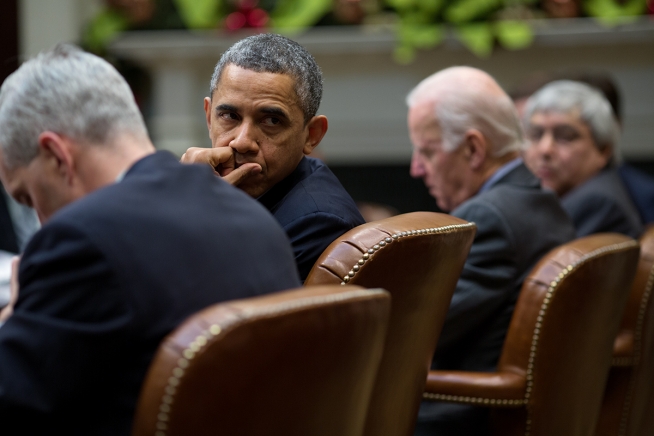
President Barack Obama, with Vice President Joe Biden, attends a meeting in the Roosevelt Room of the White House, Dec. 12, 2013. (Official White House Photo by Pete Souza)

President Barack Obama, with Vice President Joe Biden, attends a meeting in the Roosevelt Room of the White House, Dec. 12, 2013. (Official White House Photo by Pete Souza)

Secretary of State John Kerry and Russian Foreign Minister Sergey Lavrov met in Geneva on Wednesday and the two were unable to decide who the Syrian terrorists are that should be excluded from the negotiations.

They agree on excluding the Islamic State and al-Nusra Front (Al Qaeda’s affiliate) who have already been eliminated from participation. But what about the myriad other opposition groups, some of whom collaborate closely with Nusra and other extremists?

A hundred of them were melded together by Saudi Arabia in Riyadh last November. But they want Syrian President Bashar al-Assad to step down immediately. That’s a complete non-starter as the U.N. plan would allow him to stay on for six months making way for a transitional government until a new constitution is written and a general election held in 2017. Kerry has been blasted by neoconservatives for agreeing to this compromise and for allowing Assad to run again in that election.

The U.S. compromised…

Read more

Encountering a Sophisticated Putin

1

Pretty much all that Americans — and much of the West — get to hear about Russian President Putin is heavy-handed propaganda often read over images of him riding shirtless on a horse. He’s either a bully or a buffoon. But editors of a popular German newspaper encountered a much more sophisticated figure, writes Gilbert Doctorow.

By Gilbert Doctorow

I was hesitant to write about Vladimir Putin’s recent interview in Germany’s mass-circulation Bild newspaper because I have published many analytical essays of Putin’s speeches and public appearances over the past couple of years and do not wish to provide further justification for those who would view me as a composer for one string violin, an inveterate apologist for the Russian president.

Moreover, when a fellow member of the anti-war movement, Alexander Mercouris, published an appreciation of the interview in Russia Insider under the heading “Congrats Germans! This Is How You Do a Putin Interview,” it seemed churlish to go against his take on the subject.

Russian President Vladimir Putin laying a wreath at Russia's Tomb of the Unknown Soldier on May 8, 2014, as part of the observance of the World War II Victory over Germany.

Russian President Vladimir Putin laying a wreath at Russia’s Tomb of the Unknown Soldier on May 8, 2014, as part of the observance of the World War II Victory over Germany.

However, a couple of additional articles on the Bild interview subsequently published in Russia Insider have challenged Mercouris’s kindly view of the German journalists as being “well-informed and intelligent.”

“Putin Schools Top German Journalist Who Smeared Him” makes it clear that Bild’s chief political editor Nikolaus Blome, formerly with Der Spiegel, would never have consciously done Putin a favor. And the latest RI article, a translation from Sputnik Deutschland entitled “How Putin Turned the Tables on German Magazine ‘Bild’” delivers what I had from the beginning considered to be the reality of this interview: that Putin’s impressive showing came in spite of and not because of the journalists’ predisposition to him and Russia generally.

The Russia expert Alexander Rahr explains here the logic of Putin agreeing to enter the lion’s den for the sake of reaching the tabloid’s multi-million readership who, by their demographics, are not easily…

Read more

Betting on the Wall Street Crash

1

Exclusive: The 2008 Wall Street crash resulted from a combination of unrestrained greed and political contempt for government regulators who might have prevented the devastation. In The Big Short, the tale is told from the perspective of a few players who saw the inevitable and made money on the crash, writes James DiEugenio.

By James DiEugenio

If you read Michael Lewis’s book The Big Short or see the movie by the same name, you won’t find much about how the financial crisis of 2008 was set in motion more than two decades earlier. You won’t learn much about the roles of Ronald Reagan and his disdain for big government or about Bill Clinton’s faith in neo-liberalism, trusting that the modern markets and the supposedly sophisticated investors would keep excesses in check.

Nor will you find much about economist-turned-politician Phil Gramm who incorporated many of Reagan’s and Clinton’s beliefs into legislative actions, slashing taxes on the rich in the 1980s (and thus incentivizing greed) and, in the 1990s, brushing aside Franklin Roosevelt’s painfully learned lessons from the Great Depression about the need for firewalls between the speculation of Wall Street and the hard-earned savings of Main Street.

The-Big-Short-teaser-poster1-e1445275948938

Also out of Lewis’s narrative frame is Brooksley Born, the federal commodities regulator who foresaw the looming danger from the exotic new financial instruments that sliced and diced risky subprime mortgages and packaged them in bonds with ratings far above what they deserved — and the even riskier tendency to lay bets on how the bonds would perform.

But Born was out-muscled by bigger financial stars with larger egos, the esteemed Federal Reserve Chairman Alan Greenspan (originally a Reagan appointee) and Clinton’s brash Deputy Treasury Secretary Lawrence Summers, a rising star in the neo-liberal establishment which treated the market’s “invisible hand” as a new-age god.

Michael Lewis’s Treatment

These names and that background are not mentioned because Michael Lewis did not write The Big Short as an overview of the economic meltdown. It is not remotely a historical chronicle of the crisis. Lewis chose to write about six characters…

Read more

Video: Kurd Crackdown: Turkish forces allegedly fire on civilians with white flag (GRAPHIC)

0


An incident in which several civilians with a white flag came under fire has been caught on camera. The victims are reported to be Kurds in the town of Cizre, …

Via Youtube

Video: High-Ranking FBI Agent Convicted of Assaulting Teen at Gunpoint Receives Probation

3


https://photographyisnotacrime.com/2016/01/high-ranking-fbi-agent-convicted-of-assaulting-teen-at-gunpoint-receives-probation-keeps-job-as-counterterrorism- …

Via Youtube

Video: Peter Tatchell On Political Correctness, The Brutal Saudi Regime & The Inhumanity Of Zoos

0


Please Support The Show — http://richieallen.co.uk/ Peter’s Website – http://www.petertatchellfoundation.org/ https://www.facebook.com/therichieallenshow …

Via Youtube

Video: Business comes to ‘Jungle’: Calais migrant camp grows despite clearing plans

0


There’s been a large police presence in the refugee camp, after authorities ordered people to be cleared from part of the site, so it could be demolished.

Via Youtube

Video: Mistrust in mainstream media? Radical! – UK govt website claims

1


The British government has launched a new website aimed at battling what it calls “the spell of twisted ideologies”. On the site, parents and teachers can find …

Via Youtube

Video: ‘Signal that refugees are not welcomed’: German regions seize migrants’ valuables

0


Reports in the German media, suggest Bavaria has been routinely seizing valuables from refugees arriving in the region – to cover some of the cost of their stay.

Via Youtube

Video: CCTV: Egyptian migrant prevents robbery at supermarket in Italy

0


A 29-year-old Egyptian migrant prevented a robber from stealing from a cashier at a supermarket in Turin, on January 12. According to footage taken by CCTV …

Via Youtube

Video: Greek farmers on tractors block highways to protest reforms (drone footage)

0


Hundreds of tractors could be seen by drone-camera, as they gathered at the Greek side of the Greek-Bulgarian border, near the town of Serres, Friday, …

Via Youtube

Video: Keiser Report: Fine Print Reality vs Big Print Dreams (E866)

0


Check Keiser Report website for more: http://www.maxkeiser.com/ In this episode of the Keiser Report, Max Keiser and Stacy Herbert discuss all the small print …

Via Youtube

Video: Health Crises Among the (Politically) Imprisoned

0


Co-Coordinator of the National Jericho Movement Jihad Abudulmummit rejoins us for this week’s Political Prisoner Report to discuss the latest health crises …

Via Youtube

Video: ‘Secret wife’ of late Saudi king to reveal monarchy’s mysteries in UK film

1


Janan Harb, 68, has quite a life story to tell: she says she was the former Saudi king’s secret wife. Harb, a Palestinian-born Christian, says she converted to Islam …

Via Youtube

Video: Respect women & gays, don’t beat kids: German TV issues guide w/ tips for refugees

0


A cartoon guide aimed at instructing refugees on the correct way to act in Germany has become an object of ridicule online. The instruction manual, designed in …

Via Youtube

Video: Small passenger plane emergency landing on motorway near Moscow

0


A Wilga-35 four-person passenger plane made an emergency landing near the city of Sergiev Posad in Moscow Region. The plane landed safely on a dividing …

Via Youtube

TTIP Enters New And Dangerous Stage As Democracy Is Dismantled In Secret

1

TTIP negotiations continue in the shadows in both America and the EU and they enter a new and dangerous stage as existing legal barriers that would inhibit certain types of (harmful) trade are dismantled in favour of a new set of rules termed ‘regulatory cooperation’. It sounds collaborative, it is, but just not in the public interest.

What this really means is that decades of regulations passed by governments, legislated upon for public interest and safety reasons are being swept aside. These new regulations that the public and journalists are barred from being a party to include the demolition of environmental protections, safety at work regulations, food safety and other laws designed to protect and defend public safety.

Any new regulations that EU states would want to impose in future are now facing considerable barriers and hurdles that could take years to negotiate and the system is clearly being designed to be onerous or just plain difficult to favour corporate interests above public interest.

Corporate Observatory, whose raison d’être is exposing the power of corporate lobbying in the EU has recently published its latest report “Dangerous Regulatory Duet” which exposes how a new framework being implemented under regulatory cooperation through TTIP will allow bureaucrats and big business to attack the public interest.

The report highlights some examples of how big business and the governments of America and the EU have conspired to destroy these safeguards. Here are some excerpts from this lengthly and enlightening report;

Read More:

Video: No Fly: Muslim, Sikh kicked off flight suing American Airlines

0


Four men have filed a lawsuit against American Airlines – for discrimination. They claim they were removed from a plane because of their appearance – and were …

Via Youtube

Video: ‘Military Solution’: If peace process in Syria fails US ‘ready’ for intervention

0


The US vice-president has said that Washington is ready for a military solution in Syria – if the peace process falls through. Read More: http://on.rt.com/72ka RT …

Via Youtube

Video: ‘ISIS among us’ — Refugees claim militants living with them in Germany

0


Christian refugees from Syria claim they saw a former Islamic State member living in Frankfurt, and that this is not an isolated case. Police investigated but …

Via Youtube

Video: Dash Cam Footage: Moment of bomb blast at police station in Turkey

0


Dashboard camera footage shows the moment an explosive device allegedly placed by militants of the Kurdistan Workers’ Party (PKK) blow up in Nusaybin …

Via Youtube

Holding a ‘Go Donald!’ Media Accountable for ‘Normalizing Extremism’

0
Stop Hate Dump Trump

Calling out media for enabling a “grave threat to democracy.”

Great Britain won’t actually ban Donald Trump from the country but Parliament did spend time taking seriously what was called Trump’s “poisonous, corrosive” effect on public discourse. At the same time, actors, writers and others, including Harry Belafonte, Eve Ensler and Noam Chomsky, launched a Stop Hate Dump Trump campaign, that included serving notice to media that they “are accountable for normalizing Trump’s extremism by treating it as entertainment, by giving it inordinate and unequal air time and by refusing to investigate, interrogate or condemn it appropriately.”

For some journalists, this might provoke questions: Reporters can’t ignore public figures, but is there daylight between covering news of a person and providing them a near-constant, legitimizing megaphone?

For media executives, though, the main question seems to be: What time does the bank open?

The Intercept on Les Moonves

CBS chief Les Moonves in The Intercept (12/10/15): “This is fun, watching this, let them spend money on us, and we love having them in there.”

I’m thinking of a report from December by Lee Fang at The Intercept (12/10/15), about how, with visions of campaign ad dollars sparkling in his eye, CBS chief executive Les Moonves cheered on Trump’s candidacy at an investor presentation: “The more they spend, the better it is for us, and: Go Donald! Keep getting out there!”

This was after Trump’s comments about Mexico sending rapists to the US and his call for Muslim Americans to have to “register” with the government.

In an earlier investor meeting, Moonves had joked, “Looking ahead, the 2016 presidential election is right around the corner and, thank God, the rancor has already begun.”

The same media companies that behind the scenes cheerfully acknowledge a preference for rancor or extremism if it keeps candidates spending money, and lobby furiously against campaign finance reforms that might interrupt their cash flow, also–Fang reminds us–present themselves as neutral observers of the electoral process.

Moonves may have said, “This is fun, watching this, let them spend money on us…. We’re looking forward to a very exciting political year in ’16″–but that doesn’t mean that media companies just see green rather than red or blue. They don’t care only about profit-making, but also about maintaining the policies and laws that protect that profit-making.

Which may be why, when asked about electoral politics by Time magazine in 2004 (9/27/04), Sumner Redstone, then executive chair of CBS and Viacom, said, “Viacom is my life, and I do believe that a Republican administration is better for media companies than a Democratic one.”


Janine Jackson is the host of CounterSpin and the program director of FAIR.

This piece was reprinted by RINF Alternative News with permission from FAIR.

Islamic State’s Bloody Decline

0

Washington’s pundit class has interpreted the Islamic State’s recent turn toward international terrorism as proof of its growing strength, but it may actually represent the opposite, the group’s recognition that its “caliphate” is under stress and shrinking, observes ex-CIA analyst Paul R. Pillar.

By Paul R. Pillar

Large-scale armed insurrection tends to move through identifiable phases that correspond roughly to what Mao Zedong described many years ago. In Mao’s formulation, the first of three phases emphasizes organization, propaganda, and the establishment of cadres and a presence in the areas in which the revolutionary movement intends to operate.

The second phase is more violent and typically includes operations we would describe as terrorist attacks, as well as larger scale guerrilla warfare. The purposes of this phase include demonstrating the strength and vitality of the movement and eroding the will and resources of the adversary.

Journalist James Foley shortly before he was executed by an Islamic State operative, known as Jihadi John and identified as Mohammed Emwazi, the target of a drone attack that the Pentagon announced on Thursday.

Journalist James Foley shortly before he was executed by an Islamic State operative, known as Jihadi John and identified as Mohammed Emwazi, the subsequent target of a lethal U.S. drone attack.

The third phase includes a transition to conventional military operations, on a big enough scale to sweep to a final victory. This sequence tracks the history of the Chinese Communist Party’s road to power and, in modified form, the strategy and trajectory of some other movements such as the Viet Minh.

Such strategies do not always succeed. Groups such as Sendero Luminoso (Shining Path) in Peru and the Tamil Tigers in Sri Lanka followed a similar course of using terrorist attacks and rural-based guerrilla operations as steps in growing strong enough to challenge for power. In their cases they followed that course successfully for a good while, and came to pose a very serious challenge to the established order in each of their countries before being finally beaten.

Failure of the strategy can involve, as long as the movement is alive, a walking back from a later phase of operations to what was supposed to be only an earlier one. Failure at conventional military operations and large-scale guerrilla warfare may mean resorting to…

Read more

‘The Core Injustice Is Indefinite Detention’

0

Janine Jackson interviewed Omar Shakir about Obama’s failure to close Guantanamo for the January 15, 2016, CounterSpin. This is a lightly edited transcript.

Omar Shakir:

Omar Shakir (photo: Human Rights Watch)

X

MP3jPLAYLISTS.MI_0 = [
name: “1. CounterSpin Omar Shakir “, formats: [“mp3”], mp3: “aHR0cDovL3d3dy5mYWlyLm9yZy9hdWRpby9jb3VudGVyc3Bpbi9Db3VudGVyU3BpbjE2MDExNVNoYWtpci5tcDM=”, counterpart:””, artist: “”, image: “true”, imgurl: “”
];

MP3jPLAYERS[0] = list:MP3jPLAYLISTS.MI_0, tr:0, type:’MI’, lstate:true, loop:false, play_txt:’Play’, pause_txt:’Pause’, pp_title:’FAIR’, autoplay:false, download:true, vol:80, height:71, cssclass:’ ‘, popout_css: enabled:true, colours: [“#fff”, “rgba(201,207,232,0.35)”, “rgb(241,241,241)”, “rgba(245,5,5,0.7)”, “rgba(92,201,255,0.8)”, “transparent”, “transparent”, “#525252”, “#525252”, “#768D99”, “#47ACDE”, “”, 600, 200 ],
cssInterface: “color”: “#525252” ,
cssTitle: “left”: “16px”, “right”:”16px”, “top”:”8px” ,
cssImage: “overflow”: “hidden”, “width”:”auto”, “height”:”71px” ,
cssFontSize: “title”: “16px”, “caption”: “11.2px”, “list”: “12px” ,
classes: interface:’ verdana-mjp’, title:’ left-mjp norm-mjp plain-mjp childNorm-mjp childPlain-mjp’, image:’ Himg right-mjp’, poscol:”, ul:’ darken1-mjp verdana-mjp med-mjp childNorm-mjp childPlain-mjp left-mjp’ ;

MP3 Link

JANINE JACKSON: It was widely noted that Barack Obama’s last State of the Union address contained the same promise as his first, that he would move to close the military detention center in Guantanamo Bay, Cuba, now entering its 14th year. Media present closing Guantanamo as Obama’s quest, something he wants badly.  That he has struggled mightily to close the prison is one presumption.  The more striking one is that Guantanamo is, above all, Obama’s problem, rather than that of the hundreds of people who’ve been held there, or of a society aspiring to democracy that permits a prison that operates outside the law.

We’re joined now by Omar Shakir. He’s the Bertha Fellow at the Center for Constitutional Rights.  He joins us by phone from New York.  Welcome to CounterSpin, Omar Shakir.

OMAR SHAKIR: Thank you for having me.

JJ: I understand Beltway reporters’ tendency to report on Guantanamo Bay as about Barack Obama, you know: his legacy, his power. That’s not irrelevant, but there’s just so much else at stake.  Some of our listeners were in grade school when Guantanamo Bay opened.  Remind us why it opened; what was the supposed purpose in 2002?

Prisoners at Guantanamo Bay

Prisoners at Guantanamo Bay

OS: Sure. The Bush administration opened Guantanamo to create a prison that was beyond the reach of any law.  They explicitly chose it so that the US Constitution and other law would not apply.  In their minds, the nature of US control over that base meant that international law wouldn’t apply, Cuban law wouldn’t apply.  It was meant to be an area where they could use torture and other brutal interrogation tactics as they wanted, where they could hold people without charge, where they could conduct trials without basic due process protections.  It was meant mostly for that purpose and, in addition, to be far removed so that could easily be hidden from the conscience of most Americans, and out of sight, out of mind, in a place where they could bring whoever they wanted whenever they wanted for as long as they wanted.

JJ: Well, that sounds dystopian.  And it’s amazing the degree to which it was kind of accepted, or has become normalized, at least, by US media.  A CBS affiliate story recently on five Yemeni men who were released to the United Arab Emirates just sort of reported none of the men had been charged with a crime, but they’d been detained as enemy combatants, you know, as though this were a kind of generally understood legal terminology and as though it made sense.

So who was there, who is there still, in Guantanamo Bay? Who got caught up in it?

OS: So we currently, as of today, have 93 individuals left in Guantanamo.  Over the history of Guantanamo, 780 individuals have been held there.  All are Muslim men and boys.  Out of the 780, the vast majority have not been charged with any crime at all. Most were cleared for release.  You have a lot of people, as the former US envoy for Guantanamo’s closure put it, that simply were not the worst of the worst but, a direct quote, “had the worst of luck.”  A lot of people that were brought over because the US was offering bounties in late 2001, early 2002, to local villagers who turned in anyone they suspected of militance, which obviously, for communities, meant people turning in anybody that they could make any kind of case. You know, maybe they were not from that town, or they had a personal gripe with them.

The US’s own numbers say that only 8 percent were ever Al Qaeda fighters.  There’s even a smaller percentage of numbers that the US actually claims were involved in any sort of combat.  And at the end of the day, you have more people that have died in Guantanamo than actually have been convicted by a court.  So that should give you some perspective, now that we commemorate the 14th anniversary of Guantanamo’s opening, 15 years for many men there, and we still have a reality where men continue to languish without charge, and many of whom have been cleared for release.

JJ: FAIR took the New York Times to task in 2009 for a story on a leaked Pentagon report which they headlined “One in Seven Freed Detainees Rejoins Fight, Report Finds.”  It was talking about former prisoners from Guantanamo “returning to terrorism or militant activity” when, as you’ve just explained, in many or most cases, they’ve not been shown to have been involved in any in the first place.

And yet for reporters, this image of Guantanamo as holding “the worst of the worst,” and we’ve seen politicians pick up on this, it had something to do with the fact that–and there were exceptions, folks like Carol Rosenberg, who really did hard, independent work–but, in general, there was a reliance on the Pentagon as the source for any knowledge you were getting out of Guantanamo.  And that turned out not to be the best route to reliable information.

OS: That’s absolutely right. I mean, I think a lot of this has to do with Islamophobia and the reality that fearmongering has always been the primary justification for the ongoing detention of folks at Guantanamo Bay.  And I think those leaks also, if you sort of look at the timing, it’s always bureaucrats.  Usually the Department of Defense, Homeland Security, FBI, that have their own reasons for wanting Guantanamo open, who are selectively leaking, in many cases, inaccurate information. Or even if it has some accuracy in it, it’s being framed in a way to further the opportunistic politicians that want to bank on fearmongering as a way to either criticize President Obama or to scuttle efforts to close Guantanamo.

So the way that that sort of reverberates in media and in political circles I think is deeply problematic, and those folks deserve a lot of the blame for Guantanamo still being open in 2016.

JJ: It’s not that the obstacles aren’t real, but what can we say about Obama’s capacity to move the issue? Could he not do more?

OS: Absolutely he can. I mean, it is very real that there are obstacles, both within his own administration and in Congress.  But at the same time, these obstacles emerged as a result of the fact that from the beginning, while President Obama did on his second day in office issue executive orders calling for the closure of Guantanamo, from the early days of that administration it was not followed up with a concrete plan of action and a set of steps to actually effectuate it.

The way he went about the first year, and on into subsequent years, provided space for these obstacles to emerge.  And as soon as they emerged, they were the excuse for no action.  On his own, based on his own authority, he can release guys that are cleared for release.  I mean, we’re talking about out of the 93 detainees left, 34 of them are cleared for release.  Tomorrow  President Obama could put them on an airplane, send them away.  Of the remaining detainees, you have 49 of whom who are awaiting hearings by the periodic review boards that have been clearing the vast majority of detainees.

If those review boards were expedited–and as president, Obama promised to do all hearings within a year–if he actually followed through with expediting that, you would have many more men cleared for release.  And if the military commission system, which has been fraught with abuses and serious due process violations, were once and for all done away with, and those that the US does suspect of criminal involvement were charged in federal courts, and the administration used a simple charge-or-release paradigm very familiar to prosecutors, he could on his own power close Guantanamo in a matter of days, not months or years.

JJ: It was interesting, in the State of the Union speech, that Obama said–and which many media credited him for revealing yet again his urge, his strong compulsion, to close Guantanamo–what he actually said is: “I will keep working to shut down the prison at Guantanamo.  It’s expensive, it’s unnecessary, and it only serves as a recruitment brochure for our enemies.”

Anytime a criticism of an abusive practice or policy begins with “it’s expensive,” you know, it’s not really inspiring.  It doesn’t really give you the feeling that the problem is the absence of due process, that the problem is putting people in a black hole of a prison that’s opaque to the public and that’s outside of the rule of law. His opposition, it doesn’t seem to be based on what some of us would call the right reasons.

OS: Right. The core injustice is indefinite detention; it’s this idea that you can have individuals who are now in their 15th  year of detention under US control, who the US government has said pose no threat, are cleared for release, who have never been charged with a crime, but yet wake up each day in Guantanamo and have no idea whether that will be the day that they’re released, whether they could die there, whether they’ll ever see their families again.  That core injustice–that’s not going to be solved by the reports of the president thinking about transferring Guantanamo to a federal prison in the United States.  That’s not closing Guantanamo; that’s merely changing its zip code and not addressing the core injustice.

JJ: We’ve been speaking with Omar Shakir of the Center for Constitutional Rights.  You can find their work on Guantanamo, along with their work on other issues, online at CCRJustice.org.  Omar Shakir, thank you so much for joining us this week on CounterSpin.

OS: Thank you for having me.

This piece was reprinted by RINF Alternative News with permission from FAIR.

Panicked Over the Trump Phenomenon

2

America’s conservative establishment is in panic mode as renegade billionaire Donald Trump continues to dominate the Republican presidential race and thumb his nose at the GOP donor class, which is alarmed that all its money might not dictate the outcome this time, as Bill Moyers and Michael Winship write.

By Bill Moyers and Michael Winship

David Brooks is a worried man. Like many establishment Republicans, the conservative columnist for The New York Times sees the barbarians pouring through the gates and fears for both his party and the republic. Hail, Trump! Hail, Cruz! It’s enough to send a sober centrist dashing through the Forum in search of a cudgel.

There was Brooks on a recent edition of the PBS NewsHour, his angst spilling out across the airwaves like fog from a nightmare: “I wish we had gray men in suits,” he told Judy Woodruff, conjuring in some nostalgia-minded the courtly cabal of well-heeled businessmen who drafted war hero Dwight D. Eisenhower to run for president as a Republican.

Billionaire and Republican presidential candidate Donald Trump.

Billionaire and Republican presidential candidate Donald Trump.

“We don’t have that,” Brooks continued. “But the donor class could do something.”

Ah, yes. The donor class! Those deep pockets flung open even wider by the Supreme Court’s Citizens United decision just six years ago, permitting the richest of the rich to pour even more of their fortunes into control of our electoral process. Brooks was saying openly what many of them are thinking privately: Only we can save the party from the megalomania of Donald Trump and Ted Cruz and protect our precious status quo.

How best to do this? Brooks suggested that panicked “state legislators who are Republicans, congressmen, senators, local committeemen” should join with the donors “so they don’t send the party into suicide.”

Makes sense – many of those very same folks already are deep in hock to the donors, their contributions often laundered via entities with high-falutin’ names — ALEC, for one, the American Legislative Exchange Council that lends a helping corporate hand to legislators eager to write favorable laws, provide tax breaks, dismember public employee unions and privatize government…

Read more

Video: Canada’s New Hope And Change Is A Lie

1


In this video Luke Rudkowski interviews Dan Dicks of Press for Truth in Canada about the latest with Justin Trudeau and the Canadian government. The two …

source

Video: MI6 think they can pin Litvinenko assassination on Putin Now Boris Berezovsky is out of the way

0


Another perspective on events as not allowed to be discussed in the BBC ‘Regime change in Moscow’ propaganda programme Litivnenko’s associates, Dmitry …

Via Youtube

Video: Texas School Resource Officer Slams Child to Ground

0


Kevin Garbacik a Police Officer with Sherman Police Department, Texas. Throws Child to ground after responding to a fight between students.

Via Youtube

Video: Fritz Springmeier On How MKULTRA Trauma Mind Control Is Now Being Used On Entire Populations!

0


Please Support The Show — http://richieallen.co.uk/ Fritz’s Website – http://pentracks.com/ https://www.facebook.com/therichieallenshow …

Via Youtube

How Candidates’ Mega-Donors Get Served After the Election

1

Eric Zuesse, updated from strategic-culture.org

The prison industry provides a good example: One recent article at Vice News criticized the legislation proposed by Presidential candidate and U.S. Senator Bernie Sanders to eliminate America’s private prisons, or corporate-owned prisons, and it quoted a liberal ‘expert’ on the subject, who said: “Even though there’s a left-right consensus on criminal justice reform, a lot of folks on the right still very much embrace private prisons, which have a lot of lobbying power, so politically, it’s not a viable reform.”

That’s how corrupt the U.S. is: even when there’s verbal ‘consensus’ among the office-holders who control the government’s money and policies, the actual votes by the office-holders go in the opposite direction, whenever that’s necessary in order for the office-holder to have enough campaign-money to become re-elected by the ignorant voters who believed his words and promises instead of his votes and the actual results. If this is ‘democracy,’ it’s ‘democracy-by-deception’: the candidate says one thing, but, when the crucial vote in Congress comes, votes the other way – and most of the people who had voted for that candidate will never even know he had conned them.

Another article at Vice News showed that the U.S. Presidential candidates who in the 2016 race had received the most donations from private prison corporations were Hillary Clinton and Marco Rubio, each of whom had received $133,000 from them this cycle. Clinton’s money came almost entirely from the largest imprisonment-company, GEO (former Wackenhut), which is mainly allied with ALEC and the rest of the Republican Koch brothers’ political operation; but Rubio’s money came mostly from the second-largest, CCA (Corrections Corporation of America), which was founded by the Tennessee Republican Party Chairman Thomas W. Beasley and two of his friends.

That last-mentioned Vice article said nothing about Sanders (he hadn’t received any donations from them), but it did discuss the imprisonment industry’s favorite candidates:

Officially, private prison companies don’t try to influence how the US government treats immigrants. The GEO Group noted that the company’s lobbyists “focus entirely on promoting the use of public-private partnerships.” [Note: Hillary Clinton has always praised ‘public-private partnerships.’] MTC and CCA did not respond to requests for comment.

The candidates aren’t talking about it either: The campaigns for Clinton, Bush, Rubio, and Trump ignored repeated VICE inquiries about private prisons. But activists say industry lobbying may have shaped the “detention-bed mandate,” a policy that requires Immigration and Customs Enforcement (ICE) to keep at least 34,000 people locked up – mainly in private prisons – while they wait to appear in immigration court. It costs taxpayers $2 billion a year for ICE to meet the quota.

Extreme corruption is the reason why the United States has not only the world’s highest prisoner-count, but the world’s highest imprisonment-rate. Even if it might be the case that incarceration rates don’t necessarily correlate with corruption, they do necessarily reflect the extent to which a given nation’s government is (by means of its laws and its enforcement of those laws) at war against its own population; and, so, technically speaking, incarceration rates (the percentage of the population who are in prison) are supposed to reflect the prevalence of law-breaking within a given nation. After all: by definition, people are presumed to be in prison for law-breaking, irrespective of whether the given nation’s laws are just – and, if they’re not just, then this fact reflects even more strongly that the nation itself is corrupt. So: a high incarceration-rate does strongly tend to go along with a nation’s being highly corrupt, in more than merely a technical sense – it’s almost more like being the definitive measure of “corruption.” So, the correlation between incarceration rates and corruption must be assumed to be high, and any measure of corruption which fails to at least include countries’ incarceration rates should be rejected.

Out of the world’s 223 countries, the U.S. has the world’s second-highest incarceration rate: 698 per 100,000, just behind #1 Seychelles, with 799 per 100,000. Seychelles doesn’t even have as many as 100,000 people (but only 90,024 – as many people as are in the city of Temple, Texas). By contrast, the U.S. has 322,369,319; so, the U.S. is surely the global leader in imprisonment. And, furthermore, #3, St. Kitts and Nevis, with an incarceration-rate of 607 per 100,000, has only 54,961 people (as many people as are in the city of Columbus, Indiana). The only other country that might actually be close to the U.S. in imprisoning its own people is North Korea, which could even beat out the U.S. there, but wouldn’t likely beat tiny Seychelles: North Korea is estimated to have “600-800 people incarcerated per 100,000,” and a total population of “24,895,000.”

Thus, for imprisonments, the U.S. really does have no close second: it’s the unquestionable global market-leader, for prisons and prisoners.

And this brings us to the market-leader for prisons within America itself, and to the stunning corruption that stands behind it. So, here’s that extraordinary example, and the story behind its corruption, which will provide a close-up view of America’s general corruption, from the top (including the government itself) on down:

In order to protect the profits of privately run prisons in the U.S. (where “Sixty-two percent of detention beds are administered by private prison corporations,” meaning that most U.S. prisoners are being ‘served’ by for-profit corporations in for-profit-run prisons), the U.S. Federal Government – Barack Obama’s Administration, the Administratin of that man who constantly criticizes America’s high imprisonment-rate – is refusing to honor Freedom Of Information Act (FOIA) requests by the Center for Constitutional Rights (CCR), which is trying to find out why people are being imprisoned as illegal immigrants who ought not to be. Wrongly-imprisoned people are a device by which private prison-operating companies keep their prison-beds occupied and thus drawing income from the U.S. government, just like a high occupancy-rate is essential for a hotelier’s profitability. But – unlike in the hotel trade – this coercive bed-occupancy produces more than mere profits; it produces also distressed families, of those individuals who are yanked and unjustifiably imprisoned, families suffering needlessly. 

It turns out that U.S. federal laws, passed mainly by the Republicans, but also with votes from corrupt Democrats, require (in H.R.3547) the U.S. government to pay for “a level of not less than 34,000 detention beds” for ‘illegal immigrants.’ (You can see that requirement being cited by the Republican interrogator of an Obama Administration official, Department of Homeland Security, at 1:03:00- in this video, where the Obama official is being criticized for not locking up enough people to meet the law’s requirements.) (Republicans and other conservatives love to punish people, irrespective of justice; so, they want at least those 34,000 prisoners. To be concerned about justice, as the CCR is, is to be ‘soft on crime,’ as Republicans view it. Instead of justice, Republicans seek revenge; thus, for example, Republicans overwhelmingly support torture against ‘terrorist’ suspects; Democrats overwhelmingly oppose it. Torture greatly reduces the trustworthiness of a suspect’s statements, but it always serves as a vent for revenge, even when the suspect actually had nothing to do with terrorism; so, Republicans strongly approve of torture. Similarly, the most-conservative Muslims approve of beheading ‘infidels.’ Conservatives everywhere, and in every faith, support harsh punishments; and the U.S. is a conservative country; so, sentences are long, and the conditions are harsh.)

However, the Obama Administration itself, even as it locks up, on some days, just shy of the legally mandated minimum of 34,000 accused ‘illegal immigrants’ (which shortfall is here drawing the ire of that congressional Republican in the video), is also actively blocking CCR from access to the information about how the government and private corporations set rates for immigration detention beds and facilities. CCR argues that private profits are being given higher priority by the Administration than is the welfare of the public; and, thus, that the General Welfare Clause of the U.S. Constitution is being violated here. 

The Obama Administration says that it won’t release the information, because to do so would “harm corporations competitively.” That’s more important to Obama than is “the genetral welfare.”

CCR claims, and the Obama Administration is opposing their claim, that “there is essentially no competitive market in government contracts that could be harmed by the release of information, that there should be nothing proprietary about the terms of a government contract, and that the public has a right to understand how Congress funds immigration detention and how that funding is influenced.”

The Obama Administration is arguing that if this same cost-information were being requested concerning any of the 38% of government-run prisons, then the FOIA request would be complied with, but that contracting-out or privatizing that function has freed the government from any such obligation.

However, CCR is concerned specifically about that profit-motive here – that the revolving door between government service and the private sector might itself be a key part of the explanation for the government’s requiring that at least 34,000 people will be in prison for, or awaiting trial on charges of, ‘illegal immigration.’ CCR contends that the only reason why people should be imprisoned in America is that they’ve actually broken laws for which the correct punishment is a prison term. But the position of the U.S. government is contrary: if the beneficiary of someone’s imprisonment is a private corporation, the public shouldn’t necessarily be allowed to know what’s going on, nor why. And, so, that’s the issue here. Does a private corporation’s privacy-right exceed the public’s right-to-know? The government says yes; CCR says no. CCR argues that to privatize is not to immunize: the government has the same obligations to the public, regardless of how it has chosen to carry out its obligations – either directly, or else by contracting them out (such as here). The Obama Administration argues that a private corporation is private, protected from the public’s scrutiny – and that the corporation’s only obligations are to the government, not to the public; thus, no such FOIA requests will be honored. 

Here’s what’s not in dispute about the case: the man who, in the first Obama Administration, was the head of the U.S. Department of Homeland Security’s Office of Immigration and Customs Enforcement’s Office of Enforcement and Removal Operations, David Venturella, is now the top sales official at GEO Group, which is “the world’s leading provider of correctional detention, and residential treatment services around the globe” – and that’s also the first thing GEO says about itself, on its own “Who We Are” page. And Mr. Venturella is now being cited by the Obama Administration as an ‘expert,’ in order to deny CCA’s FOIA request.

As a GEO official, Venturella claims in his 22 December 2015 declaration in the court-case, that, “the winning proposal in almost every Federal procurement competition is awarded to the lowest priced bidder,” and that, “The disclosure of GEO’s proprietary bed-day rates and staffing plans would result in substantial competitive financial harm to GEO.” He claims that, “Even with access to their larger competitors’ staffing plans, the smaller private companies do not have access to the capital needed to compete to win a large facility.” In other words: he pretends that GEO is one of “the smaller private companies.” But then he goes on to say (just in case a reader might happen to consider GEO not to be one of “the smaller private companies”): “The second stage would be acrimonious competition between the larger organizations, public and private, that will very likely lead to their withdrawal from the detention market as well, thereby leaving ICE [Immigration and Customs Enforcement] with no viable detention service providers.” Venturella assumes here that ICE cannot itself own and operate its prisons. (He doesn’t say why; he merely assumes that it’s the case – perhaps that everything should be privatized, and must be privatized, so ICE shouldn’t run its own prisons.) And, he also is vaguely threatening there to abandon this market. He’s actually suggesting that, if the government were to require this information about cost and profitability to be released to CCA, then GEO might no longer even bid on this business – regardless of how profitable it is to them. And, he says, this would leave ICE “with no viable detention service providers.” 

So: that (ridiculously and multiply false) argument is the reason why injustices to defendants in the U.S. immigration system must continue, Venturella, the salesman for GEO (his title is “Senior Vice President”), is here arguing. And, the U.S. government doesn’t challenge it, but instead unquestioningly accepts it.

Essentially, the Obama Administration is joining with GEO arguing that the profitability of private prison companies is more important than any injustices that might happen to be caused by Congress’s establishment of an arbitrary fixed and stable minimum number of prisoners every day – and, since the head of the top prison-company is saying that profits would be threatened by adhering to FOIA in this particular matter, the Freedom Of Information Act request in this case must be denied.

The basic argument, in other words, is that privatization is more important than the U.S. Constitution and its General Welfare Clause.

How close are these contractors to the government?

Here are five of the seven members of the Board of Directors of GEO:

One is “Former Director, Federal Bureau of Prisons.”

Another is “Former Under Secretary United States Air Force.”

Another is “Executive Director, National League of Cities.”

Another is “Chairman and CEO of ElectedFace Inc.,” which “will connect people to their elected officials in every political district.”

Another is George C. Zoley, the company’s Founder and CEO, who is also “America’s Highest Paid ‘Corrections Officer.’” In fact: “GEO Group’s revenue in 2012 exceeded $1.4 billion and CMD [Center for Media and Democracy] estimates that 86% of this money came out of the pockets of taxpayers. CMD’s investigation of GEO Group unearthed how the company’s cost-cutting strategies lead to a vicious cycle where lower wages and benefits for workers, high employee turnover, insufficient training, and under-staffing results in poor oversight and mistreatment of detained persons, increased violence, and riots.” (If so, then that would add to the misery that’s produced by the improper imprisonments.)

“According to Nasdaq, major investors in GEO Group include: Vanguard, BlackRock, Scopia Capital (a hedge fund run by Jeremy Mindich and Matt Sirovich) Barclays Global Investors, Bank of New York Mellon, and more.[132] George Zoley, CEO of GEO, is a major stockholder with over 500,000 shares.[133] For more on investors, see Ray Downs, ‘Who’s Getting Rich Off the Prison-Industrial Complex?’ Vice, June 2013.”

Privatization is very profitable. But not for everybody. Only for the well-connected. For everybody else, it’s just more poor and abused workers, and unjustly imprisoned people. But virtually all Republicans, and also the Obama Administration and other corrupt Democrats (and Obama will get his enrichment after he leaves office), think that privatization is necessary – even more necessary than is adherence to the U.S. Constitution, or than a justly ruled nation, and a prosperous public.

This type of government fits with America’s extraordinarily high incarceration rate. Looking under the hood of one dysfunctional car, one finds a dysfunctional motor.

But a few U.S. officials do whatever they can to reduce the country’s corruption. For example, the “Immigration Detention Bed Quota Timeline” shows that, in September 2015, when Senator Sanders (who probably is the U.S. federal government’s leading campaigner against corruption) introduced “the Justice is Not for Sale Act of 2015, which seeks to end the bed quota among other criminal justice and immigration detention reforms,” his bill’s co-sponsors in the House were Reps. Raúl Grijalva (D-AZ), Keith Ellison (D-MN), and Bobby Rush (D-IL). That’s the legislation which was condemned by the earlier-quoted liberal who said of it, “Even though there’s a left-right consensus on criminal justice reform, a lot of folks on the right still very much embrace private prisons, which have a lot of lobbying power, so politically, it’s not a viable reform.”

Those were the most progressive members of the U.S. Congress. Arrayed against them are the billions of dollars in political propaganda that cause the number of such progressives to be extremely few in the U.S. government. For that bill to pass in Congress, practically all conservatives would first have to become replaced by progressives, and by other supposed non-conservatives (called ‘liberals,’ meaning snake-tongued conservtives), in Congress. Sanders says that it would require “a political revolution,” and he’s correct on that. He’s not telling the liberal commentarot that he disagrees, just that “a political revolution” is needed, and that he seeks the votes of everyone who favors it. His opponent, Hillary Clinton, is against it. All Republican candidates are against it. That’s the reality, and America’s voters will decide whether to continue it.

–––––

Investigative historian Eric Zuesse is the author, most recently, of They’re Not Even Close: The Democratic vs. Republican Economic Records, 1910-2010, and of  CHRIST’S VENTRILOQUISTS: The Event that Created Christianity.

Learning to Love – and Use – the Bomb

1

Exclusive: The endless demonizing of Russian President Putin is the new fun game in Official Washington as neocons dream about “regime change” in Moscow and military contractors drool over huge profits from “modernizing” America’s nuclear arsenal, with few thoughts about the heightened risk of nuclear annihilation, writes Jonathan Marshall.

By Jonathan Marshall

At a time when America’s public sector is apparently too strapped financially even to provide safe drinking water for some of its residents, the Obama administration plans to commit the nation to spending at least $1 trillion over the next three decades to improve our ability to fight a nuclear war. That’s right – an almost unthinkable war that would end up destroying much of the habitable portion of the globe.

That wasn’t the message President Obama conveyed in April, 2009 when he declared in Prague, “The existence of thousands of nuclear weapons is the most dangerous legacy of the Cold War. … Generations lived with the knowledge that their world could be erased in a single flash of light. … Just as we stood for freedom in the Twentieth Century, we must stand together for the right of people everywhere to live free from fear in the Twenty-first Century.

A nuclear test detonation carried out in Nevada on April 18, 1953.

A nuclear test detonation carried out in Nevada on April 18, 1953.

“And as . . . the only nuclear power to have used a nuclear weapon, the United States has a moral responsibility to act. … So today, I state clearly and with conviction America’s commitment to seek the peace and security of a world without nuclear weapons.”

How times change. Today, warns former U.S. Defense Secretary William Perry, “we are now on the verge of a new nuclear arms race” based on a return to Cold War thinking. “Moreover, I believe that the risk of a nuclear catastrophe today is greater than it was during the Cold War – and yet our public is blissfully unaware of the new nuclear dangers they face.”

Russia shares some of the blame, with its ostentatious talk of developing new weapons like a giant nuclear-tipped torpedo designed to “cause guaranteed devastating damage to the country’s territory by creating wide areas of radioactive…

Read more

Video: Homs lies in ruins after years of Syrian civil war

0


Footage shot on Wednesday captured the devastation inflicted on the ancient city of Homs, as the Syrian conflict enters its fifth year. READ MORE: …

Via Youtube

Video: Border Checks: Vienna deploys army, limits asylum program

0


Austria has deployed about 500 troops to help police carry out rigorous checks on every refugee trying to enter the country from neighboring Slovenia. RT LIVE …

Via Youtube

Video: Marine corps conduct live-fire military exercise in China

0


Marine corps with the Chinese Navy conducted a live-fire military exercise in severe cold environment in Xinjiang to test its combat abilities of organizing, …

Via Youtube

Video: Donbass 360 drone video: Donetsk airport ruins and testimony

0


RT announced the launch of a new mobile application during a recent conference in Moscow marking the channel’s 10th anniversary. RT360 takes the user …

Via Youtube

Video: RAW: Drone footage of Russia’s new Vostochny Cosmodrome (EXCLUSIVE)

0


RT has captured spectacular drone footage of Russia’s ongoing project — the Vostochny Cosmodrome, which promises to further cement the country’s …

Via Youtube

Video: Putin ‘probably’ approved killing of ex-KGB spy Litvinenko – UK inquiry

0


A British public inquiry into the death of Aleksandr Litvinenko, who died from radioactive poisoning in 2006, has accused senior Russian officials of “probably” …

Via Youtube

Video: Ruins & Rubble: Hazy prospects for rebuilding Homs, Syria

0


With no end in sight for the war in Syria, pictures of total devastation can be seen throughout the country. We can show you exclusive drone footage from the …

Via Youtube

Video: Sales Skyrocket: UK missile exports to Saudis hit 11,000% amid Yemen campaign

0


The UK’s arms supplies to Saudi Arabia have been surging to unprecedented levels. In recent months, missile sales alone have skyrocketed by an …

Via Youtube

Video: Keiser Report: Whiny Ragequitting (E865)

0


Check Keiser Report website for more: http://www.maxkeiser.com/ In this episode of the Keiser Report, Max Keiser and Stacy Herbert discuss whiny ragequitting …

Via Youtube

Video: Pink Floyd’s Roger Waters Launches “Campaign to Close Guantánamo” for Obama’s Last Year in Office

0


http://democracynow.org – Today marks seven years since President Obama signed an executive order calling for the closure of Guantánamo Bay within one …

Via Youtube

Video: ‘Probably’ is not evidence, Litvinenko inquiry lacks any proof’

0


A British public inquiry into the death of Aleksandr Litvinenko, who died from radioactive poisoning in 2006, has accused senior Russian officials of “probably” …

Via Youtube

Video: Exclusive: Sickened by Gangrene in Utah Immigration Jail, Guatemalan Father Now Faces Deportation

0


http://democracynow.org – In a Democracy Now! exclusive, we look at the case of an undocumented Guatemalan national previously sickened in an immigration …

Via Youtube

Video: BTR-80 APC rescues truck stuck in snow in Russia

0


Russia’s Kursk residents were surprised to see a Russian Army BTR-80 APC help a truck that was struck in the snow. COURTESY: RT’s RUPTLY video agency, …

Via Youtube

Video: Revered Poet Martín Espada Reflects on Struggles Past & Present in “Vivas to Those Who Have Failed”

0


http://democracynow.org – The acclaimed “people’s poet” and professor Martín Espada has been compared to Pablo Neruda and is widely known as the Latino …

Via Youtube

States Such as Saudi Arabia Bear as Much Responsibility for Islamic Extremism as Jihadists

0
When Saudi Arabia funds Salafist mosques and schools, mainstream Muslims can become susceptible to jihadism. Pictured: Saudi-funded mosque in Pakistan. (Photo: Wikipedia)

When Saudi Arabia funds Salafist mosques and schools, mainstream Muslims can become susceptible to jihadism. Pictured: Saudi-funded mosque in Pakistan. (Photo: Wikipedia)

The Salafi movement, sometimes referred to as Wahhabis, are fundamentalist Sunni Muslims who, in their beliefs, harken back to the time of Muhammad and who would like to see their lands governed by sharia law. Like many religions, they are divided into worshippers and political activists. Unlike most religions, a small minority of them are violent revolutionaries – jihadists, of course.

In December of last year at Salon, Steven Zhou wrote about the injustice of labeling all Salafist as terrorists.

… of the vast number of Muslims in the world, a sizable chunk identify in some way with salafism. The vast majority of these Muslims live peacefully and aren’t violent. So what gives?

The truth is that though many Muslim extremists show some sort of affiliation with strict and conservative interpretations of scripture, it’s simply a logical fallacy to then conclude that all religiously insular Muslims are either terrorists or terrorists-in-waiting.

But

There is no solid establishment of a direct link between religious conservatism/insularity and extremist political violence.

However in the Daily Beast, Asra Nomani writes that she understands “the family culture of puritanical hyper-religiosity in which the [San Bernardino shooters] had lived.” And, “It doesn’t necessarily equate to violence.”

However, we shouldn’t fool ourselves into thinking Salafis are like the Amish.

In the conveyor belt of radicalization, conservative Salafi doctrine is too often a gateway drug to violence.

I know that sounds like something more often found on Breitbart, the Daily Caller, or NewsMax, but Ms. Nomani bears hearing out. First she writes about a school that is

… is popular among middle-class and upper-class women in Pakistan, including many of my aunties. It has branches in the U.S. and Canada, and boasts a strong online teaching network. When I had studied among Al-Huda students in Islamabad in the days after the 9/11 attacks, I described them one way: “the Taliban Ladies Auxiliary.”

In fact:

Over four decades, I–and dozens of other Muslims with whom I have spoken–have seen the spirit of religious dogmatism overtake the lives of loved ones, as the governments of Saudi Arabia and Qatar have exported their state religion of Salafism to the world.

In other words, however much jihadi violence is a product of death-cult jihad groups and their psychopathic leaders, it owes just as much to states.


This piece was reprinted from Foreign Policy In Focus by RINF Alternative News with permission.

Video: RAW: Dead sea turtles wash up ashore in India

0


Over 150 turtles were washed ashore on a beach in Puri, India. Indian artist Sudarsan Pattnaik created sand sculptures of turtles just beside them. He also wrote …

Via Youtube

Video: Top U.S. & World Headlines – January 22, 2016

0


Visit http://democracynow.org to watch the full independent, global news hour, read the transcript, search our archive and to make a donation to support us.

Via Youtube

Chris Savage on Flint Water Poisoning

0
X

MP3jPLAYLISTS.MI_0 = [
name: “1. CounterSpin Chris Savage Complete Show “, formats: [“mp3”], mp3: “aHR0cDovL3d3dy5mYWlyLm9yZy9hdWRpby9jb3VudGVyc3Bpbi9Db3VudGVyU3BpbjE2MDEyMi5tcDM=”, counterpart:””, artist: “”, image: “true”, imgurl: “”
];

MP3jPLAYERS[0] = list:MP3jPLAYLISTS.MI_0, tr:0, type:’MI’, lstate:true, loop:false, play_txt:’Play’, pause_txt:’Pause’, pp_title:’FAIR’, autoplay:false, download:true, vol:80, height:71, cssclass:’ ‘, popout_css: enabled:true, colours: [“#fff”, “rgba(201,207,232,0.35)”, “rgb(241,241,241)”, “rgba(245,5,5,0.7)”, “rgba(92,201,255,0.8)”, “transparent”, “transparent”, “#525252”, “#525252”, “#768D99”, “#47ACDE”, “”, 600, 200 ],
cssInterface: “color”: “#525252” ,
cssTitle: “left”: “16px”, “right”:”16px”, “top”:”8px” ,
cssImage: “overflow”: “hidden”, “width”:”auto”, “height”:”71px” ,
cssFontSize: “title”: “16px”, “caption”: “11.2px”, “list”: “12px” ,
classes: interface:’ verdana-mjp’, title:’ left-mjp norm-mjp plain-mjp childNorm-mjp childPlain-mjp’, image:’ Himg right-mjp’, poscol:”, ul:’ darken1-mjp verdana-mjp med-mjp childNorm-mjp childPlain-mjp left-mjp’ ;

MP3 Link

Flint, Michigan, waterThis week on CounterSpin: Now everyone is very upset at the state-made disaster that is the poisoning of Flint, Michigan’s water supply. Some children in the largely poor, largely black community have seen lead levels in their blood triple since the decision to take city tap water from the Flint River, but how that decision came to be made is fodder for more than the brief moment of sunlight corporate media generally afford. What are some of the questions journalists could draw from Flint’s experience and apply going forward? Chris Savage is owner/publisher of Michigan-based Eclectablog.com, where he’s been tracking this story; we have an extended interview with him.

And first, as usual, we take a quick look back at recent press.

Source Link:

This piece was reprinted by RINF Alternative News with permission from FAIR.

Video: Sweden didn’t consider women when it took in migrant men disproportionately: Political scientist

0


The assault and robbery of scores of women in Cologne on New Year’s Eve, allegedly perpetrated by groups of migrants, has fanned the flames of the refugee …

Via Youtube

Video: Baltimore’s Latest Tax Break Deal Meets Resistance

0


Taxation and finance committee delays vote for tax break of finance new development of west side biotech park after community complaint.

Via Youtube

Video: RAW: Russian warships sail off Syrian Mediterranean coast

0


Russian warships sail in the Mediterranean sea in order to support the air campaign against Islamic State (IS, formerly ISIS/ISIL). RT LIVE http://rt.com/on-air …

Via Youtube

Video: UN Fact-Finding Mission to Investigate Racial Discrimination in the United States

0


Kali Akuno, co-director of Cooperation Jackson, says it will give greater exposure to the realities of African Americans and put the US government and the state …

Via Youtube

Hillary Clinton Seeks Neocon Shelter

2

Special Report: Stunned by falling poll numbers, Hillary Clinton is hoping that Democrats will rally to her neocon-oriented foreign policy and break with Bernie Sanders as insufficiently devoted to Israel. But will that hawkish strategy work this time, asks Robert Parry.

By Robert Parry 

In seeking to put Sen. Bernie Sanders on the defensive over his foreign policy positions, ex-Secretary of State Hillary Clinton is embracing a neoconservative stance on the Middle East and gambling that her more hawkish approach will win over Democratic voters.

Losing ground in Iowa and New Hampshire in recent polls, the Clinton campaign has counterattacked against Sanders, targeting his sometimes muddled comments on the Mideast crisis, but Clinton’s attack line suggests that Sanders isn’t adequately committed to the positions of Israel’s right-wing Prime Minister Benjamin Netanyahu and his American neocon acolytes.

Former Secretary of State Hillary Clinton.

Former Secretary of State Hillary Clinton.

Clinton’s strategy is to hit Sanders for seeking a gradual normalization of relations with Iran, while Clinton has opted for the neocon position of demonizing Iran and siding with Israel and its quiet alliance with Saudi Arabia and other Sunni states that share Israel’s animosity toward Shiite-ruled Iran.

By attaching herself to this neocon approach of hyping every conceivable offense by Iran while largely excusing the human rights crimes of Israel, Saudi Arabia and the Sunni-run states, Clinton is betting that most Democratic voters share the neocon-dominated “group think” of Official Washington: “Iran-our-enemy, Israel/Saudi Arabia-our-friends.”

She made similar calculations when she voted for and supported President George W. Bush’s invasion and occupation of Iraq; when she sided with the neocons in pushing President Barack Obama to escalate the war in Afghanistan; and when she instigated “regime change” in Libya — all policies that had dubious and dangerous outcomes. But she seems to still believe that she will benefit politically if she continues siding with the neocons and their “liberal interventionist” side-kicks.

On Thursday, the Clinton campaign put Sanders’s suggestion of eventual…

Read more

Video: Police fire rubber bullets, teargas to disperse transport fare protesters in Brazil

0


Police in Sao Paulo dispersed protesters on Thursday by firing tear gas and rubber bullets at crowds as demonstrations continue to hit the Brazilian city’s streets …

Via Youtube

Video: Tax Breaks Won’t Fix Poverty in Baltimore

0


Towson University Professor Cecilia Rio says plans like Governor Larry Hogan’s proposal to offer tax incentives to stimulate growth will not alleviate the long …

Via Youtube

Video: The Real Reason Oil Is So Cheap And How Rockefeller and Rothschild Are Involved

5


In this video Luke Rudkowski breaks down the latest news and developments with the low price of oil, how it happened and most importantly why it happened.

source

Video: Oregon State Police Capt. Rob Edwards violated Civil Rights of Motorcycle Rider

0


It took four hours for a federal jury to determine that an Oregon state trooper violated a man’s civil rights by kicking him in the chest after chasing him down in an …

Via Youtube

Video: Tony Gosling On Bilderberg Traitors, Migrant Terror & The Imminent Money Crash

0


Please Support The Show — http://richieallen.co.uk/ Tony Gosling’s Websites – http://www.Public-Interest.co.uk/ http://www.Bilderberg.

Via Youtube

Video: RT journalist attacked by knife-wielding gang in Calais

0


RT UK’s journalist Rob Edwards was attacked by a gang of knife-wielding Arabs in the refugee hub of Calais. He made a narrow escape after being pinned …

Via Youtube

Video: “Institutional Amnesia”: Pentagon Agency Skewered for Waste and Fraud

1


The Inspector General for a government task force in Afghanistan says the agency squandered millions of taxpayer dollars on unnecessary costs.

Via Youtube

Video: Baby kangaroos rescued from bushfire in Australia

0


Two baby kangaroos rescued from a bushfire and wrapped in bandages to heal their extensive burns played together at the Waroona Veterinary Clinic in the …

Via Youtube

Video: Unions Are Split Over Hillary

0


Dr. Jane McAlevey, author of the forthcoming ‘No Shortcuts’, says Hillary has a track record on labor amounting to an “F” For more videos, go to: …

Via Youtube

Video: CrossTalk: Syria’s Moment

0


Russia and the United States appear to be determined — at least in public — that the scheduled Syria talks should happen without delay. Is this realistic? Russia’s …

Via Youtube

Neocons Flack for Unsavory Saudis

1

Exclusive: Since Israel decided that Iran was its big enemy — and made Saudi Arabia its quiet ally — American neocons have fallen in line, demanding that the U.S. government punish Iran and coddle the Saudis whatever their unsavory behavior, notes Daniel Lazare.

By Daniel Lazare

Bret Stephens, the deputy editorial page editor who writes The Wall Street Journal’s weekly “Global View” column, is not really a bad prose stylist, and his logic is not always unsound. But his unexamined assumptions lead him astray.

His latest installment is typical. Entitled “Why the U.S. Should Stand by the Saudis Against Iran,” it begins with not one premise, but two. The first, as the title suggest, is that the U.S. should stand by Riyadh in its time of woes. The second is that if the kingdom stumbles, only one person is to blame — President Obama.

King Salman of Saudi Arabia and his entourage arrive to greet President Barack Obama and First Lady Michelle Obama at King Khalid International Airport in Riyadh, Saudi Arabia, Jan. 27, 2015. (Official White House Photo by Pete Souza)

King Salman of Saudi Arabia and his entourage arrive to greet President Barack Obama and First Lady Michelle Obama at King Khalid International Airport in Riyadh, Saudi Arabia, Jan. 27, 2015. (Official White House Photo by Pete Souza)

The article opens on a promising note: “There is so much to detest about Saudi Arabia,” Stephens writes. It bans women from driving, it shuts its doors to Syrian refugees, it promotes “a bigoted and brutal version of Sunni Islam,” and it has “increased tensions with Iran by executing … a prominent radical Shiite cleric,” i.e., Nimr al-Nimr.

So why continue siding with a kingdom “that Israeli diplomat Dore Gold once called ‘Hatred’s Kingdom,’” Stephens asks, “especially when the administration is also trying to pursue further opening [sic] with Tehran?”

It’s a question that a lot of people are asking especially now that the collapse in oil prices means that the Saudis are less economically important than they once were. But Stephens says it would be wrong to abandon the kingdom “especially when it is under increasing economic strain from falling oil prices.”

Get that? It would be wrong to abandon the kingdom when oil is scarce and prices are high – because that’s when we need the Saudis the most – and it’s wrong to abandon the monarchy when oil is…

Read more

Ethiopia’s Invisible Crisis

0
Hailemariam_Desalegn_and_Barack_Obama_in_2013

Ethiopian Prime Minister Hailemariam Desalegn confers with President Barack Obama

“Badessa” was a third-year engineering student in western Ethiopia in April 2014 when he and most of his classmates joined a protest over the potential displacement of ethnic Oromo farmers like his family because of the government’s plan to expand the capital, Addis Ababa, into the farmland.

The night of the first protests he was arrested and taken to an unmarked detention center. Each night he heard his fellow students screaming in agony as one by one they were tortured by interrogators. “I still hear the screams,” he told me later. Eventually his turn came to be interrogated. “What kind of country is it when I voice concern that my family could lose their farm for a government project and I am arrested, tortured, and now living as a refugee?”

Since mid-November, large-scale protests have again swept through Oromia, Ethiopia’s largest region, and the response from security forces has again been brutal. They have killed countless students and farmers, and arrested opposition politicians and countless others. On January 12, the government announced it was cancelling the master plan, but that hasn’t stopped the protests and the resultant crackdown.

Although the protest was initially about the potential for displacement, it has become about so much more. Despite being the biggest ethnic group in Ethiopia, Oromos have often felt marginalized by successive governments and feel unable to voice concerns over government policy. Oromos who express dissent are often arrested and tortured or otherwise mistreated in detention, accused of belonging to the Oromo Liberation Front (OLF), a group that has long been mostly inactive and that the government designated a terrorist organization.

The government is doing all it can to make sure that the news of these protests doesn’t circulate within the country or reach the rest of the world. Ethiopia’s allies, including governments in the region and the African Union, have largely stood by as Ethiopia has steadily strangled the ability of ordinary Ethiopians to access information and peacefully express their views, whether in print or in public demonstrations. But they should be worried about what is happening in Oromia right now, as Ethiopia – Africa’s second most-populous country and a key security ally of the US – grapples with this escalating crisis.

This may prove to be the biggest political event to hit Ethiopia since the controversial 2005 elections resulted in a crackdown on protesters in which security forces killed almost 200 people and arrested tens of thousands .

Although the government focuses its efforts on economic development and on promoting a narrative of economic success, for many farmers in Oromia and elsewhere economic development comes at a devastating cost. As one Oromo student told me “All we hear about is development. The new foreign-owned farms and roads is what the world knows, but that just benefits the government. For us [Oromos] it means we lose our land and then we can’t sustain ourselves anymore.”

It has become almost impossible for journalists and human rights monitors to get information about what is happening, especially in smaller towns and rural areas outside Addis Ababa.

Ethiopia is one of the most restrictive environments for independent investigation, reporting, and access to information, earning the country a top-10 spot in the global ranking of jailers of journalists. For the past decade, the government has limited access to information by regularly threatening, imprisoning, and prosecuting individual activists, bloggers, and journalists and sending a clear public message that the media must self-censor and that dissent or criticism of government policy will not be tolerated.

Independent media have dwindled–more than 70 journalists have fled the country since 2010 and five of the last independent publications closed down before the May elections. Meanwhile the state-run media parrot the government line, in this case claiming that the Oromo protesters are linked to “terrorist groups” and “anti-peace elements” who are “aiming to create havoc and chaos.”

Very few international journalists are based in Ethiopia. Those who have attempted to cover events on the ground since the protests began have braved threats and arrest, but these are a few lone voices.

Given restrictions on local and international media, you might think that ordinary citizens, local activists, and nongovernmental organizations would fill the gaps and document the events in Oromia. But Ethiopia’s human rights activists and independent groups have been crushed by draconian legislation and threats, and even ordinary people are often terrified to speak out. People who dare to speak to international media outlets or independent groups have been arrested. The government taps phone lines and uses European-made spyware to target journalists and opposition members outside the country.

Since the protests began, the restrictions have become even harsher. Authorities have arrested people, including health workers, for posting photos and videos or messages of support on social media. The state-run telecom network has also been cut in some areas, making it much more difficult to get information out from hotspots.

Radio and satellite television outlets based outside Ethiopia, including some diaspora stations, play a key role disseminating information about the protests within Oromia, as they also did in 2014 during the last round of protests. Last year numerous people were arrested in Oromia during the protests merely for watching the diaspora-run Oromia Media Network (OMN).

The government has frequently jammed foreign stations in the past, violating international regulations in the process. When the government is unable to jam it puts pressure on the satellite companies themselves. Throughout the protests government agents have reportedly been destroying satellite dishes.

Yet despite the clear efforts to muzzle voices, information is coming out. Some protesters are losing their fear of expressing dissent and are speaking openly about the challenges they are facing. Social media plays a key role in disseminating information as people share photos and videos of rallies, of bloodied protesters, and of expressions of peaceful resistance in the face of security forces using excessive force.

In the coming days and weeks Ethiopia’s friends and partners should condemn the use of excessive force by security forces that is causing tragic and unnecessary deaths. But they should also be clear that Ethiopia needs to ensure access to information and stop disrupting telecommunications and targeting social media users. The world needs to know what is happening in Oromia–and Ethiopians have a right to know what is happening in their country.

This piece was reprinted from Foreign Policy In Focus by RINF Alternative News with permission.

Video: ‘I’d eat dirt if it would bring me back’: Syrian kids dream of returning home

0


Syrian government troops have retaken from terrorists key areas in the Homs province. In the main city, fighting has subsided after a truce deal between the army …

Via Youtube

Job cuts mount as global economy falters

1

By Gabriel Black

Major corporations around the world announced sharp cuts in their labor forces this past week. The job reductions come amidst growing signs of a general economic crisis, as commodity prices and share values plummet.

Leading the way in job cuts are energy companies, particularly in the oil and gas industries, which have been hit hard by the collapse in oil prices.

Schlumberger, the largest oil technology and drilling company, announced Thursday that it would eliminate 10,000 positions, roughly ten percent of the firm’s workforce. The company’s stock has been trading at near four-year lows this past week. In order to please investors, the company announced the mass layoffs alongside a $10 billion stock buyback program to boost its stock price.

Royal Dutch Shell reported that it would increase its planned 7,500 job cuts this year to 10,300. The downsizing is bound up with Shell’s acquisition of the BG group, a smaller British oil company. The cut totals ten percent of the workforce of the merged companies. Other energy company cuts include Southwestern Energy Corporation (1,100), Noble Corporation (100), and Potash (430).

While job cuts have been sharpest in the oil and gas sectors, the general downturn in primary resources has soured profit forecasts and spurred layoffs throughout the economy.

The German Manager Magazin reports that Volkswagen is considering slashing up to 10,000 jobs as part of a new cost-cutting drive. In addition to the impact of the general tumult in the world economy, Volkswagen is reeling from the exposure of its rigging of car emissions. Volkswagen intends to place the burden of the scandal squarely on the backs of the workers, in part by increasing productivity by ten percent this year.

On Tuesday, health industry giant Johnson & Johnson announced 3,000 job cuts at its medical device division. That is about five percent of the firm’s global workforce. The company hopes to save $1 billion annually from the cut, which will be imposed over the next two years.

Pearson, the world’s largest education publisher, announced Thursday that it would shed 4,000 jobs, roughly 10 percent of its workforce. Many of these job cuts will fall in the company’s operations in the United States. The firm’s shares declined substantially after it announced three months ago that it would not make a profit in 2015. The firm is the co-owner of Penguin Random House.

Barclays, the British investment bank, announced that it would cut 1,200 jobs and close offices around the world, particularly in Asia. Virgin Media, another British company, will cut 900 jobs, primarily in London and Birmingham.

These job cuts follow other mass job reductions in Europe, including 6,500 at General Electric’s European operations, 6,000 by the French nuclear group Areva, 5,800 at British Airways, and 1,000 at Tata Steel in Britain.

Job losses are mounting as well in China. While growth continues in some sectors, unemployment is increasing amongst workers in the steel industry and other sectors that have been sharply hit by the collapse of commodity prices. China International Capital Corporation estimated that 3 million workers would be laid off in the next few years in the coal, steel, electrolytic aluminum, cement and glass industries due to overcapacity. Professor Liu Erduo, a labor economist at Renmin University, predicts that the unemployment rate in China will rise from 5.1 to at least 6.1 percent this year.

The cascade of job cuts comes as prominent figures attending the World Economic Forum in Davos, Switzerland predict a grim future for the world economy. William White, chairman of the review committee of the Organization for Economic Cooperation and Development (OECD) and former chief economist at the Bank for International Settlements, stated, “The situation is worse than it was in 2007.” White warned that this time around, the world’s central banks will not be in a position to bail out the financial markets. “Our macroeconomic ammunition to fight downturns is essentially all used up,” he said.

Via WSWS. This piece was reprinted by RINF Alternative News with permission or license.

UK authorities are ‘not immune from the law’

1

Neither the British Army nor the British government are above the law when it comes to Britain’s legacy in Iraq, law firm Leigh Day has said.

The company was criticized by Prime Minister David Cameron on Wednesday for pursuing what some are calling spurious allegations of abuse by British forces on Iraqis.

In a statement on its website, Leigh Day said UK authorities are not immune from the law.

“No-one is above the law, not us, not the British Army and not the Government,” the firm said.

“This is the British rule of law in action and is surely what our soldiers fight to defend.”

A number of other public figures in Britain have suggested that firms like Leigh Day are little more than ‘ambulance chasers’ looking for a quick buck. However, the firm has defended its record robustly.

“Leigh Day stands full square behind the work we have been involved in over the last 10 years to assist Iraqis who have claims in relation to abuse they say they have suffered,” it said.

David Cameron is currently attempting to orchestrate a crackdown on such claims against UK troops.

On Thursday, a spokesman for the PM said he “is absolutely clear that action needs to be taken and has asked the National Security Council to produce a clear, detailed plan on how we stop former troops facing this torment.”

Cameron’s view reflects that of a number of senior figures, with one Downing Street source quoted by the Daily Mail pointing to a “large number of spurious claims being made against members of our Armed Forces.”

The row has prompted the government to request that the Legal Aid Agency review whether legal help should be restricted for law firms that are under investigation for alleged misconduct.

Via RT.

Michigan residents sue Gov. Snyder after being lied to about toxic lead in their drinking water

2

The people of Flint, Michigan, are suing Governor Snyder, the city of Flint, and the state for injuries obtained from drinking lead-contaminated water — water which was been known to be harmful, yet which went ignored. As a result of this blatant shunning of public health, there have been legionnaires’ disease outbreaks (87 since June 2014 to be exact, 10 of which have led to death).(1)

Now, residents are clamping down.

Enough is enough.

Some 31,000 Flint residents have had it with their concerns being brushed under the carpet. They’ve gone on too long with shoulder-shrugging moments like those stemming from the Michigan Department of Health and Human Services (MDHHS), who said it “cannot conclude that the increase is related to the water emergency in Flint” but is approaching the situation with “urgency.” They don’t understand why they’ve been paying — and in some instances, still do pay for — this unacceptable water. And of course they’ve had it with their lives being destroyed, falling ill themselves while watching friends and family succumb to serious problems created by the lead-laden water.(1)

Flint ‘has failed’ its residents, deceiving and poisoning them

According to the suit,[PDF] “the decision to replace safe drinking water with poisonous water” is cited, as are statements that outline the city’s breaching of contractual obligations despite city residents upholding “their end of the bargain by continuing to pay for drinking water that they cannot drink.” The suit declares that “the City has failed to provide drinkable water to Plaintiffs from April 2014 to present.”(2)

That’s right, early 2014. Ever since, the residents of Flint have been grappling with this problem, its severity often falling on deaf ears.

Here’s some background information about what’s been going on in Michigan, leading up to the current lawsuit. Sadly, it’s beyond disturbing.

What went wrong… A look back

Basically, Governor Rick Snyder’s administration was aware of water quality problems in Flint. Even so, Snyder’s emergency manager disconnected the city from the Detroit Water and Sewerage Department in 2014 in an effort to save money. This meant that residents were provided with Flint River water instead. Soon thereafter, residents began noticing some horrible odors and strange colors in their drinking water.(3)

“Since Flint started providing us with water from the Flint River, my water has turned bluish-green from all the copper in the water, the levels of lead have quadrupled and we have been notified about high levels of toxic chemicals,” said Flint resident Melissa Mays. “Members of my community have been reporting cases of lead poisoning, and many neighbors have reported that their hair is falling out because of our toxic water. Due to the high levels of copper in my water, I am suffering from osteoarthritis and bone spurs at the age of 36.”(3)

Then, as is often common when residents shine a light on a health problem brought on by decisions made by the powers that be, their concerns went ignored. Even when they were brought to the attention of the Michigan Department of Environmental Quality and the Snyder administration itself, even when officials were aware of contamination in the drinking water, residents were told to relax. That weird-colored water that’s been making you ill? It’s perfectly safe, these people were repeatedly told.(3)

Although the water system was switched back in October 2015, the fact remains that people suffered devastating health consequences and related financial strains — which they’re still experiencing. Furthermore, the city now faces replacing thousands of lead water pipes, as they should.(3)

A call for the federal government to step in

Reaction to the horrible issue and the lawsuit has been embraced with an “it’s about time” and “good for the citizens” mind set.

Lynna Kaucheck, senior organizer with the advocacy group Food & Water Watch, has called the water problem in Flint “a total abomination,” calling for the federal government to get involved. “Since it’s clear that the Snyder administration cannot adequately address this crisis,” she says, “it’s time the federal government stepped in. The U.S. Department of Health and Human Services should declare a state of emergency to give Flint residents the resources they so desperately need.”(1)

Sources for this article include:

(1) TheDailySheeple.com

(2) Media.ClickOnDetroit.com[PDF]

(3) FoodAndWaterWatch.org

Reprinted on RINF Alternative News with permission from
Natural News.

Video: Saudi airstrike in Yemen kills at least 20 civilians incl rescuers, MSF paramedic

0


Almost two dozen people, including civilian rescuers and an ambulance driver from an MSF-affiliated hospital, have reportedly been killed after Saudi-led …

Via Youtube

Video: El Chapo Arrest Won’t Change Narco-Governance in Mexico

0


John Mill Ackerman says the real problem facing the rule of law in Mexico is Obama’s blind support for the Nieto government. For more videos, go to: …

Via Youtube

Usurping the Bush and Clinton Dynasties

0

Usurping the Bush and Clinton Dynasties, an OtherWords cartoon by Khalil Bendib

The post Usurping the Bush and Clinton Dynasties appeared first on OtherWords.

This piece was reprinted from Other Words by RINF Alternative News with permission.

Video: Mayor’s Race 2016: Residents Want A City Run for Them

0


TRNN correspondent Taya Graham previews TRNN’s upcoming coverage of the 2016 race with a focus on policy issues intended to benefit residents of …

Via Youtube

Video: Catherine Pugh: Police Officers Should Live in Baltimore

0


TRNN continues it’s in-depth coverage of the race for mayor in 2016 with State Senator Catherine Pugh discussing her take on tax breaks for developers, police …

Via Youtube

Video: Baltimore City Council Challenges Mayor Over Youth Funding

0


Council President Jack Young defiant as Rawlings-Blake administration tries to stop proposal which would dedicate 3 percent of city budget to youth funding.

Via Youtube

Sanders Proves the Pundits Wrong

0

The problem with applying conventional wisdom to political campaigns is that it can suddenly be upended by an unconventional campaign.

National media pundits have been riveted by Donald Trump’s flagrantly narcissistic run for the Republican presidential nomination. But Exhibit A for the most remarkable political challenge to conventional wisdom is Bernie Sanders and his totally unconventional, unabashedly populist run for the Democratic nomination.

When the Vermont senator launched his campaign last May, the snarky cognoscenti pronounced his effort dead on arrival. Not a chance, they snorted, that a 74-year-old, Jewish, democratic socialist going against Hillary Clinton’s powerhouse machine – and daring to call for a people’s revolution against Wall Street and reckless corporate elites – could come close to winning.

Usurping the Bush and Clinton Dynasties, an OtherWords cartoon by Khalil Bendib

Usurping the Bush and Clinton Dynasties, an OtherWords cartoon by Khalil Bendib

But Bernie’s authenticity and straight talk have mocked the cynicism of the “wise ones” and shocked the self-assured Clintonites. Huge crowds have turned out to cheer Bernie as he denounces the chasm of inequality ripping America apart.

Moreover, grassroots supporters have made Sanders’ run financially competitive. A record 2.5 million individual donors chipped in an average of $27 each last year to gird him with an impressive campaign fund of $73 million.

And now, polls show that Bernie “no chance” Sanders has surged into the lead among Democratic voters in both Iowa and New Hampshire, including taking a significant lead among New Hampshire women. Yeah, say the scoffers, but he can’t win the general election. In fact, polls now show he would handily defeat Trump, Ted Cruz, or Marco Rubio, outperforming Clinton against all three.

Not only is Bernie defying the odds, but he’s doing it by showing that an authentic candidate with an authentic message can generate an authentic people’s movement.

The post Sanders Proves the Pundits Wrong appeared first on OtherWords.

This piece was reprinted from Other Words by RINF Alternative News with permission.

Video: Days of Revolt: The New Black Militants

3


In this episode of eleSUR Days of Revolt, Chris Hedges sits down with two activists from Ferguson’s Hands Up United, Rika Tyler and T-Dubb-O, to discuss the …

Via Youtube

Video: The Deeper, Uglier Side of TPP

0


In his State of the Union address, President Obama said the Trans-Pacific Partnership was about staying on top as a global economic power, but a close look at …

Via Youtube

This Month Marks 25 Years the U.S. Has Been at War in Iraq

4
iraq-isis-sectarian-violence-women-rape

(Photo: Jason Fudge / Flickr)

Saturday, January 17, marked 25 years – a full generation – since the 1991 launch of a U.S.-led air war, “Operation Desert Storm,” that devastated Iraq, causing extensive damage to the country’s electrical, water, and sewage infrastructure, with terrible public health consequences.

A quarter-century later, the U.S. is still bombing, and over 3,400 U.S. troops are in the country. It’s part of a larger war raging in northern Iraq and Syria, with a ferocious, merciless entity driving the destruction: the Islamic State.

The countries of the region, and to a lesser extent European countries, have been overwhelmed by the largest refugee crisis since World War II. One tragedy in particular has awakened our minds and hearts to the catastrophe: the little body of Alan Kurdi, who washed up on the shore of Turkey as he and his family tried to find refuge. His brother and mother also drowned. They are among the thousands of refugees who died seeking freedom and a new home in 2015.

Continuing warfare, including U.S. bombing; increased jihadist terror attacks around the world; the Middle East awash with weapons; a refugee crisis; murdered and traumatized civilians: All these make for a grim legacy stemming from the U.S. war of aggression in 1991. A new United Nations report on Iraq reveals that 19,000 civilians were killed in Iraq in the past 21 months, and that 3,500 women and children, mostly Yazidis, have been enslaved by the Islamic State, with immense suffering and actual slave markets reported.

As American citizens and taxpayers, and as people with hearts, we have two serious responsibilities in response to the blood-soaked chaos in Iraq and its neighbor, Syria. We need to start acknowledging the real human costs of war, including death tolls in Iraq and Syria, the trillions of our tax dollars wasted, and the damage to U.S. troops deployed to the region.

CODEPINK has been one of the few raised voices on Capitol Hill and elsewhere denouncing bombing as a “solution” and calling for responses that will actually help people. Look here for news about our protests and many links to more information.

The U.S. government – from President Obama on down, including presidential candidates of both parties – must stop exaggerating potential threats to the United States or to Americans abroad as an excuse for more military “solutions,” which only enrich weapons makers and other war profiteers.

There are two actions the United States can take without delay or negotiations:

  1. Stop bombing and arms transfers in the region.
  2. Offer dramatically increased assistance to the victims, including refugees and women victims of the Islamic State’s terror. CODEPINK has partnered with MADRE to open two shelters in Iraq for Yazidi women who’ve bravely escaped sexual enslavement. You can contribute to this much-needed work here.

Stop the blather and the bombing. Start increasing humanitarian assistance. Many lives depend on the decisions that the United States takes at this turbulent time.

This piece was reprinted from Foreign Policy In Focus by RINF Alternative News with permission.

Video: Top U.S. & World Headlines – January 21, 2016

0


Visit http://democracynow.org to watch the full independent, global news hour, read the transcript, search our archive and to make a donation to support us.

Via Youtube

A Healthy Way to Build Communities

0

Mark Winne, an author and anti-hunger activist, often says that the most important word in “community garden” isn’t “garden.” I saw this firsthand not long ago.

Standing in the sun between several small garden plots all morning, it may not have looked like much was going on. A few people stood in a circle, chatting. Occasionally, one would leave, or another would arrive. Several others were nearby, working in their garden plots.

Some of the people were black. Some were white. And two – a mother and child – appeared Southeast Asian.

The garden plots were equally varied. One was filled entirely with sugarcane. Another grew luffa gourds. Still another grew banana trees. That’s one of the perks of gardening in San Diego – you can grow your own bananas if you wish.

The focal point of the group was Diane, a woman who identifies first and foremost as a community organizer. She isn’t a gardener, but when she found that her community wanted a place to grow healthy, affordable food, she got to work.

community-garden-teens-gardening

Jaxport / Flickr

That morning, she was planning her work for the upcoming Saturday. Then, the garden would be full of people, and there had to be enough for them to do. Several volunteers, experts in gardening, helped her plan.

Together, they worked out who would do what, and which materials each would use. They determined that some poor soil was good enough to plant a decorative garden of succulents, and then discussed the fate of a pile of mulch and some flat stones. Would they need children’s activities? And most vexingly, how would they dispose of trash?

But that’s not all they were planning. A Latina woman with a clipboard was there to discuss a day of service for a veterans’ organization in two months’ time. Which projects needed doing that required the labor of a group of vets? Another man from a private boys’ school was planning to get his students involved.

There’s nothing dramatic about the scene. But this is how communities are built.

In the quiet moments in this garden, the people of the neighborhood stop by to tend their plots or harvest their bounty. Perhaps they’d never notice one another if they passed each other on the street, but here they might become acquainted.

It might happen out of curiosity at the strange plant growing in a nearby plot, or out of courtesy, as two gardeners tend their plots side by side. Neighbors will meet as they share a wheelbarrow, help one another spread mulch, or notice their children horsing around together.

The garden also serves as a hub for local organizations, like the boys’ school and the veterans’ group that are volunteering.

It may not feel as important as campaigning to pass a federal law or protesting a war, but the changes that happen here are real and tangible. And sometimes it takes small-scale community change, one neighborhood at a time, to make a difference.

Maybe it’s a breakdown of racial stereotypes among the diverse gardeners who work together. Perhaps it’s a foundation of lifelong healthy eating for the children who tag along with their parents and fall in love with eating carrots pulled directly from the ground.

Whatever it is, gardens like this one grow more than just food.

The post A Healthy Way to Build Communities appeared first on OtherWords.

This piece was reprinted from Other Words by RINF Alternative News with permission.

Video: Pakistan Mourns New Taliban School Massacre in Latest Blowback from Internal Conflict, Afghan War

0


http://democracynow.org – Pakistan is once again mourning mass casualties from an armed assault on one of its schools. At least 20 people were killed and …

Via Youtube

Merkel’s Power Shaken by Refugee Crisis

0

German Chancellor Angela Merkel, Time magazine’s “person of the year” in 2015, is facing her biggest political crisis as her welcoming of Mideast refugees has troubled and angered many Europeans, raising the possibility that Merkel’s days as the Continent’s undisputed leader may be numbered, writes Gilbert Doctorow.

By Gilbert Doctorow

The online edition of Bloomberg News carried a lead story entitled “Merkel in Peril with Window to Tame EU’s Refugee Crisis.” It was a commendable effort to flag the possibility of political change at the top of Europe’s leading country, a prospect that most mainstream U.S. and even European media still overlook.

In the article on Thursday, the writers took into account the direct challenge to Merkel’s open borders’ policy on refugees coming from the Christian Social Union (CSU), the Bavarian sister party of Merkel’s Christian Democratic Union (CDU). Bavarian Premier Horst Seehofer disparaged Merkel’s failure to make the slightest concession to her detractors when she spoke to a CSU gathering in Wildbad Kreuth on Wednesday. He concluded, “We’re looking at some difficult weeks and months ahead.”

President Barack Obama at a news conference with German Chancellor Angela Merkel on June 19, 2013.

President Barack Obama at a news conference with German Chancellor Angela Merkel on June 19, 2013.

Bloomberg News also directed attention toward what it called “unprecedented pressure” from within Merkel’s own faction, making reference to a letter signed by 50 CDU deputies calling for the government to tighten border security to counter the refugee influx. Previously, 56 deputies had made known their disapproval, bringing the number in her faction opposed to her refugee policy to one-third.

Yet, in the end, the article’s authors do not believe Merkel’s hold on power is genuinely imperiled, as the title tantalizingly suggests, because she has weathered other storms in her long tenure, because she has seen to it that there is no successor in line to take over should her colleagues in the party wish to dump her, and because the German economy is humming along, with enviably low unemployment and GDP continuing to grow.

The notion of Merkel facing a “closing window” of opportunity to solve the refugee…

Read more

Video: British Lawmakers Debate Banning “Fool,” “Buffoon” Donald Trump over Anti-Muslim Views

0


http://democracynow.org – British lawmakers held a three-hour debate Monday on the possibility of banning Republican presidential front-runner Donald Trump …

Via Youtube

Video: Detroit Student: “I Want to Be Able to Go to School Without Worrying About Being Bitten by Mice”

2


http://democracynow.org – As a federal emergency is declared over lead poisoning in the Flint water supply, the state of Michigan is facing another crisis over …

Via Youtube

Video: The 1% Economy: The World’s Richest 62 People Now Have as Much as Poorest 3.6 Billion

1


http://democracynow.org – A new report from Oxfam on global inequality finds the world’s richest 62 billionaires now own as much wealth as half the world.

Via Youtube

Video: Days of Revolt: All Life is Sacred

0


In this episode of teleSUR’s Days of Revolt, Chris Hedges discusses the moral imperative of veganism with legal scholar, animal rights activist, and longtime …

Via Youtube

Video: Detroit Rocked by Teachers’ “Sickout” Protesting Dire Conditions Under Emergency Management

0


http://democracynow.org – On Wednesday, 88 of Detroit’s roughly 100 public schools were closed in the latest mass teacher “sickouts” protesting underfunding, …

Via Youtube

Let’s Put Prison Sentences on Probation

0

You may have heard there’s a growing political movement against mass incarceration. Someone should clue in the judges.

In the past 30 years, federal judges have turned to imprisonment – as opposed to probation – as the punishment of choice for even minor crimes, according to the Pew Charitable Trusts. During that same period, federal cases have tripled in number.

The Pew study reports that “nine in 10 federal offenders received prison sentences in 2014, up from less than half in 1980, as the use of probation steadily declined.” Despite the ballooning number of cases in that time, 2014 saw 2,300 fewer probation sentences than 1980.

Part of the fault lies with the draconian mandatory minimum sentences that Congress passed in the 1980s and 1990s as it ratcheted up the so-called war on drugs. Attorney General Loretta Lynch told a group at Harvard Law School in mid-January that these laws have had a “devastating effect on poor communities, and were a drastic and ineffective response to the drug scourge of the 1980s.”

Guantanamo-prisoner-detainee-hands-tied-torture-gitmo

Val Kerry / Flickr

That may be true, but it’s not the whole story.

Drug cases account for about 47 percent of all federal crimes, according to the Federal Bureau of Prisons, or BOP. What about the other 53 percent? Should all of those people really be in prison? I think not.

First, there are many kinds of federal prisons.

The worst and most violent prisoners – murderers and terrorists, for example – are in maximum-security penitentiaries, which hold about 12 percent of the BOP’s prisoners. While we can certainly have a discussion about the use of solitary confinement in these facilities – critics like the United Nations call it torture – few would dispute that these dangerous offenders should be held securely.

Medium-security prisons, which still have high walls and guard towers, hold another 30 percent of federal prisoners. These are generally the bank robbers, serious drug offenders, people in on gun charges, and the like. If these prisoners are well behaved, and if they have fewer than 20 years to go on a sentence, they’re eligible to move to a low-security prison.

Low-security prisons hold another 38 percent of federal prisoners. Most people with mandatory minimum drug sentences are here, as are nearly all of the BOP’s pedophiles. Most prisoners at this level are on their best behavior because they hope to be transferred to a minimum-security work camp (though child abusers and violent offenders are ineligible).

But here’s a question: If a crime is so minor that a person can be sentenced to a work camp, which is outside the prison walls, then why are these people in prison at all?

Blaming mandatory minimums goes only so far. Not all crimes have them. In fact, most don’t.

So why would a judge willingly take a parent away from his family, or out of the workforce? Why disrupt a community when probation is a legitimate punishment that the judge has the authority to levy?

While on probation, the offender could continue to work and support his family, pay taxes and restitution, and still make amends with society. It makes more sense. It’s worked in the past.

If judges are serious about reducing prison populations, they’ll sentence more offenders to probation.

The post Let’s Put Prison Sentences on Probation appeared first on OtherWords.

This piece was reprinted from Other Words by RINF Alternative News with permission.

Kerry Pressed for MH-17 Evidence

0

Exclusive: The father of a young American who died aboard Malaysia Airlines Flight 17 is pressing Secretary of State John Kerry to release evidence to support his early claims that the U.S. government possessed details about the launch of the missile that killed 298 people, reports Robert Parry.

By Robert Parry

The father of Quinn Schansman, the only American citizen to die in the 2014 shoot-down of Malaysia Airlines Flight 17 over eastern Ukraine, has asked Secretary of State John Kerry to release the U.S. data that Kerry cited in claiming precise knowledge of where the suspected anti-aircraft missile was fired.

One of the mysteries of the MH-17 case has become why the United States — after asserting that it possessed information implicating ethnic Russian rebels and the Russian government — has failed to make the data public or apparently even share it with Dutch investigators who are leading the inquiry into how the plane was shot down and who was responsible.

Quinn Schansman, a dual U.S.-Dutch citizen killed aboard Malaysia Airlines Flight 17 on July 17, 2014. (Photo from Facebook)

Quinn Schansman, a dual U.S.-Dutch citizen killed aboard Malaysia Airlines Flight 17 on July 17, 2014. (Photo from Facebook)

Quinn Schansman, who had dual U.S.-Dutch citizenship, boarded MH-17 along with 297 other people for a flight from Amsterdam to Kuala Lumpur on July 17, 2014. The 19-year-old was planning to join his family for a vacation in Malaysia.

In a letter to Kerry dated Jan. 5, 2016, Thomas J. Schansman, Quinn’s father, noted Kerry’s remarks at a press conference on Aug. 12, 2014, when the Secretary of State said about the Buk anti-aircraft missile suspected of downing the plane: “We saw the take-off. We saw the trajectory. We saw the hit. We saw this aeroplane disappear from the radar screens. So there is really no mystery about where it came from and where these weapons have come from.”

Yet, where the missile launch occurred has remained a mystery in the MH-17 investigation. Last October, when the Dutch Safety Board issued its final report on the crash, it could only place the launch site within a 320-square-kilometer area in eastern Ukraine, covering territory then controlled by both Ukrainian and rebel forces. (The safety board did not seek to identify which side fired the…

Read more

Video: Who is Really Ruling Saudi Arabia?

0


Bilal Ahmed of Souciant.com says the rivalry results from the fact that the King’s nephew Mohammad bin Nayef is currently the minister of interior and also the …

Via Youtube

Video: Supermarine Swift 1954

0


While Hawker worked on the Sea Hawk and the Hunter, Supermarine were working on their type 510. This was to be basically an Attacker with swept wings.

Via Youtube

Video: San Francisco Police Beat Man for Using Navigation App on Phone While Riding Bike to Deliver Burrito

0


https://photographyisnotacrime.com/2016/01/san-francisco-police-beat-man-for-using-navigation-app-on-phone-while-riding-bike-to-deliver-burrito/

Via Youtube

Video: Michael Rivero: “We Now Have Irrefutable Proof That CIA Is Behind Terror Attacks!”

0


Please Support The Show — http://richieallen.co.uk/ Michael’s Website – http://whatreallyhappened.com/ https://www.facebook.com/therichieallenshow …

Via Youtube

Video: Aerial: Drone footage shows total devastation in Homs, Syria (EXCLUSIVE)

0


The RT exclusive aerial footage shows the city of Homs in Syria, once Syria’s third largest and a major industrial hub, totally devastated by the Syrian civil war.

Via Youtube

Video: The ‘Anti-Manning’ vPositions of Hillary Clinton on National Security and Surveillance

0


Marcy Wheeler, national security and civil liberties reporter at EmptyWheel.net, says Clinton supported secure communications for dissidents – except when it …

Via Youtube

Video: Luxury-obsessed: Qatar buying up London property & business

0


One of the richest countries, Qatar, has set its eyes squarely on the UK. A lavish Highlands mansion for 7 mln pounds is its latest purchase. Now the oil and …

Via Youtube

Video: Hillary’s Record on Regulating Wall Street Amounts to a Non-Confidence Vote

0


Former regulator Bill Black and Public Banking Institute founder Ellen Brown say Hillary’s track record gives no indication that she will fulfill any promise in her …

Via Youtube

Video: CrossTalk on Iran: Neocon revenge?

0


With the end of the original sanctions now in play, Washington’s neocons and allies are down, but certainly not on the run. What is their greatest fear?

Via Youtube

Video: Initial Syrian Peace Talks Won’t Include Syrians

0


New Internationalism Project Director Phyllis Bennis says the U.N. Security Council resolution allows for the participation of all outside supporters of the …

Via Youtube

Zuckerberg’s Get-Away Car

0

Let us now praise “Lord Zuckerberg, The Magnificent!”

Mark Zuckerberg, the wunderkind of Silicon Valley who co-founded Facebook and amassed roughly a gabillion dollars in personal wealth, is now being hailed as a new giant of American altruism.

This started after the tech titan and his wife Priscilla Chan announced the birth of their first child. While delivering what could have been routine news, they announced that in honor of baby Maxima’s birth, they intend to donate $45 billion – 99 percent of their Facebook wealth – to charity.

The Wall Street Journal, The New York Times, and other media outlets swooned at Zuckerberg’s selfless act: “Philanthropy Pledge Sets New Giving Standard,” gushed Bloomberg. Lost in the fog of media adulation are two important facts: (1) the $45 billion didn’t actually go to charity, and (2) it wasn’t really a donation.

Mark-Zuckerberg-philanthropy

Andrew Feinberg / Flickr

Instead, as reported by Jesse Eisinger at ProPublica, Zuckerberg slyly slipped his fortune into “an investment vehicle” that he created for himself. Far from being a charity, this vehicle is in essence a get-away car, letting him stash his billions in it and speed away without paying taxes.

That’s not generosity. It’s larceny – a perfidious looting of our public treasury by one of the richest creatures on Earth.

Moreover, despite reaping fawning praise for “giving” the money away, it hasn’t really gone anywhere. His sneaky investment scheme is totally under his control, and he can use that $45 billion to buy his-and-her yachts, a small country, a U.S. senator, or anything else he wants.

In fact, Zuckerberg is so rich he could afford to air-condition hell. If he’s passing off theft as charity, he’d be smart to make that investment.

The post Zuckerberg’s Get-Away Car appeared first on OtherWords.

This piece was reprinted from Other Words by RINF Alternative News with permission.

Video: Not in my backyard: Dutch protesting against new asylum centre in Heesch

0


Anti-migrant moods ended in a riot in the Dutch town of Heesch. People are against the construction of a new asylum centre. Protesters say 500 newcomers that …

Via Youtube

Overuse of electronics is causing worldwide epidemic of nearsightedness in children

0

Myopia, or nearsightedness, has been increasing over the past few decades among adults and is showing up more in very young children, even preschool-age kids. It is the inability to focus on objects far away or even just not nearby. Some optometrists and ophthalmologists (eye doctors) think this rising epidemic of myopia can be attributed to electronic displays.

Computers, iPads, cellphones and video games occupy a lot of our time, more now than a few decades ago before nearsightedness escalated. People who are nearsighted tend to have eyeballs that are more egg-shaped than spherical. This characteristic has been associated with a higher risk for other more serious eye diseases such as cataracts, retinal detachment and glaucoma.

Mark Jacquot, an optometrist and clinical director of vision care at LensCrafters, mentions a “major lifestyle shift that’s been brewing over the last 30 years… contributing to a reduced ability to focus on things farther away, which is essentially myopia.”

Jacquot alludes to the lifestyle of remaining indoors and doing close-up work which has developed increasingly since the 1970s. With the advent of more electronic gadgetry for communication, work and games in the 1980s, the myopia numbers went somewhat exponential.

Considering increases in education as more went into debt with undergraduate and graduate studies, academic study “near work” was preparing young folks for more indoor “near work” in the corporate world. Even non-college attendees were prepped for near work in close quarters with phones and computers for service or sales jobs.

During the early 1970s, 25 percent of 12- to 54-year-old Americans were myopic. By the 2000s, more than 41 percent had the condition. It’s gotten to the point that Christine Wildsoet, professor of vision and optometry at the University of California, Berkeley, is having problems finding non-myopic individuals as control subjects for their myopia studies.

Myopia is affecting many more younger children than before. The Berkeley Myopia Control Clinic has seen severe myopia in children as young as four years old. You may have noticed toddlers playing with iPads or hand-held video games in public areas while parents and other adults chatted, or worked on their laptops.

East Asia schooling starts earlier and lasts longer than American schooling. And it’s no secret that they’re heavily into hand-held electronic display devices for just about everything. The Singapore military used to screen out myopic recruits and applicants. Now they can’t. It would lessen their numbers too much. They even offer laser surgery to some.

In Taiwan, the myopia prevalence among seven-year-olds increased from 5.8 percent in 1983 to 21 percent in 2000. A study there determined that myopia occurrences among seven-year-olds increased from 5.8 percent in 1983 to 21 percent in 2000.

And in South Korea, a large representative study of 19-year-old male conscripts (military draftees) showed that more than 96 percent were myopic in 2010. “So you can pretty much say everybody’s myopic” there, quipped professor Wildsoet.

Increased outdoor activity is the first recommendation. Looking out onto the horizon or at least distant objects is what has decreased during our international myopia epidemic. So it’s wise to practice looking away while being outdoors more. Or at least looking out from inside through a window with a distant view.

Kids should be encouraged to play outside more. “If we can encourage kids to stay outdoors as much as they can, that itself serves as a very good protective mechanism for faster progression,” said Dr. Maria Liu, OD, PhD, and head of Berkeley’s Myopia Control Clinic.

For adults working in small cubicle computer stations, there is Jacquot’s “20-20-20” rule: For every 20 minutes of close-up activity, look at something about 20 feet away for about 20 seconds. “It can give your eyes a little bit of a break; it of course gives your mind a bit of a break, too,” suggested Jacquot.

Reprinted on RINF Alternative News with permission from
Natural News.

Video: Stokely & Power! An Interview with Playwright, Actor, and Activist Meshaun Labrone

0


Lawrence Brown interviews actor Meshaun Labrone about his play ‘Power! Stokely Carmichael’, the meaning of Black Power, and its connection to the rallying …

Via Youtube

Courts Rubber Stamp Corporate Suits Against Poor

1

Courts across the United States have allowed multibillion-dollar corporations to secure judgments against alleged debtors en masse without providing meaningful evidence to support their claims, Human Rights Watch said in a report released today. Some legislatures and courts have also erected formidable barriers that block many alleged debtors from securing a meaningful hearing in front of a judge.

The 80-page report, “Rubber Stamp Justice: US Courts, Debt Buying Corporations, and the Poor,” scrutinizes how courts approach hundreds of thousands lawsuits brought every year by debt buyers — firms that specialize in buying up bad debts which they then try to collect for themselves. These suits have often been marred by patterns of apparent error, legal deficiency, and alleged illegality. Debt buyers have won court judgments against the wrong people, prevailed in suits that should have been barred by applicable state law, and garnished the wages or bank accounts of people who never received proper notice that they had been sued, along with other problems. Yet many courts continue to adjudicate these suits with astonishing speed and without subjecting them to any substantive scrutiny or even receiving meaningful evidence in support of the claims.

“Courts should be treating debt buyer lawsuits with heightened vigilance,” said Chris Albin-Lackey, senior legal adviser at Human Rights Watch. “Rubber stamping debt buyer suits threatens the rights of poor people and ultimately undermines the basic integrity of the courts.”

The report is based on interviews with people sued by debt buyers, judges, lawyers, public officials, and debt buyer representatives across several US states and at all levels of government. Some judges expressed frustration with legal frameworks, court rules, and resource constraints that they say prevent them from subjecting debt buyer litigation to the kind of scrutiny the cases deserve.

Human Rights Watch detailed pervasive problems with the way courts approach debt buyer lawsuits. The cases often pit multibillion-dollar corporations against people who cannot afford legal representation. Many defendants are effectively railroaded into paying off debts whose existence has never been proven, even when strong legal defenses are available to them.

Most defendants either cannot or do not mount any kind of an effective defense to the suits against them and in these cases many courts award default judgments in favor of plaintiffs without requiring much if anything in the way of evidence, Human Rights Watch found. This creates a risk that some courts rubber stamp large numbers of lawsuits that debt buyers could never win against a competent adversary in court — including some that are legally deficient or without supporting evidence.

Some courts make it very difficult for defendants who appear in court intending to fight the case to secure a meaningful hearing before a judge. Many courts push defendants into unofficial “negotiations” with debt buyer attorneys in the courthouse hallways. Human Rights Watch observed “hallway conferences” in which debt buyer attorneys misled or hectored defendants into capitulating and agreeing to pay without ever having the opportunity to present their side of the case to a judge.

Debt buying companies pay pennies on the dollar for vast portfolios of delinquent credit card and other debt, and then try to collect the full face value of those debts. Because the debts are purchased so cheaply, even a very low rate of collection can yield huge profits. Encore Capital, the industry leader, claims that one in every five US consumers either owes it money or has owed it money in the past. Encore and its largest competitor, Portfolio Recovery Associates, each collect $1 billion from US consumers every year, roughly half of that through debt litigation.

Much of the debt sold to debt buyers is credit card debt, carrying interest rates that routinely exceed 25 percent. The companies often allow interest to accumulate for years before filing suit, which can add thousands of dollars to the debts they ultimately try to collect in court. Many of the defendants are struggling or at the margins of poverty.

Debt buyers rank among the heaviest individual users of the US civil court system, filing hundreds of thousands of suits every year. In New York’s state court system, eight of the 20 most prolific civil plaintiffs were debt buying companies in 2014, filing more than 70,000 suits. Debt buyer lawsuits add to the overwhelming backlog of cases many courts already struggle to deal with, creating an incentive to dispose of the cases quickly rather than carefully.

Many debt buyer lawsuits rest on a foundation of highly questionable information and evidence. In some cases the debt sellers explicitly refuse to warrant that any information they pass on is accurate or even that the debts are legally enforceable. Enormous accumulations of interest are often added based entirely on the debt buyers’ calculations. The lawsuits themselves are then often generated largely by automated process.

The alleged debtors are often poor, with no access to legal representation or advice, and can ill-afford an unjust outcome in which one quarter of an already paltry paycheck may be garnished every month. Human Rights Watch interviewed alleged debtors who described struggling to pay utility bills, buy food, or secure basic needs for their children because of adverse judgments related to debts they did not recognize and did not believe they owed.

“I don’t have money for my baby’s diapers,” said a single mother interviewed in a Detroit courthouse. She said a debt buyer had won a judgment against her in a case she never received proper notice of and had no opportunity to answer. “My lights and gas is off right now. My paycheck is about 300 a week and sometimes I only bring home 220. I can’t afford [the garnishment] out of my check.”

In addition to the many courts that do little or nothing to help disadvantaged pro se litigants navigate the court system, some railroad defendants into dubious proceedings that speed the court’s workflow at the expense of defendants’ rights. Many courts pressure or require defendants to leave the courtroom to engage in unsupervised “negotiations” with debt buyer attorneys that can and do take a coercive or deceptive turn. In Philadelphia, the municipal court summons alleged debtors to courtroom proceedings that are effectively presided over by the debt buyer attorneys themselves.

Human Rights Watch outlined several concrete steps that courts and state legislatures could take to ensure greater respect for alleged debtors’ rights and secure the courts’ own basic integrity. New York’s courts have adopted rules that essentially require debt buyers to submit meaningful evidence to support their claims — as well as evidence that defendants were actually served notice of the suits against them — to be eligible for a default judgment. This should be a model for other states.

Courts in other states also have shown that by supporting and encouraging programs that allow alleged debtors to access independent legal advice, they can help address the profound inequality of arms presented by so many debt buyer lawsuits. Courts should under no circumstances encourage — or even allow — debt buyer attorneys to steer unrepresented defendants out of court for unsupervised “negotiations” that may take a coercive turn. The federal government should also consider passing legislation that puts a reasonable cap on the rate at which interest can accumulate on a debt after it is sold on by an original creditor to a third party.

“Courts should find ways to assist alleged debtors who don’t have legal representation instead of stacking the odds still further against them,” Albin-Lackey said. “Debt buying corporations should not be entitled to judgments en masse without evidence simply because defendants fail to mount an effective defense in court.”

Quotes from the report

New York Chief Judge Jonathan Lippman, on the situation that prevailed in New York before recent reforms were introduced:

You were signing a lot of shallow judgments. It’s hard to make a blanket statement that they all had merit.… We have all been remiss in letting these large purchasers of debt rule the day in court without ensuring the basic principles of setting court judgments based on evidence are met.… You can’t get by just by throwing a spreadsheet at us or some kind of form affidavit that does not tell us anything. We get cases with the wrong debtor being sued, cases with the wrong amount of debt being sued for, and cases with no proof that should warrant a judgment.

Michigan District Court Judge William Richards asked whether he felt confident that the default judgments issued by his court in favor of debt buyers had merit:

I have no way of knowing. The data isn’t there in front of me … the creditors just get whatever they asked for. It’s a problem. A default judgment gives the case a kind of credibility, right? As though there had been some kind of screening of these cases and a finding that they are legitimate. But there is nothing like that.… If we are going to allow [debt buyers] to use the court to elevate the validity of their claimed debt by attaching a judgment to it, maybe we should make them provide some kind of proof that they are actually owed it.

###

Via Human Rights Watch (HRW). This piece was reprinted by RINF Alternative News with permission or license.

How New Sanctions Will Be Perceived in Iran

1

The moment the United States removed their nuclear sanctions
on Iran, they slapped new sanctions on Iran, claiming that two Iranian tests
of ballistic missiles that are capable of delivering nuclear warheads violates
Security Council resolutions. The Iranians had no sooner learned that nuclear
sanctions had been removed following the International Atomic Energy Association
(IAEA) announcement that they had verified Iran’s compliance with all of their
obligations under the P5+1 Joint Comprehensive Plan of Action (JCPOA) agreement
than they learned that new sanctions had been imposed.

The JCPOA commits Iran to not undertaking “any activity related to ballistic
missiles designed to be capable of delivering nuclear weapons” for a defined
period of time. Iran insists they are in compliance with this requirement because
they say the missiles are designed to carry a conventional payload and deny
that the missiles are capable of being nuclear armed. Iran expert Gareth
Porter has argued
that the inclusion of the ballistic missile clause was
a victory for Iran in the first place precisely because “the provision ended
what had been a meaningless ban, because its ballistic missiles were not designed
for nuclear weapons.” The other P5+1 nations seem to agree, as no other P5+1
nation has joined the Americans.

With Iranian elections coming fast upon the lifting of sanctions, the new sanctions
are not likely to do serious harm to President Hassan Rouhani. The lifted sanctions
dwarf the new sanctions, and he can easily claim that the removal of sanctions,
the return of Iranian oil to the market and the freeing of over $100 billion
of frozen Iranian money will provide a huge infusion into the Iranian economy
and improve the lives of Iranians even minus the much smaller new sanctions.
The new sanctions will not cripple Iran’s economy or even touch most Iranians.
They
will affect only a few companies and people
who ship the relevant technologies
to Iran.

But the new American sanctions will add volume to the hardline
argument in Tehran. Though they shouldn’t effect Rouhani’s standing with the
people, they may increase the internal challenges he faces. While Obama’s new
sanctions were likely meant to assuage the hardliners who oppose him domestically,
they will likely have the opposite effect on the hardliners who oppose Rouhani.
Rouhani’s hardline opposition will perceive the new sanctions as just the sort
of American deception and trickery that they have been waiting to reveal itself
and as proof of Rouhani’s naïveté in trusting the American negotiators.

Read more

“Staggering” violence in Iraq: The legacy of US war and occupation

0

By Bill Van Auken

Describing current levels of killing and mayhem in Iraq as “staggering” and “obscene,” two United Nations agencies released a report Tuesday that recorded at least 55,047 civilian casualties between January 1, 2014 and October 31, 2015. The total included at least 18,802 civilians killed and another 36,245 wounded.

The report added that over roughly the same period, a total of 3,206,736 civilians, including over 1 million school-age children, have been driven from their homes by the violence.

The UN’s High Commissioner for Human Rights Zeid Raad Al Hussein said the report failed to reflect the full human toll inflicted by the conflict in Iraq. The numbers reported killed or wounded, particularly in areas under ISIS control, undoubtedly fell well short of the real level of carnage. Moreover, many more had “died from lack of access to basic food, water or medical care,” he said.

The high commissioner added that the report “starkly illustrates what Iraqi refugees are attempting to escape when they flee to Europe and other regions. This is the horror they face in their homelands.”

The period dealt with in the report begins with the month the Islamic State of Iraq and Syria (ISIS) seized the cities of Ramadi and Fallujah in the predominantly Sunni Anbar Province, subsequently overrunning fully one-third of Iraq’s territory. It stops short of the upsurge in violence over the past few months, including US-backed military campaigns to retake Ramadi as well as Banji and Sinjar, which undoubtedly saw a further spike in casualties.

The report deals at length with atrocities carried out by ISIS as well as attacks on civilians by Iraqi government security forces, along with Shia and Kurdish militias.

It is decidedly muted, however, about Washington’s responsibility, not only for civilian casualties from thousands of airstrikes, but more fundamentally in terms of the historic destruction wrought by the illegal US invasion of 2003 and the more than eight years of military occupation that followed.

As the report was issued, US Defense Secretary Ashton Carter told reporters in Paris that the Pentagon is preparing to substantially escalate the US military presence in Iraq. “I expect the number of trainers to increase, and also the variety of the training they’re giving,” he said.

A US military spokesman in Baghdad on Wednesday said the number of new “trainers” would be “not thousands, hundreds.” They would be in addition to the 3,670 US troops the Pentagon says are now deployed in Iraq.

Much of the UN report deals with the grisly violence unleashed by ISIS against the Iraqi population, targeting in particular both current and former employees of the Iraqi government and security forces, as well as Shia Muslims and members of religious minorities, together with Sunni Muslims perceived as too “moderate.”

The report recounts a series of ISIS atrocities, including mass killings “in gruesome public spectacles, including by shooting, beheading, bulldozing, burning alive and throwing people off the top of buildings.” It documents sexual violence and enslavement of women and children by ISIS, including 3,500 from the Yazidi community, which was early on invoked by the Obama administration as a pretext for US intervention, but has since been largely forgotten by the US government and media.

It also cites “unlawful killings and abductions perpetrated by pro-Government forces” as well as their persecution of civilians forced by the fighting to flee their homes, particularly form predominantly Sunni areas. It reports that “some have experienced arbitrary arrest in raids by security forces and others have been forcibly expelled.”

In addition to Iraqi security forces, the report points to the abuse of civilians by both Shia militias and the Peshmerga, the forces of the Kurdistan Regional Government.

A report released Wednesday by Amnesty International further documents the systematic destruction of Sunni Arab homes by the Kurdish forces in northern Iraq, saying that their actions may constitute war crimes.

Backed by US airstrikes, the Kurdish forces have taken over areas in Nineveh, Kirkuk and Diyala provinces that were previously ethnically mixed. In an apparent attempt to incorporate these areas into Iraqi Kurdistan, the Kurdish forces have launched what amounts to a campaign of ethnic cleansing.

The UN report includes accounts of large numbers of civilian casualties inflicted by airstrikes, while failing to attribute them to any party in the conflict and stating that its investigators have been unable to confirm the totals. The US military is responsible for the majority of airstrikes carried out in Iraq. While acknowledging, as of a week ago, dropping some 29,000 bombs and missiles on the country and claiming to have killed more than 6,400 ISIS fighters over the past three months alone, the Pentagon has, incredibly, acknowledged only 15 civilians killed.

The UN report tells a different story. Among last year’s airstrikes listed in the report, some of the bloodiest include:

May 22-23–“… airstrikes hit al-Najjar, al-Rifai and Sahaa areas in western Mosul in Ninewa, allegedly killing 30 civilians and wounding 62 others, including women and children.”

June 3–“… an explosion due to an airstrike in Kirkuk’s Hawija district allegedly killed several ISIL

fighters and civilians… A member of the Kirkuk Provincial Council was quoted by multiple local sources as stating that around 150 individuals, including women and children, were allegedly killed and wounded in the blast.”

June 8–“… local sources reported that an airstrike in Mosul, Ninewa, caused 33 civilian casualties.

The report alleged that several residential neighbourhoods in al-Zuhour district were hit, killing 20

civilians, including seven children and nine women, and wounding 13 others, mostly women.”

June 11–“… an airstrike reportedly hit an ISIL target near a market in Hawija, Kirkuk. According to a

source, 10 civilians were killed and wounded in the incident. Other reports mentioned more than 60

civilians killed and over 80 wounded.”

July 1–“17 civilians, including four children and six women, were reportedly killed in an airstrike conducted in the al-Rifaie area of western Mosul, Ninewa. Eleven other civilians were reportedly wounded.”

July 31–“… up to 40 civilians may have been killed and over 30 wounded when three houses allegedly sheltering IDPs was hit by an airstrike in Rutba, west of Ramadi, Anbar. Official sources confirmed the incident and the number of casualties, which included 18 women and 11 children (under 14 years old).”

August 13–“… a maternity and children’s hospital in Nassaf village, south Fallujah, was hit by airstrikes reportedly carried out by ISF warplanes pursuing ISIL fighters. Sources confirmed the airstrikes destroyed the hospital and killed at least 22 individuals (including six women and eight children) and wounded 52 (including eight women and 17children).”

September 3–“… an airstrike hit a bridge in Jazeera al-Khaldiya, around 20 kilometres east of Ramadi,

Anbar, killing 46 civilians and wounding 20… On the same day, another airstrike reportedly hit a residential area in eastern Ramadi, killing 28 civilians.”

These murderous airstrikes are only the tip of the iceberg in terms of the responsibility of US imperialism for the slaughter outlined in the UN report. The current situation is the direct product of over 25 years of US war against Iraq and of Washington’s interventions elsewhere in the region.

From the first Gulf War of 1991 through the 2003 invasion and subsequent military occupation of Iraq, US imperialism carried out the systematic destruction of what had been one of the most advanced healthcare and social infrastructures in the Arab world. The second war claimed the lives of over 1 million Iraqis, turning another 5 million into refugees, while the divide-and-rule strategy pursued by the Pentagon stoked a sectarian civil war by deliberately manipulating tensions between Iraq’s Shia and Sunni populations.

ISIS itself is the direct product of US interventions in the region, emerging first under the US occupation and then growing in strength thanks to the wars for regime-change launched first in Libya and then in Syria, in which it and similar Salafist jihadi militias received weapons and funding from the CIA and Washington’s closest regional allies, including Turkey, Saudi Arabia and Qatar.

While the UN report asserts the necessity of holding accountable those responsible for “war crimes and crimes against humanity” in Iraq, it fails to indict the principal criminals, who comprise the leading figures in the last two US administrations, from Bush and Obama on down.

Via WSWS. This piece was reprinted by RINF Alternative News with permission or license.

Ron Paul Says When Free Trade Fails, War Follows

2

Free trade – not corporatist, managed trade – is the best guarantor of peace and prosperity. Protectionism leads to trade wars which very often lead to hot wars. In the US presidential race the issue of tariffs and other taxes on trade have begun to enter the conversation. We should remember how dangerous this kind of isolationism is, especially to working and middle class Americans. In today’s Liberty Report, Ron Paul explains the importance of real free trade:

Reprinted from The Ron Paul Institute for Peace & Prosperity.

The Most Disingenuous Attack on Bernie Yet

0

Bernie Sanders during the Democratic presidential debate at the Gaillard Center in Charleston, South Carolina, January 17, 2016. (Photo: Travis Dove / The New York Times)

If you watched Sunday’s Democratic debate, you learned something interesting about Bernie Sanders: he voted for the Commodities Futures Modernization Act, something Hillary Clinton was all too eager to point out when the two of them got to talking about Wall Street reform.

Sounds pretty bad, right? The guy who goes on and on about how bad Wall Street is actually voted for the bill that crashed economy. So much for all that “political revolution” stuff.

But here’s the thing: Hillary Clinton isn’t telling a true story about Bernie Sanders and his vote for the Commodity Futures Modernization Act, or CFMA.

As Robert Scheer has pointed out over at Truthdig, then-Congressman Sanders voted for the CFMA, not because he wanted to, but because he had to.

The CFMA had been shoved into an omnibus spending bill at the last minute as part of a deal between Republicans and President Bill Clinton, and because this was a time when, you know, Congress actually did its job, Sanders bit the bullet and voted for the whole package – CFMA included – to keep the government open.

See more news and opinion from Thom Hartmann at Truthout here.

Only four members of Congress ended up opposing the final spending bill that included the CFMA, and one of them was Ron Paul, who opposed pretty much every spending bill. But that’s just of the tip of the iceberg when it comes to how dishonest Clinton was being when she called Bernie out for voting for the CFMA.

Even if Bernie had a good reason to vote for that omnibus spending bill – like preventing a government shutdown – Sanders was angry that he been forced into deregulating Wall Street.

Read more

UK: Corbyn offers Labour’s right an olive branch over Trident

0

By Chris Marsden

In one of the most bizarre proposals imaginable, Labour Party leader Jeremy Corbyn has suggested the UK could re-commission Trident nuclear submarines, but without nuclear weapons.

The proposal was raised on the BBC’s Andrew Marr Show and touted as a compromise between Corbyn’s stated opposition to nuclear weapons and the position of the party’s right wing and the trade unions. Both have argued that nuclear weapons are not only necessary for national defence, but that Trident must go ahead in order to safeguard jobs.

Unsurprisingly Corby’s proposal was given short shrift. Len McCluskey, general secretary of the Unite union, and Sir Paul Kenny, leader of the GMB, are making noises expressing concern for jobs. Last week, Kenny told BBC Radio 4, “If anybody thinks that unions like the GMB are going to go quietly into the night while tens of thousands of our members’ jobs are literally swannied away by rhetoric then they’ve got another shock coming.”

But in reality, the union bureaucracy sells the jobs of their members through suppressing or betraying opposition to the major corporations and the Conservative government day-in, day-out. Their real concern is not jobs, but the global position of British imperialism, which depends in turn on the military and political alliance with the United States epitomised by the possession of a US-built nuclear arsenal.

The claim that the UK has an independent “nuclear deterrent” is a myth. Since the 1950s, the UK has depended on the US for its nuclear capability and has also allowed the US to station its own nuclear weapons in the UK. Even the UK-built warheads that depend on US delivery systems are built using US technology.

Corbyn sought to counter such essential imperialist imperatives by offering what his newly-appointed shadow defence secretary, Emily Thornberry, described as the “Japanese option”–so called because Japan has the capacity to produce nuclear weapons, but does not yet deploy them. In the case of the UK, it would simply mean storing nuclear warheads on land and temporarily replacing them with conventional warheads–until it was decided to make a switch. Thornberry herself told the BBC’s Sunday Politics that “the Japanese have got a capability to build a nuclear bomb,” which can then be used “in various delivery forms.”

The proposal did nothing to placate Corbyn’s opponents. But it served as a further illustration of his political spinelessness and readiness to cede to the right on absolutely any issue.

There is every indication that Corbyn will now allow a free vote on Trident when it is taken up in the spring as is being demanded by McCluskey and others, the same position he took on the question of support for UK bombing operations in Syria in November.

It should be added that the prominence of Thornberry in Labour’s defence review is itself an example of Corbyn’s constant readiness to capitulate. He originally put the review under the supervision of his political ally Ken Livingstone as co-convenor of the party’s policy committee on defence.

Corbyn’s capitulation on the question of Trident is primarily motivated not by the strength of his opponents, but by concern over their weakness.

Just five days before his interview with Marr, the Guardian published the results of a survey of “Labour secretaries, chairs, other office holders and members from more than 100 of the 632 constituencies in England, Scotland and Wales”.

The survey revealed a “surge in members, huge support [for Corbyn] and [a] shift to the left,” the Guardian reported.

“Almost every constituency party across the country we contacted reported doubling, trebling, quadrupling or even quintupling membership, and a revival of branches that had been moribund for years and close to folding.”

“Reflecting increased interest among the young, university cities and towns recorded some of the biggest rises,” the report continues. National figures “released to the Guardian in a break with party tradition”, showed that membership nationally has almost doubled from 201,293 immediately prior to the May 2014 general election to 388,407 in January this year.

“Both returning members and new ones tend to be mainly left-wing,” the Guardian adds, with one branch secretary reporting 90 percent of members being opposed to bombing Syria.

Corbyn’s response to the wide support he enjoys is to subordinate all key issues to the imperative of maintaining the “unity of the party”–unity with a widely despised rump–at all costs.

He described his recent cabinet reshuffle, which kept the pro-war right largely in place, as having made Labour “stronger, more diverse and more coherent.” In reality, Shadow Justice Secretary Lord Falconer, Shadow Work and Pensions Secretary Owen Smith and Shadow Education Secretary Lucy Powell have all implied that they might be the latest to resign their posts in protest at any change on Trident. Shadow Attorney General Catherine McKinnell was the fourth Labour MP to quit this month, after the resignation of junior shadow cabinet ministers Jonathan Reynolds, Kevan Jones and Stephen Doughty following the reshuffle.

Corbyn claims “party unity” based on his appeasement of the right “will help make Labour a more effective champion of the people,” which can “build a coalition of electoral support that can beat the Tories in four years’ time.” What he really does is demobilise the working class with false promises of jam tomorrow in the face of a concerted offensive against jobs and living standards and an ever-more dangerous turn to militarism and war.

While he talks of electoral coalitions and victory in 2020, the Tories are proceeding with the dismantling of the National Health Service and announcing plans to bulldoze council estates. Thousands of jobs are being destroyed, and the Trade Union Bill passing through parliament will effectively outlaw strike action.

The same holds true for the advanced war preparations being made by the UK. In the face of these threats Corbyn’s response on Marr’s show was to blithely declare that because the use of nuclear weapons would be “catastrophic to the whole world… I don’t think [Conservative Prime Minister] David Cameron would use it either.”

If Corbyn was serious about fighting the attacks on the working class or opposing war, he would take action against those who act as a fifth-column working in de facto coalition with the Conservatives. He wages no such fight because his political loyalty is to the Labour Party and its trade union backers, first, last and always.

Whatever his mildly left rhetoric, Corbyn is wedded to the party on which British imperialism has relied for more than a century to police the working class and preserve its rule. His insistence that it can be “reformed” through gentle persuasion is not political naiveté. It is a conscious effort to prevent the emergence of a politically insurrectionary movement against the labour bureaucracy and the capitalist system it defends.

Via WSWS. This piece was reprinted by RINF Alternative News with permission or license.

Reprieve for Amazon as Controversial Dam Gets Setback

0

Operating suspension issued for Belo Monte Dam in Brazil

by Andrea Germanos

In a case described as precedent-setting, a Brazilian court has suspended the operating license for one of the world’s biggest–and most controversial–dams.

The long-contested Belo Monte Dam, would be the world’s third-largest such hydroelectric project, International Rivers explains, and would “divert the flow of the Xingu, devastate an extensive area of the Brazilian rainforest, displace over 20,000 people, and threaten the survival of indigenous tribes that depend on the river.”

The court Federal Court in Altamira, Para, EFE reports, issued the suspension last Thursday because the company and government had failed for the past year to present a plan of how they would set up a regional office of the national Indian protection agency to help mitigate consequences the project would unleash.

The court also issued a fine to the company and government of $225,000 for the failure.

Writing in 2012, human rights advocate Bianca Jagger said the dam would “change the face of the Amazon basin forever,” and, as it would necessitate creation of even more dams, she added, “The destruction will not stop at Belo Monte. Belo Monte is only the beginning of this human rights and environmental catastrophe.”

Reuters reports that electricity generation from the dam was just weeks away.

Christian Poirier of Amazon Watch told the Guardian that though the decision would not stop Belo Monte, “This case sets an important precedent for the defence of indigenous rights in the Amazon at a time when the government is set to repeat the Belo Monte disaster by building dozens of dams on the Tapajós River.”

Via Common Dreams. This piece was reprinted by RINF Alternative News with permission or license.

Video: On the brink: Decision-makers flock to Davos to save global economy

0


The world’s wealthy movers and shakers have gathered in the ski-resort of Davos, as plunging oil prices and turbulent markets, fuel fears of a new economic …

Via Youtube

Video: China Faces Challenges Over Currency Valuation and Wages

0


Economist Rob Johnson says China is undergoing a major transition from an export-led economy to a domestic demand-led economy For more videos, go to: …

Via Youtube

Video: New Russian ‘small & swift’ remote-controlled mini-turret on test in Crimea

0


The Russian military is to start testing a new remote-controlled weapon system, which, its producer says, has an exceptionally small and swift 30-mm …

Via Youtube

Were the U.S. Boats Off Course in the Persian Gulf an Actual Example of the Mythical “Rogue Operation”?

5
Iran navy patrolling the Persian Gulf. (Photo: the Guardian)

Iran navy patrolling the Persian Gulf. (Photo: the Guardian)

The 10 U.S. sailors and two boats that were detained in the Persian Gulf by Iran on January 12 were released a day later, but questions remain. Military historian and war gamer Jack Radey attempts to answer them. – Ed.

The problem is not hard to address logically. All of the official and unofficial stories that have come out are based on the notion that the boats accidentally strayed into Iranian waters, specifically within 3 miles of Farsi Island. The first story was mechanical problems, then one boat had mechanical problems (engine conked out) and the other ran out of gas, so couldn’t tow the first, then the SecDef announced no, no mechanical problem, a navigation error. Of some 50 miles.

Despite some questions I raised about the fact that the crews were all dressed in brown/green camo, it’s true, the guys don’t look like SEALS.

The right wing whackos are all insisting that true ’nuff, the explanations of drifting or mistakenly mis-navigating into Iranian waters just… doesn’t hold water, but their conclusion is therefore they WEREN’T taken in Iranian waters, but rather the Iranians jumped them in international waters and the cowards in the White House and State Dept. were too scaredy cat or unmanly enough to just let the Iranians take our sailors captive.

There is an alternative explanation that, I think, makes a lot more sense.

One, a friend visited me a few weeks ago, and one evening it was necessary to call 911 for him, an ambulance came, took him off to the hospital to rule out heart attack. I chased the ambulance to the hospital so he could get a ride home when released, and was up until 0400. Then we had to drive home. It’s from a part of town I am only slightly familiar with. I was having a very hard time reading street signs, and in no mood to muddle around. Easy. My buddy, who is far more into tech than I, whipped out his cellphone, and asked how to get home. It both spoke to him, telling him where to go, and also displayed a map. I asked, “Don’t we need to read a street sign to tell it where we are?” “No, it knows where we are.”

Do you believe that US Naval craft are less well equipped than your average cellphone user? Do you believe that they do not have an autopilot table that shows on a screen precisely where they are at all times, in relation to nearby coasts? But suppose all that was not working, on either boat. If you were piloting a US Naval craft in the Persian Gulf, you would know that if you were headed from Kuwait to Bahrain you need to bear south. And if you put your shallow draft craft within sight of the coast, and keep the coast to starboard, YOU CAN’T GET LOST. And since that coast is nominally friendly, and to the east the situation is more dicey, wouldn’t you sail fairly close to shore? But let’s say there are dangers sailing too close to shore. You should still be able to eyeball the shore from several miles off. But let’s say it was night, or foggy? (Foggy? In the Persian Gulf??) If you have seen the pictures of similar boats, they have a short mast, maybe 12 feet above the waterline. On top of that mast is a small dome. Radar. Nothing fancy, not an air search radar, just for the surface. To tell you if you are about to hit a boat, or land. It could see the shore from several miles out in the Gulf, even in the dark or fog. It could also see Farsi Island coming up, probably before the boat entered territorial waters.

Do you believe the first the US knew they were in trouble was when they “lost contact” with the boats? Is there anywhere else on the planet where the US is likely to have more surveillance assets – satellite, aircraft, plus ship- and ground-based radar – than here? Or that we don’t track the location of any vessels of any nationality there? For that matter, do you believe that there are not at least one search and rescue helicopter and 2-4 fighter jets sitting in Zulu condition (pilot in seat, fueled, armed, and ready to take off in emergency) in one of our bases there?

Now we get to the next interesting question. WTF were they doing? I would tentatively rule out a SEAL mission to Farsi Island. At least not by these guys. Submarine? Maybe.  Rubber raft (lower profile in every sense) just possibly. Riverine patrol boat? I don’t think so.

Standard procedure would include planning a trip from Kuwait to Bahrain, which would be run in such a way as to guarantee staying well clear of Iranian waters, and especially an Iranian naval base with lots of fast small craft based there. Both boats, their communications gear, engines, fuel, and navigation capability would have been checked beforehand. This is SOP.

So. What was the mission, and who ordered it? Because if it is unlikely to the vanishing point that these guys ended up at Farsi involuntarily, it has to be that they went there on purpose. What purpose? If we rule out SEAL mission, I suppose it could possibly to test Iranian readiness and the state of their alertness and how they would respond. But this is pretty much a given, and this has been demonstrated time and again. I would suspect that if the Iranians picked the boats up on radar, US ELINT assets in the area knew this as fast as the Iranians did. Probably the guys on the boat did too, but that is an assumption.

So it was entirely predictable what would happen when these boats got into Iranian waters. They would be jumped. If they resisted with armed force, they would be butchered and sunk. What purpose would that serve? It would serve no purpose for the Obama administration. It would counter anything Obama said about his successful peacemaking with Iran, and it would give the GOP candidates, particularly at the debates, lots of opportunity to wave their genitalia about and call for bombing, bloodletting, and mayhem.

It is my belief that there are political factions in the military, as well as in every other part of the US government. Some favor the GOP. I would take a very long, hard, look at who ordered this mess, and what their political views are.


This piece was reprinted from Foreign Policy In Focus by RINF Alternative News with permission.

Video: Merkel at risk: Germans rebel against chancellor’s party over ‘refugee love’

0


The migrant crisis is taking its toll on the German Chancellor Merkel. Local population’s’ mood is ‘worse than ever’. There’s even talk of a revolt within the ruling …

Via Youtube

Video: RAW: Russian Tu-95 ‘Bear’ strategic bomber explodes on runway

0


Alleged footage of an incident in June in Russia’s Far East, which saw two airmen killed and an iconic Tu-95 bomber badly damaged, has been published by a …

Via Youtube

Obama Takes a Walk on the Greener Side

0

Until now, President Barack Obama has embraced gas and oil fracking, encouraged the construction of new nuclear reactors, and hailed government investment in wind and solar power. In keeping with this “all-of-the-above” energy strategy, he’d call for climate action one minute and sign off on measures destined to boost carbon pollution the next.

Suddenly, it looks like Obama may have ditched his inherently contradictory approach.

“We’ve got to accelerate the transition away from dirty energy,” he asserted during his final State of the Union address. “I’m going to push to change the way we manage our oil and coal resources, so that they better reflect the costs they impose on taxpayers and our planet.”

Barack-Obama-solar-panel-green-energy

Wikipedia

Just three days later, the Obama administration moved in that direction by declaring a three-year moratorium on new leases to mine coal from federal land.

Obama’s speech also cast switching to renewable energy and phasing out fossil fuels in a business-friendly light.

“We’re taking steps to give homeowners the freedom to generate and store their own energy –  something environmentalists and tea partiers have teamed up to support,” he said. There’s plenty going on at a larger scale too. Wind and solar energy are generating more than half of the new power that came online last year.

The Republican Party’s obsession with “job creators” should make it a fan of green energy. Nearly 210,000 Americans now work for the solar industry, and some 73,000 are employed in the wind business. Renewable power forged at least 79,000 new jobs between 2008 and 2012 as 50,000 coal jobs vanished.

But the fossil fuel industries and their political allies won’t surrender without a fight. As Obama put it: “There are plenty of entrenched interests who want to protect the status quo.”

To see what he meant, check out what’s up in Nevada.

Right before Christmas, the state’s electric-sector regulators short-circuited policies that rewarded homeowners for investing in their own solar panels. Nevadans may end up paying for the privilege of generating their own electricity, rather than getting compensated for it.

The Nevada Public Utility Commission, whose three members were all appointed by Republican governor Brian Sandoval, effectively killed demand for rooftop solar power in Nevada overnight. The new policies also punish consumers who previously bought or leased panels.

This about face prompted companies like SolarCity, Vivint, and Sunrun to shutter their operations in the state. SolarCity CEO Lyndon Rive is calling this move an act of “sabotage,” and two Las Vegas residents have already filed a class action lawsuit.

Along with rigging the rules, fossil fuel lobbyists are trying to extract new political favors. The coal industry, for example, wants new government handouts from West Virginia’s cash-strapped government. And there are rumblings about a federal bailout for Big Oil.

This money ought support the green transition, not delay it. That’s what Obama meant when he asserted: “Rather than subsidize the past, we should invest in the future.”

And although polls have shown that government efforts to expand solar and wind power enjoy bipartisan support, GOP presidential contenders and many Republican leaders dismiss these increasingly competitive industries.

“Why would we want to pass up the chance for American businesses to produce and sell the energy of the future?” asked Obama, raising an excellent question. “The jobs we’ll create, the money we’ll save, and the planet we’ll preserve  –  that’s the kind of future our kids and grandkids deserve.”

Indeed. Supposedly pro-business politicians who are out to kill the green energy boom make no sense. Neither does an all-of-the-above energy strategy.

The post Obama Takes a Walk on the Greener Side appeared first on OtherWords.

This piece was reprinted from Other Words by RINF Alternative News with permission.

Video: US reportedly rebuilds airbase in Syria without Damascus ‘yes’

2


Russia may soon no longer be the only foreign force operating from a base inside Syria. According to some media reports, it’s claimed US specialists are …

Via Youtube

Video: Chinese Debt Bubble About to Burst

1


Economist James Henry and Ho-fung Hung say China’s debt-to-GDP ratio above 240% is an indicator that there is a major disconnect between the market and …

Via Youtube

Defined by Nakba and Exile: The Complex Reality of ‘Home’ for Palestinians

0

When ISIS militias swept into Mosel, Iraq, in June 2014, Ibrahim Mahmoud plotted his flight, along with his whole family, which included 11 children. Once upon a time, Ibrahim was himself a child escaping another violent campaign carried out by equally angry militias.

In his lifetime, Ibrahim became a refugee twice, once when he was nine-years-old living in Haifa, Palestine, and yet again and more recently, in Mosel.

Just weeks before Israel declared its independence in 1948, Ibrahim lost his homeland, and fled Haifa, along with tens of thousands of Palestinian Muslims and Christians, after Israeli militias conquered the city in a military operation they called Bi’ur Hametz, or Passover Cleaning.

Over 750,000 Palestinians were expelled from or fled the horrors of the militias-instigated war, and those who are still alive along with their descendants, number over five million refugees.

Between 1948 and 2014, life was anything but kind to Ibrahim and his family. At first, they sold falafel, and his children left school to join the work force at a young age. They all had cards that listed them as “Palestinian refugees”, and to date know of no other identity.

When the Americans invaded Iraq in 2003, they granted their soldiers and the Shia militias a free hand in that Arab country. The once relatively thriving and peaceful Palestinian community of refugees in Iraq was shattered. Now, according to the UN Refugee’s Agency,no more than 3,000 Palestinian refugees are still living in Iraq, many of them in refugee camps.


Read more

Why Won’t Iran Act Like Our Enemy?

1

What a bad week for the war party. Darn you, Iran! The country that the armchair
warriors most love to hate refuses to play the villain’s role assigned by the
neoconservatives, “humanitarian” interventionists, Israel, Saudi Arabia, and
the establishment media.
First Iran quickly released 10 U.S. sailors whose armed boats had violated Iran’s
territorial waters near the militarily sensitive Farsi Island in the Persian
Gulf. (Never mind why the boats were there; the official explanation keeps changing,
but don’t dare suggest the reason was anything but innocent.)
Next Iran was found in full compliance with the nuclear agreement, killing its
nonexistent nuclear-weapons program.
Then it released five Americans held in Iran in exchange for seven Iranians
held in American prisons. (None of the 12 should have been jailed.)
What’s a war party to do when the Official Enemy won’t act like it? Where are
militarists who seek the presidency to turn if they can’t count on their tacit
allies, Iran’s hardliners, to sabotage the constructive actions of the reasonable
Iranian president and foreign minister?

The US government and its closest ally, Israel, have threatened to attack
Iran for decades. Meanwhile they have conducted covert, proxy, and cyber war
against the Islamic Republic. But Iran wouldn’t take the bait. George W. Bush
hoped to bomb Iran into regime-change before he left office, but the US intelligence
apparatus documented that
Iran was not building a nuclear weapon
, leaving Bush’s plans in tatters.
The warmongers just can’t catch a break, but Iran’s un-enemy-like conduct doesn’t
deter them. As true-believers, they are unfazed by facts.

Read more

Gates Foundation’s “Corporate Merry-go-round”: Spearheading the Neo-liberal Plunder of African Agriculture

2

The Bill and Melinda Gates Foundation (BMGF) is dangerously and unaccountably distorting the direction of international development, according to a new report by the campaign group Global Justice Now. With assets of $43.5 billion, the BMGF is the largest charitable foundation in the world. It actually distributes more aid for global health than any government. As a result, it has a major influence on issues of global health and agriculture.

‘Gated Development – Is the Gates Foundation always a force for good?’ argues that what BMGF is doing could end up exacerbating global inequality and entrenching corporate power globally. Global Justice Now’s analysis of the BMGF’s programmes shows that the foundation’s senior staff are overwhelmingly drawn from corporate America. As a result, the question is: whose interests are being promoted — those of corporate America or those of ordinary people who seek social and economic justice rather than charity?

According to the report, the foundation’s strategy is intended to deepen the role of multinational companies in global health and agriculture especially, even though these corporations are responsible for much of the poverty and injustice that already plagues the global south. The report concludes that the foundation’s programmes have a specific ideological strategy that promotes neo-liberal economic policies, corporate globalisation, the technology this brings (such as GMOs) and an outdated view of the centrality of aid in ‘helping’ the poor.

The report raises a series criticisms including:

1) The relationship between the foundation and Microsoft’s tax practices. A 2012 report from the US Senate found that Microsoft’s use of offshore subsidiaries enabled it to avoid taxes of $4.5 billion, a sum greater than the BMGF’s annual grant making ($3.6 billion in 2014).

2) The close relationship that BMGF has with many corporations whose role and policies contribute to ongoing poverty. Not only is BMGF profiting from numerous investments in a series of controversial companies which contribute to economic and social injustice, it is also actively supporting a series of those companies, including Monsanto, Dupont and Bayer through a variety of pro-corporate initiatives around the world.

3) The foundation’s promotion of industrial agriculture across Africa, pushing for the adoption of GM, patented seed systems and chemical fertilisers, all of which undermine existing sustainable, small-scale farming that is providing the vast majority of food security across the continent.

4) The foundation’s promotion of projects around the world pushing private healthcare and education. Numerous agencies have raised concerns that such projects exacerbate inequality and undermine the universal provision of such basic human necessities.

5) BMGF’s funding of a series of vaccine programmes that have reportedly lead to illnesses or even deaths with little official or media scrutiny.

Polly Jones the head of campaigns and policy at Global Justice Now says:

“The Gates Foundation has rapidly become the most influential actor in the world of global health and agricultural policies, but there’s no oversight or accountability in how that influence is managed. This concentration of power and influence is even more problematic when you consider that the philanthropic vision of the Gates Foundation seems to be largely based on the values of corporate America. The foundation is relentlessly promoting big business-based initiatives such as industrial agriculture, private health care and education. But these are all potentially exacerbating the problems of poverty and lack of access to basic resources that the foundation is supposed to be alleviating.”

The report states that that Bill Gates has regular access to world leaders and is in effect personally bankrolling hundreds of universities, international organisations, NGOs and media outlets. As the single most influential voice in international development, the foundation’s strategy is a major challenge to progressive development actors and activists around the world who want to see the influence of multinational corporations in global markets reduced or eliminated.

The foundation not only funds projects in which agricultural and pharmaceutical corporations are among the leading beneficiaries, but it often invests in the same companies as it is funding, meaning the foundation has an interest in the ongoing profitability of these corporations. According to the report, this is “a corporate merry-go-round where the BMGF consistently acts in the interests of corporations.”

Uprooting indigenous agriculture for the benefit of global agribusiness

The report notes that the BMGF’s close relationship with seed and chemical giant Monsanto is well known. It previously owned shares in the company and continues to promote several projects in which Monsanto is a beneficiary, not least the wholly inappropriate and fraudulent GMO project which promotes a technical quick-fix ahead of tackling the structural issues that create hunger, poverty and food insecurity   But, as the report notes, the BMGF partners with many other multinational agribusiness corporations.

Many examples where this is the case are highlighted by the report. For instance, the foundation is working with US trader Cargill in an $8 million project to “develop the soya value chain” in southern Africa. Cargill is the biggest global player in the production of and trade in soya with heavy investments in South America where GM soya mono-crops have displaced rural populations and caused great environmental damage. According to Global Justice Now, the BMGF-funded project will likely enable Cargill to capture a hitherto untapped African soya market and eventually introduce GM soya onto the continent. The end markets for this soya are companies with relationships with the fast food outlet, KFC, whose expansion in Africa is being aided by the project.

Specific examples are given which highlight how BMGF is also supporting projects involving other chemicals and seed corporations, including DuPont Pioneer, Syngenta and Bayer.

According to the report, the BMGF is promoting a model of industrial agriculture, the increasing use of chemical fertilisers and expensive, patented seeds, the privatisation of extension services and a very large focus on genetically modified seeds. The foundation bankrolls the Alliance for a Green Revolution in Africa (AGRA) in pushing industrial agriculture.

A key area for AGRA is seed policy. The report notes that currently over 80 per cent of Africa’s seed supply comes from millions of small-scale farmers recycling and exchanging seed from year to year. But AGRA is promoting the commercial production of seed and is thus supporting the introduction of commercial seed systems, which risk enabling a few large companies to control seed research and development, production and distribution.

In order for commercial seed companies to invest in research and development, they first want to protect their ‘intellectual property’. According to the report, this requires a fundamental restructuring of seed laws to allow for certification systems that not only protect certified varieties and royalties derived from them, but which actually criminalise all non-certified seed.

The report notes that over the past two decades a long and slow process of national seed law reviews, sponsored by USAID and the G8 along with the BMGF and others, has opened the door to multinational corporations’ involvement in seed production, including the acquisition of every sizeable seed enterprise on the African continent.

At the same time, AGRA is working to promote costly inputs, notably fertiliser, despite evidence to suggest chemical fertilisers have significant health risks for farm workers, increase soil erosion and can trap small-scale farmers in unsustainable debt. The BMGF, through AGRA, is one of the world’s largest promoters of chemical fertiliser.

Some grants given by the BMGF to AGRA have been specifically intended to “help AGRA build the fertiliser supply chain” in Africa. The report describes how one of the largest of AGRA’s grants, worth $25 million, was used to help establish the African Fertiliser Agribusiness Partnership (AFAP) in 2012, whose very goal is to “at least double total fertiliser use” in Africa. The AFAP project is being pursued in partnership with the International Fertiliser Development Centre, a body which represents the fertiliser industry.

Another of AGRA’s key programmes since its inception has been support to agro-dealer networks — small, private stockists of transnational companies’ chemicals and seeds who sell these to farmers in several African countries. This is increasing the reliance of farmers on chemical inputs and marginalising sustainable agriculture alternatives, thereby undermining any notion that farmers are exercising their ‘free choice’ (as the neo-liberal evangelists are keen to tell everyone) when it comes to adopting certain agricultural practices.

The report concludes that AGRA’s agenda is the biggest direct threat to the growing movement in support of food sovereignty and agroecological farming methods in Africa. This movement opposes reliance on chemicals, expensive seeds and GM and instead promotes an approach which allows communities control over the way food is produced, traded and consumed. It is seeking to create a food system that is designed to help people and the environment rather than make profits for multinational corporations. Priority is given to promoting healthy farming and healthy food by protecting soil, water and climate, and promoting biodiversity.

Recent evidence from Greenpeace and the Oakland Institute shows that in Africa agroecological farming can increase yields significantly (often greater than industrial agriculture), and that it is more profitable for small farmers. In 2011, the UN Special Rapporteur on the Right to Food (Olivier de Schutter) called on countries to reorient their agriculture policies to promote sustainable systems – not least agroecology – that realise the right to food. Moreover, the International Assessmentof Agricultural Knowledge, Science and Technology for Development (IAASTD) was the work of over 400 scientists and took four years to complete. It was twice peer reviewed and states we must look to smallholder, traditional farming to deliver food security in third world countries through agri-ecological systems which are sustainable.

In a January 2015 piece in The Guardian, Director of Global Justice Now said that ‘development’ was once regarded as a process of breaking with colonial exploitation and transferring power over resources from the ‘first’ to the ‘third world’, involving a revolutionary struggle over the world’s resources. However, the current paradigm is based on the assumption that developing countries need to adopt neo-liberal policies and that public money in the guise of aid should facilitate this.

If this new report shows anything, it is that the notion of ‘development’ has become hijacked by rich corporations and a super-rich ‘philanthrocapitalist’ (whose own corporate practices have been questionable to say the least, as highlighted by the report). In effect, the model of ‘development’ being facilitated is married to the ideology and structurally embedded power relations of an exploitative global capitalism.

The BMGF is spearheading the ambitions of corporate America and the scramble for Africa by global agribusiness.

Colin Todhunter is an independent writer. His website is here

Video: EU challenged: Brussels angered over Polish reforms, to launch investigation

0


A row between Poland and the EU is escalating. Brussels’ decision to launch an investigation into controversial media and constitutional court reforms by the …

Via Youtube

Video: Candidate: Judges Can Reform Baltimore’s Unequal Justice System

1


Todd Oppenheim who is running for circuit court judge says judges have the power to alleviate some of the most entrenched inequities in the city’s legal system.

Via Youtube

Jailing an Anti-Drone Protester

0

As the U.S. government fights its endless wars around the globe, some Americans are moving beyond despair and confusion to challenge the military machine, people like Mary Anne Grady Flores, who was sentenced to six months in jail for photographing an anti-drone protest, writes Bill Moyers.

By Bill Moyers

Mary Anne Grady Flores is in jail today and American citizens everywhere can surely breathe a sigh of relief that we are safe from her criminal behavior at least for the next six months.

That’s the length of the sentence this 59-year-old peace activist in upstate New York began on Tuesday – one day after the United States honored Dr. Martin Luther King, Jr., for his commitment to nonviolent civil disobedience. If he were here today, the martyred Dr. King would surely be shaking his head that America still has a problem with peaceful dissenters of conscience.

A Predator drone firing a missile.

A Predator drone firing a missile.

And what exactly did Grady Flores do to warrant spending the next six months in jail? She photographed a peaceful protest outside Hancock Field Air National Guard Base near Syracuse, New York. The base is where the U.S. trains pilots to launch drone strikes in the Middle East, particularly in Afghanistan, Pakistan and Yemen.

It wasn’t a crime for her to be taking pictures of the demonstration, but when she briefly and unintentionally – yes, unintentionally – stepped onto a road that belongs to the base, she violated what authorities called “an order of protection,” which had been issued in 2012 to forbid protesters from approaching the home or workplace of Col. Earl Evans, a commander of the 174th Attack Wing of the Air National Guard. She had never met Evans, never threatened him, never showed any intention of harming him.

Nonetheless, a town justice, David Gideon, issued the order to “protect” the Colonel from the activists. That’s right – the commander of a major military operation, piloting drones on lethal missions half-way around the world, requested a court order of protection against a group of mostly gray-haired demonstrators whom he had never met.

In stepping briefly on the roadway at the base, Grady Flores violated that order, despite…

Read more

Video: Protesters break into parliament in Moldova, clash with police

0


Protesters in Chisinau, capital of Moldova, have broken into the parliament building after lawmakers approved the appointment of a pro-EU politician to the post …

Via Youtube

The Truth About Poverty In Britain Is Much Worse Than You Think

1

Forty years after Margaret Thatcher came to power the true extent of neoliberal market reforms are still unravelling and inequality, as we are now hearing almost daily, has inexhorably taken a grip and harming society much more widely as a direct result with evidence of rising poverty its consequence.

The Equality Trust and High Pay Centre has average pay for UK workers calculated as £26,500. However, average pay conceals the reality for millions.

For instance, the top 0.1% are earning a few pounds over £1 million a year and the top 1% are earning an average £271,888. What this figure hides is the fact that the top FTSE chief executives are earning an average of £4.3 million and it takes them just 2.5 days to earn the average annual workers pay. These statistics do not include other successful groups such as self employed entrepreneurs.

The top 10% of UK workers earn £79,196. But the truth here is that this also includes the earnings of the top 1%, meaning the next 9% don’t really earn that figure.

What is grotesque is the next number that should shock everyone. The average pay of the next 90%, (by stripping out all earnings of the top 10%, including the 1% and 0.1% groups) leaves an annual income of just £12,969. Yes, you read that right. Stripping out the top 10% of average pay, leaves just £12,969 average pay for the remaining 90% of the population.

It gets worse.

Read More

Video: Kremlin’s hand? US reportedly to probe alleged Russian financial aid to EU parties

0


US intelligence services are looking into whether Russia has been meddling in Europe, by financing political parties to destabilize the continent. RT LIVE …

Via Youtube

Video: Liberation or “Asylum for Neoliberal Values?” Competing Visions of Black Politics

0


Glen Ford, executive editor and founder of Black Agenda Report, discusses this past weekend’s Black Radical Tradition Conference at Temple University For …

Via Youtube

Video: Home-made BIONIC ARM: Talented engineer revives paralyzed limb using scrap metal

0


Wayan Sumardana, welder known as ‘Tawan’, created a self-made bionic arm in his workshop in the village on Bali. The 31-year-old Indonesian suffered a …

Via Youtube

Digging Up a Mountain of Debt

0

For the first time in more than 30 years, the federal government has decided to hold off on authorizing new leases for coal mining on federal land. It will undertake a review to see whether taxpayers are getting a fair deal while assessing the program’s environmental costs.

This welcome news is long overdue. Taxpayers have already lost out on $30 billion in revenue due to the undervaluation of coal mined from land belonging to the federal government. On top of that, Washington will soon be stuck monitoring and dealing with a growing number of abandoned coal mines.

steam-engine-coal-industry-dirty-energy-mine

Ingy The Wingy / Flickr

This kind of obligation is becoming a bigger headache due to the string of bankruptcies rippling through the coal industry.

Arch Coal, the second-largest U.S. coal company, just filed for bankruptcy, joining 26 other companies since 2009. Energy experts tend to blame competition from cheaper natural gas and increasingly strict environmental regulations. But there are other factors at play.

Chief among them: These companies are suffocating under a mountain of debt.

How many credit cards can you juggle? How much of your home can you borrow against? Eventually, debt catches up with companies just as it will catch up with you.

Coal companies pushed it to the limit, all the while having taxpayers as a backstop. According to McKinsey & Company, the U.S. coal industry’s total liabilities were almost $100 billion by the end of 2014. It costs the industry almost $10 billion a year to service these liabilities. With U.S. coal prices falling as production declines, it’s not hard to see why they’re going bankrupt.

Coal’s excessive debt loads have created a vicious cycle: Companies are keeping money-losing mines open because it costs more in the short term to close them. That is, until the company files for bankruptcy – leaving taxpayers holding the bag. The feds are already working to clean up some 500,000 hazardous mining sites.

Federal law requires coal companies to post a reclamation bond (i.e., insurance) to ensure funds are available to clean up a mine if the company can’t. But one of the options for reclamation bonds is a “self-bond,” which the company posts itself.

It’s as bad as it sounds.

If a company is deemed to be in good financial health, it can avoid putting up collateral or cash as insurance altogether. Now, with coal companies going bankrupt, these self-bonds have become taxpayer liabilities.

Alpha Natural Resources, for example, filed for bankruptcy last August, leaving taxpayers to cover more than $670 million in self-bonded liabilities. Arch Coal has $459 million in self-bonds and has asked the bankruptcy court to stick taxpayers with most of it.

Some of the problems with self-bonding are pretty obvious: The same circumstances that leave a company unable to pay for its own cleanup costs – things like becoming unprofitable – can also make them untouchable for private insurers.

Others are less apparent. When a reclamation liability is bonded, general accounting rules allow the related liability to be carried “off balance sheet.” That is, the potential cost of cleanup doesn’t reduce shareholder equity or increase the debt-to-equity ratio of the company.

In other words, a coal company’s self-bonding financial promises don’t count against its ability to qualify for more self-bonding promises.

For example, if Peabody Energy – the largest coal company in the United States – counted its own self-bonding liabilities, it would no longer qualify. Peabody, which posted a third-quarter loss in 2015 of more than $300 million, currently has $1.4 billion in self-bonding in place.

Private rating agencies should be the ones assessing the credit-worthiness of companies. At a minimum, companies shouldn’t be able to self-bond unless they have an investment-grade bond rating, and the overall percentage of reclamation liabilities that can be self-bonded should be capped.

Better yet, just do away with self-bonding completely. The sooner the feds take this crutch away from coal companies, the better it will be for taxpayers.

The post Digging Up a Mountain of Debt appeared first on OtherWords.

This piece was reprinted from Other Words by RINF Alternative News with permission.

Iran and the Diplomatic Jackpot

1
Jason Rezaian pushed his luck with Tehran by remaining in Iran. Pictured: the Holy Shrine of Abdulazim. (Photo: David Stanley / Flickr Commons)

(Photo: David Stanley / Flickr Commons)

In 1748, as part of the Treaty of Aix-la-Chapelle, France regained Cape Breton from Great Britain. The island, off the coast of Nova Scotia, had passed back and forth between the two countries over the years, and previous treaties had been as binding as toilet paper. But as part of the 1748 treaty, Great Britain sent several British peers to Paris as a guarantee of the British king’s good faith in the latest agreement.

The transfer of Cape Breton was a rather insignificant provision of a largely forgotten treaty. But the implementation of the treaty was hugely important.

The dispatch of the British peers was the last incidence of an ancient and once-common tradition: the use of hostages as part of the negotiating process. If the British reneged on their promises, the French could simply throw the peers into chains (or worse), much as their Roman predecessors had turned well-treated hostages into prisoners of war in the case of non-compliance. After 1748, however, countries would no longer put the bodies of their citizens on the line in the service of international diplomacy.

The problem of trust continues to bedevil diplomatic negotiations. For instance, can one side trust the other to keep their discussions confidential, and, later, can the negotiators trust that the offers on the table are genuine? If, through a long and usually tedious process, the negotiators manage to establish some measure of trust in one another, an agreement may ensue. Then the issue becomes whether the signatories will abide by their promises. “Trust, but verify,” Ronald Reagan famously said about the Soviets and arms control treaties.

But there’s an equally challenging issue of trust involved in the sale of the agreement. The negotiating parties must ask their constituencies at home to trust that the deal, which is nothing but words on paper, will translate into concrete results. Hostages are no longer a guarantee of implementation. Instead, diplomats today can only offer more words.

In effect, they have to promise that promises will be kept.

And so it was with the Obama administration last July when it had to sell the nuclear deal with Iran to both Congress and the American people. It was not as if Iran sent a couple of high-ranking clerics to Washington, DC as surety for the deal. Nor could the United States point to anything specific that Iran did as an immediate result of signing the agreement. Everything was a promise: to dismantle 13,000 centrifuges, cap the enriching of uranium at low levels, and ship nearly 10,000 kilos of the radioactive material out of the country. If and only if Iran fulfilled these promises, the United States would lift nuclear-related sanctions and release tens of billions of dollars in frozen assets.

After a strenuous campaign by both the administration and civil society organizations in support of the nuclear deal, it squeaked through Congress despite the opposition of the Republican Party and a few renegade Democrats. Then came the waiting.

The administration was heavily invested in the deal as an example of how its kind of diplomacy could resolve problems that others (congressional hawks, Israeli Prime Minister Benjamin Netanyahu) would have used military means to address. Essentially, the administration was gambling that Iran stood to gain much by the agreement and lose even more by reneging on it. Moreover, President Obama and Secretary of State John Kerry were betting that their counterparts in Iran could effectively handle their hardliners with the promise that the United States would keep to its side of the bargain.

Finally, last week, both sides kept their promises. On Implementation Day, Iran fulfilled its obligations under the agreement and the United States lifted non-nuclear sanctions. You might say that the Obama administration won the diplomatic equivalent of Powerball – and it looks as though the Rouhani administration in Iran chose the same numbers as well. The two lucky ticketholders will share the geopolitical jackpot (and who knows: maybe the payout will also include the next Nobel Peace Prize).

The first dividend checks arrived this week. As in 1748, they came in the form of bodies in motion. But this time it wasn’t hostages heading over as guarantors but, rather, sailors and prisoners released to their relieved families.

Parallel Negotiations

During the heyday of détente in the 1970s, the United States and Soviet Union negotiated a number of arms control treaties. Not everyone was thrilled with these diplomatic victories.

What would later become the neoconservative movement, initially a group of Cold War hawks who rallied around Democratic senator Henry “Scoop” Jackson, objected to the failure of the Nixon administration to link human rights to its arms control initiatives. The objection wasn’t entirely fair – the Helsinki Accords, for instance, brought together human rights and security issues within the same framework. But the notion was born that negotiations with an adversary on only one narrow set of questions were somehow illegitimate.

The opponents of the nuclear deal with Iran certainly had their beefs with the substance of the agreement. But they also castigated the Obama administration for not addressing a range of non-nuclear issues, such as Iran’s missile program, its human rights records, its support of non-state actors like Hezbollah, and the very form of its government.

One of the more controversial attacks, however, concerned the handful of Americans that Iran had arrested, tried, and jailed, including Washington Post journalist Jason Rezaian. As prominent deal critic Tom Cotton (R-AR) wrote in October:

The immediate release of Jason Rezaian and the three other American hostages should have been a precondition of any deal reached with Iran. Instead, President Obama prioritized reaching a deal for his own legacy over the health and safety of American citizens. The Iran nuclear deal put all our chips on the table in exchange for nothing. I fear Iran has little incentive to allow the release of Jason and his fellow hostages. 

The Obama administration did not, however, abandon Rezaian and the others. As Robin Wright writes in The New Yorker, the administration opened up a second track of diplomacy alongside the nuclear negotiations to address the fate of the Americans locked up in Iran. The two initiatives were both linked and unlinked. This second discussion was made possible by the contacts already made on the nuclear issue. And yet, as Wright explains, they proceeded separately:

More than a year of informal discussions between [Wendy] Sherman and her counterpart, Majid Takht Ravanchi, the Iranian Foreign Ministry official in charge of American and European affairs, led to an agreement, in late 2014, that the issue should be handled separately – but officially – through a second channel. After debate within the administration, Obama approved the initiative. But it was so tightly held that most of the American team engaged in tortuous negotiations on Iran’s nuclear program were not told about it.

It was one thing for the deal’s critics to call into question the administration’s supposed insensitivity. They didn’t, after all, know anything about the secret negotiations. (And it wouldn’t have been the first time that administration critics talked authoritatively about something they knew nothing about.)

But it beggared the imagination that they would continue to criticize the administration after the release of the captives. Here’s Cotton again:

But in our elation over their safe return we must be careful not to forget the dangerous circumstances of their release. President Obama has appeased Iran’s terror-sponsoring ayatollahs, this time with a ‘prisoner’ swap to secure the overdue release of four innocent American hostages in return for which Iran gets seven lawfully convicted terrorists and criminals, fourteen terrorism prosecutions halted, $100 billion in sanctions relief, and an industrial-scale nuclear program – and Iran gets to keep Americans Siamak Namazi and Robert Levinson to extract future concessions. While we exult in the return of American hostages, one must also wonder how many more Americans will be taken hostage in the future as a result of President Obama’s shameful decision to negotiate with these terrorists.

Say what?

The notion that Iran somehow got a better deal because it received seven detainees and the United States received only four is a criticism you might expect from a second-grader proud to show off newly learned arithmetic skills. How would Cotton have evaluated Israel’s exchange of over 1,000 Palestinian prisoners for one soldier, Gilad Shalit?

As for Cotton’s other assertions, they don’t even pass the acuity level of the average elementary school student. Iran gets sanctions relief worth at most $50 billion, not $100 billion – for the nuclear agreement. not the prisoner swap. And the agreement halts Iran’s nuclear program, not maintains it.

As for future hostages, Iran had a chance to hold on to 10 sailors whose boats had not only entered the country’s territorial waters last week, but also navigated close to a sensitive military installation. Contrary to initial reports, the boats were not in mechanical distress at the time of the mishap. And what did the nefarious Iranians do? Demand the lifting of more sanctions or the release of other Iranians in captivity?

No, Iran sent home the sailors within 24 hours – without anything required in exchange.

Cotton wasn’t the only person to make asinine comments. Donald Trump, in his inimitable way, argued that the releases should have taken place three-and-a-half years ago – before some of the detainees had even been seized. Then he tried to claim responsibility for the release because of his unrelenting anti-Iranian rhetoric. “I’ve been hitting them hard, and I think I might’ve had something to do with it,” he said.

If Iran has been paying any attention to Trump at all, I suspect that they are doing so for comic relief – or, like Britain, to debate whether to ever let him into the country.

The Winning Ticket

The future dividends from the nuclear deal’s payout are not entirely clear.

For Iran, the infusion of foreign capital – about $70 billion altogether, estimates economist Djavad Salehi-Isfahani – should lift the economy out of recession. But various structural impediments in the economy will restrict growth to a relatively modest 4-5 percent next year. Elections to the parliament and council of guardians are coming up at the end of next month, and conservatives are hoping to game the results by disqualifying as many reformers as possible before the candidate lists are finalized.

But even if the conservatives manage to block the reformers in the short term, the eventual turnaround of the Iranian economy will ultimately give an enormous boost to the larger political and economic agenda of the comparatively moderate president Hassan Rouhani. For those bent on regime change in Iran or the hobbling of its regional ambitions, the strengthening of the Rouhani faction is probably bad news. It means that a more open and flexible Iran, under its current system, will play an expanded role in the Middle East and globally. That’s not something that Saudi Arabia, Israel, the Islamic State, or Tom Cotton wants to see. But it’s a welcome development for most everyone else.

For the Obama administration, meanwhile, the successful implementation of the Iran deal represents an important victory for statecraft. It puts the critics of the administration on the defensive, struggling to come up with an alternative that produces something other than rhetorical effects. Some of the more ambitious members of the administration hope that the deal will provide regional dividends in the form of better prospects for a peace agreement in Syria, diminished hostility between Tehran and Riyadh, a united front against the Islamic State, reduced scope of activity for Iranian proxies such as Hezbollah, and greater chances for stability in Iraq.

It’s too soon to tell whether the Powerball winners will be able to enjoy these particular dividend checks. They should also be aware that many top lottery winners suffer from “sudden wealth syndrome,” which consists of financial mismanagement, thwarted hopes, and social isolation. Both winners should take care to husband their new political capital against the inevitable backlash.

During this brief interregnum between exalted expectations and dreary realism, let’s celebrate once again that rarest of things: good news in a perilous world.

This piece was reprinted from Foreign Policy In Focus by RINF Alternative News with permission.

Video: Rally in front of Moldova Parliament as protesters broke inside building

0


Protesters have clashed with police and broken into the parliament building in Moldovan capital Chisinau, after lawmakers approved the appointment of a …

Via Youtube

Institutionalizing the US-Iran Detente

0

U.S. Secretary of State John Kerry and Iranian Foreign Minister Javad Zarif have built a personal trust that has enabled diplomacy to begin overcoming decades of distrust, but this promising U.S.-Iranian relationship remains fragile and could disappear once a new president takes office, warn Trita Parsi and Tyler Cullis.

By Trita Parsi and Tyler Cullis

Doubting the power of diplomacy is like doubting climate change at this point. Despite the skepticism Barack Obama faced in the 2008 elections for his willingness to talk to adversaries – including accusations of naiveté from Democratic and Republican rivals alike, Obama’s diplomacy has now both prevented a disastrous war with Iran and an Iranian nuclear bomb and has secured the release of American prisoners held in Iran.

And much more can be achieved if America stays the course – the question is if it can when so much of this success has been built on specific personal relations that have been forged. Since this new budding relationship with Iran has not been institutionalized, what will be left of it when the Obama administration leaves office?

Secretary of State John Kerry (third from right) with other diplomats who negotiated an interim agreement with Iran on its nuclear program, including Iranian Foreign Minister Javad Zarif, (fifth from the right) . (Photo credit: State Department)

Secretary of State John Kerry (third from right) with other diplomats who negotiated an interim agreement with Iran on its nuclear program, including Iranian Foreign Minister Javad Zarif, (fifth from the right) . (Photo credit: State Department)

Having established a reliable channel of communication between the two countries for the first time in more than three decades, the Obama administration can explore opportunities that have been unavailable to previous administrations. For Obama – who has long argued that the U.S. should be able “to test the possibility that engagement leads to better outcomes” – sailing into such uncharted waters with Iran affords a ripe opportunity to shape a legacy that is growing by the day.

The challenge is to ensure that these channels of communication are not limited to the personal rapport that has developed between U.S. Secretary of State John Kerry and Iranian Foreign Minister Javad Zarif, but will survive into succeeding administrations. Failing to formalize the channel could not only undermine the very real…

Read more

Video: Flag Failure! Russian flag upside down just before Lavrov-Kerry meeting

2


The Russian flag was spotted hanging upside down just before a meeting between Russian Foreign Minister Sergey Lavrov and US Secretary of State John …

Via Youtube

You’ve Got to Be Carefully Taught

0

We all remember the teachers who most influenced us. Life lessons learned in the classroom stay with you for decades. I was lucky to have several great teachers, but my fifth grade teacher stands out the most.

Nancy Livingston taught for 25 years in Princeton, New Jersey at Littlebrook Elementary School, where the mascot is a giraffe and the school motto is “Stick your neck out for others.”

Ms. Livingston always stuck her neck out for us. I’m willing to bet that every one of her students remembers her.

From the first day of school, she spoke candidly about what makes us all different and how learning about our differences makes us better people. She spoke about discrimination in the context of history lessons and taught us basic principles of social justice. She made us laugh, and she made us think.

elementary-school-classroom-children-education

woodleywonderworks / Flickr

There aren’t enough Ms. Livingstons. While there are strong, visionary teachers who talk to students about discrimination, there are also those who stay silent amidst incidents of bullying and prejudice. Some teachers even become perpetrators themselves.

Teachers can shape a student’s perception of the world and their place in it. Not every teacher feels responsible for explaining the nature of discrimination, or showing students how to counteract it. It’s not usually part of the lesson plan.

That could change.

In a new letter from former Secretary of Education Arne Duncan and his successor, Acting Secretary of Education John B. King Jr., the Education Department is openly calling on teachers, staff, and school officials to “ensure that young people are not subjected to discrimination or harassment based on race, religion, or national origin.”

King and Duncan were explicit about the effects of such a toxic environment: “If ignored, this kind of conduct can jeopardize students’ ability to learn, undermine their physical and emotional well-being, provoke retaliatory acts, and exacerbate community conflicts,” they wrote.

School isn’t just a learning environment – it’s a social environment where we learn stark lessons about privilege and status. Peer pressure, bullying, racism – these are the most impactful extracurricular activities students may encounter.

Every nation needs more people who are willing to fight for a better future. Where better to learn about how to stand up for what’s right than in a classroom where you learn anyway?

It’s wonderful that two of the most prominent K-12 leaders can recognize the influence that educators wield. Yet Duncan and King are too vague. They don’t make any specific demands, outline any strategies, or even recommend changing any policies. As leaders in their field, they can and should do more to eradicate discrimination in schools.

For starters, the Education Department could declare a long-term mission to eradicate discriminatory educational policies. Many schools are already dumping these policies, which harm students of color and students with disabilities. Some schools are even revamping curricula and disciplinary policies to account for the impact of trauma on students’ behavior and ability to learn.

I hope all education leaders and officials, along with our lawmakers, act. The Ms. Livingstons of the world are watching.

The post You’ve Got to Be Carefully Taught appeared first on OtherWords.

This piece was reprinted from Other Words by RINF Alternative News with permission.

Video: Top U.S. & World Headlines – January 20, 2016

0


Visit http://democracynow.org to watch the full independent, global news hour, read the transcript, search our archive and to make a donation to support us.

Via Youtube

Video: The Kochs & the Nazis: Book Reveals Billionaires’ Father Built Key Oil Refinery for the Third Reich

6


http://democracynow.org – In her new book, “Dark Money: The Hidden History of the Billionaires Behind the Rise of the Radical Right,” New Yorker reporter Jane …

Via Youtube

Video: Part 1: Dark Money: Jane Mayer on How Koch Bros. & Billionaire Allies Funded Rise of the Far Right

0


http://democracynow.org – Democrats and Republicans are expected to spend about $1 billion getting their 2016 nominee elected. There’s a third group that will …

Via Youtube

The U.S. Has an Empire of Bases in the Middle East – and It’s Not Making Anyone Safer

0
U.S. Amy (Photo: WikiCommons)

U.S. Amy (Photo: WikiCommons)

Amid the distractions of the holiday season, the New York Times revealed that the Obama administration is considering a Pentagon proposal to create a “new” and “enduring” system of military bases around the Middle East.

Though this is being presented as a response to the rise of the Islamic State and other militant groups, there’s remarkably little that’s new about the Pentagon plan. For more than 36 years, the U.S. military has been building an unprecedented constellation of bases that stretches from Southern Europe and the Middle East to Africa and Southwest Asia.

The record of these bases is disastrous. They have cost tens of billions of dollars and provided support for a long list of undemocratic host regimes, including Saudi Arabia, Bahrain, Qatar, and Djibouti. They have enabled a series of U.S. wars and military interventions, including the 2003 invasion of Iraq, which have helped make the Greater Middle East a cauldron of sectarian-tinged power struggles, failed states, and humanitarian catastrophe. And the bases have fueled radicalism, anti-Americanism, and the growth of the very terrorist organizations now targeted by the supposedly new strategy.

If there is much of anything new about the plan, it’s the public acknowledgement of what some (including TomDispatch) have long suspected: Despite years of denials about the existence of any “permanent bases” in the Greater Middle East or desire for the same, the military intends to maintain a collection of bases in the region for decades, if not generations, to come.

Thirty-Six Years of Base Building

According to the Times, the Pentagon wants to build up a string of bases, the largest of which would permanently host 500 to 5,000 U.S. personnel.

The system would include four “hubs” – existing bases in Afghanistan, Iraq, Djibouti, and Spain – and smaller “spokes” in locations like Niger and Cameroon. These bases would, in turn, feature Special Operations forces ready to move into action quickly for what Secretary of Defense Ashton Carter has called “unilateral crisis response” anywhere in the Greater Middle East or Africa. According to unnamed Pentagon officials quoted by the Times, this proposed expansion would cost a mere pittance, just “several million dollars a year.”

Far from new, however, this strategy predates both the Islamic State and al-Qaeda. In fact, it goes back to 1980 and the Carter Doctrine.

That was the moment when President Jimmy Carter first asserted that the United States would secure Middle Eastern oil and natural gas by “any means necessary, including military force.” Designed to prevent Soviet intervention in the Persian Gulf, the Pentagon build-up under Presidents Carter and Ronald Reagan included the creation of installations in Egypt, Oman, Saudi Arabia, and on the Indian Ocean island of Diego Garcia.

During the first Gulf War of 1991, the Pentagon deployed hundreds of thousands of troops to Saudi Arabia and neighboring countries. After that war, despite the disappearance of the Soviet Union, the U.S. military didn’t go home. Thousands of U.S. troops and a significantly expanded base infrastructure remained in Saudi Arabia and Kuwait. Bahrain became home to the Navy’s Fifth Fleet. The Pentagon built large air installations in Qatar and expanded operations in the United Arab Emirates (UAE) and Oman.

Following the 2001 invasion of Afghanistan and the 2003 invasion of Iraq, the Pentagon spent tens of billions of dollars building and expanding yet more bases. At the height of those U.S.-led wars, there were more than 1,000 installations, large and small, in Afghanistan and Iraq alone.

Despite the closing of most U.S. bases in the two countries, the Pentagon still has access to at least nine major bases in Afghanistan through 2024. After leaving Iraq in 2011, the military returned in 2014 to reoccupy at least six installations. Across the Persian Gulf today, there are still U.S. bases in every country save Iran and Yemen. Even in Saudi Arabia, where widespread anger at the U.S. presence led to an official withdrawal in 2003, there are still small U.S. military contingents and a secret drone base. There are secret bases in Israel, four installations in Egypt, and at least one in Jordan near the Iraqi border. Turkey hosts 17 bases, according to the Pentagon. In the wider region, the military has operated drones from at least five bases in Pakistan in recent years, and there are nine new installations in Bulgaria and Romania, along with a Clinton administration-era base still operating in Kosovo.

In Africa, Djibouti’s Camp Lemonnier, just miles across the Red Sea from the Arabian Peninsula, has expanded dramatically since U.S. forces moved in after 2001. There are now upwards of 4,000 troops on the 600-acre base. Elsewhere, the military has quietly built a collection of small bases and sites for drones, surveillance flights, and Special Operations forces from Ethiopia and Kenya to Burkina Faso and Senegal. Large bases in Spain and Italy support what are now thousands of U.S. troops regularly deploying to Africa.

A Disastrous Record

After 36 years, the results of this vast base build-up have been, to put it mildly, counterproductive. As Saudi Arabia illustrates, U.S. bases have often helped generate the radical militancy that they are now being designed to defeat. The presence of U.S. bases and troops in Muslim holy lands was, in fact, a major recruiting tool for al-Qaeda and part of Osama bin Laden’s professed motivation for the 9/11 attacks.

Across the Middle East, there’s a correlation between a U.S. basing presence and al-Qaeda’s recruitment success. According to former West Point professor Bradley Bowman, U.S. bases and troops in the Middle East have been a “major catalyst for anti-Americanism and radicalization” since a suicide bomber killed 241 Marines in Lebanon in 1983. In Africa, a growing U.S. base and troop presence has “backfired,” serving as a boon for insurgents, according to research published by the Army’s Military Review and the Oxford Research Group. A recent U.N. report suggests that the U.S. air campaign against IS has led foreign militants to join the movement on “an unprecedented scale.” 

Part of the anti-American anger that such bases stoke comes from the support they offer to repressive, undemocratic hosts.

For example, the Obama administration offered only tepid criticism of the Bahraini government, crucial for U.S. naval basing, in 2011 when its leaders violently cracked down on pro-democracy protesters with the help of troops from Saudi Arabia and the UAE. Elsewhere, U.S. bases offer legitimacy to hosts the Economist Democracy Index considers “authoritarian regimes,” effectively helping to block the spread of democracy in countries including Cameroon, Central African Republic, Chad, Djibouti, Egypt, Ethiopia, Jordan, Kuwait, Oman, Qatar, Saudi Arabia, and the UAE.

Low-Balling

The Pentagon’s basing strategy has not only been counterproductive in encouraging people to take up arms against the United States and its allies. It has also been extraordinarily expensive.

Military bases across the Greater Middle East cost the United States tens of billions of dollars every year, as part of an estimated $150 billion in annual spending to maintain bases and troops abroad. Camp Lemonnier in Djibouti alone has an annual rent of $70 million and at least $1.4 billion in ongoing expansion costs. With the Pentagon now proposing an enlarged basing structure of hubs and spokes from Burkina Faso to Afghanistan, cost estimates reported in the New York Times in the “low millions” are laughable, if not intentionally misleading. (One hopes the Government Accountability Office is already investigating the true costs.)

The only plausible explanation for such low-ball figures is that officials are taking for granted – and thus excluding from their estimates – the continuation of present wartime funding levels for those bases. In reality, further entrenching the Pentagon’s base infrastructure in the region will commit U.S. taxpayers to billions more in annual construction, maintenance, and personnel costs (while civilian infrastructure in the U.S. continues to be underfunded and neglected).

The idea that the military needs any additional money to bring, as the Times put it, “an ad hoc series of existing bases into one coherent system” should shock American taxpayers. After all, the Pentagon has already spent so many billions on them. If military planners haven’t linked these bases into a coherent system by now, what exactly have they been doing?

In fact, the Pentagon is undoubtedly resorting to an all-too-familiar funding strategy – using low-ball cost estimates to secure more cash from Congress on a commit-now, pay-the-true-costs-later basis.

Experience shows that once the military gets such new budget lines, costs and bases tend to expand, often quite dramatically. Especially in places like Africa that have had a relatively small U.S. presence until now, the Pentagon plan is a template for unchecked growth. As Nick Turse has shown at TomDispatch, the military has already built up “more than 60 outposts and access points…. in at least 34 countries” across the continent while insisting for years that it had only one base in Africa, Camp Lemonnier in Djibouti. With Congress finally passing the 2016 federal budget, including billions in increased military spending, the Pentagon’s base plan looks like an opening gambit in a bid to get even more money in fiscal year 2017.

Perpetuating Failure 

Above all, the base structure the Pentagon has built since 1980 has enabled military interventions and wars of choice in 13 countries in the Greater Middle East.

In the absence of a superpower competitor, these bases made each military action – worst of all the disastrous invasion of Iraq – all too easy to contemplate, launch, and carry out. Today, it seems beyond irony that the target of the Pentagon’s “new” base strategy is the Islamic State, whose very existence and growth we owe to the Iraq War and the chaos it created. If the White House and Congress approve the Pentagon’s plan and the military succeeds in further entrenching and expanding its bases in the region, we need only ask: What violence will this next round of base expansion bring?

Thirty-six years into the U.S. base build-up in the Greater Middle East, military force has failed as a strategy for controlling the region, no less defeating terrorist organizations. Sadly, this infrastructure of war has been in place for so long and is now so taken for granted that most Americans seldom think about it. Members of Congress rarely question the usefulness of the bases or the billions they have appropriated to build and maintain them. Journalists, too, almost never report on the subject – except when news outlets publish material strategically leaked by the Pentagon, as appears to be the case with the “new” base plan highlighted by the New York Times.

Expanding the base infrastructure in the Greater Middle East will only perpetuate a militarized foreign policy premised on assumptions about the efficacy of war that should have been discredited long ago. Investing in “enduring” bases rather than diplomatic, political, and humanitarian efforts to reduce conflict across the region is likely to do little more than ensure enduring war.

This piece was reprinted from Foreign Policy In Focus by RINF Alternative News with permission.

Video: Part 2: Dark Money: Jane Mayer on How Koch Bros. & Billionaire Allies Funded Rise of the Far Right

0


http://democracynow.org – Democrats and Republicans are expected to spend about $1 billion getting their 2016 nominee elected. There’s a third group that will …

Via Youtube

Video: Democratic Candidates Defining Moment on Foreign Policy (1/2)

0


Gareth Porter says Hillary wants to support the Syrian opposition and overthrow Assad, Bernie’s priority is to defeat of ISIS.

Via Youtube

Video: Part 3: Dark Money: Jane Mayer on How Koch Bros. & Billionaire Allies Funded Rise of the Far Right

0


http://democracynow.org – Democrats and Republicans are expected to spend about $1 billion getting their 2016 nominee elected. There’s a third group that will …

Via Youtube

In OtherWords: January 20, 2016

0

This week in OtherWords, John Kiriakou explains why judges should sentence more people to probation and Jill Richardson describes how community gardens bring people together.

If you haven’t already subscribed, please ensure that you don’t miss the latest from OtherWords by signing up for our free weekly newsletter. If you’re on Twitter, you may want to follow us as well. Our handle is @OTWords.

And if you’d like to see these bold opinion pieces delivered to more newspapers and new media outlets, please consider making a tax-deductible donation today.

Usurping the Bush and Clinton Dynasties, an OtherWords cartoon by Khalil Bendib

Usurping the Bush and Clinton Dynasties, an OtherWords cartoon by Khalil Bendib

  1. Your Fear of Terrorism Could Get You Killed / Peter Certo
    Americans overestimate the risk of attacks by a factor of 1.7 million.
  2. You’ve Got to Be Carefully Taught / Olivia Alperstein
    Teachers can help end discrimination.
  3. Digging Up a Mountain of Debt / Ryan Alexander
    As coal companies go broke, they’re leaving taxpayers holding the bag.
  4. Obama Takes a Walk on the Greener Side / Emily Schwartz Greco
    As Nevada short-circuits its solar boom, the White House gets more committed to renewable energy.
  5. Let’s Put Prison Sentences on Probation / John Kiriakou
    Judges share the blame for America’s burgeoning incarcerated population.
  6. A Healthy Way to Build Communities / Jill Richardson
    Local gardens bring people together who might never become acquainted.
  7. Sanders Proves the Pundits Wrong / Jim Hightower
    Bernie’s now beating Hillary Clinton in the Iowa and New Hampshire polls.
  8. Usurping the Bush and Clinton Dynasties / Khalil Bendib


The post In OtherWords: January 20, 2016 appeared first on OtherWords.

This piece was reprinted from Other Words by RINF Alternative News with permission.

‘It’s a Way to Ignore the Failures That Exist in the US’

0

Janine Jackson interviewed Laura Carlsen about the arrest of Mexican drug cartel leader Joaquin “El Chapo” Guzman for the January 15, 2016, CounterSpin. This is a lightly edited transcript.

Laura Carlsen

Laura Carlsen: “When you look at the root problems, it’s corruption in the United States, and it’s also the whole regime of prohibition.” (photo: CIP)

JANINE JACKSON: US media find drug cartel leader Joaquin “El Chapo” Guzman Loera a colorful character, and the fact that media played a role in his recent capture—Guzman appears to have been caught out by his own Hollywood ambitions; his arrest followed a meeting with actors Sean Penn and Kate del Castillo about a proposed biopic—well, that just made the story still more likely to garner press attention in the US.

But is the story serving as an opening for serious questions about the efficacy and impact of the US “war on drugs” in Mexico?  Joining us now to discuss these issues is Laura Carlsen, director of the Americas Program of the Center for International Policy.  She joins us by phone from Mexico City.

Welcome back to CounterSpin, Laura Carlson.

LAURA CARLSEN:   Thank you, Janine.  Thanks for the invitation to be on the show.

Sean Penn with El Chapo Guzman (photo: Rolling Stone)

Sean Penn with “El Chapo” Guzman (photo: Rolling Stone)

JJ:   Well, it’s not to say that the arrest is not significant.  But you might imagine from some of the US coverage that Guzman was single-handedly killing Chicago youth and  hand-delivering billions of dollars of drugs. I’m not holding my breath for mention of money-laundering by HSBC bank, for example, for which the bank received a deferred prosecution agreement brokered by Loretta Lynch, who now as attorney general, we’re told, is very amped to get at “El Chapo.”

But still, there are clearly other institutional players that are key to a drug cartel’s operations. So how much or how little is that bigger picture going to be affected by Guzman’s capture?

LC:  I think it’s going to be affected very little, if at all.  What we know about this strategy, the kingpin strategy, that the Drug Enforcement Administration of the United States has been imposing on Mexico through the drug war and in other places in the world—it doesn’t work.  What happens is that they take out a capo, even a capo with the kind of power that Joaquin Guzman had, and the jobs are distributed within the cartel; there’s always other people who can do them.

We know that from the fact that Joaquin Guzman was already in prison, and the cartel merely continued to traffic illicit drugs and to carry out the rest of its operations much the same, even the DEA says, without really any appreciable change during that time.  So what we’re expecting is that there won’t be a significant impact on drug trafficking to the United States, and not on the amount of violence that it generates here in Mexico, either.

JJ:   The New York Times on January 12 had a piece, “El Chapo Case Draws Mexico Closer to US,” which celebrated that now Mexico has started letting US agents carry guns.  I was struck by the fact that at one point the story said that early in his administration, “instead of focusing on security, catching kingpins and intercepting drugs, [Mexican president] Mr. Peña Nieto wanted to make trade and economics the priority.”

Now, I know what the Times is trying to say here, that Peña Nieto tried to deflect from concerns about safety with some kind of neoliberal handwaving, and I’m not even saying that’s wrong.  But I just find it interesting the way that language accepts a division, or even a contrast, between drug-trafficking and economics.  You know: Drugs are a security issue and not an economic story.  That seems to be a big mistake.

LC:   Yeah, I totally agree with that.  And I think that we see it in the fact that these operations do continue after all these sophisticated security measures and the billions of dollars that go into the intelligence and sending the armed forces into the streets in Mexico.  There’s no  impact on this.  And that really has to do with the fact that this problem is at root an economic problem.

We’re talking about a market of approximately – and of course the guesses are over a wide range, because they are guesses, given that, due to prohibition, it’s a clandestine market—but we’re talking about approximately $38 billion a year.  With that kind of money at stake, you can bet that no matter what happens, these cartels, which are transnational, they’re not just in Mexico, they take the drugs over the border with the complicity of agents there and they’re distributed to cities throughout the United States, and you really don’t hear much of that part either.  But you can bet that these operations will go on because of how lucrative the business is.

JJ:   Well, to its credit, the Los Angeles Times did end their piece with a quote from a former DEA agent making just the point that you’re making that the arrest of Joaquin Guzman is unlikely to slow Sinaloa drug trafficking.  But the problem is that the story ends there, you know, rather than sort of beginning there.  If we’re serious about talking about ending the violence, in particular, associated with the drug war, where might coverage go from there?

LC:   It’s been striking that nobody is really discussing that.  And I think that has to do with the way this drug war has been taken to the terrain of image, rather than real impact on the lives of people or improving the situation, which is dire here in Mexico, of the citizenry being held prey to organized crime in complicity with government officials.

No one is talking about how now, with the arrest of “El Chapo” Guzman, there should be investigations that enable them to dismantle the financial empire of the Sinaloa cartel, which is huge.  They’re not talking about what’s going to happen on the money-laundering front.  And what we’ve seen in the past is that very little happens.  Although supposedly they would now have the gold mine of information in terms of how the Sinaloa cartel operates and how it moves money around through legitimate banks, as you mentioned before, and how it continues this as a business.

With all this information, in the past when they’ve captured “El Chapo” Guzman, they have not made a dent on that financial empire.  And there’s where you get the distinct impression that there are very powerful economic interests both in Mexico and in the United States that are being protected, even as headlines are splashed all over the world regarding the capture of kingpins.

So this strategy in many ways is a smokescreen.  And “smokescreen,” if you look at the social networks and the response of the Mexican people, is a word that comes up quite frequently.  What they’re saying is, yes, they captured “El Chapo” Guzman for the third time, because they let him go twice, yet nobody’s talking about who’s behind it; they’re not talking about the government officials that were undoubtedly involved in his escapes in the past and what’s going to happen to them. They’re not talking about how to bring down the Sinaloa cartel.  And nobody is providing any guarantee or even simple statements in terms of how this could diminish illicit drug-trafficking, or weaken the Sinaloa cartel and the other cartels here in Mexico that operate in the United States with the complicity of networks in the United States as well.

JJ:   Well, I want to draw you out, just finally, on that complicity.  Because it’s interesting: It’s not that you don’t hear references to corruption with regard to the Mexican government, but when we talk about drug cartels, the impression that you get from US media—which is a lot about image—it’s the image that the Mexican state is weak, and the portrayal is of the United States needing to go in and sort of shore up the Mexican state, or the Peña Nieto government, so that they can fight the drug cartels, so that they can fight the violence.  But if the problem is complicity and corruption, then strengthening the state, you know, as simple as that, doesn’t seem to be the right way forward.

LC:   No, it’s really a pretense for intervention in Mexico.  And we’ve seen the way that the embassy has grown, the way that security forces, the United States security forces and intelligence forces, have come into Mexico with this pretext and have really developed a presence that before they couldn’t develop, because of concerns, and very legitimate concerns, about national sovereignty.

So you also see that, when they talk about corruption, this idea that the cartels are infiltrating cities within the United States, that they’re running the drug-trafficking operations in the United States, that “El Chapo” is responsible for the heroin that’s killing people in Chicago almost single-handedly:  All this is a way to ignore the problem that exists in the United States and the failures that exist in the United States.

Every border has two sides.  Every once in awhile we have a case of some local sheriff in Texas or low-level official who’s caught as being part of this network, and yet there’s almost no discussion of how these drugs are able to pass into the United States and be distributed throughout the country with almost no hindrance.

So the idea that Mexico is the only country that’s involved in corruption here, the idea that the Mexican state is the only government that is failing in terms of this war on drugs, is really, again, another smokescreen, and another way of not looking at the responsibility of the United States.  People talk about the responsibility of the United States in terms of consumption.  And yet, when you look at the root problems, it’s corruption in the United States, and it’s also the whole regime of prohibition.

By prohibiting these drugs, and especially marijuana now when you have such a strong grassroots feeling that it’s not even a particularly dangerous drug, and it’s already been legalized in a number of states – this is really the problem that we have to take a look at.  Wouldn’t it be better to get rid of prohibition so that these markets can be regulated, and so that the United States can take on its role of actually tracking these drugs and avoiding the situation in which criminals, by definition, are the ones who benefit from the trafficking?

JJ:   We’ve been speaking with Laura Carlsen of the Americas Program of the Center for International Policy.  You can find their work online at CIPonline.org.  Laura Carlson, thank you so much for joining us this week on CounterSpin.

LC:   Thank you.

This piece was reprinted by RINF Alternative News with permission from FAIR.

Video: Democratic Candidates Defining Moment on Foreign Policy (2/2)

0


Gareth Porter says Hillary wants to support the Syrian opposition and overthrow Assad, Bernie’s priority is to defeat of ISIS.

Via Youtube

Video: How the Kochs Tried (and Failed) to Discredit Reporter Jane Mayer After She Exposed their Empire

0


http://democracynow.org – In 2010, Jane Mayer published an extensive profile of the billionaire Koch brothers in The New Yorker, exploring their quiet effort to …

Via Youtube

Teen hackers strike again: White House official becomes latest high-ranking victim

1

The president’s senior adviser on science and technology is the latest high-ranking government casualty of a group of teenage hackers with a pro-Palestine agenda. He joins the head of the CIA and the director of national intelligence as a hacking victim.

John Holdren, the director of the White House’s Office of Science and Technology Policy (OSTP), is the latest target of Crackas with Attitude (CWA), a group of young hackers who also targeted CIA Director John Brennan in October and Director of National Intelligence James Clapper in mid-January, Motherboard reported. Secretary of Homeland Security Jeh Johnson is also reported to have been hacked in October.

A CWA member identified by another hacker as Fearz used a simple phishing scheme to hack into Holdren’s home phone and email accounts.

“[Fearz] sent [Holdren’s wife] Cheryl an email claiming to be John LOL,” group member Cracka, who claimed responsibility for the Brennan hack, told Motherboard. He added that the phishing emails said “something like ‘Hey honey, do you have the password for our joint Xfinity account? I lost it’.”

The hacker then forwarded his calls to the Free Palestine Movement, a pro-Palestine advocacy group.

“If you don’t believe me you can call the home phone,” Fearz told Motherboard’s Lorenzo Franceschi-Bicchierai, giving him a phone number that belongs to Holdren, according to public records.

When Franceschi-Bicchierai called the number, founder of the Free Palestine Movement Paul Larudee picked up.

Larudee said that the hacker ‒ whose voice he had recognized ‒ had called him to say, “I did it again.” Clapper’s phone calls were also routed the group.

Cracka, the leader of CWA, has described himself as a non-Muslim, American high school student with pro-Palestinian views. He said he was “motivated by opposition to US foreign policy and support for Palestine.”

Via RT.

16 States Introduce Legislation to Limit Surveillance and Protect Student and Employee Privacy

1

NEW YORK – Today at 2 p.m. ET, a nationwide coalition of legislators from both parties and advocacy groups from across the political spectrum will simultaneously announce legislation in 16 states and the District of Columbia that would provide new privacy protections on a range of issues, including student data privacy, employee data privacy, location tracking, and electronic communications.

“A bipartisan consensus on privacy rights is emerging, and now the states are taking collective action where Congress has been largely asleep at the switch,” said Anthony D. Romero, the executive director of the American Civil Liberties Union, which coordinated the multi-state initiative. “This movement is about seizing control over our lives. Everyone should be empowered to decide who has access to their personal information.”

The participating states, which are home to approximately 100 million people, are Alabama, Alaska, Connecticut, Hawaii, Illinois, Massachusetts, Michigan, Minnesota, Missouri, Nebraska, New Hampshire, New Mexico, New York, North Carolina, Virginia, and West Virginia, plus the District of Columbia. An embeddable interactive map showing the participating states and the bills being introduced is at:
https://www.aclu.org/map/takectrl-nationwide-privacy-push

Romero was joined on a teleconference today by a bill sponsor, Michigan State Rep. Peter Lucido (R), and the executive director of the Tenth Amendment Center, Michael Boldin. Romero and Boldin co-authored an op-ed published online today by Time magazine.

“We are united in our belief that if the government has a legitimate reason for wanting to access someone’s communications or to use a device to track someone’s movements, it must get a warrant,” Romero and Boldin wrote. “We also believe that if corporations want to track what Americans, including our children, do online, on private social media pages, or in school, they must get clear and express permission to do so. Without a warrant or our permission, they simply shouldn’t be doing it.”

The bills, which vary from state to state, cover the following subjects:

  • Student Information Systems Privacy: Requires express and specific parental or student permission before student data is used for a non-educational purpose by a third party
  • “1-to-1 Device” Privacy: On computing devices that are loaned to students, limits the ability of schools and third parties to access, track, and utilize information about student behavior and communications made.
  • Student Personal Technology on Campus: Ensures that the same warrant protections that apply to students’ personal electronic devices away from school apply when students are on campus.
  • Student Social Media Privacy: Prohibits educational institutions from demanding access to students’ social media accounts, except under specific, limited circumstances.
  • Employee Social Media Privacy: Prohibits companies from demanding access to current or prospective employees’ social media accounts, except under specific, limited circumstances.
  • State Electronic Communications Privacy (StateECPA): Prohibits the government from reading the contents of electronic communications without a warrant, and, in some cases, applies the same standard to location tracking. Builds on the recent bipartisan passage of the nation’s strongest digital privacy law enacted to date, the California Electronic Communications Privacy Act (CalECPA)
  • Cell Site Simulators (a.k.a. Stingrays): Requires a warrant for the government to use cell site simulators to track a person’s location as well as rapid deletion of data inadvertently collected about people who are not suspected of any wrongdoing.
  • Automatic License Plate Readers (ALPRs): Requires rapid deletion of ALPR-collected data about persons who are not suspected of any wrongdoing.

A 2015 Pew Research poll found that 93 percent of adults believe being in control of who can get information about them is important. Ninety percent believe controlling what information is collected about them is important.

The poll also found that Americans do not want their personal information collected without consent and that they have a right to know when this information is being collected. Eighty-eight percent of respondents said it is important that they not have someone watch or listen to them without their permission.

Another 2015 poll by Anzalone Liszt Grove Research found that 90 percent of Americans believed that the next president should make “protecting privacy so we have more control over our personal information” a policy priority.

The multi-state effort is using the Twitter hashtag #TakeCTRL. Photos from today’s events around the country will be at:
https://www.dropbox.com/sh/pp7p39wjrl5h8kc/AACdmAng47Ob-UNzWQPg1eu6a?dl=0

Stories about privacy violations and more information are at:
https://www.aclu.org/blog/speak-freely/campaign-takectrl-our-privacy-sweeps-nation-and-you-thought-bipartisanship-was

A table showing all of the states and bills is below.

             State

Bill

       Alabama
  • Student Data Privacy: Student information systems
       Alaska
  • Student Data Privacy
  • Employee Data Privacy: Employee social media
       Connecticut
  • Student Data Privacy: Omnibus bill

District of Columbia

  • Student Data Privacy: 1:1 device programs
  • Student Data Privacy: Student personal technology on campus
  • Student Data Privacy: Student social media
      Hawaii
  • Student Data Privacy: Omnibus bill
  • Employee Data Privacy: Employee social media
      Illinois
  • Location Tracking: Cell site simulators
      Massachusetts
  • Personal Data Privacy/Location Tracking: Electronic Privacy Act
      Michigan
  • Location tracking: Automatic license plate readers
  • Location tracking: Cell site simulators
  • Employee Data Privacy: Employee social media
      Minnesota
  • Student Data Privacy: Student information systems
  • Student Data Privacy: 1:1 device programs
  • Student Data Privacy: Personal technology on campus
  • Employee Data Privacy: Employee social media
  • Personal Data Privacy: StateECPA
      Missouri
  • Employee Data Privacy: Employee social media
  • Student Data Privacy: Student social media
      Nebraska
  • Employee Data Privacy: Employee social media
  • Location Tracking: Automatic license plate readers
  • Location Tracking: Cell site simulators
  New Hampshire
  • Personal Data Privacy: Personal information privacy
  • Personal Data Privacy: Personal materials privacy
    New Mexico
  • Personal Data Privacy: StateECPA
      New York
  • Personal Data Privacy: StateECPA
    North Carolina
  • Student Data Privacy/Employee Privacy/Personal Data Privacy: Student and employee social media and electronic communications privacy
     Virginia
  • Personal Data Privacy: StateECPA
    West Virginia
  • Employee Data Privacy: Employee social media

###

Via ACLU. This piece was reprinted by RINF Alternative News with permission or license.

Playing Games With War Deaths

0

There’s a double standard in how the U.S. mainstream media report civilian deaths depending on whether the U.S. military is fighting the wars or not, accepting absurdly low numbers when the U.S. is at fault and hyping death tolls when “enemies” are involved, a manipulation of human tragedy.

How many people have been killed in the wars in Afghanistan, Iraq, Syria, Yemen and Somalia? On Nov. 18, a UN press briefing on the war in Yemen declared authoritatively that it had so far killed 5,700 people, including 830 women and children. But how precise are these figures, what are they based on, and what relation are they likely to bear to the true numbers of people killed?

Throughout the U.S.-led war in Afghanistan, the media has cited UN updates comparing numbers of Afghans killed by “coalition forces” and the “Taliban.” Following the U.S. escalation of the war in 2009 and 2010, a report by McClatchy in March 2011 was headlined, “UN: U.S.-led forces killed fewer Afghan civilians last year.” It reported a 26 percent drop in U.S.-led killing of Afghan civilians in 2010, offset by a 28 percent increase in civilians killed by the “Taliban” and “other insurgents.”

This was all illustrated in a neat pie-chart slicing up the extraordinarily low reported total of 2,777 Afghan civilians killed in 2010 at the peak of the U.S.-led escalation of the war.

Neither the UN nor the media made any effort to critically examine this reported decrease in civilians killed by U.S.-led forces, even as U.S. troop strength peaked at 100,000 in August 2010. Pentagon data showed a 22 percent  increase in U.S. air strikes, from 4,163 in 2009 to 5,100 in 2010, and U.S. special forces “kill or capture” raids exploded from 90 in November 2009 to 600 per month by the summer of 2010, and eventually to over 1,000 raids in April 2011.

Read more

Hillary Clinton: A Deplorable Choice for President

8

by Stephen Lendman

(RINF) – Among an array of deplorable Republican and Democrat presidential aspirants, Clinton stands out as the most dangerous and sinister of the bunch – an unrequited war goddess, risking nuclear confrontation if elected.
Her record in office and since leaving government shows support for imperial lawlessness, indifference to human suffering, and addiction to self-aggrandizement, along with using her high office to accumulate great wealth.
Clinton Foundation donors have direct ties to foreign nations, including a Saudi royal family member, corrupt Ukrainian oligarch/former Kiev parliamentarian, and anti-Chavista Venezuelan media mogul.
After she became Obama’s Secretary of State, over a dozen foreign influence peddlers contributed around $68 million.
When she left government, she accepted foreign government donations – including from Argentina, Bosnia, Britain, Canada, China, France, Germany, Greece, Ireland, India, Nigeria, Saudi Arabia, Sri Lanka Ukraine, and the UAE.
As a presidential aspirant, potential conflict of interests are obvious. Federal law prohibits governments, corporations, individuals and groups from contributing to US political campaigns.
Funding Clinton’s foundation buys influence. So does paying her millions of dollars for speechmaking – $2,935,000 from Wall Street banks alone from 2013 – 2015.
Husband Bill profited hugely the same way, their combined yearend 2015 net worth an estimated $111 million.
Both are walking conflicts of interests. As a presidential aspirant, Hillary’s use of public office for self-enrichment warrants close scrutiny for possible serious wrongdoing.
An unclassified January 14 Inspector General of the Intelligence Community letter revealed “several dozen (Clinton) emails containing classified information, determined by the IC element to be at the CONFIDENTIAL, SECRET and TOP SECRET/SAP (Special Access Program) levels.”
“According to the declarant, these documents contain information derived from classified IC element sources…sworn declarations (solely for high-level government official cleared for) need-to-know” information.
Until now, only two Clinton emails were labelled “top secret.” Now it’s known there were many more. She’s been heavily criticized for using her personal server for official government business.
Key is whether she committed a criminal offense. Whether an FBI investigation proves it remains to be seen.
Her deplorable rap sheet includes far more serious high crimes – why she’s arguably the worst choice to succeed Obama.
Stephen Lendman lives in Chicago. He can be reached at lendmanstephen@sbcglobal.net.
His new book as editor and contributor is titled “Flashpoint in Ukraine: US Drive for Hegemony Risks WW III.”
http://www.claritypress.com/LendmanIII.html
Visit his blog site at sjlendman.blogspot.com.
Listen to cutting-edge discussions with distinguished guests on the Progressive Radio News Hour on the Progressive Radio Network.


It airs three times weekly: live on Sundays at 1PM Central time plus two prerecorded archived programs.

Were French intelligence forces complicit in the Charlie Hebdo attacks?

2

by Anthony Torres

New revelations on the intensive surveillance of the Kouachi brothers and of Amedy Coulibaly carried out by French intelligence before they launched terror attacks against Charlie Hebdo and the Hyper Cacher grocery in January 2015 raise the most serious questions as to the political origins of the attacks.

Already last year, it was hard to understand how individuals known to the intelligence services could have prepared such attacks without being detected. The revelation that Coulibaly received weapons from Claude Hermant, a police informant tied to the neo-fascist and anti-Muslim National Front (FN), raised further questions as to the possible complicity of political forces in France that could have benefited from them. The attack not only accelerated the normalization of the FN, but reinforced police powers, a key element of the policy of the ruling Socialist Party (PS).

Documents obtained by investigating magistrates probing the January 2015 attacks raise even more questions, however, about possible complicity of forces within the French state.

The Kouachi brothers were closely monitored between 2010 and 2015 due to their direct contact with leaders of al Qaeda in the Arabian Peninsula (AQAP), a branch of al Qaeda often described by NATO security forces, after the killing of Osama bin Laden, as the most dangerous in the world. According to about 40 reports of the General Directorate of Interior Security (DGSI) obtained by Le Monde, French intelligence indeed stopped monitoring Chérif and Saïd Kouachi a few months before the attacks.

The decision not to monitor individuals linked to the AQAP leadership is inexplicable. AQAP members in Yemen are routinely targeted by US drone strikes, supposedly because a war on this group is necessary to prevent them from operating in Europe or America.

French intelligence were already investigating Chérif Kouachi and Amedy Coulibaly as far back as March 2010. Starting at that time, according to Le Monde, the two regularly visited Djamil Beghal. Le Monde observes that Coulibaly was linked to “the hard core of French jihadism, without this prompting anything other than indifference” from the authorities.

On the other hand, at that time, French intelligence was following the Kouachi brothers very closely. Beghal was under house arrest after a ten-year sentence for planning attacks against US targets in Europe. Beghal was being tapped and monitored by the Central Directorate of Interior Intelligence (later renamed the DGSI) and targeted for an investigation by the Central Directorate of the Judiciary Police (DCPJ).

Between 2011 and 2013, the DGSI’s reports show that the Kouachi brothers were close to Peter Cherif, who was also indicted together with Chérif Kouachi for having gone to join the war in Iraq in the early 2000s as part of the “Buttes-Chaumont” Islamist group. Peter Chérif managed to flee before his sentencing in March 2011 and obtain a leadership role inside AQAP. Chérif Kouachi, on the other hand, was arrested before he could take the plane.

Citing judicial sources, Le Monde reports, “Starting in January 2012, there was phone contact with Peter Cherif. Saïd Kouachi carefully tried to hide them, using several SIM cards and phone booths. That was what put him also in the DGSI’s sights. Then the General Directorate of Exterior Security (DGSE) reinforced concerns by reporting that he had possibly spent time in Yemen in the summer of 2011.”

It continued, “Starting in April 2012, the Kouachi brothers were considered to be so dangerous that they were targeted for joint DGSE-DGSI investigations. A month before, the DGSI even placed Chérif on the list of its ‘priority objectives.’ Investigators were concerned particularly about his distrustful attitude and his meeting with former members of the “Frankfurt group.” These veterans of the Afghan war had been convicted of plotting attacks in 2000 on the Christmas market in Strasbourg. Saïd Kouachi, for his part, discreetly re-established contact with Farid Benyettou, the leader of the “Buttes-Chaumont” network. The Kouachi brothers’ Internet traffic was intercepted and showed their constant, growing interest for AQAP and Yemen.”

As “priority” targets, the Kouachi brothers were targeted for intensive surveillance, which intelligence officials then somehow abandoned. Saïd’s communications were tapped for eight months in 2012 and two months in 2014, from February to June. Those of Chérif were followed for two years, from 2011 to 2013.

One can ask what motivated the intelligence services’ decision to stop the surveillance of the Kouachi brothers. Le Monde’s analysis, describing this decision as a “bad twist of fate” and a “missed rendezvous,” explains nothing at all.

Le Monde claims that, according to the intelligence services, “no physical or technical surveillance allowed to point to the slightest preparation of violent action.” This conclusion is in flagrant contradiction with the contents of the dossiers of the Kouachi brothers and of Coulibaly. The Kouachi brothers were “priority objectives,” considered to be “extremely dangerous” by French intelligence and at the heart of AQAP’s network in France.

As for Coulibaly, despite his relations with the Kouachi brothers and a broadly similar background, he was never considered as a priority objective. He was in prison from 2010 to 2014, according to Le Monde, “for his role in the planned jailbreak of Smaïn Aït Ali Belkacem, another key terrorist figure, condemned to life in prison for the attack on the Musée d’Orsay regional transit station in 1995 in Paris.”

Remarkably, even after Coulibaly helped plan the jailbreak of a leading Algerian Islamist terrorist in France, the intelligence services did not consider him to be an Islamist. “Amedy Coulibaly was never considered by the DGSI as a member of the radical Islamist tendency. He was therefore never a target. … To the end, he was seen as a minor player and treated as a delinquent and standard petty criminal,” Le Monde writes.

This raises how French intelligence concluded that Coulibaly was not an Islamist. Given that he maintained a romantic relationship with a policewoman (adjutante gendarme), who according to Le Canard Enchaîné and Le Figaro is named Emmanuelle, one can ask whether he might have accepted an offer to work for the French police.

Further questions are raised by revelations in Le Canard Enchaîné that in October 2014, months before the attacks, Chérif Kouachi stopped in front of the offices of Charlie Hebdo and talked to someone he found smoking there. Kouachi belligerently criticized the magazine for attacking Islam and asked the man, a journalist at the Premières Lignes audiovisual company, whether he worked for Charlie Hebdo. The journalist subsequently reported the incident and gave Kouachi’s license plate number to one of the policemen on Charlie Hebdo’s security detail, who filed a report.

This report was missing, however, from the investigating dossier provided by the police to judicial investigators, and there is no sign that any official action was taken on the matter.

This has led Ingrid Brinsolaro, whose husband Frank was killed while on police duty guarding Charlie Hebdo on the day of the attack, to file involuntary homicide charges against the DGSI and other intelligence bodies.

The French state’s forbearance faced with individuals tied to al Qaeda’s most virulent branch, which was known to be targeting France, emerges in the final analysis from the close relations between Islamist terrorism and imperialism.

Since 2011, France, together with the United States and other NATO powers have used al Qaeda and other Islamist groups like the Islamic State (IS), which took responsibility for the November 13 attacks, in neo-colonial wars in the Middle East. The first such war was the 2011 war in Libya. After the Libyan regime collapsed, NATO used the same forces again in Syria to topple President Bashar al-Assad and isolate Iran. The imperialist powers claimed, at least initially, that their proxy forces fighting in Libya and Syria were democratic and progressive.

NATO countries’ intelligence services did not aggressively target the Kouachi brothers and Coulibaly because, in the final analysis, it was not in the interests of the ruling class. These terrorists were part of the same networks being mobilized in the imperialist wars in Libya and Syria.

At the same time, the crimes of the Kouachi brothers and Coulibaly were used to justify a domestic policy that the PS and the entire French financial aristocracy was seeking to implement. At the end of 2014, the PS had its back to the wall, its austerity policies were at 3 percent in the polls, and it feared that it might totally disintegrate in the 2017 presidential election. Prime Minister Manuel Valls had raised the danger of the “death” of the “left” in France.

The January 2015 attacks allowed the PS to somewhat stabilize itself, in the short term, by pushing the political atmosphere even further to the right, putting 10,000 soldiers on the streets, and accelerating attacks on democratic rights and the integration of the FN into the political mainstream.

The November 13 attacks, which claimed 130 lives, allowed the PS to reinforce these police measures by imposing a state of emergency, carrying out mass extra-judicial searches and seizures, and proposing deprivation of nationality for dual nationals–a measure backed by the FN. The terror attacks thus benefited political forces closely tied to the police and to the FN, and served to justify the drive towards an authoritarian state. Hollande was subsequently presented in a new light, as a “war president.”

One can ask whether such anti-democratic considerations played a role in the decision to suspend surveillance of Coulibaly and the Kouachi brothers, thus allowing them to prepare their attacks.

Via WSWS. This piece was reprinted by RINF Alternative News with permission or license.

Wealth, influence of Gates Foundation distorting intl development — Global Justice Now

0

Enormous wealth and influence wielded by the Bill and Melinda Gates Foundation (BMGF) is distorting the direction of international development in a global vacuum of accountability, a new report claims.

With assets totaling $43.5 billion, the BMGF is the world’s biggest charitable group. It is viewed by some as the most powerful actor on issues of international health, environment and agriculture, and distributes more aid for global health than any democratically elected government.

Critics warn this concentration of political and monetary clout is skewering the direction of international development in an undemocratic and unaccountable fashion. A report, conducted by UK campaign Global Justice Now, warns this trend could bolster corporate power and exacerbate global inequality.

The study, titled Gated Development — Is the Gates Foundation always a force for good?, was published on Wednesday. It argues the power and influence of the BMGF has a silencing effect on NGOs and agencies that are critical of its operations, but are also dependent on the foundation’s funding.

The report’s release coincides with Bill Gates’ promotion of his very own brand of philanthrocapitalism at the World Economic Forum’s annual meeting in Davos, Switzerland. The gathering brings together some 2,500 top business chiefs, global political leaders, intellectuals, and reporters to discuss the most serious issues facing the world.

Among the report’s key criticisms was the relationship between Microsoft’s tax-dodging practices and the money that the BMGF donates. According to a 2012 US senate report, the Gates-owned tech giant used offshore subsidiaries to avoid $4.5 billion in taxes, while the foundation issued grants totaling $3.6 billion in 2014.

The study also condemned the foundation’s close relationship with corporations whose policies entrench global poverty and accused the BMGF of profiting from investments in controversial firms than drive socioeconomic injustices. In addition to this, the report criticized the foundation’s promotion of private healthcare and education, citing multiple agencies that insist such programs drive inequality.

It also accused the foundation of undermining sustainable, small-scale farmers that are providing food security in Africa by promoting the adoption of GM, patented seed systems and chemical fertilizers across the continent.

Global Justice Now is urging the foundation to undergo an independent international review. The campaign says this could be orchestrated by the Organization for Economic Co-operation and Development’s (OECD) Development Assistance Committee, but insists such a process should be transparent and include a range of stakeholders, including those impacted by foundation-funded projects.

Head of campaigns and policy at Global Justice Now Polly Jones said the Gates Foundation is the most influential actor across the globe in terms of health agriculture. However, she warned it is operating in the absence of accountability or oversight.

“This concentration of power and influence is even more problematic when you consider that the philanthropic vision of the Gates Foundation seems to be largely based on the values of corporate America,” she said.

“The foundation is relentlessly promoting big business-based initiatives such as industrial agriculture, private health care and education. But these are all potentially exacerbating the problems of poverty and lack of access to basic resources that the foundation is supposed to be alleviating.”

The BMGF said the report misrepresents the organization, its work and its partnerships.

“The foundation’s mission is to improve quality of life for the world’s poorest people. This is a complex challenge, and solving it will require a range of approaches as well as the collaboration of governments, NGOs, academic institutions, for-profit companies and philanthropic organizations,” the foundation said.

“Governments are uniquely positioned to provide the leadership and resources necessary to address structural inequalities and ensure that the right solutions reach those most in need. The private sector has access to innovations — for example, in science, medicine and technology — that can save lives.”

The foundation argued that the role of philanthropy is to take risks where others won’t or can’t. “In all of our work — whether helping women access life-saving prenatal care or ensuring that small holder farmers can produce enough food to feed their families — partners guide our priorities and approach. We listen to experts and practitioners and take action based on evidence,” it said.

The foundation refuted claims that it is unaccountable, saying that it was one of the first organizations to join the International Aid Transparency Initiative and report to the OECD.

Via RT. This piece was reprinted by RINF Alternative News with permission or license.

Ignorance of the Law Shouldn’t Be a Defense for Corporate Criminals

0

Public Citizen President Robert Weissman testified today before the U.S. Senate Judiciary Committee on criminal justice reform. At the hearing, titled “The Adequacy of Criminal Intent Standards in Federal Prosecutions,” Weissman explained that Congress deserves praise for tackling the problems of over-criminalization and over-incarceration.

But Weissman called attention to the corporate interests that are attempting to add measures to the criminal justice reform legislation, which would make it much harder to prosecute companies and executives that swindle the public, endanger their workers, poison the environment or otherwise threaten consumers. Weissman argued that the otherwise laudable criminal justice reform bill should not contain any measure to weaken our nation’s already feeble standards for corporate criminal prosecution.

Read the testimony (PDF).

###

Public Citizen is a national, nonprofit consumer advocacy organization founded in 1971 to represent consumer interests in Congress, the executive branch and the courts.

The Object of US Propaganda

0

The United States Senate Select Committee to Study Governmental Operations with Respect to Intelligence Activities found in 1975 that the CIA submitted stories to the American press:

Read more

HRW Issues Groundbreaking Call to Shut Down Israeli Settlement Businesses

1

‘The only way for businesses to comply with their own human rights responsibilities is to stop working with and in Israeli settlements.’

by Deirdre Fulton

Decrying “an inherently unlawful and abusive system that violates the rights of Palestinians,” Human Rights Watch (HRW) on Tuesday called for all businesses to stop operating in and dealing directly with Israeli settlements in the occupied West Bank, including Jerusalem.

The report, Occupation, Inc.: How Settlement Businesses Contribute to Israel’s Violations of Palestinian Rights, also calls on third-party states such as the U.S. to “ensure that any import of settlement goods into their territory is consistent with their duty under international humanitarian law not to recognize Israeli sovereignty over the occupied Palestinian territories.” This includes requiring exporters to accurately label goods produced in settlements as such.

What’s more, it urges countries to “[offset] the costs of Israeli government expenditures on settlements by withholding funding given to the Israeli government in an amount equivalent to its expenditures on settlements and related infrastructure in the West Bank.”

In other words, Omar Barghouti declares at Mondoweiss, the report “actually calls for sanctions!”

Backed up by specific case studies, HRW argues that settlement-related business activity contributes to and benefits from labor abuse, unlawful confiscation of and restrictions on Palestinian land, and systematic discrimination–and thus violates a slew of international conventions and humanitarian laws.

“Businesses should account for the reality that using Palestinian land, water, minerals, and resources in their settlement operations is unlawful and comes at a great cost to Palestinians,” said Arvind Ganesan, director of HRW’s business and human rights division. “But the tide is turning as more and more businesses are waking up to the reality that it is wrong for them to profit from inherently illegal settlements.”

Writing at Electronic Intifada, Ali Abunimah said the report “will likely enrage Israel.”

“It will also prove a useful tool for the boycott, divestment and sanctions (BDS) movement to explain to companies why they must end their complicity in Israel’s crimes,” Abunimah added, though he noted that HRW is “not calling for a consumer boycott of settlement companies, but rather for businesses to comply with their own human rights responsibilities by ceasing settlement-related activities.”

Still, with Occupation, Inc., HRW “is departing from its earlier position that firms could ‘mitigate’ the damage of doing business in settlements without necessarily pulling out completely,” he continued.

Meanwhile, The Nation‘s Ali Gharib pointed out:

The report coincides with recognition from an unlikely place of just how bad Israeli discriminations and rights abuses have gotten. On Monday, U.S. Ambassador to Israel Dan Shapiro, a fluent Hebrew speaker who is well liked in the Jewish state, told an audience in Tel Aviv that “at times it seems Israel has two standards of adherence to rule of law in the West Bank: one for Jews and one for Palestinians.” Though Israeli Prime Minister Benjamin Netanyahu decried Shapiro’s statement as “unacceptable and untrue,” the settlement enterprise–which is illegal under international humanitarian law–patently imposes different standards on many aspects of life in the West Bank.

As Ganesan put it: “Settlement businesses help entrench discriminatory Israeli policies that favor settlers over Palestinians…even though the settlers should not be there in the first place.”

Via Common Dreams. This piece was reprinted by RINF Alternative News with permission or license.

Video: Minnesota Undercover Cop Detains Driver Just for “Taking Video”

2


An undercover sheriff’s deputy in Minnesota spotted a citizen recording him with a cellphone camera while driving and used his unmarked police vehicle to …

Via Youtube

Video: The Richie Allen TV Show Season 2, Episode 11 In Association With DavidIcke.com & BeyondVision.tv

0


Please Support The Show — http://richieallen.co.uk/ https://www.facebook.com/therichieallenshow http://www.youtube.com/RichieAllenShowMedia Tune in at …

Via Youtube

Video: Importance of Lifting the Nuclear Based Sanctions on Iran

0


Phyllis Bennis says, lifting of sanctions will be significant for the Iranian people, they have suffered and it will mean a reintegration of Iran into the world economy.

Via Youtube

Video: Bernie Vs. Hillary on Health Care: What is in it for us?

0


Former CIGNA executive-turned-whistleblower Wendell Potter says, Bernie Sanders plan is aspirational, it is what the democrats dreamed of, but neither plan …

Via Youtube

Police ignored 3 chances to arrest Lord Janner over child sex abuse claims

0

Police and prosecutors missed out on three opportunities to arrest Lord Janner over claims that he sexually abused a string of underage children from 1969 to 1988, an independent inquiry has revealed.

The report published on Tuesday found that authorities missed chances to charge the former Labour Party MP in 1991, 2002 and 2007.

There was a “realistic prospect” of convicting the alleged paedophile, according to the report commissioned by the director of public prosecutions.

In 1991, the decision to not charge Janner was “wrong” as there was enough evidence against him to provide a “realistic prospect of conviction” for indecent assault, the inquiry found.

It also found that allegations made against Janner in 2002 were not supplied by the police to the Crown Prosecution, and as a result, no prosecution was possible.

The former barrister also should have been arrested in 2007, as again there was “sufficient evidence” to prosecute him for indecent assault and other serious sexual offences, according to the report.

Last year, when Janner was suffering from severe dementia, he was charged with 22 sex offences.

However, he died just before Christmas, two weeks after a judge ruled he was unfit for trial. Proceedings against him have now ended.

Commenting on the report, Director of Public Prosecutions Alison Saunders told BBC News: “The inquiry’s findings that mistakes were made confirms my view that failings in the past by prosecutors and police meant that proceedings were not brought.

“It is a matter of sincere regret that on three occasions, opportunities to put the allegations against Lord Janner before a jury were not taken.

Via RT.

Video: California Methane Leak One of the Worst Climate Disasters in US History (2/2)

0


Hilary Lewis of Earthworks says Governor Jerry Brown’s state of emergency comes late given the damage incurred, and his leadership on environmental issues …

Via Youtube

NASA wants public to create robotic arm for its ISS flying robot

0

NASA wants its robot on the International Space Station to acquire new capabilities, including the ability to perch. In order to do so, it’s tapping public engineers in search of an innovative design.

Partnering with Freelancer.com, NASA is calling for submissions from the public in a new design competition that aims to add a robotic arm to Astrobee, a “free-flying robot” that will patrol the International Space Station.

Astrobee will succeed the SPHERES robot in the International Space Station (ISS), according to a news release. SPHERES is three free-flying robots that have lived on the ISS since 2006 and are set to be replaced by 2017.

Astrobee will have autonomous capabilities within the ISS, as NASA envisions it will take on a variety of tasks, especially those that are routine or time-consuming. The robotic arm on Astrobee “will be used for perching and interacting with small objects,” the release says. While NASA is designing a robotic arm, it decided to turn to the public for a chance to come up with an “alternative concept, which could provide complementary or enhanced capabilities.”

Registration for the contest — known as the NASA System Architecture Task — began on January 14. NASA will select 30 freelancers from the registrant pool who will develop system architecture for the project. Those 30 will receive $10 and a detailed list of elements needed by NASA. Finalists who achieve those requirements will get $100 each.

“NASA wants freelancers to help them figure out multiple ways to approach creating a decomposed architecture of a complex system,” the release says.

NASA will then crowdsource the designs created by the freelancers along with NASA’s own designs “using the wider pool of over 17 million freelancers on Freelancer.com.” It is unclear how, exactly, NASA will use the chose concepts. The ultimate prize for winners of the competition have not been announced.

Jason Crusan, NASA’s director of Advanced Exploration Systems and the head of NASA’s Center of Excellence for Collaborative Innovation, said the US space agency is seeking new ways to involve the public.

“NASA has grown in the multiple ways we engage the crowd to provide solutions to challenges we face when advancing complex space systems,” he said. “This challenge continues that expansion and will help to create novel designs but also allow us to learn about sophisticated system design through the use of open innovation.”

Freelancer.com CEO Matt Barrie said the competition “showcases the phenomenal breadth and depth of talent available worldwide on Freelancer.com.”

More than 1,500 people have submitted registrations thus far, according to Verge.

Last year, NASA partnered with Freelancer.com to create smartwatch applications for future ISS astronauts.

Via RT. This piece was reprinted by RINF Alternative News with permission or license.

Report Warns that Plastics Will Soon Outweigh Fish in World’s Oceans

0

At this rate, plastics production will account for 20 percent of total oil consumption and 15 percent of the global annual carbon budget by 2050.

by Lauren McCauley

The weight of plastic waste clogging the world’s oceans threatens to exceed all fish by 2050 if the world’s seemingly insatiable appetite for the material continues at the current explosive rate, warned a new report presented on Tuesday.

In fact, according to the study by the Ellen MacArthur Foundation along with the World Economic Forum, “plastics production has surged over the past 50 years, from 15 million tonnes in 1964 to 311 million tonnes in 2014, and is expected to double again over the next 20 years.”

The New Plastics Economy: Rethinking the future of plastics (pdf), introduced at the opening day of the World Economic Forum in Davos, Switzerland by the Ellen MacArthur Foundation, is the first such report to comprehensively assess global plastic packaging flows. The report makes an economic case for what it calls the “New Plastics Economy,” described as “a new approach based on creating effective after-use pathways for plastics; drastically reducing leakage of plastics into natural systems, in particular oceans; and decoupling plastics from fossil feedstocks.”

Among the findings, which are based on interviews with over 180 experts and on analysis of over 200 reports, the study estimates that roughly 8 million tonnes of plastics leak into the ocean each year–”which is equivalent to dumping the contents of one garbage truck into the ocean every minute.” This amount is expected to double by 2030.

“In a business-as-usual scenario, the ocean is expected to contain 1 tonne of plastic for every 3 tonnes of fish by 2025, and by 2050, more plastics than fish (by weight),” the report continues.

What’s more, the report estimates that only 14 percent of plastic packaging is collected for recycling and even less for plastics in general. After sorting, only 5 percent is ultimately retained for subsequent use, which is far below global recycling rates for paper (58 percent) and iron and steel (70—90 percent).

Further, the report examines the carbon impact of plastics production, given that over 90 percent are derived from “virgin fossil feedstocks.” Plastics production represents roughly 6 percent of global oil consumption and “If the current strong growth of plastics usage continues as expected, the plastics sector will account for 20% of total oil consumption and 15% of the global annual carbon budget by 2050.”

The report argues that single-use plastics, and plastic packaging specifically, represents a net loss for the economy, as its limited value is outweighed by these negative impacts. It states:

After a short first-use cycle, 95% of plastic packaging material value, or USD 80—120 billion annually, is lost to the economy. A staggering 32% of plastic packaging escapes collection systems, generating significant economic costs by reducing the productivity of vital natural systems such as the ocean and clogging urban infrastructure. The cost of such after-use externalities for plastic packaging, plus the cost associated with greenhouse gas emissions from its production, is conservatively estimated at USD 40 billion annually — exceeding the plastic packaging industry’s profit pool.

“Linear models of production and consumption are increasingly challenged by the context within which they operate, and this is particularly true for high-volume, low-value materials such as plastic packaging,” said Ellen MacArthur, an accomplished British yachtswoman turned foundation chair.

The researchers conclude that in order to get closer to the goal of a “circular economy”–where “consumption happens only in effective bio-cycles; elsewhere use replaces consumption”–both the public and private sector must work towards the goal of creating plastics that can be both recycled and composted.

Via Common Dreams. This piece was reprinted by RINF Alternative News with permission or license.

Rush hour stabbing: Man arrested on suspicion of murder

0

Commuters watched a horrifying scene unfold on Tuesday morning as a man was stabbed to death during rush hour near Morden Underground station in London. A man has been arrested on suspicion of murder.

Shortly after 8:00am, police were called to Kendor Gardens to reports of an injured man believed to be in his 20s.

The man had suffered multiple stab wounds and could not be saved, according to the Metropolitan Police.

Detectives from the Homicide and Major Crime Command are investigating the incident.

The police said the victim’s next of kin has been informed, but a post mortem examination and formal identification will be scheduled in “due course.”

Detective Chief Inspector Dave Reid said: “The stabbing occurred during the rush hour period and there would have been a number of people in the vicinity making their way to the train station. I am appealing for anyone who may have seen the stabbing or the events leading up to the incident to get in contact with us.

“A man was arrested on suspicion of wasting police time and subsequently arrested on suspicion of murder. He currently remains in custody at a south London police station. Enquires continue,” the Met said in a statement.

Via RT. This piece was reprinted by RINF Alternative News with permission or license.

Video: Confederate Supporters Steer Clear of Baltimore as Protesters Gather

2


Annual commemoration of Robert E. Lee at Baltimore monument does not take place as commission recommends removal of statue.

Via Youtube

Excuse the Middle-East for Resenting Tyranny

0
Few nations want American troops on their soil, but none less so than those of the Middle East, which have experienced the results first hand. Pictured: Afghan students demonstrating. (Photo: 1.bp.blogspot)

Few nations want American troops on their soil, but none less so than those of the Middle East, which have experienced the results first hand. Pictured: Afghan students demonstrating. (Photo: 1.bp.blogspot)

At Salon, FPIF regular David Vine, author of a book published this summer titled Base Nation: How U.S. Military Bases Abroad Harm America and the World, writes about the Pentagon’s proposal to build yet more American bases in the Middle East.

Though this is being presented as a response to the rise of the Islamic State and other militant groups, there’s remarkably little that’s new about the Pentagon plan. For more than 36 years, the U.S. military has been building an unprecedented constellation of bases that stretches from Southern Europe and the Middle East to Africa and Southwest Asia.

As we now know,

U.S. bases have often helped generate the radical militancy that they are now being designed to defeat. The presence of U.S. bases and troops in Muslim holy lands was, in fact, a major recruiting tool for al-Qaeda and part of Osama bin Laden’s professed motivation for the 9/11 attacks.

In fact:

Across the Middle East, there’s a correlation between a U.S. basing presence and al-Qaeda’s recruitment success.

And recently, the Islamic State’s success luring fighters to its lands. Yet one of the reasons for resentment against U.S. basing should resonate with American.s

Part of the anti-American anger that such bases stoke comes from the support they offer to repressive, undemocratic hosts. … U.S. bases offer legitimacy to hosts the Economist Democracy Index considers “authoritarian regimes,” effectively helping to block the spread of democracy in countries including Cameroon, Central African Republic, Chad, Djibouti, Egypt, Ethiopia, Jordan, Kuwait, Oman, Qatar, Saudi Arabia, and the UAE.

Many in the Middle East may be lukewarm about democracy, a Western concept, and might prefer more religious involvement in their governments. But it’s certainly the height of hypocrisy when the United States supports tyrannies that, were the tables turned, it would be the first to overthrow.

This piece was reprinted from Foreign Policy In Focus by RINF Alternative News with permission.

Your Fear of Terrorism Could Get You Killed

0

One in 3.5 million: That’s the risk you’ll die from a terrorist attack in the United States, Ohio State professor John Mueller estimates. Rounded generously, that chance comes to 3 one-hundred thousandths of a percent.

That’s not how most Americans see it, though.

In a recent Gallup poll, 51 percent of respondents said they’re personally worried about becoming a victim. If you’ll forgive my amateur number crunching, that means we’re overestimating the terrorist threat by factor of about 1.7 million.

No wonder people play the lottery.

Meanwhile, Barack Obama is trying hard – with mixed results – not to get pushed into another Middle Eastern war. But that’s a tall order when Americans are more fearful of attacks than at any time since 9/11 – and when politicians like Ted Cruz are calling for bona fide war crimes like “carpet-bombing” Syria.

Guantanamo-prisoner-torture-gitmo-detainee

Wikipedia

Obama tried hard to walk that line in his final State of the Union address.

He dismissed critics who likened the fight against the Islamic State to “World War III,” and insisted (correctly) that the group poses no existential threat to the United States. But he also assured listeners that the militants would be “rooted out, hunted down, and destroyed.”

To that end, Obama boasted, American planes had already launched 10,000 airstrikes on Iraq and Syria.

This appeal to the carpet-bombing constituency was Obama’s attempt to break the political taboo against counseling modesty about the threat of terrorism. Unfortunately, it only illustrates a much deeper taboo against admitting that foreign terrorism against our country is almost always a response to our foreign policies.

You know, policies like launching 10,000 airstrikes.

Political scientist Robert Pape should know. He’s studied every suicide attack on record.

Pape argues that while religious appeals – Islamic or otherwise – can help recruit suicide bombers, virtually all attacks can be reduced to political motives. “What 95 percent of all suicide attacks have in common,” he concludes, “is not religion.” Instead, there’s “a specific strategic motivation to respond to a military intervention.”

In the years before al-Qaeda pulled off the 9/11 attacks, for instance – and since, for that matter – Washington propped up repressive regimes in places like Saudi Arabia and Egypt, which ruthlessly subjugated Islamist and liberal challengers alike. It armed and enabled Israel, even as the country bombed its Muslim (and Christian) neighbors in Palestine and Lebanon.

And in between its two full-scale invasions of Iraq, Washington imposed devastating sanctions that caused well over half a million Iraqi children to die from a lack of food or medicine.

In his letter explaining the 9/11 attacks, Osama bin Laden mentioned all of these things and more to argue that U.S. intervention in the Muslim world had to be stopped. That’s an opinion shared by plenty of people who aren’t mass murderers.

Similarly, before it expanded to Syria, the infamous Islamic State emerged out of a Sunni rebellion against the repressive Shiite government Washington set up in Iraq after toppling Saddam Hussein. To the extent that it’s engaged in international terrorism, ISIS has mostly targeted countries – like France, Turkey, Lebanon, and Russia – that have plunged into Syria on the side of its enemies.

None of this excuses terrorism in the least. But it strongly suggests that senseless wars only increase the risk of attack – especially when there’s not a bomb on this planet (much less 10,000 of them) powerful enough to put Iraq and Syria back together. Diplomats may do that someday. Carpet-bombing won’t.

Until then, a 0.00003 percent risk of terrorism is high enough. Why multiply it by acting rashly?

The post Your Fear of Terrorism Could Get You Killed appeared first on OtherWords.

This piece was reprinted from Other Words by RINF Alternative News with permission.

Video: Days of Revolt: All Life is Sacred

1


In this episode of teleSUR’s Days of Revolt, Chris Hedges discusses the moral imperative of veganism with legal scholar, animal rights activist, and longtime …

Via Youtube

Video: Why Fossil Fuel Giants Did Not Top the ‘Greenhouse 100 Index’

0


PERI’s Economics Chair Michael Ash explains the relation between a lower ranking and the use of renewable energy.

Via Youtube

An open letter to the Labour Party

12

Dear Labour Party,

Please, I beg of you. I fall on my knees and gaze up at you in utter desperation because, as I see yet another show of disrespect to the people of this great country of ours, I feel that most of you seem to be more concerned with being politicians rather than representing those who chose your flag.

Time after time I see the Conservatives dish out put-downs as defence of their cruel policies; I see an arrogant right-wing agenda play roughshod with the law, and I watch the smugness on the faces of those who sit laughing at the tales of woe from the actual people suffering by the hands of these power hungry Tories.

I also see you, giving the occasional sound-bite in opposition to these policies, throwing in last minute objections to try and block some of them. This all seems to be done by so few. Because I see the Labour benches full of people who feel they know so much better than the rest of us. That when a people spoke, you thought they were stupid. A group of political opportunists dismissing the real feelings and fears of the electorate in favour of pats on the back and promises of career boosts.

You seem to have objected to the vote of your own leader more than the vote for the leaders of this country. You spend more time contradicting what Jeremy Corbyn has said than being opposed to the removal of student grants; than the benefits cap being applied to carers; than the idea that affordable homes cost £450,000. There are many many more things you should be standing up against than your own leader.

You do understand that the next general election is years away and that being an opposition is more important right now than talking about winning the next round of polling. You do understand that the members of the party voted for Corbyn because he has a different voice, one that isn’t just the standard slimy career politician who chooses words to try and convince the ordinary that the very rich are trying to help them.

If you want to stand up for the normal, everyday person of this great country then you should stop worrying about a future that isn’t here yet. Concentrate on stopping these ideological, disconnected, ‘let them eat cake’ overseers from harming the very people you claim to represent.

At PMQs, back your man. When asked about something your leader has said, be respectful and don’t use put-downs or try to score political points. Be the opposition that we need you to be, not a faceless bunch of people more concerned about keeping their jobs than doing their jobs.

Please, I beg of you. I fall on my knees and gaze up at you in utter desperation because I, we the people, need you to be united in the face of such arrogance, such contempt. Be there for the people, not the money.

Always with hope.
Colin Davies
https://www.facebook.com/thepageofcolin
@thetweetofcolin

Video: ‘Greenhouse 100 Index’ Names Top Polluters

0


PERI’s Economics Chair Michael Ash breaks down which companies ranked as top emitters of greenhouse gases and what this means for the future of climate …

Via Youtube

Video: Barbara Lee on What Was Left Unsaid in Obama’s State of the Union

0


In the premiere episode of The Real Capitol Hill, we sit down with Congresswoman Barbara Lee to get her thoughts on President Obama’s legacy and why many …

Via Youtube

Video: Peace, One Piece At a Time

0


Baltimore Director of Peace by Piece Fariji Muhammad and Co-Project Coordinator of the Atlanta Chapter Kadijah Austin join this edition of iMWiL! to discuss …

Via Youtube

Video: China-led Asian Infrastructure Investment Bank Opens Without the US

0


Mark Weisbrot of CEPR says the institutions of global governance, especially the ones that have actual power, have historically been controlled by the United …

Via Youtube

Video: Did Gov. Brown Delay Action on Gas Leak Because of His Sister?

0


Last week, activists in Washington, DC brought several questions to lawmakers in the nation’s capital. Among them: Did Governor Brown’s sister, who sits on the …

Via Youtube

Wrestling with Wrestling Jerusalem

0
theatre_aaron_davidman_wrestling_jerusalem_smaller

Aaron Davidman in Wrestling Jerusalem

Solo shows are about journeys. The performer tells the story of how he or she navigated through an experience of life-altering importance.

At the beginning of Wrestling Jerusalem, the new solo show that kicks off Mosaic Theater Company’s latest Voices from a Changing Middle East Festival in Washington, DC, playwright and performer Aaron Davidman makes it clear that his journey of personal discovery runs right through a minefield. The landscape he is traversing, shaped by the conflict between Israelis and Palestinians, is full of the exploded and unexploded ordnance of history.

Davidman, on a bare stage with a curtain wall as backdrop, begins by throwing out a series of dates at the audience, all of which represent possible starting points for the conflict. Was it 1948 and the Nakba, the expulsion of Palestinians from their ancestral lands? Or was it 1948 and the creation of Israel and the return of Jews to their ancestral lands? Or was it later, the wars of 1967 or 1973? Or was it earlier and the tensions created by the British, who set up their mandate in Palestine in the 1920s? More dates swirl around the stage in a veritable typhoon.

And then Davidman pauses. “It’s complicated,” he sighs.

He then proceeds over the course of 85 minutes to introduce the audience to 17 different characters who represent all sides of the conflict: a liberal rabbi, a Muslim proselytizer, a member of the Israeli Defense Forces, a radical American Jew, a Palestinian farmer, and so on. Arguments erupt, sides are taken, misunderstandings proliferate. It’s a dazzling display of characterization — of people and of a conflict.

The complex mosaic of voices and the non-stop barrage of contrasting viewpoints all seem to illustrate the playwright’s thesis. But is the situation really so complicated?

“I felt uncomfortable with the idea that the situation is complicated,” said Zeina Azzam, executive director of the Jerusalem Fund, in the post-performance conversation sponsored by Epicenter, a new initiative at the Institute for Policy Studies that explores the intersection of art and politics. “The solution is not complicated. It’s simple. There is an occupier, and there are the occupied. Israel must stop occupying Palestinians’ land, share power, compromise. The solution is not complicated; the implementation of it is.”

zeina

Zeina Azzam and Lara Friedman; photo by Stephen Stern

At one point in the play, one of the characters makes a similarly straightforward statement. “This is not my Judaism,” a liberal rabbi declares. This was the point that resonated the most with the other post-performance panelist, Lara Friedman, the director for policy and government relations at Americans for Peace Now. “This isn’t my Judaism either,” she said, “the Judaism of the occupier.” She expressed her hope that many people would see the play, especially American Jews, and come away with a better understanding of, yes, the complexities of the conflict, but also “the humanity of both sides, and the need to end the occupation.”

During the course of his play, Davidman wrestles with his immersion in Jewish culture, history, and religion on the one hand and his commitment to the ideals of social justice on the other. Likewise during the play, I was engaged in my own wrestling match: between my sympathy for the insights of Azzam and Friedman and the requirements of the storytelling genre.

One Man Wrestling

Storytelling, after all, is all about complication. Think of the most simple-minded thriller. If the good guys nab the bad guys immediately after they commit their dastardly deed, the game’s up and the story’s over. For a story to develop over time and engage an audience’s interest, complications must ensue.

What separates the more complex tale from the less complex one is, often, the moral ambiguities of the former. Perhaps there are no good guys and bad guys. Perhaps the hero has a tragic flaw. Perhaps there are no good solutions to the story’s central dilemma. This added layer of complication engages the audience’s heart as well as its mind.

Moral ambiguity abounds in Wrestling Jerusalem. The Israeli Defense Forces veteran confesses that he, too, considered refusing to serve because of a profound discomfort with operations against civilians. A Palestinian woman, who had received a degree from Georgetown University, proclaims her commitment to non-violence but acknowledges that the frustrations of those living under occupation make their resort to violence understandable.

But ultimately, the Jewish characters in Wrestling Jerusalem appear to be struggling with the more profound moral quandaries. In the play, Jews argue with each other, but they don’t argue with Palestinians. Nor do Palestinians argue with Palestinians. The wrestling match is within the soul of the liberal Jew over what it means to be Jewish in a post-Holocaust world. This, of course, is Davidman’s struggle, and it is also his journey. So the complications that ensue in the play do not really involve real Palestinians, another point made by Zeina Azzam. They involve Palestinians more as a body of people, a chorus rather than a set of fully realized protagonists.

From the standpoint of pure storytelling, Wrestling Jerusalem would not necessarily have benefitted from the inclusion of more complex Palestinian characters. In a sense, such stories would have distracted from Davidman’s central struggle, which takes place inside himself, and he is not a Palestinian. As a larger drama, however, the play feels somewhat one-sided: the sound of one man wrestling.

Not a Morality Play

Which leaves the other challenge: has Davidman unnecessarily complicated an essentially simple story of one group subjugating another? The play resists delivering any single message in favor of providing a multiplicity of voices. It is not a morality play. Indeed, Davidman incorporates opinions that differ from his own, including the perspectives of those who resist transferring state authority to Palestinians (because they oppose Hamas in Gaza or support Israeli settlements in the West Bank or some other reason).

Sometimes these voices even make questionable assertions. One of the Israeli characters, for instance, argues that Hamas used “human shields” during the war in Gaza in 2008-9. But a UN fact-finding mission found no such evidence for this Israeli government claim, something that Davidman fails to mention. At the same time, it’s likely that others in the audience would take issue, on a factual basis, with statements from other characters they would accuse of an anti-Israeli bias.

It’s not that Davidman believes that everything is complicated. For instance, he includes a telling anecdote of being in Hebron, a city in the Occupied Territories. He is waiting for a Palestinian friend. There is a crowd in the square where he is waiting. The crowd is listening to a man with a microphone speaking Arabic. His words seem harsh. Davidman listens for the word yahudi, the Arabic word for Jew, to see if perhaps the speaker is making political pronouncements and riling up the crowd. He is getting worried.

Finally his friend shows up. Davidman is eager to leave. Why do you seem nervous, his Palestinian friend wants to know? Davidman asks him about the rally going on in the square. “Oh, that?” his friend says. “That’s an auction.”

Here the reality was quite simple, but it required an ability to listen and comprehend to reveal the truth. It’s our ignorance, our fear, and our willingness to think the worst of people, Davidman suggests, that provide overlays of misinformation. I would never argue that if, by some miracle, Israelis and Palestinians were suddenly granted complete understanding of each other’s language and culture, they would be able to get along in that sliver of land along the Mediterranean. The dispute is largely about power — who wields it, who doesn’t — not about a linguistic or cultural misunderstanding.

Wrestling Jerusalem doesn’t gloss over the fundamental facts of power. But by putting Davidman’s own story at the heart of the narrative, it necessarily privileges the moral struggle within modern Judaism over the power struggle between Israelis and Palestinians. The complications he delves into are not the stuff of an advocacy campaign or a policy prescription. As such, Wrestling Jerusalem succeeds marvelously in representing one man’s journey and one people’s struggle. It is less successful in conveying the complexities of Palestinian life or the simple truths whose acknowledgment will one day force the transformation of an unjust status quo.

This piece was reprinted from Foreign Policy In Focus by RINF Alternative News with permission.

Turning Change into Chaos

0

Early U.S. presidents warned that foreign entanglements could endanger the Republic, but it turns out that modern U.S. interventions are hazardous to the rest of the world as well, achieving neither democracy nor human rights, while spreading chaos and death, a tragic turn addressed by ex-CIA official Graham E. Fuller.

By Graham E. Fuller

A renowned Arab religious scholar in the Fourteenth Century, ibn Taymiyya, is sometimes quoted as saying, Al-zulm afdal ‘ala al-fawda – “oppression is to be favored over anarchy.”

Although ibn Taiymiyya was no establishment figure in his time, this perspective was welcomed by all rulers since it provided explicit religious justification in support of arbitrary and often oppressive authority.

President Barack Obama and former President George W. Bush (with First Lady Michelle Obama and former First Lady Laura Bush) walk to a White House event on May 31, 2012. (Official White House Photo by Chuck Kennedy)

President Barack Obama and former President George W. Bush (with First Lady Michelle Obama and former First Lady Laura Bush) walk to a White House event on May 31, 2012. (Official White House Photo by Chuck Kennedy)

Maybe there’s not a lot new here: all rulers at all times and all places like to wrap themselves in the robes of religious, ethnic or patriotic legitimacy in order to maintain power.

But there’s something else: ibn Taymiyya lived in a period when the holocaust of the Mongol invasions was sweeping across Asia and into the Middle East sowing destruction. It was a time of fear, widespread violence and war, calling for political caution. Sound familiar?

Is this thought, then, the product of a political reactionary? Or does it represent a fundamental insight into basic human psychology? Which of us, when confronted with anarchy in the streets – possibly getting murdered or kidnapped while simply going out to buy a loaf of bread – might not prefer authoritarian crackdown to unbridled chaos; where just staying alive is the best we can hope for in a precarious political and social environment?

Ask Iraqis who got liberated from Saddam Hussein, or Libyans liberated from Gaddafi. Or Syrians today. Might the ugliness of the earlier dictatorships not look better – where at least if you stayed totally out of politics your lives were fairly safe and predictable?

After all, when life, family, the social order and survival are at…

Read more

Video: Army repressing Palestinians – Israeli girl refuses to enlist, gains widespread support

0


A 19-yo Israeli girl has refused compulsory military service after working for a year with Palestinian children from Gaza. Her decision cost her 20 days in prison …

Via Youtube

Video: Finding Laughter in the Pain

0


Telesur’s The Global African talks to Palestinian American comedian Amer Zahr about growing up in the United States as a Palestinian and the application of the …

Via Youtube

Video: Accepted but not welcomed: Refugees face difficulties as moved to troubled US areas

0


The US President has recently authorised $70 mln in funds for a nationwide refugee programme & refugees from the Middle East (Syria) as well. However, half …

Via Youtube

Video: Navy Schedules War Games in Washington State With No Public Disclosure

0


Truthout’s Dahr Jamail reveals his investigation into how Navy Seals will be practicing combat exercises in Washington state on public and private lands and …

Via Youtube

Video: Ban Trump from Britain: UK govt outraged by Republican’s comments on Muslims

0


Some of Donald Trumph’s controversial comment about Muslims have theatened to stop him getting to the UK. The British Parliament has held a debate on …

Via Youtube

Video: How MLK Went From ‘National Threat’ to ‘National Hero’

0


Corporation for Enterprise Development’s Dedrick Asante-Muhammad explains the transformation of Martin Luther King’s legacy from someone who died in …

Via Youtube

Video: Bottom of barrel: Crude oversupply makes producers cut oil output to stabilize market

0


The oil price dropped to a 13-year low on Monday trading below $28 per barrel. Large oil producers are struggling to keep the economy afloat, with the global …

Via Youtube

Video: Wage Pressures, Falling Commodity Prices Spell Trouble for the Global Economy ROKU

0


With no recovery in the Eurozone and the whole of Eastern Europe in trouble, greater turmoil in Asian economies could bring the world economy to a critical …

Via Youtube

Democrats in ‘Group Think’ Land

0

Robert Parry

A curious reality about Official Washington is that to have “credibility” you must accept the dominant “group thinks” whether they have any truth to them or not, a rule that applies to both the mainstream news media and the political world, even to people who deviate from the pack on other topics.

For instance, Sen. Bernie Sanders may proudly declare himself a “democratic socialist” — far outside the acceptable Washington norm — but he will still echo the typical propaganda about Syria, Russia, Iran and other “designated villains.” Like other progressives who spend years in Washington, he gets what you might called “Senate-ized,” adopting that institution’s conventional wisdom about “enemies” even if he may differ on whether to bomb them or not.

That pattern goes in spades for former Secretary of State Hillary Clinton and other consciously “centrist” politicians as well as media stars, like NBC’s Andrea Mitchell and Lester Holt, who were the moderators of Sunday’s Democratic presidential debate. They know what they know based on what “everybody who’s important” says, regardless of the evidence or lack thereof.

So, you had Mitchell and Holt framing questions based on Official Washington’s “group thinks” — and Sanders and Clinton responding accordingly.

Read more

Video: Combat cam: Russian Air Force kills 60 militants in Deir ez-Zor

0


The Russian Air Force in Syria has eliminated 60 Islamic State militants in eastern Deir ez-Zor province, the Defense Ministry reported. Several days ago mass …

Via Youtube

Video: Sanders Supporters Optimistic as he Surges in Polls, Earns Endorsements

0


TRNN speaks to two Sanders supporters in Baltimore who say the Democratic candidate has earned their trust based on policies that would improve their lives.

Via Youtube

Video: Rumble in ‘Jungle’: part of Calais refugee camp bulldozed

0


Diggers and bulldozers protected by riot police have begun carving a path towards the Calais ‘Jungle’ camp – home to thousands of refugees – after authorities …

Via Youtube

Video: Canadian Student Shot by Israeli Sniper in the West Ban

2


The Trudeau government remains silent on the case of a Canadian Government-Funded PhD Student who was shot by Israeli sniper in the West Bank without …

Via Youtube

Video: Keiser Report: Pathogenic Finance (E864)

0


Check Keiser Report websitefor more: http://www.maxkeiser.com/ In this episode of the Keiser Report, Max Keiser and Stacy Herbert discuss what the price of …

Via Youtube

Here’s What the Millionaires at Davos Can Do About Global Inequality

0
davos-world-economic-forum-inequality-taxes

(Image: Mike Licht / Flickr)

Every winter the world’s political and business elite retreat to the Swiss mountain resort of Davos to think deep thoughts and sup at five-star eateries. The corporate execs, bankers, and finance ministers who frequent this annual Davos World Economic Forum have of late devoted considerable time to the topic of inequality. Last year’s forum, for instance, identified income inequality as 2015’s “most significant trend.”

But talk can be cheap. In fact, the more the elites at Davos seem to contemplate our global great divide, the more global wealth seems to concentrate in fewer pockets.

Back in 2010, as the global charity Oxfam reminds us in a new report released on the eve of Davos 2016, the world’s 388 richest billionaires had a combined fortune that equaled the net worth of the poorest half of the world’s population.

But last year just 62 top billionaires had enough net worth to match the wealth of humanity’s poorest half. That bottom half totals some 3.6 billion people.

Since 2010, those 3.6 billion folks have together lost just over $1 trillion – 41 percent – of their household wealth. The richest 62 of our global billionaire class, meanwhile, have gained $542 billion over that same time span, a 44 percent increase in their personal net worth.

These fortunate 62 – a group small enough to fit in a bus – certainly do have some good-times company. Our world’s wealthiest 1 percenters now average $1.7 million each in wealth, a total over 300 times greater than the average net worth of our world’s bottom 90 percent.

The ultimate global inequality bottom line? Our top 1 percent, notes Oxfam, “now have more wealth than the rest of the world combined.”

The crowd that’s assembling this January in Davos could, with a snap of a few fingers, end this staggeringly stark inequality in a relative matter of minutes. Wealth, after all, isn’t concentrating at such a ferocious rate because the rich are “innovating” at some spectacular level. Wealth is concentrating so ferociously in good part because the rich have become incredibly adept at concealing – from tax collectors – a huge chunk of their fortunes.

Oxfam’s researchers put the amount of wealth that the global rich now have stashed away in offshore tax havens at $7.6 trillion. And those doing the hiding include the hefty share of the movers and shakers at the Davos World Economic Forum.

Oxfam has analyzed the tax machinations of 200 of the world’s top corporations, a group that encompasses a fair number of the corporate “strategic partners” at Davos. Nine of ten of these corporate giants turn out to “have a presence in at least one tax haven.”

Those corporate CEOs sashaying around Davos, in other words, could with some simple executive orders put a huge dent on a “global system of tax avoidance” that, says Oxfam, “denies poor countries the resources they need to tackle poverty, put children in school, and prevent their citizens dying from easily curable diseases.”

Don’t hold your breath.

This piece was reprinted from Foreign Policy In Focus by RINF Alternative News with permission.

Oxfam Finds: Global Poverty Is Soaring

Eric Zuesse

On January 18th, Oxfam issued an analysis of the direction of the world economy, and titled it “An Economy for the 1%.” They found that:

During the period 2010-2015, the total wealth of the world’s poorer half went down from $2.5 trillion to $1.8 trillion, while the total wealth of the world’s 62 richest people went up from $1.2 trillion (not counting undeclared wealth) to $1.8 trillion (also not counting secret wealth). 

However, as I have previously indicated, the wealth of King Saud, whom neither Forbes nor Bloomberg even count because they don’t count the wealth of kings, has always exceeded $1 trillion and was around $15 trillion when oil was at $100/barrel (under the prior King). Furthermore, neither Forbes nor Bloomberg has access to information on hidden wealth, offshore in tax havens and often under layers of shell companies, which also are entirely privately controlled.

Consequently, Oxfam’s calculations are based upon data that grossly underestimate, or even ignore entirely (such as with King Saud), the wealth of the actually-wealthiest people. 

What the world has is an astronomical scam-operation. However, even applying the defective data on the basis of which Oxfam was calculating, Oxfam can say this:

“The global inequality crisis is reaching new extremes. The richest 1% now have more wealth than the rest of the world combined. Power and privilege is being used to skew the economic system to increase the gap between the richest and the rest. A global network of tax havens further enables the richest individuals to hide $7.6 trillion.” 

In other words: Oxfam is saying that the wealth of the 62 richest people is $1.8 trillion, but that there exists in “tax havens” another $7.6 trillion, which cannot be attributed to any of those 62 nor to anyone, because its ownership is hidden.

Whatever the inequality-problem is, it’s vastly more extreme than the official figures show.

But what the official figures show is already terrible: The bottom half are getting poorer, while the richest 62 are getting richer faster. The report says: “The wealth owned by the bottom half of humanity has fallen by a trillion dollars in the past five years.”

The people who control the world could probably fit in a typical middle-class livingroom, but, while those people might actually know and be in communication with each other (since they buy and sell companies to each other, and need to negotiate with each other, perhaps at first via agents but ultimately through direct contact between themselves), outsiders would probably not be able to draw up an invitation-list to invite them, because their identities could be quite different from the 62 people whom Forbes lists as being the world’s richest. There is probably some crossover between the official lists and the reality, such as, for example, including Bill Gates at around $80 billion (he’s probably higher than 63rd-richest), but, even at only a trillion dollars, King Saud would still be worth twelve of those “#1”s, and the true #2 might be more in Saud’s league than in Gates’s.

Furthermore, when oil was $100/barrel, the Saudi King was lots richer than $7.6 trillion.

Another thing that the Oxfam report indicates is this (indicated on page 3): during the crash of 2008 (from around April 2008 to April 2009), the known wealth of the 62 richest people declined from about $1.3 trillion to about $0.8 trillion. By contrast, the wealth of the poor half of humanity had already taken its big hit starting 2007, declining from about $2.2 trillion in September 2007 to about $1.6 trillion in June 2008. Then, the wealth of the poor half headed back up again, from about $1.7 trillion in June 2008 to around $2.6 trillion in September 2010. And ever since September 2010, it’s been falling for the lower half. Meanwhile, the recovery for the 62 that started in April 2009 has continued ever since (so Oxfam reports: “The wealth of the richest 62 people has risen by 44% in the five years since 2010”), but the poor half of humanity have been losing wealth since September 2010 – more than five years. (Oxfam says: “Meanwhile, the wealth of the bottom half fell by just over a trillion dollars in the same period — a drop of 41%.) So: during those five years, the richest 62 people, according to Oxfam’s figures, gained slightly more wealth than the poor half of humanity lost. 

Oxfam says: “A powerful example of an economic system that is rigged to work in the interests of the powerful is the global spider’s web of tax havens and the industry of tax avoidance, which has blossomed over recent decades. It has been given intellectual legitimacy by the dominant market fundamentalist world view.”

Here is what’s at the core of that “market fundamentalist world view” which has “given intellectual legitimacy” to this soaring inequality:

All of economic theory – except Keynes’s and a few other similar macroeconomic theories that aren’t based upon microeconomics and that therefore are likewise viewed skeptically by economists as being foundationless – are based upon microeconomic theory. All of the standard or “classical” macroeconomic theories are based upon microeconomic theory. That’s the foundation of “classical economics.” A core component of microeconomic theory is its equations for ‘welfare,’ and those equations are based upon the Pareto Welfare Principle, which prohibits interpersonal comparisons, and therefore rules-out any consideration of equality or inequality.

Consequently, whatever a given economist might happen to feel about the question of what the “most efficient” or “optimal” or best level of equality and inequality, is, there exists no basis for that in economic theory. It’s a philosophical issue, perhaps, and a political issue, certainly, but the people who are supposed to be (at least by the public) the experts in it, economists, are allowed to talk about it only ex-cathedra – it’s something that’s outside their area of expertise. Consequently, economists generally prefer not to discuss it – least of all in print – amongst themselves or in professional papers.

I view that situation as being outrageous. I have in draft a book that proposes a replacement for the Pareto Welfare Principle. Any economist who might be interested in seeing my proposed replacement for it is welcomed to leave a reader-comment to this article at washingtonsblog, indicating your email address to send it to for your opinion on it, and I shall be happy to send it.

–––––

Investigative historian Eric Zuesse is the author, most recently, of They’re Not Even Close: The Democratic vs. Republican Economic Records, 1910-2010, and of  CHRIST’S VENTRILOQUISTS: The Event that Created Christianity.

Toward a More Subtle US Foreign Policy

0

Largely because Israel’s right-wing government now considers Iran the great enemy and has a fonder view of Saudi Arabia, U.S. politicians and media have followed that lead, decrying Iranians and tolerating Saudis, but such simplistic thinking does not serve American interests well, as ex-CIA analyst Paul R. Pillar explains.

By Paul R. Pillar

The dramatic and fast-moving events in U.S.-Iranian relations over the past few days underscore, among other lessons, the following two. One is that results matter. No matter how hard the naysayers have striven to say nay, they have offered no alternative to actual U.S. policy that could have yielded results as favorable.

And it’s not as if there hasn’t been ample experience to test what alternatives might have done. With regard to Iran’s nuclear program, years of nothing but pressure and sanctions brought only years of an expanding program with ever more centrifuges spinning. It was only through engagement, negotiation and compromise that the most strenuous restrictions on, and monitoring of, a national nuclear program that have ever been negotiated were achieved.

President Barack Obama talks with Secretary of State John Kerry and National Security Advisor Susan E. Rice in the Oval Office on March 19, 2014. (Official White House Photo by Pete Souza)

President Barack Obama talks with Secretary of State John Kerry and National Security Advisor Susan E. Rice in the Oval Office on March 19, 2014. (Official White House Photo by Pete Souza)

As for Iranian-Americans who were unjustly imprisoned, they and perhaps others as well would have been imprisoned whether or not U.S.-Iranian relations were in a deep freeze. (A couple of the men just released by Iran had been arrested before the nuclear negotiations even began.) They were freed only because the relationship thawed.

As for the naval encounter in the Persian Gulf, despite the erroneous attempts by critics of the administration to depict as an Iranian provocation an incident that instead consisted of U.S. Navy craft making a still not fully explained incursion into Iranian territorial waters, it is hard to imagine an outcome as favorable as the one that ensued if there were not the diplomatic channel, established in the course of the nuclear negotiations, to achieve that outcome. Again, past experience strongly suggests that with a frozen relationship the…

Read more

Video: Top U.S. & World Headlines – January 19, 2016

0


Visit http://democracynow.org to watch the full independent, global news hour, read the transcript, search our archive and to make a donation to support us.

Via Youtube

Video: Former U.S. Captive in Iran Hails Prisoner Exchange Just as Nuclear Deal Eases Crippling Sanctions

0


http://democracynow.org – The United States and Iran have conducted a prisoner exchange just as the historic nuclear deal took effect this weekend. The U.S. …

Via Youtube

King for a Day — the Rest of the Year, Not So Much

0

Since 1986, Americans have observed the third Monday of January as a federal
holiday: Martin Luther King, Jr. Day. Schools and communities put on marches
and commemorative events. Some workers (sadly not including most of the working
poor of all races to whose advancement King dedicated his life) get the day
off.

It’s an election year, so we can expect bombardment by politicians’
pledges of allegiance to this or that subset of Dr. King’s values.

Republicans will piously assure us that they hew to King’s dream of “a
day when people will not be judged by the color of their skin, but by the content
of their character.” Then they’ll get back to finding new ways to
keep African-Americans from voting.

Democrats will highlight their support for voting rights and likely also name-check
Dr. King’s final effort, the “Poor People’s Campaign,” even
as they inveigh against the gun rights that made the civil rights movement possible
and against the emerging sharing economy that’s freeing and empowering
America’s working poor without any help from government.

Neither party’s prominent presidential candidates will likely address
themselves to Dr. King’s thoughts on war and peace. The Democrats have
already driven their only peace candidate, Lincoln Chafee, from the race, and
on the GOP side Rand Paul’s mildly noninterventionist campaign is on life
support.

Read more

Video: Photographing Drone War Protest Lands Peace Activist, Grandmother 6 Months in Prison

2


http://democracynow.org – An upstate New York peace activist and grandmother is heading to jail today to begin a six-month sentence for photographing a …

Via Youtube

Video: Is It Fair to Raise Rape & Harassment Allegations Against Bill Clinton in Hillary’s 2016 Campaign?

0


http://democracynow.org – At least three women–Paula Jones, Juanita Broaddrick, and Kathleen Willey–have accused Bill Clinton of sexual assault or …

Via Youtube

‘Corporate Courts’ Have Taken from the Poor and Handed to the Rich — TTIP Will Turbo-Charge This Redistribution

2

Huge corporations and the seriously wealthy will be the big winners from the controversial US-EU trade deal known as TTIP. That’s the implication of a new study which shows that billions of pounds have been won by giant companies like Mobil, EDF, Enron, Suez and Cargill, which have sued governments under similar treaties for taking action they believe to be ‘unfair’.

The most controversial element of TTIP is the ‘corporate court’ system, formally called ISDS. This system allows multinational corporations and other foreign ‘investors’ to sue governments for enacting regulation which damage their profits. Proponents argue that this offers investors, like small business, protection against ‘arbitrary’ government action.

But such corporate courts already exist in numerous other agreements and have allowed corporations to take action against many developing countries for freezing water and electricity prices, raising the minimum wage, introducing a sugar tax and putting health warnings on cigarette packages.

Gus van Harten’s new report shows that the really big winners of these cases are, unsurprisingly, really big corporations (over $1 billion in annual revenue) and super rich individuals (over $100 million wealth). Almost 95% of all compensation awarded in the corporate court cases studied went to these groups.

The report also shows that the success rate of cases brought by such corporate giants is around 71% – far greater than the success rate of smaller companies and investors.

More: ‘Corporate Courts’ Have Taken from the Poor and Handed to the Rich — TTIP Will Turbo-Charge This Redistribution

Video: Clinton vs. Sanders, Who Do Progressives Choose? As Race Heats Up, 2 Socialist Feminists Debate

0


http://democracynow.org – In the final Democratic debate before the Iowa caucuses, Hillary Clinton clashed with Vermont Senator Bernie Sanders in their most …

Via Youtube

The New York Times‘s Double Standard on Iran’s Nuclear Program

0

As the International Atomic Energy Agency (IAEA) verified over the weekend that Iran has completed the measures necessary to comply with the nuclear deal reached last July with the P5+1  governments, the New York Times Editorial Board proclaimed “the world is now safer for this.” They lauded the deal as a “testament to patient diplomacy” and President Barack Obama’s “visionary determination to pursue a negotiated solution to the nuclear threat.”

The Editorial Board takes for granted that Iran presents a threat. Iran has always maintained it has never intended to build nuclear weapons, and that its nuclear program was strictly meant to use nuclear technology as a source of energy production. In fact, in 1957 the United States government itself provided Iran with its first nuclear reactor while the country was ruled by U.S. ally — and murderous dictator — Shah Reza Pahlavi. Iran would later sign the Treaty on the Non-Proliferation of Nuclear Weapons (NPT) in 1968 and ratify it two years later.

Several years ago Ayatollah Ali Khamenei declared that “(w)e believe that nuclear weapons (in the world) must be obliterated, and we do not intend to make nuclear weapons.” Previously he had said making nuclear weapons was a “sin.”

But regardless of their professed intentions, the New York Times is skeptical the Iranian government can be trusted. They claim that there still exist “daunting challenges ahead” as the other parties to the agreement need to ensure “the deal is strictly adhered to.” The New York Times’ skepticism is unsurprising. While the Times certainly will not repeat George W. Bush’s “Axis of Evil” language, they internalize the same ideological framework.

Is the Times’ skepticism warranted by the Iranian government’s record? That would be hard to argue, as the revolutionary regime in power since 1979 has never invaded another country. Unstated and assumed to be self-evident is the idea that Iran is dangerous and unable to be trusted because it is not aligned with Washington. Rather, it exercises its own independent foreign policy outside of American control.

Read more: The New York Times‘s Double Standard on Iran’s Nuclear Program

‘The Right to Tell the Government to Go to Hell: Free Speech in an Age of Government Bullies, Corporate Censors and Compliant Citizens’

23

Free speech is not for the faint of heart.

Nor is it for those who are easily offended, readily intimidated or who need everything wrapped in a neat and tidy bow. Free speech is often messy, foul-mouthed, obscene, intolerant, undignified, insensitive, cantankerous, bawdy and volatile.

While free speech can also be tender, tolerant, soft-spoken, sensitive and sweet, it is free speech’s hot-blooded alter ego–the wretched, brutal, beastly Mr. Hyde to its restrained, dignified and civil Dr. Jekyll–that tests the limits of our so-called egalitarian commitment to its broad-minded principles.

Unfortunately, our appreciation for a robust freedom of speech has worn thin over the years.

Many Americans have become fearfully polite, careful to avoid offense, and largely unwilling to be labeled intolerant, hateful, closed-minded or any of the other toxic labels that carry a badge of shame today. We’ve come to prize civility over freedom. Most of all, too many Americans, held hostage by their screen devices and the talking heads on television, have lost the ability to think critically.

Societies that cherish free speech relish open debates and controversy and, in turn, produce a robust citizenry who will stand against authoritarian government. Indeed, oppressive regimes of the past have understood the value of closed-mouthed, closed-minded citizens and the power inherent in controlling speech and, thus, controlling how a people view their society and government.

We in the United States have a government with a ravenous appetite for power and a seeming desire to turn the two-way dialogue that is our constitutional republic into a one-way dictatorship. Emboldened by phrases such as “hate crimes,” “bullying,” “extremism” and “microaggressions,” the government is whittling away at free speech, confining it to carefully constructed “free speech zones,” criminalizing it when it skates too close to challenging the status quo, shaming it when it butts up against politically correct ideals, and muzzling it when it appears dangerous.

Free speech is no longer free.

Nor is free speech still considered an inalienable right or an essential liberty, even by those government entities entrusted with protecting it.

We’ve entered into an egotistical, insulated, narcissistic era in which free speech has become regulated speech: to be celebrated when it reflects the values of the majority and tolerated otherwise, unless it moves so far beyond our political, religious and socio-economic comfort zones as to be rendered dangerous and unacceptable.

Consider some of the kinds of speech being targeted for censorship or outright elimination.

Offensive, politically incorrect and “unsafe” speech: Disguised as tolerance, civility and love, political correctness has resulted in the chilling of free speech and the demonizing of viewpoints that run counter to the cultural elite. Consequently, college campuses have become hotbeds of student-led censorship, trigger warnings, microaggressions, and “red light” speech policies targeting anything that might cause someone to feel uncomfortable, unsafe or offended.

Bullying, intimidating speech: Warning that “school bullies become tomorrow’s hate crimes defendants,” the Justice Department has led the way in urging schools to curtail bullying, going so far as to classify “teasing” as a form of “bullying,” and “rude” or “hurtful” “text messages” as “cyberbullying.”

Hateful speech: Hate speech–speech that attacks a person or group on the basis of attributes such as gender, ethnic origin, religion, race, disability, or sexual orientation–is the primary candidate for online censorship. Corporate internet giants Google, Twitter and Facebook are in the process of determining what kinds of speech will be permitted onlineand what will be deleted.

Dangerous, anti-government speech: As part of its newly unveiled war on “extremism,” the Obama administration is partnering with the tech industry to establish a task force to counter online “propaganda” by terrorists hoping to recruit support or plan attacks. In this way, anyone who criticizes the government online is considered an extremist and will have their content reported to government agencies for further investigation or deleted.

The upshot of all of this editing, parsing, banning and silencing is the emergence of a new language, what George Orwell referred to as Newspeak, which places the power to control language in the hands of the totalitarian state. Under such a system, language becomes a weapon to change the way people think by changing the words they use. The end result is control.

In totalitarian regimes–a.k.a. police states–where conformity and compliance are enforced at the end of a loaded gun, the government dictates what words can and cannot be used. In countries where the police state hides behind a benevolent mask and disguises itself as tolerance, the citizens censor themselves, policing their words and thoughts to conform to the dictates of the mass mind lest they find themselves ostracized or placed under surveillance.

Even when the motives behind this rigidly calibrated reorientation of societal language appear well-intentioned–discouraging racism, condemning violence, denouncing discrimination and hatred–inevitably, the end result is the same: intolerance, indoctrination and infantilism.

Thus, while on paper, we are technically still free to speak, in reality, we are only as free to speak as a government official or corporate censor may allow.

More: ‘The Right to Tell the Government to Go to Hell: Free Speech in an Age of Government Bullies, Corporate Censors and Compliant Citizens’ by John W. Whitehead

Article: Hillary Blames Bernie for an Old Clintonite Hustle, and That’s a Rotten Shame

1

The Clintons have no shame, that much you can count on. That stupefying arrogance was on full display in the most recent presidential campaign debate when Hillary Clinton countered Bernie Sanders’ charge that she was compromised by her close ties to Goldman Sachs and other rapacious Wall Street interests with the retort: “Sen. Sanders, you’re the only one on this stage that voted to deregulate the financial markets in 2000 … to make the SEC and the Commodity Futures Trading Commission no longer able to regulate swaps and derivatives, which were one of the main causes of the collapse in ’08.”

Hillary knows that the disastrous legislation, the Commodity Futures Modernization Act (CFMA), had nothing to do with Sanders and everything to do with then-President Bill Clinton, who devoted his presidency to sucking up to Wall Street. Clinton signed this bill into law as a lame-duck president, ensuring his wife would have massive Wall Street contributions for her Senate run.

Sanders, like the rest of Congress, was blackmailed into voting for the bill because it was tucked into omnibus legislation needed to keep the government operating. Only libertarian Ron Paul and three other House members had the guts to cast a nay vote. The measure freeing Wall Street firms from regulation was inserted at the last moment in a deal between President Clinton and Senate Banking Committee Chairman Phil Gramm, R-Texas, who had failed in an earlier attempt to get the measure enacted. Clinton signed it into law a month before leaving office.

Sanders soon figured out that he and almost all other Congress members had been tricked into providing a blank check for the marketing of bogus collateralized debt obligations and credit default swaps made legal by the legislation, of which a key author was Gary Gensler, the former Goldman Sachs partner recruited by Clinton to be undersecretary of the treasury.

More: Article: Hillary Blames Bernie for an Old Clintonite Hustle, and That’s a Rotten Shame

News station sues after NYPD tries to charge $36k for bodycam footage

2

The New York Police Department tried to charge a local television news station $36,000 to view bodycam footage, prompting the station to sue the NYPD under the state’s Freedom of Information Law (FOIL).

Courtney Gross, a reporter for cable station NY1, sent a FOIL request to the NYPD last April for 190 hours of unedited body-cam footage. The police department responded by saying that it could only provide the station with redacted footage, and even that would cost them $36,000.

Now the network is suing the police department in New York state court, saying that such a price was “excessive” and “effectively bars public access to information that FOIL is intended to guarantee” according to the suit filed in the Manhattan Supreme Court.

“Access to such information should not be thwarted by shrouding it with the cloak of secrecy or confidentiality,” NY1 said in the lawsuit.

The NYPD, however, defended the $36,000 charge in a September letter to the network. It argued that the steep price tag was a result of the costs of paying someone to view, edit and process the footage, which would take an estimated 304 hours.

“The lowest paid NYPD employee with the skills required to prepare a redacted copy of the recordings is in the rank of police officer, and the cost of compensating a police officer is $120.00 per hour,” the letter said. “Multiplying $120.00 by 304 hours equals $36,480, which closely approximates the amount estimated by the [records access officer].”

It isn’t clear where the NYPD took such figures from, since a $120-an-hour wage  would add up to a yearly income of about $250,000 a year for a 40-hour workweek — an amount far exceeding the salary of an average NYPD officer.

Gross argued that the purpose of the fee is to throw “a cloak of secrecy” over recorded police activity, and undercuts the purpose of FOIL, which is “to foster transparency and trust between government and the citizenry.”

The lawsuit comes at a time when body cameras are becoming more and more common items for officers around the country in an attempt to hold police departments accountable for abuses of authority.

Via RT. This piece was reprinted by RINF Alternative News with permission or license.

Video: Storm Clouds Gathering In Iran and Saudi Arabia

0


In this video Luke Rudkowsi interviews Aaron Hawkins of Storm Clouds Gathering in a remote area south of the border where Aaron is building a secret …

source

Video: The Richie Allen Show – Sunday View 17th January 2016

0


Please Support The Show — http://richieallen.co.uk/ https://www.facebook.com/therichieallenshow http://www.youtube.com/RichieAllenShowMedia Tune in at …

Via Youtube

Video: Shane Bauer, Former US Prisoner in Iran, Spars with Hillary Clinton over Her Call for New Sanctions

0


http://democracynow.org – On Sunday, CNN’s Jake Tapper questioned Democratic presidential hopeful Hillary Clinton on her calls for fresh sanctions against …

Via Youtube

The World’s Inequality Countdown

0

Welcome to the world’s inequality countdown. In 2010, some 388 people owned as much wealth as the poorest half of the world’s population. Jump to 2014 and that 388 is down to 85 people. In 2015 the figure was 80 and now today Oxfam has revealed that 62 rich individuals own as much wealth as the poorest 3.6 billion people.

If this deeply alarming inequality clock continues to tick as fast, by 2020 a mere 11 people could have the same wealth as half the world. That’s not even a dozen.

This extreme inequality is not a sign of a healthy global economy as all the wealth is being sucked up by those at the dizzying top. Trickle-down economics is a fallacy – this is not just Oxfam’s view but that of the World Bank also. The rich can no longer pretend their wealth benefits the rest of us. It doesn’t: it harms us. The only thing that’s “trickling down” is inequality, and powerlessness.

The consequences of this extreme economic inequality are far reaching. If inequality is not dealt with, we could see more social unrest across the world, a brake on growth and all the work that has been done in the last quarter century on poverty halted – potentially reversed.

Unstable unequal world

What this means to you and me is a more unstable, unequal world with fewer people able to escape poverty. The world’s most unequal region is still Latin America, despite income inequality there falling in recent years.

In 2014, the richest 10 percent of people in Latin America had amassed 71 percent of the region’s wealth. If this trend continues, according to Oxfam’s calculations, in only six years the region’s richest 1 percent will have more wealth than the 99 percent.

Meanwhile, inequality in Asia has risen by as much as 18 percent since the mid-1990s. Had this rise not happened, 240 million people across Asia could have escaped poverty.

Read more

War criminal Tony Blair refuses to attend IRA-Libya compensation inquiry

0

Declining to answer additional questions at an inquiry into Libyan-backed IRA terror activities, former Prime Minister Tony Blair claims he has already given all the information he can.

Writing to the head of the panel of the Northern Ireland Affairs committee, Blair refused to give oral testimony on the role played by the UK government in compensating those affected by IRA attacks which used weapons and explosives provided by Gaddafi-era Libya.

Committee chair Laurence Robertson wrote to Blair in December after the ex-PM had submitted written answers to the inquiry. Robertson asked Blair to appear to answer further questions directly.

Blair admitted to having “two or three” phone conversations within 24 hours with the Libyan dictator. He warned Gaddafi to go to a “safe place” days before he was killed by his own people.

The ex-PM claims his aim was to get Gaddafi out of Libya so that a “peaceful transition could take place.”

He told Gaddafi: “The absolute key thing is that the bloodshed and violence must stop. If you have a safe place to go then you should go there, because this will not end peacefully unless that happens.”

This piece was reprinted by RINF Alternative News with permission or license.

Via RT.

Bank of Montreal stress testing assets for $25 per barrel oil

0


By Roger Jordan

Bank of Montreal Chief Executive Officer Bill Downe announced last week that Canada’s fourth largest bank is stress-testing its oil and gas portfolio to determine the impact on the bank’s balance sheet of oil prices of US $25 per barrel.

At a press briefing, Downe bluntly stated, “You’ve got to ask yourself, how low could it go?” The bank has predicted average oil prices for 2016 of US $35 per barrel.

Although Canada’s major lenders have yet to suffer significant losses from their energy portfolios, concerns are mounting as oil prices tumble below US $30. Maclean’s magazine recently noted that reduced earnings due to slow economic growth prompted a slew of job cuts in the last quarter, including close to 200 by the Canadian Imperial Bank of Commerce (CIBC), 500 by the Royal Bank of Canada and 800 by TD Bank.

An analyst with Scotiabank Wealth Management, Andrew Pyle, said in a recent interview that “all bets are off the table” and warned that most banks had only performed stress tests to $30, believing several months ago that this would be sufficient to reassure investors. “I think investors [will] have to pay closer attention to credit quality in the oil patch, and obviously the credit quality of loans that are on the books of the banks,” he added.

Other Canadian financial institutions are offering equally gloomy projections on the years ahead for the energy sector. CIBC revealed that should oil prices remain around US $30 for three years, it would suffer losses in its loan portfolio of $650 million, three-quarters of which would come from business loans.

Although this was not spelled out, the likelihood is that the overwhelming majority of these losses would come from the oil and energy sector. Oil companies operating in Alberta’s tar sands deal with some of the highest production costs in the world due to the technological procedures required to extract oil and the difficulties of shipping it to market. With oil prices having collapsed from over $100 per barrel over the past 18 months, many companies have seen profits turn to losses and a series of bankruptcies have occurred.

According to press reports, 18 percent of downtown Calgary office space is now unoccupied, and the price of renting space in the city that is headquarters for most of the province’s oil companies has dropped by 42 percent since the oil price collapse.

Collectively, Alberta’s oil industry lost $1.5 billion in the first half of 2015. The number of abandoned oil wells in the province has already jumped from 160 at the beginning of last year to over 700.

The drop in oil prices to $25 a barrel would result in thousands of additional workers joining the unemployment lines along with the tens of thousands who have already lost their jobs in the province. In the first eight months of 2015, 63,500 Albertans lost their jobs, the overwhelming majority in energy and related sectors.

Via WSWS. This piece was reprinted by RINF Alternative News with permission or license.

The US Should Not Accompany Saudi Arabia Over the Cliff

0

Like other totalitarian regimes that have no legitimacy and no base of support, the Saudis are wrapping themselves in religion. Saddam Hussein in the 1990s and currently Bashar al-Assad — the heads of the Baath party in Iraq and Syria — both played the religious card. However, Baathist doctrine in Iraq and Syria is basically irreligious. The Saudis are using religion as their excuse now, labeling the recent mass executions as preserving their religion when they are actually a message to frighten their citizens into submission.

Early in the Arab Spring of 2011, out of fear of losing its grip on the country’s citizens, the Saudi government allocated $35 billion in open giveaways and services to Saudi citizens. Although this monetary inducement succeeded in tamping down any thoughts of revolution at the time, the Saudis only deferred the day of reckoning. The impulse to fight against the sense of injustice is strong among those who live in that police state, with no democracy, and obscene inequality (many Saudi residents are working residents, with no rights at all).

The Saudis began this new year by executing 47 citizens on January 2, some by the barbaric method of beheading. These executions came after a total of 158 in 2015. Presumably the Saudi government sought to begin the year with a warning that it will not tolerate the crime of opposing the Saudi regime. These executions, some of them for people who merely spoke out against the state, is a slap in the face of all those democracies in the world.

Most of those executed were Sunni, and the executions were designed to frighten the overwhelmingly Sunni population of Saudi Arabia into silence. At the same time, the inclusion of Shiite cleric Sheikh Nimr Baqir al-Nimr sent a similar warning to the Shiite minority. It also served to divert the attention of the world from the cruel executions to the conflict between Shia and Sunni and to drag in Iran as the guilty party. Sheikh Nimr’s crime was to actively oppose the Saudi regime and call for better treatment of the 20% of Shiites in eastern Saudi Arabia.


Read more

Finnish government outlines onslaught against working class

0

By Ellis Wynn

In his New Year message, Finnish Prime Minister Juha Sipilae declared that 2016 would be a “moment of truth.”

“When confidence in the Finnish economy and its competitiveness is restored the economy will start to grow, driven by investment,” Siphilae said, “even though Finland’s economy has experienced a seven-year decline.”

Sipilae’s office complained: “For years now we have been unable to make the necessary decisions and reforms. Our labour market is inflexible and has not been able to adjust as we promised when we joined the euro. An increase in the number of unemployed has been the only way to adapt. This cannot continue.”

Sipilae said the right-wing coalition government formed in April was tasked with closing a €10 billion sustainability gap. Ongoing budget cuts would save €4 billion euros and the restructuring of health and social services another €4 billion. Pension reform approved by Parliament and decisions to downsize local government are planned for early 2016.

The prime minister warned that if a final €2 billion “sustainability gap” was “not achieved then in spring 2017 the government will have to make additional savings.” His proposals will be put before Parliament in February for speedy enactment.

The Finnish economy is mired in crisis, with the Helsinki Times noting on December 14 that it is “still paralysed”. Official figures show that “industrial output of Finland contracted 0. 8 percent year on year in October.”

Statistics Finland reported that output “continued to shrink for over 30 months practically across industries… the gross value added of industries has declined by €11 billion since 2007. Seven billion euros of the decline is attributable to the electronics industry, two billion euros to the traditional metals industry and €1. 7 billion to the forestry industry.”

According to the Bank of Finland, “the conditions are not as favourable for the recovery of export industries as they were following the recession of the early 1990s when the country was pulled out of recession by growth in world trade and the mobile phone business of Nokia.”

Jan van Gerich, the bank’s chief strategist, exclaimed upon hearing last September that the economy was contracting for a fourth successive year, “Oh my God, they’ve killed all the growth!”

International capital is acutely aware of the crisis. Last September Bloomberg Business Scandinavian specialist Dara Doyle wrote that the Finnish economy is “one of the region’s worst performers in part because of its failure to build a competitive labour market.” He remarked that Sipilae is “a staunch ally of German led austerity” and the European Commission has predicted that in Europe “only Cyprus will perform worse this year.”

Numerous economics commentators have drawn attention to what they deem to be Finland’s “expensive labour market”, with labour costs per hour 20 percent above the eurozone average. The Helsinki Times September 30 headlined a piece, “Finland falls four places in major competitiveness ranking,” highlighting the nations latest placing on the World Economic Forum’s listing. Finland is now ranked eighth by that body.

Commenting on the lower ranking, Petri Rouvinen, a research director at ETLA, declared that the “downgraded ranking [is] attributable to the fact that erosion of cost competitiveness and the consequent economic uncertainty have begun to gnaw away at the wider structures of national competitiveness.”

Tomas Hirst, writing in the World Economic Forum July 23, argues that given that Finland is a member of the eurozone, one solution to the crisis would be “internal devaluation”–which would entail low wages and/or high unemployment. “Signs of this can already be seen,” he writes, “with unemployment at 9.4 percent and likely to stay over 9 percent throughout 2016.”

Hirst advises, “One way of achieving this adjustment without significantly increasing job losses or forcing people to accept pay cuts is to increase the amount of hours worked without raising wages accordingly.”

Sipilae’s Centre Party-led government began its offensive against workers as soon as it came to office. In July 2015, Sipilae announced a new “social contract” entailing the abolition of two paid public holidays, cutting sick pay entitlement, slashing public services and social programmes across the board and the driving down of wages by 5 percent. It is projected these austerity measures will continue until 2030.

Jarma Ollila, a former Nokia CEO and now board chairman of both the Research Institute of the Finnish Economy and the Finnish Business and Policy Forum, said earlier this month, “Consequences will be dire unless Finland resolves its economic and structural problems… We need breakthroughs… Finland is on the edge of an abyss. Not in a way that it is about to become Greece, but Finland is falling behind Germany and other Nordic countries in the most important economic indicators…”

Ollila continued, “We must create a model for wage formation that is based on the demands of the export sector and allows for genuine local flexibility.”

Sipilae’s government is declaring war on the Finnish edition of the so-called Nordic Model–a corporatist alliance between government, employers and trade unions in which there was a decades-long consensus over welfare spending and living standards. Lauri Lyly, president of the Central Organization of Finnish Trade Unions (SAK), told the Financial Times September 9, “If these proposals are carried through they will have incalculable consequences for all of Finnish society.”

This was a warning from the union bureaucracy who fears they will not be able to contain the anger that will develop in opposition to this onslaught. That said, the unions are stepping up to enforce whatever attacks are required. In September the unions agreed details of the country’s long-awaited pension reform, which will raise the retirement age in fixed increments until 2025– entailing a minimum retirement age of 65 and a maximum of 70. In December, the trade unions walked out of the latest round of talks on the proposed measures. Lyly said December 8 that the proposal to waive wage increases in 2017 and allow export industries to determine wage rises in 2018 was no longer on the table. In response, he said, SAK was “prepared to transfer a number of social security contributions from the shoulders of the employers to those of wage earners on the condition that the government withdrew its coercive revisions to the terms and conditions of employment.”

Via WSWS. This piece was reprinted by RINF Alternative News with permission or license.

‘13 Hours’: Benghazi movie makes for a political show

0

Michael Bay’s patriotic spectacle about the Benghazi attack may well be the opening act of the 2016 campaign. Hitting movie theaters just ahead of presidential primaries, it has attracted conservative moviegoers but is falling flat among the liberals.

’13 Hours: The Secret Soldiers of Benghazi’ is a dramatization of events from September 2012, when terrorist attacks on US facilities in eastern Libya left four Americans dead, including Ambassador J. Christopher Stevens. Hillary Clinton, who is currently seeking the Democratic presidential nomination, was secretary of state at the time. Republicans have accused her of failing to adequately protect or rescue the trapped diplomat and his staff, and for attempting to deflect responsibility by blaming the violence on a YouTube video deemed offensive to Muslims.

One of America’s best-known action directors, Bay was behind such box-office hits as ‘Bad Boys,’ ‘Armageddon’ and the ‘Transformers’ franchise. His 2001 romantic retelling of the Pearl Harbor attack was widely panned by critics, but still made money at the box office. With ‘13 Hours,’ the result seems to be just the opposite.

According to The Hollywood Reporter, the movie made $19.6 million over the long weekend — far less than the $107.2 million that Clint Eastwood’s ‘American Sniper’ raked in this time last year. ‘13 Hours’ played better in the conservative South, but “underperformed in liberal markets” in the Northeast and on the West Coast.

While explosion-laden spectacles of virtuous Americans killing scores of faceless foreign enemies normally pack theaters, part of Bay’s predicament is that the Benghazi incident is perceived in the US through the lens of politics, rather than patriotism.

Via RT.

Here’s the Thing About Terrorism Obama Won’t Tell You

0

One in 3.5 million: That’s your annual risk of dying from a terrorist attack in the United States, at least according to Cato analyst John Mueller. Rounded generously, that comes out to roughly 3 one-hundred thousandths of a percentage point, or 0.00003 percent.

And this, according to a recent Gallup poll cited by The New York Times, is the percentage of Americans “worried that they or someone in their family would be a victim of terrorism”: 51.

So that’s 51 percent of Americans who think a terrorist attack against themselves is sufficiently likely to warrant their personal concern, versus a 0.00003 percent chance it might actually happen. If you’ll forgive my amateur number crunching, that means Americans are overestimating their personal exposure to terrorism by a factor of approximately 1.7 million.

It’s no wonder people play the lottery.

A public mood that overestimates the risk of terrorism by upwards of 2 million times, you might imagine, is a pretty significant headwind for a presidential administration that — with a few notable exceptions, like the surge in Afghanistan and the free-ranging drone war — has generally sought to wind down the full-blown militarized response its predecessor took to terrorism.

Read more

New Study Identifies Twelve of the Worst Highway Projects Across the Country, $24 Billion in Taxpayer Dollars Wasted

1

A new study by the United States Public Interest Research Group (U.S. PIRG) Education Fund and Frontier Group identifies 12 of the most wasteful highway projects across the country, slated to collectively cost at least $24 billion. The study details how despite America’s massive repair and maintenance backlog, and in defiance of America’s changing transportation needs, state governments continue to spend billions each year on new and wider highways. The study shows how some of these projects are outright boondoggles.

“Many state governments continue to prioritize wasteful highway projects that fail to effectively address congestion while leaving our roads and bridges to crumble,” said John Olivieri, National Campaign Director for 21st Century Transportation at the United States Public Interest Research Group Education Fund, and co-author of the report. “This in turn saddles future generations with massive repair and maintenance backlogs that only grow more painful and expensive to fix the longer we wait to do so,” he noted.

Recent federal data show that more than 61,000 bridges, or roughly 1 in 10, are structurally deficient nationwide. While other data show that states are overwhelming investing scarce transportation dollars in expansion rather than repair – collectively spending 20.4 billion (55 percent) expanding 1 percent of the current system, while spending just 16.5 billion (45 percent) repairing and maintaining the other 99 percent.

At the same time, states are failing to account for changing transportation trends, especially among Millennials. “America’s long-term travel needs are changing, especially among Millennials, who are driving fewer miles, getting driver’s licenses in fewer numbers, and expressing greater preferences to live in areas where they do not need to use a car often,” said Tony Dutzik Senior Policy Analyst at Frontier Group. “Despite the fact that Millennials are the nation’s largest generation, and the unquestioned consumers of tomorrow’s transportation system, states are failing to adequately respond to these changing trends,” he added.

The study recommends that states:

  1. Adopt fix-it-first policies that reorient transportation funding away from highway expansion and toward repair of existing roads and bridges;
  2. Invest in transportation solutions that reduce the need for costly and disruptive highway expansion projects by improving and expanding public transit, biking, and walking options;
  3. Give priority to funding transportation projects that reduce the number of vehicle-miles people travel each year, thereby also reducing air pollution, carbon-emissions, and future road repair and maintenance needs;

Some of the egregious examples of wasteful projects discussed in the report include:

I-95 Widening, Connecticut, $11.2 billion — Widening the highway across the entire state of Connecticut would do little to solve congestion along one of the nation’s most high-intensity travel corridors, while further investment in rail infrastructure has long been overdue.

Tampa Bay Express Lanes, Florida, $3.3 billion — State officials admit that a decades-old plan to construct toll lanes would not solve the region’s problems with congestion, while displacing critical community job-training and recreational facilities.

U.S. 20 widening, Iowa, $286 million — Hundreds of millions of dollars that could pay for much-needed repairs to existing roads are being diverted to widen a road that does not need expansion to handle future traffic.

Paseo del Volcan extension, New Mexico, $96 million — A major landholder is hoping to get taxpayer funding to build a road that would open thousands of acres of desert to sprawling development.

The report also looks back at the 11 highway boondoggles identified in 2014. Since the original report came out, several states have revisited plans to expand and build new highways, realizing that the money could be more wisely spent elsewhere. For example, the Trinity Parkway project in Dallas has been revised from a six-lane road to a more limited 4-lane road, and the original proposal to create a double-decker tunnel for I-94 in Milwaukee has been postponed for the foreseeable future. Similarly, the Illiana Expressway, a proposed $1.3 billion to $2.8 billion toll-way intended to stretch from I-55 in Illinois to I-65 in Indiana has been placed on indefinite hold

“Investing so heavily in new and wider highways at a time when so much of our existing infrastructure is in terrible disrepair is akin to putting an extension on your house while the roof is leaking. It just doesn’t make any sense,” said Olivieri.

The report can be read at this link here.

###

Via US PIRG. This piece was reprinted by RINF Alternative News with permission or license.

Labour’s stigma over ‘causing’ financial crisis led to election defeat – report

0

Labour’s failure to shake off the erroneous claim it was responsible for the financial crisis contributed to its defeat in the 2015 general election, a report has claimed.

Dame Margaret Beckett’s report rejects the notion that Labour’s policies were “too left wing,” claiming the party only lost a small number of voters to the Conservatives.

Beckett identifies mistrust over the economy as a key reason why voters spurned Labour at the election.

She claims the “myth” propagated by the Tories that Labour was responsible for the 2008 global financial crisis contributed to the party’s defeat at the polls.

“Before the crash, the Tory opposition had committed to matching Labour’s spending plans and to reducing financial regulation, especially in the mortgage market.

“In the aftermath, this was forgotten, not least by the Tories, who assiduously fostered the myth that US, German, French and Japanese financial institutions had been brought to their knees by the overspending of a profligate Labour government. This myth took hold.”

Beckett’s report into the cause of Labour’s defeat identified four key reasons behind the party’s performance.

These were given as: voter mistrust on the economy, unconvincing immigration policies, the perception of Ed Miliband as not being a strong leader, and the fear of the Scottish National Party “propping up” a minority Labour government.

The report concludes that Labour has reason to be positive, citing the “huge increase” in members and the excitement generated by the leadership contest last year.

“Labour’s new leadership have already drawn on some of the lessons identified during our review. For example, Jeremy Corbyn’s leadership campaign rightly focused on trust in politics, mobilised young people, and engaged more directly with the electorate,” she wrote.

“In addition we should remember that the Tories only secured a small majority, despite a favourable global economy and the benefit of incumbency.”

Via RT. This piece was reprinted by RINF Alternative News with permission or license.

Britain apologises for Kurdish protests — Turkish media

0

British authorities have reportedly apologised for the Kurdish protests which took place while the Turkish prime minister was visiting the UK in January, according to one Turkish media outlet.

Turkish Prime Minister Ahmet Davutoglu is on a visit to the UK and other European capitals to promote business deals and address foreign investors.

Turkey’s state-run Anadolu Agency quoted anonymous prime ministerial sources as saying that Sajid Javid, the British secretary of state for business, innovation and skills, visited the Turkish prime minister in his hotel room.

The agency continues to say that Javid told Davutoglu that the protests were “unacceptable” and that the UK would take “all necessary measures” to ensure that a similar situation would not happen again.

On January 18 a group of Kurdistan Workers’ Party (PKK) activists marched down Whitehall next to Downing Street and chanted pro-Kurdish messages while the prime ministers of both countries were holding talks.

Via RT.

The Citadel Is Breached: Congress Taps the Fed for Infrastructure Funding

0

For over a century, populists and money reformers have petitioned Congress to solve its funding problems by exercising the sovereign power of government to issue money directly, through either the Federal Reserve or the Treasury. (Image: Federal Reserve via Shutterstock)

In a landmark infrastructure bill passed in December, Congress finally penetrated the Fed’s “independence” by tapping its reserves and bank dividends for infrastructure funding.

The bill was a start. But some experts, including Congressional candidate Tim Canova, say Congress should go further and authorize funds to be issued for infrastructure directly.

For at least a decade, think tanks, commissions and other stakeholders have fought to get Congress to address the staggering backlog of maintenance, upkeep and improvements required to bring the nation’s infrastructure into the 21st century. Countries with less in the way of assets have overtaken the US in innovation and efficiency, while our dysfunctional Congress has battled endlessly over the fiscal cliff, tax reform, entitlement reform, and deficit reduction.

Both houses and both political parties agree that something must be done, but they have been unable to agree on where to find the funds. Republicans aren’t willing to raise taxes on the rich, and Democrats aren’t willing to cut social services for the poor.


Read more

Snowden leaks: Law used in David Miranda detention incompatible with human rights, court rules

1

Legal loopholes used to detain David Miranda at Heathrow Airport while he was carrying leaked intelligence files for journalistic use are incompatible with human rights laws, a UK court has ruled.

While lawful, the detention for nine hours of Miranda, partner of Intercept journalist Glenn Greenwald, was found to contravene the European Convention on Human Rights.

The judgment was announced by master of rolls, Lord Dyson, in a hearing in a UK court of appeal.

In his findings, Lord Dyson said: “If journalists and their sources can have no expectation of confidentiality, they may decide against providing information on sensitive matters of public interest.

“That is why the confidentiality of such information is so important.”

The appeal judgment does not have the power to end the use or misuse of Schedule 7, but by presenting a declaration of incompatibility it leaves it for the UK Parliament to decide how the law must be changed.

This piece was reprinted by RINF Alternative News with permission or license.

Via RT.

Rights Lab: Can the Government Spy on My Phone?

0

Who are Stingrays used on – and is it legal? (Screengrab: Rights Lab)

Originally developed to drag information from the phones of individuals abroad targeted in the United States’ wide-ranging war on terror, IMSI-catchers, or cell phone tracking devices, have come home. The most common type is the Stingray, often sold to local police departments by the Harrison Corporation.

But who are they used on – and is it legal?

Read more

In Case You Missed…

0

Some of our special stories in December addressed the dangers of global warming, the false narratives of the Mideast conflicts, and America’s chaotic presidential politics.

“Near Boiling Point on Global Warming” by Nat Parry, Dec. 1, 2015

“The US-Russia Proxy War in Syria” by Ray McGovern, Dec. 1, 2015

“Obama Taunts Putin over Syria” by Sam Husseini, Dec. 2, 2015

 “Obama Ignores Russian Terror Victims” by Robert Parry, Dec. 2, 2015

“The West’s Deadly Mideast Fantasies” by Mike Lofgren, Dec. 2, 2015

“NATO Picks a New Fight with Russia” by Jonathan Marshall, Dec. 3, 2015

“Who Wants to Weaponize Outer Space?” by Sam Husseini, Dec. 4, 2015

“Learning to Love the ‘Drone War’” by John Hanrahan, Dec. 4, 2015

”Suffering from Global Warming First” by Dennis Bernstein and Andrea Carmen, Dec. 5, 2015

“PBS Joins the MSM’s Syria-Russia Bias” by Rick Sterling, Dec. 5, 2015

“Obama’s Credibility Crisis” by Robert Parry, Dec. 6, 2015

“The Incredible Shrinking President” by Daniel Lazare, Dec. 7, 2015

 “Cruz Threatens to Nuke ISIS Targets” by Robert Parry, Dec. 8, 2015

“The Terror from the Gun” by Lawrence Davidson, Dec. 8, 2015

“Why Syria’s Options Are So Bad” by Ted Snider, Dec. 8, 2015

 “A Day When Journalism Died” by Robert Parry, Dec. 9, 2015

“Israel’s Moral Erosion” by Alon Ben-Meir, Dec. 10, 2015

“The Courage from Whistle-blowing” by Ray McGovern, Dec. 11, 2015

“Chicago Police Adopt Israeli Tactics” by Todd E. Pierce, Dec. 11, 2015

“Blocking Democracy as Syria’s Solution” by Robert Parry, Dec. 12, 2015

“How ‘Obscure’ Bureaucrats Cause Wars” by Jonathan Marshall, Dec. 15, 2015

“Closing the Wrong Visa Loopholes” by Georgianne Nienaber and Coleen Rowley, Dec. 15, 2015

“A Blind Eye Toward Turkey’s Crimes” by Robert Parry, Dec. 16, 2015

“The Danger After Putin” by Gilbert Doctorow, Dec. 17, 2015

“Sam Parry Receives ‘Gary Webb Award’,” Dec. 18, 2015

“America’s Unpredictable Imbalance” by Lawrence Davidson, Dec. 18, 2015

“Rethinking Donald Trump” by Sam Husseini, Dec. 18, 2015

“Neocons Object to Syrian Democracy” by Robert Parry, Dec. 19, 2015

“A GOP Split on…

Read more

Machines & technology present greatest threat to mankind — Stephen Hawking

1

The greatest threats to mankind will come as science and technology continue to advance at an alarming rate, eminent scientist Stephen Hawking has warned.

Speaking ahead of the BBC’s annual Reith Lecture, Hawking suggested that the chance of a catastrophe on Earth would become almost certain during the next 10,000 years, but the human race would not be able to voyage and settle in space for more than a hundred years.

“We will not establish self-sustaining colonies in space for at least the next hundred years, so we have to be very careful in this period,” Hawking told magazine the Radio Times.

The cosmologist, who will deliver the lecture for the BBC about the science of black holes, suggested that the most prolific threats would rise from technological advances, such as more powerful weapons and biological diseases.

“We are not going to stop making progress, or reverse it, so we must recognise the dangers and control them,” he said.

The scientist also discusses how black holes are formed in his lecture, which will be broadcast on BBC Radio 4 on January 26 and February 2. He explains that when stars run out of fuel and collapse under their own gravity they become “black holes,” a phrase coined in 1967 by John Wheeler.

He also suggests that it might be possible to be sucked through a black hole and arrive in another universe. However, making the return journey to our universe would not be possible, he adds.

The Guardian reported that during the lecture, Hawking was asked whether speaking through his electronic synthetic voice had altered his personality and allowed him to become more extrovert.

He said he had never been called an introvert before, and added: “just because I spend a lot of time thinking doesn’t mean I don’t like parties and getting into trouble.”

Hawking also discussed how his diagnosis with motor neurone disease, aged 21, had affected his life and outlook.

“It’s also important not to become angry, no matter how difficult life is, because you can lose all hope if you can’t laugh at yourself and at life in general,” he said.

The professor, who resides at the University of Cambridge, was due to record the lecture in November, but was forced to postpone it until January 7. He delivered it to more than 400 people at the Royal Institution in Mayfair, London.

Via RT. This piece was reprinted by RINF Alternative News with permission or license.

NASA safety panel throws major shade on space agency’s Mars plan

3

A panel charged with annual assessments of NASA says that the agency’s plan to reach Mars by the 2030s is doubtable given its lack of details. It has raised concerns relating to both technology and budget.

In its latest annual report, the Aerospace Safety Advisory Panel, or ASAP, lodged significant reservations about NASA’s ‘Journey to Mars’ outline issued in October in which the US space agency laid out a three-stage plan for landing astronauts on Mars in the 2030s. Broadly, ASAP has had qualms with the level of insight or detail in ‘Journey to Mars.’ In particular, the panel questions the plan based on NASA’s limited budget, the technology needed to successfully reach Mars, and the relatively small window of time the agency has given itself to complete the mission.

“Unfortunately, the level of detail in the report … does not really validate whether NASA would be capable of achieving such an ambitious objective in a reasonable time period, with realistically attainable technologies, and with budgetary requirements that are consistent with the current economic environment,” ASAP wrote.

In October, NASA announced its Mars mission would require three distinct stages: Earth Reliant, Proving Ground, and Earth Independent. The first, current stage involves ongoing research aboard the International Space Station, which studies the effects of living in space for long periods of time, and furthering the development of its most powerful rocket, the Space Launch System (SLS). The second step will concern crews conducting operations in deep space environments near the moon. The third “Earth Independent” stage involves enabling human missions to low-Mars orbit or on one of the Martian moons, before eventually landing on the Martian surface.

ASAP said the Mars plan is short on specific technologies NASA will need to employ to reach the Red Planet, adding that the space agency is banking on unpredictable advances in technological prowess.

“Although the document does identify a few specific technologies that will be needed to accomplish the overall mission, including Solar Electric Propulsion and a Deep Space Habitat, it lacks a top-level architecture and/or design reference missions,” the report stated. “Without these elements, it will be difficult to properly scope and sequence the needed technology development efforts to ensure that they will be available at the appropriate time.”

Furthermore, ASAP is concerned with NASA’s hesitance to send more humans to the Moon, which could help space crews understand Mars exploration.

“It is unclear how NASA will develop low-gravity surface experience and technology without lunar surface experience,” ASAP wrote.

Ultimately, NASA may be short on specifics in order to advance its Mars plan in the political arena, ASAP said, as “spelling out a particular plan for reaching Mars today would somehow subject it to criticism by future administrations.”

ASAP disagreed with such an attitude, positing that a more concrete plan would only help NASA’s Martian mission.

“The ASAP believes that a well-designed mission, with anticipated rewards that are expected to outweigh the risks, would go a long way toward gaining the needed support from future administrations, the Congress, and the general public,” the panel said.

ASAP’s 2015 report was “based on the Panel’s 2015 fact-finding and quarterly public meetings; insight visits and meetings; direct observations of NASA operations and decision-making; discussions with NASA management, employees, and contractors; and the Panel members’ past experiences.”

This isn’t the first instance of public doubt over NASA’s Mars plan from an internal body within the space agency. In November, an audit by NASA’s Efforts to Manage Health and Human Performance Risks for Space Exploration said major health risks have to be addressed prior to human travel to Mars.

Among health concerns cited in the audit were damage to the central nervous system, radiation that could lead to cancer, infertility, cataracts, extensive terms of isolation, and prolonged weightlessness, which has been shown to weaken bones and muscles. The audit also found that a Mars trip poses challenges concerning food and medical supplies.

Via RT. This piece was reprinted by RINF Alternative News with permission or license.

UK Government announces demolition of council housing

1

By Simon Whelan

Prime Minister David Cameron told the BBC “Andrew Marr Show” that his government plans to demolish England’s 100 “worst” council estates. In an accompanying Sunday Times column, he portrayed this as a component part of a pledge “to wage an all-out assault on poverty and disadvantage”.

Cameron told Marr, “I think sink housing estates, many built after the war, where people can feel trapped in poverty, unable to get on a build a good life for themselves, I think it is time with government money–but with massive private sector and perhaps pension sector help–to demolish the worst of these and actually rebuild houses that people feel they can have a real future in”.

Cameron’s depiction of working class communities in the Sunday Times was nightmarish. “In the worst estates”, he wrote, “you’re confronted by concrete slabs dropped from on high, brutal high-rise towers and dark alleyways that are a gift to criminals and drug dealers”.

The vision of a modern-day version of Hogarth’s Gin Lane is designed only to justify cuts to welfare and public spending. The prize sought from the demolition of inner-city estates in London and elsewhere is the prime land on which they are built.

Cameron’s plans spell the death knell for inner-city public housing, especially in London. He quoted the property investment advisers, Savills, which conducted research on behalf of the Home Office, which claims that demolishing London’s council estates would create 360,000 extra homes and quadruple property prices. Savills’ clients must be licking their lips.

In its research Savills claims those who live on London’s council estates are cut off from the rest of London. Savills was also the source of the claim by the prime minister that almost three-quarters of the young people involved in the riots in England in 2011 came from such estates.

Even so, Cameron gave the game away when he announced a paltry £140 million to be made available to community groups, councils and housing associations for the scheme. This tiny sum is demolition money, nothing more.

While the government never misses an opportunity to tell the public that money is not available, Chancellor George Osborne is bankrolling this private house-building bonanza with £2.3 billion in direct grants. This is part of an overall package of public subsidy totalling £20 billion, with the state directly funneling public funds into the pockets of private business.

After his BBC interview, Cameron sat and watched while the band Squeeze gave their opinion of his demonisation of council housing during their live performance in the studio. On hearing Cameron’s interview, lead singer Glenn Tilbrook made an impromptu change to the lyrics of his song, “From the cradle to the Grave,” singing, “I grew up in council housing, part of what made Britain great. But there are some here who are hell-bent, on the destruction of the welfare state.”

Cameron’s “an assault on poverty” is in reality an assault on the poor. What is left of council housing is to be destroyed for acting as an obstacle to the business interests of property developers.

Cameron spoke of his desire for “a shift towards more affordable housing to buy”. What the government now calls “affordable housing”–meant to replace council housing–is priced at up to 17 times the national average wage!

Under new Tory policy announced last week, all new homes priced at £450,000 (US$642,271) in London and £250,000 (US$356,817) in the rest of England are now classified as “affordable”. Buyers under 40 years old will enjoy a 20 percent discount paid from public funds, and after five years will be able to sell the property on at full price and pocket the 20 percent.

Housing specialists the Highbury Group stated that such policies together with Tory moves to “simplify” building and planning regulations will mean builders and developers will ride roughshod over local residents and authorities to erect the most expensive apartments permissible. Nothing will be built for sale in London under these plans that costs one penny underneath the £450,000 limit.

Among the estates expected to be targeted are London’s Broadwater Farm in Tottenham, the Winstanley Estate in Wandsworth and the Lower Falinge estate in Rochdale, Greater Manchester.

The idea of demolishing the inner-city council estates and replacing them with private mid-rise apartments and terraced housing was first floated by the cross-bench peer Lord Adonis last year. The demolitions would bring an opportunity to create “mixed communities” that would function as “city villages,” he argued in a paper for the Institute for Public Policy Research.

Housing Minister Brandon Lewis backed the idea only weeks later, saying in his first official speech after the general election that politicians cannot overlook the need to “regenerate” inner-city areas that are dominated by high-rise concrete blocks from the 1960s and 1970s.

Cameron’s announcement came only two days before MPs were kept in the House of Commons until 2 a.m., as the government forced through its Housing and Planning Bill. Tory Ministers had slipped in more than 60 pages of new legislation at the last minute, including the redefinition of “affordable housing” and effectively handing local planning over to private companies.

Labour estimated that more than 190,000 council houses could be lost by 2020 if the housing bill was approved. This was due to proposals to force councils to sell their highest-value homes and increased discounts for “right-to-buy” schemes–one in eight council properties–before taking into account the plan to demolish 100 estates.

In the region of 40,000 council homes disappear every year already.

The government refused to back a token amendment made by Labour that would have made landlords legally responsible for providing rental accommodation fit for human habitation. Tory MPs complained such a demand would place insufferable burdens upon landlords. It was later reported that 72 of the Tory MPs who voted against the motion are landlords themselves, out of a total of 95 including Cameron himself. In addition, 25 Labour and 7 Scottish National Party MPs earn more than £10,000 a year from rental income.

The government’s initiative on council home demolitions will be headed by Lord Heseltine, who oversaw the Liverpool and London docklands gentrification in the 1980s. A panel he will chair will report on how investment from pension funds is to be enticed, and it will compile a list of sites that could benefit from urban regeneration/gentrification.

They will consider how to get past what the government calls “blockages” in the planning process–i.e., local council tenants and leaseholders, local authorities or accountability. This is a significant factor when it comes to those who have exercised the “right-to-buy” option on their council houses, who could not be subject to compulsory purchase orders.

At Prime Minister’s Question Time, Cameron was asked where council tenants would be rehoused or what will happen to those who have bought their homes. He refused to answer.

In London, between 1979 and 2015, 41 percent of council properties were bought by tenants. Over recent years, when inner city council estates have been demolished, those who had bought their homes have been evicted and offered a fraction of the market value of their homes–making them unable to stay in the same district.

Council tenants from such demolished estates have been rehoused in either council accommodation or by a housing association in less-desirable areas–usually some way out of town. Only a very small number get to rent on the new housing development built where the council estate used to be. Their rent is always increased because housing association rates are closer to market levels than council rents. The tiny number of units for rental on the new private development are peripheral and of an inferior-quality building specification, inside and out.

Via WSWS. This piece was reprinted by RINF Alternative News with permission or license.

Sheldon Richman on The Pernicious State

0

Government is more than a territorial monopoly on aggressive force. It’s also the heir to a centuries-old manufactured mystique, reinforced through its schools and other institutions, regarding its sanctity and sacrosanctity. The mystique is generated by and tends to manifest itself in the dogma that one’s State is uniquely virtuous and deserves to be judged by standards applicable to no one and nothing else. This is hardly less true of secular states than it was during the time of the divine right of kings. In some important ways, people have not gotten over that principle.

It long been recognized that governments cannot reign merely through brute force. There are too few rulers. So they need help in achieving popular compliance, and they find it in ideology. It is state ideology, the indispensable dogma, that creates the aura of sanctity. Where once people believed the ruler was the deity’s representative, in today’s democratic republics, they believe their rulers are their representatives. But it’s the same scam, perpetrated by rulers and their high priests in the intelligentsia, to maximize subordination and minimize resistance.

Ideology in this context means something much deeper than what is usually meant. It does not refer to the approaches known as “conservatism” and “liberalism,” or the differences between those who want “big government” and those who want “limited government.” It refers rather to the deeper view that The State with its authority to threaten and wield violence is indispensable and intrinsically virtuous, as nothing else can be. Therefore it is not to be judged as we judge other people and institutions. When someone does wrong in office — a Nixon, say — it is chalked up as an abuse of power. Power itself is beyond reproach.


Read more

Video: Live Fire: China holds sweeping military drills across the country

0


Thousands of soldiers from the Chinese People’s Liberation Army (PLA) maneuvered across seven provinces with various types of combat equipment to conduct …

Via Youtube

Video: Adrenaline skiing: Crazy Russian daredevil ties himself to speeding train

0


This skier was after the thrill of speed when he attached himself to a train near Kovalyovo, not far from St. Petersburg. He went on to prove the obvious – stunts …

Via Youtube

America’s Arab Allies Debate Need for Genocide Against ‘Infidels’

0

Eric Zuesse, originally posted at strategic-culture.org

Two key allies of the United States are the fundamentalist-Sunni governments of Qatar and Saudi Arabia – two fundamentalist Sunni countries whose ruling families are (like the U.S. Government) hostile to countries that are ruled by Shiites, particularly Iran and Syria. (In Syria, most Shiites, including the leader Bashar al-Assad, are called Alawites.) 

Qatar is owned by the anti-Shiite Thani family; Saudi Arabia is owned by their friends the anti-Shiite Saud family. All of the Arabic royal families are Sunnis who support one-another, and the leading family of them all, and the world’s wealthiest by far, are the Sauds. Here are photos of the royals of Saudi Arabia, Qatar, and Bahrain, relaxing together in 1959. Here a book (p.48) notes that, “Through intermarriage with Al-Thani line, Al-Khalifa [Bahrain’s royals] remain perhaps the second most powerful and influential tribe in Qatar.” And, here was a news-report that CNN refused to air because it showed Saudi soldiers using American tanks against Shiites in Bahrain who were peacefully demonstrating for Shiites to have rights in Bahrain; another report there shows the fired reporter herself, courageously talking about American censorship.

The U.S. Government is trying to shut off Russian oil and gas westward into Europe (that’s one reason why Obama perpetrated a coup in Ukraine to switch Ukraine against Russia and close down Russia’s pipelines through Ukraine to Europe), and replace it with oil and gas northward into Europe from Saudi Arabia and Qatar, both of which are top buyers of U.S. weaponry. According to various measures, Saudi Arabia and Venezuela have the most oil (and Saudi oil is the world’s cheapest to extract, so it’s far more valuable); and Russia and Iran have the most gas. Qatar is #3 on gas, and Iran is #4 on oil. So: those are the actual giant players. Syria’s Assad blocks the construction of a Qatari gas-pipeline into Europe, and of a Saudi oil-pipeline into Europe; Europe is by far the world’s largest energy-market. So, there’s a Sunni-versus-Shiite war, between Sunni royals and Shiite governments; and Assad also blocks Obama’s plan to replace Russian oil-and-gas sales with Sunni oil-and-gas sales. Militarily, Sunni nations boost sales of U.S. weaponry, whereas Russia is America’s biggest competitor in the weapons-sales markets, and supplies weapons to Shiite countries. So: it’s U.S. and the Sunni royals, versus Russia and the Shiite leaders. If there will be another world war, those are already the principals in it.

Each of those Sunni royal families owns, within his (and females are their property, so only males own  things there) country, key news-media (TV networks, newspapers, etc.), and other means of educating the public to be a subject that the ruling family accepts and approves.

The Thanis own Al Jazeera TV, which broadcasts a Westernized line in English for Western PR, but a more traditional Arabic tribal and Islamic line in their native Arabic, to keep their subjects in line. 

Here, on Al Jazeera Arabic, is a debate concerning whether to exterminate Alawites. English subtitles have been added so that Westerners can understand what the Thanis are presenting to their countrymen. The program-host favors extermination of Syria’s Shiites called “Alawites” (especially Assad), but the program’s guest is arguing to the contrary:

https://www.youtube.com/watch?v=ULtNYSUqYHw&feature=youtu.be

Other friends of the Sauds are yet another top buyer of U.S. weapons, the six fundamentalist Sunni royal families of UAE, United Arab Emirates (6 Emirates, or royal rulers), where the royal TV operation is the Middle East Broadcasting Center in Dubai. Here, on that TV network, and again with added English subtitles, is a debate between a Saudi progam-host and a Saudi jihadist: 

https://www.facebook.com/yasir.qadhi/posts/10153508393238300

or

http://www.almasdarnews.com/article/terrorist-interviewed-on-saudi-tv-video/

That Saudi jihadist, interned in a Saudi re-education camp, explains to his Saudi program-host, why he wants to kill Saudis who violate the Quran, more even than he wants to kill foreigners who do. (Wanting to kill non-Saudis is okay to the Saud family, but wanting to kill Saudis isn’t supported by them, unless the killer is a Saud, who is authorized to condemn people to death – for apostasy or any reason.) The program host tries to persuade that jihadist to go to Afghanistan or the U.S. or some other country, to kill non-believers; but the jihadist replies, “What does Allah say? He says kill the close infidel.” The jihadist opens by saying that the grave of the Prophet Muhammad in Saudi Arabia must be destroyed because people go there to worship, and the Quran prohibits idol-worship. The question as to whether Muhammad’s grave is an “idol” isn’t dealt with at all in the Quran; so, some Muslims kill each other over such differences. The jihadists, like any fundamentalist in any faith, always presume the harshest reading of their Scripture, in this case the Quran. The jihadist says that visiting Muhammad’s grave is “shirk,” or a violation of God’s will. The interviewer, who is approved by the ruling family, says that whereas visiting other graves is forbidden, visiting Muhammad’s grave isn’t. The jihadist says that, since his host disagrees with his interpretation, he (at 4:09 on the video) would strangle the host to death if he were in a position where he could.

Saudi Arabia is the world’s biggest buyer of U.S.-made weapons, and, when U.S. Presidents meet the Saudi King, the President of the U.S. bows before him.

Screen Shot 2016-01-10 at 10.15.41 PM

Screen Shot 2016-01-06 at 4.48.56 PM

That’s just a ritual, designed to display to everyone who is boss, and who is servant.

The Saudi King also organizes the other Sunni heads-of-state. In December 2015, he organized a 34-nation+ new Sunni version of NATO, to conquer Iran. It might produce lots of added arms-sales for America.

The Sauds also have always been anti-Russian, and that’s very important to the U.S. Government, which especially prioritizes defeating Russia, above even defeating the leaderships in Russia’s allies Iran and Syria. Russia possesses nuclear weapons, so the U.S. won’t yet invade Russia. The U.S. and Russia are by far the world’s two largest arms-exporting countries. The competition is no longer between NATO and the Warsaw Pact, because the latter ended in 1991, but the competition – now only against Russia – continues on, in order to gain market-share in armaments, and in international power. So: the U.S. Government calls Russia the most ‘aggressive’ nation in the world. A considerable build-up in the ‘news’ media preceded that demonization campaign. The U.S. President certainly wouldn’t bow to Russia’s Vladimir Putin.

King Saud is the world’s wealthiest person, and the Saud dynasty was started before the U.S. even existed: 1744. He buys his weapons mainly from the U.S., but also from UK and France.

The supposed ideological difference between the ‘democratic’ U.S. and the Sunni dictatorships, has no impact upon America’s geostrategic moves. Everything now is business relationships. Ideology has become relevant only for PR purposes, to fool the public.

That’s the reason why the U.S. has no problem with its chief arms-purchaser being a slave nation where women are only property who can be raped with impunity, and where the only issue about genocide is whether its main target is Shias, or else might include also Sunnis and Christians.

The U.S. Government is all-business, now. And America’s business is to defeat Russia; anything else is just PR. Vladimir Putin is to be demonized, rather than to be bowed to; the American people are to accept that the American President can bow to the Saudi King but not to a ‘demon’ such as the popularly elected President of Russia. The American people have to accept it, because they don’t know what’s really happening.

As U.S. President George Herbert Walker Bush said in private when his subordinates, at the end of the Cold War against communism, advised him that America’s efforts to defeat Russia were now over and America should welcome Russia as a new ally and possible friend: “To hell with that! We prevailed, they didn’t.” His subordinates followed through on that, and so did every U.S. Administration since, but especially that of Obama. This business isn’t really about cash; it’s about raw conquest. GHW Bush set the tone, and his successors have been tuned to it, consistently: it has emerged as an essential part of the post-Cold-War United States, an empire set upon expansion into what had been Russia. And, increasingly, the gloves are off – it’s brutal, and not only in the Middle East. And it is getting extremely dangerous.

–––––

Investigative historian Eric Zuesse is the author, most recently, of They’re Not Even Close: The Democratic vs. Republican Economic Records, 1910-2010, and of  CHRIST’S VENTRILOQUISTS: The Event that Created Christianity.

Video: DRONE FOOTAGE: Bird’s-eye view of India’s largest floating solar plant

1


Drone captures largest floating solar plant in India that was invented by two young engineers COURTESY: RT’s RUPTLY video agency, NO RE-UPLOAD, NO …

Via Youtube

Video: RAW: ‘Jungle’ refugee camp demolished in Calais, France

3


Part of a notorious refugee camp in the French town of Calais is being demolished. A particular part of the camp was situated too close to a highway leading to …

Via Youtube

President’s Obama’s Goals for Syria Are at Odd With His Actions

1

U.S. ability to effect change in Syria is limited. (Photo: Thierry Ehrmann / Flickr Commons )

A number of words and terms can be used to characterize President Obama’s policy toward both Syria and the Islamic State. Charitably: evolving; less so: tentative, hesitant, undecided, in a state of flux.  

In a National Interest article titled Choosing Not to Choose: Obama’s Dithering on Syria, Paul Saunders provides some reasons why. Among them:

… the president’s defensive approach to foreign policy. On too many issues, President Obama seems primarily motivated by what he wants to avoid rather than what he wants to achieve.

And …

… Obama does not intuitively understand the exercise of power–not just how and when to use it, but its foundations, its psychology and its consequences. The result of these three factors is a “none-of-the-above” policy assembled from the shards of discarded options.

But

Despite his caution, Obama retains ambitious top-level goals–removing Syrian president Bashar al-Assad, destroying ISIL and stabilizing Syria.

Then Saunders lowers the hammer.

Unfortunately, the tension between these grand ends and a limited, incoherent effort to achieve them appears to escape the president’s notice.

Among his suggestions:

… to contain Syria’s civil war without trying to fix it. This would have meant providing substantial support to Syria’s immediate neighbors–Iraq, Turkey, Jordan, Lebanon and Israel–to prevent the conflict from spilling over into their territory and to assist them in housing and caring for refugees. It would also have meant strengthening intelligence cooperation to thwart terrorist attacks outside Syria.

Its advantage:

Taking into account that America’s allies would face obvious challenges in removing Assad without significant U.S. military assistance, and that this would lead to a longer war, such a strategy would have been a logical course to adopt if the administration was unwilling to offer sufficient military support to its regional friends.

While containment isn’t always ordained, if deemed, has generally been a wiser option than intervention.

This piece was reprinted from Foreign Policy In Focus by RINF Alternative News with permission.

Video: ‘Too many migrants’: Anti-refugee rally in Dutch town turns violent

0


A mass anti-immigration rally in the Netherlands has erupted into violence after riot police moved in to disperse a 1000-strong march against the opening of a …

Via Youtube

Iran Changes the Regional Dynamic

0

Israel and – to a lesser extent – Saudi Arabia continue to dictate much of U.S. foreign policy in the Mideast, especially animosity toward Iran. But the Iran nuclear deal may change the dynamic toward a more balanced strategy at least in the long term if not the short, as Gareth Porter explains.

By Gareth Porter

The achievement of “implementation day” of the Joint Comprehensive Plan of Action (JCPOA), when for both sides the central elements of the nuclear bargain went into operation on Saturday, means that it is going to be a fact of life in global and regional politics for many years. But will it have a profound impact on regional politics?

That is the argument both the Barack Obama administration and U.S. allies in the Middle East who have opposed it have made in the past. While Washington has said the agreement makes it more likely that Iran will eventually come to terms with its neighbors, Israel and Arab states have advanced precisely the opposite forecast, suggesting it will inevitably cause Iran to be far more aggressive and uncompromising.

An Iranian child holding a photo of Iran's Supreme Leader Ali Khamenei at one of his public appearances. (Iranian government photo)

An Iranian child holding a photo of Iran’s Supreme Leader Ali Khamenei at one of his public appearances. (Iranian government photo)

However, especially in light of the dramatic deepening of the conflict between Iran and Saudi Arabia over the past year, it is now clear that focusing solely on whether it will reshape Iran’s policies is the wrong way to define the problem. Far more important is whether the agreement will create the impetus for realignment of U.S. policy in the region.

Both sides have used their arguments as devices to advance their political interests rather than offering serious political analysis. The Obama administration has argued that by closing off the pathways to an Iranian nuclear weapon, the agreement opens up the possibility of domestic and foreign policy changes in Iran.

In perhaps the most far-fetched expression of that argument, Secretary of State John Kerry suggested in an interview with Reuters last August that Iran’s Islamic Revolutionary Guard Corps had been “counting on this nuclear thing to give them the umbrella of protection over their nefarious activities, and they…

Read more

Video: RAW: SpaceX launched successfully — but fails to land on ocean platform

0


The private spaceflight company SpaceX has launched a reusable rocket that is supposed to deliver a NASA ocean-monitoring satellite into low-Earth orbit.

Via Youtube

MLK and the Curse of ‘Moderation’

0

From the Archive: When Rev. Martin Luther King Jr. went to jail to focus national attention on the injustice of segregation, he was stung by criticism from Christian clergy who feared upsetting the status quo and urged “moderation,” prompting his historic rejoinder from the Birmingham jail, as Rev. Howard Bess recalled in 2014.

By Rev. Howard Bess (Originally published on Jan. 24, 2014)

Martin Luther King Jr. was my contemporary, a person whom I supported in his demand for full inclusion of people of color in the life of America. Yet, as that history played out, I did not fully realize the greatness of King and the significance of the events of the late Fifties and the early Sixties.

As we look back on those events, there are an endless number of reasons why Dr. King’s statue stands on the Tidal Basin across from the Jefferson Memorial in Washington DC – and why King’s birthday is a national holiday.

A mug shot photo of the Rev. Martin Luther King Jr.

A mug shot photo of the Rev. Martin Luther King Jr.

I have read his writings, and his “I Have a Dream” speech is etched on my heart and mind. But I believe his letter to clergy, “Letter from Birmingham Jail,” is his greatest communication articulating his cause and one of the great documents of American history.

I marvel at the document because it was written from a jail cell where King had no access to reference materials. The date of the letter was April 16, 1963, when the modern civil rights movement for people of color was still relatively young, but the movement was becoming stronger and the opposition was becoming more entrenched.

The letter came from what was stored in King’s maturing mind. He wrote on whatever scraps of paper he could find, addressing the letter to “My Dear Fellow Clergymen,” a group of clergy who had written a letter to King to discourage his coming to Birmingham. These clergy counseled patience and moderation and questioned why King, as an “outsider” had come to their Alabama community.

In the letter, King wrote, “While confined here in the Birmingham city jail, I came across your recent statement calling my present activities ‘unwise and untimely.’” Then, he responded by saying that Negroes had waited…

Read more

Video: Falcon SpaceX rocket lands on droneship but falls & explodes

0


SpaceX failed to land the Falcon 9 rocket on the platform, despite the first stages of the launch being successful, the company officials said. The touch-down …

Via Youtube

Video: CrossTalk: Offensive propaganda

0


Offensive propaganda or new propaganda offensives? Obama administration announced new online initiatives to bolster its foreign policy narratives and as a …

Via Youtube

Video: Bild attacks starving Madaya refugees as ‘actors’ in RT report

0


German tabloid Bild has accused starving residents of the Syrian town of Madaya of being ‘actors’. But RT’s correspondent believes some media simply dislike …

Via Youtube

Video: Part 3: Newly Discovered 1964 MLK Speech on Civil Rights, Segregation, Apartheid South Africa

0


http://democracynow.org – In Part 3 of a Democracy Now! and Pacifica Radio Archives exclusive, we air a newly discovered recording of Dr. Martin Luther King …

Via Youtube

The U.S. Should Not Accompany Saudi Arabia Over the Cliff

0
Beheading-in-Saudi-Arabia

Like other totalitarian regimes that have no legitimacy and no base of support, the Saudis are wrapping themselves in religion. Saddam Hussein in the 1990s and currently Bashar al-Assad — the heads of the Baath party in Iraq and Syria — both played the religious card. However, Baathist doctrine in Iraq and Syria is basically irreligious. The Saudis are using religion as their excuse now, labeling the recent mass executions as preserving their religion when they are actually a message to frighten their citizens into submission.

Early in the Arab Spring of 2011, out of fear of losing its grip on the country’s citizens, the Saudi government allocated $35 billion in open giveaways and services to Saudi citizens. Although this monetary inducement succeeded in tamping down any thoughts of revolution at the time, the Saudis only deferred the day of reckoning. The impulse to fight against the sense of injustice is strong among those who live in that police state, with no democracy, and obscene inequality (many Saudi residents are working residents, with no rights at all).

The Saudis began this new year by executing 47 citizens on January 2, some by the barbaric method of beheading. These executions came after a total of 158 in 2015. Presumably the Saudi government sought to begin the year with a warning that it will not tolerate the crime of opposing the Saudi regime. These executions, some of them for people who merely spoke out against the state, is a slap in the face of all those democracies in the world.

Most of those executed were Sunni, and the executions were designed to frighten the overwhelmingly Sunni population of Saudi Arabia into silence. At the same time, the inclusion of Shiite cleric Sheikh Nimr Baqir al-Nimr sent a similar warning to the Shiite minority. It also served to divert the attention of the world from the cruel executions to the conflict between Shia and Sunni and to drag in Iran as the guilty party. Sheikh Nimr’s crime was to actively oppose the Saudi regime and call for better treatment of the 20% of Shiites in eastern Saudi Arabia.

Sadly, Iranians fell for the Saudi trap and set fire to the Saudi embassy in Tehran. Although President Hassan Rouhani and many of the political and military leaders in Iran — with the exception of Supreme Leader Ali Khamenei — condemned the setting of fire of the Saudi Embassy, Saudi Arabia went ahead and closed their embassy in Tehran. Their strong allies Bahrain, Sudan, and the United Arab Emirates closed their embassies as well to show support for the Saudi regime.

The Saudi effort to sustain the life of their regime is broad and profound. For decades, Saudi Arabia has spent billions of dollars for madrasas and mosques that spread their Wahhabi brand of Islam, and has funneled comparable sums to insurgents such as the al-Qaeda, the Islamic State, and Jubhat al-Nusra directly and indirectly through covert operations. The Saudis support all those who oppose Assad in Syria. They seek to sway the outcome of Sudan’s civil war and install their puppet regime in Yemen.

The Saudis also claimed that the Houthis in Sudan are Iranian proxies, and even though much of the U.S. media accepts this claim at face value the evidence is slim. The Houthis are a different sect than Iranian Shiites. Iran has no troops in Yemen. Moreover, Iran is separated from Yemen by a large Gulf. Furthermore, Iran has not invaded Yemen as the Saudis did with support from the United States by positioning a carrier near Yemen.

The Saudis have contributed a great deal to fueling two civil wars – Syria and Yemen – without any consequences. And neither war has resulted from religious differences but rather because of Saudi efforts to fend off any challenges to their corrupt regime.

Saudi Arabia is on a dangerous path. Its fortunes are receding. The price of oil has dropped to 30 dollars per barrel. The country is spending $1 billion monthly on its reckless invasion of Yemen, while its citizens suffer from an economic downturn. The regime is attempting to bolster its authority by threat of death, rather than the promise of reform.

When President Obama took office in 2008, he correctly rejected the past policy of supporting non-democratic, corrupt, and abusive regimes simply because they are strategic partners of the United States. The Arab Spring of 2011 brought hope that democracy might just have a chance in the Middle East. But the task has proven to be exceedingly difficult, as events and policies in Egypt, Syria, Libya, and Yemen have led President Obama to continually retreat from his policy of distancing the United States from these totalitarian regimes.

Saudi Arabia’s recent mass executions represent a significant test to the United States. Our founding principles of freedom and democracy are being torn to shreds in the last throes of the Saudi regime. The United States should not blindly march in lock step with Saudi Arabia to the edge of the cliff of fire and destruction in the Middle East.

This piece was reprinted from Foreign Policy In Focus by RINF Alternative News with permission.

Video: The Keepers Of Leopard Land: Endangered Lives (RT Documentary)

0


Watch other episodes https://youtu.be/sGozMkodPsU The Far Eastern Leopard is also known as the Amur, Korean or Manchurian leopard or, to give it its formal …

Via Youtube

Video: Part 2: Newly Discovered 1964 MLK Speech on Civil Rights, Segregation, Apartheid South Africa

0


http://democracynow.org – In Part 2 of a Democracy Now! and Pacifica Radio Archives exclusive, we air a newly discovered recording of Dr. Martin Luther King …

Via Youtube

Secretary of State Clinton Disobeyed President Obama

0

Eric Zuesse

At a crucial juncture after the 28 June 2009 coup by Honduras’s oligarchs overthrowing Manuel Zelaya, the popular progressive democratically elected President of Honduras, U.S. Secretary of State Hillary Clinton disobeyed U.S. President Barack Obama’s instruction to block continued U.S. funding of the Honduran government, and she secretly continued that funding, while her friend Lanny Davis was serving as the oligarchs’ chief lobbyist representing their interests to Democrats in Congress and to the Obama Administration.

The coup-installed regime squelched the progress toward democracy and economic growth that had given hope to the impoverished masses of Hondurans, and replaced that hope with a narco state run largely by those very same oligarchs, and with a soaring murder-rate that quickly placed Honduras #1 throughout the world as having the highest murder-rate – an explosion of gang-violence that then sparked the escape from Honduras of millions of children who didn’t want to have to participate in the narcotics traffic in order to be able to make a living.

Hillary Clinton is largely responsible for the resultant soaring influx, into the United States, of illegal immigrants from Honduras. If President Zelaya had remained as President and served out his term of office, narcotics-traffic would probably not have exploded there, at least not nearly so quickly and fast as it did.

The information that Secretary of State Clinton had outright disobeyed the President on this matter was first made public on 5 July 2015 by Bill Conroy of The Narcosphere site, where he headlined, “Emails Show Secretary Clinton Disobeyed Obama Policy And Continued Funding For Honduras Coup Regime.” Examining “more than 3,000 pages worth” of “the official emails recently made public by the State Department” from Hillary Clinton’s private server, Conroy found that she had stovepiped her information about the Honduran situation, to come only from “Lanny Davis – a long-time friend whom she had met while at Yale Law School and a former White House Counsel to Bill Clinton,” and who was serving as the go-between between her and the coup-installed leader, Roberto Micheletti.

As I noted in several of my own previous reports, such as on 16 August 2013, “Hillary Clinton’s Two Foreign Policy Catastrophes,” Secretary Clinton, as early as 29 June 2009, the day after the coup, was trying her hardest to delay a legally mandated Presidential determination about the legitimacy of the post-coup government, and she was viscerally hostile to and contemptuous of President Zelaya’s effort to replace oligarchy by democracy in his country. I also noted there, from wikileaked cables and other evidence, that not only the current U.S. Ambassador in Honduras, but his predecessor under George W. Bush, reported to the Secretary of State on a regular basis, regarding the involvement of Honduras’s top oligarch in the narcotics traffic.

For example, I reported there:

Here was his cable from the U.S. Embassy, reviewing the situation, for Washington, after almost a month’s silence from the Administration:

From: Ambassador Hugo Llorens, U.S. Embassy, Tegucigalpa, Honduras, 24 July 2009.

To: Secretary of State, White House, and National Security Council.

“SUBJECT: TFHO1: OPEN AND SHUT: THE CASE OF THE HONDURAN COUP”

This lengthy message from the Ambassador closed:

“The actions of June 28 can only be considered a coup d’etat by the legislative branch, with the support of the judicial branch and the military, against the executive branch. It bears mentioning that, whereas the resolution adopted June 28 refers only to Zelaya, its effect was to remove the entire executive branch. Both of these actions clearly exceeded Congress’s authority. … No matter what the merits of the case against Zelaya, his forced removal by the military was clearly illegal, and [puppet-leader Roberto] Micheletti’s ascendance as ‘interim president’ was totally illegitimate.”

On the same day when the Ambassador sent that cable, AFP headlined “Zelaya ‘Reckless’ to Return to Honduras: Clinton,” and reported that our Secretary of State criticized Zelaya that day for trying to get back into his own country. “‘President Zelaya’s effort to reach the border is reckless,’ Clinton said during a press conference with visiting Iraqi Prime Minister Nouri al-Maliki. … Washington supports ‘a negotiated peaceful solution to the Honduran crisis,’ Clinton said.” It wasn’t “the Honduran coup” – she wouldn’t call it a “coup” – it was “the Honduran crisis”; so, she accepted the junta’s framing of the issue, not the framing of it by Zelaya and everyone other than the fascists. She wanted “a negotiated peaceful solution” to the forced removal at gunpoint of Honduras’s popular democratically elected President. 

As both Conroy’s report and mine made clear, for the U.S. government to call it a “coup” would automatically, under existing U.S. law, have required the President to halt U.S. financial aid to the Honduran government. 

Conroy’s report added this, however, which explains how Secretary Clinton managed to succeed in delaying such an official determination long enough to enable the new fascist Honduran regime to become stabilized and ‘legitimate’ so as to become able to have access again to direct U.S. government funding:

That White House-invoked aid suspension, which was supposed to apply to all programs implicated under Section 7008, should also have included any funds being provided to Honduras through a US-backed aid agency known as the Millennium Challenge Corporation. MCC is funded by taxpayers and overseen by a board that is chaired by the Secretary of State. But despite the White House policy on aid suspension to Honduras, the MCC continued to send millions of dollars monthly to the putsch regime in Honduras.

In fact, a Narco News investigation at the time showed the MCC delivered $10.7 million to Honduras in the two months following the June 28 coup and had another $100 million or so in contractually committed funds in the pipeline to be delivered in 2010. As chair of the MCC, Clinton should have been well aware of this flow of dollars to a regime deemed illegitimate by her boss, President Obama, but proof of that direct knowledge could not be verified previously.

The State Department email trail recently made public, however, shows for the first time that Clinton did know that MCC funding was continuing to pour into Honduras – even as publicly the White House, as well as the State Department, were telling the nation that such US aid had been suspended.

What Conroy unfortunately failed to recognize, however, but which my story there reported, was this about President Obama: He necessarily knew what Clinton was doing. He had to have been complicit in it. Here is why:

According to James Rosen of McClatchy Newspapers [on 9 August 2009], the far-right Republican U.S. Senator Jim DeMint had “placed a hold on two nominees to senior State Department posts to protest Obama’s pushing for ousted Honduran President Manuel Zalaya’s return to power, which the administration backed away from last week.” Obama, after a month of silence, caved silently. Instead of his using the bully pulpit to smear the fascist DeMint publicly with his fascism, Obama just joined him in it, silently. …

The U.S. was now the only power sustaining the Honduran junta’s government. Hillary had said “We are working with our partners,” but she lied. It turned out that the U.S. was instead working against “our partners” – against virtually all of the world’s democratic nations. Brazil Magazine headlined on August 13th, “Brazil Urges Obama to Tighten the Vise on Honduras to Get Zelaya Back,” and reported that Brazilian President Luiz Inacio Lula da Silva had urged President Obama to come out publicly for the “immediate and unconditional” restoration of Zelaya to office. It didn’t happen, however; and on Friday, August 21st, Mark Weisbrot thus bannered in Britain’s Guardian, “Obama’s Deafening Silence on Honduras: Seven weeks after the coup in Honduras, the US is hindering efforts to restore President Manuel Zelaya to power.”

Conroy’s assumption that Obama just didn’t know what was going on in the State Department doesn’t make sense. Obama was very actively involved in the situation, not only because Brazil’s President and others were pressing him about it, but also because the fascist Senator DeMint (who subsequently became the head of the Republican think-tank, Heritage Foundation) was holding up two of Obama’s State Department appointees about it.

Therefore, what can be reconstructed historically about this matter is the following:

Secretary of State Clinton rejected the advice of the then-Ambassador in Honduras, who was the George W. Bush holdover, Hugo Llorens, and she worked tirelessly to keep U.S. funds flowing to the Honduran government after the coup. President Obama kept delaying any clear action on the matter but instead only issued anodyne words about the necessity to retain ‘democracy’ in Honduras, while, behind the scenes, he actually supported Senator DeMint’s policy for the U.S. to support the new fascist regime in Honduras.

If President Obama had publicly supported the fascist position on this, that would have been internationally extremely embarrassing for the U.S. government.

Obama brilliantly handled the matter, given his fascist proclivities. His Secretary of State took any blame for it, which was virtually zero; and here is why it was virtually zero:

Her political constituency, toward which she makes constant appeals as being their champion, are two: Democrats, and women. She constantly condemns Republicans, and patriarchy. Consequently, Democrats and women tend to attribute the best of intentions to her, and are therefore extremely reluctant to view her as willingly participating in, much less as a principal in, a bloody and fascist operation, such as the overthrow of Honduras’s briefly budding democracy and progressive President, and its replacement by a narco-regime that’s causing a flood of refugees into the United States.

Obama, for his part, avoided public condemnation, even though he was the only world leader who supported the coup. His long public silence, until a rigged election for a replacement of Zelaya could be installed, separated him publicly from this bloody regime. Republicans couldn’t blame him, because he was actually – and very skillfully – carrying out Republican policy on the matter. (Congressional Democrats, by contrast, remained almost completely silent about the matter, so as to protect ‘their’ President.)

Technically speaking, Conroy was correct in alleging that, “Secretary Clinton Disobeyed Obama.” However, the policy that she was carrying out, to delay an official judgment until the fascists were stably in power in Honduras, was also her boss’s policy there: President Obama could only have been pleased by the way in which she shielded him from being blamed, not only by the international community, but by Obama’s, and her own, political base: Democrats, and women.

And, testimony to this fact is that in none of the Democratic Presidential primary debates has either Clinton or Obama been blamed by anybody for their crucial protection and assistance to the fascistification of Honduras, and the resultant flood of refugees it has caused. Clinton’s and Obama’s playing their political constituencies as suckers has been 100% successful, thus far. In fact, Gallup reports that in the category “Barack Obama Job Approval by Party Identification, Weekly averages from Gallup Daily tracking, 2016.Jan 11- 17,” 86% of Democrats approve of Obama’s job-performance. Of course, Republicans hate him because he’s a ‘Democrat,’ and so only 11% of them approve of his job-performance, despite his policies (though not his rhetoric) having been actually Republican. That’s ‘democracy’ with a misinformed public. Some people call it “oligarchy.”

–––––

Investigative historian Eric Zuesse is the author, most recently, of They’re Not Even Close: The Democratic vs. Republican Economic Records, 1910-2010, and of  CHRIST’S VENTRILOQUISTS: The Event that Created Christianity.

The Battle over Dr. King’s Message

0

From the Archive: Martin Luther King Day is a rare moment in American life when people reflect on the ideals that guided Dr. King’s life and led to his death. Thus, the struggle over his message is intense, pitting a bland conventional view against a radical call for profound change, said Brian J. Trautman in 2014.

By Brian J. Trautman (Originally published on Jan. 20, 2014)

Most Americans know Rev. Dr. Martin Luther King, Jr. as one of the Twentieth Century’s most revered voices for racial equality, the charismatic leader of the American Civil Rights movement, who gave the famous “I Have A Dream” speech at the Lincoln Memorial. Perhaps they even know a thing or two about his role in the Montgomery Bus Boycott and the Birmingham Campaign.

This knowledge, by and large, derives from compulsory education and mainstream media. It is significantly less likely, however, that very many Americans know much at all, if anything, about King’s radical and controversial activities related to the issues of poverty and militarism, particularly the latter.

Martin Luther King Jr.

Martin Luther King Jr.

King highlighted three primary forms of violence, oppression and injustice in American society and across the world: poverty, racism and militarism. He referred to these as the “triple evils,” and considered them to be interrelated problems, existing in a vicious and intractable cycle, and standing as formidable barriers to achieving the Beloved Community, a brotherly society built upon and nurtured by love, nonviolence, peace and justice. King posited that when we resisted any one evil, we in turn weakened all evils, but that a measurable and lasting impact would require us to address all three.

King’s work to educate about and eradicate poverty was among his greatest passions. In “The Octopus of Poverty,” a statement appearing in The Mennonite in 1965, King observed, “There is nothing new about poverty. What is new, however, is that we now have the resources to get rid of it.” Accordingly, “the time has come for an all-out world war against poverty.”

He strongly believed “the rich nations,” namely the United States, had a moral responsibility to care for its most…

Read more

US Foreign Policy Discussions Need a Colossal Dose of Humility

0

The title of an article posted yesterday at Foreign Policy
blares that “The
Saudi-Iran War is America’s Fault
”. Hmm, yes, probably so, given the endless
flow
of money and weapons the US has gifted to Saudi Arabia over the decades,
as well as the endless provocations directed at Iran. Washington is looking
for any reason to launch an attack against the Islamic Republic, or have an
ally do the dirty work. The political class would love a war between the two,
because it could then pile in behind the Saudis, handing out the latest in Military/Industrial
Complex war toys to the Saudis to use on Iranian civilians. US intel and strategy
would be provided gratuitously to the Saudis, in the same way they’ve given
aid to the Desert Kingdom in their assault on Yemen’s civilians, but orders
of magnitude greater.

The subtitle of the article, however, is quite a bit less heartening: “And
now it’s Washington’s job to make sure it doesn’t spin out of control”. Is
it, really? Why so? Shortsighted interventionism got us to this point where
we have to point out that yes, it probably is the fault of the United States
for the state of affairs between the Saudis and Iran, but does that mean anything
we do could somehow fix the situation? What incentive does Washington have
to prevent the conflict from spinning out of control? There are surely
plenty of pro-war demagogues who would love to see Iran receive the same
treatment
Yemen is taking right now.

Kim Ghattas, author of the Foreign Policy piece, writes under the impression
that not only is it our responsibility to clean up a situation that we created,
but that it is possible to successfully micromanage dealings between states
and somehow achieve something other than the utter chaos that US foreign policy
has unleashed across the Middle East.  From the article:

“The United States cannot ignore or choose to stay out of
the brewing rivalry between Iran and Saudi Arabia. It is not a purely religious
feud, and it is not someone else’s civil war — it’s a hornet’s nest in which Washington
poked its finger by pursuing a nuclear deal with Iran.”

Well, yes, it is someone else’s civil war. The US government should, and does,
have better things to do than insert itself into every far-off conflict or “rivalry”.
Dipping our fingers into affairs of foreign governments that subsequently go
south does give the impression that we have a responsibility to fix it, which
is a good reason to not intervene in the first place. Of Iraq it has been continuously
said that “we own it”, which means that we have a responsibility to “fix it”
somehow.

Read more

Top General Warns of New ISIS Threat… in Jamaica?

0

It appears America’s military fear-mongers have just about run out of new ways to try to frighten us into submission. So the best they are able to come up with now is to say the boogie men are heading south, to the blue waters and delightful beaches of the very un-Muslim Caribbean.

jamaica-isis

Seriously. And the photo above is of an ISIS landing craft.

The number of ISIS devotees living in or coming from the Caribbean is on the rise, according to U.S. Southern Command chief General John Kelly, who oversees “security” (and paranoia) throughout South America.

Kelly said he has seen a shift in rhetoric by top ISIS leaders geared toward a “few very, very radical mosques” in the Caribbean, essentially directing would-be disciples to conduct attacks from their islands (a sort of “work from home” scheme) rather than trek to the Middle East and risk capture by law enforcement. Nonetheless, Kelly estimates that the number of radicals who left the region anyway to join ISIS has risen from 100 to 150 over the last year.

Read more

Illinois professor fired for expressing sympathy for Muslims

1

By Joe Williams

In a craven capitulation to anti-Muslim agitation, Wheaton College has begun termination proceedings against Dr. Larycia Hawkins, a tenured professor who attracted national attention in December by wearing a hijab during the Christian Advent period to show solidarity with Muslims.

Explaining on social media her decision to don the Islamic garb, Hawkins wrote, “I stand in religious solidarity with Muslims because they, like me, a Christian, are people of the book. And as Pope Francis stated last week, we worship the same God… As part of my Advent Worship, I will wear the hijab to work at Wheaton College, to play in Chi-town [Chicago], in the airport and on the airplane to my home state that initiated one of the first anti-Sharia laws (read: unconstitutional and Islamophobic), and at church.”

Wheaton is a private evangelical Christian college located 25 miles west of Chicago. The college was founded by abolitionist opponents of slavery in 1860.

In response to Hawkins’ actions, the college released a statement to the media declaring that the “theological implications” of Hawkins’s claim violates the Wheaton College “Statement of Faith,” which all students and faculty are required to sign.

On December 15, four days after she posted her statement, Provost Stanton Jones presented Hawkins with a document accusing her of “blasphemy,” and Hawkins was placed on paid administrative leave. On December 17, Hawkins submitted a four page theological statement re-affirming her commitment to the Statement of Faith.

College officials are nevertheless moving forward with procedures to terminate Hawkins. A committee of nine tenured Wheaton professors is expected to arrive at a decision within several weeks about Hawkins’s future employment at the college. College president Phillip Ryken will then refer the professors’ recommendation to Wheaton’s Board of Trustees for a final decision.

Hawkins has received support from students and colleagues, who have denounced the administration’s justifications for her termination. On January 11, the first day of the spring semester, over 100 students staged a protest outside the school’s main chapel. Students are also continuing a sit-in, begun last semester when Hawkins was put on leave, outside the offices of Jones and Ryken.

One participant, senior Annika Bouwsma, told the Wheaton Daily Herald, “I don’t think there’s been enough transparency and I don’t think that she (Hawkins) deserves termination or leave.” Protest leader Joshua Mangis said he is hopeful that the college will reconcile with Hawkins, adding, “There’s definitely an atmosphere on campus just that this is an important thing…A lot of professors are opening class with a statement about it and encouraging students to read up on it.” One student held a sign reading “Academic rigor = academic freedom.”

A group of faculty has also registered a protest of the administration’s decision, declining to take part in a mandatory prayer service at Bedman Chapel, choosing to hold an alternative service in a nearby chapel instead. Gary Burge, professor of New Testament Studies at Wheaton, told Time, “I have seen no theological argument from the college that would deem her commitments unacceptable…[Hers] is a clear, compelling affirmation of what we believe in Wheaton’s Statement of Faith.”

Benjamin L. Corey, writing for the liberal Christian news site Patheos, observed that “the glue that holds fundamentalism together is the agreement upon a common enemy to fight, and Dr. Hawkins has rejected the notion that Muslims are the common enemy.”

Internal emails from the college administration appear to confirm that the move against Dr. Hawkins is a concession to the anti-Muslim hysteria that is being whipped up by the political establishment and the media. In one email, Jones acknowledged that Hawkins’ statement was “innocuous,” but complained, “Articles are already being written in a variety of news sources, and the media are pounding on our door asking for comments about our faculty who are endorsing Islam.” In another email, he wrote that “her theological comments are being taken up as an endorsement of Islam.”

This episode at Wheaton College is part of a broader trend on college campuses of chilling and suppressing dissent. In October, George Washington University student Ramie Abounaja was forced by police to remove a Palestinian flag he had hung from his dorm window. The school was unable to cite any regulation he had violated and eventually apologized under threat of legal action from a Palestinian civil rights organization.

In 2014, the University of Illinois rescinded a job offer to Professor Steven Salaita after he criticized the Israeli government on Twitter. On January 7, New Jersey high school student Bethany Koval was called to the principal’s office because a fellow student reported her tweets in support of Palestinian rights as “bullying.” She alleges that she was threatened with prosecution under state anti-bullying laws, denied access to legal counsel, and forced to sign a statement against her will. She has since retained a lawyer.

In 2012, Wheaton College joined a number of other religious institutions in a lawsuit against the Obama administration over the Affordable Care Act’s requirement that health insurance for employees or students include contraceptive coverage. The Obama administration had decided in February of that year to allow religious institutions to exempt themselves from the requirement, instead requiring insurance companies to cover the expense.

All that an institution would have had to do under the Obama administration’s regulations was to fill out a two-page form and submit it to the government. Wheaton argued that this requirement was unduly burdensome and violated the college’s religious freedom. In Wheaton College v. Burwell (2014), the US Supreme Court decided in favor of Wheaton College.

The college has since discontinued health coverage for students altogether.

Via WSWS. This piece was reprinted by RINF Alternative News with permission or license.

Video: Final debates: Sanders & Clinton duel over Wall St, gun control, chemical weapon

0


Democratic candidate Bernie Sanders gave frontrunner Hillary Clinton a piece of his mind in the most vigorous of their four presidential debates, accusing her of …

Via Youtube

4 British Muslims plotted to ‘murder police officers’ in ISIS-style attack

0

Four British Muslim men plotted to murder police officers and soldiers in an Islamic State-style terrorist attack in west London, a court has heard.

Nyall Hamlett, 25, Nathan Cuffy, 26, Suhaib Majeed, 21, and Tarik Hassane, 22, all from London, are on trial for preparation of terrorist acts and conspiracy to murder. The defendants were arrested in September and October 2014.

The suspects, including two students, had already acquired a gun, silencer and ammunition, and were looking to buy a scooter, prosecutor Brian Altman QC told the Old Bailey court on Monday.

The group allegedly researched Shepherd’s Bush police station and 4 Parachute Regiment Territorial Army barracks in White City on Google Street View.

Opening the case, prosecutor Altman said the defendants had already planned an escape route, meaning more than one killing was afoot.

Via RT.

Video: Part 1: Newly Discovered 1964 MLK Speech on Civil Rights, Segregation, Apartheid South Africa

1


http://democracynow.org – In Part 1 of a Democracy Now! and Pacifica Radio Archives exclusive, we air a newly discovered recording of Dr. Martin Luther King …

Via Youtube

Expectation v reality: Watch Falcon SpaceX rocket fall & explode attempting barge landing (VIDEO)

0

The private spaceflight company SpaceX has launched a reusable rocket that is supposed to deliver a NASA ocean-monitoring satellite into low-Earth orbit. However, the audacious plan to land the rocket on a platform at sea in the Pacific Ocean did not go as smoothly as planned.

SpaceX failed to land the Falcon 9 rocket on the platform, despite the first stages of the launch being successful, the company officials said. The touch-down must have been “hard,” since the rocket’s landing leg broke.

https://www.youtube.com/watch?v=lROJrv3kCkQ

Commenting on the failed effort, SpaceX’s CEO, Elon Musk, compared a rocket landing on a floating platform to a jet landing on an aircraft carrier, saying that it’s more difficult than landing on the ground. “However, that was not what prevented it being good. Touchdown speed was ok, but a leg lockout didn’t latch, so it tipped over after landing,” he explained on his Twitter page.

The Space X Flacon 9 rocket took off with the Jason-3 satellite from California’s Vandenberg Air Force Base at 10:42 a.m. PST (1842 GMT), as planned.

Jason-3 will continue the research started in 1992 by measuring the topography of the ocean floor which could help forecast weather patterns, predict hurricane intensity and basically monitor Earth’s climate.

“More than 90 percent of all the heat being trapped in the Earth’s system … is actually going into the ocean,” Laury Miller, Jason-3 lead scientist, said ahead of the launch. “This makes the ocean perhaps the biggest player in the climate change story.”

It took an hour to deploy the satellite before it finally reached low-Earth orbit. A separate part of the rocket, which was supposed to return to Earth, successfully detached three minutes after the launch.

It tried to touch down on a platform floating in Pacific Ocean jokingly named “Just Read the Instructions,” located 186 miles (300 km) south of the launching pad.

The idea to land the rocket on a platform in the ocean is based on a future perspective to reuse rockets carrying out more demanding tasks when there’s not enough fuel left to reach land. Apart from that, SpaceX hasn’t received an environmental approval for ground landings and it had to move the landing site.

“I’m pretty hopeful,” SpaceX Vice President of Mission Assurance Hans Koenigsmann said during the press conference before the launch, according to Gizmodo. “We had a really good landing last time, so things are looking good at this point in time.”

The company’s CEO, Elon Musk, who has put much effort to significantly reduce the cost of space missions, said he expected SpaceX to successfully launch, land and reuse rockets by the end of 2016.

Last month SpaceX made history when it landed the Falcon 9 on dry ground at Cape Canaveral, Florida; however, its attempts at sea have been a failure so far.

Via RT. This piece was reprinted by RINF Alternative News with permission or license.

Texas 12yo shares inhaler with asthma attack victim, gets ‘automatic suspension’ from school

5

Two honor roll students in Dallas were suspended and faced 30 days in an alternative school after one of the girls tried to save the other’s life by sharing her inhaler. The school says it is an automatic decision when a controlled substance is involved.

Earlier in the week, 12-year-old Indiyah Rush offered her classmate, Alexis Kyle, 13, who has asthma, her inhaler when she saw her wheezing and gasping during gym class at Vernon Schrade Middle School in Dallas.

“I was just trying to save her life,” Rush told Fox 4 News on Wednesday. “I didn’t think I was trying to do anything bad.”

Rush has had asthma since the age of five and carries a rescue inhaler.

Via RT.

In the Keystone Suit, It’s Big Oil vs. Democracy

0

A few years back, I was one of the hundreds of climate activists arrested while protesting the Keystone XL pipeline outside the White House. So when the president finally pulled the plug on the project last November, it felt like a huge victory – symbolic, maybe, but definitely worth a trip to the booking station.

In the new global economy, however, no victory is safe. I thought back to Miguel.

I met Miguel Rivera in 2009. He and four fellow activists were being honored with the Institute for Policy Studies’ Letelier-Moffitt human rights award for their leadership in El Salvador’s fight against toxic gold mining. Under massive public pressure, the government had agreed to a five-year moratorium on new gold mining permits and was considering the world’s first permanent ban.

Democracy, it seemed, had worked.

Then the Canadian mining company Pacific Rim, later bought by the Australian conglomerate Oceana Gold, sued El Salvador for more than $300 million for denying permits to dig. Brushing aside concerns that the mining would poison the Lempa River, the country’s primary source of drinking water, Pacific Rim claimed that the government was discriminating against it and was obliged under the Central American Free Trade Agreement (CAFTA) to protect its investments and potential future profits from mining.

Apparently democracy had an asterisk: “free trade.”

Corporate Privilege

A provision in CAFTA known as an “investor-state dispute settlement” clause, now ubiquitous in free trade agreements, allows foreign investors to challenge any national laws and regulations that undercut their ability to make money. Worse still, the fate of these cases is often decided behind closed doors in unaccountable tribunals – like the World Bank’s International Center for the Settlement of Investment Disputes, or ICSID.

Read more

The 21st Century: An Era Of Fraud – Paul Craig Roberts

14

Paul Craig Roberts

(RINF) – In the last years of the 20th century fraud entered US foreign policy in a new way. On false pretenses Washington dismantled Yugoslavia and Serbia in order to advance an undeclared agenda. In the 21st century this fraud multiplied many times. Afghanistan, Iraq, Somalia, and Libya were destroyed, and Iran and Syria would also have been destroyed if the President of Russia had not prevented it. Washington is also behind the current destruction of Yemen, and Washington has enabled and financed the Israeli destruction of Palestine. Additionally, Washington operated militarily within Pakistan without declaring war, murdering many women, children, and village elders under the guise of “combating terrorism.” Washington’s war crimes rival those of any country in history.

I have documented these crimes in my columns and books (Clarity Press).
Anyone who still believes in the purity of Washington’s foreign policy is a lost soul.

Russia and China now have a strategic alliance that is too strong for Washington. Russia and China will prevent Washington from further encroachments on their security and national interests. Those countries important to Russia and China will be protected by the alliance. As the world wakes up and sees the evil that the West represents, more countries will seek the protection of Russia and China.

America is also failing on the economic front. My columns and my book, The Failure of Laissez Faire Capitalism, which has been published in English, Chinese, Korean, Czech, and German, have shown how Washington has stood aside, indeed cheering it on, while the short-term profit interests of management, shareholders, and Wall Street eviscerated the American economy, sending manufacturing jobs, business know-how, and technology, along with professional tradeable skill jobs, to China, India, and other countries, leaving America with such a hollowed out economy that the median family income has been falling for years. Today 50% of 25 year-old Americans are living with their parents or grandparents because they cannot find employment sufficient to sustain an independent existance. http://www.zerohedge.com/news/2015-10-27/why-are-half-all-25-year-olds-still-living-their-parents-federal-reserve-answers This brutal fact is covered up by the presstitute US media, a source of fantasy stories of America’s economic recovery.

The facts of our existence are so different from what is reported that I am astonished. As a former professor of economics, Wall Street Journal editor and Assistant Secretary of the Treasury for Economic Policy, I am astonished at the corruption that rules in the financial sector, the Treasury, the financial regulatory agencies, and the Federal Reserve. In my day, there would have been indictments and prison sentences of bankers and high government officials.

In America today there are no free financial markets. All the markets are rigged by the Federal Reserve and the Treasury. The regulatory agencies, controlled by those the agencies are supposed to regulate, turn a blind eye, and even if they did not, they are helpless to enforce any law, because private interests are more powerful than the law.

Even the government’s statistical agencies have been corrupted. Inflation measures have been concocted in order to understate inflation. This lie not only saves Washington from paying Social Security cost-of-living adjustments and frees the money for more wars, but also by understating inflation, the government can create real GDP growth by counting inflation as real growth, just as the government creates 5% unemployment by not counting any discouraged workers who have looked for jobs until they can no longer afford the cost of looking and give up. The official unemployment rate is 5%, but no one can find a job. How can the unemployment rate be 5% when half of 25-year olds are living with relatives because they cannot afford an independent existence? As John Williams (shadowfacts) reports, the unemployment rate that includes those Americans who have given up looking for a job because there are no jobs to be found is 23%.

The Federal Reserve, a tool of a small handful of banks, has succeeded in creating the illusion of an economic recovery since June, 2009, by printing trillions of dollars that found their way not into the economy but into the prices of financial assets. Artificially booming stock and bond markets are the presstitute financial media’s “proof” of a booming economy.

The handful of learned people that America has left, and it is only a small handful, understand that there has been no recovery from the previous recession and that a new downturn is upon us. John Williams has pointed out that US industrial production, when properly adjusted for inflation, has never recovered its 2008 level, much less its 2000 peak, and has again turned down.

The American consumer is exhausted, overwhelmed by debt and lack of income growth. The entire economic policy of America is focused on saving a handful of NY banks, not on saving the American economy.

Economists and other Wall Street shills will dismiss the decline in industrial production as America is now a service economy. Economists pretend that these are high-tech services of the New Economy, but in fact waitresses, bartenders, part time retail clerks, and ambulatory health care services have replaced manufacturing and engineering jobs at a fraction of the pay, thus collapsing effective aggregate demand in the US. On occasions when neoliberal economists recognize problems, they blame them on China.

It is unclear that the US economy can be revived. To revive the US economy would require the re-regulation of the financial system and the recall of the jobs and US GDP that offshoring gave to foreign countries. It would require, as Michael Hudson demonstrates in his new book, Killing the Host, a revolution in tax policy that would prevent the financial sector from extracting economic surplus and capitalizing it in debt obligations paying interest to the financial sector.

The US government, controlled as it is by corrupt economic interests, would never permit policies that impinged on executive bonuses and Wall Street profits. Today US capitalism makes its money by selling out the American economy and the people dependent upon it.

In “freedom and democracy” America, the government and the economy serve interests totally removed from the interests of the American people. The sellout of the American people is protected by a huge canopy of propaganda provided by free market economists and financial presstitutes paid to lie for their living.

When America fails, so will Washington’s vassal states in Europe, Canada, Australia, and Japan. Unless Washington destroys the world in nuclear war, the world will be remade, and the corrupt and dissolute West will be an insignificant part of the new world.

Dr. Paul Craig Roberts was Assistant Secretary of the Treasury for Economic Policy and associate editor of the Wall Street Journal. He was columnist for Business Week, Scripps Howard News Service, and Creators Syndicate. He has had many university appointments. His internet columns have attracted a worldwide following. Roberts’ latest books are The Failure of Laissez Faire Capitalism and Economic Dissolution of the West, How America Was Lost, and The Neoconservative Threat to World Order.

European governments adopt Nazi-style measures against refugees

8

By Dietmar Henning

Governments and authorities in Europe are stepping up their persecution of refugees with breath-taking speed. They are no longer refraining from adopting measures that recall the policies of Germany’s National Socialists.

Last week, the Danish right-wing Liberal Party, which forms the government, presented a bill to parliament that permits border guards to confiscate money and valuables from refugees entering the country. To this end, the personal belongings of refugees will be searched and money or valuables worth more than 10,000 kroner (€1,340, $1,460) will be taken.

The accommodation and care of refugees is allegedly to be financed by this measure. When refugee support organisations in Denmark and internationally protested, Minister of Integration Inger Støjberg said that items with particular emotional value, such as wedding rings and engagement rings, would be exempt. This was originally only to have been the case if they possessed no value.

Danish Prime Minister Lars Loekke Rasmussen made clear that this measure was aimed at deterring refugees from travelling to Denmark. The bill has been agreed with the largest opposition party, the Social Democratic Party.

The authorities in Switzerland were surprised by the protests over measures in that country, because there “this practice has existed for more than 20 years, it was adopted via a referendum,” said spokeswoman for the Swiss state secretariat for immigration, Léa Gertheimer.

Refugees who enter Switzerland with valuables worth more than 1,000 francs (€915, around $1,000) must relinquish everything above this limit. A Syrian refugee told Swiss television on Thursday how he was forced to yield up around half of the €2,000 he brought to Switzerland with his family. He received a receipt.

The state secretariat for immigration in Bern reported that in 2015, 210,000 francs (€192,000) was confiscated from 112 people. Personal valuables like jewellery or earrings are excluded from such regulations. The refugees can retrieve their money if they leave the country within seven months.

The measures against refugees are becoming increasingly harsh and have horrific consequences. In Bornheim, Germany, near Bonn, social affairs councilman Markus Schnapka from the Greens imposed a ban on male refugees over 18 being housed in the city. Schnapka referenced “reports mounted of chauvinist behaviour” by male refugees.

The Green social affairs councilman later concretised his claim. According to Schnapka, six incidents of verbal sexual harassment were involved. No official charges have been made.

“It is clear to me that I am unjustly treating most people,” Schnapka openly admitted. But “the ban is a signal.” “Our understanding of the value of gender equality is not up for discussion.” After protests and outrage from around the world, he announced the lifting of the housing ban within the week.

In the town of Rheinberg near Duisburg, the carnival procession on February 8 in the district of Orsoy was cancelled. The reason: an increased risk due to the presence of refugees. In the city district with a population of 3,000 people, 200 refugees are currently being accommodated in a former hospital.

A further 300 people are due to arrive at the central accommodation facility in North Rhine-Westphalia. A spokesperson for the town of Rheinberg referred to the New Year’s Eve events in Cologne and said it could not be excluded that refugees would attend the carnival procession and that similar scenes as in Cologne could take place due to the consumption of too much alcohol. This situation–the presence of refugees–carried a “potential risk,” said the town’s spokesman. Refugees were not familiar with carnival processions and, in addition, many “North Africans [live] in Orsoy”, and North Africans made up the overwhelming majority of suspects in Cologne, he said.

The confiscation of money and valuables, the barring of access to public institutions, the cancelling of celebrations due to the presence of refugees who are all placed under universal suspicion–all of this would have seemed inconceivable a short time ago because it recalls the brutal persecution of the Jewish population by the Nazis 80 years ago.

Immediately after they took power with Hitler’s appointment as chancellor on January 30, 1933, the Nazis began to terrorise the Jewish population. First, they were barred from accessing public institutions and their businesses were boycotted. Step by step, they were forced to sell their businesses, houses and all of their personal belongings at well below the market price. Later, all of their personal belongings, including money and jewellery, was confiscated. When they arrived at the concentration camps, the rest was taken. Even the gold teeth were torn out of the 6 million bodies.

In Auschwitz-Birkenau, the largest concentration camp, around 1 million Jews were murdered out of a total of 1.1 million people. Most were gassed and subsequently burnt. Only through the liberation of the survivors in Auschwitz on January, 27, 1945 was this horrific chapter brought to an end.

Since 2005, politicians worldwide have recalled their responsibility for these crimes on January 27. When almost a year ago, the 70th anniversary of the liberation of Auschwitz was commemorated, the European Commission “pledged … to keep the memory of the Shoah alive and defend the values upon which a modern Europe is based–human rights, freedom and justice.”

Shortly after the attacks on Charlie Hebdo and the Kosher supermarket in Paris, Federica Mogherini, vice president of the EU Commission and EU foreign policy spokeswoman, declared, “Today, more than ever, it is insufficient to say ‘never again’.” More than ever, deeds had to follow from these words. “The younger generations must know the horrors perpetrated on European soil and to stand up against anti-Semitism and discrimination of all kinds.”

Almost simultaneously, German Chancellor Angela Merkel (Christian Democrats) commemorated the Holocaust in Berlin. “The breakdown of civilisation in the Shoah” was a fundamental break with the essence of what “makes us human—the dignity of humanity,” she said.

One year later, the German government, under her leadership, along with the entire political establishment in Europe, is abusing the dignity of refugees. They are being excluded, bullied, expropriated and detained. Thousands are paying with their lives for trying to flee terrorism, poverty and war.

Seventy years after the Second World War and the crimes of the Nazis, capitalism once again threatens humanity with racism and war. It is organically incapable of resolving its economic crisis. The struggle against racism and war is inseparable from the fight against capitalism. This is the most important lesson to be drawn from the experiences of the 20th century.

Via WSWS. This piece was reprinted by RINF Alternative News with permission or license.

‘Limited’ military communication with Russia still in place — UK Defence Secretary

0

UK Defence Secretary Michael Fallon has acknowledged that “limited military-to-military engagement” with Russia is still in place — not with regards to Syria operations, but in order to ensure the safety of Britain’s own airspace.

“In the interest of air and maritime safety I have authorized MoD [Ministry of Defence] officials to undertake limited military-to-military engagement with the Russians to ensure the safety of our own airspace,” Fallon said at a parliamentary hearing.

He himself is “not currently engaged with any Russian counterparts,” the Defence Secretary added, citing issues over Ukraine and Crimea as a setback for the “return to normal engagement.”

In 2015, there were a number of incidents when British fighter jets took off from UK airbases to intercept Russian aircraft. In November, RAF (Royal Air Force) Typhoon fighter jets intercepted Russian bombers passing close to UK airspace over the Atlantic Ocean.

Earlier in the year, Russia’s ambassador was summoned by the UK Foreign Office, to lodge a complaint about a flight of Russian military jets over the English Channel, which British authorities claimed posed a danger to passenger aircraft.

Via RT. This piece was reprinted by RINF Alternative News with permission or license.

The State of Our Economy: What It Needs vs. What Washington Is Willing to Do

0

The economy is likely to continue to grow at a weak pace in 2016, just as it did in 2015 and 2014. (Photo: US Money via Shutterstock; Edited: LW / TO)

For those who closely follow financial markets, the first two weeks of 2016 have been the most fun since the financial crisis triggered by the collapse of the housing bubble. The market has lost more than 10 percent of its value since its late December peak, destroying more than $2 trillion of stock wealth.

Markets elsewhere in the world have experienced comparable declines. Slowing economic growth has sent oil prices plummeting to less than $30 a barrel, pushing many oil companies to the edge of bankruptcy and devastating the economies of countries that are heavily dependent on oil exports. All this may sound very grim, but unless you were borrowing to buy large amounts of stock or oil futures, there is no reason to look for a ledge from which to jump.

As Herbert Hoover famously said, “The fundamentals of the economy are strong.” Okay, that’s not serious.

The fundamentals are not strong, but the economy is also not about to fall into another recession. The basic story is the one we were seeing before all the “fun” on Wall Street. We are looking at an economy that is growing slowly and still has not come close to recovering from the last recession. The roller coaster ride on Wall Street has little effect on this picture.

Later this month, we will get data on GDP for the fourth quarter, which is likely to show the economy growing at less than a 1 percent annual rate. That will make the growth for the year less than 2.0 percent, a dismal performance by almost any measure, but it is especially bad for an economy that has not recovered the ground lost in the downturn. The economy is almost 7 percent smaller than the post-recession projections for 2016 from the Congressional Budget Office (CBO) and other forecasters. To make up this gap, the economy should be growing 3-4 percent annually for several years.

Read more

US drive to war with China dominates Philippine presidential election campaigns

0

By Joseph Santolan

On January 10, the election season for the presidential election to be held on May 9 officially opened in the Philippines. At the center of all of the campaigns–characterized by corruption scandals and threats of electoral disqualification–is the threat of war with China.

President Benigno Aquino was elected to office in May 2010. Over the past six years, as Washington pushed ahead with its drive to militarily contain and subordinate China, tensions over the disputed South China Sea have been raised to a fever pitch. Working closely with the Obama administration, Aquino has made Manila the spearhead of Washington’s “pivot to Asia.”

From the legal case against China in The Hague, to the Enhanced Defense Cooperation Agreement (EDCA) for the basing of US forces in the Philippines, to the deliberate provocation of Beijing in the South China Sea, Washington has–in large part through its proxy Aquino–brought the region to the brink of war.

Deepening economic crisis, massive social inequality and the imperialist drive to war have shifted bourgeois politics sharply to the right. Not one of the major presidential contenders presents even token opposition to the restoration of US bases in the country.

When in 1991, the Philippine Senate voted 12-11 not to renew the lease on the bases, the so-called “Magic 12” were hailed as heroes of bourgeois nationalism. Today, this vote is spoken of by leading political figures as having been “a mistake.” The Philippine Daily Inquirer, the country’s leading paper, which gave fiery editorial support to the ending of the bases deal in 1991, now just as fiercely advocates for the restoration of the bases.

There are, however, significant sections of the Philippine bourgeoisie who are concerned that the tensions over the South China Sea are jeopardizing key business ties with Beijing. China is the Philippines’ second largest trading partner after Japan. In 2014, trade with China accounted for 14.3 percent of all Philippine trade, while the United States accounted for only 11.2 percent, a difference of over $4 billion. These sections of the bourgeoisie would like to initiate bilateral talks with China in an attempt to defuse tensions and maintain trade ties.

Current vice president and, according to recent polls, front-runner in the presidential election Jejomar Binay, represents these interests. Binay attempted to cultivate US support for his candidacy, announcing that he was running at the headquarters of the influential think tank Center for Strategic and International Studies (CSIS), and stating that he “unwaveringly supported” the EDCA basing deal.

However, Binay also desired to pursue closer ties with China. He announced that he favored a bilateral resolution to maritime disputes and would even support joint ventures for energy resource exploration in the South China Sea. Binay was quoted as saying, “China has money, we need capital.”

Washington will not tolerate such a balancing act. A series of major corruption scandals were launched against Binay. The evidence for many of the allegations against him was supplied by the Anti-Money Laundering Council (AMLC). The AMLC was created in the Philippines with direct assistance from Washington and figured prominently in the impeachment of Chief Justice of the Supreme Court Renato Corona. The impeachment of Corona laid the groundwork for the approval of the EDCA.

Binay is currently polling at 31 percent of the vote, according to a Business World-Social Weather Stations (SWS) survey conducted on January 10. His nearest rival is Grace Poe, who is polling at 24 percent.

Poe is the adopted daughter of Fernando Poe Jr. (FPJ), who was likely the most famous and popular movie actor in the history of Philippine cinema. FPJ ran for president in 2004 against Gloria Macapagal-Arroyo and was defeated in an election for which charges of electoral fraud were later brought against Arroyo. FPJ died in December 2004.

Grace Poe spent the majority of her adult life in the United States. She was educated at Boston College, graduating with a degree in political science in 1991. She interned for the Republican governor of Massachusetts, William Weld. She moved to Fairfax, Virginia, and lived there until the death of her father.

In 2010, Aquino appointed her head of the Movie and Television Review and Censorship Board (MTRCB). In 2013 she ran for Senate, largely on the strength of her father’s name. She received the support of the Makabayan Coalition, a political front organization of the Maoist Communist Party of the Philippines (CPP).

Poe has a very limited political track record. She is, however, strongly pro-Washington and was herself an American citizen until quite recently.

Binay’s party led the campaign to file a suit for the Commission on Elections (COMELEC) to disqualify Poe from running for president in part on the reactionary grounds that Grace Poe, who was adopted as an infant, was a “foundling” and as such “by definition stateless.” In other words, it was impossible to be certain that Poe’s biological parents were Filipino citizens.

In December, Comelec voted to disqualify Poe. She appealed to the Supreme Court. The Court has issued a Temporary Restraining Order (TRO) on her disqualification while it adjudicates the case. Poe continues to campaign, but it is quite possible that she will be legally removed from the race before the election.

Neck in neck in the polls are Mar Roxas and Rodrigo Duterte, at 21 percent and 20 percent respectively.

Mar Roxas is the administration candidate. He has been the right-hand man of Aquino since the beginning of his administration. A Roxas presidency would be a continuation of the policies of the Aquino administration.

Roxas is the grandson of president Manuel Roxas, who was handpicked for office by Gen. Douglas MacArthur. Mar Roxas was educated at Wharton School of Business and was a New York-based investment banker for years. Mar Roxas is not a popular candidate; no amount of populist posturing during stump speeches can turn the man of Wall Street into a man of the people.

Ernie Bower, head of Southeast Asia at the CSIS, summed up Washington’s dilemma with Poe and Roxas in an article published last week. “Grace Poe and Mar Roxas are the two candidates most likely to carry on Aquino’s course. … Poe, though independent, aligns closely with the Liberal Party [of Aquino]. Roxas is a longtime member of the Liberal Party and has repeatedly supported the president’s approach to China. But Poe’s likelihood of staying in the race is looking increasingly unlikely as she appeals her disqualification by the Commission on Elections, and Roxas polled in the middle of the pack for both presidential surveys released in December.”

The final leading candidate is Rodrigo Duterte. The long-time mayor of Davao represents the emergence of the far-right onto the main stage of Philippine politics. Duterte has styled himself as being based in the masses, but polls have repeatedly shown that the majority of his support comes from the upper middle class. Duterte has been a close ally of the CPP and its front organizations for decades.

Duterte makes no attempt to hide that he is closely connected to Davao’s death squads, telling the media that he has been responsible for the extra-judicial killings of hundreds of alleged drug pushers and criminal elements. He publicly warned anyone who might file a legal complaint against him, “If you file a case, I will mow down your family too.”

Duterte has stated that if elected he would bring back the death penalty in the form of public hangings. He has called for several Philippine islands to be turned over to multinational corporations as their own territory. He strongly supports the return of US bases–openly offering half of the major island of Palawan for exclusive US occupation–and has called for mandatory military enrollment for all young men in preparation “for war with China.”

Duterte announced that if the legislature opposed him in these measures he would declare martial law.

Via WSWS. This piece was reprinted by RINF Alternative News with permission or license.

Cameron Tells Muslim Women: Improve Your English or You May Have to Leave UK

1

Prime Minister’s new language test called ‘dog-whistle politics at its best’

by Lauren McCauley

In a move being pilloried as racially coded and misguided, British Prime Minister David Cameron on Monday announced a new plan to punish and possibly deport migrants who fail to improve their English speaking skills shortly after resettlement.

“At the moment, someone can move here with very basic English and there’s no requirement to improve it,” the Prime Minister wrote in The Times. “We will now say: if you don’t improve your fluency, that could affect your ability to stay in the UK.”

Under the new visa rules, which Cameron said specifically aim to combat domestic extremism and the “social isolation of Muslim women,” those coming to the UK on a spouse visa will be administered an English test two and a half years after arrival.

“I am not blaming the people who can’t speak English. Some of these people have come to our country from quite patriarchal societies where perhaps the menfolk haven’t wanted them to learn English, haven’t wanted them to integrate,” Cameron said in an interview with BBC Radio 4’s Today on Monday.

He added that there is “a connection with combating extremism,” arguing that improving English would “help people become more resilient against the messages of Daesh.”

“I’m not saying there’s some sort of causal connection between not speaking English and becoming an extremist–of course not, that would be a ridiculous thing to say,” he continued. “But if you’re not able to speak English, you’re not able to integrate, you may find, therefore, that you have challenges understanding what your identity is and you could be more susceptible to the extremist message that comes from Daesh.”

The announcement was met with both ridicule and outrage. Liberal Democrat leader Tim Farron called the proposal “dog-whistle politics at its best”–at a time when growing Islamophobia around Europe and the world is already threatening vulnerable migrant populations.

“Linking women in the Muslim community who struggle with the English language to home-grown extremism only serves to isolate the very people Cameron says he is trying to help,” Farron said.

As part of the announcement, Cameron also outlined a new £20 million community fund to teach English to so-called isolated women. Farron noted that this funding comes after the prime minister slashed £45 million from the budget for such language classes.

“Now the prime minister is dressing up a massive cut as a 20 million funding commitment,” Farron added.

Guardian newspaper home affairs editor Alan Travis wrote Monday that “the prime minister is wrong to link the issue of integrating a small proportion of new migrants who can’t speak English, with that of tackling extremism. After all, speaking perfect English doesn’t appear to be a big problem for those British jihadis in Islamic State’s videos.”

Further, Travis noted that Cameron’s specific focus “raises a number of questions.”

“Why just Muslim women? And why should foreign-born wives or husbands who arrive on a spousal visa face deportation if they don’t improve their English?” he asks. “And just how many older British emigrants would have to come home if the Spanish suddenly decided that they had to learn the local language as a condition of their continuing residence in the Costa del Sol?”

The Prime Minister’s office says that while there are no current plans to remove migrants who fail to reach the required language level, the results “would be taken into account in any request to extend visas or apply for permanent residence.”

Via Common Dreams. This piece was reprinted by RINF Alternative News with permission or license.

Taking Down the Drug War

0

The holidays brought a slight twinkle of hope to the scourge that is America’s 100-year drug war. No, the ex-hippies, now that they’re in charge haven’t reverted back to their peace-loving consciousness-expanding selves. It’s a money issue. The ridiculously named Department of Justice can’t, for the time being, make payments under the “equitable-sharing” asset forfeiture program, due to budget cuts.

The war on drugs has turned into policing for profit by giving police the option of prosecuting asset forfeiture cases under federal instead of state law. “Federal forfeiture policies are more permissive than many state policies, allowing police to keep up to 80 percent of assets they seize – even if the people they took from are never charged with a crime,” the Washington Post reported a couple days before Christmas.

Of course, law enforcement was not happy with the suspension and fired off a letter to the President and his Attorney General, squealing, “This shortsighted decision by Congress will have a significant and immediate impact on the ability of law enforcement agencies throughout the nation to protect their communities and provide their citizens with the services they expect and deserve.”

Protect communities and provide services? That service being the barring of individuals from controlling their own consciousnesses. It isn’t enough that we physically toil an ever greater part of each year for the state, but it demands our minds as well? What if after decades of this persecution someone fought back? That’s the question Vin Suprynowicz explores in his latest novel The Miskatonic Manuscript, the second installment of the book sleuthing adventures of Matthew Hunter and his comely companion, the sharp-shooting and sharp-tongued Chantal Brothers.

Read more

What is driving the stock market panic?

0

Barry Grey

Banks, hedge funds and governments all over the world are entering a new week of trading with fear and trepidation. The US markets are closed Monday for the Martin Luther King Jr. holiday, but one can be certain that the Federal Reserve, the major Wall Street banks and the Obama administration will continue to be involved in intensive behind-the-scenes discussions with their international counterparts following the most disastrous two-week start of a new year in history.

Friday’s panic sell-off on stock markets from China and Europe to the US, with the Dow giving up 391 points and crashing through the 16,000 point barrier, capped off two weeks that erased $5.7 trillion from global share values.

The current sell-off, which has officially thrown stocks in the US and Europe into correction territory (more than 10 percent below recent highs) and the Chinese exchanges into bear market mode (down by more than 20 percent), has been fueled by mounting signs of stagnation and slump in the real economy. These include a sharp slowdown in China, plummeting prices for oil and other industrial commodities and new signs of economic deceleration in the US.

The mood spreading within financial circles was summed up by the Royal Bank of Scotland’s credit team, which sent a note advising clients that 2016 could be a “cataclysmic year” and urging them to “sell everything except high quality bonds.”

Warning that “in a crowded hall, exit doors are small,” the note predicted that major stock markets could fall by 20 percent and oil could drop from its current already depressed level of $29 a barrel to $16. “China has set off a major correction and it is going to snowball,” the note added.

The mood of foreboding is compounded by the intersection of economic turmoil with intensifying geopolitical conflicts and escalating wars, alongside political crises and mounting social tensions in country after country. The fact that the financial eruptions are playing out against the backdrop of a presidential election in the US that is already revealing a profound crisis of the American two-party system heightens the general sense of apprehension.

Whatever the short-term turn in the markets, the turbulence that has marked the new year reflects profound and deepening contradictions within the world capitalist system. After more than seven years of bailouts and trillions in virtually free cash for the banks and financial markets, compliments of central banks and governments in the US, Europe and Asia, the real economy has not only not recovered from the Wall Street crash of 2008, it is rapidly deteriorating.

The working class has been hammered with mass layoffs, wage cuts and austerity, while the rich and the super-rich have gorged themselves with profits derived from parasitic and socially destructive financial activities such as stock buybacks and mergers and acquisitions.

Wal-Mart’s announcement Friday that it is shutting 269 stores and slashing 16,000 jobs, including 154 stores and 10,000 jobs in the US, exposes the real state of economic and social conditions in America behind the official talk of economic “recovery”–epitomized just three days before in President Obama’s delusional State of the Union depiction of the US economy. “Anyone claiming that America’s economy is in decline is peddling fiction,” the president boasted.

The closure of these stores–coming on the heels of multi-store closure announcements by Macy’s and Sears-Kmart–means severe hardship for communities where Wal-Mart is the main employer and retail outlet. US industry is in a recession, as is freight transport. Some 40,000 coal mining jobs have been wiped out and coal production has fallen by 15 percent since 2008.

Now, record high levels of debt, in the form of emerging market corporate bonds, energy junk bonds and speculative bets on currencies and commodities, are threatening to implode along with inflated stock values. The underlying and deepening crisis in the real economy–starved of investment in the productive forces and the social infrastructure–is undermining the massive edifice of financial assets that has been built up on the basis of speculation, debt and outright swindling.

The decision of the Federal Reserve to begin raising interest rates, despite its intention to do so gradually and incrementally, intensifies the debt crisis and sends new shock waves through global currency markets, already roiled by a 35 percent rise in the dollar since 2011.

Even more fundamentally, profit rates are being squeezed. Last Monday, Alcoa reported a $500 million net loss in the fourth quarter of 2015. The earnings of Standard & Poor’s 500 companies are estimated to have fallen 4.7 percent during the quarter, the second straight quarterly decline. S&P 500 firms are expected to show zero profit growth for all of 2015.

The focus of attention is on the slowdown and crisis in China because the world’s second largest economy and major cheap-labor manufacturing platform has played such an oversized role in propping up world capitalism, especially since the 2008 crash. But the problems in China are an expression of a global crisis whose real center is the United States.

The rise of China as a global economic force is bound up with the precipitous decline of American capitalism, which is at the heart of the world capitalist crisis. The transformation of the Maoist-ruled country into a bastion of cheap labor and super-exploitation for the transnational corporations is the obverse of the decay of American industry and the increasingly predominant role of financial speculation in the US economy.

For decades, Wall Street has fueled one speculative bubble after another–the “Asian tigers,” the dot.com frenzy, the subprime mortgage scam–each of which has collapsed and given way to the next financial bubble. Meanwhile, the social infrastructure of the country has been left to rot and the working class driven ever deeper into economic insecurity and poverty.

The most significant underlying factor behind the threatened collapse of the current financial house of cards is the growth of working class resistance. The Chinese regime, corrupt to its bones, is fearful of the social and political implications of carrying through the scorched earth privatizing and job-slashing policies demanded by international capital and favored by the present ruling clique.

The massive Chinese working class is already stirring. Last year, the number of strikes and labor protests more than doubled compared to the previous year, and December saw a record high total of such struggles.

In the US, the ruling class is acutely aware of the growth of working class resistance, reflected in the mass opposition of autoworkers to the contracts rammed through by the United Auto Workers at the end of 2015, and this month by the sickouts organized by Detroit teachers independently of and in opposition to the teachers union. The growth of working class militancy and anti-capitalist sentiment, and the erosion of the grip of the right-wing corporatist unions, fills the corporate-financial elite and its political mouthpieces with dread.

It also impels them to prepare new and even more brutal attacks on workers’ social conditions and democratic rights. This must be answered by the development of the movement of the working class as a political struggle for the abolition of capitalism and establishment of socialism.

Via WSWS. This piece was reprinted by RINF Alternative News with permission or license.

Iran Frees Americans as Sanctions Are Lifted, Frustrating Warmongers Around the World

0

Iran has freed four dual-nationality prisoners, including an American/Iranian pastor and an American/Iranian Washington Post reporter who had been accused of working for the U.S. to foment regime change in Iran. The release was part of a prisoner swap, in which seven Iranians imprisoned in the U.S. over sanction violations were also freed. A fifthAmerican was freed by Iran outside of the swap.

Within hours of the release, devastating international sanctions on Iran were lifted after international inspectors verified its compliance with the terms of last year’s nuclear deal between Iran and Western powers.

Taken together, the prisoner swap, Iran’s compliance with its nuclear-deal commitments, and the sanction relief mark what may be a historic thaw in relations between the U.S. and Iran. This, however, should not be exaggerated, as the U.S. continues many belligerent policies directed at Iran, especially in the realm of proxy warfare (see below).

The developments at least mark a short term political triumph for the chief negotiators of the nuclear deal: the administrations of U.S. President Barack Obama and Iranian President Hassan Rouhani. Rouhani was elected on the basis of his campaign promise to negotiate detente with the U.S. and to accomplish economic relief from sanctions for the Iranian people. Parliamentary elections in Iran will be held late next month, making the lifting of the sanctions exceedingly well-timed for Rouhani’s political party.

Conversely, the thaw is a supreme setback to Rouhani’s political rivals, the hardliners in Iran who have strenuously opposed the nuclear deal.

The hardliners in the U.S., Israel, and Saudi Arabia are certainly furious as well.


Read more

UK military blasts own generals for Afghan ‘mess’

1

British generals were “arrogant, needy and slow” to act during the “messy” 10-year occupation of Helmand province in southern Afghanistan that cost hundreds of British lives, according to an internal report.

Acquired by the Times newspaper following a Freedom of Information (FoI) request to the Ministry of Defence, the Operation Herrick Campaign Study blasts senior military officers over their conduct during the war in Helmand.

“There is an underlying feeling that British command ‘arrogance’ hampered relationships and led to some frustrations on the ground,” the report states.

It also claims that British officers were unwilling to take advice during the war which saw over 450 UK service personnel killed and over 2,000 wounded.

“This manifested itself in a British unwillingness to accept plans or ideas from a subordinate, partner nation battle group,” the study claims.

Also cited is another MoD report which says that their conduct created negative perceptions of British officers.

“We continued to be considered arrogant, needy and slow to make what were perceived as simple tactical decisions,” it says.

The report sheds light on the confused and floundering nature of the UK war aims in Helmand, with the commander of the 16 Air Assault Brigade quoted as saying “we were never really clear what the strategic objectives actually were and how these might be translated into resourced tactical actions on the ground.”

Nevertheless, the report also tries to cover the positives of the war, saying that troops emerged hardened, capable and resilient.

An MoD spokesman told the Times that Britain’s Afghan war delivered “vital security gains for the people of that country.”

Via RT.

The Politics of the Prisoner Swap

0

Even as advocates of peace in the Middle East celebrate the release of the
five American prisoners held in Iran’s jails, as well as the release of the
Iranians
— most of them dual citizens of the US and Iran — either convicted
of violating US sanctions or charged
with doing so, a dark cloud obscures this sunlit moment. I’m talking about the
political response — from both parties — to the prisoner swap, which bodes
ill for the future.

Frontrunner
Donald Trump
simultaneously condemned the prisoner swap while taking credit
for it. “So I’ve been hitting them hard,” he said, “and I think I might have
had something to do with it.” Yes, it’s all about him: a typical Trumpian
response. And yet on the other hand, this was another “bad deal,” like — in
Trump’s view — the nuclear deal:

“We give them $150 billion, we give them essentially 22 people — 21, 22
people — but these are people that really did have problems, and we’re getting
back four people … That’s the way we negotiate. That’s the way we negotiate.
It’s so sad. It’s so sad.”

It’s not at all surprising that this nonsense is coming from a megalomaniacal
lunatic like Trump. What’s disturbing, however — although not the least bit
surprising — is that a more sophisticated version of this is coming from the
frontrunner on the other side of the partisan divide. While paying lip service
to the Obama administration’s “achievement” in securing the nuclear deal — and
now the release of the five Americans held by Tehran — Hillary Clinton has proposed
undoing all that
by imposing new sanctions on Iran:

“Hours after the U.S. dropped sanctions on Iran as part of the nuclear deal,
Democratic primary front-runner Hillary Clinton called for new sanctions on
the nation for its ballistic missile program….

“’Iran is still violating UN Security Council resolutions with its
ballistic missile program, which should be met with new sanctions designations
and firm resolve,’ she said. ‘These prisoners were held unjustly by a regime
that continues to threaten the peace and security of the Middle East. Another
American, Bob Levinson, still isn’t home with his family.’


Read more

Man arrested over ‘cowardly’ bacon incident at mosque mosque attack

0

A 34-year-old man has been arrested in connection with an Islamophobic incident at a Bristol mosque during which an unidentified gang left bacon sandwiches outside the building and yelled Islamophobic slurs at worshipers.

The city’s mayor, George Ferguson, has condemned the attack, which occurred early Sunday afternoon during prayer time.

Ferguson wrote on Twitter that he was “disgusted” by the “cowardly attack.”

The small group responsible for the incident is also said to have displayed a sign with the message “No mosques,” according to local eyewitnesses. Police have said that two men and a woman were involved.

Anti-immigration group Bristol United Patriots posted a picture of the bacon sandwiches scattered by the mosque’s entrance to Facebook, leading Twitter users to speculate over the group’s connection to the attack. The group said in a comment responding to questions from ITV West Country that it would release a statement “in due course.”

Abdul Malik, the mosque’s chair has praised the neighborhood’s show of unity and support in response to the attack.

“We stand with Totterdown’s local community and neighborhood in unity at this time, this type of incident is very rare in our wonderful city and we do not feel that this is anything more than a group of opportunists who found a spot to take a photo which indeed reflects their character and offensive cause,” he said in a statement.

Supporters left flowers and cards outside the mosque’s entrance on Monday after news of the attack was circulated on social media.

Kevan Rowlands, chief inspector of the Avon and Somerset police, said: “Behavior of this kind is totally unacceptable. Our communities have the right to live and worship peacefully without fear of being targeted for their race or religion.

“We take all hate crime incidents extremely seriously and we are working closely with the mosque to ensure the offenders are held to account for their abhorrent actions.”

Via RT. This piece was reprinted by RINF Alternative News with permission or license.

Video: Executed cliric al-Nimr’s son: ‘Saudis didn’t extract bullet to make him suffer’

0


Hundreds of activists took to New York’s Times Square on Sunday, in an anti-Saudi protest against the execution of a prominent Shia cleric earlier this month.

Via Youtube

Video: Pennsylvania cop who shot man in back receives $120,000 settlement

0


The Pennsylvania cop who shot a man in the back while repeatedly tasering him over an expired inspection sticker, capturing it all on her body cam, only for her …

Via Youtube

Video: 62 world’s richest people own same wealth as half the world — report

0


The gap between rich and poor is widening according to the charity Oxfam, which reports that the 62 world’s richest people own the same as the poorest half of …

Via Youtube

Video: US slaps new sanctions on Iran – hours after ‘historic thaw’

1


USA has slapped Iran with new sanctions – over a recent ballistic missile test. It comes just a few hours after the so called ‘historic thaw’, when international …

Via Youtube

Punishing El Chapo and Preserving US Hegemony

0

Mexican military personnel carry out an operation to recapture Joaquin Guzman Loera, the drug kingpin known as “El Chapo” in Los Mochis, Mexico, January 11, 2016. (Photo: Mexican Secretariat of the Navy via The New York Times)

In institutions, states and nations there is often a mechanical need for a villain. Like almost nothing else, the scapegoated villain or alleged threat can be used to mobilize people around a common cause. Over time, the denigration of such apparitions – who are usually too distant, foreign or alienated to defend themselves – becomes the repetitive waltz of an empire on the edge. This repeatedly staged fiasco has played out in an array of policy debacles both foreign and domestic. The “war on terror” and the “war on drugs” are two examples of this phenomenon. Most recently, the arrest of Sinaloa cartel boss Joaquín Guzmán Loera, known as “El Chapo,” illustrated how the early stages of this cycle unfold and foreshadow what will happen next.

From the time President Richard Nixon declared the war on drugs in 1971 up to now, the effects of drug-related laws, policies and law enforcement practices across the United States have been utterly devastating. This regressive era elevated punishment as the primary solution to an ongoing problem. By the time Ronald Reagan took office through the 1980s and into the 1990s prison populations soared. Thanks to nonviolent drug offenses and racially coded conservative crackdowns, the communities most affected by drugs were also the most devastated by the so-called efforts to alleviate the problem.

The parallels here to the war on terror are almost uncanny. President George W. Bush would declare the war on terror shortly after the 9/11 attacks on the World Trade Center in New York City. Like the war on drugs, this war continues. It’s newer, fresher and yet somehow just as stale. Since the declaration of this campaign, the invasions of Afghanistan, Iraq and other areas of the world have been catastrophic. Again, the…

Read more

MLK’s Warning of America’s Spiritual Death

3

From the Archive: A year before his death, Rev. Martin Luther King Jr. broke with many political allies by warning that the Vietnam War was inflicting a “spiritual death” on America, casting King outside mainstream opinion circles which called his advice naïve and irresponsible, as Gary G. Kohls recalled in 2014.

By Gary G. Kohls (Originally published on Jan. 19, 2014)

Martin Luther King Jr.’s Riverside Church speech was titled “Beyond Vietnam: A Time to Break Silence.” It was delivered exactly one year before his April, 4, 1968 assassination in Memphis. In the speech, King declared, “A nation that continues year after year to spend more money on military defense than on programs of social uplift is approaching spiritual death.”

The people who heard that speech recognized it as one of the most powerful speeches ever given articulating the immorality of the Vietnam War and its destructive impact on social progress in the United States. In explaining his decision to follow his conscience and speak out against U.S. militarism, King said:

Martin Luther King Jr. memorial in Washington, DC.

Martin Luther King Jr. memorial in Washington, DC.

“I knew that America would never invest the necessary funds or energies in rehabilitation of its poor so long as adventures like Vietnam continued to draw men and skills and money like some demonic destructive suction tube. So I was increasingly compelled to see the war as an enemy of the poor and to attack it as such.”

But King went farther, diagnosing the broader disease of militarism and violence that was endangering the soul of the United States. King said, “I could never again raise my voice against the violence of the oppressed in the ghettos without having first spoken clearly to the greatest purveyor of violence in the world today – my own government.”

Poisoning America’s Soul

King knew very well that the disease of violence was killing off more than social progress in America. Violence was sickening the nation’s soul as well. He added “If America’s soul becomes totally poisoned, part of the autopsy must read ‘Vietnam’.” King urged his fellow citizens to take up the causes of the world’s oppressed, rather than taking the side of the…

Read more

An Oligarchy Has Broken Our Democracy. It Must Be Dislodged.

1

Each new election year promises change. We will choose a new president and new representatives in Congress; fresh faces will make their appearances in Washington DC, while old ones disappear. But what about the people who stay in power, one election after another, less exposed to the public eye?

The concept of a ‘Deep State’ has been around for a while, but rarely to describe the United States.The term, used in Kemalist Turkey by the political class, referred to an informal grouping of oligarchs, senior military and intelligence operatives and organized crime, who ran the state along anti-democratic lines regardless of who was formally in power.

I define the American Deep State as a hybrid association of elements of government and top-level finance and industry that is able, through campaign financing of elected officials, influence networks and co-option via the promise of lucrative post-government careers, to govern the United States in spite of elections and without reference to the consent of the governed.

These operatives use their proximity to power and ability to offer high-paying jobs to government officials to achieve outcomes foreclosed to ordinary citizens. As professor Martin Gilens of Princeton, who studied the correlation between American popular opinion polls and public policy outcomes, concluded: “[T]he preferences of economic elites have far more independent impact upon policy change than the preferences of average citizens do … ordinary citizens have virtually no influence over what their government does in the United States.”

America’s growing income disparity is not the inevitable result of impersonal forces like globalization or automation. It is the outcome of hundreds of trade, tax and regulatory measures that achieved the preferred outcome — enrichment — of economic elites who contribute to politicians.

Since the 2010 Citizens United Supreme Court decision, big money dominance of politics has gone into overdrive. Over half the money given to presidential candidates in the 2016 campaign comes from just 158 families.

Read more