Washington’s pundit class has interpreted the Islamic State’s recent turn toward international terrorism as proof of its growing strength, but it may actually represent the opposite, the group’s recognition that its “caliphate” is under stress and shrinking, observes ex-CIA analyst Paul R. Pillar.
By Paul R. Pillar
Large-scale armed insurrection tends to move through identifiable phases that correspond roughly to what Mao Zedong described many years ago. In Mao’s formulation, the first of three phases emphasizes organization, propaganda, and the establishment of cadres and a presence in the areas in which the revolutionary movement intends to operate.
The second phase is more violent and typically includes operations we would describe as terrorist attacks, as well as larger scale guerrilla warfare. The purposes of this phase include demonstrating the strength and vitality of the movement and eroding the will and resources of the adversary.
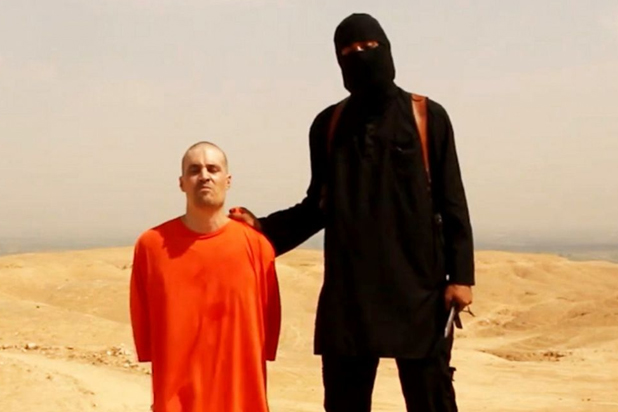
Journalist James Foley shortly before he was executed by an Islamic State operative, known as Jihadi John and identified as Mohammed Emwazi, the subsequent target of a lethal U.S. drone attack.
The third phase includes a transition to conventional military operations, on a big enough scale to sweep to a final victory. This sequence tracks the history of the Chinese Communist Party’s road to power and, in modified form, the strategy and trajectory of some other movements such as the Viet Minh.
Such strategies do not always succeed. Groups such as Sendero Luminoso (Shining Path) in Peru and the Tamil Tigers in Sri Lanka followed a similar course of using terrorist attacks and rural-based guerrilla operations as steps in growing strong enough to challenge for power. In their cases they followed that course successfully for a good while, and came to pose a very serious challenge to the established order in each of their countries before being finally beaten.
Failure of the strategy can involve, as long as the movement is alive, a walking back from a later phase of operations to what was supposed to be only an earlier one. Failure at conventional military operations and large-scale guerrilla warfare may mean resorting to…