We Need Bernie Sanders to Redefine Our Politics — Just Like Ronald Reagan Did

0

During the 2008 primaries, Hillary Clinton criticized Barack Obama after he cited Ronald Reagan’s presidency as an example of the impact he hoped to achieve. Reagan “changed the trajectory of America,” Obama told a Nevada newspaper, adding, “He put us on a fundamentally different path because the country was ready for it.” Obama’s point was not that he admired Reagan’s policies but rather that, like Reagan, he wanted to redefine what is viewed as possible in our politics.

Eight years later, with primary season officially in full swing after Monday’s Iowa caucuses, another insurgent candidate has upended the Democratic nomination contest by promising to take the nation down a different path. Campaigning on bold, progressive ideas such as free college tuition and Medicare for all, Sen. Bernie Sanders (I-Vt.) has prompted a backlash from not only Hillary Clinton and her supporters but also a posse of centrist and liberal pundits who have charged that such ideas are left-wing fantasies — popular, yes, but also politically impossible. In the past week alone, for example, The Post’s editorial board published two negative commentaries on Sanders, arguing that his campaign is premised on “fantastical claims” and “overpromising.”

Even more problematic to some critics is how Sanders vows to pay for his plans: by increasing taxes, even on the middle class. Despite professing his adoration for Sanders, Post columnist Dana Milbank recently declared, “Democrats would be insane to nominate him,” in part because he has “admitted he would seek massive tax increases.” He went on to ask: “Are Democrats ready to accept ownership of socialism, massive tax increases and a dramatic expansion of government? If so, they will lose.” Leaving aside the question of Sanders’s “socialism,” the upshot of this argument is that openly calling for higher taxes, even to fund popular government benefits, is a surefire political loser.

Read more


‘Toxic’ topics: Guardian removes comments section from Islam, immigration, race articles

1

The Guardian’s website boasts that “comment is free,” but that motto will soon be a thing of the past for some of the newspaper’s articles. The publication is banning remarks on topics such as race, immigration and Islam, citing “toxic commentary.”

“The overwhelming majority of these comments tend towards racism, abuse of vulnerable subjects, author abuse and trolling, and the resulting conversations below the line bring very little value, but cause consternation and concern among both our readers and our journalists,” Executive Editor Mary Hamilton said.

She went on to cite “a change in mainstream public opinion and language that we do not wish to see reflected or supported on the site.”

 For this reason, the newspaper chose to close the comments section on articles relating to race, immigration and Islam, “unless the moderators knew they had the capacity to support the conversation and that they believed a positive debate was possible.”

The policy will affect all of the Guardian’s websites, which are based in the UK, US and Australia.

The move is in stark contrast to the newspaper’s wide use of the term “comment is free,” which references the phrase “comment is free, but facts are sacred,” coined by British journalist CP Scott. The slogan has been mocked repeatedly in recent years, as the removal of readers’ comments became more and more prevalent.

Although some other online publications have dropped their comments sections altogether in recent years, the Guardian is coming at the issue from another angle, only preventing opinions from being expressed on some of the most popular international topics.

A similar tactic was used by CNN in August 2014, when the network quietly disabled comments on most stories during the protests in Ferguson, Missouri, according to Wired.

But despite the Guardian’s removal of comments on certain stories, Hamilton insists the paper is in favor of positive debate.

“We want to host conversations where there is a constructive debate, where our audience can help us broaden our journalism with their expertise, their knowledge, their considered thoughts and opinions, and where they can use our site as a platform to make connections with the world and with those around them,” she said.

RT. This piece was reprinted by RINF Alternative News with permission or license.

London to host Syria fund raising

0

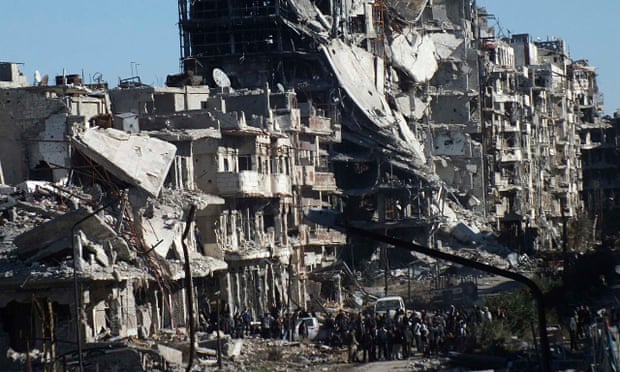
The capital of Britain, London is set to host world leaders who will come together to try to raise $9 for the millions of Syrians hit by the country’s conflict and a refugee crisis spanning Europe and the Middle East.

The donor conference, the fourth of its kind is slated for Thursday. It hopes to meet the UN’s demand for $7.73 billion to help in Syria plus $1.23 billion assistance for countries in the region affected by the crisis.

More than 70 international leaders are expected to take part in the summit including  German Chancellor Angela Merkel, UN Secretary-General Ban Ki-moon, Jordan’s King Abdullah II, Lebanese Prime Minister Tammam Salam and Chinese Foreign Minister Wang Yi.

Jordan has accommodated more than 630,000 Syrian refugees and Abdullah warned earlier that his debt-riddled country needed help to ease the burden or Europe would face the consequences.

The Syrian war, which began in March 2011, has claimed more than 260,000 lives and caused a major humanitarian crisis.

The conflict has forced 4.6 million Syrians to seek refuge in countries in the region – Jordan, Lebanon, Turkey, Iraq and Egypt. Meanwhile, hundreds of thousands have attempted to reach Europe, sometimes paying with their lives while making the risky Mediterranean Sea crossing.

Read more

Obama asks for $3.4bn to fortify NATO’s eastern flank: Report

0

The United States plans to deploy more heavy military equipment in Europe to fortify NATO’s eastern flank against Russian “aggression” in the region, according to a report.

The White House has requested a budget of more than $3.4 billion to send additional heavy weapons, armored vehicles and other military equipment to Central and Eastern Europe in 2017, the New York Times reported Monday, citing several US officials.

The deployment will help US and NATO forces to maintain “a full armored combat brigade” in the region at all times, the report said.

Officials said the plan will send a signal to Russian President Vladimir Putin that the West is “deeply suspicious of his motives in the region.”

“This is a longer-term response to a changed security environment in Europe. This reflects a new situation, where Russia has become a more difficult actor,” a senior administration official told the Times.

Pentagon officials have named Hungary, Romania and the Baltic states as possible destinations for the increased US funding and deployments.


Read more

More than 1 million in US face food stamps cutoff

1

Kate Randall

More than 1 million low-income people across the United States could soon lose their government food stamp benefits if they fail to meet work requirements. The threatened mass cutoff of the government’s Supplemental Nutrition Assistance Program (SNAP) benefits constitutes a vindictive bipartisan attack on some of the nation’s poorest and most vulnerable residents.

A Center on Budget and Policy Priorities (CBPP) report last month predicted 500,000 to 1 million people would be cut off of SNAP benefits in 2016 due to the return in many areas of a three-month limit on benefits for unemployed adults aged 18-49 who are not disabled or raising minor children.

The SNAP cutoffs loom as hunger and food insecurity continue to rise sharply. According to the most recent statistics from Feeding America, a food bank network, a staggering 48.1 million Americans lived in food insecure households in 2014, including 32.8 million adults and 15.3 million children.

US food banks gave away about 4 billion pounds of food last year, double the amount a decade earlier. Social service providers and food pantries are bracing for an influx of hungry people in response to the SNAP rule change.

Following the financial crisis in 2008, virtually every US state qualified for waivers from the three-month limit due to high unemployment rates. On the basis of the supposedly improving economy, these waivers expired in 21 US states in January. The cutoffs are being implemented a month after the US Bureau of Labor Statistics (BLS) reported that more than a quarter of the 7.9 million US unemployed have been jobless for more than six months.

Based on experience in other states where waivers expired last year, the Associated Press now predicts most people will not meet the work requirements and that the number kicked off benefits could top 1 million. Individuals facing cutoff include about 300,000 in Florida, 150,000 in Tennessee and 110,000 in North Carolina. Some of the 21 states, including these three, could have applied for partial waivers for counties with high unemployment rates but chose not to do so.

“The people affected by this are very poor,” Elizabeth Lower-Basch of the Washington DC-based Center for Law and Social Policy (CLASP) told the WSWS. “These are by definition people who aren’t working more than about 20 hours a week.”

According to the US Department of Agriculture (USDA), which administers SNAP, about 4.7 million SNAP recipients are deemed able-bodied without dependents, and only 1 in 4 of these has any income from a job. Data from the USDA shows these individuals have gross income averages of 17 percent of the official poverty line, or about $2,000 per year for a household of one in 2015. Beneficiaries receive an average paltry benefit of $164 a month.

The harsh “work for food” requirements were first introduced for SNAP under the 1996 welfare reform bill signed into law by President Clinton and sponsored by then-US Rep. John Kasich, who is now Ohio’s governor and a Republican candidate for president. In 2014, President Obama signed a bill that included $8.6 billion in cuts to SNAP. The temporary 14 percent increase in SNAP benefits passed by Congress in 2009 ended completely in November 2013.

The provision applies to “able-bodied” adults, ages 18-49, who have no children or other dependents in their homes. Such individuals must work, volunteer or attend education or job-training courses at least 80 hours a month. If they don’t, their benefits are cut off after three months.

Looking for work does not qualify as an exemption from the three-month cutoff. “Another major concern is that states are not required to offer people an opportunity to participate, to keep their benefits,” Lower-Basch said. “It’s one thing to say you’re going to have a work requirement to keep your benefits, but we’re going to offer you an opportunity to participate, and if you don’t you’re going to lose your benefits. But people can be cut off without being offered the opportunity.”

In the states that have already imposed the work requirements, a majority of people have been cut off benefits. In Wisconsin, which began phasing in the work provision last spring, two-thirds of the 22,500 adults subject to the change were dropped from the rolls three months later for failing to meet the requirements.

North Carolina, led by Republican Governor Pat McCrory, enacted a law last fall accelerating the work requirements. The bill further barred the state from seeking any waivers in the future unless there is a natural disaster.

State Sen. Ralph Hise claims that providing SNAP benefits beyond three months diminishes people’s job prospects. “People are developing gaps on their resumes, and it’s actually making it harder for individuals to ultimately find employment,” he said. Such preposterous statements fly in the face of the reality faced by those standing to lose their SNAP benefits.

According to the CBPP report, SNAP beneficiaries subject to the three-month cutoff are more likely than other SNAP recipients to lack basic job skills like reading, writing and basic mathematics. And people without a high school diploma, who make up about a quarter of non-disabled childless adults on SNAP, have double the unemployment rate of those with at least a high school diploma.

While the state and federal governments paint SNAP recipients as lazy and unnecessarily reliant on government handouts, many in the group facing benefit expiration have serious physical and mental health problems despite being identified as able to work.

The Ohio Association of Foodbanks found that 30 percent of those participating in the Work Experience Program in Franklin County to maintain their SNAP benefits reported a physical or mental health limitation, despite being classified as an able-bodied adult without dependents (ABAWD). The most common mental health limitations reported by clients included depression, bipolar disorder, anxiety, post-traumatic stress disorder (PTSD) and addiction.

CLASP’s Lower-Basch said that due to state government underfunding and bureaucracy, many people who should qualify for an exemption from the cutoff don’t receive one. “One of the big concerns is that people who may have disabilities or work limitations, if they’re not receiving Social Security disability benefits, may not know that they have a disability,” she said.

She added that because many people now apply for benefits online it means that “many clients are never sitting across the table from a caseworker, who might look at them and say we should figure out what exemption you meet because you’re clearly not able to participate.”

The Ohio Association of Foodbanks asked those who lost benefits: “How are you providing food for yourself in the absence of food benefits?” In response, 80 percent said that they depended on food pantries and family support. Others said they relied on soup kitchens, homeless shelters and churches.

A sizeable proportion, 18 percent, responded that they got food by asking strangers, panhandling and dumpster diving. Only 21.3 percent of those studied reported being under a doctor’s care, and many clients explicitly reported not being able to afford the medication they have been prescribed.

While the US expends $609.9 billion a year on the military, prosecuting an endless series of wars around the globe, Obama’s fiscal year 2016 budget proposal included a mere $83.692 billion for SNAP, which presently serves an average caseload of 45.7 million Americans, almost 15 percent of the population.

The growing and unbridgeable gulf between the rich and poor in 21st century America finds one of its most noxious expressions in the drive by the ruling elite to slash minimal food assistance to some of the nation’s poorest and most vulnerable. While the presidential candidates in both big business parties trip over themselves to support the “war on terror” and the drive to war, the potential cutoff of 1.1 million people from food stamps receives no mention.

Via WSWS. This piece was reprinted by RINF Alternative News with permission or license.

Stop ‘damaging’ attacks on lawyers investigating soldiers’ abuse of Iraqis – human rights groups

0

Senior Tory attacks on lawyers investigating alleged abuses and murders committed by British troops during the Iraq War are “ill-judged and damaging,” say human rights groups.

The attacks on groups like the Iraq Historical Investigations Team (IHAT) and legal firms Public Interest Lawyers (PSI) and Leigh Day have increased in recent weeks.

IHAT said attacks on its work are growing because it looks increasingly likely a number of soldiers will be charged.

Defence Secretary Michael Fallon recently said the law firms were little more than “ambulance chasers,” while Prime Minister David Cameron accused them of “trying to profit from spurious claims lodged against our brave servicemen and women who fought in Iraq.”

Responding to the attacks, a letter was delivered to Cameron signed by the International Federation for Human Rights, Legal Action Worldwide, Freedom from Torture, and Rights Watch UK.

It warned the allegations are “extremely serious” and requests Cameron, the Ministry of Defence (MoD) and government “avoid any real or perceived interference with the investigative process.”

It said Cameron’s pledge to protect British military personnel “ignores the fact that some very serious crimes involving the UK army in Iraq have been exposed … And it ignores the millions of pounds which the MoD has already paid out in compensation to Iraqi civilians.”

It calls on Cameron to “allow the investigative process to run its course without further interference or any appearance of interference.”

In January the army’s former chief legal adviser in Iraq, Lieutenant Colonel Nicholas Mercer, said the fact that British taxpayers had already paid out almost £20 million ($29 million) in compensation to settle hundreds of cases of abuses and violations against Iraqi civilians shows that the problem is widespread.

“Clearly this isn’t just one or two bad apples, as they have been characterized, this is on a fairly large and substantial scale,” Mercer told Channel 4 news, accusing the UK government of “hijacking” the situation to stop lawyers from bringing up additional cases.

Via RT.

Illinois prepares new attack on pensions as budget impasse enters eighth month

0

Alexander Fangmann

As Illinois enters its eighth month without a budget, Democratic Senate President John Cullerton has indicated that he and billionaire Republican Governor Bruce Rauner are close to a deal on a bill that would cut pensions for state workers. Such a bill would likely be a prelude to a comprehensive austerity budget deal, which would include massive cuts to higher education and social services.

Since July 1, the state has operated without a budget, with spending in most areas of state government continuing to be funded only due to various court orders and consent decrees, which have mandated that the state continue funding those operations at the same level as the previous fiscal year’s budget.

However, funding for a variety of programs has been entirely suspended. State universities and community colleges have received none of their state appropriations for the current year, leaving many of them in imminent financial distress, while low-income students have not received any of their tuition grants, preventing many from enrolling in classes.

In addition, a variety of social service providers have been hit hard by a combination of a lack of funding for various programs, as well as extreme delays in payments in other cases. It is estimated the state has over $9 billion in unpaid bills, and is operating with what amounts to a deficit of over $4.6 billion. It is likely any funding that had previously gone to now-shuttered providers will just be eliminated completely once a budget deal is concluded.

On January 22, Lutheran Social Services of Illinois announced it would be shutting down 30 programs, eliminating more than 750 jobs, or 43 percent of its workforce, due to not receiving an expected $6 million in funding. The elimination of the programs will affect 4,700 people. Among the programs cut were those for senior citizens, including home care, programs for at-risk youth, former prisoners and families, veterans, and disabled adults over the age of 18. Two alcohol and drug treatment residential facilities will also cease providing inpatient alcohol and drug rehabilitation.

Another provider, Haymarket Center, is closing a detoxification program that served 903 people in the last fiscal year.

Children’s Home + Aid, a service provider for the Comprehensive Community-Based Youth Services (CCBYS) program announced it will suspend programs for runaways and at-risk youth in Englewood and West Englewood. This will affect around 70 youths, many of whom will be pulled into the overburdened foster care system where overwhelmed caseworkers will be far less responsive to their needs.

Andrea Durbin, CEO of Illinois Collaboration on Youth, a network of providers of services to youth, said, “This is the first of many program suspensions we are forecasting around the state.”

The Illinois Area Agencies on Aging additionally released numbers on the amount of elderly people who will be hit by the cuts in state funding. Altogether they estimate services will be impacted for 145,441 elderly people, with 1,621 forced into nursing homes due to lack of funding for other options. Furthermore, 13,400 retirees will be locked out of senior centers and 6,525 will have recreational activities eliminated.

The budget impasse has continued since June, when the Democrats in the state legislature sent Rauner a budget that authorized spending $4 billion more than it projected in revenue. This followed their rejection of Rauner’s initial proposal, which included a $2.2 billion deficit, but imposed more vicious cuts than those they themselves had proposed. Because the Illinois governor possesses both line item and amendatory veto powers, the Democrats were basically inviting Rauner to take their plan and bring it closer to his. This would have allowed Democrats to avoid openly voting for Rauner’s budget and would achieve the savage cuts that both parties desire.

Instead, Rauner vetoed the spending bill in its entirety, insisting that any approval of a spending bill would have to be tied to approval of his “Turnaround Agenda,” a variety of anti-worker legislation. The most notable measures include cuts to workers compensation, restrictions on lawsuits against corporations, restrictions on collective bargaining, the establishment of “right-to-work” zones, the elimination of prevailing wage requirements on construction projects, and freezes on the property tax rates levied by local government entities such as cities, school districts, public libraries, and community colleges. Rauner has also proposed term limits and legislative redistricting reform, issues unpalatable to both Democrats and Republicans and precisely the sorts of empty proposals that will be sacrificed when they finally come to an agreement.

Though Democrats have approved restrictions and cuts on collective bargaining and workers compensation at various times, there is a resistance among many of the Democrats to making such deep and sweeping changes all at once, for fear of both inflaming mass opposition among the working class and crippling the unions, which they rely on to control working class anger. While Rauner fancies himself as governing in the mold of Scott Walker in Wisconsin, the Democrats are worried that they will be unable to contain the situation if something like the 2011 Madison protests were to arise.

It is in this context that Cullerton and Rauner have been working out a deal on pension cuts, in preparation for a deal on the budget that would give Rauner much of his agenda.

Since last year, when the Illinois Supreme Court struck down legislation cutting pensions, politicians from both parties, including Chicago Mayor Rahm Emanuel, have claimed that required pension payments are eating into funds providing state services, and using this excuse as a basis for savage cuts in an effort to bully the population into turning against public workers and their pensions.

The legislation that was struck down was passed by the Democrat-controlled General Assembly and signed by former Democratic Governor Pat Quinn. In its ruling the court cited the Illinois Constitution, which says that pensions “shall not be diminished or impaired.” At the time, the plan was to argue that the state’s reserve “police powers” gave it the right to ignore the constitution in the case of a fiscal emergency. The General Assembly bill had largely been the proposal forwarded by Democratic House Speaker Michael Madigan, the father of the Illinois Attorney General, Lisa Madigan, who made the “police powers” argument in front of the court. However, there was a competing bill to cut pensions proposed by Cullerton that was also supported by a coalition of unions calling itself We Are One Illinois.

From the beginning, Cullerton had insisted that Madigan’s pension legislation was unconstitutional, because it reduced pensions without giving workers anything in return. Basing himself on a somewhat dubious legal theory of “consideration,” Cullerton proposed giving retired workers a choice between diminished pension benefits or the state-subsidized health care they receive.

Following the Supreme Court decision, Cullerton is now ready to revive a version of his old legislation to make a deal with Rauner. The new version of the bill would cut the annual adjustment of Tier 1 pensions from 3 percent compounded to either: (1) the lesser of 3 percent or half of the Consumer Price Index compounded, or (2) 3 percent, not compounded. According to Cullerton this would pass muster based on his reading of the Supreme Court decision. However, in reading the plain language of the footnote in the Supreme Court decision, it is doubtful that this plan actually offers workers true “consideration,” since both options still amount to cuts. However, the political situation—and the ramped up pressure from the banks, bondholders and credit rating agencies—might lead the court to be disposed to rule differently.

During a press conference Cullerton answered a question, saying, “Yes, I talked to the Governor today and we are going to make sure we are on the same page. We will get a pension reform bill drafted to make sure we both understand what’s in it. I think we have an agreement. There are some tweaks to be made by the lawyers and then the question is going to be how we pass it. And, we will work together with Senator Radogno. All these pension bills that have passed in the past are very bi-partisan and controversial; so we expect that the unions will probably not be supportive, so that will make it more difficult to pass, but we are going to be on the same page.”

On Friday, President Barack Obama announced he would be visiting the Illinois General Assembly to give a speech on February 10 in an attempt to mediate a deal between Rauner and Democratic Party leaders. It is likely this move was prompted by Rahm Emanuel, the mayor of Chicago and Obama’s former chief of staff. While the budget impasse has proved to be useful in maneuvering the mayor closer to the unions, it has been destabilizing to city finances and programs. Workers should beware: any resolution of the budget deal will involve massive cuts to education and social programs on which millions rely.

Via WSWS. This piece was reprinted by RINF Alternative News with permission or license.

Why doesn’t the U.S. government track prescription drug death statistics more diligently … since they spend so much time surveilling everything else?

4

Recent revelations that the National Security Agency (NSA) spied on the heads of state of countries allied with the United States – even after President Obama promised to end such spying – have sparked new debates about U.S. surveillance culture.

Yet, in a country that is increasingly collecting myriad forms of private data about all its citizens, one form of data goes surprisingly unrecorded: When a U.S. resident dies of a drug overdose, there is no requirement that the type of drug involved be recorded. This shocking absence of data collection obscures which drugs are the most dangerous, protecting pharmaceutical industry profits, while continuing to put lives at risk.

Epidemic of prescription drug deaths

According to the Centers for Disease Control and Prevention (CDC), “the United States is in the midst of a prescription painkiller overdose epidemic.” The CDC reports that while there has been no overall increase in the pain burden of the U.S. population since 1999, the number of painkiller prescriptions filled in that time has quadrupled, leading to a consequent increase in addiction and abuse. The situation is so dire, that 44 people die each day from prescription painkiller overdoses.

A large part of the problem, the CDC says, is that opioid painkillers (also known as narcotic painkillers), are increasingly being prescribed for uses other than those for which they are intended.

The drugs are only meant to be used for moderate-to-severe pain related to injury, surgery or certain specific health conditions, such as cancer.

The agency notes that benzodiazepine tranquilizers are also a common cause of overdose deaths.

CDC collects data on patients, not drugs

Ironically, the CDC does promote drug tracking as one of the most effective methods for reducing drug deaths – but it focuses on tracking prescriptions, not overdose deaths. The agency encourages states to adopt Prescription Drug Monitoring Programs (PDMPs), which, consistent with other U.S. surveillance measures, collect a wide range of information on regular people’s habits in order to identify potential criminals.

PDMPs are state-run electronic databases that track the prescriptions of individuals, and are automatically monitored (by computer software) for suspicious prescribing patterns that might suggest drug abuse or diversion. PDMPs also flag individuals who may be at high-risk for developing such patterns in the future.

The CDC lauds the surveillance-heavy PDMPs as “among the most promising interventions to improve painkiller prescribing, inform clinical practice, and protect patients,” even while acknowledging that “findings are mixed.”

But when it comes to knowing which prescription drugs contribute directly to people’s deaths – data that could lead to changes in prescribing practices or even in drug regulations – the National Institute on Drug Abuse says, “The U.S. government does not track death rates for every drug.”

The same document notes that the CDC “does collect information on many of the more commonly used drugs,” and “has a searchable database, called CDC Wonder.”

But CDC Wonder records death statistics only for certain categories of drugs, not for the individual drugs themselves. And even these categories are limited (and of questionable usefulness): narcotics and hallucinogens are tracked together; nonopioid painkillers are lumped with anti-inflammatories and fever-reducers; and anti-seizure drugs are lumped with sedatives, antipsychotics, antidepressants and anti-Parkinson’s drugs. These are the only “specific” categories that the CDC supplies in its database. The other drug-related categories are “other drugs acting on the autonomic nervous system,” “other and unspecified drugs” and “alcohol.”

A few other drug categories are tracked, but all of these are related to medical accidents rather than to patient overdose.

So when will the government change its data collection practices? Probably not any time soon; it’s much more profitable to track private citizens, than the corporate products that are killing them.

Sources for this article include:

DrugAbuse.gov

CDC.gov

CNN.com

Wonder.CDC.gov

CDC.gov

Wonder.CDC.gov

Reprinted on RINF Alternative News with permission from
Natural News.

The Last 16 Times This Happened There Was A Recession…

0

Michael Snyder

Something has just happened that has signaled a recession every single time that it has occurred since World War I.  16 times since 1919 there have been at least 8 month-over-month declines in industrial production during the preceding 12 month period, and in each of those 16 instances the U.S. economy has plunged into recession.  Now that it has happened again, will the U.S. economy beat the odds and avoid a major economic downturn?  I certainly wouldn’t count on it.  As I have written about repeatedly, there are a whole host of other numbers that are screaming that a new recession is here, and global financial markets are crumbling.  It would take a miracle of epic proportions to pull us out of this tailspin, and yet there are many people out there that are absolutely convinced that it will happen.

John Hussman is not one of them.  In his most recent weekly comment, he examined this stunning correlation between month-over-month declines in industrial production and recessions.  To me, what Hussman has presented is overwhelmingly conclusive…

Last week, following a long period of poor internals and weakening order surplus, we observed fresh declines in industrial production and retail sales. Industrial production has now also declined on a year-over-year basis. The weakness we presently observe is strongly associated with recession. The chart below (h/t Jeff Wilson) plots the cumulative number of month-over-month declines in Industrial Production during the preceding 12-month period, in data since 1919. Recessions are shaded. The current total of 10 (of a possible 12) month-over-month declines in Industrial Production has never been observed except in the context of a U.S. recession. Historically, as Dick Van Patten would say, eight is enough.

Declines In Industrial Production And Recessions

After looking at that chart, is there anyone out there that still doubts that the U.S. economy is in significant trouble?

Many estimates of U.S. GDP growth for the fourth quarter of 2015 are already just a small fraction of one percent.  It would not be a surprise at all to see a negative number posted once it is all said and done.

And of course more bad news for the economy just keeps pouring in.  So far this week we have learned that the growth rate of federal withholding taxes has turned negative, Johnson & Johnson plans has announced that it is eliminating 3,000 jobs, and BP has announced that it is eliminating 4,000 jobs.

Of course it is not exactly a surprise that BP is cutting jobs.  At this point the entire energy industry is absolutely hemorrhaging workers.  As I wrote about yesterday, 130,000 good paying energy jobs have been lost in the United States since the beginning of last year.

But now we are seeing major firms outside the energy industry cutting payrolls.  Even financial giants such as Morgan Stanley are looking for ways to cut costs…

Morgan Stanley just announced fourth-quarter earnings, and it is providing detail to investors on a cost-saving plan called Project Streamline.

During a conference call, CEO James Gorman uttered a sentence that will most likely make the bank’s staff shudder.

“Too many employees based in high-cost centers are doing work that can sensibly be done in lower-cost centers,” he said.

The whole environment is changing.

When things start to get tough, big corporations start to get rid of people.  We saw this back in 2008, and it is starting to happen again right now.

And just like last time around, we are going to see millions of Americans lose their jobs during the hard years that are ahead of us.

But thankfully for the moment there is a brief lull in the action.  The financial turmoil that has gripped the planet was calmed on Tuesday when China announced that their economy grew at a rate of 6.8 percent during the fourth quarter of 2015.  This was right in line with expectations, and markets around the world responded positively to the news.

There is just one huge problem.  Everyone knows that GDP figures coming out of China are essentially meaningless.  If you believe that the Chinese economy actually grew at a 6.8 percent rate during the fourth quarter of 2015, then I have a bridge to sell you.  Virtually every other number coming out of China over the past several months tells us that the Chinese economy is shrinking, and so that 6.8 percent figure is extremely questionable at best.

Do you want to know the last time the communist Chinese admitted to having a recession?

It was in 1976.

Over the past four decades, economic growth figures have become a source of great national pride for China.  To admit that the economy is now imploding would bring great shame on the Chinese government and the nation as a whole, and so that must be avoided at all costs.

Yes, the numbers are fraudulent in the U.S. too.  According to John Williams of shadowstats.com, if the U.S. was actually using honest numbers the last recession never would have technically ended.

But in China they take this to ridiculous extremes.  The Chinese economy is fueled by exports, and Chinese exports have been down on a year over year basis for six months in a row.  And the primary reason why commodity prices have been absolutely collapsing is because of the economic contraction in China.

Of course if China had released a GDP number that was honest, global markets would have crashed hard.  So their lies are making everyone else feel a bit better for the moment, and every day of relative stability that we can enjoy from here on out is something to be thankful for.

As you read this article, markets all over Asia, Europe, South America and the Middle East are already in bear market territory.  More than 30 percent of the market has been wiped out in Brazil and Hong Kong, more than 40 percent of the market has been wiped out in China and Italy, and about 50 percent of the market has been wiped out in Saudi Arabia.

We are already experiencing a major global financial crisis.

The only question remaining is how bad it will eventually become.

Let us hope for more days like this one that are relatively calm.  But I wouldn’t count on things turning around significantly any time soon, because the economic fundamentals are telling us that big trouble is ahead.

Visit Michael’s blog

Proof that Snyder’s Emergency Management is to Blame in Flint

0

A little over a week ago, Michigan Gov. Rick Snyder released hundreds of pages of e-mails related to Flint from 2014 and 2015. One of the attachments, an assessment of Flint’s water system by a private water corporation, is very significant.

In February 2015, almost a full year before the news of widespread lead poisoning in Flint, Michigan, gained headlines, the world’s largest private water corporation, Veolia, deemed Flint’s water safe. They were hired by the city to assess the discolored water that many residents had been complaining about—a General Motors plant had even stopped using Flint’s water because it was rusting car parts.

But while Veolia, a French transnational corporation, deemed Flint’s water to be “in compliance with State and Federal regulations,” they concluded that “aging cast-iron pipe” was creating “aesthetic issues including taste, odor, and discoloration.”

Their report didn’t mention lead, but they recommended spending $50,000 to add corrosion control chemicals to Flint’s drinking water because iron was leaching from the city’s pipes.

The city didn’t heed Veolia’s advice, but regardless, someone should have known that lead was likely leaching into Flint’s water as well.

According to Joan Rose, former chairwoman of the U.S. Environmental Protection Agency’s drinking water committee, “If you’ve got iron sloughing off (the pipes), you’ve got other metals sloughing off, including lead.”

Read more

Pentagon wants $582bn in funding as part of fiscal year 2017 budget

1

President Obama will request $582.7 billion in funding for the Pentagon as part of the fiscal year 2017 budget, Secretary of Defense Ash Carter said. The Pentagon plans to focus on keeping an edge over competition rather getting ready for “big wars.”

The $582.7 billion will include $71.4 for research and development funding, $7.5 billion to fight Islamic State, $8.1 billion for submarines, and $1.8 billion on munitions, according to Carter.

Carter said the budget was guided by five factors: the rise of power from Russia and China; the threat of North Korea to the US and its Pacific allies; Iran’s “malign influence” against allies in the Gulf; and the ongoing fight against Islamic State (IS, formerly ISIS/ISIL).

“We don’t have the luxury of just one opponent, or the choice between current fights and future fights – we have to do both,” Carter said. “And that’s what our budget is designed to do.”

He added that in the past, the Defense Department “tended to focus and plan and prepare for whatever big war people thought was coming over the horizon,” but that such tactics “won’t work for the world we live in today.” 

Islamic State

When speaking about ISIS, Carter said “we need to keep ISIL down.” 

“Our strategic approach is to keep motivated local forces which are hard to find. We have to take Mosul and we have to take Raqqa in order to make sure that there is no Islamic State,” he said.

Carter noted that Americans will lead the fight against the militant group, but that other countries need to do their part.

“Many of them are not doing that much,” Carter said.

The Pentagon plans to boost its spending on the war against ISIS in Iraq and Syria by 50 percent from last year, to $7.5 billion. Of that total, $1.8 billion will go to buying more than 45,000 GPS-guided smart bombs and laser-guided rockets, Carter said.

The Defense Department will also aim to delay the retirement of the A-10 attack jet, which has been dropping bombs on ISIS, until 2020.

North Korea

Referencing North Korea, Carter said the US is “keeping an eye on the DMZ (Korean Demilitarized Zone) every minute of the day.”

“…Don’t forget nuclear weapons coupled with ballistic missiles in the hands of North Korea, coupled with…how do I say this…their odd demeanor [is a bad thing],” he added.

Spending in Europe, Russian competition

The Pentagon will also more than quadruple its spending in Europe, from $789 million to $3.4 billion, to reassure allies and deter so-called Russian aggression. This is expected to include more US forces in Europe, more training and exercising, the positioning of military equipment, and improving infrastructure there.

“While we do not desire conflict of any kind with any of these nations – and let me be clear, though they pose some similar defense challenges they are very different nations and situations – we also cannot blind ourselves to the actions they appear to choose to pursue,” Carter said.

Carter also said the budget will focus on maintaining an edge over the competition, calling Russia and China “our most stressing competitors.” 

Gitmo

Carter said he would like to see Guantanamo Bay closed.

“I would like to see Guantanamo closed, but here…is the issue. There are people in the detention facility, there’s no way to say this, [that] have to be contained. So it needs to be closed safely…there needs to be another place to keep them.”

He added that he would “rather not leave this detention business to the next president. We need to work with Congress…”

Snowden

When asked about damaged inflicted by NSA whistleblower Edward Snowden, Carter said: “It was damaging to security, to work with other countries, but most importantly [it] hurt trust with industry. For companies, it has been used as a guise for protectionism. It has put our companies at a disadvantage. Some countries say ‘store your data in our country, it will be safer here.'”

“When I was a physicist, the generation before me had a reflex that it was important to use your knowledge for the public good. I do find that people in Silicon Valley, these are people who are where they are because they like to do things of consequence, they see defending our country as something of consequence,” Carter added.

Via RT. This piece was reprinted by RINF Alternative News with permission or license.

Video: ‘Only strengthening ISIS’: UK top diplomat accuses Putin over Syria bombing

0


Britain’s Foreign minister has lashed out at Russia and President Putin, saying the country’s actions in Syria are undermining the international peace effort.

Via Youtube

Video: Top U.S. & World Headlines — February 1, 2016

0


Visit http://democracynow.org to watch the full independent, global news hour, read the transcript, search our archive and to make a donation to support us.

Via Youtube

Video: From Taverns to Grain Elevators: How Iowa’s Complex Caucus System Works

0


http://democracynow.org – The Iowa caucus is different from a normal presidential primary: Party members gather and discuss their preferred candidates before …

Via Youtube

Video: Bernie Sanders Says No to Fracked Oil Pipeline in Iowa, Will It Help Him in Today’s Caucus?

0


http://democracynow.org – As the nation focuses on the Iowa caucus, we turn to a local issue that has received little attention. Iowa is facing a growing debate …

Via Youtube

Video: Pt 1: Iowa Progressives Weigh Clinton, Sanders as One of Whitest States Kicks Off Presidential Race

0


http://democracynow.org – The road to the White House begins in Iowa today with the opening contest of the 2016 presidential campaign. Polls show tight races …

Via Youtube

Video: Pt 2: Iowa Progressives Weigh Clinton, Sanders as One of Whitest States Kicks Off Presidential Race

0


http://democracynow.org – The road to the White House begins in Iowa today with the opening contest of the 2016 presidential campaign. Polls show tight races …

Via Youtube

Video: Equity Sought in Baltimore’s Development Strategy

0


Advocates present solution to Baltimore’s housing crisis.

Via Youtube

Video: Baltimore, like Ferguson Has a Warrant Problem

5


University of Maryland law school professor Doug Colbert is proposing amnesty for ten of thousands of people who have outstanding warrants for minor crimes, …

Via Youtube

Video: How CA Came Close to Losing Solar Panel Benefits

0


California Solar Energy Industries Association’s Bernadette Del Chiaro says monopoly utility companies have spent $17 million on campaign contributions to get …

Via Youtube

Video: Bilderberg Presidential Candidate Confronted And Exposed As A Liar

1


In this video Luke Rudkowski and Julio N Rausseo confront former presidential candidate and now Marco Rubio spokesperson George Pataki on attending the …

source

Video: Sam King On Learning About Our Past Lives & How it Can lead To Healing

0


Please Support The Show — http://richieallen.co.uk/ http://healingking.com/ https://www.facebook.com/therichieallenshow …

Via Youtube

Video: Digitizing Black Radio: The Black Talk Radio Network

0


Founder of the Black Talk Radio Network Scotty Reid joined us to discuss the history and politics of his digital network.

Via Youtube

‘Single Payer Saves Money by Saying No to the Insurance Industry’

0

Janine Jackson interviewed Steffie Woolhandler on single payer for the January 29, 2016, CounterSpin. This is a lightly edited transcript.


Steffie Woolhandler:

Steffie Woolhandler (photo: Rick Friedman)

X

MP3jPLAYLISTS.MI_0 = [
name: “1. CounterSpin Steffie Woolhandler “, formats: [“mp3”], mp3: “aHR0cDovL3d3dy5mYWlyLm9yZy9hdWRpby9jb3VudGVyc3Bpbi9Db3VudGVyU3BpbjE2MDEyOVdvb2xoYW5kbGVyQy5tcDM=”, counterpart:””, artist: “”, image: “true”, imgurl: “”
];

MP3jPLAYERS[0] = list:MP3jPLAYLISTS.MI_0, tr:0, type:’MI’, lstate:true, loop:false, play_txt:’Play’, pause_txt:’Pause’, pp_title:’FAIR’, autoplay:false, download:true, vol:80, height:71, cssclass:’ ‘, popout_css: enabled:true, colours: [“#fff”, “rgba(201,207,232,0.35)”, “rgb(241,241,241)”, “rgba(245,5,5,0.7)”, “rgba(92,201,255,0.8)”, “transparent”, “transparent”, “#525252”, “#525252”, “#768D99”, “#47ACDE”, “”, 600, 200 ],
cssInterface: “color”: “#525252” ,
cssTitle: “left”: “16px”, “right”:”16px”, “top”:”8px” ,
cssImage: “overflow”: “hidden”, “width”:”auto”, “height”:”71px” ,
cssFontSize: “title”: “16px”, “caption”: “11.2px”, “list”: “12px” ,
classes: interface:’ verdana-mjp’, title:’ left-mjp norm-mjp plain-mjp childNorm-mjp childPlain-mjp’, image:’ Himg right-mjp’, poscol:”, ul:’ darken1-mjp verdana-mjp med-mjp childNorm-mjp childPlain-mjp left-mjp’ ;

MP3 Link

Janine Jackson: A Washington Post columnist writes that we need to admit that healthcare reform’s twin goals, comprehensive universal insurance and cost control, are at odds. The New York Times reports that a single-payer system requires unpopular taxes, making it, even in the eyes of sympathetic Democrats, politically impossible. And USA Today says the US hasn’t seriously considered single payer because it would cause great disruption to the economy, result in higher taxes, and give the federal government vast new powers.

Well, those claims have some things in common: They’re all untrue, and they’ll all from 1993. It seems the story corporate media tell us about single payer—we want it, it makes a lot of sense, and it can never ever happen—hasn’t changed a great deal. For as long as that media narrative has been abroad, we’ve been checking in with our next guest about how to address it. A primary care physician for many years, Steffie Woolhandler is co-founder of Physicians for a National Health Program and professor at the CUNY School of Public Health.

Welcome back to CounterSpin, Steffie Woolhandler.

Steffie Woolhandler: My pleasure.

Single Payer Now! (cc photo: Michael Fleshman)

(cc photo: Michael Fleshman)

JJ: Single payer is in headlines now because of the election, and the alternative visions for healthcare presented by Democratic candidates Bernie Sanders and Hillary Clinton. Sanders’ proposal of a single-payer type of system makes him “exciting,” the Washington Post said, but Clinton’s attempt to “bat down hopes” about it make her “the voice of reason.” The Arizona Republic says:

The problem with Bernie Sanders’ healthcare vision isn’t the vision. His raw outline for a greatly simplified and less expensive healthcare system is excellent in theory. The problem is the politics, the reality of which battle-scarred Hillary Clinton clearly has the better grasp.

This whole head versus heart storyline isn’t really new, either, is it? What’s your initial response to it; what’s wrong with that?

SW: Well, there’s a tremendous amount of misinformation. We have real-world experience with a single-payer program in Canada. We also have some related experience with our own Medicare program; that’s kind of a partial single payer. It’s obviously not a true single payer, because there’s lots of other insurers, but it has some of the structures of single payer. And so we can look at the experience in Canada and in the United States, and find that most of these things are not true.

In fact, neither Canada’s single-payer system nor the Medicare system disrupted things. Neither of them broke the bank financially. In fact, there’s been almost no increase in Medicare costs over the last ten years, while private health insurance costs have continued to go up. In Canada, they’re spending about 40 percent less than we are. The doctors make plenty of money, the hospitals are doing just fine, and they have universal coverage. Their taxes are not much higher than what we pay in this country, and the higher taxes are more than offset by the fact that Canadian taxpayers don’t have to pay any premiums or out-of-pocket costs for most services.

So the facts on the ground, experience in both Canada and the United States, say that a single-payer system is imminently doable from an economic point of view, and that it is not overly expensive. In fact, it’s significantly cheaper than what we have in this country.

JJ: While we’re talking about misconceptions, I think it still is a prevalent one that single payer must mean cutbacks to care. The sort of liberal critique of single payer, you might say, is represented by the Vox piece by Ezra Klein, in which he wrote that to achieve savings,

the government needs to be willing to say no when doctors, hospitals, drug companies and device companies refuse to meet their prices. And that means the government needs to be willing to say no to people who want those treatments.

Well, Seth Ackerman in Jacobin has a piece saying that this is a conflation of saying no to drug companies on prices with saying no to patients, that that too reflects a misunderstanding of how single payer would work.

SW: Well, absolutely. A single payer saves money by saying no to the insurance industry and by forcing drug manufacturers and device manufacturers to lower their prices. Again, this is not pie in the sky, this is something that’s done in Canada, that’s done all over Europe, where the government steps in and uses its bargaining power to get lower prices. That’s a very different question from what happens with doctors and hospitals.

You know, Ezra Klein has been quoted saying hospitals are going to go into bankruptcy, that doctors are going to be impoverished, and that simply did not happen in Canada. Canadian hospitals are fine, Canadian physicians earn very good livings, and in fact there’s no net migration of Canadian doctors to the United States, even though they could come if they wanted. They don’t want to. In fact, there’s very few Canadian patients who come to the United States to get care. And, again, many of them could if they wanted to; they live within 50 miles of the US border, by and large.

So these are myths that really are not borne out by the facts on the ground. I mean, the way a single payer works economically is by huge administrative cost savings. The Canadian single-payer system has administrative costs that are just barely half of what administrative costs in the United States are. The US spends 31 cents on every healthcare dollar on billing and administration, Canada spends about 16-and-a-half percent. That’s a very large difference in terms of administrative spending. Projected to the United States, we could say that a single payer would save over $400 billion a year in administrative costs, and that’s the money that you use to pay for expanded care, both for the uninsured and for people who now have only partial coverage.

So that’s the economics of the situation. That’s what happening on the ground in Canada, and to a lesser extent within the US Medicare system. And the reporters ought to know that. Certainly Ezra Klein, Margot Sanger-Katz, Julie Rovner, folks who have long experience studying the healthcare system, need to be looking at the facts that are known about how a single payer works, rather than these scare tactics about bankrupt doctors and doctors having to go to soup kitchens. It’s simply not the situation.

JJ: It’s interesting: We talk so much about, you know, let’s look at this in a tough political way, and yet we don’t really get too specific about it. But Hillary Clinton spelled out what she meant by single payer being politically impossible when you and PNHP co-founder David Himmelstein met with her in the early ‘90s, when she was working on managed competition. She was pretty straightforward in terms of what the obstacle really was, was she not?

SW: Well, I think she was dismissive of the idea that a president should lead the American people by putting forward a new vision, and that that was part of what leadership is. Leadership is not about just looking at the status quo and seeing how you can rearrange the deck chairs. It’s about providing a vision, leading the political movement. And that’s actually how you get real reforms, like the civil rights movement, like rights for gay people, and that’s how people in other countries have gotten single-payer systems —

JJ: Right.

SW:—through political leaders leading a movement of the people, and that’s what it’s going to take in the United States. I’m not naive. The big problem is the power of the insurance industry and the drug industry, who are completely and totally opposed to this. But numerous polls have shown that a majority of the American people support the idea of a universal health system supported from taxes. And if the majority of the American people want it, then what’s missing is the political leadership to mobilize those people to get the healthcare system we deserve.

JJ: For folks who don’t know, in that meeting, as you indicate, Hillary Clinton said that she could see how single payer made sense for the country, made sense for people, but what she said was, how could we defeat the multi-billion dollar insurance industry. In other words, she simply said that would be impossible. And it’s that that you’re responding to, saying, well, how could you go up against the insurance industry? You would do that with leadership and with the awareness that this is what the public wants. Just for folks who aren’t aware of that meeting that took place. Because it’s fascinating, to say we know that people want this, we know that it makes sense, and yet it can’t happen. I mean, I think that’s just kind of a mindbender for a lot of people who believe they’re in a participatory democracy.

SW: Right. Well, we have to make democracy work. It obviously doesn’t work all the time—

JJ: Right.

SW:—or terribly well. But if we want real change, we need to mobilize to get that change. And that’s what politics needs to be about. It’s not about telling people you can’t have a good system because this private interest, like an insurance company and drug industry that are going to stop it. It’s been pretty well-known among the Democratic Party, and often said by Democratic Party leaders, including President Obama, that a single-payer system would be preferable if we could get it, if we were starting from scratch. And Mrs. Clinton said essentially the same thing. She has in the past called for a Medicare-for-all system. So this new idea that it’s too disruptive, this is something she’s only recently started to say.

JJ: One thing I think is also of note, in terms of labeling things impossible, the Arizona Republic provides, as kind of evidence that single-payer legislation is “going nowhere”, they say that the 2013 American Health Security Act attracted not a single co-sponsor. But the thing is, back in ‘92 or so, when a bill had 95 co-sponsors, elite media still said it was impossible, treated it in exactly the same way, so that can’t be the criterion.

But I did want to ask you about the idea that the Affordable Care Act is a stepping stone to single payer. I read that, again in the Arizona Republic, they say “making Obamacare more Medicare-like through incremental steps may not feed the romantic urge to reinvent healthcare reform from scratch, but there’s no other road”. Does that even make sense—making Obamacare more Medicare-like through incremental steps? What would that mean?

SW: Well, the problem with the idea of incremental steps is you don’t get any administrative savings. If anything, the Obamacare legislation raised overall administrative costs in the United States. So the beauty of single payer is you get the $400 billion in administrative savings; it allows you to jumpstart universal coverage without increasing total healthcare costs. But when you try to do things incrementally, every time you add new coverage, you don’t have a way to pay for it, because you have not gotten those administrative savings. So that’s the problem with the incremental approach. Whatever its political possibilities, it’s economically not possible, whereas a true single-payer system is.

JJ: It’s kind of like looking for your keys under the lamp because that’s where the light’s better. You say: well, this doesn’t actually fix the problem with healthcare, but it seems like something we could achieve. You know, it’s a kind of a strange way to go about things.

A lot of the conversation is premised on the fact that what the US has now is a private system. But I know that work that you’ve just done recently indicates that the US is already spending, from public funds, a tremendous amount on healthcare.

SW: Well, yes, we just published a paper in the American Journal of Public Health showing that nearly two-thirds of current US health spending is from taxpayers. So that figure would include not just Medicare and Medicaid and the VA, things people think of as government health programs, but two other items. First, the benefit costs of public employees, like teachers and FBI agents, which of course are paid for by the taxpayers. And the second thing is the huge tax subsidy to private health insurance, which people have been talking about in relationship to a Cadillac tax. But that subsidy is about $326 billion a year that the taxpayers are picking up for private insurance.

So when you include government direct spending for programs, government spending for public employees’ benefits and that tax subsidy, lo and behold, you get to 65 percent of total health spending already being funded by the taxpayers, which is about to rise to 67 percent over the next decade. Sixty-seven percent, we’re not that far below the tax-funded share of, for instance, Canada’s single payer, where the taxpayers pick up about 71 percent of total health spending. So the increased taxes that are needed are not that huge. They would all be offset by decreases in premiums and out-of-pocket payments. But even just thinking about the taxes, we’re only talking about a share equivalent to about 4 percent of healthcare budget to get us to the level of taxpayer funding in Canada.

JJ: So, in other words, we’re almost paying enough as citizens through taxes to have a single payer system, but we don’t have it.

SW: Yes. We’re paying for national health insurance and we’re just not getting it. You know, if we start talking in dollar terms rather than percentage terms, we’re already paying more per capita than the total cost of healthcare, public and private, for any other nation on the earth.

JJ: Well, what do you make of the media coverage? Obviously, a lot of the reporters who are covering it are covering it just as an issue in the presidential campaign, or just as a political issue. So they can be forgiven, if you will, for kind of wearing those glasses as they discuss it. But we do have healthcare reporters. You know, we do have economics reporters. What do you make of the fact, or is it correct, my sort of sense that we haven’t really advanced the level of this conversation in decades, in terms of misconceptions and misunderstandings about single payer?

SW: Yeah, well, several of the reporters who’ve said fairly outrageous misstatements of fact are in fact expert in health policy. For instance, Ezra Klein has written about health policy in the past, so some of the misinformation he’s been putting out is a little surprising. Similar, Julie Rovner, who works for Kaiser Health News Service, is a long-time healthcare reporter, and she actually made a statement [that] replacing the private health insurance bureaucracy with a new payment system would probably be more expensive than what we now have, which is just a silly thing to say. That’s not true. When you look, when you compare private insurance and public insurance in the US and when you compare it in Canada, it’s very clear that the public payment systems have much lower administrative costs. And it’s simply unbelievable that anyone with any health policy experience would make a statement like the one she made.

Similarly, Ezra Klein, saying doctors and hospitals would be bankrupted and have their fees and salaries cut dramatically—he should know better as well. That isn’t what happened under the Medicare program in the United States. It’s not what’s happened in Canada. So, you know, it’s been quite disappointing, the willingness of some of these health reporters to kind of conflate two ideas. They may think that single payer’s politically unfeasible. That’s their opinion; that’s OK for them to say. But then to conflate that with the idea that it’s economically unfeasible, would cause these huge disruptions in the actual delivery of care—that really should not be done. Those are two totally separate issues. And they should know it.

JJ: We’ve been speaking with Steffie Woolhandler of Physicians for a National Health Program. You can find them online at PNHP.org. Steffie Woolhandler, thank you so much for joining us this week on CounterSpin.

SW: You’re very welcome.


******

This piece was reprinted by RINF Alternative News with permission from FAIR.

Video: Green Party on Sanders’ Health Care Plan

0


Green Party candidates Dr. Jill Stein and Dr. Margaret Flowers say Sanders is right about healthcare, but the Democratic Party will block him.

Via Youtube

Video: The Movement Goes Beyond the Man, Say Sanders Supporters

0


TRNN Senior Editor Paul Jay talks to a group of Bernie Sanders supporters exploring the strengths and limits of the campaign.

Via Youtube

New Documents Uncover Monsanto’s Secret Role in Illinois Professor Bruce Chassy’s Academics Review Website

1

The consumer group U.S. Right to Know today called for improved transparency and public disclosure of industry funding for and coordination with public university professors.

Email communications obtained by U.S. Right to Know through state Freedom of Information Act requests show extensive collaboration between agrichemical industry giant Monsanto Co. and former University of Illinois food science Professor Bruce Chassy on projects to promote GMO crops. The emails disclose that Monsanto, the leading developer of GMOs, was making financial contributions to the university for Chassy’s use over the same period that Monsanto or Monsanto-affiliated public relations operatives were providing Chassy pro-GMO content and/or editing for presentations, papers and videos.

The emails also reveal that Monsanto and a public relations operative helped Chassy set up a nonprofit group and website called Academics Review to criticize individuals, organizations and others who raise questions about the health or environmental risks of GMOs.

In a recent example, Chassy co-authored a series of articles that argue GMO labeling is a “disaster in waiting,” again with no disclosure of his collaboration with GMO developer Monsanto.

U.S. Right to Know calls on Congress to require disclosure of food and agrichemical industry payments to universities and professors, just as pharmaceutical and medical device companies are required to disclose payments to physicians and teaching hospitals under the Physician Payments Sunshine Act.

“Professors shouldn’t be able to lobby or do PR for agrichemical companies while representing themselves as independent, and they should have to disclose any money they receive from those companies,” said Gary Ruskin, co-director of U.S. Right to Know. “Congress should expand the Physician Payments Sunshine Act to require disclosure of payments from food and agrichemical companies to professors and universities.”

Other documents obtained by U.S. Right to Know show similar collaboration with other U.S. academics, including University of Florida Professor Kevin Folta. Folta received an unrestricted $25,000 grant from Monsanto and told Monsanto he would “write whatever you like.”

Read Carey Gillam’s article on the Bruce Chassy emails, “Following an Email Trail: How a Public University Professor Collaborated on a Corporate PR Campaign.”

Via U.S. Right to Know. This piece was reprinted by RINF Alternative News with permission or license.

Edward Snowden among Nobel Peace Prize candidate

0

US whistle-blower and former spy agency contractor Edward Snowden is among the top candidates for the 2016 Nobel Peace Prize which is awarded in Oslo, Norway.

“2016 may finally be Edward Snowden’s year … His leaks are now having a positive effect,” Kristian Berg Harpviken, head of the Peace Research Institute in Oslo told Reuters, putting him on top of his list of candidates.

In the wake of Snowden’s leaks of details of the US government’s spy programs, many countries have been reforming laws to restrict surveillance programs, helping human rights, Harpviken said.

Snowden began leaking classified intelligence documents in June 2013, revealing the extent of the NSA’s spying activities, including the massive collections of phone records of Americans and foreign nationals as well as political leaders around the world.

The US government has filed espionage charges against Snowden, who has been granted asylum in Russia.

Read more

Want Endless War? Love the U.S. Empire? Well, Hillary Clinton’s Your Choice

1

Hillary Clinton likes to extol her foreign policy credentials, particularly her experience as secretary of state. She attaches herself to Barack Obama’s coattails, pledging to continue his policies. But she is even more hawkish than the president.

Like Obama, Clinton touts American exceptionalism, the notion that the United States is better than any other country. In his State of the Union addresses, Obama has proclaimed America “exceptional” and said the U.S. must “lead the world.” Clinton wrote in her book “Hard Choices” that “America remains the ‘indispensable nation.’”

It is this view that animates U.S. invasions, interventions, bombings and occupations of other countries. Under the pretense of protecting our national interest, the United States maintains some 800 military bases in other countries, costing taxpayers tens of billions of dollars annually. Often referred to as “enduring bases,” they enable us to mount attacks whenever and wherever our leaders see fit, whether with drones or manned aircraft.

Obama, who continues to prosecute the war in Afghanistan 15 years after it began, is poised to send ground troops back to Iraq and begin bombing Libya. His aggressive pursuit of regime change in Syria was met with pushback by the Joint Chiefs of Staff, according to Seymour Hersh.

The president has bombed some seven countries with drones. But besides moving toward normalization of relations with Cuba, his signature foreign policy achievement is brokering the agreement to prevent Iran from developing nuclear weapons.

Although Clinton supports the nuclear deal, she talks tough about Iran. In September 2015, she provocatively declared, “I don’t believe Iran is our partner in this agreement. Iran is the subject of the agreement,” adding, “I will confront them across the board.” She said, “I will not hesitate to take military action if Iran attempts to obtain a nuclear weapon.”

During the 2008 presidential campaign, Clinton promised to “totally obliterate” Iran if it attacked Israel. Clinton was, in effect, pledging to commit genocide against the Iranian people.

Read more

Contextualizing Hillary Clinton’s New Attack Ad Against Bernie Sanders

5

Sen. Bernie Sanders reacts as Hillary Clinton speaks during the Democratic presidential primary debate at Saint Anselm College in Manchester, New Hampshire, December 19, 2015. (Richard Perry / The New York Times)

Hillary Clinton just released a new ad characterizing an unnamed Bernie Sanders as an idealist pipe-dreamer whose ideas will “never make it in the real world”:

The American people can’t afford to wait for ideas that sound good on paper but will never make it in the real world … The grandmother who has to choose between paying for medicine and paying rent can’t wait. The single mom who desperately needs a raise can’t wait. The student with a mountain of debt can’t wait. We can make real progress right now.

Here is the truth: Congress is corrupted by both Republican and Democratic politicians who enjoy profitable, personal relationships with the corporations they pass legislation to help: in investments, campaign donations, lobbying, legislative help (like policy writing), and sometimes even employment.

In return, these politicians give more than $1 billion every year – some of them yours – in tax breaks, subsidies, grants, loans and the allowance of offshore tax havens, to the wealthy corporations often donating to their campaigns and lobbying them in Washington.

In other words, Congress is “rewarding [corporations] for ripping us off,” because Congress is profiting, too.

Read more

Saudi Arabia arrests 9 Americans over ‘terrorism charges’

0

Nine Americans have been detained on terrorism charges in Saudi Arabia over the past week, according to the English-language daily Saudi Gazette.

The American citizens were arrested along with 24 other suspects, including 14 Saudis, three Yemenis, two Syrians, an Indonesian, a Filipino, a United Arab Emirates citizen, a Palestinian and a citizen of Kazakhstan, the newspaper reported on Sunday citing an unnamed source.

According to the paper, four Americans were detained on Monday and another five were arrested in the following days.

The US embassy refused to immediately respond to a request for comment.

The report comes as five people were killed on Friday in a suicide bomb attack and shooting at a mosque in the region of al-Ahsa, in Saudi Arabia’s Eastern Province, which has a Shia-majority population.

At least ten people were wounded in the attacks, which targeted the Imam Reza Mosque in the town of Mahasen in al-Ahsa.

Also in late October, the Daesh (ISIL) terrorist group claimed responsibility for a suicide bombing at a Shia mosque in Najran city. The attack killed at least one person and injured 16 others.

Read more

Countering Clinton’s Super PAC Loot, Sanders Campaign says, "Bernie Doesn’t Want Billionaires’ Money"

0

Sanders and Clinton campaigns agree in priniciple to four additional debates

Andrea Germanos

As Bernie Sanders and Hillary Clinton agree to hold four additional debates, the Sanders campaign is seeking to highlight something that sets it apart from other candidates’: it’s raising no money from super PACs.

BuzzFeed News first reported Saturday that the two campaigns had agreed in principle to the additional debates if they are sanctioned by the DNC:

Both sides, still in separate negotiations with DNC officials, have agreed to attend the “unsanctioned” Feb. 4 debate in New Hampshire hosted by the Union Leader and MSNBC, should that event go forward, in addition to three others, to be held at later dates.

Currently, the next scheduled democratic debate is set for Monday, Feb. 11.

And on Friday, the Clinton campaign’s main super PAC, Priorities USA Action, said that it had raised over $50 million, with over $40 million of it being raised in 2015.

The Sanders campaign said in a statement that the “big haul would give Priorities USA Action a bigger war chest than any Democratic super PAC ever before,” as it sought to contrast its funding from rivals’.

“Bernie doesn’t want billionaires’ money,” said Sanders spokesman Michael Briggs. “He doesn’t have a super PAC. He believes you can’t fix a rigged economy by taking part in the corrupt campaign finance system in which politicians take unlimited sums of money from Wall Street and other powerful special interests and then pretend it doesn’t influence them.”

Via Common Dreams. This piece was reprinted by RINF Alternative News with permission or license.

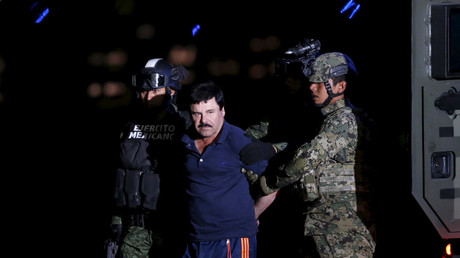
24 top gangsters in El Chapo’s drug cartel busted in US-Mexico sting

0

A joint cross border operation between US and Mexican law enforcement agencies has resulted in the arrest of two dozen senior Mexican drug cartel members. The raid took place in Lukeville, Arizona, on the border with Mexico.

Twenty-four members of the Sinaloa Cartel, one of Mexico’s largest drug-trafficking organizations, were arrested in the secretive operation, which was carried out Friday. The authorities managed to seize hundreds of pounds of illegal drugs and several types of assault weapons.

Gillian M. Christensen, a spokeswoman for US Immigration and Customs Enforcement (ICE), which took part in the operation, revealed the results of the sting, known as Mexican Operation Diablo Express, which also involved the Drug Enforcement Administration (DEA) and the Federal Bureau of Investigation (FBI).

“The targeted Sinaloa cell has been responsible for the importation of millions of pounds of illegal drugs, including marijuana, heroin, cocaine and methamphetamine, into the United States from Mexico during its existence,” Christensen said in a statement, as cited by AP.

“The organization is also responsible for the smuggling of millions of dollars in US currency, along with weapons, into Mexico,” she added.

Christensen mentioned that ICE helped to keep Mexican federal police safe while they took part in the operation on US soil, while she also praised the Mexican authorities for trying to take down the cartel.

“ICE applauds the Government of Mexico for their bold action in taking down this criminal organization and for their continued pressure on the Sinaloa Cartel throughout Mexico,” Christensen said.

The arrest of two-dozen high-profile members will come as another blow to the Sinaloa Cartel. Its former leader, Joaquin “El Chapo” Guzman, was arrested on January 8 in Mexico, after he had managed to escape from a high security jail in July.

The Mexican President Enrique Pena Nieto said on January 22, that his country is speeding up efforts to extradite Guzman to the US.

“The order the Attorney General’s office has is to speed up its work to ensure this highly dangerous criminal is extradited as soon as possible,” Pena Nieto told the World Economic Forum in Davos, Switzerland, according to Reuters.

With Guzman now back behind bars, control of the Sinaola Cartel will fall directly into the hands of 68-year-old Ismael “El Mayo” Zambada, who was described as “the patriarch” by Antonio Mazzitelli, the UN representative on drugs and crime in Mexico.

Unlike Guzman who liked the limelight, experts say that Zambada likes to keep a low profile and spends heavily on alliances with politicians and police.

Via RT. This piece was reprinted by RINF Alternative News with permission or license.

BAME teens in UK more likely found in prisons than colleges: PM

1

New data shows teenagers from Black, Asian and minority ethnic communities (BAME) in the United Kingdom are more likely to be found in prisons than in university classes.

At present, BAME individuals make up over a quarter of prisoners, yet are only 14% of the wider population of England and Wales.

Latest official figures also show they make up a disproportionate amount of crown court defendants (24%), and those who are found guilty are more likely to receive custodial sentences than white offenders (61% compared to 56%), according to the Guardian.

The review will address issues arising from the point of arrest onwards, including through the court system, in prisons and during rehabilitation in the community, in order to identify areas for reform and examples of good practice from the UK and beyond.

This comes after Prime Minister David Cameron said recently that “if you’re black, you’re more likely to be in a prison cell than studying at a top university. And if you’re black it seems you’re more likely to be sentenced to custody for a crime than if you’re white. We should investigate why this is and how we can end this possible discrimination.”

Read more

US urges Russia to respect Turkey, NATO airspace

6

The US Department of Defense has urged Russia to respect North Atlantic Treaty Organization (NATO) airspace, saying it “can confirm” reports that a Russian jet violated Turkey’s airspace earlier this week.

“We are aware of reports and can confirm that yesterday another Russian combat aircraft violated Turkish — and NATO – airspace,” Pentagon spokesman Mark Wright told Russia’s RIA Novosti in a statement Saturday.

“We call on Russia to respect Turkish airspace and cease activities that risk further heightening instability in the region,” Wright continued.

Wright also stressed the need for Russia and Turkey to “talk to each other and take measures to prevent escalation.”

The Turkish Defense Ministry claimed that a Russian Su-34 bomber violated the country’s air space on Friday, adding that the plane was warned by radar units.

The report prompted Turkish President Recep Tayyip Erdogan to react, warning Russia of “consequences” if such violations continue.

Shortly after, NATO Secretary General Jens Stoltenberg expressed solidarity with Turkey, calling on Russia “to act responsibly and to fully respect NATO airspace.”

Read more

Adding Up the Costs of Hillary Clinton’s Wars

0
The term “experienced” carries no value judgment with it: It can be good or bad. (Photo: Mike Mozart / Flickr)

(Photo: Mike Mozart / Flickr)

The Greek playwright Aeschylus — who fought at Marathon in 490 BC, the battle that defeated the first Persian invasion of Greece — had few illusions about the consequences of war. No wonder, in the tragedy Oresteia, he gave his character Agamemnon these verses:

They sent forth men to battle.
But no such men return;
And home, to claim their welcome
Comes ashes in an urn.

His ode is one the candidates for the U.S. presidency might consider, though one doubts that many of them would think to find wisdom in a 2,500 year-old Greek play.

And that, in itself, is a tragedy.

Historical blindness has been much on display in the primary season. On the Republican side, candidates promised to “kick ass” in Iraq, make the “sand glow” in Syria, and face down the Russians in Europe. While the Democratic aspirants were a little more measured, they generally share the pervasive ideology that binds together all but “cranks” like Ron Paul: America has the right, indeed the duty, to order the world’s affairs.

This peculiar view of the role of the U.S. takes on a certain messianic quality in candidates like Hillary Clinton, who routinely quotes former Secretary of State Madeline Albright’s line about America as “the indispensible nation” whose job is to lead the world.

A Failure of Imagination

At a recent rally in Indianola, Iowa, Clinton said that “Senator [Bernie] Sanders doesn’t talk much about foreign policy, and when he does, it raises concerns because sometimes it can sound like he really hasn’t thought things through.”

The former secretary of state was certainly correct. Foreign policy for Sanders is pretty much an afterthought to his signature issues of economic inequality and a national health care system.

But the implication of her comment is that she has thought things through. If she has, it isn’t evident in her memoir, Hard Choices, or in her campaign speeches.

Hard Choices covers her years as secretary of state and seemingly unconsciously tracks a litany of American foreign policy disasters: Afghanistan, Iraq, Libya, Syria, Georgia, Ukraine, and the “Asia pivot” that’s dangerously increased tensions with China.

At the heart of Hard Choices is the ideology of “American exceptionalism,” which for Clinton means the right of the U.S. to intervene in other countries at will. As historian Jackson Lears, in the London Review of Books, puts it, Clinton’s memoir “tries to construct a coherent rationale for an interventionist foreign policy and to justify it with reference to her own decisions as Secretary of State. The rationale is rickety: the evidence unconvincing.”

Clinton is undoubtedly an intelligent person, but her book is remarkably shallow and quite the opposite of “thoughtful.” The one act on her part for which she shows any regret is her vote to invade Iraq. But even here she quickly moves on, never really examining how it is that the U.S. had the right to invade and overthrow a sovereign government. For Clinton, Iraq was only a “mistake” because it came out badly.

She also demonstrates an inability to see other people’s point of view. Thus the Russians are portrayed as aggressively attempting to re-establish their old Soviet sphere of influence rather than reacting to the steady march of NATO eastwards. The fact that the U.S. violated promises by the first Bush administration not to move NATO “one inch east” if the Soviets withdrew their forces from Eastern Europe is treated as irrelevant.

Along with much of the Washington establishment, Clinton doesn’t seem to get that a country that’s been invaded three times since 1815 — and lost tens of millions of people — might be a tad paranoid about its borders. There’s no mention of the roles U.S. intelligence agencies, organizations like the National Endowment for Democracy, and openly fascist Ukrainian groups played in the coup against the elected (if corrupt) government of Ukraine.

Clinton takes credit for the Obama administration’s “Asia Pivot,” which she boasted “sent a message to Asia and the world that America was back in its traditional leadership role in Asia.” But she doesn’t consider how this might be interpreted in Beijing.

The United States, after all, never left Asia — the Pacific basin has long been home to major U.S. trading partners, and there’s a huge U.S. military presence in Japan, Korea, and the Pacific. So to the Chinese, the “pivot” means that the U.S. plans to beef up its military presence in the region and construct an anti-China alliance system. It’s done both.

The Butcher Bill

Clinton often costumes military intervention in the philosophy of “responsibility to protect,” or “R2P.” But her application is selective.

She takes credit for overthrowing Muammar Gaddafi in Libya, for example. But in her campaign speeches she’s not said a word about the horrendous bombing campaign being waged by Saudi Arabia in Yemen. She cites R2P for why the U.S. should overthrow Bashar al-Assad in Syria, but is silent about Saudi Arabia’s intervention in Bahrain to crush demands for democracy by its majority Shiite population.

Clinton, along with Samantha Power, the U.S. ambassador to the UN, and Susan Rice, the Obama administration’s national security advisor, has pushed for muscular interventions without thinking — or caring — about the consequences.

And those consequences have been dire.

Afghanistan: Somewhere around 220,000 Afghans have died since the 2001 U.S. invasion, and millions of others are refugees. The U.S. and its allies have suffered close to 2,500 dead and more than 20,000 wounded, and the war is far from over. The cost to the treasury alone runs close to $700 billion, not counting long-term medical bill that could run as high as $2 trillion.

Libya: Some 30,000 people died and another 50,000 were wounded in the intervention and civil war. Hundreds of thousands have been turned into refugees. The cost to Washington was cheap at a cool $1.1 billion, but the war and subsequent instability created a tsunami of weapons and refugees — and the fighting continues. It also produced one of Clinton’s more tasteless remarks. Referring to Gaddafi, she said, “We came, we saw, he died.” The Libyan leader was executed by having a bayonet rammed up his rectum.

Ukraine: The death toll now exceeds 8,000, some 18,000 have been wounded, and several cities in the eastern part of the country have been heavily damaged. The fighting has tapered off, although tensions remain high.

Yemen: Over 6,000 Yemenis have been killed and another 27,000 wounded. According to the UN, most of them are civilians. Ten million Yeminis don’t have enough to eat, and 13 million have no access to clean water. Yemen is highly dependent on imported food, but a U.S.-Saudi blockade has choked off most imports. The war is ongoing.

Iraq: Anywhere from 400,000 to over 1 million people have died from war-related causes since the 2003 invasion. Over 2 million have fled the country and another 2 million are internally displaced. The cost: close to $1 trillion, but it may rise to $4 trillion once all the long-term medical costs are added in. The war grinds on its latest incarnation: a bloody turf war with the Islamic State, which emerged from the Sunni insurgency against the U.S.-installed government.

Syria: Over 250,000 have died in the war, and half the country’s population has been displaced — including four million Syrian refugees abroad. The country’s major cities have been ravaged. The war, like the others, is ongoing.

There are other countries — like Somalia — that one could add to the butcher bill. Then there are the countries that reaped the fallout from the collapse of Libya. Weapons looted after the fall of Gaddafi largely fuel the wars in Mali, Niger, and the Central African Republic.

And how does one calculate the cost of the Asia Pivot — not only for the United States, but for the allies we’re recruiting to confront China? Since the “Pivot” got underway prior to China’s recent assertiveness in the South China Sea, is the current climate of tension in the Pacific basin a result of Chinese aggression, or U.S. provocation?

Death and Destruction

Hillary Clinton is hardly the only Democrat who thinks American exceptionalism gives the U.S. the right to intervene in other countries. That point of view it is pretty much bi-partisan. And while Sanders wisely voted against the Iraq War and has criticized Clinton’s eagerness to intervene elsewhere, the Vermont senator did back the Yugoslavia and Afghan interventions. The former re-ignited the Cold War, and the latter is playing out like a Rudyard Kipling novel.

In all fairness, Sanders did say, “I worry that Secretary Clinton is too much into regime change and a bit too aggressive without knowing what the unintended consequences may be.”

Would Hillary be more inclined toward an aggressive foreign policy?

Certainly more than Obama — Clinton pressed the White House to intervene more deeply in Syria, and was far more hardline on Iran. On virtually every foreign policy issue, in fact, Clinton is said to have led the charge inside the administration for a more belligerent U.S. response.

More than the Republicans? It’s hard to say, because most of them sound like they’ve gone off their meds. For instance, a number of GOP candidates pledge to cancel the nuclear agreement with Iran. While Clinton wanted to drive a harder bargain than the White House did, in the end she supported it.

However, she did say she’s proud to call Iranians “enemies,” and attacked Sanders for his entirely sensible remark that the U.S. might find common ground with Iran on defeating the Islamic State. Sanders then backed off and said he didn’t think it was possible to improve relations with Tehran in the near future.

The danger of Clinton’s view of America’s role in the world is that of old-fashioned imperial behavior wrapped in the humanitarian rationale of R2P. It’s more polite than the “make the sands glow” atavism of the Republicans. But in the end, it’s death and destruction in a different packaging.

Aeschylus got that: “For War’s a banker, flesh his gold.”

This piece was reprinted from Foreign Policy In Focus by RINF Alternative News with permission.

Politics on the Plate: Mob Wives, GMOs and Salt

How can we broaden our movement to appeal to and involve the majority of people out there who do not seem to be aware, do not seem to care or are just too apathetic?

This has long been an issue for many a campaign group or activist.

There are many groups who have been offering a credible analysis of how the world functions. But many of these groups use certain language and theoretical constructs whereby they end up preaching to the converted and make little headway in galvanising mass protest, action or resistance to capitalism, especially among more affluent or politically unaware sections of the population.

Take Syria, for instance. What is happening on the ground there is too abstract for many, too far away or seemingly too unconnected from their everyday lives to have much meaning (except when the issue of immigration rears its head, whose solution, according to the mainstream media, politicians and pundits, does not involve bombing Syria less but more). Similarly, Ukraine or Afghanistan is also often regarded as being too removed and any talk about empire or imperialism does not strike much of a chord with many people, who after a long day do not have the time, energy or inclination to sit down and do research into the machinations of empire, read Brookings Institute reports on how to deal with Iran or gem up on the Project for a New American Century.

The problem revolves around how to raise informed awareness (not spoon-fed mainstream media narratives) of these and other issues and how to make the public connect world events with their everyday lives.

Gandhi knew how to connect everyday concerns with wider issues. In 1930, he led a ‘salt march’ to the coast of Gujarat to symbolically collect salt on the shore. His message of resistance against the British Empire revolved around a simple everyday foodstuff. His focus on salt was questioned by sections of the press and prominent figures on his side (even the British weren’t much concerned about a march about salt), who felt that protest against British rule in India should for instance focus more directly on the heady issues of rights and democracy.

However, Gandhi knew that by concentrating on an item of daily use among ordinary Indians, such a campaign could resonate more with all classes of citizens than an abstract demand for greater political rights. Even though salt was freely available to those living on the coast (by evaporation of sea water), Indians were forced to purchase it from the colonial government. The tax on salt represented 8.2 percent of the British Raj tax revenue. The issue of salt encapsulated the essence of colonial oppression at the time.

Explaining his choice, Gandhi said that next to air and water, salt is perhaps the greatest necessity of life. The prominent Congress statesman and future Governor-General of India, C. Rajagopalachari, understood what Gandhi was trying to achieve. He said:

“Suppose, a people rise in revolt. They cannot attack the abstract constitution or lead an army against proclamations and statutes…Civil disobedience has to be directed against the salt tax or the land tax or some other particular point — not that that is our final end, but for the time being it is our aim, and we must shoot straight.”

With the British imposing heavy taxes on salt and monopolising its production, Gandhi felt he could strike a chord with the masses by highlighting an issue that directly affected everyone in the country: access to and control over a daily essential. His march drew not only national but international attention to India’s struggle for independence.

Today, we find the issue of food in general playing a similar role in people’s struggle for independence, but this time it is independence from the corporate tyranny of global agribusiness, and, for much of the world, independence from the US, which for a long time has been using food as a geopolitical tool to create food deficit areas, boost reliance on US exports and create dependence on oil-based chemical-intensive agriculture and ultimately the petro-dollar (see this and this and this).

Vandana Shiva draws a parallel between the seed sovereignty movement and Gandhi’s civil disobedience ‘salt march’:

“Gandhi has started the independence movement with the salt satyagraha. Satyagraha means “struggle for truth.” The salt satyagraha was a direct action of non-cooperation. When the British tried to create salt monopolies, he went to the beach in Dindi, picked up the salt and said, “Nature has given us this for free, it was meant to sustain us, we will not allow it to become a monopoly to finance the Imperial Army… Nature has gifted this rich biological diversity to us. We will not allow it to become the monopoly of a handful of corporations… For us, not cooperating in the monopoly regimes of intellectual property rights and patents and biodiversity – saying “no” to patents on life, and developing intellectual ideas of resistance – is very much a continuation of Gandhian satyagraha… That is the satyagraha for the next millennium. It is what the ecology movement must engage in, not just in India, but in the United States as well.”

With genetically modified seeds now a major issue, the debate on food has in recent years meant that the issues of food sovereignty and food independence have been given a sharper focus.

What the debate on GM has done is create increased public awareness concerning how food is produced, what is in it, who is controlling it and for what purpose. At one end of the spectrum, we have groups that were already highly politically aware about food and the geopolitics of food and agriculture. At the other end, however, there are people who may have not been too politically aware or attracted to politics or political issues but who are being drawn towards issues like the ‘right to know’ what is in their food and the need to label GM foodstuffs on supermarket shelves.

As a result, many are being politicised as they get drawn into the great food debate because, once they begin talking about the need to label, they soon begin to realise there are powerful state-corporate forces preventing this. By delving into the politics of labelling and GM, people will hopefully be drawn towards wider debates about Monsanto and agribusiness and in turn to how these entities are shaping the global system of food and agriculture.

The basic ‘right to know’ could and should logically lead people to consider issues pertaining to seed sovereignty and patenting of seeds, petro-chemical farming and the role of oil, the destruction of indigenous agriculture across the world and corrupt trade deals like TTIP.

For too long, so many people in the West have acted like ‘mob wives’, displaying a willingness to remain blissfully ignorant while living well from the fruits of imperialism or knowing that something might be amiss but turning a blind eye because life (for them) is good. There is however a growing recognition that their food is not only killing them as consumers but others too and that this is part of an agenda to capture the food supply by a powerful cartel that began many decades ago and is still being played out in throughout the globe from Africa and India to Ukraine and beyond.

Protest and action against widespread oppression, violence and exploitation has to be focussed. As in Gandhi’s time, it is again food that is playing a central role in raising awareness and provoking resistance.

Colin Todhunter is an independent writer

Feeding the Military-Industrial Complex

0

Exclusive: Because he had commanded Allied forces in World War II, President Eisenhower understood the excesses of the war industry and warned Americans about the dangers of the military-industrial complex, a force that continues to siphon off tens of billions of tax dollars, as Jonathan Marshall explains.

By Jonathan Marshall

America’s military procurement machine may be the single most successful system of wealth transfer ever devised — moving tens of billions of dollars every year from ordinary taxpayers into the pockets of big defense contractors and their allies in Congress. But as a provider of working equipment to defend the United States against realistic threats, it is becoming more and more dysfunctional with every passing year.

Current administration plans call for spending a trillion dollars over the next 30 years to “modernize” America’s nuclear arsenal to fight a pointless war that would decimate major centers of civilization across the globe. [See Consortiumnews.com’s “Learning to Love — and Use — the Bomb”]

The U.S. Navy variant of the F-35 Joint Strike Fighter in a test flight over the Chesapeake Bay. [Defense Department photoe]

The U.S. Navy variant of the F-35 Joint Strike Fighter in a test flight over the Chesapeake Bay. [Defense Department photoe]

At the same time, the Pentagon is also asking for even greater sums to modernize conventional weapons systems that are better suited to East-West conflict scenarios of the 1950s than to today’s skirmishes with insurgents in the Middle East, Asia, and Africa.

Spending on major military acquisition programs is projected to soar 23 percent, after adjusting for inflation, from fiscal year 2015 to 2022. Worse yet, Congress and the administration are spending much of that money on weapons that don’t even work as advertised.

One of the biggest drivers of new procurement spending today is the F-35 Joint Strike Fighter jet. The plane is too expensive and sophisticated for simple bombing runs in Syria or Afghanistan, but too crippled to use in dogfights against Russia’s or China’s most advanced fighters. It’s ideal for one purpose only: With a total projected program cost of more than $1 trillion, this program will keep Lockheed Martin and its subcontractors in 46 states afloat for at least the next two…

Read more

Video: Four Chinese miners rescued after 36 days trapped underground

0


Four workers were lifted from a collapsed mine in eastern China on Friday after being trapped underground for 36 days. Big holes were drilled into the tunnel to …

Via Youtube

Congress Declares War

0

Passage of Senator Mitch McConnell’s authorization for war against ISIS will not only lead to perpetual US wars across the globe, it will also endanger our civil and economic liberties. The measure allows the president to place troops anywhere he determines ISIS is operating. Therefore, it could be used to justify using military force against United States citizens on US territory. It may even be used to justify imposing martial law in America.

The President does not have to deploy the US military to turn America into a militarized police state, however. He can use his unlimited authority to expand programs that turn local police forces into adjuncts of the US military, and send them increasing amounts of military equipment. Using the threat of ISIS to justify increased police militarization will be enthusiastically supported by police unions, local officials, and, of course, politically-powerful defense contractors. The only opposition will come from citizens whose rights have been violated by a militarized police force that views the people as the enemy.

Even though there is no evidence that the government’s mass surveillance programs have prevented even a single terrorist attack, we are still continuously lectured about how we must sacrifice our liberty for security. The cries for the government to take more of our privacy will grow louder as the war party and its allies in the media continue to hype the threat of terrorism. A president armed with the authority to do whatever it takes to stop ISIS will no doubt heed these calls for new restrictions on our privacy.

Read more

World Bank documents growth of “ninis” in Latin America: Youth neither working nor in school

2

By Kevin Martinez

The World Bank released a report last week documenting the number of youth in Latin America who are neither in school nor working. Derived from the Spanish phrase “ni estudia ni trabaja”, the ninis, who are between 15 and 24 years old, now total more than 20 million. Two-thirds of them are women. They have proven to be a permanent social problem in a region long touted as an economic “success story” for world capitalism. While the percentage of Latin American youth classified as ninis has declined marginally over the last decade, the absolute number of them has actually increased.

The numbers are staggering considering that Latin America has been hailed as a center for economic growth during the worst of the world economic recession. What profits have been made have gone directly to the ruling elite, further worsening social inequality in nearly every country. This is a direct outcome of the policies of all the Latin American governments, be they right-wing or “left”, favoring international capital at the expense of their populations.

It was highly significant that countries immediately south of the United States, such as Mexico and the Central American nations, fared the worst in providing stable jobs and schools to working class youth. The close relationship between the Obama administration and the government of Mexican President Enrique Peña Nieto, in particular, has facilitated an unstable environment of organized crime and violence which finds a direct corollary in the number of disenfranchised youth.

These conditions propel millions of people to risk their lives to migrate to the United States in search of better living conditions. When they arrive, Obama’s border patrol and immigration officials ensure that they will be interned in a camp and deported if they are caught. In the best of circumstances, these youth have only a life of cheap labor to look forward to in the US.

The report by the World Bank, entitled “Out of School and Out of Work: Risks and Opportunities for Latin America’s Ninis,” takes the viewpoint of finance capital in treating tens of millions of young people languishing without work or education as a long-term economic liability, rather than a social crime. Thus, Jorge Familiar, World Bank Vice President for Latin American and the Caribbean, notes that, “Countries that offer high-quality education to an expanding young population and also have dynamic, well-functioning labor markets will grow and reduce poverty more rapidly.”

Nevertheless, the picture that emerges from the report is a damning indictment of capitalism south of the US border. Nearly 60 percent of ninis are from poor households, which comprise the bottom 40 percent of the income distribution in the region. The typical nini is a woman living in an urban household who has not finished high school, but among male youth there has been an increase of 1.8 million ninis from 1992 to 2010.

For women, the biggest contributing factor to becoming a nini was early marriage or teenage pregnancy. For men, the main factor was dropping out of school at an early age followed by unemployment. This leads to a vicious cycle where men without skills and training provided by school cannot find formal work and are only lucky enough to find unstable jobs in the informal sector, usually never going back to school.

Generally, countries that were further geographically further from the United States had significant but lower rates of ninis. Peru had 10.9 percent of it young people without school and work, but in countries like Honduras and El Salvador, the number was more than 25 percent. The countries with highest number of ninis were Brazil, Columbia, and Mexico, the large majority of which, more than 70 percent, lived in cities.

In Colombia, Mexico, and Central America, the problem was made worse by the so-called drug wars. It is not surprising that gang violence and crime has reinforced the phenomena of unemployed youth with nothing to do, and vice versa.

The report goes on to note the long-term effects on labor productivity, the life blood of the world economic system. The growing persistence of nini youth weakens overall economic growth and worsens social inequality, making it harder to seriously address poverty and social mobility in Latin America. According to the World Bank’s calculations, just an increase of 1 percent in the number of ninis would mean a decline in national incomes by 7 percent over the next 20 years.

In Costa Rica, for example, the National Institute of Statistics and Census reported that in late 2014 there were 72,000 nini men and 98,000 nini women, making up almost half of the 10 percent of the country’s population that is unemployed. In Latin America as whole, the World Bank estimated that one in five youth were out school and not working.

The solutions offered by the World Bank are predictable tame and, in any case, will not be implemented by the local ruling elites. They include “well-targeted conditional cash transfers with information modules to inform students and their parents about the benefits of education” and the like. None of this even remotely touches upon the real causes of unemployment in the region: private property and imperialist exploitation.

The report takes the viewpoint that the nini problem is a brake on labor productivity and detracts from economic growth. Accordingly, the youth are referred to as “human capital” and “labor market opportunities.” One of the main findings is that a failure to address the problem means investors will not be able to “exploit an emerging demographic window of opportunity”, when children and seniors (i.e. the non-productive elements of society) will represent a lower proportion of the population.

It is worth bearing in mind what poverty means in Latin America. Poor households are defined as per capita income of $4 per day, and those almost at the poverty line lived on $4 to $10 per day. Using this definition, at least one of four households (25 percent) in the region were poor in 2012 and 37.8 percent were considered at risk of poverty.

Of course, the problem of youth without work and without school is not confined to Latin America. A similar corollary can be found in Europe, North America, Asia, and throughout the industrialized world. Even though the World Bank report does not spell it out, the ninis are part of worldwide generation that will directly contribute to social upheavals in every country.

Via WSWS. This piece was reprinted by RINF Alternative News with permission or license.

Brexit support hits record high – poll

0

Support for Britain leaving the European Union is at its strongest since October 2014, enjoying a 4 percentage point lead over those wishing to stay, a new poll from YouGov has revealed.

A survey of 1,735 people showed 42 percent of British citizens are in favor of leaving the EU, compared to 38 percent who would vote to stay. The 4 percentage point lead is the greatest in more than a year.

The latest results show a slide for the “in” campaign, whose support has slipped from 41 percent since December, and a 3 percentage point rise in the number of people who remain undecided to 18 percent.

Via RT.

Obama to visit mosque for first time as president

1

US President Barack Obama is to make his first visit to a mosque during his time in office next week to make a plea for tolerance, the White House says.

The White House, making the announcement on Saturday, said Obama will visit the Islamic Society of Baltimore mosque on Wednesday, and will speak with its members about tolerance and religious freedom.

“On Wednesday, February 3rd, the President will travel to Maryland to visit the Islamic Society of Baltimore mosque to celebrate the contributions Muslim Americans make to our nation and reaffirm the importance of religious freedom to our way of life,” a White House official said in a statement.

“The President will hold a roundtable with community members and deliver remarks, where he will reiterate the importance of staying true to our core values — welcoming our fellow Americans, speaking out against bigotry, rejecting indifference, and protecting our nation’s tradition of religious freedom.”

The visit comes at a time when American Muslims have reported a surge in inflammatory rhetoric, linked partly to comments from US Republican presidential frontrunner Donald Trump, who has called for a temporary ban on allowing Muslims to enter the country.

Read more

Cameron under pressure over Google deal

0

Pressure is mounting on British Prime Minister David Cameron over a back tax deal agreed by Internet group Google.

During a hot debate in the parliament, Labour leader Jeremy Corbyn challenged Cameron to defend the deal, which he said represented a tax rate of just 3 percent on 6 billion pounds ($8.5 billion) of profits that Google, now part of holding company Alphabet Inc, has earned in Britain since 2005.

“Why is there one rule for big multinational companies and another for ordinary small businesses and self-employed workers?”, he asked the prime minister in his weekly parliamentary question session.

Cameron did not comment on the 130 million pound settlement but said he had been genuinely angry over Google’s failure to pay much tax, adding that this largely occurred when Labour was in power from 1997 to 2010. “We’ve done more on tax evasion and tax avoidance than Labour ever did,” he said.

Finance minister George Osborne has said the settlement was “a victory for the action we’ve taken” against corporate profit-shifting.

Read more

Snoopers’ charter ‘expensive & confusing,’ say MPs

1

MPs have advised the government to make the taxpayer subsidize the costs of its expensive data-harvesting program under the Draft Investigatory Powers Bill (IPB), while at the same slamming the legislation for lacking clarity.

In a report published by the UK’s Science and Technology Select Committee, MPs argued that the costs of complying with the bill – dubbed the snoopers’ charter – would be so much that British internet companies would be at a disadvantage against foreign competitors.

The committee also described the legislation as lacking clarity and causing confusion among tech firms about the extent to which “internet connection records” will be collected.

The IPB has been created to give the security services more surveillance powers. Home Secretary Theresa May insists the bill is integral to preventing terrorism and catching criminals by tracking their internet and communications data.

The legislation was drafted after NSA whistleblower Edward Snowden’s 2012 revelations, which showed that the UK had been illegally gathering data for years.

If the legislation comes into force, internet companies will be required to store “internet connection records” – a list of every website visited by every customer for a period of 12 months. According to the home secretary, the logs would only record the website domain visited and not the individual pages.

Committee chair Nicola Blackwood MP said the greatest concern over the bill was the “the feasibility of collecting and storing Internet Connection Records (ICRs), including concerns about ensuring security for the records from hackers.”

“The bill was intended to provide clarity to the industry, but the current draft contains very broad and ambiguous definitions of ICRs,” wrote Blackwood, echoing the sentiments of the submissions her committee had received from almost every party except from the Home Office itself.

The bill’s lack of clarity is evident in the confusion around what an ICR will actually be.

Some internet service providers (ISPs) giving evidence to the committee admitted they had no idea what the Home Office meant by the term, while others denied they even existed.

Blackwood writes in the report that there are “widespread doubts over the definition, not to mention the definability, of a number of the terms used in the draft bill,” adding there are “questions as to how collecting and storing ICRs is technically possible, and whether Data Retention Notices to retain all user ICRs are ‘necessary and proportionate.’”

The report also notes confusion over how the bill will impact “end-to-end encrypted communications, where decryption might not be possible by a communications provider that had not added the original encryption.”

Blackwood said the government needs to reassure businesses and the public that the IPB will not put an end to encryption.

“Encryption is important in providing the secure services on the internet we all rely on, from credit card transactions and commerce to legal or medical communications.

“It is essential that the integrity and security of legitimate online transactions is maintained if we are to trust in, and benefit from, the opportunities of an increasingly digital economy. The government needs to do more to allay unfounded concerns that encryption will no longer be possible.”

MPs assessed the bill only in terms of its feasibility and cost. A second assessment which will examine whether its legal powers are proportionate to the threats they intend to address will be published by the Joint Committee on the Draft Investigatory Powers Bill within the next two weeks.

Via RT. This piece was reprinted by RINF Alternative News with permission or license.

Video: Keiser Report: Tumbling, Fumbling Ruble (special Moscow series, E869)

0


Check Keiser Report website for more: http://www.maxkeiser.com/ In this episode of the Keiser Report coming to you from Moscow, Max Keiser and Stacy …

Via Youtube

Democracy of the Billionaires

0

Speaking of the need for citizen participation in our national politics in his final State of the Union address, President Obama said, “Our brand of democracy is hard.” A more accurate characterization might have been: “Our brand of democracy is cold hard cash.”

Cash, mountains of it, is increasingly the necessary tool for presidential candidates. Several Powerball jackpots could already be fueled from the billions of dollars in contributions in play in election 2016. When considering the present donation season, however, the devil lies in the details, which is why the details follow.

With three 2016 debates down and six more scheduled, the two fundraisers with the most surprising amount in common are Bernie Sanders and Donald Trump. Neither has billionaire-infused super PACs, but for vastly different reasons. Bernie has made it clear billionaires won’t ever hold sway in his court. While Trump… well, you know, he’s not only a billionaire but has the knack for getting the sort of attention that even billions can’t buy.

Regarding the rest of the field, each candidate is counting on the reliability of his or her own arsenal of billionaire sponsors and corporate nabobs when the you-know-what hits the fan. And at this point, believe it or not, thanks to the Supreme Court’s Citizens United decision of 2010 and the super PACs that arose from it, all the billionaires aren’t even nailed down or faintly tapped out yet.  In fact, some of them are already preparing to jump ship on their initial candidate of choice or reserving the really big bucks for closer to game time, when only two nominees will be duking it out for the White House.

Capturing this drama of the billionaires in new ways are TV networks eager to profit from the latest eyeball-gluing version of election politicking and the billions of dollars in ads that will flood onto screens nationwide between now and November 8th. As super PACs, billionaires, and behemoth companies press their influence on what used to be called “our democracy,” the modern debate system, now a 16-month food fight, has become the political equivalent of the NFL playoffs. In turn, soaring ratings numbers, scads of ads, and the party infighting that helps generate them now translate into billions of new dollars for media moguls.

For your amusement and mine, this being an all-fun-all-the-time election campaign, let’s examine the relationships between our twenty-first-century plutocrats and the contenders who have raised $5 million or more in individual contributions or through super PACs and are at 5% or more in composite national polls. I’ll refrain from using the politically correct phrases that feed into the illusion of distance between super PACs that allegedly support candidates’ causes and the candidates themselves, because in practice there is no distinction.

Read more

ISIS threatens London with ‘doomsday’ attack so terrible it will ‘turn children’s hair white’

5

Islamic State (IS, formerly ISIS/ISIL) says it will focus its European terrorist operations on London, threatening to launch an attack on the British capital so terrible it will “turn children’s hair white.”

The extremist group published an article in its Arabic language newspaper al-Naba, saying a “doomsday” attack would take place on British soil. It claimed the UK would receive the “lion’s share” of its European terrorist attacks.

The stark warning comes in response to the government’s decision to extend its aerial bombing campaign against IS from Iraq into Syria, the article says. It also accuses Britain of issuing a “declaration of war against Muslims.”

Via RT.

The “Bernie Bros” Narrative: a Cheap Campaign Tactic Masquerading as Journalism and Social Activism

1

The concoction of the “Bernie Bro” narrative by pro-Clinton journalists has been a potent political tactic — and a journalistic disgrace. It’s intended to imply two equally false claims: (1) a refusal to march enthusiastically behind the Wall Street-enriched, multiple-war-advocating, despot-embracing Hillary Clinton is explainable not by ideology or political conviction, but largely if not exclusively by sexism: demonstrated by the fact that men, not women, support Sanders (his supporters are “bros”); and (2) Sanders supporters are uniquely abusive and misogynistic in their online behavior. Needless to say, a crucial tactical prong of this innuendo is that any attempt to refute it is itself proof of insensitivity to sexism if not sexism itself (as the accusatory reactions to this article will instantly illustrate).

It’s become such an all-purpose, handy pro-Clinton smear that even consummate, actual “bros” for whom the term was originally coined — straight guys who act with entitlement and aggression, such as Paul Krugman — are now reflexively (and unironically) applying it to anyone who speaks ill of Hillary Clinton, even when they know nothing else about the people they’re smearing, including their gender, age, or sexual orientation. Thus, a male policy analyst who criticized Sanders’ health care plan “is getting the Bernie Bro treatment,” sneered Krugman. Unfortunately for the New York Times Bro, that analyst, Charles Gaba, said in response that he’s “really not comfortable with [Krugman’s] referring to die-hard Bernie Sanders supporters as ‘Bernie Bros’” because it “implies that only college-age men support Sen. Sanders, which obviously isn’t the case.”

It is indeed “obviously not the case.” There are literally millions of women who support Sanders over Clinton. A new Iowa poll yesterday shows Sanders with a 15-point lead over Clinton among women under 45, while one-third of Iowa women over 45 support him. A USA Today/Rock the Vote poll from two weeks ago found Sanders nationally “with a 19-point lead over front-runner Hillary Clinton, 50 percent to 31 percent, among Democratic and independent women ages 18 to 34.” One has to be willing to belittle the views and erase the existence of a huge number of American women to wield this “Bernie Bro” smear.

But truth doesn’t matter here — at all. Instead, the goal is to inherently delegitimize all critics of Hillary Clinton by accusing them of, or at least associating them with, sexism, thus distracting attention away from Clinton’s policy views, funding, and political history and directing it toward the online behavior of anonymous, random, isolated people on the internet claiming to be Sanders supporters. It’s an effective weapon when wielded by Clinton operatives. But, given its blatant falsity, it has zero place in anything purporting to be “journalism.”

Read more

Editing embryo genes now allowed in UK

0

British scientists have been given the go-ahead to edit he genes of human embryos for research.  

Kathy Niakan, a stem cell scientist from London’s Francis Crick Institute, was granted a licence to carry out similar experiments.

“The Human Fertilisation and Embryology Authority (HFEA) has approved a research application from the Francis Crick Institute to use new ‘gene editing’ techniques on human embryos,” Niakan’s lab said on Monday.

It said the work carried out “will be for research purposes and will look at the first seven days of a fertilised egg’s development, from a single cell to around 250 cells”.

The basic research could help scientists understand why some women lose their babies before term and provide better clinical treatments for infertility, using conventional medical methods.

The authorization has already been described by the media which say it could lead to the creation of Britain’s first genetically modified human embryos.


Read more

Video: Pentagon delays release of images of tortured Afghan, Iraqi prisoners despite court order

0


The American military has again delayed the publication of images of torture in US prisons in Iraq and Afghanistan. They were supposed to be released on …

Via Youtube

Video: ‘Female-Friendly’ Version: Sights aimed at Canadian national anthem

0


Canada is considering changing the lyrics to its national anthem, because some say the current version doesn’t include women. RT LIVE http://rt.com/on-air …

Via Youtube

Video: Anti-Immigrant Rampage: Masked men attack asylum seekers in Sweden

0


In an apparent retaliation for the stabbing death of a young Swedish woman at a refugee center, dozens of masked men went on an ‘anti-immigrant rampage’ …

Via Youtube

Still Lots to Choke on About HRC’s 2002 AUMF Vote

0
Hillary Clinton was also, and may continue to be, in favor of executive action. (Photo: Marc Nozell / Flickr)

Hillary Clinton was also, and may continue to be, in favor of executive action. (Photo: Marc Nozell / Flickr)

There was something for everyone — Democrats and progressives in general — to dislike about Hillary Clinton’s 2002 vote for the Authorization for Use of Military Force Against Iraq. Conventional wisdom holds that it was an exercise in political opportunism and that, like many in Congress, including a number of Democrats, she had no intention of bucking the post-9/11 tenor of the times. For progressives, her willingness to reap the benefits of supporting a popular president while putting both the United States and the Middle East at almost certain risk of war for reasons obscure to most of us was the kiss of death.

For those less left who felt no need to to abandon her for an expedient vote, even after the United States invaded Iraq and lit a fuse to the whole region, the alternative was also frightening — that Ms. Clinton failed to anticipate how the vote would come back to haunt her future political aspirations. In other words, she was either a unconscionable legislator, an incompetent politician, or both.

But, as some, none more eloquent than Michael Crowley (now of Politico) in a 2007 New Republic article, asked:

What if the hawkish Hillary of 2002 wasn’t just motivated by political opportunism? What if she really believed in the war?

Crowley’s case is convincing.

Iraq had been a persistent fly in the ointment during the latter years of the Clinton administration. Few things terrified the Clintonites more than the chemical and biological arsenal they were convinced Saddam possessed.

Crowley illustrates that point (read the article) and then elaborates.

Thoughts like these led to an ever-more aggressive posture toward Saddam. In November 1998, the president signed the Iraq Liberation Act, making Saddam’s ouster a stated goal of U.S. policy for the first time; a few months later, [Secretary of State Madeline] Albright toured the Middle East explaining to Arab governments that the United States was serious about “regime change.” When Saddam kicked out U.N. weapons inspectors that year, Clinton ordered Operation Desert Fox, a four-day campaign of bombing and cruise-missile strikes.

I know — Bill, not Hillary, as Crowley acknowledges.

Whatever role Hillary played in her husband’s Iraq policy remains a mystery. But it’s clear that the Clintonites left office deeply frustrated at the unsolved problem of Iraq and perhaps believing that some final reckoning was inevitable. [Shades of George H.W.]

To Hillary Clinton, the Authorization for Use of Military Force Against Iraq may not have seemed like the United States was being enlisted into the Bushes’ vendetta against Iraq — unfinished business, Hussein’s threats against H.W. — because Bill Clinton and she also nursed a grudge against Hussein. Depending on whether or not you support her and to what extent, this might either explain, justify, or excuse her vote.

Of equal concern, however, is the apparent faith in executive authority that Ms. Clinton shared with George W.’s administration. Crowley writes, “Thanks to the excesses of the Bush administration, the phrase ‘executive authority’ has a dirty ring to it these days [2007], and Hillary rarely talks much about it in public. But her advisers say it remains a guiding principle of her thinking.” In fact, Crowley was granted an opportunity to speak briefly with Ms. Clinton, who, among other things, said:

… “there were those in the Congress who thought that the United States should never even threaten force–or certainly take force–in the absence of U.N. Security Council approval. Well, I had seen during the Clinton administration that sometimes, that’s not even possible. … for the president to get congressional approval to pursue vital national security interests.”

Crowley’s reaction: “This does not sound like someone who, in her heart, had at the time thought George Bush’s confrontation was a terrible mistake.” More from Crowley on Ms. Clinton’s disposition toward executive authority (as enhanced by the Bush administration):

In her October 2002 speech explaining her vote for President Bush’s war resolution. … [Ms. Clinton] argued that she was inherently predisposed to grant the benefit of the doubt to a president asking Congress for support in matters of war. In the’90s, Clinton had watched congressional Republicans undermine her husband’s foreign policy for political gain. They mocked his interventions in Haiti, Bosnia, and Kosovo–Tom DeLay called it “Clinton’s war”–and they cried “wag the dog” when he launched a cruise-missile attack on Iraq in the midst of the Lewinsky scandal.”[P]erhaps,” Hillary mused in her floor speech, “my decision is influenced by my eight years of experience on the other end of Pennsylvania Avenue in the White House, watching my husband deal with serious challenges to our nation. I want this president, or any future president, to be in the strongest possible position to lead our country in the United Nations or in war.”

In short, Clinton was arguing that Congress should have an innate deference to presidential authority in matters of diplomacy and war. As she explained to ABC’s George Stephanopoulos in December 2003, “I’m a strong believer in executive authority. I wish that, when my husband was president, people in Congress had been more willing to recognize presidential authority.”

When called upon to vote for Ms. Clinton, should she be nominated, I am certainly appreciative of the lesser-of-two evils argument and the imperative to just “hold our noses” and vote. It is true that this may be the worst possible time for a Republican administration, which would likely throw oil on the fires of Islamic extremism, tensions with Russia, and global warming. But it is partly Democratic refusal to run candidates for president with truly progressive agendas that has left us in such dire straits. Since the heyday of Bush, such a candidate running in place of Kerry and Obama might not have won — Wall Street ruled, of course — but, at least, the candidacy would have signaled to the American public that this is the type of candidate the Democrats planned to run from now on and these are the programs they hoped to enact.

True progressives, as well as those farther left, are now expected to bite the bullet and fall in line behind Ms. Clinton if she is the candidate. But, had more progressive candidates been nominated for president in recent years, all Democrats, including those clustered around the center, would have been expected to support them. Looking back, it seems like an opportunity lost: The centrists might have been less resistant to voting progressive than those of us on the left — more ideologically inflexible by definition, as are those on the far right — who will be asked to support Ms. Clinton should she be nominated.

This piece was reprinted from Foreign Policy In Focus by RINF Alternative News with permission.

Video: Tit for Tat: Russia denies SU-34 violates Turkish airspace on Friday

2


Moscow has denied Turkey’s accusation that a Russian Su-34 bomber violated its airspace READ MORE http://on.rt.com/736r RT LIVE http://rt.com/on-air …

Via Youtube

Latest corruption index does not reveal Britain’s real place in global crime wave

0

Transparency International (TI) releases its latest report entitled the Corruption Perceptions Index and continues to find that corruption is rife globally and remains a blight around the world. Overall, two-thirds of the 168 countries on the 2015 index did not fair well.

Denmark took the top spot for the 2nd year running for least corrupt, with North Korea and Somalia the worst performers.

TI states on their website that the goals to aim at for a corruption free country has certain characteristics such as; “high levels of press freedom; access to budget information so the public knows where money comes from and how it is spent; high levels of integrity among people in power; and judiciaries that don’t differentiate between rich and poor, and that are truly independent from other parts of government. Conflict and war, poor governance, weak public institutions like police and the judiciary, and a lack of independence in the media characterise the lowest ranked countries.

Notably the five countries with the biggest declines in these characteristics in the past 4 years include Libya, Australia, Brazil, Spain and Turkey. The big improvers in its report include Greece, Senegal and surprisingly, the UK.

As it turns out sixty-eight per cent of countries worldwide have a serious corruption problem. Half of the G20 are among them. The G20 consists of the top 20 economies in the world but ranks the EU as one economy even though it is made up of 28 countries alone.

The research shows that half of all the 34 OECD countries are violating their international obligations to crack down on bribery by their companies abroad.

Britain has entered the top ten for the first time behind Denmark (1st), Finland, Sweden, New Zealand, Netherlands, Norway, Switzerland, Singapore, Canada, Germany and Luxembourg. The US ranks 16th. In the EU, other countries not doing so well are; France which ranks 23rd, Spain 36th, Italy 61st and Bulgaria, the last of EU nations at 69th place.

The truth is that Britain has not done better, don’t forget this is an index of perception, not actual corruption.

In comments from TI, Britain was found to have conducted an “extraordinarily inept” review of freedom of information laws. The government’s review of the Freedom of Information Act threatens to further undermine trust in politicians and damage democracy. If ever there was a demonstration of the governments intention of transparency, look no further than ..

Read More

Video: 1 in 5 UK charities reportedly misuse more than half of their income

0


British charities could be facing more government control, after a Parliamentary report outlined how fundraisers target elderly and vulnerable people. And just …

Via Youtube

Video: No Laughing Matter: ‘Clowns without Borders’ make refugees smile again (RT Documentary)

0


The Greek island of Lesbos is where hundreds of thousands of people fleeing Africa and the Middle East first reach Europe. Clowns without Borders is an …

Via Youtube

Video: Bill Gates & UK govt join forces, pledge $4bn to combat malaria

0


Bill Gates and George Osborne have unveiled a new plan to fight malaria. RT LIVE http://rt.com/on-air Subscribe to RT!

Via Youtube

CNN’s Double-Dealing in Des Moines

0

The kind of question CNN‘s Christopher Cuomo asked Bernie Sanders at CNN‘s Iowa town meeting (1/26/16):

You will hear people say that your paying for it is actually punitive. You’re going to punish people who make money, you’re going to punish the financial district, you’re going to punish, and wind up changing the idea of an open and free economy, because you’re going to punish them for speculating. Which means they won’t speculate as much, which means you won’t get as much activity.

And, if you do a checklist of how you pay for everything, what you’re doing is amassing the biggest government ever, after President Clinton said the era of big government was over. It seems like Bernie Sanders is saying, Not only it’s over, I’m going to do it bigger than ever.

The kind of question Cuomo asked Hillary Clinton:

Interesting weekend for you. Boston Globe endorsement. Des Moines Register endorsement. Maybe the best accolade: President Obama gave an interview, talked about this race. Seemed to get more into it than he has in the past. He said you’re, quote, “wicked smart. Knows every policy inside and out.” Sounds like an endorsement….

He says, also in there, you get undue criticism, and he says, And by the way, I have some regrets about my campaign and some of the things we did. Was that surprising?

See Cenk Uygur’s brilliant breakdown of how CNN stacked the deck in Des Moines:


Jim Naureckas is the editor of FAIR.org. Follow him on Twitter: @JNaureckas.

Messages to CNN can be sent to here (or via Twitter @CNN). Please remember that respectful communication is the most effective.

This piece was reprinted by RINF Alternative News with permission from FAIR.

Video: ‘We are ready to accept Taliban as part of govt’ – Afghan Chief Executive

0


Afghanistan – a place, where war has been going on for more than a decade. The withdrawal of NATO didn’t help the matters, and now, with ISIS trying to get a …

Via Youtube

Video: Secular State? Spread of Islam puts tough question of what is main UK religion

0


The rise in anti-Muslim sentiment in the UK is making some MPs consider whether even the Christian Bible should be read out loud in public. The fear is it could …

Via Youtube

Video: High Priority: German women take ‘Krav Maga’ classes for self defense

0


Following wave of sexual assaults German women begin taking self-defense classes. RT’s Peter Oliver has more RT LIVE http://rt.com/on-air Subscribe to RT!

Via Youtube

TTIP – How the US crushed the cornerstone of EU climate change policy

0

How about this for a statement from Friends Of The Earth to put air traffic and its effects on the environment into perspective – “Air travel is the world’s fastest growing source of greenhouse gases like carbon dioxide, which cause climate change. Globally the world’s 16,000 commercial jet aircraft generate more than 600 million tonnes of carbon dioxide (CO2), the world’s major greenhouse gas, per year. Indeed aviation generates nearly as much CO2 annually as that from all human activities in Africa.”

It appears that the enormous pollution increase generated from aircraft activity is due to rapid industry growth which has been expanding at nearly two and half times average economic growth rates since 1960.

To put a little more scale to the industry, according to the Air Transport Action Group (pro aviation) there are over 58 million people employed worldwide in aviation and related tourism. Of this, 8.7 million people work directly in the aviation industry. Over 3 billion people use air transport a year. However, as a result aviation is responsible for 2% to all human activity generated CO2 emissions and 12% from all transport sources.

If aviation were a country, it would rank 21st in the world in terms of gross domestic product (GDP), generating $606 billion of GDP per year, considerably larger than some members of the G20 (and around the same size as Switzerland). By 2026, it is forecast that aviation will contribute $1 trillion to world GDP.

In the next ten years it is estimated that aviation activity will increase by some 40% but the number of people flying will double over the next fifteen years and aircraft emissions will be 15% of all human activity within fifty years. The impact on the global atmosphere from air travel will be concentrated over Europe and the USA where 70-80% of all flights occur.

It is no wonder then that the EU, armed with this information, decided to make aircraft emissions the cornerstone of EU climate change policy. Whether you believe in human induced climate change here is irrelevant.

The recent Corporate Observatory report published a few days ago is centred around TTIP and ‘Regulatory Cooperation’ – a policy designed in secret to bypass all sorts of domestic legislation and without doubt an attack on democratic principles; a corporate coups d’état would be a good way to describe it.

Read More

Video: Palestinians raise money to rebuild attacker’s family home demolished by IDF

0


The Israeli military has demolished the homes of two Palestinians involved in deadly attacks against Israelis in Jerusalem last year, saying bulldozing is an …

Via Youtube

Video: Heavy Rain Training: Chinese snipers show off firing skills

1


Chinese snipers receive hard training in heavy rain RT LIVE http://rt.com/on-air Subscribe to RT!

Via Youtube

Where Did the Years Go? NYT Dismisses Experience of ‘Fringe’ Candidates

0
New York Times: Bernie Sanders volunteer in Iowa

Bernie Sanders volunteer in a New York Times video accompanying a story (1/31/16) explaining why “voters on the edges” are expected to have an impact in Iowa.

The New York Times‘ Trip Gabriel (1/31/16) is worried about Iowans, whose “embrace of candidates on the ideological fringes has amplified a national grass-roots rebellion against establishment politicians.” Gabriel writes:

Both Democrats and Republicans have seen their presumptive nominees of a year ago — deeply experienced, proven political leaders — brushed aside by Iowans in favor of idol-smashing outsiders.

This dichotomy—between the “experienced” and “proven” presumptive nominees and the presumably inexperienced, unproven outsiders—doesn’t stand up to much scrutiny. Idol-smashing Bernie Sanders has a history of political activism that goes back to the early 1960s and the Student Nonviolent Coordinating Committee. He was elected mayor of Burlington, Vermont, in 1981, and served four two-year terms, stepping down in 1989. He was elected to the US House of Representatives from Vermont in 1990, and served eight two-year terms. He was elected to the US Senate in 2006 and was re-elected in 2012, so he’s so far served nine years as a senator. That adds up to 33 years in elective office.

Hillary Clinton, by comparison, was elected to the Senate in 2000, was re-elected in 2006 and stepped down in 2009 to become secretary of State, a post she held for four years. That’s 12 years of experience in government service—a considerable amount, but considerably less than Sanders.

Yes, Clinton was deeply involved in politics as the spouse of President Bill Clinton—but if we’re going to count that experience, then we should probably count Sanders’ years of work in the civil rights and anti-war movements as well. In any case, it’s hard to make the argument that the difference between Clinton and Sanders is that one is an experienced politician and the other is not.

Meanwhile, the “deeply experienced, proven” candidate on the Republican side is Jeb Bush, who was governor of Florida for eight years, from 1999 through 2007, and in the late ’80s was Florida’s secretary of Commerce for a little less than two years. So he has roughly ten years of government experience.

Ted Cruz, who Gabriel makes clear is another idol-smasher (whose “views are anathema to Republican leadership”), was a law clerk for a federal appeals court judge in 1995 and for Supreme Court Chief Justice William Rehnquist in 1996. After advising the George W. Bush campaign in 1999-2000, he worked in Bush’s administration for the Justice Department and the Federal Trade Commission.  He then served as Texas’ solicitor general from 2003 until 2008. He was elected to the US Senate from Texas in 20012, where he’s now served three years. That’s about 13 years in government office.

The moral is: The New York Times won’t count your experience as actual experience if it doesn’t approve of your “fringe” politics.


Jim Naureckas is the editor of FAIR.org. Follow him on Twitter at @JNaureckas.

You can send a message to the New York Times at letters@nytimes.com, or write to public editor Margaret Sullivan at public@nytimes.com (Twitter:@NYTimes or @Sulliview). Please remember that respectful communication is the most effective.

This piece was reprinted by RINF Alternative News with permission from FAIR.

Video: ISIS raped, enslaved 8yo girl, married her to 8 fighters: German psychologist

0


The emergence of ISIS has confronted the world with one more example of institutionalized depravity that seeks to smash the Middle East’s religious and ethnic …

Via Youtube

Video: Turkey Issuing Warnings And Preparing For Battle With Russia

0


In this video Luke Rudkowski breaks down the latest news of Turkey issuing warnings and preparing for battle with Russia for claiming its airspace was violated.

source

Video: Richie Allen Sunday View

0


Please Support The Show — http://richieallen.co.uk/ https://www.facebook.com/therichieallenshow http://www.youtube.com/RichieAllenShowMedia Tune in at …

Via Youtube

Video: Brutal Repression in Egypt Exceeds Conditions Under Mubarak (1/2)

0


Noha Radwan, reports on the conditions facing political prisoners, where as many as seventy people are crammed into 15×15 spaces, she calls on the …

Via Youtube

Video: Brutal Repression in Egypt Exceeds Conditions Under Mubarak (2/2)

0


Noha Radwan, reports on the conditions facing political prisoners, where as many as seventy people are crammed into 15×15 spaces, she calls on the …

Via Youtube

Reporting on Panamanian Truth Commission, Al Jazeera Cites FAIR’s 1990 Work

0
Colin Powell in Panama

Al Jazeera illustrated its story on Panama’s truth commission with an image of US Gen. Colin Powell touring the occupied country.

Writing in Al Jazeera (1/31/16) about Panama’s establishment of a truth commission to investigate the consequences of the 1989-90 US invasion of that country, Belén Fernández cites FAIR’s 1990 critique of invasion coverage (Extra!, 1-2/90):

As media watch group Fairness & Accuracy In Reporting (FAIR) noted at the time, Just Cause saw the impoverished Panama City neighborhood of El Chorillo pulverized to the point of being referred to by ambulance drivers as “Little Hiroshima.” In other words, no surgical strikes here….

Consider a passage from FAIR’s critique of the US media’s leap onto the Just Cause bandwagon—from which vantage point said media determined that Panamanians were, in fact, totally in favour of the death and destruction being rained upon their country:

Few [American] TV reporters seemed to notice that the jubilant Panamanians parading before their cameras day after day to endorse the invasion spoke near-perfect English and were overwhelmingly light-skinned and well-dressed.

In case we, too, missed the moral of the story, FAIR reminds us that Panama is “a Spanish-speaking country with a largely mestizo and black population where poverty is widespread.”

This piece was reprinted by RINF Alternative News with permission from FAIR.

Video: The Empire Files: The Empire’s Border Part I – A Policy of Death

0


Along the southern border of the United States is a graveyard, where hundreds upon hundreds of human remains are waiting to be found in the sand. They are …

Via Youtube

‘Cut-out’ Anti-Drone Protest Brings Arrests

0

The U.S. government’s lethal drone program continues to spark protests from anti-war activists, including a novel “blockade” outside upstate New York’s Hancock air base where a dozen protesters arrayed life-size cut-outs of the late anti-war activist Jerry Berrigan and faced arrest. On Jan. 28, 30 life-size cutouts of the late anti-war activist Jerry Berrigan –… Read more

Video: Three Financial Crimes that Show How the DOJ “Went Easy” on Wall Street

0


Public Banking Institute’s Ellen Brown breaks down Senator Warren’s report which highlights how the DOJ and regulators give corporate criminals slaps on the …

Via Youtube

Gaza Speaks: This Is What the Decade-Long Siege Has Done to Us

1

Whenever Mariam Aljamal’s children hear the sound of thunder at night, they
wet their beds. Their reaction is almost instinctive, and is shared
by a large number of children
throughout the Gaza Strip.

Mariam’s three children – Jamal, Lina, and Sarah – were all born a few
years after the Gaza siege was first imposed in 2006, and all of them have experienced
at least one Israeli war.

“My kids feel scared when the electricity goes off, which is most of the time,”
says the 33-year-old mother from Nuseirat Refugee Camp, who has a degree in
Communication and is currently pursuing her MA. “They are still living the trauma
of the 2014 offensive. War is still haunting my family, and life has become
so hard for us.”

Indeed, after years of trying, Mariam is yet to find work. Unemployment in
Gaza is the highest in the world, according
to the World Bank
.

The siege on Gaza was imposed in stages, starting January 2006, when the Hamas
movement won the legislative elections in the Occupied Territories. Donors’
money was immediately withheld, so the new Government could not pay the salaries
of its employees. The conventional wisdom, then, was the new Government would
soon collapse, and Hamas’ rival, Fatah, would quickly resume its control over
the Palestinian Authority (PA).

The Israeli hope, which was reinforced by the US and also shared
by PA President Mahmoud Abbas and many in his party
, never came to fruition.
To speed up the projected collapse, Israel began sporadic bombardment of Gaza
and carried out a sweeping campaign to arrest many of its elected MPs, coupled
with a Fatah and Hamas dispute, which eventually turned into street battles
in the
summer of 2007
.

It was then that the siege became complete, now ongoing for ten years. During
this time, Fatah resumed its control over the PA in the West Bank, reconciliation
between Hamas and Fatah largely failed, the Rafah border has been mostly sealed,
and Israel has launched three major wars that have killed thousands.


Read more

Wall Street celebrates mounting signs of US slump

0

Andre Damon

On Friday, the Commerce Department released the latest in a series of economic reports pointing to a dramatic slowdown in the US economy, with vast global implications. The response of Wall Street was a euphoric surge on US markets, sending the Dow Jones industrial average up by nearly 400 points and leading every major stock index around the world to close sharply up for the day.

The Commerce Department said US economic growth fell to a near-standstill in the last quarter of 2015, with the gross domestic product (GDP) expanding at an annualized rate of just 0.7 percent, down from 2 percent in the third quarter. The grim report included a dramatic fall in business investment and a marked slowdown in consumer spending.

This followed a report Thursday that durable goods orders, a key indicator of manufacturing output, tumbled by 5.1 percent in December in the sharpest monthly fall since the 2008–2009 financial crisis.

These statistics coincide with a series of mass layoff announcements by major US corporations. They include 16,000 layoffs at retailer Walmart, 10,000 at oilfield contractor Schlumberger, 6,000 at chemical company DuPont, 4,000 at education resources company Pearson LLC, 2,000 at the Norfolk Southern rail network, 3,000 at consumer products conglomerate Johnson & Johnson, 886 at mining company Alpha Natural Resources, 829 at mobile phone service Sprint, and 800 at technology company VMware.

Also this week, a number of giant US-based corporations, including United Technologies, Boeing, Apple and Caterpillar, reported poor figures for the end of 2015 and even worse estimates for 2016. Apple is anticipating its first annual revenue decline since 2003. Caterpillar, saying its revenues fell 20 percent last year and this year’s revenues could hit the lowest level in six years, announced Friday that it would eliminate 670 US jobs and close five plants in the Midwest.

How is the giddy upturn in stock prices in the face of signs of an economy sliding into recession to be explained?

For the broad mass of the population, economic stagnation and slowdown mean a further descent into economic distress, unemployment and outright poverty. The recent developments explode the claims of economic “recovery” and confirm that the destruction of decent-paying jobs, pensions and social services that followed the Wall Street crash of 2008 is not a temporary condition, but only the beginning of a permanent and escalating attack on working class living standards.

For the financial aristocracy, on the other hand, the signs of slump are welcome indicators that the Federal Reserve will continue to pump trillions of dollars into the financial markets, delaying further interest rate increases and perhaps rolling back the initial increase it imposed in December. Bankers and hedge fund speculators were rubbing their hands on Friday in anticipation of still more cheap credit to underwrite their parasitic financial operations.

The euphoria on Wall Street was a demonstration of the essential character of what the government and media call economic “recovery.” Just over two weeks ago, President Obama in his State of the Union address praised the economic “surge” that had made the US economy “the strongest, most durable… in the world,” and said claims “America’s economy is in decline” were a “fiction.”

There has been no genuine recovery in the real economy. Instead, a massive diversion of public resources has been carried out to rescue and further enrich the financial oligarchy at the expense of the productive forces and the working class. The focus of domestic policy has been to subsidize the utterly parasitic and quasi-criminal speculative activities of the banks and financial institutions, starving the real economy of productive investment, in order to engineer a further concentration of income and wealth among the top 1 percent and 0.1 percent of the population.

Now, with the slowdown in China, the crisis of the “emerging market” economies, the collapse of industrial commodity prices, and signs that the mountain of debt is unraveling, the financial elite is demanding even more free cash to prop up its Ponzi scheme operations.

At the same time, it is demanding the squandering of even greater sums to finance its wars for geo-political dominance and economic plunder in the Middle East and its preparations for war against its nuclear-armed rivals Russia and China.

The mounting economic crisis, for which the ruling class has no rational or progressive solution, intersects with and exacerbates geo-political tensions around the world and social tensions at home. The corporate-financial elite, fearing the spread of social opposition, prepares all the more feverishly the means for violent state repression against the working class.

The deepening economic crisis is playing out against the backdrop of an election that has already revealed deep-seated popular alienation from and disgust with the entire political system and both big business parties, and a profound crisis that threatens to tear apart the two-party system through which the American ruling class has exercised political domination for a century-and-a-half.

There is a growth of working class militancy, reflected in the opposition of auto workers to the sellout contracts imposed by the United Auto Workers last year and protests by workers in Flint against the poisoning of the city’s water supply and by teachers and students in Detroit against intolerable conditions in the schools. At the same time, the broad support for the candidacy of Bernie Sanders, who calls himself a socialist and denounces inequality and Wall Street, even as he seeks to channel popular opposition behind the Democratic Party, reflects a political radicalization and growth of anti-capitalist sentiment among working people and youth.

There is growing fear within the ruling class of impending social upheavals, reflected in a wave of articles and studies on social inequality and worried commentaries on the implications of the support for Sanders. On Friday, the Wall Street Journal published a column by Peggy Noonan, a former speech writer for Ronald Reagan, under the headline “Socialism Gets a Second Life.” She writes, “The rise of Bernie Sanders means that accommodation is ending, and something new will take its place,” and adds, “Do you know what’s old if you’re 25? The free-market capitalist system that drove us into a ditch.”

The coming struggles of the working class must be guided by the understanding that its interests are incompatible with those of the financial oligarchy that dominates the economy and political system. The euphoric response of Wall Street to economic news that spells growing distress and suffering for countless millions is a demonstration of an irreconcilable conflict of social and class interests.

The fight to secure basic social rights—to decent-paying jobs, education, health care, housing, pensions—and halt the drive toward a new and catastrophic world war is a fight to break the power of the ruling financial oligarchy and end its private ownership of the banks and corporations. It is a fight against the capitalist system itself.

Via WSWS. This piece was reprinted by RINF Alternative News with permission or license.

Leaking Classified Info Not Such a Big Deal (Except When Whistleblowers Do It)

0

Defense Department says no demotion for General David Petraeus

by Andrea Germanos

In what some are calling another example of a two-tiered justice system, the Pentagon said Friday that it would not demote Retired General David Petraeus, who was convicted in 2015 of leaking classified information to his biographer and mistress.

The former CIA head reached a plea deal with the Justice Department last year, and the new development means no further action against Petraeus. “As you know, the Army completed its review of his case and recommended no additional action. Given the Army review, Secretary Carter considers this matter closed,” Stephen C. Hedger, the assistant secretary of defense for legislative affairs, wrote in a letter to the Senate Armed Services Committee and seen by news outlets.

A demotion from his four-star general ranking “could have cost him tens of thousands of dollars a year in pension payments,” the Washington Post reports.

As USA Today reports,

Petraeus, the highest-profile commander of his generation, lied to FBI agents, divulged a massive amount of sensitive data to Paula Broadwell, and fretted about how she handled them in an interview she recorded with him, court documents showed. She was the co-author of a biography about Petraeus titled, All In, The Education of General David Petraeus.

The federal court levied a fine of $100,000 against him and placed him on probation in the plea deal.

He served no prison time.

Whistleblowers like Daniel Ellsberg have already said the Petraeus case stood in stark contrast to the Obama administration’s aggressive crackdown on whistleblowers like Chelsea Manning, Edward Snowden, Jeffrey Sterling, and John Kiriakou. And Jesselyn Radack, head of National Security and Human Rights at the whistleblower advocacy organization Government Accountability Project (GAP), said following Petraeus’ sentencing last year that her organization’s “whistleblower clients lost their careers and spent millions on legal fees while Petraeus was able to retain his security clearance, advise the White House, make lucrative speeches across the globe, and pull in a massive salary as a partner in one of the world’s biggest private-equity firms.”

Some Twitter users took to the social platform on Saturday to again highlight the contrast:

drake.jpg

Via Common Dreams. This piece was reprinted by RINF Alternative News with permission or license.

Ethnic minority grads in UK less likely to find jobs, equal pay: Study

1

A new study shows ethnic minority graduates in Britain face huge discrimination when it comes to job opportunities.

The groundbreaking study, by the Institute for Social and Economic Research at the University of Essex, reveals British ethnic minority graduates are between 5% and 15% less likely to be employed than their white British peers six months after graduation.

Also, the gap in wages begins to further widen three and a half years after graduation, suggesting less chances of job promotions for ethnic minorities.

There are also marked disparities in wages between many ethnic minority women and black Caribbean men who do manage to find jobs after graduation and their white counterparts, according to the Guardian.

This is while minorities are highly educated on average and more likely than whites to attend universities.

The study examined data from the Destination of Leavers of Higher Education survey, conducted by the Higher Education Statistics Agency.

The study’s authors, Wouter Zwysen and Simonetta Longhi, say the inability of ethnic minority graduates to find jobs after graduation will have serious consequences for their earnings potential later in life.

In terms of earnings, black Caribbean, Pakistani and Bangladeshi women were at the greatest disadvantage and could expect to earn between 3% and 7% less than white British women from similar backgrounds with similar qualifications. Three-and-a-half years after graduation, the…

Read more

Media Attacking Single-Payer Are Getting Paid Under Current Health System

1

With the first nomination contest only two days away, the corporate media reaction to Bernie Sanders’ surprisingly strong campaign, while not reaching Jeremy Corbyn-level hysteria, has reached a noticeable panic—one marked by let’s-not-upset-the-base qualified criticism and exquisitely curated concern-trolling. The most cynical argument being advanced is that Sanders’ support for a single-payer health program is a pie-in-the-sky fantasy, in contrast to the pragmatic incrementalism promised by Hillary Clinton.

Seth Ackerman over at Jacobin wrote a good breakdown Monday of these attacks, detailing why the gatekeeper left media’s handwringing over Sanders’ single-payer proposal is disingenuous ideology-policing rather than an objective analysis based on the actual policy merits of the plan. The arguments being made by critics—specifically  Ezra Klein and Matthew Yglesias at Vox, and by the Washington Post—basically boil down to two objections: Sanders’ single-payer proposal is not “realistic” and too “vague.”

As well as debunking these two central claims, Ackerman notes the political convenience of pundits suddenly bashing single-payer who used to note its advantages. It’s smart and well worth a read as a policy primer, but there’s something lingering behind the anti-single payer arguments that goes beyond mere “base management” and pro-establishment bias.

Almost all of the outlets Ackerman references as pushing back on single payer are owned by large media corporations with sizable investments in private healthcare and its current neoliberal iteration, the Affordable Care Act. They have not just a political and ideological incentive to maintain private healthcare, but a tremendous financial one as well.

Read more


Multinational corp or mafia? Hard to tell difference, says author

0

The controversy around Google’s tax deal with British tax officials grabbed headlines this past week, prompting further questions about how overseas criminals launder billions of pounds through the UK.

Multinational corporations such as Google and Facebook minimize their European income tax bills through “favorable” tax schemes in countries like Ireland (aka the Double Irish), the Netherlands (aka the Dutch Sandwich), and Luxembourg, which they argue are legitimate.

Google’s so-called “sweetheart deal” saw the internet giant pay £130 million, just 2%, to the UK taxman on its reported profits of £6 billion in Britain over the past ten years, which the European Commission says could be a breach of EU competition rules.

While the British government has defended the deal, an online survey from YouGov Daily found that 71 percent of respondents believe the deal should be investigated by EU authorities.

An author who literally wrote the book at the mafia in Naples, Italy, says the UK exchequer is also losing out on billions of pounds due to money laundering by various “organized crime” groups.

“Today the City of London (together with Wall Street) is the world’s largest laundry for dirty money from the drug trade,” Roberto Saviano, author of the book Gomorrah told the UK’s Independent newspaper.

Blurring the lines between the mafia and corporations even further, the UK term for its “organized” criminals is “British firms”, a term often used to describe legitimate companies.

Over the past six years, at least £100 billion of property across London has been purchased by overseas companies which have usually been registered in tax havens to hide the buyers’ identities, the Evening Standard reported in October 2015.

“Banks earn by moving and investing this huge, dirty, liquid money – cash is all they are always looking for, above all, in a time of crisis. They just need to shut their eyes on a few operations,” Saviano says. “Lower their supervising system, their anti-money-laundering policy, and that’s it.”

Banks aren’t the only enablers with lawyers and real estate companies apparently failing to fully trace the sources of the cash used by anonymous overseas investors.

READ MORE: Mafia responsible for 20% drop in GDP in southern Italy – study

Donald Toon, director of Britain’s National Crime Agency, echoed these sentiments in July 2015, saying overseas criminals were “distorting the market” by sequestering their assets in the UK.

“I believe the London property market has been skewed by laundered money,” Toon told The Times, as cited by The Telegraph. “Prices are being artificially driven up by overseas criminals who want to sequester their assets here in the UK.”

Prime Minister David Cameron last summer said his government would tackle the issue of money laundering by creating a register of true property owners. No further developments have arisen from the remarks as of yet, however.

READ MORE: Tory vow to tackle money laundering in UK rubbished by experts

There is a common enemy that governments, the corporate world, and the mafia can agree upon – Islamic State (IS, formerly ISIS/ISIL).

In November 2015, Giovanni Gambino, member of the legendary mob family, gave a stark warning to the terrorist organization, saying if they are planning any attacks in the city, they will have to contend with the Sicilian mafia.

British counter-terrorism investigators believe Islamic State’s former chief hacker, who was killed by a December US drone attack, was running a money-laundering operation from his former home in the Welsh city of Cardiff.

This piece was reprinted by RINF Alternative News with permission or license.

Via RT.

Letting US ‘Lead’ Against Islamic State

0

America’s Mideast “allies” are less eager to take on Islamic State terrorists themselves than to urge the U.S. military to do so, raising questions about whether much of today’s campaign-trail tough-guy/gal talk about Washington taking the lead really means doing the dirty work for Saudi Arabia, Israel and others, as ex-CIA analyst Paul R. Pillar explains.

By Paul R. Pillar

A recent column by David Ignatius contains an important insight about how different countries perceive their roles in countering the extremist group known as ISIS. Ignatius observed a table-top war game at Israel’s Institute for National Security Studies. The game scenario involved ISIS seizing control of a province in southern Syria and conducting cross-border attacks that inflict casualties on the armed forces of both Israel and Jordan.

The teams playing the roles of the Israeli and Jordanian governments both acted with restraint, hoping not to be drawn deeply into the Syrian war. The Israeli team retaliated for ISIS killing its soldiers but did not initiate any major military operations. The Jordanian team was looking for the Syrian regime and its Russian backer to use force to eject ISIS from its new position in southern Syria.

syria-map

The Israeli team was led by a retired general who previously headed the planning staff of the Israel Defense Forces. Ignatius confirmed with a later visit to Israeli military headquarters that the game accurately reflected how Israel’s actual military leaders currently view the war in Syria. He cites a senior Israeli military official as saying that if Israel wanted to launch a major ground offensive against ISIS forces in southern Syria (as well as ISIS-connected militants in the Sinai Peninsula), it could wipe out the ISIS forces in three or four hours.

“But,” the official continued, “what would happen the day after? Right now, we think it will be worse.” That is a terse but correct statement of the key question and main problem involved in any ideas at the present time about escalating the use of force in an effort to destroy ISIS.

When it comes to how most Israeli officials talk about the U.S. role, however, they say something different….

Read more

Video: A traitor? Israeli woman punished for refusing to ‘serve occupation’

0


Israel is seeing a strong and divided reaction to the release of a woman who refused to serve in the army, as she protested against the government’s policy of …

Via Youtube

Video: Keiser Report: Sanctions (special Moscow series; Episode 868)

0


Check Keiser Report websitefor more: http://www.maxkeiser.com/ In this episode of the Keiser Report coming to you from Moscow, Max Keiser and Stacy Herbert …

Via Youtube

Video: Aden under attack: At least 8 killed, 10 injured in blast in Yemeni city, ISIS takes responsibility

0


A deadly blast was triggered by a suicide bomber in Aden, a seaport in Yemen. An Islamic State affiliate took responsibility for the attack. Similar incidents have …

Via Youtube

Video: ‘Mixed signals’: US may re-launch military action in Libya

0


The US congress is considering a resolution allowing Obama to use all means necessary in the Libyan conflict. However, the strategy is still unclear.

Via Youtube

Media Attacking Single-Payer Are Getting Paid Under Current Health System

0
Jacobin: Meet the New Harry and Louise

Seth Ackerman debunks anti-single payer arguments in Jacobin (1/25/16).

With the first nomination contest only two days away, the corporate media reaction to Bernie Sanders’ surprisingly strong campaign, while not reaching Jeremy Corbyn-level hysteria, has reached a noticeable panic—one marked by let’s-not-upset-the-base qualified criticism and exquisitely curated concern-trolling. The most cynical argument being advanced is that Sanders’ support for a single-payer health program is a pie-in-the-sky fantasy, in contrast to the pragmatic incrementalism promised by Hillary Clinton.

Seth Ackerman over at Jacobin wrote a good breakdown Monday of these attacks, detailing why the gatekeeper left media’s handwringing over Sanders’ single-payer proposal is disingenuous ideology-policing rather than an objective analysis based on the actual policy merits of the plan. The arguments being made by critics—specifically  Ezra Klein and Matthew Yglesias at Vox, and by the Washington Post—basically boil down to two objections: Sanders’ single-payer proposal is not “realistic” and too “vague.”

As well as debunking these two central claims, Ackerman notes the political convenience of pundits suddenly bashing single-payer who used to note its advantages. It’s smart and well worth a read as a policy primer, but there’s something lingering behind the anti-single payer arguments that goes beyond mere “base management” and pro-establishment bias.

Almost all of the outlets Ackerman references as pushing back on single payer are owned by large media corporations with sizable investments in private healthcare and its current neoliberal iteration, the Affordable Care Act. They have not just a political and ideological incentive to maintain private healthcare, but a tremendous financial one as well.

Washington Post Editorial Board

Owner and healthcare stakeholder: Jeff Bezos

Washington Post: Mr. Sanders needs to come clean about the funding for his health-care plan

Notice the Washington Post‘s innuendo (1/19/16) that Sanders is somehow hiding something by not “coming clean”–and the official disgraced-pol grimace photo.

—

After Sanders outlined his single-payer plan, the Washington Post issued  an editorial (1/19/18) that ran through a laundry list of establishment gripes, the most telling of which was the idea that taxing the wealthy was “dubious”:

Put aside Mr. Sanders’ lack of political realism, or his dubious choice to tap the rich for huge amounts of revenue and spend it all, with nothing left for deficit reduction or the underfunded Social Security program.

Here we have two key features of an establishment hit job: First, deeply ideological assumptions casually asserted as self-evidently true, in this case that taxing the rich is “dubious”—a position that dovetails nicely with Bezos’ pocketbook and ideological disposition alike. It’s never explained why this is; it’s simply thrown out there as such by Serious Media outlet the Washington Post.

Then there’s the evergreen criticism of leftists that their policies are not “realistic,” that attempts to move too far to the left will alienate centrists and thus make passing laws impossible (though single-payer is routinely favored by a majority of Americans).

This is a gaslighting exercise meant to get people to argue against policies they believe are best, while embracing a logic that is infinitely regressive. If Sanders’ single-payer proposal is too radical, then certainly there’s something to the right of Clinton’s health platform that would render hers too radical as well. And something that would make that too radical, and so on.

This is why politics grounded in principle—rather than the current political mood—is pragmatic. No one is delusional enough to think Sanders is going to pass single payer on day one, but holding it as a party principle harms no one but those literal-minded enough to think candidate’s’ campaign positions are a guarantee of deliverables rather than an outline of goals.

The “realism” argument was repeated in another Washington Post story the day before  (1/18/16), this one a nominally neutral reporting effort by Amber Phillips:

Most of Bernie Sanders’s Big Ideas Are Dead-On-Arrival in Congress. Do Democrats Care?

Notice the ideological assumptions posing as objective analysis:

Their most recent spat underscores the central division between the two candidates: Sanders is the candidate of grand proposals and political revolution—a word he spoke repeatedly Sunday night—while Clinton is more focused on pragmatism and building on what President Obama has already done.

In other words, Clinton is the candidate who is more realistic about what can be accomplished in today’s divided political landscape. Sanders is aiming for more progressive ideas that would be much tougher to pass and implement—if not downright impossible, such as single-payer healthcare.

No evidence is provided, nor is the actual substance of the two plans dissected. Establishment ideology-policing is based, above all, on a tautology: Sanders’ plan isn’t realistic because serious people say it’s not, and we’re serious people so shut up.

That a more corporate-friendly policy like ACA was met with steadfast resistance by the Republicans isn’t necessarily evidence that a more leftist one would get even more; it’s evidence many Republicans will reflexively oppose anything a Democrat (and in particular, Obama) lays out.

Investment in private healthcare:

Jeff Bezos’ skin in the health game is significant. The libertarian tech billionaire is a major backer of Juno Therapeutics; Quilance, a company that wants to take over the entire primary care space; and ZocDoc, which matches patients with doctors.

Vox’s Matt Yglesias and Ezra Klein

Owner and healthcare stakeholder: Comcast

Vox: Bernie Sanders’s single-payer plan isn’t a plan at all

Vox‘s Ezra Klein (1/17/16) ditched earlier sympathy for the single-payer approach to go after Sanders’ plan.

The most prominent and scathing criticisms of Sanders’ health proposal came in a one-two punch from Vox’s resident wonks, Ezra Klein (1/17/16) and Matthew Yglesias (1/18/16), anticipating many of the Post‘s arguments:

Bernie Sanders’ Single-Payer Plan Isn’t a Plan at All

It’s Time to Start Taking Bernie Sanders Seriously

Ackerman highlights that Klein once championed single payer, as he did here in 2007:

So let us, in these pages, shut out the political world for a moment . . . and ask, simply: What should be done? To help answer that question, we will examine the best healthcare systems in the world: those of Canada, France, Great Britain, Germany and the US Veterans Health Administration (VHA).

The old Klein not only embraced single payer, but made a normative argument rather than simply reading political tea leaves and internalizing the predictable defeatism of reductive wonkery. So what changed?

Investment in the healthcare space

Vox—in concert with Comcast’s other media property, MSNBC—is an integral part of the Democratic Party messaging apparatus. The vast majority of Comcast C-level employees backed Obama in 2012, and their technocratic ethos fits nicely into the White House’s neoliberal approach to healthcare. Indeed, Comcast, in partnership with the Kaiser Family Foundation, developed the unofficial way to manage the byzantine ACA healthcare “marketplace,” with its “Understand Health Insurance” portal. Predictably, Klein and Yglesias frequently turn to this very foundation to prop up their own pro-ACA stance, presenting them as neutral observers rather than entrenched partners. From Klein’s latest:

“They assumed $10 trillion in health care savings over 10 years,” says Larry Levitt, vice president at the Kaiser Family Foundation. “That’s tremendously aggressive cost containment, even after you take the administrative savings into account.”

Presumably “non-profit” partnerships are given a pass when it comes to disclosing conflicts of interest, but the Kaiser Family Foundation is itself invested in a number of healthcare-focused portfolios, including Berkshire Hathaway, which has a stake in healthcare tech companies like Sanofi and DaVita. Kaiser also received sizable contributions from health insurance companies like Blue Shield California. This relevant fact remains unmentioned, laundered through a web of corporate/nonprofit relationships and obscured by a fog of objective-sounding punditese.

Comcast Ventures, the investment partner of Comcast (and the original seed investor of Vox before Comcast would go on to validate its own investment), is also an investor in a number of healthcare technology companies, with a portfolio that includes BodyMedia and Accolade. The face of Comcast Ventures, Michael Yang, mentions healthcare as his primary focus in both his Twitter bio and his LinkedIn profile, listing healthcare startups Talix and Healthline as his most prominent achievements.

(It might also be noted that the Gates Foundation, the wealth management instrument of the US’s wealthiest billionaire, has invested in both the Kaiser Family Foundation and Vox’s primary investor Comcast and is on its own a major player in the private healthcare space. In addition, Bill Gates himself still owns $13.6 billion in Microsoft stock, a company also heavily invested in the healthcare sector. Gates also served as “guest editor” of Vox’s technology vertical The Verge in February 2015, and is frequently lobbed softballs by Vox to promote his latest humanitarian efforts.)

***

None of this is to suggest that these writers are involved in an elaborate conspiracy to destroy single payer—but those willing to toe the line against redistributionist overhauls of our economy are certainly more likely to be given jobs and money by large corporate interests in the first place. Single payer, were it to become a reality, would be a radical and disruptive event that would cost many powerful people a lot of money. The political and business incentive to snuff out this possibility, as well as Sanders’ nascent campaign, are self-evident.

The confluence of conflicts is not a conspiracy; it’s something much more pernicious: routine. It’s baked into the cake, built into the investment structure of our corporate media, which are simply one part of a large maze of interests.

Can anyone imagine Comcast– or Bezos-owned publications circling the wagons for single payer as aggressively as they did against it? Such a scene would be unimaginable—yet here we are, meant to believe all of these objective, policy-driven pundits arrived at basically the same pro-status quo conclusions, entirely independent of the overwhelming material factors at work.


Adam Johnson is an associate editor at AlterNet and writes frequently for FAIR.org. Follow him on Twitter at @adamjohnsonnyc.


This piece was reprinted by RINF Alternative News with permission from FAIR.

Video: ‘Protests to go on as long as needed’: Hundreds of taxi drivers rally against Uber in Paris

0


Hundreds of traditional taxi drivers have taken to the streets of Paris, rallying for several days to oppose ‘unfair competition’ from Uber drivers RT LIVE …

Via Youtube

Video: Dramatic moment police storm hideout of Mexican drug lord El Chapo

0


Footage shows the dramatic operation to recpature El Chapo in Los Mochis on January 9. COURTESY: RT’s RUPTLY video agency, NO RE-UPLOAD, NO …

Via Youtube

Lobbying’s Mile-High Plateau

0

Special-interest money in Washington may have peaked but it looks more like it has plateaued at mile-high altitudes, with hundreds of millions of dollars continuing to fill the coffers of lobbying firms each year as they sign up ex-members of Congress and other well-connected “public servants,” as Michael Winship reports.

By Michael Winship

Pity poor Washington. No doubt breaking the hearts of elected and appointed government officials, their staffs and hangers-on, the Open Secrets blog at the Center for Responsive Politics reports that the “influence industry appears to be contracting, and the trend continued in 2015.”

But before you shed a single poignant tear, like Iron Eyes Cody in those old “Keep America Beautiful” TV spots, kindly note that the money spent on lobbying merely slipped from $3.24 billion in 2014 to $3.2 billion. That’s still an awful lot of lettuce, more than enough to spread the corporate love around big time, cash on the barrelhead for votes, deregulation, tax breaks, insider information and other assorted favors. Nor is it even counting campaign contributions.

Mr. Moneybags from the "Monopoly" game

Mr. Moneybags from the “Monopoly” game

Those who are wearing their money belts just a teeny bit tighter include the top 10 spenders of lobbying dollars in our nation’s capital. But again, we’re only talking about a shift from $323.7 million in 2014 to just under $282 million.

Coming in at first and second were the US Chamber of Commerce and the National Association of Realtors, followed by the American Medical Association, Boeing and General Electric. For many of the top 10, their big push on Capitol Hill last year was for the reauthorization of the Export-Import Bank, which greases the wheels with loans and credit lines for the overseas purchase of US goods and services.

The bank has been a scourge of right-wing members of Congress, who dislike anything that smacks of the foreign. They blocked the renewal of its charter when it ran out at the end of June. But lo and behold, the fix was in. The lobbyists went into hyper-drive, cash flowed and the bank’s charter renewal magically appeared in the highway bill. Abracadabra — money talks.

In Washington, it not only…

Read more

Video: NYPD Settles for Nearly $3 Million for Fabricating Charges Against Great-Grandfather to Protect Cop

0


An NYPD cop speeding on his police scooter lost control and ran into an elderly man crossing the street, sending the man flying head over heels and leaving …

Via Youtube

Video: Elana Freeland On HAARP, Chemtrails & Why We’ve Been Breathing Toxic Air For Decades!

0


Please Support The Show — http://richieallen.co.uk/ https://www.facebook.com/therichieallenshow http://www.youtube.com/RichieAllenShowMedia Tune in at …

Via Youtube

Video: ‘Profit is Banksters’ God’: 70K Russians with dollar & euro mortgages can’t afford to live

0


The sharp drop in oil prices sent ripples across the global economy. The Russian rouble, for instance, literally fell off a cliff in 2015, losing over 50 per cent of its …

Via Youtube

Video: CrossTalk: Waves of Refugees

0


When it comes to mass migrant and the current refugee crisis hitting the EU, it is getting harder and harder to remain an idealist. The reality is, Europe not only …

Via Youtube

Video: Panic in Paris airport: Fake bomb found ‘on route’ to US embassy in Tunisia

0


FedEx staff at Charles de Gaulle Airport in Paris have complained about security drills after finding explosives in a ripped package in transit from the US to …

Via Youtube

Video: Moment of explosion at Shiite mosque in Saudi Arabia, several killed

0


At least four people have been killed and seven injured following a bombing and gun attack on a Shia mosque in an eastern province of Saudi Arabia, national …

Via Youtube

The Dangerous Ideology of Religion

0

Ideology, in the hands of true-believers, tends to reject facts in favor of some grander “truth,” an especially dangerous tendency when mixed with religious conviction and certainty, as Lawrence Davidson explains.

By Lawrence Davidson

Ideologies are pre-set forms of thinking that shape people’s worldviews and, supposedly, help to order and simplify reality. While this supposition is always flawed to one extent or another, ideologies can be very seductive. In part this is because they free their adherents from the hard work of critical thinking. Thus, they are often held onto tenaciously.

Because ideologies distort reality, they are particularly unsuited for those aspiring to power as well as their devoted supporters. History is full of examples of politically powerful ideologies that underscore this fact: fascism, communism, various military cults (particularly popular in South America and the Middle East) and even the ideology of democracy as manipulated by corrupt elites, who play the Pied Piper to the masses.

An image of a Crusader killing a Muslim.

An image of a Crusader killing a Muslim.

Yet there is still one more ideology out there which, even now, wreaks havoc by either claiming for itself the trappings of secular power or attaching itself in some influential advisory way to the institutions of power. That ideology is religion in its various institutional manifestations.

I want to emphasize that I am not referring to the personal religious convictions of millions by which life is made to appear understandable and meaningful. Whether such convictions are accurate or not, they play an important role at the individual level and, as long as they do not promote harmful intolerance, should be left to benignly function at the local level.

What I am referring to are religious ideologies that are institutionalized in bureaucracies that can project power much as do secular institutions of authority. Religious ideologies so institutionalized see themselves as possessed of God-given truth while playing the game of power amidst human competitors.

Religion in Power

It is often said that we live in an age of religious revival. Whatever this might say for the “spiritual” shortcomings of modernity, this…

Read more

Video: ‘Rebels still want Assad out’: Key Syrian opposition committee won’t attend Geneva

0


Top world diplomats hope to make progress on a Syria peace plan at a meeting in Geneva. The talks are due to start today – though the key Saudi – backed …

Via Youtube

Video: ‘People should accept those who look different’ World’s most pierced man at Venezuelan tattoo expo

0


The most pierced man in the world, Rolf Buchholz, attended the Venezuelan Tattoo Expo 2016, in Caracas on Thursday. COURTESY: RT’s RUPTLY video …

Via Youtube

Video: FBI releases footage of Oregon standoff protester shooting (GRAPHIC)

0


The armed standoff at an Oregon wildlife refuge has continued even after its leader was arrested and he told his followers to “stand down.” However, three more …

Via Youtube

Video: Iranian drone buzzes ‘US aircraft carrier’ – State TV

0


The Iranian TV footage shows the drone flight above what appears to be an aircraft carrier underway in a body of water. It also shows a row of fighter jets on the …

Via Youtube

Video: Top U.S. & World Headlines — January 29, 2016

0


Visit http://democracynow.org to watch the full independent, global news hour, read the transcript, search our archive and to make a donation to support us.

Via Youtube

Hillary Clinton’s Iraq War Albatross

1

George W. Bush’s Iraq invasion may rank as the worst foreign policy disaster in U.S. history – spreading chaos across the Mideast and now into Europe, yet polls show Democrats nationwide favor nominating Hillary Clinton, who voted for the war and backed it even after Bush’s WMD claims were debunked, recalls Stephen Zunes.

By Stephen Zunes

Former Sen. and Secretary of State Hillary Clinton is the only candidate for the 2016 Democratic presidential nomination who supported the invasion of Iraq. That war not only resulted in 4,500 American soldiers being killed and thousands more permanently disabled, but also hundreds of thousands of Iraqi deaths, the destabilization of the region with the rise of the Islamic State and other extremists, and a dramatic increase in the federal deficit, resulting in major cutbacks to important social programs.

Moreover, the primary reasons Clinton gave for supporting President George W. Bush’s request for authorizing that illegal and unnecessary war have long been proven false.

Secretary of State Hillary Clinton testifies before Congress on Jan. 23, 2013, about the fatal attack on the U.S. mission in Benghazi, Libya, on Sept. 11. 2012. (Photo from C-SPAN coverage)

Secretary of State Hillary Clinton testifies before Congress on Jan. 23, 2013, about the fatal attack on the U.S. mission in Benghazi, Libya, on Sept. 11. 2012. (Photo from C-SPAN coverage)

As a result, many Democratic voters are questioning — despite her years of foreign policy experience — whether Clinton has the judgment and integrity to lead the United States on the world stage. It was just such concerns that resulted in her losing the 2008 nomination to then-Sen. Barack Obama, an outspoken Iraq War opponent.

This time around, Clinton supporters have been hoping that enough Democratic voters — the overwhelming majority of whom opposed the war — will forget about her strong endorsement of the Bush administration’s most disastrous foreign policy. Failing that, they’ve come up with a number of excuses to justify her October 2002 vote for the authorization of military force. Here they are, in no particular order:

–“Hillary Clinton’s vote wasn’t for war, but simply to pressure Saddam Hussein to allow UN weapons inspectors back into Iraq.”

At the time of vote, Saddam Hussein had already agreed in principle to a return of the weapons…

Read more

Solomon: Naureckas Offers ‘Strong Critique’ of ‘Escalating Media Assault’ on Sanders

0
Norman Solomon column on Bernie Sanders (Common Dreams, 1/27/16)

Common Dreams (1/27/16)

In a column published by numerous outlets, including Common Dreams (1/27/16), Huffington Post  (1/27/16), Consortium News (1/27/16), CounterPunch (1/28/16) and Moyers.com (1/28/16), FAIR associate Norman Solomon offered FAIR’s Jim Naureckas as a rebuttal to the “escalating media assault” on Bernie Sanders:

A strong critique of such commentaries has come from the media watch group FAIR, where Jim Naureckas pointed out that “voters would not be asked to vote for ‘a socialist’—they’d be asked to vote for Bernie Sanders. And while pollsters don’t include Sanders in general election matchups as often as they do Hillary Clinton, they have asked how the Vermont senator would do against various Republicans—and he generally does pretty well. In particular, against the candidate the Tribune says is ‘best positioned’ to ‘capture the broad, sensible center’—Jeb Bush—Sanders leads in polls by an average of 3.0 percentage points, based on polling analysis by the website Real Clear Politics.”

In mass media, the conventional sensibilities of pundits like Brooks and Krugman, reporters like Liasson, and outlets like the Chicago Tribune routinely get the first and last words. Here, the last ones are from Naureckas:

“When pollsters match Sanders against the four top-polling Republican hopefuls, on average he does better than Clinton does against each of them—even though she, like Bush, is supposed to be ‘best positioned’ to ‘capture the broad, sensible center,’ according to the Tribune.

“Actually, the elements of Sanders’ platform that elite media are most likely to associate with ‘socialism’—things like universal, publicly funded healthcare and eliminating tuition at public colleges— are quite popular with the public, and go a long way to explain his favorable poll numbers. But they are also the sort of proposals that make Sanders unacceptable to the nation’s wealthy elite—and to establishment media outlets.”

This piece was reprinted by RINF Alternative News with permission from FAIR.

Video: Spotted in Istanbul: Turkish fighter who claims killing Russian pilot at funeral for militant

0


A Turkish ultranationalist who bragged about killing the pilot of a Russian bomber shot down by Turkish fighter jets has showed up for the funeral of a fellow …

Via Youtube

Video: Maryville Rape Survivor Daisy Coleman Meets Mom of Teen Who Killed Herself After Similar Ordeal

0


http://democracynow.org – In Part 2 of our interview with subjects of the powerful new documentary “Audrie & Daisy,” we look at the story of Daisy Coleman.

Via Youtube

Video: ‘West can’t live without enemies’: Swedish general warns of ‘upcoming war’

0


In a few years Sweden may be engaged in a war with a “qualified opponent” after two centuries of peace, a senior Swedish commander has told soldiers in an …

Via Youtube

Video: “Audrie & Daisy”: Mother of Audrie Pott, Teen Who Committed Suicide After Assault, Tells Her Story

0


http://democracynow.org – Broadcasting from the Sundance Film Festival, we look at the story of two high school girls who were sexually assaulted and bullied …

Via Youtube

Video: Islamophobia Awards 2016: Worst anti-Muslims of the year to get ‘Racism Oscars’

0


Columnist Katie Hopkins, Prime Minister David Cameron and the Metropolitan Police are all up for unwelcome gongs at the 2016 Islamophobia Awards.

Via Youtube

Video: Trump Absent, GOP Presidential Candidates Face Off on Syria, Planned Parenthood & Islamophobia

0


http://democracynow.org – Seven Republican presidential candidates faced off Thursday in their final debate before the Iowa caucuses. The front-runner, at least …

Via Youtube

Video: Up to the sky! Russia’s Proton-M carrier rocket successfully launched

0


Russia’s Proton-M Rocket sends Eutelsat satellite into orbit RT LIVE http://rt.com/on-air Subscribe to RT!

Via Youtube

Video: First child ‘droneboarding’ in Urals, Russia

0


Russia’s Valentin Demchenko held an unusual experiment using a snowboard, a drone and child. COURTESY: RT’s RUPTLY video agency, NO RE-UPLOAD, …

Via Youtube

In Coverage of Planned Parenthood Smear, Partisan Conflict Crowds Out Reproductive Rights

0
NYT: "Undercover Planned Parenthood Video"

The New York Times‘ report on the indictment of the makers of a video attack on Planned Parenthood offered the criminal suspects’ deceptively edited video to readers without context or criticism.

“Indictment Deals Blow to GOP Over Planned Parenthood Battle” was the New York Times‘ choice of headline for a January 26 piece reporting that a Texas grand jury—set to investigate the women’s health organization for selling fetal tissue for profit—found no wrongdoing on the part of Planned Parenthood, and instead indicted members of the anti-abortion group that made the deceptive video promoting the allegation.

From the story, you get that this “startling sign that a Republican campaign against the group has run into trouble” might pose problems for a Ted Cruz candidacy, and that the “war on women” narrative is part of the “Democratic playbook.” You even learn, in the 22nd paragraph of the 22-paragraph piece, that Planned Parenthood doesn’t sell fetal tissue for profit.

What you don’t get, really, is any sense that something as vital as a woman’s control over her own child-bearing is at stake.

A new report from the Women’s Media Center gets at part of why that’s so often the case. Looking at a year’s worth of coverage in big papers and wire services, the study found that women journalists wrote just 37 percent of articles about reproductive issues; 52 percent were written by men, the rest unbylined. In quotes from individuals, quotes from men—in articles about reproductive issues—outnumbered those from women 41 to 33 percent. Male reporters tell 67 percent of presidential election stories related to abortion and contraception.

This is all connected to the fact that reproductive rights are still largely presented as political controversies or culture war pawns above all. The study found that female journalists were more likely than males to use quotes that addressed the issues primarily as matters of women’s health.

As it happens, the New York Times‘ partisan-framed Planned Parenthood story was written by a woman: Jackie Calmes, a reporter with a history of right-leaning spin. Her piece included quotes from four male sources and one female source.

Media’s partisan-conflict frame, says study author Jill Filipovic, crowds out the message of reproductive rights advocates that “abortion and contraception are normal, that abortion and contraception are moral, and women need the power to plan their families.” Even in articles that include a pro forma defense of the right to choose, how often have you heard that said?

CORRECTION: An earlier version of this post misstated the location of the grand jury.


Janine Jackson is the program director of FAIR and the host of CounterSpin.

You can send a message to the New York Times at letters@nytimes.com, or to public editor Margaret Sullivan (public@nytimes.com). Via Twitter: @NYTimes, @Sulliview. Please remember that respectful communication is the most effective.


This piece was reprinted by RINF Alternative News with permission from FAIR.

Ukraine Merges Nazis and Islamists

0

From the Archive: Many defenders of Ukraine’s post-coup government dismiss reports about neo-Nazis playing key roles in the U.S.-backed regime, but even the most enthusiastic Western propagandists have occasionally glimpsed that reality – and worse, as Robert Parry reported last July.

By Robert Parry (Originally published on July 7, 2015)

In a curiously upbeat account, The New York Times reported that Islamic militants have joined with Ukraine’s far-right and neo-Nazi battalions to fight ethnic Russian rebels in eastern Ukraine. It appears that no combination of violent extremists is too wretched to celebrate as long as they’re killing Russ-kies.

The article by Andrew E. Kramer reported that there were three Islamic battalions “deployed to the hottest zones,” such as around the port city of Mariupol. One of the battalions is headed by a former Chechen warlord who goes by the name “Muslim,” Kramer wrote, adding:

The insignia of the Azov battalion, using the neo-Nazi symbol of the Wolfsangel.

The insignia of the Azov battalion, using the neo-Nazi symbol of the Wolfsangel.

“The Chechen commands the Sheikh Mansur group, named for an 18th-century Chechen resistance figure. It is subordinate to the nationalist Right Sector, a Ukrainian militia. … Right Sector … formed during [2014] street protests in Kiev from a half-dozen fringe Ukrainian nationalist groups like White Hammer and the Trident of Stepan Bandera.

“Another, the Azov group, is openly neo-Nazi, using the ‘Wolf’s Hook’ symbol associated with the [Nazi] SS. Without addressing the issue of the Nazi symbol, the Chechen said he got along well with the nationalists because, like him, they loved their homeland and hated the Russians.”

As casually as Kramer acknowledged the key front-line role of neo-Nazis and white supremacists fighting for the U.S.-backed Kiev regime, his article did mark an aberration for the Times and the rest of the mainstream U.S. news media, which usually dismiss any mention of this Nazi taint as “Russian propaganda.”

During the February 2014 coup that ousted elected President Viktor Yanukovych, the late fascist Stepan Bandera was one of the Ukrainian icons celebrated by the Maidan protesters. During World War II, Bandera headed the…

Read more

Video: Will Senate Bill to “Save” Post Office Be Enough?

0


TRNN breaks down what’s in the bill, what it means to you, and how Democratic Senator Dianne Feinstein’s husband is profiting from the sale of neighborhood …

Via Youtube

Video: Canadian Environment Minister Says Indigenous Peoples Will be Duly Consulted on Pipelines

0


Clayton Thomas-Muller says it’s important to delineate between what the federal government of Canada interprets as meaningful consultation, and what the …

Via Youtube

A Step Toward Campaign Transparency

0

President Obama has called government “transparency” vital for a democracy. But, in practice, he has favored secrecy, keeping key foreign-policy facts away from Americans (all the better to manipulate them) and even balking at a rule requiring government contractors to disclose campaign spending, the latter only requiring a stroke of his pen, says Bill Moyers.

By Bill Mopers

Barack Obama once confessed to politics’ original sin but has yet to atone for it. He now has an opportunity to do so. I speak of his promiscuous relationship with money in politics. During his 2008 race for the White House, Obama opted out of the public funding system for presidential campaigns — the first candidate of a major party to do so since the system was created in 1976, after the Watergate scandals.

His defection chilled hopes that public funding might enable everyday citizens to check the power of the super rich and their super PACs, countering the influence of “dark money” — contributions that cannot be traced to their donors.

President Barack Obama walks with Chief of Staff Denis McDonough on the South Drive of the White House, Jan. 25, 2016. (Official White House Photo by Pete Souza)

President Barack Obama walks with Chief of Staff Denis McDonough on the South Drive of the White House, Jan. 25, 2016. (Official White House Photo by Pete Souza)

A friend of mine, a prominent conservative Republican who champions campaign finance reform (yes, there are some and we get along marvelously!) recently told me he believes Obama’s decision was a significant blow to the cause for reform.

Six years ago, the conservative majority on the Supreme Court tried to finish it off when they ruled for Big Money — unlimited amounts of it — in their Citizens United decision.

In his first State of the Union in 2010, President Obama denounced Citizens United, saying that it would reverse a century of law and open “the floodgates for special interests.” He was just as blunt last year when he declared flatly that Citizens United was “wrong” and had caused “real harm to our democracy.” Right on all counts.

Public-interest advocates Lisa Gilbert of Public Citizen and Stephen Spaulding of Common Cause recently reminded us that since Citizens United “special interests have spent over $500 million from secret, undisclosed sources.”

Think…

Read more

Video: Oxford Conspiracy Theory ‘formula’? Tony Gosling on BBC Daily Politics 28Jan16

0


Interview with Tony Gosling begins at 2:52 Tony’s Bristol radio show http://www.thisweek.org.uk also http://www.bcfmradio.com/politics Oxford professor Dr David …

Via Youtube

Video: Award-Winning Florida Deputy Indicted for Beating Non-Resisting Man in Surveillance Video

0


https://photographyisnotacrime.com/2016/01/28/award-winning-florida-deputy-indicted-for-beating-non-resisting-man-in-surveillance-video/

Via Youtube

Video: Alex Scott-Samuel On David Cameron’s Plan To Socially Cleanse Britain In The Hunger Games Society!

0


Please Support The Show — http://richieallen.co.uk/ https://www.facebook.com/therichieallenshow http://www.youtube.com/RichieAllenShowMedia Tune in at …

Via Youtube

An American Big Lie About ‘Terrorism’

2

Eric Zuesse, originally posted at strategic-culture.org

Micah Zenko is a blogger who posts on a main site of America’s foreign-policy establishment, the Council on Foreign Relations, and he posted there on January 6th, “How Many Bombs Did the United States Drop in 2015?” He calculated: “Last year, the United States dropped an estimated total of 23,144 bombs in six countries. Of these, 22,110 were dropped in Iraq and Syria.”

His curiosity about this question had been sparked because he noticed that, “The primary focus — meaning the commitment of personnel, resources, and senior leaders’ attention — of U.S. counterterrorism policies is the capture or killing (though, overwhelmingly killing) of existing terrorists. … I often ask U.S. government officials and mid-level staffers, ‘what are you doing to prevent a neutral [Islamic] person from becoming a terrorist?’ They always claim … this is not their responsibility, and point toward other agencies, usually the Department of State (DOS) or Department of Homeland Security (DHS), where this is purportedly their obligation internationally or domestically, respectively.” But, Zenko noted, “The problem with this ‘kill-em’-all with airstrikes’ rule, is that it is not working.”

One reader-comment there was, “This is b/c we are fighting an IDEOLOGY. We are not fighting a traditional military.” However, whereas in the non-Islamic world, it’s an “ideology,” it is instead a sect within the Islamic world; and, right now, it’s a rapidly growing one. It is, in fact, an offshoot of the Wahhabist sect of Sunni Islam that the Saud family have been advocating and promoting ever since the year 1744, and upon which they have established the nation that they now own. But, recently, it is inflaming much of the world.

Another, more-extensive, reader-comment, from a Michael Beer, observed: “If the USA were fighting an ideology, then it would be bombing and confronting the ideological heartland, namely Saudi Arabia. There is no significant ideological difference between Saudi Arabia (Wahabbis), Al Nusra, Al Quaeda and ISIIL. … USA’s militarized response to September 11 has cost trillions, killed more than 1 million people and helped rip many societies apart. … Since Obama took office, he has slaughtered thousands of innocent Arab men, women and children to prop up fossil fuel monopolies and to make blood money profits for defense contractors.” Responses to that response were generally in the nature of: “I agree 100% with your comment. If only the average American knew and understood your statements…the farce that is the political system and the military industrial complex would have no leg to stand on.”

So: even regular readers of a U.S. establishment website are coming to recognize that something is very wrong with American foreign policies regarding terrorism. This problem goes deep:

America’s leaders use the word “terrorist” to refer to Shia Islam, and not only to Sunni Islam. But the reality is that all international jihadism except against Israel, has come from fundamentalist Sunni Islam, and is based in fundamentalist Sunni interpretations of the Quran.

The only instances where there has been from Shiites anything like that terrorism — the terror-attacks against the U.S. and Europe, such as 9/11 and Charlie Hebdo — was when the Shiite organization in Lebanon, Hezbollah, in the 1980s and ’90s bombed the U.S. Embassy in Lebanon, Khobar Towers in Saudi Arabia, and the Israeli Embassy in London, especially so as to punish the U.S. for donating $3 billion each year to enable Israel to continue being an apartheid state oppressing Muslims (called “Palestinians”). Whereas Israel (as long as it continues being an anti-Muslim apartheid state) has sound reason for opposing Hezbollah, no Western country has reason to consider Shiite nations to be a threat — yet the U.S. does, and so do its European satellites. There is important history behind this reality:

Iran is the center of international Shiism. In 1953, the U.S. and UK overthrew, in a U.S.-run coup, the democratically elected non-sectarian and progressive Iranian President Mohammed Mossadegh, and installed there a brutal Shah, who became world-renowned for his tortures and who did with Iran’s oil and gas what the U.S. told him to do with it. Since Iran is the world’s leading Shiia-majority nation, the decades between the installation of the U.S. puppet-Shah in 1953 and his overthrow by the increasingly rabidly anti-U.S. Iranian public in 1979, were a chamber of Iranian horrors that served Washington and the oil-based U.S. aristocracy, and that largely created the ongoing war between Shiia Islam itself, versus the U.S. and its allies. Leading the anti-Shiite war is not the U.S., but instead the al-Saud family, which gained its rule in 1744 on an oath to destroy Shiites. As The Atlantic  headlined on 21 September 2010, “Understanding the $60 Billion Saudi Arms Deal: It’s About Iran.” Then, on 8 September 2015, the Congressional Research Service reported that, during the five-year period from October 2010 through October 2014, the U.S. and the Sauds signed deals to deliver $90 billion of U.S. weaponry to them. That’s a lot of weapons-sales, all of which are from America’s arms-makers, to Saudi Arabia, for use by the al-Saud family — enough to join-at-the-hip America’s aristocracy to the Saud family, who are the core Saudi aristocrats and the world’s most powerful family.

On 28 January 2012, the Dayton Business Journal issued a carefully researched study, headlined “Top 10 foreign buyers of U.S. weapons,” and here were the rankings at that time: #1=Saudi Arabia; #2=UAE; #3=Egypt; #4=Taiwan; #5=Australia; #6=Iraq; #7=Pakistan; #8=UK; #9=Turkey; #10=S. Korea.

He who pays the piper calls the tune: those are the American aristocracy’s main allies.

The Western countries are allied with the royal families — all of them fundamentalist Sunnis — that own and run Saudi Arabia (the al-Sauds), Qatar (the al-Thanis), Kuwait (the al-Sabahs), Bahrain (the al-Khalifas) and the six royal families of UAE. All of those aristocratic families — even when they have conflicts between each other, such as the al-Thanis versus the al-Khalifas — all of them are led by the al-Sauds, because King Saud is by far the world’s richest person, owning and controlling at least a trillion dollars and perhaps in the tens of trillions, most of which is owned secretly but even the visible part is over a trillion (and was over ten trillion when oil was at $100/barrel).

Perhaps none of the other royal families has anyone who controls more than a trillion dollars. Neither Forbes nor Bloomberg, in listing the world’s billionaires, includes any  royal family, because capitalism gets a bad image if the public come to know that most of the world’s wealth is inherited, not earned by the owner. It’s mainly the result of two things: conquest, plus inheritance. The origin of King Saud’s wealth goes all the way back to the time 1744, when the jihadist preacher Muhammad Ibn Wahhab agreed with the Arab gang-leader Muhammad Ibn Saud, for Saud and his descendants to exterminate all Shiia and take over the world and impose Wahhab’s version of Sunni Islam, and for Wahhab’s followers to recognize and accept the Saud family’s right to control the government.

That’s what America has become allied with. The American Government now doesn’t represent the American people — at least not in international relations. It represents the Sauds, who hate especially Iran and the Shiite secularist Bashar al-Assad who leads Syria, but also hate the Russians, for not only having been consistently opposed to jihadists (that’s to say, consistently opposed to Sunni extremists such as those Arab potentates send around the world), but for having friendly relations with Shiite-led countries, which these Arab potentates aim to destroy if not take over. Increasingly since 1970, U.S. foreign policy serves those potentates — and, above all, serves the Saud family.

Here are snapshots of the two most-recent American Presidents greeting the Saudi King:

ScreenXShotX2016-01-10XatX10.15.41XPM

ScreenXShotX2016-01-10XatX9.50.39XPM

ScreenXShotX2016-01-06XatX4.48.56XPM

ScreenXShotX2015-12-18XatX12.14.39XPM

No Saudi King has ever bowed to any U.S. President. Hierarchy exists in international power. However, for U.S. Presidents to bow to Saudi Kings does not mean that the U.S. Government subordinates itself to the Saud family in all  matters, but only that in an overall  sense the U.S. Government in international affairs serves primarily the interests of the Saud family — the world’s richest family. That’s what these bows mean; that’s what they actually signify.

The Sauds keep control over their own country not only by means of the local clergy authenticating the Sauds’ authority from God to rule, and by means of the U.S. supply of weapons and training to the Sauds’ army, but also by means of the Sauds’ iron control over all their nation’s news-media, so that the Saudi public will continue to accept the political status-quo in their country and will believe that anyone the Sauds kill is deserving of death. If any of these means of controlling the public — weapons, media, and clergy — were to end, violent revolution would break out in their country, and the Saud family (or at least ones that survive) would all flee abroad, perhaps mostly to America. They’d still be enormously rich because of their having diversified their portfolios so as to be not entirely dependent upon the economic output of only one land, Saudi Arabia. However, they’d be operating from abroad, to try to regain control over the mayhem that their family has been building towards since 1744.

The Saudi public are brainwashed so much that they admire ISIS. On 19 March 2015, the muslimstatistics website bannered “Saudi Arabia: 92% approve of ISIS representation of Islam and Sharia law – Poll.” (One can’t reasonably blame the Saudi public for what they don’t know, and for what they do know that’s actually false. But that’s how things actually are: they’re mental slaves.) Therefore any ‘democracy’ which might follow after the end of the Sauds’ rule there would inevitably be just as extremist as the al-Sauds themselves are but incredibly violent and chaotic, and probably led by the Wahhabist clergy directly (which would be the only remaining authority there), basically cutting the Saud family out of the political picture and installing instead a professedly  jihadist government (which the Sauds are not — they couldn’t be that and simultaneously retain any support from their subordinate aristocracies, especially the American and other non-Islamic ones). 

Saudi Arabia, under the al-Sauds, is the world’s largest market for U.S.-made weapons, and, unlike Israel, which buys U.S. weaponry with three billion dollars annually that’s donated by U.S. taxpayers, the far larger volume of U.S.-made weapons that King Saud buys for his country are being bought with cash from Saudi Arabia’s taxpayers — not  from America’s. America’s “military-industrial complex” depends very heavily upon that market. It includes not only the Sauds, who buy the most U.S. weapons, but #2=UAE; #3=Egypt; #4=Taiwan; #5=Australia; #6=Iraq; #7=Pakistan; #8=UK; #9=Turkey; #10=S. Korea.

Several commentators have noted the similarity between the Islamic law that’s applied by ISIS in Iraq and Syria, and the Islamic law that’s applied by the Saud family in Saudi Arabia. When the U.S. Government allies with the Sauds, the only agreement or disagreement about anything is with the personnel in charge, not on any matter of principle, because the U.S. Government is already allied with extremist Sunnis. The U.S. Government is allied with Arabic royal families — and, above all, with the Sauds. (In fact, the top royal Sauds were also the top financial donors to Al Qaeda, at least pre-9/11.)

America’s foreign policies are therefore personal, not based on principles (except on the principle: Might makes right, and wealth means might; so, wealth means right).

When the U.S. Government opposes Shiite-led nations such as Iran and Syria, the purpose isn’t to defeat terrorism (except perhaps against Israel), but to serve the aspirations of the Sauds and their friends.

If the U.S. Government were serious about protecting its people against terrorist attacks, then the U.S. Government would apologize to the people of Iran and would switch its alliances within the Muslim world to Iran and away from the Saud family. This would not mean that the U.S. would have to endorse Shiite sectarianism: in fact, Iran’s chief ally abroad is the Shiite leader of Syria, Bashar al-Assad, whose basic commitment (as a leader of the Ba’ath Party) has always been to oppose any control over the state by any religion.

On 21 April 2015, International Business Times headlined “Christians Threatened By ISIS In Lebanon Turn To Hezbollah For Help,” and their Alessandria Masi reported from Ras Baalbek Lebanon, and interviewed “Rifat Nasrallah [who] commands the Christian militia of Ras Baalbek, aligned with Shiite group Hezbollah, to fight the Islamic State group in Lebanon.” His army were allied with “Hezbollah fighters. The members of the Shiite militia, which the European Union and the U.S. both consider a terrorist group, are concerned about the Sunni jihadis from Syria enough to make common cause with Christians. In fact, the Christians of Ras Baalbek and the Iran-backed militants are downright friendly to each other. … They are pioneering a new approach: Christians and Shiites together, against the Sunni extremists. … ‘The only people who are protecting us are the resistance of Hezbollah,’ Nasrallah said. ‘The only one standing with the army is Hezbollah. Let’s not hide it anymore.’” ISIS was spreading from Syria into Lebanon.

Indirectly, their common enemy then was the United States (and its European allies) — because the U.S. was actually allied with the Sunni extremists who were fighting to bring down the non-sectarian Shiite, Bashar al-Assad, in Syria, and replace him with a fundamentalist-Sunni leader, in accord with the desires of the Arabic oil families.

It would be wrong to say that the United States is a terrorist nation, but the U.S. is the world’s leading backer of international terrorism. The U.S. supplies the weapons through its fundamentalist-Sunni allies in Saudi Arabia, Qatar, Turkey, Kuwait, UAE, and Libya. The U.S. is serving as the most important international agent of the Saud family.

That’s the reality. The Big Lie about terrorism is that the West (U.S. and its subordinate aristocracies in Europe) opposes international terrorism. International terrorism in Iraq, Libya, and Syria, drives millions of refugees from those countries into Europe, but the United States is allied with the Saud family producing this refugee crisis there. That’s just a fact.

And even some regular readers of propaganda-sites for the American aristocracy have come to understand this.

—————

Investigative historian Eric Zuesse is the author, most recently, of  They’re Not Even Close: The Democratic vs. Republican Economic Records, 1910-2010, and of  CHRIST’S VENTRILOQUISTS: The Event that Created Christianity.

A Russian Diplomat’s Take on the World

0

As the West’s mainstream media portrays Russia as a crazy rogue state, Moscow’s thoughtful critiques of world affairs are ignored, not fitting the propaganda theme. Such was the case when Foreign Minister Lavrov explained why there would be no more “business as usual” with the West, as Gilbert Doctorow describes.

By Gilbert Doctorow

On Jan. 26, Russian Foreign Minister Sergey Lavrov held an important year-in-review press conference before an audience of about 150 journalists, including the BBC correspondent Steve Rosenberg and many other well-known representatives of mainstream Western media. The purpose of this annual event is to look back at issues faced by his Ministry over the past year and to give his appraisal of results achieved.

Lavrov’s opening remarks were concise, lasting perhaps 15 minutes, and the remaining two hours were turned over to the floor for questions. As the microphone was passed to journalists from many different countries, the discussion covered a great variety of subjects, including the likelihood of a new “re-set” with the United States, the negotiations over re-convening the Syrian peace talks in Geneva, British Prime Minister David Cameron’s comments on the findings of a U.K. public inquest into the Litvinenko murder, the possibilities for reestablishing diplomatic relations with Georgia, and prospects for resolving conflicting claims over the Southern Kurile islands so as to conclude a peace treaty with Japan.

Russian Foreign Minister Sergey Lavrov.

Russian Foreign Minister Sergey Lavrov.

To the best of my knowledge, not a single report of the event has yet appeared on major online American, French, British and German newspaper portals or television channels. This was not for lack of substance or newsworthy sound bites, including Lavrov’s headline comment that he agreed with Western leaders who said there would be “no business as usual” between Russia and the West.

As part of his opening comments, Lavrov said, “Our Western colleagues sometimes declare with passion that there can no longer be ‘business as usual with Russia.’ I am convinced that this is so and here we agree: there will be no more ‘business as usual’ when they tried to bind us…

Read more

Oscar, in Black and White

0

Oscar, in Black and White, an OtherWords cartoon by Khalil Bendib

The post Oscar, in Black and White appeared first on OtherWords.

This piece was reprinted from Other Words by RINF Alternative News with permission.

Steffie Woolhandler on Media Attacks on Single-Payer Healthcare

0
X

MP3jPLAYLISTS.MI_0 = [
name: “1. CounterSpin Steffie Woolhandler Complete Show “, formats: [“mp3”], mp3: “aHR0cDovL3d3dy5mYWlyLm9yZy9hdWRpby9jb3VudGVyc3Bpbi9Db3VudGVyU3BpbjE2MDEyOS5tcDM=”, counterpart:””, artist: “”, image: “true”, imgurl: “”
];

MP3jPLAYERS[0] = list:MP3jPLAYLISTS.MI_0, tr:0, type:’MI’, lstate:true, loop:false, play_txt:’Play’, pause_txt:’Pause’, pp_title:’FAIR’, autoplay:false, download:true, vol:80, height:71, cssclass:’ ‘, popout_css: enabled:true, colours: [“#fff”, “rgba(201,207,232,0.35)”, “rgb(241,241,241)”, “rgba(245,5,5,0.7)”, “rgba(92,201,255,0.8)”, “transparent”, “transparent”, “#525252”, “#525252”, “#768D99”, “#47ACDE”, “”, 600, 200 ],
cssInterface: “color”: “#525252” ,
cssTitle: “left”: “16px”, “right”:”16px”, “top”:”8px” ,
cssImage: “overflow”: “hidden”, “width”:”auto”, “height”:”71px” ,
cssFontSize: “title”: “16px”, “caption”: “11.2px”, “list”: “12px” ,
classes: interface:’ verdana-mjp’, title:’ left-mjp norm-mjp plain-mjp childNorm-mjp childPlain-mjp’, image:’ Himg right-mjp’, poscol:”, ul:’ darken1-mjp verdana-mjp med-mjp childNorm-mjp childPlain-mjp left-mjp’ ;

MP3 Link

Single Payer Now! (cc photo: Michael Fleshman)This week on CounterSpin: The consensus of Beltway media seems to be that a single-payer healthcare system, similar to those in other industrialized countries is “excellent in theory,” but “dead on arrival” in Washington, making its proponents, including Democratic presidential candidate Bernie Sanders, naive at best. Americans make life-altering healthcare choices, in which worry over cost plays a big part, every day, but serious public discussion about how to address that crisis is a sometimes thing. So we should care what media are saying about single payer—as a lesson in policing possibilities, even apart from what it means for the presidential race.

One of the country’s foremost experts on the subject is Steffie Woolhandler. A primary care physician for many years, she’s co-founder of Physicians for a National Health Program and a professor at the CUNY School of Public Health.

X

MP3jPLAYLISTS.MI_1 = [
name: “1. CounterSpin Steffie Woolhandler “, formats: [“mp3”], mp3: “aHR0cDovL3d3dy5mYWlyLm9yZy9hdWRpby9jb3VudGVyc3Bpbi9Db3VudGVyU3BpbjE2MDEyOVdvb2xoYW5kbGVyLm1wMw==”, counterpart:””, artist: “”, image: “true”, imgurl: “”
];

MP3jPLAYERS[1] = list:MP3jPLAYLISTS.MI_1, tr:0, type:’MI’, lstate:true, loop:false, play_txt:’Play’, pause_txt:’Pause’, pp_title:’FAIR’, autoplay:false, download:true, vol:80, height:71, cssclass:’ ‘, popout_css: enabled:true, colours: [“#fff”, “rgba(201,207,232,0.35)”, “rgb(241,241,241)”, “rgba(245,5,5,0.7)”, “rgba(92,201,255,0.8)”, “transparent”, “transparent”, “#525252”, “#525252”, “#768D99”, “#47ACDE”, “”, 600, 200 ],
cssInterface: “color”: “#525252” ,
cssTitle: “left”: “16px”, “right”:”16px”, “top”:”8px” ,
cssImage: “overflow”: “hidden”, “width”:”auto”, “height”:”71px” ,
cssFontSize: “title”: “16px”, “caption”: “11.2px”, “list”: “12px” ,
classes: interface:’ verdana-mjp’, title:’ left-mjp norm-mjp plain-mjp childNorm-mjp childPlain-mjp’, image:’ Himg right-mjp’, poscol:”, ul:’ darken1-mjp verdana-mjp med-mjp childNorm-mjp childPlain-mjp left-mjp’ ;

MP3 Link

And first, as usual, we’ll take a quick look back at recent press, including Bernie Sanders, Donald Trump and Planned Parenthood.

X

MP3jPLAYLISTS.MI_2 = [
name: “1. CounterSpin Banter “, formats: [“mp3”], mp3: “aHR0cDovL3d3dy5mYWlyLm9yZy9hdWRpby9jb3VudGVyc3Bpbi9Db3VudGVyU3BpbjE2MDEyOUJhbnRlci5tcDM=”, counterpart:””, artist: “”, image: “true”, imgurl: “”
];

MP3jPLAYERS[2] = list:MP3jPLAYLISTS.MI_2, tr:0, type:’MI’, lstate:true, loop:false, play_txt:’Play’, pause_txt:’Pause’, pp_title:’FAIR’, autoplay:false, download:true, vol:80, height:71, cssclass:’ ‘, popout_css: enabled:true, colours: [“#fff”, “rgba(201,207,232,0.35)”, “rgb(241,241,241)”, “rgba(245,5,5,0.7)”, “rgba(92,201,255,0.8)”, “transparent”, “transparent”, “#525252”, “#525252”, “#768D99”, “#47ACDE”, “”, 600, 200 ],
cssInterface: “color”: “#525252” ,
cssTitle: “left”: “16px”, “right”:”16px”, “top”:”8px” ,
cssImage: “overflow”: “hidden”, “width”:”auto”, “height”:”71px” ,
cssFontSize: “title”: “16px”, “caption”: “11.2px”, “list”: “12px” ,
classes: interface:’ verdana-mjp’, title:’ left-mjp norm-mjp plain-mjp childNorm-mjp childPlain-mjp’, image:’ Himg right-mjp’, poscol:”, ul:’ darken1-mjp verdana-mjp med-mjp childNorm-mjp childPlain-mjp left-mjp’ ;

MP3 Link

SOURCE LINK:

  • “Doctors Group Welcomes National Debate on ‘Medicare for All,’” Physicians for a National Health Program (1/22/16)

This piece was reprinted by RINF Alternative News with permission from FAIR.

While Flint Was Being Poisoned, State Workers ‘Quietly’ Provided Water Coolers

1

Following release of new document and emails, Gov. Snyder told he must ‘explain to the people of Flint why his administration trucked water into a state building while allowing residents to drink unsafe water’

A newly obtained document and related emails released on Thursday show that while the residents of Flint, Michigan were slowly being poisoned by lead-contaminated water last year, the offices of state officials in the city were “quietly” outfitted with water coolers by Gov. Rick Snyder’s administration.

The emails—obtained by Progress Michigan and posted online here (pdf)—reveal an exchange between employees of the Michigan Department of Technology, Management and Budget (DTMB) and other state officials regarding in-house “concern about Flint’s WQ [water quality]” that occurred at a time in 2015 when many residents still had no idea there was a problem with the city’s public water and more than ten months before Gov. Rick Snyder ultimately declared a state of emergency over the crisis. The document at issue—dated January 7, 2015—is an administrative order showing the state had decided to provide bottled-water coolers “positioned near water fountains” in state offices so that workers could “choose which water to drink.”

Lonnie Scott, executive director of Progress Michigan, said the emails and document offer new evidence of the Snyder administration’s indifference towards the people of Flint.

“It appears the state wasn’t as slow as we first thought in responding the Flint Water Crisis,” said Scott in a statement. “Sadly, the only response was to protect the Snyder administration from future liability and not to protect the children of Flint from lead poisoning. While residents were being told to relax and not worry about the water, the Snyder administration was taking steps to limit exposure in its own building.”

The governor, continued Scott, should immediately “explain to the people of Flint why his administration trucked water into a state building while allowing residents to drink unsafe water.”

In addition to adding to the enormous available evidence revealing the Snyder’s administration lackluster (if not criminal) response to the water crisis in Flint, Scott said the documents also make it plain just “ineffective” and “unequal” the state’s handling of the situation has been.

Via Common Dreams. This piece was reprinted by RINF Alternative News with permission or license.

‘Beaten, raped, abused’: Gangsters use UK airports to traffic vulnerable women

0

British airports are increasingly being used as gateway points to the European Union by Nigerian sex trafficking gangs that are keen to find safer routes into Europe than perilous voyages across the Mediterranean, Spanish police say.

Earlier this week, a Spanish crime squad officer based in Barcelona said his team had intercepted a Nigerian criminal syndicate that was running a network of trafficked prostitutes across the city. The gang, which is known as Supreme Eiye Confraternity (SEC), has also been accused of using fake documents and passports to fly Nigerian victims into prominent British airports.

The gang has targeted key airports in Britain such as Gatwick, Catalonia police’s anti-trafficking chief Xavier Cortes told the BBC on Tuesday. He stressed that the SEC and other Nigerian criminal outfits prefer trafficking their victims through Britain, but emphasized they require the cooperation of government officials in Nigeria to do so.

The SEC’s victims are reportedly approached by traffickers in Nigerian cities and towns, and lured by the promise of making money through sex work. One woman, who was beaten, raped and forced to have sex seven nights a week, told the BBC she was unaware of the pain she would have to endure when she first encountered the traffickers.

Another woman, who was also drawn into the gang’s lurid web, said she was struck over the head with a glass bottle after telling a gang member she could not give him the money he had demanded. The trafficking victim, who was freed after a raid by police in Barcelona, also revealed she was covered in scars.

In 2014, over 240 million passengers travelled through British airports. Britain’s National Crime Agency (NCA) estimates that the number of potential victims of human trafficking in Britain rose by 21 percent the same year. The victims’ nationalities were only known in 2,100 cases, almost 9 percent of which were Nigerian.

The NCA says the rise in trafficking cases in the UK could be a result of police and other professionals’ improved methods for detecting such criminal activity. Victims are trafficked from all over the world into Britain, and are based in regular cities and towns across the state. Vulnerable people living in Britain are also targeted, as traffickers move them around the country and profit from their exploitation.

The raid on the criminal gang in Barcelona required 18 months of planning and led to 23 arrests. However, police say the SEC still has hundreds of members running operations in Nigeria.

In 2014, 70 percent of Nigerian citizens who sought asylum in Britain had their applications refused. Meanwhile, the Nigerian government has failed to uphold basic standards for the elimination of human trafficking, according to Home Office records.

Slavery has become a global business and the source of huge profits for criminal syndicates.

The exploitation of people for profit occurs in multiple ways, including forced labour, child trafficking, sex slavery and domestic servitude. Because trafficking networks are notoriously fluid and adaptable, they often evade detection. Although successive governments across Europe have attempted to tackle trafficking networks, their successes remain limited.

RT. This piece was reprinted by RINF Alternative News with permission or license.

Will the 2016 Primaries Be Electronically Rigged?

2

“You’ve heard the old adage ‘follow the money.’ I follow the vote, and wherever the vote becomes an electron and touches a computer, that’s an opportunity for a malicious actor potentially to … make bad things happen.” — Steve Stigall, CIA cyber-security expert, in remarks to the US Election Assistance Commission

Primary election rigging in the coming weeks and months is all but assured if American voters and candidates don’t take steps to prevent it now. Evidence that US voting systems are wide open to fraud and manipulation should be taken seriously in light of the unprecedented high-stakes elections we’re facing.

Not in recent history have American voters been presented with such radically polarized candidates, forcing a crucial choice for the direction of our future, and possibly upending long-established centers of power.

Local fixers, insider operatives, rogue hackers and even foreign countries could all rig US elections electronically.

It’s no secret that US primaries have been tightly controlled by the two ruling parties, usually to the benefit of their favored candidates. If this internal manipulation (some might call it rigging) is not publicly condoned, neither is it loudly condemned.

Read more

Six Years and $17 Billion Wasted in Afghanistan

0

What did you get for Christmas these last six years?

The U.S. government was nice enough to gift our loyal friends the Afghans $17 billion of your tax money, and, in the true spirit of giving, asked nothing in return for itself.

What that means in actual dollars and nonsense is that the U.S. government wasted $17 billion in taxpayer money in Afghanistan on various projects that never made it off the ground or were doomed to fail because of incompetence or lack of maintenance, according to a new report.

ProPublica looked at over 200 audits conducted by the Special Inspector General for Afghanistan Reconstruction (SIGAR) over the last six years and tallied up the costs for the wide range of failed efforts to reach the $17 billion price tag. This greatest hits study only scratched the surface of the estimated $110 billion spent to rebuild the country (the U.S. spent some $47 billion in rebuilding Iraq, and how’d that work out?)

The new study touches on only the most egregious examples of waste, including:

Read more

Sedition, Subversion, Sabotage: A Long-War Strategy for the Left

0

by William T. Hathaway

As the viciousness of capitalism engulfs ever more of us, our yearnings for change are approaching desperation. The system’s current leader, Barack Obama, has shown us that the only change we can believe in is what we ourselves create.

To do that, we need to know what is possible in our times and what isn’t. The bitter probability is that none of us will see a society in which we’d actually want to live. Even the youngest of us will most likely have to endure an increasingly unpleasant form of capitalism. Despite its recurring crises, this system is still too strong, too adaptable, and has too many supporters in all classes for it to be overthrown any time soon. We’re probably not going to be the ones to create a new society.

But we can now lay the groundwork for that, first by exposing the hoax that liberal reforms will lead to basic changes. People need to see that the purpose of liberalism is to defuse discontent with promises of the future and thus prevent mass opposition from coalescing. It diverts potentially revolutionary energy into superficial dead ends. Bernie Sanders’ “long game” campaign is really only a game similar to that of his reformist predecessor, Dennis Kucinich, designed to keep us in the “big tent” of the Democratic Party. Capitalism, although resilient, is willing to change only in ways that shore it up, so before anything truly different can be built, we have to bring it down.

Read more

Video: Warren Investigation Finds Taxpayers Could Be on the Hook for $10 Trillion in Risky Derivatives

0


After Congress rammed through a ‘cromnibus’ spending bill last year that repealed parts of Dodd-Frank financial regulation, UMKC’s Bill Black explains how with …

Via Youtube

Video: Top U.S. & World Headlines — January 28, 2016

0


Visit http://democracynow.org to watch the full independent, global news hour, read the transcript, search our archive and to make a donation to support us.

Via Youtube

Media War on Trump

1

by Stephen Lendman

(RINF) – His super-wealth, demagogic style, outlandish views, support for wealth and power, and likely business as usual agenda if elected president aside, Trump so far masterfully outwitted, outmaneuvered, and outfoxed other presidential aspirants, besting professional politicians, beating them at their own dirty game.
He’s no flash-in-the-pan. He proved he’s a force to reckoned with. Polls show he’s way ahead of Republican rivals, appearing unstoppable, party bosses and media scoundrels frantic to derail his campaign, their efforts futile so far.
He appeals to voters against politics they deplore, business as usual campaigning and governance, promising change, delivering betrayal, ignoring popular needs – even though don’t expect him to change things if elected.
He didn’t become super-rich by being a nice guy. People needs aren’t his concern. US policy won’t change with him in charge – notably its permanent war agenda, corporate favoritism, scorn for social justice, and intolerance of efforts to change things.
Efforts to dent his impregnability don’t quit. Media scoundrels relentlessly attack him. Last month, New York Times editors accused him of “br(inging) his party and its politics to the brink of fascism” – ignoring police state rule under Bush and Obama, state-sponsored ruthlessness, waging war on humanity at home and abroad.
Trump’s candidacy caused “serious damage…to the country, to its reputation overseas,” Times editors absurdly claimed.
“The time to renounce (his) views was the day he entered the race,” they added – mindless of an array of deplorable Republican and Democrat aspirants all supporting endless wars, Israeli barbarism, corporate favoritism and harsh crackdowns on nonbelievers.
In late November, Washington Post editors urged Republicans “to stand up to Trump’s (so-called) Bullying,” saying:
“The growing ugliness of (his) campaign poses a challenge to us all. We have seen the likes of him before…spreading lies, appealing to fears and stoking hatred.”
“Such people are dangerous.” Post editors like their Times counterparts ignored longstanding bipartisan US wars on humanity – raping one country after another, turning US streets into battleground in Black and Latino communities, serving wealth and power interests exclusively.
Trump “lack(s) the qualifications, experience or knowledge to be president,” WaPo editors blustered.
Bush I’s presidency was W’s only qualification, achieving at best a gentleman C average overall academically at Yale and Harvard, often skipping classes.
Obama was chosen solely as a front man for imperial adventurism, as well as Wall Street and other corporate interests at the expense of ordinary Americans who elected him.
His only qualification was and remains following the agenda assigned him, causing more harm to more people than his predecessors.
“Republican leaders should speak up” against Trump, WaPo editors ranted. “The only way to beat a bully is to stand up to him.”
The American way involves endless global “bully(ing)” to achieve unchallenged worldwide dominance – an agenda WaPo editors wholeheartedly endorse without admitting it.
Last November, Wall Street Journal editors violated Ronald Reagan’s 11th commandment about “not speak(ing) ill of any fellow Republican.”
They quoted Trump, calling himself “a free trader,” then blasted his criticism of the nightmarish Trans-Pacific Partnership (TPP), calling it a “terrible (trade) deal.”
Journal editors claim he doesn’t understand what’s in it, mischaracterizing TPP as a new “standard for trade under freer Western rules.”
TPP is a hugely one-sided corporate giveaway, nightmarishly anti-consumer, anti-labor, anti-environmental sanity. The full text revealed last November showed it’s worse than most critics feared.
Trump’s opposition has nothing to do with it’s handing business interests a huge bonanza. He expressed concern over its failure to deal with alleged Chinese currency manipulation, even though he knows Beijing isn’t part of the deal.
On January 21, the right-wing National Review published an anti-Trump issue – an effort to derail his campaign, featuring almost two dozen neocons and other hardliners bashing his candidacy.
Editor Rick Lowry is a notorious right-wing extremist. Contributors to his anti-Trump diatribe included Glenn Beck, Cruz supporter Brent Bozell, hawkish columnist Mona Charen, neocon Project for the New American Century (PNAC) co-founder William Kristol, Fox News favorite Dana Loesch, hard-right Club for Growth president David McIntosh, former Reagan attorney general Edwin Meese, former GW Bush attorney general Michael Mukasey, and notorious right-wing extremist John Podhoretz, among others.
Campaign season is in full swing, the Iowa caucus scheduled for February 1, followed by New Hampshire’s primary on February 9.
Regardless of individual contest outcomes, Trump’s lead looks insurmountable. He’s proved skillful in maintaining it, despite continued media flack targeting him.
Stephen Lendman lives in Chicago. He can be reached at lendmanstephen@sbcglobal.net.
His new book as editor and contributor is titled “Flashpoint in Ukraine: US Drive for Hegemony Risks WW III.”
http://www.claritypress.com/LendmanIII.html
Visit his blog site at sjlendman.blogspot.com.
Listen to cutting-edge discussions with distinguished guests on the Progressive Radio News Hour on the Progressive Radio Network.


It airs three times weekly: live on Sundays at 1PM Central time plus two prerecorded archived programs.

The Federal Reserve Just Made Another Huge Mistake

0

Michael Snyder

(RINF) – As stocks continue to crash, you can blame the Federal Reserve, because the Fed is more responsible for creating the current financial bubble that we are living in than anyone else. When the Federal Reserve pushed interest rates all the way to the floor and injected lots of hot money into the financial markets during their quantitative easing programs, this pushed stock prices to wildly artificial levels. The only way that it would have been possible to keep stock prices at those wildly artificial levels would have been to keep interest rates ultra-low and to keep recklessly creating lots of new money. But now the Federal Reserve has ended quantitative easing and has embarked on a program of very slowly raising interest rates. This is going to have very severe consequences for the markets, but Janet Yellen doesn’t seem to care.

There is a reason why the financial world hangs on every single word that is issued by the Fed. That is because the massively inflated stock prices that we see today were a creation of the Fed and are completely dependent on the Fed for their continued existence.

Right now, stock prices are still 30 to 40 percent above what the economic fundamentals say that they should be based on historical averages. And if we are now plunging into a very deep recession as I contend, stock prices should probably fall by a total of more than 50 percent from where they are now.

The only way that stock prices could have ever gotten this disconnected from economic reality is with the help of the Federal Reserve. And since the U.S. dollar is the primary reserve currency of the entire planet, the actions of the Fed over the past few years have created stock market bubbles all over the globe.

But the only way to keep the party going is to keep the hot money flowing. Unfortunately for investors, Janet Yellen and her friends at the Fed have chosen to go the other direction. Not only has quantitative easing ended, but the Fed has also decided to slowly raise interest rates. The Fed left rates unchanged on Wednesday, but we were told that we are probably still on schedule for another rate hike in March.

So how did the markets respond to the Fed?

Well, after attempting to go green for much of the day, the Dow started plunging very rapidly and ended up down 222 points.

The markets understand the reality of what they are now facing. They know that stock prices are artificially high and that if the Fed keeps tightening that it is inevitable that they will fall back to earth.

In a true free market system, stock prices would be far, far lower than they are right now. Everyone knows this — including Jim Cramer. Just check out what he told CNBC viewers earlier today…

Jim Cramer was tempted to resurface his “they know nothing” rant after hearing the Fed speak on Wednesday. He was hoping that a few boxes on his market bottom checklist might be checked off, but it seems that the bear market has not yet run its course.

“The Fed’s wishy-washy statement on interest rates today left stocks sinking back into oblivion after a nice rally yesterday,” the “Mad Money” host said.

Without artificial help from the Fed, stocks will most definitely continue to sink into oblivion.

That is because these current stock prices are not based on anything real.

And so as this new financial crisis continues to unfold, the magnitude of the crash is going to be much worse than it otherwise would have been.

It has often been said that the higher you go the farther you have to fall. Because the Federal Reserve has pumped up stock prices to ridiculously high levels, that just means that the pain on the way down is going to be that much worse.

It is also important to remember that stocks tend to fall much more rapidly than they rise. And when we see a giant crash in the financial markets, that creates a tremendous amount of fear and panic. The last time there was great fear and panic for an extended period of time was during the crisis of 2008 and 2009, and this created a tremendous credit crunch.

During a credit crunch, financial institutions because very hesitant to lend to one another or to anyone else. And since our economy is extremely dependent on the flow of credit, economic activity slows down dramatically.

As this current financial crisis escalates, you are going to notice certain things begin to happen. If you own a business or you work at a business, you may start to notice that fewer people are coming in, and those people that do come in are going have less money to spend.

As economic activity slows, employers will be forced to lay off workers, and many businesses will shut down completely. And since 63 percent of all Americans are living paycheck to paycheck, many will suddenly find themselves unable to meet their monthly expenses. Foreclosures will skyrocket, and large numbers of people will go from living a comfortable middle class lifestyle to being essentially out on the street very, very rapidly.

At this point, many experts believe that the economic outlook for the coming months is quite grim. For example, just consider what Marc Faber is saying…

It won’t come as a surprise to market watchers that “Dr. Doom” Marc Faber isn’t getting any more cheerful.

But the noted bear at least found a sense of humor on Wednesday into which he could channel his bleakness.

The publisher of the “Gloom, Boom & Doom Report” told attendees at the annual “Inside ETFs” conference that the medium-term economic outlook has become “so depressing” that he may as well fill a newly installed pool with beer instead of water.

If the Federal Reserve had left interest rates at more reasonable levels and had never done any quantitative easing, we would have been forced to address our fundamental economic problems more honestly and stock prices would be far, far lower today.

But now that the Fed has created this giant artificial financial bubble, the coming crash is going to be much worse than it otherwise would have been. And the tremendous amount of panic that this crash will cause will paralyze much of the economy and will ultimately lead to a far deeper economic downturn than we witnessed last time around.

Once the Fed started wildly injecting money into the system, they had no other choice but to keep on doing it.

By removing the artificial support that they had been giving to the financial markets, they are making a huge mistake, and they are setting the stage for an economic tragedy that will affect the lives of every man, woman and child in America.

Visit Michael’s blog

Video: “The Settlers”: New Film Reveals History & Consequences of Israeli Settlements on Palestinian Land

0


http://democracynow.org – As Israel faces international condemnation over its plan to build 153 new settlement homes in the Israeli-occupied West Bank, the …

Via Youtube

Hillary Clinton’s Own Petard

0

In 2008, Hillary Clinton sought to exploit Barack Obama’s limited foreign policy experience by claiming she was more fit to answer a 3 a.m. phone call announcing some crisis, but her national security judgments continue to demonstrate serious weaknesses and fail to meet her own standard, writes Bart Gruzalski.

By Bart Gruzalski

Journalist Robert Parry in a recent piece on Hillary Clinton shows us that she has moved to the right of President Barack Obama and is actively courting the support of neocons while operating within the Beltway’s foreign policy consensus:

“Clinton is rolling the dice in the belief that most Democrats won’t think through the fallacious ‘group thinks’ of Official Washington – or will at least be scared and confused enough to steer away from [Sen. Bernie] Sanders. That way, Clinton believes she can still win the nomination.”

President Barack Obama and Secretary of State Hillary Clinton honor the four victims of the Sept. 11, 2012, attack on the U.S. mission in Benghazi, Libya, at the Transfer of Remains Ceremony held at Andrews Air Force Base, Joint Base Andrews, Maryland, on Sept. 14, 2012. [State Department photo)

President Barack Obama and Secretary of State Hillary Clinton honor the four victims of the Sept. 11, 2012, attack on the U.S. mission in Benghazi, Libya, at the Transfer of Remains Ceremony held at Andrews Air Force Base, Joint Base Andrews, Maryland, on Sept. 14, 2012. (State Department photo)

Not that this is entirely new. Clinton’s attempts to project a commander-in-chief toughness began during her 2008 primary fight against Obama, but her own famous ad from eight years ago gives us a criterion for POTUS that she fails to satisfy.

To underscore doubts about Obama’s readiness to be president, Hillary Clinton’s team created an ingenious ad that played on the fear factor while emphasizing her experience with military issues and with foreign leaders. As a phone rings in the background, we hear a male voice:

“It’s 3 a.m. and your children are safe and asleep. But there’s a phone in the White House and it’s ringing. Something’s happening in the world. Your vote will decide who answers that call: Whether it’s someone who already knows the world’s leaders, knows the military – someone tested and ready to lead in a dangerous world. It’s 3 a.m. and your children are safe and asleep. Who do you want answering the phone?”

The visuals begin with the image of a suburban middle-class…

Read more

Video: Oregon standoff deadly outcome: Ammon Bundy arrested, 1 killed in shootout

0


The leader of the militia, involved in an armed standoff at an Oregon wildlife refuge, is arrested, and another protester killed in a highway shoot-out. A look back …

Via Youtube

Video: Part 1: Covering War to End War: New Film Recounts Legacy of James Foley, Journalist Killed by ISIS

0


http://democracynow.org – As we broadcast from the Sundance Film Festival, we feature a new film about James Foley, the American journalist beheaded by the …

Via Youtube

Manna from Hell

0

War is hell.

Unless, of course, you happen to be a global corporate peddler of rockets, drones, bombs, and all the other hellish weaponry of military conflict. In that case, war is manna from hell. So bring it on.

Indeed, it seems as if Beelzebub himself is in charge these days, with U.S. military forces enmeshed in at least 135 countries in 2015 alone. Plus, such chicken hawks as Donald Trump and Ted Cruz are maniacally beating their flabby chests and screeching for even more military adventurism.

ammunition-military-weapons-guns

Program Executive Office Soldier / Flickr

This perpetual warmongering is music to the ears of the people who serve as the CEOs and biggest investors in the war machine. It means a windfall of perpetual profits for them.

In a rare admission of their war-profiteering ethic, a group of major military contractors spoke late last year about how splendid war is. In leaked tapes from a wealthy investor conference reported by The Intercept, top weapon makers exulted about the spreading horror of the Islamic State and escalating wars across the Middle East and Africa.

Hailing the rising conflict in Syria, for example, Lockheed Martin honcho Bruce Tanner enchanted the potential investors with the happy news that Lockheed’s profits would enjoy “an intangible lift because of the dynamics of that [war’s] environment and [sales] of our products.”

Raytheon CEO Tom Kennedy chimed in that his corporation was upbeat because of “a significant uptick for defense solutions across the board in multiple countries in the Middle East.”

And all of these masters of war celebrated the joyous news that Congress had just delivered a $607 billion budget to the Pentagon — meaning more sales and more profit for war investors. “We think we did very well,” exclaimed one.

Many go to war and die, but a few go to war and thrive. So, see, it balances out.

The post Manna from Hell appeared first on OtherWords.

This piece was reprinted from Other Words by RINF Alternative News with permission.

Video: Dutch cops monitor anti-refugee protest calls on social media, ask to delete posts

0


Have you criticized govt refugee policy on Facebook? Expect a Dutch police request to take it down. RT LIVE http://rt.com/on-air Subscribe to RT!

Via Youtube

Video: Part 2: Covering War to End War: New Film Recounts Life of James Foley, Journalist Killed by ISIS

0


http://democracynow.org – As we broadcast from the Sundance Film Festival, we feature a new film about James Foley, the American journalist beheaded by the …

Via Youtube

Hillary Clinton’s Foreign-Policy Experience Is Like a Bad Trip

0
The term “experienced” carries no value judgment with it: It can be good or bad. (Photo: Zimbio)

The term “experienced” carries no value judgment with it: It can be good or bad. (Photo: Zimbio)

It has become conventional wisdom to label Bernie Sanders weak and Hillary Clinton strong on foreign policy. Yet, besides Ms. Clinton’s characteristically cautious tenure as secretary of state, in the foreign-policy arena she is mainly known for her 2002 vote for the Authorization for Use of Military Force Against Iraq. In the process of outlining the reasons Clinton supporters excuse that vote at Foreign Policy in Focus, Stephen Zunes provides crucial insights about what that vote revealed about Clinton.

It was widely assumed that Clinton either saw the writing on the wall and that resisting would only hurt her political future or, more proactively, that it would give a boost to her political fortunes (especially because it ostensibly showed that, as a woman, she could be tough enough for higher office). For her sake, let’s hope it was just that cynical because otherwise she was exhibiting some mighty poor judgment. Zunes:

To have believed that supporting the invasion would somehow be seen as a good thing would have meant that Clinton believed that the broad consensus of Middle East scholars who warned of a costly counterinsurgency war were wrong — and that the Bush administration’s insistence that U.S. occupation forces would be “treated as liberators” was credible.

After all, for the war to have been popular, there would have had to be few American casualties, and the administration’s claims about WMDs and Iraq’s ties to al-Qaeda would have had to be vindicated. Moreover, some sort of stable pro-Western democracy would have emerged in Iraq, and the invasion would have contributed to greater stability and democracy in the region.

If Clinton believed any of those things were possible, she wasn’t paying attention. Among the scores of reputable Middle East scholars with whom I discussed the prospects of a U.S. invasion in the months leading up to the vote, none of them believed that any of these things would come to pass.

Then from what foreign-policy well of expertise did Clinton drink? In 2007, for the New Republic, Michael Crowley wrote:

It’s hard to get a handle on Clinton’s foreign policy. That’s partly because it’s hard even to get a handle on the identity of her foreign policy advisers. “Look, I don’t fucking know!” barks one former Clintonite when queried about whom Clinton relies on. “No one knows!” The topic breeds deep paranoia, as Hillary’s campaign has been known to rebuke those who speak publicly without explicit license. The result is a confounding omerta code: Whereas other politicians eagerly expound on their worldviews and policy deliberations, asking Democrats about Hillary’s foreign policy consultations sometimes feels like inquiring after Whitey Bulger in Irish South Boston.

… The flattering image presented by Hillary’s circle is of a policy mastermind who mainly calls in people with specific expertise when she needs to fill small gaps in her knowledge on particular regions or threats.

(Clinton is more transparent today. In April 2015 Politico reported that she named her foreign-policy team for her candidacy.)

Meanwhile, as, among others, Crowley wrote at the time:

What if the hawkish Hillary of 2002 wasn’t just motivated by political opportunism? What if she really believed in the war?

A willingness on her part to accept both the short-term benefits of supporting a popular president and the long-term consequences of having supported a war even more misbegotten than most would have been the kiss of death for her most progressive supporters. But, for her centrist supporters, especially those abiding by realpolitik, the alternative was equally frightening — that she failed to anticipate how the vote would come back to haunt her future political aspirations. In other words, as a politician, she was either unconscionable or incompetent.

Returning to Clinton’s foreign-policy experience, let’s remind ourselves that the word “experience” does not come equipped with a value judgment. Experience can be a springboard for learning and growth or interpreted as evidence that your worldview shouldn’t be tampered with. Meanwhile, a candidate such as Bernie Sanders, whose positions spring, for the most part, directly from his conscience and who conducts himself with integrity on the campaign trail, inspires trust that he can compensate for his lack of experience in foreign policy by demonstrating the same good judgment when seeking counsel on world affairs.

This piece was reprinted from Foreign Policy In Focus by RINF Alternative News with permission.

Video: Crazy chaotic traffic drift in Azerbaijan as streets turn into ice rink

0


Chek out our coub: They see me rollin in Baku https://coub.com/view/al7dm Icy roads cause serious trouble for Baku drivers. Luckily, no one was injured in the …

Via Youtube

Video: Israel & Greece accuse Turkey of funding ISIS, smuggling oil

0


Israel’s defense minister has alleged that the Islamic State terror group has long been funded with “Turkish money.” “As you know, Daesh (Islamic State, …

Via Youtube

Video: Defying gravity: Wind tunnel flyer blowing minds with surreal & incredible skydive

0


Bet you never heard of that kind of sports before! Well, it’s high time Wind tunnel flyer Leo Volkov is literally dancing in the air — winning hearts & minds of the …

Via Youtube

Video: UN Peace Talks in Syria Remain Stalled

0


Vijay Prashad says the government in Damascus has made significant gains inside Syria with the help of its allies, and this has changed the tenor of the Western …

Via Youtube

Video: ‘Still refugees as before’: Israeli Holocaust survivors live in poverty, loneliness

7


Ahead of International Holocaust Remembrance Day, RT visited Holocaust survivors in Israel who still live below the poverty line, without proper help from the …

Via Youtube

Toxic Waste on Tap

1

You’ve probably heard that Flint, Michigan has lead in its water and it’s poisoning the locals. But did you know that this debacle is a symptom of our ailing democracy?

Governor Rick Snyder has appointed “emergency managers” to govern many Michigan cities, including Detroit and Flint. The Republican leader ostensibly took this step to deal with a string of budget crises.

Snyder gave these unelected managers the power to overrule local elected officials, leaving them free to make unpopular decisions without any checks or balances. There’s a racial element to this trend, too: Over half of black Michiganders live in jurisdictions with emergency managers, compared to a mere 2 percent of whites.

Flint paid to get its water from Detroit’s municipal system until 2014. At that point, Flint’s emergency manager changed the city’s water source to the Flint River — where General Motors used to dump its waste.

Michigan-Governor-Rick-Snyder-lead-poisoning-toxic-waste

DonkeyHotey / Flickr

Suddenly, the water that came out of residents’ taps was brown, smelly, and bad tasting.

Within months, residents started experiencing severe health problems like hair falling out, rashes, memory problems, and vision loss. The city found fecal coliform and toxic chemicals called trihalomethanes in the water, but officials maintained the stuff was safe to drink for everyone except the sick or elderly. And they didn’t stop its flow.

In February 2015, the city tested resident LeeAnne Walters’ water and found lead at more than 25 times the legal limit. One of her children had lead poisoning. Yet the city and its “emergency manager” did nothing.

Even as the problem became clear, the city and state governments kept insisting there was nothing wrong. As of last fall, the rate of lead poisoning in children had doubled. And many Flint homes had so much lead in their water that it met the Environmental Protection Agency’s criteria for “toxic waste.”

It took until October of last year before Flint reverted to its old, safe water supply. After two years, however, the pipes in Flint had been so badly corroded that the water still isn’t safe to drink.

This economic, health, and humanitarian disaster happened because decision-makers wanted to save $2 million per year. It would have cost only $100 a day to add an anti-corrosive agent to the water — a modest sum to protect an entire city’s water supply — but penny-pinching officials couldn’t be bothered.

The harm to Flint’s children is irreversible. In early childhood, lead poisoning permanently reduces IQ and harms impulse control.

Americans everywhere were exposed to increasing lead levels from the 1940s until the early 1970s, chiefly because of leaded gasoline. Two decades later, when kids who were born during this period reached young adulthood, rates for teen pregnancy and violent crime peaked as well — a fact many researchers believe is strongly linked to lead poisoning.

No wonder Mother Jones magazine once called lead “America’s real criminal element.”

In the best case scenario, the state or federal government would now bend over backwards to replace Flint’s toxic water system and put in place the medical and social services needed to help poisoned children live as healthfully and normally as possible.

Instead, the governor hired a public relations firm to help his own image. His emails reveal denial and mismanagement of the situation.

How many children will grow up with brain damage and other lead-related ailments because Snyder denied Flint its democratically elected government, poisoned the city’s water, and then tried to cover it up?

Michigan’s Republican governor should act now to help the children whose lives he’s ruined instead of worrying about his own image and political career.

The post Toxic Waste on Tap appeared first on OtherWords.

This piece was reprinted from Other Words by RINF Alternative News with permission.

Video: CrossTalk on Syria: US – Russia standoff

0


We are told the Syrian peace talks will proceed as scheduled. At the same time, Vice President Joe Biden says U.S. is ready to impose a military solution in Syria …

Via Youtube

Video: Indian parade at its best: Camel troops, bike ‘commandos’ & more

0


Warning: Don’t click it unless you have found the way to unsee what has been seen – and let us know how you do it, by the way. Beware! India has some camel …

Via Youtube

Video: Trump tomato attack: Flying vegetables & ‘Heil Trumpler!’ spice up campaign rally

1


Flying tomatoes and ‘Heil Trumpler!’ T-shirt-clad man spice up Trump’s campaign rally in Iowa. Angry protesters heckled the speech of Republican presidential …

Via Youtube

Video: When ICE is at the Door

0


The Real News speaks to Central American immigrants in Maryland and Georgia about the most recent wave of deportations, as well as the crippling fear …

Via Youtube

Video: ‘Bodies remain in the streets for weeks’: Anti-Kurdish op expanded in Turkey’s Diyarbakir

0


Residents forced to leave Turkey’s Diyarbakir as anti-Kurdish op expanded in the city RT LIVE http://rt.com/on-air Subscribe to RT!

Via Youtube

Video: Hillary Clinton’s ‘Faux Feminism’

0


Journalist Liza Featherstone discusses Clinton’s record on women and the working class.

Via Youtube

Video: Obama = killer? Activists put provocative banner opposite US embassy in Moscow

0


Activists from a pro-Russian art organization hung a banner of US President Barak Obama on a building opposite the US embassy in Moscow. The banner …

Via Youtube

Video: LIBOR Traders Get Off Scot Free in rate-rigging scandal

1


James Henry, former chief economist at McKinsey & Co. says, still there are no systemic and institutional accountability to prevent interest rates manipulation.

Via Youtube

An Assault on Justice

0

Two federal prison guards in Florida recently agreed to plead guilty for beating a prisoner and then covering it up. One officer faces up to three years in a federal prison, while the other is looking at a year.

The Justice Department issued a press release that cast the news as a great victory over official malfeasance. “The Justice Department is committed to holding officers who engage in such criminal acts accountable,” insisted Vanita Gupta, who heads the department’s civil rights division.

Good for the Justice Department, right? Well, there’s a lot more to this issue.

The federal prison system certainly hasn’t seen the levels of inmate abuse that state and local prisons have become infamous for. New York’s Ryker’s Island, for example, is notorious for violent crimes committed by guards against prisoners — including juveniles — who are sometimes chained or handcuffed while they’re assaulted.

Inmates-prison-guard-jail

Wikipedia

But the federal system’s record isn’t anything to be proud of, either. The two Florida officers are no anomaly.

About a year ago, I finished a 23-month stay in a federal prison for blowing the whistle on the CIA’s torture program. I couldn’t believe some of the things I saw there.

A few months after I checked in at the Federal Correctional Institution at Loretto, Pennsylvania, a new prisoner arrived. He was a former prison guard who’d used his steel-toed boots to stomp another prisoner unconscious. The Loretto guards were clear about the rules: “This is his house,” they told us. “If anybody even looks at him cross-eyed, they’re going to solitary.”

It didn’t really matter. After only a couple of months, the former guard was transferred to the minimum-security work camp across the street, despite the fact that he’d committed a violent crime. The fix was in.

I wish I could say that was the worst of it.

One of my cellmates at Loretto, whom I’ll call “James,” was a mentally ill homeless man from Pittsburgh. He’d purposefully violated the terms of his federal probation so he could spend the winter months indoors.

James was clear with both the medical staff and his cellmates that he was mentally ill and needed to be medicated. We appreciated his candor.

But the medical staff’s primary mission is to keep costs low, and drugs for serious mental illness are expensive. Since James was supposed to go home in a few months anyway, they didn’t give him his meds. You can guess what happened: James began to spiral into insanity, and he was sent to solitary confinement.

James’s struggles angered the staff. After one incident in solitary, he was stripped naked, beaten, and thrown outside. It was January, and the temperature in the central Pennsylvania mountains was 10 degrees. An eyewitness told me that James apologized and asked to be let back in. He started crying after a couple of hours in the cold. Then he curled up into a ball and fainted.

No guards were punished for what they did to James. Even if he’d reported it to the federal Bureau of Prisons headquarters, who would have listened to him? Would you believe a uniformed law enforcement officer or a mentally ill homeless man?

The guards got away with it. Across the country, prison guards get away with things like this every day.

The solution isn’t to prosecute two isolated abusers and then issue a press release crowing about it. The solution is to put cameras absolutely everywhere in prisons, and to vet and train guards much more thoroughly. Moreover, inspector general offices should investigate more official crimes, and the Justice Department should be willing to prosecute more guards who abuse inmates.

No one should celebrate the outcome of the Florida case until the abuse of prisoners by their guards becomes a thing of the past.

The post An Assault on Justice appeared first on OtherWords.

This piece was reprinted from Other Words by RINF Alternative News with permission.

‘The Most Epically, Horribly Bad Thing That Could Happen Under an Emergency Manager’

0

Janine Jackson interviewed Chris Savage about the Flint, Michigan, water-poisoning for the January 22, 2016, CounterSpin. This is a lightly edited transcript.

Chris Savage (photo: Eclectablog)

Chris Savage: “This finger-pointing at local officials is quite laughable, quite frankly, because these people really had no power.” (photo: Eclectablog)

X

MP3jPLAYLISTS.MI_0 = [
name: “1. CounterSpin Chris Savage “, formats: [“mp3”], mp3: “aHR0cDovL3d3dy5mYWlyLm9yZy9hdWRpby9jb3VudGVyc3Bpbi9Db3VudGVyU3BpbjE2MDEyMlNhdmFnZS5tcDM=”, counterpart:””, artist: “”, image: “true”, imgurl: “”
];

MP3jPLAYERS[0] = list:MP3jPLAYLISTS.MI_0, tr:0, type:’MI’, lstate:true, loop:false, play_txt:’Play’, pause_txt:’Pause’, pp_title:’FAIR’, autoplay:false, download:true, vol:80, height:71, cssclass:’ ‘, popout_css: enabled:true, colours: [“#fff”, “rgba(201,207,232,0.35)”, “rgb(241,241,241)”, “rgba(245,5,5,0.7)”, “rgba(92,201,255,0.8)”, “transparent”, “transparent”, “#525252”, “#525252”, “#768D99”, “#47ACDE”, “”, 600, 200 ],
cssInterface: “color”: “#525252” ,
cssTitle: “left”: “16px”, “right”:”16px”, “top”:”8px” ,
cssImage: “overflow”: “hidden”, “width”:”auto”, “height”:”71px” ,
cssFontSize: “title”: “16px”, “caption”: “11.2px”, “list”: “12px” ,
classes: interface:’ verdana-mjp’, title:’ left-mjp norm-mjp plain-mjp childNorm-mjp childPlain-mjp’, image:’ Himg right-mjp’, poscol:”, ul:’ darken1-mjp verdana-mjp med-mjp childNorm-mjp childPlain-mjp left-mjp’ ;

MP3 Link

******

JANINE JACKSON: Representing some of the insult added to the grievous injury inflicted on the people of Flint, Michigan, whose water was poisoned with lead: a video explaining how to install a lead-reducing filter that pointed out that those filters were distributed “at no charge to the citizens of Flint by the Michigan Department of Health & Human Services.”

Well, money is in many ways at the core of this story of man-made disaster in Flint, but it’s also a story about democracy. Our next guest has been following the events closely. Chris Savage is owner/publisher of the news and commentary site Eclectablog.com, tracking Michigan and national politics. He joins us now by phone from Dexter, Michigan.

Welcome to CounterSpin, Chris Savage.

CHRIS SAVAGE: Thank you very much. Good to be here.

JJ: Well, there is a painful irony that when many are to blame for a problem, sometimes that means no one is held accountable. Let’s start to peel the onion here. Decisions were made in 2014 about water-sourcing, but why those decisions were made, by whom, the way those decisions were made—that has its roots in earlier events. If you had to isolate some of the key moments that brought us to where we are today, what would those be? Where would that start?

CS: Well, the whole thing really began in 2013. Prior to that, Flint had been considering changing where it got its water. It was at the time getting its water from the city of Detroit, through the Detroit Water & Sewage Department; they had a nearly 50-year contract with them. However, the water was very expensive; they had some of the highest water costs in the country, actually, in Flint, Michigan.

They joined up with other regional concerns, like Genesee County and other groups around the area, and decided to form what was called the Karegnondi Water Authority. And they’re building a pipeline and a water treatment plant to provide their own water, rather than purchasing it from Detroit. That happened in April of 2013. Several days after they did that, the Detroit Water & Sewage Department exercised its option to cancel their current contract with the city of Flint, which meant they had to give one year advance notice. This was done, by the way, with Detroit being under an emergency manager as well. So both cities were actually under the control of emergency managers at the time, who were making all of the decisions for the local government.

So what transpired in the following year was that Flint had to make some decisions about where they were going to get their water, or if they were going to renegotiate their contract with Detroit. Just prior to when Detroit’s contract ended with them, in April of 2014, the Detroit Sewer & Water Department sent Darnell Earley, who was at the time the Flint emergency manager, a letter saying you can stay on our system, you’re not being kicked off, but they were going to renegotiate the contract. And of course, because of this, their water rates were going to go even higher. And I find some brutal irony in this, that both cities were under emergency managers, and yet you have one city basically exploiting the other city for higher water costs.

JJ: Right.

CS: So Darnell Earley at that point just sent them a letter back, saying thanks but no thanks. He had made the decision they were going to go to the Flint River. And in April of 2014, that is when that happened. And that really was the fateful decision, that decision not to remain on Detroit water, but to switch to the Flint River in the interim while the Karegnondi pipeline was being completed. And it will not be completed until this summer, so for about a year and a half they were going to have to pay exorbitant rates to Detroit, and decided to go to the Flint River.

And this, I should say, is—the idea that they would go to Flint had been considered in the past, and a report was sent to the state of Michigan in 2013, telling them that going to the Flint River would require considerably more water treatment, including phosphate treatment to prevent the mineral scale and biofilm on the insides of people’s pipes from being eroded away and revealing the lead solder underneath. And it’s that lead solder in the pipelines going from the main water line in the street to people’s homes that is the source of the lead in people’s drinking water.

JJ: Well, if i can just reprise briefly the political part of that….

CS: Sure.

JJ: Flint ended their contract with the Detroit water system because they were building a new one. But in the interim they could have continued getting water. Before that new pipeline came on line, they needed to get water from somewhere. They had the option of continuing on with Detroit at higher prices or—

CS: Yes.

JJ: —going to Flint. And the irony or whatever is that these are two cities under emergency managers, and they’re basically having—you called it a pissing match. You know, these two—

CS: Yeah.

JJ: —these two emergency managers are saying, well, sure, you can use our water because you can’t get your new Lake Huron water yet, but you’ve got to do it at these rates. And these are both—I mean, they’re emergency managers for a reason, supposedly because they’re trying to save these communities money.

CS: Theoretically, yes. And that’s accurate except for one thing, and that is that Detroit was the one that made the decision to end that contract, it was not Flint. Flint had intended to stay on their system until they flipped the switch over to their new pipeline. It was Detroit that said, you’re going to be cut off in a year unless you renegotiate the contract.

JJ: Then, when the problems start to happen, when the water is switched to the Flint River as a source and the anticipated, as you note, problems start to come up, then we talk about response from the governor’s office. Governor Rick Snyder is aware that problems are being reported and does not nothing, but something somehow worse than nothing.

Flint, Michigan, water

News report on Flint water.

CS: Yes. They made the switch in April 2014. Almost immediately, people in Flint began to report this disgustingly discolored water coming from their taps. The water smelled foul, people are getting rashes, people are getting sick. They found that there were high levels of E. coli, so there was a boil-water alert for some time. They began treating with chlorine to fix that problem. And because of the overtreatment with chlorine, it started creating trihalomethanes, which are a byproduct of disinfection. They exceeded the Clean Water Act’s regulations on those. That had to be treated. So they had a lot of problems before the lead issue manifested itself.

It took a while for that water of the Flint River, which is more corrosive than the Detroit River, to sort of erode away this coating that’s on the inside of these pipelines. And it was basically around January of 2015 that the lead problem started to become manifest. Reports that were being sent to Michigan’s Department of Environmental Quality, which is in charge of approving all water treatment plants for municipalities, they had been doing testing according to guidelines, and they were using the guidelines incorrectly.

They were supposed to be testing a hundred different high-risk homes at the tap and then, if the lead level in the 90th percentile was above 15 parts per billion, then they were supposed to take action. This is required by federal law. They had only taken actually 72 samples, which they were supposed to take a hundred, and some of those had spiked pretty high, putting them in the action zone in the 90th percentile. And so people that were responsible for that reporting were instructed by DEQ to remove two of the samples, and that brought them down below the action level of 15 parts per billion, and so they could continue on without further treatment.

The ironic part about this, and the really just disgusting part about this, is that that phosphate treatment would have cost them about $60 per day to do. It was very inexpensive to do, this phosphate treatment, which is very effective at maintaining that film that covers the lead, and protects the water from being exposed to lead. But the DEQ signed off on the treatment that did not include the phosphate, and that’s why the Snyder administration—Governor Snyder is our governor—and his administration is complicit in this. Because his department was the one that signed off on this treatment, lack of treatment I should say, in terms of phosphate, so.

Basically, Governor Snyder claims he didn’t know about problems until October of last year. Reports of high lead really began to become manifest in the summer of last year. A couple of people in particular are sort of what I would consider the heroes in this.

One is Dr. Mona Hanna-Attisha, who is a pediatrician at Hurley’s Children’s Hospital, who began testing the lead levels of Flint children and seeing astonishingly high lead levels, levels that can result in permanent damage to these kids. Because it goes into their bones, it can actually be passed on to their children as well.

And the other is Mark Edwards, who’s a civil engineering prof at Virginia Tech. He came up and began doing some water-testing of his own, found extremely high levels all over the city of Flint, and he sort of blew the whistle on this.

The US EPA, during the summer last year, had been trying to get Flint to take some action. They have been criticized because they didn’t make it public. These were all internal discussions, and they probably do share some of the blame on this.

JJ: Right.

CS: But the fact that all of this was happening, and DEQ did know what was going on, really puts the bullseye, in my opinion, or the crosshairs on the Snyder administration in terms of culpability.

JJ: Well, headlines like Newsweek magazine from October, “Flint, the Cheapskate City that Poisoned Its Children,” they certainly seem to taking the tone of blaming local officials. What I’m hearing you say is that this really wasn’t a decision made by local officials; it has everything to do with the state-appointed manager. So I’d like to ask you a little bit about the role of emergency managers and what that has meant in Michigan. Michigan has even a kind of turbocharged emergency management law.

CS: Yes.

JJ: It’s even different than other states. Tell us about that.

CS: Emergency management began, actually, during Jim Blanchard’s administration many years ago, back three decades ago now, and continued under Jennifer Granholm. At that time, they were called emergency financial managers, and their responsibility was to come into cities that were facing financial crises and try to get control over their costs and their revenues and that type of thing.

It was when the Snyder administration came in in 2011 that things really changed. They passed what became Public Act 4, and the name changed from emergency financial managers to emergency managers. They removed the word financial, and there’s a reason for that. Partly it’s because school emergency managers were then allowed to dabble in things like curriculum. And these are not necessarily trained educators, so that was very disturbing to a lot of people who are involved in the education realm. But they also did things like allow them to renegotiate or cancel contracts with unions, and things like that. And that was something that was not in their arsenal of tools, if you want to call it that, prior to that.

Essentially, what happened with emergency managers is that they replaced the local elected officials. They were actually able to fire local elected officials if they chose to do so and replace them on their city councils, or whatever the local governing body was, and that did happen in some cities. But it was basically an abridgement of democracy. It was taking away power from elected officials and handing it over to a single person who’s appointed by the governor, and that person made all of the decisions.

So this finger-pointing at local officials is quite laughable, quite frankly, because these people really had no power. The emergency manager had the final say on everything, and that’s why we’re pointing the finger at people like Darnell Earley and other people in the Snyder administration, because they literally ran the city. And, you know, you can’t take control of a city and take credit for all of the things that happen that you consider to be good, but then shirk responsibility for any of the things that go horribly wrong. And in this case, this was really the most epically, horribly bad thing that could happen under an emergency manager, is poisoning of the city’s residents.

Michigan 2016: White and Colored drinking fountains

Cartoon by Politico‘s Matt Wuerker.

JJ: Well, Flint, as listeners know, was hit hard by deindustrialization. More than 40 percent of the residents earn below the federal poverty line. It’s also predominantly black, and it’s been noted that cities under emergency managers, as Chris Lewis in the Atlantic wrote, cities under emergency managers contain just 9 percent of Michigan’s population but about half the state’s African-American residents.

CS: I was actually the person that broke that story, to be honest with you, and I did the calculations. Once Detroit got an emergency manager, literally over half of the African-Americans did not have locally elected democratic government. And it’s a shocking statistic, I think.

JJ: Well, I appreciate that. Because that is—it’s still kind of on the back burner in terms of coverage of this story, but it seems important. It’s hard to miss that this anti-democratic method is being carried out in a place and in places that, No. 1, the state is already disinvested from.

CS: True.

JJ: And then, as you’ve just said, that it’s overwhelmingly African-Americans who are being deprived of political rights.

CS: That’s right. And the people who defend emergency management will point to, you know, corruption and malfeasance and incompetence in these areas. And their position is that emergency managers are needed to sort of cut through all of this corruption and incompetence and make hard decisions that local officials are incapable of making.

But there’s a few things wrong with that. One is that local officials don’t have the ability to do some of the things that emergency managers are capable of doing, like forcing unions to renegotiate their contracts. But it also forces people to have — they don’t have constituents anymore. I mean, these emergency managers are only responsible to the state, and they’re only armed with tools of what I call destruction, instead of construction and renewal. They’re not able to do things that will increase revenues, for example, in cities; they can only cut costs. And that’s where corners get cut, and that’s where things happen.

So that’s why we see a lot of privatization happening, and we see union contracts being broken. And this idea that they’ve come in and replaced all this corruption and incompetence has been put to lie by the fact that many of these cities have been under emergency managers for many years, they have been under emergency managers, in some cases like Flint, more than once. And in the case of Detroit public schools, that’s been under an emergency manager for many years, they have a bigger budget deficit now than they have ever had. It’s almost a half a billion dollars. So it’s very clear that this emergency management concept just does not work.

JJ: No.

CS: They are not fixing these problems. And it just shows you that the problems are not related to corruption and incompetence, at least in all cases, but rather it’s due to their circumstances. And like you say, it’s disinvestment, it’s the collapse of the automotive industry in Michigan. If you look at these cities, most of them are former automotive cities or cities that had a major industry that left. So, for example, in Benton Harbor, they had a flight of local jobs because of plants closing.

When you crater an urban center because you remove the jobs, you’re left with a population that still has all of the same needs from its government, things like water and fire protection and law enforcement and things like that. But they’re operating on a budget that is just dramatically reduced.

JJ: Right.

CS: These are not things that you can fix by cutting costs and by renegotiating union contracts. They require investment, they require urban renewal, and they require us to build these cities back up to what they were at one time.

JJ: Well, what can you do but laugh about the fact that Rick Snyder now says he wants to give Flint back to local control?

CS: Yeah. It’s a little ironic that they’ve created this giant catastrophe in Flint, and now all of a sudden he wants to return control to the local mayor.

JJ: Well, Rick Snyder is now releasing his emails, and they’re showing that they were dismissive of critics, certainly. We saw that in a story yesterday.

CS: Indeed.

JJ: But do you think there are really any substantive surprises to be found there? Do we need more information? I’m sure it will shed light, but are we really missing the key ingredients to move forward with trying to fix this?

CS: One of the striking things about the emails that he released is that they’re only for 2014 to 2015. And as I described earlier, many of the decisions that were made that led up to this catastrophe in Flint were in 2013. And he’s also not requiring his staffers and other administrators to release their emails as well. And so we really don’t know the full story, and a lot of the decisions that got made happened before 2014. So there’s still quite a hue and cry over this.

And the reason for this is because Michigan is one of just a handful of states that shields the governor from FOIA requests. So he did this email release voluntarily, but he was politically forced to do that, I think, because of the national and international attention that’s been focused on this. But he was not by law compelled to do that.

JJ: Right.

CS: And I do give a lot of credit to our local media. I don’t always do that, it seems like. The Detroit Free Press, the Detroit News, MLive, these organizations have done a very good job over the last couple of years in following this story and making sure that people knew what was going on. In an interesting turn, the ACLU actually hired an investigative journalist, Curt Guyette, and he’s done a lot of the FOIA work, and has revealed a lot of the information that we have today that has shined a light on the Snyder administration, and the ways that they have so tragically failed the Flint residents.

JJ: Well, we are very grateful to see that media attention now, and it’s obviously very much to the credit of local reporters that they created a baseline of information so that now that national and even international media come in, there’s work–they can trace the story back.

There are some media tendencies that concern me. I just want to ask you, finally–you know, there’s a tendency, as I said earlier, to say, oh, there’s a whole lot of blame to go around here, and that kind of ends up sort of frittering away to nothing.

CS: Yeah.

JJ:  When you hear about charging people with “politicizing” the scandal, I think that’s just surreal. I mean, it is a political scandal.

But I wanted to move you on to the protests and what people are doing. Because we know that people aren’t motivated by blood lust; they just think people have to pay for this or there’ll be no downside to these decisions, and it’ll be just kind of a furor and nothing will come of it.

CS: That’s right.

JJ: So what’s been going on protest-wise, and what are people calling for?

CS: We had a very big protest on the capitol steps; well, actually across the street from the capitol at the City Hall on Tuesday. After the press conference was over, they all headed over to the capitol, where the State of the State address was being given by Governor Snyder. They were loud enough that you could actually hear them, if you were watching it on television, you could actually hear the protestors in the background on the television broadcast.

JJ: Great.

CS: That created a lot of tension, of course. There were the protests at Governor Snyder’s $2 million condo in downtown Ann Arbor the day prior to that. And then, over the weekend in Flint, there were a couple of protests there as well, with Jesse Jackson coming to shine some light on it and to bring some attention.

There are also some lawsuits involved. There are at least three, possibly four lawsuits going on right now. Back in August, a class action suit was filed that was related to the costs of Flint water. The thing to keep in mind is that throughout this entire thing, while people were not able to use their water, they were still getting the highest bills in the country for their water–

JJ: Crazy…

CS: –in some cases several hundred dollars a month, $800 a month in one case.

JJ: For this water that was poisoning them.

CS: That you couldn’t drink, that’s right. You couldn’t use it for what it was intended. This past week, there were two more class action suits filed, one requiring the state to take responsibility for the water payments, and to reimburse these people who have been charged exorbitant fees, and in some cases had their water shut off for not paying those fees. Then the second one was filed to hold the state liable for the things that they’ve done in terms of poisoning their own residents.

There are massive water drives happening all over the state, of course. The labor unions have really kicked in big. They’re been delivering semi trucks full of water, and that will continue for some time, I think, until the water again is once again safe to drink in Flint.

JJ: Let me ask you, finally and briefly, what you would say to journalists who are aware that the story is going to be a big story this week, but they’ve got to continue to keep their eyes on it, right? Because some of this is not going to happen for weeks or months or maybe years.

CS: That’s absolutely right. And this is also a problem that probably other cities face as well. It only became manifest in Flint because of the change in the water source. But there are many homes in Michigan, as well as across the country, and particularly in cities that have older homes and things like this, where lead solder was used for many years. This is a problem that we face and needs to be addressed.

But I also just would ask that journalists dig a little deeper. There’s plenty of evidence out there that this decision was made by an emergency manager and by the state of Michigan. Final sign-off, for example, in the Flint River switch, we find out from the emails that were released yesterday, came from the state treasurer, who was in charge of the emergency managers. It’s far too simplistic to just blame the local officials on this. They didn’t have the local control and the ability to make these decisions. And the Flint city council never once voted to go to the Flint River. That was a decision that was signed off on by the emergency manager and by the state treasurer.

So let’s get the facts out there straight. There are, like you say, plenty of people that have dropped the ball on this. But at some point, the buck has to stop, and I hope that Governor Snyder’s statement that he apologizes and is going to make this right, I hope he does do that. But this is going to require over a billion dollars, probably, in Flint to rectify, and we’ve got to find that money. And my biggest fear, really, is that it will come from other things that we value, like education.

JJ: We’ve been speaking with Chris Savage. You can find his work on this as well as other issues online at Eclectablog.com. Chris Savage, thank you so much for joining us this week on CounterSpin.

CS: Thanks, Janine. It’s been a pleasure.


*****


This piece was reprinted by RINF Alternative News with permission from FAIR.

Video: RAW: Spectacular launch of Ariane 5 rocket with Intelsat satellite

0


An Ariane-5 carrier rocket with Intelsat 29e communications satellite was launched from spaceport in Kourou, French Guiana. The satellite will provide …

Via Youtube

Video: How the U.S. Drives the Drug Wars in Mexico

0


Carmen Boullosa and Mike Wallace, co-authors of “A Narco History: How the United States and Mexico Jointly Created the “Mexican Drug War” say the …

Via Youtube

Video: FEMEN stages mock-hanging under Paris bridge: ‘Welcome Rouhani, executioner of freedom’

0


Activists from feminist protest group FEMEN staged a mock hanging under a bridge crossing the Seine, close to the Eiffel Tower in Paris, Wednesday, to protest …

Via Youtube

Video: Yanis Varoufakis: How The Greek People’s Magnificent “No” Became “Yes”

0


Former Finance Minister of Greece says that on the night of the July 5th referendum he realized that the pressure had gotten to PM Alexis Tsipras, so “I stole into …

Via Youtube

Video: 17 yo Danish girl charged for using pepper spray on sex attacker

0


A Danish teenager who said she was sexually assaulted now faces a fine for using pepper spray against her attacker. The man who pulled her to the ground …

Via Youtube

Video: US handed illegal visas to future Al Qaeda terrorists – Ex-visa officer

0


America’s anti-Soviet efforts in Afghanistan sparked the formation of Al-Qaeda. Something acknowledged by senior officials in Washington back in 2012.

Via Youtube

Video: Black People’s State of The Union Missing from Obama’s Address

0


Lester Spence, author of Knocking the Hustle: Against the Neoliberal Turn in Black Politics, says Obama won’t be getting a second chance. For more videos, go …

Via Youtube

Video: Sweden ‘to kick out’ 80,000 asylum seekers amid migrant-linked violence

0


Sweden is planning to expel nearly 80000 refugees and migrants who arrived in the country in 2015, Interior Minister Anders Ygeman said, adding that their …

Via Youtube

Video: The Shemitah, The Debt Jubilee and Total Economic Collapse

0


In this video Luke Rudkowski interviews the Dollar Vigilante Jeff Berwick about the current status of the World Economy and his predictions for total economic …

source

Is Obama’s Drug Clemency a Mirage?

0

President Obama once promised hope and that is what some non-violent drug offenders have left as they serve draconian “drug war” sentences. But Obama’s offer of clemency may be more mirage than reality, says ex-CIA officer John Kiriakou, who himself was imprisoned for telling the truth about illegal torture.

By John Kiriakou

The federal government’s program to reduce prison sentences for thousands of federal offenders sentenced under draconian drug laws will fail to help almost anybody without the immediate intervention of the White House. In the meantime, thousands of federal drug offenders are stuck in a rut with no end in sight.

The Justice Department announced the Clemency Project in 2014 as a way for drug offenders to argue that their sentences are overly long, and that, if their crimes had been committed today, they would have been given significantly less time in prison. For many federal prisoners, this program is the only chance they have to have some semblance of a real life, to die outside prison walls, or to spend whatever time they may have left with family.

President Barack Obama talks on the phone with President Vladimir Putin of Russia in the Oval Office, March 1, 2013. National Security Advisor Tom Donilon and Deputy National Security Advisor Tony Blinken listen at right. (Official White House Photo by Pete Souza)

President Barack Obama talks on the phone in the Oval Office, March 1, 2013. National Security Advisor Tom Donilon and Deputy National Security Advisor Tony Blinken listen at right. (Official White House Photo by Pete Souza)

The way the program is supposed to operate is that any federal drug offender who meets a strict set of criteria can apply for a sentence reduction. If they meet these criteria, they are assigned an attorney, and that attorney can go before a federal judge and ask for resentencing.

The criteria are that the prisoner must be currently serving a federal sentence in prison and, by operation of law, likely would have received a substantially lower sentence if convicted of the same offense today; the prisoner must be a non-violent, low-level offender without significant ties to large-scale criminal organizations, gangs, or cartels; the prisoner must have served at least 10 years of his sentence; the prisoner must have no significant criminal history; he must have demonstrated good conduct in prison; and he must have no history of violence prior to or during his…

Read more

Video: New Jersey Cop Sentenced to Five Years in Prison After Dash Cam Video Proved He Lied

0


https://photographyisnotacrime.com/2016/01/new-jersey-cop-sentenced-to-five-years-in-prison-after-dash-cam-video-proved-he-lied-on-arrest-report/

Via Youtube

Video: Kim Hutchison – 2nd Place of Healing Meditation

0


Please Support The Show — http://richieallen.co.uk/ https://www.facebook.com/therichieallenshow http://www.youtube.com/RichieAllenShowMedia Tune in at …

Via Youtube

Slurp, Baby, Slurp

0

As the “lamestream” media, late-night talk show hosts, and Sarah Palin impersonator-in-chief Tina Fey lapped up the former Alaska governor’s first remarks to Donald Trump’s “right-wingin’ bitter-clingin’” supporters, one of her most hilarious lines didn’t get the attention it deserved.

Some Republicans are “even whispering they’re ready to throw in for Hillary over Trump because they can’t afford to see the status quo go,” John McCain’s 2008 running mate said. “Otherwise, they won’t be able to be slurping off the gravy train that’s been feeding them all these years. They don’t want that to end.”

Seriously?

ethanol-environment-environmental-crisis-gasoline

Drew from Zhrodague / Flickr

Iowa, home to the first official contests for the major parties’ nominations, is the nation’s top ethanol producer. Saluting its corn-flavored gravy train is a rite of passage for presidential candidates courting Iowa voters like the ones at the Ames rally Palin was addressing.

And Trump, like every presidential candidate other than the libertarian-tinged Republicans Ted Cruz and Rand Paul, supports the government-pampered ethanol industry.

On the same day that Palin made her boisterous return to the political spotlight — and just one week before his state’s caucuses — Governor Terry Branstad proclaimed his opposition to Cruz. “I think it would be very damaging to our state” for Iowa’s other leading GOP contender besides Trump to become president, Branstad told reporters at the Iowa Renewable Fuels Summit.

Trump also addressed the event, hosted by Iowa’s main ethanol trade group in Altoona.

“We are with you, folks, and we’ve been with you since day one,” The Donald said, after assuring the assembled leaders of Big Corn that he would leave the Renewable Fuel Standard intact.

The RFS is a government program that requires gasoline sold in the United States to be blended with ethanol. This mandate theoretically boosts U.S. energy independence, buffers gas prices from spikes, and helps our nation fight climate change.

But growing government-subsidized corn to power transportation makes no environmental sense. It increases the acreage dedicated to a single crop, destroying farmland for a harvest that feeds no one. It does nothing to improve the American diet at a time when millions of us are obese and badly nourished.

Then there’s the crop’s horrible water footprint: It takes 75 gallons of water and 50 acres of land to grow enough corn for a single gallon of ethanol. It takes another three gallons of water to convert that corn into fuel in a factory. And the agribusiness model for corn grown for fuel consumes vast quantities of fertilizers and pesticides, which poison local waterways.

Meeting the challenge of the climate crisis means that Americans must drive less and get more miles per gallon when we hit the road. Burning gasoline blended with 10 percent ethanol, as the mandate currently requires, shaves 3 percent off a vehicle’s fuel efficiency, according to the government’s own data. That wastes oil — as does growing the corn and hauling it to processing plants.

And at current prices for oil and corn, ethanol has become so expensive to produce that the numbers no longer add up, according to professor Scott Irwin and professor emeritus Darrel Good of the University of Illinois Department of Agricultural and Consumer Economics.

In other words, if the government stopped forcing industry to purchase the fuel, ethanol demand would evaporate. But since Iowa happens to be one of only seven swing states that will probably decide the 2016 presidential election, this gravy train will surely keep chugging along for years to come.

So slurp, baby, slurp.

The post Slurp, Baby, Slurp appeared first on OtherWords.

This piece was reprinted from Other Words by RINF Alternative News with permission.

If Ramadi Is What ‘Victory’ Against ISIS Looks Like, We’re in Trouble

0
iraq-war-ramadi-islamic-state-isis

(U.S. Army / Flickr)

One of the charms of the future is its powerful element of unpredictability, its ability to ambush us in lovely ways or bite us unexpectedly in the ass.

Most of the futures I imagined as a boy have, for instance, come up deeply short, or else I would now be flying my individual jet pack through the spired cityscape of New York and vacationing on the moon. And who, honestly, could have imagined the Internet, no less social media and cyberspace (unless, of course, you had read William Gibson’s novel Neuromancer 30 years ago)?

Who could have dreamed that a single country’s intelligence outfits would be able to listen in on or otherwise intercept and review not just the conversations and messages of its own citizens — imagine the totalitarian regimes of the twentieth century — but those of just about anyone on the planet, from peasants in the backlands of Pakistan to at least 35 leaders of major and minor countries around the world?

This is, of course, our dystopian present, based on technological breakthroughs that even sci-fi writers somehow didn’t imagine.

And who thought that the Arab Spring or Occupy Wall Street were coming down the pike or, for that matter, a terror caliphate in the heart of the former Middle East, or a Donald Trump presidential run that would go from success to success amid free media coverage the likes of which we’ve seldom seen? (Small career tip: Don’t become a seer. It’s hell on Earth.)

All of this might be considered the bad but also the good news about the future. On an increasingly grim globe that seems to have failure stamped all over it, the surprises embedded in the years to come, the unexpected course changes, inventions, rebellions, and interventions offer — at least until they arrive — grounds for hope.

On the other hand, in that same grim world, there’s an aspect of the future that couldn’t be more depressing: the repetitiveness of so much that you might think no one would want to repeat. I’m talking about the range of tomorrow’s headlines that could be written today and stand a painfully reasonable chance of coming true.

I’m sure you could produce your own version of such future headlines in a variety of areas, but here are mine when it comes to Washington’s remarkably unwinnable wars, interventions, and conflicts in the Greater Middle East and increasingly Africa.

What “Victory” Looks Like

Let’s start with an event that occurred in Iraq as 2015 ended and generated headlines that included “victory,” a word Americans haven’t often seen in the twenty-first century — except, of course, in Trumpian patter. (“We’re going to win so much — win after win after win — that you’re going to be begging me: ‘Please, Mr. President, let us lose once or twice. We can’t stand it any more.’ And I’m going to say: ‘No way. We’re going to keep winning. We’re never going to lose. We’re never, ever going to lose.’”)

I’m talking about the “victory” achieved at Ramadi, a city in al-Anbar Province that Islamic State (IS or ISIL) militants seized from the Iraqi army in May 2015. With the backing of the U.S. Air Force — there were more than 600 American air strikes in and around Ramadi in the months leading up to that victory — and with U.S.-trained and U.S.-financed local special ops units leading the way, the Iraqi military did indeed largely take back that intricately booby-trapped and mined city from heavily entrenched IS militants in late December. The news was clearly a relief for the Obama administration and those headlines followed.

And here’s what victory turned out to look like: According to the Iraqi defense minister, at least 80 percent of the city of 400,000 was destroyed. Rubblized. Skeletized. “City” may be what it’s still called, but it’s hardly an accurate description. According to New York Times reporter Ben Hubbard, who visited Ramadi soon after the “victory,” few inhabitants remained. Of an Iraqi counterterrorism general there with him, Hubbard wrote:

In one neighborhood, he stood before a panorama of wreckage so vast that it was unclear where the original buildings had stood. He paused when asked how residents would return to their homes. “Homes?” he said. “There are no homes.”

Hubbard also cited the head of the Anbar provincial council as estimating that “rebuilding the city would require $12 billion.” (Other Iraqi officials put that figure at $10 billion.) That’s money no one has, including an Iraqi government increasingly strapped by plummeting oil prices — and keep in mind that that’s only a single destroyed community. The earlier, smaller victories of the Kurds at Kobane and Sinjar, also backed by devastating U.S. air power, destroyed those towns in a similar fashion, as for instance has Bashar al-Assad’s barrel bombing air force and military in parts of the city of Aleppo and in the now thoroughly devastated city of Homs in central Syria. The Russians have, of course, entered the fray, too, in the American style, bombing and advising.

Let’s add one more thing before we write our future headlines. The day after President Obama gave his final State of the Union address, Secretary of Defense Ashton Carter visited the 101st Airborne Division at Fort Campbell, Kentucky. Eighteen hundred of that division’s members are soon to be deployed to Iraq to aid Iraqi military units in their drive to retake parts of their country from the Islamic State. For those future advisers, Carter elaborated on the president’s plans, laying out in some detail how he (and presumably Obama) saw the conflict playing out. Favoring the image of the Islamic State as a metastasizing cancer, he said:

The ISIL parent tumor has two centers — Raqqa in Syria, and Mosul in Iraq. ISIL has used its control of these cities and nearby territories as a power base from which to derive considerable financial resources, manpower, and ideological outreach. They constitute ISIL’s military, political, economic, and ideological centers of gravity.

That’s why our campaign plan’s map has got big arrows pointing at both Mosul and Raqqa. We will begin by collapsing ISIL’s control over both of these cities and then engage in elimination operations through other territories ISIL holds in Iraq and Syria.

In fact, such a campaign would give “elimination operations” new meaning, since it would clearly involve quite literally eliminating the urban infrastructure of significant parts of the region.

Three cities are, in fact, presently targeted: Fallujah (population perhaps 300,000), the other major ISIS-controlled city in al-Anbar Province, Mosul (the second largest city in Iraq, with a population presently estimated at 1 to 1.5 million), and Raqqa, the Syrian “capital” of the Islamic State, now reportedly stuffed with refugees (population 200,000-plus). Put them together and you have a 2016 plan for a U.S.-backed set of campaigns in Iraq and Syria based on the same formula as the taking of Ramadi: massive American air power in support of heavily trained and advised Iraqi special ops forces and army units or, in Syria, Kurdish peshmerga outfits and assorted Kurdish and Syrian rebels.

Add in the Islamic State’s urge to turn the urban areas it holds into giant bombs and what you have is a plan for the rubblization of yet more cities in the region.

There has, of course, been much talk about an offensive to retake Mosul since relatively small numbers of Islamic State fighters captured the city from tens of thousands of fleeing Iraqi troops in June 2014. There was, for instance, a highly touted spring offensive against Mosul that was much discussed in early 2015 but never happened, so it’s impossible to be sure that the overstretched, generally underperforming Iraqi military will even make it to Mosul in 2016, or that there will be any non-American “boots” available to take Raqqa, especially since that city sits well outside any imaginable future Kurdistan. Still, assuming all went “well,” we essentially know what the future holds: Ramadi-style “victories.”

As a result, the end of the year headline for American/Iraqi/Kurdish/Syrian rebel operations — adapted from an infamous 1968 line by an anonymous American officer in Vietnam after U.S. planes had pummeled the provincial capital of Ben Tre — would be: “We Destroyed the Cities to Save Them.”

Based on Ramadi, you could then perhaps offer these “ballpark” (not that any stadiums would be left standing) future estimates for rebuilding: Falluja, $10 billion; Raqqa, $7 billion; Mosul, $20 to $25 billion. Those are obviously fantasy figures, but the point is that “success” against and “victory” over the Islamic State would undoubtedly leave much of the region a modern Carthage. And who would pay for a new Ramadi, or Mosul, or Fallujah, or Raqqa, no less all of them and more?

Put another way, “victory” would mean that Iraq will have far fewer habitable cities and a far larger number of displaced people whose resettlement will undoubtedly be subject to the ethnic tensions that helped fuel the Islamic State in the first place. This represents a reasonably predictable future, one that should be obvious enough to anyone who took a half-serious look at the situation. It certainly should be obvious to Ashton Carter, as well as to American planners at the Pentagon and in the Obama administration. And yet the planning goes on as if “victory” were a meaningful category under the circumstances.

And here’s the thing: You can join the Islamic State in blowing up the physical plant of Syria and parts of Iraq and then eject its fighters from the rubble, but you’ll be destroying the means of existence of a vast, increasingly unsettled population. What you may not be able to do in the process is destroy a movement that began in an American military prison in Iraq and has always been a set of ideas. You may simply create a legend.

Unleashing the Special Operators and the Drones

Now, let’s consider another set of potential future headlines linked to present planning and past experience. Secretary of Defense Carter claims that the U.S. strategy against the Islamic State is focused on creating “sustainable political stability in the region,” by which he means not just the battlefields of Iraq and Syria, but all of the Greater Middle East. As he said to the members of the 101st Airborne:

Next, let me describe the fight outside of Iraq and Syria. As we work to destroy the parent tumor in Iraq and Syria, we must also recognize that ISIL is metastasizing in areas such as North Africa, Afghanistan, and Yemen. The threat posed by ISIL, and groups like it, is continually evolving, changing focus and shifting location. It requires from us, therefore, a flexible and nimble response with a broad reach.

For this, he clearly plans to let loose American Special Operations forces not just in Syria but elsewhere on assassination missions against key Islamic State figures or those heading their distant franchises. He’s also intent on sending in the drones across the region in “counter-terror operations and strikes on high-value targets” to “act decisively to prevent ISIL affiliates from becoming as great of a threat as the parent tumor itself.”

As with the future taking of cities in Iraq and Syria, there is an experiential baseline for such operations across the region. In his book Kill Chain, Andrew Cockburn has called this approach to the enemy “the kingpin strategy.” It was first used in the drug wars in Latin America and Central America in the 1990s and then, after 9/11, adapted to the weaponized drone and special operations forces. The idea was to dismantle drug cartels or later terror outfits from the top down by taking out their leadership figures.

In fact, in both the drug wars and the terror wars, as Cockburn shows, the results of this strategy have been repetitiously calamitous. The drone, for instance, has proven remarkably capable of “eliminating” both the top leadership of terror groups and key “lieutenants” as well as other influential figures in those organizations — with the grimmest results: under the pressure of the drones and those special ops raids, such organizations (like the drug cartels before them) simply replaced their dead leaders with often younger and even more aggressive figures, while attacks rose and the groups themselves, instead of folding up, spread across the Greater Middle East and deep into Africa. The drones, bringing with them relatively widespread ”collateral damage,” including the deaths of significant numbers ofchildren, have terrorized the societies over which they cruise and so proved an ideal recruitment poster for those spreading terror groups.

Hence, first in the Bush era in a seat-of-the-pants way and then in the Obama years in a highly organized fashion, drone assassination campaigns in Pakistan, Afghanistan, Yemen, Iraq, Syria, Libya, and Somalia killed leadership figures while functionally helping to spread the terror organizations they directed. They have, that is, been engaged not in a war on terror, but in a war for terror. When you look at the expansion of those terror outfits, including the growing numbers of “franchises” of the Islamic State, it should be obvious that, from special ops missions to drone assassinations, from full-scale invasions to the destruction of cities, the 14-plus years of varied American strategies and military tactics have repetitively contributed to one horror after another, sucking much of the region into the vortex.

What’s striking when you listen to Secretary of Defense Carter is that, obvious as this may be, none of it seems to truly penetrate in Washington. Otherwise how do you explain the lack of any serious recalibration of American actions, the only debate being between those in the Obama administration, including the president, who favor a version of mission creep and their Republican critics who favor doing more in a bigger way?

In other words, in 2016 we’re clearly going to witness further rounds of the utterly familiar with — somehow — the expectation that something different will happen. Since that’s not likely, for the next set of future headlines just reach into the familiar past, substituting, when necessary, the future terror kingpin’s name: “AQAP [al-Qaeda on the Arabian Peninsula] announces death of [fill in name] in U.S. drone strike,” “U.S.: ISIS no. 2 killed in U.S. drone strike in Iraq,” “Army elite Delta Force kills top ISIS official, [fill in name], in daring Syria raid,” “Pentagon says senior al-Qaeda leader killed in drone strike,” and so on more or less ad infinitum.

The Arc of Instability

Recently, with Ashton Carter’s strategy for “stability” on my mind, I caught a phrase in a news report that I hadn’t heard for quite a while. A journalist, perhaps on NPR, was discussing the recent al-Qaeda in the Islamic Maghreb (AQIM) terror attack on a hotel in Burkina Faso — a previously relatively stable country in West Africa —where at least 30 died, mainly foreigners. He spoke of a spreading “arc of instability” in the region.

Back in the early years of the century, officials of the Bush administration and supportive neocons regularly used that phrase to describe the Greater Middle East, from Pakistan to North Africa. Strangely enough, it disappeared in the post-Iraqi invasion years and remained largely absent in the Obama years as the disastrous Libyan intervention, presidentially orchestrated drone assassination campaigns, and other actions helped further transform the Greater Middle East into a genuine “arc of instability.”

Today, in a way that would have been unimaginable back in 2002-2003, the region is filled with failing or failed states from Afghanistan and Syria to Libya, Yemen, and Mali. While Iraq may not quite be a failed state, it is no longer exactly a country either, but something like a tripartite entity. And so it goes, and so it evidently will go if the U.S., as in 2015, drops another 23,000 bombs and thousands of additional munitions on the region — or far more, as seems likely under the mission-creep pressure of the war with the Islamic State.

We can’t, of course, know just what countries will fail next. However, it’s safe to assume that, as long as the Obama strategy — and the Hillary Clinton or Ted Cruz or Donald Trump or Marco Rubio one that may follow — involves more (or much more) of the same, more (or much more) of the same is likely to happen.

As a result, similar predictable headlines will appear, as countries dissolve in various ways and the Islamic State, groups like al-Qaeda in the Islamic Maghreb, or newly founded terror outfits gain footholds amid the chaos. In that case, you only have to look into the recent past for headlines-to-come and adapt them slightly: “ISIS Is Building ‘Little Nests’ in [name of country here], U.S. Defense Secretary Warns,” “ISIS Is Gaining Ground in [name of country here], Competing with al-Qaeda,” “Islamic State Gained Strength in [name of country] by Co-opting Local Jihadists,” and so on.

Amid the grimly predictable, there are, of course, many unknowns. Above all, we have no idea what it means at this point in history to turn a region, city by city, country by country, into something like a vast failed state and then continue to bomb the rubble. How do we begin to imagine what could emerge from the ruins of such a failed region in such a world, from an arc of instability far vaster than anything we have contemplated since World War II?

I wouldn’t want to predict the headlines that could someday emerge from that situation, but whatever surprises are in store for us, the mere prospect of such a future should make your blood run cold.


This piece was reprinted from Foreign Policy In Focus by RINF Alternative News with permission.

Washington Post’s Wild Swings at Sanders

0
Bernie Sanders in the Washington Post (image: Brendan Hoffman/Getty Images)

The Washington Post (1/27/16) tells you to disbelieve in Bernie Sanders’ “future to believe in.” (image: Brendan Hoffman/Getty Images)

It’s not surprising that the Washington Post (owned by billionaire Jeff Bezos) would be unhappy with a presidential candidate running on a platform of taking back the country from the millionaires and billionaires. Therefore the trashing of Sen. Bernie Sanders in an editorial, “Bernie Sanders’ Fiction-Filled Campaign” (1/27/16), was about as predictable as the sun rising.

While there is much here that is misleading, it’s worth focusing on the central theme. The piece tells readers:

The existence of large banks and lax campaign finance laws explains why working Americans are not thriving, he says, and why the progressive agenda has not advanced. Here is a reality check: Wall Street has already undergone a round of reform, significantly reducing the risks big banks pose to the financial system. The evolution and structure of the world economy, not mere corporate deck-stacking, explained many of the big economic challenges the country still faces. And even with radical campaign finance reform, many Americans and their representatives would still oppose the Sanders agenda.

If we can confront the Post’s “reality check” with real-world reality, it is worth noting that the largest banks are in fact much larger than they were before the crisis, as a result of a wave of mergers that was approved at the peak of the panic. Furthermore, the industry as a whole is getting bigger, not smaller. It was under 17.0 percent of national income in 2007; last year it was almost 18.0 percent.

There has been research in recent years from both the Bank of International Settlements and International Monetary Fund showing that a large financial sector is a drag on growth. For this reason, Sanders’ proposal for a financial transactions tax, which would be a big step towards downsizing the industry, would be well-received by a more reality-based newspaper.

As far as the rest of the story, longer and stronger patent protections were not just the “evolution of the world economy.” They were the result of deliberate policy that had the effect of redistributing income upward to the pharmaceutical companies, the entertainment industry and the software industry. The same is true of a pattern of international trade that was quite explicitly designed to put manufacturing workers in direct competition with low-paid workers in the developing world.

At the same time, we maintained or increased barriers that protect highly educated professionals like doctors and lawyers. The predicted and actual consequence of this pattern of trade was to reduce the pay of the bulk of the workforce, that either work in manufacturing or compete with people who work in manufacturing, to the benefit of the most highly paid workers. This sure looks like stacking of the economy.

Naturally, the Post also gets into its complaints about how Sanders doesn’t address the long-term budget deficit, apparently not noticing that if Sanders is successful in reforming health care, then this problem largely goes away. Of course, for most of the country, a hugely underemployed economy that has not produced real wage gains for most workers in the last four decades is a much higher priority than the possibility that somewhere in the next decade or two we might see tax increases of the sort we had in the decades of the ’50s, ’60s, ’70s and ’80s. It is understandable that the Post and the millionaires and billionaires would like us to focus on taxes, but the rest of the country is much more worried about their before-tax income.


Economist Dean Baker is co-director of the Center for Economic and Policy Research in Washington, DC. A version of this post originally appeared on Medium (1/28/16).

Messages can be sent to the Washington Post at letters@washpost.com, or via Twitter @washingtonpost. Please remember that respectful communication is the most effective.

This piece was reprinted by RINF Alternative News with permission from FAIR.

Video: ‘We are fighting ISIS and Taliban at same time’ – Afghan Chief Executive (SophieCo Teaser)

0


Chief Executive of Afghanistan Abdullah Abdullah is on Sophie&Co to discuss the confrontation with the Taliban, the rise of ISIS and prospects of peace in the …

Via Youtube

Cheering a ‘Democratic’ Coup in Ukraine

0

From the Archive: After the 2014 coup ousting Ukraine’s elected President Yanukovych, the mainstream U.S. media hailed this unconstitutional move as a victory for “democracy” while ignoring the darker side, neo-Nazis coddled by the U.S. government since the Cold War, as Robert Parry wrote four days after the putsch.

By Robert Parry (Originally published on Feb. 26, 2014)

There was always a measure of hypocrisy but Official Washington used to at least pretend to stand for “democracy,” rather than taking such obvious pleasure in destabilizing elected governments, encouraging riots, overturning constitutional systems and then praising violent putsches.

But events in Ukraine and Venezuela in 2014 suggest that the idea of respecting the results of elections and working within legal, albeit flawed, political systems is no longer in vogue, unless the “U.S. side” happens to win, of course. If the “U.S. side” loses, then it’s time for some “shock doctrine.” And, of course, the usual demonizing of the “enemy” leader.

The neo-Nazi Wolfsangel symbol on a banner in Ukraine.

The neo-Nazi Wolfsangel symbol on a banner in Ukraine.

Ukraine’s ousted President Viktor Yanukovych was surely no one’s idea of a pristine politician, though it looks like there are few to none of those in Ukraine, a country essentially controlled by a collection of billionaire oligarchs who jockey for power and shift their allegiances among corrupt politicians.

But Yanukovych was elected in what was regarded as a reasonably fair election in 2010. Indeed, some international observers called the election an important step toward establishing an orderly political process in Ukraine.

But Yanukovych sought to maintain cordial relations with neighboring Russia, which apparently rubbed American neocons the wrong way. Official Washington’s still-influential neocons have been livid with Russia’s President Vladimir Putin because he cooperated with U.S. President Barack Obama in averting U.S. wars against Iran and Syria.

In both cases, the neocons thought they had maneuvered Obama into confrontations that could have advanced their long-term strategy of “regime change” across the Middle East, a process that started in 2003 with…

Read more

Video: UN exposes ‘widespread’ Saudi strikes on civilian targets in Yemen, UK arms exports questioned

0


Britain’s role in exporting arms and providing military advisers for the Saudi Arabian-led bombing campaign in Yemen is under scrutiny following a UN report …

Via Youtube

Video: ‘Denmark confiscating refugees’ valuables, making them equal to Danes’ – MEP

0


Full interview: https://youtu.be/J-zAlJgKbH4 As spring approaches, refugee flows from the Middle East into Europe are expected to intensify, putting Europe in a …

Via Youtube

Wall Street falls on global growth fears

0

By Nick Beams

Wall Street fell sharply yesterday despite the fact that the US Federal Reserve left interest rates on hold after a 0.25 percentage rate rise in December.

There was a general perception that the Fed had moved away somewhat from earlier expectations it would initiate four interest rate increases this year. But in the wake of earnings downturns for major US firms and growing criticisms of the Fed’s December decision, the general sentiment appears to be that the Fed did not do enough to indicate that monetary conditions would be eased, given the downturn in financial markets that has marked the beginning of this year.

According to Morgan Stanley, the tightening of liquidity so far this year, resulting from market turbulence, has already had an impact equivalent to four interest rate rises.

Before the Fed decision was announced, the market was slightly in positive territory but it plunged thereafter, closing 222 points down after dropping by 290 points at one point during the last two hours of trading. The broader-based S&P 500 index dropped by 1.09 percent and the Nasdaq composite index by 2.18 percent.

One of the triggers for the sell-off appears to have been the statement accompanying the Fed’s decision, noting that “economic growth slowed late last year.” The statement also said the Fed was “closely monitoring global economic and financial development and is assessing their implications for the labour market, and for the balance of risks to the outlook.”

According to Jia Liu, a research fellow at the American Institute for Economic Research, the Fed statement showed that policymakers were “concerned about the implication of a weak global economy. Right now the markets are very sensitive to any kind of news.”

The underlying recessionary trends in the global economy, which have been the driving force for the current fall in markets, were reflected in some major stocks.

The aircraft manufacturer Boeing and the hi-tech firm Apple together contributed 120 points to the drop in the Dow. Boeing closed down 8.93 percent for the day, its worst day since October 29, 2001.

The fall in Boeing’s shares was precipitated by the announcement that it expected to deliver fewer passenger jets this year than in 2015. That forecast came a few days after the company said it would cut production of the 747 jumbo jet, once the mainstay of its fleet, to just six this year because of falling air cargo demand. This is an indication of the downward shift in trade–one of the most significant trends in the global economy.

The shares of Apple, the world’s most valuable company by market capitalisation, fell by 6.55 percent, its worst day in two years. The company reported that sales in the March quarter of its key product, the iPhone, would record their first ever decline since the model was introduced in 2007.

In a call to investors on Tuesday, Apple chief executive Tim Cook said sales of iPhone units in the March quarter would contract to $50—$53 billion due to worsening international conditions, including volatility in China, as well as in currency and financial markets more broadly.

Cook said the company faced an “environment now that is dramatically different” from the second fiscal quarter with “extreme conditions, unlike anything we’ve seen before, just about everywhere we look.”

Sales in the quarter ending in December were up by just 2 percent to $75.9 billion, a major slowdown compared to the 30 percent increase in the same period a year earlier.

Apple’s chief financial offer Lua Maestri pointed to the fall in commodity prices, of which the decline in oil is only the most significant. “When you think about all the commodity-driven economies–Brazil and Russia and emerging markets, but also Canada and Australia in developed markets–clearly the economy is significantly weaker than a year ago,” he said.

So far this year, there has been a near one-to-one correlation between oil prices and the movement of the share market. The fall in the oil price, now down to around $30 per barrel, affects the markets in two key areas–finance and industry.

On the financial side, this is raising concerns in the high-yield or junk bond markets, where the viability of debts incurred when oil was around $100 per barrel are called into question now that the price has plunged by more than 70 percent. “Significantly stressed” US energy companies–that is, companies whose bonds exceed the comparable rates on treasury bonds by 7 to 10 percentage points–are estimated to account for about 20 percent of the high-yield bond market.

Banks could also be directly affected because of write-downs on the loans they have made to oil companies. Even large banks, such as Wells Fargo, Bank of America and JPMorgan Chase, have expressed concern over this possibility–an indication that smaller, regional banks may face bigger problems.

Apart from expressing the general tendency of lower growth, and even recession, falling oil prices also hit major industrial firms that supply the oil producers and exploration companies.

No upturn is expected. The World Bank this week predicted that the average price for crude would be $37 per barrel this year, compared to its forecast of $52 made just three months ago.

While the conventional wisdom still remains that falling oil prices should benefit the global economy “in the long run,” the downturn is causing immediate havoc, especially for so-called emerging markets that depend heavily on the export of oil and other industrial commodities.

In what is expected to be just the first in a series of similar moves, International Monetary Fund and the World Bank officials will travel to Baku, the capital of oil-exporting Azerbaijan, to discuss the organisation of a possible $4 billion loan package.

Azerbaijan, which depends on oil and gas for 95 percent of its export revenues, has seen a series of protests against the government of President Aliyev. There has been a 35 percent plunge in the value of the currency since the end of December, when the government abandoned a peg to the US dollar because of the rapid outflow of currency reserves needed to sustain it.

The downturn is extending across a range of commodity-dependent emerging markets, with potentially significant consequences for the global financial system.

In a note to investors Oxford Economics warned: “These are bad times for oil producers and their creditors. History provides reason for extreme pessimism on the likely fortunes of commodity producers.” It said emerging markets were prone to defaults and that “commodity slumps are possibly the biggest cause of defaults.”

Such events would have major international consequences.

One need only recall that the Russian default in 1998 led to the meltdown of Long Term Capital Management in the US, requiring intervention by the New York Federal Reserve. That was more than 17 years ago. Since then, global financial markets have become ever more integrated.

Via WSWS. This piece was reprinted by RINF Alternative News with permission or license.

US Foreign Policy Needs To Regain Some Old-Fashioned Subtlety

4

In the Republican and Democratic presidential debates, President Barack Obama’s
ultimate rejection of using force against Syrian dictator Bashar al-Assad, for
using chemical weapons against his own people, keeps being raised as an issue.
In all cases, the debate moderators have been pushing the candidates to call
out the president for being “weak.” In the Democratic debate, the
candidates avoided this characterization, but of course the Republicans bring
up the episode second only to the equally overstated and unimportant episode
of the Obama administration’s response to the attack on diplomatic facilities
in Benghazi, Libya — principally because current candidate Hillary had
a bigger role in Benghazi simply because she had left her post as Secretary
of State eight months before Obama made the decision not to use force against
Assad.

But what of Obama’s of “weakness” and “appeasement” of
Assad? Otto von Bismarck, the Iron Chancellor of Germany in the late 1800s and
a master of international Machiavellian diplomacy, would have been appalled
at these characterizations. So likely would have Napoleon Bonaparte, one of
the greatest military commanders of all time. Obama’s threat eventually led
to Russia’s pressure on Assad, its ally, to get rid of his chemical weapons
entirely. Happy ending, right? Not according to the Republican candidates. In
2016, the Republican candidates, and occasionally Hillary — to show how
tough they are — would have the United States behave like a dimwitted body
builder at the beach who goes around punching people for no reason. Apparently,
according to Republican thinking on the Assad matter, the world thought Obama
was a wimp for not following through on his threat to use force, no matter how
good the outcome attained without it. Obviously, the Russians took Obama’s threat
to use force seriously, because they pushed their ally Assad to get rid of his
chemical weapons. So the choice was between punitive, purely symbolic, and likely
ineffectual U.S. military “retaliation” and an even better outcome
— an Assad stripped of his chemical weapons.

Bismarck probably would have thought the latter outcome to be very satisfactory.
In fact, back in the old days when Bismarck was tromping around, “appeasing”
enemies by paying them off instead of fighting them — as General David
Petraeus adroitly did in Iraq, disguised as a macho American troop “surge”
— was considered smart. Similarly, to get better press, maybe Obama should
have made a deal with Russia to bomb a few empty buildings in the Syrian desert
to make the whole thing look macho.

Read more

Schizophrenia gene identified in landmark study, opening door to revolutionary treatments

1

A startling discovery in the field of schizophrenia was made — scientists have pinpointed the brain mechanism that triggers it. The monumental study purports to reveal the very processes happening neurologically inside a sufferer’s head.

It is also the first study that conclusively ties schizophrenia to specific gene variants and a particular biological process, as well as helping explain decades of prior observations.

“Since schizophrenia was first described over a century ago, its underlying biology has been a black box, in part because it has been virtually impossible to model the disorder in cells or animals,” said senior author Steven McCarroll, from the Broad Institute of MIT and Harvard.

“The human genome is providing a powerful new way in to this disease. Understanding these genetic effects on risk is a way of prying open that black box, peering inside, and starting to see actual biological mechanisms.”

The study, conducted by researchers primarily from Harvard, the Broad Institute and Boston Children’s Hospital, also opens doors to novel methods of early detection physicians thought were impossible just years ago, said Steven Hyman, the director of the Stanley Center for Psychiatric Research at the Broad Institute at MIT.

Hyman, who is also a former director of the National Institute of Mental Health, called the new research “the most significant mechanistic study about schizophrenia ever.”

The teams undertook the task of testing 65,000 people for the study, while gathering DNA from some 100,000, coming from 30 different countries. Complex analyses of genetic variation were carried out, with scientists finally arriving at chromosome 6, in a region of DNA long associated with infectious disease. This observation led to some proposing that schizophrenia itself could be triggered by an infectious agent. But until the study, no one knew how, since there were hundreds of genes in the region.

That is what led them to a specific region containing the gene called complement component 4(C4) — a well-known gene with regard to its role in the immune system and brain development. They were fortunate that C4 acts and appears differently in many individuals. This allowed for measuring variability.

This consequently led to scientists also tying it to the risk of schizophrenia. The particular structural form of the gene that leads to a higher expression of it in the immune system was almost always more prominently expressed in individuals with higher risk of schizophrenia. Knowing this greatly increases chances of new therapy and preventative measures, they said.

They discovered that the risk of schizophrenia increases dramatically in people who inherit a particular gene connected to “synaptic pruning” — a process severing connections between neurons. Now that we know the biological origins of schizophrenia to a much greater degree, the doctors look toward research on how to reduce synaptic pruning in individuals showing early symptoms.

“This study marks a crucial turning point in the fight against mental illness,” said Bruce Cuthbert, acting director of the National Institute of Mental Health, who was not involved in the research. “Because the molecular origins of psychiatric diseases are little-understood, efforts by pharmaceutical companies to pursue new therapeutics are few and far between. This study changes the game. Thanks to this genetic breakthrough we can finally see the potential for clinical tests, early detection, new treatments, and even prevention.”

The study appears in the latest issue of the journal Nature.

Approximately 1 percent of the American population is estimated to be afflicted with the debilitating condition that strikes at the core of a person’s cognitive functioning. Until this point, no effective treatment for the condition has been offered by medicine. The new approach to targeting complementing proteins fills scientists with hope for a whole range of treatment down the road.

Via RT. This piece was reprinted by RINF Alternative News with permission or license.

Poet explains the loonacy of the federal prison system

0

https://www.youtube.com/watch?v=c24La3LU1B8

Somebody Will Win

1

The Iowa caucuses are upon us. Hooray, whoopee, and two cheers.

The contests mark the official beginning of the 2016 presidential campaign, which already feels like it’s been going on for two years (because it has).

Some polls say that Donald Trump is going to be the Republican winner, others that Ted Cruz will be. Still others advise us to keep an eye on Marco Rubio, who’s sneaking up fast.

I don’t know who will win. But it would be entirely fitting if the most overhyped and fraudulent contest of the campaign season (the Iowa Republican caucuses) were won by the most overhyped and fraudulent candidate (Trump).

Trump is looking good, no question. He’s won the good wishes of Senator Charles Grassley, an exceedingly shrewd Iowa politician, while Cruz has incurred the enmity of Governor Terry Branstad, the Queen Elizabeth of Iowa politicians.

Hillary-Clinton-Iowa-retail-fair-voters

Phil Roeder / Flickr

Neither Branstad nor the Queen do much. But they’ve been around forever, so it’s probably better to have them for you than against you.

There are two things I can say for sure about the caucuses:

Somebody will win.

And it won’t matter much, except in the fevered imaginations of the political reporters covering the spectacle. They’ll write long articles on momentum and surges and trends. Which is fine, but there’s not much there there.

As the irrepressible Trump told a group of Iowa Republicans the other day as he solicited their votes: “You haven’t picked a winner in 16 years.” Indeed,

Indeed, the Iowa caucuses are almost always wrong – at least for Republicans.

So why do they draw so much attention? Well, they’re first, for one thing. And the political media, straining to justify its existence by covering something, is more than willing to go along with the gag.

For another thing, the caucuses are really and truly fun to cover. Iowa is the capital of nice. The people are friendly and welcoming and helpful and pretty smart. Where else can you find a gap-toothed farmer in bib overalls with a more or less informed opinion on the Iran nuclear deal?

But the fact remains that Iowa is a white bread state in an increasingly diverse nation. Its registered Republicans, who are equal in number to its Democrats, are dominated by devout evangelicals who aren’t open to challenges to their beliefs about global warming, evolution, or moral behavior.

Then there’s ethanol. Ethanol is to Iowa what oil is to Texas, and not much friendlier to the environment.

As if that weren’t enough, it’s a caucus state, meaning that it’s but a dim reflection of electoral democracy. Rather than just showing up and voting for the candidate of their choice, the Democratic Party’s caucus goers must listen to speeches, argue with each other, and publicly declare for a candidate.

The Republican system is less complex, but in a nation where it’s hard to get people to the polls for elections, attending a caucus is a chore and an impediment to democracy.

For all of these reasons, Iowa is among the last places I’d ask for advice in choosing a president and leader of the free world.

The good news, as I said before, is that it doesn’t make much difference. That’s also the bad news.

We’ve already ceded our franchise to the forces of darkness – the bankers, oil men, insurance companies, and assorted con artists who finance our political system. We can make noise about injustice, but insofar as doing something about it, you can’t get there from here.

Not when our Supreme Court has made it possible for people with unlimited funds to shape our elections without so much as identifying themselves.

Not when Republican state officials have used redistricting and suppression of minority voting to make it all but impossible to unseat them.

Not when our sacred Constitution has been interpreted to mean that a determined minority can bring the nation grinding to a halt until its unreasonable demands are met.

Game, set, and match.

The post Somebody Will Win appeared first on OtherWords.

This piece was reprinted from Other Words by RINF Alternative News with permission.

Ron Paul: Senate To Offer President Total War Authority

3

The US Senate under Majority Leader Mitch McConnell (R-KY) is poised to rush to the floor a bill that would give the president total war authority anywhere on the globe, perhaps even including on US soil. All in the name of fighting ISIS, Congress is about to crown the president with unlimited war powers. In today’s Liberty Report we discuss the dangers of the incredible shrinking Legislative branch of government:

Reprinted from The Ron Paul Institute for Peace & Prosperity.

President’s Order on Solitary Confinement Reverberates Beyond Youth Incarceration

0

The Clinton Correctional Facility in Dannemora, New York, December 10, 2015. (Photo: Jacob Hannah / The New York Times)

“Obama Bans Solitary for Juveniles,” blared yesterday’s headlines. But as usual, the mainstream press missed the real story.

President Obama did issue an executive order banning solitary confinement for juveniles in the federal prison system, and journalists can’t really be blamed for missing the real story, as Obama wrote an op-ed, which led with the story of 16-year-old Kalief Browder, who committed suicide after being held in solitary at Rikers Island prison in New York City. However, the fact is, according to the US Department of Justice, there are just 45 juveniles housed in federal prisons, only 13 of whom are in solitary. Ironically, the federal government does have jurisdiction over thousands of children, many of whom are held in isolation, but they are held in immigration detention centers, which appear to be excluded from this executive order.

However, the order does have implications that reach beyond its immediate effects. There are over 2 million people incarcerated in the United States, and between 80,000 and 100,000 of them are in solitary. What does the president’s action mean for them? Actually, quite a bit, because the president’s orders go far beyond banning solitary for juveniles and dramatically change solitary for adult prisoners held in the federal system.

If the federal guidelines were adopted nationwide, the number of people kept in extreme isolation would drop dramatically.

Read more

Overhaul: Ferguson, Justice Department agree on major police reform

0

The city of Ferguson, Missouri and the US Government have come to an agreement on changes to be made in the city’s police force after the Department of Justice found that law enforcement had displayed a pattern of violating the rights of its citizens.

The agreement, officially reached between the city of Ferguson and the United States Federal Government, came after a brutal review by the Department of Justice, the New York Times reports. In an effort to avoid litigation and a drawn out legal battle, Ferguson officials agreed to attempt to transform the city into a poster child of community conscious policing.

According to NPR, the released draft of the consent decree was negotiated by both sides and creates guidelines for police training. According to the agreement, it is “designed also to increase transparency, strengthen accountability measures, and increase community and officer confidence that these systems are fair and consistent.”

The agreement also goes on to create guidelines that focus on reorienting “Ferguson’s use-of-force policies toward de-escalation and avoiding force” in a complete overhaul of the municipal system, as well as requiring police to utilize body-worn cameras, NPR reported.

However, the agreement also included concessions from the city of Ferguson, such as “The [city of Ferguson] also recognize[s] that FPD officers often work under difficult circumstances, risking their physical safety and well-being for the public good.”

However, the agreement does not admit any guilt or evidence of wrongdoing on the part of the Ferguson Police Department, despite the findings of the Department of Justice.

The Department of Justice issued a report on its findings concerning the Ferguson PD on March 4, 2015. It said that it had found a pattern of unconstitutional behavior in the Ferguson PD, noting that while African-Americans represented 67 percent of Ferguson’s population, they accounted for 90 percent of traffic stops and arrests, NPR reported.

In addition, the Justice Department found “derogatory and dehumanizing” emails that had been sent during the workday from official police department and court officer accounts depicting President Obama as a chimpanzee and Michelle Obama as a bare chested African woman.

The city doesn’t agree with everything in the report. However, it does agree with the spirit of retooling its police force to become an “exemplar of modern community-oriented policing.”

Within 180 days of the agreement’s effective date, the city has agreed to host small-group dialogues led by a neutral facilitator intended to create a dialogue between police and community members to improve trust between the two groups.

The community engagement plan will assist Ferguson PD representatives in organizing community meetings and other events. It will also create programs to foster positive relationships between police and the community’s youth.

Notably, it will “place emphasis on creating opportunities for positive interactions with communities of color and residents of Ferguson’s apartment complexes.”

In addition, within 90 days of the agreement coming into effect, the city must hold community meetings to determine who will serve on a new Neighborhood Policing Steering Committee, which will be different from the Civilian Review Board that already exists. The Committee will serve as a vehicle for community members to provide input and advise the police department and the city.

A community mediation plan will also be implemented to find resolutions to certain disputes among community members in order to avoid the need for the involvement of the criminal justice system.

The agreement also lays out a plan to revise Ferguson’s Municipal Code. This includes repealing penalties for failure to appear upon arrest or summons, as well as repealing an authorizing fee for the withdrawal of a complaint.

The future of the agreement is in the hands of the Ferguson City Council. As approval of the agreement is necessary if litigation against the police department is to be avoided, the settlement will be put up for a vote on February 9th. Deputy Assistant Attorney General Vanita Gupta said in a letter to the council that “We remain hopeful that the city Council will approve the Agreement and that we will not have to resort to contested litigation.”

Via RT. This piece was reprinted by RINF Alternative News with permission or license.

Nazi Roots of Ukraine’s Conflict

0

Exclusive: Few Americans understand the ugly history behind the Nazi-affiliated movements that have gained substantial power in today’s U.S.-backed Ukrainian regime. Western propaganda has made these right-wing extremists the “good guys” versus the Russian “bad guys,” as Jonathan Marshall explains.

By Jonathan Marshall

The latest issue of Foreign Policy magazine, one of the leading journals in its field, offers a two-page photo essay on “what to see, do, and buy” in Lviv, a picturesque city in the Western Ukraine. “Amid the turmoil that has rocked Ukraine over the past two years,” the article gushes, “Lviv has stood firmly as a stronghold of national culture, language, and identity.”

That’s one way of putting it. Another, less charitable way would be to note that Lviv has for nearly a century been a breeding ground of extreme Ukrainian nationalism, spawning terrorist movements, rabid anti-Semitism, and outright pro-Nazi political organizations that continue to pollute the country’s politics.

Sen. John McCain appearing with Ukrainian rightists of the Svoboda party at a pre-coup rally in Kiev.

Sen. John McCain appearing with Ukrainian rightists of the Svoboda party at a pre-coup rally in Kiev.

On the lovely cobblestone streets admired today by tourists flowed the blood of some 4,000 Jews who were massacred by locals in 1941, during the German occupation. They were egged on by the radical Organization of Ukrainian Nationalists (OUN), whose founder and wartime leader is today a national hero to many of his countrymen.

On April 28, 2011, the 68th anniversary of the formation of a Ukrainian Waffen-SS division, hundreds of people marched through Lviv, with support from city council members, chanting slogans like “One race, one nation, one Fatherland!”

Two months later, residents celebrated the 70th anniversary of the German invasion “as a popular festival, where parents with small children waived flags to re-enactors in SS uniforms,” according to the noted Swedish-American historian Per Anders Rudling.

Later that year, extreme right-wing deputies at a nearby town in the Lviv district “renamed a street from the Soviet-era name Peace Street to instead carry the name of the Nachtigall [Nightingale] Battalion, a Ukrainian nationalist…

Read more

Video: Top U.S. & World Headlines – January 27, 2016

0


Visit http://democracynow.org to watch the full independent, global news hour, read the transcript, search our archive and to make a donation to support us.

Via Youtube

‘Like piece of dirt’: Briton on business trip ‘deported and racially profiled’ by US officials

1

A British Asian man on a business trip to the US claims he was held for 13 hours with “little food” before being deported because of his skin color, it has emerged.

Amreet Surana, 24, was stopped in Detroit Airport while trying to catch a connecting flight to Arizona on January 17.

The international business manager, who was visiting his firm’s US branch, was then sent to be interviewed by immigration officials who concluded that he was “an illegal immigrant denying a US citizen job.”

He claims he was treated “like dirt” and held for 13 hours with “little food or water” after officials took his photograph and fingerprints.

Surana said he informed the US Customs and Border Protection (CPB) that he had the correct Electronic System for Travel Authorization (ESTA) form, which allows the citizens of 38 countries, including most of Europe, to travel to the US without a visa.

However, the businessman said CPB concluded that he was an illegal immigrant within 20 minutes.

“In the space of 20 minutes they concluded that I was an illegal immigrant working in America, denying a US citizen a job,” he told BBC News on Wednesday.

“I was threatened with fraud, I was threatened with banishment from the USA and imprisonment. You feel dehumanised to the extent that you feel like a piece of dirt on the floor,” he added.

“The whole experience was traumatic, frightening, embarrassing, stressing and haunting for me and my family. I wish this on nobody. I believe I was profiled because of my appearance.”

In response to his comments, CPB denied racially profiling Surana, saying his allegations are “incorrect.”

“CBP firmly denies any claims that a traveler can be subject to an admissibility interview because of racial profiling. CBP is charged with inspecting all travelers regardless of nationality, race, sex, religion, faith, or spiritual beliefs. Accusations of lengthy detentions by CBP are also incorrect,” they told the Independent.

This comes weeks after a British family of 11 was stopped from visiting Disneyland in Los Angeles.

Mohammed Tariq Mahmood, from Walthamstow, London, was preparing to board a flight with his brother and nine of their children on December 15, but officials from US Homeland Security stopped them as they queued in the departure lounge at Gatwick Airport.

Walthamstow MP Stella Creasy wrote to Cameron asking why the family had been stopped.

“If the embassy won’t answer to the family’s MP, it should answer to their prime minister and he to us about what he is doing to ensure that no British citizen is being discriminated against for their faith on our shores,” she wrote in the Guardian.

Creasy said she is concerned about the growing number of British Muslims being stopped from entering the US for no apparent reason.

In December, Republican presidential hopeful Donald Trump called for a halt to Muslims entering the US until authorities could “figure out what’s going on” in the wake of the Paris terror attacks.

Creasy fears many UK Muslims are being “Trumped.”

“Online and offline discussions reverberate with the growing fear that UK Muslims are being ‘Trumped’ — that widespread condemnation of Donald Trump’s call for no Muslim to be allowed into America contrasts with what is going on in practice,” she said.

Via RT. This piece was reprinted by RINF Alternative News with permission or license.

When Robots Commit War Crimes

0
The use of robots in combat will be accompanied by a lengthy learning curve – and, likely, many civilian casualties. (Pictured: Modular Advanced Armed Robotic System (MAARS) / popsci.com)

The use of robots in combat will be accompanied by a lengthy learning curve – and, likely, many civilian casualties. (Pictured: Modular Advanced Armed Robotic System (MAARS) / popsci.com)

The use of robots in war present a variety of problems, such as who has authority over them and who is accountable for them. As they’re programmed to act of their own volition, those issues are only accentuated. In April 2015, at the Independent, Chris Green writes about a report issued by Human Rights Watch and Harvard Law School’s International Human Rights Clinic.

Under current laws, computer programmers, manufacturers and military personnel would all escape liability for unlawful deaths and injuries caused by fully autonomous weapons, or “killer robots.”

… Professor Noel Sharkey, a leading roboticist at Sheffield University and co-founder of the International Committee on Robot Arms Control, said that if a machine committed a war crime its commander would have “lots of places to hide” to evade justice, such as blaming the software or the manufacturing process.

… The researchers added that although victims or their families could pursue civil lawsuits against the deadly machine’s manufacturers or operators, this would only entitle them to compensation and would be “no substitute for criminal accountability … ‘punishing’ the robot after the fact would not make sense.”

Which means, said Bonnie Docherty, the main author of the report, “No accountability means no deterrence of future crimes, no retribution for victims, no social condemnation of the responsible party.”

The report added that even if a robot’s commander knew it was about to commit a potentially unlawful act, they may be unable to stop it if communications had broken down, if the robot acted too fast, or if reprogramming was only possible by specialists.

Thus, said Ms. Docherty: “The many obstacles to justice for potential victims show why we urgently need to ban fully autonomous weapons.”

In fact:

Campaigners would like the use of such robots to be pre-emptively banned through a new international law. This would have to be written into the UN’s Convention on Conventional Weapons, which in 1995 outlawed the use of laser weapons with the ability to blind people before they could be developed.

This piece was reprinted from Foreign Policy In Focus by RINF Alternative News with permission.

White actor cast to play Michael Jackson in roadtrip biopic – Twitter explodes

5

Perhaps announcing that Michael Jackson is going to be played by a white actor in the middle of the #OscarsSoWhite controversy wasn’t the best idea.

Joseph Fiennes, a British actor mostly known for his roles in Shakespeare in Love and more recently American Horror Story, has been cast to play the late King of Pop in what may be the strangest biopic ever.

The plot is centered around a bizarre story that appeared in Vanity Fair. It begins with Michael Jackson in New York to play Madison Square Garden, when the 9/11 attacks hit.

Apparently, as flights out of the city were canceled, Michael – along with his two mates Elizabeth Taylor and Marlon Brando (who were in town to catch his show) – decided to flee the city in a rented car, getting as far as Ohio.

The incredible roadtrip offers bizarre details on which the film’s creators can draw – all the way down to Michael and Liz supposedly becoming annoyed with Brando for wanting to stop at almost every Burger King along the way.

In any case, the saga is being documented as a one-off biopic for Sky Arts starring Fiennes as Michael, Brian Cox as Marlon Brando and Stockard Channing as Liz (the actor who played Rizzo in Grease; great choice).

It’s fair to say Twitter has not taken the news well. At all.

Some suggested actor Evan Ross, Diana Ross’s son, should have been cast in the role.

Fiennes spoke to WENN about the role, calling it a “challenge”, but didn’t address the elephant in the room.

“I got the script the other day. It’s a challenge. It’s a comedy. It doesn’t poke mean fun, but it’s a story, possibly urban legend.”

“It’s a fun, lighthearted tongue-in-cheek road trip of what celebrity of that kind is like. But also it’s rather beautiful and poignant about their relationships as well,”  he said.

Elizabeth, Michael & Marlon is set to air later this year.

Via RT. This piece was reprinted by RINF Alternative News with permission or license.

Hillary Clinton’s Nightmare

1

Hillary Clinton’s nightmare is not the sudden resurgence of Bernie Sanders.
It is the fidelity to the rule of law of the FBI.

The recent revelations of the receipt by Clinton of a Special Access Program
email, as well as cut and pasted summaries of state secrets on her server and
on her BlackBerry nearly guarantee that the FBI will recommend that the Department
of Justice convene a grand jury and seek her indictment for espionage. Here
is the backstory.

It seems that every week, more information comes to light about Clinton’s grave
legal woes. Her worries are in two broad categories: One is her well-documented
failure to safeguard state secrets and the other is her probable use of her
position as secretary of state to advance financially her husband’s charitable
foundation. The FBI is currently and aggressively investigating both. What I
will describe below is in the state secrets category. It is apparently not new
to the FBI, but it is new to the public.

Among the data that the FBI either found on the Clinton server or acquired
from the State Department via its responses to Freedom of Information Act requests
is a top-secret email that has been denominated Special Access Program. Top
secret is the highest category of state secrets (the other categories are confidential
and secret), and of the sub-parts of top secret, SAP is the most sensitive.

SAP is clothed in such secrecy that it cannot be received or opened accidentally.
Clinton — who ensured all of her governmental emails came to her through her
husband’s server, a nonsecure nongovernmental venue — could only have received
or viewed it from that server after inputting certain codes. Those codes change
at unscheduled times, such that she would need to inquire of them before inputting
them.

The presence of the SAP-denominated email on her husband’s server, whether
opened or not, shows a criminal indifference to her lawful obligation to maintain
safely all state secrets entrusted to her care. Yet, Clinton has suggested that
she is hopelessly digitally inept and may not have known what she was doing.
This constitutes an attempted plausible deniability to the charge of failing
to safeguard state secrets.


Read more

Freedom! 19,000 Iraqi Civilians Killed in Less Than Two Years

0

…that works out to about 28 dead every day.

It is also an estimate, given that many areas of the country are not readily accessible, and because the death toll from the siege of Ramadi is not accounted for in the figures. More than 3.2 million Iraqis are internally displaced and/or homeless.

Iraq is now an ungoverned, failed state, a killing field on the scale of genocide.

At least 18,802 civilians were killed and 36,245 wounded in Iraq over the last 22 months, according to the UN’s Report on the Protection of Civilians in the Armed Conflict in Iraq. Another 3,206,736 Iraqis are internally displaced, including more than one million children. The study emphasizes that these are conservative estimates. The UN also is careful to note that the number of civilians killed by secondary effects of the violence, such as lack of access to food, water or medical care, is unknown. In many areas of Iraq schools are closed and basic infrastructure is not functioning.

Read more

‘Corporate power grab:’ Govt’s refusal to release TTIP documents sparks outrage

3

The government’s refusal to publish sensitive information that could reveal the negative impact TTIP might have on Britain’s health service has been condemned by campaigners, who warn the EU-US trade deal is undemocratic.

While proponents of TTIP say the trade agreement will modernize trade tariffs and reduce regulatory constraints on exporters, critics say it amounts to a corporate power grab.

‘Shrouded in secrecy’

Amid secretive negotiations in Brussels, campaigners have called upon the government to come clean about TTIP’s implications for Britain’s public health service.

Transparency campaigners submitted a Freedom of Information (FOI) request to the government earlier this month, requesting detail on how private health firms can sue the government if their profits are undercut by Whitehall’s policy changes.

However, business secretary Sajid Javid refused to release the information on the grounds its disclosure could prevent civil servants from seeking adequate advice from lawyers.

The director of Global Justice Now, Nick Dearden, condemned Javid’s decision, but said it was unsurprising.

“Sadly it’s not surprising that the government is choosing to block access to TTIP documents when the whole process has been shrouded in such secrecy,” he said.

“Politicians are constantly telling the public that there is nothing to be concerned about, but then go to great lengths to prevent any sort of public scrutiny as to the nature of the negotiations.”

Via RT.

Human Rights Watch report finds US violations, signs of reform in criminal justice

0

The annual World Report from Human Rights Watch lauded the US’ “vibrant civil society,” but found plenty of room for improvement as well, calling for further reform — especially in criminal justice, policing, and the detention of immigrants.

While recognizing the US’ “strong constitutional protections for many civil and political rights,” HRW noted that government abuses are most likely to affect “racial and ethnic minorities, immigrants, children, the poor, and prisoners.” Though the report looked at a number of categories, it was criminal justice and its ancillary issues where problems and reform efforts surfaced the most.

Prison overpopulation

Before getting into the particular demographics suffering most under criminal justice abuses, the 2016 World Report considered some broad figures. There are currently 2.37 million inmates nationwide, and while that is less than 1 percent of the national population, it is the largest prison population of any country in the world. The report attributes much of the prison overpopulation problem to lengthy sentences, most notably mandatory minimums. It also counts 12 million people jailed on the local level every year.

Racial disparity

While African-Americans represent 13 percent of the national population, their representation more than doubles in terms of drug arrests (29 percent), even though white people are equally likely to violate drug laws. In the prison population, black males outnumber white males by a rate of six. In citing the Department of Justice report on Ferguson, Missouri last year, HRW attempted to show where improvement could be made.

Capital punishment

The death penalty, while still legal in 32 states, was only carried out by seven in 2014, the report found. In 2015, all 27 enforced death sentences were carried out via lethal injection. The report cited the Connecticut Supreme Court’s August 2015 ruling that capital punishment was unconstitutional as progress, as well as the US Supreme Court ruling in June that Oklahoma’s process for carrying out lethal injections was unconstitutional.

It also highlighted a less promising development in Utah, where state legislators reinstituted death by firing squad for capital punishment last year.

Solitary confinement

The HRW report estimated that 100,000 prisoners in state and federal facilities are kept in isolation, though it also recognized reform in California, where a lawsuit concluded with the state ending its use of solitary confinement in the supermax Pelican Bay State Prison, while also shortening the amount of time other state prisoners face when subjected to similar punishment.

The poor suffer more in the criminal justice system

Without citing figures, the report observed that when individuals are charged and awaiting trial, their income level often determines whether or not they’ll be detained in jail when bail money is the only way to avoid it.

The report used the case of 22-year-old Kalief Browder as an example of what happens when the poor can’t afford to make bond, which also serves as an example of the danger of prolonged pretrial detentions and solitary confinement. Browder hanged himself to death in June after long bouts of depression during and after his three-year stint in the New York City prison Rikers Island, where he was in pretrial detention from age 16 to 19, mostly in isolation. Browder’s bail was set at $3,000, which was simply unaffordable for him.

The New York City Council has started a bail fund since then and is developing services related to pretrial detentions, the report noted. Elsewhere, a lawsuit over money bail is ongoing in San Francisco, and in Connecticut Governor Dannel Malloy has urged the state to review its money bail policy. The report also noted that a new law in Georgia limits what private probation companies can charge their customers.

Youth in criminal justice system

The HRW report laments that 14 states have no minimum age requirement for prosecuting a defendant as an adult. Some have limits, but they’re as low as 10, 12, or 13 years of age, while other states automatically charge anyone 14 or older as an adult. Prosecutors, not judges, may decide whether or not to charge a youth as an adult in 15 states.

The report noted there are tens of thousands of underage inmates in adult prisons and jails, but places hope in incremental progress, citing New Jersey, which has raised its minimum age from 14 to 15, and California, which “improved the statutory criteria judges use in transfer hearings.”

Police killings

The HRW report scantily covers police killings, primarily because of the lack of data available on the subject. Despite a new federal law providing states with incentives to maintain records on police killings of civilians, it “fails to ensure reliable data on people killed by police,” the report said.

Drug reform

The HRW report noted that over 6,000 inmates convicted of drug charges were released in October, after the US Sentencing Commission retroactively shortened drug sentences it deemed too long.

Immigration

In its coverage of the human rights of immigrants, the HRW report mentioned the Obama administration’s effort in June to limit detention lengths for mothers and children trying to gain refugee status. Additionally, it observed that the White House had ended individual detention as a means of deterrent. A judge found in July that the US policy for detaining families violated a 1997 settlement regarding detention of child migrants.

The report also noted HRW’s own reporting from June 2015 that documented the deportation of legal permanent residents as well as illegal immigrants  who were convicted of drug crimes. Three individuals missed out on some of the reforms that had benefited their US citizen counterparts.

Other reforms from the White House

Two criminal justice reforms and one policing reform from President Obama in the last year were included in the report as well. Obama’s sentencing commutations for 86 prisoners, all but 10 of whom were convicted of drug crimes, and the administration’s move to reconsider solitary confinement rules were also mentioned.

On the militarization of police, the Obama-created Law Enforcement Equipment Working Group made recommendations on how surplus military equipment could be passed on to local law enforcement organizations.

Via RT. This piece was reprinted by RINF Alternative News with permission or license.

Guantánamo Parole Board Clears Victim of Mistaken Identity — After 13 Years

1

This story makes me so angry that I can’t even come up with my usual snarky introduction. I only weep.

The Guantánamo parole board approved the release of a Yemeni “forever prisoner,” dismissing intelligence that imprisoned the man for 13 years without trial. And if that level of evil and scorn for justice doesn’t radicalize a 100 people to join ISIS, then nothing can.

The so-called Gitmo Periodic Review Board heard the case of Mustafa al Shamiri, 37. Intelligence analysts, I’ll say it again, 13 years ago, wrongly labeled him as a high level al-Qaida guy, because his name was similar to actual extremists. For 13 years of hell, like some modern-day Jean Valjean, he was known only as Detainee 434 by his American jailers.

Read more

The Iraq War’s Known Unknowns

0

There is a lot more than meets the eye in the newly revealed Joint Chiefs of
Staff intelligence briefing of Sept. 5, 2002, which showed there was a lack
of evidence that Iraq had weapons of mass destruction (WMD) — just as President
George W. Bush’s administration was launching its sales job for the Iraq War.

The briefing report and its quick demise amount to an indictment not only of
Defense Secretary Donald Rumsfeld but also of Chairman of the Joint Chiefs Richard
Myers, who is exposed once again as a Rumsfeld patsy who put politics ahead
of his responsibility to American soldiers and to the nation as a whole.

In a Jan. 24 report
at Politico entitled “What Donald Rumsfeld Knew We Didn’t Know About Iraq,”
journalist John Walcott presents a wealth of detail about the JCS intelligence
report of Sept. 5, 2002, offering additional corroboration that the Bush administration
lied to the American people about the evidence of WMD in Iraq.

The JCS briefing noted, for example: “Our knowledge of the Iraqi (nuclear)
weapons program is based largely — perhaps 90% — on analysis of imprecise intelligence.”

Small wonder that the briefing report was dead on arrival in Rumsfeld’s in-box.
After all, it proved that the intelligence evidence justifying war was, in Rumsfeldian
terms, a “known unknown.” When he received it on Sept. 5 or 6, the Defense Secretary
deep-sixed it — but not before sending it on Sept. 9 to Gen. Richard Myers (who
he already knew had a copy) with a transparently disingenuous CYA note: “Please
take a look at this material as to what we don’t know about WMD. It is big.
Thanks.”

Absent was any notation such as “I guess we should tell the White House to
call off its pro-war sales campaign based on Iraq possessing WMD since we don’t
got the goods.” Without such a direct instruction, Rumsfeld could be sure that
Gen. Myers would not take the matter further.


Read more

Saudi Arabia Is Killing Civilians With US Bombs

0

Saudi Arabia has engaged in war crimes, and the United States is aiding and
abetting them by providing the Saudis with military assistance. In September
2015, Saudi aircraft killed 135 wedding celebrants in Yemen. The air strikes
have killed 2,800 civilians, including 500 children. Human Rights Watch charges
that these bombings “have indiscriminately killed and injured civilians.”

This conflict is part of a regional power struggle between Iran and Saudi Arabia.
The Saudis are bombing Yemen in order to defeat the Houthi rebels, who have
been resisting government repression for a long time. Iran has been accused
of supporting the Houthis, although Iran denies this. Yemen is strategically
located on a narrow waterway that links the Gulf of Aden with the Red Sea. Much
of the world’s oil passes through this waterway.

A United Nations panel of experts concluded in October 2015 that the Saudi-led
coalition had committed “grave violations” of civilians’ human
rights. They include indiscriminate attacks; targeting markets, a camp for displaced
Yemenis, and humanitarian aid warehouses; and intentionally preventing the delivery
of humanitarian assistance. The panel was also concerned that the coalition
considered civilian neighborhoods, including Marra and Sadah, as legitimate
strike zones. The International Committee of the Red Cross documented 100 attacks
on hospitals.

Protocol I to the Geneva Conventions prohibits the targeting of civilians.
It provides that parties to a conflict “shall at all times distinguish
between the civilian population and combatants and between civilian objects
and military objectives and accordingly shall direct their operations only against
military objectives.”

Saudi Arabia is also engaging in serious individual human rights violations.


Read more

Libya: We’re About To Return to the Crime Scene

0

The New York Times reports
that the “government” of Libya is hiding in a hotel room in Tunis:

“Officials said there was agreement that the United States and its allies
needed to find ways of shoring up Libya’s new government of national accord
— established just this week with help from
the United Nations but stuck, as of now, in a hotel in Tunis. France, General
Dunford said, will work closely with the United States Africa Command on a plan.”

Plan? What plan? Why,the plan to fuck up“liberate” Libya
for the second time in four years, which is even now in the works:

“Worried about a growing threat from the Islamic State in Libya, the United
States and its allies are increasing reconnaissance flights and intelligence
collecting there and preparing for possible airstrikes and commando raids, senior
American policy makers, commanders and intelligence officials said this week.”

Having destroyed the country in their 2011
intervention — when the US and its allies bombed the place to smithereens,
funded Islamist militias, and had Ghadafi hideously murdered — the regime-changers
are returning to the scene of their crime on the theory that repeating the same
failed “solution” endlessly will somehow solve the problem they created in the
first place.

The plan, we are told, could go into operation
“soon,” which is interesting on at least two levels. To begin with, Congress
hasn’t authorized US military action in Libya, and is unlikely to do so. Secondly,
the idea that the “government of national accord” — voted for by exactly nobody
inside Libya — has one iota of legitimacy is a joke. Indeed, Libya is suffering
from an oversupply of governments at the moment, with one in Tripoli and the
other in the eastern city of Tobruk: only the fools over at 405
East 42nd Street
could possibly imagine the addition of a third
will help matters.

And the joke is exacerbated by the fact that
the UN-approved Parliament in Tobruk has rejected the “government of national
unity,” as our very own Jason Ditz notes.


Read more

‘Anti-migrant’ Daily Mail trolled on Holocaust Memorial Day over ‘anti-Semitic past’

6

As the UK marks Holocaust Memorial Day, social media users are reminding the Daily Mail of its historical attacks on Jewish refugees fleeing pre-war Nazi Germany, highlighting the paper’s present-day attacks on migrants.

Writer Thomas Pride tweeted an attack on the newspaper on Wednesday afternoon featuring a photo of a Daily Mail article with the headline: ‘German Jews Pouring into this Country’.

“Perhaps @DailyMailUK could mark #HolocaustMemorialDay by stopping its long shameful history of attacks on migrants,” Pride wrote.

The tweet has since been shared by dozens of Twitter users and left-wing magazine Red Pepper.

Originally published in 1938, the Daily Mail article appears to talk about a woman who was charged with “knowingly harboring” a migrant she intended to marry.

“The way stateless Jews and Germans are pouring in from every port of this country is becoming an outrage. I intend to enforce the law to the fullest,” it reads.

“In these words, Mr Herbert Metcalde, the Old Street Magistrate yesterday referred to the number of aliens entering this country through the ‘back door’ — a problem to which The Daily Mail has repeatedly pointed.

“The number of aliens entering this country can be seen by the number of prosecutions in recent months. It is very difficult for the alien to escape the increasing vigilance of the police and port authorities.

“Even if aliens manage to break through the defenses, it is not long before they are caught and deported.

“The greatest of their difficulties is employment… [clipping cuts off].”

Via RT. This piece was reprinted by RINF Alternative News with permission or license.

US secretary of state demands China act against North Korea

0

by Peter Symonds

In talks yesterday in Beijing, US Secretary of State John Kerry threatened to escalate the American military build-up in Asia unless the Chinese government agreed to draconian new economic measures against North Korea over its latest nuclear test.

At a news conference with Chinese Foreign Minister Wang Yi, Kerry declared that the US took North Korea’s nuclear weapons “extremely seriously.” He warned: “The United States will take all necessary steps to protect our people and allies. We don’t want to heighten security tensions. But we won’t walk away from any options.”

Following North Korea’s detonation of a fourth nuclear device on January 6, the US and South Korea said discussions had begun over stationing “strategic assets” on the Korean Peninsula–in other words, bombers, submarines or warships capable of launching a nuclear attack. To underscore the warning, the Pentagon flew a nuclear-capable B-52 strategic bomber to South Korea four days later.

As Beijing is well aware, the US military build-up is not primarily aimed at North Korea and its limited stockpile of nuclear weapons. Rather it is targeted against China itself, as part of the Obama administration’s “pivot to Asia” over the past five years. Kerry’s visit came just days after the Centre for Strategic and International Studies (CSIS) released a comprehensive study commissioned by the Pentagon calling for an accelerated US military expansion in Asia to counter China.

The rather blunt diplomatic comments by Kerry and Wang at yesterday’s press conference obviously masked more rancorous exchanges behind closed doors. Journalists waited around as the pair’s meeting dragged out for nearly five hours. As the Washington Post noted, when they finally appeared, “tension [was] written across their faces.”

Kerry had already made clear, before his visit, that he intended to confront the Chinese leadership over North Korea. Following Pyongyang’s nuclear test, he declared that China’s “particular approach” to North Korea had “not worked” and warned “we cannot continue business as usual.” A senior State Department official told the media earlier this week that Kerry would not only press Chinese officials for a tough UN resolution but for “what China on a unilateral basis, as North Korea’s lifeline, as North Korea’s patron, will choose to do.”

Yesterday Kerry outlined the sweeping character of the sanctions demanded by the US, saying: “There are certain goods and services that flow between North Korea and China; there are movements of ships, ports, so forth; aviation is an area and a sector of concern; various resource exchanges, whether it’s coal or fuel–all of these areas where there are border customs.”

Washington is demanding that Beijing choke off North Korea’s only access to vital supplies such as oil and aviation fuel, severely limit trade and block its already restricted connections to the global financial system. Such measures threaten to precipitate an economic collapse in North Korea and a severe political crisis for the fragile North Korean regime.

The Chinese leadership had flatly refused to impose such a blockade, fearing that a political implosion in Pyongyang would send a flood of refugees into northern China and open the door for Washington to engineer a pro-US regime on China’s doorstep. While condemning North Korea’s nuclear test, Foreign Minister Wang declared that “sanctions are not an end in themselves” and urged a return to “the path of negotiation and consultation.” He insisted any UN resolution “should not provoke new tension in the situation, [or] destabilise the Korean Peninsula.”

Beijing is the sponsor of the so-called six party talks involving the US, China, Japan, the two Koreas and Russia. An international agreement on North Korea’s nuclear programs broke down in 2008 after the Bush administration unilaterally demanded a tougher inspection regime. The Obama administration has made no attempt to revive the negotiations, insisting instead that North Korea commit to giving up its nuclear weapons prior to any talks.

Washington has exploited the ongoing tensions on the Korean Peninsula as the pretext for strengthening its military presence. After the previous North Korean nuclear test in 2013, the Pentagon announced the expansion of its anti-ballistic missile system in Asia with the stationing of a second THAAD battery in Japan. The US is now pushing for South Korea to accept a THAAD installation. These anti-ballistic missile systems are integral to the US preparations for war with China.

Keeping up the pressure on Beijing, Kerry emphasised that it was “good to agree on the goal, but it’s not enough to agree on the goal… We are looking forward to working with China … to achieve an understanding about the strong resolution that introduces significant new measures to curtail North Korea’s ability to advance its prescribed nuclear and ballistic missile programs.”

While North Korea was on top of the agenda, Kerry also again demanded an end to China’s land reclamation activities and “militarisation” in the South China Sea. He insisted that the US did not take sides on the territorial disputes between China and its neighbours. He advocated their settlement “under the Law of the Sea, arbitration, rule of law, direct bilateral negotiation.”

In reality, Washington, which has not ratified the UN Convention on the Law of the Sea, has directly challenged China’s maritime claims. Last October, the Pentagon deliberately sent the guided missile destroyer, the USS Lassen, within the 12-nautical-mile territorial limit surrounding a Chinese-administered islet.

Wang declared that “the South China Sea Islands have historically been China’s territory” that China has a right to protect. He said facilities for self-defence were not the same as militarisation. “If one equates such a right to militarisation, then the South China Sea has been militarised long ago, and mind you, China was not the first party that started the militarisation,” he said, a reference to the actions of Vietnam and the Philippines.

Kerry and Wang made repeated pro forma references to the need for greater collaboration between the United States and China to ensure peace and stability. The meeting, however, signalled deepening tensions between the two countries as the Obama administration steps up its “pivot,” accompanied by a distinct lack of cooperation on potentially-explosive issues.

Via WSWS. This piece was reprinted by RINF Alternative News with permission or license.

Ebola Crisis Highlights Urgent Need for Reform

0

The world’s worst Ebola crisis broke out in December 2013 and swept across West Africa claiming the lives of over 11,300 people. It decimated the already fragile health systems of Guinea, Liberia and Sierra Leone and while it may be approaching an official ‘end’ it has raised many questions concerning global health which still need to be addressed.

Questions like why it took the World Health Organization almost six months to declare an international emergency and begin effectively responding to the crisis. Or about the way in which health systems in the North such as Britain’s National Health Service, rely on health workers from countries such as Sierra Leone, leaving those countries with a bill for their training and a huge gap in their own human resources for health. And perhaps most importantly, why it took thousands of African deaths before treatments and vaccines to combat Ebola were prioritized.

Sierra Leone was declared free from Ebola in early November 2015 and Guinea just recently this month. Liberia on the other hand, continues to experience resurgence from the disease, and new cases have interrupted its countdown to zero cases twice in the last few months. The virus simply keeps on coming back.

Whilst an Ebola outbreak is caused biologically, an epidemic is due to weak and inefficient health systems. Prior to the outbreak, Sierra Leone, Liberia and Guinea had an average of only 2 health workers per 10,000 people. Misinformation about the disease in the early days of the outbreak meant many frontline health workers became infected and died, leaving an even bigger deficit. A delayed response from the international community did not help matters. This was not the first Ebola outbreak, but it was the worst, infecting and killing more people than all previous Ebola outbreaks combined. Effective treatments or vaccines would have helped to stem the devastation.

Read more

Manslaughter trial in police killing of Akai Gurley begins in Brooklyn

0

by Fred Mazelis

Opening statements and testimony began this week in the long-awaited trial of New York City police officer Peter Liang for the killing of Akai Gurley, an unarmed 28-year-old African-American man walking down the stairs in his apartment building, part of the Louis H. Pink housing projects in the East New York section of Brooklyn. Jury selection in the case was completed last week.

Gurley died more than 14 months ago, on November 20, 2014, as two cops were making a “vertical patrol,” checking the stairwells in the high-rise building. As Brooklyn Assistant District Attorney Marc Fliedner put it, opening the prosecution’s case, “Akai Gurley is dead today because he crossed paths with Peter Liang.”

Liang was indicted by a Brooklyn grand jury on manslaughter and other charges last February, and both prosecution and defense agree on the immediate events that led to Gurley’s death.

Liang and his partner, Shaun Landau, were patrolling in the housing project when Landau reportedly heard the sound of footsteps. They were on the eighth floor at the time. Meanwhile, Gurley and his girlfriend, Melissa Butler, had decided to walk down from the seventh floor after the elevator never showed up, a common occurrence in public housing. They descended an unlit staircase, another product of the wanton neglect of basic maintenance in the projects.

Liang opened the door from the flight above, raised his flashlight with one hand and drew his pistol with the other. He fired his gun immediately, and then returned to his partner, saying it had been an accident and that he would now be fired.

The two men, instead of checking on whether anyone had been injured, argued for two minutes over whether their supervisor should be called, as stipulated in police rules, and which of them should do it. Meanwhile, Gurley started running. Then, staggering and in increasing difficulty, he collapsed on the fifth floor. Butler saw that he had been shot and tried desperately to get help by knocking on nearby doors.

After apparently not resolving the argument of which of them should call their supervisor, (reports after the killing indicated that Liang had instead texted his representative in the police union), the officers made their way down the stairs, came across the mortally wounded Gurley and his crying friend Butler on the fifth floor, and did nothing, even though they are required to perform CPR when needed.

In testimony on the first day of the trial, a neighbor, Melissa Lopez, said that she had called 911 after Ms. Butler rang her bell. “I saw her standing there, crying, asking for help, her hands all bloody,” Lopez said, according to the account in the New York Times. When she went out to the stairwell, she saw the police officers. Asked what they did, she replied, “Nothing.”

The police did not summon an ambulance. “The cops shot him, the cops shot him,” Ms. Lopez said in her call for emergency assistance, recorded and played in court. “There’s like a million cops, but no ambulance.”

After having seen the victim, Liang finally called his superior. During this whole period, Landau and Liang behaved as though Gurley was “collateral damage,” an unfortunate casualty in the job of policing the poor neighborhood.

The prosecution charges that the officer’s behavior makes him guilty of second-degree manslaughter, involving recklessness rather than intent to kill. He also faces official misconduct, reckless endangerment and other charges. A manslaughter conviction could bring a sentence of 5 to 15 years in prison.

Officer Landau is expected to testify under an immunity agreement. The prosecution’s outline of the case indicates that, although Landau was not the shooter, he also refused to provide any aid to the dying man.

The indictment of Liang is a rare occurrence. One recent report indicated that 54 police officers faced criminal charges in the past decade, out of the thousands of police killings, many of them involving unarmed and innocent or mentally disturbed individuals, that took place over this period. Convictions in cases like these are even more uncommon.

Liang’s lawyer indicated that the police officer would probably take the stand in his own defense. The strategy will apparently be to present him as a virtual innocent himself, a young officer trying his best and ensnared in what his defense attorney claimed was “a million-to-one possibility,” as his bullet ricocheted off the wall and struck Gurley. The attorney added that the case was “not a referendum on policing in the United States.”

The cop is clearly guilty of violating specific rules on the holding and use of guns, breaching regulations in failing to notify his supervisor for 20 minutes, and, above all, refusing to provide first aid.

These actions did not take place in a vacuum. The police are sent into the city’s housing projects to carry out “broken windows” policing, initiated under the current police commissioner, William Bratton, during his first stint on the job more than 20 years ago. The cops function as a virtual occupation force, making threats and arrests for such charges as loitering and trespass, even in one’s own building, and minor drug charges that would barely raise an eyebrow in wealthier parts of the city.

The trial in the Akai Gurley case has been delayed for nearly a year, likely to allow anger to cool. His killing came within weeks of the exoneration of the police in the murder of Michael Brown in Ferguson, Missouri, and the chokehold death of Eric Garner in Staten Island that past summer. Only two days later, 12-year-old Tamir Rice was shot and killed by a Cleveland cop. The killing of Akai Gurley, unlike these cases, was accidental, but it was an “accident” that reflects the police-state atmosphere in working class and poorer sections of the city.

Via WSWS. This piece was reprinted by RINF Alternative News with permission or license.

Video: Part 2: Life, Animated: How a Family Reached Their Autistic Son Through Disney Movies

0


http://democracynow.org – Today we spend the hour with a young man with autism who learned to interact with the world in an unusual way. Owen Suskind was …

Via Youtube

Video: Part 1: Life, Animated: How a Family Reached Their Autistic Son Through Disney Movies

0


http://democracynow.org – Today we spend the hour with a young man with autism who learned to interact with the world in an unusual way. Owen Suskind was …

Via Youtube

Video: Embracing Autism: Journalist Ron Suskind on Supporting His Son’s Strengths, Advice for Other Parents

0


http://democracynow.org – In the new film “Life, Animated,” Pulitzer Prize-winning journalist Ron Suskind recounts his experience with his son Owen Suskind, …

Via Youtube

Video: Roger Ross Williams, the First Black Oscar-Winning Director, on “Life, Animated” & #OscarsSoWhite

0


http://democracynow.org – We speak with Roger Ross Williams about his new project, “Life,Animated,” which just premiered at the Sundance Film Festival.

Via Youtube

Turning Our Backs

0

With the winter winds of January came a flurry of reports that several states were moving to cut thousands of people from their Supplemental Nutritional Assistance Program (SNAP, or “food stamp”) rolls.

In New Jersey, for example, Governor Chris Christie pulled the plug on benefits to 11,000 unemployed state residents.

By this spring, an estimated 500,000 people nationwide could be cut off. For most of them, the maximum benefit of less than $200 a month is all the federal aid they get. For some, it’s their entire income.

These people live in states that have chosen to reinstate work requirements on able-bodied adults without children, which had been suspended since the 2008 economic downturn. It means that single adults who aren’t working at least 20 hours a week or participating in a job-training program may only get three months of nutrition assistance in a three-year period. After that, they’re on their own.

We-Accept-Food-Stamps-SNAP

Paul Sableman / Flickr

Some people call this a successful example of welfare reform at work. But to experts like Joe Soss, a University of Minnesota professor who studies the drive to “end welfare as we know it” that started in the 1990s under President Bill Clinton, it’s the latest chapter in a misguided ideological campaign.

This drive is a consequence, he told me, of political rhetoric suggesting that low-income people are poor because of their inability to exercise self-discipline and make good choices.

“It’s a modern update of longstanding prejudices,” Soss explained. These “get-tough policies are cast as benefiting the poor in the long run,” he added, while their hardline supporters claim to shield taxpayers from “criminal thugs, undocumented immigrants, and those who live off the welfare system.”

His 2011 book, Disciplining the Poor, chronicles the rise of what Soss calls “poverty governance” over the past 40 years. “Efforts to get tough with the poor have often been a bipartisan affair,” Soss said. “But Republican-controlled states have generally been at the forefront of efforts to restrict social supports – from cash aid to nutrition, housing, and health care – and to use poor people’s behaviors as a litmus test for government help.”

That approach was evident earlier this year, when six of the Republican presidential candidates attended an antipoverty forum in South Carolina inspired by the late “bleeding-heart conservative” politician Jack Kemp. Christie took part. But the way his policies have played out is less bleeding-heart than cold-blooded.

Under Christie’s leadership, New Jersey has sharply reduced the share of federal block grant money it spends on direct cash assistance to needy families, according to the Center for Budget and Policy Priorities. But as the number of people getting help has fallen, the percentage of the state’s residents living in poverty actually went up – from 9 percent to 11 percent – between 2009 and 2012.

Now, community servants worry that more stringent work rules for food assistance are being imposed when there isn’t enough job and education assistance for people who need it. “I don’t know where these work programs are. And I know we are not ready for this,” Diane Riley of the Community FoodBank of New Jersey told NJ.com.

It’s a story that’s being repeated across the country. The trend is also fueling a debate – not over whether people should be working instead of receiving welfare, but whether we get there by investing more in education, training, and job creation, or by slashing budgets, shaming the poor, and turning our backs.

The post Turning Our Backs appeared first on OtherWords.

This piece was reprinted from Other Words by RINF Alternative News with permission.

Video: Robert Redford Says Future Sundance Film Festivals May Separate Into Narrative, Documentary & Shorts

0


http://democracynow.org – The legendary actor and director Robert Redford founded the Sundance Film Festival in Park City, Utah, in 1978. It’s now among the …

Via Youtube

Assessing a Murder Case Against Putin

1

Once Western media demonizes a foreign leader it becomes hard to assess allegations because if you express doubt, you’re dubbed an “apologist.” But careful analysis is still crucial as Russia Insider editor Alexander Mercouris offers on the British claim that Russian President Putin “probably” ordered a murder in London.

By Alexander Mercouris

This analysis shows why the Litvinenko Inquiry was a farce and why its report is in the end worthless.

The Judge who headed the Inquiry was obsessed with proving the Russian state murdered Litvinenko. In order to prove what he always believed he threw legal procedure out of the window and interpreted the evidence how he wanted.

Russian President Vladimir Putin taking the presidential oath at his third inauguration ceremony  on May 7, 2012. (Russian government photo)

Russian President Vladimir Putin taking the presidential oath at his third inauguration ceremony on May 7, 2012. (Russian government photo)

In the end even he could not prove that the Russian state murdered Litvinenko, which is why he could only say they “probably” did.

In reality the facts — if looked at objectively — show the Russian state almost certainly did not murder Litvinenko and played no part in his death.

The Inquiry and its report actually say more about the pathological hostility to Russia of some sections of the British establishment than they do about the Litvinenko case.

The first point to grasp about the Public Inquiry that has now delivered its verdict in the Litvinenko case is that it should never have happened at all.

The second point is that Inquiry’s decision that the Russian authorities were “probably” behind Litvinenko’s murder is unsustainable and makes no sense.

A TRIAL NOT AN INQUIRY

The Public Inquiry was in all essentials a murder trial. Any legal proceedings which examine a case of murder and which pronounce on the guilt or innocence of the individuals accused is in effect a trial.

The Public Inquiry into Litvinenko’s death has ended in a pronouncement of guilt for the crime of murder against two individuals: Lugovoi and Kovtun. That makes it a trial of those two men, regardless of what it is called.

THE RIGHT TO FAIR TRIAL

In Britain a trial for murder is conducted in open court with the defendant present and represented by lawyers of his or…

Read more

The Pentagon’s Pricey Culture of Mediocrity

1

When the tank crew under my command ran into trouble on the battlefield, I never doubted the ultimate success of the mission because the Marines I served with were among the finest people I knew.

But if we want to keep it that way, the Pentagon must stop mismanaging its talent and fix its personnel policies.

The problem is, far too many officers have become captives of the acquisition process. Instead of independently assessing weapons systems and other items on offer from the private sector, they get caught up in satisfying Pentagon contractors who peddle expensive new wares.

Consider the case of Air Force Captain Joshua Wilson. When he discovered problems with the F-22’s oxygen system, he shared his concerns with his superiors, Congress, and eventually 60 Minutes. For his troubles, the Air Force held up his promotion – even though he’d received highly positive evaluations throughout his career.

pentagon-military-spending-government-washington-DC

ResouteSupportMedia / Flickr

That’s a major disincentive for any career-minded officer.

The current system mandates that officers either continue to get promoted or leave the service. The military calls this “up or out.” And if an officer is forced out before he qualifies for retirement benefits, he loses everything members count on in their golden years – including a monthly pension, medical care, and commissary privileges.

Such a system creates fewer people like Captain Wilson at a time when we need more of them.

The root of the problem is the revolving door between the Pentagon and private military contractors.

Remember the big white blimp that broke free from its mooring in Maryland last year and floated across rural Pennsylvania? That’s a good example of an underperforming and expensive military program the government should have canceled years ago.

In fact, the Army did try to cut the program, officially called JLENS, in 2010 – only to have then-Vice Chairman of the Joint Chiefs of Staff, Marine General James Cartwright, rescue it. Shortly after his retirement from the Marine Corps in 2011, Cartwright joined the board of directors of Raytheon, the prime contractor for – you guessed it – the JLENS.

With billions of dollars at stake, who’s going to speak out against ineffective and wasteful Pentagon spending? Cuts to programs like the F-22 and JLENS not only threaten the boss’s next promotion, but also his or her ability to land a high-paying, lucrative job with a big military contractor after retirement from government service.

Meanwhile, it’s the taxpayers who get stuck paying for overpriced, underperforming weapons systems like the deeply troubled F-35 Joint Strike Fighter, the most expensive and unnecessary weapons program ever.

These policies undermine the military competence of the Pentagon’s own officer corps. They’re creating a system that self-selects a large cadre of mediocre conformists.

There have been piecemeal attempts at personnel reform in the past, but none have solved this problem. Replacing the “up or out” system was among the changes a committee led by Undersecretary of Defense Brad Carson proposed last year. But so far, Secretary of Defense Ash Carter has remained silent on this issue.

Genuine reform wouldn’t just close the revolving door – it would cultivate officers who aren’t tempted by it. They’d be more independent-minded and more attuned to its deleterious effects on combat effectiveness. Such officers wouldn’t only grasp, say, just how useless the F-35 would be in combat due to its numerous and well-documented shortcomings. They’d also have the confidence to say so publicly.

The Pentagon chief and Congress need to act now to change this “up or out” system before we end up saddled with even more expensive and ineffective weapons systems – and there’s nobody left with the moral courage to call them out on it.

The post The Pentagon’s Pricey Culture of Mediocrity appeared first on OtherWords.

This piece was reprinted from Other Words by RINF Alternative News with permission.

Video: Verdict in Forcillo Trial Angers Torontonians, but Sammy Yatim’s Death Is Not About One “Rogue Cop”

0


On Monday January 25th, an 11-member jury declared Const. James Forcillo guilty of attempted murder, acquitting him of actual murder charge.

Via Youtube

The Top Six Global Threats the Presidential Candidates Are Never Asked About

0

To judge by the early returns, the presidential race of 2016 is shaping up as the most disheartening in recent memory. Other than as a form of low entertainment, the speeches, debates, campaign events, and slick TV ads already inundating the public sphere offer little of value. Rather than exhibiting the vitality of American democracy, they testify to its hollowness.

Present-day Iranian politics may actually possess considerably more substance than our own. There, the parties involved, whether favoring change or opposing it, understand that the issues at stake have momentous implications. Here, what passes for national politics is a form of exhibitionism about as genuine as pro wrestling.

A presidential election campaign ought to involve more than competing coalitions of interest groups or bevies of investment banks and billionaires vying to install their preferred candidate in the White House. It should engage and educate citizens, illuminating issues and subjecting alternative solutions to careful scrutiny.

That this one won’t even come close we can ascribe as much to the media as to those running for office, something the recent set of “debates” and the accompanying commentary have made painfully clear.  With certain honorable exceptions such as NBC’s estimable Lester Holt, representatives of the press are less interested in fulfilling their civic duty than promoting themselves as active participants in the spectacle. They bait, tease, and strut. Then they subject the candidates’ statements and misstatements to minute deconstruction. The effect is to inflate their own importance while trivializing the proceedings they are purportedly covering.

Above all in the realm of national security, election 2016 promises to be not just a missed opportunity but a complete bust. Recent efforts to exercise what people in Washington like to call “global leadership” have met with many more failures and disappointments than clearcut successes. So you might imagine that reviewing the scorecard would give the current raft of candidates, Republican and Democratic alike, plenty to talk about.

But if you thought that, you’d be mistaken. Instead of considered discussion of first-order security concerns, the candidates have regularly opted for bluff and bluster, their chief aim being to remove all doubts regarding their hawkish bona fides.

Read more


G4S child abuse scandal: Wardens dealing with kids ‘must wear body cameras’ — watchdog

0

A deepening child abuse scandal engulfing G4S has led watchdogs to suggest that its young offenders facility in Kent be scrutinized by an independent commissioner and all wardens dealing with children start wearing bodycams, it has emerged.

Following a BBC Panorama investigation which exposed abuse of young inmates at Medway Secure Training Centre in Kent, the Chief Inspector of Prisons, Nick Hardwick, published recommendations to Justice Secretary Michael Gove, calling for “Increased scrutiny” of the jail.

“The Secretary of State should immediately establish a commissioner to provide additional external oversight of the governance of the centre,” the report said.

Via RT.

A Crazy Establishment Demands ‘Sanity’

0

Exclusive: As support grows for anti-Establishment candidates Bernie Sanders and Donald Trump, a frantic Establishment is demanding that Americans “stay sane” and vote for one of its approved candidates. But is it sane to follow advice that has led to endless wars and a disappearing middle class, asks Robert Parry.

By Robert Parry

With ever-growing hysteria, the Establishment is begging, cajoling and warning American voters not to elect a rogue President from the Right or the Left, neither Donald Trump nor Bernie Sanders, but to accept instead one of the “sane” mainstream options. Yet, the unspoken truth is that the American Establishment has been off its rocker for decades.

It was, after all, Official Washington’s Establishment — led by the neoconservatives and their sidekicks, the liberal interventionists — that embraced President George W. Bush’s catastrophic invasion of Iraq in 2003. However, as costly as that decision was in terms of blood and money and cascading chaos — now destabilizing Europe — the Wise Men and Women imposed virtually zero accountability on themselves or other chief culprits.

David Brooks, conservative columnist at The New York Times.

David Brooks, conservative columnist at The New York Times.

Indeed, many of the same neocons who architected the Iraq disaster are listed as top foreign policy advisers to the “sane” candidates, such as Marco Rubio and Jeb Bush. And Hillary Clinton not only voted for the Iraq War but seemed to learn no lessons from what she only grudgingly acknowledged was a “mistake.” As Secretary of State, she sided with Democratic “liberal interventionists” to engineer another “regime change” in Libya that has led to another failed state, further spreading chaos across the region.

A “sane” Establishment, one that truly cared about the interests of the American people, would have undertaken a serious self-examination after the Iraq War. Yet, there was none. Rather than cleaning house and banishing the neocons and liberal interventionists to the farthest reaches of national power, the Establishment rewarded these warmongers, ceding to them near-total control of American foreign policy thinking.

If anything, the neocons and liberal hawks…

Read more

George Soros Finally Suspends His Lifelong War Against Russia

0

Eric Zuesse, originally posted at strategic-culture.org

On January 21st, George Soros, who has throughout his life been passionately opposed not just to communism but also to Russia, finally stated in a Bloomberg News interview at the World Economic Forum, that the United States (and possibly the EU, but he says that the EU is in terrible economic shape itself) must now fund a new Marshall Plan for all of Europe, including, this time, even his bête noire: Russia. 

However, is he ending, or merely suspending, his lifelong war against Russia? Let’s look at the evidence, including the background for his comments. The crucial background in order to understand his statement is provided in the links here:

Previously, he had been urging both the United States and the EU to pump variously $20 billion (in some of his articles) to $50 billion (in others) more into Ukraine’s war to seize back control over Ukraine’s former regions of Crimea and of Donbass, both of which had voted overwhelmingly (75% in Crimea and over 90% in Donbass) for the democratically elected Ukrainian President, Viktor Yanukovych, whom Obama overthrew on 20 February 2014 in a bloody staged coup whose gunmen were mainly from Ukraine’s two racist-facist or ideologically nazi parties and were all paid by the U.S. via laundered funds through the CIA. Those two regions of Ukraine are strongly pro-Russian and anti-nazi – they were anti-Nazi in World War II, and are anti-nazi today. They passionately opposed America’s coup.

However, now that the U.S.-led effort to re-arm the Ukrainian government that it had installed, and to enable them to go to war yet a second time, attempting to seize (or reabsorb) Crimea and Donbass, has failed, and U.S. President Barack Obama has thus at least temporarily given up in all but rhetoric his determination to enable Ukraine to crush those regions, George Soros is stepping back in. Soros had, himself, via his International Renaissance Fund, helped to finance the overthrow of Yanukovych. He is now urging that the U.S. (and maybe Europe) help Europe including Russia, to recover from the damages that the U.S. had imposed upon that broader Europe – imposed by means of Obama’s invasions and coups in not only Ukraine but also in the Middle East. (After all, most of the refugees into Europe come from America’s invasions of Iraq, Libya, and Syria, and from the support of jihadists there by America’s Saudi, Qatari, and UAE allies. The refugee-crisis is generated by America and its allies.) Soros says that the fleeing refugees from the Middle East into Europe will break the EU unless stopped, and that U.S. taxpayers (and maybe EU taxpayers) thus now need to fund the salvation of all of those countries which the U.S. – largely at Soros’s own urging and with his help – has all but destroyed. Perhaps he just wants Western taxpayers to bail him out.

His comment attributes, as being the precedent for his current support of a taxpayer-bailout for Europe including Russia, his prior, 1989, support of a bailout of Eastern Europe including Russia. However, at that time, he was looking for public funds to create debts that those then-communist nations would have toward Western taxpayers. His proposal was rejected, because democracy was, at that time, strong enough in the West, so that the public’s rejection caused his proposal to be politically impossible to achieve. The situation is drastically different now, after the Harvard Economics Department and George Soros guided the Russian government into a ‘capitalism’ that’s crony-capitalism or “fascism,” from which Harvard University and George Soros extracted billions in give-aways of state property from formerly communist countries that were insider-dealt to not only Russia’s and Ukraine’s (etc.) insiders, but also to America’s, including especially Soros himself (and that link is also here). That link presents the great Janine Wedel reporting that, as a result of one particular insider-rigged auction, “H.M.C. [Harvard Management Company] and Soros became significant shareholders in Novolipetsk, Russia’s second-largest steel mill, and Sidanko Oil, whose reserves exceed those of Mobil.”

Ukraine is one of the countries that was stripped this way, and it more recently was taken over by the United States, with Soros’s help, and stripped even more.

The post-Soros, post-Obama, coup-government of Ukraine is essentially bankrupt after all of their ‘anti-corruption’ verbiage has collided with their total-corruption policies in Ukraine, just as had happened under Yeltsin in Russia, so that, notwithstanding Soros’s urgings for $20B+ of Western taxpayer funds to be contributed to that government, it simply won’t happen. Soros therefore now is urging his new proposal for a “Marshall Plan,” not only to get Eastern Europe deeper into debt to Western governments, but, perhaps, also to enable Soros’ own investments in Eastern Europe (including Russia) to turn profits for him. Only with taxpayer assistance can such investments now be made profitable.

That’s the problem with private-investor meddling in foreign policies: governments become controlled by international aristocrats.

Here is the transcript of this brief interview-segment, from a Bloomberg segment interviewing Soros, which cannot be accurately understood without reference to the links that were provided in that restatement here of his statement – those links document the reality behind what he is here asserting:

The European Union is in an existential crisis, and it needs to get out of that because of the migration problem [which] is effectively distressing the European Union – it’s falling apart, and that’s a time when you need to have a major initiative, a Marshall Plan. It’s absolutely appropriate. It’s amazing that it comes from Schaivo, who has been one of the proponents of Bundesbank orthodoxy, but I have been in favor of it all along. I was propose [ing] a Marshall Plan for Eastern Europe more than twenty-five years ago [before the end of the USSR], in 1989 in Potsdam, when Potsdam was still in Eastern Germany, and I said this would be a Marshall Plan for Eastern Europe including Russia, and it should be financed by the Europeans for a change, and actually led by the – representative, who started laughing, and the front of the Algemeine [Zeitung] reported that my proposal was greeted with amusement. Now I think this proposal should not be treated with amusement. This should be taken very seriously. It’s going to have a very difficult time passing, because there’s a lot of dissension now, part of the disintegration, but I think it needs public and enthusiastic support. But I think that most people know that something has gone catastrophically wrong and it has to be put right.

INTERVIEWER: Is there a danger of break-up. Last year we were worried about Greece, what should we be worried about this year?

SOROS: I think Greece is still a problem. It’s the one problem that has no solution, because it has been so messed-up that you can only muddle along. But there is no solution, and actually that problem is now coming to the boiling point again. You can see it on the face of the press, but [it] is not a major problem in the scheme of things.

–––––

Investigative historian Eric Zuesse is the author, most recently, of They’re Not Even Close: The Democratic vs. Republican Economic Records, 1910-2010, and of  CHRIST’S VENTRILOQUISTS: The Event that Created Christianity.

Life in the Gray Zone

0
muslims-isis-hate-speech-islamophobia

Khalil Bendib / OtherWords.org

In the 13th century, the Italian town of Lucera was a Muslim island in a sea of Christendom. Here Frederick II, the head of the Holy Roman Empire, established his own shadow cabinet of scholars and advisors from among the Arabs that he invited to live in this walled city near the eastern coast of Italy.

It was a bold, unconventional move during a precarious time in Christian-Muslim relations. The Fifth Crusade had failed to retake Jerusalem. In Iberia, however, Christians had nearly taken back all of al-Andalus from the Muslims by mid-century. And in Sicily, Christians were persecuting the Muslims who remained from what had once been a thriving emirate before Norman mercenaries destroyed it in 1071.

Lucera was thus both refuge and reservation. Writes religion scholar Karen Armstrong in Holy War:

Yet though Frederick certainly enjoyed Lucera and his Arab friends there, this was a policy not of toleration but of exploitation. Lucera was certainly a city where Islam was tolerated and protected: Frederick would not allow papal missionaries there to harass the Muslims. But Lucera was also a refugee camp and a reservation. The Muslims had to live there and had no choice but to be loyal to Frederick because he was their only protector.

Lucera, in other words, was the very definition of a gray zone. It was an enclave of Muslims in Europe who were more or less prospering. It had official support from the authorities in the person of Frederick II. But many Christians considered the city an outpost of the enemy.

A gray zone, according to the Islamic State (ISIS or IS), is a place where Muslims have rejected an “us-versus-them” world of belief and unbelief that puts the caliphate in the right and the “crusader coalition” in the wrong. From the perspective of ISIS, the Muslims who live in predominantly Christian realms have to make a choice: They can drop everything, travel to Raqqa, and take up arms on behalf of ISIS. Or they can stay in the enemy camp. ISIS intends its bombings to make it more and more difficult for Muslims to choose the second option, because they’ll find their stay in “crusader countries” increasingly inhospitable.

A year ago, before the coordinated attacks in Paris, an article called “The Extinction of the Gray Zone” appeared in the English-language newsletter of ISIS. It lays out the stark choice available to Muslims in Europe:

Muslims in the crusader countries will find themselves driven to abandon their homes for a place to live in the Khilāfah, as the crusaders increase persecution against Muslims living in Western lands so as to force them into a tolerable sect of apostasy in the name of “Islam” before forcing them into blatant Christianity and democracy.

ISIS, in other words, views all forms of Islam that don’t correspond to its own peculiar Salafist interpretation as not only apostasy, but as way stations on the road toward the ultimate abandonment of the religion.

The nationalist backlash against Muslims in Europe – represented by Pegida in Germany, the National Front in France, or the UK Independence Party in England – has a similarly suspicious view of Islam in Europe. These Islamophobes view European Muslims not in transition toward Christianity and democracy, but on their way to becoming sleeper cells for the Islamic State.

For both ISIS and the Islamophobes, the gray zone represents an intolerable state of ambiguity, engagement, and political debate where people freely adopt multiple identities. To be simultaneously Muslim, French, European, a doctor, a woman, a parent, a voter: This is anathema to the extremist. They care about one identity only: Are you on our side or not?

As much as anyone could in the 13th century, Frederick II was a man of the gray zone. He was, to be sure, a leader of the “crusader coalition.” But he also spoke Arabic. He consulted closely with the scholars of Lucera. He even included Muslims in his armies. Perhaps most importantly, he managed to retake Jerusalem not by force of arms, but by successfully negotiating a treaty of peaceful coexistence with Meledin (Sultan Al-Kamil) that turned over several lands to Christian control. The deal on Jerusalem preserved access to religious sites for both Christians and Muslims.

For his efforts to work with Muslims, among other subversive activities, Frederick II was deemed the “anti-Christ” by Pope Gregory IX and excommunicated four times. Then, as today, collaboration with Muslims was a tricky business. As for Lucera, French armies under King Charles of Anjou wiped out the Muslim enclave in 1301, killing the Muslim inhabitants and turning the mosque into a church. Christian Europe wouldn’t see another such gray zone for many centuries.

In Gaza

From the perspective of Israeli Prime Minister Benjamin Netanyahu and most of the U.S. political establishment, Gaza’s not a gray zone. It’s a green zone – that is, an area controlled by Hamas, and therefore a hotbed of radical Islam.

Although Hamas came to power through the ballot box in 2006 – solidifying its control by ousting its rival Fatah in 2007 – it’s endured political isolation courtesy of the international community and an economic blockade courtesy of Israel (and Egypt). The green flags of Hamas have become a symbol, for the countries that would prefer that the Palestinian party didn’t exist, of violence, intolerance, and non-compromise.

It might come as a shock, then, to discover that the Islamic State views Hamas very differently. ISIS disparages Hamas as too pacific, tolerant, and willing to compromise. It’s called for Palestinians to overthrow Hamas because it prioritizes secular goals (national liberation) over religious ones (expanding the caliphate). A video posted on June 30, 2015 featured three ISIS fighters lecturing the authorities in Gaza: “The point of jihad is not to liberate land, but to fight for and implement the law of God.”

Hamas, in other words, doesn’t rally around the black flag of ISIS. Its green flag isn’t a symbol of uncompromising extremism. Rather, Hamas is firmly in the gray zone.

As Sarah Helm writes in a fascinating article in The New York Review of Books, Hamas reacted immediately to the video by cracking down on ISIS, arresting supporters, picking up bearded guys at checkpoints, and shutting down suspicious social media sites. ISIS responded by bombing Hamas and initiating attacks against Israel.

Here’s the kicker: The less likely a two-state solution becomes – thanks to Netanyahu and his right-wing minions In Israel – the more attractive the caliphate grows. This logic applies all the more to Palestinians who’ve returned to Gaza after fighting in Syria. “Some of the returnees openly switched allegiance to the ISIS caliphate,” Helm writes, “calculating that viewed from the rubble of postwar Gaza, the prospect of a caliphate might seem more realistic than a Palestinian state.”

For Israelis who don’t want a two-state solution, Hamas was a godsend. Look, they could say, it’s clearly impossible to work with such a ruthless and uncompromising partner. Hamas was a deal-killer – for a deal that Israeli extremists considered deeply flawed.

When confronted with the possibility of the Islamic State ousting Hamas in Gaza, a realist would immediately open up negotiations with the latter in order to prevent the former from seizing power. But Netanyahu and company aren’t realists.

If ISIS took over in Gaza, it would set back Palestinian aspirations for yet another generation – and that would be music to Bibi’s ears. He could then launch military operations in Gaza against ISIS, and a grateful international community would applaud. Such Machiavellian calculations prompted Israel several decades ago to secretly support Islamists in Gaza – who would eventually create Hamas – in an effort to counterbalance Yasser Arafat and his secular Fatah movement.

As in the Middle Ages, extremists on both sides are cooperating to eliminate the gray zone.

Countering Violent Extremism

Counter-terrorism is out; “countering violent extremism” is in.

CVE has become the strategy of choice inside the Beltway. The White House convened a three-day summit on the topic in February last year. The Department of Homeland Security has adopted a new CVE approach, thanks to authorizing legislation from Congress. There was even a global youth summit devoted to CVE in September to coincide with the meeting of the UN General Assembly.

The idea behind CVE is to prevent people from becoming terrorists in the first place by nipping radicalization in the bud. But given the veritable explosion of violent extremism over the last year – with ISIS-linked attacks on virtually every continent – it would seem that CVE is no more effective than its predecessor. Perhaps it has nothing to do with the validity of the CVE techniques themselves.

Scholar Rami Khouri hones in on the fatal flaw of the approach:

These efforts, which typically emanate from U.S. or other Western political institutions, see political violence as only a reflection of extremist values or behavior that are anchored in Arab-Islamic societies. They refuse to see the causal influence of Western policies in this grim cycle of global violence. Violent extremism, it turns out, is the consequence of policies of Western and Middle Eastern states, and radical changes by both are required to stem the problem.

It turns out, then, that extremists on both sides are not the only ones responsible for extinguishing the gray zone. In addition to their ISIS targets, U.S. bombs destroy towns, political institutions, and civilians. In the midst of all this destruction, the only thing left to do is pick up a gun and fight – with us or against us.

CVE is failing for the same reason that Obama’s speech in Cairo in 2009 – on pushing the reset button on relations between Islam and the West – didn’t ultimately rescue the reputation of the United States in the Muslim world. Bombs, alas, speak louder than words.

And bombs, whether they come from above or below, are the enemy of the gray zone.

This piece was reprinted from Foreign Policy In Focus by RINF Alternative News with permission.

I’m Skipping the Oscars

0

For two years in a row, the Academy of Motion Pictures Arts and Sciences – the organization behind the Oscars – failed to nominate a single actor or actress of color in the lead and supporting acting categories. Not one.

Meanwhile, though women earned more Oscar nominations overall, they were completely shut out from the best cinematography and best director categories at Hollywood’s biggest and splashiest awards show again.

In a nation as diverse as ours, film awards that ignore the vast artistic talent and contributions of women and people of color are a whitewashed fiction. They might make for good sci-fi, but they’re a lousy mirror for our multicultural society.

I don’t question the cinematic credentials of the Academy’s 6,000-plus voting members. But I do question how it is that in a season that produced critically acclaimed films such as Beasts of No Nation, which stars Idris Elba as an African warlord; the NWA biopic Straight Outta Compton; and Creed, the latest installment in the iconic Rocky franchise, there were no black screenwriters, directors, composers, cinematographers, or actors to be found whose contributions deserved Academy recognition.

Oscar, in Black and White, an OtherWords cartoon by Khalil Bendib

Oscar, in Black and White, an OtherWords cartoon by Khalil Bendib

Ironically enough, two films helmed by black artists – Creed and Compton – were recognized by the Academy, but their sole nominations were denied to people of color. Sylvester Stallone received a best supporting actor nod for his role in Creed, and the white writers of Compton got a nomination for best original screenplay.

A much-cited 2012 survey highlights the crux of the problem: the Academy’s members. They’re 94 percent white, 77 percent male, and their average age is 63. That’s hardly representative of the diversity we see in the streets and, increasingly, on our TV screens.

Even after a push for more inclusion following last year’s infamous snub of Selma, fewer than 20 African Americans – and just a handful of Latinos and Asian Americans – were among the 322 new members invited to join the Academy.

There are other factors involved. A recent UCLA study found that film studio heads were 94 percent white and that all of them were men. Studio senior management was a similarly homogenous 92 percent white and 83 percent male.

The struggle to transform the Academy into a more diverse body must take place within the Academy itself. Maybe that’s starting to happen: After this year’s fiasco, leaders announced a goal to double the representation of women and people of color by 2020.

But change will remain elusive if there’s no transformation of the white male-dominated studio system that decides what gets made – and perhaps most importantly, what doesn’t get made – in the first place. Major studios simply aren’t green-lighting projects that reflect our nation.

And the few movies that do signal greater inclusivity end up on the cutting room floor during the awards nomination process.

I’m not an Academy member. I don’t green-light films, nor do I direct them. But I do control what does – or doesn’t – appear on my television screen. So this year, I’m skipping the Oscars. And I won’t tune back in until Hollywood addresses these legitimate concerns and gets with the program.

The post I’m Skipping the Oscars appeared first on OtherWords.

This piece was reprinted from Other Words by RINF Alternative News with permission.

Seeking Justice for Guatemalan Slaughter

0

Brave prosecutors in Guatemala are trying to enforce accountability for government-sponsored rapes, tortures and murders in the 1980s, a time when President Reagan and his administration were complicit in the atrocities but remain respected U.S. figures, as Allan Nairn explained to Dennis J Bernstein.

By Dennis J Bernstein

Comedian-turned-politician Jimmy Morales, who was sworn in as Guatemala’s president on Jan. 14, appears to have close ties to some of the country’s most notorious death squad leaders responsible for killing thousands and uprooting tens of thousands of indigenous people from the Guatemalan highlands and the rest of the country in the 1980s.

Meanwhile, on Jan. 6, eight days before the Morales swearing in, Guatemalan police arrested some 18 former military officers for crimes committed during Guatemala’s 36-year “death squad” war from 1960 to 1996 that is estimated to have killed a total of 200,000 people. Included in the sweeps were some of the key participants in the dirty war, including Manuel Benedicto Lucas Garcia, the brother of Guatemala’s military dictator from 1978 — 1982, Fernando Romeo Lucas Garcia.

President Ronald Reagan meeting with Guatemalan dictator Efrain Rios Montt.

President Ronald Reagan meeting with Guatemalan dictator Efrain Rios Montt.

The dramatic arrests came as the retrial of another former head of state, Efrain Rios Montt, is scheduled to begin in late January. However there have been repeated delays in the rehearing of the genocide case against Rios Montt who was found guilty in 2013 but his conviction was overturned by Guatemala’s Constitutional Court.

I spoke about issues with Allan Nairn, the George Polk Award-winning investigative reporter and human rights activist who has done extensive reporting on the Central American death squads and the U.S. support for them. Nairn was scheduled to testify at the first trial of Rios Montt, but was prevented by the judge.

DB: Let’s start with Rios Montt and work our way forward, to the present. Rios Montt and Rodriguez Sanchez, they were tried in 2013; Montt was convicted. What was he convicted of?

AN: Well, Rios Montt was convicted of genocide, and he was sentenced to 80 years in prison. His intelligence chief, Rodriguez Sanchez, was…

Read more

Video: RAW: Dead sperm whales washed up on UK coast, awe locals

0


Five sperm whales were found washed up on the coast of East England over the weekend, as the animals continued to wash up on the British shore on Monday.

Via Youtube

The Seeds Of Spin: Decoding Pro-GMO Lies And Falsehoods

0

If you are in some way critical of genetically modified food and agriculture or have some concerns that remain unaddressed, here is a brief interpretive (satirical) guide for navigating the seedy world of pro-GMO spin.

1) We are pro-science and objective.

Meaning: We are industry supported and dismiss out of hand this type of anti-GM nonsense that suggests our science is somehow tainted.


2) Our critics are anti-science Luddites.

Meaning: Unlike us, they rely on ‘pseudo science’, labelled as such because it is not funded by the industry and its conclusions challenge the commercial interests of it.


3) Our critics are human haters because they deny GM food to the hungry.

Meaning: We learned to say this in our seminars about ‘dealing with anti-GMO campaigners‘.


4) We are humanitarians, while they are ideological elitists.

Meaning: We learned this also in our strategy seminars and meetings.


5) This academically unqualified anti-GM gang are hurting the poor.

Meaning: Critics of GM with valid concerns are hurting profit margins.


6) “All that people like you know is to stop progress and US agriculture is doing fine and thanks to the absence of scientists like Seralini and Pushpa Bhargava. These two so-called scientific jokers will not allowed set foot in the real world of science in North America . They have a heyday in countries like India because of ignoramuses” (Professor (Shanthu Shantharam engaging in anything but science – in comments thread here).

Meaning: Poisoned, de-nutrified food, degraded soil and unsustainable agriculture is ideal and anyone who challenges this will be ridiculed and smeared.


7) These anti-GM campaigners are “murdering bastards.” (Patrick Moore)

Meaning: Can’t hold an objective debate? Insults will suffice.


8) You are presenting “anti-capitalist twaddle.”

Patrick Moore‏@EcoSenseNow

@colin_todhunter @GMWatch How about “anti-capitalist twaddle” or “anti-globalization twaddle” or “Occupy-twaddle”?

11:33 AM – 11 Apr 2015

Meaning: Who needs rational debate when baseless cliches will suffice? I don’t want to hear about the destruction of indigenous agriculture by the West with its ‘aid’, ‘structural adjustment’ and agribusiness companies because this analysis does not suit with my agenda (the above tweet was in response to this analysis).


9) Glyphosate is harmless and I will drink it.

Meaning: No it isn’t and I won’t, but you are a “jerk” for calling my bluff.


10) I don’t take money from Monsanto.

Meaning: OK, maybe it happened but they were advised not to make the cheque out to me.


11) You are just victimising me and I am scared.

Meaning: I got caught out but will play the sympathy card.


12) Preventing GM will hold back Indian agriculture and the availability of cheap food.

Meaning: I spout uninformed personal opinion but my expertise as a molecular biologist qualifies me to speak as ‘an expert’ on anything.


13) People with authoritarian personality types anda political agenda are harming the poor by imposing their views on everyone – similar attitudes have killed millions under totalitarian regimes.

Meaning: Highly emotive. But, hey, as a molecular biologist, I am a self-appointed expert on psychology, politics and history.


14) There is a scientific consensus on the safety of GMOs.

Meaning: No there isn’t, but if I repeat the mantra often enough people will believe it.


15) The debate on GM is over.

Meaning: No it isn’t, but if I repeat the mantra often enough people will believe it (instruction to lobbyist: employ same tactic regarding no risks, better yields, GM is no different from conventional and so on).


16) With so much land under GM, farmers are actively choosing this technology.

Meaning: We love ‘free’ market platitudes about ‘choice’ and everyone should just ignore US intimidation tactics to get GM into countries, the closing-off of choice as GM becomes the only available option, strings-attached loans in Ukraine to force through GM agriculture, the buying-up of seed companies , financial incentives to plant GM, etc.


17) We care about the poor and hungry.

Meaning: Benefits for the poor should be cut and these people should rely on food stamps and food banks. but we really, really do care about the poor in Africa or India!


18) Labelling GM food will confuse people and send out the wrong impression.

Meaning: People do not have any right to know what they are eating; if they knew, they wouldn’t buy it!


This article discusses the corporate spin behind GMO and this one is another satirical take on the GM lobby. And, finally, here is a short video on GM spin from 2013:

Colin Todhunter is an independent writer. His website is here

Video: Hillary Clinton Exposed Again With New Emails

0


In this video Luke Rudkowski documents the new state department emails from Hillary Clinton detailing and exposing who Hillary Clinton really is. As w have …

source

Video: Palm Beach Sheriff’s Deputy lied on this video, leading to $500,000 settlement to victim he shot

0


Palm Beach Sheriff’s Deputy Jason Franqui claimed the driver was headed in his direction, making him fear for his life. The video, of course, tells a different story.

Via Youtube

Video: Kim Hutchison 2nd Soul Activism Healing Meditation

0


Please Support The Show — http://richieallen.co.uk/ https://www.facebook.com/therichieallenshow http://www.youtube.com/RichieAllenShowMedia Tune in at …

Via Youtube

Video: China claims successful monkey head transplantation, op on human scheduled for 2017

0


Chinese scientists claim they’ve carried out the first successful head transplant on a monkey. Previously, the only other successful transplant of this kind was …

Via Youtube

France gives €1 billion aid to Tunisia in bid to halt mass protests over jobs

0

By Kumaran Ira

After last week’s mass protests against unemployment and poverty throughout Tunisia, the French government has announced €1 billion aid over the next five years to its former colony.

President François Hollande’s Socialist Party government, which is imposing tens of billions of euros in social cuts against workers at home, did not take this measure to address the basic social needs of Tunisian workers and unemployed. Rather, it feared that–as in 2011, when the uprising in Tunisia sparked revolution in Egypt–this was the only way to prevent an uncontrollable social explosion internationally.

Last week, Tunisia saw a wave of mass protests over unemployment, which broke out in Kasserine province after a youth, Ridha Yahyaoui, was electrocuted on January 16. He was protesting the removal of his name from the list of people to be recruited by a local education committee. Protests erupted and rapidly spread across the country as the workers and unemployed joined the movement demanding jobs.

The Tunisian government has sent army and riot police against protesters, firing tear gas and water cannon as the unemployed gathered outside government offices to demand jobs. On Saturday, the interior ministry announced that 423 people had been arrested across the country for alleged acts of violence. The government also slandered the protests as the work of the Islamic State of Iraq and the Levant (ISIL) terror group in nearby Libya.

The mass protests underscored that none of the issues driving the revolutionary uprisings of 2011 have been solved. Imperialism avoided the coming to power of the working class, working with the Tunisian bourgeoisie, the Tunisian General Labour Union (UGTT), the Tunisian Human Rights League (LTDH), and various pseudo-left parties, which insisted that the uprising should end so they could set up “democracy.” The ruling party, Nidaa Tounes, is a thinly disguised rebranding of Ben Ali’s old party.

As the Tunisian government deployed armed forces and imposed a curfew to clamp down on protests on Friday, Hollande and other French officials met with Tunisian Prime Minister Habib Essid in Paris.

After meeting with Essid, Hollande announced, “France will set up a plan to support Tunisia with one billion euros over the next five years. … A major axis of this plan aims to assist underprivileged regions and youth, with an emphasis on jobs.”

An Elysée Presidential Palace statement declared, “Five years after the revolution, Tunisia has succeeded in its democratic transition but still faces important economic, social, and security challenges.” It insisted that the regime in Tunis can count on “France’s support.”

France has broad economic ties with Tunisia. In particular, French and European transnationals seek to use high unemployment to exploit workers in France’s former colonies at rock-bottom wages, effectively using the Tunisian capitalist class and union bureaucracy as cheap-labour contractors.

During his visit, Essid spoke to Prime Minister Manuel Valls and French Senate President Gérard Larcher, as well as with representatives of the French employers’ organisation, the Movement of the French Enterprises (Medef), to examine how to boost French investment in Tunisia.

Essid and Valls signed an agreement to convert a part of Tunisia’s debt to France in investment. Larcher announced that the Senate would also seek to boost investment in Tunisia in the coming period. He said, “Essid informed me of Tunisia’s strategy aimed to develop several economic sectors, such as auto, which will help create jobs for youths.”

What is emerging is not prosperity for Tunisia, however, but a vast expansion of imperialist influence in the former French colony. While seeking to extract more profits from Tunisia, the imperialist powers are also developing their military influence there under cover of the “war on terror.”

According to the Elysée statement, “Tunisia, like France, is threatened and has been grievously hit by terrorism, because it chose democracy. Our two countries confront the same threat, and it is together that we must win the struggle against this scourge, respecting the rule of law.”

The Elysée’s talk of “democracy” and the respect of “rule of law” reek of hypocrisy. Indeed, the most important recent development is that the French government is moving to treat metropolitan France in ways it had previously reserved for its colonies.

After the November 13 terror attack in Paris, the Hollande administration has placed France in a state of emergency–under legislation created and first used during the failed attempt to crush the Algerian independence struggle–and plans to extend it indefinitely. This amounts to a repudiation of the rule of law, scrapping basic democratic rights, banning protests, controlling the press, and giving police broad extrajudicial powers to detain people without charge.

The common fear of the Tunisian proletariat and of social anger in the working class in Europe and America, particularly in French urban estates with large North African immigrant populations, is prompting a joint political response of the capitalist classes.

Already, during the initial uprising in Tunisia in 2011, then-French Foreign Minister Michèle Alliot-Marie proposed to reinforce the Ben Ali dictatorship with French riot police units.

Now, during a visit to Tunis in October, French Defence minister Jean-Yves Le Drian signalled a broad escalation of Franco-Tunisian ties. Declaring that “Tunisia’s security is also that of France,” Le Drian announced that France would provide €20 million in military aid to Tunisia in the 2016-2017 period. This is a quadrupling of French military spending in Tunisia from its current level of €2.5 million per year.

Washington is also more than doubling its military aid to Tunisia, from $40 million a year to $99 million, largely spent on equipment, whereas the French concentrate on training.

These measures underscore growing concern among imperialist powers over the intensification of social opposition in the working class.

The imperialist powers and their Tunisian bourgeois allies have proven incapable of resolving any of the basic social and democratic questions that led to the 2011 uprising. Since the 2011 uprising, unemployment has increased from 12 to 15 percent among adults, whereas among youth the figure is 32 percent, rising to 40 percent in rural areas. These problems will intensify as Tunisia’s economy is set to contract amidst the worsening global slump.

Via WSWS. This piece was reprinted by RINF Alternative News with permission or license.

Video: Bombs out! Russian Tu-22M3 strategic bombers drop payload on ISIS near Deir ez-Zor

0


The Syrian Army has regained control of large territories in Latakia province with support from the Russian Air Force, with terrorists now redeploying forces to …

Via Youtube

In OtherWords: January 27, 2016

0

This week in OtherWords, Donald Kaul weighs in on the Iowa caucuses and I point out that Donald Trump is pandering to the ethanol industry ahead of the first real electoral contest of his White House bid.

If you haven’t already subscribed, please ensure that you don’t miss the latest from OtherWords by signing up for our free weekly newsletter. If you’re on Twitter, you may want to follow us as well. Our handle is @OTWords.

And if you’d like to see these bold opinion pieces delivered to more newspapers and new media outlets, please consider making a tax-deductible donation today.

Oscar, in Black and White, an OtherWords cartoon by Khalil Bendib

Oscar, in Black and White, an OtherWords cartoon by Khalil Bendib

  1. I’m Skipping the Oscars / Marc Morial
    The Academy Awards are too male and too pale.
  2. The Pentagon’s Pricey Culture of Mediocrity / Dan Grazier
    A revolving door keeps military brass beholden to contractors.
  3. Turning Our Backs / Isaiah J. Poole
    A growing number of states are booting poor people from assistance programs.
  4. Somebody Will Win / Donald Kaul
    Who prevails in the Iowa caucuses won’t matter much, except in the fevered imaginations of the political reporters covering the spectacle.
  5. Slurp, Baby, Slurp / Emily Schwartz Greco
    Donald Trump is pandering to Iowa voters and the ethanol industry.
  6. An Assault on Justice / John Kiriakou
    Federal prison guards are brutalizing inmates.
  7. Toxic Waste on Tap / Jill Richardson
    Michigan state officials poisoned Flint’s democracy along with its water.
  8. Manna from Hell / Jim Hightower
    While soldiers who go to war risk death, the big corporations that go to war reap perpetual profits.
  9. Oscar, in Black and White / Khalil Bendib cartoon

The post In OtherWords: January 27, 2016 appeared first on OtherWords.

This piece was reprinted from Other Words by RINF Alternative News with permission.

Spinning US Voters to Stay Passive

0

As public anger toward America’s self-interested establishment bubbles into a boil, the mainstream media has grown frantic appealing to the masses to “stay sane,” reject populism – especially Bernie Sanders’s variety – and renew the establishment’s lease on the White House, as Norman Solomon notes.

By Norman Solomon

For a long time, as he campaigned for President, a wide spectrum of establishment media insisted that Bernie Sanders couldn’t win. Now they’re sounding the alarm that he might. And, just in case you haven’t gotten the media message yet – Sanders is “angry,” kind of like Donald Trump.

Elite media often blur distinctions between right-wing populism and progressive populism – as though there’s not all that much difference between appealing to xenophobia and racism on the one hand and appealing for social justice and humanistic solidarity on the other. Many journalists can’t resist lumping Trump and Sanders together as rabble-rousing outliers.

Vermont Sen. Bernie Sanders, who is running for the Democratic presidential nomination.

Vermont Sen. Bernie Sanders, who is running for the Democratic presidential nomination.

But in the real world, the differences are vast. Donald Trump is to Bernie Sanders as Archie Bunker is to Jon Stewart.

Among regular New York Times columnists, aversion to Bernie Sanders has become more pronounced in recent days at both ends of the newspaper’s ideological spectrum, such as it is. Republican Party aficionado David Brooks (whose idea of a good political time is Marco Rubio) has been freaking out in print, most recently with a Tuesday column headlined “Stay Sane America, Please!”

Brooks warned that his current nightmare for the nation is in triplicate – President Trump, President Cruz or President Sanders. For Brooks, all three contenders appear to be about equally awful; Trump is “one of the most loathed men in American public life,” while “America has never elected a candidate maximally extreme from the political center, the way Sanders and Cruz are.”

That “political center” of power sustains huge income inequality, perpetual war, scant action on climate change and reflexive support for the latest unhinged escalation of the nuclear arms race. In other words,…

Read more

Video: ISIS holed up at Syria’s largest dam, uses hostages as human shield, escapes airstrikes

0


Under pressure from airstrikes, Islamic State in Syria has partially retreated to a strategic safe haven. Its fighters are said to be holed up at Syria’s Tabqa Dam, …

Via Youtube

We May Look Back at the Islamic State as a Time When Islamic Extremism Was Under Control

0
Jihadism itself has a stronger hold on the hearts and minds of budding Islamic extremists around the world than just the Islamic State. (Photo: Wikimedia Commons)

Jihadism itself has a stronger hold on the hearts and minds of budding Islamic extremists around the world than just the Islamic State. (Photo: Wikimedia Commons)

In December 2015, Iraq’s army, supported by Shi’a militias and the United States and Iran (working separately on twin tracks) routed Islamic State forces from Ramadi, Iraq. “Despite these territorial losses,” writes Andrew Bowen in the National Interest on December 29 of last year, “ISIL’s worldwide presence is arguably growing.” For example:

1) In Bangladesh, ISIL claimed responsibility for a recent attack on mosque.

2) While Egypt’s civil aviation authorities ruled that the crash of the Russian commercial jet was an accident instead of a terrorist attack, ISIL’s presence in the Sinai continues to bedevil Egypt’s security services.

3) In Afghanistan, ISIL’s presence is becoming a deepening reality as the security situation in the state continues to deteriorate.

4) Yemen is a further front for ISIL where it’s actively competing with AQAP for recruits.

In fact:

The November Paris attacks underscore how the group has both indirectly inspired and directly supported its followers to wage jihad even in places far beyond their current territorial “state” holdings.

Even if the “State” is Islamic State is destroyed, Bowen writes that:

The brand represents a broader long-term challenge than the actual “state.” … As long as the narrative of a “caliphate” can exist and its apocalyptic ideology attracts followers, ISIL will continue to be a potent global threat. Long after ISIL loses its territorial hold in Iraq and someday in Syria, its finances are diminished and its first and second generation of leaders are captured and killed, this group will attract new followers and likely gain footholds. The group will continue to be a menace to governments in the Muslim world and globally.

Even more frightening:

In the coming decades, a new generation of militants will either carry the banner of ISIL or the banner of a new organization. Similar to ISIL eclipsing Al Qaeda as the new face of Islamic extremism … a new organization may seek in the future to go farther than Abu Bakr al-Baghdadi ever did. As Jason Burke notes in his excellent new book, The New Threat from Islamic Militancy, it’s not so much ISIL as a singular threat, but a growing global subculture of Islamic extremism (layered in with anti-Semitism, anti-Western and homophobia) that attracts those to reject their current societies and culture and rebel.

Bowen sums up:

It is more “jihadi cool” than ISIL alone which is inspiring some youth to commit domestic terrorist attacks or fight in Syria and Iraq.

This piece was reprinted from Foreign Policy In Focus by RINF Alternative News with permission.

Video: Putin: a ‘picture of corruption’ or just another mere allegation

0


Russian President Vladimir Putin faced yet another accusation. It is thought to be the first time the US official of such level has directly accused the Russian …

Via Youtube

Video: ‘More chaos to come’: Libyan parliament rejects UN-backed unity govt

0


Libya’s internationally recognized parliament in Tobruk has voted to reject a UN-backed initiative to form a unity government with a Tripoli based militia alliance.

Via Youtube

Video: How Baltimore’s Tax System Reinforces Poverty

0


Maryland Public Policy Visiting Fellow Louis Miserendino says even obscure tax breaks are distributed disproportionately to wealthier neighborhoods and …

Via Youtube

Bernie Sanders is the Realist We Should Elect

0

As the Iowa caucuses near, Hillary Clinton and Sen. Bernie Sanders (I-Vt.) have released TV ads that together echo a popular theme in the mainstream media. Clinton’s ad depicts the job of the presidency as tough and change as hard. You need someone experienced who can face down foreign adversaries and stand up to reactionary Republicans. Sanders’s ad – with Simon and Garfunkel’s “America” stirring memories – offers the romance of the United States coming together. Many of the pundits agree – this is a choice between head and heart. If Democrats think with their heads, they will go with Hillary; with their hearts, with Bernie.

But this conventional wisdom clashes with the reality that this country has suffered serial devastations from choices supported by the establishment’s “responsible” candidates. On fundamental issue after issue, it is the candidate “of the heart” who is in fact grounded in common sense. It wasn’t Sanders’s emotional appeal, but his clearsightedness that led the Nation magazine, which I edit, to make only its third presidential endorsement in a primary in its 150-year history.

“On fundamental issue after issue, it is the candidate ‘of the heart’ who is in fact grounded in common sense.”

 For example, foreign policy is considered Clinton’s strength. When terrorism hits the headlines, she gains in the polls. Yet the worst calamity in U.S. foreign policy since Vietnam surely was George W. Bush’s invasion of Iraq. Clinton voted for that war; Sanders got it right and voted against. Clinton has since admitted her vote was a “mistake” but seems to have learned little from that grievous misjudgment. As secretary of state, she championed regime change in Libya that left behind another failed state rapidly becoming a backup base for the Islamic State. She pushed for toppling Bashar al-Assad in the Syrian civil war and lobbied for arming the Syrian opposition, a program that ended up supplying more weapons to the Islamic State than to anyone else. Now she touts a “no fly zone” in Syria, an idea that has been dismissed by the chairman of the Joint Chiefs of Staff as requiring some 70,000 troops to enforce, and by President Obama as well. People thinking with their heads rather than their hearts might well prefer Sanders’s skepticism about regime change to Clinton’s hawkishness.

Read more


Video: Young woman stabbed to death in underage refugee center in Sweden

0


A young woman stabbed in a brawl on Monday at a center for underage unaccompanied refugees in southern Sweden has died of her injuries. READ MORE: …

Via Youtube

Video: How Organizing and Social Movements Drove Changes to Federal Policy on Solitary Confinement

0


Alan Mills of Uptown People’s Law Center and Bernadette Rabuy of Prison Policy Initiative say lawsuits, psychological studies, and persistent grassroots …

Via Youtube

Detroit high school students stage walkouts to support teachers

1

By E.P. Bannon

Hundreds of Detroit high school students walked out of their classes Monday to oppose the legal persecution of teachers who have launched a series of “sickout” protests against deplorable conditions in the schools and years of pay and benefit cuts. Students at Cass Technical High School, Communication & Media Arts High School, and Renaissance High School all staged walkouts at various points during the day Monday.

The protests were timed to coincide with the court appearance of 23 rank-and-file teachers whom the district’s emergency manager accused of engaging in and encouraging “illegal strikes.” Emergency Manager Darnell Earley, who after overseeing the poisoning of Flint residents is decimating the Detroit Public Schools, hypocritically accused protesting teachers of harming students and showing no regard for their education.

A video of the Cass Tech walkout by student Trinere Bass can be seen here.

By walking out of the schools, students demonstrated that it was their teachers who were championing their rights, not Earley and other authorities who have starved public education of funding, shut down hundreds of schools and funneled public money to for-profit charter operations. Like the protests by teachers, the walkouts by students erupted outside of the control of the Detroit Federation of Teachers and other unions, and were a further expression of the growing mood of social opposition and militancy in the working class.

Using social media to organize, students at Cass Tech originally planned to walk out of class at 8 a.m. Monday, but school officials launched a campaign of threats to intimidate them. School administrators warned that any student who participated in a proposed walkout would be suspended for five days and face possible additional disciplinary action.

Students defied administrators’ threats four hours later, however, spilling out onto the street at noon. Students held up signs calling for support of the “Detroit 23” teachers facing a potential injunction for fighting to defend their students’ right to a quality public education. They also denounced teacher shortages, overcrowded classrooms and the deterioration of school buildings.

School officials were quick to act against students handing out suspensions. “I got suspended for five days for an American [democratic] right,” one student told a Fox 2 Detroit television crew. “It’s ridiculous,” he continued.

On Tuesday a campaign team from the Socialist Equality Party and the International Youth and Students for Social Equality (IYSSE) visited Cass Tech and spoke with students about the January 27 emergency meeting on the crisis in Flint and Detroit being held at Wayne State University. Both students and parents greeted campaigners with enthusiasm, expressing a desire to defend the rights of teachers and the working class as a whole.

Students waved SEP members to cross the street to give them leaflets and other literature and approached them with questions regarding the upcoming meeting.

Likewise, parents expressed strong support for DPS teachers and their students. While waiting to pick up their children from school, parents read leaflets and copies of the WSWS Teachers’ Newsletter, giving campaigners thumbs up, smiles and nods of approval. Students involved in the protests said they would send a delegation to the emergency meeting.

Detroit teachers took part in a wave of “sickouts” to protest the decrepit state of city schools. This culminated in the shutdown of virtually the entire school district on January 20, the same day President Obama visited Detroit. Teachers denounced and documented roach and rat infestations, as well as the presence of black mold and mushrooms growing out of the walls.

In addition to the serious risks posed by these health hazards, they also pointed to overcrowded classrooms coupled with a lack of textbooks and other basic supplies. Because the Detroit Federation of Teachers has long collaborated with big-business politicians from both parties and successive emergency managers, the teachers took it upon themselves to commence a struggle by calling in sick en masse.

In an effort to curtail the opposition of teachers, national union officials from the American Federation of Teachers and Democratic Party officials, including Detroit Mayor Mike Duggan, organized a tour of the schools and afterwards the mayor ordered health inspections.

The results of the city’s inspections of 11 public schools “revealed widespread code violations, including multiple instances of rodents, mold, damaged roofs and broken glass,” according to the Detroit Free Press. “City inspectors found 152 violations, an average of nearly 14 for each school. School officials will have about a month to make repairs.”

Responding to the inspection results, Mayor Duggan adopted an angry pose, saying the city will take “prompt legal action to enforce compliance” if repairs aren’t made on time. “A claim of a shortage of funds is not a defense to violations of building or health codes for any building owner. We’re not going to allow our children, DPS employees, or the public to continue to be subjected to substandard conditions,” the mayor claimed.

In fact, city and school officials have long known of these conditions and have done nothing about it. A report by local news outlet 7 Action News noted that Emergency Manager Darnell Earley said the story exposing conditions inside Spain Elementary-Middle School “was not news to him.”

”People have known about the condition of Spain,” said Earley, who toured the school last year. According to the news outlet, “He knew the roof was leaking, and told school workers not to use the gym where the roof was in the worst shape. The district didn’t fix it, because it was planning to sell the property to the Detroit Medical Center.”

After Earley claimed that the district would never allow threats to the safety of students or school employees, teachers immediately exposed this lie, telling the news station that they had repeatedly contacted the Michigan Occupational Health and Safety Commission after staff was getting sick from the mold. After city inspectors found that the school was far from compliance, Earley told the station, “Code violations are not new to Detroit Public Schools.”

Fearing that the growing opposition of teachers and students, along with Flint residents, could develop into a broader movement of the whole working class, the judge decided to temporarily delay any legal action against protesting teachers. However, if the DFT is unable to stop the protests, the full weight of the state, including injunctions, massive fines and the threat of jail, will be thrown at teachers.

While slandering teachers for “disrupting” their students academic progress, school officials had no compunction about suspending students for exercising their right to free speech. The action of the students in solidarity with their teachers no doubt strikes fear in the political establishment, given that teacher sickouts and student walkouts led to the mass demonstrations in Wisconsin in 2011.

Workers throughout the city should come to the defense of the students and demand their reinstatement and the expunging of any disciplinary measures from their records.

What is needed is a unified struggle of all workers to defend their social and democratic rights. This poses the need for the development of a political movement of the working class, independent of both big-business parties, to break the grip of the corporate and financial elites, and reorganize economic life based on the principle of social equality.

Via WSWS. This piece was reprinted by RINF Alternative News with permission or license.

Muslims aren’t like us, ‘disrespectful’ to demand they adapt — ex-equality chief

0

Expecting Muslims to simply abandon their culture to suit Britain is “the deepest form of disrespect,” according to former Equality and Human Rights Commission chair Trevor Phillips, who says Muslim communities are fundamentally different from those of other religions.

Speaking at a meeting of the Policy Exchange think tank Monday, Phillips said Britain’s Muslims are a unique community. He said it is important to grasp that people won’t change their view simply because they are repeatedly told to do so.

“Continuously pretending that a group is somehow eventually going to become like the rest of us is perhaps the deepest form of disrespect,” he said.
He warned against preaching to Muslims to conform.

“Because what you are essentially saying is the fact that they behave in a different way, some of which we may not like, is because they haven’t yet seen the light.”

“It may be that they see the world differently from the rest of us,” he added.

Integration, Phillips argued, is a two-way street in which more than one side must adapt to change.

“Part of the integration process is for the rest of us to grasp that people aren’t going to change their views simply because we are constantly telling them that basically they should be like us,” he said.

Phillips’ intervention was criticized Tuesday by the head of Islamophobia watchdog Tell Mama.

Fiyaz Mughal told the Times newspaper: “It assumes that Muslims [as a whole] have views that are inherently different to other communities and that the ‘world view’ of Muslims is different to other communities.”

Via RT.

Video: ISIS targeting Europe for ‘large-scale Mumbai-style attacks’, EU police chief warns

1


Islamic State is expanding its activities to a global level, with a particular focus on the European Union, which should be getting ready for a growing number of …

Via Youtube

Video: David Warnock: If You Want a Tax Break, Build a Rec Center

0


In our ongoing series of interviews with Baltimore’s mayoral candidates, businessman David Warnock says he will focus on customer service at city hall and …

Via Youtube

Spin Shift on Bernie: The Escalating Media Assault

1

Norman Solomon

For a long time, as he campaigned for president, a wide spectrum of establishment media insisted that Bernie Sanders couldn’t win. Now they’re sounding the alarm that he might.

And, just in case you haven’t gotten the media message yet — Sanders is “angry,” kind of like Donald Trump.

Elite media often blur distinctions between right-wing populism and progressive populism–as though there’s not all that much difference between appealing to xenophobia and racism on the one hand and appealing for social justice and humanistic solidarity on the other.

Many journalists can’t resist lumping Trump and Sanders together as rabble-rousing outliers. But in the real world, the differences are vast.

Donald Trump is to Bernie Sanders as Archie Bunker is to Jon Stewart.

“Elite media often blur distinctions between right-wing populism and progressive populism–as though there’s not all that much difference between appealing to xenophobia and racism on the one hand and appealing for social justice and humanistic solidarity on the other.”

Among regular New York Times columnists, aversion to Bernie Sanders has become more pronounced in recent days at both ends of the newspaper’s ideological spectrum, such as it is. Republican Party aficionado David Brooks (whose idea of a good political time is Marco Rubio) has been freaking out in print, most recently with a Tuesday column headlined “Stay Sane America, Please!”

Brooks warned that his current nightmare for the nation is in triplicate–President Trump, President Cruz or President Sanders. For Brooks, all three contenders appear to be about equally awful; Trump is “one of the most loathed men in American public life,” while “America has never elected a candidate maximally extreme from the political center, the way Sanders and Cruz are.”

That “political center” of power sustains huge income inequality, perpetual war, scant action on climate change and reflexive support for the latest unhinged escalation of the nuclear arms race. In other words, what C. Wright Mills called “crackpot realism.”

Meanwhile, liberal Times columnist Paul Krugman (whose idea of a good political time is Hillary Clinton) keeps propounding a stand-on-head formula for social change–a kind of trickle-down theory of political power, in which “happy dreams” must yield to “hard thinking,” a euphemism for crackpot realism.

An excellent rejoinder has come from former Labor Secretary Robert Reich. “Krugman doesn’t get it,” Reich wrote. “I’ve been in and around Washington for almost fifty years, including a stint in the cabinet, and I’ve learned that real change happens only when a substantial share of the American public is mobilized, organized, energized, and determined to make it happen.

And Reich added: “Political ‘pragmatism’ may require accepting ‘half loaves’–but the full loaf has to be large and bold enough in the first place to make the half loaf meaningful. That’s why the movement must aim high–toward a single-payer universal health, free public higher education, and busting up the biggest banks, for example.”

But for mainline media, exploring such substance is low priority, much lower than facile labeling and horseracing… and riffing on how Bernie Sanders sounds “angry.”

On “Morning Edition,” this week began with NPR political reporter Mara Liasson telling listeners that “Bernie Sanders’ angry tirades against Wall Street have found a receptive audience.” (Meanwhile, without anger or tirades, “Hillary Clinton often talks about the fears and insecurities of ordinary voters.”)

The momentum of the Sanders campaign will soon provoke a lot more corporate media attacks along the lines of a Chicago Tribune editorial that appeared in print on Monday. The newspaper editorialized that nomination of Trump, Cruz or Sanders “could be politically disastrous,” and it declared: “Wise heads in both parties are verging on panic.”

Such panic has just begun, among party elites and media elites. Eager to undermine Sanders, the Tribune editorial warned that as a “self-declared democratic socialist,” Sanders “brandishes a label that, a Gallup poll found, would automatically make him unacceptable to nearly half the public.”

A strong critique of such commentaries has come from the media watch group FAIR, where Jim Naureckas pointed out that “voters would not be asked to vote for ‘a socialist’–they’d be asked to vote for Bernie Sanders. And while pollsters don’t include Sanders in general election matchups as often as they do Hillary Clinton, they have asked how the Vermont senator would do against various Republicans–and he generally does pretty well. In particular, against the candidate the Tribune says is ‘best positioned’ to ‘capture the broad, sensible center’–Jeb Bush–Sanders leads in polls by an average of 3.0 percentage points, based on polling analysis by the website Real Clear Politics.”

In mass media, the conventional sensibilities of pundits like Brooks and Krugman, reporters like Liasson, and outlets like the Chicago Tribune routinely get the first and last words. Here, the last ones are from Naureckas:

“When pollsters match Sanders against the four top-polling Republican hopefuls, on average he does better than Clinton does against each of them–even though she, like Bush, is supposed to be ‘best positioned’ to ‘capture the broad, sensible center,’ according to the Tribune.

“Actually, the elements of Sanders’ platform that elite media are most likely to associate with ‘socialism’–things like universal, publicly funded healthcare and eliminating tuition at public colleges– are quite popular with the public, and go a long way to explain his favorable poll numbers. But they are also the sort of proposals that make Sanders unacceptable to the nation’s wealthy elite–and to establishment media outlets.”

Via Common Dreams. This piece was reprinted by RINF Alternative News with permission or license.

Video: LIVE: EU Ministers discuss Schengen zone suspension

0


Ard Van der Steur, Dutch Minister of Security and Justice and Vera Jourova, Member of the EC in charge of Justice, Consumers and Gender Equality are due to …

Via Youtube

Video: Top U.S. & World Headlines – January 26, 2016

0


Visit http://democracynow.org to watch the full independent, global news hour, read the transcript, search our archive, and to make a donation to support us.

Via Youtube

Video: Violent clashes in Paris: Tear gas & burning tires as anti-Uber protest grips French capital

0


Taxi drivers in France are blockading roads with burning tires in protest at the low-cost Uber app, resulting in at least 20 arrests. Air traffic controllers are also …

Via Youtube

Video: 40 Years After “All the President’s Men,” Redford Plays Another Journo Challenging Power in “Truth”

2


http://democracynow.org – Forty years ago, the legendary actor Robert Redford starred in one of the most celebrated journalism films of all time: “All The …

Via Youtube

Video: ISIS attack in Homs: 22 dead, over 100 wounded in double bombing in Syria

0


At least 22 people have been killed and over a hundred wounded in two terrorist blasts in a residential area of the Syrian city of Homs, state TV reported. Islamic …

Via Youtube

Video: Inside RT: 360 video of real-time news broadcast from RT Moscow studio (EXCLUSIVE)

0


Ever wondered if TV anchors are actually wearing shorts and flip flops under the desk, or just wanted to know what is written on an autocue? Now you have the …

Via Youtube

Video: Migrants don’t fear police — ex-cop whistleblower on Cologne sex attacks

0


In the wake of the sexual attacks in Germany, the government has promised to toughen its stance on asylum-seekers accused of crimes. However, a former …

Via Youtube

Video: *Graphic*: CCTV footage of brutal hit-and-run in Brighton, UK

0


Footage released Tuesday by Sussex Police captured the moment of an alleged hit-and-run incident in the seaside resort of Brighton. COURTESY: RT’s …

Via Youtube

Video: Keiser Report: Deflating oil market (Episode 867)

0


Check Keiser Report websitefor more: http://www.maxkeiser.com/ In this episode of the Keiser Report, Max Keiser and Stacy Herbert discuss that there is no …

Via Youtube

Video: Crazy 1000 ft fall: Female skier survives terrible crash at Alaskan mountain

0


Original video: http://www.youtube.com/watch?v=bf3EkZRdYio Female Skier of the Year Angel Collinson falls skiing down Alaskan mountain — she is lucky to …

Via Youtube

The Five Lamest Excuses for Hillary Clinton’s Vote to Invade Iraq

1
hillary-clinton-hard-choices-foreign-policy

 (Image: “Vote Different”)

Former senator and secretary of state Hillary Clinton is the only candidate for the 2016 Democratic presidential nomination who supported the invasion of Iraq.

That war not only resulted in 4,500 American soldiers being killed and thousands more permanently disabled, but also hundreds of thousands of Iraqi deaths, the destabilization of the region with the rise of the Islamic State and other extremists, and a dramatic increase in the federal deficit, resulting in major cutbacks to important social programs. Moreover, the primary reasons Clinton gave for supporting President George W. Bush’s request for authorizing that illegal and unnecessary war have long been proven false.

As a result, many Democratic voters are questioning – despite her years of foreign policy experience – whether Clinton has the judgment and integrity to lead the United States on the world stage. It was just such concerns that resulted in her losing the 2008 nomination to then-Senator Barack Obama, an outspoken Iraq War opponent.

This time around, Clinton supporters have been hoping that enough Democratic voters – the overwhelming majority of whom opposed the war – will forget about her strong endorsement of the Bush administration’s most disastrous foreign policy. Failing that, they’ve come up with a number of excuses to justify her October 2002 vote for the authorization of military force.

Here they are, in no particular order.

 “Hillary Clinton’s vote wasn’t for war, but simply to pressure Saddam Hussein to allow UN weapons inspectors back into Iraq.”

At the time of vote, Saddam Hussein had already agreed in principle to a return of the weapons inspectors. His government was negotiating with the United Nations Monitoring and Verification Commission on the details, which were formally institutionalized a few weeks later. (Indeed, it would have been resolved earlier had the United States not repeatedly postponed a UN Security Council resolution in the hopes of inserting language that would have allowed Washington to unilaterally interpret the level of compliance.)

Furthermore, if then-Senator Clinton’s desire was simply to push Saddam into complying with the inspection process, she wouldn’t have voted against the substitute Levin amendment, which would have also granted President Bush authority to use force, but only if Iraq defied subsequent UN demands regarding the inspections process. Instead, Clinton voted for a Republican-sponsored resolution to give Bush the authority to invade Iraq at the time and circumstances of his own choosing.

In fact, unfettered large-scale weapons inspections had been going on in Iraq for nearly four months at the time the Bush administration launched the March 2003 invasion. Despite the UN weapons inspectors having not found any evidence of WMDs or active WMD programs after months of searching, Clinton made clear that the United States should invade Iraq anyway. Indeed, she asserted that even though Saddam was in full compliance with the UN Security Council, he nevertheless needed to resign as president, leave the country, and allow U.S. troops to occupy the country. “The president gave Saddam Hussein one last chance to avoid war,” Clinton said in a statement, “and the world hopes that Saddam Hussein will finally hear this ultimatum, understand the severity of those words, and act accordingly.”

When Saddam refused to resign and the Bush administration launched the invasion, Clinton went on record calling for “unequivocal support” for Bush’s “firm leadership and decisive action” as “part of the ongoing Global War on Terrorism.” She insisted that Iraq was somehow still “in material breach of the relevant United Nations resolutions” and, despite the fact that weapons inspectors had produced evidence to the contrary, claimed the invasion was necessary to “neutralize Iraq’s weapons of mass destruction.”

“Nearly everyone in Congress supported the invasion of Iraq, including most Democrats.”

While all but one congressional Democrat – Representative Barbara Lee of California – supported the authorization of force to fight al-Qaeda in the aftermath of the 9/11 attacks in 2001, a sizable majority of Democrats in Congress voted against the authorization to invade Iraq the following year.

There were 21 Senate Democrats – along with one Republican, Lincoln Chafee, and one independent, Jim Jeffords – who voted against the war resolution, while 126 of 209 House Democrats also voted against it. Bernie Sanders, then an independent House member who caucused with the Democrats, voted with the opposition. At the time, Sanders gave a floor speech disputing the administration’s claims about Saddam’s arsenal. He not only cautioned that both American and Iraqi casualties could rise unacceptably high, but also warned “about the precedent that a unilateral invasion of Iraq could establish in terms of international law and the role of the United Nations.”

Hillary Clinton, on the other hand, stood among the right-wing minority of Democrats in Washington.

The Democrats controlled the Senate at the time of the war authorization. Had they closed ranks and voted in opposition, the Bush administration would have been unable to launch the tragic invasion – at least not legally. Instead, Clinton and other pro-war Democrats chose to cross the aisle to side with the Republicans.

“Her vote was simply a mistake.”

While few Clinton supporters are still willing to argue her support for the war was a good thing, many try to minimize its significance by referring to it as simply a “mistake.” But while it may have been a terrible decision, it was neither an accident nor an aberration from Clinton’s generally hawkish worldview.

It would have been a “mistake” if Hillary Clinton had pushed the “aye” button when she meant to push the “nay” button. In fact, her decision – by her own admission – was quite conscious.

The October 2002 war resolution on Iraq wasn’t like the 1964 Gulf of Tonkin resolution authorizing military force in Vietnam, which was quickly passed as an emergency request by President Lyndon Johnson when there was no time for reflection and debate. By contrast, at the time of the Iraq War authorization, there had been months of public debate on the matter. Clinton had plenty of time to investigate the administration’s claims that Iraq was a threat, as well as to consider the likely consequences of a U.S. invasion.

Also unlike the Gulf of Tonkin resolution, which was disingenuously presented as an authorization to retaliate for an alleged attack on U.S. ships, members of Congress recognized that the Iraq resolution authorized a full-scale invasion of a sovereign nation and a subsequent military occupation. Clinton had met with scores of constituents, arms control analysts, and Middle East scholars who informed her that the war was unnecessary, illegal, and would likely end in disaster.

But she decided to support going to war anyway. She even rejected the advice of fellow Democratic senator Bob Graham that she read the full National Intelligence Estimate, which would have further challenged some of the Bush administration’s claims justifying the war.

It was not, therefore, simply a “mistake,” or a momentary lapse of judgment. Indeed, in her own words, she cast her vote “with conviction.”

As late as February 2007, Clinton herself refused to admit that her vote for the war resolution was a mistake. “If the most important thing to any of you is choosing someone who did not cast that vote or has said his vote was a mistake,” she said while campaigning for president, “then there are others to choose from.” She only began to acknowledge her regrets when she saw the polling numbers showing that a sizable majority of Democrats opposed the decision to go to war.

“She voted for the war because she felt it was politically necessary.”

First of all, voting for a devastating war in order to advance one’s political career isn’t a particularly strong rationale for why one shouldn’t share responsibility for the consequences – especially when that calculation proved disastrously wrong. Clinton’s vote to authorize the invasion was the single most important factor in convincing former supporters to back Barack Obama in the 2008 Democratic primary, thereby costing her the nomination.

Nevertheless, it still raises questions regarding Hillary Clinton’s competence to become president.

To have believed that supporting the invasion would somehow be seen as a good thing would have meant that Clinton believed that the broad consensus of Middle East scholars who warned of a costly counterinsurgency war were wrong – and that the Bush administration’s insistence that U.S. occupation forces would be “treated as liberators” was credible.

After all, for the war to have been popular, there would have had to be few American casualties, and the administration’s claims about WMDs and Iraq’s ties to al-Qaeda would have had to be vindicated. Moreover, some sort of stable pro-Western democracy would have emerged in Iraq, and the invasion would have contributed to greater stability and democracy in the region.

If Clinton believed any of those things were possible, she wasn’t paying attention. Among the scores of reputable Middle East scholars with whom I discussed the prospects of a U.S. invasion in the months leading up to the vote, none of them believed that any of these things would come to pass. They were right.

Nor was pressure likely coming from Clinton’s own constituents. Only a minority of Democrats nationwide supported the invasion, and given that New York Democrats are more liberal than the national average, opposition was possibly even stronger in the state she purported to represent. Additionally, a majority of Americans polled said they would oppose going to war if Saddam allowed for “full and complete” weapons inspectors, which he in fact did.

Finally, the idea that Clinton felt obliged to support the war as a woman in order not to appear “weak” also appears groundless. Indeed, every female senator who voted against the war authorization was easily re-elected.

“She thought Iraq had ‘weapons of mass destruction’ and was supporting Al-Qaeda.”

This is excuse is problematic on a number levels.

Before the vote, UN inspectors, independent strategic analysts, and reputable arms control journals all challenged the Bush administration’s claims that Iraq had somehow rebuilt its chemical and biological weapons programs, had a nuclear weapons program, or was supporting al-Qaeda terrorists.

Virtually all of Iraq’s known stockpiles of chemical and biological agents had been accounted for, and the shelf life of the small amount of materiel that hadn’t been accounted for had long since expired. (Some discarded canisters from the 1980s were eventually found, but these weren’t operational.) There was no evidence that Iraq had any delivery systems for such weapons either, or could build them without being detected. In addition, a strict embargo against imports of any additional materials needed for the manufacture of WMDs – which had been in effect since 1990 – made any claims that Iraq had offensive capability transparently false to anyone who cared to investigate the matter at that time.

Most of the alleged intelligence data made available to Congress prior to the war authorization vote has since been declassified. Most strategic analysts have found it transparently weak, based primarily on hearsay by Iraqi exiles of dubious credibility and conjecture by ideologically driven Bush administration officials.

Similarly, a detailed 1998 report by the International Atomic Energy Agency indicated that Iraq’s nuclear program appeared to have been completely dismantled by the mid-1990s, and a 2002 U.S. National Intelligence Estimate made no mention of any reconstituted nuclear development effort. So it’s doubtful Clinton actually had reason to believe her own claims that Iraq had a nuclear weapons program.

Additionally, there was no credible evidence whatsoever that the secular Baathist Iraqi regime had any ties to the hardline Islamist group al-Qaeda, yet Clinton distinguished herself as the only Senate Democrat to make such a claim. Indeed, a definitive report by the Department of Defense noted that not only did no such link exist, but that none could have even been reasonably suggested based on the evidence available at that time.

Moreover, even if Iraq really did have “weapons of mass destruction,” the war would have still been illegal, unnecessary, and catastrophic.

Roughly 30 countries (including the United States) have chemical, biological, or nuclear programs with weapons potential. The mere possession of these programs is not legitimate grounds for invasion, unless one is authorized by the United Nations Security Council – which the invasion of Iraq, pointedly, was not. If Clinton really thought Iraq’s alleged possession of those weapons justified her support for invading the country, then she was effectively saying the United States somehow has the right to invade dozens of other countries as well.

Similarly, even if Iraq had been one of those 30 countries – and remember, it was not – the threat of massive retaliation by Iraq’s neighbors and U.S. forces permanently stationed in the region provided a more than sufficient deterrent to Iraq using the weapons beyond its borders. A costly invasion and extended occupation were completely unnecessary.

Finally, the subsequent war and the rise of sectarianism, terrorism, Islamist extremism, and the other negative consequences of the invasion would have been just as bad even if the rationale weren’t bogus. American casualties could have actually been much higher, since WMDs would have likely been used against invading U.S. forces.

But here’s the kicker: Clinton stood by the war even after these claims were definitively debunked.

Even many months after the Bush administration itself acknowledged that Iraq had neither WMDs nor ties to Al-Qaeda, Clinton declared in a speech at George Washington University that her support for the authorization was still “the right vote” and one that “I stand by.” Similarly, in an interview on Larry King Live in April 2004, when asked about her vote despite the absence of WMDs or al-Qaeda ties, she acknowledged, “I don’t regret giving the president authority.”

No Excuses

The 2016 Democratic presidential campaign is coming down to a race between Hillary Clinton, who supported the Bush Doctrine and its call for invading countries that are no threat to us regardless of the consequences, and Bernie Sanders, who supported the broad consensus of Middle East scholars and others familiar with the region who recognized that such an invasion would be disastrous.

There’s no question that the United States is long overdue to elect a woman head of state. But electing Hillary Clinton – or anyone else who supported the invasion of Iraq – would be sending a dangerous message that reckless global militarism needn’t prevent someone from becoming president, even as the nominee of the more liberal of the two major parties.

It also raises this ominous scenario: If Clinton were elected president despite having voted to give President Bush the authority, based on false pretenses, to launch a war of aggression – in violation of the UN Charter, the Nuremberg Principles, and common sense – what would stop her from demanding that Congress give her the same authority?

This piece was reprinted from Foreign Policy In Focus by RINF Alternative News with permission.

The Reason Why ‘Reparations to Blacks’ Is a Stupid Idea

Eric Zuesse

Ta-Nehisi Coates at The Atlantic is a prominent proponent of ‘reparations,’ which he doesn’t define, but which clearly entails monies to be paid by some majority-ethnicity to some minority-ethnicity that the given majority have historically victimized by some form of racism.

In a January 19th article, Coates headlined there, “Why, Precisely, Is Bernie Sanders Against Reparations?” That was a popular article, with 65,000 postings to facebook. It opened:

“Last week Bernie Sanders was asked whether he was in favor of ‘reparations for slavery.’ It is worth considering Sanders’s response in full:

No, I don’t think so. First of all, its likelihood of getting through Congress is nil. Second of all, I think it would be very divisive. The real issue is when we look at the poverty rate among the African American community, when we look at the high unemployment rate within the African American community, we have a lot of work to do.

So I think what we should be talking about is making massive investments in rebuilding our cities, in creating millions of decent paying jobs, in making public colleges and universities tuition-free, basically targeting our federal resources to the areas where it is needed the most and where it is needed the most is in impoverished communities, often African American and Latino.

… The Vermont senator’s political imagination is active against plutocracy, but why is it so limited against white supremacy?”

For Coates, to be against ‘reparations’ is evidently to be a ‘white supremacist,’ or else in favor of, or at least not against, ‘white supremacy.’

Coates’s case for ‘reparations’ was presented in the June 2014 magazine, and titled “The Case for Reparations.” It was 16,000 words, and it had 249,000 postings to facebook; so, it was an article that disproves stupid editors’ prejudice against long articles – the idea that the public don’t respond favorably to them, or that they respond less favorably to long than to short articles. This article was enormously successful, from a commercial standpoint, and it has considerably boosted its author’s reputation. 

Almost all of its 16,000 words itemized the repulsive history of anti-Black racism in this country, and the consequences that this racism has had in starkly reducing the typical quality-of-life that black people in America experience today as compared to the quality-of-life of ‘white’ people, though Coates doesn’t say whether light-skinned Hispanics should also be in the category of people to be paying ‘reparations’ to ‘Blacks.’ 

Besides providing this centuries-long laundry-list of anti-Black bigotry and its results, there is no case presented for ‘reparations.’ The closest Coates comes to presenting a ‘case’ is his saying that Germany paid reparations to Jews, so it can be done. But those were real and quantifiable reparations, to people who had been robbed and injured etc., by German taxpayers, some of whom had voted for Hitler, but some of whom hadn’t, and also some of whom were the children of Hitler-voters, but some of whom weren’t. In a collective sense, then, this did constitute reparations: it was restitution to the victims by their victimizers and their first-generation descendants. I have now defined “reparations,” which Coates failed to do. But should all of those Germans be obliged to pay from their taxes to restitute those specific Jews, as was done? Should only Hitler-voters and maybe their children have been obliged to do that, or should all of the German population in, say, the decades immediately after the War, have shared in that obligation, as “Germans” to those specific “Jews”? These were concerns that were in every intelligent German’s mind when it was happening, but, ultimately, the decision was made, collectively, by the German nation, that their country had indeed, perpetrated a massive crime, and that, to the extent its victims after the war could be identified and their suffering and losses be quantified, this restitution should be paid as being a national obligation to those survivors and to their immediate heirs. Individuals could be located, and they were paid – after the count of their individual loss was estimated. This is “reparations”: it is restitution, by the victimizer, to his victim, but it requires a collective and democratic decision to be made, and specific victims identified, and their individual losses estimated. 

What Ta-Nehisi Coates refers to as ‘reparations’ is nothing of the sort. The slavery that had been experienced by some of the ancestors of some of today’s Blacks in America, by the ancestors of some of today’s Whites in America, cannot be restituted to those slaves, and to their first-generation children, because they’re all long-since dead. So, too, the slave-traders, and the slave-buyers, are dead and gone. Reparations are not possible. Thus, there likewise is no possibility for a collective and democratic decision to be made as to which individuals will pay what, and which individuals will receive what, as “reparation” for what.

Should Barack Obama receive ‘reparations’? Should ‘Whites’ pay them? How white? How black? And should Blacks who descended from slaves in other countries be on the receiving end of America’s ‘reparations’? Should Whites who descended from people who never owned nor sold slaves, and who both themselves and their ancestors were never bigots against any group, be on the paying end? Sanders said, “It would be very divisive.” He’s politic enough not to have said, “It would be extremely stupid,” but I am not politic, I’m an honest journalist, and therefore I can say it, because it would, indeed, be true, and because there are obviously lots of people who don’t know that it’s true, and who – for the sake of American democracy – need to know that it’s true. What Sanders said is true.

If some direct slave-descendants, and some direct slave-master descendants, can be identified who are living today, then there is no clear moral obligation between them for whom their ancestors were, because those are distant ancestors, not parents nor anyone whom today’s descendants ever even so much as met. The debt was never paid, and it will never be paid, because both the victimizer and his/her victim are long-since dead-and-gone. To presume otherwise is stupid. But Ta-Nehisi Coates presumes it. And that is his ‘case.’ And 249,000 of its readers passed it along via facebook. And still another 65,000 posted the version of it that called Bernie Sanders a ‘white supremacist’ for rejecting Coates’s – and their – stupidity. Democratic voters need to know and understand the reality on this matter.

The present article is only one-fifteenth as long as Coates’s “Case” was, but I’ll be lucky if it receives even one-thousandth as many facebook postings. Truth is a more important value than success, even if it leads to failure, as it often does. The markets for stupidity and deceit tend to be far larger and more lucrative.

There are some injustices in this world that simply must be accepted, in order to be able to take on the real challenges of governance in a democracy. Sanders knows that, even if some members of his audiences do not.

–––––

Investigative historian Eric Zuesse is the author, most recently, of They’re Not Even Close: The Democratic vs. Republican Economic Records, 1910-2010, and of  CHRIST’S VENTRILOQUISTS: The Event that Created Christianity.

The Iraq War’s Known Unknowns

0

Exclusive: In September 2002, as the Bush-43 administration was rolling out its ad campaign for invading Iraq because of alleged WMD, the Joint Chiefs of Staff received a briefing about the paucity of WMD evidence. But the report was shelved and the war went on, as ex-CIA analyst Ray McGovern explains.

By Ray McGovern

There is a lot more than meets the eye in the newly revealed Joint Chiefs of Staff intelligence briefing of Sept. 5, 2002, which showed there was a lack of evidence that Iraq had weapons of mass destruction (WMD) — just as President George W. Bush’s administration was launching its sales job for the Iraq War.

The briefing report and its quick demise amount to an indictment not only of Defense Secretary Donald Rumsfeld but also of Chairman of the Joint Chiefs Richard Myers, who is exposed once again as a Rumsfeld patsy who put politics ahead of his responsibility to American soldiers and to the nation as a whole.

Defense Secretary Donald Rumsfeld at a press briefing with Joint Chiefs of Staff Chairman Richard Myers. (State Department photo)

Defense Secretary Donald Rumsfeld at a press briefing with Joint Chiefs of Staff Chairman Richard Myers. (State Department photo)

In a Jan. 24 report at Politico entitled “What Donald Rumsfeld Knew We Didn’t Know About Iraq,” journalist John Walcott presents a wealth of detail about the JCS intelligence report of Sept. 5, 2002, offering additional corroboration that the Bush administration lied to the American people about the evidence of WMD in Iraq.

The JCS briefing noted, for example: “Our knowledge of the Iraqi (nuclear) weapons program is based largely — perhaps 90% — on analysis of imprecise intelligence.”

Small wonder that the briefing report was dead on arrival in Rumsfeld’s in-box. After all, it proved that the intelligence evidence justifying war was, in Rumsfeldian terms, a “known unknown.” When he received it on Sept. 5 or 6, the Defense Secretary deep-sixed it — but not before sending it on Sept. 9 to Gen. Richard Myers (who he already knew had a copy) with a transparently disingenuous CYA note: “Please take a look at this material as to what we don’t know about WMD. It is big. Thanks.”

Absent was any notation such as “I guess we should tell the White House to call off its pro-war sales campaign…

Read more

The Limits of Jihadi Nihilism

0

The West has committed many sins against the Muslim world, making moral pronouncements from Washington, London or Paris ring hollow, but more and more Muslims are recognizing that the violent nihilism of jihadi terror is morally reprehensible and must be stopped, says ex-CIA official Graham E. Fuller.

By Graham E. Fuller

It is hard to find even the smallest silver lining in the ongoing series of jihadist outrages that now proliferate with each daily news report. The immoral and cynical exploitation of religion (a constant of human history) is ultimately about power and intimidation. The phenomenon shows no signs of coming to an end and at this point in history happens to most dramatically center in the Muslim world.

We now have the murder of the Istanbul tourists, and Pakistan’s two terrible recent attacks on educational institutions as merely the latest. Boko Haram in Nigeria may even lead the pack in wanton killings by zombie packs.

The second plane about to crash into the World Trade Center towers in New York City on Sept. 11, 2001.

The second plane about to crash into the World Trade Center towers in New York City on Sept. 11, 2001.

Political violence has always existed. But what are its “natural limits?” We know about the negative legacies of colonialism and the impact of countless Western invasions and wars and the struggle to control developing world energy resources. We know about U.S. wars that have killed over a million Muslims over the past decade.

We understand that the sources of political, economic and social desperation and rage still exist. We understand the suffering of Palestinians – over half a century now – under harsh and unyielding Israeli occupation. We understand resistance by any peoples – in any country – to foreign invasion and occupation.

But not even the most militant political vision can justify the wanton killing of civilians simply for the sake of spectacle and show of power. Most moral ideas almost anywhere, religious or non-religious, can be pushed to levels of blind fanaticism that discredit the original moral concept. Islam, Christianity, Judaism, Buddhism, yes, all do it.

And take socialism – the vision of an economically just society. In the Soviet Union under Stalin and in China under Mao abstract socialist…

Read more

Video: Bernie Sanders Campaign Does Not Like Questions About Isreal

0


In this video Luke Rudkowski talks to 2016 Presidential candidate Bernie Sanders Campaign Manager Jeff Weaver. The two try to discuss Bernie Sanders …

source

Video: Vanessa Beeley: “No Coincidence The Madaya Story Broke On Same Day Of The Brutal Saudi Executions!”

0


Please Support The Show — http://richieallen.co.uk/ Vanessa’s Website: https://TheWallWillFall.Wordpress.Com/ https://www.facebook.com/therichieallenshow …

Via Youtube

Burkina Faso Terrorist Attack May Not Have Been Organized by Islamic Extremists

0
Pictured: The Grand Marché in Koudougou, Burkina Faso. (Photo: Wikipedia)

Pictured: The Grand Marché in Koudougou, Burkina Faso. (Photo: Wikipedia)

Cross-posted from View from the Left Bank.

1.

As elsewhere, they come in, seemingly from nowhere, guns blazing, killing everyone in sight before, in turn, most of them too are mowed down by the domestic security forces that are poorly trained for this particular kind of warfare. “They” are Islamic militants, this time associated with Al Qaeda of the Islamic Maghreb (AQIM).(1) Thirty people were killed and 56 more were wounded in the January 18th attack which lasted 15 hours before it ended. Three of the attackers were killed but it appears that another three escaped.

All indications to date are that this attack was not organized by elements within the country but from outside terrorist groups based further north, in S. Libya, N. Mali and S. Algeria. While there might be some militant fundamentalism in Burkina Faso, it is of a quite limited nature. There has been  no campaign among Islamic elements for more political or religious space as ethnic relations in the country are not so polarized as elsewhere — that in and of itself is a national  accomplishment. While some of the motives will be discussed below, the essence of this attack was to create an atmosphere of fear in Burkina Faso, which then France (and US) can use to beef up their military security presence in the country and tighten their ties with the country’s military/security force.

The Burkina Faso massacres — how else can they be described? — come amidst a series of similar attacks worldwide. On January 11, suicide bombers killed 51 people in a series of attacks in Baghdad and surrounding towns. A few days earlier, at least ten were killed and many wounded in Istanbul’s Sultanahmet Square. As recently as January 18 another suicide bombing resulted in four deaths and many injuries at a popular Jakarta, Indonesia shopping mall.

AQIM’s terrorist activities have a decade-long history throughout the Sahara and adjoining regions. Once again, it happened, this time a bit out of what has been considered AQIM’s “traditional” zone of operations as the terrorists struck in Ougadougou, the capital of Burkina Faso, a landlocked dirt-poor West African country. Indeed, in many ways Burkina Faso was an unlikely target, until recently,  beyond the radar of groups like AQIM.

Why all these attacks? The motives are not entirely clear.

There is some hypothesizing that it is a part of a competition between ISIS and Al Qaeda types to win the hearts and minds of radical Muslims worldwide as to which group is the deadliest, most militant. Certainly on a more fundamental level, coming as they do after the recent November 13 terrorist attack in Paris which took the lives of 130 people and left hundreds more wounded — regardless of which group committed the crimes — the goal is to strike fear into the hearts of people everywhere, that nowhere is safe and that groups like ISIS and Al Qaeda have a global reach.

In some notable ways, the attack on Ougadougou’s Splendid Hotel and nearby Cappachino café bears resemblance to the recent terrorist attacks in Tunisia (the March 8, 2014 Tunis Bardo Museum attack, the June 27, 2015 Sousse beach attack). As with the Tunisian attacks, the main targets were “soft targets — primarily foreigners, humanitarian aid workers, journalists, tourists.

The goals of both operations are similar: to hurt already fragile economies by discouraging tourism, foreign economic and social aid projects, to strike fear into the general population, to remind the people of Burkina Faso and Tunisia of the long European — in both cases, specifically French — colonial heritage which continues through informal economic penetration until today.

2. Why Burkina Faso? Why now?

It’s  country with a noticeable ethnic mix in which, religiously, Sunni Muslims make up some 60% of the population, Christians some 23%.(2) Although raked with extreme poverty, ethnic relations in the country have been relaxed; the kind of ethnic clashes that have characterized West Africa have been rare which makes the emergence of this kind of vicious attack all the more uncharacteristic.

There are a number of possible explanations that have surfaced, among them AQIM’s opposition to the growing French and U.S. military presence in the region in general and more and more, even specifically in Burkina Faso.

A number of reports (a BBC commentary)  mention the attack was at least in part AQIM’s response to Burkina Faso’s increased participation in what is called “Operation Barkane.”

Set up in August, 2014, Operation Barkhane consists of a 3,000-strong counterterrorism deployment of French soldiers to be deployed in West Africa, along with contingents of troops from Mali, Burkina Faso, Mauritania and Chad. The French troops will be backed by six fighter jets, 20 helicopters and three drones. With a mandate to operate across borders, this new long-term force, Operation Barkhane, will be based in the Chadian capital N’Djamena. It will target Islamist extremists in Mali, Chad and Niger, which along with Burkina Faso are mineral rich, but among the world’s poorest, countries.

Add to this the fact that AFRICOM maintains a presence at Ougadougou’s airport as a part of a growing U.S. military presence throughout Africa. As reported by researcher, Nick Turse, it is one of a number of U.S. drone bases established throughout Africa that includes operations in Niger, Ethiopia, Djibouti and the Seychelles Islands off of the East African coast.

There is at least one suggestion that, in order to support the growing U.S. military interests in the country, the failed coup attempt to replace the transitional government that overthrew former Burkina strongman Blaise Compaore had an AFRICOM connection. The coup leader, who quickly ceded power, was General Gilbert Diendere, a former high-ranking military aide to Compaore. Diendere was essentially the Burkina liason to AFRICOM and influential in the establishment of the U.S. drone base at the airport, the operational code name of which is “CREEK SAND.” According to at least one source, Diendere was also key in permitting AFRICOM to set up “a classified regional intelligence fusion center” attached to the U.S. embassy in Ougadougou, code-named “AZTEC ARCHER.”

3. Strange patterns

The terrorist attack in Burkina Faso follows a pattern seen elsewhere that goes something like this:

  • A country, after years of dictatorship, corruption and growing social distance between rich and poor (usually following IMF/World Bank structural adjustment policies) comes together in a great democratic wave that sweeps the tyrant (and his wife — who is often more greedy than the man himself) from power.
  • A great opening follows — a national dialogue on the country’s future, what went wrong, how to fix it economically and politically.
  • A power struggle ensues in which those directly responsible for the hopeful moment of change are sidelined (or if they are too vocal like Tunisia’s Chokri Belaid or Mohammed Brahmi, simply eliminated). Many elements of the old ruling class remain in place albeit having been forced to adopt a new vocabulary to cover their old ways.
  • Radical Islamist groups — who overwhelmingly did not participate in the political mass movement that overthrew the dictators, begin to emerge from the shadows. They are funded and trained in large measure by “outside sources” — some from the Arab World, some from European sources.
  • Worms that they are, these radical groups first infiltrate or either entirely co-opt (Mali, Syria)  legitimate opposition movements. In Tunisia and Burkina Faso’s cases, at the very least they spread fear and panic throughout the country forcing the new government to tighten security (which means on some level moving once again in the direction of a police state) and diverting energy and funds from development and democracy to security
  • There is little or no institutional change. The economy, usually at the source of a country’s problems, remains as it was prior to the uprising.
  • All this provides a pretext, an environment for a greater foreign military cooperation and presence in the countries — whose main interests is contain the movement for social change in such a way as to protect their economic and strategic interests.

And there are all kinds of shady things going on under the surface, hard to prove and difficult to tease out what they mean, but certainly not irrelevant.

Three examples in the Burkina Faso case come to mind

  1. The case of AQIM. Curiously enough, its leader — a man with somewhat notorious reputation, Moktar Ben Moktar — has an odd history. He began his political career as the head of the personal bodyguard to the president of Algeria. There are allegations that he is little more than a tool of Algerian intelligence, itself having long and close ties with French intelligence, very active throughout Africa.
  2. Recently the Cameroonian press posted a photo of a French helicopter landing in that country’s northern regions providing arms and supplies to a radical Islamic group operating in the region. Of course it is difficult to verify the photo but suggestive of how France operates under the surface.
  3. The extensive writings of British anthropologist Jeremy Keenan (The Dark Sahara; The Dying Sahara) whose work details the connections between Western (US, French) intelligence and different radical Islamic groups in the Sahara region.

How all of this comes together in Burkina Faso, admittedly, is not clear. Perhaps in years to come, through Wikileaks, or like sources, we’ll learn the bitter details, the outlines of which can only be discerned today?

What does seem to be shaping up is that a genuinely democratic upsurge, a nationally inclusive movement for deep political and social change that rid the country of one Africa’s most conniving, greedy dictators and French allies on the continent, Blaise Compaore, is being threatened. They (the same they as elsewhere) are trying to derail the Burkina Faso revolution and using Islamic fundamentalists as one of the tools in the political tool kit as a part of the effort.

Things are about to get very interesting in Ougadougou.

Who gains? Who loses?

____

  1. The “Maghreb” being Arabic for North Africa.
  2. Burkina Faso’s 17.3 million people belong to two major West African ethnic cultural groups–the Voltaic and the Mande (whose common language is Dioula). The Voltaic Mossi make up about one-half of the population. The Mossi claim descent from warriors who migrated to present-day Burkina Faso from the area of Ghana Empire about 1100. They established an empire that lasted more than 800 years. Predominantly farmers, the Mossi kingdom is led by the Mogho Naba, whose court is in Ouagadougo.

Statistics on religion in Burkina Faso are inexact because Islam and Christianity are often practiced in tandem with indigenous religious beliefs. The Government of Burkina Faso 2006 census reported that 60.5% of the population practice Islam, and that the majority of this group belong to the Sunni branch, while a small minority adheres to Shia Islam.[citation needed] There are also large concentrations of the Ahmadiyya Muslims.

A significant number of Sunni Muslims identify with the Tijaniyah Sufi order. The government estimated that 23.2% of the population are Christians (19% being Roman Catholics and 4.2% members of Protestant denominations); 15.3% follow traditional indigenous beliefs, 0.6% have other religions, and 0.4% have none.


This piece was reprinted from Foreign Policy In Focus by RINF Alternative News with permission.

Chicago Tribune Warns Voters Away From ‘Socialism’ Cliff

1
Chicago Tribune: Will Both Parties Go Off the Cliff?

The Chicago Tribune (1/24/16) condemns voters’ “dalliance” with Trump, Cruz and Sanders–“candidates who could be politically disastrous.”

The Chicago Tribune (1/24/16) is not happy with the choices voters are thinking of making this year:

Democrats and Republicans usually find comparatively safe, steady options. But this year, risky and disruptive options are in vogue. The way the campaign is going, it’s easy to imagine that in 2016, voters in the sensible center will find themselves abandoned by the major parties.

The “candidates who could be politically disastrous” by turning off the “broad, sensible center” are, in the Tribune‘s view, Donald Trump and Ted Cruz, the frontrunners in the Republican race, and, on the Democratic side, Bernie Sanders–candidates who are “uncomfortably close to the cliff,” putting parties at risk of “being smashed on the rocks below.”

The Tribune editorial offers reasons its disfavored candidates are beyond the pale:

Trump has done his best to alienate Latinos, blacks, Muslims, women and anyone with an aversion to Sarah Palin. Cruz is widely despised by fellow Republican senators, and his over-the-top rhetoric (such as vowing to carpet-bomb Islamic State) is music only to the GOP’s right wing. Sanders brandishes a label that, a Gallup poll found, would automatically make him unacceptable to nearly half the public.

So disqualifying qualities in a candidate include racism/Islamophobia/misogyny, a commitment to mass-slaughtering civilians–and socialism. One of these things is not like the others.

The idea that you can’t be president if you believe in socialism–which Sanders defines as “a government that works for the many, not the few”–rests heavily on that Gallup poll, which found that 50 percent of respondents said they would not vote for “a socialist.”

It also found that 38 percent said they would not vote for a Muslim–though clearly the Tribune would not be bringing that up as the sole reason a Muslim politician should not be running for president. Nor does it mention that 40 percent said they wouldn’t vote for an atheist, even though Sanders is widely (though apparently wrongly) believed to be an atheist. How come? Because corporate media in general treat religious prejudice as a shameful thing, whereas capitalist institutions like giant media conglomerates tend to see an aversion to socialism as normal and healthy.

Average Democratic Lead in Head-to-Head Polling

Averages from Real Clear Politics (1/25/16)

The thing is, voters would not be asked to vote for “a socialist”–they’d be asked to vote for Bernie Sanders. And while pollsters don’t include Sanders in general election matchups as often as they do Hillary Clinton, they have asked how the Vermont senator would do against various Republicans–and he generally does pretty well. In particular, against the candidate the Tribune says is “best positioned” to “capture the broad, sensible center”–Jeb Bush–Sanders leads in polls by an average of 3.0 percentage points, based on polling analysis by the website Real Clear Politics.

When pollsters match Sanders against the four top-polling Republican hopefuls, on average he does better than Clinton does against each of them–even though she, like Bush, is supposed to be “best positioned” to “capture the broad, sensible center,” according to the Tribune.

Actually, the elements of Sanders’ platform that elite media are most likely to associate with “socialism”–things like universal, publicly funded healthcare and eliminating tuition at public colleges–are quite popular with the public, and go a long way to explain his favorable poll numbers. But they are also the sort of proposals that make Sanders unacceptable to the nation’s wealthy elite–and to establishment media outlets.

In addition to the Gallup poll, the other piece of evidence for Sanders’ disastrousness is the testimony of a conservative Democrat:

What if self-declared democratic socialist Sanders is the Democratic winner? “It would be a meltdown all the way down the ballot,” Missouri Gov. Jay Nixon, a Democrat, assured the New York Times.

Missouri is a state with interesting politics. As recently as 2000, the Democratic Party controlled both houses of its legislature. Today, Republicans make up 72 percent of Missouri’s house, and 75 percent of its senate.

Is that because the Missouri Democrats nominated too many socialists? Or is it because of candidates like Jay Nixon?


Jim Naureckas is the editor of FAIR.org. Follow him on Twitter: @JNaureckas.

Letters to the Chicago Tribune can be sent to ctc-tribletter@chicagotribune.com  (or via Twitter @ChicagoTribune). Please remember that respectful communication is the most effective.


This piece was reprinted by RINF Alternative News with permission from FAIR.

Video: Days of Revolt: The Death of the American City

2


In this episode of teleSUR’s Days of Revolt, Chris Hedges speaks with two esteemed labor activists from Detroit about the desperation caused by industrial …

Via Youtube

Video: 43 Years After Roe v. Wade, Supreme Court to Hear Case Threatening Women’s Right to Choose

0


http://democracynow.org – Friday marked the 43rd anniversary of Roe v. Wade, the landmark Supreme Court decision that legalized abortion nationwide.

Via Youtube

False Claims and Flawed Conclusions Being Used to Push GM Crops into India

0

Writing in India’s Deccan Herald newspaper on 26 January 2016, Kalyan Ray places great store in a flawed year-old British Parliament document to promote a pro-GM agenda. According to Ray, the document ‘Advanced Genetic Techniques for Crop Improvement: Regulation, risks and precaution’ from the House of Commons’ Science and Technology Committee reflects several arguments in favour of GM crops that certain Indian scientists have been voicing for years.

He asserts that the weight of peer-reviewed scientific evidence has shown the EU-adopted ‘precautionary principle’ towards GM to be misguided. In his view, where genetically modified crops have been shown to pose a risk, this has invariably been a result of the trait displayed – for example, herbicide tolerance – rather than the technology itself. Ray adds that no inherent risks have so far been identified to human or animal health from this consumption or to the environment from their cultivation.

Rays seems to concur with the report’s conclusion that Europe’s precautionary GMO regulation is preventing the adoption of GM crops in the UK, Europe and the developing world.

He says:

“Worldwide, over 175 million hectares are dedicated to GM crop, accounting for 12 per cent of arable land. No inherent risks have so far been identified to human or animal health from this consumption or to the environment from their cultivation.”

Implicit in this claim is a common tactic: the industry does not have to prove safety (in its view), but now GM has been fraudulently (see Steven Druker’s book) released onto the market, the onus is placed on everyone else to prove it is unsafe  – regardless of the fact that clear, serious safety issues were downplayed or silenced back in the 1990s when GM was being forced onto the US public (again, see Druker).

Moreover, the implication of the above quote is that farmers are freely choosing to plant GM. This is based more on free-market ideology than actual fact. Aside from employing coercive tactics to try to get GM into countries, the closing off of alternatives plays a major role in influencing adoption of certain technology (see this for how the Gates Foundation is supporting agro dealer networks to push chemical intensive agriculture in Africa, this on Bt cotton in India and this on Monsanto’s game plan in Ukraine).

Ray’s claim about GM technology not posing unique risks to health or the environment is not only wrong (for example, see this and this), but any implications derived from this claim that GM is no different from conventional breeding techniques is also incorrect and needs to be challenged. Furthermore, it is conventional breeding techniques that are delivering on the promises that GM has thus far failed to deliver on (see page 8 of this document) and which the GM industry often attempts to pass off as its own successes.

However, Ray’s biggest mistake is relying on a seriously flawed report to try to make a case for GM.

“Shocking ignorance” being use to promote GM

Dr Rupert Read, reader in philosophy at the University of East Anglia, condemned the report’s “shocking ignorance of scientific logic and the nature of risk” and said it confused “inconclusive evidence of harm from GMOs with conclusive evidence of safety.” The prominent risk expert Nassim Nicholas Taleb called the report “an insult to science.”

The Select Committee report claims that scientific evidence supporting the safety of genetically modified crops is very strong. But, as Claire Robinson from GMWatch says, the evidence cited is the EU Commission report, ‘A decade of EU-funded GMO research’. Although this EU report did conclude that GMOs were “not, per se, more risky than… conventional plant breeding technologies,” she argues it is a baseless conclusion because it presents no data that could provide evidence to support that conclusion — for example, from long-term feeding studies in animals.

Robinson notes that of the small handful of animal feeding studies carried out under the project, none tested a commercialised GM food; none tested the GM food for long-term effects; all found worrying differences in the GM-fed animals, including alterations in blood biochemistry and immune responses; and none were able to conclude on the safety of the GM food tested, let alone on the safety of GM foods in general. Indeed, the purpose of the EU report was not to test any GMO food for safety but to focus on developing safety assessment “approaches.”

The resulting report provides only a few references to published papers, which are listed randomly on some pages, with no clue provided as to which of the report’s claims they are supposed to support.

What’s more, the Select Committee displays an uncritical reliance on a published meta-analysis by Klümper and Qaim, which claims that GM crops have “reduced chemical pesticide use by 37%, increased crop yields by 22%, and increased farmer profits by 68%.”

This meta-analysis is being widely cited by lobbyists who want to push Europe down the GMO path, according to Robinson. But it relies on outdated data from the early 2000s — before herbicide-resistant superweeds and Bt resistant pests made GM herbicide-tolerant and Bt insecticidal traits less effective and caused higher costs and inconvenience to farmers. Charles Benbrook’s analysis is based on more up-to-date USDA data and shows that GM crops in North America have increased overall pesticide use by 7%.

Robinson further notes that Klümper and Qaim’s meta-analysis also ignores the fact that Bt crops are in themselves pesticides, with the total pesticide content in the plants’ cells often being many times greater than the volume of chemical spray pesticides that are supposed to be replaced. Also, the Bt toxins in GM crops are not the same as the natural Bt long used as an insecticide spray by organic and conventional farmers — they are structurally different and have a different mode of action, which could explain why they have been found to be toxic to non-target insects and mammals in some studies.

Regarding yields, Klümper and Qaim’s meta-analysis uses suspect data collected from Monsanto field trials. The real picture on GMO yields comes from a study published in 2013 by Jack Heinemann and his team. It looked at 50 years’ worth of data from the US and Europe, before and after GM was introduced in the US. It found that yields for staple crops in the US — which are largely GM — have declined since GM has been adopted, and are lagging behind those of Europe, where production is mostly non-GM. Europe also uses less pesticides.

GM traits do not confer higher yields but tolerance to herbicides or an insecticidal toxin trait. A high-yielding GM crop is a crop with high-yielding background genetics achieved by conventional breeding, into which GM traits for herbicide tolerance or insecticidal proteins have been inserted.

In conclusion, Robinson states that the Select Committee relies on outdated and discredited data to paint a fantasy picture of the success of GM crops, while ignoring more up-to-date and relevant data that threaten that picture.

GM unwanted and not needed in India

According to Kalyan Ray, good risk management requires the potential benefits of an action to be thoroughly considered alongside the risks. It also requires a consideration of the risk of failing to act. He implies that hold-ups in allowing GM crops into India is preventing Indian agriculture from progressing.

In what way is India’s agriculture not progressing one might wonder. Indian farmers already produce bumper harvests (despite policies that make it difficult to operate and cause them economic distress), have achieved self-sufficiency in a number of food staples and use traditional, indigenous varieties of crops that seem to be more resilient in the face of pest management or climate change.

Ray quotes the UK Select Committee report that says:

“We are convinced by the evidence provided to us that this suite of technologies is a potentially important tool, particularly in the developing world, which should not be rejected unless there are solid scientific evidence those technologies may cause harm.”

Of course, the report’s opinion is in sharp contrast to report after report recommending support for conventional agriculture, agroecology and local economies, especially in the global south. Critics of GM therefore want to know where is the advantage in India adopting GM and why the government is experimenting given all the attendant risks.

To make the case for non-GM agriculture, campaigner Aruna Rodrigues cites the World Bank-funded International Assessment of Agricultural Knowledge and Science for Development Report, which India signed in 2008. That report is the work of over 400 scientists, took four years to complete and was twice peer reviewed. The report states we must look to small-holder, traditional farming (not GMOs) to deliver food security in the global south through agri-ecological systems which are sustainable.

Despite this, based on a flawed UK select committee report, Ray advocates regulatory reforms to smooth the entry of GM to India are essential.

There is a credible body of evidence that GMOs were placed on the US market due to fraud and the bypassing of scientific procedures and ignoring evidence pertaining to risk, as described in Steven Druker’s book ‘Altered Genes, Twisted Truth’. It thus might appear strange that someone would rely on a seriously questionable report to try to make a case for GM, especially when a series of official reports in India have come out against the introduction of GM to India: the ‘Jairam Ramesh Report’ of February 2010, imposing an indefinite moratorium on Bt Brinjal, overturning the apex Regulator’s approval to commercialise it; the Sopory Committee Report (August 2012); the Parliamentary Standing Committee (PSC) Report on GM crops (August 2012) and the TEC Final Report (June-July 2013).

What supporters of GM technology like to ignore is that it is an extension of the overhyped  ‘green revolution’, which has arguably been a disaster for India (see Bhaskar Save’s views and Raj Patel’s analysis). They also like to overlook the fact there is no scientific consensus on the safety or efficacy GM (contrary to the much-publicised pro-GM public relations machine that claims otherwise).

But while sidelining these concerns, they like to promote GM as the answer to hunger. But, as Viva Kermani says:

“When our people go hungry, or suffer from malnutrition, it is because their right to safe and nutritious food that is culturally connected is blocked. That is why it is not a technological fix problem and GM has no place in it.”

Too often, supporters of GM promote the technology as a proxy for deep-seated social, political and economic factors that are responsible for poverty and hunger.

What they also choose to sideline is the false nature of claims about yields pertaining to GM mustard (any improvement in yield is due to hybridisation, not GM technology), which could soon be the first GM food crop to be officially sanctioned in India. They also put forward fallacious justifications for embracing GM mustard (to reduce over-reliance on imports) that conveniently ignore the impact of trade policies that seriously undermined the indigenous mustard industry and India’s inability to attain self-sufficiency in this foodstuff.

If we want science and objectivity to guide us where GM is concerned, surely it would be best to adhere to proper procedures that are open and transparent rather than engage in “unremitting fraud” and secrecy in order to force GM onto the commercial market in India And surely it would be better to root out and call to account the conflicts of interest that are fuelling the pro-GM agenda in India.

When so much faith is placed in a patently flawed report to make a case for smoothing the progress of GM in India, are we to conclude that what we are reading is just an example of poorly researched journalism?

Or should we conclude what we see is a case of more pro-GM spin?

Colin Todhunter is an Independent writer. His website is here

Video: #OscarsSoWhite: Black Filmmakers Call Out Hollywood Racism, Exclusion as Calls for Boycott Grow

0


http://democracynow.org – A growing number of actors and filmmakers are pushing for a boycott of the Oscars after no actors of color were nominated for a …

Via Youtube

Video: The Empire Files: Examining the Syria War Chessboard

0


The war in Syria is an unparalleled crisis. Having gone far beyond an internal political struggle, the war is marked by a complex array of forces that the U.S. …

Via Youtube

Video: “Trapped”: New Film Follows the Providers Who Are Fighting to Keep Abortion Accessible in the South

0


http://democracynow.org – As the Supreme Court prepares to hear a landmark abortion case that could gut Roe v. Wade, we look at a startling new documentary, …

Via Youtube

Video: Lawsuit Alleges Retaliation Prompted Firing of Pocomoke’s First Black Police Chief

0


Complaints over racial harassment inside Worcester County dug unit fueled push to fire two black officers, including chief Kelvin Sewell.

Via Youtube

Video: Wicked Jezebel Feminist! Users Witness Anti-Choice Abuse in Virtual Reality Film “Across the Line”

0


http://democracynow.org – Last week saw a series of anti-choice protests surrounding the 43rd anniversary of Roe v. Wade. In Washington, D.C., protesters …

Via Youtube

Global House Price Crash Led by Major Cities And Rapid Exit Of Investors

0

The global house price crash is being led the most important cities in the world and where they are not falling yet, they soon will be.

The fault lies directly in the lap of central banks as quantitative easing caused an enormous injection of cash into economies, forcing interest rates to fall the their lowest levels in history. This knee-jerk over-reaction effectively halted price corrections that should have fully unfolded but didn’t and put rocket boosters under house price inflation the world over.

With banks and their financial services operations now seen by the public as nothing more than criminal gangs operating with impunity, both legally saved money and laundered cash needed a safe haven. Normal people know nothing about derivatives, day-trading and the like. Property is something most people know something about. Criminals just want to harbour ill gotten gains.

With institutional investors, individuals looking to boost pension incomes, criminals with global reach and an aspirational general public all combined, mountains of cash found their way into property. The international property bubble inflated as the market uncoupled from both the economy and reality.

In Britain, a blinkered Chancellor, unable to see the obvious, supported naive first time buyers in various ways all at the expense of the taxpayer in the hope of winning votes in his 2020 bid. By then the housing market in Britain will have crashed and all his first time buyer voters will be in negative equity for another decade.

It now takes an average skilled worker 14 years to buy a 600q ft one bed apartment in London, the equivalent of renting it for 30 years. What could go wrong?

Sales in London have now dropped by a quarter, prices are already deflating with some commentators blaming new stamp duty/taxation rules imposed for April this year. This is just another reason for the impending decline soon to engulf London and then ripple out to the rest of the country. The average price of a property in Britain is 300 per cent higher today than 20 years ago and that includes the biggest financial crash since the Great Depression.

Hong Kong is experiencing property price falls with most commentators expecting declines of 20 per cent, some at 30 per cent and a few at 40 per cent. The government backed builders to construct rented property to ease the ridiculous prices required to buy an apartment. It took ten years and now rental prices have fallen back just as property investment has taken a nosedive.

Read More..

Video: Avalanche rescue dogs put to the test in Austria

0


A set of 11 rescue dogs specifically trained to operate in the circumstance of an avalanche were put to the test in Tauplitzalm on Saturday. The dogs along with …

Via Youtube

Video: Guns Out Tensions High: Calais locals fight with pro-refugees at rally

0


Tensions flared between a small group of local residents and pro-refugee activists during a rally in Calais, Saturday. Both groups threw missiles and shouted …

Via Youtube

Video: Russian mechanic designs home-made tank using old Lada as chassis

2


Siberian frosts and snow-covered roads led mechanic Andrei Romanov to design an off-road ‘tank’ built using an old Lada Samara vehicle as a chassis.

Via Youtube

Video: Living Dead Railroad: Stalin’s secret railway became grave for GULAG prisoners (RT Documentary)

0


Thousands of miles from the tropical jungle and a world away from the Burma railway stands the real-life Bridge over the river Kwai. Russia’s transpolar mainline …

Via Youtube

No, Trump, We Can’t Just ‘Take Their Oil’

0
donald-trump-foreign-policy

(Photo: Gage Skidmore / Flickr)

Donald Trump’s first presidential campaign ad pledges to “take their oil.” That’s what President (gasp) Trump would do after having “quickly cut the head off the Islamic State,” says the deep-voiced narrator.

Along with political decapitation, there are many disturbing things in the Republican front-runner’s commercials besides these three words. But stop and ponder the questions they raise.

First, the U.S. government lacks state-owned oil companies, the requisite drilling equipment, and a fleet of tankers. How would Trump “take their oil”?

He’d get around this inconvenience wrought by America’s capitalist system by giving ExxonMobil the job, and backing the corporation up with “a ring” of U.S. troops.

“You ever see these guys, how good they are, the great oil companies?” Trump crowed in Iowa in November. “They’ll rebuild that sucker, brand new – it’ll be beautiful.”

(Exxon and its competitors aren’t “great” companies. They’re destroying the planet and are dangerous for investors. But let’s stick with those three words.)

Second, much of the territory the Islamic State controls today lies in oil-poor Syria. If a businessman-turned-president is going to deal with all the hassles that making our nation’s fifth-largest corporation an official agent of foreign policy would entail, why operate there?

Further, Syria faces a crisis so severe that babies are starving and the locals are eating cats and dogs to stay alive. Taking their oil would sow more instability and create more refugees. Doesn’t Trump see how bad snatching oil from the Islamic State’s survivors right after it falls would look?

Whether it’s out of humanitarian concern or propelled by the optics, shouldn’t the immediate post-ISIS U.S. mobilization focus on delivering aid and relief rather than further impoverishing the carpet-bombed populace?

Furthermore, the diplomatic conflict now brewing between Iran and Saudi Arabia may spiral into a regional war. Shouldn’t the Pentagon get out of the way instead of forming a “ring” around invasive oil rigs?

Finally, Uncle Sam can’t take oil that doesn’t lie below federal land without stealing it. How would swiping a commodity that belongs to other people foster stability in the Middle East and dial back the threat of “radical Islamic extremism,” three other wordsTrump likes to chant?

He’s also repeatedly criticized the U.S. government for not “taking” Iraq’s oil during Washington’s occupation, which began 13 years ago amid related oily delusions.

“The bulk of the funds for Iraq’s reconstruction will come from Iraqis,” notably including their oil revenue, former Defense Secretary Donald Rumsfeld wrongly predicted in October 2003.

Ultimately, Washington squandered $60 billion on Iraq’s botched reconstruction. The U.S. government left the country in shambles, vulnerable to the Islamic State’s operatives, and ready to forge military ties with Iran.

Trump’s call for easy fixes and letting post-conflict oil pay the bills coincides with our country’s latest Middle Eastern milestone. The Gulf War officially began with the bombing of Baghdad on January 17, 1991. Happy 25th anniversary, everybody!

While shorter and cheaper than the second Iraq War, that misadventure set the stage for the failures that followed. It dragged on in other ways through years of harsh economic sanctions and intermittent bombing.

The conflict inflicted immeasurable misery upon the Iraqi people with relatively little inconvenience on our part. Since it ended, however, cancers and other chronic diseaseshave sickened and even killed some 200,000 Gulf War veterans.

Isn’t it time to stop pretending that Americans can quickly fix the Middle East’s problems and deluding ourselves about how the profits from taking their oil will pay the tab for our military intervention?

It sure would be nice if the GOP presidential debate moderators were to ask The Donald some of these questions.

This piece was reprinted from Foreign Policy In Focus by RINF Alternative News with permission.

Video: Hidden Camp No: Frmr Gitmo guard claims suicides really CIA killings

0


The CIA is being accused of murdering three Guantanamo-Bay detainees in 2006. A former guard at the notorious prison makes the claims in his new book.

Via Youtube

Video: Flint water crisis: Residents concerned about toxic contamination, officials play blame game

0


Barack Obama has given personal assurances to locals in the city of Flint, Michigan, that they have full government support – that’s after they’ve been exposed to …

Via Youtube

Video: Frankenscience? Human organs grown in animals to be reportedly approved in UK

1


The UK Home Office is expected to give the green light this week to a controversial scientific technique developed in the United States. It allows human organs …

Via Youtube

U.S. & Allies Make bin Laden Admirer a Negotiator in Syria Peace Talks

0

Eric Zuesse

On January 25th, which was the date when peace talks on Syria were to start, U.S. Secretary of State John Kerry insisted that the organization founded by Osama bin Laden admirer, Zahran Alloush, represent the anti-Assad forces in the upcoming Syrian peace talks, and Russian Foreign Minister Sergei Lavrov very reluctantly accepted.

Alloush had founded and led the jihadist organization, Jaysh al-Islam. Wikipedia says “Jaysh al-Islam ex-leader Zahran Alloush gave a speech on the merits of Hajj in 2013 and praised Usama bin Laden, addressing him by the honorific ‘Sheikh’ and the honorific ‘rahimahu Allah. … Alloush addressed the Al-Qaeda organization Jabhat al-Nusra as ‘our brothers’.” Al-Nusra had helped in carrying out a U.S.-Turkish-Saudi-Qatari arranged sarin gas attack in August 2013 that President Obama blamed on Assad and that Obama still cites as his reason and justification for bombing Assad’s army. Even when Obama entered the White House in 2009, he was aiming to find a way to remove Syria’s President, Assad, from power. Setting up this gas-attack (and blaming it on Assad) turned out to be the way to make that possible.

Al Jazeera announced on 25 December 2015 that “Russian Air Raids Kill Prominent Rebel Commander” Alloush. Both Russia and Assad now will have to negotiate with Mohammad Alloush, his survivor. Even French leader Francois Hollande supports Alloush — despite the recent jihadist attacks in France. Apparently, anything to get rid of Russia’s ally Assad is okay with Western leaders.

The Saud family actually required Alloush to head the anti-Assad delegation. The Sauds were insisting on it even back in early December 2015. Kerry and the rest of the West weren’t entirely comfortable with that demand. A ‘compromise’ was reached: there will be two heads: Alloush, and another figure supported by the Sauds: Asad al-Zoubi. This is yet another example of the Saud family’s leadership of the Western alliance against Russia and its allies.

Thus, on the one side of these peace talks will be Assad (the non-sectarian Shiite leader who is supported by the vast majority of Syrians and is also supported by Russia and by Iran); and, on the other side will be Alloush and al-Zubi, two favorites of the Saud family (supported by the West, which is led by the Saud family, who financed Al Qaeda).

Lavrov faced a bad choice: either take the blame for preventing the peace talks, or else accept the Saud family’s ‘compromise’ position; and he chose the latter.

—————

Investigative historian Eric Zuesse is the author, most recently, of  They’re Not Even Close: The Democratic vs. Republican Economic Records, 1910-2010, and of  CHRIST’S VENTRILOQUISTS: The Event that Created Christianity.

Video: Turkey knows Middle East going to blow up, should stay out of it – ex Margaret Thatcher advisor

0


WATCH THE FULL EPISODE HERE: https://youtu.be/7QIokguuHcc From its clampdown on democracy to the downing of Russia’s warplane, Turkey has made a …

Via Youtube

Video: ‘Snowzilla’ Playtime: Panda enjoying the finer things in life

0


A giant panda at America’s national zoo in Washington has gone viral after his enthusiastic appreciation for the newly-fallen snow from the east coast blizzard.

Via Youtube

Video: Tesla Show: Moscow Metro holds ‘dance of lightning’

0


Moscow Metro hosted a Saturday night show dedicated to inventor Nikola Tesla. RT LIVE http://rt.com/on-air Subscribe to RT!

Via Youtube

Video: Islamic migrants invading Europe as part of a war against Christianity: ex Estonian FM

0


WATCH THE FULL EPISODE HERE: https://www.youtube.com/watch?v=wBWrp99kx1Y The migration crisis in Europe has reinvigorated the integration debate, …

Via Youtube

Bush Administration Nuclear Policy Enabled India’s H-bomb Program

0
The scenic Karnataka state in India, site of a new nuclear complex. (Photo: Swaminathan / Flickr Commons)

The scenic Karnataka state in India, site of a new nuclear complex. (Photo: Swaminathan / Flickr Commons)

In December, the Center for Public Integrity published an investigative report by Adrian Levy titled Experts worry that India is creating new fuel for an arsenal of H-bombs. It was also published in Foreign Policy with the more alarming title India Is Building a Top-Secret Nuclear City to Produce Thermonuclear Weapons, Experts Say.

The Indian government has appropriated a large chunk of land in the southern Karnataka state to build a military complex of nuclear research laboratories and testing facilities. Also ostensibly intended to produce fuel for India’s nuclear reactors and submarines, it seems that, writes Levy

… another, more controversial ambition, according to retired Indian government officials and independent experts in London and Washington, is to give India an extra stockpile of enriched uranium fuel that could – if India so decides – be used in new hydrogen bombs (also known as thermonuclear weapons), substantially increasing the explosive force of those in its existing nuclear arsenal.

Bear in mind that because India never signed the nuclear Non-Proliferation Treaty (NPT),it’s a “rogue” nuclear nation like Pakistan, Israel, and North Korea, and not subject to inspections by the IAEA (International Atomic Energy Agency). Presumably, India seeks to build up its arsenal to counter Pakistan, right? Not necessarily. Levy:

Gary Samore, who served from 2009 to 2013 as the White House coordinator for arms control and weapons of mass destruction, said “I believe that India intends to build thermonuclear weapons as part of its strategic deterrent against China.”

The Bush administration’s deal of cooperation with India implemented in 2008 was controversial because India was not a signatory to the NPT. (Bear in mind that with all the heat we have kept on Iran for decades about its nuclear research, it’s a signatory to the NPT – just one we haven’t got along with.) Levy again:

Opponents of the deal complained … that it did not compel India to allow inspections of nine reactor sites known to be associated with the country’s military, including several producing plutonium for nuclear arms. The deal also allowed 10 other reactor sites subject to IAEA inspection to use imported uranium fuel, freeing up an indigenously-mined supply of uranium that was not tracked by the international community and could now be redirected to the country’s bomb program.

Given India’s “need to build up [its] nuclear deterrent arsenal as fast as possible,” it should “categorize as many power reactors as possible as civilian ones, to be refueled by imported uranium, and conserve our native uranium fuel for weapons grade plutonium production,” strategist Krishnaswamy Subrahmanyam, a longtime adviser to the Indian government, notoriously wrote in December 12, 2005, in The Times of India. [Emphasis added.]

Which is exactly what India is doing. Thank you George Bush for expediting thermonuclear weapons in the Indian subcontinent. Though the West might be able to dodge direct involvement in a nuclear war between India and China or Pakistan, the ensuing nuclear winter would have a devastating effect on the entire planet for years to come.

This piece was reprinted from Foreign Policy In Focus by RINF Alternative News with permission.

Yemen as Vietnam or Afghanistan

0

From the Archive: With U.S. weapons, Saudi Arabia is waging a brutal air war on impoverished Yemen, turning a long-simmering civil war into a proxy fight with regional rival Iran, a scenario that reminded retired U.S. emissary William R. Polk of his work for President Kennedy on an earlier Yemeni war.

By William R. Polk (Originally published on April 1, 2015)

As the events unfold with the Saudi and Egyptian engagement in Yemen, I was reminded of my discussion with Egypt’s President Gamal Abdel Nasser on “his” Yemen war, sometimes called the North Yemen Civil War that began in 1962, became a stalemate and finally ended in 1970. As Mark Twain may have said, “history doesn’t repeat but sometimes it rhymes.” The rhymes, at least, seem unmistakable.

In the course of our first lengthy talk on Yemen, Nasser (rather angrily) replied to one of my comments, “you don’t think I will win the war, do you?”

map-yemen

“No, Mr. President,” I replied, “I don’t.”

“Well, you would be surprised to know that I have acquired your [America’s] secret analyses of guerrilla warfare.”

“Oh, Mr. President,” I shook my head, “I know the people who wrote those reports. They are rubbish. I would throw them away if I were you.”

He just looked at me, even more angrily, thinking I suppose, that having pulled off an intelligence coup, I was trying to trick him by claiming that it was really not a coup but a mistake. Then he said, “I know how to use helicopters, too.”  (Their use was then being touted by our military as our great weapon against the Viet Minh fighters in Vietnam.)

“And you lost one yesterday, didn’t you?”  I jibed.

“How did you find out about that?”

“Well, Mr. President, we spend a lot of money on the CIA finding out about such things and one way or another they usually do. That is what the CIA is supposed to do. They don’t always succeed but sometimes they do.”

“Well,” Nasser retorted, “you American’s think you know all about everything, and you don’t even have any of your people in Sanaa and none up in the north where the fighting is going on. You don’t know anything about Yemen.” Then, without thinking of the…

Read more

Video: CrossTalk: Ukraine’s dead ends

0


Ukraine’s many dead ends. Faced with a faltering economy and growing political instability, official Kiev has limited options. And with Europe unwilling or unable …

Via Youtube

Video: Syria frontline report: Govt troops vs al-Nusra battle for high ground

0


Syrian troops fight with Jabhat al-Nusra, or al-Qaeda in Syria, for the town of Khan ash-Shaykh near Damascus. RT LIVE http://rt.com/on-air Subscribe to RT!

Via Youtube

Video: Hill Climb Real Old Fashioned Car Sport From 1960s James Robertson-Justice

0


Hill Climb Real Old Fashioned Car Sport From 1960s Hill Climb Real Old Fashioned Car Sport From 1960s From the film The Fast Lady (1962) Hillclimbing (also …

Via Youtube

Video: Cop Sentenced to Prison After Dash Cam Video Proved He Lied

0


https://photographyisnotacrime.com/2016/01/new-jersey-cop-sentenced-to-five-years-in-prison-after-dash-cam-video-proved-he-lied-on-arrest-report/

Via Youtube

Video: Scott Tips On How Codex Alimentarius Is A Vital Tool In The One World Government Agenda!

0


Please Support The Show — http://richieallen.co.uk/ Scott Tips website – http://www.TheNHF.Com/Health-Freedom-News/ …

Via Youtube

Video: Shaken Schengen? EU to discuss suspension of free movement agreement

2


EU ministers will meet in Amsterdam to discuss steps to allow states to reintroduce national border controls for two years, possibly spelling the end for the …

Via Youtube

HILLARY THE SPY?

1

Hillary Clinton’s emails on her unsecured, homebrew server contained intelligence from the U.S. government’s most secretive and highly classified programs, according to an unclassified letter from a top inspector general to senior lawmakers.

Fox News exclusively obtained the text of the unclassified letter, sent Jan. 14 from Intelligence Community Inspector General I. Charles McCullough III. It laid out the findings of a recent comprehensive review by intelligence agencies that identified “several dozen” additional classified emails — including specific intelligence known as “special access programs” (SAP).

That indicates a level of classification beyond even “top secret,” the label previously given to two emails found on her server, and brings even more scrutiny to the presidential candidate’s handling of the government’s closely held secrets.

Read more

Video: ‘Deploy military to Calais to put law & order back’ – UK haulage chief

3


UK haulage companies are calling on the French government to send in the army to protect lorries traveling through the port of Calais. The demands come after …

Via Youtube

TSA to Klingons: Check your bat’leth

0

Klingons flying through US airports take note – the Transportation Security Administration (TSA) will make you check your traditional weapons including bat’leths.

While not officially found on the TSA’s prohibited items list, a smaller version of the double-grip fictional megaweapon was removed from a carry-on bag at Puerto Rico’s main international airport last year, as revealed by a TSA blog post this week.

The agency said 2015 was a busy year after screening more than 700 million passengers, about two million per day, and 1.6 billion carry-on bags.

While this was the only Klingon weapon confiscated last year, a similar bat’leth was discovered at New York’s LaGuardia airport in 2012.

Among the other notable baggage discoveries last year were live dogs, a knife disguised as a miniature Eiffel Tower, and an alarming amount of throwing blades, including another fictional weapon – Batman’s ‘batarang’ version of a boomerang.

Bat’leths and Klingons have long captured the imagination of Star Trek fans.

This blacksmith/TV host got to make the authentic weapon on his show.

“Star Trek” is known for its epic battle scenes, but the original series also had its less-epic, more-ridiculous fights as well.

This piece was reprinted by RINF Alternative News with permission or license.

Via RT.

Petraeus: ‘It’s Time To Unleash America’s Airpower in Afghanistan’

6

In an Op-Ed printed in the Washington Post, former General David Petraeus says it is time to “unleash our airpower in support of our Afghan partners in the same way that we support our Iraqi and Syrian partners against extremists.”

Petraeus went on to claim:

At present, U.S. and NATO airpower in Afghanistan is used only to attack validated al-Qaeda targets, to counter specific individuals or groups who have attacked coalition forces previously and to respond directly to attacks on coalition forces. According to leaders on the ground, US and NATO forces are otherwise not allowed to attack Taliban targets. The situation appears to be in flux in regard to Islamic State elements, but through 2015, they too could be targeted only under narrow circumstances.

The former general, who lead the failed Surge in Iraq, and former head of the CIA, who was thrown out of the job after his extramarital affair with his biographer Paula Broadwell, and after his being convicted of exposing classified information, went on to say:

We have the tools in place to step up our game considerably. When combined with a motivated and competent ground force, airpower can be quite effective. This was witnessed in 2001, when US airpower and special operatives worked with the Northern Alliance to oust the Taliban from power.

So at this point one must ask the key question: has Petraeus had a stroke or is he on Acid, because otherwise his statements ignore reality, perhaps the laws of time and space themselves.

To begin, Petraeus’ statement that airpower in 2001 “ousted the Taliban,” a statement made without apparent irony, would be hilarious if it was not utterly tragic. Petraeus seems to have missed a few meetings, at which he would have learned that since those victories in 2001 the Taliban has been doing just fine, thanks. The US has remained inside the Afghan quagmire for more than 14 more years, and currently has no end game planned for the war. Air power, with or without “a motivated and competent ground force” (as if such a thing can ever exist in Afghanistan, we’ve been training and equipping there for 14 years), never is enough. There are examples to draw from going back into WWI.

It is also unclear on what information Petraeus is basing his statements that the US is broadly “not allowed to attack Taliban targets.” Petraeus only refers to “leaders on the ground” as his source. We’d sure like to hear more about that.

And, David, how the hell did ISIS come into existence anyway, and how did they get into Afghanistan? US have anything to do with that?

I get it. I get why the failed options are still so attractive. Bombing and drones are believed by the majority of Americans to be surgical procedures that kill lots of bad guys, not too many innocents, and no Americans at all. As Washington regularly imagines it, once air power is in play, someone else’s boots will eventually hit the ground. A handful of Special Forces troops, American boots-sorta-on-the-ground, will…

Read more

2016 Market Meltdown: We Have Never Seen A Year Start Quite Like This…

0

Michael Snyder

(RINF) – We are about three weeks into 2016, and we are witnessing things that we have never seen before. There were two emergency market shutdowns in China within the first four trading days of this year, the Dow Jones Industrial Average has never lost this many points within the first three weeks, and just yesterday we learned that global stocks had officially entered bear market territory. Overall, more than 15 trillion dollars of global stock market wealth has been wiped out since last June. And of course the markets are simply playing catch up with global economic reality. The Baltic Dry Index just hit another new all-time record low today, Wal-Mart has announced that they are shutting down 269 stores, and initial jobless claims in the U.S. just surged to their highest level in six months. So if things are this bad already, what will the rest of 2016 bring?

The Dow was up just a little bit on Thursday thankfully, but even with that gain we are still in unprecedented territory. According to CNBC, we have never seen a tougher start to the year for the Dow than we have in 2016…

The Dow Jones industrial average, which was created in 1896, has never begun a year with 12 worse trading days. Through Wednesday’s close, the Dow has fallen 9.5 percent. Even including the 1.3 percent gains as of noon Thursday, the Dow is still down nearly 8 percent in 2016.

But even with the carnage that we have seen so far, stocks are still wildly overpriced compared to historical averages. In order for stocks to no longer be in a “bubble”, they will still need to decline by about another one-third. The following comes from MarketWatch…

Data from the U.S. Federal Reserve, meanwhile, say U.S. nonfinancial corporate stocks are now valued at about 90% of the replacement cost of company assets, a metric known as “Tobin’s Q.” But the historic average, going back a century, is in the region of 60% of replacement costs. By this measure, stocks could fall by another third, taking the Dow all the way down toward 10,000. (On Wednesday it closed at 15,767.) Similar calculations could be reached by comparing share prices to average per-share earnings, a measure known as the cyclically adjusted price-to-earnings ratio, commonly known as CAPE, after Yale finance professor Robert Shiller, who made it famous.

Of course the mainstream media doesn’t seem to understand any of this. They seem to be under the impression that the bubble should have lasted forever, and this latest meltdown has taken them totally by surprise.

Ultimately, what is happening should not be a surprise to any of us. The financial markets always catch up with economic reality eventually, and right now evidence continues to mount that economic activity is significantly slowing down. Here is some analysis from Brandon Smith…

Trucking freight in the U.S. is in steep decline, with freight companies pointing to a “glut in inventories” and a fall in demand as the culprit.

Morgan Stanley’s freight transportation update indicates a collapse in freight demand worse than that seen during 2009.

The Baltic Dry Index, a measure of global freight rates and thus a measure of global demand for shipping of raw materials, has collapsed to even more dismal historic lows. Hucksters in the mainstream continue to push the lie that the fall in the BDI is due to an “overabundance of new ships.” However, the CEO of A.P. Moeller-Maersk, the world’s largest shipping line, put that nonsense to rest when he admitted in November that “global growth is slowing down” and “[t]rade is currently significantly weaker than it normally would be under the growth forecasts we see.”

In addition, another very troubling sign is the fact that initial jobless claims are starting to surge once again…

The number of Americans applying for unemployment benefits in mid-January reached seven-month highs, perhaps a sign that the rate of layoffs in the U.S. has risen slightly from record lows.

Initial jobless claims climbed a seasonally adjusted 10,000 to 293,000 in the seven days stretching from Jan. 10 to Jan 16, the government said Thursday. That’s the highest level since last July.

Since the last recession, the primary engine for the creation of good jobs in this country has been the energy industry.

Unfortunately, the “oil boomtowns” are now going bust, and workers are being laid off in droves. As I mentioned the other day, 42 North American oil companies have filed for bankruptcy and 130,000 good paying energy jobs have been lost in this country since the start of 2015. And as long as the price of oil stays in this neighborhood, the worse things are going to get.

A lot of people out there still seem to think that this is just going to be a temporary downturn. Many are convinced that we will just go through another tough recession and then we will come out okay on the other side. What they don’t realize is that a number of long-term trends are now reaching a crescendo.

For decades, we have been living wildly beyond our means. The federal government, state and local governments, corporations and consumers have all been going into debt far faster than our economy has been growing. Of course this was never going to be sustainable in the long run, but we had been doing it for so long that many of us had come to believe that our exceedingly reckless debt-fueled prosperity was somehow “normal”.

Unfortunately, the truth is that you can’t consume far more than you produce forever. Eventually reality catches up with you. This is a point that Simon Black made extremely well in one of his recent articles…

Economics isn’t complicated. The Universal Law of Prosperity is very simple: produce more than you consume.

Governments, corporations, and individuals all have to abide by it. Those who do will thrive. Those who don’t will fail, sooner or later.

When the entire financial system ignores this fundamental rule, it puts us all at risk.

And if you can understand that, you can take simple, sensible steps to prevent the consequences.

Sadly, the time for avoiding the consequences of our actions is now past.

We are now starting to pay the price for decades of incredibly bone-headed decisions, and anyone that is looking to Barack Obama, the Federal Reserve or anyone else in Washington D.C. to be our savior is going to be bitterly disappointed.

And as bad as things have been so far, just wait until you see what happens next.

2016 is the year when everything changes.

Michael’s blog

Haitian Elections Cancelled As Popular Dissent Against Ruling Party Intensifies

0

‘If Haiti is to continue on its admittedly vexing path toward a real democracy… such utter contempt for the will of the Haitian people must end.’

Jon Queally

Amid energetic protests fueled by shared criticisms from people in the streets and opposition political parties that the nation’s political process is awash with fraud, the ruling government of Haiti on Friday cancelled national elections scheduled for Sunday by saying it could not guarantee the safety of voters.

“Will Haiti’s long-suffering population ever see the day when voters’ preference actually decides who will lead them? Will the international community’s often patronizing, “We know what’s best for you” attitude, ever give way to support for the same democratic values in Haiti that it cherishes at home?

“[It is] no longer opportune for having elections considering the threats against the electoral infrastructure and on the population who would have to go vote,” Pierre-Louis Opont, the president of the country’s beleaguered Provisional Electoral Council (CEP), said at a government news conference in the city of Petionville.

According to the Miami Herald:

Opont’s decision now raises many questions about what is to come, and possibly puts Haiti on the road to a very complicated process on deciding who will take charge of the country after Feb. 7, the constitutionally-mandated date for President Michel Martelly to leave office. Among the questions, when will the runoffs take place and will they take place with the same presidential runoff candidates, Moïse and opposition candidate Jude Celestin?

The target of fraud allegations, the disputed elections have triggered a months long crisis with the top Roman Catholic and business leaders saying the conditions did not exist for a vote. The Senate even passed a resolution asking the CEP to suspend the process.

As Opont announced the cancellations, thousands of protesters made their way in a silent march up from the city of Delmas to the CEP’s headquarters in Petionville.

After word spread, they cheered, and passing motorists honked their horns. Soon pandemonium broke out as police fired tear gas to disperse crowds approaching the CEP’s headquarters. Angry demonstrators threw rocks. Gunshots were fired. Cars were burned.

Jude Celestin, the presidential candidate of the main opposition LAPEH party who was defeated in an earlier round of voting he claims was overtly fraudulent, had already announced he would not participate in the Sunday election, citing years of corruption and anti-democratic behavior by the Martelly government. In an op-ed published Friday morning, Celestin, explained why his reasons for that were “simple” ones:

Both in the violence- and fraud-marred August parliamentary elections, and in October’s electoral farce, the CEP showed that it had no qualms about blatantly manipulating results in favor of Martelly’s candidates. Any candidate, myself included, who would go into this presidential runoff without the required changes would be a fool.

If Haiti is to continue on its admittedly vexing path toward a real democracy, institutional stability and economic development, such utter contempt for the will of the Haitian people must end.

If it does not end now, one must ask: Will Haiti’s long-suffering population ever see the day when voters’ preference actually decides who will lead them? Will the international community’s often patronizing, “We know what’s best for you” attitude, ever give way to support for the same democratic values in Haiti that it cherishes at home?

Jean-Charles Moise, another opposition candidate who said fraud led to his first-round defeat, welcomed the cancellation of the elections. “The fact that the electoral council was forced to give up the electoral farce is a victory for the Haitian people,” he said.

Meanwhile the populist-left party in Haiti, Fanmi Lavalas, led by former Haitian President Jean-Bertrand Aristide, also joined with those decrying the sitting government and the repressive conditions that pervade the country which have only been further exposed during the national election process.

Lavalas’ candidate for president, Maryse Narcisse, joined with other opposition candidates to highlight the severity of the fraud and systematic mistreatment of the Haitian people.

Via Common Dreams. This piece was reprinted by RINF Alternative News with permission or license.

They Tell Us Nothing But Lies: Paul Craig Roberts

2

Paul Craig Roberts

(RINF) – A British governmental inquiry has concluded that Russian President Putin “probably approved” the killing of Alexander Litvinenko by polonium poisoning.http://www.informationclearinghouse.info/article44002.htm

As no evidence is provided for the surmise, we can conclude that this report on an unresolved event that happened a decade ago is part of the lies being used by the West to demonize Putin, just as the lies about MH-17 and “the Russian invasion of Ukraine.”

Litvinenko’s brother and father say that they are “sure that the Russian authorities are not involved. It’s all a set-up to put pressure on the Russian government.” Maksim Litvinenko dismisses the British report as a smear on Putin. https://www.rt.com/news/329804-litvinenko-brother-britain-murder/

And that is what it is.

Our government not only lies to us about the economy and the wars, it also lies about literally everything. For example, do you remember the Rwanda genocide? The story we were told is the exact opposite of the truth. Today the perpetrator of the genocide, Paul Kagame, is the President of Rwanda. http://www.globalresearch.ca/rwanda-the-enduring-lies-a-project-censored-interview-with-professor-ed-herman/5502707

Western governments and media have covered up his crimes and praise him as a great humanitarian who has healed Rwanda and is totally supported by the people. The truth is that Kagame has proved himself a worse totalitarian that Hitler, Stalin, and Poll Pot combined. He has turned Rwanda into a fear-ridden psychological prison. Anjan Sundaram, a journalist who ran a journalism training school in Rwanda, describes in detail Kagame’s destruction of all truth and all independent thought in Rwanda. In his just published book by Doubleday, Bad News: Last Journalists In A Dictatorship, Sundaram gives the gruesome details of how Rwandans, with the complicity of the West, have been brought more psychologically under control than Winston Smith in George Orwell’s 1984.

Kagame used murder, fear, and bribes and purges of his own supporters in order to eliminate all expression of independent thought in Rwanda. Indeed, in Rwanda the individual has disappeared. People have been merged into the state. Sundaram reports his conversation with a Rwandan who is being reconstructed along the lines of Winston Smith. This person tells Sundaram: “In this kind of country we don’t know where the state ends and where we begin. And if I don’t know where I begin I’m worth nothing. I don’t have any rights. We are not individuals, we are agents of the state.”

None of the totalitarianisms that the West ranted against during the 20th century ever got this far. There was resistance everywhere. Hitler’s own top generals plotted against him. In the Soviet Union and Mao’s China, there were dissidents, including highly placed members of the Communist Party. But in Rwanda even the concept of opposition has been erased.

Reading Bad News brings to mind parallels to the US. In Rwanda sentences result not from law but from the word of authority. Simple words had attained such power. This reminds us of simple words from the US president that result in indefinite detention and assassination of US citizens without trials and conviction. The subservience of Western journalism has been obtained by the state similar to the suppression of independent journalism in Rwanda. Bribes are used, both monetary and access. Fear of being fired and rendered unemployable as a journalist is used. Occasionally, perhaps even murder is used as in the unresolved case of the US journalist whose car suddenly accelerated and crashed at high speed. Other American journalists have been threatened with prison sentences.

The disturbing fact that the Anglo-Zionist Empire has supported Kagame, a genocidist who “has killed more than five times as many people as Idi Amin,” is perhps an indication of what the Anglo-Zionist Empire has in mind for the rest of us. http://www.globalresearch.ca/rwanda-the-enduring-lies-a-project-censored-interview-with-professor-ed-herman/5502707

Dr. Paul Craig Roberts was Assistant Secretary of the Treasury for Economic Policy and associate editor of the Wall Street Journal. He was columnist for Business Week, Scripps Howard News Service, and Creators Syndicate. He has had many university appointments. His internet columns have attracted a worldwide following. Roberts’ latest books are The Failure of Laissez Faire Capitalism and Economic Dissolution of the West, How America Was Lost, and The Neoconservative Threat to World Order.