From the Archive: After the 2014 coup ousting Ukraine’s elected President Yanukovych, the mainstream U.S. media hailed this unconstitutional move as a victory for “democracy” while ignoring the darker side, neo-Nazis coddled by the U.S. government since the Cold War, as Robert Parry wrote four days after the putsch.
By Robert Parry (Originally published on Feb. 26, 2014)
There was always a measure of hypocrisy but Official Washington used to at least pretend to stand for “democracy,” rather than taking such obvious pleasure in destabilizing elected governments, encouraging riots, overturning constitutional systems and then praising violent putsches.
But events in Ukraine and Venezuela in 2014 suggest that the idea of respecting the results of elections and working within legal, albeit flawed, political systems is no longer in vogue, unless the “U.S. side” happens to win, of course. If the “U.S. side” loses, then it’s time for some “shock doctrine.” And, of course, the usual demonizing of the “enemy” leader.
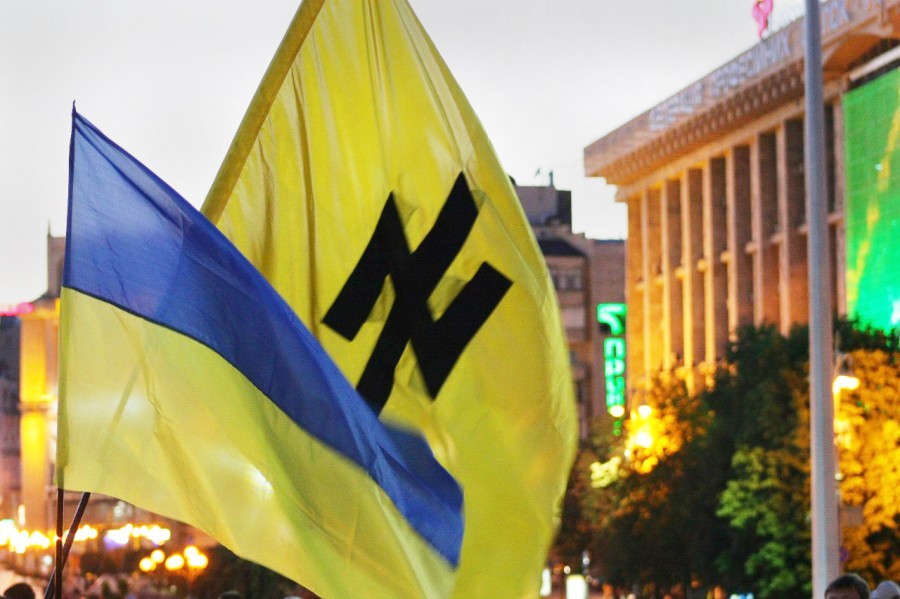
The neo-Nazi Wolfsangel symbol on a banner in Ukraine.
Ukraine’s ousted President Viktor Yanukovych was surely no one’s idea of a pristine politician, though it looks like there are few to none of those in Ukraine, a country essentially controlled by a collection of billionaire oligarchs who jockey for power and shift their allegiances among corrupt politicians.
But Yanukovych was elected in what was regarded as a reasonably fair election in 2010. Indeed, some international observers called the election an important step toward establishing an orderly political process in Ukraine.
But Yanukovych sought to maintain cordial relations with neighboring Russia, which apparently rubbed American neocons the wrong way. Official Washington’s still-influential neocons have been livid with Russia’s President Vladimir Putin because he cooperated with U.S. President Barack Obama in averting U.S. wars against Iran and Syria.
In both cases, the neocons thought they had maneuvered Obama into confrontations that could have advanced their long-term strategy of “regime change” across the Middle East, a process that started in 2003 with…