Roadside bomb kills two in NW Pakistan

0

Pakistani volunteers shift the body of a polio vaccination worker from a hospital morgue in Karachi on December 18, 2012.

At least two polio vaccination workers have been killed in a roadside bombing in Pakistan’s northwestern tribal region, officials say.

“The two-men team was visiting Mali Khel village in upper Kurram tribal region when an improvised explosive device planted along the roadside went off, killing them on the spot,” said Jawad Ali, who is in charge of the UN-sponsored vaccination program in the region near the Afghan border, on Thursday.

On Tuesday, gunmen shot dead a police officer protecting a group of polio workers in the village of Gullu Dheri in the northwestern province of Khyber Pakhtunkhwa.

On January 1, seven charity workers were killed in a drive-by shooting in the same region.

Nine polio vaccination workers were also killed in similar attacks across the country in December 2012.

No group or individual has claimed responsibility for the attacks so far, but officials put the blame on Taliban militants, who ordered a ban on polio vaccination campaign in Pakistan’s North Waziristan tribal area in June 2012, saying it could be a cover-up for US espionage operations.

Since late 2009, there has been a surge in militant attacks in Pakistan. Thousands have been displaced by the wave of violence and militancy sweeping the country.

MAM/MHB

The Tearing Of Europe’s Social Fabric

0

We have long-discussed the growing concerns of a rising level of social unrest in Europe. Our go-to chart has been youth unemployment – and it still reigns supreme as the scariest chart for European leaders (no matter what they publically claim). JPMorgan’s Michael Cembalest shares our concern as he opines on the potential for a tear in the social fabric in Europe.

Via Michael Cembalest, CIO JPMorgan,

Over the last couple of years, we have been watching the social fabric in Europe given 18% unemployment (and rising). With little growth on the horizon, it’s not clear how jobs will improve much, and what the long-term social implications will be.

Whether it’s Europe in the 1930’s or the US during the same period (conflicts between strikers, the National Guard and armed militias), unemployment can create a powerful cocktail of unrest.

So far, European demonstrations have been fewer than what one might have expected given the situation.

Could a mitigating factor in Europe be a better starting point vs. other countries?

“Quality of life” is hard to measure. There are organizations that give it a shot: the most detailed version we have seen is from the OECD. There are clear patterns in the OECD data: on issues related to work-life balance, life expectancy, environment, personal safety, family support network and life satisfaction, the Eurozone ranks ahead of the US. However, the recession does seem to be taking its toll: fertility rates, which were finally rising in Europe during the prior decade, declined sharply in 2011; according to the UK Economic and Social Research Council, suicides have been rising in Italy and the UK due to economic stress; and in Spain, there has been an increase in observed depression, anxiety and mood disorders (as per the Red de Actividades Preventivas y Promoción de la Salud en Atención Primaria). The imposition of regressive VAT taxes has also widened income disparities in many countries. Some of the same trends are observed in other countries which experienced a large recession, like the US.

While there may be increasing cracks in the social fabric, so far, concrete political manifestations have been limited. Despite the complaints that show up in Eurobarometer surveys, Eurozone citizens appear committed to persevering with the Euro despite the hardships. With the ECB doing the heavy lifting instead of national parliaments making large fiscal transfers, the perceived costs of the regionwide bailout seem low. No political party that clearly advocates Eurozone withdrawal have done well in national elections, not in the surplus countries in the North, nor in the deficit countries in the South (the closest would be the Movimento 5 Stelle, or M5S, in Italy). We have noted in the past the modest rise of rightist parties in some countries, but so far the political status quo is holding better than I thought it would. This is particularly true in Germany, where opposition parties are also pro-Eurozone, if not moreso. I suppose there’s still a long way to go, and that the impact of a generation of disenfranchised, jobless youths will take time to appear.

In 1992, the author of the German Constitutional Court opinion on Maastricht wrote the following:

“A Europeanisation without a prior European consciousness and therefore without a European people with a concrete capability and readiness for common statehood would be, in terms of the history of thought, un-European”.

Could it be that the social fabric in Europe is stronger than many perceive it to be, and that “Europeanization” has advanced a lot since 1992? Perhaps; but I am equally tempted to believe that Europeans simply recognize the financial and economic dangers of immediate dissolution, and remember the words of Benjamin Franklin: “We must all hang together, or most assuredly we shall all hang separately!”

Your rating: None

Ashton: Iran, P5+1 will meet soon

0

The European Union foreign policy chief, Catherine Ashton says a new round of talks between Iran and the P5+1 group will be held soon.

“I am confident there will be a meeting soon,” Ashton said on Thursday in Brussels, The Associated Press reported.

Ashton represents the P5+1 group (the United States, France, Russia, Britain, China, and Germany) in the talks.

On Wednesday, Iran’s Foreign Minister Ali Akbar Salehi said no new date or venue has been set for the next round of talks between Iran and the group.

Iran and the P5+1 group have held several rounds of talks with a focus on Iran’s nuclear energy program. The last round of negotiations between Iran and the group was held in Moscow in June 2012.

Tehran has announced that it welcomes the fact that the P5+1 group is ready to hold constructive talks with Iran.

The United States, Israel, and some of their allies have repeatedly accused Iran of pursuing non-civilian objectives in its nuclear energy program.

Iran rejects the allegations, arguing that as a committed signatory to the nuclear Non-Proliferation Treaty (NPT) and a member of the International Atomic Energy Agency (IAEA), it is entitled to develop and acquire nuclear technology for peaceful purposes.

In addition, the IAEA has conducted numerous inspections of Iran’s nuclear facilities but has never found any evidence showing that the Iranian nuclear program has been diverted to nuclear weapons production.

KA/HN

Fox Suggests Welfare Queens Responsible For Obama’s High Popularity

0

You’d think that since the “47%” meme hasn’t worked out so well, Fox would have dropped it by now. But, like that old definition of insanity, they keep doing the same thing and expecting new results. Only now it’s the 60% of Americans who approve of President Obama’s job performance, despite the “dismal” economy, who are the “takers.”

On Fox & Friends this morning, the Curvy Couch Crew gnashed their teeth over the the fact that President Obama is riding high in popularity even as the economy shrank in the last quarter for the first time since 2009.

Steve Doocy said about the economic news:

How could it be unexpected? All you’ve gotta do is look at what’s about to happen. We’re about to decimate the national security. There’s a possibility the 1.2 million security jobs could be lost in this country, plus all the regulations placed on businesses with the Affordable Care Act. It’s shocking that the number isn’t worse.

Then with his clown face, Doocy sneered that White House spokesman Jay Carney isn’t blaming George Bush now. “He just blames the Republicans in general.”

Brian Kilmeade, noting that the stock market is up, but consumer confidence down, cried out, “But the president’s approval rating is 60%! It’s like he’s impervious to numbers!”

Doocy made sure to throw cold water on the stock market rise. He said the market is up because “the Fed is pumping all this dough every month, billions and billions of dollars into the economy. And the unemployment number — you know, it’s just under 8% but it would be much higher if you factored in all the people who simply said, ‘I can’t find a job. We give up!’”

Having established the economic gloom and doom, they then turned to the question of why President Obama is so popular. Of course, they could have done a teensy bit of research and discovered that the country received his second inaugural address very favorably. Despite Fox News’ best efforts. Or that, as Nate Silver recently pointed out, Obama “has at least a slim majority of Americans in his corner” on most of the issues he raised, including guns, climate change and immigration. Also despite Fox’s best efforts.

Instead of facts, Doocy opined that the “mainstream media” is responsible for Obama’s popularity because it has not reported enough about how “dismal” the economy is. He added, “It’s the same thing in the run up to the election. The number one story affecting the most Americans: the economy. But instead, what do we get? We got the 47%, war on women. We got the binders, we got everything except what really matters.”

You mean like Benghazi? Or birtherism? You didn’t build that? Or how the polling was not accurately predicting Romney’s victory?

Gretchen Carlson wasn’t convinced. She said, “People will write books about this for years on end how the popularity of this president remained so high and yet the economy remains relatively dismal.”

So, without bothering to lift a finger to come up with any actual data, they turned to their audience for “answers.” Previously Carlson had said they had received “different thoughts” from viewers as to why the president is still so popular. First, Carlson summarized by saying, “Some people said that it’s because, you know, a lot of people now are in situations where they’re receiving government handouts and so they like to see a president in power who believes in continuing to do those types of programs.”

Then they posted some individual emails and/or tweets reinforcing that view:

  • Ever heard the saying, ‘Don’t shoot Santa Clause?” If you do not work, you had no increase in payroll deductions. If you’re here illegally, you have the same rights as legal citizens and now everyone is going to be granted legal status.” (from “Charley”)
  • That’s easy, It is because he hands out welfare like we hand out candy to kids at Halloween. Groceries, cell phone, gas, house, TV and any other thing you can think of… without having to put an effort to get off the couch and get a job. Why not like that person? (from “Scott”)

However, Carlson did dig up a tweet from Republican Senator John Thune responding to Jay Carney’s remarks and asking, “What planet do these guys live on?”

Um, maybe the one where S&P downgraded the U.S. credit rating because of Republican “brinksmanship.” But you probably won’t hear much about that on Planet Fox News.

4 Ways the Super Bowl Sucks For New Orleanians

0

From diverting precious resources to screwing up Mardis Gras, the game brings plenty of grief.

Photo Credit: Shutterstock.com

January 31, 2013  |  

Like this article?

Join our email list:

Stay up to date with the latest headlines via email.

For the first time since Hurricane Katrina visited the Gulf Coast, the Super Bowl returns to the stadium that served as shelter of last resort for thousands left stranded by the storm. In those tragic hours, the Superdome stood as a symbol of the contradictions of life in New Orleans, juxtaposing the gleam of its tourism industry against the bleak realities of many of its residents.  

Fast-forward seven years, and much remains the same. The city’s murder rate in 2012 was 53 per 100,000, 12 times the national average. Meanwhile, New Orleans has the second highest homelessness rate in the country, impacting over 10,000 people. Like the streets, the jails are filled to the brim. One in seven black men in the city is behind bars, on parole or on probation.

It would seem that a city facing such profound social issues would focus on addressing them, rather than rushing to accommodate a major sporting event. However, public officials argue that the worldwide attention and tourism dollars generated by the Super Bowl benefit everyone. But do they? A closer look shows that the costs and benefits of the preparations for the game are inequitably distributed. Here are four ways ordinary New Orleanians are burdened by hosting this Super Bowl.

1. Screwing with Mardi Gras.

The most immediately visible impact of the Super Bowl on locals this week is that carnival celebrations have ceased for the nine-day period bookending the game, per the mayor’s orders. This does not impact the high-profile final week of celebrations, which will generate close to $1 billion in local tourist revenue, without the need to rehab much of anything. But carnival in Louisiana goes on for weeks, commencing with 12th night on January 6, and ending with Mardi Gras, which falls on February 12 this year. For the last few weeks, parades are held in cities and towns across the state, giving local and regional crowds a chance to enjoy the festivities without the massive tourist inundation present during the final week.

In order to make space for the Super Bowl, parades normally scheduled for this weekend were moved up a week. This placed them closer to the holiday season, which generally causes a negative pressure on membership in the non-profit “krewes” that put on the festivities. This has resulted in some logistical nightmares involving timing location and float reservations. As a result, many of the smaller krewes have simply had to scale back this year.

Unlike the Super Bowl, Mardi Gras is known as the “Greatest Free Show on Earth.” It does not cost anything to partake in the revelry of one of the nation’s oldest ongoing festivals. Meanwhile, most New Orleanians gain little from having the Super Bowl in town: they will have the same view as everyone else watching on their TVs.

2. Uneven infrastructure investment.

Most of the $1 billion in renovations have focused on the tourism industry: a fresh slab of concrete over eight blocks of the French Quarter, a $336 million facelift of the Superdome, $350 million of improvements to the airport, and $52 million for a new streetcar. The pretty veneer may appeal to football fans arriving for the game, but it comes at the expense of needed upgrades through the remainder of the city. Even relatively affluent neighborhoods have streets in disrepair, while poorer areas are prone to flooding with practically every summer storm.

Meanwhile, other vital public services have been ravaged by the politics of austerity since Katrina passed. Most recently, Governor Jindal has placed the public hospital system on the chopping block. Last year, the Louisiana State University public hospital program saw $152 million in cuts throughout the state, on top of a $30 million cut from emergency mental health services earlier. These reductions only serve to aggravate a precarious situation created by the permanent shuttering of the longstanding Charity public hospital, which never reopened after Katrina.

Guest Post: The Linchpin Lie: How Global Collapse Will Be Sold To The Masses

0

Submitted by Brandon Smith of Alt-Market blog,

In our modern world there exist certain institutions of power.  Not government committees, alphabet agencies, corporate lobbies, or even standard military organizations; no, these are the mere “middle-men” of power. The errand boys. The well paid hitmen of the global mafia. They are not the strategists or the decision makers. 

Instead, I speak of institutions which introduce the newest paradigms. Who write the propaganda. Who issue the orders from on high. I speak of the hubs of elitism which have initiated nearly every policy mechanism of our government for the past several decades. I am talking about the Council On Foreign Relations, the Tavistock Institute, the Heritage Foundation (a socialist organization posing as conservative), the Bilderberg Group, as well as the corporate foils that they use to enact globalization, such as Monsanto, Goldman Sachs, JP Morgan, the Carlyle Group, etc.

Many of these organizations and corporations operate a revolving door within the U.S. government. Monsanto has champions, like Donald Rumsfeld who was on the board of directors of its Searle Pharmaceuticals branch, who later went on to help the company force numerous dangerous products including Aspartame through the FDA. Goldman Sachs and JP Morgan have a veritable merry-go-round of corrupt banking agents which are appointed to important White House and Treasury positions on a regular basis REGARDLESS of which party happens to be in office. Most prominent politicians are all members of the Council on Foreign Relations, an organization which has openly admitted on multiple occasions that their goal is the destruction of U.S. sovereignty and the formation of a “one world government” or “supranational union” (their words, not mine).

However, one organization seems to rear its ugly head at the forefront of the most sweeping mass propaganda operations of our time, and has been linked to the creation of the most atrocious military methodologies, including the use of false flag events. I am of course referring to the Rand Corporation, a California based “think tank” whose influence reaches into nearly every sphere of our society, from politics, to war, to entertainment. 

The Rand Corporation deals in what I would call “absolute gray”. The goal of the group from its very inception was to promote a social atmosphere of moral ambiguity in the name of personal and national priority. They did this first through the creation of “Rational Choice Theory”; a theory which prescribes that when making any choice, an individual (or government) must act as if balancing costs against benefits to arrive at an action that maximizes personal advantage. Basically, the ends justify the means, and moral conscience is not a factor to be taken seriously if one wishes to be successful. 

Hilariously, rational choice theory has been attacked in the past by pro-socialist (collectivist) critics as “extreme individualism”; a philosophy which gives us license to be as “self serving” as possible while feeling patriotic at the same time. In reality, the socialists should have been applauding Rand Corporation all along. 

What Rand had done through its propaganda war against the American people was to infuse the exact culture of selfishness needed to push the U.S. towards the socialist ideal. At the onset of any communist or national socialist society (sorry socialists, but they do indeed come from the same collectivist mindset), the masses are first convinced to hand over ultimate power to the establishment in order to safeguard THEMSELVES, not others. That is to say, the common collectivist man chooses to hand over his freedoms and participate in totalitarianism not because he wants what is best for the world, but because he wants what is best for himself, and he believes servitude to the system will get him what he wants with as little private sacrifice as possible (you know, except for his soul…). 

The psychologist Carl Jung notes in his observations of collectivism in Nazi Germany and Stalinist Russia that most citizens of those nations did not necessarily want the formation of a tyrannical oligarchy, but, they went along with it anyway because they feared for their own comfort and livelihoods.  Many a German supported the Third Reich simply because they did not want to lose a cushy job, or a steady paycheck, or they liked that the “trains ran on time”. Socialism is by far the most selfish movement in history, despite the fact that they claim to do what they do “for the greater good of the greater number”.

Rand also used Rational Choice Theory as a means to remove questions of principle from the debate over social progress. Rational Choice propaganda commonly presents the target audience with a false conundrum. A perfect example would be the hardcore propaganda based television show ‘24’ starring Kiefer Sutherland, in which a government “anti-terrorism” agent is faced with a controlled choice scenario in nearly every episode. This choice almost always ends with the agent being forced to set aside his morals and conscience to torture, kill, and destroy without mercy, or, allow millions of innocents to die if he does not.

Of course, the real world does not work this way. Life is not a chess game.  Avenues to resolution of any crisis are limited only by our imagination and intelligence, not to mention the immense number of choices that could be made to defuse a crisis before it develops. Yet, Rand would like you to believe that we (and those in government) are required to become monstrous in order to survive. That we should be willing to forgo conscience and justice now for the promise of peace and tranquility later.

This is the age old strategy of Centralization; to remove all choices within a system, by force or manipulation, until the masses think they have nothing left but the choices the elites give them. It is the bread and butter of elitist institutions like Rand Corporation, and is at the core of the push for globalization.

In my studies on the developing economic disaster (or economic recovery depending on who you talk to) I have come across a particular methodology many times which set off my analyst alarm (or spidey-sense, if you will). This latest methodology, called “Linchpin Theory”, revolves around the work of John Casti, a Ph.D. from USC, “complexity scientist” and “systems theorist”, a Futurist, and most notably, a former employee of Rand Corporation:

http://www.viennareview.net/vienna-review-book-reviews/book-reviews/john-casti-an-optimist-of-the-apocalypse

Casti introduces his idea of “Linchpin Theory” in his book “X-Events: The Collapse Of Everything”, and what I found most immediately striking about the idea of “Linchpin Events” was how they offered perfect scapegoat scenarios for catastrophes that are engineered by the establishment. 

Linchpin Theory argues that overt social, political, and technological “complexity” is to blame for the most destructive events in modern human history, and it is indeed an enticing suggestion for those who are uneducated and unaware of the behind the scenes mechanics of world events. Casti would like you to believe that political and social tides are unguided and chaotic; that all is random, and disaster is a product of “chance” trigger events that occur at the height of a malfunctioning and over-complicated system.

What he fails to mention, and what he should well know being a member of Rand, is that global events do not evolve in a vacuum. There have always been those groups who see themselves as the “select”, and who aspire to mold the future to there personal vision of Utopia. It has been openly admitted in myriad official observations on historical events that such groups have had a direct hand in the advent of particular conflicts.  

For instance, Casti would call the assassination of Archduke Franz Ferdinand of Austria an “X-event”, or linchpin, leading to the outbreak of WWI, when historical fact recalls that particular crisis was carefully constructed with the specific mind to involve the U.S.

Norman Dodd, former director of the Committee to Investigate Tax Exempt Foundations of the U.S. House of Representatives, testified that the Committee was invited to study the minutes of the Carnegie Endowment for International Peace as part of the Committee’s investigation. The Committee stated:

“The trustees of the Foundation brought up a single question. If it is desirable to alter the life of an entire people, is there any means more efficient than war…. They discussed this question… for a year and came up with an answer: There are no known means more efficient than war, assuming the objective is altering the life of an entire people. That leads them to a question: How do we involve the United States in a war. This was in 1909.”

So, long before the advent of Ferdinand’s assassination, plans were being set in motion by globalist interests to draw the U.S. into a large scale conflict in order to “alter the life, or thinking, of the entire culture”. When a group of people set out to direct thinking and opportunity towards a particular outcome, and the end result is a culmination of that outcome, it is obviously not coincidence, and it is definitely not providence. It can only be called subversive design. 

In the economic arena, one might say that the collapse of Lehman Bros. was the “linchpin” that triggered the landslide in the derivatives market which is still going on to this day.  However, the derivatives market bubble was a carefully constructed house of cards, deliberately created with the help of multiple agencies and institutions. The private Federal Reserve had to artificially lower interest rates and inject trillions upon trillions into the housing market, the international banks had to invest those trillions into mortgages that they KNEW were toxic and likely never to be repaid. The Federal Government had to allow those mortgages to then be chopped up into derivatives and resold on the open market. The ratings agencies had to examine those derivatives and obviously defunct mortgages and then stamp them AAA. The SEC had to ignore the massive fraud being done in broad daylight while sweeping thousands of formal complaints and whistle blowers under the rug.

This was not some “random” event caused by uncontrolled “complexity”. This was engineered complexity with a devious purpose. The creation of the derivatives collapse was done with foreknowledge, at least by some. Goldman Sachs was caught red handed betting against their OWN derivatives instruments! Meaning they knew exactly what was about to happen in the market they helped build! This is called Conspiracy…

One might attribute Casti’s idea to a sincere belief in chaos, and a lack of insight into the nature of globalism as a brand of religion. However, in his first and as far as I can tell only interview with Coast To Coast Radio, Casti promotes catastrophic “X-Events” as a “good thing” for humanity, right in line with the Rand Corporation ideology. Casti, being a futurist and elitist, sees the ideas of the past as obsolete when confronted with the technological advancements of the modern world, and so, describes X-event moments as a kind of evolutionary “kickstart”, knocking us out of our old and barbaric philosophies of living and forcing us, through trial by fire, to adapt to a more streamlined culture. The linchpin event is, to summarize Casti’s position, a culture’s way of “punishing itself” for settling too comfortably into its own heritage and traditions. In other words, WE will supposedly be to blame for the next great apocalypse, not the elites…  

I might suggest that Casti’s attitude seems to be one of general indifference to human suffering in the wake of his “X-Events”, and that he would not necessarily be opposed to the deaths of millions if it caused the “advancement” of humanity towards a particular ideology. His concept of “advancement” and ours are likely very different, though. I suspect that he is well aware that X-Events are actually tools at the disposal of elitists to generate the “evolution” he so desires, and that evolution includes a collectivist result.

With almost every major economy on the globe on the verge of collapse and most now desperately inflating, taxing, or outright stealing in order to hide their situation, with multiple tinderbox environments being facilitated in the Pacific with China, North Korea, and Japan, and in the Middle East and Africa with Egypt, Syria, Iran, Pakistan, Yemen, Mali, etc., there is no doubt that we are living in a linchpin-rich era. It is inevitable that one or more of these explosive tension points will erupt and cause a chain reaction around the planet. The linchpin and the chain reaction will become the focus of our epoch, rather than the men who made them possible in the first place.

Strangely, Casti’s theory was even recently featured in an episode of the ABC mystery/drama show “Castle”, called “Linchpin” (what else?), in which a writer turned detective uncovers a plot by a “shadow group” to use the research of the innocent Dr. Nelson Blakely (apparently based on Casti) to initiate a collapse of the U.S. economy by assassinating the ten-year-old daughter of a prominent Chinese businessman, triggering a dump of U.S. Treasuries by China and fomenting WWIII:

http://www.alterna-tv.com/castle/xevents.htm

Now, I think anyone with any sense can see where this is going. Casti and Rand Corporation are giving us a glimpse into the future of propaganda. This is what will be written in our children’s history books if the globalists have their way. The fact that Linchpin Theory is featured in a primetime television show at all is a testament to Rand Corporation’s influence in the media. But, as for the wider picture, are the trigger points around us really just a product of complex coincidence? 

Not a chance. 

Each major global hot-spot today can easily be linked back to the designs of international corporate and banking interests and the puppet governments they use as messengers.  Casti claims that “X-events” and “linchpins” cannot be accurately predicted, but it would seem that they can certainly be purposely instigated. 

The globalists have stretched the whole of the world thin.  They have removed almost every pillar of support from the edifice around us, and like a giant game of Jenga, are waiting for the final piece to be removed, causing the teetering structure to crumble. Once this calamity occurs, they will call it a random act of fate, or a mathematical inevitability of an overly complex system. They will say that they are not to blame. That we were in the midst of “recovery”. That they could not have seen it coming.

Their solution will be predictable.  They will state that in order to avoid such future destruction, the global framework must be “simplified”, and what better way to simplify the world than to end national sovereignty, dissolve all borders, and centralize nation states under a single economic and political ideal? 

Is it the Hegelian Dialectic all over again? Yes. Is it old hat feudalism and distraction? Yes. But, I have to hand it to Casti and Rand Corporation; they certainly have refined the argument for collectivism, centralization, technocracy, slavery, moral relativism, and false-flag dupery down to a near science…

Your rating: None Average: 5 (1 vote)

Don’t Be Fooled, Real 4Q12 GDP Was Even Worse Than 0.14%

0

A few weeks ago we commented that the Great Global Rig of 2012 was ending. Yesterday’s GDP print confirms this.

We noted in the second half of 2012 that the US Federal Government was engaging in a massive rig to make the economy look better than it really was in order to help the Obama re-election campaign. This showed up in the jobs data as well as the 3Q12 GDP print.

Now the election is over and we’re stuck with the hangover. The mainstream media likes to claim that the fourth quarter GDP number is the result of the Government cutting spending, but the truth is that Government outlays increased 12% in 4Q12. 

Indeed, the sad truth is that the US economy is actually in far worse shape than the official data indicates. As we’ve noted before, the Feds dramatically understate inflation to make GDP growth look better.

Case in point, the GDP deflator today is a mere 0.6% when real inflation is closer to 8%. So even the -0.14% print is in fact overstating real growth dramatically. If you account for the real increases in the cost of living in the US, GDP shrank well over 1% in 4Q12.

The impact of this will be huge. Remember that the Fed only just announced QE 3 and QE 4 in the second half of 2012. The fact that we’ve got this terrible GDP print in spite of this doesn’t do much for the Fed’s claim that QE will stimulate growth.

As we noted in yesterday’s article, the Fed is already splintering on the benefits of QE. For the US to print such an ugly GDP number right after QE 3 and QE 4 were announced doesn’t bode well for more aggressive policy from the Fed. But then again, we are talking about the Fed here, so they could very easily claim that the bad GDP print is because QE 3 and QE 4 are not big enough.

Regardless of this, it’s clear the market is peaking out. The Russell 2000 has begun to diverge from the Dow and S&P 500. Former leaders like Apple and RIMM are tanking, while companies that are losing business rapidly (Amazon) continue to rally.

This is precisely the sort of action we saw going into the Tech top and the 2007 top. The Fed has managed to create a bubble in stocks and housing again… right as the US economy collapses (just like in 2000 and 2007). We all know what came next.

For more market commentary and investment insight as well as several FREE Special Reports outlining some of the biggest risks in the financial system today, visit us at www.gainspainscapital.com

Best Regards

Phoenix Capital Research

Your rating: None Average: 5 (2 votes)

Tar Sands Blockade: The Dangers of the TransCanada Keystone XL Pipeline

0

By William Boardman

Sunlight shines through faulty welds in the pipe of Keystone XL’s Gulf Coast pipeline leg, according to members of the Tar Sands Blockade, who are offering, as proof, photographs they say they took from inside the pipe on December 3.

Ramsey Sprague, a young Texan with the Blockade, dramatically made this claim at a pipeline industry conference in Houston, shortly after it got under way at the Woodlands Waterway Marriott Hotel in Houston Thursday morning. He also promised that whistleblowers inside TransCanada would be coming forward with further evidence of flaws in the pipeline.

Tom Hamilton of TransCanada is the Manager of quality and compliance for the Keystone Oil Pipeline this currently under construction in East Texas. He had gotten a few minutes into his presentation, a case study titled “Building an ISO 9001 Pipeline System: TransCanada’s Gulf Coast Project” when he was interrupted by Sprague, who had managed to chain himself to the conference loudspeaker towers.

Wearing a suit and tie and a cowboy hat, Sprague had not drawn attention while he sat through the first part of the program. As described on the Tar Sands Blockade web page, as described by the cameraman who documented the event:

“Ten minutes into Hamilton’s time at the podium, Ramsey stood up and chained himself to the sound equipment positioned next to the projection screen, quickly delving into an impassioned speech on the irony of TransCanada lecturing others on safety and compliance. The audience sat silent, cameras aimed at this impromptu act, as security officials attempted to address the situation without having to clear the room.

“ As Ramsey spoke against TransCanada’s horrific safety record, as well as its treatment of indigenous communities and others whose land and lives are being adversely affected by tar sands extraction, authorities escorted him out of the assembly and into police custody. After being detained by three Montgomery County sheriffs for documenting the act (and subsequent arrest), I was given a trespass warning and told to leave the property immediately.”

No Public Comment Yet from TransCanada

TransCanada has not yet publicly responded to questions about the charge that their pipeline in Texas has faulty welds which would make it likely to leak as soon as it’s put into service.

Tom Hamilton’s scheduled case study of the Gulf Coast pipeline project was expected to focus on pipeline safety. As billed in the conference program,

“Mr. Hamilton has supplied technical consulting services to a wide range of pipeline clients in the fields of quality management systems, welding and NDE, above and below ground protective coatings, cathodic protection system design, specifications, system installation and performance affirmation, corrosion control troubleshooting, and pipeline system integrity management.”

The bullet points of his talk included:

· Reviewing the current progress of Keystone’s Gulf Coast segment

· How have ISO 9001 requirements impacted pipeline design, construction, and delivery?

· Overcoming the challenges associated with bringing new processes into large diameter pipeline projects built by third-party contractors

· Right the first time — Highlighting best practices that have seen safety, quality and environmental stewardship improve while remaining on time and on budget

· Discussing how ISO 9001 quality management systems aid in managing expectations when engaging and educating stakeholders

 ISO refers to the International Organization for Standardization and ISO 9001 requirement are “generic and are intended to be applicable to all organizations, regardless of type, size and product provided.”

Sprague’s Critique Was Underscored by Dave Brubeck

While he was chained to the speakers, Sprague shouted warnings to the audience about the dangers the pipeline represents, but there was little or no response from the crowd. He also spoke quietly and politely to a few people who approached him. The interruption of the conference lasted only a little longer than the eight minutes that were recorded.

While he was talking, Sprague described the events of December 3, 2012, when pipeline opponents blockades themselves inside the pipeline for about a day before they were forced out. During that time they took pictures from the inside showing light coming through the pipe welds. According to the Tar Sands Blockade: “That mile-long section of the pipe was laid in the ground on the same day; no additional welding or inspection occurred after the photos were taken.”

For several minutes Sprague had to shout loudly to project his voice over loud music played by the conference, selections by the Dave Brubeck Quartet. Once organizers brought bolt cutters and cut Sprague loose, he was escorted from the room as he told people in the hallways, “TransCanada should not be lecturing about pipeline safety.”

“Occupy”: Unity Will Increase Our Power

0

occupywallstreet

Getting to the Next Level of Constructing a New Society Requires a Common Vision, Strategy and Unity

Once again the corporate mass media got the story wrong. Headlines across the country claimed that occupiers in New York came from households with incomes of over $100,000. The movement writer for The Nation, Allison Kilkenny, interviewed one of the researchers who points out that a lot of these were young people earning under $15,000 per year who were still in school and living with their parents.

The most important takeaway lesson from the researcher’s point of view:

“The takeaway for me is that this is part of an arch of social movement activity that built on previous work, and is building into continuing work.”

That struck us because we are working with political activists and occupiers across the country to develop a strategy to reach a more effective level of advocacy for transformation to a peaceful, just and sustainable society.

An article from Yes! Magazine, Occupy 2.0: The Great Turning, resonated with us pointing out that there are thousands of people working in movements around the world and that uniting them would create an unstoppable force. How do we unite in a way where we keep the diversity of multiple movements but still work together in solidarity?  The answer in part is a common vision and strategic framework. The author, Michael Nagler of the Metta Center, puts forward a strategy they have been developing which they call “The Roadmap.” (The article links to a webinar on this approach.)

Their approach recommends a two track strategy similar to one we have emphasized from the beginning, Stop the Machine, Create a New World; or a resistance program of direct action and a constructive program of building what we want. This approach dates back to Gandhi and has been used in many transformative movements.In an article about the hidden history of economic democracy and how it relates to major social transformations throughout U.S. history, we summarized these two tracks by writing:

“History reinforces the idea that to achieve transformational change, we must proceed on twin tracks: protesting and building. Mahatma Gandhi changed his emphasis in the mid-1930s, a dozen years before independence from the British Empire, to work focused on building economically self-reliant communities from below (sardovaya, or social uplift for all). This became an adjunct to the strategy he is most known for, satyagraha (noncooperation and civil disobedience to unjust laws). Gandhian economics meant thousands of self-sufficient small communities with self-rule and the need for economic self-sufficiency at the village level joined together in a cooperative federation of village republics. This is bookended by the Gandhian social ideal of dignity of labor, equitable distribution of wealth, communal self-sufficiency and individual freedom.”

There is incredible work going on throughout the United States on both these tracks. Economic democracy is gaining a foothold in the U.S. putting in place the kind of economy we want. And resistance continues to grow. In the last ten days we have reported on the following protests:

That is just in the past ten days! And, we have no doubt we are not reporting anywhere near all the protests that are occurring. As we found out when we were organizing the Occupation of Washington, DC at Freedom Plaza, Americans have been in revolt for a long time, the media just does not report it.

For a while Occupy brough a lot of movements together under the broad anti-Wall Street goal of economic fairness and justice; that was one reason the movement was not ignored. But now greater solidarity is needed, in order to show that there is a mass movement that people should be part of, a movement that can succeed in shifting power from concentrated wealth to the people.

One thing needed to bring the movement for social justice to the next level is unity. It will take many working together to achieve effective solidarity. At OccupyWashingtonDC/Ocober2011, we are considering what we can do to advance solidarity. We ask for your thoughts, write us at info@octobr2011.org. Of course, unity is not all that is needed, but it is one step.

In the meantime, realize that Americans are awakening and taking action. Whether they are helping to build cooperatives, community or public banks, community-supported agriculture and farmers markets or other more democratic economic institutions; or whether they are protesting the mistaken direction of the U.S. economy and government — a lot of good work is being done and we should rejoice that so many are working to create a new world.

Some upcoming events:

  • February 6, 2013: Flood the NY Federal Courthouse on in opposition to the NDAA, see here and here.
  • February 9, 2013: Anti-Drone Protest at the CIA Headquarters, information here

Activities that are asking for support:

  • The Rolling Jubilee continues to eradicate debt, get involved! Click here for information.
  • Occupy Sandy in New York and New Jersey continues to clean up and help people get their lives back. Click here for information and here.
This article is a modified version of a weekly newsletter that covers activities in Occupy and other political movements. You can sign up to receive the newsletter here.
Kevin Zeese and Margaret Flowers were both organizers of the Occupation of Washington, DC at Freedom Plaza, co-direct It’s Our Economy which works for economic democracy and co-host Clearing the FOG radio and television.

Sandy Hook Parent David Wheeler: My Son Had Right To His Life

0

I only wish he had given this powerful testimony before Congress, too — while staring straight into the eyes of Wayne LaPierre.

Via The Last Word:

Today, another Sandy Hook parent advocated for stricter gun laws on behalf of his murdered child. David Wheeler, father of victim Ben Wheeler, spoke Wednesday at the last of four public hearings by the Connecticut legislature’s Bipartisan Task Force on Violence and Public Safety. In his testimony, Wheeler called for a “comprehensive system of identifying and monitoring individuals in mental distress.”

[…] Speaking in front of a 52-member task force, Wheeler decried the inability of agencies to share relevant information about at-risk individuals’ personal histories, mental states, and proximity to firearms. He also advocated a ban on military-style assault weapons, saying they “belong in an armory under lock and key,” and for annual registration of personal firearms.

Finally, Wheeler invoked Thomas Jefferson’s inalienable rights of “life, liberty, and the pursuit of happiness” from the Declaration of Independence. “I do not think the composition of that foundational phrase was an accident,” he said. “I do not think the order of those important words was haphazard or casual. The liberty of any person to own a military-style assault weapon and a high-capacity magazine and keep them in their home is second to the right of my son to his life.”

Amen, David Wheeler. And please, send a written copy of that to the NRA.

Fifteen dead, scores injured as blast rocks Mexican state oil company’s HQ (VIDEO, PHOTOS)

0

Blast rocks Mexican state oil company's building

Blast rocks Mexican state oil company’s building

At least one person has reportedly been killed and at least 30 injured after a blast rocked the high-rise headquarters of Pemex, a state-owned Mexican oil company, in Mexico City.

­At least one person has been confirmed dead in the explosion, Mexico’s Milenio Diario reports.

The Pemex tower has been evacuated, with police, rescue and army at the scene.

A gas buildup in an electric substation in the tower’s basement is thought to have caused the explosion, though authorities have not confirmed that this is definitely the source.

Pemex had reported a problem with the building’s power supply prior to the blast, Reuters reports.

­DETAILS TO FOLLOW

The Art of War: The Reconquest of Africa

0

Hillary missionnaire en Afrique

At the very moment when the Democratic Party President Barack Obama reiterated in his inaugural address that the United States “must be a source of hope for the poor” and will “support democracy from Asia to Africa,” giant U.S. C-17 aircraft were carrying French troops into Mali, where Washington a year before had put in power Captain Sanogo, trained in the U.S. by the Pentagon and CIA, exacerbating Mali’s internal conflicts.

The speed with which France launched the operation, ostensibly to protect the Mali from the advance of Islamic rebels, shows that it had long since been planned by France’s Socialist Party President Francois Hollande. The immediate cooperation of the United States and the European Union, which also decided to send military specialists to Mali to carry out training and command functions, shows that it was planned jointly with Washington, Paris, London and other capitals.

The Western powers, whose multinational corporations vie with each other to grab markets and sources of raw materials, come together when their common interests are at stake, such as those in Africa endangered by popular uprisings and Chinese competition.

Mali, one of the poorest countries in the world (with a per capita income one-sixtieth of Italy’s, and with more than half of the population below the poverty line), is rich in raw materials. Mali exports gold and Coltan, the proceeds of which, however, ends in the pockets of multinational corporations and the local elite.

The same is true in neighboring Niger, which is even poorer (with a per capita income less than one-one-hundredth Italy’s) despite being one of the richest countries in uranium, whose extraction and export is in the hands of the French multinational Areva. Not surprisingly, at the same time as the operation in Mali, Paris has sent special forces into Niger.

A similar situation exists in Chad, whose rich oil deposits are exploited by the U.S. ExxonMobil and other corporations (but Chinese companies are also coming): what remains of the proceeds go into the pockets of the local elite. For criticizing such a mechanism, Bishop Comboni Michele Russo was expelled from Chad last October.

At the same time, Niger and Chad are providing thousands of soldiers who, under French command, have been sent to Mali to open a second front. The invasion launched in Mali with French forces as spearhead is therefore one of vast range, extending from the Sahel extends to West and East Africa. It is joined to the one in North Africa that began with the destruction of the Libyan state and maneuvers to stifle, in Egypt and elsewhere, the popular rebellions.

This is a long-term operation that is part of the strategic plan aimed at putting the whole continent under the military control of the “great democracies,” which are returning to Africa with their colonial pith helmets painted in the colors of peace.

Article in Italian :

Hillary missionnaire en Afrique

L’arte della guerra : La riconquista dell’Africa Il Manifesto, January 29, 2013

Translation: John Catalinotto

Speedboat Propeller Death: Father Speaks Out

0

A man has described how his 14-year-old son died in his arms after he became entangled in a propeller having been thrown by a huge wave from their speedboat during a day trip.

Charlie Hutton was travelling on the rigid hull inflatable boat (Rhib) driven by his father Simon and two friends when the accident happened off The Needles landmark off the Isle of Wight on July 20 last year.

Charlie, a keen hockey player whose ambition was to compete in the Olympics, fell into the water along with one of his friends, also aged 14, during the trip.

The group had started at Mudeford in Dorset where the family, from South Croydon, Surrey, have a second home and had been staying for a short holiday.

The friend suffered a serious ankle injury but was able to get back on the boat.

A third boy, also aged 14, and Mr Hutton, 52, managed to stay on board.

Mr Hutton, a graphic designer, described how he had gone for several trips on the boat with Charlie and his two friends in the days before the accident, including water-skiing on the previous day.

Mr Hutton, who had gained Royal Yachting Association training and had been using boats since the age of 12, said he bought the Cobra 6.5-metre Rhib new in June 2010 for £50,000.

He described heading to Alum Bay that afternoon, travelling at about 25-30 knots, when the boat began to be hit by large waves.

He said that the boys, who wore life jackets or buoyancy aids, enjoyed lying towards the front of the boat, hanging on to safety ropes.

Mr Hutton said that the boat was hit by two waves at the side causing him to slow down before it was hit by a large wave at the front.

“The two came from the side and then the water almost dropped away, it was like there was a big drop and then the wave came over us, it was like a big wall of water.

“I have never come across a wave like it, it engulfed the boat and kept going for a long time.”

Mr Hutton said he believed his son and one of his friends, who had both been at the front of the boat, were washed off the back of the boat.

He described how he found Charlie on top of the propeller.

He said: “I remember looking back and screaming ‘Where’s Charlie?’. My mind was buzzing, I suddenly realised that what I thought was oil was actually blood. There was quite a lot, about 3ft by 3ft.

“Charlie was to the right of the engine, conscious and looking at me, I tried to pull Charlie on to the boat but couldn’t.”

He added: “I saw his head bobbing, he was saying ‘Dad, help me’.”

He said that he then cut Charlie’s clothing from the propeller and pulled him on to the boat where he performed mouth-to-mouth resuscitation on him.

Mr Hutton said that he could see two wounds at the top of both of his son’s legs, one more serious than the other.

He said: “His eyes were open and he was looking at me. I tried to protect his face and told him I loved him, we all loved him.

“I could see Charlie’s eyes begin to roll, his breathing became shallow. I think he died at this point.”

He described how a Coastguard helicopter had responded quickly to his emergency calls and had advised him to carry out the resuscitation but he believed Charlie had died by the time he was airlifted off the boat.

Mr Hutton added: “I then phoned my wife Gill and said ‘I think I have killed Charlie’.”

The inquest heard that Charlie was airlifted to Southampton General Hospital where he was pronounced dead at 5.35pm.

A post-mortem examination showed he died of multiple injuries to his pelvis and left leg.

Mr Hutton and the other two boys, both from Reigate, Surrey, were taken ashore by lifeboat.

Mr Hutton said that he did not feel he had been driving the Rhib, which had a 200 horsepower engine, at excessive speed.

Caroline Sumeray, Isle of Wight coroner, recorded a verdict of accidental death.

She called on the leisure boating industry to promote the use of propeller guards to prevent further similar accidents.

Mr Hutton said: “If I had been aware of them I would probably have had one fitted.”

US-led troops injure 3 Afghan farmers

0

At least three Afghan farmers have been wounded after US-led forces opened fire on them in war-torn Afghanistan, Press TV reports.

The incident took place as the farmers were working on their fields in the northeastern province of Kunar on Thursday.

The US-led forces have reportedly apologized for the shooting.

Civilian casualties have long been a source of friction between the Afghan government and US-led foreign forces and have dramatically increased anti-US sentiments in Afghanistan.

The United States and its allies entered the war in Afghanistan in October 2001 as part of Washington’s so-called war on terror. The offensive removed the Taliban from power, but after more than 11 years, the foreign troops have still not been able to establish security in the country.

MAM/MHB

Report points to US space ambition

0

Experts at Spacecom communications company have said in a report that the US would have upgraded its military power to a high level in space by 2020.

In 2009 and for the first time, the Pentagon demanded allocation of budget for boosting the country’s military power in space, eliciting reaction from China that warned that militarization of the space would constitute a violation of international conventions.

When US President Barack Obama announced in 2010 Washington’s space arms-control initiative, Russia noted that the world stability would be threatened.

Russia believes that the US development of non-atomic strategic arms and anti-missile system as well as attempts to deploy weapons in the space would negatively affect the world stability.

Military rivalry in the space has set the stage for the US, Chinese, and Russian armies to enter a new phase of international muscle-flexing.

The unmanned spacecraft OTV-2 (Orbital Test Vehicle) which was launched into space on March 5, 2011 spent 469 days of its mission in the earth orbit. The main objectives behind this launch still remain hidden.

The Pentagon set up the US Space Command to help institutionalize the use of space. The command is tasked with coordinating the use of Army, Naval, and Air Force Space Forces.

In 1996, US Space Command then-commander-in-chief General Joseph Ashy said the US was on the way to fight in space.

“We’re going to fight from space and we’re going to fight into space…That’s why the US has development programs in directed energy and hit-to-kill mechanisms,” he said at the time.

KA/HN

Two injured in Atlanta school shooting

0

US officials inspect the scene of a shooting at Price Middle School in Atlanta, Georgia, on January 31, 2013.

At least two people have been injured in a shooting at a school in the US state of Georgia in the latest of gun violence in the country.

The incident took place at Price Middle School in southeast Atlanta on Thursday.

School officials said a 14-year-old student was transferred to Grady Memorial Hospital in downtown Atlanta after being shot in the head.

“The student was alert, conscious and breathing” while being transferred to the hospital, police said in a statement.

The second victim is a teacher, who had suffered minor injuries and was treated at the scene.

No details were released about the shooter and the weapon used.

Earlier in the day, an assistant district attorney was shot dead near the North Texas county courthouse.

On December 14, 2012, twenty children and six adult victims were fatally shot by a gunman — who later killed himself — at the Sandy Hook Elementary School in the town of Newtown in the US state of Connecticut. Earlier in the day, the assailant killed his mother in another location.

There have been reports that the twenty-year-old killer, Adam Lanza, suffered from a personality disorder, was on the antidepressant Prozac, and was fond of first-person shooter games.

Every year, more than 30,000 people are shot and killed in the US.

The US averages 87 gun deaths each day as a function of gun violence, with an average of 183 injured, according to the University of Chicago Crime Lab and the Centers for Disease Control.

The year 2012 was a record setting year for gun sales in the US.

About 4.5 million firearms are sold annually in the United States at a cost of 2 to 3 billion dollars.

MAM/MHB

Rand Paul to bring new fight against TSA

0

Rand Paul (Brendan Hoffman / Getty Images / AFP)

Rand Paul (Brendan Hoffman / Getty Images / AFP)

Kentucky Sen. Rand Paul is continuing his fight against the government-controlled TSA and has introduced bills to privatize the agency and establish a passenger bill of rights.

This is the senator’s second attempt at overhauling the Transportation Security Administration; the Kentucky Republican introduced two similar bills in mid-2012 that didn’t make it through the Commerce Committee last year and received little support.

But Paul remains determined to overhaul airport security and reduce the TSA’s power, which he believes is commonly used to violate airline passengers’ privacy by committing offenses like inappropriately “groping toddlers”. By privatizing the TSA and establishing passenger rights, the senator believes he can improve the airport security process, he said in an interview with Politico.

One of the two bills would require that airports hire private companies of their own choosing to conduct security screenings. The TSA already had a program that would give select airports this option, but recently abandoned it and returned full power of airport security to its own employees, thereby eliminating the competition.

TSA has repeatedly come under scrutiny for inappropriate pat-downs, stealing from passengers, inappropriate use of nude body scanners, discrimination, and arresting passengers without valid reasons. Paul has himself had a conflict with TSA agents at a Nashville airport in early 2012. After resisting a pat-down, he missed his speech at the March for Life rally and has worked towards an airport security overhaul ever since.

The senator’s second bill would create a passenger bill of rights that would provide travelers with a number of protections from procedures like invasive searches. Select passengers would have the option to opt out of pat-downs and screening procedures would be expedited. Every passenger would also receive a copy of the bill of rights.

Paul said his new bills are similar to the ones that failed in 2012, but that he believes “there is some bipartisan support for reforming the TSA.”

“The American people shouldn’t be subjected to harassment, groping and other public humiliation simply to board an airplane,” he wrote in a press release in early 2012. “It’s time to END the TSA and get the government’s hands back to only stealing our wallets instead of groping toddlers and grandmothers.”

Assassination attempt on presidential candidate may delay Armenian elections

0

An Armenian presidential candidate has been shot in the center of Yerevan, the country’s capital, late Thursday. The 64-year-old Paruyr Hayrikyan of the Union for National Self-Determination party, was taken to hospital following the incident.

­Hayrikyan was taken to the Saint Gregory the Illuminator medical center with two gunshot wounds, in the shoulder and in the chest. The chest wound is considered serious, but not immediately life-threatening, medics said.

Hayrikyan is conscious but has not yet been operated on. A number of high-profile figures visited the politician in his ward, including Prime Minister Tigran Sargsyan, Yerevan Police Chief Vladimir Gasparyan and Speaker of Parliament Hovik Abrahamyan, Regnum news agency reports.

The candidate was shot as he left his car near his parent’s house on Tpagrichneri Street in the southeast section of central Yerevan. 

Two shells have reportedly been found at the crime scene. Police are still investigating, but are not commenting on the incident.

Beckham to give PSG salary away to kids in need

0

David Beckham (Reuters / Gonzalo Fuentes)

David Beckham (Reuters / Gonzalo Fuentes)

Football’s star-veteran, David Beckham, will forward all the money he’ll receive at his new club Paris Saint-Germain to charity.

­PSG and Beckham signed a deal on Thursday, with the 37-year-old to play in the French capital till the end of the season.  

“For the moment, we have decided to go until the end of the current season and then look at how we can continue the adventure,” Beckham is cited as saying by the club’s official website. “It’s true that PSG’s sporting project is very exciting and I would love to commit myself in the long term to help develop the club. But everything happened very quickly and we didn’t have the time to discuss the long term.”

PSG, which became one of the main players on the global transfer market after being acquired by the Qatar Investment Authority, has been hunting for Becks for over a year.  

“Last year wasn’t the right time,” the Englishman explained. “I still wanted to achieve some great things with Los Angeles, win another title. Leonardo and I decided it would be best to wait a little. When my contract expired in the USA, we re-opened negotiations. In talking with Leonardo and Nasser [Al-Khelaifi], I saw very quickly that we could achieve some great things together. We decided that I will not receive any salary for these five months. Instead, we will make donations to the charities already supported by the PSG Foundation. It’s an excellent idea that everyone very quickly agreed upon.”

Beckham will become the oldest player in the French Ligue 1, but he says he still has strength and desire to perform at the highest level.

“I feel in perfect physical condition,”
he stressed. “I still have an enormous passion and hunger for the game and I’m delighted to get another chance to give everything on the pitch. We’ll see how it goes and how I feel at the end of the season. Money is not my number one motivation, as you would have seen by the conditions in my contract. My goal has always been to play with the biggest clubs in the world alongside the best players on the planet. Today, that’s the case with Paris Saint-Germain.”

The former England’s captain has been a free agent since leaving the LA Galaxy in MLS this December.

During his 20-year career, Beckham has played for such sides as Manchester United, Real Madrid and AC Milan.

The iconic midfielder has won six English Premier League titles, the Spanish La Liga, two MLS crowns as well as the UEFA Champions League in 1998—99.

President Obama’s uncle facing deportation

0

Onyango Obama (AFP Photo / HO / Framingham Police Department)

Onyango Obama (AFP Photo / HO / Framingham Police Department)

US President Barack Obama’s Kenyan uncle has been living in the US illegally since arriving as a teenager and is now facing the prospect of deportation.

After being arrested and charged for drunk driving in Framingham, Mass., police discovered that 68-year-old Onyango Obama, the half-brother of the president’s father, was in the country illegally — and had been living in the US undetected for years.

After his arrest, an incapacitated and slurring Obama threatened to “call the White House”. He was charged with driving under the influence and was held without bail after the incident while immigration officials investigated the details surrounding his deportation warrant.

The president’s uncle had already been ordered for deportation in 1986 and 1989 and again in 1992 after failing to renew an application to stay in the US. But it wasn’t until the drunk driving incident that he was found and taken to court for violating the law.

The president said he did not know his uncle was here illegally and that he would not intervene in the trial. A hearing has been set for Dec. 3.

“Everybody wants to stay in America,” said the man’s lawyer, Scott Bratton. “Hopefully, on Dec. 3, the case will be over.”

Although the president said he will not intervene, it appears as if his uncle has been getting special treatment due to his relation. After his arrest, he was quickly released from the detention center and quickly secured a federal work permit and a state hardship driver’s license, since his own was revoked. He quickly returned to his job at a liquor store in Framingham.

Obama attended a boys’ school in Cambridge nearly 50 years ago and has lived in the US ever since. He is married to Zeituni Onyango, who was also ordered for deportation and was granted asylum in 2010, partially because of the media exposure her case received.

Is Egypt on the Brink of Collapse? Sharif Abdel Kouddous Reports from Restive City of Port Said

0

Ongoing mass protests have led the Egyptian government to declare a state of emergency and the country’s defense minister to warn of the potential “collapse of the state.” We go to Democracy Now! correspondent Sharif Abdel Kouddous in the city of Port Said, where thousands have filled the streets in defiance of a nighttime curfew. “[Egyptian President Mohamed] Morsi is trying to do what Mubarak did for so many years: trying to use the police on the streets to solve his political problems,” Kouddous says. “Right now, Egypt is ungovernable.”

NERMEEN SHAIKH: We begin today’s show in Egypt, where mass protests have continued since they began last Friday on the anniversary of Egypt’s revolution. Now Egypt’s defense minister is warning of the potential, quote, “collapse of the state.” General Abdel Fattah al-Sisi posted the comment on a Facebook page after military forces were deployed in three cites along the Suez Canal, where a month-long state of emergency has been declared. In recent nights, thousands have filled the streets of Port Said along the northern tip of the canal in defiance of a night-time curfew imposed by President Mohamed Morsi.

SUEZ RESIDENT: [translated] I’m against these decisions. It will destroy people’s incomes. Why does he implement these measures here in Suez? Why doesn’t he take the same measures in Cairo and Alexandria? Is he angry at the residents of Suez, Ismailia and Port Said? Of course this is a disaster. It will devastate Suez. We are against his decisions. And if he runs again as a candidate, we will not elect him again, and we will ignore him.

AMY GOODMAN: Meanwhile, clashes have also erupted in Cairo, including an attack on an upscale hotel that drew response from the Egyptian special forces. More than 50 people have died in the country’s protests. Some of the violence was sparked by death sentences handed down Saturday for 21 soccer fans involved in riots that left 74 people dead last February. Protesters have also accused President Morsi of betraying the two-year-old revolution. All of this comes as the value of the Egyptian currency has plummeted to record lows, causing a spike in the prices of basic goods like sugar, rice and cooking oil.

Well, for more, we go to Port Said, where people continue to protest in defiance of a state of emergency. And we’re joined by Democracy Now!’s Sharif Abdel Kouddous, who is in Port Said.

Sharif, tell us what’s happening, and place Port Said in Egypt for us.

SHARIF ABDEL KOUDDOUS: Hi, Amy. It’s good to be with you.

Port Said is a city that is on the Suez Canal and on the Mediterranean. It’s at the mouth of the Suez Canal that attaches to the Mediterranean. And it’s a city that has had a long history of resistance. When Gamal Abdel Nasser nationalized the Suez Canal in the ’50s and Egypt came under attack by France, Britain and Israel, Port Said was a central target. And the attack and the resistance against it here is a source of local national pride in the collective memory of residents here. And it is that–that culture of resistance that has exploded on the streets here.

What happened really on Saturday was a massacre of over 30 people who were outraged by a death sentence of 21 of their local football team fans, soccer team fans, for a case that’s been going on for more than a year now. There were many of the families of those who–of the defendants around the jail. And once the shocking verdict came out, 21 death sentences handed down, you could hear the wails and screams of people in the streets. They approached the prison, and the police opened fire. And just that first day, 30 people were killed, including two police officers. That death toll–the next day, they went out in a funeral the following day, on Sunday; seven more people were killed when that funeral came under attack from police on rooftops. Nearly all of these people were killed with live ammunition. The death toll now is somewhere at 40. And this is a part–just a part of what’s happening in Egypt overall.

As you mentioned, there is a revolt. Egypt is undergoing a revolt right now that began on the second anniversary of its revolution, that has–we’ve seen protests and clashes in the capital, in Cairo, that are still going on, in Alexandra, in Mahalla and cities across the Delta. Something like 10 provinces are in revolt right now. And the president, Mohamed Morsi, in a bid to quell what was going on, finally made a speech. But in that speech, a very–with a very angry tone, a finger-wagging speech, he imposed a state of emergency for 30 days in these three cities that lie along the Suez Canal, which are the most restive cities right now. As opposed to Cairo kind of leading this revolt, it’s actually really in Suez, Ismailia and Port Said where you’re seeing kind of the most resistance. And he also imposed nighttime curfew and fines of that curfew. The curfew is supposed to be from 9 p.m. to 6 a.m. Thousands of people in all three of these cities began marches at 8:45 p.m. to tell Morsi that they won’t abide by this curfew, that they won’t abide by his governance. And so, he is facing a very serious crisis of legitimacy right now. The police have lost control of these cities. The army has been deployed, but largely is guarding state institutions that have to do with the Suez Canal. So, it’s a very significant and pivotal moment in Egypt.

NERMEEN SHAIKH: Sharif, can you explain what the implications are of the declaration of the state of emergency? And since, as you point out, thousands have defied the order, what kinds of consequences are they likely to face? What does a state of emergency entail?

SHARIF ABDEL KOUDDOUS: Well, the state of the emergency was one of the most despised tools of the Mubarak regime to suppress dissent, and it was a feature in Egypt for 30 years, from October 6, 1981, until March 12th, 2012, when it expired. Its lifting of the state of emergency was a principal demand of the revolution. And what it does is that it essentially lifts from judicial–you’re allowed to imprison people without judicial review, and it gives the police widespread powers. And there’s also been a law passed which allows the military to arrest citizens, gives them policing powers, and it would mean that those citizens would be put before military trials. So, this is a very–just the fact that Morsi, who before pledged never to have another state of emergency, the word “state of emergency,” which is such a despised tool of the Mubarak regime, is now being instilled again, I think resonated very harshly with many people.

To be honest, you know, the fact on the ground is, there has been little reform whatsoever, actually no reform of the police forces since the revolution over these two years. This is, you know, a force that has–that sees citizens as enemies and that–and by some accounts, has engaged in more killing and more torture than before the revolution, because now citizens, when they are facing abuse, no longer are quiet about it and take to the streets in protest. And so there’s a growing battle with this internal militia of repression that is this police force, that has not been resolved in any way whatsoever. There has been no accountability whatsoever for the over a thousand people who have been killed since the revolution. And so, this is–this is an inevitable outgrowth, this kind of revolt on the streets. And Morsi is trying to do what Mubarak did for so many years: trying to use the police on the streets to solve his political problems. And right now, you know, Egypt is ungovernable, by Morsi or perhaps by, you know, anyone else. There’s a serious crisis of legitimacy of the government.

AMY GOODMAN: Sharif, do you agree with Egypt’s top military officer, General Abdel Fattah al-Sisi, who is saying that Egypt could potentially collapse? He’s warning of collapse of the state.

SHARIF ABDEL KOUDDOUS: I mean, it’s hard to tell. You know, we’ve seen throughout these two years uprisings that come and go, these clashes that happen on the streets. And there’s really no real solution or political solution. The entire political class has failed to come together to forge a path with consensus to have some real change and some real reform in Egypt. And so, if we carry on on this path of just [inaudible] over problems, then the [inaudible] you know, there is this serious threat that cities like Port Said no longer recognize the legitimacy of the government, cities like Suez and cities like Cairo and Alexandria and elsewhere, that people do not–they feel completely disenfranchised by the political process.

And I’m not only talking about Morsi and the Muslim Brotherhood, but also Mohamed ElBaradei and Amr Moussa and Hamdeen Sabahi, the three main figures which make up the National Salvation Front, which is a loose alliance of non-Islamist opporition groups. They have performed very poorly, have really acted in a way that is crass and seems politically opportunistic, especially since this last crisis broke out. So, you know, the natural response is for people to vent their rage on the streets, this ongoing feud with the police. So, you know, we’ll–

AMY GOODMAN: Sharif, we’re going to leave it there, because your voice is breaking up a bit, though we’re really thrilled we were able to speak to you outside of Cairo, speaking to you in the northern coastal city of Port Said, where a great deal of the protest is taking place. Democracy Now!’s Sharif Abdel Kouddous, speaking to us from Port Said. We will link your article at TheNation.com.

This is Democracy Now! When we come back, the only person to go to jail around the torture program. He was the whistleblower on torture. Stay with us.

Energy Demands Draining World’s Precious Water Supply

0

According to a recent piece by National Geographic, if international leaders continue to ignore the growing demand for new, renewable energy sources by maintaining their current fossil-fuel dependent energy policies, the amount of fresh water needed to produce the world’s energy will double in the next 25 years.

The tug boat “Fred Way” pushes a barge full of coal past the John E. Amos Coal Power Plant. (Photo: Wigwam Jones via Flickr) This is particularly troubling because of the impending water scarcity crisis. The United Nations predicts that by 2025, 1.8 billion people will be living in regions with “severe water scarcity” and two-thirds of the world’s population could be living under “water-stressed conditions.”

According to projections by the International Energy Agency (IEA), if world economies continue their reliance on fossil and bio fuels, by 2035 the amount of water consumed for energy production each year would increase from 66 billion cubic meters (bcm) to 135 bcm.

National Geographic reports:

That’s an amount equal to the residential water use of every person in the United States over three years, or 90 days’ discharge of the Mississippi River. It would be four times the volume of the largest U.S. reservoir, Hoover Dam’s Lake Mead.

More than half of that drain would be from coal-fired power plants and 30 percent attributable to biofuel production, in IEA’s view. The agency estimates oil and natural gas production together would account for 10 percent of global energy-related water demand in 2035.

“Energy and water are tightly entwined,” says director of the Global Water Policy Project Sandra Postel. “It takes a great deal of energy to supply water, and a great deal of water to supply energy. With water stress spreading and intensifying around the globe, it’s critical that policymakers not promote water-intensive energy options.”

The report continues by breaking down the IEA’s figures on consumption by fuel type. Those projected to be most demanding include coal, biofuels and shale gas and oil, which necessitate water-intensive fracking technologies for extraction.

Coal

In the energy realm, IEA sees coal-powered electricity driving the greatest demand for water now and in the future. Coal power is increasing in every region of the world except the United States, and may surpass oil as the world’s main source of energy by 2017. […]

If today’s trends hold steady on the number of coal plants coming on line and the cooling technologies being employed, water consumption for coal electricity would jump 84 percent, from 38 to 70 billion cubic meters annually by 2035, IEA says. Coal plants then would be responsible for more than half of all water consumed in energy production.

Biofuels

The agency anticipates a 242 percent increase in water consumption for biofuel production by 2035, from 12 billion cubic meters to 41 bcm annually.

The potential drain on water resources is especially striking when considered in the context of how much energy IEA expects biofuels will deliver–an amount that is relatively modest, in part because ethanol generally produces less energy per gallon than petroleum-based fuels. […] IEA projects that under current government policies, biofuels’ contribution will edge up to just 5 percent of the world’s (greatly increased) transportation demand by 2035, but fuel processed from plant material will by then be drinking 72 percent of the water in primary energy production.

Shale gas and oil

[With the surge of new fracking technologies] water consumption for natural gas production would increase 86 percent to 2.85 billion cubic meters by 2035, when the world will produce 61 percent more natural gas than it does today, IEA projects. Similarly, water consumption for oil production would slightly outpace oil production itself, growing 36 percent in a world producing 25 percent more oil than today, under IEA’s current policies scenario.

Those global projections may seem modest in light of the local water impact of fracking projects. Natural gas industry sources in the shale gas hot spot of Pennsylvania, for instance, say that about 4 million gallons (15 million liters) of water are required for each fracked well, far more than the 100,000 gallons (378,540 liters) conventional Pennsylvania wells once required.

_____________________

Men Doing Housework: Hot or Not?

0

Photo Credit: Shutterstock.com

Sociologists have just served up an egalitarian nightmare. Husbands across America are tittering right now over a new report which shows that the more housework men do, the less they get it on with their wives. The study, published in the American Sociological Review, divided tasks into what has traditionally been considered “women’s work” and stuff thought of as “men’s work.” The evidence demonstrated that men who perform traditionally female tasks have sex three times a month comparied to about five times a month for those who don’t. The researchers assumed that women were the traditional toilet scrubbers, dish washers, meal preppers, and kiddie caretakers, whereas men were the lawn mowers and the fixers-of-stuff-that-gets-broken.

Like me, your first thought might be: How the hell did they measure this? Over at Boston.com, Deborah Kotz had the same thought and raised questions about two-decades-old data used by the researchers, who hailed from the Juan March Institute in Spain and the University of Washington. The study authors admitted that this was a problem their report.

The researchers also found that in married couples where women did the bulk of “men’s work,” there was a little bit less sex, but not a big difference. There wasn’t much in the way of explicit conclusions drawn, but the gist is that women are turned off by seeing men do “women’s work” while men don’t really mind much about seeing a woman mow the lawn.

Personally, I find a man who knows his way around the kitchen to be very sexy, but I also know that divisions of household labor are deeply embedded in culture, even at the level of language. The word “maid” is gendered, and as soon as we imagine a male with official household duties, we’re picturing a butler, whose role seems much more elevated. My father was a liberated man in many ways, but he was not going to be seen messing around with pots and pans in the kitchen. I once suggested that he ease his hunger by preparing a sandwich, and he looked at me and said, “I’ve never prepared a meal for myself, and God willing, I never will.” He considered himself a feminist.

I also know that like it or not, there’s something deeply ingrained about the connection between libido and certain kinds of traditionally male behavior. I was raised in the South, where dating rituals are a bit more old school, and I found it difficult to adjust to dating in New York City, where men didn’t do the things I was used to, like picking up a check on the first few dates or making sure I got home safely. The rational part of my brain could consider all kinds of reasons why my expectations ought to be adjusted, but you couldn’t tell it to my libido. Men who didn’t do the traditionally male thing just seemed…not hot. Not fair, I know. But my reaction was not exactly in my control.

Marriage does seem to be getting more egalitarian and flexible, but perhaps not as quickly as we think. The institution comes burdened with centuries of baggage in which gender expectations have been linked to sexual behavior. We’re only a few decades past the sexual revolution and women’s liberation (men’s contribution to childcare has doubled since the ’60s), and you’re not going to unload the baggage of the ages overnight. We’re probably at a transition period in which our rational expectations and our libidos haven’t gotten quite adjusted to one another. In the mean-time, maybe you want to invest in a self-cleaning toilet.

You Don’t Watch HBO’s ‘Enlightened’ Religiously? Where Have You Been?

0

America is being treated to a brilliant satire of the links between the New Age self-actualization movement and the worker hell of corporate America.

January 31, 2013  |  

Like this article?

Join our email list:

Stay up to date with the latest headlines via email.

The second season of “Enlightened” started recently, and if you haven’t yet discovered this show, it’s a real pleasure to fast-watch the first-season episodes and get up to speed. As a “comedy of alienation,” according to show writer Mike White, ” is remarkably good, an insightful satire of the symbiotic relationship between the New Age self-actualization movement and the worker hell of corporate America.

The basic premise of “Enlightened” is an inspired one. A 40-something woman named Amy Jellicoe (Laura Dern) has a sobbing, shrieking breakdown at her workplace, Abaddon Industries. The first shot of the pilot episode is of Amy’s tear- and mascara-streaked face, clownishly distorted by anguish. Betrayed by the married executive she’s been sleeping with and facing a demotion from the Health and Beauty Department to Cleaning Supplies, Amy stages a hysterical confrontation in the sleek corporate hallways. She chases her betrayer to the elevators and pries the elevator doors open with superhuman strength, wailing, “Health and Beauty was mine, Damon! Health and Beauty was mine.…”

Amy recovers at an idyllic and expensive treatment center in Hawaii called Open Air. There she has a spiritual experience while deep-sea diving and swimming with a sea turtle, which is admittedly so beautiful it ought to count as the religious epiphany Amy takes it for. “I felt its presence all around me,” Amy exults to her skeptical ex-husband Levi (Luke Wilson). “It was God, or it was better than God. It was saying, ‘This is all for you.’” That’s Amy all over, exemplifying the worst of New Age tendencies with her belief that the whole wide world is just doing an elaborately choreographed dance before her in order to help her get her shit together.

Yet the show manages to preserve an admirably nuanced view of Amy; for all her foolishness, she’s trying to learn something, do something, be something better. Though “Enlightened” takes a harsh view of the hellscape we’ve made of America, it also acknowledges that we haven’t managed to ruin absolutely everything–there are still real, live sea turtles swimming in our oceans, after all–and the show periodically indicates the slivers of loveliness and grace that remain and beckon to us and torture us with the better lives we ought to be leading, if we knew how. Amy Jellicoe is the queen of not knowing how to lead this better life she’s glimpsed. Of course, she’s a swift convert to the trite New Age philosophy pitched at Open Air. (Later on, Amy gets a bill for $25,000 from Open Air, demonstrating, as Amy’s implacable mother says, that you CAN put a price on enlightenment.)

On the other hand, what else could Amy do but shift gears and merge into a standard Phase 2 of contemporary American experience? After you’re burnt out down to the socket trying to be a tireless, ruthless, profit-generating American achiever–that’s Phase 1– you attempt to recover by doing yoga, meditation, good works and vague spirituality. Amy already gave the other obvious alternative a shot–drinking, drugging, and having degrading sex while her marriage was falling apart (call that Phase 1.5 because it so often overlaps with Phase 1).

So what else should she do at this crisis point of her life? What does anybody do but grab the life preserver that‘s in front of them? And if you’re a woman living in California anywhere near the coast–Amy’s trapped in Riverside, CA, a sun-parched, flatland Inland Empire city an hour east of Los Angeles–the life preserver is deep breathing in lotus position, and dreams of a meaningful job, helping people and saving the environment. All excellent things, but when you’re in debt and have to work for a living, it’s amazing how sharply curtailed your soulful ambitions can be.

The rest of the episodes are about Amy’s mostly clumsy and futile attempts to “be the change” back at work, and back home living with her mother Helen. Helen is played by Diane Ladd, Dern’s actual mother, doing uncomfortably accurate work as an older woman who lives in a state of impassive endurance, devoted to her garden, her dog Ginger, and endless reruns of “The Rockford Files.”

Amy’s efforts generally culminate in dashed hopes and a frenzy of curses (“Fuck! Fuck! Fuck!” while stalking to the car in a rage and backing out with a screech of tires). Or in horrors of embarrassment (shunning at work, awkward silences and frozen expressions following all of Amy’s New Age platitudes and naïve attempts at inspiring collective action for the common good). Or in the inadvertent wounding of all the wrong people. Each show begins and ends with Amy’s voice-over “meditations,” solemn and thoughtful, her projection of her best self, everything she isn’t and can’t be when she’s out in the daily scrum of human infighting: “I will not run away from my life all my life. I will try to really live. I will be mindful, I will be wise. I will change, I will be an agent of change.”

Amy isn’t the sharpest knife in the drawer, and the show may repulse viewers who can’t endure this clear-sighted portrait of female loserdom. All of Amy’s attempts to enlarge the scope of her life, some of them annoyingly self-dramatizing but others quite straightforward and touching, are crushed. Her mother stands stiffly inside Amy’s overlong homecoming embrace, warning her, “You’re going to spill my coffee.” Abaddon management is equally guarded, ready to fend off all of Amy’s new eco-conscious ideas for the Cleaning Supplies department with a simple plan to ease her out of the company altogether.

Amy’s boardroom meeting with two mid-level Human Resources women tasked with getting rid of her is a wonderfully handled scene. The production designers have the insidious “kinder, gentler” corporate image nailed down precisely. No glass and steel cage interiors anymore; now it’s all soft colors and pale woods and giant photocollages of green leaves on the walls. Corporations have long since found ways to disguise themselves in New Age camouflage and train the Human Resources women to sigh in empathetic faux-regret while telling Amy that unfortunately there’s just no position open to her at this time. But Amy hasn’t forgotten all of her Phase 1 training. She knows how to sigh in return and earnestly say that she’s confused, because she, like, talked to a lawyer? And the lawyer said Abaddon would have to keep her on or face some kind of big lawsuit, so…?

So Amy, briefly triumphant, returns to Abaddon the next day “being the change” in a sun-yellow dress that matches her hair and stands out beautifully against the drab suits and dismal skirt-and-blouse, polo-shirt-and-khaki-pants office wear. In her typically self-deluding fantasy she imagines herself cheered on by grateful co-workers as she leads the green revolution at Abaddon. Then, in grim reality, she’s led down a series of prison-like back hallways to her new position in a dismal sub-basement where her sun-yellow dress looks ludicrous among the gray-faced drones doing data entry at a row of crappy computers. This job among the “circus freaks” working on top-secret project “Cogentiva” in the sub-basement is only the first of many hard hits Amy will absorb while continuing on and on in her quixotic quest to “make a difference” somewhere in her godforsaken world.

Amy’s only awesome quality is sheer persistence–she keeps coming back like a canting New Age Terminator. She won’t stop, long past the point that cold stares, scornful smiles and impatient sighs would stop the rest of us. That serves as the show’s fascination as we round into Season 2–you can’t help but feel that such mad perseverance will have some extraordinary result, probably disastrous, but just possibly not.

More determined than ever “not to feel small anymore,” Amy decides to become a whistleblower and expose Abaddon’s appalling record of corporate malfeasance by enlisting the aid of her computer-geek co-worker Tyler (Mike White), who has a desperate crush on her. Amy, in turn, is smitten by the big-time investigative reporter Jeff Flender (Dermot Mulroney), who utters casually macho lines into his cellphone like, “Can’t do it in November, I’m in Dubai,” and takes a condescending interest in what Amy might be able to turn up in hacked Abaddon executive e-mail accounts.

None of this bodes well for anybody, but there’s a certain exhilaration in considering what might happen to someone like Amy. Picture the most blandly terrible place you ever worked, and an Amy in it, an Amy who hangs on like a limpet, a true believer who keeps saying the most “inappropriate” and unacceptable and discomfiting, and sometimes, appallingly true things over and over and louder and louder, and wondering why you don’t want to go to lunch with her so you can talk more about that really informative book she lent you called Flow Through Your Rage, or that photocopied packet she put together on environmental renewability, or that pamphlet she put in your inbox for the Open Air Treatment Center which would really help you work through a lot of serious shit!

And apparently, she can’t ever be slapped down so hard that she doesn’t get up and start doing it again. Every episode, something is bound to pop. You can see why co-creators Mike White and Laura Dern decided to gamble on this painful but revelatory premise. Unleash Amy and watch the endless repercussions in unsparing detail and laugh sardonically at your own stumbling way through the poisoned world. That’s post-millennial entertainment!

Public Citizen Urges Government to Strip HSBC of Depository Insurance and Right to Do Business

0

WASHINGTON – January 31 – Regulators should strip HSBC—the banking goliath that admitted extensive criminal wrongdoing —of its federal depository insurance and right to do business, Public Citizen today urged in letters to two government bodies.

The public interest organization asked the Federal Deposit Insurance Corporation (FDIC) to terminate HSBC’s depository insurance in light of the bank’s admission to criminal violations of federal anti-money laundering laws.

Separately, Public Citizen requested that the Maryland attorney general seek the forfeiture of HSBC’s charter—its grant of authority to do business as a U.S. corporation—because of its admitted illegal conduct.

Finally, Public Citizen submitted FOIA requests to the U.S. Department of the Treasury, the Department of Justice (DOJ) and the Office of the Comptroller of the Currency (OCC) seeking all records that pertain to the U.S. Department of Justice’s decision not to criminally prosecute HSBC.

On December 11, 2012, the DOJ entered into a deferred prosecution agreement with HSBC. The company agreed to pay $1.9 billion in fines for anti-money laundering and sanctions violations arising from the bank’s transfer of hundreds of millions of dollars on behalf of terrorists and drug cartels. The $1.9 billion settlement amounted to a mere 12 percent of the company’s reported $16 billion in profit in 2011.

Reports indicate that the DOJ declined to criminally prosecute HSBC because of fears that the prosecution of such a systemically significant bank would adversely impact the global economy. In other words, the government appears to have decided that there are some banks that, by virtue of their excessive size and complexity, are afforded preferential treatment under the law. In this case, HSBC was effectively granted immunity from prosecution.

“Such a ‘too big to jail’ policy is indefensible,” said Robert Weissman, president of Public Citizen. “It offends any reasonable sense of equal justice under the law. Moreover, the minimal fine will reinforce Wall Street’s culture of corruption, providing no deterrent for future wrongdoing.”

To confront this judicial policy miscarriage, Public Citizen is taking steps to seek further accountability for HSBC’s wrongdoing and more information about the government’s decision not to criminally prosecute the bank.

These steps include:

– A request to the FDIC to initiate proceedings to terminate HSBC’s deposit insurance for engaging in unsound practices and the violation of applicable laws under Section 8 of the Federal Deposit Insurance Act.

– A request to the Maryland Attorney General to forfeit the state charter of HSBC, where the London-based firm’s American holding company is incorporated, because the company has engaged in organized crime under § 1-405 in the Maryland Statute on Corporations and Associations.

– FOIA requests to the Department of the Treasury, the DOJ and the OCC seeking all records that pertain to the DOJ’s decision not to criminally prosecute HSBC because of concerns that such action could cause financial or economic instability. Public Citizen believes that a full explanation of what considerations drove the DOJ’s decision will enable the public to better appreciate whether prosecutors are making appropriate charging decisions, and if not, whether new legislation should be introduced.

“The actions we’re asking for would not only help deter HSBC from criminal action in the future, but they would send a message to other corporate criminals that they can no longer expect to write off their punishment for criminal activity as a business expense,” said Bartlett Naylor, financial policy advocate for Public Citizen. “They should expect to be held accountable to the full extent of the law.”

Public Citizen is a national, nonprofit consumer advocacy organization founded in 1971 to represent consumer interests in Congress, the executive branch and the courts.

Lawyers’ Committee Statement on National School Choice Week

0

WASHINGTON – January 31 – As National School Choice Week continues this week (January 27 to Feb 3, 2013), the Lawyers’ Committee for Civil Rights Under Law (Lawyers’ Committee) reminds the nation that the use of private school vouchers does not equate to actual school choice. Furthermore, we must be mindful of the civil rights implications of private school vouchers and their fundamental inability to create true equity within schools. 

Although supporters of National School Choice Week state that  that school choice through the use of vouchers and charters “gives families the power to choose the best schools for their children-helping children to improve educational outcomes and increasing overall parental satisfaction” (Heritage Foundation), this statement is oversimplified and does not accurately reflect the reality faced by most students in the public school system.   Those that support using federally funds to privatize our school system believe that doing so will improve educational quality and efficiency in public schools as they compete to attract the best students, much like businesses. Unlike a business, however, our public school system must accept ALL students, not simply those who are fortunate enough to be accepted. The nation’s public school system was created as the great equalizer. Yet, applying a business model based on competition and profit-seeking to our schools leads to inequitable outcomes for students, which is antithetical to the concept of “equitable educational opportunity.”    The Lawyers’ Committee believes all children should be given equal access to a quality education, and we are committed to the principles of equality embodied in the Civil Rights Act of 1964 and the landmark Brown v. Board of Education decision.

Federally funding private school vouchers creates problems and sets a dangerous precedent.  In Washington D.C., for example, the voucher program has primarily led to the redirecting of funds through the shifting of certain students to private schools, thus leaving most students behind in underfunded public schools. Because voucher programs frequently cannot meet the needs of students with disabilities, low-income students, and English Language Learners (ELLs), many students are often forced to reject their vouchers because private schools may not have the resources to accommodate their special needs.   Services such as subsidized breakfast and lunch, counseling, transportation and even free extra-curricular activities are not required or always offered at private schools. Thus, instead of focusing on uplifting the opportunities for ALL students, such selective funding encourages the abandonment of the vast majority of students in underfunded public schools.    

Further, as more money is funneled to the private sector through vouchers and charter schools, parents across the nation are seeing the dire effects of such inequitable funding. For example, D.C. public schools are experiencing an increase in school closures, as community members cry foul (Washington Post). Rather than help close the achievement gap and provide all students equal opportunities, private school voucher programs leave our most vulnerable children behind.  This is not only in D.C. Community activists from more than 15 cities across the country met with Secretary of Education Arne Duncan to voice their complaints about school closings that disproportionately affected Black and Hispanic students, and students with disabilities (New York Times).   

Additionally, while public charter schools serve a purpose, they cannot supplant the public school model that was created to serve all students.  Even more alarming, national trends show that charter schools are reinforcing segregation. According to a 2010 report by the UCLA Civil Rights Project , 70 percent of Black charter school students are enrolled in highly segregated schools, twice as many as their Black peers in traditional schools.

Federally funded private school voucher programs violate the promise of equality laid out in the seminal Brown decision.  They are economically burdensome, divert valuable dollars from the public school system and increase taxpayer burden by financing two school systems, one private and one public.  Instead of funneling money to private schools that are not accountable in their student achievement outcomes, teacher quality and even the application of civil rights law, that money should be invested in immediately better equipping and reforming the public education system.

The Lawyers’ Committee believes in creating equal opportunities for all students, which includes ensuring that our children are all given the same protections and equal access to a free, quality education.   During National School Choice Week, let us also remember that race, income, language, religion, or disability should not restrict one’s educational opportunities, and that education “where the state has undertaken to provide it, is a right which must be made available to all on equal terms.”[1] By increasing teacher quality, access to learning materials, and administrative support in public schools, we can create the opportunity for an excellent education for every child in the United States.

The Lawyers’ Committee for Civil Rights Under Law, a nonpartisan, nonprofit organization, was formed in 1963 at the request of President John F. Kennedy to involve the private bar in providing legal services to address racial discrimination. The principal mission of the Lawyers’ Committee is to secure, through the rule of law, equal justice under law.

Meet the Contractors Turning America’s Police Into a Paramilitary Force

0

The national security state has an annual budget of around $1 trillion. Of that huge pile of money, large amounts go to private companies the federal government awards contracts to. Some, like Lockheed Martin or Boeing, are household names, but many of the contractors fly just under the public’s radar. What follows are three companies you should know about (because some of them can learn a lot about you with their spy technologies).

L3 Communications

L3 is everywhere. Those night-vision goggles the JSOC team in Zero Dark Thirty uses? That’s L3. The new machines that are replacing the naked scanners at the airport? That’s L3. Torture at Abu Ghraib? A former subsidiary of L3 was recently ordered to pay $5.28 million to 71 Iraqis who had been held in the awful prison.

Oh, and drones? L3 is on it. Reprieve, a UK-based human rights organization, earlier this month wrote on its Web site:

“L-3 Communications is one of the main subcontractors involved with production of the US’s lethal Predator since the inception of the programme. Predators are used by the CIA to kill ‘suspected militants’ and terrorise entire populations in Pakistan and Yemen. Drone strikes have escalated under the Obama administration and 2013 has already seen six strikes in the two countries.”

Unsurprisingly, L3 Communications is well connected beyond the national security community. Its chief financial officer recently spoke at Goldman Sachs, at what the financial titan hilariously refers to as a “fireside chat.”

L3 also supplies local law enforcement with its night-vision products and makes a license-plate recognition (LPR) device, a machine with disturbing implications. LPR can be mounted on cop cruisers or statically positioned at busy intersections and can run potentially thousands of license plates through law enforcement databases in a matter of hours. In some parts of the country LPR readers can track your location for miles. As the Wall Street Journal noted, surveillance of even “mundane” activities of people not accused of any crime is now “the default rather than the exception.”

L3 Communications embodies the totality of the national security and surveillance state. There is only minimal distinction between its military products and police products. Its night-vision line is sold to both military and law enforcement. Its participation in the drone program is now, as far as we know, limited to countries in the Middle East and North Africa. But in the words of the New York Times editorial board, “[i]t is not a question of whether drones will appear in the skies above the United States but how soon.” The NYT estimates the domestic drone market at $5 billion, likely a conservative estimate, and contractors will vie for that money in the public and private sphere. L3’s venture into airports, the border of where domestic policy meets foreign policy in the name of national security, is therefore significant both symbolically and materially.

In many ways, that is the most important story of the post-9/11 United States: the complete evaporation of the separation of foreign and domestic polices. Whether we’re talking about paramilitarized police, warrantless wiretapping, inhumane prison conditions, or drone surveillance, there exist few differences between a United States perpetually at war and a United States determined to police and imprison its people in unacceptable ways and at unacceptable rates.

Harris Corporation: Stingray “IMSI catcher”

Harris Corp. is a huge provider of national security and communications technology to federal and local law enforcement agencies. Though many people have never heard of it, Harris is a major player in the beltway National Security community. President and CEO William M. Brown was recently appointed to the National Security Telecommunications Advisory Committee, and in 2009 the Secret Service offered Harris a contract to train its agents in the use of Harris’ Stingray line. The Secret Service awarded the company additional contracts in 2012.

If you’ve heard of Harris at all, it’s likely been because its controversial Stingray product has been getting attention as an information-gathering tool with major privacy implications. The Stingray allows law enforcement to cast a kilometers’ wide digital net over an area to determine the location of a single cell phone signal — and in the process collect cell data on potentially hundreds of people who aren’t suspected of any crimes. EFF claims the device is a modern version of British soldiers canvassing the pre-Revolutionary colonies, searching people’s homes without probable cause — exactly what the Fourth Amendment was created to prevent. EFF describes the process this way:

“A Stingray works by masquerading as a cell phone tower–to which your mobile phone sends signals to every 7 to 15 seconds whether you are on a call or not– and tricks your phone into connecting to it. As a result, the government can figure out who, when and to where you are calling, the precise location of every device within the range, and with some devices, even capture the content of your conversations.”

According to the Electronic Privacy Information Center (EPIC),the FBI has been using similar technology since 1995. But a recent federal case, United States v. Rigmaiden, has raised Fourth Amendment questions regarding whether law enforcement officials need to obtain a warrant before employing a Stingray. The judge in that case determined that the government hadn’t provided enough information about how the devices work, and ordered that the information collected in Rigmaiden couldn’t be used in court.

What’s especially troubling about Stingrays is that the government either won’t say, or doesn’t understand, how the technology works. The WSJ reported that the US Attorney making the requests “seemed to have trouble explaining the technology.”

And it’s not just the federal government that uses Stingrays. As Slate notes,referencing FOIA documents recently obtained by EPIC, “the feds have procedures in place for loaning electronic surveillance devices (like the Stingray) to state police. This suggests the technology may have been used in cases across the United States, in line with a stellar investigation by LA Weekly last year, which reported that state cops in California, Florida, Texas, and Arizona had obtained Stingrays.”

Harris has been tightlipped about the Rigmaiden case, but expect to be hearing a lot about Stingrays in the future.

BI2 Technologies

BI2 makes a fine pitch. Its iris-scanning technology can be made to sound very appealing. Iris scans are relatively non-invasive, there’s no touching involved so the likelihood of spreading disease is reduced, and as B12 states on its Web site, “there are no lasers, strong lights or any kind of harmful beams.” It also claims that iris scanning is “strictly opt-in,” and that a “user” (who in most cases would be better described as an “arrestee”) “must consciously elect to participate” in the scanning. (When I was arrested by the NYPD while covering a protest, the scan was voluntary — though the NYPD didn’t tell me that, a protester did. But if I refused to submit to it I could have been punished with an extra night in jail.)

Reuters reported that BI2’s iPhone-based iris scanner — called MORIS — is capable of taking an accurate scan from four feet away, “potentially without the person being aware of it.” MORIS has drawn harsh condemnation from the ACLU. The primary concern from privacy advocates is that law enforcement will deploy this technology in an overly broad way. ACLU senior policy analyst Jay Stanley told Reuters that he didn’t want the police “using them routinely on the general public, collecting biometric information on innocent people.”

MORIS isn’t just for irises; it also scans faces. In 2011, the Wall Street Journal reported that the sheriff’s office in Pinellas County, Florida, “uses digital cameras to take pictures of people, download the pictures to laptops, then use facial-recognition technologies to search for matching faces.” New database technology like Trapwire, a data mining system that analyzes “suspicious behavior” in purported attempts to predict terrorist behavior, makes face scanning potentially more worrisome. Trapwire uses at least “CCTV, license-plate readers, and open-source databases” as input sources, and although it doesn’t employ facial-recognition software, the incentives to combine these types of technology is clear.

Beginning in 2014, BI2 will manage a national iris-scan database for the FBI, called Next-Generation Identification (NGI).Lockheed Martin is also involved in building the database.Much of BI2’s iris data comes from inmates in 47 states, and despite BI2’s claims that iris scanning can’t be gamed, that is not the case. Experts showed last summer that the iris can be “reverse-engineered” to fool the scanners, which are generally thought to be more accurate than fingerprinting.

The usual suspects lamented in 2011 that iris scanning isn’t used at airports or borders, but security creep is difficult to combat, especially once “national security” is invoked. Just days ago it was reported that the FBI is teaming with the Department of Homeland Security to ramp up iris scanning at US borders. AlterNet has previously reported that the Department of Defense scans the irises of people arriving at and departing from Afghanistan.

The story of BI2 is important because the initial technology is superficially appealing. The company’s first projects were called the Child Project, designed to help locate missing children; and Senior Safety Net, developed to identify missing seniors suffering from Alzheimer’s. According to B12’s Web site, sheriffs’ departments in 47 states use the BI2 iris-scanning device and database, which makes it easy to mobilize support to facilitate the safe return of children and seniors.

While the desire to find missing children and seniors is perfectly legitimate, the collection of biometric data is a pandora’s box. Once it’s opened, it’s proven difficult if not impossible to limit.

Exposed: How Whole Foods and the Biggest Organic Foods Distributor Are Screwing Workers

0

Whole Foods is under investigation for 45 violations of federal labor law.

January 31, 2013  |  

Like this article?

Join our email list:

Stay up to date with the latest headlines via email.

This article was published in partnership with  GlobalPossibilities.org.

“The union is like having herpes. It doesn’t kill you, but it’s unpleasant and inconvenient, and it stops a lot of people from becoming your lover.” — John Mackey, CEO of Whole Foods Market

Whole Foods Market (WFM) CEO John Mackey has done a brilliant job of creating the illusion that his empire is all about abundance, bounty and the good life. But there’s nothing bountiful or good about the way the second-largest non-unionized food retailer exploits workers.

United Natural Foods Incorporated (UNFI), the largest multi-billion dollar wholesale distributor of organic and “natural” foods in the U.S., is currently under investigation for 45 violations of federal labor law, including physically threatening immigrant workers in California who were trying to form a union.

The company recently fired its underpaid and overworked unionized workers at its Auburn, Wash., distribution center for going on strike, and illegally hired non-union replacement workers.

What happens when companies like WFM and UNFI, which have carefully cultivated their public progressive images, start acting like Walmart? When union-busting and labor exploitation are accepted as “business-as-usual” in the green economy, it makes us all look bad. It discredits organics and Fair Trade by creating the impression that consumers don’t really care how their healthy organic food was produced. That the entire industry cares only about profits. Ethics and workers be damned.

When flagship organic companies take a Walmart approach to workers’ rights, it sends negative and conflicting signals to core organic consumers, making it look like leaders in the organic community are concerned about the plight of endangered species and Third World coffee growers or cacao producers, but oblivious to the economic pain and stresses of working class Americans or hardworking immigrants who plant and harvest our organic fruits and vegetables and then pack and deliver them to our neighborhood co-ops and natural food markets.

Isn’t it time we ask the same of WFM and UNFI that we demand of ourselves: that they walk their talk, prioritize organic food and products, practice Fair Trade and social justice, and wake up to the fact that “business as usual” is a bitter recipe for injustice?

The demand for organic and fairly traded food, apparel and body care products has grown exponentially over the past two decades. Millions of consumers are demanding products that not only are organic and healthy, but also embody Fair Trade principles, whereby the workers involved in producing these products are treated fairly and paid equitably.

Under the USDA’s National Organic Program (NOP), organic products are certified by third-party certifiers and regulated under federal law. But no such federal standards exist for Fair Trade labor practices, including the right of workers, especially in large businesses, to form trade unions and engage in collective bargaining with their employers. As a consequence many consumers look for the “Fair Trade” label on imported goods, but pay little attention to the domestic supply chain. Here in the U.S., most consumers naively believe that organics and Fair Trade practices go hand in hand. They are surprised to learn that most family farmers and farm workers, as well as many supply chain workers, struggle to make a living. But the truth is, labor exploitation is rampant in the fields, factories and warehouses where organic products are grown, processed and housed. And this is especially true when small, alternative businesses are bought out by corporate investors.

WFM is one of the biggest offenders in the U.S. The company’s Whole Trade Guarantee, through a third-party verified program, supposedly ensures that producers and laborers in developing countries get an equitable price for their goods in a safe and healthy working environment. But here in the U.S., WFM. the second largest union-free food retailer behind Walmart,  has taken the position that unions are not valid. The company even gives its workers a pamphlet titled “Beyond Unions.” In the company’s 27-year history, only one of its stores, in Madison, Wis., successfully unionized. The chain has also fended off unionizing attempts in Berkeley, Calif.; St. Paul, Minn.; and Falls Church, Va.

The NRA’s Typical School Day

0

If we listened to Wayne LaPierre and the NRA and the rest of the gun nuts on the far right about how to make our schools safer from gun violence, and actually passed legislation they’ve supported, then the typical school day would look something like this…

To begin with, all those yellow “Gun-Free School Zone” signs are taken down. They’re replaced with yellow signs that read, “Gun-Friendly School.” This simple change immediately alerts would-be suicidal maniacs that this is their place.

With the NRA’s School Shield program fully-implemented, school children will walk on to campus past rows of armed security guards. At first, the big men in body armor with powerful semi-automatic assault rifles might be frightening to kindergarteners and first and second graders. But eventually the kids will get used to the Bushmaster-toting sentinels, understanding that this posse of guards is the first line of defense keeping them safe while they learn their A,B,C’s.

In the case of Arizona Sheriff Joe Arpaio’s armed posse, a few members actually have criminal backgrounds so they’ll have extra keen insight into how the criminal mind works and how to stop potential mass shooters.

Inside the school, faculty with glocks on their belts rush kids along to first period before the morning bell rings. First-graders don’t want to be late to first-period, as a new law requires them to take gun training classes. Their teacher, also armed with a gun, passes out custom made, tiny shooters to all the kids. They learn how to load the gun, how to aim, how to shoot for the kill zone.

They have to do this. Because just in case a bad guy with a gun takes out the security guards, then the armed faculty, then the armed teachers, it’ll be up to the classroom of seven-year-old good guys with guns to take him out.

As you can see, the NRA has masterfully put in place layers and layers of security at the school.

Then second period math class begins. Mr. Griswald was up late the night before grading papers and arguing with his wife about their personal finances. He’s also dealing with impotence issues. But at school, he feels much more masculine with a long six-shooter in his pocket. He gives his students their lesson plan, but endless chatter in the back of the classroom distracts him. So, he pulls his gun out of his pocket and calmly sets it on the desk. The students get the point, and immediately quiet down.

But they all feel safe knowing that Mr. Griswald is their guardian angel for the next 45 minutes.

In between second and third period, news spreads that Biology teacher Mr. Duncan accidently shot himself through the palm of his hand. He was using the butt of his pistol to try to kill a cockroach when the gun went off. He’ll be ok though, these sorts of accidents happen all the time.

During lunch time, little Zack and Phillip get into a shoving match over a game of four-square. School Administrators rush to the scene with their guns drawn just in case. When Zack and Phillip realize they’re surrounded with weapons pointed at them, they back away from each other slowly. The disturbance is resolved and the school is once again safe.

Unfortunately, at the school library there was another incident. Two high school seniors get into a scuffle over a cheerleader. Being 18-years-old and, thus, legally allowed to carry their own handguns on campus, one of the students pulls out his gun to “stand his ground” and protect himself from a punch to the head.

He fires wildly around the library. The other student returns fire. They’re both hit by bullets. So, too, are three innocent bystanders. Luckily, no one is killed, but the ambulances have to take five kids to the hospital. But, hey, all those medical bills help increase the GDP.

But just imagine how much worse it would be if these kids weren’t armed and another Adam Lanza walked into that library?

During fifth period, 5-year-old kindergartner Billy takes a bathroom break. He’s not old enough for the gun safety training class in first grade, so when he sees a gun on the bathroom sink left behind by one of the school’s security guards, he immediately picks it up and plays with it.

It looks just like his NRA-sponsored AR-15-shaped tin lunchbox that he brings to school every morning. He waves it around, points it has his face, and squeezes the trigger. He didn’t realize the gun was loaded and already cocked.

In response to the tragedy, the NRA and the school work together on a solution to prevent this from happening again. They decide the best thing to do is start gun training classes at a younger age so that kindergartners can get involved, too.

By seventh period, the schoolchildren are eager to go home. The gun-toting teachers and faculty have frayed nerves and are ready for a break, too. It’s American history class, but students can’t watch any films on the Civil War, Vietnam, Iraq, Afghanistan, or even World War 2. The NRA and school officials have deemed these films to be too violent and could potentially trigger violent attitudes in class. Also, all images of violence have been removed from the textbooks — it’s necessary to keep the kids safe.

Finally, the bell rings and everybody rushes out of the school, past the armed guards and into the welcoming arms of their armed parents. It was another safe day at school as not a single madman was able to carry out a mass murder.

When 3rd grader Jimmy gets of the school bus, he rushes into his mother’s arms. She asks him what happened at school today.

He tells her about Mr. Duncan’s wounded hand, the five people shot in the library, and what happened to poor little Billy in the boy’s bathroom.

She hugs her son tight, knowing that he’s safe. The NRA and the school’s cache of guns did their job, keeping mass shooters at bay for the day. And isn’t that what’s most important?

Warning: Austerity Hysteria Endangers Your Job

0

The U.S. economy shrank unexpectedly in the last three months of 2012, ending over 30 months of economic growth.  Exports lagged, reflecting, in House Budget Committee Chairman Paul Ryan, R-Wis., touts his 2012 federal budget. (Photo:J. Scott Applewhite/AP) part, declining markets in Europe, now suffering a costly recession inflicted by misguided austerity policies. But the greatest cause of the decline was unexpectedly large cuts in government spending, particularly in the military.

Yes, Virginia, cutting government spending in a weak economy costs jobs.

A three-month downturn is a caution, not a catastrophe. But Washington seems too wrapped in its deficit delusions to pay attention to the flashing yellow lights.  Here’s a cautionary guide.

1. Austerity costs jobs.

This economy is still sputtering. More than 20 million people are in need of full-time work. While corporate profits are at record heights as a percentage of the economy, wages are at record lows and falling. An alarmed Federal Reserve has kept interest rates close to zero. Housing prices have started to come back, but companies are still looking for customers before they do much expanding.

In these circumstances cuts in government spending and hikes in taxes on working people cost jobs. Government workers and contractors get laid off. Small businesses feel the pinch as the afflicted tighten their belts. Interest rates can’t go lower; business doesn’t get any more confident. And as the last three months showed, it doesn’t take much to push a slow-growth economy into decline.

2. More austerity is already being inflicted.

Last quarter’s decline took place before the tax hikes agreed to in December’s “fiscal cliff” deal. The increase of tax rates on the top 1 percent will have little effect on demand, since someone making over $400,000 can afford the hit. But the end of the payroll tax holiday cost the typical family 2 percent of their income, with the change visible in their January paychecks. For a family earning $50,000, that represents a $1,000 loss of income — and will be felt.

3. Even more austerity will soon come.

House Republicans devoted their retreat to reordering the fiscal hostage crises they have planned for the next five months. The etiquette of hostage taking, they determined, required beginning with the threat of deep automatic cuts of military and domestic spending — the sequester — on March 1, then moving to the threat to shut down the government by the end of March, and finally to the threat to default on the debt and bring down the global financial system in mid-May.

This reordering, they believe, will give them greater leverage to extort deep and unpopular cuts in spending, particularly Medicare, Medicaid and Social Security. The mainstream media hailed this as a sign of their new maturity.

Republican leaders have already begun threatening to let the full sequester take place on March 1 — $85 billion in across the board spending cuts from the military and domestic spending. This represents over 7 percent of annual spending on the military and 5 percent on domestic governance.

To achieve those cuts with half of the fiscal year already behind us will require massive layoffs — furloughs without pay — of workers. Fifteen to 20 percent of food and drug inspectors, air traffic controllers, park rangers and Social Security administrators will be thrown out of work. Across-the-board cuts means that the vital gets slashed at the same rate at the wasteful.  Cuts in housing vouchers will leave millions homeless. But overseas tax dodges will remain in place. In a weak economy, already in decline in the last three months, this is worse than reckless; it is lunacy.

Democrats have succumbed to the austerity fixation as well, if in less virulent form. Senate Majority Leader Harry Reid supports cutbacks, but wants the deep sequester cuts replaced “in short increments” with packages of spending cuts and revenues like repealing oil and gas subsidies. The president wants a “balanced” plan that combines spending cuts and revenue from loophole closings, shutting down overseas tax havens and the like. This allows a more rational policy of cutting waste and loopholes rather than essential services and military preparedness. But it still will cost jobs. More austerity is on the way.

4. The deficit hawks are delusional.

Serial hostage-taking is a truly inane way to run a government.  Even more striking, however, are the purblind delusions about deficits. We’re forced to take these measures, Republican Rep. Paul Ryan says, because deficits are out of control and will soon, eventually, sometime lead to America becoming Greece, with the dollar losing all value.

It is a testament to the depths of his delusion that Ryan has been saying this for years, undeterred by all evidence to the contrary.

The reality is the reverse. Ryan prides himself on his Ayn Rand devotion to free markets, but he’s ignoring what the markets are saying. Out-of-control inflation hasn’t broken out. Investors are not panicked. They are still willing to park their money in U.S. bonds for essentially no real return. Investors are saying America isn’t Greece; it’s the rock of Gibraltar.

One reason is that the deficit isn’t out of control. As the Congressional Budget Office reports, the annual deficit is down by 25 percent since 2009.  It is coming down faster than any time since the demobilization at the end of World War II.  Our mid-term debt is essentially stabilized as a percent of gross domestic product. Our long-term debt projections are completely a question of fixing our broken health care system.

The pace of the decline of annual deficits already exceeds prudent speed limits. It is contributing to faltering and inadequate jobs growth, leaving Americans struggling with mass unemployment, increased insecurity and declining wages. The only thing that can interfere with the continued decline in the deficit is if the economy stalls and goes back into recession. And that is exactly the warning that is flashing from the last quarter’s decline.

5. Stop the austerity hysteria.

The unexpected bad news from last quarter is a stark warning. Americans cannot afford the deficit delusions afflicting Washington. Republicans can only do damage if they continue to hold the economy hostage to force cuts in vital security programs like Social Security and Medicare. Democrats should stop paying tribute to the austerity lobby.

We need a return to sensible governance. Repeal the sequester — deep across-the-board cuts are idiotic. Promise to pay the debts already incurred and stop threatening a default that would shake global finances. Fund the government while working on a budget reflecting new priorities.

Commit to growing our way out of the hole we are in. Invest in areas vital to our economy and to our people. Pay for those commitments in ways that makes sense. Put people back to work and watch the deficits come down.

That means launching a major five-year initiative to rebuild America — modernizing our decrepit infrastructure to make it a competitive advantage while creating jobs. Make the investments needed to provide every child with a world-class education — from universal pre-school to skilled teachers to affordable college. Invest in research and development and sustain America as the global hotbed of innovation.

Pay for these and other vital priorities by ending the war in Afghanistan and reducing our empire of bases. Crack down on overseas tax dodges. Raise taxes on millionaires and tax the income of investors at the same rate as that of workers. End the obscene subsidies to Big Oil, Big Pharma and Big Agra.

This isn’t rocket science. It is common sense. Yet, at this point, it can’t be heard above the bedlam of a Washington afflicted with deficit delusions and austerity hysteria.

© 2013 Campaign for America’s Future

When Truth Tried to Stop War

0

Ten years ago, Katharine Gun, then a 28-year-old British intelligence officer, saw an e-mailed memo from the U.S. National Security Agency George Bush and Tony Blair. (Photo: Mario Tama/EPA)(NSA) that confirmed for her in black and white the already widespread suspicion that the U.S. and U.K. were about to launch war against Iraq on false pretenses.

Doing what she could to head off what she considered, correctly, an illegal war of aggression, she printed a copy of the memo and arranged for a friend to give it to the London Observer. “I have always ever followed my conscience,” she said, explaining what drove her to take such a large risk.

Those early months of 2003 were among the worst of times — and not just because the U.S. and U.K. leaders were perverting the post-World War II structure that those same nations designed to stop aggressive wars, but because the vast majority of U.S. and U.K. institutions including the major news organizations and the nations’ legislatures were failing miserably to provide any meaningful check or balance.

The common excuse from politicians, bureaucrats, editors and other opinion leaders was that there was no way the momentum toward war could be stopped, so why take on the career damage that would result from getting in the way. And if Ms. Gun were made of lesser stuff, she might have hidden behind a similar self-serving excuse or found solace in other comforting rationalizations, like the government must know what it’s doing, or what do I, a Mandarin-to-English translator, know about Iraq.

But Katharine Gun could smell a rat, as well as the sulfur of war, and she would not put her career and comfort ahead of the slaughter and devastation that war inevitably brings to innocent people. In that, she distinguished herself, just as many others in positions of authority disgraced themselves.

Missing WMD

In fall 2002, Iraq’s leader Saddam Hussein shocked the world by agreeing to a very intrusive U.N. inspection regime with inspectors crawling all over suspect sites in Iraq, though not finding one “weapon of mass destruction.” Since Iraq’s inventory of WMD was the main casus belli, things were getting downright embarrassing. Even a few in the domesticated “mainstream” media in the U.S. and U.K. were feeling some discomfort in merely feeding off the official statements of President George W. Bush and co-conspirator Prime Minister Tony Blair.

At that key moment, the U.S. and U.K. leaders intensified their effort to get the U.N. Security Council to approve the kind of resolution that would enable them to attack Iraq with at least a thin veneer of legality. We know from the Downing Street memos, which were leaked two years later, that U.K. Attorney General Peter Goldsmith had told Blair in July 2002 that, absent a new Security Council resolution, war on Iraq would be illegal.

So, in early 2003, the focus was riveted on the U.N. Security Council where Bush and Blair were having trouble rallying the three other recalcitrant permanent members — France, China and Russia — to support war on Iraq. Already facing that resistance, Bush and Blair were not about to brook interference by the non-permanent members. Thus, word went out to the U.S./U.K. intelligence services to ensure that none of those upstart nations did anything to complicate U.S./U.K. plans for war.

Accordingly, the NSA intensified electronic collection on those countries’ representatives (as well as on officials of the three obstinate permanent members). The Bush administration wanted to learn immediately of anything that could help win the Security Council’s approval of a resolution to make the attack “legal.”

On Jan. 31, 2003, NSA’s Frank Koza, head of “Regional Targets” (RT) sent a “HIGH-Importance,” Top Secret e-mail to Britain’s NSA counterpart, GCHQ, where Katharine Gun worked. The e-mail asked that British eavesdroppers emulate NSA’s “surge” in electronic collection against Security Council members “for insights … [on] plans to vote on any Iraq-related resolutions … the whole gamut of information that could give US policymakers an edge in obtaining results favorable to US goals or to head off surprises. … [T]hat means a … surge effort to revive/create efforts against UNSC members Angola, Cameroon, Chile, Bulgaria and Guinea, as well as extra focus on Pakistan UN matters.”

Koza’s “surge” instruction left no doubt in Gun’s mind that Bush and Blair were hell-bent to have their war — legal or illegal — and that she had been correct in dismissing recent assurances by GCHQ management that she and her co-workers would not be asked to cooperate in facilitating unprovoked war.

As Gun explained later to Marcia and Thomas Mitchell, authors of The Spy Who Tried to Stop a War, she calculated that if people could see how desperate Bush and Blair were to have an appearance of legitimacy for war, “Their eyes would be opened; they would see that the intention was not to disarm Saddam but in fact to go to war.”

She made a copy of the Koza memo, walked out with it in her purse, and eventually gave it to a friend with contacts in the media. The London Observer got hold of it, was able to establish that it was authentic, and on March 2, 2003, two and a half weeks before the attack on Iraq front-paged the text of the memo with an accompanying article.

The report shook the government of Tony Blair and caused consternation on several continents. In the U.S., however, it was not a big story. For the New York Times, whose editors were either cheering on false articles about Iraq’s WMD or going into a self-protective career crouch, it was no story at all.

The U.S. intelligence agencies stonewalled any media inquiries and the journalists quickly moved on to the main event, embedding themselves inside the U.S. military as war correspondents. The story from Gun’s document — indicating a major spying initiative to coerce sovereign countries to support an unprovoked war — simply didn’t fit with the narrative of “good guy” America taking on “bad guy” Iraq.

Despite the spying, Bush and Blair failed to win approval from the Security Council to invade Iraq, forcing Bush and Blair to lead a “coalition of the willing” and counting on the cowardice and complicity of the U.S./U.K. mainstream news media to ignore the inconvenient truth about the illegality of the invasion.

Confession and Charge

Gun soon confessed to what she had done. She later explained to the Mitchells: “I’m pretty rubbish at telling lies … and I try to be an honest person. … I have to say that I’ve only ever followed my conscience. And it, my conscience, is such a nuisance.”

On Nov. 13, 2003, she was charged with violating the UK’s Official Secrets Act. She planned to plead “not guilty,” stressing that she acted to prevent imminent loss of life in an illegal war.

Gun’s pro bono lawyers insisted that the Blair government produce the opinions of U.K. Attorney General Peter Goldsmith on the legality of the war but the government refused. It was already widely known, well before the leak of the Downing Street memos, that Goldsmith initially advised that an attack on Iraq would be illegal without a second U.N. Security Council resolution authorizing it, and that, only after intense consultation with several lawyers from the White House, Goldsmith showed the required flexibility and changed his mind.

Blair was not about to release such damning documents. Even the usually docile UN Secretary General Kofi Annan finally got around to acknowledging the obvious and agreeing that the attack on Iraq was illegal, albeit Annan found his voice only well after the butchery was underway.

So, when Gun’s case came to court on Feb. 25, 2004, her lawyers did not need to argue that trying to stop an illegal act (a war of aggression) trumped Gun’s obligations under the Official Secrets Act. The Blair government clearly did not want to let Lord Goldsmith’s dirty laundry hang out on the line. Within half an hour, the prosecution dropped the case and Katharine Gun walked.

The Sam Adams Award

For her courage and commitment to principle, Katharine Gun was the second recipient of the Sam Adams Award for Integrity in Intelligence. The citation read at the presentation on April 14, 2004, noted that:

“Heeding the dictates of conscience and true patriotism, Ms. Gun put her career and her very liberty at risk trying to prevent the launching of an illegal war. That she is here with us today and not in a prison cell bespeaks a tacit but clear admission by her government that the US/UK attack on Iraq in March 2003 was in defiance of international law.

“Ms. Gun’s beacon of light pierced a thick cloud of deception. She set a courageous example for those intelligence analysts of the ‘Coalition of the Willing’ who have first-hand knowledge of how intelligence was corrupted to ‘justify’ war, but who have not yet been able to find their voice.”

Commenting on Katharine Gun’s courage and integrity, Pentagon Papers whistleblower Dan Ellsberg had this to say:

“No one has had this story to tell before, because no one else — including myself — has ever done what Katharine Gun did: tell secret truths at personal risk, before an imminent war, in time, possibly, to avert it. Hers was the most important — and courageous — leak I’ve ever seen, more timely and potentially more effective than the Pentagon Papers.”

Fast forward to Jan. 23, 2013, in the Debate Chamber of the Oxford Union where the tenth annual Sam Adams award presentation was held before a packed house of Oxford students. Ms. Gun, her husband, and their four-year-old daughter shed their coveted privacy long enough to allow Katharine to be one of two former Sam Adams Award winners to present this year’s award.

The other was Coleen Rowley, former FBI special agent and counsel at the Minneapolis bureau, who blew the whistle on FBI and other shortcomings before 9/11 and was named one of the three Persons of the Year by Time Magazine in 2002. The Sam Adams award is named for the late CIA analyst Sam Adams who challenged false assessments of Vietcong and North Vietnamese troop strength during the height of that conflict.

The 10th annual Sam Adams Award for Integrity in Intelligence was given to Thomas Fingar, the consummate intelligence professional who led the U.S. National Intelligence Council from 2005 to 2008 (and is now a professor in Stanford’s overseas program at Oxford).

Fingar supervised the drafting of the eye-opening National Intelligence Estimate (NIE) of 2007 on Iran, which differed markedly from previous estimates in assessing that Iran had stopped working on a nuclear weapon at the end of 2003 and had not resumed such work — and key finding revalidated every year since by the Director of National Intelligence in formal testimony to Congress.

With the help of that honest assessment, U.S. military leaders and other honest officials were able to beat back pressure from Vice President Dick Cheney and the neoconservatives for an attack on Iran during 2008 — the last year of the Bush administration. (See Bush’s own memoir, Decision Points, page 419.)

Heading Off Wars of Choice

The poignancy of the moment was not lost on the audience at the Oxford Union. After Katharine Gun read the citation (text below) for the award to Tom Fingar, she turned toward Fingar, and suggested that if honest professionals like him had been supervising U.S. and U.K. intelligence analysis in 2002-2003, the warping of intelligence to support plans for war would have been prevented. And Gun could have avoided the painful choice that her conscience required.

It was quite a spectacle: One “spy” who tried her best (but failed) to stop the Iraq war was giving the Sam Adams award to another, more senior intelligence official who, simply by adhering tightly to the professional ethos of following the evidence wherever it leads, played a huge role in stopping war on Iran.

Also “giving evidence” (in British parlance) on Jan. 23 at the Sam Adams Award evening at the Oxford Union were three other former awardees besides Gun and Rowley — former U.K. ambassador to Uzbekistan Craig Murray, former NSA executive Thomas Drake and, video-linked from asylum at the Ecuadorian embassy in London, Julian Assange of WikiLeaks.

Other Sam Adams associates also spoke briefly, including former U.K. MI5 officer Annnie Machon and two of the three U.S. diplomats who resigned on principle before the attack on Iraq — Ann Wright and Brady Kiesling. Oxford Union President Maria Rioumine joined me in introductory remarks; still other associates made the trek across the Atlantic, at considerable personal expense, just to be there to honor Thomas Fingar.

Iran: Always Iran

There is yet another poignant back story here. In 2006, as Thomas Fingar was settling into his position as chief analyst for the entire U.S. intelligence community, the threats from the West and Israel directed at Iran were proliferating in an alarming way, and the National Intelligence Estimate on Iran’s nuclear program was just in the planning stage.

Amid the calls for military action against Iran, Katharine Gun came out of seclusion and wrote an op-ed titled “Iran: Time to Leak.” Her article appeared on March 20, 2006, the third anniversary of the U.S./U.K. invasion of Iraq.

Apparently unaware of the paradigm shift toward honesty in drafting U.S. intelligence estimates, Ms. Gun drew on her own experience and tried to motivate analysts to blow the whistle when necessary, as she had done three years before:

“Truth telling and whistle blowing [continue to be] crucial after a war as ill advised as Iraq – at least it allows us to piece together the facts – but it’s too late to save lives. Where are the memos and emails about Iran now?

“I urge those in a position to do so to disclose information which relates to this planned aggression; legal advice, meetings between the White House and other intelligence agencies, assessments of Iran’s threat level (or better yet, evidence that assessments have been altered), troop deployments and army notifications. Don’t let ‘the intelligence and the facts be fixed around the policy’ this time. …

“As the political momentum builds toward a military ‘solution,’ it would be wrong to wait until the bombs have fallen on Iran and families destroyed before finally informing the public.”

Only when the Fingar-supervised NIE, Iran: Nuclear Intentions and Capabilities, emerged in November 2007 could Katharine Gun (and the rest of us) understand that integrity had been restored to the estimative analysis process. It would be extremely difficult to attack Iran with that NIE on the books. No need to leak this time.

Not to say pressures to attack Iran have disappeared. Ironically, it was Julian Assange, the Sam Adams award winner in 2010, who alerted the Oxford Union audience (via videolink from the Ecuadorian embassy) of a DreamWorks movie, “Fifth Estate,” now in production. WikiLeaks somehow got hold of the script, which paints a much more ominous picture of Iran’s nuclear intentions and capabilities and takes the customary U.S. mass-media potshots at WikiLeaks and Assange.

Not to over-use “ironic,” the timely leak of that transcript to WikiLeaks will give those of us who remain committed to combating falsehood and pro-war propaganda advance time to expose the film for what it is and dissect its none-too-subtle objectives. No rest for the weary, as the expression goes.

Meanwhile, with the example set by Thomas Fingar, and the systems he has put in place to ensure intelligence assessments are not “fixed around the policy” — as the 2002 Downing Street Memo famously depicted the fabrication of the case for war with Iraq — there is reason to hope that yet another “war of choice” can be thwarted.

Following is the citation read by Katharine Gun to accompany the award to Thomas Fingar:

“Know all ye by these presents that Thomas Fingar is hereby awarded the Corner-Brightener Candlestick, presented by Sam Adams Associates for Integrity in Intelligence.

“In 2005, when Tom Fingar assumed responsibility for supervising the preparation of National Intelligence Estimates (NIEs), the discipline of intelligence analysis had been corrupted on both sides of the Atlantic. We know from the Downing Street Minutes of July 23, 2002 that ‘the intelligence and facts were being fixed around the policy’ prior to the US/UK attack on Iraq.

“Integrity and professionalism were the only cure. Dr. Fingar oversaw the landmark 2007 National Intelligence Estimate (NIE) on Iran, which concluded with ‘high confidence’ that Iran had halted its nuclear weapon design and weaponization work in 2003. That NIE was issued with the unanimous approval of all 16 U.S. intelligence agencies. Its key judgments have been revalidated every year since by the Director of National Intelligence.

“The Estimate’s findings were a marked departure from earlier assessments of Iran’s nuclear program.  That it was instrumental in thwarting an attack on Iran is seen in President George W. Bush’s own memoir in which he complains that the ‘eye-popping’ findings of the 2007 NIE stayed his hand: ‘How could I possibly explain using the military to destroy the nuclear facilities of a country the intelligence community said had no active nuclear weapons program?’

“Presented this 23rd day of January 2013 at Oxford University by admirers of the example set by our former colleague, Sam Adams.

A version of this piece first appeared in Consortium News.

The Deficit Hawks: When Did They Stop Being Wrong About the Economy?

0

The news that the UK, with negative growth in the fourth quarter of 2012, faces the prospect of a triple-dip recession, should be the final blow to the Prime Minister David Cameron has supported austerity measures, but the UK ended 2012 with negative growth. (Photo: Denis Balibouse/Reuters)intellectual credibility of deficit hawks. You just can’t get more wrong than this flat-earth bunch of economic policy-makers.

They’re pretty much batting zero. They failed to foresee the collapse of housing bubbles in the US and Europe and its consequent downturn. They grossly underestimated its severity after it hit. And their policy prescription of austerity has been shown to be wrong everywhere that applied it: in the US, the eurozone and, especially, the UK.

By all rights, these folks should be laughed out of town. They should be retrained for a job more suited to their skill set — preferably, something that doesn’t involve numbers, or people.

But that’s not what is happening. The people who got it all wrong are still calling the shots in the UK, the IMF, the European Central Bank, and Washington. The idea that job security would have any relationship to performance is completely alien in the world of economic policy. With few exceptions, these people enjoy a level of job security that would make even the most powerful unions green with envy.

Of course, the cynical among us might note that the highest earners have done just fine. High unemployment rates undermine workers’ bargaining power, which ensures that almost all gains from economic growth go to those at the top. In the US, the profit share of national income is near its post-second world war high.

Even if this upward redistribution was not a deliberate goal, it certainly affects the urgency with which policy-makers attend to depressed economies and high unemployment. If the stock markets were tumbling, as they were in 2008-09, there would likely be a lot more attention devoted to fixing the economy. (And if you think a plunging stock market has to mean that the economy is going down, you need to study more economics.)

Instead of focusing on glaring issues, like how the economy is down 9m jobs from its trend growth path, or how the typical worker’s real wage has risen by just 2% over the last decade, the policy people in Washington are debating how to reduce the deficit. This makes about as much sense as debating the right color to paint the White House kitchen.

Anyone who bothers to look at the data knows that we have large deficits because the economy collapsed. There are people who are paid to yell about “out-of-control” spending, but the numbers don’t cooperate with their story. There are also plenty of people who blame large deficits on the wars and Bush tax cuts, but those issues aren’t the cause of these deficits, either.

We have large deficits because the economy collapsed, end of story. The folks who claim otherwise are either too lazy to look at the numbers or prefer to tell stories that aren’t true.

One of my favorite quirks in the Washington debate is a fear that if we allow our public debt to exceed 90% of GDP, then terrible things will happen to the economy. Remarkably, this sort of Twilight Zone fear — don’t cross the 90% line — is taken very seriously in Washington.

The silliness of the figure was made clear in a blogpost by the Institute for Energy Research last week, which claims the government owns more than $120tn in energy resources. There are plenty of reasons to question the numbers from this industry-funded outfit, but let’s assume that they are off by a factor of ten. This means that the government owns $12tn in energy resources.

Suppose we sell off half of these assets, netting the government $6tn. This would immediately lower our debt-to-GDP ratio by almost 40%. That would put us way below the 90% twilight zone threshold, and without any cuts to social security, Medicare, or other programs that low- and middle-class people depend upon. We wouldn’t even have to raise taxes on “job creators”.

This is absurd, of course. It’s ridiculous to imagine that the government’s financial situation is in peril if we have a debt-to-GDP ratio of 90%, and that everything would be fine if we just sell off our energy assets to reduce our debt to 50% of GDP. But that is what Serious People in Washington believe (or, at least, what they’ll claim to believe), until they finally get too embarrassed to spew such nonsense.

The unfortunate reality is that on both sides of the ocean we have policy-makers who are sputtering nonsense about how to remedy the economy. And for the foreseeable future, they will have the political power to keep their jobs — no matter how disastrous their policy might be.

© 2013 Guardian News and Media Limited

On the News With Thom Hartmann: New Reports Finds 44 Percent of Americans One Financial Shock Away From Ruin, and More

0

Shane Farnan here – in for Thom Hartmann — on the news…

You need to know this. Welcome to America, where half the nation lives right on the razor’s edge. A stunning new report out of the Corporation for Enterprise Development, finds that 44% of Americans are just one financial shock away from complete ruin. Nearly half the nation doesn’t have enough savings to keep them out of poverty for more than 3 months, should they suffer a job loss, an accident, a sickness, or other financial setback. Another recent study out of the Consumer Federation of American, found that 40% of all American households live paycheck-to-paycheck, with virtually no savings. This is what’s become of the once valued American middle class after thirty years of trickle-down Reaganomics. And it’s the main reason why our economy continues to falter — our nation’s working people and consumers don’t have enough money to spend. Let’s roll back the Reagan tax cuts — put in place a new wealth tax on everyone making over a billion dollars and redistribute some of that wealth down to working people, who will actually spend it. Go to NoBillionaires.com.

In screwed news… Why are the rich getting richer, and the poor getting poorer? Because state and local governments are taxing the super-rich at half the rate they tax the poor. That’s the conclusion of a new study out of the Institute on Taxation and Economic Policy, which examined state, local, property, and sales taxes around the nation. According to the results, the poorest 20% of Americans pay an effective tax rate of 11%. And the middle 20% pay a 9.4% rate. But guess how much the top 1% pays? Just a measly 5.6% – half the tax rate of the poor. In some states around the nation, like Washington, Texas, Florida, and South Dakota, which have no state income tax, the poor are paying tax rates six-times higher than the top 1%. This disparity has a lot to do with states moving away from progressive income taxes, and toward regressive sales taxes. Mitt Romney and the Republican Party wants you to believe that half the nation doesn’t pay taxes — and that half the nation is comprised of “takers.” But that’s not the reality. In a country where the top 1% pay half — or as little as a sixth — of the taxes the poor pay — then who are the real takers?

In the best of the rest of the news…

The situation for college students in America continues to deteriorate. A new report published by FICO Labs, finds that the student-loan delinquency rate rose 22% from 2005 to 2007 — with more than 15% of all students being forced into default on their loans. The rapidly increasing price of college tuition, the cutbacks in government assistance for students, and the non-existent job market, are all conspiring together to saddle our next generation of leaders with enormous piles of debt. As the report notes, “in 2005, the average U.S. student loan debt was $17,233. By 2012, it had ballooned to more than $27,253 — an increase of 58 percent in seven years.” How are our American workers supposed to compete with the rest of the world, and take risks, when they’re so deep in the hole by the time they graduate? We need to be sending our young people to college for free, like many advanced European nations already do.

Nearly two years after the Fukushima nuclear crisis in Japan — its effects continue to be felt around the planet. Power plant operator TEPCO has launched a seafood monitoring program in the waters just off the crippled nuclear facility — and they are still pulling up highly-contaminated fish. In fact — a recently caught fish was found to have more than 2,500-times the legal limit of radiation in it. Levels of contamination this high suggest that the Fukushima plant is still leaking considerable amounts of radiation. In fact, this new fish was found to have ten times more radiation, than fish caught last August — suggesting that radiation levels around the Fukushima plant are still increasing — despite TEPCO, and government officials, saying the nuclear crisis is completely under control. How much more evidence does the world need that nuclear power is a bad idea??

Don’t declare that the Republican election rigging effort is over just yet. After a series of denouncements and legislative defeats, many are saying Republicans will soon completely abandon their plans to change how Electoral College votes are counted in blue states, in order to put Democrats at a disadvantage. However, in Pennsylvania, both Governor Corbett and the state Senate Majority Leader still support the plan. In fact, in Pennsylvania — they’re working on a new scheme, which will dole out Electoral College votes proportionally, based on the popular vote in the state — a move that will also greatly benefit Republicans. Also, we can’t take Republican Governors like Rick Snyder at their word, when they say they’ve abandoned their scheme. Snyder said the same thing about Right-to-Work-for-less legislation last year — and then immediately reversed his position. These guys won’t back down that easily…stay tuned.     

And finally…we all know the only way to stop a bad guy with a gun, is a first grader with a gun. Lawmakers in the Missouri state Senate are considering legislation that will require all first graders in that state to take a gun safety training course. Funding for the course would be provided by a grant from the NRA — which is more eager to get new, young customers hooked on buying guns, instead of actually preventing gun violence and accidents. So kids will be forced to learn how to safely use guns in 1st grade — yet Missouri doesn’t require any sexual education classes. And considering that Missouri’s young people have some of the highest STD rates in the nation — maybe lawmakers should focus on teaching kids about their body — rather than turning them into gun-toting vigilantes with Batman lunchboxes.

And that’s the way it is today — Thursday, January 31, 2013. I’m Shane Farnan – in for Thom Hartmann — on the news.

Charter Schools Are No Better than Public Schools, and Don’t Expect Them to Change

0

A new analysis of charter schools in the U. S. is out from CREDO, the Stanford-based outfit that found in 2009, when there were 4,700 charters across 40 states, that 17 percent of the nation’s charter schools were scoring better on standardized tests than the public schools they were created to replace:

While the report recognized a robust national demand for more charter schools from parents and local communities, it found that 17 percent of charter schools reported academic gains that were significantly better than traditional public schools, while 37 percent of charter schools showed gains that were worse than their traditional public school counterparts, with 46 percent of charter schools demonstrating no significant difference.

Thanks to billions poured into the segregated charter effort over the years from the federal treasury and from corporate foundations ($312 million from the Walton Foundation, alone), those peer-reviewed findings in 2009 were summarily ignored, so that now in 2013, there are 6,000+ charters in 42 states. This may be referred to as the Fill-the-Hole-with-Money Strategy.

This new 2013 research from CREDO differs from the 2009 research piece by focusing primarily on charters that are part of charter management organizations (CMOs), which are corporate chains such as KIPP, Inc. or White Hat Management, Inc. This most recent study examined performance among 1,372 schools that belong to 167 CMOs. So independent charters were not a part of the most recent study.

There are a number of interesting takeaways from this CMO study, but the one that stands out is stated thusly in the Press Release:

In the aggregate, CMOs perform about the same as traditional public schools (TPS), but the aggregate masks the more interesting and important story of the distribution of performance around the average.

So with the exceptions of segregated chains like KIPP and Uncommon Schools, which can attribute their high scores to 1) creaming of top performers, 2) shoving out of low performers and discipline problems, 3) huge $$ advantages, 4) 10 hour school days, 5) laser focused test prep, etc., the rest of the CMOs can only say they are no better than the struggling public schools they were designed to replace. From the Executive Summary (all bolds in original):

Across the 25 states in the study, a sample of 167 operating CMOs were identified for the years 2007 – 2011. CMOs on average are not dramatically better than non-CMO schools in terms of their contributions to student learning. The difference in learning compared to the Traditional Public school alternatives for CMOs is -.005 standard deviations in Math and .005 in reading; both these values are statistically significant, but obviously not materially different from the comparison (p. 6)

But let’s look a little closer. 

The real story of CMOs is found in their range of quality. The measures of aggregate performance, however, mask considerable variation across CMOs in terms of their overall quality and impact. Across the 167 CMOs, 43 percent outpace the learning gains of their local TPS in reading; 37 percent of CMOs do so in math. These proportions are more positive than was seen for charter schools as a whole, where 17 percent posted better results. However, about a third (37%) of CMOs have portfolio average learning gains that are significantly worse in reading, and half lag their TPS counterparts in math (pp. 5-6).

Translation: Over a third of segregated CMOs are doing worse in reading, and 43% are doing better; over a third of CMOs are doing better in math, but 50 percent are doing worse in math.

If these numbers reflected the results of trials for a new drug, would these trials lead to approval by the FDA? Is this the best we can expect from charters after billions poured into this new hole in the ground that is being mined by ideologues, tax-evaders, corporate welfare schemers, profiteers, sold-out politicians, and hedge fund operators?

In fact, it is the best we may expect, for if there is another big takeaway that should cause Duncan and Gates to look the other way quickly, it is this, from the Press Release, that concludes that, like bad wine, low scoring segregated charters don’t get better with time:

“This report’s findings challenge the conventional wisdom that a young under-performing school will improve if given time. Our research shows that if you start wobbly, chances are you’ll stay wobbly,” said Dr. Margaret Raymond, CREDO’s director and the study’s lead author. “Similarly, if a school is successful in producing strong academic progress from the start, our analysis shows it will remain a strong and successful school.”

“We have solid evidence that high quality is possible from the outset,” Dr. Raymond said. “Since the study also shows that the majority of charter management organizations produce consistent quality through their portfolios — regardless of the actual level of quality — policy makers will want to assure that charter schools that replicate have proven models of success.”

What the study found, however, is that the unproven segregated models are replicating faster than the high flyers like KIPP:

. . .the lowest third of CMOs replicate more rapidly than middling or high-performing CMOs. Of the 245 new schools that were started by CMOs over the course of this study, 121 (or 49 percent) were begun by Organizations whose average performance was in the bottom third of the range. Another 19 percent (47 schools) were started by CMOs in the middle third of the quality distribution. The final 77 new schools (31 percent) were opened by CMOs in the top third of the distribution. This finding highlights the need to be vigilant about which CMOs replicate; CMOs with high average learning gains remain high performers as they grow and CMOs with poor results remain inferior.

The new Report concludes, too, that the RTTT policy of planning miracle turnarounds among the lowest performing schools to be another fanciful bit of public relations from ED. Wonder how Kevin Huffman will respond to this. After all, he has set TN with the task of making the state’s worst schools the best in five years!

The lessons of this study also include the notion of authorizer triage. Most authorizers have limited resources, so deploying them where they have the highest impact is desirable. The temptation to focus on the lowest performing schools is not supported by this analysis, but attention to the schools in quintile two (or quintiles 1 and 2 for elementary schools) holds out more promising effects (p. 8).

Will the FDA Crack Down on E-Cigarettes?

0

An important debate over the safety of the e-cigarette is raging.

January 31, 2013  |  

Like this article?

Join our email list:

Stay up to date with the latest headlines via email.

Cigarette smokers in the United States have been under steady attack. To smoke is no longer considered glamorous, cool or socially acceptable. Smokers are confronted and shamed by non-smokers and have been banished to huddle and inhale in remote locations far from public view. A series of state laws prohibit smoking in almost all workplaces, restaurants and bars. The most common exceptions to smoking bans are casinos, strip clubs and brothels. Signs outside of buildings order smokers to stand a specific distance away from the entrance. 

Last May, New York City banned smoking in parks, beaches, boardwalks and pedestrian plazas. Mayor Bloomberg said, “When you ask people in our parks and beaches they say they just don’t want smokers there.” 

Smoking cigarettes, which are still legal, has become as stigmatized as smoking crack. An addiction that was once ubiquitous and promoted is now routinely demonized. 

As a result of public health campaigns waged over decades against the lies of the tobacco industry, the number of smokers in the United States has declined. Still, according to the Centers for Disease Control, 443,000 Americans die prematurely from smoking-related illnesses and secondhand smoke. The World Health Organization reports that tobacco kills nearly 6 million people worldwide every year.

Currently, about 45 million Americans smoke tobacco. Seventy percent say they would like to quit and every year 40 percent do for at least one day. The 80 percent who quit relapse within one month and each year only 3 percent of those who quit are successful.  

To help people quit, a number of nicotine replacement products are available: gums, lozenges, inhalers, nasal sprays and transdermal patches. 

The electronic cigarette (e-cig) is the newest nicotine delivery device and has been available since 2008. Electronic cigarettes look and feel like cigarettes but with one crucial difference: They don’t contain tobacco. Smoking-caused disease is a consequence of repeated exposure to carcinogens in tobacco smoke, not to the ingestion of nicotine.

About 2.5 million people use e-cigarettes in the U.S., according to an estimate by the Tobacco Vapor Electronic Cigarette Association. The number of e-cig smokers is sure to grow as they become more widely available and the cost drops. The price of a starter kit ranges from between $60 to $100. Cartridges of liquid nicotine, one equals one pack of cigarettes, costs about $2. 

Big Tobacco views e-cigarette companies as a threat to its profits and is moving to buy them up. Forbes reports that Lorillard, the third largest tobacco company, just bought Blu Ecigs for $135 million. The company earned $30 million in revenue in 2011 and the electronic cigarette market as a whole, generates between $250 million to $500 million. With a long track record of addicting people to tobacco through aggressive marketing campaigns, deception and disinformation, the danger is that these corporations will do the same with e-cigarettes.  

The battery operated e-cigarette is easy to use. An atomizer heats and vaporizes a cartridge filled with nicotine, which is inhaled by the user. The water vapor that is exhaled has no odor because there is no combustion. The e-cig contains five ingredients: nicotine, water, glycerol, propylene glycol and flavorings like cherry and vanilla. Both glycerol and propylene glycol are used in other nicotine replacement products. 

An important debate has been ignited over the safety of the e-cigarette. 

Several years ago, the Federal Drug Administration found trace amounts of toxic ingredients in several samples and attempted to regulate e-cigarettes as drug-delivery devices. A federal judge ruled in 2010 that the FDA lacked the authority. Now the FDA is moving to regulate them as tobacco products. This is nonsensical. The e-cigarette is a drug delivery device and not a tobacco product. And in a confusing move, the FDA has seized shipments of electronic cigarettes on the grounds that they are illegal drug-delivery devices.  

War over Roses in Rhode Island, as Vendors Refuse Business to Atheist Teenager

0

A slew of flower shops allegedly refused to deliver a bouquet to a 16-year-old atheist who had fought to have a prayer banner removed from her high school.

January 31, 2013  |  

Like this article?

Join our email list:

Stay up to date with the latest headlines via email.

There’s a war over roses in Rhode Island, where a slew of flower shops allegedly refused to deliver a bouquet to a 16-year-old atheist who had fought to have a prayer banner removed from her high school.

The skirmish began when the girl’s school, Cranston West High School, hung a banner titled “School Prayer.” The banner’s text appealed to “Our Heavenly Father”–text that clearly violates the 1962 Supreme Court decision that prohibits mandatory religious prayer in public schools.

The 16-year-old student Jessica Ahlquist, who identifies as an atheist, fought to have the school banner removed–a court battle she won earlier in January.

But the victory party was cut short over discrimination by–of all people–the city’s flower vendors. When the group Freedom for Religion Foundation, a national organization that fights to keep the separation of Church and State, tried to send Ahlquist a congratulatory bouquet, no less than four local flower vendors refused to fill the order.

“I just chose not to do it,” said one of the local vendors in an interview with ABC. “Nothing personal. It was a choice that I made. It was my right, so I did that. I’m an independent owner and I can choose whoever I want, whenever I want.”

Except–these flower vendors don’t actually have the right to deny customers service whenever they want, and now these four petal pushers have been slapped with a lawsuit for denying equal access to public accommodations based on religion.

As the suit argues, “The Defendant unlawfully denied Plaintiff full and equal access to public accommodations by refusing to fulfill a flower order on the basis of religion (non-belief) in violation of Rhode Island’s general laws.

Perhaps these vendors will think twice next time before denying a 16-year-old girl a celebratory floral arrangement.

Laura Gottesdiener is a freelance journalist and activist in New York City.

CCR Issues Questions for Hagel on Guantánamo

0

WASHINGTON – January 31 – In light of confirmation hearings beginning today for Senator Chuck Hagel to be President Obama’s next Secretary of Defense, the Center for Constitutional Rights (CCR) issued the following statement:

In 2005, Senator Hagel publicly opposed the prison at Guantánamo, stating that it was one reason why the United States was “losing the image war around the world.” As the next Defense Secretary, he will be directly responsible for overseeing Guantanamo’s closure and will have the opportunity to fulfill the promise President Obama made to citizens here and abroad, to end this shameful chapter in our history. The Senate Armed Services Committee should seize this occasion to press Senator Hagel to reaffirm his commitment to shutter the prison once and for all. The Committee should ask Senator Hagel:

– How he will implement the closure of Guantánamo under the mechanisms set forth in the National Defense Authorization Act,

– How he will facilitate the transfer of all detainees whom the Administration has no intention of charging, and

– Whether he will continue to pursue the irredeemably flawed military commissions process rather than provide men with fair trials through a tested and established system of justice.

The Center for Constitutional Rights has led the legal battle over Guantánamo for the last 11 years — representing clients in two Supreme Court cases and organizing and coordinating hundreds of pro bono lawyers across the country, ensuring that nearly all the men detained at Guantánamo have had the option of legal representation. Among other Guantánamo cases, the Center represents the families of men who died at Guantánamo, and men who have been released and are seeking justice in international courts. In addition, CCR has been working through diplomatic channels to resettle men who remain at Guantánamo because they cannot return to their country of origin for fear of persecution and torture.

Mother Jailed After Baby Killed By Falling TV

0

A woman who killed her baby son when she knocked a television on his head while high on drink and drugs has been jailed for 15 months.

Natalie McMillan, 25, put her “self-indulgent drugs lifestyle” ahead of the welfare of her son Kian, who died from “catastrophic injuries”, Preston Recorder Judge Anthony Russell QC said.

The baby boy was lying on his changing mat at the family home in Burnley, Lancashire, when his mother attempted to move the TV to plug in a scart lead and watch a DVD.

While giving evidence at her trial at Preston Crown Court, she tried to blame Kian’s father – her ex-partner Edward Hanratty, 41 – and said she was upstairs in bed at the time.

McMillan denied she had been under the influence of drugs when her son died, but tests later showed she had taken heroin and valium.

Hanratty had also taken drink and drugs, and had passed out on the kitchen floor at their address on December 6, 2011.

Both pleaded guilty to child cruelty on the basis of neglect during their trial last month.

McMillan was cleared of manslaughter by gross negligence, but Judge Russell said he was satisfied it was she who actually moved the television through “foolishness”.

Hanratty failed to attend for his sentencing and a warrant for his arrest has been issued.

Sentencing McMillan, the judge said: “Over the short life of your child it is apparent that both you and your partner gave priority to your selfish and self-indulgent drugs lifestyle and neglected the welfare of Kian.

“On the night he died, both of you were so intoxicated by drugs and alcohol that you probably forgot all about him with the tragic consequence that he died.”

He added that it was clear McMillan had been concealing the extent of her drug addiction from social services and health teams for a long time.

She had also hidden her relationship with Hanratty, who was known to social services for previous welfare issues with other children.

Peter Wright QC, defending, said McMillan had made “considerable improvement” since descending to the “depths of the spiral of drink and drugs”.

He added: “This is a young woman who is emotionally detached. This emotional detachment may be long term by reason of her own life by what occurred in infancy and subsequently in adolescence.”

Detective Inspector Mark Rothwell from Lancashire Police said: “This is a tragic case in which a four-month-old baby has lost his life in the most tragic of circumstances.

“Natalie McMillan was in no fit state to look after Kian that night, and this should serve as a warning to people and highlight the most serious of consequences of caring for children, especially young babies, whilst under the influence of drink and drugs.

“From the moment Natalie McMillan dialled 999, to her sentencing, she has shown absolutely no remorse and will now have a period in custody to reflect on her actions and the impact that drugs have had on her life.”

Lawsuit Launched Against Elimination of 90 Percent of Protected Habitat for Endangered Mountain Caribou in Idaho, Washington

0

BOISE, Idaho – January 31 – A coalition of conservation organizations filed a formal notice of intent to sue the U.S. Fish and Wildlife Service today over the agency’s decision to cut more than 90 percent of protected critical habitat for the endangered mountain caribou – from a proposed 375,562 acres to a mere 30,010 acres. The November decision was a major setback for the animals, which in recent decades have been limited to a small area in northern Idaho and northeastern Washington, where they are threatened by disturbance from snowmobiles, roads and loss of habitat. 

“This reduction in protected habitat is a death sentence for mountain caribou in the United States. They will not survive in this country if we don’t protect their habitat,” said Noah Greenwald, endangered species director at the Center for Biological Diversity. “The Fish and Wildlife Service’s decision ignored the science and caved to political pressure.” 

Caribou once ranged across much of the northern lower 48 states, including the northern Rocky Mountains, upper Midwest and Northeast. The last remaining population in the northern Rocky Mountains was protected under the Endangered Species Act in 1984. The Fish and Wildlife Service, however, never designated critical habitat for the caribou, and in 2002 the groups filing today’s notice petitioned, and eventually litigated, to obtain a designation.

In keeping with a scientific recovery plan for the caribou, the proposed critical habitat issued in 2011 included more than 375,000 acres, which encompassed a majority of the area specified in the scientists’ plan as necessary for the animals’ recovery. In cutting this proposed acreage by more than 90 percent, the Fish and Wildlife Service appears to have abandoned the goal of recovering caribou in the contiguous United States.   

“The Fish and Wildlife Service’s cut in critical habitat will greatly increase the caribou’s risk of extinction in the lower 48 states,” said Jeff Juel, policy director at the Lands Council. “It will be a sad day if we have to tell our children and grandchildren that we once had our own reindeer, but that we allowed them – like the passenger pigeon, Carolina parakeet and so many others – to be wiped out.”

In 2005 conservation groups sued the Forest Service and obtained a closure to snowmobile use for most of the caribou’s critical habitat included in the proposed rule. The final designation, however, only includes a fraction of this area, and the Forest Service is already considering lifting the closure. With new technologies allowing snowmobiles to get ever farther into the backcountry, these machines are a major threat to the shy, easily spooked animals. 

“Now is not the time to back away from nearly 30 years of effort to recover the mountain caribou,” said Tim Layser, a wildlife biologist with the Selkirk Conservation Alliance. “With adequate protection from snowmobiles and other threats, caribou can once again thrive in the United States.”

Mountain caribou are a unique form of woodland caribou adapted to surviving winters of deep snow, with dinner-plate-sized hooves that work like snowshoes and an ability to subsist on nothing but arboreal lichens found on old-growth trees for three to four months. U.S. caribou are part of a population that straddles the border with British Columbia and consists of only 40 to 50 animals.

“To save the last caribou in the lower 48 we must take bold action to protect the forest habitat they need to survive,” said Mike Leahy, Rockies and Plains director for Defenders of Wildlife. “Reducing the amount of protected areas by more than 90 percent is clearly a step in the wrong direction that goes against the best available science.”        

The groups on the notice of intent include the Center for Biological Diversity, Conservation Northwest, Selkirk Conservation Alliance, The Lands Council, Idaho Conservation League and Defenders of Wildlife. They are represented by Laurie Rule of Advocates for the West.

At the Center for Biological Diversity, we believe that the welfare of human beings is deeply linked to nature – to the existence in our world of a vast diversity of wild animals and plants. Because diversity has intrinsic value, and because its loss impoverishes society, we work to secure a future for all species, great and small, hovering on the brink of extinction. We do so through science, law, and creative media, with a focus on protecting the lands, waters, and climate that species need to survive.

Senators, Veterans, Seniors, Labor Unite in Opposition to Benefit Cuts for Seniors, Veterans

0

WASHINGTON – January 31 – Sen. Bernie Sanders (I-Vt.) was joined today by a growing coalition of seniors, veterans and labor organizations against changing the consumer price index to cut Social Security and disabled veterans’ benefits.

Sens. Sheldon Whitehouse (D-R.I.) and Jeff Merkley (D-Ore.) also took part in the Capitol news conference. They were flanked by AFL-CIO President Richard Trumka; AARP Executive Vice President Nancy LeaMond; Iraq and Afghanistan Veterans of America policy chief Tom Tarantino; National Organization for Women President Terry O’Neill and The Arc of the United States CEO Peter Berns.

“We are here today to tell the White House and the leadership in Congress: do not balance the budget on the backs of the elderly. Do not balance the budget on the backs of disabled veterans who have lost their arms, legs, and eyesight defending our country. Do not balance the budget on the backs of working families. Do not adopt the so-called chained-CPI,” Sanders said.

“My Republican friends and some Democrats have said that lowering cost-of-living adjustments through the adoption of a chained-CPI would be a ‘minor tweak’ in benefits. But let’s be clear: for millions of Americans the chained CPI is not a minor tweak. It is a significant benefit cut that will make it harder for the elderly, permanently disabled veterans, and working families to feed their families, heat their homes, pay for their prescription drugs, and make ends meet,” added Sanders, chairman of the Senate Committee on Veterans’ Affairs and founder of the Defending Social Security Caucus.

More than 55 million retirees, widows, orphans and disabled Americans on Social Security could be affected by the switch to a so-called chained CPI. According to the Social Security Administration, the change would result in $112 billion in reduced Social Security benefits over 10 years. The typical Social Security recipient who retires at age 65 would get $653 less a year at age 75 and would get $1,139 less a year at age 85 than under current law.

The proposed change in how annual cost-of-living adjustments are calculated also would mean that veterans who started receiving VA disability benefits at age 30 would have their benefits reduced by $1,425 at age 45, $2,341 at age 55 and $3,231 at age 65, according to the Congressional Budget Office.

US: Injustices Filling the Prisons

0

WASHINGTON – January 31 –  The enormous prison population in the United States partly reflects harsh sentencing practices contrary to international law, Human Rights Watch said today in its World Report 2013. The sentencing practices include disproportionately long prison terms, mandatory sentencing without parole, and treating youth offenders as adults. The US maintains the world’s largest incarcerated population, at 1.6 million, and its highest per capita incarceration rate.

Human Rights Watch research in 2012 found that the massive overincarceration includes a growing number of elderly people whom prisons are ill-equipped to handle, and an estimated 93,000 youth under age 18 in adult jails and another 2,200 in adult prisons. Hundreds of children are subjected to solitary confinement. Racial and ethnic minorities remain disproportionately represented in the prison population.

“The United States has shown little interest in tackling abusive practices that have contributed to the country’s huge prison population,” said Maria McFarland, deputy US program director at Human Rights Watch. “Unfortunately, it is society’s most vulnerable — racial and ethnic minorities, low-income people, immigrants, children, and the elderly — who are most likely to suffer from injustices in the criminal justice system.”

In its 665-page report, Human Rights Watch assessed progress on human rights during the past year in more than 90 countries, including an analysis of the aftermath of the Arab Spring. The willingness of new governments to respect rights will determine whether the Arab Spring gives birth to genuine democracy or simply spawns authoritarianism in new clothes, Human Rights Watch said.

The World Report chapter on the United States covers human rights developments related to US criminal justice and immigration, as well as issues related to health, labor, and the rights of women, children, people with disabilities, and lesbian, gay, bisexual and transgender people. It also addresses abuses related to the United States’ deeply flawed counterterrorism policies.

Human rights developments within the United States over the past year include:

– Connecticut joined 16 other states and the District of Columbia in abolishing the death penalty. However, 33 states continue to allow it;

– In May, the US Department of Justice issued final standards under the Prison Rape Elimination Act (PREA) to detect, prevent, and punish prison rape. The standards are immediately binding on all Justice Department facilities;

– In fiscal year 2012, US Immigration and Customs Enforcement (ICE) deported a record 396,906 non-citizens. A dramatic increase in federal prosecutions of immigration violations, and in the number of immigrants in detention, has fed a nationwide detention system that includes more than 250 facilities;

– Illegal re-entry into the US has become the most prosecuted federal crime. In 2011, prosecutions for illegal entry and re-entry into the US surpassed 34,000 and 37,000 respectively. Many of those prosecuted for these crimes have minor or no criminal history and have substantial ties to the US;

– The US Senate, in December, failed to ratify the Convention on the Rights of Persons with Disabilities. Sixty-one of the 100 Senators voted in favor, but 66 votes were needed for passage. Several senators have promised to make another attempt to ratify the treaty in early 2013;

– In April, the Labor Department withdrew new regulations proposed in 2011 that would have updated, for the first time in decades, the list of hazardous agricultural tasks prohibited for children under age 16;

– Congress failed to renew the Violence Against Women Act (VAWA), the primary federal law providing legal protection and services to victims of domestic and sexual violence. Sexual assaults remained underreported and poorly investigated in many jurisdictions. Certain groups, such as unauthorized migrant farmworkers, face particular challenges to seeking justice;

– In June, the US Supreme Court upheld the Affordable Care Act, which significantly expands many citizens’ access to health insurance and medical care;

– HIV infections continued to disproportionately affect minority communities, men who have sex with men, and transgender women. Many states have failed to protect HIV-positive people from discrimination or to provide adequate funds for HIV prevention and care; and

– For the first time anywhere, popular votes in two states and the District of Columbia legalized same-sex marriage. However, federal law continued to bar recognition of same-sex marriage while offering no protection against discrimination based on sexual orientation or gender identity.

Both the Obama administration and Congress supported abusive counterterrorism laws and policies, including detention without charge at Guantanamo Bay, restrictions on the transfer of detainees held there, and prosecutions in a fundamentally flawed military commission system.

Attacks by US aerial drones were carried out in Pakistan, Somalia, Yemen, and elsewhere, with important legal questions about the attacks remaining unanswered.

The administration has taken no steps toward accountability for torture and other abuses committed by US officials in the so-called “war on terror,” and a Justice Department criminal investigation into detainee abuse concluded without recommending any charges. The Senate Select Committee on Intelligence completed a more than 6,000-page report detailing the CIA’s rendition, detention, and interrogation program, but has yet to seek the report’s declassification so it can be released to the public.

“The Obama administration has a chance in its second term to develop with Congress a real plan for closing Guantanamo and definitively ending abusive counterterrorism practices,” McFarland said. “A failure to do so puts Obama at risk of going down in history as the president who made indefinite detention without trial a permanent part of US law.”

Gold Buying Spree: All that Pivots is Gold

0

gold_bars_7_200

To quote the immortal line in Dashiell Hammett’s The Maltese Falcon, as filmed by John Huston, “Let’s talk about the black bird” — let’s talk about a mysterious bird made out of gold. Oh yes, because this is a film noir worthy of Dashiell Hammett — involving the Pentagon, Beijing, shadow wars, pivoting and a lot of gold.

Let’s start with Beijing’s official position; “We don’t have enough gold”. That leads to China’s current, frenetic buying spree — which particularly in Hong Kong anyone can follow live, in real time. China is already the top gold producing and the top gold importing nation in the world.

Gold accounts for roughly 70% of reserves held by the US and Germany — and more or less the same for France and Italy. Russia — also on a buying spree — is slightly over 10%. But China’s percentage of gold among its whopping US$3.2 trillion reserves is only 2%.

Beijing is carefully following the current shenanigans of the New York Federal Reserve, which, asked by the German Bundesbank to return the German gold it is holding, replied it would take at least seven years.

German financial journalist Lars Schall has been following the story since the beginning, and virtually alone has made the crucial connection between gold, paper money, energy resources and the abyss facing the petrodollar.

Whenever Beijing says it needs more gold, this is justified as a hedge “against risks in foreign reserves” — aka US dollar fluctuation — but especially to “promote yuan globalization”. As in, suavely, having the yuan compete with the US dollar and the euro “fairly” in the “international market”.

And here’s the (elusive) heart of the matter. What Beijing actually wants is to get rid of the US dollar peg. For that to happen, it needs vast gold reserves. So here’s Beijing pivoting from the US dollar to the yuan — and trying to sway vast swathes of the global economy to follow the path. This golden rule is Beijing’s Maltese Falcon: “The stuff dreams are made of”.

Have drone, will travel

Qatar also does pivoting — but of the MENA (Middle East-Northern Africa) kind. Doha has been financing Wahhabis and Salafis — and even Salafi-jihadis — as in North Atlantic Treaty Organization (NATO) rebels in Libya, Free Syrian Army gangs in Syria, and the pan-Islamic gang that took over northern Mali.

The State Department — and later the Pentagon — may have woken up to it, as in the arrangement brokered by Doha and Washington together to spawn a new, more palatable Syria “coalition”. But still very potent are those dangerous liaisons between the francophile Emir of Qatar and the Quai d’Orsay in Paris — which gathered plenty of steam already during the reign of King Sarko, aka former French president Nicolas Sarkozy.

Every informed geopolitical observer has tracked leak after leak by former French intelligence operatives to the deliciously wicked satirical weekly Le Canard Enchaine, detailing Qatar’s modus operandi. It’s a no-brainer. Qatar’s foreign policy reads as Muslim Brotherhood Here, There and Everywhere (but not inside the neo-feudal emirate); this is Qatar’s Maltese Falcon. At the same time Doha — to the delight of French elites — is an avid practitioner of hardcore neoliberalism, and a top investor in France’s economy.

So their interests may coalesce in promoting disaster capitalism — successfully — in Libya and then — still unsuccessfully — in Syria. Yet Mali is something else; classic blowback — and that’s where the interests of Doha and Paris diverge (not to mention Doha and Washington; at least if one does not assume that Mali has been the perfect pretext for a renewed AFRICOM drive.)

Algerian media is awash in outrage, questioning Qatar’s agenda (in French). Yet the pretext — as predicted — worked perfectly.

AFRICOM — surprise! — is on a roll, as the Pentagon gets ready to set up a drone base in Niger. That’s the practical result of a visit by AFRICOM’s commander, General Carter Ham, to Niger’s capital Niamey only a few days ago.

Forget about those outdated PC-12 turbo props that have been spying on Mali and Western Africa for years. Now it’s Predator time. Translation: chief-in-waiting John Brennan plans a Central Intelligence Agency shadow war all across the Sahara-Sahel. With permission from Mick Jagger/Keith Richards, it’s time to start humming a remixed hit: “I see a grey drone/ and I want it painted black”.

AFRICOM does Niger is indeed sweeter than cherry pie. Northwest Niger is the site of all those uranium mines supplying the French nuclear industry. And it’s very close to Mali’s gold reserves. Imagine all that gold in an “unstable” area falling into the hands of … Chinese companies. Beijing’s Maltese Falcon moment of finally having enough gold to dump the US dollar peg would be at hand.

The Pentagon even got permission for all its surveillance gear to refuel in — of all places — crucial Agadez. The French legion may have been doing the hard work on the ground in Mali, but it’s AFRICOM which will ultimately reap the profits all across the Sahara-Sahel.

Don’t you know about the (Asian) bird?

And that brings us to that famous pivoting to Asia — which was supposed to be the number one geopolitical theme of the Obama 2.0 administration. It may well be. But certainly alongside AFRICOM pivoting all over the Sahara/Sahel in drone mode, to Beijing’s growing irritation; and Doha-Washington pivoting in their support of the former “terrorist” turned “freedom fighter”, and vice-versa.

And we did not even mention the non-pivoting involved in this noir plot; the Obama 2.0 administration keeping its appalling embrace of the medieval House of Saud and “stability in the Arabian peninsula”, as recommended by an usual suspect, a mediocre — yet influential — “veteran intelligence official“.

Play it again, Sam. In that outstanding Maltese Falcon scene at the start of our plot between Humphrey Bogart (let’s say he plays the Pentagon) and Sydney Greenstreet (let’s say he plays Beijing), the official is the goon, the third guy in the picture. The pivoting to Asia is essentially a product of Andrew Marshall, an allegedly Yoda-like totem of US national security.

Marshall has been behind the Revolution in Military Affairs (RMA) — all of you Donald Rumsfeld freaks know about it — failed Shock and Awe (which only served to destroy Iraq almost beyond repair, even with disaster capitalism involved); and now the concept called Air Sea Battle.

Air Sea Battle’s premise is that Beijing will attack US forces in the Pacific, which is, frankly, ridiculous (even with help from a monster false-flag operation). The US would then retaliate via a “blinding campaign” — the naval equivalent of Shock and Awe. Both the US Air Force and the US Navy loved the concept because it implies a lot of hardware spending to be stationed in plenty of sophisticated Pacific bases, and in the high seas.

So even as David Petraeus-style counterinsurgency has pivoted to John Brennan’s CIA shadow wars, the real deal is the pivoting to Asia; a pseudo-strategy, concocted to keep the Pentagon budget at exorbitant levels, promoting a new cold war with China. “They will never amass enough gold to impose their evil plans”, one could hear Marshall say about China (without Bogart or Greenstreet’s aplomb, of course). Hammett would be appalled; Marshall’s Maltese Falcon is the stuff (war) dreams are made of.

Pepe Escobar is the author of Globalistan: How the Globalized World is Dissolving into Liquid War (Nimble Books, 2008). He may be reached at pepeasia@yahoo.com.

Hidden US-Israeli Military Agenda: “Break Syria into Pieces”

0

Hidden US-Israeli Military Agenda: "Break Syria into Pieces"

Israel is now actively involved in the war on Syria, following the Israeli bombing raid of a Syrian research center on January 30, 2013.

The following article published last June focuses on the covert role of Israel in fostering sectarian divisions within Syria as well as supporting “jihadist: terrorist formations within Syria, in liaison with the US, NATO and the Gulf States.  

A timely article in the Jerusalem Post in June [2012] brings to the forefront the unspoken objective of US foreign policy, namely the breaking up of Syria as a sovereign nation state —along ethnic and religious lines— into several separate and “independent” political entities. The article also confirms the role of Israel in the process of political destabilization of Syria. The JP article is titled: “Veteran Kurdish politician calls on Israel to support the break-up of Syria’ (by Jonathan Spyer) (The Jerusalem Post (May 16, 2012)

The objective of the US sponsored armed insurgency is —with the help of Israel— to “Break Syria into Pieces”.

The “balkanisation of the Syrian Arab Republic” is to be carried out by fostering sectarian divisions, which will eventually lead to a “civil war” modelled on the former Yugoslavia. Last month, Syrian “opposition militants” were dispatched to Kosovo to organize training sessions using the “terrorist expertise” of the US sponsored Kosovo Liberation Army (KLA) in fighting the Yugoslav armed forces.

Sherkoh Abbas, President of the US based Kurdistan National Assembly of Syria (KNA) has “called on Israel to support the break-up of Syria into a series of federal structures based on the country’s various ethnicities.” (Ibid)

One possible ”break-up scenario” pertaining to Syria, which constitutes a secular multi-ethnic society, would be the formation of separate and “independent” Sunni, Alawite-Shiite, Kurdish and Druze states:  “We need to break Syria into pieces,” Abbas said. (Quoted in JP, op. cit., emphasis added).

“The Syrian Kurdish dissident argued that a federal Syria, separated into four or five regions on an ethnic basis, would also serve as a natural “buffer” for Israel against both Sunni and Shi’ite Islamist forces.” (Ibid.).

Ironically, while Islamist forces are said to constitute the main threat to the Jewish State, Tel Aviv is providing covert support to the Islamist Free Syrian Army (FSA).


Map 1

Meeting behind Closed Doors at the US State Department

A top level US State Department meeting was held in May with members of the Syrian Kurdish opposition. In attendance were representatives of the Kurdish National Council (KNC), Robert Stephen Ford, the outgoing US ambassador to Syria (who has played a key role in channelling support to the rebels) as well as Frederic C. Hof, a former business partner of Richard Armitage, who currently serves as the administration’s “special coordinator on Syria”. (Ibid). The delegation also met with Assistant Secretary of State for Near Eastern Affairs Jeffrey Feltman.

Frederic C. Hof, Robert Stephen Ford and Jeffrey Feltman are the State Department’s key Syria policy-makers, with close links to the Syrian Free Army (SFA) and the Syrian National Council (SNC).


Assistant Secretary of State for Near Eastern Affairs Jeffrey Feltman


Frederic C. Hof, The Administration’s “special coordinator on Syria”


Robert S. Ford, outgoing US Ambassador to Syria

The public statements of KNA leader Sherkoh Abbas in the wake of the State Department meeting suggest that the political fracturing of the Syrian Arab Republic along ethnic and religious lines as well as the creation of an “independent Kurdistan” were discussed. “State Department Deputy Spokesman Mark Toner described [the meeting’s] purpose as part of ‘ongoing efforts… to help the Syrian [Kurdish] opposition build a more cohesive opposition to Assad.’” (Ibid).

The KNA leader called upon Washington to support the creation of a separate Kurdish State consisting of “an autonomous region in Syria; joining the Kurdistan Regional Government in Iraq — which borders the Kurdish region in Syria; or perhaps an even larger Kurdish state” [Greater Kurdistan].

“The Kurdish people, in all parts of Kurdistan, seek the right to form an independent Kurdish state. We can only achieve this cherished goal with the help of the western democracies, and first and foremost the U.S.” said Sherkoh Abbas. (Syria: An Alternative, Choice, Ekurd.net, May 22, 2012)

It is worth noting, in this regard, that the creation of a “Greater Kurdistan” has been envisaged for several years by the Pentagon as part of a broader “Plan for Redrawing the Middle East”.(See map 2 below)

This option, which appears unlikely in the near future, would go against the interests of Turkey, a staunch ally of both the US and Israel. Another scenario, which is contemplated by Ankara would consist in the annexation to Turkey of parts of Syrian Kurdistan. (See map above).

“Greater Kurdistan” would include portions of Iran, Syria, Iraq and Turkey as conveyed in Coronel Ralph Peters (ret) celebrated map of “The New Middle East” (see below). (For Further details see Mahdi Nazemroaya’s November 2006 Global Research article).

Colonel Peters taught at the US Military Academy.

Detailed analysis on Syria.

Over 30 chapters, available from Global Research at no charge

SYRIA: NATO’s Next “Humanitarian” War?
ONLINE INTERACTIVE I-BOOK
– by Prof. Michel Chossudovsky — 2012-07-15
Plans for Redrawing the Middle East: The Project for a “New Middle East”
– by Mahdi Darius Nazemroaya — 2006-11-18

Towards the balkanization (division) and finlandization (pacification) of the Middle East

Map 2. The New Middle East

The following map was prepared by Lieutenant-Colonel Ralph Peters. It was published in the Armed Forces Journal in June 2006,
Peters is a retired colonel of the U.S. National War Academy. (Map Copyright Lieutenant-Colonel Ralph Peters 2006).

Although the map does not officially reflect Pentagon doctrine, it has been used in a training program at NATO’s Defense College for senior military officers.
This map, as well as other similar maps, has most probably been used at the National War Academy as well as in military planning circles.

WWIII Scenario

9/11 Military Trial Judge Frustrated by Government Censorship … Like the 9/11 Commissioners

0

kangaroo1

Kangaroo Court Show Trials

Huffington Post reports:

A judge expressed frustration on Monday that an unknown U.S. government entity censored his courtroom audiovisual feed, cutting public access to pretrial hearings for five accused Sept. 11 plotters.

“If some external body is turning the commission on or off based on their own views of what things ought to be, with no reasonable explanation … then we’re going to have a little meeting about who turns that light on and off,” said the judge, Col. James Pohl.

Pohl’s comments came after an unknown censor cut off a live media feed to the court proceedings as David Nevin, a lawyer defending Khalid Sheikh Mohammed, began discussing his request for information on his client’s case.

***

A court security officer positioned next to the judge has the ability to dump the feed if anything secret arises. That officer didn’t activate the censorship button on Monday.

***

“I would like to know who has the permission to turn that light on and off, who is listening to this, who is controlling these proceedings, or controlling that aspect of these proceedings,” Nevin said.

This is just one of a series of outrages regarding investigation and trial of alleged 9/11 terrorists.

In 2008, the former chief prosecutor for Guantánamo’s military commissions disclosed that the trials have been rigged to prevent the possibility of acquittal. Specifically, the head of the Guantanamo tribunal – who is actually in charge of both prosecuting and defending the suspects – told the former chief prosecutor:

Wait a minute, we can’t have acquittals. If we’ve been holding these guys for so long, how can we explain letting them get off? We can’t have acquittals, we’ve got to have convictions.

In addition, three other Guantanamo prosecutors – Maj. Robert Preston, Capt. John Carr and Capt. Carrie Wolf – “asked to be relieved of duties after saying they were concerned that the process was rigged. One said he had been assured he didn’t need to worry about building a proper case; convictions were assured.”

Another former Guantanamo prosecutor resigned, saying in a sworn declaration that the government pulled all sorts of shenanigans in one case.

The head of the tribunal also said that – even if the defendants are somehow acquitted – they may not be released from Guantanamo.

No wonder the American Bar Association, “which the Pentagon had said would help arrange such representation, has refused to participate because it objects to the trial procedures.” And no wonder the defense attorneys who have agreed to represent the defendants say that the process is completely unfair. See also this interview.

MSNBC speculated that the U.S. put a “stun belt” on alleged terrorist Moussaoui during his trial to keep him in line:

9/11 Commissioners Slam Blatant Obstruction of Justice

The 9/11 Commissioners publicly expressed anger at cover ups and obstructions of justice by the government into a real 9/11 investigation:

  • The Commission’s co-chairs said that the CIA (and likely the White House) “obstructed our investigation”
  • The Senior Counsel to the 9/11 Commission (John Farmer) — who led the 9/11 staff’s inquiry — said “At some level of the government, at some point in time…there was an agreement not to tell the truth about what happened“. He also said “I was shocked at how different the truth was from the way it was described …. The tapes told a radically different story from what had been told to us and the public for two years…. This is not spin. This is not true.”

And the Co-Chair of the official Congressional Inquiry Into 9/11 — and former head of the Senate Intelligence Committee — has called for a new 9/11 investigation.

Some examples of obstruction of justice into the 9/11 investigation include:

  • An FBI informant hosted and rented a room to two hijackers in 2000. Specifically, investigators for the Congressional Joint Inquiry discovered that an FBI informant had hosted and even rented a room to two hijackers in 2000 and that, when the Inquiry sought to interview the informant, the FBI refused outright, and then hid him in an unknown location, and that a high-level FBI official stated these blocking maneuvers were undertaken under orders from the White House. As the New York Times notes:

    Senator Bob Graham, the Florida Democrat who is a former chairman of the Senate Intelligence Committee, accused the White House on Tuesday of covering up evidence ….The accusation stems from the Federal Bureau of Investigation’s refusal to allow investigators for a Congressional inquiry and the independent Sept. 11 commission to interview an informant, Abdussattar Shaikh, who had been the landlord in San Diego of two Sept. 11 hijackers.

  • The chairs of both the 9/11 Commission and the Official Congressional Inquiry into 9/11 said that Soviet-style government “minders” obstructed the investigation into 9/11 by intimidating witnesses
  • The 9/11 Commissioners concluded that officials from the Pentagon lied to the Commission, and considered recommending criminal charges for such false statements
  • As reported by ACLU, FireDogLake, RawStory and many others, declassified documents shows that Senior Bush administration officials sternly cautioned the 9/11 Commission against probing too deeply into the terrorist attacks of September 11, 2001

Both the 9/11 Trials and the 9/11 Commission Investigation Were Based on Unreliable Evidence Produced by Torture

The CIA videotaped the interrogation of 9/11 suspects, falsely told the 9/11 Commission that there were no videotapes or other records of the interrogations, and then illegally destroyed all of the tapes and transcripts of the interrogations.

9/11 Commission co-chairs Thomas Keane and Lee Hamilton wrote:

Those who knew about those videotapes – and did not tell us about them – obstructed our investigation.

The chief lawyer for Guantanamo litigation — Vijay Padmanabhan — said that torture of 9/11 suspects was widespread. And Susan J. Crawford, the senior Pentagon official overseeing the military commissions at Guantánamo – the novel system of trials for terror suspects that was conceived in the wake of the 9/11 attacks – told Bob Woodward:

We tortured Qahtani. His treatment met the legal definition of torture.

Moreover, the type of torture used by the U.S. on the Guantanamo suspects is of a special type. Senator Levin revealed that the the U.S. used Communist torture techniques specifically aimed at creating false confessions. (and see this, this, this and this). And according to NBC News:

  • Much of the 9/11 Commission Report was based upon the testimony of people who were tortured
  • At least four of the people whose interrogation figured in the 9/11 Commission Report have claimed that they told interrogators information as a way to stop being “tortured.”
  • One of the Commission’s main sources of information was tortured until he agreed to sign a confession that he was NOT EVEN ALLOWED TO READ
  • The 9/11 Commission itself doubted the accuracy of the torture confessions, and yet kept their doubts to themselves

Three States Pushing ALEC Bill To Require Teaching Climate Change Denial In Schools

0

Click here to support news free of corporate influence by donating to Truthout. Help us reach our fundraising goal so we can continue doing this work in 2013!

The American Legislative Exchange Council (ALEC) – known by its critics as a “corporate bill mill” – has hit the ground running in 2013, pushing “models bills” mandating the teaching of climate change denial in public school systems. 

January hasn’t even ended, yet ALEC has already planted its “Environmental Literacy Improvement Act” – which mandates a “balanced” teaching of climate science in K-12 classrooms – in the state legislatures of Oklahoma, Colorado, and Arizona so far this year. 

In the past five years since 2008, among the hottest years in U.S. history, ALEC has introduced its “Environmental Literacy Improvement Act“ in 11 states, or over one-fifth of the statehouses nationwide. The bill has passed in four states, an undeniable form of “big government” this “free market” organization decries in its own literature.

ALEC’s “model bills” are written by and for corporate lobbyists alongside conservative legislators at its annual meetings. ALEC raises much of its corporate funding from the fossil fuel industry, which in turn utilizes ALEC as a key – though far from the only – vehicle to ram through its legislative agenda through in the states. 

A Frankenstein Co-Created with Heartland Institute

A DeSmogBlog investigation last year found that the Environmental Literacy Improvement Act’s orgins date back to 2000.

The Act’s creation is directly connected to the ongoing efforts of another corporate-funded group, the Heartland Institute – of “Heartland Institute Exposed” fame – a group well plugged into the climate change denial machine. 

ALEC’s Natural Resources Task Force, now known as its Energy, Environment and Agriculture Task Force, adopted this model at a time when the Task Force was headed by Sandy Liddy Bourne. Bourne, who served in this capacity from 1999-2004, would eventually ascend to the role of Director of Legislation and Policy for ALEC in 2004. 

Upon leaving ALEC in 2006, Bourne become Heartland’s Vice President for Policy Strategy. Today she serves as Exectutive Director of the American Energy Freedom Center, an outfit she co-heads withArthur G. Randol. Randol is a longtime lobbyist and PR flack for ExxonMobil, a corporation which endowed the climate change denial machine for years.

Heartland’s website still lists Bourne as one of its “experts,” stating that “Under her leadership, 20 percent of ALEC model bills were enacted by one state or more, up from 11 percent.” 

Importantly, Heartland is still a member of ALEC’s Energy, Environment and Agriculture Task Force that originally passed the Environmental Literacy Improvement Act.

According to internal documents leaked to and published by DeSmogBlog in Feb. 2012, Heartland obtained funding for a “Global Warming Curriculum for K-12 Classrooms” project beginning in 2012. This cirruculum aims to teach that there “is a major controversy over whether or not humans are changing the weather.”

If this sounds similar to ALEC’s model bill, it should, given the fact that the two outfits share funding from the same honey pot. In fact, Heartland actively promotes the ALEC model on its website. 

Model Bill Introduced in OK, CO, and AZ

Oklahoma and Colorado came first and within just over a week, Arizona followed suit in proposing the ALEC climate science “mis-education” bill.

Oklahoma: Sooner Rather than Later

On Jan. 18, the Sooner State’s legislature took the lead for 2013 in pushing the ALEC climate change education model in the form of HB 1674, the “Scientific Education and Academic Freedom Act.” 

HB 1674 calls for the teaching of “scientific strengths and scientific weaknesses of existing scientific theories,” including of global warming, saying it’s a theory steeped in “controversy” – not that the actual scientific record thinks so.

This is necessary, the bill states, “to help students develop critical thinking skills they need in order to become intelligent, productive, and scientifically informed citizens,” going on to explain that it’s important to explore “differences of opinion on scientific issues.” 

The ALEC model similarly calls for the teaching of “critical thinking so that students will be able to fairly and objectively evaluate scientific…controversies.” The model also mandates creation of “an atmosphere of respect for different opinions and open-mindedness to new ideas” in the scientific sphere. 

The OK bill is sponsored by Rep. Gus Blackwell (R-61), unsurprisngly a dues-paying member of ALEC. According to a Dec. 2012 report published by the Center for Media and Democracy (CMD) titled, “Buying Influence,” Blackwell has paid for his attendance at least one ALEC meeting with taxpayer money.

National Institute on Money in State Politics’ data demonstrates that Blackwell’s largest pool of campaign funding for his 2012 electoral victory came from the oil and gas industry, which gave him $28,800. This includes taking $7,500 from shale gas industry giant Chesapeake Energy, $2,350 from ConocoPhillips, and $1,000 each from Koch Industries and coal industry giant Duke Energy, among others. All of thesecorporations also fund ALEC.

Colorado’s Same Day Affair

One sure sign of a coordinated, ALEC-lead effort is the fact that Colorado’s state legislature introduced the ALEC model on the same day as did Oklahoma’s. The two states, it’s worth noting, share a border on Oklahoma’s panhandle. 

On Jan. 18, 2013, eight representatives and four senators introduced HB 13-1089, coining the bills the “Academic Freedom Acts.”

Paralleling the language in the ALEC model and the Oklahoma bill, the HB 13-1089 aims to “Inform students about scientific evidence and to help students develop critical thinking skills,” also recognizing that the teaching of the concept global warming “can cause controversy.”

One of the senators co-sponsoring the bill, Rep. Scott Renfroe (R-13) is an ALEC dues-paying member. He’s also attended at least one ALEC meeting paid for by Colorado taxpayers, according to the CMD’s “Buying Influence” report. 

Of the $91,000 dollars he raised for the 2012 election, over $5,000 of it came from the oil, gas and electric utilities industry, according to the National Institute on Money in State Politics. This includes taking money from Chesapeake Energy, Anadarko Petroleum, Williams Companies, and the Colorado Oil and Gas Association.

The Arizona (Sun) Devils are in the Details 

Eight days later, ALEC’s model bill made its way to Arizona, a state sharing a “corner border” with Colorado. 

Arizona’s SB 1213 was introduced on Jan. 26, 2013 by six senators that, as it turns out, are all dues-paying ALEC members. Five of the six have attended conferences totally on the taxpayer dime,according to CMD’s report.

SB 1213 incorporates the “critical thinking skills” operative language, the “scientific controversies” operative language and the  “teaching…global warming” can “cause controversy” operative language.

In short, SB 1213 is the same exact copycat ALEC model bill that’s been proposed in both Oklahoma and Colorado.  

ALEC Celebrates Groundhog Day 2013

Groundhog Day is on Feb. 2 and fittingly, ALEC and its corporate patrons continue to sing the same tune, simultaneously promoting fracking, blockading a transition to renewable energy and pushing bills mandating teaching climate change denial on par with actual science.

“It’s the same old schtick every year, the guy comes out with a big old stick, raps on the door,” actor Bill Murray said in the classic film “Groundhog Day.” “They pull the little rat out, they talk to him, the rat talks back, then they tell us what’s gonna happen.”

Replace “guy” with “corporate lobbyist” and “legislators” with “rats” and that’s ALEC in a nutshell, serving as a mere microcosm of the current American political system at-large.

‘Bringing It All Back Home’: How Vermont Can Lead on Localizing the Climate Fight

0

Environmentalist Bill McKibben, author of some of the most widely read literature on climate change and co-founder of the group 350.org, brought his message about the dangers of global warming to lawmakers in his home state of Vermont on Wednesday, telling members of the Statehouse assembly that every state government (like every nation large and community small) must do what it can to meet the challenge–the greatest one ever faced by humanity–posed by climate change. Courtesty of the author, his full prepared remarks follow:

It is a great and signal honor for me to be here at my second-favorite legislative body on the planet. You are actually a match for the Ripton Town Meeting in wisdom, civility, and earnest effort, falling short only in the selection of baked goods. I look forward to the first Tuesday in March for many reasons, but the most important are probably these particular maple cream cookies that my neighbor Barry King always bakes; since our great mutual friend Willem Jewett is now your Majority Leader, perhaps he can bring some up some time, because that’s really all you’re missing.limate change expert Bill McKibben speaks to legislators and members of the public in the House chamber at the Statehouse in Montpelier on Wednesday (Photo: Burlington Free Press / Glenn Russell)

I’d like to thank Speaker Smith for this invitation, and also for his clarion call to this great assembly to make climate change a priority; I know he will meet with a good reception, because just a quick glance around the chamber reveals some of the country’s most devoted environmental legislators. Tony Klein, Margaret Cheney–and from your sister body the Senate I want to take a moment to salute Ginny Lyon for her hard work over the years. Of course Governor Shumlin has been a leader on this issue throughout his career, in both legislative and executive capacities–and also as an outstanding communicator. His straightforward declaration, from the first morning of our trauma with Irene, that it was an effect of climate change is a model of the way we need our leaders to talk about the world we find ourselves in.

It is that world I want to address today. I know that you all know about climate change, but I want to take just a couple of minutes to bring you up to date scientifically. I wrote the first book for a general audience about what we then called the greenhouse effect, way back in 1989. At that time, few anticipated how rapidly the crisis would advance. So far human beings have raised the planet’s temperature about a degree Celsius–a quarter century ago few scientists predicted the effects of that relatively small increase. But the earth turned out to be very finely balanced. The extra solar energy trapped by carbon in the atmosphere–less than three quarters of a watt per square meter of the earth’s surface–has already done very large things. This past summer, for instance, saw the catastrophic melt of the Arctic ice sheet–there’s now, by area, half the ice that Neil Armstrong saw when he looked down from the moon.

We have, in other words, taken one of the largest physical features on earth and broken it, and others are close behind. The chemistry of the earth’s oceans, for instance, is now changing as seawater absorbs carbon from the atmosphere–it is now 30% more acidic than it was four decades ago, a dangerous development for the marine food chain upon which all of us ultimately depend. For those of us who dwell on land, however, the most conspicuous changes have to do with hydrology, the way that water moves around the planet. If you want one physical fact to explain this century, it’s that warm air holds more water vapor than cold: the atmosphere is about five percent warmer than it was 40 years ago, a staggering shift that more than anything else signals that we’ve left behind the Holocene, the 10,000-year period of benign climate that underwrote the rise of human civilization. That increase in atmospheric moisture also loads the dice for both drought and flood–for the kind of extremes we’re seeing more and more commonly on this planet. The scientists have long linked extreme weather to our new heat, but for the last few years they’ve been joined by the part of our economy that we ask to analyze risk. Here’s how Munich Re, the world’s largest insurance company, put it in its annual report for 2010, the hottest year ever recorded. Globally globally, loss-related floods have more than tripled since 1980, and windstorm natural catastrophes more than doubled, with particularly heavy losses from Atlantic hurricanes. This rise cannot be explained without global warming.

If you want one physical fact to explain this century, it’s that warm air holds more water vapor than cold: the atmosphere is about five percent warmer than it was 40 years ago, a staggering shift that more than anything else signals that we’ve left behind the Holocene, the 10,000-year period of benign climate that underwrote the rise of human civilization.

So let’s think about Vermont for a minute. Even before Irene it was clear that things were very different here. Choose your gauge: ice out dates, lilac bloom, start of sugaring season. Most obvious was the more than 85% increase in severe rainstorms, the gullywashers that do farmers no good and cause a world of trouble for road crews. I’ve always found the easiest public officials to talk about global warming with work in municipal DPWs–they’ve spent the last decade trading out small culverts for bigger ones, because the old book no longer works. As one Australian mayor said on Monday, after the second great flood of his tenure, “these storms are supposed to be one in a hundred year events, not one in two year events.” For us, though, Irene was a defining moment. It saw the greatest rainfall in the state’s history, 11.23 inches recorded in Mendon. If anyplace should be able to cope, you would have thought it would be Vermont–the remarkable recovery of forest cover in our state should have meant less flooding than from the great storms of the 20s and 30s when most of those slopes were bare. But this was just too much water–it wasn’t just off the charts, it was off the wall the charts were tacked to. From now on we need to know that Irene is what nature is capable of producing for us. You know better than anyone else in the state the true cost–in lives and in hopes, yes, but also in deferred plans, busted budgets, foregone opportunities. God forbid the next one comes before we finish paying off this one.

But the next one will come, and much else with it. We’ve increased the temperature one degree so far, as I’ve said, but we’ve burned enough coal and oil and gas to guarantee almost another degree of temperature increase in the decades ahead. That is to say, even if we do everything right we are going to come right up to the 2 degree red line that the world’s governments have declared is the absolute and final red line for climate chaos. We shouldn’t go there, obviously–if one degree melts the Arctic, we’re fools to find out what two degrees will do. But we will go there–and if we don’t do everything right the most recent reports of radical organizations like the World Bank make clear that we’re headed for a global temperature increase of 4-6 degrees, which would create a planet straight out of science fiction. Among other things, the agronomists estimate that from this point on each degree increase in global temperature will cut grain yields ten percent. Try to imagine our earth with 40% fewer calories. This is the biggest challenge by far that humans have ever faced, and we must do absolutely everything we can to stop it.

That means getting off hydrocarbons as soon as possible. The fossil fuel industry, we now know, has 2795 gigatons of carbon in its proven reserves, the coal and oil and gas they’re planning to burn. The scientists, sadly, tell us that to have any hope of staying below two degrees we can only burn 565 more gigatons. That is, the fossil fuel industry has five times the amount of inventory on hand that we can safely use. To put it another way, we have to figure out some mix of technology, legislation, economics, and personal and societal change that can somehow keep 80% of current reserves in the ground. You–this legislature–played a small but noble role in that job last session by banning fracking–all we need is new hydrocarbons. But the only way to accomplish what needs accomplishing in the very short window of time that physics affords is an all-out effort, here and everywhere else. You can’t control ‘everywhere else,’ but you can try to provide some leadership–indeed Vermont has already played an outsized role. 350.org, which began five years ago in Addison County with the march up Rte 7 that some of you joined, has become the largest climate campaign on the planet, having organized 20,000 rallies in 191 countries, what CNN described as the ‘most widespread political activity in the planet’s history.’ That kind of advocacy produces results–look at a country like China, which followed our development path too closely with its coal-fired power plants, but now also leads the world in sun and windpower. I can tell you that when I’m in China, I invariably find mayors and provincial chiefs who have met alumni of Efficiency Vermont as they spread out around the planet with their wisdom. In fact, many Chinese officials I’ve met know about two American states, California and Vermont, and they are under the impression they’re roughly equal in size and importance. I never let on. But that’s a powerful example of what we can do as Vermonters.

You can’t control ‘everywhere else,’ but you can try to provide some leadership–indeed Vermont has already played an outsized role.

So let’s talk about next steps.

Clearly, building on the Efficiency Vermont model is key. This session you’ll have the chance to build an equally robust program aimed at ‘thermal efficiency.’ Which is an awkward name–another way of saying it is, it’s high time Vermont stopped heating the outdoors. Putting in insulation will create jobs, and it will save low and middle-income Vermonters serious money. It’s straightforward and obvious good policy even absent the climate crisis, and I hope you’ll make it a priority, pay for it in a logical way, and keep pushing it hard till every building in the state is up to snuff. Because–given the climate crisis–one of the things we most need to do is reduce our use of energy. The more we reduce it, the easier it becomes to meet our needs with electricity, specifically renewable electricity. That’s the only chance we have moving forward, and it’s increasingly a good chance. A University of Delaware study released this month demonstrated, by running 28 billion computer simulations of different weather conditions, that by 2030 the country could provide reliable electricity from renewables 99.9 percent of the time at reasonable cost–but only if we simultaneously practice efficiency, and build out our renewable network. Governor Shumlin, skilled civil servants like Liz Miller and Deb Markowitz, and this legislative body–you guys–have pointed us in exactly the right direction–we need 90% or more of our power from renewable sources, and I fear the science indicates we need it even faster than you’ve called for. This is an emergency.

Which brings me to controversy of the moment, the call for a three-year moratorium on windpower development in this state. It’s not perhaps the most important issue, but it is the most contentious, so let me address it with some care. I am glad that there are people standing up for our mountains, and for the rest of creation that inhabits them; it is good to see that the environmental message has sunk deep roots. I yield to no man or woman in my affection for the high forests of this region–I’ve explored them, written about them extensively, and done my best to help the legion organizations dedicated to their preservation. But I also read the science carefully, and am thoroughly convinced that by far the greatest threat to their integrity, biology, and beauty is the onset of rapid climate change; the scientific community is in agreement that, as we heat the earth, we stand on the brink of triggering earth’s 6th great extinction event, one that will decimate species everywhere including here. The computer modeling shows a dramatically warmer world won’t support the birch-beech-maple forest we love, and that the hemlock will be driven north of the Canadian border. In other words, the future of these mountains depends on our ability to get ahead of the global warming crisis. So: Let me say that if there is anything in my description of that crisis so far that leaves you thinking we have three years to spare for a ‘time out,’ then I’ve done a poor job indeed. We need to be doing all we can be doing on every front, and with real purpose and dispatch. I completely agree with our junior Senator Mr. Sanders who on Monday blasted the idea of a moratorium–among other things, this state leads the nation in green jobs per capita. What kind of signal would you be sending to the one set of businesses really ramping up here? I find it, truly, hard to imagine that after even the Boehner-led U.S. House of Representatives, as backward a legislative body as we have ever seen in our nation’s history, managed to extend incentives for wind, this forward-looking body will go the other direction. It is important to try and choose sites wisely, and it would be good public policy to figure out how, perhaps using the model of Germany and Denmark, to share the financial benefits of these installations widely among the people who live among them. That’s simply good law-making, a challenge to which you are entirely equal.

We do not need them, as I say, on every ridgeline, but I continue to hope for the day when I see [windmills] on top of Middlebury Gap, the ridgeline above my home, turning with slow and stately beauty, the breeze made visible and the future illuminated.

But I recall, last year, when the leading opponents of “big wind” in Vermont told 7 Days thing like, “They are making climate-change victims out of the people who live around the projects,” and that it was akin to “burning villages in order to save them.” Let me say that I think such statements are incorrect. Climate change victims are, say, the 150,000 displaced from their homes on Monday in chaotic flooding in Mozambique. Ask a hero like Sue Minter how we’d even begin to deal with 150,000 people–a quarter of Vermont–displaced; it would be beyond even her skills. Burning villages can actually be found, in places like Tasmania or for that matter Colorado, where record wildfires in the last year have taken lives and wrecked communities. So I think we should plan carefully but quickly to minimize the ecological footprint and maximize the energy gain. That energy gain is real: every spin of that windmill blade reduces the need, somewhere, for burning coal or gas or oil; in New England, first of all, where we still have lots of fossil-powered electricity being generated. But it also reduces by some small amount the pressure on a Bangladeshi peasant farmer or a doctor fighting the spread of dengue fever. We do not need them, as I say, on every ridgeline, but I continue to hope for the day when I see them on top of Middlebury Gap, the ridgeline above my home, turning with slow and stately beauty, the breeze made visible and the future illuminated.

I do give the opponents of windpower one important point. They have said, correctly, that it is not a silver bullet. And in that they are absolutely right. We’ve had our magic fuel–coal and gas and oil were good stuff, extremely useful, and it’s too bad the carbon they release is destroying our earth. No silver bullet. Maybe, though, enough silver buckshot, if we are diligent about picking up every piece and deploying every tool. We have to make sure the steps we take will actually help–the carbon numbers, say, for industrial biomass don’t look very promising. But there are literally dozens of other things we could be doing.

To wit: transportation policy should look towards electrification just like other sectors. I drove here today in my new Ford C-Max plug-in hybrid. It got the first 25 miles off its electric motor before the gas kicked in–for many Vermonters that’s a day’s commute. Since I have solar panels on the roof of my house, I drove it as far as Middlesex off the sun. We need incentives to make sure the same minor miracle can happen in many driveways and parking lots. We also need a continued, full-on commitment to public transit–the ACTR buses plying our roads in Addison County are a good daily reminder of the possibility, and of course everyone on my side of the state eagerly awaits renewed passenger train service.

But just as it makes little sense to produce clean power for leaky houses, so it makes little sense to make Vermont more car-dependent. To borrow a phrase from the governor, building big box stores in farm fields is a terrible idea–in essence these places are global warming machines, feeding precisely the sprawl that will doom our larger efforts. They’re the classic example of short-term thinking, when any real thought about our future sees a very different Vermont that could be forming: one that leads the nation in local food, whose intact and thriving towns and cities are a reminder to others of how pleasant life could be.

All of that involves offense, which is fun: building things, helping people. But we also need to play some defense if we’re going to hold off the staggering rise in temperature, we have to help keep some carbon in the ground. Vermont can play a powerful role by helping block a proposed tarsands pipeline through the Northeast Kingdom; it should undergo every kind of review there possibly could be. I say this as someone who organized the largest civil disobedience action in 30 years to block the similar Keystone pipeline; do the job now so we don’t have to ask you to go to jail later!

But just as it makes little sense to produce clean power for leaky houses, so it makes little sense to make Vermont more car-dependent. To borrow a phrase from the governor, building big box stores in farm fields is a terrible idea–in essence these places are global warming machines, feeding precisely the sprawl that will doom our larger efforts.

And while you’re at it, please join the growing number of colleges and governments divesting their holdings in fossil fuel companies. These companies are the ones spending the big lobbying bucks to make sure change never happens in DC and other capitals–please help undermine their legitimacy by removing the state’s pension funds, the UVM endowment, and other holdings from their shares. As the mayor of Seattle said last month, why would they simultaneously spend millions building new seawalls and invest in the companies making that necessary. Why would we pay tens of millions to try and recover from Irene and at the same time support those corporations making the next Irene inevitable?

It’s in the shadow of Irene that I want to end. We’ve already increased the temperature a degree, and another degree is in the offing. There’s no going back on that–that’s where we live now. It’s not as sweet as the world we were born into; our iconic Vermont of long winters and glorious falls will be badly stressed. But there is no use crying about it; we must adapt to that which we cannot prevent. And so we need those strong local farms that offer us some guarantee of sustenance, and we need strong local communities of the type that came together to repair the damage of Irene. We need more of our own energy and more of our own capital–shortening supply lines is a necessary task, and often a beautiful one. It gives me great pride to come from a state that leads the world in breweries per capita, to know there are some things we won’t run short of come what may.

But just as we adapt to that which we can’t prevent, we also have to prevent that to which we can’t adapt. Temperature increases beyond two degrees are impossible, unthinkable–and yet they are coming, fast, unless we help lead the charge against them. I began by reviewing climate history, but let me end by considering the political future: the issue on which you, and every other legislator on this planet, will be judged 50 years hence is: how quickly and how boldly did you move to address the greatest challenge humans have ever faced. I have confidence that if any political body is up to the challenge, it is this one.

Major Cuts Needed to $1.2 Trillion National Security Budget

0

Truthout is able to confront the forces of greed and regression only because we don’t take corporate funding. Support us in this fight: make a tax-deductible donation today by clicking here.

Lawrence Wilkerson: Pressure from arms manufactures and politicians protecting jobs make it difficult to have a rational approach to US military budget

PAUL JAY, SENIOR EDITOR, TRNN: Welcome to The Real News Network. I’m Paul Jay in Baltimore. And welcome to this week’s edition of The Wilkerson Report with Larry Wilkerson, who joins us now from William & Mary College, where he is the adjunct professor of government. He is also the former chief of staff for U.S. Secretary of State Colin Powell.

Thanks very much for joining us, Larry.

LAWRENCE WILKERSON, FMR. CHIEF OF STAFF TO COLIN POWELL: Thanks for having me, Paul.

JAY: So what have you been working on, thinking about this week?

WILKERSON: Reducing the Pentagon budget, which really boils down to reducing the national security budget.

JAY: And what conclusions did you come to? I once heard a speech you made at the Samuel Adams awards, and you said that what United States governing powers have to come to terms with is, one way or the other, the American empire is going to weaken and be less or wither away, and it can either be managed reasonably or it can be fought kicking and screaming. So what does that mean in terms of military budgets?

WILKERSON: This is a huge component of that, Paul. If you can’t take money away from the security component, the national security component, and either use that money in more advantageous ways for the country, then you’re trapped, I mean, you’re really trapped into the national security state, and your discretionary spending is extremely little and growing less as your interest payments on your debt grow larger and larger.

So if you look at the national security budget across its entire [li], that is to say, holistically, you see a number of different accounts. You see, of course, the soft power account, which is the 150 account at the State Department, the international affairs account. You see the Homeland Security account. You see the Veterans Administration account. You see the nuclear weapons account buried in the Department of Energy. You also see the account that now is, I think, approaching if not over $100 billion for this massive intelligence structure we’ve set up since 9/11.

So if you look at all of those accounts, you’re talking about spending not as the military people say all the time, including myself, 3, 4, 4.5 percent of GDP; you’re spending 7 or 8 percent of GDP. You’re spending, for example, in FY 2010 $1.2 trillion. At that really impacts your discretionary spending. You hardly have any spending for anything else.

So we’ve got to do something about this. And I think the time, very opportunistic time, convergence of Tea Party interests, Democratic interests, Republican interests, progressive interests, and real interests of this republic are to reduce this spending across the board. And I think we can do that.

JAY: What would it look like?

WILKERSON: It would like like, I think, a ten-year program, adjusted wisely–not the way sequestration’s going to do it, like a hammer, but adjusted wisely for the different threats that we think we envision and the different capabilities we think we need over about the next decade. I do think you could reduce spending somewhere in the neighborhood of $50 to $100 billion each of the years of that decade. Now, in one year you might reduce it by only $45 billion; in another decade you might reduce by $80 billion. But it’s got to be in consonance with the way we perceive the threats, developing and otherwise, and the way we perceive the capabilities we need to counter those threats.

JAY: Now, you’re talking about actual cuts, not just slowing down growth, because some of the things that have–I know President Obama has said they’ve already made some cuts, but if I understand it correctly, a lot of that is really just slowing down growth.

WILKERSON: That’s absolutely right, Paul. I mean, let’s face it. We are last year still in a spending spree. We’re spending more than we spent at the height of the Cold War. Our expenditures are phenomenal in that respect, particularly when you look out and see no existential threats, and the threats you do see are very different from the past. We need to reshape our capabilities to accommodate those threats, and at the same time to save enormous amounts of money by this reshaping.

For example, drones don’t cost nearly as much as F-22 fighters. Submarines don’t cost nearly as much as aircraft carriers. And, incidentally, submarines are the most invulnerable weapons platform in the world and need to be augmented and need to be retained and need to be made even more sophisticated than they are now. You want to bring a nation to its knees, a nation, for example, like China, then you impact its commerce with submarines.

So we need to think hard about how we reshape our capabilities, saving money in the process, working out inefficiencies–and waste and fraud and abuse, too, of course–and at the same time look at the management of our Armed Forces. For example, we have more general and flag officers, general officers, admirals and generals, on active duty today with a much less force than we had when we had 16 million men under arms in World War II. That’s crazy. We need to get rid of some of these generals and admirals.

So there are all manner of ways you can do this, but it’s basically reshaping your capabilities to meet the threats you think you’re going to meet in the next 25 to 30 years.

JAY: But isn’t it also about rethinking what you want to accomplish with the military? I mean, it’s one thing about defending your own country. It’s another thing to want, to quote you, bring a nation to its knees. I mean, why be in a position to have to or be capable of bringing a nation to its knees? Why not just be in a position to defend the country?

WILKERSON: Excellent point. And what I mean when I say you need to look at the national security budget holistically is just that. We need to rebalance that budget. For example, we need to put a lot more money into soft power. And the dominant element there is the 150 account at State, the international affairs account. We need to hire more foreign service officers. We need to empower them. We need to let them take risks. We need to use them for intelligence gatherers. And their intelligence, by the way, Paul, will be infinitely better than this billion-dollar complex we’ve created to gather intelligence, which has done nothing but fail catastrophically over the last 30 years.

So we need to shift the balance in that national security set of accounts to favor soft power. And what you do when you do that is you create situations in the world that are not going to require military force. So you reduce the need for the military. I’m not saying you reduce it to zero, but I am saying you can reduce it dramatically if you apply diplomacy, political and economic power, and so forth more adroitly, more smartly, more wisely over the next 25 to 30 years.

JAY: Now, I mean, there’s lots of ways you could approach this rationally, either from the point–even if you want to maintain the American empire–I mean, I would argue it’d be a good thing not to, but either way there’s a lot more rational approaches that could be taken than the current one, which begs the question, then, how much of military policy and expenditure, military budget, is really the result of lobbying by arms manufacturer, the military-industrial complex. I mean, is it possible to have change? And you’ve been in on the inside. How big a pressure is that, coming from those places?

WILKERSON: It’s enormous. Take the NRA for example. The NRA’s not in business to protect the Second Amendment or individual gun owners. It’s in business to protect those who sell arms. It’s that clear. It’s that simple. Anybody who thinks differently is smoking something. By the same token, Lockheed Martin is in business to sell arms. So is Ratheon. So is [groUn]. So you’ve got enormous influences that will tend to want to keep the military-industrial complex as big as it is, even grow it, expand it, and want to keep the jobs and everything associated with it. So this is not going to be an easy task.

As I was talking at this recent conference, I talked about Norfolk, for example, Norfolk, Virginia, my home state. This is real jobs, this is real economic might to people in Virginia. So if you talk about cutting the complex over at Norfolk and the environs surrounding and you talk about cutting the jobs and so forth, you’re going to have two Virginia senators and some representatives and a governor and everybody else in your face.

So this is not going to be easy, but it’s time to do it. And it’s time to do it not just for the satisfaction of reducing the security budget, but for the benefit of this country. And if you want to maintain an empire, make it a commercial empire, make it an empire of things we do best, arguably (used to be, at least) better than anybody else in the world. The Chinese are giving us some competition. The Japanese did previously. But it’s healthy competition, though. Let’s make it a commercial empire and let’s maintain that empire in terms of commerce and not in terms of killing people, killing people for oil or killing people for human rights. I think both are just as bad as the other.

JAY: Alright. Thanks for joining us, Larry.

WILKERSON: Thanks for having me, Paul.

JAY: And thank you for joining us on The Real News Network.

Poland Willing To ‘Accommodate’ Cameron’s EU Renegotiation Demands, Says Ambassador

0

Poland is willing to let the UK renegotiate its relationship with the EU in an attempt to stop David Cameron leading Britain out of the union, the Polish ambassador has said.

In an interview with The HuffingtonPost UK, ambassador Witold Sobkow said Warsaw was willing to “accommodate” some British demands.

Asked if Poland would be willing to allow Cameron to substantially change Britain’s relationship with Brussels ahead of a in/out referendum, he said: “Yes. We see a lot of room for manoeuvre.”

“We all want a better functioning EU, respecting subsidiarity, and reducing its bureaucratic burden.”

However despite Poland’s willingness to listen to the UK, Sobkow warned the opposition of other member states may get in the way.

“Some changes will be easier – they will not imply treaty changes. Others may be more difficult, as any treaty changes may lead to ratifications in all the EU member states.

“There is no appetite for such far reaching changes now, but, who knows, in 2-3 years,” he said. “The EU is changing, as we can see, for example, in the case of new banking supervision arrangements.”

“I believe we can accommodate some British proposals. We would definitely want Britain to remain a member.”

The ambassador’s comments will be seen as a boost for Cameron, who has faced sharp criticism from other European politicians who have been highly critical of his approach.

On Wednesday, German foreign minister Guido Westerwelle told the Financial Times that there could be no “cherry picking” of EU rules.

“The current European settlement may not be to everybody’s liking in every respect, but that is the nature of every good compromise,” he said.

“One thing, however, holds true for all of us: there are no rights without duties. There can be no cherry-picking. Saying ‘You either do what I want or I’ll leave!’ is not an attitude that works, either in personal relationships or in a community of nations.”

Ambassador Sobkow, who has previously served as Poland’s UN ambassador, told HuffPost UK that while it British voters had the “unquestionable” right to leave the EU if they wanted, it would be “bad for Poland and the EU”.

“Britain is our close, valuable partner in the EU. We think it provides the right balance in the EU,” he said.

He added: “We like and respect the UK, home for thousands of Poles who contribute to the UK’s prosperity and enhance the UK’s competitiveness.:

The Polish foreign minister recently caused a stir when he said the UK was now a “country under care” given the possibility it may leave the EU. Sobkow said this was a warning to other member states not to let Britain leave.

Poland has traditionally been seen as one of the UK’s closest allies within the union. However in recent years the two nation’s paths have diverged. While Britain is looking to detach itself from the core, Poland is keen to pursue deeper integration.

Sobkow said rather than creating looser ties between EU member states, Poland wanted to create a global “superpower”.

“We want the EU to be a strong global player with whom everyone recons with,” he said.

Sobkow said that if the UK left the EU it would mean “fundamental changes” in the union as no country has ever left.

“The UK, to some extent, created the single market. It has special relationships with the USA, supports transatlantic relations, and is able to influence politics globally. It has a huge influence in the world through its links with the Commonwealth countries,” he said.

“Leaving the EU would mean not only less power for the UK, but also for the EU. It would harm our global interests,” he added.

Related on HuffPost:

Fox Paid Sarah Palin $15.85 a Word During Her Three-Year Contract

0

A 100-word string of Palin proclamations cost as much as an ounce of gold (in the eyes of Fox).

January 31, 2013  |  

Like this article?

Join our email list:

Stay up to date with the latest headlines via email.

If a photograph,  such as this one, is worth 1,000 words, then how much are words themselves worth? If you’re a freelance writer these days, a decent rate is about 10 cents per. But if you’re Sarah Palin, each utterance comes in just under $16.

Palin’s $1 million-a-year contract with Fox News just expired, and a professor at the University of Minnesota took the time (probably on a salary of about $16 an hour) to calculate exactly how that money was spent.

According to his calculations, Palin spoke exactly 189,221 words over the course of her three-year tenure at Fox, equaling an average rate of $15.85 per utterance. That means that a 100-word string of Palin proclamations is roughly worth (at least in the eyes of Fox) an ounce of gold.

She appeared on the network television station approximately once a week between 2010 and 2012 to speak these valuable phrases, most often frequenting the shows of Sean Hannity and Greta Van Susteren.

And while professor Eric Ostermeier didn’t provide us with a complete transcript (thank God), he does give us some nuggets.

Over the three years, Fox spent $158.50 for Palin to say “Right on!” and $1,759.35 for her to say “Amen.” It also spent $729.10 for her to utter the almost swear words of “darn,” “hell,” “damn,” and (most often) “heck!”

The network spent by far the most money paying for Palin’s thoughts on the sitting president: Fox dished out a staggering $24,916.20 (an entire annual salary for millions of working Americans) for her to say the two words “President Obama” over her three-year contract. 

None of this money, however, was able to imbue these words with one iota of intrinsic value–yet another example of the widening gap between a commodity’s market rate and its real value to society. 

Laura Gottesdiener is a freelance journalist and activist in New York City.

Appointing Senators, Be They Republicans or Democrats, Is Wrong

0

Massachusetts Governor Deval Patrick has rejected former Congressman Barney Frank’s request that he be appointed to fill the vacancy created by Massachusetts Governor Deval Patrick. (Photo: Rappaport Center via Flickr)Senator John Kerry’s resignation to serve as secretary of state. Despite the fact that progressive groups urged the Frank pick for the temporary slot–arguing that the former congressman could play a critical, perhaps definitional, role in budget fights over cutting Pentagon waste and taxing speculators–the governor instead picked his former chief of staff.

The new senator, William “Mo” Cowan, has long been close to the governor, having formerly served as Patrick’s legal counsel. He’s experienced, capable and politically connected, a well-regarded lawyer who has worked not just with Patrick but also with former Governor Mitt Romney (whom Cowan helped identify judicial picks). He’ll be the state’s second African-American senator, after liberal Republican Ed Brooke, who served in the 1960s and 1970s. As a lawyer, Cowan has been active with the American Constitution Society–joining in the society’s “work  to advance the progressive values and principles of the U.S. Constitution”–which counts for a lot with Americans who seek to challenge right-wing judicial activism.

But, as with his selection of former Democratic National Committee Paul Kirk to fill the interim vacancy created by the death of Senator Edward Kennedy, Patrick has gone with a connected insider rather than someone who is likely to shake things up in the Senate.

Patrick says he’s now got “a valued ally” in the Senate.

And there is no reason to doubt that this is the case.

But, of course, this is the problem with letting governors, be they Republicans or Democrats, appoint US senators. The Massachusetts circumstance is less troublesome than in states such as Hawaii and South Carolina, which will be represented for more than two years by recently appointed senators. A special election in June will replace Cowan with a senator chosen by the voters.

But gubernatorial appointments of senators, be they for a few months, or for a few years, make the United States Senate, never a perfectly representative body, a good deal less representative.

Cowan will join three appointed senators in the chamber during what Barney Frank correctly identified as a particularly critical period in the chamber.

Another new senator, Tim Scott, has been appointed by South Carolina Governor Nikki Haley, rather than elected by the people of that state. The same goes for Brian Schatz, Hawaii Governor Neil Abercrombie’s pick to fill the vacancy created by the death of Senator Dan Inouye.

Cowan, Schatz and Scott come from different parties and different ideological backgrounds. There is every reason to believe they will serve honorably, and ably. Progressives are already excited by some of what Schatz has done, while conservatives are enthusiastic about Scott.

But none of these details change the fact that a trio of unelected senators will be powerful, perhaps even definitional, figures in what is supposed to be a representative body. They will play critical roles in deciding whether to approve or reject cabinet nominees and Supreme Court selections, they will vote on tax policies and budget measures and they will decide whether to crack the “debt ceiling”–or send young men and women off to war. But they will do so without democratic legitimacy.

No member of Congress should serve without having been elected by the people of the district or state they represent.

Unfortunately, the new Senate will have at least three members who serve not as representatives but as mandarins–appointees assigned to positions by governors who have assumed dubious authority.

The point here ought not be to do disparage Cowan, Shatz or Scott.

The point is to raise a concern about the fact that more laws will be proposed, more filibusters will be sustained, more critical votes will be tipped in one direction or another by “senators” who never earned a single vote for the positions they are holding.

Why?

Because of a deliberate misreading of the vague 1913 amendment to the US Constitution that replaced the old system of appointing senators with one that said they were all supposed to be directly elected.

The Seventeenth Amendment sought to end the corrupt, and corrupting, process of appointing senators. But a loophole was included to give governors the authority to make temporary appointments. That meant that, while no one has ever been allowed to serve in the US House of Representatives without having first been elected, dozens of men and women have served in the Senate without having been elected. And those appointed senators often serve for two full years, as will South Carolina’s Scott and Hawaii’s Senator Schatz, both of whom will serve until at least 2015. To the end of the 113th Congress, senators chosen by individual governor in South Carolina and Hawaii will have the same authority as a senator elected by 7,748,994 voters (California Democrat Dianne Feinstein).

Former House Judiciacy Committee Chairman John Conyers Jr. (D-MI), rightly points out that this is a fundamental voting-rights issue. It is, as well, a question of “basic consistency in how our Representatives in Congress are elected.” Says Conyers: “The Constitution has always required that House vacancies be filled by election. The Senate should not be subject to a different standard. Americans should always have a direct say in who represents them in Congress–in both Houses, all of the time.”

Conyers was a key House backer of former US Senator Russ Feingold (D-WI), when the then-chairman of the Senate Judiciacy Committee’s subcommittee on the Constitution tried to amend the Constitution to address the problem.

Feingold’s proposal, which would have required special elections to fill all Senate vacancies, got a little bit of traction when Feingold was still serving in the Senate. In 2009, the Senate Judiciary Subcommittee on the Constitution approved Feingold’s proposed amendment to end gubernatorial appointments to vacant Senate seats.

Recalling a series of appointments following the 2008 election, Feingold said: “I applaud my colleagues on the subcommittee for passing the Senate Vacancies Amendment, which will end an anti-democratic process that denies voters the opportunity to determine who represents them in the US Senate. The nation witnessed four gubernatorial appointments to Senate seats earlier this year, some mired in controversy, and we will soon see another one in Texas. This will leave more than 20 percent of Americans represented by a senator whom they did not elect.”

Senate Majority Leader Harry Reid (D-NV), was not enthusiastic about the amendment. He defended the appointment of senators, saying, “In the state of Nevada the governor appoints. Even though we have a Republican governor now I think that’s the way it should be so I don’t support his legislation.”

No one with a taste for democracy can possibly respect the majority leader’s position on appointed senators.

More thoughtful senators, including the number-two Democrat in the chamber, Illinoisan Dick Durbin, co-sponsored Feingold’s amendment.

Reid got that one wrong. Feingold got it right.

“It is time to finish the job started by the great progressive Bob La Follette of Wisconsin to require the direct election of senators,” the former senator from Wisconsin said in 2009. “No one can represent the American people in the House of Representatives without the approval of the voters. The same should be true for the Senate. I hope the full Senate Judiciary Committee will soon get the chance to consider this important constitutional amendment to entrust the people, not state governors, with the power to select U.S. senators.”

The worst deficit facing America is the democracy deficit.

It can be addressed, at least in part, by making the Senate a representative chamber.

Feingold can’t complete the process he began. But his former colleagues, led by Dick Durbin, should do so. As Durbin said several years ago when he chaired a hearing on the issue: “Over a half century ago, Prime Minister Winston Churchill famously said: ‘No one pretends that democracy is perfect or all-wise. Indeed it has been said that democracy is the worst form of Government except all those other forms that have been tried from time to time.’ The same might be said of special elections to fill vacant U.S. Senate seats–they are the worst way to fill such seats, except for all the others.”

© 2013 The Nation

Seattle Joins Campuses in Nationwide Effort to Divest from Fossil Fuel

0

Citing the damage caused by climate change, the city of Seattle’s public employees may sell off their pension fund’s holdings in some of the world’s largest fossil fuel companies as part of a national campaign to divest from the dirty energy sector.

If approved, Seattle would be the first large city in the US to take such a step. Currently, the Seattle City Employees’ Retirement System holds large investments in both ExxonMobil and Chevron, but Mayor Mike McGinn has led an effort in recent months to find ways that the city can transition away from such holdings.

“Climate change is one of the most important challenges we currently face as a city and as a society,” McGinn wrote in a letter last year to the two boards that oversee management of the city’s employee fund, which holds close to $2 billion in overall assets. “I believe that Seattle ought to discourage these companies from extracting that fossil fuel, and divesting the pension fund from these companies is one way we can do that.”

As the Financial Times reports:

Mindy Lubber, president of the US-based Ceres investor advocacy group, agreed, saying the move underlined the mounting push for investors to acknowledge the long-term risk of investing in fossil fuel companies, as policies to curb climate change keep emerging.

“The divestment movement without question is re-raising the question of whether fossil fuel companies are the best investment and I think over time they’re not going to be,” she said.

Though it would be among the first cities to divest from fossil fuels, Seattle public workers would hardly be alone in the growing divestment movement which has largely been spear-headed by university students targeting school endowments with the helpful urging of environmental groups like 350.org, who launched a divestment campaign last fall called GoFossilFree. That campaign encourages state and local governments as well as colleges to shift their investing strategies away from oil, gas and coal companies.

As of Thursday and according to the campaign’s website, over 234 college campuses across the country had active divestment campaigns undertaken by students. 

Many of these schools, like small environmentally-minded liberal colleges like College of the Atlantic in Maine, Middlebury College in Vermont or Swarthmore College in Pennsylvania may not be surprising members of a list that also includes private heavy-weights like Harvard, Duke and Cornell, who possess multi-billion dollar endowments, as well as larger state schools like the University of Virginia and University Texas at Austin.

Though having a campaign itself is no measure of how quickly–if ever–a school will be able to divest, news this week from the investment world gave campaigners some new ammunition to bring their boards of trustees or pension fund managers.

As new report shows, there is little added risk for those that jettison fossil fuel stocks from their portfolios, despite conventional wisdom that says oil and gas stocks insulate against risk.

As the Chronicle of Higher Education reports:

An analysis released on Tuesday by the Aperio Group, an investment-management firm that offers its clients a “socially responsible index,” among other investment strategies, found that while divesting from fossil-fuel companies does not necessarily add value to a portfolio, it does not subtract value from it either, and it increases the risk to investors at such a modest level as to be negligible. […]

The Aperio report, titled “Do the Investment Math: Building a Carbon-Free Portfolio,” examines the “tracking error” between the ordinary risk an investor faces in the stock market, as measured against the Russell 3000 Index, and the risk an investor runs when excluding the publicly traded stocks of the “Filthy 15”–a selection of companies that are involved in coal mining or burning coal to generate electricity and that a coal-divestment campaign has designated as the dirtiest. The report also analyzes the risk when excluding all fossil-fuel companies altogether.

When the “Filthy 15” companies were excluded, the additional risk to investors as factored into ordinary market risk rose by less than 0.001 percent, the analysis found. As the report’s author, Patrick Geddes, told reporters during a Web conference, “Statistically, it’s basically noise.”

When all fossil-fuel companies were excluded, and the resulting tracking error was added to overall market risk, the additional risk increased by about 0.01 percent.

And speaking to state legislators in his home state of Vermont on Wednesday, 350.org co-founder Bill McKibben said that states, too, have a role to play in the divestment effort.

“These companies are the ones spending the big lobbying bucks to make sure change never happens in DC and other capitals–please help undermine their legitimacy by removing the state’s pension funds, the UVM endowment, and other holdings from their shares,” McKibben said.

‘We Will Strike Until We Win!’: Greek Workers Continue Tireless Strikes

0

Workers continued their struggle for an austerity-free Greece Thursday, staging strikes in the health and public transport sectors in the country’s capital.

Riot police spray teargas at protesters during clashes outside the Labour Ministry in Athens January 30, 2013. (Reuters /John Kolesidis) Protesters gathered at several separate demonstrations with port workers rallying in the port of Piraeus to ring in their 48-hour strike and public hospital workers demonstrating at the Health Ministry in central Athens, with hospitals running on emergency staff.

Public buses, suburban rail and trolleys in Athens stood still throughout the day.

Athens’ main civil servants’ union declared a three-hour work stoppage at all public services in solidarity–shutting down post offices, tax offices and other services.

Hundreds of doctors, medical staff, teachers and municipal workers marched to parliament, chanting in protest of the “dangerous” austerity measures that continue to rob the nation’s public sector in exchange for shady bailout loans from the European Troika–the European Union, International Monetary Fund and European Central Bank lenders.

“We will strike until we win!” protesters chanted, holding up banners that read, “We’ll kick the troika out.”

“People have less and more expensive options,” said Tassos Antonopoulos, a member of the Greek Federation of Public Hospital Workers. “It is not possible for the citizens of this country, at a time when they are suffering from this situation and the crisis in the country, to [find] the care that they deserve in the public hospitals.”

“Pay cuts, tax hikes and slashed pensions while rich Greeks and tax evaders have escaped sacrifice has enraged Greeks and caused a record 26.8 percent unemployment,” Associated Press reports.

In another demonstration, about 1,000 supporters of the Communist-affiliated PAME group gathered outside an Athens court in solidarity with activists who were arrested Wednesday for occupying the labor ministry’s office in protest of planned cuts to the pension and income contribution system.

On Wednesday, police had arrested more than 30 of the protesters, including many union leaders, sparking fighting between the roughly 200 demonstrators outside the ministry and police who fired tear gas and swung batons.

Meanwhile on Thursday, farmers in central Greece parked tractors alongside the country’s main highway for a second day, maintaining a threat to close off the road in protest of spending cuts and high fuel taxes. Riot police stood close by.

Greece’s financial crisis has only worsened amongst exponentially more extreme austerity measures led by Prime Minister Antonis Samaras, which critics say have added to the continually growing unemployment rate.

Facts Are For ‘Sissies’: Schwarzenegger Calls to ‘Sex’ Up Environmentalism

0

Speaking Thursday at a largely-boycotted ‘greenwashing’ climate summit in Vienna, Austria, big-talking, Hummer-driving, enemy-terminating, former California Governor Arnold Schwarzenegger said that he thinks climate facts are all “doom and gloom” and is calling on leaders to “sex” up the environmental debate.

Clearly encouraging environmentalism, Schwarzenegger strikes a ‘sexy’ pose next to his Hummer. (Photo via LA Times) “There is a new way, a more sexy, a more hip way. Instead of using doom and gloom and telling people what they can’t do, we should make them part of our movement and tell them what they can do,” he said.

Schwarzenegger was speaking at the first conference of his new green movement, R20 Regions of Climate Action, which calls on local governments to “follow California’s lead” and implement environmental legislation ahead of federal governments. However, largely absent from the conference are environmental organizations including Greenpeace and the World Wildlife Fund, who criticized the event for being “elitist” and “greenwashing.”

“I mean I still drive my Hummers but now they are all on hydrogen and biofuel … We need to send a message that we can live the same life, just with cleaner technology,” he added, illustrating his unfamiliarity with the criticism that biofuels threaten international food security and encourage corporate land grabs.

“If we want to inspire the world, it is time for us to forget about the old way of talking about climate change, where we crush people, where we overwhelm people with data.”

‘No military solution to Syrian crisis’

0

A Syrian Army soldier takes position while fighting with foreign-backed militants in the southwest of Damascus on January 22, 2013.

Iran’s Ambassador to Azerbaijan Mohsen Pakaein says there is no military solution to the Syrian crisis and the unrest in the Arab state can only be settled diplomatically.

“We believe that the Syrian issue does not have a military solution and the proper and desired solution to it is [for foreign countries] to not meddle and arm opposition groups, and prevent terrorist activities in the country,” Pakaein said in an interview with Azeri Salam News Wednesday.

He noted that all countries that can have a positive and constructive impact on resolving the Syrian crisis should cooperate, consult and act together.

Pakaein further stressed that military intervention is not a logical and reasonable solution to the situation in Syria.

“Considering the sensitive situation in the region, taking military action is improbable as military intervention will involve the entire region in a serious crisis,” the Iranian envoy pointed out.

The Syria crisis began in March 2011, and many people, including large numbers of army and security personnel, have been killed since.

The Syrian government says the chaos is being orchestrated from outside the country, and there are reports that a very large number of the militants are foreign nationals.

Damascus blames the West and its regional allies Qatar, Saudi Arabia, and Turkey for supporting the armed groups.

In addition, several international human rights organizations have accused the militants fighting the Syrian government of committing war crimes.

TNP/HGH/SL

UK intends to interfere in Algeria

0

British Prime Minister David Cameron and his Algerian counterpart Abdelmalek Sellal (From L)

The British government intends to legitimize its plans for interference in Algeria’s affairs, claiming that it wants to help the African country to cope with al-Qaeda threat in the region.

On his way to the Northwest African country, British Prime Minister David Cameron told the reporters that his aim was to help Algeria “to help itself” amid growing threats from terrorists.

Cameron is the first British Prime Minister to visit Algeria since it became independent in 1962.

Talking with his Algerian counterpart Abdelmalek Sellal in the capital Algiers on Wednesday, Cameron offered Britain’s support in a new partnership against terrorism.

“What we have agreed is a strengthened partnership that looks at how we combat terrorism and how we improve security of this region,” Cameron said.

Cameron’s trip to Algeria, where he was accompanied by National Security Adviser Sir Kim Darroch and Sir John Sawers, the head of Britain’s international spy agency MI6, comes a fortnight after a deadly attack on a gas plant in the southern Sahara desert.

The attack on the In Amenas gas field led to a hostage-taking siege that ended with the deaths of almost 40 people, including six Britons. The violence was blamed on armed men who had infiltrated into Algeria from Mali.

On January 11, France launched a war in Mali under the pretext of halting the advance of fighters who control the north of the African country.

Britain promised to send up to 330 military personnel to Mali and West Africa in order to help France’s war in the African country.

MOS/SSM/HE

Beckham Will Donate PSG Salary To Charity

0

David Beckham has completed his move to French club Paris Saint-Germain, revealing he will not earn a salary at the club.

david beckham

Beckham arrives for his press conference

The 37-year-old has signed a five-month deal with the Ligue 1 leaders and rejected 12 lucrative offers from around the globe in favour of joining the Champions League knockout team in a philanthropic move.

“Throughout this time now I won’t receive any salary, it will go towards a local children’s charity in Paris and we’re very excited and proud about that,” Beckham explained at his press conference unveiling.

david beckham

A media scrum greeted Beckham’s emergence

“I got offered more now than I’ve probably had in my career so I’m very honoured by that,” Beckham said. “I chose Paris because I can see what the club are trying to do, it’s an exciting city and now there is a club that is going to have a lot of success over the next 15 or 20 years.”

“I don’t see it as a short-term project but there is a lot that is happening at this club and I am 150% committed.

Loading Slideshow...

  • FBL-FRA-ENG-PSG-BECKHAM

    Former England captain David Beckham gives a press conference at the Parc des Princes stadium in Paris, on January 31, 2013, to announce that he joined the French football club Paris Saint-Germain (PSG). AFP PHOTO / FRANCK FIFE (Photo credit should read FRANCK FIFE/AFP/Getty Images)

  • David Beckham Signs For Paris Saint-Germain

    PARIS, FRANCE – JANUARY 31: International soccer player David Beckham attends the press conference for his PSG signing at Parc des Princes on January 31, 2013 in Paris, France. (Photo by Marc Piasecki/Getty Images)

  • David Backhama

    British soccer player David Backham smiles as he arrives at a press conference, in at the Parc des Princes stadium in Paris, Thursday, Jan. 31, 2013. David Beckham will join Paris Saint-Germain on Thursday, opting for a move to France after mulling over lucrative offers from around the world since leaving the Los Angeles Galaxy.(AP Photo/Michel Euler)

  • FBL-FRA-ENG-PSG-BECKHAM

    Former England captain David Beckham (L) gives a press conference flanked by PSG Qatari president Nasser Al-Khelaifi (C) and PSG sports director Leonardo at the Parc des Princes stadium in Paris, on January 31, 2013, to announce that he joined the French football club Paris Saint-Germain (PSG). AFP PHOTO / FRANCK FIFE (Photo credit should read FRANCK FIFE/AFP/Getty Images)

  • David Beckham Signs For Paris Saint-Germain

    PARIS, FRANCE – JANUARY 31: International soccer player David Beckham attends the press conference for his PSG signing at Parc des Princes on January 31, 2013 in Paris, France. (Photo by Marc Piasecki/Getty Images)

  • FBL-FRA-ENG-PSG-BECKHAM

    Former England captain David Beckham (L) gives a press conference flanked by PSG Qatari president Nasser Al-Khelaifi at the Parc des Princes stadium in Paris, on January 31, 2013, to announce that he joined the French football club Paris Saint-Germain (PSG). AFP PHOTO / FRANCK FIFE (Photo credit should read FRANCK FIFE/AFP/Getty Images)

  • David Beckham Signs For Paris Saint-Germain

    PARIS, FRANCE – JANUARY 31: International soccer player David Beckham, Nasser Al-Khelaifi and Leonardo attend the press conference for his PSG signing at Parc des Princes on January 31, 2013 in Paris, France. (Photo by Marc Piasecki/Getty Images)

  • FBL-FRA-ENG-PSG-BECKHAM

    Former England captain David Beckham (L) gives a press conference flanked by PSG Qatari president Nasser Al-Khelaifi (C) and PSG sports director Leonardo at the Parc des Princes stadium in Paris, on January 31, 2013, to announce that he joined the French football club Paris Saint-Germain (PSG). AFP PHOTO / FRANCK FIFE (Photo credit should read FRANCK FIFE/AFP/Getty Images)

  • David Beckham Signs For Paris Saint-Germain

    PARIS, FRANCE – JANUARY 31: International soccer player David Beckham, Nasser Al-Khelaifi and Leonardo attend the press conference for his PSG signing at Parc des Princes on January 31, 2013 in Paris, France. (Photo by Marc Piasecki/Getty Images)

  • FBL-FRA-ENG-PSG-BECKHAM

    Former England captain David Beckham gives a press conference at the Parc des Princes stadium in Paris, on January 31, 2013, to announce that he joined the French football club Paris Saint-Germain (PSG). AFP PHOTO / FRANCK FIFE (Photo credit should read FRANCK FIFE/AFP/Getty Images)

  • FBL-FRA-ENG-PSG-BECKHAM

    British football player David Beckham speaks during a press conference at the Parc des Princes stadium in Paris on January 31, 2013 to announce that he joined Paris Saint-Germain (PSG) football club. Beckham signed a five-month deal with the Ligue 1 leaders until the end of June, the club said. AFP PHOTO / FRANCK FIFE (Photo credit should read FRANCK FIFE/AFP/Getty Images)

  • FBL-FRA-ENG-PSG-BECKHAM

    Former England captain David Beckham gives a press conference at the Parc des Princes stadium in Paris, on January 31, 2013, to announce that he joined the French football club Paris Saint-Germain (PSG). AFP PHOTO / FRANCK FIFE (Photo credit should read FRANCK FIFE/AFP/Getty Images)

  • David Beckham Signs For Paris Saint-Germain

    PARIS, FRANCE – JANUARY 31: International soccer player David Beckham attends the press conference for his PSG signing at Parc des Princes on January 31, 2013 in Paris, France. (Photo by Marc Piasecki/Getty Images)

“I don’t expect to come to this team and start every single game but as I said, I might have only signed a contract until the end of the season but I consider myself a part of helping this club in becoming one of the biggest powerhouses in football.”

Beckham confirmed he had offers from the Premier League but his affinity with his first boyhood club was too strong to make the move.

“Every club I’ve played for throughout the world I’ve been successful with and I have a lot of history with Manchester United and I always said unless it was Manchester United I wouldn’t want to play for any other Premier League team.”

david beckham

Beckham emerges after having his medical

With Zlatan Ibrahimović PSG’s talisman, Beckham could have a fight on his hands over free-kick responsibilities but was happy to leave it to the Swede.

“He’s bigger than me,” he laughed.

He hinted his contract would not be his last, adding “I want to continue playing as long as possible.”

Beckham said his family would be staying in London because that is where his children will be going to school. And when asked about his French, he was self-deprecating.

david beckham

PSG will become the sixth club the former England captain’s played for

“I haven’t spoken French since I was at school so I’m definitely going to have to brush up on it. We’ve been working and talking about this deal for quite a while.”

Loading Slideshow...

  • rexfeatures_2109587d

  • rexfeatures_2109587e

  • spl488416_003

  • spl488416_001

  • wenn20096720

  • wenn20096721

  • wenn20096722

  • wenn20096723

  • wenn20096724

  • wenn20096725

Lebanese charged with spying for Israel

0

A photo released by the Lebanese Army shows spying devices in the Mount Sannine, which overlooks eastern Beirut and the Bekaa Valley. (File photo)

A top military court in Lebanon has charged a Lebanese national with collaborating with the Israeli spying agency and passing information on the whereabouts of the Hezbollah leader, Press TV reports.

The man identified by Lebanese media as Talal Khalil Chahine reportedly disclosed information to Israel about security bases belonging to the Hezbollah resistance movement.

He also revealed information about the residence of Hezbollah Secretary General Seyyed Hassan Nasrallah.

The state-run National News Agency said the accused has been dealing with Israel since 2001 and could face a death sentence.

Earlier reports said Khalil confessed to being tasked with locating the residence of Nasrallah. He also admitted to collecting information on a telecommunication company which provides the resistance movement with telecom services.

Earlier, Lebanese intelligence forces detained a local man, identified as Ali Taufiq Yari, on charges of collaboration with the Mossad spying agency for more than two decades.

The former city council member in Baalbek was paid some 600,000 US dollars for passing on classified information about Hezbollah and the Lebanese Army to the Tel Aviv regime.

Yari, who had reportedly joined Mossad in 1990, was described by Lebanese officials as the highest paid spy to be captured so far and is said to have passed the most significant information on to the Israeli intelligence officials during the war of aggression Israel launched against Lebanon in 2006.

ARZ/MRS/HGH/SL

Pay Still High at Bailed-Out Companies, Report Says

0

The report comes from the special inspector general for the Troubled Asset Relief Program, the bank bailout law passed at the end of the George W. Bush administration. The watchdog, commonly called Sigtarp, found that 68 out of 69 executives at Ally Financial, the American International Group and General Motors received annual compensation of $1 million or more, with the Treasury’s signoff.

All but one of the top executives at the failed insurer A.I.G. – which required more than $180 billion in emergency taxpayer financing – received pay packages worth more than $2 million. And 16 top executives at the three firms earned combined pay of more than $100 million.

“In 2012, these three TARP companies convinced Treasury to roll back its guidelines by approving multimillion-dollar pay packages, high cash salaries, huge pay raises and removing compensation tied to meeting performance metrics,” Christy Romero, the special inspector general, said in a statement. “Treasury cannot look out for taxpayers’ interests if it continues to rely to a great extent on the pay proposed by companies that have historically pushed back on pay limits.”

The report charges that Treasury has failed to rein in excessive pay at the three firms. It found that Treasury approved all pay raises requested for A.I.G., Ally and General Motors executives last year, with individual compensation increases of $30,000 to $1 million. It also faults the Treasury overseer for allowing pay packages above what comparable executives at other firms receive.

The report also accuses Treasury of failing to follow up earlier recommendations made by the special inspector general. A report issued a year ago made many similar criticisms, arguing that the Treasury officials “could not effectively rein in excessive compensation” because the most “important goal was to get the companies to repay” the government.

“Treasury made no meaningful reform to its processes,” it said in this year’s report. “Lacking criteria and an effective decision-making process, Treasury risks continuing to award executives of bailed-out companies excessive cash compensation without good cause.”

In a response letter included in the report, Patricia Geoghegan, acting special master for TARP executive compensation, disputed several of its assertions. For one, the compensation packages for A.I.G. and General Motors executives were comparable to those received by executives at other firms, Treasury said. Pay packages at Ally were higher than the median because of “unique circumstances,” it said.

Treasury also noted that the Obama administration had cut pay for executives at bailed-out firms and required that the companies pay top employees with more stock and less cash. Treasury “continues to fulfill its regulatory requirements,” the letter said. It has “limited executive compensation while at the same time keeping compensation at levels that enable the ‘exceptional assistance’ recipients to remain competitive and repay Tarp assistance.”

The Treasury is selling off its remaining shares of General Motors. In December, Treasury sold its final shares in A.I.G., bringing its and the Federal Reserve’s total profit on its investment in the company to nearly $23 billion.

Ryanair loses EU fight over ash cloud row

0

A court has ruled Ryanair flouted EU law by refusing to pay out cash to a customer left stranded by the Icelandic volcanic ash cloud three years ago.

Denise McDonagh, from Ireland, was due to fly back to Dublin from Faro on April 17, 2010, but was trapped in Portugal for a week after the eruption closed down much of European airspace for nine days.

She ran up hotel, meal and refreshment bills of 1,130 euro (£940), and submitted them to the airline when she returned to Ireland.

But the company refused to reimburse her, claiming the consequences of the eruption were so unexpected they could not count as ‘extraordinary circumstances’.

Ms McDonagh pursued her claim through the Irish courts, which then sent the case to the European Court of Justice in Luxembourg, which is the highest court in the EU for interpreting and enforcing EU laws.

Last March the Advocate General Yves Bot ruled in the plaintiff’s favour, which has now been upheld by the court.

And its judges have ordered Ryanair to cover the costs she incurred.

Their decision could also have an impact on prices in the budget airline market.

The court ruling said: “EU law does not recognise a separate category of ‘particularly extraordinary’ events, beyond ‘extraordinary circumstances’, which would lead to the air carrier being exempted from all its obligations under the regulation.”

The court also ruled that the regulation did not set a monetary limit on the care airlines based in the EU should give to passengers in such cases.

The ruling continued: “It is precisely in situations where the waiting period occasioned by the cancellation of a flight is particularly lengthy that it is necessary to ensure that an air passenger can have access to essential goods and services throughout that period.”

However, the court did give some relief to the airlines, by stating that they “may pass on the costs incurred as a result of that obligation to airline ticket prices”.

More than 100,000 flights were cancelled and eight million passengers stranded after the Icelandic volcano erupted, spewing a massive cloud of ash that caused the world’s biggest airspace shutdown since the Second World War.

Rival Egyptian parties renounce violence

0

A scene of night clashes between Egyptian protesters and police forces, January 26, 2013

Rival Egyptian parties have signed a document renouncing the violence that has killed more than 50 people in the African country over the past week.

The party leaders signed the document during a meeting with Egypt’s top religious authority in a bid to find a solution to the ongoing deadly violence in the African country.

Signatories included Egypt’s opposition figure Mohamed ElBaradei, Hamdeen Sabahi of the National Salvation Front, Head of the Muslim Brotherhood’s Freedom and Justice Party Saad El-Katatni, and Muslim Brotherhood’s deputy leader Mahmoud Ezzat.

There is “no solution to the problems of the path of democratic transition except through dialogue,” El-Katatni said.

“Participants showed a readiness to offer compromises to make this initiative a success,” he added.

The meeting, chaired by Sheikh Ahmed al-Tayyeb, head of al-Azhar mosque and university, comes as the Egyptian crisis enters its second week and efforts to resolve it have made little or no progress.

The ongoing violence in Egypt has left 54 people dead since January 25 when the country marked the second anniversary of the revolution that ousted former dictator Hosni Mubarak.

The opposition accuses President Mohamed Morsi and the Muslim Brotherhood party of monopolizing power, but the Brotherhood says Morsi’s adversaries are bent on toppling Egypt’s first elected leader.

TE/HMV

Mark Duggan: Man guilty of supplying gun

0

A man has been found guilty of supplying a gun to Mark Duggan, whose fatal shooting by police sparked the London riots.

Kevin Hutchinson-Foster, 30, was convicted at the Old Bailey of passing the firearm to Mr Duggan after a retrial.

The court heard Mr Duggan collected the BBM Bruni Model 92 handgun just 15 minutes before he was shot dead on August 4, 2011.

The 29-year-old’s death in Tottenham, north London, led to riots that swept across London and other English towns and cities.

Hutchinson-Foster had denied a charge of “selling or transferring a prohibited firearm” to Mr Duggan between July 28 and August 5, 2011.

A jury at Snaresbrook Crown Court failed to reach a verdict after a trial last year. But at the retrial, a jury of seven women and five men convicted him by majority verdict.

Sky’s crime correspondent Martin Brunt said Mr Duggan was under surveillance by police who “believed he was intent on exacting revenge on another man for the earlier murder of his cousin”.

During both trials armed officers, who gave evidence anonymously, described how they opened fire on Mr Duggan because they saw him get out of a taxi holding a loaded gun.

The officer who shot Mr Duggan twice – once in the chest and once in the arm – said he fired because he thought he was going to shoot him and his colleagues.

Mr Duggan had gone in the minicab to Leyton, east London, where he allegedly collected the gun in a shoebox from Hutchinson-Foster, before continuing to Tottenham.

The taxi was pulled over by armed police in four unmarked cars in a “hard stop”, and as Mr Duggan got out apparently clutching the firearm, he was shot.

The gun was found five metres from Mr Duggan’s body, on a grass verge behind railings.

The shoebox, found in the minicab, allegedly had both Mr Duggan’s and the defendant’s fingerprints on it, while mobile phone evidence showed they were in contact with each other in the run up to the shooting.

But Hutchinson-Foster, a cannabis user with convictions for possession of cocaine and heroin with intent to supply, claimed Mr Duggan had wanted his help to sell some cannabis.

The defendant had admitted using the same gun to beat barber Peter Osadebay at a barber’s shop in Dalston, east London, just six days before Mr Duggan’s death.

Hutchinson-Foster claimed this was why his DNA was found on the gun when it was retrieved from Ferry Lane on August 4, along with traces of Mr Osadebay’s blood.

The defendant said he collected the firearm from someone else so he could beat Mr Osadebay on July 29, but had returned it on the same day.

Chief Superintendent Dean Haydon said: “There is an ongoing IPCC investigation into the death of Mark Duggan and the circumstances of his death will be a matter for the coroner at a later date.

“The Kevin Hutchinson-Foster trial has primarily been about the supply of an illegal firearm and I welcome the verdict of the jury in this case today.”

The Duggan family, who did not attend Hutchinson-Foster’s trial or retrial, have said the question of whether Mr Duggan was holding a gun is something that should only be addressed at his inquest, expected to begin in September.

Syria summons UN cmdr over Israel raid

0

Syria summons UN peacekeeping cmdr. over Israel attack

Syria has summoned the commander of the UN’s peacekeeping mission in the Golan Heights over Israel’s attack on a defense research center near Damascus.

MRS/SS

HMV staff live-tweet troubled firm’s sackings

0

Disgruntled HMV staff today staged a different kind of ‘Twitter takeover’ – by live-tweeting from an HR meeting where staff were being sacked.

The music and DVD chain went into administration last month, placing thousands of jobs and 230 stores at risk.

As HMV’s administrators announced it was making 190 redundancies at its head office and distribution centres, its employees gave an indication of the firm’s troubles by live-tweeting the ‘mass execution’ sackings.

A message from the @hmvtweets account on Thursday afternoon read: “We’re tweeting live from HR where we’re all being fired! Exciting!! #hmvXFactorFiring.”

Several more messages then followed to the chain’s 67,000 followers, reading: “There are over 60 of us being fired at once! Mass execution, of loyal employees who love the brand.

Rogue: The tweets sent by HMV this afternoon (Twitter)

“Sorry we’ve been quiet for so long. Under contract, we’ve been unable to say a word, or -more importantly – tell the truth.

By this time the tweeter’s superiors became aware of the rogue social media activity, and some of the messages started to disappear.

However, before they did, another official tweet read: “Just overheard our Marketing Director (he’s staying, folks) ask ‘How do I shut down Twitter?'”

Account: The tweets were deleted soon after they appeared (Twitter)

Minutes later, they added: “@hmvtweets these accounts were set up by an intern (unpaid, technically illegal) two years ago”

Soon after the Twitter stunt, the hashtag #hmvXFactorFiring was trending on the social networking site.

It remained unclear whether the tweets were genuine or if the company’s account had been hijacked, or indeed if the ‘mass execution sackings’ were taking place.

Administrator for Deloitte, Nick Edwards, later said: “Since our appointment as administrators over two weeks ago, we have been assessing the financial position of HMV.

“Following this review, a number of redundancies at the head office and distribution centres have been made.

“Although such decisions are always difficult, it is a necessary step in restructuring the business to enhance the prospects of securing its future as a going concern.”

Gold Market: What determines the Price of Gold

0

gold

In this interview for Matterhorn Asset Management, Robert Blumen discusses some important but widely misunderstood elements acting on the gold price. He explains that frequently cited gold demand statistics have no relationship to the gold price. In addition, he explains that the annual gold mine production is of very little influence, as gold is hoarded, not consumed like other commodities.
Robert_Blumen

Lars Schall: Mr. Blumen, how did you become interested in the subject of gold in general?

Robert Blumen: There were two main influences when I was growing up in the 1970s and 80s. We went through a period of very high inflation in the United States. President Nixon imposed wage and price controls in a misguided, or perhaps very cynical, attempt to fight inflation. And Nixon’s successor, President Ford, handed out these silly little lapel buttons that said “Whip Inflation Now”. I remember seeing a young man on the TV news who had reported a chain store for the economic crime of raising the price of one of their products. He was being given some kind of award for this.

The second historical event was the gold bull market of the late 70s. Then Reagan came in along with Paul Volker who he inherited from the former president, Carter. I wasn’t paying much attention at the time but it stuck with me that gold had made this huge move.

Those two things came together and had a life-long influence on me. From that time I took away a curiosity about inflation. And that led me eventually to be curious about the whole field of economics. I was lucky that I came upon the Austrian School of Economics. I started reading Austrian economics in high school. The Austrian School emphasized gold as the basis of the monetary system and how well that has worked out over the course of human history.

L.S.: The growing interest in gold was underlined recently in a report that was published by the Official Monetary and Financial Institutions Forum (OMFIF), which has the title “Gold, the renminbi and the multi-currency reserve system“. (1) I think that this report is quite remarkable for various reasons. Do you agree?

R.B.: The report suggests that the international monetary system will accept gold in a more recognized way as a reserve asset. I think that this is already true, informally. There are many signs of this. Central banks have gone from selling to buying in recent years.

On the intellectual plane, I think there the consensus of many decades, namely that gold had been permanently removed from its monetary role, is changing. There is increasing discussion gold as a monetary metal among the elites. Several years ago, Benn Steil, a CFR economist wrote an opinion piece for the Financial Times (excerpted here) suggesting that the global gold standard worked better than the current system of floating rates. Robert Zoellick, who was president of the World Bank at the time, wrote a gold-friendly op-ed also in the FT a couple of years ago.

L.S.: What is your overall view on China?

R.B.: The popular perception of China an economic juggernaut on a path to eclipse the economies of the developed world. And how did that happen? Because their wise central planners chose an export-driven growth strategy. Many people now think that this strategy has gotten them to a point where they are deficient in domestic consumption, so they need to switch to a consumption-driven mode of economic growth; and that this also will be accomplished by the same wise central planners through a series of carefully designed five-year plans.

I think almost everything about this view is wrong; it is still largely a centrally planned economy and we know from the economics of the Austrian economist Ludwig von Mises, central planners cannot allocate resources.

L.S.: Why not?

R.B.: Mises wrote a paper in 1920, which became quite a famous and very controversial thesis in economics that was debated for decades. His paper was called Economic Calculation in the Socialist Commonwealth and you can find it for free at the Mises site.

economicCalculation

If you have a very simple economy where people make consumption goods with their bare hands, this can be done with central planning. But Mises was trying to explain the economic growth that has occurred in the world from small villages to vast modern economies with millions of goods and a complex division of labor. How could this type of growth occur? The process requires the development of a complex inter-relationship of capital goods, natural resources, and division of labor.

In a modern economy, the number of things that could be produced is nearly unimaginably large. And the number of different production methods for even a single good is incalculable. Take gold for example — finding a deposit is quite complex. There are many ways to look for it. Magnetic fields, chemistry, electrical, drilling. How much drilling and where? And then, when you have the deposit, should it be open pit or underground? Should a resource estimate be established first or start mining and follow the vein? And what about the metallurgy, the chemistry? What type of electrical power? What types of labor? Refine the ore on site, or partially refine? Build roads, rail, or ship the ore? There are millions of decisions and each one needs to be fully answered down to the hire or purchase of specific pieces of capital and individual workers.

Mises’ point was that all of these production decisions, not only what gets produced and what does not, but how it’s done, can only be decided on the basis of prices. In particular Mises noted that the prices of capital goods are crucial to production decisions. Contrary to what you read endlessly in the financial news about consumption driving the economy, spending on capital goods is the major part of total spending.

Only with prices can you have accounting, which is the ability to calculate profit and loss. In a market economic system, the important decisions are made on the basis of an anticipated profit and loss, which is the difference between the expected prices received on sales and the costs.

Mises had the insight that prices of capital goods are only a meaningful tool for resource allocation if they are established by a competitive bidding process among entrepreneurs. Entrepreneurs must choose how much they are willing to pay to acquire a specific capital asset and hire the skilled workers they need. Entrepreneurs are people who put at risk their own capital, and will either earn a profit or suffer a loss.

The diversity of entrepreneurs is a key part of this. Each business firm or company founder has a unique view of their own market, which may be highly detailed and based on years of experience. Mises also noted that each entrepreneur has his idea about what the customer will want. The market is a decentralized process in which the entrepreneur who has the best plan for each particular asset, along with some cash, will end up in a position to choose how that asset gets used.

In my own former job, I worked for a company that was in a small sub-sector of a sub-sector. There are perhaps half a dozen people in the world who truly understood our industry, maybe fewer. The entire world is full of experts like this, people who understand a particular industry or product really well.

Can you imagine, for example, that we would have iPhones or Kindles if the technology industry was planned by a central committee? Before the iPhone, competition in the mobile industry was primarily over how many minutes per month you got on weekdays or weekends. When Steve Jobs decided to develop the iPhone, he risked $150 million of his shareholder’s money and took on the US mobile industry, who did not want a disruptive phone taking away the spotlight from their monthly plans.

Central planning means the abolition of this type of competition. And that is the problem that Mises identified. There is no way to replace this competitive bidding process with a single planner or a planning committee. The central committee cannot bid against itself for the opportunity to acquire specific capital goods and labor. That would be nothing more than the left hand bidding against the right hand. They could assign fake prices to resources and pretend to calculate the best projects, but the numbers that would come out of this process would not be prices, they would be arbitrary numbers that did not reflect the best possible use of scarce productive resources. Mises showed that a central planner has no basis for making economic decisions, even if the process did not become entirely politicized, as it always does.

L.S.: So how does that apply to China’s growth prospects?

R.B: The China bull story as far as I can tell is based on the growth rate of GDP. Their economy is allegedly growing at 9%, if you believe the number. But the GDP number is more of a measure of spending. You can go along spending money for quite a while, but that doesn’t mean that it’s a useful allocation of resources in the face of scarcity. In the end if you have nothing that people want to show for it, it was wasted. And GDP does not capture that distinction.
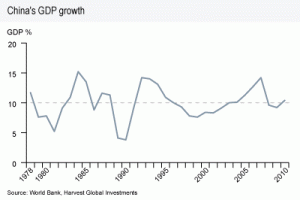
chinagdpgrowth

The idea of export driven growth, it’s a contradictory concept. Economic growth means the ability of an economic system to produce more goods and services that people want and are willing to pay for, at a higher price than it cost to produce them. What they call export-driven growth is really a policy of holding their own currency exchange rate below the market rate in order to reduce the domestic monetary costs of their export industries. This creates a misallocation of labor and capital and a relative over-productive of export goods at the cost of fewer imports and fewer goods for domestic consumption.

If the cost of China’s policy were properly accounted for, it would be evident that the marginal export goods that is apparently produced at a profit (under the phony accounting of depreciating money) is in reality produced at a loss. But this loss is hidden because it is distributed over the entire population by reducing the purchasing power of their currency. And that impacts their ability to buy imported goods, or, as many domestically produced goods that have an import component.

They have a huge infrastructure bubble. They are building far more roads, bridges, power plants in relation to the rest of their capital structure. Bridges and roads to nowhere show up as GDP because spending is required to create them. But not all spending is created equal. Spending on thinks you don’t need or things that cost too much to produce is waste and it moves resources away from where they are needed to create real growth.

A lot of the writers in the West are in awe of China’s centrally planned economic system. A friend of mine, the American investment writer Chris Meyer, sent me news story a few years about the highly reputed UK fund manager Antony Bolton who had come out of retirement to manage a new China fund. Bolton cited the advantages of central planning compared to a market economy as one of his reasons for his enthusiasm. Things didn’t work out so well for Bolton. The fund has under-performed, which can happen for a lot of reasons besides believing in an incorrect political-economic theory. But I think that he came in right near the top of China’s planning bubble.

Economist Brad Setser wrote a paper around 2006 about the Chinese banking system. In his paper, he went back a number of years into the history of their banking system. Setser found that during this time, interest rates had been set at below-market levels by the central planners. This of course meant more demand for loans than banks could supply. Rather than rationing by price, resource allocation had been largely driven by political favoritism. Not surprisingly, most of the loans from this period went bad. The entire banking system eventually became nothing but a sea of bad loans. Then there was a bail-out, putting all of the bad loans in a bad bank. And then, they started over from zero and rebooted the whole system. But by the end of the time that Setser covered in his research, they had gotten right back where they started, full of bad loans again. More recently Edward Chancellor and Mike Monelly of the respected value investing firm GMO have produced a research piece saying more or less the same thing.

Overall they have a completely dysfunctional capital allocation process. That’s why I’m a bit of a skeptic on China.

L.S.: Last year the Austrian gold analyst Ronald Stöferle mentioned you in an interview with me for GoldSwitzerland. (2) Mr. Stöferle, in my opinion one of Europe’s best men in this field, said that you belong to the crème de la crème when it comes to the issue of price formation, and that you have something original and unique to say in your writings. So I am curious about this. But let’s begin the discussion with a more general question: In your opinion, where do you think that many analysts go wrong in their understanding of the gold market?

R.B.: I see four problems but in a way they are all different versions of one problem.

The first is a focus on the annual statistics. Whatever happened in the last year is not that significant because most of the gold that exists at the end of one year was there at the beginning of that year.

The second problem, which you could argue is a subset of the first one, is the emphasis mine supply. While a lot of ink or electrons are spilt on mine production, it has very little impact on the gold price.

The third is the vast amount of brainpower that goes into quantifying gold flows into market segments, such as industry, jewelry, coins, and funds. These quantities may be interesting for some purposes, but they’re not really that relevant if what you’re trying to do is understand the gold price, because there is not a connection between quantities and price in the way that most people think there is.

The last problem is the idea in some circles that there is a gold supply deficit. If you really look at the market, the concept doesn’t make sense. It’s based on a strange way of lining up the numbers to produce something like an optical illusion. The gold market, structurally, cannot be in a deficit in the way that any other commodity market could be in a deficit.

L.S.: We will discuss the last point in detail later. – As already mentioned, in the past you have written several pieces about the price formation mechanism in the gold market. Why have you chosen to focus on this area?

R.B.: I think the reason I have chosen to focus on this is that I see a lot of misunderstanding about this topic, and since very few people are active in this area, I have decided to take it on. I am hoping that through my writing and through interviews such as this one, I can play some part in shifting the thinking of the gold community.

There are a few others who get it. Stöferle who you mentioned has covered this in his gold report. Paul Mylchreest wrote about this exact issue when he was at Chevreux/Credit Agricole. Acting-man, a site that covers the Euro market, has some excellent content looking at gold and the price system from the correct perspective. James Turk and the people at GoldMoney are quite friendly to this concept. And I recall reading something by the fund manager John Hathaway in which he seemed to be saying approximately the same thing. I hope that I haven’t left anyone out.

I believe that the tide is slowly turning on this issue. While the incorrect view still predominates, increasingly the correct understanding is beginning to be expressed more frequently. A report such as Stöferle’s from a prominent research firm is a good sign.

L.S.: How does your view of gold price formation differ from the views of most analysts of the gold sector?

R.B.: I think I need to start out by giving a little background, and then proceed to directly answer your question. I am going to start by talking about where the wrong thinking comes from so you can see that it might make sense to someone to think that way. Then I will show where they go wrong and then, the correct way to think about it.

There are two different kinds of commodities and we need to understand the price formation process differently for each one. The first one I’m going to call, a consumption commodity and the other type I’m going to call an asset.

A consumption commodity is something that in order to derive the economic value from it, it must be destroyed. This is a case not only for industrial commodities, but also for consumer products. Wheat and cattle, you eat; coal, you burn; and so on. Metals are not destroyed but they’re buried or chemically bonded with other elements making it more difficult to bring them back to the market. Once you turn copper into a pipe and you incorporate it hull of a ship, it’s very costly to bring it back to the market.

People produce these things in order to consume them. For consumption goods, stockpiles are not large. There are, I know, some stockpiles copper and oil, but measured in terms of consumption rates, they consist of days, weeks or a few months.

Now for one moment I ask you to forget about the stockpiles. Then, the only supply that could come to the market would be recent production. And that would be sold to buyers who want to destroy it. Without stockpiles, supply is exactly production and demand is exactly consumption. Under those conditions, the market price regulates the flow of production into consumption.

Now, let’s add the stockpiles back to the picture. With stockpiles, it is possible for consumption to exceed production, for a short time, by drawing down stock piles. Due to the small size of the stocks, this situation is necessarily temporary because stocks will be depleted, or, before that happens, people will see that the stocks are being drawn down and would start to bid the price back up to bring consumption back in line with production.

Now let’s look at assets. An asset is a good that people buy it in order to hold on to it. The value from an asset comes from holding it, not from destroying it. The simplest asset market is one in which there is a fixed quantity that never changes. But it can still be an asset even when there is some production and some consumption. They key to differentiating between consumption and asset is to look at the stock to production ratio. If stocks are quite large in relation to production, then that shows that most of the supply is held. If stocks are small, then supply is consumed.

Let me give you some examples: corporate shares, land, real property. Gold is primarily an asset. It is true that a small amount of gold is produced and a very small amount of gold is destroyed in industrial uses. But the stock to annual production ratio is in the 50 to 100:1 range. Nearly all the gold in the world that has ever been produced since the beginning of time is held in some form.

indiagoldjewelry

Even in the case of jewelry, which people purchase for ornamental reasons, gold is still held. It could come back to the market. Every year people sell jewelry off and it gets melted and turned into a different piece of jewelry or coins or bars, depending on where the demand is. James Turk has also pointed out that a lot of what is called jewelry is an investment because in some parts of the world there’s a cultural preference for people to hold savings in coins or bars but in other areas by custom people prefer to hold their portable wealth as bracelets or necklaces. Investment grade jewelry differs from ornamental jewelry in that it has a very small artistic value-added on top of the bullion value of the item.

So, now that I’ve laid out this background, the price of a good in a consumption market goes where it needs to go in order to bring consumption in line with production. In an asset market, consumption and production do not constrain the price. The bidding process is about who has the greatest economic motivation to hold each unit of the good. The pricing process is primarily an auction over the existing stocks of the asset. Whoever values the asset the most will end up owning it, and those who value it less will own something else instead. And that, in in my view, is the way to understand gold price formation.

Many of the people who follow and write about this market look at it as if it were a consumption market and they look at mine supply and industrial fabrication as the drivers of the price as if it were tin, or coal, or wheat. People who look at gold as if it were a consumption market are looking at it the wrong way. But now you can see where the error comes from. In many financial firms gold is in the commodities department, so a commodities analyst gets assigned to write the gold report. If the same guy wrote the report about tin and copper, he might think that gold is just the same as tin and copper. And he starts by looking at mine supply and industrial off-take.

I wonder if more equity analysts or bond analysts were active in the gold area, if they would be more likely to look at it the same way they look at those assets.

L.S.: In your writings, you mention quite often the marginal price theory. Where does this theory originate and what is it all about?

R.B.: Marginal price theory has been part of economic theory for well over a hundred years. Most historians of the field of economics itself see the so-called marginal revolution as the boundary between the classical school of economics and modern economics. I learnt marginal price theory from Murray Rothbard‘s book, Man, Economy and State, but it’s something you could learn in any course on economics.

Marginal price theory was developed to answer a question a lot like what we are discussing today. It was known as the diamond-water paradox. The question that classically economists could not answer is, “Why do diamonds cost so much more than bread when bread is necessary for human life and diamonds are a luxury?” The problem was that classical economists did not think in terms of individual units. The breakthrough was the realization that we need to think about economic action in terms of individual units. A marginal theory says that human action acts on individual units of a good. The last unit that you buy or sell is always the marginal unit. As an economic actor you’re thinking, “What do I want to do with this next dollar? Do I want one more unit, one more dollars’ worth of diamonds or one more dollars’ worth of bread?

L.S.: How does that apply to the gold market?

R.B.: Gold is an asset. People buy it in order to hold it. The price of gold is set as people balance, at the margin, the amount of additional units of gold they want to hold against additional units of other assets or cash they want to hold, or consumption.

If you think of the possible gold buyer as the guy who is saying, “Do I want to hold one more ounce of gold or this $1,800 that I have?” The answer to his question is going to be different for each person and for each additional ounce. You might say “yes, I want one more ounce of gold instead of $1,800”. Now, you have an ounce of gold and if I ask you the question again you might say, “No, now that I have bought that additional ounce, I’ve got enough gold”.

On the supply side, are the people who own gold. From their point of view they have to answer the question, “Do I want to keep holding this ounce of gold or do I want to sell it on the market and have $1,800?” That $1,800 might stay in cash or maybe they have another use in mind for it. The supply side is everyone who has any gold and the buy-side of the market is anyone who has any money that they might want to put into gold.

Now, we can eliminate people who don’t know what gold is, the ones don’t know where to buy it or how to buy it, and those don’t want any because they don’t understand it, or maybe they do understand it but they don’t like it. But that still leaves a large number of people who might add to their position some quantity of gold at the right price. The people who already own gold, they could be active on either side of the market as a buyer or a seller. I want to emphasize that everyone who owns any gold at all is part of the supply-side of the market, not all at the current price, but at some price.

In micro-economics there’s a nice formalism where they use supply and demand curves. If you took a micro course you would have seen those. Many people might feel more familiar with these concepts if they can see the curves. You can do a lot with these curves but you can’t forget that they supply and demand curves are a way of aggregating of the preferences of all the individuals in the market. Murray Rothbard does a great job of explaining this.

In the market, people rebalance between gold and dollars until they’re happy with what they own. At that point there will be no more trading if no one ever changed their mind. But now and again people do change their mind; they realize they want more of one thing and less of another thing. Then you have more trading to bring the market back into balance.

In finance there is a similar concept called, optimal portfolio theory in which they see portfolio management in terms where people are trying to hold the ideal amount of each different form of savings. The portfolio manager rebalances based on the expected properties of each asset until they have the right mix.

L.S: Is it realistic to assume that everyone is willing to sell their gold? The gold buyers are perceived as very strong hands with long time horizon, people who hoard for a crisis.

R.B.: Many of the people who have bought gold in the last few years are not remotely interested in selling at the current price or even double the current price, but there is always a price or some combination of price and circumstances where somebody would put some of their gold on sale – maybe not all of it but some of it. And people on the money side of the market are asking the same question in relation to gold. The market balances all of those choices out and you have a price that brings out the quantities on both sides of the market into balance.

Maybe that’s not totally true, maybe some gold is held by people who wouldn’t sell it for any reason. But I think that the concept of the gold bug who plans to take it all to the grave is over-stated. I asked a person the gold business whether gold retail trade is all selling and no buying. He told me, “No of course not, there are always buyers and sellers”. After all, what is the point of having a store of value if you never use the value? That is John Maynard Keynes and his parable of the cake that is never eaten. But Keynes was really painting a caricature of the capitalist system which encourages saving for the future. The future does arrives at some point, whether it is old age or emergency, and at that time, the value of additional saving is diminished relative to spending.

And it is important to understand the cost of owning gold is not necessarily the amount of money you could get by selling it. Prices are only a way of quantifying true costs. The cost of owning an ounce of gold is whatever other sort of economic opportunity that you are sacrificing by owning the gold instead. People who own gold are every day looking at “what other economic opportunities am I giving up by holding this ounce of gold?” and then “Do I want to shift the next ounce of gold somewhere else that will give me a better return or a better consumption experience?”. If you could swap an ounce of gold for one unit of the American Dow Stock Average that was at the time yielding 12% then the cost of owning an ounce of gold is not owning a unit of the DJIA. The cost of owning gold is the opportunity cost, of which holding cash instead is only one possible choice.

Let me give you another example; if the price of a new car that you like is twenty ounces of gold, you might prefer the gold. The cost of owning the gold is 1/20th of a car. But if the price of that car in gold ounces dropped to one ounce, you might say, “Nineteen ounces of gold is enough and I’d like to have that new car”. And at that point it makes sense to swap a single ounce of gold for a car. You still have nineteen ounces of gold, so you haven’t sold all of your gold, but at the margin, you have sold the least valued ounce for something that became more attractive.

L.S.: So your view is basically that of portfolio balancing. Do you see the price mechanism in the gold market as similar to the share market?

R.B.: Yes, in terms of the formal model of how pricing works it is similar. You see you have a relatively fixed quantity of a good and people are bidding the price up or down, based on who is the most motivated to hold that good, who is most willing to sacrifice the opportunity to hold a different asset or to increase their consumption.

Now, gold is different than shares in that gold is more of a cash-like asset whereas with shares you are buying an actual business that has a management team, products, and a financial statement. So, in that way it’s different. But in terms of the pricing process it’s quite similar.

L.S.: You use in your writings also the concept of “reservation demand”. Can you explain this further, please?

R.B.: There are two different expressions of demand for a good. If I trade with you, I supply one apple and I demand one banana and you do the opposite. We each demand something by offering something in supply. When there’s a buyer and a seller, the buyer demands and the seller supplies. That is exchange demand.

The concept of reservation demand is where you demand something by holding onto it rather than selling it. This concept might sound unfamiliar but it is very relevant to everyone’s life. We all have reservation demand for many goods. I have reservation demand at the moment for an auto, a dining room table, a couch, a mobile phone, and so forth. My reservation demand for cash in my pocket is $20. Any good that you’re any holding onto rather than selling, you are exercising reservation demand.

Most of the market research about gold deals with exchange demand, which has the advantage that you can measure it. But reservation demand is far more relevant to the price. The profile of reservation demand among people who own gold is the main determinant of the gold price from the supply side.

A very closely-related concept is reservation price. This is the price where you would be willing to sell a good that you currently hold. In the gold market, you can think of every ounce with a price tag on it. Or maybe today, it would be a QR code instead of a tag. That price depends on who owns that ounce of gold and their reason for holding it. Short-term traders might take a position for five minutes looking for a small move. If they got their $10 move they would sell and lock in a profit. You have other people who have a much longer time horizon, years or even decades, and a much higher expectation of where they’re going to sell. And even the same person will have a different price tag on each ounce. The first ounce you might be more willing to sell than your last ounce. It is important to understand that reservation prices are not necessarily money prices; they may be construed more broadly in terms of economic opportunities as I described just a moment ago.

You also might object that a lot of people may not know exactly what their reservation price is in money terms because it is impossible to know accurately what the purchasing price of money will be at a time when you might want to sell. And this is true. Many gold buyers are envisioning that we are going to experience hyper-inflation in some countries and their plan might be to look for distressed assets that go on sale during a hyperinflation. That would be the time to sell their gold, or more accurately, to swap their gold for assets. This type of person may conceive of the reservation price as, “When I can buy a small business, like a cleaners, for five ounces of gold” or “when I can buy a rental apartment for 10 ounces of gold”. People conceive of the reservation price more broadly in terms of what is going on in the world around them.

There is reservation demand on the money side of the market as well. Why does everyone not spend all of their money? Because we have reservation demand for money. The reason that you have any money at all and you haven’t spent it is you see some potential use for that money, possibly when you see something you need or want at a low enough price, that the good comes in ahead of your reservation price in so you buy the good.

The bid and ask that you see in the gold market at any point in time is the price offered by the marginal non-buyer and the price asked by the marginal non-seller. The marginal non-buyer is the person whose reservation price for their money is just below the ask and the marginal non-seller is the person whose reservation price for that ounce of gold is just above the bid. The equilibrium of the market is that you have the bid and the ask which are the best reservation prices are on each side.

L.S. Why do you object to the emphasis on annual statistics in looking at this market?

R.B: What I want people to take away from this interview is that the gold price is not primarily a way of rationing gold that was mined during the last year, it’s a way of rationing all of the gold in the world because all of the gold is held and everyone who holds it cares about the price one way or the other.

The gold market is not segregated into one market for the gold that was mined this year and another market for gold that was mined in past years. The buyer doesn’t care whether he’s buying a newly mined ounce of gold or buying from somebody who had purchased gold that was mined 100 years ago. All of the buyers are competing to buy and all of the sellers are competing to sell.

I think that the focus on annual numbers is another residual of the domination of this space by commodities-type thinking.

L.S. You have stated that mine supply is not a key factor driving the gold price. Most gold analysts would not agree with you. Please explain your view on this.

If you pick up a typical research report on a gold market from a research firm or a bank, you will find that the main portion of the report is about annual quantities. Annual mine production is the most important followed by the jewelry melted, jewelry bought, coin and bar sales, dental, industrial, and central bank. And these quantities are thought by most analysts to be critically important in determining the gold price but that is just not the case.

Gold is always owned by whoever has puts greatest value on it. The ask price is the value placed on gold by the individual who values their last ounce the least of anyone who owns gold, compared to the last buyer who got rationed out of the market, the guy who values gold the most of anyone who does not own that last ounce.

Mining add about 1% to the total supply each year. If the total amount of gold is 5.05 billion ounces rather than 5.0 billion, that allows a few more of what were the marginal non-buyers to become buyers.

I think of the miners and the gold destroyers — such as dentists and the electronics industry, as a small delta on top of the price formation process that is mainly about who is willing to bid the most to hold all of the gold. Mine supply is only a small share of all gold.

The only difference between a miner and someone else who owns the same amount of gold is that the miners pretty much have to sell because they are businesses and they have to cover costs. The investor who owns some gold doesn’t necessarily have to sell, they can hold as long as they want to or until they have a better place for their savings than gold. You can say that they are price takers.

You can think of the miner as coming in to that market and selling down into the bid side of the market a little bit. Of course the miner is going to enable some people to get into the market at a lower price than without the miner because those buyers are not forced to go up higher into the ask side of the market in order to buy their gold.

A lot of analysts go even further down the road to absurdity by looking at the growth rate of gold mining. If you start out from year 1 where mine supply is, let’s say 2000 tonnes, and in year 2 mine supply is 2,500 tonnes, that is an increase of 20%. So the thinking goes, if supply is up by 20%, then demand also has to go up by 20% and that looks like a lot. If buyers bought 2000 tons last year and this year you are asking them to buy the same and then 20% more, how is that going to happen? It’s really not a big influence. In math terms, mine supply is the first derivative and now we are talking about second derivatives.

L.S.: You have given your reasons for thinking that the impact of mining on the gold price is small. Do you have any way of quantifying that?

R.B.: I can’t say for sure but there are some ways to make an educated guess.

One is that mine supply only adds around 1% or 2% to the total stockpile of gold. You can think of mining as a form of gold inflation with a rate of around 1-2%. If we were looking at the supply of money in a country or shares of a stock we would expect the value to be diluted by something close to the growth rate. Miners are diluting the value of the existing gold stock by 1%. If this is correct, and if everyone who owned gold was trying to maintain a constant amount of gold in purchasing power terms, then all other things being equal, a 1% dilution would have a 1% impact on price.

Another way of looking at it is when the supply of gold is 5 billion ounces there is a price quotation, which is the best ask. Now one year later mining has brought us up to 5.05 billion ounces. A group of buyers was able to come in and buy the additional 50 million ounces. Where do those new buyers value gold? If we assume static preferences, maybe slightly above their buy price. Not a lot above their buy price or they would have become buyers the year before. So that would suggest a slightly lower price, depending on how deep you have to go down into the bids to fill the additional ounces.

I looked at some figures from geologist Brent Cook showing that all of the gold mined in any one year is about equal to a few days volume on the LBMA. And the LBMA is not the only market where gold is traded in the world. I’m not saying that the difference due to mining is equal to the ratio of trading days to volume. But the point is, selling the mined gold onto the market is a very small part of the market activity. It’s easily absorbed into a liquid market.

L.S.: In your most recent article you argue that many analysts are incorrectly bullish or bearish, because their data does not support their price outlook. Is that so?

R.B.: You see every day in the media statements like “Gold investment demand is up by 20 percent this year” and that’s supposed to be very bullish. Or “investment demand was down by 15 percent” and that is supposed to be bearish.

There is also I remember a wave of stories in the early 90s as the gold industry was increasing up exploration and bringing new properties on line, where it was popular to say, “Gold mine supply was 2000 tons this year and it’s going to be 2500 tons next year”. That is an increase of 25 percent in supply, and wow, that sounds like a big, big increase in supply. To keep up, the demand side of the market has to step up by 500 tons this year otherwise the price is going to be much-much lower. That would be a huge increase in demand. Where is all that demand going to come from to keep up with supply?

When you see statement like that, what does that mean, exactly? It means something like this. If investors as a sector had a net addition to their portfolio of 50 million ounces one year and the next year they added 60 million ounces they’re calling that a 20 percent increase in demand. And that’s supposed to be very bullish.

This way of thinking about the market is not logical. What they call “supply” and “demand” is the amount of gold that got moved around the market. And that is fine as far as it goes. The problem is when they go from the number to the price. Those numbers do not characterize the forces of supply and demand that do set the price.

L.S.: Then what do they mean by supply and demand? And why do you dislike their definitions?

R.B.: Let me explain how they come up with these numbers and what they’re supposed to mean and then, where they go wrong.

What analysts typically do is divide the market up into sectors such as mines, investment, jewelry, industrial and central banks and maybe funds or ETFs get their own sector. Often a country like China is considered a sector. They want to measure the amount of gold that was bought and sold that year by individuals or actors within each sector. Those are gross amounts. From grosses you can compute net amounts. The net is the difference between the gross bought and sold quantity for that sector. There’s always a net outflow from the mine sector because they’re in business to sell. For any other sector, the net might be a positive or a negative number during a year because people may have bought more jewelry than they sold, or the opposite. During any given year investors might on net have added to their positions or diminished their holdings.

When you read “supply” or “demand” in the financial media, the definition is not consistent from one place to the next. There are a lot of ways people slice and dice all of the numbers. Everyone does not do it the say way. However you do it, you have a number made by adding up some gross and net quantities. For example, one report might say that supply is mine supply plus gross jewelry scrap. Someone else might include gross investment purchases, and someone else might count only net investment as part of the demand number. When you read that demand is up, what they mean is that one of these contrived Rube Goldberg definitions that has the misleading name “demand” has changed from one year to the next.

Let me give you one example. The CPM Group (a research consultancy that produces in-depth reports on the gold and silver markets) does it like this: they define supply as the all of following: mine supply, the gross industrial sales, and gross jewelry sold. CPM defines demand as the sum of all of these: gross industrial purchases, gross jewelry purchases, net central bank activity and net investor activity.

CPM uses a mix of gross quantities and net quantities. This definition by itself strikes me as quite eccentric because of the mixture grosses and nets into the same aggregate. Gross quantities measure a flow, while nets are the change in magnitude of a stock. What happens when you add grosses and nets together? I have no idea. This reminds me of breaking the rules of dimensional consistency, something that the physics faculty at my university prohibited.

Now let’s delve into these net quantities a bit more. To simplify the situation, suppose there are only two sectors in the market. Let’s call those two sectors “mines” and “everyone else”. Then the relationship between the quantities is very simple. Whatever the miner sold somebody bought. There’s always a market for gold at some price. An ounce of gold is worth more than zero. Any quantity of gold that someone offers on the market will find a buyer at some price and that gold will end up in someone’s portfolio or maybe consumed. Mine supply gross (or net) sold is equal to everyone else net purchased. That is a simplified understanding of a two-sector market.

Now let’s complicate the model a bit more to get it closer to reality. If you have three sectors, mines, jewelry and investment, then you can have a net outflow from jewelry one year and that would have to show up as a net inflow into investment because all the quantities have to balance out. Everything still has to net out to zero across all sectors. The gold miners are always sellers but any other sector could be a net buyer or a net seller in any one year period.

You can keep making the model more complex by adding more and more sectors. Each time you add another sector to your model, that sector has inflows and outflows. But this doesn’t change the fundamental logic which is that every ounce that is sold in one place is purchased in another place. All of the flows have to balance out to the net change in the world’s total position, which is mine supply less destruction. And that is always a positive number as long as anyone has been counting.

Now, I’ve been saying that this is at best, not very useful, and at worst, misleading. By now you probably want to know, “what is the problem?” The problem is that these quantities and these flows have no causal relationship with the gold price. All we have done is to add up some of the volume in the market and shifts in aggregate holdings. But we are still no closer to the price because neither the volume of trading, nor position changes as are causes of the price. Quantities are not the cause of the gold price. Gross quantities are not the cause of the gold price. Net quantities are not the cause of the gold price. And so it must also be true that any Frankenstein monster number you invent, even if you give it a familiar name, like “supply” and “demand” also does not cause the gold price.

Suppose I tell you that there was a net flow of gold from sector A to sector B last year, then what is the impact on the gold price? There is no way to say. The gold price could be higher, lower or unchanged when gold moved from A to B. If the gold moved from A to B because the buyers on the A side were more aggressive and raised their bid prices, then you would see a higher price. If gold flowed because the people in B valued it less, so they were willing to let it go for less in return, then you would see a lower price. If both of those things happened, there would be a lot of trading but the price might end up about the same.

A price is a quantity of money that is exchanged for a quantity of gold. In these voluminous reports about mine supply and jewelry and everything, they’re only looking at quantities of gold. There is no way that looking at quantities alone can tell you anything about price because there is no money involved. It’s sort of like the is-ought problem in philosophy, which says that you cannot derive a sentence containing “ought” from any number of propositions that contain only “is”. You cannot make any conclusions about money if you do not have money in your premises. No matter how hard you study these quantities it won’t tell you anything about the price. Whatever the driver is of the price, it has to involve both gold and money.

L.S.: If not cause and effect, is there any relationship between these quantities and the gold price?

R.B. : Yes, it’s almost the opposite of what most people think. The gold price is formed by a balancing process, as investors shift different assets in order to hold the amount of gold, cash, and other assets they want. These quantities come about because of discrepancies between what people own, what they want, and the collective preferences of the rest of the market. These discrepancies are resolved by exchanging and that gets counted as a quantity. But these quantities do not drive the price. The more preference changes among the buyers and sellers, the greater the volume of trading required to get back to an equilibrium.

I recall Warren Buffet describing a cartoon of a financial news anchor with the caption, “There was no volume on the market today because everyone was happy with what they own”. This is quite funny but the serious point is that buying and selling comes about because there are people who wish to change their position in a way that is complementary to what someone else wants, so they are both able to change their positions to something that they like better. The one side wants more cash, less god; the other wants the opposite.

The volume of buying and selling shows how far out of adjustment people are between their own positions and the preferences of other people in the market which is what creates the opportunity to trade. Buying and selling as such do not cause the price, buying and selling come about because of a preference disequilibrium. That disequilibrium requires trading to equilibrate but it does not tell us at what price the trading occurs.

There might be a statistical correlation between, for example, a net inflow into one sector and higher (or lower) prices. If someone has a statistical model that works, that is great. But it’s not causal.

But it seems to me that even if someone has discovered correlations like that, they will be coincident with the price, rather than predictive. In order to forecast the price, you need an indicator that moves in advance of the price. You read all the time how bullish it is that people bought so many coins, or bars or whatever, but buying that was the cause of the price going up, then it would have already gone up due to the buying. That would not help you forecast at all.

L.S.: You say that the way supply and demand are reported in the financial media is confusing. Please explain to our readers your thought process in more detail.
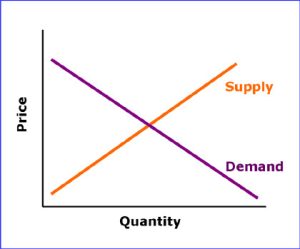
demandsupplycurve

R.B.: When the average reader, or even the quite sophisticated reader sees the word “supply” and “demand” they don’t think to ask, “what is definition of that word” because we already have a good intuitive feeling about what those words mean. And we all know that an increase in demand drives the price higher, while an increase in supply sets us up for a lower price. And that is true if you use the terms “supply” and “demand” correctly to mean as the intensity of investor preferences on each side of the market.

If the author got all their numbers right — and some of these firms go to a lot of trouble to count up every microgram of gold dust in the entire world — then these statements are accurate in a very limited sense. But it is not true that a quantity made out of the sum of various flows and position shifts has any relationship to the forces that set the market price.

Everyone will agree: “The price of gold is set by supply and demand”. But what does did we all just agree on? Correctly understood, this statement means that the price balances out the overall the set of choices people make to offer on their desired terms from each side of the market. The price results from balancing those two sides.

Suppose that instead of “supply” and “demand” these aggregates were called X and Y, if you like algebra. Now if I change my statement to say “The price of gold is set by X and Y” you are immediately going to ask “what do you mean by X and Y?” And when you find that X = A + B + (C — D) + (E — F), etc. and Y is something similar it starts to make a lot less sense. At that point your head will probably start exploding. When you use X and Y in place of “supply” and “demand”, you no longer have a true statement.

The problem happens by starting out from truth and then changing the definitions of terms so the statement looks the same but it is no longer means the same thing and the thing that it now means is not true. By using words that have a clear meaning in our minds, but using them to mean something else this creates immense confusion. And hardly anyone realizes this when they are reading an innocent-looking statement.

L.S.: If not by quantities, then can the gold price otherwise be analyzed quantitatively?

R.B.: The gold price is set by investor preferences, which cannot be measured directly. But I think that we understand the main factors in the world that influence investor preferences in relation to gold. These factors are the growth rate of money supply, the volume and quality of debt, political uncertainty, confiscation risk, and the attractiveness (or lack thereof) of other possible assets. As individuals filter these events through their own thoughts they form their preferences. But that’s not something that’s measurable.

I suspect that the reason for the emphasis on quantities is that they that can be measured. Measurement is the basis of all science. And if we want our analysis to be rigorous and objective, so the thinking goes, we had better start with numbers and do a very fine job at measuring those numbers accurately. If you are an analyst you have to write a report for your clients, after all they have paid for it, so they have to come up with things that can be measured and the quantity is the only thing that can be measured so they write about quantities.

And in the end this is the problem for gold price analysts, you’re talking about a market in which it’s difficult to really quantify what’s going on. I think that looking at some broad statistical relationships over a period of history, like gold price to money supply, to debt, things like that, might give some idea about where the price is going. Or maybe not, maybe you run into the problem I mentioned about synchronous correlations that are not predictive.

Part of the problem is that statistics work better the more data you have. But we really don’t have a lot of data about how the gold price behaves in relation to other things. The unbacked global floating exchange rate system has never been tried before our time. How many complete bull and bear cycles has the gold/fiat market gone through? My guess is that when we look back we will see that we are now still within the first cycle. Our sample size is one.

L.S.: Some people, for example the Gold Anti-Trust Action Committee (GATA), assume that the gold market is in a structural supply deficit which would require the gold price to be much higher in the absence of central bank selling. You do not agree with GATA that the gold market is in a supply deficit? What’s your thinking on that point?

R.B.: I should first explain what they mean by a deficit. A deficit implies a situation where demand exceeds supply. This is a sensible definition in some situations but it doesn’t apply to gold. It sounds logical but when you drill down into it, there are conceptual problems.

When would it make sense to talk about a deficit? Let’s go back to the consumption-type commodities. In the wheat market, it is possible that consumption could exceed production for a limited time until stock piles are used up, and then, you would only be able to consume what was produced. When stocks were exhausted, the price would have to go much higher in order to bring consumption in line with production. This type of deficit does not exist in the gold market because the gold market in a surplus of production over consumption every year.

But the bigger reason that it does not make sense to talk about a deficit is that unlike a commodity, the buyer does not destroy the commodity. The trade of gold is not drawing down any stock piles. When a transaction takes place, that does not reduce the total amount of gold in the world, it only changes ownership. Once an ounce of gold is sold, the buyer could then sell it to someone else, and they could sell it again. There is no limit to the amount of gold that can get shuffled back and forth between different people over time.

So how did they come up with the idea of a supply deficit? I’ll tell you how they do it. They are talking about a supply-demand deficit rather than production-consumption deficit. A deficit means that a number called “supply” is less than another number called “demand”. These definitions are problematic, due to the Frankenstein monster problem that I have discussed.

They define supply and demand using some combination grosses and nets. “Supply” is less than the “demand” and difference between the two is approximately the quantity sold by central banks. So this is the basis of why they say that there is, or was, a structural supply deficit that was made up by central bank selling.

Right away you should be suspicious about this because we know that if supply is defined the total quantity sold then demand is the total quantity bought then they have to be equal at the end of the year, because every time there is a transaction, a buyer and a seller are involved with the same quantity.

If you define annual gold supply as mine production plus scrap, plus net producer hedging but not official sales, and then define demand as everything else on the buy side, then when you add things up, then the difference is going to have to be the official sector selling because that wasn’t included in supply. You will get the same thing if you left out any other sector from the market from your definition of supply. For example, if you defined demand as all the gold that was bought by the different buyers and all the gold that was sold, accepting gold that was sold by China, then it would look like there was a supply deficit in the market that was made up by China. The difference between this type of deficit, which is not a real deficit, and a true deficit that you could have in in a commodity market, is that this deficit is an artifact of an illogical definition.

Where this really gets misleading is if you say that there is a 500 ton deficit, and you compare that to “supply” which is again misleadingly defined as mine supply, around 2500 tons, it looks like the market has a deficit equal to 20% of annual supply. In a commodity market, like copper, that would be a huge deficit because the stockpiles are maybe only equal to 20% of one year’s production. After one year of a deficit like that you would have run out, and then the market would hit a hard wall. But in the gold market, as I have shown, the data means nothing like that at all. The comparison is wrong on both counts: there no deficit and the supply is not represented by one year’s mine supply.

I won’t dispute that if central banks decided to sell 400 tons in one year and they wave a big white flag in front of their sale, as the Bank of England did, the price will be lower that year than if they had not sold, or if they had bought. In the late 90s, it really did appear that central banks were trying to get the worst possible sale price rather than the best. And I won’t dispute that at some point if central banks had continued to sell, then at some point would have sold all their gold and would have to stop selling. That is all true, but the way they talk about a supply deficit vastly overstates the importance of central bank selling.

L.S.: Do you agree with GATA that the precious metal markets are rigged and what is your opinion about GATA in general?

R.B.: I have no special expertise in the issues that they raised but I have been a follower of their reports since near the beginning and I read nearly everything that they publish. They have a daily email service where they pick out the most interesting stories in the gold market. I have been persuaded of the correctness of their main thesis, namely that a cartel of central banks conspired in the late 1990’s to hold down the gold price; that this strategy has become unsustainable; and that they are now in a controlled retreat.

I’m not sure of the motives of central bankers. GATA have cited some quotes and other evidence indicating that some of these bankers may have a belief that they could permanently kill off gold as an asset if they could force its price down low enough and hold it there for long enough. I suppose they must have thought that everyone would lose interest.

If they did think that that they could permanently exterminate gold, that would demonstrate a belief by central bankers that gold is money is merely a convention; and that once the convention was discarded or people have forgotten about it, people would abandon gold and we would have centrally planned paper money forever. But they obviously didn’t know who they were up against. Gold bugs are pretty stubborn.

I recall reading a report by a former Mitsui analyst Andy Smith, not exactly a friend of the gold bugs. Smith saw the progression from commodity money to paper money and central banking as a natural technological improvement, like those that occur in all areas in a free market economy. Just as we now have better mobile phones and better cars, we have replaced an outdated form of money with a more modern form of money.

This view fails to recognize any inherent advantages of commodity money over the centrally planned system of paper money. People have been using commodity money as long as there has been money, which is for thousands of years. That continuity has been interrupted briefly by paper systems. The reign of paper experiments has been short because that have ended badly. And then, the world has returned to a commodity.

This idea that a choice between a paper and a commodity system is purely conventional ignores the basic properties of monetary commodities, which have been known since ancient times. The properties have roots in physics, chemistry, geology and human nature. These realities will always drive human society in a direction toward commodity money. Even if commodity money were forgotten, it would be rediscovered because it has a basis in nature.

Or perhaps this was not their view. Maybe they did not think they could permanently destroy gold as an asset. Maybe the rigging was more of a short-term strategy to protect some of their friends who were short many tons of gold and had no ability to go into the market and buy that much. In that case, the central bank activity might have been a way of bailing out their friends, enabling them to cover, and then this thing turned out to be a lot bigger than they expected. They don’t know how to get out without driving up the price much, much higher. GATA has uncovered some evidence that the controlled retreat is a strategy to get out of their shorts without any big spikes in volatility.

In the end, I’m not sure exactly what the motives for the scheme were but I think GATA are substantially correct in their main contentions.

L.S.: But if now some people / institutions rig the gold market indeed, what does this mean for the theory of price formation? You know, theory versus the reality on the ground?

R.B.: There is the physical market and the paper market. My thought process and our discussion concern the physical market. GATA believes that central banks have sold a lot of physical gold.

But the more significant answer to your question would involve the use of paper markets to achieve a synthetic supply greater than what could be mobilized in the physical market. The GATA thesis is that price suppression mainly involves the short selling of short large amounts of paper which drag the physical market down along with it. And this could go on unless there was a boycott by the longs in which they insist on physical delivery.

Since I have no particular expertise in that area, I won’t say any more than that other that what they’re saying sounds plausible to me.

L.S.: We all know about the distain of some of the more successful value investors for Bullion. Why is it that Buffet and the ilk do not like gold? Furthermore, can gold hold the place in the value investor’s portfolio?

R.B.: The value investor school goes back to the work of Benjamin Graham. The way the value investor looks at the world is that every asset has two prices. There is the market price which is observable in the market, and then a theoretical price which they call, intrinsic value. The concept of intrinsic value is the primary innovation of the value school. There are difficulties in calculating it accurately, it involves guesswork and judgment but intrinsic value represents the price that a rational investor would pay for that business. It is a theoretical price, but based on economic logic, the asset should trade at its intrinsic value.

What they’re looking for is a situation where you have the price in the market much lower than intrinsic value and that’s where you should buy. You’re probably going to make money when you can do that because eventually the market will understand the rational economic value of the business.

How does the value investor estimate intrinsic value? There are various ways but they all rely on other market prices. If you look at the income statements of a business you get profits or you look at the cash flow and you have cash flows coming in. You have stream of money flows, how would you price that stream? You would price it by looking at what is the market paying for similar streams of income, either by comparing it to other comparable stocks or bonds or by using interest rates which is essentially the same thing.

Or you can do it from balance sheet standpoint. If the corporation has assets, those might be things like land, real estate, mineral deposits, regulatory permits, brands, patents. The economic value of these assets can be determined if there is an external market where you can price comparable assets. Then you can break the business up into pieces (on paper) and value the assets individually. If you can buy the assets for much less than the market place then that is also a buy within the value discipline.

The other thing the value investors really like is dividends or interest payments. This gives them a chance to earn some money while they’re waiting to be right. If you have a very high yielding asset and you’re able to hold it for five or six years, you might get your purchase price back, even if the price of the asset doesn’t go up. Then you are protected if the asset went to zero.

So now, I think we can see why value investors don’t like gold: because it doesn’t have cash flows, it doesn’t have dividends, it doesn’t have a balance sheet and therefore, it doesn’t have an intrinsic value in the sense that they use the term. The value investor looks at gold and says this stuff can be any price at all depending on what people are willing to pay for it. Andy Smith who I mentioned before, he came out with $90 gold forecast at one point. I guess he thought that someday everyone would wake up and just decide that gold was worth $90.

Value investors hate to buy something if they don’t know what it’s worth (and by that I mean intrinsic value) because they can’t ground that action in their rational framework. They think that such a move would be an irrational speculation, so they stay away from it.

I think that they are right within their framework, that you cannot buy gold for reasons like that because you cannot analyze it that way. Where I disagree with the value investors is that many of them think that that value investing is the only rational approach to risk, something that we all face in every area of life and we have to deal with it somehow.

I don’t think that any decision you make outside the value investment framework is irrational. I see rationality as broader in that we’re all trying to survive and adapt in this world with an uncertain future. We know that there are regularities in the world, that cause and effect relationships exist. Rationality means that we try to choose our own actions within that context.

Thousands of years of commodity money have been interrupted by brief but spectacular failures of paper money. And we know that the use of gold as a commodity money is rooted in geology, chemistry, metallurgy and aspects being a human being on this planet. For example, with our built-in optical system we can recognize gold pretty well. And given our size and strength as humans we are able to carry a decent amount of purchasing power — not too much, not too little — in the form as gold in our pockets. And so I don’t think it makes you a crazy person that you should want to have a portion of your savings in a good that has always maintained some value in a world where central bankers are desperately trying to destroy the entire monetary system.

L.S.: A controversial topic within both the gold community and the anti-gold crowd is whether gold is money. What is your view on that?
goldismoney

R.B.: Money is a medium of exchange. That means money is the thing that people ask for in return when they supply goods and services to the market. You often see money being defined as something having three properties: medium of exchange, store of value and unit of account. But my view — and this is in agreement with Austrian school economists Menger and von Mises — is that store of value and unit of account are not the definitional properties, they are derivative properties that money has because of its function as a medium of exchange. There can be other goods in the economy that function as a store value but not as a medium of exchange, like property for example. And I would include gold in that category. It is a store of value, maybe superior to the performance of money proper in that respect.

Whether gold is or is not money, is simple to determine. If you look around where you live and ask whether prices are quoted in terms of a particular thing then that will tell you if that thing is or is not money. Now, if I look around where I live here in San Francisco, prices are quoted in US dollars and in other places I’ve travelled in the world, prices are usually quoted in terms of a national currency, or sometimes in terms of dollars if the country has dollarized its monetary system.

Most prices here now are quoted in dollars. I have read somewhere that property values in Vietnam are sometimes quoted in gold so, in that case, it would be accurate to say that gold was functioning as money but for the most part world-wide, gold is not money at this time.

We went through a period here in San Francisco during the tech stock bubble in the 90s in which the prices of certain goods were quoted in terms of stock options on technology start-ups. That was a strange time. Companies could not hire workers for money wages; they had to offer stock options. Rents on business properties where the landlords would not accept money rents, they required a combination of money and stock options. Buyers were making offers on homes for sale in Palo Alto California consisting of a combination of money and stock options. I even read about a restaurant that was serving food to employees of a tech company for options instead of cash.

My interpretation of this strange phenomenon is that we were in a period of asset hyperinflation. Money was losing value so fast in terms of technology stocks people were reverting to the hyperinflation behaviour you see in end stages of a monetary collapse. In the late stages of a hyperinflation, people buy goods of any kind as fast as they can in order to get rid of money. This was the equivalent of people buying bed pans in Weimar. But that is a bit of a tangent.

Professor Salerno, an economist of the Austrian School who teaches for the Mises Institute in which

that when the US broke the last link between gold and the dollar, 1970 the economist Milton Freedman forecasted that gold would collapse. Friedman thought that the dollar was the only thing that was holding up gold.

Andy Smith’s view is similar. Smith was saying back in the 90s that central banks are stuck with all this gold that they no longer want. They know that it’s useless but how are they going to sell it? If they started liquidating, then that would announce to the world that gold is no longer money. All the stupid gold bugs, who hold it because they think that it is money, would realize that they had been played for fools, and the gold price would immediately collapse. Smith saw the Washington Agreements, an agreement among the major gold-owning central banks to restrict quantities sales each year, sort of like the OPEC cartel, as their solution to this problem. Smith characterized this as a form of welfare for the gold industry, as if banks were forming a cartel to keep the gold price up, not down. So in Smith’s view, central bank gold reserves only reinforce the perception that gold is still money, or, if not money, at least some kind of quasi-monetary thing that is of interest to central banks. That totally artificial perception was, according to Smith, the only thing restraining the gold price from a total collapse.

But this is all nonsense; Friedman and Smith are completely mistaken in their view. Governments do not define what money is. Ultimately, the market defines what money is and people will use centrally planned paper money only up to a point. The point where people reject paper money is when its purchasing power becomes so unstable that it is no longer of any reliable use as a store of value or unit of account, even for a short time. And when that happens, that is called hyperinflation.
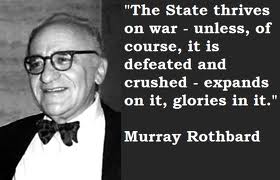
murrayrothbard

The Austrian economist, Murray Rothbard, identified three phases of inflation; in the first phase the money supply expands but prices do not rise as much because people perceive a new influx of money as temporary and they prefer to save it rather than spend it all. The second phase is when people realize that inflation will continue and they start to spin down their cash reserves faster than money supply is growing, so prices outpace money supply growth. In the final phase, which von Mises called the crack-up boom, the public perceives that inflation never stop until, it will only accelerate. While it is theoretically possible that we could all adapt to using money that was losing 99% of its value each year, in practice that does not happen. At that point, people choose to exit from the monetary system an alternative store of value, either another form of money, or non-money.

We have an uneasy co-existence with state money because there is always that threat that its value erode or the threat of a bank credit deflation in which the purchasing power of each money unit increases but a lot of bank credit money is destroyed. If it happened to be your money that was destroyed, then you would be broke, even if the purchasing power of the remaining money has increased. We have this co-existence with state money because it’s already in use, that makes it convenient and all of the taxing and regulatory frameworks that we have to interact with are denominated in state-issued money.

In favor of gold, the adoption of gold as money is based on sound reasons. It has the characteristics of the ideal money which has been known since ancient times. The possibility of using gold as an ideal form of money will never go away as long as there is gold and there are people. And there is always this threat from the point of view of central bankers that society will reject their centrally planned monetary system and start using something else.

My view then of gold is no, it’s not money, not exactly but the continuing demand for gold arises from its function as a shadow money. It’s something that people hold to hedge against the possibility that it will become money or become more closely tied to money in the future. And even if it does not, the public’s valuation of gold functions as a check on the behaviour of the monetary authorities.

As central banks continue to issue vast quantities of unpayable debt, most of which will be monetized, we are never so far away from the possibility of a collapse that there is no need to have insurance against it.

L.S.: Final question; you’ve mentioned the strange time of the dot.com bubble. Do you think the excitement, the hype and the greed during that period will be nothing compared to the time when gold and silver will really begin their bubble phase?

R.B.: I do think we will have a bubble in gold, although it may take the form of a collapse of the monetary and a return to some form of gold as money in which case, the bubble will not end, it would simply transition over to the new system in which gold would go from being a non-money asset to money.

I have been following this market since the late 90s. I remember reading that gold was in a bubble at every price above 320 dollars. I very much like the writings of William Fleckenstein, an American investment writer. He has pointed out how often you read in the financial media that gold is already in a bubble, a point he quite rightly disputes. Fleckenstein has pointed out that the people who say this did not identify the equity bubble, did not believe that we had a housing bubble, nor have they identified the current genuine bubble, which in the bond market. But now these same people are so good at spotting bubbles that they can tell you that gold is in one.

Most of them did not identify gold as something which was worth buying at the bottom, have never owned a single ounce of gold, have missed the entire move up over the last dozen years, and now that they’re completely out of the market, they smugly tell us for our own good that gold is in a bubble and we should sell.

So, I don’t know that we need to listen to those people and take them very seriously.

L.S.: Should we begin to think about the possibility that gold is in a bubble when they buy gold?

M: Very good, yes. (laughs.)

L.S.: Thank you very much for taking your time, Mr. Blumen!

You are most welcome Mr. Schall. Thank you for allowing me to share my views with your readers.

Robert Blumen was born in 1964 and grew up in Boulder, Colorado, United States. He is a graduate of Stanford University in physics and the University of California Berkeley in engineering. He lives in San Francisco, United States where he works in the technology sector as a software engineer, specializing in server applications and the architecture of scalable systems. He has maintained a lifelong interest in the Austrian School of Economic Thought and is an avid reader in economics and finance. His writings on gold and a variety of economic topics have been published by Financial Sense, the Ludwig von Mises Institute, LewRockwell.com, The Dollar Vigilante, and Marc Faber’s Gloom Boom and Doom letter as well as other gold and financial sites.

SOURCES:

(1) Official Monetary and Financial Institutions Forum (OMFIF): “Gold, the renminbi and the multi-currency reserve system“, published January 2013 under:

http://www.omfif.org/downloads/Gold,%20the%20renminbi%20and%20the%20multi-currency%20reserve%20system.pdf

(2) Compare Lars Schall: “The Seeds For An Even Bigger Crisis Have Been Sown”, Interview with Ronald Stoeferle, published at GoldSwitzerland on July 11, 2012 under:

http://goldswitzerland.com/the-seeds-for-an-even-bigger-crisis-have-been-sown/

Further reading recommendations by Robert Blumen:

Misunderstanding Gold Demand

The Myth of the Gold Supply Deficit

Mining Doesn’t Matter

Gold Mine Supply has no Bearing on the Price of Gold

If gold supplies are rising why aren’t prices falling?

Value Investors Hate Gold

Is Gold Money?

Is Gold in a Bubble?

Nonprofit Spends Big on Politics Despite IRS Limitation: American Future Fund Has Conservative Roots

0

Last fall, a cadre of wealthy business executives and conservative groups tried to sell California voters on new campaign finance reforms.

Couched in lofty rhetoric about the importance of cutting off money from special interests to politicians and other regulations favored by reformers, their proposal sought to ban the practice of using payroll deductions for political expenditures – a popular method of union fundraising.

Once alerted to the true nature of Proposition 32, the unions and political left rose up against it.

An innocuously named nonprofit, the Iowa-based American Future Fund, proved to be one of the biggest backers of the initiative, sinking more than $4 million into the ballot measure that voters ultimately rejected.

As a “social welfare” organization, the American Future Fund is not required to publicly disclose its donors. But to maintain its tax-exempt status under Sec. 501(c)(4) of the U.S. tax code, influencing elections cannot be its primary purpose.

The American Future Fund’s investment in California was part of a nationwide, political advertising spree in 2012 that exceeded $29 million, according to a Center for Public Integrity analysis of state and federal records.

That amount included more than $19 million on efforts designed to oust President Barack Obama, as well as millions more to oppose Democratic candidates for Congress and even two state attorneys general. Now the group is funding adsopposing Obama’s nomination of former Republican Sen. Chuck Hagel of Nebraska for defense secretary.

Since the U.S. Supreme Court’s controversial Citizens Uniteddecision in 2010, nonprofits such as the American Future Fund have played a more prominent role in electoral contests – all while giving their supporters the ability to keep their identities hidden. During the 2010 midterm elections, politically active nonprofits outspent super PACs, which exist to fund political advertisements, by a 3-to-2 margin.

The American Future Fund ranked third among “social welfare” nonprofits in spending in the 2012 federal election,according to the Center for Responsive Politics, trailing only the Karl Rove-affiliated Crossroads GPS and Americans for Prosperity, which is backed by conservative billionaire brothers Charles and David Koch.

There are also Democratic-aligned nonprofits, but their spending was well below that of their conservative counterparts. The top left-leaning nonprofit was the League of Conservation Voters, which reported spending about $11 million in the 2012 election opposing or supporting candidates.

The American Future Fund’s spending “raises some serious questions” and “evades any form of meaningful disclosure,” said Adam Rappaport, senior counsel with watchdog group Citizens for Responsibility and Ethics in Washington (CREW).

Numerous officials with the American Future Fund did not respond to requests for comment for this story.

Advocating for ‘free-market ideas’

The American Future Fund’s mission is to “educate and advocate for conservative and free-market ideas,” according to its annual filing with the Internal Revenue Service.

Despite asserting that it isn’t primarily focused on elections, the nonprofit’s DNA is decidedly political.

Conservative political operative Nick Ryan, a longtime adviser to former GOP Rep. Jim Nussle of Iowa, founded it in 2007. Over the years, the group has paid Ryan’s firm, Concordia Enterprises, hundreds of thousands of dollars annually for consulting services.

In 2010, the New York Times reported that Iowa businessman Bruce Rastetter provided an unspecified amount of “seed money” for the organization. Ryan once represented four of Rastetter’s companies as a lobbyist, including Hawkeye Energy Holdings, one of the country’s largest ethanol producers.

The nonprofit’s first president was Nicole Schlinger, the former finance director of Iowa’s Republican Party. Its current president is veteran Republican state Sen. Sandra Greiner, who served for 14 years as the Iowa chairwoman of the pro-business American Legislative Exchange Council.

Ryan and Greiner did not respond to requests for comment.

In 2008, when the American Future Fund was seeking – and ultimately garnered – tax-exempt status from the IRS, it pledged to abstain from electoral politics, saying it would spend 70 percent of its time doing work to “educate the public on policy issues” and 30 percent engaging in efforts to “influence legislation through grassroots advocacy.”

When asked on its application if the group had any plans to spend money to “influence the selection, nomination, election or appointment” of anyone seeking public office, it answered “no.” It also vowed to stay out of the presidential race.

When the IRS subsequently inquired why the group’s advertisements “appear to be more partisan than nonpartisan,” the group’s attorney, Karen Blackistone, wrote that the efforts were “strictly issued-based and nonpartisan.”

The group takes a position on issues and encourages the public to contact their representative, she wrote in a 2008 response to the IRS.

“AFF’s advertisements have never commented on a candidate’s character, qualifications or fitness for office,” she stated.

Big money tied to post office box

The American Future Fund has raised more than $60 million, with spikes in contributions coming in election years.

Much of that money has come from another conservative “social welfare” nonprofit that doesn’t disclose its donors by name – the Arizona-based Center to Protect Patient Rights.

The nonprofit has no website and lists its address as a post office box in Phoenix. It was launched in 2009 by Republican operative Sean Noble, who has extensive ties to the vast political network underwritten by the Koch brothers.

Noble, a former chief of staff for former Rep. John Shadegg, R-Ariz., did not respond to requests for comment for this story.

For three years running, Noble’s organization has reported making substantial grants to the American Future Fund for “general support,” according to IRS filings. The nonprofit contributed more than $14 million to the American Future Fund between 2009 and 2011, or 51 percent of funds the group raised over the three-year period.

The Center to Protect Patient Rights has also given millions of dollars to a network of conservative groups, including the Koch-backed nonprofit Americans for Prosperity, as was first reported by the Center for Responsive Politics.

In addition to Noble, there is another Koch connection.

In 2008, Trent Sebits, the former manager of public and government affairs for the Kochs’ Wichita-based refining giant, Koch Industries, registered with the state of Kansas to lobby on behalf of the American Future Fund and Americans for Prosperity. Sebits did not respond to a request for comment.

The American Justice Partnership, another “social welfare” nonprofit, gave $50,000 to the American Future Fund in 2011 and $2.4 million in 2010, according to IRS filings. The group supports free enterprise and is often at odds with trial lawyers.

Dan Pero, its president, said in an emailed statement that the organization supported the American Future Fund to help “promote free enterprise and improve the fairness and predictability of the legal environment.”

Like super PACs, “social welfare” nonprofits are allowed to accept unlimited donations from individuals, corporations, unions and other organizations. The only funders whose names they are required to publicly disclose are those that make contributions earmarked for political purposes.

That’s as it should be, according to attorney Dan Backer, who is not affiliated the American Future Fund but does work with other conservative groups.

“A nonprofit makes its decisions by a board or other management structure, which is distinct from its donors,” Backer said.

Increasingly political

In 2010, the American Future Fund became far more politically active, reporting $8.6 million in political expenditures as well as millions more for “media services,” “telecommunications” and “mail service/production.” It told the Federal Election Commission that it spent $9.1 million on political advertisements.

Marcus Owens, former chief of the IRS’s nonprofits division, said it is “difficult to conjure up a situation where a particular expenditure would be reportable to the FEC but would not constitute political campaign intervention under tax law.”

Nevertheless, Owens said the organization could make a “straight-faced argument” that its orientation had simply changed over time to become more overtly political.

Of the $25 million that the American Future Fund reported spending to the FEC last year, more than 90 percent fueled ads that urged voters to support or reject candidates.

The group also sought the FEC’s advice on whether mentioning the White House or “the administration” in negative ads ahead of Election Day would be seen as referring to a “clearly identified candidate for federal office.”

Such a designation would have required the group to disclose information about its donors. (The commission deadlocked, 3-3, in a vote along party lines.)

In addition to the presidential race, the American Future Fund spent money in 20 congressional elections in 2012, including California’s 26th Congressional District, where it spent $500,000 attacking Democrat Julia Brownley, who, as a state legislator, had authored legislation to bolster disclosure for political advertisements.

She won anyway, but told the Center for Public Integrity that she is “deeply concerned” about the activities of non-disclosing groups in the wake of Citizens United and hopes to “take immediate action” to strengthen federal disclosure laws.

The American Future Fund also spent more than $542,000 to aid West Virginia Republican Patrick Morrisey in his successful quest to win the race for attorney general, records indicate, and more than $620,000 in a failed effort to sink Missouri Attorney General Chris Koster, a Democrat.

Complaints about the American Future Fund’s political activities have followed it since its creation.

In 2008, the Democratic Party in Minnesota contended that the group needed to register as a political committee after paying for ads that praised then-U.S. Sen. Norm Coleman, R-Minn. The FEC disagreed.

Two years later, in October 2010, consumer group Public Citizen and two other organizations alleged that the American Future Fund’s “huge expenditures” to aid candidates in the midterm election should have triggered requirements that the group register as a political committee and disclose its donors. That complaint is still being considered by the FEC, which often takes years to fully resolve such matters.

CREW, the watchdog organization, filed a complaint against the American Future Fund with the IRS in February 2011 that challenged whether its primary purpose was something other than influencing elections. The group has dismissed the complaint as “baseless” and contends that CREW “only targets government officials and organizations who have a differing or conservative point of view.

War in Africa: Countering China’s Influence. French Military oversees Power-sharing Deal with US in Central African Republic

0

africamap

by Patrick O’Connor

After deploying several hundred troops to the Central African Republic late last month, the French government has overseen the signing of a peace agreement between President François Bozizé and leaders of the rebel militias that had threatened to overrun the capital, Bangui.

As well as agreeing not to nominate for another term as president after 2016, Bozizé has sacked his government and appointed rebel-nominated Nicolas Tiangaye as prime minister. Tiangaye will soon establish a so-called national unity government ahead of fresh legislative elections next year.

The political realignment underway is being driven by the French government, which aims to reassert control over its former resource-rich colony and counter China’s growing economic and diplomatic influence. The operation in the Central African Republic forms part of a wider drive by US and French imperialism to bolster their strategic domination over Africa through direct military interventions. The latest involves a French-led ground offensive in northern Mali and the stationing of US drones and French troops in neighbouring Niger.

Bozizé, a former army general, appointed himself president in 2003 after leading a coup that was backed by the French government. He subsequently depended on French support to maintain power in the impoverished and chronically unstable country. In 2006 and 2007, French military forces stationed in the country launched air strikes and ground attacks on rebel militias, halting their threatened takeover of the capital and overthrow of the government. Last December, the loose coalition of anti-government militias known as Seleka (“alliance” in the Sango national language) launched a renewed offensive, capturing swathes of territory in the country’s north and east.

The French government responded by more than doubling its existing 250-troop deployment in the Central African Republic to nearly 600. But unlike in 2006 and 2007, Paris refused to back Bozizé against the rebels. French troops–together with those in the Central African Multi-National Force that was formed between several neighbouring states–instead secured the capital from a further rebel advance while the French government demanded peace negotiations.

The January 11 deal, signed in the west African country of Gabon, involved Bozizé making the first significant political concessions of his 10-year autocratic presidency.

The French government is developing new political mechanisms in the Central African Republic (CAR). US diplomatic cables, published by WikiLeaks, detailed the breach in relations between Paris and the Bozizé regime. Several cables in 2009 revealed French hostility toward various obstacles that were placed before French corporation Areva as it attempted to secure the rights to mine uranium at a site in the country’s south. On June 17, 2009, US ambassador Frederick Cook dispatched a cable, “French-CAR relations seriously strained,” that concluded: “Bozizé may believe that he has successfully rendered himself the least of the evils in the CAR political landscape. He thus appears to imagine himself indispensable to his neighbours and the French, an assumption that AmEmbassy Bangui believes may be badly mistaken.”

Another cable sent five months later was headed “Growing Chinese influence in the CAR evident.” It detailed the extent to which both American and French interests were losing ground to Beijing, which was “ramping up its military cooperation, public diplomacy and development efforts.” The cable noted that whereas there were only four resident diplomatic agents in the American embassy in Bangui, the Chinese embassy had about 40 employees. It added that approximately 40 CAR military officers were being trained in China every year, compared to the two or three officers who went to the US and 10-15 to France.

Making clear the predatory calculations behind the US and French presence in the Central African Republic, the cable referred to the country’s “rich untapped natural resources” and warned: “With French investments moribund and French influence in general decline, the Chinese are likely positioning themselves as the CAR’s primary benefactor in exchange for access to the CAR’s ample deposits of uranium, gold, iron, diamonds, and possibly oil.”

The US ambassador also cautioned that Bozizé “is welcoming this relationship as an alternative to more restrictive relations with the French and the West” and would likely “increasingly embrace the Chinese as an alternative to the French and other Western benefactors.”

On December 27, Bozizé gave a speech in which he hinted that French opposition to the earlier issuing of oil exploration contracts to Chinese corporations was behind the crisis. “Before giving oil to the Chinese I met with [oil company] Total in Paris and told them to take the oil,” he declared. “Nothing happened. I gave oil to the Chinese and it became a problem.”

According to Voice of America, at the same time that Bozizé signed the power-sharing agreement on January 11, he declared that he would “work to strengthen ties with China, and to promote oil exploration and development.”

Bozizé likely remains in power only due to the absence of any viable alternative for the imperialist powers. The Seleka rebels are a fractious coalition, comprising various militias with different agendas. Some of the militias were formed by supporters of former President Ange-Félix Patassé, some purport to represent the country’s Muslim minority, while others were organised by different tribal communities, defending themselves against Bozizé’s brutal security forces. It is unclear whether all the militias will accept the terms of the January 11 deal, which involves the rebels relinquishing control of the towns they captured to government forces.

Any breakdown of the so-called peace agreement could quickly trigger a wider intervention by France and the US.

US tire company to close French plant

0

The French national flag flies next to the US tire manufacturer Goodyear’s flag at the entrance of a plant in Amiens, northern France, January 31, 2013.

Despite strong opposition from union officials, the US-based Goodyear Tire Company has announced plans to close a plant in France, creating upto 1,173 job losses.

The French unit of Goodyear had no choice but to shut down the plant in the northern city of Amiens after the company failed to agree on the number of layoffs with the unions, Goodyear Dunlop Tires France Chairman Henry Dumortier said on Thursday.

“We are deeply disappointed that five years of negotiations were not enough to reach a compromise with representatives of workers at Amiens Nord. Today’s announcement was the only option left to us,” Dumortier said.

The General Confederation of Labor (CGT) union has battled against the tire and rubber production company over increasing levels of job cuts at the plant since the company reported an aggregate loss of 61 million euros in 2011.

“We have been battling for six years against 400, 800, 1,200 job cuts; we are going to keep fighting,” Franck Jurek, the leading representative of the CGT at the plant, said.

The union has scheduled a walkout protest on February 12, when the union will hold a meeting of the works committee at the French headquarters in the Rueil-Malmaison commune, west of Paris.

Mickael Wamen, another representative with the CGT, blamed the Goodyear management for “lying right from the start,” and said the planned strike will involve “all of Goodyear’s workers.”

He said “Goodyear has no legal chances” of closing the tire plant.

On Tuesday, the CGT won a court battle against French automaker PSA Peugeot Citroen, forcing the company to suspend controversial plans to close the Aulnay plant near Paris and lay off 8,000 workers.

GVN/HMV

Carbon Capture Technologies that Could Help Fight Climate Change

0

Don’t let the forces of regression dominate the media in 2013 – click here to support brave, independent reporting today by making a contribution to Truthout.

In the wake of the hottest and driest summer in memory throughout much of North America, and Super-storm Sandy that flooded cities and ravaged large swaths of the Mid-Atlantic coast, many now recognize that the climate change isn’t just real, but that it is already at our doorstep.

As this realization continues to sink in, the political will may ripen to take more aggressive action to put a brake CO2 emissions. Already, President Obama, who had remained mostly silent on the issue during his reelection campaign, has made it clear that tackling climate change will be among his top second-term priorities.

But the fact remains that even if the entire world switched magically to 100 percent solar and other non-polluting power sources tomorrow, it’s too late to  roll back some of the impacts of climate change.  The current level of carbon dioxide in the air is already well beyond what scientists regard as the safe threshold. If we remain on our present course, scientists say, CO2 levels will continue to rise – sharply– for years to come.

Climatologists tell us that the climate change train has long since left the station, but perhaps it is not yet too late to prevent it from accelerating beyond our capacity to cope. There are technologies now being developed which could cut the rate of increase of greenhouse gases, even potentially return Earth’s atmosphere to preindustrial levels of CO2. Better yet, the price tag for implementing them may not be all that great – especially when compared to the mounting costs of continuing down our present course. Best of all, say two scientists who are making these astonishing claims, we don’t have to cut out fossil fuels entirely to accomplish it.

I met with Dr Klaus Lackner and Allen Wright at Columbia University’s Earth Institute where they are working on a new “carbon capture” project which involves literally sucking carbon dioxide out of the atmosphere. The duo conduct their research in a room less than half the size of most high school chemistry labs, but teeming with vials, beakers, meters, gas canisters and other devices unnameable by a social science major like myself.

One of the tables held an array of cream-colored plastic doodads that looked  like miniature shag rugs, scrub brushes and cylindrical Christmas ornaments. A smiling Lackner handed me an object shaped like the tuft of needles at the end of a pine branch. Only instead of needles, they were thin streamers impregnated with sodium carbonate which chemically “mops up” CO2 from the air.

What I was holding in the palm of my hand was a miniature prototype for an “artificial tree.” Real trees, as we learn in biology class, breathe in carbon dioxide and breathe out oxygen. The artificial tree developed by Lackner and Wright will also stand passively in the wind like a tree. But it will remove CO2 from the air faster and at far higher levels than natural photosynthesis can accomplish. The team envisions creating “forests” of these carbon-capturing trees to remove carbon from the atmosphere. The CO2 can then be released by a gentle flow of water, either to be used industrially or sequestered safely underground.

These units, Lackner says, will be roughly the size and production cost of a car, and collect about 1 ton a day of carbon from the air – the equivalent of the greenhouse gases produced by 36 motor vehicles in a day. Ten million of these artificial trees, he estimates, would sop up 12 percent of the CO2 that humans add to the atmosphere each year.

There are already methods for scrubbing carbon dioxide emitted by stationary sources like power plant smokestacks, although this technology remains expensive and little used. Power plants account for 41 percent of manmade carbon emissions, much of the rest is produced by mobile sources – cars, trucks and airplanes. Lackner’s technology is one of the first that will have the capacity to remove vehicular carbon emissions from the air.

His approach has little in common with controversial geo-engineering schemes to cool the earth, such as injecting vast quantities of sulfur dioxide into the stratosphere to deflect solar radiation, says Lackner. Geo-engineering, he says, “actively interferes with the dynamics of a system which you do not understand. … It is an emergency standby which may get us through a rough decade or two, but it’s something that I’m hoping we won’t ever need to try.”

Carbon capture, by contrast, is simply cleaning up after ourselves. “We are already putting carbon dioxide into the system,” Lackner argues. “All that I am really saying is take it back.”

To environmentalists who worry that even talk of technological fixes for global warming will discourage us from the hard work of actually cutting down on greenhouse gas emissions, he responds that it is indeed crucial to shift toward clean alternative energies. But we won’t get there overnight. Lackner cited the recent International Energy Agency report which says that by 2020 the US will produce more petroleum than Saudi Arabia. In the face of this impending glut of cheap oil, he said, it is unrealistic to think that we won’t use at least some of it.

“Fossil fuels are not going to go away,” Lackner told me. “When they criticize carbon capture, it is a bit like the fiscal cliff, they are basically saying we don’t want you to have a solution and we’d rather go over the cliff. They are telling me to fight the problem with one hand tied behind my back. … We really need all of the pieces. We will certainly need technologies to compensate for the fossil fuels that we are likely to use.”

Lackner credits his daughter, Claire, with inspiring his current line of research. As an eighth grader, Claire successfully used an aquarium pump and a solution of sodium hydroxide to take carbon dioxide out of the air, winning a first prize in the science fair.

The principle is not new. Similar technologies have been used in the enclosed spaces of submarines and space shuttles to scrub the air of excess CO2. What is novel in Lackner and Wright’s approach is mainly their outsized ambition, and the knotty technological problems which implementing it globally would entail. They are still trying to find a cost-effective way to further purify the CO2 after it comes off the plastic leaves, and to securely bury the gas in underground or below the ocean floor.

Their biggest challenge, however, is not technical but economic: How to manufacture and market the artificial trees cheaply enough and in sufficient quantities to begin to make a real dent on global warming. In order for this to happen, there needs to be equal economic incentives for taking CO2 out of the atmosphere as there currently are for putting it in through the combustion of fossil fuels.

One commercial application that Kilimanjaro Energy, a San Francisco-based startup founded by the Columbia team to exploit their new technology, is already exploring selling units to greenhouse owners whose plant growth would be stimulated by high levels of CO2. But even if this succeeds, the greenhouse market would be relatively small.

For carbon capture to scale up to the point where it will be meaningful, Lackner says, government will have to step in and create viable mechanisms for paying for it. He envisions a variant on the carbon-trading idea, where energy companies would be required to purchase a “certificate of sequestration” for every ton of fossil fuel they extracted. which would pay for the equivalent in CO2remediation. “If you pump it out of the ground,” Lackner says, “you will need to take it out of the air.”

The advantage of this approach is that all green technologies like solar, wind, and carbon capture would compete on a level playing field to create carbon remediation at the lowest possible cost. The best methods would be insured a healthy profit that would fund further research and development to make them even cheaper and more efficient.

But are there ways to make carbon capture profitable that don’t depend on prior government action?

Graciela Chichilnisky thinks so. The Columbia mathematical economist was the original architect of the carbon market idea, a cornerstone of the Kyoto protocol, which became international law in 2005. She was also the lead author of the Nobel Prize winning 2007 Intergovernmental Panel on Climate Change. I met her at the brownstone offices of Global Thermostat, a company that she helped set up with Peter Eisenberger, a physicist at Columbia who founded the Earth Institute.

Chichilnisky told me that carbon capture has to be made into a moneymaking proposition in its own right. This is possible, she says, because captured CO2 can be sold to industries for a variety of commercial uses, including most spectacularly reconversion into relatively clean-burning carbon-based fuels, either by feeding it to oil-extruding algae, or by combining it with the hydrogen from water by electrolysis to make methanol. Chichilnisky foresees the day when oil will be manufactured in gas stations rather than transported from well-to-refinery-to-consumer as it is now.  

At the moment, synthesizing fuels from CO2 would be a “marginally profitable” enterprise, Chichilnisky says, but she predicts that further research and development will continue to cut costs and eventually make them fully competitive with geological extraction. Other uses like carbonating beverages, synthesizing industrial-grade formic acid, producing dry ice, and a process calledenhanced oil recovery (EOR) in which carbon dioxide is pumped into old oil wells as a solvent to scour lingering hard-to-get oil from the ground, are already up to speed.

EOR currently boosts US oil output by 10 percent a year. Chichilnisky predicts that the EOR market will rise to over $800 billion over the course of the next decade, creating a hugely enhanced demand for captured CO2. The US government estimates that state-of-the-art EOR with carbon dioxide could add 89 billion barrels of oil to the nation’s recoverable oil resources. That’s more than four times the country’s proven reserves.

With demand for CO2, even at present levels far outstripping supply, and companies willing to pay $100 a ton to get a hold of it, the business prospects for carbon capture look bright.

Some companies have already begun investing in this carbon capture technology.  The California-based Global Thermostat, for instance, has set up a demonstration carbon capture plant at the Stamford Research Institute in Menlo Park. The honeycomb structure that stands over 30 feet tall and captures over 2 tons of a day from power plant flue air which is pushed through it with giant fans. The system requires relatively low levels of heat to release the captured CO2 from the sorbent, which it chemically bonds with. This is a great advantage, according to Chichilnisky, because it means that the units can be located in places like power plants, aluminum smelters and other industrial facilities that produce large amounts of residual process-heat.

A power plant equipped with a carbon capture unit could potentially become “carbon negative,” she says. That is to say, it could take more than twice the carbon out of the air that it puts in using only the heat that the plant itself creates. Not only would it take the CO2 out of the flue gases in the plant’s smokestack, but it would remove the gas from the ambient air as well. “This reverses the paradigm that links fossil-fuel power production with carbon emissions,” Chichilnisky says. And because of the efficiency of the process that uses waste energy, the cost of CO2 production could be as low as $10 to $20 a ton, she estimates. (Compare this to what the big beverage manufacturers like Coca Cola and Pepsi currently pay – about $200 a ton for the fizzy gas.)

Another place where the carbon capture units might be a boon is on oilfields that employ EOR. Producing the needed CO2 in situ would eliminate the high cost of transporting the gas via pipeline.

Professor Chichilnisky prophecies that this evolving technology is primed to “turn the world economy on its head,” making cleaning the air more profitable than fouling it.

The challenge now has to do with figuring out how to ramp up carbon capture to levels where it would begin to put a brake on human-created climate change. “We will need to build thousands of such plants each one capturing millions of tons of CO2 per year,” Chichilnisky says. “We have to accelerate the technology because this is the moment of truth, possibly the moment-of-no-return if we don’t act now.”

While she sees market forces driving much of the growth of carbon capture, Chichilnisky says that it must be “enhanced, facilitated, speeded up by the carbon market” in which industries are required to pay for their carbon emissions by funding equivalent efforts dedicated to remediation. The carrot of profits from innovative carbon capture technologies together with the stick of penalties for fouling the air will convince companies that they need to clean up their act.

How long will this take? Ten to 20 years minimum, says Chichilnisky. “Our solution is not going to be here tomorrow morning,” she says. “But we expect to succeed beautifully because the carbon market is spreading, and even before you apply the carbon market, our technology is profitable, and it works. … And all of the carbon capture technology that we are talking about is in the US. It is almost a contradiction, the US politically is resistant to change, my God, there are people who don’t even believe in evolution. But the big scientists are here, and the most advanced innovation is here. We are in the right place at the right time and we just have to make it happen.”

British Police Investigating Lockerbie Bombing To Visit Libya

0

British police investigating the Lockerbie bombing are to visit Libya, it was disclosed on Thursday.

David Cameron announced that officers from the Dumfries and Galloway force had been granted permission to visit the country at a joint press conference in Tripoli with his Libyan counterpart Ali Zeidan.

The Prime Minister said: “I am delighted that the Dumfries and Galloway Police team will be able to visit your country to look into the issues around the Lockerbie bombing.”

The officers are expected to travel to Libya in March. It will be the first time police have been allowed to visit as part of the probe.

The move follows months of behind-the-scenes talks. Mr Cameron pointed out that police investigating the murder of Pc Yvonne Fletcher had been able to come to Tripoli three times since the revolution.

That would have been “unthinkable” when Muammar Gaddafi was in power, he added.

On December 21 1988, 270 people were killed when Pan Am flight 103 exploded over Lockerbie.

In 2001, Abdelbaset al-Megrahi was convicted of mass murder and sentenced to life imprisonment.

He was released eight years later on compassionate grounds and he died in May last year.

In December last year the Libyan administration said it was preparing to release all files relating to the bombing.

A formal request was sent to the Libyan government requesting access to the country for police and prosecutors involved in the bombing, in February last year.

A spokesman for Dumfries and Galloway Constabulary said: “It’s the first time since the fall of the previous Libyan regime that officers will have the opportunity to make further inquiries in the country.”

david cameron

David Cameron has made a surprise visit to Libya

The bombing of the plane, travelling from London to New York four days before Christmas, killed all 259 people on board.

Eleven residents of the Dumfries and Galloway town also died after it crashed down on homes in Britain’s biggest terrorist atrocity.

After protracted international pressure, Megrahi was put on trial under Scots law at Camp Zeist in the Netherlands.

He was found guilty in 2001 of mass murder and was ordered to serve a minimum of 27 years behind bars.

Despite claims that he could not have worked alone, and the lingering suspicion by some that he was innocent, Megrahi was the only man ever convicted over the attack.

He was freed from prison having served nearly eight years of his sentence after he dropped his second appeal against conviction at the Court of Criminal Appeal in Edinburgh. He had been diagnosed with terminal cancer and died in May last year at his home in Tripoli, aged 59.

Scotland Justice Secretary Kenny MacAskill’s decision to allow him to return home to Libya to die sparked international condemnation from some relatives of victims and politicians, who had demanded he be returned to jail.

Scotland’s top law officer the Lord Advocate, Frank Mulholland QC, and the Chief Constable of Dumfries and Galloway Constabulary, Pat Shearer, met UK families of the Lockerbie victims in London last year after the formal request was sent to Libya to access the country.

The Libyan National Transitional Council had previously confirmed to the UK Government that it would assist the ongoing criminal investigation.

Metropolitan Police officers probing the shooting of WPc Yvonne Fletcher during the Libyan embassy siege in 1984 are due back in Libya over the coming weeks, Downing Street sources said.

The small Lockerbie investigation team from Dumfries and Galloway Police will be making initial contacts with the authorities in the country and discussing how their inquiry could proceed.

Mr Cameron said: “Do I want for all these cases for the truth to be uncovered, for justice to be done? Yes, of course.”

A Crown Office spokesman said: “The Lord Advocate welcomes Libyan support for the ongoing investigation. As this is a live investigation it would not be appropriate to comment any further.”

Robert Forrester, secretary of the Justice for Megrahi campaign group, which wants an independent inquiry to look again at the conviction, said: “As far as I am concerned, the conviction was a gross miscarriage of justice and the efforts the police and Crown Office are making to locate other Libyans who may have colluded in the bringing down of Pan Am flight 103 amount to little more than eye-wash.

“In other words, I think it’s a thoroughly cynical attempt to deceive the public into thinking the conviction was justified.”

Raiding the Inarticulate: Democracy in America, Revisited

0

ruthout is able to confront the forces of greed and regression only because we don’t take corporate funding. Support us in this fight: make a tax-deductible donation today by clicking here.

Since American democracy is in the process of disintegrating, it might be worthwhile to reflect on the nature of the phenomenon, and the sources of its dialectical death. In 1982 the eminent French scholar, Pierre Manent, published a study of Alexis de Tocqueville’s Democracy in America, the two volumes of which came out in 1835/40. Manent’s work was subsequently translated into English under the title Tocqueville and the Nature of Democracy; Harvey Mansfield of Harvard University contributed a Foreword to it. Mansfield writes:

Democracy produces a sense of independence in its citizens, a sentiment  that each is a whole because he depends on no one else; and the democratic dogma [sic] states that every citizen is competent to govern his own life. Hence democracy is not merely, perhaps not primarily, a form of  government; or it is [a] form of government that almost denies the need for  government. And as a society, democracy is antisocial; it severs individuals  from one another by pronouncing each of them equally free. All the traditional relationships are broken or weakened….Above all, democracy does not know where it tends and where it should go.

The blurb on the back cover of the book states that “Pierre Manent’s analysis concludes that the growth of state power and the homogenization of society are two primary consequences of equalizing conditions.” We are, of course, living with these consequences nearly 180 years after Tocqueville’s first volume.

Professor Mansfield is, as one would expect, a proponent of democracy; most Americans are. Yet one wonders what he thinks of his own critique; the characteristics he identifies are hardly minor drawbacks in the system. I couldn’t help trying to look at it through the lens of Islamic societies (to the extent that I am able to do such a thing). Truth be told, I’m not a big fan of Allah’s, nor of stoning adulterers to death, nor of intellectual stultification, and etc., and I suspect it will be a while before I put down a deposit on a condo in Tehran. But their problems don’t do anything to improve our own, and it seems to me that their revulsion toward the United States is not all that puzzling, if one considers the following points:

  • * “each is a whole because he depends on no one else”
  • * “a form of government that almost denies the need for government”
  • * “democracy is antisocial; it severs individuals from one another”
  • * “all the traditional relationships are broken or weakened”
  • * “democracy does not know…where it should go”

Clearly, with friends like these (Mansfield), democracy needs no enemies; this is a fairly good description of a “psychological slum,” as the sociologist Philip Slater once called the United States. And speaking of enemies, I couldn’t help thinking of the message to the American people delivered by Osama bin Laden on the eve of the 2004 presidential election. I don’t have the text in front of me, but I remember his saying, “You have no Guide, no Helper.” He understood that America was a ship without a rudder–something that the two candidates, G.W. Bush and John Kerry, were unable to grasp. They both condemned the address without any substantive comment, to show they were “tough on terrorism”–thereby losing the opportunity to reflect, publicly, on what had gone wrong with American democracy (which of course wouldn’t have gone over well with a basically stupefied electorate–and indeed, one of Tocqueville’s major points is that democracy ultimately wouldn’t work if the population wasn’t too bright.)

Mansfield’s critique also meshes well with the recent book by his Harvard colleagues Jacqueline Olds and Richard Schwartz, The Lonely American, which documents the lives of quiet desperation that Americans lead. Nationwide, 25% of all habitations are single-person dwellings, and the figure for New York City is nearly 50%. In recent years the number of people who say they don’t have a single person they can confide in has jumped to 33%. It’s a sad, if honest, book–an obituary, really, for a bold and brilliant experiment that finally didn’t work out. For suicide takes place on two levels: the macrolevel, of public institutions and domestic and foreign policy; and the microlevel, i.e. in the hearts and minds of individual citizens. Both of these processes are well underway, and have been for some time now.

Finally: I have always been a great admirer of Isaiah Berlin, the Russian-Jewish-British political scientist who spent his life cautioning the West about the dangers of coercive systems such as that of the former Soviet Union. In his famous Oxford University inaugural lecture of 1958, “Two Concepts of Liberty,” Berlin defined “negative freedom” as freedom from; it is the freedom to do whatever the heck you please as long as you don’t infringe on anyone else. “Positive freedom,” on the other hand, is freedom to;it is the freedom of a directive ideal, one that holds up a vision of the good life (whatever that might be) and encourages–or forces–people to conform to that image. Going back to at least the seventeenth century, negative freedom is the Anglo-Saxon conception of what it means to be free; and as far as Berlin was concerned (as a good British subject–he became Sir Isaiah the year before his inaugural lecture), that was the only real freedom around. The other variety, he argued, was inevitably dangerous. The only problem is, without a positive vision of the good life, the good society, what are we? How could we be anything else except a ship without a rudder? This, to me, is the Achilles heel in the Berlinian edifice, for negative freedom finally affirms nothing–as the example of contemporary America clearly demonstrates. George H.W. Bush, that great intellectual, was fond of using the word “vision” sarcastically; he was proud of the fact that he had none. (What a shock, that his son became an alcoholic, a Christian fundamentalist, and a war criminal.) He was a synecdoche for the nation, and ironically, he confirmed what Osama bin Laden said about the United States a dozen or so years later.

There is no doubt, of course, that “vision” can get out of hand; this was Berlin’s whole point. But what he failed to understand was that lack of vision can also get out of hand, as Harvey Mansfield makes abundantly clear. And that has happened to the United States, which accounts for the odd combination of hysteria plus inertia in our contemporary political life. It also means that there is no way of reversing the trajectory; I mean, where do you start? You can’t just assign the country “vision,” and think that’s going to work (this was in fact the idea of the communitarian movement of the nineties, led by Amitai Etzioni, and it was an embarrassing failure). The dialectical part of this is that the strengths of American democracy are precisely its weaknesses; the whole thing is a package deal. Or to put it another way, the ideology of negative freedom, of no-vision, cannot evolve into anything else but the negative, visionless society that we now have, and the seeds of this were planted a long time ago.

So here we are, wrote T.S. Eliot in the Four Quartets, “in the middle way…years largely wasted, the years of l’entre deux guerres” (obviously more than deux, in the case of the United States),

And so each venture                                                                                                                                                                             Is…a raid on the inarticulate                                                                                                                                             With shabby equipment always deteriorating….”

The Four Quartets is about many things, but I believe Eliot’s major theme here is the acceptance of death. Wouldn’t it make sense, at this point, for America to “resign” with dignity, instead of pursuing endless, meaningless, genocidal wars, and a hollow American Dream? To come to terms with the dynamics of its collapse, and just accept it? To finally (to paraphrase another famous poet) “go gentle into that good night”? I expect that kind of maturity is completely beyond our grasp, but it would be, at long last, a vision of sorts.

Virginia

0

Virginia

Thursday, 31 January 2013 09:22 By Tom Toles, Universal Uclick | Political Cartoon

Virginia

Copyright Universal Uclick.

Tom Toles is a nationally syndicated editorial cartoonist. Toles, a Pulitzer Prize winner, skillfully targets political, economic and social concerns – in particular, complicated environmental issues. Toles has received the 2011 Herblock Prize, the National Headliners Award, The Week Magazine’s Cartoonist of the Year award, the Overseas Press Club Thomas Nast Award, the National Cartoonists Society Editorial Cartoonist of the Year award, the John Fischetti Award and the H.L. Mencken Free Press Award. He won the Pulitzer Prize for Editorial Cartooning in 1990.


Show Comments

Hide Comments

The Hagel Hearings: The Last Best Chance for the Truth About a Lost War and America’s War-Making Future

0

Don’t let the forces of regression dominate the media in 2013 – click here to support brave, independent reporting today by making a contribution to Truthout.

He’s been battered by big-money conservative groups looking to derail his bid for secretary of defense. Critics say he wants to end America’s nuclear program. They claim he’s anti-Israel and soft on Iran. So you can expect intense questioning — if only for theatrical effect — about all of the above (and undoubtedly then some) as Chuck Hagel faces his Senate confirmation hearings today.  

You can be sure of one other thing: Hagel’s military service in Vietnam will be mentioned — and praised. It’s likely, however, to be in a separate and distinct category, unrelated to the pointed questions about current issues like defense priorities, his beliefs on the use of force abroad, or the Defense Department’s role in counterterrorism operations. You can also be sure of this: no senator will ask Chuck Hagel about his presence during the machine-gunning of an orphanage in Vietnam’s Mekong Delta or the lessons he might have drawn from that incident.

Nor is any senator apt to ask what Hagel might do if allegations about similar acts by American troops emerge in Afghanistan or elsewhere. Nor will some senator question him on the possible parallels between the CIA-run Phoenix Program, a joint U.S.-Vietnamese venture focused on identifying and killing civilians associated with South Vietnam’s revolutionary shadow government, and the CIA’s current targeted-killing-by-drone campaign in Pakistan’s tribal borderlands. Nor, for that matter, is he likely to be asked about the lessons he learned fighting a war in a foreign land among a civilian population where innocents and enemies were often hard to tell apart. If, however, Hagel’s military experience is to be touted as a key qualification for his becoming secretary of defense, shouldn’t the American people have some idea of just what that experience was really like and how it shaped his thinking in regard to today’s wars?

Chuck Hagel on Murder in Vietnam

“In Chuck Hagel our troops see a decorated combat veteran of character and strength — they see him as one of their own,” President Obama said as he nominated the former Republican senator from Nebraska to become the first former enlisted service member and first Vietnam veteran to serve as secretary of defense. He went on to call him “the leader that our troops deserve.”

Chuck Hagel and his younger brother, Tom, fought together in Vietnam in 1968. The two are believed to be the only brothers to have served in the same infantry squad in that war and even more remarkably, each ended up saving the other’s life. “With Chuck, our troops will always know, just as Sergeant Hagel was there for his own brother, Secretary Hagel will be there for you,” the president said. 

Largely unnoted was the falling out the brothers had over the conflict. After returning home, Tom began protesting the war, while Chuck defended it. Eventually, the Hagel brothers reconciled and even returned to Vietnam together in 1999. Years before, however, the two sat down with journalist and historian Myra MacPherson and talked about the war. Although their interpretations of what they had been through differed, it’s hard not to come away with the sense that both witnessed U.S. atrocities, and that Chuck Hagel’s vision of the war is far more brutal than most Americans imagine. That his experience of Vietnam would include such incidents should hardly be surprising, especially given the fact that Hagel served in the 9th Infantry Division under one of the most notorious U.S. commanders, Julian Ewell, known more colorfully as “the Butcher of the Delta.”

The Hagel brothers, MacPherson recounts in her moving and important history Long Time Passing: Vietnam and the Haunted Generation, argued over whether American troops were “murdering” people. Chuck disagreed at first, pointing instead to the depredations of Vietnamese revolutionary forces. Tom reminded his brother of the CIA’s Phoenix Program which, with an estimated body count of more than 20,000 Vietnamese, too often turned murderous and was no less regularly used by corrupt Vietnamese government officials to settle personal grudges. “There was some of that,” Chuck finally granted.

Tom then raised an example that hit closer to home — the time, after an enemy attack, when a sergeant from their unit took out his frustrations on a nearby orphanage. “Remember the orphanage, Chuck… That sergeant was so drunk and so pissed off that he crawled up on that track [armored personnel carrier] and opened up on that orphanage with a fifty-caliber machine gun,” Tom said.

When Chuck started to object, MacPherson writes, his brother was insistent. “Chuck, you were there! Down at the bottom of the sandhill.” Skeptically, Chuck asked his brother if he was saying the sergeant had “slaughtered children in the orphanage.” Tom granted that he didn’t know for sure, “because none of us went in to check.” Chuck responded, “In any war you can take any isolated incident…”

But the war Tom Hagel detailed to MacPherson wasn’t one punctuated by a few isolated “incidents.” He would talk about officers ordering the mutilation of enemy dead and soldiers shooting up and burning down a village, about how helicopter gunships and napalm decimated large areas of the countryside, about the lethality of indiscriminate weapons fire and about coming upon the bodies of women and children when firefights were over. He also recounted, in detail, a July 1968 assault on a “hardcore” enemy village in which their unit took part. After the battle had ended, he said, a lieutenant shot and killed a civilian in cold blood. “We’re collecting all the NVA [North Vietnamese Army] bodies and this woman walks out of a hootch. He just shot her dead,” Tom recalled.

The Hagel Hearings: America’s Last Best Chance for the Truth

Recently, MacPherson wrote an op-ed in the New York Times in support of Chuck Hagel’s bid to serve as Secretary of Defense: “His experience has taught him the physical and mental toll of combat. He would surely think twice before sending young men and women into unnecessary, stupid, or unwinnable conflicts… One thing I know: Chuck Hagel will stand up to whatever is thrown at him.” 

Tom Hagel has recently talked about his brother in similarly glowing terms. “He’s going to do a great job, he’ll be totally committed to it,” he told Politico. “I think he will bring special sensitivity for enlisted personnel to the job, because, of course, of his experiences as an enlisted person in Nam.”   

While he ultimately voted to authorize the war in Iraq — despite grave misgivings — there is a perception that, in the future, Hagel would be reticent to plunge the United States into yet more reckless wars and a strong belief exists among his supporters that he will stand up for America’s sons and daughters in uniform. On one subject, however, Hagel’s Vietnam experience shows him in a lesser light: sensitivity to the plight of the men and women who live in America’s war zones. In this area, his seeming unwillingness to face up to, no less tell the whole truth about, the Vietnam War he saw should raise serious questions. Unfortunately, it’s a blind spot not just for him, but for official Washington generally, and probably much of the country as well. 

It’s worth noting that the Hagel brothers left Vietnam just as their commanding general, Julian Ewell, launched a six-month operation in the Mekong Delta code-named Speedy Express. One whistleblowing veteran who served in that operation told the Army’s top generals that Ewell’s use of heavy firepower on the countryside resulted in a “My Lai each month” (a reference, of course, to the one massacre most Americans know about, in which U.S. troops slaughtered more than 500 civilians, most of them women, children, and elderly men). That veteran’s shocking allegations were kept secret and a nascent inquiry into them was suppressed by the Pentagon.

A later Newsweek investigation would conclude that as many as 5,000 civilians were killed during Speedy Express. A secret internal military report, commissioned after Newsweek published its account, suggested that the magazine had offered a low-end estimate. The document, kept secret and then buried for decades, concluded:

“While there appears to be no means of determining the precise number of civilian casualties incurred by US forces during Operation Speedy Express, it would appear that the extent of these casualties was in fact substantial, and that a fairly solid case can be constructed to show that civilian casualties may have amounted to several thousand (between 5,000 and 7,000).”

During the war, efforts by U.S. senators to look into Speedy Express were thwarted by Pentagon officials. More than four decades later, no senator is ever going to launch an investigation into what actually happened or the Pentagon cover-up that kept the American people in the dark for decades. Theoretically, the Hagel hearings do offer the Senate a belated chance to ask a few pertinent questions about the Vietnam War and the real lessons it holds for today’s era of continuous conflict and for the civilians in distant lands who suffer from it. But any such hope is, we know, sure to die a quick death in that Senate hearing room.

Chuck Hagel’s views on the Vietnam War underwent a fundamental shift following the release of audio tapes of President Lyndon Johnson admitting, in 1964, that the war was unwinnable. That “cold political calculation” caused Hagel to vow that he would “never, ever remain silent when that kind of thinking put more American lives at risk in any conflict.” 

But what about lives other than those of Americans? What about children in shot-up orphanages or women who survive a murderous crossfire only to be gunned down in cold blood? Chuck Hagel may well be, as Mr. Obama contends, “the leader that our troops deserve.” But don’t the American people deserve a little honesty from that leader about the war that shaped him? In these few days, the senators considering his nomination have an opportunity, perhaps the last one available, to get some answers about a war whose realities, never quite faced here, continue to dog us so many decades later. It’s a shame that they are sure to pass it up in favor of the usual political theater.

Al-Nusra Mass Executions of Abducted Citizens in Aleppo: Syria Calls on UN Security Council

0

Foreign and Expatriates Ministry on Wednesday sent two identical letters to President of The UN security Council and UN Secretary General on the mass execution perpetrated by terrorist groups of “Jabhat al-Nusra” against tens of abducted citizens in Aleppo on Tuesday and throwing their bodies in Qweiq river in Bustan al-Qasr neighborhood.

“An armed group of Jabhat al-Nusra perpetrated a new massacre in Aleppo on Tuesday. The terrorists carried out mass executions against scores of Syrian abducted civilians in a cold blood, throwing their bodies in Qweiq river,” the Ministry said in the two letters.

It added that while the competent authorities along with the families are following evidence on this new massacre , the facts indicate that the bodies were found in the side where terrorists present and there is no presence for the army on the banks of Queiq river, as well as there are barbed wires along the stream of the river that separate the region form the centers of the army, and the height of water in the river is very little and it is stagnant.

The Ministry pointed out to the comments of one terrorist who was arrested by law enforcement personnel that the terrorist groups were perpetrating their crimes prior to the meetings of the UN Security Council to stir the local and international public opinion against Syria.

“A number of the families have identified some bodies of their relatives, broadcast by some TV channels which are partners in shedding the Syrian blood as bodies for civilians, as usual, attributing this act to the Syrian Arab army, stressing that these bodies are the same of those abducted by the terrorists who contacted them many times asking for ransoms,” the Ministry said. ‘

It added that the families stated that the abduction of their sons was because of their rejection of cooperating with “Jabhat al-Nusra”.

The competent authorities along with the families are working to specify the identities of the new massacre’s victims which adds to a series of brutal massacres of that terrorist group against the unarmed civilians.

“Syria which relays the facts of this heinous massacre to the UN Security Council, calls on the Council once again to assume responsibilities and issue a clear, frank condemnation of those terrorist acts which target the innocents.. and to condemn its perpetrators and those who supply them with weapons, equipment, money, shelter, political and media cover, encouraging them to go on with their crimes which seek to destabilize the state,” the Ministry said.

It called on the international community to truly commit to combating terrorism and its supporters, on top, resolution 1373/2001, indicating that Syria reminds once again that not implementing these resolutions and practicing duplicity in dealing with them would make all suspect the credibility of the Security Council in fighting this dangerous plague.

The Ministry concluded by saying that the obstruction of some member states at the UN Security to issue a clear condemnation by the council as what happened in previous situations means providing a political cover for the terrorists which encourage them to carry out more terrorist atrocities.

‘Israel after creating instability in ME’

0

Iranian Foreign Ministry Spokesman Ramin Mehmanparast has condemned Israel’s airstrike on Syria, saying that the Tel Aviv regime seeks to create insecurity and instability in the region.

“The operation conducted by the aggressive Zionist forces against some targets in Syria last night shows that this regime is after creating instability and insecurity in regional countries as well as weakening the resistance movement,” Mehmanparast said in an interview with Press TV on Thursday.

He went on to say that Israel’s move also indicates that the Tel Aviv regime continues its crimes and aggressions whenever it finds the opportunity.

The Iranian Foreign Ministry spokesman warned that those who are creating tension, insecurity and instability in Syria are “in fact voluntarily or involuntarily laying the ground for more violations and aggressions by the Zionist regime [of Israel].”

“Regional countries should be aware of the main danger in the region. They [West and Israel] are trying to create a rift between Islamic countries in the region. They are also trying to create unrest in countries that are in the frontline of the resistance movement against the occupying Zionist regime [of Israel],” he explained.

The Iranian official further called on the regional countries to work towards the establishment of security and stability via cooperation and converging their viewpoints.

Mehmanparast also stressed the Islamic Republic’s respect for territorial integrity of all regional countries, adding that “any violation of a country’s sovereignty and territorial integrity committed by the Zionist regime [of Israel] must be dealt with.”

On Wednesday, the Syrian army said two people were killed and five others injured in an Israeli airstrike on a research center in Jamraya, near the capital, Damascus. Israel declined to comment on the issue.

Earlier in the day, Russia also expressed concern over the airstrike carried out by the Israeli regime in Syria with the Russian Foreign Ministry saying, “If this information is confirmed, then we are dealing with unprovoked strikes against targets located on the territory of a sovereign state, which brazenly infringes on the UN Charter and is unacceptable, no matter the motive used for its justification.”

TNP/SS

Spying on Iran? Iran Arrests Elements of Network Linked to BBC: Intelligence Ministry

0

The Iranian Intelligence Ministry says it has arrested several elements cooperating with a Western media network.

In a statement released on Wednesday night, the Ministry said that in line with its duties to counter any foreign infiltration and interference in the country, it identified “one of the largest media networks affiliated to the global arrogance.”

The network, established by the British Broadcasting Corporation (BBC) and run through the collaboration of certain Western powers, was being monitored for several months since it was multi-layered and massive and used specific communication tools and methods to transmit news and receive guidelines from foreign elements, the statement added.

It said that legal action was taken after the completion of the identification of the elements both inside and outside Iran as well as the collection of information and judicial documents.

The information about the connection of the arrested individuals with the BBC is totally substantiated and solid, the Ministry statement added.

It said that the investigation into the case will continue and added that other elements connected with the network may be arrested or summoned and some detained individuals may be released.

The statement concluded that significant details will be released in the due time.

Disclaimer: The contents of this article are of sole responsibility of the author(s). The Centre for Research on Globalization will not be responsible for any inaccurate or incorrect statement in this article. The Center of Research on Globalization grants permission to cross-post original Global Research articles on community internet sites as long as the text & title are not modified. The source and the author’s copyright must be displayed. For publication of Global Research articles in print or other forms including commercial internet sites, contact: publications@globalresearch.ca

www.globalresearch.ca contains copyrighted material the use of which has not always been specifically authorized by the copyright owner. We are making such material available to our readers under the provisions of “fair use” in an effort to advance a better understanding of political, economic and social issues. The material on this site is distributed without profit to those who have expressed a prior interest in receiving it for research and educational purposes. If you wish to use copyrighted material for purposes other than “fair use” you must request permission from the copyright owner.

For media inquiries: publications@globalresearch.ca

Graham: Americans Will Need Guns Due to Budget Cuts Leading to Fewer Cops

0

Better get used to the idea of the coming anarchy people. According to Sen. Lindsey Graham, all of us need to arm ourselves to the hilt, because if he has his way with the upcoming budget cuts, we won’t be able to count on the police for help: Graham: We Need Guns Because Of Budget Cuts, Fewer Cops:

Sen. Lindsey Graham (R-SC) argued on Wednesday that Congress should think twice about passing new gun control regulations because future budget cuts in cities will constrain the size and quality of police forces across the country, thwarting effective response to violence.

Lindsey Graham: GOP-Forced Budget Cuts Will Mean Fewer Cops, So People Need To Arm Themselves:

Senator Lindsey Graham (R-SC), who has been among the Senate’s most vocal backers of draconian budget cuts and has opposed increasing funds to put more police officers on the streets, said Wednesday that he will oppose gun violence prevention legislation because budget cuts will mean inadequate police forces to protect the public.

Graham told Baltimore Chief of Police James Johnson and former naval Captain Mark Kelly (husband of former Rep. Gabby Giffords) that he planned to oppose the gun violence measures because people will need high-capacity magazines to compensate for the police response times these austerity measures will force:

GRAHAM: The point is, we have different perspectives on this. The reason I will oppose the legislation, Chief Johnston, is because i respect what your do as a lot – what you do as a law-enforcement officer. Has your budget been cut?

JOHNSON: Yes.

GRAHAM: Do you think it be cut in the future?

JOHNSON: I am optimistic that it is not.

GRAHAM: Well I hope your right, but I can tell people throughout this land, because of the fiscal state of affairs we have, there will be less [SIC] police officers, not more, over the next decade. Response time are gonna be less, not more. So, Captain Kelly, I really do want to get guns out of the hands of the wrong people. I honest to god believe that if we arbitrarily “say nobody in this country can own a 10-round magazine in the future, the people who own them are the kind of people we’re trying to combat to begin with.” There can be a situation where a mother runs out of bullets because of something we do here.

UK keeps mum on Israeli raid on Syria

0

Israeli regime launched an airstrike against Syria targeting a military research center near Damascus.

Britain has refused to comment on the Israeli raid on Syria, which targeted a military research center near Damascus based on “suspicions” of chemical weapon transfers.

On January 30, Syria announced the Israeli regime has launched an airstrike against the Arab country targeting a military research center in the area of Jamraya, northwest of Damascus, leaving two people killed and five others injured.

However, British Foreign Secretary William Hague has so far declined to comment on the issue despite Israeli airstrikes being a flagrant violation of the UN Charter, international law, and a direct violation of Syria’s sovereignty.

Hague’s stance is of no surprise as he is a member of the Conservative Friends of Israel (CFI), which is a British parliamentary group affiliated to the Tory Party and dedicated to strengthening ties between the UK and the Israel.

Britain has been playing a major role in fanning the flames of unrest in the Middle Eastern country, as it provides supports for terrorists, contributing to the killing of innocent civilians in the region.

Syria’s unrest began back in March 2011, when peaceful protests were hijacked by foreign-backed terrorists, who have killed many people, including large numbers of army and security personnel since then.

MOS/SSM/HE

Israel slammed for killing WB protesters

0

An Israeli rights group has criticized Tel Aviv for using lethal force against peaceful demonstrations by Palestinians in the occupied West Bank, Press TV reports.

The report released by the al-Quds (Jerusalem) group B’Tselem says “extensively and systematically violated” rules barring deadly retaliation for non-lethal assault.

Israeli soldiers have been using live rounds to disperse unarmed Palestinian protesters in the occupied West Bank, killing 56 people since 2005 in clashes with rock-throwing protesters.

On January 23, Israeli forces gunned down Lubna Hanash, 22, in front of Aroub Refugee Camp near the southern West Bank city of al-Khalil (Hebron). Hanash was reportedly traveling to her sister’s home when she was shot in the face by Israeli forces.

On the same day, a teenager identified as Saleh Amarain was killed after he sustained a gunshot wound to the head. A week earlier, 17-year-old Sameer Awad died after he was shot four times by Israeli forces.

The B’Tselem report demanded that Israel prohibit the use of live ammunition to disperse peaceful demonstrations, and restrict the use of rubber-coated metal bullets to instances of mortal danger.

It also urged an end to the firing of 40mm tear-gas canisters either directly at individuals or horizontally, in a way that could cause result in injuries.

Experts believe that the Palestinian fatalities in clashes with Israeli forces this month alone indicates the unlawful use of crowd control weapons, noting that most of the victims died of live ammunition wounds to the head.

MRS/HGH/SL

Failed referendum leaves Bulgaria without nuclear future

0

A workman and a cranes are pictured on the site of Bulgaria's second nuclear plant near the town of Belene. (AFP Photo / Dimitar Dilkoff)

A workman and a cranes are pictured on the site of Bulgaria’s second nuclear plant near the town of Belene. (AFP Photo / Dimitar Dilkoff)

A referendum on nuclear energy in Bulgaria failed due to low turnout, and the country’s ruling party has confirmed it will not build a new nuclear plant. Critics warn that without nuclear energy, Bulgaria may become a third-world country in 20 years.

The referendum, which was supposed to determine the future course of nuclear energy in Bulgaria, has been officially declared invalid: The final voter turnout was about 20 percent, far less than the required 60 percent.

Nearly 61 percent of voters who participated in Sunday’s referendum approved of building the nuclear plant.

Bulgarian Prime Minister Boiko Borisov confirmed that his ruling center-right GERB party would not resume construction on a nuclear power plant in Belene.

In March 2012, the GERB party scrapped the 2,000-megawatt nuclear plant project, which had been under construction by Russia’s Atomstroyexport since 2008. The Bulgarian government said that the country could no longer afford the plant’s 6.4-billion euro price tag.

During the negotiations that preceded the cancellation, GERB attempted to bring an American or European contractor on to the project. Bulgaria also demanded that the price be lowered to less than 5 billion euro, which Atomstroyexport refused to do. A breakdown in negotiations led to the termination of the project.

Following the failure of the project, the opposition Socialist party called for a referendum on the Belene plant. Though the government supported the referendum, Prime Minister Borisov urged Bulgarians to vote against the project.

“The question [of the referendum] was put pretty vaguely, no one explained to an average voter the particulars of nuclear energy,” Krasimira Ilieva of the Bulgarian Nuclear Society told RT.

Bulgarian Socialist MP Peter Kurumbashev said the plant would eventually have justified the expense. Kurumbashev told RT that the cost of the nuclear plant proposed by Atomstroyexport is good, when compared to the costs of similar nuclear plants proposed for construction in neighboring Turkey.

“It takes 12-14 years to pay back the money, whereas [the] life of this type of reactors is 60 years. So, in the next 44 years you’re just ‘printing’ money,” he said, adding that the referendum had become too politicized and unclear.

Kurumbashev said that negative campaign continued throughout the entirety of the referendum. The ruling party even said there was no need for referendum at all, “which is a very interesting statement on the part of [a] democracy,” he said.

The Socialist Party of Bulgaria announced plans to revive the project if they win the 2013 elections.

Bulgaria currently operates only one nuclear power plant in Kozloduy, about 200 kilometers from the capital Sofia, which went online in 1974. At its peak production, the plant’s six reactors delivered over 45 percent of Bulgaria’s electricity. The EU ordered four of the reactors to be shut down over safety concerns.

A general view shows the Kozloduy Nuclear Power Plant, some 200 km (124 miles) north of Sofia. (Reuters / Oleg Popov)

The Belene nuclear plant was intended to replace the four reactors of Kozloduy plant that were taken offline.

Kozloduy’s two operational 1,000-megawatt reactors, designed by the Soviet Union, were modernized in 2005 and 2006 to meet EU safety demands. They will be operable until 2027 and 2032 respectively, at which point Bulgaria will no longer generate nuclear energy.

Some analysts believe that losing atomic power could lead Bulgaria to disaster. “If Bulgaria keeps using only the two reactors that it already has, it will soon find itself out of power as their service time is running out,” Krasimira Ilieva warned.

Ilieva told RT that alternative sources of power have proven too expensive for Bulgaria, and that “We’ve lost out on the economic assets over the past years… Losing nuclear energy would turn us into a third-world state completely.”

So far, only one country in Europe, Lithuania, has given up nuclear energy following EU demands to shut down Soviet-built nuclear power plants. The Ignalinskaya nuclear power plant was shut down on December 31, 2009; Lithuana is still searching for an investor to construct a new one.

Lithuania also does not have the capability to safely dispose of the Ignalinskaya plant’s radioactive waste and thousands of tons of scrap metal, which is also partially radioactive. The country now imports up to 65 percent of its electricity, the Litovsky Courrier website reported.

Iran warns of Israeli attack fallout

0

A high-ranking Iranian official has condemned Israel’s airstrike on a military research center near the Syrian capital city of Damascus, noting that the assault will have serious consequences for the Tel Aviv regime.

Iran’s Deputy Foreign Minister for Arab and African Affairs Hossein Amir-Abdollahian said on Thursday that the attack clearly demonstrated that foreign-sponsored militants and Israel pursue the same goals with regard to Syria.

He called on the Secretary-General of the United Nations Ban Ki-moon to adopt an effective and practical measure against the attack.

“Parties that have always taken tough stances on Syria should now take serious measures and decisive positions on this invasion by Tel Aviv and place regional security high on their list of priorities,” Amir-Abdollahian pointed out.

The Iranian deputy foreign minister also advised Israeli officials not to rely too much on the Patriot missile systems deployed in the region, stressing that their ineffectiveness has been already proven in the Israel’s eight-day aggression against the Gaza Strip in November 2012.

The Syrian Army said in a statement on Wednesday that two people were killed and five others injured in an Israeli airstrike on a scientific center in Jamraya, located 25 kilometers (15 miles) northwest of the capital Damascus.

Syria has been experiencing unrest since March 2011.

Many people, including large numbers of security forces, have been killed in the turmoil.

The Syrian government says the chaos is being orchestrated from outside the country, and there are reports that a very large number of the militants are foreign nationals.

MP/SS/SL

BREAKING: “Israeli Airstrike intended to Stop Syrian Scientific Military Research”

0

RT

Though Israel has not yet claimed responsibility for an airstrike targeting a military site near Damascus, experts believe that Tel Aviv aimed to further destabilize Syria and undermine its military capabilities.

Initial reports suggested that Israel conducted an airstrike on a convoy carrying sophisticated weaponry that was preparing to cross the Syria-Lebanon border. Israeli officials said the vehicles may have contained chemical weapons and Russian-made anti-aircraft missiles intended for Hezbollah in Lebanon.

“This episode boils down to a warning by Israel to Syria and Hezbollah not to engage in the transfer of sensitive weapons,”a regional security source told Reuters.

But the latest reports from Syria suggest that the airstrike hit the Jamraya research center in the suburbs of Damascus, far from the Lebanese border. An anonymous diplomatic source told Reuters that chemical weapons may be stored at the center, and that the vehicles in Hezbollah convoy were unlikely to be carrying such arms.

Israeli officials have not commented on the airstrike, but the assault may have revealed Tel Aviv’s plans, experts believe. After months of sustained rebel assaults on Syrian air defense systems and bases, the Israeli airstrike follows a pattern of other recent attempts to undermine Syria’s military capabilities.

Israeli officials have frequently expressed fears that Syrian President Bashar Assad will lose control of the country’s chemical weapons stockpiles. But Dr. Ali Mohamad, editor-in-chief of the Syria Tribune news website, believes the fears of chemical weapons was a pretext to destroy Syria’s military research centers and ensure that Damascus is unable to produce arms for its military or regional allies.

Syrians know that “this is not at all about chemical weapons,” Dr. Mohamad told RT. “It’s about stopping the Syrian scientists’ military research projects.”

“It finally makes sense because the rebels or as they like to call themselves the revolutionaries, they have been attacking air defense bases near Damascus for the past seven months,” Dr. Mohamad said. “They’ve managed to attack the S-200 base and over four other surface-to-air missile bases. Now this followed by an airstrike from Israel. So it all adds up, it makes sense. It only shows that Israel has a great interest in the instability in Syria and that it is being helped by groups of armed rebels in Syria.”

“Military research centers are responsible for developing weapons, in particular land-to-land long range missiles,” and Israel wants to stop this research process, Dr. Mohamed explained. “Of course Israel will claim that this is connected to a chemical weapons arsenal, but this is of course not true because nobody stores chemical weapons in a research center.”

“Let’s remember that the Syrian official who was responsible for all military research projects has been assassinated in Damascus by the rebels,” he said. “Let’s also remember that the person who orchestrated the Syrian long-range missile project colonel Dawoud Rajiha was also assassinated in Damascus. This is about stopping the Syrian scientific military research projects and is about breaking the link that will help [Israel] overcome the Lebanese resistance and the Palestinian resistance.”

Syria will likely retaliate, but not in the form of a direct attack on Israel. Instead, Damascus will seek to arm Hezbollah, the Lebanese resistance, Dr. Mohamed said.

‘Israel opening new front against Syria with tacit approval from US’

Abayomi Azikiwe, editor of the Pan-African news wire, told RT that the Israeli airstrike on Syria is the opening of a new front in the assault on the government of Syrian President Assad.

Western nations have supported the Syrian rebels for the past two years, and are therefore invested in drawing international attention away from the atrocities carried out by some rebel groups on the ground.

“The rebels have been involved in tremendous human right violations inside the country,” Azikiwe said. “We saw what happened just yesterday with the finding of some 80 people who’ve been massacred, with handcuffs behind their backs shot in the head. And of course these actions carried out by the US-backed rebels inside of Syria are tremendously damaging to their image internationally. So in order to deflect attention away from these developments Israel has launched an air raid, alleging that Syria is transporting weapons to Hezbollah in southern Lebanon.”

Azikiwe predicted that both the US and Israel will use the threat of Syrian chemical weapons falling into Hezbollah’s hands as an excuse for this airstrike, as well as similar future military actions in the region.

Israel’s airstrike is also aimed at putting further pressure on Assad’s government: “Part of that strategy of course has been the deployment of Patriot missiles in Turkey,” he said. “And with the airstrikes that took place today this is designed to create a sense of encirclement.”

Azikiwe said that Israel seeks to exploit the situation to escalate another conflict on its borders — throughout its history, Israel has operated in a state of “permanent war” with his neighbors. With financial, political and military support from the US and NATO, Israel can afford to maintain its hegemony throughout the Middle East, he said.

Iran threatens Israel, warns of ‘grave consequences’ over strike on Syria

0

Iran threatens Israel, warns of 'grave consequences' over strike on Syria

Iran threatens Israel, warns of ‘grave consequences’ over strike on Syria

Iran has threatened Israel, warning there would be “serious consequences” for a reported attack on a research center in Damascus.

Iranian Foreign Minister Hossein Amir Abdollahian said Tel Aviv would face repercussions for the Israeli airstrike against a scientific research center in Jamraya, rural Damascus, the semi-official Fars news quotes him as saying.

Syrian Ambassador to Lebanon Ali Abdul-Karim Ali says Damascus has “the option and the surprise to retaliate.” He gave no details on when the retaliation would be, only saying that the relevant authorities would be tasked with preparing for it.

The Lebanese militant group Hezbollah condemned the Israeli airstrike on Thursday, saying it was an attempt to cripple Arab military capabilities. Hezbollah further called for “wide-scale condemnation from the international community,” the Jerusalem Post cites them as saying in a statement.

US officials said the Israeli Air Force (IAF) Strike within Syria on Wednesday was targeting a convoy allegedly carrying anti-aircraft weaponry intended for Hezbollah.

They Syrian military denied that any such shipment was taking place, saying a scientific research facility was hit by the IAF strike. Syrian rebels have disputed that Israel carried out the attack, claiming their forces carried out the assault on the site.

On Thursday the Russian Foreign Ministry expressed its concern over reports of the Israeli airstrike, saying that any unprovoked attack on the territory of a sovereign state is in violation of the UN Charter.

DETAILS TO FOLLOW

MPs Denied Vote On Mali Intervention, Amid Fears Of ‘Mission Creep’

0

The government has rejected calls for MPs to be given a vote on the deployment of armed forces personel to Mali and west Africa, amid fears Britain could get drawn into a protracted conflict.

On Thursday Labour MP Jeremy Corbyn called for the Commons to be given a chance to approve or block any further involvement in the French led mission which he said could become an “unpleasant, long, drawn-out, guerrilla-like conflict”.

However Andrew Lansley, the leader of the House of Commons, sad a vote was not needed as no combat troops were being sent.

“The role of British troops is clearly not a combat role. It is not our intention to deploy combat troops,” he said.

The precedent for giving MPs the right to vote on any military action was set in 2003 when Tony Blair allowed parliament to grant consent.

But Corbyn told The Huffington Post UK that Lansley’s reasoning was a “fig leaf” and that parliament should be given a say.

“If you send troops somewhere with force protection provided by Britain or France, they are going to be armed,” he said.

“The trainers are going ot be armed, if there is suicide bomb attack and tragically someone is injured or killed, they are in combat and they are going to fight back.”

Some MPs are worried that the situation in Mali may replicate what happened in Afghanistan. Although British troops were first deployed there in 2001, parliament was not offered a vote on their presence until 2010.

This week Britain upped its contribution to the French led effort in Africa, offering up to 240 personel to help in training missions.

However several MPs have raised concerns about so-called “mission creep”, worrying that Britain will get drawn slowly into another protracted war.

Tory MP John Baron, a member of the foreign affairs committee, warned British forces could get bogged down for much longer and in much greater numbers than planned.

“There is a real danger of getting drawn into a much larger deployment, particularly if things do not go to plan on the ground,” he told MPs on Tuesday.

“Afghanistan illustrated the dangers of being sucked into larger deployments. That mission morphed into something much larger.”

During the Commons debate on the decision to take military action in Libya on 21 March 2011, William Hague said the coalition was committed to turning the convention of parliamentary consent into law.

“We will also enshrine in law for the future the necessity of consulting parliament on military action,” he said.

But proposals have yet to materialise. In December, MPs on the political and constitutional reform committee expressed frustration at the lack of progress made and said it would hold the government to its pledge.

Also on HuffPost:

Israeli Attack on Syria: Desperate Bid to Save Failed US-NATO Covert War

0

israelus

Israel has conducted airstrikes in Syria based on “suspicions” of chemical weapon transfers, in a flagrant violation of the UN Charter, international law, and in direct violation of Syria’s sovereignty. The Guardian in its report titled, “Israel carries out air strike on Syria,” claims:

“Israeli warplanes have attacked a target close to the Syrian-Lebanese border following several days of heightened warnings from government officials over Syria’s stockpiles of weapons.”

It also stated:

“Israel has publicly warned that it would take military action to prevent the Syrian regime’s chemical weapons falling into the hands of Hezbollah in Lebanon or “global jihadists” fighting inside Syria. Israeli military intelligence is said to be monitoring the area round the clock via satellite for possible convoys carrying weapons.”

In reality, these “global jihaidists” are in fact armed and funded by the US, Saudi Arabia, and Israel since at least as early as 2007. They are also in fact the direct beneficiaries of Israel’s recent aggression. The Israeli “suspicions” of “weapon transfers” of course, remain unconfirmed, because the purpose of the attack was not to prevent the transfer of “chemical weapons” to Hezbollah in Lebanon, but to provoke a wider conflict aimed not at Israel’s defense, but at salvaging the West’s floundering proxy terrorist forces inside Syria attempting to subvert and overthrow the Syrian nation.


The silence from the United Nations is deafening. While Turkey openly harbors foreign terrorists, arming and funding them with Western, Saudi, and Qatari cash as they conduct raids on neighboring Syria, any Syrian attack on Turkish territory would immediately result in the United Nations mobilizing. Conversely, Turkey is allowed, for years, to conduct air strikes and even partial ground invasions of neighboring Iraq to attack Kurdish groups accused of undermining Turkish security. It is clear the same double standard has long applied to Israel.

Israel, along with the US & Saudi Arabia, are Al Qaeda’s chief sponsors.

It must be remembered that as far back as 2007, it was admitted by US, Saudi and Lebanese officials that the US, Israel, and Saudi Arabia were intentionally arming, funding, and organizing these “global jihadists” with direct ties to Al Qaeda for the explicit purpose of overthrowing the governments of Syria and Iran.

Reported by Pulitzer Prize-winning journalist Seymour Hersh in his New Yorker article, “The Redirection,” it was stated (emphasis added):

“To undermine Iran, which is predominantly Shiite, the Bush Administration has decided, in effect, to reconfigure its priorities in the Middle East. In Lebanon, the Administration has coöperated with Saudi Arabia’s government, which is Sunni, in clandestine operations that are intended to weaken Hezbollah, the Shiite organization that is backed by Iran. The U.S. has also taken part in clandestine operations aimed at Iran and its ally Syria. A by-product of these activities has been the bolstering of Sunni extremist groups that espouse a militant vision of Islam and are hostile to America and sympathetic to Al Qaeda.”

Of Israel it specifically stated:

“The policy shift has brought Saudi Arabia and Israel into a new strategic embrace, largely because both countries see Iran as an existential threat. They have been involved in direct talks, and the Saudis, who believe that greater stability in Israel and Palestine will give Iran less leverage in the region, have become more involved in Arab-Israeli negotiations.”

Additionally, Saudi Arabian officials mentioned the careful balancing act their nation must play in order to conceal its role in supporting US-Israeli ambitions across the region:

“The Saudi said that, in his country’s view, it was taking a political risk by joining the U.S. in challenging Iran: Bandar is already seen in the Arab world as being too close to the Bush Administration. “We have two nightmares,” the former diplomat told me. “For Iran to acquire the bomb and for the United States to attack Iran. I’d rather the Israelis bomb the Iranians, so we can blame them. If America does it, we will be blamed.””

It may interest readers to know that while France invades and occupies large swaths of Mali in Africa, accusing the Qataris of funding and arming Al Qaeda-linked terrorist groups in the region, France, the US, and Israel are working in tandem with the Qataris to fund and arm these very same groups in Syria.

In fact, the US-based think-tank, the Brookings Institution literally has a “Doha Center” based in Qatar while US-Israeli citizen Haim Saban’s Brookings “Saban Center” conducts meetings and has many of its board of directors based likewise in Doha, Qatar. Doha also served as the venue for the creation of the West’s most recent “Syrian Coalition,” headed by an unabashed supporter of Al Qaeda, Moaz al-Khatib.

These are part of the brick and mortar manifestation of the conspiracy documented by Seymour Hersh in 2007.

The Wall Street Journal, also in 2007, reported on the US Bush Administration’s plans of creating a partnership with Syria’s Muslim Brotherhood, noting the group is the ideological inspiration for linked terror organizations including Al Qaeda itself. In the article titled, “”To Check Syria, U.S. Explores Bond With Muslim Brothers,” it states:

“On a humid afternoon in late May, about 100 supporters of Syria’s largest exile opposition group, the National Salvation Front, gathered outside Damascus’s embassy here to protest Syrian President Bashar Assad’s rule. The participants shouted anti-Assad slogans and raised banners proclaiming: “Change the Regime Now.”

The NSF unites liberal democrats, Kurds, Marxists and former Syrian officials in an effort to transform President Assad’s despotic regime. But the Washington protest also connected a pair of more unlikely players – the U.S. government and the Muslim Brotherhood.”

The article would also report:

“U.S. diplomats and politicians have also met with legislators from parties connected to the Muslim Brotherhood in Jordan, Egypt and Iraq in recent months to hear their views on democratic reforms in the Middle East, U.S. officials say. Last month, the State Department’s intelligence unit organized a conference of Middle East experts to examine the merits of engagement with the Brotherhood, particularly in Egypt and Syria.”

It describes the ideological and operational links between the Brotherhood and Al Qaeda:

“Today, the Brotherhood’s relationship to Islamist militancy, and al Qaeda in particular, is the source of much debate. Osama bin Laden and other al Qaeda leaders cite the works of the Brotherhood’s late intellectual, Sayyid Qutb, as an inspiration for their crusade against the West and Arab dictators. Members of Egyptian and Syrian Brotherhood arms have also gone on to take senior roles in Mr. bin Laden’s movement.”

Yet despite all of this, the US, Saudi Arabia, and Qatar, along with Israel and Turkey are openly conspiring with them, and have now for years been arming and funding these very sectarian extremist, terrorist groups across the Arab World, from Libya to Egypt, and now in and around Syria.

Israel’s fears of these terrorists acquiring “chemical weapons” is absurd. They have already acquired them with US, NATO, British, Saudi, Qatari and even Israeli help in Libya in 2011. In fact, these very Libyan terrorists are spearheading the foreign militant groups flooding into Syria through the Turkish-Syrian border.

What Israel’s strike may really mean.

Indeed, Israel’s explanation as to why it struck neighboring Syria is tenuous at best considering its long, documented relationship with actually funding and arming the very “global jihaidists” it fears weapons may fall into the hands of. Its fears of Hezbollah are likewise unfounded — Hezbollah, had it, the Syrians, or the Iranians been interested in placing chemical weapons in Lebanon, would have done so already, and most certainly would do so with means other than conspicuous convoys simply “crossing the border.” Hezbollah has already proven itself capable of defeating Israeli aggression with conventional arms, as demonstrated during the summer of 2006.

In reality, the pressure placed on Syria’s borders by both Israel and its partner, Prime Minister Recep Tayyip ErdoÄŸan’s Turkey in the north, is part of a documented plan to relieve pressure on the Western, Israeli, Saudi-Qatari armed and funded militants operating inside Syria.

The above mentioned, Fortune 500-funded (page 19), US foreign-policy think-tank, Brookings Institution — which has blueprinted designs for regime change in Libya as well as both Syria and Iran — stated this specifically in their report titled, “Assessing Options for Regime Change.”

Image: The Brookings Institution, Middle East Memo #21 “Assessing Options for Regime Change (.pdf),” makes no secret that the humanitarian “responsibility to protect” is but a pretext for long-planned regime change.

….

Brookings describes how Israeli efforts in the south of Syria, combined with Turkey’s aligning of vast amounts of weapons and troops along its border to the north, could help effect violent regime change in Syria:

“In addition, Israel’s intelligence services have a strong knowledge of Syria, as well as assets within the Syrian regime that could be used to subvert the regime’s power base and press for Asad’s removal. Israel could posture forces on or near the Golan Heights and, in so doing, might divert regime forces from suppressing the opposition. This posture may conjure fears in the Asad regime of a multi-front war, particularly if Turkey is willing to do the same on its border and if the Syrian opposition is being fed a steady diet of arms and training. Such a mobilization could perhaps persuade Syria’s military leadership to oust Asad in order to preserve itself. Advocates argue this additional pressure could tip the balance against Asad inside Syria, if other forces were aligned properly.” –page 6, Assessing Options for Regime Change, Brookings Institution.

Of course, airstrikes inside Syria go beyond “posturing,” and indicate perhaps a level of desperation in the West who appear to have elected their chief villain, Israel, to incrementally “intervene” just as they had planned in regards to attacking Iran — also documented by Brookings in a report titled, “Which Path to Persia?“

In regards to Iran, in Brookings’ “Which Path to Persia?” report, it states specifically (emphasis added):

“Israel appears to have done extensive planning and practice for such a strike already, and its aircraft are probably already based as close to Iran as possible. as such, Israel might be able to launch the strike in a matter of weeks or even days, depending on what weather and intelligence conditions it felt it needed. Moreover, since Israel would have much less of a need (or even interest) in securing regional support for the operation, Jerusalem probably would feel less motivated to wait for an Iranian provocation before attacking. In short, Israel could move very fast to implement this option if both Israeli and American leaders wanted it to happen.

However, as noted in the previous chapter, the airstrikes themselves are really just the start of this policy. Again, the Iranians would doubtless rebuild their nuclear sites. They would probably retaliate against Israel, and they might retaliate against the United States, too (which might create a pretext for American airstrikes or even an invasion).” –page 91, Which Path to Perisa?, Brookings Institution.

And in this statement we can gather insight behind both Israel’s otherwise irrational belligerent posture throughout its brief history, as well as its most recent act of unprovoked aggression against Syria. Israel’s role is to play the “bad guy.” As a regional beachhead for Western corporate-financier interests, it provides a “foot in the door” to any of the West’s many desired conflicts. By bombing Syria, it hopes to provoke a wider conflict — an intervention the West has desired and planned for since it tipped off Syria’s violent conflict in 2011.

For Syria and its allies — the goal now must be to deter further Israeli aggression and avoid wider conflict at all costs. If NATO’s proxy terrorist forces are as weak as they appear — incapable of tactical or strategic gains, and tapering off into desperate terrorist attacks, it is only a matter of time before NATO’s campaign grinds to a halt. As mentioned before, such a failure on NATO’s part will be the beginning of the end for it, and the Western interests that have been using it as a tool to achieve geopolitical hegemony.

Israel should be expected to commit to increasingly desperate acts to provoke Syria and Iran — as its leadership represent directly corporate-financier interests abroad, not the Israeli people, or their best interests (including peace and even survival). For the people of Israel, they must realize that their leadership indeed does not represent them or their best interests and is able, willing, and even eager to spend their lives and fortunes in the service of foreign, corporate-financier interests and global hegemony.

Germany Trounces France In Two Key Categories: Cars And Jobs

0

Germany and France have a long and illustrious history of “competing” with each other, sometimes peacefully, sometime not. More importantly, the two countries are, incorrectly, considered to represent the stability “core” of the Eurozone. And perhaps that is somewhat true in the context of all the other peripheral European nations, where things are so bad we have run out of adjectives to describe the plight of the people and the economic collapse. Yet, at least according to two metrics: jobs and cars – when it comes to the endless Germany vs France match there is no contest.

From Bloomberg:

German carmakers are faring better than their French rivals as European demand for new vehicles drops. Sales of Volkswagen, BMW and Mercedes Benz cars dropped an average 6.9 percent in December year-on-year, compared with an average 20.8 percent slump for Renault, Peugeot and Citroen. BMW grew 4 percent on the year. Volkswagen plans to invest about 16.7 billion euros a year through 2015. That contrasts with Peugeot which shed assets and cut jobs by 9,500 in 2012.

An index of labor costs for Germany at 107.9 was 7.5 points below the figure for France, according to the OECD, showing the former is more competitive after curtailing wage growth in the early years of the euro. The average unit wage cost for Air Berlin and Deutsche Lufthansa was 14.8 in the third quarter, compared with 26.2 for Air France, a separate gauge of labor costs compiled by Bloomberg shows. The German unemployment rate was 5.4 percent in November while the French rate was 10.5 percent.

Your rating: None

Mike’s Blog Round Up

0

Today we bring you investment tips, Nixonian hi-jinx, God and Guns, and it’s still a slow news day.

PBH explains why the public debt is not credit card debt.

Scholars and Rogues suggests that there is something… nixonian going on with the NRA.

Moral Low Ground says blessed are the peacemakers for they are packing heat.

Bonus track: One Foot Tsunami yells “Tag! You’re it!”

Round-up by Tengrain of Mock, Paper, Scissors who also blogs at Dependable Renegade. Send tips to: mbru AT crooksandliars DOT com

Iran condemns Israel strike on Syria

0

Iran Foreign Minister Ali Akbar Salehi has condemned Israel’s strike on Syria as blatant violation of the sovereignty and territorial integrity of Damascus.

“Undoubtedly, this blatant violation is in line with the policy of the West and the Zionists to…deflect [the world’s] attention from the achievements of the Syrian nation and government in maintaining sovereignty and restoring stability and security to the country,” Salehi said on Thursday.

He added that the assault proves the Syrian nation and government’s rightful stand in supporting anti-Israel resistance and further reveals that terrorist groups fighting against Syrian government are moving in line with Israel’s objectives.

Pointing to Israel’s plots against Muslim nations, the Iranian top diplomat also called on regional countries to remain vigilant and help stop the continuation of the Tel Aviv regime’s crimes.

On Wednesday, the Syrian army said two people were killed and five others injured in an Israeli airstrike on a research center in Jamraya, near the capital, Damascus. Israel declined to comment on the issue.

Syria has been experiencing unrest since mid-March 2011. Many people, including large numbers of security personnel, have been killed in the violence.

The Syrian government says the chaos is being orchestrated from outside the country, and there are reports that a very large number of the militants fighting the Syrian government are foreign nationals.

AR/SS

Al-Qaeda threatens US and Europe, promises another 9/11

0

A message posted on a jihadist website on Sunday promised that “terrible” attacks will soon strike the US, France, Denmark and other European countries.

“Where will the next strike by Al-Qaeda be?” a message on the Ansar al-Mujahidin network read, followed by: “The house of disbelief: America, France, Denmark and other countries in Europe, and in the countries that helped and help France and other places.”

The message threatened attacks that will be “strong, serious, alarming, earth-shattering and terrible,” which will be carried out both collectively and individually.

The post also singled out France, telling the country to prepare for a “long war of attrition.”

The threats against France may be connected to the French military’s recent operation in Mali against pro-Al-Qaeda militants.

French troops patrol on January 30, 2013 along the Niger river in the northern city of Gao. (AFP Photo / Sia Kambou)

The commentators on the forum praised the message, and said they hoped to “hear the news of these strikes soon.”

The Ansar al-Mujahidin network is a well-known jihadist forum that has previously published messages affiliated with Al-Qaeda and its supporters. In April 2012, the NYPD launched an investigation into a 3-D image posted on the forum that said Al-Qaeda would soon return to New York City.

Centre charged over girl boat death

0

A water sports centre is to be charged with corporate manslaughter over the death of an 11-year-old girl who was hit by a speedboat, prosecutors have said.

Mari-Simon Cronje died during a birthday celebration in September 2010 after she fell from a banana boat and was hit by the boat that was towing it.

Prince’s Sporting Club in Bedfont, Middlesex, is to be charged with corporate manslaughter and a health and safety offence, and its director, Glen Walker, is also facing a health and safety charge, the Crown Prosecution Service said.

Elizabeth Joslin, from the CPS, said: “I have carefully reviewed all of the evidence gathered by the Metropolitan Police and the Hounslow Environmental Health Department during their investigation into the tragic death of Mari-Simon Cronje.

“Mari-Simon died aged 11 during a birthday celebration at the Prince’s Sporting Club in Bedfont, Middlesex, on September 11 2010. She died after falling from a banana boat ride and being hit by the boat that had been towing it.

“I have concluded that there is sufficient evidence to charge the Prince’s Sporting Club Ltd with both corporate manslaughter and an offence under Section 3 of the Health and Safety at Work Act 1974.

“Section 3 requires all employers to conduct their business in a way that ensures, so far as is reasonably practicable, that others are not exposed to risk.

“Additionally, I have concluded that Glen Walker, a director of the Prince’s Sporting Club Ltd, should also be charged under Section 37 of the Health and Safety at Work Act.

“I extend my sympathies to the family of Mari-Simon Cronje.”

Walker and representatives for the company will appear at Westminster Magistrates’ Court on February 19.

Frontrunning: January 31

0
  • Risky Student Debt Is Starting to Sour (WSJ)
  • Political scandal in Spain as PP secret accounts revealed (El Pais)
  • New York Times claims Chinese hackers hijacked its systems (NYT)
  • Spain’s Rajoy, ruling party deny secret payment scheme (Reuters)
  • Iran crude oil exports rise to highest since EU sanctions (Reuters)
  • BlackBerry 10’s Debut Fizzles as U.S. Buyers Left Waiting (BBG)
  • Costs drag Deutsche Bank to €2.2bn loss (FT)
  • And the gaming of RWA continues – Deutsche Bank Beats Capital Goal as Jain Shrugs Off Loss (BBG)
  • More fun out of London – Barclays, RBS May Pay Billions Over Improper Derivatives Sales (BBG)
  • Hagel to face grilling by Senate panel on Mideast, budget (Reuters)

Overnight Media Digest

WSJ

* Israel bombed a suspected shipment of anti-aircraft missiles in Syria on Wednesday, according to regional and U.S. officials, in its most ambitious strike inside its neighbor’s territory in nearly two chaotic years of civil war there.

* Research in Motion Ltd executives excused more than a year of delays by saying they wanted the next BlackBerrys to be just right. But the smartphones that took more than two years to develop won’t be available for the key U.S. market until mid-March, when carriers are expected to complete their tests.

* The U.S. economy shrank for the first time in more than three years in the fourth quarter, underscoring the halting nature of the recovery. But the strength of consumer spending and business investment suggested that the economy will grow, albeit slowly, this year.

* The U.S. Treasury for the first time auctioned holdings in U.S. banks that had missed a series of dividend payments, allowing the government to close out financial-crisis era investments only at steep discounts.

* Facebook reported a 40 percent fourth-quarter revenue jump as it ramped up its mobile business and offered new tools to advertisers, but the firm’s shares slipped in after-hours trading.

* Boeing Co executives said it was business as usual despite the crisis surrounding its 787 Dreamliner, though airlines worldwide made preparations for an extended grounding of the aircraft.

* Illinois took the rare step Wednesday of postponing a bond auction just hours before it was expected to launch, as concerns grew among investors over the state’s deep pension hole.

FT

FLEE ‘SAFE’ SOVEREIGN DEBT, SAYS HASENSTAB – The man who oversees 175 billion dollars in bonds for Californian asset manager, Franklin Templeton, says its time to get out of government debt now before it is too late.

UNION REQUESTS IAG MEETING ON IBERIA – The chief executive of International Airlines Group, Willie Walsh will reject a request from a pilots’ union to discuss the restructuring of Iberia.

MPS ATTACK BARCLAYS OVER BONUS CULTURE – The parliamentary commission on banking standards accused Barclays of empty rhetoric, tearing into the bank’s remuneration committee.

FACEBOOK MOBILE AD GROWTH DRIVES SALES – An aggressive advertising drive by the Facebook during the U.S. presidential elections and shopping season saw the website post its first quarterly revenue growth since going public.

DEUTSCHE BANK CHIEFS MAINTAIN COURSE – To the dismay of analysts and some investors, Deutsche Bank’s Anshu Jain and Jurgen Fitschen are firmly rejecting the need for the bank to raise more capital.

RIMLESS BLACKBERRY HOPES TO REGAIN TOUCH – The struggling handset maker Blackberry is taking a gamble by launching two touchscreen smartphones in a direct challenge to Apple and Samsung.

ÇUKUROVA WINS RIGHT TO CONTROL TURKCELL – A court decision by the UK Privy Council will allow one of Turkey’s richest men, Mehmet Karamehmet, the chance to regain control of the country’s biggest mobile phone operator, Turkcell.

NYT

* For the last four months, Chinese hackers have persistently attacked The New York Times, infiltrating its computer systems and getting passwords for its reporters and other employees.

* Research in Motion Ltd introduced a new operating system and a new generation of phones, along with a new corporate name, with the hope of restoring its products’ status as a symbol of executive cool.

* The U.S. government played a role in slowing the economic recovery as cuts in military spending and other factors overwhelmed the Federal Reserve’s expanded campaign to spur growth.

* Despite two serious safety failures and new questions about the reliability of its lithium-ion batteries, Boeing Co’s chief executive said Wednesday that he saw no reason to retreat from using the new but volatile technology on its 787 jets.

* Chrysler, the smallest of the American automakers, on Wednesday reported a big increase in 2012 earnings that helped its Italian parent company, Fiat SpA, become profitable for the year as well.

* Time Inc joined the many news organizations trying to tighten their belts in a tough advertising climate by announcing layoffs and offering employees buyout packages on Wednesday.

* In a legal dispute that had been closely watched by multinational companies and environmental organizations, a Dutch court dismissed most of the claims brought by Nigerian farmers seeking to hold Royal Dutch Shell accountable for damage by oil spilled from its pipelines.

China

CHINA SECURITIES JOURNAL

— Livzon Pharmaceutical Group Inc said in a statement it will become the third company to move its dollar-denominated B shares to the Hong Kong H-share market.

— Metallurgical Corporation of China Ltd said it expected to book a loss of 7.2 billion yuan ($1.16 billion) in 2012.

21st CENTURY BUSINESS HERALD

— Galaxy Securities could give up its plan for a dual listing of yuan-denominated shares in Shanghai and Hong Kong, but it still expects to list H-shares in May.

CHINA DAILY (www.chinadaily.com.cn)

— The State Council, China’s cabinet, has approved an energy consumption target as part of efforts to correct overuse and foster greener growth. The government aims to keep total energy consumption below 4 billion metric tonnes of standard coal equivalent by 2015, with electricity consumption below 6.15 trillion kwh.

— Domestic and foreign inbound mergers and acquisition deals by strategic investors fell to a five-year low last year, but activity will rebound in 2013, a report by accounting firm PricewaterhouseCoopers said.

Corp Fin

* Germany plans a modest reform of its banking sector that would put a cap on risky activities but not lead to the breakup of banks or significantly impair big institutions like flagship lender Deutsche Bank, according to a draft law seen by Reuters.

* Prosecutors are investigating the former management of Italy’s troubled Monte dei Paschi bank for bribery and fraud, judicial sources said on Wednesday, as pressure grew on the Bank of Italy and bourse watchdog Consob.

* Endo Health Solutions Inc has held talks in recent weeks with drugmakers potentially interested in buying the maker of pain relief medication, people familiar with the matter said.

* Russian state technology firm Rusnano is planning to sell through a private placing of 10 percent of its shares between March and June, its chief executive Anatoly Chubais said in an interview with the Interfax news agency.

* Quintiles Transnational Corp, the largest provider of testing services to drugmakers, has chosen Morgan Stanley, Barclays Plc and JPMorgan Chase & Co as joint bookrunners for a planned initial public offering, people familiar with the matter said.

* Germany’s second-biggest lender Commerzbank by 2015 plans to shed half of the workforce at its mortgage unit Hypothekenbank Frankfurt, formerly known as Eurohypo, according to an internal paper obtained by Reuters

Fly On The Wall 7:00 AM Market Snapshot

ANALYST RESEARCH

Upgrades

Arthur J. Gallagher (AJG) upgraded to Buy from Neutral at BofA/Merrill
Arthur J. Gallagher (AJG) upgraded to Outperform from Market Perform at Keefe Bruyette
AudioCodes (AUDC) upgraded to Outperform from Perform at Oppenheimer
Citrix Systems (CTXS) upgraded to Buy from Neutral at BofA/Merrill
Core Laboratories (CLB) upgraded to Outperform from Market Perform at FBR Capital
MB Financial (MBFI) upgraded to Outperform from Market Perform at Keefe Bruyette
Vale (VALE) upgraded to Buy from Neutral at BofA/Merrill

Downgrades

Comerica (CMA) downgraded to Underperform from Market Perform at Bernstein
Endo Health (ENDP) downgraded to Perform from Outperform at Oppenheimer
Facebook (FB) downgraded to Hold from Buy at Stifel Nicolaus
Facebook (FB) downgraded to Market Perform from Outperform at BMO Capital
Facebook (FB) downgraded to Neutral from Buy at Citigroup
Fusion-io (FIO) downgraded to Neutral from Outperform at Credit Suisse
Fusion-io (FIO) downgraded to Neutral from Overweight at JPMorgan
Fusion-io (FIO) downgraded to Neutral from Overweight at Piper Jaffray
KeyCorp (KEY) downgraded to Underperform from Market Perform at Bernstein
Netgear (NTGR) downgraded to Equal Weight from Overweight at Barclays
Regions Financial (RF) downgraded to Underperform from Market Perform at Bernstein
Seagate (STX) downgraded to Underweight from Equal Weight at Barclays
Velti (VELT) downgraded to Market Perform from Outperform at Wells Fargo
Zions Bancorp (ZION) downgraded to Underperform from Market Perform at Bernstein

Initiations

Cubist (CBST) initiated with a Buy at Janney Capital
Depomed (DEPO) initiated with a Buy at Janney Capital
Forest Labs (FRX) initiated with a Buy at Janney Capital
NPS Pharmaceuticals (NPSP) initiated with a Buy at Janney Capital
Salix (SLXP) initiated with a Buy at Janney Capital
Santarus (SNTS) initiated with an Outperform at Leerink

HOT STOCKS

Apollo (APO), Metropoulos acquired majority of Hostess snack cake business for $410M
Annaly Capital (NLY) to acquire CreXus (CXS) for $872M
ACI Worldwide (ACIW) acquired Online Resources (ORCC) for $3.85 per share or $263M in cash
Facebook (FB) said mobile driving greater engagement
Said search could be “meaningful” business in the future
Said more clients using the site for “new launches”
Capital Southwest (CSWC) sold Heelys for $2.25 per share to Sequential Brands
Las Vegas Sands (LVS) said U.S. market saturated or near saturated
Cabot (CBT) remains cautious in near-term, cited mixed results across portfolio
Lucas Energy (LEI) cut staff by 40%, to cut 2013 expenses by 40% vs. 2012
Cardinal Health (CAH) reorganizing medical segment organization
AstraZeneca (AZN) said no share repurchases will take place in 2013

EARNINGS

Companies that beat consensus earnings expectations last night and today include:
Dunkin’ Brands (DNKN), Time Warner Cable (TWC), Whirlpool (WHR), AstraZeneca (AZN), ConocoPhillips (COP), Ameriprise (AMP), Silicon Graphics (SGI), Quantum (QTM), Owens-Illinois (OI), Facebook (FB), Qualcomm (QCOM), Electronic Arts (EA)

Companies that missed consensus earnings expectations include:
Destination Maternity (DEST), Aetna (AET), Regis (RGS), Ball Corp. (BLL), Murphy Oil (MUR), Cabot (CBT), Las Vegas Sands (LVS)

Companies that matched consensus earnings expectations include:
Callaway Golf (ELY), Knight Transportation (KNX)

NEWSPAPERS/WEBSITES

  • Investors in Chesapeake Energy (CHK) cheered when it announced that CEO Aubrey McClendon will leave, but its problems won’t end there. Chesapeake cannot count on rising natural prices to help bail it out, and the company still needs to sell at least $4B in assets in 2013 to keep afloat, the Wall Street Journal reports
  • The yen’s recent drop is giving hard-hit corporate Japan its biggest break in years, raising hopes of a long-awaited earnings recovery. Daiwa Securities estimates that profit growth at the top 200 Japanese companies will nearly double to 13% for the fiscal year through March, reversing a 16% decline in the previous year, assuming exchange rates remain roughly at current levels for two months, the Wall Street Journal reports
  • Glencore (GLNCY) is becoming a Russian oil trade leader from an outsider by mending fences in just one year with Rosneft, and is extending its grip to a sector where it played second fiddle to companies such as rival trader Vitol or Royal Dutch Shell (RDS.A), Reuters reports
  • Citigroup (C) is looking to pull out of consumer banking in more countries in an effort to lower costs and boost profits, sources say, Reuters reports
  • Diminishing rubber supplies and record car sales are extending a five-month bull market that’s poised to raise costs for tire makers (GT, BRDCY, CTB), Bloomberg reports
  • Johnson & Johnson (JNJ) President Andrew Ekdahl told jurors the company recalled 93,000 all-metal hip implants because they “did not meet the clinical needs for the product” and not because they were unsafe, Bloomberg reports

SYNDICATE

Adecogro (AGRO) 13.9M share Spot Secondary priced at $8.00
AmeriGas (APU) files to sell 29.57M common units for holders
Fleetmatics (FLTX) 7M share Secondary priced at $25.00
Golar LNG Partners (GMLP) announces offering of 3.9M common units
Idera Pharmaceuticals (IDRA) files to sell 9.08M shares of common stock for holders
Keryx (KERX) 6.58M share Spot Secondary priced at $8.49
TRI Pointe Homes (TPH) 13.689M share IPO priced at $17.00
Towerstream (TWER) to offer common stock
Vanguard Natural (VNR) commences offering of 8M common units

Your rating: None

Future stars shine in Student Basketball League’s maiden All-Star Game

0

The International Student Basketball League’s All-Star Game (Image from isbl-basket.com)

(22.9Mb) embed video

Even though the International Student Basketball League was only established in Russia five months ago, its biggest talent have already been in the spotlight at their first All-Star Game.

­The International Student Basketball League was launched in October last year and, on Saturday, its best players showed off their skills in the first All-Star Game.

“It’s a good performance;” Sergey Panov, former Russia and CSKA Moscow player, told RT. “The game of basketball is just starting to be popular with students. I think, this game has been organized very well. We’re going to improve within the next few seasons, get a bigger crowd and the level of the players will become even higher.”

The inaugural season of the ISBL sees the pick of student basketball from across Russia, Ukraine, Kazakhstan, Estonia and Lithuania united in the same competition.

It’s still a long way from catching up with North America’s NCAA March Madness, but is set to develop and expand in the future.

The new league is supported by the Russian government, which has a lot of basketball lovers — and players, who took to the court in the intermission, alongside some of Russia’s great veterans, for an exhibition game.

The show stealers were the 24 young guns representing the league’s East and West divisions.

“I’ve never been a big basketball fan, but I feel great today,”
pop singer Marka said. “Such spectacular action and so many handsome boys all around — I like it.”

Despite being thought of as a show, the All-Star game was a tough match, with the East comfortably beating the West, 113 points to 85.

“It’s difficult to become a real professional player,”
Sergey Tarakanov, two-time Olympic champ in basketball, commented. “But all these players could be good for the Russian second division, or probably, even for top teams. They just need to practice a lot.”

“I liked the show very much. This is a very good league. And I’m definitely going to become a professional player,”
Stanislav Krainov, the All-Star Game’s MVP, added.

So, with the first All-Star game now finished, the players’ focus turns to the play-offs, which get underway on March 10.

It’ll be the first real test to see how far some of these players might go in their quest to turn from amateur to professional.

Facebook profits drop 79% but mobile ad revenue takes off

0

(AFP Photo / Lionel Bonaventure)

(AFP Photo / Lionel Bonaventure)

Social network Facebook has reported earnings and revenue higher than expectations but with sharp drop in profit.

Fourth quarter 2012 results show a huge slide in the company’s net income to $64 million from $302 million in the same quarter last year. Revenue went up 40% to $1.59 billion from a reported $1.13 billion year ago.

Mobile revenue is an important figure and indicates the company’s ability to capitalize on growing demand for mobile platforms services. Facebook showed 23% of overall revenue coming form mobile ads, compared to 14% in the third quarter of 2012. The company reported under US GAAP.

“In 2012, we connected over a billion people and became a mobile company,” said Mark Zuckerberg, Facebook founder and chief executive. “We enter 2013 with good momentum and will continue to invest to achieve our mission and become a stronger, more valuable company.”

“It is really expensive to service mobile advertising, the fact that 23 percent of ad revenues are coming from mobile means their operating expenses are going to be higher,” Brian Wieser, an analyst at Pivotal Research Group told CNBC.

The company went public in May 2012. The moment Facebook announced its earnings the company’s shares went up and down in after-hours trading on the NASDAQ. It finally gained 1.5% on the closing with the price standing at $31.24. The company’s capitalization grew by $67.7 billion.

In 2013, revenue from Facebook mobile advertising could reach $ 851.4 million and hit the $ 1.2 billion mark by 2016, experts predict.

Rival Egyptian parties renounce violence

0

Egypt’s rival parties have signed a document renouncing the violence that has killed more than 50 people in the African country over the past week.

TE/SS

Policy U-turn? Secretary of Defense nominee ups war rhetoric against Iran

0

Chuck Hagel, President Barack Obama's nominee for Defense Secretary. (Reuters / Kevin Lamarque)

Chuck Hagel, President Barack Obama’s nominee for Defense Secretary. (Reuters / Kevin Lamarque)

Obama’s nominee for secretary of defense told Congress he will ensure the US can strike Iran, if necessary. Former Senator Chuck Hagel, who was criticized for his dovish stance on Iran, has made an apparent U-turn by saber-rattling towards Tehran.

Hagel addressed Congress ahead of his confirmation hearing on Thursday, stressing that although there is “time and space” for negotiation with Iran, “the window is closing” on a diplomatic solution.

“If confirmed, I will focus intently on ensuring that [the] US military is in fact prepared for any contingency,” Hagel said in a write-up of questions and answers for the confirmation hearing obtained by Reuters.

He also wrote that Iran needs to show signs that it is ready to negotiate seriously: “If Iran continues to flout its international obligations, it should continue to face severe and growing consequences.” However, Hagel warned that the US must be “cautious and certain” before taking action.

Hagel also outlined his “unshakable” commitment to maintaining the longstanding US alliance with Israel. Previously, Hagel was an outspoken critic of what he called the “Jewish lobby” in Washington, which he deemed the main barrier to a two-state solution for Israel and Palestine.

He has also questioned the efficacy of sanctions on Iran meant to curb Tehran’s nuclear program, arguing that sanctions enacted alongside international partners would be more effective.

Hagel’s stance on Iran had previously drawn criticism from Republicans in Washington, who regarded his position as too soft.

Hagel’s about-face on his Iran policy has prompted some confusion in Washington over his outlook on the Middle East.

“There’s a lot of misleading information out there about the senator’s views on Middle East policy. Senators are going to want to hear from Chuck Hagel directly on what his view is and what is the administration’s view,” said Mark Jacobson, a senior fellow at the German Marshall Fund and a former staffer on the Senate Armed Services Committee.

Hagel is expected to be grilled by Republicans over his proposed policies later on Thursday during the hearing. Six Republicans have already pledged to oppose Hagel’s nomination, dismissing his candidacy as “too philosophically opposed” on issues such as the Middle East and atomic weapons.

Hagel’s turn towards more aggressive rhetoric in the run up to the confirmation hearing seems to be pandering to his critics by offering a more aggressive position on Iran and supporting Israel.

Last year, President Obama repeatedly urged Israeli Prime Minister Netanyahu to desist in his calls for a military strike against Iran’s nuclear facilities.

Obama stressed that the financial sanctions on Tehran were a preferred method to curb Iran’s nuclear ambitions. However, he did note that no options would be taken off the table to prevent Tehran from acquiring a nuclear weapon.

RT’s Gayane Chichakyan suggested that the nomination of Hagel might be a way of toning down the war rhetoric in Washington. However, the possibility of a less aggressive strategy has angered some in Washington.

“Since the beginning of the attack campaign against Chuck Hagel over these two months or so, many of the attackers have withdrawn their objections,” said Chichakyan, suggesting that maybe they received confirmation behind closed doors that Hagel would not do anything drastic upon assuming the post of secretary of defense.

David Cameron Makes Surprise Visit To Libya, Pledges Security Help

0

David Cameron pledged help to bolster the police and army in Libya today as he made an unannounced visit to the country.

The Prime Minister said Britain was ready to provide training and advice amid growing concern about the security situation in the region.

On a walkabout in the capital’s famous Martyrs’ Square, Cameron was greeted by friendly locals.

The premier last visited Libya in September 2011, touring Tripoli and Benghazi shortly after Colonel Muammar Gaddafi lost his grip on power.

Cameron was guided around the square, a key location in the revolution, by youth worker Abdurahman – who fought against Gaddafi – and Mervat. Mervat and the organisation she set up, 3 Generation, tries to find information on those who went missing during the dictator’s reign and the revolt.

Earlier, the Prime Minister toured a police training centre on the outskirts of Tripoli. He told police recruits it was “very good to be back”.

“I will never forget the scenes I saw in Tripoli and Benghazi,” he said. “The British people want to stand with you and help you deliver the greater security that Libya needs.

“So we have offered training and support from our police and our military. We look forward to working together in the years ahead.”

Cameron is due to hold talks with counterpart Ali Zeidan and President Megarief while in the country.

Security was tight on the visit to Martyrs’ Square, with black-clad security services trying to hold back locals and a helicopter flying overhead.

David Cameron Makes Surprise Visit To Libya, Pledges Security Help

0

David Cameron pledged help to bolster the police and army in Libya today as he made an unannounced visit to the country.

The Prime Minister said Britain was ready to provide training and advice amid growing concern about the security situation in the region.

On a walkabout in the capital’s famous Martyrs’ Square, Cameron was greeted by friendly locals.

The premier last visited Libya in September 2011, touring Tripoli and Benghazi shortly after Colonel Muammar Gaddafi lost his grip on power.

Europe “Fixed” Facade Crumbling As German Retail Sales Implode

0

Remember all those soaring German confidence indices that said ignore the negative GDP print and focus on a future so bright, ze Germans’ve got to wear Zeiss? Appears the confidence may have been a tad massaged upwards because following a spate of weak corporate results out of Europe’s growth dynamo, the German HDE retail association said Christmas sales for November and December were down some 0.7% from the prior year. Specifically German retail sales plunged -1.7% from November on expectations of a modest -0.1% decline, while on a year over year basis December imploded a whopping -4.7% vs expectations of -1.5%. Did the Germans blame the weather of lack of government spending, or maybe say to only focus on the positive aspects of the report (if any)? No. They were not girlie men about it.

Elsewhere in Spain, inflation rose less than expected, as consumer prices rose 2.8% Y/Y – the slowest pace since August and less than the 3.1 percent increase economists predicted. This was somewhat surprising as the country posted a boost in its current account with the November surplus amounted to €1.8 billion compared with €865 million in October and a deficit of €3.9 billion a year earlier, the Bank of Spain said. That narrowed the cumulative shortfall for the first 11 months of 2012 to €13.1 billion from €33.6 billion in 2011. A big reason for this is that central banks and other banks rotated into Spanish bonds on the false assumption that Spain is fixed. Ironically, even the SNB said that it had boosted its AA rated bonds holdings, while trimming their AAA holdings in Q4.

In now traditional news, Greek retail sales in November followed suit and plunged just a tad more than in Germany imploding by some -16.8% in November. Remember: once they hit 0 they can only go up.

But the biggest news certainly was Germany, whose economy continues to deteriorate and is probably what spurred Buba president Jens Weidmann to say that ongoing bailouts could threaten the strongest members.

“If things stay the way they are, the consequences of unsound policies will be too easily passed on to others,” Weidmann said in Berlin late yesterday. “Sooner or later the economically solid countries will be weakened. Liability and control have to be brought into balance.”

Germany, Europe’s largest economy, has pledged more than 300 billion euros ($407 billion) in loans and guarantees to help shore up the finances of euro member states such as Greece, Ireland and Portugal. Weidmann, who’s also a member of the European Central Bank’s Governing Council, has argued that policies including the OMT bond-purchase program come too close to the banned practice of financing states by printing money.

Risks that have been shared via bailouts and ECB emergency measures have already reached a “substantial level,” Weidmann said. “If these risks rise, the culture of stability could be eroded as if we had explicit joint liability.”

Germany shouldn’t allow wages to rise too quickly in order to rebalance competitiveness within the euro area, Weidmann said. An increase in wages of even 5 percent would have no impact on the output of crisis-ridden countries, and would instead damage Germany.

But why would he say that if Europe was so very much was fixed?

In European market news, the picture is as follows:

  • Spanish 10Y yield up 2bps to 5.25%
  • Italian 10Y yield up 2bps to 4.33%
  • U.K. 10Y yield down 4bps to 2.08%
  • German 10Y yield down 4bps to 1.67%
  • Bund future up 0.37% to 141.95
  • BTP future down 0.39% to 112.51
  • EUR/USD down 0.03% to $1.3563
  • Dollar Index down 0.03% to 79.26
  • Sterling spot up 0.15% to $1.5824
  • 1Y euro cross currency basis swap down 1bp to -18bps
  • Stoxx 600 down 0.29% to 287.78

Keep an eye on Italy where things are going from bad to worse, and where we will likely see even more catastrophic bank sector revalations as the local election approaches.

More from DB:

Credit markets extended their relative underperformance yesterday in what is becoming an increasingly monitored theme by other asset classes. The CDX IG 19 index widened by a sharp 4.5bp overnight to 90.25bp bringing the series to the widest since the fiscal-cliff agreement reached at the beginning of the year. We highlighted this theme yesterday but to again give some context to the relative underperformance in credit, when CDX IG was last at these levels the S&P 500 was at around 1460. We are now about 2.8% above those levels.

We’ve also heard some comments about an increasing outflow from corporate bond ETFs lately and also more chatter about the ‘great rotation trade’ from FI to equities for a variety of possible reasons (eg. low yields, a growth rebound, relative tight spreads to yields, event risk concerns and credit supply indigestion).

It does feel that the strong technicals in fixed income are now being tested. While the technical picture may change at some point we are not sure it will be a 2013 story. The fact there is huge reliance on keeping over indebted entities funded and the fixed income market generally solvent will ensure that authorities and Central Banks keep yields artificially low for some time yet. So our feeling is that despite the recent wobbles, flows will still come into FI in 2013 which will limit the sell-off.

Away from the US it was similarly a weak day for markets in Europe. We saw major bourses finish the day lower with Italian equities being the notable underperformer. Indeed the FTSE MIB (-3.36%) suffered its biggest decline in about 6 months driven by a 34% fall in Saipem after announcing a big profit warning. The company said it expects a very significant reduction of about 80% in EBIT this year from its onshore business leading to a wave of broker downgrades. A regulatory investigation on a share sale transaction the day before the profit warning has also been launched. Peripheral bond yields also spiked higher overnight with Italian and Spanish 10-year bonds closing +15bp and +6bp higher at 4.317% and 5.225%.

In other news flow, Moody’s has placed Monte Paschi’s Ba2 rating on review for possible downgrade reflecting the considerably uncertainty over the impact of legacy structured trades entered into by prior management. Italian prosecutors are investigating the bank’s former management for bribery over a series of structured finance trades. Monte Paschi’s shares fell -9.5% yesterday which also didn’t help the moves in Italian equities.

Asian markets are trading weaker overnight with most bourses trading lower across the region. The Nikkei, Hang Seng and the KOSPI are down -0.23%, -0.35% and -0.25%, respectively. Asian credit spreads are also trading wider although the Asia iTraxx index is now off the wides at 115bp , still +3bp on the day. The 10-year UST yield is steady at around 1.98%.

In terms of today we can expect initial jobless claims, the Chicago PMI and Personal Income/Spending in the US. We have a fairly packed data day in Europe featuring retail sales, unemployment and inflation numbers from Germany. We also have PPI and retail sales from France, CPI in Spain and PPI from Italy.

Your rating: None Average: 3 (2 votes)

Anecdotal Quips Regarding The Inevitable Failure Of Blackberry (ex-Research In Motion)

0

Research in Motion, now known as Blackberry, has had a tripling of price over the six months or so. For those that don’t follow me, I warned when Blackberry was in the $60’s that it was just about a goner (reference Hindsight Is 20/20, And As Luck Has It Our Foresight On Research in Motion Was Right On The Money Two Years Ago). Like Apple, it had a lot of followers who spent more time looking backward than forwards, hence were literally and figuratively blind to the upcoming crash.

image008image008

Well, after tripling in an overdose of hopium, here we go again. Those who rode the fantasy narcotic-induced ride up obviously didn’t read my post “Smartphone Hardware Manufacturers Are Dead, Long Live The Google-like Solution Providers“.

You see, the problem is that Google’s new age “less than free” business model has sparked a hardware war that no company that does not manufacturer its own parts can hope to win, or even flourish in – that is unless it is an expert in low margin sales. That… Blackberry is not! The Andriod tech, functionality, and mindhsar on both the hardware and software side is leapfrogging the competition (primarily Windows, Blackberry, iOS devices) almost QUARTERLY! With new handsets launching every six months boasting new functionality, and new OS versions launching every six months (alternating, thus creating an effective 3 month cycle) at the same many (or most) companies are slashing prices… How is a company like Blackberry which took two years to launch the revamped, yet barely competitive Blackberry OS10 to compete while maintaing a semblance of healthy margins or material market share? Quick answer, it can’t! It’s as simple as that.

All of the margin warnings that I gave throughout 2010 and 2011 still hold true today. Google’s Android business model was designed to gut companies such as Nokia, Blackberry and Apple – all three of which need wide margins in order for thier business models to thrive. Two years ago, I warned that Android would compress the margins of all three of these companies – to Google’s benefit and to their detriment. Let’s see if I was correct…

 thumb image004 copythumb image004 copy

So, do Blackberry investors really think this time is different??? I answered this question many months ago…

Relevant research…

  1. The BoomBustBlog Multivariate Research in Motion Valuation Model: Ready for Download
  2. The Complete, 63 pg Google Forensic Valuation is Available for Download
  3. Deconstructing The Most Accurate Apple Analysis Ever Made – Share Price, Market Share, Strategy and All
  4. Subscribers see Apple 4Q2012 update professional & institutional and Apple 4Q2012 update – retail

Your rating: None Average: 5 (1 vote)

Remove Overseas Students From Migration Targets, MPs Urge Cameron

0

David Cameron has been urged to put an end to overseas students being included in migration targets in order to reconcile tensions and encourage internationals to study in the UK.

MPs Margaret Hodge and Keith Vaz are just some of the politicians campaigning the Prime Minister to overturn the government’s net migration policy, which counts non-EU students as immigrants.

The coalition has been warned on countless occasions of the negative impact on international students, with the Universities UK chief saying large numbers have been driven to competitor countries as a result.

The home office has insisted the net migration rules are in place to stamp out abuse of the immigration system and curtail the numbers of “bogus students” entering the UK. Theresa May recently announced even tougher restrictions on foreign students applying to study in the UK, revealing plans to vet prospective pupils.

Quick Poll

Should overseas students be included in migration figures?

In a letter to Cameron, the chairmen of five select committees, including home affairs, business and public accounts committees, urged “further action to encourage international university students to study in the UK,” the BBC reported.

“Doing so has the potential to support economic growth in the immediate and longer term, supporting jobs in university towns and increasing export earnings,” the letter read.

“International students who study in the UK also build relationships which last over time, laying the foundations for future business opportunities in emerging economies, and supporting our foreign policy objectives.”

The PM is also asked to reconcile the “remaining tensions between visa policy and aspirations for growth by removing international students from the net migration target”.

LIKE HUFFPOST UK STUDENTS ON FACEBOOK | FOLLOW US ON TWITTER

Boris Johnson has also previously voiced his concerns over “prejudice” against foreign students in the UK. On a trip to India in 2012, he said: “The policy on visas is, in my view, sending out the wrong signal. There are so many stipulations that we are starting to lose business to Australia, America and Canada.

“As I have written several times to the home secretary, we need to see a strong statement of welcome to make sure that the visa system is not a deterrent to international students.”

SEE ALSO:

Ban Creates ‘Appalling Image’ Of Britain

Students Fear Deportation

2,600 Students Face Being Shipped Back Home

London Met Students ‘Couldn’t Speak English’ Insists Immigration Minister

Domestic Fair Trade: A Plea to UNFI and Whole Foods for Justice

0

“The union is like having herpes. It doesn’t kill you, but it’s unpleasant and inconvenient, and it stops a lot of people from becoming your lover.” — John Mackey, CEO of Whole Foods Market

Whole Foods Market (WFM) CEO John Mackey has done a brilliant job of creating the illusion that his empire is all about abundance, bounty and the good life. But there’s nothing bountiful or good about the way the second-largest non-unionized food retailer exploits workers.Whole Foods Market Inc. signage is displayed at a store in New York, U.S., on Tuesday, Feb. 7, 2012. (Victor J. Blue / Bloomberg)

United Natural Foods Incorporated (UNFI), the largest multi-billion dollar wholesale distributor of organic and “natural” foods in the U.S., is currently under investigation for 45 violations of federal labor law, including physically threatening immigrant workers in California who were trying to form a union.

The company recently fired its underpaid and overworked unionized workers at its Auburn, Wash., distribution center for going on strike, and illegally hired non-union replacement workers.

What happens when companies like WFM and UNFI, which have carefully cultivated their public progressive images, start acting like Walmart? When union-busting and labor exploitation are accepted as “business-as-usual” in the green economy, it makes us all look bad. It discredits organics and Fair Trade by creating the impression that consumers don’t really care how their healthy organic food was produced. That the entire industry cares only about profits. Ethics and workers be damned.

When flagship organic companies take a Walmart approach to workers’ rights, it sends negative and conflicting signals to core organic consumers, making it look like leaders in the organic community are concerned about the plight of endangered species and Third World coffee growers or cacao producers, but oblivious to the economic pain and stresses of working class Americans or hardworking immigrants who plant and harvest our organic fruits and vegetables and then pack and deliver them to our neighborhood coops and natural food markets.

Isn’t it time we ask the same of WFM and UNFI that we demand of ourselves: that they walk their talk, prioritize organic food and products, practice Fair Trade and social justice, and wake up to the fact that “business as usual” is a bitter recipe for injustice?

The demand for organic and fairly traded food, apparel and body care products has grown exponentially over the past two decades. Millions of consumers are demanding products that not only are organic and healthy, but also embody Fair Trade principles, whereby the workers involved in producing these products are treated fairly and paid equitably.

Under the USDA’s National Organic Program (NOP), organic products are certified by third-party certifiers and regulated under federal law. But no such federal standards exist for Fair Trade labor practices, including the right of workers, especially in large businesses, to form trade unions and engage in collective bargaining with their employers. As a consequence many consumers look for the “Fair Trade” label on imported goods, but pay little attention to the domestic supply chain. Here in the U.S., most consumers naively believe that organics and Fair Trade practices go hand in hand. They are surprised to learn that most family farmers and farm workers, as well as many supply chain workers, struggle to make a living. But the truth is, labor exploitation is rampant in the fields, factories and warehouses where organic products are grown, processed and housed. And this is especially true when small, alternative businesses are bought out by corporate investors.

WFM is one of the biggest offenders in the U.S. The company’s Whole Trade Guarantee, through a third-party verified program, supposedly ensures that producers and laborers in developing countries get an equitable price for their goods in a safe and healthy working environment. But here in the U.S., WFM. the second largest union-free food retailer behind Walmart, has taken the position that unions are not valid. The company even gives its workers a pamphlet titled “Beyond Unions.” In the company’s 27-year history, only one of its stores, in Madison, Wis., successfully unionized. The chain has also fended off unionizing attempts in Berkeley, Calif.; St. Paul, Minn.; and Falls Church, Va.

As for UNFI, the company’s recent record on workers’ rights is abysmal. The National Labor Relations Board investigation includes allegations that UNFI engaged in worker surveillance, intimidation and retaliation; that it refused to bargain in good faith; and that it illegally reassigned bargaining unit work. UNFI workers and drivers at UNFI’s Auburn, Wash., distribution center went on strike for better pay and better working conditions Dec. 10, after rejecting UNFI’s latest contract offer. In retaliation UNFI fired them and illegally hired non-union replacement workers.

WFM and UNFI like to brag about how their workers are part of their “family,” and how well management treats them. But what about the thousands of non-unionized and exploited farm workers in California, Texas, Florida, Mexico, Latin America and Asia who supply many of their premium-priced products? What about the immigrant feedlot workers across the country? What about the truck drivers, food processing workers and warehouse staff who are threatened and intimidated whenever they try to organize themselves for collective bargaining? Are we all one family?

It’s time for WFM and UNFI to publicly acknowledge that Fair Trade principles and practices need to be implemented as part of their entire US/North American/global supply chain for food and organic and natural products, not just for the minority of products produced overseas and certified as Fair Trade. And of course, supporting domestic Fair Trade means that WFM and UNFI must stop their union busting and start recognizing the rights of workers, especially workers in large for-profit corporations, to freely organize themselves into unions for collective bargaining.

Until they do, as conscientious consumers we have to pressure UNFI and its largest customer, WFM. In response to UNFI’s actions in Washington State, the Organic Consumers Association (OCA) has called for a boycott of UNFI’s brand name products, Woodstock Foods and Blue Marble, until the company rehires its fired workers in Auburn, stops harassing and intimidating workers and drivers who want to form a union, and sits down to sign a fair contract. We’re also asking organic food stores to look for alternative wholesalers to supply their stores, as a number of coops in Seattle and Olympia Washington, have already begun to do.   

In addition to boycotting UNFI’s Woodstock Foods and Blue Marble products, we encourage consumers to:

Sign the online petition in support of the striking workers at UNFI.

Call UNFI Manager Hank Heatherly at (253) 333-6769. Tell him to rehire the fired workers and return to the bargaining table immediately.

If you live in Washington State, and are willing to join in informational leafleting at Whole Foods Markets, sign up here.

Controlling Lucifer: How Everyone Loses the Global War on Terror

0

The president negotiates our withdrawal from Afghanistan, proclaims mission accomplished – and the wars of the last decade continue winding down to nothing.

We’ll be leaving behind an unstable country with one of the world’s highest infant mortality rates and hundreds of armed insurgent groups. We haven’t rescued or rebuilt the country or accomplished any objective that begins to justify the human and financial cost of this adventure. We just lost.

But we’re the most powerful nation on the planet. How is that possible? And, as Tom Engelhardt asks, “who exactly beat us? Where exactly is the triumphant enemy?”

He goes on, in an essay that ran this week on Common Dreams: “Did we in some bizarre fashion fight ourselves and lose? After all, last year, more American servicemen died from suicide than on the battlefield in Afghanistan; and a startling number of Americans were killed in ‘green on blue’ or ‘insider’ attacks by Afghan ‘allies’ rather than by that fragmented movement we still call the Taliban.”

Did we fight ourselves and lose? This is a question for the millennium – a question in which the human future hangs in the balance. A rich, arrogant and unbelievably powerful nation, riding a tide of opportune vengeance, pursuing its global interests, invades a poor, backward country, then a year and a half later invades another. It pours multi-trillions of dollars into the adventure and unleashes the most sophisticated high-tech weaponry the world has ever seen. On the home front, the war is backed by at least 80 percent of the population. It’s a good war, a righteous war, proclaimed by the prodigious public relations arm of the military-industrial consensus as a “war on terror” . . . a war on evil itself.

And we lost. Or sort of lost – at least in the sense that we didn’t win. As Andrew Bacevich wrote in 2010: “By 2007, the American officer corps itself gave up on victory, although without giving up on war. First in Iraq, then in Afghanistan, priorities shifted. High-ranking generals shelved their expectations of winning . . . . They sought instead to not lose. In Washington as in U.S. military command posts, the avoidance of outright defeat emerged as the new gold standard of success.”

His essay was titled, “Is War Becoming Obsolete?” That is, is war becoming an ineffective means of achieving, not merely the aims of its own propaganda (the defeat of evil), but its actual, limited goals of regional dominance, the looting of natural resources, the containment of geopolitical rivals? And if so, does it matter?

Beyond such questions, I sense that a larger question lurks: Might it be that war isn’t something we wage, so much as a force that wages us? And if that’s the case, it doesn’t particularly matter whether we win or lose because it’s not in our control anyway, at least not in the way we think it is. War has been obsolete for at least the last century, in that the damage it inflicted shattered winner and loser alike, almost to the point of mutual suicide – not counting the United States, which emerged powerful and prosperous and on top of the world after World War II. It took another half-century or so for the lose-lose nature of war to catch up to us, and thus for us to begin noticing its obsolescence.

This may be a good time to begin assessing the nature of our loss in the war on terror, beyond the non-achievement of geopolitical ends and non-fulfillment of whatever our mission actually was. Certainly this loss includes expenditures in the trillions of dollars, contributing enormously to the national bankruptcy.

And it also includes the thousands of American combat deaths and the hundreds of thousands of soldiers wounded, both physically and psychologically, during their extended deployments, or suffering from an array of mystery nerve, respiratory and multiple other illnesses– now called chronic multisymptom illness and declared, in a recent report by the federal Institute of Medicine, to be the same symptoms that several hundred thousand vets from the 1991 Gulf War still suffer from – which are the result of the toxic hell that modern warfare inflicts on its battle zones.

In the process of inflicting all this harm on ourselves, of course, we inflicted infinitely more harm on the nations we invaded, killing hundreds of thousands, displacing millions, and polluting Iraq and Afghanistan with radioactive waste from depleted uranium munitions and the toxins of unregulated burn pits, among much else. In 2010, the International Journal of Environmental Research and Public Health published the results of a study showing that Fallujah, Iraq, was experiencing higher rates of cancer, leukemia and infant mortality than Hiroshima and Nagasaki did in 1945.

Is war becoming obsolete? When war’s toxic aftermath is endured only by the defeated “enemy,” the winners can still cheer. But today there’s no cheering on any side of the erstwhile war on terror. The pertinent question is: How do we stop our mad preparation for future wars?

And there’s only one answer: Stop inventing enemies, whom we proceed to dehumanize. Once we begin the dehumanization process, we lose – not just figuratively, but literally, and in almost incalculable ways. Philip Zimbardo coined the term “the Lucifer Effect” to describe the sadistic corruption that consumes good-hearted men and women when they are given overwhelming power over others. We wage war thinking we can control the Lucifer Effect. We’re always wrong.

‘Stereotyping Poor Families Is Not The Answer’

0

Iain Duncan Smith has been criticised for saying some poor parents will spend money on alcohol and drugs rather than their children.

In a keynote speech, Mr Duncan Smith called for a new “multidimensional measure” of child poverty to operate alongside the existing income-based measure, to better reflect the reality of children’s lives.

Speaking at the Kids Company charity in London, he argued that there was too much focus on moving families over an “arbitrary poverty line” without a proper understanding of the real problems they were facing.

“For a poor family where the parents are suffering from addiction, giving them an extra pound in benefits might officially move them over the poverty line. But increased income from welfare transfers will not address the reason they find themselves in difficulty in the first place,” he said.

“Worse still, if it does little more than feed the parents’ addiction, it may leave the family more dependent not less, resulting in poor social outcomes and still deeper entrenchment. What such a family needs is that we treat the cause of their hardship – the drug addiction itself.”

But Matthew Reed, the chief executive of the Children’s Society, accused Duncan Smith of peddling a “fiction” on poverty.

“Millions of children up and down this country are living in poverty because their families do not have enough money to live on, access to decent housing or affordable childcare,” he said.

“Let’s separate fact from fiction. The vast majority of families in poverty are struggling because they can’t afford the basics – not because they are wasting cash on drink and drugs.

“Most of these children are in low-income working families. We know from our extensive work with families that parents are doing their very best. Every day they are making harsh choices between heating their home, buying school shoes or putting a hot meal on the table.

“Stereotyping children and families struggling to make ends meet is not the answer.”

He added: “Cuts to housing benefit, council tax benefit and other key support — together with proposals to cap benefit increases for the next three years – will plunge even more families into poverty. The government needs to take immediate action to end child poverty once and for all.”

A survey commissioned by the Department for Work and Pensions published today revealed that the public believe a child having parents who are addicted to drugs or alcohol is the most important factor in causing poverty. A child’s family not having enough income was rated as only the fourth most important.

Rhian Beynon of Family Action said: “Iain Duncan Smith must not sideline income poverty. Money matters desperately to the families we support. Having enough income means food on the table and money in the meter.

“We already have a child poverty measure – changing the goal posts will not benefit those families in and out of work struggling to keep their heads above water.”

Claudia Wood of the think tank Demos added: “New poverty measures have to be effective at tackling poverty, and a policy that only focuses on the small minority of people with drug and alcohol addiction ignores the majority in need.”

Earlier on HuffPost:

Alps drowning: Teenager dies in pool accident

0

A British teenager has drowned in a swmming pool after a night out in a French ski resort.

Lucy Sallis became trapped under a pool cover after jumping into the water in Alpe d’Huez, according to reports.

The 19-year-old from Bognor Regis, West Sussex is believed to have been drinking with friends before they decided to climb over a wall around a municipal pool and go for a swim.

Local police confirmed that a woman had drowned in the pool.

Her friends reportedly tried to revive her after finding her body under the cover but their efforts were in vain.

Miss Sallis had been in the resort working in the kitchen at the Belle Aurore hotel.

Tributes were paid to the teenager on Twitter, describing her as “the most perfect girl”.

One read: “If that doesn’t show you how short life is I dunno what does.”

Another friend wrote: “Rest in peace beautiful Lucy Sallis. She was such a beautiful girl, praying for my best friend and her family right now! xxxxx.”

Who Runs The World? Solid Proof That A Core Group Of Wealthy Elitists Is Pulling The Strings

0
Michael Snyder, Contributor
Activist Post

Does a shadowy group of obscenely wealthy elitists control the world? Do men and women with enormous amounts of money really run the world from behind the scenes? The answer might surprise you. Most of us tend to think of money as a convenient way to conduct transactions, but the truth is that it also represents power and control. And today we live in a neo-feudalist system in which the super rich pull all the strings. When I am talking about the ultra-wealthy, I am not just talking about people that have a few million dollars.

As you will see later in this article, the ultra-wealthy have enough money sitting in offshore banks to buy all of the goods and services produced in the United States during the course of an entire yearand still be able to pay off the entire U.S. national debt. That is an amount of money so large that it is almost incomprehensible.

Under this neo-feudalist system, all the rest of us are debt slaves, including our own governments. Just look around – everyone is drowning in debt, and all of that debt is making the ultra-wealthy even wealthier. But the ultra-wealthy don’t just sit on all of that wealth. They use some of it to dominate the affairs of the nations. The ultra-wealthy own virtually every major bank and every major corporation on the planet. They use a vast network of secret societies, think tanks and charitable organizations to advance their agendas and to keep their members in line. They control how we view the world through their ownership of the media and their dominance over our education system.

They fund the campaigns of most of our politicians and they exert a tremendous amount of influence over international organizations such as the United Nations, the IMF, the World Bank and the WTO. When you step back and take a look at the big picture, there is little doubt about who runs the world. It is just that most people don’t want to admit the truth.

Escort in apology to Rooney’s wife

0

Celebrity escort Jenny Thompson has made a public TV apology to Coleen Rooney two years after kiss-and-tell revelations rocked the WAG’s marriage.

The 23-year-old said she wanted to apologise after England and Manchester United star Wayne Rooney’s infidelity with her while she was working as a £1,300-a-night prostitute.

Ms Thompson said she has given up being an escort, changed her lifestyle, become a mother, and is full of regret about her past.

“At the time I knew that and there is no excuse for what I did,” she told ITV’s Daybreak.

“At the time my excuse was, ‘It’s a job’. That was my excuse at the time, but now looking at it, it was wrong and being a mother now I can see how that must have felt, to do that to a family.”

Asked what she would like to say to Mrs Rooney, she replied simply: “I’m sorry.”

Reports broke in September 2010 claiming Ms Thompson slept with Rooney while his wife was pregnant with son Kai.

Ms Thompson, who is working on a book about her life, later revealed she worked as an escort and has been linked with a number of Premier League footballers.

From a comfortable middle-class background in Bolton, she became a regular on the Manchester club scene in her teens and began working as an escort as a way of being a rebel, she said.

“It’s weird. I was always quite rebellious when I was younger and I always had certain issues with myself, self esteem, and going into that – there was never any particular reason, I think I was rebelling.”

Ken Clarke Claims Only A ‘Tiny Minority’ Of Tories Want To Leave The EU

0

Cabinet minister Ken Clarke insisted today that Conservative MPs wanting Britain to leave the European Union were in a “tiny” minority and that David Cameron could not “conceivably” campaign for a No vote in his promised referendum.

The europhile Tory insisted that withdrawal would be “pretty catastrophic” and was only desired by about 30 of his Conservative colleagues.

He also warned of the dangers of holding a referendum, suggesting that parliament was better placed than the electorate to make such decisions.

The Prime Minister declared last week that he would renegotiate Britain’s relationship with the EU and then put the result to a popular vote if Conservatives won the next general election in 2015.

Asked on BBC Radio 4’s Today programme whether the Prime Minister could end up calling for a No vote, Mr Clarke said: “I don’t think he could conceivably start urging people to vote No after all he said about his reasons for being members of the European Union.

“The whole policy is designed to stop this permanent battle about why we are in Europe and whether we should be in Europe and to improve our relationship with Europe and Europe itself.”

Mr Clarke was dismissive of referendums, saying the public wanted one “on most things if you ask them”.

He claimed that the Conservative Party was in fact “pro-European” and had been throughout his lifetime.

“There is a broad range of opinion within the party but the number of people that actually want to leave the EU is quite tiny. They get a disproportionate amount of attention,” he said.

“My guess is there are about 30 Conservative MPs who want to leave and when we joined the European Community there were slightly more than that opposing Ted Heath’s Bill.”

He said eurosceptics wanted a referendum on the EU “because they know there is an overwhelming majority against them in parliament”.

He went on: “Every politician of my generation thought that referenda were not as good as parliamentary democracy.

“When parliament votes all the members have continuing responsibility for the consequences of their vote and how things work out afterwards, and you can throw them out if things go wrong.

“But I’m resigned to fate, that is becoming a minority view in today’s more activist world.”

He said “it would be pretty catastrophic” if Britain voted No.

Mr Clarke, the Minister without Portfolio, joined former Labour cabinet minister Lord Mandelson last night to mount an impassioned defence of Britain’s place in the EU.

Speaking at the launch of the cross-party Centre for British Influence campaign, Mr Clarke said it was essential to focus on the “positive things” Europe had to offer “and not just the things we are against”.

Sharing a platform at the Westminster launch, Lord Mandelson accused opponents of putting out “lies and false propaganda”, and called for an end to the “mindless, inward looking, soul-searching and navel-gazing” over Britain’s place in the EU.

Liberal Democrat Cabinet minister Danny Alexander used the same event to dismiss suggestions the UK could rid itself of the bulk of its EU obligations as “nonsensical”.

Mr Alexander, the Treasury Chief Secretary, said it was in Britain’s national interest to “maximise our influence” in order to boost growth, trade and jobs.

“We cannot afford to give the impression that we are going to disengage,” he said. “The idea that we should extract ourselves from the bulk of EU obligations is nonsensical.”

The most outspoken comments came from Lord Mandelson, who bitterly denounced Eurosceptic critics of Britain’s EU membership.

“For far too long, those who want to destroy Britain’s interests and influence in Europe have been allowed to get away with murder with the lies and false propaganda they have poured out about the European Union and what it represents for our country. This cannot go unchallenged any more,” he said.

“Instead of heading up a cul-de-sac of mindless, inward-looking, soul-searching and navel-gazing, we should be going out and spreading our influence and fighting for the agenda we think is good for Britain and for Europe as a whole.”

Earlier, opening a Commons debate on Europe, Foreign Secretary William Hague vigorously defended Mr Cameron’s referendum plan.

“It’s our responsibility as one of the leading members of the EU to press for reforms that must happen if the EU is to succeed in this century; more competitiveness, flexibility, democratic accountability and fairness for countries both in the eurozone and outside it. All those will benefit the UK and the EU as a whole,” he said.

“A one-size-fits-all approach for 27 member states is not what we have now, because it would be unworkable, and far from unravelling the EU, flexibility could bind us more closely together, because flexible, willing co-operation is a much stronger glue than compulsion from the centre.”

Related on HuffPost:

Serbian Prime Minister Is Flashed ‘Basic Instinct Style’ During TV Prank (VIDEO)

0

A worthy interview about international affairs turned into a version of Basic Instinct after Serbian Prime Minister Ivica Dačić was flashed by his leggy host.

Dačić was appearing on TV to discuss Balkhan relations when the woman crossed her legs to reveal she wasn’t wearing any underwear (the station has censored “the goods”, er just about).

The prank was orchestrated by Serbian show Nemoguca Misija (Mission Impossible) and mirrors a scene from the 1992 film in which Sharon Stone does the same thing during a police interview.

serbian prime minister ivica dačić

Serbian Prime Minister Ivica Dačić prepares to talk politics

To his credit, Dačić keeps his cool during the spicy scene, albeit with a tiny smile playing upon his lips as he sneaks a look.

Earlier preparation for the prank saw the woman wriggling out of her knickers backstage while a suited up Dačić is fitted with a microphone.

The clip has already been viewed 1.2million times on YouTube. As the Mirror points out, we can only hope the figure didn’t include Jeremy Paxman looking for new interview techniques.

Dačić was formerly a spokesman for Slobodan Milosevic during the Balkan wars. Nicknamed “Little Sloba” for his admiration of Milosevic, he has embraced a reformist course since being sworn in last July.

ivica dacic

Smug: Dačić takes it in his stride but allows himself a sneaky peek

sharon stone basic instinct

Looks familiar: Sharon Stone in 1992’s Basic Instinct

‘Stalin buses’ to mark 70th anniversary of Battle of Stalingrad in Russia

0

A bus with a picture of Iosef Stalin. (RIA Novosti / Alexandr Kryazhev)

A bus with a picture of Iosef Stalin. (RIA Novosti / Alexandr Kryazhev)

Public buses bearing portraits of Soviet dictator Joseph Stalin will appear on the streets of several Russian cities on February 2 — the 70th anniversary of the Red Army’s victory in the Battle of Stalingrad.

Dubbed ‘Victory Bus,’ the initiative was organized through private donations and the support of Russia’s Communist party (KPRF) and several other public organizations.

In the city of Volgograd (formerly known as Stalingrad) five mini-buses with the portrait of the Soviet leader will operate until May 9, when Russia celebrates the defeat of Nazi Germany in World War II.

In Russia’s Northern capital, St. Petersburg, a free bus will circulate though the city’s center on February 2. Citizens of Chita in Eastern Siberia will also have a chance to ride on the so-called ‘Stalinobus’.

All of the vehicles belong to private transport companies, ‘Victory Bus’ coordinator Aleksey Roerich told Izvestia daily.

The initiative has already sparked criticism from rights activists, politicians and nationalists. However, the organizers are confident that the action is completely legal.

“We don’t paint swastikas. Thank God, Communist ideology and Stalin’s image have not been officially condemned. We only urge the preservation of memory of the WWII victory and people who contributed to it,” Izvestia quoted ‘Victory Bus’ organizers as saying.

Meanwhile, Sergey Mitrokhin, the head of Russia’s liberal political party Yabloko, vowed that party activists will paint over the portraits of Stalin, as they did when a similar ‘Victory Bus’ action was held in 2011. In Mitrokhin’s opinion, World War II could have been avoided if not for “Stalin’s idiotic policy and his friendship with Adolph Hitler,” as a result of which the Soviet leader “had overlooked the attack on the Soviet Union.”

Vitaly Milonov, a member of the ruling United Russia party, said he wished he could ban the initiative outright, and that Russia’s victory in World War II had been earned “by people’s blood, but not Stalin’s.”

The Presidential Council for Human Rights said it would “harshly react” to the initiative, and vowed to file complaints with regional governors, who are also displeased with the plan, Izvestia reported.

The Battle of Stalingrad. Soviet soldiers attacking a German strongpoint. (RIA Novosti / Oleg Knorring)

Toothless sanctions? Iranian oil trade booming, China top buyer

0

An Iranian man works on an oil production platform. (Reuters)

An Iranian man works on an oil production platform. (Reuters)

Iran has quickly found ways to circumvent the EU sanctions imposed on its oil trade in July. After dipping sharply in summer of 2012, Iranian crude oil exports rose again by the end of the year.

­So far, Iran’s December crude oil sales were the highest recorded since the sanctions were first imposed. Iran exported 1.4 million barrels per day (bpd) in December, compared to less than 900,000 bpd in September. Pre-sanctions oil exports stood at 2.2 million bpd in late 2011.

EU sanctions, introduced in January 2012 and put into effect in July, aimed to curb Iran’s ambitious nuclear program, which Tehran has insisted is only for peaceful purposes. The Iranian economy is heavily dependent on oil sales — the cuts in production lead to billions of dollars in lost revenue and a plunge in the value of the national currency.

Analysts believe that sales to Asia and the expansion of Iran’s tanker helped the Islamic Republic circumvent the sanctions. In countries like China, India and Japan, Iranian oil constitutes more than 10 percent of the total crude supply — and demand from Asia is only growing.

“China is saying let’s up the numbers because no-one is doing anything about it and it looks like Obama has made a political decision not to go to war with Iran,” a senior source at a large independent trading house told Reuters.

Iran is also improving its delivery channels, despite the numerous bans and restrictions imposed by the international community.

“Iran bought a number of tankers from China and can now do more deliveries. It’s taken some pressure off Iran and facilitated tanker traffic and we are seeing higher exports to China,” analyst Salar Moradi at oil and gas consulting firm FGE told Reuters.

Meanwhile, a fresh round of US sanctions looms for Iran. Starting on February 6, US law will prevent the Islamic republic from repatriating earnings from its oil export trade. The ban is in addition to the already-existing restrictions, including the country’s removal from the SWIFT global financial service and an indefinite international asset freeze.

The new sanctions are expected to reduce export volumes to around 1 million barrels per day, the International Energy Agency predicted. However, analysts believe that further sanctions will not stop Iran from selling oil or pursuing its nuclear goals.

“What we have seen is that when Iran is pushed to a do or die situation, they have looked for creative solutions to get around sanctions,” oil and gas analyst Elena McGovern of Business Monitor International told Reuters. “The system will always find a way to cope.”

The international community has been failing to engage in constructive dialogue with Iran on its nuclear program. The so-called ‘sixtet’ of ‘5+1’ states — Britain, China, France, Russia, the US and Germany — met three times last year with little to no results. The next round of talks has been stalled until a venue for the meeting is agreed upon.

“Some of our partners in the six powers and the Iranian side cannot come to an agreement about where to meet, behaving like little children,” Russian Foreign Minister Sergey Lavrov said. He stressed that Russian mediators “are willing to meet at any location.” 

While the West has demanded that Iran abandon its nuclear aspirations, Iran refuses to back down: Tehran has seized every opportunity to advance its nuclear capabilities. On Thursday, Iranian officials informed the UN nuclear agency of its plan to use more modern centrifuges at the Natanz uranium enrichment plant.

Klitschko gets special permit to reschedule Povetkin bout

0

Russia's Aleksandr Povetkin (RIA Novosti / Vitaliy Belousov)

Russia’s Aleksandr Povetkin (RIA Novosti / Vitaliy Belousov)

The World Boxing Association has allowed its Super Champion, Wladimir Klitschko, to hold another fight before his mandatory title defense against ‘regular’ belt holder Aleksandr Povetkin of Russia.

­According to the media, Klitschko’s next rival will most likely be Cuba’s Odlanier Solis, with the match taking place on April 6.

But the WBA’s special permit comes into force only if the Ukrainian’s team signs a contract with Povetkin before February 28, with the new deadline for Klitschko’s bout with the Russian being July 31.

If the sides fail to find common ground once again, the purse bid will be held on March 18, which will see the earnings spit 75% for Klitschko and 25% to Povetkin.

But if Wladimir loses his match on April 6 then Povetkin will see a fifty-fifty split with the new champ.

Undefeated Povetkin (33) has been waiting for his chance to take on the Ukrainian since 2007 when he had to withdraw from a bout due to injury.

The 36-year-old Klitschko is currently the top heavyweight in the world as he holds the IBF and WBO titles, besides the WBA Super Championship.

Russia denounces Israeli strike on Syria as unprovoked attack on sovereign country

0

A general view shows damaged buildings in suburb of Damascus, January 24, 2013. (Reuters)

A general view shows damaged buildings in suburb of Damascus, January 24, 2013. (Reuters)

The Russian Foreign Ministry has issued a statement expressing deep concern over Israel’s airstrike on Syria saying that it violates the UN Charter.

The Ministry website says; if this information is confirmed that would mean that we have to deal with unprovoked attacks on the territory of a sovereign state which is inadmissible, whatever objectives are declared as a justification.

Russian diplomats are taking urgent measures to clarify the situation and to establish the details of the incident.

Russia has again called upon the international community to stop the violence in Syria, prevent foreign intervention in the conflict, and assist the start of a nationwide dialogue based on the Geneva agreements.

Syrian military command reported that Israeli aircraft bombed a research facility near the country’s capital Damascus on Wednesday killing two people and wounding five. The statement called the attack a “blatant act of aggression” and blasted Israel for supporting Syrian terrorists.

So far, the Israel has refused to comment, but unnamed sources in the US have told news agencies that the Israeli Air Force did strike a truck convoy on the Syria-Lebanon border that supposedly carried anti-aircraft weapons. Lebanese media has reported a number of air raids conducted by Israel war planes over its territory but said nothing about any strikes.

Old school record: Botticelli’s Madonna sold for over $10 million

0

A fragment of the Rockefeller Madonna: Madonna and Child with Young Saint John the Baptist, by Sandro Botticelli (Image from christies.com)

A fragment of the Rockefeller Madonna: Madonna and Child with Young Saint John the Baptist, by Sandro Botticelli (Image from christies.com)

A Madonna and Child painting by the Italian master Sandro Botticelli has fetched $10.4 million at Christie’s Renaissance sale in New York, setting a record for the artist at auction. The masterpiece sold for twice its original estimate.

­Botticelli’s tour de force, dating to the early 1490s, sold over the phone after just a few minutes of bidding. The buyer’s identity has not been disclosed.

The painting traveled to Hong Kong, London and Moscow before it was sold at Rockefeller Plaza.

The monumental work, “Madonna and Child with Young Saint John the Baptist”, has been dubbed by art collectors ‘the Rockefeller Madonna’ after John D. Rockefeller acquired it in the 1930s.

The Rockefeller Madonna: Madonna and Child with Young Saint John the Baptist, by Sandro Botticelli (Image from christies.com)

­Botticelli’s previous auction record was set in 2006 when his “Madonna and Child, with a pomegranate, in an alcove with roses behind” went under the hammer for $7.5 million at Christie’s.

The Madonna and Child by Baccio della Porta (Image from christies.com)

­The highest-grossing lot featured at Christie’s Renaissance sale was The Madonna and Child by Fra Bartolommeo, painted in the 1490s under the influence of Leonardo da Vinci. The painting sold for $12.9 million in New York.

Russia temporarily bans US meat imports

0

(RIA Novosti / Elizaveta Azarova)

(RIA Novosti / Elizaveta Azarova)

Russia has imposed a temporary ban on US meat starting in February. The restrictions were enacted after the US Veterinary Service failed to meet regulations for levels of ractopamine, which stimulates muscle tissue growth.

­Chilled meat will be prohibited from February 4, and frozen meat imports will be banned starting on February 11. According to Russia’s Federal Service for Veterinary and Phytosanitary Surveillance, the US ignored numerous requests from the Russian regulative body, and refused to support its products with documentation confirming the absence of ractopamine.

Similar reactopamine requirements have also been enacted for Canada, Brazil and Mexico: “As of today we got a flat refusal only from American Veterinary Office,” a spokesperson for Russia’s Veterinary Service told Kommersant daily.

Ractopamine is a chemical substance used in cattle and pig feed to increase the animals’ muscle tissue. It can cause toxic effects if ingested by humans, and is prohibited in many countries.

According to the National Meat Association, in 11 months of 2012 Russia imported 36.34 tons of chilled beef, only 1 percent of which came from the US, and 533.3 tons of frozen beef, 7.7 percent of which was of US origin. Out of the 639.6 tons of pork Russia imported, 21 percent was from the US.

Brazil club fire: Owner blames whole country

0

The co-owner of a Brazilian nightclub where more than 230 people died in a fire is blaming “the whole country” for the disaster, his lawyer said.

Jader Marques said his client Elissandro Spohr “regretted having ever been born” because of his grief over the inferno, but that he blamed the tragedy on “a succession of errors made by the whole country”.

Police have said a country music band performing at the Kiss nightclub in Santa Maria lit a flare that ignited flammable soundproof foam in the ceiling.

Those trying to flee were further hampered by a catastrophic lack of fire alarms and sprinkler systems. The club also had only one working door and a faulty fire extinguisher.

Mr Marques said: “My client’s responsibility is having trusted too much in the inspectors and in those responsible for the construction.”

He also claimed public officials had signed off on the club’s layout.

Brazil’s Health Minister Alexandre Padilha has urged survivors to be on alert for symptoms of “chemical pneumonia” after the number of people injured rose to 143 following 22 new hospital admissions for the condition.

The blaze has also claimed another life – a 21-year-old man with burns covering 70% of his body whose brother was also killed in the club.

The G1 internet portal quoted their mother Eliane Goncalves as saying: “When they went out at night, I blessed them.

“I asked myself how I would be able to sleep with both my boys out. But what could I do, follow them? God bless them.”

Police have detained Spohr, the club’s other co-owner and two musicians who were playing in the club when the fire broke out, and are holding them for five days as part of the investigation.

Spohr is recovering from a respiratory infection and is said to be suffering from depression in police custody at a hospital in a nearby town.

Mr Marques denied reports that overcrowding helped cause Sunday’s tragedy, insisting there were only 600 to 700 people in the club at any one time. 

Capacity for the 615 square metre nightspot stood at less than 700, though the band’s guitarist told media that the space was packed with an estimated 1,200 to 1,300 people. Police have given similar estimates.

Authorities have said that of the 143 people still in hospital, more than 70 are still in life-threateningly critical states.

The governor of Sao Paulo has responded to calls for tighter regulation by ordering more thorough inspections of venues including nightclubs, cinemas and theatres.

GCSE plans ‘could harm less able pupils’

0

Plans to axe GCSEs in England could fail to help less able pupils and leave some subjects with discredited qualifications, MPs have warned.

The Commons Education Select Committee agrees significant improvements are needed.

But it has claimed the Government has failed to prove its case for scrapping the qualification.

GCSEs will be replaced by English Baccalaureate Certificates, with teaching beginning in 2015, and the first exams in English, maths and sciences taking place in 2017.

GCSEs in history, geography and languages will be replaced by EBCs at a later date, and GCSEs are set to remain in other subjects.

Committee chair Graham Stuart warned ministers they could be being too hasty.

“Slow down a little. Don’t allow educational reform, which has impact for generations to come, don’t let that be driven by a political timetable.”

Education secretary Michael Gove has said the changes will modernise the exam system.

But Jacques Szemalikowski, head teacher of Hampstead School in north London, is not so sure.

“The Secretary of State says the idea of a risk is not a reason not to proceed, well I agree with that, but at the same time we need something that is coherent, that has a logic and an underpinning philisophy, in terms of making our education system compete with the best, and not back to the future.”

English teacher David Robson is worried the Government could be gambling with children’s futures.

“If you’ve got some students and everyone a year older than them have done a different qualification, where does it put those students when going into the job market? Where does it put them now in terms of preparing for the future?

“So I think it’s unsettling in many ways, and obviously any year group who are going to be the first wave in any system, in a sense, you’re going to be the guinea pigs.”

The committee said there was a “lack of coherence” about the Government’s approach to reforming the curriculum, qualifications and the school accountability system.

It warned the reforms could have a negative impact on subjects that will remain GCSEs.

It also suggested the Government should focus on improving the achievement of the “significant minority” that do not achieve five good GCSEs, rather than considering plans to introduce a Statement of Achievement for lower-attaining pupils.

A Department for Education spokeswoman said: “We have been clear that the secondary education system is in desperate need of a thorough overhaul – an objective with which the committee agrees.

“That is why we are making major changes to ensure we have world class exams that raise standards.”

West Coast Mainline deal: Ministers ‘lied to’

0

The Transport Department was “irresponsible” over its role in the collapse of the £5bn West Coast Mainline rail contract, a group of MPs have said.

Members of the Transport Committee said the Government department had embarked on an “ambitious, perhaps unachievable” reform in haste, and claimed that ministers and senior officials were lied to.

FirstGroup was told it had won its bid to take over the franchise from Virgin Trains, but the decision was scrapped after the discovery of “significant technical flaws” in the way the procurement was conducted.

Virgin has now been told it can run the service until November 2014, with the fiasco costing taxpayers over £40m.

The mistakes came to light after bidder Virgin Trains, which had run the West Coast Mainline since 1997, launched a legal challenge against the decision.

A Government-commissioned report led by businessman Sam Laidlaw last month gave a damning indictment of how the competition was handled.

Three members of staff at the DfT were suspended over the episode.

The Transport Committee said in its report today: “A more direct description of what happened is that ministers and senior officials were lied to about how the outcome of the franchise competition had been reached.

“We cannot categorically rule out the possibility that officials manipulated the outcome of the competition not only to keep First Group in the running for as long as possible, as Mr Laidlaw suggested, but to ensure that First got the contract.

“We recommend that the DfT find a way of undertaking a full email capture, reporting to someone suitably independent, to help get to the bottom of why DfT staff discriminated against Virgin and in favour of First Group during the franchise competition.”

Louise Ellman, chair of the committee, added: “We also want to hear from the Secretary of State what lessons he thinks current and future ministers must learn from this episode where policy ambition exceeded his department’s capability and resources.”

A DfT spokesman said: “We are putting in place measures that will prevent this embarrassing episode from happening again and the Secretary of State has given an undertaking to keep Parliament updated on costs.

“While we are currently working to minimise the impact on the taxpayer, we estimate the failure of the competition and subsequent independent inquiries is around £48m.”

The Rise Of America’s Lunatic Fringe

0

Authored by chindit

The Rise Of America’s Lunatic Fringe

Anyone who spends any amount of time on the internet has seen them. They are the moonbats, the wingnuts, the whackjobs, the Conspiratorialists. They are America’s new Lunatic Fringe, and their numbers are growing.

While the rise of the internet fed a segment of society that has always existed, as the cyberworld has become an increasingly important source of both entertainment and information, an entirely new demographic has joined what was already amongst us.

Who are they and what do they believe?  The Lunatic Fringe is not uniform in either its background or beliefs. Some clearly seem to be emotionally disturbed. Others are simply naïve and gullible. Still more are frustrated by an economy and a government that are behaving out of whack with what most people expected from life and from leadership. They want to believe America stands for something noble, but it is increasingly felt by them that it does not. They are confused, frustrated, disappointed, and growing angrier by the day.

They feel violated and betrayed.  Some harbor a diffuse rage which could blow at any time. Others have figuratively thrown in the towel and have joined the ranks of the Preppers and Survivalists. Surely the rise of this latter element, as evidenced by everything from a NatGeo show to an iPhone App, must be taken seriously and their concerns listened to if not addressed.

Collectively, though individually they differ, the beliefs of the Fringe include a conspiracy behind the JFK assassination, a faked moon landing, and the current favorite: that 911 was an “inside” job. The collective also includes the Birthers, and those who believe in everything from FEMA Camps to chemtrails to that retro old favorite of Colonel Jack Ripper, fluoridation. (Those unfamiliar with these terms should Google them for more information than one might care to have.) The Fringe holds beliefs that have the world controlled variously by the Rothschilds, the Rockefellers, the Bilderbergers, Bohemian Grove, Skull and Bones, the Council on Foreign Relations, 33rd Degree Freemasons, the Vatican, the Queen of England, or just The Illuminati.

Every event and every incident in the world is affected by some Master Plan carried out by whomever the believer chooses from the aforementioned gallery of rogues. For many, al Qaeda is really al CIAda, and the prime directive of that organization, along with all the other USG alphabet agencies, is to further the goals of the elite, usually through some “false flag” operation or “psy-op”, and this many believe is financed through sales of illicit drugs under the guise of CIA foreign operations.

Believers can “prove” each and every one of their claims via a series of cross-referenced internet links, the source of many undoubtedly just someone’s fertile imagination, but very real to the believers.

To the uninitiated this all seems rather humorous, albeit slightly unsettling.  It would be both wrong and unwise just to slough it off as the ramblings of the insane. The reason such beliefs are gaining favor is because many Americans have lost faith and lost trust in the government and in America’s elected leadership. Given what has happened over the last decade, this is not only understandable, it is even, in an odd way, reasonable. A continual drift to the fringe can be expected because of the many very real things that make the foolish things suddenly more believable.

Why have the people lost faith and trust?  There is a host of reasons, perhaps beginning with the war of choice in Iraq and the vociferous and passionate claims of WMD that turned out to be false. That war cost lives, cost sympathy and diplomatic capital, and cost trillions even when America was told by former Deputy Defense Secretary Paul Wolfowitz that the war “would pay for itself from oil sales” and that “Americans would be welcomed with garlands”. Neither was anything close to accurate. Instead the US has war dead, war wounded, a huge bill, fewer friends, and many more enemies.

What truly exacerbated the rush to the fringe was the Financial Crisis and the subsequent railroaded bailouts, which “democratic” America opposed to the tune of 97%, and which were, and still are viewed as rewarding the very people who caused the collapse.  The oft-spoken official claims that “the taxpayer made a profit on the bailouts” just adds salt to the taxpayers’ wounds, as it conveniently fails to take into account the host of programs—from TALF to ZIRP to QEI, II, and III and Twist—that virtually handed the banks the money with which they could “pay back” the bailout cash.

America sees backroom deals and favors to insiders every step of the way, and rightfully so they see this, because that is exactly how the bailout was undertaken.  No one had to pay for his mistakes, and equally significant, no one has been prosecuted despite overwhelming evidence of fraud, malfeasance, and corruption. Americans cannot help but subscribe to the cynical quip, “everyone is equal under the law, except for those who are above it”. Fines don’t count, especially when the money to pay them comes right back through another door. America’s prisons are filled with people who did little more than use a banned substance. It’s time some bankers and officials faced the possibility of similar accommodations, should they be found guilty. Of course, first they must be prosecuted.

The belief that all is not fair is further cemented when the Assistant Attorney General Lanny Breuer can be taped (PBS, “Frontline”) saying, “Well, I think I am pursuing justice. And I think the entire responsibility of the department is to pursue justice. But in any given case, I think I and prosecutors around the country, being responsible, should speak to regulators, should speak to experts, because if I bring a case against institution A, and as a result of bringing that case, there’s some huge economic effect – if it creates a ripple effect so that suddenly, counterparties and other financial institutions or other companies that had nothing to do with this are affected badly – it’s a factor we need to know and understand.”

No matter how one parses that quote it still says the same thing: some are above the law.

The American people are well aware they have been lied to by the leadership. They know that a lobbyist has an infinitely greater chance of getting his way than an entire nation of voters. They know who pays the bills—the taxpayer—as well as who pays the politicians—the lobbyists. They see the Federal Debt ballooning to Greek-like proportions, and the best Congress can do, other than take vacation or kick the can, is to tell Federal Reserve Chairman Ben Bernanke to “get to work, Mr. Chairman”, which means print more money, monetize the deficit, and further dilute the value of the dollar.

Even some people within the government are undoubtedly growing frustrated. Imagine someone in DEA, FBI, CIA, or the military, who sees the slap on the wrist fine handed to a certain non-US bank for a decade or more of drug money laundering and laundering money for Iran, some of which might well have found its way to Hezbollah or to parties aiding the Iraqi insurgency. There are people in Waziristan who face the wrath of a drone-fired Hellfire missile with less evidence to back up the attack. This bank, incidentally, received a $3.5 billion payment-in-full upon the US taxpayer bailout of insurer AIG.

When trust is gone, everything becomes an affront, a conspiracy, a power grab by the elite.  The recently passed National Defense Authorization Act (NDAA), which gives the President incredibly broad powers, seems to obviate both habeas corpus and the entire Bill of Rights. When the trust is gone, people are less willing to believe that such a bill would never be used recklessly, or vindictively to put down vocal opponents of whatever Administration happens to be in power at the time. When trust is gone, the people question new efforts to alter the Second Amendment, even if many are personally outraged at the rash of gun violence that has come to epitomize the United States, so they rush to guns rather than run from them. When the trust is gone, the message of the Lunatic Fringe is afforded greater reception. When the trust is gone the Fringe becomes the mainstream.

The government can no longer afford to ignore the Lunatic Fringe, because it is becoming less loon and more understandably and righteously indignant every day. The government did not create the Fringe, but through callous disregard, incompetence, blatant self-interest, cronyism, selective enforcement, and pandering to its financial support base, the government has fertilized the fringe until it has grown to redwood-like size.  The nation’s leadership is viewed not with admiration, but with distrust. It is no longer the solution, but the problem. It has reversed from friend to enemy, at least for a not insignificant portion of the citizenry.  The fringe is not going to go away, and it will continue to hammer away at an already fragile society. It very well could lead to significant social unrest, even random violence. New records in the Dow will not alter the focus, nor ameliorate the bubbling rage, even if the financial media or the Federal Reserve thinks it will.  This growing demographic of citizens must have their concerns addressed before it is too late. Woe to those who ignore it.

To paraphrase a certain career New York Senator, “Mr. Government, get to work!” Or better yet, get out of the way.

Your rating: None Average: 3.3 (13 votes)

Things That Make You Go Hmm – Such As Currency Wars

0

Nobody ever really wins at Thumb Wars, which makes the whole thing rather pointless; and, as it turns out, the same can be said about the subject of Grant Williams discussion in this week’s ‘Things That Make You Go Hmmm…’, – Currency Wars – which seem to be erupting across the globe; and, as they gain in intensity, these monetary conflicts are threatening to throw a major spanner in the works of a world that, until recently, seemed to have been operating under the assumption that it was possible for multiple countries to all devalue their currencies simultaneously in order to inflate their massive debts away.

Poor, misguided fools.

There are many parts of the current financial equation that puzzle me, from investors who are happy to accept guaranteed losses in their government-bond portfolios to governments that genuinely seem to think that increasing their spending by a tiny bit less than they had intended counts as a ‘spending cut’; from yield-starved souls who feel that the appropriate return for dipping one’s toe into the junk bond market is sub-6% to business owners who, in a world sloshing in trillions of freshly printed funny money, are forced to pay double-digit interest rates for access to some of the magical bounty.

But beneath it all, at the wellspring of all the disconnects and false price signals that are making investing in today’s supposedly free markets an impossible task, lies the source of my greatest consternation: central banks.

I have one simple question for those august institutions, and it is this:

Do they really think it is possible for them all to devalue their currencies against each other simultaneously and achieve anything but rampant and universal inflation at some future point in time?

As we head into 2013, we find ourselves in a situation unlike any that has ever occurred in the history of global finance. The ability to simplify the complexity of that situation is something only the very brightest amongst us are able to do, and one such man is Raoul Pal of the Global Macro Investor put together a very simple list which, at the time he compiled it in late December, beautifully highlighted the utter absurdity of today’s central banking folly.

The list was split into sections that grouped the 38 countries that had negative or zero real rates (yes: THIRTY. EIGHT.), as well as the countries that either had explicit QE programs in place or were actively intervening in or verbally manipulating their currencies:

Now, does it seem remotely possible that all these countries can have weak currencies at the same time? Of course it isn’t possible. Not without rampant inflation, it isn’t. But that doesn’t appear to be a problem for the central bankers of the modern world, who are confident that inflation is ‘contained’. Yes, ‘contained’. Is anyone paying attention, I wonder?

The competitive devaluation merry-go-round will continue, because these buffoons have left themselves no other options.

Much more inside…

TTMYGH by

Your rating: None Average: 5 (1 vote)

Gabby Giffords Testifies: ‘The Time Is Now’ To Control Guns. Meanwhile, Another Mass Shooting Takes Place in Arizona

0

Powerful moment at today’s Senate hearing on gun violence:

In remarks kicking off today’s Senate Judiciary Committee hearing on gun violence, former Rep. Gabrielle Giffords, D-Ariz., made a defiant call for Congress to “be bold” and “act” on gun violence.

“Too many children are dying,” she said. “We must do something.”

Giffords, who survived a gunshot to the head two years ago during an assassination attempt that left six people dead, read slowly but forcefully from prepared remarks, and acknowledged that “speaking is difficult.”

“But I need to say something important. Violence is a big problem,” she said. “It will be hard. But the time is now. You must act. Be bold. Be courageous. Americans are counting on you.“

Meanwhile, while the Senate listened to testimony, there was another mass shooting at a Phoenix, Arizona office complex. One person was killed.

The Surprising Connection Between Food and Fracking

0

Big Ag is lining up to be a powerful ally of the natural gas industry — here’s why.

January 30, 2013  |  

Like this article?

Join our email list:

Stay up to date with the latest headlines via email.

The following article first appeared in Mother Jones. For more great content from Mother Jones, sign up for their free email updates here. 

In a recent Nation piece, the wonderful Elizabeth Royte teased out the direct links between hydraulic fracturing, or fracking, and the food supply. In short, extracting natural gas from rock formations by bombarding them with chemical-spiked fluid leaves behind fouled water–and that fouled water can make it into the crops and animals we eat.

But there’s another, emerging food/fracking connection that few are aware of. US agriculture is highly reliant on synthetic nitrogen fertilizer, and nitrogen fertilizer is synthesized in a process fueled by natural gas. As more and more of the US natural gas supply comes from fracking, more and more of the nitrogen fertilizer farmers use will come from fracked natural gas. If Big Ag becomes hooked on cheap fracked gas to meet its fertilizer needs, then the fossil fuel industry will have gained a powerful ally in its effort to steamroll regulation and fight back opposition to fracking projects.

It was the N of the era: In the 2000s, nitrogen production moved offshore as US natural gas prices rose. Source: USDA

Today, Trinidad and Tobago, an island nation off the coast of Venezuela and our leading source of imported N, is in the same position the US found itself in the early 2000s: Its supply of conventional, easy-to-harvest natural gas is wearing thin. In 2012, the International Monetary Fund estimated (PDF) that at current rates of extraction, the nation had sufficient natural gas reserves to last until just 2019.

Meanwhile, the fracking boom has made US natural gas suddenly abundant–and driven prices into the ground. A Btu of US natural gas now now costs 75 percent less than it did in 2008, the  New York Times recently reported. Meanwhile, nitrogen fertilizer prices remain stubbornly high, propped up by strong demand driven by high crop prices. Those conditions–low input prices plus elevated prices for the final product–mean a potential profit bonanza for companies that use cheap US natural gas to make pricy N fertilizer for the booming US market.

Not surprisingly, as Kay McDonald of the excellent blog Big Picture Agriculture shows, the industry is starting to move back to the United States to take advantage of the fracking boom. McDonald points to a $1.4 billion project announced in September by the Egyptian company Orascom Construction Industries to build a large new nitrogen fertilizer plant in Iowa close to a natural gas pipeline. According to the  Wall Street Journal, “cheap U.S. natural-gas supplies and the nation’s role as the world’s most important food exporter” drew the Egyptian giant into the US market.

That same month, US-owned agribusiness cooperative CHS announced it was investing $1.2 billion to build a nitrogen plant in North Dakota. An Associated Press article gave a taste of the potential profits in such an operation: “Natural gas prices are now at about $2.50 per thousand cubic feet. At those prices, it takes about $82 worth of natural gas to make a ton of anhydrous ammonia, which is selling for about $800 per ton.”

And then there’s US fertilizer giant CF Industries, which in November announced a $3.8 billion expansion of existing nitrogen fertilizer plants in Louisiana and Iowa, a move designed to “take advantage of low natural gas costs and high grain prices,” MarketWatch reported. 

Now, it should be noted that it isn’t just the promise of windfall profits that are driving these investments. Energy prices are highly volatile, and the industry is wary of the risk involved with plunking down billions in hopes of future gain. Enter the taxpayer: These projects are being underwritten by public money at the national, state, and local levels. As a reward for expanding its Iowa plant, CF Industries won more than $70 million in tax incentives from the the state, and $161 million in property taxes over 20 years from Woodbury County, which houses the plant, the Sioux City Journal reports. Louisiana will chip in several million dollars in tax breaks for the company’s expansion there, too.

Women: What The Hell’s Wrong With Us Now?

0

womeninbusiness.jpg

New York Times columnist Nicholas Kristof, a real credit to his gender, has come through for the ladies again, writing this past Sunday on why she’s (rarely) the boss.

And his answer? Why, sadly, it’s that we lack ambition. This conclusion is totally validated by the fact that one woman, Sheryl Sandberg, COO of Facebook, is supposed to have come to it.

Wow. I never realized we’ve been so screwed over all these years because we just didn’t want any better for ourselves. Oh, wait … no, that’s just bull. There is no gender ambition gap. And on that note, let me tell you about a friend of mine who went to work for a tech startup not too long ago and didn’t last very long, story illustration courtesy of Star Wars.

It looked like a mismatch from early on, as it was all single guys in their 20s and early 30s, who’d set up a deliberately hostile office culture that seemed to keep a lot of people (even in a mostly male crowd) from coming forward with useful suggestions.

But the worst thing, the thing that really tore it for my friend, was the founder’s assessment that she “didn’t have a fire in [her] belly.” Why? There was a video game, StarCraft, that everyone usually stayed late and played at night, several nights a week and he said that she wasn’t taking the time to be part of the culture. She wasn’t committed. Mind, she is a longtime video gamer. But as she explained, she had a toddler at home and she really couldn’t stay at the office all night. She had to go home and be there for dinner and bedtime.

This argument carried no weight. The impression was fixed, immutable. (Did we really think Mitt Romney was the bottom of the male boss enlightenment barrel? If only!)

My friend has over 15 years’ experience as a manager and developer in the software industry. She’s a published author. She’s been integral to the development of a web protocol and was selected by her peers to chair one of the international working groups on web standards development. She does not place a low value on her contributions and has male mentors who are highly invested in her career. She’s also not shy, is very collected, usually cheerful, polite even under great duress, didn’t take a long maternity leave, and she is not afraid of you.

But she walked into that company and it might as well have been that cantina in Mos Eisley: “I don’t like you. My friend doesn’t like you, either.”

I obviously have a high opinion of my friend, and look what she faced, but I don’t think that she’s alone in ambition and accomplishments. I don’t think Sandberg, Whitman or Fiorina are likely to be especially rare representatives of the gender, either. How likely is that, anyhow, that there’s only a scant handful of ambitious women in tech and I just happen to know one of them? Hell, Carly Fiorina succeeded in spite of what turned out to be gross managerial incompetence, not a paragon, but she made it through the gauntlet. Which is hopeful, right? Because your demographic has really arrived when even a schlub can win occasionally!

The idea that there’s some few exceptional women who’ve figured out a mysterious secret wantonly obscures the reality that women are too often walking into the Mos Eisley cantina and the guys who are already there don’t like us. Sometimes you survive that, sometimes you will thrive in it, but it’s not the same place that a typical guy walks into.

Ta-Nehisi Coates was writing something along these lines about the roots of racial discrimination on Twitter a bit ago, which certainly inspired my framing of this, saying, “You think about segregation and the signs, but the larger thing is a society organized, in every facet, to say “We don’t want you.” … There’s nothing else–just nearly half a millenia of “We don’t like black people.” C’est tout. We wish it was complicated. It isn’t.”

He went on to discuss how that manifested in a lot of ways, but at base, when the people already in power keep rejecting you, education and hard work doesn’t have the payoff it has for the people who aren’t instantly disliked.

And sure, you look in the ranks of female firsts in the US for women of color, who have two potential counts of being instantly disliked by the dominant hierarchical population, and they aren’t usually there in that first wave. Should we assume from this that women of color have less ambition than white women? To state the question is to render it ridiculous. It looks more like a diffusion gradient based on degrees of difference from what’s held to be the ideal mean, and it follows the pattern of gradual success in the struggle for access to other levers of power like voting and college admissions, where usually at first more men are allowed in, then middle and upper class white women, then women of color and the poor, and eventually, identifiably LGBT people.

The more steps you are away from being a prosperous, straight, white guy in this country, the longer it takes to get that first foot in the door, the longer it takes to start paying your dues, then to build up a population of likely candidates from which someone (even the occasional schlub) can start climbing the ladder.

We want to ‘do something’ and work on our professional skills, learn more and improve ourselves, and we should do that. It’s healthy and productive. But it has to be recognized as one necessary, yet not sufficient component of success.

The other component is to just keep showing up. You show up. Your sisters show up. Your girlfriends show up. Their sisters show up. Their girlfriends. And you don’t stop coming until it just isn’t weird to see you there anymore. It’s not defeatist, but I think rather a necessary realization so we don’t solely tie ourselves up in knots wondering what we did wrong in some mostly male environment, because a lot of times the real answer is nothing, and the thing to do is to show up someplace else and hope that our timing is a little better.

Men don’t succeed because the gender as a whole has hit some perfect balance of ambition and perma-cheer, but because they don’t face the same disapproval for expressing heightened emotion or get penalized for trying to negotiate a better salary. Men succeed because their dads and granddads succeeded in a world where our moms and grandmothers weren’t really allowed to directly compete with them, and they brought in people like their sons to take over, and they mostly brought in other people like themselves and their sons to take over after, ad infinitum.

They start off more liked, trusted and expected in business and political settings, from which jumping-off status they can rise to the breaking point of their level of incompetence (or sadly, sometimes beyond).

bag of hammers.jpg

Hasn’t every woman reading this worked at least once for a guy who was dumb as a bag of hammers relative to the job requirements and still taking home a lot more cash than we were? Remember the dumbest thing that guy said or did in your presence, picture the infuriatingly smug expression, and ask yourself, “Did this moron really get that job because he wanted it more?”

Worse, didn’t a bunch of *sshole white guys with more power than they ever should have been trusted with just nearly break the whole damn world economy? Have you ever broken a whole world economy? (I’m pretty sure you haven’t, because I would have seen it on the Twitter.)

I mention this because the guys who did do it don’t really seem to spend a lot of time worrying if they’re good enough, if they have the right qualities, if they’re worth it, if they’re perfect enough to be granted that next level of access. And I can’t help but think that maybe people who haven’t screwed up on so epic a scale would be better off worrying a little less about our worthiness. In fact, the world might be better off if we wasted less of our time worrying about stuff like that, because the guys running it clearly need supervision.

So, with feeling, dear ladies, let’s take this opportunity to resolve to stop looking so hard for stuff that’s wrong with us. We’ve each already made that list, and it’s long, and where does it get us to dwell on it but nervous? Just keep showing up.

The truth is, once they let us stay around a while, they may realize that we’re good for business (even if we have kids) and what they should be doing is seeking us out to invite us to the club.

Mozambique flood death toll rises to 80

0

A satellite image taken on January 25, 2013 and released five days later shows the swelling of the Limpopo River near the city of Chokwe.

Fresh floods in Mozambique have killed seven people, bringing the death toll from the widespread flooding to 80 in the African country.

Reports say the flooding and heavy rains also forced at least 17,000 more people to leave their homes in the central province of Zambezia and in the city of Nampula in the north on Wednesday.

Four of the victims were from Nampula and three others were killed in the town of Nicoadala, where nearly 160 millimeters of rain was recorded in the last 24 hours.

More than 150,000 have been displaced due to the floods that hit the country during the recent days.

The flood-affected people are being sheltered in 30 camps built by the government with the help of the United Nations.

Aid agencies also called on the UN to provide 5 million US dollars in aid to help the flood-affected residents.

“If we receive the Central Emergency Fund money we will have enough for almost one week,” said Lola Castro, a representative from the World Food Programme (WFP).

“We have emptied our warehouses and are now borrowing food from around the region,” she added.

Since 2000, when a devastating flooding claimed the lives of some 800 people in Mozambique, the African country has been experiencing many floods.

DB/MHB

Two US Patriot missiles arrive in Turkey

0

German military vehicles carrying equipment for NATO Patriot missiles disembark at Turkey’s southern port of Iskenderun on January 21, 2013.

Two Patriot missile systems, sent by the United States, have arrived in southern Turkey.

The US vessel carrying parts of the surface-to-air missiles docked at the southern port of Iskenderun on Wednesday.

The systems are to be deployed near the Syrian border.

On Monday, two German batteries, which have been deployed around the southeastern Turkish city of Kahramanmaras, about 100 kilometers (62 miles) from the Syrian border, became operational.

On Saturday, the Netherlands activated two Patriot batteries near the southern city of Adana.

In November 2012, NATO announced a plan to deploy six batteries to “protect Turkey” from potential Syrian missile strikes.

Syria, however, insists that it would never attack any neighbor, denouncing the deployment an act of provocation.

Iran, Russia and China have also criticized the move, arguing that the missiles will only heighten regional tensions.

NT/MHB

Israel Attacks Syria: Warplanes Bomb Research Center Near Damascus

0

Israeli fighter jets targeted a military research center near Damascus early on Wednesday morning, the Syrian army said. The statement follows earlier reports of an Israeli airstrike on a convoy with Syrian weapons heading to Lebanon.

­The Syrian army’s general command has issued a statement, saying an airstrike was launched by the IAF targeting a military research center in Jamraya, rural Damascus.

“Israeli fighter jets violated our air space at dawn today and carried out a direct strike on a scientific research center in charge of raising our level of resistance and self-defense,” the army statement said as cited by SANA.

The strike caused material damage to the center and a nearby building, killing two workers and wounding five others, the statement added. The Israeli warplanes were flying low under the radars and “snuck in from the north of Al-Sheikh Mountain” according to the report. It called the strike a “blatant act of aggression” against Syria and accused Israel of supporting terrorist activity in the country.

Earlier there were reports in the media of an attack by Israeli jets on Wednesday morning striking a target on the Syrian-Lebanese border amid repeated violations of Lebanese airspace. A US government official has confirmed reports that Israeli warplanes targeted a convoy headed from Syria to Lebanon, the Associated Press says.

The Syrian military however has denied this, saying there was no Israeli strike on a convoy of trucks on its border.

However, it was “possible” that the convoy was near the large military site when it came under attack, diplomatic sources told Reuters.

Although it has not yet been confirmed whether an airstrike indeed targeted a military site near Damascus, experts believe that after months of constant rebel attacks on Syrian air defense systems an airstrike would make sense.

“It finally makes sense because the rebels or as they like to call themselves the revolutionaries, they have been attacking air defense bases near Damascus for the past seven months,” Dr Ali Mohamad, editor in chief of the Syria Tribune news website told RT.

“They’ve managed to attack the S-200 base and over four SM-2 and SM-3 bases. Now this followed by an airstrike from Israel. So it all adds up, it makes sense. It only shows that Israel has a great interest in the instability in Syria and that it is being helped by groups of armed rebels in Syria.”

U.S. Secret Prisons and the Guantanamo Trials, Systematic Torture

0

WAR CRIMES AND TORTURE: Guantánamo and back: an interview with Moazzam Begg

According to UN investigations in 2010 there are more than 27,000 prisoners held by the U.S. in more than 100 secret prisons around the world and on 17 ships as floating prisons. These are almost entirely Muslim prisoners.

According to Center for Constitutional Rights 92% of the prisoners held just at Guantanamo are not “Al-Qaeda fighters” by the U.S. government’s own records and 22 were under 18 years of age when captured.

Khalid Sheikh Mohammed one of the 5 now on trial at Guantanamo was subjected to water board torture 183 times. He wore a camouflaged vest to court to make the point that he was once part of the U.S. armed and paid mujahideen force in Afghanistan in 1980s and U.S. proxy army in Bosnia in 1990s. The U.S. can be expected to treat its proxy army in Syria and Libya in the same way.

U.S. government targeted kidnappings and assassinations are today continued through daily drone attacks with Hellfire missiles in Pakistan, Afghanistan, Yemen, Somalia, Sudan, Mali and as far as the Philippines. Again thousands of civilians, including youth and women are among the victims.

President Obama had promised to close Guantanamo Prison as one of his first acts as president in 2009. Yesterday it was decided instead to close the office and eliminate the special envoy Daniel Fried whose role was to close the prison at Guantanamo. Daniel Fried’s role will now be to intensify the sanctions on Iran and Syria.

Close Guantanamo and ALL U.S. secret prisons! End the drone wars! End the Sanctions!

Disclaimer: The contents of this article are of sole responsibility of the author(s). The Centre for Research on Globalization will not be responsible for any inaccurate or incorrect statement in this article. The Center of Research on Globalization grants permission to cross-post original Global Research articles on community internet sites as long as the text & title are not modified. The source and the author’s copyright must be displayed. For publication of Global Research articles in print or other forms including commercial internet sites, contact: publications@globalresearch.ca

www.globalresearch.ca contains copyrighted material the use of which has not always been specifically authorized by the copyright owner. We are making such material available to our readers under the provisions of “fair use” in an effort to advance a better understanding of political, economic and social issues. The material on this site is distributed without profit to those who have expressed a prior interest in receiving it for research and educational purposes. If you wish to use copyrighted material for purposes other than “fair use” you must request permission from the copyright owner.

For media inquiries: publications@globalresearch.ca

South Korea puts satellite into space

0
No Operation

The requested page was not found.
Please visit the PressTV homepage Here

© Copyright 2010 Press TV. All rights reserved.

Churches Threaten to Pull Funding If Boy Scouts Drop Anti-Gay Ban

0

About 70 percent of Scout troops are sponsored by faith-based organizations. Many are threatening to break ties.

January 30, 2013  |  

Like this article?

Join our email list:

Stay up to date with the latest headlines via email.

The Boy Scouts of America announced earlier this week that they are considering an end to their decades-long ban on gay members, leaving it to regional and local councils to dictate membership guidelines on sexuality.

The news was met with cheers from scouts across the country who have been banned from the organization after coming out, but many conservative and religious leaders are angry about what they see as the organization abandoning its long-standing commitment to biblical principles.

“If that is what the leadership is doing, then I think it will be a sad day in the life of the Boy Scouts of America,” Fred Luter, president of the Southern Baptist Convention, told the Baptist Press. “This is a tradition that so many of us across the country grew up in. We were in Cub Scouts and Boy Scouts in elementary school, and this organization has always stood for biblical principles – all the things that grounded our lives as a young kid growing up. To now see this organization that I thought stood on biblical principles about to give in to the politically correct thing is very disappointing.”

About 70 percent of all Boy Scout troops are sponsored by faith-based organizations, with the Southern Baptists, Catholic Church, Lutheran Church, United Methodist Church and the Church of Jesus Christ of Latter Day Saints representing the most troops, according toFox News.

And many are suggesting they will break financial and membership ties with the organization if the policy goes through.

“Churches of all faiths and denominations, including Southern Baptist churches, will be forced to reevaluate whether they can, in good conscience, continue to host Scout troops given that the Scouts appear poised to turn their backs on this clear biblical and moral issue,” Roger Oldham, spokesman for the Southern Baptist Convention, said.

Kay Godfrey, a spokesman for Boy Scouts in the Great Salt Lake Council, told NPR: “We’ve had 100 years of a very conservative approach to scouting. A major shift along these lines could change the face of scouting, but we’ll have to just wait and see.”

Beyond the larger religious organizations threatening to remove funding, many parents vow to take their sons out of the Scouts if the national executive board approves the measure.

“If this comes to pass, then I will pull my boy from Scouts. It wont be because of ‘fear’ as some ridiculously suggest. I simply don’t approve of the lifestyle,” wrote one parent in response to a blog denouncing the policy change by Matthew Franck, professor of political science at Radford University.

Rape Victims Must Sign Away Rights to Get Remedy from Barrick Gold

justice statue

Ottawa — Washington, D.C. — Oxford — January 30, 2013. Following years of denial, Barrick Gold is implementing a remedy program for victims of rape by employees of its Porgera Joint Venture (PJV) mine in Papua New Guinea (PNG).

In order to receive a remedy package, women must enter into an agreement in which “the claimant agrees that she will not pursue or participate in any legal action against PJV, PRFA [Porgera Remediation Framework Association Inc.] or Barrick in or outside of PNG. PRFA and Barrick will be able to rely on the agreement as a bar to any legal proceedings which may be brought by the claimant in breach of the agreement.”

Included in the remedy options offered to women are “access to psycho-social/trauma counseling” and “access to health care.” “We do not believe women should have to sign away rights to possible future legal action in order to access the types of remedy Barrick is offering these victims of rape and gang rape,” says Catherine Coumans of MiningWatch Canada, “this requirement is not best practice in cases of non-judicial remedy.”

“We are also concerned that Barrick is not offering remedy to those women who have been raped and gang raped by members of police Mobile Squads who are being housed, fed and supported by PJV on PJV property” says Tricia Feeney, Executive Director of Rights & Accountability in Development.

“Barrick appears to be rushing women through the claims process,” says Rick Herz, Litigation Coordinator for EarthRights International, which has brought several transnational lawsuits in U.S. courts against extractive companies for similar abuses. “Women should not be coerced into giving up their legal rights and, at a minimum, Barrick should allow women to keep the remedial offers made to them open long enough for them to seek legal counsel and evaluate their options.”

MiningWatch Canada, Rights & Accountability in Development and EarthRights International are currently engaged in mediated discussions with Barrick Gold as a result of a complaint filed with the Canadian National Contact Point for the OECD Guidelines. The information and related documents provided in this release were obtained outside of that process.

For more information contact:

Catherine Coumans, MiningWatch Canada, catherine@miningwatch.ca

Patricia Feeney, Rights & Accountability in Development,,tricia.feeney@raid-uk.org

Rick Herz, Litigation Coordinator for EarthRights International, rick@earthrights.org

The following related documents are available at: www.miningwatch.ca

  • Background Brief — Concerns regarding the Remediation Framework for women victims of sexual violence by Porgera Joint Venture security guards. January 29, 2013.
  • A Framework of Remediation Initiatives in Response to Violence Against Women in the Porgera Valley
  • OECD Complaint Against Barrick’s Porgera Operations
  • Legal Brief before the Standing Committee on the Foreign Affairs and International Development (FAAE) of the House of Commons by the International Human Rights Clinic at Harvard Law School and the Center for Human Rights and Global Justice at New York University School of Law. November 16, 2009.

Would African-Americans Have Been Better Off If Hillary Were Elected?

0

It might have been easier to press her for change than it has been with Obama, say some observers.

January 30, 2013  |  

Like this article?

Join our email list:

Stay up to date with the latest headlines via email.

The same day that President Obama and Secretary of State Hillary Clinton made headlines for their first joint interview, on 60 Minutes, NAACP President Ben Jealous delighted conservatives with his headline-making interview on another Sunday news program. Appearing on Meet the Press, Jealous said, “Right now when you look at joblessness in this country — the country is pretty much back to where it was when this president started. White people are doing a bit better. Black folks are doing a full point worse.”

Also on Meet the Press, onetime vice presidential candidate, and current member of the House, Paul Ryan offered this theory regarding the current economic battles facing our country: “Look, if we had a [Hillary] Clinton presidency, if we had Erskine Bowles as chief of staff of the White House or president of the United States, I think we would have fixed this fiscal mess by now,” Ryan said. “[But] that’s not the kind of presidency we’re dealing with right now.”

Both pronouncements raise questions that have been pondered by some political watchers since the conclusion of the 2008 presidential election: Would African Americans have fared better under a Hillary Clinton presidency than under Obama (and will they if she runs and wins in 2016)?

Does President Obama Get a Pass?

Jealous’ remarks illustrate a reality that has disappointed some African Americans, who were hopeful that a black presidency would lead to an improvement in conditions for black America. However, addressing that disappointment has been tricky, particularly for black lawmakers.

In a previous interview with The Root, the former chair of the Congressional Black Caucus, Rep. Emanuel Cleaver (D-Mo.), said, “Well, I’m supposed to say he doesn’t get a pass, but I’m not going to say that. Look, as the chair of the Black Caucus, I’ve got to tell you, we are always hesitant to criticize the president. With 14 percent [black] unemployment [pdf], if we had a white president, we’d be marching around the White House.”

Cleaver added, “The president knows we are going to act in deference to him in a way we wouldn’t to someone white.” Cleaver’s point, that African Americans would be tougher on a white president regarding the dismal unemployment numbers that have plagued the black community, lends credence to the notion that black Americans might actually have fared better under Clinton — if you accept the premise that a politician will address the needs of a constituency that holds him or her accountable.

In an interview with The Root, African-American radio host Mark Thompson, the host of Sirius Radio’s Make It Plain, described the difference between a Hillary Clinton presidency and Barack Obama’s this way: “If she had won, I think that the African-American community would have held her to a higher level of accountability and would have even demanded more and probably would have been more willing to agitate … for its needs. “

He continued: “The current scenario is politically, the first African-American president doesn’t want to appear to show favoritism towards African Americans, and African Americans in turn don’t want to harm and confront the first African-American president — so we’ve pretty much neutralized each other.”

African-American Rep. Maxine Waters (D-Calif.) once made a similar argument, saying that many black members of Congress were worried that their constituents would be displeased if they were perceived as being too tough on the first black president. Adding to the complexity Thompson speaks of, Obama has faced endless, unfounded criticism for allegedly being biased toward African Americans since taking office. One poll found that 31 percent of Republicans believe the president is “a racist who hates white people.” Former Fox News host Glenn Beck famously called the president a racist “who has a deep-seated hatred for white people or the white culture.”

‘Israeli airstrike kills 2 in Syria’

0

File photo shows smoke billowing over Damascus after a bomb ripped through the city.

The Israeli regime has launched an airstrike on a Syrian scientific research center in Jamraya, near the capital Damascus, killing two site workers and injuring five others.

“Israeli fighter jets violated our airspace at dawn today and carried out a direct strike on a scientific research center in charge of raising our level of resistance and self-defence,” the Syrian Army said in a statement on Wednesday, AFP reported.

The attack was carried out against the center, which was tasked with boosting Syria’s resistance and self-defense, “after terrorist groups made several failed attempts in the past months to take control of the site.”

“This assault is one of a long list of acts of aggression and criminality against the Arabs and Muslims,” the statement added.

“They… carried out an act of aggression, bombarding the site, causing large-scale material damage and destroying the building,” the army said.

The Israeli regime claimed earlier that it had targeted a convoy of chemical weapons in Syria.

Syria has been experiencing unrest since mid-March 2011. Many people, including large numbers of security personnel, have been killed in the violence.

The Syrian government says the chaos is being orchestrated from outside the country, and there are reports that a very large number of the militants fighting the Syrian government are foreign nationals.

And several international human rights organizations have accused the foreign-sponsored militants of committing war crimes.

NT/MHB

Pitbulls Used to Be Considered the Perfect “Nanny Dogs” for Children — Until the Media Turned Them Into Monsters

0

Despite their reputation, the United Kennel Club doesn’t recommended using pitbulls as guard dogs because they’re too friendly with strangers.

January 30, 2013  |  

For most of the 114 years since the American pitbull terrier was first recognized by the United Kennel Club, the breed was rightly seen as the perfect “nanny dog” for children because of its friendly nature, loyalty and stability. As the ASPCA notes, the pitbulls were “once considered especially non-aggressive to people.”

Today, as any owner of a “pitbull-type” dog* can attest, parents often recoil in horror when they spot one of these animals, pulling their children close as if to protect them from a marauding werewolf. Fanciful myths about the breed abound, and some public officials have compared their bites to those of sharks and tigers.

Since the 1980s, the media have falsely portrayed the pitbull as a bloodthirsty monster, inherently more dangerous than other strong breeds of dog. There is absolutely no factual basis for that narrative, but it’s led to a vicious cycle in which people who want a badass dog to fight, or to guard property, or to intimidate rival gangs tend to choose pitbulls (or Rottweilers, another much-maligned breed). Pitbulls are the dog of choice for irresponsible breeders, dog-fighters, people who want a tough-looking dog to tie up in their yard and those who refuse to have their male dogs fixed because they think those big, swinging balls makes them look tough by proxy ( 86 percent of fatal canine attacks involve an unneutered male, according to the American Humane Society).

A 2009 study in the Journal of Forensic Science ($$), found that the owners of vicious dogs, regardless of the breed, had “significantly more criminal behaviors than other dog owners.” The researchers added that “vicious dog owners were higher in sensation seeking and primary psychopathy,” and concluded that “vicious dog ownership may be a simple marker of broader social deviance.” And according to the ASPCA, “Pit Bulls often attract the worst kind of dog owners.”

All of those human failings lead to poorly socialized and potentially aggressive dogs. It is because pitbulls are disproportionately favored by these kinds of owners that they’re responsible for a statistically outsized share of serious attacks on humans. These incidents are then reported — and very often misreported — with breathless sensationalism by the media, and the cycle continues.

Meanwhile, advocates say that pitbulls are the most frequently abused, tortured, abandoned and euthanized breed of dog in the United States. Shelters across the country are overflowing with pitbull mixes. Because of their stigma, they’re often difficult to adopt out; a ride to the shelter is almost always a one-way trip for pitties.

Image courtesy of Karen Delise

We have tragically betrayed our children’s beloved nanny-dogs, raising them irresponsibly, training them to be aggressive and then turning them into pariahs when they behave as any dog would in similar circumstances.

The Facts

According to the American Veterinary Medicine Association, “controlled studies have not identified this breed group as disproportionately dangerous.” The American Temperance Testing Society (ATTS) puts thousands of dogs — purebreds and spayed and neutered mixed-breeds — through their paces each year. The dogs are tested for skittishness, aggression and their ability to differentiate between threatening and non-threatening humans. Among all of the breeds ATTS tested — over 30,000 dogs through May 2011 — 83 percent passed the test. How did pitbulls do? They showed an above average temperament, with 86 percent making the grade. Pitbulls are the second most tolerant breed tested by ATTS, after only golden retreivers.

Pitbulls do not have special “locking jaws” — that’s pure mythology. They don’t demonstrate some sort of special shaking action when they bite — all dogs display similar biting behavior. Pitbulls do not exert an unusual amount of bite-force for their size. Multiple studies have found that bite force correlates to body-weight, and tests of three breeds conducted by National Geographic found that the American pitbull terrier exerted less bite-force than German shepherds or Rottweilers.

3 wounded at Phoenix office shooting

0

People gather outside an office building where a gunman fired shots inside during business hours in Arizona, Phoenix, on January 30, 2013.

At least three people have been shot and wounded when a gunman opened fire at an office building in the US state of Arizona.

Sergeant Tommy Thompson of the Phoenix Police Department said the shooter arrived at the three-story complex at around 10:30 a.m. local time (1730 GMT) on Wednesday and got into a serious dispute with someone, the Associated Press reported.

Thompson said the argument exacerbated to the point where the man shot the three people, one of them critically.

The victims were taken to a local hospital for treatment.

The gunfire prompted horrified workers throughout the complex to lock the doors to their offices and hide far from the windows.

Several individuals also received treatment for stress-related symptoms.

Phoenix Police Department Sergeant Steve Martos said there is speculation that the assailant was an aged man, who left the office building in a white car.

The incident took place amid growing fears in the United States over mass shootings.

On December 14, 2012, twenty children and six adult victims were fatally shot by a gunman — who later killed himself — at the Sandy Hook Elementary School in the town of Newtown in the US state of Connecticut. Earlier in the day, the assailant killed his mother in another location.

There have been reports that the twenty-year-old killer, Adam Lanza, suffered from a personality disorder, was on the antidepressant Prozac, and was fond of first-person shooter games.

Every year, more than 30,000 people are shot and killed in the US.

The US averages 87 gun deaths each day as a function of gun violence, with an average of 183 injured, according to the University of Chicago Crime Lab and the Centers for Disease Control.

The year 2012 was a record setting year for gun sales in the US.

About 4.5 million firearms are sold annually in the United States at a cost of 2 to 3 billion dollars.

MP/MHB

Student Loan Delinquencies Skyrocket Signaling ‘Latest Red Flag’

0

Young people are more likely than ever to default on their students loans, according to a new report published Tuesday by the Fair Isaac Corp. (FICO Labs), signaling that the monstrous debt situation is worsening and will continue to plague our next generation of graduates.

Gan Golan, dressed as the ‘Master of Degrees,’ holds a ball and chain representing his student debt during Occupy DC activities in Washington. (Photo: Jacquelyn Martin/AP) “This situation is simply unsustainable and we’re already suffering the consequences,” said Andrew Jennings, head of FICO Labs. “When wage growth is slow and jobs are not as plentiful as they once were, it is impossible for individuals to continue taking out ever-larger student loans without greatly increasing the risk of default. There is no way around that harsh reality.”

Calling the report the “latest red flag” the LA Times reports, “the student-loan delinquency rate in the last three years has risen to 15.1%, up from 12.4% from 2005 to 2007 […] That’s a nearly 22% increase.”

At the same time, the average loan balances also continue to skyrocket indicating that school costs are growing even more out of reach for the average student. According to the report, “in 2005, the average U.S. student loan debt was $17,233. By 2012, it had ballooned to more than $27,253 — an increase of 58 percent in seven years.”
 

Gun Control Agenda Is Launching White Paranoid Extremists to Prepare for Armed Revolution

0

Peel back the code words of “defending” America and you have a treasonous movement in the works.

January 30, 2013  |  

Like this article?

Join our email list:

Stay up to date with the latest headlines via email.

The battle over gun control has exposed a truth the mainstream media is apparently too shy to mention: A bunch of far-right, white, mostly Southern, paranoid extremists are preparing for armed revolution and apocalypse. They speak treason: literally.

They are preparing to “defend” America from America with arsenals of weapons and stockpiles of ammunition. Their “enemy” is everyone in America not like them.

They think the world is ending and/or that the government is out to get them. That doesn’t mean it will happen. But expect violence and assassinations. Their ideology is made up of equal parts racism, evangelical Christian fascination with the “end times,” hatred of President Obama, resentment of the “Old “South” variety and a Fox News/Glenn Beck/Rush Limbaugh version of world history.

As the New Yorker noted:

“Every demographic and political trend that helped to reëlect Barack Obama runs counter to the [South’s] self-definition:…The Solid South speaks less and less for America and more and more for itself alone… Solidity has always been the South’s strength, and its weakness. The same Southern lock that once held the Democratic Party now divides the Republican Party from the socially liberal, fiscally moderate tendencies of the rest of America… The South’s vices–‘violence, intolerance, aversion and suspicion toward new ideas’–grow particularly acute during periods when it is marginalized and left behind. An estrangement between the South and the rest of the country would bring out the worst in both–dangerous insularity in the first, smug self-deception in the second.”

The Republican/white/Southern extremists make reasonable gun control impossible. Their cataclysmic irrationality risks taking the debate into the twilight zone, and that “zone” is a zone of violence: call it the civil war continued by other means.

Some “leaders” in the pro-gun lobby have literally said they will kill to protect their right to arm themselves with arsenals that are fit for nothing but murder and war. These delusional Americans are a vocal minority, and they have extreme fears – gun confiscation, civil instability, a tyrannical government, a “takeover” of the US by the UN and that Obama is a communist.

If you pay attention to the rhetoric, you hear code words calling out to the types of people who called January 19 and Martin Luther King’s birthday “Gun Appreciation Day.” The event chairman, Larry Ward, said in the press release, “The Obama administration has shown that it is more than willing to trample the Constitution to impose its dictates upon the American people.” Andrew P. Napolitano, a Fox News analyst, said in a video posted on the network’s GretaWire: “Here’s the dirty little secret about the Second Amendment, the Second Amendment was not written in order to protect your right to shoot deer, it was written to protect your right to shoot tyrants if they take over the government.”

Wayne LaPierre, chief executive of the National Rifle Association, delivered a rebuttal to President Obama’s inaugural address. He accused the president of reducing the U.S. Constitution to “a blank slate for anyone’s graffiti.” LaPierre said the president “doesn’t understand you. He doesn’t agree with the freedoms you cherish.”

In a piece in the Washington Times, Napolitano said that the Second Amendment “protects the right to shoot tyrants, and it protects the right to shoot at them effectively.” By definition these “tyrants” are those who “don’t agree with the freedoms you cherish.” In other words they are the government representing most Americans who are not insane gun-collecting survivalists, Southern white males afraid of the world, and assorted Fox News watchers.

As the Southern Poverty Law Center notes, the number of so-called patriot groups surged after President Obama was first elected president. “The swelling of the Patriot movement since that time has been astounding,” the report said. “From 149 groups in 2008, the number of Patriot organizations skyrocketed to 512 in 2009, shot up again in 2010 to 824, and then, last year, jumped to 1,274.”

Obama’s Flip-Flops on Money in Politics: A Brief History

0

When President Obama told supporters that he would morph his campaign into a new nonprofit that would accept unlimited corporate donations, the announcement set off a familiar round of griping from campaign finance reformers.

President Obama at the Inaugural Ball on Jan. 21. In a reversal this year, the inaugural committee accepted corporate donations. (Photo: Alex Wong/Getty Images) The creation this month of Organizing for Action, which will promote the president’s second-term agenda, appears to be the fourth reversal by Obama on major money-in-politics issues since 2008.

“No big bank or corporation will donate million-dollar checks to OFA without the expectation that it will impact which issues they engage on, and that’s very troubling,” said Adam Green of the Progressive Change Campaign Committee.

The Washington Post noted that in reorganizing his campaign as a tax-exempt social welfare group, the president is embracing a structure that has been criticized for allowing anonymous money into politics.

Conservatives who’ve been attacked by the Obama camp for their reliance on such “dark money” groups called out the president’s “brazen hypocrisy.” Neither the White House nor Organizing for America responded to requests for comment.

Here’s a brief history of Obama’s other shifts on money-in-politics issues going back to 2008:

Public financing

In November 2007, then-Sen. Barack Obama pledged to take part in the presidential public financing system for the general election, calling himself “a longtime advocate for public financing of campaigns.” Under the system, created in the wake of Watergate, a candidate receives taxpayer money ($84 million in 2008) and cannot accept most private donations or spend beyond the amount of the government grant.

Less than a year later, in June 2008, Obama reversed himself and announced he was opting out of the system. He maintained he still supported the system in principle but said it should be reformed.

Obama became the first candidate to decline general election public financing since the creation of the system and went on to raise a then-record $745 million for the cycle. He outspent John McCain, who did accept public money, by four-to-one. Obama’s 2008 decision generally takes at least some of the blame from campaign finance observers for killing the system.

Neither Obama nor Mitt Romney accepted public financing in the 2012 race. The Obama campaign raised $782 million for the cycle.

Super PACs

When the U.S. Supreme Court issued its 2010 Citizens United decision, opening the way for the creation of super PACs financed with unlimited corporate or individual money, Obama became the ruling’s biggest critic.

“Last week the Supreme Court reversed a century of law that I believe will open the floodgates for special interests – including foreign corporations – to spend without limit in our elections,” Obama said in his State of the Union address a few days after the decision. “I don’t think American elections should be bankrolled by America’s most powerful interests, or worse, by foreign entities.”

That criticism turned into a pledge not to use the new funding vehicles. In July 2011, Obama campaign spokesman Ben LaBolt told the Washington Post: “Neither the president nor his campaign staff or aides will fundraise for super PACs. Our campaign will continue to lead the way when it comes to transparency and reform.”

Seven months later, the campaign reversed itself and embraced a super PAC founded by former White House aides called Priorities USA Action. “[O]ur campaign has to face the reality of the law as it currently stands,” wrote campaign manager Jim Messina in a blog post.

With the blessing of the campaign, top Obama aides, such as then-Chief of Staff Jack Lew and confidantes like Rahm Emanuel, were dispatched to solicit super PAC donations from Democratic millionaires and billionaires. Priorities USA ultimately spent more than $60 million to help re-elect the president.

Inaugural festivities funding

After Obama’s victory in 2008, his inaugural committee abided by what it called “an unprecedented set of limitations on fundraising as part of President-elect Obama’s pledge to put the country on a new path.” That meant taking no corporate money and no individual contributions in excess of $50,000 to pay for the myriad parties and balls that end up costing tens of millions of dollars.

The second time around, Obama reversed the policy. The inaugural committee organizing this month’s inaugural festivities accepted corporate money and imposed no limits on giving. A spokesperson cited the need to “meet the fund-raising requirements for this civic event after the most expensive presidential campaign in history.”

Unlimited special interest spending

Just a few months ago, the Obama campaign sent me a memo on the president’s campaign finance record, highlighting his repeated denunciations of special interest money in politics.

“That’s one of the reasons I ran for President: because I believe so strongly that the voices of ordinary Americans were being drowned out by the clamor of a privileged few in Washington,” he said in May 2010, decrying the way Citizens United “gives corporations and other special interests the power to spend unlimited amounts of money – literally millions of dollars – to affect elections throughout our country.”

In 2012, the Obama campaign specifically called out social welfare, or 501(c)(4),  groups that spent hundreds of millions of dollars of anonymous money on political ads.

That’s why campaign finance reformers are so angry: Organizing for Action is a 501(c)(4) that will advocate for the president’s second-term agenda.

The group has said that despite its status, it will voluntarily disclose donors. But it’s not clear whether that will involve full, prompt disclosure of who is giving and how much, or simply providing a list of names at some point.

A spokeswoman for the new group told NBC this week the disclosure issue is “still being worked out.”

Unnamed Democratic officials have told media outlets that the group will take corporate money (though not donations from registered lobbyists). Indeed, at a meeting this month at the Newseum in Washington, Obama campaign aides pitched top Democratic donors, reported Politico, which obtained a ticket to the event.

The meeting was sponsored by a trade association founded by Fortune 100 companies, including UnitedHealthcare, Microsoft, Wal-Mart, and Duke Energy.

Social welfare groups are formed to promote the common good and may be involved in politics. Under IRS rules, they are not supposed to be primarily engaged in campaigns.

It’s unclear whether Organizing for Action will get involved in electoral politics as other such nonprofits have in recent years. The group’s spokeswoman told NBC it will run “issue” ads to support Obama’s agenda – but that’s a category of political advocacy that has been open to wide interpretation.

‘Israeli airstrike kills 2 in Syria’

0

Two site workers have been killed and five others wounded in an Israeli airstrike on a military research center in Jamraya, northwest of the capital Damascus, the Syrian military says.

NT/MHB

Hagel Nomination and Abolition of Nuclear Weapons

0

WASHINGTON – January 30 – President Obama has nominated Sen. Chuck Hagel to head the Pentagon; hearings are scheduled for Thursday. Some Senators have attacked Hagel for supporting the group Global Zero. The group has released a statement: “Setting the Record Straight on Chuck Hagel’s Global Zero Position on Nuclear Weapons.”

ALICE SLATER, [email]
Slater is the New York director of the Nuclear Age Peace Foundation and is on the coordinating committee of Abolition 2000, a nuclear disarmament network. She said today: “By signing the Global Zero declaration calling for a verified approach to the elimination of nuclear weapons by 2030, Chuck Hagel opened up a space to begin the heretofore taboo conversation about abolishing nuclear weapons. He is following in the footsteps of four rusty cold warriors, Henry Kissinger, Sam Nunn, William Perry and George Shultz who raised the issue in a stunning 2009 Wall Street Journal op-ed and have been back-tracking ever since in a series of subsequent articles.

“Nevertheless, the unspoken agreement not to discuss banning the bomb has been breached and the abolition word has been mentioned. In his Prague speech, Obama followed up on Kissinger and company, calling for a nuclear free world which ‘may not happen in my lifetime.’ Hillary Clinton misquoted him by stating he had said it may not happen ‘in our lifetime or successive lifetimes.’ Not to be outdone, Kerry, in his confirmation hearing, has reduced the call for nuclear abolition as a goal ‘worth aspiring to’ which might take ‘many centuries to achieve.’

“Despite these disclaimers, the military-industrial-academic-congressional complex is fighting back to preserve their crumbling nuclear ‘deterrent’ as more countries join the nuclear club or aspire to keep a bomb in the basement through the use of so-called ‘peaceful’ nuclear power. The best thing about the Hagel controversy, is that nuclear abolition is finally being discussed. Numerous Commissions and studies have found that the longer we hang on to our nuclear bombs, in violation of our treaty obligations in the Non-Proliferation Treaty to get rid of them, the more countries will acquire them, creating ever greater national insecurity. Next month Norway will convene a meeting of nations to discuss the humanitarian consequences of nuclear war, which will add more heft to this conversation.

“The world has banned mustard gas, chemical and biological weapons, landmines and cluster bombs. There is no good reason to cling to our nuclear ‘deterrent’ which is incapable of protecting us against the real threats we face in the world from non-state actors and ‘suicide bombers’ who cannot be deterred. We know how to verify and monitor nuclear disarmament. We would be much less vulnerable if we proceeded to do so with the cooperation of other nuclear weapons states. Since there are 20,000 nuclear weapons on the planet and 19,000 of them are in the U.S. and Russia, it’s up to our two nations to begin. And Russia won’t discuss this until the U.S. is ready to give up its plans to plant missiles on Russia’s borders and to dominate the earth from space. I don’t think Hagel’s Global Zero position addresses this provocative U.S. policy which is essential if we are to have the cooperation we need from Russia and China to finally ban the bomb.”

Washington Urged to Stress Diplomacy in Mali

0

WASHINGTON – As Washington broadens its military “footprint” in the Sahel region of Africa, U.S. analysts are urging the administration of President Barack Obama to devote more effort to diplomacy, especially in Mali.

A U.S. soldier looks on as French soldiers exit a U.S. Air Force C-17 transport plane in Bamako January 22, 2013. The United States has started transporting French soldiers and equipment to Mali as part of its logistical aid to French forces fighting Islamist militants in the north of the country, a U.S. official said on Tuesday. (Photo: Reuters/Eric Gaillard) In particular, they are calling for Washington to press for a swift transfer of power to a democratically elected government in Bamako which can then reach out to rebel Tuareg forces in hopes of driving a wedge between them and Al Qaeda in the Maghreb (AQIM) and other armed Islamist groups that, until this week, controlled northern Mali for most of the past year.

And they insist that the U.S.-backed French-led offensive that drove AQIM and its allies out of three key towns in northeastern Mali over the past 10 days will not be sufficient to secure the France-sized region indefinitely without some kind of settlement between Bamako and the Tuaregs.

“Clearly there has to be a political solution at some point,” according to David Shinn, an Africa specialist at George Washington University and former ambassador to Burkina Faso and Ethiopia.

“What the latest military activity is not doing is dealing with the Tuareg problem which has to be addressed seriously,” he told IPS.

Since the French-Malian offensive against the AQIM and its allies was launched Jan. 11, Washington has taken a series of steps both to support the offensive and to broaden its own military involvement in the larger Sahel region.

The Pentagon confirmed Tuesday that it had concluded a new military accord with the government of Niger to set up a base for Predator drones to carry out surveillance missions over the region’s vast desert areas.

U.S. officials have not ruled the possibility that the drones could eventually be deployed to carry out strikes against suspected AQIM militants, much as they have been used against the group’s ideological counterparts in Pakistan, Yemen, and Somalia.

The base announcement followed Washington’s initially halting agreement to Paris’s requests for intelligence, logistical, and aerial-refuelling support during the French offensive, which reached the storied oasis town of Timbuktu earlier in the week.

“We will review further requests from the French,” Pentagon spokesman George Little said Tuesday. “We strongly support French operations in Mali; this is a key effort. AQIM and other terrorist groups have threatened to establish a safe haven in Mali, and the French have done absolutely the right thing.”

But those steps may be just the beginning of an expanded U.S. military presence in the region through its six-year-old Africa Command (AFRICOM), which has long been seeking a more-active role on the continent, particularly in conducting training missions and joint exercises with the region’s militaries.

Noting the continuing problems with renegade militias in Libya, AQIM’s advances in Mali, as well as the deadly siege by one of its factions at a gas facility in southern Algeria earlier this month, outgoing Secretary of State Hillary Clinton told a Congressional hearing last week, “We are going to see more and more demands on AFRICOM.”

Despite their public praise for the French campaign in Mali, U.S. officials, as well as independent analysts here, have voiced concern about what happens next.

France, which has so far deployed about 2,500 troops, has said it hopes to quickly reduce its role by transferring control of the towns it has taken to the Malian army and a U.N.-backed African Support Mission in Mali (AFISMA) that could number as many as 6,000, mainly West African troops.

But the Malian army, which ousted the democratically elected civilian government last March, is notoriously undisciplined. The Paris-based International Federation for Human Rights, among other groups, has reported numerous abuses of human rights committed by Malian soldiers during the offensive, notably against Tuaregs, a lighter-skinned, nomadic people who have long sought independence from Bamako, and some of whose armed factions allied themselves with AQIM last year.

Because of last year’s coup, the U.S. has been barred by law from providing military aid to Mali until a democratically elected government takes power, a factor in Washington’s initially hesitant response to Paris’ requests to aid the military campaign.

A transitional regime, which, however, appears subordinate to a military junta headed by a U.S.-trained officer, Amadou Sanogo, has scheduled elections for July.

As for AFISMA, small contingents of which have only just begun arriving in Mali, international donors Tuesday pledged nearly 456 million dollars — including 96 million dollars from Washington — to support its operations.

But the original plan called for AFISMA to undergo training and other preparation for several months before deploying to Mali. France’s sudden intervention, which it defended as necessary to prevent a key air base from falling to the rebels, upended the process, calling into question precisely how the West African force will operate.

“The French intervention not only short-circuited the transitional political process in Bamako, but it also short-circuited the (AFISMA’s) preparation,” noted J. Peter Pham, head of African studies at the Atlantic Council here.

“These troops are now being thrown in to an unfamiliar setting without any training. They’ve never operated together; they literally don’t speak the same language.

“And in about eight weeks, the rains will come to Mali, which will render much of the country impassable until September, so they’ll be doing garrison duty in towns surrounded by a vast territory that the enemy knows much better.”

Instead of putting up stiff resistance to the French-led offensive, AQIM and its allies appear to have dispersed into desert hideouts in the region from which analysts fear they will be able to carry out hit-and-run attacks against the Malian and AFISMA forces.

“What’s clear is that they will strike and will continue to strike,” said Nicolas Van de Walle, a Maghreb expert at Cornell University. “We know from experience that they’re really hard to get rid of in strictly military terms.”

Pham agreed, noting that France’s unilateralism in undertaking its offensive has put Washington, which is determined avoid putting U.S. “boots on the ground”, in a bind.

“The quandary is that we have a long-standing ally who has now stretched itself out, and we can’t leave them dangling there, as gratifying as that might be. On the other hand, what they’re doing is not sustainable. They’ve now managed to secure two or three towns in northern Mali, but they’re certainly inadequate to securing any of the countryside.”

To both Pham and Van de Welle, the key now lies with applying pressure on Bamako to create a legitimate government that can persuade the Tuaregs to cut their ties to AQIM.

“The government in Bamako is still a military junta by another name,” said Pham, “and no Tuaregs are going to make any deal with that kind of regime.”

That may also mean pressing France itself to coordinate more closely with Washington on the political front, he added, noting that Paris has just convinced the European Commission to release 92 million Euros to Mali that it had withheld since the coup d’etat.

“That’s 92 million reasons for the regime not to give up power and restore the constitutional order,” he warned.

“The U.S. should be forcing a political settlement in Bamako,” Van de Walle told IPS. “Before the coup, Mali had a reasonable democracy, so they should be able to move pretty quickly toward elections.

“That’s the start of any political settlement. It’s possible to peel off the Tuaregs from their alliance with AQIM, and that would make a big difference because you could make at least the northeastern part of Mali secure.

“But there has to be a credible deal with Bamako, and the U.S. can’t broker that militarily,” he added.

© 2013 IPS North America

The Politics of Debt in America: From Debtor’s Prison to Debtor Nation

0

Those who view debt with a smiley face as the royal road to wealth accumulation and tend to be forgiven if their default is large enough almost invariably come from the top rungs of the economic hierarchy. Then there are the rest of us, who get scolded for our impecunious ways, foreclosed upon and dispossessed, leaving behind scars that never fade away and wounds that disable our futures.

Think of this upstairs-downstairs class calculus as the politics of debt. British economist John Maynard Keynes put it like this: “If I owe you a pound, I have a problem; but if I owe you a million, the problem is yours.”

After months of an impending “debtpocalypse,” the dreaded “debt ceiling,” and the “fiscal cliff,” Americans remain preoccupied with debt, public and private. Austerity is what we’re promised for our sins. Millions are drowning, or have already drowned, in a sea of debt – mortgages gone bad, student loans that may never be paid off, spiraling credit card bills, car loans, payday loans, and a menagerie of new-fangled financial mechanisms cooked up by the country’s “financial engineers” to milk what’s left of the American standard of living.  

The world economy almost came apart in 2007-2008, and still may do so under the whale-sized carcass of debt left behind by financial plunderers who found in debt the leverage to get ever richer. Most of them still live in their mansions and McMansions, while other debtors live outdoors, or in cars or shelters, or doubled-up with relatives and friends – or even in debtor’s prison. Believe it or not, a version of debtor’s prison, that relic of early American commercial barbarism, is back.

In 2013, you can’t actually be jailed for not paying your bills, but ingenious corporations, collection agencies, cops, courts, and lawyers have devised ways to insure that debt “delinquents” will end up in jail anyway. With one-third of the states now allowing the jailing of debtors (without necessarily calling it that), it looks ever more like a trend in the making.

Will Americans tolerate this, or might there emerge a politics of resistance to debt, as has happened more than once in a past that shouldn’t be forgotten?

The World of Debtor’s Prisons

Imprisonment for debt was a commonplace in colonial America and the early republic, and wasn’t abolished in most states until the 1830s or 1840s, in some cases not until after the Civil War. Today, we think of it as a peculiar and heartless way of punishing the poor – and it was. But it was more than that.

Some of the richest, most esteemed members of society also ended up there, men like Robert Morris, who helped finance the American Revolution and ran the Treasury under the Articles of Confederation; John Pintard, a stock-broker, state legislator, and founder of the New York Historical Society; William Duer, graduate of Eton, powerful merchant and speculator, assistant secretary in the Treasury Department of the new federal government, and master of a Hudson River manse; a Pennsylvania Supreme Court judge; army generals; and other notables.

Whether rich or poor, you were there for a long stretch, even for life, unless you could figure out some way of discharging your debts. That, however, is where the similarity between wealthy and impoverished debtors ended.

Whether in the famous Marshalsea in London where Charles Dickens had Little Dorritt’s father incarcerated (and where Dickens’s father had actually languished when the author was 12), or in the New Gaol in New York City, where men like Duer and Morris did their time, debtors prisons were segregated by class. If your debts were large enough and your social connections weighty enough (the two tended to go together) you lived comfortably. You were supplied with good food and well-appointed living quarters, as well as books and other pleasures, including on occasion manicurists and prostitutes.

Robert Morris entertained George Washington for dinner in his “cell.” Once released, he resumed his career as the new nation’s richest man. Before John Pintard moved to New Gaol, he redecorated his cell, had it repainted and upholstered, and shipped in two mahogany writing desks.

Meanwhile, the mass of petty debtors housed in the same institution survived, if at all, amid squalor, filth, and disease. They were often shackled, and lacked heat, clean water, adequate food, or often food of any kind. (You usually had to have the money to buy your own food, clothing, and fuel.) Debtors in these prisons frequently found themselves quite literally dying of debt. And you could end up in such circumstances for trivial sums. Of the 1,162 jailed debtors in New York City in 1787, 716 owed less than twenty shillings or one pound. A third of Philadelphia’s inmates in 1817 were there for owing less than $5, and debtors in the city’s prisons outnumbered violent criminals by 5:1. In Boston, 15% of them were women. Shaming was more the point of punishment than anything else.

Scenes of public pathos were commonplace. Inmates at the New Gaol, if housed on its upper floors, would lower shoes out the window on strings to collect alms for their release. Other prisons installed “beggar gates” through which those jailed in cellar dungeons could stretch out their palms for the odd coins from passersby.

Poor and rich alike wanted out. Pamphleteering against the institution of debtor’s prison began in the 1750s. An Anglican minister in South Carolina denounced the jails, noting that “a person would be in a better situation in the French King’s Gallies, or the Prisons of Turkey or Barbary than in this dismal place.” Discontent grew. A mass escape from New Gaol of 40 prisoners armed with pistols and clubs was prompted by extreme hunger.

In the 1820s and 1830s, as artisans, journeymen, sailors, longshoremen, and other workers organized the early trade union movement as well as workingmen’s political parties, one principal demand was for the abolition of imprisonment for debt. Inheritors of a radical political culture, their complaints echoed that Biblical tradition of Jubilee mentioned in Leviticus, which called for a cancellation of debts, the restoration of lost houses and land, and the freeing of slaves and bond servants every 50 years.

Falling into debt was a particularly ruinous affliction for those who aspired to modest independence as shopkeepers, handicraftsmen, or farmers. As markets for their goods expanded but became ever less predictable, they found themselves taking out credit to survive and sometimes going into arrears, often followed by a stint in debtor’s prison that ended their dreams forever.

However much the poor organized and protested, it was the rich who got debt relief first. Today, we assume that debts can be discharged through bankruptcy (although even now that option is either severely restricted or denied to certain classes of less favored debt delinquents like college students). Although the newly adopted U.S. Constitution opened the door to a national bankruptcy law, Congress didn’t walk through it until 1800, even though many, including the well-off, had been lobbying for it.

Enough of the old moral faith that frowned on debt as sinful lingered. The United States has always been an uncharitable place when it comes to debt, a curious attitude for a society largely settled by absconding debtors and indentured servants (a form of time-bound debt peonage). Indeed, the state of Georgia was founded as a debtor’s haven at a time when England’s jails were overflowing with debtors.

When Congress finally passed the Bankruptcy Act, those in the privileged quarters at New Gaol threw a party. Down below, however, life continued in its squalid way, since the new law only applied to people who had sizable debts. If you owed too little, you stayed in jail.

Debt and the Birth of a Nation

Nowadays, the conservative media inundate us with warnings about debt from the Founding Fathers, and it’s true that some of them like Jefferson – himself an inveterate, often near-bankrupt debtor – did moralize on the subject. However, Alexander Hamilton, an idol of the conservative movement, was the architect of the country’s first national debt, insisting that “if it is not excessive, [it] will be to us a national blessing.”

As the first Secretary of the Treasury, Hamilton’s goal was to transform the former 13 colonies, which today we would call an underdeveloped land, into a country that someday would rival Great Britain. This, he knew, required liquid capital (resources not tied up in land or other less mobile forms of wealth), which could then be invested in sometimes highly speculative and risky enterprises. Floating a national debt, he felt sure, would attract capital from well-positioned merchants at home and abroad, especially in England.

However, for most ordinary people living under the new government, debt aroused anger. To begin with, there were all those veterans of the Revolutionary War and all the farmers who had supplied the revolutionary army with food and been paid in notoriously worthless “continentals” – the currency issued by the Continental Congress – or equally valueless state currencies.

As rumors of the formation of a new national government spread, speculators roamed the countryside buying up this paper money at a penny on the dollar, on the assumption that the debts they represented would be redeemed at face value. In fact, that is just what Hamilton’s national debt would do, making these “sunshine patriots” quite rich, while leaving the yeomanry impoverished.

Outrage echoed across the country even before Hamilton’s plan got adopted. Jefferson denounced the currency speculators as loathsome creatures and had this to say about debt in general: “The modern theory of the perpetuation of debt has drenched the earth with blood and crushed its inhabitants under burdens ever accumulating.” He and others denounced the speculators as squadrons of counter-revolutionary “moneycrats” who would use their power and wealth to undo the democratic accomplishments of the revolution.

In contrast, Hamilton saw them as a disinterested monied elite upon whom the country’s economic well-being depended, while dismissing the criticisms of the Jeffersonians as the ravings of Jacobin levelers. Soon enough, political warfare over the debt turned founding fathers into fratricidal brothers.

Hamilton’s plan worked – sometimes too well. Wealthy speculators in land like Robert Morris, or in the building of docks, wharves, and other projects tied to trade, or in the national debt itself – something William Duer and grandees like him specialized in – seized the moment. Often enough, however, they over-reached and found themselves, like the yeomen farmers and soldiers, in default to their creditors.

Duer’s attempts to corner the market in the bonds issued by the new federal government and in the stock of the country’s first National Bank represented one of the earliest instances of insider trading. They also proved a lurid example of how speculation could go disastrously wrong.  When the scheme collapsed, it caused the country’s first Wall Street panic and a local depression that spread through New England, ruining “shopkeepers, widows, orphans, butchers… gardeners, market women, and even the noted Bawd Mrs. McCarty.”

A mob chased Duer through the streets of New York and might have hanged or disemboweled him had he not been rescued by the city sheriff, who sent him to the safety of debtor’s prison. John Pintard, part of the same scheme, fled to Newark, New Jersey, before being caught and jailed as well.

Sending the Duers and Pintards of the new republic off to debtors’ prison was not, however, quite what Hamilton had in mind. And leaving them rotting there was hardly going to foster the “enterprising spirit” that would, in the treasury secretary’s estimation, turn the country into the Great Britain of the next century. Bankruptcy, on the other hand, ensured that the overextended could start again and keep the machinery of commercial transactions lubricated. Hence, the Bankruptcy Act of 1800.

If, however, you were not a major player, debt functioned differently. Shouldered by the hoi polloi, it functioned as a mechanism for funneling wealth into the mercantile-financial hothouses where American capitalism was being incubated.

No wonder debt excited such violent political emotions. Even before the Constitution was adopted, farmers in western Massachusetts, indebted to Boston bankers and merchants and in danger of losing their ancestral homes in the economic hard times of the 1780s, rose in armed rebellion. In those years, the number of lawsuits for unpaid debt doubled and tripled, farms were seized, and their owners sent off to jail. Incensed, farmers led by a former revolutionary soldier, Daniel Shays, closed local courts by force and liberated debtors from prisons. Similar but smaller uprisings erupted in Maine, Connecticut, New York, and Pennsylvania, while in New Hampshire and Vermont irate farmers surrounded government offices.

Shays’ Rebellion of 1786 alarmed the country’s elites. They depicted the unruly yeomen as “brutes” and their houses as “sties.” They were frightened as well by state governments like Rhode Island’s that were more open to popular influence, declared debt moratoria, and issued paper currencies to help farmers and others pay off their debts. These developments signaled the need for a stronger central government fully capable of suppressing future debtor insurgencies.

Federal authority established at the Constitutional Convention allowed for that, but the unrest continued. Shays’ Rebellion was but part one of a trilogy of uprisings that continued into the 1790s. The Whiskey Rebellion of 1794 was the most serious. An excise tax (“whiskey tax”) meant to generate revenue to back up the national debt threatened the livelihoods of farmers in western Pennsylvania who used whiskey as a “currency” in a barter economy.  President Washington sent in troops, many of them Revolutionary War veterans, with Hamilton at their head to put down the rebels.

Debt Servitude and Primitive Accumulation

Debt would continue to play a vital role in national and local political affairs throughout the nineteenth century, functioning as a form of capital accumulation in the financial sector, and often sinking pre-capitalist forms of life in the process.

Before and during the time that capitalists were fully assuming the prerogatives of running the production process in field and factory, finance was building up its own resources from the outside. Meanwhile, the mechanisms of public and private debt made the lives of farmers, craftsmen, shopkeepers, and others increasingly insupportable.

This parasitic economic metabolism helped account for the riotous nature of Gilded Age politics. Much of the high drama of late nineteenth-century political life circled around “greenbacks,” “free silver,” and “the gold standard.” These issues may strike us as arcane today, but they were incendiary then, threatening what some called a “second Civil War.” In one way or another, they were centrally about debt, especially a system of indebtedness that was driving the independent farmer to extinction.

All the highways of global capitalism found their way into the trackless vastness of rural America. Farmers there were not in dire straits because of their backwoods isolation. On the contrary, it was because they turned out to be living at Ground Zero, where the explosive energies of financial and commercial modernity detonated. A toxic combination of railroads, grain-elevator operators, farm-machinery manufacturers, commodity-exchange speculators, local merchants, and above all the banking establishment had the farmer at their mercy. His helplessness was only aggravated when the nineteenth-century version of globalization left his crops in desperate competition with those from the steppes of Canada and Russia, as well as the outbacks of Australia and South America.

To survive this mercantile onslaught, farmers hooked themselves up to long lines of credit that stretched back to the financial centers of the East. These lifelines allowed them to buy the seed, fertilizer, and machines needed to farm, pay the storage and freight charges that went with selling their crops, and keep house and home together while the plants ripened and the hogs fattened. When market day finally arrived, the farmer found out just what all his backbreaking work was really worth. If the news was bad, then those credit lines were shut off and he found himself dispossessed.

The family farm and the network of small town life that went with it were being washed into the rivers of capital heading for metropolitan America. On the “sod house” frontier, poverty was a “badge of honor which decorated all.” In hisDevil’s Dictionary, the acid-tongued humorist Ambrose Bierce defined the dilemma this way: “Debt. n. An ingenious substitute for the chain and whip of the slave-driver.”

Across the Great Plains and the cotton South, discontented farmers spread the blame for their predicament far and wide. Anger, however, tended to pool around the strangulating system of currency and credit run out of the banking centers of the northeast. Beginning in the 1870s with the emergence of the Greenback Party and Greenback-Labor Party and culminating in the 1890s with the People’s or Populist Party, independent farmers, tenant farmers, sharecroppers, small businessmen, and skilled workers directed ever more intense hostility at “the money power.”

That “power” might appear locally in the homeliest of disguises. At coal mines and other industrial sites, among “coolies” working to build the railroads or imported immigrant gang laborers and convicts leased to private concerns, workers were typically compelled to buy what they needed in company scrip at company stores at prices that left them perpetually in debt. Proletarians were so precariously positioned that going into debt – whether to pawnshops or employers, landlords or loan sharks – was unavoidable. Often they were paid in kind: wood chips, thread, hemp, scraps of canvas, cordage: nothing, that is, that was of any use in paying off accumulated debts. In effect, they were, as they called themselves, “debt slaves.”

In the South, hard-pressed growers found themselves embroiled in a crop-lien system, dependent on the local “furnishing agent” to supply everything needed, from seed to clothing to machinery, to get through the growing season. In such situations, no money changed hands, just a note scribbled in the merchant’s ledger, with payment due at “settling up” time. This granted the lender a lien, or title, to the crop, a lien that never went away.

In this fashion, the South became “a great pawn shop,” with farmers perpetually in debt at interest rates exceeding 100% per year. In Alabama, Georgia, and Mississippi, 90% of farmers lived on credit. The first lien you signed was essentially a life sentence. Either that or you became a tenant farmer, or you simply left your land, something so commonplace that everyone knew what the letters “G.T.T.” on an abandoned farmhouse meant: “Gone to Texas.” (One hundred thousand people a year were doing that in the 1870s.)

The merchant’s exaction was so steep that African-Americans and immigrants in particular were regularly reduced to peonage – forced, that is, to work to pay off their debt, an illegal but not uncommon practice. And that neighborhood furnishing agent was often tied to the banks up north for his own lines of credit. In this way, the sucking sound of money leaving for the great metropolises reverberated from region to region.

Facing dispossession, farmers formed alliances to set up cooperatives to extend credit to one another and market crops themselves. As one Populist editorialist remarked, this was the way “mortgage-burdened farmers can assert their freedom from the tyranny of organized capital.” But when they found that these groupings couldn’t survive the competitive pressure of the banking establishment, politics beckoned.

From one presidential election to the next and in state contests throughout the South and West, irate grain and cotton growers demanded that the government expand the paper currency supply, those “greenbacks,” also known as “the people’s money,” or that it monetize silver, again to enlarge the money supply, or that it set up public institutions to finance farmers during the growing season. With a passion hard for us to imagine, they railed against the “gold standard” which, in Democratic Party presidential candidate William Jennings Bryan’s famous cry, should no longer be allowed to “crucify mankind on a cross of gold.”

Should that cross of gold stay fixed in place, one Alabama physician prophesied, it would “reduce the American yeomanry to menials and paupers, to be driven by monopolies like cattle and swine.” As Election Day approached, populist editors and speakers warned of an approaching war with “the money power,” and they meant it. “The fight will come and let it come!”

The idea was to force the government to deliberately inflate the currency and so raise farm prices. And the reason for doing that? To get out from under the sea of debt in which they were submerged. It was a cry from the heart and it echoed and re-echoed across the heartland, coming nearer to upsetting the established order than any American political upheaval before or since.

The passion of those populist farmers and laborers was matched by that of their enemies, men at the top of the economy and government for whom debt had long been a road to riches rather than destitution. They dismissed their foes as “cranks” and “calamity howlers.” And in the election of 1896, they won. Bryan went down to defeat, gold continued its pitiless process of crucifixion, and a whole human ecology was set on a path to extinction.

The Return of Debt Servitude

When populism died, debt – as a spark for national political confrontation – died, too. The great reform eras that followed – Progessivism, the New Deal, and the Great Society – were preoccupied with inequality, economic collapse, exploitation in the workplace, and the outsized nature of corporate power in a consolidated industrial capitalist system.

Rumblings about debt servitude could certainly still be heard. Foreclosed farmers during the Great Depression mobilized, held “penny auctions” to restore farms to families, hanged judges in effigy, and forced Prudential Insurance Company, the largest land creditor in Iowa, to suspend foreclosures on 37,000 farms (which persuaded Metropolitan Life Insurance Company to do likewise). A Kansas City realtor was shot in the act of foreclosing on a family farm, a country sheriff kidnapped while trying to evict a farm widow and dumped 10 miles out of town, and so on.

Urban renters and homeowners facing eviction formed neighborhood groups to stop the local sheriff or police from throwing families out of their houses or apartments. Furniture tossed into the street in eviction proceedings would be restored by neighbors, who would also turn the gas and electricity back on. New Deal farm and housing finance legislation bailed out banks and homeowners alike. Right-wing populists like the Catholic priest Father Charles Coughlin carried on the war against the gold standard in tirades tinged with anti-Semitism. Signs like one in Nebraska – “The Jew System of Banking” (illustrated with a giant rattlesnake) – showed up too often.

But the age of primitive accumulation in which debt and the financial sector had played such a strategic role was drawing to a close.

Today, we have entered a new phase. What might be called capitalist underdevelopment and once again debt has emerged as both the central mode of capital accumulation and a principal mechanism of servitude. Warren Buffett (of all people) has predicted that, in the coming decades, the United States is more likely to turn into a “sharecropper society” than an “ownership society.”

In our time, the financial sector has enriched itself by devouring the productive wherewithal of industrial America through debt, starving the public sector of resources, and saddling ordinary working people with every conceivable form of consumer debt.

Household debt, which in 1952 was at 36% of total personal income, had by 2006 hit 127%. Even financing poverty became a lucrative enterprise. Taking advantage of the low credit ratings of poor people and their need for cash to pay monthly bills or simply feed themselves, some check-cashing outlets, payday lenders, tax preparers, and others levy interest of 200% to 300% and more. As recently as the 1970s, a good part of this would have been considered illegal under usury laws that no longer exist. And these poverty creditors are often tied to the largest financiers, including Citibank, Bank of America, and American Express.

Credit has come to function as a “plastic safety net” in a world of job insecurity, declining state support, and slow-motion economic growth, especially among the elderly, young adults, and low-income families. More than half the pre-tax income of these three groups goes to servicing debt. Nowadays, however, the “company store” is headquartered on Wall Street.

Debt is driving this system of auto-cannibalism which, by every measure of social wellbeing, is relentlessly turning a developed country into an underdeveloped one.

Dr. Jekyll and Mr. Hyde are back.  Is a political resistance to debt servitude once again imaginable?

Steve Fraser is a historian, writer, and editor-at-large for New Labor Forum, co-founder of the American Empire Project, and TomDispatch regular. He is, most recently, the author of Wall Street: America’s Dream Palace. He teaches at Columbia University. This essay will appear in the next issue of Jacobinmagazine.

Libertarian Developer’s Ayn Rand Fantasy Is Detroit’s Latest Nightmare

0

Libertarian real estate developer wants to buy 982-acre Detroit park and start an independent nation, selling citizenships at $300,000.

January 30, 2013  |  

Like this article?

Join our email list:

Stay up to date with the latest headlines via email.

This article first appeared on the Nation.com. For more great articles subscribe here. 

Check out what the loopy Ayn Randroids are up to now. In long-suffering Detroit, a libertarian real estate developer wants to buy a civic crown jewel, Belle Isle, the 982-acre park designed by Frederick Law Olmstead–think the Motor City’s Central Park–and turn it into an independent nation, selling citizenships at $300,000 per. Not, mind you, out of any mercenary motives, says would-be founder Rodney Lockwood–but just “to provide an economic and social laboratory for a society which effectively addresses some of the most important problems of American, and the western world.” (Sic.)

Address how? Well, let’s say I’ve never seen a document that better reveals the extent to which, for libertarians, “liberty” means the opposite of liberty–at least since Rick Santorum held up the company town in which his grandpa was entombed as a beacon of freedom.

An aspiring Ayn Rand himself, Lockwood has set out his vision in a “novel,” poetically titled Belle Isle: Detroit’s Game Changer. Although he’s actually done the master one better, by imagining he can get his utopia built. Last week he presented the plan, alongside a retired Chrysler executive, a charter school entrepreneur (who apparently enjoys a cameo in the novel running one of the island’s two K-12 schools) and a senior economist at the Mackinac Center for Public Policy, to what The Detroit News called “a select group of movers and shakers at the tony Detroit Athletic Club,” who included the president and CEO of the Detroit Regional Chamber of Commerce.

Never let it be said Rod Lockwood (perfect pornstar name? You be the judge) hasn’t thought this thing through. The plan is foolproof: “Belle Isle is sold by the City of Detroit to a group of investors for $1 billion. The island is then developed into a city-state of 35,000 people, with its own laws, customs and currency, under United States supervision as a Commonwealth.” Relations with neighboring, impoverished Detroit will be naught but copacetic, and not exploitative at all: “Plants will be built across the Detroit River…. with the engineering and management functions on Belle Isle. Companies from all over the world will locate on Belle Isle, bringing in massive amounts of capital and GDP.” (Because, you know, tax-dodging international financiers of the sort a scheme like this attracts are just desperate to open and operate factories.) Government will be limited to ten percent or less of GDP, “by constitutional dictate. The social safety net is operated charities, which are highly encouraged and supported by the government.”

Although, on Belle Isle, “the word ‘Government’ is discouraged and replaced with the word ‘Service’ in the name of buildings.” Note the verb-tense slippage between present and future throughout. Lockwood is a realist.

He says what he imagines is a “Midwest Tiger”–helpfully explaining that his self-bestowed nickname is “a play on the label given Singapore as the ‘Asian Tiger.’ Singapore, in recent decades, has transformed itself into the most dynamic economy in the world, through low regulation, low taxes and business-friendly practices.”

Singapore. You know: that libertarian paradise where chewing gum is banned; thousands of people each year are sentenced to whippings with rattan canes for such offenses as overstaying visas and spray-painting buildings; the punishment for littering can be $1,000, a term of forced labor and being required to wear a sign reading “I am a litter lout”; and where pornography, criticizing religion, connecting to an unsecured Wi-Fi hotspot and (yes!) over-exuberant hugging are all banned. Freedom!

What are the Commonwealth’s other inspirations, you ask? “The country of Liechtenstein, which, although a monarchy, has a very effective government.”

Why Palestine Should Take Israel to Court in The Hague

0

Last week, the Palestinian foreign minister, Riad Malki, declared that if Israel persisted in its plans to build settlements in the currently vacant area known as E-1, which lies between Palestinian East Jerusalem and the Israeli settlement of Maale Adumim, “we will be going to the I.C.C.,” referring to the International Criminal Court. “We have no choice,” he added.

The Palestinians’ first attempt to join the I.C.C. was thwarted last April when the court’s chief prosecutor at the time, Luis Moreno-Ocampo, declined the request on the grounds that Palestine was not a state. That ambiguity has since diminished with the United Nations’ conferral of nonmember state status on Palestine in November. Israel’s frantic opposition to the elevation of Palestine’s status at the United Nations was motivated precisely by the fear that it would soon lead to I.C.C. jurisdiction over Palestinian claims of war crimes.

Israeli leaders are unnerved for good reason. The I.C.C. could prosecute major international crimes committed on Palestinian soil anytime after the court’s founding on July 1, 2002.

Since the outbreak of the second Palestinian intifada in 2000, the Israel Defense Forces, guided by its military lawyers, have attempted to remake the laws of war by consciously violating them and then creating new legal concepts to provide juridical cover for their misdeeds. For example, in 2002, an Israeli F-16 dropped a one-ton bomb on an apartment building in a densely populated Gaza neighborhood, killing a Hamas military leader, Salah Shehadeh, and 14 others, including his wife and seven children under the age of 15. In 2009, Israeli artillery killed more than 20 members of the Samouni family, who had sought shelter in a structure in the Zeitoun district of Gaza City at the bidding of Israeli soldiers. Last year, Israeli missiles killed two Palestinian cameramen working for Al Aksa television. Each of these acts, and many more, could lead to I.C.C. investigations.

The former head of the Israeli military’s international law division, Daniel Reisner, asserted in 2009: “International law progresses through violations. We invented the targeted assassination thesis and we had to push it. At first there were protrusions that made it hard to insert easily into the legal molds. Eight years later it is in the center of the bounds of legitimacy.”

Colonel Reisner is right that customary international law is formed by the actual practice of states that other states accept as lawful. But targeted assassinations are not widely accepted as legal. Nor are Israel’s other attempted legal innovations.

Israel has categorized military clashes with the Palestinians as “armed conflict short of war,” instead of the police actions of an occupying state – thus freeing the Israeli military to use F-16 fighter jets and other powerful weaponry against barely defended Palestinian populations in the West Bank and Gaza Strip.

It has designated individuals who fail to leave a targeted area after a warning as “voluntary human shields” who are therefore subject to lawful attack, despite the fact that warnings may not be effective and escape routes not clear to the victims.

And it has treated civilian employees of Hamas – including police officers, judges, clerks, journalists and others – as combatants because they allegedly support a “terrorist infrastructure.” Never mind that contemporary international law deems civilians “combatants” only when they actually take up arms.

All of these practices could expose Israeli political and military officials to prosecutions for war crimes. To be clear, the prosecutions would be for particular acts, not for general practices, but statements by Israeli officials explaining their policies could well provide evidence that the acts were intentional and not mere accidents of war.

No doubt, Israel is most worried about the possibility of criminal prosecutions for its settlements policy. Israeli bluster notwithstanding, there is no doubt that Jewish settlements in the West Bank, including East Jerusalem, are illegal. Israeli officials have known this since 1967, when Theodor Meron, then legal counsel to the Israeli Foreign Ministry and later president of the International Criminal Tribunal for the former Yugoslavia, wrote to one of Prime Minister Levi Eshkol’s aides: “My conclusion is that civilian settlement in the administered territories contravenes the explicit provisions of the Fourth Geneva Convention.”

Under the founding statute of the I.C.C., grave violations of the Geneva Conventions, including civilian settlements in occupied territories, are considered war crimes.

The next step for the Palestinians is to renew a certificate of accession to the I.C.C. with the United Nations secretary general. Assuming that I.C.C. jurisdiction is accepted, investigations of alleged Israeli war crimes would still not begin automatically, because the I.C.C. must next find that Israel’s own courts are failing to adequately review those charges. Palestinians, by inviting I.C.C. investigations in the West Bank and Gaza Strip, also run the risk that their own possible violations – such as deliberate attacks on Israeli civilians – could come under I.C.C. scrutiny.

If Palestinians succeed in getting the I.C.C. to examine their grievances, Israel’s campaign to bend international law to its advantage would finally be subjected to international judicial review and, one hopes, curbed. Israel’s dangerous legal innovations, if accepted, would expand the scope of permissible violence to previously protected persons and places, and turn international humanitarian law on its head. We do not want a world in which journalists become fair game because of their employers’ ideas.

If the choice is between a Palestinian legal intifada, in which arguments are hashed out in court, and an actual intifada, in which blood flows in the streets, the global community should encourage the former.

Indeed, Palestinians would be doing themselves, Israelis and the global community a favor by invoking I.C.C. jurisdiction. Ending Israel’s impunity for its clear violations of legal norms would both promote peace in the Middle East and help uphold the integrity of international law.

© 2013 The New York Times

Let’s End All Gun Deaths, Not Just Mass Killings

0

In 1995, Chicago resident Shirley Chambers lost her first child to gun violence. Her 18-year-old son, Carlos, was shot and killed by a 16-year-old high school classmate. Five years later, her 15-year-old daughter, Latoya, was killed by a 13-year-old boy. Only two months after his sister was gunned down, Shirley Chambers’s son Jerome was shot and killed outside of the Cabrini-Green housing projects in which they lived. He was 23-years-old. Jerome’s death left Shirley with one surviving child, Ronnie. “I’d pray for God to protect Ronnie and keep him safe day and night,” she told the Chicago Sun-Times. She was speaking to them on the occasion of Ronnie’s death, shot and killed this past Sunday at the age of 34.Edwina Grant who lost her son to gun violence holds his picture as she demonstrates with CeaseFirePa at a rally in the Pennsylvania Capital building Wednesday, January 23, 2013, in Harrisburg, Pennsylvania. (AP Photo/Matt Rourke)

Ronnie is one of seven killed and six wounded in Chicago over the weekend. He is one of forty homicides in the city during the month of January. He will be his mother’s last. Over the course of eighteen years, Shirley Chambers has had to bury all four of her children as a result of gun violence.

On Monday, President Obama met with police chiefs from Newtown, Connecticut; Oak Creek, Wisconsin; Aurora, Colorado; and Tucson, Arizona to discuss how to prevent the types of mass shootings these cities experienced recently. Because for all the talk about gun control as of late, the goal has really been fewer mass shootings. It says as much in the press release that preceded the president’s press conference on January 16, where he signed twenty-three executive orders and introduced his proposals for congressional legislation on gun control–the intent behind these measures is “to better protect our children and our communities from tragic mass shootings like those in Newtown, Aurora, Oak Creek, and Tucson.” There is no national conversation on how to end gun deaths like those of Shirley Chambers’s children, or the more than 500 in Chicago last year or the thousands more just like them across the country. Spoken or not, the sentiment appears to be that gun violence is more acceptable in certain places among certain people than it is in others.

It may be that addressing this type of violence is better handled by local governments, as opposed to on a federal level, so legislation can be crafted to the specific needs of each city. To that end, Chicago’s Mayor Rahm Emanuel is pushing for new ordinances that would, according to the Sun-Times, “broaden the requirement for reporting the loss, theft, sale or transfer of firearms to all gun owners in all of Cook County and double the jail time for an array of gun violations.” This new requirement of reporting lost, stolen, destroyed, or sold firearms would extend to all gun owners, not just those with city firearms permits, as currently constituted. It would also extend to Cook County, which includes the areas immediately surrounding Chicago, a move that is constitutionally questionable, but has the support of County Board President Toni Preckwinkle. The hope is that this will stop the flow of illegal guns into Chicago and the hands of gang members.

But whether it’s Chicago, Oak Creek, Detroit, New York or Tucson, the problem is the same: guns. There are too many of them and they are too easy to get. There should be less of them and they should be much harder to get… for everyone. As I’ve said here before, the idea that keeping guns out of the hands of “bad” or “dangerous” people will solve the problem of gun violence rests on the fallacy that “good” people never do the wrong thing. It’s not the people that make guns dangerous, but the other way around.

In 2000, then Newark, New Jersey city councilman Cory Booker said in a C-SPAN interview that in his urban environment he saw “little to no need for guns at all” and that “if I had the power to do so,” he would ban all guns. As mayor of Newark, Booker, according to the Star-Ledger, said, “My experience over the last seven years as mayor has given me a very practical, nuanced, data-driven and experienced view as to what policy works to help empower people and advance our city.”

The problem is, thus far, “practical” hasn’t worked. “Practical” has only lessened the epidemic. “Practical” has Shirley Chambers carrying extra flowers when she goes to visit her children at the cemetery. “Practical” is damn lethal.

We are a nation of the Second Amendment and guns. But we don’t have to be.

© 2012 The Nation

The Question No One Is Asking About Keystone XL

0

Combat the epidemic of misinformation that plagues the corporate media! Click here to make a tax-deductible donation to Truthout and keep independent journalism strong.

Right now in Texas, a foreign corporation, TransCanada, is using our government’s 5th Amendment right of eminent domain to confiscate private land belonging to Americans, to build a massive oil pipeline so TransCanada can ship oil from the Gulf of Mexico to non-Americans around the world. Oil, by the way, that will accelerate our planet’s plunge into global warming-induced catastrophe.

So the question is, “Why?”

Last year, President Obama approved the southern leg of the Keystone XL pipeline, which will transport deadly Canadian tar-sands oil from Oklahoma down to the Gulf of Mexico in Texas where it will be refined and then promptly placed on oil rigs to be sold in South America, Europe, and Asia. They get the oil; we get the poison coming out of the refinery smokestacks.

Odds are little of oil from the Keystone XL pipeline will make it into American markets. According to TransCanada itself, this project will NOT reduce the price of gas in the United States (it will actually increase gas prices in the Midwest). It will not reduce our dependence on foreign oil. It will create only a few thousand temporary jobs. And it will put our land and underground aquifers at risk of oil contamination, while presenting to terrorists a sweet little thousand-mile-long target they can take out with a bit of dynamite.

And rather than slowing climate change, this pipeline will take us over the tipping point. Environmentalists like Bill McKibbin call it a “ticking time bomb” for the environment. And NASA scientist James Hansen calls completion of the pipeline “game over for the planet.”  

So, again, why is construction of this pipeline allowed to continue?

Why would a foreign corporation push so hard that people like 78-year-old great grandmother Eleanor Fairchild was arrested last October for trespassing on her own property as she tried to stop TransCanada’s bulldozers from ripping a hole through her 300-acre ranch?

Why is the state of Texas allowing a foreign corporation to seize land through eminent domain to build an oil pipeline, when in 2002 the state transportation department forbid the use of eminent domain to build new roads across Texas?  

And why is it that we’ve allowed this foreign corporation, TransCanada, to launch numerous SLAPP lawsuits against peaceful activists and property owners, threatening them with “losing their homes and life’s savings” if they continue protesting further construction of the pipeline?

And, most importantly, why, residing on a rapidly warming planet, are we doubling-down on 19th Century dirty energy sources like fossil fuels, when we should be focusing on 21st century clean energy sources like solar and wind?

Consider this: 

Last week in Chattanooga, Tennessee a massive solar power facility comprising of over 33,600 individual solar modules capable of producing 13.1 gigawatt hours of electricity every year was turned on. It’s big enough to power 1,200 homes, but will be used to power a Volkswagen manufacturing plant. And it’s the biggest solar installation ever built in the state of Tennessee.  

This solar farm was built by an American company, Silicon Ranch. No Canadian tar oil necessary. 

So, instead of letting foreign companies build terrorist-target oil pipelines across our entire country, shouldn’t we be supporting homegrown companies that could make America the worldwide leader in renewable energy?

Another “for-example”: Did you know that the United States just passed Germany as the number-two country in the world when it comes to producing wind power? Did you know that the largest wind farm in the world, the Alta Wind Energy Center, is located right here in the United States in Kern County, California?

The Department of Energy estimates that 20 percent of our national energy could be produced by wind come 2030. But that’s only if our government embraces wind power with the same enthusiasm that we embrace Canada’s tar sands oil.

It’s a no-brainer. And it’s what the rest of the world is doing, too.

The world is rushing toward clean energy, from the 1.3 million solar power systems currently online in Germany producing 28 billion kilowatts of energy annually, to the London Array off-shore wind farm (the largest of its kind),  producing 630 enough electricity to power more than 470,000 homes.

So given all of this, tell me again why we’re building the Keystone XL pipeline? Why, with all this potential for clean and renewable energy, are we arresting Americans for trespassing on their own property?  It sure looks like it’s just so a foreign corporation can get rid of their toxic oil, and a handful of billionaires in Texas can make big profits refining and exporting it.

Our clean energy success stories are hidden from the news media, and our lawmakers are doing the bidding of Big Oil, turning our nation into the place where foreign corporations can do the dirty work of fossil fuel refining far, far away from their own populations. The President spoke about climate change in his Second Inaugural. But he’ll have a chance to do something more than give a good speech come March when the rest of the Keystone XL pipeline is set to be approved.

So, let’s keep the pressure on our lawmakers and our news media. All around the world, and right here at home, we see the potential for clean energy use on a massive scale. We have 21st Century energy solutions that work now, today; we don’t need another 19th Century oil pipeline.

‘Former Saudi diplomat flees Qatar’

0

File photo shows the headquarters of Qatar’s National Human Rights Committee.

Amnesty International says a former Saudi diplomat who was due to be deported from Qatar to his native country has managed to travel to Morocco with the help of Qatar’s National Human Rights Committee.

The London-based human rights organization said in a recent report that Amnesty International and Qatar’s National Human Rights Committee (NHRC) pressured Qatari officials to halt the deportation of Mishal bin Zaar Hamad al-Mutiry.

According to the report, the two human rights bodies paid the al-Mutiry family’s travel expenses to Morocco. The ex-diplomat and his family left Qatar on January 18.

Before traveling to Morocco, al-Mutiry had lived in Qatar since August 2011, when he escaped Saudi Arabia.

In 2006, the former diplomat said he was arrested and tortured for six months after being tracked down and brought back by the Saudi regime officials from Brussels to Riyadh.

At the time, al-Mutiry had been living in the Netherlands, where he was granted political asylum in 2004.

The ex-diplomat had been dismissed him from his job at Saudi Arabia’s embassy in The Hague after accusing his native country’s embassy of funding terrorism.

Philip Luther, Middle East and North Africa Program Director at Amnesty International, said, “The spotlight shone on this case resulted in the Qatari authorities curtailing their plans to deport Mishal al-Mutiry long enough for him and his family to leave of their own accord, and the assistance of the NHRC was crucial to ensuring they could travel.”

“Given that Mishal al-Mutiry faced a real risk of torture in Saudi Arabia, it is a huge relief that the authorities did not end up forcing him to return there,” Luther added.

“We will continue to monitor his situation and react if the risk of being deported to Saudi Arabia arises again,” he said.

MKA/JR

On the News With Thom Hartmann: The Senate Tackled the Issue of Gun Control Today, and More

0

We need your help to sustain grassroots, groundbreaking journalism. Make a tax-deductible contribution to Truthout now by clicking here.

In today’s On the News segment: The Senate tackled the issue of gun control today; Keystone XL pipeline builder TransCanada filed a series of SLAPP suits against organizations and 19 individual protesters that stand in its way of building the pipeline; Republicans in Mississippi want to re-fight the Civil War; and more.

Thom Hartmann here — on the news…

You need to know this. For the first time since 2009, the U.S. economy shrank last quarter. New numbers out of the Commerce Department, show that the economy shrank in the fourth quarter of 2012 by point-1 percent. That’s a complete reversal from the robust 3.1% growth rate, which we saw in the third quarter of 2012. What’s behind the sudden drop? Conservative austerity spending cuts. Federal spending was down 15% in the fourth quarter, after rising 9.5% in the third quarter. And as we’re seeing in the UK, which is on the verge of entering a triple-dip recession — Greece, which is on the verge of total collapse — and Spain, which has the highest unemployment rate in Europe — austerity kills economies. But thanks to Republican hostage-taking, and demands for more and more spending cuts — the United States is about to enter this same austerity death spiral in 2013. Already — the US is scheduled to enact austerity measures totaling 2.1% of GDP — which is more austerity than the U.K., France, and Spain have enacted thus far. And with even bigger spending cuts looming in a few months, it’s only going to get worse. We need pro-growth policies, that put money back in the hands of working people. Spending cuts don’t do that. And no nation, in the history of the world, has ever cut its way to prosperity.

In screwed news…a foreign corporation is building a toxic pipeline across our country — and also has threatened to ruin the lives of anyone who stands in opposition to the project. Numerous organizations and demonstrations have confronted the construction of the Keystone XL pipeline, which is being built by the Canadian company TransCanada. In response, TransCanada filed a series of SLAPP suits against these organizations and 19 individual protesters who, according to Tar Sands Blockade, “were threatened with losing their homes and life’s savings if the lawsuit went forward.” One of those targeted with a SLAPP suit, Ramsey Sprague, responded by saying, “TransCanada is dead wrong if they think a civil lawsuit against a handful of Texans is going to stop a grassroots, civil-disobedience movement…This is nothing more than another example, of TransCanada repressing dissent, and bullying Texans who are defending their homes, and futures from toxic tar sands.” However, TransCanada did succeed in getting a settlement in the lawsuit, which stipulates that activists can no longer trespass on, or cause damage to, Keystone XL property. But they can still let their voices be heard — and so can all of us. Getting people organized is the only way to defeat this toxic, ticking time-bomb for our environment.

In the best of the rest of the news…

The Senate tackled the issue of gun control today. In the first Senate judiciary Committee hearing of the 113th Congress, the issue was new gun control legislation, introduced by Senator Dianne Feinstein last week. Former Congresswoman Gabby Giffords, herself a victim of gun violence, gave an opening statement at the hearing calling on Senators to take action to reduce gun violence. Also at the hearing, was the NRA’s Wayne LaPierre, who’s been a very loud critic of any new gun control legislation, including universal background checks for all gun purchases. At the hearing, LaPierre again bashed the idea of background checks, saying they won’t work. But as the ThinkProgress blog points out — the NRA’s stance on this issue is wildly unpopular. In fact — according to a new Gallup poll — only 8% of the nation agrees with the NRA on opposing universal background checks. To put that in perspective, more people approve of Congress, polygamy, and human cloning than agree with the NRA on this issue. It’s time to stop being afraid of how powerful the NRA is. It’s an organization that’s been taken over by out-of-touch, radical gun industry shills, who lost nearly every election they invested in, back in 2012.

The Republicans’ election rigging schemes have hit another setback. On Tuesday, the Virginia state Senate’s Privileges and Elections Committee voted down a bill, which would have changed how the state awards its Electoral College votes. All Democrats on the committee voted against the bill — as did four of eight Republicans — officially putting an end to the election rigging effort in that state. Meanwhile in Michigan, where Republicans were considering a similar scheme, Governor Rick Snyder slammed the idea saying he doesn’t think it’s “the appropriate time to look at it.” He also said, “I’m very skeptical of the idea…I really view it as a question of you don’t want to change the playing field so it’s an unfair advantage to someone.” Then again, Snyder was the same Governor who said he wasn’t interested in passing Right-to-Work-for-less legislation in Michigan last year — and then immediately turned around and passed a Right-to-Work-for-less law anyway. But at least for now, it appears the Republican election rigging effort is on hold. Now it’s time for progressives to get active, and push for a national popular vote, to make sure Republicans can’t get away with these antics in the future.

And finally…Republicans in Mississippi want to re-fight the Civil War. After President Obama unveiled new gun control executive orders — a group of Tea Party lawmakers in Mississippi introduced legislation to create a permanent committee in the state, which would be dedicated to nullifying — or overturning — federal laws that Mississippi Tea Partiers don’t like. The Constitution is very clear on this issue — the federal government has supremacy over the states. But several red states disagree — and are using the same tactics today, that proponents of Jim Crow segregation used after the Civil War. Tea Party lawmakers are not the ones to determine if federal laws are unconstitutional. That’s the job of the courts — which is another problem in itself. But the point is — we’ve seen what happens when states think they can ignore basic federal laws to improve the lives of people in those states. It’s basically why the Civil War was fought. Clearly, the Tea Party has not learned the lessons of history.

And that’s the way it is today — Wednesday, January 30, 2013. I’m Thom Hartmann — on the news.

EastEnders Murder: Tony McCluskie Jailed For Life

0

The brother of former EastEnders actress Gemma McCluskie has been found guilty of her murder.

Tony McCluskie had previously admitted manslaughter but was found guilty of murder by an 11 to 1 majority.

The 36-year-old window cleaner had claimed he killed his sister after a tirade of abuse. He said the last thing he remembered was her coming at him with a knife.

Miss McCluskie’s torso was found floating in the Regent’s Canal in east London a week after the killing after the suitcase her brother had used to dump the body broke open.

Her limbs were found wrapped in black bags a week later, but her head was not discovered for six months.

She had been hit over the head at least twice before her body had been hacked into six pieces.

The prosecution said Miss McCluskie had been killed after after telling her brother to move out of the flat they shared in Shoreditch, east London last year.

Crispin Aylett QC, prosecuting, said there had been tensions between the pair for some time.

“Gemma told a friend ‘He’s permanently stoned. He puts a spliff in his mouth first thing in the morning and doesn’t know what he’s doing’,” he told the court.

“On Thursday March 1 last year, McCluskie had got up, gone to the bathroom and forgotten the taps were on in the sink.

“Unsurprisingly, Miss McCluskie was exasperated by this. She had had enough.

“Later, while she was out, her friends heard her arguing on the telephone with her brother about what had happened.

“It is clear that Gemma regarded this incident as the last straw and that she wanted the defendant to move out.”

After the murder, McCluskie sent his sister a text pretending she was still alive and ending “Love ya xx”. He later told police that his sister was seen in a local kebab shop after she went missing, and that she had visited their mother in hospital.

Miss McCluskie played Kerry Skinner, the niece of Ethel Skinner, in the BBC soap in 2001.

More follows…

‘Outbreak of Rage’ and Egypt on the Brink

0

Reporting from Port Said, Egypt, Democracy Now! correspondent and frequent Nation contributor Sharif Abdel Kouddous explains why the young Egyptian government could be on the brink of collapse:

CAIRO, Egypt — The second anniversary of Egypt’s revolution has been marked by rocks, firebombs, tear gas and bullets. More than fifty people have been killed and over a thousand wounded across the country. The army has been granted arrest powers, and military troops have been deployed to the three cities where President Mohamed Morsi has declared a state of emergency and ordered a curfew.

This outbreak of rage has laid bare the precarious state of a country plagued by a disfigured transition process, a lingering sense of injustice and the repeated failures of an entire political class that has forsaken a host of popular grievances in its scuffle for power.

Much of the vitriol has been directed toward Morsi and his Muslim Brotherhood. Using a highly contentious decree that granted him near-dictatorial powers, Morsi forced a controversial constitution through a referendum process last month. The move sparked mass protests and deadly clashes and left a deep national rift in its wake. It also bolstered fears of the “Brotherhood-ization” of the state, namely that the group was asserting control over the regime left behind by Hosni Mubarak rather than reforming state institutions.

In the weeks since, the economy has edged closer to the precipice with the Egyptian pound plummeting to record lows against the US dollar causing a rise in the price of staple goods like sugar, rice and cooking oil and exacerbating the economic burdens of the poor.

In this charged environment, it didn’t take long for the protests on January 25 commemorating the revolution to turn violent; clashes between demonstrators and security forces erupted in cities across the country as protesters hurled rocks and Molotov cocktails and police fired tear gas, birdshot and live ammunition, leaving at least eleven dead.

The mostly young men and boys doing the fighting include “Black Bloc” protesters in balaclavas, a newly-formed, apparently loosely organized group that has nonetheless quickly gained notoriety in the media.

The port city of Suez saw the anniversary’s deadliest confrontations with up to nine people killed. A forensics report later found the victims were shot by live ammunition at close range and, in some cases, from behind. The next day, protesters stormed three police stations in Suez and freed prisoners as the police fled the area. The army was eventually deployed in an attempt to secure the city.

Morsi stayed off the airwaves and did not make any statement until after 1am, when he posted a much-derided message on his Twitter account urging “citizens to adhere to the values of the revolution, express opinions freely and peacefully and renounce violence.”

Yet the violence of the anniversary protests was dwarfed by what took place in the city of Port Said the next day when thirty-two people were killed and hundreds wounded in fierce clashes with security forces.

A northern coastal city on the Suez Canal, Port Said had been the site of the single bloodiest incident in Egypt since the ouster of Hosni Mubarak, a soccer match on February 1, 2012, between Port Said’s Masry Club and Cairo’s Ahly Club. As police forces looked on, Masry fans stormed the field and attacked their vastly outnumbered rivals. Seventy-two people, mostly Ahly fans, were killed in the violence, most of them crushed to death in a stampede. Many Ahly fans felt they were victims of a conspiracy by security forces to punish them for their instrumental role in battling police on the street over the course of the revolution.

A total of seventy-three people were put on trial over the incident, including Masry fans, senior police officers and club officials. For the past year, hardcore Ahly fans–known as Ultras–have staged protests, marches and street actions to call for justice in the case, threatening “chaos” with an unsatisfactory verdict.

As the scheduled January 26 ruling approached, the Ultras escalated their acts of civil disobedience, halting traffic on a major overpass in Cairo and taking the unprecedented step of blocking the underground metro for several hours.

In a televised session on Saturday, the judge sentenced twenty-one defendants to death–all of them Masry fans–and postponed the verdict for the remaining fifty-one defendants to March 9. The death sentences against the civilians came from the same court system that has yet to jail a single security official for the death of more than 800 protesters during the 2011 uprising.

Yet inside the courtroom, the families of those killed erupted in joy, as did thousands of Ultras who has gathered outside their club headquarters in Cairo. The notion that political pressure secured the verdict rather than any form of due process was widespread, and they greeted the extremely harsh sentence as a vindication of their efforts. “Unfortunately this is the way the country works now,” said Sayed, a 22 year-old Ultras member. “You make your voice heard and you get results.”

The reaction in Port Said was very different: residents felt they had been unfairly scapegoated to placate the Ahly Ultras. A complete news blackout on the courts proceedings did little to help the speculation.

As the verdict was announced, the screams and wails of mothers and family members can be heard rising in the air in video footage from the city. A group of angry relatives tried to storm the Port Said’s main prison to free the defendants, killing two policemen. Security forces responded by opening fire with live ammunition, rubber bullets and tear gas, killing at least thirty people and wounding hundreds more. The army was sent in to secure government buildings.

The next day, mourners chanted “Morsi is God’s enemy” during a mass funeral which came under fire with tear gas and live ammunition from police officers crouching on rooftops, killing seven more and bringing the Port Said death toll to thirty-nine. The managing editor of the Egypt Independent, Lina Attalah, summed up the cycle of violence in a tweet: “7 dead while mourning 30 dead in clashes after 21 were sentenced to death for killing 72.”

Meanwhile, protests continued to rage in the capital, spilling out from Tahrir to the surrounding streets and bridges, disrupting traffic and sending clouds of toxic tear gas wafting across downtown Cairo. Protests also continued in Alexandria, Mahalla and elsewhere.

The president’s supporters and the Muslim Brotherhood blamed the violent unrest on paid thugs, the media and mysterious “hidden hands” that wanted to destroy the country. An online posting by the Brotherhood pointed to the Black Bloc and, in a continued pattern of fomenting sectarian tensions, claimed the group was headed by a Christian militia leader.

Meanwhile, the reaction by the National Salvation Front, a loose alliance of non-Islamist opposition groups, was equally woeful. The coalition said it would boycott upcoming parliamentary elections unless a list of demands were met, including forming a “national salvation government” and suspending the constitution. The move was viewed as politically opportunistic and being far removed from the mayhem unfolding in the street.

As the violence continued unabated for the fourth straight day, Morsi finally took to the airwaves in a fiery address broadcast on state television. He blamed the violence on the “counter revolution” and called on citizens to respect court rulings, a staggering claim by a president who issued a decree two months earlier that placed him beyond judicial reach and whose group had vilified the judiciary as a politicized remnant of the former regime and had staged protests outside the Supreme Constitutional Court.

Morsi then declared a 30-day state of emergency in Suez, Port Said and Ismailia, the three Suez Canal provinces that had witnessed the most violence, and imposed a curfew from 9pm to 6am. One of the most despised tools of repression during Mubarak’s 30-year reign, the state of emergency suspends the ordinary judicial process and most civil rights while granting the president and the police extraordinary powers. “If I see that the homeland and its children are in danger, I will be forced to do more than that. For the sake of Egypt, I will,” Morsi said.

Within moments of the announcement, several hundred protested in the restive cities and activists pledged to defy the curfew the next day. Meanwhile, Egypt’s cabinet approved a draft law that was swiftly ratified by the Shura Council to allow Morsi to deploy the armed forces on the streets and grant them judicial powers to “safeguard state institutions against saboteurs and restore security.”

The president also called for a national dialogue at the presidential palace with political supporters and opponents the following evening yet the National Salvation Front spurned the invitation with Mohamed ElBaradei, a leading member of the coalition, telling a news conference the next day the call to talks was “cosmetic and not substantive.”

Morsi announced the state of emergency would begin on January 28, a date that marks the two year anniversary of the “Day of Rage,” when the army was first deployed to the streets after tens of thousands of Egyptians overwhelmed the police and security forces in what was arguably the most decisive day of the revolution yet. That day, the legitimacy and authority of the state headed by Hosni Mubarak was severely crippled. Two years later, the legitimacy of the Egyptian state appears to be eroding even further under an elected president.

© 2013 The Nation / Democracy Now!

Three People ‘Shot’ In Arizona Office Complex

0

Arizona police say three people have been shot at an office complex in Phoenix, but they are still searching for a suspect.

The victims were reportedly taken to hospital on Wednesday morning. One was said to be in “extremely critical” condition while two others were less seriously injured.

Officer James Holmes said police believe there is only one suspect, but that witnesses gave conflicting information about how he left the scene.

“We have no motive. It is right now a really fluid scene,” Mr Holmes said.

The central Phoenix building has been evacuated and police are still looking for a suspect and any additional victims.

Vanessa Brogan, who works in an insurance business in the three-story complex, said she heard a loud bang that she first thought was made by someone working in or near the building.

She said other people thought they heard multiple loud noises. She said people locked themselves in offices until police evacuated the office park.

More follows…

‘Israel raid hits Syria research center’

0

Israeli airstrike hits military research center, Syria says

Syria says the Israeli regime has launched an airstrike against the country targeting a military research center.

MKA/SS

Yemen officials against US drone attacks

Political officials in Yemen have expressed discontent with the increasing number of attacks by the US assassination drones in their country.

According to a report by the United Arab Emirates daily Al Khaleej, Yemeni officials have expressed their disapproval of the US assassination drone attacks around Yemen’s capital city, Sana’a and other cities including Hazar al-Mot, Marib, al-Bayda and Sa’dah.

The report said that Yemeni officials have demanded that the US drone attacks be confined to sparse, uninhabited and border areas.

The officials have also noted that the ground operations against al-Qaeda in border areas such as al-Bayda and Sa’dah are being carried out only by Yemeni forces.

The report further added that Yemen’s President Abdu Rabu Mansour Hadi has rejected a request by the United States to deploy more troops to the Arab state, saying based on agreements between the two sides all the troops should withdraw from Yemen before the beginning of the second half of 2013.

The US has increased the number of drone strikes dramatically, with 53 taking place in 2012. This figure is three times higher than the figure for a year before.

The US regularly carries out assassination drone attacks in Yemen, which is located on the tip of the Arabian Peninsula and among the poorest in the region.

Washington uses its assassination drones in Yemen, Pakistan, Afghanistan, and Somalia, claiming that they target the terrorists. The attacks, however, have mostly led to massive civilian casualties.

The United Nations has censured the US drone attacks as targeted killings, stressing that the raids flout international law. Reports, however, say that the CIA is seeking to expand its covert drone attacks in Yemen.

Yemenis have held several anti-US rallies across the country over the past months and have called on their government to cut all ties with Washington over the deadly airstrikes.

TNP/JR

Israeli warplanes bombed research center near Damascus – Syrian state news agency

0

Israeli warplanes bombed research center near Damascus - Syrian state news agency

Israeli warplanes bombed research center near Damascus – Syrian state news agency

Israeli fighter jets targeted a military research center near Damascus early on Wednesday morning, Syrian state news agency SANA said citing army officials.

­Syrian army’s general command has issued a statement, saying an airstrike was launched by the IAF targeting a military research center in Jamraya, rural Damascus.

“Israeli fighter jets violated our air space at dawn today and carried out a direct strike on a scientific research center in charge of raising our level of resistance and self-defense,” the statement said as cited by SANA.

Yemeni leader urges end to US strikes

0

The leader of Yemen’s Houthi group has called on Yemenis to adopt a unified stance and put an end to the military presence of the United States in the Arab country.

Abdul-malek al-Houthi made the remarks in a speech on the birthday celebrations of Prophet Mohammad (PBUH) in the northwestern Yemeni province of Sa’ada.

He criticized the Yemeni government’s close relationship with the US, which he said has robbed the nation of its independence and sovereignty.

Al-Houthi also said that the Yemeni government offered his apologies to US President Barack Obama after Yemeni protesters stormed the US embassy in Sana’a in protest at a blasphemous US-made movie, however it has so far failed to apologize for the war against people in north and south Yemen.

He called on people to continue the revolution against the former regime to end the US military operation in the country.

The US has increased the number of drone strikes dramatically, with 53 taking place in 2012. This figure is three times higher than the figure for a year before.

The US regularly carries out assassination drone attacks in Yemen, which is located on the tip of the Arabian Peninsula and among the poorest in the region.

Washington uses its assassination drones in Yemen, Pakistan, Afghanistan, and Somalia, claiming that they target the terrorists. The attacks, however, have mostly led to massive civilian casualties.

The United Nations has censured the US drone attacks as targeted killings, stressing that the raids flout international law. Reports, however, say that the CIA is seeking to expand its covert drone attacks in Yemen.

Yemenis have held several anti-US rallies across the country over the past months and have called on their government to cut all ties with Washington over the deadly airstrikes.

SAB/JR

Israel warplanes violate Leb. airspace

0

Twelve Israeli fighter jets have violated Lebanon’s airspace in less than 24 hours and flown over the southern parts of the country, Lebanese army sources say.

According to a statement issued by the Lebanese army on Wednesday, four of the Israeli warplanes, which flew over the coastal town of Naqoura, hovered for several hours over the villages in southern Lebanon before leaving the area.

The statement added that the last of the sorties over the country’s airspace took place at 2:00 a.m. local time.

Israeli fighter jets reportedly conducted similar flights by eight other warplanes on Tuesday.

A Lebanese official also said the recent acts of violation by the Israeli regime were part of Tel Aviv’s “increased activity” over Lebanon’s airspace in the past week.

The areas where the Israeli flights took place borders southern Syria.

Israel violates Lebanon’s airspace on an almost daily basis, claiming the flights serve surveillance purposes.

Lebanon’s government, the Hezbollah resistance movement, and the UN Interim Force in Lebanon (UNIFIL) have repeatedly condemned the flyovers, saying they are in clear violation of UN Resolution 1701 and the country’s sovereignty.

UN Security Council Resolution 1701, which brokered a ceasefire in the war of aggression Israel launched against Lebanon in 2006, calls on Israel to respect Lebanon’s sovereignty and territorial integrity.

MKA/JR/SS

US economy shrinks first time in 3 years

0

The US economy has shrunk for the first time in more than three years, in light of tax increases and spending cuts.

The US economy has shrunk for the first time in more than three years, casting uncertainty over the economic durability in light of government tax increases and looming spending cuts.

The gross domestic product (GDP) and the total output of goods and services in the US decreased at an annual rate of 0.1 percent in the fourth quarter of 2012, the Department of Commerce announced on Wednesday.

The October-December downturn marks a sharp contrast from the 3.1 percent growth rate tallied during the July-September quarter.

Economists blame the contraction on deep cuts in defense spending, fewer exports and a sluggish growth in company stockpiles.

“A likely explanation for the sharp decline in Federal defense spending is uncertainty concerning the automatic spending cuts that were scheduled to take effect in January, and are currently scheduled to take effect on March 1st,” said Alan B. Krueger, the Chairman of the Council of Economic Advisers.

Krueger went on to say that the economic slump “could have been affected by disruptions caused by Hurricane Sandy, although a precise estimate of the effect of the hurricane on GDP is not available.”

This comes as US consumer confidence falls to its lowest mark in over a year, with Americans growing more pessimistic about their financial prospects amid a struggling economy.

Experts characterize the drop in consumer outlook to dissatisfaction with the fiscal cliff negotiations, employment market and expectations of inflation.

In the aftermath of the so-called “fiscal cliff” fallout, Washington raised taxes for many Americans and a number of budget decisions still remain open, plunging the US back into recession.

GMA/JR

Mexican forces fight drug cartels

0

Members of the Mexican Navy patrol a highway in the Mexico State, near the capital Toluca, January 29, 2013.

Mexico has scrambled military forces into areas near its capital to counter crime and drug cartels as the government stems violence across the country.

Around 50 marines and police officers supervised a checkpoint merely two hours away from Mexico City to check vehicles for drugs or weapons, AFP reported on Wednesday.

Despite the military occupation in the Greater Mexico City, having a population of over 20 million people, people welcome the policing presence.

“It is really good that you are doing this operation. We really needed this,” a man with a wife and a baby told a marine armed with an M16 rifle as officers sifted through their taxi outside Toluca, the capital of Mexico State.

Authorities launched Operation Armor last week, where the government deployed 3,000 police officers, marines and soldiers in the Mexico State.

A recent battle between the drug cartel La Familia Michoacana and rival gang Guerreros Unidos in the area has pushed the state to enforce the counter action.

“The federal and state authorities acted rapidly and we will definitely prevent the state from being a place that criminal gangs or organized crime fight over,” Mexico State Governor Eruviel Avila Villegas said referring to the gang violence that he called a “sporadic” event.

Since mid-December the government of President Enrique Pena Nieto has taken a harder stance against crime and drug cartels across the country after introducing the creation of a 10,000-strong national police force.

Since election in July 2012, Pena Nieto has been using the Mexican military to stage security operations until he has put the new national police force into action.

GVN/JR

Three people shot in Phoenix

0

At least three people were shot at an office complex in Phoenix, Arizona, AP reports.

­Police believe there was only one shooter but so far no arrests have been made. Officer James Holmes says the victims were taken to hospitals but it’s not clear if there injuries are life threatening.

Details to follow.

Don’t Put a Fork in It: On the Perils of Genetically Engineered Salmon

0

While most Americans were enjoying the holiday season or stressing out over the nation’s imminent leap off the so-called fiscal cliff, the Food and Drug Administration delivered some big news as quietly as possible.Fishy Genes. (OtherWords cartoon by Khalil Bendib)

On December 21, the agency announced that AquaBounty’s genetically engineered salmon had cleared the final hurdle before clinching FDA approval.

Despite insufficient testing and widespread consumer opposition, AquaBounty’s food experiment is dangerously close to becoming the first genetically engineered animal produced for human consumption. Yes, a newfangled fish may soon land on a dinner plate near you.

For those who have been following this news for the past several years, the timing of the FDA’s release of its draft environmental assessment – the Friday before Christmas – was no surprise. But the news was still frightening: The FDA may give this transgenic animal the green light under a new approval process that treats the fish as an “animal drug.”

Prefer your salmon without those eel genes spliced into its DNA? Pay close attention because this frankenfish may hit the market without any sort of label.

It seems that AquaBounty and the FDA don’t believe consumers deserve the right to know whether the fish we eat is genetically engineered. Those who have demanded labeling for genetically engineered food will be unable to identify this transgenic salmon from standard farm-raised varieties.

Not only does this ignore our fundamental right to know what we are putting on our plates, it’s also a bad business decision. It’s entirely possible that many Americans will avoid purchasing any salmon for fear it is genetically engineered.

AquaBounty, the biotech company responsible for bringing us this fishy salmon, used its own data to convince the FDA that it is safe to eat. But AquaBounty’s profits are inextricably linked to approval of this salmon. It’s outrageous that the FDA would take AquaBounty’s word over that of dozens of lawmakers and scientists, including experts at the National Oceanic and Atmospheric Administration and the Fish and Wildlife Service, not to mention thousands of concerned consumers.

The FDA has the difficult task of protecting consumer safety, but it’s hard to take it seriously when it comes to genetically engineered salmon. So far, they’ve failed to conduct the appropriate studies to determine if the fish is safe to eat. Independent scientists have skewered the FDA’s process, noting that serious environmental concerns have not been examined while food safety issues related to hormone levels and allergies have been glossed over.

Even AquaBounty’s claim of faster growth rates is suspect. The company hasn’t yet demonstrated that its transgenic salmon can grow faster than salmon without its new traits. And that’s the whole reason they say it should be approved. SalmoBreed AS, a Norwegian company specializing in the selective breeding of Atlantic salmon, has directly challenged AquaBounty on this point.

By releasing an environmental assessment instead of a more thorough environmental impact statement, the FDA has failed to fully consider the threat this controversial new fish could pose to wild fish populations.

While the FDA is close to approving genetically engineered salmon for consumers, Congress can still keep them from unleashing this dangerous experiment. Consumers don’t have million-dollar accounts with K Street lobbyists, but we do have a powerful voice of opposition, one that has effectively put the brakes on this untested laboratory experiment for more than two years. Members of Congress are speaking out against this controversial fish. Let your elected officials know you don’t want this frankenfish on your plate. Visit Foodandwaterwatch.org to find out how.

This work is licensed under a Creative Commons License

The 75-Year Trendline Holding Stocks Back (For Now)

0

Over 75 years ago a trendline was born. From the highs in 1937, the Dow Industrials have logarithmically oscillated around an inexorable drift. The current rally, as all asunder await the 14,000 level amid every boat being lifted non-stop, is testing this trendline for the fourth time in the last three years – and each time prior we have fallen back (unable to break above)… Yesterday saw us get close and this remains the longest trend to watch for more sustained strength.

75 years…

and Close-Up…

Source: Brad Wishak at NewEdge

Your rating: None Average: 5 (1 vote)

Horsemeat May Have Been On Sale For A Year

0

The Food Standards Agency (FSA) has revealed that burgers contaminated with horsemeat may have been on sale for up to a year.

Earlier this month, Tesco and a number of other supermarkets removed certain brands of frozen beef burgers from their shelves after a study revealed they contained the horsemeat.

The contaminated meat was processed at the Silvercrest plant in County Monaghan, but it is believed the the horsemeat came from a plant in Poland.

In questioning by the Commons Environment Committee, FSA chief executive Catherine Brown said the agency is investigating how long the contaminated meat might been in use but the estimate was about 12 months.

“The probable limit of possibility … is a year because it’s been a year that this supplier has been supplying,” she said.

Ms Brown also said that Irish authorities believed that “filler product” found in the contaminated burgers came from Poland and was a mixture of beef and horse offcuts.

Asked if the burgers posed a health risk, Ms Brown said: “There is no evidence at the moment that there has been any unsafe food produced.”

Earlier, Tesco said it had dropped Silvercrest as a supplier following an investigation into why the horsemeat was used in its products.

The supermarket giant’s technical director, Tim Smith, said that new DNA testing would be introduced for all of its meat products to avoid similar mistakes happening again.

“The evidence tells us that our frozen burger supplier, Silvercrest, used meat in our products that did not come from the list of approved suppliers we gave them,” he said.

“Nor was the meat from the UK or Ireland, despite our instruction that only beef from the UK and Ireland should be used in our frozen beef burgers.

“Consequently we have decided not to take products from that supplier in future. We took that decision with regret but the breach of trust is simply too great.”

Mr Smith added: “Ultimately Tesco is responsible for the food we sell, so it is not enough just to stop using the supplier.

“To underpin the strong measures already in place, we will now introduce a comprehensive system of DNA testing across our meat products. This will identify any deviation from our high standards.”

Silvercrest said that it “never knowingly bought or processed horsemeat”, and insisted that all of its purchases were from approved and licensed EU plants.

Health Minister Anna Soubry also faced repeated questioning from the MPs regarding where responsibility for where the contamination lay.

“We don’t know whether or not the Irish, the people that made the burgers, didn’t themselves know that the meat coming in was in some way contaminated. We don’t know that yet,” she said.

“So therefore it could be that there is a genuine fault in Poland with the particular supplier of this meat, either deliberately or not deliberately because they haven’t been doing the right checks.

“And until we can establish all those facts we can’t roll it back in order to find out where the responsibility lies.”

The study examining the authenticity of a number of beef burgers, beef meals and salami products available from retail outlets in Ireland found horsemeat accounted for approximately 29% of the content in one sample of Tesco Everyday Value Beef Burgers.

The findings sparked a public outcry and 10 million burgers were taken off shelves.

France: Briton Charged Over Jogger’s Murder

0

A British man has been charged with the murder of a young woman who was killed while out jogging in France.

Robert Plant, 32, is being held in Montpellier after the badly-beaten body of Jouda Zammit was found in brambles last Thursday afternoon, police said.

A search was launched after Ms Zammit failed to collect her daughter from school in Nimes in southwest France.

Gilles Soulie, head of Montpellier’s judicial police service, said Plant has been questioned by police over the murder.

Mr Soulie said a trial would be some months away.

Plant is understood to come from Chatham in Kent and is believed to have been staying in Nimes with his mother, who lives in the region.

Ms Zammit was found near a cemetery only a few hundred metres from the local police academy and detention centre in Nimes.

The 33-year-old appeared to have suffered blows to her face and neck.

Traces of blood were found on two stones and a blade close to her body, according to regional newspaper La Depeche.

Ms Zammit, a mother of three, was said to jog regularly in the quiet Courbessac area where she lived, often going out for around 20 minutes before collecting her children from school.

She was reported missing by her partner after he was contacted by the children’s school when she failed to pick them up last Thursday.

Police mounted a search and her body was discovered shortly after 10pm.

A post-mortem examination revealed that she had suffered knife wounds in the attack.

‘Development’ at Any Cost: US Coasts Left ‘Extremely Vulnerable’ to Climate Change

0

The coastal United States is more vulnerable to the dramatic effects of global warming than ever because of rampant over-development and the subsequent destruction of protective coastal wetlands and sand dunes, a new report confirms. Despite this growing affirmation, politicians continue the devastating cycle of funding coastal development while the country’s precious natural barriers are washed out to sea. 

A flyover view of the Stewart B. McKinney wildlife preserve in Connecticut, the restoration of which was gutted from the Sandy relief bill passed this week. (Photo: Greg Thompson/ USFW.) Put forth by scientists with the US Geological Survey (USGS) and the National Oceanic and Atmospheric Association (NOAA) as a contribution to the broader National Climate Assessment, “Coastal Impacts, Adaptation, and Vulnerabilities“ (.pdf) examines the climate change impacts on coastal ecosystems and human communities.

“Sandy showed us that coastal states and communities need effective strategies, tools and resources to conserve, protect, and restore coastal habitats and economies at risk from current environmental stresses and a changing climate,” said Margaret A. Davidson of NOAA’s Office of Ocean and Coastal Resource Management and co-lead author of the report. “Easing the existing pressures on coastal environments to improve their resiliency is an essential method of coping with the adverse effects of climate change.”

The report describes the importance of coastal ecosystems in “minimizing [and mitigating] the impacts of climate change” and prescribes a number of actions to be taken in resource management and restoration including tidal wetland restoration, sediment management and prudent coastal planning that takes into account the “episodic extreme weather events” made more frequent by the changing climate.

Another essential component of this growing vulnerability is the “intensive coastal development pretty much everywhere but Alaska,” said USGS coastal wetland ecologist and report co-author Virginia Burkett. 

More than half of the nation’s population currently resides in coastal communities, including the Great Lakes, and “half the nation’s residential building permits since 1980 have been issued in coastal counties,” Burkett added.

As Climate Central reporter Michael D. Lemonick notes, “Those problems are even worse in areas like the Mississippi Delta, where dams on the Mississippi and its tributaries have kept sediment from replenishing the coast, making the impact of sea level rise even greater.”

Despite the strong case made here, politicians continue the damaging pattern of ignoring these essential coastal features in favor of continued development and restoration of human-made structures.

As The Nation‘s George Zornick points out, the $50.7 billion Sandy relief bill signed Tuesday by the President quite blatantly left coastal ecosystems out to dry. In one instance, the Senate cut $150 million intended for the NOAA for the restoration of sand dunes, coastal wetlands, and other areas damaged by Superstorm Sandy.

Zornick continues:

Another provision added to the bill is nakedly punitive–a simple “screw you” to residents of Connecticut.

The Stewart B. McKinney National Wildlife Refuge includes four sets of coastal islands and spans 70 miles of coastline in Connecticut along the Long Island Sound. It encompasses over 800 acres of barrier beach and tidal wetland, and “provides important resting, feeding, and nesting habitat for many species of wading birds, shorebirds, songbirds and terns, including the endangered roseate tern.”

It was ravished by Sandy and sustained what its manager termed “severe” damage. In the original Sandy relief bill put forward by the White House, the McKinney refuge was slated to receive $9.8 million to fix the damage–a vanishing fraction of the entire $50 billion legislation.

But if you read the final Sandy relief bill, you’ll notice a somewhat odd provision:

The provisions under this heading in title V of this division shall be applied by substituting ‘$78,000,000 (reduced by $9,800,000)’ for ‘$49,875,000’: Provided, That none of the funds made available under such heading in title V may be used to repair seawalls or buildings on islands in the Stewart B. McKinney National Wildlife Refuge.

Yes, the legislation specifically took away that $9.8 million and singled out the McKinney refuge as ineligible for restoration.

Why? Because a Republican representative of Louisiana, John Fleming, made the McKinney nature preserve a symbol of supposedly wasteful pork spending in the relief bill.

Precious Metals Surge Ahead Of Today’s “Uneventful” FOMC Meeting

0

As soon as the much-weaker-than-expected GDP print hit the tape this morning, precious metals began to rise. Led by Silver, it appears the physical demand of recent weeks is creeping into the reality of prices (suppressed or otherwise) as bad is good enough for moar help from Ben and his buddies. The upward move in the PMs is as good a predictor of what to expect (i.e., not even a hint of tightening) as the sell-side crew, which is expecting merely another boring FOMC statement.

Via Goldman Sachs,

  • After substantial policy changes announced at the December FOMC meeting – including a shift to outcome-based forward guidance and the introduction of open-ended Treasury purchases – the January meeting will likely be relatively uneventful.
  • We expect few changes to the statement, with the economic assessment relatively unchanged. Any changes to the language around Treasury and MBS purchases may be important clues about future balance sheet policy.
  • With 4 new voters for 2013, we see some risk that St. Louis Fed President Bullard or Kansas City Fed President George will dissent, although we do not see this as a foregone conclusion.

Following the substantial policy changes announced in December – including the shift to outcome-based forward guidance and the introduction of open-ended Treasury purchases – the January meeting will likely be relatively uneventful. Although data surprises according to our US-MAP have on net been negative over the inter-meeting period, we expect few changes to the economic assessment.

Overall, the data appears consistent with a modestly below-trend rate of GDP growth heading into Q1, while inflationary pressures remain very subdued. In terms of specific changes to the statement language, we expect that:

  1. the reference to “weather-related disruptions” (i.e. Hurricane Sandy) will be removed,
  2. the characterization of business fixed investment may be improved slightly, and
  3. the statement that “the Committee views these [outcome-based] thresholds as consistent with its earlier date-based guidance” will be removed.

At some point, strains in global financial markets will no longer merit mention as presenting “significant risks to the economic outlook”–which has been included in the statement since September 2011– especially in light of the substantial easing in financial conditions which occurred since late December and the generally better state of financial conditions relative to that seen the last time the language was adjusted. However, we think the Committee will continue to err on the side of caution and retain some version of this language.

The statement will probably not “push back” on the markets’ more hawkish read on the December FOMC minutes, which noted that several members favored ending securities purchases well before the end of 2013. Although we believe that none of the FOMC leadership fell into this group, the risk-neutral market-implied path of the fed funds rate rose since the December FOMC (Exhibit 1), while longer-dated Treasury yields increased by around 30 basis points, consistent with reduced expectations for the ultimate stock of QE purchases. While the minutes will probably provide more forward looking color, any changes to the language around the Treasury or MBS purchases programs may provide important clues about future balance sheet policy. With Treasury purchases under the new regime already underway, the statement that Treasury purchases would “initially” occur at a pace of $45 billion per month will have to be adjusted. If “initially” is replaced with another modifier such as “at the present time” rather than deleted, it would suggest downside risks to the size of the Treasury program later this year. While we believe that QE thresholds may be announced at some point this year, we would be very surprised to see them at the January meeting.


The January meeting will also welcome a new crop of regional Fed presidents as FOMC voters; James Bullard (St. Louis), Charles Evans (Chicago), Esther George (Kansas City), and Eric Rosengren (Boston) will replace Jeffrey Lacker (Richmond), Dennis Lockhart (Atlanta), Sandra Pianalto (Cleveland), and John Williams (San Francisco).

(Via Bloomberg Briefs)

Both Evans and Rosengren have been known for dovish views in recent years, as Evans was the first Fed official to propose outcome-based thresholds for the forward guidance (the “Evans rule”), and Rosengren suggesting a similar policy for QE. On the other hand, both Bullard and George have made more hawkish public statements in recent months, with Bullard noting that he would have preferred a smaller monthly rate of QE purchases (although supporting the program in concept), and George focusing on the role that monetary policy may play in creating financial imbalances.

(Via Bloomberg Briefs)

Despite this, we think there is at least a 50/50 probability of no dissents at the January meeting. The risk to this view is the considerable institutional momentum behind dissent at the Kansas City Fed, as their board of directors has consistently voted for an increase in the discount rate to 1%, and George’s predecessor opposed every FOMC decision when he last voted during 2010.

In addition to the FOMC statement, the Fed will publish its annual Longer-run Goals and Policy Strategy document. This is essentially a specific statement of the Committee’s interpretation of its monetary policy mandate, which is described only in general terms in the Federal Reserve Act. Most notably, the Fed made explicit last year that it sees 2% inflation over the longer-run (as measured by the headline PCE price index) as most consistent with its statutory mandate. We expect few or no changes to this statement relative to last year.

However, in light of the change to outcome-based thresholds for the forward guidance, the strong statement that “it would not be appropriate to specify a fixed goal for employment” does seem a bit dissonant, something alluded to in the December minutes as well. More generally, the statement of Longer-run Goals and Policy Strategy may be amended slightly to reflect recent innovations to communications policy.

Your rating: None Average: 3.5 (4 votes)

Police Reforms: Foreigners Could Run Forces

0

The Home Secretary is expected to unveil a shake-up of police recruitment that will allow new starters to escape the compulsory two years on the beat.

Under current rules all police must enter at constable rank, but the proposals to be unveiled by Theresa May later are understood to include direct entry at superintendent level.

Ms May is also believed to be planning to change the law so foreign police chiefs will be able to run British forces for the first time.

The overhaul is part of a package of reforms that were drawn up by ex-rail regulator Tom Winsor in the most wide-ranging review of police pay and conditions in more than 30 years.

Under his proposals, “exceptional” applicants would have the chance to rise from civilian to inspector in just three years.

Successful businessmen and women, along with members of the armed forces and the security services, should all be encouraged to apply to the fast-track scheme, Mr Winsor said.

Mr Winsor, who is now Her Majesty’s Chief Inspector of Constabulary , previously said he wanted to end the notion of policing as an intellectually undemanding occupation.

He added that the “brightest and best” applicants with skills “distinctly above those of factory workers” were needed.

Metropolitan Police commissioner Sir Bernard Hogan-Howe told a policing conference earlier this month that it was time to “consider and support” direct entry.

He added that he would like to see one in 10 senior officers recruited from outside the police force.

In addition, a proposal to allow candidates from the US, Canada, Australia and New Zealand, among others, to front up forces in England and Wales is expected.

Current legislation prevented US “supercop” Bill Bratton, former head of the New York police, applying to take charge of the Metropolitan Police in 2011.

Mr Bratton gained a reputation for introducing bold measures to reduce crime, heading police departments in New York, Boston and Los Angeles.

In his first two years at the helm of New York Police Department, reports of serious crime dropped 27%.

But Mrs May dashed any chances of him becoming Britain’s top police officer when she underlined the importance of the Scotland Yard commissioner being a British citizen for national security reasons.

7 Year Auction Tails As Treasury Sells $29 Billion At 1.42% Yield

0

The belly of the curve got whacked in today’s $29 billion 7 Year auction, when the high yield of today’s debt issuance came at some 1.416% (32.5% allotted at the high), outside the 1.408% When Issued, the first tail on a 7 Year of short maturity bond in a while, and a modest cause for concern, if not quite the “massive rotation out of bonds” we have been hearing about for months. The internals were hardly indicative of a major weakness, with a 2.60 Bid To Cover, below last month’s 2.72, Directs taking down 19.75%, Indirects 38.21% and Dealers holding on to 42.04%: all in line with recent results as can be seen on the chart below. The yield, however, was well above December’s 1.23%, and the highest since February 2012, when as today, things were supposedly getting much better and inflation was just around the corner, when it was really just the LTRO effect and some $1.3 trillion in liquidity courtesy of Europe.

Based on our back of the envelope calculations, once the debt ceiling
is lifted however briefly, the new total debt on the US books will be,
as of this moment, over $16.5 trillion.

Your rating: None

Austerity Is Dead: Can Someone Please Tell Paul Ryan and His Deluded GOP Cohorts?

0

Republicans cling to a policy that pretty much everyone agrees is a total disaster.

January 30, 2013  |  

Like this article?

Join our email list:

Stay up to date with the latest headlines via email.

Most of the recent economic data out of Europe has been exceedingly grim. A record high number of workers across the Eurozone are unemployed. Economies are shrinking. Debts are rising.

The anecdotes, though, are even worse. Hospitals are asking patients to supply their own syringes due to lack of funds. Trees on public land are being cut down by workers desperate for firewood to warm their homes. An entire generation of young workers is going to experience lower wages for the rest of their lives, due to years of being unemployed while in their 20s.

At this point, it’s safe to say that Europe’s response to the financial crisis of 2008 and its ensuing recession has failed. Austerity packages that were meant to jumpstart business investment and reduce what were viewed as unsustainable debt loads have instead crippled growth and caused untold amounts of human misery.

America, meanwhile, eschewed austerity for stimulus in the wake of the ’08 crisis. The result has been a return to slow, steady, if not overwhelming growth. But for Republicans in Congress, who constantly warn about the menace of the European social safety net, European austerity is a model to be emulated. And their insistence on cutting government spending no matter its effect on growth is bad news for the fragile economic recovery.

Here Comes Ryan, Again

With the so-called fiscal “cliff” firmly behind them and debt ceiling sufficiently punted away for a few months, House Republicans are turning their attention back to the federal budget process. House Budget Committee Chairman Paul Ryan (R-WI), fresh off his failed run for the vice-presidency, plans to release a budget that will balance in 10 years. Such a move, according to the Center for Budget and Policy Priorities, will require cutting one-sixth to one-third of most of the federal government, depending on how Ryan structures it.

But in the shorter term, congressional Republicans are planning to use a few pending deadlines to secure deep cuts in government spending. For instance, the current round of funding for the federal government expires in March, giving Republicans leverage to push for reductions. “The CR [Continuing Resolution]— it’s one of the areas where there is indeed an absolute deadline. Washington and Congress respond to crises and deadlines, and we need to address the spending side of the equation,” said Rep. Tom Price (R-GA).

Ryan himself has also said that the $1.2 billion in spending cuts known as the “sequester” are going to go into effect that same month. “I think the sequester’s going to happen, because that $1.2 trillion in spending cuts, we can’t lose those spending cuts,” Ryan said. The sequester will knock 0.7 percent off of economic growth in 2013, according to MacroEconomic Advisers.

The GOP is also agitating for $69 billion in new discretionary spending cuts that it hopes to trade for cuts to entitlements and the social safety net. All of this would be in addition to the $1.5 trillion in spending cuts ($2.5 trillion in total deficit reduction) to which President Obama has already agreed since Republicans took back the House in 2010.

What Austerity Hath Wrought

To see the effect such austerity can have, the GOP (and some Democrats) only needs to gaze across the Atlantic. Austerity measures have run the gamut in Europe, from mass public sector layoffs to increases in the retirement age, and of course, billions of dollars in spending cuts and tax increases. So what has Europe received for its efforts?

According to the latest data from Eurostat, Europe’s official statistics office, 18.8 million workers in the Eurozone and 26 million across the European continent are out of work. Spain leads the pack with a 27 percent unemployment rate and 6 million jobless workers. Youth unemployment in Spain is a whopping 55 percent. In Italy, 11 percent of workers are unemployed, including 38 percent of young workers. The story is the same across most of the continent.

City of Oakland Battles Obama Administration in Federal Court Over Medical Marijuana Dispensary

0

WASHINGTON – January 30 – The Obama Administration will argue for the dismissal of a lawsuit Thursday brought by the City of Oakland in an effort to halt the forfeiture of property currently being used by Harborside Health Center, one of the most respected and popular medical marijuana dispensaries in California. Lawyers for Morrison Foerster, the law firm representing the city in this action, claim that the Obama Justice Department is acting contrary to its stated policy on medical marijuana and that the government cannot seize Harborside’s property because of an expired federal statute of limitations. The Justice Department, on the other hand, argues that Oakland has no standing to intervene because it failed to file timely legal briefs in the case. The pending federal litigation stems from a forfeiture lawsuit filed in July by U.S. Attorney Melinda Haag against the dispensary’s landlords in order to force the closure of Harborside’s two locations in Oakland and San Jose.

What: Hearing on a motion to dismiss the City of Oakland in the Harborside forfeiture case
When: Thursday, January 31st at 10am
Where: U.S. District Court, 450 Golden Gate Avenue, 15th Floor, Courtroom B, before Magistrate Judge Maria-Elena James

“For good reason, the City of Oakland has inserted itself in the struggle between Harborside, a well-respected and state-law-compliant dispensary, and the Justice Department, whose only motivation is to crush legal access to medical marijuana,” said Joe Elford, Chief Counsel with Americans for Safe Access, the country’s leading medical marijuana advocacy group, who is representing the interests of patients in the forfeiture proceedings. “By so blatantly threatening access to medical marijuana for thousands of patients, the Obama Administration has drawn even greater attention to its misguided strategy on this issue.” Harborside, which is defending its own interests in avoiding closure, is being represented by Henry Wykowski.

In an unprecedented move by a municipal government, Oakland officials filed suit against the Obama Administration in October in an effort to stop its attacks on Harborside, a significant revenue source for the financially troubled city. In its legal briefs, the City of Oakland argues the federal government “exceeded its authority” by trying to shut down Harborside, “thereby jeopardizing the public welfare of Oakland and its residents.” The brief further states that closing Harborside will not only “injure patients by denying them the medical benefits of cannabis,” but it will also “cause economic harm from lost tax revenue, and increased costs of police enforcement, in addition to untold costs associated with channeling thousands of patients into an unregulated [illicit] market.”

Earlier this month, on January 7th, Harborside’s landlords lost their legal bid to force the dispensary to stop distributing medical marijuana from both of its storefront locations. Magistrate Judge Maria-Elena James rejected the claim that the landlords’ property values would be harmed by the sale of medical marijuana. “There is nothing in the record indicating that Harborside’s continued operation compromises the existence, value or title of either the Oakland or San Jose property,” wrote Judge James. “Any argument about the urgency of stopping Harborside’s activities rings hollow.” Harborside, which serves thousands of patients, has been operating in Oakland at its current location since 2006 and in San Jose since 2009.

Thursday’s hearing also comes less than two months after a state court rejected a similar attempt by Harborside’s Oakland landlord, Real Property and Improvements (RPI), to evict the longstanding dispensary. RPI alleged in this separate lawsuit filed in August that the dispensary violated its lease by conducting illegal activity, which constituted a nuisance. Alameda County Superior Court Judge Evelio Grillo ruled on November 30th that state court could not deem Harborside or any other dispensary a “nuisance” based on a violation of federal law.

The federal forfeiture action against Harborside is one of a handful of similar lawsuits the Obama Justice Department has filed in recent months. However, since October 2011, when all four U.S. Attorneys in California announced a campaign to shut down medical marijuana dispensaries, letters were sent to hundreds of landlords threatening asset forfeiture and criminal prosecution if they continued to lease to their dispensary tenants. Although they have filed fewer than 20 such lawsuits, the specter of litigation has caused the unnecessary closure of at least 500 legally-compliant dispensaries across the state.

Further information:
Oakland complaint: http://AmericansForSafeAccess.org/downloads/OaklandVHolderAndHaagOct10.pdf
Oakland reply brief: http://AmericansForSafeAccess.org/downloads/Harborside_Oakland_Reply.pdf
Justice Department’s asset forfeiture complaint: http://AmericansForSafeAccess.org/downloads/Forfeiture_Complaint_Harbors…

Americans for Safe Access is the nation’s largest organization of patients, medical professionals, scientists and concerned citizens promoting safe and legal access to cannabis for therapeutic use and research.

Iranian Meddling in Yemen, Says Unnamed Official From Meddling Country

0

Yemen: Which country is ‘meddling’ there? (Photo: Ammar Abd Rabbo)Reuters is reporting (1/28/13) that a shipment of weapons bound for Yemen was seized on January 23, bound for anti-government insurgents. Who sent the “large cache of weapons” isn’t known, but the United States will tell you… anonymously.

A second official told Reuters the intercepted shipment was believed to have been from Iran and destined for insurgents, likely Houthis.

“This demonstrates the ever pernicious Iranian meddling in other countries in the region,” said the second U.S. official, who also spoke on condition of anonymity.

Iran denies any interference in Yemen’s affairs.

Well then. The country that has invaded and occupied two countries in the region, and is currently waging a drone war in Yemen—not to mention the occasional cluster bomb attack—is granted anonymity to call out another country’s alleged “meddling”?

The mind reels.

(h/t @WideAsleepNima)

© 2012 Fairness & Accuracy In Reporting

Iranian Meddling in Yemen, Says Unnamed Official From Meddling Country

0

Yemen: Which country is ‘meddling’ there? (Photo: Ammar Abd Rabbo)Reuters is reported this week (1/28/13) that a shipment of weapons bound for Yemen was seized on January 23, bound for anti-government insurgents. Who sent the “large cache of weapons” isn’t known, but the United States will tell you… anonymously.

A second official told Reuters the intercepted shipment was believed to have been from Iran and destined for insurgents, likely Houthis.

“This demonstrates the ever pernicious Iranian meddling in other countries in the region,” said the second U.S. official, who also spoke on condition of anonymity.

Iran denies any interference in Yemen’s affairs.

Well then. The country that has invaded and occupied two countries in the region, and is currently waging a drone war in Yemen—not to mention the occasional cluster bomb attack—is granted anonymity to call out another country’s alleged “meddling”?

The mind reels.

(h/t @WideAsleepNima)

© 2012 Fairness & Accuracy In Reporting

NYPD Handcuff, Interrogate 7-Year-Old Over $5

0

The family of the boy, who was held by cops for hours, is suing the police and the city.

January 30, 2013  |  

Like this article?

Join our email list:

Stay up to date with the latest headlines via email.

Bronx police arrested a seven-year-old boy, put him in handcuffs and held him in custody for ten hours after a playground fight over $5, according to a $250 million claim brought by the child’s family against the city and the NYPD. Officers allegedly arrived at the Bronx public school on Dec. 4 in the morning and handcuffed and held Wilson Reyes in a room there for four hours before taking him to the station house for another six hours of interrogation and verbal abuse, the suit alleges.

The New York Post reports that Reyes’ mother found him at the police precinct, “panicked” and “seated in a shabby chair with his left wrist cuffed to the wall.”

The incident apparently began when Reyes’ was falsely accused by another child of stealing $5, provoking a scuffle. Children seven to 17-years-old can be tried as juveniles and Reyes originally faced a robbery charge before another child admitted to taking the money and charges against the seven-year-old were dropped. But Reyes’ family a seeking damages.

“I never imagined the cops could do that to a child. We’re traumatized,” his mother, Frances Mendez told The New York Post. “It’s unfathomable, what the police did. The whole thing sounds so stupid. They were interrogating him like he was a hardened criminal,” said Mendez’s attorney, Jack Yanowitz.

The city has responded to the claims saying Mendez’s account is “grossly untrue” and that “the child was held in the precinct… less than half of the time mentioned” – which still means a seven-year-old was held for well over four hours over by police.

Natasha Lennard is Brooklyn-based writer and a project officer for the International News Safety Institute — North America. Visit INSI-NA’s for more information.

The Real Invasion of Africa is Not News, and a Licence to Lie is Hollywood’s Gift

0

africom

A full-scale invasion of Africa is under way. The United States is deploying troops in 35 African countries, beginning with Libya, Sudan, Algeria and Niger. Reported by Associated Press on Christmas Day, this was missing from most Anglo-American media.

The invasion has almost nothing to do with “Islamism”, and almost everything to do with the acquisition of resources, notably minerals, and an accelerating rivalry with China. Unlike China, the US and its allies are prepared to use a degree of violence demonstrated in Iraq, Afghanistan, Pakistan, Yemen and Palestine. As in the cold war, a division of labour requires that western journalism and popular culture provide the cover of a holy war against a “menacing arc” of Islamic extremism, no different from the bogus “red menace” of a worldwide communist conspiracy.

Reminiscent of the Scramble for Africa in the late 19th century, the US African Command (Africom) has built a network of supplicants among collaborative African regimes eager for American bribes and armaments. Last year, Africom staged Operation African Endeavor, with the armed forces of 34 African nations taking part, commanded by the US military.

Africom’s “soldier to soldier” doctrine embeds US officers at every level of command from general to warrant officer. Only pith helmets are missing.

It is as if Africa’s proud history of liberation, from Patrice Lumumba to Nelson Mandela, is consigned to oblivion by a new master’s black colonial elite whose “historic mission”, warned Frantz Fanon half a century ago, is the promotion of “a capitalism rampant though camouflaged”.

A striking example is the eastern Congo, a treasure trove of strategic minerals, controlled by an atrocious rebel group known as the , which in turn is run by Uganda and Rwanda, the proxies of Washington.

Long planned as a “mission” for NATO, not to mention the ever-zealous French, whose colonial lost causes remain on permanent standby, the war on Africa became urgent in 2011 when the Arab world appeared to be liberating itself from the Mubaraks and other clients of Washington and Europe. The hysteria this caused in imperial capitals cannot be exaggerated. NATO bombers were dispatched not to Tunis or Cairo but Libya, where Muammar Gaddafi ruled over Africa’s largest oil reserves. With the Libyan city of Sirte reduced to rubble, the British SAS directed the “rebel” militias in what has since been exposed as a racist bloodbath.

The indigenous people of the Sahara, the Tuareg, whose Berber fighters Gaddafi had protected, fled home across Algeria to Mali, where the Tuareg have been claiming a separate state since the 1960s. As the ever watchful Patrick Cockburn points out, it is this local dispute, not al-Qaeda, that the West fears most in northwest Africa… “poor though the Tuareg may be, they are often living on top of great reserves of oil, gas, uranium and other valuable minerals”.

Almost certainly the consequence of a French/US attack on Mali on 13 January, a siege at a gas complex in Algeria ended bloodily, inspiring a 9/11 moment in David Cameron. The former Carlton TV PR man raged about a “global threat” requiring “decades” of western violence. He meant implantation of the west’s business plan for Africa, together with the rape of multi-ethnic Syria and the conquest of independent Iran.

Cameron has now ordered British troops to Mali, and sent an RAF drone, while his verbose military chief, General Sir David Richards, has addressed “a very clear message to jihadists worldwide: don’t dangle and tangle with us. We will deal with it robustly” — exactly what jihadists want to hear. The trail of blood of British army terror victims, all Muslims, their “systemic” torture cases currently heading to court, add necessary irony to the general’s words. I once experienced Sir David’s “robust” ways when I asked him if he had read the courageous Afghan feminist Malalai Joya’s description of the barbaric behaviour of westerners and their clients in her country. “You are an apologist for the Taliban” was his reply. (He later apologised).

These bleak comedians are straight out of Evelyn Waugh and allow us to feel the bracing breeze of history and hypocrisy. The “Islamic terrorism” that is their excuse for the enduring theft of Africa’s riches was all but invented by them. There is no longer any excuse to swallow the BBC/CNN line and not know the truth. Read Mark Curtis’s Secret Affairs: Britain’s Collusion with Radical Islam (Serpent’s Tail) or John Cooley’s Unholy Wars: Afghanistan, America and International Terrorism (Pluto Press) or The Grand Chessboard by Zbigniew Brzezinski (HarperCollins) who was midwife to the birth of modern fundamentalist terror. In effect, the mujahedin of al-Qaida and the Taliban were created by the CIA, its Pakistani equivalent, the Inter-Services Intelligence, and Britain’s MI6.

Brzezinski, President Jimmy Carter’s National Security Adviser, describes a secret presidential directive in 1979 that began what became the current “war on terror”. For 17 years, the US deliberately cultivated, bank-rolled, armed and brainwashed jihadi extremists that “steeped a generation in violence”. Code-named Operation Cyclone, this was the “great game” to bring down the Soviet Union but brought down the Twin Towers.

Since then, the news that intelligent, educated people both dispense and ingest has become a kind of Disney journalism, fortified, as ever, by Hollywood’s licence to lie, and lie. There is the coming Dreamworks movie on WikiLeaks, a fabrication inspired by a book of perfidious title-tattle by two enriched Guardian journalists; and there is Zero Dark Thirty, which promotes torture and murder, directed by the Oscar-winning Kathryn Bigelow, the Leni Riefenstahl of our time, promoting her master’s voice as did the Fuhrer’s pet film-maker. Such is the one-way mirror through which we barely glimpse what power does in our name.

For more information on John Pilger, please visit his website at www.johnpilger.com

Poor David Brooks Prays For The Return Of The Moderate G.O.P.

0

Wrong again, David Brooks!

I’m thinking about starting a weekly post on the stupid writing of David Brooks. We talk about how Conservatives love rewriting history, but I think Brooks even tops that with his latest screed, titled “A Second G.O.P.”.

Basically, he misses the moderate Republican wing of the G.O.P. and longs for their return:

It’s probably futile to try to change current Republicans. It’s smarter to build a new wing of the Republican Party, one that can compete in the Northeast, the mid-Atlantic states, in the upper Midwest and along the West Coast. It’s smarter to build a new division that is different the way the Westin is different than the Sheraton. The second G.O.P. wouldn’t be based on the Encroachment Story. It would be based on the idea that America is being hit simultaneously by two crises, which you might call the Mancur Olson crisis and the Charles Murray crisis.

Olson argued that nations decline because their aging institutions get bloated and sclerotic and retard national dynamism. Murray argues that America is coming apart, dividing into two nations – one with high education levels, stable families and good opportunities and the other with low education levels, unstable families and bad opportunities.

The second G.O.P. would tackle both problems at once. It would be filled with people who recoiled at President Obama’s second Inaugural Address because of its excessive faith in centralized power, but who don’t share the absolute antigovernment story of the current G.O.P. Would a coastal and Midwestern G.O.P. sit easily with the Southern and Western one? No, but majority parties are usually coalitions of the incompatible. This is really the only chance Republicans have. The question is: Who’s going to build a second G.O.P.?

He promote the theories of the “Bell Curve‘s” insane Charles Murray, who he has fawned over for a long time. But aside from that, isn’t Brooks missing something that is kind of important?

His conservative allies purged the G.O.P. of any moderates that were still lingering in the party during the 2010 House bloodletting by the Tea Party. They’re gone, David, and you know it. And the anti-government message is never going away from the GOP.

It appears there’s a new reality show taking form: “Who Will Write The Stupidest F*&king Op-Ed of the Year?” Every week, conservative columnists compete to capture the judges’ glee and the liberals’ ire.

I told Ryan Seacrest today that Brooks was a shoo-in to win.

The Fed is Splintering… Here’s What Comes Next

0
  • 01/30/2013 – 09:27

    My colleague and erstwhile nemesis Gonzalo Lira posed the question above in a recent essay, and it is indeed a most puzzling one.  Given that the world’s central banks – joined most recently by…

  • The Fed is Splintering… Here’s What Comes Next

    0

    The Fed is growing increasingly splintered as an organization.

    The media hasn’t really picked up on this issue yet. But once they do things could become quite problematic for the Fed.

    Remember, the primary force that has held the financial system together since the Crash of 2008 was the view that the Fed could backstop everything.

    However, dissent is now growing at the Fed… which means it will be harder for it to move forward in a unified fashion. 

    Consider its recent FOMC minutes released on January 3 2013.

    With regard to the possible costs and risks of purchases, a number of participants expressed the concern that additional purchases could complicate the Committee’s efforts to eventually withdraw monetary policy accommodation, for example, by potentially causing inflation expectations to rise or by impairing the future implementation of monetary policy. Participants also discussed the implications of continued asset purchases for the size of the Federal Reserve’s balance sheet. Depending on the path for the balance sheet and interest rates, the Federal Reserve’s net income and its remittances to the Treasury could be significantly affected during the period of policy normalization. Participants noted that the Committee would need to continue to assess whether large purchases were having adverse effects on market functioning and financial stability. They expressed a range of views on the appropriate pace of purchases, both now and as the outlook evolved. It was agreed that both the efficacy and the costs would need to be carefully monitored and taken into account in determining the size, pace, and composition of asset purchases.

               Source: Fed FOMC minutes

    Remember, the Fed only just announced QE 3 in September 2012 and QE 4 in December 2012. At the time of these announcements, the media heralded these moves as indicating that the Fed would act aggressively forever.

    And yet, today we find that the Fed was actually conflicted about announcing QE 4 and was questioning the benefits of QE the very day that QE 4 was announced. As we noted in last issue The Great Global Rig of 2012 is Ending, the schemes and policies implemented to hold the system together (including QE) are beginning to lose their effect on the system.

    On that note, let us turn our attention to the Fed’s actual activity.

    Since September 2011, the US Federal Reserve has announced Operation Twist (extending this beyond its original deadline) as well as QE 3 and QE 4. And yet, in spite of these numerous programs, until January 10 2013 the Fed’s balance sheet was actually smaller than it was the year before (the blue line below).

    Throughout this period, the S&P 500 (the red line below) began to disconnect from the Fed’s actual activity. Note how the market continued to rally even when the Fed’s balance sheet was contracting throughout most of 2012.

    Why is this?

    Because, starting in late 2011 and continuing to the present, the Fed has discovered that verbal intervention has the same impact as actual monetary intervention. Why actually spend the money when you can simply state on TV that you will act if needed and the markets react the same way as if you had announced a new program?

    Between the end of QE 2 in June 2011 and the start of QE 3 in September 2012, the Fed resorted time and again to implying it stood ready to act at any time. Despite over eight FOMC meetings in which the Fed didn’t announce QE the markets continued to general push higher on hype and hope of more QE.

    Between this, the Fed’s most recent FOMC minutes in which multiple Fed members expressed concern about the efficacy of QE, and the fact that the Fed balance sheet only just eclipsed its previous year levels on January 10 2013 (despite QE 3 and 4 being announced in the second half of 2012), we can draw some very strong conclusions:

    1. The Fed is growing splintered on how to proceed from a policy standpoint.
    2. This splintering will have political implications (Bernanke will likely step down at the end of his term in early 2014, if not before)
    3. This splintering will have major financial implications for every asset class  particularly stocks which have become completely disconnected from economic realities.

    We offer several FREE Special Reports to help investors navigate this risk and others in the financial system. They include:

    Preparing Your Portfolio For Obama’s Economic Nightmare

    How to Protect Yourself From Inflation

    And last but not least…

    Bullion 101: Everything You Need to Know About Investing in Gold and Silver Bullion…

    You can pick up free copies of all of the above at:

    http://gainspainscapital.com/

    Best

    Phoenix Capital Research

    Your rating: None

    Israel Attacks Lebanon

    0
    Lebanon’s Naharnet news site said 12 Israeli fighter jets entered Lebanese air space in the last 24 hours. Flights overflew the Beka Valley.On Saturday, Lebanon’s Al-Mustaqbal daily said a southern weapons storage facility was struck. No official confirmation followed.

    Lebanon’s Daily Star headlined “Israel hits target in Lebanon-Syria border area — sources,” saying:

    According to four unnamed Western diplomats and regional security sources, “Israeli forces attacked a convoy on the Syrian-Lebanese border overnight.”

    Little further information followed. Israel warned earlier about “high-tech anti-aircraft and anti-tank missiles reaching Israel’s enemies.” Chemical weapons concerns were raised.

    Lebanese military sources reported multiple Israeli incursions into Lebanon’s airspace overnight.

    According to one source:

    “There was definitely a hit in the border area.” Without elaborating, he said “something happened.”

    Another said “The Israeli air force blew up a convoy which had just crossed the border from Syria into Lebanon.”

    An IDF spokeswoman said “We do not comment on reports of this kind.”

    France’s Le Figaro said Israeli aircraft attacked an alleged weapons convoy traveling from Syria to Lebanon. It’s not clear if it occurred in Syrian or Lebanese territory.

    On Sunday, Israeli Vice Premier Silvan Shalom said “The entire world has said more than once that it takes developments in Syria very seriously.”

    Negative developments would have to be addressed, he added.

    Deputy Foreign Minister Danny Ayalon said Israel won’t “compromise on the security of the northern front.”

    On January 29, Al-Monitor said IDF intelligence chief Maj. Gen. Aviv Kochavi traveled to Washington to meet US Pentagon officials. Whether doing so is connected to Israel’s attack isn’t clear.

    Netanyahu held recent security meetings. Discussions focused on Syrian and Lebanese issues. Cabinet members were told:

    “It is necessary to look at our surroundings, both at what is happening with Iran and its proxies, and what is happening in other arenas — lethal weaponry in Syria, which is steadily breaking up.”

    Israel Air Force commander, Major General Amir Eshel, said Syria is “falling apart. Nobody has any idea right now what is going to happen in Syria on the day after, and how the country is going to look.”

    “This is happening in a place with a huge weapons arsenal, some of which are new and advanced, and some of which are not conventional.”

    On January 20, Mossad-connected DEBKAfile said “Israeli aircraft target(ed) Hizbollah missiles in Zabadani. S. Syria.”

    Israeli aircraft struck “missile and arms convoys standing ready in southern Syria for transfer to Hizbollah in Lebanon, according to Western sources.”

    On Sunday, Israel deployed two Iron Dome missile defense systems. They’re stationed on Israel’s Golan border. Their effectiveness is way overblown.

    UN observers monitoring Syria’s border with Israel were withdrawn. At issue is why. Netanyahu’s stoking fear. He does it repeatedly on Iran. Whether he’s got something else in mind now bears close watching.

    Stephen Lendman lives in Chicago and can be reached at lendmanstephen@sbcglobal.net.

    His new book is titled “Banker Occupation: Waging Financial War on Humanity.”

    http://www.claritypress.com/LendmanII.html

    Visit his blog site at sjlendman.blogspot.com and listen to cutting-edge discussions with distinguished guests on the Progressive Radio News Hour on the Progressive Radio Network Thursdays at 10AM US Central time and Saturdays and Sundays at noon. All programs are archived for easy listening.

    http://www.progressiveradionetwork.com/the-progressive-news-hour

    Military success in Mali raises fear of sectarian revenge attacks

    0

    As French, Malian and troops from other African countries enter the key northern Malian towns of Gao, Timbuktu and Kidal, reports are emerging of revenge attacks against the Islamists and some of the local Tuareg and Arab population.

    As Malian and French forces closed in and retook Gao last weekend virtually unopposed, residents have been hunting down and beating up suspected Islamist extremists who did not have time to flee into the desert. Malian troops then bundled the suspected terrorists into a truck.

    Members of a youth militia called the Gao Patrolmen, went house to house hunting for suspected Islamists.

    “They have gone into homes to hide, so we’ve been rounding them up to hand them to the military,” Abdul Karim Samba, a spokesman for the group told AP.

    For almost a year al-Qaida linked extremists have controlled the town, where they swiftly introduced Sharia law, banning music and carrying out public executions and amputations.

    Troops from Chad, one of the African nations which has sent troops to help the Malian government and the French, were patrolling the streets, backed up by French soldiers overnight.

    Reports from Timbuktu say that residents have also attacked property there owned by Arab and Tuareg traders who are suspected of collaborating with the Islamic rebels.

    There were also reports Tuesday of widespread looting of shops in Timbuktu, which belonged to Arabs, with the Malian army unable to control the anger of many residents towards the Islamists. Many black African locals connect Arabs, who have lived in the town for hundreds of years — to the extreme Islamists because of their appearance and religion.

    Gonzalo Wancha, a freelance journalist in Mali, who was travelling north from Timbuktu with French and Malian soldiers, told RT that he saw evidence of war crimes committed against the local population. He said that residents of the town of Sevare had been murdered by Malian soldiers and then thrown into a well, used by locals for drinking water. He also said that there has been evidence of extra judicial killings. Many local Tuaregs and Arabs are being persecuted for allegedly collaborating with al-Qaeda, he added.

    Last night French forces also flew into the northern desert town of Kidal, one of the last strongholds for the Islamists.

    “The French arrived at 9:30 pm [Tuesday] aboard four planes. Afterwards they took the airport and then entered the town and there was no combat,” Haminy Maiga, the interim president of the Kidal region told AP.

    3Douentza resident Hamidou Dicko stands next to a charred vehicle hit by French air strikes in the remains of a hotel in Douentza January 29, 2013. The hotel was used as a base for Islamists and was hit by French air strikes over a week ago. (Reuters/Joe Penney)
    3Douentza resident Hamidou Dicko stands next to a charred vehicle hit by French air strikes in the remains of a hotel in Douentza January 29, 2013. The hotel was used as a base for Islamists and was hit by French air strikes over a week ago. (Reuters/Joe Penney)

    Islamists hijack old tribal differences

    The Tuareg are Berbers who have lived a nomadic life across the Sahel and Sahara regions of north and west Africa for hundreds of years and make up 11% of the population of northern Mali.

    They populate the desert and semi desert areas of northern Mali and have always viewed themselves as different from the black Africans who live in the South and west of the country.

    Tuareg rebels have been waging an on-off secessionist war for decades against the Mali government in the capital Bamuko, situated in the south east of the country.

    But the Tuareg movement is split into different factions. The secular Tuareg nationalist militia (MNLA) has been fighting for an independent northern republic and has recently said that its supports the French military intervention.

    But Another group, the IslamistAnsar Dine, which includes many Tuareg fighters, which spearheaded last year’s successful attempt to take the north of Mali, has close links to al-Qaida in the Islamic Maghreb (AQIM). AQIM is a terrorist organization, which aims to overthrow the Algerian government and create an Islamist state.

    As a result, many Malians now blame the Tuareg for the capture last year of the northern towns of Timbuktu, Gao and Kidal.

    “They are traitors. They are also racists. They have lighter skins than us. They look down on us black Africans,” Amadu Traore, an English teacher from Youwarou, near Timbuktu told the Guardian Tuesday.

    A Malian tries to break the lock off a store front as looters and residents stand by in the streets of Timbuktu on January 29, 2013. (AFP Photo/Eric Feferberg)
    A Malian tries to break the lock off a store front as looters and residents stand by in the streets of Timbuktu on January 29, 2013. (AFP Photo/Eric Feferberg)

    “They have been fighting for independence since colonial times. When the MLNA was on its own it wasn’t powerful. Then it joined with al-Qaida it became more powerful,” he added.

    Trarore claimed the Tuareg would never accept the authority of the Mali state.

    Tuareg civilian leaders have repeatedly distanced themselves from AQIM and complain that they have suffered discrimination from the central Malian government.

    They say the government failed to implement a 2006 peace deal, which was supposed to improve their opportunities.

    The MNLA said it was ready to work with French forces in the north against “terrorist organizations” but would not allow the Malian army to enter Kidal and wants negotiations with the Malian government about autonomy for the region.

    With the fall of kidal, Islamists who have taken refuge in the mountainous desert regions near the Algerian border will need to be flushed out.

    Although the French have said they will remain in Mali for as long as necessary, at some point control will need to be handed over to Malian forces. Meanwhile, France has been pushing for an African Union backed force, the International support mission to Mali (Afisma) to take control of Malian towns.

    Although there have been early successes in the military campaign, analysts are warning against calling the mission complete, Lindsay German from Stop the War coalition told RT.

    “They have been able to bomb, they have been able therefore to take a number of towns, which were controlled by the rebels in Mali, but most people’s assessment is that this is not the end of the fighting or the end of the war, that the rebels will disappear into the desert, will regroup, will appear in other towns and the situation will continue,” she said.

    Malian youths restrain an alleged shop looter on January 30, 2013.(AFP Photo / Sia Kambou)
    Malian youths restrain an alleged shop looter on January 30, 2013.(AFP Photo / Sia Kambou)

    A Malian soldier trys to disperse looters in the streets of Timbuktu on January 29, 2013. (AFP Photo/Eric Feferberg)
    A Malian soldier trys to disperse looters in the streets of Timbuktu on January 29, 2013. (AFP Photo/Eric Feferberg)

    Malian youths restrain an alleged shop looter on January 30, 2013 (AFP Photo/Sia Kambou)
    Malian youths restrain an alleged shop looter on January 30, 2013 (AFP Photo/Sia Kambou)

    Rush To Safety: Americans Buy Nearly Half a Billion Dollars Of Gold and Silver In January

    0

    While public officials may be ignoring the continued deterioration of our economy, job losses to the tune of hundreds of thousands of people weekly, and the unprecedented demand for government emergency support services like unemployment insurance and food assistance, Americans who sense uncertainty in the air are flocking to the safety of physical resources.

    Our first point of interest is a recent report from the Federal Reserve that indicates some $114 billion dollars in cash was withdrawn from the nation’s largest banks in the last thirty days. Those holding their money at bailed out financial institutions are understandably concerned because the government’s $250,000 deposit insurance guarantee program, originally implemented to restore confidence in the wake of the 2008 financial crisis, expired at the end of 2012. That and the US fiscal situation has never been worse, with one Obama official recently having said the solution to the country’s woes is to simply kill the dollar.

    This suggests investors and cash savers are no longer confident in the purported safety of the country’s “too-big-to-fail” institutions.

    The next obvious question then is, “where did this money go?”

    Part of the mystery may have been unraveled when the US Mint released its latest sales and inventory report.

    According to the mint, investors purchased nearly half a billion dollars in gold and silver in the last 30 days. There was, in fact, so much money shifting into physical precious metals in January that the mint was actually forced to cease operations because they couldn’t meet demand.

    A massive 7.4 million Silver Eagles were purchased from the U.S. Mint in January, considerably higher than the previous record from early 2011.

    After halting Silver coin production/sales for over a week, the Mint re-opened yesterday and demand once again surged.

    Having almost doubled from the first week in January, there remains two more days before the book is closed on January’s sales.

    At 140,000 ounces, the Mint has also sold the most ounces of gold in January in almost three years, suggesting the rising ‘currency wars’ are stoking people’s ongoing rotation from paper-to-physical assets as their ‘wealth’ slowing loses its value.

    With a Silver Eagle trading at around $31 per ounce and the gold spot price at near all time highs of $1650, the US Mint saw some $460 million dollars shift into precious metals in the month of January alone.

    What’s equally as interesting, and perhaps a harbinger of the coming chaos, is that the People’s Republic of China is also shifting a large amount of its cash reserves into physical resource based investments that include agriculture, energy, and precious metals, a move that has caused confusion among experts at the United Nations.

    With the political situation in this country rapidly dwindling because of government interference on all levels, a recession for 2013 already baked into the cake, and a global economy on the brink of collapse, there is one primary motivating factor driving money into gold and silver.

    Uncertainty.

    As we’ve seen recently with shortages in emergency food rations and supplies, firearms and magazines, and now gold and silver, Americans are no longer confident in the stability of the system as a whole, and they are diversifying their assets into physical resources that will retain value should the global financial, economic, monetary, and geo-political systems come unhinged.

    Tragic London Marathon Runner Used Stimulant

    0

    A young woman who died in the London Marathon was using a stimulant banned in competitive sport that may be linked to her death, an inquest has heard.

    After Claire Squires, 30, collapsed and died in the run last April, a public outpouring of support led to more than £1m being donated to her chosen charity.

    Toxicologist Andrew Kicman has told Southwark Coroner’s Court that a substance called DMAA was found in Ms Squires’ blood.

    A cardiologist also told the hearing that the substance “may have been an important factor” in her death as it “made her heart work harder”.

    Earlier, her boyfriend, Simon Van Herrewage, told the hearing that Miss Squires had been diagnosed with an irregular heartbeat by an acupuncturist.

    But Miss Squires’ GP told the inquest that she never went to see him with concerns over her heartbeat.

    Mr Van Herrewage also told the hearing that Miss Squires put the supplement, which she bought online, in her water bottle during the race.

    He said he thought it was “like strong caffeine”.

    The hairdresser, from North Kilworth, Leicestershire, aimed to raise £500 for Samaritans but the total surged to more than £1m on news of her death .

    Miss Squires had been a keen fundraiser for Samaritans in support of her mother, Cilla, who has been a volunteer with the organisation for the past 24 years.

    The charity has since worked with Miss Squires’ mother to develop The Claire Squires Fund – a programme of projects that reflect how she would have wanted the money to be used.

    Miss Squires was the 11th runner to die since the London Marathon began in 1981.

    She collapsed one bend away from the finish line of the 26.2 mile course.

    Mysterious Israeli Airstrike Sparks Worry on Syria/Lebanon Border

    0

    Media reports Wednesday morning, littered with “unnamed sources” and “unconfirmed reports” from across the region, reveal that something from the air–seemingly an Israeli missile–did strike something on the ground–a Syrian military convoy, according to sources–near the border between Syria and Lebanon in the early hours of the day.

    An Israeli soldier stands guard next to an Iron Dome rocket interceptor deployed near the northern Israeli city of Haifa on Monday. Any sign that Syria’s grip on its chemical weapons is slipping as it battles an armed uprising could trigger Israeli military strikes, Israel’s vice premier said on Sunday. (Photo: Baz Ratner/ Reuters) CNN, citing US officials in Washington, reports:

    Israeli fighter jets attacked a convoy along the Lebanese-Syrian border overnight, a senior U.S. official said Wednesday, as tensions mounted over the potential fallout from Syria’s protracted civil war.

    The official said the United States does not believe the airstrike was linked to growing concerns about Syria’s chemical weapons.

    “It was unrelated to chemical weapons, we see no nexus,” the official said Wednesday. The strike is thought to have hit a “target of opportunity.”

    Slightly earlier, The Guardian put out a report, which read in part:

    Israeli warplanes have attacked a target on the Syrian-Lebanese border, according to unconfirmed reports, after several days of heightened warnings from government officials over Syria‘s stockpiles of chemical weapons.

    The Reuters news agency cited a western diplomat and a security source as saying there had been “a hit” in the border area. The Israel Defence Forces (IDF) said it had no comment on the report.

    The report followed claims in the Lebanese media that IDF fighter planes had flown sorties over Lebanon‘s airspace from Tuesday afternoon until Wednesday morning.

    And reporting from the BBC adds:

    Unnamed sources who spoke to Reuters and AFP news agencies differed as to whether the convoy was hit in Lebanon or in Syria, although correspondents say an attack on the Syrian side would cause a major diplomatic incident.

    One source denied that there had been any attack on Lebanese territory.

    Iran has said it will treat any Israeli attack on Syria as an attack on itself.

    The attack came days after Israel moved its Iron Dome defence system to the north of the country.

    Correspondents say Israel fears that Lebanese Shia militant group Hezbollah could obtain anti-tank and anti-aircraft missiles, thus strengthening its ability to respond to Israeli air strikes.

    Israel has also joined the US in expressing concern that Syria’s presumed chemical weapons stockpile could be taken over by militant groups.

    Vice Prime Minister Silvan Shalom told Israeli radio on Sunday that any sign that Syria was losing its grip on the weapons could lead to Israeli action, even a pre-emptive strike.

    _______________________

    Gay Bishop Comes Up With the Worst Argument to Support Same-Sex Marriage

    0

    An atheist says Bishop Gene Robinson’s new book, “God Believes in Love” has some major flaws.

    Photo Credit: © Lisa F. Young/ Shutterstock.com

    January 30, 2013  |  

    Like this article?

    Join our email list:

    Stay up to date with the latest headlines via email.

    How do we convince religious believers to accept same-sex marriage?

    The opposition to LGBT rights in general, and to same-sex marriage in particular, overwhelmingly comes from conservative religion, founded in the religious belief that gay sex makes baby Jesus cry. So if same-sex marriage proponents want to persuade religious believers to support same-sex marriage… how can we do that? Should we keep our argument entirely secular, and stay away from the whole question of religious belief? Or should we try to persuade them that God is on our side?

    Lots of people make the second argument. Bishop Gene Robinson is one of them. And Bishop Robinson is a man to be taken seriously. The first openly gay bishop in the Episcopal Church, Bishop Robinson has been active in progressive political activism for many years: he is a fellow at the Center for American Progress, is co-author of three AIDS education curricula for youth and adults, has done AIDS work in the United States and in Africa, and famously delivered the invocation at President Obama’s opening inaugural ceremonies in 2009. He’s recently written a book, published by Knopf and widely reviewed and well-received: God Believes in Love: Straight Talk About Gay Marriage. Aimed at religious believers who oppose same-sex marriage or are on the fence about it, the book makes a Christian case for same-sex marriage: “a commonsense, reasoned, religious argument made by someone who holds the religious text of the Bible to be holy and sacred and the ensuing two millennia of church history to be relevant to the discussion.”

    And I think this is a terrible, terrible idea.

    I am an ardent supporter of same-sex marriage. What with being married to a woman and all. I agree fervently that same-sex marriage deserves fully equal legal and social recognition with opposite-sex marriage, and I am very glad to see Bishop Robinson, and anyone else, advocating for it in the public arena.

    But the argument he makes in his new book, God Believes in Love, disturbs me greatly. I am deeply disturbed by the idea that God, or any sort of religious or spiritual belief, should have anything to do with the question of same-sex marriage. I am deeply disturbed by the idea that any decision about politics, law, public policy, or morality should ever be based on what’s supposedly going on in God’s head. I agree completely with Bishop Robinson’s conclusion about same-sex marriage — but I am passionately opposed to the method by which he’s reached it, and the arguments he’s making to advance it.

    I should say right now: I’m an atheist. But before anyone dismisses my argument on that basis, let me be very clear: My objections are relevant to everyone. The things that trouble me about religion being injected into public debate… they should trouble everyone. Yes, my objections are strongly informed by my atheism.

    But my problem is not, “God doesn’t exist, therefore ‘what God wants’ is a ridiculous thing to worry about.” My problem is this: When we base our political/legal/moral decisions on what we think God wants, we have no way of knowing if we’re right. When we base our decisions on what we think God wants, we have no basis for resolving our differences. Religion is based on faith — and faith, by definition, is uniquely resistant to evidence. Even at its best, faith ultimately comes down to, “I feel it in my heart.” And if someone else feels something entirely different in their heart about God’s intentions, we have no means of persuading them that they’re mistaken. For that matter, we have no means of being persuaded ourselves if we’re mistaken. When we base our decisions on what we think God wants, it’s ultimately no different from basing our decisions on what we want… reinforced and amplified by the conviction that our wishes dovetail with God’s, and made more stubbornly resistant to change by the fundamental irrationality of religious faith.

    US slips back into recession

    0

    Port of Los Angeles.(AFP Photo / Robyn Beck)

    Port of Los Angeles.(AFP Photo / Robyn Beck)

    The US economy unexpectedly took its biggest plunge in more than three years last quarter, contracting at an annual rate of 0.1 percent and indicating a new level of vulnerability for the economy.

    The plummet marks the first time the economy contracted since the Great Recession ended and is causing concern that the US could be headed further downhill. The economy shrank from October through December, which economists attribute to a large cut in spending, fewer exports and lagging growth in company stockpiles.

    Defense spending contracted at a 22 percent annual rate in the fourth quarter and saw its biggest cut in 40 years, while business inventories sharply declined, indicating that businesses will need to buy more goods in the next quarter to restock their shelves. The Hurricane Sandy recovery effort also cut about 0.5 percentage points off of fourth-quarter growth.

    Gross domestic product fell at a 0.1 percent annual rate, which is a dramatic decrease from the economy’s 3.1 percent growth rate in the third quarter, the Commerce Department reported. The US economy had not plummeted this deeply since the second quarter of 2009, when the Great Recession was in its final stages.

    Alan Krueger, head of President Obama’s Council of Economic Advisers, attributes the deep decline to the upcoming sequestration deadline.

    “A likely explanation for the sharp decline in federal defense spending is uncertainty concerning the automatic spending cuts that were scheduled to take effect in January, and are currently scheduled to take effect on March 1st,” Krueger wrote in a White House blog post.

    But uncertainty still exists as lawmakers have once again delayed a potential US default without coming up with a long-term budget plan. The new sequestration deadline could continue to harm the economy.

    While a number of economists are hopeful that the deep contraction was a one-time event and the economy will spring back to life in the first quarter of 2013, the plummet should instead give policymakers a sense of urgency to deal with their outstanding budget issues. No economists predicted the contraction and they might also fail to predict any future declines.

    Even though the fourth quarter’s deceleration may have been partially due to temporary factors, like the effects of Hurricane Sandy, it caused 2013 to begin with no momentum, and raises concern over a further decline in wake of another congressional budget battle and a looming sequestration deadline.

    Fears over the effects of a fiscal cliff kept businesses from stocking up on inventories, but the fears of a US default could return in three months.

    “Think of it as a giant hand holding down the economy,” Tim Hopper, chief economist at TIAA-CRED told the Wall Street Journal about the uncertainty over the long-term budget. And with a recession still holding down parts of Europe, US exports could continue to lag.

    “The economy has less momentum going into 2013 than initially thought, making it vulnerable to external shocks,” said Stuart Hoffman, chief economist at PNC Financial Services Group.

    Economists failed to predict the most recent contraction and if the economy continues to decline, then they will have also failed to predict the next US recession.

    Stop the US War Machine: The Movement to Impeach Obama

    0

    For much of the last decade, the left participated in activism and protests condemning the Bush administration’s wars of aggression, and calling for the President’s impeachment.

    Now that it is a Democrat in the White House, however, these self-same activists are suddenly shying away from impeachment as a way to stop the American war machine.

    Find out more about the movement to impeach Obama — and its opponents in the phoney “anti-war” left — in this week’s GRTV Backgrounder.

    TRANSCRIPT AND SOURCES: http://www.corbettreport.com/?p=6762

    America's War on Terrorism

    Alabama School Bus Driver Killed, Child Held Hostage in Bunker

    0

    It’s fitting, I suppose, that we’re waiting to see how this hostage situation plays out on the morning Wacky Wayne LaPierre is testifying before Congress. I’m guessing this bizarre tragedy is another custody dispute, but we’ll see.

    And this is the thing: It’s not only the mass shootings that are the gun problem, or drug gangs in the city. It’s also that average citizen, pushed to a sudden edge, feeling like his life is spiralling out of control, sees a gun as the way to get that control back. I’ll show that S.O.B.!

    It’s the constant drip drip drip of one life lost at a time — which is why it was easier to ignore before a classroom of children were taken out with an assault weapon. Yes, Mr. LaPierre, I can’t wait to hear what you have to say!

    (Reuters) – A standoff continued early on Wednesday with a gunman who boarded an Alabama school bus and fatally shot the driver before fleeing with a young child and holing up in an underground bunker, authorities said.

    Dale County Coroner Woodrow Hilboldt confirmed the bus driver had been killed in the shooting Tuesday afternoon as children were being ferried home from school.

    The gunman fled to a bunker on his property after the shooting, Alabama media reported. Hilboldt said it was his understanding that the child, variously identified by local media as 5 or 6 years old, was barricaded with the gunman in “some kind of a tornado bunker.”

    Local law enforcement gave scant details about the incident, but confirmed that one person had been killed and a child was present at the scene in Midland City.

    Hilboldt said both the gunman and bus driver were in their 60s.

    Law enforcement officials from multiple agencies were convened near the bunker on Wednesday as the standoff with the shooter continued overnight, said Dothan Police Sergeant Rachel David.

    The shooting comes as national debate rages over gun violence, especially in schools, after a gunman shot dead 20 students and six staff members at a Connecticut elementary school last month.

    Alabama media reported that the incident on Tuesday happened at approximately 4 p.m. local time when the suspect demanded the driver let a student off the bus.

    Alabama hostage crisis enters second day, 6-year-old held in bunker

    0

    Screenshot from YouTube user InsaneMrBrain

    Screenshot from YouTube user InsaneMrBrain

    A 6-year-old boy has been held hostage for nearly 24 hours after a gunman shot and killed a bus driver and took the child to a bunker in the south eastern town of Midland City, Alabama. Witnesses say the assailant wanted to take two children hostage.

    The hostage situation has been developing since Tuesday afternoon. Authorities have been communicating with the suspect via a PCP pipe connected to his bunker. The captor reportedly told police that he will not hurt the child.

    FBI agents, a swat team, State troopers and neighboring police departments have all descended on the scene to aid the local sheriff’s office to aid in the hostage crisis. The FBI took charge of the case early Wednesday morning.

    A bomb squad was also deployed as a “precautionary measure” although there is no evidence that any type of explosive device is at the scene.

    The Dale County Sherriff’s told the local WBMA-TV that the suspect, identified by a report on DothanEagle.com as 67-year-old Jimmy Lee Dykes, shot the driver after he refused to allow the six-year-old child off of the bus.

    The driver, who was later identified as 66-year-old Charles Albert Poland, Jr, died from multiple gunshot wounds.

    ­

    ‘Hostage taker wanted two children’

    Neighbors said the assailant did not appear to know the child he snatched from the bus and reportedly has no children of his own.

    Witnesses and neighbors said the assailant then fled into a homemade bunker located on his property.

    A local resident, Michael Creel, told local NBC affiliate WSFA 12 News that he and his sister went outside after hearing gunshots.

    “Me and her started running down the road,” Creel said. “That’s when I realized the bus had its siren going off. Kids were filing out, running down the hill toward the church.”

    Creel then attempted to chase the suspect down before he reached the bunker.

    “He’s 67 years old, so I figured I could catch him,” Creel said. “Apparently he didn’t go through the field like I thought. He’s got a four-foot-wide, about six-foot-long, eight-foot-deep homemade bomb shelter. It’s got about three to four feet of sand on top of it. If you didn’t know it was there, you wouldn’t (notice it).”

    Creel said he spoke with some of the students who were on the bus and was told that Dykes had actually attempted to take two children before fleeing.

    One girl reportedly told Creel that the suspect had told the driver he needed two children “between the ages of 6 and 8.”

    “He was only able to get a hold of one,” Creel said, adding that the kidnapped child had fainted before he was snatched up.

    Michael Senn, a local minister, said the children took shelter behind his church after the shooting and many appeared to be in shock.

    “I spoke to a young guy, 13-years-old, that was really traumatized,” Senn said. The boy, who is “really good friends” with the hostage, witnessed the entire incident transpire.

    One girl on board told Senn the driver had been shot four times.

    Dykes was arrested in December 2012 in a gun-related incident and charged with menacing. He was scheduled to be in court Wednesday for a bench trial regarding the matter.

    The office of Alabama Governor Robert Bentley says they are closely monitoring the situation.

    William Rivers Pitt on How the Gun Industry Sells Mass Shootings

    0

    We need your help to sustain grassroots, groundbreaking journalism. Make a tax-deductible contribution to Truthout now by clicking here.

    The NRA and the gun industry appear to up against the ropes in the wake of the mass shootings and other instances of gun violence that took place in 2012. But the truth it, the industry has never been better. Every time a mass shooting occurs, sales for the gun industry skyrocket, giving them little reason to denounce such atrocious events. Mike Papantonio talks about this with William Rivers Pitt, a staff reporter and columnist for Truthout.org.

    Read the full article here.

    Clashes in Athens as protesters break into govt. building (VIDEO, PHOTOS)

    0

    A policeman kicks a demonstrator during a protest outside the Labour Ministry in Athens January 30, 2013.(Reuters / Yorgos Karahalis)

    (16.3Mb) embed video

    Austerity enraged protesters broke into a government building and threatened the labor minister, Wednesday. Riot police then intervened with tear gas, batons and pepper spray, with one person taken to hospital.

    The protest, by a few hundred people, was organized by a Communist backed labor union, and took place in front of the Labor Ministry building. The protesters were voicing their anger by the severe austerity measures that have gripped Greece since the financial crisis took hold in the country in late 2009.

    At least one person was hospitalized and two others collapsed from the effects of pepper spray and were treated at the scene by other protestors. The government said damage was caused inside the office of minister Yianni Vroutsi and threats had been made against the minster himself.

    About 30 protestors were detained and scuffles broke out when the crowd outside attempted to stop the bus taking them to police headquarters from leaving. Some of the protestors followed on foot and continued their demonstration outside the police station.

    “Violence in all its forms must be condemned, not only in words but also by actions. The raid on the office of the labour minister, the material destruction and the threats against Yianni Vroutsi are practices which aim to dynamite the political climate at a very critical time for the country,” government spokesman Simos Kedikoglou told reporters.

    Union members involved were protesting planned reforms to the pension system — part of the latest spending cuts in the Greek bailout program.

    Other spending cuts that took affect this year include a 25% cut in the incomes of most civil servants.

    Public transport workers and hospital doctors are to hold a 24 hour strike in Athens on Thursday, while dockers and port workers will also stage a 48 hour walkout, which will leave the many Greek islands without crucial ferry services.

    Since the financial crisis took hold in 2009, Greece has been kept going by billions of euros in rescue loans from other euro zone countries, particularly Germany, as well as from the International Monetary Fund.

    In return for these handouts the Greek government has had to impose a raft of stringent austerity measures, including spending and salary cuts and tax hikes. Unemployment in Greece has spiraled to more than 26%.

    Protesters clash with riot police outside the Labour Ministry in Athens January 30, 2013.(Reuters / John Kolesidis)
    Protesters clash with riot police outside the Labour Ministry in Athens January 30, 2013.(Reuters / John Kolesidis)

    Protesters clash with riot police outside the Labour Ministry in Athens January 30, 2013.(Reuters / John Kolesidis)
    Protesters clash with riot police outside the Labour Ministry in Athens January 30, 2013.(Reuters / John Kolesidis)

    Protesters clash with riot police outside the Labour Ministry in Athens January 30, 2013.(Reuters / John Kolesidis)
    Protesters clash with riot police outside the Labour Ministry in Athens January 30, 2013.(Reuters / John Kolesidis)

    A protester clashes with riot policemen during a protest outside the Labour Ministry in Athens January 30, 2013.(Reuters / Yorgos Karahalis)
    A protester clashes with riot policemen during a protest outside the Labour Ministry in Athens January 30, 2013.(Reuters / Yorgos Karahalis)

    Demonstrators clash with riot policemen during a protest outside the Labour Ministry in Athens January 30, 2013.(Reuters / Yorgos Karahalis)
    Demonstrators clash with riot policemen during a protest outside the Labour Ministry in Athens January 30, 2013.(Reuters / Yorgos Karahalis)

    Riot police spray teargas at protesters during clashes outside the Labour Ministry in Athens January 30, 2013.(Reuters / John Kolesidis)
    Riot police spray teargas at protesters during clashes outside the Labour Ministry in Athens January 30, 2013.(Reuters / John Kolesidis)

    Martín Espada’s Poem for Howard Zinn

    0

    A broadcast journalist for more than four decades, Bill Moyers has been recognized as one of the unique voices of our times, one that resonates with multiple generations. In 2012, at the age of 77, Moyers begins his latest media venture with the launch of “Moyers & Company.” With his wife and creative partner, Judith Davidson Moyers, Bill Moyers has produced such groundbreaking public affairs series as “NOW with Bill Moyers” (2002-2005) and “Bill Moyers Journal” (2007-2010). 

    For his work, Moyers has received more than 30 Emmys, two prestigious Alfred I. duPont-Columbia University Awards, nine Peabodys, and three George Polk Awards. Moyers’ most recent book, “Bill Moyers Journal: The Conversation Continues,” was published in May 2011. He currently serves as president of the Schumann Media Center, a nonprofit organization that supports independent journalism.

    Dutch Court Ruling Against Shell A Partial Victory

    0

    THE HAGUE, Netherlands – January 30 – Today a Dutch court ruled that Shell Nigeria is responsible for polluting farmlands in a landmark case brought by four Nigerian farmers and Friends of the Earth Netherlands. The court said Shell’s subsidiary is accountable for damage caused by oil spills at Ikot Ada Udo, Akwa Ibom State, Nigeria. Though this is an important victory, Friends of the Earth International is disappointed that the court did not return a similar verdict in the cases brought by the plaintiffs from Goi and Oruma communities. The plaintiffs and Friends of the Earth Netherlands plan to appeal this ruling, as well as the principle point of the liability of the Royal Dutch Shell (RDS) parent company.

    “This win for the farmers of Ikot Ada Udo has set a precedent as it will be an important step that multinationals can more easily be made answerable for the damage they do in developing countries. We anticipate other communities will now demand that Shell pay for the assault on their environment”, says Friends of the Earth Nigeria’s Executive Director, Nnimmo Bassey, who has played a pivotal role in bringing to light the havoc wreaked by Shell in the Niger delta.

    Likewise, Friends of Earth Netherlands campaigner Geert Ritsema comments: ‘This verdict is great news for the people in lkot Ada Udo who started this case together with Friends of the Earth Netherlands. But the verdict also offers hope to other victims of environmental pollution caused by multinationals. At the same time, the verdict is a bitter disappointment for the people in the villages of Oruma and Goi — where the court did not hold Shell liable for the damage. Fortunately, this can still change in an appeal’, he added.

    The four Nigerian plaintiffs have been demanding that Shell cleans up the oil pollution in their communities, compensates those affected and prevent further leaks from occurring. The communities of the Niger Delta depend primarily on the environment for their livelihoods, including farming and fishing. Oil industry operations in the Niger Delta have damaged or destroyed local food and water supplies, biodiversity and fishing ponds and crops that locals had used to earn money. Today’s ruling follows a hearing in October 2012, which was a landmark in itself.

    The court decided not to hold the parent company liable for damage done in Nigeria. Friends of the Earth Netherlands was denied access to evidence proving Shell’s international parent company based in the Netherlands (RDS) determines the daily affairs of Shell’s Nigerian subsidiary (SPDC). RDS owns 100% of SPDC shares. SPDC’s profits (estimated at €1.8 billion annually) are deposited in the Netherlands. Nevertheless, under existing laws, RDS cannot be held liable for the damage done on the basis of these facts alone. Friends of the Earth Netherlands must prove that governance actually comes from the headquarters in the Netherlands. Because Shell has not been ordered by the court to allow access to internal company documents which would demonstrate their governance of SPDC, it has been very difficult to prove this. ‘Apparently our justice system allows a company to pocket the profits from a foreign subsidiary without being held liable for the damage it causes while producing those profits.’ said Geert Ritsema of Friends of the Earth Netherlands.

    The court also ruled that Shell has convincingly proven that sabotage was involved in two of the three villages. The plaintiffs find it incomprehensible that the court has allowed itself to be convinced by a number of blurry photos and poor quality video images submitted by Shell.

    Seattle’s Teacher Uprising: High School Faculty Faces Censure for Boycotting Standardized MAP Tests

    0

    Earlier this month, teachers at Garfield High School in Seattle, Washington, voted unanimously to stop administering a widely used standardized test, calling them wasteful and unfairly used to grade their performance. They are now facing threats of 10-day suspension without pay if they continue their boycott. We go to Seattle to speak with two guests: Jesse Hagopian, a high school history teacher and union representative at Garfield High School who has refused to administer the MAP standardized test, and Wayne Au, a former high school teacher, assistant professor at the University of Washington, and author of “Unequal By Design: High-Stakes Testing and the Standardization of Inequality.”

    AMY GOODMAN: Jimi Hendrix. Yes, Jimi Hendrix attended Garfield High School in Seattle. This is Democracy Now!, democracynow.org, The War and Peace Report. I’m Amy Goodman, with Aaron Maté.

    AARON MATÉ: Well, teachers at a Seattle-area high school are winning support locally and nationwide for their boycott of a standardized test used in teacher evaluations. Earlier this month, teachers at Garfield High School voted to stop administering MAP tests, calling them wasteful and unfairly used to grade their performance. Teachers at several other Seattle schools have pledged their support for the boycott, and both the National Education Association and the American Federation of Teachers have also given their endorsement.

    AMY GOODMAN: Last week, Seattle school officials sent a letter asking principals to inform all their teachers that they could face a 10-day unpaid suspension for refusing to administer the test. However, at a rally held that same afternoon at Seattle Public Schools headquarters, teachers said they will not back down. This is Mallory Clarke, who teaches reading at Garfield High.

    MALLORY CLARKE: I don’t want to be away from my students for that length of time. I don’t want to lose that kind of money on a teacher’s salary. But I’m willing to do it because that’s the right thing to do. And it’s also educational for my students to see me standing up for things that are right.

    AMY GOODMAN: For more, we go now to Seattle, Washington, where we’re joined by two guests.

    Jesse Hagopian is a high school history teacher, union rep at Garfield High School, who has refused to administer the MAP standardized test. He’s a founding member of Social Equality Educators.

    We’re also joined by Wayne Au. He’s a former high school teacher, editor of Rethinking Schools, went to Garfield and is now assistant professor at the University of Washington, Bothell Campus. He is the author of Unequal By Design: High-Stakes Testing and the Standardization of Inequality and co-editor of Pencils Down: Rethinking High Stakes Testing and Accountability in Public Schools.

    Jesse Hagopian and Professor Wayne Au, we welcome you both to Democracy Now! Jesse, if you could start off by explaining what is happening. This protest of teachers, unanimous, is unprecedented.

    JESSE HAGOPIAN: Well, thank you, Amy, so much for having me on the show today.

    And it’s really an incredible moment at Garfield High School. But Garfield High School has a proud tradition of teaching the arts. We have one of the greatest jazz bands in the country. As you said, Jimi Hendrix went to Garfield, and Quincy Jones went to Garfield. We have a long tradition of teaching our kids to think creatively. And, you know, Quincy Jones ended up producing the album Thriller, so I’m so glad that he didn’t have to be subjected to this MAP test and have his confidence killed and not produce one of the greatest albums of all time.

    And I think it’s that tradition of creativity and teaching kids to think critically that has led our school to take his bold stand. The teachers at Garfield High School voted unanimously, with only three abstentions, to refuse to give this district-required test, because we feel this is a civil rights issue.

    This is a test that was brought to Seattle under complete scandal. The former superintendent, Maria Goodloe-Johnson, sat on the board of the company that produced the test and didn’t disclose that when the Seattle Public Schools purchased the MAP test for over $4 million. Now, it’s not me who has a problem with that; it is the state auditor of Washington state that came and found that that was, quote, “an ethics violation” and, quote, “a conflict of interest.” But really, that’s the best part of the MAP test.

    This test is a test that is not aligned to our curriculum. So our kids in ninth grade algebra are getting geometry questions that are not being taught to them in that grade. And so, what that means is it’s setting them up for failure. And we didn’t get into this job as teachers to set our kids up for failure. And what’s worse, this evaluation is tied to our evaluation. The MAP test is part of rating teachers. And so, when you have kids taking a test that isn’t tied to what we’re teaching in the classroom and then they can tie that to our evaluations, it’s terribly unfair.

    And finally, I think one of the main reasons why this was a unanimous vote of teachers was really an equity issue. One, you have special education students don’t have their IEPs, or Individual Education Plans, respected, so that there aren’t proper accommodations for our special ed students on this test. And then, me, as a history teacher, when I assign research projects, we often find that the computer labs are booked for weeks, because the MAP test is administered on a computer. And so, our children aren’t allowed to use the library and the computer labs for research for way too long because of this MAP test that’s administered three times a year. And so, the students that have computers at home can still continue the research, but those primarily low-income and students of color who don’t have as much Internet connectivity at home, they lose out. And so, this was a civil rights issue. And we’ve learned from the past that when you’re dealing with a civil rights issue, a boycott can be a very powerful tool. And that’s what we’ve done at Garfield High School is boycotted the MAP test.

    AARON MATÉ: Well, Jesse, Superintendent José Banda told King5 News that he’s received emails from teachers who support the MAP test and see value in it, that it helps identify areas of weakness and strength among students. He insists that canceling the test is not in the interests of students.

    SUPERINTENDENT JOSÉ BANDA: I don’t think it’s fair to students. You know, what we’re forgetting about in this whole equation is that this really is about students. Not everyone has or shares the same sentiment that some of these teachers do, meaning the teachers from Garfield and some of these other schools.

    AARON MATÉ: Let’s bring in Professor Wayne Au. If you could respond to Superintendent José Banda?

    WAYNE AU: Yeah, you know, to me, it’s ironic. You know, I respect Superintendent Banda. I know he came into the Seattle Public Schools recently, and he sort of inherited the MAP test from the former superintendent. So, I sort of feel for his position of being sort of forced into having to deal with something that he didn’t bring in. So I want to say that up front. But it’s ironic to me that he’s saying this is about students, when, you know, several of the concerns that Jesse just raised–for instance, you know, access to resources, testing being a civil rights issue–are also about students. And so, you know, it just strikes me as odd that he would frame it that way, when a lot of the concerns that the teachers are raising clearly are about students and student learning. You know, they want their instructional time back for students.

    They want a test–they want a test–they want an assessment that is going to be useful for them. And particularly at the high school level, we’re seeing that the MAP test is not–is not useful for their instruction. It’s not clear that it’s a valid and sort of reliable measure for high school-level teaching. There’s also been recent studies coming–that have come out that have said, for instance, that at the fourth- and fifth-grade level even, the MAP is not accurately–is not accurately–is not showing any improvement–the MAP test isn’t showing an improvement for reading instruction at the fourth- and fifth-grade level. So, you know, I think the test boycott is actually about students and doing what’s best for students and taking an ethical stance, you know, that shows that teachers are professionals and caring and they want to do what’s best for their students. And so, you know, I’m disappointed.

    AMY GOODMAN: Well, I want to turn then to school principal, author and TV host, Steve Perry, who’s the founder of Capital Preparatory Magnet School. Perry says teachers who object to standardized tests are trying to avoid accountability.

    STEVE PERRY: What they are trying to do is they’re trying to skirt the responsibility of accountability. This examination, like so many others, probably has some flaws, as most examinations do, as the examinations that they give in their own classrooms do. In fact, if we look at some of the real data, we find that American students are at the bottom third in virtually every international comparison. Why? Because all we do is depend on the opinion of one teacher, as opposed to a standardized examination which tells us what children can do.

    AMY GOODMAN: Professor Wayne Au, your response?

    WAYNE AU: Yeah, it makes me laugh. For one, the international comparison, he actually doesn’t understand or isn’t actually portraying that correctly. There was a very recent study by Carnoy and Rothstein that showed that if you compare international test scores and you account for poverty, you can actually find that U.S. students compare quite well to the highest-performing countries around the world. And so, making that–like, his perspective on that actually doesn’t read that test data correctly.

    AMY GOODMAN: Well, let me–

    JESSE HAGOPIAN: And if I could add one thing, I–

    AMY GOODMAN: Before we end, yeah, Jesse Hagopian, let me just say something. Let me ask you. You’re threatened with 10-day pay suspension. What are your and the other teachers’ plans at Garfield right now? Really, the whole nation is watching this unanimous protest.

    JESSE HAGOPIAN: Yeah. The teachers at Garfield High School are not worried at all about this 10-day suspension. They’ve told me that they are willing to take this 10-day suspension without pay because this is a civil rights issue. They’ll just go into the classroom and volunteer their time, if they need be.

    And this really has touched something around the nation. You know, at Garfield High School, we received pizza from a school in Florida during lunch, flowers from a school in New Jersey. You know, I received thousands of emails from people all over the country. And one of them was from a teacher in a Native American reservation who said, “I am supposed to give 14 standardized tests a year, and education is becoming far more about testing than actually learning.”

    And we face big problems in the world today. We face climate change threatening humanity. We face endless wars, and we’re facing economic stagnation. And these types of problems cannot be solved by bubbling in A, B, C or D. We need to teach our kids critical thinking skills. We need to teach them civic courage and leadership skills to solve these big types of problems that we face in our society. And that is the direction that Garfield High School teachers are pointing.

    Now, some Garfield High School teachers–

    AMY GOODMAN: We have 10 seconds.

    JESSE HAGOPIAN: –may want to replace the MAP test with a better test, but many of us think we need far more accurate forms of assessment. We’re not against accountability. We want to show student growth, but we can’t do it with a flawed test. We want to move towards things like portfolios. And I think Seattle could be at the forefront–

    AMY GOODMAN: Jesse Hagopian, we’re going to have to leave it there. We want to thank you, high school history teacher, and Professor Wayne Au, editor of Rethinking Schools, for joining us.

    Samba flees Anzhi without saying goodbye

    0

    Anzhi Makhachkala's Christopher Samba (RIA Novosti / Anton Denisov)

    Anzhi Makhachkala’s Christopher Samba (RIA Novosti / Anton Denisov)

    Anzhi’s defender, Christopher Samba, has left the Makhachkala side’s training camp in Spain without permission after the media reported his possible return to the English Premier League.

    ­“I’m sorry to say this, but he [Samba] didn’t even say goodbye, didn’t explain anything,” Guus Hiddink, Anzhi’s coach, told R-Sport news agency. “No matter what happens, one has to respect the people, with whom he works. Hopefully, the situation will become clear in the next couple of days.”

    “Samba started pre-season training with us, but then, suddenly, in the last few days he began contacting with England, despite the fact that he has a contract with Anzhi. Yesterday, he left for England,” he added.

    On Tuesday, Queens Park Rangers manager, Harry Redknapp, said he wants to see Samba on his team’s lineup.

    But the Londoners’ coach added that he doubts that the 28-year-old will leave Anzhi where he has a four-year contract.
    According to the British media, QPR are prepared to part with £10 million for the Congolese defender’s transfer, which is the same fee Anzhi paid to Blackburn Rovers for the player’s move a year ago.  

    Samba’s act comes a surprise as he always said he enjoyed his stay in Russia in interviews with the local press.

    His desire to show his best games and win trophies with Anzhi wasn’t shaken even after he was racially abused during an away game at Lokomotiv Moscow, with a fan throwing a banana at the player.

    Parents, Teachers Slam Department of Education Over Mass School Closures

    0

    Over 200 activists, community organizers, parents and students from cities across the U.S. gathered in Washington Tuesday to tell U.S. Secretary of Education Arne Duncan that Obama’s signature ‘Race to the Top’ education policy–which has lead to widespread public school closures–is wreaking havoc on public education.

    U.S. Secretary of Education Arne Duncan (AP Photo) “The voices of the people directly impacted can no longer be ignored,” said Jitu Brown, an organizer from the South Side of Chicago at the meeting that included both Duncan and Obama education adviser Roberto Rodriguez. The groups urged that the the Education Department’s School Improvement Grant, among other programs, increases unnecessary school closures. The grant program awards school districts with grant money, but only to those who enforce cut-backs and “shake-ups” including mass school closures–leaving many communities without neighborhood schools.

    Brown called the policies “a violation of our human rights.”

    The activists, who belong to the group Journey for Justice Movement, argued that such policies specifically hurt minority students. The group has filed multiple Title VI civil rights complaints with the Education Department Office of Civil Rights, the Huffington Post reports.

    Duncan left the meeting after only 45 minutes, reportedly due to his schedule. The activists promptly responded by chanting: “Where is Duncan? Where is Duncan?”

    On the widespread school closures proposed in Philadelphia, Helen Gym, co-founder of Parents United for Public Education, recently stated:

    Whatever your opinion may be of [charter schools], there’s no question that the District has failed to explain its inconsistent approach of allowing charter expansion without regard to expense or academic quality while insisting on draconian and widespread sacrifice among District schools. This despite the fact that many of the District schools targeted for closure outperform some of the charters that the SRC renewed and expanded last spring.

    Among the cities most affected by such policies, Philadelphia is slated to close 37 schools by June.

    Meanwhile, at a Public Schools hearing in Chicago Monday parents and teachers expressed outrage over recent steps towards mass closings within the city. Shouts and chants from the nearly 200 attendees drowned out school officials who attempted to pitch “under-used” school closures.

    The Education Department is currently probing complaints that school closings in six cities – D.C., Newark, Philadelphia, Detroit, New York City and Chicago – violate the 1964 Civil Rights Act.

    The National Schools Board Association criticized the Obama administration’s education policies, in a statement released Tuesday, saying Duncan has pushed “unnecessary and counter-productive federal intrusion” onto local school districts, and urged members of Congress to co-sponsor legislation, developed by NSBA, to protect local school district governance from over-reaching federal policies.

    WATCH: Did David Cameron Tell The SNP To ‘F**k Off?’

    0

    Downing Street has denied David Cameron told an SNP to “f**k off” during angry exchanges in the Commons on Wednesday.

    SNP MP Angus Robertson tacked Cameron over Scottish independence during prime minister’s questions. The end of the prime minister’s reply was inaudible, leading some amateur lip-readers to believe he had sworn at the Scottish nationalist.

    However No.10 insisted that Cameron had, in fact, asked Robertson: “What are you frightened off?”

    Related on HuffPost:

    Fracking Industry Goes After “Promised Land” Film

    0

    Don’t let the forces of regression dominate the media in 2013 – click here to support brave, independent reporting today by making a contribution to Truthout.

    Before Gus Van Sant’s latest film Promised Land even premiered, the energy industry was up in arms, gearing up to counter the film’s apparent anti-fracking stance with a barrage of “community” responses (read: thinly veiled corporate PR). James Schamus, chief executive of Focus Features the distributor of the film, expressed shock about the attacks on Promised Land: “We’ve been surprised at the emergence of what looks like a concerted campaign targeting the film even before anyone’s seen it.” With blogs, astroturf websites, Facebook pages, internet ads, and theater ad buys in advance of the movie, the industry is working hard to spin the conversation in a more fracking-friendly direction.

    The film chronicles the story of a gas industry salesman, played by Matt Damon, and his attempt to convince the residents of a rural Pennsylvania town to agree to fracking development. The questions raised by actors in the film mirror the debates taking place in communities across the country. What type of chemicals are used in fracking? What is the effect of fracking on air and water? While the industry may make a few struggling families rich, what is the cost for the community as a whole?

    Conveniently, the fracking industry has launched a number of websites to answer these questions for you.

    Energy in Depth Launches “Real Promised Land” Site

    The fracking industry was caught unprepared by the brilliant, 2010 documentary Gaslands by Josh Fox, whose indelible images of tap water bursting into flames introduced fracking to the American public. Having learned their lesson, the industry was not eager to repeat its mistakes.

    Before it was even released, Energy in Depth (EID) took issue with the new movie, which is not a hard-hitting documentary like Gaslands and has more romantic content than factual content. Through a new website titled RealPromisedLand.org, EID rolled out “real stories” from “real Americans” about their positive experiences with fracking. Videos from Ohio, Colorado, Texas, and Pennsylvania highlight seemingly ordinary citizens who have benefited from fracking development in their area. On their glossy Facebook page you can learn that: “the natural gas industry takes all the safety measures possible in order to protect the earth and water from any contamination” and other tall tales.

    The website does not disclose that EID was launched by the Independent Petroleum Association of America to serve as the PR mouthpiece for the gas industry. As CMD has documented, EID is funded by the likes of Shell, BP, Chevron, and XTO Energy, a subsidiary of ExxonMobil. EID has also privately described itself, in a memo, as the “online resource center to combat new environmental regulations.”

    Industry Buys Ads for PA Movie Theaters

    The Marcellus Shale Coalition, the drilling industry’s biggest trade group in Pennsylvania, cut ads to run before the film aired in Pennsylvania theaters. The ads direct viewers to their website, learnaboutshale.org, which seeks to dispel the “complete work of fiction” they call Promised Land. Would-be viewers of the film are implored to engage in a “straightforward” and “honest” conversation on natural gas. Folks worried about fracking’s impact on water will not be told what chemicals are used or how many wells have been contaminated, but they will be reassured that water sources will be just fine — as long as the drillers follow all state and federal regulations.

    “Propaganda Specialists” Fight Anti-fracking Narrative

    “To be honest,” said Schamus of Focus Films, “if I could afford the kind of propaganda specialists the fracking industry has sent after our little movie… They’re pretty impressive at what they do.”

    Curiously, none of the countless websites and articles published against Promised Land have countered any of the movie’s factual claims about hydraulic fracturing. The attacks against the film are more centered on the notion that the film’s narrative is flawed, not that it presents false information.

    Despite finding no factual errors in Promised Land, the gas industry will not take bad PR lying down. In response to Gasland, the industry produced a film called Truthland. We can’t wait to see what their next “blockbuster” will be, Broken Promises?

    15-Year Old Performer at Obama’s Inaugural Shot to Death

    0

    King College Prep Marching Band, Chicago

    Just over a week ago Hadiya Pendleton was happily performing in the parade celebrating Barack Obama’s second inaugural with the King College Prep Marching Band and Drill Team.

    Today her body is in a morgue after she and a friend were shot while hanging out in the park after they finished their exams and were let out of school early.

    Via Chicago Tribune:

    Pendleton and a 16-year-old boy wounded in the attack were shot in a park near the school about 2:20 p.m., in the 4500 block of South Oakenwald Avenue, police said.

    Most of those who were in the park were gang members, and those in the group did not stay on scene to help after the shootings, according to police. The shooting occurred around 2:20 p.m. in the 4500 block of South Oakenwald Avenue.

    They boy remained in serious condition Tuesday night. He was also a student at King, according to Pendleton’s friends, though her relatives weren’t sure what school the boy attended.

    […]

    Friends said the girl was a majorette and a volleyball player, a friendly and sweet presence at King, one of the top 10 CPS selective enrollment schools. Pendleton performed at President Barack Obama’s inauguration with the King College Prep band, said Shatira Wilks, her second cousin.

    The area was not a crime-ridden area, according to local residents. The Chicago Tribune reports that no violent crimes had been reported in the last 30 days.

    My heart is broken for her family. Maybe it’s the band geek in me, but this one feels like someone just shoved a cold knife right through me. I don’t know how we’re going to stop the cycle of violence, but there is just something so damn wrong about a 15-year old girl who had just performed for the President of the United States and who had a bright future in front of her being gunned down for the sin of going to the park after school.

    Wrong place, wrong time, unintended consequence.

    I hate guns.

    Meet the Contractors Turning America’s Police Into a Paramilitary Force

    0

    You should know about them because they may already know about you.

    January 30, 2013  |  

    Like this article?

    Join our email list:

    Stay up to date with the latest headlines via email.

    The national security state has an annual budget of around $1 trillion. Of that huge pile of money, large amounts go to private companies the federal government awards contracts to. Some, like Lockheed Martin or Boeing, are household names, but many of the contractors fly just under the public’s radar. What follows are three companies you should know about (because some of them can learn a lot about you with their spy technologies).

    L3 Communications

    L3 is everywhere. Those night-vision goggles the JSOC team in Zero Dark Thirty uses?  That’s L3. The new machines that are replacing the naked scanners at the airport? That’s L3. Torture at Abu Ghraib? A former subsidiary of L3 was recently ordered to pay $ 5.28 million to 71 Iraqis who had been held in the awful prison. 

    Oh, and drones? L3 is on it. Reprieve, a UK-based human rights organization, earlier this month wrote on its Web site:

    “L-3 Communications is one of the main subcontractors involved with production of the US’s lethal Predator since the inception of the programme. Predators are used by the CIA to kill ‘suspected militants’ and terrorise entire populations in Pakistan and Yemen. Drone strikes have escalated under the Obama administration and 2013 has already seen six strikes in the two countries.”

    Unsurprisingly, L3 Communications is well connected beyond the national security community. Its chief financial officer recently spoke at Goldman Sachs, at what the financial titan hilariously refers to as a “fireside chat.”

    L3 also supplies local law enforcement with its night-vision products and makes a license-plate recognition (LPR) device, a machine with disturbing implications. LPR can be mounted on cop cruisers or statically positioned at busy intersections and can run potentially thousands of license plates through law enforcement databases in a matter of hours. In some parts of the country LPR readers can track your location for miles. As the Wall Street Journal noted, surveillance of even “mundane” activities of people not accused of any crime is now “the default rather than the exception.”

    L3 Communications embodies the totality of the national security and surveillance state. There is only minimal distinction between its military products and police products. Its night-vision line is sold to both military and law enforcement. Its participation in the drone program is now, as far as we know, limited to countries in the Middle East and North Africa. But in the words of the New York Times editorial board, “[i]t is not a question of whether drones will appear in the skies above the United States but how soon.” The NYT estimates the domestic drone market at $5 billion, likely a conservative estimate, and contractors will vie for that money in the public and private sphere. L3’s venture into airports, the border of where domestic policy meets foreign policy in the name of national security, is therefore significant both symbolically and materially.

    In many ways, that is the most important story of the post-9/11 United States: the complete evaporation of the separation of foreign and domestic polices. Whether we’re talking about paramilitarized police, warrantless wiretapping, inhumane prison conditions, or drone surveillance, there exist few differences between a United States perpetually at war and a United States determined to police and imprison its people in unacceptable ways and at unacceptable rates.

    Harris Corporation: Stingray “IMSI catcher”

    Harris Corp. is a huge provider of national security and communications technology to federal and local law enforcement agencies. Though many people have never heard of it, Harris is a major player in the beltway National Security community. President and CEO William M. Brown was recently appointed to the National Security Telecommunications Advisory Committee, and in 2009 the Secret Service offered Harris a contract to train its agents in the use of Harris’ Stingray line. The Secret Service awarded the company additional contracts in 2012.

    In Walmart and Fast Food, Unions Scaling Up a Strike-First Strategy

    0

    We need your help to sustain grassroots, groundbreaking journalism. Make a tax-deductible contribution to Truthout now by clicking here.

    Small but highly publicized strikes by Walmart retail and warehouse workers last fall set the labor movement abuzz and gained new respect for organizing methods once regarded skeptically.

    “The labor movement is all about results,” says Dan Schlademan, who directs the Making Change at Walmart project of the Food and Commercial Workers (UFCW). “The results are creating the energy.”

    Walmart is a particularly rich target because the company is so large that it sets wages and prices among suppliers and competitors.

    What’s the strategy behind the latest surprising wave of activism?

    Like most new organizing in the private sector, decades of attempts to unionize Walmart stores in the U.S. and Canada have been met with firings, outsourcing, and even closings.

    So retail workers who staff the stores, warehouse workers who move Walmart’s goods, and even guest workers who peel crawfish for a supplier are ignoring the path laid out by U.S. labor law, in which workers sign a petition asking to vote on a union.

    Instead, they’re exercising their rights to redress grievances together, whether a majority can be rallied to support the effort or not.

    One-day strikes in dozens of stores last October and November protested illegal retaliation against those who had spoken up at their workplaces and joined the Organization United for Respect at Walmart. Several had been fired and many experienced threats and cuts in hours for their participation.

    “We have a way to respond to illegal actions,” Schlademan said: “the power of the strike.”

    SPREAD TO FAST FOOD

    Last summer, following the OUR Walmart model, the Service Employees (SEIU) started funding an effort to organize fast food workers in New York, Chicago, and other cities.

    Inspired by the Walmart warehouse and store strikes, workers launched one-day strikes in New York City a week after Black Friday. Workers marched back in with clergy, elected officials, and press, shaming managers who had hoped to retaliate, and reinstating one Wendy’s striker when her manager fired her for participating.

    But the next steps are far from certain. “Are you trying to have a union like we have now? If so I would say forget it, don’t do it,” said Rick Smith, who was involved in a 2005 pilot project to organize Walmart in Florida. Instead, he advised activists to “figure it out as you go along.”

    That’s pretty much the attitude of organizers who are making interesting things happen in warehouses, retail, restaurants, fast food, and along Walmart’s supply chain from the ports to the stores.

    Their efforts are part “non-majority” organizing on the job site, part strategic besmirching of their employers’ brands, part community-labor coalescing–and several parts chutzpah.

    BORN OF DESPERATION

    “The labor movement has tried a range of strategies over the last 20 years,” said Mark Meinster, who’s organizing Walmart warehouse workers in Illinois. “Comprehensive campaigns, neutrality agreements, NLRB organizing–and while we’ve learned a lot through those strategies, none of it has reversed the decline.

    “So now we’re at a point where there’s openness to new strategies. There’s an understanding that we won’t get labor law reform soon, that employers will continue to take a more aggressive stance toward workers and their unions, and so unions are looking at ways to impact those employers economically.”

    Meinster also praised the skills labor has learned in its decades of operating from weakness: research, using the law, capital strategies, international work. The trick now, he said, is to combine those staff skills with building leaders in the workplaces and a willingness to use pre-majority organizing and, if workers so choose, strikes.

    “I don’t know how to grasp corporate attention,” said Martha Sellers, a cashier in Paramount, California, who struck on Black Friday. “I expect we get to them through their paycheck.”

    INTERESTINGLY QUIET

    Despite Walmart’s fearsome reputation, the Black Friday strikes did not produce additional firings. “We’re not assuming a new reality inside the company, but it’s interestingly quiet,” said Schlademan.

    The walkouts involved some 500 workers in dozens of stores. In some stores as few as two workers struck; in others half the shift walked out.

    Around 13 walked out of the Walmart in Paramount. “We were all scared, but we did it,” said Sellers. Though the store is now more understaffed than ever, managers have not taken action against the strikers, she said, and are “being very careful about what they say.”

    That calm may be because the public eye is on Walmart. The actions at 1,000 stores held by community supporters, ranging from small informational pickets outside to musical flash mobs inside, gained plenty of media glare.

    Walmart also wants to protect its image because it’s trying to convince city councils to let it build in urban areas that have thus far rejected the big box, markets like New York City and Seattle. Having paved rural and suburban America with its stores, Walmart is desperate to grow in cities.

    Nick Allen of Warehouse Workers United believes Walmart cares about “reputational harm” that can’t be quantified, like the hit the company took when 112 apparel workers at a supplier were burned to death in Bangladesh. “When you’re the biggest employer it puts a level of scrutiny on you,” he said.

    But even with Walmart on its best behavior for now, it’s unclear–even to organizers–how to take today’s retail effort to the next level. Many worker complaints, such as those about health care or pay, hit the heart of Walmart’s low-road business model and solutions can’t be extracted from local store managers.

    For example, workers want regular shifts. But managers get bonuses (and preserve their jobs) by keeping labor costs down using a hated just-in-time scheduling system, said Nelson Lichtenstein, a historian who writes about Walmart.

    Still, “Walmart will accommodate various kinds of pressures,” said Lichtenstein, as long as it doesn’t mean recognizing a union. The penny-pinching corporation contradicted its own forecasts and raised wages in 700 of its stores in 2006, according to recently revealed company communications. The increase was likely a result of vigorous non-majority organizing in 2005 and 2006 (see sidebar).

    And on January 15 there was a sign the strikes have made top management defensive about scheduling. Walmart CEO Bill Simon announced vague intentions to change the company’s scheduling practices, which elicited a skeptical response from OUR Walmart: “We need these words to translate into real action.”

    RAISING PAY

    If the current effort ends up raising Walmart pay substantially, it will be good news for retail and grocery workers around the country–another reason for organizers to target the company.

    Walmart employs nearly one out of every 100 U.S. workers. It also sells more groceries than any of the largest U.S. grocery chains and undermines wages for grocery and other retail workers, many of them UFCW members. Walmart’s poor standards are used to justify low pay and unpredictable schedules everywhere from big box Target to New York boutiques.

    OUR Walmart’s demands include $13 an hour, and fast food workers in New York and Chicago recently united under the banner of “Fight for $15.” Politicians are limping behind. In January, New York Governor Andrew Cuomo suggested that the state’s minimum wage should increase by $1.50 to $8.75, still miserably low. Nationally, the average Walmart worker makes around $8.81.

    Trying to pit workers against customers, naysayers claim that higher wages will increase Walmart’s prices. But a recent study by the think tank Demos calculated that if all big low-wage retailers raised store workers to $12.25 a hour, it would lift three quarters of a million Americans above the poverty line–and cost customers only 15 cents per shopping trip.

    Meanwhile, those same customers’ own wages have been dragged down by the Walmartized economy. According to the Economic Policy Institute, the Walton family controls $100 billion, more wealth than the bottom 42 percent of Americans combined.

    ‘OPEN SOURCE’ ORGANIZING

    Walmart has more than 4,000 stores and 1.4 million employees in the U.S., so OUR Walmart has just scratched the surface. Hoping to grow quickly, organizers describe the group as “open source,” meaning that workers can stumble upon it, talk to existing activists, and then organize themselves. The group boasts thousands of members, up from 100 in early 2011, in 43 states.

    Members pay dues of $5 a month. UFCW has put in considerable resources and is “in it for the long haul,” said Schlademan.

    Walmart managers are spreading the word, too. As Black Friday protests approached, workers around the country reported meetings warning them not to participate.

    There is a spontaneous quality to the group. OUR Walmart’s Facebook page bustles with discussions of goings-on at the stores. Workers compare their quarterly profit-sharing bonuses (measly), tell stories about crazy managers (one in Alabama recently held a 30-minute meeting in the freezer to punish staff), compare their hours (dropping since Christmas), and write in to ask for help.

    “I work at the Walmart in Moultrie, Georgia,” wrote Michael Brady on December 30. “Managers use their power to fire people just because they don’t like you… I heard about this group from a friend and we really need some help here.”

    Others are frustrated at work but express skepticism about organizing. “There will never be respect for us, we just work, that’s all we do… The ones that bitch get fired, so good luck with your little deal here,” wrote Travis Ratajcyzk, an unloader in Covina, California.

    OUR Walmart activists in other stores reassured him they had been active for over a year and had not been fired.

    It’s possible the current composition of the National Labor Relations Board is helping forestall retaliatory firings. In 2000, Walmart faced board charges for retaliation against store employees across the country. Forty-one were fired for concerted activity between 1998 and 2003, says UFCW.

    The union hoped to win a broad injunction against the company, which might have given workers nationwide breathing room to organize. But, according to Lichtenstein, Walmart made a call to the White House, and the incoming Bush administration promptly fired sympathetic NLRB General Counsel Leonard Page. The complaint went nowhere.

    Under President Obama, the board and general counsel have been more sympathetic to worker organizing and have even sought injunctions against anti-union activity at other companies.

    The board could be helpful if the company returns to its “fire first, deal with the legal problems later” attitude.

    “We’re assuming the worst and hoping for the best,” said Schlademan of the company’s recent behavior. “Walmart is good at being patient and waiting until the spotlight is off of them.”

    In preparation, the union and OUR Walmart have been trying out adopt-a-store ideas, so community members can immediately raise a fuss if workers are fired. They’ve also been developing an electronic rapid-response system and connecting with sympathetic local clergy and elected leaders. And they plan more strikes.

    Reprinted with permission from Labor Notes.

    New from Labor Notes: The Steward’s Toolbox is a how-to resource guide that gives labor activists the skills and orientation they need. Pick up a copy today!

    Anti-Gay Marriage Group Distributing ‘Misleading’ Leaflets, MPs Claim

    0

    A campaign group set up to fight gay marriage has been accused of misleading voters by suggesting MPs support the campaign when they do not.

    Sarah Newton, the Conservative MP for Truro and Falmouth, said leaflets distributed by the Coalition for Marriage (C4M) used a photo of her without her permission.

    Newton told The Huffington Post UK that the leaflets, which say gay marriage could lead to legalised polygamy, had offended a considerable number of her constituents and led them to believe she was behind them.

    “I was appalled that the Coalition for Marriage chose to use a photo of me without permission, apparently to give residents the impression that I support the claims made within their leaflet,” she said.

    “Whilst I respect the right of individuals and groups to oppose equal marriage proposals, I condemn the language the Coalition for Marriage used in their publication.

    “This language fell short of the standards of respect and tolerance that all members of the community are entitled to, and caused offence to a considerable number of my constituents.”

    The leaflets are being delivered nationwide by C4M ahead of next week’s Commons vote and encourage people to lobby their MP against allowing same-sex weddings. The campaign group has reject the claims it is misleading voters as “wholly mendacious”.

    The flyers which are customised for each constituency, warn of the dangers, as C4M see them, of allowing gay people to get married.

    A flyer delivered to homes in Labour MP Keith Vaz’s East Leicester seat reads:

    “Politicians at Westminster want to rewrite the meaning of marriage to make it ‘genderless’. But kids need a mum and a dad. Did you know all the rights of marriage are already available to homosexuals through civil partnerships? The politicians don’t own marriage, and they have no right to change it. This wasn’t in any of the main manifestos before the last election, and they’re ignoring well over 600,000 people who’ve signed a petition against the plans. Typical. Don’t let them get away with it. Show them that West Bolton is for marriage.”

    Newton said she would vote according to the majority view of her constituents and had been listening to those both opposed to and supportive of the proposals before next week’s Commons vote.

    She said: “These views have been expressed in a spirit of honesty, respect and tolerance for the views of others, an approach that sadly seems to have been rejected in this instance by the Coalition for Marriage.”

    Anne Milton, the Conservative MP for Guildford in Surrey, has also complained about the leaflets.

    “I am not happy that the Coalition for Marriage used my photograph on their leaflet,” she told HuffPost UK.

    “This leaflet is not from me. I have twice spoken to the Coalition for Marriage and written to them to ask them repeatedly not to deliver the leaflet in my constituency because it is causing residents to believe (mistakenly) that it is from me.”

    And North Warwickshire and Bedworth Dan Byles, who supports gay marriage, has said he has received “many letters and emails” from his constituents who believed he was opposed after receiving the flyer.

    “I support gay marriage and will vote for it. I am aware that the Coalition for Marriage are putting out misleading leaflets,” he said on Twitter.

    “It is very frustrating. The leaflets don’t actually claim to be from me but they are very open to misinterpretation.”

    The Tory MP’s office said that while the leaflets did not claim to be from Byles, they “looked ambiguous enough” that many voters would be confused.

    However the Coalition for Marriage has defended its leaflets, arguing any allegation that it tried to mislead people is “wholly mendacious”.

    “In no way have we implied the MPs support or disagree with same-sex marriage,” a spokesperson said, pointing out only three out of 650 MPs had complained about the leaflets.

    And C4M said it was standard practice of campaign groups to use photographs of MPs in their literature. “The Coalition for Marriage supports a dialogue on this issue,” the spokesperson added.

    An Example Of The C4M Leaflet:

    c4m leaflet

    Is the French Invasion of Mali tied to a Colonial War for Uranium?

    0

    uranium

    There is still confusion in UN corridors concerning France’s military intervention in Northern Mali, which began on Jan. 11 with air strikes against the so-called Islamist camps moving closer to the capital city of Bamako.

    The confusion stems from the French ambassador Gerard Araud’s insistence that his government was responding to a request from the Interim-Malian government for assistance, under Chapter 51 of the UN Charter. The Article states that there shall be an inherent right of collective self-defense if an armed attack occurs against a member of the UN, until the Security Council has taken measures to maintain international peace and security.

    Press reports indicated Jan. 16 that 800 French troops landed in Mali, with their numbers slated to reach 2,500 by the end of the month. President Francois Hollande, speaking on French television Jan. 15, said his government was determined to end “Islamist” domination in Northern Mali because it feared use of the territory as a base for attacks against the West.

    “The Malian war has the potential to destabilize the region, a fact not lost on many of Mali’s neighbors. Yet the solution to this crisis will not be found in France’s intervention,” wrote Bill Fletcher, Jr. on his Blog, BillFletcherJr.com.

    Troops from Niger, Togo, Burkina Faso and Senegal were expected to land in Mali, according to French officials, under the auspices of the Economic Community of West African States.

    “Mali desperately needs the political intervention of the West African states and the African Union in order to advance a process of reconciliation, and to serve as a stabilizing force,” stated Mr. Fletcher, an author, international labor activist and past president of the Washington, D.C.-based lobby TransAfrica Forum.

    An African Union special representative speaking in Cote d’Ivoire Jan. 14 said ECOWAS and the African Union were working closely to find a solution to the Mali crisis, according to news reports.

    French Foreign Minister Laurent Fabius reportedly said on Jan. 14, “Key interests were at stake for us, for Africa, for Europe–so we had to act quickly.” Observers immediately began asking could that key interest be uranium.

    Uranium is France’s key energy resource, according to the World Nuclear Association, with 75 percent of the European nation’s electricity being produced from nuclear energy, which explains French dependency on uranium. According to mineral resource analysts, beneath the deserts in Northern Mali and Eastern Niger, territory now exclusively claimed by the nomadic Tuareg tribes, exists the world’s third largest uranium reserves as well as substantial oil reserves.

    Some observers say for 40-years the French company Areva had exclusive rights to uranium exploitation in Niger, until recently when the government of Niger issued permits to China, India, Britain, South Africa, the U.S., Canada and Australia to explore for uranium and oil, therefore France cannot afford to lose the uranium reserves in Mali.

    There is also the China factor.

    The Independent, a British publication, stated on Jan. 15 that China has given millions “as a gift” to the Malian people to raise their standard of living. A story in The China Times revealed that Mali and China signed three agreements worth $117.7 million. The Chinese are to build a hydro-electric dam in Taoussa, located in the region of Gao in northern Mali, now under Islamist control.

    China is reportedly active in various development projects in Mali such dealing with industrialization, health, agriculture, education, security, communications and infrastructure.

    The Mbendi Information Service reported in 2010 that several companies had been granted permission to explore for uranium in the Falea and Gao regions by the administration of former Malian President Amadou Toumani Toure, who was mysteriously ousted from office in March 2012 by junior Army officers a month before he was to step down.

    Some mineral resource experts say uranium potential in the Gao region is thought to be 200 tons, while the Falea-North Guinea basin’s potential is thought to be 5,000 tons.

    World renowned educator, Pan Africanist, African history scholar, and the U.S. chairman of the World African Diaspora Union, Dr. Leonard Jeffries told The Final Call he understands UN confusion over French insistence that Mali’s government requested intervention.

    “The French don’t need a letter to intervene in their former colonies because of the accords they forced on them before granting independence; and these accords have not been re-worked,” Dr. Jeffries said.

    For five decades, France has maintained a neo-colonial relationship known as “Pacte Coloniale” that gave France control of components of the new African states, including their economies and military institutions, Dr. Jeffries said. “Paris has cultivated the dependency of their former colonies by hand-picking weak regimes that gave them access to resources,” he added.

    Beijing flexes naval might in western Pacific

    0

    Three Chinese warships have been deployed for “routine” drills in the west Pacific, where Beijing is embroiled in a territorial dispute with Japan. The move follows Tokyo’s creation of a naval task force to protect its disputed territory.

    ­Advanced Chinese warships will visit the Yellow Sea, the East China Sea, the South China Sea, the Miyako Strait, the Bashi Channel and the seas to the east of Taiwan, state news agency Xinhua reported. The fleet will carry out more than 20 separate exercises, the Chinese Defense Ministry said.

    Though Chinese media has claimed the naval drills are routine, they are set to take place in a part of the Pacific Ocean where China has a number of unsettled border disputes with its neighbors. The drills come as China is engaged in a territorial dispute with Tokyo over a small uninhabited archipelago owned by Japan, which is known as the Senkaku Islands.

    After the Japanese government purchased three of the islands from a private owner in September of last year, the dispute escalated into military saber-rattling on both sides. Neither China nor Japan has dispatched ships or planes to occupy the islands and claim ownership.

    Historically, the islands belonged to China for centuries, but Japan assumed control of the territory following the 1894 Sino-Japanese War. Taiwan has also claimed ownership of the islands.

    On Tuesday, Tokyo announced the creation of a special naval task force to protect the Senkaku Islands in its 2013 budget. The naval group will consist of 20 patrol ships and 13 aircraft; by 2015, the ships and planes will be staffed by 600 servicemembers.

    Since the beginning of the territorial dispute, Chinese ships have frequently skirted the islands’ coastal waters, and Chinese planes also breached the islands’ airspace several times. The Japanese military scrambled fighter jets over the intrusions, and then vowed to shoot down intruders.

    China also recently found itself at the center of a different kind of territorial dispute. In late November, Beijing unveiled new microchip-equipped passports with the nation’s map printed on its pages, which depicted some of the territory of China’s neighbors as its own, including India, the Philippines, Taiwan and Vietnam. 

    Verbal Tics vs Political Routines: Distorting Concepts, Turning Realities Up Side Down

    0

    mind

    A lot of what we say and do becomes habit-forming. Groundhog Day 2013 could serve as a reminder that some political habits should be kicked. Here are a few:

    **  “Defense budget”

    No, it’s not a defense budget. It’s a military budget.

    But countless people and organizations keep saying they want to cut “the defense budget” or reduce “defense spending.”

    Anyone who wants to challenge the warfare state should dispense with this misnomer. We don’t object to “defense” – what we do oppose, vehemently, is military spending that has nothing to do with real defense and everything to do with killing people, enforcing geopolitical control and making vast profits for military contractors. And no, they’re not “defense contractors.”

    President Eisenhower’s farewell address didn’t warn against a “defense-industrial complex.”

    The fact that there’s something officially called the Department of Defense – formerly the Department of War, until 1947 – doesn’t make its huge budget a “defense budget,” any more than renaming the Bureau of Prisons “the Bureau of Love” would mean we should talk about wanting to cut the “love budget.”

    **  “Pro-life”

    Last week, midway through a heated debate on the PBS “NewsHour,” the president of NARAL Pro-Choice America said that some politicians get elected while hiding their extreme anti-abortion positions – but would be rejected at the ballot box “if they ran on their pro-life values.”

    “Pro-life” values? Not a label that abortion-rights advocates should use for opponents of a woman’s right to choose an abortion. One of the main reasons those opponents keep calling themselves “pro-life” is they want to imply that supporters of abortion rights are anti-life. Why help?

    **  “Globalization”

    In many realms, globalization can be positive, even essential. For instance, wonderful results flow from globalizing solidarity among workers around the world. Likewise, the planetary spread of awareness and cooperation among people taking action to protect the environment, stop human-rights abuses and end war.

    Corporate globalization is another matter. Its destructive effects are lashing every continent with voracious commercialization along with exploitive races to the bottom for cheap labor, extraction of raw materials, privatization, flattening of protective tariffs, overriding of national laws that protect workers and replacement of democratic possibilities with the rule of big money.

    Putting “corporate” before “globalization” may seem cumbersome, but it’s worth another three syllables. There’s a world of difference between globalization for human cooperation and corporate globalization. Blurring it all together misses the chance to clarify the distinct possibilities.

    **  “Moderates”

    Fifty-five years ago, in his book “The Causes of World War Three,” sociologist C. Wright Mills wrote about what he called “crackpot realism” – policy nostrums widely touted by mass media outlets and other powerful institutions as wisely reasonable, yet actually disastrous.

    In a similar groove, these days, we hear about how certain elected officials are “moderates.” And we might refer to them that way ourselves. But the grim results of crackpot moderation – climate change and environmental degradation, incessant warfare, more poverty, widening economic inequities, abuse of civil liberties and so much more – are all around us. So-called “moderates” fuel the infernos of catastrophe.

    What’s moderate about the extreme injustices and destructiveness of the status quo?

    **  Skimming the headlines

    We all do it sometimes – glancing at headlines and scarcely reading the stories – one of the reasons why, all too often, what we think we know actually isn’t so.

    Case in point: a headline at the top of the New York Times front page days ago, no doubt leaving many quick readers with the belief that President Obama is getting tough on Wall Street.

    Well, that’s what the headline conveyed. “SIGNAL TO STREET IN OBAMA’S PICK FOR REGULATORS,” it began, followed by an elaboration in big type just below: “A Renewed Resolve to Hold Financial Firms Accountable.”

    Mostly focusing on the appointment of Mary Jo White to chair the Securities and Exchange Commission, the article offered a fleeting indication in its eighth paragraph that the “renewed resolve” might actually be wobbly. “While Ms. White is best known as an aggressive prosecutor,” the article noted, “she also built a lucrative legal practice defending Wall Street executives, a potential concern for consumer advocates.”

    The basis for that potential concern, however, did not gain any further elucidation until the article’s twenty-sixth paragraph, which provided the other mention of why consumer advocates might be concerned: “Ms. White could face additional questions about her career, a revolving door in and out of government. In private practice, she defended some of Wall Street’s biggest names, including Kenneth D. Lewis, a former chief of Bank of America. As the head of litigation at Debevoise & Plimpton, she also represented JPMorgan Chase and the board of Morgan Stanley.”

    So much for headlines.

    Norman Solomon is co-founder of RootsAction.org and founding director of the Institute for Public Accuracy. His books include “War Made Easy: How Presidents and Pundits Keep Spinning Us to Death.” He writes the Political Culture 2013 column.

    Air pollution champion: China burns more coal than rest of world combined

    0

    China burns almost as much coal as the rest of the world combined, the US Energy Information Administration (EIA) has reported. China’s coal use is poised to continue rising, despite the country’s rapidly deteriorating environment, experts predicted.

    ­The latest EIA report revealed that China’s coal consumption grew more than 9 percent in 2011, continuing its upward trend for a 12th consecutive year. Since 2000, the country has accounted for more than 80 percent of the global increase in coal use, the EIA reported. China currently accounts for 47 percent of global coal consumption, nearly totaling the rest of the world combined.

    Image from eia.gov
    Image from eia.gov

    ­

    Coal remains the most widely used energy source in China due to its low cost — the country is the largest user of coal electricity in the world. Along with its own vast coal resources — about 114 billion tons produced as of 2011 according to the World Coal Association — China also imports large quantities of coal, since the country’s coal-mining regions are often far from the areas where it is in demand. “The Asian market is the fastest-growing coal market in the world,” Brookings Institution energy analyst Charles Ebinger told Mother Jones magazine. 

    China’s heavy use of coal is believed to be one of the reasons the capital Beijing recently witnessed its worst air pollution in years. For two weeks, Beijing’s air was labeled worse than “very unhealthy” and “hazardous.” Authorities have closed 103 factories and taken 30 percent of government vehicles off the roads, but with little effect.

    Air pollution in China hit a record high earlier this month: 30 to 45 times above recommended safety levels. Beijing itself became blanketed in a thick, toxic cloud that grounded flights and forced people indoors.

    Vehicles drive through the Guomao Bridge on a heavy haze day in Beijing′s central business district January 29, 2013.(Reuters / Jason Lee)
    Vehicles drive through the Guomao Bridge on a heavy haze day in Beijing’s central business district January 29, 2013.(Reuters / Jason Lee)

    The report is the highest-level acknowledgment to date of the hazardous air quality levels across much of China.

    “We should take effective measures to speed up the enhancement of our industrial structure, push for energy conservation and build an ecological civilization,” Chinese premier Wen Jiabao announced on state television.

    However, the measures undertaken by the Chinese government do not include replacing coal production and consumption with more environmentally friendly sources of energy. Rather, the IEA predicted the opposite: Coal consumption will grow not only in China, but also in India and other developing economies, and this trend will prevail until clean energy prices can compete with coal.

    Notably, wind power recently surpassed nuclear power production in China, and is now the country’s third-biggest source of electricity, second to hydropower, according to a recent report by the China Wind Energy Association.

    Buildings and cars are pictured on a heavy hazy day during winter in Beijing′s central business district, January 30, 2013.(Reuters / Jason Lee)
    Buildings and cars are pictured on a heavy hazy day during winter in Beijing’s central business district, January 30, 2013.(Reuters / Jason Lee)

    Visitors take pictures on Tiananmen Square during a foggy day in central Beijing, January 29, 2013.(Reuters / China Daily)
    Visitors take pictures on Tiananmen Square during a foggy day in central Beijing, January 29, 2013.(Reuters / China Daily)

    A combination photograph shows people wearing masks on a heavy haze day during winter in Beijing January 29, 2013.(Reuters / Jason Lee)
    A combination photograph shows people wearing masks on a heavy haze day during winter in Beijing January 29, 2013.(Reuters / Jason Lee)

    Austrian nudists encouraged to assess ‘Naked Men’

    0

    A man takes a picture of an artwork entitled "Mr Big" by Austrian artist Ilse Haider, displayed outside of the Leopold Museum in Vienna (AFP Photo / Alexander Klein)

    A man takes a picture of an artwork entitled “Mr Big” by Austrian artist Ilse Haider, displayed outside of the Leopold Museum in Vienna (AFP Photo / Alexander Klein)

    Vienna’s forward looking Leopold Museum has extended its hit exhibition “Naked Men”, through till March, inviting loyal visitors to get naked in an after-hours viewing.

    ­“There was a request by an association from Germany for a nude guided tour,” the museum’s spokesman told Reuters. “We thought about it, and decided it would be a good idea to have a special nude viewing open to the public.”

    “If you are not a nudist you are welcome to come clothed. But we don’t want voyeurs so it’s better not to be clothed,” the spokesman added.
    The exhibition displays nearly 300 art works capturing the changing aesthetics of male nudity in art history. It has proved to be a huge success, with over 2000 visitors a day. The Vienna’s museum boasts the world’s largest collection of works by one of the key artists of the 20th Century, Austria’s Egon Schiele.

    “We noticed a large increase in young people attending the museum, about 10 percent more,” the spokesman said. “Having both “Naked Men” and “Klimt: Up Close and Personal” brought a lot of people in this past year.”

    According to the Leopold museum, “Naked Men”, is an “unprecedented exhibition of male nudity” in Austria, “something no other country has done”.

    Among the items generating the biggest buzz is a photograph by the controversial French duo Pierre & Gilles. “Vive La France” puts the spotlight on three men of different races captured wearing nothing except for blue, white and red socks and soccer boots, in a tribute to the French tricolour.

    “Hopefully it will be replicated around the world.”

    When the exhibition opened in October the Leopold received a number of complaints from local religious groups and residents, it agreed to cover up the intimate parts of the three naked soccer players featured in large-scale publicity posters across the city.

    “Their reaction is not part of liberal thinking in the 21st century,” the spokesman told Reuters.

    Obama, Hagel and the Asian Pivot

    0

    Context: As yet there are no context links for this item.

    Transcript

    PAUL JAY, SENIOR EDITOR, TRNN: Welcome to The Real News Network. I’m Paul Jay in Baltimore.

    President Obama was inaugurated into his second term. He spoke about the economy, but he also spoke a little bit about U.S. foreign policy. Here’s a couple of clips of what he had to say.~~~BARACK OBAMA, U.S. PRESIDENT: We will show the courage to try and resolve our differences with other nations peacefully, not because we are naive about the dangers we face, but because engagement can more durably lift suspicion and fear.~~~JAY: Now joining us from Madison, Wisconsin, to discuss whether the next four years of President Obama’s foreign policy will be any different than the last four, first of all, is Allen Ruff. He’s a U.S. social historian and a freelance writer for publications like Counterpunch and Truthout. And Steve Horn. He’s a Madison, Wisconsin, based research fellow of DeSmogBlog and a freelance investigative journalist. He’s written in The Guardian and The Nation and other publications.Allen, there wasn’t really much reflection of President Obama’s real strategic vision. There is this comment that he’s–you can have security without perpetual war, that–there’s a suggestion that the United States has to work with other countries. But what do you make, based on what you know of President Obama, the last four years, how he sees the world and American interests?ALLEN RUFF, US SOCIAL HISTORIAN AND WRITER: Well, first of all, Paul, we have to say that security has always been touted by every president across the 20th century, certainly, as the primary goal of U.S. foreign policy. We have to ask what security means and for whom.Certainly, security for corporate investment and involvement abroad, security for U.S. national security, national interest abroad, is the motivator. And while they talk about [unintel.] soft power, they’ll also readily back that up with force when and wherever possible. And force can be in the terms of direct military intervention and engagement, warfare. It can also be sanctions. It can also be isolation of those that don’t toe the line for U.S. imperial interests.So in that sense Obama strikes–for me, anyway–a continuity, that there’s no break here. It’s most telling right now as he spoke in Washington. One of the things that’s going on is the revival for public consumption of the so-called global war on terror as the main reason for U.S. involvement in Africa, as an example.JAY: Now, the appointment of Chuck Hagel–I shouldn’t say appointment. President Obama’s nomination of Chuck Hagel to be the secretary of defense, what does that tell us about President Obama’s vision, especially towards Iran, and then towards other things in the bigger picture?RUFF: Well, perhaps the most significant thing about Chuck Hagel, from my perspective, something that hasn’t been talked about at all, is that Chuck Hagel is an insider to the extent that he currently chairs the Atlantic Council, described by some as the major think tank for NATO. That is, they’re very much concerned–the Atlantic Council is hosting–even in the past few months, it’s hosted a number of, as an example, Eurasian energy–strategic energy conclaves that have brought people from the private sector, government, and, you know, the NGO imperial think tanks to talk about solidifying U.S. interest in the oil- and gas-rich Central Asia republics, the former Soviet republics.JAY: Well, this goes back to sort of Brzezinskian thinking of the grand chessboard. If you want to be the global power, you need to control the energy resources of Eurasia. But just before we dig into that a little further, just step back one. Do you not think the Chuck Hagel nomination is a sign that Obama does not want to go to war with Iran, that he thinks it would get in the way of this greater vision?RUFF: Well, obviously, there’s enough people with enough brainpower, shall we say, in Washington in these various think tanks and circles that understand that a major open conflict with Iran, a war, would lead to a larger conflagration of the entire region. It would exacerbate the whole Persian Gulf interest. You know, from the time of the Carter doctrine, Jimmy Carter’s administration, they’ve defined the Persian Gulf as fundamental to U.S. global interest, that is, the Gulf as the major outflow of oil, gas in the region. Some of that now, of course, is being bypassed through the construction of these east-west pipelines coming out of Central Asia, going under the belly of Russia, across the Caspian and so on, right to Turkey and into Western Europe–Eastern Europe. But, again, the–what it would mean for the rest of the entire Muslim, the Arab world, and so on would be massive.JAY: So, I mean, is Obama signalling, then, that while Israel may be very preoccupied with Iran, and so some of the other Middle Eastern powers as well–Saudi Arabia, Qatar, but particularly Israel–that the broader strategic U.S. interests, in the sense of Brzezinski and being able to maintain the United States as the dominant global power, it’s really far more about Eurasia, and a war with Iran doesn’t help that?RUFF: Yeah, I think you’re right, Paul. The–again, there’s a lot of people who like to argue that the Israeli tail wags the American dog, but we don’t buy that, and we understand that U.S. “national interest”, in quotes, predominates. Certainly they’re moving away from that kind of unilateral neocon Bush-era attack mode and trying to at minimum cover their–provide themselves a fig leaf of legitimacy across that part of the world by talking–certainly talking multilateralism.JAY: As people that are familiar with Brzezinski’s book–The Grand Chessboard, I think it’s called, something like that–the strategic vision is really all about energy resources, and that’s certainly–has to be President Obama’s preoccupation. What do we know about his thinking on this?STEVE HORN, RESEARCH FELLOW, DESMOGBLOG: Sure. So if you look at a December report disseminated by the Senate Foreign Relations Committee, which was, I guess, edited or sort of overseen by senator–or once-Senator Dick Lugar, that report makes the strong argument that (A) U.S. shale gas, which is obtained via the process called fracking, much of it should be exported to NATO allies as a means of getting NATO E.U. countries off of–Eastern European countries off of gas that comes from Iran and Russia. So it’s one huge thing. And then the other big piece of this puzzle is the Senate Foreign Relations Committee (and I think by extension the Obama administration) sees Azerbaijan, located off the Caspian Sea, bordering Iran, they see Azerbaijan as the anchor for energy and especially for gas in the region. And that’s a key. They want that gas to be exported to E.U. countries as a means of further isolating Iran and Russia.So it’s–I think it’s going to–that’s a central tenet in both global energy policy, at least in terms of how the United States sees it, and how NATO countries see it, and also a central piece of U.S. foreign policy.RUFF: Some of the lines in the speech today almost rang–to me it almost sounded like Woodrow Wilson promising, you know, peace, that we won’t be into any major conflicts, that we’re going to avoid them. You know, he kept us out of war–that whole traditional liberal Democratic line of the war party of the 20th century.Most revealing for what Obama promises or promised today at the inaugural has to do with the proclaimed Pacific pivot, this reorientation of U.S. military strength and power, the projection of U.S. power back into the Pacific, as if to suggest that the previous administration, the neocons and the Republican [inaud.] too much emphasis on the Middle East and Afghanistan, Iraq, and so on, that the Pacific is where U.S. interests lay and where it always has.The U.S. forces have returned to Subic Bay in the Philippines. One of the great ironies of the new period is the fact that U.S. has a port of call, the U.S. military has a naval port of call at Cam Ranh Bay in Vietnam. They’re moving now some several thousand–I believe the number is 6,000 U.S. troops to Australia.And why is this? They see, they understand that the major adversary in the coming period, in the coming years, will be China. And they’re–and the Chinese understand it as well. They see themselves as much akin to how the Soviet Union viewed itself decades ago as being encircled by the U.S.To the West, the U.S. is assisting places like Kazakhstan in the development of their hard power and, through soft-power diplomacy, the weaning of a place like Kazakhstan, oil-rich and gas-rich, away from Russia. Now, the Kazakhs, of course, under the dictator Nazarbayev, who the United States has no problem with, is also playing his China cards and Russia cards. But, again, the Pacific is going to take up a lot of U.S. resources and a shift militarily into that region.JAY: So this is a different vision than the Bush and neocons who want regime change. They want–you know, they’ve always said they wanted Syria, they want Iran. They had others on their list. I guess Gaddafi was on their list earlier, although they did–they were playing nice with Gaddafi in the more recent years. But this is what the Democrats like to call smart power. Is that his vision?RUFF: Sure. Well, look, you’re not going to get regime change in China.JAY: Well, it’s more about friendly regimes all around China, isn’t it? U.S.-friendly regimes, isn’t it?RUFF: Yeah, and friendly regimes to which the United States promises ultimately a backup of real power if push comes to shove. The opening of relations in Myanmar–Burma–is very revealing, that suddenly there’s been that–again, in a sense a soft-power regime change in outlook, certainly, toward Myanmar, which was on the bad-guys list for–for how long?So, yeah. I mean, they’re lining up clients across the region, not only, you know, in East Asia, in the lead South Korea, Taiwan, and so on, but to the west of China as well, in the former Soviet republics, though what’s often referred to as the former Soviet space.JAY: And to what extent do you also think this is a response to Arab Spring, meaning popular democratic uprisings that could also be taking place in many other parts of the world, not just the Middle East? In fact, I understand there were many in Africa that were quite brutally suppressed. So it’s not just about China, but to a large extent it’s about suppressing movements within these countries that would want more control over their own resources.RUFF: Well, I mean, obviously the most striking example that comes to mind is the hypocrisy, the double standard when it came to crushing the Arab Spring, the popular movement in Bahrain, where with a U.S. green light and assistance, really, the Saudis went in to assist the Bahraini monarchy in suppressing that movement. In a place like Kazakhstan right now, there’s been this year-long, you know, ongoing repression and closing down of opposition parties, opposition press, the jailing of union leaders, you know, following over a year ago the murder by state security forces of striking oil workers in the Caspian Sea region. But it’s sold in terms–if you look at the press coming out of the region, it’s sold in terms of these people are terrorists and aiding and abetting terrorists. The revival of the so-called global war on terror as the main [troUf], the main, you know, selling point for interventions, whether it be right now in places like the Sahil in Saharan Africa, right across all the way to, say, the Philippines, is part of the whole fabric.HORN: And you could say that this–sort of all this–all these mechanisms of control of democratic uprisings have come straight home if you look at what’s happened in the past year and a half with the Occupy movement, with the FBI and local police departments in concert with the Department of Homeland Security, as various Freedom of Information Act requests by various news organizations and law firms have shown, that all these things have also happened here at home using the same mechanisms. So it’s a global phenomenon, and you could say that that’s what counterinsurgency is.RUFF: Yeah. I mean, certainly there’s–repression at home has always come hand in hand with imperial adventures abroad. That’s been the history, again, the longer history of U.S. involvement globally, and to have the client regimes keep order so that again the flows of capital, of energy, of resources, of weapons, of spending go unimpeded. When they talk about stability, stability means primarily that, that is, the continuation of those flows that must go on uninterrupted. And when they do, then force will be used, despite what Barack Obama may have said about hope for peace and deescalation and nonmilitary means.JAY: Right. Okay. Well, this is just the beginning of a discussion. So we will come back to it soon. Thank you both for joining us.RUFF: Thank you.HORN: Thank you.JAY: And thank you for joining us on The Real News Network.

    End

    DISCLAIMER: Please note that transcripts for The Real News Network are typed from a recording of the program. TRNN cannot guarantee their complete accuracy.


    Comments

    Our automatic spam filter blocks comments with multiple links and multiple users using the same IP address. Please make thoughtful comments with minimal links using only one user name. If you think your comment has been mistakenly removed please email us at contact@therealnews.com

    Please enable JavaScript to view the comments powered by Disqus.

    Ukraine can’t pay its debt to Russia

    0

    A worker is seen at Mashivske gas field 400 km (248.5 miles) east of Kiev.(Reuters / Konstantin Chernichkin)

    A worker is seen at Mashivske gas field 400 km (248.5 miles) east of Kiev.(Reuters / Konstantin Chernichkin)

    Ukraine is asking for $390 million owed by United Energy Systems to Russia’s Defence Ministry to be deferred because Kiev doesn’t have the cash.

    ­In 2012 Russia’s Defense Ministry appealed to the Kiev Commercial Court to get Ukraine to pay a $405 million debt which accumulated in the late 1990s. Then United Energy Systems of Ukraine was the biggest importer of Russian natural gas and failed to reach an agreement to supply Russia’s Defense Ministry. The then head of the Ukrainian government Pavel Nazarenko provided state guaranties the debt would be paid.

    The court ruled in favor of Russia in September last year however the sum was cut to $390 million. The Supreme Commercial Court has upheld the appeal and obliged Kiev to pay the debt in January this year. Ukraine’s Prosecutor General Viktor Pshonka says Kiev has paid off $1.8 million already.

    Dutch Court Delivers Blow to Nigerians with Shell Acquittals

    0

    In a blow to environmental and human rights campaigners in Nigeria, a Dutch court has thrown most of a lawsuit brought by local farmers and residents against oil giant Royal Dutch Shell for vast pollution related to the company’s extraction and refinery processes in the Niger Delta.

    Plaintiff Nigerian farmer Eric Dooh showing his hand covered with oil from a creek near Goi, Ogoniland, Nigeria. (Photograph: Marten Van Dijl/EPA) As The Guardian explains,

    The case involved five allegations of spills in Nigeria, and four of these were quashed by the court. On the fifth count, Shell was ordered to pay compensation, of an amount yet to be decided.

    Shell said it was “studying the verdict”.

    The case was brought in the Netherlands because of Shell’s dual headquartership, being both Dutch and British, and was brought by four Nigerian farmers co-sponsored by the international green campaigning group Friends of the Earth.

    Friends of the Earth International spokesperson Geert Ritsema told Reuters the group would appeal the court’s ruling “because there is still a lot of oil lying around. These sites need to be cleaned.”

    Prior to the decision, head of FOEI Nnimmo Bassey, in an essay titled “Why Shell must be held accountable for its Niger Delta ecocide,” wrote: “When it is said that the region is probably the most polluted place on earth the blame must be placed on the doorsteps of the oil companies operating there.”

    Bassey continued:

    We should state here that as the clear sector leader in Nigeria, Shell’s  behaviour leads the way for others.

    In the case before the Dutch court, the plaintiffs are demanding that Shell cleans up oil pollution in their communities, compensates those affected and ensures that new leaks do not occur from its pipelines.

    These have been the cardinal demands of the communities of the Niger Delta because they depend primarily on the environment for their livelihood endeavours including farming and fishing.

    The streams and creeks they depend on for portable water are serially hit by oil spills while forests have been set ablaze in inept efforts to clean up environmental damage or to cover up evidence of such spills.

    And Reuters adds:

    There were 198 oil spills at Shell facilities in the Niger Delta last year, releasing around 26,000 barrels of oil, according to data from the company. The firm says 161 of these spills were caused by sabotage or theft, while 37 incidents were caused by operational failure. Local communities say Shell under reports the amount of barrels spilled.

    People who live in the Niger Delta region say their land, water and fisheries have been blighted for years by oil pollution and activists have called for oil companies in Nigeria to be held to the same standard as elsewhere in the world.

    A United Nations report in 2011 on the Ogoniland region in the Niger Delta criticized Shell and other multinationals, and the Nigerian government, for 50 years of oil pollution.

    It said the area, where Shell no longer operates, needed the world’s biggest-ever oil clean-up, which would take 25 years and cost an initial $1 billion.

    _________________________

    WATCH: ‘Are There Traces Of Stalking Horse In The Tory Food Chain?’

    0

    Labour MP Alex Cunningham won prime minister’s questions on Wednesday by turning a question about horse burgers into a gag about threats to David Cameron’s leadership.

    “On food safety, can the PM confirm that traces of stalking horse have been found in the Conservative Party food chain?” he asked.

    Windsor MP Adam Afriyie has been accused of being at the head of a plot to take over from David Cameron should the prime minister lose the next election.

    Sat at the back of the chamber, Afiyie laughed along with the other MPs as Cameron replied: “The Conservative Party has as always stood for people who want to work hard and get on and I am glad that all of those behind me take that very serious indeed.”

    CIA Nominee John Brennan’s Worry Over Torture Ended with Who Might Get Blamed

    0

    As John Brennan readies for confirmation hearings as CIA director, re-surfaced episodes of how the spy operative and national security adviser dealt with knowledge about the torture program under the Bush administration shows that his reticence about painful coercive techniques employed by the CIA on suspected terrorists was less about the unlawful acts themselves, but about who would get the blame if and when word about them slipped out.

    White House counterterrorism advisor John Brennan (R) listens as U.S. President Barack Obama nominates him to become the next CIA director at the White House in Washington January 7, 2013. (Credit: Reuters/Kevin Lamarque) As Reuters reports Wednesday, citing unnamed officials with knowledge of those years, Brennan showed concern “that if details of the program became public, it would be CIA officers who would face criticism, rather than the politicians and lawyers who approved them.”

    Other officials, according to Reuters, say that Brennan possessed personal concerns about “many elements of the program” but only “voiced those concerns privately” inside the agency. There was no indication that he did anything to stop the mistreatment of those being held in CIA detention facilities, black sites, or elsewhere.

    Obama’s nomination of John Brennan to head the CIA makes it the second time his name has been floated for the position by the president. Brennan withdrew his name from consideration in early 2009 after groups called attention to the role he may have played in the torture and renditions program under Bush.

    San Francisco court upholds public nudity ban

    0

    Reuters / Robert Galbraith

    Reuters / Robert Galbraith

    Express yourself all you want in San Francisco, but be fully dressed: a US court has ruled to uphold the ban on displays of public nudity in the city.

    ­“In spite of what plaintiffs argue, nudity in and of itself is not inherently expressive,” US District Court Judge Edward Chen said, commenting on his refusal to block the ban that activists claimed was violating their right to freedom of expression.

    Judge Chen also rejected the claim that if nudity is permitted at some events such as the city’s gay pride parade, it should be allowed everywhere else.

    The case was filed by four nudists who argued that the ban violated their First Amendment right to express their political views.

    Last year, San Francisco’s Board of Supervisors passed a ban that requires the “genitals, perineum, and anal region” to be covered for San Francisco residents and visitors over age 5.

    The ban, which goes into effect on February 1, was introduced in response to frequent gatherings of nudists in the city’s predominantly gay Castro District.

    Those violating the ban will face a range of penalties. A first offense carries a maximum fine of $100. The fourth offense may result in a fine of up to $500 and a year in jail.

    The activists’ attorney, Christina DiEduardo, said her clients are obviously “disappointed,” but they might file an appeal.

    Scottish Referendum Question Rejected

    0

    The elections watchdog has rejected the Scottish Government’s preferred question for next year’s independence referendum.

    First Minister Alex Salmond‘s proposal for the historic vote is to ask voters: Do you agree that Scotland should be an independent country?

    But the Electoral Commission said using the phrase “do you agree” could encourage some people to vote Yes. It said the question should have a more neutral wording, and recommended it be changed to: Should Scotland be an independent country?

    The referendum vote will take place in 2014

    John McCormick, Electoral Commissioner for Scotland, said: “We have rigorously tested the proposed question, speaking to a wide range of people across Scotland.

    “Any referendum question must be, and be seen to be, neutral. People told us that they felt the words ‘Do you agree’ could lead voters towards voting Yes.”

    Voters have a “clear understanding that ‘independent country‘ meant being separate from the UK”, McCormick said.

    The decision comes on the same day David Cameron told the Commons at PMQs that he “we will not pre-negotiate Scotland’s exit from the United Kingdom”.

    McCormick also said voters want more factual information before the referendum so the commission has called on the UK and Scottish governments to clarify the processes that will follow the ballot, regardless of the outcome.

    “We’re asking the UK and Scottish Government to provide that clarity and we’ll then make sure it gets to voters as part of our public awareness campaign,” McCormick said.

    The commission also suggests higher spending limits for the referendum campaign than the Scottish Government has proposed.

    Pro-independence Yes Scotland, and Better Together, which wants Scotland to remain in the UK, should be allowed to spend up to £1.5 million, double the £750,000 suggested by the Scottish National Party administration.

    The amount political parties are allowed to spend should be based on their share of the vote from the 2011 Holyrood elections, the commission said.

    This would see the SNP, which won a landslide victory, allowed to spend £1,344,000, while the Greens, who back Yes Scotland, could spend up to £150,000.

    Labour would be allowed to spend £834,000, the Tories £396,000 and the Liberal Democrats £201,000.

    These limits would “allow each of the parties to campaign on a similar scale as they did at the 2011 election in putting across their party messages”, the commission said.

    “The total cumulative value of the limits for the parties that have expressed support for each outcome at the referendum will be similar.”

    The Scottish Government proposed that political parties represented in the Scottish Parliament spend a maximum £250,000.

    The limits would only apply in the 16-week period before the referendum, due to be held in autumn 2014.

    McCormack said: “The campaign spending limits we have recommended are designed to ensure there are no barriers to voters hearing from campaigners in what will be a historic vote for the people of Scotland.

    “We have listened carefully to the views of the Scottish Government and to campaigners and have set out proposals based on our principles that spending limits should allow effective campaigning for all outcomes, deter excessive spending and encourage transparency.”

    Scottish Deputy First Minister Nicola Sturgeon suggested that the Scottish Government could accept the commission’s findings.
    She told MSPs yesterday that ministers would attach “considerable weight” to these.

    “There would have to be a very good reason to depart from Electoral Commission recommendations, and any government so doing would have to explain its position to this Parliament,” she said.

    But the Scottish Parliament has the final say on issues such as the wording of the question when it considers the Referendum Bill.

    “The Scottish Government will consider the wording of the question, and indeed other matters relating to the conduct of the referendum, in light of the commission’s advice and, of course, the Scottish Parliament will have the final say during its scrutiny of the referendum legislation,” she said.

    In its report on the wording of the question, the Electoral Commission said that, overall, people found the Scottish Government’s preferred question to be “clear, simple, concise and to the point”.

    People “found it easy to understand and answer”.

    But the “main issue that arose in the testing related to the perceived neutrality or otherwise of the proposed question and, in particular, the opening wording ‘Do you agree’,” it said.

    Use of the phrase ‘Do you agree’ was “commonly felt by research participants to be biased towards a Yes outcome and potentially leading people towards a Yes vote”, the commission said.

    “People said that asking the question in that way implies that Scotland being independent is a good thing because voters are being invited to agree with this view. It can sound like it is seeking agreement by effectively asking ‘Do you agree with me?’ rather than allowing voters to form and express their own view.”

    People also felt that the words ‘Do you agree’ could suggest that “the decision has in fact already been made, or that ‘Scotland should be an independent country’ represents popular opinion and that the referendum is simply about rubber-stamping that decision”.

    The commission report said: “People also felt that that ‘Do you agree’ was biased towards a Yes vote because it is easier to agree with something than to disagree.”

    Some people “felt that there is an expectation that if you disagree, you need to justify or explain why you have done so”.

    Some undecided voters felt that the Scottish Government’s preferred wording of the question “could give the impression that Yes is the ‘correct’ answer”, the commission said.

    “Overall, people’s concern was less that this wording would cause errors in how people marked their vote but that it would be more likely to influence those who were undecided, unsure or ‘easily led’ and were concerned about this.”

    Incestuous Amplification, Economics Edition

    0

    Back during the early days of the Iraq debacle, I learned that the military has a term for how highly dubious ideas become not just accepted, but viewed as certainties. “Incestuous amplification” happen when a closed group of people repeat the same things to each other — and when accepting the group’s preconceptions itself becomes a necessary ticket to being in the in-group. A fundamentally flawed notion — say, that the Germans can’t possibly attack though the Ardennes — becomes part of what everyone knows, where “everyone” means by definition only people who accept the flawed notion.

    We saw that in the run-up to Iraq, where perfectly obvious propositions — the case for invading is very weak, the occupation may well be a nightmare — weren’t so much rejected as ruled out of discussion altogether; if you even considered those possibilities, you weren’t a serious person, no matter what your credentials.

    Which brings me to the fiscal debate, characterized by the particular form of incestuous amplification Greg Sargent calls the Beltway Deficit Feedback Loop. I’ve already blogged about my Morning Joe appearance and Scarborough’s reaction, which was to insist that almost no mainstream economists share my view that deficit fear is vastly overblown. As Joe Weisenthal points out, the reality is that among those who have expressed views very similar to mine are the chief economist of Goldman Sachs; the former Treasury secretary and head of the National Economic Council; the former deputy chairman of the Federal Reserve; and the economics editor of the Financial Times. The point isn’t that these people are necessarily right (although they are), it is that Scarborough’s attempt at argument through authority is easily refuted by even a casual stroll through recent economic punditry.

    But these people aren’t part of the in-group, and if they do make it into the in-group’s conversation at all, it’s only by blurring their message sufficiently that the in-group doesn’t understand it.

    And at this point, of course, all the Very Serious People have committed their reputations so thoroughly to the official doctrine that they almost literally can’t hear any contrary evidence.

    © 2012 The New York Times

    Obama’s Non-Closing of Gitmo

    0

    The New York Times’ Charlie Savage reported yesterday that the State Department “reassigned Daniel Fried, the special envoy for closing the prison at Guantánamo Bay, Cuba, and will not replace him”. That move obviously confirms what has long been assumed: that the camp will remain open indefinitely and Obama’s flamboyant first-day-in-office vow will go unfulfilled. Dozens of the current camp detainees have long been cleared by Pentagon reviews for release – including Adnan Farhan Abdul Latif, a 36-year-old Yemeni who died at the camp in September after almost 11 years in a cage despite never having been charged with a crime. Like so many of his fellow detainees, his efforts to secure his release were vigorously (and successfully) thwarted by the Obama administration.An image of President Barack Obama is put up in the lobby of the headquarters of the US naval station at Guantánamo Bay. (Photograph: Brennan Linsley/AP)

    Perfectly symbolizing the trajectory of the Obama presidency, this close-Guantánamo envoy will now “become the department’s coordinator for sanctions policy”. Marcy Wheeler summarizes the shift this way: “Rather than Close Gitmo, We’ll Just Intercept More Medical Goods for Iran”. She notes that this reflects “how we’ve changed our human rights priorities”. Several days ago, Savage described how the Obama DOJ is ignoring its own military prosecutors’ views in order to charge GITMO detainees in its military commissions with crimes that were not even recognized as violations of the laws of war.

    Whenever the subject is raised of Obama’s failure to close Gitmo, the same excuse is instantly offered on his behalf: he tried to do so but Congress (including liberals like Russ Feingold and Bernie Sanders) thwarted him by refusing to fund the closing. As I documented at length last July, this excuse is wildly incomplete and misleading. When it comes to the failure to close Gitmo, this “Congress-prevented-Obama” claim has now taken on zombie status – it will never die no matter how clearly and often it is debunked – but it’s still worth emphasizing the reality.

    I won’t repeat all of the details, citations and supporting evidence – see here – but there are two indisputable facts that should always be included in this narrative. The first is that what made Guantánamo such a travesty of justice was not its geographic locale in the Caribbean Sea, but rather its system of indefinite detention: that people were put in cages, often for life, without any charges or due process. Long before Congress ever acted, Obama’s plan was to preserve and continue that core injustice – indefinite detention – but simply moved onto US soil.

    Put simply, Obama’s plan was never to close Gitmo as much as it was to re-locate it to Illinois: to what the ACLU dubbed “Gitmo North”. That’s why ACLU Executive Director Anthony Romero said of Obama’s 2009 “close-Gitmo” plan that it “is hardly a meaningful step forward” and that “while the Obama administration inherited the Guantánamo debacle, this current move is its own affirmative adoption of those policies.” That’s because, he said, “the administration plans to continue its predecessor’s policy of indefinite detention without charge or trial for some detainees, with only a change of location.”

    And the reason Democratic Senators such as Feingold voted against funding Gitmo’s closing wasn’t because they were afraid to support its closing. It was because they refused to fund the closing until they saw Obama’s specific plan, because they did not want to support the importation of Gitmo’s indefinite detention system onto US soil, as Obama expressly intended.

    In sum, Obama’s “closing Gitmo” plan was vintage Obama: a pretty symbolic gesture designed to enable Democrats to feel good while retaining the core powers that constituted the injustice in the first place. As the ACLU’s Romero said: “shutting down Guantánamo will be nothing more than a symbolic gesture if we continue its lawless policies onshore.” Again, had Obama had his way – had Congress immediately approved his plan in full – the system of indefinite detention that makes Gitmo such a disgrace would have continued in full, just in a different locale.

    Reading the full article with updates at The Guardian

    © 2012 Guardian News and Media Limited

    Shot teen Malala to get replacement skull

    0

    British doctors have revealed the remarkable medical procedures which will transform the life of a Pakistani schoolgirl who was shot in the head by the Taliban.

    There was international outrage after the Taliban shot Malala Yousufzai, 15, at point blank range in the north western Swat district, because she was campaigning for girls’ education.

    Following the attack last October she was flown for specialist treatment at Birmingham’s Queen Elizabeth Hospital.

    The bullet hit her left brow and instead of penetrating her skull it travelled underneath the skin, the whole length of her head and into her shoulder.

    The shock wave shattered the thinnest bone of the skull and the soft tissue at the base of her jaw and neck were damaged. Her left eardrum was destroyed.

    Within the next ten days she will undergo two operations which will replace a missing area of skull and implant a complex electronic hearing device.

    A 3D image has been released which shows the extensive damage caused to Malala’s skull.

    Surgeons at Birmingham say and 0.66mm titanium metal plate will be screwed into place, having been moulded from a 3D model created through the CT image of Malala’s skull.

    In a separate procedure a cochlear implant will be fitted, the type of device that provides a sense of sound to someone who is profoundly deaf or severely hard of hearing. A small area will be drilled in the skull behind the titanium plate to allow the electronics to be implanted.

    Malala was released as an outpatient in early January to continue her recuperation at the family’s temporary home in the Midlands with her father Ziauddin, mother Toorpekai and younger brothers Khushal and Atul.

    Shortly after Malala arrived in Birmingham her father released a statement saying: “I am awfully thankful for all the peace-loving well-wishers who strongly condemn the assassination attempt on Malala, who pray for her health and support the grand cause of peace, education, freedom of thought and freedom of expression.”

    The Pakistan government has since given Malala’s father a job in the UK. He has been appointed the education attaché at the Pakistan Consulate.

    Since the attack, a campaign has gathered pace for Malala to be nominated for the Nobel Peace Prize after she became a symbol of the struggle for women’s rights in Pakistan.

    Israel fighter jets enter Lebanese airspace, hit targets on Syria border – reports

    0

    An Israeli F16 fighter jet.(Reuters / Amir Cohen)

    An Israeli F16 fighter jet.(Reuters / Amir Cohen)

    Israeli air force jets attacked a target on the Syria-Lebanon border on Wednesday night, an unidentified diplomatic source told Reuters. The attack came amid reports of a sizable deployment of Israeli planes in Lebanon.

    Several squads of Israeli air force jets violated Lebanese airspace at 2 a.m. local time Wednesday, the Lebanese army reported in a statement earlier on Wednesday. It said four warplanes flew over the southernmost coastal town of Naqoura, hovered for several hours over villages in southern Lebanon before leaving the country’s airspace.

    “There was definitely a hit in the border area,” the source told Reuters on condition of anonymity, without elaborating further.

    It said similar flights by eight other warplanes were conducted Tuesday.

    The Israel Defense Forces refused to confirm or deny the report. “We do not comment on reports of this kind,” an IDF spokeswoman said.

    Over the past week, there has been a dramatic increase in the number of IAF planes sighted in the airspace of Lebanon, which borders Syria. At least 12 jet missions were reported by the Lebanese military

    DETAILS TO FOLLOW

    An Israeli air force F15-E fighter jet.(Reuters / Baz Ratner)
    An Israeli air force F15-E fighter jet.(Reuters / Baz Ratner)

    Forced Contraception of Jewish Ethopian Women Is Tip of Global Iceberg

    0

    The hands of an Ethiopian Jewish woman during ‘Sigd’ prayers in Jerusalem. A report has revealed ‘Ethiopian women have been given injections of Depo-Provera without sufficient understanding of the purpose or side effects of the drug’. (Photograph: Dan Balilty/AP)Should gynaecologists need to be told not to give women contraceptive injections without establishing fully informed consent? Of course not. But that is what has happened in Israel after it was revealed in a report by a women’s rights organisation that Ethiopian women have been given injections of Depo-Provera without sufficient understanding of the purpose or side effects of the drug. Some Ethiopian women in transit camps were refused entry to the country if they refused the injection, and others wrongly believed they were being inoculated against disease. While Israeli demographers discuss the need to “preserve a clear and undisputed Jewish majority among Israel’s total population“, it may seem anomalous that women in the Jewish Ethiopian population are forced or coerced into using this highly effective contraceptive method.

    However, the conclusions of the report, written by Hedva Eyal, are that the injections given to Ethiopian women are “a method of reducing the number of births in a community that is black and mostly poor”.

    Many people may be unaware that the Israeli case is merely the tip of a global iceberg of human rights abuses in the field of reproductive health. Forced sterilisation of people with learning disabilities and people of minority ethnic groups was documented across Europe and the US in the 20th century. Under the state of emergency in India between 1975 and 1977, thousands of men and millions of women were bribed, coerced and sometimes forced to undergo sterilisation. As recently as 1996 in Peru, a demographic policy led to a sevenfold increase in sterilisations in just two years, effected through widespread violations of women’s rights. A provider explained: “Many [providers] did not inform women that they were going to be sterilised — they told them the procedure was something else. But I felt this was wrong. I preferred to offer women a bag of rice to convince them to accept the procedure and explained to them beforehand what was going to happen.”

    And on into the 21st century. What litany of coercive practice would be complete without reference to China’s one-child policy, the violent implementation of which was highlighted in two particularly horrific cases last year? From Uzbekistan also come reports that doctors working to quotas have been sterilising women without their consent during caesareans. Likewise in 2010, HIV-positive South African women reported being sterilised while undergoing caesareans, abortions or shortly after childbirth without their knowledge. Others were made to consent under duress: “She [the nurse] snatched something that I wanted, you know? She made up a choice. She made up a choice for me.” These are just the abuses that spring to mind — many more are being reported around the world.

    The flipside of these is the concerted attempt by reactionary groups to deny women access to reproductive and contraceptive healthcare altogether. Right now Republican politicians in the US are fighting for the right of employers to refuse women contraceptive cover in their health insurance, and clogging up state legislatures around the country with bills aimed at eradicating abortion services. It has taken 15 years to pass a reproductive health bill in the Philippines that will allow poor women access to affordable contraception for the first time: the Catholic church fought it every step of the way and began its campaign to overturn the bill minutes after it was passed. Meanwhile 47,000 women a year die from complications of unsafe abortion in countries where abortion is legally restricted, or where services are inadequate to meet their needs. In Latin America, women and doctors are imprisoned for having or providing abortions, and women such as Savita Halappanavar are dying unnecessarily because of laws that prevent the termination of pregnancies that are life-threatening — even when they are not viable.

    These cases are all connected — whatever the detail, wherever they are happening. They are all indicative of a fundamental disregard for women’s lives. Forcing women to bear children, or preventing them from doing so, denying them life-saving treatment during pregnancy, or carrying out medical interventions without establishing informed consent, these all threaten women’s safety, dignity and bodily integrity. They are serious violations of women’s reproductive and human rights and must not be supported or countenanced by governments or doctors any more.

    Welcome to the club: Datsyuk nets 1,000 career point

    0

    Pavel Datsyuk #13 of the Detroit Red Wings.(AFP Photo / Kirk Irwin)

    Pavel Datsyuk #13 of the Detroit Red Wings.(AFP Photo / Kirk Irwin)

    The Detroit Red Wings forward, Pavel Datsyuk, has become the tenth Russian to score 1,000 points in the National Hockey League.

    ­Datsyuk assisted Valtteri Filppula on two occasions in the Red Wings’ 4-1 home win against the Dallas Stars to bag the landmark achievement.

    “Whenever he has the puck, you can always expect it’s going to come your way,” Filppula said of Datsyuk’s play in an interview with the NHL’s official website. “I’ve obviously played with him for a while now, but still, every once in a while you get surprised.”  

    The game meant the Russian’s scoring record reached 1,000 points (344 goals and 656 assists).

    Datsyuk arrived in Detroit from AK Bars Kazan in 2001 and has remained loyal to the Red Wings ever since.

    The 34-year-old is considered one of the most intelligent modern hockey players, who is always eager to give up his personal ambition for the sake of the team.  

    Datsyuk isn’t the first Russian to reach the 1,000 points score after the NHL lockout ended.

    Ilya Kovalchuk also of the Detroit Red Wings reached the mark in the opening game of the shortened regular season on January 19.

    There’s now ten Russians in the so-called ‘Club 1000’, including such hockey greats as Sergey Fedorov, Sergey Makarov, Igor Larionov, Aleksey Kovalev, Aleksandr Mogilny, Aleksey Yashin, Vyacheslav Kozlov and Aleksey Morozov.

    Jamie Gets Punished

    0

    If you are sensitive to stories of human suffering and economic hardship, let me warn you that the following report contains material that could be upsetting, so discretion is advised.JP Morgan CEO Jamie Dimon. (Photo: via Washington Post)

    It’s about a fellow named Jamie. He lives in New York City, and he has recently had a very rough go with a large financial institution. Such behemoths can be heartless, so as you can imagine, it’s tough to stand up to them. The giant in this case is JPMorgan Chase, Wall Street’s biggest bank, and it went after poor Jamie Dimon hard. In the end, the bank took more than half his income.

    It was a bitterly painful experience, but thanks to the indomitable human spirit, Jamie’s story has turned from sad to uplifting! Yes, he was down, but not out. Luckily, he had something big going for him in this fight: JPMorgan is his bank. I don’t mean he banks there; he’s the CEO.

    On Jan. 16, it was announced that JPMorgan’s board of directors had docked his pay, awarding him some $12 million less this year than he was given a year ago. Ouch! But there’s no need to cry for Jamie. He still is hauling home $11.5 million.

    Yet Wall Streeters are all atwitter about the haughty CEO getting his comeuppance (though I guess getting his pay cut in half would more properly be termed a “come-downance”).

    He certainly did have a very bad year in 2012. He presided over a stunning $6.2 billion loss by the bank’s chief investment office, due to finagling or incompetence, or both – federal authorities are still investigating. But the high-rolling denizens of Wall Street were shocked by the level of punishment meted out by the bank’s board, widely condemning it as harsh. However, Dimon himself merely said of the board’s action: “I respect their decision.”

    Of course he does! He walked away with his job intact, an $11.5-million wad in his pocket and a sly grin on his face. Many investors and bank regulators (not to mention us commoners) don’t consider that level of “punishment” to be much of a deterrent to the kind of executive narcissism and too-big-too-fail carelessness that characterizes today’s Wall Street elite.

    JPMorgan’s board told regulators it didn’t consider canning the chief because he had “accepted responsibility” for the management failures that led to the shocking losses.

    Wow! He cost the bank’s investors six big ones, but by saying, in effect, “my bad,” his bungling still is rewarded with an outsized paycheck. And, get this, $10 million of the $11.5 million he got was awarded to him as a bonus!

    What a wonderful morality tale this is for America’s children. If you make a mess of something, boys and girls, just tell your parents to give you the Jamie Dimon punishment.

    Incredibly, the bank’s 12 board members are now actually puffing out their chests and celebrating themselves as a bold governing body. The unanimous vote to slash Dimon’s pay, they say, shows that – by gollies – we’re an effective, take-charge watchdog, keeping the top management of the nation’s biggest bank in check. That they can even say something so absurd speaks volumes about the laissez-faire myth that the corporations don’t need government regulation, since they have private boards to oversee them.

    Perhaps you’re asking yourself: “Who are these toothless watchdogs?” Well, Dimon, himself, is one of them (it’s always useful to be a member of the board that oversees you – and nearly all big corporations allow their CEOs to serve as directors).

    Most of the other 11 members of Dimon’s board are multimillionaires who are current or former top executives of such corporate powers as Boeing, ExxonMobil, Honeywell, Johnson & Johnson and NBC. Fellow corporatists are eagerly sought out by CEOs to serve on their corporate boards because they’re trusted members of “The Top Suite Club.” They identify with one of their own and share the top dog’s sense of entitlement, so they are predisposed to lavish lots and lots of the shareholders cash on The Boss.

    Lee Raymond, the former CEO of Exxon, is one of JPMorgan’s most influential directors. He heads the compensation committee of the board and was in charge of giving Dimon his “haircut.” But Raymond is congenitally soft on CEO pay, because he was a spectacularly paid chieftain whose grasp of compensation propriety has no connection to the real world.

    In his 13 years at the helm of the oil giant, he pocketed a total of $686 million in pay. That’s $144,000 a day! Plus a car. Then he got a retirement package worth another $400 million.

    “Corporate governance” is a joke, but it’s not at all funny. By pampering top executives, these brother-in-law boards are dangerously exacerbating income inequality in America. The joke’s on us.

    © 2012 Creators Syndicate

    Russia may fast-track citizenship for imperial descendants

    0

    RIA Novosti / Alexey Kudenko

    RIA Novosti / Alexey Kudenko

    The Russian State Duma has suggested simplifying the granting of Russian citizenship to direct descendants of nationals of the Russian Empire who now live abroad.

    The initiative was put forward by the lower house’s Committee for Nationalities.

    Descendants of the Russian Empire — which collapsed after the February 1917 Revolution — are part of “the same nation and civilization,” committee head Gadzhimet Safaraliyev told Izvestia daily.

    People of Russian heritage currently live all around the globe. Syria, for example, is the home of the Cherkessian diaspora. Their forebears moved to the region from territories that were part of the Russian Empire following the 19th-century Caucasian war. “What should we do with them? Leave them [in war-torn Syria]?” Safaraliyev said.

    The biggest wave of emigration from Russia followed the dramatic events of the beginning of the 20th century: Revolutions, the fall of the Tsar, World War I, a civil war and the creation of the Soviet Union.

    If the suggested amendments to the Law on Citizenship are passed, emigrants’ children and grandchildren will be able to get Russian passports and come to back to their historic homeland; archived documents would help them prove their Russian heritage.

    Earlier, President Vladimir Putin urged Russian lawmakers “to develop a simplified procedure for granting Russian citizenship to our compatriots, the bearers of the Russian language and Russian culture, the direct descendants of those who were born in the Russian Empire and the Soviet Union, for those who want to take up permanent residence in our country and, therefore, to give up their current citizenship.”

    In his annual address to the Federal Assembly, Putin said that Russia needs new blood — educated and hardworking people who want to move to the country and consider it their homeland.

    Meanwhile, opponents of the proposal worry that a mass repatriation program could become a financial burden for Russia. Critics also argue that the bill may cause an increase of immigration from the former Soviet republics in the Caucasus and Central Asia, adding to the thousands of migrant workers from those regions that have already come to Russia.

    According to Yevgeny Borbrov from the presidential Council for Human Rights, those who need help the most should be taken care of first.

    “Descendants of the Russian Empire feel not bad in foreign countries, unlike descendants from the USSR who were left by the state holding an empty bag,” Borbrov told Izvestia.

    Currently, those who wish to get Russian citizenship have to go through a long and complicated procedure.

    GM Rejects Talks as Ex-worker Enters 71st Day Of Hunger-Strike

    0

    Context: As yet there are no context links for this item.

    Transcript

    JAISAL NOOR:

    GENERAL MOTORS CONTINUES TO REJECT DEMANDS OF A FORMER EMPLOYEES–INCLUDING ONE IN THE THIRD MONTH OF HIS THIRD HUNGER STRIKE — TO NEGOTIATETHE DEMANDS OF WORKERS FIRED AFTER BEING INJURED AT A GM-OWNED PLANTIN COLOMBIA.AMBIENT CHANTING “WE ARE ASOTRECOL”LAST WEEK IN DETROIT, SUPPORTERS DELIVERED A PETITION WITH 76,000SIGNATURES TO GENERAL MOTORS HEADQUARTERS AND PROTESTED AT AN AUTOSHOW, ALL TO HELP RAISE AWARENESS OF THE PLIGHT OF ASOTRECOL, THEGROUP REPRESENTING INJURED WORKERS, WHO WERE FIRED FROM GM’SCOLMOTORES PLANT IN COLOMBIA. MELVIN THOMPSON, AN ACTIVE DETROITAUTOWORKER, FORMER PRESIDENT OF UAW LOCAL 140 LEAD THE ACTION.(CLIP OF MIC CHECK)THOMPSON, WHO HAS LAUNCHED HIS SECOND FAST IN SOLIDARITY WITH THEHUNGER-STRIKING COLOMBIAN AUTO-WORKERS WAS AMONG SEVERAL ACTIVISTSBRIEFLY DETAINED BY AUTHORITIES.(CLIP OF MELVIN, OTHERS BEING DETAINED)IN MAY 2011, 68 WORKERS WHO SAID THEY WERE FIRED AFTER BEING INJUREDON THE JOB FORMED ASOTRECOL AND LAID OUT THEIR DEMANDS OF GM, WHICHINCLUDE RE-TRAINING AND NEW JOBS IN THE PLANT, DISABILITY BENEFITS FORTHOSE UNABLE TO WORK AND COMPENSATION FOR LOST WAGES FOLLOWING THEIRWRONGFUL DISMISSAL. ON AUGUST 1ST OF THAT YEAR, THEY BEGAN OCCUPYINGTHE SIDEWALK ACROSS THE STREET FROM THE U.S. EMBASSY IN BOGOTA TODIRECT THE US, WHICH HOLDS 26% OF GM SHARES TO DELIVER JUSTICE. A YEAR LATER AFTER A LACK OF RESPONSE FROM GM,ASOTRECOL ESCALATED THEIR PROTESTS AND LAUNCHED A HUNGER-STRIKE BYSEWING THEIR LIPS SHUTGM AGREED TO MEDIATION FOR 11 OF THE ORIGINAL 68 WORKERS, BUT TALKS ENDED INCONCLUSIVLY AUGUST 31ST, THAT’S WHY JORGE PARRA, THE PRESIDENT OF ASOTRECOL, TRAVELED TODETROIT, AND DECIDED TO LAUNCH HIS SECOND HUNGER-STRIKE ON SEPTEMBER 3.DESPITE THE NOW HIS 3RD 70 DAY HUNGER-STRIKE, GM SPOKESPERSON KATIE MCBRIDE SAYS THE COMPANY WON’T NEGOTIATE FURTHER BECAUSE THE WORKERSREJECTED THEIR FINAL OFFER AT THE TIME OF MEDIATION. CLIP: ““We’ve offered $150,000 in programs for the workers, and theirfamilies and about 15 months of their average monthly salaries, about15 months of healthcare and pension benefits and two years of highereducation. Our offers were very generous, so I’m not sure where he’scoming from. From our perspective it was a very generous series ofoffers. “BUT JORGE PARRA SAYS THEY REJECTED THE OFFER BECAUSE ITS INSUFFICIENTTO COVER THEIR MEDICAL EXPENSES, INCLUDING HIS OWN.CLIP”With that amount of money I won’t be able to have my surgery, its notenough. Its not only the surgery its therapy.And supporting my family.Also what’s most critical is that my surgeon told me I could end up ina wheel-chair.MCBRIDE STRONGLY DEFENDED THE COMPANY’S HANDLING OF THENEGOTIATIONS.CLIP:”From our perspective, we have done due diligence. We made a series ofgood faith to respond to the group’s concerns. We visited the plant tovalidate healthy working conditions, we helped select the third partymediator, we have offered the group training, funding and otherresources so they can return to productive work again and care fortheir families. And despite these active steps to address theirconcerns, some of them continue to make demands outside the legal andmediation process, and we can’t do that. “BUT PARRA AND HIS SUPPORTERS DOUBT JUSTICE CAN BE ACHIEVED THROUGH THECOLOMBIAN LEGAL SYSTEM; TRADE UNIONISTS ARE MURDERED WITH IMPUNITY. IN 2012, AT LEAST 29 TRADE UNIONISTS WERE MURDERED. PARRA SAYS THE CAMPAIGN OF CIVIL DISOBEDIENCE IS NEEDED TO FORCE GMBACK TO NEGOTIATING TABLE.“We have demonstrated the corruption of the legal system in Colombia”Where unfortunately, as I was mentioning, that doesn’t exist.What we have shown General Motors, and with the strike in front of the embassy.It was simply a different type of struggle they were not expecting.Which is to show to the people, to society, what they were doing.Its not for the judges, or to our government, both of which arecontrolled by Money”DESPITE CONCERNS FOR HIS FAILING HEALTH, PARRA HAS VOWED TO CONTINUETHE HUNGER-STRIKE UNTIL GM NEGOTIATES A JUST SETTLEMENT. REPORTING FOR THE REAL NEWS, THIS IS JAISAL NOOR IN DETROIT.


    Comments

    Our automatic spam filter blocks comments with multiple links and multiple users using the same IP address. Please make thoughtful comments with minimal links using only one user name. If you think your comment has been mistakenly removed please email us at contact@therealnews.com

    Please enable JavaScript to view the comments powered by Disqus.

    PMQs: George Galloway’s Frankenstein Moment With David Cameron

    0

    For 32 minutes he was up and down like a grey suited yo-yo. It wasn’t until 12.32pm, as Prime Minister’s Questions drew to a close, that George Galloway got his moment.

    Away from the glare of the TV cameras, positioned on the backbenches, Mr Galloway looked increasingly twitchy. He sat forward in his seat, stood up at the end of each answer, looked doe-eyed at the speaker, was ignored and then sat down again. Poor George.

    By the time he did get a turn at asking his question the chamber was fractious and ready for lunch.

    But it’s a testament to the man that when he did speak, others listened. A curious murmur echoed throughout the room. Was Galloway about to land a blow on the PM who’d dodged Ed Miliband’s questions on the economy?

    Was a swerve ball about to be bowled? The room fell absolutely silent (pretty much for the first time of the entire session) as Galloway, the Respect Party MP for Bradford West, started.

    He wanted to nail the PM on the difference between the Mali jihadists Cameron has committed troops to fight, and those Britain is supporting in Syria.

    “Has the PM read Frankenstein?” shouted Galloway, working himself into a froth. “And did he read it all the way to the end?”

    A fair question, you may think, but Galloway hadn’t counted on one thing. Today was going to be a decent day for Cameron. Earlier in the session he’d batted off Miliband’s questions with a fairly line and length “it’s all Labour’s fault” answer.

    He’d ridden out questions about his supposed stalking horse Adam Afriyie and had made even opposition MPs laugh with a friendly jibe at Leader of the House Sir Peter Tapsell.

    But Galloway didn’t get the same friendly treatment. I doubt he’d want it if it was offered.

    The slap down was firm: “Wherever there is a brutal dictator in the Arab world, Galloway will be supporting him,” suggested the PM before cheers overcame the silence.

    George sat back, the PM crashed on. Galloway’s moment was over.

    Pakistan censors release of US drama about Osama bin Laden

    0

    Zero Dark Thirty (Image from kinopoisk.ru)

    Zero Dark Thirty (Image from kinopoisk.ru)

    Movie distributors and TV stations in Pakistan won’t be screening the Oscar-nominated US drama about the hunt for Osama bin Laden to avoid offending local sensibilities and provoke outrage in the conservative country.

    ­The unofficial censorship has also prompted by local cable distributors blocking the screening of the hit US dramas “Homeland” and “Last Resort”, on the grounds they are against the national interest, AFP reported.

    “We have not and neither has anyone else bought Zero Dark Thirty,” a representative for film distribution company Cinepax, Mohsin Yaseen, was quoted as saying. “It has several scenes which could make us feel humiliated. It is against the interests of the Pakistani nation,” he told AFP.

    Last year, on 29 December, Pakistan lifted its YouTube ban to bring it back only three minutes later, after what was officially deemed as “blasphemous content” turned out to be still accessible. The ban was originally imposed in September, in response to YouTube’s screening of The Innocence of Muslims anti-Islamic video.

    Zero Dark Thirty (Image from kinopoisk.ru)
    Zero Dark Thirty (Image from kinopoisk.ru)

    ­The Pakistan Telecommunication Authority has banned access to YouTube a number of times, as well as prohibiting access to Facebook and limiting access to Wikipedia.

    While “Zero Dark Thirty” has scooped five Oscar nominations in America, in Pakistan the operation to kill bin Laden is perceived as one of the darkest pages in the country’s history.

    US Navy SEALS killed al-Qaeda leader Osama Bin Laden at his compound in Pakistan on May 4, 2011. Pakistan considered that attack a “violation of its territorial integrity and sovereignty.”

    Homeland (Image from kinopoisk.ru)
    Homeland (Image from kinopoisk.ru)

    ­The company which has the rights in Pakistan to cable channel Star World, Max Media, has also reportedly refused to transmit “Homeland” and the military drama “Last Resort”.

    “We strongly believe that programmes such as ‘Homeland’ and ‘Last Resort’ are against our national interest, cultural values and ideology,” an official at Max Media who did not want to be named, told AFP, adding that “a vague reference about Islam can ignite violence in Pakistan”.

    With pirated DVDs in abundance in Pakistan, “Zero Dark Thirty”, “Homeland” and “Last Resort” are said to be among the best-selling titles.

    ‘Over 35,000 dead in Turkish-PKK conflict’

    0

    A Turkish parliamentary commission report has put the number of the casualties of the fighting between Turkey and Kurdistan Workers’ Party (PKK) members at 35,576 over the past 30 years.

    The report released by a subcommittee under Parliament’s Human Rights Research Commission suggests that a total of 5,557 civilians have lost their lives in clashes between 1987 and 2011.

    Some 7,918 officers and public sector workers also died in battles against the PKK group.

    The major loss of lives belongs to PKK group, who lost at least 22,101 of its members between 1984 and 2012, the report maintained.

    At least 11,795 Turkish military forces were also slain in the violence during the same period.

    The Turkish parliamentary commission report also highlights the number of people, who were forced to leave their homes and take refuge as a result of fighting between the two sides.

    A total of 386,360 people have been forced to migrate from 14 provinces due to militancy, and only 187,861 of them have returned to their hometowns.

    The PKK has been fighting for an autonomous Kurdish region inside Turkey since the 1980s. The conflict has left tens of thousands of people dead.

    Clashes between Turkish forces and PKK fighters have intensified in recent months.

    AO/PKH

    UK govt. raises taxes to record levels

    0

    A research shows that the UK coalition government will have increased taxes 300 times by 2015.

    Taxes will have been increased nearly 300 times by the coalition government before its term of office ends in 2015, a new research shows.

    According to a review carried out by the Taxpayers Alliance (TPA), the Tor-led government has implemented or planned 299 separate tax rises but only 119 separate tax cuts. This means that the UK government has been responsible for 180 more tax rises than tax cuts since it came to power.

    The research also calculated that the amount of tax paid in Britain would soar by 15 percent in real terms by 2015-16.

    “Families are struggling to bear an increasingly heavy tax burden. High taxes kill jobs, depress wages and increase prices. With nearly 300 tax rises since the Government came to power, it is no wonder everyone is feeling squeezed,” said TPA chief executive Matthew Sinclair.

    Sinclair also warned that a decade of tax increases, rather than tax cuts caused a crisis in public finances.

    The TPA said the full tax take would go from £513 billion in 2009-10 to £671 billion in 2015-16. Adjusted to 2012-13 prices, the increase was from £549 billion to £633 billion.

    BGH/SSM/HE

    US judiciary queried on Swartz case

    0

    Following the suspicious death of computer expert and US government critic Aaron Swartz and an ensuring outcry about how federal prosecutors threatened him with a long prison term, two ranking US lawmakers have demanded the nation’s justice department to explain their actions.

    The subsequent outrage over Swartz’s death, voiced by both critics of US computer-crimes laws and of aggressive prosecutorial tactics commonly employed by the country’s judiciary, has now led to a “formal bipartisan involvement” from Republican California Rep. Darrell Issa and Democratic Maryland Rep. Elijah Cummings, the ranking members of the House Oversight and Government Reform Committee, The Los Angeles Times reports on Wednesday.

    The two lawmakers, reportedly the “top watchdogs” of government performance in the US Congress, have asked Attorney General Eric Holder in a Monday letter to the Justice Department to explain the federal prosecution of Swartz, a 26-year-old popular ‘hacktivist’ and co-founder of social news site Reddit that was found dead in his New York apartment earlier this month.

    “Many questions have been raised about the appropriate level of punishment sought by prosecutors for Mr. Swartz’s alleged offenses, and how the Computer Fraud and Abuse Act, cited in 11 of 13 counts against Mr. Swartz, should apply under similar circumstances,” the pair wrote in their letter, as quoted in the Times report.

    The two lawmakers further pointed out in their letter that government prosecutors had filed “amended charges that upped the case’s maximum penalties to 50 years in prison.”

    Representatives Issa and Cummings also demanded from the US Justice Department to explain what influenced the decision by federal prosecutors to charge Swartz the way they did and whether he was being singled out for his open-Web advocacy.

    According to the report, the two also asked to know how the charges against Swartz compared with other identical cases, what type of plea bargains were offered to him and why, and whether they had evidence pointing to other hacking by the internet activist, who has in the past censured the joint US-Israeli attempts to launch cyber attacks on Iranian computer networks.

    Moreover, the report adds, Republican Texas Senator John Cornyn also forwarded a letter to the US attorney general on January 18 asking “whether the prosecution of Swartz was retaliation for his abundant open-records requests.”

    Before his death, Swartz was threatened with decades in prison for downloading millions of academic articles from scholarly database, JSTOR, via the Massachusetts Institute of Technology’s network.

    Although JSTOR refused to press charges against Swartz, US government attorneys decided to move ahead with a criminal prosecution anyway.

    Following Swartz’s death, his family and friends charged that US attorney’s office in Boston had “hounded” Swartz to his death, while his father insisted during his funeral that the US government had killed his son.

    MFB/MFB

    Kuwait hosts int’l donor confab for Syria

    0

    Syrian refugees are seen at the Reyhanli Refugee Camp in Antakya, Turkey. (File photo)

    An international donor conference has kicked off in Kuwait to collect funds for the Syrian civilians who have been affected by the prolonged conflict in Syria.

    The one-day conference was inaugurated on Wednesday with the aim of raising 1.5 billion dollars for the Syrian civilians who are living in the dire conditions caused by the ongoing violence in the country.

    The UN Secretary General Ban Ki-moon also attended the conference, urging both the Syrian government and the opposition to put an end to the conflict.

    Ban reiterated the importance of collecting financial aid for the troubled Syrian civilians, saying that, “The situation in Syria is catastrophic.”

    He went on to say that the civilians are “suffering tremendously and we should give them the right assistance.”

    Meanwhile, Kuwait has pledged a USD 300 million in aid to the Syrians. “Due to the great sufferings of the Syrian people and to help ensure the success of the conference, I announce the Kuwaiti donation of USD 300 million for the Syrian people,” Kuwait Emir Sheikh Sabah al-Ahmed al-Sabah told the participants.

    The Office of the United Nations High Commissioner for Refugees (UNHCR) said in mid-January that 100,000 more Syrians have left the country over the past month, and the total number of refugees has now topped the 600,000 mark.

    The UN refugee agency said a total of 612,134 Syrians had been registered or were in the process of being registered as refugees in Syria’s neighboring countries and North Africa and nearly 176,600 others have been registered in Jordan.

    Moreover, at least 1,100 Syrians cross the Jordanian border every day, according to the UNHCR.

    The Syria unrest began in March 2011, and many people, including large numbers of army and security personnel, have been killed in the violence ever since.

    The Syrian government says the chaos is being orchestrated from outside the country, and there are reports that a very large number of the militants are foreign nationals.

    AO/PKH/HJL

    ‘Algerians disapproves of US leadership’

    0

    A new survey shows that 68 percent of the people in the Northwest African country of Algeria disapprove of the US leadership.

    The October 12-17 poll conducted by the Gallup indicated that the Algerians’ approval of the US leadership fell to 30 percent in 2012, down from 38 percent in 2011.

    The survey, whose results were announced on January 18, 2013, was based on face-to-face interviews with 1,000 adults aged 15 and older.

    The poll also indicated that the Algerian people’s disapproval of the US leadership is “among the highest in the world,” and just behind Pakistan and the occupied Palestinian Territories.

    This comes as according to unnamed US officials, the US military command in Africa (AFRICOM) is preparing to establish the base for the unmanned aircraft, which would likely be located in western Niger.

    If the plan is carried out, it would represent another instance of the expansion of the US presence and its spying operations in Africa.

    According to US officials, if the drone base is approved, up to 300 US military service members and contractors could be sent to the base to operate the drones.

    Meanwhile, the Pentagon recently announced plans to put specialized army troops in 35 African countries.

    MR/PKH

    US high school allows Muslims time for prayer if they earn good grades

    0

    A high school near Washington DC has taken a rare step of accommodating Muslim prayer during class hours. Parkdale High School now allows a handful of its students to be excused to pray. The decision has made some Christian staffers “unhappy”.

    ­Prince George County High School Principal Cheryl J. Logan said the initiative is in response to the “needs of the growing Muslim community,” the Washington Post reported. To be able to leave class each day all you need is a parental permission and high grades, Logan said.

    Currently, about 10 Muslim students have earned the right to pray, and are reportedly allowed eight minutes each day for a joint prayer on campus. Another high school student is working hard to raise his grades to join the group, all of whom belong to Muslim Students’ Association, Logan said.

    It is hoped that allowing prayer will motivate Muslim students to improve their overall school performance.

    The move has already upset several of the school’s Christian staffers, many of whom remember when the school was a Christian institution. US public schools are secular by law, but are legally allowed to accommodate religious students’ practices, Logan explained.

    “I’ve been real happy with how we’ve been able to deal with it without it becoming an increasingly big issue,” Logan said.

    But Logan’s initiative may not have a happy ending, said Charels Haynes, director of the Religious Freedom Education Project at the Newseum: “Once you start down that road then you really are in a bind.” Now, any student who asks to be excused from class for religious reasons must be accommodated, Haynes told the Washington Post.

    As Muslim prayer becomes increasingly visible in US schools, it will likely spark heated debate, as modern public schools are legally forbidden to conduct religious observances such as prayer. However, in the 18th, 19th and early 20th centuries, many American schools would open their day with a prayer or Bible reading.

    In 1962, the US Supreme Court established the current prohibition on state-sponsored prayer in schools, bringing the right to freely practice one’s religion into conflict with the right to not to be subjected to proselytizing.

    Legally, anyone is allowed to pray in school in the US, as long as the prayers are not officially sponsored by the school and do not disrupt others. In reality, such decisions often spark heated — and sometimes legal — objections from opponents.

    Followers of the Muslim faith are required to pray five times a day, and each prayer must be accompanied by a specific posture and movement. Only one of the prayer times will likely take place during school hours. Many US universities have already honored Muslims’ requests for designated prayer time and venues; secondary education institutions rarely make such exceptions, however.

    In early 2012, a school district in Green Bay, Wisconsin, came under criticism for its efforts to accommodate Muslim prayer after a large number of refugees from war-torn Somalia arrived in the area.

    New leaf or old news? Sen. John Kerry confirmed as US secretary of state

    0

    US senators have voted overwhelmingly in favor of John Kerry’s appointment as secretary of state. Kerry’s anti-war past has sparked hopes he will encourage more diplomacy in Washington, while critics suspect he will adopt the imperialist foreign policy

    The vote was almost unanimous, with three senators voting against Kerry’s appointment and 94 voting in favor. Three senators abstained from the vote.

    The 69-year-old was expected to win handily after President Barack Obama nominated him for the role in December of last year. Kerry accepted the post amid applause, and said he was honored by the appointment.

    “What a privilege to work with you and now to work with you in a different way. I thank you very, very much,” Kerry said to the Senate Foreign Relations Committee. He called for “fresh thinking” in US policy, and stressed that “American foreign policy is not defined by drones and deployments alone.”

    Kerry earned his reputation as an anti-war politician following his stint as a spokesperson for peace group Vietnam Veterans Against the War. Additionally, in 1991 he voted against US involvement in the first Gulf War. However, over time Kerry’s image as an anti-war advocate morphed into that of a mainstream politician, RT’s Gayane Chichakyan said, referring to the senator’s support of the 2002 Iraq invasion.

    And during a 2004 interview in which he was asked whether or not he would have gone to war if the US had known from the start that Saddam Hussein did not have weapons of mass destruction, he replied that he would have approved the invasion.

    “His record shows when the tide turns — and that tide can turn very quickly — and the drums of war start beating loud and clear again, John Kerry would probably jump on that tide,” Chichakyan said.

    ­

    Skin-deep

    Iraq war veteran Michael Prysner voiced doubts over whether Kerry’s appointment as secretary of state would herald significant changes in US foreign policy.

    “We can’t say for sure that there will be no change in US policy with a new secretary of state coming into office,” Prysner explained, adding that minor changes could be expected since Kerry will likely bring his own staff to the administration.

    “Any changes that do happen will be completely within this unchanging overarching strategic frame work which is to dominate the world’s resources and economies, the entire earth for the US banks and corporation at the expensive of everyone else,” Prysner told RT.

    In a similar vein, Brian Drolet from Deep Dish television said that changes would be purely superficial: “There may be some change in style and tone, but there won’t be a change in substance between Kerry and Clinton.”

    Drolet described the role of the secretary of state, for all intents and purposes, as having very little influence over US foreign policy given the absence of any significant changes over the last two decades.

    “What has really changed? First-strike wars in Afghanistan, Yemen and Pakistan and now they’re positioning so-called missile defense on the Turkish-Russian border which is essentially a first-strike weapon,” Drolet told RT.

    Kerry will face some significant challenges upon assuming the post of secretary of state. Namely, the unresolved US conflicts in the Middle East and North Africa, including the terrorist attack on the diplomatic mission in Benghazi last September that killed a US ambassador. The Syrian conflict also remains unresolved, as various attempts at brokering pace through diplomatic channels have failed to yield results.

    Fury vows to rid boxing of Klitschkos

    0

    Brothers Klitschko. (RIA Novosti / Anton Denisov)

    Brothers Klitschko. (RIA Novosti / Anton Denisov)

    British heavyweight Tyson Fury, believes boxing will better off without the Klitschko brothers, adding that he’s the man to put an end to the Ukrainian dominance of the division.

    ­“I don’t like either Klitschko, they’re bad for everything to do with boxing,” Fury is cited as saying by Boxingscene.com. “As soon as I get hold of them and rid the sport of them the better — that’s genuinely what I feel. They jab someone to death, when they have someone hurt they won’t jump on them and finish them. They’ve got to be screamed at and shouted at.”

    Wladimir and Vitaly Klitschko currently own all four recognized boxing belts between them, remaining unbeaten in nearly a decade.  

    Fury is also yet to suffer a defeat in the professional ring as the 24-year-old boast a record of 20 wins and 14 knockouts.

    “I’m going to snatch that WBC title [from Vitaly Klitschko],”
    he added. “There’s a big queue of people trying to get it in front of me, but they’re not ranked in front of me. I’m ready to go — why not let me fight next?”

    The Briton is currently ranked fourth by the WBC, but all of his efforts to stage a bout against Klitschko have been in vain.

    Fury’s next opponent will most likely be former IBF cruiserweight champion Steve Cunningham, whom he’ll face at Madison Square Garden on April 20.

    As for the Klitschkos, Wladimir is obliged to fight WBA ‘regular’ title holder Aleksandr Povetkin of Russia until February 27, while there’s no news of Vitaly’s next opponent.

    Tyson Fury.(Screenshot from YouTube user britishboxersUK)
    Tyson Fury.(Screenshot from YouTube user britishboxersUK)

    Tyson Fury.(Screenshot from YouTube user britishboxersUK)
    Tyson Fury.(Screenshot from YouTube user britishboxersUK)

    ‘Spain GDP dropped 1.37% in 2012’

    0

    Spainards protesting against austerity cuts on November 15, 2012.

    While Spanish Prime Minister is set to present new measures to help the economic recovery, the National Statistics Institute (INE) has reported that the country’s gross national product (GDP) has contracted by 1.37 percent in 2012.

    According to the report released by the INE on Wednesday, the Spanish GNP fell 0.7% from the third quarter and 1.8% from the same period the previous year.

    On the same day, Prime Minister Mariano Rajoy said he would soon present a package of stimulus measures, including tax breaks for young entrepreneurs, to help start the country’s financial recovery.

    In a separate report presented on January 24, the INE said the country’s unemployment rate has hit a record high of 26.02 percent in the last quarter of 2012, leaving nearly six million people without a job.

    Battered by the global financial downturn, the Spanish economy collapsed into recession in the second half of 2008, taking millions of jobs with it.

    The fourth-largest economy in the eurozone must lower its deficit to 4.5 percent in 2013 and 2.8 percent in 2014. Many economists, however, say those targets will be difficult to meet amid poor prospects for Spain’s economic recovery.

    The Spanish government has also been sharply criticized over its austerity measures that are hitting the middle and working classes the hardest.

    CAH/PKH

    Ken Clarke Joins Lord Mandelson And Danny Alexander In Pro-EU ‘Fightback’

    0

    Tory and Liberal Democrat Cabinet ministers are joining forces for a drive to keep Britain in the European Union today.

    Conservative big beast Ken Clarke and Lib Dem Chief Secretary to the Treasury Danny Alexander will spearhead a “patriotic fightback” against eurosceptics.

    Labour’s former business secretary Lord Mandelson is also due to speak at the launch of the Centre for British Influence campaign.

    The cross-party push comes after David Cameron set out plans last week to hold an in-out referendum by 2017.

    The Prime Minister said he wanted to renegotiate the UK’s relationship with Europe, and then put the new package to a public vote.

    The speech delighted many on the Tory right who have been demanding looser ties, but also drew warnings that Britain was “sleepwalking” towards an EU exit.

    Tory strategists are planning to make the issue a key dividing line at the next general election, claiming Labour and the Lib Dems are trying to stop people having their say.

    Mr Clarke, a former chancellor and home secretary, and currently minister without portfolio – is the party’s leading europhile but has kept a low profile since Mr Cameron’s speech.

    He is expected to highlight the benefits of membership today, and challenge misconceptions among the general public.

    MPs will discuss Britain’s future in Europe this afternoon in the first Commons debate on the deeply divisive issue since Mr Cameron’s pledge to hold an in/out referendum.

    Meanwhile, Germany’s foreign minister Guido Westerwelle said Berlin was awaiting “concrete” proposals outlining Britain’s demands but warned against giving ultimatums.

    In an article for The Times, he wrote: “Yes, we need more competitiveness. Yes, we need more subsidiarity. Yes, Europe must become more democratic and transparent. And yes, Europe is not yet good enough.”

    Mr Westerwelle said Germany was likely to agree with London on many issues but warned it would be “far easier to tear down the European house than to rebuild it once the damage is done”.

    “David Cameron is right: if Britain left the European Union, it would be a one-way ticket, not a return,” he added.

    “The current European settlement may not be to everybody’s liking in every respect, but that is the nature of every good compromise. One thing, however, holds true for all of us: there are no rights without duties. There can be no cherry-picking. Saying ‘You either do what I want or I’ll leave!’ is not an attitude that works, either in personal relationships or in a community of nations.”

    Abramovich buys key collection by priciest living Russian artist

    0

    Russian billionaire Roman Abramovich (AFP Photo / Carl Court)

    Russian billionaire Roman Abramovich (AFP Photo / Carl Court)

    Billionaire Roman Abramovich, known for his penchant for collecting art, has acquired a major selection of works by the priciest living Russian artist Ilya Kabakov who has been living in New York since 1987.

    ­Although the cost hasn’t been disclosed, according to art insiders it could be as much as $60 million, while Abramovich’s fortune amounts to $12.1bn according to Forbes.

    The artist’s wife and collaborator, Emilia, said “it’s one of the largest Kabakov collections in the world.”

    On top of it, “it’s also the most outstanding in terms of quality and historical significance,” according to Emilia.

    The collection created by the founder of Moscow’s conceptualist-art movement is said to feature about 40 paintings, as well as rare albums and installations. The majority of the work was created by Kabakov during his most important creative period, before he left Moscow in the late 1980s.

    Kabakov earned his reputation as Russia’s most expensive living artist in 2008 when his 1982 painting “Beetle” sold for $5.8 million at Phillips auction house in London.

    The seller of the key bulk of works is American collector John L. Stewart. It took him two decades to assemble it.

    According to Natalia Kolodzei of the US-based Kolodzei Art Foundation, which promotes 20th-century Russian art, the collection is “priceless because it has many historic works that you can’t get anywhere else.”

    "Beetle" by Ilya Kabakov
    “Beetle” by Ilya Kabakov

    ­Stewart has been trying to sell the Kabakov group privately for several years and its asking price kept changing, according to art dealers and collectors of Russian art.

    According to Kolodzei, John Stewart’s collection boasts several masterpieces which could be of the same value as his pricey ‘Beetle’.

    The collection also featured eight albums of a series entitled “The 10 Characters,” created by Kabakov between 1968 and 1975. Each album has from 32 and 72 pages containing texts and pencil drawings with the major theme being the artistic movement of the 20th Century.

    Because of their fragility, the original albums are rarely put on public display. Two similar albums from the “The 10 Characters” group can be found in Paris, in the Centre Pompidou.

    Among the Stewart collection are also several paintings from Kabakov’s signature “Holidays” series. Some of them were unveiled in 2000, during the “Ilya Kabakov: 1969-1998” exhibition at Bard College. One of them, “Holidays #10”, later fetched $2.4 million at a Phillips auction.

    “We knew the collection was on the market, and we were concerned that it would be sold at auction piece by piece,” Itar-Tass news agency has quoted Emilia Kabakov as saying. “Now it’s saved. It has a future as a collection,” she emphasized.

    Abramovich and his partner, socialite Dasha Zhukova, have long been the Kabakovs’ patrons. In 2008, Moscow’s Garage Center for Contemporary Culture, then run by Zhukova, hosted the first retrospective exhibition of Ilya and Emilia Kabakov in the Russian capital. One of the installations from the display, “The Red Wagon,” later became part of the State Hermitage Museum collection in St. Petersburg, as a ‘collective gift’ of Abramovich, Zhukova and the Kabakovs.

    St. Petersburg Nissan plant to shift to 4-day week as car market slows in 2013

    0

    The assembly line at Nissan car plant in St. Petersburg.(RIA Novosti / Igor Samoilov)

    The assembly line at Nissan car plant in St. Petersburg.(RIA Novosti / Igor Samoilov)

    From February 1, 2013 workers at Nissan facilities in St. Petersburg will be on a shortened production week because of the slowing car market.

    The company stressed that “the management doesn’t have any intentions to shorten shifts at the plant.”

    “Part of the staff will be involved in other activities or undergo training. The workers that won’t be involved in these activities will receive their salaries according to Russian legislation,” a Nissan representative added.

    This year the booming Russian car market is expected to stabilize, according to a report from PriceWaterhouseCoopers (PwC). The 10 — 12 years of market growth may be changing due to the high cost of a car ownership in Russia beginning to bite.

    In 2012 the Russian car market surpassed the boldest market expectations, having shown a 10% year on year growth. That was the third fastest growth pace in the world, with Japan growing 26% and the USA — 13% in 2012. In absolute figures, 2.76mn cars were sold in Russia last year, which places the country the second in the European market after Germany.

    The euro crisis has impacted the market and set alarm bells ringing with Opel saying it would close its second biggest German facility at Bochum as early as 2014, while previously it intended to do so in 2016.

    “The situation in European car market remains catastrophic. Thinking things will recover in the near future means cheating oneself,” says Stephen Girsky, president of General Motors in Europe.

    Syria is being destroyed, says UN envoy

    0

    The war in Syria has reached “unprecedented levels of horror” after evidence emerged of the massacre of dozens of men, the UN envoy for the country has said.

    Lakhdar Brahimi told the divided UN Security Council it must act now to prevent further atrocities like the apparent execution of at least 65 men found dumped in a river in Aleppo.

    Syrian rebels blamed president Bashar al Assad’s government for the killings, but state media said an Islamist opposition faction was to blame.

    “Syria is breaking up before everyone’s eyes. Only the international community can help, and first and foremost the Security Council,” Mr Brahimi told the council’s 15 ambassadors.

    UN Secretary General Ban Ki-moon appealed for more aid and an end to the violence. He said the situation was “catastrophic and getting worse. Every day, Syrians face unrelenting horrors”.

    More than 60,000 people have been killed in 22 months of conflict, according to the UN, which will seek £950m in humanitarian funding for beleaguered Syrians at a conference in Kuwait.

    Mr Brahimi said Mr Assad’s government’s legitimacy has been “irreparably damaged” but warned that it could still cling to power as both state and rebel forces commit “equally atrocious crimes”.

    After briefing the Security Council, Mr Brahimi told reporters: “Syria is being destroyed bit by bit.

    “And in destroying Syria, the region is being pushed into a situation that is extremely bad and extremely important for the entire world.”

    He warned of growing conflict “contamination” in neighbouring countries.

    The Council has been paralysed on Syria for more than a year. Russia and China have vetoed three western-drafted resolutions which would simply have threatened sanctions.

    Russia accuses the West of seeking regime change through force and insists it cannot make Mr Assad stand down. The US and its allies back the opposition stance that there can be no talks with the president.

    The Britain-based Syrian Observatory for Human Rights opposition group said the Aleppo victims were found with their hands bound and a single bullet wound to the head – and that the death toll could climb to 80.

    Hundreds of distressed people watched as muddied corpses were dredged from the Quweiq river.

    “The regime threw them into the river so that they would arrive in an area under our control, so the people would think we killed them,” rebel fighter Abu Seif said.

    A government security official blamed “terrorists” – the regime term for the rebels – for the carnage.

    There was no immediate claim of responsibility, but the official SANA news agency said the jihadist Al Nusra Front carried out the executions.

    Al Nusra, which has gained notoriety for its suicide bombings, has become a key fighting force, leading rebel attacks throughout the embattled country.

    Its suspected affiliation to the al Qaeda offshoot in Iraq have seen it added to the US list of terrorist organisations.

    Investigators seek to strip United Russia MP of immunity

    0

    Vadim Bulavinov.(RIA Novosti / Sergey Pyatakov)

    Vadim Bulavinov.(RIA Novosti / Sergey Pyatakov)

    Russian law enforcers want to begin a criminal case against United Russia MP Vadim Bulavinov over alleged abuse of office that has cost the city of Nizhny Novgorod $20 million.

    A spokesman for the Investigative Committee told reporters on Wednesday that the agency had already forwarded to the Prosecutor General’s Office a request to deprive Bulavinov of parliamentary immunity.

    The move comes as a result of an extensive check of the politician’s work as the head of Nizhny Novgorod city administration. It was initiated by the Federal Security Service who claimed that in 2005 Bulavinov granted two construction companies the right to build a shopping mall and allowed them to forego paying an obligatory 7% of the cost to the city budget. Also the politician is suspected of forcing the owners of the shopping mall to include his son in the company founders’ list with a 22.25% share. As a result of Bulavinov’s actions, the city budget allegedly failed to receive 600 million roubles, or $20 million that the administration planned to allocate for public housing, investigators claim.

    The Investigative Committee attempted a number of times in 2010 to start a criminal probe against Bulavinov, but prosecutors rejected their requests due to lack of substantial evidence.

    The politician denies all charges and claims the case against him had been fabricated by his enemies.

    Vadim Bulavinov is a veteran Russian politician. He was a Lower House member during the first, third, fifth and sixth convocations and between 2002 and 2010 he worked as the head of the administration in Russia’s third-largest city of Nizhny Novgorod.

    After the latest elections the State Duma has already lost some deputies as they continued to run businesses while occupying parliamentary seats, which is forbidden by the law. A top member of the opposition faction Fair Russia, Gennadiy Gudkov, was ousted by a Lower House vote and an MP from the majority faction United Russia, Aleksey Knyshov, gave up his post voluntarily after law enforcers said they had received information about his businesses in Slovakia.

    Two more deputies could be stripped of immunity in the near future. The Prosecutor General’s Office has recently requested the State Duma withdraw the immunity of Oleg Mikheyev of the Fair Russia faction as he is a suspect in a major bank fraud. A similar move is suggested for Konstantin Shirshov of the Communist Party who is suspected of attempting to sell a State Duma seat.

    These incidents have prompted the parliament to develop new rules that could see MPs ousted from their seats by an out-of-court procedure. On Tuesday Upper House member Anatoly Lyskov submitted a bill to the State Duma that would allow the expulsion of MPs who overstepped their powers.

    In the current version of the bill a check into any deputy’s activities can be opened by the Prosecutor General, the Public Chamber, the Human Rights Council, a parliamentary party or a parliamentary faction and also a group of at least 20 percent of the total MPs or senators in the Upper or Lower House.

    Salmond told to change Scottish referendum question

    0

    The Electoral Commission is to tell Scotland’s First Minister Alex Salmond to rewrite his referendum question on independence.

    Sky News understands that the elections watchdog will recommend changes to the Scottish Government’s preferred question: “Do you agree that Scotland should be an independent country?”

    It comes after the Electoral Commission tested the public on the clarity, neutrality and simplicity of the question and concluded that it needed to be changed.

    In presenting its findings on Wednesday, it will suggest an alternative form of words.

    Opponents of Alex Salmond’s Scottish National Party (SNP) administration have questioned the fairness of the draft question, claiming that asking voters to “agree” to something makes them more inclined towards it.

    Holyrood’s opposition parties insist that the SNP must abide by the findings of the Electoral Commission when the yes/no question on independence is put to Scots in late 2014. 

    Scottish Conservative leader Ruth Davidson MSP told Sky News: “It is only right that voters are presented with a fair and concise question in the referendum on whether they want to separate from the UK.

    “There is no question the Electoral Commission is the most appropriate body to carry out this exercise and their conclusions should be fully respected.

    “If the Commission does indeed reject Alex Salmond’s preferred question then he will have no choice but to come back with a fairer form of words.”

    Ultimately, the question will be a decision for the Scottish Parliament, in which the SNP has a majority. So far, it has refused to commit itself to the watchdog’s recommendations.

    On the eve of the Commission publishing its findings, Scotland’s Deputy First Minister Nicola Sturgeon told MSPs: “I have made very clear the considerable weight that will be attached to the Electoral Commission recommendations by the Scottish Government.

    “I’ve also made clear … there would have to be a very good reason to depart from Electoral Commission recommendations, and any government so doing would have to explain its position to this Parliament.

    “But it would be an utter abdication of my responsibility as a minister to this Parliament to say what I thought of Electoral Commission recommendations before I had even seen what these recommendations are.”

    The Electoral Commission will also make recommendations on campaign spending limits, which might also sit uneasily with the SNP.

    The Commission is believed to favour restricting each campaign to £1.5m.

    The Nationalists want a lower limit, fearing their campaign could be out-financed by pro-Union funding.

    S Korea launches civilian rocket amid tensions with North

    0

    SEOUL (Reuters) – South Korea launched its first space rocket carrying a science satellite on Wednesday amid heightened regional tensions, caused in part, by North Korea’s successful launch of its own rocket last month.

    It was South Korea’s third attempt to launch a civilian rocket to send a satellite in orbit in the past four years and came after two previous launches were aborted at the eleventh hour last year due to technical glitches.

    The launch vehicle, named Naro, lifted off from South Korea’s space centre on the south coast and successfully went through stage separation before entering orbit, officials at the mission control said. Previous launches failed within minutes.

    South Korea’s rocket programme has angered neighbour North Korea, which says it is unjust for it to be singled out for U.N. sanctions for launching long-range rockets as part of its space programme to put a satellite into orbit.

    North Korea’s test in December showed it had the capacity to deliver a rocket that could travel 10,000 km (6,200 miles), potentially putting San Francisco in range, according to an intelligence assessment by South Korea.

    However, it is not believed to have the technology to deliver a nuclear warhead capable of hitting the continental United States.

    The test in December was considered a success, at least partially, by demonstrating an ability to put an object in space.

    But the satellite, as claimed by the North, is not believed to be functioning.

    South Korea is already far behind regional rivals China and Japan in the effort to build space rockets to put satellites into orbit and has relied on other countries, including Russia, to launch them.

    Launch attempts in 2009 and 2010 ended in failure.

    The first stage booster of the South Korean rocket was built by Russia. South Korea has produced several satellites and has relied on other countries to put them in orbit.

    South Korea wants to build a rocket on its own by 2018 and eventually send a probe to the moon.

    (Reporting by Jack Kim; Editing by Sanjeev Miglani)

    War Criminal Blair Awarded By Poles For Helping ‘Open Up Britain’

    Tony Blair has been awarded by business leaders in Poland to thank him for supporting the country’s bid to join the EU, and opening up the British labour market to Poles.

    The former prime minister was honoured with the ‘Special Prize’ at the Business Leader’s Awards in Warsaw, in the form of a gold statuette, which was collected by Robin Barnett, Britain’s ambassador in Poland.

    gold statuette

    Robin Barnett collecting the award

    A video message was reportedly broadcast from the ex-Labour leader, who now serves as a Middle East envoy.

    “I have a lot of admiration for Poland and the Polish people,” Blair said, according to a statement on the Business Centre Club’s website.

    “I would like to thank you for the contribution you have made to the European Union as well as the role you play in my country, the UK.”

    “This is a tough time economically, but I know about the fantastic work of which Business Centre Club can be proud,” he added.

    Previous recipients of the award have included Margaret Thatcher, Bill Clinton and former Taoiseach Bertie Ahern.

    tony blair

    Tony Blair received special recognition for helping Poles come to the UK

    Labour’s immigration policies under Tony Blair have proved controversial, after ministers admitted earlier this week that relaxing border controls for Eastern European immigrants was a “mistake.”

    The previous Labour administration significantly under-estimated numbers coming from countries like Poland in the last decade, with the 700,000 arriving from Eastern Europe far overtaking the 15,000 expected to emigrate.

    The experience has seen officials already seeking ways to curb arrivals from Romania and Bulgaria when the temporary restrictions on immigrants from the two newest EU member states end in December.

    Experience with Polish immigration showed “how difficult it can be to provide a robust numerical estimate”, said Cameron’s official spokesman on Monday, after reports suggested the government was to launch an advertising campaign highlighting the pitfalls of life in the UK (such as the rain) to put off would-be immigrants.

    However in an interview with the BBC, Blair said he didn’t regret his immigration policies and the government should instead focus on curbing illegal immigrants. He told the broadcaster: “I don’t regret it because the Polish community and other communities from Eastern Europe do good work in our country. I’m happy with them, [but] I understand there’s a very marked sensitivity around that.

    Lack of Criminal Prosecutions Linked to Obama and Holder’s Wall St. Connections

    0

    Context: As yet there are no context links for this item.

    Bio

    Dimitri Lascaris is a partner with the Canadian law firm of Siskinds where he heads the firms securities class actions group. Before joining Siskinds, he practiced securities law in the New York and Paris offices of a major Wall Street law firm. Last year, he was named by Canadian Lawyer Magazine as one of the 25 most influential lawyers in Canada. He is currently prosecuting numerous securities class actions in Canada, including the Sino-Forest class action in which his clients just negotiated the largest auditor settlement in Canadian history — a $117 million settlement with the accounting firm, Ernst & Young.

    Transcript

    PAUL JAY, SENIOR EDITOR, TRNN: Welcome to The Real News Network. I’m Paul Jay in Baltimore. And this is the first edition of what will be regular reports from Dimitri Lascaris, who now joins us from London, Ontario.

    Dimitri’s a partner with the Canadian law firm Siskinds, where he heads up the firm’s securities class action group. He was named by the Canadian Lawyer Magazine as one of the 25 most influential lawyers in Canada. He’s currently prosecuting numerous securities class actions, and he’s worked for a major Wall Street law firm. He now joins us from London, Ontario.Thanks for joining us again, Dimitri.DIMITRI LASCARIS, SECURITIES CLASS ACTIONS LAWYER, SISKINDS LLP: Good to be back, Paul.JAY: So what’s caught your attention this week?LASCARIS: I think those who practice in my area were, I think, transfixed by the departure of Lenny Breuer, who headed the Criminal Division of the Department of Justice in the United States. And his departure followed what many of us regarded as a pretty riveting report by Frontline about the failure of the Department of Justice to prosecute high-ranking officials from Wall Street in connection with the financial crisis. And I think what he had to say in the interview (and he really was the focus of the documentary’s attention), whether or not it precipitated his departure, it unquestionably was revealing about what has gone on or not gone on at the Department of Justice over the last four or five years.And essentially what he did, he didn’t deny, you know, that there has been a paucity of prosecutions of high-ranking officials on Wall Street. He essentially acknowledged that. His explanation was one that wouldn’t have enlightened a first-year law student. He simply kept repeating over and over again that in order to secure a conviction for white-collar crime, one has to prove beyond a reasonable doubt the element of every offense.Well, you know, that was true when the Department of Justice successfully prosecuted Jeffrey Skilling, who was the CEO of Enron, in a complex financial fraud. That was true when the Department of Justice successfully prosecuted Bernard Ebbers, who was the CEO of WorldCom, again, in connection with a complex financial fraud. And Mr. Breuer failed–I think, miserably–to explain what has changed since the Department of Justice under, amazingly, George Bush secured convictions of, you know, major figures from the business community in complex financial frauds and has not done so following what is arguably the worst epidemic of financial fraud in the modern era, namely the few years leading up to the financial crisis in 2008, 2009.JAY: Well, the argument that he gave in the film was that, you know, when he did try to justify all this, was that if you prosecuted these people, the CEOs or whatever of some of these big banks, it might cause instability in the financial system, and that these banks are so big, essentially they’re too big to prosecute. What do you make of that argument?LASCARIS: I have an even more dim view of that argument than The New York Times, which described it as “a dark day for the rule of law.” This was, of course, a view that he defended in connection with the announcement that HSBC, the largest bank in the United Kingdom, had settled a series of very serious allegations for $1.9 billion. That may sound like a lot of money, but considering the severity of what it did or was alleged to have done, which is to facilitate money laundering by drug cartels, to knowingly do business with a bank that was supportive of al-Qaeda–and these are things which the establishment in the United States, you know, basically regards as impardonable offenses. And Mr. Breuer said, well, if we prosecute criminally an organization of this size and stature, it’s going to constitute a threat to the financial system. What actually constitutes a threat to the financial system and to the global economy as a whole is the relative impunity with which these increasingly large banks are conducting business. And I think, and many in the practice area believe, that that was basically an invitation to persons who work for these organizations to engage in even more egregious conduct than they have up until now. They’ve effectively been told by the top-ranking official in the criminal division of the Justice Department that they will not be prosecuted because of the size of the institution. That is very dangerous, and we’re all going to pay for it eventually if that approach is not altered dramatically in the near future.JAY: But in spite of the sort of outrage of The New York Times and such, isn’t there some truth to what he says, that so much of this banking system is a quote-unquote confidence game (and I mean that in all meanings of the word), and that if you shake that confidence game, you don’t know where that might unravel to?LASCARIS: Well, you know, I think you have to look at it as a question of putting up with the lesser of two evils. There’s no question that if you shut down an institution like HSBC, which can be done, there are going to be significantly negative consequences in the short term. But one has to ask, if you allow it to act with impunity, and other institutions of that size and stature to act with impunity, will we actually end up worse off than if we simply shut it down? And I think that the financial crisis demonstrates that we would be worse off. Basically, the entire global financial system almost came to a halt. Major financial institutions across the globe were teetering on the brink of collapse–many did–precisely because there was a relative atmosphere of impunity on Wall Street. We’re going to end up in the long term paying for this to a far greater extent than if we simply brought the activities of HSBC to an end altogether.JAY: And is not the other part of this problem is that these big financial institutions, one, they have this threat–we’re too big; you come after us, your whole financial system’s going to get paralyzed again. But isn’t there another part to it as well, which is these financial institutions have so much political power, they have so much purchasing power of political representatives, thatthe clout they have makes them an–almost unregulatable (I’m not sure that’s a word, but anyway) and unprosecutable, because they just have too much influence? And you can say they should be controlled, but I guess what I’m getting at: is there any reality, realistic possibility of that, unless–that’s what I’m getting–within this system as we know it?LASCARIS: Not within the current system. I think that that’s precisely the problem. I mean, it’s very instructive to look at who Mr. Breuer is and who his boss, Eric Holder, is and how and when they came to occupy the positions that they occupy. Both of them were partners at one of the most prestigious Wall Street and Washington law firms, Covington & Burling, for a number of years. Mr. Breuer in particular was the cochairman of the firm’s white-collar defense practice. And I think it’s fair to assume that somebody who occupies that position and is paid very handsomely for it, as undoubtedly he was, is not going to be philosophically inclined to vigorously pursue financial fraud wherever he may find it. And he was appointed to the position, as was Eric Holder, at a moment when I think Wall Street was very concerned about potential criminal prosecutions. The public was with good reason completely irate about the bailout of these financial institutions who had engaged in this conduct. I think that the Obama administration having had its campaign largely financed by Wall Street quite deliberately–you know, and I’m speculating to a degree here, but I think this is a very logical inference, given the administration’s dependence upon Wall Street for the financing of its own campaign, quite deliberately put in place in these two important positions–attorney general and the head of the Criminal Division–two individuals whose lives had been largely built, professional lives had been largely built by defending the very sorts of people who they were now being called upon to prosecute.And until you separate, you know, campaign finance from big business and from Wall Street, until you separate the regulatory community from the regulated and you shut down the revolving door, then the problem is not going to get solved. And, you know, one of the things that has to be done, in my view, is you simply have to prohibit people who work in the regulatory community from going off and accepting plum positions with the very companies that they were called upon to regulate. If you’re going to do that, however, you have to understand that you’re going to have to compensate these people better; otherwise, you’re not going to attract top talent. And I think this is part of, you know, big business’s agenda. They basically try to starve the government of revenue so that it’s not able to pay, you know, important civil servants the types of salaries that you need to pay in order to attract the best people, and therefore the civil service ends up being both corrupt and outmatched by the private sector when it comes to law enforcement.So there are really some very fundamental changes that have to take place in terms of campaign finance, in terms of the revolving door between the regulatory community and the private sector before we’re going to have any hope of solving these problems. And nobody, you know, in the political upper echelons of politics in the United States or Canada, or Western Europe, for that matter, seem determined to implement any of these reforms.JAY: Well, ’cause they’re all getting their campaigns financed the same way the Obama administration has. The congressmen and the members of various parliaments around the world are all getting financed the same way.LASCARIS: Precisely. And the United States is simply an extreme example of a phenomenon that we’re witnessing throughout the Western world to an increasing degree.JAY: Alright. Well, thanks very much for joining us, Dimitri.LASCARIS: Thank you, Paul.JAY: And thank you for joining us on The Real News Network.

    End

    DISCLAIMER: Please note that transcripts for The Real News Network are typed from a recording of the program. TRNN cannot guarantee their complete accuracy.


    Comments

    Our automatic spam filter blocks comments with multiple links and multiple users using the same IP address. Please make thoughtful comments with minimal links using only one user name. If you think your comment has been mistakenly removed please email us at contact@therealnews.com

    Please enable JavaScript to view the comments powered by Disqus.

    British stiff upper lip ‘ups cancer risk’

    0

    It might have helped the Victorians build an empire, but having a stiff upper lip could be putting Britons in mortal danger from cancer, researchers claim.

    A study by international experts suggests British stoicism may help explain differences in cancer survival between the UK and other high-income countries.

    People in Britain were said to be more likely than others to avoid bothering their doctor over symptoms they find embarrassing and time-wasting.

    As a result, cancer sufferers were less likely to be treated at an early stage when there is a greater chance of a cure.

    Dr Lindsay Forbes, from King’s College London, one of the lead authors of the research published in the British Journal of Cancer, said: “The UK stood out in this study. A high proportion of people said that not wanting to waste the doctor’s time and embarrassment might stop them going to the doctor with a symptom that might be serious.

    “The traditional British ‘stiff upper lip’ could be preventing people from seeing their doctor.”

    The scientists, from a collaboration called the International Cancer Benchmarking Partnership, previously compared cancer survival in a number of developed countries including the UK.

    For lung, breast, bowel and ovarian cancers diagnosed between 1995 and 2007, Australia, Canada, Sweden and Norway had the best survival rates.

    Denmark and the UK had the lowest, despite all the countries having similarly good cancer registration systems and access to health care.

    One year survival for people with lung cancer was 30% in the UK compared with 44% in Sweden.

    C&L’s Late Night Music Club With The Ohio Players

    0

    ….the fools do not realize,a population that can ,….. not paticipate ………….in the ‘economy’…,can not keep it viable!………..”we are listening,…….and we’re not blind.,……this is your life….this is your time.”

    Driver in court over tandem deaths

    0

    A motorist is due to appear in court charged with killing a husband and wife who died when they were knocked off their tandem bicycle.

    Nicky Lovell, 38, will appear before North Avon Magistrates’ Court in Yate, South Gloucestershire, accused of two counts of causing death by dangerous driving.

    Lovell, of Oldland Common, South Gloucestershire, has also been charged with driving while disqualified; driving without third party insurance and driving a vehicle and failing to stop after a road accident. Cyclists Ross and Clare Simons died in a crash on Sunday in Hanham, near Bristol.

    Allie Longhorn, senior crown prosecutor for the Crown Prosecution Service, said: “I have authorised Avon and Somerset Police to charge Nicky Lovell with two counts of causing death by dangerous driving. I have also authorised charges of driving while disqualified; driving without third party insurance; and driving a vehicle and failing to stop after a road accident. Our thoughts are today with the victims’ families.”

    Lovell was arrested after handing himself into police hours after the collision involving Mr and Mrs Simons on Lower Hanham Road.

    The young couple died less than 24 hours after they celebrated the news that they could undergo fertility treatment to start a family. Mr Simons, 34, and his 30-year-old wife – described by friends as “two peas in a pod” – died when their bicycle was in collision with a Citroen Picasso car.

    Their families described them as “very special” and said they had “no words” to describe their loss.

    The car was allegedly speeding moments before the incident and Avon and Somerset officers indicated for it to pull over, but were forced to follow it after it sped off. Moments later the car struck another vehicle before colliding with Mr and Mrs Simons’ tandem.

    “Both of our families are completely devastated by the tragic events that took Ross and Clare from us,” the couple’s families said in a statement. “A very special couple have been taken from us and we have no words to describe our loss. We would all appreciate it if our privacy was respected at this difficult time in order for us to grieve as a family.”

    Avon and Somerset Police has referred the matter to the Independent Police Complaints Commission.

    Michelle Rhee, Hands off California!

    0

    Jerry Brown came to the California legislature at once triumphant but still breathing fire during his State of the State address last week. While declaring victory over California’s budget deficits, he had some choice words for the education “reformers” of our time:

    The laws that are in fashion demand tightly constrained curricula and reams of accountability data. All the better if it requires quiz-bits of information, regurgitated at regular intervals and stored in vast computers. Performance metrics, of course, are invoked like talismans. Distant authorities crack the whip, demanding quantitative measures and a stark, single number to encapsulate the precise achievement level of every child.

    We seem to think that education is a thing–like a vaccine–that can be designed from afar and simply injected into our children. But as the Irish poet, William Butler Yeats said, “Education is not the filling of a pail but the lighting of a fire.”

    Compare and contrast Governor Brown’s words with Bill Gates’ claims in a recent WSJ editorial:

    In the past year, I have been struck by how important measurement is to improving the human condition. You can achieve incredible progress if you set a clear goal and find a measure that will drive progress toward that goal–in a feedback loop similar to the one Mr. Rosen describes.

    This may seem basic, but it is amazing how often it is not done and how hard it is to get right. Historically, foreign aid has been measured in terms of the total amount of money invested–and during the Cold War, by whether a country stayed on our side–but not by how well it performed in actually helping people. Closer to home, despite innovation in measuring teacher performance world-wide, more than 90% of educators in the U.S. still get zero feedback on how to improve.

    Bill Gates, who has poured millions into education “reform,” believes all problems from disease eradication to education can be solved with metrics. This is, of course, the corporate formula for fixing everything, or what I like to call the “balance sheet” approach. Bottom line a little thin? No problem, say the analysts. Simply figure out where you can lay a few off and then do it. Studies show that older employees might not be as productive as younger ones? No problem, hack their jobs first.

    Governor Brown, on the other hand, believes education is the product of effort on the part of teachers, parents and students. He believes teachers know best how to teach, and the current mire of regulations on all levels are their primary hindrance.

    I’m inclined to agree with Governor Brown’s approach, given his family’s background and history in education, his strong progressive belief in universal, public education for all children, and his promises during the campaign to place a broader emphasis on magnet schools and less on charter schools, which he says yielded a narrow “mixed” result.

    Why, then, does Michelle Rhee think she has a snowball’s chance in hell of influencing California’s public school policies?

    Michelle Rhee set up offices in Sacramento well over a year ago, ostensibly because her husband, Kevin Johnson, also works out of Sacramento. But a report in the SacBee reveals that Rhee has her sights on California, particularly in the areas of union-busting and metrics:

    But former Assemblyman Charles Calderon, a powerful Democrat until he was termed out last year, described meeting with Rhee and Johnson in his Capitol office last spring. He said they were lobbying against teacher layoff policies that say the least experienced teachers must be the first to be let go. The practice is especially detrimental to students in poor communities, StudentsFirst argues, because they typically have the newest teachers and thus, the most turnover.

    “After she found me receptive to her point of view — the issue she was advocating — she asked, ‘Is it possible to get a bill through?’ And I said yes it was, but there are a lot of ducks you’d have to line up to move it through.”

    StudentsFirst pitched a bill that would remove seniority as a factor in teacher layoff procedures, instead basing layoffs largely on job performance, according to a confidential draft The Bee obtained. The bill also would have changed the teacher evaluation system so that at least half the ratings were based on student test scores.

    Calderon said he thought African American and Latino lawmakers would be supportive of the bill because it could improve low-performing schools in their districts.

    In the end, though, Calderon said, he never introduced the bill because he ran out of time to put together enough votes to support it. He said it would have amounted to a “holy war” against the teachers union at a strategically tough time at the end of session.

    “It would have had to be a gut-and-amend, and there are a lot of things that would have to happen and a lot of politics that would have to fall in place. And it would have happened at a time where CTA has the most leverage on leadership, going into the election cycle.”

    Rhee has an uphill battle in California. She’s facing a legislature with a supermajority of Democrats and a governor with firm views about education that run counter to Rhee’s objectives. If Rhee’s goal is irrelevance and consistent waste of right-wing donors’ money, she’s come to the right state. This governor and legislature is clear-eyed about Rhee’s motivations and her goals. Hands off, Michelle. This is my state, and I will fight you with everything I have.

    Bonus: Read Dave Dayen’s article in The New Republic about how progressives helped California balance the books and turn the state’s deficit into a surplus.

    Towards a World War III Scenario? The Role of Israel in Triggering an Attack on Iran

    0

    Towards a World War III Scenario? The Role of Israel in Triggering an Attack on Iran

    This article was first published in August 2010.

    For further details consult Michel Chossudovsky’s book, 

    Towards a World War III Scenario: The Dangers of Nuclear War 

    available in hardcover or pdf from Global Research.

    The stockpiling and deployment of advanced weapons systems directed against Iran started in the immediate wake of the 2003 bombing and invasion of Iraq. From the outset, these war plans were led by the US, in liaison with NATO and Israel.

    Following the 2003 invasion of Iraq, the Bush administration identified Iran and Syria as the next stage of “the road map to war”. US military sources intimated that an aerial attack on Iran could involve a large scale deployment comparable to the US “shock and awe” bombing raids on Iraq in March 2003:

    “American air strikes on Iran would vastly exceed the scope of the 1981 Israeli attack on the Osiraq nuclear center in Iraq, and would more resemble the opening days of the 2003 air campaign against Iraq.(See Globalsecurity )

    “Theater Iran Near Term”

    Code named by US military planners as TIRANNT, “Theater Iran Near Term”, simulations of an attack on Iran were initiated in May 2003 “when modelers and intelligence specialists pulled together the data needed for theater-level (meaning large-scale) scenario analysis for Iran.” ( (William Arkin, Washington Post, 16 April 2006).

    The scenarios identified several thousand targets inside Iran as part of a “Shock and Awe” Blitzkrieg:

    “The analysis, called TIRANNT, for “Theater Iran Near Term,” was coupled with a mock scenario for a Marine Corps invasion and a simulation of the Iranian missile force. U.S. and British planners conducted a Caspian Sea war game around the same time. And Bush directed the U.S. Strategic Command to draw up a global strike war plan for an attack against Iranian weapons of mass destruction. All of this will ultimately feed into a new war plan for “major combat operations” against Iran that military sources confirm now [April 2006] exists in draft form.

    … Under TIRANNT, Army and U.S. Central Command planners have been examining both near-term and out-year scenarios for war with Iran, including all aspects of a major combat operation, from mobilization and deployment of forces through postwar stability operations after regime change.” (William Arkin, Washington Post, 16 April 2006)

    Different “theater scenarios” for an all out attack on Iran had been contemplated: “The US army, navy, air force and marines have all prepared battle plans and spent four years building bases and training for “Operation Iranian Freedom”. Admiral Fallon, the new head of US Central Command, has inherited computerized plans under the name TIRANNT (Theatre Iran Near Term).” (New Statesman, February 19, 2007)

    In 2004, drawing upon the initial war scenarios under TIRANNT, Vice President Dick Cheney instructed USSTRATCOM to draw up a “contingency plan” of a large scale military operation directed against Iran “to be employed in response to another 9/11-type terrorist attack on the United States” on the presumption that the government in Tehran would be behind the terrorist plot. The plan included the pre-emptive use of nuclear weapons against a non-nuclear state:

    “The plan includes a large-scale air assault on Iran employing both conventional and tactical nuclear weapons. Within Iran there are more than 450 major strategic targets, including numerous suspected nuclear-weapons-program development sites. Many of the targets are hardened or are deep underground and could not be taken out by conventional weapons, hence the nuclear option. As in the case of Iraq, the response is not conditional on Iran actually being involved in the act of terrorism directed against the United States. Several senior Air Force officers involved in the planning are reportedly appalled at the implications of what they are doing–that Iran is being set up for an unprovoked nuclear attack–but no one is prepared to damage his career by posing any objections.” (Philip Giraldi, Deep Background,The American Conservative  August 2005)

    The Military Road Map: “First Iraq, then Iran”

    The decision to target Iran under TIRANNT was part of the broader process of military planning and sequencing of military operations. Already under the Clinton administration, US Central Command (USCENTCOM) had formulated “in war theater plans” to invade first Iraq and then Iran. Access to Middle East oil was the stated strategic objective:

    “The broad national security interests and objectives expressed in the President’s National Security Strategy (NSS) and the Chairman’s National Military Strategy (NMS) form the foundation of the United States Central Command’s theater strategy. The NSS directs implementation of a strategy of dual containment of the rogue states of Iraq and Iran as long as those states pose a threat to U.S. interests, to other states in the region, and to their own citizens. Dual containment is designed to maintain the balance of power in the region without depending on either Iraq or Iran. USCENTCOM’s theater strategy is interest-based and threat-focused. The purpose of U.S. engagement, as espoused in the NSS, is to protect the United States’ vital interest in the region — uninterrupted, secure U.S./Allied access to Gulf oil.” (USCENTCOM, http://www.milnet.com/milnet/pentagon/centcom/chap1/stratgic.htm#USPolicy, link no longer active, archived at http://tinyurl.com/37gafu9)

    The war on Iran was viewed as part of a succession of military operations. According to (former) NATO Commander General Wesley Clark, the Pentagon’s military road-map consisted of a sequence of countries: “[The] Five-year campaign plan [includes]… a total of seven countries, beginning with Iraq, then Syria, Lebanon, Libya, Iran, Somalia and Sudan.” In “Winning Modern Wars” (page 130) General Clark states the following:

    “As I went back through the Pentagon in November 2001, one of the senior military staff officers had time for a chat. Yes, we were still on track for going against Iraq, he said. But there was more. This was being discussed as part of a five-year campaign plan, he said, and there were a total of seven countries, beginning with Iraq, then Syria, Lebanon, Libya, Iran, Somalia and Sudan. (See Secret 2001 Pentagon Plan to Attack Lebanon, Global Research, July 23, 2006)

    The Role of Israel

    There has been much debate regarding the role of Israel in initiating an attack against Iran.

    Israel is part of a military alliance. Tel Aviv is not a prime mover. It does not have a separate and distinct military agenda.

    Israel is integrated into the “war plan for major combat operations” against Iran formulated in 2006 by US Strategic Command (USSTRATCOM). In the context of large scale military operations, an uncoordinated unilateral military action by one coalition partner, namely Israel, is from a military and strategic point almost an impossibility. Israel is a de facto member of NATO. Any action by Israel would require a “green light” from Washington.

    An attack by Israel could, however, be used as “the trigger mechanism” which would unleash an all out war against Iran, as well retaliation by Iran directed against Israel.

    In this regard, there are indications that Washington might envisage the option of an initial (US backed) attack by Israel rather than an outright US-led military operation directed against Iran. The Israeli attack —although led in close liaison with the Pentagon and NATO— would be presented to public opinion as a unilateral decision by Tel Aviv. It would then be used by Washington to justify, in the eyes of World opinion, a military intervention of the US and NATO with a view to “defending Israel”, rather than attacking Iran. Under existing military cooperation agreements, both the US and NATO would be “obligated” to “defend Israel” against Iran and Syria.

    It is worth noting, in this regard, that at the outset of Bush’s second term, (former) Vice President Dick Cheney hinted, in no uncertain terms, that Iran was “right at the top of the list” of the “rogue enemies” of America, and that Israel would, so to speak, “be doing the bombing for us”, without US military involvement and without us putting pressure on them “to do it” (See Michel Chossudovsky, Planned US-Israeli Attack on Iran, Global Research, May 1, 2005): According to Cheney:

    “One of the concerns people have is that Israel might do it without being asked… Given the fact that Iran has a stated policy that their objective is the destruction of Israel, the Israelis might well decide to act first, and let the rest of the world worry about cleaning up the diplomatic mess afterwards,” (Dick Cheney, quoted from an MSNBC Interview, January 2005)

    Commenting the Vice President’s assertion, former National Security adviser Zbigniew Brzezinski in an interview on PBS, confirmed with some apprehension, yes: Cheney wants Prime Minister Ariel Sharon to act on America’s behalf and “do it” for us:

    “Iran I think is more ambiguous. And there the issue is certainly not tyranny; it’s nuclear weapons. And the vice president today in a kind of a strange parallel statement to this declaration of freedom hinted that the Israelis may do it and in fact used language which sounds like a justification or even an encouragement for the Israelis to do it.”

    What we are dealing with is a joint US-NATO-Israel military operation to bomb Iran, which has been in the active planning stage since 2004. Officials in the Defense Department, under Bush and Obama, have been working assiduously with their Israeli military and intelligence counterparts, carefully identifying targets inside Iran. In practical military terms, any action by Israel would have to be planned and coordinated at the highest levels of the US led coalition.

    An attack by Israel would also require coordinated US-NATO logistical support, particularly with regard to Israel’s air defense system, which since January 2009 is fully integrated into that of the US and NATO. (See Michel Chossudovsky, Unusually Large U.S. Weapons Shipment to Israel: Are the US and Israel Planning a Broader Middle East War? Global Research, January 11,2009)

    Israel’s X band radar system established in early 2009 with US technical support has “integrate[d] Israel’s missile defenses with the U.S. global missile [Space-based] detection network, which includes satellites, Aegis ships on the Mediterranean, Persian Gulf and Red Sea, and land-based Patriot radars and interceptors.” (Defense Talk.com, January 6, 2009,)

    What this means is that Washington ultimately calls the shots. The US rather than Israel controls the air defense system: ”’This is and will remain a U.S. radar system,’ Pentagon spokesman Geoff Morrell said. ‘So this is not something we are giving or selling to the Israelis and it is something that will likely require U.S. personnel on-site to operate.’” (Quoted in Israel National News, January 9, 2009).

    The US military oversees Israel’s Air Defense system, which is integrated into the Pentagon’s global system. In other words, Israel cannot launch a war against Iran without Washington’s consent. Hence the importance of the so-called “Green Light” legislation in the US Congress sponsored by the Republican party under House Resolution 1553, which explicitly supports an Israeli attakc on Iran:

    “The measure, introduced by Texas Republican Louie Gohmert and 46 of his colleagues, endorses Israel’s use of “all means necessary” against Iran “including the use of military force.” … “We’ve got to get this done. We need to show our support for Israel. We need to quit playing games with this critical ally in such a difficult area.”’ (See Webster Tarpley, Fidel Castro Warns of Imminent Nuclear War; Admiral Mullen Threatens Iran; US-Israel Vs. Iran-Hezbollah Confrontation Builds On, Global Research, August 10, 2010)

    In practice, the proposed legislation is a “Green Light” to the White House and the Pentagon rather than to Israel. It constitutes a rubber stamp to a US sponsored war on Iran which uses Israel as a convenient military launch pad. It also serves as a justification to wage war with a view to defending Israel.

    In this context, Israel could indeed provide the pretext to wage war, in response to alleged Hamas or Hezbollah attacks and/or the triggering of hostilities on the border of Israel with Lebanon. What is crucial to understand is that a minor ”incident” could be used as a pretext to spark off a major military operation against Iran.

    Known to US military planners, Israel (rather than the USA) would be the first target of military retaliation by Iran. Broadly speaking, Israelis would be the victims of the machinations of both Washington and their own government. It is, in this regard, absolutely crucial that Israelis forcefully oppose any action by the Netanyahu government to attack Iran.

    Global Warfare: The Role of US Strategic Command (USSTRATCOM)

    Global military operations are coordinated out of US Strategic Command Headquarters (USSTRATCOM) at the Offutt Air Force base in Nebraska, in liaison with the regional commands of the unified combatant commands (e.g.. US Central Command in Florida, which is responsible for the Middle East-Central Asian region, See map below) as well as coalition command units in Israel, Turkey, the Persian Gulf and the Diego Garcia military base in the Indian Ocean. Military planning and decision making at a country level by individual allies of US-NATO as well as “partner nations” is integrated into a global military design including the weaponization of space.

    Under its new mandate, USSTRATCOM has a responsibility for “overseeing a global strike plan” consisting of both conventional and nuclear weapons. In military jargon, it is slated to play the role of “a global integrator charged with the missions of Space Operations; Information Operations; Integrated Missile Defense; Global Command & Control; Intelligence, Surveillance and Reconnaissance; Global Strike; and Strategic Deterrence…. ”

    USSTRATCOM’s responsibilities include: “leading, planning, & executing strategic deterrence operations” at a global level, “synchronizing global missile defense plans and operations”, “synchronizing regional combat plans”, etc. USSTRATCOM is the lead agency in the coordination of modern warfare.

    In January 2005, at the outset of the military deployment and build-up directed against Iran, USSTRATCOM was identified as “the lead Combatant Command for integration and synchronization of DoD-wide efforts in combating weapons of mass destruction.” (Michel Chossudovsky, Nuclear War against Iran, Global Research, January 3, 2006).

    What this means is that the coordination of a large scale attack on Iran, including the various scenarios of escalation in and beyond the broader Middle East Central Asian region would be coordinated by USSTRATCOM.

    Map: US Central Command’s Area of Jurisdiction

    Tactical Nuclear Weapons directed against Iran

    Confirmed by military documents as well as official statements, both the US and Israel contemplate the use of nuclear weapons directed against Iran. In 2006, U.S. Strategic Command (USSTRATCOM) announced it had achieved an operational capability for rapidly striking targets around the globe using nuclear or conventional weapons. This announcement was made after the conduct of military simulations pertaining to a US led nuclear attack against a fictional country. (David Ruppe, Preemptive Nuclear War in a State of Readiness: U.S. Command Declares Global Strike Capability, Global Security Newswire, December 2, 2005)

    Continuity in relation to the Bush-Cheney era: President Obama has largely endorsed the doctrine of pre-emptive use of nuclear weapons formulated by the previous administration. Under the 2010 Nuclear Posture Review, the Obama administration confirmed “that it is reserving the right to use nuclear weapons against Iran” for its non-compliance with US demands regarding its alleged (nonexistent) nuclear weapons program. (U.S. Nuclear Option on Iran Linked to Israeli Attack Threat — IPS ipsnews.net, April 23, 2010). The Obama administration has also intimated that it would use nukes in the case of an Iranian response to an Israeli attack on Iran. (Ibid). Israel has also drawn up its own “secret plans” to bomb Iran with tactical nuclear weapons:

    “Israeli military commanders believe conventional strikes may no longer be enough to annihilate increasingly well-defended enrichment facilities. Several have been built beneath at least 70ft of concrete and rock. However, the nuclear-tipped bunker-busters would be used only if a conventional attack was ruled out and if the United States declined to intervene, senior sources said.”(Revealed: Israel plans nuclear strike on Iran — Times Online, January 7, 2007)

    Obama’s statements on the use of nuclear weapons against Iran and North Korea are consistent with post 9/11 US nuclear weapons doctrine, which allows for the use of tactical nuclear weapons in the conventional war theater.

    Through a propaganda campaign which has enlisted the support of “authoritative” nuclear scientists, mini-nukes are upheld as an instrument of peace, namely a means to combating “Islamic terrorism” and instating Western style “democracy” in Iran. The low-yield nukes have been cleared for “battlefield use”. They are slated to be used against Iran and Syria in the next stage of America’s “war on Terrorism” alongside conventional weapons.

    “Administration officials argue that low-yield nuclear weapons are needed as a credible deterrent against rogue states. [Iran, Syria, North Korea] Their logic is that existing nuclear weapons are too destructive to be used except in a full-scale nuclear war. Potential enemies realize this, thus they do not consider the threat of nuclear retaliation to be credible. However, low-yield nuclear weapons are less destructive, thus might conceivably be used. That would make them more effective as a deterrent.” (Opponents Surprised By Elimination of Nuke Research Funds Defense News November 29, 2004)

    The preferred nuclear weapon to be used against Iran are tactical nuclear weapons (Made in America), namely bunker buster bombs with nuclear warheads (e.g. B61.11), with an explosive capacity between one third to six times a Hiroshima bomb. The B61-11 is the “nuclear version” of the “conventional” BLU 113. or Guided Bomb Unit GBU-28. It can be delivered in much same way as the conventional bunker buster bomb. (See Michel Chossudovsky, http://www.globalresearch.ca/articles/CHO112C.html, see also http://www.thebulletin.org/article_nn.php?art_ofn=jf03norris) . While the US does not contemplate the use of strategic thermonuclear weapons against Iran, Israel’s nuclear arsenal is largely composed of thermonuclear bombs which are deployed and could be used in a war with Iran. Under Israel’s Jericho‐III missile system with a range between 4,800 km to 6,500 km, all Iran would be within reach.


    Conventional bunker buster Guided Bomb Unit GBU-27


    B61 bunker buster bomb

    Radiactive Fallout

    The issue of radioactive fallout and contamination, while casually dismissed by US-NATO military analysts, would be devastating, potentially affecting a large area of the broader Middle East (including Israel) and Central Asian region.

    In an utterly twisted logic, nuclear weapons are presented as a means to building peace and preventing “collateral damage”. Iran’s nonexistent nuclear weapons are a threat to global security, whereas those of the US and Israel are instruments of peace” harmless to the surrounding civilian population“.

    “The Mother of All Bombs” (MOAB) Slated to be Used against Iran

    Of military significance within the US conventional weapons arsenal is the 21,500-pound “monster weapon” nicknamed the “mother of all bombs” The GBU-43/B or Massive Ordnance Air Blast bomb (MOAB) was categorized “as the most powerful non-nuclear weapon ever designed” with the the largest yield in the US conventional arsenal. The MOAB was tested in early March 2003 before being deployed to the Iraq war theater. According to US military sources, The Joint Chiefs of Staff had advised the government of Saddam Hussein prior to launching the 2003 that the “mother of all bombs” was to be used against Iraq. (There were unconfirmed reports that it had been used in Iraq).

    The US Department of Defence has confirmed in October 2009 that it intends to use the “Mother of All Bombs” (MOAB) against Iran. The MOAB is said to be  ”ideally suited to hit deeply buried nuclear facilities such as Natanz or Qom in Iran” (Jonathan Karl, Is the U.S. Preparing to Bomb Iran? ABC News, October 9, 2009). The truth of the matter is that the MOAB, given its explosive capacity, would result in extremely large civilian casualties. It is a conventional “killing machine” with a nuclear type mushroom cloud.

    The procurement of four MOABs was commissioned in October 2009 at the hefty cost of $58.4 million, ($14.6 million for each bomb). This amount  includes the costs of development and testing as well as integration of the MOAB bombs onto B-2 stealth bombers.(Ibid). This procurement is directly linked to war preparations in relation to Iran. The notification was contained in a 93-page “reprogramming memo” which included the following instructions:

    “The Department has an Urgent Operational Need (UON) for the capability to strike hard and deeply buried targets in high threat environments. The MOP [Mother of All Bombs] is the weapon of choice to meet the requirements of the UON [Urgent Operational Need].” It further states that the request is endorsed by Pacific Command (which has responsibility over North Korea) and Central Command (which has responsibility over Iran).” (ABC News,  op cit, emphasis added). To consult the reprogramming request (pdf) click here

    The Pentagon is planning on a process of extensive destruction of Iran’s infrastructure and mass civilian casualties through the combined use of tactical nukes and monster conventional mushroom cloud bombs, including the MOAB and the larger GBU-57A/B or Massive Ordnance Penetrator (MOP), which surpasses the MOAB in terms of explosive capacity.

    The MOP is described as “a powerful new bomb aimed squarely at the underground nuclear facilities of Iran and North Korea. The gargantuan bomb–longer than 11 persons standing shoulder-to-shoulder [see image below] or more than 20 feet base to nose” (See Edwin Black, “Super Bunker-Buster Bombs Fast-Tracked for Possible Use Against Iran and North Korea Nuclear Programs”, Cutting Edge, September 21 2009)

    These are WMDs in the true sense of the word. The not so hidden objective of the MOAB and MOP, including the American nickname used to casually describe the MOAB (“mother of all bombs’), is “mass destruction” and mass civilian casualties with a view to instilling fear and despair.


    “Mother of All Bombs” (MOAB)

    GBU-57A/B Mass Ordnance Penetrator (MOP)


    MOAB: screen shots of test: explosion and mushroom cloud

    State of the Art Weaponry: “War Made Possible Through New Technologies”

    The process of US military decision making in relation to Iran is supported by Star Wars, the militarization of outer space and the revolution in communications and information systems. Given the advances in military technology and the development of new weapons systems, an attack on Iran could be significantly different in terms of the mix of weapons systems, when compared to the March 2003 Blitzkrieg launched against Iraq. The Iran operation is slated to use the most advanced weapons systems in support of its aerial attacks. In all likelihood, new weapons systems will be tested.

    The 2000 Project of the New American Century (PNAC) document entitled Rebuilding American Defenses, outlined the mandate of the US military in terms of large scale theater wars, to be waged simultaneously in different regions of the World:

    “Fight and decisively win multiple, simultaneous major theater wars”. 

    This formulation is tantamount to a global war of conquest by a single imperial superpower. The PNAC document also called for the transformation of U.S. forces to exploit the “revolution in military affairs”, namely the implementation of “war made possible through new technologies”. (See Project for a New American Century, Rebuilding Americas Defenses  Washington DC, September 2000, pdf). The latter consists in developing and perfecting a state of the art global killing machine based on an arsenal of sophisticated new weaponry, which would eventually replace the existing paradigms.

    “Thus, it can be foreseen that the process of transformation will in fact be a two-stage process: first of transition, then of more thoroughgoing transformation. The breakpoint will come when a preponderance of new weapons systems begins to enter service, perhaps when, for example, unmanned aerial vehicles begin to be as numerous as manned aircraft. In this regard, the Pentagon should be very wary of making large investments in new programs — tanks, planes, aircraft carriers, for example — that would commit U.S. forces to current paradigms of warfare for many decades to come. (Ibid, emphasis added)

    The war on Iran could indeed mark this crucial breakpoint, with new space-based weapons systems being applied with a view to disabling an enemy which has significant conventional military capabilities including more than half a million ground forces.

    Electromagnetic Weapons

    Electromagnetic weapons could be used to destabilize Iran’s communications systems, disable electric power generation, undermine and destabilize command and control, government infrastructure, transportation, energy, etc. Within the same family of weapons, environmental modifications techniques (ENMOD) (weather warfare) developed under the HAARP programme could also be applied. (See Michel Chossudovsky, “Owning the Weather” for Military Use, Global Research, September 27, 2004). These weapons systems are fully operational. In this context, te US Air Force document AF 2025 explicitly acknowledgedthe military applications of weather modification technologies:

    “Weather modification will become a part of domestic and international security and could be done unilaterally… It could have offensive and defensive applications and even be used for deterrence purposes. The ability to generate precipitation, fog, and storms on earth or to modify space weather, improve communications through ionospheric modification (the use of ionospheric mirrors), and the production of artificial weather all are a part of an integrated set of technologies which can provide substantial increase in US, or degraded capability in an adversary, to achieve global awareness, reach, and power.” (Air Force 2025 Final Report, See also US Air Force: Weather as a Force Multiplier: Owning the Weather in 2025, AF2025 v3c15-1 | Weather as a Force Multiplier: Owning… | (Ch 1) at www.fas.org).

    Electromagnetic radiation enabling “remote health impairment” might also be envisaged in the war theater. (See Mojmir Babacek, Electromagnetic and Informational Weapons:, Global Research, August 6, 2004). In turn, new uses of biological weapons by the US military might also be envisaged as suggested by the PNAC: “[A]dvanced forms of biological warfare that can “target” specific genotypes may transform biological warfare from the realm of terror to a politically useful tool.” (PNAC, op cit., p. 60).

    Iran’s Military Capabilities: Medium and Long Range Missiles

    Iran has advanced military capabilities, including medium and long range missiles capable of reaching targets in Israel and the Gulf States. Hence the emphasis by the US-NATO Israel alliance on the use of nuclear weapons, which are slated to be used either pr-emptively or in response to an Iranian retaliatory missile attack.


    Range of Iran’s Shahab Missiles. Copyright Washington Post

    In November 2006, Iran tests of surface missiles 2 were marked by precise planning in a carefully staged operation. According to a senior American missile expert (quoted by Debka), “the Iranians demonstrated up-to-date missile-launching technology which the West had not known them to possess.” (See Michel Chossudovsky, Iran’s “Power of Deterrence” Global Research, November 5, 2006) Israel acknowledged that “the Shehab-3, whose 2,000-km range brings Israel, the Middle East and Europe within reach” (Debka, November 5, 2006)

    According to Uzi Rubin, former head of Israel’s anti-ballistic missile program, “the intensity of the military exercise was unprecedented… It was meant to make an impression – and it made an impression.” (www.cnsnews.com 3 November 2006)

    The 2006 exercises, while creating a political stir in the US and Israel, did not in any way modify US-NATO-Israeli resolve to wage on Iran.

    Tehran has confirmed in several statements that it will respond if it is attacked. Israel would be the immediate object of Iranian missile attacks as confirmed by the Iranian government. The issue of Israel’s air defense system is therefore crucial. US and allied military facilities in the Gulf states, Turkey, Saudi Arabia, Afghanistan and Iraq could also be targeted by Iran.

    Iran’s Ground Forces

    While Iran is encircled by US and allied military bases, the Islamic Republic has significant military capabilities. (See maps below) What is important to acknowledge is the sheer size of Iranian forces in terms of personnel (army, navy, air force) when compared to US and NATO forces serving in Afghanistan and Iraq.

    Confronted with a well organized insurgency, coalition forces are already overstretched in both Afghanistan and Iraq. Would these forces be able to cope if Iranian ground forces were to enter the existing battlefield in Iraq and Afghanistan? The potential of the Resistance movement to US and allied occupation would inevitably be affected.

    Iranian ground forces are of the order of 700,000 of which 130,000 are professional soldiers, 220,000 are conscripts and 350,000 are reservists. (See Islamic Republic of Iran Army — Wikipedia). There are 18,000 personnel in Iran’s Navy and 52,000 in the air force. According to the International Institute for Strategic Studies, “the Revolutionary Guards has an estimated 125,000 personnel in five branches: Its own Navy, Air Force, and Ground Forces; and the Quds Force (Special Forces).” According to the CISS, Iran’s Basij paramilitary volunteer force controlled by the Revolutionary Guards “has an estimated 90,000 active-duty full-time uniformed members, 300,000 reservists, and a total of 11 million men that can be mobilized if need be” (Armed Forces of the Islamic Republic of Iran — Wikipedia), In other words, Iran can mobilize up to half a million regular troops and several million militia. Its Quds special forces are already operating inside Iraq.


    US Military and Allied Facilties Surrounding Iran

    For several years now Iran has been conducting its own war drills and exercises. While its Air force has weaknesses, its intermediate and long-range missiles are fully operational. Iran’s military is in a state of readiness. Iranian troop concentrations are currently within a few kilometers of the Iraqi and Afghan borders, and within proximity of Kuwait. The Iranian Navy is deployed in the Persian Gulf within proximity of US and allied military facilities in the United Arab Emirates.

    It is worth noting that in response to Iran’s military build-up, the US has been transferring large amounts of weapons to its non-NATO allies in the Persian Gulf including Kuwait and Saudi Arabia.

    While Iran’s advanced weapons do not measure up to those of the US and NATO, Iranian forces would be in a position to inflict substantial losses to coalition forces in a conventional war theater, on the ground in Iraq or Afghanistan. Iranian ground troops and tanks in December 2009 crossed the border into Iraq without being confronted or challenged by allied forces and occupied a disputed territory in the East Maysan oil field.

    Even in the event of an effective Blitzkrieg, which targets Iran’s military facilities, its communications systems, etc. through massive aerial bombing, using cruise missiles, conventional bunker buster bombs and tactical nuclear weapons, a war with Iran, once initiated, could eventually lead into a ground war. This is something which US military planners have no doubt contemplated in their simulated war scenarios.

    An operation of this nature would result in significant military and civilian casualties, particularly if nuclear weapons are used.

    The expanded budget for the war in Afghanistan currently debated in the US Congress is also intended to be used in the eventuality of an attack on Iran.

    Within a scenario of escalation, Iranian troops could cross the border into Iraq and Afghanistan.

    In turn, military escalation using nuclear weapons could lead us into a World War III scenario, extending beyond the Middle East Central Asian region.

    In a very real sense, this military project, which has been on the Pentagon’s drawing board for more than five years, threatens the future of humanity.

    Our focus in this essay has been on war preparations. The fact that war preparations are in an advanced state of readiness does not imply that these war plans will be carried out.

    original

    The US-NATO-Israel alliance realizes that the enemy has significant capabilities to respond and retaliate. This factor in itself has been crucial over the last five years in the decision by the US and its allies to postpone an attack on Iran.

    Another crucial factor is the structure of military alliances. Whereas NATO has become a formidable force, the Shanghai Cooperation Organization (SCO), which constitutes an alliance between Russia and China and a number of former Soviet republics has been significantly weakened.

    The ongoing US military threats directed against China and Russia are intended to weaken the SCO and discourage any form of military action on the part of Iran’s allies in the case of a US NATO Israeli attack.

    What are the countervailing forces which might prevent this war from occurring? There are numerous ongoing forces at work within the US State apparatus, the US Congress, the Pentagon and NATO.

    The central force in preventing a war from occurring ultimately comes from the base of society, requiring forceful antiwar action by hundred of millions of people across the land, nationally and internationally.

    People must mobilize not only against this diabolical military agenda, the authority of the State and its officials must be also be challenged.

    This war can be prevented if people forcefully confront their governments, pressure their elected representatives, organize at the local level in towns, villages and municipalities, spread the word, inform their fellow citizens as to the implications of a nuclear war, initiate debate and discussion within the armed forces. 

    The holding of mass demonstrations and antiwar protests is not enough. What is required is the development of a broad and well organized grassroots antiwar network which challenges the structures of power and authority. 

    What is required is a mass movement of people which forcefully challenges the legitimacy of war, a global people’s movement which criminalizes war.

    Michel Chossudovsky is an award-winning author, Professor of Economics (Emeritus) at the University of Ottawa and Director of the Centre for Research on Globalization (CRG), Montreal. He is the author of The Globalization of Poverty and The New World Order (2003) and America’s “War on Terrorism” (2005). He is also a contributor to the Encyclopaedia Britannica. His writings have been published in more than twenty languages. he can be reached at the globalresearch.ca website


    Author’s note:
    Dear Global Research Readers, kindly forward this text far and wide to friends and family, on internet forums, within the workplace, in your neighborhood, nationally and internationally, with a view to reversing the tide of war. Spread the Word!  

    To consult Part I of this essay click below

    Preparing for World War III, Targeting Iran
    Part I: Global Warfare 

    – by Michel Chossudovsky — 2010-08-01


    Related articles

    Targeting Iran: Is the US Administration Planning a Nuclear Holocaust?
    – by Michel Chossudovsky — 2010-08-09

    Preparing for World War III, Targeting Iran
    – by Michel Chossudovsky — 2010-08-01

    Global Military Agenda: U.S. Expands Asian NATO To Contain And Confront China
    – by Rick Rozoff — 2010-08-07

    Israel’s Insane War on Iran Must Be Prevented

    – by Muriel Mirak-Weissbach — 2010-07-31


    original

    Michel Chossudovsky

    Can be ordered online directly from Global Research

    Frankrupt Damage Control “France Is A Truly Solvent Country, France Is A Truly Credible Country”

    0

    In a move farcically reminiscent of Inspector Clouseau, the French Finance Minister made an impromptu appearance on the BBC to confirm what we all should have known all along: that “France is a truly solvent country, France is a truly credible country.” As the Washington Post notes, the oh-so-honest faux-pas that enfant terrible Monsieur Michel Sapin made yesterday – explaining how his nation is “totally bankrupt” – had French politicos scrambling today to recover their je ne sais pas. It would appear the crisis management approach taken is the repetitive Jedi mind-trick and of course we should believe Moscovici – even as France faces near-record unemployment, ratings downgrades, fiscal atrophication thanks to a plunge in competitiveness, and backlash among the elites at its increasingly socialist policies. “This is not the France you are looking for,” and sure enough, now we believe them.

    We are sure it went a little like this…

    Or perhaps they used this…

    As Sapin awaits this…

    Your rating: None

    Can We Admit It Now? Harry Reid Is An Enabler

    0

    The famous definition of insanity is doing the same thing over and over — and expecting a different result. What Senator Harry Reid did with his idea of filibuster reform fits that definition.

    The filibuster (in case you didn’t know) is a process that was implemented by leadership who wanted majority rules, but also wanted the minority to have their objections to policies or legislation acknowledged. It was used a few times in attempting to block civil rights legislation back in 1957 by one cracka senator named Strom Thurmond. Dude was so angry about “them Nigras agitating for their Civil Rights” that he set a record for holding the longest filibuster. He yakked for over 24 hours without stopping.

    But I digress.

    Here we are in the second week of President Obama’s second term and right on schedule, the Senate Majority Leader proceeds to fling the President’s second-term agenda under the bus with this stunt, virtually guaranteeing nothing will get done for at least two years. (For this, he also got raked over the coals by Rachel Maddow.) From the Huffington Post:

    The deal will address the filibuster on the motion to proceed by changing the amount of debate time that would follow a cloture vote from 30 hours to four, speeding up Senate business and allowing more legislation to reach the floor. But the deal still requires Democrats to muster 60 votes to invoke cloture on that motion, despite Reid’s earlier suggestion that he would bar a filibuster on that motion entirely.

    Maddow was unenthused about the deal. She replayed comments Reid made about the specific changes needed for filibuster reform, contrasted with the results.

    “The problem in the Senate has been that they are not able to get anything done. The improvement on that today is that now, they’re not going to be able to get anything done faster.” She added, “Nobody was talking about taking the filibuster away completely. The idea was to make it something that hurt a little. That actually required some commitment … It will still be a routine 60-vote supermajority for everything, and this is now it for two years.”

    It is insane for Reid to keep complaining about the Republicans when he keeps enabling them by pulling sh*t like this. And especially when you laid out the path to the ReThugs to take back the Senate in 2014, ’cause we’re getting tired of turning out to vote, giving you our hard-earned money, and then get spit in the face as a “Thank You” for our efforts to get your ass re-elected.

    Just like a person who wishes their family member would quit drinking, then tears into the family member who came home with AA literature and a list of meetings to give to the alcoholic. That means the person complaining about the alcoholic family member does not really want him/her to stop drinking – they want to have a conduit for excuses when they get called out for abdicating their own responsibilities. Harry Reid just did the exact same thing when he wimped out to McConnell on the filibuster deal. Reid just told Americans that he doesn’t want to actually lead the Senate on anything – yet he tore a strip off his fellow junior Senator, Jeff Merkley, for actually daring to tell the truth about what really happened, while McConnell and Boehner take to the air waves to brag about how they beat the Democrats…AGAIN.

    I know this dynamic from my own childhood with one alcoholic parent — and another one who enabled him. It was easier for my mother to complain about my father’s drinking and blame everything on him than to allow her eight-year-old daughter (me) to bring home AA literature for my dad to read in the hopes he might start start going to meetings and stop drinking. If that had happened, with a sober person in the house, my mom would have had no more excuses for why things weren’t working in our house.

    Same thing here. Boehner, McConnell and their ilk are perfectly comfortable with disregarding what the majority of the American people want because they know they can count on Harry Reid to disregard what the President wanted him to do in the Senate, even after all the time, effort and money spent to ensure the Democrats would keep one chamber of Congress. Reid doesn’t want to be held accountable, and wants ready excuses when Americans wise up and start calling him out. I, for one, if given the opportunity, will ask Reid if making the filibuster changes he promised might have stopped this bottleneck — and stand back to see what he says.

    It’s my job as a blogger to ask questions like that, you know. You have to throw their words right back in their faces. No sweeping under the rug. If the President gets nothing done in his second term, we can look for the reason right at Harry Reid’s door.

    The Political Junkie is a longtime blogger and political activist who grew up in Oakland, California and currently resides in metro Washington, DC. She is also pursuing graduate study in Public Policy and Administration in the hopes of becoming either a policy analyst or all-around agitator for progressive causes.

    Silver Eagle Sales Surge To All-Time Record In January

    0

    A massive 7.4 million Silver Eagles were purchased from the U.S. Mint in January, considerably higher than the previous record from early 2011. After halting Silver coin production/sales for over a week, the Mint re-opened yesterday and demand once again surged. Having almost doubled from the first week in January, there remains two more days before the book is closed on January’s sales. At 140,000 ounces, the Mint has also sold the most ounces of gold in January in almost three years, suggesting the rising ‘currency wars’ are stoking people’s ongoing rotation from paper-to-physical assets as their ‘wealth’ slowing loses its value.

    Your rating: None Average: 4.7 (3 votes)

    China’s “Blackest Day” Is Still In The Future

    0

    Wolf Richter  www.testosteronepit.com  www.amazon.com/author/wolfrichter

    China has tried over the years to come to grips with its pandemic pollution, yet in Beijing, through a combination of factors, it reached catastrophic levels in mid-January and set another record. Result of the white-hot pace of economic growth. And of coal consumption: this year, China is set to burn more coal than the rest of the world combined!

    The “Blackest Day,” is how The Economist called January 12 when the Air Quality Index (AQI) reached 755. It was “Beyond index” on a scale where the worst level, “Hazardous,” ranges from 301-500 and carries this warning: “Everyone should avoid all physical activity outdoors; people with heart or lung disease, older adults, and children should remain indoors and keep activity levels low.”

    On that day, airborne particulate matter smaller than 2.5 microns in diameter (PM 2.5) reached 886 micrograms per cubic meter, about 35 times the guideline set by the World Health Organization. These particulates contain “sulfate, nitrates, ammonia, sodium chloride, carbon, mineral dust, and water” that form a “complex mixture of solid and liquid particles of organic and inorganic substances.” They contribute to cardiovascular and respiratory diseases, and lung cancer. Mortality in polluted cities exceeds that “in relatively cleaner cities by 15—20%.” The WHO estimated in 2007 that 656,000 Chinese died of air pollution every year, and another 95,600 from water pollution. Surely, this hasn’t gotten any better since.

    Among the culprits: coal consumption. It has been on an uninterrupted tear since 2000 as China built a phenomenal number of coal-fired power plants (users of steam coal) and as it expanded its steel and iron industries (users of metallurgical coal). Bubble projects, overcapacity, construction of ghost cities, motor vehicles that turn the exploding net of roads and highways into clogged parking lots…. The excesses are everywhere. And power generating capacity from 2005-2011 doubled, of which 80%–despite efforts to diversify–still comes from coal.

    China consumed 1.5 billion tons of coal in 2000, or 28% of total world consumption. By 2011, according to a just released report by the US Energy Information Agency, coal consumption had jumped 153% to 3.8 billion tons, amounting to 47% of total coal consumption in the world. Demand had increased an average of 9% per year! If the China bubble doesn’t accidentally get pricked in the interim, the country will consume more coal in 2013 than the rest of the world combined.

    In that “rest of the world,” however, coal consumption has had a hard time, increasing only 1% on average per year over the 12-year period. Fingers are pointing at the US, once the largest coal market, until China came along. Much of the coal-consuming iron and steel industries in the US have migrated across the Pacific, and coal as a fuel for power generation has been on a long structural decline [read… Natural Gas And The Brutal Dethroning of King Coal].

    The numbers are epic. China has more power generating capacity than any other country. In addition to being by far the largest consumer of coal, China is also the largest producer and has the third-largest coal reserves. Despite these superlatives, it was only the fourth-largest consumer of natural gas in 2011, though consumption jumped 50% from 2009. Nuclear power, with 15 reactors on line as of mid-2012, provides only a tiny portion of total power generation, but 26 (!) reactors are under construction [here is my article about its sideshow: Blowing Up: The Transfer Of French Nuclear Technology To China]. And renewables? Minuscule. But growing in leaps and bounds, of course.

    As these alternatives are desperately trying to gain critical mass, coal consumption will continue to grow–and the pollution record of January 12, as horrid as it was, will turn out to be just another line item on a long list of surpassed records. The “Blackest Day” is still in the future.

    While we on the West Coast get to breathe the airborne crap that makes it across the Pacific, there are opportunities for the US in China’s coal-fired bubble economy: coal exports. In 2012, the US exported an estimated 125 million tons of coal. It broke the prior record set in 1981 and was more than double the level of 2009. However, coal production in the US still declined. It’s tough out there.

    Despite the frenetic growth in coal consumption in China and certain other parts of Asia, the US exported much more coal to … Europe! Coal has been very competitive in Europe where natural-gas prices are so high that land-locked producers in the US get water in their eyes when they think about it. In countries like Germany and Belgium that were once coal mining bastions, coal production (and consumption) has been in free-fall. So US producers were able to export 42 million tons to Europe. To Asia, they shipped only 23 million tons–but this too is on the upswing. Even, if in a few years, people in Beijing are trying to figure out how to breathe the air outside.

    To supply its bubble economy with raw materials and fossil fuels, regardless of the consequences, China has embarked on an all-out resource grab, in every direction. Its tentacles spread far and wide. Oil is on top of the list. Hence the moves in Iraq, where turmoil has created opportunities. Read…. It Wasn’t Supposed To Be This Way: Chinese Oil Companies Apparent Victors in Post-Saddam Iraq.

    Your rating: None

    General McChrysal Tells CBS He’s Not Worried About A Nuclear Iran

    0

    You can’t have a discussion on Villager TV with any politician or beltway pundit about Israel or Iran unless there’s sufficient fearmongering over the impending doom if the Ayatollah gets his hands on some nukes. I’ve had this post in the back of my mind for weeks, but I almost forgot about it since Schieffer didn’t even do a follow up to these remarkable words. And I never imagined that I’d hear Gen. McChrystal, the man who was tasked to lead our forces in Afghanistan, say this on my teevee.

    It’s quite remarkable.

    SCHIEFFER: What do you think is the greatest threat to our national security at this point?

    MCCHRYSTAL: In the near term, it’s clearly our economic challenges. Our inability to make tough decisions to move our economy forward, that worries me in the near term. In the long term it’s our education because that is the future.

    SCHIEFFER: Not terrorism, education.

    MCCHRYSTAL: We can handle terrorism. We can handle a nuclear-armed Iran. We can’t handle a future where young Americans are not educated enough to take our country forward.

    SCHIEFFER: General, I want to be one of many to thank you for your service. Thanks for being with us today. We’ll be back in one minute with the mayor of Los Angeles.

    I had to reread these words over a few times before they sunk in because they are so alien to what any of his military predecessors have ever uttered about terrorism or Iran.The general is more worried about our education system and the state of economy than the ongoing fight that’s destined to be with us for years to come. here they are again:

    MCCHRYSTAL: In the near term, it’s clearly our economic challenges. Our inability to make tough decisions to move our economy forward, that worries me in the near term. In the long term it’s our education because that is the future.

    SCHIEFFER: Not terrorism, education.

    MCCHRYSTAL: We can handle terrorism. We can handle a nuclear-armed Iran. We can’t handle a future where young Americans are not educated enough to take our country forward.

    The general was featured on every news network when he released his book so I find it very distressing that these words were never picked up by the villagers covering him.

    ***These are words that could actually calm Americans instead of frightening them?
    ***Haven’t Americans been through enough these last twelve years?

    See what happens when a person in the know changes direction and diverts from the Villager narrative?

    Guest Post: You Know You’re Not Living In A Free Country When…

    0

    Via Simon Black of Sovereign Man blog,

    You know you’re no longer living in a free country when the government tells you what you can and cannot put in your body. Or when an unelected board of bureaucrats and corporate insiders can confiscate the assets of hardworking small business owners.

    Yet these have become par for the course in the Land of the Free.

    The latest bout involves a family-owned raw milk operation in Missouri that was decimated last week by the heavy hand of government, courtesy of the State Milk Board.

    Of course, this isn’t even an actual government agency, but rather one of more than 200 such committees in Missouri which wield tsarist authority over their domains.

    State Milk Board members include both state bureaucrats and corporate leaders from the milk industry. How convenient that a few big producers are given unelected, absolute authority to torpedo a raw milk competitor…

    And so, last Friday, farm inspectors arrived to confiscate 18 tons of cheese that Morningland Dairy had produced from raw milk. They were met by a small crowd which had gathered to show support for the family… and to denounce these agents of government for carrying out an immoral act on innocent people.

    It was all captured on video, including the police response.

    You have to respect what these people were doing. They stood to face their enemies and peacefully demonstrate against abuse of power. They even tried to convince government agents to stop participating in the wholesale destruction of liberty.

    It’s a noble thing indeed. But the uncomfortable reality is that their efforts were wasted.

    The police, the bureaucrats… they are not the enemy. They are merely pawns of an entire system gone critically bad. In truth, there is no actual enemy. The enemy is an idea – a faceless government that is not embodied in a single individual or group.

    Trying to ‘fight’ this enemy, this idea, is as futile as a government ‘declaring war’ on drugs or poverty. These are not enemy combatants. They’re nouns. Concepts.

    As such, trying to ‘take back’ the country is a noble yet unfortunately misguided expenditure of precious resources. One would be more successful trying to train a potted plant how to juggle rather than trying to change the system.

    As humans we have natural instincts to defend ourselves. Rationally, though, the best move we have is to simply refuse to play the game. That means leaving.

    Our most solemn obligations are to our families, ourselves, and our chosen loved ones. Not to a society that no longer shares our values. Not to a passport. Not to a politician. Not to a piece of dirt.

    Just as our forefathers did, when the walls of the social contract start closing in, you go find a new piece of dirt. Or at least have a plan for it; the time to consider your escape options isn’t while you’re packing your bags.

    Ecuador could be a possibility. It’s pleasant here. The economy is growing. It has plenty of modern conveniences. It’s easy to become a resident— in some cases you can even use the funds in your IRA to qualify.

    Plus it’s cost-effective. You can still live reasonably well for under $1,000/month. And real estate can be extraordinarily cheap. I’ve just seen a spacious 2,000 square foot home on 10 acres for about $100,000 dollars; they’re effectively selling the home at construction cost and throwing in the land for free.

    Now, I’m not trying to convince you to move to Ecuador. But rather point out that as the steady march into tyranny continues, the best solution may be to stop playing the game altogether. You won’t be worse off for at least reviewing your options and having a plan.

    Your rating: None Average: 3.7 (6 votes)

    US Imperialism, International Law and the United Nations

    0

    liberty statue gun

    The broad principles underlying the United Nations (UN) are noble and peaceful. They have unfortunately been perverted from the UN’s inception.

    The UN is currently being used as an instrument of domination by several permanent member States of the UN Security Council.

    According to the Charter’s Preamble the UN was established:

    “to save succeeding generations from the scourge of war […] to reaffirm faith in fundamental human rights, in the dignity and worth of the human person, in the equal rights of men and women and of nations large and small, and to establish conditions under which justice and respect for the obligations arising from treaties and other sources of international law can be maintained […]” (Charter of the United Nations)

    The UN General Assembly (GA) is democratic. One country, one vote. Unfortunately, even if it represents all 193 member states and passes very important resolutions, its members often follow the diktats of the powerful nations on which they depend financially.

    The GA has no power. The latter lies in the self-given authority of the five permanent members of the Security Council (U.S.,UK, France, Russia, China), the only ones in possession of the very arbitrary and very powerful veto.

    The astonishing number of resolutions passed by the GA regarding Israel have had no effect whatsoever and have invariably been blocked by the US at the Security Council (SC).

    In his historic speech at the UN in 2009, which the New York Times unfairly qualified as “rambling”, the late Muammar Gaddafi rightfully and virulently criticized the unjust and contradictory nature of the UN:

    The Preamble is very appealing, and no one objects to it, but all the provisions that follow it completely contradict the Preamble. We reject such provisions, and we will never uphold them; they ended with the Second World War. The Preamble says that all nations, small or large, are equal. Are we equal when it comes to the permanent seats? No, we are not equal.

    […] Do we have the right of veto? Are we equal? The Preamble says that we have equal rights, whether we are large or small.

    That is what is stated and what we agreed in the Preamble. So the veto contradicts the Charter. The permanent seats contradict the Charter. We neither accept nor recognize the veto.

    The Preamble of the Charter states that armed force shall not be used, save in the common interest. That is the Preamble that we agreed to and signed, and we joined the United Nations because we wanted the Charter to reflect that. It says that armed force shall only be used in the common interest of all nations, but what has happened since then? Sixty-five wars have broken out since the establishment of the United Nations and the Security Council – 65 since their creation, with millions more victims than in the Second World War. Are those wars, and the aggression and force that were used in those 65 wars, in the common interest of us all? No, they were in the interest of one or three or four countries, but not of all nations. (Muammar Gaddafi cited in Who is Muammar Al-Qadhafi: Read his Speech to the UN General Assembly, Global Research, March 23, 2011)

    It is worth noting that the Libyan leader was killed during the 2012 NATO military invasion, which had been been approved by the Security Council. Three of the SC”s permanent members namely the U.S., the UK and France, participated in this NATO led invasion.

    According to Mahmoud Jibril, Libya’s interim Prime Minister during the Western-backed armed insurrection in 2011, Gaddafi was killed by a French intelligence operative “acting under direct instructions of the French government”.

    French President “Sarkozy was eager to prevent the possibility of Gaddafi standing trial, particularly after the Libyan leader had threatened to expose his alleged financial dealings with the French President”. (Joseph Fitsanakis, Did French intelligence agent kill Libyan leader Muammar Gaddafi?, intelNews.org, October 2, 2012.)

    These allegations are not surprising since France played a leading role in the invasion of Libya.

    Was the war on Libya, like the other wars Gaddafi mentioned, “in the common interest of us all” or “in the interest of one or three or four countries”?

    Libya was invaded and its leader killed for many reasons, all of which were of financial and geostrategic nature. Mahdi Nazemroaya explains how only a few nations, most of all the U.S., control the UN:

    The manipulation of the United Nations for imperialist interests, […] goes back a long way. From its inception, the United Nations was meant to facilitate the global influence of the US after the Second World War. […]

    The UN was used as a tool to control most these former Western European and American colonies of the Third World. At first the US and its post-war allies maintained their domination over the newly formed UN and the former colonies through their numbers and then through a Western Bloc monopoly over the structures of the United Nations. Hereto this monopoly includes control over the agencies and permanent veto-wielding chairs of the fifteen-member Security Council of the United Nations.

    The Security Council above all has been used by the US as a means of protecting its interests. The purpose of the Security Council veto is to reject any international resolutions and consensuses against the national interests (or more precisely the interests of the ruling elites) of the US and the other major post-World War II powers […]

    As the Western Bloc began to lose its numerical advantage, control over the Secretariat would be maintained through the Security Council. The UN Security Council does this by filtering all the candidates for the top UN post in the Secretariat. Secretaries-general of the UN are appointed by the UN General Assembly based on the recommendation of the UN Security Council. Thus, the US and other permanent members of the Security Council have vetoes that can eliminate any candidates that would be hostile to their interests. (Mahdi Darius Nazemroaya, America’s Takeover of the United Nations, Press TV 3 September 2012.)

    The selection process of the UN Secretary-General reveals why those in office espouse concepts such as the so-called “responsibility to protect” (R2P), which actually refers to “military invasion”, and why they fail to act as “spokesm[e]n for the interests of the world’s peoples, in particular the poor and vulnerable among them”, as their position requires. If R2P had been drafted with genuine intent, it would have been invoked to protect Palestinians against the permanent Israeli aggression. Under Ban Ki-Moon, the Secretariat has rather endorsed Israeli agressions and approved the illegal blockade of Gaza. Kofi Annan was “an enabler of ‘responsibility to protect’” and Ban Ki-moon its “executioner”, Nazemroaya argues.

    In regards to both Libya and Syria, Ban Ki-moon has followed the US and NATO script for R2P and regime change. When a major propaganda effort was launched against Syria following the Houla Massacre, Ban Ki-moon and other UN officials quickly followed the US line and condemned Damascus at a special session of the UN General Assembly in New York City. (Ibid.)

    Ronda Hauben details the “mysterious process” by which the Security Council was able to influence the way the UN investigation on the Houla massacre was conducted and how a one-sided version of the events supporting the Western propaganda prevailed:

    By a rather mysterious process, the Security Council’s request that an investigation of the Houla massacre, which was to be carried out with the involvement of UNSMIS, was shifted to a significantly different process that was carried out by the Human Rights Council and the Commission of Inquiry it created, the Independent International Commission of Inquiry on the Syrian Arab Republic (hereafter CoI). How this shift happened and the significance of this change, merit serious consideration by those who are concerned about the role the UN is playing in the conflict in Syria […]

    Major-General Robert Mood, head of UNSMIS, […] said that UNSMIS had been to Houla with an investigating team […] They interviewed locals who told one story. They interviewed locals who told another story. But the circumstances leading up to Houla, the detailed circumstances, the facts related to the incident still remained unclear to the UNSMIS investigators. This led General Mood to say that if there was a decision to support a more extensive on the ground investigation, UNSMIS could help to facilitate it.

    In his June 15 press briefing, General Mood said the UNSMIS Report on Houla included statements and interviews with locals with one story and statements and interviews with locals with another story. The August Report of the CoI tells only one story and claims that they either do not have other information or that any other information they know of is inconsistent, so that they have accepted that there is only one story. The Reports that the CoI produced had no on-site interviews or statements, but only telephone or Skype interviews with insurgents or those supporting the account of Houla presented by the armed insurgents. (Ronda Hauben, US-NATO Sponsored Crimes against Humanity in Syria. Coverup by UN Human Rights Council, taz.de,November 28, 2012)

    Of all 297 UNSMIS international unarmed military observers on the ground “to monitor a cessation of armed violence in all its forms by all parties“, none were from the US. The conditions of the UNSMIS mandate were set by the Security Council, which decided on July 20, 2012 it would allow the mission to be extended only if it confirmed “the cessation of the use of heavy weapons and a reduction in the level of violence sufficient by all sides”. The US must have known those conditions would be impossible to meet since it had itself been providing the rebels with heavy weaponry and contributing to the violence. Even The New York Times ran a story on the CIA arming Syrian rebels on June 21. The UNSMIS mandate was ended on August 19. If the US was not part of the UNSMIS, it was and still is, on the other hand, a member the UN Human Rights Council (HRC). The US possibly used its influent position at the Security Council to request that the HRC takes over the Houla massacre investigation, where it could play a part in its findings and align them with its war agenda.

    [T]he US was elected to a second three-year term on the 47-member United Nations Human Rights Council (HRC). President Bush boycotted the HRC for criticizing Israel too much, but Obama joined in 2010 to ‘improve’ it. US Ambassador to the United Nations Susan Rice welcomed Washington’s re-election this week, saying that the HRC “has delivered real results”, citing its criticism of Syria, though she criticized the rights council’s continued “excessive and unbalanced focus on Israel”. (Eric Walberg, Human Rights: the People vs the UN, November 18, 2012.)

    While it should be the guardian and promoter of international law, the UN has shown several times it acts on behalf of the powerful against the powerless. NATO has been manipulating the UN to legitimize its brutal neo-colonial designs and international law is being used in a very selective manner by imperial powers. James Petras explains:

    Imperial law supersedes international law simply because imperial law is backed by brute force; it possesses imperial/colonial air, ground and naval armed forces to ensure the supremacy of imperial law. In contrast, international law lacks an effective enforcement mechanism.

    Moreover, international law, to the extent that it is effective, is applied only to the weaker powers and to regimes designated by the imperial powers as ‘violators’. [T]he application and jurisdiction of international law is selective and subject to constraints imposed by the configurations of imperial and national power […]

    To counter the claims and judgments pertaining to international law, especially in the area of theGenevaprotocols such as war crimes and crimes against humanity, imperial legal experts, scholars and judges have elaborated a legal framework to justify or exempt imperial-state activity […]

    This does not imply that imperial rulers totally discard international law: they just apply it selectively to their adversaries, especially against independent nations and rulers, in order to justify imperial intervention and aggression — Hence the ‘legal bases’ for dismantlingYugoslaviaor invadingIraqand assassinating its rulers […]

    Imperial legal doctrine has played a central role in justifying and providing a basis for the exercise of international terrorism. Executives, such as US Presidents Bush and Obama, have been provided with the legal power to undertake cross-national ‘targeted’ assassinations of opponents using predator drones and ordering military intervention, in clear violation of international law and national sovereignty. Imperial law, above all else, ‘legalizes’ aggression and economic pillage and undermines the laws of targeted countries, creating lawlessness and chaos among its victims. (James Petras“Legal Imperialism” and International Law: Legal Foundations for War Crimes, Debt Collection and Colonization,December 03, 2012)

    On behalf of four men, Canadian and American lawyers recently filed a complaint against Canada with the United Nations Committee against Torture, because the Canadian authorities failed to prosecute George W. Bush during his visit to the country. Considering its strong economic, diplomatic and military ties to the U.S, such a move was not expected from Canada and its inaction demonstrates yet again how the U.S.’ imperial law overcomes international law.

    As a signatory to the Convention against Torture, Canada has an obligation to investigate and prosecute a torture suspect on its soil. This is the first time a complaint concerning torture allegations against a high-level U.S. official has been filed with the U.N. Committee. The Canadian Centre for International Justice (CCIJ) and the U.S.-based Center for Constitutional Rights (CCR) filed the complaint on the men’s behalf.

    “Canada has the jurisdiction and the obligation to prosecute a torture suspect present in Canada, including a former head of state, and even one from a powerful country,” said Matt Eisenbrandt, CCIJ’s Legal Director. “Canada’s failure to conduct a criminal investigation and prosecution against Mr. Bush when there was overwhelming evidence against him constitutes a clear violation of its international obligations and its own policy not to be a safe haven for torturers.” (Lawyers against the War, Survivors File U.N. Complaint Against Canada for Failing to Prosecute George W. Bush for Torture The Canadian Centre for International Justice, November 14, 2012.)

    Global Research offers its readers a list of selected articles on this very important issue. For more in-depth analysis, visit our archives United Nations and Law and Justice.

    Global Research has been committed to peace and justice and over the years has provided its readers with insightful analyses pertaining to the UN, international law and illegal wars. We need your help to continue to fight the brutal domination of a ruling elite willing to send young men and women fight unjust wars of aggression to remain in power through destruction and exploitation. You find our articles useful? Make a donation or become a Global Research member!

    PayPal - The safer, easier way to pay online!

    PayPal - The safer, easier way to pay online. _______________________________________________________________________________

    SELECTED ARTICLES

    Who is Muammar Al-Qadhafi: Read his Speech to the UN General Assembly, March 23, 2011

    America’s Takeover of the United Nations, Mahdi Darius Nazemroaya,  September 3, 2012

    US-NATO Sponsored Crimes against Humanity in Syria. Coverup by UN Human Rights Council, Ronda Hauben, November 28, 2012

    Human Rights: the People vs the UN, Eric Walberg, November 18, 2012

    “Legal Imperialism” and International Law: Legal Foundations for War Crimes, Debt Collection and Colonization, James Petras, December 03, 2012

    Survivors File U.N. Complaint Against Canada for Failing to Prosecute George W. Bush for Torture, Lawyers against the War, November 14, 2012

    Hamas Shouldn’t Fire Rockets … But Israel Has Violated HUNDREDS of UN Resolutions, Washington’s Blog, November 20, 2012 

    UN General Assembly Vote On Syria: World Gone Unipolar — And Mad, Rick Rozoff, August 06, 2012

    Canada’s Vote Opposing UN Recognition of Palestine. Quebec’s Motion to Recognize Palestine Statehood, Canadians for Justice and Peace in the Middle East, December 05, 2012

    UN Vote on Palestine, Stephen Lendman, December 01, 2012

    UNESCO Human Rights Conference Honoring Israel’s President Shimon Peres. Four of Five Speakers Pull Out, Ali Abunimah, October 24, 2012

    Boycott and Chaos at the United Nations in Geneva: Who Committed War Crimes in Iraq? Dirk Adriaensens, October 03, 2012

    The UN and General Mood’s “Missing Report” on Conflicting Accounts of Houla Massacre, Ronda Hauben, September 11, 2012

    UN Envoy Brahimi bears Poison Chalice to Syria, Finian Cunningham, September 10, 2012

    NAM Summit: Ban Ki-Moon in disgraceful show of US puppetry, Finian Cunningham, August 30, 2012

    Can the US and its Allies arbitrarily Violate International Law?, Rick Rozoff and John Robles, August 17, 2012

    Terrorism as an Instrument of US Foreign Policy: UN-Backed Rogue States Plan Syria’s Slaughter, Felicity Arbuthnot, August 11, 2012

    China Hits Key Demographic Ceiling As Working-Age Population Now Declining

    0

    The meme of the moment remains China’s ‘rotation’ to urbanization as the new growth engine, but as SocGen’s Wei Yao notes, while this shift from farmers to manufacturers has raised productivity, urban population growth is set to decelerate rapidly in the current decade. Yao comments that the impact of urbanization has been “misunderstood and overstated by the market” as it is now official that China’s working-age population has peaked and is starting to decline. China’s National Bureau Statistics announced that the share of population aged between 15 and 60 years old declined for the first time in 2012 by 0.6ppt to 69.2%. This slower labor growth brings China ever closer to the so-called “Lewis Turning Point” at which excess labor in the agriculture sector is fully absorbed into modern sectors – leading to no or negligible productivity improvements. The bottom line is that hopes for “new urbanization” appear overdone, given the demographic (and productivity) headwinds and China’s focus should shift to social safety nets and not torrid physical construction.

    Via SocGen,

    The new hope among policymakers and many observers is that urbanisation will be the savior, (partially) offsetting the fast deteriorating population trend. This thinking — termed by Premier-to-be Li Keqiang as “New Urbanization” — has also ignited another round of hope for China’s physical infrastructure and residential construction. However, we beg to differ.

    First, although China’s urbanization rate still has quite some scope to increase further, the contribution to growth via labor productivity will still decline due to potentially slower urban population growth. And in terms of policy, the urgent issue, in our view, is no long to keep funding torrid physical construction, but to build a sustainable social safety net.

    …

    China’s National Bureau Statistics announced that the share of population aged between 15 and 60 years old declined for the first time in 2012 by 0.6ppt to 69.2%. This is a narrower gauge than the more commonly used working-age population measure of between 15 and 65 years old. Nevertheless, it highlights the pressing nature of China’s demographic challenges. Compared with the past experiences of developed economies, China reached this turning point nearly one decade earlier.

    …

    The impact will be more pronounced between 2015 and 2020, as the labor force is expected to see outright contraction. This wrenching demographic trend will also have a particularly negative implication for China’s capital stock growth, which accounted for 40-50% of the double-digit growth in the 1990s and 2000s.

    …

    This slower labor growth brings China ever closer to the ‘so-called’ “Lewis Turning Point” at which excess labor in the agriculture sector is fully absorbed into modern sectors – leading to no or negligible productivity improvements.

    …

    To facilitate efficient urbanization, China needs a new strategy that focuses on three aspects:

    • the removal of obstacles on labor mobility,
    • a fiscally sustainable safety net,
    • and urban job creation.

    Your rating: None Average: 5 (1 vote)

    The Crimes of NATO’s Neocolonial Wars: The Mainstream Media are Organs of State and Corporate Propaganda

    0

    Although ignored by all major news media, one of the most important parliamentary speeches was made recently by Laurent Louis, a young Belgian deputy in the Chamber of Representatives (la Chambre des Représentants).

    In his speech Louis denounced the French invasion of Mali which he described as “neo-colonialist”.

    Mr. Louis also pointed out that the mainstream media are simply organs of state and corporate propaganda. 

    “The leaders of Western countries are taking their people for fools, with the help and support of the press, which today is nothing more than the propaganda organ of the powers that be.”

    Not mincing his words, the intrepid Belgian politician lambasted the foreign policy of Belgium and the European Union:

    “Everywhere in the world, military operations and destabilizations of regimes are becoming more and more frequent. Preventive war has become the rule. Nowadays in the name of democracy or the war on terrorism our states appropriate the right to violate the sovereignty of independent countries and to overthrow legitimate leaders. There was Iraq, Afghanistan, the wars of American lies, followed by Tunisia, Egypt, Libya and thanks to your decisions, our country participated in the front line in crimes against humanity in order to overthrow, every time, every time, progressive and moderate regimes and to replace them with Islamist regimes, whose first desire was to impose Sharia law”

    Louis went on to accuse the Belgian government of sponsoring terrorism in Syria.

    “It’s the same right now in Syria, where our government is shamefully financing the arming of Islamist rebels who are trying to overthrow Bachar Al-Assad; this in the middle of an economic crisis while Belgian citizens have difficulty paying their rent and eating correctly and keeping warm. And our Foreign Minister decides to offer 9 million Euros to the Syrian rebels!”

    Louis lashed out at the hypocrisy of the French government, pretending to fight terrorism in Mali while funding and supporting it in Syria. He also condemned NATO’s war in Afghanistan where he accused the latter of making money from drug trafficking.

    The Belgian politician did not mince his words:

    “ I dismiss all the so-called do-gooders whether they are on the left, the centre or the right who are at the heart of this corrupt power and who like to ridicule me. I piss of our leaders who play with their bombs like children in the playground, and who pretend to be democrats while they are nothing but low-life criminals. I have no respect either for the journalists who have the cheek to treat dissidents as madmen while they know that these dissidents are perfectly correct.”

    Louis predicted that NATO’s next target would be Algeria before the final showdown with Iran. He noted that NATO could also decide to wage a terrorist campaign in Europe to justify more repression and foreign wars. This was the reason, he said, for the attacks of 911.

    Louis was no doubt alluding to Operation Gladio, a covert terrorist campaign carried out by NATO intelligence in Europe from the 1960s to the 1980s in order to criminalize left-wing groups and increase the power of the capitalist state. Although, investigated by the Belgian and Swiss governments, as well as confessions by many involved to the BBC, many aspects of the terrorism campaign remain mysterious and unresolved.

    Before concluding Louis gave the Belgian parliament a brief lesson on Mali’s abundant natural resources, in particular uranium, which the French nuclear energy multinational Areva will now be able to exploit as Malians die of hunger and malnutrition, while the French military will occupy the country with military bases to prevent any revolt of the people.
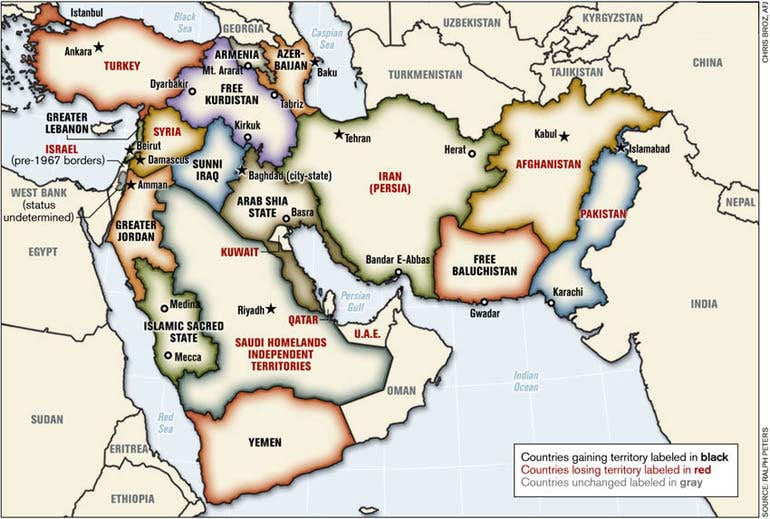
    The thirty three year old politician said more for the ordinary man in one speech than all the parliamentary waffle of the last few decades. In these lugubrious times of ubiquitous lies and obscene evil, Louis’ courage and integrity should serve as an example to other politicians who tread in the corridors of power to speak out and denounce this tyranny now before it destroys all possibility of denunciation.

    Listening to Louis’ passionate oratory brought to mind these lines from W.H Auden written in September 1939, on the eve of World War II:

    “Defenseless under the night
    Our world in stupor lies;
    Yet, dotted everywhere,
    Ironic points of light
    Flash out wherever the Just
    Exchange their messages:
    May I, composed like them
    Of Eros and of dust,
    Beleaguered by the same
    Negation and despair,
    Show an affirming flame”

    Mehdi’s Morning Memo: Not So Fast Dave

    0

    The ten things you need to know on Wednesday 30th January 2013…

    1) NOT SO FAST DAVE

    Hurrah! From the Huffington Post:

    “David Cameron’s hopes of limiting the impact of the 2015 TV debates by staging them before the election campaign gets underway appear dead in the water, after the head of Sky News torpedoed the idea.

    “… [S]peaking to The Huffington Post UK, John Ryley, the head of Sky News, flatly rejected the idea.

    “‘Well, we believe the debates need to take place during the election campaign to be relevant to the voters,” he said. “It would be bizarre to hold the debates while Parliament is sitting.’

    “Ryley reminded Cameron of his threat to ’empty chair’ Gordon Brown in 2010 if he refused to take part and said it would ‘bad for democracy, bad for politics, and bad form’ if Cameron tried to duck the debates.”

    Bad luck, Dave. Ryley – a former boss of mine – is a tough, no-nonsense character. It looks like those debates are going to happen – with or without the PM…

    Meanwhile, if you read the full HuffPost UK feature on the 2015 TV debates – by Ned Simons and me – you’ll learn, among other things, that senior Labour sources are suggesting Nick Clegg’s time be cut and redistributed to Ed Miliband. Read our full piece here.

    2) GAMBLING ON GAY MARRIAGE

    From the Times splash:

    “David Cameron is under mounting pressure to push through tax breaks for married couples as a way of averting a Tory rupture over gay marriage.

    “Ministers are pressing Downing Street to make a Budget announcement in March implementing the party’s promise to reward married couples in the tax system. Cabinet sources told The Times that George Osborne should act ‘sooner rather than later’ and that the Budget would be ‘a good time to placate an awful lot of people’.

    “MPs plan to use the coming weeks to warn a reluctant Chancellor that he will increase the risk of losing lifelong Tories from the party unless he acts.”

    It’s a bizarre proposal – but Dave is desperate. Next week, MPs vote on the coalition’s bill to introduce same-sex marriage and it’s expected that almost half of the party’s 303 MPs will vote against, on a free vote.

    3) NASTY NICK

    Was yesterday the day the Tory dream of a 2015 Commons majority finally came to an end? And were ‘Nasty Nick’ and his rebellious Lib Dems to blame? My colleague Ned Simons reports:

    “Nick Clegg took his revenge on David Cameron today by successfully killing Tory hopes of redrawing the electoral map in a way that would aid the prime minister’s reelection, prompting a serious rift between the coalition parties.

    “Lib Dem and Labour MPs cheered as they narrowly defeated by 334 votes to 292 an attempt by the Conservative Party to change the number and size of constituencies before 2015.

    “In an unprecedented move reflecting the split between coalition parties on the issue, Cameron agreed to suspend the requirement for government ministers to exercise collective responsibility for the vote.”

    Remember ConHome editor Tim Montgomerie’s reaction to the boundary review failure last August? He called it the “worst single electoral setback [for the Tories] since Black Wednesday”. Indeed it is…

    4) DAVE THE WARRIOR

    Today, as a story on the front of the Guardian reports, David Cameron will become

    “… the first western leader to visit Algeria since the recent terrorist assault on the country’s gas installations that left 35 foreign energy workers dead and saw 36 militants killed by Algerian security forces. Cameron’s show of solidarity at the meeting in Algiers comes amid Tory fears that the prime minister is being slowly sucked into a long-term military conflict in the region, symbolised by his decision to send 330 British military personnel to the region to train African troops and support the French intervention in Mali.”

    Meanwhile, the FT reports that Cameron and George Osborne are “under pressure from Tory MPs to shield the armed forces from further defence cuts in this year’s spending review, as the military is dispatched to a new war zone in Mali”. And the Telegraph splashes on the threat to the SAS from “new defence cuts”.

    5) ‘MALI WAR COULD BE BRITAIN’S VIETNAM’

    That’s the headline in the Mirror, which reports on Dave’s decision to send another 200 British troops to train an African intervention force (taking the total UK deployment to 330) and quotes former cabinet minister Frank Dobson’s comments in the Commons yesterday:

    “The American catastrophe in Vietnam started with American troops in a training capacity.”

    Indeed it did – JFK hid behind the phrase ‘military advisers’. Dobson’s remarks were echoed by, of all people, Sir Mike Jackson, former chief of the armed forces, who supports the Mali deployment but also warns that a highly successful “conventional” conflict could give way to “a protracted guerrilla warfare away from the conurbations”.

    BECAUSE YOU’VE READ THIS FAR…

    Watch this video of a kid who’s won over the internet with his dance moves during a break in the recent Houston Rockets vs Indiana Pacers basketball game.

    6) TORTURE INC

    The Guardian’s award-winning Ian Cobain reports:

    “Allegations that British troops in Iraq were responsible for the widespread and systemic abuse of detainees through “terrifying acts of brutality, abuse and intimidation” were raised in the high court yesterday as lawyers representing former prisoners demanded a public inquiry.

    “More than a thousand former prisoners complain that they were severely mistreated after being detained by the British military during the five-year occupation of the south-east of the country, while others – including women and children – say they were abused when their male relatives were being detained.

    “… The hearing is the latest skirmish in a three-year legal battle between lawyers for the former detainees and the Ministry of Defence (MoD).”

    On a related note, HuffPost UK will be hosting a public debate on Iraq – ‘Was It Worth It? Iraq, Ten Years On’ – on 7 February at 7pm at Goldsmiths, University of London. Speakers include former cabinet minister Clare Short, Times columnist David Aaronovitch, the Independent’s Owen Jones and yours truly. Get your free tickets here.

    7) ‘BROTHERLY SHOVE’

    This is my favourite headline from the morning papers – from the Sun, which reveals:

    “Ed Miliband was talked out of matching the Tories’ EU referendum pledge – by his brother David.

    “The under-fire Labour leader’s refusal to offer a nationwide vote on Britain’s membership has infuriated some senior party figures.

    “One claimed Ed vetoed the idea after his older sibling sneered it was ‘too populist’.”

    Meanwhile, the BBC reminds us that “MPs will have their first chance later to discuss the UK’s future in Europe since David Cameron promised to hold a referendum on UK membership if he wins the next general election… The Commons debate will take place after Prime Minister’s Questions.”

    Perhaps, just perhaps, we’ll get some clarity on what Labour’s referendum position actually is, and what the Tories will do if the Europeans don’t agree to a ‘renegotiation’. But I wouldn’t hold your breath.

    8) BANKERS NOT SO BASHED

    More good news from the world of finance. From the Independent:

    “Royal Bank of Scotland is facing criminal charges in the US over allegations its traders tried to fix Libor interest rates, it emerged yesterday.

    “… It came as Britain’s financial watchdog admitted that top bankers had escaped sanction for misdeeds during the financial crisis because it was ‘easier to get the little guys’ under Britain’s regulatory system.”

    RBS, says the report, is likely to pay around £500m in fines – but still wants to pay out £250m in bonuses to its investment bankers. You could not make this stuff up.

    9) PUSHED INTO POVERTY

    From the Guardian:

    “Thousands of children and their families who have sought refuge in the UK have been pushed into severe poverty by the low levels of asylum support, a parliamentary inquiry has revealed, concluding that the support system for asylum seekers is in urgent need of reform.

    “The inquiry found evidence of children being left destitute and homeless, without state support, and forced to rely on food parcels.”

    The chair of this cross-party inquiry? Er, the former children’s minister Sarah Teather MP.

    10) STREWTH!

    They’re going to the polls down under. Well, not quite yet. From the BBC:

    “Australian Prime Minister Julia Gillard has called a general election for 14 September… She said the announcement, eight months in advance, was “not to start the nation’s longest election campaign” but to give ‘shape and order’ to the year.”

    “… Opinion polls suggest that the opposition, led by Liberal Party leader Tony Abbott, would win an election if the polls were held now.”

    Oh dear. For a laugh, though, (re)watch this classic video of Gillard tearing strips out of the “sexist” Abbott in the Australian House of Representatives.

    PUBLIC OPINION WATCH

    From today’s Sun/YouGov poll:

    Labour 42
    Conservatives 33
    Lib Dems 11
    Ukip 8

    That would give Labour a majority of 96.

    140 CHARACTERS OR LESS

    @ShippersUnbound Tory MPs selling shares in Jesse Norman after Lords rebellion sinks boundary changes. One texts to say: ‘Jesse Norman: t***.’

    @jameschappers What issue will Tory MPs pick for revenge on LibDems for last night’s boundaries vote? (Labour are calling it ‘Twit for Twat politics’)

    @heavencrawley “Clear examples from the past show no correlation between levels of support and numbers of asylum seekers in the UK”. Finally, some sense.

    900 WORDS OR MORE

    Guido Westerwelle, Germany’s foreign minister, writing in the Times, says: “Berlin shares Mr Cameron’s desire for reform in Brussels but not his vision for Europe.”

    Simon Jenkins, writing in the Guardian, says: “UK intervention in Mali treads a familiar — and doomed — path.”

    Mary Riddell, writing in the Telegraph, says: “Britain badly needs an Abraham Lincoln who will think big and act big.”

    Got something you want to share? Please send any stories/tips/quotes/pix/plugs/gossip to Mehdi Hasan (mehdi.hasan@huffingtonpost.com) or Ned Simons (ned.simons@huffingtonpost.com). You can also follow us on Twitter: @mehdirhasan, @nedsimons and @huffpostukpol

    Manipulating Wikipedia Content: Israeli Program to Train Editors to Ensure that “What is Written” is “Zionist in Nature”

    0

    wikipedia

    In August 2010, the Yesha Council together with Israel Sheli (My Israel), organized a workshop in Jerusalem to teach people how to edit Wikipedia articles in a pro-Israeli way. (Wikipedia)

    The Yesha Council which is the Hebrew acronym for Yehuda Shomron, Aza, lit. “Judea Samaria and Gaza Council”) is an umbrella organization of municipal councils of Jewish settlements in the West Bank (and formerly in the Gaza Strip), known by the Hebrew acronym Yesha. (ibid)

    My Israel (Israel Sheli) is “an Israel right wing extra-parliamentary Zionist movement”, which “deals with PR across the internet and especially social networks”. 

    We bring to the consideration of Global Research readers this short video which features the Yesha Council-Israeli Sheli training program, pertaining to the art of manipulating online content on Wikipedia entries.

    The stated objective of the training program organized by the Yesha Council and My Israel is to:

    “teach people how to edit wikipedia. the number one source of information”

    “We want to be there…

    We want to influence what is written, how it written, ensure that it is balanced and Zionist in nature”

    [To ensure that] our side of story is getting coverage”

    About the author:

    Michel Chossudovsky is an award-winning author, Professor of Economics (emeritus) at the University of Ottawa, Founder and Director of the Centre for Research on Globalization (CRG), Montreal and Editor of the globalresearch.ca website. He is the author of The Globalization of Poverty and The New World Order (2003) and America’s “War on Terrorism”(2005). His most recent book is entitled Towards a World War III Scenario: The Dangers of Nuclear War (2011). He is also a contributor to the Encyclopaedia Britannica. His writings have been published in more than twenty languages.

    Disclaimer: The contents of this article are of sole responsibility of the author(s). The Centre for Research on Globalization will not be responsible for any inaccurate or incorrect statement in this article. The Center of Research on Globalization grants permission to cross-post original Global Research articles on community internet sites as long as the text & title are not modified. The source and the author’s copyright must be displayed. For publication of Global Research articles in print or other forms including commercial internet sites, contact: publications@globalresearch.ca

    www.globalresearch.ca contains copyrighted material the use of which has not always been specifically authorized by the copyright owner. We are making such material available to our readers under the provisions of “fair use” in an effort to advance a better understanding of political, economic and social issues. The material on this site is distributed without profit to those who have expressed a prior interest in receiving it for research and educational purposes. If you wish to use copyrighted material for purposes other than “fair use” you must request permission from the copyright owner.

    For media inquiries: publications@globalresearch.ca

    The Largest Carbon Bomb on the Planet

    0

    Despite President Obama’s recent remarks on climate change during his inaugural address, the “fuse to the largest carbon bomb” on the planet – the Keystone XL pipeline – continues to move forward.

    That’s why young people across the country are putting themselves on the line to take direct action to shut down this calamitous project. And that’s why Truthout needs your help to continue providing climate justice organizers with the kind of information they can use, and to continue reporting on their actions without corporate bias. 

    During my time at Truthout I’ve watched many of these young people – some of them my close friends – get arrested, harassed or worse while fighting to slow the rising tides which threaten my generation’s future. I’m proud to see that many of those same activists share Truthout stories on social media and use our independent reporting to stay informed.

    Truthout urgently needs to raise more than $30,000 by Thursday: Will you chip in and make a tax-deductible donation today?

    Click here to donate.
    Click here to donate.
    (Truthout is a 501(c)(3) nonprofit. EIN: 20-0031641)

    You can also donate by check, made payable to:
    Truthout, P.O. Box 276414, Sacramento, CA 95827
    (Please include your email address on your check.)

    Thank you for helping to make Truthout’s mission a reality!

    Sincerely,
    Candice Bernd, Social Media Fellow

    Poverty versus Progress: Comparing the US and Venezuela

    0

    If we are to take the traditional definition of the term, then “Third World” refers to those (non-white) countries that struggle to attain high levels of economic development and which, for the most part, are reduced to the periphery of the global economy.

    However, since the onset of the economic crisis beginning in 2007-2008, many of the economic problems of those traditionally poor countries have become ever more apparent in the so-called developed world. Socio-economic maladies such as extreme poverty, hunger, and unemployment have skyrocketed in advanced capitalist countries like the United States, while politicians and the media continue to trumpet the mirage of an economic recovery.

    Naturally, one must ask for whom this is a recovery…for the poor or for Wall St? Moreover, it has forced the world to examine what progress looks like. One way of doing so is to analyze what the statistics tell us about the United States versus Venezuela. In so doing, one begins to get a much clearer picture, free from the distortions of media and politicians alike, of just how much progress has been made in the Bolivarian Revolution while the situation of the poor and working classes in the US continues to deteriorate.

    Venezuela-President

    What Is Poverty?

    Before one can reach any definitive conclusions about poverty in the US and Venezuela, it is essential to first establish the stark difference in the way in which poverty is measured in the two countries. With respect to the US, poverty is measured purely by household income, with a certain threshold known as the “poverty line” determined by the Census Bureau. This measurement, based on a purely arbitrary delineation between poverty and “non-poverty”, is the one by which many make determinations about the state of the poor in the US. As should be self-evident, this system of analyzing poverty ignores the obvious fact that there is little tangible difference between the lives of those slightly over and slightly under the poverty line in that both live in a constant state of privation. Moreover, as increasing inflation, decreasing wages and other factors continue to impact the purchasing power and actual lives of the poor, the poverty line becomes even more problematic.

    In contrast, the Venezuelan government has a distinctly different set of measurements to determine true poverty including: access to education, access to clean drinking water, access to adequate housing, and other factors.[i]

    Essentially then, in Venezuela, poverty is not a measure of income, but of quality of life. By measuring poverty in this way, the Venezuelan government provides a far more comprehensive picture of the socio-economic situation in the country. It is important to note also that, unlike in the United States, poverty statistics in Venezuela are one of the primary driving forces behind the formation of government policy. While in the US, poverty has become a dirty word (as evidenced by the subject’s total absence from last year’s presidential debates), Chavez and the Bolivarian Revolution have made it the centerpiece of public policy in all aspects.

    What the Numbers Show

    When one examines the statistical data compiled by the Census Bureau in the United States, many very troubling facts emerge. First, it’s critical to note that, in 2012, the poverty line for a typical family of four was at a combined gross income of $23,050.[ii] Note that this indicator is derived from gross income as opposed to net income, so it doesn’t even reflect the gravity of the situation faced by these families.

    Anyone who has even a rudimentary understanding of the current costs of living in the United States can immediately surmise that the “poverty line” is a cruel joke. This level of income means abject poverty, it means a lack of basic necessities for human life. So, in essence then, we’re not talking about “the poor”, but those on the verge of death with problems such as malnutrition, serious illness from treatable conditions, and countless other hindrances to basic existence. In addition, it should be noted that median family income (for all families, not just those in poverty) continues to decline dramatically, with a decrease of 8.1% since 2007.[iii] Therefore, it becomes apparent that, not only is poverty widespread, it is growing.

    California, long touted as the most economically vibrant state in the US, is now known as more than just the home of Silicon Valley and beautiful coastline, it is also home to the highest levels of poverty in the United States. According to the Supplemental Poverty Measure of the US Census Bureau, California boasts a 23.5% poverty rate[iv] which, if included with those who do not technically fit the poverty measure but who still live very much on the economic margins, shows that poverty is fast becoming an epidemic in California.

    As University of Wisconsin Madison economist Timothy Smeeding explained, “As a whole, the safety net is holding many people up, while California is struggling more because it’s relatively harder there to qualify for food stamps and other benefits.”[v] Essentially then we see that, in the nation’s most populous and, arguably most economically important state, the situation of the poor is a dire one as more and more people become dependent on government programs just for survival. This is, of course, against the backdrop of austerity or so-called “entitlement reform” championed by both Republicans and Democrats, which would cut these same programs which are becoming ever more critical for millions of Americans.

    Income cannot and should not be seen as the only indicator of poverty and economic status. Indeed, there are many other factors including access to proper nutrition, particularly important for children growing up in situations of poverty. In fact, the most recent data from the USDA suggests that at least 18 million households in the US were food insecure as of 2011.[vi] This is merely the tip of the iceberg when one considers that there are millions of households who are not categorized as “food insecure” but who cannot afford high quality food and the still more families who are only food secure because of government programs such as the Supplemental Nutrition Assistance Program (SNAP) formerly known as food stamps. Lack of access to highly nutritious foods is characteristic of poor, urban neighborhoods where primarily people of color struggle to feed their children with something other than fast food or low quality food purchased at the corner store.

    What becomes apparent in even a cursory examination of this information is that food security and poverty are not merely indicators of economic hardship, they are class designations. The United States is home to an ever-expanding underclass, one that is encompassing more and more formerly working class people and white people, but which still afflicts communities of color most acutely. In every major city and more and more formerly affluent white suburbs, poverty has become an ever-present reality, one that remains hidden as Americans engage in the collective self-deception of “economic recovery.”

    The Venezuelan Model

    In contrast to the United States, Venezuela continues to make tremendous strides in eradicating poverty from a nation that, for decades, had been one of the poorest and most exploited in the Americas. Despite vast oil wealth and abundant resources, Venezuela was characterized by extreme poverty, particularly among the indigenous and peasant populations. This was the product of the colonial and post-colonial system wherein a small, light-skinned elite dominated the country and kept the rest of the people in abject poverty. This situation began to change with the ascendance of Hugo Chavez and the Bolivarian Revolution. Immediately Chavez, already a hero to poor Venezuelans, set about implementing his socialist model that would make the fight against poverty the centerpiece of his public policy. Indeed, this is precisely what has happened in the fourteen years since he took office.

    As mentioned previously, Venezuela uses a comprehensive set of criteria to measure poverty including access to education, clean drinking water, adequate housing, households with more than three people living in a room, and households where the head of the household had less than three years of education. Using this rubric, known as the Unsatisfied Basic Needs system (NBI), the statistics are intriguing. In the last ten years, the number of Venezuelans living in extreme poverty (those who experience two of the five indicators of poverty) has decreased from 11.36% to 6.97%, a reduction of almost one half. At the same time, life expectancy and total population have increased significantly, showing the impact of better and more comprehensive health care services. One particularly important piece of data has to do with indigenous people, the group most marginalized historically. In the last ten years, their numbers have grown significantly as well, now making up almost 3% of the population.[vii] This shows that, not only have the quality of health programs and related services increased, but access to them has grown as well, particularly for those traditionally disenfranchised segments of the population.

    It should be noted that one of the centerpieces of the anti-poverty programs of the Chavez Bolivarian government has been the exponential increase in construction of public housing and affordable units. President Chavez announced the Great Housing Mission (GMVV)[viii] in 2011 to combat the extreme poverty that so many Venezuelan families faced as they lived in inadequate or unsafe homes. As of September 2012, more than 250,000 homes had been constructed and given to poor Venezuelan families.[ix] This number is surely set to increase in the coming year as the program continues to expand and housing becomes ever more accessible and plentiful.

    In the midst of a worldwide economic crisis, the Chavez government continues to expand spending on anti-poverty programs such as housing construction and health care while much of the so-called developed world engages in the mass hysteria of austerity. The Bolivarian Revolution set before itself the task of reducing and ultimately eradicating poverty in a country where poverty was a historical tradition and a seemingly immutable reality. The post-colonial era of Venezuelan history is one fraught with domination and oppression by the United States and subjugation to multinational corporations while the poor and working classes lived in wretched conditions. Chavez’s commitment to reversing that legacy is what has, more than anything else, enshrined his legacy in the hearts and minds of Venezuelans.

    Conversely, the advanced capitalist economies of North America and Europe are desperately trying to maintain their hegemony and economic survival by means of austerity programs which shift the burden of the depression from the wealthy financiers and speculators who created it to the poor and working class who must pay for it. Draconian cuts to necessary social services upon which millions of Americans depend for their very survival serve to illustrate this point further. Unlike in Venezuela, the Western imperial powers seek to destroy the social safety net and drive their populations into further destitution and desperation. This is, to put it another way, the crisis of advanced, post-industrial capitalism — an economic system which must expand the divide between rich and poor, create extremes of wealth and poverty and generally perpetuate itself on the misery and poverty of the lower classes. Seen in this way, Republicans and Democrats, President Obama and House Speaker Boehner alike are culpable for the massive suffering and despair of the poor in the US who can look to Venezuela and the Bolivarian Revolution as a model for a truly progressive vision of the future.

    Notes

    Gatorade To Drop Suspect Additive

    0

    WASHINGTON – January 29 – PepsiCo’s decision to stop using brominated vegetable oil in Gatorade marks an important victory for consumers. The chemical, known as BVO, is used in the U.S. as an emulsifier in citrus-flavored drinks, about 10 percent of the U.S. soft drink market, to keep the flavoring from floating to the top.

    There are at least two documented cases in which heavy drinkers of BVO-laced beverages have been reported to suffer from bromide intoxication, characterized by memory loss and neurological symptoms. The risks of BVO to human health have not been definitively established, but some scientists have expressed concerns about it because BVO accumulates in human tissue. A 1984 study found that when female rats that were nursing pups were fed brominated olive oil, the chemical showed up in their milk. This and an animal study showing reproductive and developmental effects in rodents raise concerns about the possible effects of the chemical on developing children.

    “Chemicals like BVO should be subjected to much more study before they are allowed in food,” said Heather White, Executive Director at the Environmental Working Group. “We need to overhaul the rules so that the federal Food and Drug Administration knows much more about this and other food additives to better protect public health.”

    PepsiCo announced January 25 that it would reformulate Gatorade. It was responding to a petition circulated on Change.Org by 15-year-old Sarah Kavanagh of Hattiesburg, Miss., and signed by more than 200,000 people. “I thought [the petition] might get a lot of support because no one wants to gulp down flame retardant, especially from a drink they associate with being healthy,” Kavanagh told the Hattiesburg American. “But with Gatorade being as big as they are, sometimes it was hard to know if we’d ever win. This is so, so awesome.”

    The FDA granted BVO “interim status” as a food additive in 1977, which allowed its use in soft drinks, but it is banned from European and Japanese soft drinks. It is patented in the U.S. and overseas as a flame retardant. The extent to which it is used for this purpose is not clear, based on the public record.

    Other brominated chemicals are widely used as flame retardants. They are often found in foam furniture, television sets and other electronics and in household dust. Some brominated flame retardants are associated with hormone disruption and harmful neurodevelopmental effects. These compounds are not structurally similar to BVO. It is unknown whether they have the same potential for toxicity.

    But until the FDA requires testing to ensure that BVO is safe, no one can accurately assess its potential for harm to public health.

    Breakthrough For Hawaiian Solar Power Announced By Clean Energy Groups

    0

    WASHINGTON – January 29 – Today, national organizations Earthjustice and the Interstate Renewable Energy Council, Inc. (IREC) commended the Hawaiian Electric (HECO) utilities’ path-breaking plans to enable more rooftop solar systems to connect to the grid. The utilities and clean energy stakeholders laid out a new and innovative “Proactive Approach” to planning for rooftop solar growth as part of a multi-party working group convened by the HawaiÊ»i Public Utilities Commission (PUC), which just concluded its deliberations last week.

    HECO will take the initiative to determine how continued growth in rooftop solar may affect the utility circuits, and how the grid needs to be upgraded to enable further expansion. This should ease the way for Hawaiʻi homes and businesses to install more rooftop solar. It also offers a model for other utilities across the country to follow as the levels of renewable energy increase on their grids.

    “This proactive approach to distributed solar is the next evolutionary step toward transforming the grid to enable homes and businesses to produce their own clean power,” said Earthjustice attorney Isaac Moriwake, who represented the HawaiÊ»i Solar Energy Association in working with HECO, HawaiÊ»i PV Coalition, IREC, and others to develop the recommendation. “This wave is already happening, and it’s in the utilities’ best interests proactively to move into the future.”

    “HECO’s proposed proactive approach puts HawaiÊ»i on the cutting edge of accommodating high levels of solar energy on the utility grid,” said IREC’s attorney Tim Lindl. “Few, if any, utilities in the country have taken such a progressive stance on this issue, and this program will position HawaiÊ»i as the nation’s leader in the integration of small-scale solar resources.”

    Utilities nationwide traditionally take an unwelcoming approach to connecting rooftop solar and other on-site generation. They apply conservative blanket limits on renewable energy fed into local circuits (generally 15 percent of peak load), beyond which they may require a customer wanting to install solar panels to pay for a costly and time-consuming study of the potential impacts on their circuits.

    As HawaiÊ»i reaches higher levels of rooftop solar, this has led to logjams of studies that burden the utilities while stalling or blocking new rooftop hookups. The HawaiÊ»i utilities’ new proactive approach aims to get ahead of such holdups, by having the utility independently track and plan for rooftop solar growth so that when a customer asks to hook up a system, the utility can be ready.

    Hawaiʻi is seeing a boom in rooftop solar, with year-over-year growth over the last several years. In March 2010, HECO reacted to this rapid upsurge by proposing a moratorium on distributed installations on the neighbor islands, which it quickly retracted in response to public outcry. Since then, the penetration of rooftop solar has risen further with no apparent ill effects, and HECO has raised the circuit penetration limit repeatedly to accommodate more customer installations.

    In October 2012, HECO again raised the limit to 75 percent of minimum load (which roughly translates to 23 percent of peak) for certain smaller systems. California utilities raised their limit last year to 100 percent of minimum load, which HECO is looking to adopt in the coming months.

    This proactive approach, in essence, aims to move beyond arbitrary limits, toward a grid that is planned to fully incorporate rooftop solar and other green energy. The plan filed with the PUC outlines a timetable to implement the proactive approach that continues to 2015.

    “While building a clean energy economy won’t happen overnight, we have little time to lose,” said Moriwake. “We hope this new future-facing approach will provide a roadmap for other utilities to become more rooftop solar friendly.”

    “HawaiÊ»i is a national trendsetter for renewable energy, and timely and efficient implementation is going to be key for this proactive approach to succeed,” said Lindl. “We will continue to track its progress to help keep up the momentum.”

    Procedural Background:

    The proactive approach recommendation was developed in a multi-party process called the Reliability Standards Working Group (RSWG), involving utilities, state agencies, and clean energy groups. The PUC convened the RSWG in September 2011 at HECO’s suggestion to deal with reliability concerns arising from increasing levels of renewable energy entering the HECO grids.

    At the PUC’s direction, the RSWG formally concluded its work this month by submitting an array of recommendations and reports, which included the proactive approach recommendation. Other recommendations included proposed further refinements to the utility rules and practices relating to rooftop solar and other distributed generation, and a set of transparent reliability standards for the operation and planning of the utility grid.

    Immigration Reform Must Include Workers’ Rights

    0

    At this moment, various plans to reform America’s broken immigration system are working their way through Congressional debate. On Monday, a bipartisan group of eight lawmakers unveiled a plan that includes what they call a “tough but fair” path to citizenship for undocumented immigrants. Last Friday, members of the Congressional Hispanic Caucus met with President Obama to discuss the issue, and this caucus’ input will be influential in shaping any final legislation.

    In the current political climate, immigration reform is broadly popular, with both parties eager to win over the Hispanic electorate in 2014 and 2016. But that doesn’t mean that a bipartisan effort will pass a good law — especially if long-time opponents of immigration reform are only cynically vying for votes. We have every reason to doubt the sincerity of conservatives such as Senator Marco Rubio, who is leading the charge from the Republican side of the aisle with an eye on his own bid for president.

    For the Democrats, the challenge will be to avoid simply jumping at the first deal offered by newly converted conservatives. Instead, for the first time in decades, promoters of reform have the opportunity to hold America to its promise of being a land of liberty and justice for all.

    Most centrally, that comes down to the issue of work. Holding America to its promise will mean ensuring that immigrants have pathways for securing just and meaningful employment in this country.

    Immigrants Rebuilding the Middle Class

    The primary reason people come to the United States from other nations is the potential for good work. It’s not enough for immigrants to have legal status to stay here. They must have legal rights as employees to speak out against wage theft and abusive working conditions — and to exercise their freedoms to associate and engage in collective bargaining.

    In recent decades, unions that were once isolationist have come around to this position. That’s why, in the current debate, organized labor is one of the strongest institutional voices speaking out in favor of immigrant rights.

    A key goal in crafting a legislative package for reform will be to avoid the creation of a permanent two-tiered system of employment — with some immigrants allowed to stay and work, but only on terms that greatly restrict their rights. Some conservatives would like to see a version of immigration reform that emphasizes helping corporations maintain a pool of cheap immigrant labor and that would further weaken unions. Such a system would foster a permanent underclass of workers living little better than serfs.

    We go down that path at our collective peril. More than any other institution, the trade union movement was responsible for the creation of a stable American middle class. And more than any other constituency, waves of fresh immigrants to this country’s shores did the most to lay the foundation for the U.S. labor movement.

    For this reason, whether or not you are an immigrant or a union member yourself, we all have an interest in ensuring that new arrivals to the United States are able to stand up to fight for better wages and working conditions.

    Avoiding the Errors of the Past

    In order to make sure that immigrant rights and workers’ rights go hand-in-hand in any new reform package, we must not repeat the errors of the past. And with regard to immigration, the past is the Simpson-Mazzoli Act of 1986. For the last 27 years we have lived, however messily, under the guidelines set out in this bill.

    Most consequentially, Simpson-Mazzoli beefed up enforcement partly by making employers turn workers in to the Immigration and Naturalization Service (now called ICE). At the time, this idea had broad support. In an influential editorial from 1982 (the year Simpson-Mazzoli was first introduced), the New York Times argued, “The United States cannot conceivably let in all the worldwide millions who want in. That means controlling our own borders and that in turn, means something called employer sanctions.”

    This provision was likely the bill’s greatest mistake, as many former supporters have since recognized. Employers should not be made to do the government’s job of enforcing the law. Doing so only deepened the divide between employees based on their legal residency status. More importantly, it opened the door for unscrupulous employers to use the threat of an immigration raid to keep disaffected workers from standing up for themselves and exercising their rights.

    Under the broken system, employers looked the other way on employees’ legal status when it was to their advantage, but they used workers’ undocumented status as a tool when it could ensure their employees would never take collective action. Such behavior and unfairness helped lead to depressed wages throughout the economy.

    The current bipartisan immigration reform plan promises an “effective” employment verification system. The devil will be in the details, and much remains to be worked out. But this much is clear: To allow employers to have the power to enforce immigration laws in 2013 would be history repeating itself, and it is the wrong way to go.

    The folks who supported Simpson-Mazzoli back in 1986 thought they were making our system fairer. Yet everything fell apart after it was passed. The U.S. began to witness a steady climb in illegal border crossings, rampant fraud, and a snarled mess of an enforcement system — the exact reverse of the legislation’s intended consequences. And America’s middle class has only suffered in the years since.

    When people come to this country, they are coming because they want to make a living. While it’s important that immigrants be given a pathway to citizenship and the ability to reunite with family members, these goals are not enough. Until immigrants are able to fully exercise their rights in the workplace, America has not lived up to its promise.

    Manure to Energy Announcement is No Solution for The Bay

    0

    WASHINGTON – January 29 – Statement by Wenonah Hauter, Executive Director, Food & Water Watch

    “Governor O’Malley’s announcement last week that Maryland is investing in a controversial manure to energy scheme is good for factory farms, but bad for the Chesapeake Bay. Manure to energy projects are no solution for managing the estimated 300,384 tons of excess poultry litter in the Bay region.

    “The state, in partnership with the University System of Maryland, will enter into a power purchase agreement with Green Planet Power Solutions to purchase a minimum of 10 MW of electricity produced from animal waste in Caroline County. But converting poultry litter into energy is not a sustainable solution for the problems created by concentrating too many animals in one place. These projects, funded by government subsidies and tax credits, often create new waste streams, such as toxic air emissions that introduce harmful air pollutants into communities, and do not eliminate many pollutants of concern in animal waste such as nitrogen and phosphorous that choke the Bay.

    “While the details of the Green Planet Power Solutions project are not yet publicly known, we call upon Maryland’s political leaders to stop asking citizens to bail the industrial ag interests out of their massive waste problem by financing projects that only perpetuate unsustainable farming practices.”

    To see our report, Poultry Litter Incineration: An Unsustainable Solution, visit http://documents.foodandwaterwatch.org/doc/PoultryLitterIncineration.pdf

    Food & Water Watch is a nonprofit consumer organization that works to ensure clean water and safe food. We challenge the corporate control and abuse of our food and water resources by empowering people to take action and by transforming the public consciousness about what we eat and drink.

    Americans Against Fracking Commends Maryland Legislators for Introducing Statewide Fracking Ban

    0

    WASHINGTON – January 29 – Statement From Americans Against Fracking Advisory Committee Member, Biologist, Ithaca College Distinguished Scholar in Residence and Author Sandra Steingraber, Ph.D.

    “Americans Against Fracking, a national coalition dedicated to banning hydraulic fracturing, or fracking, and drilling associated with fracking for oil and natural gas in the United States, commends Delegate Shane Robinson and Senator Karen Montgomery for having the courage to introduce legislation in Maryland that bans hydraulic fracturing statewide. 

    “With this legislation, the State of Maryland would become a shining example of how to stand up to the powerful oil and gas lobby. It shows that Maryland’s legislators find the livelihoods and health of their constituency to be more important than the profits of oil and gas companies.  

    “Americans Against Fracking represents over 160 public health, consumer, environmental and faith-based organizations that want to protect American communities from the economic problems and environmental dangers associated with fracking.”

    Including organizations such as Berks Gas Truth, Breast Cancer Action, CREDO Action, Catskill Mountain Keeper, Center for Biological Diversity, Delaware Riverkeeper Network, Democracy for America, Food & Water Watch, Frack Action, Frack-Free Stark County, Illinois People’s Action and National Nurses United, Americans Against Fracking supports federal state and local efforts to ban fracking and to stop practices that facilitate fracking like natural gas exports, frac sand mining and pipeline construction.

    Americans Against Fracking is composed of the following groups: http://www.americansagainstfracking.org/members/. For more information about Americans Against Fracking, visit www.AmericansAgainstFracking.org

    Food & Water Watch is a nonprofit consumer organization that works to ensure clean water and safe food. We challenge the corporate control and abuse of our food and water resources by empowering people to take action and by transforming the public consciousness about what we eat and drink.

    Keep Dirty Oil Out of New England

    0

    Protesters gathered in downtown Portland, Maine, on Saturday and then marched to the city’s waterfront to protest against a possible proposal to pipe tar sands oil from Canada through Northern New England. (Photo: Gregory Rec via AP)From north to south and east to west, people across the United States and Canada are increasingly coming together to fight against the expansion of the Alberta tar sands and efforts to move the highly toxic bitumen – tar sands “oil” – through pipelines to the Atlantic, Pacific and Gulf of Mexico. From US ports the bitumen would be shipped primarily to China.

    Why do I care? Even before I learned that ExxonMobile is gearing up to try to send tar sands oil east through Vermont – my home state – and New Hampshire to a shipping port in Portland, Maine through decades old pipelines, I was opposed to tar sands expansion and pipeline projects.

    Global warming and the obvious changes to our weather patterns cannot sustain more exploitation of fossil fuels. And tar sands expansion is among the worst threats. After the oil fields of Saudia Arabia, the full development of Alberta tar sands will create the world’s second largest potential source of global warming gases. I saw for myself the impact of the tar sands on the environment and people of Western Canada.

    Last October I led a delegation of women from the United States and Canada to the tar sands of Alberta. We began in Ft McMurray, and then traveled along the proposed route of the Enbridge Northern Gateway pipeline that will carry tar sands oil from Prince George, in beautiful northern British Columbia, all the way to the sea at Kitimat on the Douglas Channel.

    While in Canada, I met with and listened to the concerns of over 200 women in 13 communities – women nursing babies, women in wheelchairs, some women representing environmental and community organizations, many from First Nation groups. They spoke passionately about how the massive expansion of the oil sands and pipeline and tanker projects will impact on their communities, forests, rivers, oceans, and air. Some told us of powerful court challenges they are mounting against the tar sands, others described their very real fears about oil spills and what this will do to their livelihoods and way of life. The tar sands oil is the dirty, and they don’t want it their backyard.

    And I don’t want it in mine.

    Along with most Americans, I am deeply disturbed by the rapid pace of climate change and want our leaders to take meaningful action. Last year I wrote last year to President Obama, together with nine other Nobel Peace laureates, urging him to lead the transition away from our dependence on oil, coal and gas and instead increase investments in renewable energies and energy efficiency. I also joined tens of thousands in demonstrating at the White House to urge him to reject the Keystone XL pipeline, which will carry tar sands oil from Canada through six states to reach the Gulf of Mexico. But that is still not enough.

    What I heard in Western Canada echoes what I am hearing across the continent. Many people are moved to action by changing weather patterns, and their fears for the future of their families. Warmer temperatures are hitting Northern British Columbia’s forestry industry hard. Closer to home, last year was the hottest on record in Vermont, New Hampshire and Massachusetts, by more than one degree – as it was for the entire continental United States. A record 11 wildfires, droughts and storms in 2012 exceeded $1 billion in damages, and of course Superstorm Sandy late last year devastated the lives of many communities in New Jersey and New York.

    Yet, through it all, our leaders in the US and Canada continue to collude with the oil industry for a rapid expansion of the tar sands. This kind of leadership is taking us in the opposite direction of where we need to go. Production of tar sands oil needs to be capped, and we need to start investing in other energy sources.

    Like thousands resisting the pipelines in Canada and the Keystone XL, we here in New England will say no to tar sands.

    We will be united in telling leaders of both nations to stop the madness. Listen up Prime Minister Harper: Canada’s National Energy Board must hear the will of the people and deny approval of this pipeline plan. And our message to President Obama, as he starts his second term, is clear: Become a climate leader. Keep tar sands out of New England by refusing to issue this pipeline a new presidential permit.

    As a Vermonter, an American, a global citizen, I am proud to join this call.

    © 2012 The Boston Globe

    One Billion Rising: ‘It’s Like a Feminist Tsunami’

    0

    Flashmobs in Mogadishu, marches in the Isle of Bute and mass rallies in India.

    January 29, 2013  |  

    Like this article?

    Join our email list:

    Stay up to date with the latest headlines via email.

    AlterNet is celebrating One Billion Rising on February 14th at its West Coast office! Join us for refreshments and fun starting at 6PM. For more information, visit our event page. You can also s ign up to start your own event for One Billion Rising, or find out where you can attend.

    Since Eve Ensler launched the One Billion Rising campaign to end violence against women she has been repeatedly asked: is it a dance movement or overtly political? A protest or a giant global celebration? Just a few weeks before 14 February, the date that Ensler, activist and author of The Vagina Monologues, designated the “day to rise”, she says: “I’ve never seen anything like it in my lifetime.”

    One in three women around the world are subject to violence at some point in their life, a statistic that prompted Ensler, who wrote the Monologues in 1996, to set up One Billion Rising. With such violence encompassing domestic abuse, gang rape, female genital mutilation and war, it is perhaps unsurprising that the campaign has taken on a different hue in each of the 190 countries where events to mark 14 February are planned.

    “It is something that has gone across class, social group and religion. It’s like a huge feminist tsunami,” she said on a stopover in Paris.

    Local protests range from the first ever flashmob in Mogadishu, Somalia, to the town square in Rothesay on the Isle of Bute and encompass Maori women in New Zealand and an estimated 25m protesters in Bangladesh. Ensler’s idea for One Billion Rising came from her work in the Congo, where she set up the  City of Joy to help female victims of violence and where she plans to be on 14 February itself, a day chosen partly to take back the idea of love from the soppy commercialism of Valentine’s Day. Her last stop before Congo will be London, with a sold-out event at the Café de Paris including Thandie Newton and other campaigners.

    Ensler says a combination of social media and the world’s grassroots feminist movements have driven the way the campaign has taken off globally. In south Asia for three weeks over Christmas, she was struck by how much the horror over the gang rape of the 23-year-old medical student Jyoti Singh in Delhi had given impetus to the campaign. “In India, One Billion Rising is at the centre of the biggest breakthrough in sexual violence ever seen,” she says.

    Kamla Bhasin, a feminist campaigner in the continent for more than 30 years, says each country is taking a different approach — from the astonishing mass movement in Bangladesh, organised by Brac, one of the world’s largest NGOs, to Afghanistan, where “there will be no dancing and no singing but people still want to say, ‘Enough is enough'”.

    The idea of dancing to stop violence has understandably attracted naysayers, even among committed supporters, but two videos, among hundreds, sum up how Ensler’s idea inspires campaigners. The first is the one that launched the new anthem written and produced by Grammy-award-winning Tena Clark, Break the Chain , with a video choreographed by Debbie Allen, who went on to make her own accompanying “how to” dance video. The second is one produced by campaigners in Norwich. Without the involvement of the sort of Hollywood A-listers — Robert Redford, Jane Fonda — usually associated with Ensler, it’s still hugely effective. Local organisers were keen to show that the campaign is supported by men and boys as well as women.

    NATO: Proudly Delivering Death Since 1949

    0

    globalization-of-nato-icon

    THE GLOBALIZATION OF NATO

    Author: Mahdi Darius Nazemroaya
    Clarity Press (2012)
    ISBN: 978-0-9852710-2-2
    Pages: 411 with complete index

    Now available to order from Global Research

    The world is enveloped in a blanket of perpetual conflict. Invasions, occupation, illicit sanctions, and regime change have become currencies and orders of the day. One organization — the North Atlantic Treaty Organization (NATO) — is repeatedly, and very controversially, involved in some form or another in many of these conflicts led by the US and its allies. NATO spawned from the Cold War. Its existence was justified by Washington and Western Bloc politicians as a guarantor against any Soviet and Eastern Bloc invasion of Western Europe, but all along the Alliance served to cement Washington’s influence in Europe and continue what was actually America’s post-World War II occupation of the European continent. In 1991 the raison d’être of the Soviet threat ended with the collapse of the USSR and the end of the Cold War. Nevertheless NATO remains and continues to alarmingly expand eastward, antagonizing Russia and its ex-Soviet allies. China and Iran are also increasingly monitoring NATO’s moves as it comes into more frequent contact with them.

    Yugoslavia was a turning point for the Atlantic Alliance and its mandate. The organization moved from the guise of a defensive posture into an offensive pose under the pretexts of humanitarianism. Starting from Yugoslavia, NATO began its journey towards becoming a global military force. From its wars in the Balkans, it began to broaden its international area of operations outside of the Euro-Atlantic zone into the Caucasus, Central Asia, East Africa, the Middle East, North Africa, and the Indian Ocean. It has virtually turned the Mediterranean Sea into a NATO lake with the NATO Mediterranean Dialogue and the Istanbul Cooperation Initiative, while it seeks to do the same to the Black Sea and gain a strategic foothold in the Caspian Sea region. The Gulf Security Initiative between NATO and the Gulf Cooperation Council seeks to also dominate the Persian Gulf and to hem in Iran. Israel has become a de facto member of the military organization. At the same time, NATO vessels sail the Red Sea and the Gulf of Aden. These warships are deployed off the coasts of Somalia, Djibouti, and Yemen as part of NATO’s objectives to create a naval cordon of the seas controlling important strategic waterways and maritime transit routes.

    The Atlantic Alliance’s ultimate aim is to fix and fasten the American Empire. NATO has clearly played an important role in complementing the US strategy for dominating Eurasia. This includes the encirclement of Russia, China, Iran, and their allies with a military ring subservient to Washington. The global missile shield project, the militarization of Japan, the insurgencies in Libya and Syria, the threats against Iran, and the formation of a NATO-like military alliance in the Asia-Pacific region are components of this colossal geopolitical project. NATO’s globalization, however, is bringing together a new series of Eurasian counter-alliances with global linkages that stretch as far as Latin America. The Collective Security Treaty Organization (CSTO) and the Shanghai Cooperation Organization (SCO) have been formed by Russia, China, and their allies as shields against the US and NATO and as a means to challenge them. As the globalization of NATO unfolds the risks of nuclear war become more and more serious with the Atlantic Alliance headed towards a collision course with Russia, China, and Iran that could ignite World War III.

    Click to visit the Global Research ONLINE STORE

    REVIEWS

    “The Globalization of NATO by Mahdi Darius Nazemroaya is simply magnificent, erudite and devoid of the ethnocentrism to which one has become so accustomed from Western authors. The book deals with what doubtless are the most important and relevant issues of the day for all those committed to saving life and protecting Mother Earth from rampant human irresponsibility and crime. There is no other book that, at this particular time, I would most heartily endorse. I think Africans, Near Eastern peoples, Iranians, Russians, Chinese, Asians and Europeans generally and all the progressive Latin American countries of today will find a much needed reinforcement and support for their peaceful ideals in this excellent must-read book.”
    —MIGUEL D’ESCOTO BROCKMANN, Foreign Minister of Nicaragua (1979-1990) and President of the 63rd Session of the United Nations General Assembly (2008-2009): Managua, Nicaragua.

    “We are far away from the principles and objectives for which the United Nations was created and the decisions of the Nuremberg Tribunal stipulating that some state actions can be considered crimes against peace. Nazemroaya’s book, in addition to reminding us that the role of the United Nations has been confiscated by NATO, elaborates the danger that the North Atlantic Treaty represents to world peace.”
    —JOSÉ L. GÓMEZ DEL PRADO, Chairman of the United Nations Working Group on the Use of Mercenaries (2005-2011): Ferney-Voltaire, France.

    “Through carefully documented research, Mahdi Darius Nazemroaya analyzes the historical and geopolitical evolution of NATO from the Cold War to the post 9/11 US- led “Global War on Terrorism.” This book is a must read for those committed to reversing the tide of war and imperial conquest by the world’s foremost military machine.”
    —MICHEL CHOSSUDOVSKY, Professor Emeritus of Economics at the University of Ottawa and Director of the Centre for Research on Globalization (CRG): Montréal, Canada.

    “A very timely book. Yes, US-led NATO is globalizing, like the US-led finance economy. No doubt also for it to protect the latter, the “free market.” It is a classical case of overstretch to help save the crumbling US Empire and Western influence in general, by countries most of whom are bankrupt by their own economic mismanagement. All their interventions share two characteristics. The conflicts could have been solved with a little patience and creativity, but NATO does not want solutions. It uses conflicts as raw material it can process into interventions to tell the world that it is the strongest in military terms. And, with the help of the mainstream media, it sees Hitler everywhere, in a Milosevic, a bin Laden, a Hussein, a Qaddafi, in Assad, insensitive to the enormous differences between all these cases. I hope this book will be read by very, very many who can turn this morbid fascination with violence into constructive conflict resolution.”
    —JOHAN GALTUNG, Professor Emeritus of Peace Studies and Sociology at the University of Oslo and Founder of the International Peace Research Institute in Oslo (PRIO), the Galtung- Institut, and the Transcend Network: Oslo, Norway.

    “Mahdi Darius Nazemroaya’s prolific writings give us a comprehensive understanding of the character of the military thrust and it’s all out, no holds barred STRATEGIC plans and moves to invade, occupy and plunder the resources of nations, inflicting unprecedented barbaric acts on civilian populations. He is one of the prescient thinkers and writers of contemporary times who deserves to be read and acted upon by people with a conscience and concern for humanity’s future.”
    —VISHNU BHAGWAT, Admiral and Chief of the Naval Staff of India (1996-1998): Mumbai, India.

    “This is a book really necessary to understanding the role of NATO within the frame of long-term US strategy. The Globalization of NATO by Mahdi Darius Nazemroaya not only provides an articulate analysis on the Atlantic Alliance: it is the best modern text devoted to the hegemonic alliance. With this book Nazemroaya reconfirms his ability as a brilliant geopolitical analyst.”
    –TIBERIO GRAZIANI, President of the Institute of Advanced Studies in Geopolitics and Auxiliary Sciences/L’Istituto di Alti Studi in Geopolitica e Scienze Ausiliarie (IsAG): Rome, Italy.

    “Nazemroaya is an unbelievable prolific writer. What has often amazed many is his almost nonstop writing on extremely important issues for the contemporary world and his analysis about the globalization of NATO. What amazes many of us in other parts of the world are his seemingly limitless depth, breadth and the thoroughness of his knowledge that has been repeatedly appearing in his work. We are deeply indebted to Nazemroaya’s humble, tireless and invaluable contributions through his fearless, insightful and powerful writings.”
    —KIYUL CHUNG, Editor-in-Chief of The 4th Media and Visiting Professor at the School of Journalism and Communication at Tsinghua University: Beijing, People’s Republic of China.

    “The Journalists’ Press Club in Mexico is grateful and privileged to know a man who respects the written word and used it in an ethical way without another interest other than showing the reality about the other side of power in the world. Mahdi Darius Nazemroaya gives voice to the “voiceless.” He can see the other side of the moon, the side without lights.”
    —CELESE SÁENZ DE MIERA, Mexican Broadcaster and Secretary-General of the Mexican Press Club: Federal District of Mexico City, Mexico.

    “With his very well documented analysis, Mahdi Darius Nazemroaya has conducted a remarkable decryption of the strategies implemented by NATO — in the interests of the United States, the European Union and Israel — to expand its military grip on the world, ensure its control over energy resources and transit routes, and encircling the countries likely to be a barrier or a threat to its goals, whether it be Iran, Russia or China. Nazemroaya’s work is essential reading for those that want to understand what is being played out right now on the map in all the world’s trouble spots; Libya and Africa; Syria and the Middle East; the Persian Gulf and Eurasia.”
    —SILVIA CATTORI, Swiss political analyst and journalist: Geneva, Switzerland.

    The Globalization of NATO

    Author: Mahdi Darius Nazemroaya
    ISBN: 978-0-9852710-2-2
    Clarity Press (2012)
    Pages: 411 with complete index

    Price: $22.95

    Click to visit the Global Research ONLINE STORE

    On the News With Thom Hartmann: Obama Administration Considers Next Move on NLRB Appointment

    0

    In today’s On the News segment: The Obama administration is considering its next move, after a panel of three Republican-appointed judges on a DC Circuit Court ruled last week, that President Obama’s recess appointments to the National Labor Relations Board and the Consumer Financial Protection Bureau were unconstitutional; Women are still struggling to find equality in the workplace; a senior Obama administration official tasked with closing the detention facility at Guantanamo Bay, has been reassigned from his position — and will not be replaced; and more.

    Jim Javinsky in for Thom Hartmann here — on the news…

    You need to know this. The Obama administration is considering its next move, after a panel of three Republican-appointed judges on a DC Circuit Court ruled last week, that President Obama’s recess appointments to the National Labor Relations Board and the Consumer Financial Protection Bureau were unconstitutional. The court ruled that the president can only make a recess appointment when the Senate is officially in recess — which only happens once a year — after the Senate finishes the first half of its session. That decision directly contradicted a 2004 federal appeals court ruling — and 190 years of recess appointments by both Republican, and Democratic, presidents. But Corporate America is applauding the decision — and arguing that decisions made by the National Labor Relations Board, and the Consumer Financial Protection Bureau, since the recess appointments, should be null and void. According to court rules, the Obama Justice Department still has 45 days to appeal the ruling to a larger court of appeals — plus another 90 days to appeal to the Supreme Court. Of course — none of this would have been an issue had Senate Republicans not filibustered the President’s nominees — forcing him to make recess appointments in the first place.

    In screwed news…when hundreds of billions of taxpayer dollars were used to bailout the big banks on Wall Street — the Treasury Department took special precautions to make sure that money wouldn’t be funneled into lavish executive bonuses. But a new report by the Inspector General for TARP, shows that Treasury didn’t do its job. Rather than following rules to limit executive compensation, the Treasury’s “pay czar” let the bailed out banks pay their executives whatever they wanted. Altogether, the Treasury Department approved of all 18 pay raises requested by the banks — totaling more than $6 million. The so-called “pay czar” also approved of $1 million salary packages for 68, of 69 employees, at bailed out banks. As the report says, “While taxpayers struggle to overcome the recent financial crisis, and look to the U.S. government to put a lid on compensation for executives of firms, whose missteps nearly crippled the U.S. financial system, the U.S. Department of the Treasury continues to allow excessive executive pay.”

    In the best of the rest of the news…

    Women are still struggling to find equality in the workplace. Despite President Obama signing into law the Lily Ledbetter Fair Pay Act four years ago, which gives women more power to sue for wage discrimination, the pay gap between men and women still persists. As ThinkProgress blog notes — women still make 77-cents for every dollar a man makes, which works out to women earning nearly a half-million dollars less than men, over the course of their life. And this pay gap gets worse as women get older. For women in their 20’s — it’s $1,700 a year. But for a women nearing retirement — that annual gap is more than $14,000, which suggests there is indeed a glass ceiling that women eventually hit in the workplace. And in higher paying jobs, female doctors earn $350,000 less over their careers, than male doctors. And female CEO’s earn 69 cents for every dollar a male CEO earns. President Obama devoted part of his second inaugural address to equal pay for equal work for women — but it’s clearly going to take a lot more work to achieve this goal.

    So much for closing Gitmo. The New York Times reported yesterday, that a senior Obama administration official tasked with closing the detention facility at Guantanamo Bay, has been reassigned from his position — and will not be replaced. That move sends a very clear message, that the Obama administration is no longer as eager to close Gitmo, as he may have suggested he was in his first term. Of course, the main reason Gitmo remains open is because of Congress. Several times in President Obama’s first administration — Republicans in Congress passed legislation that bar any Gitmo detainees from being transferred anywhere else — therefore making it impossible for the administration to shut down the facility. But despite all of this, a spokesman for the administration told the New York Times that they, “remain committed to closing Guantanamo, and doing so in a responsible fashion.”

    With the gun control debate focused on assault weapons and high capacity magazines — no one seems eager to talk about the real weapons behind most gun deaths in America: handguns. More than 6,000 people are killed by handguns every single year — and as data from the FBI shows — 72% of all firearm related homicides, were a result of a handgun. But neither President Obama, nor Congressional Democrats, have proposed limiting the purchases of handguns — or banning their sale outright. So even though mass shootings with military style assault weapons could be curbed by gun control — the epidemic in American from handgun violence isn’t likely to slow anytime soon.

    Revolution is a messy process. After five days of riots across Egypt, that have killed more than 50 people and injured more than 1,000 — that nation’s military chief issued a dire warning that the nation may soon collapse. These recent riots come two years after the revolution in Egypt began in 2011 — and are directed at the new Muslim Brotherhood government, headed up by President Mohamed Morsi. There are fears across Egypt today, that the military may again intervene in government, and reclaim the reins of power should unrest continue.

    And that’s the way it is today — Tuesday, January 29, 2013. I’m Jim Javinsky in for Thom Hartmann — on the news.

    Secret Censor Revealed at Guantanamo Military Commissions

    0

    Secretly censored in Guantanamo military commission(Image: Jared Rodriguez / Truthout)Combat the epidemic of misinformation that plagues the corporate media! Click here to make a tax-deductible donation to Truthout and keep independent journalism strong.

    GUANTANAMO BAY, Cuba – Who else is monitoring the Guantanamo military commissions proceedings?

    That’s the key question that came up during the second half of pretrial hearings Monday afternoon at the military commissions tribunal for Khalid Sheikh Mohammed and four other prisoners accused of planning the 9/11 attacks.

    At issue was who controls the use of a censor button inside the military courtroom which triggers a red flashing warning light, cutting the audio and video feed to media and other observers watching the proceedings through closed-circuit television in the gallery.

    The military judge and a court security officer can implement the censor button. It is supposed to be used if classified information is discussed in open court.

    Apparently, another person is controlling another censor button somewhere on the courtroom premises, and neither defense attorneys representing the suspects nor the judge seemed to know who was responsible for pressing it just moments after David Nevin, Mohammed’s attorney, started to discuss the title of a motion pertaining to his client’s detention at a CIA-operated black-site prison.

    As soon as Nevin said the word “secret,” the warning light, which is silent, started to flash and the sound of white noise was fed through the audio feed. Moments later, the monitors inside the gallery went black. The outage lasted three minutes. Nevin then approached the bench and engaged in a discussion with the judge. (The courtroom is visible to members of the gallery but is separated by soundproof glass; the audio feed is delayed by 40 seconds).

    When court reconvened, Army Col. James Pohl, the military judge, appeared to be upset.

    “The 40-second delay was initiated, but not by me,” Pohl said. “I’m curious as to why.”

    “Who is listening to this? Who is controlling these proceedings?” Nevin asked. 

    Pohl said the matters he and Nevin discussed during those two minutes in which the audio was cut off did not require use of the censor button, and since neither he nor the court security officer was responsible for triggering the disruption, he wanted to know who was.

    “If some external body is turning the commission off under their own view of what things ought to be, with no reasonable explanation because I … there is no classification on it, then we are going to have a little meeting about who turns that light on or off,” Pohl said.

    Nevin and attorneys representing the other 9/11 suspects said the defense would not be able to move forward with their case until they knew who was in control of that censor button and who else was monitoring the commissions.

    “I thought it was the court security officer,” said Navy Cmdr. Walter Ruiz, the military commissions attorney defending Mustafa al Hawsawi. “Who else is monitoring?”

    Joanna Baltes, a Justice Department attorney representing the government on secrecy issues, seemed to know why Nevin’s comments were censored and who was responsible for using the censor button. However, she would only discuss the issue in a closed session.

    Later Monday evening, James Connell, defense attorney for Ammar al Baluchi, explained to reporters that the government would make an audio/visual technician available as a witness Tuesday to “address how the audio feeds work.”

    Connell said he did not know the identity of the technician. Connell added that he “thought there was one button and it was in control of the court security officer.”

    In response to a question from Truthout about the nature of his remarks prior to being censored, Nevin said he simply was trying to articulate that Mohammed has “the right to be present when issues related to his detention is discussed.”

    “Is that too much to ask?” Nevin said. “May he [Mohammed] be present to hear those discussions? You capture him in 2003 and torture him for three and a half years and he may be put to death.”

    The defense motion in question pertains to the preservation of the black-site prisons in Europe where Mohammed and his co-conspirators were detained – and tortured – before being transferred to Guantanamo in 2006.

    Brig. Gen. Mark Martins, Guantanamo’s chief prosecutor, also spoke with reporters to provide insight from the government as to what transpired regarding the use of the censor button.

    He suggested that Pohl and the defense attorneys are well aware of the rules that are in place governing military commissions because the judge implemented them, and that the use of the censor button in particular is outlined in a December 8, 2011, document describing a court security officer’s responsibilities.

    Still, Martins noted that an expert witness would be on hand tomorrow to discuss Pohl’s own rules about court security.

    Martins also said the portion of Nevin’s comments that was censored would be restored to the hearing transcript “as soon as possible.”

    But by Tuesday morning, Pohl’s tone dramatically changed. He said he thought about the issue overnight and decided against allowing an audio/visual expert to give testimony because he did not know who the “right” person would be to testify about courtroom security involving the audio feed and who controls the censor button.

    He noted, however, that “only the judge has the authority to close the courtroom,” a comment that appeared to be directed at the individual who cut off the audio feed. 

    What was made clear on Tuesday is that Pohl seems to be unware about the technology used in his courtroom. 

    “I think you give me way too much credit as to what I know about what’s happening in this courtroom from a technology standpoint,” Pohl said in response to statements Martins made Tuesday morning noting that Pohl authorized all of the courtroom audio and visual guidelines and the security measures in place pertaining to those rules. 

    So the issue about who controls the censor button during the proceedings remains unresolved. But Baltes, the Justice Department prosecutor, offered up a hint about the identity of the invisible hand. She said Tuesday morning the “original classification authority” reviews the military commission audio feeds. The authority is likely the CIA as the issues Nevin began to discuss revolved around Mohammed’s detention at CIA black site prisons. 

    The confusing turn of events during the first day of a week of pretrial hearings on a series of motions in the case underscored the chaotic nature of the military commissions.

    Just two days earlier, Martins had urged members of the media who traveled to Guantanamo to cover the hearings to “withhold judgment” about the process. He impressed upon the media that he is a staunch advocate of “transparency” even though certain aspects of the case, such as the treatment the prisoners endured while in CIA custody, is shrouded in secrecy and is prohibited from being discussed in open court.

    Phyllis Rodriguez, a White Plains, New York, resident whose son, Gregory, 31, died on 9/11 and is attending this week’s hearings, however, has already made up her mind.

    “I wish it were on US soil. I wish it were in federal court,” she said, referring to the 9/11 trials.

    Technical Legal Issues

    Mohammed, whose beard was dyed red, and two other accused al-Qaeda terrorists, Walid bin Attash and Ramzi bin al Shibh, arrived in court Monday morning dressed in their traditional white tunics and outfitted as soldiers in camouflage jacket and vests. Their ankles were shackled when they were led into the courtroom by Guantanamo guards. Al Baluchi and Hawsawi did not wear camouflage attire, nor were their ankles shackled as they were led to their seats in the back of the courtroom.

    The men were engaged in the proceedings throughout the day, thumbing through thick binders of motions and other legal material.

    Highly technical legal issues dominated much of the morning session. For example, in order for the defense to receive classified information from the government, the attorneys have to sign a memorandum of understanding (MOU) promising to protect the information. But Connell took issue with some of the language in the proposed MOU, specifically over the use of the words “agree” and “agreeing.”

    “If we change ‘agreeing to comply’ to ‘acknowledging a duty to comply,’ I have no problem with it,” Connell said about the MOU. “And if we change that ‘I agree to be bound by the terms of the order’ to ‘I acknowledge that I am bound by terms of the order,’ that is me acquiescing in the order of the court rather than me voluntarily agreeing to the terms of the order.”

    The government objected, and Pohl noted that the only way the defense will receive classified information is if they agree to the conditions set forth in the MOU and sign it.

    Another matter that arose in the morning session and was resolved later in the afternoon pertained to the 9/11 defendants acknowledging verbally to Pohl that they understood they had the right to appear at the hearings and the right not to appear. Pohl demanded that the defendants state to him that they understood these rights, and if they refused to engage him, they would be forced to appear at the hearings.

    Speaking to the accused individually, Pohl asked each of the men if he understood his rights and if he had any questions. All of the defendants said they understood their rights, but bin Attash added, “We don’t have any motivating factors that would invite us to come to the court.”

    “We have been dealing with our attorneys for about a year and a half and we have not been able to build any trust with them,” he said through an interpreter. “Our attorneys are bound and we are bound also. There are many things that the court could do to help us, help motivate us to attend the court, but there is nothing that would motivate us to come.

    “Yes, I understand my rights very well. But I want you to understand the situation that we are in. The government does not want us to hear or understand. The prosecution does not want us to hear or understand or say anything. And they don’t even want our attorneys to do anything.”

    One of bin Attash’s attorneys, Cheryl Bormann, who dresses in a black abaya that covers her body when she appears in court, told Pohl she has not been able to send her client a letter since October 2011.

    “In order for me to have a conversation with Mr. bin Attash, I have to make plane arrangements 14 days in advance to come down here for a week at a time so that I can have a short conversation with Mr. bin Attash,” she said. “And then when I get down here, I’m not even permitted to bring in a list of things that I need to discuss with Mr. bin Attash or any draft motions that I might want to review with Mr. bin Attash, or, in fact, provide him with information I think might be relevant to the next commission proceeding. It has probably irretrievably affected my ability to communicate with Mr. bin Attash. And when I say ‘my,’ I mean everybody on the defense team for Mr. bin Attash. I know you don’t understand this because you don’t live my life.”

    During a hastily arranged news conference with reporters Monday evening, Bormann said she suspects her conversations with bin Attash are being recorded by the government when she meets with him to discuss the case.

    “I have no confidence it is not,” she said, adding that the military commissions has fallen short in living up to its motto, “Fairness, Transparency, Justice.”

    Failing Coral Reefs Pushing Marine Ecosystems Towards Tipping Point

    0

    Coral reefs throughout the Caribbean are nearing a dangerous tipping point, says a new analysis published Tuesday in the journal Nature Communications, as erosion begins to outpace the plummeting growth rates of new reef structures threatening some of the planet’s most biologically diverse ecosystems.

    (Photo: Jim Maragos/U.S. Fish and Wildlife Service via Flickr) “Current rates of reef growth in the Caribbean are extremely alarming,” said University of Exeter Professor Chris Perry, who led the research. “Urgent action to improve management of reef habitats and to limit global temperature increases is likely to be critical to reduce further deterioration of reef habitat.”

    According to the report:

    Global-scale deteriorations in coral reef health have caused major shifts in species composition. One projected consequence is a lowering of reef carbonate production rates, potentially impairing reef growth, compromising ecosystem functionality and ultimately leading to net reef erosion.

    Corals’ production of calcium carbonate–the bony material that creates new reefs–is down by at least half, and in some places 70 percent lower, than in the pre-industrial era meaning that many are already below the threshold where enough carbonate is produced to maintain the skeletal reef structure in the face of erosion.

    According to a University of Exeter press release, because of recent ecological declines–driven by human disturbance, disease and rising sea temperatures– “many coral reefs across the Caribbean have seemingly lost their capacity to produce enough carbonate to continue growing vertically.”

    This inability to self-generate, warns Perry, will have major implications on the ability of these valuable marine ecosystems to respond positively in the future when faced with global warming-induced sea level rise.

    Gitmo: A Fight Obama Never Had the Stomach For

    0

    JTF Guard Force Troopers transport a detainee to the detainee hospital located adjacent to Camp Four, Guantanamo Bay, Dec. 27, 2007.JTF Guard Force Troopers transport a detainee to the detainee hospital located adjacent to Camp Four, Guantanamo Bay, Dec. 27, 2007. (Photo: Navy Petty Officer 1st Class Michael Billings)Don’t let the forces of regression dominate the media in 2013 – click here to support brave, independent reporting today by making a contribution to Truthout.

    For more than four years now, President Obama made it look like he’s trying to close the detention facility at Guantanamo Bay.

    He campaigned on a promise to close Gitmo, saying in August of 2007, “As President, I will close Guantanamo, reject the Military Commissions Act and adhere to the Geneva Conventions. Our Constitution and our Uniform Code of Military Justice provide a framework for dealing with the terrorists.”

    And on January 22, 2009, in one of his first actions as president, he signed an executive order calling for the shuttering of Gitmo within one year. He said, “This is me following through on not just a commitment I made during the campaign, but I think an understanding that dates back to our founding fathers, that we are willing to observe core standards of conduct, not just when it’s easy, but also when it’s hard.”

    The president then created a special envoy post in early 2009 dedicated exclusively to closing down Gitmo. Daniel Fried was selected to the position, and he spent the next year traveling around the world finding willing partners to accept current detainees at Gitmo who would be released once the prison closes.

    When it came to closing Gitmo, the ball was moving forward.

    But then, the president crashed headfirst into the post-9/11 political reality in America – and in particular, in Congress.

    Right off the bat, in May of 2009, the Senate blocked $80 million requested by the president to close Gitmo. It was a 90-6 vote, with nearly all the Democrats and every single Republican joining together to sabotage the president’s efforts to close Gitmo.

    Republican Sen. John Thune of South Dakota perfectly illustrated the fear that still resided in the Senate when it comes to confronting terrorism. “The American people don’t want these men walking the streets of America’s neighborhoods,” he said, defending his vote. “The American people don’t want these detainees held at a military base or federal prison in their backyard, either.”

    Resorting to the NIMBY defense, Thune and other senators thought of Gitmo detainees as volatile nuclear reactors who, if released, would cause mass devastation to communities across America.

    In reality, most Gitmo detainees were completely innocent. Young men picked up on the Afghan battlefields because they were wearing the wrong watch or had a grudge with local warlords.

    By the time President Obama took office in 2009, the vast majority of Gitmo detainees – more than 500 – had already been released. Five had died at the facility. And only one at the facility had actually been convicted of any crime before a military commission.

    They were not walking menaces. And besides, speaking directly to Senator Thune’s point, there are already well over 300 individuals currently in prisons in the United States facing terrorist charges, and not a single community is in danger as a result of these nearby incarcerations.

    But the Senate had spoken, and the president’s fight to close Gitmo would be more difficult than he likely imagined. But rather than doubling down on his efforts to remove this scar from our national moral character, he retreated.

    It’s a common theme with this president. He just doesn’t seem willing to fight.

    So, in July of 2009, the president issued a six-month extension to his pledge to close Gitmo within one year. And at the end of 2009, on December 16, he made one more effort to close Gitmo. He ordered his attorney general and defense secretary to buy a state prison in Illinois for $350 million to replace Gitmo.

    But a few months later, the House Armed Services Committee, headed up by Democrats, blocked those funds, again placing a giant roadblock in front of the president’s plans to close Gitmo.

    At this point, the lack of fight on the part of the Obama administration was becoming apparent. As the New York Times reported in June of 2010: “‘There is a lot of inertia’ against closing the prison, ‘and the administration is not putting a lot of energy behind their position that I can see,’ said Senator Carl Levin, the Michigan Democrat who is chairman of the Senate Armed Services Committee and supports the Illinois plan. He added that ‘the odds are that it will still be open’ by the next presidential inauguration.”

    With little pressure coming from the White House, Congressional Democrats decided it’s not worth sticking their necks out to help close Gitmo, either. In one of their final moves as the majority in the House, Democrats passed a year-end spending bill in December of 2010 that again blocked funding to transfer Gitmo detainees. It also blocked detainees from being transferred to the United States and to a slew of other nations.

    A month later, Republicans would take control of the House of Representatives, and President Obama’s best chance of closing Gitmo in those first two years of his administration would be completely lost.

    Over the next two years, Congress would pass more spending bills that block closure of Gitmo. Each time, the president expressed his disappointment but ultimately signed these bills into law.

    Gitmo would remain open his entire first term. And as Levin predicted in June 2010, Gitmo remained open for the next presidential inauguration, too.

    Currently, there are still 166 detainees at Gitmo – 87 of whom are approved for release but are barred from being released. Four detainees have died at the facility since President Obama took office. And currently, five Gitmo detainees, including Khalid Sheikh Mohammed, are facing a military trial at the facility that’s fraught with questions about torture and frequently interrupted by a “censor button” that cuts off audio and video of the trial to reporters and the media. Gitmo remains a moral black-eye on the United States, and a terrorist recruiting tool abroad.

    Which brings us to today’s news.

    The promise made on the campaign trail to close Gitmo has not been met. The one-year deadline imposed in 2009 to close Gitmo came and went. But what happened to that special envoy, Fried, specifically assigned to closing Gitmo created at the start of the president’s first term?

    This week, we learned that Fried was reassigned to do work for the State Department on Iran and Syria. His special envoy post devoted to closing Gitmo will not be filled. It will disappear, and its vacancy will be more confirmation that President Obama never had the stomach for this fight to begin with.

    Yes, much of the blame for Gitmo staying open rests squarely on Congress and not on the president. After all, had Congress consented with the president’s requests for funding to transfer detainees to Illinois, Gitmo would be an empty shell today.

    But, as we’ve seen with the public option, cap-and-trade, the DISCLOSE Act, the Bush tax cuts, labor struggles in Wisconsin, you name it: when the going gets tough, the president gets going.

    He had numerous opportunities to fight Congress on this issue, but he remained silent. He was barred from using Department of Defense funds to close the facility, but he could have used US courts to bring charges against Gitmo suspects and then used Department of Justice funds to try them in a fair and open trial in the United States. But he didn’t. He rolled over to the fearful NIMBY arguments and embraced military tribunals.

    Perhaps he was worried that a prolonged battle over Gitmo would derail his domestic agenda. He may have been right.

    But heading into a second term, Gitmo is no longer a priority like it was in the president’s first term. He’s now accepted defeat.

    As he implied in his second inaugural, he’s content with polishing his progressive legacy through more civil rights victories like the repeal of Don’t Ask Don’t Tell, by focusing on marriage equality, equal pay for equal work for women and immigration reform, all of which may be regarded in time as historic victories. But in a nation gripped by economic calamity and never-ending wars, the president’s focus is, arguably, misguided.

    After Fried’s departure, a spokesperson for his office told The New York Times, “We remain committed to closing Guantánamo and doing so in a responsible fashion.”

    Excuse me if I follow up on Senator Levin’s prediction from two years ago and say that Gitmo will likely remain open for the next inauguration in 2016.

    Wall Street Banks Seize Opportunity to Profit from Nation’s Unemployed

    0

    ‘Too Big to Fail’ banks including JP Morgan Chase, U.S. Bancorp and Bank of America have seized on an opportunity to profit off the nation’s jobless by siphoning millions of dollars in fees from state unemployment programs, according to a new report by the National Consumer Law Center.

    (Charles Krupa/Associated Press) Privatizing the task of distributing unemployment benefits, the banks have created a “fee-heavy” check card system. Instead of having payments deposited directly to bank accounts or recieving checks sent in the mail from their state governments, individuals across the nation are increasingly forced to use costly bank issued payment cards that are loaded with a “plethora” of costly fees for the recipient.

    The large banks pitched the operation to states as a scheme that would “save millions in overhead costs” but have instead externalized such costs to America’s jobless.

    The Associated Press reports:

    People are using the fee-heavy cards instead of getting their payments deposited directly to their bank accounts. That’s because states issue bank cards automatically, require complicated paperwork or phone calls to set up direct deposit and fail to explain the card fees, according to a report issued Tuesday by the National Consumer Law Center, a nonprofit group that seeks to protect low-income Americans from unfair financial-services products. […]

    Banks make more money when more people use the cards. In the past, some of their deals with states prevented states from offering direct deposit, or required states to promote the card program as a first option.

    To cover the cost of issuing cards and running the programs, banks charge a plethora of fees, including charges for balance inquiries, phone calls to customer support, leaving an account inactive for a period of months, or making a purchase using a personal identification number.

    Read more on this story here.

    Obama Pushes Ahead With Immigration Reform — Here’s the Good, Bad and the Ugly

    0

    Photo Credit: Shutterstock.com

    January 29, 2013  |  

    Like this article?

    Join our email list:

    Stay up to date with the latest headlines via email.

    On Tuesday, Barack Obama flew to Nevada, where one in five residents is foreign-born, to once again call for comprehensive immigration reform — a centrist approach to a nagging problem that’s been demagogued by the conservative media as “amnesty” and blocked by nativists in Congress for almost a decade.

    Obama’s speech offered some sharp elbows for Congress’s nativist wing, and some hope for those in his very supportive audience. But Obama’s optimism belied two potentially serious problems for the 11 million undocumented immigrants currently residing in this country: one political and one inherent in the nuts and bolts of policy.

    In Washington, there’s renewed hope that in the wake of Republicans’ second electoral drubbing among Latinos and Asian-Americans, there will finally be an opportunity to get a set of real reforms through Congress. Senator Marco Rubio, R-Florida, has been imploring conservatives to rethink their embrace of “self-deportation” and back a measure that would provide some kind of mechanism for undocumented immigrants to come out of the shadows.

    And last week, a bipartisan group of eight Senators — including Rubio and fellow Republicans Lindsey Graham of South Carolina and John McCain and Jeff Flake from Arizona — laid out a set of broad principles that might inform the legislative process.

    Obama largely endorsed the still-undefined senate deal even as he revealed his own, more detailed proposals. But the larger purpose of the speech was to isolate and sideline anti-immigration hard-liners on Capitol Hill. “I’m here today because the time has come for common sense, comprehensive immigration reform,” he said. “The time is now.”

    He talked about the public’s support for a comprehensive fix, and warned of America losing her competitive edge as highly-skilled migrants take their education and return home to put it to use. “Intel was started with the help of an immigrant who studied here and then stayed here,” he said. “Instagram was started with the help of an immigrant who studied here and then stayed here. Right now in one of those classrooms, there’s a student wrestling with how to turn their big idea, their Intel or Instagram, into a big business.”

    Obama noted that there appears to be a rare bit of consensus emerging on the issue. “At this moment, it looks like there’s a genuine desire to get this done soon, and that’s very encouraging,” he said. “But this time, action must follow. We can’t allow immigration reform to get bogged down in an endless debate.”

    “The ideas I’m proposing have traditionally been supported by both Democrats, like Ted Kennedy, and Republicans, like President George W. Bush,” said Obama, before adding a laugh-line: “You don’t get that match-up very often.”

    He then promised: “If Congress is unable to move forward in a timely fashion, I will send up a bill based on my proposal and insist that they vote on it right away.”

    He reminded his audience that we are indeed a nation of immigrants, a fact that seems to drive hard-liners nuts. “It’s really important for us to remember history,” he said. “Unless you’re one of the first Americans, a Native American, you came from some place else, somebody brought you.”

    The substance of the president’s proposals aren’t revolutionary. They track with previous comprehensive fixes dating back to the McCain-Kennedy bill back in 2007. For liberal immigration advocates, there is a path to “earned” citizenship, and an expedited process for “Dreamers” — children brought here illegally by their parents — if they go to college or serve two years in the military.

    John Kerry’s Conventional Mindset

    0

    As his recent confirmation hearing showed, John Kerry won’t think outside the box when he is the Secretary of State.

    (Photo: J. Scott Applewhite/AP)Take his position on nuclear weapons. He said before the Senate Thursday that eliminating them was a “goal” that could take hundreds of years to achieve. In other words, folks, don’t hold your breath on this one. Kerry here was reflecting the establishment mentality–a mentality that is flawed. “Admire Sen. Kerry, but he exaggerates; won’t take us ‘centuries’ to eliminate nuclear weapons, more likely decades,” tweeted Joe Cirincione, a leading arms-control expert.

    On Iran, Kerry was Mr. Both Ways, stating that even though the United States would continue to be engaged in diplomacy with that country, it would not take the military option off the table.

    “Our policy is not containment,” he said. “It is prevention, and the clock is ticking.”

    Kerry also echoed conventional thinking when he stated that a top priority for the United States should be for it to set right its economic state of affairs, which, according to Kerry, would involve debt reduction. But should that be that high up on the agenda? Not according to Nobel laureate and New York Times columnist Paul Krugman, who in his most recent column chastises the misplaced Beltway attention on the deficit.

    Kerry’s performance was so underwhelming that even the New York Times reporter commented: “In a nearly four-hour hearing, Mr. Kerry displayed his familiarity with a broad range of issues but presented no new ideas on how to make headway on the vexing foreign policy problems that he will inherit if he is confirmed, as expected.”

    The one subject on which Kerry displayed some boldness was climate change, terming it a “life-threatening issue” and claiming he would be a “passionate advocate” for action on that front. But even here, he undercut himself by declaring that he was undecided on the pending Keystone XL pipeline, a strange position for a “passionate advocate” of the environment.

    Kerry’s performance before the Senate was in keeping with his career-long inclination to play it safe.

    Certainly, Kerry has shown daring a few times in his political life. The most famous example was early on as a returning (and highly decorated) Vietnam vet.

    “We are asking Americans to think about that because how do you ask a man to be the last man to dies in Vietnam?” he asked Congress. “How do you ask a man to be the last man to die for a mistake?”

    He has exhibited similar flashes on a couple of occasions during his decades as Senator. He was the chair of the Senate committee looking into the Iran/Contra scandal and uncovered many of its misdeeds. Kerry also headed an investigation that exposed massive wrongdoing at the BCCI bank.

    But these episodes have been few and far in between. Much of his senatorial tenure has been marked by an overdose of timorousness.

    The most obvious instance was the Iraq War. Along with the current Secretary of State and many other Democrats, Kerry rolled over for President Bush. “I will be voting to give the President of the United States the authority to use force, if necessary, to disarm Saddam Hussein because I believe that a deadly arsenal of weapons of mass destruction in his hands is a real and grave threat to our security,” he said. Later on, when Bush’s chicanery became glaringly obvious, Kerry pulled back, a reversal that the Bush campaign mercilessly used against him in 2004.

    Kerry’s Senate testimony revealed again his conformist outlook that will not serve the world well when he is at the helm of U.S. foreign policy.

    We can expect more of the same with him in charge.

    © 2013 The Progressive Magazine

    Can the Rising Progressive Tide Lift All Ships?

    0

    The growing progressive coalition that helped elect President Obama has emerged at the end of a failed and exhausted (Photo: xtine burrough)conservative era. The media now chronicle the flailings of Republican leaders slowly awakening to the weaknesses of a stale, pale and predominantly male party in today’s America.

    But the central challenge to this progressive coalition is not dispatching the old but rather defining what comes next. Will it be able to address the central challenge facing America at this time and reclaim the American Dream from an extreme and corrosive economic inequality?

    In his inaugural address, President Obama spoke powerfully to this rising American electorate – single women, minorities, the young – by summarizing the progressive contribution to building a more perfect union from “Seneca Falls to Selma to Stonewall.” He reminded all that greater social equality in America has been driven by independent movements, willing to confront the lies and limits of the conventional consensus.

    Over decades, those civilizing movements have helped to free the slaves and extend greater opportunity to minorities, to women, to immigrants and now to gays and lesbians. But today, the progressive coalition must address the challenge faced by the original progressive movement, at the dawn of the last century – of extreme economic inequality, which is turning the American dream into a bygone memory.

    Who can fail to see that this rising American electorate is sinking economically? More than 20 million people are in need of full-time work – and single women, minorities and the young have fared the worst. Wages are sinking. The top 1 percent captured fully 93 percent of the nation’s income growth coming out of the Great Recession in 2010. The young find good jobs scarce, even as they carry record student loan debts, now higher than credit card debt.

    U.S. politics seems impervious to this reality. Republicans in Congress are intent on holding the economy hostage repeatedly through May to dismantle ever more public capacity. Right-wing governors in the states continue to rig the rules to crush unions and “fix” elections. Even liberal reformers like New York Gov. Andrew Cuomo (D) are comfortable espousing socially liberal but economically centrist politics that assume an economic recovery is underway.

    In reality, the old economy is coming back. Corporate profits are up; wages are falling. Good jobs are being shipped abroad, with trade deficits back over $1 billion a day. The big banks, more concentrated than ever, are reopening the casino. Making this economy work once more for working people will require a new strategy for growth – and a confrontation with the current complacency and its entrenched interests and exhausted ideas.

    The president was right when he said this is the defining moment for the middle class, and for those who aspire to join it. But it will take bold citizen mobilization to challenge the current limits of the debate. This is the test of democracy.

    We have witnessed extreme inequality and political corruption before, in the Gilded Age at the dawn of industrial America at the turn of the last century. But hundreds of thousands of farmers created a people’s movement for a new monetary policy. Workers organized unions in the face of police billyclubs. Muckrakers exposed the tentacles of the trusts, the miseries inflicted on working people. It took years – and a Great Depression and a world war – but we built the first broad middle class the world had known.

    A 21st-century movement for economic justice will find Americans receptive. It is striking how far ahead of Washington the majority of people is. Majorities support raising taxes on the wealthy while protecting Medicare, Medicaid and programs for the poor. They want to invest in America, not wage war in the far corners of the earth. They want to close corporate loopholes and shut down overseas tax dodges. They want the minimum wage lifted, and big banks broken up. They worry about deficits in part because they want Social Security protected, not put at risk. They want a trade strategy that ships goods, not jobs abroad.

    But just as at Seneca Falls and Selma and Stonewall, it will take people’s movements to spark the change. We’ve already seen the potential when the Occupy movement challenged Wall Street and transformed the national debate. That independent mobilization contributed directly to Obama’s victory, helping him to find his own voice to fend off the challenge of Mitt Romney, a champion of the 1 percent. As history has shown, the central question is whether citizens of conscience will mobilize and march and make business as usual impossible. Will the rising American electorate continue to sink together? Or will its members help fuel the movement that revives the American dream? We shall see.

    © 2013 The Washington Post

    America Is Turning Into One Big Prison for People in Debt

    0

    From debtor’s prison to debtor nation.

    Photo Credit: Shutterstock.com/Slavoljub Pantelic

    January 29, 2013  |  

    Like this article?

    Join our email list:

    Stay up to date with the latest headlines via email.

    To stay on top of important articles like these, sign up to receive the latest updates from TomDispatch.com here.

    Shakespeare’s Polonius offered this classic advice to his son: “neither a borrower nor a lender be.” Many of our nation’s Founding Fathers emphatically saw it otherwise. They often lived by the maxim: always a borrower, never a lender be. As tobacco and rice planters, slave traders, and merchants, as well as land and currency speculators, they depended upon long lines of credit to finance their livelihoods and splendid ways of life. So, too, in those days, did shopkeepers, tradesmen, artisans, and farmers, as well as casual laborers and sailors. Without debt, the seedlings of a commercial economy could never have grown to maturity.

    Ben Franklin, however, was wary on the subject. “Rather go to bed supperless than rise in debt” was his warning, and even now his cautionary words carry great moral weight. We worry about debt, yet we can’t live without it.

    Debt remains, as it long has been, the Dr. Jekyll and Mr. Hyde of capitalism. For a small minority, it’s a blessing; for others a curse. For some the moral burden of carrying debt is a heavy one, and no one lets them forget it. For privileged others, debt bears no moral baggage at all, presents itself as an opportunity to prosper, and if things go wrong can be dumped without a qualm.

    Those who view debt with a smiley face as the royal road to wealth accumulation and tend to be forgiven if their default is large enough almost invariably come from the top rungs of the economic hierarchy. Then there are the rest of us, who get scolded for our impecunious ways, foreclosed upon and dispossessed, leaving behind scars that never fade away and wounds that disable our futures. 

    Think of this upstairs-downstairs class calculus as the politics of debt. British economist John Maynard Keynes put it like this: “If I owe you a pound, I have a problem; but if I owe you a million, the problem is yours.”

    After months of an impending “ debtpocalypse,” the dreaded “debt ceiling,” and the “fiscal cliff,” Americans remain preoccupied with debt, public and private. Austerity is what we’re promised for our sins. Millions are drowning, or have already drowned, in a sea of debt — mortgages gone bad , student loans that may never be paid off, spiraling credit card bills, car loans, payday loans, and a menagerie of new-fangled financial mechanisms cooked up by the country’s “financial engineers” to milk what’s left of the American standard of living.  

    The world economy almost came apart in 2007-2008, and still may do so under the whale-sized carcass of debt left behind by financial plunderers who found in debt the leverage to get ever richer. Most of them still live in their mansions and McMansions, while other debtors live outdoors, or in cars or shelters, or doubled-up with relatives and friends — or even in debtor’s prison. Believe it or not, a version of debtor’s prison, that relic of early American commercial barbarism, is back. 

    In 2013, you can’t actually be jailed for not paying your bills, but ingenious corporations, collection agencies, cops, courts, and lawyers have devised ways to insure that debt “delinquents” will end up in jail anyway. With one-third of the states now allowing the jailing of debtors (without necessarily calling it that), it looks ever more like a trend in the making.

    Will Americans tolerate this, or might there emerge a politics of resistance to debt, as has happened more than once in a past that shouldn’t be forgotten?  

    Anxiety! Why We’re Anxious and the Secret to Getting Better

    0

    Here is what I discovered about how to treat anxiety.

    Photo Credit: Shutterstock.com/Kamira

    January 29, 2013  |  

    Like this article?

    Join our email list:

    Stay up to date with the latest headlines via email.

    Anxiety and its next of kin, fear, are arguably the oldest, most basic human emotions, bequeathed to us by a vast history of prehominid ancestors. We owe our survival as Homo sapiens to these emotions, which were literally built into our nervous systems as an evolutionary hedge against extinction. Yet today, while still protecting us from genuine danger, they’ve morphed into a multitude of extraneous and dysfunctional afflictions–panic disorder, obsessive-compulsive disorder, phobias, and all-purpose generalized anxiety disorder (summoning up anxieties on any and all occasions)–the only effect of which seems to be to torment us pointlessly.

    When I began my practice, psychotherapists still knew precious little about anxiety, even though it was probably the commonest form of suffering among the clients we saw. By and large, it was considered a symptom of some deeper psychodynamic process, and analysts helped clients find the deep-seated meaning behind their fears. The working Freudian hypothesis of agoraphobia in women, for instance, was that they withdrew to their homes out of an unconscious fear that they’d become prostitutes.

    It wasn’t until the 1960s, when behavioral psychologist Joseph Wolpe’s experimental research perfected relaxation techniques and systematic desensitization, that anxiety began to be treated as a separate problem. To treat a fear of dogs, for instance, Wolpe taught the patient how to become deeply relaxed. He then introduced imagery that evoked a weak anxiety response, such as seeing a dog from a great distance and chained behind a fence. Relaxation procedures counteracted the anxiety produced by that image until it no longer distressed the patient. Wolpe would then introduce a slightly stronger anxiety-provoking image, such as being 20 feet away from a fenced-in dog, until it, too, ceased to arouse anxiety. Progressing up the hierarchy of fears about dogs led to recovery.

    When it came to working with anxious clients, my own biggest asset was my experience, early in my career, of treating chronic pain patients in a hospital setting. I discovered that there were a number of similarities between the way people handle chronic pain and the way they handle anxiety symptoms. Those in chronic pain will anticipate their next pain episode with dread, so even though an episode might last only 10 minutes twice a day, it can dominate a pain patient’s waking hours.

    Once I realized that I could substitute “panic attack” for “pain episode,” I began to get my bearings on treating the panic in agoraphobics, who’d started getting referred to me after a series of stories in the national media gave the condition a label for the first time. At first, I’d been hesitant to accept these referrals, but soon changed my mind. “Wait a minute,” I thought, “I know something about this.” Soon I’d cobbled together a treatment procedure.

    I started by teaching agoraphobic clients formal relaxation, although I knew from my struggles with pain patients that, while relaxation could help some, it would never be enough. Additionally, I expected to use systematic desensitization, because it had worked well for the few clients I’d seen who’d had specific phobias. But with clients who feared panic, the method failed me. Since a panic attack arrives so unexpectedly, the client instantly becomes aroused to the highest degree and feels out of control. I couldn’t seem to undo that reflexive response by pairing relaxation with anxiety-provoking imagery of the event. Clients felt too scared to trust that these relaxation and desensitization skills would protect them.

    I had to shift my thinking. I couldn’t help my clients undercut the intensity of their fear through some formal procedure in my office. Instead of progressing up a list of anxiety-provoking situations, I needed to focus on the on-off switch of panic. These clients either avoided their anxiety and felt comfortable or faced the threat and zoomed up to peak anxiety. I had to address the moment of panic. When you anticipate an anxiety attack, you desperately want something you can do that will bring immediate relief. I figured my primary strategy needed to focus on skills for responding to the actual feeling of panic.

    Kevin Doherty Jailed Over Lover’s 1995 Death

    0

    A married man who killed his mistress, hid her body and kept up a charade that she was still alive for 18 years has been jailed for 12 years.

    Kevin Doherty, 57, of South Woodford, east London, made two sham calls to himself claiming they were from Jane Harrison, who disappeared in 1995.

    He told police he thought the 32-year-old had gone off with another man, the Old Bailey was told. But he was found guilty of manslaughter after a jury could not reach a verdict on murder.

    Judge Christopher Moss told Doherty: “Only you know what truly occurred all those years ago – how she died and where her remains lie.”

    Miss Harrison was last seen shopping with Doherty for a Florida holiday they were due to take two days later in June 1995.

    But the prosecution said Doherty killed her, took her body to a lock-up garage and reported her missing the next day.

    The body of the mother of two boys has never been found and the evidence against Doherty was only circumstantial, said Jonathan Rees QC, prosecuting.

    A few hours after she disappeared, Doherty secretly used his mobile to ring Miss Harrison’s flat in Highbury, north London.

    He picked up her phone and was heard to say: “Where are you now?”

    Her babysitter said Doherty looked “sweaty and panicky” and claimed it was Miss Harrison on the phone, saying she would be home later. Shortly afterwards, the phone rang again when Miss Harrison’s teenage son Ryan had returned home and asked where his mother was.

    He heard Doherty say: “Don’t worry, come home.”

    Mr Rees said both calls were faked by Doherty, adding: “This was the second sham telephone call the defendant made to the flat using his mobile phone, pretending to be Jane Harrison. Essentially, he was trying to manufacture an alibi.”

    Doherty was questioned about her abduction in 1995 but was arrested last year after a murder inquiry was launched.

    He told officers he and Miss Harrison had an on-off relationship during the three years they were together, with him sometimes living with his wife.

    Mr Rees said Doherty, who had three children from his marriage, was working as a warehouse manager at the time and often hired vans – and had a “volatile” relationship with Miss Harrison.

    Detective Inspector Dermot Carroll said later: “At last Jane’s family have got the justice they have sought. I only hope now he has the decency to tell us what happened to Jane.”

    Crusader Limbaugh Goes To War With Immigration Reform

    0

    [h/t Media Matters]

    This makes me happy in a weird, off-kilter kind of way. Boss Rush is all over comprehensive immigration reform, declaring that “it’s up to [him] and Fox News” to stop immigration reform, before it’s too late. It makes me happy because anything that makes Fox News look worse to people who don’t pay much attention is a good thing –and plenty of Fox viewers aren’t in love with Rushbo.

    It also makes me happy because for once, we’re on offense instead of defense. Between the president’s gun control proposals, comprehensive immigration reform, climate change and tax reform, Rush is going to exhaust his audience trying to keep them outraged over it all. That means we might actually get some things out of the Congress that we wouldn’t if they all had to focus on one thing, like they did with the Affordable Care Act.

    Perhaps Rush can co-opt Tea Party Nation to carry his message. I loved what they sent out today. Keep in mind that Judson Phillips routinely calls Democrats the “party of treason,” while saying little about Republicans. Unfortunately, they now have a name from him, too:

    Does the Party of Stupid ever learn?

    In 1986, we went through this. Ronald Reagan, in one of the worst mistakes of his Presidency agreed to amnesty for three million illegals. The deal was the illegals would get amnesty and then the border would be secured.

    The illegals got their amnesty but 26 years later, the border is still not secured.

    The Republican members of the so-called “Gang of eight” have sold America out for the promise of the border being secured.

    Twenty-five years from now, the border will not be anymore secured than it is today.

    Someone needs to tell the GOP to buy a clue. Creating 15 to 20 million new Democrat voters is not going to get more Republican voters.

    Democrats are once again laughing as the Republicans hand them victory.

    Oh, and he trashed Saint Ronnie in the process. Perish the thought!

    Phillips and his group have the unique distinction of a listing on the SPLC’s list of hate groups, mostly because Judson Phillips is one of the nastiest people ever to grace the internet with his presence. He spams inboxes daily with end-of-the-world claims about the budget, guns, treason, and how much he loathes Barack Obama.

    The truth is, Rush and Judson both need someone to hate in order to be relevant. They’re about to discover that when it comes to immigration reform, that may not even be enough. The surest path to irrelevance for the Republican party isn’t passage of immigration reform, it’s dredging up all of the old hate themes against anyone who isn’t white.

    The real unanswered question is whether Republican politicians are sufficiently committed to ensuring the future of their party rather than by permanently alienating Hispanics and African-Americans. The outcome of immigration reform may well hinge on that decision.

    But hey, Rushbo. You keep flogging that dead horse right alongside your pal Judson. Flog it, and yourself, into irrelevance.

    Indian troops kill Pakistani soldier

    0

    Pakistani Rangers patrol along the Pakistan-India border area of Wagah. (File photo)

    Pakistan military says Indian troops have crossed the boundary between the two sides’ forces in Kashmir and killed a soldier.

    The military’s public relations office said in a statement that troops from neighboring India attacked a Pakistani border post in Kashmir on Sunday.

    Another Pakistani soldier was critically wounded in the incident, the statement added.

    According to the statement, the incident happened in the “line of control” that divides the Indian and Pakistani sides of Kashmir.

    India has not responded to the accusation yet.

    On January 15, Indian Prime Minister Manmohan Singh said there cannot be “business as usual” between India and Pakistan “after the barbaric” killing of two Indian soldiers, who were killed by Pakistani troops earlier in the month.

    “What has happened is unacceptable. Those responsible for this crime will have to be brought to book,” he added.

    Kashmir lies at the heart of more than 60 years of hostility between India and Pakistan. Both countries claim the region in full but each only has control over a section of the territory.

    Over the past two decades, the conflict in Kashmir has left over 47,000 people dead by the official count, although other sources say the death toll could be as high as 90,000.

    PG/SS

    Mali: Angry Looters Hit Timbuktu’s Streets

    0

    Crowds of looters have taken to the streets of Timbuktu in Mali after it was liberated of Islamists, raiding the homes and businesses of suspected jihadist supporters.

    The angry crowd plundered shops they said belonged to Arabs, Mauritanians and Algerians who they accuse of supporting the Al Qaeda-linked radicals during their 10-month rule over the ancient city.

    Speaking from Timbuktu, which was taken by French forces on Monday, Sky News Special Correspondent Alex Crawford said: “This is months and months of frustration and repression finally erupting and there’s no one here to police these people.”

    Crawford has spoken to residents who suffered beatings under Islamic police when the militants ruled, including one woman who was flogged for talking to a man unrelated to her.

    Her brother was shot and killed by the militants days before the French troops arrived.

    Others had their hands amputated in public for supporting the government of Mali, Crawford reports.

    It comes amid concern in the UK about plans to send hundreds of British troops to aid the French-led mission in Mali.

    Up to 200 British military personnel could be deployed to West Africa to help train a regional intervention force, the Government has said, in a further deepening of the UK’s involvement in the conflict to drive out radical militants.

    Downing Street said the troops would be in addition to up to 40 personnel that Britain is offering to contribute to an EU training mission to build up the Malian army.

    In addition, the UK has offered to supply a roll-on, roll-off ferry to help transport heavy equipment to the French intervention force currently spearheading the fight against militants.

    It will also allow allies such as the United States to fly air-to-air refuelling missions from British airbases in support of the French operation.

    With around 90 UK personnel already committed in the region with the RAF Sentinel surveillance aircraft and two C-17 transport aircraft already operating in support of the French mission, it could take the numbers involved to more than 300.

    A spokesman for David Cameron said the Prime Minister remained adamant that British troops would not be involved in combat operations against the militants.

    Answering an urgent question from Labour in the Commons, Defence Secretary Philip Hammond said the 200 British troops would assist Anglophone West Africa countries.

    He said the role of UK soldiers “is clearly not a combat role and will not extend to a force protection role”.

    When pressed by the opposition party about exit strategies, Mr Hammond said he shared plans outlined by France that it should be a “short intervention to stabilise the situation on the ground”.

    For Labour, shadow defence secretary Jim Murphy expressed concern at the way the mission had expanded so rapidly.

    “The UK commitment to Mali has grown from lending the French two transport aircraft to the deployment of perhaps hundreds of troops to the region,” he said. “UK trainers may be non-combat but that does not mean they are without risk.”

    Mr Murphy told Sky News that Labour supported the Government’s decision to send troops to Mali for training purposes.

    But he said the public were “wary” about military commitments after the UK’s involvement in Afghanistan and Iraq.

    Veteran Tory backbencher Sir Peter Tapsell said in the Commons: “The more frequently Western forces intervene in Muslim countries, the greater will be the spread of jihadism throughout the whole Islamic world and the higher the threat of terrorism in this country.”

    The mission to train a West African force known as Afisma – which has been under consideration since late last year – was being discussed at a donor conference for Mali being organised by the African Union in the Ethiopian capital, Addis Ababa.

    British personnel will be involved in training troops from countries, such as Nigeria, which is expected to be one of the largest contributors to Afisma which is slated to take over from the French once their mission is over.

    Local troops had been unable to fight off militants entering Timbuktu last year and simply put down their weapons and fled – leaving the already armed radical jihadists with further weaponry.

    UK troop abuse of Iraqis ‘systemic’

    0

    Nearly 200 Iraqi civilians are fighting a High Court battle for a fully independent public inquiry into allegations that British troops committed “terrifying acts of brutality” following the invasion of Iraq.

    Two judges were told women, the elderly and children were among the victims as soldiers went in search of individuals to detain and interrogate.

    A judge-led inquiry is being sought into accusations that British interrogators were guilty of unlawful killings as well as torture in British-controlled detention facilities between 2003 and 2009.

    Defence Secretary Philip Hammond is investigating the claims of human rights violations through the Iraq Historic Allegations Team (IHAT).

    But Public Interest Lawyers (PIL), representing 192 Iraqis, argues the abuse was “systemic” and wants the High Court to rule that the IHAT set-up is fatally flawed because its members include officers of the Royal Navy Police (RNP).

    Michael Fordham QC said the Royal Navy played “a significant role” in interrogations and IHAT was not sufficiently independent.

    The QC told Sir John Thomas, president of the Queen’s Bench Division, and Mr Justice Silber it was necessary “for somebody independent to grasp this nettle and pursue the truth of what happened, and its implications, compatibly with the rule of law”.

    This is the second legal challenge against IHAT. Last year the Court of Appeal ruled it lacked “the requisite independence” because it included investigators from the Royal Military Police, and they were replaced with RNP members.

    MoD lawyers say the claim that the RNP presence threatens IHAT’s independence is “inconsistent” with the appeal court decision.

    They also say setting up a wide-ranging public inquiry now would be “inefficient, premature and disproportionate”, arguing that such an inquiry could be set up at a later date if evidence of systemic abuses emerges. As well as the 192 Iraqi civilians represented at London’s High Court, there are more than 800 others also making allegations of human rights violations.

    Stand Up for Julian Assange

    0

    Last month, on December 13th, 2012, I visited Julian Assange, Australian founder and editor-in-chief of WikiLeaks, in the Ecuadorian embassy, in Knightsbridge, London.

    It’s been seven months now since Julian Assange entered the Ecuadorian embassy and was given political asylum. He entered the embassy after the British Courts shamefully refused his appeal against extradition to Sweden where he is wanted for questioning about sexual molestation (no criminal charges have been made against him). Julian Assange has said he is willing to answer questions in the U.K. relating to accusations against him, or alternatively, to go to Sweden, provided that the Swedish government guarantee he will not be extradited to the U.S. where plans are being made to try him for conspiracy to commit espionage. The Swedish Government refuses to give such assurances.

    Mr. Assange is right to be concerned about the dangers of extradition to U.S. The American media has reported that the U.S. Justice Department and the Pentagon have been conducting a criminal investigation into “whether WikiLeaks founder Julian Assange violated criminal laws in the group’s release of government documents, and should face charges under the espionage act.”

    Mr. Assange’s only crime is that he embarrassed the U.S. and other powerful governments with WikiLeaks’ release of thousands of U.S. state department cables and video footage of the 2007 incident with an apache helicopter in which the U.S. military appear to have deliberately killed civilians, including two Reuters employees. These revelations demonstrate crimes against humanity by the United States.

    For this truth-telling, he has inherited the wrath of the U.S. government, and has been targeted in a most vindictive way — as has American soldier, Pt. Bradley Manning, currently undergoing a military Court hearing for allegedly leaking classified documents to WikiLeaks. Pt. Bradley Manning has been subjected, according to formal U.N. investigation, to “cruel and inhuman treatment” while being held in solitary confinement in a U.S. prison. In effect, the American government has admitted to the torture of Pt. Bradley Manning, one of their own soldiers.

    However, even if the Swedish authorities decide not to charge Julian Assange, the U.S. will probably demand that the British government extradite Assange from Britain to the U.S., to face a Grand Jury indictment. (The U.S. Grand Jury has been sitting for 16 months and it is believed to have reached a verdict to indict Julian Assange and has a sealed indictment ready to unseal at the most beneficial time to the US. The U.S. Grand Jury system is a flawed, unjust legal process, consisting of four prosecutors with defense evidence is allowed. There is no judge and a jury pool is drawn from Alexandria, Virginia, which has the highest percentage of military contractor families in the U.S.)

    When I met Julian Assange, I was struck by his bright, intelligent and compassionate mind, and glad to see that in spite of all the persecution and abuse of his human rights, he is in good spirits and good health. For seven months now, he has been confined indoors with no possibility of even five minutes outside in the fresh air, which is a basic right for all political prisoners. If he tried to go outside, he would be immediately arrested by the many British police outside the embassy, and extradited to Sweden or the U.S. (The cost to maintain this police force outside the Embassy is some £11,000 per day).

    Unlike most political prisoners, he has no idea how long his virtual imprisonment in the embassy will last–6 more months or 6 years. The diplomatic standoff continues. This is indeed cruel, inhumane and mental torture. His only crime was to tell the truth and bring transparency to the illegal acts of the U.S. Government and its allies around the world.

    I believe the U.K., Swedish and U.S. governments are all complicit in the mental torture of Julian Assange, and I appeal to the Australian government, human rights defenders, brave media, and people who love truth and freedom around the world to stand up for Julian Assange and his human rights, and the assurance that he get the chance to answer all accusations against him in the U.K. or Sweden without being extradited to U.S., where he could meet the same “cruel and inhuman treatment” as Pt. Bradley Manning has suffered.

    The least we can do is raise our voices to protect Julian Assange–and Bradley Manning–who have made such brave attempts, at the cost of their own freedom, to expose war crimes and defend freedom and democracy.

    Syria: ‘Aleppo Massacre Leaves 65 Dead’

    0

    A Syrian opposition group says 65 people have been found shot dead in Aleppo – in what it calls a “new massacre”.

    The Britain-based Syrian Observatory for Human Rights said the men were found with their hands bound, and that the death toll could reach 80.

    Photos posted online by opposition activists showed the muddied bodies of several men lying by a small river near the western outskirts of the city in northern Syria.

    Close-up shots of some of the corpses showed they had what appeared to be gunshot wounds to the head.

    Most have their hands tied behind their backs. It is not clear who carried out the killings and restrictions on independent media in Syria make it difficult to verify reports from activists.

    The fighting has claimed at least 60,000 lives since it began almost two years ago. More than 700,000 people have fled the violence, according to the United Nations.

    Human rights groups have accused both government forces and the rebels of carrying out summary executions.

    Aleppo, the country’s most populous city, has seen fierce fighting since the summer. The rival forces are stuck in a stalemate, with the city divided roughly in half between the two.

    Both sides blamed the other for the killings.

    An officer with the Free Syrian Army, the rebel force, told the AFP news agency that at least 68 bodies, including some of teenagers, had been recovered and that many more were still being dragged from the water.

    He said they had all been “executed by the regime”.

    A senior government security source told AFP that many of the victims had been reported kidnapped earlier.

    The source accused “terrorists” – the term usually used by the government to refer to the rebels – of carrying out the executions and spreading propaganda to deflect responsibility.

    In the video, a cameraman is walking along a river filming more than 50 bodies lying on a concrete path, blood seeping from their heads.

    Some of the men were dressed in jeans, shirts and trainers.

    Court hears Italian “Devil’s Advocate” was fake lawyer

    0

    LONDON (Reuters) – An Italian man known as the “Devil’s Advocate” went on trial in London on Tuesday accused of posing as a lawyer to defraud 10 sets of victims of a total of almost one million pounds.

    Giovanni Di Stefano, 57, denies 25 offences of deception, fraud, money laundering and forgery allegedly committed between 2004 and 2012.

    Lawyer David Aaronberg, opening the case for the prosecution at Southwark Crown Court, said Di Stefano had no legal qualifications but had built a reputation as a lawyer willing to take on cases considered unwinnable or too difficult to defend.

    “Somewhere along the way, over the years, he acquired the soubriquet, or nickname, of ‘Devil’s Advocate’ and he became more and more well-known,” Aaronberg said.

    The prosecutor said Di Stefano’s name had been linked to many newsworthy cases all over the world, and that he had worked in Iraq and in Serbia, but he gave no details.

    Under British law, media reports about the trial cannot give any background details not given to the jury in open court.

    The court heard that some of the offences alleged in the indictment arose because Paul Bush, a man convicted of murder and kidnapping, saw a 2004 BBC documentary “Notorious: Devil’s Advocate” on Di Stefano in prison.

    He asked his partner, Paula Gregory-Dade, to obtain Di Stefano’s services to launch an appeal against his convictions.

    Aaronberg described how Di Stefano persuaded Gregory-Dade and others connected to Bush to pay some 120,000 pounds in legal fees and for a supposed bail security for Bush.

    The court also heard that in 2003, when asked by a British judge to provide proof of his qualifications, Di Stefano had said he could not as there had been an earthquake in Campobasso, his native province, which had destroyed all the public records.

    Aaronberg said this was a lie and the records were intact.

    He said Di Stefano’s defence against the charges would be that he “honestly believed himself entitled to describe himself as a qualified lawyer”.

    The trial continues on Wednesday.

    (Reporting by Estelle Shirbon; Editing by Louise Ireland)

    UK troops to train Mali forces

    0

    Up to 200 British military personnel could be deployed to West Africa to help train a regional intervention force for Mali, Downing Street has said, in a further deepening of the UK’s involvement in the conflict to drive out Islamist militants.

    The Prime Minister’s official spokesman said the troops would be in addition to the up to 40 personnel that Britain is offering to contribute to a European Union training mission to build up the Malian army.

    In addition, the UK has offered to supply a roll-on, roll-off ferry to help transport heavy equipment to the French intervention force currently spearheading the fight against the Islamist militants. It will also allow allies such as the United States to fly air-to-air refuelling missions from British airbases in support of the French operation.

    However, the spokesman said that an offer to establish a joint Anglo-French logistics headquarters in Mali to organise supplies to the French force had not been taken up by Paris.

    With around 90 UK personnel already committed in the region with the RAF Sentinel surveillance aircraft and two C-17 transport aircraft already operating in support of the French mission, it could take the numbers involved to more than 300.

    However, the spokesman said David Cameron remained adamant that British troops would not be involved in combat operations against the militants. He said: “We have been very clear with everyone about our position of no combat role. That remains entirely unchanged.”

    The mission to train a West African force known as Afisma – which has been under consideration since late last year – was being discussed at a donor conference for Mali being organised by the African Union in the Ethiopian capital, Addis Ababa.

    British personnel will be involved in training troops from Anglophone countries, such as Nigeria, which is expected to be one of the largest contributors to Afisma, which is slated to take over from the French once their mission is over.

    “We think the right way to do this is for regionally-led forces to take the lead. The UK’s role in supporting Afisma is to support that regionally-led capability,” the spokesman said.

    He said it was yet to be decided whether the personnel would be based in the countries of the forces they are training or in Mali itself. He said: “That is part of the discussions that are ongoing.” However, he said the personnel taking part in the EU training mission would not be involved in force protection.

    https://www.gov.uk/government/organisations/ministry-of-defence(Ministry of Defence)

    Egypt Aflame Over Protests

    0

    Demonstrators during a clash with police as a fire burns in a cemetery after a funeral for people killed during demonstrations on Saturday in Port Said, Egypt, Jan. 27, 2013. (Photo: Tara Todras-Whitehill / The New York Times) Demonstrators during a clash with police as a fire burns in a cemetery after a funeral for people killed during demonstrations on Saturday in Port Said, Egypt, Jan. 27, 2013. (Photo: Tara Todras-Whitehill / The New York Times)

    Cairo – Late this evening, President Mohammad Morsi declared Emergency Law in three provinces around the Suez Canal that are ablaze in protests. He frankly conceded the government was losing control.

    The strategic area around the Suez Canal earns the country five billion dollars a year according the Egyptian Maritime Bank. So, this was an incredibly embarrassing admission.

    Nonetheless, there is absolutely no doubt that both the military and the Muslim Brotherhood government were caught completely off guard by angry, increasingly intense protests, immediately following what were already massive anti-government actions in Tahrir Square and elsewhere on January 25, the second anniversary of the 18-day revolution that ended the 29-year rule of President Hosni Mubarak.

    It wasn’t supposed to happen this way. Elections of a new Parliament, a new president and the writing of a new constitution were supposed to appease the population.

    Quite the opposite. The undemocratic nature of all the political initiatives of the military and Muslim Brotherhood have inflamed the population. And, this anger is inflamed further by the absolute lack of progress solving the economic problems of the vast majority.

    “Nothing has changed for me, in fact, it has gotten worse,” is a common refrain in news reports and from ordinary people on the street.

    All of these factors came together in the last twelve months in dramatic events that played out in Port Said, a city of 600,000 north of the Suez Canal that is currently the main target of the Emergency Decree curfew.

    Here is how it happened.

    Last year, at the Jan. 25, 2012 first anniversary massive assembly in Tahrir, I observed palpable tension between the Muslim Brotherhood’s stance of ending protests and oppositionists defiantly proclaiming that “the revolution is not finished.”

    There was some minor shoving and pushing here and there but no serious breech flared out into the open. It was probably accurate to say that even after one year had gone by, the majority of Egyptians were still willing to give the military and the Muslim Brotherhood alliance a chance to put things back together again in the uncertain post-Mubarak era.

    However, that all quickly changed a few days later on Feb. 1, 2012.

    A deadly massacre occurred in Port Said’s soccer stadium leaving 74 people shot and trampled to death. It was commonly believed to be orchestrated by the military government and police in collusion with Mubarak leftovers still in power.

    Why? Because soccer games are televised live for all to see.

    As witnesses told me, “we could see on the TV, police standing by doing nothing as thugs, [purportedly fans of the Port Said soccer team] began physically assaulting unarmed Cairo soccer fans.”

    Later investigations revealed that the expansive huge concrete exit doors were shut, perhaps with chains, leaving many of the victims to be crushed against thousands desperately trying to escape the onslaught. There was so much compressive force that the concrete doors buckled.

    For millions of Egyptians, the Feb. 1, 2012 murderous attack on Cairo soccer fans, Ultras, was obviously orchestrated as revenge against this same club that so courageously beat back the notorious police-inspired “Camel assault on Tahrir” on the exact same date of February 1, one year earlier in 2011.

    No coincidence. People were outraged, with growing suspicions about the nature of the military and their post-revolutionary government.

    This is why Egyptians anxiously awaited the verdict. On January 26, the judge ultimately handed down death sentences for the first 21 cases of Port Said defendants.

    I saw Ultras in Tahrir celebrating the verdict for around two hours with their trademark clapping in unison and congregating together in tightly disciplined formations. But then it stopped and it did not grow as huge as had been expected

    Soon, Ultras began forming again in Tahrir. But, this time by joining with their comrades in Port Said to denounce the verdict as a cover up. Why were only a handful of police indicted? What about higher authorities without whom such a plan could not possibly have been so coordinated?

    In fact, the defendants sentenced to death are now being described as “scapegoats” as the blame has shifted to the military and to the government.

    Therefore, a unified message is being presented exposing extensive government secrecy, dishonesty and collusion with thugs rather than debating the merits of each individual defendant’s case.

    “How can we trust the justice of this government when they have not convicted one single Ministry of Interior thug who killed us two years ago?” a Tahrir protestor defiantly asserted to me.

    Thus, an attempt to divide protestors has failed. Cairo and Port Said soccer fans who normally fight each other in sports are now reaching out to each other in politics.

    The common enemy is the lies and hypocrisy of the power structure “that all must be changed,” as a relatively conservative former army officer who is now a businessman told me immediately after Morsi’s Emergency Degree. “I was one of those who wanted stability and the end of protests” he said in response to my question. “Not now. All the old power must go. We cannot trust them to be fair with us or to let us make our lives better. The protestors are doing right.”

    The first days of Tahrir in January 2011 began as protests against police brutality and corruption but they soon grew, under pressure of the police attacks and government intransigence, into demanding the ouster of Mubarak.

    Two years later, this powerful but still somewhat disjointed movement would seem to benefit once again by escalating their demands through linking their democratic and social justice objectives with unified calls for economic justice.

    The World Bank reports that 40 percent still live on two dollars a day and things have only gotten worse. The Muslim Brotherhood government’s plan to solve the problem is for observing Islamic duties of charity. They have placed donation boxes in the stores of their business supporters.

    In other words, a frivolous delegation of government responsibility.

    Coming on top of the dramatic encroachments on democratic liberties by the Muslim Brotherhood government, their utter failure to properly address the abject living, housing and working conditions of the majority is cause for taking the revolution one step further.

    It was reported to me that one important Egyptian observer has already called “for the next stage being a revolution for bread.”

    Crucial challenges lay ahead in the next days and weeks for the brave and courageous Egyptian people. Their demands have not been satisfied nor their spirit diminished.

    Cruise ship carrying 112 passengers sinks in Egypt – reports

    0

    Cruise ship carrying 112 passengers sinks in Egypt

    Cruise ship carrying 112 passengers sinks in Egypt

    A cruise ship carrying 112 passengers has sunk in the Nile River near Asswan, Egypt, according to Al Arabiya.

    ­MORE DETAILS TO FOLLOW.

    Hedging The Great Unwind – Second Highest Treasury Put Volume On Record Hits The Tape

    0

    In early June 2007, Treasury futures saw their largest-ever put volume traded (821,978 contracts) and within a few days, Treasury yields had peaked at 5.32% and never looked back. Yesterday, according to CME data, Treasury futures put volume hit 758,020 contracts (second only to that 2007 high) as 74% of the entire options trading volume was in puts (and 88% of 5Y futures options were puts!). With the FOMC tomorrow and everyone seemingly convinced that the ‘great rotation’ is in place, it would appear the crowded trade is being bearish bonds.

    Is the world expecting a ‘hint’ at relative tightening from Bernanke tomorrow? and what will that do to equity prices?

    (h/t Brad Wishak of NewEdge)

    Your rating: None Average: 5 (5 votes)

    Pentagon Coverup: U.S. Yokosuka Naval Base Evacuated Following Fukushima Disaster

    “U.S. military is still keeping quiet about” it – Women and children ordered to evacuate base 300 kilometers from Fukushima when radiation alarms went off after 3/11

    radiation3

    by Hiroyoshi Itabashi and Hidefumi Nogami

    Between late on March 14, 2011, and early the next morning, a top secret diplomatic cable arrived at the Foreign Ministry. […]

    “The United States has made various preparations to deal with the nuclear accident. The president is also very concerned,” the cable went on to say.

    By invoking the White House, [Adm. Mike Mullen, chairman of the U.S. Joint Chiefs of Staff] impressed upon Japanese Embassy officials that not just the U.S. military but the entire U.S. government was worried about how the situation was developing. […]

    At 7 a.m. [on March 15], a situation arose which the U.S. military is still keeping quiet about.

    At Yokosuka Naval Base, which lies about 300 kilometers from the Fukushima No. 1 nuclear power plant, alarms went off indicating an increase in radiation levels. All women and children on the base were immediately ordered to evacuate. […]

    U.S. government officials who were notified became very concerned because of the possibility that the Yokosuka Naval Base, considered of major strategic importance in East Asia, would become inoperable if the situation at the Fukushima plant worsened. […]

    Disclaimer: The contents of this article are of sole responsibility of the author(s). The Centre for Research on Globalization will not be responsible for any inaccurate or incorrect statement in this article. The Center of Research on Globalization grants permission to cross-post original Global Research articles on community internet sites as long as the text & title are not modified. The source and the author’s copyright must be displayed. For publication of Global Research articles in print or other forms including commercial internet sites, contact: publications@globalresearch.ca

    www.globalresearch.ca contains copyrighted material the use of which has not always been specifically authorized by the copyright owner. We are making such material available to our readers under the provisions of “fair use” in an effort to advance a better understanding of political, economic and social issues. The material on this site is distributed without profit to those who have expressed a prior interest in receiving it for research and educational purposes. If you wish to use copyrighted material for purposes other than “fair use” you must request permission from the copyright owner.

    For media inquiries: publications@globalresearch.ca

    Fruitvale, Depiction of Oscar Grant’s Last Day of Life, Takes Top Prizes at Sundance Film Festival

    0

    “Fruitvale” tells the story of Oscar Grant, the 22-year-old Bay Area resident who was shot dead by a transit police officer in Oakland on New Year’s Day in 2009. On Saturday, the film won both the U.S. Grand Jury Prize for dramatic film and the Audience Award for U.S. dramatic film at the Sundance Film Festival in Utah. First-time, 26-year-old director Ryan Coogler accepted the prizes at the Sundance awards ceremony.

    Ryan Coogler, first-time, 26-year-old director of the documentary Fruitvale, which won awards at the 2013 Sundance Film Festival.

    TRANSCRIPT

    Amy Goodman: A dramatic film portraying the last day of Oscar Grant’s life won top honors at the Sundance Film Festival. Directed by first-time filmmaker, 26-year-old Ryan Coogler, Fruitvale tells the story of Oscar Grant, the 22-year-old Bay Area resident who was shot dead by a transit police officer in Oakland New Year’s Day 2009. The film begins with real cellphone footage of the police shooting, then dramatically retells the last hours of Grant’s life. This is a clip from Fruitvale, when Grant speaks with his mother about his plans for New Year’s Eve.

    WANDA JOHNSON: [played by Octavia Spencer] You guys got plans for the night?

    OSCAR GRANT: [played by Michael B. Jordan] Yeah, nothing major, though. I meet up with the fellas, head out to the city.

    WANDA JOHNSON: [played by Octavia Spencer] Why don’t you take the train out there? That way you guys can drink and hang out and not have to worry about anything.

    OSCAR GRANT: [played by Michael B. Jordan] I feel like getting over there and getting back; I don’t feel like waiting on no train.

    WANDA JOHNSON: [played by Octavia Spencer] No traffic, either, you know? You know it’s going to be crazy going and coming back.

    OSCAR GRANT: [played by Michael B. Jordan] We might take it.

    Amy Goodman: An excerpt from the film Fruitvale, which won both the U.S. Grand Jury Prize for dramatic film as well as the Audience Award for U.S. dramatic film at Sundance. Ryan Coogler accepted the prizes at an award ceremony Saturday night.

    RYAN COOGLER: At the end of the day, when I first wrote this project, first made this project, it was about humanity, about human beings and how we treat each other, how we treat the people that we love the most and how we treat the people that we don’t know. I mean, to get this award means that that had a profound impact on the audience that saw it, on the people that were responsible for putting it out. And this goes back to my home, to the Bay Area, where Oscar Grant lived, breathed, slept, loved, fought, had fun and survived for 22 years. I take this award home, and I hope that y’all take this award home with you guys, as well. And I can’t wait to see y’all after this is all said and done, when I’m a little more articulate and not so emotional.

    Amy Goodman: Ryan Coogler, the director of Fruitvale_. You can go to our website at democracynow.org to see on”>our full interview with Ryan Coogler.

    France to expel radical imams to tackle ‘global Islamic jihad’

    0

    AFP Photo / Charly Tribaleau

    AFP Photo / Charly Tribaleau

    Paris says it will deport a number of radical religious imams to tackle extremism in Europe and “global jihadism”. French Interior Minister warned the eviction would happen “in the coming days”.

    ­“We will expel all these imams, all these foreign preachers who denigrate women, who hold views that run counter to our values and who say there is a need to combat France,” AFP quoted foreign minister Manuel Valls as saying.

    Speaking at the conference in Brussels, he stressed that the move will affect “Salafist groupings, who are involved in the political process, whose aim is to monopolize cultural associations, the school system.”

    Radical Islam, the key topic at an international conference in Belgium, is a pressing issue for France especially after Mohamed Merah the al-Qaeda inspired murderer, dubbed the Scooter Killer, shot dead three soldiers, three Jewish schoolchildren, and a rabbi in March 2012.

    Valls referred to the Toulouse incident, pointing out that Merah did not work alone, but had many contacts in France and abroad and “lived in a [radical] environment”. The minister concluded this “forged the process of radicalization that led him to kill”.

    French authorities have expelled numerous Muslim imams in recent years for “hate speech against the Republic and our values” and preaching anti-Western sentiments.

    In October 2012 Paris expelled a Tunisian imam accused of spreading anti-Semitic views, denigrating women and calling for “violent jihad” from his pulpit at the Omar Mosque in the capital.

    In April 2012, France deported five Islamic militants and Muslim preachers. A preacher of Malian origin was expelled for promoting anti-Semitism, advocating the full face veil and rejecting the West. While in France, imams from Saudi Arabia, Turkey as well as a suspected Tunisian militant have called for the death of all those who deviate from Islam.

    Harry Reid Picking Winners In Fiscal Cliff Deal

    0

    Buried deep in the bowels of the much-heralded last-minute fiscal-cliff deal, that saved us from a fate worse than death and raised taxes on 77% of Americans, was a quiet little provision, inserted at the last minute, that sharply slashed Medicare payments to brain-tumor radiation provider Elekta by 58% while leaving its main competitor Varian’s payments unchanged. As the WSJ reports, the provision was put through by none other than Harry Reid – who has a ‘deep relationship’ with Varian (the winner). Whether crony capitalism is alive-and-well is up for debate – as Varian suggests this ‘levels the playing field’ but it is the fact that Varian beefed up its outside lobbyists to 18 (from 10) and the provision was not added until the last day suggests this stinks. Once again, it appears, our government is picking winners – and losers (with Elekta as a foreign company unable to participate financially in American elections). As the WSJ notes, the insert looks like the kind of provision helping a specific company or industry that lawmakers have repeatedly vowed to halt. Nonetheless, even in the budget bill tackling the so-called fiscal cliff, lawmakers found time to craft such provisions.

    Via WSJ,

    The New Year’s Day legislation that averted tax increases for millions of Americans brought an unwelcome surprise for Elekta AB, a Swedish maker of radiation tools designed to battle brain tumors.

    A provision, inserted at the last minute, sharply cut Medicare payments for the company’s product while leaving unchanged those of its direct competitor, Varian Medical Systems Inc., VAR -0.18% of Palo Alto, Calif.

    …

    The insert looks like the kind of provision helping a specific company or industry that lawmakers have repeatedly vowed to halt. Nonetheless, even in the budget bill tackling the so-called fiscal cliff, lawmakers found time to craft such provisions.

    …

    Mr. Reid has a deep relationship with Varian. About nine years ago, he secured federal funding for Varian to work with the Harry Reid Center for Environmental Studies at the University of Nevada, Las Vegas, according to Oliver Hemmers, the center’s director. The project looked at technologies that could X-ray cargo shipments as part of antiterror efforts.

    The U.S. Department of Energy later transferred Varian’s equipment to UNLV, and Varian has donated further equipment worth at least $1 million, said Dr. Hemmers. Varian and UNLV are now partnering on a multimillion-dollar Accelerator Center for research in the national-security, health and energy sectors that could create thousands of jobs in Nevada and has commercial potential for the company, Dr. Hemmers said.

    …

    Varian’s political contributions are bipartisan, and overall it isn’t a big donor. Elekta, as a non-U.S. company, can’t participate financially in American elections.

    Elekta’s technology, known as Gamma Knife, and Varian’s linear accelerator, or Linac, procedure are both used to target radiation on cancerous tumors. In 2006, after reviewing overall hospital costs for both systems, CMS said Gamma Knife users would be reimbursed about $7,000, while Linac use would get about half that. One reason for the discrepancy is that the Linac therapy, especially for brain tumors, sometimes required multiple treatments, according to CMS data and several neurosurgeons.

    Varian began lobbying for the higher reimbursement, but it couldn’t convince CMS. In November, the agency reaffirmed the separate rate structure.

    Varian beefed up its 10 outside lobbyists by a further eight, according to Senate records. Taking advantage of Congress’s budget-cutting state of mind, it instead sought to equalize rates. The provision doing so wasn’t put in the bill until the last day of 2012, aides say.

    …

    Your rating: None Average: 5 (5 votes)

    US Rep. Peter Welch on Amgen’s Sweet Senate Deal

    0

    A recent article in The New York Times reported on a cost-control exception provided to Amgen, the world’s largest biotechnology firm. According to the report, the sweetheart deal – hidden in the Senate’s final “fiscal cliff” bill – will cost taxpayers half a billion dollars. Bill talks to U.S. Representative Peter Welch (D-VT) about the bi-partisan bill he recently sponsored to repeal that giveaway, and the political factors that allow such crony capitalism to occur.

    “When there is this back room dealing that comes at enormous expense to taxpayers and enormous benefit to a private, well-connected, for-profit company, we’ve got to call it out,” Welch tells Bill. “Those members of Congress who are concerned about the institution, about our lack of credibility, about the necessity of us doing things that are in the public good as opposed to private gain, we’ve got to call it out.”

    TRANSCRIPT

    Bill Moyers: Welcome. Like just about everyone else, I enjoy a good show, and the inauguration of a president is one of those spectacles of democracy that can make us remember we’re part of something big and enduring.

    So for a few hours this past Monday the pomp and circumstance inspired us to think government of, by, and for the people really is just that, despite the predatory threats that stalk it. Unfortunately the mood didn’t last.

    So help me, every now and then, as the cameras panned upward to that great dome towering over the ceremony, I was reminded of something the good feeling of the moment could not erase. It’s the journalist’s curse — to have a good time spoiled by the reality beyond the pageantry.

    In particular on this crisp January day, I thought about the latest revelation of the skullduggery that often goes on in the shadows below that dome. Just a couple of days before the inaugural festivities, The New York Times published some superb investigative reporting by the team of Eric Lipton and Kevin Sack, and their revelations kept running through my mind. The story told us of a pharmaceutical giant, Amgen, and three senators so close to it they might be entries on its balance sheet: Republican Minority Leader Mitch McConnell, Senate Finance Committee Chair Max Baucus — a Democrat — and that powerful committee’s ranking Republican, Orrin Hatch. A trio of perpetrators who treat the United States Treasury as if it were a cash-and-carry annex of corporate America.

    The Times story described how Amgen got a huge hidden gift from unnamed members of Congress and their staffers. They slipped an eleventh hour loophole into the New Year’s Eve deal that kept the government from going over the fiscal cliff. And when the sun rose in the morning there it was, a richly embroidered loophole for Amgen that will cost taxpayers — that’s you and me — a cool half a billion dollars. Yes — half a billion dollars.

    Amgen is the world’s largest biotechnology firm, a drug manufacturer that sells a variety of medications. The little clause secretly sneaked into the fiscal cliff bill gives the company two more years of relief from Medicare cost controls for certain drugs used by patients on kidney dialysis.

    The provision didn’t mention Amgen by name, but according to reporters Lipton and Sack, the news that it had been tucked into the fiscal cliff deal “was so welcome that the company’s chief executive quickly relayed it to investment analysts.” Tipping them off, it would seem, to a jackpot in the making.

    Amgen has 74 lobbyists on its team in Washington and lobbied hard for that loophole, currying favor with friends at the White House and on Capitol Hill. The Times reporters traced its “deep financial and political ties” to Baucus, McConnell and Hatch, “who hold heavy sway over Medicare payment policy.”

    All three have received hefty campaign donations from the company whose bottom line mysteriously just got padded at taxpayer expense. Lo and behold, among those 74 lobbyists are the former Chief of Staff to Senator Baucus and the former Chief of Staff to Senator McConnell.

    You get the picture: two guys nurtured at public expense, paid as public servants, disappear through the gold-plated revolving door of Congress and presto — return as money changers in the temple of crony capitalism. Inside to welcome them is a current top aide to Senator Hatch — one who helped weave this lucrative loophole — who used to work for — you guessed it: Amgen. The trail winds deeper into the sordid swamp beneath that great dome, a sinkhole where shame has all but disappeared. As reporters Lipton and Sack remind us, just two weeks before this backroom betrayal of the public trust by elected officials and the mercenaries they have mentored, Amgen pleaded guilty to fraud. Fraud, look it up. Trickery, cheating, duplicity.

    Amgen agreed to pay $762 million in criminal and civil penalties. The company had been caught illegally marketing another one of its drugs. The fact that their puppet master had been the subject of fines and a massive federal investigation mattered not to its servile pawns in the Senate, where pomp and circumstance are but masks for the brute power of money.

    With me now is Congressman Peter Welch, Democrat from Vermont. He has just introduced bipartisan legislation to repeal that half billion-dollar giveaway to Amgen. We asked one of its co-sponsors, Republican Richard Hanna of New York, to join us but a previous commitment made it impossible for him to do so. Congressman Welch, welcome.

    Peter Welch: Thank you.

    Bill Moyers: What is it you’re actually trying to do?

    Peter Welch: Well, there’s two things. One, I want to get the taxpayers their money back. This is half a billion dollars, more than that, that is vintage crony-capitalism at the eleventh hour, in a small room, unknown to 430 members of Congress and probably 98 or 97 senators. A small paragraph, innocent looking, in the fiscal cliff bill, a must-pass piece of legislation for all Americans. And it benefits a single company, turns out to be Amgen, maybe a few others, but this is an Amgen-inspired plan that’s going to cost Medicare and taxpayers half a billion dollars. Now I want that money back. But there’s a second reason that’s even in many ways much more important. Congress is not trusted as an institution.

    And when there is no trust for that institution, and then we take actions like this, where for the benefit of a company that’s very powerful and well-connected, we charge taxpayers a half a billion dollars extra. That means that that institutional disrespect increases. And it’s going to make much more difficult the challenge we have to essentially make the tough decisions on all kinds of policies.

    Bill Moyers: You made a tough statement in Washington in which you said actually Congress is less popular than cockroaches and root canals because of actions like these.

    Peter Welch: No, but that’s true. I mean, that poll that came out, it actually says it all. People don’t trust the institution. And you know what? They’re right not to trust it when this kind of thing happens. When there is this back room dealing that comes at enormous expense to taxpayers and enormous benefit to a private, well-connected, for-profit company, we’ve got to call it out. Those members of Congress who are concerned about the institution, about our lack of credibility, about the necessity of us doing things that are in the public good as opposed to private gain, we’ve got to call it out.

    Bill Moyers: You voted for the fiscal cliff deal. When did you know that this language was in it?

    Peter Welch: I never knew it. I didn’t know until I read the story in the Times, when I was outraged. What happened here was a couple of things. One, this was a lame duck session negotiation. And it didn’t even involve Congress, the truth of the matter is. It involved the president and his staff. It involved the Speaker. And it involved the Senate leaders. And that’s pretty much it. But it didn’t go through any committee process. So there was no opportunity for members to get a heads up that this was something that was cooking. Because had this been made public that Amgen was asking for this sweetheart deal, people would have objected. And they would have been so embarrassed.

    Bill Moyers: You mean other members of Congress?

    Peter Welch: Other members of Congress would have been very concerned, Republicans, too, by the way. I mean, this type of crony capitalism, they don’t — a lot of them really do not like. So we didn’t have the process work in its normal way, where something that is going to cost taxpayers a half a billion dollars goes through a committee process and then people can raise questions, challenge the argument that is made by the special interests, and crack and bring it down. This was done just in the secrecy of a private negotiation.

    Bill Moyers: Describe how they get this in without almost no one else knowing it’s happening.

    Peter Welch: They immediately get it in because when these negotiations are going on, it involves a very few people. And again, since this was a lame duck session and it was the fiscal cliff, no committees were involved. So it really was at that moment, at the very end of the fiscal cliff negotiations, when the Finance Committee leaders had some opportunity to fashion the final details and put a paragraph in or take a paragraph out, they were able to do it.

    Now why did they do it? They did it because Amgen had longstanding ties built carefully and slowly and methodically over time. And obviously, that’s a function of their campaign contributions. It’s a function of their 74 lobbyists on the Hill. It’s their constant care and feeding of members of Congress. And then at a certain point, when the lights are off and the press isn’t–

    Bill Moyers: Metaphorically speaking.

    Peter Welch: And Congress doesn’t know what’s going on, members of Congress — they can move. And they did.

    Bill Moyers: Some member of Congress, some Senator–

    Peter Welch: That’s right.

    Bill Moyers: –had to say, “Okay.”

    Peter Welch: That’s correct. The information I have on who that was or how that happened is fromThe New York Times article. But that’s exactly right. Because the committee staff is doing a lot of the detailed work. And if a paragraph is going to be put in or taken out, they have to get the okay, usually from the Chair or a ranking member or the two of them.

    So those are the people who have the authority to tell a staff, you know, do it. And obviously, staff play a role, because they will advocate to their boss, “We ought to put this in for Amgen.” But members of Congress have to act with some restraint.

    You know, if you have an enormous position of authority, just because you can do it doesn’t mean you should do it. And that’s important in the long run, you know? In the short run, this is good for Amgen, really bad for the process, really bad for taxpayers.

    But what it does is it breaks down, brick by brick, the trust that we need in each other in an institution in order for it to function. And, you know, every day Americans lose that little brick of trust in that institution, the power of the institution to do good things, even when it wants to, is diminished.

    Bill Moyers: I was struck that just at the time many members of Congress were crying, “We’ve got to cut spending. We’ve got to reduce this deficit,” some members in the Senate were putting this in in a way that will cost that will add to spending and add to the deficit.

    Peter Welch: And that’s true. And it’s even worse than that. Because as you mentioned in your opening, two weeks before this, Amgen paid an over $700 million criminal and civil penalty for illegally marketing another drug that they manufacture. So the effect of this is largely that taxpayers are picking up $500 million of the $700 million fine. And you know what–

    Bill Moyers: Amgen’s getting about two thirds of the fine it paid back from the taxpayer.

    Peter Welch: That’s right. And this is what — you know that if this were put on the floor for an up or down vote, people would have to put a mask on to vote for it. It would never pass. So, you know, there’s some chance we may get this reversed. Because you can’t defend what Amgen did. You cannot–

    Bill Moyers: How are you going to get it reversed, Congressman? Because too many of your colleagues want the same process to work for them at some point in their own strategy.

    Peter Welch: Well, that’s the obstacle. And the obstacle, too, is that to get — we’ve got a simple repeal provision. It’s like a one paragraph bill that says, “Repeal this giveaway,” in effect. And the challenge for us will be to get that on the floor. The Republicans are the majority. They have the authority to say yes or no as to whether this will get on the floor. So the challenge for us will be to advocate this and essentially correct a mistake.

    One of the other complaints people have been making about Congress a lot is that when we have a big bill like the fiscal cliff, that certain provisions get snuck in. And they’re right about that. And that’s where the process has to act with more restraint. If the bill is about the fiscal cliff, urgent issue for this country and its wellbeing, let’s not use that as a freight train for certain members on behalf of certain special interests to get sweetheart deals part of this.

    Bill Moyers: There are a lot of Tea Party members in the House, elected in 2010, when the Republican surged back. But many of them were elected opposing government spending and corporate giveaways like this. Do you think you’ll get some support from the Tea Party in the House?

    Peter Welch: I do. I actually do. You know, a lot of the Tea Party folks are ferociously concerned about spending. And they especially hate the crony capitalism type of spending. In these giveaways to private companies for private gain. I mean, the Amgen CEO in 2010 made $21 million. It’s a $17 billion company in sales. It has a $64 billion market capitalization.

    In the news, even though this is, you know, small potatoes for them in some ways as you mentioned in your opening the head of Amgen gave the good news. To the Wall Street analyst to give a little bit of boost to the Amgen stock price.

    So I mean, you can’t — it doesn’t get worse than this. And it confirms people’s expectations or their views that this institution is not on the level. And you know what? Those of us in Congress from the Tea Party to progressive members of the Congress have a responsibility to do everything we can to build trust in that institution so that when it does make tough decisions on taxes, on spending, on energy policy, that America has some credibility that we got it more right than wrong.

    Bill Moyers: Tell me about the lobbyists. Who are these people?

    Peter Welch: Well, the problem with lobbyists, a lot of them come off the Hill, a lot of them come out of Congress. Many members of Congress leave the capital and go to K Street. And it’s a real reflection of how money has overtaken politics. And the real problem with that system is not the individual lobbyists. A lot of times they’ll have legitimate points to present to members of Congress.

    The problem is the amount of money that lobbyists represent. And what tends to happen in Congress is that the concerns of those lobbyists, the concerns of Amgen, become much more of the topic of discussion, debate, and resolution than the concerns of middle America, the concerns of the farmers.

    You know, in Congress, we didn’t even vote in the House on a farm bill. This is the first time in the history of this country where a House Agriculture Committee, on which I sat, but in a bipartisan vote, we worked together, passed the farm bill, and the House didn’t even take it up for a vote. But Amgen was able to have their provision, $500 million, put into the bill with no problem.

    Bill Moyers: I brought with me the Justice Department press release that came out in December about Amgen’s crime. Quote, “Earlier today, at the federal courthouse in Brooklyn, New York, U.S. District Judge Sterling Johnson, Jr. accepted a guilty plea by American biotechnology giant Amgen Inc. for illegally introducing a misbranded drug into interstate commerce. The plea is part of a global settlement with the United States in which Amgen agreed to pay $762 million to resolve criminal and civil liability arising from its sale and promotion of certain drugs. The settlement represents the single largest criminal and civil false claims act settlement involving a biotechnology company in U.S. history.” How does a company that just pleaded guilty to criminal charges in federal court and is slapped with three quarters of a billion dollars in fines even allowed a place in the negotiations in the Senate?

    Peter Welch: Yeah, you would think they would be shunned. And you would think that they would have absolutely no opportunity to come in and get the fine paid by the taxpayer. But the way it works is that they’ve established relationships with those 74 lobbyists. They’ve established relationships with the very substantial political contributions they’ve made to all kinds of people on the Hill. And they have established relationships in part because they have facilities in many districts that members of Congress represent.

    And they were able, in effect, to be in the room when most of us in Congress, let’s say in the House, 435 members were not in the room. We were not in the discussion. We didn’t know it was happening. So if you’re that well connected to the people who will be at that table, at that moment, when the final draft is being put together, and no one has a chance to get a heads up to review it, to ask a question, then you can sneak something in and get away with it. And that’s essentially what happened.

    Bill Moyers: Yeah, what you’re saying is that Amgen’s friends in the Senate recouped some two thirds of the fine they just paid for fraud?

    Peter Welch: That’s right. That’s exactly right.

    Well, a lot of the worst things that happen in eroding trust and really hurting the economy are legal. This is legal. What Amgen did now is legal. Should it be? Is it ethical? Is it the right thing for the country? Absolutely not. But they literally accomplished in the back room, with their access to important people, what they could never have accomplished on the floor of the House or on the floor of the Senate.

    Bill Moyers: Congressman, people out there — you’re right, people out there are disgusted. But they’re also despairing. They’ve seen this time and again. They’ve see, we report on it. They see it. They get angry. And then nothing happens.

    Peter Welch: Well, that’s right. And that’s why I’m so glad that Congressman Hanna, we’ve got a bipartisan bill here.

    Bill Moyers: Republican.

    Peter Welch: A Republican, a very good member from New York. And there’s a lot of us who really take seriously that we’ve got two jobs. One is to try to make good decisions on policy that are going to get America going again. But the other (and each of us with a vote has this job) is to try to restore trust in the institution. And that means that when there is this kind of egregious rip off, we’ve got to stand up and do everything we can to help expose it and to help reverse it. So I want the money back for the taxpayers. I mean, I’m a frugal Vermonter. So that matters. And let’s get it.

    Bill Moyers: Don’t you fear retaliation? You’re up against a powerful corporation, a whole system that works, as you’ve just described it, and mighty members of the Senate?

    Peter Welch: Well, I don’t. Vermont’s a great state to represent. And people there are practical and they’re fair. They won’t like this. And they’re going to have the final say about whether I pay some price, because I’m standing up to this Amgen deal.

    But secondly, what’s the point? I mean, I’ve got a job to do. This is clearly wrong. And, every day, if I can get up and try to fight the battle that is nowhere near as tough as what it is for middle class families raising kids, trying to figure out how to pay the tuition, trying to figure out how to pay the heating bill in a cold winter, how to make it by the end of the month. I mean, that’s the people that have the tough job. So everything that I can do to just display some fairness and awareness of what they’re doing, let’s do it.

    Bill Moyers: Congressman Peter Welch, thanks for coming by. And good luck to you.

    Peter Welch: Thank you.

    Miner sued for reporting inadequate safety conditions

    0

    Ethan Miller / Getty Images / AFP

    Ethan Miller / Getty Images / AFP

    After a Kentucky miner blew the whistle about what he considered unsafe working conditions, he was fired from his welding job and subsequently sued by his former employer for filing the complaint.

    “I’ve been representing miners in safety discrimination cases for more than 30 years, and this is the first time I know of anywhere in the country where a company has sued a miner for filing a discrimination complaint,” said defense attorney Tony Oppegard in an interview with the Huffington Post. “We think the reason they filed [the suit] was to intimidate him and to intimidate other miners.”

    For Reuben Shemwell, a 32-year-old miner at the Parkway Mine Surface Facilities, the troubles began when he complained about the need for respirator protection from fumes generated during the welding process. Shemwell did not feel comfortable working in small, confined spaces overcome with fumes. Shortly after submitting his complaint with the Secretary of Labor Mine Safety and Health Administration (MSHA) in late 2011, he was fired from his job for “excessive cell phone use” at work — an accusation that Shemwell claims is not true. Instead, the miner believes he was dismissed for blowing the whistle on the company’s unsafe practices.

    When MSHA officials tried to inspect Shemwell’s former work area, Armstrong Coal, the company that runs the mine, shut down the site and laid off ten workers rather than subjecting it to inspection — actions that suggest Shemwell’s complaints might have been legitimate.

    When Shemwell filed a lawsuit against his former employer for his dismissal, the judge ruled to temporarily reinstate the miner pending the case. The case was eventually dropped and Shemwell had to once again leave his job.

    In response to the difficulty the miner caused Armstrong Coal, the company filed a lawsuit against him, claiming he filed a “false discrimination claim” against them, which would be a “wrongful use of civil proceedings”. The company claimed that this “frivolous lawsuit” cost them “unnecessary and substantial costs” in litigation fees — even though the company has an approximate annual revenue of $300 million.

    Oppegard, the miner’s lawyer, believes the company filed the suit to discourage Shemwell and other miners from ever speaking up against them. Oppegard said this is a “strategic lawsuit against public participation,” the Huffington Post reported.

    “Miners who wish to avoid similar treatment, will be hesitant from asserting their rights,” the MSHA wrote in a separate complaint they filed against Armstrong, which alleges that the company’s lawsuit was an act of “retaliation and/or discrimination”.

    The complaints and lawsuits from both sides have created a fierce legal battle between a lucrative company and its former employee. Although Shemwell would not be able to afford legal fees on his own, help from Oppegard and the Appalachian Citizens’ Law Center has made the battle possible and allows him to speak up on behalf of miners across the US.

    “We, as miners, have rights,” he said. “They just don’t want us to know about them.”

    David Cameron To Visit Algeria In Wake Of Hostage Crisis

    0

    David Cameron is to visit Algeria in the wake of the hostage crisis that left six Britons dead, it was revealed tonight.

    Downing Street confirmed that the Prime Minister will be travelling to the African country to meet his counterpart Abdelmalek Sellal tomorrow.

    He will also be attending an international development conference in the Liberian capital, Monrovia.

    Some 37 foreigners, at least 10 Algerians and dozens of terrorists died in the attack on the In Amenas gas plant, which is jointly operated by BP, earlier this month.

    The Algerian government took the controversial decision to storm the site in the Sahara desert, with Mr Cameron and other world leaders protesting about not being notified in advance.

    The premier is expected to hold talks with Mr Sellal and president Abdelaziz Bouteflika during his visit.

    Apart from the growing terror threat from extremists in the area, discussions are likely to touch on the military campaign against rebels in neighbouring Mali.

    Related on HuffPost: