Mehdi’s Morning Memo: The Horsemeat Summit

0

The ten things you need to know on Wednesday 13 February…

1) THE HORSEMEAT SUMMIT

“Now it’s British horsemeat in burgers,” screams the Daily Mail on its front page. The paper says:

“Meat from British horses was discovered in takeaway burgers and kebabs yesterday.

“The shocking find, which implicates the UK for the first time in the food fraud scandal, came during police raids in Yorkshire and West Wales.

“Environment Secretary Owen Paterson described the development as ‘utterly and totally disgraceful’ but pulled out of making an emergency statement to the House of Commons.”

His opposite number, Labour’s Mary Creagh said she wouldn’t be buying mince of any kind for the moment: “Let’s just say that I’m not very keen on mince at the moment, I think I know a bit too much now.”

And you know you’re in the middle of a crisis when our rulers start having ‘summits’.

The BBC reports that “Environment Secretary Owen Paterson will travel to Brussels on Wednesday for a meeting of European countries linked to the horsemeat scandal.

“Ministers from the Irish Republic, France, Romania, Luxembourg, Sweden and Poland will attend.”

I can’t wait for the official picture of the French and Romanian ministers shaking hands…

2) NO POUND OF FLESH

From the Huffington Post:

“University graduate Cait Reilly has won her Court of Appeal claim that requiring her to work for free at a Poundland discount store was unlawful.

“Three judges in London ruled that the regulations under which most of the Government’s back-to-work schemes were created are unlawful and quashed them. The Department for Work and Pensions has not been given leave to appeal, but has said that, regardless, it will appeal to the Supreme Court.”

The papers are divided on straight left-right grounds – the Telegraph leader says: “Workfare can still do the job for Britain.” The Guardian, however, pens an editorial “in praise of… Cait Reilly”, noting: “[T]he point is that Whitehall had assumed a free hand in foisting arbitrary, harsh conditions on unemployed people. Cait Reilly has caught it out — for failing to play by the rules.”

Writing in today’s Sun, ‘compassionate Conservative’ Iain Duncan Smith, the work and pensions secretary, is defiant: “Let me be very clear – our back to work schemes are successful and are not slave labour.” He adds: “I disagree with the part of the ruling that found against our regulations and we will appeal against that, but crucially the court did not find that anyone’s humans rights have been breached because we asked them to do a work placement in return for Jobseeker’s Allowance.”

3) ‘OUR GENERATION’S TASK’

The issue of in-work poverty isn’t just a big issue in the UK – last night, President Obama decided to tackle the issue head-on during his State of the Union speech:

From the Huffington Post:

“President Barack Obama on Tuesday night laid out a vision for a society in which everyone has a fair shot at a decent education, adequate health care and a job that pays a living wage.

“‘It is our generation’s task, then, to reignite the true engine of America’s economic growth — a rising, thriving middle class,’ said the president in the first State of the Union address of his second term. ‘It is our unfinished task to restore the basic bargain that built this country — the idea that if you work hard and meet your responsibilities, you can get ahead, no matter where you come from, no matter what you look like, or who you love.’

“The president’s most notable proposal was to raise the minimum wage from its current $7.25 an hour to $9 an hour.”

Will George Osborne follow Obama’s lead in the Budget next month? Two stats are always worth remembering: 1) the majority of the children living in poverty in Britain live in working, not workless, households, and 2) the UK’s minimum wage is now worth less in real terms than it did in 2004.

4) WATERBOTTLEGATE

Obama may have been giving the SOTU speech, but all eyes were on the Republican ‘rebuttal’ – my US colleague Jon Ward reports on the speech from 41-year-old Florida senator Marco Rubio, who is one of the favourites for the 2016 GOP presidential nomination:

“In his remarks, Rubio hit two things hard: stereotypes of conservatives, and the president. He came out against the former stronger than the latter, devoting an entire passage to rebutting the charge that Republicans want to protect the rich from higher taxes, and another to making clear his devotion to Medicare, in an attempt to stake out a politically viable position on entitlement reform.”

Amusingly, Ward adds:

“The media-savvy Republican got favorable reviews, but his night was almost derailed by a bottle of water. When Rubio came to the 10-minute mark in his 14-minute speech, he paused, looked down and to his left, and then looked back at the camera as he bent and reached for a small Poland Spring bottle. For a few brief, excruciating seconds, Rubio took a sip of the water as he looked directly into the camera, and then put it quickly down and resumed speaking.

“Twitter exploded. Video of the moment was quickly posted, Democratic operatives cackled, and journalists complained about the volume of chatter about Rubio’s thirst.”

5) LEGISLATING FOR LEVESON

David Cameron’s plans for a Royal Charter to regulate the press may be nowhere near as tough as the system recommended by Lord Justice Leveson but, according to a story on the front of today’s Independent, a ‘compromise’ deal is close:

“Parts of David Cameron’s blueprint to regulate the press could breach European law, the newspaper industry warned yesterday, as his plan to implement the Leveson Report was attacked from all sides.

“But despite criticism from Labour and the Liberal Democrats, some sources suggested the compromise was still possible with all-party talks due to begin tomorrow.”

BECAUSE YOU’VE READ THIS FAR…

Off the back of Obama’s State of the Union last night, why not re-watch this classic video of the US president slow-jamming the news on Jimmy Fallon’s late-night show from April 2012?

6) EYE ON EASTLEIGH

From the Guardian:

“As the author of a seminal account of an activist’s life during Labour’s ‘wilderness years’, and later as a writer of jokes for Tony Blair and Gordon Brown, John O’Farrell has been cheering up the party’s rank-and file for decades as the self-deprecating chronicler of middle class, left-wing angst.

“But after local members in Eastleigh last night selected him to be the party’s candidate in the upcoming byelection, the comedy writer was settling down for the challenge of capturing the south-coast seat – although not quite immediately.

“‘There is a great deal of hard work ahead. But first I am going to the pub,’ he tweeted immediately after news emerged of his official selection over two other Labour members.”

O’Farrell won’t win in Eastleigh – where the two coalition parties are slugging it out for the top spot – and, thankfully, nor will Ukip’s Diane James, who is reported to have said yesterday that all immigration into the UK should be halted in order to prevent Romanians from coming to the country and committing crimes here. Who says Ukip are a bunch of bigots, eh?

7) CLEGG THE CREDIT TAKER

Whatever happens to the Lib Dems in Eastleigh, for now, their leader continues be mauled by the papers – from the Telegraph front page:

Nick Clegg has been ridiculed after he appeared to claim credit for his part in securing a cut in the European Union budget.

Mr Clegg, the Deputy Prime Minister, last year claimed that Conservatives who wanted a budget cut had ‘absolutely no hope’.

“At his weekly Deputy Prime Minister’s Questions session in the Commons yesterday, however, Mr Clegg claimed that he had spent ‘months making the case for the tough approach’ adopted by David Cameron in Brussels last week.
Tory backbenchers have described Mr Clegg’s comments as ‘ludicrous and implausible’.

8) CASH-FOR-ACADEMIES

Ever wondered why so many schools are so keen to become academies? The Independent this morning splashes on news that

“Officials from Michael Gove’s department are offering £65,000 ‘bribes’ to convince reluctant headteachers to convert their schools to academies.

“The sweeteners are being offered to schools which drop their opposition to academy status — sparking claims that taxpayers’ money is being spent on “buying off” critics of the Education Secretary’s pet project.”

Follow, as they say, the money…

9) ‘GET OFF OUR PLANES’

To those of you who think Islamophobia is a myth, meet New Zealand MP Richard Prosser – from the Huffington Post:

“A New Zealand politician who sparked condemnation for suggesting Muslim men should be banned on Western airlines will not stand down.

“Writing in his column in Investigate Magazine, First Leader Richard Prosser said: ‘If you are a young male, aged between say about 19 and about 35, and you’re a Muslim, or you look like a Muslim, or you come from a Muslim country, then you are not welcome to travel on any of the West’s airlines.’

“Labelling Islam a ‘stone age religion’, and claiming most terrorists are ‘angry young Muslim men who hate the West’, Prosser added: ‘I will not stand by while my daughters’ rights and freedoms, and those of other New Zealanders and Westerners, are denigrated by a sorry pack of misogynist troglodytes from ‘Wogistan’.'”

Charming.

10) ‘POLITICALLY CORRECT CENSORSHIP’

From the Telegraph:

“The BBC has been criticised as ‘Stalinist’ and ‘politically correct’ for allegedly trying to play down Harold Wilson’s pipe smoking in a five hour television special tomorrow night.

“However, Lord Donoughue, a former right hand man to Mr Wilson in Number 10, claimed that producers had been told to downplay Mr Wilson’s pipe smoking.

“Describing it as ‘Stalinist’, he said: ‘Is the licence payers money being paid for these people. It is censorship — politically correct censorship. How many people do they have monitoring politically correct behaviour?'”

Donoughue adds: “He didn’t smoke it much in private. It was not always lit because he had to put it away in his pocket.

“If he was being interviewed or questioned, the moment he was asked a difficult question he would take out his lighter and light the pipe to give him time to think of an answer.”

QUOTE UNQUOTE

“The position is this. One of the most powerful, talented, intelligent and trusted women in the country wishes you to think that when she took some points for her husband in 2003 she had no real choice in doing so. It is the prosecution’s function, if they can, to disprove that before she can be convicted.” – Andrew Edis QC, who is prosecuting the Vicky Pryce case at Southwark Crown Court, giving his closing speech yesterday.

PUBLIC OPINION WATCH

From the Sun/YouGov poll:

Labour 43
Conservatives 32
Lib Dems 10
Ukip 9

That would give Labour a majority of 116.

140 CHARACTERS OR LESS

@LizMair: .@CNBC asks what Republicans want to hear in #SOTU. My guess: “I’m resigning and handing this job off to a stealthily preserved Reagan.”

@EJDionne Poor Marco Rubio: It was the gulp that roared. TV can be a cruel medium #sotu

@ShippersUnbound Don’t understand the fuss over food. I love Haggis and I definitely don’t want to know what goes into that…

900 WORDS OR MORE

Seumas Milne, writing in the Guardian, says: “Michael Gove is not just a bungler, he’s a destructive ideologue.”

Mary Riddell, writing in the Telegraph, says: “Ed Miliband can draw a line under the Labour Party’s war by opposing plans for secret courts.”

Martin Wolf, writing in the FT, makes the “case for helicopter money”.

Got something you want to share? Please send any stories/tips/quotes/pix/plugs/gossip to Mehdi Hasan (mehdi.hasan@huffingtonpost.com) or Ned Simons (ned.simons@huffingtonpost.com). You can also follow us on Twitter: @mehdirhasan, @nedsimons and @huffpostukpol

Bahraini forces attack Manama protest

0

Bahraini troops fire tear gas at anti-regime demonstrators. (File photo)

Saudi-backed Bahraini forces have fired tear gas at anti-regime demonstrators as they tried to march toward the former Pearl Square in the capital.

The rally was held as part of anti-regime rallies to mark the second anniversary of the popular uprising in the Persian Gulf state.

A similar protest was also held in the village of Sanabis, west of Manama, where demonstrators called for political reforms.

Bahrainis have been holding protest rallies across the country for more than a week ahead of the anniversary.

On Tuesday, opposition groups, including al-Wefaq and the February 14 Revolution Youth Coalition, called for protests this week to mark the 2011 popular uprising against the rule of Al Khalifa dynasty.

The coalition has urged Bahrainis to go on strike and take to the streets on Thursday and march to the site of the iconic Pearl Square, the former epicenter of Bahrain’s revolution, on Friday.

But al-Wefaq has called for a major rally on Friday outside the capital, Manama.

Bahrainis have been staging demonstrations since mid-February 2011, demanding political reforms and a constitutional monarchy, a demand that later changed to an outright call for the ouster of the ruling Al Khalifa family following its crackdown on popular protests.

Bahrainis say they will continue holding anti-regime demonstrations until their demands for the establishment of a democratically-elected government and an end to rights violations are met.

HM/PKH

New York raises taxes on Sandy-hit houses

0

A destroyed home is viewed in Oakwood Beach in Staten Island on February 5, 2013 in New York City.(AFP Photo / Spencer Platt)

A destroyed home is viewed in Oakwood Beach in Staten Island on February 5, 2013 in New York City.(AFP Photo / Spencer Platt)

New York homeowners from regions most severely impaired by Hurricane Sandy have suffered damage to their homes and expensive repairs — but the city is now inflicting a heavy tax hike upon those residents, claiming their property values have risen.

“Common sense dictates their property values have fallen, if not plummeted in some cases,” Councilman Michael Nelson (D-Brooklyn) told the New York Post.

But the city claims that property values for homes in Manhattan Beach, Coney Island, Staten Island and the Rockaways have shot up — even though many of these properties were damaged in the storm and still require repairs. As a result, the city is inflicting higher taxes upon many of these residents to make up for the lost revenue from the storm — including residents whose homes remain so impaired that they have not been able to move back in.

“This is totally insensitive and heartless,” Ira Zalcman, president of the Manhattan Beach Community Group, said in the interview with the Post. “We just sustained one of the worst national disasters in our nation’s history, and now the city is delusional, claiming our property values went up.”

Zalcman said he has already received more than 30 complaints from residents about the tax increases, and he himself is a homeowner whose property tax bill will go up — probably by $200 for the fiscal year.

Nelson has called the tax hikes “heartless” and “something the city must immediately remedy.”

“It raises real doubts about whether [the Finance Department] is doing enough to ensure fair and accurate assessments,” said City Council Speaker Christine Quinn. “As New Yorkers world to rebuild their homes and lives, we cannot allow them to be hit twice.”

Even homes that were partially swept away and houses whose windows and doors are boarded shut will be subjected to the tax hikes, whose rates will be finalized in May.

Stephen Moran, vice chairman of Community Board 13, said that Hurricane Sandy left him with $300,000 worth of repairs and cannot understand how the city is justifying raising his taxes.

“How do you increase taxes for people who no longer have 100 percent of their houses remaining?” he said.

The citywide outrage has prompted the City Council to launch an investigation into the heightened property-tax assessments. One city official told the Post that these assessments were made before Sandy ravaged New York in late October, but Mayor Bloomberg on Monday defended the tax hikes and suggested that the storm did not affect property values.

“Prices continue to go up in spite of these things,” he said, despite real estate brokers claiming the opposite.

And unless property owners appeal to the city Tax Commission before March 15, many homeowners and hurricane victims will see their tax rates go up this fiscal year, thereby inflicting further costs on those already burdened with repairs.

Why We Need an Investment Budget

0

Why We Need an Investment Budget

Email this item Email   Print this item Print   Share this item... Share
Posted on Feb 12, 2013
Flickr/401(K) 2013

By Robert Reich

This post originally ran on Robert Reich’s Web page.

Part of the President’s State of the Union message and of his second term agenda apparently will focus on public investments in education, infrastructure, and basic R&D.

That’s good news. But how do we fund these investments when discretionary spending is being cut to the bone in order to reduce the budget deficit?

Answer: By treating public investments differently from current spending.

No rational family would borrow to pay for a vacation but not borrow to send a kid to college. No rational business would borrow to finance current salaries but not to pay for critical new machinery.

Yet that’s, in effect, what the federal government does now. The federal budget doesn’t distinguish between borrowing for current expenditures that keep things going, and future investments that build future productivity. All borrowing is treated the same.

A rational federal budget would treat them differently. It would allow additional borrowing for public investments whenever the expected return on those investments is higher than the cost of the borrowing. And it wouldn’t borrow a dime if the return on the investment is less than the borrowing costs.

Granted, such public returns can be hard to measure. But well-developed tools exist for doing so.

Consider infrastructure. Too many roads are potholed, bridges unsafe, public transport systems outdated, pipelines bursting, and schools literally falling apart. Studies show a public return on infrastructure investment to average $1.92 for every public dollar invested.

Obviously these investments must be done well and carefully. No bridges to nowhere. But our infrastructure is crumbling. Our future standard of living depends on it being repaired and upgraded.

To take another example, studies show the return on early childhood education to be between 10 and 16 percent, with 80 percent of the benefits going to the general public. At-risk children with access to intensive pre-education are more likely to graduate from high school and attend college, and have full and productive lives.

But only a handful of our children have access to it. If we treated such investments as they should be treated, we’d make substantial investments in early childhood education.

Public investments in basic research and development are also dropping, both in absolute terms and as a percent of GDP – even though the returns have been substantial. 

The idea that gave birth to Internet search engines came from the National Science Foundation. The lithium-ion battery that powers iPhones and electric cars was developed by federally-sponsored materials science research.

Some say we don’t need to worry about public investments because private investments will fill any shortfall.

That’s simply wrong.

Capital markets are now global. Money sloshes across borders in search of the highest return anywhere.

That means, increasingly, private investments follow public investment.

The only way to ensure private investors will continue to invest America, and support the high living standards we want, is for Americans to be highly productive. This requires public investments in education, infrastructure, and basic R&D to keep us productive and make us even more productive in the future.

The federal budget doesn’t reveal any of this, and the current debate over budget deficits further obscures it.

We need a public investment budget – separate from the current expenditure budget – that clarifies what we’re investing in, and allows us to keep borrowing for such investments whenever the return justifies it. 

Robert B. Reich, chancellor’s professor of public policy at UC Berkeley, was secretary of labor in the Clinton administration. Time magazine named him one of the 10 most effective Cabinet secretaries of the last century. He has written 13 books, including the best-sellers “Aftershock” and “The Work of Nations.” His latest, “Beyond Outrage,” is now out in paperback. He is also a founding editor of The American Prospect magazine and chairman of Common Cause.


New and Improved Comments

If you have trouble leaving a comment, review this help page. Still having problems? Let us know. If you find yourself moderated, take a moment to review our comment policy.

Please enable JavaScript to view the comments powered by Disqus.

Teabagger Congressman Invites Ted Nugent To SOTU Speech

0

So teabagging Rep. Steve Stockmen, who threatened the president with impeachment, has invited Ted Nugent (the draft-dodging blowhard who’s threatened to kill Obama) as his Very Special Guest at tonight’s State of the Union address. He will offer comments for the media after the speech, and the media will of course oblige.

It’s disgusting on so many levels, it’s hard to know where to begin. But as Greg Sergent said at the Plum Line, the worst thing is the gradual acceptance of absolute insanity as mainstream Republican thought:

But really, this episode is significant for reasons that go well beyond Nugent. The key actor here who matters is Steve Stockman. The problem lies in all the over-the-top stuff GOP lawmakers say regularly that isn’t quite crazy enough to earn widespread condemnation, as Nugent’s quotes have, but are still whacked out enough to encourage an atmosphere that helps keep millions of GOP base voters sealed off from reality. The problem is the perpetual winking and nodding to The Crazy that is deemed marginally acceptable — the hints about creeping socialism, the claim that modest Obama executive actions amount to tyranny, the suggestions that Obama’s values are vaguely un-American and that Obama is transforming the country and the economy into something no longer recognizably American, and so on – more so than the glaringly awful stuff that gets the media refs to throw their flags.

As Jonathan Bernstein put it the other day, Republican lawmakers who flirt with this type of talk regularly are helping create an environment in which moderate Republicans are forever on the defensive and in fear of the base. If moderate Republicans want to change this, they will have to dial this stuff back:

They have to stop educating their rank-and-file voters to accept crazy stuff. That means cutting out the teleprompter jokes, the winks to birthers, the claims that Democrats are anti-American – all of it. It means that if a backbench member of the House yells out “you lie” during a presidential speech, he gets censured instead of praised. That’s going to mean some short-term sacrifices for long-term gains. It may be hard to go in front of a conservative crowd and resist an applause line calling Barack Obama a socialist. […]

Can Republicans shut it all down? Of course not. But they could choose to minimize it. That means politicians steering clear of it; it means those party actors who care about winning elections doing what they can to discourage it from those party actors who have different incentives (such as those hawking that merchandise or who can make a very good living selling to a group which is a large market but a small portion of the electorate).

The problem isn’t so much Ted Nugent as it is the Steve Stockmans of the world telling their constituents that Obama’s sensible gun reforms rise to the level of impeachment.

These extremists won’t really be happy until some socialist-hating assassin with an assault weapon takes down the president. If only the media could stop treating the craziness as part of a simple dialogue. But they’re ambitious and like crackheads, they just can’t help themselves.

Iran to work with Russia on new N-plant

0

File photo shows Iran’s nuclear power plant in the southern city of Bushehr.

Iranian Foreign Minister Ali Akbar Salehi says Russia is Tehran’s first choice to participate in the construction of Iran’s second nuclear power plant.

“The Russian Federation is the first priority for the construction of the new nuclear power plant in Iran,” Salehi told reporters in Moscow on Tuesday.

“Under a 1992 Iran-Russia agreement, we have agreed to build nuclear power plants with a capacity of up to 5,000 megawatts in cooperation with Russia,” he said.

Salehi noted that the country’s current facility in Bushehr produces up to 1,000 megawatts of electricity, which leaves the country with 4,000 megawatts of nuclear-derived electricity to be generated by new power plants.

The minister noted that the Islamic Republic eyes to achieve a capacity of 20,000 megawatts before long.

Salehi also hailed the mutual understanding between Tehran and Moscow for the implementation of the 1992 agreement on cooperation in peaceful use of nuclear energy, expressing hope that the two sides would soon start the construction of the second unit of the Bushehr power plant.

The Bushehr plant was originally scheduled for completion in 1999. However, the project was repeatedly delayed by the Russian side due to intense pressure exerted on Moscow by the United States and its Western allies.

In September 2011, the Bushehr nuclear power plant officially began its operations, generating electricity at 40 percent of its capacity.

The plant, which is operating under the full supervision of the International Atomic Energy Agency, reached its maximum power generation capacity for the first time on August 30, 2012.

Iran and Russia have assured the international community that the plant is fully compliant with high-level safety standards and IAEA safeguards.

MRS/SS

US kills senior Taliban commanders

0

File photo shows a group of Taliban militants in Afghanistan.

The United States is indulged in clobbering senior Taliban leaders under the cover of political negotiations in the war-torn Afghanistan, analysts say.

In the most recent case, a senior Taliban commander was killed in a joint military operation by Afghan security forces and US-led soldiers in Afghanistan’s southern province of Kandahar.

According to a statement released by the International Security Assistance Force (ISAF) on Tuesday, “Tor Jan, also known as Graan, was a Taliban leader and facilitator who organized attacks against Afghan and coalition forces…The security forces conducted a precision strike, killing him.”

“He coordinated the use of improvised explosive devices, weapons and personnel for attacks in Maiwand district. The security force also … seized multiple firearms and ammunition as a result of the operation,” it added.

The United States and its allies entered the war in Afghanistan in October 2001 as part of Washington’s so-called war on terror. The offensive removed the Taliban from power, but after more than 11 years, the foreign troops have still not been able to establish security in the country.

MAM/PKH

Green Talk Is Cheap at the State of the Union

0

Green Talk Is Cheap at the State of the Union

Email this item Email   Print this item Print   Share this item... Share
Posted on Feb 12, 2013

If President Obama reprises the environmental theme in Tuesday night’s speech, “he’ll join a long list of predecessors to warn that we’re leaving a mess for future generations. And if past is prologue, the green talk and pageantry may be the only things delivered on the president’s lofty words,” writes Peter Dykstra, publisher of The Daily Climate.

President Clinton warned in his second inaugural address that failure to act “would put our children and grandchildren at risk,” Dykstra recalls. Since then, “the United States opted out of the Kyoto Protocol, increased its fossil fuel consumption, and saw greenhouse gas legislation crash and burn in 2010.”

Ronald Reagan assured Congress in his first State of the Union that “we have no intention of dismantling the regulatory agencies, especially those necessary to protect the environment and assure the public health and safety.” When he left office eight years later, the EPA and Interior Department were weakened and ineffective, and their initial leaders were disgraced by scandal.

Lyndon Johnson gets credit for being the president who turned most of his words into actions. He advanced the preservation of parks and the protection of species, air and water. A national awakening on environmental issues during his era was punctuated in 1965 when he said, “This generation has altered the composition of the atmosphere on a global scale through radioactive materials and a steady increase in carbon dioxide from the burning of fossil fuels.”

But 48 years later, we’re still waiting for action on carbon.

–Posted by Alexander Reed Kelly.

Peter Dykstra at The Daily Climate:

With the impacts of climate change staring us in the face — from the melting Arctic to the parched Farm Belt to the devastated beach towns in New York and New Jersey — it’s hardly the time for Barack Obama to uphold the sad presidential tradition of ignoring green intentions.

“I think he is serious about making an effort,” former Obama aide Billy Pizer told Politico last month. “Real estate in major speeches is valuable.”

It is indeed valuable, Billy. But history shows that empty promises in sweeping speeches are a dime a dozen.

Read more

More Below the Ad

Get truth delivered to
your inbox every week.

Previous item: Barclays to Ax Thousands of Jobs


New and Improved Comments

If you have trouble leaving a comment, review this help page. Still having problems? Let us know. If you find yourself moderated, take a moment to review our comment policy.

Please enable JavaScript to view the comments powered by Disqus.

UN Security Council slams N Korea N-test

0

The United Nations Security Council has “strongly condemned” North Korea’s latest nuclear test and vowed that it will consider taking “appropriate measures” in response to the action.

The 15-member council said in a Tuesday statement that “The members of the Security Council strongly condemned this test, which is a grave violation” of three council resolutions.

The unanimously-agreed Security Council statement came after North Korea said earlier in the day that it had successfully carried out its third underground nuclear test. It added that the test involved “miniaturized” device and was conducted in a “perfect manner.”

The nuclear test drew immediate condemnations from UN chief Ban Ki-moon as well as several countries including the US, South Korea, Russia, and Japan.

The Security Council statement further said that “There continues to exist a clear threat to international peace and security,” adding that members of the council will “begin work immediately on appropriate measures in a Security Council resolution.”

Also on Tuesday, North Korea’s Foreign Ministry said in a statement that Pyongyang’s latest nuclear test was its “first” action against the US hostility.

The ministry statement added that if Washington maintains its hostility towards the East Asian country and “further complicates the situation,” Pyongyang will be left with “no choice but to take even stronger second or third rounds of action.”

Meanwhile in response to the nuclear test, US Ambassador to the UN Susan Rice has said that North Korea should expect “increasing isolation and pressure.”

North Korea carried out its two previous nuclear tests on October 9, 2006, and May 25, 2009.

Pyongyang is already under tough UN sanctions over its latest rocket launch in 2012.

MR/PKH/SS

‘Obama drone strikes need oversight’

0

Former US Secretary of Defense Robert Gates. (File photo)

Former US Secretary of Defense Robert Gates has joined a list of lawmakers calling for the formation of a third group to check on the president’s ability to conduct drone strikes.

“I think this idea of being able to execute, in effect, an American citizen, no matter how awful, having some third party — informing the Congress or the intelligence committees or something like that…some check on the ability of the president to do this has merit, as we look to the longer term future,” Gates said on Sunday.

The comment follows lawmakers’ recent proposal that a special court should evaluate US President Barack Obama’s deadly drone strikes against Americans who are allied with al-Qaeda.

“It just makes me uncomfortable that the president – whoever it is – is the prosecutor, the judge, the jury and the executioner, all rolled into one,” said Senator Angus King.

Gates added that “whether it’s a panel of three judges or one judge — something that would give the American people confidence that there was, in fact, a compelling case — to launch an attack against an American citizen, I think just as an independent confirmation or affirmation, if you will, is something worth giving serious consideration to.”

The ex-spymaster also alluded to inadequacies found in the current laws regarding drone strikes, those that would particularly empower the “future president” to disregard the rules.

This comes as the Department of Justice released last week documents explaining the circumstances when Washington can use drone strikes on an American citizen abroad.

A recent report revealed that the Pentagon’s overall spending on drones has surged from USD284 million in 2000 to nearly USD4 billion in the past fiscal year, while the number of drones owned by the Pentagon has soared “from less than 200 in 2002 to at least 7,500 now.”

There has been a major surge in US assassination drone strikes in Muslim countries in Asia and North Africa since Obama assumed US presidency in 2009. The attacks have reportedly caused thousands of civilian casualties, prompting popular outrage in targeted nations.

GMA/PKH

Guest Post: Cheap, Abundant Credit Creates A Low-Return, Bubble-Prone World

0

Via Charles Hugh-Smith of OfTwoMinds blog,

By bailing out banks and targeting equity prices, the central banks are exacerbating the misallocation of savings/financial capital to historically overvalued corporate equity.

What happens when central banks make credit cheap and abundant? All that cheap money chases scarce productive assets. The yields on assets drop, and speculative “risk-on” assets are boosted into bubbles.

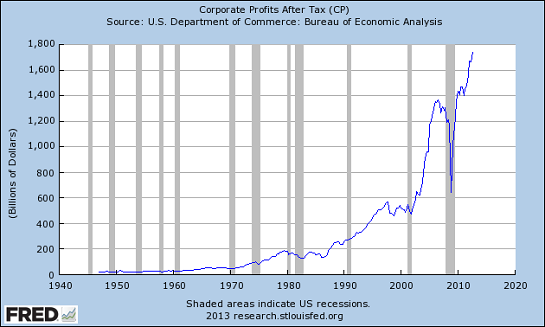
Even as corporate profits have skyrocketed, equity valuations have risen apace, keeping yields at historically low levels.

Just to state the obvious: does that trajectory strike you as sustainable? Up almost 300% in less than four years? In a debt-burdened global economy, where are the next $1.75 trillion in corporate profits going to come from?

Anyone who claims “stocks are cheap” would do well to study these charts, which are courtesy of longtime correspondent B.C.:

Another measure of the S&P 500 yield using corporate bond yields (Baa):

In response to my observation that this looked like too much cheap credit chasing too few productive assets, B.C. added these explanatory comments:

This is characteristic of the liquidation/hoarding of a debt-deflationary Long-Wave Trough depression. The financial media and economists want us to believe that the Fed printing is “stimulus” when in fact it is part of the “liquidation” of Fed member banks’ balance sheets of bad assets. 

With the 10-yr. avg. P/E of 22-23, a 10-yr. earnings yield of 4.5%, a dividend of 2% (0% in real terms before fees and taxes), average reported earnings growth since ’00 of 3-4%, the real yield on 10- and 30-year Treasuries of slightly negative to 1%, and real wage/salary growth of 0%, the imputed discount rate implies inferior returns to capital vs. continuing decline in returns to labor; these conditions are not conducive to private sector investment growth and employment. 

Historically, the only “solution” was debt deflation and consumption of financial capital to the point that debt and asset prices fell to a level at which the imputed discount rate rose to encourage investment at rising returns to labor’s share of GDP, i.e., inflationary Long-Wave Upwave. 

By bailing out banks and targeting equity prices, the central banks are exacerbating the misallocation of savings/financial capital to historically overvalued corporate equity of the Fortune 25-300 firms, resulting in low-velocity hoarding and worsening wealth and income concentration, unproductive rentier speculation, further declines in labor’s share of GDP, and contracting trend real GDP and gov’t receipts per capita. 

Along with these conditions are the once-in-history effects of Peak Cheap Oil, falling oil exports per capita, deteriorating EROEI, population overshoot, and accelerating automation of labor and loss of income and purchasing power. 

Consider that market cap-to-GDP today is 110%, ~100% above the historical average and 230% above the average of secular bear market lows. The differential $8-$12 trillion in market cap, primarily held by the top 0.1-1% to 10% of households in form of the equity of the Fortune 25-300 firms, is effectively captive current and future savings/investment/business, household, and gov’t consumption that otherwise would occur at the given ratio to wages, profits, and GDP. 

George Brockway made the case in his book, The End of Economic Man: Principles of Any Future Economics (1995), that a stock bull market is a disaster, because bull markets coincide historically with growing wealth and income concentration and gross misallocation of savings/financial capital that encourages unproductive gambling and speculating, bank leverage, and bubbles that burst and cause mayhem. 

However, we are conditioned by the dominant rentier zeitgeist that rising asset prices (debt-money proxy claims on wages, profits, and gov’t receipts in perpetuity by the top 0.1-1%) are an unambiguous sign of widespread prosperity.

Thank you, B.C. for placing the charts in context. B.C. also passed along this investment-bank report on the same topic, The Low-Return World (Credit Suisse).

Your rating: None

TSA nude scanners might be coming to federal buildings

0

A traveler undergoes a full body scan performed by Transportation Security Administration agents as she and others pass through the security checkpoint at the Denver International Airport on November 22, 2010 in Denver, Colorado.(AFP Photo / John Moore)

A traveler undergoes a full body scan performed by Transportation Security Administration agents as she and others pass through the security checkpoint at the Denver International Airport on November 22, 2010 in Denver, Colorado.(AFP Photo / John Moore)

The TSA is retiring 250 of their high-tech “backscatter” screening machines in the coming weeks, easing both healthcare and privacy woes from frequent travelers that don’t trust the devices. Are they really going away for good though?

Backscatter makers Rapiscan and the Transportation Security Administration announced the ending of a partnership just last month, and by June 1 the TSA will have removed the space-age body screeners from around 200 airports across the country. In a recent interview with Federal Times, though, TSA spokesperson David Castelveter says that the roughly $40 million worth of machinery could be moved elsewhere to provide airport-style security outside of departure terminals.

“We are working with other government agencies to find homes for them,” Castelveter tells reporter Andy Medici. “There is an interest clearly by DoD and the State Department to use them – and other agencies as well.”

According to Medici, those machines may soon be coming to federal buildings to be used in routine, day-to-day security screenings for both visitors and employees.

Last February, lawmakers in Washington responded to opponents of the machines by demanding that the TSA only implement devices that produce “generic passenger images,” a maneuver they hoped would bring change substantial enough to alleviate the privacy concerns from travelers made uncomfortable by the X-ray-like machines that have earned them the moniker “pornoscanners.” With a deadline looming and Congress’ challenge left unanswered, though, the TSA confirmed last month that their $5 million contract with Rapiscan would be coming to a close and the company’s Secure 1000SP Advanced Imaging Technology (AIT) systems and Automated Target Recognition (ATR) software would be shelved.

“It became clear to TSA they would be unable to meet our timeline,” Karen Shelton Waters, an assistant administer for acquisitions at the agency, told Bloomberg at the time. “As a result of that, we terminated the contract for the convenience of the government.”

Now just weeks after that announcement, Medici’s report suggests that Americans won’t be saying goodbye to the backscatters anytime soon. Although the TSA has removed at least 76 of the machines from airports already and intends on having the other 174 gone by the June 1 deadline, Castelveter wants them elsewhere.

“Hopefully we will be able to deploy them within other government agencies,” he says.

In the January 17 press release from Rapiscan that announces the end of their backscatter deal with the TSA, the company hints at what could be to come regarding other deals.

“As the Secure 1000SP has been operated by TSA as an effective imaging system, TSA plans to deploy these systems, with Rapiscan’s assistance, to U.S. government agencies that already rely on the Secure 1000 product line or can enhance their security programs with the Secure 1000SP,” the presser reads.

Late last year in November, Rapiscan announced on its website that it had been awarded a $15 million contract from an unnamed, “critical US government agency” in order to provide people and baggage scanning technology. Although that write-up declined to name the entity that will work with Rapiscan or what kind of technology will be implemented, it does little to calm the fears of those who worried that invasive airport pat-downs were just the beginning of a bigger trend – a problematic one where Americans are forced to sacrifice privacy for protection.

Rep. Bennie Thompson (D-Mississippi) made a statement last month condemning the use of the devices and insisted “The American public must be assured that these machines will not be used in any other public federal facility.” Bob Burns of the TSA Blog says the units will be “stored until they can be redeployed to other mission priorities within the government.”

In-Crowd Economics: It’s Hip to Fear the Deficit

0

A worker at the Globe Manufacturing plant in Pittsfield, New Hampshire, sewing gear for firefighters last year. (Photo: Evan McGlinn / The New York Times)A worker at the Globe Manufacturing plant in Pittsfield, New Hampshire, sewing gear for firefighters last year. (Photo: Evan McGlinn / The New York Times)

Back during the early days of the Iraq debacle, I learned that the military has a term for how highly dubious ideas become not just accepted, but viewed as certainties.

“Incestuous amplification” happens when a closed group of people repeat the same things to each other – and when accepting the group’s preconceptions itself becomes a necessary ticket to being in the in-group. A fundamentally flawed notion – say, that the Germans can’t possibly attack though the Ardennes – becomes part of what everyone knows, where “everyone” means by definition only people who accept the flawed notion.

We saw that in the run-up to the Iraq War, where perfectly obvious propositions – the case for invading was very weak, the occupation could well be a nightmare – weren’t so much rejected as ruled out of the discussion altogether; if you even considered those possibilities, you weren’t a serious person, no matter what your credentials.

Which brings me to the fiscal debate, which is characterized by the particular form of incestuous amplification that Greg Sargent, a commentator at The Washington Post, calls the Beltway Deficit Feedback Loop.

I’ve written about my recent appearance on “Morning Joe” and the host Joe Scarborough’s reaction in a column for Politico, which was to insist that almost no mainstream economists share my view that deficit fear is vastly overblown.

As Joe Weisenthal at Business Insider pointed out in a post titled “11 People That Joe Scarborough Should Meet Before Writing Another Column on the Deficit,” the reality is that among those who have expressed views very similar to mine are the chief economist of Goldman Sachs; the former Treasury secretary and former head of the National Economic Council; the former deputy chairman of the Federal Reserve; and the economics editor of the Financial Times.

The point isn’t that these people are necessarily right (although they are), but that Mr. Scarborough’s attempt at argument through authority is easily refuted by even a casual stroll through recent economic punditry. But these people aren’t part of the in-group, and if they do make it into the in-group’s conversation at all, it’s only by blurring their message sufficiently that the in-group doesn’t understand it.

And at this point, of course, all the Very Serious People have committed their reputations so thoroughly to the official doctrine that they almost literally can’t hear any contrary evidence.

Lightning Strikes Vatican After Papal Resignation – Video

0

It appears the pope did not provide the higher power with an advance notice of his resignation notice as hours after his shocking announcement yesterday this happened to the Vatican.

In other news, Ben Bernanke is now printing lightning rods for everyone and certainly for the Marriner Eccles building and the glass headquarters located at 200 West. Just in case.

Your rating: None Average: 5 (4 votes)

Record High Directs, Record Low Indirects Round Out Today’s 3 Year Treasury Auction

0

While on the surface today’s $32 billion 3 Year auction was uneventful, pricing at the ZIRP normal of 0.411% (31.53% allotted at the high), just inside the 0.415% When Issued, which means that few if any expect any major pick up in short-term rates above zero for the next three years at least, and at a 3.587 Bid To Cover, just shy of January’s 3.623 and right on top of the last twelve auction average, it was the internals that the move was once again apparent, with Direct Bidders (red) once more rising their take down to some 26.9% – the highest on record, or at least going back to 2003, while Indirects ran away taking down just 18% of the auction, likewise a record low in the past decade of the 3 Year’s history. The rest, as usual, belongs to the Primary Dealers, who will promptly transform said collateral, and what they don’t see back to Bernanke, will be used as dry powder to expand the S&P multiple even more, and buy what ES they don’t already own. Because, for now at least, in the immortal words of Chuck Prince, the music is still playing…

Your rating: None

After Latest Setback, Shell Told to ‘Pull the Plug’ on Arctic Drilling

0

Seizing on an announcement from Royal Dutch Shell on Monday that it would be sending both of its arctic drilling vessels to Asia for repair, environmental campaigners opposed to the offshore drilling program in Alaska say the oil giant should simply “pull the plug” on their efforts to drill in the dangerous and fragile Arctic ecosystem.

This aerial photo shows a U.S. Army CH-47 Chinook helicopter sling a trailer aboard the Shell floating drill rig, Kulluk, in Kodiak Island, Alaska’s Kiliuda Bay. (James Brooks / Kodiak Daily Mirror/AP) “After just one difficult year of limited operations off Alaska, the towing of both of Shell’s rusting drill rigs to Asia for repairs shows they’re simply not up to the task of operating in the extreme, hostile waters of the Arctic,” Ben Ayliffe who leads Greenpeace International’s campaign against the oil industry’s rush to exploit undeveloped oil fields beneath the seabed.

Both of Shell’s drilling rigs – the Kulluk and the Noble Discoverer – were involved in mishaps throughout their stint in the icy and storm-prone waters in the Beaufort and Chuchki Seas this past year.

In December, as the Alaska Daily News reports, “the Kulluk was being towed to Seattle for off-season maintenance when it repeatedly lost tow lines during a brutal Gulf of Alaska winter storm. It grounded just off Sitkalidak Island, south of Kodiak Island, on Dec. 31.”

And the Noble Discoverer, as The New York Times recaps, has had a series of problems since arriving in Alaska, beginning with running aground before even leaving port in Dutch Harbor and later catching fire while docked in the Aleutian Islands. Following that, an inspection by the US Coast Guard found that the aging ship was frought with problems, including leaks and other failures of its “pollution control systems”.

“The costs for Shell’s Arctic oil program continue to spiral,” concluded Ayliffe, “and it remains to be seen just how long investors will idly sit by and allow the company to keep pouring money down an Arctic black hole. Shell owes it to its investors to stop delaying the inevitable and pull the plug on this Arctic drilling fiasco now.”

Read more here: http://www.miamiherald.com/2013/02/12/3229805/shell-to-tow-arctic-drilling-vessels.html#storylink=cpy

The Hubris of the Drones

0

Last week, The New York Times published a chilling account of how indiscriminate killing in war remains bad policy even today. This time, it’s done not by young GIs in the field but by anonymous puppeteers guiding drones that hover and attack by remote control against targets thousands of miles away, often killing the innocent and driving their enraged and grieving families and friends straight into the arms of the very terrorists we’re trying to eradicate.Supporters of Pakistani religious party Jamat-i-Islami listen to their leaders during a rally to condemn U.S. drone attacks, April 24, 2009. (AP Photo/Mohammad Sajjad)

The Times told of a Muslim cleric in Yemen named Salem Ahmed bin Ali Jaber, standing in a village mosque denouncing al Qaeda. It was a brave thing to do – a respected tribal figure, arguing against terrorism. But two days later, when he and a police officer cousin agreed to meet with three al Qaeda members to continue the argument, all five men – friend and foe – were incinerated by an American drone attack. The killings infuriated the village and prompted rumors of an upwelling of support in the town for al Qaeda, because, the Times reported, “such a move is seen as the only way to retaliate against the United States.”

Our blind faith in technology combined with a false sense of infallible righteousness continues unabated. Reuters correspondent David Rohde recently wrote:

“The Obama administration’s covert drone program is on the wrong side of history. With each strike, Washington presents itself as an opponent of the rule of law, not a supporter. Not surprisingly, a foreign power killing people with no public discussion, or review of who died and why, promotes anger among Pakistanis, Yemenis and many others.”

Rohde has firsthand knowledge of what a drone strike can do. He was kidnapped by the Taliban in 2008 and held for seven months. During his captivity, a drone struck nearby. “It was so close that shrapnel and mud showered down into the courtyard,” he told the BBC last year. “Just the force and size of the explosion amazed me. It comes with no warning and tremendous force… There’s sense that your sovereignty is being violated… It’s a serious military action. It is not this light precise pinprick that many Americans believe.”

“It’s a serious military action… not this light precise pinprick that many Americans believe.”

A special report from the Council on Foreign Relations last month, “Reforming U.S. Drone Strike Policies,” quotes “a former senior military official” saying, “Drone strikes are just a signal of arrogance that will boomerang against America.” The report notes that, “The current trajectory of U.S. drone strike policies is unsustainable… without any meaningful checks – imposed by domestic or international political pressure – or sustained oversight from other branches of government, U.S. drone strikes create a moral hazard because of the negligible risks from such strikes and the unprecedented disconnect between American officials and personnel and the actual effects on the ground.”

Negligible? Such hubris brought us to grief in Vietnam and Iraq and may do so again with President Obama’s cold-blooded use of drones and his indifference to so-called “collateral damage,” grossly referred to by some in the military as “bug splat,” and otherwise known as innocent bystanders.

Yet the ease with which drones are employed and the lower risk to our own forces makes the unmanned aircraft increasingly appealing to the military and the CIA. We’re using drones more and more; some 350 strikes since President Obama took office, seven times the number that were authorized by George W. Bush. And there’s a whole new generation of the weapons on the way – deadlier and with greater endurance.

According to the CFR report, “Of the estimated three thousand people killed by drones… the vast majority were neither al-Qaeda nor Taliban leaders. Instead, most were low-level, anonymous suspected militants who were predominantly engaged in insurgent or terrorist operations against their governments, rather than in active international terrorist plots.”

By the standards of slaughter in Vietnam, the deaths caused by drones are hardly a bleep on the consciousness of official Washington. But we have to wonder if each innocent killed – a young boy gathering wood at dawn, unsuspecting of his imminent annihilation; a student who picked up the wrong hitchhikers; that tribal elder arguing against fanatics – doesn’t give rise to second thoughts by those judges who prematurely handed our president the Nobel Prize for Peace. Better they had kept it on the shelf in hopeful waiting, untarnished.

Hamas Gags Civil Liberties in Gaza

0

GAZA CITY – Gaza is becoming increasingly radicalised as Hamas continues its crackdown on civil liberties, press freedom and the rights of women. In the last few weeks a number of journalists have been arrested and accused of being involved in “suspicious activities”, several detainees shot dead by police during arrest attempts, and female students asked to abide by a strict Islamic dress code.

A new crackdown on civil liberties makes the future for girls uncertain in Gaza. (Credit: Mohammed Omer/IPS) “Hamas is on a gradual track of the Islamisation of Gazan society, which goes against their early promises,” Dr Samir Awad from Birzeit University near Ramallah tells IPS. “Most people in Gaza, even the most conservative, oppose this. Gazans are already very conservative and they don’t need Hamas dictating their religion to them.”

Women have borne the brunt of the crackdown. Gaza’s Al Aqsa University has announced that female students will be required to wear full traditional Muslim garb, from head to toe.

Some female students have expressed outrage, claiming that the new demands are in violation of their public freedom. They say that already female students are modestly dressed but that some prefer wearing pants and a long overcoat rather than a burka, abaya or hijab.

In the past, Hamas has banned women from riding on the backs of motorbikes, from smoking water pipes, and men from working in female hair salons — saying such practices were immodest. Not all bans, however, have been imposed uniformly.

“Hamas has also banned mixed parties and mixed activities as well as enforcing other restrictions on women but not on men. Gaza’s entire seashore has practically been confiscated by Hamas as if it is their private property and they decide who can access the area and when,” Awad tells IPS.

The dress code decision has also further undermined the latest unity efforts between Hamas and the Palestinian Authority (PA)-affiliated Fatah movement.

PA Minister for Higher Education Ali Jarbawi stresses that Hamas’s decision is illegal and cannot be implemented. He wrote an official letter to Al Aqsa’s president stating the illegality of the move which he said also violated Palestinian government decisions.

Dr. Faiq al-Naouk, advisor for managerial affairs at Al-Aqsa University responded saying that the controversial decision would be implemented only gradually as an act of “goodwill” before it becomes mandatory.

“Hamas’s increasing radicalisation is one of the sticking points for Fatah and Hamas being able to form a unity government,” says Awad.

Hamas has cracked down on other civil liberties too in the past few weeks. ‘New Star’, the annual Palestinian version of ‘American Idol’, was recently banned by the Islamist group on the grounds that it was “indecent” and violated conservative interpretations of Islam.

Producer Alaa Al Abed lashed out at the decision, of which he was only informed at the last moment, saying the ban prevented Gaza’s 12 contestants from competing in the second round of the competition.

“This is more serious than Hamas just killing fun in Gaza — they are limiting the freedoms of the people, according to their whims,” al-Abed says.

Teenage girls and women can only rarely be seen singing in public, but men are encouraged to sing, without musical instruments, about the glory of Islam and fighting Israel.

Journalists are also facing censure. Hamas has carried out a wave of arrests of Palestinian journalists in the coastal territory, accusing them of being involved in “suspicious activities”. Palestinian human rights groups say internal security services in the Gaza Strip have stepped up harassment of journalists in the Gaza Strip.

The Palestinian Centre for Human Rights (PCHR) distributed a list of media workers it said had been arrested, and condemned the seemingly coordinated campaign, which Hamas officials deny.

Hamas interior ministry spokesman Islam Shahwan says his ministry guarantees freedom of the press, and says recent detainees were charged with recognisable offenses. He says they had admitted to charges that they “threatened the security of the community.”

The ministry added that “those persons are not journalists at all. Even those who work as journalists use this field as a cover to carry out suspicious acts.” The Palestinian media freedoms watchdog Mada issued a statement claiming abuse of those detained as well as confiscation of property and searches.

Gaza’s Al Mezan Centre for Human Rights has expressed concern over the repeated use of lethal and excessive force by Hamas police following the death of several individuals during attempts to arrest them.

The organisation called on the Hamas authorities to use reasonable force to arrest people suspected of breaking the law, and further called for investigation into the conduct of the police officers involved.

“Law enforcement officials may use force only when strictly necessary and to the extent required for the performance of their duty,” says Mezan.

© 2013 IPS North America

STaTe OF THe BaNaNa; PoSiTiVe CoNTaGioN; DoRNeR UPDaTE…aND a PeNGuiN!

0

STATE OF THE BANANA 2013
.


BEN AND MARIO UP IN SMOKE
.


These Stoners are blowing some smoke
They’re hiding the fact that they’re broke
The only contagion
Is growth that they’re stagin’
It’s time drugged-up sheeple awoke!

The Limerick King

WANTED II
.


Be on the lookout for Toner
A mask wearing Ivy League loner
He’s killing a nation
With printed inflation
And Kleptocrats give him a boner

The Limerick King

PIZZA DOORNER
.

KIM JONG PENGUIN

Human pixels: the background image at the Pengiuin Games is a constantly changing image. 30,000 North Korean children are forced to continually turn flip cards to make the new images of Dear Penguin.

Your rating: None Average: 5 (1 vote)

‘No more Pope’: Femen activists get naked in Notre Dame to mark Pope’s resignation

0

Activists from the women's rights organisation Femen shout slogans outside Notre-Dame de Paris Cathedral in Paris February 12, 2013. (Reuters/Charles Platiau)

Activists from the women’s rights organisation Femen shout slogans outside Notre-Dame de Paris Cathedral in Paris February 12, 2013. (Reuters/Charles Platiau)

Eight Femen activists undressed and flashed their breasts inside the iconic Notre Dame cathedral in Paris. The notorious female group marked Pope Benedict XVI’s resignation in typically scandalous fashion.

The Ukrainian feminists entered the Gothic cathedral on Tuesday dressed in long coats, before disrobing near the altar. The bodies of the activists were painted withslogans such as “Crisis of faith,” and “Pope no more!”

Their protest lasted for just a few minutes.

“Bye-bye Benedict!” and “No more homophobe!” cried the activists while beating bells with sticks, to “congratulate the world” on Benedict XVI’s stepping down.

The cathedral’s security eventually took all the Femen members outside by force, but the activists remained outside shouting “In gay we trust!“

“FEMEN is congratulating the whole progressive world with the resignation of fascist Benedict XVI from the place of the head of the Catholic mafia. It’s symbolic that today is the day of voting on law of same-sex marriage in France. The ex-Pope was a fierce opponent of gay marriages. FEMEN applaud the complete capitulation of the middle age homophobia! Pope go to the devil! Viva common sense! Viva freedom!” reads an entry on the movement’s Facebook page.

Parishioners of the cathedral were reportedly unhappy with the their antics. “This is a sacred place, you can’t strip here,” a Frenchwoman told AFP.

The action followed Monday’s sudden announcement of Pope Benedict XVI’s resignation, attributed to his “advancing years“. It’s the first time a pontiff hasquit in nearly 600 years.This wasn’t FEMEN’s first protest againstBenedict XVI. The group had previously demonstrated topless at St. Peter’s Square in the Vatican for gay rights, as the Pope was giving his weekly prayer in November 2011.

The FEMEN activists gained notoriety by conducting impromptu topless protests during major international public events in different countries against sex tourism, religious institutions, international marriage agencies, sexism and other social, national and international issues. The Ukrainian feminists also attacked what they called “homophobic propaganda” in the Vatican, and the economic forum in Davos.

Activists from the women′s rights organisation Femen shout slogans outside Notre-Dame de Paris Cathedral in Paris February 12, 2013. (Reuters/Charles Platiau)
Activists from the women’s rights organisation Femen shout slogans outside Notre-Dame de Paris Cathedral in Paris February 12, 2013. (Reuters/Charles Platiau)

Activists from the women′s rights organisation Femen ring a bell as the protest in front of the new eight bronze bells displayed in the nave of Notre-Dame de Paris Cathedral in Paris February 12, 2013. (Reuters/Charles Platiau)
Activists from the women’s rights organisation Femen ring a bell as the protest in front of the new eight bronze bells displayed in the nave of Notre-Dame de Paris Cathedral in Paris February 12, 2013. (Reuters/Charles Platiau)

Activists from the women′s rights organisation Femen protest in front of the new eight bronze bells displayed in the nave of Notre-Dame de Paris Cathedral in Paris February 12, 2013. (Reuters/Charles Platiau)
Activists from the women’s rights organisation Femen protest in front of the new eight bronze bells displayed in the nave of Notre-Dame de Paris Cathedral in Paris February 12, 2013. (Reuters/Charles Platiau)

Local Fracking Bans Under Attack in NY

0
Common Dreams
Breaking News & Views for the Progressive Community.
Independent, non-profit newscenter since 1997.

To inform. To inspire. To ignite change for the common good.

Pentagon ‘dumbs down’ aviation tests for underperforming F-35

0

F-35 JSF fighter jet (AFP Photo/JSF)

F-35 JSF fighter jet (AFP Photo/JSF)

America’s latest stealth fighter jet is too heavy and slow to pass performance tests. Instead of improving the aircraft, the Pentagon has decided to lower its expectations. Experts say the F-35 is more vulnerable than the jet it’s replacing.

Simply put, the F-35 Joint Strike Fighter (JSF) doesn’t go as fast, turn as sharply or handle as gracefully as it should. But instead of bringing in a team of aviation experts to fix the problem, the Pentagon has chosen to accept that the jet underperforms.

In an 18-page annual weapons testing report, the Pentagon outlined changes to its rulebook, which include amending performance specifications and increasing time for acceleration for the JSF. “These changes were due to the results of air vehicle performance and flying qualities evaluations,” the report read.

The JSF’s reduced performance means the aircraft might not be able to compete with the latest Russian and Chinese-made fighters. Even before the downgrades, some analysts questioned the F-35′s ability to defeat newer Sukhoi and Shenyang jets, Wired reported.

The news comes after US taxpayers worked to pay for the stealth fighter program’s $1-trillion price tag — the most expensive in US history. It’s the second time in a year that the US government has eased the performance requirements of the aircraft.

In January, the military granted the F-35 a longer takeoff run than originally required and adjusted the plane’s standard flight profile in order to compensate for some of the flying range lost to increasing weight and drag.

It’s not the first time the F-35 series has faced setbacks. Last month, the F-35B was banned from traveling within 25 miles of a thunderstorm amid fears that lighting could cause its fuel tank to explode.

And last year, the Air Force suspended operation of its fleet of 20 Joint Strike Fighters after they experienced malfunctions — the third time the program was put on hold.

Previous tests revealed a number of problems, including excessive vibration, a malfunctioning high tech helmet display and a flawed tail hook that failed to catch arresting gear wires on aircraft carriers.

As the US government continues to stress its need for a strong military, the F-35 appears to be anything but intimidating, and is believed to be vulnerable than the jet it is replacing.

But the continuous problems faced by the aircraft haven’t stopped the plane’s maker, Lockheed Martin, from praising the fighter jet. The company said the plane is still the second-most maneuverable warplane in existence.

Company test pilot Billy Flynn told Flight Global that the JSF accelerates better and flies at higher angles than every other fighter jet, except Lockheed’s F-22. “The F-35 is comparable or better in every one of those metrics, sometimes by a significant margin,” Flynn said.

But others in the aviation business were quick to challenge Flynn’s comments. A Navy aviator told Wired that Lockheed’s boasts were “fantastical.”

There’s even more bad news for the program: A series of problems with the plane’s software and safety measures indicate that future downgrades to the jet may be on the horizon. The safety problems could force Lockheed Martin to add fire-suppression gear that will only further increase the plane’s weight and decrease its maneuverability, Wired reported.

Several years ago, to save around 50 pounds of weight, aircraft designers removed some fuel safety valves. As a result, the JSF is now 25 per cent more likely to burn if hit in combat, making it “overall more vulnerable [to fire] than most” older warplanes, Director, Operational Test, and Evaluation (DOT&E) spokesperson Jennifer Elzea told Bloomberg.

The Pentagon should tell Lockheed to “immediately reinstall” the valves, Rep. James Moran, a Democrat on the House Defense Appropriations subcommittee, wrote in a letter to the Defense Department earlier this month.

If that happens, more weight will subsequently be added to the fighter jet, likely prompting another revision of the F-35’s performance specs.

The JSF program was launched in 2001, and was designed to be a “one-size-fits-all” approach, with plans to deliver 2,443 planes in different versions for the US Air Force, Navy and Marines.

The program called for launching construction at an early stage, at the same time the aircraft was being put through flight tests. The Pentagon assumed at that time that technical hurdles had been worked out in computer modeling. Instead, technical glitches forced delays in production schedules, resulting in redesigns and cost overruns.

The Pentagon said the JSF will be combat-ready in 2018.

Barclays to Ax Thousands of Jobs

0

Barclays to Ax Thousands of Jobs

Email this item Email   Print this item Print   Share this item... Share
Posted on Feb 12, 2013

The new chief executive of the British bank is aiming to clean up his scam-ridden operation by dropping 3,700 employees from its structured capital markets unit and other offices.

The unit has been described as facilitating “industrial scale tax avoidance” in the Libor scandal, in which banks falsely inflated the interest rate they use to make loans to one another. Approximately $350 trillion in derivatives trading is tied to the Libor.

–Posted by Alexander Reed Kelly.

The Guardian:

Barclays is to pay out £1.8bn in bonuses to its 139,200 staff after a year in which profits fell to £246m from £5.9bn a year ago.

Union officials at Unite called for the bank to narrow the gap between its highest and lowest paid employees. “It’s shocking but true that the starting salary at Barclays is just
£13,500 a year, making some workers at the bank eligible to claim tax credits. With pay negotiations due to start soon, Unite will be expecting the bank to reward its staff fairly for their contribution to the success of the bank,” said Dominic Hook, Unite’s national officer.

[CEO Antony] Jenkins signalled the bank would pull back from the international expansion pursued by his predecessors, retreating from continental Europe and focusing on the UK, US and Africa. He made clear that the investment bank would remain a major part of the company’s operations.

Read more

More Below the Ad


New and Improved Comments

If you have trouble leaving a comment, review this help page. Still having problems? Let us know. If you find yourself moderated, take a moment to review our comment policy.

Please enable JavaScript to view the comments powered by Disqus.

In Support of Bradley Manning, Icelandic MP Risks Arrest with Upcoming US Visit

0

Despite the possibility of her arrest by U.S. authorities, an Icelandic MP known for her roll in the release of the “Collateral Murder” video put out by Wikileaks in 2010 has announced plans to travel to the United States to garner support for the alleged whistleblower Bradley Manning.

Birgitta Jonsdottir, the Icelandic MP and former WikiLeaks volunteer (Halldor Kolbeins/AFP/Getty Images) MP Birgitta Jónsdóttir was part of the WikiLeaks team who helped prepare the video which contains military footage from a U.S. Apache helicopter as it gunned down innocent civilians in Iraq, including a Reuters journalist and two children.

The leaks led to the subsequent arrest and indefinite detention of Manning, who is currently undergoing a lengthy pre-trial hearing process for his alleged roll in releasing the video and other military and diplomatic documents.

The Guardian reports that Jónsdóttir has been engaged in a two-year legal dispute with the U.S. Justice Department after it attempted to obtain her private information through the use of a subpoena requesting access to her personal data on Twitter.

In 2011, the U.S. ambassador to Iceland said that Jónsdóttir would not be arrested if she traveled to the states.

However, she has now been advised by the Icelandic government not to go through with the trip, which has warned that a verbal assurance from a US diplomat is far from binding.

In response to the Icelandic government’s pleas to cancel her trip, Jónsdóttir told the Guardian:

I refuse to live in fear, and I don’t want to live in the shadows. I don’t think I’ve done anything illegal or that I’m an enemy of the US state, but if they think I’ve committed a crime, I want to know. […]

I feel connected to Bradley Manning’s fate through that video. […]

It’s deeply troubling to me that he is the only one suffering the consequences — none of the people responsible for the war crimes in the video have been held accountable. […]

Jónsdóttir’s first trip to the U.S. since the leak is scheduled to begin on April 5, 2013 in New York to mark the third anniversary of the footage leak. Her trip will include a traveling exhibition of stills from the Collateral Murder video, including a tour across the US ahead of Manning’s trial–scheduled to begin in June.

Consumers and Farmers Show USDA How to Stand Up for Country of Origin Labeling

0

WASHINGTON – February 12 – Today, Food & Water Watch released a legal memo that provides a roadmap for the U.S. Department of Agriculture (USDA) to stand up for Country of Origin Labeling (COOL) on beef and pork in the face of challenges to these commonsense labels at the World Trade Organization (WTO). The memo was developed with consumer group Public Citizen and farmer groups National Farmers Union and the U.S. Cattlemen’s Association.

“Consumers deserve clear, transparent and informative COOL labels and the WTO has no place meddling in American grocery carts,” said Food & Water Watch Executive Director Wenonah Hauter. “President Obama campaigned to protect country of origin labels in 2008 and he can do so again by implementing these straightforward improvements to COOL rules.”

In 2008, years of effort by consumers and farmers resulted in mandatory country of origin labels for meats, poultry, vegetables, fruits and some nuts being included in the Farm Bill. But the WTO has ruled that these popular labels are in violation of international trade rules.

The WTO ruling found that current rules for COOL labels imposed a regulatory cost to imported livestock and meat that exceeded the consumer benefit. “The logical way to respond is to defend the integrity of the country of origin labels by simplifying the information provided on the labels and making them clearer for consumers,” said Hauter. “The new legal memo demonstrates a reasonable next step for USDA that makes labeling more meaningful to them.”

A copy of the memo can be downloaded here: http://documents.foodandwaterwatch.org/doc/COOLComplianceMemo2013Feb4.pdf

Food & Water Watch is a nonprofit consumer organization that works to ensure clean water and safe food. We challenge the corporate control and abuse of our food and water resources by empowering people to take action and by transforming the public consciousness about what we eat and drink.

Mrs Watanabe Is Back And Now Has Record Margin

0

It is now clear that Abe and his pals are all-in on the reflation strategy – albeit scorned in their unilateralism by the G-7. Stocks (and oil prices) have surged as the JPY plunged – but things are getting even more critical in the land of the rising sun. The retail investor is all-in too; individual investors’ share (cash transactions only) has risen sharply to 34% – the highest level since June 2009; the combined trading value of the seven major internet brokerages expanding 86% MoM to ¥19.5tn in January, marking the highest level since April 2006; and aggregate margin trading at the seven online brokerage firms has doubled from ¥7.3tn in December 2012 to ¥14.3tn in January 2013. Retail, according to Goldman, tend to focus on low price, small cap stocks – as if the markets’ relative beta was not enough. If the BoJ was hoping for a M.A.D. situation – it appears they have it as retail is now fully (and levered) exposed to Abe’s endgame (let’s just hope energy costs don’t crush that dream).

Retail trading volume is its highest since 2009…

as, thanks to considerably easier margin rule changes in January, margin transactions have almost doubled MoM…

Charts: Goldman Sachs

Your rating: None Average: 5 (2 votes)

Afghans stage rally to slam US-led raids

0

File photo shows Afghans protesting against US raids.

People have taken to the streets in eastern Afghanistan to condemn three US-led raids that killed at least four civilians in the war-torn country, Press TV reports.

The demonstration took place on Tuesday in the country’s eastern province of Ghazni where protesters shouted slogans against the foreign forces.

This comes after at least two civilians were killed in a raid carried out by the US-led foreign troops in the same province. According to locals, two other people were also arrested in the Monday night attack.

Protesters have pledged to continue their demonstrations until detainees are freed.

Reports say angry demonstrators have closed the main highway in the province which connects Kandahar to the capital, Kabul.

In another incident, US-led forces killed one civilian and injured three others at a checkpoint in the southern province of Kandahar.

An Afghan medical student was also killed in an attack on his house on Monday night in the country’s eastern Khost Province.

Civilian casualties have long been a source of friction between the Afghan government and US-led foreign forces and have dramatically increased anti-US sentiments in Afghanistan.

The United States and its allies entered the war in Afghanistan in October 2001 as part of Washington’s so-called war on terror. The offensive removed the Taliban from power, but after more than 11 years, the foreign troops have still not been able to establish security in the country.

AZA/MAM/PKH/SS

Tech Firms Influencing EU Regulators

0

RINF Alternative News

EU-flagga-i-vind

Privacy watchdogs have claimed that European Union data protection laws are being “copied and pasted” directly from technology firm lobby documents.

Major tech firms are lobbying the European regulators to make amendments to the General Data Protection Regulation, which restricts how companies access, retain and process user data.

According to research from Privacy International, several MEP committee members have cut and paste suggestions  from tech firm submissions, and have named the worst offenders.

Conservative MEP for the West Midlands, Malcolm Harbour, has been named by the watchdog, accusing him of copying and pasting over 25% of his contributions, while Sajjad Karim, Conservative MEP for the North West of England copied 23% of hers and Giles Chichester, Conservative MEP for South West England and Gibraltar, copied and pasted 22%.

Anna Fielder, of Privacy International said:

“Certain companies will always be willing and able to throw millions of dollars behind lobbying efforts to ensure that new legislation doesn’t interfere with their business models – particularly if those models are dependent on invading people’s rights to privacy and data protection.

“We would hope that MEPs are taking all sides of the argument into account when making law, not just the richest and most powerful corporate interests.”


N Korea not to bow to UN resolutions

0

North Korea says it would never give in to “unreasonable” resolutions against its nuclear program, blaming the US hostility for failing the prospects of a nuclear-free Korean peninsula.

“The US and their followers are sadly mistaken if they miscalculate that the DPRK (North Korea) would accept the entirely unreasonable resolutions against it,” the first secretary of North Korea’s mission in Geneva Jon Yong Ryong said.

Addressing the UN Disarmament Forum, the North Korean diplomat added that “the DPRK will never be bound to any resolutions.”

On Tuesday, North Korea staged its most powerful nuclear test yet, claiming a breakthrough with a “miniaturized” device, which drawn criticism from the UN Security Council.

The prospect for the denuclearization of the Korean peninsula has become gloomier due to the US hostile policies to the DPRK that have become ever more pronounced, Jon added.

Jon also criticized the European Union saying if the “EU truly wants peace and stability on the Korean peninsula; it should urge the US first to terminate its hostile policy towards the DPRK on an impartial basis.”

Condemning the test, the US Ambassador to the UN Susan Rice said North Korea should expect “increasing isolation and pressure.”

North Korea’s actions “will not be tolerated and they will be met with North Korea’s increasing isolation and pressure under the United Nations sanctions,” she added.

North Korea carried out its two previous nuclear tests on October 9, 2006, and May 25, 2009.

Pyongyang is already under tough UN sanctions over its latest rocket launch in 2012.

PG/SS

Thawing Tundra Threat to Frozen Carbon

0

Thawing Tundra Threat to Frozen Carbon

Email this item Email   Print this item Print   Share this item... Share
Posted on Feb 12, 2013

By Tim Radford, Climate News Network

This piece originally appeared on Climate News Network.

LONDON–The first kiss of sunlight on the frozen soils of the Arctic could spell increasing trouble as the world warms.

The return of the spring sun melts domes and lakes of frozen water called thermokarsts — karst is a word usually linked to limestone country, but it has been pressed into service as a label for the hard surfaces caused by ice.

Within this ice is dissolved organic carbon. Once the ice melts, microbes get to work releasing carbon dioxide into the air. The soil thaws, the surface collapses, lakes form, water flows, land surfaces erode which in turn releases more carbon dioxide to create more warming, to make the tundra even more vulnerable to spring thaw, and of course to accelerated warming.

This is not a scare story. It is happening now, according to Rose Cory of the University of North Carolina and colleagues who report in the Proceedings of the National Academy of Sciences.

They analysed water from 27 undisturbed sites in Alaska, and seven unique thermokarst failures — a polite word for landslides — near Toolik Lake in Alaska. The places they examined had been frozen for at least 10,000 years, and in some places two million years.

Speed the key factor

The team found dissolved organic carbon in all of them, and they found that newly-exposed muddy water was liable to surrender 40% more CO2 to the atmosphere.

This has of course been going on at the fringe of the Arctic permafrost for at least 10,000 years. The hazard is not in the process itself, but in its potential acceleration: nobody knows how much carbon is stored in the Arctic tundra as a greenhouse gas source, and nobody can guess what proportion of this will be released as the world warms. Thermokarsts are also found on a smaller scale in the Himalayas and the Swiss Alps.

But, as the soils warm, and the microbes get a chance to draw breath and get to work, say the authors, “the ultimate fate of deep, frozen soil carbon will be affected by coupled photobiological processing, by the available light field in streams that receive thermokarst drainage, and eventually by the landscape configuration of lakes and streams.”

Get truth delivered to
your inbox every week.

Previous item: A Presidential Decision That Could Change the World


New and Improved Comments

If you have trouble leaving a comment, review this help page. Still having problems? Let us know. If you find yourself moderated, take a moment to review our comment policy.

Please enable JavaScript to view the comments powered by Disqus.

‘West obstructing Iran talks with P5+1’

0

Iran Majlis (parliament) Speaker Ali Larijani has criticized the West for obstructing the country’s talks with the P5+1 group while pretending they are interested in dialogue.

“We are faced with two gestures from the West,” Larijani stated on Tuesday in reference to the negotiations between Tehran and the P5+1 (Britain, China, France, Russia, and the US plus Germany) which are scheduled to be held in Kazakhstan on February 26.

Larijani, who is Islamabad to attend the conference of the Parliamentary Assembly of Economic Cooperation Organization in the Pakistani capital, blamed Western governments for claiming willingness to negotiate with Iran at the media level while engaging in obstructionism in practice.

He scoffed at US and Israeli threats of war against the Islamic Republic, noting the 1967 Islamic revolution in the country clearly showed the Iranian nation’s determination to stand up to US policies.

“I suppose they [Americans] have a little wisdom left to prevent them from risking their future,” Larijani said when answering a question on the possibility of a US military attack on Iran.

The Iranian Majlis speaker rejected allegations spearheaded by the United States and their allies that accuse Iran of pursuing non-civilian objectives in its nuclear energy program, and described Iran’s missile technology as defensive and deterrent in nature.

Larijani denounced “the oppressors” for not condemning US for using depleted uranium weapons in the region, noting that Washington’s support for Tel Aviv’s nuclear warheads is main cause of the proliferation of nuclear weapons.

MRS/SS

A Presidential Decision That Could Change the World

0

A Presidential Decision That Could Change the World

Email this item Email   Print this item Print   Share this item... Share
Posted on Feb 12, 2013

By Michael T. Klare, TomDispatch

This piece first appeared at TomDispatch. Read Tom Engelhardt’s introduction here.

Presidential decisions often turn out to be far less significant than imagined, but every now and then what a president decides actually determines how the world turns. Such is the case with the Keystone XL pipeline, which, if built, is slated to bring some of the “dirtiest,” carbon-rich oil on the planet from Alberta, Canada, to refineries on the U.S. Gulf Coast. In the near future, President Obama is expected to give its construction a definitive thumbs up or thumbs down, and the decision he makes could prove far more important than anyone imagines.  It could determine the fate of the Canadian tar-sands industry and, with it, the future well-being of the planet. If that sounds overly dramatic, let me explain.

Sometimes, what starts out as a minor skirmish can wind up determining the outcome of a war–and that seems to be the case when it comes to the mounting battle over the Keystone XL pipeline. If given the go-ahead by President Obama, it will daily carry more than 700,000 barrels of tar-sands oil to those Gulf Coast refineries, providing a desperately needed boost to the Canadian energy industry. If Obama says no, the Canadians (and their American backers) will encounter possibly insuperable difficulties in exporting their heavy crude oil, discouraging further investment and putting the industry’s future in doubt.

The battle over Keystone XL was initially joined in the summer of 2011, when environmental writer and climate activist Bill McKibben and 350.org, which he helped found, organized a series of non-violent anti-pipeline protests in front of the White House to highlight the links between tar sands production and the accelerating pace of climate change. At the same time, farmers and politicians in Nebraska, through which the pipeline is set to pass, expressed grave concern about its threat to that state’s crucial aquifers. After all, tar-sands crude is highly corrosive, and leaks are a notable risk.

In mid-January 2012, in response to those concerns, other worries about the pipeline, and perhaps a looming presidential campaign season, Obama postponed a decision on completing the controversial project. (He, not Congress, has the final say, since it will cross an international boundary.) Now, he must decide on a suggested new route that will, supposedly, take Keystone XL around those aquifers and so reduce the threat to Nebraska’s water supplies.

Ever since the president postponed the decision on whether to proceed, powerful forces in the energy industry and government have been mobilizing to press ever harder for its approval. Its supporters argue vociferously that the pipeline will bring jobs to America and enhance the nation’s “energy security” by lessening its reliance on Middle Eastern oil suppliers. Their true aim, however, is far simpler: to save the tar-sands industry (and many billions of dollars in U.S. investments) from possible disaster.

Just how critical the fight over Keystone has become in the eyes of the industry is suggested by a recent pro-pipeline editorial in the trade publication Oil & Gas Journal:

“Controversy over the Keystone XL project leaves no room for compromise. Fundamental views about the future of energy are in conflict. Approval of the project would acknowledge the rich potential of the next generation of fossil energy and encourage its development. Rejection would foreclose much of that potential in deference to an energy utopia few Americans support when they learn how much it costs.”

Opponents of Keystone XL, who are planning a mass demonstration at the White House on February 17th, have also come to view the pipeline battle in epic terms. “Alberta’s tar sands are the continent’s biggest carbon bomb,” McKibben wrote at TomDispatch. “If you could burn all the oil in those tar sands, you’d run the atmosphere’s concentration of carbon dioxide from its current 390 parts per million (enough to cause the climate havoc we’re currently seeing) to nearly 600 parts per million, which would mean if not hell, then at least a world with a similar temperature.” Halting Keystone would not by itself prevent those high concentrations, he argued, but would impede the production of tar sands, stop that “carbon bomb” from further heating the atmosphere, and create space for a transition to renewables. “Stopping Keystone will buy time,” he says, “and hopefully that time will be used for the planet to come to its senses around climate change.”

A Pipeline With Nowhere to Go?

Why has the fight over a pipeline, which, if completed, would provide only 4% of the U.S. petroleum supply, assumed such strategic significance? As in any major conflict, the answer lies in three factors: logistics, geography, and timing.

Start with logistics and consider the tar sands themselves or, as the industry and its supporters in government prefer to call them, “oil sands.” Neither tar nor oil, the substance in question is a sludge-like mixture of sand, clay, water, and bitumen (a degraded, carbon-rich form of petroleum). Alberta has a colossal supply of the stuff–at least a trillion barrels in known reserves, or the equivalent of all the conventional oil burned by humans since the onset of commercial drilling in 1859. Even if you count only the reserves that are deemed extractible by existing technology, its tar sands reportedly are the equivalent of 170 billion barrels of conventional petroleum–more than the reserves of any nation except Saudi Arabia and Venezuela. The availability of so much untapped energy in a country like Canada, which is private-enterprise-friendly and where the political dangers are few, has been a magnet for major international energy firms. Not surprisingly, many of them, including ExxonMobil, Chevron, ConocoPhillips, and Royal Dutch Shell, have invested heavily in tar-sands operations.


New and Improved Comments

If you have trouble leaving a comment, review this help page. Still having problems? Let us know. If you find yourself moderated, take a moment to review our comment policy.

Please enable JavaScript to view the comments powered by Disqus.

IAEA vows to resolve Iran nuclear issue

0

The chief inspector of International Atomic Energy Agency (IAEA) says he and his delegation will “work hard” during February 13 talks in Tehran to resolve the outstanding issues related to Iran’s nuclear energy program.

Herman Nackaerts said on Tuesday before leaving Vienna for Tehran that the IAEA’s objective is to “finalize the structured approach document” in view of resolving the “outstanding issues” regarding Iran’s nuclear activities.

“We will have good negotiations,” he added.

Iran and the IAEA last met in Tehran on January 17-18.

Iran is also scheduled to hold a new round of talks with the P5+1 group (the United States, France, Russia, Britain, and China plus Germany) in Kazakhstan on February 26.

The US, Israel, and some of their allies have repeatedly accused Iran of pursuing non-civilian objectives in its nuclear energy program.

Iran rejects the allegations, arguing that as a committed signatory to the Non-Proliferation Treaty and a member of the International Atomic Energy Agency (IAEA), it is entitled to develop nuclear technology for peaceful purposes.

In addition, the IAEA has conducted numerous inspections of Iran’s nuclear facilities but has never found any evidence showing that the Iranian nuclear program has been diverted toward military objectives.

KA/SS

Man billed for ambulance that arrived after his father passed away

0

AFP Photo / Kevork Djansezian

AFP Photo / Kevork Djansezian

When 71-year-old Durand Ford Sr. was struggling to breathe on New Year’s Day, his family called 911. But the man died waiting for an ambulance that took 40 minutes to arrive — and that man’s family has now received a $780.85 ambulance bill.

The hefty bill adds insult to injury. Durand Ford Jr., whose father died waiting for help that came too late, said he is angry about the city’s behavior. His 71-year-old father went into cardiac arrest on New Year’s Eve and his family called 911 shortly after 1 am, seeking emergency medical assistance.

In Washington DC, ambulances are staffed by firefighters. The DC Fire and Emergency Medical Service Department responds to 911 calls. But on New Year’s, the DC FEMS had no ambulance available and sent a fire truck instead, which was useless in saving the old man’s life.

An ambulance was eventually dispatched from nearby Prince George’s County, but it did not arrive until 1:58 am. By that time, Ford Sr. had already passed away.

“We’re even more saddened because of the circumstances that surround my father’s death,” Ford Jr. told NBC Washington.

After coming to terms with the conditions surrounding his father’s death, Ford opened his mailbox this month, only to add feelings of outrage to an already-dismal situation. The DC FEMS had billed Ford $780.85 for the ambulance that failed to arrive early enough to save his father.

“I feel angry. Upset. I’m disturbed that we even received this bill,” he said.

“We’re still grieving about the situation,” he added. “We’re very angry about what happened and the service we did not receive from the district.”

NBC discovered that on New Year’s Eve, more than 50 DC firefighters had called out sick, which is a large chunk of the 340 firefighters that the city is typically staffed with. On an average day, about 20 or 30 firefighters do so. But on New Year’s Day, 97 called in.  The firefighters’ union calls this “unusual”, but a spokesperson told NBC that this was not coordinated.

“I was very disturbed to learn of the low levels of staffing of firefighters on New Year’s Eve,” said Ward 6 Councilmember Tommy Wells. “This put the safety of District residents in jeopardy.”

Ford has called for a full investigation to see “what’s going on in this department” and DC Council member Yvette Alexander has pledged to help him resolve the matter regarding the ambulance bill.

DC FEMS has come under scrutiny before for delayed transportation services. When a 93-year-old woman suffered a life-threatening head injury in August and called 911, responders made a move that almost cost the woman her life. To switch vehicles, one ambulance drove directly past the woman’s home to a station on the other side of the county to switch to a different ambulance. The switch cost responders a 15-minute delay. The woman survived, but was in critical condition when she arrived at the hospital.

Throughout the US, ambulance bills are also a controversial matter. In late 2012, the Huffington Post reported that a Sacramento man was charged an ambulance bill of over $3,000 to be transported from a doctor’s office to the hospital next door.

Requesting an ambulance is no cheap matter: patients pay hundreds, sometimes thousands of dollars for the cost of the ride and paramedics. And when a patient passes away, the hefty bill is often sent to the family of the deceased.

Bangladesh police clash with protesters

0

A police officer raises a baton against a Jamaat-e-Islami activist during a protest in Dhaka, Bangladesh on February 12, 2013.

Bangladeshi demonstrators demanding the release of jailed leaders of the country’s Jamaat-e-Islami Party have clashed with police forces in the capital, Dhaka.

On Tuesday, protesters gathered near the city’s principal business district, Motijheel where they reportedly threw stones at police forces. In response, police fired tear gas to disperse the demonstrators. According to reports, police have arrested dozens of protesters during the rally.

Reports say home-made bombs exploded in the same region, where dozens of people including protesters and security forces were injured.

On February 4, a similar protest was held in the capital where police used rubber-bullets to disperse protesters.

Earlier in the month, a senior leader of the party, Selim Uddin issued a statement saying that “There is no scope to give verdict from a controversial tribunal to save the country from the civil war… Don’t push the country towards a civil war by creating discord.”

The leaders, who are on trial before Dhaka’s International Crimes Tribunal (ICT), are accused of playing roles in atrocities committed during the 1971 war of independence against Pakistan.

Opponents call the charges false and accuse the ruling Awami League government of using the ICT, created in 2010 to try war crimes suspects, as a political tool to target the opposition.

Human rights groups have also expressed concern over the fairness of the trials, demanding them to be held according to international laws.

In January, a Muslim cleric was sentenced to death in absentia in the first ICT ruling, while verdicts against two Jamaat leaders are expected in early February.

MAM/PKH

Former US Senator Accuses USA Of Playing “Policeman Of The World”

0

RINF Alternative News

mike_gravel

Former Senator Mike Gravel has criticized the US government, accusing  them of playing “policeman of the world” through the use of killer drones.

Speaking to Press TV, he said:

“All you have got to do is just to travel around the world and you realize the amount of hatred that Americans are incurring as a result of wantonly feeling that we’re the policeman of the world and we can go kill, subjugate and intimidate anybody in the world.

“The use of drones and this change of morality that the American leadership has experienced is the change of morality that we experienced with the use of atomic bombs.

“The greatest problem for the United States that we have ever had because we go around the world killing people arbitrarily – I say arbitrarily because all you have to do is to have some bureaucrats in government make the charge and that person’s life is forfeit.

“You are going to find that the back draft on what we’re doing is going to create more terror, put more Americans at risk than if we paid attention to our own defense, rather than being around the world with our 700 plus bases, that we feel threatened by people who dislike us.”

He then urged the US to:

“”Withdraw from these parts of the world and let these people and these various countries address and solve their own problems, rather than thinking that we can intimidate and kill them into submission to our will as the American empire.”

US university shooting leaves 2 dead

0

Two students were killed with one injured in an apparent murder-suicide at the University of Maryland on Tuesday.

At least two students have been killed and one injured in a shooting at the University of Maryland in the latest gun violence in the country.

Two university students were killed and one injured in an apparent murder-suicide at an off-campus residence in the US city of Campus Park on Tuesday, local police said.

As described by the authorities, when a student confronted his roommate for setting a fire in the basement of their shared house, he opened fire, killing one and injuring the other, and then killed himself.

The names of the victims were not released but it was noted that all three were male.

This comes as three people, including a gunman, were killed and two police officers injured after a shooting broke out at a courthouse in the US state of Delaware on Monday.

On December 14, 2012, a 20-year-old man, identified as Adam Lanza, killed twenty children and six adults at an elementary school in Newtown, Connecticut.

The United States experienced several mass killings in 2012, including the Colorado cinema shooting in July that killed 12 people and injured nearly 60 others. In August, a killing spree at a Sikh temple left seven people dead.

Every year, more than 30,000 people are shot and killed in the US.

GMA/PKH

Ed Davey Attacks ‘Dogmatic’ Climate Change Deniers

0

Energy Secretary Ed Davey went on the offensive against climate “deniers” today, saying evidence of man-made climate change “screams out from decade upon decade of research”.

Mr Davey said 200 years of science had laid the foundation for the “irrefutable” evidence that showed greenhouse gases warmed the atmosphere and human activity was significantly contributing to the warming of the planet.

Those “dogmatic and blinkered people” who denied that climate change was happening wanted to take a huge gamble with humanity’s future, Mr Davey told a meeting at the Royal Society.

“When I am confronted by some of the most dogmatic and blinkered people who deny that climate change is happening, I am reminded of the sentiment of the famous USA Today cartoon: ‘If we really are wrong about climate change, we will have created a better world for nothing’.

“In reality, those who deny climate change and demand a halt to emissions reduction and mitigation work want us to take a huge gamble with the future of every human being, our children and grandchildren and every other living species.

“We will not take that risk,” he told a symposium on climate change and climate science by the Government-funded Avoid programme, which provides scientific and technical analysis to inform UK strategies on avoiding dangerous global warming.

Mr Davey said people accepted scientific advice that smoking caused health problems such as heart disease, and prolonged exposure to ultraviolet sun rays led to skin cancer, and questioned there would be an exception for climate science.

He admitted there were uncertainties over climate change but said the evidence was “overwhelming”.

“Two hundred years of good science – testing out uncertainties, considering risk – has laid the foundation of what we now understand. It screams out from decade upon decade of research.

“The basic physics of climate change is irrefutable. Greenhouse gases warm the atmosphere and cause changes to the climate. Human activity is significantly contributing to the warming of the planet.”

He said that while every extreme weather event could not be attributed to climate change, “the pattern is building and the costs are rising”, warning that the cost of the 2012 floods in the UK could easily top £1 billion.

Senior Tories including Chancellor George Osborne have raised concerns that pushing ahead with cutting emissions risks the UK’s competitiveness because other countries are not doing their bit.

But Liberal Democrat Mr Davey pointed to efforts in Europe to push for strong emissions reductions targets, and action by countries such as South Korea, Australia, China and the US.

“Those who advocate the view that ‘no one else is doing anything, so why should we’ have not opened their eyes to the real world,” he warned.

He said the real danger the UK faced was being outpaced by other countries which were investing in low-carbon economies, and said the move to a green economy would provide growth, jobs, tax revenues and insulation from volatile fossil fuel prices.

Mr Davey said he was hopeful of securing a new global deal to tackle climate change in 2015, but it would be easier if technologies were being developed to help cut emissions and that the scientific community had a key contribution to make.

Dale Cregan pleads guilty to PC murders

0

The man accused of murdering two police officers in a gun and grenade attack has dramatically changed his plea to guilty.

After initially denying the killings, Dale Cregan unexpectedly admitted the offences after a break in his trial at Preston Crown Court.

The court heard last week how the 29-year-old ambushed PCs Fiona Bone and Nicola Hughes after making a 999 call to report a bogus burglary from a house in Hattersley, Greater Manchester, on September 18.

The jury was told that he opened fire on the policewomen as they approached the front door of the house and that as they lay on the floor, he threw a hand grenade at their bodies.

Families of PCs Bone, 32, and Hughes, 23, wept in court as details of the murders were outlined. They heard a recording of the call made by Cregan and watched CCTV footage of the two officers leaving their police station in response.

None of their relatives were in court to hear Cregan admit the murders.

Cregan, of no fixed address, continues to deny murdering a father and son in two separate attacks earlier in the year.

Mark Short, 23, was shot at the Cotton Tree pub in Droylsden, Manchester, on May 25, while his 46-year-old father David was found dead on August 10 following a blast a house in nearby Clayton.

The trial continues tomorrow.

More follows…

LA residents to police: Don’t shoot, we’re not Dorner

0

After three Californians were nearly killed this week by police officers opening fire at people mistaken for suspected murderer Chris Dorner, a solution may finally stop the shootings. And no, the cops haven’t caught the killer.

In the wake of three recent extreme cases of mistaken identity, some entrepreneurial Internet users have designed merchandise that sends a strong message to the police. “Don’t Shoot, I’m Not Chris Dorner” bumper stickers and t-shirts are now being sold on the Web while investigators intensify their manhunt for the suspected killer, a mission that continues to elude authorities and has led officers to so far shooting three people during their search.

Don′t Shoot I′m NOT DORNER!! Bumper sticker (Screenshot from www.ebay.com
Don’t Shoot I’m NOT DORNER!! Bumper sticker (Screenshot from www.ebay.com

Dorner, a 33 year-old former Los Angeles Police Department officer and US Navy reservist, has been charged in the February 7 killing of Riverside, CA Officer Michael Crain and is wanted in connection with a string of related crimes. Authorities also believe he may be linked to a February 3 double-murder in nearby Irvine, but Dorner has managed to elude police in the days since.

On February 8, officers with the LAPD opened fire at two Hispanic women, ages 47 and 71, who were delivering newspapers in the early morning hours when their vehicle was mistaken for Dorner’s pickup truck. Hours later, police in nearby Torrance aimed at a similar vehicle being driven by David Perdue, a white male who had been questioned by authorities moments earlier regarding his automobile.

“I don’t want to use the word buffoonery but it really is unbridled police lawlessness,” Perdue’s attorney, Robert Sheahen, told the Los Angeles Times. “These people need training and they need restraint.”

Budgetary woes might keep the LAPD from buying any new rounds of training for the department, but meanwhile apparel and other items sold online says all that any California resident can really warn the police for now: No, I’m not Chris Dorner.

Image from Twitter/@OCCUPYCARLISLE

In addition to an array of t-shirts and bumper stickers being sold on eBay and other websites, homemade items have also been spotted across LA, including hand-drawn signs placed on pickup trucks that may or may not easily be mistaken for Dorner’s. But for those that lack the enthusiasm and ingenuity to do-it-themselves, “Don’t Shoot, I’m Not Dorner” window decals are retailing on the online auction house for around $12. Those with more elaborate plans might need to increase their PayPal balance, though: a series of domain names relating to Mr. Dorner and the LAPD-led manhunt for him are being offered on eBay for $5,000 each.

Joe Scarborough Rips Graham for Obstructing National Security Nominations

0

When your petulance, mugging for the cameras and obstruction get so bad that it’s even too much for bully Joe Scarborough, you’ve got problems. Morning Joe Crew Rips Republicans For Hagel Obstruction: ‘It’s A Colossal Mistake’:

Republican Joe Scarborough is tired of his party’s mistreatment of Defense Secretary-nominee Chuck Hagel and its continuing, all-consuming focus on Benghazi.

The focus of Scarborough’s ire this morning on his MSNBC show Morning Joe was Sen. Lindsey Graham’s announcement on Sunday that he will place a hold not only on Hagel, but also on CIA Director-nominee John Brennan — until he gets further action from the White House on Benghazi.

Scarborough lashed out at Graham and his neoconservative cohorts, unable to believe how misguided their attacks on the Obama administration have been:

SCARBOROUGH: If you’ve got a working class guy who has voted Republican every four years and he turns on the Sunday shows and he’s flipping around the channels and he sees Republicans in February still talking about Benghazi, saying they’re going to hold up the picks for secretary of defense and CIA director for something that happened back in the fall, and they are continuing on this…to hold up this and talk about it on Sunday morning, it’s a colossal mistake.

[…] Graham has been seeking out “the truth” on the attack in Benghazi, Libya that left four Americans dead for months now, despite an ample amount of facts already having been uncovered. A Cabinet nominee has never been filibustered by the Senate, leaving Graham’s threat in a position to make history.

Regular Mike Barnicle wasn’t much kinder. After Scarborough said the other members of the Senate basically need to tell Graham to get off of the television, he followed with this:

BARNICLE: Reading the transcripts is pretty disturbing, what Sen. Graham had to say yesterday. He basically said –and I’m paraphrasing here –if the President of the United States had picked up the phone and called someone in Libya, he could have saved the lives of the Americans.

Clearly, evidence means nothing to him. Clearly the timeline of events means nothing to him and someone should give Sen. Graham a Snickers bar and tell him to go sit in the corner until he’s happy about something. It’s disturbing.

I said before Graham’s not going to stop as long as there’s no punishment in the media for his behavior. Perhaps this is a start on seeing that happen, but until media outlets quit putting this arrogant, irrational twit on the air, he’s going to keep it up.

Iran: All Nuclear Weapons Must Be Destroyed

0

Following news of a successful North Korean nuclear weapons test on Tuesday, officials from Iran called for the end to all atomic weapons around the world.

Iranian workers in front of the Bushehr nuclear power plant. (Stringer/Iran/Reuters) “We need to come to the point where no country has any nuclear weapons and at the same time all weapons of mass destruction and nuclear arms need to be destroyed,” foreign ministry spokesman Ramin Mehmanparast told state news agency IRNA.

Mehmanparast also said that much of Iran’s higher-grade enriched uranium is once again being converted into reactor fuel to be used for energy production.

Iran has been hit by a series of U.S. lead sanctions and continual threats of war from Israel over claims that its nuclear energy program is being used to develop nuclear weapons, despite a consistent lack of viable evidence. The U.S. and Israel, on the other hand, both have substantial nuclear weapons stockpiles–the U.S. with the greatest arsenal in the world.

Israeli Prime Minister Benjamin Netanyahu claimed on Monday that Tehran is moving closer to the “red line” of nuclear weapon capability.

In his comments, Mehmanparast emphasized that these persistent accusations are a “laughing matter” coming from a country that has “illegally stockpiled nuclear warheads.”

“They threaten to use these nuclear warheads against other countries,” he said, adding that Israel was the “biggest obstacle” to the creation of a nuclear-free Middle East.

Mehmanparast added that Iran is ready to allow IAEA nuclear inspectors to visit their Parchin military site to check for nuclear weapons, as long as world powers recognize Tehran’s right to enrich uranium for fuel.

Iran will be meeting with the P5+1 group (the US, UK, Russia, China, France and Germany) in international nuclear talks on February 26 in Kazakhstan.

To Obama: Close the Deal with Iran

0

Truthout is able to confront the forces of greed and regression only because we don’t take corporate funding. Support us in this fight: make a tax-deductible donation today by clicking here.

Dear Mr. President: As you put the final touches to your State of the Union Address, I urge you to avoid overstating the “threat” from Iran. Indeed, I hope you might take this august occasion to declare your willingness to lift sanctions on Iran as a final step toward a deal permanently constraining Iran’s nuclear program and to begin normalizing relations with this important country.

In recent months, Iranian leaders have signaled a readiness to reach a nuclear accord and open a broader dialogue with your administration on other pressing regional issues — if only the United States would start treating Iran with some respect, rather than endlessly buffeting the country with insults, threats and punishments.

People often criticize Iranians for interminable haggling, part of their “bazaar culture,” but this looks like a moment when it is the Americans who won’t take yes for an answer. Iranian officials have repeatedly disavowed a desire to build nuclear weapons, have insisted that they are only interested in nuclear energy and have expressed a willingness to transfer much of their enriched uranium out of the country. But what they want in return is meaningful relief from economic sanctions and a repudiation from U.S. policymakers that their real goal is “regime change.”

Since the stated rationale of the sanctions was to compel Iran to accept guarantees on its nuclear program — not to overthrow the country’s Islamic republic — it would seem to be a no-brainer: pocket the nuclear guarantees in exchange for sanction relief.

But there is growing bafflement among some involved in these negotiations over what the hold-up is on your end. Yes, you’ve been installing a new national security team, and the likes of Senators John McCain and Lindsey Graham would get angry if you concluded a peace agreement with Iran. But they’re already threatening to filibuster Chuck Hagel at Defense and John Brennan at CIA over the Benghazi incident. So what do you have to lose? If you unveiled a dramatic gesture for peace and stability in the Middle East, it might make their obstruction look even pettier.

Plus, if you truly do want to change the arc of history, why not show that you can be as forceful as Richard Nixon when he ended years of hostility between the United States and Communist China by engaging its leaders despite his disdain for their political/economic system? Those ideological differences have not prevented the two countries from becoming important trading partners and collaborating on many mutual interests.

You could do the same for the Middle East by striking a nuclear deal with Iran and exploring other areas of possible agreement and cooperation. By delaying further on the nuclear talks, you only give troublemakers on all sides more opportunities to sabotage an agreement and prod the United States and Iran toward a violent confrontation.

Dubious Anniversary

This State of the Union also represents a dubious anniversary of sorts, coming a decade after George W. Bush’s address in which he framed his mendacious case for invading Iraq, including his infamous “16 words” based on forged documents: “The British government has learned that Saddam Hussein recently sought significant quantities of uranium from Africa.”

You, Mr. President, could put a capstone to that era of unnecessary hostilities in the Middle East by announcing a new framework for peace.

I should note here that a decade ago I issued a public plea to President Bush to change direction from his course toward war. I urged him to “beware the consequences of favoring ideologues and spin-doctors over the professional intelligence officers paid to serve you.” Obviously, my appeal was unsuccessful. The die was already cast. His mind was set on war and the “intel” that he would cite had been carefully crafted to serve that purpose.

It is important that you take this opportunity to travel down a different path, respecting the intelligence professionals who have concluded for half a decade that Iran has — over the past decade — NOT been building a nuclear bomb.

What you might find a bit disquieting is this: it appears you have a choice between two mutually contradictory tacks to take on Iran. John Brennan, your nominee for CIA director, in his prepared remarks to the Senate Intelligence Committee on Feb. 7, claimed that Iran is “bent on pursuing nuclear weapons.” (emphasis added)

In making that claim, Brennan has put himself in company with evidence-deprived Bush/Cheney leftovers and lingering neoconservatives who have been largely discredited in their warning of gloom and doom from Iran (as well as, earlier, from Iraq). (See Consortiumnews.com’s,  “John Brennan’s Tenet-Like Testimony.”)

You will remember that after fraudulent intelligence was served up ten years ago to “justify” attacking Iraq, new management was put in place in 2005 to manage National Intelligence Estimates. An NIE on Iran became the first order of the day, since it was no secret that Iran was next, after Iraq, on the Bush/Cheney list to attack.

The National Intelligence Estimate completed in November 2007 concluded, unanimously and “with high confidence” that Iran had stopped working on nuclear weaponization in 2003 and had not resumed that work — a judgment revalidated each year since by the Director of National Intelligence.

This has not prevented neocons and their favorite media personalities from trying to make Iran’s nuclear program seem more menacing. On Meet the Press on Feb. 3, Defense Secretary Leon Panetta was the subject of attempted mousetrapping by NBC’s Chuck Todd, who was hoping Panetta could be maneuvered into contradicting the NIE.

It was awkward for Panetta, but — to his credit — rather than apologize when Todd accused him of believing “the Iranians were not pursuing nuclear weapons,” Panetta held firm, under considerable goading.

Finally, after conferring with co-panelist Joint Chiefs of Staff Chairman, Gen. Martin Dempsey, Panetta said, with some exasperation: “I— no, I can’t tell you because— I can’t tell you they’re in fact pursuing a weapon because that’s not what intelligence says we— we— we’re— they’re doing right now. …” (emphasis added)

So you have an odd choice, Mr. President. On this crucial issue, you can go with the professional intelligence analysts who have scoured the evidence for signs that Iran had restarted the weapons part of its nuclear development program — and who came up empty — the position embraced by your outgoing Defense Secretary who also was your first CIA director. Or you can go with the stated view of your current nominee to lead the CIA, John Brennan, which dovetails with more alarmist warnings from the same discredited quarters that claimed Iraq had all manner of weapons of mass destruction.

Perhaps the way around this awkward situation is to advance the debate beyond this contradiction over intelligence and to declare that the United States is ready to formalize a permanent deal with Iran to prevent it from resuming work on nuclear weaponization. That would be an accomplishment worth cheering.

L’arte della guerra : La «sicurezza» dell’impero

0

Conférence sécurité à Munich

Menomale che in un mondo così pericoloso qualcuno pensa alla nostra sicurezza. Lo fanno gli autorevoli esponenti che si ritrovano a Monaco per l’annuale Conferenza internazionale sulla sicurezza. All’edizione 2013 (1-3 febbraio), cui non poteva mancare il ministro della difesa Di Paola, è stato Joe Biden, vicepresidente Usa, a tracciare le linee guida. Anzitutto la dichiarazione di principio: «Noi non ammettiamo che una nazione, qualsiasi essa sia, abbia una sua sfera di influenza». Principio che Washington ritiene sacrosanto per tutti i paesi, salvo gli Stati uniti. Non la chiamano però influenza, ma leadership. Come quella che gli Usa esercitano con la motivazione della lotta alla minaccia terrorista che — avverte Biden — si sta diffondendo in Africa e Medio Oriente, prendendo di mira «gli interessi occidentali oltremare». Per questo gli Usa «applaudono» all’intervento della Francia in Mali, fornendole intelligence, trasporto aereo di truppe e ricornimento in volo dei cacciabombardieri. L’Europa rimane partner indispensabile degli Stati uniti nel quadro della Nato, che si allargherà ancora includendo Georgia e stati balcanici. In Afghanistan — precisa Biden — l’Europa ha fornito 30mila soldati e speso 15 miliardi di dollari. In Libia, grazie all’Europa, «la Nato ha agito in modo rapido, efficace e deciso». Ora è la volta della Siria: gli Usa hanno speso 50 milioni di dollari per l’assistenza militare ai «ribelli», cui ora si aggiungono 365 milioni come «aiuto umanitario», nel quadro di uno stanziamento che, con il contributo europeo, sale a un miliardo e mezzo di dollari. Altro obiettivo è l’Iran verso cui — chiarisce Biden — gli Usa, insieme all’Europa, adottano non una politica di contenimento, ma una azione per impedire che sviluppi «l’illecito e destabilizzante programma nucleare». Predica che viene dal pulpito di chi possiede migliaia di armi nucleari e, appena due mesi fa, ha effettuato un altro test nucleare per costruirne di nuove. Ma c’è ben altro all’orizzonte. Grazie alla più grande alleanza militare del mondo — spiega Biden — gli Stati uniti sono una potenza atlantica ma, come indica la nuova strategia, sono allo stesso tempo una «potenza del Pacifico». Nella regione Asia/Pacifico c’è l’altra potenza, la Cina: gli Usa vogliono che sia «pacifica e responsabile» e che «contribuisca alla sicurezza globale», ovviamente com’è concepita a Washington, ossia funzionale al sistema politico-economico occidentale dominato dagli Stati uniti. Lo spostamento del centro focale della politica Usa dall’Europa al Pacifico — assicura Biden — è anche nell’interesse degli alleati europei, che dovrebbero parteciparvi pienamente. Washington preme quindi sui membri europei dell’«alleanza atlantica», già presenti con le loro navi da guerra nell’Oceano Indiano, perché aprano nuovi fronti ancora più a est, nel Pacifico. Argomento che, nel «dibattito politico sull’Europa», è assolutamente tabù.

Manlio Dinucci

Disclaimer: The contents of this article are of sole responsibility of the author(s). The Centre for Research on Globalization will not be responsible for any inaccurate or incorrect statement in this article. The Center of Research on Globalization grants permission to cross-post original Global Research articles on community internet sites as long as the text & title are not modified. The source and the author’s copyright must be displayed. For publication of Global Research articles in print or other forms including commercial internet sites, contact: publications@globalresearch.ca

www.globalresearch.ca contains copyrighted material the use of which has not always been specifically authorized by the copyright owner. We are making such material available to our readers under the provisions of “fair use” in an effort to advance a better understanding of political, economic and social issues. The material on this site is distributed without profit to those who have expressed a prior interest in receiving it for research and educational purposes. If you wish to use copyrighted material for purposes other than “fair use” you must request permission from the copyright owner.

For media inquiries: publications@globalresearch.ca

Heathrow passengers face ‘ticket price rise’

0

Officials at Heathrow Airport have announced £3bn of investment in a move that is likely to leave passengers paying higher prices.

The proposals include the opening of the new Terminal 2 next year, improved check-in and baggage facilities, and more customer service training for staff.

The airport wants regulators to approve a five-year plan which will see the fees it charges airlines to use the airport rise over the period 2014 to 2019.

If approved, the charges would increase from the equivalent of £19.33 per passenger for 2012/13 to as much as £27.30 in 2018/19.

Heathrow accounts for 78% of all long-haul flights from the UK.

The charges, which need to be approved by the Civil Aviation Authority (CAA), will help pay for the investment.

Heathrow chief executive Colin Matthews said: “Heathrow is the UK’s only hub airport and a strategically important national infrastructure asset. Heathrow faces stiff competition from other European hubs and we must continue to improve the service we offer passengers and airlines.

“We have invested billions of pounds in new facilities such as Terminal 5 in recent years and passengers say they have noticed the difference.

“Our plan for a further £3bn of private-sector investment will further improve the airport for passengers.The plan represents good value for money for airlines and passengers and comes at no cost to taxpayers.”

He said the airport envisaged passenger numbers increasing from just under 70 million now to around 72.6 million by 2018/19.

Asked about the possibility of a third runway, Mr Matthews said that with all that would be need to be done in terms of political decisions and planning there was unlikely to be “any shovel going into the ground realistically for the period we are talking about (2014 to 2019)”.

He said that the proportion of Heathrow passengers rating their journey as very good or excellent had increased from 48% in 2007 to 72% today.

While airlines have supported plans for better customer service they have concerns about the rise in charges.

British Airways said: “Heathrow Airport’s charges have already tripled over the past 11 years. The charges must be reduced significantly over the coming years, especially when the airport is cutting investment by around 25% from next year onwards.

“We hope the regulator (the CAA) will give a fair ruling in the months ahead, which doesn’t penalise customers and airlines.”

Virgin Atlantic chief operating officer Steve Griffiths said: “We are totally committed to improving the passenger experience at Heathrow.

“However, we believe this can be done without a repeat of the incredibly steep price rises we have seen in airport charges in the last few years.

“Prices at Heathrow are triple the level they were 10 years ago. Clearly this is a concern for all passengers travelling through Heathrow, and all airlines operating there.”

Heathrow’s flight punctuality – the number of planes taking off or landing within 15 minutes of schedule – was only around 67% in 2007.

It has now gone up to 80% and the airport wants this figure to increase to 90% by the end of the decade.

Its chiefs said that while 4% of bags went missing in 2007, this figure is now down to 1.5%.

Senator Marco Rubio, GOP’s Choice for State of the Union Response, Doubts Climate Change

0

Don’t let the forces of regression dominate the media in 2013 – click here to support brave, independent reporting today by making a contribution to Truthout.

Washington. DC – Sen. Marco Rubio will offer up the Republican response to President Barack Obama’s State of the Union address next week, demonstrating the younger, more diverse face of the party as the nation confronts such issues as immigration.

But Rubio doesn’t think much of climate change, one of the other hot political topics of the moment. That puts the 41-year-old Rubio squarely in the anti-science wing of his party and among a shrinking number of Americans with doubts about global warming.

The Florida senator this week in an interview questioned whether “man-made activity” is contributing most to global warming, and he suggested there’s reasonable debate on whether there’s “significant scientific consensus” on the human role. He also questioned whether there’s anything the government can do to make a difference.

“When you look at the cost-benefit analysis that’s being proposed, if you did all these things they’re talking about, what impact would it really have on these changes that we’re outlining?” Rubio said during the interview with BuzzFeed. “On the other hand, I can tell you the impact it would have on certain industries and on our economy, and that’s where it falls apart.”

The Sierra Club in Florida issued a statement that oozed with incredulity. In recent years, extreme weather has “seriously damaged Florida’s infrastructure,” said Frank Jackalone, the staff director of Sierra Club Florida.

Already, local governments are developing regional plans to deal with rising seas, which are projected to make problems much worse along the Florida coastline. Studies show that Florida faces some dire consequences even with modest sea level rises. They include saltwater intrusion into freshwater supplies, damage to infrastructure such as roads and sewer lines, and flooding that could force people to abandon beachfront property. Some studies show sea levels rising as much as six and a half feet over the next century, said Harold Wanless, chairman of the geology department at the University of Miami.

“We cannot afford to sit idly while the threat of climate change becomes a dangerous reality,” Jackalone said. “By denying the climate crisis and rejecting climate action, Marco Rubio’s got his head buried in the sand — and that’s a bad place to be when the seas are rising.”

A spokesman for Rubio, Alex Conant, said, “Sen. Rubio doesn’t think that big government can control the weather. But big government can hurt Florida’s economy and destroy jobs.”

There’s no doubt that fiscal matters, immigration and gun control are expected to take precedence in the coming months. Yet Obama almost certainly will address climate change in his State of the Union speech. Obama said last month in his inaugural address that Americans have a moral obligation to address the consequences of global warming, and he’s expected to offer more details Tuesday night.

Already, federal agencies are beginning to issue climate adaptation plans that outline what can be done to limit exposure of federal programs, assets and investments to the impacts of climate change, including sea level rise or more frequent or severe extreme weather. The Environmental Protection Agency warned in its preliminary adaptation plan that until now, the agency “has been able to assume that climate is relatively stable and future climate will mirror past climate.”

“However, with climate changing more rapidly than society has experienced in the past, the past is no longer a good predictor of the future.”

Rubio’s remarks were especially troubling to climate scientists, including Wanless of the University of Miami. Wanless has spoken to Rubio about climate change before, and he’s issued an open invitation to the senator to learn more about the topic from top scientists in the field.

The university has been sponsoring free seminars to teach people more about global warming, and how to be effective communicators about the risks and consequences to the state from climate change. Wanless suggested that Rubio, who as a state lawmaker was receptive to a plan to limit carbon emissions, could attend one such meeting.

Wanless said it’s “flagrantly irresponsible” for Rubio, who sits on the Commerce, Science and Transportation Committee, to ignore the issue, particularly in Florida.

“We have so much to lose that it’s his absolute obligation to become extremely well informed by the top scientists,” he said.

Rubio’s views are increasingly unpopular nationally, polls are showing. Some 54 percent of Americans believe climate change is primarily the result of human activity, according to a Duke University poll released this week. The poll found that 64 percent favor some sort of restriction on greenhouse gas emissions from power plants, cars and factories. Paid for by Duke’s Climate Policy Working Group, it surveyed 1,089 respondents. It had a margin of error of 3 percentage points.

It was the first to poll public opinion on global warming after Hurricane Sandy ravaged the New York and New Jersey coastlines last year, said Sarah Adair, co-author of the survey and an associate in research at Duke’s Nicholas Institute for Environmental Policy Solutions.

The poll shows a marked shift from 2010, when public interest in global warming waned. Researchers suspect that widespread media reports tying climate change and extreme weather together have had an effect on public opinion. Obama’s mention of it during his inaugural address also may have had an effect.

“We can’t attribute it to any one thing, but one of the things we do point out is that the coverage of Hurricane Sandy has linked the storm to climate change,” she said. “That’s a message folks have seen over the past few months.”

Impeach Obama: A National Imperative

0

obama-war

Do it now before it’s too late!

America’s Declaration of Independence states:

“(W)hen a long train of abuses and usurpations, pursuing invariably the same Object evinces a design to reduce them under absolute Despotism, (it’s the right of the people, it’s) their duty, to throw off such Government, and to provide new Guards for their future security.”

Straightaway as president, Obama violated his sacred trust. He betrayed his constituents. He’s a serial liar. He broke every major promise made. He serves illegitimately.

He institutionalized tyranny. He’s a war criminal multiple times over. He’s guilty of high crimes and misdemeanors.

He menaces humanity. He’s heading America for WW III. He wants America’s social contract destroyed. He wants millions impoverished, unemployed, left hungry and homeless. He’s beholden to powerful monied interests that own him.

He spurns fundamental civil and human rights. He mocks democratic values. He’s contemptuous of essential needs.

Law Professor Francis Boyle is unequivocal. He told Progressive Radio News Hour listeners he should be impeached. He urged House Republicans to do so.

He’s offering his services pro bono. On December 9, Boyle spoke at the Puerto Rican Summit Conference on Human Rights.

US militarism threatens WW III, he said. A century after earlier imperial aggressions, “neoconservative Republican Bush Junior administration and the neoliberal Democratic Obama administration are now threatening” global war.

He cited his teacher, mentor and friend, Professor Hans Morgenthau. Earlier he warned about “unlimited imperialism.” His seminal book “Politics Among Nations: The Struggle for Power and Peace” discussed it.

His cardinal tenet was darkly Hobbesian. He said international law and world organizations are “irrelevant” in conflicts of national interest between nations. Ignore “reality” and perish, he stressed.

Imperial priorities are disastrous. They destroy societies and human life. They make it “solitary, poor, nasty, brutish and short.”

No law or justice exists, no sense of right or wrong, no morality. Imperial madness prioritizes war. Absolute power is sought no holds barred.

Boyle cited the US Army Field Manual (FM) 27-10 — The Law of Land Warfare. Paragraph 498 says any person, military or civilian, who commits a crime under international law is responsible for it and may be punished.

Paragraph 499 defines a war crime. Paragraph 500 refers to a conspiracy, attempts to commit it, and complicity with respect to international crimes.

Paragraph 501 says all high level civilian and military officials in any way involved in crimes against peace are personally responsible for war crimes.

Paragraph 509 denies the defense of superior orders in the commission of a crime. Paragraph 510 denies the defense of an “act of state” to absolve them.

Obama, other high administration officials, and their subordinates “are responsible for the commission of crimes against peace,” said Boyle.

The Nuremberg Charter, Judgment, and Principles, other international laws, and FM 27-10 define them.

In “international legal terms,” said Boyle, “the United States government” is guilty of “serial wars of aggression, crimes against peace, crimes against humanity, and war crimes that are legally akin to those perpetrated by the former Nazi regime in Germany.”

US citizens are constitutionally empowered to resist, says Boyle. They’re entitled to challenge their own government. They should “prevent, impede, thwart, or terminate (its) ongoing criminal activities….”

“Today’s civil resisters are the sheriffs! The US government officials are the outlaws!”

They “disobeyed fundamental principles of international law as well as US criminal law, and thus committed international crimes and US domestic crimes as well as impeachable violations of the United States Constitution.”

“The American people must insist upon the impeachment, dismissal, resignation, indictment, conviction, and long-term incarceration of all US government officials guilty of such heinous international and domestic crimes.”

Fundamental rule of law principles apply to all US military and civilian personnel. They include top commanders, the Secretary of Defense, his subordinates, CIA and other intelligence officials, as well as the president and vice president of the United States.

No one is exempt. Rule of law principles are inviolable. Imperial aggression is lawless. So is extrajudicial killing, torture, and other high crimes.

No president should be allowed to get away with them, says Boyle. Lawbreaking demands accountability. Doing so invites intolerable consequences. Disaster awaits.

We the People must act. Institutionalized tyranny approaches. It’s a hair’s breath away. Freedom’s on the chopping block for elimination. Humanity may not survive Obama’s second term.

Articles of impeachment are essential. Growing calls say so. In August 2011, Veterans for Peace (VFP) urged it. Waging illegal direct and proxy wars were cited.

“Therefore Be It Resolved,” said VFP, “that Veterans For Peace call on the US House of Representatives to immediately begin impeachment proceedings against President Barack H. Obama for failure to uphold his sworn oath to protect and defend the Constitution of the United States of America from all enemies foreign and domestic, and for his commission of war crimes, crimes against humanity, obstruction of justice and the violation of numerous national and international laws, treaties and conventions.

Impeach Obama Campaign.com has a White House Watch page. It urges readers to support impeachment.

Another page headlines “NEW ARTICLES OF IMPEACHMENT.” It states:

“ARTICLE OF IMPEACHMENT OF PRESIDENT BARACK HUSSEIN OBAMA

RESOLVED, That Barack Hussein Obama, President of the United States, is impeached for high crimes and misdemeanors, and that the following article of impeachment to be exhibited to the Senate:

ARTICLE OF IMPEACHMENT EXHIBITED BY THE HOUSE OF REPRESENTATIVES OF THE UNITED STATES OF AMERICA IN THE NAME OF ITSELF AND OF ALL OF THE PEOPLE OF THE UNITED STATES OF AMERICA, AGAINST BARACK HUSSEIN OBAMA, PRESIDENT OF THE UNITED STATES OF AMERICA, IN MAINTENANCE AND SUPPORT OF ITS IMPEACHMENT AGAINST HIM FOR HIGH CRIMES AND MISDEMEANORS IN USURPING THE EXCLUSIVE PREROGATIVE OF CONGRESS TO COMMENCE WAR UNDER ARTICLE 1, SECTION 8, CLAUSE 11 OF THE CONSTITUTION.”

Other detailed information followed. Obama violated his oath of office. It mandates he “preserve, protect, and defend the Constitution of the United States.”

He “mock(s) the rule of law.” He “unilaterally” commits aggression. He “endanger(s) the very existence of the Republic” and freedom. He’s guilty of “impeachable high crime(s) and misdemeanor(s).”

The UN Charter explains conditions under which waging war is justified.

Article 2(3) and Article 33(1) require peaceful settlement of international disputes. Article 2(4) prohibits force or its threatened use.

Article 51 allows the “right of individual or collective self-defense if an armed attack occurs against a Member….until the Security Council has taken measures to maintain international peace and security.”

Justifiable self-defense is permissible. Articles 2(3), 2(4), and 33 prohibit unilaterally threatening use of force not:

specifically allowed under Article 51;

authorized by the Security Council; and

permitted by constitutional and US statute law provisions.

Three General Assembly resolutions prohibit non-consensual belligerence:

the 1965 Declaration on the Inadmissibility of Intervention in the Domestic Affairs of States and the Protection of Their Independence and Sovereignty;

the 1970 Declaration on Principles of International Law Concerning Friendly Relations and Cooperation among States in Accordance with the Charter of the United Nations; and

the 1974 Definition of Aggression.

Nuremberg Tribunal’s Justice Robert Jackson called aggressive war “the supreme international crime against peace.” Guilty Nazi war criminals were hanged.

The Constitution’s Article 1, Section 8 lets Congress alone declare war. December 8, 1941 was the last time. Subsequent wars were illegal. Responsible officials were and are war criminals.

The 1973 War Powers Resolution (WPR) limits presidential warmaking powers. It requires consulting with Congress before authorizing troop deployments for extended periods.

Section 4(a)(1) requires presidents to inform Congress within 48 hours about deploying troops to areas of ongoing or imminent hostilities.

He must explain why they’re sent, constitutional or legislative authority for doing so, estimated duration of involvement, and whatever other information Congress requests.

Section 5(b) mandates withdrawal within 60 days plus an additional 30 exit period unless Congress extends the time frame for another 30 days, declares war, or unavoidable circumstances require more time. Unlimited amounts are prohibited.

One exception applies. As commander-in-chief, presidents may introduce US forces unilaterally into conflict areas in case of a national emergency if America, its territories, possessions, or military is attacked.

Under all circumstances, Congress must be kept fully informed. It has final say. Since passage, presidents exceeded their constitutional and WPR authority.

All US wars are illegal. Congress violates its own mandate. Accountability is null and void.

The Constitution’s Article 2, Section 4 states:

“The President, Vice President and all civil Officers of the United States, shall be removed from Office on Impeachment for, and Conviction of, Treason, Bribery, or other high Crimes and Misdemeanors.”

In 1793, George Washington said:

“The Constitution vests the power of declaring war with Congress, therefore no offensive expedition of importance can be undertaken until after they have deliberated upon the subject, and authorized such a measure.”

In 1805, Thomas Jefferson said:

“Congress alone is constitutionally invested with the power of changing our condition from peace to war.” Warmaking is “exclusively (for Congress) to yield or deny.”

Thomas Paine said:

“In America, the law is king. For as in absolute governments the king is law, so in free countries the law ought to be king, and there ought to be no others.”

John Jay was America’s first Supreme Court chief justice. He said:

“(A)bsolute monarchs will often make war when their nations are to get nothing by it, but for the purposes and objects merely personal, such as thirst for military glory, revenge for personal affronts, ambition, or private compacts to aggrandize or support their particular families or partisans.”

“These and a variety of other motives, which affect only the mind of the sovereign, often lead him to engage in wars not sanctified by justice or the voice and interests of his people.”

Alexander Hamilton called impeachable offenses those “which proceed from the misconduct of public men, or in other words, from the violation or abuse of some public trust. They are of a nature which with peculiar propriety may be denominated political, as they relate chiefly to injuries done to society itself.”

James Madison said:

“Of all the enemies of public liberty, war is, perhaps, the most to be dreaded, because it comprises and develops the germ of every other.”

“War is the true nurse of executive aggrandizement. No nation (can) preserve its freedom in the midst of continual warfare.”

“In no part of the Constitution is more wisdom to be found, than in the clause which confides the question of war or peace to the legislature, and not to the executive department.”

In 1974, the House Judiciary Committee voted three articles of impeachment against Richard Nixon. They charged actions “subversive of constitutional government.”

Obama exceeds the worst of all previous presidents. He’s guilty of multiple high crimes and misdemeanors. Holding him accountable is essential. Do it now before it’s too late. Humanity may not get a second chance.

Stephen Lendman lives in Chicago and can be reached at lendmanstephen@sbcglobal.net.

His new book is titled “Banker Occupation: Waging Financial War on Humanity.”

http://www.claritypress.com/LendmanII.html

Visit his blog site at sjlendman.blogspot.com and listen to cutting-edge discussions with distinguished guests on the Progressive Radio News Hour on the Progressive Radio Network Thursdays at 10AM US Central time and Saturdays and Sundays at noon. All programs are archived for easy listening.

http://www.progressiveradionetwork.com/the-progressive-news-hour

http://www.dailycensored.com/impeach-obama-a-national-imperative/

Genetically Engineered Trees for Bioenergy Pose Major Threat to Southern Forests

0

WASHINGTON – February 12 – In response to industry plans to develop eucalyptus plantations across the US South[1], environmental groups[2] are raising serious concerns about the impacts of eucalyptus plantations on forests, rural communities, wildlife and the climate – especially if those trees are genetically engineered.

EcoGen, LLC recently announced plans to develop eucalyptus plantations in southern Florida to feed biomass facilities. Additionally, South Carolina-based ArborGen has requested USDA permission to sell billions of genetically engineered cold tolerant eucalyptus trees for plantations in South Carolina, Georgia, Florida, Alabama, Mississippi, Louisiana and Texas. The USDA is expected to respond to this request in the coming months.

Eucalyptus trees are documented as an invasive pest in California and Florida. But because they cannot grow in sub-freezing temperatures, they have been engineered to be cold-tolerant, enabling them to survive temperatures down to 20°f – vastly expanding their range.

Besides being highly invasive – the Charlotte Observer called them “the kudzu of the 2010s” – eucalyptus plantations deplete ground water and can even worsen droughts.  The US Forest Service opposes GE eucalyptus plantations due to their impact on ground water and streams. [3,4]

“GE eucalyptus trees are a disaster waiting to happen – it is critical the USDA rejects them,” said Global Justice Ecology Project Executive Director Anne Petermann. “In addition to being invasive, eucalyptus trees are explosively flammable. In a region that has been plagued by droughts in recent years, developing plantations of an invasive, water-greedy and fire-prone tree is foolhardy and dangerous.”

Petermann coordinates the international STOP GE Trees Campaign [5], which has collected thousands of signatures supporting a ban on GE trees due to their potentially catastrophic impacts on communities and forests.

“The forests of the Southeast are some of the most biodiverse in the world,” said Scot Quaranda, Campaign Director of Asheville, NC-based Dogwood Alliance. “They contain species found nowhere else. Species like the Louisiana Black Bear, the golden-cheeked warbler and the red-cockaded woodpecker are already endangered. Eucalyptus plantations could push these and other species over the edge,” he added. 

The Georgia Department of Wildlife opposes GE eucalyptus trees due to these impacts. [6]

The STOP GE Trees Campaign is planning events around the Tree Biotechnology 2013 Conference this May in Asheville, NC, where GE tree industry representatives and researchers will gather to discuss the use of GE trees and their deployment across the US South.

Contact:

Anne Petermann, Global Justice Ecology Project, STOP GE Trees Campaign, +1.802.578.0477 anne@globaljusticeecology.org

Dr. Rachel Smolker, Biofuelwatch, +1.802.482.2848 rsmolker@riseup.net

Scot Quaranda, Dogwood Alliance, +1.828.251.2525 x 18 scot@dogwoodalliance.org

Notes

1. http://www.usecogen.com

2. Groups include Global Justice Ecology Project, Dogwood Alliance, Canadian Biotechnology Action Network, BiofuelWatch and the STOP GE Trees Campaign.

3. Could eucalyptus trees be the kudzu of the 2010s? 

4. Forest Service assessment of impacts on hydrology: http://globaljusticeecology.org/stopgetrees.php?tabs=2&ID=440

http://globaljusticeecology.org/files/April,%202010%20Final%20EA.pdf Page 59

5. The STOP GE Trees Campaign is a global alliance of hundreds of organizations that support a ban on any release of genetically engineered trees into the environment. In 2008 the Campaign won a decision from the UN Convention on Biological Diversity in Bonn, Germany warning countries to use caution when considering use of GE trees, and calling for them to be grown only in confined field trials until proven safe.

6. Georgia Department of Wildlife comments to the USDA:

http://globaljusticeecology.org/files/Georgia%20Wildlife%20Resources%20Div%20comments.pdf

Desperate for Fuel, Syrians Chop Down National Forest

0

We need your help to sustain grassroots, groundbreaking journalism. Make a tax-deductible contribution to Truthout now by clicking here.

Whether it’s a revolution of the people or the act of a militant dictator, war is never pretty. Lives are lost, cultural landmarks destroyed, society changed forever. The Syrian civil war, also commonly referred to as the Syrian uprising, has been ongoing for almost two years. It has involved multiple bloody massacres and displaced millions, including 200,000 children.

As we watch the Syrian struggle, it’s easy to forget that humans aren’t the only ones affected by armed conflict. The physical world, the environment we depend on for water, food and the very air we breathe, is often a silent victim of our warmongering as well. In Syria, civilians have become desperate for a way to stay warm as the uprising drags on through the winter. With the conflict making fuel and electricity scarce, many have begun to cut down nearby trees at an alarming rate.

Once a tourist destination for Syrians and other Arabs across the Middle East, the formerly pristine national park to the north and west of the city of Idlib is being systematically stripped bare, reports the Saudi Gazette. Bald, muddy swathes of fresh-cut land now stretch in many directions, with men using chainsaws to bring trees down and dozens of pick-up trucks coming and going for loads of lumber.

These national forests are precious to the Syrians, as they have precious few wooded areas to spare. Just 1.4 percent of the country is covered with woodland, according to an estimate by the UN Food and Agriculture Organization. Green Prophet reports that a special unit of vigilant forest rangers was stationed in the park to protect it from just this kind of destruction, but with the onset of the war, it was disbanded. Now no one stands between the trees and those with chainsaws and axes.

Still, in a time when there is little work and even less fuel that can be used to stave off the life-threatening cold, it’s hard to place blame on those desperate for a way to power their ovens or protect their children from the freezing wind. Chainsaw operators are reported to receive $5 for each tree knocked down, and truck drivers approximately $150 for each ton of lumber transported.

Though we hope the conflict will end soon, allowing the Syrians other fuel options, the current deforestation will have lasting effects on the region. The area used to be a tourist attraction, a place where Syrians came to enjoy the shade and beauty of the old growth trees, many of them conifers and oaks. Once the tanks and guns and soldiers have gone, the stumps will remain. A stark reminder of the generations of death that result when we wage war against ourselves.

Iran again invites Russia to join its oil and gas projects

0

View of phases 3 and 4 of the South Pars gas field in the southern Iranian port of Assaluyeh (AFP Photo/Atta Kenare)

View of phases 3 and 4 of the South Pars gas field in the southern Iranian port of Assaluyeh (AFP Photo/Atta Kenare)

Iran has offered Russian companies another chance to develop a number of its domestic oil and gas fields. The offer comes after several previous joint projects collapsed due to various reasons.

­Russian Energy Minister Aleksandr Novak and Iranian Foreign Minister Ali Akbar Salehi met as part of the Russian-Iranian Commission on Trade and Economic cooperation on Tuesday. Iran agreed to make changes to legislation to enable Russian companies to get a stake in mineral extraction projects in Iran. The Iranian Foreign Minister hailed the expansion of ties between Iran and Russia.

In November 2009 Russian Gazprom and National Iranian Oil Company (NIOC), signed a memorandum of understanding, to cooperate on the development of the Azar and Changuleh oil fields, with estimated reserves of 2 billion barrels.

However in August 2011 Iran changed its mind and rebuffed Russian participation after deciding to operate the fields using a local consortiums. Iran said Russia had failed to meet its obligations and was therefore breaking the agreement. 

Another Russian company Lukoil suffered a $63 million loss when it was forced to withdraw from a project in the Aran oilfield. A joint venture between Lukoil and Norway’s Statoil had hoped to develop part of the Anaran block that extends across the Iraqi border. The two companies wrote off the project because of the international sanctions imposed on the Iranian banking system.

Iran is one of the world’s biggest oil and gas exporters and its economy is heavily dependent on energy revenues. Crude reserves in Iran are estimated at 155 billion barrels while gas reserves stand at 33.1 trillion cubic meters. International sanctions have hampered Tehran’s ability to deliver its crude to market and receive payments for its exports. Iran’s oil production has fallen dramatically from an average 3.7 million barrels a day in 2011 to 2.7 million, according to the latest Platts survey of OPEC production for November 2012.

Foreign Minister Salehi said at the meeting in Moscow that Iran’s current crude production is at around 4 million barrels a day.

Somali Woman Who Reported Rape Handed Prison Sentence

0

Combat the epidemic of misinformation that plagues the corporate media! Click here to make a tax-deductible donation to Truthout and keep independent journalism strong.

A Somali woman who dared to allege she was raped by security forces at a camp for the homeless has been handed a prison sentence. Similarly, the journalist who interviewed the woman has also been jailed even though he never actually reported on the story.

The 27-year-old woman, who has not been named, was sentenced on Tuesday by Judge Ahmed Aden Farah.

“We sentence her for offending state institutions by claiming she was raped,” AFP quotes the judge as saying. “She will spend one year in prison after finishing the breastfeeding of her baby.”

The woman reported the alleged rape last year at a police station in Hodan, a district in Mogadishu that houses in camps a number of displaced people. On January 10, just days after talking to reporter Abdinur Ibrahim and about the alleged rape, she was arrested and then interrogated over a two day period without legal representation. She was released only after disavowing her rape claim, though she later refused to say she had lied when meeting with the attorney general.

Journalist Abdinur Ibrahim, who was also arrested on January 10, is still being held with Somali police claiming he was involved in an al-Jazeera report on rape in Mogadishu camps. Human Rights Watch reports there is evidence that prior to the trial, “police held Abdiaziz Abdinur for 19 days without charge and denied him access to a lawyer, a doctor, and to medicine he requested on several occasions.”

Human Rights Watch goes on to allege that the administration had decided the pair’s guilt before the trial had even taken place:

[On] January 18, the interior minister told the media that the “government would not tolerate reporting that incites the public or creates a situation where the national security of the country could be undermined.” He also specifically alleged that Abdiaziz Abdinur had paid bribes to the woman.

The rights group goes on to note that the judge refused to allow defense lawyers to present witnesses or allow medical testimony that went against the prosecution’s assertions that there was no medical evidence the woman was raped.

The exact grounds for the convictions, that is to say their legal basis, remain unclear. However, the court appears to have cited newly added charges under Sharia law as well as more standard provisions contained in Somalia’s penal code. The charges against the woman include fabricating a rape case and insulting state authority. The charges against the reporter are more wide-ranging and include a one year sentence for fabricating a false claim – despite the fact he never reported the story – as well as entering the home of another man without permission, and falsely accusing a government body.

Human rights groups have accused Somali authorities of a systematic cover-up.

“These guilty verdicts mean that any Somali who is raped or otherwise abused by Somali security forces will think twice about reporting it to the police, and journalists will be cautious of even interviewing victims of human rights violations,” said Netsanet Belay, Africa program director at Amnesty International. “The government should quash the case and order the immediate release of the journalist from prison.”

The case is doubly worrying in that it had been hoped that with the election last year of President Hassan Sheikh Mohamud, there would be a dedicated effort to improve women’s rights in the country and, in particular, how Somali has historically treated rape claims. Instead, critics argue, this is evidence of simply more of the same kind of ill treatment.

The U.S. and Britain have enthusiastically backed Somali’s new administration as a chance at building stability. With news of this story, they have voiced their disquiet over a seeming failure to address these issues and, perhaps just as worryingly, a propensity to quash dissenting journalism.

Last Sunday, Somalia’s prime minister Abdi Farah Shirdon Saaid attempted to calm fears, saying that a review and a possible reform would be carried out after the trial, reportedly adding, “We recognize the concerns of our international partners and we are only too aware of the enormous challenges our nation faces.”

Guest Post: This Is What Textbook Capital Controls Look Like

0

Submitted by Simon Black of Sovereign Man blog,

Selling snake oil and issuing unbacked paper currency are not so different. They’re both wildly successful ploys for the guys pulling the strings. And they’re both complete scams that depend solely on the confidence of a willing, ignorant public.

But once the confidence begins to erode, the fraud unravels very, very quickly, and the perpetrators resort to desperate measures in order to keep the party going.

In the case of fiat currency, governments in terminal decline resort to a very limited, highly predictable playbook in which they try to control… everything… imposing capital controls, exchange controls, wage controls, price controls, trade controls, border controls, and sometimes even people controls.

These tactics have been used since the ancient Sumerians. This time is not different.

Today, Argentina presents the most clear-cut example. Here the ‘mafiocracy’ unites organized crime, big business, and politicians to plunder wealth from Argentine citizens. Just since 2010, President Cristina Fernandez has–

* Nationalized private pensions, plundering the retirement savings of her people.

* Increased tax rates across the board– income, VAT, import duties, etc. as well as imposed a new wealth tax.

* Inflated Argentina’s money supply, printing currency with wanton abandon; M2 money supply has increased 215% in the past three years.

* Driven the value and purchasing power of the currency down by 50%. Street-level inflation is now 30%+ per year.

* Made a mockery of official statistics, comically understating the level of Argentine inflation and unemployment. She even began punishing economists for publishing private estimates of inflation that didn’t jive with the government figures.

* Taken over control of one industry after another, most notably the nationalization of Spanish oil firm YPF’s Argentine assets.

* Imposed export controls of agriculture products from beef to grains, forcing growers to sell at artificially lower domestic prices.

* Imposed capital controls, reducing her citizens’ capability to dump their poorly performing currency and hold gold, dollars, euros, or anything else.

* Imposed a two month ‘price freeze’ on items in the supermarket, and encouraged retail consumers to rat out any grocer that doesn’t abide by the government order.

* Imposed controls over the media, most recently ordered an advertising ban in Argentine newspapers (weakening their financial position).

Cristina’s policies here are leading to shortages in everything from food to fuel to electricity. Hardly a month goes by without major strikes and disruptions to public services. The purchasing power of their currency is diminishing rapidly. And most people are completely trapped.

Of course, there were a handful of people who saw the writing on the wall. They learned the important lesson never to trust their government. They moved their savings to stable foreign banks. They purchased property abroad. They bought gold and silver, and stored it overseas. They were prepared when the plundering began.

The developed West is rapidly heading down this path. Europe is beginning to impose capital controls, and the IMF has sanctioned them. The US is rapidly printing its currency into oblivion, and confidence is eroding quickly. Russia just purchased an historic amount of gold, choosing real assets over more US dollar reserves.

It would be foolish to think the same things can’t happen in the West. And even if it never happens, would you be any worse off for taking some of these basic steps?

Your rating: None Average: 3 (4 votes)

Victory for Fair Trade and Food Workers’ Rights

0

FINLAND, Minn. – February 12 – United Natural Foods, Inc. (UNFI), the nation’s largest wholesale distributor of organic, natural and specialty foods, will reinstate striking workers who had been permanently replaced at its Auburn, Wash., distribution warehouse, under an agreement reached Feb. 7 with members of Teamsters Local 117. According toSustainable Food News, UNFI agreed to a contract that calls for a 17.75-percent wage increase over five years.

“This is a victory for unions, for food workers everywhere, and for domestic fair trade,” said Ronnie Cummins, National Director of the Organic Consumers Association (OCA). “We simply cannot and will not allow labor exploitation and union-busing practices in the $35 billion organic sector. We’re proud of the organic consumers who responded to our boycott of UNFI’s private-label brands during the strike, and of the Washington State food co-ops who supported the strike and threatened to find alternative distributors unless UNFI agreed to treat workers fairly. We hope this will demonstrate to the Teamsters and other unions that U.S organic consumers are passionate about justice, as well as health and sustainability, and inspire the tens of thousands of non-union workers for industry giants such as UNFI, WFM and Trader Joe’s to organize themselves into trade unions for collective bargaining.”

According to a spokesperson for Teamsters Local 117, the campaign against UNFI, which included the boycott, 24-hour a day picket lines around the UNFI warehouse in Auburn, Wash., leafleting outside Whole Foods Market (UNFI’s biggest customer) retail stores, backlash from area food co-ops and bad press, including a widely-circulated article by Cummins and Dave Murphy, founder of FoodDemocracyNOW!, exposing the fact that UNFI was under investigation for 45 violations of federal labor law, struck fear in the hearts of UNFI management and brought them to the bargaining table.

The bitter strike began Dec. 10, seven months after the Teamsters contract had expired. UNFI promptly and permanently replaced 72 of the 168 workers and drivers who walked off the job.

A number of food co-ops, including Seattle-based PCC Natural Markets (PCC), the nation’s largest consumer-owned retail grocer, and Central Food Co-op, also in Seattle, threatened to pull their business if UNFI didn’t return to the bargaining table. Olympia Food Co-op, in a show of solidarity with workers, suspended business with UNFI for one week, which cost the multi-billion company an estimated $100,000.

The Organic Consumers Association (OCA) is an online and grassroots non-profit 501(c)3 public interest organization campaigning for health, justice, and sustainability. The OCA deals with crucial issues of food safety, industrial agriculture, genetic engineering, children’s health, corporate accountability, Fair Trade, environmental sustainability and other key topics. We are the only organization in the US focused exclusively on promoting the views and interests of the nation’s estimated 50 million organic and socially responsible consumers.

France’s lower house approves bill allowing gay marriages, adoptions

0

People take part in a demonstration for the legalisation of gay marriage and LGBT (lesbian, gay, bisexual, and transgender) parenting, in Paris on January 27, 2013 (AFP Photo/Thomas Samson)

People take part in a demonstration for the legalisation of gay marriage and LGBT (lesbian, gay, bisexual, and transgender) parenting, in Paris on January 27, 2013 (AFP Photo/Thomas Samson)

France’s lower house of parliament has passed a bill that will allow same-sex couple to marry and adopt children in a 329-to-229 vote.

The law, proposed by Socialist President Francois Hollande following his election last year, now goes before the upper chamber of parliament, the Senate, where leftist parties enjoy a slim majority.

The bill has provoked a heated national debate and a series of opposing rallies that brought hundreds of thousands to the streets of Paris.

Over the past ten days parliamentarians have waded through more than 5,000 amendments proposed by critics of the bill, many as a delaying tactic after deputies agreed to discuss the proposal for fourteen consecutive days at the end of last month. Some of the amendments included proposals to equate gay marriage with marriage between three and more individuals and incestuous weddings.

Over 60 percent of the French support gay marriage, though only around half support adoption by same sex couples.

The law was a key electoral pledge by Hollande, but his critics say he has tried to push it through without broad public consensus.

An alliance of religious believers (both Catholic and Muslim) and right-wing politicians have staged a series of ever-growing rallies with slogans such as “Marriagephile, not homophobe” and “A father, a mother for all our children”.The latest rally, late last month, attracted between 340,000 and 800,000 demonstrators.

A new protest against the law will now go ahead on March 24.

$1mln diamond found in Russia

0

Russia’s state monopoly Alrosa has uncovered a diamond weighing 145.44 carats and worth $1 million.

­The clear with yellow tinge gem has dimensions of 35mm by 20mm by 26mm and is in form of octahedron. It was found in the Yubileynaya mine in Russia’s Far Eastern Republic of Yakutia.

In October last year, Alrosa has extracted the fourth largest gem found in Russia from the same mine. That diamond weighed 888.15 carats.

Alrosa is Russia’s state diamond mining monopoly and accounts for 25% of world’s diamond extraction and 97% of all diamonds mined in Russia. In the first half of 2012 the company’s net profit dropped by 38% to $539.7 million. Net revenue grew by 16% reaching $2.55 billion during the same period.

Image from alrosa.ru

Dumb and Dumber: Why Does Washington Have No Learning Curve?

0

You could, of course, sit there, slack-jawed, thinking about how mindlessly repetitive American foreign and military policy is these days. Or you could wield all sorts of fancy analytic words to explain it. Or you could just settle for a few simple, all-American ones. Like dumb. Stupid. Dimwitted. Thick-headed. Or you could speak about the second administration in a row that wanted to leave no child behind, but was itself incapable of learning, or reasonably assessing its situation in the world.

Or you could simply wonder what’s in Washington’s water supply. Last week, after all, there was a perfect drone storm of a story, only a year or so late — and no, it wasn’t that leaked “white paper” justifying the White House-directed assassination of an American citizen; and no, it wasn’t the two secret Justice Department “legal” memos on the same subject that members of the Senate Intelligence Committee were allowed to “view,” but in such secrecy that they couldn’t even ask John O. Brennan, the president’s counterterrorism tsar and choice for CIA director, questions about them at his public nomination hearings; and no, it wasn’t anything that Brennan, the man who oversaw the White House “kill list” and those presidentially chosen drone strikes, said at the hearings. And here’s the most striking thing: it should have set everyone’s teeth on edge, yet next to nobody even noticed.

Last Tuesday, the Washington Post published a piece by Greg Miller and Karen DeYoung about a reportorial discovery which that paper, along with other news outlets (including the New York Times), had by “an informal arrangement” agreed to suppress (and not even very well) at the request of the Obama administration. More than a year later, and only because the Times was breaking the story on the same day (buried in a long investigative piece on drone strikes), the Post finally put the news on record. It was half-buried in a piece about the then-upcoming Brennan hearings. Until that moment, its editors had done their patriotic duty, urged on by the CIA and the White House, and kept the news from the public. Never mind, that the project was so outright loony, given our history, that they should have felt the obligation to publish it instantly with screaming front-page headlines and a lead editorial demanding an explanation.

On the other hand, you can understand just why the Obama administration and the CIA preferred that the story not come out. Among other things, it had the possibility of making them look like so many horses’ asses and, again based on a historical record that any numbskull or government bureaucrat or intelligence analyst should recall, it couldn’t have been a more dangerous thing to do. It’s just the sort of Washington project that brings the word “blowback” instantly and chillingly to mind. It’s just the sort of story that should make Americans wonder why we pay billions of dollars to the CIA to think up ideas so lame that you have to wonder what the last two CIA directors, Leon Panetta and David Petraeus, were thinking. (Or if anyone was thinking at all.)

“Agitated Muslims” and the “100 Hour War”

In case you hadn’t noticed, I have yet to mention what that suppressed story was, and given the way it disappeared from sight, the odds are that you don’t know, so here goes. The somewhat less than riveting headline on the Post piece was: “Brennan Nomination Exposes Criticism on Targeted Killings and Secret Saudi Base.” The base story was obviously tacked on at the last second. (There had actually been no “criticism” of that base, since next to nothing was known about it.) It, too, was buried, making its first real appearance only in the 10th paragraph of the piece.

According to the Post, approximately two years ago, the CIA got permission from the Saudi government to build one of its growing empire of drone bases in a distant desert region of that kingdom. The purpose was to pursue an already ongoing air war in neighboring Yemen against al-Qaeda on the Arabian Peninsula.

The first drone mission from that base seems to have taken off on September 30, 2011, and killed American citizen and al-Qaeda supporter Anwar al-Awlaki. Many more lethal missions have evidently been flown from it since, most or all directed at Yemen in a campaign that notoriously seems to be creating more angry Yemenis and terror recruits than it’s killing. So that’s the story you waited an extra year to hear from our watchdog press (though for news jockeys, the existence of the base was indeed mentioned in the interim by numerous media outlets).

One more bit of information: Brennan, the president’s right-hand counterterrorism guy, who oversaw Obama’s drone assassination program from an office in the White House basement (you can’t take anything away from Washington when it comes to symbolism) and who is clearly going to be approved by the Senate as our the new CIA director, was himself a former CIA station chief in Riyadh. The Post reports that he worked closely with the Saudis to “gain approval” for the base. So spread the credit around for this one. And note as well that there hasn’t been a CIA director with such close ties to a president since William Casey ran the outfit for President Ronald Reagan, and he was the man who got this whole ball of wax rolling by supporting, funding, and arming any Islamic fundamentalist in sight — the more extreme the better — to fight the Soviets in Afghanistan in the 1980s.

Chalmers Johnson used to refer to the CIA as “the president’s private army.” Now, run by this president’s most trusted aide, it once again truly will be so.

Okay, maybe it’s time to put this secret drone base in a bit of historical context. (Think of this as my contribution to a leave-no-administration-behind policy.) In fact, that Afghan War Casey funded might be a good place to start. Keep in mind that I’m not talking about the present Afghan War, still ongoing after a mere 11-plus years, but our long forgotten First Afghan War. That was the one where we referred to those Muslim extremists we were arming as “freedom fighters” and our president spoke of them as “the moral equivalent of our Founding Fathers.”

It was launched to give the Soviets a bloody nose and meant as payback for our bitter defeat in Vietnam less than a decade earlier. And what a bloody nose it would be! Soviet General Secretary Mikhail Gorbachev would dub the Soviet disaster there “the bleeding wound,” and two years after it ended, the Soviet Union would be gone. I’m talking about the war that, years later, President Jimmy Carter’s former national security advisor Zbigniew Brzezinski summed up this way: “What is more important in world history? The Taliban or the collapse of the Soviet empire? Some agitated Muslims or the liberation of Central Europe and the end of the Cold War?”

That’s all ancient history and painful to recall now that “agitated Muslims” are a dime a dozen and we are (as Washington loves to say) in a perpetual global “war” with a “metastasizing” al-Qaeda, an organization that emerged from among our allies in the First Afghan War, as did so many of the extremists now fighting us in Afghanistan.

So how about moving on to a shining moment a decade later: our triumph in the “100 Hour War” in which Washington ignominiously ejected its former ally (and later Hitler-substitute) Saddam Hussein and his invading Iraqi army from oil-rich Kuwait? Those first 100 hours were, in every sense, a blast. The problems only began to multiply with all the 100-hour periods that followed for the next decade, the 80,000th, all of which were ever less fun, what with eternal no-fly zones to patrol and an Iraqi dictator who wouldn’t leave the scene.

The Worldwide Attack Matrix and a Global War on Terror

Maybe, like Washington, we do best to skip that episode, too. Let’s focus instead on the moment when, in preparation for that war, U.S. troops first landed in Saudi Arabia, that fabulously fundamentalist giant oil reserve; when those 100 hours were over (and Saddam wasn’t), they never left. Instead, they moved into bases and hunkered down for the long haul.

By now, I’m sure some of this is coming back to you: how disturbed, for instance, the rich young Saudi royal and Afghan war veteran Osama bin Laden and his young organization al-Qaeda were on seeing those “infidels” based in (or, as they saw it, occupying) the country that held Islam’s holiest shrines and pilgrimage sites. I’m sure you can trace al-Qaeda’s brief grim history from there: its major operations every couple of years against U.S. targets to back up its demand that those troops depart the kingdom, including the Khobar Towers attack in Saudi Arabia that killed 19 U.S. airmen in 1996, the destruction of two U.S. embassies in Africa in 1998, and the blowing up of the USS Cole in the Yemeni port of Aden in 2000. Finally, of course, there was al-Qaeda’s extraordinary stroke of dumb luck (and good planning), those attacks of September 11, 2001, which managed — to the reported shock of at least one al-Qaeda figure — to create an apocalyptic-looking landscape of destruction in downtown New York City.

And here’s where we go from dumb luck to just plain dumb. Lusting for revenge, dreaming of a Middle Eastern (or even global) Pax Americana, and eager to loose a military that they believed could eternally dominate any situation, the Bush administration declared a “global war” on terrorism. Only six days after the World Trade Center towers went down, George W. Bush granted the CIA an unprecedented license to wage planet-wide war. By then, it had already presented a plan with a title worthy of a sci-fi film: the “Worldwide Attack Matrix.” According to journalist Ron Suskind in his book The One Percent Doctrine, the plan “detailed operations [to come] against terrorists in 80 countries.”

This was, of course, a kind of madness. After all, al-Qaeda wasn’t a state or even much of an organization; in real terms, it barely existed. So declaring “war” on its scattered minions globally was little short of a bizarre and fantastical act. And yet any other approach to what had happened was promptly laughed out of the American room. And before you could blink, the U.S. was invading… nuts, you already knew the answer: Afghanistan.

After another dazzlingly brief and triumphant campaign, using tiny numbers of American military personnel and CIA operatives (as well as U.S. air power), the first of Washington’s you-can’t-go-home-again crew marched into downtown Kabul and began hunkering down, building bases, and preparing to stay. One Afghan war, it turned out, hadn’t been faintly enough for Washington. And soon, it would be clear that one Iraq war wasn’t either. By now, we were in the express lane in the Möbius loop of history.

“Stuff Happens”

This should be getting more familiar to you. It might also strike you — though it certainly didn’t Washington back in 2002-2003 — that there was no reason things should turn out better the second time around. With that new “secret Saudi base” in mind, remember that somewhere in the urge to invade Iraq was the desire to find a place in the heart of the planet’s oil lands where the Pentagon would be welcome to create not “enduring camps” (please don’t call them “permanent bases”!) — and hang in for enduring decades to come.

So in early April 2003, invading American troops entered a chaotic Baghdad, a city being looted. (“Stuff happens,” commented Secretary of Defense Donald Rumsfeld in response.) On April 29th, Rumsfeld held a news conference with Prince Sultan bin Abdul Aziz, broadcast on Saudi TV, announcing that the U.S. would pull all its combat troops out of that country. No more garrisons in Saudi Arabia. Ever. U.S. air operations were to move to al-Udeid Air Base in Qatar. As for the rest, there was no need even to mention Iraq. This was just two days before President Bush landed a jet, Top Gun-style, on an aircraft carrier off San Diego and — under a White House-produced banner reading “Mission Accomplished” — declared “the end of major combat operations in Iraq.” And all’s well that ends well, no?

You know the rest, the various predictable disasters that followed (as well as the predictably unpredictable ones). But don’t think that, as America’s leaders repeat their mistakes endlessly — using varying tactics, ranging from surges to counterinsurgency to special operations raids to drones, all to similar purposes — everything remains repetitively the same. Not at all. The repeated invasions, occupations, interventions, drone wars, and the like have played a major role in the unraveling of the Greater Middle East and increasingly of northern Africa as well.

Here, in fact, is a rule of thumb for you: keep your eye on the latest drone bases the CIA and the U.S. military are setting up abroad — in Niger, near its border with Mali, for example — and you have a reasonable set of markers for tracing the further destabilization of the planet. Each eerily familiar tactical course change (always treated as a brilliant strategic coup) each next application of force, and more things “metastasize.”

And so we reach this moment and the news of that two-year-old secret Saudi drone base. You might ask yourself, given the previous history of U.S. bases in that country, why the CIA or any administration would entertain the idea of opening a new U.S. outpost there. Evidently, it’s the equivalent of catnip for cats; they just couldn’t help themselves.

We don’t, of course, know whether they blanked out on recent history or simply dismissed it out of hand, but we do know that once again garrisoning Saudi Arabia seemed too alluring to resist. Without a Saudi base, how could they conveniently strike al-Qaeda wannabes in a neighboring land they were already attacking from the air? And if they weren’t to concentrate every last bit of drone power on taking out al-Qaeda types (and civilians) in Yemen, one of the more resource-poor and poverty-stricken places on the planet? Why, the next thing you know, al-Qaeda might indeed be ruling a Middle Eastern Caliphate. And after that, who knows? The world?

Honestly, could there have been a stupider gamble to take (again)? This is the sort of thing that helps you understand why conspiracy theories get started — because people in the everyday world just can’t accept that, in Washington, dumb and then dumber is the order of the day.

When it comes to that “secret” Saudi base, if truth be told, it does look like a conspiracy — of stupidity. After all, the CIA pushed for and built that base; the White House clearly accepted it as a fine idea. An informal network of key media sources agreed that it really wasn’t worth the bother to tell the American people just how stupidly their government was acting. (The managing editor of the New York Times explained its suppression by labeling the story nothing more than “a footnote.”) And last week, at the public part of the Brennan nomination hearings, none of the members of the Senate Intelligence Committee, which is supposed to provide the CIA and the rest of the U.S. Intelligence Community with what little oversight they get, thought it appropriate to ask a single question about the Saudi base, then in the news.

The story was once again buried. Silence reigned. If, in the future, blowback does occur, thanks to the decision to build and use that base, Americans won’t make the connection. How could they?

It all sounds so familiar to me. Doesn’t it to you? Shouldn’t it to Washington?

Assassination Bureau: Justification Of U.S. Drones Killing A Travesty

0

drone (2)

Audio

The justification of targeted killings by the United States government is “a travesty” according to U.S. law, an analyst said.

U.S. senators are reportedly considering an idea to create a secret “assassination court” that would be charged with deciding if “suspects” can be assassinated by U.S. drone strikes.

“There is no way of justifying these killings and in fact they are assassinations,” Rick Rozoff, manager of the organization Stop The NATO International, told Press TV’s U.S. Desk on Saturday.

“This is what’s called targeted killing, but it’s not targeted. It’s mass killing,” he added.

There are estimates that since 2004 when the CIA started the drone warfare, between 4,500 and 5,000 people have been assassinated in Pakistan, Yemen, Somalia and Libya and Iraq, Rozoff said.

The notion of a secretive court deciding who gets killed by robots looming overhead anywhere on the planet strikes some as somewhat morbid.

Observers charge that the change would just be some “nominal court oversight” to the targeted killings, which at present is entirely in the hands of the executive branch.

Disclaimer: The contents of this article are of sole responsibility of the author(s). The Centre for Research on Globalization will not be responsible for any inaccurate or incorrect statement in this article. The Center of Research on Globalization grants permission to cross-post original Global Research articles on community internet sites as long as the text & title are not modified. The source and the author’s copyright must be displayed. For publication of Global Research articles in print or other forms including commercial internet sites, contact: publications@globalresearch.ca

www.globalresearch.ca contains copyrighted material the use of which has not always been specifically authorized by the copyright owner. We are making such material available to our readers under the provisions of “fair use” in an effort to advance a better understanding of political, economic and social issues. The material on this site is distributed without profit to those who have expressed a prior interest in receiving it for research and educational purposes. If you wish to use copyrighted material for purposes other than “fair use” you must request permission from the copyright owner.

For media inquiries: publications@globalresearch.ca

More Austerity Cuts Coming To The States

0

Truthout is able to confront the forces of greed and regression only because we don’t take corporate funding. Support us in this fight: make a tax-deductible donation today by clicking here.

The Great Recession has quietly devastated public services on a state-by-state basis, with Republican and Democratic governors taking turns leading the charge. Public education has been decimated, as well as health care, welfare, and the wages and benefits of public sector workers. The public sector itself is being smashed. Since the recession began, states have made combined austerity cuts of at least $337 billion, according to the Center of Budget and Policy Priorities

The 2012-2013 budget deficits for 34 states resulted in $55 billion in cuts, according to the Center of Budget and Policy Priorities. The coming budgets for 2013-2014 that begins on July 1st is becoming clear as well, and the deficits are rolling in by the billions: Connecticut, Minnesota, Maryland, New York, Oregon, Washington, and many others have large deficits projected.

You’d expect after years of austerity cuts to public services, state politicians would think of new ways to raise revenue from those who can afford it – the wealthy and corporations. Not so. The cuts that began as a consequence of the 2008 recession are set to continue; raising revenue from the wealthy is “off the table” for Republicans and Democrats alike.

The pattern of budget cuts has revealed that the age-old distinction between Republican and Democrat has evaporated on the state level. The state budget trends – what’s getting funded and what’s not – are similarly aligned across the country. Both parties have merged their state-level agendas into a singular focus on “economic growth,” a bi-partisan euphemism meaning “corporate profits.”

Below is the bi-partisan funding trends for the states that began with the 2008 recession and continue to this day:

1) The Attack on Public Employees and Pension “Reform”

It wasn’t long ago that everyone understood that the states’ budget crises was caused in part by the recession, itself caused by the big banks and greedy corporations, and in part by the politicians continuing willingness to lower taxes on the rich. Now the corporate media and politicians have re-written history: suddenly it’s “greedy” public workers and their “lavish” pensions that are bankrupting the states. Two years ago it was the health care of public employees that was bankrupting the states, which resulted in large cuts to workers in many states.

The pre-recession pension system was working fine, but it, too, suffered under the bank-caused financial crisis; pension returns sank and right-wing economists projected ruin for the states in the future (they conveniently assumed that recession era rates would continue forever, thus under-funding the system).

Democratic governors are now as eager as their Republican counterparts to destroy the pensions of public employees. Democratic politicians in Oregon, Washington, California, New Jersey, Illinois, Rhode Island, New Hampshire, Maryland, Massachusetts, and several other states are leading the charge to erode the last bastion of retirement security for working people, while continuing to lay off public employees by the thousands. This national shrinkage of state governments is a long-standing right-wing dream: the smaller the state, the greater the “growth opportunities” for corporations that take over privatized public services and the lower their taxes since a smaller state requires less revenue for operating expenses.

2) Education Reform

The National Governors Association (NGA) spoke for both political parties when announcing a renewed focus on education funding for the states during the annual “state of the states” address. The funding is necessary because schools across the country are expecting an influx of students, while school districts everywhere have been starved funds by the ongoing austerity cuts; the system has been literally crumbling. But the new funding is to be used for the undermining and destruction of public education, since it is based on Obama’s pro-corporate Race to the Top education “reform” where charter schools replace public schools.

Democrats and Republicans are in complete agreement over Obama’s education policy, which closes “failing schools,” (those in poor neighborhoods), opens privately run, non-union charter schools, and fires “bad teachers,” (typically those who teach poor students). The whole system is based on standardized testing, which poorer students will spend most of their education preparing for, (those who don’t drop out from sheer boredom). Bi-partisan education reform targets teacher unions while privatizing education – the Democrats have adopted the ideas from the right-wing think tanks of the 1990′s.

3) Raising Revenue – But Not From the Wealthy or Corporations

Many states have implemented – or are planning to implement – a variety of taxes that disproportionally affect working and poor people, including increased sales taxes, alcohol, tobacco and other “sin” taxes, not to mention increases in different fees, from state parks to driver registration.

At the same time that these taxes have been upped, a consistent clamor has been raised by the media and politicians to lower the taxes for corporations, give them new subsidies or “freeze” their already-low taxes so that future tax increases will be impossible. In Oregon the Democratic governor declared a “special session” emergency in order to ensure that NIKE’s super low tax status would be frozen in place for decades, outside the reach of the public, which might want to raise corporate taxes to fund public services.

Democrat and Republican controlled states are equally competing for the adoration of corporations by lavishing a never-ending flow of taxpayer money on them, while “guaranteeing” them “investment security,” i.e., promising low taxes and an open spigot of taxpayer money. This is the basis for several states implementing “right to work” laws that target unions for destruction, while also attempting to “revamp the tax code,” which is a euphemism for lowering corporate taxes.

4) Welfare Reform: Attacking the Safety Net

Waging war against the safety net is like picking a fight with road kill – the states’ safety net is already disfigured beyond recognition, but the bi-partisan assault nevertheless continues. Bill Clinton started welfare “reform” as president, and the 2008 Great Recession accelerated the attack on those in poverty. The year 2011 was a devastating one for welfare, now called Temporary Assistance to Needy Families (TANF).

According to the Center on Budget and Policy Priorities:

In 2011, states implemented some of the harshest cuts in recent history for many of the nation’s most vulnerable families with children who are receiving assistance through [TANF] … The cuts affect 700,000 low-income families that include 1.3 million children; these families represent over one-third of all low-income families receiving TANF nationwide.

But these TANF “reforms” continue, to the detriment of the neediest. Newly released budgets in several states – including California and Oregon – further tighten the program, a relentless boa-like constriction that’s already suffocated millions of the country’s poorest citizens. Typically TANF reform either lowers the monthly payment, shortens the time one can receive benefits, or raises the standards for staying in the program.

Before the giant TANF cuts in 2011, the program was already shrunken such that TANF only assisted 28 families for every 100 in poverty – the ludicrous definition of “poverty” being a family of four that makes only $22,000 or less.

There is a direct link between the assault on TANF and the rising poverty levels in the United States. Cutting TANF in a time of mass unemployment means consciously consigning millions of families to grinding poverty, hunger, homelessness, and the many other barbarisms associated with extreme poverty.

Conclusion:

It wasn’t long ago that the Democrats understood that the government can and should create jobs, especially during a recession. But now the Democratic Party has fully adopted the economics of Reaganism. As a result, the only “job creators” now recognized are the corporations. This bi-partisan agreement not to tax the rich and use the revenue for public spending to create jobs – hiring more teachers, firefighters, roads and parks workers, etc. – is unnecessarily prolonging the job crisis, ensuring more years of deficits and a deeper gouging of the public sector.

These cuts are having a devastating effect on public sector unions, the last bastion of union strength in the country. These unions are being weakened to such an extent that stripping them of their right to collectively bargain – the nail in the coffin – becomes a real possibility. No state is safe from this threat.

If unions don’t unite with community groups to demand that public services be fully funded by taxing the wealthy and corporations, the cuts will continue, communities will feel helpless, inequality will continue to spiral out of control, and working people will be further subjected to the policies of the 1%, now implemented in chorus by Republicans and Democrats alike. But, of course, this means that the unions will have to break with the suicidal strategy of relying on the Democrats for handouts. Time and again the Democrats have demonstrated their willingness to sacrifice the needs of working people in order to curry favor with the rich and corporations, their greatest benefactors when it comes to election campaign contributions.

Sea shanty singer dies after freak accident

0

The sea shanty group Fisherman’s Friends are mourning the loss of their colleague following an accident in which their tour manager was also killed.

Trevor Grills, 54, suffered serious head injuries when he was hit by a falling metal door at the G Live concert venue in Guildford, Surrey, on Saturday.

The Cornish-based group’s tour manager, Paul McMullen, died soon after the accident from leg injuries.

Mr Grills was taken to St George’s Hospital in Tooting, south London, where he was pronounced dead on Monday night.

In a statement, the 10-piece band paid tribute to Mr Grills as “a much-loved and valued friend”. A spokesman added: “We are all devastated.”

The statement said: “The Fisherman’s Friends announce with great sadness that their friend and fellow band member Trevor Grills passed away last night as a result of severe head injuries inflicted during an accident on Saturday, February 9.

“Trevor was a much-loved and valued friend to all of us and was an integral part of the Port Isaac community. He will be sadly missed. Our thoughts are with Trevor’s family at this very difficult time.”

Darcus Beese, president of Island Records, the group’s label, added: “We are all deeply saddened at losing Trevor. The Fisherman’s Friends are exactly that: life-long partners in all they do and our thoughts and prayers go out to them and Trevor’s family and friends.”

Police were called to G Live shortly before midday on Saturday after a report that two men were trapped under a metal door in the loading bay.

Mr McMullen, who is believed to be a father and husband from Stockport, was treated by paramedics but was declared dead at the scene.

The Friends were due to be performing that night as part of a tour but the concert was cancelled following the tragedy. The venue has since reopened.

The Health and Safety Executive has been informed of the accident, Surrey Police confirmed.

Fans of Fisherman’s Friends have paid tribute to Mr Grills, one of the younger members of the band who often took the lead in its more melancholic numbers.

Writing on the group’s Facebook page, Sarah Lee said: “Words seem pointless, but apart from sending you all love there’s not much else we can offer.

“Know that you are in our hearts at this terribly sad time.”

Fellow fan Charlie Mason added: “Such sad news – we saw you all in Cheltenham on Thursday, and loved it – Trevor bought joy to people – a gift few of us have. We’ve lost someone special.”

Steph Woodhouse wrote: “Oh such dreadful news, was hoping against hope he would pull through. Our thoughts are with his family, friends and all the village that has welcomed us so warmly over the years. Thinking of Port Isaac.”

Concern as North Korea confirms ‘successful’ nuclear test

0

North Korea has confirmed it has carried out a third nuclear test after monitoring agencies reported an “unusual seismic event”.

“A third nuclear test has been successfully staged,” the North’s state-run Korean Central News agency said.

“The nuclear test was conducted as part of measures to protect our national security and sovereignty against the reckless hostility of the United States that violated our republic’s right for a peaceful satellite launch.”

A 4.9 magnitude earthquake was detected just north of a site where Pyongyang conducted nuclear tests in 2009.

The South Korean defence ministry, which raised its military alert level after the quake, said the blast had an explosive yield of between six and seven kilotons (6-7kt).

Spokesman Kim Min Seok said it had “enormous destructive power”.

Nuclear weapons detonated above Hiroshima and Nagasaki in 1945 carried a yield of around 20kt.

Tibor Toth, the executive secretary of the Preparatory Commission for the Comprehensive Nuclear Test Ban Treaty Organisation (CTBTO), said the event’s location was “roughly congruent with” nuclear tests carried out by North Korea in 2006 and 2009.

“If confirmed as a nuclear test, this act would constitute a clear threat to international peace and security, and challenge efforts made to strengthen global nuclear disarmament and non-proliferation, in particular by ending nuclear testing,” he added.

The UN Security Council will hold urgent talks on the blast at 2pm GMT and US President Barack Obama said the test posed a threat to international peace and security.

The Foreign and Commonwealth Office said: “The UK will begin urgent consultations with Security Council partners calling for a robust response to this latest development.”

Mr Obama said the US will “continue to take steps necessary to defend ourselves and our allies” and it will work with other nations “to pursue firm action”.

He added that North Korea’s action “warrants further swift and credible action by the international community”.

Foreign Secretary William Hague said: “I strongly condemn this development, which is a violation of UN Security Council Resolutions 1718, 1874 and 2087.

“North Korea’s development of its nuclear and ballistic missile capabilities poses a threat to international and regional security.

“Its repeated provocations only serve to increase regional tension, and hinder the prospects for lasting peace on the Korean peninsula.”

Japan said the North Korean nuclear test was a “grave threa”, according to Prime Minister Shinzo Abe.

“(The test) is a grave threat to the safety of our country and a serious challenge against the global framework of nuclear disarmament and non-proliferation,” Mr Abe said in a statement, adding it “cannot be tolerated”.

After the blast took place a North Korean newsreader urged the Korean People’s Army (KPA) to prepare for combat against its foes.

She stressed that If an order was given “the KPA should blow up the stronghold of aggression at a strike”.

“And wipe out the brigandish US imperialists and South Korea puppet army to the last man and thus accomplish the historic cause of national reunification.”

Obama Pushes Austerity in the Guise of Defending the “Middle Class”

0

ECONOMIC AUSTERITY IN AMERICA: The Portland Community Begins to Fight Austerity

In the days leading up to Tuesday night’s State of the Union address, the Obama administration has combined calls for austerity measures to slash social spending with demagogic attacks on congressional Republicans for advocating even larger cuts in domestic social programs.

Obama’s speech comes as back-room discussions continue between the White House and congressional leaders of both parties, driven by two imminent deadlines: the March 1 “sequester,” when $85 billion in across-the-board spending cuts take effect, and the March 27 expiration of authorization for spending by all federal government departments.

The sequester is a consequence of the 2011 Budget Control Act, a bipartisan deal between Obama and congressional Republicans, while the March 27 cutoff comes as a result of the expiration of another bipartisan agreement, the six-month “continuing resolution” passed last October to avoid a shutdown of the federal government during the 2012 election campaign.

If the sequester takes effect, budget cuts will hit both defense spending and a wide range of domestic social programs. The military cuts would have only a marginal effect in the vast Pentagon budget, which dwarfs the combined military spending of the next 15 countries in the world. The domestic cuts largely spare the major entitlement programs, Social Security, Medicare and Medicaid, but will devastate smaller programs like Head Start education for pre-kindergarten children.

On Friday, the White House published a list of the most egregious consequences of the domestic spending cuts looming under sequestration, as part of an effort to blame the Republicans for cuts for which both corporate-controlled parties are responsible. The list details the cumulative effect of the cuts, which total nearly $500 billion in domestic spending over the next ten years. Among the cutbacks:

  • An estimated 600,000 women and children would lose food stamps.
  • 100,000 formerly homeless people would lose their government-financed housing.
  • Head Start cuts would eliminate early education slots for as many as 70,000 poor children.
  • Federal support would be eliminated for 7,200 school employees who serve special-needs children.
  • Job safety and food safety inspectors would face unpaid furloughs.
  • Federal loans to small businesses would be reduced by $500 million.

President Obama devoted his Saturday radio and Internet address to the sequester, warning of thousands of federal layoffs or furloughs and a “huge blow to middle class families and our economy as a whole” if the cuts took effect.

He argued, “At a time when economists and business leaders from across the spectrum have said that our economy is poised for progress, we shouldn’t allow self-inflicted wounds to put that progress in jeopardy.” This is a transparent effort to put the blame on congressional Republicans for a deepening economic crisis that implicates the entire capitalist system and all its political representatives, as reports in the US and globally suggest that world capitalism is already sinking back into renewed slump, more than four years after the Wall Street crash.

At the same time, Obama has renewed his appeal to the Republicans to join him in reaching a “grand bargain” that will include unprecedented cuts in Social Security, the government retirement benefits program, and Medicare, the federal health care program for the elderly.

Obama’s alternative to the sequester is simply a different set of deficit-reduction measures. In his Saturday address, he called for “a balanced mix of spending cuts” and the closure of tax loopholes. “There’s certainly no reason that middle class families and small businesses should suffer just because Washington couldn’t come together and eliminate a few special-interest tax loopholes, or government programs that just don’t work,” he concluded.

One policy choice by Obama speaks volumes about the real class basis of his administration. He proposed a pay raise for federal civilian workers of only one percent, after several years in which their pay has been frozen. According to the National Treasury Employees Union, federal workers have already accounted for $103 billion in deficit-reduction from the pay freeze and increased pension contributions. Since statutory pay guidelines call for at least a 1.8 percent pay raise, matching the level in equivalent non-government jobs, Obama’s 1.0 percent “raise” would take another $18 billion out of the pockets of federal workers.

The White House is seeking to conceal its anti-working-class program with another deluge of demagogy about Republicans defending the super-rich. White House senior adviser Dan Pfeiffer, in a blog post on the White House web site, decried the refusal of the Republicans to close “loopholes for millionaires and billionaires.”

The cynicism of this rhetoric is demonstrated by reports that Obama will name his longtime financial backer Penny Pritzker, heiress to the billion-dollar Hyatt Hotel fortune, as his next secretary of commerce, and choose the CEO of REI sportswear, Sally Jewell, a former Mobil oil executive, for the post of secretary of the interior.

In the president’s radio speech, and in statements by other spokesmen, the Obama administration has laid special emphasis on the need to avoid cuts in military spending. Obama cited the Navy’s decision to delay dispatch of a second aircraft carrier to the Persian Gulf, due to the uncertainty of funding.

Outgoing Secretary of Defense Leon Panetta issued several warnings about the supposedly catastrophic impact of the minor trim in Pentagon spending, and the uniformed chiefs of the various armed services are to appear before congressional committees Tuesday and Wednesday to reinforce the message.

An Army memorandum to Congress complained of “a rapid atrophy of unit combat skills with a failure to meet demands of the National Military Strategy by the end of this year,” while the Air Force warned that “shortfall and sequestration will have drastic/long lasting impacts” on the US nuclear arsenal.

While sections of the congressional Republicans associated with the ultra-right Tea Party have called for the sequester to go ahead, as a down payment on the gutting of federal domestic spending, those Republicans with the closest ties to the military-intelligence apparatus have joined forces with Panetta and Obama to oppose the sequester.

The Foreign Policy Initiative sent a letter to congressional leaders opposing the sequestration cuts in military spending, signed by the bulk of the neo-conservative Republicans who spearheaded the war in Iraq, including William Kristol, Robert Kagan, Paul Bremer and Elliott Abrams, as well as Robert Gates, defense secretary in both the Bush and Obama administrations, and former senators Joseph Lieberman, Jim Talent (a top Romney adviser) and Norm Coleman.

Senate Democrats have drafted a measure to largely eliminate the cuts in the Pentagon budget, reducing it by only $3 billion a year instead of the planned reduction of more than 15 times that amount. The military cuts would be offset by equivalent deficit reduction through cuts in farm subsidies and implementation of the so-called Buffett Rule imposing a minimum tax rate on multi-millionaires.

Will Currency Wars End With A Return To The Gold Standard?

0

From GoldCore

End Currency Wars With Gold Standard? —Bloomberg Interview and FT Op-ed

Gold continues to flow from the west to east. Reuters reports that U.S. Commerce Department data showed U.S. exports of nonmonetary gold, which excludes central bank transactions, climbed by 43% to $4 billion in December from the prior month. 

That’s the highest total and the largest month-on-month jump in U.S. private gold exports since September 2011, when gold rallied to a record nominal high over $1,920/oz. Hong Kong accounted for nearly half of the $4 billion.

The Group of Seven nations have reiterated their commitment to market-determined exchange rates and said fiscal and monetary policies must not be directed at devaluing currencies.

Actions speak louder than the words of the communiqué and the reality is that the fiscal and monetary policies of many members of the G7, and especially the U.S., are directed at devaluing currencies through competitive currency devaluations.

Concerns about the devaluations and the growing risk of a severe bout of inflation have led to calls for a return to fixed exchange rates and a gold standard.

Bloomberg’s Trish Regan and Adam Johnson interviewed TCW Group’s Komal Sri-Kumar and Bank of New York Mellon’s Michael Woolfolk about the risks from currency wars on Bloomberg Television’s “Street Smart.”

Trish Regan asks whether there is a danger that “we have massive inflation worldwide for years to come?”

The answer is yes and both agree that inflation is a real risk as is a loss of credibility by central banks.

Komal Sri-Kumar is asked what the solution is and is asked about his Op-Ed in The Financial Times in which he calls for a return to a gold standard.

He replies that a gold standard today would be no different to “how good it was from 1945 to 1971.”

“It worked, the world was in prosperity, there was economic growth and there was clearly certainty in terms of what exchange rates were.”

He warns that “even in the short term there is nothing to be gained by devaluing. We have tried that in the United States. We have been devaluing through QE1, QE2 and QE Infinity, the most recent one … we don’t have sustained economic growth.”

In his Op-Ed in The Financial Times, Sri-Kumar called for gold to be fixed just above today’s levels at $1,675/oz:

“A first step would be to fix the price of gold in dollar terms at near its current level of $1,675, with assured convertibility. To ensure that currencies are neither over- nor undervalued, the consumption basket (or the hypothetical loaf of bread) should be valued at roughly similar levels in different currencies at fixed rates against the dollar.”

Bank of New York Mellon’s Michael Woolfolk says that you could back the dollar with gold as “the value of gold would have to be astronomically high to back the money supply”.

“At the time of the 1960’s a dollar was a unit of currency and $35 bought an ounce of gold, but the velocity of money is so much greater now the price would need to be higher”, Columbia University educated Kumar said.

The benefit of the gold standard was that there was a fixed exchange rate. 

“If we went back to the gold standard you would be looking at a global recession,” says Michael Woolfolk. “We don’t have enough gold and it’s not growing fast enough”. 

Kumar disagrees that by using a gold standard and that having it fixed exchange rates, the certainty would increase global trade and overall global production.

“The price of gold would have to be astronomically high, plus you couldn’t guarantee that all countries have different interest rates set”?

“Michael, I don’t think the inflation would be much higher if the country submits itself to a fixed exchange rate” said Kumar.

Sri-Kumar  concluded the following:

“During the Bretton Woods period the The Vietnam War pushed the inflation up as the U.S. had to print dollars to finance a war. Then Nixon abolished the gold link in August of 1971 was death net. After that, money supply increased by 10% in one year and this was not consistent with the fixed exchange rate. If you had not done that we would have avoided the push up in inflation in 1973-1975 and the subsequent increase in oil prices in 1979.”

This debate shows how gold is being seen as money and as a safe haven asset again, and shows the silly nature of the ongoing suggestions that gold is a ‘bubble’.

NEWS 

U.S. gold bars and coins find new home overseas on Asian demand – Reuters

Gold Rallies From Lowest in a Month on North Korean Nuclear Test – Bloomberg

Gold Declines to Lowest in More Than a Month; ETP Assets Drop – Reuters

Gold now oils the wheels of Iran’s economy — The Times

COMMENTARY

Video: Would Returning to Gold Standard End Currency Wars? — Bloomberg

Fix Gold and Exchange Rates To Revive Growth — Financial Times

Video: World’s Most Gold-Hungry Country? Not the U.S. – Bloomberg

A Brief 2000-Year History Of Silver Prices — Commodity HQ

Year of the Snake is a Year to Buy Gold — SCMP.com

Your rating: None Average: 1 (1 vote)

Defying UN, North Korea Tests Nuclear Device

0

Don’t let the forces of regression dominate the media in 2013 – click here to support brave, independent reporting today by making a contribution to Truthout.

North Korea on Tuesday announced that it had conducted a nuclear test in what amounted to a sharp challenge of the U.N. Security Council, which warned the rogue nation last month of “significant action” if it undertook such a provocation.

North Korean state media said the nation tested a “miniaturized” nuclear device. If true, the development strongly suggests that Pyongyang is working to develop a nuclear warhead capable of fitting on top of a missile.

In December, Pyongyang had defied United Nations’ sanctions by launching a satellite that was seen as a thinly disguised test of ballistic missile technology.

With President Barack Obama scheduled to give his State of the Union address on Tuesday night, it remains unclear what recourse the United States has to address the situation.

The director of the Comprehensive Test Ban Treaty Organization, the Vienna-based U.N. agency that monitors nuclear tests, said that if confirmed the North Korea explosion “would constitute a clear threat to international peace and security.”

North Korea’s acknowledgement of the test came hours after sensors had detected an artificial earthquake inside North Korea. South Korea reacted by calling for an emergency meeting of the Security Council, which was expected to convene Tuesday morning in New York, but it was not clear what new measures the council might take that would dissuade North Korea from its nuclear program. Past sanctions have neither dismantled the North Korean nuclear program nor curbed the country’s behavior.

U.S. and international officials were cautious in their initial reaction to the test reports, with the Office of the Director of National Intelligence in Washington, which oversees U.S. intelligence agencies, saying that it was “aware of a seismic event with explosive characteristics in North Korea and we are evaluating all relevant information.”

But James Acton, a physicist and nuclear weapons expert with the Carnegie Endowment for International Peace, a policy institute in Washington, said that there was “very little doubt in my mind that this was a nuclear explosion” and the office of U.N. Secretary-General Ban Ki-moon issued a statement referring to the event as an “underground nuclear weapon test” _ the third by North Korea since 2006.

“The Secretary-General is gravely concerned about the negative impact of this deeply destabilizing act on regional stability as well as the global efforts for nuclear non-proliferation,” the statement said. “He once again urges the DPRK” _ North Korea _ “to reverse course and work towards de-nuclearization of the Korean peninsula.”

Based on seismic date from the U.S. Geological Survey, which estimated the tremor caused by the explosion at 5.1 on the Richter scale, Acton said the blast’s yield was between 3 and 10 kilotons but added that the South Korean government had produced a preliminary estimate of 6 to 7 kilotons. One kiloton is the equivalent of 1,000 metric tons of TNT. The atomic bomb dropped by the United States on the Japanese city of Nagasaki on Aug. 9, 1945, had a yield of 21 kilotons.

Two key questions about the suspected blast will be what kind of device was used and whether North Korean scientists have been able to produce sufficient amounts of highly enriched uranium from a facility that the secretive Stalinist regime only revealed in 2010.

A statement by the head of CTBTO said the “unusual seismic event” in North Korea “shows explosion-like characteristics.”

“Its location is roughly congruent with the 2006 and 2009 (North Korean) nuclear tests,” CTBTO Director General Tibor Toth said. “For now, further data and analysis are necessary to establish what kind of event this is. If confirmed as a nuclear test, this act would constitute a clear threat to international peace and security, and challenges efforts made to strengthen global nuclear disarmament and non-proliferation, in particular by ending nuclear testing.”

North Korea’s 2006 test was confirmed to have involved a device that used plutonium reprocessed from the used fuel rods of a shuttered nuclear reactor. U.S. intelligence officials determined from radioactive debris found in air samples that the yield was less than a kiloton.

A 2009 underground test blast is believed to also have been produced by a plutonium device, although there has been no confirmation, said Acton. It is believed to have been almost as powerful as the Nagasaki bomb, with the Russian Defense Ministry estimating the yield at 20 kilotons.

Acton said that if the latest suspected explosion “vented” radioactive material into the atmosphere, analyses of samples collected by specialized aircraft believed to be operated by the United States and other countries will determine if the device was fueled by highly enriched uranium.

“North Korea has only a limited amount of plutonium,” Acton said. “If this test turns out to be highly enriched uranium, that means they have mastered highly enriched uranium production and that means they can make their arsenal much bigger relatively quickly.”

North Korea is not thought to have the ability to place a nuclear warhead on top of a missile capable of reaching the United States, but the twin tracks of developing longer-range missiles and conducting further nuclear tests raise the question of whether it’s working in that direction.

Tuesday’s nuclear test fell in line with threats made last month by North Korea’s National Defense Commission to do just that. The commission is headed by the nation’s young leader, Kim Jong Un, who’s thought to be about 30 years old.

The test will almost certainly strain relations with North Korea’s largest backer, China, which has signaled repeatedly that it has tired of diplomatic headaches brought on by the secretive nation. 

The Global Times newspaper in Beijing, which while not an official mouthpiece of the Chinese Communist Party is state-controlled, ran a strongly worded editorial earlier this month saying that, “if North Korea insists on a third nuclear test despite attempts to dissuade it, it must pay a heavy price. The assistance it will be able to receive from China should be reduced.”

Because of the strategic importance Chinese officials see in maintaining relations with North Korea _ maintaining a buffer between China and U.S. troops stationed in South Korea, and avoiding the chaos of a fallen North Korea spilling over its borders _ Beijing is not likely to be anywhere close to pulling the plug on aid and support.

But frustrations with Pyongyang in China, which is currently in the middle of Chinese New Year celebrations, might well lend support to stronger sanctions by the U.N. Security Council.

Genetically Engineered Salmon

0

stop_gmo_salmon

The FDA has proposed approval of the first-ever GE animal, called “AquAdvantage Salmon.” If this first approval proceeds, the process is likely to become top secret in the future: we won’t find out about new GE animals until after they’re approved for human consumption, and they won’t be labeled. Welcome to the new world of genetically engineered meat – unless we act now.

Head Of Italy’s Second Largest Industrial Conglomerate Arrested

0

Just when you thought you had heard it all – from Spanish politicians to Italian bankers – along comes the CEO of Italy’s Finmeccanica. Giuseppe Orsi has been arrested for his alleged involvement in a bribery to ensure the Italian aerospace company got the order for Indian military helicopters in 2010. The $750 million deal, as reported by the WSJ, is now under investigation by the Indian defense minister but is not the first such ‘bribery scandal’ for Finmeccanica – whose CEO generously offered to step down if the Italian government (which owns 30.2% of the firm) asks him to. The share price plunged over 8% and was halted as analysts suggested – rather remarkably – that this might make it harder for Finmeccanica to compete for contracts in an already difficult market in which governments are cutting back on military spending. The sad truth appears to be that, whether pandemic or recently driven by a tougher economic environment, fraud runs deep – and its just a matter of time before it comes out, especially with the election so close.

Via WSJ,

Italian police early on Tuesday arrested Finmeccanica SpA Chief Executive Giuseppe Orsi as part of an investigation into possible international corruption related to the 2010 sale of helicopters by the Italian aerospace company to India, according to the prosecutor in the investigation.

…

Mr. Orsi has been under investigation for several months in the case, in which Italian prosecutors are looking into whether the helicopter unit of Finmeccanica paid bribes to secure the €560 million ($750 million) sale of 12 helicopters to the Indian government, according to Finmeccanica and a person close to the investigation. Mr. Orsi was chief executive of AgustaWestland, the helicopter unit, at the time.

Eugenio Fusco, the prosecutor on the case, also said that Bruno Spagnolini, current head of AgustaWestland, had been placed under house arrest as part of the same probe. Mr. Spagnolini was chief operating officer of AgustaWestland in 2010.

…

The arrest of Mr. Orsi–who runs a company that is majority-owned by the Italian state–comes at a politically sensitive moment, just two weeks ahead of national elections. Outgoing Prime Minister Mario Monti said the government would deal with management issues created by the arrest.

“(This opens up) a problem of governance at Finmeccanica, which we will address,” he said in a radio interview on Tuesday morning.

Mr. Orsi has said that he would step down from his position if the Italian government, which owns 30.2% of Finmeccanica, asked him to.

Finmeccanica’s stock fell 8.06% to €4.37–its lowest in two months–after being suspended from trade on the opening of the Milan exchange.

Mr. Orsi’s arrest is the latest in a string of legal troubles for Finmeccanica. Prosecutors in other Italian cities are investigating the company on suspicion that it engaged in corrupt activities to win various types of contracts in Latin America, Asia and at home. Finmeccanica has denied the allegations.

…

Massimo Vecchio, an aerospace analyst at Italian bank Mediobanca, MB.MI 0.00% said in a report that Mr. Orsi’s arrest risked damaging Finmeccanica’s international reputation, possibly making it harder for the company to compete for contracts in an already difficult market in which governments are cutting back on military spending. Finmeccanica said it had no comment on Mr. Vecchio’s analysis.

Your rating: None Average: 4 (1 vote)

Fix the Debt and a Wall Street Sales Tax

0

Peter G. Peterson, a Wall Street billionaire, in New York in a Jan. 29, 2008 file photo. (Photo: Fred R. Conrad / The New York Times) Peter G. Peterson, a Wall Street private equity mogul, in New York in a Jan. 29, 2008 file photo. (Photo: Fred R. Conrad / The New York Times) At this point everyone knows about Fix the Debt. It is a collection of corporate CEOs put together by Peter Peterson, the Wall Street private equity mogul. Ostensibly they want to reduce budget deficits and the national debt, but for some reason their attention always seems focused on cutting Social Security and Medicare. While some in this group will allow for minor tax increases, budget cuts are explicitly a priority, with these two programs firmly in their crosshairs.

Given that the stated goal of this group is to reduce budget deficits, it is worth asking why taxes don’t figure more prominently on their agenda. After all, the United States ranks near the bottom of wealthy countries in its tax take as a share of GDP. It is also worth asking why one tax in particular, a financial transactions tax, never seems to get mentioned in anything the group or its members do.

This omission is striking because so many others in budget debates in the United States and around the world regularly suggest such a tax. There is a long list of highly respected economists who have advocated such taxes, starting with John Maynard Keynes. The list includes many Nobel Prize winners, most notably James Tobin who wrote several papers arguing for such a tax as a way to both raise revenue and slow speculative trading.

Financial transactions taxes are hardly new. The United Kingdom has had a tax on stock trades in place since 1694. It still imposes a tax of 0.5 percent on trades. Relative to the size of its economy the tax raises the equivalent of $30-40 billion a year in the United States. Many other countries, including India and China, have financial transactions taxes. The United States used to have a tax of 0.04 percent on stock trades until 1966 and still has a very small tax which is used to finance the Securities and Exchange Commission.

In the wake of the financial crisis there has been renewed interest in a financial speculation tax. The European Union recently decided to move ahead with implementing a tax which will first be imposed in 2015 or 2016. There is also considerable interest in the United States. While financial speculation taxes have been included as a funding mechanism in many bills there were two standalone bills introduced in Congress last year.

A bill introduced by Tom Harkin in the Senate and Peter DeFazio in the house would apply a tax rate of 0.03 percent (that is 3 cents on $100 dollars) on trades of stocks, bonds and derivatives. The Congressional Joint Tax Committee projected that the tax would raise close to $40 billion a year. That would come to $400 billion over a decade. Minnesota Representative Keith Ellison introduced a bill that would scale the tax rate by asset, starting with the same 0.5 percent rate the U.K. imposes stock trades. This bill could raise as much as $180 billion a year.

The concept of a transactions tax has received considerable support from grassroots groups around the country. It has also been endorsed by many unions, including the National Nurses United, SEIU, and the AFL-CIO.

Given all the interest in a financial speculation tax it is striking that the Fix the Debt crew never even mention it when discussing their efforts at deficit reduction. That seems to cry out for an explanation.

One possibility is that they haven’t heard of it. That one is too out in space to take seriously. Even the IMF has written on financial transactions taxes and in fact advocated increasing taxes on the financial sector. How could the Debt Fixers not know about the proposals for financial transactions taxes?

It is possible that they have a slam dunk argument that a financial speculation tax would just be bad news for the economy or really wouldn’t raise any revenue. If so, it would be nice if they could share it with the rest of us so that we didn’t waste our time giving FSTs further consideration. After all, in addition to all the politicians and policy types to who have been devoting time to the issue, most of the European Union is about to put a tax into law in 2-3 years. If the Debt Fixers know of some horrible problem that all the researchers, including the IMF, have missed they would do us an enormous favor by setting us straight.

Then there is possibility number three. Many of the debt fixers, such Morgan Stanley director Erskine Bowles and Peter Peterson, the master debt fixer himself, have longstanding ties to the financial industry. They may not be interested in a financial speculation tax for the simple reason that it could eat into their bread and butter. We should no more expect the Debt Fixers to support a FST than we would expect a farmers’ lobby to support an end to farm subsidies.

On the plausibility scale, explanation number 3 would seem to be the most credible. We have a group of rich finance types using their wealth to advance their agenda. There’s nothing new in this story, that’s the way Washington politics has always worked. The question we should then ask is, why do the Washington Post, National Public Radio, and the Sunday morning talk shows take these people seriously?

Outcry As NZ MP Says Muslims ‘Should Be Banned From Flights’

0

A New Zealand politician who sparked condemnation for suggesting Muslim men should be banned on Western airlines will not stand down.

Writing in his column in Investigate Magazine, First Leader Richard Prosser said: “If you are a young male, aged between say about 19 and about 35, and you’re a Muslim, or you look like a Muslim, or you come from a Muslim country, then you are not welcome to travel on any of the West’s airlines.”

Labelling Islam a “stone age religion”, and claiming most terrorists are “angry young Muslim men who hate the West”, Prosser added: “I will not stand by while my daughters’ rights and freedoms, and those of other New Zealanders and Westerners, are denigrated by a sorry pack of misogynist troglodytes from ‘Wogistan’.”

Prosser’s comments were labelled “appalling” by Prime Minister John Key, News.Com.Au reports.

Key told reporters he believed Prosser had deliberately set out to offend. He added: “It’s stupid and it was premeditated because he wrote it in an opinion piece. It’s clearly what New Zealand First think of other New Zealanders.”

http://www.huffingtonpost.co.uk/2013/02/12/richard-prosser-outcry-as-new-zealand-mp-muslims-banned-flights-anti-islamic-rant_n_2669950.html?utm_hp_ref=uk-politics

A press release from Rt Hon Winston Peters of the New Zealand First Party was released on Tuesday.

It says: “I have spoken to with Mr Prosser regarding the Investigate magazine article. He wrongfully impunged millions of law-abiding, peaceful Muslims.

“Mr Prosser agrees that the article did not have balance, and does not represent the views of New Zealand First.”

TVNZ reports Peters adding Prosser’s comments were a “mistake”, but “there is an element of truth to what he is saying.”

Twitter reaction to Prosser’s column


Imperator Fish

Richard Prosser is rightly being condemned, but let’s also remember who published his racist garbage.


Kelvin Davis

If Richard Prosser succeeds in getting all extremeists banned from flying, how will he travel?


The Egonomist

The thing to remember about is not just that he’s a racist, but that he’s very very very very very very stupid

The channel says Prosser’s column came after his pocket knife was confiscated at Christchurch Airport, an item he reportedly carried with him on national and international flights without issue “before the world went mad”.

Federation of Islamic Associations of New Zealand president Dr Anwar Ghani described the column as “racist and extremely objectionable.”

Dr Ghani warned Stuff Magazine the country could risk losing millions of dollars in business investments and compromise its growing economic relationship with the Middle East.

He said: ”You would expect people that come to Parliament are deep thinking people and they have a wider appreciation of the community in New Zealand and the global socio-political scene.

”His (Prosser’s) comments are undermining the peaceful nature we have in this community.”

3News points out Peters’s statement stops short of an apology and there has been no further word from Prosser himself.

It surmised: “Presumably he’s still angry about his pocket knife.”

Carney: President Obama Wants Chained CPI With ‘Big Deal’

0

In the White House press conference yesterday, we again got the word that Obama’s going for Social Security cuts, but backing off on raising the Medicare age. I guess that makes him “reasonable” in the eyes of the Very Serious People:

Q Jay, yes, can you just clarify for me very clearly — is the President open to raising the eligibility age for Medicare?

MR. CARNEY: No.

Q Absolutely not?

MR. CARNEY: The President has made clear that we don’t believe that that’s the right policy to take. The President has made clear in the proposals he put forward to John Boehner, that John Boehner walked away from late last year, that he’s willing to make tough choices with regards to entitlement reform.

Q But not that choice?

MR. CARNEY: That’s correct.

Q [Johnathan Karl, ABC] What about reducing the annual cost of living increases for Social Security recipients?

MR. CARNEY: Again, as part of a big deal, part of a comprehensive package that reduces our deficit and achieves that $4-trillion goal that was set out by so many people in and outside of government a number of years ago, he would consider that the hard choice that includes the so-called chain CPI, in fact, he put that on the table in his proposal, but not in a cherry-picked or piecemeal way. That’s got to be part of a comprehensive package that asks that the burden be shared; that we don’t, as some in Congress want, ask seniors to bear the burden of further deficit reduction alone, or middle-class families who are struggling to send their kids to college, or parents of children who are disabled who rely on programs to help them get through….

As I’ve pointed out, again and again and again, WE have already sacrificed enough in this economic depression. Get it from the bailout crowd, we’re not buying it.

Q But I just want to be clear what you said at the beginning of that answer, which is the President….as part of an overall balanced approach, he does not rule out effectively reducing benefits for Social Security recipients?

MR. CARNEY: He has put forward a technical change as part of a big deal – and it’s on the table – that he put forward to the Speaker of the House. The Speaker of the House, by the way, walked away from that deal even though it met the Republicans halfway on revenues and halfway on spending cuts and included some tough decisions by the President on entitlements. The Speaker walked away from that deal.

But as part of that deal, the technical change in the so-called CPI is possible in his own offer as part of a big deal.

How is it “balanced” when we’ve already lost our jobs and our economic security, and the people at the very top are doing better than ever? This is just plain bullshit, “an economic and moral disaster,” Bernie Sanders calls it.

Don’t bother us with your Pete Peterson-inspired Wall Street wet dreams, Mr. Obama. We have nothing left to give.

Mario Draghi Speaks In Spanish Congress, Media Blackout Ensues

0

Just because Europe is such a vast and open democracy, where nobody keeps secrets from anyone, it is only logical that Mario Draghi’s visit to Spain, where he spoke to domestic lawmakers in the Congress, would be shrouded in secrecy so stringent and oppressive, that all forms of electronic communication were purposefully killed ahead of the speech.

As El Diaro reports: “This morning congress services have cut wi-fi signals and frequency inhibitors have been used to limit the operation of cell phone lines. All with one goal: to prevent the words of ECB President Mario Draghi, to leave the closed room and become public.” This was a last minute decision as it “caught by surprise” deputies who had announced their intention to live broadcast the words of the president of the ECB up through a website created for the occasion. It gets better: “The digital lock in the lower house tax has caused chaos among accredited journalists, who have had to continue to do their work without internet connection, with difficulty using their mobile phones without any signal to communicate with the outside.” And the culmination: “This chronicle has been dictated from a pay phone.” It almost makes one wonder just what latest set of top secret “truth” that can not possibly see the light of day for cross reference purposes, Mario Draghi is currently spreading in Spain. Almost.

And now that the closed door meeting has concluded, Draghi is speaking live at the following webcast:

Your rating: None Average: 4.8 (4 votes)

The GOP Plan to Flush Your State’s Economy Down the Toilet

0

Texas Gov. Rick Perry listens to Kansas Gov. Sam Brownback speak at Schebler Manufacturing in Bettendorf, Iowa, Nov. 15, 2011. (Photo: Daniel Acker / The New York Times)Texas Gov. Rick Perry listens to Kansas Gov. Sam Brownback speak at Schebler Manufacturing in Bettendorf, Iowa, Nov. 15, 2011. (Photo: Daniel Acker / The New York Times)The new “red-state model” seeks to turn your state into Mississippi.

The GOP has plans for a comeback. But it may cost you a lot. The idea is to capitalize on recent Republican state takeovers to conduct an austerity experiment known as the new “red-state model” and prove that faulty policies can be turned into gold.

There will be smoke. There will be mirrors. And there will be a lot of ordinary people suffering needlessly in the wake of this ideological train wreck.

We already have a red-state model, and it’s called Mississippi. Or Texas. Or any number of states characterized by low public investment, worker abuse, environmental degradation, educational backwardness, high rates of unwanted pregnancy, poor health, and so on.

Now the GOP is determined to bring that horrible model to the rest of America.

In Kansas, the Wall Street Journal reports that Governor Sam Brownback is aiming to up his profile “by turning Kansas into what he calls Exhibit A for how sharp cuts in taxes and government spending can generate jobs, wean residents off public aid and spur economic growth.” In remarks quoted in the same article, Brownback announced that “My focus is to create a red-state model that allows the Republican ticket to say, ‘See, we’ve got a different way, and it works.’ “

Brownback’s economic inspiration is Reagan-era supply-side economist Arthur Laffer and the folks at Americans for Prosperity, the conservative outfit backed by the deep coffers of the Koch brothers.

This new austerity talk focused on “fiscal innovations” is emboldening Republicans in other states that have been gerrymandered into submission to the GOP, including Indiana, Louisiana, Nebraska, Ohio, Oklahoma, and alas, my home state of North Carolina.

Republications have been eyeing the Tar Heel state with interest due to its recent swing status in presidential elections. The state was also the target of a gerrymandering strategy that worked out wonderfully for the Republicans, but not so well for democracy. Sam Wang, the founder of the Princeton Election Consortium, wrote recently in the New York Times about how Republican redistricting thwarted Democratic voters:

“Although gerrymandering is usually thought of as a bipartisan offense, the rather asymmetrical results may surprise you….I have developed approaches to detect such shenanigans by looking only at election returns. To see how the sleuthing works, start with the naïve standard that the party that wins more than half the votes should get at least half the seats. In November, five states failed to clear even this low bar: Arizona, Michigan, North Carolina, Pennsylvania and Wisconsin. … In North Carolina, where the two-party House vote was 51 percent Democratic, 49 percent Republican, the average simulated delegation was seven Democrats and six Republicans. The actual outcome? Four Democrats, nine Republicans – a split that occurred in less than 1 percent of simulations. If districts were drawn fairly, this lopsided discrepancy would hardly ever occur.”

The lesson of North Carolina tells you that the GOP red-state model is based, first and foremost, on efforts to flagrantly disregard the will of the people. NC’s discount-store mogul Art Pope, a longtime GOP donor and champion of free-market fundamentalism, has been appointed state budget director by the new Republican governor, Pat McCrory. In an incredible display of money buying political influence, Pope has gone well beyond his donor-counterparts in other states. Instead of just funding the politicians he wants, he has gone for direct rule by occupying government himself. Tax repeal is the centerpiece of his announced plans, but his hatred of public investment means he has much more than that in store for one of the most progressive states in the South. Pope is said to be more powerful than the governor, giving rise to the term “Pope administration” to describe the new political reality.

GOP pols are vying to out-do each other in extreme red-state programming. NC state senator Bob Rucho is pushing a plan to eliminate the state’s income taxes altogether. Such plans go hand-in-hand with calls for increasing the sales tax. Because low-income people pay a higher proportion of their income in sales taxes, abolishing income taxes and raising sales taxes shoves tax burdens onto them. Obviously, the Republicans will not give up on their passionate desire to cut taxes on the wealthy and stick it to the poor and the middle class.

Pope’s ideological opposition to public investment is ringing alarm bells. North Carolina, a state where progressives have fought conservative forces tooth and nail to achieve an enviable university system and a reputation for high-tech and research, is now in danger of being thrown into a period of regressive darkness. University of North Carolina sociologist Andrew Perrin put it this way: “Public investment is part of what has set North Carolina apart from our neighbors in the South.”

But Pope is hell-bent on turning North Carolina into Mississippi.

The GOP economic plans not only subvert common sense and the lessons of history (being played out right now in places like the U.K., where austerity has failed dramatically), they also flip a giant middle finger at the American voter. Unable to win support at the national level for their foolhardy economic programs, Republicans have turned their attention to state-level action because that’s where gerrymandering really works wonders.

Red-state model proponents claim that their maneuvers will spark economic growth. But that was basically what George W. Bush had in mind when he supported a similar program for cutting taxes on the rich. That didn’t work out so well, and increased the very deficits Republicans decry.

But here’s the really scary part. Slashing taxes, squeezing workers and throwing out environmental protections can indeed lure businesses to states where they won’t have to pay their fair share and can get away with all sorts of abuse. If a state like North Carolina promotes such policies, businesses from nearby states like Virginia may indeed move their operations down the road. Unless you believe in the “Confidence Fairy,” as Paul Krugman calls the naïve GOP faith that making everybody poorer is the way to become rich, then you know that what results is simply trade diversion, not genuine growth. In other words, one state’s gain is another state’s loss. The result is a headlong race-to-the-bottom whereby the states losing business will be pressured to slash their taxes and burden their workers and ordinary citizens, too. Nobody wins in that game — except the 1 percent.

The blue-state model, evident in high-income states like Massachusetts, has long been associated with high levels of state investments in education, transportation and other public goods. And guess what? It’s also associated with economic strength. The red-state model, on the other hand, is linked to backwardness, second-rate educational systems and economic weakness.

What the GOP wants to do is create an image-problem for blue states where taxes have been raised to balance budgets and continue vital services and jobs by crying “Look, Ma! No taxes!” in the states where they’ve taken control.

They’ll soon be able to say, “Look, Ma! No economy.”

Art Cashin Previews The February 15 Close Encounter Of A Meteor Kind

0

While UBS’ Art Cashin sees the ‘uptrend’ in stocks as largely in tact, though warns of the start of what appears to be a stalling formation, there is another ‘bigger’ potential crash on his mind. Having survived the Mayan apocalypse, and a Papal resignation, our home planet is due for a record setting space encounter on Friday (Feb. 15) of this week… which means it is now too late to even send Bruce Willis (or better yet, Bob Pisani) into space for an Armageddon sequel. We are told to keep calm and carry on – Bernanke-like “there is nothing to worry about”, but no known asteroid has traveled this close to earth in recorded history. Let’s hope the slide rule guys have it nailed – or the grand central planner.

Nothing To Worry About They Assure Us — Here’s a bit on the incoming asteroid by Ken Kremer in “Universe Today”:

Our home planet is due for a record setting space encounter on Friday (Feb. 15) of this week, when a space rock roughly half a football field wide skirts very close by Earth at break neck speed and well inside the plethora of hugely expensive communications and weather satellites that ring around us in geosynchronous orbit.

“There is no possibility of an Earth impact” by the Near Earth Asteroid (NEO) known as 2012 DA 14, said Don Yeomans, NASA’s foremost asteroid expert at a media briefing. Well that’s good news for us — but a little late for the dinosaurs.

At its closest approach in less than 4 days, the 45 meter (150 feet) wide Asteroid 2012 DA14 will zoom by within an altitude of 27,700 kilometers (17,200 miles). That is some 8000 km (5000 miles) inside the ring of geosynchronous satellites, but far above most Earth orbiting satellites, including the 6 person crew currently working aboard the International Space Station.

Although the likelihood of a satellite collision is extremely remote, NASA is actively working with satellite providers to inform them of the space rocks path.

The razor thin close shave takes place at about 2:24 p.m. EST (11:24 a.m. PST and 1924 UTC) as the asteroid passes swiftly by at a speed of about 7.8 kilometers per second (17,400 MPH)- or about 8 times the speed of a rifle bullet. For some perspective, it will be only about 1/13th of the distance to the moon at its closest.

“Asteroid 2012 DA14 will make a very close Earth approach, traveling rapidly from South to North and be moving at about two full moons per minute,” said Yeomans, who manages NASA’s Near-Earth Object Program Office at the Jet Propulsion Laboratory in Pasadena, Calif. “That’s very fast for a celestial object.

No known asteroid has traveled this close to earth in recorded history. Let’s hope the slide rule guys have it nailed.

Your rating: None Average: 4.5 (2 votes)

But Do We Really Want Smaller Zombie Banks?

0

Your humble blogger is headed to DC today to participate in a General Accountability Office session on the US banking industry.  In a letter last month to Gene L. Dodaro, Comptroller General of the United States, Senator Sherrod Brown (D- OH) and Senator David Vitter (R-LA) complain that despite the passage of the Dodd-Frank law, the largest US banks continue to grow and remain “too big to fail.”  They write:

“Though Congress has enacted financial sector reforms that its supporters, both in Congress and the Administration, intended to mitigate the TBTF problem, we are concerned that these measures may not be sufficient to eliminate government support for the largest bank holding companies.  Federal Reserve Board Governor Daniel Tarullo recently lamented, ‘to the extent that a growing systemic footprint increases perceptions of at least some residual too-big-to-fail quality in such a firm, notwithstanding the panoply of measures in Dodd-Frank and our regulations, there may be funding advantages for the firm, which reinforces the impulse to grow.’”

And this statement is true.  But when you look at why the TBTF banks are so large, much of the blame lies with Washington.  In fact, Congress itself is probably the leading reason for the odious doctrine called “too big to fail.”  Congress has mismanaged the finances of the US Treasury and has thus given the bankers who service the nation’s debt big leverage, even extortionate powers.  The US government cannot strike down the bankers without killing the ability of the government to finance its debts — at least absent the intercession of the Federal Open Market Committee.

As I noted in a comment for IRA this week, “Mutually Assured Destruction: The Legacy of Timothy Geithner — and Robert Rubin,” the real reason that the DOJ does not go after the big banks is the same reason why the Fed has always pandered to the zombie dance queens, namely the overriding concern about the market for Treasury debt. In the minds of Washington’s ministerial class, systemic risk trumps securities fraud — or anything else. The TBTF banks and three or four other players are all that remains of the primary dealer community. Mess with the remaining big banks, so the story goes, and the world really does end.”

Of course, the problem with the whole issue of “too big to fail” is that the large banks are net takers of resources from the economy.  The hundreds of billions of dollars per year in subsidies that flow through the largest banks c/o the Fed and various federal agencies far exceed the nominal profits reported by the entire banking industry.  Consider, for example, that the total interest expense for the US banking industry was just $16 billion in Q3 2012 compared with almost $100 billion in Q4 2007.  Add in the debt leverage and the annual subsidy to the banks from the Fed for just QE alone is hundreds of billions per year.  

As I told the GAO:

“The subsidy value of the SIFI/TBTF designation is enormous and basically gives the TBTF bank a funding profile similar to a US government agency. Thus the most obvious value of the SIFI label is the economic benefit in terms of funding cost. If market participants really believed that a TBTF bank could, in fact, fail and default in a legal sense, then the funding costs would reflect that perception. The list of subsidies that flow to the TBTF banks includes the Fed’s zero rate/QE policies, the cartel pricing profits from agency mortgage originations, and the exemption from the automatic stay in bankruptcy for OTC derivative contracts.  My rough guess as to the size of the annual subsidy for the five largest US SIFI institutions would be $500 billion annually or more.”

It may even be hypocritical for members of Congress to complain about the zombie banks given the degree to which large banks have become instruments of public policy.  The subsidies for TBTF banks reflect policy decisions made in Washington by Congress, such as tying monetary policy to “full employment,” a notion that goes back to WWII and the Great Depression.  The large banks simply align themselves to make maximum profit from America’s decidedly socialist the public policy goals.

The wisdom that allows Congress to subsidize the housing market to the tune of several points worth of annual interest expense implicitly endorses the role of the TBTF banks.  There is no higher risk adjusted return for banks than making a residential mortgage loan that is covered by the FHA, extracting fees from the borrower, then selling that loan into the TBA market for a several point profit.  Uncle Sam holds the first lost risk and the bank holds the servicing on the loan.  

At least that was the plan until the Dodd-Frank legislation.  Now the TBTF banks are headed into a brave new world where much of the subsidies from housing are being offset by a new tax called Basel III.  Under the foreign-inspired capital rules, large banks will be forced out of the mortgage market and will no longer be able to retain large portfolios of loan servicing.  Over time, this change in the cost of capital for large banks could see them shift their activities even more toward capital markets and derivatives.  The irony of Dodd-Frank and Basel III is that it may make the TBTF banks more risky and unstable. 

Indeed, even as members of Congress fret about the problem of TBTF, a move is afoot to repeal the Volcker Rule as part of continuing financial reform.  I have never been a fan of the Volcker Rule, a part of the Dodd-Frank law that prohibits banks from trading for their own account.  The London Whale trade at JPMorgan was an example of a prohibited activity under the Volcker Rule, one reason that the bank had started to terminate employees in the CIO office in 2011, prior to the supposed bad acts.  

The trouble with the Volcker Rule is that is completely misses the point of the subprime crisis, namely securities fraud at the syndicate desk.  The fact of banks trading their own book is trivial compared to the vast larceny that took place across the trading floor on the new issue desk.  Of course, former Fed Chairman Paul Volcker understands this very well.  As I have noted before, Volcker has never seen a TBTF bank he would not bail out given the chance.  Indeed, the public paragon Paul Volcker is the father of too-big-to-fail, as I noted in my 2010 book “Inflated.” 

So while the attention of Senators Brown and Vitter is commendable, somebody needs to take them aside and tell them the punch line to the joke.  The TBTF banks are big because of excessive risk taking, not because of leverage per se, and much of this risk is underwritten by Washington.  You can increase capital requirements in a static sense, but it is the type of business model decisions taken by these banks which is the real issue for the public.  As I told the GAO:

“When a bank hides risk, as in the case of the Citigroup SIV example, the problem is internal systems and controls, not capital.  In the JP Morgan episode with the “London Whale,” the problem likewise was internal systems and controls, not capital.  The JPM example with the London Whale apparently involved deliberate risk taking, not hedging, but regulators seem willing to accept the bank’s version of why this loss event occurred.” See my earlier ZH comment in terms of what did or did not happen in 2010, “A few more questions for JPMorgan on the London Whale.”

The problem with “too-big-to-fail” is first and foremost the behavior of our beloved political leaders in Washington.  Our love-hate relationship with the big banks is a legacy of WWII and the fiscal depravity which has followed ever since.  When we start to shrink the federal government and our chronic deficits, the large banks will get smaller. The zombie banks feed from the public trough in many ways.  Just don’t assume that when Washington screams “no, no” to more zombie love that those protestations are entirely genuine.

www.rcwhalen.com

Your rating: None Average: 5 (2 votes)

Father ‘set fatal fire to frame ex’

0

A father accused of killing his six children in a house fire started the blaze as part of a “plan” to frame his ex-girlfriend after becoming locked in a custody battle with her, a court has heard.

Mick Philpott, along with his wife Mairead, allegedly started the fire at their semi-detached home after making reports to the police that his former partner, Lisa Willis, had been threatening him and his family.

There were emotional scenes during their manslaughter trial at Nottingham Crown Court as the 999 call made by the couple as the fire took hold was played to the jury.

Philpott stood and tried to leave the dock saying “I can’t listen to it” before being made to sit down by security officers. He spent the remaining minutes sobbing, with his head bowed and hands over his ears as the call played out.

The court was told the family shared an unconventional lifestyle – Philpott, 56, his 31-year-old wife and Ms Willis, 28, all lived in the same house. A total of 11 children also lived there – six were those of Mick and Mairead Philpott, while four were his children with Ms Willis. Another child was Ms Willis’s with another man.

Mick and Mairead Philpott’s children – Jade, 10, and her brothers John, nine, Jack, eight, Jesse, six, Jayden, five, and Duwayne, 13 – all perished after the fire at their home in Victory Road, Allenton, Derby, in the early hours of May 11 last year. The couple, along with a third defendant, 46-year-old Paul Mosley, have all denied six separate counts of manslaughter in relation to the deaths.

At the start of their trial at Nottingham Crown Court, prosecutor Richard Latham QC told the jury the fire was started in the early hours of the morning on the day Ms Willis and Philpott were due in court to discuss the residency of the children. She had left Philpott and the Victory Road property in February last year, taking her children with her, and had become embroiled in a bitter battle with Philpott.

He planned to frame her and eventually win his children back, and had made numerous reports to the police that she had threatened him, his wife and the children, the jury heard.

Mr Latham told the jury of six men and six women: “By May 1st Mick Philpott was reporting to the police that Lisa Willis had made telephone threats to kill him. The police visited him, he was at times highly emotional and made it clear that he wanted Lisa arrested. If she had been this would have assisted him in the court proceedings, wouldn’t it?”

About a fortnight before the fire Philpott told friends he had an idea for a way of getting Lisa and the children back, Mr Latham said. “He told people he had a plan up his sleeve and that she wasn’t going to get away with it – watch this space.”

USDJPY Slammed After G-7 Official Says Statement “Misinterpreted”

0

First domestic fiscal policy, and now global monetary policy has become an utter circus:

  • G7 OFFICIAL SAYS G7 STATEMENT WAS MISINTERPRETED, STATEMENT SIGNALED CONCERN ABOUT EXCESS MOVES IN JAPANESE YEN
  • G-7 OFFICIAL: G-7 CONCERNED ABOUT UNILATERAL GUIDANCE ON YEN
  • G7 OFFICIAL SAYS G7 IS CONCERNED ABOUT UNILATERAL GUIDANCE ON THE YEN, JAPAN WILL BE IN SPOTLIGHT AT G20 MEETING IN MOSCOW

We already mocked the G-7’s original stupidity… and now they say it was not what they meant. Because what the G-7 clarification really means it that while the G-7 will supposedly “allow the market to set rates”, the G-7 was not happy with how the market set rates following the G-7 statement. And… #Ref!

This also means that the US Treasury which officially was prodding the Yen weaker yesterday has split off from the rest of the group, or call it G-6, which it appears is quite concerned about the Yen weakness, although technically since Japan is in there too, it is more like G-5, not to be confused with the private jet that is carting all the world leaders to Moscow. In such a perfect storm of sheer communication chaos, it is only a question of time before we move into outright protectionism, aka trade wars.

The USDJPY plunges first, asks questions later:

Your rating: None Average: 5 (7 votes)

Navy SEAL Credited with OBL Kill Now Feels Abandoned by U.S. [UPDATED]

0

“No one who fights for this country overseas should ever have to fight for a job,” Barack Obama said last Veterans’ Day, “or a roof over their head, or the care that they have earned when they come home.”

But the Shooter will discover soon enough that when he leaves after sixteen years in the Navy, his body filled with scar tissue, arthritis, tendonitis, eye damage, and blown disks, here is what he gets from his employer and a grateful nation:

Nothing. No pension, no health care, and no protection for himself or his family.

Since Abbottabad, he has trained his children to hide in their bathtub at the first sign of a problem as the safest, most fortified place in their house. His wife is familiar enough with the shotgun on their armoire to use it. She knows to sit on the bed, the weapon’s butt braced against the wall, and precisely what angle to shoot out through the bedroom door, if necessary. A knife is also on the dresser should she need a backup.

Then there is the “bolt” bag of clothes, food, and other provisions for the family meant to last them two weeks in hiding.

“Personally,” his wife told me recently, “I feel more threatened by a potential retaliatory terror attack on our community than I did eight years ago,” when her husband joined ST6.[..]

In fact, the couple is officially separated, a common occurrence in ST6. SEAL marriages can be perilous. Husbands and fathers have been mostly away from their families since 9/11. But the Shooter and his wife continue to share a house on very friendly, even loving terms, largely to save money.

“We’re actually looking into changing my name,” the wife says. “Changing the kids’ names, taking my husband’s name off the house, paying off our cars. Essentially deleting him from our lives, but for safety reasons. We still love each other.”

When the family asked about any kind of government protection should the Shooter’s name come out, they were advised that they could go into a witness-protection-like program.

Just as soon as the Department of Defense creates one.

­Up to Heaven: Depeche Mode tops Russian iTunes chart

0

Depeshe Mode lead Russian iTunes store sales

Depeshe Mode lead Russian iTunes store sales

“I will guide the world Up to heaven…” the new song “Heaven” from the UK rockers Depeche Mode has scooped top spot on the Russian iTunes chart.

The band’s “Delta Machine” is second in the album chart behind the original soundtrack of Quentin Tarantino’s new movie Django Unchained.

Russians also seem to like Adele’s Skyfall, the title song from the latest film in James Bond film, which is number two in the singles ratings.

PSY’s record-setting hit Gangnam Style comes only ninth, after a line of songs from Russian performers.

Depech Mode’s “Heaven” is the first single from the band’s new album. The recording which is the band’s 13th studio album will go on sale in March.

The band is planning to play gigs in Moscow on June 22 and in St. Petersburg on June 24 this year.

Second Amendment Rights

0

Second Amendment Rights

Tuesday, 12 February 2013 08:58 By Tom Toles, Universal UClick | Cartoon

Second Amendment Rights

Copyright Universal UClick.

Tom Toles is a nationally syndicated editorial cartoonist. Toles, a Pulitzer Prize winner, skillfully targets political, economic and social concerns – in particular, complicated environmental issues. Toles has received the 2011 Herblock Prize, the National Headliners Award, The Week Magazine’s Cartoonist of the Year award, the Overseas Press Club Thomas Nast Award, the National Cartoonists Society Editorial Cartoonist of the Year award, the John Fischetti Award and the H.L. Mencken Free Press Award. He won the Pulitzer Prize for Editorial Cartooning in 1990.


Show Comments

Hide Comments

Did the Republicans Shoot Down the Keystone XL Pipeline?

0

Think of it as a prospective irony: in a spirit of pure, blind partisanship, the drill-baby-drill folks in the Republican Party may have done themselves in. After all, their obsession with the Benghazi incident led them to launch a preemptive strike against the president’s choice for secretary of state, Susan Rice, for her statements on what happened when the U.S. ambassador and three other Americans were murdered there. They sent her nomination down in flames. In the process, it’s just possible that they took out something far dearer to them. Susan Rice, once Obama’s top pick for Secretary of State, had large financial holdings in international pipeline companies but was forced to withdraw her consideration for the position following a vicious GOP crusade surrounding the assault in Benghazi, Libya that left four Americans dead. (File).

Though it didn’t get much attention during her disastrous nomination moment, we did learn that Rice and her husband had made significant investments in companies connected to the Canadian tar-sands industry and the proposed Keystone XL pipeline, which is to bring the resulting crude (and carbon-dirty) oil 1,700 miles from Alberta, Canada, to the U.S. Gulf Coast. They reportedly had $300,000-$600,000 in stock in TransCanada, the company building the pipeline. 

In addition, “about a third of Rice’s personal net worth is tied up in oil producers, pipeline operators, and related energy industries north of the 49th parallel,” including Enbridge, a company which hopes to build another tar-sands pipeline. Had she been secretary of state, she might have had one of the great conflicts of interest of our time (or a major divestment problem).

Congress seems desperate to see that pipeline built. More than half the Senate — 44 Republicans, including key Rice opponent John McCain, and nine Democrats — signed a letter to that effect, but it matters little. Because of the international border Keystone XL crosses, only two people stand between us and its construction, the secretary of state and President Obama, who alone will make the final decision on whether the project should proceed. The president’s second choice for secretary of state, who recently swept through the nomination process, is of course former Senator John Kerry, a “climate hawk” who has already said that he will be deeply involved in the State Department’s review of the pipeline. (It’s worth noting that TransCanada, trying to cover all its bases, hired one of Kerry’s 2004 presidential campaign staffers as a lobbyist, along with “heavyweights” from past Obama and Hillary Clinton presidential runs, and that Kerry does have to divest himself of holdings in two Canadian energy companies which have supported the pipeline.)

No one, of course, can know what the new secretary of state and the president will decide. They are, however, already being pushed hard by a growing coalition of environmentally oriented groups, fearful of what it would mean to get all those tar sands out of the ground and (as carbon dioxide) into the atmosphere. In addition, this coming Sunday, February 17th, an enormous “forward on climate” rally is to take place in Washington. Originally organized by 350.org and Bill McKibben but now involving dozens of groups, it is expected to draw worried protestors (including this writer) from all over to demonstrate on the National Mall. The goal is, in part, to push President Obama to make the necessary decision on the Keystone pipeline. It’s remarkable that one man has the power to shoot this project down. As energy expert Michael Klare explains in his latest piece, “A Presidential Decision That Could Change the World,” should he do so, the tar-sands industry might never recover. That would lend a genuine hand to our over-heating planet, which means there has seldom been a situation where demonstrations to pressure a president were more in order.

© 2013 TomDispatch.com

Scary

0

Scary

Tuesday, 12 February 2013 08:57 By Matt Bors, Universal UClick | Cartoon

Scary

Copyright Universal UClick.

Matt Bors relentlessly skewers the latest absurdities of American politics and culture. From war to religion to obsessive lawn care, Bors’ cartoons dissect and expose the news, “avoiding the Donkeys and Elephants of many of his peers,” to make readers think and laugh about real issues. Bors’ unique cartoons feature a vivid style and biting humor that have earned him a great deal of praise. Drawn! Magazine editor John Martz says that Bors is “one of few in his field whose work redefines what an editorial cartoon should look like.”


Show Comments

Hide Comments

DIY justice: Russians pay to castrate paedophiles

0

Three Russians — a member of the Public Chamber, a lawyer and a businessman — have volunteered to sponsor chemical castration for paedophiles.

The activists put forward their proposal to the lower house of parliament and the government, which had earlier criticized a law on chemical castration as being too pricy, writes Izvestia daily.

In 2011, the then Healthcare Minister Tatyana Golikova said the problem had no easy solution and that the use of the suggested method against rapists would cost 8mln roubles ($265,000) per year.

“We are ready to help the state with our own money,” Veniamin Rodnyansky from the Public Chamber told the newspaper.

Another person behind the idea businessman Andrey Ryabinsky is confident that there are quite a few people in Russia who are ready to donate money to protect children from violence.

A third proponent, advocate Shota Gorgadze said he was ready to provide not only financial, but also judicial help in fighting paedophiles.

According to official statistics, 401 children less than 14 years of age were raped in Russia between January and October last year, three more died as a result of sexual battery. However, experts say that the real number of sex abuse victims might be a lot higher as children often do not tell anyone what happened to them because of embarrassment or because they were threatened.

The idea of introducing chemical castration for paedophiles has been mulled over for a number of years before the then President Dmitry Medvedev signed a respective law in February 2012.

However, opponents of the method say that it is not efficient as a deterrent. Besides that, unlike surgical castration, it is reversible when the treatment is discontinued.

“Chemical castration requires a systematic use of medication. There’s no mechanism that would help to monitor whether the criminal regularly takes it,” MP Irina Manuilova observed.

As lawmakers are racking their brains striving to find a solution to the problem and parents are living in fear for their children, the statistics regarding sexual crimes against children continues to rise.

This month, 8-year-old Vasilisa Galitsyna was kidnapped and allegedly raped and killed in Russia’s Tatarstan. In Chechnya, 10-year old Linda Vidryaeva was allegedly raped and strangled.

Police in Irkutsk region are searching for man who could be behind the alleged murder of 11-year-old Ulyana Alexeeva, whose body was found in a sandpit earlier last week.

So You Want To Be A Millionaire? This Is How Long You Have To Wait

0

The chart below, from the Economist, takes a look at how long it would take an individual from any given country to become a millionaire based on “how much the main breadwinner in an average household makes each year (before tax).” No major surprises here: the fastest spawning place for a budding millionaire, a term that has long ago lost its one-time cachet thanks to the world’s central banks who have pumped some $14 trillion into the market, is the US, while those hoping to hit the vaunted seven figures in Bulgaria, Mexico and Romania would need to wait about 2-3 average lifetimes before they hit their monetary goal.

Your rating: None Average: 5 (3 votes)

Meet the Texas GOPer Who’s Bringing Ted Nugent to Obama’s SOTU

0
At some point we’re going to have to consider Texas a failed state. There should be a limit to just how dumb your representatives can be before it runs afoul of some trigger mechanism, somewhere, after which all the people who voted for that particular moron are stripped from voting again until they satisfactorily re-complete the fourth grade–but one problem with that, I suppose, is that we’d end up with the most unstable, heavily armed group of mustachioed fourth graders to ever grace our poorly funded public schools, and nobody wants to see that.

Rep. Steve Stockman is one of those representatives. Put more simply, his reelection should be taken as a sign that certain areas of Texas are still bitter at Somalia’s success, and even more bitter that they can’t just elect outright crooks like Tom DeLay anymore. Mostly known for being a nutcase one-term Congressman back in the nineties, Stockman made a brief name for himself with Waco conspiracy theories, gun fetishism, gun fetishism about Waco conspiracy theories, and a relationship with the NRA and anti-government militias that even for the 1990’s was fairly goddamn nuts.

How nuts? Oh, pretty nuts:

A Republican member of Congress from Texas has suggested that the Clinton Administration staged the 1993 raid on the Branch Davidian compound near Waco, Tex., to convince Congress that it should ban assault weapons.

“Waco was supposed to be a way for the Bureau of Alcohol, Tobacco and Firearms (BATF) and the Clinton Administration to prove the need for a ban on so-called ‘assault weapons,’ ” the Representative, Steve Stockman, who is a strong opponent of gun control, wrote in the June issue of Guns & Ammo magazine.

And here’s a post-Oklahoma-City-bombing Los Angeles Times article on his behavior after receiving a note thought to be linked to that bombing:

Stockman and his staff denied that they had delayed passing the note–which seemed to convey information about the Oklahoma blast–to the FBI. But they faced troublesome questions about why Stockman’s staff also gave the note to the National Rifle Assn. and why Stockman in March wrote to the Justice Department objecting to what he said was an impending federal raid on “citizen militia” groups, apparently akin to the kinds of anti-government groups that seem to figure in the background of at least one suspect in the Oklahoma bombing.

Before and after that short and entirely unhinged shift in Congress, Stockman hasn’t had a political career so much as an ambitious, decades-long string of political failurespunctuated by a few lucky breaks and more than a little friendly wingnut welfare (with an emphasis on molding young conservative minds via things like the Campus Leadership Program, and no, I do not know why that creeps me out as much as it does.) Still, for some reason a passel of ultraconservatives in Texas felt that it was finally time to give the obvious crazy person another shot in the big boy office, and Stockman is quickly making those Texans proud by being, well, as big a goddamn crackpot as he can manage without being hauled off for professional supervision.

Below the fold, let’s consider his absolutely insane one-month record so far:

  • He was only one of a handful of House Republicans to vote against John Boehner, boldly managing a “present” vote as the most spectacularly incompetent congressional coup of all time collapsed around its supposed planners.
  • In the wake of the Sandy Hook Elementary School murders, his response was to introduce legislation repealing the gun free zones around schools, and for the same reason as the similar NRA blustering–because what we needed, according to both, was to have manymore people wandering around school zones with guns, and that would probably work out just fine.
  • He was abruptly cut off in a Fox News interview after comparing Barack Obama to Saddam Hussein, thus managing to rank as one of the few crackpot Republicans too nuts even for Fox News to stomach.
  • When Obama introduced a set of executive actions that included things like “finally appoint a permanent head of the ATF, even if that makes Republicans sad” and “government scientists should be allowed to research gun violence”, Steve Stockman threatened in an exceptionally frothing statement to impeach Obama, if necessary, in order to stop such obviously scandalous things. This may have been the first, biggest sign that Steve Stockman is in fact a bona fide moron, but he quickly surpassed even that.

That brings us to Stockman’s latest episode of Congressional Moron Theater. In response to other politicians inviting Sandy Hook first responders, children, and other figures to the State of the Union, decided to rebut the presence of those people by inviting Ted Nugent, a man whose unhinged, violent rhetoric even managed to garner a visit by the Secret Service:

WATCH: Iraq 10 Years On: Was It Worth It?

0
  • Iraq 10 Years On: Was It Worth It? Debate From Goldsmiths College Pictures: Jeff Morre

    Iraq 10 Years On: Was It Worth It? Debate From Goldsmiths College Pictures: Jeff Moore

  • Iraq 10 Years On: Was It Worth It? Debate From Goldsmiths College Pictures: Jeff Morre

    Iraq 10 Years On: Was It Worth It? Debate From Goldsmiths College Pictures: Jeff Moore

  • Iraq 10 Years On: Was It Worth It? Debate From Goldsmiths College

    Iraq 10 Years On: Was It Worth It? Debate From Goldsmiths College Pictures: Jeff Moore

  • Iraq 10 Years On: Was It Worth It? Debate From Goldsmiths College Pictures: Jeff Morre

    Iraq 10 Years On: Was It Worth It? Debate From Goldsmiths College Pictures: Jeff Moore

  • Iraq 10 Years On: Was It Worth It? Debate From Goldsmiths College Pictures: Jeff Morre

    Iraq 10 Years On: Was It Worth It? Debate From Goldsmiths College Pictures: Jeff Moore

  • Iraq 10 Years On: Was It Worth It? Debate From Goldsmiths College Pictures: Jeff Morre

    Iraq 10 Years On: Was It Worth It? Debate From Goldsmiths College Pictures: Jeff Moore

  • Iraq 10 Years On: Was It Worth It? Debate From Goldsmiths College Pictures: Jeff Morre

    Iraq 10 Years On: Was It Worth It? Debate From Goldsmiths College Pictures: Jeff Moore

  • Iraq 10 Years On: Was It Worth It? Debate From Goldsmiths College Pictures: Jeff Morre

    Iraq 10 Years On: Was It Worth It? Debate From Goldsmiths College Pictures: Jeff Moore

  • Iraq 10 Years On: Was It Worth It? Debate From Goldsmiths College Pictures: Jeff Morre

    Iraq 10 Years On: Was It Worth It? Debate From Goldsmiths College Pictures: Jeff Moore

  • Iraq 10 Years On: Was It Worth It? Debate From Goldsmiths College Pictures: Jeff Morre

    Iraq 10 Years On: Was It Worth It? Debate From Goldsmiths College Pictures: Jeff Moore

  • Iraq 10 Years On: Was It Worth It? Debate From Goldsmiths College Pictures: Jeff Morre

    Iraq 10 Years On: Was It Worth It? Debate From Goldsmiths College Pictures: Jeff Moore

  • Iraq 10 Years On: Was It Worth It? Debate From Goldsmiths College Pictures: Jeff Morre

    Iraq 10 Years On: Was It Worth It? Debate From Goldsmiths College Pictures: Jeff Moore

  • Iraq 10 Years On: Was It Worth It? Debate From Goldsmiths College Pictures: Jeff Morre

    Iraq 10 Years On: Was It Worth It? Debate From Goldsmiths College Pictures: Jeff Moore

  • Iraq 10 Years On: Was It Worth It? Debate From Goldsmiths College Pictures: Jeff Morre

    Iraq 10 Years On: Was It Worth It? Debate From Goldsmiths College Pictures: Jeff Moore

  • Iraq 10 Years On: Was It Worth It? Debate From Goldsmiths College Pictures: Jeff Morre

    Iraq 10 Years On: Was It Worth It? Debate From Goldsmiths College Pictures: Jeff Moore

  • Iraq 10 Years On: Was It Worth It? Debate From Goldsmiths College Pictures: Jeff Morre

    Iraq 10 Years On: Was It Worth It? Debate From Goldsmiths College Pictures: Jeff Moore

  • Iraq 10 Years On: Was It Worth It? Debate From Goldsmiths College Pictures: Jeff Morre

    Iraq 10 Years On: Was It Worth It? Debate From Goldsmiths College Pictures: Jeff Moore

  • Iraq 10 Years On: Was It Worth It? Debate From Goldsmiths College Pictures: Jeff Morre

    Iraq 10 Years On: Was It Worth It? Debate From Goldsmiths College Pictures: Jeff Moore

  • Iraq 10 Years On: Was It Worth It? Debate From Goldsmiths College Pictures: Jeff Morre

    Iraq 10 Years On: Was It Worth It? Debate From Goldsmiths College Pictures: Jeff Moore

  • Iraq 10 Years On: Was It Worth It? Debate From Goldsmiths College Pictures: Jeff Morre

    Iraq 10 Years On: Was It Worth It? Debate From Goldsmiths College Pictures: Jeff Moore

  • Iraq 10 Years On: Was It Worth It? Debate From Goldsmiths College Pictures: Jeff Morre

    Iraq 10 Years On: Was It Worth It? Debate From Goldsmiths College Pictures: Jeff Moore

  • Iraq 10 Years On: Was It Worth It? Debate From Goldsmiths College Pictures: Jeff Morre

    Iraq 10 Years On: Was It Worth It? Debate From Goldsmiths College Pictures: Jeff Moore

  • Iraq 10 Years On: Was It Worth It? Debate From Goldsmiths College Pictures: Jeff Morre

    Iraq 10 Years On: Was It Worth It? Debate From Goldsmiths College Pictures: Jeff Moore

  • Iraq 10 Years On: Was It Worth It? Debate From Goldsmiths College Pictures: Jeff Morre

    Iraq 10 Years On: Was It Worth It? Debate From Goldsmiths College Pictures: Jeff Moore

  • Iraq 10 Years On: Was It Worth It? Debate From Goldsmiths College Pictures: Jeff Morre

    Iraq 10 Years On: Was It Worth It? Debate From Goldsmiths College Pictures: Jeff Moore

  • Iraq 10 Years On: Was It Worth It? Debate From Goldsmiths College Pictures: Jeff Morre

    Iraq 10 Years On: Was It Worth It? Debate From Goldsmiths College Pictures: Jeff Moore

  • Iraq 10 Years On: Was It Worth It? Debate From Goldsmiths College Pictures: Jeff Morre

    Iraq 10 Years On: Was It Worth It? Debate From Goldsmiths College Pictures: Jeff Moore

  • Iraq 10 Years On: Was It Worth It? Debate From Goldsmiths College Pictures: Jeff Morre

    Iraq 10 Years On: Was It Worth It? Debate From Goldsmiths College Pictures: Jeff Moore

  • Iraq 10 Years On: Was It Worth It? Debate From Goldsmiths College Pictures: Jeff Morre

    Iraq 10 Years On: Was It Worth It? Debate From Goldsmiths College Pictures: Jeff Moore

  • Iraq 10 Years On: Was It Worth It? Debate From Goldsmiths College Pictures: Jeff Morre

    Iraq 10 Years On: Was It Worth It? Debate From Goldsmiths College Pictures: Jeff Moore

  • Iraq 10 Years On: Was It Worth It? Debate From Goldsmiths College Pictures: Jeff Morre

    Iraq 10 Years On: Was It Worth It? Debate From Goldsmiths College Pictures: Jeff Moore

  • Iraq 10 Years On: Was It Worth It? Debate From Goldsmiths College Pictures: Jeff Morre

    Iraq 10 Years On: Was It Worth It? Debate From Goldsmiths College Pictures: Jeff Moore

  • Iraq 10 Years On: Was It Worth It? Debate From Goldsmiths College Pictures: Jeff Morre

    Iraq 10 Years On: Was It Worth It? Debate From Goldsmiths College Pictures: Jeff Moore

  • Iraq 10 Years On: Was It Worth It? Debate From Goldsmiths College Pictures: Jeff Morre

    Iraq 10 Years On: Was It Worth It? Debate From Goldsmiths College Pictures: Jeff Moore

  • Iraq 10 Years On: Was It Worth It? Debate From Goldsmiths College Pictures: Jeff Morre

    Iraq 10 Years On: Was It Worth It? Debate From Goldsmiths College Pictures: Jeff Moore

  • Iraq 10 Years On: Was It Worth It? Debate From Goldsmiths College Pictures: Jeff Morre

    Iraq 10 Years On: Was It Worth It? Debate From Goldsmiths College Pictures: Jeff Moore

  • Iraq 10 Years On: Was It Worth It? Debate From Goldsmiths College Pictures: Jeff Morre

    Iraq 10 Years On: Was It Worth It? Debate From Goldsmiths College Pictures: Jeff Moore

  • Iraq 10 Years On: Was It Worth It? Debate From Goldsmiths College Pictures: Jeff Morre

    Iraq 10 Years On: Was It Worth It? Debate From Goldsmiths College Pictures: Jeff Moore

  • Iraq 10 Years On: Was It Worth It? Debate From Goldsmiths College Pictures: Jeff Morre

    Iraq 10 Years On: Was It Worth It? Debate From Goldsmiths College Pictures: Jeff Moore

  • Iraq 10 Years On: Was It Worth It? Debate From Goldsmiths College Pictures: Jeff Morre

    Iraq 10 Years On: Was It Worth It? Debate From Goldsmiths College Pictures: Jeff Moore

  • Iraq 10 Years On: Was It Worth It? Debate From Goldsmiths College Pictures: Jeff Morre

    Iraq 10 Years On: Was It Worth It? Debate From Goldsmiths College Pictures: Jeff Moore

  • Iraq 10 Years On: Was It Worth It? Debate From Goldsmiths College Pictures: Jeff Morre

    Iraq 10 Years On: Was It Worth It? Debate From Goldsmiths College Pictures: Jeff Moore

  • Iraq 10 Years On: Was It Worth It? Debate From Goldsmiths College Pictures: Jeff Morre

    Iraq 10 Years On: Was It Worth It? Debate From Goldsmiths College Pictures: Jeff Moore

  • Iraq 10 Years On: Was It Worth It? Debate From Goldsmiths College Pictures: Jeff Morre

    Iraq 10 Years On: Was It Worth It? Debate From Goldsmiths College Pictures: Jeff Moore

  • Iraq 10 Years On: Was It Worth It? Debate From Goldsmiths College Pictures: Jeff Morre

    Iraq 10 Years On: Was It Worth It? Debate From Goldsmiths College Pictures: Jeff Moore

  • Iraq 10 Years On: Was It Worth It? Debate From Goldsmiths College Pictures: Jeff Morre

    Iraq 10 Years On: Was It Worth It? Debate From Goldsmiths College Pictures: Jeff Moore

  • Iraq 10 Years On: Was It Worth It? Debate From Goldsmiths College Pictures: Jeff Morre

    Iraq 10 Years On: Was It Worth It? Debate From Goldsmiths College Pictures: Jeff Moore

  • Iraq 10 Years On: Was It Worth It? Debate From Goldsmiths College Pictures: Jeff Morre

    Iraq 10 Years On: Was It Worth It? Debate From Goldsmiths College Pictures: Jeff Moore

  • Iraq 10 Years On: Was It Worth It? Debate From Goldsmiths College Pictures: Jeff Morre

    Iraq 10 Years On: Was It Worth It? Debate From Goldsmiths College Pictures: Jeff Moore

  • Iraq 10 Years On: Was It Worth It? Debate From Goldsmiths College Pictures: Jeff Morre

    Iraq 10 Years On: Was It Worth It? Debate From Goldsmiths College Pictures: Jeff Moore

  • Wrestling on verge of losing its Olympic status

    0

    A picture taken on August 10, 2012 in London shows North Korea's Yang Kyong Il (R) fighting against Kazakhstan's Daulet Niyazbekov during their Men's 55kg Freestyle bronze medal match, part of the wrestling event of the London 2012 Olympic Games. (AFP Photo/Yuri Cortez)

    A picture taken on August 10, 2012 in London shows North Korea’s Yang Kyong Il (R) fighting against Kazakhstan’s Daulet Niyazbekov during their Men’s 55kg Freestyle bronze medal match, part of the wrestling event of the London 2012 Olympic Games. (AFP Photo/Yuri Cortez)

    Wrestling, one of the long time Olympic staples, will have to fight for a place at the 2020 Games after it lost its status of a confirmed sport on Tuesday.

    The jewel of the ancient Greek Olympics, was included in the modern Olympic program in 1904 and has appeared at every summer Games since then.

    The recent years there has been a decline in spectator interest and a number of claims of corrupt refereeing at the Games.

    On Tuesday the International Olympic Committee’s executive board voted to drop the sport into a category of eight sports vying for one place in 2020 along with baseball/softball, karate, roller skating, sport climbing, squash, wakeboarding and wushu, more often referred to as kung fu.

    The eight sports now expect their fate to be decided at an IOC executive board meeting in St. Petersburg in May, after which one of them will be nominated for approval by the full IOC at its September meeting in Buenos Aires.

    The tree styles of wrestling, Greco-Roman and both men’s and women’s freestyle, accounted for 18 of the 302 sets of medals awarded at London 2012 with four golds going to Russia, the world’s leader in the discipline.

    Ready for President Obama to Lead on Climate Change

    0

    As New England digs out from a storm that left record-breaking snow and ice in its wake, people along the Mississippi River are dealing with the opposite problem: drought. Months of parched conditions have left the river at historically low levels, and the sharp drop in river transit has hit the region’s economy hard. In December and January alone, shrinking river waters put more than $7 billion worth of goods at risk of not arriving where they needed to go.Flooded out homes in the aftermath of Hurricane Sandy.

    One Illinois farmer who lost half his crop in the drought last summer, told the Washington Post, “If you don’t live near the river system and see how important it is as far as commerce, it’s easy to forget about it, and what it means to the middle part of the country.”

    I will remember those words as I listen to President Obama deliver the State of the Union on Tuesday night. I have the honor of attending the speech, and I am eager to hear the president talk about how we can protect American communities from drought, intense storms, and other hallmarks of climate change. For as many people along the Mississippi know, our nation is already being hit by an altered climate.

    President Obama has made it clear he is committed to confronting climate change. He discussed it at length in his Inaugural Address, saying, “We will respond to the threat of climate change, knowing that failure to do so would betray our children and future generations.” He has also repeatedly said he would make climate action a top priority of his second term.

    Americans from all walks of life have welcomed this leadership. Latino leaders, state legislators, faith groups, public health experts, and environmental organizations have written to the White House urging the president to move forward on climate.

    The single most important thing we can do as a nation to address climate change is to reduce carbon pollution from power plants. These plants are the largest source of global warming pollution in our country. Cleaning them up will not only strike a blow against climate change, but it will also create jobs, save our families money on electricity bills, and make our air safer to breathe.

    The Obama Administration has the authority under the Clean Air Act to limit carbon pollution from power plants right now. NRDC has proposed a flexible, cost-effective plan for how the Environmental Protection Agency can use that authority to cut carbon pollution by 25 percent by 2020. That would take a major chunk out of our carbon footprint and generate between $25 and $60 billion in public health and environmental benefits by 2020.

    This is the kind of solution that can defuse the climate threat and make our nation stronger for generations to come. Putting it in place will require presidential leadership, and I look forward to seeing that leadership on display during the State of the Union Address.

    Hedging The Coming US Debtapalooza

    0

    Via Jefferies,

    One of the largest potential volatility events for the equity markets this year will be the Q1 US Debtapalooza.  There are three main issues that are to be debated with a crescendo coming in late February — the Long Term Budget Deal, the 2013 Budget Deal and the Debt Limit. There will obviously be many consequential threats and theatrics associated with these events — including potential threats for government shutdowns and debt defaults — while the very real consequences could be additional US ratings downgrades. It is important to remember that outside of the 2008 shock, the Debt Ceiling Debate and consequent US Debt Downgrade in Summer 2011 created the biggest volatility event of the past two decades.

    Volatility metrics show that the market is extremely complacent heading into these events.  Equity volatility and skew are trading near multi-year lows (5th percentile or less over past two years), while many market indices are making new multi-year highs. From a positioning standpoint, net exposures are higher than any time in 2012 while hedges are at multi-year lows. Total SPX Put Open Interest has fallen from 9.5mm contracts to 5.7mm contracts in the past month — This is the lowest level of puts outstanding for the S&P500 since June 2009. The bottom-line is that we are heading into a potential multiple-standard deviation volatility event with the price of options at their lows and market exposures/equity prices at their highs.

    Below, we look at 3Q11 changes in price, front month put implied volatility, and 90-day realized volatility across asset classes to assess the best hedge for the upcoming debt ceiling debate. We highlight some of our favorites — IWM puts, VIX call spreads and HYG puts — but lay out the full list below.

    1)     IWM Puts — Beta underperforms when the market gets volatile. Summer 2011 saw IWM fall 22% vs the SPY falling 14%. However, the current volatility premium of IWM over SPY is only 3 vol points — which means you can get IWM beta on the cheap.  Currently IWM is trading on a 17 vol — in 3Q11 it rallied from 20 vol to 49 vol. This means you not only won on deltas, but you had a vol explosion. IWM March 82 puts for $1.30.

    2)     VIX Call Spreads — Given its convexity, VIX knocks the competition out of the water when it comes to panic moves in the market. VIX rose 160% during 3Q11. VIX volatility is now trading at two year lows, which makes upside call spreads look interesting. This could also be a good play on a run-up in volatility ahead of sequester/budget talks — similar to what took place at the end of the year ahead of the fiscal cliff. VIX March 20-30 Call Spread for $1.30.

    3)     HYG Puts — The High Yield ETFs have seen one of the largest price appreciations/inflows since Summer 2011 (+15% in that time). The average junk yield is now below 6% and the space seems crowded and susceptible. HYG protection has fallen dramatically– Put Open Interest fell from 270k contracts to 150k contracts in the past month as almost all fund protection was centered in December 2012. HYG options are trading on a 6 volatility —implied vol got to over 18 and HYG fell 8% in 3Q11. HYG March 92 Puts cost $1.05 — a 3% break-even.

    3Q11 changes in price, front month put implied volatility, and 90-day realized volatility across asset classes

    S&P 500 Realized 15-Day Vol – August 2011 was a massive event…

    Charts: Jefferies and Bloomberg

    Your rating: None Average: 3.4 (5 votes)

    US Environment Agency Releases First Climate Adaptation Plan

    0

    WASHINGTON – For the first time, the U.S. Environmental Protection Agency (EPA) has publicly released a draft plan on how the department’s programmes will adapt to global warming, in a move that could lay additional groundwork for important new emissions rulemaking the agency may announce in coming months.

    Obama is being urged to set new carbon standards on U.S. power plants, cutting their greenhouse gas emissions by at least a quarter by 2020. (Credit: public domain) The EPA is tasked with oversight of the health of both human communities and natural systems, mandated with creating and implementing standards relating to air and water quality, among others. As such, the agency has emerged at the frontlines of Washington’s attempts to push through stricter climate-related regulations while circumventing the U.S. Congress, which remains fractious and politicised over the reality of human responsibility for global warming.

    “We’re happy the government is finally waking up to the cold, hard reality of climate change and seeing its impacts,” Elizabeth Perera, a Washington climate policy expert with the Sierra Club, an environment advocacy group, told IPS.

    “The more real and specific that you can talk about these impacts, the more we think there will be a fire lit under the government to do something on the action side. On climate change, you have to remember, we’re talking about major costs across all parts of the government and economy.”

    The draft plan comes in response to a government-wide requirement, mandated through executive order in 2009 by President Barack Obama, in which this year all U.S. government agencies are required to file climate change-related adaptation plans with a newly created office within the White House, the Council on Environmental Quality.

    Each of these plans will now be open to public comment for two months, although the plan by the EPA is expected to garner some of the most significant public scrutiny. According to a five-year plan, adaptation planning is to be integrated across the EPA’s operations by 2015.

    Environmental justice

    The draft plan, although extending to 55 pages, is less a detailed plan of attack than a framework. Yet this framework does cover the EPA’s critical responsibility of writing regulations, and thus could lay down a few markers for what some observers are assuming will be a more aggressive President Obama in his second term.

    During his second inaugural address, in late January, the president surprised many by devoting more time — and more forceful rhetoric — to climate change than to nearly any other policy area, despite the issue having received lower priority than several others during his first term.

    Notwithstanding the vicious debate and policy paralysis that continues to characterise Washington’s actions on climate change, the EPA clarifies immediately how it plans to approach the issue.

    “We live in a world in which the climate is changing,” the draft plan states in its first line (in accordance with a 2011 policy statement). “Changes in climate have occurred since the formation of the planet. But humans are now influencing Earth’s climate and causing it to change in unprecedented ways.”

    The EPA’s focus is, of course, primarily on the United States. It notes that during the past half-century average temperatures in the country have been pushed up by more than two degrees Fahrenheit, precipitation has increased by around five percent, and sea level has risen by up to eight inches.

    Yet it also notes the broader implications of a warming planet. “Around the world all countries are expected to feel the effects of climate change, although the specific impacts will vary,” the draft states. “The impacts, however, are expected to disproportionately affect developing countries and those already at risk.”

    Indeed, even in the United States, poorer and marginalised communities are often at greater risk, the agency warns, recognising that “The impacts of climate change raise environmental justice issues … focus(ing) on the health of and environmental conditions affecting minority, low-income, and indigenous populations.”

    Executive authority

    As outlined by federal requirements, the draft plan focuses on adaptation to global climate change, rather than on new planning for how to combat or mitigate global warming. Nonetheless, the document makes clear that the realities of climate change — both those that are now certain and those that are yet unclear — will in coming years inform nearly all processes within the EPA, including the writing of new regulations.

    Further, the agency’s positioning on the issue of adaptation will almost inevitably be coloured by its potentially central role in the U.S. administration’s plans for combating climate change more broadly over President Obama’s second term.

    While the president’s only major legislative effort on the issue — a market-based “emissions trading” bill — failed to make it through the U.S Congress in 2009, many environmentalists today quietly point to noteworthy gains made without Congress’s participation, particularly on new fuel-efficiency requirements the EPA oversaw last year.

    With few power dynamics changed in the Congress following the November national election (Democrats continue to hold the Senate while a smaller Republican majority remains in the House), many environment activists are now calling on the president to step up the use of his executive authority to push through rule changes with potentially far-reaching impact.

    Officials close to Obama have likewise supported such options, with one noting last week that the administration will “continue to look for tools, administrative actions that we can take that don’t require Congress”.

    “This is something within the government’s purview — there are so many aspects they can address for which we don’t need actual legislation,” Sierra Club’s Perera says. “That has to be why they’re moving forward so quickly right now.”

    In an open letter sent last month to President Obama, nearly 70 environmental groups called on the White House to “Use your executive authority.” The letter continued: “You have the authority under existing law to achieve urgently needed reductions in the carbon pollution that is disrupting our climate and damaging our health.”

    In particular, the signees are urging the president to set new carbon standards on U.S. power plants, cutting their greenhouse gas emissions by at least a quarter by 2020. Such a responsibility would fall to the EPA, which could make a related announcement as soon as April.

    Against that prospect, Republican politicians and some business leaders have already begun pushing back. Referring to the agency as “overly zealous”, Representative Ed Whitfield warned last week that “If (the EPA) starts trying to do this with existing plants, they’re going to have a real battle.”

    Further, with the EPA’s head having recently stepped down, Senate Republicans are currently vowing to use confirmation hearings for a new agency chief as an opportunity demand a weaker regulatory approach.

    © 2013 IPS North America

    On Great Manias

    0

    From Martin Conrad, excerpted from Barron’s

    The Great Mania

    Reinflating the collapsed housing bubble, as many desire, would likely yield the same disastrous result. What’s needed are lower, fairer prices, and more investment in more productive sectors of the economy.

    Manias occur for many reasons, but great manias are made possible and sustained by errant government policies that may seem to have good reasons, none of them with any long-term economic value. Housing, despite high leverage, high transaction costs, and poor liquidity, was promoted as a dream investment for everyone. Massive intervention in this market by populist government policies and agencies fostering affordability exacerbated these normal defects and disastrously distorted the market. It was a “dream,” in the sense of confused, wishful thinking. But to think and act this way with many trillions of dollars, most of it borrowed, was irresponsible on an historic scale.

    There is now much media commentary that no sustained and robust recovery is possible until the housing sector recovers (that is, until house prices rise again). This desire to simply reinflate the collapsed bubble would likely yield the same disastrous result again. Another course would likely be more effective: restructuring away from so much dependence on leveraged, expensive, and speculative housing values. We should no more regret the demise of expensive housing than we should the decline of expensive oil, both of which are poorly correlated with productive, sustainable economic growth, but strongly correlated with damaging inflation.

    Disciplined buyers — too long unfairly disadvantaged by government policies — are now sitting on trillions in savings that are earning, doing, and financing nothing. This money could clear the housing market, but only at lower, fairer prices. That would finally be “affordable housing.”

    Manias begin in obscurity and pessimism, rise with confidence and imitation, reach a state of euphoria and finally end in tragedy. They often change history in ways that are not foreseeable.

    Your rating: None Average: 5 (3 votes)

    Moscow hopes N. Korea nuke test won’t be pretext for regional militarization

    0

    A North Korean soldier walks along the banks of Yalu River, near the North Korean town of Sinuiju, opposite the Chinese border city of Dandong February 12, 2013. (Reuters)

    A North Korean soldier walks along the banks of Yalu River, near the North Korean town of Sinuiju, opposite the Chinese border city of Dandong February 12, 2013. (Reuters)

    Foreign Minister Sergey Lavrov said Pyongyang’s brazen nuclear test deserves a strong reaction from the UN Security Council.

    ­The nuclear test conducted by North Korea on Tuesday “demonstrates that the North Korean leadership has again ignored international law and disregarded the UN Security Council’s resolutions, all of which deserves condemnation and an appropriate reaction,” Lavrov said at a press conference in South Africa. 

    The UN Security Council is expected to convene “within hours” to discuss the matter, the minister said.

    Lavrov conveyed the message that Moscow is disappointed that Pyongyang chose to discard Russia’s concerns over the nuclear tests despite “good neighborly relations” between the two countries. 

    At the same time, however, Lavrov, warned against any “military muscle-building” policy in the Korean Peninsula.

    Instead, Pyongyang must give up its nuclear-weapons program and re-join the Treaty on the Non-proliferation of Nuclear Weapons.

    “International law is the counterbalance to the military scenario,” Lavrov emphasized. “We have been proposing that a system of measures be developed in Northeast Asia to ensure security for all countries of the region on the basis of the current multilateral obligations.”

    The Russian diplomat said the ultimate goal should be to turn the Korean Peninsula into a “nuclear free zone.”

    In order to achieve these ends, Russia will continue to work jointly with all participants in the six-nation process, which involves Russia, China, Japan, the United States and North and South Korea.

    Earlier, the Russian Foreign Ministry said Moscow is urging North Korea to heed the demands of the UN Security Council and cease all illegal nuclear testing. 

    “We insist that the DPRK…strictly comply with every directive of the UN Security Council, abandon its missile and nuclear programs and return to the NPT and IAEA guarantee regime,” read the ministry statement.

    By cooperating with the international security organization, “North Korea may break free from its international isolation and gain access to international cooperation in various areas, among them the peaceful application of atomic energy and space,” it said.  

    “We are confident that this path meets the interests of North Korea,” the ministry emphasized.

    To Obama: Close the Deal with Iran

    0

    Dear Mr. President: As you put the final touches to your State of the Union Address, I urge you to avoid overstating the “threat” from Iran. Indeed, I hope you might take this august occasion to declare your willingness to lift sanctions on Iran as a final step toward a deal permanently constraining Iran’s nuclear program and to begin normalizing relations with this important country.President Obama delivering his State of the Union in 2012. (File)

    In recent months, Iranian leaders have signaled a readiness to reach a nuclear accord and open a broader dialogue with your administration on other pressing regional issues — if only the United States would start treating Iran with some respect, rather than endlessly buffeting the country with insults, threats and punishments.

    People often criticize Iranians for interminable haggling, part of their “bazaar culture,” but this looks like a moment when it is the Americans who won’t take yes for an answer. Iranian officials have repeatedly disavowed a desire to build nuclear weapons, have insisted that they are only interested in nuclear energy and have expressed a willingness to transfer much of their enriched uranium out of the country. But what they want in return is meaningful relief from economic sanctions and a repudiation from U.S. policymakers that their real goal is “regime change.”

    Since the stated rationale of the sanctions was to compel Iran to accept guarantees on its nuclear program — not to overthrow the country’s Islamic republic — it would seem to be a no-brainer: pocket the nuclear guarantees in exchange for sanction relief.

    But there is growing bafflement among some involved in these negotiations over what the hold-up is on your end. Yes, you’ve been installing a new national security team, and the likes of Senators John McCain and Lindsey Graham would get angry if you concluded a peace agreement with Iran. But they’re already threatening to filibuster Chuck Hagel at Defense and John Brennan at CIA over the Benghazi incident. So what do you have to lose? If you unveiled a dramatic gesture for peace and stability in the Middle East, it might make their obstruction look even pettier.

    Plus, if you truly do want to change the arc of history, why not show that you can be as forceful as Richard Nixon when he ended years of hostility between the United States and Communist China by engaging its leaders despite his disdain for their political/economic system? Those ideological differences have not prevented the two countries from becoming important trading partners and collaborating on many mutual interests.

    You could do the same for the Middle East by striking a nuclear deal with Iran and exploring other areas of possible agreement and cooperation. By delaying further on the nuclear talks, you only give troublemakers on all sides more opportunities to sabotage an agreement and prod the United States and Iran toward a violent confrontation.

    Dubious Anniversary

    This State of the Union also represents a dubious anniversary of sorts, coming a decade after George W. Bush’s address in which he framed his mendacious case for invading Iraq, including his infamous “16 words” based on forged documents: “The British government has learned that Saddam Hussein recently sought significant quantities of uranium from Africa.”

    You, Mr. President, could put a capstone to that era of unnecessary hostilities in the Middle East by announcing a new framework for peace.

    I should note here that a decade ago I issued a public plea to President Bush to change direction from his course toward war. I urged him to “beware the consequences of favoring ideologues and spin-doctors over the professional intelligence officers paid to serve you.” Obviously, my appeal was unsuccessful. The die was already cast. His mind was set on war and the “intel” that he would cite had been carefully crafted to serve that purpose.

    It is important that you take this opportunity to travel down a different path, respecting the intelligence professionals who have concluded for half a decade that Iran has — over the past decade — NOT been building a nuclear bomb.

    What you might find a bit disquieting is this: it appears you have a choice between two mutually contradictory tacks to take on Iran. John Brennan, your nominee for CIA director, in his prepared remarks to the Senate Intelligence Committee on Feb. 7, claimed that Iran is “bent on pursuing nuclear weapons.” (emphasis added)

    In making that claim, Brennan has put himself in company with evidence-deprived Bush/Cheney leftovers and lingering neoconservatives who have been largely discredited in their warning of gloom and doom from Iran (as well as, earlier, from Iraq). (See Consortiumnews.com’s,  “John Brennan’s Tenet-Like Testimony.”)

    You will remember that after fraudulent intelligence was served up ten years ago to “justify” attacking Iraq, new management was put in place in 2005 to manage National Intelligence Estimates. An NIE on Iran became the first order of the day, since it was no secret that Iran was next, after Iraq, on the Bush/Cheney list to attack.

    The National Intelligence Estimate completed in November 2007 concluded, unanimously and “with high confidence” that Iran had stopped working on nuclear weaponization in 2003 and had not resumed that work — a judgment revalidated each year since by the Director of National Intelligence.

    This has not prevented neocons and their favorite media personalities from trying to make Iran’s nuclear program seem more menacing. On Meet the Press on Feb. 3, Defense Secretary Leon Panetta was the subject of attempted mousetrapping by NBC’s Chuck Todd, who was hoping Panetta could be maneuvered into contradicting the NIE.

    It was awkward for Panetta, but — to his credit — rather than apologize when Todd accused him of believing “the Iranians were not pursuing nuclear weapons,” Panetta held firm, under considerable goading.

    Finally, after conferring with co-panelist Joint Chiefs of Staff Chairman, Gen. Martin Dempsey, Panetta said, with some exasperation: “I— no, I can’t tell you because— I can’t tell you they’re in fact pursuing a weapon because that’s not what intelligence says we— we— we’re— they’re doing right now. …” (emphasis added)

    So you have an odd choice, Mr. President. On this crucial issue, you can go with the professional intelligence analysts who have scoured the evidence for signs that Iran had restarted the weapons part of its nuclear development program — and who came up empty — the position embraced by your outgoing Defense Secretary who also was your first CIA director. Or you can go with the stated view of your current nominee to lead the CIA, John Brennan, which dovetails with more alarmist warnings from the same discredited quarters that claimed Iraq had all manner of weapons of mass destruction.

    Perhaps the way around this awkward situation is to advance the debate beyond this contradiction over intelligence and to declare that the United States is ready to formalize a permanent deal with Iran to prevent it from resuming work on nuclear weaponization. That would be an accomplishment worth cheering.

    This article also appeared on Consortium News.

    G-7 Statement Postmortem And Five Years Of Context

    0

    Confused what the earlier released statement by the G-7 means? Fear not, because here comes Goldman with a post-mortem. And just in case anyone puts too much credibility into a few sentences by the world’s developed nations (whose viability depends on how quickly each can devalue relative to everyone else) in which they say nothing about what every central bank in the world is so obviously doing here is a history of four years of G-7 statements full of “affirmations” and support for an open market exchange policy yet resulting in the current round of global FX war, confirming just how ‘effective’ the group has been.

    For those confused what the G-7 have been doing, see this chart.

    From Goldman:

    Ahead of the G20 FinMin meeting in Moscow, divergences have become apparent among key FX policymakers. Much of this has to do with the policy changes in Japan and the sharp move in the Yen. We see relatively little likelihood of impactful FX policy coordination at the forthcoming G20 meeting. This means that it also highly unlikely that Japan’s recent policy initiatives will be criticised directly in the G20 statement. At the same time, the G7 statement released today strengthened the emphasis on refraining from exchange rate targeting. This suggests that Japan’s policy focus will likely remain on inflation and growth, while the hurdle for intervention in FX markets, even verbally, has been raised.

    Although the distinctions are not always as sharp as they could be, there currently seem to be three distinct camps in the G20 with regards to FX policy.

    The first camp consists of all those who are mainly focused on Japan and believe that Japan’s government pressure on the BoJ is aimed at the exchange rate. Yesterday’s comments from German Finance Minister Schaeuble, that there are concerns about some major currencies, provide a strong hint that he is in this camp. French Finance Minister Moscovici has cautioned about the negative growth impact of Euro strength as the result of aggressive policies elsewhere. Given the size of the Euro area and its trade links, this kind of criticism can only refer to the largest economies globally, namely the US and Japan.

    The second camp mainly consists of the smaller G20 members, who have been concerned about “currency wars” and the “wall of money” since 2011. They see the recent moves in Japan as an escalation of a trend that started with the Fed’s QE and continued with the ECB’s LTROs. They worry about the extremely easy funding conditions in the largest economies and the implication for capital flows into other countries with better growth and/or higher interest rates. Most of the BRIC countries are probably in this camp and many non-G20 members too.

    The third camp consists of those who argue that aggressive policy stimulus is desirable as long as it does not directly target FX markets. The guiding idea is that widespread stimulus is good for the global economy and market-driven exchange rate moves will help with the resource allocation. The US has historically been in this camp, together with other English-speaking countries, such as the UK and Canada. The comments from Lael Brainard, the US Treasury’s undersecretary for international affairs, suggest that the US remains in this camp. Her remark that the US “supports Japan’s efforts to boost growth and end deflation” suggests that Japan could have become the newest member of this third camp. That said, the emphasis on being “very committed” to floating exchange rates could be seen as a reminder for Japan to steer clear of any policy or guidance directly aimed at currency markets. This may become particularly important if and when the Yen starts to strengthen again.

    The G7, which mainly consists of countries in the first and the third camps, issued a statement today recognising the views of both groups. While essentially welcoming Japan’s attempts to stimulate the economy domestically, the emphasis that exchange rates should not be targeted has been strengthened. This means Japan’s policy focus will likely remain on inflation and growth, while the hurdle for intervention in FX markets, even verbally, has been raised.

    With regards to the G20, the US and Japan are likely to be subject to relatively strong criticism from most of the other members, with the second camp probably the most vocal. If this situation persists into the meeting, it could imply that the G20 will not be able to agree on anything meaningful regarding global FX policy coordination. And this, in turn, will likely keep the global policy focus on FX markets. In particular, Japan and the US are likely to remain subject to open criticism from many other countries for perceived beggar-thy-neighbour policies linked to exceptionally accommodative policies.

    If the G20 outcome matches our expectations, the immediate FX market impact would be fairly muted. That said, it may strengthen the resolve of countries in the second camp to be more forceful when preventing their currencies from appreciating. The risk is that this leads to more protectionist policies over time. The importance of the G7 statement for the JPY may only be visible over the medium term, as it potentially reduces Japan’s ability to intervene compared with the past.

    * * *

    And as a historical reference, here are some 5 years of G-7/20 statement excerpts discussing financial and foreign exchange markets courtesy of Stone McCarthy. Nothing but affirmations of good will and empty rhetoric even as the world is now engaged in a full blown race to debase

    February 12, 2013 (G7)

    “We, the G7 Ministers and Governors, reaffirm our longstanding commitment to market determined exchange rates and to consult closely in regard to actions in foreign exchange markets. We reaffirm that our fiscal and monetary policies have been and will remain oriented towards meeting our respective domestic objectives using domestic instruments, and that we will not target exchange rates. We are agreed that excessive volatility and disorderly movements in exchange rates can have adverse implications for economic and financial stability. We will continue to consult closely on exchange markets and cooperate as appropriate.”

    November 4-5, 2012 (G20)

    2. We will do everything necessary to strengthen the overall health and growth of the global economy. Our main focus in the period ahead will be to rebuild confidence and to reduce risks and volatility in international financial markets; contribute to a faster pace of economic recovery and job creation, and promote the foundations for strong, sustainable, and balanced growth. We are firmly committed to open trade and investment, expanding markets and resisting protectionism in all its forms. …

    7. The weak pace of global growth also reflects limited progress towards sustaining and rebalancing global demand. We commit to achieving external and internal adjustment in a way that supports and sustains growth and leads to global rebalancing. In this regard, we reiterate our commitments to move more rapidly toward more market-determined exchange rate systems and exchange rate flexibility to reflect underlying fundamentals, avoid persistent exchange rate misalignments and refrain from competitive devaluation of currencies; to boost domestic sources of growth in surplus economies, and boost national savings in deficit economies. We reiterate that excess volatility of financial flows and disorderly movements in exchange rates have adverse implications for economic and financial stability. We commit to the implementation of ambitious structural reforms aimed at promoting output and employment. We have also made progress in strengthening our Accountability Assessment framework by agreeing on a set of measures to inform our analysis of our fiscal, monetary and exchange rate policies. We will consider a range of indicators and approaches to assess spillover effects, progress towards commitments on structural reforms, and our collective achievement of strong, sustainable and balanced growth.

    June 19, 2012 (G20)

    4. We will act together to strengthen recovery and address financial market tensions. …

    6. Euro Area members of the G20 will take all necessary policy measures to safeguard the integrity and stability of the area, improve the functioning of financial markets and break the feedback loop between sovereigns and banks. We look forward to the Euro Area working in partnership with the next Greek government to ensure they remain on the path to reform and sustainability within the Euro Area.

    7. We are implementing our structural and regulatory reform agenda to enhance medium-term growth prospects and build more resilient financial systems. We remain committed to reduce imbalances by strengthening deficit countries’ public finances with sound and sustainable policies that take into account evolving economic conditions and, in countries with large current account surpluses, by strengthening domestic demand and moving toward greater exchange rate flexibility. …

    9. Recognizing the impact of the continuing crisis on developing countries, particularly low income countries, we will intensify our efforts to create a more conducive environment for development, including supporting infrastructure investment. Our policy actions will improve living conditions across the globe and protect the most vulnerable. In particular, by stabilizing global markets and promoting stronger growth, we will generate significant positive effects on development and poverty reduction across the globe.

    June 17, 2012 (G7)

    Taking note of the Greek elections, we look forward to working with the next government of Greece, and believe that it is in all our interests for Greece to remain in the Euro area while respecting its commitments. We welcome the commitment of the Euro Area to work in partnership with the next Greek government to ensure they remain on the path to reform and sustainability within the Euro Area.

    November 4, 2011 (G20)

    5. … Taking into account national circumstances, countries where public finances remain strong commit to let automatic stabilizers work and take discretionary measures to support domestic demand should economic conditions materially worsen. Countries with large current account surpluses commit to reforms to increase domestic demand, coupled with greater exchange rate flexibility.

    October 15, 2011 (G20)

    2. … Emerging market economies will adjust macroeconomic policies, where needed, to maintain growth momentum in the face of downside risks, contain inflationary pressures and endeavor to enhance resilience in the face of volatile capital flows; Surplus emerging market economies will accelerate the implementation of structural reforms to rebalance demand toward more domestic consumption, supported by continued efforts to move toward more market determined exchange rate systems and achieve greater exchange rate flexibility to reflect economic fundamentals;

    September 22, 2011 (G20)

    We are taking strong actions to maintain financial stability, restore confidence and support growth. In Europe, Euro area countries have taken major actions to ensure the sustainability of public finances, and are implementing the decisions taken by Euro area Leaders on 21 July 2011. Specifically, the euro area will have implemented by the time of our next meeting the necessary actions to increase the flexibility of the EFSF and to maximize its impact in order to address contagion. The US has put forward a significant package to strengthen growth and employment through public investments, tax incentives, and targeted jobs measures, combined with fiscal reforms designed to restore fiscal sustainability over the medium term. Japan is implementing substantial fiscal measures for reconstruction from the earthquake while ensuring the commitment to medium-term fiscal consolidation. Heightened downside risks have also made the economic environment for emerging markets and developing economies more challenging and they are adjusting their macro-economic policies accordingly to maintain stability and sustain growth. The contribution of the emerging market economies to global growth will increase as these economies as a whole move towards more domestic led growth, including through structural reforms and enhanced exchange rate flexibility to reflect economic fundamentals. We reiterate that excess volatility and disorderly movements in exchange rates have adverse implications for economic and financial stability.

    September 9, 2011 (G7 only)

    We reaffirmed our shared interest in a strong and stable international financial system, and our support for market-determined exchange rates. Excess volatility and disorderly movements in exchange rates have adverse implications for economic and financial stability. We will consult closely in regard to actions in exchange markets and will cooperate as appropriate.

    August 8, 2011 (G7 only)

    We reaffirmed our shared interest in a strong and stable international financial system, and our support for market-determined exchange rates. Excess volatility and disorderly movements in exchange rates have adverse implications for economic and financial stability. We will consult closely in regard to actions in exchange markets and will cooperate as appropriate. We will remain in close contact throughout the coming weeks and cooperate as appropriate, ready to take action to ensure stability and liquidity in financial markets.

    August 8, 2011 (G20 only)

    We, the Finance Ministers and Central Bank Governors of the G20, affirm our commitment to take all necessary initiatives in a coordinated way to support financial stability and to foster stronger economic growth in a spirit of cooperation and confidence. We will remain in close contact throughout the coming weeks and cooperate as appropriate, ready to take action to ensure financial stability and liquidity in financial markets. Moreover, we will continue to work intensively to achieve concrete results in support of strong, sustainable and balanced growth in the context of the G20 Framework for Growth.

    April 15, 2011

    4. To strengthen the international monetary system, we agreed to focus our work, in the short term, on assessing developments in global liquidity, a country specific analysis regarding drivers of reserve accumulation, a strengthened coordination to avoid disorderly movements and persistent exchange rates misalignments, a criteria-based path to broaden the composition of the SDR, an improved toolkit to strengthen the global financial safety nets, enhanced cooperation between the IMF and regional financial arrangements, the development of local capital markets and domestic currency borrowing, coherent conclusions for the management of capital flows drawing on country experiences. We also agreed on the need to strengthen further the effectiveness and coherence of bilateral and multilateral IMF surveillance, particularly on financial sector coverage, fiscal, monetary and exchange rate policies.

    March 17, 2011 (G7 only)

    In response to recent movements in the exchange rate of the yen associated with the tragic events in Japan, and at the request of the Japanese authorities, the authorities of the United States, the United Kingdom, Canada, and the European Central Bank will join with Japan, on March 18, 2011, in concerted intervention in exchange markets. As we have long stated, excess volatility and disorderly movements in exchange rates have adverse implications for economic and financial stability. We will monitor exchange markets closely and will cooperate as appropriate.

    February 19, 2011

    3. We reaffirm our commitment to coordinated policy action by all G20 members to achieve strong, sustainable and balanced growth. Our main priority actions include implementing medium term fiscal consolidation plans differentiated according to national circumstances in line with our Toronto commitment, pursuing appropriate monetary policy, enhancing exchange rate flexibility to better reflect underlying economic fundamentals and structural reforms, to sustain global demand, increase potential growth, foster job creation and contribute to global rebalancing. We discussed progress made since the Seoul Summit and stressed the need to reduce excessive imbalances and maintain current account imbalances at sustainable levels by strengthening multilateral cooperation. We agreed on a set of indicators that will allow us to focus, through an integrated two-step process, on those persistently large imbalances which require policy actions. To complete the work required for the first step, our aim is to agree, by our next meeting in April, on indicative guidelines against which each of these indicators will be assessed, recognizing the need to take into account national or regional circumstances, including large commodity producers. While not targets, these indicative guidelines will be used to assess the following indicators: (i) public debt and fiscal deficits; and private savings rate and private debt (ii) and the external imbalance composed of the trade balance and net investment income flows and transfers, taking due consideration of exchange rate, fiscal, monetary and other policies. We also adopted a timetable for developing the 2011 action plan that will implement our Framework for Strong, Sustainable and Balanced Growth and monitor the commitments already made. As agreed in Seoul, we call on the IMF to provide an assessment as part of the Mutual Assessment Process on progress towards external sustainability and consistency of policies at our October meeting. At that time, we will also review a report on the MAP including an action plan informed by the analysis on the root causes of persistently large imbalances based on the agreed guidelines. We will also review an assessment of progress made in meeting commitments made in Seoul.

    October 23, 2010

    2. … move towards more market determined exchange rate systems that reflect underlying economic fundamentals and refrain from competitive devaluation of currencies. Advanced economies, including those with reserve currencies, will be vigilant against excess volatility and disorderly movements in exchange rates. These actions will help mitigate the risk of excessive volatility in capital flows facing some emerging countries. Together, we will reinvigorate our efforts to promote a stable and well-functioning international monetary system and call on the IMF to deepen its work in these areas. We welcome the IMF’s work to conduct spillover assessments of the wider impact of systemic economies’ policies;

    May 10, 2010 (Statement issued due to market volatility)

    The G20 will continue to monitor closely the development of global markets, and remains strongly committed to continue to work together to maintain global financial stability and ensure strong, sustainable and balanced global growth.

    April 23, 2010

    We emphasized the necessity to pursue well coordinated economic policies that are consistent with sound public finances; price stability; stable, efficient and resilient financial systems; employment creation; and poverty reduction.

    November 7, 2009

    Our first challenge in using the Framework will be the transition from crisis response to stronger, more sustainable and balanced growth, consistent with our goals of sustainable public finances; price stability; stable, efficient and resilient financial systems; employment creation; and poverty reduction.

    September 5, 2009

    We will continue to implement decisively our necessary financial support measures and expansionary monetary and fiscal policies, consistent with price stability and long-term fiscal sustainability, until recovery is secured.

    March 14, 2009

    We will ensure the restoration of growth and long-run fiscal sustainability.
    Interest rates have been cut aggressively in most countries, and G20 central banks will maintain expansionary policies as long as needed, using the full range of monetary policy instruments, including unconventional policy instruments, consistent with price stability.

    April 24, 2009

    We reaffirm our shared interest in a strong and stable international financial system. Excess volatility and disorderly movements in exchange rates have adverse implications for economic and financial stability. We continue to monitor exchange markets closely, and cooperate as appropriate.

    February 14, 2009

    We reaffirm our shared interest in a strong and stable international financial system. Excess volatility and disorderly movements in exchange rates have adverse implications for economic and financial stability. We continue to monitor exchange markets closely, and cooperate as appropriate.

    October 27, 2008

    The G7 Finance Ministers and Central Bankers issued a special statement regarding foreign exchange activity: We reaffirm our shared interest in a strong and stable international financial system. We are concerned about the recent excessive volatility in the exchange rate of the yen and its possible adverse implications for economic and financial stability. We continue to monitor markets closely, and cooperate as appropriate.

    April 11, 2008

    We reaffirm our shared interest in a strong and stable international financial system. Since our last meeting, there have been at times sharp fluctuations in major currencies, and we are concerned about their possible implications for economic and financial stability. We continue to monitor exchange markets closely, and cooperate as appropriate. We welcome China’s decision to increase the flexibility of its currency, but in view of its rising current account surplus and domestic inflation, we encourage accelerated appreciation of its effective exchange rate.

    February 9, 2008

    We reaffirm that exchange rates should reflect economic fundamentals. Excess volatility and disorderly movements in exchange rates are undesirable for economic growth. We continue to monitor exchange markets closely, and cooperate as appropriate. We welcome China’s decision to increase the flexibility of its currency, but in view of its rising current account surplus and domestic inflation, we encourage accelerated appreciation of its effective exchange rate.

    Your rating: None Average: 5 (1 vote)

    Mike’s Blog Round Up

    0

    The Grammys suck! Discuss. There’s gonna be a new pope! And he might be a Canadian! Let the betting begin (all in good fun, of course)!

    Simply Left Behind: A big deal for Catholics, but pretty damn curious.

    The Duck of Minerva: What political science says about papal elections. (Other than that they’re awesome, of course.)

    The Confluence: Get ready for more uncompromising patriarchal authoritarianism.

    All of which takes me back to my early blogging days of Spring 2005, when, fascinated by the whole thing (as a non- and often anti-Catholic), I wrote a lot about the election that brought us Pope Benedict XVI, including The Conclave: Day Two and Habemus papam: How did Ratzinger win? And now here we go again.

    Round-up by Michael J.W. Stickings of The Reaction (@mjwstickings). I’ll be here all week.

    Send tips to mbru AT crooksandliars DOT com.

    Brennan ‘never expressed concerns over waterboarding’ – former top CIA lawyer

    0

    John Brennan, Obama’s nominee for CIA director, never expressed any concern over waterboarding techniques employed by the organization, former top CIA lawyer John Rizzo said. Brennan previously claimed that he voiced objections amongst colleagues.

    ­Waterboarding is a method of torture in which a restrained individual’s face is covered by a water-soaked cloth. Further water is then poured over it, forcing the individual to experience a sensation of ‘dry drowning.’

    Rizzo, a Central Investigation Agency’s lawyer who retired in 2009, has declared that Brennan knew of the ‘enhanced interrogation techniques’ the CIA used, but voiced no moral objections whatsoever, despite a sort of friendship between the two and Rizzo’s office being just “15 feet away.” The lawyer also heard no objections from the FBI, or elsewhere.  

    “I just never heard from him directly or ever heard that he had expressed any concerns to colleagues,” Rizzo said. “I’ve talked to other agency veterans. Because to tell you the truth, it did mean something to me.”

    The comments came on Monday night during a panel discussion of the film ‘Zero Dark Thirty’ at Cardozo Law School, hosted by Jeffrey Brown, an anchor at PBS Newshour.

    ‘Zero Dark Thirty’ is an American film based on the hunt for Osama bin Laden, in which a CIA officer subjects detainees to various tortures, including waterboarding. Other ‘interrogation techniques’ employed by the organization, as the film revealed, have included placing detainees in ‘stress positions’ for more than 40 hours and subjecting them to extremes of temperature.

    The Senate Intelligence Committee recently launched an investigation into whether filmmakers had inappropriate access to information, with screenwriter Mark Boal claiming that the movie accurately portrayed the unfolding of events, based on CIA-sourced information.

    Honoring the “longtime” friendship, Rizzo proceeded with caution in his criticisms: “The fact of the matter is, he never told — he never expressed any concerns to me… I would have liked to have thought he would have done so, or at least I would have heard about them, because that would have had a great impact on me, because I have great respect for him.”

    Rizzo said he had expressed concern about the CIA to some agency colleagues about other forms of torture and humiliation, such as nudity.

    “I professed my personal objections to it,” he told senators last week. “But I did not try to stop it because it was something that was being done in a different part of the agency.”

    Reuters reported earlier this month that classified CIA message exchanges demonstrated that Brennan had knowledge of the CIA’s use of ‘enhanced interrogation techniques,’ including waterboarding. He publicly renounced the practice in 2005, and said that he also had objected to the practice in private.

    “I voiced those objections privately with colleagues at the agency…when I left the agency, I spoke publicly about those concerns,” he wrote in a submission to the intelligence committee, according to Reuters.

    But in a major hearing with members of the Senate Intelligence Committee on February 7, Brennan stopped short of describing waterboarding as torture. He slammed the practice as “reprehensible,” and “something that should not be done.”

    The vote on Brennan’s nomination is expected Thursday in the Senate Intelligence Committee. Senators Lindsey Graham (R-South Carolina), John Cornyn (R-Texas) and Ron Wyden (D-Oregon) have already threatened or hinted that they intend to hold up his nomination for reasons pertaining to intelligence on the US consulate attack in Benghazi, Libya, and the US drone program. However, according to US media estimations, there is very little doubt that his confirmation will be met by any serious challenge.  

    “I think [Brennan]’ll be an excellent CIA director,” Rizzo concluded.

    Innocent Until Proven Guilty; Imminent Until Proven – Too Late!

    0

    Code Pink protesters disrupt the start of John Brennan’s Senate confirmation hearing. (Image: Getty Images)Those defending the language on imminence in the white paper released last week are right on one count: it is not new language. Below the fold, I’ve excerpted the language on imminence from three different formulations on imminence —Brennan’s speech at Harvard, the white paper, and Holder’s Northwestern speech – to show the consistency (and also, with John Brennan’s September 16, 2011 speech, exactly two weeks to Anwar al-Awlaki notice that this was now US policy).

    All three point to al Qaeda’s non-combatant structure to describe the need for a more flexible concept of imminence. Both the white paper and Holder’s speech discuss a “window of opportunity,” which I find to be one of the more provocative aspects of this definition. And while Holder’s speech appears to have been edited to make it pretty, it is almost precisely the ideas presented in the white paper on imminence. There is clear continuity between Brennan’s 2011 speech, the white paper, and Holder’s speech.

    Which is why I’m interested in the language Brennan used last week when responding to Angus King’s proposal for a FISA court for drone (and what should be targeted killing generally).

    It’s telling not because it introduces wholesale new ideas. But because it makes clear what is implicit – but unstated – in the three other formulations.

    A person who poses an imminent threat does not have to have committed any crime in the past. Imminence is exclusively about the future possibility of violence, not necessarily past involvement in it.

    BRENNAN: Senator, I think it’s certainly worth of discussion. Our tradition – our judicial tradition is that a court of law is used to determine one’s guilt or innocence for past actions, which is very different from the decisions that are made on the battlefield, as well as actions that are taken against terrorists. Because none of those actions are to determine past guilt for those actions that they took. The decisions that are made are to take action so that we prevent a future action, so we protect American lives. That is an inherently executive branch function to determine, and the commander in chief and the chief executive has the responsibility to protect the welfare, well being of American citizens. So the concept I understand and we have wrestled with this in terms of whether there can be a FISA-like court, whatever – a FISA- like court is to determine exactly whether or not there should be a warrant for, you know, certain types of activities. You know… KING: It’s analogous to going to a court for a warrant – probable cause…

    (CROSSTALK)

    BRENNAN: Right, exactly. But the actions that we take on the counterterrorism front, again, are to take actions against individuals where we believe that the intelligence base is so strong and the nature of the threat is so grave and serious, as well as imminent, that we have no recourse except to take this action that may involve a lethal strike.

    The white paper actually has the most language about past deeds, but with the language about membership plus past involvement in activities that pose an imminent threat that I keep pointing to, it doesn’t actually require past deeds either. It does, however, at least imply that an American must be involved in past crimes to be deemed an imminent threat.

    John Brennan’s language last week does not.

    And that’s precisely the explanation he gave for why the courts aren’t the appropriate place to measure imminent threat: because they only get involved when people have already committed crimes. This new definition of imminence envisions declaring people to be imminent threats even before they’ve committed a crime.

    One note about this. Brennan ties all this to the President’s responsibility “to protect the welfare, well being of American citizens.” The biggest threat to the well being of the American citizens is not terrorists at this point, not by a long shot. It’s the big banksters who serially collapse our economy and require bailouts (and, it should be said, are often funding terrorists and drug cartels along the way because it is profitable).  Does this definition of “imminent” threat extend to the banksters who are a much more systematic front than the rump of al Qaeda is at this point?

    In any case, be warned. If the plan for a FISA Drone (and Targeted Killing) Court moves forward, it will not be measuring guilt – what courts were established to measure. But instead, potential future guilt.


    Eric Holder, Northwestern Speech, March 5, 2012

    First, the U.S. government has determined, after a thorough and careful review, that the individual poses an imminent threat of violent attack against the United States; second, capture is not feasible; and third, the operation would be conducted in a manner consistent with applicable law of war principles.

    The evaluation of whether an individual presents an “imminent threat” incorporates considerations of the relevant window of opportunity to act, the possible harm that missing the window would cause to civilians, and the likelihood of heading off future disastrous attacks against the United States.   As we learned on 9/11, al Qaeda has demonstrated the ability to strike with little or no notice — and to cause devastating casualties.   Its leaders are continually planning attacks against the United States, and they do not behave like a traditional military — wearing uniforms, carrying arms openly, or massing forces in preparation for an attack.   Given these facts, the Constitution does not require the President to delay action until some theoretical end-stage of planning — when the precise time, place, and manner of an attack become clear.   Such a requirement would create an unacceptably high risk that our efforts would fail, and that Americans would be killed.

    Whether the capture of a U.S. citizen terrorist is feasible is a fact-specific, and potentially time-sensitive, question.   It may depend on, among other things, whether capture can be accomplished in the window of time available to prevent an attack and without undue risk to civilians or to U.S. personnel.   Given the nature of how terrorists act and where they tend to hide, it may not always be feasible to capture a United States citizen terrorist who presents an imminent threat of violent attack.   In that case, our government has the clear authority to defend the United States with lethal force.

    Unknown Author, White Paper, November 8, 2011

    First, the condition that an operational leader present an “imminent” threat of violent attack against the United States does not require the United States to have clear evidence that a specific attack on U.S. persons and interests will take place in the immediate future. Given the nature of, for example, the terrorist attacks on September 11, in which civilian airliners were hijacked to strike the World Trade Center and the Pentagon, this definition of imminence, which would require the United States to refrain from action until preparations for an attack are concluded, would not allow the United States sufficient time to defend itself. The defensive options available to the United States may be reduced or eliminated if al-Qa’ida operatives disappear and cannot be found when the time of their attack approaches. Consequently, with respect to al-Qa’ida leaders who are continually planning attacks, the United States is likely to have only a limited window of opportunity within which to defend Americans in a manner that has both a high likelihood of success and sufficiently reduces the probabilities of civilian casualties.

    [snip]

    By its nature, therefore, the threat posed by al-Qa’ida and its associated forces demands a broader concept of imminence in judging when a person continually planning terror attacks presents an imminent threat, making the use of force appropriate. In this context, imminence must incorporate considerations of the relevant window of opportunity, the possibility of reducing collateral damage to civilians, and the likelihood of heading off future disastrous attacks on Americans.

    [snip]

    With this understanding, a high-level official could conclude, for example, that an individual poses an “imminent threat” of violent attack against the United States where he is an operational leader of al-Qa’ida or an associated force and is personally and continually involved in planning terrorist attacks against the United States. Moreover, where the al-Qa’ida member in question has recently been involved in activities posing an imminent threat of violent attack against the United States, and there is no evidence suggesting that he has renounced or abandoned such activities, that member’s involvement in al-Qa’ida’s continuing terrorist campaign against the United States would support the conclusion that the members is an imminent threat. [my emphasis]

    John Brennan, Harvard Law Speech, September 16, 2011

    Others in the international community–including some of our closest allies and partners–take a different view of the geographic scope of the conflict, limiting it only to the “hot” battlefields. As such, they argue that, outside of these two active theatres, the United States can only act in self-defense against al-Qa’ida when they are planning, engaging in, or threatening an armed attack against U.S. interests if it amounts to an “imminent” threat.

    In practice, the U.S. approach to targeting in the conflict with al-Qa’ida is far more aligned with our allies’ approach than many assume. This Administration’s counterterrorism efforts outside of Afghanistan and Iraq are focused on those individuals who are a threat to the United States, whose removal would cause a significant — even if only temporary — disruption of the plans and capabilities of al-Qa’ida and its associated forces. Practically speaking, then, the question turns principally on how you define “imminence.”

    We are finding increasing recognition in the international community that a more flexible understanding of “imminence” may be appropriate when dealing with terrorist groups, in part because threats posed by non-state actors do not present themselves in the ways that evidenced imminence in more traditional conflicts. After all, al-Qa’ida does not follow a traditional command structure, wear uniforms, carry its arms openly, or mass its troops at the borders of the nations it attacks. Nonetheless, it possesses the demonstrated capability to strike with little notice and cause significant civilian or military casualties. Over time, an increasing number of our international counterterrorism partners have begun to recognize that the traditional conception of what constitutes an “imminent” attack should be broadened in light of the modern-day capabilities, techniques, and technological innovations of terrorist organizations.

    © 2013 Empty Wheel

    US demands Russia ‘immediately’ lifts meat ban

    0

    Butcher Brett Marley dumps in a mixed variety of meats to make fresh ground beef at Casey's Market in Western Springs, Illinois, April 25, 2012. (Reuters/Jeff Haynes)

    Butcher Brett Marley dumps in a mixed variety of meats to make fresh ground beef at Casey’s Market in Western Springs, Illinois, April 25, 2012. (Reuters/Jeff Haynes)

    The United States has urged Russia to “honor its obligations” as a WTO member and “restore market access for US meat and meat products immediately.” Earlier the Russian food watchdog claimed the ban over additive ractopamine will be long-term.

    “The United States is very disappointed that Russia has taken action to suspend all imports of US meat, which is produced to the highest safety standards in the world,

    ” US Trade Representative Ron Kirk and US Agriculture Secretary Tom Vilsack said in a joint statement.

    Russia’s ban on imports of US meat products over the feed additive ractopamine went into effect on Monday. Russia is concerned about the use of the growth stimulant used in US and other countries to make beef, pork and poultry products leaner. Some countries ban the additive out of concern that trace elements could remain in the meat and cause health problems. Russia enacted similar ractopamine requirements for producers Canada, Brazil and Mexico.

    In July the UN food safety body, the Codex Alimentarius Commission, said the additive had “no impact on human health” if residue stays within recommended levels.

    “Despite repeated US requests to discuss the safety of ractopamine, Russia has refused to engage in any constructive dialogue and instead has simply suspended US meat imports. The United States calls on Russia to restore market access for US meat and meat products immediately and to abide by its obligations as a Member of the World Trade Organization,” Vilsack said on Monday.

    According to the National Meat Association, in 11 months of 2012 Russia imported 36,340 tons of chilled beef, only 1 percent of which came from the US, and 533.3 tons of frozen beef, 7.7 percent of which was American. Out of the 639.6 tons of pork Russia imported, 21 percent was from the US.

    Republicans Take Abusers’ Side on VAWA

    0

    (Image: Screenshot via TPM media)It’s amazing to me that some Republicans and rightwing groups are intent on holding up the reauthorization of the Violence Against Women Act.

    Doing so shows not only boorish insensitivity but also a startling tone-deafness, since Republicans turned women away in droves last November by their Neanderthal comments on rape.

    But that’s not stopping groups like the Heritage Foundation and FreedomWorks from taking the side of abusive men right now.

    As Talking Points Memo notes, the Heritage Foundation is bemoaning the fact that the reauthorization includes prosecution for “emotional distress,” and says that would lead to an increase in “fraud and false allegations.”

    FreedomWorks also took the side of the stalker: “A man that raises his voice at his partner, calls her an offensive name, stalks her, causes her any emotional distress, or simply just annoys her can potentially be prosecuted under the VAWA. Calling your spouse a mean name is not advised or polite, but it isn’t the same thing as violence towards her.”

    Wow!

    For some Republican legislators, the main sticking point, at the moment, seems to be about Native women, who have been victimized by a ridiculous loophole in our nation’s laws, a loophole that makes it almost impossible to prosecute a white man who rapes a Native woman on tribal land.

    I first became aware of this issue when one of our writers for The Progressive, Mary Annette Pember, came to me with a story idea about this jurisdictional nightmare. Pember, who had been the head of the Native American Journalists Association, said Native women were being raped with impunity.

    She told me that Native women are raped at a higher rate than any other demographic group, and they often have no legal recourse because of jurisdictional issue. I found that hard to believe, but it’s true.

    In her astonishing article, “Silent No More,” Pember reported that “86 percent of rapes reported by Indian women involve a perpetrator outside of their race.” Very few of these rapes are ever prosecuted. She wrote: “For American Indian women, however, these facts are old news–really old news. It has been open season on American Indian women in this country for more than 200 years.”

    The reauthorization of the Violence Against Women Act would empower Native courts to prosecute non-Natives who commit crimes on Indian land.

    Native women should no longer be stuck in “no woman’s land.”

    That rightwingers are even fighting this is beyond reprehensible.

    © 2013 The Progressive

    Frontrunning: February 12

    0
    • The Man Who Killed Osama bin Laden… Is Screwed (Esquire)
    • G7 fires currency warning shot, Japan sanguine (Reuters)
    • North Korea Confirms It Conducted 3rd Nuclear Test (NYT)
    • Italian Police Arrest Finmeccanica CEO (WSJ)
    • Legacy, political calendar frame Obama’s State of the Union address (Reuters)
    • China joins U.S., Japan, EU in condemning North Korea nuclear test (Reuters)
    • Wall Street Fading as Emerging-Market Banks Gain Share (BBG)
    • Berlin Conference 2.0: Drugmakers eye Africa’s middle classes as next growth market (Reuters)
    • Barclays to Cut 3,700 Jobs After Full-Year Loss (BBG)
    • US Treasury comment triggers fall in yen (FT)
    • ECB Ready to Offset Banks’ Accelerated LTRO Payback (BBG)
    • Fed’s Yellen Supports Stimulus to Spur Jobs (WSJ)
    • Libor Scrutiny Turns to Middlemen (WSJ)
    • Samsung Girds for Life After Apple in Disruption Devotion (BBG)

    Overnight Media Digest

    WSJ

    * North Korea appeared to have exploded a nuclear device Tuesday, its third experimental detonation in a long effort to build weapons of mass destruction that the U.S. and other countries consider a serious threat.

    * Pope Benedict XVI will become the first pontiff in six centuries to resign, marking the end of a transitional papacy that focused more on theological and internal renewal and less on the broader challenges that face the Roman Catholic church at the start of its 21st century of existence.

    * U.S. regulators are widening their probe of global interest-rate-rigging by scrutinizing what they claim is a pivotal role of two U.K. brokerage firms in the scandal, people close to the investigation say.

    * The regulator that oversees the professional conduct of Britain’s accountants has launched a probe into the past financial reports of Autonomy Corp, the U.K. software company that Hewlett-Packard Co purchased for $11 billion in 2011 and later accused of having made outright financial misrepresentations ahead of the deal.

    * Hedge-fund manager David Einhorn has proposed that Apple Inc issue a special class of stock that would carry a high dividend yield.

    * Nasdaq OMX Group Inc, long on the hunt for a partner, has ramped up its conversations about strategic options ranging from joint ventures to a sale, according to people familiar with the talks, as rival NYSE Euronext moves ahead with a merger that will form an even-bigger competitor.

    * U.S. regulators told the world’s biggest maker of insulin, Denmark’s Novo Nordisk, that they couldn’t approve a potential blockbuster diabetes drug, delaying its U.S. introduction and sending the company’s shares tumbling.

    * Hostess Brands Inc won permission to place a selection of its cake and bread assets, including the Twinkie brand, on the auction block as the baking company continues to sell off its business piece by piece.

    FT

    EDF Energy is seeking state support to guarantee the new nuclear reactors it plans to build in the UK. EDF is asking the government to underwrite some of the project’s financing. Nasdaq OMX Group was in talks with private equity firm Carlyle Group about taking the trans-Atlantic exchange operator private, but the talks broke down because of disagreements over valuation.

    Britain’s accountancy regulator said it was investigating the financial reports of British software firm Autonomy before it was bought by Hewlett-Packard, a deal that was later subject to accusations of fraud. Goldman Sachs has promoted Gregg Lemkau to jointly head its global mergers and acquisitions (M&A) team.

    Telefonica has put off plans to list its Latin American business.

    BlackRock sold a large stake in oil services group Saipem – a unit of Italy’s Eni, in deal that is under the scrutiny of Italian and British regulators.

    Lion Capital, a big investor in Findus – the UK-based frozen food company engulfed in the horse meat scandal, has called on management to explain how the adulteration took place.

    Dutch retailer Ahold sold its 60 percent stake in its Nordic joint venture – ICA – to co-owner Hakon Invest for 2.5 billion euros ($3.34 billion) in cash.

    NYT

    * British accounting regulators said on Monday that they would investigate the financial reporting at the British software maker Autonomy before its $11.1 billion acquisition by Hewlett-Packard Co in 2011.

    * Concern over the euro moved to the forefront Monday as finance ministers of the countries using the currency held their monthly meeting. But this time, with the European Union’s recession continuing, the topic was the strength of the euro rather than its many weaknesses.

    * The Swedish investment company Hakon Invest agreed on Monday to buy the remaining stake in the Nordic retailer ICA it did not already own for $3.1 billion.

    * A new 24-hour news and entertainment channel, Fusion, has powerful backers in Univision and ABC News, a unit of the Walt Disney Co, and underscores the growing influence of the burgeoning Hispanic audience.

    * Mary Jo White, who has been nominated to run the U.S. Securities and Exchange Commission, has also disclosed that her husband would relinquish his partnership at Cravath, Swaine & Moore, converting his interest in the firm from an equity to non-equity status.

    * Pope Benedict XVI’s surprise announcement on Monday that he will resign on Feb. 28 sets the stage for a succession battle that is likely to determine the future course of a church troubled by scandal and declining faith in its traditional strongholds around the world.

    * It will be four years on Tuesday since the last fatal crash in the United States, a record unmatched since propeller planes gave way to the jet age more than half a century ago. Globally, last year was the safest since 1945, with 23 deadly accidents and 475 fatalities, according to the Aviation Safety Network, an accident researcher.

    Canada

    THE GLOBE AND MAIL

    * The Harper government will not resurrect its controversial Internet surveillance bill, and will not introduce new legislation to monitor the activities of people on the web.

    * Former school trustee Liz Sandals inherited one of Ontario’s most difficult files Monday, taking on the post of Education Minister and the ambitious task of resolving a dispute with Ontario’s teachers and restoring sports teams, clubs and other after-school activities.

    Reports in the business section:

    * Genivar Inc, one of Quebec’s biggest engineering firms, uncovered “inappropriate conduct” after investigating the company’s role in financing political parties and bidding on municipal contracts, another sign of corruption in the province’s engineering and construction industry.

    NATIONAL POST

    * A federal report on military procurement to be released Tuesday will recommend bidders be required to explicitly outline how they will spur innovation and long-term economic growth in Canada, a source familiar with the file told the National Post.

    FINANCIAL POST

    * WestJet Airlines Ltd will launch its new regional carrier Encore in Western Canada this summer starting on June 24, the company said Monday.

    * Following the grilling in London last week, outgoing Bank of Canada governor Mark Carney may be in for a second round of tough questioning Tuesday, this time from Canadian Ministers of Parliament.

    Fly On The Wall 7:00 AM Market Snapshot

    ANALYST RESEARCH

    Upgrades

    Alexandria Real Estate (ARE) upgraded to Overweight from Equal Weight at Evercore
    Boston Properties (BXP) upgraded to Outperform from Sector Perform at RBC Capital
    DCT Industrial (DCT) upgraded to Market Perform from Underperform at Wells Fargo
    Digital Realty (DLR) upgraded to Overweight from Equal Weight at Evercore
    Gold Fields (GFI) upgraded to Neutral from Sell at Citigroup
    J.M. Smucker (SJM) upgraded to Outperform from Market Perform at Bernstein
    Nortel NetApp (NTAP) upgraded to Buy from Hold at Brean Capital
    Novo Nordisk (NVO) upgraded to Buy from Neutral at Nomura
    Royal Gold (RGLD) upgraded to Buy from Neutral at UBS
    Suburban Propane (SPH) upgraded to Buy from Neutral at BofA/Merrill
    Walgreen (WAG) upgraded to Buy from Neutral at Mizuho

    Downgrades

    Boyd Gaming (BYD) downgraded to Sell from Neutral at Goldman
    Capstead Mortgage (CMO) downgraded to Market Perform from Outperform at JMP Securities
    Corporate Office (OFC) downgraded to Equal Weight from Overweight at Evercore
    Cubic (CUB) downgraded to Hold from Buy at Benchmark Co.
    Facebook (FB) downgraded to Market Perform from Outperform at Bernstein
    General Growth (GGP) downgraded to Underperform from Sector Perform at RBC Capital
    Macerich (MAC) downgraded to Sector Perform from Outperform at RBC Capital
    Piedmont Office (PDM) downgraded to Underperform from Outperform at RBC Capital
    Qualcomm (QCOM) downgraded to Neutral from Overweight at JPMorgan
    Questar (STR) downgraded to Neutral from Buy at UBS

    Initiations

    Cincinnati Bell (CBB) initiated with a Hold at Deutsche Bank
    CyrusOne (CONE) initiated with a Buy at Deutsche Bank
    CyrusOne (CONE) initiated with a Neutral at BofA/Merrill
    Idenix (IDIX) initiated with a Neutral at RW Baird
    Legacy Reserves (LGCY) initiated with an Overweight at Barclays
    Manchester United (MANU) initiated with an Outperform at Raymond James
    Navios Maritime Partners (NMM) initiated with a Buy at Citigroup
    Theravance (THRX) initiated with an Outperform at RW Baird

    HOT STOCKS

    Barclays (BCS) to reduce headcount by at least 3,700 this year
    Rexnord (RXN) hired Goldman Sachs (GS) to explore possible sale
    JANA Partners rejected Agrium’s (AGU) settlement offer, director appointments
    Arris (ARRS), Google (GOOG) received second DOJ request for more information about Arris’ proposed acquisition of Motorola Home business from Google
    American Express (AXP), Twitter signed online purchasing agreement
    Procter & Gamble (PG), Verix Business initiated strategic partnership
    VMware (VMW) acquired Virsto, terms not disclosed
    Groupon (GRPN) acquired MashLogic, terms not disclosed
    Laclede Group (LG) announced sale of New England Gas Co. (SUG) to Algonquin Power
    Masco (MAS) sees “repair and remodel” to grow modestly in FY13
    Titan International (TWI) announced offer for Wheels of India
    Nielsen (NLSN) initiated dividend policy, declared 16c per share dividend

    EARNINGS

    Companies that beat consensus earnings expectations last night and today include:
    Otter Tail (OTTR), American Financial Group (AFG), Masco (MAS), Nielsen (NLSN), Tesoro Logistics (TLLP), Lionsgate (LGF)

    Companies that missed consensus earnings expectations include:
    Owens & Minor (OMI), Dun & Bradstreet (DNB), Rexnord (RXN), Danaos (DAC), tw telecom (TWTC), Cubic (CUB)

    Companies that matched consensus earnings expectations include:
    DynaVox (DVOX)

    NEWSPAPERS/WEBSITES

    • Fed Vice-Chairwoman Janet Yellen offered a vigorous defense of the central bank’s easy-money policies, suggesting she favors continuing them amid a slow economic recovery and disappointing job market, the Wall Street Journal reports
    • Behind David Einhorn’s protestations on Apple (AAPL) is a novel way to return cash to shareholders. Einhorn, of hedge fund Greenlight Capital, proposed that Apple issue a special class of stock, which he called “perpetual preferred,” that would carry a high dividend yield. But with some investors feeling more confident about the future, shareholder pressure is growing to put that cash to work, the Wall Street Journal reports
    • The NTSB is investigating whether tiny fiber-like formations, known as dendrites, inside lithium-ion batteries could have played a role in battery failures on two Boeing (BA) 787 Dreamliners last month, Reuters reports
    • The shifting nature of Africa’s disease burden is luring Big Pharma (SNY, GSK) as new opportunities open up for treating chronic diseases afflicting the middle classes, rather than just fire-fighting infection.European companies, in particular, hope to reap rewards by investing early in a region where many of them already have historic commercial ties, Reuters reports
    • Global investment banks based in Europe and the U.S., facing regulatory and cost-cutting pressures at home, are losing market share (CS, MS, C) in emerging economies to smaller domestic competitors, Bloomberg reports
    • In 2007, Wal-Mart Stores (WMT) planned to open as many as 2,000 in-house medical clinics by mid-2012. Today, they have fewer than 130 clinics and is closing locations faster than it’s opening them. CVS Caremark (CVS) has about 630 MinuteClinics and aims to have 1,500 within four years, Bloomberg reports

    SYNDICATE

    ARCA Biopharma (ABIO) files to sell 3.48M shares of common stock for holders
    American Capital Mortgage (MTGE) to offer 18M shares of common stock
    ConnectOne Bancorp (CNOB) 1.6M share IPO priced at $28.00
    DryShips (DRYS) announces offering of 5M common shares of Ocean Rig UDW
    Gulfport Energy (GPOR) 7.75M share Secondary priced at $38.00
    HCA Holdings (HCA) files to sell 50M shares of common stock for holders
    Kosmos (KOS) commences offering of 30M shares of common stock
    Motricity (MOTR) requests withdrawal of registration statement
    Newcastle Investment (NCT) files to sell 20M shares of common stock
    Team Health (TMH) files to sell 9.63M shares of common stock for holders
    Warburg Pincus agrees to sell 2.5M shares of Primerica (PRI)

    Your rating: None

    Two-decade gap: UK lacks experts to fight off cyber attacks

    0

    Britain is short of IT experts to fight the cyber attacks the country is facing, and it will take at least two decades to fill in the gap, according to a report. Schools are stepping up their effort to create a new IT generation to fend off hackers.

    ­UK is highly susceptible to hackers a new report from the National Audit Office (NAO) reveals.

    The report says the country’s emergency services including communications, transport and utilities are all in danger of a hacker attack, as the country lacks the right personnel to fight off the threat.

    Food, health and financial sectors are also highlighted to be at risk.

    “The threat to cyber security is persistent and continually evolving”, stated NAO head Amyas Morse.

    In 2011 UK fell victim to 44 million cyber attacks, which equates to about 120,000 attacks per day, costing the country around US$42 billion a year, the report states.

    The main problem identified is that the internet is growing faster than the number of specialists who can deal with its drawbacks, such as lack of security.

    For the shortage of skilled workers the report blames government for not promoting science and technology enough.

    “UK lacks technical skills and that the current pipeline of graduates and practitioners would not meet the demand.”

    Education officials quoted in the report say that it could take “up to 20 years to address the skills gap at all levels of education”.

    Another government shortcoming is the attraction and retention of IT workers in the public sector, as the private sector offers better salaries.

    There is also a lack of security awareness on behalf of computer users in the UK, as top three passwords in 2012 turned out to be easily breakable and include: ‘password’ ‘123456’ and ‘12345678’.

    The report then argues that if Britons learn the significance of the cyber threat and use “simple computer hygiene” such as strong passwords, then “80 percent of cyber attacks could be prevented.”

    “Business, government and the public must constantly be alert to the level of risk if they are to succeed in detecting and resisting the threat of cyber attack”, added Morse.

    The UK is facing a growing threat from cyber attacks

    Last month the Commons Defense Select Committee released a report, arguing that UK’s military, economic and industrial assets are at risk of being compromised by cyber attacks if the problem is not properly analyzed and addressed.

    In December 2012 the UK announced it would set up a special defensive cyber squad after revealing an onslaught of state-sponsored attacks on its key infrastructure such as electricity, water and heating companies from hostile states.

    The UK has committed an additional US$1 billion to be spent over four years starting from 2011 on the National Cyber Security Programme, as part of its strategy following the cyber threat being upgraded to one of the top four risks facing the country.

    An unmanned official told the Independent in December last year that the Ministry of Defense (MoD) was under almost daily attack.

    One example of high profile cyber attack on British interests included the leaking of thousands of email addresses and encrypted passwords, including 221 military officials, 242 NATO staff, and staff from the Joint Intelligence Organization, as well as the loss of US$1.28 billion in revenue by a British company following cyber attacks by a foreign state.

    The lack of IT experts is so dire that the British government is hiring talented teenage gamers to form the backbone of the country’s future cyber security service. Higher education is not necessary: apprentices will get advanced cyber warfare training.

    In October 2012 Foreign Secretary William Hague announced the recruitment of 100 young talents for the Single Intelligence Account governmental cyber security program.

    “It will be the young innovators of this generation who will help keep our country safe in years to come,” Hague stated.

    UN’s Water Agenda at Risk of Being Hijacked by Big Business

    0

    UNITED NATIONS – Amidst growing new threats of potential conflicts over fast-dwindling water resources in the world’s arid regions, the United Nations will commemorate 2013 as the International Year of Water Cooperation (IYWC.

    But Maude Barlow, chairperson, Council of Canadians and a former senior advisor on water to the president of the U.N. General Assembly in 2008-2009, warns the U.N.’s water agenda is in danger of being hijacked by big business and water conglomerates.

    “We don’t need the United Nations to promote private sector participation under the guise of greater ‘cooperation’ when these same companies force their way into communities and make huge profits from the basic right to water and sanitation,” Barlow told IPS.

    At this time of scarcity and financial crisis, she said, “We need the United Nations to ensure that governments are fulfilling their obligations to provide basic services rather than relinquishing to transnational corporations.”

    The Paris-based U.N. Educational, Scientific and Cultural Organisation (UNESCO), which has been designated the lead U.N. agency, formally launched IYWC at a ceremony in the French capital Monday.

    “We don’t need the United Nations to promote private sector participation under the guise of greater ‘cooperation’ when these same companies force their way into communities and make huge profits from the basic right to water and sanitation.” – Maude Barlow, Council of Canadians

    In New York, Secretary-General Ban Ki-moon warned of the new pressures on water, including growing populations and climate change. One-third of the world’s 7.1 billion people already live in countries with moderate to high water stress, he said.

    “Competition is growing between farmers and herders; industry and agriculture; town and country,” Ban said. Upstream and downstream, and across borders, “We need to cooperate for the benefit of all now and in the future… Let us harness the best technologies and share the best practices to get more crop per drop.”

    Back in December 2010, the 193-member General Assembly adopted a resolution declaring 2013 as the IYWC, following a proposal by Tajikistan.

    The 2013 World Water Day, which will take place on Mar. 22, will be dedicated to water cooperation.

    Barlow told IPS big water corporations have gained influence in almost every agency working at the United Nations.

    The CEO Water Mandate, a public-private sector initiative launched by the United Nations in July 2007 and designed to assist companies in the development, implementation and disclosure of water sustainability policies and practices, puts corporations such as Nestle, Coca Cola, Suez and Veolia directly into a position of influence over global water policy and presents a clear conflict of interest, she said.

    “For-profit private companies cannot uphold the public interest if it conflicts with their bottom line,” said Barlow, who is also founder of the Blue Planet Project.

    Even the World Water Development Report is now advised by an industry group on “business, trade, finance and involvement of the private sector,” she added.

    Tom Slaymaker, senior policy analyst on governance at the London-based WaterAid, told IPS the United Nations recognised the “human right to water and sanitation” back in 2010.

    “But today over 780 million lack improved water supplies and 2.5 billion lack basic sanitation facilities,” he added.

    The 2013 International Year of Water Cooperation will be a critical year for the United Nations to reflect on why universal access has not yet been achieved, he said.

    Slaymaker said it’s also time to reflect on the kind of political leadership and new forms of partnership that are required to accelerate progress towards universal access as part of the emerging post-2015 development framework of the United Nations.

    According to the United Nations, the primary objective of IYWC is to raise awareness, both on the potential for increased cooperation, and on the challenges facing water management in light of the increase in demand for water access, allocation and services.

    Since the General Assembly recognised the human right to water and sanitation, a number of countries, including Mexico, Kenya, Bolivia, The Dominican Republic, Rwanda, Ethiopia, Ecuador, El Salvador, The Netherlands, Belgium, the UK and France, have either adopted laws recognising the right to water or amended their constitutions to do so.

    The Vatican recently recognised the human right to water and added that “water is not a commercial product but rather a common good that belongs to everyone.”

    And last June, all 193 member states signed the Rio+20 Declaration which includes the recognition of the human right to water and sanitation as a universal right.

    Specifically zeroing on the role of the private sector, Barlow told IPS that corporations are among those pledging their support for IYWC.

    Aguas de Barcelona, the water company at the heart of a fierce debate in Spain over control of drinking water, is participating, she pointed out.

    So are “corporations who fought us on the right to water are now scrambling to claim it in their own image”.

    She quoted Nestle as saying that 1.5 percent of the world’s water should be put aside for the poor and rest should be put on the open market.

    If Nestle gets its way, she argued, there will one day be a water cartel similar to big oil, making life and death decisions about who gets water and under what circumstances every day.

    “But at least we have this recognised and acknowledged right that no one should be allowed to appropriate water for personal gain while others die from an inability to pay for water,” she said.

    With time, “we will build consensus around the right to water and the understanding that water is a common heritage and a public trust.”

    © 2013 IPS North America

    Back-to-work scheme ruled unlawful

    0

    A university graduate has won a Court of Appeal ruling that a flagship Government back-to-work scheme requiring her to work for free at a Poundland discount store was unlawful.

    Three judges in London declared that the regulations under which most of the schemes were created are unlawful and quashed them.

    The Government expressed “disappointment and surprise” at the decision and said it now intends to introduce new regulations to ensure future schemes are lawfully based. Moves to appeal to the Supreme Court against the ruling are also under consideration.

    Cait Reilly, 24, from Birmingham, and 40-year-old unemployed HGV driver Jamieson Wilson, from Nottingham, both succeeded in their claims that the unpaid schemes they were required to participate in were legally flawed.

    Their solicitors said later the ruling means “all those people who have been sanctioned by having their jobseeker’s allowance withdrawn for non-compliance with the back-to-work schemes affected will be entitled to reclaim their benefits”.

    Public Interest Lawyers said: “The result is that over the past two years the Government has unlawfully required tens of thousands of unemployed people to work without pay and unlawfully stripped thousands more of their subsistence benefits.”

    Employment minister Mark Hoban said he was disappointed and surprised at the court’s decision on the regulations. But he said the judges’ ruling had upheld the Government’s right to run back-to-work schemes.

    Mr Hoban said: “The court has backed our right to require people to take part in programmes which will help get them into work. It’s ridiculous to say this is forced labour. This ruling ensures we can continue with these important schemes.

    “There needed to be flexibility so we could give people the right support to meet their needs and get them into a job. We do not agree with the court’s judgment and are seeking permission to appeal, but new regulations will be tabled to avoid any uncertainty.

    “Ultimately the judgment confirms that it is right that we expect people to take getting into work seriously if they want to claim benefits.”

    On BDS, Academic Freedom and Democracy at Brooklyn College

    0

    Editors Note: Despite a campaign to silence them, philsophers Judith Butler and Omar Barghouti spoke at Brooklyn College last week. In an exclusive, The Nation presents the text of Butler’s remarks.

    Usually one starts by saying that one is glad to be here, but I cannot say that it has been a pleasure anticipating this event. What a Megillah! I am, of course, glad that the event was not cancelled, and I understand that it took a great deal of courage and a steadfast embrace of principle for this event to happen at all. I would like personally to thank all those who took this opportunity to reaffirm the fundamental principles of academic freedom, including the following organizations: the Modern Language Association, the National Lawyers Guild, the New York ACLU, the American Association of University Professors, the Professional Staff Congress (the union for faculty and staff in the CUNY system), the New York Times editorial team, the offices of Mayor Michael Bloomberg, Governor Andrew Cuomo and Brooklyn College President Karen Gould whose principled stand on academic freedom has been exemplary.Brooklyn College students protest in support of the upcoming BDS forum at their school. Some elected officials threatened to cut the college’s public funding if the event proceeded. The mayor said he can’t think of anything “more destructive to a university and its students” than basing school funding on the political views of professors. (Photo: Reuven Blau/New York Daily News)

    The principle of academic freedom is designed to make sure that powers outside the university, including government and corporations, are not able to control the curriculum or intervene in extra-mural speech. It not only bars such interventions, but it also protects those platforms in which we might be able to reflect together on the most difficult problems. You can judge for yourself whether or not my reasons for lending my support to this movement are good ones.  That is, after all, what academic debate is about. It is also what democratic debate is about, which suggests that open debate about difficult topics functions as a meeting point between democracy and the academy. Instead of asking right away whether we are for or against this movement, perhaps we can pause just long enough to find out what exactly this is, the Boycott, Divestment and Sanctions movement, and why it is so difficult to speak about this.

    I am not asking anyone to join a movement this evening. I am not even a leader of this movement or part of any of its governing committee, even though the New York Times tried to anoint me the other day–I appreciated their subsequent retraction, and I apologize to my Palestinian colleagues for their error. The movement, in fact, has been organized and led by Palestinians seeking rights of political self-determination, including Omar Barghouti, who was invited first by the Students for Justice in Palestine, after which I was invited to join him. At the time I thought it would be very much like other events I have attended, a conversation with a few dozen student activists in the basement of a student center. So, as you can see, I am surprised and ill-prepared for what has happened.

    Omar will speak in a moment about what the BDS movement is, its successes and its aspirations. But I would like briefly to continue with the question, what precisely are we doing here this evening? I presume that you came to hear what there is to be said, and so to test your preconceptions against what some people have to say, to see whether your objections can be met and your questions answered. In other words, you come here to exercise critical judgment, and if the arguments you hear are not convincing, you will be able to cite them, to develop your opposing view and to communicate that as you wish. In this way, your being here this evening confirms your right to form and communicate an autonomous judgment, to demonstrate why you think something is true or not, and you should be free to do this without coercion and fear. These are your rights of free expression, but they are, perhaps even more importantly, your rights to education, which involves the freedom to hear, to read and to consider any number of viewpoints as part of an ongoing public deliberation on this issue. Your presence here, even your support for the event, does not assume agreement among us. There is no unanimity of opinion here; indeed, achieving unanimity is not the goal.

    The arguments made against this very meeting took several forms, and they were not always easy for me to parse. One argument was that BDS is a form of hate speech, and it spawned a set of variations: it is hate speech directed against either the State of Israel or Israeli Jews, or all Jewish people. If BDS is hate speech, then it is surely not protected speech, and it would surely not be appropriate for any institution of higher learning to sponsor or make room for such speech. Yet another objection, sometimes uttered by the same people who made the first, is that BDS does qualify as a viewpoint, but as such, ought to be presented only in a context in which the opposing viewpoint can be heard as well. There was yet a qualification to this last position, namely, that no one can have a conversation on this issue in the US that does not include a certain Harvard professor, but that spectacular argument was so self-inflationary and self-indicting, that I could only respond with astonishment.

    So in the first case, it is not a viewpoint (and so not protected as extra-mural speech), but in the second instance, it is a viewpoint, presumably singular, but cannot be allowed to be heard without an immediate refutation. The contradiction is clear, but when people engage in a quick succession of contradictory claims such as these, it is usually because they are looking for whatever artillery they have at their disposal to stop something from happening. They don’t much care about consistency or plausibility. They fear that if the speech is sponsored by an institution such as Brooklyn College, it will not only be heard, but become hearable, admitted into the audible world. The fear is that viewpoint will become legitimate, which means only that someone can publicly hold such a view and that it becomes eligible for contestation. A legitimate view is not necessarily right, but it is not ruled out in advance as hate speech or injurious conduct. Those who did not want any of these words to become sayable and audible imagined that the world they know and value will come to an end if such words are uttered, as if the words themselves will rise off the page or fly out of the mouth as weapons that will injure, maim or even kill, leading to irreversibly catastrophic consequences. This is why some people claimed that if this event were held, the two-state solution would be imperiled–they attributed great efficacy to these words. And yet others said it would lead to the coming of a second Holocaust–an unimaginable remark to which I will nevettheless return. One might say that all of these claims were obvious hyperbole and should be dismissed as such. But it is important to understand that they are wielded for the purpose of intimidation, animating the spectre of traumatic identification with the Nazi oppressor: if you let these people speak, you yourself will be responsible for heinous crimes or for the destruction of a state, or the Jewish people. If you listen to the words, you will become complicit in war crimes.

    And yet all of us here have to distinguish between the right to listen to a point of view and the right to concur or dissent from that point of view; otherwise, public discourse is destroyed by censorship. I wonder, what is the fantasy of speech nursed by the censor? There must be enormous fear behind the drive to censorship, but also enormous aggression, as if we were all in a war where speech has suddenly become artillery. Is there another way to approach language and speech as we think about this issue? Is it possible that some other use of words might forestall violence, bring about a general ethos of non-violence, and so enact, and open onto, the conditions for a public discourse that welcomes and shelters disagreement, even disarray?

    The Boycott Divestment and Sanctions movement is, in fact, a non-violent movement; it seeks to use established legal means to achieve its goals; and it is, interestingly enough, the largest Palestinian civic movement at this time. That means that the largest Palestinian civic movement is a non-violent one that justifies its actions through recourse to international law. Further, I want to underscore that this is also a movement whose stated core principles include the opposition to every form of racism, including both state-sponsored racism and anti-Semitism. Of course, we can debate what anti-Semitism is, in what social and political forms it is found. I myself am sure that the election of self-identified national socialists to the Greek parliament is a clear sign of anti-Semitism; I am sure that the recirculation of Nazi insignia and rhetoric by the National Party of Germany is a clear sign of anti-Semitism. I am also sure that the rhetoric and actions of Iran’s Mahmoud Ahmadinejad are often explicitly anti-Semitic, and that some forms of Palestinian opposition to Israel do rely on anti-Semitic slogans, falsehoods and threats. All of these forms of anti-Semitism are to be unconditionally opposed. And I would add, they have to be opposed in the same way and with the same tenacity that any form of racism has to be opposed, including state racism.

    But still, it is left to us to ask, why would a non-violent movement to achieve basic political rights for Palestinians be understood as anti-Semitic? Surely, there is nothing about the basic rights themselves that constitute a problem. They include equal rights of citizenship for current inhabitants; the end to the occupation, and the rights of unlawfully displaced persons to return to their lands and gain restitution for their losses. We will surely speak about each of these three principles this evening. But for now, I want to ask, why would a collective struggle to use economic and cultural forms of power to compel the enforcement of international laws be considered anti-Semitic? It would be odd to say that they are anti-Semitic to honor internationally recognized rights to equality, to be free of occupation and to have unlawfully appropriated land and property restored. I know that this last principle makes many people uneasy, but there are several ways of conceptualizing how the right of return might be exercised lawfully such that it does not entail further dispossession (and we will return to this issue).

    For those who say that exercising internationally recognized rights is anti-Semitic, or becomes anti-Semitic in this context, they must mean either that a) its motivation is anti-Semitic or b) its effects are anti-Semitic. I take it that no one is actually saying that the rights themselves are anti-Semitic, since they have been invoked by many populations in the last decades, including Jewish people dispossessed and displaced in the aftermath of the second world war. Is there really any reason we should not assume that Jews, just like any other people, would prefer to live in a world where such internationally recognized rights are honored? It will not do to say that international law is the enemy of the Jewish people, since the Jewish people surely did not as a whole oppose the Nuremburg trials, or the development of human rights law. In fact, there have always been Jews working alongside non-Jews–not only to establish the courts and codes of international law, but in the struggle to dismantle colonial regimes, opposing any and all legal and military powers that seek systematically to undermine the conditions of political self-determination for any population.

    Only if we accept the proposition that the state of Israel is the exclusive and legitimate representative of the Jewish people would a movement calling for divestment, sanctions and boycott against that state be understood as directed against the Jewish people as a whole. Israel would then be understood as co-extensive with the Jewish people. There are two major problems with this view. First, the state of Israel does not represent all Jews, and not all Jews understand themselves as represented by the state of Israel. Secondly, the state of Israel should be representing all of its population equally, regardless of whether or not they are Jewish, regardless of race, religion or ethnicity.

    So the first critical and normative claim that follows is that the state of Israel should be representing the diversity of its own population. Indeed, nearly 25 percent of Israel’s population is not Jewish, and most of those are Palestinian, although some of them are Bedouins and Druze. If Israel is to be considered a democracy, the non-Jewish population deserves equal rights under the law, as do the Mizrachim (Arab Jews) who represent over 30 percent of the population. Presently, there are at least twenty laws that privilege Jews over Arabs within the Israeli legal system. The 1950 Law of Return grants automatic citizenship rights to Jews from anywhere in the world upon request, while denying that same right to Palestinians who were forcibly dispossessed of their homes in 1948 or subsequently as the result of illegal settlements and redrawn borders. Human Rights Watch has compiled an extensive study of Israel’s policy of “separate, not equal” schools for Palestinian children. Moreover, as many as 100 Palestinian villages in Israel are still not recognized by the Israeli government, lacking basic services (water, electricity, sanitation, roads, etc.) from the government. Palestinians are barred from military service, and yet access to housing and education still largely depends on military status. Families are divided by the separation wall between the West Bank and Israel, with few forms of legal recourse to rights of visitation and reunification. The Knesset debates the “transfer” of the Palestinian population to the West Bank, and the new loyalty oath requires that anyone who wishes to become a citizen pledge allegiance to Israel as Jewish and democratic, thus eliding once again the non-Jewish population and binding the full population to a specific and controversial, if not contradictory, version of democracy.

    The second point, to repeat, is that the Jewish people extend beyond the state of Israel and the ideology of political Zionism. The two cannot be equated. Honestly, what can really be said about “the Jewish people” as a whole? Is it not a lamentable sterotype to make large generalizations about all Jews, and to presume they all share the same political commitments? They–or, rather, we–occupy a vast spectrum of political views, some of which are unconditionally supportive of the state of Israel, some of which are conditionally supportive, some are skeptical, some are exceedingly critical, and an increasing number, if we are to believe the polls in this country, are indifferent. In my view, we have to remain critical of anyone who posits a single norm that decides rights of entry into the social or cultural category determining as well who will be excluded. Most categories of identity are fraught with conflicts and ambiguities; the effort to suppress the complexity of the category of “Jewish” is thus a political move that seeks to yoke a cultural identity to a specific Zionist position. If the Jew who struggles for justice for Palestine is considered to be anti-Semitic, if any number of internationals who have joined thus struggle from various parts of the world are also considered anti-Semitic and if Palestinians seeking rights of political self-determination are so accused as well, then it would appear that no oppositional move that can take place without risking the accusation of anti-Semitism. That accusation becomes a way of discrediting a bid for self-determination, at which point we have to ask what political purpose the radical mis-use of that accusation has assumed in the stifling of a movement for political self-determination.

    When Zionism becomes co-extensive with Jewishness, Jewishness is pitted against the diversity that defines democracy, and if I may say so, betrays one of the most important ethical dimensions of the diasporic Jewish tradition, namely, the obligation of co-habitation with those different from ourselves. Indeed, such a conflation denies the Jewish role in broad alliances in the historical struggle for social and political justice in unions, political demands for free speech, in socialist communities, in the resistance movement in World War II, in peace activism, the Civil Rights movement and the struggle against apartheid in South Africa. It also demeans the important struggles in which Jews and Palestinians work together to stop the wall, to rebuild homes, to document indefinite detention, to oppose military harassment at the borders and to oppose the occupation and to imagine the plausible scenarios for the Palestinian right to return.

    The point of the boycott, divestment and sanctions movement is to withdraw funds and support from major financial and cultural institutions that support the operations of the Israeli state and its military. The withdrawal of investments from companies that actively support the military or that build on occupied lands, the refusal to buy products that are made by companies on occupied lands, the withdrawal of funds from investment accounts that support any of these activities, a message that a growing number of people in the international community will not be complicit with the occupation. For this goal to be realized, it matters that there is a difference between those who carry Israeli passports and the state of Israel, since the boycott is directed only toward the latter. BDS focuses on state agencies and corporations that build machinery designed to destroy homes, that build military materiel that targets populations, that profit from the occupation, that are situated illegally on Palestinian lands, to name a few.

    BDS does not discriminate against individuals on the basis of their national citizenship. I concede that not all versions of BDS have been consistent on this point in the past, but the present policy confirms this principle. I myself oppose any form of BDS that discriminates against individuals on the basis of their citizenship. Others may interpret the boycott differently, but I have no problem collaborating with Israeli scholars and artists as long as we do not participate in any Israeli institution or have Israeli state monies support our collaborative work. The reason, of course, is that the academic and cultural boycott seeks to put pressure on all those cultural institutions that have failed to oppose the occupation and struggle for equal rights and the rights of the dispossessed, all those cultural institutions that think it is not their place to criticize their government for these practices, all of them that understand themselves to be above or beyond this intractable political condition. In this sense, they do contribute to an unacceptable status quo. And those institutions should know why international artists and scholars refuse to come when they do, just as they also need to know the conditions under which people will come. When those cultural institutions (universities, art centers, festivals) were to take such a stand, that would be the beginning of the end of the boycott (let’s remember that the goal of any boycott, divestment and sanctions movement is to become obsolete and unnecessary; once conditions of equality and justice are achieved, the rationale for BDS falls away, and in this sense achieving the just conditions for the dissolution of the movement is its very aim).

    In some ways, the argument between BDS and its opponents centers on the status of international law. Which international laws are to be honored, and how can they be enforced. International law cannot solve every political conflict, but political conflicts that fully disregard international law usually only get worse as a result. We know that the government of the state of Israel has voiced its skepticism about international law, repeatedly criticizing the United Nations as a biased institution, even bombing its offices in Gaza. Israel also became the first country to withhold cooperation from a UN review of its human rights practices scheduled last week in Geneva (New York Times, 1/29/13). I think it is fair to call this a boycott of the UN on the part of the state of Israel. Indeed, one hears criticism of the ineffectiveness of the UN on both sides, but is that a reason to give up on the global human rights process altogether? There are good reasons to criticize the human rights paradigm, to be sure, but for now, I am only seeking to make the case that BDS is not a destructive or hateful movement. It appeals to international law precisely under conditions in which the international community, the United Nations included, neighboring Arab states, human rights courts, the European Union, The United States and the UK, have all failed effectively to rectify the manifest injustices in Palestine. Boycott, divestment and the call for sanctions are popular demands that emerge precisely when the international community has failed to compel a state to abide by its own norms.

    Let us consider, then, go back to the right of return, which constitutes the controversial third prong of the BDS platform. The law of return is extended to all of us who are Jewish who live in the diaspora, which means that were it not for my politics, I too would be eligible to become a citizen of that state. At the same time, Palestinians in need of the right of return are denied the same rights? If someone answers that “Jewish demographic advantage” must be maintained, one can query whether Jewish demographic advantage is policy that can ever be reconciled with democratic principles. If one responds to that with “the Jews will only be safe if they retain their majority status,” the response has to be that any state will surely engender an opposition movement when it seeks to maintain a permanent and disenfranchised minority within its borders, fails to offer reparation or return to a population driven from their lands and homes, keeps over four million people under occupation without rights of mobility, due process and political self-determination, and another 1.6 million under siege in Gaza, rationing of food, administering unemployment, blocking building materials to restore bombed homes and institutions, intensifying vulnerability to military bombardment resulting in widespread injury and death.

    If we conclude that those who participate in such an opposition movement do so because they hate the Jews, we have surely failed to recognize that this is an opposition to oppression, to the multi-faceted dimensions of a militarized form of settler colonialism that has entailed subordination, occupation and dispossession. Any group would oppose that condition, and the state that maintains it, regardless of whether that state is identified as a Jewish state or any other kind. Resistance movements do not discriminate against oppressors, though sometimes the language of the movement can use discriminatory language, and that has to be opposed. However, it is surely cynical to claim that the only reason a group organizes to oppose its own oppression is that it bears an inexplicable prejudice or racist hatred against those who oppress them. We can see the torque of this argument and the absurd conclusions to which it leads: if the Palestinians did not hate the Jews, they would accept their oppression by the state of Israel! If they resist, it is a sign of anti-Semitism!

    This kind of logic takes us to one of the traumatic and affective regions of this conflict. There are reasons why much of the global media and prevailing political discourses cannot accept that a legitimate opposition to inequality, occupation, and dispossession is very different from anti-Semitism. After all, we cannot rightly argue that if a state claiming to represent the Jewish people engages in these manifestly illegal activities, it is therefore justified on the grounds that the Jews have suffered atrociously and therefore have special needs to be exempt from international norms. Such illegal acts are never justified, no matter who is practicing them.

    At the same time, one must object to some of the language used by Hamas to refer to the state of Israel, where very often the state of Israel is itself conflated with the Jews, and where the actions of the state reflect on the nature of the Jews. This is clearly anti-Semitism and must be opposed. But BDS is not the same as Hamas, and it is simply ignorant to argue that all Palestinian organizations are the same. In the same vein, those who wrote to me recently to say that BDS is the same as Hamas is the same as the Nazis are involved in fearful and aggressive forms of association that assume that any effort to make distinctions is naïve and foolish. And so we see how the conflations such as these lead to bitter and destructive consequences. What if we slowed down enough to think and to distinguish–what political possibilities might then open?

    And it brings us to yet another outcry that we heard in advance of our discussion here this evening. That was BDS is the coming of a second holocaust. I believe we have to be very careful when anyone makes use of the Holocaust in this way and for this purpose, since if the term becomes a weapon by which we seek to stigmatize those with opposing political viewpoints, then we have first of all dishonored the slaughter of over 6 million Jewish people, and another 4 million gypsies, gay people, disabled, the communists and the physically and mentally ill. All of us, Jewish or not Jewish, must keep that historical memory intact and alive, and refuse forms of revisionism and political exploitation of that history. We may not exploit and re-ignite the traumatic dimension of Hitler’s atrocities for the purposes of accusing and silencing those with opposing political viewpoints, including legitimate criticisms of the state of Israel. Such a tactic not only demeans and instrumentalizes the memory of the Nazi genocide, but produces a general cynicism about both accusations of anti-Semitism and predictions of new genocidal possibilities. After all, if those terms are bandied about as so much artillery in a war, then they are used as blunt instruments for the purposes of censorship and self-legitimation, and they no longer name and describe the very hideous political realities to which they belong. The more such accusations and invocations are tactically deployed, the more skeptical and cynical the public becomes about their actual meaning and use. This is a violation of that history, an insult to the surviving generation, and a cynical and excited recirculation of traumatic material–a kind of sadistic spree, to put it bluntly–that seeks to defend and legitimate a very highly militarized and repressive state regime. Of the use of the Holocaust to legitimate Israeli military destructiveness, Primo Levi wrote in 1982, “I deny any validity to [the use of the Holocaust for] this defence.”

    We have heard in recent days as well that BDS threatens the attempt to establish a two-state solution. Although many people who support BDS are in favor of a one-state solution, the BDS movement has not taken a stand on this explicitly, and includes signatories who differ from one another on this issue. In fact, the BDS committee, formed in 2005 with the support of over 170 organizations in Palestine, does not take any stand on the one state or two state solution. It describes itself as an “anti-normalization” politics that seeks to force a wide range of political institutions and states to stop compliance with the occupation, unequal treatment and dispossession. For the BDS National Committee, it is not the fundamental structure of the state of Israel that is called into question, but the occupation, its denial of basic human rights, its abrogation of international law (including its failure to honor the rights of refugees), and the brutality of its continuing conditions–harassment, humiliation, destruction and confiscation of property, bombardment, and killing. Indeed, one finds an array of opinions on one-state and two-state, especially now that one-state can turn into Greater Israel with separated Bantustans of Palestinian life. The two-state solution brings its own problems, given that the recent proposals tend to suspend the rights of refugees, accept curtailed borders and fail to show whether the establishment of an independent state will bring to an end the ongoing practices and institutions of occupation, or simply incorporate them into its structure. How can a state be built with so many settlements, all illegal, which are expected to bring the Israeli population in Palestine to nearly one million of its four million inhabitants. Many have argued that it is the rapidly increasing settler population in the West Bank, not BDS, that is forcing the one-state solution.

    Some people accept divestment without sanctions, or divestment and sanctions without the boycott. There are an array of views. In my view, the reason to hold together all three terms is simply that it is not possible to restrict the problem of Palestinian subjugation to the occupation alone. It is significant in itself, since four million people are living without rights of mobility, sovereignty, control over their borders, trade and political self-determination, subjected to military raids, indefinite detention, extended imprisonment and harassment. However, if we fail to make the link between occupation, inequality and dispossession, we agree to forget the claims of 1948, bury the right to return. We overlook the structural link between the Israeli demand for demographic advantage and the multivalent forms of dispossession that affect Palestinians who have been forced to become diasporic, those who live with partial rights within the borders, and those who live under occupation in the West Bank or in the open air prison of Gaza (with high unemployment and rationed foods) or other refugee camps in the region.

    Some people have said that they value co-existence over boycott, and wish to engage in smaller forms of binational cultural communities in which Israeli Jews and Palestinians live and work together. This is a view that holds to the promise that small organic communities have a way of expanding into ever widening circles of solidarity, modeling the conditions for peaceable co-existence. The only question is whether those small communities continue to accept the oppressive structure of the state, or whether in their small and effective way oppose the various dimensions of continuing subjugation and disenfranchisement. If they do the latter, they become solidarity struggles. So co-existence becomes solidarity when it joins the movement that seeks to undo the structural conditions of inequality, containment and dispossession. So perhaps the conditions of BDS solidarity are precisely what prefigure that form of living and working together that might one day become a just and peaceable form of co-existence.

    One could be for the BDS movement as the only credible non-violent mode of resisting the injustices committed by the state of Israel without falling into the football lingo of being “pro” Palestine and “anti” Israel. This language is reductive, if not embarrassing. One might reasonably and passionately be concerned for all the inhabitants of that land, and simply maintain that the future for any peaceful, democratic solution for that region will become thinkable through the dismantling of the occupation, through enacting the equal rights of Palestinian minorities and finding just and plausible ways for the rights of refugees to be honored. If one holds out for these three aims in political life, then one is not simply living within the logic of the “pro” and the “anti”, but trying to fathom the conditions for a “we”, a plural existence grounded in equality. What does one do with one’s words but reach for a place beyond war, ask for a new constellation of political life in which the relations of colonial subjugation are brought to a halt. My wager, my hope, is that everyone’s chance to live with greater freedom from fear and aggression will be increased as those conditions of justice, freedom, and equality are realized. We can or, rather, must start with how we speak, and how we listen, with the right to education, and to dwell critically, fractiously, and freely in political discourse together. Perhaps the word “justice” will assume new meanings as we speak it, such that we can venture that what will be just for the Jews will also be just for the Palestinians, and for all the other people living there, since justice, when just, fails to discriminate, and we savor that failure.

    © 2012 The Nation

    Should An Armed Drone Be Dispatched to Kill Christopher Dorner?

    0

    Christopher Jordan Dorner has declared ‘war’ against former LAPD colleagues and their families in a manifesto posted online. (Photograph: Reuters)A major manhunt has been underway in the Los Angeles area for Chris Dorner, the former LAPD officer, Navy reservist, and trained marksman who is the prime suspect in the murder of three people, including the daughter of an LAPD captain (who previously represented him in a disciplinary proceeding) and her fiance. A lengthy Facebook message attributed to Dorner vows that he will continue to kill not only members of the LAPD but also their children and spouses until he receives a public apology for what he believes was his unfair firing:

    “This will be a war of attrition . . . . I will utilize OSINT to discover your residences, spouses workplaces, and children’s schools. IMINT to coordinate and plan attacks on your fixed locations. . . . HUMINT will be utilized to collect personal schedules of targets. I never had the opportunity to have a family of my own, I’m terminating yours. . . . I know your significant others routine, your children’s best friends and recess. I know Your Sancha’s gym hours and routine. I assure you that the casualty rate will be high.”

    Surveillance drones are now being used to try to locate him. LAPD are so apprehensive that they have already mistakenly shot at innocent people when they saw vehicles resembling the one they thought belonged to Dorner. Authorities suspect he’s hiding in “the icy wilderness” of Big Bear east of Los Angeles which, reported AP, is “filled with thick forests and jagged peaks, that creates peril as much for Dorner as the officers hunting him.”

    Here’s my question: if the surveillance drones detect his location, should the lives of law enforcement agents be risked, along with other civilians, in an attempt to apprehend this highly-trained warrior? Why shouldn’t an armed drone instead be immediately dispatched once his location is ascertained and simply kill him?

    For those of you who believe it’s possible to know someone’s guilt without a trial, there is very little doubt about his guilt. Nobody has contested the authenticity of the confession posted in his name, nor the threats of further killing. He admitted and justified the killings on his Facebook entry.

    For those of you who believe there is a clear definition of “terrorism”, Dorner meets it easily. LAPD chief Charlie Beck today said that Dorner was engaging in “domestic terrorism”. That’s because he has not only threatened to kill random LAPD officers but also their children and family members in order to terrorize the department into publicly apologizing to him. He vowed to wage what he called “unconventional and asymmetrical warfare” in pursuit of his goal. As intended, the entire community is in terror. If that’s not “domestic terrorism” under the conventional defintion, then nothing is.

    Now obviously, if attempts are made to apprehend Dorner and he uses lethal force to resist, then shooting or killing him would be justified, uncontroversially so. The FBI just killed a kidnapper in Alabama when he began shooting at the agents who tried to arrest him, and nobody objected. Law enforcement agents always have the right to defend themselves against people they’re trying to arrest if lethal force is used to resist. That’s an easy case, and not what I’m asking.

    Instead, suppose the LAPD locates Dorner in a cabin in a remote area of the California wilderness, just sitting alone watching television. Why should they possibly risk the lives of police officers to apprehend him? Why would anyone care if this terrorist’s rights are protected? What’s the argument for not simply killing him the moment he’s located? Given that everyone seems certain of his guilt, that he’s threatened further killings of innocents, that he declared himself at “war”, and that the risk from capturing him would be high, what danger is created by simply shooting a Hellfire missile wherever he’s found?

    Or suppose that, as feared, he makes his way into Mexico. What’s the objection to sending an armed drone to killing him there?

    The impetus for my asking is obviously the widespread support for killing US citizen Anwar Awlaki without a trial or charges based on suspicions of guilt: it’s far from clear that apprehending Awlaki would have been infeasible, and Dorner poses at least as much risk to Americans as Awlaki did, almost certainly more so. But leave that aside: independent of comparisons to any other case, including Awlaki, what would be wrong or dangerous, if anything, about simply droning this domestic Terrorist to death even in the absence of lethal resistance? What would be the harm from doing that? What are the reasons not to, if any?

    Question posed on CNN

    As Cenk Uygur notes in the video clip below, this question – why not send an armed drone to kill Dorner? – was posed with obvious sincerity by CNN’s Erin Burnett late last week. Given how trained the citizenry has become to think this way, this sort of approach is inevitable and therefore deserves serious discussion:

    UPDATE

    This doesn’t pertain to any of the substantive points raised here, but while some media reports (including the one linked above) have stated that surveillance drones are being used in the hunt for Dorner, other accounts call that claim into question.

    © 2012 Guardian News and Media Limited

    Workers Protest At Amazon Depots

    0

    RINF Alternative News

    Amazon prepares for Christmas

    The GMB trade union have organised demonstrations across nine Amazon depots in the UK.

    The campaign ‘ASBO for Amazon’ was launched as a response to what workers call:

    “A culture of bullying and endemic harassment through the ‘dataveillance’ system.”

    Amazon terminals direct employees from task to task, with no protocols agreed such as the work speed or how frequently workers should take a break.

    The campaign also focuses on staff wages, workers receive just £6.20 an hour — one penny above the UK minimum wage.  The companies tax arrangements and its refusal to allow union representation is also under scrutiny.

    GMB’s national organiser, Paul Clarke, said:

    “Our members at the company say the name Amazon has become a dirty word among friends and family. While everyone wants goods as cheap as possible, it’s now beginning to dawn on people the consequences of buying from tax-dodging companies who treat their staff so badly.

    “Where [Amazon] differs from other retailers is its refusal to pay proper taxes or to treat its workers properly. Profitable companies like Amazon dodging fair taxes while failing to pay their staff a living wage and treat them properly deserve a corporate ASBO.

    “This gives Amazon an unfair competitive advantage and is part of the reason why so many established high street names are going to the wall. GMB plan to strip away the high tech image and expose the exploitation involved in their business model.”

    G-7 Officially Kicks Off The Currency Wars By Denying All Currency Wars

    0

    With the world so obviously gripped in currency war even the hotdog guy has moved away from saying how technically undervalued AAPL stock is to opining on who is leading the global race to debase, it was only a matter of time before the G-7 confirmed the only strategy left is FX devaluation by denying it. Sure enough, a preliminary statement from the G-7 came earlier, in which the leading “developed” nations said, well, absolutely nothing:

    We, the G7 Ministers and Governors, reaffirm our longstanding commitment to market determined exchange rates and to consult closely in regard to actions in foreign exchange markets. We reaffirm that our fiscal and monetary policies have been and will remain oriented towards meeting our respective domestic objectives using domestic instruments, and that we will not target exchange rates. We are agreed that excessive volatility and disorderly movements in exchange rates can have adverse implications for economic and financial stability. We will continue to consult closely on exchange markets and cooperate as appropriate.

    This follows a statement by the US Treasury’s Lael Branaird yesterday in which she said that she is supportive of the effort in Japan to end deflation and “reinvigorate growth”. Lastly, the SNB’s Jordan also confirmed that the Swiss National Bank will continue to do everything to crush its own currency, and will the 1.20 EURCHF floor, stating that Japan is merely doing the right thing to stimulate growth (i.e., doing what “we” are doing). In other words, let the FX wars continue and may the biggest balance sheet win, all the while everyone pretends nothing is happening.

    Sure enough, the EUR took this statement as overriding French concerns on EURUSD strength, and promptly spiked by nearly 100 pips, in the process hurting all European exports but hitting Germany the least and everyone else more, as the true currency war toll of beggaring thine neighbors continues.

    Expect nothing to change until i) the price of Brent/WTI surges high enough to where the Brent Vigilantes as defined previously stop the global devaluation party dead in its tracks, or ii) spring finally comes in China, and brings with it gobs of hot money, and soaring food and property prices, and a repeat of the spring of 2011 which, too, saw a rehearsal of the global currency war, which however was promptly ended when the PBOC cleared its throat.

    Otherwise it has been a quiet session, with most still digesting the water cooler fallout from the North Korean nuclear test and the resignation of the Pope, and little in the form of macro data, which means FX crosses, and thus central bank balance sheets, will once again define risk levels and market conditions.

    A summary of events to keep an eye on from SocGen:

    The currency war will remain a key theme today after a salvo of comments from US and Japanese officials overnight kicked off a fresh rally in USD/JPY, though the UST/JGB 2y rate spread is tagging along (23bp). ECB President Draghi has successfully dampened the EUR’s ascent since last Thursday, and ECB colleague Weidmann’s comments yesterday failed to make gains stick overnight above 1.3400.

    Today’s meeting between EU’s Juncker and French President Hollande in Paris will be all the more important ahead of the G20 meeting taking place at the end of the week. The currency war is clearly opened: the Japanese have successfully weakened the yen which is poised for being on the defensive for long even as net speculative JPY positions have stabilised over the past week. As for EUR/USD, the situation is less clear. The US authorities have no interest in a higher USD, while the Europeans have given conflicting messages regarding the euro of late, as they were clearly concerned by the speed of the EUR’s strength in January. However, they may be reassured by this week’s price action: is it just a question of volatility or a matter of levels? Mr Hollande may reiterate his own point of view today for the eurozone to have its own exchange rate policy.

    The economic calendar will be very light today. However, the Spanish and Italian auctions will be worth watching amidst a fragile political climate and as Mr Draghi is visiting Madrid.

    * * *

    An exhaustive summary of the past 24 hours via DB’s Jim Reid

    In an otherwise quiet start to the week for newsflow and economic data, perhaps the most interesting developments in the past 24 hours have been in Japan where the Nikkei is up 2.2% overnight. The latest positive catalyst has come from comments from the US Treasury undersecretary for international affairs, Lael Branaird. Although Branaird warned that “the G-20 needs to deliver on the commitment to move to market-determined exchange rates and refrain from competitive devaluation”, she said that she is supportive of the effort in Japan to end deflation and “reinvigorate growth”. Markets appear to have interpreted Branaird’s comments to mean there will be no US Treasury interference if there is further yen depreciation. Indeed, USDJPY added more than 1% on the headline and is currently trading at 94.00, or close to three-year highs. The Nikkei is also playing catch-up after being closed yesterday when Asia Development Bank president Haruhiko Kuroda, a candidate for the next BoJ governor, commented that he thinks further monetary stimulus is justified in 2013 and after the economy minister said that he would like to see the Nikkei at 13,000 by the end of March. If only it was always as easy as picking a number for the market to gravitate towards!

    Outside of Japan, there have been no shortage of headlines in the Asian session despite much of the region remaining closed for Lunar New Year holidays. South Korean media reported that a magnitude 5.1 “artificial earthquake” was detected across the border in North Korea which the South Korean Defence Ministry later confirmed to be from a North Korean nuclear test (Yonhap News). Both the Japanese and South Korean governments have convened their own National Security Council meetings in response to the incident and the South Korean military has reportedly raised its state of alertness. The market response has been relatively muted however with the KOSPI (-0.15%) seeing some weakness and the Won paring initial losses after a South Korean official said that the US and China were given forewarning on today’s nuclear test (Yonhap).

    Turning to Europe and if the region’s leadership uncertainties weren’t already confusing, we had the surprise news that Pope Benedict XVI had decided to step down yesterday, in the process becoming the first sitting Pope to resign in 600 years. That aside, much of the recent macro headlines have centred on the chatter around the euro’s valuation, which is sure to get further airtime at the G20 meetings later this week. The euro finished with a 0.31% gain against the dollar yesterday after late-day comments from Bundesbank chief Jens Weidmann who argued that the euro is not significantly overvalued despite its recent appreciation, echoing similar comments from the Luxembourg and Austrian finance ministers.

    Weidmann added that an exchange-rate policy to specifically weaken the euro “would lead to higher inflation in the end”. He also called for politicians to “hold on to the established division of labour”, commenting that politically-induced depreciations “don’t normally lead to a sustained increase in competitiveness” In the US, the S&P500 managed to climb back from the early lows to finish with a small loss for the day (-0.06%). Volumes were on the light side, probably hampered by commuting difficulties experienced by some New Yorkers following the weekend’s snowstorms in the US Northeast. The US wasn’t alone as I spent the whole day yesterday at Geneva airport after numerous flight cancellations after heavy snow. For the record, yesterday’s S&P500 volumes were the lowest since the day after Xmas last year and the lowest volumes for a Monday since Xmas eve.

    Helping sentiment towards the close were comments from Fed Vice Chairman Janet Yellen who said the Fed may hold rates near zero even if unemployment and inflation hit its near-term policy targets.

    Yellen said those targets are “thresholds for possible action, not triggers that will necessarily prompt an immediate increase” in the FOMC’s target rate. “When one of these thresholds is crossed, action is possible but not assured,” she said, perhaps hinting that the Fed does not intend to back away from continued purchases in the near-term. In other market moves, 10yr UST yields added 1.4bp yesterday to close at 1.963% while gold finished down 1.15%.

    In other news, Bloomberg reported that banks in the EU may need to comply with liquidity coverage rules sooner than in other parts of the globe. Ireland, which holds the rotating presidency of the EU, is pressing for an agreement to have the rule take full effect on Jan. 1st 2018, a year ahead of a deadline set just last month by global central bank chiefs, according to a document cited by Bloomberg which was drawn up by the Irish government on Feb. 8th. On the topic of Ireland, S&P revised the country’s BBB+ rating outlook to stable following the government’s decision to exchange promissory notes provided to IBRC for longer term Irish government bonds. S&P says that the move will reduce the government’s funding requirements and funding costs, and increases the likelihood of a full return by Ireland to private financing at the end of 2013. Finally, the Eurogroup’s Dijsselbloem described the Greek program as “on track” with the next tranche of bailout payments likely to be made later this month.

    Looking at today’s calendar, Eurozone finance ministers will be convening again in Brussels. The official agenda today includes preparatory discussions for the upcoming G20 meetings and an update on the implementation of a single supervisory mechanism for banks. The UK will publish the RICS house price survey and we’ll see CPI for January. In the US, President Obama will deliver his annual State of the Union address in the evening. Ahead of that, the NFIB small business survey is due and we may get the MBA’s mortgage foreclosure and delinquency data for Q4.

    Your rating: None

    Time for Shell to Face Reality: Arctic Drill Rigs Not Up to the Task

    0

    WASHINGTON – February 12 – Reacting to the news that Shell’s two Arctic oil drilling rigs are being hauled to dry dock for repairs, Ben Ayliffe, head of Arctic oil at Greenpeace International, said:

    “After just one difficult year of limited operations off Alaska, the towing of both of Shell’s rusting drill rigs to Asia for repairs shows they’re simply not up to the task of operating in the extreme, hostile waters of the Arctic.

    “This latest setback for Shell could prove fatal to the company’s plans to explore for Arctic oil this summer. Getting major repairs done, as well as sailing to Asia and back, in time to drill in the narrow operational window is a very tall order. Shell made a mess of its operations last year and there’s every likelihood it will do the same this year.

    “The costs for Shell’s Arctic oil programme continue to spiral and it remains to be seen just how long investors will idly sit by and allow the company to keep pouring money down an Arctic black hole. Shell owes it to its investors to stop delaying the inevitable and pull the plug on this Arctic drilling fiasco now.”

    Independent campaigning organization that uses non-violent, creative confrontation to expose global environmental problems, and to force solutions that are essential to a green and peaceful future.

    The Real Debt Issue: It’s Not How Much We Will Owe, It’s Who Will Hold the Note

    0

    There’s a dirty little secret lurking behind the Republican’s debt and deficit hysteria.

    No, it’s not the fact that austerity during an economic downturn is a proven way to shrink the economy and create debt. Although true, that’s hardly a secret. Economists are just about screaming it out to anyone who will listen. 

    And no, it’s not the fact that every country that’s tried austerity in an economic downturn is either experiencing a double dip recession or approaching one. That’s a matter of record that folks like Krugman, and Reich and Stiglitz have been pointing out on a near daily basis.

    And no, it’s not the fact that countries like Iceland and China that ignored the austerity mongers have prospered.

    It’s not even the fact that Republicans don’t really give a damn about deficits.

    Nope. The dirty little secret is that if we follow their advice, we the people will end up with more debt than if we don’t, and fat cats and corporations will be holding the note.

    Here’s why.

    First, the main drivers of debt — medical and retirement costs — are much cheaper when administered by government. Impossible you say? Why, doesn’t everyone know that big ol’ gubmint’ is clumsy and inefficient, while the private sector is agile and efficient.

    Well, let’s step outside the bubble for a moment and check some facts. You know, the things that make up reality.

    First, overhead on Medicare, Medicaid, Veteran’s health care and Social Security are far lower than private sector equivalents. Overhead for Medicare comes in at around 2% while private health insurance averages close to 17% of revenue. And Medicare gets higher satisfaction rates and better health outcomes than private insurance. 

    We will need medical care and retirement, regardless of whether it is provided by government or the private sector. And we will have to pay for them — either by taxes or out of pocket.

    Countries like Chile that experimented with private sector versions of social security experienced overheads of 14% or more, while social security has an administrative overhead of about 4%. 

    Or take student loans. Until public pressure forced Congress to kill it, a heavily subsidized private sector loan program ran in parallel to the federal direct loan program. Even with the subsidies, the banks couldn’t compete with the more efficient government program.

    The second reason you’ll owe more if we cut government is that government is far better at containing cost increases. 

    The single biggest factor driving debt is health care. The share of the economy devoted to health care grew from about 7.2 percent in 1970 to 17.9 in 2010, and it is expected to reach 25% of the economy by 2025.  

    If we cut the budget and privatize health care this dizzying increase will continue — in fact it will accelerate, because Medicare is far more effective at containing costs than private health insurance.

    The third reason you’ll end up with more debt is that corporations have a fiduciary responsibility to put profits over people.

    Overturning the Glass-Steagal Act was a critical part of the conservative playbook. Until Clinton’s adminstration, banks were prohibited from taking your money and playing beach blanket bingo with it. Now they routinely take big risks with your money. Why? Because we the people are underwriting those risks with our taxes. 

    And once we gut the budget, the already lame enforcement of the financial sector will get even worse, as the SEC is targeted for deep cuts.

    Because Republicans — and some Democrats — fought “too big to fail” we now have even fewer banks controlling more of our collective national wealth. This not only concentrates economic power, it concentrates political power. 

    Already income disparity in the US is worse than in Iran or Cambodia, and the US ranks lower on intergenerational income mobility than just about any developed country. In short, you’re getting a smaller share of the economic pie, and your kids will get even less.   

    The reason all this is occurring is because for 30 years we’ve been pushing policies that favor speculators and the uber rich over wage earners and the middle class, and because we’ve let the private market run amuck. Not surprisingly, the market does what it does best — it concentrates wealth. Today, the top fifth of the population has 87% of the nation’s wealth, while the bottom fifth now has no net wealth (PDF). If we keep the same policies we’ll continue to concentrate wealth, and spread debt.

    We will need medical care and retirement, regardless of whether it is provided by government or the private sector. And we will have to pay for them — either by taxes or out of pocket. 

    The only difference is, who will hold be holding the note. A government that can contain costs and deliver services efficiently — a government that can borrow at low or no cost and print money. Most importantly, one that must answer to us. Or a private sector that is unconstrained, motivated by maximizing profits, and uninterested in controlling costs. 

    Our personal debt will be larger if we choose the conservative playbook. And the disparity in wealth and income that has marked the last 30 years will accelerate. Yeah, eventually the deficit might go down, but you are unlikely to care much as you drive your decrepit car past an opulent gated community on your way to a low paying job you can’t afford to leave because you’re mired in private debt.

    Audi DTM team show off in Moscow ahead of season start

    0

    Audi drivers Eduardo Montara (L) and Mattias Ekstrom present the new A5 car

    (22.3Mb) embed video

    Ahead of this season’s DTM series the Audi team made their first trip to Moscow and unveiled their improved A5 car as Russia prepares to host their first ever stage in the racing series.

    The DTM or Touring Car series is a type of racing known as “silhouette”, where the cars look like production models, but are mechanically different.

    With the passion for motorsport increasing in Russia the sixth stage of the ten-race series will be held this summer in Moscow.

    On August 4, the DTM will enter new territory contesting a stage of the 2013 season at the Moscow Raceway circuit — their first appearance in Russia in their 30-year history.

    Twenty four cars representing the three manufacturers Audi, Mercedes-Benz and BMW will contest the series and top drivers, some with Formula One experience are gearing up to test their skills at the new Moscow Raceway circuit.

    “I’ve never been to Moscow. I’ve never been to Russia. I’ve seen a lot on TV. I also watched last year when the GT racing were driving on the Moscow Raceway and I think it’s quite impressive for DTM,” says Audi driver Mattias Ekstrom.

    “From what I saw from this track already, I’m expecting a nice challenge, some nice corners, some fast corners. Fast corners for drivers are always nice. So I’m really looking forward to it, for the race here,” Eduardo Montara echoes his teammate.

    This year’s calendar begins on May 5 in Germany with other rounds also in Austria, Netherlands, England and Russia.

    As the series is based mainly in central Europe, it’s not yet widely known to the Russian public so the Moscow race will provide the high-octane Series with a great opportunity to increase its fan base.

    Meanwhile, spectators also had a sneak preview of one of the cars that will be racing this season as the Audi team revealed their new A5.

    Pope Splits

    0

    Pope Splits

    Email this item Email   Print this item Print   Share this item... Share
    Posted on Feb 12, 2013

    David Fitzsimmons, Cagle Cartoons, The Arizona Star

    Click to see more Truthdig Cartoons

    Pope Tweets and Quits

    State Of Union PR

    Gun Control

    Speedy Gonzalez-Not

    More Below the Ad


    New and Improved Comments

    If you have trouble leaving a comment, review this help page. Still having problems? Let us know. If you find yourself moderated, take a moment to review our comment policy.

    Please enable JavaScript to view the comments powered by Disqus.

    Pope Splits

    0

    Pope Splits

    Email this item Email   Print this item Print   Share this item... Share
    Posted on Feb 12, 2013

    David Fitzsimmons, Cagle Cartoons, The Arizona Star

    Click to see more Truthdig Cartoons

    Pope Tweets and Quits

    State Of Union PR

    Gun Control

    Speedy Gonzalez-Not

    More Below the Ad


    New and Improved Comments

    If you have trouble leaving a comment, review this help page. Still having problems? Let us know. If you find yourself moderated, take a moment to review our comment policy.

    Please enable JavaScript to view the comments powered by Disqus.

    North Korea Goes Boom in the Night

    0

    North Korea Goes Boom in the Night

    Email this item Email   Print this item Print   Share this item... Share
    Posted on Feb 12, 2013
    James Vaughan (CC-BY-SA)

    North Korea carried out its third and largest nuclear test since 2006 on Tuesday, drawing international condemnation and a rebuke from China, the nation’s closest ally.

    According to the Guardian, the nuclear test may have been planned to coincide with President Obama’s state of the union address, or it may have been a commemoration of the late Kim Jong-Il’s birthday. Regardless, North Korea now claims to have achieved a more advanced nuclear capability.

    The test was first detected in the form of a 4.9 magnitude earthquake.

    North Korean state media later confirmed the test with a propagandistic flair that defies imitation, as quoted by the BBC:

    Confirmation of the test came three hours later in a statement from state-run KCNA news agency.

    “It was confirmed that the nuclear test, that was carried out at a high level in a safe and perfect manner using a miniaturised and lighter nuclear device with greater explosive force than previously, did not pose any negative impact on the surrounding ecological environment,” it said.

    –Posted by Peter Z. Scheer. Follow him on Twitter: @peesch.

    More Below the Ad

    Get truth delivered to
    your inbox every week.

    Previous item: So God Made a Banker


    New and Improved Comments

    If you have trouble leaving a comment, review this help page. Still having problems? Let us know. If you find yourself moderated, take a moment to review our comment policy.

    Please enable JavaScript to view the comments powered by Disqus.

    Pope Tweets and Quits

    0

    Pope Tweets and Quits

    Email this item Email   Print this item Print   Share this item... Share
    Posted on Feb 12, 2013

    Manny Francisco, Cagle Cartoons, Manila, The Phillippines

    Click to see more Truthdig Cartoons

    Pope Splits

    State Of Union PR

    Gun Control

    Speedy Gonzalez-Not

    More Below the Ad


    New and Improved Comments

    If you have trouble leaving a comment, review this help page. Still having problems? Let us know. If you find yourself moderated, take a moment to review our comment policy.

    Please enable JavaScript to view the comments powered by Disqus.

    Pope Tweets and Quits

    0

    Pope Tweets and Quits

    Email this item Email   Print this item Print   Share this item... Share
    Posted on Feb 12, 2013

    Manny Francisco, Cagle Cartoons, Manila, The Phillippines

    Click to see more Truthdig Cartoons

    Pope Splits

    State Of Union PR

    Gun Control

    Speedy Gonzalez-Not

    More Below the Ad


    New and Improved Comments

    If you have trouble leaving a comment, review this help page. Still having problems? Let us know. If you find yourself moderated, take a moment to review our comment policy.

    Please enable JavaScript to view the comments powered by Disqus.

    Vatican Changing of the Guard

    0

    Stephen Lendman
    rinf.com

    In April 2005, Cardinal Joseph Ratzinger was elected Pope Benedict XVI. At the time he said:

    “Dear brothers and sisters. After the great Pope John Paul II, the Cardinals have elected me, a simple and humble worker in the vineyard of the lord.”

    He hid his dark past. More on that below.

    On February 11, he announced he’ll step down. He’s the first pope to do so since Gregory XII in 1415. Vatican spokesman, Federico Lombardi, said he “took us by surprise.”

    He’s 85. His energy and health deteriorated. It did so “to the extent that (he) had to recognize (his) incapacity to adequately fulfill the ministry entrusted to (him),” he said.

    “For this reason, and well aware of the seriousness of this act, with full freedom (he) declare(d) that (he’ll) renounce the ministry of Bishop of Rome, Successor of Saint Peter.”

    At 7PM on February 28, it’s official. His office will remain open until a successor is chosen.

    He was born on April 16, 1927 in Bavaria. It was six years before Hitler took power. At age 14, he joined his youth movement. Doing so influenced his authoritarian character.

    Post-WW II, he studied theology and philosophy. In 1951, he was appointed to the priesthood. In 1953, he earned a doctor of theology.

    In 1957, he qualified as a University of Munich theology lecturer. He taught Church dogma until 1981. He rose in its hierarchy.

    From 1962 – 1965, he participated in the Second Vatican Council. He served as council theologian. In 1977, he was appointed Munich archbishop and Freising.

    Three months later, he was named cardinal. In 1981, John Paul II asked him to become supreme guardian of the faith in Rome.

    As Congregation for the Doctrine of the Faith head, he was hardline, inflexible, and uncompromising. He served as “grand inquisitor.” He rigidly enforced reactionary positions. He challenged clerics opposing them.

    In 2004, the Congregation published a 37-page “Letter on the Collaboration of Men and Women in the Church and the World.”

    It defined women’s role in terms of virginity, marriage, motherhood, and supporting family male heads of households. It cited Genesis 3:16, saying:

    “Your desire shall be for your husband, and he shall rule over you.”

    He incurred opposition from many churchgoers. Most bishops objected. He waged war on liberal ideology. He drove left-of-center theologians out of the priesthood.

    He rejects modernity, enlightenment, and democratic values. He deplores social struggles. His word view is authoritarian.

    In 2000, he prepared a paper titled “Dominus Jesus.” John Paul II approved it. It asserted Roman Catholicism supremacy. Doing so offended Christians and non-Christians alike. It said:

    “Just as there is one Christ, so there exists a single body of Christ, a single Bride of Christ, a single Catholic and apostolic Church.”

    He was ordained at age 24. He’s ideologically and politically hard-right. As Cardinal Joseph Ratzinger, he opposed reform. John Allen’s book “Cardinal Ratzinger: The Vatican’s Enforcer of the Faith” discussed him, saying:

    “Ratzinger today believes that the best antidote to political totalitarianism is ecclesial totalitarianism.”

    “In other words, he believes the Catholic Church serves the cause of human freedom by restricting freedom in its internal life, thereby remaining clear about what it teaches and believes.”

    As cardinal and pope, he opposes Marxism, liberation theology, liberal morality, ordaining women, permitting priests to marry, homosexuality, masturbation, birth control, abortion, stem cell research, diluting top-down authority, and Vatican II’s softening of traditional orthodoxy on salvation outside the Church, ecumenical relations, and liturgical rites.

    He enforces dogma on papal infallibility. He serves as prefect of the Congregation for the Doctrine of the Faith. It was the Inquisition’s successor institution.

    He prohibits liberation theology. He bans, censors and/or excommunicates liberal clerics. Doing so got him nicknamed “grand inquisitor.”

    Ahead of his election, he said all religions outside Roman Catholicism are “defective.” He denounced what he called “the dictatorship of relativism.”

    He was Pope John Paul II’s closest theological advisor. He helped elect two previous popes. He and other pontiffs exercise dictatorial powers.

    Their decrees have final say. They’re considered infallible. Pontiffs govern any way they wish. They appoint major Church hierarchy officials they prefer. They consider themselves above reproach. Others disagree for good reason.

    Pedophelia scandals occasionally erupt. Times never change. Misconduct is longstanding. In 2004, John Jay College of Criminal Justice’s (JJCCJ) Professor Karen Terry et al published a report commissioned by the US Conference of Catholic Bishops.

    It was based on Catholic diocese surveys. They covered the period 1950 – 2002. They showed under age 18 molestation occurs in:

    “more than 95% of dioceses and approximately 60% of religious communities.”

    “Of the 195 dioceses and eparchies that participated in the study, all but seven have reported” at least one offending priest.

    “Of the 140 religious communities” surveyed, “only 30 reported” no abuses. Doing so doesn’t mean they don’t exist. Given the reluctance of victims to come forward, it’s virtually certain many other incidences took place.

    Thousands of children were harmed. Most were 11 – 17 aged boys. Hundreds of priests were involved.

    The problem is global. In 2010, widespread child sexual abuse surfaced. It’s especially common in Europe, North and South America, Australia, New Zealand, and the Philippines.

    Coverup is commonplace. Cardinal Joseph Ratzinger was involved. As Benedict XVI, he swept abuse under the rug. He wanted wrongdoing suppressed.

    On March 28, 2010, Marquette University Professor of Moral Theology Daniel C. Maguire headlined “Why Pope Benedict Must Resign,” saying:

    “Pope Benedict XVI now faces a major hypocrisy test. He has been accepting resignations from bishops around the world who failed to take action against priest rapists.”

    “It is now no longer in dispute that he himself is guilty of the same criminal negligence….”

    “He has no moral right to hide behind Vatican walls.” Today’s “perfect storm” includes the pope, “a Vatican cardinal, two members of the Papal Apostolic Delagature, three Milwaukee archbishops, and (what’s usually overlooked) the collusion of the local police and District Attorney.”

    Benedict VXI prioritized “protecting the church from scandal.” It doesn’t matter how many boys are harmed. Better them than the Church. It’s been that way for centuries.

    Pedophelia is a crime against humanity. Benedict and other top Vatican officials are complicit. Putting them in the dock is warranted. Legal immunity doesn’t wash.

    Wrongdoing is indefensible. So is coverup. The Vatican has centuries of skeletons in its closet. Benedict has plenty of his own.

    In January 2012, Vatileaks exposed high-level corruption. Documents were leaked to Italian journalists.

    In May 2012, Gianluigi Nuzzi’s book titled “His Holiness: The Secret Papers of Benedict XVI” revealed confidential letters and memos between him and his personal secretary, Paolo Gabriele.

    Papal finances, bribes, other corruption, and abuse of power were disclosed. Benedict called accusations “exaggerated” and “gratuitous.”

    Gabriele was hung out to dry. He was arrested, tried and convicted. He got 18 months in prison. He was ordered to pay legal expenses. On December 22, 2012, Benedict pardoned him. Perhaps he’d already decided to step down.

    In his book “God and His Demons,” Michael Parenti confronted the religious right, saying:

    “The god of the Holy Bible – so much adored in the United States and elsewhere – is ferociously vindictive, neurotically jealous, intolerant, vainglorious, punitive, wrathful, sexist, racist, xenophobic, homophobic, sadistic and homicidal.”

    “As they say, it’s all in the Bible. Beware of those who act in the name of such a god.”

    “Were we to encounter these vicious traits in an ordinary man, we would judge him to be in need of lifelong incarceration at a maximum-security facility.”

    “At the very least, we would not prattle on about how he works his wonders in mysterious ways. In fact, ‘biblical Jesus qualifies quite well as founder and forerunner of an intolerant Christianity.”

    “That ‘old-time religion’ is still very much with us and having a considerable impact on U.S. political life.”

    Parenti was unforgiving. He challenged iconic religious figures. He exposed their dark sides. He included Mother Teresa, Pope John Paul II, and Tibetan Buddhism.

    John Paul II “remained up to his ears in counter-revolutionary politics in Latin America and elsewhere,” he said. He “directed no critical attacks against right-wing dictatorships.” He called them “bulwarks against communist revolution.”

    He intervened on behalf of Chilean despot Augusto Pinochet. At the time, he was under house arrest in London.

    Mother Teresa jetted around the world “against divorce, abortion, and birth control.”

    Her so-called clinics and hospitals were poorly run hospices. Medical care was lacking. Hunger and malnutrition were widespread. She could have done plenty to help but abstained.

    Tibetan Buddhism’s reputed beneficence was exposed. “Religions have an age-long relationship not only with violence but also with economic exploitation,” said Parenti.

    It “necessitates” violence, he added. Roman Catholicism is rife with it. It predates the Inquisition and Crusades. It’s commonplace today. So is “cashing in on heaven.”

    Greed isn’t just good on Wall Street. Holy See self-enrichment comes at the expense of followers.

    Religion serves reactionary political goals. “Backed by moneyed interests, the right-wing Christian media propagate free-market corporatism, militarism, and super-patriotism.”

    Religion and politics mix. Roman Catholicism and other hard-right religions spread ideological extremism to mass audiences. Media scoundrels give right-of-center views air time. Liberal theologians are shut out. Fundamentalism is triumphant.

    “In the mind of theocrats,” said Parenti, ” ‘religious freedom’ means the right to roll back secular culture and impose a monochromatic belief system upon everyone.”

    Parenti urges fighting back, saying:

    We need to “roll back the theocratic aggrandizement while strengthening our right to entertain our beliefs and disbeliefs openly and with impunity.”

    “Only secular strength and organized democratic activism on our part will counter the sectarian intolerance and state-assisted tyranny of reactionary theocrats.”

    Benedict XVI represents the worst of them. Expect more of the same from his successor. It’s longstanding policy. It’s the Vatican way.

    Stephen Lendman lives in Chicago and can be reached at lendmanstephen@sbcglobal.net.

    His new book is titled “Banker Occupation: Waging Financial War on Humanity.”

    http://www.claritypress.com/LendmanII.html

    Visit his blog site at sjlendman.blogspot.com and listen to cutting-edge discussions with distinguished guests on the Progressive Radio News Hour on the Progressive Radio Network Thursdays at 10AM US Central time and Saturdays and Sundays at noon. All programs are archived for easy listening.

    Pro-Maliki demonstration held in Basra

    0

    Iraqis rally in support of Prime Minister Nouri al-Maliki in the city of Karbala, southwest of Baghdad, January 8, 2013.

    Iraqi demonstrators take to the streets in the southern city of Basra to show solidarity with country’s Prime Minister Nouri al-Maliki.

    Holding pictures of al-Maliki the protesters chanted slogans in support of the premier and denounced former member of Saddam Hussein’s regime, Izzat Ibrahim al-Douri for instigating anti-government demonstrations.

    Iraq has been the scene of anti-government demonstrations since December 23, 2012, when bodyguards of Finance Minister Rafie al-Issawi were arrested on terrorism-related charges.

    The demonstrators allege that the arrests were made on sectarian grounds and demand an end to anti-terrorism laws. The government says it is up to the parliament to decide on abolishing those laws.

    This is while, earlier, the Iraqi premier warned that terrorists are trying to infiltrate into anti-government protests in the western province of Anbar to provoke confrontations between security forces and the demonstrators.

    He said members of al-Qaeda terrorist group as well as remnants of former Ba’athist regime, disguised as protesters are trying to provoke the people and surge “terrorist attacks” against the protesters.

    AO/HN

    State of Union PR

    0
    Most Read

    The NDAA and the Death of the Democratic State

    Dispatches From Cairo: Bragging About Gang Rape

    A State of the Union Preview, ‘SNL’ Mocks GOP on Israel, and More

    Navy SEAL Who Killed bin Laden Says He’s Not Getting Government Help

    Soybean Farmer Takes Monsanto to Supreme Court

    Most Comments

    Most Emailed

    Sound of Silence

    Pope Goes the Weasel

    He’s Got the Whole World

    Pope Splits

    North Korea Goes Boom in the Night

    Reports
     * NEW! * Has Obama Kept His Open-Government Pledge?
    Ear to the Ground
    A/V Booth
    Arts & Culture
    The World Until Yesterday
    Digs
    Truthdig Bazaar

    In Search of Lost Time

    In Search of Lost Time

    By Marcel Proust

    more items

    Cartoons

    State Of Union PR

    Email this item Email   Print this item Print   Share this item... Share
    Posted on Feb 12, 2013

    Steve Sack, Cagle Cartoons, The Minneapolis Star Tribune

    Click to see more Truthdig Cartoons

    Pope Splits

    Pope Tweets and Quits

    Gun Control

    Speedy Gonzalez-Not

    More Below the Ad


    New and Improved Comments

    If you have trouble leaving a comment, review this help page. Still having problems? Let us know. If you find yourself moderated, take a moment to review our comment policy.

    Please enable JavaScript to view the comments powered by Disqus.

    State Of Union PR

    0
    Most Read

    The NDAA and the Death of the Democratic State

    Dispatches From Cairo: Bragging About Gang Rape

    A State of the Union Preview, ‘SNL’ Mocks GOP on Israel, and More

    Navy SEAL Who Killed bin Laden Says He’s Not Getting Government Help

    Soybean Farmer Takes Monsanto to Supreme Court

    Most Comments

    Most Emailed

    Sound of Silence

    Pope Goes the Weasel

    He’s Got the Whole World

    Pope Splits

    North Korea Goes Boom in the Night

    Reports
     * NEW! * Has Obama Kept His Open-Government Pledge?
    Ear to the Ground
    A/V Booth
    Arts & Culture
    The World Until Yesterday
    Digs
    Truthdig Bazaar

    In Search of Lost Time

    In Search of Lost Time

    By Marcel Proust

    more items

    Cartoons

    State Of Union PR

    Email this item Email   Print this item Print   Share this item... Share
    Posted on Feb 12, 2013

    Steve Sack, Cagle Cartoons, The Minneapolis Star Tribune

    Click to see more Truthdig Cartoons

    Pope Splits

    Pope Tweets and Quits

    Gun Control

    Speedy Gonzalez-Not

    More Below the Ad


    New and Improved Comments

    If you have trouble leaving a comment, review this help page. Still having problems? Let us know. If you find yourself moderated, take a moment to review our comment policy.

    Please enable JavaScript to view the comments powered by Disqus.

    G7 Calm Currency War Fears

    0

    With currency war talk distracting investors and policy makers from the more serious and significant issues, the G7 issued a statement today reiterating its “longstanding commitment” to market determined foreign exchange rates. 

    Fiscal and monetary policy is directed to domestic policy objectives and not a foreign exchange target. At the same time, it recognizes that excess volatility can generate disorderly markets, which in turn, may have a negative feedback on the economies and financial market stability. 

    It is true that some comments by senior Japanese government officials seemed to have violated these principles, but in the past few days, we argue, there has been a shift in the rhetoric, away from providing guidance for the dollar-yen exchange rate.

    However, what ought not be lost in translation is that Japan’s policy of reflation, dubbed Abenomics, has been effectively endorsed. After years of calling for Japan to take stronger action, it is difficult now to be critical of its policy. 

    The IMF and the US Treasury, through Brainard’s comments yesterday, have seemed to offer positive endorsement for the stimulative policies.  Indeed, it appears to have been Brainard’s comments that prompted the late-US afternoon dollar spike to JPY94.50 (new highs for the move) and a level that has not been seen again. That said, new dollar and euro highs against the yen should be expected.  

    De-emphasizing the currency war talk should be euro positive (as well as yen negative) as some observers read too much into Draghi’s press conference remarks last week. He had to acknowledge the French calls for action and reassure that the ECB was closely monitoring developments. Some has thought the official pain threshold for the euro had been reached, but the G7 reaffirmation and Constancio’s comments today suggest otherwise. A move now above $1.3480-$1.3520 would help lift sentiment and begin repairing the technical damage inflicted last week.

    On another front, the currency war theme obscures the importance of the debate within the euro area itself. The fault line is familiar. Northern Europe is more competitive and can be with a higher exchange rate than the less competitive South. There is no doubt that France and Germany, the two pillars of Europe, are on different sides of the issue–not so much, we would argue, due to philosophical differences but concrete differences. 

    Sterling and the dollar-bloc continue to have a rough ride, with new lows having been recorded for the Australian and Canadian dollars and sterling today. After the yen, these are the three weakest major currencies thus far this year. The yen has lost about 8%, sterling 4% and the Aussie and CAD are off about 1.5%. 

    Sterling showed little reaction to the erosion in the RICS house price index (-4 from -1 in Dec), but sold-off in early Europe before the inflation report. In January CPI remained, as it has through Q4 12, at 2.7%, which is the highest since last May. Perhaps more concerning for investors was the PPI report that warned of a potential squeeze on profits. Input prices rose 1.3%, half again as much as the consensus expected, with output prices rose a mere 0.2%.  Sterling bounced off the low near $1.5575, after the barriers thought to have been struck near $1.56 were taken out. Resistance is now seen in the $1.5650-70 area.

    Your rating: None

    Gun Control

    0

    Gun Control

    Email this item Email   Print this item Print   Share this item... Share
    Posted on Feb 12, 2013

    Bob Englehart, Cagle Cartoons, The Hartford Courant

    Click to see more Truthdig Cartoons

    Pope Splits

    Pope Tweets and Quits

    State Of Union PR

    Speedy Gonzalez-Not

    More Below the Ad


    New and Improved Comments

    If you have trouble leaving a comment, review this help page. Still having problems? Let us know. If you find yourself moderated, take a moment to review our comment policy.

    Please enable JavaScript to view the comments powered by Disqus.

    Gun Control

    0

    Gun Control

    Email this item Email   Print this item Print   Share this item... Share
    Posted on Feb 12, 2013

    Bob Englehart, Cagle Cartoons, The Hartford Courant

    Click to see more Truthdig Cartoons

    Pope Splits

    Pope Tweets and Quits

    State Of Union PR

    Speedy Gonzalez-Not

    More Below the Ad


    New and Improved Comments

    If you have trouble leaving a comment, review this help page. Still having problems? Let us know. If you find yourself moderated, take a moment to review our comment policy.

    Please enable JavaScript to view the comments powered by Disqus.

    Speedy Gonzalez-Not

    0
    Most Read

    The NDAA and the Death of the Democratic State

    Dispatches From Cairo: Bragging About Gang Rape

    A State of the Union Preview, ‘SNL’ Mocks GOP on Israel, and More

    Navy SEAL Who Killed bin Laden Says He’s Not Getting Government Help

    Soybean Farmer Takes Monsanto to Supreme Court

    Most Comments

    Most Emailed

    Sound of Silence

    Pope Goes the Weasel

    He’s Got the Whole World

    Pope Splits

    North Korea Goes Boom in the Night

    Reports
     * NEW! * Has Obama Kept His Open-Government Pledge?
    Ear to the Ground
    A/V Booth
    Arts & Culture
    The World Until Yesterday
    Digs
    Truthdig Bazaar

    Peace Be Upon You

    By Zachary Karabell
    17.79

    more items

    Cartoons

    Speedy Gonzalez-Not

    Email this item Email   Print this item Print   Share this item... Share
    Posted on Feb 12, 2013

    Bill Day, Cagle Cartoons

    Click to see more Truthdig Cartoons

    Pope Splits

    Pope Tweets and Quits

    State Of Union PR

    Gun Control

    More Below the Ad


    New and Improved Comments

    If you have trouble leaving a comment, review this help page. Still having problems? Let us know. If you find yourself moderated, take a moment to review our comment policy.

    Please enable JavaScript to view the comments powered by Disqus.

    Israeli forces abduct 8 Hamas activists

    0

    Israeli forces arrest a Palestinian activist at a checkpoint between Ramallah and al-Quds (Jerusalem), November 15, 2011.

    The military forces of the Israeli regime have abducted at least eight Hamas activists in an attack in the northern West Bank.

    The Israeli soldiers detained the Hamas activists, including a former Hamas spokesman, Rafat Nassif, in the city of Nablus and the town of Tulkarem, according to Palestinian security sources.

    The Israeli military, however, said it “arrested” only five activists in Tulkarem, without giving further details.

    Earlier last week, Israeli troops abducted over 25 Palestinians, including several senior Hamas legislators, in the occupied West Bank.

    Palestinian lawmaker Hatim Qafisha from al-Khalil and another legislator Ahmad Attoun from al-Quds (Jerusalem) were among the abductees.

    Palestinian human rights groups have condemned the abductions, saying the move is aimed at destabilizing the ongoing reconciliation efforts among Palestinian factions.

    Many of the inmates are under so-called administrative detention.

    The administrative detention, often implemented by the Israeli regime against the Palestinian population, is a sort of imprisonment without trial or charge, allowing regime forces to make arrests without formal charges for up to six months. However, the detention order can be renewed for indefinite periods of time.

    Palestinian prisoners have been subject to human rights violations such as the use of torture during interrogations by Israeli prison authorities.

    AO/HN/HJL

    Impeach Obama: A National Imperative

    0

    Stephen Lendman
    rinf.com

    Do it now before it’s too late!

    America’s Declaration of Independence states:

    “(W)hen a long train of abuses and usurpations, pursuing invariably the same Object evinces a design to reduce them under absolute Despotism, (it’s the right of the people, it’s) their duty, to throw off such Government, and to provide new Guards for their future security.”

    Straightaway as president, Obama violated his sacred trust. He betrayed his constituents. He’s a serial liar. He broke every major promise made. He serves illegitimately.

    He institutionalized tyranny. He’s a war criminal multiple times over. He’s guilty of high crimes and misdemeanors.

    He menaces humanity. He’s heading America for WW III. He wants America’s social contract destroyed. He wants millions impoverished, unemployed, left hungry and homeless. He’s beholden to powerful monied interests that own him.

    He spurns fundamental civil and human rights. He mocks democratic values. He’s contemptuous of essential needs.

    Law Professor Francis Boyle is unequivocal. He told Progressive Radio News Hour listeners he should be impeached. He urged House Republicans to so.

    He’s offering his services pro bono. On December 9, Boyle spoke at the Puerto Rican Summit Conference on Human Rights.

    US militarism threatens WW III, he said. A century after earlier imperial aggressions, “neoconservative Republican Bush Junior administration and the neoliberal Democratic Obama administration are now threatening” global war.

    He cited his teacher, mentor and friend, Professor Hans Morgenthau. Earlier he warned about “unlimited imperialism.” His seminal book “Politics Among Nations: The Struggle for Power and Peace” discussed it.

    His cardinal tenet was darkly Hobbesian. He said international law and world organizations are “irrelevant” in conflicts of national interest between nations. Ignore “reality” and perish, he stressed.

    Imperial priorities are disastrous. They destroy societies and human life. They make it “solitary, poor, nasty, brutish and short.”

    No law or justice exists, no sense of right or wrong, no morality. Imperial madness prioritizes war. Absolute power is sought no holds barred.

    Boyle cited the US Army Field Manual (FM) 27-10 – The Law of Land Warfare. Paragraph 498 says any person, military or civilian, who commits a crime under international law is responsible for it and may be punished.

    Paragraph 499 defines a war crime. Paragraph 500 refers to a conspiracy, attempts to commit it, and complicity with respect to international crimes.

    Paragraph 501 says all high level civilian and military officials in any way involved in crimes against peace are personally responsible for war crimes.

    Paragraph 509 denies the defense of superior orders in the commission of a crime. Paragraph 510 denies the defense of an “act of state” to absolve them.

    Obama, other high administration officials, and their subordinates “are responsible for the commission of crimes against peace,” said Boyle.

    The Nuremberg Charter, Judgment, and Principles, other international laws, and FM 27-10 define them.

    In “international legal terms,” said Boyle, “the United States government” is guilty of “serial wars of aggression, crimes against peace, crimes against humanity, and war crimes that are legally akin to those perpetrated by the former Nazi regime in Germany.”

    US citizens are constitutionally empowered to resist, says Boyle. They’re entitled to challenge their own government. They should “prevent, impede, thwart, or terminate (its) ongoing criminal activities….”

    “Today’s civil resisters are the sheriffs! The US government officials are the outlaws!”

    They “disobeyed fundamental principles of international law as well as US criminal law, and thus committed international crimes and US domestic crimes as well as impeachable violations of the United States Constitution.”

    “The American people must insist upon the impeachment, dismissal, resignation, indictment, conviction, and long-term incarceration of all US government officials guilty of such heinous international and domestic crimes.”

    Fundamental rule of law principles apply to all US military and civilian personnel. They include top commanders, the Secretary of Defense, his subordinates, CIA and other intelligence officials, as well as the president and vice president of the United States.

    No one is exempt. Rule of law principles are inviolable. Imperial aggression is lawless. So is extrajudicial killing, torture, and other high crimes.

    No president should be allowed to get away with them, says Boyle. Lawbreaking demands accountability. Doing so invites intolerable consequences. Disaster awaits.

    We the People must act. Institutionalized tyranny approaches. It’s a hair’s breath away. Freedom’s on the chopping block for elimination. Humanity may not survive Obama’s second term.

    Articles of impeachment are essential. Growing calls say so. In August 2011, Veterans for Peace (VFP) urged it. Waging illegal direct and proxy wars were cited.

    “Therefore Be It Resolved,” said VFP, “that Veterans For Peace call on the US House of Representatives to immediately begin impeachment proceedings against President Barack H. Obama for failure to uphold his sworn oath to protect and defend the Constitution of the United States of America from all enemies foreign and domestic, and for his commission of war crimes, crimes against humanity, obstruction of justice and the violation of numerous national and international laws, treaties and conventions.

    Impeach Obama Campaign.com has a White House Watch page. It urges readers to support impeachment.

    Another page headlines “NEW ARTICLES OF IMPEACHMENT.” It states:

    “ARTICLE OF IMPEACHMENT OF PRESIDENT BARACK HUSSEIN OBAMA

    RESOLVED, That Barack Hussein Obama, President of the United States, is impeached for high crimes and misdemeanors, and that the following article of impeachment to be exhibited to the Senate:

    ARTICLE OF IMPEACHMENT EXHIBITED BY THE HOUSE OF REPRESENTATIVES OF THE UNITED STATES OF AMERICA IN THE NAME OF ITSELF AND OF ALL OF THE PEOPLE OF THE UNITED STATES OF AMERICA, AGAINST BARACK HUSSEIN OBAMA, PRESIDENT OF THE UNITED STATES OF AMERICA, IN MAINTENANCE AND SUPPORT OF ITS IMPEACHMENT AGAINST HIM FOR HIGH CRIMES AND MISDEMEANORS IN USURPING THE EXCLUSIVE PREROGATIVE OF CONGRESS TO COMMENCE WAR UNDER ARTICLE 1, SECTION 8, CLAUSE 11 OF THE CONSTITUTION.”

    Other detailed information followed. Obama violated his oath of office. It mandates he “preserve, protect, and defend the Constitution of the United States.”

    He “mock(s) the rule of law.” He “unilaterally” commits aggression. He “endanger(s) the very existence of the Republic” and freedom. He’s guilty of “impeachable high crime(s) and misdemeanor(s).”

    The UN Charter explains conditions under which waging war is justified.

    Article 2(3) and Article 33(1) require peaceful settlement of international disputes. Article 2(4) prohibits force or its threatened use.

    Article 51 allows the “right of individual or collective self-defense if an armed attack occurs against a Member….until the Security Council has taken measures to maintain international peace and security.”

    Justifiable self-defense is permissible. Articles 2(3), 2(4), and 33 prohibit unilaterally threatening use of force not:

    specifically allowed under Article 51;

    authorized by the Security Council; and

    permitted by constitutional and US statute law provisions.

    Three General Assembly resolutions prohibit non-consensual belligerence:

    the 1965 Declaration on the Inadmissibility of Intervention in the Domestic Affairs of States and the Protection of Their Independence and Sovereignty;

    the 1970 Declaration on Principles of International Law Concerning Friendly Relations and Cooperation among States in Accordance with the Charter of the United Nations; and

    the 1974 Definition of Aggression.

    Nuremberg Tribunal’s Justice Robert Jackson called aggressive war “the supreme international crime against peace.” Guilty Nazi war criminals were hanged.

    The Constitution’s Article 1, Section 8 lets Congress alone declare war. December 8, 1941 was the last time. Subsequent wars were illegal. Responsible officials were and are war criminals.

    The 1973 War Powers Resolution (WPR) limits presidential warmaking powers. It requires consulting with Congress before authorizing troop deployments for extended periods.

    Section 4(a)(1) requires presidents to inform Congress within 48 hours about deploying troops to areas of ongoing or imminent hostilities.

    He must explain why they’re sent, constitutional or legislative authority for doing so, estimated duration of involvement, and whatever other information Congress requests.

    Section 5(b) mandates withdrawal within 60 days plus an additional 30 exit period unless Congress extends the time frame for another 30 days, declares war, or unavoidable circumstances require more time. Unlimited amounts are prohibited.

    One exception applies. As commander-in-chief, presidents may introduce US forces unilaterally into conflict areas in case of a national emergency if America, its territories, possessions, or military is attacked.

    Under all circumstances, Congress must be kept fully informed. It has final say. Since passage, presidents exceeded their constitutional and WPR authority.

    All US wars are illegal. Congress violates its own mandate. Accountability is null and void.

    The Constitution’s Article 2, Section 4 states:

    “The President, Vice President and all civil Officers of the United States, shall be removed from Office on Impeachment for, and Conviction of, Treason, Bribery, or other high Crimes and Misdemeanors.”

    In 1793, George Washington said:

    “The Constitution vests the power of declaring war with Congress, therefore no offensive expedition of importance can be undertaken until after they have deliberated upon the subject, and authorized such a measure.”

    In 1805, Thomas Jefferson said:

    “Congress alone is constitutionally invested with the power of changing our condition from peace to war.” Warmaking is “exclusively (for Congress) to yield or deny.”

    Thomas Paine said:

    “In America, the law is king. For as in absolute governments the king is law, so in free countries the law ought to be king, and there ought to be no others.”

    John Jay was America’s first Supreme Court chief justice. He said:

    “(A)bsolute monarchs will often make war when their nations are to get nothing by it, but for the purposes and objects merely personal, such as thirst for military glory, revenge for personal affronts, ambition, or private compacts to aggrandize or support their particular families or partisans.”

    “These and a variety of other motives, which affect only the mind of the sovereign, often lead him to engage in wars not sanctified by justice or the voice and interests of his people.”

    Alexander Hamilton called impeachable offenses those “which proceed from the misconduct of public men, or in other words, from the violation or abuse of some public trust. They are of a nature which with peculiar propriety may be denominated political, as they relate chiefly to injuries done to society itself.”

    James Madison said:

    “Of all the enemies of public liberty, war is, perhaps, the most to be dreaded, because it comprises and develops the germ of every other.”

    “War is the true nurse of executive aggrandizement. No nation (can) preserve its freedom in the midst of continual warfare.”

    “In no part of the Constitution is more wisdom to be found, than in the clause which confides the question of war or peace to the legislature, and not to the executive department.”

    In 1974, the House Judiciary Committee voted three articles of impeachment against Richard Nixon. They charged actions “subversive of constitutional government.”

    Obama exceeds the worst of all previous presidents. He’s guilty of multiple high crimes and misdemeanors. Holding him accountable is essential. Do it now before it’s too late. Humanity may not get a second chance.

    Stephen Lendman lives in Chicago and can be reached at lendmanstephen@sbcglobal.net.

    His new book is titled “Banker Occupation: Waging Financial War on Humanity.”

    http://www.claritypress.com/LendmanII.html

    Visit his blog site at sjlendman.blogspot.com and listen to cutting-edge discussions with distinguished guests on the Progressive Radio News Hour on the Progressive Radio Network Thursdays at 10AM US Central time and Saturdays and Sundays at noon. All programs are archived for easy listening.

    Bilderberg Banker Warns Of Tectonic Shift

    0

    RINF Alternative News

    Former president of the World Bank and Bilderberg member, James Wolfensohn, warns of a tectonic shift in wealth.

    The predicts that by 2050 China and India will constitute 50% of the Global GDP.

    Video via theintelhub.

    Atomic Tremor: North Korea Confirms Nuclear Detonation

    0

    A seismic tremor detected inside North Korea on Tuesday has been confirmed by both the North Korean government and their South Korean neighbors to have been caused by the detonation of a nuclear device, according to news agencies on both ends of the peninsula.

    The test, according to a North Korean government statement released to the state-run Korean Central News Agency (KCNA), said the device used was smaller than that used in the country’s previous two nuclear tests, but had “great explosive power.”

    “The high-level nuclear test, unlike in the past, had more explosive power and involved a miniaturized and lighter atomic bomb and was staged safely and perfectly,” the statement read.

    According to South Korea’s Yonhap News Agency:

    Seoul’s Korea Meteorological Administration detected a magnitude 4.9 tremor at 11:57:50 a.m. with its epicenter located in Kilju County. The area, located in North Hamgyeong Province in the northeastern part of the communist country, is home to the North’s Punggye-ri nuclear test complex that was used in the 2006 and 2009 nuclear tests. Other seismic detection agencies in other countries also picked up the artificial quake.

    The North’s KCNA said that the atomic weapon test is in response to the encroachment on the country’s sovereignty following the launch of the Unha-3 rocket on Dec. 12. It said the test will bolster the country’s defense against security threats from abroad. The report added that latest test will ensure peace and stability on the Korean Peninsula and in the surrounding region.

    Media outlets around the globe focused on the size of the device, as it could indicate a more advanced ability to place a nuclear warhead on a North Korean ballistic missile.

    Also confirming the third nuclear test by its neighbor and rival, South Korea’s government issued a statement which stated Pyongyang’s nuclear activities violated past U.N. Security Council (UNSC) resolutions and posed an “unacceptable threat” to peace and stability in the region.

    In response to the news, the UN body is expected to convene an emergency meeting in New York on Tuesday morning to discuss the matter. Already, however, Secretary General Ban Ki-Moon released a statement condemning the nuclear test.

    “The secretary-general condemns the underground nuclear weapon test conducted by [North Korea] today,” Ban’s spokesman Martin Nesirky said in a statement. “It is a clear and grave violation of the relevant Security Council resolutions.”

    The United States quickly condemned the move as well, with President Obama releasing a statement calling the act “threatening” and vowing “swift and credible action” by the international community in response.

    China, one of North Korea’s strongest allies also voiced dismay after warning its impoverished and isolated neighbor to refrain from provocative acts and urging it to de-nuclearize its weapons programs.

    “We strongly urge the DPRK [North Korea] to honor its commitment to denuclearization, and not to take any actions which might worsen the situation,” the Chinese foreign ministry said in a statement.

    Al-Jazeera adds:

    In neighboring South Korea, President Lee Myung-bak held emergency meetings in an underground bunker in his office building.

    “We have strengthened the readiness of our military by increasing the security alert level to level two,” Defense Ministry spokesman Kim Min-seok said. 

    “We have also operated the South Korea-US joint surveillance platform to closely monitor North Korea’s military movements.”

    Meanwhile Iran, hit by UN sanctions for its controversial nuclear program that the West believes is aimed at developing nuclear weapons, called for the destruction of all atomic weapons after North Korea’s test.

    “We need to come to the point where no country has any nuclear weapons and at the same time all weapons of mass destruction and nuclear arms need to be destroyed,” foreign ministry spokesman Ramin Mehmanparast said.

    _______________________

    Barclays announces 3,700 job downsizing plan

    0

    This picture taken on February 11, 2013 shows a branch of Barclays bank in central London. (AFP Photo/Justin Tallis)

    This picture taken on February 11, 2013 shows a branch of Barclays bank in central London. (AFP Photo/Justin Tallis)

    Hoping to convince a skeptical public, Barclays plans to shut down its scandal-smeared Structured Capital Markets division. The manoeuvre is part of a plan to eliminate over 3,700 jobs, and trim £1.68bn ($2.7 billion) in annual costs.

    ­Barclays Chief Executive Anthony Jenkins announced the downsizing plan on Tuesday. The firm employs about 24,000 people at its investment-banking unit, and about 140,000 worldwide. The downsizing plan will eliminate 1,800 jobs in the corporate and investment banking sector and 1,900 in European retail and business banking.

    A majority of the investment banking cuts stem from the closure of SCM, which is expected to be fully shut down today, The Guardian reports.
    Anthony Jenkin’s announcement to close SCM via downsizing is viewed as an acknowledgement of their past wrongdoings and their intention to ‘shred’ this tainted brand image and renew the public’s trust in the Barclays brand.

    The elusive SCM division facilitated offshore tax evasion deals and yielded almost £1bn per year income in 2009, until the scheme came crashing down in classic whistle blowing fashion. Barclays was accused of orchestrating tax avoidance on an ‘industrial scale’.

    About 1,600 jobs have already been cut at SCM, Finance Director Chris Lucas told reporters on a conference call this morning. Lucas was also involved in the Libor lending scandal and is under investigation by the UK’s Financial Services Authority, and announced his plan to retire on February 4.

    The tax loophole scheme was followed by Bob Diamond’s Libor rigging and insurance mis-representation scandals. Barclays was fined £59.5 million by the UK’s Financial Services Authority for misrepresenting the Libor lending rate to investors. Diamond resigned on July 3, 2012 and Anthony Jenkins succeeded him.

    Shaking off the years of scandal is not an easy task for the new executive, but Jenkins told BBC radio that Barclays is committed to “making money in the right way”.

    After the Structured Capital Markets division paid out $2.5 billion in compensation over mis-selling, the bank reported an adjusted pre-tax profit for 2012 of $7.05 billion, up 26% from 2011’s profit of $5.9 billion.

    Jenkins plans to focus investment in Britain, the US, and Africa, and to pare its company presence in Europe and Asia. 1,900 of the proposed job cuts will come from advisory business sectors in continental Europe.

    Barclays stock has risen almost 15% this year, making it the best-performing of Britain’s five biggest lenders, Bloomberg reports. HSBC, a close second, has risen 11%. 

    An overarching trend of 2012 was a cut in bonuses. Barclays followed suit, as the average employee bonus fell 13% to £13,000, according to Bloomberg. This is a 17% drop from the previous year bonus payout of £54,100, Barclays said. In total, the lender will award £1.85bn in bonuses. 

    “Barclays is changing,” Mr. Jenkins said in a statement. “We intend to change what Barclays does and how we do it and have set out clear commitments against which our progress can be measured”.

    US military plans ‘urgent’ Africa task

    0

    The US military’s Africa Command has been newly tasked with “a more urgent” mission of fighting Muslim militants in the continent, establishing a drone base in Niger and deploying troops to conduct war games and training with African nations.

    Amid a shrinking military budget and the winding down of the US-led war in Afghanistan, senior Pentagon officials “are scrambling to address the growing threat in North and West Africa by repositioning spy satellites and shifting surveillance aircraft from other theaters,” The New York Times reports on Tuesday.

    According to the report, in building the new assassination and spying drone base in Niger, American military leaders seek to increase “surveillance missions” on what they commonly describe as al-Qaeda-linked militants in the area.

    Additionally, the US Africa Command plans to deploy military contingents to the region “to conduct nearly 100 exercises and training programs in 35 African countries,” the report adds.

    American officials reached a “status-of-forces agreement” last month in Niger, clearing the way for expanding American military involvement in the resource-rich African country, including the drone base, out of which US assassination and spying drones are expected to run missions against various targets in the region.

    Commander of the Africa Command Gen. Carter Ham, who has previously led American troops in Iraq, said following an attack against the US Consulate in Benghazi, Libya that killed the country’s ambassador and four CIA operatives there that he is drawing up plans to have American forces in Europe, West Africa or Djibouti respond more quickly to a crisis in the region.

    “Instead of responding in a day,” he said, “they could respond within some number of hours.”

    The development comes, however, as American military training bids have not always proved effective, the report adds, citing the defection of US-trained Malian army commanders last year to join anti-government militants, “taking troops, trucks, weapons and their newfound skills to the enemy,” the report notes.

    The Africa Command has an annual budget of nearly 300 million dollars and 2,000 employees worldwide, compared with the US Central Command, in charge of the nation’s military operations in Afghanistan and the Middle East, which has an annual budget of about 800 million dollars and 5,000 personnel.

    MFB/MFB

    Syrian refugees suffering in Lebanon

    0

    Makeshift tents for Syrian refugees are seen in the Lebanese Beqaa valley, December 12, 2012.

    The Syrian refugees who have left their home country to take shelter in camps inside neighboring Lebanon are living in dire conditions, Press TV reports.

    The refugees are suffering from the lack of basic needs in the refugee camps in Lebanon, including the lack of proper medical treatment and assistance.

    “You can see how our living conditions are like. Rain goes through the tents. The children are sick. My son has difficulty with breathing and we can’t take them to hospitals, unless it is an emergency,” said a refugee.

    Among all Syria’s neighboring countries, Lebanon hosts the largest number of refugees with at least 260,000 people, which is equal to 6.5 percent of Lebanon’s total population.

    Meanwhile, the United Nations has warned of the influx of the refugees from Syria to Lebanon, saying the increase in the number of the refugees requires four more camps.

    UN refugee officials have appealed for more assistance, saying they have also drawn up contingency plans, which may have to be implemented as the number of the refugees continues to rise.

    “If there is a sudden influx then we have to be prepared and this is why the camp component is included in our contingency planning,” a UNHCR spokeswoman, Dana Suleiman, said.

    Meanwhile, the Lebanese government says it will spare no efforts to fulfill the needs of the refugees, including coordination with UN officials and regional countries.

    “Upon the request of Lebanon, an extra ordinary Arab League meeting was held to discuss the refugees’ crisis. That meeting was followed by the summit in Kuwait, whereby 1.5 billion dollars of assistance was pledged. This assistance is now in the process of being distributed through various channels to provide aid for refugees,” Lebanese Foreign Minister Adnan Mansour said.

    Syria has been experiencing unrest since mid-March 2011. Many people, including large numbers of security personnel, have been killed in the violence.

    Several international human rights organizations say the foreign-sponsored militants have committed war crimes.

    AO/HN/HJL

    TV Station Broadcasts Zombie Apocalypse Alert

    0

    RINF Alternative News


    Mischievous hackers have broadcast a Zombie apocalypse warning over The Steve Wilkos show, on the Montana Television Network.

    The voice over warned:

    ‘Civil authorities in your area have reported that the bodies of the dead are rising from their graves and attacking the living. Follow the messages on screen that will be updated as information becomes available. Do not attempt to approach or apprehend these bodies as they are considered extremely dangerous.’

    The message was removed and an apology was made:

    ‘Someone apparently hacked into the emergency alert system and announced on KRTV and the CW that there was an emergency in several Montana counties.

    ‘This message did not originate from KRTV, and there is no emergency.

    ‘Our engineers are investigating to determine what happened and if it affected other media outlets.’

    The fake alert prompted four people to phone the police in response.

    ‘Iran-US talks would yield no results’

    0

    Iran’s Foreign Ministry Spokesman Ramin Mehmanparast says direct talks between the Islamic Republic and the United States would not yield any results when Washington shows no goodwill.

    “It is natural that a negotiation where the opposite side has no honesty and does not intend to cooperate and [show] goodwill and claims to seek talks at the same time as [employing] pressure and threats will not produce any results,” Mehmanparast said during his weekly press conference on Tuesday.

    The Iranian official said that Washington needs to stop its hostile policies toward Iran before the Iranian nation considers any such talks.

    At the 49th annual Munich Security Conference in Germany on February 2, US Vice President Joe Biden said Washington was ready to hold direct talks with Iran over the country’s nuclear energy program.

    However, he noted, “There will be continued pressure.”

    On February 6, Leader of the Islamic Revolution Ayatollah Seyyed Ali Khamenei rejected talks with the United States under pressure and threats.

    “An offer of talks makes sense only when the side [that makes the offer] shows its goodwill,” Ayatollah Khamenei said.

    The US has spearheaded several rounds of sanctions against Iran in recent years, based on the unfounded accusation that Iran is pursuing non-civilian objectives in its nuclear energy program.

    Iran vehemently rejects the allegation, arguing that as a committed signatory to the nuclear Non-Proliferation Treaty (NPT) and a member of the International Atomic Energy Agency (IAEA), it has the right to use nuclear technology for peaceful purposes.

    The AMIA issue

    Referring to the agreement between Iran and Argentina to set up a fact-finding committee to investigate the 1994 bombing attack on the Argentine Israelite Mutual Association (AMIA), Mehmanparast said, “The officials of Iran and Argentina held talks and agreed to cooperate to clarify the AMIA issue and these agreements are taking their natural course.”

    Cooperation between the officials of the two countries would definitely help resolve the issue, he added.

    On January 27, Iranian Foreign Minister Ali Akbar Salehi and his Argentinean counterpart signed a memorandum of understanding for the two countries to shed light on the bombing of the AMIA building in Buenos Aires, which killed 85 people.

    Under intense political pressure imposed by the US and Israel, Argentina formally accused Iran of having carried out the bomb attack. The Islamic Republic has categorically denied any involvement in the terrorist bombing.

    The Israeli regime reacted angrily to the deal a day after it was signed. “We are stunned by this news item and we will want to receive from the Argentine government a complete picture as to what was agreed upon because this entire affair affects Israel directly,” the Israeli Foreign Ministry spokesperson, Yigal Palmor, said on January 28.

    In a statement on January 30, however, the Argentinean Foreign Ministry said Israel’s demand for an explanation over the agreement was an “improper action that is strongly rejected.”

    YH/HJL

    Iran, India to collaborate on book fairs

    0

    Iran’s Cultural Fairs Institute and India’s National Book Trust (NBT) have signed an agreement to expand their cooperation on international book fairs and marketing.

    The agreement was inked during the New Delhi World Book Fair, which was mounted from February 4 to 10.

    A number of Iranian publishers participated in the fair and introduced different books in various genres.

    Iran’s Cultural Fairs Institute offered over 600 books and software in the field of Iranology, children and young adults, and religion during the fair.

    The 2013 New Delhi World Book Fair dedicated its Particular Mention to
    Iran’s Cultural Fairs Institute during a meeting held on the sidelines of the event.

    India, as the world’s third largest producer of books in English language, is planning to bring book export into its international trade priorities.

    FGP/FGP

    ­’Wild child of British fashion’ Galliano up for some fashion mentoring

    0

    British designer John Galliano (AFP Photo/Francois Guilot)

    British designer John Galliano (AFP Photo/Francois Guilot)

    Fashion designer John Galliano, whose reputation has been blemished after the anti-Semitic remarks two years ago, is reportedly hoping to become a mentor in one of the world’s leading fashion colleges.

    According to the New York Post the designer who was fired from Dior is looking to teach fashion to wannabe designers on one on one basis.

    “John is taking things slowly. He would like to do some teaching at a fashion school, more one on one with students rather than lecturing to a large group,” the paper quotes its unnamed source as saying. “He hopes to finalize a deal with a school soon. It may not even be in the US.”

    The fashion designer graduated from London’s Central Saint Martins College of Art and Design is said to may be willing to go teach there. However the New York Post also names New York’s Parsons New School for Design among the possible options.

    Galliano’s post at Dior was given to Raf Simons after the designer was dismissed in March 2011 for his anti-Semitic remarks in a Parisian café. The designer faced legal action and was ordered by a French court to pay a €6,000 fine after being found guilty of “public insults based on the origin, religious affiliation, race or ethnicity”. 

    After several years of rehab for alcoholism the 52-year-old designer has returned to the fashion industry, having been signed by Oscar de la Renta’s New York studio.

    He has reportedly already done some work on the collection which is due to be presented at New York Fashion Week on Tuesday evening. Rumors suggest the designer may appear to take a bow alongside Oscar de la Renta at the end of the catwalk show.

    North Korean nukes: Testing Washington’s resolve?

    0

    U.S. President Barack Obama looks through binoculars to see North Korea from Observation Post Ouellette during a visit to the truce village of Panmunjom in the demilitarised zone (DMZ) separating the two Koreas, north of Seoul March 25, 2012. (Reuters/Yuriko Nakao)

    U.S. President Barack Obama looks through binoculars to see North Korea from Observation Post Ouellette during a visit to the truce village of Panmunjom in the demilitarised zone (DMZ) separating the two Koreas, north of Seoul March 25, 2012. (Reuters/Yuriko Nakao)

    Russian political experts are discussing whether Pyongyang’s provocative nuclear test will earn the isolated communist regime another round of economic sanctions, or a negotiating chip in a bid for security guarantees.

    While admitting that North Korea’s nuclear test has dealt a major blow to international efforts on the Korean Peninsula, Pyongyang may be “seeking a political bargain with Washington, a swap of abandoned nuclear ambitions for security guarantees from the United States,” Vyacheslav Nikonov, Duma International Affairs Committee First Deputy Chairman, told Interfax on Tuesday. 

    “Probably, North Korea is eyeing this option, but Washington is not ready and not willing to raise the question,” Nikonov suggested. 

    The leading Russian politician and analyst said Pyongyang’s nuclear test “has political significance for the North Korean administration, which wishes to win the attention of Washington.” 

    Nikonov lamented that Russia is in such close proximity to North Korea’s testing zone.

    “The situation on the Korean Peninsula is rather difficult, and it is disturbing that the tests are being conducted on a border close to ours.”

    Preliminary results indicate that Pyongyang’s underground nuclear test, which the US Geological Survey registered as a “5.1 magnitude earthquake,” was more powerful than the previous two tests conducted by the Democratic People’s Republic of Korea (DPRK) in 2006 and 2009.

    Meanwhile, as regional tensions continue to simmer following the blast, Russian and US diplomats are keeping an open line of communication between themselves. 

    Russian Deputy Foreign Minister Igor Morgulov and US Special Representative for North Korea Policy Glyn Davies discussed the situation on the Korean Peninsula following Pyongyang’s nuclear tests, the Russian Foreign Ministry said in a statement. 

    Sanctions or security?

    The nuclear test conducted by North Korea, in blatant defiance of an international ban, will possibly lead to a new round of sanctions, Alexander Vorontsov, head of the Korea and Mongolia department at the Russian Academy of Science’s Oriental Studies Institute told reporters on Tuesday.

    “Attempts to make the DPRK (halt nuclear tests) with warnings and sanctions has not been very successful,” Vorontsov pointed out.
    To further complicate the situation, the academician indicated that “anti-North Korean sentiments are rather strong in the United States,” which continues to search for a solution to the standoff on the Korean Peninsula “through the prism of stricter sanctions and larger military-political pressure,” Vorontsov said.

    Hence, new (sanctions) look inevitable, he added.

    Vorontsov, however, echoing Nikonov’s argument, also suggested that North Korea may be looking for security guarantees from Washington.

    “The DPRK has described its idea of security parameters more than once, primarily as a means towards the normalization (of relations) with the United States,” he noted. In such an event, there would need to exist negotiations between the US and Pyongyang in which North Korea would receive “real security guarantees.”

    However, it seems that not only Washington has grown weary of attempting to negotiate with the Pyongyang.

    Franz Klintsevich, Duma Defense Committee Deputy Chairman is calling for UN-sponsored economic sanctions to be imposed against North Korea.  

    “I am confident that the UN Security Council will evaluate the latest nuclear test conducted by North Korea,” Klintsevich, of United Russia, told reporters. “Personally, I would support strict economic sanctions against the country which continues to obstruct international monitoring (of its nuclear sites).” 

    Klintsevich noted that while North Korea issued an early test notification to South Korea and Japan, it did not extend the same courtesy to Russia, which shares a common border with the communist country.  

    “That is a very serious factor but I am confident that our armed forces can intercept a North Korean missile in the case of an unsuccessful launch and nothing endangers our country,” the deputy said.  

    The United Russia parliamentarian noted that General Staff Chief Valery Gerasimov will speak at a closed-door meeting of the State Duma Defense Committee on Wednesday. 

    “I think North Korea will be an item on the agenda,” he said. 

    Nuclear fallout?

    Meanwhile, Russian nuclear experts are assuring that the test blast, which was monitored by seismic equipment designed to detect earthquakes, does not present any immediate danger to the environment.

    The nuclear blast occurred one kilometer underground, and no increase in radiation levels have been detected, according to Roshydromet, the Federal Service for Hydrometeorology and Environmental Monitoring.  

    “If any discharge or abnormal situation had occurred it would have been noticed,” Yuri Varakin, the head of Roshydromet told reporters on Tuesday. “Tests are conducted underground to prevent atmospheric discharges and contamination.” 

    Varakin said the wind was blowing towards the Chinese border at the time of detonation and would change direction towards South Korea during the day. 

    “Nothing is heading towards us,” the analyst emphasized.

    Robert Bridge, RT

    ‘Illegal’ To Force Graduate Cait Reilly To Work For Free In Poundland

    0

    University graduate Cait Reilly has won her Court of Appeal claim that requiring her to work for free at a Poundland discount store was unlawful.

    Three judges in London ruled that the regulations under which most of the Government’s back-to-work schemes were created are unlawful and quashed them. The Department for Work and Pensions has not been given leave to appeal, but has said that, regardless, it will appeal to the Supreme Court.

    Miss Reilly, 24, from Birmingham, and 40-year-old unemployed HGV driver Jamieson Wilson, from Nottingham, both succeeded in their claims that the unpaid schemes were legally flawed.

    cait reilly

    Cait Reilly, who has won her case at the Court of Appeal

    Their solicitors said later the ruling means “all those people who have been sanctioned by having their jobseekers’ allowance withdrawn for non-compliance with the back-to-work schemes affected will be entitled to reclaim their benefits”.

    Lord Justice Pill, Lady Justice Black and Sir Stanley Burnton made the ruling.

    Reilly described her two weeks at Poundland as “a complete waste of time”.

    She said: “The experience did not help me get a job. I wasn’t given any training and I was left with no time to do my voluntary work or search for other jobs.

    “The only beneficiary was Poundland, a multimillion-pound company. Later I found out that I should never have been told the placement was compulsory.

    “I don’t think I am above working in shops like Poundland. I now work part time in a supermarket. It is just that I expect to get paid for working.

    “I hope the Government will now take this opportunity to rethink its strategy and do something which actually builds on young unemployed people’s skills and tackles the causes of long-term unemployment.

    “I agree we need to get people back to work but the best way of doing that is by helping them, not punishing them.

    “The Government ought to understand that if they created schemes which actually helped people get back into work then they wouldn’t need to force people to attend.”

    The Government must now table new regulations in accordance with the court’s ruling.


    Briefcase Michael

    Now looks like unpaid labour will continue under new regulations. A short-term, technical victory. :-(

    Miss Reilly was first forced to participate in a scheme known as the “sector-based work academy” in November 2011.

    She was told that if she did not carry out the work placement she would lose her jobseeker’s allowance and for two weeks she stacked shelves and cleaned floors.

    cait reilly

    Cait Reilly, outside the Court of Appeal where she was met by supporters

    Wilson, a qualified mechanic, was told that he had to work unpaid, cleaning furniture for 30 hours a week for six months, under a scheme known as the Community Action Programme.

    He objected to doing unpaid work that was unrelated to his qualifications and would not help him re-enter the jobs market.

    He refused to participate and as a result was stripped of his jobseeker’s allowance for six months.

    LIKE HUFFPOST UK STUDENTS ON FACEBOOK | FOLLOW US ON TWITTER

    Minister for employment Mark Hoban said in a statement: “The court has backed our right to require people to take part in programmes which will help get them into work.

    “It’s ridiculous to say this is forced labour. This ruling ensures we can continue with these important schemes.

    “We are however disappointed and surprised at the court’s decision on our regulations. There needed to be flexibility so we could give people the right support to meet their needs and get them into a job.

    “We do not agree with the court’s judgment and are seeking permission to appeal, but new regulations will be tabled to avoid any uncertainty.

    “Ultimately the judgment confirms that it is right that we expect people to take getting into work seriously if they want to claim benefits.”


    Len McCluskey

    Unite was right to boycott . We need an economy based on jobs and growth which gives people sustainable and secure employment.

    Ellie Mae O’Hagan

    I don’t really understand how the verdict is a victory against unpaid labour when mandatory work activity will continue?

    Alex Andreou

    programmes do not end the “something for nothing” culture. They elevate it to the corporate level.

    After the ruling Public Interest Lawyers, who represent Ms Reilly and Mr Wilson, said the Court of Appeal’s unanimous decision was a “huge setback for the Department for Work and Pensions (DWP), whose flagship reforms have been beset with problems since their inception”.

    They said, “until new regulations are enacted with proper parliamentary approval, nobody can be compelled to participate on the schemes”.

    Solicitor Tessa Gregory, said: “Today’s judgment sends Iain Duncan Smith back to the drawing board to make fresh regulations which are fair and comply with the court’s ruling.

    “Until that time nobody can be lawfully forced to participate in schemes affected such as the Work Programme and the Community Action Programme.

    “All of those who have been stripped of their benefits have a right to claim the money back that has been unlawfully taken away from them.”

    cait reilly

    Cait Reilly speaks to reporters outside the Court of Appeal

    Gregory said: “The case has revealed that the Department for Work and Pensions was going behind Parliament’s back and failing to obtain Parliamentary approval for the various mandatory work schemes that it was introducing.

    “It also reveals a lack of transparency and fairness in the implementation of these schemes.

    “The claimants had no information about what could be required of them under the back-to-work schemes.

    “The Court of Appeal has affirmed the basic constitutional principle that everyone has a right to know and understand why sanctions are being threatened and imposed against them.”

    Louise Connacher, Director at Lupton Fawcett Lee and Priestly Solicitors in Leeds told HuffPost UK that the key issue was not one of human rights, but of fairness. “People did not understand what their options were, and what was compulsory or not.

    “So these regulations no longer apply, void and have no effect. So if someone is in Poundland they can down tools immediately, and walk out.

    The other effect is that the people have not gone on these schemes and not been paid their benefits, can claim the benefits they should have had. That’s over two years worth of people who can demand their benefits back now. And Mr Duncan Smith has to rethink.”

    poundland

    Cait Reilly had to leave her voluntary work at a local museum and work unpaid at the Poundland store in Kings Heath, Birmingham

    Tanya de Grunwald, founder of the graduate jobs blog Graduate Fog told HuffPostUK that Miss Reilly had “become the poster girl for interns everywhere, who feel they have no voice and no rights”.

    “Hundreds of thousands of young jobseekers empathise with her, whether they’ve worked for low or no pay as part of a government scheme or through a privately arranged unpaid internship.

    “We congratulate her on her hard-won success – it is enormously significant in the fight for young people to be paid a fair wage for their labour.”

    TUC general-secretary Frances O’Grady said: “This blows a big hole through the Government’s workfare policies.

    “Of course voluntary work experience can help the jobless, and it is right to expect the unemployed to seek work.

    “But it is pointless to force people to work for no pay in jobs that do nothing to help them while putting others at risk of unemployment.

    “This policy is about blaming the jobless, not helping them. Ministers should now abandon this misguided approach, and instead guarantee real jobs for the long-term unemployed, especially the young.”

    THE JUDGMENT

    The Court Of Appeal’s judgment said that the challenge was to the lawfulness of the 2011 Government regulations made by Ian Duncan Smith, Secretary of State for Work and Pensions, under sections of the Jobseekers Act 1995.

    Lord Justice Pill said he was “unable to conclude that the statutory requirement for the regulations to make provision” for back-to-work schemes “of a prescribed description” had been met.

    He ruled: “The statutory requirement is that the prescribed description is in the regulation.”

    Declaring the regulations unlawful, the judge said they must be quashed since their central purpose was to impose “requirements” on jobseeker allowance claimants and sanctions for failing to comply.

    Agreeing with Lord Justice Pill, Sir Stanley Burnton said: “I emphasise that this case is not about the social, economic, political or other merits of the Employment Skills and Enterprise Scheme.

    “Parliament is entitled to authorise the creation and administration of schemes that … are designed to assist the unemployed to obtain employment, and provided that the schemes are appropriate for that purpose, it is not easy to say what objection there could be to them.

    “Parliament is equally entitled to encourage participation in such schemes by imposing sanctions, in terms of loss of jobseeker’s allowance, on those who, without good cause refuse to participate in a suitable scheme.

    “This appeal is solely about the lawfulness of the regulations made by the Secretary of State in purported pursuance of the powers granted by the 1995 Act as amended.

    “Furthermore, like Lord Justice Pill, I recognise that there are considerable advantages in there being a large measure of flexibility in designing and administering a statutory scheme.

    “However any scheme must be such as has been authorised by Parliament.”

    Kazakh Davis Cup success at Russia’s expense

    0

    Image from www.prosportkz.kz

    (24.3Mb) embed video

    For the first time in two decades Russia is not involved in the top tier of the Davis Cup though four Russians were helping their adopted nation of Kazakhstan make it to the quarter-finals.

    Kazkhstan may not have a player ranked in the top 150 men, and it doesn’t have much of a tennis history but it is mixing it with the world’s best.

    The side is made up of four Russians — Mikhail Kukushkin, Andrey Golubev, Yury Schukin and Evgeny Korolev — who all switched allegiance to Kazakhstan.

    There is no bad blood between the Kazakh and Russian tennis federations. Russia’s Davis and Fed Cup captain Shamil Tarpishchev gave his blessing to Golubev and Korolyev when they made the switch.

    And former French Open champion, Anastasia Myskina understands why the players decided to play for their adopted nation.

    “Money is a huge factor in tennis. A player needs to travel, a coach and good facilities in which to train. At that moment in Russia, there weren’t that many good training bases available to the players, though things have changed since,” she says adding that “in Kazakhstan there are excellent facilities for the players, and the tennis federation is reaping the rewards”.

    The tennis center in Astana is fantastic, and caters for the player’s every need, and Korolev says that it is extremely helpful to have such great support.

    Kazakhstan’s success comes at a time when the men’s game in Russia is really struggling. For the first time in two decades, Shamil Tarpishchev’s side dropped out of the world group, and will face Great Britain in April to try and make it back to play with tennis’s elite.

    However, they will have one of the country’s rising star’s to call on, Andrey Kuznetsov, who turned down an opportunity to play for Kazakhstan a couple of years ago.

    Kazkhstan’s men’s tennis players have secured their status amongst the sports elite for another year at least. Now it is up to Russia to try and catch up with their neighbor and also make it back into the Davis Cup world group.

    Russia’s external debt added record 22% in 2012

    0

    The Auditing Chamber of the Russian Federation (RIA Novosti/Dmitry Korobeinikov)

    The Auditing Chamber of the Russian Federation (RIA Novosti/Dmitry Korobeinikov)

    Every Russian citizen owes the equivalent of $4,200 after the country’s external debt skyrocketed to $215 billion during the last year, according to official data.

    ­It appears that Russia is good at amassing not only its gold reserves, but also debts. The country’s external debt reached a new height of $215 billion in 2012, or 10.5% of country’s GDP, Russia’s Audits Chamber’s report says. Debt servicing in 2012 amounted to over $1 billion. 

    This amount is equal to what Russia spends on housing and public utilities, culture and filmmaking combined, according to the Audits Chamber’s Chairman Sergey Stepashin.

    The Audits Chamber is concerned about the country’s corporate debt, with also grew significantly. By the end of 2012 the joint external debt reached $624 billion. This is 16.1% more than the country’s gold and foreign currency reserves.

    In 2013 eleven companies with state participation will be subjected to a check on the effectiveness of their debt policies, according to an auditor at the Audits Chamber Nikolay Beskhmelnitsyn, Novaya Gazeta daily reports.

    However, some experts believe the new corporate debt figures are not something to be afraid of.

    “We could start to worry if the cumulative credit volume gets more than 80-100% of Russia’s GDP. But the current volume is 30%, it’s not much by international standards,” head of investment division at Solid company, Mikhail Korolyuk, told Novaya Gazeta.

    The debt of $624 billion is insignificant for the scale of Russian economy, it’s less than 20% of GDP, believes analyst from Aforex Narek Avakyan.

    “To compare, government foreign debt of Germany is around 65% of its GDP. China, which has over $3.5 trillion in gold and foreign currency reserves, has the debt of 22% of its GDP. In France this figure is more than 100%, and this is without corporate debts,” Avakyan told Novaya Gazeta. 

    The world’s leaders by external debt (the total public and private debt) are the European Union and the United States with over $16 trillion debt each. As of September 20, 2012, US Treasury said the debt reached $15.85 trillion. Russia currently occupies 20th place by the amount of debt.

    Messi immortalised in Spanish language

    0

    Lionel Messi (Reuters/Leo Sellen/Scanpix)

    Lionel Messi (Reuters/Leo Sellen/Scanpix)

    He has certainly put his name in the history of football, now has made it into the Spanish language as well. The Barcelona star Lionel Messi’s name has been added to the dictionary.

    The latest edition of the Santillana dictionary is boasting a new word ‘inmessionante’. It is an adjective which is defined as:

    1.) The perfect way to play football, an unlimited ability to self-improve.

    2.) Describes the best player of all time.

    The Argentinean is really quite inmessionante when it comes down to scoring goals and winning matches as he is a four times Ballon d’Or winner.

    However, Messi is not the first player to have his name immortalised in a language. His former Barcelona teammate Zlatan Ibrahimovic, now plying his trade at French PSG, was included in a Swedish dictionary last year as a new verb ‘zlatanera’ meaning ‘to dominate’.

    Elsewhere, the Russian international Kerzhakov has become something of a linguistic nightmare. His wastefulness at Euro 2012 resulted in the appearance of a brand-new English verb ‘to kerzhakov’ — which means to shoot off goal, when it’s physically impossible not to score.

    Image from www.101greatgoals.com
    Image from www.101greatgoals.com

    Putin urges ban on officials’ foreign bank accounts

    0

    Switzerland national flags fly beside the logo of Swiss bank Credit Suisse (CS) at the company's headquarters in Zurich (Reuters/Arnd Wiegmann)

    Switzerland national flags fly beside the logo of Swiss bank Credit Suisse (CS) at the company’s headquarters in Zurich (Reuters/Arnd Wiegmann)

    As part of the anti-corruption crusade, President Vladimir Putin has submitted bill to the lower house of Parliament to prohibit Russian state officials, their spouses and underage children from holding foreign bank accounts.

    The ban would apply to all high-ranking officials as well as employees of state funds and corporations, and members of the Central Bank’s board. An exception will be made for civil servants working as official Russian representatives abroad.

    If the proposed law comes into effect, civil servants will be given three months to get rid of their foreign savings and stocks. Those who fail to do so will lose their jobs.

    The main objective of the legislation, the document states, is to provide Russia’s national security, increase investments into the country’s economy and make the fight against corruption more efficient.

    Earlier in December, during his annual address to the Federal Assembly, Putin urged members of parliament to support the ban. He underlined that the limitations would appeal to all officials involved in making key decisions, such as the President, the Administration, deputies, senators and their close relatives.

    Meanwhile, a similar bill is being considered by the State Duma and has already been approved in its first reading. In addition to banning officials from keeping their savings abroad, the draft law proposed by deputies last summer also forbids them to have foreign property. Besides that, it introduces fines of up to ten million roubles ($ 330,000) or a jail term of up to five years as punishment for violations.

    Consider being tougher on DPRK, UN told

    0

    German Foreign Minister Guido Westerwelle says the United Nations should consider further sanctions against North Korea in a response to its third nuclear test.

    Westerwelle said in a statement on Tuesday that Berlin condemned Pyongyang’s test “in the strongest possible terms,” adding, “Further sanctions against the regime in Pyongyang should now be considered.”

    North Korea said earlier in the day that it had successfully carried out its third underground nuclear test. It added that the test involved “miniaturized” device and was conducted in a “perfect manner.”

    The German Minister welcomed the UN Security Council meeting over North Korea’s nuclear activities scheduled to be held later on Tuesday in New York.

    “The international community must have a clear position as a response to this new provocation,” Westerwelle said.

    He also said that EU foreign ministers should discuss Pyongyang’s move in the upcoming meeting, as it was a “new and blatant breach of the UN Security Council resolutions.”

    Seismic activity was detected by some monitoring agencies from different countries at North Korea’s nuclear test site at 11:57 local time (0257 GMT).

    An earthquake with a magnitude of 4.9 shook North Korea, the US Geological Survey said. The tremor’s epicenter was only one kilometer deep and close to the test site.

    Pyongyang’s test prompted condemnations from several countries, including China, Russia, the United States, France, Japan and South Korea.

    North Korea carried out its two previous nuclear tests on October 9, 2006 and May 25, 2009.

    SAB/HN

    Clashes Erupt as Egyptians Commemorate Mubarak’s Ousting

    0

    Context: As yet there are no context links for this item.

    Transcript

    It was the day Egyptians celebrated the ousting of their former dictator. Two years after Mubarak was finally forced from office by an 18 day revolt, jubilation was replaced by anti-government anger.

    Tens of thousands hit the streets on February 11th outraged against the continued oppression that initially sparked the revolution. Throughout the day in Egypt’s capitol Cairo, dozens of marches headed toward Tahrir square. Although smaller in size compared to previous demonstrations, resentment thundered through streets. CHANTS – Still demanding bread, freedom and social justice, protesters colored the marches with symbols of their oppression and struggle. Many condemned their government for selling out the reovlution to appease the demands of foreign powers. SOT – Qatar, US, Israel CHANTS – bread, freedom, social justiceSOT – we just want breadOn the legendary Mohammed Mahmoud street, Egypt’s rowdy youth returned to the location of their fiercest battles against state security forces. Their chants haven’t changed. SOT – down with the interior ministryWhat has changed is the latest target of their upheaval. At first they chanted against Mubarak, then the military council that followed him, and now their newly elected president Mohammed Morsi and his Muslim Brotherhood. The reasons they despise Morsi are also the same as the reason they despised Mubarak and the Military generals, but for young people, the notorious state security forces, specifically the police, remain their main enemy. SOT – we are going to Gika’s houseBRIDGE – this is the important Mohammed Mahmoud street holds. There, Gika’s father addressed the masses outside their family home. SOT – addressing the crowdSOT – Abu Saleh on day of departure As some marches entered tahrir, others headed toward the presidential palace. bridge: peaceful protests during the day usually turn to night clashesWhile protests raged in the streets, other forms of resistance were taking place behind closed doors. bridge: SOT – Instructor talking to girlsSOT – the day of departure is… the revolution was good because.. but also At the palace, as expected, clashes erupted, when again young people tried to storm and burn down the presidential palace. Their attempts again were met with police brutality as security forces unleashed endless rounds of tear gas into the defiant crowds. bridge: This is a typical scene now, you can see people are really pissed off, they can gas them back but they keep returningSOT – why am I here? womanSOT – why here? man NATSOT – why don’t you come and face us like real men!!!The chase between demonstrators and the police has become routine. Seemingly immune to the tear gas after two years of it, its common to see scenes like this: === canister throws =====some of the canisters land on this nearby school, lighting its courtyard on fire. Although it seems like a game and has become their latest pastime, these protesters assert clashing with the police is resisting their violent order. Some are detained, beaten and dragged away. NASOT – in the backdrop of the chaos, the youth evoke the memory of their slain comradeSOT – GIKA!!!! The names of the dead are often heard echoing over the clashes. SOT – GIKA!! MINA DANIEL!The most hardened fighters were mainly young, many of them concealed by their black masks, symbols of the anonymous and now infamous black bloc. SOT – the black bloc is not an organizationThe black bloc declare they are anti-media. our scheduled interviews with some of their members was ignored. SOT – black bloc dudeOne of them finally speaks with us but not before he is pulled away by his comrade. The back and forth goes on late into the night and eventually the crowds wear thin and a tense calm returns.


    Comments

    Our automatic spam filter blocks comments with multiple links and multiple users using the same IP address. Please make thoughtful comments with minimal links using only one user name. If you think your comment has been mistakenly removed please email us at contact@therealnews.com

    Please enable JavaScript to view the comments powered by Disqus.

    Was Tory By-Election Candidate’s Copied From Wikipedia?

    0

    The Conservative candidate in the Eastleigh by-election has apparently copied parts of her website from Wikipedia.

    Maria Hutchings has boasted of her local links and says: “I am always out and about in the constituency.”

    maria hutchings

    Tory candidate Martia Hutchings

    But she has been embarrassed after it was revealed the “Eastleigh” section of her campaign site was remarkably similar to the town’s Wikipedia entry.

    Her Liberal Democrat rival, Mike Thornton, responded by offering to show her around the constituency.

    Hutchings has been dubbed the “English Sarah Palin” because of her robust views on immigration and human rights, and has said she would vote to withdraw from the European Union in a referendum.

    The by-election is being held on February 28 to replace former Cabinet Minister Chris Huhne, who resigned after admitting perverting the course of justice.

    The Conservatives and the Liberal Democrats are vying for the prize seat, and Tory heavyweight tweeted his support after a visit on Monday.

    No change in the course of military reform — Shoigu

    0

    Russian Defense Minister Sergei Shoigu (RIA Novosti/Aleksey Nikolskyi)

    Russian Defense Minister Sergei Shoigu (RIA Novosti/Aleksey Nikolskyi)

    In his first major interview the new Russian Defense Minister talks on the new approach to staffing issues, on new weapon purchases and on the recent corruption scandal in the military property department.

    Three months after his appointment as Defense Minister Sergey Shoigu gave an extensive interview to the Komsomolskaya Pravda daily elaborating both on already executed decisions and on some future plans. Shoigu, who is one of Russia’s most experienced and successful civil servants left the top post in the Emergencies Ministry which he created in 1990.

    He replaced former taxman Anatoly Serdyukov

    who started the military reform in 2008 and was fired in December 2012 as investigators uncovered a multi-billion corruption schemes in the defense ministry’s property department.

    Shoigu refused to answer directly what issues he currently considered top priority saying that all questions are important when the nation’s security is concerned. Shoigu said, however, that he and his team were seeking to build a new management system with clear spheres of responsibility at every level. The minister said that he changed the decision making system in the personnel department giving more say to those who solve everyday questions and staff the units. Direct commanders got back the right to promote their subordinates as this enforced the unity of the forces and boosted the servicemen’s motivation.

    Despite these minor adjustments, Shoigu categorically denied that Russian authorities were reconsidering the results of the already accomplished reforms in the military. He said that his task was to find the most effective ways of reaching the objectives set by the Russian leadership.

    The general lines of the military reform that started in 2008 are a radical cut in the number of servicemen, replacing conscripts with professional soldiers, re-arming the military with the latest weapons and changing the financial system so that it matches the new force.

    The minister emphasized that he was not promoting or cancelling some separate decisions but working a broader scale, strengthening the country’s defense capability.

    The new defense chief told reporters that his ministry had already developed new mechanisms to control the development and production of new Russian weapons and military hardware. They control the whole process for every item, including the quality control and transparent pricing.

    Shoigu said that he decided to disband units responsible for scrapping old ammunition (over the past years several disastrous fires have hit Russian ammunition dumps, sometimes causing casualties and prompting evacuations). The remaining old ammunition will now be sent to civilian enterprises for destruction and from now on, the ministry will only sign full cycle contracts with producers which mean that the suppliers will be responsible for servicing and for scrapping of their goods.

    Speaking of the corruption scandal that brought the reshuffle in the Defense Ministry, Shoigu noted that currently there is a moratorium on any property operations as the new authorities needed to make it completely clear what are the ministry’s current assets. He noted, however, that the sale of property would continue as there is an approval from the country’s leaders and there is a need to rid the defense department of all of its commercial arms.

    At the same time, the minister said that currently there was a need to get rid of excessive outsourcing, especially in the repair of the combat machinery and vehicles, as civilian specialists cannot be put under full control when it is needed most — at times of a “hot” military conflict. The Russian military forces will get back the hardware repair units and the medical companies staffed with professional military doctors.

    In the end of the interview the minister said that there he had major development plans for the ministry, connected with radical re-arming of the forces. The newly established Main Directorate for Innovation Research will be strengthened with the Directorate for Drone Aircraft Development and the Directorate for Robot Technologies.

    The new minister also promised to restore education structures to the military as he personally thought them to be an indispensable part of the units. He stressed that tutors will work with soldiers’ souls and promised that such specialists would be prepared in civilian universities or by civilian professors within a military academy.

    12 Afghans killed in US-led forces attack

    0

    US marines conduct a night patrol in Sangin Helmand Province on June 9, 2012.

    At least 12 Afghan people have been killed in a nighttime attack carried out by the US-led forces in northeastern Afghanistan, Press TV reports.

    Witnesses say there six civilians were among those killed in the Monday night attack in Tagab district of Kapisa province.

    However, Tagab governor Abdul Qodous Safi said that 12 Taliban militants have been killed and one other has been arrested.

    Taliban and the NATO have not commented on the incident.

    Civilian casualties have long been a source of friction between the Afghan government and US-led foreign forces and have dramatically increased anti-US sentiments in Afghanistan.

    Similar incidents in the past have led to violent public protests.

    The United States and its allies entered the war in Afghanistan in October 2001 as part of Washington’s so-called war on terror. The offensive removed the Taliban from power, but after more than 11 years, the foreign troops have still not been able to establish security in the country.

    AZA/DB/HN

    Police nab Finmeccanica chief executive

    0

    Italy’s biggest defense and aerospace group, Finmeccanica.

    Police in Italy have arrested the chief executive of biggest defense and aerospace group, Finmeccanica, as part of a probe into possible international corruption.

    Giuseppe Orsi was arrested on Tuesday for corruption and embezzlement in relation to allegedly paid to Indian government to secure the sale of 12 helicopters in 2010.

    Orsi had been under investigation for months in a bribery case associated with the €560 million (USD 750 million) sale of 12 AgustaWestland helicopters by the company’s division to India. He had long denied paying any bribes in the case.

    Bruno Spagnolini, the head of Finmeccanica’s helicopter division AgustaWestland, was also put under house arrest on Tuesday, following an order issued by the magistrate in the case.

    According to Italian media, the two suspected leaders who live in Italy have also been subjected to extradition requests.

    More Italian industrial giants have come under investigation over the past few weeks. Prosecutors said last week that they were investigating Paolo Scaroni, chief executive of energy major ENI, for allegedly paying bribes to Algerian officials to secure deals in the north African country.

    SAB/HN

    Iran’s National Day ceremony held at UN

    0

    Iranians gather at the Azadi (Freedom) Square for a ceremony marking the 34th anniversary of the 1979 Islamic Revolution in Tehran, February 10, 2013.

    A ceremony commemorating the 34th anniversary of the victory of Iran’s 1979 Islamic Revolution has been held at the headquarters of the United Nations in New York City.

    On Monday, Iran’s Ambassador to the UN Mohammad Khaza’ee as well as a number of high-ranking UN officials, the ambassadors of various countries to the UN, diplomats, journalists and reporters attended the event, named Iran’s National Day.

    Pointing to the wide participation of political figures in the ceremony, Khaza’ee said, “The glorious holding of a ceremony to mark a country’s national day is indicative of the lofty political standing of that country.”

    Special ceremonies were also held at home and abroad on January 31 to remember the day in 1979 when the late founder of the Islamic Revolution, Ayatollah Khomeini, returned to the Iranian capital after 15 years in exile.

    The day of Imam Khomeini’s return to Iran marks the beginning of the celebrations, dubbed Ten Days of Dawn, that culminate in the anniversary of the victory of the Islamic Revolution on February 10.

    The Iranian nation toppled the US-backed Pahlavi regime 34 years ago, ending 2,500 years of monarchic rule in the country.

    The Islamic Revolution, under the guidance of Imam Khomeini, established a new political system based on Islamic values and democracy.

    YH/MA/HJL

    US plans drones for ‘new Asia threat’

    0

    The US military plans development of newer drones and other aircraft intended to deal with its ‘changing security threats’ and greater focus on Asia as its troop drawdown from Afghanistan gets underway.

    Pentagon’s new focus on Asia would demand “a new mix of drones and other aircraft” since nations in the region are better capable of detecting and shooting down American assassination and spying drones, AP reports Tuesday citing senior US military commanders. The plan, however, will not affect CIA’s terror drone strikes in Pakistan, Yemen and elsewhere.

    Commander of US Air Combat Command Gen. Mike Hostage underlined in an interview that the new focus of the American military on the Asia-Pacific region will require a different mix of aircraft, raising fears that unlike Afghanistan and Pakistan, where US assassination drones operated without worry of being shot down, some nations in the pacific are well capable of challenging US war planes, whether manned or unmanned.

    Although the US commander did not elaborate about any specific or potential threat, a number of America’s spy drones, including the most sophisticated RQ-170 model, have been captured by Iran in past months while violating the country’s air-space.

    Gen. Hostage further expressed concerns about the US military’s ability to continue maintaining the current number of American drones conducting surveillance and terror missions overseas, saying that senior Pentagon officials are analyzing, and for the first time considering slashing, “the massive buildup of drones” over the past years in a bid to save money and adapt to changing security threats.

    The report further cites US Air Force Deputy Chief of Staff for Intelligence Lt. Gen. Larry James as saying that a key part the decision to scale back the drone production will involve reconsiderations on what types of drones and other aircraft will the Pentagon need as it switches focus on the Pacific.

    According to the report, the growing US concentration on Asia-Pacific reflects an intensifying “strategic concern” over China’s emergence as a major military power, amid persisting disputes over Taiwan and contested islands in the south and east China seas.

    This is while Pentagon’s overall spending on drones has surged from USD284 million in the year 2000 to nearly USD4 billion in the past fiscal year, while the number of drones owned by the Pentagon has soared “from less than 200 in 2002 to at least 7,500 now,” the report adds.

    The CIA, however, maintains its own fleet of assassination and spying drones, which it uses to conduct what it claims as “counterterror missions,” and any decision by the US military to halt the drone buildup would likely have no impact on the spy agency’s drone operations.

    There has been a major surge in US assassination drone strikes in Muslim countries in Asia and North Africa since Barack Obama assumed US presidency in 2009. The attacks have reportedly caused thousands of civilian casualties, prompting popular outrage in targeted nations.

    MFB/MFB

    G4S takes 70 million pounds loss on London Olympics contract

    0

    LONDON (Reuters) – British security firm G4S, which failed to supply key security staff for the London Olympics last year, will post a 70 million pound loss on the contract after finally agreeing a settlement with the Games organisers.

    The world’s biggest security firm revealed just weeks before the Games began that it could not provide 10,400 guards, forcing the government to call on military and police personnel to cover the shortfall.

    G4S, which was hauled before British MPs to explain the debacle and shed two executives after an internal report into the affair, had estimated the loss on the contract, worth around 240 million pounds, to be around 50 million pounds. It incurred penalties, waived a large chunk of its management fee and paid emergency staff that were drafted in.

    “The UK Government is an important customer for the group and we felt that it was in all of our interests to bring this matter to a close in an equitable and professional manner without the need for lengthy legal proceedings,” G4S Chief Executive Nick Buckles said on Tuesday.

    The group said it had incurred additional costs of approximately 11 million pounds relating to charitable donations and external fees and a further 7 million relating to the cost of sponsorship and marketing. All of these costs would be taken in the 2012 accounts as an exceptional charge, it said.

    Shares in the FTSE 100-listed firm were down 0.5 percent to 278.9 pence at 0811 GMT.

    The shares have gained 10 percent over the last three months as G4S, which operates in over 125 countries, has shown signs recovering from the blow to its reputation. It has won electronic tagging work at home and abroad and being appointed on a contact centre services framework for Britain’s Department for Work and Pensions.

    Earlier this month the group’s new UK CEO Richard Morris told Reuters it was regaining customers’ confidence and had been boosted by assurances across government – including its core Ministry of Justice client – that if it has the best bid, it would win future contracts.

    (Editing by Sophie Walker)

    G4S Makes £70m Loss After Olympics ‘Fiasco’

    0

    Security company G4S has said its loss on the London Olympic security contract would stretch to £70m, after finally agreeing a settlement with Games organisers.

    The world’s biggest security firm’s reputation was badly tarnished when it admitted just weeks before last year’s Olympics it could not provide 10,400 guards for the Games, forcing British troops to fill in and embarrassing government, a key client.

    G4S, which was subsequently hauled before British lawmakers to explain the debacle and later let two executives go after an internal report, had estimated the loss on the contract worth around £240m to be around £50m.

    The group said it had also incurred additional costs of approximately £11m, relating to charitable donations and external fees and a further £7m relating to the cost of sponsorship and marketing.

    All of these costs will be taken in the 2012 accounts as an exceptional charge.

    More follows…

                Related stories

    ‘Russia condemns N Korea nuclear test’

    0

    A nuclear test site and water cooling plant are pictured in North Korea (file photo)

    Russia has condemned the nuclear test conducted by North Korea, considering it a violation of UN Security Council resolutions, Russian media report.

    “We condemn these actions by North Korea and see them, along with the recent ballistic rocket satellite launch, as a violation of corresponding UN Security Council resolutions,” the Interfax news agency quoted a Russian foreign ministry source as saying on Tuesday.

    It came after North Korea said earlier in the day it had successfully carried out its third underground nuclear test.

    The state-run North Korean Central News Agency (KCNA) said that the test involved “miniaturized” device and was conducted in a “perfect manner.”

    Pyongyang’s confirmation came three hours after seismic activity was detected by some monitoring agencies from different countries at North Korea’s nuclear test site at 11:57 local time (0257 GMT).

    An earthquake with a magnitude of 4.9 shook North Korea, the US Geological Survey said. The tremor’s epicenter was only one kilometer deep and close to the test site.

    Russia also voted on the US Security Council last month to support a resolution to impose further sanctions against North Korea in response to its rocket launch on December 12, 2012.

    Moscow also voiced “deep regret” in December over North Korea’s move for launching a long-range rocket, which Pyongyang said was part of the country’s peaceful space program aimed at putting a satellite into orbit.

    The UN Security Council will meet at 1400 GMT Tuesday in New York for emergency consultations on the nuclear activities of North Korea.

    North Korea carried out its two previous nuclear tests on October 9, 2006 and May 25, 2009.

    SAB/HN

    Heathrow investment plan may lead to ticket price rise

    0

    LONDON (Reuters) – A 3 billion pounds five-year investment plan by London’s Heathrow airport could see passengers facing a rise in ticket prices.

    Heathrow Ltd, the British airport operator formerly known as BAA, on Tuesday said it wants Britain’s Civil Aviation Authority (CAA) to allow it to increase charges for airlines to use the airport between 2014 and 2019.

    If approved, the charges would increase from the equivalent of 19.33 pounds per passenger for 2012/13 to an upper limit of 27.30 pounds in 2018/19.

    The charges will help fund the opening of the airport’s new Terminal 2 next year, improved check-in and baggage facilities and the construction of new taxiways and stands to allow Heathrow to accommodate more modern aircraft.

    The CAA will publish its final decision on Heathrow’s proposals in January 2014.

    Heathrow, which expects annual passenger numbers to rise to 72.6 million by 2019 from today’s 70 million, said the investment would benefit passengers, despite a likely rise in ticket prices.

    “Heathrow faces stiff competition from other European hubs and we must continue to improve the service we offers passengers and airlines,” Heathrow’s chief executive Colin Matthews said.

    Heathrow’s two largest carriers, IAG’s British Airways and Virgin Atlantic said Heathrow could be improved without penalising customers and airlines.

    “In the current economic climate other businesses, in private and public sectors and especially airlines, are making savings and delivering on less money,” said Virgin Atlantic’s chief operating officer Steve Griffiths. “Airports should not be exempt from that.”

    (Reporting by Rhys Jones; Editing by Paul Sandle)

    Iran,Tajikistan stress expansion of ties

    0

    Iran’s Majlis Speaker Ali Larijani (R) meets with his Tajik counterpart Shukurjon Zuhurov in Islamabad, Pakistan, February 12, 2013.

    Iran’s Majlis Speaker Ali Larijani and his Tajik counterpart have stressed the expansion of bilateral relations between Tehran and Dushanbe in various spheres.

    “There are many grounds for cooperation between Tehran and Dushanbe that should be enhanced,” Larijani said in a meeting with Shukurjon Zuhurov in the Pakistani capital, Islamabad, on Tuesday.

    Larijani expressed the Islamic Republic’s readiness to implement various projects in Tajikistan, saying, “Iran and Tajikistan can have good cooperation in the fields of water, gas and electricity.”

    Zuhuro, for his part, hailed the growing economic ties between Tehran and Dushanbe and stressed mutual cooperation in transportation, particularly railway transport.

    Larijani arrived in Islamabad on Monday to attend the conference of the Parliamentary Assembly of Economic Cooperation Organization (PAECO).

    The first PAECO conference, presided over by the Speaker of Pakistan’s National Assembly Fahmida Mirza, opened on Monday and will run until February 12.

    During the event, the representatives of the ECO member countries are scheduled to deliver speeches on the role of parliaments in the promotion of regional trade and investment to ensure sustainable social and economic development in the region.

    YH/MA/HJL

    ‘Iran, P5+1 to review Russia, EU offers’

    0

    Iran’s Foreign Minister Ali Akbar Salehi says the proposals made by Russia and the European Union about Tehran’s nuclear energy program will be discussed at the upcoming talks with the world powers of the P5+1 group.

    In an interview with Ria Novosti in Moscow on Monday, Salehi said, “Iran announced last year that it has drafted a five-point plan according to the proposals presented by Russia’s Foreign Minister [Sergei Lavrov] in 2011.”

    On July 14, 2012, Lavrov laid out a new “step-by-step” approach that would enable Iran to take steps to address the questions raised by the International Atomic Energy Agency (IAEA) regarding its nuclear energy program.

    According to the plan, Iran can revive negotiations to allay the concerns of the IAEA about its nuclear activities and be rewarded along the way by a partial removal of sanctions.

    “Last month, however, the EU drafted and announced a separate three-stage plan,” Salehi added.

    The Iranian foreign minister said both plans would be discussed during the upcoming meeting between Iran and the P5+1 (Britain, China, France, Russia, and the US plus Germany) in Kazakhstan on February 26 in order to find their common grounds.

    Salehi is in Moscow to attend the 10th annual meeting of the Russian-Iranian Business Council (RIBC). The two-day meeting began in the Russian capital on February 11.

    The last round of the negotiations between Iran and the P5+1 was held in Moscow in June 2012.

    The United States, Israel and some of their allies have repeatedly accused Iran of pursuing non-civilian objectives in its nuclear energy program.

    Iran rejects the allegation, arguing that as a committed signatory to the nuclear Non-Proliferation Treaty (NPT) and a member of the IAEA, it has the right to use nuclear technology for peaceful purposes.

    Commenting on the US offer of talks with Iran, Salehi said Tehran pays no heed to the offer made by US Vice President Joe Biden at the present time but such negotiations (between Iran and the US) would be possible in the future if Washington abandoned its approach of pressure and threat toward Iran.

    “Some people might think that the tone of US officials has changed and become more positive, but, from our point of view, it is still not enough,” the Iranian foreign minister added.

    At the 49th annual Munich Security Conference in Germany on February 2, Biden said Washington was ready to hold direct talks with Iran over the country’s nuclear energy program.

    However, he noted, “There will be continued pressure and isolation.”

    On February 6, Leader of the Islamic Revolution Ayatollah Seyyed Ali Khamenei said talks with the United States would not take place under pressure and threats.

    MYA/MA/HJL

    Shock As North Korea Tests Nuclear Weapons

    0

    North Korea has sparked alarm around the world by testing a nuclear bomb.

    The reclusive communist state has confirmed it has successfully conducted a third underground nuclear test, defying UN orders to stop building atomic weapons.

    Foreign Secretary William Hague “strongly condemned” the move, calling it a “violation of United Nations Security Council resolutions”.

    kim jong un

    The test is a provocative move by Kim Jong Un

    Demonstrators took to the streets of the South Korean capital, Seoul, to protest the launch, burning placards with pictures of Kim Jong Un, and North Korean flags.

    North Korea had successfully detonated a “miniaturised” nuclear device in a “safe manner” at a test site in the north east of the country, state media said.

    It said the test was aimed at coping with “outrageous” US hostility that “violently” undermined the North’s peaceful, sovereign rights to launch satellites.

    Pyongyang said the test had been carried out in a “perfect manner.”

    The United States Geological Survey said on Monday that it had detected a 4.9 magnitude earthquake in North Korea, at the country’s nuclear testing site.

    In light of the announcement, the UN Security Council will hold an emergency meeting in New York on North Korea’s nuclear test this afternoon.

    UN secretary general Ban Ki-Moon called the test “a clear and grave violation” of UN Security Council resolutions.

    Hague said that North Korea’s development of its nuclear and ballistic missile capabilities “poses a threat to international and regional security”.

    south korea

    Activists from an anti-North Korea civic group burn placards of North Korean leader Kim Jong Un

    He called for restraint, saying the country’s “repeated provocations only serve to increase regional tension, and hinder the prospects for lasting peace on the Korean Peninsula.”

    The Foreign Secretary said UN resolutions committed the Security Council to taking “significant action” in the event of a further launch or nuclear test by North Korea.

    “The UK will begin urgent consultations with security council partners calling for a robust response to this latest development,” he said.

    “North Korea has a choice to make – it can either engage constructively with the international community, cease developing its nuclear and ballistic missile programmes and return to negotiations, or face increasing isolation and further action by the security council and the international community.”

    south korea

    South Korean President Lee Myung-bak holds the National Security Council meeting regarding North Korea’s nuclear test at the presidential Blue House in Seoul

    US President Barack Obama called the nuclear testing a “highly provocative act” that threatens US security and international peace.

    In a statement President Obama promised to “continue to take steps necessary to defend ourselves and our allies.”

    He also urged “swift and credible action by the international community.”

    The president said North Korea has “increasingly isolated and impoverished its people through its ill-advised pursuit of weapons of mass destruction.”

    SEE ALSO:

    North Korea Placed Under ‘Martial Law’

    North Korea Cannibalism Fears

    North Korea To Conduct Third Nuclear Tests

    North Korea Comes To Google Maps, Showing Prison Camps

    BLOG: North Korea – Do You Hear the People Sing?

    ‘North Korea Is Similar To The UK’, Says Defector Seung-Chul

    BLOG: North Korea – Provocation Patterns

    The nuclear test is North Korea’s first since leader Kim Jong Un took power in December 2011 following the death of his father, Kim Jong Il, and marks a bold statement for the young leader as he unveils his domestic and foreign policy for a country long estranged from the West.

    Experts say regular tests are needed to perfect North Korea’s goal of building nuclear warheads small enough to be placed on long-range missiles.

    This atomic test – North Korea’s third since 2006 – is expected to take the capital Pyongyang closer to possessing nuclear-tipped missiles designed to strike the United States.

    John Everard, who was British ambassador to North Korea at the time of the country’s first nuclear test in 2006, said the latest test could be “a lot more serious”.

    “They are claiming that they have now miniaturised a nuclear device,” he told the BBC Radio 4 Today programme.

    “They have proven that they can launch a long range missile. If you marry a missile and a miniaturised device, so nuclear bomb on top of a missile so you can deliver it to all kinds of places that they couldn’t have reached before.”

    antinorth korea

    South Korean conservative protesters deface a North Korean flag during a rally demonstrating against North Koreas nuclear test

    He said that it was also possible that the North Koreans had for the first time tested a uranium device, rather than the plutonium devices it had tested previously.

    “Its plutonium stock is limited so therefore the number of bombs they can make is also limited but uranium they have proven they can manufacture,” he said.

    “This means that they can manufacture all the bombs that they could want.”

    However he said that it could also be the test which finally stretches the patience of North Korea’s key ally, China, to breaking point, prompting it to take action against its neighbour.

    “There is not a lot of love lost between the two countries, however strong the rhetoric on internal friendship might be,” he said.

    “A lot of people are saying that this is getting ridiculous, that China is getting the runaround from the North Koreans, and that if they test again China really ought to take measures to stop the North Koreans misbehaving.”

    UN Security Council to meet on N Korea

    0

    This photo taken on April 8, 2012 shows two North Korean soldiers standing guard in front of North Korea’s Unha-3 rocket at Tangachai-ri space center.

    The UN Security Council is expected to hold a meeting on the nuclear activities of North Korea following a confirmation by Pyongyang that it had “successfully” carried out its third underground atomic test.

    “A third nuclear test has been successfully staged,” the state-run North Korean Central News Agency (KCNA) said on Tuesday.

    It added that the nuclear test was of a “miniaturized” device and was carried out in a “safe and perfect manner.”

    “The nuclear test was conducted as part of measures to protect our national security and sovereignty against the reckless hostility of the United States that violated our republic’s right for a peaceful satellite launch,” the KCNA report added.

    The public announcement came after the US, South Korea and Japan said that seismic activities detected in North Korea may be the result of a nuclear explosion.

    A UN diplomat said that the 15-nation Security Council will meet at 9:00 am (1400 GMT) on Tuesday for emergency consultations on the nuclear test conducted by North Korea.

    The nuclear test has also drawn immediate condemnations.

    UN chief Ban Ki-moon condemned the move that ‘defied international appeals on the North to refrain from such tests.’

    “The Secretary-General condemns the underground nuclear weapon test conducted by [North Korea] today,” Ban’s spokesman Martin Nesirky said in a Tuesday statement.

    The US, South Korea, Russia, and Japan also denounced the nuclear test.

    North Korea carried out its two previous nuclear tests on October 9, 2006 and May 25, 2009.

    Pyongyang is already under tough UN sanctions over its latest rocket launch in 2012.

    DB/HN/HJL

    Deadly and mysterious coronavirus detected in the UK for second time

    0

    Coronaviruses are a group of viruses that have a halo, or crown-like (corona) appearance when viewed under an electron microscope. (Image fom wikipedia.org)

    Coronaviruses are a group of viruses that have a halo, or crown-like (corona) appearance when viewed under an electron microscope. (Image fom wikipedia.org)

    The 10th global case of the potentially fatal coronavirus was found in northern England. A patient is in intensive care suffering from the SARS-like infection, which has killed five so far, and sparked a global alert last September.

    ­His symptoms developed on January 26th; laboratory investigations have revealed that that the patient is suffering from both the H1N1 swine flu infection and the NCoV (novel coronavirus) infection.

    The UK’s Health Protection Agency has introduced stringent infection control measures around the patient, who is currently in intensive care in a hospital in Manchester, northern England. People who have had any contact with the patient are also being monitored.

    The patient recently traveled to Saudi Arabia and Pakistan. Out of the 10 laboratory-confirmed cases to date, five were in Saudi Arabia, where three of the men infected had died. A further two cases were in Jordan, both of whom died. One was in Germany, in a patient from Qatar, and two were in Britain, where both are receiving treatment. The other patient, also from Qatar, was kept alive in St. Thomas’s Hospital, London, with the help of an artificial lung and remains in intensive care.

    The WHO has advised that people “residing in or returning from the Arabian Peninsula and neighboring countries,” should be particularly wary. However, it does not recommend that travel or trade restrictions be implemented.

    The UK’s Health Protection Agency said that “the risk associated with novel coronavirus to the general UK population remains extremely low and the risk to travelers to the Arabian Peninsula and surrounding countries remains very low.” The WHO said in September that preliminary investigations revealed the virus did not spread easily from person to person. Eighty percent of patients did not know each another.

     A masked man watches a SARS patient in hospital from a tv set in a model of the coronavirus of SARS at city hall in Taipei, 17 May 2003. (AFP Photo/Sam Yeh)
    A masked man watches a SARS patient in hospital from a tv set in a model of the coronavirus of SARS at city hall in Taipei, 17 May 2003. (AFP Photo/Sam Yeh)

    ­
    Symptoms include acute breathing problems and kidney failure, and the World Health Organization has said that the infection generally appears similar to pneumonia. However, the current understanding of the disease is based on limited information, on account of the rarity of the cases.

    It is still unknown how humans contract or transmit the virus, although viruses of the same group typically spread in the same way as flu, through sneezing or coughing.

    Coronaviruses are named after the crown-like projections on the surface of the virus.

    The infectious disease strongly resembles Severe Acute Respiratory Syndrome (SARS), which killed 800 people in 2002 and 2003 in a global epidemic that originated in China, infecting around 8,000 people.

    German contest nominates Iranian game

    0

    Iranian online game nominated for German intl. game contest

    Iranian online video game Sky Fortress II has entered final nominee list of a German Massively Multiplayer Online Game (MMO) contest.

    Iran’s Sky Fortress II (Asmandez II) is slated to vie with four other selected games at the eighth edition of the contest.

    The online strategy game Sky Fortress II is sequel of the Iranian first online video game Sky Fortress I that was released in July, 2010, and quickly gathered over 100 000 online users.

    Both versions of Sky Fortress are set in future when inhabitants of the Solar System are engaged in a war with robots and try to go to another system called Limbas.

    The sequel which has been made with more advanced narrative strategies and high artistic techniques is available for playing on phone, tablet, or PC.

    Produced by Iran’s National Foundation for Computer Games, Sky Fortress II is capable of supporting over 5,000 users at the same time.

    The science fiction games were developed by a group of young Iranian experts in an effort to promote computer science in the country.

    “Some 10 million people use computer games in Iran, only 100 of which can design and develop video games,” Head of Iran’s National Foundation for Computer Games Behrouz Minaie had earlier said.

    A Massively Multiplayer Online Game (MMO or MMOG) is a multiplayer video game which is capable of supporting hundreds or thousands of players simultaneously on the Internet.

    FGP/FGP

    Fugitive US ex-cop charged, may have fled to Mexico

    0

    Christopher Dorner, the embittered former US cop on the run since last week, was charged with murder in California, as authorities said he may have fled south into Mexico.

    The 33-year-old, who posted a chilling online manifesto threatening to kill policemen and their families over his 2008 sacking, was charged over the killing of officer Michael Crain, a 34-year-old father of two.

    Dorner was also charged with three counts of attempted murder, for allegedly shooting at three other officers, said Paul Zellerbach, district attorney for Riverside County, east of Los Angeles.

    “The highest level of resources will continue to be expended in the effort to apprehend this fugitive,” Zellerbach told reporters, adding: “We will bring him to justice. We’re asking for the public’s assistance finding him.”

    Los Angeles Mayor Antonio Villaraigosa announced that all city flags will be flown at half-staff in honor of Crain, whose funeral will be held on Wednesday.

    The LA Police Department (LAPD) and other law enforcement agencies in southern California have tightened security around their facilities since Dorner went on the run last week.

    Dorner, a six-foot (1.80 meters) tall naval reservist, is accused of killing a couple on February 3, then ambushing two policemen last Thursday, including Crain. He also injured another officer, before going on the run.

    The manhunt initially centered on the snowy mountains around Big Bear, two hours east of Los Angeles, after his burnt-out car was found there. But after four days, there appears little likelihood he will be found at the mountain resort.

    The disgruntled ex cop threatened to murder police and their families in a rambling manifesto posted online last week, pledging to “bring unconventional and asymmetrical warfare to those in LAPD uniform whether on or off duty.”

    Some 50 LAPD officers and families have been placed under special protection. The couple murdered two weeks ago included the daughter of a former LAPD officer linked to the fugitive ex-cop’s dismissal in 2008.

    On Saturday police announced they would open a new probe into Dorner’s firing from the LAPD. On Sunday, Villaraigosa announced a $1 million reward for information leading to Dorner’s capture.

    Then on Monday the Los Angeles Times published documents filed in federal court suggesting that Dorner may have fled south into Mexico.

    “There is probable cause to believe that Dorner has moved and traveled … from California to Mexico with the intent to avoid prosecution,” said an affidavit.

    The documents listed the allegations against Dorner, and cited “recent observations of a suspect matching DORNER’s description attempting to flee to Mexico.”

    DA Zellerback said Dorner may just be lying low, and planning to strike again. “Even though he may have gone underground now, given the nature of his conduct and his words and his actions, he’s going to reappear,” he said.

    “I don’t think he’s done. Just look at his manifesto, and look at his actions. He’s trying to send a message, and it would be my belief that his message is not completed yet.”

    China warns US over anti-Iran sanctions

    0

    China has warned that the US sanctions recently imposed against certain Chinese entities over their alleged trading with Iran will harm Beijing’s relations with Washington, urging the US to “correct its mistaken policy.”

    Chinese Foreign Ministry spokeswoman Hua Chunying said in a statement on Monday that the US measure “seriously violates the norms of international relations and harms China’s interests.”

    “China urges the United States to immediately correct its mistaken policy and revoke these irrational sanctions toward the relevant companies and individuals and cease taking actions that harm China’s interests and China-US relations,” the statement further read.

    The United States on Monday imposed sanctions on a Chinese businessman and a number of firms over the allegation that they have sold Iran items banned under the US Arms Control Act and its Export Administration Act.

    According to a notice published on the US Federal Register website, the sanctions took effect on February 5.

    The United States, Israel and some of their allies have repeatedly accused Iran of pursuing non-civilian objectives in its nuclear energy program.

    Over the false allegation, Washington and the European Union have imposed several rounds of illegal unilateral sanctions against the Islamic Republic.

    Iran refutes the allegation and argues that as a signatory to the nuclear Non-Proliferation Treaty (NPT) and a member of the International Atomic Energy Agency (IAEA), it is entitled to develop and acquire nuclear technology for peaceful purposes.

    The latest US sanctions, announced on February 5, target Iranian oil revenues.

    MYA/MA/HJL

    Market Buzz: Looking for reference points

    0

    Russian traders are likely to be indecisive on Tuesday, as no significant news is expected that could change current economic trends.

    ­“Taking into account Monday’s decline, today we can expect that Russian stocks will show slight growth in the beginning, but later they can return to negative figures,” Yulia Voitovich from Investcafe said.

    With no significant developments on Monday, the main indices in Moscow flipped between positive and negative territory, finishing in the red by the end of the day. The MICEX lost 0.26% and the RTS was down 0.51%. Severstal and Gazprom were among the companies that took the biggest losses.

    The Russian Central Bank is holding a meeting on key interest rates on Tuesday, but no changes are expected to be made. Despite calls from both politicians and businesses, interest rates in Russia will remain high as the Central Bank fights inflation.

    Deputy CEO of the Central Bank of Russia Aleksey Ulyukaev said in Davos in January that there was no point using monetary stimulation to boost the economy, as the current level of growth more or less matched the economy’s potential — cutting rates would therefore produce few economic benefits.

    “The rates will stay unchanged, and the government statements are just a message to manufacturers and companies to support their optimism,” Natalia Orlova, chief economist at Alfa-Bank, told Finmarket earlier.

    The main US stock indices ended the Monday session slightly in the red. The Dow Jones declined 0.16%, while the S&P 500 and NASDAQ fell just 0.06%.

    In Europe, the UK’s FTSE100 went up 0.21%, the German DAX slid 0.24% and the CAC40 rose 0.56%.

    The UK and Switzerland’s Consumer Price Index (CPI) for January are set to be released on Tuesday, with a slight decline expected from last month figures, at 0.3% and 0.5% respectively. The UK will also release its Producer Price Index (PPI) for January, which is likely to rise 0.9%.

    At Monday’s euro group meeting it was decided that conducting a speedy, independent audit of how banks in Cyprus were implementing anti-money-laundering laws might be on the table before a decision is made on providing an aid package.

    Asia’s main stocks are trading in black, with the Hang Seng growing 0.16%, the Nikkei adding 2.39% and the Shanghai Composite going up 0.57%.

    Mehdi’s Morning Memo: Nuclear North Korea

    0

    The ten things you need to know on Tuesday 12 February 2013…

    1) NORTH KOREAN NUKES

    As we approach the tenth anniversary of the war with a country that turned out not to have WMD, North Korea has celebrated by reminding us that they actually do.

    Pyongyang has sparked alarm around the world by testing a nuclear bomb. The reclusive communist state has confirmed it has successfully conducted a third underground nuclear test, defying UN orders to stop building atomic weapons.

    Foreign Secretary William Hague “strongly condemned” the move, calling it a “violation of United Nations Security Council resolutions”.

    UN secretary general Ban Ki-Moon said the test was “a clear and grave violation” of UN security council resolutions.

    Responding to the news, Hague said: “North Korea’s development of its nuclear and ballistic missile capabilities poses a threat to international and regional security. Its repeated provocations only serve to increase regional tension, and hinder the prospects for lasting peace on the Korean Peninsula.”

    2) WHAT ISN’T MADE OF HORSE?

    Environment Secretary Owen Paterson is due to meet food industry representatives for the second time in a week to discuss the horsemeat crisis. The European Union has also called a summit to discuss the issue as the scandal spreads across the continent.

    Paterson did not appear to impress when he updated MPs on the crisis in the Commons yesterday. Fortunately, or unfortunately, for him, he will have a second chance today after Labour called a debate.

    “The barking, staccato, manner of Owen Paterson is irresistibly reminiscent of that of Basil Fawlty,” says Donald Macintyre in the Independent. “He was beginning to sound like a failing comedian desperate to get the audience onside,” writes Simon Hoggart in the Guardian. “At one point he attempted what I think of as the Any Questions defence, which is to make a ringing yet meaningless declaration.”

    3) PAPA WON’T PREACH

    From the Telegraph:

    “In the age of 24-hour news, email and Twitter, few announcements of state are kept a secret before they are made, even fewer have the power to make the world stop in disbelief.

    “But Monday morning a declaration in Latin, delivered in a faltering voice to 50 cardinals in Rome, stopped millions of people in their stride as Pope Benedict XVI became the first pontiff for 600 years to resign.”

    The Telegraph says that “Cardinal Peter Turkson, of Ghana, could become the first black pope after being named as one of the early front-runners by bookmakers”.

    Meanwhile, as the tributes to Benedict XVI flood in, it’s worth checking out the stinging piece in the Independent by the human-rights lawyer Geoffrey Robertson QC, who says the Pope’s resignation is “merely expedient”: “It would have been both astonishing and courageous, a few years ago, had it been offered in atonement for the atrocity to which he had for 30 years turned a blind eye – the rape, buggery and molestation of tens of thousands of small boys in priestly care.”

    4) PARTY LIKE IT’S 2003

    Whatever happened to Dave’s EU speech poll bounce? From the Guardian:

    “Labour has forged a 12-point lead over the Conservatives for the first time in almost a decade, according to a Guardian/ICM poll.

    “Ed Miliband’s party stands at 41% of the vote, up three points on ICM’s January figure, and the Tories are on just 29%, having slipped back four from 33% last month.

    “… The Labour lead is the biggest – and the Conservative vote share the smallest – in the polling series since May 2003, during the brief political bounce for Tony Blair which came between the felling of Saddam Hussein’s statue in Baghdad and first stirrings of civil war in Iraq and arguments about dodgy dossiers.”

    But what will concern Cameron most is this bit:

    “Underlying the dire numbers for the Conservatives are signs of a gender divide that will concern No 10. Among men Labour enjoys a seven-point lead over the Tories (36%-29%), but among women the gap is 26 points (51%-25%).”

    5) GIRL POWER, 21st-CENTURY EDITION

    From the Guardian:

    “The Queen has topped the first ever power list put together by BBC Radio 4 show Woman’s Hour, but there is no room on it for her daughter-in-law the Duchess of Cambridge.

    “She was joined in the top five on the list of the country’s most powerful women by home secretary Theresa May, Santander boss Ana Botin, supreme court judge Baroness Brenda Hale and businesswoman Elisabeth Murdoch.

    “… Other names in the top 20 include the founders of Mumsnet, Justine Roberts and Carrie Longton, the new head of the TUC, Frances O’Grady, and JK Rowling.”

    I don’t know what’s more depressing – that the number 1 slot in a list of the most powerful women in the UK in 2013 is considered to be a person who inherited her job from her father or that the biggest talking point in the papers is why her daughter-in-law, an unelected princess, didn’t make the list?

    BECAUSE YOU’VE READ THIS FAR…

    Watch this video of a baby monkey playing with a Bernese mountain dog.

    6) HOW’S THE STATE OF THE UNION, MR PRESIDENT?

    Tonight Barack Obama will do what he does best – give a speech.

    From the Independent: “An emboldened Barack Obama will serve notice to his foes on Capitol Hill tonight that he means to get his own way in his second term and deliver on promises to spur growth and tackle tricky issues ranging from climate change to guns, immigration and nuclear arms.

    “The annual State of the Union Address gives Mr Obama the opportunity to lay down markers for his entire second four-year term. He is certain to emphasise giving the still-sluggish recovery much-needed oomph with new spending initiatives, such as on education, clean energy and infrastructure.”

    But Republicans in Congress could block it all; the FT’s leader notes: “The key difference between State of the Union addresses and the Queen’s Speech to the opening of the UK parliament is that the US president’s is usually just a wish list.”

    On a side note, as the Indy notes, “almost more anticipated than Mr Obama’s speech tonight is the traditional Republican rebuttal. This time it will come from Senator Marco Rubio of Florida, regarded by some as a future saviour of the Republican Party and possible 2016 presidential candidate.”

    7) YOU’RE FIRED

    From the BBC: “Barclays has said it will cut 3,700 jobs following a strategic review. That includes 1,800 jobs at its investment bank and 1,900 in European retail and business banking.”

    Speaking on the Today programme this morning, Barclays chief executive Anthony Jenkins admitted: “It will take years before people actually change their impression of us.” You can say that again…

    8) WORK EXPERIENCE OR FORCED LABOUR?

    From the Guardian:

    “The court of appeal will on Tuesday judge whether government employment schemes constitute forced labour and if tens of thousands of unemployed people will still be entitled to compensation after being wrongly sanctioned by the Department of Work and Pensions.

    In a 50-page ruling last August judge Justice Foskett dismissed claims by two jobseekers that the government’s back-to-work schemes amounted to “forced labour”. Lawyers acting for the government and two unemployed complainants returned to the courts in December to appeal different aspects of the findings.

    Geology graduate Cait Reilly was made to work in Poundland unpaid while Jamieson Wilson, an unemployed lorry driver, was left destitute after the DWP stripped him of all benefits when he refused to work for free for six months under a new trial programme.”

    The decision is expected at 10am.

    9) ‘PERMANENT STAIN’

    David Cameron has failed to give assurances that his proposals for press regulation will be “fully compliant” with Lord Justice Leveson’s recommendations, campaign group Hacked Off said yesterday. The prime minister met Hacked Off directors Brian Cathcart and Evan Harris ahead of the publication of the “Royal Charter”, which will set out the Conservative party’s plans in the wake of the Leveson Report.

    Gerry McCann, the father of Madeleine McCann, has warned Cameron that a “permanent stain” would be left on the government if it failed to reform the press.

    The plans for a Royal Charter have also been criticised for actually bringing in more state control than the Leveson proposals. Tory peer Lord Fowler told HuffPost UK in January that Cameron would “look absurd” if he argued for a charter over the Leveson report.

    10) ‘DON’T BE STUPID’

    Ed Balls has warned Ed Miliband not to be “stupid” and allow Labour to be seen as the “anti-referendum” party on Europe. In an interview with the Yorkshire Post, the shadow chancellor said: “As long as we don’t allow ourselves to be caricatured as an anti-referendum party, which we’re not — we’ve absolutely not ruled out a referendum — I personally think that for now this is quite a comfortable position for us.

    “If we allow ourselves either to be the ‘status quo party’ on Europe, or the ‘anti-referendum party’ on Europe, then we’ve got a problem.”

    PUBLIC OPINION WATCH

    From the latest Sun/YouGov poll:

    Labour 42
    Conservatives 31
    Lib Dems 11
    Ukip 9

    That would give Labour a majority of 112.

    From the new Guardian/ICM poll:

    Labour 41
    Conservatives 29
    Lib Dems 11
    Ukip 9

    That would give Labour a majority of 112.

    140 CHARACTERS OR LESS

    @SophyRidgeSky I’ll be taking part in the Rehab pancake race this morning – where political journos take on MPs and peers

    @benedictbrogan My column from today’s @Telegraph: The voters know it’s a hard road, but they won’t want to turn back http://soc.li/AwetlDQ

    @steverichards14 Today’s column: Horsemeat: Regulation doesn’t taste so bad now, does it?

    Got something you want to share? Please send any stories/tips/quotes/pix/plugs/gossip to Mehdi Hasan (mehdi.hasan@huffingtonpost.com) or Ned Simons (ned.simons@huffingtonpost.com). You can also follow us on Twitter: @mehdirhasan, @nedsimons and @huffpostukpol

    North Korea nuke test: LIVE UPDATES

    0

    South Korean passengers watch TV news reporting North Korea's apparent nuclear test, at the Seoul train station on February 12, 2013. (AFP Photo/Kim Jae-Hwan)

    South Korean passengers watch TV news reporting North Korea’s apparent nuclear test, at the Seoul train station on February 12, 2013. (AFP Photo/Kim Jae-Hwan)

    ­6:35 GMT: Russia “decisively condemned” the North Korean nuclear test on Tuesday, saying it violated Pyonyang’s international obligations, Interfax reported.

    6:34 GMT: UK Foreign Secretary William Hague has “strongly condemned” North Korea’s nuclear test, calling it a “violation of United Nations Security Council resolutions.”

    Tesco axes supplier over horse meat

    0

    Supermarket giant Tesco has become the latest retailer to drop a major supplier after discovering a range of spaghetti bolognese ready meals contained more than 60% horse meat.

    Tests on its frozen Everyday Value Spaghetti Bolognese, which was withdrawn last week as a precaution, showed some had high levels of contamination, it said. It followed frozen food firm Findus and Aldi in finding the meat in products made by French firm Comigel and on Monday night joined them in dropping the company as a supplier.

    The announcement came as Environment Secretary Owen Paterson told the House of Commons it appeared that “criminal activity” had been at the heart of the scandal.

    Tim Smith, Tesco’s group technical director, said the spaghetti bolognese should have contained only Irish beef from its suppliers and that it was sorry for letting customers down. The supermarket was forced to issue a public apology last month after tests discovered traces of horse in burgers from an Irish supplier.

    “Of the positive results, most are at a trace level of less than 1% but three showed significant levels of horse DNA, exceeding 60%,” he said. “We have carried out further tests to ensure that there is no danger to health through the presence of potentially harmful bute. The test for bute was clear.

    “The source of the horse meat is still under investigation by the relevant authorities. The level of contamination suggests that Comigel was not following the appropriate production process for our Tesco product and we will not take food from their facility again.”

    The National Beef Association (NBA) called for more precise labelling of products in the wake of the scandal affecting products made by Comigel, including own-brand lasagne for Findus and Aldi. It is suggesting the addition of the words “United Kingdom origin” to packaging to prevent “further cheating” by suppliers.

    Butchers have reported a marked spike in trade as consumers turn their backs on imported and processed goods as the extent of the contamination grows. The scandal has spread all over Europe as details of the elaborate supply chain in the meat industry emerge.

    French consumer safety authorities have said companies from Romania, Cyprus and the Netherlands, as well as its own firms, were involved. Romanian authorities have confirmed they are investigating while their Dutch counterparts said they are ready to do so if necessary.

    One theory for the apparent increase in the presence of horse meat in the food chain is new restrictions on using horses on roads in Romania, which have led to a surge in numbers of animals being put down. But the Romanian prime minister Victor Ponta said on Monday his government had no evidence that any companies in Romania had broken any European laws.

    C&L’s Late Night Music Club With Elton John

    0

    Title: Take Me To The Pilot/Burn Down The Mission

    Here’s a real nice double shot. What you got tonight?

    Elton John
    Elton John

    Artist: Elton John

    Price: $4.41

    (As of 02/11/13 06:12 pm details)

    Guest Post: America Loves Drone Strikes

    0

    Submitted by John Aziz of Azizonomics blog,

    This graph shows everything we need to know about the geopolitical reality of Predator Drones (coming soon to the skies of America to hunt down fugitives?).

    The American public loves drone strikes:

    BC2a006CAAEBSj2

    The American public does not approve of the extrajudicial killing of American citizens. But for everyone else, it’s open season.

    But everyone else – most particularly and significantly, the countries in the Muslim world – largely hates and resents drone strikes.

    And it is the Muslim world that produces the radicalised extremists who commit acts like 9/11, 7/7, the Madrid bombings, and the Bali bombings.  With this outpouring of contempt for America’s drone strikes, many analysts are coming to believe that Obama’s drone policy is now effectively a recruitment tool for al-Qaeda, the Taliban and similar groups:

    2_Hands

    Indeed, evidence is beginning to coalesce to suggest exactly this. PressTV recently noted:

    The expanding drone war in Yemen, which often kills civilians, does in fact cause blowback and help al-Qaeda recruitment — as attested to by numerous Yemen experts, investigative reporting on the ground, polling, testimony from Yemen activists, and the actual fact that recent bungled terrorist attacks aimed at the U.S. have cited such drone attacks as motivating factors.

    After another September drone strike that killed 13 civilians, a local Yemeni activist told CNN, “I would not be surprised if a hundred tribesmen joined the lines of al-Qaeda as a result of the latest drone mistake. This part of Yemen takes revenge very seriously.”

    “Our entire village is angry at the government and the Americans,” a Yemeni villager named Mohammed told the Post. “If the Americans are responsible, I would have no choice but to sympathize with al-Qaeda because al-Qaeda is fighting America.”

    Many in the U.S. intelligence community also believe the drone war is contributing to the al-Qaeda presence in Yemen. Robert Grenier, who headed the CIA’s counter-terrorism center and was previously a CIA station chief in Pakistan, told The Guardian in June that he is “very concerned about the creation of a larger terrorist safe haven in Yemen.”

    “We have gone a long way down the road of creating a situation where we are creating more enemies than we are removing from the battlefield,” he said regarding drones in Yemen.

    Iona Craig reports that civilian casualties from drone strikes “have emboldened al-Qaeda” and cites the reaction to the 2009 U.S. cruise missile attack on the village of al-Majala in Yemen that killed more than 40 civilians (including 21 children):

    That one bombing radicalized the entire area,” Abdul Gh ani al-Iryani, a Yemeni political analyst, said. “All the men and boys from those families and tribes will have joined [al-Qaeda] to fight.

    And al-Qaeda’s presence and support in Yemen has grown, not shrunk since the start of the targeted killing program:

    Meanwhile Yemen Central Security Force commander Brig. Gen. Yahya Saleh, nephew of ousted president Ali Abdullah Saleh, told Abdul-Ahad that al-Qaeda has more followers, money, guns and territory then they did a year and a half ago.

    All at a time when Yemen is facing a “catastrophic” food crisis, with at least 267,000 children facing life-threatening levels of malnutrition. Hunger has doubled since 2009, and the number of displaced civilians is about 500,000 and rising.

    As U.S. drones drop bombs on south Yemen villages and AQAP provides displaced civilians with “free electricity, food and water,” tribes in the area are becoming increasingly sympathetic to AQAP.

    Let’s be intellectually honest. If a country engages in a military program that carries out strikes that kill hundreds of civilians – many of whom having no connection whatever with terrorism or radicalism – that country is going to become increasingly hated. People in the countries targeted – those who may have lost friends, or family members – are going to plot revenge, and take revenge. That’s just how war works. It infuriates. It radicalises. It instils hatred.

    The reality of Obama’s drone program is to create new generations of America-hating radicalised individuals, who may well go on to be the next Osama bin Laden, the next Ayman al-Zawahiri, the next Abu Musab al-Zarqawi. The reality for Obama’s drone program is that it is sowing the seeds for the next 9/11 – just as American intervention in the middle east sowed the seeds for the last, as Osama bin Laden readily admitted.

    Your rating: None Average: 5 (2 votes)

    Dispatches From Cairo: Bragging About Gang Rape

    0

    Dispatches From Cairo: Bragging About Gang Rape

    Email this item Email   Print this item Print   Share this item... Share
    Posted on Feb 11, 2013
    AP/Khalil Hamra

    An Egyptian protester throws a tear gas canister back during clashes with riot police in front of the presidential palace in Cairo.

    By Lauren Unger-Geoffroy

    We asked Lauren Unger-Geoffroy, an international artist who lives in Cairo, to share her perspective of life in Egypt after the revolution. In this entry, she writes about a frightening walk home in the new Egypt.

    Returning a few evenings ago in the crowded women’s metro train car from a meeting in Garden City–the once-plush Cairo neighborhood of embassies and mansions that’s now filthy and filled with crumbling, grimy buildings and garbage-strewn streets like the rest of the city–I was full of brutal and disturbing thoughts.

    Just as I had arrived at my stop, the electricity went out as it does at random times almost daily. As I walked toward the unlit tunnel crossing under the tracks toward my street, I shuffled quickly to clump behind a couple with a baby, moving in close to them for security. The darkness in the tunnel was pierced only by the occasional weak light of a cellphone, and I tripped once in a hole, but caught myself.

    I was relieved to reach the end and come out into the open, if dirty, air where car headlights gave some illumination. I was thankful that my neighbors, who are always milling in the street among the shouting and honking, couldn’t see me and didn’t stop for the usual friendly greetings. I made my way up my building’s five flights of dim stairs with the aid of my cellphone. Too tired to light more than one candle, I sat in the dark in my apartment for the hour and a half until the electricity came on, thinking about the teenager I had overheard downtown that day bragging to his friend about participating in a gang rape in Tahrir Square.

    He couldn’t have been more than 19. His clothes were cheap and his sparse yet unshaven facial hair was indistinguishable from the dirt on his cheeks. He was with another kid on the other side of a kiosk and couldn’t see that I was listening.

    He was telling his friend that the women who go to Tahrir Square are hoping to get raped because they want sex. He had heard that sentiment from the popular Salafi TV preacher and ex-presidential candidate Abou Ismail. He said Ismail explained that most of these women are anti-Islam crusaders, and the rest are widows who are looking for sex. They are all devils, he pronounced.

    “It is their fault; they are making us do it,” he said laughing, boasting that he was in a group that seized one such devil. He got his fingers inside her, he claimed, and made sure he got her good.

    “We are doing a job,” he crowed. “This will keep them from coming to Tahrir. These are not good girls; they are coming for sex. They are rubbing against the men. It is what they want, so we show them what they get.”

    His friend asked, “What if your sister goes to Tahrir?”

    “She won’t go. She is 11 years old,” he responded. “Anyway, I would beat her if she tried.”

    He did not say anything about receiving money for his behavior. Rumors have been circulating that thugs are being paid to rape women to discredit the revolution.

    Listening to him I had the same feeling of nausea that I had had when a Salafi friend explained to me the virtues of genital mutilation known as female circumcision.

    More than 30 women have been sexually assaulted by mobs in Cairo in the past two weeks of demonstrations. At least one was attacked with a bladed weapon, leaving cuts on her genitals. Twelve women required medical attention. These raping mobs form like random whirlpools in the vast ocean of the crowd, inescapable and invisible from the outside. Their increasing frequency is a symptom of the intensifying disrespect for the authority of the government, and the almost total lack of coherent law enforcement.

    This climate of disrespect toward women was further fueled by a recent shocking speech by Prime Minister Hesham Kandil in which he claimed that nursing villager women are so ignorant that they are giving their babies diarrhea by not cleaning their breasts. He also spoke of women being raped in the fields while the men are in the mosque.

    These last few weeks of gang rapes have exposed the rotting cultural base of ignorance and misogyny that underlies some elements of Egyptian society and prevents the country from building a stable structure.

    A recent front page of the newspaper Al-Ahram Arabic carried the headline “Farmers to be given soft loans enabling them to be able to afford to marry three wives.” The Farm Credit and Development Bank held a news conference along with the minister of agriculture to explain that these loans are being made available to promote the practice of polygamy, which is supposed to help end the problem of unmarried women. Interest paid on a loan for a second wife will be 6 percent, whereas for the third wife it goes up to 15 percent.

    Coming home on that night that I had overheard the despicable young rapist, Egypt’s vulnerable women filled the ladies only train car. There was one bedraggled unveiled woman. As usual, the sellers came shouting down the aisle, peddling every cheap thing you can imagine out of their big bags. Everyone looked exhausted–mothers with children, seniors, working women and poor ones. Wealthier people have automobiles or drivers and do not have to endure the metro. A one-legged female beggar was helped through the car by several women pushing her chair. Many gave a coin. The bareheaded woman kept her eyes on the ground the whole way.

    Get truth delivered to
    your inbox every week.

    Previous item: Has Obama Kept His Open-Government Pledge?


    New and Improved Comments

    If you have trouble leaving a comment, review this help page. Still having problems? Let us know. If you find yourself moderated, take a moment to review our comment policy.

    Please enable JavaScript to view the comments powered by Disqus.

    N. Korea confirms ‘successful’ 3rd nuclear test – state media

    0

    'Artificial' earthquake detected in North Korea - reports

    ‘Artificial’ earthquake detected in North Korea – reports

    Apparently man-made seismic activity has been detected in North Korea, South Korean Yonhap news agency reported. The United States Geological Survey confirms a 4.9 magnitude earthquake at a depth of exactly one kilometer in North Korea’s northeast.

    The news comes as world governments have been anticipating new nuclear testing in the secretive state after Pyongyang’s January declaration that it would undergo a third nuclear test despite warnings of “consequences” from the UN Security Council.

    DETAILS TO FOLLOW

    Another North Korean Nuke Test As Artificial 5.1 Magnitude Earthquake Detected In DPRK

    0

    Update: S.KOREA RAISES MILITARY READINESS LEVEL, YONHAP REPORTS; South Korean news agency Yonhap says U.S., China informed about the North Korea nuclear test on Monday

    Just because it has been off the headlines for a while, the time has come for North Korea to remind everyone it is still there, somewhere, with what appears another underground nuclear test, a few short years after that last one from May 2009.

    • N. KOREA TEST ‘LIKELY’ TO BE NUCLEAR: S. KOREA DEFENSE MINISTRY
    • S. KOREAN DEFENSE MINISTRY CONFIRMS DPRK NUCLEAR TEST
    • USGS says earthquake of 4.9 scale detected in North Korea near to known nuclear test site – RTRS
    • Seismic activity has been detected in North Korea. North Korea is not prone to seismic activity, it could indicate a nuclear test – RTRS
    • Seismic activity detected in DPRK… believed to be “man-made” per various ROK sources – VOA
    • Artificial earthquake detected in N. Korea – Yonhap
    • S. Korea’s presidential office checking reports of artificial quake in N. Korea – Yonhap
    • Lee convenes National Security Council meeting amid suspected N. Korean nuclear test – Yonhap

    From the USGS:

    Abe, who will likely see this event as a catalyst for much more easing by the BOJ, issued this response:

    The Prime Minister’s instruction

    (after the information of the implementation of a nuclear test by North Korea)

    February 12, 2013 at 12:13pm

    (Provisional Translation)

    1     Conduct information gathering and analysis by the ministries and agencies concerned with a sense of urgency,
    2     Provide the public with the accurate information,
    3     Collaborate with the countries concerned including the United States, the Republic of Korea, China and Russia.

    END

    Of course, since this won’t have any impact on the only wars that matter, the currency ones, it is unlikely that anything but more jawboning, and hard language out of both South Korea, the US and the UN, will come out of this attempt by DPRK to appear relevant.

    And this just a bit earlier:

    After North Korea vowed to continue firing long-range rockets without mentioning a promised nuclear test, South Korea’s defense ministry said Tuesday Pyongyang could launch missiles and detonate a nuclear device simultaneously.

    South Korea has been put on high alert since the North last month threatened to conduct a third atomic test to protest strengthened sanctions for its December rocket launch, with some expecting the tension to enter the most critical phase this week ahead of political events.

    Your rating: None Average: 4.5 (2 votes)

    Navy SEAL who killed bin Laden breaks his silence

    0

    The Navy SEAL who killed Osama bin Laden broke his silence, recounting the night he shot the Al-Qaeda leader three times and the financial anxiety he now faces as an unemployed civilian.

    The commando kept his identity secret in the Esquire magazine interview, but revealed his role in the daring May 2011 raid for the first time, as well as the worries he has for his family’s security.

    “He looked confused. And way taller than I was expecting,” the SEAL said of bin Laden.

    When the commandos came upon bin Laden in the dark on the third floor of his hideout in the town of Abbottabad in Pakistan, the Al-Qaeda mastermind had his hands on his youngest wife’s shoulders, “pushing her ahead” and there was an AK-47 assault rifle nearby.

    “I don’t know if she’s got a vest and she’s being pushed to martyr them both. He’s got a gun within reach. He’s a threat. I need to get a head shot so he won’t have a chance to clack himself off (blow himself up),” the commando said.

    “In that second, I shot him, two times in the forehead. Bap! Bap! The second time as he’s going down. He crumpled onto the floor in front of his bed and I hit him again, Bap! same place.

    “He was dead. Not moving. His tongue was out.”

    The Esquire article, which referred to the unnamed commando as “the Shooter,” focused on the Navy SEAL’s plight as an anonymous hero without a pension, health insurance or extra security for his family, with the title: “The Man Who Killed Osama bin Laden… is Screwed.”

    The lengthy magazine profile came after another Navy SEAL who took part in the raid, Matt Bissonnette, published a book last year — “No Easy Day” — which drew the ire of Pentagon officials who allege he broke a pledge not to disclose classified information.

    Soldiers and spies, whether retired or not, are required to submit manuscripts to the Pentagon for review to ensure no sensitive information is published. But the Esquire piece was not submitted to the department for vetting beforehand, a US defense official said.

    The Defense Department is now looking at the article to check if any classified material was divulged, the official told AFP on condition of anonymity.

    The Esquire article confirmed earlier accounts, including one in “No Easy Day,” describing how once bin Laden was mortally wounded and collapsed on the floor, other SEALs shot him repeatedly in the chest and legs.

    According to Esquire, the whole confrontation with bin Laden took only 15 seconds. But the most harrowing moment came earlier, when the shooter learned that one of the stealthy Black Hawk helicopters used in the raid had crash-landed at the compound.

    “We’re never getting out of here now,” he said.

    “I thought we’d have to steal cars and drive to Islamabad. Because the other option was to stick around and wait for the Pakistani military to show up… That’s when I got concerned.”

    After the raid, back at a base in Jalalabad, Afghanistan, the shooter brought over a female CIA officer — now made famous by the Hollywood film “Zero Dark Thirty” — to see bin Laden’s corpse.

    “We looked down and I asked, ‘Is that your guy?’ She was crying,” he said.

    “That’s when I took my magazine out of my gun and gave it to her as a souvenir. Twenty-seven bullets left in it. ‘I hope you have room in your backpack for this.’ That was the last time I saw her.”

    The CIA officer is portrayed in the Oscar-nominated film as a relentless, dedicated agent, convinced after steadfastly monitoring the movements of a courier that bin Laden was in the Abbottabad compound.

    Although he cited some details in the movie as unrealistic, the commando said the CIA character rings true.

    He shared some lighter moments, too. On the helicopter ride to bin Laden’s hideout, he badly needed to urinate and relieved himself in an empty water bottle.

    “My biggest concern was having to piss really bad and then having to get off in a fight needing to pee,” he said.

    “I forgot until later that when I shot bin Laden in the face, I had a bottle of piss in my pocket.”

    After the operation was over, he reveled in the raid’s success in which no SEALs were killed or wounded. But by the summer of 2012, after retiring from the military, he got nervous about potential revenge attacks on his family and how ti make a living as a civilian.

    And because he left the US Navy after 16 years of service, he does not qualify for a pension awarded only to those who remain in uniform for at least 20 years.

    “He gave so much to his country, and now it seems he’s left in the dust,” his wife said.

    The Immovable Object In The Path Of Abe’s Unstoppable Reflationary Force

    0

    Day after day, just after the US day-session close – just as traders settle down for some Ovaltine and light reading – someone (anyone) from Japan’s political or financial elite sends a shot across the wires on the epic amount of easing that they will do to fight deflation. Explicitly focusing on the stock market, with the economy ‘hopefully’ coming along for the ride, is the cunning plan to inflate asset values into a self-fulfilling cycle of awesomeness for the structurally deadbeat Japanese economy. So far so good – given JPY’s weakness and NKY’s nominal rise. But loathed as we are to steal the jam from Abe’s donut, there is a rather large fly in his inflation ointment – Brent VigilantesTM. Today saw the price of oil in Japan rise to its highest since September 2008. Anytime the price of oil has topped JPY10,000 per barrel, Japan’s macro-economy has slumped. Just as we noted earlier, there is simply no free lunch in the competitive devaluation game – as the market’s only self-regulating force remains in the price of energy.

    The price of crude oil in JPY has surged (as one would naturally expect) as JPY has been devalued…

    this implicit inflation has historically had a significant impact on Japan’s economy…

    So just as they see the nominal price of their stock market zoom Zimbabwe-like to the moon on the back of an ever-devaluing currency, so the people and corporations of Japan (well those that need energy in any way whatsoever) have their pockets picked and margins crushed…

    Charts: Bloomberg

    Your rating: None Average: 5 (2 votes)

    Trial of 9/11 mastermind delayed over spy allegations

    0

    Khalid Sheikh Mohammed, (2nd R) the alleged mastermind of the September 11 attacks. (Reuters)

    Khalid Sheikh Mohammed, (2nd R) the alleged mastermind of the September 11 attacks. (Reuters)

    The trial of five men accused of direct involvement in September 11, 2001 terrorist attacks on the US has been postponed until Tuesday as the defense team argued that the US government is spying on it, violating attorney-client confidentiality.

    ­A military judge in the death penalty trial of Khalid Sheikh Mohammed and four other men accused of planning the 9/11 terrorist attacks has been told by the group’s lawyers that US government intelligence agencies have been spying on their conversations with the defendants, using microphones hidden in smoke alarms and even courtroom tables.

    “The fact someone else is listening, some other government agency is listening, an intel operation of some kind, and that these microphones are capable of picking up everything we say, led us to believe the confidentiality of our discussions are at issue here,” David Nevin, an attorney for Khalid Shaikh Mohammed was quoted by The LA Times as saying.

    The judge, Army Col. James L. Pohl, has given the defense team a day to investigate the allegations after the prosecution had proposed a temporary solution: changing the microphones so they are push to “talk” instead of push to “mute.”

    Khalid Sheikh Mohammed has been incarcerated in Guantanamo awaiting this trial for more than a decade. Identified as “the principal architect of the 9/11 attacks” by the 9/11 Commission Report, he was captured in Pakistan on March 2, 2003. In his time in custody, it is believed that he was waterboarded 183 times. His list of confessions involving terrorism includes the World Trade Center 1993 bombings and the Bali nightclub bombings in 2002.

    Radio or Not Presents ‘Fools on the Hill’

    0

    Every Monday morning, C&L’s own Nicole Belle joins me on my Radio or Not show for a segment we call “Fools on the Hill”. We watch the Sunday shows so you don’t have to, and we two Nicoles bring you the best of the best (or as is often the case, the worst of the worst).

    There’s a famous phenomena in psychology known as “Flashed Face Distortion”. When a pair of perfectly attractive faces are flashed in front of a viewer, aligned at the eye level, all their dissimilarities are heightened and distorted to the point of being perceived as grotesque.

    There’s a similar parallel in politics. When liberal ideas are merely flashed out to audiences, they appear distorted and unnatural, because we never get a good look at them. I blame the media in this, because for all their talk of “both sides doing it,” they rarely give us any more than a cursory glance at liberal ideas, thus distorting them completely to their viewers. I’m convinced that if most Americans got to take a nice long look at them, they wouldn’t find them grotesque at all.

    But there is no shortage of conservative ideas given full coverage on the Sunday shows. Would that they appear as distorted as the short shrift they give liberal ideas.

    Speaking of liberal ideas, Paul Krugman was on Up with Chris Hayes, which is enough for a liberal fangirl to start squealing in delight. But as if to reiterate the point I made above, Krugman reminds Hayes that nothing that he advocates is that radical. It is literally Macroeconomics 101. But they are completely alien concepts to the insulated Beltway Bubble.

    On the other end of the spectrum, Eric Cantor tells David Gregory that he doesn’t know what the DREAM Act is any more, but he thinks we need to work on a pathway to citizenship for children. Psst….Cantor, that is *exactly* what the DREAM Act addresses.

    To hear Republicans talk about immigration at all is an exercise of “Who do you want to believe? Me or your lying eyes?” Case in point: John “Build the dang wall” McCain challenging Republicans to not block giving undocumented workers a pathway to citizenship: “What do you want to do with them?”

    McCain’s BFF Lindsey Graham never misses an opportunity (or a Sunday, come to that) to play partisan politics and criticize the president. Ignoring completely the infamous 7 minutes that George W. Bush read “My Pet Goat” while the worst terrorist act on our shores occurred, Graham accuses President Obama of being “disengaged” on the anniversary of 9/11 and therefore, personally responsible for the deaths in Benghazi.

    And finally, the Rand family is feeling quite testy of late. While Daddy Ron is now appealing to the UN (which he doesn’t believe in) to help him take away the RonPaul.com domain name from his supporters, baby Rand is feeling that Ashley Judd hasn’t got the gravitas of a self-certified ophthalmologist to run for the Senate for the state of Kentucky.

    The Nicole Sandler Show airs live Monday through Thursday mornings from 10-noon ET and is always available for listening via podcast at RadioOrNot.com. Nicole Belle joins in for Fools on the Hill every Monday morning at around 11:20 ET.

    Ecuador: Left-Center Political Regimes versus Radical Social Movements

    0

    latinamerica

    Introduction

    On February 17, 2013, national elections will take place in Ecuador in which incumbent left-center President, Rafael Correa, is likely to win with an absolute majority against opposition candidates covering the political spectrum from Right to Left. Since he was first elected in 2006, Correa has won a string of elections, including presidential elections (2009), a constitutional referendum, a constituent assembly and a ballot on constitutional amendments.

    Correa’s electoral successes occur despite the opposition from the main Indian organizations, CONAIE (Confederation of Indigenous Nationalities of Ecuador) and CONFENIAE, the principle public sector teachers unions, environmental NGOs and numerous radical intellectual, academics and trade union activists. He also has routed the traditional pro-US right-wing and liberal parties, successfully defeated and prosecuted the subversive intent of the mass media moguls and survived an aborted police-military coup in 2010. Unquestionably Correa has demonstrated his capacity to win repeated elections and even increase his margin of victory.

    The electoral successes of Correa raise fundamental issues which transcend the immediate context of Ecuadorean politics and reflect a general pattern throughout Latin America . These issues include:

    (1) the relation between mass social movements and left of center electoral parties and politicians.

    (2) The relation between pro-active extractive capitalist development strategies (mining, oil, agro-business), inclusionary social policies and anti-imperialist regional foreign policies.

    (3) The inverse relation between the growth and consolidation of a left-center regime and the decline and weakening of radical social movements.

    (4) The problem of the initial convergence and divergence between radical social movements and left-center political leaders; as they move from ‘opposition’ to political power.

    (5) The shifts in power between movements and electoral politicians, with the former exercising greater capacity to mobilize during the period of opposition to the Right and the latter dominating and dictating the political agenda subsequent to securing electoral office.

    The Politics of Post Neo-Liberalism

    Correa’s “citizen based” electoral movement, operates from positions in government and eschews any ‘class framework’. In fact in its broadest terms, it appeals to and directs government programs to both the urban poor and the big foreign petroleum multi-nationals; the small and medium size business people and the Guayaquil business elite; workers in the informal sector and the public sector professionals and employees, the returning immigrants from Europe (especially Spain) and the construction, real estate and communication elite.

    In foreign policy Correa has supported and has the backing of the Cuban and Venezuelan governments and is a member of ALBA; it has received large scale low interest loans from China (in exchange for oil investment and trade agreements) and retains commercial ties with the US and EU. Correa has backed greater Latin American integration and signed off on major public-private petrol contracts with US and European oil companies. He claims to be a socialist but condemns the Marxist FARC and praises the Colombian regimes’ ‘neo-liberalism’; questioned the illegal foreign debt (lowering it by 60%) and at the same time retains the dollar as Ecuador ’s currency and opens indigenous territories to foreign capital exploitation.

    In a word Correa’s “post neo-liberal policies” combine ‘nationalist populist’ and neo-liberal policies more than a program for the 21st century socialism that he proclaims.

    Perspectives on President Correa’s Government

    The national-populist extractive policies and development strategy of the Correa regime has polarized opinion across the hemisphere and within Ecuador . On the extreme right Washington and its mass media acolytes view Ecuador as a radical ‘socialist regime’. They take at face value Correa’s embrace of “21st century socialism”, in large part because of his ties to Venezuela, membership in ALBA, renegotiation of the foreign debt and Ecuador’s giving political asylum (in its British embassy) to Julian Assange, the Wilkileak’s leader.

    Echoing Washington’s ‘radical leftist’ label are the traditional and newly minted rightist parties (Sociedad Patriotica) who have been marginalized by Correa’s electoral successes. Their critique of Correa’s early nationalist policies, renegotiating the debt and prevailing oil contracts, is now tempered by his recent large scale, long term investment agreement with several foreign multinational petroleum companies. The Ecuadorean oligarchy while publically condemning Correa are privately busy negotiating public-private procurement agreements especially in communications, infrastructure and banking.

    The Indian movement, CONAIE, peasants, the teachers union, the ecology-NGOs and some smaller leftist parties oppose Correa for his “sellout” to the big oil companies, his authoritarian centralized power, the expansion of exploitation in the Amazon region and territorial encroachment and threats to Indian lands, water and health.

    In contrast to internal opposition from the social movements, the vast majority of leftist parties and center-leftist regimes in Latin America, led by Cuba and Venezuela, are staunch supporters and allies of the Correa regime based primarily on his anti-imperialist policies, support for regional integration and opposition to US interventionist and destabilization policies in the region.

    Internationally Correa has widespread support among progressives in the US and Europe especially for his early policies questioning the legality of the foreign debt, his rhetorical proposal to conserve the Amazon in exchange for cash transfers from the EU/US, his renegotiations of the oil contracts and his anti-imperialist pronouncements. Most important, Correa has secured long term large scale financial aid from China in exchange for exploitation of its oil resources.

    Buttressed by allies in Latin America and Asia, Correa has effectively resisted pressures from the outside from the US . Internally, Correa has built a formidable bloc of social and political forces which has effectively countered opposition from the oligarchical right as well as from the once powerful radical social movements. The sustained popular majorities backing Correa from 2006 to the present 2013 are based essentially on several factors — substantial increases in social expenditures benefiting popular constituencies and nationalist policies increasing state revenues. The entire Correa paradigm, however, is based on one singular factor — the high price for oil and the boom in commodity prices which finances his strategy of extractive capital led growth and expenditures for social inclusion.

    The Social Bases of Correa’s Popularity

    Correa’s electoral victories are directly related to his populist social policies financed by the substantial oil revenues resulting from the high prices and huge increase from the renegotiation of the oil contracts with the multi-nationals — an increase from a 20% to an 85% tax. Correa increased the health budget from $561 million in 2006 to $774 million in 2012, about 6.8% of the national budget.

    Clinics have multiplied, the price of medications has been reduced as a result of a joint venture with the Cuban firm Enfarm, and access to medical care has vastly improved. Educational spending has increased from 2.5% of GDP in 2006 to 6% in 2013, including a free lunch program for children. The regime has increased state subsidies for social housing, especially for low income classes as well as returning immigrants. To lower unemployment, Correa has allocated $140 million in micro credits to finance self-employment, a measure especially popular among workers in the “informal sector”. By effectively reducing the debt to foreign creditors by two-thirds (debt service runs to 2.24% of GDP), Correa has increased the minimum wage and pensions for low income retirees thus expanding the social security system.

    Anti-poverty subsidies, payments of $35 monthly (increased to $50 two weeks before the Elections) to poor families and the disabled and low interest loans have allowed Correa to gain influence and divide the opposition movements in the countryside. Business elites especially in Guayaquil and the middle and upper echelon of the public sector especially in the petrol sector, have become important contributors and backers of Correa’s electoral machine.

    As a result of State subsidies, contracts and the backing of business and banking sectors and the weakening of the opposition media elites, Correa has built a broad electoral base that transverses the class spectrum. The entire ‘popular alliance’ is, however, highly dependent on Correa’s pact with extractive multi-nationals. His electoral success is a result of a strategy based on the revenue from a narrowly based export sector. And the export sector is highly dependent on the expansion of oil exploitation in the Amazon region which adversely affects the livelihood and health of the indigenous communities, who in turn are highly organized and in a permanent ‘resistance mode”.

    The Contradictions of Extractive Capitalism and Populist Politics: The Threats and Challenges to Social Movements

    The oil sector accounts for over 50 percent of Ecuador ’s export earnings and over one-third of all tax revenues. Production has oscillated around 500,000 barrels a day, with increasing shares sold to China and a decreasing percentage to the US . In February 2013 Ecuador signed contracts for $1.7 billion in investments to boost output in the Amazon fields with Canadian, US, Spanish and Argentine multi-nationals in association with the Ecuadorean state company Petroecuador.

    The biggest oil investments in the history of Ecuador promise to increase the levels of oil spills, contamination of Indian communities and intensification of the conflicts between CONAIE and its ecological and movement allies and the Correa regime. In other words as Correa sustains and consolidates his majoritarian electoral support outside of the Amazon and adjoining regions with increased social expenditures based on rising oil revenues, he will further dispossess and alienate the movements of the interior.

    Social inclusion of the urban masses and promotion of an independent foreign policy are based on an alliance with foreign extractive multi-nationals which undermine the habitation and economy of small producers and Indian communities.

    The history of petroleum exploitation contamination up to the present day provides little evidence to support President Correa’s claims of environmental safeguards. Texaco/Chevron oil exploitation in the Amazon contaminated millions of acres, dispossessed scores of Indian communities and sickened thousands of inhabitants resulting in a judiciary award of $8 billion dollars in favor of the 30,000 indigenous people adversely affected.

    Recently Correa’s proposed oil contracts with multi-nationals to exploit 13 blocks in the pristine Amazon region covering millions of acres and inhabited by seven Indian nationalities, without consulting the indigenous communities thus contravening his own newly written constitution. Powerful mobilizations, led by CONAIE and CONFEIAE (the Ecuadorean Confederation of Amazonian Indian Nationalities) on the 28th of November 2012 in Quito and in the regions targeted for exploitation, has caused several oil majors to delay drilling. In the face of determined Indian resistance, Correa has shown the authoritarian side of his regime: threatening to dispatch the military to occupy and forcibly impose a kind of ‘martial law’, raising the prospects of prolonged political warfare.

    While Correa can and does win national elections and routs his electoral opposition in the big cities, he faces a resolute organized majority in the Amazon and adjoining regions. Correa’s dilemma is that unless he diversifies the economy and reaches a compromise via consultation with CONAIE, his dependence on new oil ventures drives him toward de facto alliance with the traditional export elites and greater dependence on the military and police.

    The Latin American Context

    Correa’s bet on an export strategy based on primary goods has created a potentially dynamic mega cycle of growth but it is increasingly dependent on high world prices for oil. Any significant decline in price would immediately lead to a precipitous fall in social expenditures, erode his social coalition and strengthen the opposition from the right and the radical social movements. Correa’s repeated electoral successes and his widespread support across the progressive and anti-imperialist political spectrum, has seriously weakened the radical social movements a pattern that has been repeated throughout Latin America .

    In the previous decade, roughly the period of the 1990’s to the early years of the 21st century, the radical social movements took center stage in toppling rightwing, US backed neo-liberal regimes. Ecuador was no exception: CONAIE and its urban allies ousted the incumbent neo-liberal President Mahuad in January 21, 2000, and joined with Correa in driving the Lucio Gutierrez regime from power in April 2005. Similar mass struggles and social mobilizations ousted neo-liberals in Argentina and Bolivia , while movement backed center left politicians took power in Uruguay , Brazil , Paraguay and Peru .

    Once ensconced in power the center-left regimes adopted a commodity led export strategy, embraced partnerships with the MNC and built broad electoral conditions which marginalized the radical social movements; with the aid of increased revenues they substituted populist transfer payments for structural transformations.

    Nationalist foreign policies were combined with alliances with big commodity based MNC. To the extent that class struggles emerged, the populist leaders condemned them and even accused their leaders of “conspiring with the Right” — thus questioning the legitimacy of their demands and struggles.

    The post neo-liberal center-left regimes in Latin America, with their populist politics of ‘inclusion’ have been far more effective in reducing the appeal and influence of the radical mass social movements than the previous US backed repressive neo-liberal regimes.

    Those social movements which opted to support and join the center-left regimes (or were co-opted) became transmission belts for extractive policies. Confined to administrating the regime’s anti-poverty programs and defending the extractive capitalist model, the co-opted leaders argued for higher tax revenues and social expenditures, and, occasionally, called for greater environmental controls. But ultimately the “insider strategy”, adopted by some social leaders, has led to bureaucratic subordination and the loss of any specific class loyalties.

    Conclusion

    National-populism is and will be challenged from within by its ‘allies’ among the MNC who will increasingly influence their ‘public sector partners’ and, from the ‘outside’, by the pressures from the world market. In the meantime as long as commodity prices hold and the nationalist-populist leaders continue their ‘inclusive’ social programs, Latin American politics will remain relative stable and the economy will continue to grow, but it will continue to face resistance from the alliance of eco-social and indigenous movements.

    What lessons can be drawn from the past two decades of social movement — populist electoral party alliances? The message is both clear and ambiguous. Clearly movements which do not have an independent political perspective will lose out to their electoral allies. However, there is no question that because of movement action, the populist electoral class has legislated significant social expenditures benefiting the popular classes and pursued a relative independent foreign policy — an ambiguous legacy or unfinished history?

    Occam’s Gold vs Rube Goldberg’s Fiat

    0

    From the ‘simplicity’ of a Gold Standard to the ‘complexity’ of our current fiat system, Santiago Capital draws a handy analogy between the over-complicated machines of ‘Rube Goldberg’ that represents the interactions between the various actors affecting the size and velocity of our monetary base and the ‘simplest possible, but no simpler’ world of ‘Occam’s Razor’-prone gold. In two brief presentations, Brent Johnson introduces the two systems and explains that in order to keep the shark of our economy alive, one of two things must happen: monetary velocity must be maintained or the monetary base must rise. Obviously both are inflationary. From how the system is designed to its drastic implications, simple, brief, concise, and what to do about it.

    Presentation 1: How The System Is Designed… Introducing Occam’s Gold Standard and Goldberg’s Fiat system, and the enormity of our credit-based fiat system’s liabilities… and how new money enters the system.

    Presentation 2: The Reality And Its Implications… What happened after the dot-com bust til now… the Fed plugging the hole… the monetary base has only contracted 8 times YoY in the last 93 years with the last significant contraction occurring 60 years ago… the Fed will not let it fall (or the shark is dead)… from the ramifications of false CPI to the ignorance of facts in the CBO projections, from “it just doesn’t happen” to the marginal utility of new debt, there is only one way out for the Fed (and they need to keep it quiet from the masses)…

    Simply put (by Stein) “If something cannot go on forever, it will stop”… whether we decide to do it ourselves or the market does it for us, our over complicated system of money is going to stop…

    and as such – buy protection against this absolutely certain eventuality.

    Your rating: None

    ‘Zombie apocalypse’ alert hits Montana’s emergency warning system

    0

    An emergency warning about the “bodies of the dead rising from their graves and attacking the living” has been broadcast on Montana Television Network. The network stated that the Emergency Alert System was hacked, and that there was no emergency.

    ­The bogus warning was transmitted on KRTV during the Steve Wilkos Show on Monday.

    After a standard emergency signal, the narrator read a short warning that “the bodies of the dead are rising from their graves and attacking the living” in several Montana counties.

    “Do not attempt to approach or apprehend these bodies as they are considered extremely dangerous,” the warning added, calling on citizens to “follow the messages on screen that will be updated as information becomes available.”

    The station quickly pulled the alert off air and apologized both on air and online.

    “This message did not originate from KRTV, and there is no emergency,” the station said. “Our engineers are investigating to determine what happened and if it affected other media outlets.”

    Six Equity Offerings Price After The Close As Insiders Rush To Sell To Retail

    0

    Just in case the Friday night insider dump bomb by Google executive chairman Eric Schmidt, in which he announced the sale of 42% of his GOOG holdings the day the stock hit its all time high, did not send a clear enough message to the market as to what side of the under–over valued spectrum corporate insiders believe we currently find ourselves in, here come six other companies with announcement of equity follow ons and secondary offerings – mostly by “selling shareholders” who happen to be some of the smartest LBO shops around – after the close on Monday alone. The scramble to sell equity while the selling is good is on.

    Follow Ons:

    • Newcastle Investment Corp. (NCT) announced today that it plans to make a public offering of 20,000,000 shares of its common stock. The Company intends to use the net proceeds from the offering for general corporate purposes, including to make a variety of investments, which may include, but is not limited to, investments in real estate securities, real estate related loans, consumer loans, residential loans, corporate loans, senior living assets, excess mortgage servicing rights and operating real estate.
    • American Capital Mortgage Investment Corp. (MTGE) announced today that it plans to make a public offering of 18,000,000 shares of its common stock.  MTGE expects to use the net proceeds from this offering to invest, as market conditions warrant, in its targeted assets, which include agency mortgage investments, non-agency mortgage investments and other mortgage-related investments.
    • DryShips Inc. (DRYS ), through its majority owned subsidiary, Ocean Rig UDW Inc., or Ocean Rig, today announced it is offering 5,000,000 common shares of Ocean Rig that it owns in an underwritten public offering.

    Secondaries:

    • Hospital operator HCA Holdings Inc. said Monday that a group of investors plan to sell up to 50 million shares of its stock. HCA said most of the shares will be sold by the private equity funds Kohlberg Kravis Roberts & Co. and Bain Capital Partners. HCA won’t get any proceeds from the sale, which is expected to close Friday.
    • Team Health Holdings, Inc. (TMH) announced today that it had commenced a secondary offering of 9,633,107 shares of its common stock to be sold by its principal stockholder, Ensemble Parent LLC, an investment fund affiliated with The Blackstone Group L.P., and by certain of TeamHealth’s officers and directors, pursuant to a registration statement that TeamHealth previously filed with the Securities and Exchange Commission.
    • Kosmos Energy Ltd. (KOS) announced today that it has commenced a registered underwritten public offering of approximately 30 million common shares, all of which will be offered by existing shareholders and certain officers of Kosmos.

    Fear not: there is much demand, and it has a name. Retail.

    Your rating: None Average: 5 (1 vote)

    23 Policies That Would Make It Easier To Save The World

    0

    It’s been said that the wealthy win because they can always hire half the poor to shoot the other half. Rarely is there a sadder case of this than when it comes to trying to protect the planet that feeds us, clothes us, and generates the only pocket of breathable atmosphere in our solar system.

    Baby Weddell seal, by Samuel BlancBecause look, say you’re a committed environmentalist, your beloved spouse has treatable cancer, and the only way to save his or her life is to take a job clubbing the last baby seal on the beach. That seal is toast. And so is anything or anyone else that stands between your partner and their chemo.

    Don’t think the greedy jerks who own everything don’t know it; they downright count on it to get their way.

    Driving down wages, increasing animosity among the lower classes by scapegoating various segments of also-poor people, decreasing the health and safety of working conditions — these aren’t unfortunate side effects of our current economic incentive structures. They are the point, fueling a vicious cycle where more profits flow to the top while workers are too desperate to do anything about it. The effect, as it was recently said, is this:

    The great problem we have today in improving our society, in fixing our economy, is that so many people don’t want to give up what they have. . . . [W]hat the past 40 years have proven is this: if you lose your job, you’re on your own. If you’re in your 40s and 50s and you lose a good job, you’ll probably never, ever, have a good job ever again. . . .

    People know, they know and they are right, that economic change, in our society, could cost them everything. Their job and any prospect of a good job. Their house. Their marriage. Their health care and even their life.

    So they grasp tightly to what they have, and everyone fights to make sure that nothing really changes. Each person, with their little or big piece of the pie, fights viciously to keep it whether it’s good for society or not. They are right to do so.

    The biggest enemy of our environment, therefore, is mass desperation wielded like a billy club in the hands of the extremely wealthy. The following are some ideas on how to both disarm them and take the next steps towards creating a more awesome society to live in.

    —–

    1. Increase the minimum wage. Adjusted for inflation, the minimum wage is lower than it was in the 1970s. It’s not a family wage, even though it’s all some families can get. Yet the whole time it’s been declining, productivity and profits have gone up, but a fair share of the increase hasn’t been passed on to workers. Raising the minimum wage would put upward pressure on the share of business profits that go to workers, making life less precarious for millions of people.

    2. Shorten the work week and increase paid time off. It’s hard to have an engaged citizenry when work demands so much of people’s time that they can barely unwind, let alone follow the news. A full-time work week barely leaves time to be a good parent, a good friend, or even a good housekeeper; forget hitting the mark on all three. The idea that a 40 hour work week, plus the 10-20 hours of preparation and commute time involved, is a reasonable base amount of time to demand of someone is premised on the social expectations of a bygone era where a full-time worker had a full-time caregiver at home. Lowering the full-time work week to even 35 hours would not only create more job openings, it would likely boost per hour productivity, as it has done in some European nations.

    3. Cut higher education and worker retraining costs to students. In the era of the GI Bill, not only was it free for returning veterans to go to college, it was affordable for almost anyone who could spring a part-time summer job. But federal funding cuts have piled on top of state funding cuts, and tuition is now ridiculous at most public colleges. It’s patently ridiculous to saddle new college graduates with a mortgage-worth of debt when they graduate and set out on their own. Particularly when the value of a college education has decreased for so many, but is nonetheless necessary because it’s barely possible anymore to find family-wage blue collar employment. And when people lose their jobs, they should be able to retrain, if possible, if they can’t find work in their original field.

    4. Restore federal funding for university research programs. Research departments have had to increasingly rely on industry funding, a type of ballyhooed public-private partnership, which has reduced the independence and objectivity of the nation’s research institutions to everyone’s detriment. There are many cases, but you have to look no further than the way the fossil fuel industry has corrupted university research on fracking, such that very little information at all is available about the risks of hydraulic fracturing recovery of natural gas, and the public must mainly rely on anecdotes and independent filmmakers to hear anything negative about its consequences.

    5. Expand unemployment insurance. Want workers not to fear the loss of outdated, polluting industries? Make sure they know they won’t be out on the street if they have to look for work for a while, and that they don’t have to take the first crappy job that comes their way. It would go a long way towards preventing rank-and-file workers from fighting to the death to defend industries that are long past their sell-by date.

    6. Break up the big banks. The financial sector has grown significantly in terms of their share of GDP and has been the biggest accelerant of income inequality in the country. Add to that the longstanding investment policies of these very large banks to either refuse loan capital to, or downgrade the ratings of, businesses who refuse to move production overseas, bust unions, liquidate pensions or drive down wages, and they have overweening power to make life miserable for the average worker. They can no longer be trusted in any respect to be good stewards of the capital they’ve extracted from the rest of us and their power must be dismantled.

    7. Financial transaction tax. Rapid-fire speculation, computerized trading, reckless short-term investing, all add to financial insecurity and promote a casino atmosphere in stock exchanges. It doesn’t create a good economy for the average person, though, and these tax-free transactions privilege investors over every other sector of society that has to pay taxes when money changes hands. And there’s no one it’s more fair to ask to pony up for the public good than the people who’ve been busily dismantling democracy all these years.

    8. Tax capital gains as income. Since capital gains are taxed at very low rates, the wealthy have been incentivized to collect more and more of their household income as some form of investment payout, and disincentivized to reinvest in the productive economy. It’s just another way to encourage the wealthy to uselessly hoard cash and is grossly unjust. Tax it fairly and spend it on building a better world.

    9. Crack down on overseas tax evasion. With feeling, the wealthy must stop unproductively hoarding cash and starving the public of the funds to run a civil society. This must become unacceptable in every country.

    10. Move your money. While large, unaccountable international financial institutions have an incentive to starve their native economies and follow the global race to the bottom wherever it may lead, they’re not the only banks. The prosperity of independent credit unions and community banks is much more directly tied to the prosperity of their local economies and the well-being of their customers. These institutions can’t afford to recklessly gamble with their financial reserves and are among the most responsible actors in the financial sector. If you can take your business to one of them, please do.

    11. Uncap Social Security taxes. If FICA taxes were collected on all income, not just that below the inflation-adjusted, currently ~$110,000 threshold, it would make the program solvent for the foreseeable future. Taking Social Security’s solvency off the table for the next few decades would remove a significant wedge issue used by the financial elite to distract the public by leaving us terrified that we’re going to wind up homeless when we’re too old to work anymore.

    12. Lower the retirement age. Increases in the retirement age in the last few years have been a significant cause in the higher rates of disability claims. I mean, duh. When people get older, we tend to get sicker and less able to work. You don’t need a PhD to know it. And recent life expectancy gains have mostly gone to the wealthy, not the sort of folks who’d be lucky to find a diner or a paper route to work at when they’re 67. Our current national retirement programs have decreased elder poverty by ridiculous amounts. We should look at ways to decrease it further.

    13. Open Medicare to everyone. Small businesses would on better footing when competing for talent if they didn’t have to worry about covering insurance, and would-be entrepreneurs wouldn’t have to be afraid to strike out on their own. Medicare’s program costs would go down because of the large influx of healthier people and there’d be a much larger constituency for improving the quality of coverage. Baby seal; saved.

    14. End crop exclusions. Currently, if a farmer wants to participate in the federal farm subsidy program, which comes with a host of benefits such as ready access to crop insurance and disaster aid, they can only grow what are known as program commodity crops. A program crop is one of a set number of cereal grains (wheat, corn, etc.), oilseeds (like canola) and legumes (usually soy.) A requirement for participation is that no other type of crop be grown on the land, no fruit, vegetables, etc. This severely limits the ability of farmers to use beneficial intercropping and crop rotation techniques. It would bar a farmer from using, for example, the venerable Native Central and North American Three Sisters intercrop, of corn, beans and squash, because squash isn’t a program crop. This restricts farmers’ freedom to try new techniques, pursue emerging market opportunities and diversify their businesses. And don’t get me started on what a disaster it is for soil carbon sequestration.

    15. Break up slaughterhouse consolidation. The biggest obstacle to getting rid of CAFOs is that the slaughterhouse industry has been consolidated under the ownership of the meat packing and distribution industry, with independent slaughterhouses closed down and small, on-farm operations mostly regulated out of existence at the behest of industry lobbyists. In a given geographic area, there’s often only one slaughterhouse within a reasonable distance, and you can’t use it unless you’re contracted with the packer who owns it, for a price they can arbitrarily set and change at whim. There is no other single factor more responsible for the fact that animal production is dangerously concentrated on relatively small, virulently unhealthy feedlots, and why it rarely makes economic sense to farm animals any other way. It’s also hard to emphasize enough what an incredible disaster this has been for small livestock producers, who’ve gone out of business in droves, driving up unemployment in rural communities. In addition to making farming a more economically stable enterprise, reversing livestock consolidation shifts animal waste from being an expensive environmental toxin and back towards being a useful, cost-saving soil supplement.

    16. Immigration reform. When you have a large, very desperate population of workers who are afraid to go to the police if they’re abused or witness a crime, report wage theft, or organize for safer workplaces, it drags down wages, community safety and working standards for everyone. Give immigrant workers a pathway to citizenship and the security to bargain for better working conditions, it raises the bar for everyone, instead.

    17. Marriage equality. It’s a joke in liberal circles when fundamentalist preachers blame natural disasters on the gays and other hapless scapegoats, but for a lot of desperate people looking for comfort and perhaps not knowing anyone who’s out, it redirects their anger away from the rich jerks who are really fleecing them. Functionally, it’s a use of religion to preserve the economic power structure. If marriage equality is a reality everywhere though, everyone will eventually get over it and we can do more productive things with our time than argue about who we let in the clubhouse.

    18. Gender equality. When women do better, families do better, children are healthier and intimate violence starts trending downwards. The public health and workforce productivity benefits are immense. Women who are in control of their reproductive options, which is to say that they have access and means to prevent pregnancy or freely choose to carry to term and care for a child, make good decisions about how large a family they can reasonably support. But when they’re expected to provide vast amounts of free labor, when they’re scapegoated for all of society’s ills, and when their sociopolitical capital is tied to some impossible standard of virtue, they too often end up in desperate circumstances. A necessitous woman is not a free woman. A society that can put women’s considerable talents towards solving more interesting problems than surviving on the raggedy edge, that’s a society that can solve a lot more problems.

    19. Paid family leave. There need to be government supports for new parents of both genders to take time off work for the birth or adoption of a new child, or for the acute care of sick family members. It’s inherently unfair for women to do all of this type of work at significant economic penalty, or to throw up barriers to men who want to be more involved with their families but feel that they have no choice but to put their shoulder to the grindstone at work. The strain on a family’s time and resources that result from having no paid leave to care for the very young or the unwell leaves many people in dire straits, and contributes to the birth of a child being a leading cause of a fall into poverty.

    20. Expand public sector employment. There are jobs that need to be done that will never be profitable if done well, but that society needs done and can well afford. Teaching young children is a prime example, as the direct recipients of the service have no purchasing power and society as a whole is poorer if children are only taught on the premise that their parents can afford to pay for it. Having a literate workforce is a pearl beyond price, as it were. There are many more cases to be made for expansive public safety and sanitation services, for public transportation, roads and infrastructure maintenance. A society that provides these services is more attractive to commerce, has more good paying public sector jobs, and inherently reduces desperation.

    21. Incentivize local production of everything. I don’t know the precise policy mechanism that would be best, but one way or another, cheap, long-distance transportation is going to become more scarce and it’s already imposing significant costs in terms of environmental devastation. Further, the trend for ever fewer businesses to consolidate supply chains across the globe starves many local economies of employment opportunities, and many individuals of work they’d find meaningful and enjoyable. It might be more ‘inefficient’ in terms of consolidation of profit, but the consolidation of profit is a big problem in its own right, as discussed.

    22. Make it easier to form a union. If it was as easy to call an election for a union as getting a majority of employees to sign a card saying they wanted one, unionization rates would go way up. This would drive up the share of profits that go to workers, boost workplace safety, decrease economic gender and ethnic discrimination, and generally push working conditions upwards for everyone as non-unions workplaces had to compete for workers with more desirable places of employment.

    23. Protect the right to vote. A great deal of progress has been made in terms of dismantling the formal structures of white privilege in America and conferring the full benefits of citizenship on communities of color. We’re by no means there yet, but current efforts to restrict voting rights and make our electoral system even less representative of a one-person, one-vote ideal, have the potential to significantly delay progress by putting in power reactionaries who’ll continue acting to divide working families against each other and further the desperation of historically disadvantaged populations. And people struggling to have their basic rights, dignity and humanity recognized are often a bit hard pressed to lend a hand to save the oceans. Further, the politicians working to preserve as much racial inequality as possible are usually the same politicians working hardest to burn the world to a cinder for cash. Save democracy, save the planet, I say.

    —-

    Humanity has been mired for so long in fighting over whether or not there’s enough to eat that we almost didn’t notice that we’d finally achieved a world in which there’s enough for everyone … and we’re catching up with the plot of the story just in time to watch that world get wrecked before we can figure out how to share amongst ourselves a little better. But it doesn’t have to get wrecked.

    Even better, we’re wealthy enough that if we’d stop trying to starve each other, we could move on to more interesting questions, like, why can’t we mine the asteroids? How healthy *could* everyone be? Would it be possible to achieve a 95 percent global literacy rate? When can we get fusion power? Can we halt species extinction? Where’s my goddam flying car? You know, fun stuff. We have the technology, we just need the will.

    I should admit that I’m not actually aiming to save the world. I’m hoping we can make it awesome. But I’m pretty sure than can only happen if we also commit to saving each other.

    Image credit: Samuel Blanc

    What Does Lindsey Graham Want Out of His Benghazi Vendetta?

    0

    To anyone who didn’t follow the whole Fox News Benghazi-Gate story all that closely, this interview ought to have them scratching their heads in confusion. What is it Senator Lindsey Graham expects to discover about Benghazi that we don’t already know?

    Via ThinkProgress:

    BOB SCHIEFFER (HOST): I’m not sure I understand. What do you plan to do if they don’t give you an answer? Are you going to put a hold on these two nominations?

    GRAHAM: Yes…How could Susan Rice come on to your show and say there’s no evidence of a terrorist attack when the Secretary of Defense and Chairman of the Joint Chiefs said they knew that night? I think that was a misleading narrative three weeks before our election.

    How does this make any difference at all? Would there have been some advantage to downplaying terrorism in Libya? It’s one thing to make a squawking fuss about attacks in your own country, but Libya was hardly considered safe territory. What would have changed? Would Romney have attacked Obama for an attack on American diplomats in a foreign country? I think he did that, along with Fox News and all the other right wing channels.

    Graham and McCain got Kerry as Secretary of State after playing out their bogus Benghazi farce with Susan Rice. Still, he seems to be undeterred:

    SCHIEFFER: Let me just make sure, because you’re about to make some news here, I think. You are saying that you are going to block the nominations – you’re going to block them from coming to a vote until you get an answer to this? Now, John McCain has already said he doesn’t think the Republicans ought to filibuster this. What will you do? You’re just going to put a hold on it? […]

    GRAHAM: I want to know who changed the talking points. Who took the references to Al Qaeda out of the talking points given to Susan Rice? We still don’t know…. I want to know what our president did. What did he do as commander in chief? Did he ever pick up the phone and call anybody? I think this is the stuff the country needs to know.

    Let’s say for the sake of argument that President Obama did change the talking points. What difference does THAT make? It robs terrorists of the glory they get when they actually land a punch. It doesn’t change the body count or the fact that an attack took place that killed an ambassador.

    Sounds like Graham is just pulling excuses out of thin air to keep a block on nominations. The thing is, he could just sit back and shut up and let Democrats do that. In Chuck Hagel’s case, confirmation is likely. I’m not sure the same can be said of Brennan. Still, it seems to me that this is some kind of bogus stall to score a few more political points over something that in the end, just isn’t a coverup.

    Senator Graham, you might consider a different tack. This one just makes you look petty and stupid.

    A State of the Union Preview, ‘SNL’ Mocks GOP on Israel, and More

    0

    A State of the Union Preview, ‘SNL’ Mocks GOP on Israel, and More

    Email this item Email   Print this item Print   Share this item... Share
    Posted on Feb 11, 2013

    Speech Therapy: Calling it “less a presidential olive branch than a congressional cattle prod,” Politico reports that President Obama is planning to deliver an “aggressive” State of the Union speech Tuesday night. Although he’s not scheduled to lay waste to bipartisanship, Democrats close to Obama say he won’t be calling for a “peaceful collaboration” like he did in his first State of the Union speech in 2009. The strategy is a nod to his decisive victory over Republican challenger Mitt Romney. But as Politico warns, that tactic could have its drawbacks: “If Americans perceive Obama as too partisan, he’ll lose a serious share of his personal popularity. Yet he needs to burn political capital–and keep the GOP on the defensive–to force the opposition into accepting more taxes and fewer budget cuts as part of a deal to avert the $1.2 trillion sequester cuts looming on March 1.” (Read more)

    Hold It Right There: After stalling for more than a week, the Senate Armed Services Committee is planning a vote on defense secretary nominee Chuck Hagel. But not so fast–although the panel tally is expected to go along party lines in favor of confirmation, Republicans may try to delay a vote on the Senate floor by placing a hold on it–something South Carolina Sen. Lindsey Graham threatened to do over the weekend and Sen. James Inhofe of Oklahoma confirmed Monday. “Hagel may be passed out of the committee, but it’s going to be a long, long time before he hits the floor,” Inhofe said. “We’re going to need as much time as possible, and there are going to be several of us who will have holds.” (Read more)

    Military Action: As expected, the Pentagon on Monday extended certain benefits to same-sex couples in the military. The previously denied benefits include joint duty assignments, commissary privileges and emergency leave. The move comes 17 months after the Pentagon dropped its “don’t ask, don’t tell” policy. “At the time of repeal, I committed to reviewing benefits that had not previously been available to same-sex partners based on existing law and policy,” outgoing Defense Secretary Leon Panetta said. “It is a matter of fundamental equity that we provide similar benefits to all of those men and women in uniform who serve their country. The department already provides a group of benefits that are member-designated. Today, I am pleased to announce that after a thorough and deliberate review, the department will extend additional benefits to same-sex partners of service members.” (Read more)

    Money Isn’t Everything: Nate Silver has some cautionary words for the Conservative Victory Project, the newest super PAC from Karl Rove designed to support “electable” Republican candidates. Silver suggests the effort could backfire and end in failure for Rove. Noting that Rove’s latest endeavor has already been met by harsh criticism from those on the right, Silver pointed out that money is actually the “least pressing problem” for candidates whom Rove’s group is likely to support. Silver concludes that “the money may be less likely to help if Mr. Rove’s group hopes to save struggling candidates through a barrage of advertisements late in the race. Republican voters have already been rejecting these candidates despite their overwhelming advantage in paid media placements, and often because they are viewed as too much a part of the Washington establishment. It will take more than a new super PAC for Mr. Rove to earn back their trust.” (Read more)

    Video of the Day: “Saturday Night Live” began its latest show by poking fun at the Super Bowl blackout. What evidently didn’t make the cut for the cold open–this skit below of Chuck Hagel’s confirmation hearing that mocked the GOP for its staunch support of, and love for, Israel. Among the things the skit included–Arizona Sen. John McCain (played by Taran Killam) asking Hagel (played by Jason Sudeikis) the following question: “So let me pose to you a hypothetical. You get an urgent call from the Prime Minister Benjamin Netanyahu, who truly is one of the greatest men of this or any age, and he says to you, ‘it is vital to Israel’s security that you go on national television that night and perform oral sex on a donkey.’ Would you do that for Israel?”

    –Posted by Tracy Bloom.

    More Below the Ad


    New and Improved Comments

    If you have trouble leaving a comment, review this help page. Still having problems? Let us know. If you find yourself moderated, take a moment to review our comment policy.

    Please enable JavaScript to view the comments powered by Disqus.

    Meanwhile In Los Angeles…

    0
    Randall Cabot's picture

    Dorner is just the latest multicultural mayhem brought to America by the jew supremacists who worked for 40 years to change the US Immigration laws and promote multiculturalism. Why did the jew supremacists do this? Because they beileve it is good for them!

    From Dorner’s manifesto:

    Those Caucasian officers who join South Bureau divisions (77th,SW,SE, and Harbor) with the sole intent to victimize minorities who are uneducated, and unaware of criminal law, civil law, and civil rights. You prefer the South bureau because a use of force/deadly force is likely and the individual you use UOF on will likely not report it. You are a high value target.

    Those Black officers in supervisory ranks and pay grades who stay in south bureau (even though you live in the [San Fernando] Valley or [Orange County]) for the sole intent of getting retribution toward subordinate caucasians officers for the pain and hostile work environment their elders inflicted on you as probationers (P-1?s) and novice P-2’s. You are a high value target. You perpetuated the cycle of racism in the department as well. You breed a new generation of bigoted caucasian officer when you belittle them and treat them unfairly.

    Those Hispanic officers who victimize their own ethnicity because they are new immigrants to this country and are unaware of their civil rights. You call them wetbacks to their face and demean them in front of fellow officers of different ethnicities so that you will receive some sort of acceptance from your colleagues. I’m not impressed. Most likely, your parents or grandparents were immigrants at one time, but you have forgotten that. You are a high value target. …

    Those Asian officers who stand by and observe everything I previously mentioned other officers participate in on a daily basis but you say nothing, stand for nothing and protect nothing. Why? Because of your usual saying, ” I……don’t like conflict”. You are a high value target as well.


    http://www.theoccidentalobserver.net/2013/02/christopher-dorner-the-lapd-is-a-racial-dystopia/#more-17725   

    Has Obama Kept His Open-Government Pledge?

    0

    Has Obama Kept His Open-Government Pledge?

    Email this item Email   Print this item Print   Share this item... Share
    Posted on Feb 11, 2013
    The White House/Pete Souza

    By Jennifer LaFleur, ProPublica

    This article first appeared on ProPublica.

    After eight years of tightened access to government records under the Bush administration, open-government advocates were hopeful when Barack Obama promised greater transparency.

    Four years later, did the president keep his promise?

    “It’s a mixed bag,” said Patrice McDermott, executive director of OpenTheGovernment.org, a consortium of right-to-know groups. “I think they’ve made progress, but a whole lot more remains to be done.”

    The Obama administration set the bar high. In his first inaugural address, Obama said that “those of us who manage the public’s dollars” will “do our business in the light of day, because only then can we restore the vital trust between a people and their government.”

    The next day, the president issued two memos. In one on the Freedom of Information Act, he wrote that FOIA “should be administered with a clear presumption: In the face of doubt, openness prevails.”

    A second memo addressed transparency: “My administration is committed to creating an unprecedented level of openness in government.” And that “openness will strengthen our democracy and promote efficiency and effectiveness in government.”

    But transparency was not defined in detail, said Steven Aftergood, director of the Project on Government Secrecy at the Federation of American Scientists (FAS). “People were left to imagine whatever they wanted to be the content of those statements. Inevitably, disappointment soon followed.”

    Next came more memos and directives, including a memo from Attorney General Eric Holder encouraging federal agencies to release discretionary information and a White House directive outlining an open-government to-do list for agencies.

    Among the assigned tasks:

    • Make data available online
    • Create an open-government website
    • Create a FOIA point person within the agency
    • Devise a plan on how the agency will become transparent

    In early 2010, ProPublica tracked how well agencies followed up. Some agencies missed key deadlines. Others did not complete all tasks.

    Two months ago, the National Security Archive found that “66 of 99 federal agencies” never updated their FOIA regulations even though Holder ordered them to make changes in a March 19, 2009, memorandum.

    “It takes somebody beating up on the chief FOIA officer and the head of the agency to make sure the message is being heeded all through the agency, ” McDermott said. “And they haven’t done that.”

    But all has not been dark and cloudy. The secrecy veil is beginning to lift in some areas.

    Last year, the White House released its visitor logs, and Obama signed legislation that provided greater protection for government whistleblowers.

    Citizens can get more information about government spending than they could have previously through websites such as Recovery.gov and USASpending.gov.

    The administration also created Data.gov as a repository of federal data. A December 2009 White House memo directed agencies to make “high-value” data sets available on the site. Although Data.gov was criticized for its lack of usability and the selection of data, it now has more than 350,000 data sets from agencies.

    Another website, FOIA.gov, tracks data about how agencies respond to FOIA requests for records and provides tools to help citizens make requests and track for information.

    “We know more today than ever before about intelligence spending,” Aftergood said, citing bright spots. “And we know more today than before about the size of the U.S. nuclear weapons arsenal.” (Estimates put the U.S. stockpile at just more than 5,000 in 2012, according to an FAS report.)

    Some basics also have changed. Many agencies employ simple, yet helpful practices such as communicating with FOIA requesters and giving them ways to check the status of their requests. Some agencies have posted contact information for their FOIA offices and other personnel on their websites.

    Still, many requesters say they continue to face delays and costly processing fees. Although government data show that agency FOIA backlogs are significantly lower than in 2008, the figures for 2011 show an increase from the two prior years. An analysis by Bloomberg News last fall found that 19 out of 20 cabinet-level agencies failed to properly fulfill FOIA requests.

    “Other areas are like duck feet paddling beneath the surface,” McDermott said. “You may not see them, but they are moving.”

    In fiscal year 2011, agencies processed 8 percent more FOIA requests even though the number of incoming requests went up. And now, more than 40 years since the passage of FOIA, government employees who process requests have an actual job category – “government information specialist.”

    Obama’s second inaugural address contained no mention of transparency, however, and no memos or directives have called for a more open government. That leaves some to wonder if the commitment to transparency continues.

    According to White House spokesman Eric Schultz, it does. “While creating a more open government requires sustained effort,” he said, “our continued efforts seek to promote accountability, provide people with useful information and harness the dispersed knowledge of the American people.”

    “Reducing secrecy and improving transparency are still compelling ideas that are good for reducing costs, improving efficiency and engaging the public in a constructive way,” Aftergood said. “Those of us who do advocacy in that area shouldn’t be disappointed. We should get to work.”

    Get truth delivered to
    your inbox every week.

    Previous item: The Paradoxes of Pope Benedict XVI


    New and Improved Comments

    If you have trouble leaving a comment, review this help page. Still having problems? Let us know. If you find yourself moderated, take a moment to review our comment policy.

    Please enable JavaScript to view the comments powered by Disqus.

    THE GLOBAL ECONOMIC CRISIS: We Cannot Afford to Remain Powerless

    0

    THE GLOBAL ECONOMIC CRISIS: We cannot afford to remain powerless

    In 2010, at the height of the financial crisis, Global Research published a highly-acclaimed book entitled “The Global Economic Crisis: The Great Depression of the XXI Century” (Michel Chossudovsky and Andrew Gavin Marshall, Editors). Now in 2013, even the minority elite and their back-pocket media pundits — who were pushing the public to believe that the crisis was over – can no longer deny that today’s economic outlook is far from healthy.

    This important volume, featuring 20 chapters by some of Global Research’s top contributors, is essential reading for those who want to truly understand how the public is being manipulated into poverty. We cannot afford to remain powerless.

    In the words of our contributors:

    “You want to read The Global Economic Crisis if you meet these criteria: you welcome information and analysis about critically important issues that come from great thinkers outside the mainstream media and publishing world; you can handle brain pain from detailed and brutally honest revelations; you are willing and able to challenge your own biases and preconceptions to let in new explanations of how the world really functions. If millions of Americans read this book, we would probably see a far stronger uprising against the political establishment that has refused to severely punish the countless guilty people in the financial, banking and mortgage sectors that brought down the US and global economic system.”
    —Joel S. Hirschhorn (Click for full review)

    “Made up of twenty essays organized into five topics, the Global Economic Crisis describes the genesis and development of the collapse in ways that exhibit how serious and intractable it is, and the editors have had the good sense to not indulge in any Pollyanna prescriptions of how it will all end up with the world being better off than it ever has been. They have also had the good sense not to present the crisis as a doomsday event. As such, they presents things in ways that show what went wrong and what needs to be fixed and leaves the fixing to us if we can generate the courage to fix them.”
    —John Kozy (Click for full review)

    “The Global Economic Crisis describes the big picture, the global macroeconomics that translate into high unemployment, massive foreclosures, drastic cuts in local governmental services, and bankruptcy for millions of individuals, and businesses large and small, worldwide. And the understanding of economics at the global level, not how to open a checking account or how to shop for an auto loan, is the financial literacy the public needs most.”
    —Kéllia Ramares (Click for full review)


    Michel Chossudovsky
    Andrew G. Marshall (editors)

    To order your copy of “The Global Economic Crisis: The Great Depression of the XXI Century” (Michel Chossudovsky and Andrew Gavin Marshall, Editors), visit the Global Research Online Store

    Global Research Price: $16.00 + S&H
    CLICK TO ORDER

    Ordering from Canada or the US? Find out about our special bulk offers for North American customers!
    3 copies for $45.00
    10 copies for $125.00

    Place your order online by credit card, through PayPal, by mail or by fax!

    Besieged, Abused, Ignored: Ethiopian Annihilation Of The Ogaden People

    0

    ethiopia

    In the harsh Ogaden region of Ethiopia, impoverished ethnic Somali people are being murdered and tortured, raped, persecuted and displaced by government paramilitary forces. Illegal actions carried out with the knowledge and tacit support of donor countries, seemingly content to turn a blind eye to war crimes and crimes against humanity being committed by their brutal, repressive ally in the region; and a deaf ear to the pain and suffering of the Ogaden Somali people.

    Around five million traditionally nomadic pastoralists — live in what is one of the least developed corners of the world besieged by military oppression, drought and famine.

    Democracy denied

    When the British, with due colonial duplicity, arrogantly handed the Ogaden region over to Ethiopia in 1954, the ethnic Somali people found themselves under occupation by, what they regard as a foreign power. The centuries old struggle for self-determination, has since 1984 been taken up by the Ogaden National Liberation Front (ONLF), predictably regarded as ‘terrorists’ by the Ethiopian government; which hunts them down and, with impunity, tortures, imprisons and rapes its members and suspected supporters while carrying out widespread extrajudicial killings.

    In 1992 as part of the Ethiopian Peoples Revolutionary Democratic Front’s (EPRDF) much trumpeted, never realized policy of Ethnic Federalism, that promised autonomy and cultural respect to the many tribal groups in the country; ethnic Somalis in the Ogaden were officially acknowledged and inaugural regional elections held. The ONLF, a secular group in a largely Muslim region, “won 60% of seats… and formed the new (regional) government” Human Rights Watch (HRW) reported. Two years later, and in response to the will of the people, the ONLF called for a referendum on self-determination. The government’s reaction to such democratic gall was to kill 81 unarmed civilians in the town of Wardheer, disband the regional parliament, arrest and imprison the vice-president and several other members of the parliament, instigate mass arrests and indiscriminate killings; this brutal act ignited the current struggle and drove the ONLF into the shadows and its current guerilla war.

    Resource rich

    The region, rich in oil and gas reserves, is potentially the wealthiest area of Ethiopia. Resources that the indigenous people are understandably keen to benefit from, that the EPRDF sees as another party asset to add to its burgeoning portfolio. Genocide Watch (GW) tell us that, “immediately after oil and gas were discovered in the Ogaden, Ethiopian government forces evicted large numbers of [Ogaden Somalis] from their ancestral grazing lands and herded them into Internally Displaced Persons (IDP) camps, causing a humanitarian disaster”. If the ONLF are correct and their view sounds more than plausible, the Ethiopian military intends to secure the resources for the government and exclude the local people. The Africa Faith and Justice Network confirms such suspicions, saying: “With the discovery of petroleum leading to exploration missions by foreign companies, the government’s motives are questionable.”

    Upfront fees for exploration rights are reputed to have been sold to foreign corporations for between $50 — $100 million, paid by under-informed, overexcited multinationals, who subsequently pull out, having underestimated the logistical problems of working in the region. China Petroleum was one such; they were subjected to an unprecedented ill-judged attack by the ONLF in 2007 that caused the deaths of nine Chinese workmen and, according to China Daily , “65 Ethiopian employees”. The Ethiopian government, itching to intensify the conflict that had been simmering for over three decades, retaliated with excessive brutality, by HRW reports, “launching a brutal counter-insurgency campaign in the five zones of [the] Somali Region primarily affected by the conflict… [Where] the Ethiopian National Defense Forces (ENDF) has deliberately and repeatedly attacked civilian populations,” killing hundreds of men women and children.

    Displaced & destitute

    Thousands of terrified Ogaden Somalis have since fled the affected areas. They seek refuge “in neighbouring Somalia and Kenya from widespread Ethiopian military attacks on civilians and villages that amount to war crimes and crimes against humanity,“(ibid). Large numbers have been made homeless and destitute, accurate numbers are difficult to collate due to restricted access, however human rights groups estimate the number, to be greater than one hundred thousand.

    The Ogaden, GW states “has been transformed into a vast military occupied area, with thousands in internally displaced persons (IDP) camps.” Most displaced persons, the International Displacement Monitoring Centre (IDMC) reports, “sought shelter with relatives or safety in the bush, rather than gathering in organized camps,” where widespread abuse is known to take place, including starvation that GW describes as “genocide by attrition”. These desperate, frightened people are not regarded as refugees and so receive no humanitarian aid support from the United Nations High Commission for Refugees (UNHCR). And the EPRDF, consistent with their duplicitous approach to governance, fails to meet dutiful obligations under the historic Kampala Convention which “reaffirms that national authorities have the primary responsibility to provide assistance to IDPs…. (And) … to address the plight of people uprooted within their borders”. The ruling party ignores these requirements, acting not in accordance with international law, the federal constitution or indeed their moral duty.

    Especially violent

    In 2009, after widespread condemnation of the Ethiopian army’s conduct in the region, the regime formed the highly suspect Liyu (Special) Police. Somaliland Press (26/9/12) states, the government “deliberately recruited unemployed youths from the streets”. This shadowy paramilitary force of 10,000 — 14,000, fits, HRW says, “into the context of impunity where security forces can more or less do what they want.” Not a group, then, that the British government should be supporting. In a baffling move however, according to The Guardian (10/1/13) , the Department for International Development (DFID) has submitted, a “tender to train security forces in the Somali region of Ogaden”, Amnesty International’s Claire Beston said: “It was highly concerning that the UK was planning to engage with the Special Police..…. There is no doubt that the Special Police have become a significant source of fear in the region.”(Ibid) The DFID in denying the report ambiguously states that, “reforming the Special Police is critical for achieving a safe and secure Somali Region”, failing to recognize that the Liyu force needs not reforming but disbanding and, along with all Ethiopian military personnel, marched out of the region immediately.

    State-sanctioned terrorism and genocide

    In addition to murder and rape, appalling levels of torture and extrajudicial execution are reported. Thousands, according to GW, “have been arrested without any charges and held in desolate desert prisons”. Mass detention “without any judicial oversight are routine. Hundreds–and possibly thousands–of individuals have been arrested and held in military barracks, sometimes multiple times, where they have been tortured, raped, and assaulted”, HRW report.

    Children and women being the most vulnerable suffer acutely, the rape of Ogaden Somali women is a favored weapon of the Ethiopian paramilitary; held in military barracks women are imprisoned as sex slaves, where they are subjected to multiple gang rape and torture. African Rights Monitor (ARM) recount one woman’s story that mirrors many and shocks us all. She claims to have been, “raped by fifty soldiers for a period of twelve hours and hung upside down over a pit of fire that had chili powder in…. to suffocate her lungs”.

    Statistics of abuse are impossible to state, the numbers are perhaps of less importance than the crimes and the suffering caused, survivors bear the physical scars and mental trauma of their ordeals, from which many may never recover.

    A scorched-earth policy involving burning of crops and homes and killing cattle is part of the campaign of state terror, as HRW record, “Confiscation of livestock [the main asset], restrictions on access to water, food, and other essential commodities” have “been used as weapons in an economic war”. As has the destruction of villages, confirmed by evidence from the American Association for the Advancement of Science, proving, “that the Ethiopian military has attacked civilians and burned towns and villages in eight locations across the remote Ogaden region of eastern Ethiopia.” Such inhumane methods are employed by the EPRDF to instill fear in the Ogaden Somali people and suppress their legitimate demands for autonomy. It is shocking criminal abuse which staggeringly, “GW considers to have already reached stage 7 [of 8], genocidal massacres against many [Ogadeni, Anuk, Oromo and Omo] of its people”. International donors however, who provide a third of Ethiopia’s total federal budget — around $4 billion a year, to their utter shame say and do nothing; neglect constituting complicity.

    Village executions

    With the region virtually shut off, video evidence smuggled out of Ethiopia by Abdullahi Hussein, a former Ethiopian civil servant is rare. Revealing Somaliland Press (26/9/12) say that, “whole villages have been emptied of inhabitants through executions and mass flight from terror… you can hear members of the Liyu Police desecrate a civilian they have just killed. They stomp on his head and poke his face with a stick.” Such attacks on settlements are routine: Demanding our attention is Qurille village in the Wardeer district attacked in September 2012: Ogaden Online recounts how troops: “Shoot each resident of the town in their custody at point blank range” including women and children. Bodies are hung from trees in a public display of state terrorism, to engender lasting fear. This type of brutality is widespread. HRW records how in Raqda village in the Gashaamo district during March 2012, “the Liyu police force summarily executed at least 10 men — in their custody, killed at least nine residents… [and] abducted at least 24 men.”

    The killing continued two days later on 17th March, when “Liyu police took another four men from their homes and summarily executed them. A woman whose brother was a veterinarian told HRW: “They caught my brother and took him outside. They shot him in the head and then slit his throat.” Defenseless villages are easy prey for the Liyu and their brutal methodology, as HRW state, “troops have forcibly displaced entire rural communities, ordering villagers to leave their homes within a few days or witness their houses being burnt down and possessions destroyed–and risk death”. Page upon page could be filled with such violent disturbing accounts.

    Exclusion of foreign media and aid workers

    Contrary to constitutional and human rights law, the EPRDF has imposed a widespread blockade on the Ogaden region, seeking to control the flow of information outside the country as it does within its borders, where it allows no freedom of the media; of expression, of assembly or of political dissent. Add to this the outlawing of trade unions and the partisan distribution of aid and a picture of a brutal totalitarian regime emerges from the duplicitous mist of politically correct, democratic rhetoric.

    Attempts to work in the region by international media and humanitarian groups are seen as criminal acts, punishable under the widely condemned anti-terrorist proclamation.
    Two Swedish journalists investigating human rights abuses in the Ogaden, made headlines in July 2011 when they were attacked and arrested by the Liyu police and subjected to a terrifying ‘mock’ execution. Charged and sentenced in Ethiopia’s kangaroo court to 11 years imprisonment, they were later released having served 400 days in appalling conditions. Reporters from the New York Times, The Telegraph and Voice of America have also been imprisoned and expelled, so too United Nations (UN) workers and staff from Medecins Sans Frontieres (MSF) who were arrested and accused of being spies! Wrapped in paranoia, the EPRDF suspended 42 NGOs in 2009 for reporting government human rights abuses in the region and, in 2007 in what must be the EPRDF’s Pièce de résistance, the International Committee of the Red Cross were expelled.

    In addition to the information embargo, the region is subject to what HRW describe as “severe restrictions on movement and commercial trade, minimal access to independent relief assistance,” and the “politicized manipulation of humanitarian operations, particularly food distribution”; meaning food supplied by donor countries is stolen to feed the Ethiopian army and the Liyu force. This in one of the worst areas for drought and famine in the country, where, In-Depth Africa reports, “1,539,279 people (30% of the population) in the region lack food, water and health services”.

    Peace and justice for the people

    The little known conflict in the Ogaden is a cause of intense tension between Ethiopia and Somalia and a destabilizing issue in an unstable region. It is a fight that has been distorted by the former Government of Somalia, which sought to misrepresent the issue and transform it into a boundary dispute; a misconception that suits the Ethiopian regime keen to avoid the substantive point of regional autonomy.

    All efforts to facilitate a lasting peaceful resolution to what is an age-old struggle should be urgently made, Ethiopia’s donors and facilitators, principally America, along with the European Union and Britain must act with due responsibility. Action should be taken to: Close down IDP camps and the people allowed to return to their communities; aid provided for rebuilding villages (not to train the Liyu) destroyed by the military; regional elections organised and a referendum on self-determination held.

    The appalling atrocities committed daily by the Ethiopian paramilitary constitute war crimes and crimes against humanity that should immediately be referred to the International Criminal Court for prosecution. They are, though, just the deepest wounds within a scarred body of human rights abuses, violating federal and international law, being perpetrated by the EPRDF regime throughout the country and with utter impunity. This must end and the Ogaden Somali people, allowed to determine their own destiny and to live in peace.

    Graham Peebles is an artist, writer and director of The Create Trust, which he founded in 2006. He has run education projects & teacher training programs in Palestine, India and Ethiopia, where he spent two years working with local groups in Addis Ababa. Contact: graham@thecreatetrust.org

    Notes

    [i] http://www.chinadaily.com.cn/china/2007-04/24/content_858956.htm

    [ii] http://www.hrw.org/node/62175/section/4

    [iii] http://www.genocidewatch.org/ethiopia.html

    [iv] http://www.genocidewatch.org/ethiopia.html

    [v] http://www.internal-displacement.org/countries/ethiopia

    [vi] http://www.internal-displacement.org/kampala-convention

    [vii] http://somalilandpress.com/ethiopia-a-wave-of-atrocities-against-villages-in-ogaden-35429

    [viii] http://www.aljazeera.com/indepth/features/2012/09/201291795840290803.html

    [ix] http://www.aaas.org/news/releases/2008/0612ethiopia_intro.shtml

    [x] http://ogaden.com/hornnews/ogaden/1495-ethiopian-mass-murder-in-miirdanbas-qoriile.html— By Mohamud A. Dubet

    [xi] http://www.hrw.org/news/2012/05/28/ethiopia-special-police-execute-10

    [xii] http://www.hrw.org/sites/default/files/features/ethiopia/index.html

    [xiii] http://indepthafrica.com/in-ethiopia-a-war-on-humanitarian-agencies-and-staff/#.UPBCpVRl8Xw In Ethiopia: A War on Humanitarian Agencies and Staff

    Eric Cantor: ‘We Can’t Be Raising Taxes Every Three Months’

    0

    From this Sunday’s Meet the Press, despite all of his rhetoric attempting to help the Republican party with their so-called rebranding effort, Eric Cantor didn’t do a very good job of hiding just who his party is looking out for, and it sure as hell isn’t the average worker out there: Cantor: We Can’t Raise Taxes ‘Every Three Months’:

    House Majority Leader Eric Cantor (R-VA) said Sunday that he does not support bringing in new revenue by closing tax loopholes in order to avoid sequestration, during an appearance on NBC’s “Meet the Press.”

    “We can’t be raising taxes every three months in this town,” Cantor said, referring to the tax increases that went into effect in early January.

    Cantor added that he doesn’t want the sequester to go into effect and said it’s up to President Obama to make a move now on avoiding it.

    Politicususa has more on Cantor’s interview here: Eric Cantor Embarrasses Himself Playing Sequester Blame Game and here: Hypocrisy Alert: Eric Cantor Added $3.4 Trillion to Debt But Blames Obama for His Debt. NBC has the full transcript up here, but for this segment, I think I prefer the Bobblespeak version.

    Meet The Press – February 10, 2012 :

    Gregory: the sequester automatic
    spending cuts could happen in a
    few days and would cripple
    Virginia’s economy

    Audience: yes Virginia there
    is a Sequester Clause

    Cantor: these are horrible
    indiscriminate cuts I supported

    Gregory: so why can’t you make
    a deal with Obama?

    Cantor: because Obama wants to raise taxes

    Gregory: so you can’t compromise?

    Cantor: no because Obama got his
    tax hikes and took things from the rich
    and now it’s our turn to get what we want

    Gregory: which is what?

    Cantor: take things from the poor
    and give them back to the rich

    Gregory: but the sequester
    would wreck the economy

    Cantor: look we can’t raise
    taxes every 3 months

    Gregory: or once every 20 years

    Cantor: we actually have things
    Obama supports in our plan

    Gregory: well good

    Cantor: but first he has to agree
    not to raise taxes

    Gregory: ok

    Cantor: also this is all Obama’s fault

    Gregory: do you like sequester or not?

    Cantor: it would be an epic disaster
    but not as bad a raising taxes on
    our precious job-creating billionaires

    Gregory: you changed your
    mind on immigration

    Cantor: these illegal immigrants
    came here as children through
    no fault of their own

    Gregory: would you support
    the DREAM Act?

    Cantor: no because it has Obama cooties on it

    Gregory: what can you support?

    Cantor: something exactly like it

    Gregory: what would it take for
    Republicans to support immigration reform?

    Cantor: If Obama came out against it

    Gregory: that would do it

    Cantor: right

    Gregory: how can you re-brand the
    Republican party when people
    don’t like your central beliefs?

    Cantor: we have to persuade people
    that cutting taxes for very rich
    people will make their lives better

    Gregory: okay

    Cantor: also school scholarships
    seem to be popular

    Gregory: wow

    They translated the entire show, so go read the rest. It’s much more enjoyable than actually watching it. Take my word for it.

    Petrus Romanus: 900 Year Old Prophecy Says Next Pope Will Oversee End of Days

    0

    In 1139 A.D. the Catholic Saint Malachy was said to have experienced visions during a trip to Rome. He subsequently put these visions to paper and penned a document containing 112 short phrases purporting to describe all future popes that would head the Catholic Church. Though not a part of official Catholic dogma or church teachings, this Prophecy of the Popes is well known by Vatican officials and church scholars because it has been remarkably accurate about naming the last 111 heads of one of the world’s oldest and most widespread religions.

    According to researchers, theologians and evangelical scholars, the phrases Malachy scribed in his writings offer up the “nature, name, destiny or coat of arms” of every pope in succession and culminate with the naming of the 112th pope.

    This morning, Pope Benedict XVI announced he would be retiring. Jokingly referred to as “God’s Rottweiler” in some circles, the German born 111th Pontiff as described in Malachy’s prophecy is called the Gloria Olivae, or ”glory of the olive,” which some supporters of the prophecy suggest is a reference to the Benedictine Order of monks from whom Benedict got his namesake. The monks are also known as the Olivetans, and are represented by an olive branch, leaving many to believe that Saint Malachy was, once again, right.

    Now, according to prophecy, the 112th Pope will step up to head the Church, and he will be named Petrus Romanus, or Peter the Roman.

    Whether you’re Catholic, Christian or not a religious person at all, the fact that a 900 year old prophecy is coming to a close is intriguing. And one way or the other, whether its predictions turn out to be true or not, the prophecy concludes with the next Pope.

    Eerily, the prophecy describes the Catholic Church’s last Pontiff as overseeing a new era, and one that will be met with great difficulty and destruction:

    “In  extreme persecution the seat of the Holy Roman Church will be occupied by Peter the Roman…”

    “Who will pasture his sheep in many tribulations and when these things are finished, the city of seven hills will be destroyed, and the terrible or fearsome judge will judge his people.

    The End.”

    Prophecy of the Popes — Attributed to St. Malachy circa  1139 A.D.

    Within the Book of Revelation, also known as The Apocalypse of John, are references to the destruction of the City of Seven Hills (Rome) and to the many trials that will be faced by mankind ahead of the final judgement — the rapture, the rise of the anti-christ, seven years of tribulations, and the end of days.

    Suffice it to say, if the prophecy is accurate, then the world will soon be engulfed in a battle between good and evil.

    The idea by some Catholics that the next pope on St. Malachy’s list heralds the beginning of “great apostasy” followed by “great tribulation” sets the stage for the imminent unfolding of apocalyptic events, something many non-Catholics agree with. This will give rise to the false prophet, who according to the book of Revelation leads the world’s religious communities into embracing a political leader known as Antichrist. 

    Throughout history, many Catholic priests–some deceased now–have been surprisingly outspoken on what they have seen as this inevitable danger rising from within the ranks of Catholicism as a result of secret satanic “Illuminati-Masonic” influences. These priests claim secret knowledge of an multinational power elite and occult hierarchy operating behind supranatural and global political machinations. Among this secret society are sinister false Catholic infiltrators who understand that, as the Roman Catholic Church represents one-sixth of the world’s population and over half of all Christians, it is indispensable for controlling future global elements in matters of church and state and the fulfillment of a diabolical plan called “Alta Vendita,” which assumes control of the papacy and helps the False Prophet deceive the world’s faithful (including Catholics) into worshipping Antichrist.

    As stated by Dr. Michael Lake on the front cover of this unprecedented report, Catholic and evangelical scholars have dreaded this moment for centuries. Unfortunately — as you will discover in the next 90 days — time for avoiding Peter the Roman just ran out.

    The prophecy begins in 1143 with the election of Pope Celestine II, who is described in Latin as “Ex caÅ¿tro Tiberis,” or “From a castle of the Tiber.” Celestine II was born in central Italy in a city that sits on the banks of the Tiber river.

    Pope John Paul II is referred to as “De labore folis,” or “from the labour of the sun,” and is the only pope to have been born on the day of an eclipse and entombed on one as well.

    There are scores of similar parallels between prophecy and pope, adding all the more credence to its legitimacy.

    In its last prediction, though the prophecy refers to Petrus Romanus as the shepherd that will pasture his sheep, it may not necessarily mean the Pope will be on the side of the people, or even God. According to Thomas Horn, the author of Petrus Romanus: The Final Pope Is Here, the last pope is not the anti-christ, but he may well be the false prophet who ushers him in – a chilling thought for the billions of Catholics and Christians around the world:

    The important fact is this. The very next Pope, following Pope Benedict the XVI who, according to a lot of news coming out of Rome right now — his days are numbered. He’s getting older, he’s getting feeble, he may retire…

    …

    The next Pope is the final one on a 900 year old prophecy.

    So, imagine how historical this moment is with regard to end times bible prophecy. 

    By the way, the prophecy tells us that he will be the false prophet of biblical fame who will help give rise to the anti-christ.

    Via: Prophecy in the News
    Related: Author Thomas Horn with George Noory on Coast to Coast AM discusses the Prophecy

    A Look at the St. Malachy Prophecy:

    Whether coincidence, self fulfilling through the machinations of man, or otherworldly, Malachy’s writings have certainly held the attention of the highest levels at the Vatican for centuries, and perhaps even influenced its decisions.

    Now, with Benedict the XVI stepping down, we enter its final phase, and we’ll soon learn how accurate it really is.

    Trillions for Wars, None For Cancer Stricken Children

    0

    Team cures cancer with innovative treatment, child-patients stuck with staggering bills.

    Tony Cartalucci
    Infowars.com
    February 11, 2013


    In “On the Cusp of Ending Big Pharma,” a coming revolution in biology and medicine made possible by a better understanding of genetics and gene therapy was described in detail. Almost as if to validate the premise of having the public begin getting directly involved in not only understanding genetics and gene therapy, but begin building the infrastructure at a local level to pursue research and development, as well as implement eventual techniques and treatments, Philly.com has just recently published a follow up to an incredible story.

    Titled, “Girl’s gene-therapy estimate gives Children’s Hospital a shiner,”
    the article describes a clinical trial in which gene therapy was used
    to treat 10 adults and 2 children suffering from cancer, most of whom have had their cancer go into
    remission, and the staggering bills the treatment incurred. Charities
    and insurance assisted at least one patient, while another, a 5 year
    old Croatian girl, was left with a $837,000 bill.

    Medical care is expensive. It requires the absolute cutting edge in technology, skilled doctors and technicians to utilize it in the care of patients, all within an economic paradigm where demand vastly outnumbers supply. What could be done to reduce the disparity between supply and demand? And what can be done until then to ensure people get the absolute best treatment possible? Or should a 5 year old girl perish because she can’t afford experimental treatment when all other options were sure to fail?

    Trillions for War

    Soldiers fighting the fruitless decade long wars in Iraq and Afghanistan didn’t need to buy their own weapons, procure their own transportation to the warzone, buy their own meals, and when they were injured, pay for their own medical treatment. Indeed, these fruitless wars built openly on categorically false premises, were subsidized by trillions of dollars from American tax payers despite the wars having no public support. Since these two fruitless wars sold upon a pack of lies, the United States has conducted combat operations in Libya, Syria, Yemen, Somalia, Uganda, inside Pakistan, Mali, and covertly in Iran. Again, subsidized by trillions of tax payer dollars. 

    Image: US Marine Corps General Smedley Butler was a two-time Medal of Honor recipient, and anti-war. He wrote “War is a Racket.” Despite the torrent of pro-war propaganda we are bombarded with, and all the pretexts and excuses used to sell endless global conflict, it is indeed a racket perpetrated by big-business interests at the rest of humanity’s expense, and has been for a long time.
    ….

    For unpopular wars fought upon false premises, sold by practiced liars across the corporate media, there seems to be an endless torrent of cash. In turn, this money doesn’t simply go into a fiscal blackhole. Instead, it ends up in the profit margins of Fortune 500 corporations, from the big-defense contractors arming and supplying military operations, to big-oil and construction contractors building in the wake of these operations. It is a well understood racket that casts a dark shadow on Western society and has very real implications for modern human civilization.

    • A d v e r t i s e m e n t

    Imagine if these trillions instead went somewhere else. Imagine if cancer research and treatment was subsidized with the same impetus as wars of profit. Imagine if improving education, infrastructure, and the means by which we could accelerate medical research and development and thereby reduce the disparity between supply and demand was done with the same fervor we pursue wars abroad.


    Our Problem, Our Challenge 

    We could hold our breath, march with signs, and continue to vote hoping eventually someone will come to office and fix this perpetual injustice. Or instead, we can realize that our faith and investments in time, money, energy, and attention to this corrupt system is why we have this problem in the first place.

    There are several steps we can take now to begin tilting the balance away from the ruling class and their pet projects pursued at our expense and toward the things that really affect us, like our children dying from cancer and medical treatment that is too expensive to afford. And as we take these steps, people should continue fighting for medical care subsidies as a stop gap measure. If there is money for perpetual, unnecessary war, there is money for medical care.

    1. Improve Education: Medical treatment is expensive because of immense demand for a small supply of both the technology used to treat people, and the skilled doctors and technicians that use that technology. That technology is in turn scarce, because of the lack of skilled designers and engineers working to develop it.

    By improving real, relevant, technical education in the fields of design, engineering, science, and medicine, and by making such an education available to all, would be one step toward increasing the supply versus demand. Online, there are vast resources available for free, from some of the most prestigious universities in the world on subjects ranging from basic math and science, to more specific topics like biology, medicine, genetics, and their applications.

    While there is no substitute for a proper medical school education, local organizations called DIYbio labs are springing up around the world and creating an environment where regular people can learn and practice techniques in modern biology, especially in the field of genetics. Just as hackerspaces have begun contributing to, and spinning off into small and medium businesses, while driving the advancement of technology, DIYbio labs can augment the existing medical infrastructure of a given society.

    Additionally, people should not abandon efforts to improve traditional education.

    2. Build Local Infrastructure: DIYbio labs are one way of bringing medical research and development, however small of a scale it may be on for now, into their local communities. Building up after-school and weekend programs to educate people in basic science and particularly biology, genetics, and medicine helps raise overall awareness of the issues at hand and their possible solutions.

    Already, high schools are beginning to participate in MIT’s iGEM competition, an annual synthetic biology event where teams from around the world engineer biological components to solve a specific problem. Schools that become involved in iGem must build up both their physical infrastructure and their human capital to compete, and by doing so, lay the foundation for more permanent and relevant research and development when they return home.

    3. Reclaim Our Institutions: With a well established infrastructure developing both technology and human capital, a community is better positioned not only to understand what state and national institutions are doing in terms of medical research and clinical trials, but are able to partner with them and augment their efforts. Furthermore, a human connection is established between institutions and the people they were designed in the first place to serve.

    The day will come where technology makes medical care affordable for all, reducing or eliminating the need to subsidize it. Until that day comes, we must balance our pursuit for “health care policy” with developing real, pragmatic, technical health care progress. 

    How? 

    It starts with something as simple as getting a few people around a single table and talking. Identify who may already have an interest in the particular fields you plan on tackling. Look for the nearest local groups already doing this, either as hackerspaces or as DIYbio labs. Look for schools nearby already participating in iGEM and see what you could to to help, or expand on their work.

    If you are not interested in medicine, even a standard hackerspace working on a wide range of projects could help build local infrastructure that could be used to help advance DIYbio groups. Biomedical technology is grounded in the same fundamental design principles and manufacturing techniques as any other engineering discipline.  

    Start or join an after-school program that teaches real skills and practical knowledge to students — including science, math, design, engineering, etc. Look into OpenCourseWare online and raise awareness. Start a blog collecting your favorite courses.

    Taking human capital out of the coffers of the ruling class, and placing it back where it belongs, amongst the people from which it was drawn, begins the rebalancing of power, and ends paradigms where trillions can be spend on endless wars of profit, and none is left for cancer-stricken children, even when we’ve developed cures.

    The choice is ours, but unlike in faux-democracy, we will have to do more than simply cast a ballot to exercise this choice. It will be daily, patient, sometimes frustrating work to build the infrastructure and human capital we need to rebalance this equation and reclaim our destiny. Self-determination is not a spectator sport, it is something you either do, or do without. Don’t wait for your child to be the one struck by cancer and your family stuck with a million-dollar medical bill — that is — if you are lucky enough to get access to the latest treatment in the first place. Start working now to fix this immense injustice.
    ––––––-

    This article first appeared at Tony Cartalucci’s site Land Destroyer.

    This article was posted: Monday, February 11, 2013 at 3:23 pm

    Tags: , ,

    Share this article:

    Texas Gov. Rick Perry: California Is ‘Looking at Our Backside’

    0

    Texas Gov. Rick Perry: California Is ‘Looking At Our Backside’

    Email this item Email   Print this item Print   Share this item... Share
    Posted on Feb 11, 2013
    Gage Skidmore (CC-BY-SA)

    The Texas governor who made a fool of himself in the 2012 presidential race has come to the Golden State trying to steal businesses and jobs.

    “Twelve years ago, California wasn’t looking over its shoulder,” he told the San Jose Mercury News. “They’re not looking over their shoulder now – they’re looking at our backside.”

    Perry may have trouble convincing business leaders to move to Texas if for no other reason than he is that state’s governor, but the former presidential candidate is hoping that lower taxes and less regulation will convince Californians to put up with his leadership and make the move.

    California Gov. Jerry Brown joked about Perry’s trip that the Texan may decide not to return home: “A lot of these Texans, they come here, they don’t go back.”

    Perry would like to see the technology and film industries, among others, consider a relocation to his state. While the film business has shown a willingness to shoot anywhere there are tax breaks, it’s not entirely clear such endeavors have paid off for states like Louisiana and New York. Silicon Valley, another Perry target, is a tougher sell. Tax breaks probably won’t appeal to people who just recently voted to raise their own taxes, and California hasn’t exactly shackled Internet startups with regulation. Also, the Valley depends on the constant flow of new innovative minds and sources of investment fostered in the area.

    Still, California continues to struggle with a ravaged housing market, higher-than-average unemployment and other economic problems, and no one is going to take kindly to governors from other states trying to poach jobs. Perry isn’t the only hairdo who has come knocking, as the Associate Press reports:

    The Texas governor is not even the only dignitary to visit this week. South Dakota Gov. Dennis Daugaard, a fellow Republican, and state agriculture officials are attending the World Ag Expo in Tulare, Calif., this week in an effort to recruit dairy operators as that state seeks to double its current herd of about 92,000 dairy cows.

    Daugaard’s office also recently ran radio commercials and print ads in Minnesota trying to lure businesses across the border, and Wisconsin has put signs on its border with Minnesota that say “Open for Business.”

    –Posted by Peter Z. Scheer. Follow him on Twitter: @peesch.

    More Below the Ad


    New and Improved Comments

    If you have trouble leaving a comment, review this help page. Still having problems? Let us know. If you find yourself moderated, take a moment to review our comment policy.

    Please enable JavaScript to view the comments powered by Disqus.

    What Are The G-20 Rules For Talking Down Your Currency?

    0

    With Abe talking his down explicitly, Weidmann talking his up explicitly, Draghi’s subtle talk-down, Hollande’s outright plea, and the developing world in full ‘war’ mode, Citi’s Steven Englander sets out some brief ‘rules of engagement’ for the G-20 nations as competitive devaluation escalates.

    Via Citi’s Steven Englander:

    There are rumors that G2, G7 or G20 will make some comments on currency wars/competitive devaluations, in response to Japan’s perceived transgressions. Oddly enough Japan has not actually implemented any policy yet. It is unclear whether G20 rules apply to what they say, rather than to what they do. Most likely some statement will merge this week. It will possibly have a short term effect on the yen, but it seems very likely that a modest shift in language and no shift in intended policies will enable Japan to do all that it intends to do, including weaken the yen.

    The parameters of acceptability on comments influencing the exchange rate are not well defined, but seem pretty broad. At the end of this note, we have a selection of comments that suggest it is ok say:

    1) my currency is expensive;

    2) my currency’s depreciation has done a lot of good;

    3) our currency affects our exchange rate;

    4) we really don’t like the appreciation of our currency.

    You can even say “we will expand our balance sheet by 40% at an annual rate and if you don’t like it, you can do the same, but you can’t intervene” (which is basically the Fed/Treasury’s stance).

    Unilateral intervention is debated in G20, and is supposed to be a no-fly zone in G7. Set aside Switzerland, which doesn’t bother answering the phone when G7 calls. It is unlikely that direct criticism of Japan will get very far in G20, given intervention and reserves accumulation by EM countries and balance sheet expansion by G4. Too many fingers will point back at accusers.

    Japanese officials may also point out that their share of global trade is back where it was in 1965.

    The degree to which yen depreciation affects global trade is not what it used to be when Japan had a 10+% share. Its export share is now about 40% of what it was in the mid-1990s and falling.

    G7 (and G20) like to operate by consensus, so they will try and get Japan to agree to some non-offensive language that other members will view as limiting Japan’s ability to weaken its currency. Given how broad the parameters are, there is likely some broad language that Japan can agree to — they are already shifting their language to Fed/BoC-like comments that depreciation is neither a target not a tool, but a consequence of their domestic policies. My personal advice is that Japan adopt the language in the Bernanke quote below and insist they are pursuing policies that will strengthen the yen in the medium term.

    It is possible the US and the euro zone will issue a joint statement on currency manipulation, but it is unlikely to be specific to Japan. It will cite a number of practices that Japan will deny represent its intentions. And JPY can keep falling.

    As a footnote, there is a strong academic case that countries with deflation and zero rates should be allowed to pursue a weaker currency openly as a policy tool. The reason is that there is no real conventional monetary tool they have left and if they are in a true liquidity/deflation trap, adding more domestic liquidity will not have much impact on real rates. The only way to get activity going may be to crowd in both exports and inflation via a weaker currency. It is a case both Japan and Switzerland can make, but not one that most EM interventionist countries can plausibly argue applies to them.

    Your rating: None

    Navy SEAL Who Killed bin Laden Says He’s Not Getting Government Help

    0

    Navy SEAL Who Killed bin Laden Says He’s Not Getting Government Help

    Email this item Email   Print this item Print   Share this item... Share
    Posted on Feb 11, 2013
    U.S. Government

    The compound where Osama bin Laden was killed by Navy SEAL Team 6.

    The man responsible for shooting and killing Osama bin Laden during a nighttime raid on the al-Qaida leader’s compound in Pakistan is opening up about the operation, and his life in the aftermath of it, in his first interview.

    The SEAL Team 6 member–identified in the interview only as “the Shooter”–tells the Center for Investigative Reporting’s Phil Bronstein in an article for Esquire that he has received little help from the government since retiring from the Navy after serving 16 years. And because he left four years short of the 20 required to get retirement benefits, he says he won’t receive anything from the government or the Navy: no health insurance, no pension, no protection for himself or his family.

    “The government does provide 180 days of transitional health-care benefits, but the Shooter is eligible only if he agrees to remain on active duty ‘in a support role,’ or become a reservist,” Bronstein writes. Beyond that, he continues, the Shooter was forced to buy his own insurance, which costs him $486 a month but doesn’t cover some of the treatments he needs to relieve the pain from his war wounds. Bronstein points out that the pension the Shooter would have received if he had stayed a full 20 years would have been half of his base pay, roughly $2,197 a month–the same that a member of the Navy choir makes.

    “I still have the same bills I had in the Navy,” the Shooter says. “I just want to be able to pay all those bills, take care of my kids, and work from there.”

    As Bronstein writes, “Uncertainty will never be far away for the Shooter. His government may have shut the door on him, but he is required to live inside the consequences of his former career.” Recalling a chilling moment from the movie “Zero Dark Thirty,” Bronstein adds, “One line from the film kept resonating in my head. An actor playing a CIA station chief warns Maya about jihadi vengeance. ‘Once you’re on their list,’ he says, ‘you never get off.’ ”

    The Shooter also opened up about what it was like to kill the man CIA Director Leon Panetta called “the most infamous terrorist in our time.”

    Esquire:

    I’m just looking at him from right here [he moves his hand out from his face about ten inches]. He’s got a gun on a shelf right there, the short AK he’s famous for. And he’s moving forward. I don’t know if she’s got a vest and she’s being pushed to martyr them both. He’s got a gun within reach. He’s a threat. I need to get a head shot so he won’t have a chance to clack himself off [blow himself up].

    In that second, I shot him, two times in the forehead. Bap! Bap! The second time as he’s going down. He crumpled onto the floor in front of his bed and I hit him again, Bap! same place. That time I used my EOTech red-dot holo sight. He was dead. Not moving. His tongue was out. I watched him take his last breaths, just a reflex breath.

    And I remember as I watched him breathe out the last part of air, I thought: Is this the best thing I’ve ever done, or the worst thing I’ve ever done? This is real and that’s him. Holy shit.

    Read more

    –Posted by Tracy Bloom.

    More Below the Ad


    New and Improved Comments

    If you have trouble leaving a comment, review this help page. Still having problems? Let us know. If you find yourself moderated, take a moment to review our comment policy.

    Please enable JavaScript to view the comments powered by Disqus.

    US birth rate hits historic low

    0

    (Reuters / Lucas Jackson)

    (Reuters / Lucas Jackson)

    The result of a recent study just released by the US Centers for Disease Control suggests that the number of births coming out of the United States is at an all-time low.

    According to a study spearheaded by Brady Hamilton, PhD, of the Atlanta, Georgia CDC office, the crude birth rate within the United States has slipped to 12.7 per 1,000 people in the year 2011, the lowest level the statistic has ever seen. That figure is down from the 2010 level of 13.0 births per thousand people, and represents just a fraction of the 21.1 births for every thousand Americans that was the norm in 1950.

    The study, which pulled from official birth and death data collected in all 50 states and in the District of Columbia, has been printed in part online and will be published in full in the March 2013 issue of Pediatrics. Explaining the report, the authors say it shows “the lowest rate ever reported for the United States.”

    “If the 1991 rates had continued to prevail from 1992 through 2011, an estimated 3.6 million additional births to women aged 15 to 19 years would have occurred in the United States,” the authors write.

    Instead, however, slinking statistics in recent years have led to a gradual decrease in number of births in relation to the rest of the population. According to the study, though, that drop has occurred almost across the board, with fewer births coming out of most age groups in the US.

    In regards to the crude birth rate for teenage parents, that statistic dropped by 8 percent between 2010 and 2011, clocking in a historic new low of 31.3 births per 1,000 people. The birth rate dropped for women in their 20s, but rose slightly for those between the ages of 35 and 40. The significant drop in teenage pregnancies is already being cited as good news by physicians, though, who say it’s a good indicator of Americans being more aware of the responsibilities of raising a child. For economists, though, it could mean that young US citizens are simply unable to afford having kids.

    “The economy has declined, and that certainly is a factor that goes into people’s decisions about having a child,” Dr. Hamilton tells Reuters Health.

    “Women may say to themselves, ‘It’s not a particularly good time right now… let’s wait a little bit,'” he says.

    The Paradoxes of Pope Benedict XVI

    0

    The Paradoxes of Pope Benedict XVI

    Email this item Email   Print this item Print   Share this item... Share
    Posted on Feb 11, 2013
    Pope Benedict XVI
    Fabio Pozzebom / Agencia Brasil

    By E.J. Dionne, Jr.

    WASHINGTON–Pope Benedict’s resignation shouldn’t have surprised us as much as it did. As an institutionalist who believes in the Roman Catholic Church as the carrier of truth in a sinful world, he would worry a great deal about the impact of his own infirmities on the institution’s capacity to thrive.

    He is a traditionalist who was nonetheless much affected by modernity. He would therefore not be troubled that he had to reach far back to find a precedent for papal resignation. He knows that a pope hobbled by sickness and weakness would be a dispiriting symbol in a media age.

    Then again, perhaps his very traditionalism inclined him to this decision. After all, he wouldn’t have looked for only recent precedents. He’d have gone back through the church’s 2,000-year history and noted that several popes have abdicated–the most recent being Gregory XII, who left office in 1415. Father Tom Reese, a scholar of Vatican politics, points out that Gregory left at the request of the Council of Constance to help end the Great Western Schism. You wonder: Does Benedict see his resignation as an occasion for pulling together a very divided church?

    I have always seen Benedict as a kind of neoconservative–not in his foreign policy attitudes but in sociological terms. Like the original neoconservatives of more than 40 years ago, Benedict was a moderate progressive before he became a conservative. He was pushed to the right, as so many neoconservatives were, by a visceral reaction to the rebellions of the 1960s.

    When I was writing a profile of then-Cardinal Joseph Ratzinger for The New York Times Magazine in 1985, he granted me a written interview in response to questions that proved surprisingly revealing.

    The student revolts of 1968 deeply alarmed him. “At the time,” he wrote, “I was dean of the faculty of theology at [the University of] Tubingen, and in all the university assemblies in which I participated, I could notice all kinds of terror, from subtle psycho-terror up to violence.”

    He described how he initially regarded Marxism as a potential corrective to certain strains of modern thought. But he came to identify it with “terror.” He added: “I think that in those years, I learned where discussion must stop because it is turning into a lie and resistance must begin in order to maintain freedom.”

    From this, it’s possible to see how a one-time liberal became an ardent critic not only of Marxism but of liberalizing trends in the church, including the epochal reforms of the Second Vatican Council and Pope John XXIII. As Ratzinger put it in a famous series of interviews with the Italian journalist Vittorio Messori before he became pope, “one has encountered dissension [in the church] which … seems to have passed over from self-criticism to self-destruction.” Benedict was thus intent on pressing the most conservative interpretations of the meaning of Vatican II.

    Liberal Catholics (myself included) thus greeted Benedict’s election as pope in 2005 with concern. In the end, Benedict was somewhat less conservative than liberals feared–and somewhat less conservative than conservatives hoped. His most important encyclicals were decidedly progressive on economic matters, and he put far more emphasis on God’s love than on his judgment.

    The paradoxes of Benedict–and perhaps of Catholicism itself–were visible in two statements he made at Christmastime. Progressives could only welcome an op-ed piece he wrote for the Financial Times on Dec. 19 in which he declared that “Christians fight poverty out of a recognition of the supreme dignity of every human being, created in God’s image and destined for eternal life.”

    Yet he followed this with a Christmas sermon denouncing gay marriage, insisting that that gays and lesbians were turning their backs on the “essence of the human creature” and denying “their nature.”

    As Michael Sean Winters noted Monday on his National Catholic Reporter blog, resignation was “the most modernizing decision Pope Benedict has taken,” since it emphasizes the responsibilities of a pope as a leader and not the “aura” of the papacy itself. His move opens up a period of soul-searching that Roman Catholicism badly needs.

    Catholics believe that the Holy Spirit inspires the papal conclaves that choose successors to St. Peter. In prompting this much-needed debate now rather than hanging on to office and presiding as his energies failed him, Benedict has made what can be seen as an inspired choice that will give the church a chance to confront its crises–and its opportunities.

    E.J. Dionne’s e-mail address is ejdionne(at)washpost.com.
     
    © 2013, Washington Post Writers Group


    New and Improved Comments

    If you have trouble leaving a comment, review this help page. Still having problems? Let us know. If you find yourself moderated, take a moment to review our comment policy.

    Please enable JavaScript to view the comments powered by Disqus.

    Lindsey Graham Threatens to Put Hold on National Security Nominations Over Fake Benghazi Outrage

    0

    As Dave already noted, Sen. Lindsey Graham was back on the air this Sunday, still flogging their latest Benghazi “scandal” that somehow President Obama was disengaged during the embassy attacks on the anniversary of 9/11. I’m not sure just how much more hateful and nasty this man can manage to be before he starts getting called out for his behavior by members of the media, but Face the Nation’s Bob Schieffer seemed pretty shocked and exhausted by the time Graham finished his rant here.

    Sadly, however, he did not ask Graham what the hell was wrong with him or why the public should care about this drummed up non-scandal that he refuses to let die.

    Lindsey Graham To Place Hold On National Security Nominees Over Benghazi Attacks:

    Sen. Lindsey Graham (R-SC) is threatening to place a hold on key administration national security nominations unless President Obama explains how the White House reacted to the Benghazi attacks and who “changed” the talking points used by U.N. ambassador Susan Rice during back-to-back appearances on the Sunday political talk shows in September. Appearing on CBS’ Face the Nation, Graham insisted that Republicans shouldn’t “allow Brennan to go forward for the CIA directorship, Hagel to be confirmed to Secretary of Defense, until the White House gives us an accounting.” “Did the president ever pick up the pohne and call anyone in the Libyan government to help these folks,” Graham asked. “What did the president do?”

    Since Defense Secretary Leon Panetta and General Martin Dempsey testified before Congress last week, conservatives have seized on a portion of the testimony to argue that President Obama went “AWOL” the night of the Benghazi attack.

    And here’s more from Charles Johnson:

    Demented GOP obstructionism to continue

    Sen. Lindsey Graham has appointed himself the King of Republican Bad Craziness, pandering to the far right’s bizarre fantasies about the Benghazi attack with a relentless zeal that would be impressive if it were directed at something actually useful to the country. […]

    Let’s face it, this is exactly what the Republican Party would do anyway, Benghazi or no Benghazi. It’s just the latest excuse to do everything in their power to sabotage Obama, whether it’s good for the US or not.

    Exactly, and he’s going to keep going with this as long as there’s no punishment for his actions and as long as he continues to be rewarded in the media for acting like a petulant child. Graham is right in there with his BFF McCain when it comes to making sure he’s got his mug on the television somewhere every other day.

    Full transcript below the fold.

    SCHIEFFER: Well, have you tried to find out if he did call?

    GRAHAM: I’ve tried. We know he had a 15-minute briefing by Secretary Panetta and the chairman of the joint chiefs right after the attack happened. It was a preplanned meeting. It just happened that Benghazi came up at the meeting. I don’t know what the president did that evening. I don’t know if he ever called anyone. I know he never talked to the secretary of defense. I know that he never talked to the chairman of the joint chiefs. And they never talked to anybody at the White House. I know the secretary of state never talked to the secretary of defense.

    This was incredibly mismanaged. And what we know now, it seems to be a very disengaged president. Again, if he had lent his voice to this cause, I think it would have made a big difference. And I’m not going to stop until we get an accounting. I’ve pushed back against the Bush administration when they said Iraq was just a few dead enders. We know nothing about what the president did on the night of September 11 during a time of national crisis, and the American people need to know what their commander in chief did, if anything, during this eight-hour attack.

    SCHIEFFER: What can you really do about it? You can ask them what the president was doing. If they don’t give you an answer what, can you do?

    GRAHAM: I don’t think we should allow Brennan to go forward the CIA directorship, Hagel to be confirmed for secretary of defense, until the White House gives us an accounting. Did the president ever pick up the phone and call anyone in the Libyan government to help these folks? What did the president do? We know he talked to the Israeli prime minister from 8:00 to 9:00 on September 11 about a dust-up of a Democratic platform and the fact he didn’t meet the prime minister of Israel when he came to New York to visit the UN. But that’s not related to Libya. What did he do that night? That’s not unfair. The families need to know. The American people need to know.

    SCHIEFFER: But let me — I’m not sure I understand. What do you plan to do if they don’t give you an answer? Are you going to put a hold on these two nominations?

    GRAHAM: Yes. Yes. Yes. I’m going to ask my colleagues, just like they did with John Bolton. Joe Biden said no confirmation without information. No confirmation without information. You know, when Secretary Clinton said she had a clear-eyed assessment of the threats in Libya, that proved, after this hearing, not to be true. The Department of Defense knew about the cable coming from our Libyan ambassador saying he couldn’t defend the consulate. This was on August 15th. They knew about the deteriorating security situation. But the secretary of state didn’t know any of this. So she was blind. The president was disengaged. And the Department of Defense never launched one airplane to help these folks for seven and a half hours.

    This is a complete system failure. And I’m going to get to the bottom of it. I don’t think it’s unfair to ask these questions. Quite frankly, how could they say, after Panetta and Dempsey said they knew it was a terrorist attack that night, how could the president say for two weeks after the attack it was the result of a video? How could Susan Rice come on to your show and say there’s no evidence of a terrorist attack when our secretary of defense and chairman of the Joint Chiefs said they knew that night? I think that was a misleading narrative three weeks before our election.

    SCHIEFFER: Let me just make sure, because you’re about to make some news mere, I think. You are saying that you are going to block the nominations — you’re going to block them from coming to a vote until you get an answer to this?

    GRAHAM: Yes.

    SCHIEFFER: Now, John McCain has already said he doesn’t think the Republicans ought to filibuster this. What will you do?

    GRAHAM: I’m not…

    SCHIEFFER: You’re just going to put a hold on it?

    GRAHAM: I’m not…

    SCHIEFFER: And what…

    GRAHAM: Yeah, I’m not filibustering.

    (CROSSTALK)

    SCHIEFFER: What would they have to do then to bring this to a vote?

    GRAHAM: I want to know who changed the talking points. Who took the references to Al Qaida out of the talking points given to Susan Rice? We still don’t know. Richard Burr and Saxby Chambliss have found e-mails discussing changing the talking points. So I think her story, after what we found out at this hearing, was incredibly misleading. I want to know what our president did. What did he do as commander in chief? Did he ever pick up the phone and call anybody? I think this is stuff that the country needs to know. We pushed back against Bush. We asked for Rumsfeld to resign when Iraq went into shambles. This is a national security failure of monumental proportions and I’m not going to stop until we get to the bottom of it. If it hadn’t been for this investigation…

    SCHIEFFER: All right.

    GRAHAM: … and these hearings and your show, we would still think this was a video that caused a riot and the president was hands- on.

    Guest Post: This Entire Country Has Become A Giant Offshore Bank Account

    0

    Via Simon Black of Sovereign Man blog,

    “Charming” is, I believe, the word most often used to describe Uruguay. People tend to make a lot of parallels to the United States in the 1950s — a much slower pace of life, less government intrusion, and family focused.

    The capital city of Montevideo is notoriously sleepy and provincial. It feels in many ways like a small town despite having 1.3 million inhabitants, about a third of the country’s population.

    There’s very little going on in Montevideo, and this point is soundly driven home if you’re wandering around on a Sunday afternoon.

    Then there’s Punta del Este, the resort town roughly 90 miles east of Montevideo. I lived here for a spell several years ago. I enjoyed it… but Punta is definitely a different animal altogether.

    For six to eight months out of the year, it’s completely dead. The local governments even shut off most of the stoplights. The majority of restaurants are closed, and in the dead of winter (July) it can feel like an eerie zombie flick.

    In the summertime (late December through mid-February), however, hotel rates go sky-high. Restaurants are booked solid. Traffic becomes gridlocked. And the population swells 20-fold with legions of thong-clad Argentine tourists roasting in the sun.

    punta1 This entire country has become a giant offshore bank account

    This is an important thing to understand about Uruguay— it is heavily dependent on Argentina.

    Long ago, Uruguay’s generous coastline became the playground for well-heeled Argentines. Yet as the nearby Rio de la Plata can often wash murky, brown sediment along Montevideo’s beaches, they sought more pristine views further east towards Punta.

    Over the years, Argentines began using this country as a sort of bank account. They stashed US dollars in Uruguayan banks and bought up all the high quality agricultural and beach property they could as a means to hold assets outside of their home country.

    Argentines have wisely learned through experience not to trust their government. Fool me once, shame on you. Fool me twice, shame on me.

    It makes perfect sense. Instead of depositing cash in their home country which has a history of confiscating bank balances, they buy property that will hold its value in neighboring Uruguay. At least they’ll be able to enjoy it from time to time and have a place to stay if needed. It’s a great strategy.

    For Uruguay, though, it means the property sector is dominanted by Argentine buyers. The banking sector is dominated by Argentine capital. The toursism sector (Uruguay’s mainstay) is dominated by Argentine vacationers. It’s a precarious dependency.

    Today, Argentina is imploding… the product of years of disastrous government policies heading for yet another full-blown currency crisis. And as the Argentine economy suffers, it is bleeding into Uruguay.

    One of the chief consequences is inflation. As Uruguay imports inflation from both Argentina and United States simultaneously, retail prices from food to fuel to electricity have soared.

    And as charming as it may be, this is a major downside to living in Uruguay.

    The best part about being here, however, is the people. The local Uruguayans are nice enough… but a thriving community of expats has moved down to Uruguay over the past few years, and they are some of the friendliest, most interesting people I know. Very close knit too.

    I suspect that, if price inflation ever gets under control, more people will move to Punta del Este in the coming years, and the city will end up as a thriving, year-round expat hotspot.

    Personally, I think it’s hard to beat Chile— modern, advanced, civilized, and booming. Chile has great healthcare, better education options for the kids, and things just… work. Many expats living in Uruguay are starting to realize this and are gradually relocating across the Andes.

    But the bustle of Santiago and the quiet charm of Punta are definitely worlds apart. Either option may be worthy for you to consider.

    Your rating: None Average: 2.3 (6 votes)

    NYPD officer who sexually assaulted teacher beats rape conviction

    0

    (AFP Photo / Spencer Platt)

    (AFP Photo / Spencer Platt)

    A New York police officer who brutally sodomized and inflicted oral sex upon a schoolteacher at gunpoint has not been convicted of rape, despite DNA evidence and witness testimonies about the violent attack.

    New York’s state law excludes nonconsensual oral and anal sex from the definition of “rape”, calling them “sexual assault” instead, the New York Daily News reports.

    “New York lags behind such liberal bastions as South Dakota and Tennessee in how we define rape,” said Assemblywoman Aravella Simolas, who last year introduced a bill that expanded the definition of “rape”, which failed to get passed. “New York should be at the forefront to protect crime victims.”

    Lydia Cuomo, the 25-year-old schoolteacher who was victimized on the first day of her new job at a Bronx charter school, was sexually assaulted by off-duty police officer Michael Pena on Aug. 19, 2011. The cop asked her for directions to the subway at about 6:15 am, while she was waiting to be picked up by her principal.

    But the NYPD officer suddenly pointed his 9-mm handgun at the woman’s face, threatening to kill her and violate her in every way imaginable. The officer let her live, but not without sexually assaulting her first.

    And the evidence was there: doctors found Pena’s DNA on the victim’s undergarments, a witness testified to seeing the man penetrate the woman, and even NYPD officers admitted that Pena sexually assaulted Cuomo.

    “I feel like essentially I had a silver platter of a rape case. I had witnesses, I had DNA, I had my own testimony, I had two cops,” Cuomo said, speaking publicly for the first time in an interview with the Daily News

    Pena was found guilty of committing a criminal sex act and predatory sexual assault, but fell short of being convicted of rape in Cuomo’s case — even though he was convicted of rape in several other cases involving different women.

    “Anal’s not rape?” Cuomo said. “On what planet do you live? It never occurred to us that that’s not rape.”

    The young woman is now going public with her case to try to change the New York statute limiting the definition of rape. States like Tennessee and South Dakota define forced sodomy and oral sex as rape, while New York has repeatedly failed to change its statute.

    “I applaud Lydia Cuomo for speaking out and lending her support for the ‘Rape is Rape’ bill. Her courage in coming forward to shed light on this important issue is truly inspiring,” Simolas said in a statement. Although the bill was rejected by the Assembly in 2012, Simotas and Cuoma both hope to eventually get it passed.

    Meanwhile, Cuomo has returned to work at the Bronx elementary school, but continues to deal with the trauma from the attack.

    “My life has been shattered — my sense of security, my sense of safety, any and all independence,” she said.

    Even though Cuomo’s offender has been sentenced to 10 years to life in addition to 75 years to life for two other rape charges that he pled guilty to, she believes it is wrong for the court to refuse to acknowledge that she too was raped. While Pena will likely spend most or all of his life behind bars, Cuomo hopes to change the definition of rape to incorporate other types of sexual assault.

    The Fascinating Story of “White Boy Rick”: Feds Built Him into Drug Kingpin at Age 14, Then Threw Him in Prison for Life

    0

    So why did the authorities turn on him? It started when he helped the feds investigate drug corruption in the Detroit Police Department.

    February 11, 2013  |  

    Like this article?

    Join our email list:

    Stay up to date with the latest headlines via email.

    Meet Richard Wershe. To other convicts in the Michigan penal system and the handful of DEA and FBI agents who once employed him as an informant, Wershe is known by the more memorable moniker, White Boy Rick. Wershe was a baby-faced, blond-haired teenager who grew up in the the middle class fringes of Metro Detroit in the 1980s. Around the time he hit puberty, he transformed into White Boy Rick, a prolific drug dealer and teenage prodigy in the cutthroat and vicious streets of the Motor City. He ranked as high in the public imagination as such colorful Detroit drug heavyweights as the Chambers Brothers, Maserati Rick, the notorious Best Friends. By the time he was 16, he was dating the beautiful black niece of the Mayor of Detriot. White Boy Rick had arrived.

    He had also been recruited as one of the DEA’s prized confidential informants two years earlier, when he was 14. According to Wershe, a federal narcotics task force consisting of officers from the Detroit Police Department, the FBI and the DEA pushed him into the role of drug lord and played up his image. “They turned me into an urban legend,” Rick says from a payphone at the Oaks Correctional Facility, near the eastern shore of Lake Michigan.

    “I was just a kid when the agents pulled me out of high school in the ninth grade and had me out to three in the morning every night. They gave me a fake ID when I was 15 that said I was 21 so  I could travel to Vegas and to Miami to do drug deals.” Rick ended his relationship with authorities after serving two years as an informant. Less than a year later, he was arrested for possession with intent to deliver 650 grams of cocaine. He wasn’t even 18.

    Wershe was pinched on the same Detroit street where he grew up, carrying the drugs, $25,000 in cash, and driving a shiny new Ford Thunderbird that was registered in his girlfriend’s name. She was five years older than him, married to Eastside drug kingpin Johnny Curry, and, as luck would have it, the niece of Mayor Coleman Young. Authorities later found eight kilos of cocaine that they linked to Wershe. On January 15, 1988, he was convicted and sentenced to life in prison under Michigan’s draconian 650 lifer law, which has since been abolished.

    White Boy Rick remains incarcerated, with no maximum release date. For the past 25 years, he has watched a steady parade of gang leaders convicted of much more violent offenses return to the streets–including Curry, whom White Boy Rick’s undercover work helped put in jail. Members of the murderous “Best Friends” gang have also been released. Last June, the Supreme Court banned mandatory life sentences for minors–even for murder–and yet White Boy Rick will stay in prison, serving a life sentence as a first-time, non-violent offense.

    “What has happened to this man is a travesty of justice of monumental proportions,” says Wershe’s attorney, Ralph Musilli. “From the time he was a small boy he’s been exploited and prostituted by the United States government, and when the feds squeezed everything they could possibly get out of him, they threw him away like a piece of garbage.”

    So why did the authorities turn on Wershe? It started when he helped the feds investigate drug corruption in the Detroit Police Department. The answer is, somehow, not shocking.

    White Boy Rick had been locked up by the DPD on a trumped-up charge, so he turned on his former handlers in the police department, including then-Chief William Hart, Sergeant James Harris, and the mayor’s brother-in-law, Willie Volson, along with several other Detroit police officers. Wershe claimed the had been involved in unloading and guarded fake cocaine shipments from a plane at Detroit City Airport. Officers sealed the airport perimeter and gave the drug dealers–who were actually undercover FBI agents–a police radio to help them avoid detection. Rick had “vouched” for the FBI agents to the corrupt cops. The subsequent police corruption case was the largest in Detroit history.

    Lowest Volume And Range Day In Months As Stocks Shrug Despite JPY Dump And Oil Pump

    0

    Today was simply dreadful. S&P 500 futures saw their narrowest day-session range in six months and lowest day-session volume of the year. No matter what was tried today – vol compression, EURJPY (carry) ramps, Oil stop-run – equities did not respond with any algo-driven exuberance. Stocks ended the day practically unchanged even as AAPL did its best to hold them up – filling its post-earnings gap and fading. Five things dominated the day: Gold and Silver were slammed lower early on; ECB’s Weidmann slammed EUR higher early on; Oil prices surged above $97 (WTI); and then France’s Moscivici spoke and retraced all the EUR’s gains; and then a 3pmET rampathon in JPY. For the bulls, this is healthy stabilization; For the bears, this is a day where normal risk drivers had no impact and stocks never followed through on new highs. Credit remains pensive as renewed rises in oil prices will crimp margins (and the consumer’s pocket) but none of that matters as JPY crosses remain in play.

    Today’s day-session range (middle pane) was the lowest in six months… Today’s day-session volume (lower pane) was the lowest of the year…

    But what was different today – aside from the total lack of participation – was the fact that risk-assets (as proxied by Capital Context’s CONTEXT model) were not tracked higher by stocks… this is something we have not seen for weeks. Typically since this rally began, we have seen any risk-asset fade bought up to equities; today something shifted…

    It appears the final result today is Germany 1 : 1 France as Weidmann’s impact was negated by Moscovicis’s response… but what is very evident is the 3pmET inverse rampathon on JPY as it dumped…(and no response from stocks)…

    It remains unclear what the catalyst for precious metals to plunge about 830ET – though Gold clung to $1650 by the close. WTI surged over $97 by the close – but stocks did not ghet excited as they normally do…

    And all of this happens to have started on November 14th – when Noda dissolved Japan’s parliament…

    Lots of noise today – but stocks and bonds tended to stay close together (in a narrow range) with Oil surging and Gold down and the USD unamused…

    Very odd day – stocks (for once) really not playing along… even as VIX closed below 13%.

    Today had the sense of some epic towels being thrown in – between the precious metals dump pre-market, Oil surge, and then late-day JPY implosion – these are not natural moves!!

    Charts: Bloomberg and Capital Context

    Bonus Chart: AAPL filled its gap from earnings but saw a very large average trade size (and low volume) – this suggest strongly to us that this was bigger blocks exiting as opposed to reloading longs…


    Your rating: None Average: 5 (1 vote)

    6 Secrets to Happiness (According to Science)

    0

    February 11, 2013  |  

    Like this article?

    Join our email list:

    Stay up to date with the latest headlines via email.

    Science has all the answers, right? Wrong. But it has a pretty good sense of things, a lot of the time. So what does science have to say about the pursuit of happiness? A lot. Like, build-an-entire-industry-around-it, even-the-pseudo-scientific-stuff a lot.

    So let’s look at some of the more recent things science has had to say about happiness and how you can score some for yourself – including one tip that might actually work (and you won’t even have to pay us to hear it).

    1. Surround yourself with happy people
    Or, at the very least, surround yourself with people who surround themselves with happy people. A longitudinal investigation conducted over 20 years in collaboration with the Framingham Heart Study revealed that shifts in individual happiness can cascade through social networks like an emotional contagion. That’s right, happiness is kind of like a disease. (The researchers don’t mean Facebook, btw, but physical, old-school networks – like live-in friends, partners and spouses; and siblings, friends and neighbors who live close by.)

    “Most important from our perspective is the recognition that people are embedded in social networks and that the health and wellbeing of one person affects the health and wellbeing of others,” conclude the researchers, noting that the relationship between people’s happiness was found to extend up to three degrees of separation (i.e. all the way to friends of friends of friends). “This fundamental fact of existence provides a fundamental conceptual justification for the specialty of public health. Human happiness is not merely the province of isolated individuals.”

    Also worth noting: the researchers found sadness to be nowhere near as “infectious” as happiness.

    2. Master a skill
    This one is kind of a tradeoff: a study published in a 2009 issue of the 100% real Journal of Happiness Studies found that people who dedicate themselves to mastering a skill or ability tend to experience more stress in the moment, but reported greater happiness and satisfaction on an hourly, daily, and longterm basis as a result of their investment.

    “No pain, no gain is the rule when it comes to gaining happiness from increasing our competence at something,” said Ryan Howell, assistant professor of psychology at San Francisco State University in a statement. “People often give up their goals because they are stressful, but we found that there is benefit at the end of the day from learning to do something well.”

    3. Self-government is key
    The same study that found mastering a skill could bolster overall, longterm happiness found that the minute-to-minute stresses of mastering a skill could be lessened by self-direction and a sense of fellowship. “Our results suggest that you can decrease the momentary stress associated with improving your skill or ability by ensuring you are also meeting the need for autonomy and connectedness,” explains Howell. “For example, performing the activity alongside other people or making sure it is something you have chosen to do and is true to who you are.”

    4. Smile for once
    Darwin laid it out for us all the way back in 1872: “The free expression by outward signs of an emotion intensifies it,” he wrote. And recent studies – involving botox, of all things – suggest he was onto something. SciAm’s Melinda Wenner explains:

    Psychologists at the University of Cardiff in Wales found that people whose ability to frown is comp­romised by cosmetic botox inject­ions are happier, on average, than people who can frown. The researchers administered an anxiety and depression questionnaire to 25 females, half of whom had received frown-inhibiting botox injections. The botox recipients reported feeling happier and less anxious in general; more important, they did not report feeling any more attractive, which suggests that the emotional effects were not driven by a psychological boost that could come from the treatment’s cosmetic nature.

    Languishing Wilderness Legacy of National Parks

    0

    WASHINGTON – February 11 – Millions of acres of wild lands throughout the national park system remain legally unprotected, according to a detailed analysis released today by Public Employees for Environmental Responsibility (PEER). All told, long-stalled wilderness proposals would increase park wilderness by more than half, putting at least an additional 26 million acres — an area the size of Tennessee — under wilderness protection.

    The National Park Service (NPS) administers more wilderness than any other federal agency. Yet, Congress has failed to designate wilderness recommended by past Presidents in many of the nation’s flagship parks from Big Bend in Texas to Glacier in Montana. Park wild lands are too often “protected” only by NPS policies — policies which may be waived by high officials of this, or future administrations.

    Even when Congress has set deadlines for wilderness recommendations, the NPS has failed to meet them. The agency has also shirked basic administrative duties to prepare legal descriptions and boundary maps for all areas designated by Congress, or convert areas legally designated as potential wilderness into full wilderness. Still other parks need to assess roadless lands that are eligible. Even where local park staff has done the work, several eligibility assessments remain stuck in NPS Regional Offices. For example —

    • In 1980 Congress ordered a wilderness review for Channel Islands National Park, due in 1984, which the NPS finally included in a 2009 Draft General Management Plan but it is not yet released, making it 29 years overdue;
    • The wilderness dimensions of Organ Pipe Cactus National Monument are uncertain because the NPS failed to submit the written legal descriptions and boundary maps even though Congress created the wilderness in 1978, 35 years ago; and
    • In the lower 48 States, more than 8.6 million acres of park lands have reached the final stages of wilderness designation but have languished for many years. Wilderness recommendations for 17 parks were submitted to Congress but were not acted upon. NPS wilderness proposals for another 7 parks (including Grand Canyon) and 13 in Alaska were never forwarded to the White House or Congress.

    “The National Park Service is a wilderness-managing agency but, for a variety of reasons, it has ignored fundamental wilderness review responsibilities imposed both by law and policy,” stated PEER Board Chair Frank Buono, a former career NPS manager who compiled the analysis. “While there has been some progress in recent years, it has been fitful and halting.”

    The recently concluded 112th Congress did not designate any wilderness in the national park system and became the first Congress to effect a net reduction of park wilderness, albeit by a very small amount. At the same time, NPS is adopting policies that threaten the wilderness qualities of undesignated lands, including authorizing single-track mountain bike trails into park backcountry, stripping wilderness eligibility from lands to allow off-road vehicles and plans to broadly extend cell and Wi-Fi coverage.

    “Wilderness is the surest way for the NPS to fulfill its mandate to preserve park resources unimpaired for future generations. In a nation of increasing population and development, what will make the parks ever more relevant is not more high-end destination resorts, thrill sports and Wi-Fi but the solitude and preservation that only wilderness afford,” added Buono. “Significantly, not a single recent NPS Director has ever given clear and explicit marching orders for the NPS to complete its wilderness review agenda.”

    Indeed, such a wilderness roadmap is laid out in the PEER web center, including detailed information about the location and status of each stalled wilderness recommendation, proposal or eligibility assessment, as well as a catalog of wilderness review program improvements.

    The State of the Union: Is Rule of Law in Peril or Is it No More?

    0

    WASHINGTON – February 11 – CHRIS HEDGES, [email]
    Hedges just wrote the piece “The NDAA and the Death of the Democratic State,” which states: “On Wednesday a few hundred activists crowded into the courtroom of the Second Circuit, the spillover room with its faulty audio feed and dearth of chairs, and Foley Square outside the Thurgood Marshall U.S. Courthouse in Manhattan where many huddled in the cold. The fate of the nation, we understood, could be decided by the three judges who will rule on our lawsuit against President Barack Obama for signing into law Section 1021(b)(2) of the National Defense Authorization Act.

    “The section permits the military to detain anyone, including U.S. citizens, who ‘substantially support’ – an undefined legal term – al-Qaida, the Taliban or ‘associated forces,’ again a term that is legally undefined. Those detained can be imprisoned indefinitely by the military and denied due process until ‘the end of hostilities.’ In an age of permanent war this is probably a lifetime. Anyone detained under the NDAA can be sent … to any ‘foreign country or entity.’ This is, in essence, extraordinary rendition of U.S. citizens. It empowers the government to ship detainees to the jails of some of the most repressive regimes on earth.

    “Section 1021(b)(2) was declared invalid in September after our first trial, in the Southern District Court of New York. The Obama administration appealed the Southern District Court ruling.” Hedges is lead plaintiff in the NDAA lawsuit. His most recent book is The World As It Is: Dispatches on the Myth of Human Progress and he was part of a team of New York Times reporters who won a Pulitzer Prize.

    MICHAEL RATNER, mratner at ccrjustice.org, @justleft
    Ratner is president emeritus of the Center for Constitutional Rights. He said today: “The rule of law is not in peril; it is no more. The country under Obama is utterly lawless. There is nothing legal or moral about murdering with drones or assassinations, continuing indefinite detention, military commissions and renditions. There is nothing legal or moral about attacking other countries such as Yemen, Pakistan or Libya. There is nothing legal or moral about a massive surveillance state. And then just to make sure no one reveals our evil we persecute and jail our truth tellers: [Julian] Assange, [Bradley] Manning, [Jeremy] Hammond, [John] Kirakou, while the real criminals go free. What you are seeing here is the recognition by the U.S. that it is weakening as a world power and it is striking out in ways that aren’t always rational but that are certainly inhuman and lawless.”

    Ratner notes in “The Ratner Report” on The Real News Network: “We’ve been litigating this issue for a number of years now. The Center for Constitutional Rights and the ACLU represent the family of Anwar al-Aulaqi, as well as [his 16-year-old son] Abdulrahman Al-Aulaqi, who were killed by drones in Yemen.”

    SHAHID BUTTAR, [email], @Sheeyahshee
    Buttar is executive director of the Bill of Rights Defense Committee. He said today: “The civil liberties abuses of the Bush administration, and their continuing extension by the Obama administration, have reduced our Constitution to a shadow of itself. This week’s State of the Union address offers a disturbing reminder that, in 2013, America can not be plausibly described as ‘the land of the free.’

    “Our supposedly ‘free’ country imprisons more people than any other on Earth, including China – which has a much larger population, and a longstanding reputation for abusing rights.

    “Our supposedly ‘free’ country actively suppresses dissent. Instead of enjoying meaningful First Amendment rights to speech, assembly, and the right to petition our government, the peaceful Occupy movement was targeted by federal and state authorities for surveillance, infiltration, disruption, and violent suppression. Occupy activists in several states, like peace activists, environmental activists, and labor organizers, have been charged (and in many cases, convicted) of terror offenses.

    “In our supposedly ‘free’ country, the Fourth Amendment right to be free from unreasonable searches and seizures has collapsed. Congress recently approved mass warrantless wiretapping by the NSA, which operates not only in secret, but under a secret budget at a time when politicians claim to face a budget crisis. Meanwhile, the FBI unapologetically infiltrates faith institutions and peaceful activist groups, creating a national biometric identity scheme under cover of facilitating immigration enforcement, and faking the results of its forensic investigations. Even local police routinely work as spies, using drones and other military technology to monitor Americans for activities as ‘suspicious’ as drawing and taking notes.

    “Our supposedly ‘free’ country also abuses more fundamental rights. Anyone, including citizens, is subject to arbitrary military detention without trial or proof of crime, or outright assassination by the CIA, a secret civilian agency for which the White House has announced a nominee for Director whom the Senate should reject. Brennan refuses to acknowledge that torture (which the CIA recently conducted as a matter of policy before destroying much of the evidence) is a crime. Brennan has not, and can not, explain the national security justification for drone strikes given their profound strategic risks. And Brennan hasn’t even faced questions about the CIA training domestic police departments, like the NYPD, in violation of its statutory charter.

    “Finally, our supposedly ‘free’ country practices unequal justice. While millions face prosecution for relatively minor offenses, the architects of U.S. human rights abuses include a federal appellate judge wielding a lifetime appointment and six figure government paycheck. Whistleblowers, like the NSA’s Thomas Drake and the CIA’s John Kiriakou, face prison sentences not for committing crimes, but for revealing them to the public.

    “Neither the President nor his partisan critics are likely to note these issues this week, but Americans feel their impact every day. Under each of the past two presidents, executive fiat, enabling legislative statutes and judicial formalism have combined to shred our Constitution and transform America from a ‘land of the free’ into a land that loudly proclaims freedom while denying it to our own people.”

    Groups Urge Investigation of EPA Actions in Texas Water Contamination Case

    0

    WASHINGTON – February 11 – More than 80 organizations from 12 states and a New York state senator today called on the inspector general of the U.S. Environmental Protection Agency to investigate a decision to drop legal action against a drilling company despite evidence that it had polluted residents’ well water near Fort Worth, Texas.

    Go here for the letter and full list of signatories:
    http://static.ewg.org/pdf/2013-EWG-IG-Letter.pdf

    The organizations sent a letter to EPA Inspector General Arthur A. Elkins, Jr., asking him to broaden an ongoing investigation of a case that made national news last year when the EPA dropped an enforcement action against Range Resources Ltd. after earlier invoking rare emergency authority under the Safe Drinking Water Act. New York State Senator Tony Avella is sending a similar letter later today. Elkins began investigating the case after six U.S. senators asked him last June to determine whether EPA had followed proper procedures.

    Associated Press and other news outlets have recently brought new information to light that raises additional questions about EPA’s commitment to protecting the public.

    The case began in 2010 when EPA found that Range’s natural gas drilling near Forth Worth had “caused or contributed” to pollution of residents’ well water with benzene and dangerous levels of methane. The agency issued an emergency order requiring Range to provide drinking water to two families and to install meters in their homes to monitor explosion risks, among other actions.

    The drilling industry and other critics charged that EPA’s decision to drop the case was proof that it had “rushed to judgment” and that Range had not polluted the families’ water. EPA did not explain its decision, issuing only a two-sentence statement describing its withdrawal as an opportunity to work with Range to make drilling safer. The EPA also withdrew the requirement that Range provide the families with drinking water.

    Last month (January 2013), the Associated Press reported that the EPA made its decision even though a 2011 report it commissioned from an independent scientist had strongly suggested that one of Range’s natural gas wells was the source of the water contamination. EPA did not mention that report when it announced its reversal.

    The organizations’ letter calls on the inspector general to investigate why the EPA did not mention the scientist’s analysis, whether the EPA had a scientific basis for dropping the case against Range and whether the EPA had responded to political pressure, including recently-disclosed communications from Ed Rendell, former Pennsylvania governor and former chairman of the Democratic National Committee.

    “We fear that the EPA has failed in its duty to protect people’s health,” said Paul Gallay, President of New York-based Riverkeeper. “As a critical decision about fracking looms in New York state, we are left wondering what science and data have been kept secret from our experts and decision makers. All eyes are on Governor Cuomo to protect New Yorkers, and we urge him to take a step back and see what other information is hidden that could prevent an informed decision.”

    “Range Resources went behind-closed-doors and solicited special favors rather than be a good neighbor to homeowners whose drinking water was polluted by Range’s drilling,” said Earthworks Energy Program Director Bruce Baizel. He continued, “The fact they were successful calls into question all public oversight of oil and gas development.”

    “EPA’s inexplicable decision to drop the case adds to a growing concern that drilling regulation is woefully inadequate even as drillers push into more populated areas from New York to California,” said EWG Senior Counsel Dusty Horwitt. “The public must have confidence that the EPA is acting to protect our health and drinking water, not corporate profits.”

    Associated Press reported that Steven Lipsky, whose family EPA identified as having been affected by the contamination, can light his well water on fire and now pays $1,000 a month to have water delivered.

    Pope’s Resignation May Make International Prosecution Easier

    0

    WASHINGTON – February 11 – In response to news that Pope Benedict XVI plans to resign, the Center for Constitutional Rights issued the statement below. The Center for Constitutional Rights filed a case with the International Criminal Court on behalf of the organization Survivors Network of those Abused by Priests (SNAP) against the pope and other high-level Vatican officials for crimes against humanity in September 2011 and provided additional documentation in the case in April 2012. The prosecutor is currently reviewing the evidence.

    This pope is responsible for rape and other sexual violence around the world, both through his exercise of superior responsibility and through his direct involvement in the cover up of specific crimes. Tens of thousands of victims, most of them children, continue to suffer because he has placed the reputation of the church above the safety of its members. His resignation will make international prosecution easier for national systems of justice that still grant immunity to current heads of state.

    In this case, all roads really do lead to Rome. Not only does Pope Benedict XVI bear responsibility in his official capacity for the church-wide policy of systematic and widespread concealment and enabling of the crimes, but he bears individual responsibility in a number of cases in which he ensured that perpetrators would be shielded and protected and left in place to assault more victims.

    The International Criminal Court does not recognize any of the traditional immunities to prosecution for crimes against humanity: whether he is in office or not makes no difference, but it may lower the bar of resistance enough for justice to be served. We share SNAP’s goal of preventing even one more child from being raped or sexually assaulted by a priest, first and foremost, and then further violated by a Church that consistently turns its back on victims and knowingly exposes its congregation to risk of rape and sexual violence.

    For more information on the case, visit http://ccrjustice.org/icc-vatican-prosecution-0.

    The Center for Constitutional Rights is dedicated to advancing and protecting the rights guaranteed by the United States Constitution and the Universal Declaration of Human Rights. Founded in 1966 by attorneys who represented civil rights movements in the South, CCR is a non-profit legal and educational organization committed to the creative use of law as a positive force for social change.

    Brady Campaign Delivers 35,000 Signatures on Petitions as Part of Pre-State of the Union Grassroots Effort

    0

    WASHINGTON – February 11 – As part of a grassroots effort leading up to the President’s State of the Union speech on Tuesday, the Brady Campaign to Prevent Gun Violence will today deliver copies of petitions to members of the Senate Judiciary Committee, with almost 35,000 signatures which were collected in just 48 hours last week. 

    “We want to send the message to Congress that there is overwhelming support throughout the country for the President’s comprehensive package of proposals to end the epidemic of gun violence,” said Dan Gross, President of the Brady Campaign. “We hope and expect President Obama to again affirm his support for swift action in his State of the Union speech. His leadership has been inspiring and we hope the Congress heeds the call of these 35,000 Americans who signed our petition in just 48 hours.”

    The petition is in response to the testimony of NRA CEO Wayne LaPierre, who in his testimony to the Senate Judiciary Committee recently, asserted that the NRA leadership opposes universal background checks. 

    The petition states, “A failure? Since passage of the Brady Law, over 1.9 million criminals and other prohibited people have been stopped from purchasing firearms from gun shops. We call that progress!”

    The petitions are being delivered by Brady Campaign member and Virginia Tech shooting survivor Colin Goddard.

    The Brady Center to Prevent Gun Violence and its legislative and grassroots affiliate, the Brady Campaign and its dedicated network of Million Mom March Chapters, is the nation’s largest, non-partisan, grassroots organization leading the fight to prevent gun violence.

    We are devoted to creating an America free from gun violence, where all Americans are safe at home, at school, at work, and in our communities.

    Prominent Canadians Support Forward on Climate Rally

    0

    OAKLAND, Calif. – February 11 – Prominent Canadians from a variety of backgrounds have signed on to a letter in support of the “Forward on Climate” rally on February 17, when tens of thousands of committed activists will converge on Washington DC to tell President Obama to act on the climate crisis. (1)

    The letter reads, “The recent extreme weather events and record breaking temperatures in North America and all over the world leave no doubt, if any doubt persisted: we must act, and act fast, on climate. The world’s scientists have made it clear that unless bold action is taken it will no longer be possible to avoid climate chaos.”

    “Forward on Climate” will be the largest climate rally in American history. One of the rally partner organizations, 350.org, says the first step to putting our country on the path to addressing the climate crisis is for President Obama to reject the Keystone XL tar sands pipeline. His legacy as president will rest squarely on his response, resolve, and leadership in solving the climate crisis.

    This letter shows, though, that Americans are not the only citizens concerned about the drastic impacts the unnecessary exploitation of Canadian tar sands will have on the climate: “A large majority of Canadians are concerned about climate change and want our government to consider the long-term implications and the need for immediate action to reduce our emissions. We also need the leadership of the United States and President Obama,” the signers say.

    “We know that this struggle won’t end overnight; we have much work ahead of us. But history is made at events like these. I join with our American friends in saying to President Obama: We need your leadership on climate, starting right now. Reject this pipeline, and we will support your decision in every way we can,” they conclude.

    CONTACT: Daniel Kessler, 350.org, daniel@350.org, 510-501-1779

    1. The full text of the letter is below:

    I am supporting the tens of thousands of people converging in Washington, DC on Feb. 17 as part of the “Forward on Climate” rally. The recent extreme weather events and record breaking temperatures in North America and all over the world leave no doubt, if any doubt persisted: we must act, and act fast, on climate. The world’s scientists have made it clear that unless bold action is taken it will no longer be possible to avoid climate chaos.

    President Obama was encouraging in his inaugural address, when he said, “We will respond to the threat of climate change, knowing that the failure to do so would betray our children and future generations…Some may still deny the overwhelming judgment of science, but none can avoid the devastating impact of raging fires, and crippling drought, and more powerful storms.” One of the first steps he can take is to reject the Keystone XL pipeline, a project that would drive reckless expansion of Canada’s tar sands. The tar sands hold an enormous pool of carbon, which must be left in the ground if we are to have a fighting chance to meet the climate challenge. Denying the permit would be just the sort of bold action scientists say we need.

    This is in our interest because Canada is extremely vulnerable to the consequences of escalating climate change. As a northern nation, we already see warming in the Arctic; with the longest marine coastline, we will be hammered by rising sea level; and climate sensitive areas such as agriculture, forestry, fisheries and tourism are already being impacted.

    That’s why, as a Canadian I am working with other individuals and organizations to inform Canadians about the social, economic and ecological costs of the expansion of tar sands production and pipelines, such as Enbridge Northern Gateway and Kinder Morgan Transmountain. A large majority of Canadians are concerned about climate change and want our government to consider the long-term implications and the need for immediate action to reduce our emissions. We also need the leadership of the United States and President Obama.

    We know that this struggle won’t end overnight; we have much work ahead of us. But history is made at events like these. I join with our American friends in saying to President Obama: We need your leadership on climate, starting right now. Reject this pipeline, and we will support your decision in every way we can.

    Sincerely,

    David Suzuki, Professor emeritus, UBC, Vancouver

    Tzeporah Berman, Author, BA, MES

    Naomi Klein, author

    Mark Jaccard, Professor of Sustainable Energy, Simon Fraser University, Vancouver

    Clayton Ruby, C.M. B.A., LL.B., LL.M., LL.D. (honoris causa)

    Elizabeth May, O.C., Member of Parliament, Saanich-Gulf Islands and Leader of the Green Party

    Maude Barlow, National Chairperson, Council of Canadians, Ottawa of Canada

    Chief Allan Adam of the Athabasca Chipewyan First Nation

    Sarah Harmer, a Canadian singer-songwriter and activist

    How The Fed Is Handing Over Billions In “Profits” To Foreign Banks Each Year

    0

    Over the past two weeks we have reported that just like during the spring and summer of 2011, all the cash generated by Fed excess reserves, has gone to foreign banks operating in the US, which according to the Fed, are vastly composed of European financial institutions. In other words, the cash that the Fed is creating out of thin air by monetizing the US deficit, is going solely and exclusively to European banks and a handful of other foreign banks. This can be seen both in the chart below, and is confirmed by the Fed itself, which in a paper from November 2012, admitted just this when it said that “the recent unprecedented build-up of cash balances by [foreign banks] was almost entirely composed of excess reserves.”

    What is notable about the chart above is that while cash parked at US-domiciled banks, both small and large, has been relatively flat in the past 3 years at just about $800 billion, it was been foreign banks that absorbed the bulk of the Fed’s newly created reserves.

    All of this was explained in extensive detail previously here and here.

    Just as importantly, and as also shown previously, the excess reserve cash parked at foreign banks just hit a record $954 billion as of the week ended January 31.

    What is still a mystery, however, is just what do foreign banks use this cash for: does the cash undergo collateral transformation whereby the cash collateral is transformed into various “safe” intermediary securities via the shadow banking system (as Monte Paschi was discovered to have done recently), and if so what is the ultimate use of free Federal Reserve funds.

    We hope that before the Fed loses all control of the economy and markets we will get the answer to this budding question.

    But even assuming foreign banks do nothing with this cash and it merely sits on the Fed’s books, this does pose another question, one which we hope someone from Congress will ask Chairman Ben at the upcoming Humphrey Hawkins presentation at the end of February. Namely: why has the Fed paid some $6 billion in interest to foreign banks, in the process subsidizing and keeping insolvent European and other foreign banks, in business and explicitly to the detriment of countless US-based banks who have to compete with Fed-funded foreign banks and who have to fire countless workers courtesy of this Fed subsidy to foreign workers?

    As readers will recall, on December 18, 2008, the Fed dramatically changed its policy to control the suddenly all critical fungible liquidity bailout reserve level, by implementing a cash interest paid on reserve balances held at Reserve banks, amounting to 25 basis points on the excess reserve balance. The Reserve banks included all foreign banks operating in the US. It is these banks that now have a record $954 billion in cash as of the week ended January 30, and it is this $954 billion that now accrues an interest of 0.25% per year.

    We show the surge in the foreign bank cash level, as well as the cumulative cash interest paid to these banks assuming a weekly cash interest payment. What the chart shows is that from December 2008 through the last week of January, the Fed has paid out some $6 billion in cash (red line) to European banks simply as interest on excess reserves.

    But that’s just the beginning. If we are correct in assuming that QE3 will be a replica of QE2 when all the new reserves created ended up as cash on foreign bank balance sheets, it means that we can quite accurately forecast what the total foreign bank cash position will be on December 31, 2013 (as the Fed will certainly not end its open ended monetization of the US deficit before then, or likely, ever). The result: just under $2 trillion in cash held be foreign banks operating in the US, which also means that in calendar 2013, the Fed will fund and subsidize foreign banks a blended interest payment of $3.5 billion! This is entirely separate from the $2 trillion liquidity subsidy that Bernanke will also have handed out to keep these banks afloat, and is $3.5 billion that will flow right through the P&L and end up in the pockets of offshore shareholders who otherwise would very likely be wiped out had it not been for the Fed’s relentless efforts to bailout foreign banks.

    And since it is improbable that excess reserves held by any banks will decline at all in the coming years, one can also assume that the annualized interest paid to foreign banks, which would amount to at least $5 billion pear year, every year, will continue indefinitely as a direct Fed subsidy to the bottom line of Foreign banks.

    All of this, of course, ignores what happens should the Fed hike interest rates across the board, which will also mean rising the rates on IOER, once inflation finally strikes: simple math means a 1% IOER means some $20 billion in interest paid to foreign banks, 2% – $40 billion, 5% – $100 billion paid to foreign banks, and so on. Putting these numbers in perspective, let’s recall that Italy’s third largest bank just got a €3.9 billion bailout (its third), and has a market cap of some €2.9 billion.

    We can only hope someone in Congress asks Ben Bernanke in two weeks just under which Fed charter it is that the Fed is more focused on generating profits (not just trillions in excess liquidity) for European banks, than on opening up consumer lending which has been stuck in “petrified” mode for the past 4 years, with the total amount of loans outstanding currently at all US banks – foreign and domestic – at levels last seen the week Lehman filed for bankruptcy.

    Your rating: None Average: 4.6 (9 votes)

    Vatileaks, Holy Tweets, Santa Hats: Pope Benedict XVI in facts & photos

    0

    Pope Benedict’s tenure as the leader of the Catholic Church lurched from one controversy to another as the words and deeds of the outspoken and traditionalist theologian were seized on by a soundbite-hungry 24-hour rolling news media.

    ­While the moral credentials of his predecessor John Paul II — who helped Jews during World War II and was praised for helping bring down Communism in Eastern Europe — were never in doubt, Joseph Ratzinger was dogged by persistent innuendo about his life during Nazi rule in Germany. Documents show only that the teenage Ratzinger was compulsorily recruited into the Hitler Youth, before being drafted into the Army as an anti-aircraft helper, from which he deserted. It is unlikely that the future Pontiff was a Nazi sympathizer, but these details, which only became public as Ratzinger was elected, did not furnish him with a backstory of moral courage.

    A visitor looks at biographical exhibits of Joseph Ratzinger, then member of the Hitler Youth (L), and later wearing catholic robe (R) as he visits the house in which Ratzinger, now Pope Benedikt XVI. (AFP Photo / John Macdougall)
    A visitor looks at biographical exhibits of Joseph Ratzinger, then member of the Hitler Youth (L), and later wearing catholic robe (R) as he visits the house in which Ratzinger, now Pope Benedikt XVI. (AFP Photo / John Macdougall)

    ­His past meant that for Benedict his every mention of World War II became a minefield. Many Jewish groups professed outrage at the Pope’s vocal drive to canonize Pius XII, the wartime Pope who was accused of never publicly condemning the Holocaust. Benedict XVI also caught more flak in 2009, when he lifted the excommunication of English bishop Richard Williamson, a man who regularly called Jews “the enemies of Christ”, and who has claimed that “200,000 to 300,000 Jews perished in Nazi concentration camps, but none of them in gas chambers”.

    Left: Pope Pius XII is seen on his 80th birthday on 11 March 1956, right: British-born Bishop Richard Williamson, 2007. (AFP Photo; Reuters)
    Left: Pope Pius XII is seen on his 80th birthday on 11 March 1956, right: British-born Bishop Richard Williamson, 2007. (AFP Photo; Reuters)

    The Pope’s relations with Muslims were also derailed early during his term. During a speech at a German university in 2006, Benedict XVI proclaimed “Show me exactly what is new about what Mohammed had to say. You will find his words only contain evil and inhuman ideas, like his order to spread the faith he preached by the sword.” The speech was widely reported throughout the Muslim world. The Pope explained repeatedly that he was merely quoting a 14th century Byzantine emperor, but the damage was done.

    In 2009, the man once nicknamed “God’s Rottweiler” for his dogmatic defense of the Church’s doctrine, gave ammunition to liberal critics when he said

    “The problem of AIDS cannot be solved by simply handing out contraceptives. On the contrary, this would make it worse.”

    A year later, the Pope made worldwide headlines again when he said that contraception could be used to lower the risk of sexual disease where childbirth wasn’t an issue, such as between a male prostitute and his client. On neither occasion did the Pope say anything principally new, but both times he was forced to clarify his statements in the face of a media backlash, showing a trademark inability to present his message on his own terms.

    Picture taken at the end of November 1981 in Munich shows archbishop of Munich and Freising Josef Ratzinger talking to Bavarians in traditional clothes. (AFP Photo)
    Picture taken at the end of November 1981 in Munich shows archbishop of Munich and Freising Josef Ratzinger talking to Bavarians in traditional clothes. (AFP Photo)

    ­Benedict’s term was marked by a tidal wave of allegations of systematic child abuse in the priesthood, and just as damagingly, of cover-ups concerning that abuse by highly-placed officials within the church. A policy was seemingly in place, whereby uncovered pedophile priests would simply be transferred to a new parish, instead of being defrocked and reported to the police. Benedict himself became embroiled in the scandal when it was discovered that Father Hullermann, a known child molester, was transferred to a new parish, under the watch of Ratzinger himself, who was at the time, the Archbishop of Munich (Hullermann continued to commit sexual crimes, and was eventually arrested). The single story overshadowed multiple unequivocal apologies and condemnations of abuse Benedict XVI made during his time at the Holy See.

    Pope Benedict′s former butler Paolo Gabriele (R), accused of stealing and leaking the pontiff′s personal papers, sits at the start of his trial at the Vatican September 29, 2012. (Reuters / Osservatore Romano)
    Pope Benedict’s former butler Paolo Gabriele (R), accused of stealing and leaking the pontiff’s personal papers, sits at the start of his trial at the Vatican September 29, 2012. (Reuters / Osservatore Romano)

    ­But it was not only media critics who took aim at the Papacy. The Pope was betrayed by his own butler (and a coalition of powerful Vatican insiders), during the Vatileaks scandal that dragged through the entirety of 2012. A series of leaked personal documents exposed the Holy See as a vipers’ nest of corruption, rivalry and intrigue. The Pope himself was presented as a passive onlooker, incapable of taking charge as crime prospered outside his door. Instead of facing up to the allegations, the Vatican fired several highly-placed officials and arrested Paolo Gabriele before sentencing him to a prison term in an internal trial conducted by Vatican priests. Benedict subsequently pardoned Gabriele, but the Italian police and European regulators remain interested in suspected money-laundering and financial irregularities at the Vatican Bank.

    Despite the troubles that beset his term, the personal integrity of Pope Benedict during his tenure was unquestionable. That gave credence to a series of speeches on the dangers of materialism that he gave in the midst of the economic crisis in 2008 and 2009. Many traditional Catholics, unbothered by the relentlessly negative media coverage, also praised his “back-to-basics” approach to religious teaching, rooted in the Bible.

    Although always portrayed as a serious-minded intellectual, Benedict XVI also showed a different side during his time at the helm of the Holy See:

    (Reuters / Alessia Pierdomenico)
    (Reuters / Alessia Pierdomenico)

    ­Compared to his relatively dressed-down predecessor, Benedict XVI favored an ostentatious selection of colorful vestments, outsized mitres and diamond-studded crucifixes. Among the memorable outfits are a combination of a blood-red ermine-lined velvet cape and “Santa hat” (actually a camauro, worn by pontiffs since the 1100s) that had not been seen in public in half a century. The Pope, each of whose garments had a symbolic significance, did not eschew modern Italian designers either, often sporting a pair of designer Serengeti sunglasses. The Vatican did deny the widely-reported story that the Pope’s loafers were made by Prada (they were actually made by his own personal cobbler).

    (Reuters)
    (Reuters)

    The Pope also ordered celebrity perfume maker Silvana Casoli to create a personal eau de cologne for him last year. Scented with “hints of lime, verbena and grass”, according to Casoli, the perfume reflected Benedict’s “love of the forests and animals in his native Bavaria, as well as peace and tranquility.”

    (AFP Photo / Alessia Giuliani)
    (AFP Photo / Alessia Giuliani)

    ­Performing in front of the Pontiff is a time-honored tradition, but eyebrows were raised when a troupe of acrobats tore off their shirts and executed a series of daring holds and lifts in front of an attentive Benedict during a circus performance in 2010. The video became an instant internet hit.

    (AFP Photo / Osservatore Romano)
    (AFP Photo / Osservatore Romano)

    ­Tired of constantly being on the defensive, the Vatican has revamped its media strategy, hiring Greg Burke, a Fox News correspondent, as a senior advisor. The result, a press call in December, in which the Pontiff typed in his first ever message on Twitter. He currently has more than 1.5 million followers. Sample tweet: “We pray that the Church, despite her shortcomings, may be increasingly recognizable as Christ’s dwelling place”.

    Blacks and Whites both accuse Disneyland of racism

    0

    (AFP Photo / Hector Mata)

    (AFP Photo / Hector Mata)

    Mickey and his pals have some explaining to do. After going public last week with a discrimination lawsuit he’s waging against Disneyland, a California attorney says he’s hearing all sorts of allegations about employees of the amusement park.

    Since announcing earlier this month that he’d be representing a case that’s accusing Disney staffers of racism, attorney Dan Gilleon has had his phone ringing off the hook.

    “I’ve gotten many emails and voicemails that I’m looking into. What this tells me is this isn’t an isolated incident,” Gilleon tells San Diego’s ABC 10 News.

    Gilleon made it to the papers earlier this month when he announced that he’d be representing the family of Jason Black Jr., a 6-year-old African-American boy who says he was discriminated against by a Disneyland employee dressed as the White Rabbit from Alice in Wonderland. The Blacks were at the Orange County amusement park in August when Jason Jr. allegedly was refused a hug by an actor hired to play the rabbit.

    “The rabbit was turning his back on me. Then I went up to try to hold his hand, but he kept on flicking my hand off,” Jason’s brother, Elijan, told KTLA News.

    “There were two other kids that camp up, and the rabbit showered them…hugged them, kissed them, posed with them and took pictures,” the boys’ father recalls. “Meanwhile, that made my kids feel horrible.”

    Gilleon says that since going public with the case, he’s been approached by others with similar claims. This week, he says the parents of a 5-year-old black child want to sue over a similar account. Nastasia White tells WPTV News that she experienced the same kind of treatment by an actor dressed as Disney character Donald Duck during a recent trip with her son, Razzi.

    “He was sitting there with his arms open, saying, ‘Donald, Donald!'” she says. Rather than paying mind to her son, though, she says the actor ignored the child and instead favored a baby in a stroller and then another group of kids.

    “It was done in a blatant and ugly way,” the mom claims. According to her, her son asked, “‘Why didn’t Donald want to take a picture with me?’

    “Inside, I wanted to cry. This was discrimination,” she tells WPTV.

    The Whites have since retained Gilleon and are discussing a second lawsuit waged at the amusement park. But while the attorney says he’s hearing more and more tales as news picks up, he isn’t picking on the entirety of Disney, so to speak.

    “It doesn’t mean Disneyland is racist, but they have some people in the company who aren’t playing by the rules and are being discriminatory,” he tells WPTV.

    According to the network, Gilleon plans to subpoena Disney to obtain surveillance photo from both the Black and White incidents.

    On the News With Thom Hartmann: Arkansas Law Signals Revival of Debtors’ Prisons in US, and More

    0

    In today’s On the News segment: Vermont leads the fight to protect unions, and more.

    Thom Hartmann here — on the news…

    You need to know this. The man-hunt for cop-turned-killer Christopher Dorner continues in California. As of today, the Navy veteran and former LAPD officer has eluded police for over a week after the killing three people on February 3rd. The LAPD have even offered a $1 million reward for information leading to his arrest. Most of the discussion in the media has focused on a multi-page manifesto, which Mr. Dorner posted to his Facebook page, describing the alleged reason behind the killings. Mr. Dorner claims that the LAPD unjustly fired him for leveling allegations of police brutality. Despite an investigation at the time finding Dorner’s brutality accusations false, the LAPD has agreed to reopen the investigation. The media, and the public, have taken a variety of views about the cop-turned-killer — with some labeling the man as a homicidal maniac and others supporting him for taking on a system he believes is tyrannical. Many questions surround the firing, and the on-going man-hunt. We’ll have to see what answers materialize in the coming days, and hope that no additional lives are lost in the process.

    In screwed news…There are less than 20 days until the March 1st Sequester deadline. And Washington is gearing up for a major fight. If politicians can’t come to a compromise, the looming $85 billion of Republican austerity is set to make devastating cuts to programs many Americans depend on. Despite non-defense spending being 14% lower than it has been in a half-century, deficit hawks in the Republican party want more austerity imposed on the working poor in our nation. Democrats on the House Appropriations Committee estimate that additional cuts will have a devastating impact on food safety, aviation safety, early education, disaster relief, and law enforcement. And vital programs like WIC, which helps low-income women provide food for their infants and toddlers, may be forced to tell 600,000 women and children to go hungry. In his weekly YouTube address over the weekend, President Obama again called on Congress to act now in order to avoid “deep, indiscriminate” cuts. He called out the Republicans directly saying, “they would rather ask more from the vast majority of Americans and put our recovery at risk, than close even a single tax loophole that benefits the wealthy.” Rather than working to avert the impending crisis, House Republicans like Speaker John Boehner are simply using it to attack our President…coining the ridiculous term “Obama-quester.” No country, in the history of the world, has ever cut it’s way to prosperity. We can only hope that Congress starts considering a smarter approach — like the Sanders-Schakowsky Corporate Tax Fairness Act — and prevent devastating austerity. Stay tuned.

    In the best of the rest of the news.

    Vermont is leading the fight to protect unions! “Right-to-work-FOR-LESS” legislation was recently rammed through in Michigan, and has even been purposed as national legislation by Sen. Rand Paul. But now, Vermont is setting the opposite example with the introduction of the “Fair Share Bill.” The state’s Senate Committee on Economic Development voted 5-0, to ensure that people who reap the benefits of union representation pay their share into the bargaining process. In an interview with Vermont Public Radio regarding the so-called “Anti-Right-to-Work” law, State Senator Philip Baruth said, “If you enjoy the benefits of your union and collective bargaining, you will have to pay a percentage of what a fully paid up member of the union would pay.” From increased wages – to safer working conditions – to the 5 day workweek, unions are responsible for many aspects of employment that people today take for granted. And we’ve seen unions virtually destroyed in states where “Right-to-Work-FOR-LESS” has been enacted. Those states consistently have lower wages, more dangerous working conditions, and a lower likelihood of sharing in the economic growth created by employee production. Kudos to Vermont for standing up for the rights of unionized employees in their state. Let’s follow their lead and push for a national “Fair Share Bill.”

    Don’t be late on your rent in Arkansas! Because if you are, you could wind up behind bars. According to a new report by Human Rights Watch, landlords and corrupt public officials abused an Arkansas “failure-to-vacate” law to bring charges against more than 1,200 tenants in 2012 alone. And the number of people who’ve actually been effected by this law, which charges people as criminals simply on a landlord’s say-so, could be much higher. While most states handle late rent payments and evictions as civil matters, Arkansas’ new use of the “failure-to-vacate” law could put you in jail for being as little as 10 days behind on rent. One woman interviewed by Human Rights Watch said she was only three days behind when her landlord ordered her to move out, and threatened to have her arrested. This law is clearly a revival of debtors’ prisons in America — something that we outlawed in this country in 1833! More Americans than ever are finding themselves behind on bills. If more states adopt this policy, who knows how many more of us will wind up in jail. Perhaps someone needs to start researching the private prison industry’s role in all this.

    And finally…It’s always sunny in Germany. At least, that’s what some on Fox so-called News would have you believe. Last week, a trio of want-to-be journalists on Fox & Friends used that ridiculous reasoning to explain why Germany’s solar industry is so far ahead of our own. So, instead of considering the obvious reasons — like the fact that Germany’s government has long supported the solar industry — Fox would rather ridicule Obama’s “failed” solar subsidies. In fact, every single state in our nation except for Alaska gets more annual sunshine then Germany. In addition to that, Obama’s solar subsidies have vastly improved solar output, and expanded the industry’s reach throughout our nation. Perhaps it’s time we shine a little more light on Fox news…. maybe it’ll eventually stop them from trying to push us back into the dark ages.

    And that’s the way it is today — Monday, February 11, 2013. I’m Thom Hartmann — on the news.

    It’s Not The Economy, It’s Inflation & The Fed Stupid

    0

    It will not be a great shock to ZH readers, but the sad truth (no matter what one is told by the plethora of talking heads and commission takers) is that neither EPS upgrades or EPS outlooks are in any way correlated to equity market performance. Instead, the central bank balance sheet size and forward inflation expectations are the key factors. As Credit Suisse notes, in fact over the past few years, EPS upgrades and outlooks are negatively correlated with stocks!

    Even as current inflation (CPI) is supposedly fading, forward inflation expectations have risen and supported equity P/E valuations.

    and until recently, central bank balance sheets remain supportive of stocks…

    However, in the last few weeks, as stocks have surged ahead, a few things have changed with the world’s central banks seeing the lowest growth in their balance sheets since the crisis began…

    and in the last few weeks, forward inflation expectations have dropped notably – after peaking at post-crisis peaks once again…

    So, it’s not at all about the fundamentals; it’s about the central banks and inflation – and in the short-term, they are losing some willpower – as the ECB is loathed to expand its balance sheet (which is the current drag) and implicitly weaken its currency (as we discussed earlier).

    Source: Credit Suisse and Bloomberg

    Your rating: None Average: 5 (1 vote)

    Car bombing kills 8 in northern Iraq

    0

    Eight people have been killed by a car bomb that targeted a military checkpoint in the northern Iraqi city of Mosul, according to police and hospital sources.

    MN/HGL

    Pope Benedict Resignation: Global Reaction

    0

    Pope Benedict XVI’s decision to resign as head of the Catholic Church has shocked political leaders, religious figures and commentators alike.

    Political reaction was led by Prime Minister David Cameron, who said: “I send my best wishes to Pope Benedict following his announcement. He has worked tirelessly to strengthen Britain’s relations with the Holy See.

    “His visit to Britain in 2010 is remembered with great respect and affection. He will be missed as a spiritual leader to millions.”

    Conservative MP Mark Pritchard, who has met Pope Benedict several times, said he would be a “sad loss” to the Catholic Church, while former MP Ann Widdecombe added: “He’s given the church stability. He was very much an authority figure and he was very, very trusted by church.”

    Diarmaid MacCulloch, professor of the history of the church at Oxford University, said the announcement had taken many people by surprise.

    “What’s very noticeable is the sheer disarray around the statement,” he said. “Clearly no one in the upper hierarchy in this country knew anything about it.

    “Normally these things are very well prepared but this hasn’t been. It may be the result of an elderly man reflecting in private and coming to a sudden decision.”

    Robin Gill, professor of applied theology at the University of Kent, described Pope Benedict as a “very intelligent, very astute man”, who had managed to “hold Catholics together”.

    “I think he knew that if he continued, he would be unable to function properly,” he said. “He saw his predecessor become increasingly frail and I think he has made a very wise decision.”

    Meanwhile, Madeleine Teahan, associate editor of the Catholic Herald, who was only 17 when Pope Benedict was elected, said: “Young people were so inspired and so encouraged by him.”

    Elsewhere, Monsignor Andrew Faley, of the Catholic Bishops’ Conference, told Sky News: “He is extremely popular and is a Pope who will be remembered by ordinary people, as well as by political leaders, as a man who appreciated the humanity of everyone he met.

    “He is someone who gives you his complete attention when you meet him and it’s that sense of humanity and openness that he gave to everyone that he will be remembered for.”

    Father Christopher Jamison, a Benedictine monk, told Sky News: “My reaction is one of great shock and surprise.

    “He’s reached out very strongly to non-believers and fully recognises that people today won’t necessarily join the Church.

    “On his visit to the UK in 2010, people were surprised to discover that he wasn’t a terrible ogre of a man but someone of great wisdom.”

    John Arnold, Auxillary Bishop of the Diocese of Westminster, recalled the Pope’s trip to Britain with fondness.

    “Those were four extraordinary days,” he said. “He came as a friend and he came to give us a very important message about the Church in our country and our society.”

    The Most Reverend Justin Welby, the new Archbishop of Canterbury, added: “It wa  with a heavy heart but complete understanding that we learned of Pope Benedict’s declaration of his decision to lay down the burden of ministry as Bishop of Rome, an office which he has held with great dignity, insight and courage.”

    Further afield, the German government said it was “moved and touched” by the surprise resignation of Pope Benedict XVI, who was born in the country.

    Spokesman Steffen Seiber  said: “The German government has the highest respect for the Holy Father, for what he has done, for his contributions over the course of his life to the Catholic Church.

    “He has been at the head of the Catholic Church for nearly eight years. He has left a very personal signature as a thinker and also as a shepherd.”

    In the Philippines, President Benigno Aquino said the country was grateful for the “many prayers and comforting words Pope Benedict XVI dedicated to Filipinos in times of calamity and challenge”.

    “All peoples and nations of goodwill are filled with great regret,” his spokesman said.

    Israeli Prime Minister Benjamin Netanyahu hailed the Pope’s “courage”, while Rabbi Yona Metzger, the country’s Ashkenazi Chief Rabbi, said he had helped to reduce anti-Semitism around the world.

    Meanwhile, French President Francois Hollande said the Pope’s decision to resign was “eminently respectable”.

    Horsemeat Found In Tesco Spaghetti Meals

    0

    Tesco has dropped a major supplier after finding horsemeat in a range of spaghetti bolognase ready meals, which were taken off shelves last week.

    The supermarket giant found levels of horse DNA exceeded 60% in tests on its Everyday Value Spaghetti Bolognese, which was meant to contain only Irish beef.

    Frozen food firm Findus and Aldi found the meat in products made by the same company, Comigel, and joined them in dropping the French company as a supplier.

    The announcement came as Britain’s shadow environment secretary Mary Creagh claimed tens of thousands of horses have disappeared in Northen Ireland and the Government demanded the immediate testing of all suspected products.

    Tesco group technical director Tim Smith said the Everyday Value Spaghetti Bolognese was last withdrawn as a cautionary measure.

    The retailer said that of the positive results, most are at a trace level of less than 1% but three showed significant levels of horse DNA, exceeding 60%.

    “The source of the horsemeat is still under investigation by the relevant authorities,” Mr Smith said.

    “The level of contamination suggests that Comigel was not following the appropriate production process for our Tesco product and we will not take food from their facility again.

    “We are very sorry that we have let customers down. We set ourselves high standards for the food we sell and we have had two cases in recent weeks where we have not met those standards.

    “Our DNA testing programme is underway and will give us and our customers assurance that the product they buy is what it should be.”

    Last month, Irish food inspectors said they had found horsemeat in some burgers stocked by a number of UK supermarket chains, including Tesco, Iceland and Lidl.

    And last week frozen foods firm Findus announced it had taken its beef lasagnes made by Comigel off shelves after some were found to have up to 100% horsemeat in them.

    The scandal has spread all over the continent as details of the elaborate supply chain in the meat industry emerge. 

    Environment Secretary Owen Paterson told the House of Commons that it appeared that “criminal activity” had been at the heart of the scandal.

    He told MPs there would be immediate testing of products across the supply chain, including tests at schools, hospitals and prisons.

    The Food Standards Agency had also reassured him that the products recalled did not present a risk to the public, but consumers who had bought the Findus beef lasagnes should return them to the shop they had bought them from as a “precaution”.

    He said the “ultimate source” of the problem was not yet known but agencies were investigating a supply network that stretched across Europe.

    Mr Paterson said: “At the moment this appears to be an issue of fraud and mis-labelling, but if anything suggests the need for changes to surveillance and enforcement in the UK we will not hesitate to make those changes.”

    Shadow environment secretary Mary Creagh claimed there were 70,000 horses unaccounted for in Northern Ireland, with unwanted animals given false paperwork before being sold for 10 euros (£8) and then resold to dealers for meat for as much as 500 euro (£423).

    Speaking in the Commons, Ms Creagh said: “The Ulster Society for the Prevention of Cruelty to Animals have clear evidence of an illegal trade of unfit horses from Ireland to the UK for meat, with horses being re-passported to meet demands for horsemeat in mainland Europe.

    “It is very convenient to blame the Poles and the Romanians but so far neither country have found any problems with their beef abattoirs.”

    Following earlier cases of contamination, supermarkets across Europe accused Romanian suppliers of being the source of the contaminated meat.

    But the country’s ambassador to the UK, Dr Ion Jinga, told Sky News that they were not to blame, saying Romanians love horses as much as people in Britain do.

    “It is totally unacceptable to manipulate public opinion using false data without prior check,” he insisted.

    “It is outrageous for British newspapers to say wild horses have been used as meat.

    “In reality all horses are micro-chipped and under surveillance, all wild horse are protected.  

    “I have a message: we love horses as much as Britons do.”

    Earlier Romanian Prime Minister Victor Ponta insisted any fraud committed in the scandal did not happen in his country.

    “Romania cannot accept to be the usual suspect,” he told reporters.

    “I am very angry, to be very honest.”

    Britain’s Environment Secretary Owen Paterson has said as he described the contamination of beef products as a case of fraud against the public.

    Pope Benedict XVI resigns due to ‘age and bad health’, Vatican confirms

    0

    Pope Benedict XVI is to resign on February 28, the Vatican has announced.

    The leader of the Catholic Church will step down after almost eight years in the post, having been elected in April 2005.

    Vatican spokesman Federico Lombardi said: “The pope announced that he will leave his ministry at 8:00pm (7pm UK time) on February 28.”

    He will become the first pope to resign in centuries.

    More follows…

    The USPS Media #FAIL

    0

    Last week, the United States Post Office announced it is ending Saturday delivery of mail in an effort to save $2 billion a year.

    Since then, our news media has completely botched the story, and given cover to a Republican Party and its corporate donors. For years they’ve been trying to destroy the United States Post Office – the largest employer of unionized workers in the nation — and now they’re making it happen. But almost nobody is reporting on that aspect of it.

    One of the most egregious examples of this media malpractice occurred on Sunday’s Meet the Press, when David Gregory reported on the Post Office’s cutbacks by saying, “In the information age…what we affectionately call ‘snail mail’ seems somewhat impractical.”

    He noted that there were “45 Billion fewer pieces of mail today than just five years ago,” and that the Post Office had a “$16 billion shortfall in 2012.”

    “So the bigger question,” Gregory asks, “is this: Is the current model sustainable?”

    Not once in the report, did David Gregory bring up the real reason why the Post Office is hemorrhaging cash and now taking drastic measures to find savings. The Post Office was described as just the latest victim of the digital age, rather than what it really is: the latest victim of the Conservative war on unions.

    Rewind back to 2006.

    Things were going well for the Post Office. They were making money. They were even seriously considering replacing a large part of their fleet — the largest fleet of vehicles in the nation — with electric vehicles. It would be a huge boost for the electric car, and a huge slap in the face of oil barons like the Koch Brothers.

    The Post Office had to be stopped, and Republican Congressman John McHugh (NY) was the man to do it. He had been a member of the Koch-funded American Legislative Exchange Council or ALEC, and was deeply in the pocket of right-wing interests. In 2006, he succeeded in proposing and then watching pass the Postal Accountability and Enhancement Act. It was passed by a voice vote in a Republican Congress and signed by Republican President George W. Bush.

    What the law did was ram a poison pill down the throat of the Post Office. It required the USPS to pre-funding its Retiree Health Benefits Fund for more than seven decades out into the future — and do it all within ten years. With this law, Congress forced the Post Office to set aside money for the health benefits of future retirees who aren’t even born yet.

    It’s an obligation that no other private business or government agency has ever had to comply with before. And it costs the Post Office $5 billion a year.

    So the news media thinks ending Saturday delivery to save $2 billion a year is worth reporting on. But a Congressional requirement that sucks $5 billion out of the Post Office annually doesn’t even receive a mention.

    The Post Office was regularly running surpluses prior to this poison pill legislation. But every year since, the Post Office has lost more and more money to that retirement fund for people 75 years from now. So they’re now ending Saturday delivery, looking to close offices around the nation, and will likely lay off tens of thousands of unionized workers.

    Of course, the big winners in all of this are private mail carriers like FedEx and UPS that eventually won’t have to compete with the Post Office and its ability to send a letter from Florida to Alaska for less than 50-cents. Or its ability to offer Saturday service at no extra cost. Private mail carriers charge between 50x and 100x more than the USPS when it comes to paper mail delivery.

     The passage of the Postal Accountability and Enhancement Act in 2006 was the culmination of a relentless effort carried out by Conservative Koch-funded think tanks like the American Legislative Exchange Council (ALEC), CATO, and the National Taxpayers Union, that had spent years writing papers and lobbying Congress to privatize the Post Office.

    A common misconception is that the Post Office is a government agency funded by taxpayer dollars. That’s not true. In fact, the Post Office has largely been self-sufficient since the 1980’s and only recently has been forced to appeal to Congress for help since it swallowed that Republican poison pill in 2006. But the Post Office does have to fulfill a requirement by the government to provide universal service. It also was given a monopoly over most paper mail delivery.

    Conservatives hate this. Government getting something right? For over 240 years? Unthinkable! Call in the CEOs!

    So, we the consumers will get screwed when the price of mail will rise dramatically without the Post Office. But, hey, it will make a bunch of stockholders and CEOs at for-profit corporations like FedEx and UPS really, really rich.

    And perhaps most importantly, by breaking up the Post Office and its half-million unionized workers — Conservatives have once again neutered organized labor in America and starved the Democratic Party of a primary fundraising base.

    Curiously, ALEC, which writes corporate friendly legislation and relies on its membership of Republican lawmakers around the nation to pass this legislation, had a model bill known as the “Unfunded Pensions Liabilities Act,” which calls on state governments to account for exactly how they plan to fund future retiree benefits.

    The law passed by Republicans in 2006 that’s crippled the Post Office today uses this same principle, and then takes it a step further to require the post office to pre-fund those retiree benefits 75 years out into the future.

    Congressman John McHugh who was the main primarily responsible for the 2006 law is a former member of ALEC. So, too, was former Virginia Representative Tom Davis. And he co-sponsored the law, too.

    In the years since the Post Office was forced to set aside more than $5 billion a year, private carriers like UPS and FedEx have seen their revenues and stocks increase dramatically. As billions are siphoned out of the Post Office every year, it can no longer reinvest in updating equipment, and thus finds it harder and harder compete with the private market.

    In the first two years since the 2006 law kicked in, investors in FedEx enjoyed a 25% increase in the value of their company.

    So this plan to kill the Post Office has, so far, been executed flawlessly by the Republican Party and its corporate overlords.

    But even they couldn’t have expected all the help they’ve received in the years since from a mainstream corporate media that fails over and over again to report on what’s really happening with the Post Office.

    Whether it’s lazy journalism or an effort to give cover to the corporatists, the news media is assisting in the demise of the Post Office — an institution started by Ben Franklin that’s older than the United States itself.

    So that leaves it up to us — “we the people” — to tell the real story about what’s happening. The Digital Age isn’t killing the Post Office. Instead, the demise of the Post Office is another good ol’ fashioned story of corporate corruption of politicians and a Republican Party that exists, first and foremost, to serve the CEO class and screw the middle class.

    Candles Start Blaze At Yaya Toure’s Mansion

    0

    Aromatherapy candles are thought to have sparked a fire at Manchester City star Yaya Toure’s house.

    Four firefighters tackled the blaze which is believed to have started in the bathroom of the Premier League footballer’s Wilmslow mansion.

    It is unknown if the 29-year-old midfielder or his wife Gineba were in at the time.

    Cheshire Fire & Rescue Service said the fire was extinguished and a female was treated for possible smoke inhalation.

    A Manchester City spokesman said: “It was a candle that caused the small fire. No one was harmed.

    “They won’t need to move out – just not use the room that it was in.”

    Fire crews attended the blaze at Toure’s house following a call around 3pm on February 7 – two days before his side’s Premier League defeat away to Southampton on Saturday.

    Ex-Manchester City star Mario Balotelli escaped unhurt when a firework set alight the bathroom of his Cheshire home in October 2011.

    Homophobic Students, Teacher Want to Ban Gays From Indiana High School Prom

    0

    Homophobic Students, Teacher Want to Ban Gays From Indiana High School Prom

    Email this item Email   Print this item Print   Share this item... Share
    Posted on Feb 11, 2013
    Screenshot

    Diana Medley, a special education teacher at Sullivan High School, is among those who approve of the idea of holding a discriminatory “traditional prom” for straight students only.

    Some students, parents and even a special education teacher are taking it upon themselves to ensure that their high school’s prom includes a heavy dose of discrimination by calling for the exclusion of gay attendees.

    The group members met over the weekend at Sullivan First Christian Church to figure out how they can hold a “traditional prom.” The goal, they say, is to get the high school in Sullivan, Ind., to hold one that is “separate but equal.”

    Gawker:

    “If we can get a good prom then we can convince more people to come and follow what they believe,” student Kynon Johnson told NBC 2.

    “We want to make the public see that we love the homosexuals, but we don’t think it’s right nor should it be accepted,” said student Bonnie McCammon.

    Along with parents and local pastors who supported the throwback initiative, one teacher also spoke out in favor of the homophobic prom.

    “I believe that it was life circumstances and they chose to be that way; God created everyone equal,” said special ed teacher Diana Medley. “Homosexual students come to me with their problems, and I don’t agree with them, but I care about them. It’s the same thing with my special needs kids, I think God puts everyone in our lives for a reason.”

    Asked if she thought gays also “have a purpose in live,” Medley responded, “No, I honestly don’t. Sorry, but I don’t.”

    Read more

    Fortunately, not everyone shares these bigoted views. A counter campaign has launched that calls for the school to do the right thing by allowing all students to attend the prom. The Facebook group “Support the Sullivan High School Prom for All Students” states, “This page was started by concerned citizens of southern Indiana. We are not affiliated with Sullivan High School in any way. We simply wanted to show support for the school and those in the community who support LGBT rights.”

    LGBT activist Dan Savage also weighed in on the news. He wrote on his blog that “There’s no way to stop the haters at Sullivan High School from holding an independent prom for the special bigoted kids. But here’s what we can do: we can make a noise so loud enough that all the queer kids at Sullivan High School hear it. Those kids need to know that there are people–a lot of people–who think this shit is wrong.”

    –Posted by Tracy Bloom.

    More Below the Ad

    Get truth delivered to
    your inbox every week.

    Previous item: Pope Benedict XVI to Resign From Scandal-Plagued Church


    New and Improved Comments

    If you have trouble leaving a comment, review this help page. Still having problems? Let us know. If you find yourself moderated, take a moment to review our comment policy.

    Please enable JavaScript to view the comments powered by Disqus.

    Tesco axes supplier over horse meat

    0

    Tesco has became the latest firm to drop a major supplier after discovering a range of spaghetti ready meals contained more than 60% horse meat.

    The supermarket giant said that tests on its frozen Everyday Value Spaghetti Bolognese, withdrawn last week as a precaution, showed some had high levels of contamination.

    It followed frozen food firm Findus and Aldi in finding the meat in products made by French firm Comigel, and joined them in dropping the company as a supplier.

    The announcement came as Environment Secretary Owen Paterson told the House of Commons it appeared that “criminal activity” had been at the heart of the scandal.

    Tim Smith, Tesco’s group technical director, said the spaghetti bolognese should have contained only Irish beef from its suppliers and that it was sorry for letting customers down.

    The supermarket was forced to issue a public apology last month after tests discovered traces of horse in burgers from an Irish supplier.

    “Of the positive results, most are at a trace level of less than 1% but three showed significant levels of horse DNA, exceeding 60%,” he said.

    “We have carried out further tests to ensure that there is no danger to health through the presence of potentially harmful bute. The test for bute was clear.

    “The source of the horse meat is still under investigation by the relevant authorities. The level of contamination suggests that Comigel was not following the appropriate production process for our Tesco product and we will not take food from their facility again.”

    The National Beef Association (NBA) called for more precise labelling of products in the wake of the scandal affecting products made by Comigel, including own-brand lasagne for Findus and Aldi, that would add the words “United Kingdom origin” to packaging to prevent “further cheating” by suppliers.

    Rand Paul To Deliver Tea Party SOTU Response, Make Fringe Happy

    0

    I don’t know how to break it to Rand Paul, but the fact that he’s even giving a competing response to Marco Rubio’s State of the Union rebuttal for Republicans is a clear indication of the division within the Republican party between the Birch faction and the pretend-moderate faction. This interview with Candy Crowley is almost comical, particularly with regard to Paul’s insistence that he won’t be divisive simply because he’s giving a separate response.

    “I see it as an extra response. I don’t see it as necessarily divisive,” Paul told chief political correspondent Candy Crowley on the CNN program “State of the Union.”

    “I won’t say anything on there that necessarily is like, ‘Marco Rubio is wrong,'” Paul continued. “He and I don’t always agree, but this isn’t about he and I. This is about the Tea Party, which is a grass-roots movement, a real movement, with millions of Americans that still are concerned about some of the deal-making that goes on in Washington.”

    Baby Paul has been asked to give his response by the Tea Party Express. The Tea Party Express is just as mainstream Republican as the RNC is, except that it caters to the Birch Society side of the GOP. There’s nothing independent about them. Sal Russo, who has long-standing ties back to the Howard Jarvis anti-tax, anti-immigrant, pro-corporate Ross Perot contingent, is their lobbyist/leader. Other than a deeper hate toward brown people than mainstream Republicans, there’s just not that much daylight between them.

    Either Baby Paul has been asked to give his response in the hope of reigniting some of the 2010 fire now for 2014, or else he’s been chosen to give the point of view of those who want to deport every undocumented immigrant and send prison inmates out to pick the crops.

    Whichever it is, it highlights a division in the party simply by virtue of the desire to put him out there as the spokesman for the tainted Tea Party brand. I’m sure Paul’s pals at Stormfront.org will cheer him on, at least.

    Go for it, Rand. You and 8 percent of the country are simpatico. That should be a great runup to 2014, pal.

    S&P lifts Ireland’s outlook to stable

    0

    NEW YORK (Reuters) – Rating agency Standard & Poor’s on Monday raised Ireland’s sovereign outlook to stable from negative, citing expectations for lower debt servicing costs and refinancing risk.

    The agency currently rates Ireland BBB-plus.

    The move “reflects our expectation that the exchange of promissory notes for longer-term government bonds significantly reduces the Irish government’s debt-servicing costs and refinancing risk, and supports medium-term fiscal consolidation,” S&P said in a statement.

    “By improving the government’s debt-maturity profile, the transaction also increases the prospects of Ireland leaving the EU/IMF bailout program as planned at the end of 2013.”

    Moody’s Investors Service rates the country Ba1 with a negative outlook, below investment grade. Fitch rates Ireland BBB-plus with a stable outlook.

    (Reporting by Luciana Lopez; Editing by Chizu Nomiyama and James Dalgleish)

    Obama to ‘bypass Congress’ on CISPA with cybersecurity executive order

    0

    U.S. President Barack Obama. (Reuters / Jonathan Ernst)

    U.S. President Barack Obama. (Reuters / Jonathan Ernst)

    Unable to reach a deal with Congress, President Obama plans to use his power to exert executive actions against the will of lawmakers. The president will issue orders addressing controversial topics including cybersecurity.

    Although President Obama has issued fewer executive orders than any president in over 100 years, he is making extensive plans to change that. Due to conflicts with a Congress that too often disagrees on proposed legislation, Obama plans to act alone and fully exercise his executive powers.

    Obama’s first executive order is expected to be issued this week when the president calls for the creation of new standards on what private-sector companies must do to protect their computer systems from a cybersecurity breach.

    The order is a direct response to Congress’ refusal to pass the Cyber Intelligence Sharing and Protection Act (CISPA) last year, which the administration deemed crucial to prevent crippling attacks on the nation’s infrastructure. But members of Congress who opposed the legislation cited serious privacy concerns with giving the government greater access to Americans’ personal information that only private companies and servers might have access to.

    Despite opposition from lawmakers, the president will use his executive powers to issue an order addressing cybersecurity initiatives.

    “It is a very dangerous road he’s going down contrary to the spirit of the Constitution,” Sen. Charles E. Grassley (R-Iowa) told the Washington Post. “Just because Congress doesn’t act doesn’t mean the president has a right to act.”

    But the president has increasingly been issuing executive orders, including 23 actions addressing gun violence after the shooting at Sandy Hook Elementary School. The 23 orders angered lawmakers who are opposed to tighter gun legislation. Sen. Rand Paul (R-Ky.) accused the president of demonstrating a “king complex” by exerting so many orders.

    Major executive actions implemented by the president also include orders delaying deportations of young illegal immigrants and orders to lower student loan payments.

    The president plans to have a greater impact during his second term by increasing his number of executive actions. He is currently considering extending anti-discrimination protections for homosexuals employed by the government and working with the Environmental Protection Agency to regulate carbon emissions. He is also planning to allow nearly 11 million struggling homeowners to refinance their mortgages at low interest rates.

    The White House has made it clear that if Congress continues to disagree on issues that Obama considers important, the president will go ahead and use his power to pass new laws on his own.

    And even though the president has passed executive orders at a lower rate than most of his predecessors — including former Presidents George W. Bush and Bill Clinton, doing so has not come without criticism.

    “Obama’s increasing reliance on executive orders to push policy and skirt congressional deliberation is worrisome,” tweeted Sen. Ted Cruz (R-Texas).

    The president is expected to reference some of his imminent executive actions in his State of the Union address on Tuesday.

    Protesters Confront CEO and “Fix the Debt” Leader over Corporate Tax Breaks

    0

    Flip the Debt unveils corporate debt clock outside IRS building in New York City. (Sign by People's Puppets of Occupy Wall Street; Photo by Amber King)Flip the Debt unveils corporate debt clock outside IRS building in New York City. (Sign by People’s Puppets of Occupy Wall Street; Photo by Amber King)

    “Fix the Debt,” the CEO-led campaign promoting fear and what some have called near-hysteria over the national debt, has met its grassroots nemesis: “Flip the Debt.” While speaking at a Fix the Debt conference on Monday, Honeywell International Inc. CEO David Cote was interrupted several times by Flip the Debt protesters over tax loopholes that allow companies like Honeywell and General Electric to pay far less taxes than ordinary Americans.

    Three minutes into Cote’s keynote address, the first heckler trumpeted:

    “Fix the Debt claims to seek bipartisan solutions to reduce the deficit, but Fix the Debt is nothing more than a CEO lobby whose real objective is huge corporate tax breaks and drastic cuts in Social Security, Medicare and Medicaid. David Cote and his CEO friends receive a lot from government: In 2011, Honeywell received $725 million in government deals, making it the 35th largest federal contractor. However, Honeywell and other companies pay next to nothing in taxes. Honeywell’s tax rate from 2008-2011 was 2 percent. Does anyone in this room pay 2 percent?”

    The crowd applauded, but Cote only laughed nervously.

    Gan Golan, cofounder of Flip the Debt, laid out his group’s goals. “We will disrupt Fix the Debt meetings across the country to elevate our message that the biggest corporations in the country aren’t paying taxes, and now they want the rest of us to pay for it. Sustained public pressure against corporate tax dodgers in the UK has put the issue at the top of the agenda there, and we hope to do the same.”

    Flip the Debt’s launch comes on the heels of legislation, introduced by Senator Bernie Sanders of Vermont, seeking to close corporate tax loopholes and raise nearly $600 billion over the next decade. Said Sanders, “Wall Street banks and big corporations love America when they want corporate welfare. But when it comes to paying taxes, they want nothing to do with this country.”

    After police escorted the protesters out of the conference, at St. Anselm’s College in New Hampshire, Cote stated that “entitlements” like Social Security and Medicare are bankrupting the United States. Cote’s Honeywell retirement amounts to $78 million – enough to qualify for monthly retirement checks of $428,000 starting at age 65. By contrast, the average Social Security payment to retirees is $1,237 per month.

    Charlie Balban, president of the Alliance for Retired Americans-New Hampshire, grilled Cote during a question-and-answer period. “We should do something about the debt, but we don’t need to cut programs that people depend on. Instead of reducing the deficit on the backs of working Americans, corporations should pay taxes like the rest of us.”

    A Real Paradigm Shift in Education

    0

    (Photo: Alamy)I envy Thomas Paine’s way with language. I’ve been searching for years for words that would have the impact of those he penned in his 1776 pamphlet, “The Crisis.”

    Admittedly, “These are the times that try men’s souls,” and the words that followed, weren’t a howling success. Only about a third of the colonists agreed with Paine’s call for revolution. Another third wanted to stick with England. The remaining third were neutral or apathetic.

    What Paine was able to do that I can’t do is sell an idea to at least enough people to make something happen. I need to convince not a third of readers but, say, a tenth, to call their legislators and tell them to dismantle the education “reform” machine assembled in Washington by business leaders and politicians.

    Long before corporate America began its assault on public schooling, American education was in trouble. Educators were, however, increasingly aware of the problems and were working on them. When Bill Gates, Jeb Bush, Mike Bloomberg, Arne Duncan, Michelle Rhee, and other big name non-educators took over, that worked stopped.

    What I want people to understand is that the backbone of education – the familiar math-science-language arts-social studies “core curriculum” – is deeply, fundamentally flawed. No matter the reform initiative, there won’t be significant improvement in American education until curricular problems are understood, admitted, addressed, and solved.

    Few want to hear that. Reformers are sure America’s schools would be fine if teachers just worked harder and smarter, and reformers are sure the teachers would do that if merit pay programs made them compete for cash. They seem incapable of understanding that classroom teachers are doing something so complicated and difficult that even the best of them are hanging on by their fingernails. If they knew how to do better, they’d be doing it. Would surgeons operate differently if they were paid more? Would commercial airline pilots make softer landings if they made more money? Would editorial writers write better editorials if their salaries were raised?

    Teachers are doing the best they can with the curriculum they’ve been given. Here (in regrettably abstract language) is the curricular problem at the top of my list:

    Change is in the nature of things; it is inevitable. Human societies either adapt to change or die. The traditional core curriculum delivers existing knowledge, but adapting to an unknown future requires new knowledge. New knowledge is created as relationships are discovered between parts of reality not previously thought to be related. The arbitrary walls between school subjects, and the practice of studying them in isolation from each other, block the relating process essential to knowledge creation.

    Stick with me here. This isn’t complicated, just different from the usual school fare.

    (1) Change is in the nature of things; it is inevitable. The earth heats and cools. Seasons come and go. Water tables rise and fall. Human populations increase, decrease, migrate. New tools change the ways societies function. People multiply, resources diminish, and waste builds. Civilizations appear and disappear. This is – or should be – the usual content of the core curriculum.

    (2) Human societies either adapt to change or die. Ancient Mesopotamia, Greece, and Rome are no more. A century ago, the Elks, Eagles, and Masons were popular organizations. More recently, Kodak, Bethlehem Steel, and Sony dominated whole industries. If we value our way of life, we need to understand the dynamics of change, but it’s not in the core curriculum.

    (3) The traditional core curriculum delivers existing knowledge, but adapting to an unknown future requires new knowledge. Obviously, what will need to be known in the future isn’t yet known, from which it follows that it can’t be taught. However, the process by means of which new knowledge is created can be taught.

    (4) New knowledge is created as relationships are discovered between parts of reality not previously thought to be related. Levels of respect for elders and rates of societal change are related. Elapsed time since death and level of isotopes in fossil remains are related. Exposure to lead and learning difficulties are related. Discovering and exploring relationships, not mentally storing information, educates.

    (5) The arbitrary walls between school subjects, and studying them in isolation from each other, block the relating process essential to knowledge creation. If astronomers only studied the heavens, and oceanographers only studied the ocean, the relationship of moon, sun, and tides would remain unknown. Technological and economic change profoundly impact values, beliefs, and behavior, but study of their connections is missing from the curriculum. Again: Discovering and exploring relationships, not mentally storing information, educates.

    (6) What needs to be known in the future can’t yet be taught, but the process by means of which that knowledge is created can-and must-be taught. Traditional instruction places far too much emphasis on content. The problem isn’t just that what students need to know can’t be known. The unreasonable amount of information dumped on them, the brief life in memory of most of it, and easy electronic access to a near-infinite amount of it, make merely delivering information a poor use of time. Focusing on the real world rather than on second-hand textbook versions of reality, and understanding the process by means of which sense is made of that world, are keys to new worlds of performance.

    Standardized, high-stakes tests are the single greatest obstacle in the way of curricular improvement. Sold to the public as a necessary club to hold over teachers’ heads, the tests are dumbing down kids at a spectacular rate. The problem isn’t test overuse. The problem is their inability to measure what most needs to be measured.

    Standardized tests are to accountability what a finger in the wind is to a weather station. What they measure – information stored in memory – is useful, but for kids facing an unknown future, that’s not nearly enough. They need to know how to create new knowledge. That knowledge will be original, and standardized tests can’t evaluate original, non-standard thought.

    Unwilling to trust teacher judgment, we’ve handed their responsibilities to machines incapable of making judgment calls.

    Tell business leaders and politicians to put their own houses in order and give education back to educators.

    © 2012 The Washington Post

    Guest Post: More Stealth Inflation As Maker’s Mark Slashes Alcohol Content

    0

    Via Michael Krieger of Liberty Blitzkrieg blog,

    They just ain’t making Maker’s like they used to. According to the company, an apparent bourbon shortage has besieged the company leaving it no choice but to cut the alcohol content of their booze from 45% to 42%.

    I’m sorry, but this excuse reeks of marketing spin. What manufacturer decides to dilute their product when they face high demand, rather than just raise the price by 3% and keep the quality intact? In a world where horse meat is increasingly finding its way into “all beef” product, where biotech salmon is soon to hit the streets and where Subway’s foot long sandwiches are less than 12 inches, I’d be willing to bet this is simply just another case of good old fashioned stealth inflation.

    From the UK’s Daily Mail:

    Distillers of a world famous bourbon has cut its alcohol content so it can meet increasing demand for the drink.

    The owners of Maker’s Mark, which is distilled Loretto, Kentucky, said they are unable to produce the bourbon fast enough.

    It announced that the bourbon — which used the slogan ‘It tastes expensive… and is’ — will drop its alcohol content by three per cent.

    It will now be reduced to 42 per cent ABV from 45 per cent.

    Shame they couldn’t just dilute it with horse meat.

    Full article here.

    Your rating: None Average: 5 (4 votes)

    Jeremy Scahill: Assassinations of US Citizens Largely Ignored at Brennan CIA Hearing

    0

    JUAN GONZÁLEZ: During his confirmation hearing Thursday, President Obama’s nominee to run the CIA, John Brennan, forcefully defended the president’s counterterrorism policies, including the increased use of armed drones and the targeted killings of American citizens. He also refused to say that waterboarding was a form of torture, and he admitted that he did not try to stop waterboarding while he was a top CIA official under President George W. Bush.

    Four years ago, Brennan was a rumored pick for the CIA job when Obama was first elected, but he was forced to withdraw from consideration amid protests over his public support for the CIA’s policies of so-called “enhanced interrogation techniques” and extraordinary rendition program.

    AMY GOODMAN: The start of Brennan’s confirmation hearing had to be temporarily halted following repeated interruptions by protesters. Members of the group CODEPINK began standing up one by one to condemn Brennan’s role in the drone war, much to the chagrin of Senate Intelligence Committee Chair Dianne Feinstein.

    JOHN BRENNAN: Chairman Feinstein, Vice Chairman Chambliss, members of the committee, I am honored to appear–

    ANN WRIGHT: [inaudible]

    JOHN BRENNAN: –before you today as the–

    SEN. DIANNE FEINSTEIN: All right.

    JOHN BRENNAN: –president’s nominee to–

    SEN. DIANNE FEINSTEIN: Would you halt please? We’ll ask the police to please remove this woman.

    ANN WRIGHT: …no children, no women. We cannot–

    SEN. DIANNE FEINSTEIN: Thank you very much.

    ANN WRIGHT: [inaudible] the sort of thing going on [inaudible]. But we cannot [inaudible]–

    SEN. DIANNE FEINSTEIN: Please remove–

    ANN WRIGHT: –torture. It’s jeopardizing U.S. soldiers. It’s not defending them.

    JUAN GONZÁLEZ: That CODEPINK protester interrupting John Brennan was retired Army colonel and former diplomat Ann Wright, who oversaw the reopening of the U.S. embassy in Afghanistan in 2001 as deputy chief of mission. When she interrupted Brennan, she was wearing a sign around her neck with the name of Tariq Aziz, a 16-year-old Pakistani boy who was killed in a U.S. drone strike in 2011. The sign she held up read, “Brennan equals drone killing.” Ann Wright and seven others were arrested. John Brennan later addressed the protesters as he defended the drone program.

    JOHN BRENNAN: I think there is a misimpression on the part of some American people, who believe that we take strikes to punish terrorists for past transgressions. Nothing could be further from the truth. We only take such actions as a last resort to save lives when there’s no other alternative to taking an action that’s going to mitigate that threat. So, we need to make sure that there is understanding, and the people that were standing up here today, I think they really have a misunderstanding of what we do as a government and the care that we take and the agony that we go through to make sure that we do not have any collateral injuries or deaths. And as the chairman said earlier, the need to be able to go out and say that publicly and openly, I think, is critically important, because people are reacting to a lot of falsehoods that are out there.

    AMY GOODMAN: Well, for more, we’re joined via Democracy Now! videostream by Jeremy Scahill, producer and writer of the documentary, Dirty Wars: The World is a Battlefield, which premiered last month at the Sundance Film Festival. His book, Dirty Wars, goes on sale in April. He’s national security correspondent for The Nation, author of Blackwater: The Rise of the World’s Most Powerful Mercenary Army and Democracy Now! correspondent.

    Jeremy, welcome to Democracy Now! Your assessment of what it is that John Brennan said yesterday and the questions he was asked?

    JEREMY SCAHILL: Well, you know, if you–if you look at what happened yesterday at the Senate Intelligence Committee, I mean, this is kabuki oversight. This was basically a show that was produced by the White House in conjunction with Senator Feinstein’s office. I mean, the reality was–is that none of the central questions that should have been asked of John Brennan were asked in an effective way. In the cases where people like Senator Angus King or Senator Ron Wyden would ask a real question, for instance, about whether or not the CIA asserts the right to kill U.S. citizens on U.S. soil, the questions were very good. Brennan would then offer up a non-answer.

    AMY GOODMAN: Well, let’s–

    JEREMY SCAHILL: And then there’d be almost no follow-up.

    AMY GOODMAN: Jeremy, let’s go to Democratic Senator Ron Wyden’s questioning of John Brennan Thursday. He has led the push for the White House to explain its rationale–Senator Wyden has–for targeting U.S. citizens.

    SEN. RON WYDEN: Let me ask you several other questions with respect to the president’s authority to kill Americans. I’ve asked you how much evidence the president needs to decide that a particular American can be lawfully killed and whether the administration believes that the president can use this authority inside the United States. In my judgment, both the Congress and the public need to understand the answers to these kind of fundamental questions. What do you think needs to be done to ensure that members of the public understand more about when the government thinks it’s allowed to kill them, particularly with respect to those two issues, the question of evidence and the authority to use this power within the United States?

    JOHN BRENNAN: I have been a strong proponent of trying to be as open as possible with these programs, as far as our explaining what we’re doing. What we need to do is optimize transparency on these issues, but at the same time optimize secrecy and the protection of our national security. I don’t think that it’s one or the other. It’s trying to optimize both of them. And so, what we need to do is make sure we explain to the American people what are the thresholds for action, what are the procedures, the practices, the processes, the approvals, the reviews. The Office of Legal Counsel advice establishes the legal boundaries within which we can operate. It doesn’t mean that we operate at those out of boundaries. And, in fact, I think the American people will be quite pleased to know that we’ve been very disciplined, very judicious, and we only use these authorities and these capabilities as a last resort.

    AMY GOODMAN: That was John Brennan answering Senator Wyden’s question. He’s been the chief critic. President Obama, two days ago, called Senator Wyden, because a group of them had said they would stop the hearing if information wasn’t provided about the legal basis for drone strikes. When Wyden yesterday attempted to get that information, he raised in the hearing that he wasn’t able to. Jeremy Scahill?

    JEREMY SCAHILL: Well, you know, if you listen to John Brennan, I mean, it’s like he’s talking about buying a used car and what, you know, sort of little gadgets and whistles it has on it. He used “optimize”? Ron Wyden was asking him about whether–about the extent of the CIA’s lethal authority against U.S. citizens, on U.S. soil and abroad. And, see, the problem is that while some questions were asked that are central questions, there was almost no follow-up. People wouldn’t push–senators wouldn’t push Brennan back when he would float things that were nonsensical or just gibberish, you know, or using terms like “we need to optimize this, we need to optimize that.” There was no sense that–I mean, remember, this is a guy who is, for all practical purposes, President Obama’s hit man or assassination czar. This guy has been at the center of a secret process where the White House is deciding who lives and who dies around the world every day, and yet the conversation that took place was as though they were, you know, sort of talking about whether or not they’re going to add a wing onto a school in Idaho or something, when they were talking about life-and-death issues for people, not only U.S. citizens, but around the world.

    There was no discussion at all of the so-called signature strikes–the idea that the U.S. is targeting people whose identities it doesn’t know, whose actual involvement in terror plots is actually unknown. There was no discussion of the fact that the Obama administration authorized operations that killed three U.S. citizens in a two-week period in 2011, one of whom was a 16-year-old boy who was sitting and having dinner with his cousins in Yemen. No discussion of the case of Samir Khan, a Pakistani American who was killed alongside Anwar Awlaki. His family had met with the FBI prior to his death. The FBI told his family that Samir Khan was not indicted, that Samir Khan was not accused of a crime, and yet you have three U.S. citizens being killed.

    When Anwar Awlaki’s name was raised during the course of the hearing, it was one of the most disgusting displays of a show trial or a faux trial that I’ve ever seen. Dianne Feinstein and John Brennan set out to put Anwar Awlaki on trial, posthumously, without presenting any evidence and to issue a guilty verdict. The whole thing was a show. And I believe that–

    AMY GOODMAN: Jeremy, let’s go to Senate Intelligence Committee Chair Dianne Feinstein asking Brennan to talk about Anwar Awlaki, what you’re describing, the American citizen who was assassinated in Yemen in a drone strike in 2011.

    SEN. DIANNE FEINSTEIN: Could I ask you some questions about him?

    JOHN BRENNAN: You’re the chairman.

    SEN. DIANNE FEINSTEIN: You don’t have to answer. Did he have a connection to Umar Farouk Abdulmutallab, who would attempt to explode a device on one of our planes over Detroit?

    JOHN BRENNAN: Yes, he did.

    SEN. DIANNE FEINSTEIN: Can you tell us what that connection was?

    JOHN BRENNAN: I would prefer not to at this time, Senator. I’m not prepared to.

    SEN. DIANNE FEINSTEIN: OK. Did he have a connection to the Fort Hood attack?

    JOHN BRENNAN: That is a–al-Qaeda in the Arabian Peninsula has a variety of means of communicating and inciting individuals, whether that be websites or emails or other types of things. And so, there are a number of occasions where individuals, including Mr. Awlaki, has been in touch with individuals. And so, Senator, again, I’m not prepared to address the specifics of these, but suffice it to say–

    SEN. DIANNE FEINSTEIN: Well, I’ll just ask you a couple of questions. You don’t–did Faisal Shahzad, who pled guilty to the 2010 Times Square car bombing attempt, tell interrogators in 2010 that he was inspired by al-Awlaki?

    JOHN BRENNAN: I believe that’s correct, yes.

    SEN. DIANNE FEINSTEIN: Last October, Awlaki, did he have a direct role in supervising and directing AQAP’s failed attempt, well, to bring down two United States cargo aircraft by detonating explosives concealed inside two packages, as a matter of fact, inside a computer printer cartridge?

    JOHN BRENNAN: Mm-hmm. Mr. Awlaki–

    SEN. DIANNE FEINSTEIN: Dubai?

    JOHN BRENNAN: –was involved in overseeing a number of these activities, yes.

    AMY GOODMAN: That’s John Brennan answering Senator Feinstein’s questions. Jeremy Scahill, continue.

    JEREMY SCAHILL: All right. I mean, see, what you’re seeing there–first of all, let’s remember, the Obama administration never sought an indictment against Anwar Awlaki, that we know of. He was never charged with a crime, that we know of. And he was executed on orders from the president of the United States in September of 2011. The issue here is not who Anwar Awlaki was or what we think of Anwar Awlaki. The issue here is the Constitution. The issue here is due process.

    And what we saw, I believe–I believe that Senator Feinstein’s office coordinated this moment with the White House to put on this show trial because of the deadly serious questions surrounding the killing of a U.S. citizen without due process. And what we saw play out there was absolute theater, where you had Anwar Awlaki being posthumously tried, with no evidence. And what came after the clip you just played is Feinstein and Brennan agreeing, quite happily, that Anwar Awlaki was a bad man and that it was justified to take him out and kill him. There was no question about the fact that two weeks later they killed Anwar Awlaki’s 16-year-old son, who no one has ever alleged had any ties whatsoever to terrorism or any militant organization. His only connection was his lineage, who his father was. So, you know, there was something really insidious that happened there, and I think it really is patronizing of the sensibility of the American people to engage in something like that, with one of the most powerful lawmakers on Capitol Hill essentially conspiring with the White House and its nominee to be the CIA to retroactively justify the killing of a U.S. citizen who was never charged with a crime.

    JUAN GONZÁLEZ: Jeremy–

    JEREMY SCAHILL: I’m not–go ahead.

    JUAN GONZÁLEZ: Jeremy, I’d like to move to another aspect of the hearing, because in a few cases, some of the Republican members asked somewhat tougher questions of Brennan, and especially Saxby Chambliss, questioned him about the whole–the whole issue of high-value targets and how effective this program had been. Here’s a clip from that exchange.

    SEN. SAXBY CHAMBLISS: How many high-value targets have been captured during your service with the administration?

    JOHN BRENNAN: There have been a number of individuals who have been captured, arrested, detained, interrogated, debriefed and put away by our partners overseas, which is, we have given them the capacity now, we have provided them the intelligence. And unlike in the immediate aftermath of 9/11, when a lot of these countries were both unwilling and unable to do it, we have given them that opportunity. And so, that’s where we’re working with our partners.

    SEN. SAXBY CHAMBLISS: How many high-value targets have been arrested and detained, interrogated by the United States during your four years with the administration?

    JOHN BRENNAN: I’ll be happy to get that information to you, Senator, in terms of those high-value targets that have been captured with U.S. intelligence support.

    SEN. SAXBY CHAMBLISS: I submit to you the answer to that is one. And it’s Warsame, who was put on a ship for 60 days and interrogated.

    JUAN GONZÁLEZ: That was Saxby Chambliss. However, Dianne Feinstein had a little different take in terms of what had happened in terms of the high-value targets. This is what she said at a certain point in the hearing.

    SEN. ANGUS KING: Having the executive being the prosecutor, the judge, the jury and the executioner, all in one, is very contrary to the traditions and the laws of this country, and particularly in a situation where there is time. If–a soldier on a battlefield doesn’t have time to go to court. But if you’re planning a strike over a matter of days, weeks or months, there is an opportunity to at least go to some outside-of-the-executive-branch body, like the FISA court, in a confidential and top-secret way, make the case that this American citizen is an enemy combatant.

    JOHN BRENNAN: Senator, I think it’s certainly worthy of discussion. Our tradition, our judicial tradition, is that a court of law is used to determine one’s guilt or innocence for past actions, which is very different from the decisions that are made on the battlefield as well as actions that are taken against terrorists, because none of those actions are to determine past guilt for those actions that they took. The decisions that are made are to take action so that we prevent a future action, so we protect American lives. That is an inherently executive branch function.

    JUAN GONZÁLEZ: That was Angus King, Senator Angus King, questioning Brennan, not Dianne Feinstein. But, Jeremy, your response to those two clips?

    JEREMY SCAHILL: Yeah, I mean, first of all, Senator Angus King did a very good job of raising some of these issues. I mean, he’s new to the Senate and didn’t get the memo that you don’t talk to–to White House officials that way, so it was actually kind of a relief within the hearing when King started to ask these questions.

    You know, Juan, though, you brought up the issue of the Republicans asking tougher questions. I mean, in general, what we saw the Republicans doing was engaging in a partisan theater of their own, where, you know, they made the whole issue about White House leaks, for the most part. They were talking about, you know, Benghazi, which is sort of the second coming of 9/11 to the–to a lot of the Republicans on Capitol Hill and this sort of Watergate-type scandal. But I think there’s something–while the Republicans did ask some good questions, there’s something that’s just fundamentally dishonest and full of hypocrisy with the GOP line on this. You know, they’ve been hammering, since the Department Justice white paper came out a couple of days ago, that sort of outlines some of the legal basis for–or, purported to outline the legal basis for targeting U.S. citizens–they’ve been hammering away on the Obama administration and saying, you know, “How is it that Obama is able to essentially conduct these killing operations around the world with very little protest?” The reality is that, you know, when George Bush was president, he was doing these very same actions and engaged in a widespread targeted killing operation, and he was running secret prisons around the world, and they were torturing people, and they were using waterboarding and other techniques, and the Republicans are sort of portraying it as though: “Well, in the good old days of the Bush administration, we would actually arrest people, and we would ask them questions, and now Obama is just running around the world bumping them off.” Well, there’s some nugget of truth to the idea that the Obama administration seems to prefer to just kill people rather than take them into custody. But the idea that the Republicans have a moral ground to stand on with this is absolutely laughable. I mean, these guys were Murder Inc. for two straight administrations, where members of Congress just participated in rubber stamping these operations, particularly the Republican members of Congress. So, you know, I take what they say with a grain of salt.

    But at the end of the day, I mean, I can’t say I was surprised at what happened on Capitol Hill, but it really was more or less a love fest between the most powerful senators, when it comes to intelligence operations in the U.S., and John Brennan, a man who could not get confirmed last time Obama tried to make him CIA director, because of very serious questions about his views on and role in the torture program under the Bush administration–has served for more than four years as the assassination czar, and it basically looked like they were discussing purchasing a used car on Capitol Hill. I mean, it was total kabuki oversight. And that’s a devastating commentary on where things stand right now.

    AMY GOODMAN: Finally, Jeremy, Senate Intelligence Committee Chair Dianne Feinstein, in her opening statement, asserting few civilians have died in U.S. drone strikes.

    JEREMY SCAHILL: I would invite all–

    AMY GOODMAN: We’re going to–we’re going to play a clip.

    SEN. DIANNE FEINSTEIN: [I’ve … been attempting to speak publicly] about the very low number of civilian casualties that result from such strikes; I have been limited in my ability to do so. But for the past several years, this committee has done significant oversight of the government’s conduct of targeted strikes, and the figures we have obtained from the executive branch, which we have done our utmost to verify, confirm that the number of civilian casualties that have resulted from such strikes each year has typically been in the single digits.

    AMY GOODMAN: Jeremy Scahill, your final comment?

    JEREMY SCAHILL: Yeah. I would invite Senator Feinstein and other members of the Intelligence Committee to travel to Abyan province in Yemen, where I was a few months ago, and meet with the Bedouin villagers of al-Majalah, where more than 40 people were killed, several dozen of them women and children, their bodies shredded into meat with U.S. cluster bombs, and then come back and go on national television and talk about single digits. There were over 40 people killed in one strike alone. And you know what? That wasn’t even a drone strike. That was a cruise missile strike. Everyone is talking about drones these days and obsessed with drones. The U.S. uses AC-130 gunships, night raids, Tomahawk cruise missile strikes. Some of the most devastating strikes were not even drone attacks.

    So, you know, this Congress is totally asleep at the wheel when it comes to actually having any effective oversight. You know, they allowed John Brennan to say repeatedly, “Well, I’m not a lawyer,” while simultaneously saying, “Everything we’ve done is perfectly legal.” And then they say, “Well, what about torture?” And he goes, “Well, I’m not a lawyer, and that has legal implications.” I mean, what kind of a show is this? I mean, what does this say about our society when this is the extent of the debate we can have when an administration in power has asserted the right to kill U.S. citizens and foreigners alike around the world without trial? I mean, it’s devastating. It should be a very sobering moment for all of us.

    AMY GOODMAN: Jeremy, the last bit of news that we read in headlines today about the U.S. news outlets–you complained about the Democratic senators working with the White House. What about U.S. news outlets facing criticism for revealing they complied with an Obama administration request to hide the location of a U.S. drone base in Saudi Arabia that had already been publicly reported?

    JEREMY SCAHILL: Yeah, what’s new? What’s new? I mean, this has been going on–this has been going on forever in this country. I mean, look at how many times we had major powerful media outlets colluding with the Bush administration to either–you know, either facilitating administration propaganda, or as you’ve called it, sort of this conveyor belt of lies, or, on the other hand, concealing potentially illegal programs or actions that were being conducted by the Bush administration. I mean, this happened throughout the Bush era. And so, to have it right now with the Obama administration is just par for the course. I mean, this is how things are done in Washington.

    AMY GOODMAN: Jeremy, we want to thank you for being with us. Jeremy Scahill, national security correspondent for The Nation magazine, he is also the narrator and subject of the new film, Dirty Wars: The World is a Battlefield, and is author of a forthcoming book by the same title.

    This is Democracy Now! When we come back, the woman who has just returned from Pakistan who went to John Brennan’s house, knocked on the door, and he answered, invited her in, and they had a conversation. She’s the founder of CODEPINK, Medea Benjamin. Stay with us.

    Rand Paul to deliver Tea Party State of the Union

    0

    U.S. Senator Rand Paul. (Reuters / Gary Cameron)

    U.S. Senator Rand Paul. (Reuters / Gary Cameron)

    Senator Rand Paul (R-Kentucky) will give an official Tea Party retort after US President Barack Obama’s State of the Union address is delivered on Tuesday, but the lawmaker says he doesn’t expect his remarks to widen a rift among conservatives.

    For the third year in a row, the Tea Party movement will respond to the democratic president’s annual address, and this year they’ve chosen Sen. Paul to present the remarks. But even though the senator has been considered a likely candidate for the 2016 GOP race, Paul has also been portrayed as a politician with the ability to drive the Republican Party apart.

    A stingy libertarian and an opponent of Big Government and federal intervention of all sorts, Paul has been described by some members of the press as being capable of either reviving the floundering Republican Party or else killing it on his own. In comments delivered during the last year, he has made a handful of remarks that challenge the status quo of his own political party and has dared other right-wingers to make a change. He insists that his State of the Union response won’t be one that divides, though.

    “I see it as extra response, I don’t see it as necessarily divisive,” Sen. Paul told CNN over the weekend.

    If his remarks do make some Republicans weary, the GOP has elected Sen. Marco Rubio (R-Florida) to lead the party’s official response, also to be delivered Tuesday evening after Pres. Obama’s address. But while Sens. Paul and Rubio have both been labeled as products of the Tea Party movement, they don’t agreed on all that much ideologically.

    “Call it the first showdown of the Republican 2016 presidential primaries,” writes Dan Hirschhorn for the New York Daily News. “Who can talk back at Obama better?”

    Republican strategist Brad Todd tells the paper the onslaught of speeches is “like three corners of a triangle with Paul closer to Obama on foreign policy than he is to conservatives.”

    “The only suspense about these speeches is whether Paul is going to rebut Senator Rubio or President Obama,” says Todd.

    Speaking to CNN, Sen. Paul says he won’t let this week’s remarks do anything to speed split Republicans on the two.

    “I won’t say anything on there that necessarily is like, ‘Oh, Marco Rubio’s wrong.’ He and I don’t always agree, but the thing is, this isn’t about he and I, this is about the tea party, which is a grassroots movement, a real movement, millions of Americans who are still concerned about some of the deal making that goes on in Washington. They’re still concerned about the fact that we’re borrowing $50,000 a second,” he said.

    “None of the things I ran on as part of the tea party have been fixed,” added Paul, who is expected to rehash some of those suggestions in his critique of Obama’s address. On his part, the president is all but certain to make a focal point of his presentation the US economy. The results of a poll from Quinnipiac University released this week show that 35 percent of Americans want to hear detailed remarks from the president regarding the economy, with another 20 percent saying the federal deficit should take top priority.

    Sen. Paul has been a strong advocate of drastically reducing foreign aid and military spending in order to attempt to salvage the faltering economy. In his interview with CNN, Paul said, “We shouldn’t send foreign aid or money to people who are burning our flag and chanting death to America. So I think I do represent a wing of the Republican Party who doesn’t want to send good money after bad from Egypt, or to several of these countries. I would put strings on the money that goes to Pakistan. I would say to Pakistan, you don’t get more money until you release the doctor who helped us get bin Laden.”

    Also last year, Paul told CNN that the GOP is “in danger of becoming a dinosaur” and advocated drastic reform.

    “We’re not competitive in huge areas of the country. Some of the biggest states: California, New York Illinois, we’re not competing anymore, in fact, we don’t even advertise there,” Sen. Paul told CNN. “So, we need a new type of Republican. I think that involves some of the ideas of Libertarian-leaning Republicans; people who believe in a less aggressive foreign policy; people who believe that we’re not gonna deport 12 million Hispanic folks.”

    Amy Kremer, chairwoman of Tea Party Express, tells the press that the rebuttals offered on Tuesday by both Sens. Paul and Rubio will discuss a more right-learning response to the economy.

    “Americans are fed up with Washington politics that fail to address America’s fiscal woes” she says. “Both Sen. Rubio and Sen. Paul will articulate pro-growth messages that will resonate with the American people.”

    The senator from Kentucky likely won’t stop there, though. In this week’s sit-down from CNN, he condemned the current White House policy that reportedly authorizes the commander-in-chief to order the killing of US citizens with drone strikes conducted overseas.

    “It’s very unseemly that a politician gets to decide the death of an American citizen,” said Paul. “The president, a politician, Republican or Democrat, should never get to decide someone’s death by flipping through some flash cards and saying, ‘You want to kill him? Yeah, let’s go ahead and kill him,'”

    Sen. Rubio’s remarks presented on behalf of the Republican Party will begin immediately after Pres. Obama’s State of the Union address concludes. Sen. Paul’s statement will be made after Sen. Rubio’s and will be carried live on the Internet from the Press Club in Washington, DC.

    US Food Industry Battles Against Regulation

    0

    Why are Americans getting fatter, and who’s to blame? It’s a question members of the US Congress need to be asking. 

    Like the war on tobacco decades ago, the US is now fighting a new battle on obesity. On one side are US public health officials advocating for their government to put in place better nutrition policies. But those efforts have met stiff resistance, in part because the $1 trillion US food and beverage industry is fighting regulation with a powerful weapon: its deep pockets. 

    It’s no secret the standard American diet is relatively inexpensive, convenient and satisfying. Whether it’s highly marketed fast food or highly processed, packaged foods in the supermarket, what Americans eat has changed dramatically over decades.

    And it shows. The US has the highest rate of obesity in the industrialised world. One-third of Americans over the age of 20 are obese, according to government figures. For children, this figure is 17 percent.

    “It’s really expensive to get healthy food in the United States,” said a shopper at a mall in McLean, Virginia when asked why the number of obese Americans is rising. “Fast food is much too accessible.” Another man explained, “The government can stop the advertising, can stop all the bad foods and yet they let it keep going, and then they complain about obesity.”

    The American diet is strongly influenced by the US Congress: the US food and beverage industry has for the past two decades spent tens of millions of dollars lobbying for government regulations that favour its finances. One unfavourable policy could cost a company millions. 

    A former government food policymaker who now lobbies for the US food and beverage industry, John Bode works to ensure Congress limits regulations on behalf of his clients. “Economics are a big part of it, no doubt about it,” Bode told Al Jazeera. “Food companies are in the business to make money.”

    Indeed, since the 1990s, the food and beverage industry has been one of the United States’ biggest political campaign donors, spending almost $107m on congressional and presidential campaigns. Last year, the industry gave nearly $24m to politicians running for Congress. Seventy-one percent of that went to Republican candidates, and 29 percent to Democrats.

    In turn, many of those politicians have voted for subsidies to keep food industry ingredient costs low. Since the mid-1990s, $17bn has gone to crops like corn and soybeans, mainstay ingredients of the junk food industry. That’s a sharp contrast to the $260m in subsidies given to healthier menu options like fruit and vegetables. 

    Although mounting data suggests processed food can lead to obesity, lobbyists have also convinced lawmakers to back voluntary guidelines instead of advertising restrictions, soda taxes and even an attempt to ban French fries from school lunches.

    Sheila Krumholz, the executive director of the Center for Responsive Politics, told Al Jazeera “we have a very loud voice among the lobbying community. They speak loudly, because they have a lot of money to hire a lot of people to focus on shaping and influencing policy, and shaping the opinions of our lawmakers. There is no voice – or if there is, it’s very weak on the other side of the table.”

    Bode disagrees, arguing that the industry is already heavily regulated. The last thing he believes it needs is more regulation. “If we start regulating in ways that outlaw various foods, what we are really doing is denying consumers choice,” he told Al Jazeera.

    But others like Krumholz counter that US consumers are making their menu choices based in part on government policies which favour the food industry’s wallets, not consumer health. With so much big money backing fast food lobby efforts, she said, those advocating for healthy food choices don’t stand a chance.

    Clashes erupt outside Morsi palace

    0

    Egyptian anti-government protestors take cover behind burning dust bins during clashes with riot police following a demonstration against Egypt’s President in the northern coastal city of Alexandria on February 8, 2013.

    Egyptian security forces have used water cannon to disperse anti-government demonstrators near the presidential palace in the capital, Cairo.

    On Monday, Egyptian police reportedly clashed with stone-throwing protesters near President Mohamed Morsi’s palace where demonstrators chanted anti-Morsi slogans.

    Earlier in the day, members of opposition parties gathered near the capital’s Liberation Square where they called on President Morsi to fulfill his election promises.

    Reports say that demonstrators carried banners and signs reading “The revolution continues”

    On February 8, thousands of Egyptian opposition protesters took to the streets to rally against Morsi after calls from nearly 40 opposition parties and groups for mass demos across the country on the “Friday of dignity.”

    In the second largest city of Alexandria, at least five people were injured in a similar outbreak of violence between angry protesters and police forces, who fired tear gas to disperse anti-government demonstrators.

    On January 25, at least 100 people were injured in mass rallies marking the second anniversary of Egypt’s revolution after clashes erupted between protesters and police in major cities.

    The opposition accuses Morsi of failing to meet his campaign promises and putting himself above the law.

    The Egyptians launched the revolution against the pro-Israeli regime on January 25, 2011, which eventually brought an end to Mubarak’s 30-year-long dictatorship on February 11, 2011.

    MAM/JR

    Judge Rules Against Bank – Precedent Could Cost Bank of America Billions

    0

    Transcript

    PAUL JAY, SENIOR EDITOR, TRNN: Welcome to The Real News Network. I’m Paul Jay. And welcome to this week’s edition of The Black Financial and Fraud Report with Bill Black, who now joins us from Kansas City.

    Bill’s an associate professor of economics and law at the University of Missouri—Kansas City. He’s a white-collar criminologist, a former financial regulator, and author of the book The Best Way to Rob a Bank Is to Own One.

    Thanks for joining us again, Bill.

    BILL BLACK, ASSOCIATE PROFESSOR OF ECONOMICS & LAW, UMKC: Thank you.

    JAY: So what do you got for us this week?

    BLACK: I’ve got an obscure case that’s really important in two different ways. So this is the Flagstar case. And it was sued by what’s called a monoline insurer.

    So Flagstar was a big mortgage lender, and it lent among the riskiest kinds of mortgages and was a major user of liar’s loans. These are the pervasively fraudulent loans that I’ve talked about many times. And Assured–when we say a monoline insurer, that just means that it’s a specialized insurance company that specialized in guaranteeing the quality of these kinds of loans, once they were packaged, to back this kind of bond.

    So in itself this case isn’t all that important, but it turns out that this is the same methodology being used in an enormously bigger case against the Bank of America. And Assured just got a huge win against Flagstar, where Judge Rakoff has ruled that the lender basically lied repeatedly–in one year, 75 percent of the time–to the people that were insuring the quality of their loans. So that’s a big deal, because under that same methodology, Bank of America could face actually tens of billions of dollars of liability from other parties. And, of course, that could be a massive effect on Bank of America.

    But I also want to–.

    JAY: Just one sec. Where’s that case at, like, in terms of level of court and appeals?

    BLACK: That is a district court decision that has just come down within the last, you know, 36 hours or so. So this is hot off the presses. And, of course, your implicit question is an important one: there obviously will be an appeal, and there may well be a settlement. But this is a well-respected Judge, and if other judges followed and approved the same kind of methodology and some of the rulings on the law, then Bank of America is in a world of hurt.

    JAY: [inaud.] just make sure I understand it, the insurance companies are saying, you banks lied to us about how good these assets were, and we insured you, and now, I guess, we want our money back.

    BLACK: That’s right. We other people came and demanded their money back from us, because we guaranteed these bonds and said they were good bonds. And so now we’re turning around and suing you, because you’re the one who lied to us and induced us to provide that kind of insurance.

    And as I said, the methodology that the judge approved found that in 2005, 75 percent of the time, the lender misrepresented to the insurance company what was going on. And in 2006 they did so 65 percent of the time. In other words, this is in a massive business built on fraud.

    And the insurance players are, you know, a relatively moderate to modest group. The other folks who would have been defrauded in this fashion of course include Fannie and Freddie and all the investment banks and random cities in Norway and such. So all of those entities’ potential to win their cases just went up rather considerably if other judges approach the law the way Judge Rakoff did. Now, that’s the first thing.

    Here’s the second thing that is, however, getting absolutely no press and is completely insane. So remember there are only lawyers for the lender and lawyers for the insurance company arguing to the judge. And so a bizarre version of reality emerged from all of this in which 75 percent of the time the lender lies deliberately to the insurer, lies to the people who buy the bonds. All of these people are, you know, supposedly among the most sophisticated financial players in the world. But as soon as they get to fraud in the origination, in the making of the loan, with no discussion, everybody involved assumes that it must have been the borrowers that did all the lying, not the lenders.

    And of course this is completely insane, completely contrary to the accounting control fraud recipe, in which the lender deliberately makes–grows enormously by making incredible numbers of crappy loans at a premium yield with extreme leverage and next to no reserves against losses. And guess what? That’s exactly what the lender did in these cases.

    But because there is no one representing the borrower, and because there is no one bringing criminology theory and findings and research findings in front of the judge, they just all assume that all of this fraud had to arrive from the borrowers, even in a case where they’re saying that the lender repeatedly lied to everybody else involved.

    JAY: And by borrower they mean some ordinary person who’s told, here’s some money at subprime, you can go get a house, and we don’t even need to see any of your credit history.

    BLACK: Right. And, indeed, if you don’t give the right answer as a borrower, they often just made it up, and in extreme cases forged the borrower’s name. So that’s what the evidence overwhelmingly shows.

    But none of that evidence was presented in the court. And, of course, then you get a press report from Forbes. And what does Forbes take away? Whoa, those rotten Fred and Mary, those borrowers, those fraudulent borrowers ripping off people.

    JAY: Thanks for joining us, Bill.

    BLACK: Thank you.

    JAY: Thank you for joining us on The Real News Network.

    End

    DISCLAIMER: Please note that transcripts for The Real News Network are typed from a recording of the program. TRNN cannot guarantee their complete accuracy.

    Goodbye Bond Vigilantes, Hello Brent Vigilantes

    0

    The flood of Central Bank liquidity into the world’s asset markets has worked wonders for the optics of ‘wealth’ in the last few years. While correlation is not causation, the divergence from any sense of fundamental reality (and sheer miracle expectations of the future) simply reflect back to the leaking of that central bank liquidity into risk markets everywhere. However, there appears to be a limiter – or self-governor – that comes along every few months to tap the world’s ‘belief in economic miracles’ on the shoulder. That ‘self-regulator” is almost beyond the control of the central banks – it is simply, the cost of energy.

    Time and again in the last few years, even as central bank balance sheets have risen inexorably, we get corrections in equity markets that bring them back to a fundamental reality, however briefly. The catalyst for those ‘corrections’ is hard to pin-point but a step back and we see that the flood of new money also spills out to anything that can’t be printed (gold, silver, oil) and it is the latter that has a natural drag on the global economy. So, while the ‘wealth’ transmission mechanism is now the only policy tool left for central banks, it is the price of Oil that caps that upside thanks to its impact at the margin of a fragile global economy.

    Nowhere is this more clear than in Europe, where each time Brent crosses above $120 (helped by central bank largesse), macro-economic surprises start to deteriorate rapidly and markets fade. We are close to $120 (Brent) once again now… With government bonds in US and Europe ‘managed’ so well, the vigilantes have left the building – and moved to the Crude oil pits…

    The same is evident in the US – with $100 WTI apparently the trigger…

    which makes one wonder what is driving the Brent-WTI spread divergence (aside from fundamentals which we discussed previously) as it seems $100 is desperately defended in WTI and Brent left to wonder. But judging by today’s move – they are starting to lose the battle…

    The Brent VigilantesTM are back in charge…

    (h/t SocGen)

    Your rating: None Average: 5 (8 votes)

    ‘Masjid al-Nabawi demolition Israel plan’

    0

    An Iranian lawmaker has warned that Saudi Arabia’s plan to demolish Masjid al-Nabawi [the Prophet Mohammad’s (PBUH) Mosque] is part of a US and Israeli scenario.

    In a Monday interview, Seyyed Nasser Mousavi Largani pointed to the plans by the Wahhabis and Al Saud regime to bulldoze three of the world’s oldest mosques around Masjid al-Nabawi in Medina under the pretext of expanding the holy site.

    “The measure by the government of Saudi Arabia merely substantiates the idea that the rulers of the country are subservient and submissive to the Zionist regime [of Israel] and obey the orders dictated by Israel and the US,” he said.

    The Iranian lawmaker pointed out that destruction of the Muslims’ religious sites which are used for the promotion of Islam is a Western hegemonic agenda.

    The main change in Masjid al-Nabawi will occur in the Western wing of the mosque, which holds the tomb of the founder of Islam, Prophet Mohammad (PBUH).

    The three mosques, scheduled to be demolished, including Ghamama mosque, where Prophet Mohammad is said to have given his first prayers for an Eid ceremony, are located outside the western walls of Masjid al-Nabawi.

    Saudi officials have not declared any plans with respect to preserving the historical mosques that are covered by the Ottoman-era structures.

    The Washington-based (Persian) Gulf Institute says Riyadh has bulldozed 95 percent of 1,000-year-old buildings in the holy cities of Mecca and Medina in the past 20 years with the aim of expanding shopping centers, skyscrapers and luxury hotels.

    During the construction of the Jabal Omar complex in Mecca, which overshadowed Masjid al-Haram, Saudi officials destroyed many archeological sites, particularly Prophet Mohammad’s birth place and the house of Prophet’s wife, Khadijah (PBUH), turning the holy locations into library and public toilet respectively.

    Two of the seven key historic mosques built to mark the Battle of the Trench and a mosque belonging to the Prophet’s grandson were also dynamited ten years ago.

    Surprisingly, pictures of demolition of the ancient mosque which were taken secretly and then smuggled out of the kingdom reveal the Saudi religious police hailing and celebrating the collapse of the Islamic monuments.

    The report attributes Saudi Arabia’s disdain for historic sites of Islam to the kingdom’s association with Wahhabism, which is an extreme and inflexible interpretation of Islam.

    The spot that marks the Prophet’s tomb is covered by a famous green dome and forms the centerpiece of the current mosque. The new redevelopment plans of Masjid al-Nabawi will move Prophet’s dome from the center to the east wing of the new site and destroy the praying niche at the center of the mosque.

    The area forms part of the Riyadh al-Jannah (Gardens of Paradise), which was regarded as a holy place by Prophet Mohammad (PBUH).

    ASH/SS/MA

    UK anti-terror police arrest suspect

    0

    Britain’s unarmed police officers have detained a 26-year-old man on suspicion of breaching anti-terror laws during a pre-planned police operation.

    The West Midlands Counter Terrorism Unit said the man was nabbed in West Yorkshire on suspicion of possessing documents likely to be useful to a person committing or preparing an act of terrorism.

    A police spokesman said the suspect, from the Burslem area of Stoke-on-Trent, was arrested by unarmed officers at about 12.45pm in the Undercliffe area of Bradford.

    Computer and other electronic equipment were seized for forensic analysis following searches of the man’s home in Burslem and another domestic property in the Undercliffe area.

    MOL/HE

    Abuse victims group hails Pope quitting

    0

    File photo shows the scene of a protest against Pope Benedict XVI following his involvement in the cover up of child abuse by Catholic priests.

    An Australian group representing sexual abuse victims has welcomed Pope Benedict XVI’s decision to step down, saying he has done little to stop “the reign of terror of child rapist priests.”

    The Survivors Network of those Abused by Priests (SNAP) issued a statement on Monday, calling for the next Pope to provide more assistance with the probes into sexual abuse cases.

    “Victims welcome the resignation of a church official with immense power who has done so little to stop the reign of terror of child rapist priests,” said Nicky David, the group’s spokeswoman.

    Earlier in the day, Pope Benedict XVI, the spiritual leader of Christians, said he intended to resign from his position on February 28 since he is no longer able to carry out his duties due to old age.

    Davis went on to say, “In the eyes of many victims, Joseph Ratzinger has personally done much to add to the huge number of victims and exponentially increase the suffering of those already harmed.”

    The Vatican has recently come under the spotlight over accusations that it had sealed sexual abuse of children by priests to protect pedophiles and its own reputation.

    Davis added, “It is high time the head of the Catholic Church ceases to hide child sex crimes behind a facade of diplomatic immunity dependent upon specious claims to be a sovereign state, not a religious institution.”

    Also in Ireland, a group representing victims of child abuse in Catholic-administered institutions welcomed Pope Benedict XVI’s decision to quit after “he promised a lot but delivered nothing.”

    MKA/JR

    Haiti: Did the U.S. Provide a “Green-Light” for Duvalier’s Return in 2011?

    0

    HAITI'S "DEMOCRATIC DICTATORSHIP": Bill Clinton is comfortable shaking hands with "Baby Doc" Duvalier - Why?

    Feb. 7, 2013 promises to be a hot day in Haiti.

    Thousands of Haitians plan to march through Port-au-Prince to protest President Michel Martelly’s patent corruption and drift toward a repressive neo-Duvalierist dictatorship.

    At the same time, former President-for-Life Jean-Claude “Baby Doc” Duvalier will be personally appearing in the capital’s Appeals Court to answer a challenge by his regime’s victims.

    One year ago, Investigating Judge Carves Jean ruled that Duvalier should not be prosecuted for the many crimes against humanity committed under his 15-year rule from 1971 to 1986, including extrajudicial executions and jailings. Human rights groups like Amnesty International and its Haitian counterparts cried foul, as did over a dozen of people who had filed human rights complaints against Duvalier following his return to Haiti in January 2011. They appealed the decision. Ironically, Judge Jean Joseph Lebrun, the head of the Appeals Court, set the hearing for final arguments against Judge Carves Jean’s ruling for the 27th anniversary of the Duvalier regime’s fall.

    Feb. 7, 1986 was the day when, after a three-month nationwide uprising against his regime, the playboy dictator and his haughty bourgeois wife, Michelle, drove their Mercedes-Benz through a cordon of journalists at the airport to board a U.S.-provided C-130 cargo jet that flew them, with her furs and his cars, into a golden exile in France.

    The Duvaliers divorced but lived the good life off the some $800 million (according to best estimates) that they and their cronies embezzled from the Haitian treasury. In fact, Judge Carves Jean did charge Duvalier for his “economic crimes,” but the maximum sentence if he were ever found guilty (an unlikely event under Martelly’s regime) would be only five years.

    Duvalier returned to Haiti on Jan. 16, 2011 thanks to a Haitian diplomatic passport furnished to him five years earlier by one of his former Haitian Army generals, Hérard Abraham. The former general, whom President Jean-Bertrand Aristide fired in 1991, had been resurrected 13 years later as the Foreign Affairs Minister under the de facto regime of Prime Minister Gérard Latortue, installed by Washington following the Feb. 29, 2004 coup d’état against Aristide.

    U.S. State Department cables provided to Haïti Liberté by the media organization WikiLeaks in 2011 reveal that the U.S. Embassy was very “concerned” about Duvalier’s return to Haiti in early 2006, when the de facto regime was about to hold presidential elections on Feb. 7, 2006.

    In Santiago, Chile, for example, U.S. Ambassador Craig Kelly “expressed [U.S.] concerns about the Interim Government of Haiti’s (IGOH) decision to approve the issuance of a diplomatic passport for former president and dictator Jean-Claude ‘Baby Doc’ Duvalier,” Kelly wrote in a Jan. 11, 2006 Confidential cable. He asked the Chilean government “to approach the IGOH to make clear that Duvalier’s return would undermine efforts to assist Haiti in its transition to a stable, democratic society.”

    The U.S. also talked to France, which “understood and shared our ‘political’ concern that Jean-Claude ‘Baby Doc’ Duvalier might use a diplomatic passport to return to Haiti,” reported a Jan. 12, 2006 cable from Paris.

    In a meeting with then Dominican President Leonel Fernandez, the U.S. Ambassador “urged Fernandez not to allow Duvalier to obtain a visa for the Dominican Republic so as to pass through en route to Haiti,” a Jan. 17, 2006 cablemarked “Secret” reports.

    Meanwhile, the cables detail several meetings that U.S. Embassy officials held with Latortue and his officials about Duvalier. What becomes clear in the diplomatic record is that the U.S. Embassy was primarily concerned about appearances, and the bad press Duvalier’s return would generate. “The visuals are bad,” argued U.S. Chargé d’Affaires Timothy Carney in a Jan. 17, 2006 cable from Port-au-Prince, and “Baby Doc is a risky, potentially divisive, presence.” Carney was reporting on a meeting he’d had the day before with Abraham, who “concluded by refusing to revoke the passport already issued to Duvalier, but confirming that he would do everything in his power to transmit the message to Duvalier that he should not to return to Haiti at this time.”

    The most telling bit of the cable is where Carney quotes Abraham as saying that Duvalier “lacks appropriate guarantees, security and otherwise, to secure his reentry into the country.”

    Fast forward exactly five years to Jan. 16, 2011. When Duvalier arrived in Haiti on that day, the U.S. acted as surprised as everybody else and divulged nothing about its opposition to the diplomatic passport provided to Duvalier five years earlier by the very coup regime it had installed in power.

    Michel Martelly and Jean-Claude “Baby Doc” Duvalier

    The Haiti cables that WikiLeaks obtained only covered a period from April 2003 to February 2010, so we don’t know what the Embassy was saying in the days just before Duvalier’s “surprise” return, which it surely knew was in the offing. But, judging from the 2006 cables, one can reasonably assume that Duvalier would only have returned to Haiti if he’d received the “appropriate guarantees, security and otherwise, to secure his reentry into the country.”

    Those “guarantees” could only have come from Washington. Then President René Préval, a former anti-Duvalierist militant, surely didn’t give them. He launched a “serious effort to put together a case against Duvalier” during the four months that he remained in office, according to human rights lawyer Mario Joseph, whose International Lawyers’ Bureau (BAI) helped build the prosecution’s dossier. But Préval was replaced on May 14, 2011 by Martelly, and at that point the prosecution against Duvalier “ground to a halt,” Joseph said.

    The new neo-Duvalierist president was installed through an illegal election in which the U.S. brazenly intervened to bump out the candidate of Préval’s party, Jude Celestin, who came in second-place in the first round, and replace him with Martelly, who came in third.

    Did the U.S. (and France) feel that the time was right for Duvalier to come back to Haiti, as they were engineering the election of Martelly? Did they offer Duvalier “guarantees” ?

    One thing is for sure: the U.S. and its allies did not fight to block Duvalier’s return from France in 2011 the way they fought like hell to block Aristide’s return from South Africa two months later, as Haïti Liberté revealed when dissecting WikiLeaked cables in 2011.

    “The cables show how Washington actively colluded with the United Nations leadership, France, and Canada to discourage or physically prevent Aristide’s return to Haiti,” we wrote in our Jul. 28, 2011 edition. “The Vatican was a reliable partner, blessing the coup and assisting in prolonging Aristide’s exile.”

    The history of the U.S. Embassy showing Duvalier the door in 1986 and then likely opening it for him in 2011 makes one wonder what the U.S. will be doing behind the scenes on Feb. 7, 2013. Whatever it is, the Embassy will be trying to avoid one outcome: that “the visuals are bad.” 

    ‘Iran, Azerbaijan must improve ties’

    0

    Iran Majlis Speaker Ali Larijani (R) meets with his Azeri counterpart Ogtay Asadov in Islamabad on February 11, 2013.

    Iran Majlis Speaker Ali Larijani has lashed out at efforts aimed at disrupting the Islamic Republic’s ties with Azerbaijan, urging the two countries to further improve mutual relations.

    “Iran and Azerbaijan are two friendly and neighboring countries, and relations between the two states should certainly be improved,” Larijani said in a meeting with the Speaker of the National Assembly of Azerbaijan Ogtay Asadov in the Pakistani capital, Islamabad, on Monday.

    Larijani added that Tehran and Baku have many commonalties and expressed Iran’s readiness to expand relations with Azerbaijan at different levels.

    The Azeri parliament speaker, for his part, warned against efforts aimed at damaging mutual ties and urged both sides to remain vigilant.

    He pointed to common religious and cultural values between Iran and Azerbaijan and said the two countries are improving their relations.

    Larijani arrived in Islamabad to attend the conference of the Parliamentary Assembly of Economic Cooperation Organization (PAECO) on Monday.

    The first PAECO conference, to be presided over by the Speaker of Pakistan’s National Assembly Fahmida Mirza, opened on Monday and will run until February 12.

    During the event, representatives of the ECO member countries are scheduled to deliver speeches on the role of parliaments in the promotion of regional trade and investment to ensure sustainable social and economic development in the region.

    SF/SS/MA

    Assange Calls For Drone Rules To Be Leaked

    0

    assange-julian.n

    Russia Today reports that Wikileaks founder Julian Assange has urged US officials to disclose secret rules on how decisions are made to use drone killings.

    Speaking on American TV he said:

    “I encourage anyone in the White House who has access to those rules and procedures, work them on over to us. We’ll keep you secret and reveal [the drone killing rules] to the public.”

    Oops! FoxNews.com Uses Pic of Same Sex Wedding to Tout ‘Traditional’ Marriage

    0

    fox wedding.jpg

    Thanks to Mediaite for getting the screengrab before Fox News removed it.

    The Nation and Feministing writer Jessica Valenti was the first to note this additional point against the notion that Fox News (either the channel or their online entity) is a professional news organization.

    From the “You can’t write this” files: Suzanne Venker, niece of reactionary Phyllis Schlafly, wrote a column for FoxNews.com further laying out her already lambasted argument that it is the fault of women that there is a battle of the sexes going on at all. (Is there actually anyone claiming there’s a battle of the sexes so much as a war on women’s rights and freedoms? Talk about starting with a strawman argument.) Worried that the feedback she got from the first column indicated that most misunderstood her argument for the traditional marriage of a man and his wife where neither strove for “equality” within the relationship, Venker doubled down and made her case more obviously:

    It’s time to say what no one else will: Feminism didn’t result in equality between the sexes — it resulted in mass confusion. Today, men and women have no idea who’s supposed to do what.

    Prior to the 1970s, people viewed gender roles as as equally valuable. Many would argue women had the better end of the deal! It’s hard to claim women were oppressed in a nation in which men were expected to stand up when a lady enters the room or to lay down their lives to spare women life. When the Titanic went down in 1912, its sinking took 1,450 lives. Only 103 were women. One-hundred three.[..]

    You see, the problem with equality is that it implies two things are interchangeable — meaning one thing can be substituted for the other with no ramifications. That is what feminists would have us believe, and anyone who contradicts this dogma is branded sexist.

    But the truth must be heard. Being equal in worth, or value, is not the same as being identical, interchangeable beings. Men and women may be capable of doing many of the same things, but that doesn’t mean they want to. That we don’t have more female CEOs or stay-at-home dads proves this in spades.

    There is more fallacious thinking in a few short sentences than I know what to do with. But that’s neither here nor there. What’s more funny than her specious argument against the reality of today’s gender roles is the graphic Fox News opted to accompany the column. With Venker arguing for the traditional male-breadwinner, female-homemaker gender roles, the picture was actually of Stephanie Figarelle and Lela McArthur, who were the first same sex couple to be married at the top of the Empire State Building.

    Figarelle was married in a black tuxedo while McArthur wore a strapless white gown with a train.

    Figarelle said she hopes the couple’s home state of Alaska will legalize same-sex marriage, which became legal in New York last year.

    “Equality’s a beautiful thing,” she said. “Love is a beautiful thing. We don’t have enough of it in this world.”

    But, but, but…that’s not what Venker thinks should happen!

    After enough tittering on Twitter and the internets over their ridiculous choice of graphics, FoxNews.com removed the graphic in favor of what appears to be generic restroom signage. Perhaps that too is a comment on Venker’s scholarship.

    ‘Completely Unacceptable’ To Pin Blame On Romania, Says Ambassador

    0

    Romania’s ambassador to the UK has denied his country bears any blame for the horse meat scandal, saying facts have been incorrectly reported and no processed horse meat has ever been exported from the country.

    Dr Ion Jinga’s comments came after his country’s prime minister reacted angrily to allegations that two Romanian abattoirs sold horse meat disguised as beef, maintaining there is no evidence such a scam took place.

    Prime minister Victor Ponta said the Romanian investigation found there had been no breach of rules and the meat had been sold correctly labelled.

    Asked whether he believed many involved in the scandal appeared keen to push the blame on to eastern European companies, Dr Jinga told The Huffington Post UK: “Yes, you said it.”

    “There has been a thorough investigation and from all the data we have, there is no breach of European rules committed in Romania.

    “Our deputy minister for agriculture told me that it was minced meat imported by the lasagne company. But Romanian companies do not export minced or processed meat. It is properly labelled and controlled.

    “I am not an expert, and I never ate horse meat, but I have been told horse meat, when it is whole, looks very different to beef.

    “We are very keen to preserve our credibility. I believe that it is completely unacceptable to try to transfer responsibility to small producers in Romania and central Europe.

    “It is unacceptable as well to provide falsely labelled food and manipulate the British public of course as well.

    “The EU Commissioner for Agriculture has publicly stated that Romania is co-operating in full with their investigation. I am confident the truth will prevail.

    One story in particular, printed in The Sun, he said was wholly inaccurate, denying wild horses could ever have been sold for meat.

    “It is completely outrageous what some media has written about wild horses in Romania being stolen for meat, from the national reservation. They are all microchipped and under permanent surveillance by a German NGO.

    “The NGO has confirmed none of the horses are missing from the reservation. We love our horses, as much as the British love theirs.”

    findus lasagne

    Findus lasagne contained up to 100% horse

    He said he believed that the spat of anti-Romanian stories in the newspapers, centring on immigration and on meat imports could have unintended consequences.

    He told HuffPost UK: “I think the majority of the British media present the correct information but there is a small section of the media, who do not check the facts, and whose aim is to create sensationalism.

    “It is an unfortunate situation and can lead to dangerous results. In Brighton just recently, two Romanian friends were beaten up, attacked because they were speaking in their native language.

    “I cannot help but think that this is in part the result of waves of ridiculous articles, about immigrants from central Europe taking houses, benefits, jobs etc. At the end of the day, it can lead to racist behaviour.”

    See also:

    Shawl male rule: Israeli police detain ten women over ‘improper attire’ at holy site

    0

    Israeli police arrest American Rabbi Susan Silverman (L), sister of comedian Sarah Silverman, and her teenage daughter Hallel Abramowitz (C), after performing Rosh Hodesh prayers at the Western Wall in Jerusalem, on February 11, 2013 (AFP Photo / Janos Chiala)

    Israeli police arrest American Rabbi Susan Silverman (L), sister of comedian Sarah Silverman, and her teenage daughter Hallel Abramowitz (C), after performing Rosh Hodesh prayers at the Western Wall in Jerusalem, on February 11, 2013 (AFP Photo / Janos Chiala)

    Ten female activists have been detained by police for trying to pray at the Western Wall in Jerusalem. Authorities accused them of taking part in practices that Orthodox Judaism reserves for men.

    The incident occurred at the Western Wall — a site that has welcomed prayers from Jews for centuries.

    The women belong to “Women of the Wall,” a liberal group which works for equal access for all Jewish denominations and practices at the sacred site. They conduct certain rituals, such as wearing prayer shawls and skullcaps and singing out loud.

    While their activities may seem normal enough to many, there was a problem in the eyes of the Israeli police — strict Orthodox Judaism reserves their practices and garb for men.

    It’s precisely that rule on attire that the group was protesting while they attempted to pray at the women’s section of the Wall — but Israeli police were anything but impressed with their efforts on Monday.

    “They (police) said ‘take off your prayer shawls’, and we said ‘no,”
    Susan Silverman, who was among the detained, told Reuters.

    Police Spokesman Micky Rosenfeld said the women acted against court-ordered regulations which bar women from wearing prayer shawls at the Western Wall so as not to offend Orthodox Jewish worshippers. The women were released after close to three hours of questioning.

    But members of the group aren’t so quick to accept the authorities’ explanation.

    “This is just attrition,”
    said Women of the Wall chairwoman Anat Hoffman, who was among the detained. “They want to the group to become frightened,” she said.

    Silverman said the Orthodox tradition barring women from wearing prayer shawls amounted to “spitting on Sinai,” referring to the site where the Bible says God handed the ancient Israelite leader Moses the Ten Commandments.

    “All Jews are in a covenant with God,”
    regardless of their gender, she said.

    It’s not the first time members of the group have been detained for similar reasons, although Hoffman says none of the members have ever been formally charged with a crime.

    The women had hundreds of supporters at the Wall, including dozens of male followers who joined them in prayer from the other side of the barrier that separates the sexes. But their fans don’t stop at the other side of the divide.

    Two of those detained were the sister and niece of American comedian Sarah Silverman. The comic wrote on her Facebook page that she was “SO proud” of her sister and niece for their “civil disobedience.”

    Two of the women held by police were American rabbis from the egalitarian Conservative Jewish movement, who missed a scheduled meeting with the Jewish Agency chief to discuss the very issue that landed them in police custody, according to Hoffman.

    Israeli police arrest American Rabbi Susan Silverman (L), sister of comedian Sarah Silverman, and her teenage daughter Hallel Abramowitz (C), after performing Rosh Hodesh prayers at the Western Wall in Jerusalem, on February 11, 2013 (AFP Photo / Janos Chiala)
    Israeli police arrest American Rabbi Susan Silverman (L), sister of comedian Sarah Silverman, and her teenage daughter Hallel Abramowitz (C), after performing Rosh Hodesh prayers at the Western Wall in Jerusalem, on February 11, 2013 (AFP Photo / Janos Chiala)

    American Rabbi Susan Silverman (L), sister of comedian Sarah Silverman, hugs her teenage daughter Hallel Abramowitz, after being arrested by Israeli police for performing Rosh Hodesh prayers at the Western Wall in Jerusalem, on February 11, 2013 (AFP Photo / Janos Chiala)
    American Rabbi Susan Silverman (L), sister of comedian Sarah Silverman, hugs her teenage daughter Hallel Abramowitz, after being arrested by Israeli police for performing Rosh Hodesh prayers at the Western Wall in Jerusalem, on February 11, 2013 (AFP Photo / Janos Chiala)

    From Afghanistan: My Voice Is Not Political, It Is Human

    0

    It’s hard for me, an ordinary citizen of Singapore, a medical doctor engaged in social enterprise work in Afghanistan and a human being wishing for a better world, to write this from Kabul.Raz, Abdulhai and the author in Kabul, Afghanistan. (Photo: Voices for Creative Nonviolence)

    But people are dying.

    And children and women are feeling hopeless.

     “What’s the point in telling you our stories?” asked Freba, one of the seamstresses working with the Afghan Peace Volunteers to set up a tailoring co-operative for Afghan women. “Does anyone hear? Does anyone believe us?”

    Silently within, I answered Freba with shame,” You’re right. No one is listening.”

    So, I write this in protest against my government’s presence in the humanitarian and war tragedy of Afghanistan, as a way to lend my voice to Freba and all my Afghan friends.

    I do so in dissent, against the global security of imprisoned minds.

    I thought, “If no one listens as humans should, we should at least speak like free men and women.”

    Singapore’s complicity in the humanitarian and war tragedy of Afghanistan

    It is clear that the Taliban, the many Afghan and regional warlords, militia groups and the Afghan government are responsible for the current humanitarian and war tragedy of Afghanistan.

    But Singapore is also responsible because it is one of the fifty U.S. /NATO (the North Atlantic Treaty Organization) coalition countries working with the corrupt Afghan government (rated the most corrupt country in 2012).

    While the Singapore government would never support any corrupt Singaporean leader even for a day, they have sent troops to support the most corrupt leaders on earth! If accountability is at all important, we cannot say, ‘Oh…never mind!”

    Moreover, Singapore has inadvertently become a minor accomplice of the self-interests of the U.S. government in Afghanistan ; The U.S. Vice President , Joe Biden, spoke at the Munich Security Conference recently, “The United States is a Pacific power. And the world’s greatest military alliance ( NATO ) helps make us an Atlantic power as well. As our new defense strategy makes clear, we will remain both a Pacific power and an Atlantic power.” 

    American power and economic interests naturally do not include the best interests of ordinary Singaporeans or Afghans.

    The Afghan humanitarian tragedy

    In the normal, logical world, it should inspire the doubt and curiosity of Singaporeans that while the U.S. /NATO coalition was spending billions of dollars every week on the Afghan war ( the U.S. alone was spending two billion dollars every week ), Afghans have been perishing under one of the highest infant and maternal mortality rates in the world. At least 36% live below the poverty line and 35% of Afghan men do not have work . The UN calls the acute malnutrition of nearly one million children in the Afghan south ‘shocking’ . Almost three quarters of all Afghans do not have access to safe drinking water .

    On several occasions in the past few years, Afghanistan was declared the worst country for children and women, and yet, many of us still hold this warped presumption, “Afghanistan is the worst country for children and women but whatever we are doing over there MUST somehow be right!”

    The Afghan war tragedy

    In the normal, logical world, it should at least matter to ‘result-orientated’ Singaporeans that the very expensive Afghan/U.S. coalition’s ‘war against terrorism’ has increased rather than decreased ‘terrorism’, with the Global Terrorism Index reporting that terrorist strikes in the region have increased four times since the start of the Iraq war in 2003.

    Even President Karzai said in the UK recently that the security situation in southern Helmand province of Afghanistan was better before British troops were deployed.

    Adding to this cynical mess of increased ‘terrorism’ at the hands of global superpowers, the U.S. has established an epicenter of drone warfare in Afghanistan, with Afghans and Pakistanis and other ‘insurgents’ as their ‘targets’, and Singapore as one of their many allies. Singapore has had teams helping in drone reconnaissance operations, reconnaissance that may have eventually ended up with a U.S. /NATO decision to kill someone without trial.

    I had raised this personal concern once in a meeting room at Singapore’s Ministry of Foreign Affairs ; I was appreciative of the attentiveness given to this issue, but sensed that there was no great interest in ‘investigating’ how Singapore’s co-operation in the drone operations in Afghanistan may be violating international law, as was suggested by the ex-UN Special Rapporteur on Extra Judicial, Summary or Arbitrary Killings, Mr Philip Alston.

    A recent New York Times article highlights these ‘fears for U.S. allies’, reporting on a lawsuit in the British courts that ‘accuses British officials of becoming “secondary parties to murder” by passing intelligence to American officials that was later used in drone strikes.’ My life has been changed by listening to Afghan friends like Raz Mohammad tell how ‘drones bury beautiful lives’.

    The U.N. is finally living up to its charter to ‘remove the scourge of war’ by duly investigating drone warfare. Major U.S. newspapers are also asking for more transparency over Obama’s weekly, premeditated ‘kill lists’. There has been concern over unchecked Powers getting even more out of all jurisdictions with the appointment of ‘drone justifier’ John Brennan as Obama’s CIA Director nominee.

    Even the UN Committee on the Rights of a Child has been “alarmed” at reports of the deaths of hundreds of children from US attacks and air strikes in Afghanistan since the committee last reviewed U.S. practices in 2008.

    Singapore should be alarmed too.

    Singapore’s own identity as a militarized, authoritarian country

    Deep within, like most human beings, Freba yearns for a decent livelihood without war. Abdulhai and the Afghan Peace Volunteers wish for friends from all 195 countries of the world, a better world without borders!

    What kind of identity do Singaporeans wish for their country, a peaceful and friendly country or otherwise?

    Again, I’m concerned. We like pictures of be-medaled soldiers more than unsung ‘Mother Teresa’ heroines. Our government has a significant number of ex-military commanders.

    According to the Global Militarisation Index released by the Bonn International Centre for Conversion (BICC), Singapore has been the second most militarized nation in the world for years. The latest ranking puts Singapore just second to Israel and one brutal position more militarized than Syria.

    The world is awakening, the human race is revolutionizing, and so is Singapore’s electorate. Most ordinary folk in the world don’t want to send missiles or guns to kill strangers in other places! Human beings have always preferred otherwise.

    What also worries me is that this militarized mindset may be behind Singapore’s enthusiasm in the drone show-business, and in ‘unintentionally’ being part of the U.S.’ ‘Asia pivot’ by hosting four U.S. littoral combat ships.

    Even on the economic front, while Singapore has one of the higher Gini coefficients of income inequality in the world, not many people in Singapore are aware of or debating Singapore’s participation in the Trans-Pacific Partnership, again a partnership that corporate America is pushing for.

    What Singapore has aligned herself with in Afghanistan is militarized authoritarianism that concentrates profit and power in the hands of a few. While this follows global norms, such a system works mainly for the wealth and power of the 1% in the short term, but not for the daily needs of the 99% in either the short or long term.

    I personally think that both the democratic and socialist practices of today are ‘non-progressive’ vehicles for the rule of the few ‘Kings, Emperors, Presidents, and Prime Ministers’ over the many presumably ‘ignorant, helpless and sometimes lazy’ subjects. These elitist systems tend to maintain control by ‘pacifying the masses’ through formal education, mainstream media and force.

    I hope Singapore can steer itself away from this ‘norm’, an ugly ‘norm’ in which war becomes fun, like when Prince Harry described his combat pilot job in Afghanistan as “a joy … because I’m one of those people who loves playing PlayStation and Xbox, so with my thumbs I like to think I’m probably quite useful.”

    I believe that for effective defense and genuine security, we ought to be friends with neighbours and all peoples of other lands rather than militarists with superior weapons.

    Perhaps these are differences in opinions which can be included in Our Singapore Conversation.

    It’s hard for me to write this, but I am sincerely ashamed to be a citizen of the 2nd most militarized nation on earth, a country that has participated in the legally-questionable drone warfare in Afghanistan.

    Thankfully, I have hope in Singaporeans like I have hope in humanity. There are alternatives. The world is awakening, the human race is revolutionizing, and so is Singapore’s electorate. Most ordinary folk in the world don’t want to send missiles or guns to kill strangers in other places! Human beings have always preferred otherwise.

    My voice is not political. My voice is human.

    Afghans are hurting very badly.

    And I am hurting too.

    Janet Yellen Discovers Okun’s Law Is Broken, Confused Record Russell 2000 Doesn’t Lead To Plunging Unemployment

    0

    Moments ago Fed vice-chair Janet Yellen released a speech titled: “A Painfully Slow Recovery for America’s Workers: Causes, Implications, and the Federal Reserve’s Response.” In it, Yellen finally revealed she is on the path to realizing the it is none other than the Fed’s own actions that have broken the economic “virtuous cycle”, and that Okun’s Law – the bedrock behind the Fed’s flawed philosophy of assuming more debt -> more GDP -> more jobs, is no longer relevant in the broken “New Normal.” In other words, Yellen finally starts to grasp what Zero Hedge readers knew a year ago, when they read, “JP Morgan Finds Obama, And US Central Planning, Has Broken The Economic “Virtuous Cycle.”

    Some excerpts:

    The unemployment rate now stands at 7.9 percent. To put this number in perspective, while that’s a big improvement from the 10 percent reached in late 2009, it is now higher than unemployment ever got in the 24 years before the Great Recession.

    This is misleading, as the unemployment rate now would be the same or higher than it was in 2009, if the labor force participation rate had been constant.

    continuing:

    the government’s current estimate of 12 million unemployed doesn’t include 800,000 discouraged workers who say they have given up looking for work. And 8 million people, or 5.6 percent of the workforce, say they are working part time even though they would prefer a full-time job. A broader measure of underemployment that includes these and other potential workers stands at 14.4 percent.

    In other words, the Fed is just about 2 years behind Zero Hedge, which penned in December 2010: “Charting America’s Transformation To A Part-Time Worker Society, Following 6 Straight Months Of Full Time Job Declines.” But better late then never.

    As for the piece de resistance:

    The greater amount of permanent job loss seen in the recent recession also suggests that there might have been an increase in the degree of mismatch between the skills possessed by the unemployed and those demanded by employers. This possibility and the unprecedented level and persistence of long-term unemployment in this recovery have prompted some to ask whether a significant share of unemployment since the recession is due to structural problems in labor markets and not simply a cyclical shortfall in aggregate demand. This question is important for anyone committed to the goal of maximum employment, because it implicitly asks whether the best we can hope for, even in a healthy economy, is an unemployment rate significantly higher than what has been achieved in the past…. If the current, elevated rate of unemployment is largely cyclical, then the straightforward solution is to take action to raise aggregate demand. If unemployment is instead substantially structural, some worry that attempts to raise aggregate demand will have little effect on unemployment and serve only to stoke inflation.

    Sadly, it appears that the Fed is still at best two years behind on its Zero Hedge reading. Because if they had paid attention to economic data just a few days ago, when the BLS itself revealed that unit labor costs soared in Q4 by a blistering 4.5%, all those screaming about “economic slack” in the economy would have suddenly shut up, as this implies there is far, far less slack than previously suggested, and in fact, there is no slack at the current unemployment rate of mid 7%. It also explicitly confirms that the unemployment situation is indeed structural. Which is terrifying news for the US, because the old Fed normal of a 5% unemployment will never again be reached, and as a result the Fed will continue monetizing MBS and TSYs at a pace of $85 billion per month in perpetuity, leading to no unemployment gains once the structural barrier is hit, and converting all the excess liquidity into inflation. It also means QE4EVA for a long, long, long time.

    But the worst news, is that once more the Fed is completely oblivious that it itself is the reason for the fact that the “virtuous cycle” is now impossible, as it is the Fed who has made an artificial construct of the entire economy, which like the market, and the record Russell 2000 have no idea how to even operate unless the Fed injects some $1 trillion into risk assets via the Primary Dealers each year.

    And just to help our friends at the Fed along, here is our, and JP Morgan’s, explanation how the Fed itself was instrumental in breaking the economy, from March of last year.

    JP Morgan Finds Obama, And US Central Planning, Has Broken The Economic “Virtuous Cycle”

    In the last few months we have presented various analyses, both ours and those of Goldman and even Jon Hilsenrath, on why one of the core economic empirical relationships: Okun’s law, is now broken. Subsequently we presented another parallel line of inquiry – namely that in order to preserve the illusion of a recovery, the Obama administration (with help from the Fed) has engaged in a quality-for-quantity job transfer, where America is creating increasingly more jobs of lower quality (the bulk of which are part-time), which in turn is leading to less proportional personal income tax revenues, and thus to a secular shift in an indicator which is even more important for US economic growth than simply the number of jobs “gained” each month – labor productivity. Today, JPM’s Michael Feroli ties these two perspectives together in an analysis that has extremely damning implications for the US, and global, economic growth prospects. In a nutshell, Feroli finds that “Productivity, which used to be procyclical, has now turned countercyclical” which in turn means that “if labor is no longer a quasi-fixed factor of production this may eliminate one type of non-convexity in production, thereby reducing the likelihood that the economy has multiple equilibria and is subject to self-fulfilling prophecies” or said somewhat simpler: “the conditions for self-fulfilling prophesies in the macroeconomy may no longer exist.” Still confused: central planning, and the Obama vote grab has killed the “virtuous cycle”… Which in turn means that everything America is trying to accomplish is now a lost cause, as every incremental dollar spent, whether by fiscal and monetary policy, is pursuing an outcome that is now theoretically and practically impossible to achieve!

    Congratulations central planning – you have just blown your own head off in the latest epic Catch 22. Because this time is never different. 

    Feroli lays out the Okun problem quite simply:

    Not too long ago Okun’s Law was somewhat obscure, familiar mostly only to economists. Recently, however, given the big move down in the unemployment rate, this empirical relationship has earned wider interest among financial and public policy audiences. The decline in the unemployment rate experienced over the past year is in apparent violation of Okun’s Law, which links changes in the unemployment rate to changes in GDP. What is curious is that two years ago Okun’s Law presented a similar puzzle but with the opposite sign: the rise in the unemployment rate experienced in 2008 and 2009 was in excess of what would have been expected by Okun’s Law given the GDP growth shortfall.

    Okun’s Law holds that to reduce the unemployment rate down by one percentage point over the course of a year then GDP growth should be about 2%-pts faster than its long-run trend growth. With most estimates of trend growth in the neighborhood of 2.5%, this implies that it takes growth of about 4.5% for a year to lower the unemployment rate by one percentage point. In the year ending in December, the unemployment rate fell by almost a percentage point, a period in which growth was only 1.6%– not only not significantly above trend, but not above trend at all. To understand this violation of Okun’s Law, we return to Okun’s original analysis of the issue.

    One of the bedrock relations of macroeconomics, even more fundamental than Okun’s Law, is that aggregate GDP (which we label Y) can be represented as function of the amount of capital (K) and labor (L) used to produce output, along with the overall level of technical progress (A) made in using capital and labor. More specifically, the relation Y=A*K1/3*L2/3 seems to describe US production fairly well. This means that a 1% increase in labor input will raise GDP by 2/3%-pt. If the size of the labor force is constant then a 1%-pt drop in the unemployment rate should increase labor input used in aggregate production by 1/(1-u)%, where u is the unemployment rate. This implies that holding all else equal, a 1%-pt drop in the unemployment rate should increase GDP by about 1/(1-.083)*(2/3)=0.7%, a number well below the 2% boost implied by Okun’s Law. The apparent disparity is resolved by the fact that all else is usually not equal: declines in the unemployment rate tend to be correlated with (1) increases in the average workweek, (2) increases in labor force participation rates, and (3) increases in average labor productivity.

    Feroli on the labor force participation rate wildcard – nothing but an optical scam to fool the general peasantry into believing that the unemployment rate is dropping, when in reality we are having a historical economic transformation of unprecedented proportions. And call it lost productivity, or a quality outflow of jobs, end result is the same:

    The breakdown of correlation (2) has received the most attention recently: instead of increasing, the labor force participation rate has declined even as the unemployment rate has declined. However, Okun himself realized that the correlation of labor usage and productivity was historically the most important reason that the Okun coefficient was so large. The fact that this correlation has gone the “wrong” way over the past few years can explain both why unemployment increased more than Okun’s Law would have predicted in 2008-2009 and why unemployment has come down so much recently. In fact, if the correlation between productivity growth and changes in the unemployment rate that prevailed between 1947 and 1984 held last year, then the decline in unemployment we have witnessed would have been accompanied by GDP growth of around 4.1%, and there would be little left to explain.

    Output–GDP–equals productivity, or output per hour, times hours worked. As we noted above, growth in productivity, or correlation (3) listed above, has been weaker than what would have been expected given the decline in unemployment. However, the growth in hours worked has been only a little weaker than what would be expected. Although the labor force participation rate, correlation (2), is weaker than what one would have expected given the decline in unemployment, the average workweek, correlation (1), is stronger than what would have been expected. On net, hours worked have not behaved too abnormally given the decline in unemployment–productivity has.

    A historic secular shift: productivity – a core component of GDP, is no longer procyclical.

    For most of the postwar period productivity was significantly accelerating in booms and slowing in downturns. The most common explanation for this relates to labor market frictions that make labor a quasi-fixed factor of production. For example, if union contracts stipulate a certain level of employment, then in a downturn less output is spread over the same labor “overhead,” reducing productivity; the opposite happens in a boom.

    A variety of micro- and macroeconomic evidence suggests that labor market frictions have declined in recent decades, which can be seen less formally in the rise of temp help employment, the decline of unionization, the rise of internet job search, etc. These factors have made labor more of a variable factor of production, rather than a quas-fixed factor of production that is adjusted only occasionally. This trend has likely led to the end of procyclical productivity. Moreover, this trend is not going away, and so we should not expect the old macroeconomic regularities to reassert themselves.

    The conclusion is staggering – everything we know about the economic virtuous cycle is now irrelevant!

    The new pattern of productivity growth–no longer cyclical with respect to output and countercyclical with respect to employment–has several important implications. For one, we may continue to see the unemployment rate drop more than Okun’s Law implies. Another implication is that the labor share is no longer countercyclical. This also means that profits will be less correlated with improvements in the labor market.

    A final, somewhat technical, implication is that the conditions for self-fulfilling prophesies in the macroeconomy may no longer exist. The idea that there could exist virtuous/vicious circles between real economic outcomes and confidence (or asset prices, effectively the same thing) was first formally advanced by David Cass and Carl Shell. They referred to these virtuous/vicious circles as “sunspot equilibria;” George Soros dubbed the property “reflexivity.” Subsequent applied macroeconomists appealed to the procyclicality of productivity as evidence of the type of increasing returns to production sufficient to generate confidence feedback loops. If labor is no longer a quasi-fixed factor of production this may eliminate one type of non-convexity in production, thereby reducing the likelihood that the economy has multiple equilibria and is subject to self-fulfilling prophecies. While it is hard to say much definitively, it is interesting to observe that over the last two years the economy has been subject to large swings in investor sentiment and asset prices, and yet actual growth outcomes have been remarkably stable.

    And there are those who wonder why we detest “central planned” attempts to attain a fake equilibrium more than anything. Luckily, now that the core driver of economic growth has failed just so a centrally planned administration can get 4 more years of “hope and change” it won’t be much longer until the wheels finally and terminaly fall off the centrally panned bus tour.

    Your rating: None Average: 5 (1 vote)

    Coming Tuesday (Hopefully): The State of the Union’s Economy

    0

    President Barack Obama after delivering his State of the Union address at the U.S. Capitol, in Washington, Jan. 25, 2011. In his annual address on Tuesday, Feb. 14, 2013, President Obama will have the opportunity to define the central issues of his second term. Obama is flanked by Vice President Joe Biden, left, and House Speaker John Boehner (R-Ohio). (Photo: Doug Mills / The New York Times)President Barack Obama after delivering his State of the Union address at the U.S. Capitol, in Washington, Jan. 25, 2011. In his annual address on Tuesday, Feb. 14, 2013, President Obama will have the opportunity to define the central issues of his second term. Obama is flanked by Vice President Joe Biden, left, and House Speaker John Boehner (R-Ohio). (Photo: Doug Mills / The New York Times)If you’re sitting in the well of the House when a president gives a State of the Union address (as I’ve had the privilege of doing five times), the hardest part is on the knees. You’re required to stand and applaud every applause line, which means, if you’re in the cabinet or an elected official of the president’s party, an extraordinary amount of standing and sitting.

    But for a president himself, the State of the Union provides a unique opportunity to focus the entire nation’s attention on the central issue you want the nation to help you take action on.

    President Obama has been focusing his (and therefore America’s) attention on immigration, guns, and the environment. All are important. But in my view none of these should be the central theme of his address Tuesday evening.

    His focus should be on the joblessness, falling real wages, economic insecurity, and widening inequality that continue to dog the nation. These are the overriding concerns of most Americans. All will grow worse if the deficit hawks, austerity mavens, trickle-down charlatans, and government-haters who have commanded center stage for too long continue to get their way.

    In coming weeks the GOP will be using another fiscal cliff, a funding crisis, and another debt ceiling showdown to convince Americans of an outright lie: that the federal budget deficit is our most important problem, that it is responsible for the continuing anemic recovery, and that we must move now to reduce it.

    The President should make it clear that any Republican effort to hold the nation hostage to the GOP’s ideological fixation on the budget deficit and a smaller government will slow the economy, likely pushing us into another recession. And that those most imperiled are the middle class and the poor.

    He should emphasize that the real job creators are not the rich but the vast majority of ordinary Americans whose purchases give businesses reason to add jobs. And that if most Americans still cannot afford to buy, the government must be the spender of last resort.

    Perhaps it’s too much to hope for, but I’d encourage the President to call for boosting the economy: Reversing the recent Social Security tax hike by exempting the first $20,000 of income from payroll taxes and lifting the ceiling on income subject to it, to make up the shortfall. Reviving the WPA and CCC, to put the long-term unemployed directly to work. Raising the minimum wage. Imposing a 2% annual tax surcharge on wealth in excess of $7 million to fund a world-class system of education, so all our kids can get ahead. Cutting corporate welfare and the military but not cutting public investments or safety nets the middle class and poor depend on. Giving tax credits to companies that create more new jobs in America. Helping states and locales rehire the teachers, fire fighters, police officers, and social workers they need.

    This is the most fragile recovery in modern history, from the deepest downturn since World War II. Most Americans are not experiencing a recovery at all. As has been shown in Europe, austerity economics is a cruel hoax. President Obama must acknowledge this in his State of the Union, and commit to fighting those who would impose it on America.

    Guest Post: Show This To Anyone That Believes That “Things Are Getting Better” In America

    0

    Submitted by Michael of The Economic Collapse blog,

    How can anyone not see that the U.S. economy is collapsing all around us? It just astounds me when people try to tell me that “everything is just fine” and that “things are getting better” in America. Are there people out there that are really that blind? If you want to see the economic collapse, just open up your eyes and look around you. By almost every economic and financial measure, the U.S. economy has been steadily declining for many years. But most Americans are so tied into “the matrix” that they can only understand the cheerful propaganda that is endlessly being spoon-fed to them by the mainstream media.

    As I have said so many times, the economic collapse is not a single event. The economic collapse has been happening, it is is happening right now, and it will continue to happen. Yes, there will be times when our decline will be punctuated by moments of great crisis, but that will be the exception rather than the rule. A lot of people that write about “the economic collapse” hype it up as if it will be some huge “event” that will happen very rapidly and then once it is all over we will rebuild. Unfortunately, that is not how the real world works.

    We are living in the greatest debt bubble in the history of the world, and once it completely bursts there will be no going back to how things were before. Right now, we are living in a “credit card economy”. As long as we can keep borrowing more money, most people think that things are just fine. But anyone that has lived on credit cards knows that eventually there comes a point when the game is over, and we are rapidly approaching that point as a nation.

    Have you ever been there? Have you ever desperately hoped that you could just get one more credit card or one more loan so that you could keep things going?

    At first, living on credit can be a lot of fun. You can live a much higher standard of living than you otherwise would be able to.

    But inevitably a day of reckoning comes.

    If the federal government and the American people were forced at this moment to live within their means, the U.S. economy would immediately plunge into a depression.

    That is a 100% rock solid guarantee.

    But our politicians and the mainstream media continue to perpetuate the fiction that we can live in this credit card economic fantasy land indefinitely.

    And most Americans could not care less about the future. As long as “things are good” today, they don’t really think much about what the future will hold.

    As a result of our very foolish short-term thinking, we have now run up a national debt of 16.4 trillion dollars. It is the largest debt in the history of the world, and it has gotten more than 23 times larger since Jimmy Carter first entered the White House.

    The chart that you see below is a recipe for national financial suicide…

    U.S. National Debt

    Of course things have accelerated over the past four years. Since Barack Obama entered the White House, the U.S. government has run a budget deficit of well over a trillion dollars every single year, and we have stolen more than 100 million dollars from our children and our grandchildren every single hour of every single day.

    It is the biggest theft of all time. What we are doing to our children and our grandchildren is beyond criminal.

    And now our debt is at a level that most economists would consider terminal. When Barack Obama first entered the White House, the U.S. debt to GDP ratio was under 70 percent. Today, it is up to 103 percent.

    We are officially in “the danger zone”.

    If things really were “getting better” in America, we would not need to borrow so much money.

    Our politicians are stealing from the future in order to make the present look better. During Obama’s first term, the federal government accumulated more debt than it did under the first 42 U.S presidents combined.

    That is utter insanity!

    If you started paying off just the new debt that the U.S. has accumulated during the Obama administration at the rate of one dollar per second, it would take more than 184,000 years to pay it off.

    So what is the solution?

    Get ready to laugh.

    The most prominent economic journalist in the entire country, Paul Krugman of the New York Times, recently suggested the following in an article that he wrote entitled “Kick That Can“…

    Realistically, we’re not going to resolve our long-run fiscal issues any time soon, which is O.K. – not ideal, but nothing terrible will happen if we don’t fix everything this year. Meanwhile, we face the imminent threat of severe economic damage from short-term spending cuts.

    So we should avoid that damage by kicking the can down the road. It’s the responsible thing to do.

    You mean that we might actually do damage to the debt-fueled economic fantasy world that we are living in if we stopped stealing so much money from future generations?

    Oh the humanity!

    It is horrifying to think that all that one of the “top economic minds” in America can come up with is to “kick the can” down the road some more.

    Unfortunately, neither Paul Krugman nor most of the American people understand that our financial system is actually designed to create government debt.

    The bankers that helped create the Federal Reserve intended to permanently enslave the U.S. government to a perpetually expanding spiral of debt, and their plans worked.

    At this point, the U.S. national debt is more than 5000 times larger than it was when the Federal Reserve was first created.

    So why don’t the American people understand what the Federal Reserve system is doing to us?

    It is because most of them are still plugged into the matrix. A Zero Hedge article that I came across today put it beautifully…

    US society in a nutshell: Chris Dorner has been around for a week and has 222 million results on Google; the Federal Reserve has been around for one hundred years and has 187 million results.

    If nothing is done about our exploding debt, it is only a matter of time before we reach financial oblivion.

    According to Boston University economist Laurence Kotlikoff, the U.S. government is facing a “present value difference between projected future spending and revenue” of 222 trillion dollars in the years ahead.

    So how in the world are we going to come up with an extra 222 trillion dollars?

    But it is not just the U.S. government that is drowning in debt.

    Just check out this chart which shows the astounding growth of state and local government debt in recent years…

    State And Local Government Debt

    All over the United States there are state and local governments that are on the verge of bankruptcy. Just check out what is going on in Detroit. The only way that most of our state and local governments can keep going at this point is to also “kick the can” down the road some more.

    And of course most of the rest of us are drowning in debt as well.

    40 years ago, the total amount of debt in the U.S. economic system (government + business + consumer) was less than 2 trillion dollars.

    Today, the total amount of debt in the U.S. economic system has grown to more than 55 trillion dollars.

    Can anyone say bubble?

    The good news is that U.S. GDP is now more than 12 times larger than it was 40 years ago.

    The bad news is that the total amount of debt in our financial system is now more than 30 times larger than it was 40 years ago…

    Total Credit Market Debt Owed

    At the same time that we are going into so much debt, our ability to produce wealth continues to decline.

    According to the World Bank, U.S. GDP accounted for 31.8 percent of all global economic activity in 2001. That number dropped to 21.6 percent in 2011. That is not just a decline – that is a nightmarish freefall. Just check out the chart in this article.

    We are becoming less competitive as a nation with each passing year. In fact, the U.S. has fallen in the global economic competitiveness rankings compiled by the World Economic Forum for four years in a row.

    Most Americans don’t understand this, but the United States buys far more from the rest of the world than they buy from us each year. In 2012, we had a trade deficit of more than 500 billion dollars with the rest of the world.

    That means that more than 500 billion dollars that could have gone to U.S. workers and U.S. businesses went out of the country instead.

    So how does our country survive if hundreds of billions of dollars more is flowing out of the country than is flowing into it?

    Well, to make up the shortfall we go to the countries that we sent our money to and we beg them to lend it back to us. If that doesn’t work, we just print and borrow even more money.

    Overall, the United States has run a trade deficit of more than 8 trillion dollars with the rest of the world since 1975.

    That is 8 trillion dollars that could have saved U.S. businesses, paid the salaries of U.S. workers and that would have helped fund government.

    But instead, our foolish policies have greatly enriched China and the oil barons of the Middle East.

    Sadly, politicians from both political parties continue to boldly support the one world economic agenda of the global elite.

    Just consider how destructive many of these “free trade” deals have been to our economy…

    When NAFTA was pushed through Congress in 1993, the United States had a trade surplus with Mexico of 1.6 billion dollars.

    By 2010, we had a trade deficit with Mexico of 61.6 billion dollars.

    Back in 1985, our trade deficit with China was approximately 6 million dollars (million with a little “m”) for the entire year.

    In 2012, our trade deficit with China was 315 billion dollars. That was the largest trade deficit that one nation has had with another nation in the history of the world.

    In particular, our trade with China is extremely unbalanced. Today, U.S. consumers spend approximately 4 dollars on goods and services from China for every one dollar that Chinese consumers spend on goods and services from the United States.

    But isn’t getting cheap stuff from China good?

    No, because it costs us good paying jobs.

    According to the Economic Policy Institute, the United States is losing half a million jobs to China every single year.

    Overall, more than 56,000 manufacturing facilities in the United States have been shut down since 2001. During 2010, manufacturing facilities in the United States were shutting down at a rate of 23 per day. How can anyone say that “things are getting better” when our economic infrastructure is being absolutely gutted?

    The truth is that there are never going to be enough jobs in America ever again, because millions of our jobs are being sent overseas and millions of our jobs are being lost to technology.

    You won’t hear this on the news, but the percentage of the civilian labor force in the United States that is employed has been steadily declining every single year since 2006.

    Younger workers have been hit particularly hard. In 2007, the unemployment rate for the 20 to 29 age bracket was about 6.5 percent. Today, the unemployment rate for that same age group is about 13 percent.

    If you are under the age of 30 and you aren’t living with your parents, there is a really good chance that you are living in poverty. If you can believe it, U.S. families that have a head of household that is under the age of 30 have a poverty rate of 37 percent.

    Our economy has been steadily bleeding huge numbers of middle class jobs, and many of those jobs have been replaced by low paying jobs in recent years.

    According to one study, 60 percent of the jobs lost during the last recession were mid-wage jobs, but 58 percent of the jobs created since then have been low wage jobs.

    And at this point, an astounding 53 percent of all American workers make less than $30,000 a year.

    Oh, but “things are getting better”, right?

    Maybe if you live on Wall Street or if you are an employee of the federal government.

    But for most families this economic decline has been a total nightmare. Median household income in America has fallen for four consecutive years. Overall, it has declined by over $4000 during that time span.

    Sometimes people forget how good things were about a decade ago. About three times as many new homes were sold in the United States in 2005 as were sold in 2012.

    But we like to live in denial.

    In fact, a lot of families are trying to keep up their standards of living by going into tremendous amounts of debt.

    Back in 1983, the bottom 95 percent of all income earners in the United States had 62 cents of debt for every dollar that they earned. By 2007, that figure had soared to $1.48.

    Fake it until you make it, right?

    But how much debt can our system possibly handle?

    Total home mortgage debt in the United States is now about 5 times larger than it was just 20 years ago.

    Total credit card debt in the United States is now more than 8 times larger than it was just 30 years ago.

    We are a nation that is completely addicted to debt, but as the financial crisis of 2008 demonstrated, all of that debt can have horrific consequences.

    As the economy has slowed in recent years, the Federal Reserve has decided that “the solution” is to recklessly print money in an attempt to get the debt spiral cranked up again.

    Have they gone overboard? You be the judge…

    Monetary Base 2013

    And of course this won’t have any affect on the value of the money that you have been saving up all these years right?

    Wrong.

    Every single dollar that you own is continually losing value…

    Purchasing Power Of The Dollar

    Overall, the value of the U.S. dollar has declined by more than 96 percent since the Federal Reserve was first created.

    As the cost of living continues to go up and wages continue to go down, millions of American families have fallen out of the middle class and into poverty.

    If you can believe it, the number of Americans on food stamps has grown from about 17 million in the year 2000 to more than 47 million today.

    But “things are getting better”, right?

    Incredibly, more than a million public school students in the United States are homeless. This is the first time that has ever happened in our history.

    But “things are getting better”, right?

    There are now 20.2 million Americans that spend more than half of their incomes on housing. That represents a 46 percent increase from 2001.

    But “things are getting better”, right?

    In 1999, 64.1 percent of all Americans were covered by employment-based health insurance. Today, only 55.1 percent are covered by employment-based health insurance.

    But “things are getting better”, right?

    Today, more Americans than ever have found themselves forced to turn to the federal government for help.

    Overall, the federal government runs nearly 80 different “means-tested welfare programs”, and at this point more than 100 million Americans are enrolled in at least one of them.

    According to the U.S. Census Bureau, 49 percent of all Americans live in a home that receives direct monetary benefits from the federal government. Back in 1983, less than a third of all Americans lived in a home that received direct monetary benefits from the federal government.

    So is it a good sign or a bad sign that the percentage of Americans that are financially dependent on the federal government is at an all-time high?

    And in future years the number of Americans that are receiving benefits from the federal government is projected to absolutely skyrocket.

    Back in 1965, only one out of every 50 Americans was on Medicaid. Today, one out of every 6 Americans is on Medicaid, and things are about to get a whole lot worse. It is being projected that Obamacare will add 16 million more Americans to the Medicaid rolls.

    If you take a look at Medicare, things are very more sobering.

    As I wrote recently, it is being projected that the number of Americans on Medicare will grow from 50.7 million in 2012 to 73.2 million in 2025.

    At this point, Medicare is facing unfunded liabilities of more than 38 trillion dollars over the next 75 years. That comes to approximately $328,404 for every single household in the United States.

    Are you ready to contribute your share?

    Social Security is a complete and total nightmare as well.

    Right now, there are approximately 56 million Americans collecting Social Security benefits.

    By 2035, that number is projected to soar to an astounding 91 million.

    Overall, the Social Security system is facing a 134 trillion dollar shortfall over the next 75 years.

    Oh, but don’t worry because “things are getting better”, right?

    I honestly do not know how anyone can look at the numbers above and come to the conclusion that the economy is in good shape.

    We have accumulated the largest mountain of debt in the history of the world, our economic infrastructure is being gutted, we are bleeding good jobs, government dependence is at an all-time high and we are getting poorer as a nation with each passing day.

    But other than that, everything is rainbows and lollipops, right?

    If you want to see the economic collapse, just open up your eyes.

    And if dramatic changes are not made quickly, things are going to get much, much worse from here.

    Please share this article with as many people as possible. Time is quickly running out and there are a whole lot of people out there that we need to wake up while we still can.

    The Economic Collapse Is Happening

    Your rating: None Average: 4.2 (5 votes)

    Apple, Microsoft and Adobe face Australian parliamentary probe

    0

    Customers check the latest technology in an Apple retail store in central Sydney. (AFP Photo / Greg Wood)

    Customers check the latest technology in an Apple retail store in central Sydney. (AFP Photo / Greg Wood)

    Apple, Microsoft and Adobe have been summonsed to appear before the Australian parliament at a hearing into why the tech firms sell their goods to local consumers at higher prices than in the US.

    ­The parliamentary committee for infrastructure and communications announced that a public hearing will be held on March 22nd in Canberra.

    “The Committee is looking at the impacts of prices charged to Australian consumers for IT products — Australian consumers often pay much higher prices for hardware and software than people in other countries,” the committee said. “The Committee has been examining claims made by organizations such as CHOICE, and the Australian Communications Consumer Action Network.”

    “In what’s probably the first time anywhere in the world, these IT firms are now being summoned by the Australian parliament to explain why they price their products so much higher in Australia compared to the United States,” said ruling Labor government MP Ed Husic, who helped set up the committee.

    Australian “people’s watchdog”, CHOICE found that Australians pay on average 34% more for software, 52% more for iTunes music, 88% more for Wii games and 41% for computer hardware than US consumers, their official website states. The research indicated that the majority of these price discrepancies were likely due to price discrimination from large international firms.

    More Evidence Obamacare Ripped Off Americans

    0

    The Push for Privatization of Medicare and Medicaid Spells Disaster

    Make no mistake. March 23, 2010 will live in infamy. With strokes from 22 pens, Obama enacted the Patient Protection and Affordable Care Act (PPACA).

    It’s a ripoff. It’s a healthcare rationing scheme. It’s a boon to predatory providers. It’s a plan to enrich insurers, drug companies, and large hospital chains.

    WellPoint, Inc. is America’s largest managed healthcare company. It wrote the plan. It got what it wanted. It benefitted at the expense of people needing care. So did other healthcare giants. They scammed ordinary people for profit.

    Ralph Nader calls Obamacare “a pay-or-die system.” It’s “the disgrace of the Western world.” It’s a monstrosity. It mocks a fundamental human right.

    It violates the Constitution’s “general welfare” clause. Article I, Section 8 states:

    “The Congress shall have power to….provide for (the) general welfare of the United States.”

    It means “We the People.” It includes everyone equitably. It means what never was, isn’t now, or won’t ever be under a system favoring privilege, not fairness.

    Western-style democracy is the world’s biggest scam. Obamacare proves it. So do numerous other examples in representative/republican societies.

    Affordable care is a figure of speech. It’s more deform than reform. It’s not universal care, single-payer or fair. It’s market-based for profit. It does nothing to control costs. It’s regulation light.

    It’s a boon for huge profits. It’s got loopholes big enough to reap huge amounts. It helps business at the expense of ordinary people. It leaves tens of millions uninsured. It leaves millions more underinsured.

    Legitimate democracies would have enacted what’s badly needed. Comprehensive coverage requires universal single-payer. Everyone in. No one excluded.

    Private insurers have no legitimacy except for those who want them. They’re administrative middlemen. They game the system. They add hundreds of billions annually to costs.

    They provide no care. They ration it. Obamacare lets them do it through unaffordable premiums.

    “It’s time for single payer,” says Physicians for a National Health Program (PNHP). Dr. James Mitchiner called for what’s long overdue.

    It’s time to “creat(e) a national, universal, publicly funded health care system, free of the corrupting power of profit-oriented health insurance, and at the same time capable of passing constitutional muster.”

    “In short, the right thing is an expanded and improved Medicare-for-All program, otherwise known as single-payer.”

    Nothing else provides healthcare equitably. Marketplace solutions don’t work. They game the system for profit.

    For decades, America experimented with failed systems. They include HMOs, PPOs, high-deductible plans, health savings accounts, pay-for-performance, capitation, and disease management.

    Expect Accountable Care Organizations, Patient-Centered Medical Homes, and other new schemes to fail. They’re designed that way.

    Current and planned systems are “duplicative, inefficient, wasteful of scarce….resources, conducive of job lock, and completely misdirected in supporting the 21st-century health care agenda that America needs and deserves,” says Mitchiner.

    The only workable system is scorned. Universal single-payer helps everyone. Cost control makes it affordable. Everything people need is accessible.

    Included are inpatient and outpatient care, primary and specialty care, emergency treatment, preventive and restorative services, mental health and substance abuse, dental care, prescription drugs, home health and longterm care, and effective alternative treatments now excluded.

    “Single-payer is the only remaining option to simultaneously and synergistically expand access, control costs, preserve choice and reduce disparities,” says Mitchiner.

    There’s “no other efficient and constitutionally safe way to do this.” America’s dysfunctional system failed.

    On January 24, PNHP’s Dr. John Geyman headlined “The Affordable Care Act (ACA): What to Expect in 2013,” saying:

    ACA “props up an inefficient and exploitative private health insurance industry….” Deregulated markets don’t work. Systemic problems fester. Vitally needed affordable care is denied.

    Nothing ahead looks promising. Mergers and consolidation will increase costs, limit choices, reduce care, and keep millions from getting any.

    Privatization will game Medicare and Medicaid for profit. Insurers will “limit definitions” to cut benefits. Market-based bureaucracy and fragmentation “worse(ns) health outcomes.”

    ACA won’t “hold up.” Progressive reform is needed. Universal single-payer alone works. It’s high time the world’s richest country provided it.

    In 1960, healthcare as a percent of GDP was 5.1%. In 2002, it was 15%. In 2011, it was 17.9%. By 2020, it’ll exceed 20%.

    Between 1960 and 2009, average annual healthcare spending rose from $147 per person to $8,086. It reflected a 55-fold increase.

    In inflation-adjusted 2010 dollars, it increased annually from $1,082 to $8,218 — a 7.6-fold rise.

    In 1942, Christ Hospital, NJ charged $7 per day for a maternity room. Today it’s $1,360.

    In 1980, a typical US hospital room cost $127. Today it’s multi-fold higher.

    A 2011 survey of 11 Ohio hospitals found daily hospital room prices ranged from $688 — $2,425. Cost averaged $1,393. The median price was $1,322.

    Obama’s Affordable Care Act promises higher costs. Doing so will deprive growing millions of vitally needed care. Many won’t get any. Others will get much less than needed. Insurers and other predatory giants will game the system.

    They’ll charge whatever they wish. Regulatory freedom permits it. They’ll take full advantage.

    On February 1, Yves Smith headlined “IRS anticipates Cheapest ObamaCare Family Plan will be $20,000 in 2016.”

    It’s the cheapest one for a family of five. At the same time, credits are available for families who “lack affordable coverage.” Whatever is provided won’t match annually rising costs.

    ACA was supposed to lower them. Saying so was a Big Lie. Even many supporters are disenchanted. It’s “less of a deal” than they thought.

    It wasn’t supposed to be. It was a big win for predatory healthcare giants. It was designed that way.

    Former CIGNA vice president Wendell Potter said it shifts costs to consumers, offers inadequate or unaffordable access, and forces Americans to pay higher deductibles for less coverage.

    In other words, it scams them. It prevents universal coverage, denies a public option, is unaffordable for millions, excludes many entirely, affords inadequate coverage for many more, permits high co-pays and coverage gaps, and leaves patients vulnerable to financial ruin in case of serious illness.

    It allows rising predatory costs. It empowers private insurers. It lets them ripoff hundreds of billions annually for overhead, profit, huge salaries and bonuses. Every dollar scammed is one less for care.

    Labor initially endorsed ACA. Cold shower reality “turn(ed some) sour.”

    “Union leaders say many (ACA) requirements will drive up costs for their healthcare plans and make unionized workers less competitive.”

    They want compensating federal subsidy help for lower-paid rank and file. Smith expects complaints “to get louder” ahead.

    ACA “is a gimmie to Big Pharma and the health insurers.” It works for large hospital chains. It exacerbates fundamental problems. It made America’s dysfunctional system worse.

    Consumers end up with “costly insurance that does not cover much.” Expensive care will be hard to get or unaffordable. Many of America’s most disadvantaged are left in no-man’s land.

    They’ll be be uncovered by federal benefits and ineligible for subsidized insurance. ACA provides 100% of funds to expand Medicaid until 2016. Thereafter, it’s 90%.

    Until now, federal funding required state participation. No longer. Millions will be harmed. Many will be left out entirely.

    Medicaid expansion provided coverage for around 17 million Americans by 2019. States now can opt out at their discretion.

    Opting in assures full federal coverage for three years. At the same time, Congress plans major Medicare, Medicaid, Social Security, disability, education, and other social benefits cuts.

    Bipartisan complicity assures it. It’s part of their scheme to destroy America’s social contract. ACA is an integral component. Ordinary people should have opposed it when they had a chance. They’ll have cause to reflect when ill.

    Stephen Lendman lives in Chicago and can be reached at lendmanstephen@sbcglobal.net. 

    His new book is titled “Banker Occupation: Waging Financial War on Humanity.”

    http://www.claritypress.com/LendmanII.html

    Visit his blog site at sjlendman.blogspot.com and listen to cutting-edge discussions with distinguished guests on the Progressive Radio News Hour on the Progressive Radio Network Thursdays at 10AM US Central time and Saturdays and Sundays at noon. All programs are archived for easy listening.

    http://www.progressiveradionetwork.com/the-progressive-news-hour

    Investigation Confirms Rampant Torture in Afghan Prisons

    0

    The use of torture within prisons controlled by Afghan security forces trained by the US military is still rampant in the country, according to the results of a two-week “fact-finding mission” by an internal Afghan government commission.

    Prisoner looks out of his cell window at the main prison in Kandahar, Afghanistan, April 25, 2011 (AP Photo/Allauddin Khan, File) The findings, released Monday, confirm a U.N. report released last month that exposed widespread abuses among Afghan forces.

    The earlier U.N. report found over half of 635 detainees interviewed had been tortured–including 80 minors–the same ratio found in a similar report in 2011.

    Though the Afghan commission refused to use the term “systemic” to describe the brutal treament within the prison system, it did confirm the use of torture techniques including hanging detainees from the ceiling by their wrists, beatings with cables and pipes, threats of execution or rape and administering electric shocks.

    The government-appointed commission will discuss the findings with judicial officials and President Hamid Karzai later this week.

    While the reports of torture have come under condemnation from the West, a report released last week by the Open Society Justice Initiative (OSJI), ‘Globalizing Torture’, detailed a long history of US torture practices, which implicated 54 countries including Afghanistan in a widespread “extraordinary rendition” network, spearheaded by the CIA.

    Five Executive Actions Against Climate Chaos: What the President Should Announce in State of the Union Speech

    0

    WASHINGTON – February 11 – Four weeks after federal scientists reported that climate change is raising extreme weather risk and could warm America by as much as 10 degrees Fahrenheit by 2100, President Barack Obama is being challenged to lay out a bold plan to fight climate chaos in Tuesday’s State of the Union speech to Congress. Citing the draft National Climate Assessment, the Center for Biological Diversity urged the president to announce five executive actions to cut greenhouse gas pollution to avert the scientific report’s prediction of catastrophic climate change.

    “President Obama needs to grab the steering wheel before we drive off the climate cliff,” said Bill Snape, the Center’s senior counsel. “Starting tomorrow, the president can regulate carbon pollution from power plants and airplanes, ban fracking on public lands and set a national cap on greenhouse gases. Bold and immediate action is the only way to avoid the terrifyingly hot future predicted by climate scientists.”

    Here are five executive actions President Obama should use to fight climate change:

    1. Set a national carbon pollution cap: The president should direct the Environmental Protection Agency to set a national pollution cap for greenhouse gases. The Clean Air Act already requires the EPA to set a cap for widespread and damaging “criteria pollutants.” The agency has done so for six pollutants, including carbon monoxide and lead. Between 1980 and 2010, emissions of these six pollutants fell by 63 percent while the gross domestic product grew by 128 percent. Meanwhile, carbon dioxide emissions, which were unregulated, went up by 21 percent, contributing to climate change and ocean acidification. The president should also order the EPA to immediately regulate greenhouse gas emissions from existing power plants, the nation’s largest source of carbon pollution, and from airplanes, the fastest-growing transportation source of greenhouse gases.

    2. Ban fracking and end fossil fuel development on public lands: The president should direct the Department of the Interior to stop leasing out millions of acres of publicly owned lands for extreme and polluting forms of fossil fuel development. Fracking, a particularly dangerous extraction practice, poisons our air and water and releases large amounts of methane, a potent greenhouse gas. As a first step, the president should direct the Interior department to prohibit fracking on federal lands. Ending all fossil fuel development on public lands will allow these precious areas to be used for wildlife habitat and recreation in a warming world.

    3. Don’t approve the Keystone XL pipeline: The Keystone XL pipeline would transport up to 35 million gallons of oil a day from Canada’s tar sands – one of the dirtiest and most carbon-intensive energy sources in the world – to the Gulf of Mexico. Dr. James Hansen, one of the world’s leading climate scientists, has called the Keystone pipeline “game over” for the climate. The Keystone pipeline cannot go forward without State Department approval, and the president should stop the project permanently.

    4. Protect the Arctic from offshore drilling: The president should prohibit offshore fossil fuel development in the Arctic’s delicate ecosystem. As melting sea ice hits record lows, oil companies have rushed to exploit the Arctic’s fossil fuel spoils. We should not invest in a new carbon-intensive fossil fuel infrastructure at the top of the world, where cleaning up spilled oil would be impossible and where multiple accidents this year demonstrated that the oil industry cannot operate safely. An oil spill in Alaska’s Beaufort and Chukchi seas would devastate one of the most pristine ecosystems on the planet, killing polar bears, ice seals and other imperiled wildlife.

    5. Join the world in seeking a fair and ambitious climate treaty: It’s time for President Obama to fulfill his campaign promise to seek a successful global climate treaty. In 1992 the first President Bush signed, and the Senate ratified, the United Nations Framework Convention on Climate Change, in which America agreed to take action to avoid dangerous climate change. Yet the U.S. negotiating team refuses to agree to the cuts necessary to avert climate disruption. The president should direct his State Department negotiating team to commit our country to fair, ambitious and binding greenhouse gas reductions.

    “If 2012 taught us anything, it’s that climate change is setting in and Americans are feeling the pain, whether it’s Superstorm Sandy, record hot temperatures, widespread drought or massive wildfires,” Snape said. “It’s imperative that the president take the reins and finally do what’s needed to begin addressing this crisis before it’s too late.”

    At the Center for Biological Diversity, we believe that the welfare of human beings is deeply linked to nature – to the existence in our world of a vast diversity of wild animals and plants. Because diversity has intrinsic value, and because its loss impoverishes society, we work to secure a future for all species, great and small, hovering on the brink of extinction. We do so through science, law, and creative media, with a focus on protecting the lands, waters, and climate that species need to survive.

    Tear gas, water cannons as Egyptians throw stones at presidential palace (PHOTOS)

    0

    Protesters shout slogans as they take part in a march during the second anniversary of the resignation of veteran President Hosni Mubarak, at Tahrir Square in Cairo, February 11, 2013. (Reuters / Amr Dalsh)

    Protesters shout slogans as they take part in a march during the second anniversary of the resignation of veteran President Hosni Mubarak, at Tahrir Square in Cairo, February 11, 2013. (Reuters / Amr Dalsh)

    Egyptian police are using water cannons to disperse protesters gathered outside the presidential palace in Cairo, AFP reports.

    Around 200 demonstrators marched to the presidential palace from the Nour Mosque, carrying flags bearing the slogan of the Egyptian Popular Current movement, according to EA WorldView.

    Earlier Monday, a central Cairo subway station was blocked by several masked men, who fought passengers trying to stop them. At the same time, the doors of the main administrative building for state services, which is outside the station at Tahrir Square, were locked by protesters. They also blocked traffic at a main bridge near the presidential palace. 

    The protesters were marking the second anniversary of the ousting of former President Hosni Mubarak with angry protests directed at his successor.

    Demonstrators have been protesting against President Mohamed Morsi at Tahrir Square since mid-November.­

    DETAILS TO FOLLOW

    Santelli Slams Analyst And Media “Myside” Bias

    0

    The overwhelming herding of AAPL’s analysts highlighted by James Stewart in today’s NY Times sets CNBC’s Rick Santelli on a path of truthiness not often seen on business media. Citing the findings, most specifically, “analysts are, in the end, salesmen,” Santelli notes that the average investor (listeners and viewers of financial media) have limited time and thus are forced to rely on this herd-like behavior. The audience, of course, hears what it wants to hear as confirmation or ‘myside’ bias’ dominates each and every word uttered. But it’s not just the financial analysts, its the political pundits who continue to abjectly ignore an exploding deficit in order to support the ‘brand’ of independence their media provides. The ‘safety in numbers’ argument holds up as the analysts group together – all knowing the reality ahead, but terrified to break ranks and admit the emperor is indeed naked.

    Your rating: None

    The Hanging of Afzal Guru is a Stain on India’s Democracy

    0

    Spring announced itself in Delhi on Saturday. The sun was out, and the law took its course. Just before breakfast, the government of India secretly hanged Afzal Guru, prime accused in the attack on parliament in December 2001, and interred his body in Delhi’s Tihar jail where he had been in solitary confinement for 12 years. Guru’s wife and son were not informed. “The authorities intimated the family through speed post and registered post,” the home secretary told the press, “the director general of the Jammu and Kashmir [J&K] police has been told to check whether they got it or not”. No big deal, they’re only the family of yet another Kashmiri terrorist.Indian police bring Afzal Guru to court in Delhi in 2002. (Photograph: Aman Sharma/AP)

    In a moment of rare unity the Indian nation, or at least its major political parties — Congress, the Bharatiya Janata party and the Communist party of India (Marxist) — came together as one (barring a few squabbles about “delay” and “timing”) to celebrate the triumph of the rule of law. Live broadcasts from TV studios, with their usual cocktail of papal passion and a delicate grip on facts, crowed about the “victory of democracy”. Rightwing Hindu nationalists distributed sweets to celebrate the hanging, and beat up Kashmiris (paying special attention to the girls) who had gathered in Delhi to protest. Even though Guru was dead and gone, the commentators in the studios and the thugs on the streets seemed, like cowards who hunt in packs, to need each other to keep their courage up. Perhaps because, deep inside, themselves they knew they had colluded in doing something terribly wrong.

    What are the facts? On 13 December 2001 five armed men drove through the gates of the Indian parliament in a car fitted out with a bomb. When challenged they jumped out of the car and opened fire, killing eight security personnel and a gardener. In the firefight that followed, all five attackers were killed. In one of the many versions of the confessions he was forced to make in police custody, Guru identified the men as Mohammed, Rana, Raja, Hamza and Haider. That’s all we know about them. They don’t even have second names. LK Advani, then home minister in the BJP government, said they “looked like Pakistanis”. (He should know what Pakistanis look like right? Being a Sindhi himself.) Based only on Guru’s custodial confession (which the supreme court subsequently set aside, citing “lapses” and “violations of procedural safeguards”) the government recalled its ambassador from Pakistan and mobilised half a million soldiers on the Pakistan border. There was talk of nuclear war. Foreign embassies issued travel advisories and evacuated their staff from Delhi. The standoff lasted months and cost India thousands of crores — millions of pounds.

    Within 24 hours, the Delhi Police Special Cell (notorious for its fake “encounter” killings, where suspected terrorists are targeted in extrajudicial attacks) claimed it had cracked the case. On 15 December it arrested the “mastermind”, Professor SAR Geelani, in Delhi, and Showkat Guru and his cousin Afzal Guru in Srinagar, Kashmir. Subsequently, they arrested Afsan Guru, Showkat’s wife. The Indian media enthusiastically disseminated the police version. These were some of the headlines: “Delhi university lecturer was terror plan hub”, “Varsity don guided fidayeen”, “Don lectured on terror in free time.” Zee TV, a national network, broadcast a “docudrama” called December 13, a recreation that claimed to be the “truth based on the police charge sheet”. (If the police version is the truth, why have courts?) The then prime minister, Atal Bihari Vajpayee, and Advani publicly applauded the film. The supreme court refused to postpone the screening, saying that the media would not influence judges. It was broadcast only a few days before the fast-track court sentenced Geelani and Afzal and Showkat Guru to death. Subsequently the high court acquitted Geelani and Afsan Guru. The supreme court upheld the acquittal. But in its 5 August 2005 judgment it gave Afzal Guru three life sentences and a double death sentence.

    The BJP called for an immediate execution. One of its election slogans was “Desh abhi sharminda hai, Afzal abhibhi zinda hai“, which means (in stirring rhyme), “Our nation is ashamed because Afzal is still alive”. In order to blunt the murmurs that had begun to surface, a fresh media campaign began. Chandan Mitra, now a BJP MP, then editor of the Pioneer newspaper, wrote: “Afzal Guru was one of the terrorists who stormed parliament house on 13 December 2001. He was the first to open fire on security personnel, apparently killing three of the six who died.” Even the police charge sheet did not accuse Afzal of that. The supreme court judgment acknowledged the evidence was circumstantial: “As is the case with most conspiracies, there is and could be no evidence amounting to criminal conspiracy.” But then, shockingly, it went on to say: “The incident, which resulted in heavy casualties, had shaken the entire nation, and the collective conscience of society will only be satisfied if capital punishment is awarded to the offender.”

    Who crafted our collective conscience on the parliament attack case? Could it have been the facts we gleaned in the papers? The films we saw on TV? Before celebrating the rule of law, let’s take a look at what happened.

    The people who are celebrating the victory of the rule of law argue that the very fact that the Indian courts acquitted Geelani and convicted Afzal proves that the trial was free and fair. Was it?

    The trial in the fast-track court began in May 2002. The world was still convulsed by post 9/11 frenzy. The US government was gloating prematurely over its “victory” in Afghanistan. In the state of Gujarat, the massacre of Muslims by Hindu goon squads, helped along by the police and the state government machinery that had begun in late February, was still going on sporadically. The air was charged with communal hatred. And in the parliament attack case the law was taking its own course. At the most crucial stage of a criminal case, when evidence is presented, when witnesses are cross-examined, when the foundations of the argument are laid — in the high court and supreme court you can only argue points of law, you cannot introduce new evidence — Afzal Guru, locked in a high-security solitary cell, had no lawyer. The court-appointed junior lawyer did not visit his client even once in jail, he did not summon any witnesses in Guru’s defence, and he did not cross-examine the prosecution witnesses. The judge expressed his inability to do anything about the situation.

    Even so, from the word go the case fell apart. A few examples out of many: The two most incriminating pieces of evidence against Guru were a cellphone and a laptop confiscated at the time of arrest. They were not sealed, as evidence is required to be. During the trial it emerged that the hard disk of the laptop had been accessed after the arrest. It only contained the fake home ministry passes and the fake identity cards that the “terrorists” used to access parliament — and a Zee TV video clip of parliament house. So according to the police, Guru had deleted all the information except the most incriminating bits. The police witness said he sold the crucial sim card that connected all the accused in the case to one another to Guru on 4 December 2001. But the prosecution’s own call records showed the sim was actually operational from 6 November 2001.

    How did the police get to Afzal? They said that Geelani led them to him. But the court records show that the message to arrest Afzal went out before they picked up Geelani. The high court called this a “material contradiction” but left it at that.

    The arrest memos were signed by Bismillah, Geelani’s brother, in Delhi. The seizure memos were signed by two men from the J&K police, one of them an old tormentor from Afzal’s past as a surrendered “militant”.

    It goes on and on, this pile up of lies and fabricated evidence. The courts note them, but for their pains the police get no more than a gentle rap on their knuckles. Nothing more.

    Anyone who was really interested in solving the mystery of the parliament attack would have followed the dense trail of evidence on offer. No one did, thereby ensuring the real authors of the conspiracy will remain unidentified and uninvestigated.

    The real story and the tragedy of what happened to Guru is too immense to be contained in a courtroom. The real story would lead us to the Kashmir valley, that potential nuclear flashpoint, and the most densely militarised zone in the world, where half a million Indian soldiers (one to every four civilians) and a maze of army camps and torture chambers that would put Abu Ghraib in the shade are bringing secularism and democracy to the Kashmiri people. Since 1990, when the struggle for self-determination became militant, 68,000 people have died, 10,000 have disappeared, and at least 100,000 have been tortured.

    What sets Guru’s killing apart is that, unlike those tens of thousands who died in prison cells, his life and death were played out in the blinding light of day in which all the institutions of Indian democracy played their part in putting him to death.

    Now he has been hanged, I hope our collective conscience has been satisfied. Or is our cup of blood still only half full?

    James Bulger murder 20 years on: CCTV which shook Britain

    0

    It was a grainy CCTV image that appeared to show an innocent scene of a toddler walking hand-in-hand with a child.

    But what the pictures in fact revealed turned out to be every parent’s worst nightmare.

    As James Bulger was led through the Strand shopping centre in Bootle, Merseyside, on February 12 1993, there was nothing to hint at the dreadful murder he would later suffer.

    Moments earlier he had been seen on cameras walking with his mother Denise Bulger, now known as Denise Fergus.

    Although occasionally dropping a few steps back, he followed his mother into a shop.

    A short time later he was seen leaving alone, with his mother in pursuit soon after.

    But instead of finding her son wandering nearby, it soon became apparent that James was missing.

    The next day, his parents, Denise and Ralph, made an emotional appeal for help as detectives released CCTV images that would shock the nation.

    They revealed the terrible reality that James had been abducted – by a child.

    For reasons that are still unknown, Jon Venables and Robert Thompson, then aged 10, had led the toddler out of the shopping centre.

    Shocking details of James’s torture would later emerge during the trial.

    The two boys, who were truanting from school, walked James around the streets of Liverpool for more than two miles, stopping occasionally to kick and punch him.

    They told adults who intervened that he was their brother.

    After taking him to a nearby railway line, they left his body on the tracks in the hope it would be destroyed by a train.

    The toddler had been splattered with blue paint and his battered head lay surrounded by a pile of bricks.

    His body was found two days later by children playing on a freight railway line – 200 yards from Walton Lane police station, Liverpool, and more than two miles from the Strand shopping centre.

    Chilling: James Bulger is led through the Strand shopping centre in Bootle Merseyside hours before his murder  …

    Days later Venables and Thompson were arrested in connection with the murder of James, and later charged.

    They were the youngest to be charged with murder in the 20th century.

    In November that year, they were convicted following a 17-day trial at Preston Crown Court and ordered to be detained at Her Majesty’s pleasure, the normal substitute sentence for life imprisonment when the offender is a juvenile.

    Haunting: The section of Merseyside railway where James Bulger died (PA)Trial judge Mr Justice Morland told the pair they had committed a crime of “unparalleled evil and barbarity”.

    As shadow home secretary in 1993, future prime minister Tony Blair described the murder as “a hammer blow against the sleeping conscience of the nation”.

    Some 17 years later the country was awoken once again when Venables was returned to custody after allegedly breaching the terms of his release.

    But details of his alleged crime were slow to emerge.

    He had been controversially freed from prison in 2001 with a new identity, along with Thompson.

    When they were released they were considered to be at serious risk of revenge attacks.

    Dame Elizabeth Butler-Sloss, of the High Court Family Division, made an unprecedented court order banning publication of any information which could lead to the revelation of their new identities.

    It was the court injunction preventing Venables’s identification which meant details of the alleged breach were not immediately released.

    The Ministry of Justice said the 27-year-old had been returned to custody “following a breach of licence conditions”, adding: “There is a worldwide injunction in place that prohibits any reporting, including reporting on the internet, that could identify him or his location.”

    The Government faced growing calls to provide more information, including from the toddler’s mother, Denise Fergus.

    She said: “I am sick of them closing doors in my face. It’s about time they started telling me what I think I should know. As James’s mother I have a right to know.”

    But then-justice secretary Jack Straw said revealing further details would not be in the interests of justice.

    Information about Venables’s alleged crime could have led to his identification, putting Mr Straw in contempt of court.

    The Attorney General’s department issued a warning about the danger of publishing details which might make a fair trial impossible.

    Tragic: James Bulger is buried by his father on March 1 1993 (PA)

    Lady Butler-Sloss herself stressed “the enormous importance of protecting his anonymity now and if he is released because those who wanted to kill him in 2001 are likely to be out there now”.

    Meanwhile, Mr Straw told the Commons: “If any offender on a life licence is charged with a serious further offence, a thorough review of the supervision must be carried out.”

    It later emerged a psychiatric assessment of Venables compiled prior to his release said he posed only a “trivial” risk to the public.

    The account, seen by The Times newspaper, reportedly formed part of the legal case for Venables’s release under a new identity.

    On April 16 prosecutors were handed a police file over the allegations against Venables.

    Despite news reports alleging he had been found with child sex abuse images on his computer, ministers were still only confirming that he faced “serious allegations”.

    It was not until June 21 2010, after a judge at the Old Bailey lifted media restrictions, that it could be reported Venables had been charged with downloading and distributing indecent images of children.

    He was jailed for two years after pleading guilty to the charges and in 2011 he was refused parole.

    Venables is expected to make a renewed bid for parole later this year.

    Constitutional Amendment Introduced in Congress Ensuring Rights for People, Not Corporations

    0

    WASHINGTON – February 11 – The movement for constitutional reforms that would end what organizers call “corporate rule” has arrived in the chambers of Congress. This morning, two members of the U.S. House of Representatives joined Move to Amend by announcing their sponsorship of the “We the People Amendment,” which clearly and unequivocally states that:

    1. Rights recognized under the Constitution belong to human beings only, and not to government-created artificial legal entities such as corporations and limited liability companies; and
    2. Political campaign spending is not a form of speech protected under the First Amendment.

    In making the announcement, lead sponsor Rep. Rick Nolan (DFL-Minnesota), said: “It’s time to take the shaping and molding of public policy out of corporate boardrooms, away from the corporate lobbyists, and put it back in city halls — back with county boards and state legislatures — and back in the Congress where it belongs.”

    Ben Manski, a spokesperson for Move to Amend, agreed, saying: “Today, members of Congress join a movement that insists on the fundamental equality of all Americans, and that rejects the idea that the corporate class should have special protections against We the People.”

    The Move to Amend coalition was formed in 2009 in preparation for the Supreme Court’s 2010 Citizens United v. Federal Election Commission decision. Today, the coalition of nearly 260,000 people and hundreds of organizations has helped to pass nearly 500 resolutions in municipalities and local governments across the country calling on the state and federal governments to adopt this amendment.

    The Move to Amend coalition makes a point of differentiating themselves from the other proposals that have come forward in response to Citizens United. “In every single community where Americans have had the opportunity to call for a Constitutional amendment to outlaw corporate personhood, they have seized it and voted yes overwhelmingly, stated George Friday, Move to Amend spokesperson. “The Citizens Uniteddecision is not the cause, it is a symptom. We must remove big money and special interests from the legal and political process entirely.”

    Sovereign Defaults Past And Present In One Chart

    0

    When a sovereign nation accumulates too much debt, far more than its economic growth can sustain, there are only two ways out: inflating the debt away, or defaulting. The global central banks have bet not only the house but the entire $700 trillion derivative house of cards that they can generate the former in order to preserve the equity tranche (controlled by the same entities that also control the central banks) above the insurmountable global debt load, and certainly there are more than enough historic examples of instances where a nation literally destroyed its currency by hyperinflation in order to eliminate the debt overhang. Because when it comes to getting the Goldilocks outcome of just enough inflation to slowly grind the debt away, the track record of the world’s central planners is simply woeful.

    The flipside to the great reflation operation is that while Bernanke and company try year after year to bring enough base money into the system to generate the “virtuous” inflationary cycle, they are increasingly hitting against the statutory limit, which in this case is the amount of debt in the system that keeps on rising year after year, until one day the central banks will have run out of time. This is the moment when global debt – both at the individual sovereign level and consolidated – is so vast, default is the only option. In other words, one can only attempt to reflate so many times before the time runs out.

    As the chart below shows, in some 200 years of history, when expressed as a ratio of total sovereign debt to tax revenues, the empirical data as compiled by Reinhart and Rogoff ranges from 2x to 16x. This is shown by the blue bars in the chart below.

    So where are we in this cycle as the debt clock counts down?

    As the red bars show, we are in a very uncomfortable place, with Japan now at the highest such ratio in history, well above the highest recorded which always ended up in default, while the US, whose such ratio is over 600%, is above the long-term average of circa 520% in default triggering public debt/revenue. The problem is that every current and subsequent attempt to reflate merely pushes both of these higher, until one day the marginal growth creation of every dollar in new debt becomes negative.

    How much higher can consolidated global debt go before global GDP is not only no longer growing, but every incremental dollar in debt has a negative impact on GDP, as was the case for the US in the fourth quarter? Keep an eye on global economic growth: if and when the world enters outright recession: the most feared outcome by all central bankers who realize they are out of weapons and their only recourse is much more of the same, that may be cue to quietly leave town.

    And some further thoughts on this issue, courtesy of none other than Dylan Grice, circa precisely three years ago:

    As is the case for today’s central bankers, Von Havenstein was faced with horrible fiscal problems; as is the case with today’s central bankers, the distinction between fiscal and monetary policy had blurred; as is the case for today’s central bankers, the political difficulty of deflating was daunting; and, as is the case for today’s QE-enthralled central bankers, apparently respectable economic theory reassured him that he was doing the right thing.

    One might think that the big difference is that today we have a greater expertise. Surely we understand what happens when deficits are financed with printed money, and that it is only backward and corrupt states that don’t know any better, like Bolivia and Zimbabwe? But just a few years ago didn’t we think that it was only backward and corrupt states that suffered banking crises too?

    And anyway, how could Von Havenstein not have known that the continued and escalating printing of money to fund government deficits would cause inflation? The United States experience of unrestrained money printing during the Civil War has been well documented, as had the hyperinflation of revolutionary France in the late 18th century. Isn’t it possible that, like today, he was overconfident in his ability to control his creation and in the economic theory which told him such control was possible? Certainly, in an article in the New York Times on the eve of the First World War, again from Liaquat Ahamed’s book, there seems to have been evidence of the general optimism that there would be no “unlimited issue of paper money and its steady depreciation … since monetary science is better understood at the present time than in those days.”

    The fact is we do understand the economics of inflation. Despite what economists everywhere say about being in ‘uncharted territory’ with QE, we know that if you keep monetizing deficits eventually you get inflation, and we know that once you’re on that path it can be extremely difficult to get off it. But we knew that then. Despite what economists everywhere say about being in “uncharted territory” with QE, we know that if you keep monetizing deficits eventually you get inflation, and we know that once you’re on that path it can be extremely difficult to get off it. But we knew that then. The real problem is that inflation is an inherently political variable and that concern over debt sustainability and unfunded welfare obligations leaves us more dependent on politicians than we have been in many decades. Frank Graham concluded his 1930 study of the Weimar hyperinflation with the following observation, which I think is as ominous as it is apt today:

    “The mills of international finance grind slowly but their capacity is great. It is also flexible. The one condition is that the hoppers be not unduly loaded in the effort to get the whole grist from a single grinding. So much for the economics of the question. What politics has in store is, however, an inscrutable mystery. It can only be said that such financial difficulties as may occur will almost certainly arise from political rather than from economic sources.”

    Your rating: None Average: 5 (2 votes)

    Coming Tuesday (Hopefully): The State of the Union’s Economy

    0

    Coming Tuesday (Hopefully): The State of the Union’s Economy

    Email this item Email   Print this item Print   Share this item... Share
    Posted on Feb 11, 2013
    AP / Saul Loeb

    President Obama will deliver his State of the Union address Tuesday night.

    By Robert Reich

    This post originally ran on Robert Reich’s Web page.

    If you’re sitting in the well of the House when a president gives a State of the Union address (as I’ve had the privilege of doing five times), the hardest part is on the knees. You’re required to stand and applaud every applause line, which means, if you’re in the cabinet or an elected official of the president’s party, an extraordinary amount of standing and sitting.

    But for a president himself, the State of the Union provides a unique opportunity to focus the entire nation’s attention on the central issue you want the nation to help you take action on.

    President Obama has been focusing his (and therefore America’s) attention on immigration, guns, and the environment. All are important. But in my view none of these should be the central theme of his address Tuesday evening.

    His focus should be on the joblessness, falling real wages, economic insecurity, and widening inequality that continue to dog the nation. These are the overriding concerns of most Americans. All will grow worse if the deficit hawks, austerity mavens, trickle-down charlatans, and government-haters who have commanded center stage for too long continue to get their way.

    In coming weeks the GOP will be using another fiscal cliff, a funding crisis, and another debt ceiling showdown to convince Americans of an outright lie: that the federal budget deficit is our most important problem, that it is responsible for the continuing anemic recovery, and that we must move now to reduce it.

    The President should make it clear that any Republican effort to hold the nation hostage to the GOP’s ideological fixation on the budget deficit and a smaller government will slow the economy, likely pushing us into another recession. And that those most imperiled are the middle class and the poor.

    He should emphasize that the real job creators are not the rich but the vast majority of ordinary Americans whose purchases give businesses reason to add jobs. And that if most Americans still cannot afford to buy, the government must be the spender of last resort.

    Perhaps it’s too much to hope for, but I’d encourage the President to call for boosting the economy: Reversing the recent Social Security tax hike by exempting the first $20,000 of income from payroll taxes and lifting the ceiling on income subject to it, to make up the shortfall. Reviving the WPA and CCC, to put the long-term unemployed directly to work. Raising the minimum wage. Imposing a 2% annual tax surcharge on wealth in excess of $7 million to fund a world-class system of education, so all our kids can get ahead. Cutting corporate welfare and the military but not cutting public investments or safety nets the middle class and poor depend on. Giving tax credits to companies that create more new jobs in America. Helping states and locales rehire the teachers, fire fighters, police officers, and social workers they need.

    This is the most fragile recovery in modern history, from the deepest downturn since World War II. Most Americans are not experiencing a recovery at all. As has been shown in Europe, austerity economics is a cruel hoax. President Obama must acknowledge this in his State of the Union, and commit to fighting those who would impose it on America. 

    Robert B. Reich, chancellor’s professor of public policy at UC Berkeley, was secretary of labor in the Clinton administration. Time magazine named him one of the 10 most effective Cabinet secretaries of the last century. He has written 13 books, including the best-sellers “Aftershock” and “The Work of Nations.” His latest, “Beyond Outrage,” is now out in paperback. He is also a founding editor of The American Prospect magazine and chairman of Common Cause.


    New and Improved Comments

    If you have trouble leaving a comment, review this help page. Still having problems? Let us know. If you find yourself moderated, take a moment to review our comment policy.

    Please enable JavaScript to view the comments powered by Disqus.

    The Creepy, Intrusive Ways You’re Being Spied on at Work

    0

    How employers invade workers’ privacy.

    February 11, 2013  |  

    Like this article?

    Join our email list:

    Stay up to date with the latest headlines via email.

    The following is an excerpt from SuperVision: An Introduction to the Surveillance Society (University of Chicago Press, 2012), by John Gilliom and Torin Monahan. Click here to buy a copy of the book. 

    It was the moment Anna had been dreading. Ever since a coworker logged in to Anna’s computer and sent the boss an e-mail saying, “I’m now in the office,” she’d known it might come back to bite her. And it did. Here she was, standing in front of him, tears welling, trying to explain that she didn’t tell her coworker to lie about what time she arrived. The boss didn’t care, and he certainly didn’t believe her. After all, his computer system had discovered the “fact” of the erroneous e-mail, and he was pleased with himself for unearthing a contradiction in Anna’s record.

    Because she typically got to the office at 6:00 a.m., well before any of the managers, Anna was supposed to send the boss an e-mail, and its time stamp would serve as a clock-in time. Her coworker thought she was doing her a favor by clocking her in when she was late for work. But the boss was suspicious–and maybe had way too much time on is hands. So he logged in to the electronic system for the building’s parking garage, pulled up the time she swiped her parking card, and compared that with the time posted on the e-mail. Discrepancy discovered! The e-mail was sent forty-five minutes before Anna’s car entered the garage.

    With disbelief and anger mounting inside her, she listened to the gloating manager inform her that she was formally on probation and had better start looking for another job. It didn’t matter that she routinely worked overtime without extra pay. It didn’t matter that she never took the ten-minute breaks allowed by law. It didn’t matter that she never tried to deceive anyone about what time she arrived. The electronic systems of the office and building had been transformed into surveillance systems, and the boss was eager to use them to punish her.

    This story is not made up. It happened to one of our friends a few years back. And it’s also not exceptional. Workplace surveillance is the norm for just about all jobs. Sometimes surveillance technologies are direct programs of observation clearly designed to monitor and discipline employees, like drug testing or keystroke tracking. Other times, as in Anna’s story, the technologies are designed for different purposes (sending e-mail or entering a parking garage), but they lend themselves to surveillance. This second set of uses is what we’ve referred to in previous chapters as function creep, because the systems creep beyond their original purposes. Whatever you want to call it, the workplace is crawling with surveillance, and a lot of times people don’t even realize it.

    Taylorism: The Science of Working Faster

    Workplaces have always been places of surveillance. In some accounts of early capitalism, one of the main reasons decentralized production systems were first implemented in shops and then in factories was so bosses could keep a closer eye on their workers. Whether people work in shops or offices, factories or fields, techniques of monitoring and control have been interwoven with labor processes for a long time. But workplace monitoring encountered a fundamental shift in the early twentieth century when a new idea was born: use “scientific” techniques to manage workers in factories to achieve optimal efficiency.

    Frederick Winslow Taylor, one of the engineers at the heart of this new enterprise, used a stopwatch to time workers and analyzed their movements in an effort to discover the quickest and most efficient ways to perform repetitive tasks. One of the problems he sought to eliminate was “soldiering,” where workers would deliberately slow down to make labor less taxing and more tolerable. Taylor’s method consisted of breaking down tasks into their components, assigning workers to the tasks they performed best, and disciplining those who did not consistently operate as quickly as possible. This general technique was called scientific management; today it’s often referred to as Taylorism.

    Taylor was not simply looking to increase productivity and punish workers. He was advocating for the formation of a new managerial class that he thought could bring about social and economic prosperity by applying scientific principles to the workplace. In 1911 he wrote,
     

    Pope Benedict XVI to Resign From Scandal-Plagued Church

    0

    Pope Benedict XVI to Resign From Scandal-Plagued Church

    Email this item Email   Print this item Print   Share this item... Share
    Posted on Feb 11, 2013
    AP/L’Osservatore Romano

    Pope Benedict XVI abruptly announced Monday that he would resign the papacy at the end of February. The 85-year-old, who cited his declining health as the reason for stepping down, will become the first pope to resign since 1415.

    In a written statement, the pope said that “both strength of mind and body are necessary strength” to perform his duties, but that his health “has deteriorated in me to the extent that I have had to recognize my incapacity to adequately fulfill the ministry entrusted to me.” (Read the full statement here).

    The former Joseph Ratzinger, who was elected in 2005 after the death of Pope John Paul II, sought to “strengthen the Catholic Church’s core beliefs” as its leader. 

    However, as The Guardian’s John Hooper noted, whatever messages Pope Benedict tried to convey during his tenure were “drowned out” by the child abuse scandal and other controversies that rocked the Vatican during his reign.

    The Guardian:

    The abuse scandals dominated his nearly eight years as leader of the world’s Catholics. Before his accession, there had been scandals in the US and Ireland. But in 2010, evidence of clerical sexual abuse was made public in a succession of countries in continental Europe, notably Austria, Belgium, the Netherlands, Norway and Germany.

    The pope was personally affected by one of these scandals. It emerged that, while he was archbishop of Munich, a known molester was quietly reassigned, allowing him in time to return to pastoral duties and make contact with young people.

    The flood of allegations represented a vast setback for the project at the heart of Benedict’s papacy. The goal he had set for himself, and for which he was elected, was to launch the re-evangelisation of Europe, Catholicism’s heartland: it was why he adopted as his papal name that of the continent’s patron saint, Benedict of Nursia. But if the numbers of the faithful in Europe as the pope leaves office are fewer than when he was elected, then — surveys repeatedly indicated — it is in large part because of anger and despair in the Catholic laity over the sex abuse scandals.

    Read more

    –Posted by Tracy Bloom.

    More Below the Ad

    Get truth delivered to
    your inbox every week.

    Previous item: Super Size Your Paycheck


    New and Improved Comments

    If you have trouble leaving a comment, review this help page. Still having problems? Let us know. If you find yourself moderated, take a moment to review our comment policy.

    Please enable JavaScript to view the comments powered by Disqus.

    What Do They Know That We Don’t?

    0

    Wolf Richter  www.testosteronepit.com  www.amazon.com/author/wolfrichter

    Friday evening when no one was supposed to pay attention, Google announced that Executive Chairman Eric Schmidt would sell 3.2 million of his Google shares in 2013, 42% of the 7.6 million shares he owned at the end of last year–after having already sold 1.8 million shares in 2012. But why would he sell 5 million shares, about 53% of his holdings, with Google stock trading near its all-time high?

    “Part of his long-term strategy for individual asset diversification and liquidity,” Google mollified us, according to the Wall Street Journal. Soothing words. Nothing but “a routine diversification of assets.”

    Routine? He didn’t sell any in 2008 as the market was crashing. He didn’t sell at the bottom in early 2009. And he didn’t sell during the rest of 2009 as Google shares were soaring, nor in 2010, as they continued to soar. In 2011, he eased out of about 300,000 shares, a mere rounding error in his holdings. But in 2012, he opened the valves, and in 2013, he’d open the floodgates. So it’s not “routine.”

    Liquidity, Google said. In 2012, he reaped about $1.2 billion from stock sales, and if he can sell this year’s portion at the current price, he’ll reap $2.5 billion. $3.7 billion in total. What exactly would he need that kind of liquidity for? He could buy a Boeing 787, if it ever becomes airworthy again, plus a few castles, dozens of handmade exotic cars…. And it would barely scratch the surface.

    Diversification, Google said. Sure, don’t put all your eggs in one basket. Though he didn’t need to diversity from 2008 through 2011, he now needs to diversify urgently. The landscape has changed. And he is reacting to it.

    He could diversify into treasuries, for example, which would guarantee him a loss after inflation, thanks to the Fed-imposed financial repression that governs our crazy lives. Or he could buy lots of gold or a myriad of other assets that he thinks make more sense than holding Google stock at the current price.

    So, we’re left wondering if there’s something waiting to happen at Google that prescient execs with a phenomenal understanding of the company and the industry can see on the horizon. Google has plowed a lot of money into startups, green energy, and other mind-boggling projects. He might be worried that they won’t pan out, that they’ll have to be cleared off the balance sheet with a huge write-off. He might be worried about a million things.

    Yet the fact that he sold practically nothing during the bull market of 2009-2011 suggests that he may see something beyond Google: the hoped for Great Rotation, for example–from those who know to those who don’t. From the Eric Schmidts to mom-and-pop retail investors. And once that’s accomplished….

    Small investors lost a bundle in the last crash. At the end of their wits, they got out at the bottom, and stayed out during the subsequent run-up. But now, they’ve been driven to desperation by the Fed’s zero-interest-rate policy, as inflation has hammered their CDs that yield almost nothing. In order to stop losing money slowly but surely, they’re jumping into the stock market once again, buying the very shares Schmidt is selling–or so the smart money hopes–only to face once again the risk of losing a lot of money fast.

    That was the Fed’s policy every time. They didn’t care in 2000 that the market demolished a bunch of young upstarts that had gotten unjustifiably and unnecessarily rich. Let them crash. They did it again during the financial crisis. Let them crash. Only when it started taking down their cronies, did they get nervous–and handed them trillions.

    Mr. Schmidt isn’t alone. Corporate insiders were “aggressively selling their shares,” reported Mark Hulbert. And they were doing so “at an alarming pace.” The buy sell-to-buy ratio had risen to 9.2-to-1; insiders had sold over 9 times as many shares as they’d bought. They’d been aggressive sellers for weeks. That they dumped shares in December, when the sell-to-buy ratio was 8.38-to-1, could have been the result of the fiscal-cliff theatrics, but the latest sell-to-buy ratio was even worse.

    Instantly, soothing voices were heard: “don’t be alarmed,” they said. But Mr. Schmidt and his colleagues at the top of corporate America, multi-billionaires many of them, are immensely well connected, not only to each other but also to the Fed, whose twelve regional Federal Reserve Banks they own and control.

    For the mere public, there have been vague and mixed signals that the Fed might finally stop its drunken printing frenzy–that the only thing it is waiting for is the completion of the Great Rotation of equities from the smart money to mom-and-pop money. Once that’s completed, to heck with the markets. But for Mr. Schmidt and his buddies, the signals might not have been vague and mixed, but clear and actionable.

    At the other end of the income spectrum: with the average cost of attending college at $120,000, a family of four should expect their children’s college to cost more than a home. Optimism about the value of education provided justification for students to borrow $42 billion from the US this year. Yet many of them will end up as student-loan debt slaves. Read…. College Graduates Are The New Debt Slaves.

    Your rating: None Average: 5 (1 vote)

    Generalissima Clinton Expanding the Empire

    0

    hilary

    Hillary Clinton has completed her four-year tenure as Secretary of State to the accolades of both Democratic and Republican Congressional champions of the budget-busting “military-industrial complex,” that President Eisenhower warned about in his farewell address. Behind the public relations sheen, the photo-opportunities with groups of poor people in the developing world, an ever more militarized State Department operated under Clinton’s leadership.

    A militarized State Department is more than a repudiation of the Department’s basic charter of 1789, for the then-named Department of Foreign Affairs, which envisioned diplomacy as its mission. Secretary Clinton reveled in tough, belligerent talk and action on her many trips to more than a hundred countries. She would warn or threaten “consequences” on a regular basis. She supported soldiers in Afghanistan, the use of secret Special Forces in other places and “force projection” in East Asia to contain China. She aggressively supported or attacked resistance movements in dictatorships, depending on whether a regime played to Washington’s tune.

    Because Defense Secretary Robert Gates was openly cool to the drum beats for war on Libya, Clinton took over and choreographed the NATO ouster of the dictator, Muammar al-Gaddafi, long after he had given up his mass destruction weaponry and was working to re-kindle relations with the U.S. government and global energy corporations. Libya is now in a disastrous warlord state-of-chaos. Many fleeing fighters have moved into Mali, making that vast country into another battlefield drawing U.S. involvement. Blowback!

    Time and again, Hillary Clinton’s belligerence exceeded that of Obama’s Secretaries of Defense. From her seat on the Senate Armed Services Committee to her tenure at the State Department, Hillary Clinton sought to prove that she could be just as tough as the militaristic civilian men whose circle she entered. Throughout her four years it was Generalissima Clinton, expanding the American Empire at large.

    Here is some of what the candid camera of history will show about her record:

    1. A Yale Law School graduate, she shared with President Obama, a former Harvard Law Review President, a shocking disregard for the law and separation of powers be it the Constitution, federal statues or international treaties. Her legal advisor, former Yale Law Dean Harold Koh, provided cover for her and Obama’s “drone ranger” (to use Bill Moyer’s words), John Brennan, Obama’s counterterrorism advisor. Brennan gave the president weekly opportunities (White House aides called decision day “Terror Tuesdays”) to become secret prosecutor, judge, jury, and executioner. Imagine thousands of push-button deaths and injuries of internal resisters and civilian bystanders in Pakistan, Afghanistan, Yemen and elsewhere who presented no threat to the U.S.

    The war on Libya, which Clinton spearheaded for Obama, was conducted without a Congressional Declaration of War, without even a War Resolution or a Congressional authorization or appropriation. She and her boss outdid Cheney and Bush on that score.

    2. Although touting “diplomacy” as a priority, Clinton made little attempt to bring the United States into the community of nations by signing or ratifying international treaties already having as signatories over a hundred nations. As a former senator with bi-partisan support, Clinton didn’t use much of her capital on climate change agreements.

    Human Rights Watch reports that chief among the unratified treaties are “international conventions relating to children, women, persons with disabilities, torture, enforced disappearance, and the use of anti-personal landmines and cluster munitions.” The last two treaties are designed to save thousands of lives and limbs of the children and their parents who are major victims of these concealed, atrocious weapons. Clinton has not gone to bat against the advocates for those “blowback” explosives that the Pentagon still uses.

    When the Senate recently failed to ratify the treaty on disabilities, Clinton, with former senator and injured veteran, Robert Dole on her side, still didn’t make the maximum effort of which she is capable.

    3. Secretary Clinton had problems heralding accurate whistleblowers. A 24-year-Foreign Service Officer, Peter Van Buren spent a year in Iraq running two State Department Reconstruction Teams. He exposed State Department waste and mismanagement along with the Pentagon’s “reconstruction” efforts using corporate contractors. Unlistened to, Van Buren, true to his civil service oath of office, went public. Clinton fired him. (wemeantwell.com.)

    4. Possibly the most revealing of Clinton’s character was ordering U.S. officials to spy on top UN diplomats, including those from our ally, the United Kingdom. Shockingly, she even ordered her emissaries to obtain DNA data, iris scans (known as biometric data) and fingerprints along with credit card and frequent flier numbers.

    The disclosure of secret State Department cables proved this to be a clear violation of the 1946 UN convention. Clinton included in this crude boomeranging personal espionage, the Secretary General of the UN, Ban Ki-Moon and his top officials all around the world. As befits these lawless times, there were no Congressional hearings, no accountabilities, and no resignation by the self-styled civil libertarian Secretary of State, not even a public apology.

    5. Clinton led a dangerous expansion of the Department’s mission in Iraq. As reported in the Wall Street Journal on December 10, 2011, “In place of the military, the State Department will assume a new role of unprecedented scale, overseeing a massive diplomatic mission through a network of fortified, self-sufficient installations.”

    To call this a diplomatic mission is a stretch. The State Department has hired thousands of private security contractors for armed details and transportation of personnel. Simply guarding the huge U.S. embassy in Iraq and its personnel costs more than $650 million a year — larger than the entire budget of the Occupational Health and Safety Agency (OSHA), which is responsible for reducing the yearly loss of about 58,000 lives in workplace-related traumas and sickness.

    Another State Department undertaking is to improve the training and capability of Iraq’s police and armed forces. Countless active and retired Foreign Service officers believe expanded militarization of the State Department both sidelines them, their experience and knowledge, in favor of contractors and military people, and endangers them overseas.

    Blurring the distinction between the Pentagon and the State Department in words and deeds seriously compromises Americans engaged in development and diplomatic endeavors. When people in the developing countries see Americans working to advance public health or clean drinking water systems within their countries, they now wonder if these are front activities for spying or undercover penetrations. Violent actions, fueled by this suspicion, are already jeopardizing public health efforts on the border areas of Pakistan and Afghanistan.

    Clinton’s successor, former Senator and war veteran, John Kerry, says he wants to emphasize peace, human rights, and anti-poverty endeavors. He doesn’t have to prove his machismo should he strive to de-militarize the State Department and promote peaceful, deliberative missions in the world, from which true security flows.

    David Gregory Badgers Dick Durbin About Washington’s ‘Spending Problem’

    0

    Who needs Fox when you’ve got hosts like NBC’s David Gregory repeating Republicans’ talking points for them as he did here on this Sunday’s Meet the Press. Somehow I don’t ever remember Karl Rove’s dance partner ever complaining about out of control government spending back when George W. Bush was busting the bank with a couple of wars he left off of the books and with tax cuts for the wealthy.

    GREGORY: I want to get back to the automatic spending cuts and ask a fundamental question that I think Republican critics of this president are asking. Do you not concede that there is a spending problem in Washington? Even when it comes to the 50% cuts out of the sequester that are for the Defense Department. You have said in recent interviews you could live with those. You don’t like the manner in which the cuts would be made, but you could live with those cutbacks to the Pentagon. So isn’t there a spending problem here that must be addressed?

    DURBIN: Absolutely. And I believe, as chairman of The Defense Appropriation Subcommittee in– in the Senate, that we can save money, cut waste in the Pentagon, and not compromise our national security. But to do this in such a haphazard way over the remaining six or seven months is going to be unfair to the military and their families.

    Think about this for a second. Cutting back on psychological counseling for the members of the military and their family during the remainder of this year, when we have this grievous problem of suicides in the military and readjustment when they come home from battle? We can’t do that.

    GREGORY: But isn’t there always a reason– (crosstalk) Isn’t there always a reason to spend the money in Washington?

    Can’t you always find a reason not to cut? Isn’t this the Republican argument that, at least here, if worse comes to worse and the sequester passes, at least we’ll get spending cuts, how else to force the President’s hand?

    DURBIN: But listen. Do we really want to base our spending cuts on reducing medical research in America, on eliminating 70,000 children from Head Start, that early learning program that’s so important? These things don’t make sense. Let’s sit down and do this in a thoughtful manner. And let’s include revenue. We should have half of this as revenue from tax reform and the other half in spending cuts. And I support those spending cuts.

    Sadly what was not mentioned here is that the Progressive Caucus in the House has a plan for reducing the deficit without causing pain to the poor and the working class. If Sen. Durbin doesn’t want to help Gregory push his right wing talking points, maybe he should consider bringing this plan up the next time he’s on the air: The Balancing Act.

    Super Size Your Paycheck

    0

    Super Size Your Paycheck

    Email this item Email   Print this item Print   Share this item... Share
    Posted on Feb 11, 2013

    A union in New Zealand got fast food chains such as McDonald’s and Starbucks to raise their workers’ wages by 50 percent; Palestinian books don’t indoctrinate children against Jews after all; and perhaps, rather than fear Massive Online Open Courses, we should embrace this opportunity for cheap widespread online education. These discoveries and more below.

    On a regular basis, Truthdig brings you the news items and odds and ends that have found their way to Larry Gross, director of the USC Annenberg School for Communication. A specialist in media and culture, art and communication, visual communication and media portrayals of minorities, Gross helped found the field of gay and lesbian studies.

    How Fast Food Workers Super-Sized Their Pay in New Zealand
    Recent strikes at Walmart and fast food restaurants in New York City have opened new horizons for unions in the United States.

    Holy Moley Batman–Palestinian Textbooks Don’t Demonize Jews!
    If you are quiet and can hear a loud cracking noise in the distance, that’s the sound of the Hasbaraniks losing one of their favorite stock charges against the “big, scary, bad” Palestinians.

    The Brooklyn College BDS Debacle Highlights the Perils of Pro-Israeli Overkill
    Far more Americans know of the Palestinian BDS (Boycott, Divestment and Sanctions) movement today than did a week ago.

    The Internet Will Not Ruin College
    As cheap online educational options spread like wildfire, critics are sounding the alarm. They’re too late.

    More Austerity Cuts Coming to the States
    The Great Recession has quietly devastated public services on a state-by-state basis, with Republican and Democratic governors taking turns leading the charge.

    More Below the Ad


    New and Improved Comments

    If you have trouble leaving a comment, review this help page. Still having problems? Let us know. If you find yourself moderated, take a moment to review our comment policy.

    Please enable JavaScript to view the comments powered by Disqus.

    Britain’s Anti-War Movement Looks Back on Over a Decade of War

    0

    February 15th 2003 saw the largest protest in British history. Like millions of others across the world, the British public said no to the invasion of Iraq. Their government ignored them.

    So two million people marched on Britain’s cities, supported by millions more. But Tony Blair still took this country to war on what’s now apparent was flawed, or even fraudulent, intelligence. Since then Britain, much like the US, has entered an era of continuous warfare.

    Tariq Ali, Writer / Filmmaker

    “It pains me when good people, especially in the United States, who were hostile to wars when Bush was waging them, become passive when Obama wages them.

    Hassan Ghani

    Today, in a more complex world, and with a so called war on terror that has spread to many more fronts, Britain’s anti-war movement is taking stock.

    Tariq Ali, Writer / Filmmaker

    “Effectively what we noticed in the United States today is imperial continuity. More drone attacks on Pakistan and Afghanistan and Yemen and Somalia under Obama than there were under Bush. The President of the United States has now the power, legal power, to order the execution of any American citizen, leave alone citizens from the rest of the world. That is the world we live in.”

    Hassan Ghani

    So despite boasting the support of millions, has the anti-war movement essentially failed in its objectives of stopping war, or even affecting change in foreign policy.

    Jeremy Corbyn

    “I think we did mobilize a lot of people who became very well educated as a result of it. I think we did probably do a lot to stop any direct attack taking place on Iran at that time, or indeed since that time. Of course we didn’t succeed in stopping the wars, but that’s not a reason to go away, it’s every reason to redouble our efforts and say to people ‘there is a different alternative way of doing things’. We don’t have to arm ourselves to the teeth, we don’t have to have global military reach, we don’t have to steal other people’s raw materials and resources, we don’t have to run round the world on behalf of corporate entities. We can instead be a force for moral good in the world by respecting international law and seeking to relate to people rather than the way we’ve increasingly got involved in wars largely on behalf of the United States.

    I can’t promise success, but I can say: doing nothing is not an option.”

    Hassan Ghani

    It is true however, that while there is no public appetite for further wars abroad, and opposition to Britain’s ongoing military action in Afghanistan has grown, the numbers at public protests have shrunk in recent years.

    Owen Jones, Journalist, The Independent

    “There is certainly that opposition. The reality is that at the same time we’re going through a huge economic crisis where often people’s priorities are bread and butter issues like housing, jobs, and everyday issues. I think Western foreign policy is something most British people are actually concerned about, and they do oppose those interventions, including the occupation of Afghanistan. But at the same time, at the end of the day, if you’re struggling to heat your home or feed your kids, then there are other priorities.”

    Hassan Ghani

    Perhaps one of the most effective tools going forward for the anti-war movement is to highlight the link between the cost of wars abroad and cuts in public spending at home, building ties with the UK’s growing anti-austerity movement.

    Owen Jones, Journalist, The Independent

    “The government can always afford to shell out money for wars in Afghanistan, but cuts here where they say these services are not affordable. It just shows that actually we should fighting, instead of waging war on other people we should actually be defending our services here instead.”

    John Rees, Counterfire / Stop the War Coalition

    “As long as this system shows us the face of war and austerity, we will show in opposition an anti-war movement and an anti-austerity movement, which brings together, in unity, the only kind of forces that working people really have – their strength in numbers and their capacity to organise. That is what this movement has, in the end, always been about. The struggle for success in the working class movement is the struggle for unity. Without unity we cannot win. In unity we can take down the war mongers and the profiteers.”

    Hassan Ghani

    There were also calls to do more to counter the increasing use of drone attacks, which often result in substantial civilian deaths, a tactic which anti-war campaigners argue is counter-productive, and will ultimately increase the risk of terrorism at home.

    John Rees, Counterfire / Stop the War Coalition

    “Let’s be clear. The drone wars are about making sure that there are no body bags of American and British and European troops coming back from the theatres of war. That’s what the drone wars are about. Now if they move to drone wars, we move after the drone wars.”

    Victoria Brittain, Journalist / Writer

    “What the Obama administration has done, worse than Bush, is sanitised killing. That’s what drones are, that you have men at computers away in America killing people in Pakistan, in Yemen, in Somalia. And the fact that we know, now, that the American President personally sanctifies most of these killings, ticks off the names, including of Americans, I think is an incredibly alienating process. Everybody I know who knows about Yemen and Pakistan says that is creating new terrorists all the time, it would be strange if it wasn’t.”

    Hassan Ghani

    Successive British governments have denied that UK foreign policy is one of the root causes of terrorism, despite the 2005 London underground train bombers specifically citing it as their motivation.

    Mohammad Sidique Khan, 7/7 Bomber

    “Your democratically elected governments continuously perpetrate atrocities against my people all over the world, and your support of them makes you directly responsible.”

    Hassan Ghani

    It later also emerged that intelligence officials had warned of blowback from Iraq prior to the invasion.

    Also being discussed in London was the fresh push for consolidating western interests in Africa. Activist Explo Nani-Kofi for years oversaw the campaign against proxy wars in Africa, and says today’s conflict in Mali is the result of a bigger picture of decades old western interference in the region, and a scramble to exploit its resources.

    Explo Nani-Kofi, Kilombo Centre for Civil Society and African Self-Determination, Ghana

    “Because China was also coming in and trying to give, what appeared to be, more favourable conditions to the African countries, it threatened the West. So the West has to go in to ensure that the control they have over these resources over the years, since the Berlin conference, is not lost.

    We have to democratise our states, to strengthen the grassroots control on governments and direction of policy. And if we have grassroots organisation control, then we would be able to defend the state.”

    Hassan Ghani

    There were several other issues also under the spotlight, but one central to many of them was the west’s continued support for Israel.

    Manuel Hassassian, Palestinian Authority’s Rep to UK

    “We do understand that the crux of the problem in the Middle East today is the Palestinian-Israeli conflict, and all other problems are transient, they’re not going to stay there, we know that. When is the international community going to understand that they cannot the victimiser and the victim on equal footing, when they talk about this conflict.”

    Hassan Ghani

    Looking back at Iraq and 2003, Sami Ramadani opposed the regime of Saddam Hussain. But he also opposed the invasion. Ten years on, he says the US and the UK have left a poisonous legacy behind. And looking forwards, he warns others seeking to overthrow despotic regimes not to allow their struggle to be hijacked by western interests.

    Sami Ramadani, Senior Lecturer, London Metropolitan University

    “I was an exile of Saddam’s regime. We struggled against his regime for 35 years of Ba’athist rule. But the question is always posed: would intervention and imperialist backed change bring anything good for the people, would it improve the situation? No. My view was, and the view of most Iraqis overwhelmingly, was no. Saddam’s regime is a terrible dictatorship, but this alternative of backing US-led intervention would bring an even bigger disaster to the Iraqi people. And similarly if that war is to be launched on Iran, and so on. And similarly their attempt to divert the struggle of the Syrian people for democracy into darker channels.

    So you have a choice, in a sense. You stay opposed to dictatorship, you stay with your people demanding democracy, but if you don’t link that to opposition to imperialist intervention then the struggle will be led into a bind alley.”

    Hassan Ghani, for the Real News, London.

    Manufactured Media: Spanish Public Television under Political Pressure

    0

    brainwash

    The Council of Europe recently released a report that warns that political pressure is being put on Spanish public television broadcasting (Televisión Española, TVE). The report draws attention to similar situations of politics pushing broadcasting in Hungary, Romania, Italy, Serbia and Ukraine. 

    It is not the first time that the Council of Europe — an international organization which includes 47 countries around the world and promotes democratic values — criticizes the way that Spanish public television presents the news. The last time  was during the 2004 legislation when the Partido Popular (Popular Party) — the right-wing Spanish party — was governing the state.

    Nowadays, to become the president of the public television, the candidate needs the approval of the majority of the Members of the Spanish Parliament. That was an amendment put in place by the Popular Party in 2012, before then it was necessary to gain the approval of two thirds of the Chamber. Leopoldo Gonzalez Echenique is the current president of TVE, however, he does not have the approval of the official opposition part (Partido Socialista Obrero Español, the left-wing party).

    In the report, the broadcasting firm referred to is TVE News. Its current director,Julio Somoano, wrote, interestingly enough, a thesis in 2005 called Estrategia de comunicación para el triunfo del Partido Popular en las próximas elecciones (Communication strategy for the victory of the Popular Party in the next elections).

    This seems like far too many coincidences for a public television network that should be an impartial and apolitical media meant to represent all the Spaniards. But the truth is that the Council of Europe is not the first one to denounce this, TVE has received an increasing number of the complaints sent by the anonymous citizens. Some of the more notable situations of misinformation were when this television network did not report on the different rallies against the social cutbacks on the 15th of September 2012. Another example of blatant misinformation was when they decided to ignore the 1,5 million people rally in the streets of Barcelona claiming for the independence of Catalonia and slot them in the fifth position (on 11th of September 2012).

    Spain is in a state of extreme economic crisis, extreme social crisis, extreme corruption and, now, the international organisms are alerted by possible political influence in the public media —  you tell me where the good news is.

    DOJ Kill List Memo Forces Many Dems Out of the Closet as Overtly Unprincipled Hacks

    0

    This past week has been a strangely clarifying political moment. It was caused by two related events: the leak of the Justice Department’s “white paper” justifying Obama’s claimed power to execute Americans without charges, followed by John Brennan’s alarming confirmation hearing (as Charles Pierce wrote: “the man whom the administration has put up to head the CIA would not say whether or not the president of the United States has the power to order the extrajudicial killing of a United States citizen within the borders of the United States“). I describe last week’s process as “strange” because, for some reason, those events caused large numbers of people for the first time to recognize, accept and begin to confront truths that have long been readily apparent.Hosts Krystal Ball and Touré Neblett, part of the purported ‘liberal’ team of anchors on the afternoon MSNBC show The Cycle, have both been slammed for their defense of Obama’s drone assassination program. (Image: MSNBC promo)

    Illustrating this odd phenomenon was a much-discussed New York Times article on Sunday by Peter Baker which explained that these events “underscored the degree to which Mr. Obama has embraced some of Mr. Bush’s approach to counterterrorism, right down to a secret legal memo authorizing presidential action unfettered by outside forces.” It began this way:

    “If President Obama tuned in to the past week’s bracing debate on Capitol Hill about terrorism, executive power, secrecy and due process, he might have recognized the arguments his critics were making: He once made some of them himself.

    “Four years into his tenure, the onetime critic of President George W. Bush finds himself cast as a present-day Mr. Bush, justifying the muscular application of force in the defense of the nation while detractors complain that he has sacrificed the country’s core values in the name of security.”

    Baker also noticed this: “Some liberals acknowledged in recent days that they were willing to accept policies they once would have deplored as long as they were in Mr. Obama’s hands, not Mr. Bush’s.” As but one example, the article quoted Jennifer Granholm, the former Michigan governor and fervent Obama supporter, as admitting without any apparent shame that “if this was Bush, I think that we would all be more up in arms” because, she said “we trust the president”. Thus did we have – while some media liberals objected – scores of progressives and conservatives uniting to overtly embrace the once-controversial Bush/Cheney premises of the War on Terror (it’s a global war! the whole world is a battlefield! the president has authority to do whatever he wants to The Terrorists without interference from courts!) in order to defend the war’s most radical power yet (the president’s power to assassinate even his own citizens in secret, without charges, and without checks).

    Last week’s “revelations” long known

    Although you wouldn’t know it from the shock and outrage expressed over the last few days, that Barack Obama claims the power to order US citizens assassinated without charges has been known for three full years. It was first reported more or less in passing in January, 2010 by the Washington Post’s Dana Priest, and then confirmed and elaborated on by both the New York Times and the Washington Post in April, 2010. Obama first tried to kill US citizen Anwar Awlaki in December 2009 (apparently before these justifying legal memoranda were concocted) using cruise missiles and cluster bombs; they missed Awlaki but killed 52 people, more than half of whom were women and children. Obama finally succeeded in killing Awlaki and another American, Samir Khan, in October 2011, and then killed his 16-year-old son Abdulrahman in a drone strike two weeks later.

    That Obama is systematically embracing the same premises that shaped the once-controversial Bush/Cheney terrorism approach has been known for even longer. All the way back in February, 2009 – one month after Obama’s inauguration – the New York Times’ Charlie Savage reported that “the Obama administration is quietly signaling continued support for other major elements of its predecessor’s approach to fighting Al Qaeda” and that this continuity is “prompting growing worry among civil liberties groups and a sense of vindication among supporters of Bush-era policies” (I actually wrote at the time that Savage’s alarmist conclusions were premature and overly pessimistic, but subsequently told him how right, even prescient, he turned out to be). In April, 2009, the Obama-friendly TPM site announced that “Obama mimics Bush” when it comes to assertions of extremist secrecy powers. In June, 2010, Obama’s embrace – and expansion – of many of Bush’s most radical policies had become so glaring that ACLU Executive Director Anthony Romero gave a speech to a progressive conference and began by proclaiming himself to be “disgusted with this president”, while Bush’s most hawkish officials began praising Obama for his “continuity” with Bush/Cheney policy.

    That many Democratic partisans and fervent Obama admirers are vapid, unprincipled hacks willing to justify anything and everything when embraced by Obama – including exactly that which they pretended to oppose under George W Bush – has also been clear for many years. Back in February, 2008, Paul Krugman warned that Obama supporters are “dangerously close to becoming a cult of personality.” In May, 2009, a once-fervent Obama supporter, New York Times columnist Bob Herbert, wrote a column warning that Obama was embracing many of the worst Bush/Cheney abuses and felt compelled – in the very first sentence – to explain what should be self-evident: “Policies that were wrong under George W. Bush are no less wrong because Barack Obama is in the White House.” The same month, former Bush DOJ official Jack Goldsmith – who provided the legal authorization for the illegal Bush NSA warrantless eavesdropping program – went to the New Republic to celebrate that Obama was not only continuing the core Bush/Cheney approach to terrorism, but even better (from his perspective), was strengthening those policies far beyond what Bush could achieve by transforming Democrats from opponents of those policies into supporters.

    And exactly as Goldsmith happily predicted, polls now show that Democrats and even self-identified progressives support policies that they once pretended to loathe now that it is Obama rather than Bush embracing them. On MSNBC, Obama aides and pundit-supporters now do their best Sarah Palin impression by mocking as weaklings and losers those who think the President should be constrained in his militarism and demonizing as anti-American anyone who questions the military (in between debating whether Obama should be elevated onto Mount Rushmore or given his own monument). A whole slew of policies that would have triggered the shrillest of progressive condemnations under Bush – waging war after Congress votes against authorizing it, the unprecedented persecution and even torturing of whistleblowers, literally re-writing FOIA to conceal evidence of torture, codifying indefinite detention on US soil – are justified or, at best, ignored.

    So none of this – Obama’s assassination program, his general embrace of Bush/Cheney radicalism, the grotesque eagerness of many Democrats to justify whatever he does – is at all new. But for some reasons, the events of last week made all of this so glaring that it could no longer be denied, and it’s worth thinking about why that is.

    What made last week’s revelations so powerful?

    What this DOJ “white paper” did was to force people to confront Obama’s assassination program without emotionally manipulative appeal to some cartoon Bad Guy Terrorist (Awlaki). That document never once mentioned Awlaki. Instead – using the same creepily clinical, sanitized, legalistic language used by the Bush DOJ to justify torture, renditions and warrantless eavesdropping – it set forth the theoretical framework for empowering not just Obama, but any and all presidents, to assassinate not just Anwar Awlaki, but any citizens declared in secret by the president to be worthy of execution. Democratic Rep. Barbara Lee wrote that the DOJ memo “should shake the American people to the core”, while Harvard Law Professor Noah Feldman explained “the revolutionary and shocking transformation of the meaning of due process” ushered in by this memo and said it constituted a repudiation of the Magna Carta.

    In doing so, this document helpfully underscored the critical point that is otherwise difficult to convey: when you endorse the application of a radical state power because the specific target happens to be someone you dislike and think deserves it, you’re necessarily institutionalizing that power in general. That’s why political leaders, when they want to seize extremist powers or abridge core liberties, always choose in the first instance to target the most marginalized figures: because they know many people will acquiesce not because they support that power in theory but because they hate the person targeted. But if you cheer when that power is first invoked based on that mentality – I’m glad Obama assassinated Awlaki without charges because he was a Bad Man! – then you lose the ability to object when the power is used in the future in ways you dislike (or by leaders you distrust), because you’ve let it become institutionalized.

    This DOJ document underscored that Obama’s claimed due-process-free and secretly exercised assassinations powers aren’t confined to cartoon super-villain Anwar Awlaki but are now an embedded, institutionalized part of the American political system going forward. That’s why it provided such a wake-up call for many even though these dangers have long been obvious.

    What also made this last week unique was the reaction of the American Right. Progressives love to recite the conceit that Republicans will never praise Obama no matter what he does. This is a complete sham: conservatives, including even Cheney himself, have repeatedly lavished praise on Obama for his embrace of Bush/Cheney policies in these areas. But this past week, they did so with such effusive enthusiasm that the cognitive dissonance could not be ignored.

    Supreme GOP warmonger Lindsey Graham announced his intention to introduce a Senate resolution praising Obama for his assassination program. RedState’s Erick Erickson wrote a Fox News column denouncing civil libertarians and defending Obama: “we must trust that the president and his advisers, when they see a gathering of al-Qaida from the watchful eye of a drone, are going to make the right call and use appropriate restraint and appropriate force to keep us safe.” Michelle Malkin criticized her own staff for attacking Obama and wrote: “On this, I will come to Obama’s defense.” Others vocally defending Obama included John Bolton, Peter King, Newt Gingrich and Michele Bachmann.

    These are not just Republicans. They are the most extreme, far-right, warmongering conservatives in the country. And they are all offering unqualified and enthusiastic praise for Obama and his assassination program. In our political culture, where everything is viewed through the lens of partisan conflict and left-right dichotomies, this lineup of right-wing supporters is powerful evidence of how far Obama has gone in pursuit of this worldview. That, too, made the significance of last week’s events impossible to ignore.

    But the most significant factor was the behavior of many Democratic pundits and self-proclaimed progressives. Given how glaring all the assembled evidence was of Obama’s dangerous radicalism, they faced a serious dilemma: how to fulfill their core purpose – defending Obama no matter what he does – while maintaining a modicum of dignity and intellectual coherence?

    Some of them, like MSNBC host Touré Neblett, invoked the language of John Yoo to outright defend Obama’s assassination powers on the ground of presidential omnipotence: “he’s the Commander in Chief”, he intoned. But the explicit submission to presidential authority necessary to justify this was so uncomfortably similar to Bush-era theories, and the very suggestion that MSNBC commentators would be saying any of that if it had been Bush’s program rather than Obama’s was so laughable, that this approach provoked little beyond widespread ridicule.

    A slightly different approach was chosen by the Daily Beast’s Michael Tomasky, a supremely loyal Obama acolyte. He wrote a whole column devoted to pronouncing himself “suspicious of high-horse denunciations” because the question here is such “a complicated one”. It’s so “complicated”, he says, because he’s “always written about politics with part of [his] brain focused on the question of what [he] would do if [he] were in Politician X’s position”.

    As Reason quickly documented, Tomasky’s tone on such matters was radically different during the Bush years. But the most important point is that the excuse Tomasky offers for his leader – it must be very difficult to be in the Oval Office and get these reports about Terror threats and not take action – is exactly what Bush followers said for years would happen once Obama or any other Democratic president got into power. Indeed, every debate in which I ever participated on Bush/Cheney terrorism policies involved their supporters making exactly the same argument Tomasky makes in defense of Obama: if you knew what Bush knew, and faced the hard choices he faced, you would do the same thing to protect the country: it’s easy to condemn these things when you’re not in power.

    That is why, as I have written many times before, Democratic partisans owe a public, sincere, and abject apology to George Bush and Dick Cheney. It’s certainly true that Obama has not continued many of the policies progressives found so heinous: he hasn’t invaded Iraq or legally authorized waterboarding. But Obama has completely reversed himself on so many of the core criticisms he and other Democrats made about Bush and Cheney regarding the need for due process for accused Terrorists, the dangers of radical secrecy, the treatment of Terrorism as a war on a global battlefield rather than a crime to be prosecuted. And if Tomasky’s excuse is correct – empathy with the leader’s need to Keep Us Safe shows that these are much more complicated issues than civil libertarians claim – then he and his fellow partisan soldiers should apologize, since that’s exactly what Bush/Cheney defenders said for years would happen once a Democratic president was empowered.

    The most honest approach to this quandary has come from those, like Granholm, who simply admit that they would vehemently object to all of this if it were done by Bush (or some other GOP President), but don’t do so because it’s Barack Obama doing it. This same astonishing confession was heard from MSNBC host Krystal Ball: “So yeah, I feel a whole lot better about the program when the decider, so to speak, is President Obama”; as Digby wrote about Ball’s confession:

    “Glenn Greenwald’s been calling this out for years, but I defy him to find a better example of the hypocrisy that drives him so crazy. Obviously, this is a fairly common belief among those who believe the President they voted for is ‘good’ and the one they don’t like is ‘bad’ but it’s rare that you see anyone boldly say that they think the standard should be different for their own because well . . . he’s a better person. It takes a certain courage (or blindness) to come right out and admit it.”

    Indeed. MSNBC’s Chris Matthews decided the program was justifiable because Leon Panetta goes to church often and thus can be trusted.

    On Sunday morning, MSNBC host Chris Hayes devoted a full hour to Obama’s assassination program, and before doing so, he delivered an excellent monologue addressing the many progressives who complain any time he critically covers Obama’s actions in this area. He cited an amazing post by an Obama supporter who wrote: “I support President Obama’s drone attacks. And I admit that I’m a hypocrite. If a republican administration were executing these practices, I’d probably join the chorus to condemn them as unconstitutional, authoritarian or worse“. About that, Hayes said:

    “I think this is probably the most honest defense of the program you’ll hear from liberals. They trust President Obama to wield broad, lethal executive authority with care and prudence. And besides: it’s war; would you rather, I am often asked by supporters of the kill list, that we have boots on the ground, big expensive, destructive deadly disastrous land invasions of countries like the Iraq war? . . . .

    “This narrow choice between big violence and smaller violence shows, I think, just how fully we have all implicitly adopted the conceptual framework of the War on Terror, how much George W. Bush’s advisers continue to set the terms of our thinking years after they’d been dispatched from office. Because that argument presupposes that we are at war and must continue to be at war until an ill-defined enemy is vanquished. . . .

    “The Obama administration quite ostentatiously jettisoned the phrase war on terror from its rhetoric, but it’s preserved and further expanded its fundamental logic and legal architecture.”

    In other words, Obama has embraced and expanded the core premises of the Bush/Cheney global war on terror that Democrats so vehemently claimed to find offensive, radical, a “shredding of the Constitution”. And they are now supportive for one reason and one reason only: it’s a Democratic president whom they trust – Barack Obama specifically doing it – rather than a Republican president they distrust. That is the very definition of vapid, unprincipled partisan hackdom, and it matters for several reasons.

    Why progressive partisan hackdom matters so much

    The behavior and mindset of Democrats (and self-identified “progressives”) is significant in its own right because they are now the most powerful political faction in the US. By the time Obama leaves office, they will have controlled the White House for 16 out of 24 years. When the current term of Congress ends, they will have controlled the Senate for the last eight years and the House for the last four out of eight. They exercise far more power and influence than the GOP and conservatives, and their attributes are therefore worthy of discussion in their own right.

    During the right-wing dominance of the Bush era, progressives had little trouble understanding why right-wing hypocrisy and leader worship were so dangerous. In early 2006, just a few months after I began writing about politics, I wrote about pervasive blind trust and leader-worship among Bush followers and it was widely cited and cheered by progressives. Just marvel at how perfectly applicable it is to many Obama-era progressives:

    “‘Conservatism’ is now a term used to describe personal loyalty to the leader (just as ‘liberal’ is used to describe disloyalty to that leader), and no longer refers to a set of beliefs about government. . . .

    “Indeed, as many Bush followers themselves admit, the central belief of the Bush follower’s ‘conservatism’ is no longer one that [subscribes] to a limited federal government – but is precisely that there ought to be no limits on the powers claimed by Bush precisely because we trust him, and we trust in him absolutely. He wants to protect us and do good. He is not our enemy but our protector. And there is no reason to entertain suspicions or distrust of him or his motives because he is Good.

    “We need no oversight of the Federal Government’s eavesdropping powers because we trust Bush to eavesdrop in secret for the Good. We need no judicial review of Bush’s decrees regarding who is an ‘enemy combatant’ and who can be detained indefinitely with no due process because we trust Bush to know who is bad and who deserves this. We need no restraints from Congress on Bush’s ability to exercise war powers, even against American citizens on US soil, because we trust Bush to exercise these powers for our own good . . . .

    “And in that regard, [Bush followers] are not conservatives. They are authoritarian cultists. Their allegiance is not to any principles of government but to strong authority through a single leader.”

    To many conservatives, Bush could and should be trusted to exercise extreme powers in the dark because he was a Good evangelical Christian family man with heartland cowboy values. To many progressives, Obama can and should be trusted because he’s a Good sophisticated East Coast progressive and family man with urbane constitutional scholar values. It’s lowly reality TV viewing and rank cultural tribalism masquerading as political ideology.

    Beyond the inherent dangers of fealty to political leaders for partisan gain, this behavior has a substantial effect on the ability to fight radical government policies. Progressives often excuse Obama’s embrace of these extremist Bush/Cheney terror policies on the ground that Americans support these policies and therefore he’s constrained. But that claim reverses causation: it is true that politicians sometimes follow public opinion, but it’s also true that public opinion often follows politicians.

    In particular, whenever the two political parties agree on a policy, it is almost certain that public opinion will overwhelmingly support it. When Obama was first inaugurated in 2009, numerous polls showed pluralities or even majorities in support of investigations into Bush-era criminal policies of torture and warrantless eavesdropping.That was because many Democrats believed Obama would pursue such investigations (because he led them to believe he would), but once he made clear he opposed those investigations, huge numbers of loyal Democrats followed their leader and joined Republicans in opposing them, thus creating majorities against them.

    Obama didn’t refrain from investigating Bush-era crimes because public opinion opposed that. The reverse was true: public opinion supported those investigations, and turned against them only once Obama announced he opposed them. We see this over and over: when Obama was in favor of closing Guantanamo and ending Bush-era terrorism policies, large percentages supported him (and even elected him as he advocated that), but then once he embraced those policies as his own, large majorities switched and began supporting them.

    Progressive willingness to acquiesce to or even outright support Obama’s radical policies – in the name of partisan loyalty – is precisely what ensures the continuation of those policies. Obama gets away with all of this because so many progressives venerate leader loyalty and partisan gain above all else.

    What’s most remarkable about this willingness to endorse extremist policies because you “trust” the current leader exercising them is how painfully illogical it is, and how violently contrary it is to everything Americans are taught from childhood about their country. It should not be difficult to comprehend that there is no such thing as vesting a Democratic President with Power X but not vesting a GOP President with the same power. To endorse a power in the hands of a leader you like is, necessarily, to endorse the power in the hands of a leader you dislike.

    Like Bob Herbert’s statement – “policies that were wrong under George W. Bush are no less wrong because Barack Obama is in the White House” – this is so obvious it should not need to be argued. As former Bush and Obama aide Douglas Ollivant told the NYT yesterday about the “trust” argument coming from some progressives: “That’s not how we make policy. We make policy assuming that people in power might abuse it. To do otherwise is foolish.”

    It is not hyperbole to say that the overarching principle of the American founding was that no political leaders – no matter how kind and magnanimous they seem – could or should be trusted to exercise power in the dark, without checks. Thomas Jefferson wrote in 1798: “In questions of power . . . let no more be heard of confidence in man, but bind him down from mischief by the chains of the Constitution.” Six years earlier, John Adams warned: “There is danger from all men. The only maxim of a free government ought to be to trust no man living with power to endanger the public liberty.” James Madison, in Federalist 51, explained: “If men were angels, no government would be necessary.”

    This is not just basic American political history. It’s basic human nature. And the greater the power is – and there is no greater power than targeting citizens for execution – the more urgent those principles are. Watching progressive media figures outright admit that trust in Barack Obama as Leader guides their unprincipled political arguments is only slightly more jarring than watching them embrace that mentality while pretending they’re not. Whatever else is true, watching the political movement that spent years marching behind the banner of “due process” and “restraints on presidential power” and “our Constitutional values” now explicitly defend the most radical policy yet justified by the “war on terror” – all because it’s their leader doing it – is as nauseating as it is dangerous.

    © 2012 Guardian News and Media Limited

    Humour: Pope Looking For A New Job?

    0

    popejob

    Or just maybe…

    Pope Benedict Gives Up Papacy for Lent

    Via Comedy Central:

    Pope Benedict XVI has a message for the faithful this Lenten season: you are not going to out-Catholic the Pope. You abstain from soda, he’ll give up ice cream. You give up Facebook, he’ll stop tweeting as @pontifex. You stop eating meat, he’ll stop being the Pope.

    Israel Approves Hundreds of Illegal Settlement Homes Ahead of Obama Visit

    0

    Israeli officials gave the final stamp of approval for hundreds of new settler homes in the West Bank over the weekend, signaling the country’s refusal to cease its illegal expansion in the West Bank ahead of a recently scheduled visit by US president Barack Obama.

    The Jewish settlement of Pisgat Zeev in East Jerusalem, on August 11, 2011. (AFP/Ahmad Gharabli) The Israeli defense ministry on Sunday said it has given the green light for the construction of 346 new settler homes in two settlements in the southern West Bank.

    “The defense ministry has approved plans for 200 housing units in Tekoa and 146 housing units in Nokdim,” the ministry said.

    Additionally, reports surfaced on Monday that Israel has given the final approval for 90 new homes in the Beit El settlement near Ramallah.

    The moves, which defy condemnation from an ever growing international community, come days after the White House announced that Obama will visit Israel in March for the first time in his presidency in a bid to “to reaffirm the deep and enduring bonds between the United States and Israel,” White House spokesman Jay Carney stated last week.

    Israel has continued to refuse to go forward on stalled peace talks with Palestine unless it can continue its illegal West Bank expansion and control over East Jerusalem.

    Construction of the new houses in the Beit El settlement near Ramallah could begin within a few days, officials said.

    Docs Reveal World’s Most Biodiverse National Park Targeted by Gas Company

    0

    Previously undisclosed documents obtained by The Guardian newspaper reveal that gas giant Pluspetrol maintains both a desire and a strategy for extraction operations inside Peru’s Manú National Park, which conservationists say is one of the most biodiverse areas on the entire planet.

    Manú is home to 10% of the world’s bird species, 5% of all mammals and 15% of all butterflies, as well as rare animals like jaguars and giant armadillos. UNESCO has declared the park a World Heritage Site and biosphere reserve, and says it is more biodiverse than any other place on the planet. (Photo: A. Solimano / PromPeru) Pluspetrol already runs a gas drilling operation near the park, in an area called Lot 88, but the new revelations show that a consulting firm hired by the gas company has put forward a strategy to lobby the Peruvian government for expanded access that would encroach the park’s boundary and move into the protected area itself.

    The Guardian’s David Hill catalogs the collective shock of conservationists and those familiar with the park’s indigenous inhabitants.

    “It’s shocking. This is the first time we’ve seen evidence for plans to expand hydrocarbon activities into Manú,” said anthropologist Daniel Rodriguez, who has worked with Peruvian indigenous federation Fenamad for years.

    “This proves what conservationists and indigenous rights activists have long suspected, but which petrochemical representatives and Peruvian officials have concealed or outright denied: that there are gas and oil deposits in Manú national park,” said anthropologist Glenn Shepard. […]

    “Manú is probably the most biodiverse protected area on the planet,” agreed Rob Williams from the Frankfurt Zoological Society. “Madidi in Bolivia is the only likely competitor.”

    “It’s terrifying to think that Pluspetrol has been planning this,” said Rebecca Spooner, a researcher at Survival International. “How can any company justify working in such a sensitive region?”

    Last year, officials with UNESCO and others concerned about protecting the park, its wildlife and human inhabitants responded to rumors about such a project with disgust and worry, but until now had no solid evidence about Pluspetrol’s possible plans.

    Nine more hospitals to be investigated over death rates

    0

    Nine more hospital trusts are to be investigated over their mortality rates, health officials said.

    The NHS Commissioning Board (NHS CB) said the nine trusts have stood out on the Hospital Standardised Mortality Ratio (HSMR) for two years in a row.

    Last week medical director Sir Bruce Keogh announced five hospitals would investigated. Nine more have now been added, which are:

    ::North Cumbria University Hospitals NHS Trust

    :: United Lincolnshire Hospitals NHS Trust

    :: George Eliot Hospital NHS Trust

    :: Buckinghamshire Healthcare NHS Trust

    :: Northern Lincolnshire and Goole Hospitals NHS Foundation Trust

    :: The Dudley Group NHS Foundation Trust

    :: Sherwood Forest Hospitals NHS Foundation Trust

    :: Medway NHS Foundation Trust

    :: Burton Hospitals NHS Foundation Trust.

    Last week Sir Bruce said the five trusts to be probed were identified by the Summary Hospital-level Mortality Indicator (SHMI) as having higher than expected death rates.

    Figures suggest there were 3,000 more deaths than expected at Colchester Hospital University NHS Foundation Trust, Tameside Hospital NHS Foundation Trust, Blackpool Teaching Hospitals NHS Foundation Trust, Basildon and Thurrock University Hospitals NHS Foundation Trust and East Lancashire Hospitals NHS Trust.

    Sir Bruce promised a “thorough and rigorous” investigation.

    “These hospitals are already working closely with a range of regulators. If there were concerns that services were unsafe the regulators should have intervened,” he said.

    “The purpose of my investigation is to assure patients, public and Parliament that these hospitals understand why they have a high mortality and have all the support they need to improve.

    “This will be a thorough and rigorous process, involving patients, clinicians, regulators and local organisations.”

    The investigations came after Robert Francis QC’s scathing report laid bare the”disaster” of Stafford Hospital.

    His report’s findings highlighted the “appalling and unnecessary suffering of hundreds of patients” between 2005 and 2009.

    Patients were left for hours sitting in their own faeces, food and drink was left out of reach and hygiene was so poor that relatives had to clean toilets themselves.

    But in his report, Robert Francis refused to point the finger at any organisation or individual, instead blaming an “insidious negative culture”.

    Snow triggers transport weather warnings

    0

    Parts of the country are waking up to more than four inches of snow, prompting fears of ice and disruption during rush hour.

    Most areas from Scotland down through to south-east England have been hit with a covering of at least two inches of snow and the worst affected areas, including north England and the Midlands, could have twice that.

    More than four inches has already settled in High Wycombe according to reports, weather experts said.

    Nick Prebble, a forecaster for MeteoGroup, the weather division of the Press Association, said: “There has been quite a lot of snow overnight, the worst affected areas are northern England down through to the Midlands and towards the south-east, and of course Scotland.

    “Everywhere will see a covering, with most places seeing between one and two inches, but it won’t be surprise if some areas get more than four inches. There are reports of nearly four and a half inches in High Wycombe, and even up to an inch in London.

    “The snow will linger in the early morning before slowly easing and being replaced by rain in many places. The snow will thaw quickly so shouldn’t cause much disruption.”

    He added that only areas to escape the snow would be west Wales and south-west England. Temperatures are expected to remain cold, hovering a few degrees above freezing point.

    More light flurries are predicted for Tuesday, with heavier snowfalls due on Wednesday before the weather begins to settle.

    The Met Office has issued yellow weather warnings affecting much of England, Scotland and Wales, because of the danger of ice following the snow.

    It said: “Icy stretches are expected to form on untreated surfaces overnight and into Monday morning. The public should be aware of possible travel disruption.”

    US Government Accused Of Illegal Eavesdropping

    0

    eveasdrop

    Lawyers for Guantanamo Bay prisoners who are charged with planning the 9/11 attacks have accused the US government of eavesdropping on private attorney-client conversations, after the sound system in the courtroom was mysteriously cut.

    US News reports that a lawyer for one of the defendants, Army Capt. Jason Wright, said:

    “What happened in the courtroom [on Jan. 28] was shocking. There was a wizard behind the curtain who had the power to completely cut off the audio feed to the proceedings, to censor what was being said in court. It would be foolish for us to not consider that capability in other areas where we interact with the accused.”

    Five Shot, Three Dead In Wilmington DE Courthouse Shooting

    0

    Let’s see: Courthouse, metal detectors, armed police officers. The shooting happened anyway. Hmm. Maybe we need to do something else to stop gun violence? Nah, can’t think of a thing!

    This shooting was right next to the Amtrak station where Joe Biden used to commute to D.C. Jennifer Lubinsky, an attorney who was present, says on Twitter that three are reported dead — and now she’s being trolled by NRA fanboys:

    Five people were shot when a gunman opened fire at the New Castle County Courthouse this morning, state police said. At least one of the wounded was a Capitol Police officer.

    Wilmington Mayor Dennis Williams reported the shooter had been killed.

    The shooter was killed by Capitol Police officers, according to state police spokesman Sgt. Paul Shavack. The shooter was in his late 20s to early 30s Police are still trying to determine to determine his identity.

    The shooting began around 8 a.m. when the gunman was stopped by security at a security checkpoint inside the front door.

    Ferris Wharton, a public defender and former chief deputy attorney general, said an employee of his office reported that he saw a woman who appeared to be dead in the lobby. The employee also saw bullet holes in the window by the revolving door of courthouse that is adjacent to the parking garage. Shell casings littered the ground, the employee said, according to Wharton.

    “I don’t know what to say,’’ said Wharton, who has worked in the Wilmington courthouses for three decades. “I’ve never heard of anything like this happening in Delaware. It’s a wild situation.’’

    Sandra Autman, deputy New Castle County prothonotary, says she and several other “hysterical staff” were holed up in their mezzanine office, one level below the lobby. She said employees heard at least five shots.

    Dozens of police cars are in the area, and streets are cordoned off for several blocks around the courthouse. Multiple ambulances and firetrucks also are on the scene.

    Targeted Killing

    0

    Targeted Killing

    Monday, 11 February 2013 10:39 By Matt Bors, Universal UClick | Cartoon

    Targeted Killing

    Copyright Universal UClick.

    Matt Bors relentlessly skewers the latest absurdities of American politics and culture. From war to religion to obsessive lawn care, Bors’ cartoons dissect and expose the news, “avoiding the Donkeys and Elephants of many of his peers,” to make readers think and laugh about real issues. Bors’ unique cartoons feature a vivid style and biting humor that have earned him a great deal of praise. Drawn! Magazine editor John Martz says that Bors is “one of few in his field whose work redefines what an editorial cartoon should look like.”


    Show Comments

    Hide Comments