The Right to Keep and Bear Lasers

0

Infowars.com
May 18, 2013

Alex Jones describes the history of directed energy weapons and tests them on a small scale.

The government is developing lasers for use against the public, but will we see development of civilian laser defense market?

<!–

–>

This article was posted: Saturday, May 18, 2013 at 9:40 am

Tags:


<!– this is where we need to show the related articles

–>

This article originally appeared on : Infowars

School experiment discovers garden cress won’t germinate near a router

0

Matthew Humphries
Geek.com
May 18, 2013

Garden cress is a fast growing and edible herb that will sprout in just a small amount of slightly alkaline water. But there is one exception to that rule, and is has scientists scratching their heads.

A group of 5 girls have carried out a science experiment at Hjallerup School in North Jutland, Denmark that saw garden cress seeds placed in 12 tubs and split into two batches. Both batches were placed in different rooms that remained the same temperature, and were given the same amount of water and sunlight over the course of 12 days.

You’d expect both batches of 6 tubs to grow equally well, but one set didn’t even germinate. The reason? They were placed next to two routers. Although it’s unclear exactly why this happened, it is thought that the radiation produced by the routers is what stopped the seeds germinating.

Read full article

Tunisian govt. bans Salafists gathering

0

Tunisian police guard a checkpoint on May 02, 2013.

Tunisia’s Interior Ministry has banned the Salafist group Ansar al-Sharia from holding an annual congress in the central city of Kairouan.

The ministry said in a statement that the group had “shown distain for state institutions” and was “a threat to public security.”

“The Interior Ministry has decided to ban the gathering of Ansar al-Sharia, which has shown distain for state institutions, incited violence against them, and poses a threat to public security,” the statement read.

Rashid al-Ghannushi who heads the moderate Islamic ruling party, Ennahda, has warned that the government would not allow the annual congress to take place.

Latest reports say security forces have cordoned off roads into Kairouan and prevented hundreds of people from entering the troubled region.

The authorities have deployed a large number of police forces along the main highway from the capital to the city of Kairouan.

However, the Salafists have vowed to defy any ban on holding the gathering. Ansar al-Sharia spokesman, Seifeddine Rais, warned that the government would be responsible for any violence.

The group wants stricter laws imposed in Tunisia.

Ennahda was elected following the ouster of former dictator, Zine el-Abidine Ben Ali, in January 2011.

Tunisia has seen numerous clashes between the authorities and Salafists over the past few months.

JR/SS

This article originally appeared on : Press TV

Europe’s “Little Guantanamo”: Why The U.S. Wants Serbia To Give Up Kosovo

0

The U.S. military base in Kosovo was constructed in 1999 without consulting with the government of Serbia and is the largest U.S. military base built outside of the U.S. since the Vietnam War. The site was apparently used for extraordinary renditions and has been referred to as a “little Guantanamo”.

This is a very little known fact as NATO, the U.S., the European Union and the West are in the process of forcing Serbia to effectively give up Kosovo, and indicates the real motive for the West’s support of the Kosovo Liberation Army which it had deemed a terrorist organization in the past.

Rick Rozoff, the owner and manager of Stop NATO spoke about this and more in an interview with the Voice of Russia.

Hello! This is John Robles, I’m speaking with Rick Rozoff, the owner of the stop NATO website and international mailing list.

Robles: Hello Rick. How are you?

Rozoff: Very good John. Thanks for having me on.

Robles: It’s a pleasure to be speaking with you. How much importance would you give to the 200 US-NATO troops being stationed in Italy? And why US-NATO troops? These troops are being stationed for possible operations in Libya. How do you think that reflects on the operations to remove Muammar Gaddafi by the US?

Rozoff: It’s a continuation of that policy, of course. And as it is now, you know, two years ago and two months, 26 months ago that the military campaign against Libya was launched, initially, as we have to recall, by US Africa Command (AFRICOM) that began it for the first 19 days and then it was taken up by the North Atlantic Treaty Organization for six months thereafter. And this was meant to signal and meant in fact to be the first activation of AFRICOM as a war-fighting force on the African continent, and also NATO’s first open military incursion into Africa and certainly not the last. This was meant to be an opening salvo and not an isolated incident.

What is significant about the impending deployment of what is minimally, and I think we should emphasize that, 200 US Marines, and some reports estimate up to 500, these are members of what the US Marine Corps refers to as the Special Purpose Marine Air-Ground Task Force that only recently was moved into Spain, and then it is being transitioned from Spain into Italy for use in North Africa. So, I think we can see the push to the south and the east, to employ State Department slogan or expression of few years ago, where the US is going to deploy very shortly four guided missile cruisers to the Naval Station Rota in Spain, a Marine expeditionary strike force, really, of the sort we are talking about going to the Sigonella base in Sicily.

This is the same base that the US has another Marine Corps detachment already deployed to. And this is actually a separate one that has already been assigned to the same naval station Sigonella. We should also recall that in the beginning of this year, in January, the governor of Sicily put a stop to plans that the US had for putting a satellite surveillance facility in Sicily, on the island.

You know, big plans are afoot and the US was going to move in something called the Mobile User Objective System, global satellite facility, to Sicily. That seems to have been stopped but troops are coming in, with the avowed purpose, John, of intervening in Libya — Benghazi or elsewhere — as the U.S. sees fit.

Robles: What exactly is that system that you just mentioned?

Rozoff: The photographs I’ve seen of it suggest that it truly is mobile, I mean it is something comparable to some of the Patriot Advanced Capability missile systems that the US has put in Poland and Turkey and Israel. It is described as being a satellite communication system. I’m not sure what precisely it was meant to monitor in Sicily, but I would guess the entire Mediterranean Sea, perhaps most notably part of the eastern Mediterranean. But as to the precise range and purpose of the missile system, I’m not familiar with that.

Robles: I see. So, this is some new technology?

Rozoff: Yes. There are similar ones, that are called Mobile User Objective Systems, deployed in Australia, as well as in the US states of Hawaii and Virginia. But I’m not sure how they are integrated with other military capabilities.

Robles: What else has happened with NATO in the last month that you think our listeners should know about?

Rozoff: They’ve had a series of meetings of foreign ministers, of chiefs of defense staff and others in recent months. The focus, according to NATO of course, is wrapping up the Afghan mission which I don’t think will ever be definitively finished. But the drawing down or the eventual phased withdrawal from Afghanistan, the continuation of the operation in Kosovo, the Serbian province (the province wrenched from Serbia), and continued naval operations in the Mediterranean Sea, what is called Operation Active Endeavour, and ongoing, presumably permanent, naval operations in the Arabian Sea and the Indian Ocean, so-called Operation Ocean Shield.

So, NATO is still in ways that we have discussed on many an occasion in the past continuing permanent military operations way outside the area of the North Atlantic Ocean, ultimately globally. Nothing outstanding in any particular regard but the continuation of these policies.

Robles: How many bases was NATO going to leave in Afghanistan? And what can you tell us about Kosovo, can you give us some details on that as well?

Rozoff: The statement about the US maintaining military bases in Afghanistan after the complete withdrawal of US-NATO troops, well, we can’t say complete — I mean there are estimates that as many as 14,000 US NATO troops will stay in the country — but after the bulk, at one time 152,000 US and other NATO troops, in Afghanistan are withdrawn, according to President Hamid Karzai of Afghanistan the US has clearly indicated to him, I think the word “demanded” would not be too strong a word, that the US or the Pentagon wants to maintain nine military bases inside the country. And they are situated in the north, south, east and west, and that is near the borders of the former Soviet Central Asian Republics, but also Iran and Pakistan, and in some cases not terribly far from the narrow strip of land that connects Afghanistan to China.

And they include of course the major, arguably, at any point in future, strategic air bases like Bagram and Kandahar and Shindand and elsewhere in the country. As we’ve talked about on many occasions, I think any sensible person has figured out that the US and its Western allies don’t intend to vacate the South-Central Asian region in the imminent future, if at all.

Robles: You just mentioned Karzai. I was just reminded about his recent revelation that he’d been receiving garbage bags full of money from the CIA for over a decade. Can you comment on that as far as NATO goes? And regarding US-NATO troops, do you think there is any specific reason why only US-NATO troops are going to be staying in Afghanistan?

Rozoff: Let me start with the second one first because I think it is the easiest. The facts are fairly incontestable, It is not going to be only US troops. The US will maintain nine military bases evidently, that’s what it intends to do. But NATO itself is transitioning from what is currently known as the International Security Assistance Force, initially it was presented, if you can believe this, under the rubric of a peacekeeping force in the early part of this century, and it quickly devolved into a warfighting force and to a combat force. And once that mission, ISAF (International Security Assistance Force), is finished, then NATO will continue in Afghanistan training the Afghan National Army and other security personnel basically to be a Western proxy army in the South-Central Asian region. That’s the easy part.

The question about Mr. Karzai being lavished with a good deal of American largesse, that shouldn’t surprise anybody. It is to be assumed, I suppose, that the US buys off foreign leaders, certainly those it’s implanted in power, like Mr. Karzai, who is not a foreigner, is not an alien to American shores. One of his brothers for example ran, for years, a restaurant pretty much in my neighborhood here in Chicago. And the family, I’m sure, already has mansions set up in this country to flee to when they have to and to take as much of the CIA cash as they can with them back home — repatriate it if you will.

Robles: You mentioned Kosovo a few minutes ago. You said that NATO had met regarding Kosovo and KFOR. Anything new there?

Rozoff: The US and its Western allies, in the latter case I’m talking about people in Brussels whether they are wearing the European Union or the NATO hat, it doesn’t seem to matter much, but I’m sure they employed all their typical subversive powers of persuasion to convince the coalition government in Belgrade, in Serbia, to acknowledge the independence of Kosovo, if not formally, practically. And NATO has pretty substantially withdrawn its troops in Kosovo because they turned the province over to their proxy forces there, the former leaders of the so-called Kosovo Liberation Army, whose leaders are heading up the Kosovo Security Force, which is a fledgeling army being trained by NATO.

So, once the country is turned over to surrogates, the NATO troops can clear out and go on to the next war zone which is effectively what happened since 1999. At one point, in June of 1999, there were 50,000 troops in Kosovo under NATO command or under KFOR, the Kosovo Force. And that number has dwindled down to perhaps a tenth of that right now. But the US still maintains Camp Bondsteel and Camp Monteith. The first, Camp Bondsteel, is reportedly the largest overseas U.S. military base built since the war in Vietnam. And there is no indication that it intends to vacate that base. As to what it is doing with it, that’s a question worth pursuing.

Robles: Where is that base?

Rozoff: In Kosovo.

Robles: And you say that’s the largest foreign base that the U.S. has?

Rozoff: What I’ve read and, given the acreage, the size of the base, it seems to be the case. It is the largest base that the U.S. has built overseas since the war in Vietnam. Since the 1960s.

Robles: And that’s in Kosovo?

Rozoff: That’s in Kosovo. It was constructed in 1999, I think it was with Kellog, Brown & Root, that built bases almost everywhere else. It’s in Kosovo and it is a fairly mammoth complex. Camp Monteith is a sister base considerably smaller than Bondsteel. But Bondsteel, which is by the way named after a US serviceman who was killed in Vietnam, there’s been speculation that Camp Bondsteel could have been used for extraordinary renditions during the so-called global war on terrorism.

There’s also been discussion from the sources in Russia amongst other places that should the US want to deploy strategic resources in Camp Bondsteel. And by that we mean either interceptor missiles or perhaps even nuclear weapons. Who would be the wiser and who in the inner circle of Hashim Thaci in Pristina would say “no”.

Robles: When was this base built?

Rozoff: In 1999 it was constructed and it’s been operating ever since. So, you are talking about 14 years now. And there is no indication, you know, unless you accept the US and NATO line — matters have been stabilized in Kosovo and they are going to step down troops, again, which I think they have I think about 90% of the initial deployment, amount of troops rather, 50,000 troops have been withdrawn but Camp Bondsteel — is still there. It is in the eastern part of Kosovo. And in addition to being a US military base it is also NATO headquarters for what’s called Multinational Brigade East.

I am looking at the exact size of the place: it is 955 acres. That’s pretty sizeable. And it was built on Serbian land without consulting with the government of Serbia. I guess the KLA official in Pristina rubber stamped it. By August of 1999, two months after the US and other NATO troops came into Kosovo, the construction of the base was pretty much under way. Apparently 52 helipads were constructed and shortly thereafter franchise restaurants were added.

Robles: Right there at the beginning, was it like that it was already constructed as if it would be a permanent fixture?

Rozoff: By all indications exactly that. I cannot see what the motivation would be to build something that large which is still operative to this day…

Robles: You said they had “franchise restaurants” and things like that in there?

Rozoff: I’m looking at it on the computer now. You know, Burger King, Taco Bell and so forth built in there. Gymnasiums, health clubs. It is a whole city practically. And evidently, somebody with the Council of Europe, Álvaro Gil-Robles (There’s a name for you, John!), human rights envoy to the Council of Europe, referred to Camp Bondsteel in 2005, and this is a quote, as a “smaller version of Guantanamo” after visiting the facility. So, evidently the US did use it for extraordinary renditions, and so-called black operations or black sites.

Robles: So, that would give us a very, very, very clear and undisputable reason why the West is so interested in guaranteeing the independence of Kosovo.

Rozoff: Right. And that was the statement made by many of us who opposed the war against Yugoslavia in 1999. When the US constructed that base, it was almost began immediately after NATO coming into Kosovo, that it was ex post facto proof that the US had military designs in the region and that the war against Yugoslavia was simply an opportunity to expand its military into the region.

Robles: I see.

Rozoff: Which in fact is what has ensued.

You were listening to an interview in progress with Rick Rozoff the owner and manager of the stop NATO website and mailing list.

You can find part 2 on our website at english.ruvr. ru

Stop NATO e-mail list home page with archives and search engine:
http://groups. yahoo.com/ group/stopnato/ messages

Stop NATO website and articles:
http://rickrozoff. wordpress. com

This article originally appeared on : Global Research

Gloves Off: Russia Names CIA Station Chief in Moscow

0

Earlier this week, the CIA’s Russian outpost was deeply humiliated when (in a calculated move following accusations that the US had not gotten appropriate Russian information on the two Boston bombers, and following the visit of John Kerry whose primary objective was to, unsuccessfully, get Russia to relent on Syria) Russia’s FSB exposed and broadcast on live TV the arrest of its agents caught while attempting to recruit a Russian spy.

Back then we suggested to “expect a prompt retaliation by the US” however it turns out Russia was not nearly done with embarrassing the US in what is becoming an obvious campaign to humiliate the US intelligence service, this time by going where very few clandestine operations go, at least during peacetime detente: by publicly exposing the head counterparty US spy. As Telegraph reports, “Russia’s Federal Security Service has publicly revealed the identity of a man it calls the CIA station chief in Moscow, in what experts say is a serious breach of intelligence protocol.”

Speaking to Russian media about the recent capture of an alleged CIA spy in a wig in Moscow, an FSB spokesman named the CIA “rezident”, or station chief, in the capital.

A diplomat of the same name is listed as a Counsellor in the US Moscow embassy in the autumn-winter 2012-13 edition of a directory of foreign diplomatic, media and business offices in the city.

With tensions between the US and Russia already at high levels, and with both countries having sent naval support in the vicinity of Syria which is increasingly looking like the next powder keg, the US will not be happy with this dramatic and unexpected escalation in diplomatic warfare:

The naming of the top CIA figure working in Russia is likely to provoke an angry response in Washington, and damage important bilateral links in the struggle against global terrorism.

It is common practise for US and Russian intelligence agencies to identify to each other their top officials in their respective embassies, but they are not identified publicly.

The exposure appears to be a calculated snub to Washington, a month after the two countries agreed to share intelligence over the Boston Marathon bombing, which was allegedly carried out by two men with roots in Russia’s North Caucasus region.

RT has more on the official statement:

As early as by autumn 2011, the FSB was aware that the CIA was pursuing a goal to get an informer within the Russian special services, the agent told RT.

“Those were not one-off events, which caused our concern,” the operative pointed out. “Therefore, we decided to warn our American colleagues and ask them to stop these activities.”

At a time, the FSB did not make public any information they knew about the CIA operations in Moscow, but held a meeting with the head of their station’s chief in Moscow, Stephen Holmes.

“We hoped our American colleagues would hear us, given that we also presented to them precise information about CIA officers making recruitment attempts in Moscow and who exactly was doing that,” the source added.

In particular, back then, the FSB named such American agents as Benjamin Dillon, third secretary of the American Embassy in Moscow. Last year, “Dillon got into the same story as Fogle” and was expelled from Russia in January, the source said.

“Hoping that the CIA would make necessary conclusions from the incident, we did not make that case public,” he said. Apparently, the Americans did not appreciate the FSB’s “correct attitude towards professional ethics.”

The FSB was aware that Ryan Fogle worked for the CIA since his arrival in Moscow in April 2011. Russian intelligence, “keeps an eye on” representatives of all foreign special services and the American intelligence agency is no exception to the rule, the source noted.

“The point of such an approach is to terminate all possible actions by foreign intelligence that could pose a threat to Russia’s security,” the operative said. “This, certainly, does not refer to diplomats who do their duties on behalf of the US State Department.”

Curiously, and hinting that this action was in response to recent escalations in Syria, the language used by Russia was a carbon copy replica of that used by Obama recently to decry Syrian use of chemical weapons, which is the populist lynchpin of the US narrative in obtaining public support for eventual military escalation:

An FSB spokesman told the Interfax news agency on Friday that the US had “crossed a red line” with Mr Fogle’s actions, because the CIA had already been warned to stop trying to recruit Russian citizens.

“In October 2011, the FSB officially warned the station chief of the CIA in Moscow, …… that in the case of continuing provocative recruitment actions with regard to employees of the Russian special services, the FSB would take symmetrical actions with regard to CIA officers,” the spokesman said.

A spokesman for the US embassy in Moscow was not immediately available for comment on Friday afternoon.

Just like Israel continues to bombard Syria without any consequences, so Russia continues to use the US State Department as a punching bag without fear of retaliation.

Will the US continue taking it, or will it, as the Telegraph suggests, “provoke an angry response in Washington, and damage important bilateral links…” And how long until Israel conducts another overnight raid in Syria, only this time a Syria which as the NYT reported has now received advanced Russian Yahkonts missiles whose main difference from all prior Syrian armaments is that they are outfitted with “offensive radar” and can be used for more than just self-defense.

Unlike Scud and other longer-range surface-to-surface missiles that the Assad government has used against opposition forces, the Yakhont antiship missile system provides the Syrian military a formidable weapon to counter any effort by international forces to reinforce Syrian opposition fighters by imposing a naval embargo, establishing a no-fly zone or carrying out limited airstrikes.

So with Israel suddenly facing the prospect of actual casualties should it engage in more air raids over Syrian airspace, just what avenues are left for telegraphing superiority and supremacy in the latest middle eastern hotbed of future escalation? Or does this mean the days of foreplay are over.

This article originally appeared on : Global Research

Continued Cover-up of Contacts of Boston Bombing Suspects with FBI and US Intelligence

0

In testimony before the US Senate Thursday, Federal Bureau of Investigation Director Robert Mueller continued the official cover-up of the advance warnings and extensive contacts between the FBI and other intelligence and security agencies and the suspects in the April 15 bombings at the Boston Marathon.

The detonation of two bombs in downtown Boston resulted in three deaths and the wounding of more than 160 runners and spectators. Tamerlan Tsarnaev, 26, was killed by police in a shootout four days after the bombings. His younger brother Dzhokhar is being held in a prison hospital in Massachusetts on charges of using a weapon of mass destruction.

The bombings were used as the pretext for an unprecedented police-military lockdown of Boston and its suburbs, in which civil liberties were effectively suspended and federal, state and local forces tested out techniques for dictatorial rule.

Mueller’s appearance before the Commerce, Justice, Science Subcommittee of the Senate Appropriations Committee did nothing to shed light on the staggering and unexplained failure of the FBI, the CIA and the Department of Homeland Security to alert local and state police in advance of the marathon, an event that attracts tens of thousands from around the world, of their contacts with Tamerlan Tsarnaev and his family and multiple reports of his terrorist sympathies.

One week before Mueller’s Senate appearance, the Boston police commissioner and a top Massachusetts Homeland Security official told the Homeland Security Committee of the US House of Representatives that the FBI never informed them that in 2011 it had conducted an investigation of the elder Tsarnaev brother for suspected jihadist sympathies, including the interrogation of Tsarnaev and his parents, after Russian authorities had warned the agency that Tsarnaev was a radical Islamist Chechen separatist. Nor did the FBI tell them that Tsarnaev had spent six months in Russia’s North Caucasus in 2012.

Boston Police Commissioner Edward Davis also told the House committee that an officer of US Customs and Border Protection, a unit of the US Department of Homeland Security, who served on the Joint Terrorism Task Force in Boston and had knowledge of Tamerlan Tsarnaev’s travels, did not inform any of the four Boston police officers assigned to the group.

Russian security officials also alerted the CIA about the elder Tsarnaev brother in November of 2011, and he was placed on at least two US terror watch lists. There are also reports that in November 2012, Russia gave the FBI a case file on Tsarnaev detailing his contacts with Islamist separatist militants during his stay in Dagestan, and that Saudi Arabian officials sent a report the same year to the Department of Homeland Security warning that Tamerlan Tsarnaev might be planning a terrorist attack.

At Thursday’s hearing of the Senate subcommittee, nominally called to discuss the FBI’s $8.4 billion 2013 budget request, Mueller offered no explanation for these ostensible security lapses, which recall those that occurred on his watch in connection with the events of September 11, 2001. Nor was there any desire on the part of committee members, Democratic or Republican, to press him.

In her opening statement, Chairwoman Barbara Mikulski (Democrat of Maryland) followed what has become the universal pattern of US politicians since the Boston bombings, hailing the lockdown of the city as a triumph of post-9/11 counterterrorism planning. “There were well-coordinated law enforcement resources–the police and the FBI–through the Joint Terrorism Task Force,” she said.

Gingerly raising what she called “investigatory gaps,” she echoed the official line that the failure to prevent the bombings was the result of Tamerlan Tsarnaev having “slipped through the cracks.” She further promoted the official story by suggesting that the two suspects were “lone wolf” terrorists, with no connections to outside groups. She then suggested that the FBI needed broader powers to track and interrogate suspects and more money to keep “ahead of the bad guys.”

She also announced that the morning hearing would recess at 11 AM and move to a classified session, “where we can talk more fully about Boston and other key national security threats like cybersecurity.”

Knowing he had nothing to fear from the committee, Mueller nonchalantly defended the FBI’s handling of the Tsarnaevs and its failure to alert state or local authorities. He declared, “As a result of this, I would say, thorough investigation, based on the leads we got from the Russians, we found no ties to terrorism.”

Beyond this bald and implausible assertion, Mueller descended into double-talk and outright gibberish. “To the extent that we go back and look and scrub and see what we could have done better,” he said, “this is an area where we’re looking at and scrubbing it and doing better.”

In his prepared remarks to the committee, the FBI director reiterated the official line of the Obama administration that the Boston bombing was the work of isolated terrorists with no ties to outside organizations. “It is increasingly likely,” he said, while offering no substantiation, “that the Boston attacks may prove to be the latest example of homegrown extremism.”

From the outset, the administration and the various intelligence and police agencies have promoted this line, evidently motivated by an eagerness to foreclose a serious investigation into the connection between the bombings, the Tsarnaevs and the domestic and foreign activities of the US government.

The official story–that the Tsarnaevs were “lone wolf” actors and the failures of US police and security agencies were merely the result of mistakes or inadvertence–is the least plausible of all explanations. It is far more likely that US intelligence agencies, including the FBI, were using, or planned to use, Tamerlan Tsarnaev to further their operations with Islamist separatist forces in Chechnya and Dagestan, with whom they have been working for years.

That the American state secretly maintains extensive relations with known or suspected terrorists was underscored on Thursday with the release of a public summary of a report by the Justice Department’s inspector general on the handling of terrorists enrolled in the government’s Witness Security Program. The report revealed that the US Marshals Service, a unit of the Justice Department that runs the witness protection program, has given scores of terrorists new identities over recent decades and shielded them from other state security agencies.

The report summary–the actual report remains classified and has not been shown to members of Congress–noted that the witness protection program did not turn over the new names of terrorist protectees to the FBI’s Terrorist Screening Center. As a result, individuals who had been tagged in the past for extra scrutiny at airports or placed on the no-fly list were allowed to fly on commercial flights.

The report also noted that witness protectees included people known or suspected by the government to have been terrorists trained in aviation and the making of explosives, and individuals who plotted bomb attacks or conspired to murder US officials.

Another development points to the intensive and sinister involvement of the FBI and CIA with anti-Russian terrorist elements in the Caucasus. Last Monday, Russian authorities announced that they had caught a CIA officer attempting to recruit a Russian intelligence agent who specializes in the region that includes Chechnya and Dagestan.

This article originally appeared on : Global Research

Teargas v stones, bottles: Hundreds of protesters clash with Turkish police near Syrian border

0


Published time: May 18, 2013 14:23

Embed

Code

Large doses of teargas, paintballs, and water cannon were fired as protesters clashed with police in the Turkish-Syrian border town of Reyhanli. The mass demonstration comes a week after twin car bomb explosions a week ago, which killed 46 people.

Protesters waved red banners, and lobbed stones and bottles at
the officers as the intensity of Saturday’s clashes escalated.

Riot police made attempts to disperse the crowds, marching in
solidarity with the victims of last week’s attacks.

Police prevented the protesters from reaching the center of the
town, where the bombs exploded by the city hall and post
office.

Pockets of the marchers also clamored for a change of government as
many people in the town are angry at the government’s response to
the attack. They also blame Turkish authorities for decision to
take in Syrian refugees fleeing the conflict in their country,
saying it has made them a target for attacks.

Barriers were broken down, with some detained, and others suffering
injuries, according to a local tweet.

Riot police use gas bomb against on May 18, 2013, at Reyhanli in Hatay during the funerals of the victims of a car bomb which went off on May 11 at Reyhanli in Hatay just a few kilometres from the main border crossing into Syria (AFP Photo / STR)

The parade began with more than 1,000 participants. Local reports
stated that the count could have even stood at over 10,000.
However, it quickly fragmented, with the number of attendees
dwindling to the hundreds. The clashes calmed down after
approximately an hour.

Last Saturday’s fatal car bombs in Hatay province on the
Turkey-Syria border also injured a further 100 when they exploded
outside a community hall and a post office in the center of town of
Reyhanli. A third, unconnected explosion – likely an accident –
also took place in a building containing some Syrian refugees.

Residents of the town harbored frustration at the government’s
immediate response, also saying that the country shouldn’t be
accommodating refugees from Syria.

Turkey had been quick to blame Syria for the devastating attacks,
with Ankara warning it would take

“all retaliatory measures
necessary,”
raising the prospect of an escalation in the
conflict.

Prime Minister Recep Tayyip Erdogan came in for criticism for
traveling to the United States this week, instead of visiting the
town to display support in the wake of its tragedy.

Immediately following the blasts, approximately 100 of the city’s
residents took to the streets outside Turkey’s Foreign Ministry,
calling for Erdogan’s resignation and accusing him of a failed
policy towards Syria which they believe led to the assault.

Riot policemen face protestors on May 18, 2013, at Reyhanli in Hatay during the funerals of the victims of a car bomb which went off on May 11 at Reyhanli in Hatay just a few kilometres from the main border crossing into Syria (AFP Photo / STR)

This article originally appeared on : RT

America’s “Long War”: Pentagon tells US Senate Wars will Continue for Decades

0

Testifying before the US Senate Committee on Armed Services on Thursday, Pentagon officials claimed that “war on terror” legislation gives them sweeping powers to wage war anywhere in the world, including inside the United States, without Congressional authorization.

Assistant Defense Secretary Michael Sheehan argued that the 2001 Authorization for the Use of Military Force (AUMF), passed by Congress after the September 11 attacks, constituted effective Congressional authorization for future wars waged under the rubric of the “war on terror.” In his view, the Pentagon can continue its global campaign of drone assassination strikes and launch further wars under the heading of the “war on terror,” without renewed authorization from Congress.

“At this point, we’re comfortable with the AUMF as it is currently structured,” Sheehan said. “Right now … it serves its purpose.”

Sheehan made clear that he believed that this authorization of war extended into the indefinite future. He said, “In my judgment, this is going to go on for quite a while, yes, beyond the second term of the president … I think it’s at least 10 to 20 years.”

Sheehan’s position represents a flagrant rejection of the US Constitution. Article 1, Section 8 of the Constitution specifies: “The Congress shall have power … to declare War, grant Letters of Marque and Reprisal, and make Rules concerning Captures on Land and Water.” However, top Pentagon officials are effectively asserting that Congress’ power will be indefinitely superseded by the President and the military, which can launch limitless wars at will.

While the issue is publicly presented as a debate over revising the AUMF, powerful sections of the American ruling class are in fact moving to suspend key provisions of the US Constitution and install a presidential-military dictatorship. In response to questioning from friendly Senators, the Pentagon officials indicated that they believe the AUMF allows the executive to unilaterally invade other countries and wage war inside the United States.

Senator Lindsey Graham asked whether the current AUMF gave US President Barack Obama the authority to put “boots on the ground” in Yemen in the Middle East, or the Congo in Africa. The Pentagon’s acting general counsel, Robert Taylor, said that it did.

“Would you agree with me, the battlefield is anywhere the enemy chooses to make it?” Graham asked.

Sheehan replied, “Yes sir, from Boston to FATA,”—referring to Pakistan’s Federally Administered Tribal Areas, a key target of US drone strikes, and the decision to put the entire city of Boston on lockdown after the April 15 Boston Marathon bombings.

In his prepared testimony, moreover, Sheehan wrote that “being a US citizen does not immunize a member of the enemy from attack” by US forces. With this comment, Sheehan was again aligning the Pentagon with the US drone assassination of Anwar al-Awlaqi, a US citizen, on September 30, 2011. Washington gave no evidence that Awlaqi was planning or executing any attack on the United States before murdering him with a Hellfire missile.

This follows public speculation earlier this year by US Attorney General Eric Holder about possibly extra-judicially murdering US citizens on US soil, during counter-terrorism operations.

The entire framework of the Senate hearing testified to the deep decay of American democracy. The AUMF itself is an anti-democratic document, authorizing the President to use force against any “nations, organizations, or persons he determines planned, authorized, committed, or aided terrorist attacks that occurred on September 11, 2001, or harbored such organizations.”

While the AUMF was cynically presented as being directed against Al Qaeda and the Afghan Taliban, Washington took it as a blank check to wage unpopular wars and order assassinations throughout the world.

This pretext was fundamentally fraudulent, in that these policies were not primarily directed at Al Qaeda. They aimed to install neo-colonial rule in the Middle East, where most countries played no role in launching the September 11 attacks, in order to seize control of key oil resources and strengthen Washington’s geo-strategic position vis-à-vis other major powers. They also were aimed at suppressing popular opposition to such policies in the American working class by installing a climate of fear and intimidation.

The shifting needs of US imperialist policy over the last 12 years have exploded the pretext that its wars are justified by the AUMF. Many Al Qaeda-affiliated groups Washington is attacking, such as Al Qaeda in the Islamic Maghreb or Al Qaeda in the Arabian Peninsula, did not exist in 2001 and played no role in the September 11 attacks. Washington even uses others, such as the Libyan Islamic Fighting Group or the Al Nusra Front in Syria, as allies of convenience in its wars for regime change in these countries.

The Pentagon has responded by asserting that the AUMF also grants it the authority to wage war on “associated forces,” referring to Al Qaeda, though the term does not appear in the text of the AUMF. This provoked questions and even certain criticisms from the Senators.

Senator Angus King noted, “You guys have essentially rewritten the Constitution here … You guys have invented this term, associated forces, and it renders the war powers of Congress null and void.” He added, “I’m just a little old lawyer from Brunswick, Maine, but I don’t see how you can possibly read this to be in comport with the Constitution.”

Senator John McCain said that, when the Senate voted for the AUMF in 2001, “None of us could have envisioned [granting] authority [for war] in Yemen and Somalia … For you to come here and say we don’t need to change [the AUMF] or revise it, I think is, well, disturbing.”

Senator Joe Donnelly raised Al Nusra in the Senate hearing and asked whether by affiliating to Al Qaeda—as Al Nusra has done—a group automatically could be considered a threat to the United States.

Sheehan replied, “Yes sir, although it’s a bit murky, I hate to say, because there are groups that have openly professed their affiliation with Al Qaeda yet, in fact, as a government we haven’t completely grappled with that as of now.”

Nonetheless, all the Senators stressed their basic agreement with the fraudulent framework of the “war on terror.” King stressed, “I don’t disagree that we need to fight terrorism.”

McCain told the Pentagon officials, “I don’t blame you because basically you’ve got carte blanche as to what you are going to do around the world.”

These comments expose the political reality that the only constituency for democracy in the United States is to be found in the working class. Even as the AUMF and the “war on terror” are publicly exposed as pretexts for the US military to unconstitutionally seize immense powers, the political establishment continues to support the Pentagon, in order to further the strategic interests of US imperialism.

This article originally appeared on : Global Research

Thousands expected to attend NHS demo

0

Protesters in a demonstration against the closure of A&E and maternity services at Lewisham Hospital on January 26, 2013

Thousands of British activists are expected to take to the streets on central London in order to protest against the coalition government’s cuts to National Health Service (NHS).

Campaigners will gather on Saturday May 18 in Belvedere Road, Jubilee Gardens, near Waterloo Bridge on the South Bank, where they will deliver a letter to Number 10 calling for a stop to its privatization plans for the NHS.

They will also march to the Department of Health in Whitehall and the Houses of Parliament.

The Defend London’s NHS march was called by a coalition of trade unions, health campaigners, London residents and medical staff in protest against a new wave of Accident and emergency (A&E) closures.

Activists are warning that standards of care at A&E departments, maternity units and in hospitals are put at risk as a result of the Tory-led governmentâ„¢s policies.

“The threat to almost 50% of the capital’s A&E services, to maternity units, to ICU places and to ambulance provision, as well as opening up the NHS to privatization, presents us with a grave risk to Londoners of all ages in every community,” said Louise Irvine, from the Save Lewisham Hospital Campaign.

The UKâ„¢s National Health Service has been charged with making £20 billion in efficiency savings by 2015.

Earlier in January, up to 25,000 Britons marched to voice their anger against proposals to close services at Lewisham hospital in south London.

SSM/HE

This article originally appeared on : Press TV

More Israeli tourists visiting Turkey

0

Latest data have revealed that the number of Israeli tourists visiting Turkey is increasing following Tel Avivâ„¢s apology to Ankara over the 2010 killing of nine Turks aboard a Gaza-bound aid ship.

According to the latest statics released by the Turkish Culture and Tourism Ministry, the number of Israeli tourists visiting Turkey has increased over 111 percent since January, the English-language daily Todayâ„¢s Zaman reported.

The report added that the number of Israeli tourists increased 111.2 percent between January and March 2013 compared to the corresponding period last year, when the number of Israeli tourists visiting Turkey reached 20,268.

Turkish Association of Travel Agents (TURSAB) Chairman Basaran Ulusoy said they expect the number of Israeli tourists visiting Turkey to greatly increase in the coming days, and that the number of Israeli tourists should exceed 1 million by the end of 2014.

On March 22, Israeli Prime Minister Benjamin Netanyahu apologized in a phone call to his Turkish counterpart Recep Tayyip Erdogan for a deadly naval raid against a Gaza-bound international flotilla.

The rapprochement was brokered by US President Barack Obama during a visit to Israel.

Netanyahu pledged compensation to the bereaved and agreed to ease a six-year blockade on the besieged Gaza.

Erdogan announced that the gestures met his conditions for normalizing relations with Tel Aviv.

MP/SS

This article originally appeared on : Press TV

Lights! Camera! Censorship! Hollywood fed up with Chinese 'brick wall'

0

China’s film market is the world’s second-largest, just behind the US, but those shooting a movie in China inevitably come to grips with state censorship. Industry insiders say it’s killing the multi-million dollar film business.

China recently became the largest foreign market for Hollywood.
According to a report by Motion Picture Association of America, box
office takings for American films have grown by 36 per cent last
year. A number of film buffs meanwhile say that the US regards the
Asian country as its biggest competitor.

“China, without a doubt. They look at Russia as a market
that’s growing its business. They look at China as becoming Number
1 film market in the world within the next 10 years,”
US film
industry expert Sperling Reiсh told RT at Cannes, where an
International Film Market is in full swing on the French
Riviera.

There’s no escaping censorship in China: the government censors
all movies before they are allowed to be released. It’s a system of
protection making sure that anti-communist and anti-Chinese films,
as well as those deemed overly vulgar and violent, are banned from
screening.

Part of the ambiguity is that the ‘rules of the game’ are not
clearly stated, and officials censor films by their own judgment.
Each time US filmmakers release their multi-million-dollar
productions in China, they end up running up against one and the
same obstacle: strict censorship. Western films have to meet a set
of unstated expectations and requirements to be among the 34
Hollywood films officially allowed in China each year.

Django Unchained: ‘Nothing to replace China’s state censorship
with yet’

Last month Quentin Tarantino’s slavery-revenge/action adventure
Django Unchained was pulled from theaters in China, allegedly for
‘technical reasons’, with Hollywood insiders saying cuts
were ordered by the local authorities.

The latest installment of James
Bond saga, Skyfall, also had several ‘sensitive scenes’ cut
out.

Some say censorship is the ‘least of the worries’ that
foreign filmmakers shooting on location in China may be facing.

“The biggest problem has been getting the film in and the box
office out. Usually during the release there will be censorship as
there are only two distributors in the country, China Film Group
being the main state-owned one. But the biggest problem is that
there are no rules. I heard one studio executive recently saying
that the issue with China is that there’s always an issue in China.
It’s never very straight,”
Reiсh said.

“One thing that the Chinese government and film industry is
miscalculating is that US studios are run by giant corporations
that have shareholders to please. Rules have to be made clear,

” Reich added.

The all-time box office record in China was set by Avatar, which
grossed nearly $225 million in 2010. The highest-grossing Hollywood
release in 2012 was the 3D version of another James Cameron hit,
Titanic, which raked in $150 million, making China the world
record-holder for sales of tickets of the film.

However, the version of Titanic shown to Chinese cinema-goers
censored nudity in the movie — a shot was changed to show the nude
Rose (Kate Winslet) from only her neck up. China’s State
Administration of Radio, Film, and Television altered the film’s
nude scenes over fears that audiences would try to reach out and
‘touch’ Winslet in the 3D version.

That same scene — where Winslet’s character poses nude as Jack
(Leonardo DiCaprio) draws her — was censored in China during the
debut release of ‘Titanic’ in 1998, the Hollywood Reporter said.
However, many in China managed to watch the original version on
pirated copies; the nude scenes quickly became the talk of the
town.

An international publisher for China’s G-W Pictures, Oliver
Dong, says that there’s “nothing to replace this [censorship]
system yet with. If we change it suddenly, we will be daunted.”

According to Dong, there’s a “huge gap between China and the US,
in every single aspect.”

“There’s some 20-30-year time gap between the two, with each
country’s economy being highly related to psychology. Economy-wise
you can be rich, but spiritually – not so well-off.”


“I don’t think that the only competitor for the US is China;
every country can be a competitor. It’s just that they don’t think
another country can be better than they are. Several decades ago
the US regarded Russia as its competitor, their enemy…”
Dong
told RT.

China challenged to cooperate ‘not just with America’

A film expert from China’s Huanxia Film Distribution company says
collaboration is much better than competition, at least when doing
business together.

“It’s important for China to cooperate not just with America, but
with all other countries. All audiences, no matter where they come
from, have something in common,”
Ma Fang told RT.
 

In 2012, the box office of
films released by Huanxia Film Distribution reached 5.4 billion
yuan (over $860 million), increasing by 500 per cent of that of
2008. The company says it has also boosted its investment in
co-production films. Since 2012, 10 films have been approved for
co-production with France, Australia, Canada and Japan, while 21
are set to be co-produced with by China and the US.

When asked about censorship, Fang suggested changing the subject
however, saying he would “rather not talk about censorship.”
“We are a state-owned company, Fang explained, I hope the system
gets better.”
In the first quarter of 2013, Chinese films
fetched a combined $570 million for a 69 per cent market share,
leaving less than a third for the market for Hollywood, according
to Variety.

The low-budget Chinese comedy Lost in Thailand, as well as films
like Finding Mr Right and So Young, generated over $488 million at
the box office, according to Hollywood Reporter. The domestic
market accounted for nearly three-thirds of ticket earnings last
year.

China also boasts the largest number of 3D movie screens in the
world, at nearly 7,500. By 2020, the country is expected to
overtake the US as the world’s biggest box office marketplace, with
25,000 screens set to go up over the next five years, according to
Ernst and Young.

China’s film industry ‘not affected by global economic
crisis’

The CEO of Montecristo International, Cindy Nelson-Mullen, told RT
that while many fellow US filmmakers have been hitting their heads
trying to take bite out of the Chinese market share, her company
has been lucky doing business with a number of Chinese companies
without a hitch.

“We’re small independent distributors, and our relationship
with China has been on the production side. Our partners are a Hong
Kong-based production company called Visual Magic. They are
exceptional partners with tremendous amount of talent. They also
look at it as an opportunity to get involved in the US market, as
it’s not a market that they’ve been able to crack,”
she
explained.

Speaking of which, the biggest problem of the US film business
is that it’s a conglomerate, according to Nelson-Mullen.

“The US film business is owned by five companies. An
independent filmmaker has a very difficult task and a tougher road
to face. Everybody is struggling, it’s a difficult time.”
But
her partner from the Hong Kong-based Film Magic, Kirsty Fung,
reassures that China “hasn’t been affected by the economic
crisis so far.”
“The money is there,” the ambitious Chinese
producer who studied in the US told RT. It’s the matter of finding
and matching the right investors, finding the right theme and then
creating a good product. It’s the same game, with an only exception
that China is just more restrictive than others,”
she
explained.

Fung says the real challenge for the US filmmakers is to create
films that relate to audiences China. “I can’t say that the
Americans and the Chinese are so different. Business is
business,”
she added.

“If you look at China as a state, it’s been through a lot.
It’s a country that’s not easy to match, with its own culture and
its own diversity. There are over 1.3 billion people there, many of
them are uneducated. To manage them is really difficult. The
cultural transition within the society could take some 20-30
years,”
Fung predicted.

US film companies battle Chinese censorship with own
restrictions

According to the producers from US movie company The Asylum, the
Chinese film market has already begun to change.

“When we started dealing with Chinese film companies seven
years ago, we came against censorship and the practice that those
we were working with just didn’t pay the bill. Later we’ve
instituted our own restrictions. We had no problems since we’ve
started asking to see a copy of the censorship failure letter
explaining that this doesn’t pass the censorship because it doesn’t
have any artistic value,” Paul Bales told RT.
Bales and his
partner David Rimawi believe that although the economic crisis in
America has stepped back, other countries are not immune to the
echoing consequences of the global slowdown.

“From our perspective, the worst is over for the US. Economy
has recovered to an extent; business has stabilized. But now
recession that we were in a couple of years ago is reaching the
rest of the world, and Europe,”
Bales said.

In 2012 box office revenues reached $10.6 billion in North
America; attendance rose 6 per cent for the first time in many
years. Meanwhile, box-office revenues in Italy went down by 8 per
cent and 6.5 per cent in Spain, according to the European
Audiovisual Observatory.

Film buffs from The Asylum note that while everyone is talking
about business opportunities of doing business with BRIC countries
— Brazil, Russia, India and China – with their lucrative emerging
markets, they are in fact “more difficult to work with than any
others.”
“I wonder whether when the US started off in the
1700s everyone said, ‘Oh gosh, the Americans… they are the
worst!’”
Bales said.

Valeria Paikova, RT, Cannes

This article originally appeared on : RT

No peace pipe: Native American tribes on warpath over Keystone XL pipeline

0

Leaders from 11 Native American tribes stormed out of a meeting with US federal officials in Rapid City, South Dakota, to protest the proposed Keystone XL pipeline, which they say will lead to ‘environmental genocide.’

Native Americans are opposed to the 1,179-mile (1,897km)
Keystone XL project, a system to transport tar sands oil from
Canada and the northern United States to refineries in Texas for
various reasons, including possible damage to sacred sites,
pollution, and water contamination.

Although the planned pipeline would not pass directly through
any Native American reservation, tribes in proximity to the
proposed system say it will violate their traditional lands and
that the environmental risks of the project are simply too
great.

Russ Girling, CEO of TransCanada, the company that hopes to
build the pipeline, has promised in the past that Keystone XL will
be “the safest pipeline ever built.”

The Indian groups, as well as other activist organizations,
doubt the claim, saying the risks involved in the project are too
high.

In an effort to ease their concerns, officials from the
Department of State agreed to meet with tribal leaders on Thursday
in the Hilton Garden Inn in Rapid City, Michigan.

Before the talks could begin, however, tribal leaders walked
out, angered that the government had sent what they considered
low-level representatives.

In a press conference following the walkout, tribal leaders took
turns criticizing the project, as well as the Obama
administration.

“I will only meet with President Obama,” Bryan Brewer,
president of the Oglala Sioux Tribe, told the Rapid City
Journal.

Others mentioned environmental concerns with the proposed
pipeline, which echo the concern of environmental groups across the
country.

Casey Camp-Horinek, an elder with the Southern Ponca Tribe based
in Oklahoma, compared the pipeline and other environmental damage
to the historical events that had decimated her people during
European colonization.

“We find ourselves victims of another form of genocide, and
it’s environmental genocide, and it’s caused by the extractive
industries,”
she said.

Charles LoneChief, vice president of the Pawnee Business
Council, headquartered in Oklahoma, said the public was misinformed
about the pipeline’s environmental risks.

Unlike a traditional crude oil pipeline, Keystone XL will pump
oil that is collected from tar sands. To turn this substance into a
transportable liquid, oil companies must add chemicals that
environmental groups warn are highly toxic.

“That gets into our waterways, our water tables, our
aquifers, then we have problems,”
LoneChief said.

The US Environmental Protection Agency (EPA) has estimated that
the Keystone XL pipeline will increase annual US carbon pollution
emissions by up to 27.6 million metric tons — the impact of adding
nearly 6 million cars on the road, according to the Environment
News Service.

Robin LeBeau, a council representative for the Cheyenne River
Sioux Tribe based in South Dakota, pledged to protest against any
construction, even if that meant standing in front of
bulldozers.

“What the State Department, what President Obama needs to
hear from us, is that we are going to be taking direct action,”

she said.

I believe this is going to be one of the biggest battles we are
ever going to have, LeBeau added.

This is not the first time that Native American groups have
spoken out on the project.

Leaders from ten Canadian and US indigenous groups gathered in
Ottawa, Ontario in March to protest the construction of
pipelines.

“Tar sands pipelines will not pass through [our] collective
territories under any conditions or circumstances,”
the tribes
said at a press conference.

This article originally appeared on : RT

G20 Governments All Agreed To Cyprus-Style Theft Of Bank Deposits … In 2010

0

By Colin McKay

To address the problem of “systemically important” banks, “without exposing the taxpayer to the risk of loss,” our puppet politicians have agreed to confiscate … the savings of taxpayers.

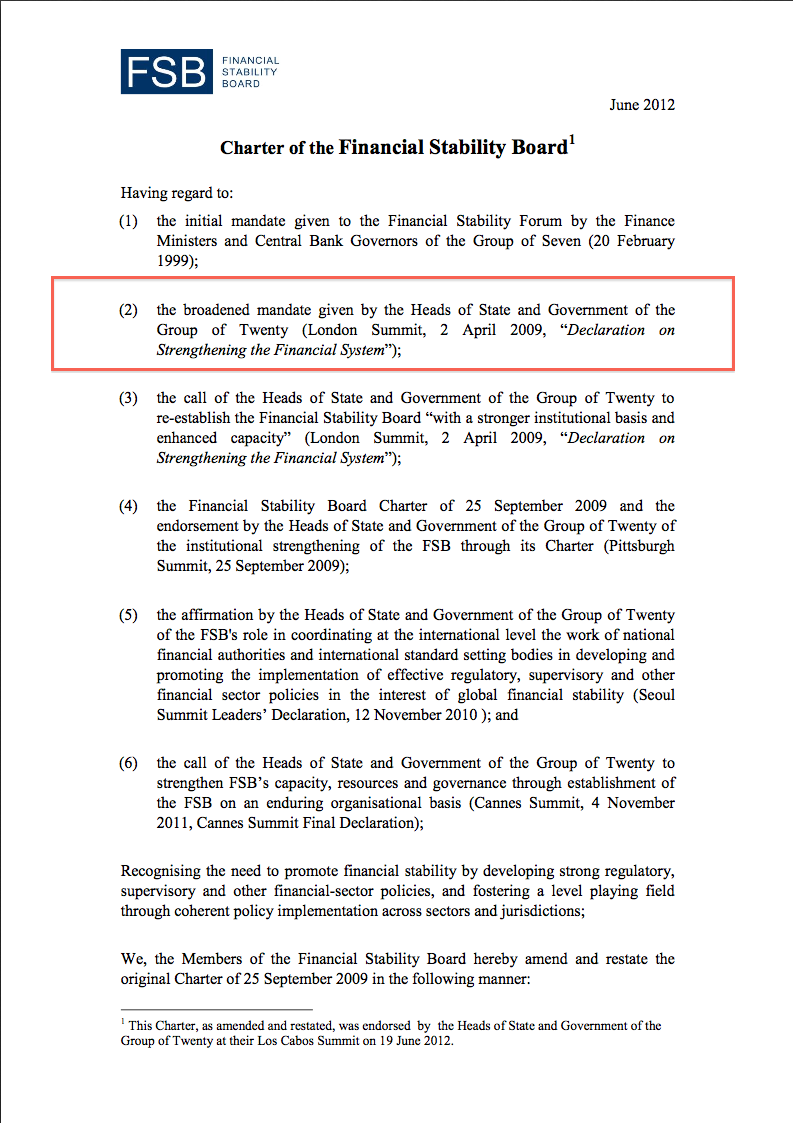
November 11-12, 2010. Armistice Day. That is when all the major governments of the G20 first agreed to implement the new, Cyprus-style “bail-in” regime, at the direction of the internationalist Financial Stability Board under its new, GFC-enabled “broadened mandate” –

CLICK TEXT TO ENLARGE

Click to enlarge

      FSB - G-SIFI, Nov 4, 2011 (click to enlarge)

Click to enlarge

One cannot help but laugh at the Orwellian doublespeak slogans used by the architects of this new regime.

To address the problem of “systemically important” banks, “without exposing the taxpayer to the risk of loss,” our puppet politicians have agreed to confiscate … the savings of taxpayers.

You may be thinking that this excerpt from an FSB press release does not prove that the G20 have specifically agreed to confiscation of bank deposits. And you would be correct.

As with all such schemes, it is not intended that the public will easily discover what has been planned. You have to wade carefully through all the verbose (and deliberately obtuse) technocrat-ese, and cross-reference the supporting documents (and their annexes), in order to discover just what our G20 attendee politicians — geniuses like “World’s Greatest Treasurer” Wayne Swan — have actually signed up to.

And to find the smoking gun.

One with the word B A I L — I N stamped clearly on its barrel.

 cartoon_stickup-cyprus-bank_robbery_of_the_cypriot_people

First, in the FSB press release of 4 Nov 2011 we are told that the G20 allegedly “asked the FSB to develop a policy framework to address the systemic and moral hazard risks associated with systemically important financial institutions (SIFIs).”

Next, in Seoul 2010, “G20 leaders endorsed this framework and the timelines and processes for its implementation.”

That framework is set out in the FSB’s “Key Attributes of Effective Resolution Regimes for Financial Institutions” (pdf).

In the preamble of that document, we learn that one of the objectives is to make it possible for “unsecured and uninsured creditors to absorb losses.” Meaning, if your savings are not covered by some form of government guarantee or federal insurance (for all that is worth) — or if, as in Australia, the government bank deposits guarantee is limited to an amount significantly less than (ie, 1/10th) the total of actual bank deposits held by the public — then your bank account can be made to “absorb losses”. And as we will see shortly, this can be done entirely without your consent –

Click to enlarge

In the sub-points of the preamble, we see that G20 governments are expected to “have in place a recovery and resolution plan (“RRP”) … containing all elements set out in Annex III.” –

Click to enlarge

Each jurisdiction is required to set up a “Resolution authority”, which is to be “responsible for exercising the resolution powers over firms…” –

Click to enlarge

The Resolution authority’s powers are most interesting. For example, we can all applaud the idea that such an authority could (not that they actually would) “claw-back” bankers’ bonuses –

Click to enlarge

What is of serious concern though, is its power to “transfer or sell assets and liabilities, legal rights and obligations, including deposit liabilities and ownership in shares, to a solvent third party,” … without consent –

Click to enlarge

This is confirmed in Key Attribute 3.3, where it is clearly stated that any transfer of a bank’s assets or liabilities (ie, deposits) by the authority “should not require the consent of any interested party or creditor to be valid”, and, that any such action will not be deemed a “default” of the bank’s legal obligations –

Click to enlarge

Now if you are still sceptical that all this means the G20 have specifically agreed to a new regime that might include provisions for a Cyprus-style “bail-in” using depositors’ savings, then perhaps it is because you — like me — would be looking for this exact phrase in order to be fully convinced.

Yes, it is there.

Lucky number (ix) in the “powers” (page 7-8) of the Resolution authority that each of the G20 governments agreed to establish, back in 2010 –

Click to enlarge

Note that not only can the Resolution authority use a “bail-in” to support “continuity of essential functions” of a failing bank; it can also do so in order to finance the setting up of a new third party or “bridge” institution, into which the failed (“non-viable”) bank’s assets or liabilities (ie, your savings) can be transferred. Not so you can get your money back, but for the purpose of “capitalising” the new institution.

At that other elite lucky number (xi), we see another power; to shut banks, suspend payments to customers (except for payments to “central counterparties”, ie, to central banks, quelle surprise), and impose a “stay” on actions by creditors (eg, deposit holders) to “collect money” –

Click to enlarge

 You may have noticed that the “bail-in” power at (ix) referenced Key Attribute 3.5. There, we see that the power to carry out a bail-in “should” (how comforting) be performed “in a manner that respects the hierarchy of claims in liquidation.” This no doubt will reassure the more gullible reader that there is nothing nefarious in this plan; that it is clearly intended that the traditional hierarchy of claims in a bank insolvency would be respected –

Click to enlarge

So, what exactly is the “hierarchy of claims” under this new FSB-dictated regime? Again we have to refer to another section (Key Attribute 5.1) to find the answer. Which does indeed appear to support the traditional hierarchy of claims. Except for this stunning caveat –

 Click to enlarge

It is worth repeating –

“Resolution powers should be exercised in a way that respects the hierarchy of claims while providing flexibility to depart from the general principle of equal (pari passu) treatment of creditors of the same class…”

Moral relativism at its finest.

This is what has happened in Cyprus. While the final details are still evolving as to exactly how much Cypriot depositors holding more, or less, than €100k will have stolen from them, what is clear is that this FSB template for bail-ins in G20 nations or “jurisdictions” (EU), is the one being followed.

What is also clear, especially in light of recent revelations that Canada has expressly identified “bail-in” procedures in their 2013 Budget, is that all Western governments have, unbeknown to their citizens and without their consent, agreed to the imposition of the same new regime for managing insolvent banks.

A regime devised, and dictated by, an unelected central body.

Feel free to check these documents for yourself, here (pdf) and here (pdf).

Are you wondering who and what is the Financial Stability Board?

According to their website:

The FSB has been established to coordinate at the international level the work of national financial authorities and international standard setting bodies and to develop and promote the implementation of effective regulatory, supervisory and other financial sector policies. It brings together national authorities responsible for financial stability in significant international financial centres, international financial institutions, sector-specific international groupings of regulators and supervisors, and committees of central bank experts.

 A list of institutions represented on the FSB can be found here .

 The FSB is chaired by Mark Carney, Governor of the Bank of Canada. Its Secretariat is located in Basel, Switzerland, and hosted by the Bank for International Settlements.

 A kind of “super regulator”. Chaired currently by a Goldman Sachs man. With membership comprising the central bankers, treasury department heads, and prudential regulators of 24 nations, along with the IMF, World Bank, and a cavalcade of others.

Including — and “hosted by” — the central bank of central banks.

The Bank for International Settlements (BIS).

According to its Articles of Association, the FSB is also funded by the BIS –

Click to enlarge

According to its updated Charter (pdf), the FSB received its original mandate from the central bankers and Finance Ministers of the G7 nations in 1999.

It then received a “broadened mandate” from the “Heads of State and Government of the Group of Twenty” at a meeting in London on April 2, 2009 –

Click to enlarge

At the same meeting, another now-infamous Goldman Sachs alumnus and current President of the European Central Bank, Mario Draghi, was appointed Chairman of the FSB –

FSB - History (click to enlarge)

 So… the hapless G20 heads of government, panicking in the midst of the GFC, gave the fonts of central banking wisdom at the FSB a “broadened mandate”, and “asked” them “to develop a policy framework to address the systemic and and moral hazard risks associated with systemically important financial institutions”, did they?

And under the consecutive chairmanships of Goldman Sachs men, these unelected bankers and bureaucrats — not one of whom warned of the approaching GFC — devised this “bail-in” policy for the whole of the G20, to solve the problem of Too-Big-To-Fail banks?

As the Machiavellian-minded so often say:

“Never let a good crisis go to waste”

This article originally appeared on : Global Research

Police, protesters clash in Reyhanli

0

Protesters chant anti-government slogans as Turkish riot police block them in the town of Reyhanli, Hatay Province, on May 18, 2013.

Turkish police have clashed with demonstrators protesting against Ankaraâ„¢s support for Syrian militants in the wake of the two recent car bomb attacks in the southern town of Reyhanli.

On Saturday, demonstrators took to streets in Reyhanli town of Turkeyâ„¢s southern Hatay province to protest against the policies of the ruling Justice and Development Party.

The demonstrators chanted anti-government slogans and blamed the Turkish government for last weekendâ„¢s twin bombings, which killed at least 51 people and injured about 100 others.

Security forces clashed with protesters, and used water cannons to disperse the crowd.

Hatay Governor Mehmet Celalettin Lekesiz told reporters on Friday that police had detained a prime suspect in connection with the Reyhanli explosions.

The suspect, identified as Mehmet G., is said to be the owner of the two vehicles that were blown up in the attacks. He is of Turkish origin and comes from Hatay Province.

Efforts are ongoing to capture two other suspects who played a major role in the staging of the bloody attacks.

Turkey says Syria was behind May 11 bombings in Hatay Province, but the Syrian government has dismissed the claim.

Syria Information Minister Omran al-Zohbi told a news conference on May 12 that his country “did not commit and would never commit such an act because our values would not allow that.”

The Syrian minister also stated that Turkey has planned the attacks to use them as a pretext to justify foreign intervention in Syria.

MP/SS

This article originally appeared on : Press TV

Syria : One Year After the Houla Massacre. New Report on Official vs. Real Truth

0

A week from now it will be one year since the world first heard about the horrors of a place in Syria called “Houla.” On the afternoon and evening of Friday, May 25, 2012, a reported 108 civilians were massacred there. They were executed inside their homes, with guns and “sharp tools,” and maybe a little bit from shelling as well. As the reader might recall, most of the victims were entire families, included some 49 younger children and even babies.

Anyone who had to watch the video results might recall having the bottom drop from their stomach with dread, and the lingering depression after. Many people, naturally, wanted revenge for that.

According to activists, all of the victim families were Sunni Muslim. It was of course blamed on the Syrian Arab Army — the only ones with artillery, if blades aren’t so clear – and their allied “Shabiha,” militias from surrounding villages, of the same Alawite faith of president Assad. None of these features was completely new, but this was by many measures the worst, most massive, most unambiguous massacres of innocents to date.

Western and Gulf Arab states took the events in Houla as clarifying the urgency of toppling the perpetrators; they expelled Damascus’ diplomats and otherwise moved to isolate Syria in the kill box. U.S. ambassador to the U.N. Susan Rice said it had become clear that the “wheels were coming off” of Kofi Annan’s peace plan. The same point was made more aggressively by rebels shaking dead babies on video — no compromise was possible after this. Military aid to the rebels and talk of increasing it increased.

The opposition wanted a no-fly zone and a swift enforced victory, Libya-style. But the war has continued for a year after that “turning point,” stumbling along with no decisive aid yet delivered, and the widely-supported government seems to be winning. There will now be anniversary lamentations about how this massacre failed to move the world adequately. And quite possibly “the regime” will surprise us with a similar slaughter to remind the world how evil they remain. It might be wise, therefore, to brush up on what happened in Taldou last year, to get a clearer idea of how to best approach whatever its anniversary brings.

While official Western and U.N. investigations easily decided to blame Damascus, a more independent, de-centralized, citizen-led investigation (of sorts) was underway from the start. This has by and large reached much different conclusions, with public work that can be verified. Some of the sharper findings from that have been compiled into a report released on Wednesday by the Citizen’s Investigation into War Crimes in Libya (since mid-2012, they have turned their attention to Syria, but without a name change). Official Truth, Real Truth, and Impunity for the Syrian Houla Massacre of May 2012 (PDF, 79 pages — CIWCL download page) compiles seven previously published essays by four authors in three countries, edited, updated, and in two cases translated for the first time to English. Together, they cast unusually harsh light across the murky details of this pivotal event.

As usual, both sides initially blamed each other for the killings in Houla. More precisely, they happened in and around the southern half of Taldou, the southernmost town of the Al-Houla area, which was otherwise under rebel control by mid-2012. Damascus accused “terrorists,” their usual phrase for people who would slaughter little kids just to blame someone else. In the version lodged by the Syrian government (and and at least a dozen local witnesses on record), rebels moved on May 25 to secure total control. In a pre-planned, multi-front attack, 600-800 armed fighters from the region and overseas hit all five security posts around Taldou. They came in waves with mid-heavy weapons, pinning the soldiers down in defensive mode or completely overrunning their posts. Over the afternoon and early evening, many Syrians say, the rebels took over the town.

Some evidence in the report suggests this is just what happened. The damage to buildings given as from distant regime artillery shelling, seems instead to be from RPGs and heavy machine guns, on Taldou’s main street itself. Instead of holes in roofs, we see primarily walls holed and peppered with horizontal fire. Among the most heavily “shelled” places are all the government security posts along main street. The U.N.’s investigators acknowledged that the northernmost “one or two” posts were overrun by rebels in what might have been a “premeditated attack.” (p. 55) However, they somehow managed to play this down as irrelevant.

In this version with at least some evidence behind it, the opposition simply lied about the victims of the ensuing massacre. Rather than neutral-to-anti-government Sunnis, they were Shi’ites, perhaps Alawites, and Sunnis who rejected the rebellion and remained loyal to the “Alawite regime.” One of the Sunni families was said to be related to the new speaker of the Syrian parliament, the People’s Assembly — selected the day before the massacre of his kin. (see p. 25)

A compromised UN “investigation” (Commission of Inquiry, CoI) arrived at their blame target by listening carefully to some alleged witnesses and experts (usually via Skype) and scoffing at others behind their backs. Led by Karen Koning AbuZayd, an American Middle East think tank director, the CoI established with its reports the closest thing there is to the world’s official truth. The mainstream media delivered the context for receptive audiences, world leaders led, groups for good things concurred, and little surprise, the world public and the public record came out blaming the rogue regime that needed to be changed like a dirty diaper.

In case it matters, deeper investigation shows that the alleged witnesses this mythology is based on are grossly unreliable, or reliable at delivering lies. An essay by Alfredo Embid explores the disparate voices and the psychology of speaking up in post-massacre Taldou. (see p. 29) For whom is telling the truth going to mean “certain death”? Certainly not for rebel fighters, who were a prime source of evidence used to exonerate the rebels. One of these is FSA Farouk Brigade commander Abdul Razzaq Tlass of nearby ar-Rastan; he’s been seen leading U.N./Arab League monitors around by the hand (p. 34) and, Embid argues convincingly, probably informed them on the Houla events. On the other hand, Tlass was reported as himself leading a large unit of fighters involved in the massacre, or at least the connected battle of Taldou (p. 31).

An essay by myself scrutinizes the 11-(or 8?)-year-old boy survivor Ali al-Sayed. (p. 20) He has striking consistency in blaming the Shabiha with “Alawite accents” for killing his family, and in demanding foreign intervention, compared to his bizarre confusion over everything else between different accounts. For example, Ali is not sure whether the men were killed right away, or only after they were found hiding, without a peep, while everyone else (except Ali) was killed. Also, the names of these men shift all over in a strange manner. The alleged father of this family is Aref Mohammed al-Sayed, but Ali says his dad is named Ali Adel or Shaoqi. It’s his brother, Ali says, that’s named Aref — or Shaoqi — while his uncle is Aref, Abu Haider, or Oqba. It’s worth noting that the family he refers to so inconsistently is the one said to be related to the People’s Assembly secretary, although Ali insists the relation is too distant to matter.

The U.N.’s CoI spoke to Ali via Skype and found, without comparing accounts like I have, that all child witnesses “remained consistent … despite the fact that [interviews] were conducted over an extended period of time” and with “different investigators.” This is just plain false.

The other alleged witnesses, saying they faced a death sentence for doing so, spoke up and blamed the rebels. In contrast to Ali and those with similar stories, these were simply ignored by most media reports, and unfairly minimized and sidelined by the U.N.’s CoI. This decided there were only two such witnesses on record, both aired by Syrian state broadcaster SANA. In fact, there are somewhere over a dozen, from a variety of sources. (p. 37) They identified a few possible “inconsistencies” and, citing a lack of direct access to Syria, said “those inconsistencies could not be further explored.” Why it couldn’t be done remotely by Skype, like with the witnesses they wanted to hear from, is not explained. They dismissed the two witnesses, standing in for all of them, as “unreliable.”

 In another essay (p. 44), Ronda Hauben explains how other witnesses of this class also spoke to monitors with UNSMIS (U.N. Special Mission in Syria), and so should have been on file. Unlike the CoI, UNSMIS had people on the ground, led by Major-General Robert Mood. Cryptically, he told the press on June 15 that UNSMIS had been to Houla and interviewed locals, some of whom “told one story” and some of whom told “another story.” Comparing them, he said, it “still remains unclear to us” which was truthful. He offered to support a deeper investigation, but instead, the mission was shut down at the end of July. The UNSMIS report with conflicting accounts, Mood said, was handed to headquarters in New York. It’s acknowledged as existing but has never had its contents mentioned, referenced, or seen anywhere.

In the absence of U.N. info they would cite, the two SANA witnesses alone were easy for the CoI to dismiss. As Marinella Correggia rightly points out (p.17)

“This interference that fuels violence is justified — by governments and the mainstream media — by the need to “help the armed opposition groups to stop the massacres by the regime and to protect civilians.” […] For this story to hold, it’s required to systematically deny the international right to speak and bear witness to a large portion of the population, that would launch different or contrary accusations. And so it is discriminated against by the media, NGOs and UN experts.”

Even if their process was distorted, it’s possible the CoI happened to slant things towards the truer witnesses. This doesn’t appear to be the case, however.

The available video evidence offers a few opportunities to actually test the two witness sets for consistency with the more reliable “digital witnesses.” The final essay summarizes a detailed analysis which managed to place numerous videos of May 25, all gleaned from opposition sources, in specific locations around Taldou, and to give each a rough time stamp. Seven aspects of the alleged rebel attack are then explained with their video supports, with select stills and a detailed reference map helps the reader visualize along. For example, where a witness cited rebels shooting at the central security post from the northwest at about 1:30 PM, two rebel videos show … exactly that (p. 57).

Even where video is absent — the main six hours of the attack and the massacres — is a clue of something afoot on the side practicing video silence that ended precisely just before sunset. Collectively, this is a surprisingly consistent picture of deceit from the hard-to-deny realm of direct video evidence. There is nothing in it to support the rebel version of flight from shelling (nor any footage of the attackers, from any distance). In its place there is something unsettlingly close to visual proof that they stuck around though their own barrage and were thus best placed to be behind the killings after all.

U.S. ambassador Robert Ford, who knows a few things about death squads and such, said a few days after the massacre that it was “the most unambiguous indictment of the regime to date,” based on the alleged use of heavy artillery, which the rebels did not have. In fact, even before the detailed exposition began, it was never a particularly clear event. It was, however, the “big one” they really wanted to make very sure was perceived a regime crime. After more analysis, this desire seems ill-founded, and Mr. Ford’s statement sounds incredibly sad. Houla has been shown beyond a doubt to be extremely ambiguous at best, and at worst a fairly obvious crime of the U.S.-supported Syrian Contras.

The best evidence says rebels clobbered Taldou before the slaughter, but they were able to whitewash right over that victory, with nothing but alleged witnesses talking on the phone and on Yotube. And so after their homicidal rampage through Shi’ite bedrooms, Syria’s Sunni rebel extremists garnered an outpouring of support. That works by no magic of their own; it’s all on loan. It’s their golden shovel. Any corpse that rebels bury with it carries just the lessons they attribute to it.

In recent months, moral confusion has grown with increasing awareness of extremely heinous rebel actions. The more massive crimes of total cruelty, like the Houla massacre, ensure that at best people will perceive two sides no better than each other. How much less confusing it would be if it became clear Houla, if not other crimes like it, were also from the rebel side. Houla is far from the only such incident,” some might protest. “It’s unfair to pick on just one example.” But of course worthwhile answers can never appear until one gets this specific, and with this example, many thinkers have picked the fairest one. It was, after all, pre-highlighted by the blame-Assad crowd. The research done quietly to date arguably takes this high ground, and inverts the example it sets. Consider the other huge and shocking massacres vying for the notoriety of Houla — Qubeir, Daraya, Aqrab, Jdeidat al-Fadl, al-Bayda and Baniyas, etc. — most of them, like Houla, coming just before U.N. security Council meetings on Syria and the like. It’s worth asking honestly which of those happened as reported by the opposition, and which was, instead, more like the famous Houla massacre they apparently lied to us about?

As one portion of the report explains (p. 73-75), many of these others feature rebel battle deaths passed off as innocents, to massively pad the numbers into the triple digits. But at least one shocking December, 2012 event without such ambiguity seems to be Houla rebels getting one-sided revenge on neighboring “Shabiha” — and their families — in Aqrab. At least 125 Alawite men, women, and children, gone missing and apparently snuffed out, were passed off by rebels as more victims of “Shabiha” and the Army. This was done with nowhere near the success they had back in May, thanks to on-site report by Alex Thomson for UK Channel 4. (p. 74) But neither was anyone punished or called out for it, nor were the missing Alawites — or answers — asked after. The story of what happened in Aqrab got “murky” and then really quiet as soon as it looked like a rebel crime. That it was by some of the same criminals credibly blamed for the battle and massacre that gave them Taldou, is worth pondering on.

Those who believe in the golden shovel, and those under the sway of powerful people who do, are apparently bound to recognize what its holder says. However, as this report again reaffirms, that’s magic doesn’t work on everyone. The leadership of a majority of the world’s people were never convinced about what happened at Houla (see pages 11-12) Besides China and Russia, for example, India’s Ambassador to the UN, Hardeep Singh Puri, asked that atrocities, “including the recent incident in El Houleh, are fully investigated and their perpetrators brought to justice.” This is nothing unusual, but he didn’t blame the government and, for context, as Ronda Hauben points out,

“[Puri] noted that the attacks against civilians and security forces in Syria “have intensified over the last few weeks and have taken a significant toll.” Also he drew attention to the sharp increase in the number of terrorist attacks in different parts of the country.” He “condemned all violence, irrespective of who the perpetrators are,” and called for the “cessation of all outside support for armed groups and serious action against the terrorist groups in Syria.”

The questions recognized as standing on May 26, 2012 can and should be revisited a year later, because a year later is now, and it seems that the questions weren’t answered right the first time. This report will hopefully add to the effort to end the magic spell that’s spilled so much blood, and let truth finally get its chance to be the basis upon which the world acts.

 Official Truth, Real Truth, and Impunity for the Syrian Houla Massacre of May 2012 Authors : Marinella Correggia, Alfredo Embid, Ronda Hauben, Adam Larson

(PDF, 79 pages — CIWCL download page)

This article originally appeared on : Global Research

Southern Iran hit by 5.7 earthquake

0

An earthquake measuring 5.7 on the Richter scale has struck the southern Iranian province of Hormuzgan.

According to the Iranian Seismological Center, the earthquake hit near Goharan town, 81 kilometers southeast of Minab, located in Hormuzgan on Saturday at 14:33 local time (GMT 1003).

No casualties have yet been reported.

Over the past months a series of earthquakes have struck Iranâ„¢s southern parts. On May 17, an earthquake measuring 4 on the Richter scale hit 87 kilometers southeast of Minab.

On May 11, A 6.2 magnitude earthquake struck the port city of Jask in the southern Iranian province of Hormuzgan, killing one and injuring dozens of others.

Head of the Rescue and Relief Organization of Iran’s Red Crescent Society (IRCS) Mahmoud Mozaffar said at least five villages were destroyed in the quake-stricken area.

On May 7, two earthquakes hit the town of Kaki near Iranâ„¢s southern city of Bushehr. No casualties or damages were reported.

A major quake measuring 7.5 on the Richter scale shook a sparsely-populated rural area between the cities of Saravan and Khash in the southeastern Sistan and Baluchestan Province at a depth of 95 kilometers on April 16. The quake was unprecedented in the past 50 years.

On April 9, a 6.1-magnitude quake hit rocked the town of Kaki, some 90 kilometers southeast of Bushehr, on April 9, at a depth of 12 kilometers

At least 37 people were killed and more than 1,050 others were injured. The quake also destroyed 3,100 houses. The strong quake was followed by many aftershocks, which also jolted the nearby city of Khour-Mowj.

MYA/HGH

This article originally appeared on : Press TV

Asteroid 9 times size of ocean liner approaches Earth

0

The 1998 QE2 asteroid has the physical mass to potentially deliver life on Earth a knockout punch, being 2.7km in length. It is to buzz our planet on May 31, aweing the stargazing community.

Officially known as Asteroid 1998 QE2, the ‘minor planet’, as
astronomers refer to these space objects, is about nine times the
length of its name-sharing ocean liner, Queen Elizabeth 2.

The incoming space object is not named in honor of Queen Elizabeth
II, however, nor the 12-deck QE2 luxury liner. It’s simply the
designation assigned by the US Minor Planet Center in Cambridge,
Massachusetts, based on an alphanumeric code for naming
newly-discovered asteroids.

Aside from the asteroid’s hulking mass, another thing that
intrigues astronomers about QE2 is that nobody can say with any
certainty where it came from.

One clue to its origins, however, is that its surface is said to be
covered with a sticky, black residue, suggesting that it may be the
remains of a comet that came in close proximity to the sun, Amy
Mainzer, a researcher at Jet Propulsion Laboratory at La Cañada
Flintridge, California, told the Los Angeles Times.

Another explanation is that QE2, discovered on August 19, 1998 by
the Massachusetts Institute of Technology, was originally part of
the asteroid belt between the orbits of Mars and Jupiter, she
said.

QE2’s nearest approach happens on May 31 at 20:59 GMT, bringing the
huge space rock to within 3.6 million miles (5.8 million km) of
Earth — about 15 times the distance to the Moon. While this may
seem a great distance, in astronomical terms it is a mere stone’s
throw away.

Mainzer emphasized the significance of the asteroid, drawing
parallels with a past celestial event that had devastating
consequences for the entire planet.

“This is a really big asteroid, similar in size to the one that
killed off the dinosaurs, and it’s getting very close to us,”

she told the Times. “Fortunately we’ve been tracking its orbit
very carefully so we know with great certainty it won’t hit
us.

We don’t need to panic, but we do need to pay attention, she
added.

Since the threat of a doomsday scenario seems unlikely, astronomers
will be given an opportunity to study the physical characteristics
of asteroids, as well as their history.

“Whenever an asteroid approaches this closely, it provides an
important scientific opportunity to study it in detail to
understand its size, shape, rotation, surface features, and what
they can tell us about its origin,”
radar astronomer Lance
Benner, the principal investigator for the Goldstone radar
observations from NASA’s Jet Propulsion Laboratory in Pasadena,
California, said in a statement.

Observers will take advantage of radar technology to measure the
asteroid’s distance and velocity to improve the calculation of its
orbit and compute its motion farther into the future than we could
otherwise, he added.

The next arrival of Asteroid 1998 QE2 following its near-miss on
May 31 will not occur again for another two centuries.

For millions of years, Earth has been occasionally pounded by space
objects both large and small. Russia, due to its sprawling
landmass, has played an unwitting host to many of these celestial
bodies.

In 1908, a comet explosion over a largely uninhabited area of
Siberia flattened some 80 million trees. The so-called Tunguska
Event is recognized as the largest impact event on or near Earth in
recorded history: The explosion was about 1,000 times more powerful
than the atomic bomb dropped on Hiroshima, Japan.

More recently, on February 15 this year, a meteor exploded in the
sky over the Russian city of Chelyabinsk. The shock waves from the
explosion shattered windows and damaged buildings, injuring more
than 1,500 people, mostly from flying glass and other debris.

Following the Chelyabinsk meteorite, which is the largest known
space object to have entered Earth’s atmosphere since the Tunguska
Event, NASA chief Charles Bolden gave advice on how to handle an
asteroid that was on a collision course with Earth “if it’s coming
in three weeks”: Pray.

While NASA is tracking about 95 per cent of the largest objects
flying near Earth, only about 10 per cent of an estimated 10,000
asteroids with a diameter of 50 meters (165 feet) or more have been
identified.

Meanwhile, mankind continues the search for ways to counter future
space objects deemed dangerous.

Just days after the Russian meteor struck, the European Space
Agency (ESA) announced a joint mission between Europe and the US
that aims to strike an asteroid with a spacecraft.

The Joint European/US Asteroid impact and Deflection Assessment
mission (AIDA) is preparing to intercept the asteroid Didymos in
2022, when it is about 6.5 million miles (11 million km) from
Earth.

Didymos, which poses no immediate threat to Earth, is actually a
binary system, in which an 800-meter-wide asteroid and a smaller
150-meter space rock orbit each other.

The AIDA mission – designed to test the theory that governments can
protect the planet from a space object on a collision course with
the planet – will target the smaller asteroid with a rocket at
about 14,000 mph (22,539 kph) in an effort to knock the object off
course.

This article originally appeared on : RT

Turkey not halting Iran oil imports

0

Turkish Prime Minister Recep Tayyip Erdogan says Ankara has not yet made any decision on cutting oil imports from Iran, despite US pressure to hinder the Tehran-Ankara energy cooperation.

Speaking at the Brookings Institution in Washington on Friday, the Turkish premier said the level of oil imports from Iran depends on his country’s energy demand.

The United States granted 180-day waivers on Iran oil sanctions to Turkey for the second time on December 7, 2012 after Ankara made initial cuts to its Iran oil imports.

Å“…As to whether we would cut back any further, it will depend on our need. Time will tell,” Erdogan added.

Shipping data on May 3 showed that Turkey raised its crude oil imports from Iran to average 140,000 barrels per day (bpd), in April hitting an eight-month high.

Turkey has been importing an average of 100,000 bpd between September 2012 and February 2013, and in March increased purchases of Iranian oil to 114,000 bpd, despite US sanctions against Iran’s energy sector.

At the beginning of 2012, the US and the European Union imposed new sanctions on Iranâ„¢s oil and financial sectors with the goal of preventing other countries from purchasing Iranian oil and conducting transactions with the Central Bank of Iran.

The illegal US-engineered sanctions were imposed based on the unfounded accusation that Iran is pursuing non-civilian objectives in its nuclear energy program.

Iran rejects the allegation, arguing that as a committed signatory to the Non-Proliferation Treaty and a member of the International Atomic Energy Agency, it has the right to use nuclear technology for peaceful purposes.

PG/HGH

This article originally appeared on : Press TV

Blast kills 1, injures 12 in Afghanistan

0

Afghan security forces inspect the site of a bomb attack in Khost city, eastern Afghanistan. (File photo)

At least one person has been killed and twelve others injured when an improvised explosive device (LED) went off in Afghanistanâ„¢s eastern province of Khost, Press TV reports.

The remote-controlled bomb exploded at a grocery market on the outskirts of the provincial capital city of Khost, located about 150 kilometers (93 miles) south of Kabul, at around at 9:30 a.m. local time (0500 GMT) on Saturday.

Local officials said an Afghan border guard was killed and three others were injured in the blast.

Provincial security chief, Mohammad Yaqoub, said six Afghan civilians were also injured in the incident.

There was no immediate claim of responsibility for the attack.

Security forces cordoned off the area after the event, and launched an investigation.

Meanwhile, one person was killed and four others injured in an explosion in the Yahya Khel district of the southeastern province of Paktika.

Provincial governorâ„¢s office said in a statement that the incident took place at around 7 a.m. local time (0230 GMT) on Saturday after a tractor struck a roadside bomb.

The statement added that three Afghan children and a woman were among those injured in the explosion.

Separately, a roadside bomb hit an Afghan army vehicle in the Bakwa district of the western Farah province on Saturday, leaving four soldiers dead.

The United States and its allies invaded Afghanistan as part of Washingtonâ„¢s so-called war on terror. The offensive removed the Taliban from power, but the country is still gripped by insecurity.

In late April, the Taliban announced the start of their annual “spring offensive” against US-led and Afghan forces, vowing a new wave of attacks across Afghanistan.

The militant group said it would use “every possible tactic” to inflict casualties on Afghan and US-led forces. They specifically mentioned insider attacks, and bomb attacks.

The announcement prompted the Afghan authorities to beef up security in major cities across the country, including the capital city of Kabul.

MP/SS

This article originally appeared on : Press TV

Purchase power: App allows votes against Monsanto, for GMO labeling

0

A new app aims to become an engine for consumer activism, helping users spend money on products from companies they share causes with, boycotting those they don’t. The prime targets at the moment are Monsanto and Koch brothers.

The power that new technology gives to grassroots movements
comes into focus occasionally. It did when people rallied to the
protection of internet freedoms from SOPA/PIPA bills on the call
from online giants. It did when Egyptian anti-government protesters
or London rioters coordinated their action through Facebook and
Twitter.

The people behind Buycott, a new app for Apple devices,
apparently eye the same direction. The program combines a simple
barcode scanner with a database of corporate ownership and a
website for user-suggested activism campaigns.

A campaign lists companies that support some cause, like
opposing factory farming or lobbying for the big oil, which
supporters of the campaign would love or hate. When a barcode is
scanned, the application tracks the product to the parent company
that will ultimately profit from the purchase and checks against
your selected campaigns. If there is a match, the app green-lights
or red flags the product.

Buycott is by no means the first mobile app to promote activism through boycotting or buying something. But
it’s apparently the first one aiming to remain neutral and giving
the users the choice of which cause they want to champion. At the
moment the most popular campaigns denounce the conservative
businessmen Charles and David Koch and promote GMO labeling, with
both sporting more than 20,000 supporters, but there is no reason
why opposite campaigns wouldn’t become popular too. Campaigns for
opposing goals do exist even now.

Screenshot from buycott.com

“I don’t want to push any single point of view with the
app,”
Ivan Pardo, the man behind it, told Forbes. “For me,
it was critical to allow users to create campaigns because I don’t
think it’s Buycott’s role to tell people what to buy. We simply
want to provide a platform that empowers consumers to make
well-informed purchasing decisions.”

The Los Angeles-based 26-year-old freelance programmer spent the
last 16 months to develop the app. It debuted in iTunes and Google
play in early May, but since then the Android version had been
suspended, because Buycott was caught unprepared for the sudden
popularity and the technical difficulties it cause.

“I simply didn’t set up the servers to be prepared to handle 10+
new users every second. I was expecting a more manageable rise,”
Pardo explained

Apart from managing the workload on servers and fixing glitches
the company is busy updating its corporate database. The multitier
ownership structure is quite intricate, and some brands do not
quite link to their parent companies at the moment. They are also
asking users to give info on products that are missing in their
database.

This article originally appeared on : RT

France to buy US drones for use in Mali

0

File photo shows a US-made unarmed Reaper surveillance drone.

France has plans to purchase US-made unarmed Reaper surveillance drones in a bid to back up its military operations against fighters in the crisis-hit African country, Mali, a report says.

According to the report published by Air et Cosmos specialist magazine on Friday, France will buy two American medium-altitude Reaper drones following a deal reached between Paris and Washington.

The report added that the French Air Force, which has already deployed Israeli-made armed unmanned drones to the West African nation, intends to acquire more modern drones rapidly.

In February, a report published by the World Tribune indicated that the French military has used “Harfang” medium-altitude long endurance (MALE) drones manufactured by Israel in the war-torn country.

The Air et Cosmos report also stated that the French Defense Minister Jean-Yves Le Drian, who is currently on a visit to the US, is set to make an official announcement in this regard.

France launched its war on the resource-rich West African country in January under the pretext of fighting al-Qaeda-linked extremists.

The French-led war on Mali has caused a serious humanitarian crisis in the northern areas of the country and has displaced thousands of people, who now live in deplorable conditions.

Amnesty International said on February 1 that serious human rights breaches including the killing of children were being conducted in Mali.

Some political analysts believe Mali’s abundant natural resources, including gold and uranium, could be one of the reasons behind the French war against the African country.

MAM/SS

This article originally appeared on : Press TV

Police face scrutiny over custody death

0

Activists rallying on the fourth anniversary of Sean Riggâ„¢s death on August 21, 2012

British Police officers could face misconduct proceedings for the way they dealt with a musician who died in custody five years ago after a review criticized police watchdog for errors in its initial investigation into the case.

Sean Rigg, a mentally ill black man, died of cardiac arrest after being held in the back of a police van at Brixton police station in south London on August 21, 2008.

The original Independent Police Complaints Commission (IPCC) report found earlier that all five Metropolitan police officers involved had acted reasonably.

However, The IPCC is expected to re-examine whether police officers involved in the arrest and detention of the 40-year-old schizophrenic were guilty of misconduct.

This comes after an independent probe published on Thursday tore those conclusions apart and found that the commission had made a series of fundamental errors.

Failure to secure the crime scene, prevent officers from conferring with each other, properly examine CCTV and carry out a robust analysis are among errors which were found in the initial IPCC investigation.

“This report shows just how badly we were failed by the IPCC, not to mention the police. It is frightening to think that in the intervening years, as we struggled for justice, more families will have been failed in the same way,” said Marcia Rigg, sister of Sean.

Earlier in March, two serving and one retired Metropolitan police officers were arrested on suspicion of lying under oath and perverting the course of justice as part of the investigation into the custody death, which was started in 2012.

SSM/HE

This article originally appeared on : Press TV

IRS Targeted Billy Graham Ministry and Other Christian Groups

0

Dave Bohon
New American
May 18, 2013

As the White House announced May 15 that acting IRS Commissioner Steven Miller would resign in the wake of revelations that the tax agency had targeted conservative groups, news has surfaced that the tax-exempt status of prominent Christian organizations had also been targeted.

Fox News reported that while President Obama announced the resignation of Miller, what he conveniently left out was the fact that, according to an official close to Miller, the IRS head was “set to resign the position of acting commissioner as of early June.” The anonymous official told Fox that Miller was planning to leave the IRS entirely a “couple of months later, regardless of the current controversy.”

Fox reported that the convenient way in which Miller was being ousted was “not mentioned by the president as he announced Wednesday evening Miller was resigning. Obama spoke following a meeting with Treasury Secretary Jacob Lew and other top department officials in which they reviewed a highly critical inspector general’s report on the practice. The report concluded poor management allowed agents to improperly target Tea Party and other groups for more than 18 months, starting in 2010.”

In his statement Obama declared that “Americans have a right to be angry about it, and I’m angry about it.” The president claimed that his administration would enact “new safeguards to make sure that this kind of behavior cannot happen again.”

Even as the president was assuring the American people, more revelations were coming out about the extent of the targeting of organizations that could be broadly categorized as opposing the Obama agenda. Among the organizations the IRS investigated and audited were the Billy Graham Evangelistic Association (BGEA) and the 180-year-old Baptist newspaper the Biblical Recorder, published by the North Carolina Baptist State Convention. The IRS reportedly also targeted the humanitarian relief group Samaritan’s Purse. Both it and the BGEA are run by Franklin Graham, son of famed evangelical preacher Billy Graham.

In the run-up to last year’s presidential election, the BGEA took out ads in the New York Times, the Wall Street Journal, and other newspapers encouraging Christians to vote in line with biblical values. Shortly after the ads were published, both the BGEA and Samaritan’s Purse were notified that they were being audited by the IRS.

On May 14 Franklin Graham shot off a letter to President Obama concerning the targeting of the organizations he oversees, telling the president that he believes “someone in the administration was targeting and attempting to intimidate us. This is morally wrong and unethical – indeed some would call it ‘un-American.’” Added Graham: “I do not believe that the IRS audit of our two organizations last year is a coincidence – or justifiable.”

  • A d v e r t i s e m e n t

Mark DeMoss, a spokesman for the BGEA, told Fox News that it was the first time the ministry had been audited in its then 62-year history. “These certainly appear to be politically motivated since the ministry had run some newspaper ads – not mentioning any candidates – simply urging people to vote for candidates with biblical values,” DeMoss said.

The Baptist Biblical Recorder appears to have been targeted because of a now-famous interview it ran with with the Chick-fil-A president Dan Cathy in which Cathy boldly spoke out in favor of traditional marriage and families. In the interview Cathy said that he and his fast-food chain were “guilty as charged” in their support “of the family – the biblical definition of the family unit. We are a family-owned business, a family-led business, and we are married to our first wives. We give God thanks for that.”

The comments enraged homosexual activists, who saw it as a direct challenge to their militant efforts to normalize homosexuality and same-sex “marriage.”

Shortly after the interview was published, the paper’s editor, Allan Blume, began getting phone calls from the IRS. He told Fox News that the calls definitely “raised some red flags and made me wonder why we were being targeted for an audit when we have been around since 1833 and have never been audited before. Putting it all together made me wonder.”

Blume said the timing of the investigation, right after the Cathy interview as well as the paper’s running of the BGEA ads, appeared to be more than just coincidence. “There seems to be a very anti-Christian bias that has flowed into a lot of government agencies,” he told Fox News, “oppression literally against Christian organizations and groups. It makes you wonder what’s going on.”

He added that while the paper was eventually given a clean bill by the IRS, the whole investigation represented “a lot of time and energy that we didn’t have. It took some of our staff literally several weeks of doing nothing but that [audit].”

Similarly, both the BGEA and Samaritan’s Purse were cleared by the tax bureaucracy, but, as Franklin Graham pointedly explained to Obama, the cost was great to both organizations. “Unfortunately, while these audits not only wasted taxpayer money, they wasted money contributed by donors for ministry purposes,” wrote Graham, “as we had to spend precious resources servicing the IRS agents in our offices.”

Graham ended his letter by asking Obama to make things right. “Mr. President, the IRS has already publicly acknowledged it operated in a less than neutral and non-partisan way,” Graham wrote. “We also now know that the target of their improper actions was much wider than political or Tea Party organizations. Will you take some immediate action to reassure Americans we are not in a new chapter of American history – repressive government rule?”

<!–

–>

This article was posted: Saturday, May 18, 2013 at 6:39 am

Tags:


<!– this is where we need to show the related articles

–>

This article originally appeared on : Infowars

IRS Demanded Info On Pro-Life Group’s Prayers

0

Fox News
May 18, 2013

The Internal Revenue Service allegedly told two pro-life to reveal the content of their prayers and prayer meetings, according to the Thomas More Society.

An IRS office in California ordered Christian Voices for Life of Fort Bend County, Texas to explain the content of prayers “as if they were engaging in highly offensive or criminal behavior,” the Thomas More Society charged.

Agents also ordered Coalition for Life of Iowa to provide detailed information about the group’s prayer meetings.

Rep. Aaron Schock (R-IL) demanded that outgoing IRS commissioner Steven Miller answer questions about the incidents during Friday’s House Ways and Means Committee hearing. “Their question, specifically asked from the IRS to the Coalition for Life of Iowa: ‘Please detail the content of the members of your organization’s prayers.’”

Shock wanted to know if that was an appropriate question for the IRS to ask.

Full article here

<!–

–>

This article was posted: Saturday, May 18, 2013 at 6:40 am

Tags:


<!– this is where we need to show the related articles

–>

This article originally appeared on : Infowars

Why was a Sunday Times report on US government ties to al-Qaeda chief spiked?

0

Nafeez Mosaddeq Ahmed
Cease Fire
May 18, 2013

A whistleblower has revealed extraordinary information on the U.S. government’s support for international terrorist networks and organised crime. The government has denied the allegations yet gone to extraordinary lengths to silence her. Her critics have derided her as a fabulist and fabricator. But now comes word that some of her most serious allegations were confirmed by a major European newspaper only to be squashed at the request of the U.S. government.

In a recent  book Classified Woman, Sibel Edmonds, a former translator for the FBI, describes how the Pentagon, CIA and State Department maintained intimate ties to al-Qaeda militants as late as 2001. Her memoir, Classified Woman: The Sibel Edmonds Story, published last year, charged senior government officials with negligence, corruption and collaboration with al Qaeda in illegal arms smuggling and drugs trafficking in Central Asia.

In interviews with this author in early March, Edmonds claimed that Ayman al-Zawahiri, current head of al Qaeda and Osama bin Laden’s deputy at the time, had innumerable, regular meetings at the U.S. embassy in Baku, Azerbaijan, with U.S. military and intelligence officials between 1997 and 2001, as part of an operation known as ‘Gladio B’. Al-Zawahiri, she charged, as well as various members of the bin Laden family and other mujahideen, were transported on NATO planes to various parts of Central Asia and the Balkans to participate in Pentagon-backed destabilisation operations.

According to two Sunday Times journalists speaking on condition of anonymity, this and related revelations had been confirmed by senior Pentagon and MI6 officials as part of a four-part investigative series that were supposed to run in 2008. The Sunday Times journalists described how the story was inexplicably dropped under the pressure of undisclosed “interest groups”, which, they suggest, were associated with the U.S. State Department.

Full article here

<!–

–>

This article was posted: Saturday, May 18, 2013 at 6:37 am

Tags:


<!– this is where we need to show the related articles

–>

This article originally appeared on : Infowars

USDA Needs More Time to “Review” Monsanto and GMO Crops?

0

Christina Sarich
Prison planet.com
May 18, 2013

The laughable insistence by the Department of Agriculture this past Friday that it needs more time to look at the data for Monsanto and other biotech companies who are poisoning our food supply is further evidence that our government institutions are bought and paid for with corporate cash. And instead of keeping a watchful eye over the public’s food supply, it was recently detailed by Anthony Gucciardi how they specifically use our tax dollars to push Monsanto’s agenda.

As Dow pushes for its new corn called “Enlist” to be approved by regulatory bodies, the USDA is saying it needs ‘more time’ to conduct environmental studies. It will come down to a battle of the public’s insistence verses the coffers of mega-billionaire companies, and we will either see new GMO alternatives or regulatory action. It’s more than this one crop that hangs in the balance, though. Dow first wants to roll out Enlist corn, followed by soybeans and cotton to be used in combination with its new Enlist herbicide that combines the weed-killers 2,4-D and glyphosate.

Since the USDA seems to need some help in making their decision, let’s have a gander at just some of the studies coming out in the past months about the negative impact of GMO on the environment as well as our health. I encourage you to share this article with as many people as you can to get the word out, as well as March on Saturday, May 25th in the March against Monsanto to help convince our government agencies that we’ve had enough of GMOs . Whether it’s from Monsanto, Dow, or anyone.

Here’s but some of the latest:

  • The US Environmental Protection Agency has recently been slapped with a lawsuit because GMO agricultural practices and pesticide use is killing off our bees, a viral part of the ecosystem that helps to pollinate crops.
  • GMO corn and the high fructose corn syrup which it is often used to make is killing us at staggering rates. Diabetes and cancer rates as well as obesity can all be traced back to GMO crops.
  • The funky DNA in GMO crops is creating super bugs that then warrant more and more chemical fertilizers. When will it ever stop?
  • GMOs are hiding in all kinds of foods since our government won’t support labeling, so the cereals you eat, the meals you dine on in restaurants, and even the ‘health’ food you consume is often laden with GMO.
  • Organic farming can feed the world, even though we’ve been told otherwise.

The list goes on, ad infinitum. What other proof does the USDA need?

This post originally appeared at Natural Society

<!–

–>

This article was posted: Saturday, May 18, 2013 at 6:38 am


<!– this is where we need to show the related articles

–>

This article originally appeared on : Infowars

Israeli official: Assad preferable to extremist rebels, The Times of London reports

0

Haaretz
May 18, 2013

Israel prefers the regime of President Bashar Assad in Syria to continue than see a takeover of the country by rebel Islamist militants, The Times of London reported Friday, quoting an Israeli intelligence official.

“Better the devil we know than the demons we can only imagine if Syria falls into chaos, and the extremists from across the Arab world gain a foothold there,” the official said, according to the report.

According to the Times, the senior intelligence officer in the north of Israel said a weakened but stable Syria under Assad is not only better for Israel but for the region as a whole.

Another defense official was quoted saying it is more likely than initially estimated that Assad will remain in power.

Full article here

<!–

–>

This article was posted: Saturday, May 18, 2013 at 6:38 am

Tags: , ,


<!– this is where we need to show the related articles

–>

This article originally appeared on : Infowars

Colorado sheriffs sue the state over new gun control laws

0

Greg Campbell
Daily Caller
May 18, 2013

A consortium of plaintiffs led by 54 of Colorado’s 62 elected county sheriffs filed a lawsuit in federal court against the state Friday in an effort to overturn two new gun control bills that are set to go into effect on July 1.

The plaintiffs have in their sights one law that effectively bans all firearm magazines, and one that requires a background check for every gun transfer when the gun will be in the possession of someone other than the owner for more than 72 hours.

“On one hand, I’m proud to be part of this historic case,” said Weld County Sheriff John Cooke, who spoke on behalf of 18 sheriffs who attended a press conference announcing the suit.

“But on the other hand, it saddens me that we have to be here at all,” he added. “It should never have gotten to this point in the first place.”

Full article here

<!–

–>

This article was posted: Saturday, May 18, 2013 at 6:39 am

Tags:


<!– this is where we need to show the related articles

–>

This article originally appeared on : Infowars

Guatemala’s Ríos Montt Genocide Conviction: Omen for US Presidents and Their Hired Assassins

0

Presiding Judge, “he knew about everything that was going on and he did not stop it, despite having the power to stop it from being carried out.” US President Ronald Reagan also had the power, greater power, to stop the massacres being perpetrated by dictator General and President Ríos Montt.  Instead visited him in Guatemala City and praised Rios Montt as “a man of great personal integrity and commitment. Who was more guilty?

José Efraín Ríos Montt began his political and military career as a young officer taking part in the bloody successful CIA-organized coup against the first democratically elected president in Guatemalan history that was ordered by President Dwight D. Eisenhower in 1954. Two years earlier he had attended what peace activists call, the ‘US School for Assassins,’ namely, the long infamous School of the Americas.  He ended his career a few days ago, convicted of genocide by the Guatemalan court he once controlled as president and dictator.

Associate Press reported,

‘The three-judge panel essentially concluded that the massacres followed the same pattern, showing they had been planned, something that would not be possible without the approval of the military command, which Rios Montt headed. In delivering the verdict, Presiding Judge Yassmin Barrios said, “he knew about everything that was going on and he did not stop it, despite having the power to stop it from being carried out.” ‘

US President Ronald Reagan also had the power, greater power, to stop the massacres being perpetrated by dictator General and President Ríos Montt. Reagan must have been aware of them, known enough about them, and could have stopped those year-and-half-long massacres with far less effort than President Eisenhower had made in ordering the bloody and merciless overthrowing of a popularly elected president, a democratic president, who in making land reform, had gotten in the way of the massive United Fruit Company that owned more than half of Guatemala.[1] In the case of the President of Guatemala and in President Reagan’s case, there was no room for sentiment. It was just business.

Prosecutors argued that Ríos Montt oversaw the massacres of Mayan Indians when he ruled Guatemala from March 1982 to August 1983. Ríos Montt held his great power as dictator of Guatemala for the financial and political and military backing he was receiving from US President Ronald Reagan’s administration, and the administrations of US presidents before him, all of whom represented the interests of the financial consensus that really rules in America.

Midway through the eighteen months of horrific massacres, December of 1982, President Ronald Reagan visited President-General Ríos Montt in Guatemala City and in a press release, praised the dictator,

“President Ríos Montt is a man of great personal integrity and commitment….I know he wants to improve the quality of life for all Guatemalans and to promote social justice.”

These were the first years of President Ronald Reagan’s administration during which CIA was organizing, funding and overseeing the sickening terrorist attacks on rural areas of nearby Nicaragua from across the border of US ally Honduras, planning sabotage of industries and mining Nicaragua’s ports (which brought a US conviction by the International Court of Justice when Nicaragua sued in 1984). Reagan had let it be known he didn’t approve of the popular revolution that had overthrown a brutal thieving dictator whose father had been installed by the US Marines as they were ending their twenty-one year old occupation of Nicaragua ordered by President Woodrow Wilson.[2] In El Salvador, despite evidence that by 1984, 65,000 civilians had been murdered by the National Guard and right-wing paramilitary forces, President Reagan’s national Bipartisan Commission on Central America justified massive military support.

As yet, there has never been a trial in the United States of US officials and their financial backers for bribery, for CIA crimes like assassinations, promoting massacres, arranging destabilizing violence, for armed intervention or the treat of armed intervention in a foreign nation in peace time. Investigations, yes, but to this writers knowledge never a prosecution. After a Senate Select Committee on Intelligence investigated the CIA in the 1974, a bill was passed forbidding (future) assassinations of government officials. (American school books cite Admiral Perry’s 1854 ultimatum to the Japanese government to sign a treaty of commerce or see Yokohama reduces to ashes by his flotilla’s cannons, as Perry’s achievement ‘The Opening up of Japan’ .)

Once the US is no longer omnipotent, and Americans no longer enjoy immunity as an exceptional race, their crimes against humanity will be prosecuted as was the genocide committed by Ríos Montt, a loutish butcher employed by who and what everyone knows. Everyone! If one of Al Capone’s triggermen was on trial for murder, who was more importantly guilty, the triggerman, who was only one of the Mafia Don’s many triggermen convicted, or Mafia don Al Capone himself?

Eventually, if not sooner, given the fact that there is no time limitation on prosecution of genocide, and the coming inevitable restitution of logic and law in public affairs, one can expect prosecution of Americans, and not just Americans in high office serving that “financial element in the circles of power that has owned the government since the days of Andrew Jackson” as President Franklin Delano Roosevelt quipped to his friend Colonel House in 1932. (One might also like to recall that at the time FDR, in confidence, noted his secondary importance to that “financial element,” a tightly inclusive group of his of his friends and acquaintances and captains of industry and banking were, as a block, investing in the cheap labor of a financially prostate Nazi Germany and building its Wehrmacht up to number one military force in the world in full knowledge of Hitler’s plan for the Soviet Union and European Jews.)

If one confines oneself to researching the well published documentation of crimes against humanity during the administrations of the presidents that followed Franklin Delano Roosevelt, the last American president, who, as an aristocrat, had some influence among his wealthy peers, it becomes very clear why eminent historian Prof. Noam Chomsky of M.I.T. can say over and over again, without provoking much negative outcry, “If the Nuremberg laws were applied, then every post-war American president would have been hanged.” Prof. Chomsky followed this statement with listing the crimes against humanity of each of these presidents he had condemned to the gallows, and has since occasionally updated the list to include subsequent new US presidents. A hard rain is going to fall in America one day.

But the conviction of Ríos Montt portends more immediate future prosecution of similar criminally traitorous servants of the last of the white world colonial powers that have overseen massacres and slower forms of death throughout the Americas and especially in Central America and Mexico. And they are innumerable, so great is the reach of the corporatist government of the US superpower run by automaton legal thieves incapable of factoring death and misery, even deaths of children, into their mindless calculator-machine-like adherence to capital accumulation by the commodification of planet and life on Earth. (Two popular American axioms come to mind: ‘Business is business’ and ‘good guys don’t win ball games.’)

Those known for direct and immediate forms of genocide in the name of maintaining the maximum profitability of US and European predatory investments, are mentioned in encyclopedias and honest history books,

e.g., Fulgencio Batista of Cuba, General Humberto Branco of Brazil, Raoul Cedras, Duvalier, Francois, Duvalier, Jean Claude of Haiti, Vinicio Cerezo and Ríos Montt of Guatemala, Roberto Suazo Cordova of Honduras, Alfredo Christiani of El Salvador, General Maximiliano Hernandez Martinez of El Salvador, General Manuel Noriega of Panama, General Augusto Pinochet of Chile, Anastasio Somoza Sr. and Anastasio Somoza Jr. of Nicaragua, General Alfredo Stroessner of Paraguay, Rafael Leonidas Trujillo of the Dominican Republic, General Jorge Rafael Videla of Argentina, just to mention those who made themselves notorious by being responsible for mass murder.

The list of thugs inflated in importance to infamous lethal monsters created by the United States and allied colonial powers in Africa and Asia is more than twice as long as the one for Latin America. For every one of these household names of horror from immediate genocide through the use of military or paramilitary, there are dozens of local presidents in the nations that make up the non-white majority mankind, that have arisen from the comprador class or military. They have represented their own people only nominally, while enforcing the infinitely broader in victims slow genocide of starvation and years of life lost from early death through malnutrition, treatable deceases, infant mortality and the mortality within all age groups, that results from populations having lost control natural resources needed to sustain life. The lands, natural resources and human resources of this majority of Mankind have for centuries  belonged to the plundering speculating investors of the First World, by internationally recognized ‘colonial law’ enforced by firepower.

Because the convictions of Presidents and Generals Ríos Montt, Pinochet, and Videla impact Latin Americans more, we can focus on how these convictions will spread consciousness of the slow genocide caused by the parasitical economic hegemony of the US over the nearly six hundred million human beings living south of the US-Mexican border. Mexico and Haiti, perhaps for proximity to the Yankee trader in lives of human beings, have suffered far and away the most from a merciless economic subjugation of their populations by the world’s single superpower.

The most recent tragic and enormous loss of life in Haiti, a slow genocide, was recently officiously apologized for by ex-Presidetn Bill Clinton claiming he meant well in turning Haiti over to agro-exploitation by the US business world. As  U.N. special envoy to Haiti — he publicly apologized for championing policies that destroyed Haiti’s rice production.  Clinton in the mid-1990s had ‘encouraged’ (read ‘forced’) the impoverished country to dramatically cut tariffs on imported U.S. rice. “It may have been good for some of my farmers in Arkansas, but it has not worked. It was a mistake,” Clinton told the Senate Foreign Relations Committee on March 10. “I had to live everyday with the consequences of the loss of capacity to produce a rice crop in Haiti to feed those people because of what I did; nobody else.”

Mexicans suffered the third massive crime of the United States in history: invasion and appropriation of half of its country at the point of guns and cannons.  And since then Mexicans have witnessed the remaining half of their country occupied and exploited by the American world of business, with the cooperation of Mexico’s wealthy and managed elections. (The first being the enslavement and murder of Africans, the second, the murderous subjugation and theft of the lands of the Native nations of America.)

Quoting from a study made by a distinguished Mexican writer and journalist, Gustavo Esteva:

“For some time now the social fabric and soul of Mexico has been torn away. One third of Mexicans are actually living outside of the country —one of the greatest migrations in history. Since the signing of the NAFTA agreement, 20 million Mexican citizens have emigrated, the majority of them, to the United States and Canada, but some to countries as distant as Japan. Most of them are trying to escape from unbearable conditions in their place of origin or to support their families and communities from abroad. (The amount of remittances to Mexico, 22 billion dollars per year, is the second most important source of foreign income for Mexico, after oil).

Mexico no longer operates under a state of law. The violation of human rights, especially rights of some fifty ethnic groups, is a constant. There is also continual persecution of human rights activists, environmentalists, journalists, and particularly, those struggling for social change. There is a regression of democracy, a structural “deviation of power,” and the co-optation of the law by distinct corporatist factions. The Inter-American Court of Human Rights defined this as “the use of the powers of the State to persecute and hinder the civil rights of the people.” …  According to Amnesty International, the torture practiced by Mexican security forces is a “generalized and systematic” practice that in recent years has “reached scandalous levels.” Impunity for these sadistic acts of violence, or human rights violations is practically absolute.

More than 60 million Mexicans (of 115 million total) are living below the poverty line. 50 million live with food insecurity, 12 million can’t afford basic or essential foods, 28 million are suffering from hunger, and 3 million face famine. [statistics from documentation gathered by the People’s Permanent Tribunal]

Policies that interfere the internal production of corn deteriorate the economy directly in the indigenous communities, and can be seen as one of the main factors determining migration. The attack on ancestral peasant farming systems, introduction of genetically altered variants and privatization of commons so crucial to native seeds devastates rural life and weakens communities.  For the invasion of peasant and indigenous territory for mega projects, mining operations, privatization of water, monoculture plantations, deforestation, and the expropriation of territory via programs for the mercantilization of nature, agro-ecological balance is lost;

The government through dispossession is trying to “clear” people off their communal lands, already given in 50-years concessions to private corporations. These lands occupy more than 30% of Mexico. The owners of the lands, mainly indigenous people are resisting. The Zapatistas poetically embody this resistance.

The pace of environmental destruction is unprecedented. Corrupt deregulation initiatives and massive land concessions handed over to private interests have greatly accelerated the environmental devastation, which in some cases, has resulted in irreversible damage. The air, water, soil/sub-soil, forests, beaches, rivers, lakes, and oceans, all have been subject to rape and degradation through the commodification of nature by corporations.

In short, since the 1990’s, Mexico has adopted, in a systemic and institutionalized way, policies and strategies that have produced a progressive decline in the living conditions of the Mexican people and in their possibility to access legal protection when their rights are violated. The government alienates its citizens and marginalizes the rights of the people in the name of macro-economic stability and in order to serve corporate or private interests in larger part those of American speculative investment banking.”

Convictions like that of Ríos Montt will help unmask the Washington-Wall Street domination of elections and hold over unscrupulous politicians not only to the degree of mass homicide, but a slower and greater genocide in Mexico and the many nations to its South.

Good people in general and activists in particular throughout the hemisphere recognize the economic occupation and terrorism by Uncle Sam and are calling for its prosecution as a crime against humanity. Cuba fought for, and got its freedom from economic occupation and slow genocide. Today Cubans enjoy a longevity even a bit higher than that in the US and a lower infant mortality rate than in US.

Americans of good conscience must condemn their nations economic occupation and economic terror in neighboring Mexico and elsewhere.

Forty-seven years ago Martin Luther King Jr. cried out,

“Look across the seas and see individual capitalists of the West investing huge sums of money in Asia, Africa, and South America, only to take the profits out with no concern for the social betterment of the country. This is a role our nation has taken, … refusing to give up the privileges and the pleasures that comes from the immense profits of overseas investments. This is not just.” … The greatest purveyor of violence in the world today is my own government.”

King said “purveyor” not cause, for he held America, Americans, in anguish including himself, responsible, because the American people are capable of making their economic and military criminal aggression no longer acceptable and inoperable through non-participation, non-support, non-acquiescence and conscientious objection.

This article originally appeared on : Global Research

Spying on the Media and the US Congress: The AP Seizures and the Frightening Web They’ve Uncovered

0

This week, we learned that the Obama Justice Department seized two months of records of at least 20 phone lines used by Associated Press reporters. These include phone lines in the AP’s New York, Washington and Hartford, Conn offices as well as the main AP number in the House of Representatives press gallery, the private phones and cell phones belonging to AP reporters and a fax line in one AP office.

The government effected this massive seizure “sometime this year” according to a letter from the Justice Department to AP’s chief counsel this past Friday (May 10).

The letter cites relevant “permission” clauses in its “investigative guidelines” and makes clear that it considers the action legal and necessary.

 AP's Gary Pruitt and Attorney General Eric Holder

Locking Horns: AP’s Gary Pruitt and Attorney General Eric Holder

In many ways, this is the most blatant act of media information seizure in memory. It affects over 100 AP journalists and the countless people those journalists communicated with by phone during those two months. It violates accepted constitutional guarantees, the concept of freedom of the press and the privacy rights of literally thousands of people. Predictably and justifiably, press, politicians and activists have expressed outrage.

But as outrageous as the admitted facts are, the story’s larger implications are even more disturbing. It’s bad enough that the Obama Administration has grossly violated fundamental constitutional rights, acknowledged the violation and defended their legality. Even worse is that likelihood that the intrusion will probably be ruled legal, that it has been ongoing against other targets for some time and that this is only the tip of the intelligence-abuse iceberg.

The facts are still tumbling out daily but here’s what we know. While the Justice Department’s letter of notice to AP didn’t provide the reason for the seizure, the date of the seizure or the dates of the data seized, the timing hints strongly that this is tied to a major investigation of “whistle-blowing”. Last year, the AP used unnamed sources in a story about a Central Intelligence Agency effort to disrupt a Yemen-based terrorist plot to bomb an airliner. The AP, at the government’s request, held that story for several days but published it on May 7, 2012 after it was confident the plot had been foiled. Because the AP’s story ran a day before Federal officials were scheduled to announce their “victory”, it’s logical to assume Associated Press honchos knew the government would be unhappy.

So they were probably not surprised that, led by the U.S. Attorney Ronald Machen, federal investigators spent a year aggressively searching for the people who leaked the information. That’s vintage Obama. With six government “whistle-blowers” in jail or being prosecuted, federal law-enforcers have prosecuted twice as many whistle-blowers as all previous Administrations combined over the course of two and a quarter centuries. But until now, the media-savvy Obama people have been careful to restrain their pursuit of the corporate press, limiting confrontations to an occasional request or demand for one source revelation.

That’s why these revelations are so shocking to media professionals and advocates. As AP’s CEO Gary Pruitt told Attorney General Eric Holder in his letter of complaint this week , “These records potentially reveal communications with confidential sources across all of the newsgathering activities undertaken by the AP during a two-months period, provide a road map to AP’s news gathering operations and disclose information about AP’s activities and operations that the government has no conceivable right to know.”

There, in a nutshell, is the problem. For the corporate media, there is still such a concept as “no conceivable right to know”. Up to now, part of Obama’s information policy has been that mainstream media qualifies for First Amendment protection but “alternative” journalists and the news organizations they work for, as well as bloggers, activists, writers and others who work independently of major news organizations and who use the Internet as the free vehicle of communications it was invented to be have absolutely no protections. Since 2009, this government is known to have taken action against Internet activists and truth-tellers: seizing servers, email records and virtually all forms of on-line communications and then prosecuting people in over a dozen cases based on some of those seizures. There’s been very little action taken against the corporate press, which for its part has largely ignored or blacked out any reporting on the government attacks on its smaller media competitors.

This “favored status” commercial media has enjoyed has now been trashed. The “protected press” is as exposed as the rest of us. In answering Pruit’s letter, the Justice Department said as much. “We must notify the media organization in advance unless doing so would pose a substantial threat to the integrity of the investigation,” U.S. Attorney’s Machen spokesman William Miller explained, in a remark that went way beyond the traditional exemption for protecting lives. He added, “…we are always careful and deliberative in seeking to strike the right balance between the public interest in the free flow of information and the public interest in the fair and effective administration of our criminal laws.”

In fact, there was no urgency involved in the government’s assault on AP’s news operation – the incident in question was over – and seizure of this kind of information has traditionally been allowed only if a court-ordered subpeona is issued, after the targeted media parties have had a chance to challenge the government intrusion in court. The courts, after all, constitute one of the protections of privacy and free speech we citizens have. Under our Constitution, the courts, not the government, are supposed to decide what is “the right balance,” as Miller put it.

Most of us lost those protections with the Patriot Act and the Justice Department’s updated guidelines which allow the government to engage in secret seizure if its investigators believe there is a real “security threat”. In fact, it is only required to announce that seizure when “it is determined that such notification will no longer pose a clear and substantial threat to the integrity of the investigation.” In other words, they can seize anything without a subpeona if they think they should seize it without a subpeona.

That I have learned personally and this is either a disclaimer or a claim to authenticity. Last year, the FBI snatched a server co-located at May First/People Link (my organization) from its location. We believe they were investigating some nut using anonymous servers (servers that don’t maintain records of who used them) to mail threatening emails to students at the University of Pittsburgh. We co-locate one such server for our colleagues at Rise-Up .

The AP case applies the suspension of our rights to the “established” media, finalizing a remarkably swift collapse of balance of power protections by removing the courts from the equation.

It’s a moment described in the famous Civil Rights Movement saying, quoted by Angela Davis: “If they come for me in the morning, they’ll come for you at night.” After years of chipping away (largely without protest or even acknowledgement from the mainstream corporate media), at the rights of what the Administration considers the most dangerous and uncontrollable information source – the Internet and the activists and independent journalists who thrive on it like Wikileaks or Mayfirst, the web hosting service I helped found – they’ve now knocked on the door of the mainstream media.

To get a feeling for how dangerous this is, all one must do is trace how these investigations unfold and visualize the investigative web that is developing.

First, they get the phone records. In this case, the phone companies apparently just gave it to them. Protestations that these include “only” phone numbers called and nothing else collapse upon careful examination. Seized cell phone records (and their logs of emails, websites visited and texts sent) are now in the Justice Department’s hands along with all the numbers called by over 100 reporters on 20 phone lines. Starting with the phone numbers called, investigators can then go to commercial email providers (like Google’s Gmail) and seek records of everyone who the reporters contacted. After all, they can now search the providers’ databases against the acquired names and phone numbers!

Email on AP’s servers wasn’t seized – that could never be done “secretly”. But some AP reporters probably use their non-company email as well and investigators can go after that. Internet providers are under enormous pressure to give up those records and many, like Google, will do so voluntarily upon official government request. They’ve already done it for the Chinese government to help it go after its critics.

So anybody who gets a phone call from one of the seized lines during this period can now be investigated more aggressively without subpeonas using the powers of investigation the government already has and information it has already gathered in secret from reporters who had promised them anonymity.

Where is the limit? Without a court hearing, there is none. If an AP reporter called your phone or emailed you from a targeted cell phone, the government now knows it and your phone number (and possibly email address) is now part of the investigation. That gathered information now includes your name, address, phone number, calls you received and calls you made. If they got to the email, all of that is theirs. No matter what those phone calls or email messages from your cell phone are about, they are a part of a government investigation into a major security leak.

Once you’re in the mix, the government can then declare you an investigation “target” and legally seize and read all your email and seize all the email of anybody your wrote. All of this activity is legally covered and, based on past government practice, can be done without informing you.

What’s more there are now indications that the government isn’t stopping there. According to the Washington Post, you don’t even need to be part of an investigation.

“Every day, collection systems at the National Security Agency intercept and store 1.7 billion e-mails, phone calls and other types of communications,” the Post reported in its extraordinary series on government intelligence. “The NSA sorts a fraction of those into 70 separate databases.”

The Guardian’s Glen Greenwald argues that such numbers are only possible if the government is recording every phone call, text and email being transmitted in this country. Several FBI whistle-blowers and former agents, he points out, have attested to that scope of activity.

To say you will be part of a prosecution or that the investigation would reach such lengths may, at this point, border on paranoia. But not long ago most of us would have considered paranoid the idea that such collection of data is even taking place. “Mass surveillance is the hallmark of a tyrannical political culture,” Greenwald wrote. To deny the danger in all this is to trust that the government won’t abuse this power or consider your completely legal activities to be dangerous.

Does the Obama Administration deserve that trust? Its stated position is that the government can collect and use any information of this type if there is a security reason to do so. The issue is what is a “security reason” and, since courts have been effectively removed from the process, that definition is completely in the hands of the Justice Department, Homeland Security, the FBI and the National Security Agency. If one of those agencies says you have no right to privacy, you don’t.

There are many people in this country working in opposition to the government. Many of them oppose policies and challenge laws. Many of them have relationships with similar activists in other countries and take up issues that affect those other countries. Should we really feel comfortable giving some government functionary the power to decide if our activities are “dangerous” or “pose a threat”? This is an Administration that has criminally charged Internet activists for violating terms of service agreements, smeared the reputations of countless legitimate activists in all kinds of movements and kept scores of people in Guantamo’s prison for years without charges, in most cases knowing and even conceding that they are innocent of any. Does that track record offer any assurance that they will be judicious and restrained with your information?

Should we trust them with the powers they have amassed? Clearly not, because, given the facts we already know, mistrust isn’t paranoia; it’s knowing the facts.

This article originally appeared on : Global Research

Ten Years After Invasion, Iraq Continues to Import Oil Products

0

Former Iraqi oil minister Issam al-Jalabi says that although Iraq is an oil-rich country, it still imports petroleum products from abroad to meet its needs 10 years after the US-led invasion of the country.

Jalabi, an international energy expert, told Azzaman that annual imports of oil derivatives reached $6 billion a few years after the occupation.

He said the total spent by Iraqi governments on the import of oil derivatives and gas during the past 10 years is $30 billion.

Jalabi said that total could have paid for five or six giant refineries in Iraq. He said no new refineries have been constructed or are planned, adding that the government is still signing contracts to import oil derivatives.

He said this means that Iraq will spend another $30 million to import oil derivatives.

The former minister told Azzaman that corruption involved in the import of derivatives is the reason new refineries are not being built.

Jalabi said that former Iraqi oil minister and current Deputy Prime Minister Hussain al-Shahristani, when summoned to parliament, told legislators that Iraq has reached self-sufficiency from derivatives, but that this was not true.

Jalabi spoke about oil derivatives in the context of the UN oil-for-food program instituted in 1995 and formally ended in 2010. Jalabi told Azzaman: “Despite the failure to adhere to the instructions of the oil-for-food program, which did not allow the export of derivatives, Iraq has since February 2003 exported four types of oil derivatives, including gasoline, gas oil, white and kerosene and liquefied gas through land to Turkey, Jordan and Syria, and by sea via the Arabian Gulf.”

He said Iraq became an importer of petroleum products beginning in June 2003.

Jalabi also said that until the end of last year, Iraq’s oil output did not did not match its pre-invasion production rates.

Jalabi said Iraq’s oil output before the invasion and during the implementation of the oil-for-food program reached 2.8 million barrels per day, and exports 2.4 million barrels per day, despite the blockade, international sanctions and the 1991 war. Production this year reached about 3 million barrels per day, of which 2.5 million barrels are exported.

He said no major oil pipelines have been built, except for two small ones from Basra to al-Faw. He said no new export capabilities have been provided except for two fleets at the Basra port in the third quarter of 2012.

Jalabi said the Iraqi oil sector is in a state of confusion in its refining and distribution sectors due to its failure to provide new refinement capabilities or improve the quality of derivatives.

He said that differences between the Ministry of Oil and companies in southern Iraq have surfaced. This, and its differences with the Kurdistan region, has forced the ministry to cut derivative production.

This article originally appeared on : Global Research

Southern Iran hit by 5.7 earthquake

0

[unable to retrieve full-text content]An earthquake measuring 5.7 on the Richter scale has struck the southern Iranian province of Hormuzgan.

This article originally appeared on : Press TV

Endemic gagging: Over 300 UK police silenced with taxpayer millions — report

0

Mere months after it emerged some 14.7 million pounds (US$22.4 million) was spent on gagging UK Health Service employees, a report has exposed 13 police forces across the country signed over 300 compromise agreements with staff, spending millions.

The gagging clauses are being widely used across UK police
forces, leading to concerns they are being used to ensure the
silence of police employees. This would prevent them from speaking
out over issues of public interest, according to a Freedom of
Information survey, reported in the Telegraph.

Stephen Barclay, a Conservative member of the Public Accounts
Committee, told the paper that the practice was “very
concerning,”
going on to state that “these agreements have a
clear effect beyond those who sign them because other officers with
ambition will see what has happened to those who have concerns and
decide to stay silent.”

The 13 forces which responded to the requests for information were
only the ones which agreed to provide details, meaning the actual
number enforcing the confidentiality agreements is likely to be
significantly higher.

The Freedom of Information requests showed that some 200 officials
and civil servants put their name to compromise agreements over the
course of two years, costing some 14 million pounds. Additionally,
4,500 local authority workers entered similar arrangements.

Lancashire Constabulary had the highest incidence, reporting 34
signings. Surrey Police’s 28 agreements over the course of three
years have cost the taxpayer some 614,000 pounds.

Greater Manchester Police confirmed to the paper that 14
agreements had been signed in the past three years, with a further
17 being signed by Nothumbria Police.

London’s Metropolitan Police is also implicated, having gagged
230 of its police officers over a seven year period, with its
former head of human resources, Martin Tiplady, being handed
259,462 pounds after he put his name to one of the agreements. The
former commissioner, Sir Paul Stephenson received 176,838 pounds in
a single payment: more than 1.8 times his annual salary.

James Patrick, a constable in the Metropolitan Police, was
investigated for gross misconduct and told not to use Twitter or
his blog last December, after he expressed concerns over the impact
of the cuts on the force.

“This is someone who has tried to raise his concerns through
the legitimate channels, but was not able to do so,”
his lawyer
Karen Todner told the Guardian at the point of investigation.

“They are gagged in the NHS, arrested in our police forces
and blacklisted in many industries,”
Cathy James, chief
executive of the charity Public Concern at Work told the Guardian
earlier this week, prompting calls for a review of legislation.

In the case of the NHS, potential whistleblowers have been
gagged, threatened and stopped from raising concerns pertaining to
patient safety.

Barclay told the Daily Mail earlier this year that NHS gagging
clauses were having “having a chilling effect on
whistleblowers,”
saying that “hundreds of potential
whistleblowers may have been prevented from speaking out for fear
of legal action.”
The former chief of United Lincolnshire
Hospitals Trust, Gary Walker, revealed in February that he received
a 500,000-pound ‘super gag’ in 2010. The money was offered in
exchange for keeping silent regarding his belief that his hospital
was a threat to patient safety.

This article originally appeared on : RT

Activists to urge Israel sports boycott

0

Activists are to call for Israel sports boycott on UEFA annual congress in London on May 24, 2013.

Pro-Palestine activists are to march on the Union of European Football Associations (UEFA) annual congress in London, demanding relocation of upcoming European under-21s championships in Israel.

In a press release on its official website on Tuesady, the Innovative Minds (inminds) campaign group said British activists are expected to take part in the march starting from St. Pancras railway station to Grosvenor House Hotel on Park Lane in London on Friday May 24, when delegates from UEFA’s 53 full member associations are due to gather in the UKâ„¢s capital.

The protesters will demand the governing body of football in Europe not hold the European Under-21 championships in Israel on June 5-18 and kick the apartheid regime of Israel out of UEFA.

They will also call for the immediate release of the Palestinian footballers Mohammed Sadi Nimer and Omar Abu Roweis who are kept in Israeli prisons.

Both footballers, who were abducted by Israeli forces in February 2012 raids on their homes, have been tortured at the regimeâ„¢s interrogation centers.

Mahmoud Sarsak, another young footballer from Rafah refugee camp in Gaza, who had played professionally for the Palestine National Football Team, was incarcerated in Israel for three years without charge or trial.

Upon his release in July 2012 after a three-month hunger strike, he called for a sports boycott of Israel, saying, “I call on all those who spoke out for my release and the release of the Palestinian hunger strikers, to once again show their commitment to justice and equality by insisting that UEFA move their competitions away from Israel.”

SSM/MOS/HE

This article originally appeared on : Press TV

Lankarani won't drop presidential bid

0

Iranian presidential hopeful Kamran Baqeri Lankarani says he has no intention of stepping aside in favor of any other hopeful in Iranâ„¢s June presidential election.

Principlist Lankarani said that the central council of the Perseverance Front has picked him as the frontrunner hopeful for the June 24 vote.

He dismissed speculations that he has withdrawn his bid for presidency in favor of another member of the group, Saeed Jalili, who is the secretary of Iranâ„¢s Supreme National Security Council (SNSC).

A total of 686 hopefuls registered from May 7 to 11 for the Islamic Republicâ„¢s 11th presidential election, which will be held on June 14.

The president of Iran is elected for a four-year term in a national election, and the Guardian Council vets the hopefuls, approving or not approving them for official candidacy.

Guardian Council Spokesman Abbas Ali Kadkhodaei said on Friday that the final list of candidates will be announced by May 21.

Lankarani also criticized some presidential hopefuls for raising the possibility of holding direct talks with the United States.

He said any compromise with Washington regarding Iranâ„¢s nuclear energy program will only bring shame and humiliation upon the nation.

The United States, Israel, and some of their allies have repeatedly accused Iran of pursuing non-civilian objectives in its nuclear energy program.

Using the unfounded allegation as a pretext, the US and the EU have imposed illegal unilateral sanctions against the Islamic Republic.

Tehran rejects the allegation over its nuclear energy activities, maintaining that as a committed signatory to the Non-Proliferation Treaty (NPT) and a member of the International Atomic Energy Agency (IAEA), it has the right to use nuclear technology for peaceful purposes.

SF/NN/HJL

This article originally appeared on : Press TV

‘N Korea fired into eastern waters’

0

A North Korean vehicle carrying a new missile passes by during a mass military parade in Pyongyang to celebrate the centenary of the birth of the late North Korean founder Kim Il Sung, April 15, 2013.

South Korea says North Korea has fired three short-range missiles into its eastern waters amid tensions on the Korean Peninsula.

South Korea’s Defense Ministry spokesman Kim Min-seok said the North launched two guided missiles Saturday morning and another one in the afternoon, adding the North’s intent was unclear.

“The missiles landed in the East Sea (Sea of Japan),” he said.

The launches followed a joint South Korea-US naval exercise this week.

A US strike force led by the nuclear-powered aircraft carrier USS Nimitz participated in the drill that ended on Tuesday.

Pyongyang slammed the arrival of the US aircraft carrier in South Korea for the joint military exercise, calling the move a Ëœgrave military provocation.â„¢

Last week, North Korea warned against any provocation during the upcoming South Korea-US military drills, saying it is ready to counterstrike if a “single shell” drops across the disputed Yellow Sea maritime border.

“In case the enemies recklessly counter our counterstrikes, all striking forces will turn the (South’s) five islands … into a sea of flames,”

Pyongyang said in a Tuesday statement.

The Korean Peninsula has been locked in a cycle of escalating military rhetoric following the participation of nuclear-capable US B-52 and B-2 stealth bombers in the recent controversial two-month-long joint military maneuvers with South Korea.

The move by the US prompted North Korea to step up its war rhetoric, authorizing its army to launch ‘preemptive nuclear strikes’ on the United States.

Pyongyang has also said its military should be prepared to attack “all US military bases in the Asia-Pacific region, including the US mainland, Hawaii, and Guam [Island].”

MSH/HN

This article originally appeared on : Press TV

‘Syria's Golan Heights can be freed’

0

Syriaâ„¢s Golan Heights can be liberated: Iran cmdr.

This file photo shows the line that separates Syria from the Israeli occupied lands on Golan Heights.

A top Iranian military commander says the liberation of Syriaâ„¢s strategic Golan Heights is not impossible, and that fundamental changes will take place in the region soon.

Å“From a security and military perspective, I should say the liberation of Golan [Heights] is not impossible; it can happen,” said Deputy Chief of Staff of the Iranian Armed Forces Major General Massoud Jazayeri in an interview with the Lebanese television Al-Manar.

Å“It seems that we will be witnessing fundamental changes in the region in the next several months, in which case we will [also] witness a new Syria,” the general added.

He said Å“the new Syria” will initiate new resistance against enemies and will carry a message of stability for regional countries.

His comments come against the backdrop of the recent remarks by Leader of Lebanonâ„¢s Hezbollah Movement Seyyed Hassan Nasrallah, who said preparations are underway to liberate the Golan Heights from Israeli occupation.

The Israeli regime occupied Syriaâ„¢s Golan Heights during the Six-Day War of 1967, when it also took control of the West Bank and the Gaza Strip.

It annexed the Golan Heights in 1981, although the move was never recognized by the international community and was a violation of international law.

Israel has recently boosted military activities in the Golan Heights. The Israeli regime has also launched three unilateral strikes against Syria since January.

Syria has been experiencing unrest since March 2011, and many people, including large numbers of Syrian soldiers and security personnel, have been killed in the violence.

The Syrian government says the chaos is being orchestrated from outside the country, and there are reports that a very large number of the militants are foreign nationals.

ASH/NN/HJL

This article originally appeared on : Press TV

French police nab death threat suspects

0

A police officer stands guard outside a secondary school in Strasbourg, France, on May 17, 2013.

Police in France have arrested two brothers suspected of being behind an online threat to carry out a mass killing at a high school, officials say.

The two brothers, in their 20s, were arrested on Saturday in the countryâ„¢s east.

Police believe that one of the suspects is the man who posted the threatening message from an Internet cafe.

Å“I live in a certain town where there is a certain high school and on Friday I will leave my mark in history,” said the message, adding, Å“The lives of many, including mine, will end on this day.”

Å“My uncle has a hunting rifle and I have Ëœborrowedâ„¢ his semi-automatic. I know how to use it and use it I will, believe me,” concluded the anonymous note.

Following the threat, more than 700 police officers were sent to 59 high schools in the eastern region of Strasbourg on Friday.

The arrest comes two days after a 50-year-old man shot himself to death in front of a group of children at a primary school in the French capital, Paris.

The top educational official of Paris, Francois Weil, said the incident happened on Thursday at 11:30 a.m. local time (0930 GMT) at La Rochefoucauld School after the man forced his way into the school with a sawn-off shotgun.

MR/NN

This article originally appeared on : Press TV

6 Key Takeaways From the Stupidity and Reality of IRS 'Scandal'

0

US President Barack Obama said May 16, 2013, he had not known about abuses by tax officials who targeted conservative groups until a report into the affair was leaked to the press last week.

May 16, 2013
 |

Like this article?

Join our email list:

Stay up to date with the latest headlines via email.

There’s so much that’s upside-down and ill-informed about the “IRS scandal” unfolding in Washington, starting with the fact that no one has pointed a finger at the people who created these abuses in the first place: senior political consultants and lawyers. And doesn’t anyone see the hypocrisy of the GOP for calling out the IRS for targeting groups (that lied about being charities) when that party has been targeting black and brown voters for years via every imaginable “voter-fraud” law?

It would be stunning if the current “scandal” led to an informed discussion about the lies and loopholes and campaign law-evading tactics used by both parties in the post- Citizens United era, where lawyers exploited legal ambiguities to run campaigns with little or no accountability. However, that’s not going to happen when too many of the politicians screaming scandal were elected using these dark money deceits.

Let’s go through some of the most maddening aspects of this evolving episode, with an eye to identifying the real scandal and the real culprits.

1. The IRS made mistakes with both parties. The scandal mongers have said that the IRS went too far in pressing Tea Party groups for information when applying for federal non-profit tax status. Lost in this fine print is a critical fact. As Bloomberg.com reported, IRS staffers sent the same questionaire to Democratic groups suspected of not being charities but political as well. So it’s not just an “attack” on Republicans.

2. The real issue is the IRS isn’t doing its job. On Wednesday, Rhode Island Democratic Sen. Sheldon Whitehouse gave a speech in the Senate where he laid out the fictions used by political groups to masquarade as charities. He pointed out that industry groups–like PhRMA, the drug company lobby–file reports to IRS and Federal Election Commission filled with contradictory information about their political activities. “Making a material false statement to a federal agency is not just bad behavior, it’s a crime,” he said. But “the Department of Justice won’t prosecute false statements… unless the case has been referred by the IRS… [and] the IRS never makes a referral.” 

“So it is very wrong that the IRS required additional information from a number of organizations based on a screen incorporating their Tea Party orientation,” Whitehouse said. “Picking on the little guy is a pretty lousy thing to do; rolling over for the powerful and letting them file false statements is pretty lousy too.”

3. Team Obama’s hysterical overreactions. The adminstration’s reactions, from the president to Attorney General Eric Holder, have fed the hysteria and given the GOP a green light to turn the Tea Party into victims. Not only did the firing of the IRS acting director come prematurely, but Obama’s overreaction cements the notion that many local Tea Party groups–frequently funded by the Koch brothers–were entitled to be treated the same under tax law as the March of Dimes. Moreover, Holder’s statement that he was recusing himself while announcing the FBI investigation just picks another fight between the administration and congressional Republicans. What Obama could have done was take the risk of explaining how the system really works–what’s broken–and the solutions, even though he has been a beneficiary of it.

4. Charities are not political front groups. The question of who turned charities into political front groups has barely been discussed. The answer, of course, is the same as it always has been: election lawyers and campaign consultants who look for loopholes in the law so clients can run for office using any tactic with little or no accountability.

This article originally appeared on : AlterNet

Italians protest austerity in force

0

File photo shows demonstrators marching during a protest against austerity measures in Italyâ„¢s capital, Rome.

Thousands of Italians have taken to the streets in the capital Rome to protest against tough austerity measures adopted by the government of Prime Minister Mario Monti.

Thousands of anti-austerity demonstrators gathered in Rome’s Piazza della Repubblica on Saturday, expressing their anger at the governmentâ„¢s massive spending cuts.

Deep recession and the governmentâ„¢s highly unpopular austerity measures have caused widespread public anger across Italy.

The government is implementing the belt-tightening measures to tackle its debt crisis.

The eurozoneâ„¢s third-biggest economy is estimated to shrink 1.8 percent this year amid rising unemployment and low consumer and investor confidence.

Figures from Italyâ„¢s National Institute of Statistics (Istat) showed that the unemployment rate in Italt was predicted to rise from 10.7 percent in 2012 to 11.9 percent this year and 12.3 percent in 2014.

Italy started to experience recession after its economy contracted by 0.2 percent in the third quarter of 2011, and by 0.7 percent in the fourth quarter of the same year.

Over the past decade, Italy has been also the slowest growing economy in the eurozone.

The worsening debt crisis has forced the EU governments to adopt harsh austerity measures and tough economic reforms, which have triggered incidents of social unrest and massive protests in many European countries.

YH/HN

This article originally appeared on : Press TV

Hamburg ‘avoids radiation disaster’ as ship loaded with fissile material, explosives burns

0

The German city of Hamburg likely avoided a major technological disaster on May 1, when a freighter ship caught fire. It had several tons of radioactive material and explosives among its cargo, it was revealed.

It took 200 firefighters working for several hours to douse the
fires on the Atlantic Cartier. The ship’s most visible cargo was
some 70 cars, 30 of which were damaged in the incident. But now it
was revealed that the vessel also had highly dangerous substances
on board as well, which posed the threat of radioactive
contamination to the area.

Fire broke out the ship several hours after it arrived in the
port of Hamburg. Three tugs and two fireboats were involved in
fighting with the blaze, as firefighters unloaded shipping
containers while cooling down the hull of the vessel with water.
The ship was seriously damaged by the fire and remains in
Hamburg.

The Atlantic Cartier was transporting around 9 tons of uranium
hexafluoride, a radioactive highly violate and toxic compound most
commonly used as an intermediate material in the production of
nuclear fuel. The vessel also had 180 tons of flammable ethanol and
4 tons of explosives at the time the fire broke out.

The news of the averted disaster in Hamburg was broken by the
opposition Green Party. It criticized the city authorities for not
reporting the full details of the incident on its own
initiative.

“It is an outrage that the Senate has not informed the public
about this near catastrophe,”
Greens’ member of the Hamburg
parliament Anjes Tjarks said. “Here one must speak of a
cover-up.”

The city responded by saying that the firefighters were informed
of the dangerous nature of the cargo promptly, which is the reason
why the containers in question were quickly removed from the
ship.

“Thanks to the quick intervention, the harbor and the people
in the area suffered from no hazard,”
said city spokesman Frank
Reschreiter. “There was no leak of the dangerous
material.”

Hamburg regularly receives shipments of radioactive material,
German media report. It is a convenient transit point to deliver
them to the uranium-enriching facility in Lingen, Lower Saxony.

This article originally appeared on : RT

‘Hackers attack Saudi govt. websites’

0

ËœHackers attack Saudi govt. websitesâ„¢

Several government Internet sites have come under “coordinated and simultaneous” cyber attacks.

Anonymous hackers have reportedly attacked several government websites in Saudi Arabia, bringing down some of them for hours.

State news agency SPA quoted an official at Saudi Interior Ministry as saying that the “coordinated and simultaneous attacks” on hundreds of Internet protocol addresses have been traced from a number of countries.

The Interior Ministry website was brought down for about two hours on Wednesday after being targeted in one of the cyber strikes, the report said.

The Saudi Ministry of Finance, General Intelligence Presidency, the Ministry of Foreign Affairs, the Directorate General of Passports, as well as sites for several major Saudi provinces also were sabotaged in the heavy cyber attacks from abroad in recent days.

Last year, national oil company Saudi Aramco – the world’s biggest oil company – was the target of a cyber strike during which some 30,000 computers were damaged by a computer virus known as Shamoon.

DB/HN

This article originally appeared on : Press TV

Ahmadinejad to attend Thai water summit

0

Iranian President Mahmoud Ahmadinejad will leave Tehran for Thailand to attend a summit on water security and the water-related threats of climate change.

Heading a delegation, the Iranian chief executive will set off for the northern Thai city of Chiang Mai on Sunday to participate in the 2nd Asia-Pacific Water Summit (APWS), Fars news agency reported.

Iranâ„¢s Foreign Minister Ali Akbar Salehi and Head of the Iranian Department of Environment Mohammad Javad Mohammadizadeh will accompany the president during his trip.

The summit, organized by the Thai government, will mark another step forward in efforts by the leaders of the Asia-Pacific region to work in solidarity to identify and adopt solutions to water issues and challenges in the region.

The participants are scheduled to discuss the crucial issues of water security and water resources management under the guiding theme of Å“Water Security and Water-related Disaster Challenges: Leadership and Commitment.”

The forum is aimed at finding ways to facilitate interaction and networking among leaders of countries, intergovernmental organizations, and the business sector within and outside the Asia-Pacific region concerned with water security and water-related disaster challenges in the region.

SF/NN/HJL

This article originally appeared on : Press TV

‘Bomb attack kills 4 Afghan soldiers’

0

Afghan policemen inspect the site of a car bombing in front of the police chief’s office in the southern city of Lashkar Gah in Helmand province on July 31, 2011.

Four Afghan soldiers have been killed in a bomb attack in western Afghanistan while a district police chief has been shot dead in the same region, the government says.

A roadside bomb hit an Afghan army vehicle in the Bakwa district of Farah province on Saturday, leaving four soldiers dead, the defense ministry said.

In a separate incident of violence, motorcycle-riding gunmen opened fire on a police chief who led an anti-Taliban campaign in western Afghanistan in front of his house.

Abdul Ghani, police chief of the Khak-e-Safid district of Farah Province, was leaving his driveway in his car when the two raced up and opened fire.

Provincial spokesman Abdul Rahman Zhawandai said Saturday that Ghani was rushed to hospital after the attack Friday night but died of his wounds.

On Friday, twin bomb explosions killed at least nine people and injured dozens in Afghanistanâ„¢s southern city of Kandahar.

The strong explosions targeted a convoy of vehicles carrying Afghan security personnel in the city. Local officials said most of the victims were Afghan civilians.

Violence in Afghanistan has seen an upsurge over the past few months, with civilians being the main victims.

The United States and its allies invaded Afghanistan in October 2001 as part of Washingtonâ„¢s so-called war on terror. The offensive removed the Taliban from power, but insecurity continues to rise across the country, despite the presence of thousands of US-led troops.

The US-led war in Afghanistan, which has caused record-high civilian and military casualties, has become the longest military conflict in the American history.

MSH/HN

This article originally appeared on : Press TV

Tehran exhibits nomad handicrafts

0

A number of various nomadic handicrafts has been showcased during an exhibition mounted in the Iranian capital of Tehran, Press TV has reported.

Many nomad artists and carpet weavers from 23 Iranian provinces have flocked to the exhibition to showcase their art works.

The 10-day event displays nomadsâ„¢ sculptures, clothes, hand-woven baskets, rugs and carpets.

Nomadâ„¢s materials for weaving carpets and rugs are natural and provided by their own animals.

As the most beautiful oriental carpets in history, Persian carpets are famous for their intricately detailed design which is characteristic of all Iranian art.

Persian carpets have been inspired by geometric patterns and natural scenes of animal and plant wildlife.

Iran has one of the largest nomadic populations in the world and their lifestyle has become an inseparable part of the countryâ„¢s culture.

Iran is also home to one of the world’s oldest civilizations as well as having its first dynasty established in 2800 BCE.

FGP/FGP

This article originally appeared on : Press TV

US warns of sexual assault ‘crisis’

0

[unable to retrieve full-text content]The top general in the US Armed Forces says Washington is facing a crisis due to the rising number of sexual assaults in the country’s military.

This article originally appeared on : Press TV

Russia discloses top CIA spy's identity

0

US Central Intelligence Agency (CIA) agent Ryan Fogle (shown) sits during detention at Russia Federal Security Services, May 13, 2013.

Russia has publicized the identity of the US Central Intelligence Agency (CIA)’s chief in the Russian capital, Moscow, as a spy row deepens between Washington and Moscow.

A spokesman for Russiaâ„¢s Federal Security Service (FSB) on Friday revealed the name of the CIA station chief in Moscow to Russia’s Interfax news agency.

The name of the CIA chief appeared in a quote from the spokesman in a Russian-language article. The spymasterâ„¢s name was, however, removed from the quote in an English-language version.

The FSB spokesman said that back in 2011, his agency had Å“officially warned” the CIA station chief in Moscow over what it called Å“provocative recruiting moves towards Russian security services officers,” and threatened Å“reciprocal measures towards CIA officers.”

Å“We decided to warn our American colleagues and ask them to stop these activities,” the FSB agent later told Russia Today.

Å“We hoped our American colleagues would hear us, given that we also presented to them precise information about CIA officers making recruitment attempts in Moscow and who exactly was doing that.”

It is common practice for the intelligence agencies of the US and Russia to identify to each other their top officials in their respective embassies, but they are not identified publicly.

This comes after Russian authorities detained and expelled a US diplomat, identified as Ryan Fogle, on allegations of working undercover at the US embassy in Moscow.

The Russian FSB spokesman also said that, Å“In the case with Fogle, the CIA crossed ‘the red line’ and we were forced to react, observing official procedures.”

On May 14, Russian authorities detained Fogle, accusing him of attempting to recruit a Russian national to spy for the CIA. Fogle was ordered to leave Russia.

The FSB said that, at the time of capture, Fogle had been carrying Å“special technical equipment and written instructions for recruiting a Russian citizen.”

Russian officials say they were aware that Fogle worked for the CIA since his arrival in Moscow in April 2011.

YH/HN/HJL

This article originally appeared on : Press TV

5.9 earthquake strikes Japan off Fukushima coast

0

An earthquake with a magnitude measured at 5.9 by Japan’s Meteorological Agency has struck the northeast of the country. The epicenter was close to the Fukushima coast and only 200km from Tokyo, causing buildings in the capital to shake.

The quake struck at 2:48 pm (05:48 GMT) in the Pacific Ocean,
approximately 50km (31 miles) from land. The United States
Geological Survey recorded the earthquake as being of magnitude
6.1, with a depth of 33km (20.5 miles).

No tsunami warning has been issued, despite the offshore quake’s
close proximity to Fukushima prefecture, where the magnitude 9.0
quake in March 2011 instigated the Tsunami, which led to the deaths
of at least 16,000 people and nuclear meltdown at the Fukushima
Daiichi plant.

Tokyo Electric Power Co.’s two nuclear plants in the prefecture
reported no immediate irregularities as a result of the quake,
according to the local Kyodo news agency.

Miyagi prefecture, further north, suffered the strongest impact
from the quake. No information has been released on potential
injuries. However, its Onagawa nuclear plant also recorded no
irregularities, according to its operator Tohoku Electric Power
Co.

“We have received no reports of damage so far,” an official
from Fukushima prefecture told AFP.

This article originally appeared on : RT

‘China rainstorms death toll reaches 55’

0

The death toll from rainstorms that battered southern China this week has reached 55 with at least 14 others missing, Chinese authorities say.

The Chinese Ministry of Civil Affairs said Saturday that storms and flooding and landslides have hit at least nine provinces in the country since Tuesday.

It said Guangdong province was the hardest, with 36 deaths and 10 missing people, followed by Jiangxi province, where six people are reported dead and four more missing.

The Guangdong Provincial Flood Prevention and Drought Relief Headquarters have said that over 2,600 houses were destroyed and some 650,000 people in the province were affected by the heavy rains.

In July 2012, at least 12 people were killed and one went missing in flooding caused by torrential downpours which hit most areas of southwestern and northern China.

Twenty-four people lost their lives and 40 others were injured after torrential rains struck the Minxian county in China’s northwestern Gansu Province in May 2012.

MSH/HN

This article originally appeared on : Press TV

Student killed in New York home invasion

0

The photo shows Andrea Rebello in the 2010 Sleepy Hollow High School yearbook.

A student has been shot and killed in the US state of New York after an armed man broke into her home during an apparent attempted robbery.

The incident happened in Long Island on early Friday when the gunman forced his way into the home that the 21-year-old victim, Andrea Rebello, shared with her twin sister and another young woman.

According to the police, the man who was wearing a mask, knocked on the door of the home and when one of the residents looked to see who was there, he burst in.

Police said that a man was also at the house at the time of the incident. The unidentified suspect held the twin sisters and the young man hostage, but allowed the other woman to leave the house, apparently to withdraw cash from a bank machine.

The woman then called the police and informed them of the hostage taking at her home. The police rushed to the scene.

Å“Shortly after our arrival, a shooting took place where the suspect is killed and one of the female victims are killed,” said Deputy Inspector Kenneth Lack of the Nassau County Police Department.

The police said an investigation has been launched into the details of shooting. However, it appeared that the gunman and the police exchanged gunfire.

Å“We are doing a forensic analysis,” said the Nassau chief of detectives, John R. Capece, adding, Å“We are going to get to the bottom of what happened.”

Following the fatal incident, the victimâ„¢s father Fernando Rebello told the Journal News daily outside his home, Å“It’s my daughter, my baby daughter…I’m so confused. I don’t know what to do.”

Andrea Rebello was in her third year of university, studying public relations, Hofstra University said.

There have been several fatal shootings across the United States over the past few months, putting the issue of lax gun control laws back in the spotlight.

Every year, more than 30,000 people are shot and killed across the United States.

The US averages 87 gun deaths each day as a function of gun violence, with an average of 183 injured, according to the University of Chicago Crime Lab and the Centers for Disease Control.

MR/NN

This article originally appeared on : Press TV

‘Iran, Bangladesh to triple mutual trade’

0

Iranian Minister of Industries, Mines and Trade Mehdi Ghazanfari says Iran and Bangladesh have agreed to triple bilateral trade over the next three years.

Å“It was decided that the current USD 100-million trade volume increase two- to three-fold in the next three years,” said the minister upon his return from a visit to Bangladesh on Friday.

Ghazanfari had travelled to Bangladesh to participate in the fifth meeting of the Iran-Bangladesh Joint Economic Commission.

The Iranian minister said that, during the discussions he had with Bangladeshi officials, several rail industry projects were assigned to Iranian contractors.

The two sides also had fruitful talks on commercial transactions through banking systems and barter, said the top official.

Under the agreements, a delegation of Bangladeshi merchants plan to meet Iranian businessmen in Tehran to explore ways of exchanging goods, Ghazanfari further said.

It was also agreed that a delegation of Bangladeshi petroleum experts hold meetings with Iranian Oil Ministry officials to discuss mutual transactions in oil, gas and petrochemical industries, he pointed out.

ASH/NN/HJL

This article originally appeared on : Press TV

‘Video shows Israeli forces in Syria’

0

This frame grab from a video released by Fox News showing Israeli special forces on a mission inside the Syrian soil.

Fox News has published a video allegedly showing Israeli special forces on a mission inside the Syrian soil.

The American news network added that it “captured, for the very first time, Israeli commandos coming back from inside Syria on a mission.”

The report does not specify how or where the film has been captured. But it appears to be near the occupied Golan Heights. Israel has recently boosted military activities in the area.

The video raised some concerning aspects of Israel regime’s role in the 26-month-old conflict in Syria.

There have been no comments from Israeli officials on the report.

The report came as the Israeli regime has launched three unilateral strikes inside Syria since January.

Syria along with a number of regional countries has condemned the attacks as violation of sovereignty.

The Syria crisis began in March 2011, and many people, including large numbers of soldiers and security personnel, have been killed in the violence.

The Syrian government says that the chaos is being orchestrated from outside the country, and there are reports that a very large number of the militants are foreign nationals.

DB/HN

This article originally appeared on : Press TV

Pyongyang launches three short-range missiles — South

0


South Korea’s Ministry of Defense has detected three launches of short-range guided missiles by North Korea, it said.

Two launches were fired on Saturday morning and another one in
the afternoon, reports Yonhap news agency.

The missiles were fired from the east coast into the Sea of
Japan, the report says.

The South’s military says it is maintaining high level of
readiness amid the developments.

DETAILS TO FOLLOW

This article originally appeared on : RT

France plans to remain in Mali: Minister

0

France has planned to keep a military presence in Mali indefinitely, the countryâ„¢s defense minister says.

Franceâ„¢s Minister of Defense Jean-Yves Le Drian made the comment as he was speaking at a US think-tank in Washington DC on Friday.

This comes two days after Le Drian told London that her country would keep 1,000 troops in Mali for an “undetermined period.”

Meanwhile, French media have reported that France will purchase two medium-altitude Reaper drones from the United States, for use in Mali.

France launched a war in Mali on January 11, 2013 under the pretext of halting the advance of rebel fighters in the country.

The French-led war in Mali has caused a serious humanitarian crisis in the northern areas of the country and has displaced thousands of people, who now live in deplorable conditions.

On February 1, Amnesty International said Å“serious human rights breaches” — including the killing of children — were occurring in the French war in Mali.

Franceâ„¢s Defense Minister Jean-Yves Le Drian reaffirmed in April that the country would keep 1,000 troops in Mali even after the arrival of over 12,000 UN peacekeepers later this year.

Some political analysts believe that Maliâ„¢s abandoned natural resources, including gold and uranium reserves, could be one of the reasons behind the French war.

MSH/HN

This article originally appeared on : Press TV

Cannes Filmfest screens Farhadi ‘Past’

0

Argentine-French actress Bérénice Bejo (L) and Iranian actor Ali Mosaffa in a scene from ˜The Past™

Academy Award-winning Iranian filmmaker Asghar Farhadiâ„¢s latest film The Past has been presented at the 66th Cannes International Film Festival.

Farhadi™s recently produced film, The Past (Le Passé) is his sixth directorial experience that was premiered at the 2013 Cannes Film Festival.

The movie has taken part in the Competition section of the event to contend for this yearâ„¢s Palm D’Or.

Paris-set tale screen production, The Past, which shares some similarities with Farhadiâ„¢s Oscar-winning pictureA Separation, was warmly welcomed by many critics who followed the film.

Named among the top 100 most anticipated films of 2013, the movie is scheduled to hit French movie theaters during upcoming days.

Farhadiâ„¢s immigrant romantic drama depicts the story of an Iranian girl and a boy of North African origin.

The Artist™s Argentine-French actress Bérénice Bejo who replaced former candidate Marion Cotillard along with the French actor of Algerian origin, Tahar Rahim and the acclaimed Iranian actor Ali Mosaffa star in the movie.

The Past is Farhadiâ„¢s first filmmaking experience in a foreign country that was shot in the French capital, Paris.

Asghar Farhadiâ„¢s 2012 drama A Separation scooped the Best Foreign Film Award at the 84th edition of Academy Awards.

Australian film director and screenwriter Baz Luhrmann’s Great Gatsby opened the 2013 Cannes Film Festival

Lars Von Trier’s Nymphomaniac, Alexander Payne’s Nebraska, Roman Polanski’s Venus In Fur and Steve McQueen’s Twelve Years a Slave are within the screening programs of the event.

American director and producer Steven Spielberg is presiding the jury of this yearâ„¢s festival.

The 66th Cannes International Film Festival that kicked off on May 15 will run until May 26, 2013.

FGP/FGP

This article originally appeared on : Press TV

How America's Endless Civil War Between Protestant Sects Is at the Heart of American Identity

0

Photo Credit: Shutterstock.com/VladisChern

May 6, 2013
 |

Like this article?

Join our email list:

Stay up to date with the latest headlines via email.

The following is an excerpt from Hazel Rose Markus and Alana Conner’s new book, “Clash!: 8 Cultural Conflicts That Make Us Who We Are” (Hudson Street Press, 2013).

The conservative Protestants vying for the 2012 Republican presidential nomination left many mainline Protestants wondering what had happened to their religion, not to mention their country. For most of the United States’ history, science had been the helpmate of Protestants, who viewed it as a gift from God to help them learn about their world and make more pious choices. Those years of persecution back in Europe had also impressed upon them the benefits of building a high wall between religion and government.

Yet here was Ron Paul, a Southern Baptist, rejecting evolution as just “a theory.” Rick Perry, who attends a Southern Baptist church, similarly told a schoolboy that evolution is “a theory that is out there– and it’s got some gaps.”3 Michele Bachmann, an evangelical Lutheran, dismissed not only evolution, but also climate change, calling it “voodoo, nonsense, hokum, a hoax.”4 Rick Santorum, a conservative Catholic with a stalwart conservative Protestant following, also called climate change “a hoax.” Mitt Romney, a Mormon, acknowledged that the weather is getting weird, but wondered whether humans were causing the change. And though he sometimes seems to believe in both climate change and evolution, Newt Gingrich, an evangelical Lutheran turned Southern Baptist now Catholic, nevertheless betrayed the scientific community by implying that researchers kill children for stem cell research.

Meanwhile, conservative Protestants were wondering what had happened to their religion and their country. Unlike their mainline brethren, conservative Protestants consider the Bible the inerrant word of God, seek “born again” experiences that bring them closer to that God, aim to convert other people, and think that religious teachings should guide daily life, including education and politics. 8 Understanding the United States to be “one nation, under God,” these Americans want their laws to reflect Christian values and beliefs, rather than scientific findings and theories. Yet here was their president saying that two men should be able to legally wed, even though the Bible often does not smile upon such configurations. Here was a Supreme Court upholding abortion, even though the Bible says, “Thou shalt not kill.” And here were legions of lawmakers enforcing the separation of religion and government, following in the footsteps of America’s only Catholic president, John F. Kennedy, who said, “I believe in an America where the separation of church and state is absolute.” Santorum reported that when he first read these words, he “almost threw up.”

How is it that the two sides of the Protestant coin are now diametrically opposed? At the heart of their acrimony, we see yet another clash between in dependence and interdependence. Although both groups sail under the Protestant flag, their culture cycles make and mirror decidedly different selves. On the one hand, the group that came to be known as mainline Protestants were the original independent selves in the United States. Firing up the Protestant Reformation in sixteenth- century Germany, their ancestors ditched the popes and priests of the Catholic Church in favor of direct relationships with a personal god. (See chapter 2 for more about the Protestant Reformation.) The Puritans brought their zest for independence with them when they settled the United States, where they formed the first of the mainline Protestant branches, which now include the Methodist, Lutheran, Presbyterian, Baptist, and Anglican/ Episcopal churches. For some four centuries, mainline Protestant groups were the most popular religions in the country, and now claim some 18.1 percent of the population.

On the other hand, the sects that came to make up conservative Protestantism took a turn for interdependence. In the conservative Protestant tent you’ll find evangelical and fundamentalist groups such as the Southern Baptist, Assembly of God, Church of God in Christ, and Pentecostal churches. Compared with their mainline counterparts, these interdependent selves have a greater yen for warm family relations, tight community bonds, clear social hierarchies, and traditional moral codes. Conservative Protestants also want more God in their lives, more of the time, than do mainline Protestants. Their God is the kind of deity you want to have around. As anthropologist Tanya Luhrmann relates in her book When God Talks Back, He is “a deeply human, even vulnerable God who loves us unconditionally and wants nothing more than to be our friend, our best friend, as loving and personal and responsive as a best friend in America should be.” The conservative Protestant relationship with this God is not like the distant, abstract ties that many mainline Protestants maintain with their God. Instead, it is “the free and easy companionship of two boys swinging their feet on a bridge over a stream.” But just as conservative fathers both hug and spank their children more than mainline fathers,17 the conservative God is at once warmer and more wrathful than the mainline God. In their book America’s Four Gods, sociologists Paul Froese and Christopher Bader recount that many conservative Protestants think of their God as angrier and more punishing, while many mainline Protestants conceive of their deity as more benevolent and forgiving. The conservative God uses his stormy side for interdependent ends, keeping His flock from wandering too far from traditional roles and rules.

This article originally appeared on : AlterNet

The Latest in Atrocious Govt. Anti-Drug Propaganda: Turning Drug Addicts into Zombies

0

May 14, 2013
 |

Like this article?

Join our email list:

Stay up to date with the latest headlines via email.

You might be familiar with Reefer Madness , the drug war film from the 1930s that has become a cult classic because of its over-the-top scare tactics about marijuana. Generations have laughed at the film’s cartoonish hysteria, with young students portrayed committing acts of violent lunacy after smoking a joint with their friends. Rather than educating young people about marijuana, Reefer Madness is widely seen as the epitome of unreliable and exaggerated propaganda.

The District of Columbia’s Department of Health seems to have a taken a page directly from Reefer Madness for its new advertising campaign, suggesting a synthetic form of marijuana known as “K2” or ”Spice” will turn people who use it into “zombies.” The ads recently made their debut on the DC Metro, and are wacky enough to look like a parody. Teenagers — presumably under the influence and grotesquely made up to look like “Walking Dead” extras — pose in various stages of decay with captions like “No One Wants to Take a Zombie to the Prom.” Seriously?

Just about everyone agrees that teenagers should be discouraged from taking drugs and warned about potential health risks. But decades of exaggerated claims and egg frying commercials have taught us that wild and fictitious notions about drugs do very little to generate confidence, trust and safety among young people. Research by the Government Accountability Office, in fact, has found that these sorts of tactics are ineffective at reducing teen drug use rates.

There may be legitimate health concerns associated with synthetic marijuana, a chemical compound created to imitate the still-prohibited plant. Like any drug, “fake weed” should be carefully studied to better understand its effect on humans, and regulated accordingly. Giving teens access to information grounded in science and health is a much more sensible alternative to preparing them for the zombie apocalypse.

Sharda Sekaran is Managing Director of Communications at Drug Policy Alliance, the nation’s leading organization promoting drug policies that are grounded in science, compassion, health and human rights.

This article originally appeared on : AlterNet

Punk at the Met: For People Who've Never Had to Safety-Pin Their Clothes

0

May 15, 2013
 |

Like this article?

Join our email list:

Stay up to date with the latest headlines via email.

The new “Punk: Chaos to Couture” exhibition at New York’s Metropolitan Museum of Art is sort of like its very own Costume Institute Gala co-chair, Rooney Mara. You know: the type who’d sport some fake tattoos, a new haircut, a blank look, and pretend to be a hacker anarchist within the glamorous context of cinema, when in actuality her family owns the New York Giants and she’s probably never dipped so much as a pinkie toe into the Pirate Bay to acquire what she can’t afford to buy, let alone honed her skills to hack it like Anonymous.

And that’s what this exhibit at the Met is: “punk” for people who never had to safety pin anything themselves. Perhaps this fashion spectacle is what Guy Debord–famed Situationist thinker and influence on Malcolm McLaren in his molding of the punk movement–was talking about all along: a world of spectacle where “all that was once directly lived has become mere representation.” We’ve come to the Met to see “Clothes for Heroes,” as promised on the door of Vivienne Westwood and Malcolm McLaren’s 1970s London shop at 430 King’s Road, but what we get are clothes for rich people. Really stunning ones, though.

At the entrance of the exhibit, we are presented with a confrontation: one mannequin, clad in revolutionary-red bondage pants–a staple of the Westwood/McLaren shop in the 1970s–faces off with a second mannequin in head-to-toe glitzy Dior from the 2006-2007 collection. The Westwood/McLaren mannequin gestures lewdly at her Dior adversary. The audio is the Sex Pistols versus Rossini. Clearly, this means war.

This confrontation between ’70s punk and modern couture sets the tone for the displays that follow, and it’s worth noting that throughout the exhibit, pre-runway Westwood/McLaren ensembles are the sole examples of punk’s “then” in the then-now comparison, or I suppose the “Chaos” part of “Chaos to Couture.” There is no display of actual DIY clothing from actual punk individuals of the late 1970s to represent the bulk of punk’s adherents, who existed outside of the fashion business. The works of these nameless creators might have stood in sharper contrast to the inventions of the couture fashion houses that adopted punk’s DIY ideas and spun them out, but this exhibit prefers to compare fashion with fashion.

While Westwood and McLaren started out clothing punk rock’s brightest stars, instead of runway models and social elites, they were marketing what was, and still is, a fashion business. There was little chaos about it; in fact, their marketing seems to have been pretty direct when you consider that the style and aesthetic of the clothing, as well as the careers of some of the punk rock stars who wore the clothing, were both under McLaren’s management.  

So “Chaos,” as it is applied to this exhibit, is a misnomer. To confuse the alternative marketing strategy employed by Westwood and McLaren with chaos is like confusing anarchy itself with chaos, when in fact, the lack of formal government does not mean the same thing as chaos, or disorder, at all. Even Guy Debord and the original Situationists, from which Malcolm McLaren derived much of his inspiration as the impresario of punk, were not proponents of chaos. And McLaren, as impresario, by definition and by his actions was an organizer of spectacle, not a disorganizer of it. One man’s disruption is his seditionary’s well-strategized plan, and for Malcolm McLaren and Vivienne Westwood, the SEX/Seditionaries shop was always a boutique business with a street look. Those vintage Westwood duds in the exhibit’s main room have silk fringe and mohair knits. Boutique to Couture: this is the real comparison. And there’s nothing wrong with that, so why not call it what it is?

This article originally appeared on : AlterNet

Will the West's Big Plans to Remake the Mideast Set the World Up for More Disaster?

0

May 16, 2013
 |

Like this article?

Join our email list:

Stay up to date with the latest headlines via email.

In the aftermath of the First World War, Britain and France famously created the modern Middle East by carving up what had been the Ottoman Empire. The borders of new states such as Iraq and Syria were determined in keeping with British and French needs and interests. The wishes of local inhabitants were largely ignored.

Now, for the first time in over 90 years, the whole postwar settlement in the region is coming unstuck. External frontiers are no longer the impassable barriers they were until recently, while internal dividing lines are becoming as complicated to cross as international frontiers.

In Syria, the government no longer controls many crossing points into Turkey and Iraq. Syrian rebels advance and retreat without hindrance across their country’s international borders, while Shia and Sunni fighters from Lebanon increasingly fight on opposing sides in Syria. The Israelis bomb Syria at will. Of course, the movements of guerrilla bands in the midst of a civil war do not necessarily mean that the state is finally disintegrating. But the permeability of its borders suggests that whoever comes out as the winner of the Syrian civil war will rule a weak state scarcely capable of defending itself.

The same process is at work in Iraq. The so-called trigger line dividing Kurdish-controlled territory in the north from the rest of Iraq is more and more like a frontier defended on both sides by armed force. Baghdad infuriated the Kurds last year by setting up the Dijla (Tigris) Operations Command, which threatened to enforce central military control over areas disputed between Kurds and Arabs.

Dividing lines got more complicated in Iraq after the Hawaijah massacre on 23 April left at least 44 Sunni Arab protesters dead. This came after four months of massive but peaceful Sunni protests against discrimination and persecution. The result of this ever-deeper rift between the Sunni and the Shia-dominated government in Baghdad is that Iraqi troops in Sunni-majority areas behave like an occupation army. At night, they abandon isolated outposts so they can concentrate forces in defensible positions. Iraqi government control in the northern half of the country is becoming ever more tenuous.

Does it really matter to the rest of the world who fights whom in the impoverished country towns of the Syrian interior or in the plains and mountains of Kurdistan? The lesson of the last few thousand years is that it matters a great deal. The region between Syria’s Mediterranean coast and the western frontier of Iran has traditionally been a zone where empires collide. Maps of the area are littered with the names of battlefields where Romans fought against Parthians, Ottomans against Safavids, and British against Turks.

It is interesting but chilling to see the carelessness with which the British and French divided up this area under the Sykes-Picot Agreement of 1916. The British were to control the provinces of Baghdad and Basra and have influence further north. The French were to hold south-east Turkey and northern Syria and the province of Mosul, believed to contain oil. It turned out, however, that British generosity over Mosul was due to Britain having promised eastern Turkey to Tsarist Russia and thinking it would be useful to have a French cordon sanitaire between themselves and the Russian army.

Sykes-Picot reflected wartime priorities and was never implemented as such. The British promise to give Mosul to France became void with the Bolshevik revolution in 1917 and the Bolsheviks’ unsporting publication of Russia’s secret agreements with its former French and British allies. But in negotiations in 1918-19 leading up to the Treaty of Versailles, only the most perfunctory attention was given to the long-term effect of the distribution of the spoils.

This article originally appeared on : AlterNet

Four Examples from the Last Week Prove Obama Is Full of Hot Air on Climate Protection

0

Police cordon off the area in front of the White House in Washington, DC, on April 17, 2013. A 45-year-old man suspected of sending poison-laced letters to President Barack Obama and a US senator has been charged with threatening the life of the president

May 17, 2013
 |

Like this article?

Join our email list:

Stay up to date with the latest headlines via email.

A lot has happened in the last week. The Earth hit the 400 parts per million CO2 threshold for the first time in human history. Scientists tell us this is bad news if we want to prevent runaway climate change. “If we continue to burn fossil fuels at accelerating rates, if we continue with business as usual, we will cross the 450 parts per million limit in a matter of maybe a couple decades,” scientist Michael Mann told Democracy Now! “We believe that with that amount of CO2 in the atmosphere, we commit to what can truly be described as dangerous and irreversible changes in our climate.”

If you didn’t know this already, we should be listening to Mann and to other scientists. I thought this was settled a long time ago, but someone keeps giving print space to climate deniers, so a new survey of 12,000 peer-reviewed studies on the climate was just completed and the not-so-shocking conclusion was this, as Mother Nature Network reports: 

Published this week in the journal Environmental Research Letters, the analysis shows an overwhelming majority of climate scientists agree that humans are a key contributor to climate change, while a “vanishingly small proportion” defy this consensus. Most of the climate papers didn’t specifically address humanity’s involvement — likely because it’s considered a given in scientific circles, the survey’s authors point out — but of the 4,014 that did, 3,896 shared the mainstream outlook that people are largely to blame.

In light of this news, it makes it even more infuriating to see that the Obama administration has spent the week prostrating to the fossil fuel lobby. Here are four disturbing things the administration’s been up to.

1. Moniz Hearts Fracking

Obama tapped nuclear physicist Ernest Moniz to head the Energy Department and the Senate gave a big thumbs-up to Moniz on Thursday. Many environmental groups had concerns that Moniz was too pro-fracking, and those concerns are clearly warranted. Moniz’s first order of business Friday was to clear the way for 20 years of liquified natural gas exports via Freeport LNG Terminal on Quintana Island, Texas.

Of course, we’ve already been sold the story that we’re suposed to frack the crap out of the country in the name of energy security, but we knew all along it was for industry profit, right? Brad Jacobson recently detailed for AlterNet about how Congress members are clamoring for export plans to be fast-tracked — although what Americans will get out of the deal will be higher gas prices and less energy security.

2. Thanks for Nothing, Sally

While the nomination of Moniz disappointed many environmentalists, some were cheered by REI exec Sally Jewell taking over the Interior Department. Those same folks might not be cheering after Jewell announced the Bureau of Land Management’s newest regulations (or lack thereof) for fracking on our public lands.

As Sierra Club’s Michael Brune reported Friday:

The new rules are disappointing for many reasons: Drillers won’t be required to disclose what chemicals they’re using, there is no requirement for baseline water testing, and there are no setback requirements to govern how close to homes and schools drilling can happen. Once again, though, the policy documents an even bigger failure to grasp a fundamental principle: If we’re serious about the climate crisis, then the last thing we should be doing is opening up still more federal land to drilling and fracking for fossil fuels.

3. No Time for Farmers

The group Bold Nebraska reported this week that Obama turned down an invitation to hear from Nebraska farmers and ranchers about their concerns that the Keystone XL pipeline could destroy their livelihoods. Of course, the President is a busy guy, right? And besides, the White House said he was not “taking any meetings on the pipeline.”

This article originally appeared on : AlterNet

Being a Democracy Hating, Corporate Power-Defending Newspaper Owner Runs Deep in the Koch Family

0

May 17, 2013
 |

Like this article?

Join our email list:

Stay up to date with the latest headlines via email.

This article first a ppeared at Not Safe for Work Corporation.

There’s a rumor going around that the Koch brothers are interested in buying up the Tribune Company, which includes the Chicago Tribune, Los Angeles Times, the Baltimore Sun… And there’s a lot of speculation about what would happen if they did.

Some worry, and rightly so, that the Kochs–whose combined wealth makes them the biggest billionaires on the planet–would integrate the Tribune Co. with the rest of their free-market thinktank-industrial complex, and turn its newly acquired news media property into a gigantic business propaganda machine. Half the reporters at the Los Angeles Times even took a vote saying they’d quit if the Kochs bought the paper.

Others are positively enthusiastic about the possible takeover. Slate’s Matthew Yglesias, for one, argued that “America would be better off for it” because the Kochs would spent lots of money building a better “conservative media product.”

But while the country’s media commentators busy themselves trying to predict what Koch ownership would mean for newspapers, many of them are overlooking one important fact: We already know. Because the Koch family has a long history of newspaper ownership.

The Kochs and newspapers go waaay back, right back to their grandfather Harry Koch (yep, that’s a real name), who emigrated to America from the Netherlands in 1888 and bought a newspaper in a podunk railroad town in North Texas called Quanah. With the power of the press behind him, ol’ Harry Koch went on to make a fortune for himself and his brood by aggressively rah-rahing on behalf of railroad and banking interests, fighting organized labor and savaging New Deal programs.

Not much is known is known about Harry Koch. Charles and David Koch don’t like to talk about him much. And when they do talk about Grandpa Harry, they don’t tell the truth. Like a lot of billionaires, they want the public to think they’re self-made, that they came from humble beginnings, and so they portray their grandpa as if he was a po’ immigrant who lived on the edge of poverty, barely scratching out an existence from his tiny newspaper business.

“The whole area was very poor and people didn’t have the money to pay for their subscriptions. So they would pay in produce or chickens or eggs,” Charles Koch recalled.

When I travelled to Quanah for the Texas Observer in 2011 to investigate the life of Harry Koch, and to understand the environment that spawned the most powerful brother-oligarchs of our time, I discovered that the truth is much more interesting than Charles’ tale. Quanah, Texas, is the world as Harry Koch made it, through his newspapers and railroad. His sons have been remarkably true to the Darwinian-capitalist views Harry ceaselessly proclaimed in his newspaper. So, if you want to know what the Koch brothers have in mind for our country, start by taking a look at the newspaper that their Grandpa Harry Koch ran.

***

Harry Koch was born in Holland in 1867 into a wealthy family that owned farmland, ran a linseed oil mill and operated a shipping business that ran sailboats between his seaside hometown of Workum, and Amsterdam. Harry Koch’s mother died when he was a child, and his father remarried a much younger woman–the daughter of a local banker–and had seven new kids with her.

Life at home didn’t satisfy young Harry. As soon as he turned 21, he emigrated to the United States, hoping to get in on the railroad boom of the late 19th C.

This article originally appeared on : AlterNet

Bill Moyers: Our Media Is Polluted by Toxic Lies About the Risks Posed by Lead

0

May 17, 2013
 |

Like this article?

Join our email list:

Stay up to date with the latest headlines via email.

From BillMoyers.com: 

INTRO: Science can be a battleground – witness the politics of climate change, the teaching of evolution, the uncharted terrain of genetic modification and stem cell research, among other contentious issues. But when industries release untested chemicals into our environment – putting profits before public health – our children are the first to suffer. Nowhere is this more troubling than in the ongoing story of lead poisoning.

Bill talks with David Rosner and Gerald Markowitz, public health historians who’ve been taking on the chemical industry for years – writing about the hazards of industrial pollution and the neglect of worker safety – despite industry efforts to undermine them. Their latest book,  Lead Wars: The Politics of Science and the Fate of America’s Children, is the culmination of 20 years of research. Markowitz and Rosner warn that, for young children, there’s no safe level of exposure to this dangerous toxin still lurking in millions of homes.

The authors discuss thwarted efforts to hold the lead industry accountable, failed attempts to find cheap solutions, and the cost to the future of our children. As long as the chemical industry and its powerful lobbies prevail in blocking efforts to reform outdated laws, Markowitz and Rosner say, we will continue to float in a soup of toxins – inhaling, drinking, and absorbing chemicals that we may learn, years later, have put us all in harm’s way.

***

BILL MOYERS: At the end of a week that reminded us to be ever vigilant about the dangers of government overreaching its authority, whether by the long arm of the IRS or the Justice Department, let’s pause to think about another threat, from too much private power over public policy.

All too often, instead of acting as a brake, government becomes the enabler of corporate power and greed, undermining the very rules and regulations intended to keep us safe.

Think of inadequate inspections of food and those infections which kill 3,000 Americans each year and make many millions sick. Think of the 85,000 industrial chemicals available today. Only a handful have been tested for safety. Think of the explosion of perhaps as much as half a million pounds of ammonium nitrate in that Texas fertilizer plant. People can die when government winks at bad corporate practices.

As long as there are insufficient checks and balances on big business and its powerful lobbies, you and I are at their mercy. Which is why their ability to buy off public officials is an assault on democracy and a threat to our lives and health. Keep that in mind as I introduce you to David Rosner and Gerald Markowitz.

Some years ago, their book, Deceit and Denial, told how the chemical industry tried to conceal the truth about untested and unregulated chemicals in our food, water, and air. Twenty companies responded with a vicious campaign to smear their reputations. That proved hard to do, actually, impossible.

Gerald Markowitz is a distinguished professor of history at both John Jay College of Criminal Justice and the City University of New York’s Graduate Center. David Rosner is co-director of the Center for the History and Ethics of Public Health at Columbia University where he also teaches science and history.

This is their new book, which revisits a chemical menace you might have thought was behind us, but isn’t: Lead Wars: The Politics of Science and the Fate of America’s Children.

BILL MOYERS: Gerald Markowitz, David Rosner, welcome.

DAVID ROSNER: Thank you.

This article originally appeared on : AlterNet

My Friend, the Murderer

0

May 17, 2013
 |

Like this article?

Join our email list:

Stay up to date with the latest headlines via email.

Here’s what the news reported: An area man murdered his former girlfriend in the upper-level apartment of his split-level home. He sat with her body for 20 to 40 minutes, then phoned the local police, claiming a complete mental breakdown. I don’t know what just happened, he said, but you need to come quick. He waited for police on the sidewalk with his hands behind his head, and officers lowered him into their squad car just past dawn without incident.

What they did not say is this: I was his close friend. He walked me home before it happened. Kevin Schaeffer liked pizza and history and music, and most especially the band Dr. Dog. He wanted to move away – to Nashville, to San Francisco – and in every memory I have of him, he wears a purple sweat shirt, one I’m not certain he even owned. He was president of the college radio station, a Dean’s Honors student, and a history major who also liked writing. He could draw a very convincing Rastafarian. The year prior, he’d attempted suicide by lining a bathtub with electronics, but returned to our college campus just five days later, where we assumed he was receiving treatment. He was not receiving treatment. He had been suffering from long-term, severe depression and suicidal ideation for over a year on the night he killed her, and yet our conversation was pleasant: We talked that night about the Badlands, canine rain boots, an upcoming potluck, a tie-dyed cake. I’d learned how to do it online, I told him – it just involved food dye and a little patience.

“That sounds amazing,” he said, nodding. “I’d eat that cake for sure.”

It was April of 2009, just four weeks before our graduation at Gettysburg College, and we were just 22. I never thought I’d know a murderer. Certainly Kevin never thought he’d be one. My biggest concern that night was packing: how in the world I’d fit a swivel chair into the back of my Toyota Camry.

“That’s easy,” Kevin had told me. “You just put it in on a diagonal.”

Then 12 hours passed, and I sat in my living room, watching “The Price Is Right” in my pajamas, while blocks north, police combed through Kevin’s apartment, stripped him of his possessions, and told him to look into the camera.

“Straight ahead,” they might have said, and then they pressed his inky finger to a pad of paper.

* * *

Kevin and I had been friends at that point for nearly four years, since the first week of freshmen year. Gettysburg College was a private school of just over 2,000 students, and it sat surrounded by the historic battlefields that had once served as the turning point of the Civil War. Forty-six thousand men died on the fields surrounding our private campus, but we ever only knew the college green, the library, an Irish bar, a Dairy Queen. That evening, we’d gone for drinks at a bar that had once been used as a makeshift hospital, but I only joked about the bodies: how undoubtedly their blood once soaked and permeated into the floors.

To me it was funny: the subtext of violence in everything. I couldn’t see the bodies or the men strapped to leather gurneys. I couldn’t hear their cries or the gunfire or the hulking cannons. I ordered a Bay Breeze with extra limes, and then Kevin walked me home.

So when the newspapers announced what happened, I sat down and wrote a letter. He was my friend and was now in prison; everything else seemed arbitrary.

This article originally appeared on : AlterNet

‘Syria no-fly zone decision rests with UN’

0

Turkish Prime Minister Recep Tayyip Erdogan speaks at the Washington-based Brookings Institution on Friday.

Turkeyâ„¢s Prime Minister Recep Tayyip Erdogan says it would be up to the United Nations Security Council to decide on an eventual no-fly zone over Syria.

“With respect to no-fly zone, I would like to make one observation: this is not a decision that could be taken between the US and Turkey,” Erdogan told the Brookings Institution in Washington on Friday, a day after discussing Syria issue with US President Barack Obama.

“It is something that would have to come through the UN Security Council,” he added.

Erdogan, however, said that the issue could be discussed at a planned international conference on Syria backed by the US and Russia.

“We are in the process of putting together a conference in Geneva … If that process decides on such a zone, as Turkey, we would also do whatever is necessary,” he said.

Turkey has been pushing the US for a no-fly zone on Syria since 2012 to protect militant-held areas.

Turkey, along with Qatar and Saudi Arabia, has been providing military and logistical support to the foreign-backed militants fighting the government of Syrian President Bashar al-Assad.

The Syria crisis began in March 2011, and many people, including large numbers of soldiers and security personnel, have been killed in the violence.

The Syrian government says that the chaos is being orchestrated from outside the country, and there are reports that a very large number of the militants are foreign nationals.

Several international human rights organizations have accused foreign-sponsored militants of committing war crimes in Syria.

DB/HN

This article originally appeared on : Press TV

Jalili not to retreat from N-rights as pres.

0

Secretary of Iran’s Supreme National Security Council (SNSC) and presidential hopeful Saeed Jalili

Iranian presidential hopeful Saeed Jalili has pledged not to retreat from the Islamic Republicâ„¢s nuclear rights if he is elected president.

In an interview with the Financial Times, Jalili, who is the secretary of Iran’s Supreme National Security Council (SNSC), said that he would pursue a policy of Å“progress, justice and resistance” as president and emphasized that the US-engineered unilateral sanctions on the Islamic Republic over its nuclear energy program can be easily Å“turned into opportunities.”

Å“My understanding is that the more we rely on our religious and internal principles, the more we can create the capacity to pursue the path of progress and the more we can resist,” Jalili said.

The presidential hopeful insisted on Iranâ„¢s nuclear rights under the Non-Proliferation Treaty (NPT), saying the country needs to enrich uranium to the 20-percent level for peaceful and medical purposes.

Commenting on the possibility of direct talks between Iran and the US, Jalili said, Å“The main problem is that the US is not logical.”

On Thursday, Jalili and EU foreign policy chief Catherine Ashton held talks in Istanbul, Turkey, regarding the negotiations between Iran and the P5+1 group of world powers mainly over the Iranian nuclear program.

The United States, Israel, and some of their allies have repeatedly accused Iran of pursuing non-civilian objectives in its nuclear energy program. Using the unfounded allegation as a pretext, the US and the EU have imposed illegal unilateral sanctions against the Islamic Republic.

Tehran rejects the allegation over its nuclear energy activities, maintaining that as a committed signatory to the NPT and a member of the International Atomic Energy Agency (IAEA), it has the right to use nuclear technology for peaceful purposes.

A total of 686 individuals signed up for the presidential race in Iran during the registration period, which began on Tuesday, March 7 at the countryâ„¢s Interior Ministry and ended on Saturday, March 11.

The president of Iran is elected for a four-year term in a national election; and the Guardian Council vets the hopefuls, approving or not approving them for official candidacy.

SF/NN/HJL

This article originally appeared on : Press TV

French president signs gay marriage bill

0

French President Francois Hollande has signed into law a bill legalizing gay marriages and child adoption by same-sex couples, making France the 14th country to legalize same-sex marriages.

Hollande signed the bill on Saturday, a day after the Constitutional Council approved the bill through a ruling, rejecting a challenge by the right-wing opposition.

Å“I will ensure that the law applies across the whole territory, in full, and I will not accept any disruption of these marriages,” said Hollande.

Last month, the French parliament approved the bill after several days of stormy debates.

The bill was immediately challenged on constitutional grounds by main right-wing opposition UMP party of former President Nicolas Sarkozy.

France has experienced huge protests against the same-sex marriage bill.

Late on Friday, between 200 and 300 protesters gathered in central Paris to condemn the ruling in favor of the bill by the Constitutional Council and calling on Hollande to resign.

The opponents of the law have planned another major protest rally in Paris on May 26.

French churches have also condemned the bill, calling gay marriages Å“a sham” that would Å“shake one of the foundations of our society.”

Hollande had promised to throw his weight behind the bill as the proposed legislation was one of his presidential campaign promises.

European countries such as the Netherlands, Belgium, Spain, Norway, Sweden, Portugal, Iceland, and Denmark have also legalized same-sex marriages.

YH/HN/HJL

This article originally appeared on : Press TV

‘Hezbollah slams attack on cleric house’

0

Bahraini demonstrators hold pictures of Bahraini senior Shia cleric Sheikh Issa Qassem during a protest against the regime and to show solidarity with the cleric in the village of Abu Saiba, west of Manama, on May 17, 2013.

Lebanese resistance movement Hezbollah has condemned an attack by Bahraini regime forces on house of top Shia cleric Ayatollah Sheikh Issa Ahmed Qassim, Press TV reports.

In a Friday statement, Hezbollah said that it considered the move as Å“a clear and dangerous violation” of religious sanctities and the rights of Islamic figures.

Earlier on Friday, Bahraini forces raided Sheikh Issa Qassimâ„¢s home in the village of Diraz and searched the house.

Witnesses said the regime forces broke the doors of Sheikh Qassimâ„¢s house and damaged his property.

Women and children of the sheikh’s family were in the house at the time of the raid, but the sheikh was not at home.

Hezbollah also expressed its anger at the desecration of the home of the cleric, voicing its solidarity with Shikh Issa Qassim.

Å“Hezbollah calls on the faithful and courageous Bahraini people to be united behind his eminence,” the statement said.

The resistance movement called on the Arab and Muslim states to exert pressure on Bahraini regime to stop aggressions against religious and civil leaders and respond to the rightful demands of the Bahraini people in accomplishing reforms, justice and equality.

In reaction to the move, Bahraini people took to streets of a number of villages near the capital Manama to reaffirm their support for the top Shia cleric.

Born in 1937, Sheikh Issa Qassem is often referred to as the spiritual leader of Bahrainâ„¢s main opposition party, the al-Wefaq National Islamic Society.

The Bahraini uprising began in mid-February 2011, when the people, inspired by the popular revolutions that toppled the dictators of Tunisia and Egypt, started holding massive demonstrations.

The Bahraini government promptly launched a brutal crackdown on the peaceful protests and called in Saudi-led Arab forces from neighboring states.

Dozens of people have been killed in the crackdown, and the security forces have arrested hundreds, including doctors and nurses accused of treating injured revolutionaries.

A report published by the Bahrain Independent Commission of Inquiry in November 2011 found that the Al Khalifa regime had used excessive force in the crackdown and accused Manama of torturing political activists, politicians, and protesters.

Bahrainis say they will continue holding demonstrations until their demand for the establishment of a democratically elected government is met.

MSA/DB/HN

This article originally appeared on : Press TV

Prosecutors fail to indict Tsarnaev

0

Dzhokhar Tsarnaev, the surviving alleged suspect in the Boston Marathon bombings (file photo)

US prosecutors say they will ask for more time to indict the surviving alleged suspect in the Boston Marathon bombings, Dzhokhar Tsarnaev.

On Friday, prosecutors said that the 19-year-old alleged suspect would not be indicted within the 30-day period prescribed under the US Federal Speedy Trial Act.

Sunday will be the 30th day since Tsarnaev was captured following the April 15 Boston bomb attacks.

Dzhokhar and his older brother Tamerlan are accused of carrying out the bombings near the finish line of the Boston Marathon that killed three people and injured more than 260 others.

Tamerlan, 26, was killed allegedly in a shootout with police in Watertown, Massachusetts, on April 19. His brother was wounded and arrested in another shootout later that day.

Tsarnaev is in a prison hospital due to the severe injuries sustained in the gun fire.

Also on Friday, US Magistrate Judge Marianne Bowler rejected requests by Tsarnaevâ„¢s lawyers to allow them to take periodic photos of him while he recovers from injuries to document Å“his evolving mental and physical state,” and to provide evidence whether he voluntarily made statements to authorities after his arrest.

Tsarnaev allegedly told authorities from his hospital bed on April 21 that he and his older brother were behind the bomb attacks.

The suspectsâ„¢ parents have repeatedly announced that their sons are innocent and that the two brothers have been framed by the US Federal Bureau of Investigation (FBI).

MR/NN/HJL

This article originally appeared on : Press TV

Tehran sculpture symposium wraps up

0

Fifth intl. sculpture symposium wraps up in Tehran

The fifth edition of Tehran International Wood Sculpture Symposium has hailed this yearâ„¢s winners during a closing ceremony held at the Iranian Artists Forum (IAF).

Several Iranian sculptors along with six foreign artists were honored at the award ceremony held on May 15, 2013.

Iranian wooden sculpture masters Jamshid Moradian and Mohammad-Hossein Emad who attended the symposium as the guests of honor, were also lauded at the ceremony.

The event titled ËœPersian Gulf Memorialâ„¢ hosted a number of Iranian and international sculptors in two main and student sections.

Petre Petrov, Rumen Mihov Dimitrov, and NIkolay Yotov from Bulgaria, Fernando Alvarez from Spain, Lenny Ratnasari Weichert from Indonesia, Christian Rey from Uruguay, and Mauricio Guajardo Rubio from Chile were the foreign artists who participated in the symposium.

Mohammad Marvasti, Marziyeh Mirmotahari, Mahdi Rangchi, Mahdi Ashouri, Fatemeh Majidi, Samaneh Reyhani, Ali Vaziri, Pejman Olumi, Morteza Baqeri Moslehabadi and Reza Hassanzadeh are the Iranian sculptors who competed at the yearâ„¢s Tehran Sculpture Symposium.

Some 10 students also took part in the event during which each sculptor was supplied with a beech tree trunk.

Organized by Tehranâ„¢s Beautification Organization, the annual event aims at stimulating development and promotion in the art of sculpture as well as urban environment beautification in Iran.

The fifth Tehran Wood Sculpture Symposium kicked off at Tehranâ„¢s Norouz Park on May 4 and came to an end on May 15, 2013.

FGP/FGP

This article originally appeared on : Press TV

Iran urges swift action on Myanmar

0

Iranâ„¢s Ambassador to the United Nations Mohammad Khazaei has urged a swift end to the violence and the breach of human rights against the Rohingya Muslims in Myanmar.

In a meeting with the ambassadors of the member states of the Organization of Islamic Cooperation (OIC), Khazaei said suppression and violence against Muslims are taking place despite Myanmarâ„¢s claims of democratization and reform.

He criticized a lack of consensus and coordination among Muslim countries to adopt a resolution in condemnation of the atrocities against the Muslims in Myanmar, stressing the importance for Myanmarâ„¢s government to take effective measures to stop the violence.

Å“At a time when Muslim countries are concerned about the situation in Myanmar, the political whim of certain Western states to establish better relations with Myanmarâ„¢s government has weakened the process of looking into the situation of Muslims in the country, and Muslim countries, unfortunately, are not using all their means [to push for an end to the violence],” Khazaei said.

The Iranian envoy further stated that the silence and inaction of the international community have resulted in the further violation of the Muslimsâ„¢ rights in the Southeast Asian country.

He urged the UN General Assembly to hold a special meeting on Myanmar and pass a resolution to stop the brutalities against the Muslims.

He also called on UN Secretary General Ban Ki-moon to dispatch an independent fact-finding mission to Myanmar to probe human rights abuses and identify the perpetrators behind the acts of violence there.

The OIC countries should urge Myanmarâ„¢s government to arrest and punish the violators of human rights and the perpetrators of violence against the Muslims, he pointed out.

Rohingya Muslims have faced torture, neglect, and repression in Myanmar for many years.

About 800,000 Rohingyas in the western state of Rakhine are deprived of citizenship rights due to the policy of discrimination that has denied them the right of citizenship and made them vulnerable to acts of violence, persecution, expulsion, and displacement.

Hundreds of Rohingyas are believed to have been killed and thousands of others displaced in recent attacks by extremist Buddhists.

SF/NN/HJL

This article originally appeared on : Press TV

Federal judge rejects lawsuit opposing Washington DC school closures

0


By
Nick Barrickman

18 May 2013

A proposed injunction to halt the closure of one in ten public schools in the District of Columbia has been denied in federal court. The injunction, part of a lawsuit filed in March by community groups and parents affected by the closures, was intended to halt the closures of the schools announced at the beginning of the year by DC education chancellor Kaya Henderson.

The complaint had originally been brought against DCPS and DC education chancellor Kaya Henderson by the activist group EmpowerDC working with parents of students being affected by the plans, as well as local governing groups known as Advisory Neighborhood Committees (ANCs), who had asserted that they had not been properly consulted before being forced to accept the decision. In late January, Chancellor Henderson announced plan to close one in ten schools in the district, citing lack of resources and underutilization of facilities as reasons for the decision. Along with 2,700 students, over 150 teachers would be affected by the closures in the district. (See “One in ten Washington, DC public schools to be closed” )

The court’s opinion, delivered by Judge James E. Boasberg, echoed the claims of DCPS officials, insisting that “there is no evidence whatsoever of any intent to discriminate on the part of Defendants,” rather, the closures are “actually transferring children out of weaker, more segregated, and under-enrolled schools.” The judge asserted that any contending argument “to remain in such schools–seems curious, given that these are the conditions most people typically endeavor to escape.”

In asserting that community members had in fact been included in the decision-making process, the statement reads: “[t]o promote its proposal and gather community feedback, DCPS took its show on the road…. DCPS itself convened meetings throughout the city, including four ward-based public meetings that drew 780 participants.” The judge concludes by remarking that “[t]his desire for community input was no charade. On the contrary, the feedback yielded real changes in DCPS’s final Plan…. Five schools proposed for closure will now remain open.”

The above statement is in reference to a series of ward-based community meetings that took place in the lead-up to the final decision. The World Socialist Web Site reported at the time that these meetings were an attempt to “give a veneer of participation from parents and students, many of whom showed outright hostility to the district’s plans to eliminate more schools.” The decision to finally exempt five schools out of the nearly two-dozen slated for closure only demonstrated official contempt for the seething opposition of city residents. (See, “Washington DC parents and teachers express outrage over schools plan” )

In light of the court opinion, EmpowerDC and other community groups have vowed to continue fighting to appeal the decision. “The lawsuit is not over…. Our fight has just begun,” stated Johnny Barnes of the American Civil Liberties Union (ACLU), who is the plaintiff’s lead attorney.

The basis of EmpowerDC’s case is the assertion that Henderson’s plan in the district would violate civil rights statutes due to the fact that the majority of students in the schools targeted for closure are black. In contrast, Ward 3, which is located in northwest DC, a wealthier part of the city, would not be affected by any of the closings.

Though it is certain that the majority of children affected by the closures are African American, the policy of “education reform,” a component of the Obama administration’s Race to the Top (RTTT) program, is a class policy meant to funnel public money into the hands of private businesses. This has been the policy in cities such as Philadelphia, Chicago and Detroit, all of which are run by Democratic politicians, with both Philadelphia and Detroit having African American mayors.

It is worthwhile to note that the groups which are filing the lawsuit in DC, such as the ACLU and the ANCs, are thoroughly connected to the political establishment, the latter being a formally recognized governing subordinate in the DC political system. Given this fact, in the face of the court’s outright rejection, EmpowerDC’s vows to continue fighting to appeal this case on the grounds of alleged racism is nothing more than a demonstration of its own subservience to the Gray administration and the Democratic Party in Washington DC, and the demand that they be more thoroughly ‘consulted’ before the closings go ahead is simply a demand that they too be included in the decisions of which schools are finally shuttered.

A DC public school teacher spoke to the WSWS about the judge’s opinion on the case.

“There’s no way he can say that this [plan] is improving schools. All they’re doing is sending students to other low-performing schools.” She added, “I doubt he even did his research on this. There’s plenty of it out there. He sounds like he was just parroting the lines that DCPS officials told him to.” Expressing her thoughts on the trial as a whole, she said, “I knew that [the lawsuit] would be a failure. [Judge] Boasberg’s brother is the superintendent of Denver Public Schools. He [his brother] is in the pocket of the Gates Foundation. There’s no way that isn’t a conflict of interest.”

When asked about the activist group’s plans to fight to appeal the case, she said, “I don’t think it will work. There’s only two weeks left in the year…. These schools are going to close.” Referring EmpowerDC’s plans to hold civil disobediences and protests as means to fight the closures she said, ”[t]hese protests and appeals to officials are pointless…. Me personally, I’m for the strike, and we need the whole community to support us.” When asked what the Washington Teacher’s Union would do about such a demand, she communicated that the WTU had contractually forbidden its members to implement such a method.

The author also recommends:

CTU president denies opposing school closures

[23 March 2013]

Teachers union seeks to channel opposition behind Democratic Party

[29 March 2013]


‘
];
var html = htmlArray.join(”);
var pCount = $(‘#content’).children(‘p’).length;
var position = Math.floor(pCount*0.1);
$(‘#content’).children(‘p’).eq(position).before(html);
$(‘#inline-appeal’).children(‘form’).children(‘.more-options’).children(‘a’).click(function() {
$(‘#inline-appeal’).children(‘.initially-hidden’).show();
$(this).parent().hide();
return false;
});
}
}

function appendBottomAppeal() {
if (!$(‘#content’).is(‘.width72,.category’)) {
var htmlArray = [
‘

‘
];
var html = htmlArray.join(”);
if ($(‘#article-tools’).length > 0) {
$(‘#article-tools’).before(html);
} else {
$(‘#content’).append(html);
}
$(‘#inline-appeal’).children(‘form’).children(‘.more-options’).children(‘a’).click(function() {
$(‘#inline-appeal’).children(‘.initially-hidden’).show();
$(this).parent().hide();
return false;
});
}
}
$(document).ready(function(){
appendInlineAppeal();
appendBottomAppeal();
});

This article originally appeared on : World Socialist Web Site

‘Bahrain regime crosses Islam red lines’

0

Iran’s Deputy Foreign Minister for Arab and African Affairs Hossein Amir-Abdollahian

An Iranian official has warned the Manama regime against the ramifications of a recent raid by Bahraini forces on prominent Shia cleric Sheikh Issa Qassemâ„¢s house.

Å“Certain entities in Bahrainâ„¢s government have crossed the red lines of the Islamic world Shiâ„¢ism, and if they fail to apologize for this inappropriate action, they should expect an unpredictable reaction,” said Iran’s Deputy Foreign Minister for Arab and African Affairs Hossein Amir-Abdollahian on Saturday.

Plain-clothes Bahraini forces raided and searched Sheikh Issa Qassemâ„¢s house in the village of Duraz on Friday.

Women and children were in the house at the time of the raid, but the sheikh was not at home.

The Iranian diplomat condemned the insulting act, noting that the issue is beyond Bahrainâ„¢s internal affairs and concerns the entire Muslim world.

Born in 1937, Sheikh Issa Qassem is often referred to as the spiritual leader of Bahrainâ„¢s main opposition party, the al-Wefaq National Islamic Society.

The Bahraini revolution began in mid-February 2011, when the people, inspired by the popular revolutions that toppled the dictators of Tunisia and Egypt, started holding massive demonstrations.

The Bahraini government promptly launched a brutal crackdown on the peaceful protests and called in Saudi-led Arab forces from neighboring states.

Dozens of people have been killed in the crackdown, and the security forces have arrested hundreds, including doctors and nurses accused of treating injured revolutionaries.

ASH/NN/HJL

This article originally appeared on : Press TV

Workers Struggles: Asia, Australia and the Pacific

0


18 May 2013
Asia

India: Kerala airport workers strike

International flights operated by seven airlines at the Trivandrum airport in Kerala were disrupted on May 13 when cabin-cleaning and baggage-handling contractors for Air India and Air India Express International Flights, staged a wildcat strike. It followed the failure of negotiations over wages and conditions with their employer India SATS Airports Services (AISATS).

Airport authorities used scab labour to move cargo and demanded that AISATS replace the striking workers. AISATS is a joint venture between Air India and the Singapore Airport Terminal Services.

Andhra Pradesh auto dealer workers protest over sackings

Jasper Auto Services workers in Vijayawada, Andhra Pradesh demonstrated outside the company’s premises on May 14 to oppose the sacking of 50 employees and the transfer of four others. Almost all workers had been at the car sales outlet for 25 years. They claimed to have been victimised for demanding a wage rise.

The protest was organised by the Stalinist CPI-affiliated All India Trade Unions Congress which urged workers to demand the Labor Department intervene on their behalf.

Bangladesh garment workers demonstrate

Thousands of garment workers from scores of factories in Ashulia, in the Savar industrial belt on the outskirts of Dhaka, staged street demonstrations on May 12 and 13 to demand better wages and job security. The protests blocked the Dhaka-Tangail highway. Several workers were injured by baton-wielding police. Some workers, whose factories were located in the collapsed Rana Plaza building, demanded payment of outstanding wages.

Factory owners closed most of the plants in the area on Tuesday fearing the growing anger of workers over the death of 1,000 garment workers at the Rana Plaza building. Ongoing protests since the catastrophe have reduced garment production in Ashulia to 80 percent capacity. These plants account for 30 percent of Bangladesh’s total garment exports.

On May 13 hundreds of garment workers of MBM Garments in the Mirpur area of Dhaka blocked the Mirpur road for several hours over the sacking of 13 fellow workers. Police detained five workers during the protest.

Cambodian garment workers walk out

About 5,000 employees at the M&V garment factory in Kampong Chhnang province walked off the job on May 8 to protest the sacking of a factory manager who one employee said, “Would always help the workers when we had problems, we need him back at work.”

Meanwhile, 700 workers from the Pine Great (Cambodia) garment factory in Phnom Penh’s Meanchey district blocked the road outside the plant for half an hour, demanding due wages. A union official said workers had been promised wages the day before, but when they arrived at the factory the equipment and factory staff were missing.

In Kandal province’s Ang Snuol district, 800 workers at Master& Frank protested outside the plant to demand management rehire eight employees they sacked for allegedly inciting fellow workers to protest.

Australia and the Pacific

Contract workers at Australian defence facilities demonstrate

On May 15, 50 contract employees of Serco Sodexo Defence Services (SSDS), from six Australia Defence Force (ADF) facilities in Australia’s capital Canberra protested outside the Royal Military College in a dispute over working conditions.

The United Voice (UV) union alleged that SSDS, which has held the local ADF services contract since 2006, breached national employment standards by not providing all shift workers a fifth week of annual leave. Workers, including cleaners, chefs and security guards, have also complained that security workers are prevented from taking meal or toilet breaks due to understaffing, and that modifications to existing rosters meant employees were unable to make long-term plans.

Victorian paper mill workers strike

Over 120 members of the Australian Manufacturing Workers Union (AMWU) and the Australian Workers Union (AWU) at Australian Paper’s Maryvale mill in the Latrobe Valley east of Melbourne, walked off the job on May 9 after Chelgrave, a labour hire company, locked out 12 of its employees for taking protected industrial action.

Around 140 plant maintenance workers have refused to cross the picket line at the plant’s main entrance, affecting paper production and work on the mill’s new recycling plant. An attempt by Australian Paper to force strikers back on site through a Federal Court writ on May 10 failed.

The AMWU and AWU have been negotiating with Chelgrave for a new enterprise agreement for over 12 months. The unions want a 2.5 percent pay rise every six months for three years.

New South Wales nurses and midwives protest

NSW Nurses and Midwives Association (NSWNMA) members held lunchtime protests outside the Armidale Hospital and Inverell Hospital in rural New South Wales on May 14 and 15 to demand guaranteed minimum nursing hours in general wards on par with the larger hospitals in Sydney. This equates to a minimum of six hours per patient per day or one nurse for every four patients.

Other demands include minimum nursing and midwifery levels to hospital emergency departments and high dependency units and that midwives have a maximum of four hours per shift contact time with patients, leaving four hours to attend to associated duties.

The current Public Health System Nurses & Midwives (State) Award expires on June 30 this year. The NSWNMA has restricted its pay demand to 2.5 percent annual increases in exchange for guaranteed staff-to-patient ratios.

Queensland public hospital nurses rally

Public hospital nurses rallied outside their respective hospitals in Townsville and Cairns, on Queensland’s far north coast, on May 16 to oppose the ongoing privatisation of public health by the National-Liberal Party state government. According to the Queensland Nurses Union (QNU), up to eight far north Queensland hospitals, including Weipa and Cairns, could be privatised by the government.

Last month, Queensland Premier Campbell Newman unveiled a far-reaching offensive against the public sector, on top of the destruction of social programs and more than 14,000 government jobs. Newman outlined the wholesale handing over of social programs–including health, education, welfare, community services, housing and public transport–to corporate, for-profit, providers.

While tens of thousands of public sector workers have demonstrated against the Newman government’s job cuts in the past nine months, the unions have enforced the job destruction while attempting to divert workers’ anger into a bogus “1,000-day” campaign for the return of a Labor government in 2015.

New South Wales coal loader workers strike

About 200 members of five unions at Australia’s largest coal export terminal Port Waratah in Newcastle stopped work for four hours on May 15 in a dispute with Waratah Coal Services (PWCS) for a new workplace agreement. Workers demands include job security and improved safety while PWCS wants to widen the use of contractor labour at its terminals. The unions have endorsed further industrial stoppages and overtime bans.

Negotiations between the PWCS and the Australian Manufacturing Workers’ Union, the Maritime Union of Australia, the Transport Workers’ Union, the Communications, Electrical and Plumbing Union and the Australian Workers’ Union have been ongoing for over nine months.

General strike in New Caledonia over high prices

Thousands of workers throughout the French territory of New Caledonia took general strike action on May 15 and 16 over low wages and the high cost of living. Unions involved in the walkouts complained that high import levies and taxes along with other government imposts had made New Caledonia’s cost of living higher than in France. The protest was organised by the Caledonian Union, a pro-independence party.

Around 10,000 people marched through the island’s capital Noumea calling for lower prices with many workers protesting outside supermarkets accused of charging excessive prices. A road block was set up in the north of the territory’s main island and a number of boarding schools closed. Flights to Australia were cancelled during the strike. The high cost of living in New Caledonian has been a long-standing issue and triggered a three-day general strike of 25,000 workers in May 2011.


‘
];
var html = htmlArray.join(”);
var pCount = $(‘#content’).children(‘p’).length;
var position = Math.floor(pCount*0.1);
$(‘#content’).children(‘p’).eq(position).before(html);
$(‘#inline-appeal’).children(‘form’).children(‘.more-options’).children(‘a’).click(function() {
$(‘#inline-appeal’).children(‘.initially-hidden’).show();
$(this).parent().hide();
return false;
});
}
}

function appendBottomAppeal() {
if (!$(‘#content’).is(‘.width72,.category’)) {
var htmlArray = [
‘

‘
];
var html = htmlArray.join(”);
if ($(‘#article-tools’).length > 0) {
$(‘#article-tools’).before(html);
} else {
$(‘#content’).append(html);
}
$(‘#inline-appeal’).children(‘form’).children(‘.more-options’).children(‘a’).click(function() {
$(‘#inline-appeal’).children(‘.initially-hidden’).show();
$(this).parent().hide();
return false;
});
}
}
$(document).ready(function(){
appendInlineAppeal();
appendBottomAppeal();
});

This article originally appeared on : World Socialist Web Site

The betrayal of the Greek teachers’ strike

0


18 May 2013

A meeting of the local presidents of Greece’s secondary school union, OLME, delivered the final stab in the back on Thursday, scuttling a planned series of strikes during national pre-university Panhellenic Exams.

In doing so, the union bureaucracy has delivered a serious blow to the entire Greek working class and strengthened the government and state forces as they impose yet more brutal austerity measures. OLME’s partners in crime include the main union federations and the pseudo-left opposition party, SYRIZA.

Greek teachers had voted repeatedly and overwhelmingly (with more than 90 percent in favour) to oppose a two-hour increase in weekly hours and mandatory reassignments to other secondary schools by launching strike action beginning May 17. The teachers’ stand was made in opposition to plans to dismantle the public education system by closing schools and universities and shedding 10,000 teaching jobs, part of a wider plan to eliminate 150,000 public service jobs.

The government responded by issuing civil mobilisation orders against over 88,000 teachers. Since the imposition of austerity measures began in Greece in 2008, these orders have been used with increasing frequency to outlaw industrial action, in defiance of Greece’s own constitution, which states that labour may never be coerced. The order imposes military discipline on workers, ostensibly to “secure the national defence in a time of war and to face emergencies,” carrying the threat of mass firings, arrests and jail sentences.

This is the third time such an order has been used against workers this year. It was employed in January to smash a strike by Athens subway workers and then extended for use against 2,500 rail and tram workers who came out in solidarity.

The government’s action against the teachers provoked determined resistance. Local teachers associations voted to defy the orders and strike, with civil mobilization order papers burned en-masse. A demonstration of several thousand in Athens saw teachers dress in army fatigues to signify a return to conditions associated with the 1967-1974 military junta.

Publicly, the posture of OLME’s leaders was to seek the assistance of the main union federations for a strike. But this was political theatre on OLME’s part, which never intended for the strike to go ahead. Its president, Nikos Papachristos, a supporter of the ruling New Democracy party, had already declared that if civil mobilisations were imposed, which he knew would happen, “we will return to schools with our heads held high.”

A pro-forma appeal for a 48-hour general strike on Thursday and Friday coinciding with the exams was made to the union federation for public sectors workers (ADEDY). It was rejected. ADEDY declared its opposition to the disruption of exams–as if this was the issue under conditions where the government was threatening mass arrests and sackings. It offered instead a strike on Tuesday and a four-hour stoppage alongside the GSEE private sector union federation on Thursday.

Tuesday’s 24-hour general strike did not materialise, with only a handful of schools and hospitals closed. A demonstration organised by ADEDY that evening attracted less than 300 people and saw teachers denounce ADEDY leader Antonis Antonakos as a scab.

Regional conferences of OLME held the same evening voted by a massive 95 percent for strike action. Meanwhile, ADEDY’s leaders were in negotiations with New Democracy on how to thwart the planned strike.

On Wednesday, after meeting with the main governing parties, New Democracy and PASOK, OLME’s Papachristos announced he would call off the strike if the government withdrew the civil mobilisation orders.

Even this caveat was abandoned. At a 12-hour meeting Thursday of local presidents of OLME and the local secondary school teachers unions (ELME), Papachristos asked the assembled bureaucrats to vote on whether they felt there was enough social support to sustain a strike. Only 18 voted that conditions existed for a strike, nine voted against, and 57 voted blank. The strike was officially called off.

Throughout the events leading up to this betrayal, SYRIZA played the key political role of opposing any confrontation with the government. Papachristos was in negotiations with SYRIZA leader Alexis Tsipras, who originated the proposal for the strike to be abandoned on the sole proviso of the mobilisation orders being withdrawn.

Tsipras warned the ruling elite that its resort to dictatorial powers was in danger of provoking mass opposition in the working class. “Continual states of emergency do not allow for law and order, but rather their collapse,” he said, offering his services and those of his allies in the trade unions to prevent this from occurring.

In a speech to the Hellenic Federation of Enterprises (SEV) Monday, he appealed for collaboration between the employers and the unions in drawing up a new National General Collective Labour Agreement as the only basis for rescuing Greece. SEV President Dimitris Daskalopoulos replied that “SYRIZA’s radicalness is useful and welcome,” since Greece needed radical solutions.

What has taken place over the past week is a warning to workers everywhere of the impossibility of conducting any effective struggle against cuts, closures, job losses and speedup under the leadership of the equally rotten union leaders and fake-left parties in their own countries.

The role of the GSEE, ADEDY and OLME is played by the DGB and its affiliated unions in Germany, the TUC in Britain, the UGT and CC.OO in Spain, and the AFL-CIO in the United States–different acronyms, the same unbroken series of betrayals. And for the pseudo-left groups everywhere, SYRIZA is their main model and political inspiration. They see its electoral successes and those of the Left Party in Germany, gained by mouthing anti-austerity rhetoric while advancing pro-capitalist policies, as proof that they too can aspire to secure places within the state apparatus as political servants of the bourgeoisie.

The continued stifling of the working class by these self-serving petty-bourgeois forces raises grave dangers.

Throughout Europe, the ruling class is turning ever more openly to authoritarian forms of rule, such as the recent lockout imposed on 70,000 teachers by the Danish government. The working class is now involved in a political struggle against the state and the capitalist system it defends. To oppose the ruling class therefore means breaking with the unions and their allies in the pseudo-left groups and building a new socialist leadership. It means developing a mass political and social movement to put an end to the capitalist governments of Europe and form workers’ governments within a United Socialist States of Europe.

Chris Marsden


‘
];
var html = htmlArray.join(”);
var pCount = $(‘#content’).children(‘p’).length;
var position = Math.floor(pCount*0.1);
$(‘#content’).children(‘p’).eq(position).before(html);
$(‘#inline-appeal’).children(‘form’).children(‘.more-options’).children(‘a’).click(function() {
$(‘#inline-appeal’).children(‘.initially-hidden’).show();
$(this).parent().hide();
return false;
});
}
}

function appendBottomAppeal() {
if (!$(‘#content’).is(‘.width72,.category’)) {
var htmlArray = [
‘

‘
];
var html = htmlArray.join(”);
if ($(‘#article-tools’).length > 0) {
$(‘#article-tools’).before(html);
} else {
$(‘#content’).append(html);
}
$(‘#inline-appeal’).children(‘form’).children(‘.more-options’).children(‘a’).click(function() {
$(‘#inline-appeal’).children(‘.initially-hidden’).show();
$(this).parent().hide();
return false;
});
}
}
$(document).ready(function(){
appendInlineAppeal();
appendBottomAppeal();
});

This article originally appeared on : World Socialist Web Site

Seattle: Hundreds condemn Metro Transit service cuts

0


By
Angelo Bosworth and Hector Cordon

18 May 2013

Over 400 people attended a public hearing on May 14 to oppose a proposed 17 percent cut to Seattle’s Metro Transit.

On April 1, Metro announced an annual revenue shortfall of $75 million that, unless addressed by the legislature, would necessitate deep cuts in service. The cuts, to be implemented in the fall of 2014, would impact two-thirds of the existing 200 routes–the elimination of 65 bus routes and service reductions on another 86, affecting 7 in 10 riders negatively–and would devastate Metro.

The funding shortfall arises as one-time measures taken to offset a gap of almost $1.2 billion from 2008 through 2015 are coming to an end. Along with a “congestion reduction charge” levied on vehicle registrations and the use of reserve funds, fares were increased four times, a hiring freeze was instituted, and workers’ cost-of-living increases were relinquished by the Amalgamated Transit Union.

The large main hall of the Union Station was set up with a variety of displays showing how cuts would affect riders. Around a dozen transit employees stood by and tried to answer, as best they could, questions from the workers and students who had come in for an “open house” prior to the public hearing.

The City Council chaired the public hearing, ostensibly to hear specific grievances from people affected.

Those who had come to provide testimony signed their name on sheets of paper located on a few tables and were each given a number. Around 4 p.m., all those gathered at the main hall were asked to cram into a room that had seating capacity for around 130 people. Many stood in the aisles and in the back and others waited outside the small room for their turn to come in to provide testimony.

Young, old, blind and disabled people were all seen in attendance. There were several people who were being assisted by guide dogs. However, they all had to wait while Kevin Desmond and a few other members of the council took the floor and took another 40 minutes to rehash the sorry state of Metro Transit. Those in attendance were more than likely well aware of this news–hence their presence–and did not need to hear this again.

The objections to the cuts were however, far and wide, at times even cutting across class boundaries. While much of the testimony was given by those who could least afford to lose this valuable service, there were a few representatives from local hospitals–Virginia Mason and Swedish Medical–who complained about the undue hardship imposed on their workforce and patients. A representative from the Chamber of Commerce, while noting approvingly the cuts already made, stated that a cut of this magnitude would make the employee benefits related to transit that Seattle companies provide less effective; employees may choose to not ride in a deeply gutted public transportation system. There were a few other employers who echoed this same concern.

A disabled man spoke on behalf of all disabled riders, noting that public transit was the only way this group got around for all their needs. “If you go through with this, they’ll be the ones dying in their apartments,” he said. An elderly woman pleaded movingly to not cut the route that she uses to visit her 87-year-old mother.

A student from the University of Washington spoke about how its universal U-PASS program, which mandates every student to pay for a bus pass, would become unpopular after these cuts.

A metro employee, who associated himself with the “Transit Riders Union,” spoke about how a reduced staff, already over-burdened with back-to-back schedules “did not have enough time to grab a meal, get a drink of water, or use the bathroom.” He spoke of adverse health effects borne by drivers due to these inhumane policies of Metro Transit.

A representative from the “Transit Riders Union” pledged to work with the state legislators to come up with a solution to the transportation needs of Seattle. Another Group, “Save Metro,” unfurled a long roll of paper on which it claimed to have gathered upward of 2,000 signatures opposing the cuts. These two organizations upheld the view that a solution to the crisis in public transportation could be found by appealing to the legislators in Olympia, the state capitol of Washington.

A supporter of the World Socialist Web Site spoke, addressing those who had gathered, noting that while the city planners acknowledged this sorry state of affairs being a result of the recession, they were intent on having the working class, who did not cause the recession, to pay for it. He explained that this was the policy of the ruling class, the resistance to which must be built by the working class with a socialist program.

After the meeting, a bus driver spoke with him and expressed interest in learning more about WSWS and socialism. She spoke of having to do forced overtime as sometimes it took longer than the regular work hours to finish the schedules that had been sped up. She expressed concern that routes would be cut from neighborhoods where people could ill afford the steep fare. (Metro raised fares by 80 percent over the last four years.) “If somebody gets on the bus and can’t pay, I won’t insist as I know what it’s like to not have money to pay for it…” she said.

At the hearing, a woman angrily spoke about metro police’s manhandling of poor people who were caught without a ticket. She said that one could be charged $250 for not being able to pay $2.50 for a ride. Metro considers riding without a valid pass a criminal act which can be punished by a citation and fine up to $1,000, and/or arrest and imprisonment in the county jail.

It is telling that while none of the financial parasites who caused the 2008 financial crisis–acknowledged by Metro Transit’s General Manager as the direct cause of the transportation woes–have spent a single day in jail, but have had their wealth restored to pre-recession levels, a poor man caught without a ticket is punished to the full extent of the law.

The author also recommends:

Seattle transit agency proposes deep cuts in service

[11 May 2013]


‘
];
var html = htmlArray.join(”);
var pCount = $(‘#content’).children(‘p’).length;
var position = Math.floor(pCount*0.1);
$(‘#content’).children(‘p’).eq(position).before(html);
$(‘#inline-appeal’).children(‘form’).children(‘.more-options’).children(‘a’).click(function() {
$(‘#inline-appeal’).children(‘.initially-hidden’).show();
$(this).parent().hide();
return false;
});
}
}

function appendBottomAppeal() {
if (!$(‘#content’).is(‘.width72,.category’)) {
var htmlArray = [
‘

‘
];
var html = htmlArray.join(”);
if ($(‘#article-tools’).length > 0) {
$(‘#article-tools’).before(html);
} else {
$(‘#content’).append(html);
}
$(‘#inline-appeal’).children(‘form’).children(‘.more-options’).children(‘a’).click(function() {
$(‘#inline-appeal’).children(‘.initially-hidden’).show();
$(this).parent().hide();
return false;
});
}
}
$(document).ready(function(){
appendInlineAppeal();
appendBottomAppeal();
});

This article originally appeared on : World Socialist Web Site

Pentagon tells US Senate wars will continue for decades

0


By
Alex Lantier

18 May 2013

Testifying before the US Senate Committee on Armed Services on Thursday, Pentagon officials claimed that “war on terror” legislation gives them sweeping powers to wage war anywhere in the world, including inside the United States, without Congressional authorization.

Assistant Defense Secretary Michael Sheehan argued that the 2001 Authorization for the Use of Military Force (AUMF), passed by Congress after the September 11 attacks, constituted effective Congressional authorization for future wars waged under the rubric of the “war on terror.” In his view, the Pentagon can continue its global campaign of drone assassination strikes and launch further wars under the heading of the “war on terror,” without renewed authorization from Congress.

“At this point, we’re comfortable with the AUMF as it is currently structured,” Sheehan said. “Right now … it serves its purpose.”

Sheehan made clear that he believed that this authorization of war extended into the indefinite future. He said, “In my judgment, this is going to go on for quite a while, yes, beyond the second term of the president … I think it’s at least 10 to 20 years.”

Sheehan’s position represents a flagrant rejection of the US Constitution. Article 1, Section 8 of the Constitution specifies: “The Congress shall have power … to declare War, grant Letters of Marque and Reprisal, and make Rules concerning Captures on Land and Water.” However, top Pentagon officials are effectively asserting that Congress’ power will be indefinitely superseded by the President and the military, which can launch limitless wars at will.

While the issue is publicly presented as a debate over revising the AUMF, powerful sections of the American ruling class are in fact moving to suspend key provisions of the US Constitution and install a presidential-military dictatorship. In response to questioning from friendly Senators, the Pentagon officials indicated that they believe the AUMF allows the executive to unilaterally invade other countries and wage war inside the United States.

Senator Lindsey Graham asked whether the current AUMF gave US President Barack Obama the authority to put “boots on the ground” in Yemen in the Middle East, or the Congo in Africa. The Pentagon’s acting general counsel, Robert Taylor, said that it did.

“Would you agree with me, the battlefield is anywhere the enemy chooses to make it?” Graham asked.

Sheehan replied, “Yes sir, from Boston to FATA,”–referring to Pakistan’s Federally Administered Tribal Areas, a key target of US drone strikes, and the decision to put the entire city of Boston on lockdown after the April 15 Boston Marathon bombings.

In his prepared testimony, moreover, Sheehan wrote that “being a US citizen does not immunize a member of the enemy from attack” by US forces. With this comment, Sheehan was again aligning the Pentagon with the US drone assassination of Anwar al-Awlaqi, a US citizen, on September 30, 2011. Washington gave no evidence that Awlaqi was planning or executing any attack on the United States before murdering him with a Hellfire missile.

This follows public speculation earlier this year by US Attorney General Eric Holder about possibly extra-judicially murdering US citizens on US soil, during counter-terrorism operations.

The entire framework of the Senate hearing testified to the deep decay of American democracy. The AUMF itself is an anti-democratic document, authorizing the President to use force against any “nations, organizations, or persons he determines planned, authorized, committed, or aided terrorist attacks that occurred on September 11, 2001, or harbored such organizations.”

While the AUMF was cynically presented as being directed against Al Qaeda and the Afghan Taliban, Washington took it as a blank check to wage unpopular wars and order assassinations throughout the world.

This pretext was fundamentally fraudulent, in that these policies were not primarily directed at Al Qaeda. They aimed to install neo-colonial rule in the Middle East, where most countries played no role in launching the September 11 attacks, in order to seize control of key oil resources and strengthen Washington’s geo-strategic position vis-à-vis other major powers. They also were aimed at suppressing popular opposition to such policies in the American working class by installing a climate of fear and intimidation.

The shifting needs of US imperialist policy over the last 12 years have exploded the pretext that its wars are justified by the AUMF. Many Al Qaeda-affiliated groups Washington is attacking, such as Al Qaeda in the Islamic Maghreb or Al Qaeda in the Arabian Peninsula, did not exist in 2001 and played no role in the September 11 attacks. Washington even uses others, such as the Libyan Islamic Fighting Group or the Al Nusra Front in Syria, as allies of convenience in its wars for regime change in these countries.

The Pentagon has responded by asserting that the AUMF also grants it the authority to wage war on “associated forces,” referring to Al Qaeda, though the term does not appear in the text of the AUMF. This provoked questions and even certain criticisms from the Senators.

Senator Angus King noted, “You guys have essentially rewritten the Constitution here … You guys have invented this term, associated forces, and it renders the war powers of Congress null and void.” He added, “I’m just a little old lawyer from Brunswick, Maine, but I don’t see how you can possibly read this to be in comport with the Constitution.”

Senator John McCain said that, when the Senate voted for the AUMF in 2001, “None of us could have envisioned [granting] authority [for war] in Yemen and Somalia … For you to come here and say we don’t need to change [the AUMF] or revise it, I think is, well, disturbing.”

Senator Joe Donnelly raised Al Nusra in the Senate hearing and asked whether by affiliating to Al Qaeda–as Al Nusra has done–a group automatically could be considered a threat to the United States.

Sheehan replied, “Yes sir, although it’s a bit murky, I hate to say, because there are groups that have openly professed their affiliation with Al Qaeda yet, in fact, as a government we haven’t completely grappled with that as of now.”

Nonetheless, all the Senators stressed their basic agreement with the fraudulent framework of the “war on terror.” King stressed, “I don’t disagree that we need to fight terrorism.”

McCain told the Pentagon officials, “I don’t blame you because basically you’ve got carte blanche as to what you are going to do around the world.”

These comments expose the political reality that the only constituency for democracy in the United States is to be found in the working class. Even as the AUMF and the “war on terror” are publicly exposed as pretexts for the US military to unconstitutionally seize immense powers, the political establishment continues to support the Pentagon, in order to further the strategic interests of US imperialism.


‘
];
var html = htmlArray.join(”);
var pCount = $(‘#content’).children(‘p’).length;
var position = Math.floor(pCount*0.1);
$(‘#content’).children(‘p’).eq(position).before(html);
$(‘#inline-appeal’).children(‘form’).children(‘.more-options’).children(‘a’).click(function() {
$(‘#inline-appeal’).children(‘.initially-hidden’).show();
$(this).parent().hide();
return false;
});
}
}

function appendBottomAppeal() {
if (!$(‘#content’).is(‘.width72,.category’)) {
var htmlArray = [
‘

‘
];
var html = htmlArray.join(”);
if ($(‘#article-tools’).length > 0) {
$(‘#article-tools’).before(html);
} else {
$(‘#content’).append(html);
}
$(‘#inline-appeal’).children(‘form’).children(‘.more-options’).children(‘a’).click(function() {
$(‘#inline-appeal’).children(‘.initially-hidden’).show();
$(this).parent().hide();
return false;
});
}
}
$(document).ready(function(){
appendInlineAppeal();
appendBottomAppeal();
});

This article originally appeared on : World Socialist Web Site

China challenges Japanese sovereignty over Okinawa

0


By
John Chan

18 May 2013

In a move that will escalate diplomatic and military tensions in East Asia, China’s state-owned People’s Daily published an article on May 8 implicitly asserting Chinese claims over Okinawa, a Pacific island long held by Japan that houses key US military bases.

China is already involved in a tense dispute over Japan’s moves to nationalise the nearby Senkaku/Diaoyu islets, which sit astride key shipping lanes and undersea energy resources.

The People’s Daily is the mouthpiece of the Chinese Communist Party (CCP), and the article’s two authors, Zhang Haipeng and Li Guoqiang, are scholars from the official Chinese Academy of Chinese Sciences. They referred to Okinawa as “Ryukyu”–the name of the island chain of which Okinawa is a part and Okinawa’s name before it was annexed by Japan in the late 19th century–describing it as a “vassal state” of the imperial Ming and Qing dynasties in China.

Zhang and Li argued that the Allies’ post-war diplomatic agreements stripped Japan of its pre-war colonies and limited its territory to the Japanese archipelago. They insisted that the return of both Okinawa and the Senkaku/Diaoyu islands to Japan by the US in 1972 violated these agreements. They wrote that the “time to reconsider the unresolved problem of the Ryukyus has finally arrived.”

The Japanese government of Prime Minister Shinzo Abe reacted furiously. Chief Cabinet Secretary Yoshihide Suga responded on the day of the article’s publication, stating that Tokyo had “lodged a stern protest that we can by no means accept the article in question if it reflects the Chinese government’s stance”. He insisted it is “beyond question” that Okinawa is Japanese territory.

The Chinese foreign ministry spokeswoman, Hua Chunyung, rejected Japan’s protests, however, claiming that the “scholars’ academic articles reflect attention and research paid by China’s populace and academia to the Diaoyu islands and related historical problems.”

Beijing’s explicit defence of these academics makes clear that their article is part of a broader campaign to assert Chinese territorial demands in the East China Sea. Hua suggested that Beijing intends to use the issue of Okinawa to pressure Tokyo over the Senkaku/Diaoyu islands, saying that the islets “are China’s inherent territory, and have never been part of the Ryukyus or Okinawa.” The Diaoyu/Senkaku islands are currently administered by Japan, through Okinawa Prefecture.

Li, one of the People’s Daily article authors, told the media: “We’re pointing out the facts, telling the Japanese government that if there are questions about the Ryukyus, then they can’t even begin to talk about the Diaoyus,” he said.

The issue of breaking the Ryukyus away from Japan had only been discussed among ultra-nationalist academic circles in China. Until last week, they had not been officially endorsed.

Such ultra-right-wing views, however, are now being promoted as “mainstream” in China. The Global Times outlined a “three-step” action plan, that if Tokyo failed to make concessions over the Diaoyu islands, China must put up “essential efforts” to support separatist elements “who want to restore their country”, the Ryukyus. It insisted that China’s “patronage” over Ryukyu kingdom as a vassal state is an “indisputable fact” from the 14th to the 19th century, before the Japanese colonisation in 1879.

A hawkish Chinese general Luo Yuan publicly declared that the Ryukyus “absolutely do not belong to Japan”, but rather to China.

The argument that Okinawa is part of China because it was once a vassal state of medieval Chinese emperors is a reactionary position. It will only intensify the nationalist climate in both China and Japan. It plays into the chauvinist sentiments promoted by both the Beijing and Tokyo governments, and blocks the development of a united struggle of the entire international proletariat against the rising danger of war in the region.

Significantly, Chinese claims on Okinawa based on the history of the Chinese empire were previously advanced by the right-wing Chinese nationalist regime of Chiang Kai-shek.

In the post-war period, Mao Zedong’s Stalinist CCP called for a so-called “national liberation” of Ryukyus to pressure the US, which had turned the island chain into a Cold War base against China, complete with nuclear weapons. With 32 US bases housing two-thirds of the American forces in Japan, Okinawa remains the physical linchpin of the US-Japan alliance, at the heart of Washington’s “pivot to Asia” that is aimed at containing China.

In 1972, the Nixon administration handed back Okinawa and the Senkaku/Diaoyu islands, which were under American control, to Japanese administration. Mao, who had just re-established relations with US imperialism, decided to avoid raising the issue with Japan, as his main objective was to re-integrate China into the world imperialist order. This paved the way for the restoration of capitalism under his successor, Deng Xiaoping, after he came to power in 1979.

Beijing did not re-assert claims to the Diaoyu islands until the late 1990s, as it became more desperate for oil resources and concerned about US military encirclement in the Western Pacific.

It appears that Beijing regards Okinawa a political “soft spot” of Tokyo that it can pressure. The People’s Daily article came just after Abe held his “sovereignty restoration day” on April 28 marking the end of the US occupation of Japan 61 year ago, following World War II. (See “Japanese government promotes ‘Sovereignty Restoration Day’”) Protests erupted in Japan against Abe’s promotion of right-wing Japanese nationalism, with Okinawa at the forefront. The prefecture’s governor Hirokazu Nakaima skipped the “sovereignty” day ceremony and local assembly members also staged protests in the Okinawan city of Ginowan, as a “day of humiliation”.

Okinawa suffered huge civilian casualties during the last battles in the Pacific War, especially as the Japanese army, facing defeat, forced civilians to commit mass suicide. There is on-going mass resentment in Okinawa over the large-scale stationing of American military forces on the island under the terms of the US-Japan Security Treaty. US troops, who are not subject to Japanese law, had repeatedly angered the population by committing sexual assaults and murders against Okinawans.

By attempting to promote secessionist sentiment in Okinawa, Beijing is playing with fire. The People’s Daily relies on arguments similar to those employed by the Western powers to support minority separatist tendencies within China, such as in Tibet. With 56 ethnic minorities spread out over vast regions, China is far more vulnerable to destabilisation and separatist agitation than Japan.

Okinawa would be at the forefront of any US-China conflict in the West Pacific. On Tuesday, the Japanese defence ministry claimed to have detected two “unidentified” foreign nuclear submarines just outside Japanese territorial waters south of Kumeijima Island in Okinawa.

Defence Minister Itsunori Onodera told reporters that he was ready to take drastic measures, including potentially launching an attack, “upon getting approval” from Prime Minister Abe, if they entered Japanese waters. The Japanese media speculated that the two submarines were Chinese, shadowing the US nuclear-powered aircraft carrier USS Nimitz sent to South Korea to participate in new joint military exercises.


‘
];
var html = htmlArray.join(”);
var pCount = $(‘#content’).children(‘p’).length;
var position = Math.floor(pCount*0.1);
$(‘#content’).children(‘p’).eq(position).before(html);
$(‘#inline-appeal’).children(‘form’).children(‘.more-options’).children(‘a’).click(function() {
$(‘#inline-appeal’).children(‘.initially-hidden’).show();
$(this).parent().hide();
return false;
});
}
}

function appendBottomAppeal() {
if (!$(‘#content’).is(‘.width72,.category’)) {
var htmlArray = [
‘

‘
];
var html = htmlArray.join(”);
if ($(‘#article-tools’).length > 0) {
$(‘#article-tools’).before(html);
} else {
$(‘#content’).append(html);
}
$(‘#inline-appeal’).children(‘form’).children(‘.more-options’).children(‘a’).click(function() {
$(‘#inline-appeal’).children(‘.initially-hidden’).show();
$(this).parent().hide();
return false;
});
}
}
$(document).ready(function(){
appendInlineAppeal();
appendBottomAppeal();
});

This article originally appeared on : World Socialist Web Site

Canada’s NDP denounces China, signals support for Obama’s “Asia Pivot”

0


By
Graham Beverley

18 May 2013

Canada’s Official Opposition, the trade union-backed New Democratic Party (NDP), brought forward a motion last month to scuttle the recently negotiated Canada-China Foreign Investment Promotion and Protection Agreement (FIPA).

Though their motion was doomed to be overwhelmingly defeated and quickly forgotten, the social democrats used the occasion to repeatedly denounce the “Communist” regime in China. And in heated nationalist terms, they charged that the adoption of FIPA would “do serious damage to Canada” and “be dangerous for the future of our country.”

In a circular sent to party members after the failure of the NDP motion, Guy Caron, the Deputy Critic for International Trade, wrote, “This week, [Conservative Prime Minister] Stephen Harper came one step closer to selling out Canada’s resources to China… Under FIPA, China’s state-controlled companies will have the same rights as [private] Canadian companies.

“In other words…the Chinese government will have access to Canada’s natural resources–for the next 31 years. The Conservatives negotiated this deal behind closed doors for a reason. They know that Canadians would never stand for the selling out of our resources.”

Based on poisonous Canadian nationalism, the NDP’s opposition to FIPA–like its opposition to last fall’s $15 billion takeover of the Calgary-based oil giant Nexen by a state-owned Chinese oil company–was aimed at convincing Canadian big business that the NDP is a more aggressive defender of its profit and geostrategic interests than the Conservatives.

But this was not all. The NDP has mounted its campaign against growing Chinese investment in Canada, especially in the country’s oil and natural gas sector, with a view to convincing the Obama administration and U.S. big business that they will find in Canada’s social democrats a reliable ally.

Federal NDP Leader Thomas Mulcair visited New York and Washington in March to speak with numerous representatives of the US political and economic elite. In an interview he gave to Bloomberg News Service, Mulcair argued that “together, FIPA and CNOOC’s takeover of Nexen, effectively limit the ability of Canadian governments to independently control our own natural resource policy, while ceding enormous control over our resources to a foreign power.”

By adopting such aggressive anti-Chinese rhetoric, the NDP is signaling that should it form Canada’s government it can be counted upon to provide staunch support to the Obama administration’s “pivot to Asia,” under which Washington is building up its military power and strengthening its strategic alliances in the Asia-Pacific and Indian Ocean regions. U.S. imperialism is pressuring its allies throughout the region, including the NDP’s social democratic “brethren” in Australia’s Labour government, to join it in isolating and preparing for war against China.

Mulcair–continuing the policies of his predecessor, the late Jack Layton–has lavished praise upon President Obama and the Democratic Party. He has repeatedly declared that Canada and the U.S. have “shared values” that must be defended in the face of “an increasingly complex set of challenges,” while employing Cold War rhetoric to characterize China.

Decades ago the NDP postured as an opponent of Washington’s predatory foreign policy. But since the beginning of the 1990s, the NDP has supported Canada’s participation in a series of U.S.-led wars in the former Yugoslavia, Afghanistan, and Libya, justifying these crimes as “humanitarian interventions.” At Layton’s insistence, the NDP in 2004 dropped its nominal opposition to Canada’s participation in NATO.

The NDP critic for International Trade, Don Davies, led the NDP’s anti-China charge in parliament last month, lacing his speech introducing the anti-FIPA motion with chauvinistic, anticommunist rhetoric. He began by describing the judicial system in China as “weak” and “unreliable”, something that “Canadian companies cannot trust…”

Addressing a Conservative member of the International Trade Committee, he continued: “Yet, my honorable colleague then says that the Chinese will treat Canadian companies just like it treats its own. I have some news for my honorable colleague. China is a communist command economy.”

A second NDP MP, Marc-Andre Morin, chimed in: “Every Chinese Canadian I know loves their adopted country and their homeland… Those people fled a corrupt totalitarian communist regime whose economy is controlled to the nth degree… Now they see that China could end up exerting the same type of control over our Canadian economy.”

Green Party Leader Elizabeth May, who voted for the NDP motion, echoed its rightwing nationalist claims, describing FIPA as “an attack on our sovereignty.”

Explicit anticommunism and Canadian chauvinism are nothing new for the NDP or its allies in the trade union bureaucracy. However, that the NDP chooses to use such harsh and inflammatory language to denounce China at a time when Washington has clearly identified Beijing as its most important global rival is a clear message to the Obama administration: an NDP government would be a loyal U.S. ally in any confrontation or outright clash with China.

Such a clash, which would bring with it the threat of a nuclear conflagration, could–it must be emphasized–emerge very rapidly. Over the past year, the US has been encouraging its Asian allies, including Japan, South Korea, the Philippines and Vietnam, to more aggressively pursue their territorial disputes with China.

A key NDP ally–the Australian Labor Party [ALP]–is already playing a major role in supporting the U.S. “pivot to Asia.”

Australian Labor Prime Minister Julia Gillard, who seized the party leadership with the blessing of Washington, has wholeheartedly welcomed the U.S.’s strategic shift. In 2011, her government agreed to establish bases for U.S. marines, ships and aircraft in the north and west of Australia, from where they can threaten to block Chinese access to vital sea-lanes between the Indian and Pacific Oceans and cut off China’s essential supplies of energy and other raw materials.

The NDP has close relations with the ALP. ALP Labour Minister Bill Shorten gave a lengthy keynote address to the NDP Convention held in Montreal last month.

The massive slide to the right on the part of the NDP is part of an international phenomenon: parties like the ALP, the French Socialist Party, the German SPD and the British Labour Party have openly repudiated any program of “social reform,” brutally implementing austerity programs and aggressively pursuing imperialist interventions around the world.

The NDP, though it has never held office in Ottawa, has enthusiastically offered its services to the Canadian ruling class and is now “preparing for government” by seeking to gain the trust of Washington and Wall Street.

The NDP’s criticisms of the Harper government’s China policy are made with this dual audience in mind.

Before the Canadian ruling elite, the NDP argues that the FIPA does not offer enough benefit to Canadian capital. NDP MP Guy Caron, speaking in the language of a corporate executive, appealed to big business: “In 2011, we had only about $5 billion worth of investments in China, whereas China had over $22 billion worth of investments in Canada in 2012. From the outset, the agreement is not providing equal protection. This demonstrates a lack of reciprocity and is a blatant problem with the agreement before us today.”

At the same time, and with a view to catching the attention of the U.S. ruling elite, the NDP is voicing alarm over the rapid growth of Chinese investment in Canada–most of it in the pivotal oil and natural gas sector. This has included denouncing both the Chinese National Offshore Oil Corporation’s acquisition of Nexen and decrying as woefully inadequate the subsequent restrictions the Conservative government has placed on takeovers in the oil and natural gas sector by state-owned companies.

Mulcair and other NDP spokesmen have repeatedly quoted–including before U.S. audiences–a study that estimates that “by 2020 China will be Canada’s second largest investor, largely in oil and gas.”

Mulcair is clearly trying to win U.S. favour by indicating that an NDP government would limit, if not outright block, Chinese investment in Canada.

The fate of Canada’s resources is no small matter for Washington and Wall Street. Canada is the largest supplier of oil to the U.S. and its share of U.S. oil imports is expected to grow sharply in the coming decades due to the development of the Alberta tar sands.

Chinese competition and investment could drive up the price of Canadian oil, divert energy supplies from the U.S. and weaken U.S. capital’s strong presence in Canada’s oil and natural gas sector.

The Harper government, though it welcomes Chinese investment and the massive profits it generates for Canadian big business, is also lining up with the U.S. drive to war in Asia.

Canada’s military has begun to take on a greater role in the Pacific and a recent National Post article suggest that there are discussions now underway in government circles about redeploying Canadian naval resources from the Atlantic to the Pacific Coasts.

Last summer the Royal Canadian Navy and Royal Canadian Air Force took an unprecedented role in a giant U.S.-led maritime warfare exercise–the biannual RIMPAC or Pacific war games off Honolulu. A Canadian Air Force general has recently been posted to the U.S.’s Pacific Command in Hawaii and in January a Canadian warship made a rare port call in the Philippines.

With U.S. support, Canada and Mexico recently gained entry into the Trans-Pacific Partnership–a proposed free trade agreement among U.S. Pacific allies meant as a counterweight to China’s economic rise.

Like the Harper Conservatives, the NDP recognizes that Canada’s economic and military alliance with the American capital is of paramount importance to the entire Canadian ruling elite.

By opposing Chinese investment, the NDP is seeking to rally ruling class support, presenting itself as a “government in waiting” that can champion the “national interests” of the Canadian bourgeoisie and partner effectively with US imperialism.


‘
];
var html = htmlArray.join(”);
var pCount = $(‘#content’).children(‘p’).length;
var position = Math.floor(pCount*0.1);
$(‘#content’).children(‘p’).eq(position).before(html);
$(‘#inline-appeal’).children(‘form’).children(‘.more-options’).children(‘a’).click(function() {
$(‘#inline-appeal’).children(‘.initially-hidden’).show();
$(this).parent().hide();
return false;
});
}
}

function appendBottomAppeal() {
if (!$(‘#content’).is(‘.width72,.category’)) {
var htmlArray = [
‘

‘
];
var html = htmlArray.join(”);
if ($(‘#article-tools’).length > 0) {
$(‘#article-tools’).before(html);
} else {
$(‘#content’).append(html);
}
$(‘#inline-appeal’).children(‘form’).children(‘.more-options’).children(‘a’).click(function() {
$(‘#inline-appeal’).children(‘.initially-hidden’).show();
$(this).parent().hide();
return false;
});
}
}
$(document).ready(function(){
appendInlineAppeal();
appendBottomAppeal();
});

This article originally appeared on : World Socialist Web Site

The NSU neo-Nazi gang and the German intelligence service

0


By
Ulrich Rippert

18 May 2013

Following a one-week break due to procedural issues, the trial of the neo-Nazi terror gang, the National Socialist Underground (NSU), has recommenced at the Higher Regional Court (OLG) in Munich.

On Tuesday, the 35-page indictment was read. The principal defendant, Beate Zschäpe, is accused of complicity in all the crimes committed by the NSU. Together with Uwe Böhnhardt and Uwe Mundlos, who allegedly killed themselves to avoid arrest, Zschäpe is accused of playing a leading role in the activities of the neo-Nazi group, which murdered eight Turkish-born individuals, a Greek-born small businessman and a German policewoman between 2000 and 2007.

Ralf Wohlleben, a former functionary of the far-right German National Democratic Party (NPD), and Carsten S. are accused of being accessories in the crimes. They are alleged to have provided the gun with which nine of the ten murders were committed. André E. and Holger G. are accused of supporting a terrorist organization.

Months before the trial, debates raged over various procedural issues and the behaviour of the court. Although the case is the largest involving racist murders ever held in Germany and public interest is very large–in addition to the attorney general, about 80 co-plaintiffs from the ranks of the murder victims and their families are involved in the trial–the Higher Regional Court in Munich insisted on carrying out the trial in a small courtroom.

This led to a long dispute over the allocation of the very limited number of seats available to the media. In the first round of accreditation, Turkish media outlets were entirely excluded. Turkish newspapers and politicians protested loudly because eight of the ten murder victims originally came from that country.

The Federal Constitutional Court then ruled that the court was obliged to grant a “reasonable number of seats to representatives of the foreign media, with particular reference to the victims of the indicted offences.” The Munich court then postponed the start of the trial and organized the allocation of places by drawing lots. This again led to disputes because small provincial papers were awarded places while major international news agencies were left outside.

The delay in the start of the trial and the subsequent one-week interruption meant even more stress and inconvenience for the co-plaintiffs and relatives of the murder victims, many of whom had booked vacations and paid for lodgings in order to take part in the trial.

The bureaucratic and, on occasion, provocative actions of the court have been characterized in media reports as “insensitive” and lacking “political instinct” ( Süddeutsche Zeitung ), but they represent something far more than that. The desperate attempt to ensure a small courtroom is directly connected to a campaign to play down the political importance of the trial and ignore the background to the series of murders, first and foremost, the involvement of German state agencies in far-right terrorism.

Presiding judge Manfred Götzl has stressed on a number of occasions that he wanted to strictly limit the trial to the direct criminal responsibility of the five defendants. The central question of how it was possible for a right-wing terrorist group to carry out its homicidal campaign for years against immigrants under the noses of the police and intelligence agencies is not to be addressed in court.

It has now been confirmed, however, that both federal (BfV) and state (LfV) intelligence agencies, as well as the Military Counterintelligence Service (MAD) and the Berlin state police (LKA), had placed at least 24 undercover agents in the immediate environment of the NSU.

It is also known that the far-right Thuringian Homeland Security (DBS), from which the NSU emerged in the 1990s, was set up by a German intelligence informant, Tino Brandt, and–according to a report in Der Spiegel –was funded by the Thuringian state intelligence agency to the tune of hundreds of thousands of marks.

When 21-year-old Halit Yozgat was shot dead in an Internet cafe in the city of Kassel in April 2006, an employee of the Hessian intelligence agency was present at the crime scene and–contends the relevant article on Wikipedia–left the cafe just a few seconds after the murder.

The official effort to ignore the role of the German secret service and other state agencies in the NSU case makes clear that the object of the proceeding is to cover up rather than reveal the truth.

Even a cursory examination of the known facts in regard to the origins of the NSU and the details of the murders clearly points toward the close links between the murderers and the German state.

In early 1995, the Military Counterintelligence Service (MAD) tried to win over Uwe Mundlos as an employee and informer. According to MAD, however, Mundlos turned down its offer. Then, in November 1997, the Thuringia state intelligence agency had both Mundlos and Uwe Böhnhardt under surveillance as they were buying potential bomb parts.

Two months later the police raided a garage rented by Beate Zschäpe and uncovered a bomb workshop with four functional pipe bombs. Böhnhardt was in the garage at the time of the raid, but was somehow able to leave unhindered.

Later it emerged that the explosives for the pipe bombs, about 1.4 kilograms of TNT, had been provided by Thomas Starke, a former friend of Zschäpe. Starke was an undercover agent of the Berlin State Criminal Investigation Department (LKA).

Under the headline, “NSU explosives supplier was an undercover agent of the Berlin police”, Spiegel Online reported last September that “contact between the LKA and the source S” was apparently very close. Starke later helped the trio (Zschäpe, Mundlos, Böhnhardt) in their search for a safe house in the city of Chemnitz.

It remains unclear whether Zschäpe ever collaborated with the security authorities. In November 2011, Focus Online wrote: “Beate Zschäpe is reported to have indeed worked for the secret service in Thuringia.”

According to a report from the state LKA, Zschäpe provided the authorities with information on the far-right milieu, i.e. had worked as an undercover agent, receiving protection at the time from her employer, Thuringia’s intelligence apparatus. During this period, Zschäpe is alleged to have used no less than five aliases.

The Thuringian secret service deny these reports, admitting that they had been in contact with Zschäpe and considered recruiting her as an agent, but then rejected her due to her instability and drug use.

The situation remains murky, due to the refusal of the intelligence agencies to make available important information. Immediately after learning in November 2011 of the NSU’s series of murders, officials shredded intelligence files in bulk that could have shed light on links between the terrorist cell and the authorities. Throughout this period, there were continual references to ‘mishaps and ‘regrettable mistakes’ committed by ‘unthinking’ clerical officers.

Nevertheless, the illegal behavior of the security agencies is so evident that the president of the federal intelligence agency, Heinz Fromm, and the intelligence chiefs of four state agencies (Thuringia, Saxony, Saxony-Anhalt and Berlin) have already been forced to resign.

Despite these facts, no one in political and media circles dares to state the obvious: that the NSU murders took place in the context of close cooperation between the perpetrators and sections of the German intelligence apparatus.

This apparatus either supports or covers up for the far-right milieu because it shares much of its ideology. The revelations so far have already indicated the existence of a state within the state, which is free from any parliamentary control and pursues extreme right-wing and racist goals.

At the same time, such links have a tradition in the German secret service. The entire history of this gigantic agency, which employs thousands of staff and undercover agents operating centrally and in no less than 16 regional offices, is tainted by its right-wing past.

Founded in 1950 by the US and its allies as a tool of the Cold War, the German intelligence agency employed many former members of the Nazi regime and the Gestapo.

When the Konrad Adenauer government (1949-63) took control of the agency from the allies in 1955, it promoted a former leading Nazi to be its new chief. Hubert Schrübbers served the Nazi regime as a member of the SA [the paramilitary wing of the Nazi Party] and chief prosecutor for 17 years. According to Wikipedia, Schrübbers then recruited “a large number of former SS [the most notorious Nazi paramilitary outfit, which emerged from the SA] and SD [Nazi intelligence service] members to prominent posts in the agency.”

The first BfV president’s deputy was Ernst Brückner, another former SA man. Brückner was also a member of the Nazi Party and from 1941 the head of the security police in occupied Poland, where the Nazis committed some of their worst war crimes.

These right-wing, racist and profoundly anti-democratic traditions of the German state apparatus, which indicate the close links between the NSU murders and the intelligence agencies, are to be kept secret in the Munich trial. This is the only conclusion that can be drawn from the trial so far.


‘
];
var html = htmlArray.join(”);
var pCount = $(‘#content’).children(‘p’).length;
var position = Math.floor(pCount*0.1);
$(‘#content’).children(‘p’).eq(position).before(html);
$(‘#inline-appeal’).children(‘form’).children(‘.more-options’).children(‘a’).click(function() {
$(‘#inline-appeal’).children(‘.initially-hidden’).show();
$(this).parent().hide();
return false;
});
}
}

function appendBottomAppeal() {
if (!$(‘#content’).is(‘.width72,.category’)) {
var htmlArray = [
‘

‘
];
var html = htmlArray.join(”);
if ($(‘#article-tools’).length > 0) {
$(‘#article-tools’).before(html);
} else {
$(‘#content’).append(html);
}
$(‘#inline-appeal’).children(‘form’).children(‘.more-options’).children(‘a’).click(function() {
$(‘#inline-appeal’).children(‘.initially-hidden’).show();
$(this).parent().hide();
return false;
});
}
}
$(document).ready(function(){
appendInlineAppeal();
appendBottomAppeal();
});

This article originally appeared on : World Socialist Web Site

Spanish government rejects unions’ pleas for anti-crisis pact

0


By
Vicky Short

18 May 2013

Last year, Spain’s trade unions threatened the government with a general strike if a red line of six million unemployed was crossed.

Instead, with 6.2 million out of work (27 percent of the population) and 1.8 million households with everyone unemployed, they have offered a State Pact (Pacto de Estado) for “economic policy change” between the “social partners”–the right wing Popular Party (PP) government, opposition parties, big business and the unions.

A meeting with Prime Minister Mariano Rajoy for talks on May 16 was the first time union general secretaries Ignacio Fernández Toxo (Comisiones Obreras, CC OO) and Cándido Méndez (Unión General de Trabajadores, UGT) had been invited to discussions with business leaders since the PP came to power 17 months ago.

Toxo complained afterwards that their offer had been rejected. “We have worked with the idea of a great national consensus for a situation that, without exaggeration, can only be described as a national emergency”, he said. “Rajoy thought a grand bargain was an unlikely scenario.”

Rajoy did not simply ignore the trade unions’ appeals for collusion with the ruling class, however. He merely dictated terms.

“We talked about the major reforms still to be done, including reforms of the public sector, pensions and vocational training”, he revealed.

“We agreed on the need to open a framework for dialogue”, he added, before announcing the creation of working groups involving the different social partners to stimulate discussion on social protection, employment and social security. Rajoy concluded by praising the “wage moderation and business benefits employers and unions agreed in 2012.”

For months, the CC OO and UGT have been campaigning for a renegotiation of the infamous Moncloa Pacts, which helped prevent a revolutionary reckoning with the crimes of fascism after the death of the dictator General Francisco Franco and the transition. They utilised the big turn-out for the traditional May Day demonstrations this year to call for a new pact entailing economic policies that would stop looking towards Europe and concentrate on Spain, defend the right to take to the streets (after recent police repression of demonstrations, etc.), reinforce collective bargaining, defend the public sector against privatisations, and enhance democracy. Their proposals are mere tinkering with the economy, and in some cases echo the concerns of sections of the bourgeoisie within Spain and the European Union.

The huge opposition expressed by the hundreds of thousands of people on May 1 is now being portrayed by the unions as “a clamour for pacts” and the “vehicle” that expresses the peoples’ “discontent”. They made clear that the “vehicle” they are in charge of is a safety valve that they will drive into a blind alley. CC OO Communications Secretary Fernando Lezcano reassured the government that the unions posed no threat declaring, “Nor is this the time to create a crisis leading to early elections.”

In other words, the PP government, which the unions blame for Spain’s social misery, should be allowed to remain in power for another two years and carry on its work. This is at a time when support for the government is at its lowest ever. The approval rating for Rajoy is just 18.2 percent and members of his cabinet are trying to distance themselves from him as are the so called “barons” (leaders of the autonomous regions).

The aim of a grand pact, the unions say, would be to “work out a common exit strategy” from the “social emergency” Spain finds itself in. The call for such a pact is a bid to gather together all the political and social forces of the bourgeois state to impose further cuts and determine the best means by which opposition within the working class can be crushed.

Lezcano adds that “(T)he situation requires a convincing citizens’ response in face of a Government incapable of confronting the severity of the crisis … the recession demands solutions … hence the urgent need for a national agreement.”

Recognising the danger of the emergence of a revolutionary situation he warned that if an agreement was not reached, “(A)nything can happen, an explosion, a retreat or outbreaks of individual desperation, as in Italy.”

UGT head Cándido Méndez said on Sunday, “When bad times come, you unite or you fall and we are the union.”

The Socialist Party (PSOE) issued its own call for national pacts between the parties. Organisation Secretary Óscar López has demanded that the government “listens to the street” and looks for pacts with the trade unions and the political forces in order to “get Spain out of a dramatic situation.”

For their part, the Spanish Confederation of Employers (CEOE) and the Institute of Family Businesses (IEF) urged the government to listen to the calls for talks issued by the PSOE and the unions in order to “tackle the necessary reforms”. A spokesman for the CEOE insisted, “We must continue with reforms, reforms and reforms, without fear; and if this is done by consensus, wonderful.”

The “reforms” the employers have in mind include a drastic cut in the three million public sector employees, the “restructuring” of state services for the benefit of private enterprises and an intensification of attacks on employment rights. Even the king in his regular meetings with the prime minister and the leader of the opposition has raised “the importance of finding consensus to fight against unemployment.”

National pacts such as the one now being proposed by the unions are doubly cynical, considering that they have directly collaborated with the passing and implementing of reforms and, where they have not, they have demobilised the working class and allowed the government to impose them by decree (Decretazo).

In the last three years, the unions have signed agreements with both the PP and previous PSOE governments and the employers that have seen the pension age rise from 65 to 67; increases in the number of years required to obtain a full pension; and labour reforms that ended collective bargaining, cheapened redundancy payments and made it easier to hire and fire workers. Deputy Prime Minister Soraya Sáenz de Santamaría boasted recently that 300,000 public sector jobs have been destroyed in the last year.

The list of betrayals of workers’ struggles stretch from the air traffic controllers–whose cut in wages by 40 percent set the benchmark for every airline–to pilots, car workers, teachers, health workers and public service workers. At the same time, union leaders have enriched themselves by using union insurance agencies and legal firms to negotiate layoffs and keep a percentage of redundancy payments.

Little wonder that Rajoy understood he held the high ground. Even as he agreed to take part in the May 16 talks, he declared that he was not prepared to “talk about or negotiate anything that might imply a return to the policies that have brought us here”. To make sure everyone got the message, the government announced a new round of cuts and tax increases.


‘
];
var html = htmlArray.join(”);
var pCount = $(‘#content’).children(‘p’).length;
var position = Math.floor(pCount*0.1);
$(‘#content’).children(‘p’).eq(position).before(html);
$(‘#inline-appeal’).children(‘form’).children(‘.more-options’).children(‘a’).click(function() {
$(‘#inline-appeal’).children(‘.initially-hidden’).show();
$(this).parent().hide();
return false;
});
}
}

function appendBottomAppeal() {
if (!$(‘#content’).is(‘.width72,.category’)) {
var htmlArray = [
‘

‘
];
var html = htmlArray.join(”);
if ($(‘#article-tools’).length > 0) {
$(‘#article-tools’).before(html);
} else {
$(‘#content’).append(html);
}
$(‘#inline-appeal’).children(‘form’).children(‘.more-options’).children(‘a’).click(function() {
$(‘#inline-appeal’).children(‘.initially-hidden’).show();
$(this).parent().hide();
return false;
});
}
}
$(document).ready(function(){
appendInlineAppeal();
appendBottomAppeal();
});

This article originally appeared on : World Socialist Web Site

SEP mayoral candidate outlines socialist program at Detroit election forum

0


By
Thomas Gaist

18 May 2013

D’Artagnan Collier, the Socialist Equality Party’s candidate for Detroit mayor, spoke Thursday at a mayoral forum held at the North Rosedale Park Community House on the city’s northwest side. Collier outlined a socialist program for the working class and distinguished himself from the array of Democratic candidates at the forum. These included Liza Howze, former Detroit Medical Center executive Mike Duggan, former police chief Benny Napoleon and state legislator Fred Durhal Jr.

Initially, Collier was not invited to participate in the forum, despite the fact that he is on the ballot. It was only after the SEP pressed the issue, demanding Collier’s right to speak at the forum that the organizers relented.

About 200 people were in the audience, including supporters for each of the candidates as well as workers, young people and retirees from the area. They were drawn from the Grandmont-Rosedale communities. Each candidate was allowed a three-minute opening statement, two-minute responses to five questions prompted by the moderators, and a two-minute closing statement.

The first question asked how the candidate, if elected, would deal with the emergency manager. Collier stated that Kevin Orr’s appointment represented the imposition of a dictatorship on the city of Detroit, against the will of the working class, aimed at “turning the economic clock of history backwards, to the 19th century.” Against the financial dictatorship, Collier stated, “the SEP seeks to mobilize all workers–white, black, immigrant–in a struggle to defend their own interests: the right to jobs, housing, utilities, education, healthcare and pensions.”

Collier also rejected working with the City Council. Instead, Collier proposed to replace the City Council with a Workers’ Council “which would include workers, unemployed, college students and single mothers.”

Every other candidate sought to promote the fallacy that the pro-business emergency manager can be opposed within the framework of the existing establishment or the courts. Durhal’s proposal was to sue in federal court until the emergency manager’s appointment was declared illegal. Mike Duggan said the emergency manager could be gotten rid of if city officials carried out the requisite cuts in social programs to eliminate the deficit. He suggested that because of his experience at the Detroit Medical Center–where he slashed jobs and benefits of medical workers–he would be an excellent “turnaround” mayor, rendering the emergency manager unnecessary.

In response to the question on whether bankruptcy is a viable option for Detroit, Collier pointed out that a tax of a mere 10 percent on the wealth of Michigan’s 12 billionaires, a number which has risen from 8 billionaires since 2008, would be sufficient to cover the city’s deficit and fund a vast public works program. Collier stated it was absurd to claim that the city faces an unavoidable bankruptcy given the massive profits reaped by the auto industry from the “blood and sweat” of workers every single year.

Every candidate except Collier advanced a law-and-order agenda. Crime is a social problem, Collier pointed out, bound up with the immense poverty in the city. But “there are petty crimes and there are social crimes,” he said, “such as the closing of factories, and utility shutoffs.” Collier declared that he would call for the prosecution and jailing of the financial criminals responsible for the economic crisis. Instead, Obama bailed them out and they are doing better than ever.

Napoleon and Howze distinguished themselves for having the most worked-out plans for increased police repression in Detroit. Napoleon’s arguments focused almost exclusively on a plan to flood the city with police, with one officer dedicated to each square mile of the city and more precincts to oversee them. Howze’s plan was more three-dimensional; she demanded “eyes in the sky” and “monitors” over Detroit. Instead of more officers, Howze implied that drones are necessary for the police force of Detroit.

Near the end of the forum, Collier raised the issue of school closures, declaring the necessity to defend and expand public education. He raised the connection between the destruction of public education and the drive by the ruling class to undermine basic democratic rights protected by the Bill of Rights. Collier then compared the situation in Detroit to that in Greece, and pointed to the deployment of militarized police forces in the wake of the Boston bombing as an indication of the ruling elites’ plans for how to handle any resistance to their agenda of war and austerity. No other candidate spoke to these issues or any issue of broader national and international significance.

In his concluding remarks, Collier pointed out that his perspective was totally unique from that advanced by all of the other candidates–a remark that provoked murmurs of acknowledgment throughout the audience. The basis of the Socialist Equality Party campaign, he said, is “to tell the working class the truth.” Unions, such as the UAW and AFSCME, had betrayed the working class and subordinated workers to the Democratic Party and the capitalist system, under conditions in which Obama has waged criminal wars, trampled over constitutional rights, and overseen the destruction of more than 300,000 teachers’ jobs.

The SEP, he said, called for a government of, by and for workers, a vast redistribution of wealth and the socialist reorganization of economic life. He called on workers and young people to support and join his campaign because it was the only campaign to defend the working class.

Olivia, who is home-schooled by her mother, spoke to Collier after the meeting. She said, “It was interesting to see the contrast between you and the other candidates. You drew out the history of how we got to where we are.” Referring to social contradictions that led to the American Civil War, she said, “It seems like that history is paralleling what we are seeing now.”

“This goes back to when cars were first made. Back then, the idea was to have wages that you could buy the cars with. Not anymore.”

Evan Bitzarakis, 32, is a worker at Wayne State University and has lived in Detroit all his life. He spoke to the WSWS after the forum. “I was glad to hear DC’s comments. He made a lot of excellent points. The corporate media allows only narrow viewpoints. There is virtually nothing to the left of the Democrats.

“My father is from Greece and I appreciated D’Artagnan making comparisons between the situation in Greece to the situation in Detroit. Corporations move from country to country. They want a race to the bottom. States compete for jobs by lowering wages and safety regulations. What they want is to create conditions like the factory collapse in Bangladesh.”


‘
];
var html = htmlArray.join(”);
var pCount = $(‘#content’).children(‘p’).length;
var position = Math.floor(pCount*0.1);
$(‘#content’).children(‘p’).eq(position).before(html);
$(‘#inline-appeal’).children(‘form’).children(‘.more-options’).children(‘a’).click(function() {
$(‘#inline-appeal’).children(‘.initially-hidden’).show();
$(this).parent().hide();
return false;
});
}
}

function appendBottomAppeal() {
if (!$(‘#content’).is(‘.width72,.category’)) {
var htmlArray = [
‘

‘
];
var html = htmlArray.join(”);
if ($(‘#article-tools’).length > 0) {
$(‘#article-tools’).before(html);
} else {
$(‘#content’).append(html);
}
$(‘#inline-appeal’).children(‘form’).children(‘.more-options’).children(‘a’).click(function() {
$(‘#inline-appeal’).children(‘.initially-hidden’).show();
$(this).parent().hide();
return false;
});
}
}
$(document).ready(function(){
appendInlineAppeal();
appendBottomAppeal();
});

This article originally appeared on : World Socialist Web Site

Philippines man killed by store security for alleged theft of sandals

0


By
Dante Pastrana

18 May 2013

On April 12, 23-year-old Mario Ducayag was killed by store security guards in the Philippines city of Cebu, after being accused of stealing a pair of sandals that cost less than a thousand pesos ($US25).

A secondary school graduate, Ducayag was unemployed and had two children, one of them three years old, to support. Like millions of Filipinos confronting the bleak choice of long-term unemployment or taking a poverty wage job, Ducayag instead resorted to leaving his family to seek work overseas. According to a report in the Sun Star, he had enrolled in a housekeeping course in February to prepare to apply with an agency as a migrant worker.

Ducayag was shopping at Metro Gaisano-Colon, the largest department store in downtown Cebu City, where he bought infant milk formula, diapers, biscuits, and a pair of sandals. Ducayag apparently lost the receipt for the sandals. When he went to the cashier’s counter to request a copy, he was accused of attempting to steal the sandals. According to the Sun Star, a store supervisor called in store security and Ducayag was brought to the security office for interrogation.

Ducayag reportedly denied the accusation, and was then beaten by the store’s security personnel in an effort to extract a confession. Thirty minutes later, Ducayag was brought out of the security office and rushed to a hospital where he was declared dead on arrival.

From the beginning, the department store security and the police sought to cover up the case. Police authorities told the press that Ducayag had been accused in other cases of shoplifting. The police regional medico-legal officer stated in his report that Ducayag had died because of “asphyxia due to pulmonary tuberculosis”–in other words, a pre-existing medical condition, and not the security guards’ assault, was responsible.

This joint cover-up is not at all surprising. Security agencies and the Philippine police have an almost incestuous relationship. Security agencies are run, owned and manned by retired police officers or have active duty high-ranking officers as silent partners. Big businesses invariably appoint or hire retired military or police generals as their overall heads of security.

The persistent efforts of Ducayag’s family, and the support of a local tabloid news radio station, provoked the National Bureau of Investigation (NBI) to conduct a second autopsy on the victim, twelve days after his death. Manned largely by civilian lawyers, the NBI is an institutional rival of the police and the military authorities. It is often deployed by the state to provide the façade of an alternative to the ruthlessness of the other state security agencies.

The NBI autopsy revealed that Ducayag’s cervical vertebrae were dislocated and he had bruises in his palms, right shoulder, chest and back. In addition, his lungs had congestion and bruises. His left lung had collapsed. The NBI autopsy concluded that Ducayag had died because of “traumatic neck injuries”. He had been beaten to death.

Ducayag was buried last month, attended by his family and a number of sympathisers.

Following the NBI autopsy, the department security personnel responsible for the killing have apparently fallen out with each other, each filing affidavits accusing the others of responsibility. However, neither the police nor the NBI has filed a single case against any suspect. The Ducayag family has filed a number of complaints against the medico-legal officer for his allegedly false autopsy report.

The murder of Ducayag is an expression of the appalling social, economic and political conditions confronting workers in the Philippines.

Last month, the government of President Aquino admitted that despite last year’s 6.8 percent economic expansion, poverty was officially estimated at 27.9 percent of the population. The rate of subsistence, or those regarded as being in extreme poverty, was estimated at 10 percent. This month, the Social Weather Station estimated that 25.4 percent of those aged 18 and above were unemployed.

Despite this mass unemployment and poverty, personal consumption accounts for more than 70 percent of the Philippine economy. This consumption is above all fuelled by the huge discretionary income of the top 10 percent of all families in the country, which control more than 35 percent of total income. The remittances of overseas contract workers, which amount to well over US$20 billion dollars a year, are almost entirely spent on the basic needs of their families back home and thus fund another significant portion of domestic consumption.

Retail sales are ratcheted up by various predatory instalment plans, personal loans, and other microcredit schemes that charge interest rates of up to 30 percent a year. The retail sector also rests upon the super exploitation of store workers and sales personnel.

The largest and most profitable mall and department store chain in the country, the SM Group, is owned by Henry Sy, the wealthiest man in the Philippines, and his family, which has a net worth of over US$13.5 billion dollars. One son, Harly Sy, head of the family’s investment arm, earns a monthly compensation of over PHP 700,000 pesos (US$17,000) a month. Hans Sy, another son, who heads the shopping mall operations, earns a monthly income of over PHP 400,000 pesos.

In sharp contrast, a saleswoman employed in one of the SM Group’s 46 shopping malls in the Philippines almost always has her employment limited to a five-month contract, allowing the company to avoid legal obligations to award her a permanent position. Sales staff earn no more than PHP 8,000 ($US200) a month. If she is a part-time worker, working for 4 hours a day, seven days a week, she will earn less than half of that.

These malls and department stores operate under tense social conditions generated by extreme social inequality. Millions of working class and young people flock to these retail outlets every day to enjoy the air conditioning, to watch the free mall-sponsored variety shows featuring scantily clad third-tier celebrities sing and dance, and if they are fortunate, eat some cheap fast food. For the vast majority, the wealth of commodities that stock the shelves and fill the window displays are simply to be looked at. These items cannot be afforded.

Under these conditions, the security personnel’s brutality is deliberately encouraged by management and the heads of the security companies. The cost of any theft is deducted from the wages of the low ranking security guards–making every window shopper seen as a potential threat to the guards’ own precarious position.


‘
];
var html = htmlArray.join(”);
var pCount = $(‘#content’).children(‘p’).length;
var position = Math.floor(pCount*0.1);
$(‘#content’).children(‘p’).eq(position).before(html);
$(‘#inline-appeal’).children(‘form’).children(‘.more-options’).children(‘a’).click(function() {
$(‘#inline-appeal’).children(‘.initially-hidden’).show();
$(this).parent().hide();
return false;
});
}
}

function appendBottomAppeal() {
if (!$(‘#content’).is(‘.width72,.category’)) {
var htmlArray = [
‘

‘
];
var html = htmlArray.join(”);
if ($(‘#article-tools’).length > 0) {
$(‘#article-tools’).before(html);
} else {
$(‘#content’).append(html);
}
$(‘#inline-appeal’).children(‘form’).children(‘.more-options’).children(‘a’).click(function() {
$(‘#inline-appeal’).children(‘.initially-hidden’).show();
$(this).parent().hide();
return false;
});
}
}
$(document).ready(function(){
appendInlineAppeal();
appendBottomAppeal();
});

This article originally appeared on : World Socialist Web Site

Pew report shows decline in retirement security for most Americans

0


By
Ed Hightower

18 May 2013

On Thursday, the Economic Mobility Project of the Pew Charitable Trusts released a new report documenting an important aspect of the growing social crisis in the United States. The study, titled “Retirement Security Across Generations: Are Americans Prepared for Their Golden Years?” provides a glimpse into the precarious situation facing those who are approaching retirement age.

Among the many significant findings in the study is that Americans born after 1955 carry more debt than have previous generations, and that this age group faces a severe decline in living standards upon retirement.

The study examines retirement security for different age groups, or cohorts, using data from the Federal Reserve’s Survey of Consumer Finances and the Panel Study of Income Dynamics, conducted at the University of Michigan. The five age cohorts in the study are defined as follows:

The “Depression babies” were born between 1926 and 1935 and are 78 to 87 years old; “War babies” were born between 1936 and 1945 and are 68 to 77 years old; “Early boomers” were born between 1946 and 1955 and are 58 to 67 years old; “Late boomers” were born between 1956 and 1965 and are 48 to 57 years old. “Gen-Xers” were born between 1966 and 1975 and are 38 to 47 years old.

For purposes of comparing the age cohorts, the authors of the study used the median net worth. Considering the median, the two younger cohorts, the late boomers and Gen-Xers, do not have adequate resources for retirement and will thus likely face downward mobility on reaching retirement age.

The so-called Gen-Xers have lost 45 percent of their wealth–or an average of $33,000– since the economic downturn began in 2007, the study said. Gen-Xers tend to have more debt than other cohorts as well, including credit card and student loan debt.

Only the age cohort of Americans born between 1946 and 1955 is well-positioned for retirement, on average at least. These so-called early boomers tend to have more financial assets and greater home equity than the two preceding cohorts, people born between 1926 and 1935 and those born between 1936 and 1945.

The study compared the financial position of different cohorts at different times in their lives and found that Gen-Xers had higher net worth than late boomers when members of both groups were in their 30s and 40s. Neither group had as much wealth as the prior cohort, the early boomers, had in their 30s and 40s. Although the Gen-Xers had more wealth in their 30s and 40s than the previous cohort, the study notes that Gen-Xers’ net worth in their 30s and 40s was measured shortly after the peak of the housing boom. Even so, neither the Gen-Xers nor the late boomers had the wealth of early boomers when they were in their 30s and 40s, which reflects the declining social position of broad layers of the population during the last several decades.

Financial advisors typically suggest planning to “replace” a minimum of 70 percent of one’s current income with the savings and investments set aside for retirement. In other words, a worker should save for retirement at a rate that will yield a retirement income that is 70 percent of her income while working.

The Pew study predicts that late baby boomers will be able to replace only 60 percent of their working incomes in retirement, while Americans born between 1966 and 1975, the Gen-Xers, will only be able to replace half of their pre-retirement income.

The study also predicted increasing wealth inequality with each successive age cohort as they approached retirement.

A major factor in the diminished financial position of many Americans in the youngest two age cohorts is the continued downward pressure of housing prices. For most US households, the home is the single largest asset. Other factors that disparately affect the younger cohorts are high unemployment, rising health care costs and the decline of traditional employer-provided pension plans, which has shifted the burden of saving for retirement onto workers themselves.

Half of American workers have no employer-backed retirement plans. At the same time, four out of five private-sector workers with employer-backed plans have only defined contribution accounts, such as 401(k) and IRA accounts, as opposed to pension plans which pay a defined benefit.

The study’s conclusion contains a dire warning: “The evidence strongly suggests that early boomers may be the last generation on track to exceed the wealth of the cohorts that came before them and to enjoy a secure retirement.”

Release of the Pew study comes at a time of political agreement among the ruling elite about the need to drastically reduce or eliminate core social guarantees including Social Security, Medicaid and Medicare.

Whatever the exact dimensions of the cuts to these programs is implemented in the near future, it is increasingly clear that a secure retirement will become unavailable to broad sections of the US population.


‘
];
var html = htmlArray.join(”);
var pCount = $(‘#content’).children(‘p’).length;
var position = Math.floor(pCount*0.1);
$(‘#content’).children(‘p’).eq(position).before(html);
$(‘#inline-appeal’).children(‘form’).children(‘.more-options’).children(‘a’).click(function() {
$(‘#inline-appeal’).children(‘.initially-hidden’).show();
$(this).parent().hide();
return false;
});
}
}

function appendBottomAppeal() {
if (!$(‘#content’).is(‘.width72,.category’)) {
var htmlArray = [
‘

‘
];
var html = htmlArray.join(”);
if ($(‘#article-tools’).length > 0) {
$(‘#article-tools’).before(html);
} else {
$(‘#content’).append(html);
}
$(‘#inline-appeal’).children(‘form’).children(‘.more-options’).children(‘a’).click(function() {
$(‘#inline-appeal’).children(‘.initially-hidden’).show();
$(this).parent().hide();
return false;
});
}
}
$(document).ready(function(){
appendInlineAppeal();
appendBottomAppeal();
});

This article originally appeared on : World Socialist Web Site

FBI director continues cover-up of contacts with Boston bombing suspects

0


By
Barry Grey

18 May 2013

In testimony before the US Senate Thursday, Federal Bureau of Investigation Director Robert Mueller continued the official cover-up of the advance warnings and extensive contacts between the FBI and other intelligence and security agencies and the suspects in the April 15 bombings at the Boston Marathon.

The detonation of two bombs in downtown Boston resulted in three deaths and the wounding of more than 160 runners and spectators. Tamerlan Tsarnaev, 26, was killed by police in a shootout four days after the bombings. His younger brother Dzhokhar is being held in a prison hospital in Massachusetts on charges of using a weapon of mass destruction.

The bombings were used as the pretext for an unprecedented police-military lockdown of Boston and its suburbs, in which civil liberties were effectively suspended and federal, state and local forces tested out techniques for dictatorial rule.

Mueller’s appearance before the Commerce, Justice, Science Subcommittee of the Senate Appropriations Committee did nothing to shed light on the staggering and unexplained failure of the FBI, the CIA and the Department of Homeland Security to alert local and state police in advance of the marathon, an event that attracts tens of thousands from around the world, of their contacts with Tamerlan Tsarnaev and his family and multiple reports of his terrorist sympathies.

One week before Mueller’s Senate appearance, the Boston police commissioner and a top Massachusetts Homeland Security official told the Homeland Security Committee of the US House of Representatives that the FBI never informed them that in 2011 it had conducted an investigation of the elder Tsarnaev brother for suspected jihadist sympathies, including the interrogation of Tsarnaev and his parents, after Russian authorities had warned the agency that Tsarnaev was a radical Islamist Chechen separatist. Nor did the FBI tell them that Tsarnaev had spent six months in Russia’s North Caucasus in 2012.

Boston Police Commissioner Edward Davis also told the House committee that an officer of US Customs and Border Protection, a unit of the US Department of Homeland Security, who served on the Joint Terrorism Task Force in Boston and had knowledge of Tamerlan Tsarnaev’s travels, did not inform any of the four Boston police officers assigned to the group.

Russian security officials also alerted the CIA about the elder Tsarnaev brother in November of 2011, and he was placed on at least two US terror watch lists. There are also reports that in November 2012, Russia gave the FBI a case file on Tsarnaev detailing his contacts with Islamist separatist militants during his stay in Dagestan, and that Saudi Arabian officials sent a report the same year to the Department of Homeland Security warning that Tamerlan Tsarnaev might be planning a terrorist attack.

At Thursday’s hearing of the Senate subcommittee, nominally called to discuss the FBI’s $8.4 billion 2013 budget request, Mueller offered no explanation for these ostensible security lapses, which recall those that occurred on his watch in connection with the events of September 11, 2001. Nor was there any desire on the part of committee members, Democratic or Republican, to press him.

In her opening statement, Chairwoman Barbara Mikulski (Democrat of Maryland) followed what has become the universal pattern of US politicians since the Boston bombings, hailing the lockdown of the city as a triumph of post-9/11 counterterrorism planning. “There were well-coordinated law enforcement resources–the police and the FBI–through the Joint Terrorism Task Force,” she said.

Gingerly raising what she called “investigatory gaps,” she echoed the official line that the failure to prevent the bombings was the result of Tamerlan Tsarnaev having “slipped through the cracks.” She further promoted the official story by suggesting that the two suspects were “lone wolf” terrorists, with no connections to outside groups. She then suggested that the FBI needed broader powers to track and interrogate suspects and more money to keep “ahead of the bad guys.”

She also announced that the morning hearing would recess at 11 AM and move to a classified session, “where we can talk more fully about Boston and other key national security threats like cybersecurity.”

Knowing he had nothing to fear from the committee, Mueller nonchalantly defended the FBI’s handling of the Tsarnaevs and its failure to alert state or local authorities. He declared, “As a result of this, I would say, thorough investigation, based on the leads we got from the Russians, we found no ties to terrorism.”

Beyond this bald and implausible assertion, Mueller descended into double-talk and outright gibberish. “To the extent that we go back and look and scrub and see what we could have done better,” he said, “this is an area where we’re looking at and scrubbing it and doing better.”

In his prepared remarks to the committee, the FBI director reiterated the official line of the Obama administration that the Boston bombing was the work of isolated terrorists with no ties to outside organizations. “It is increasingly likely,” he said, while offering no substantiation, “that the Boston attacks may prove to be the latest example of homegrown extremism.”

From the outset, the administration and the various intelligence and police agencies have promoted this line, evidently motivated by an eagerness to foreclose a serious investigation into the connection between the bombings, the Tsarnaevs and the domestic and foreign activities of the US government.

The official story–that the Tsarnaevs were “lone wolf” actors and the failures of US police and security agencies were merely the result of mistakes or inadvertence–is the least plausible of all explanations. It is far more likely that US intelligence agencies, including the FBI, were using, or planned to use, Tamerlan Tsarnaev to further their operations with Islamist separatist forces in Chechnya and Dagestan, with whom they have been working for years.

That the American state secretly maintains extensive relations with known or suspected terrorists was underscored on Thursday with the release of a public summary of a report by the Justice Department’s inspector general on the handling of terrorists enrolled in the government’s Witness Security Program. The report revealed that the US Marshals Service, a unit of the Justice Department that runs the witness protection program, has given scores of terrorists new identities over recent decades and shielded them from other state security agencies.

The report summary–the actual report remains classified and has not been shown to members of Congress–noted that the witness protection program did not turn over the new names of terrorist protectees to the FBI’s Terrorist Screening Center. As a result, individuals who had been tagged in the past for extra scrutiny at airports or placed on the no-fly list were allowed to fly on commercial flights.

The report also noted that witness protectees included people known or suspected by the government to have been terrorists trained in aviation and the making of explosives, and individuals who plotted bomb attacks or conspired to murder US officials.

Another development points to the intensive and sinister involvement of the FBI and CIA with anti-Russian terrorist elements in the Caucasus. Last Monday, Russian authorities announced that they had caught a CIA officer attempting to recruit a Russian intelligence agent who specializes in the region that includes Chechnya and Dagestan.


‘
];
var html = htmlArray.join(”);
var pCount = $(‘#content’).children(‘p’).length;
var position = Math.floor(pCount*0.1);
$(‘#content’).children(‘p’).eq(position).before(html);
$(‘#inline-appeal’).children(‘form’).children(‘.more-options’).children(‘a’).click(function() {
$(‘#inline-appeal’).children(‘.initially-hidden’).show();
$(this).parent().hide();
return false;
});
}
}

function appendBottomAppeal() {
if (!$(‘#content’).is(‘.width72,.category’)) {
var htmlArray = [
‘

‘
];
var html = htmlArray.join(”);
if ($(‘#article-tools’).length > 0) {
$(‘#article-tools’).before(html);
} else {
$(‘#content’).append(html);
}
$(‘#inline-appeal’).children(‘form’).children(‘.more-options’).children(‘a’).click(function() {
$(‘#inline-appeal’).children(‘.initially-hidden’).show();
$(this).parent().hide();
return false;
});
}
}
$(document).ready(function(){
appendInlineAppeal();
appendBottomAppeal();
});

This article originally appeared on : World Socialist Web Site

Chicago Teachers Union files lawsuit alleging school closings are racist

0


By
Alexander Fangmann

18 May 2013

With the Chicago Public Schools (CPS) Board of Education scheduled to cast a final vote to approve the closure of 54 schools on May 22, the Chicago Teachers Union (CTU) has filed a pair of federal lawsuits, with the ostensible aim of either delaying or halting the closures. In reality, the lawsuits are an attempt to divert widespread anger at the closures into an impotent court battle, where it can be dissipated, completely in line with similar lawsuits the union has filed in the past.

The two lawsuits, filed on behalf of parents of CPS students whose children will be affected by the closings, both allege that the school closures violate the Americans with Disabilities Act due to the impact the shuttering of schools will have on special education students. One of them also charges that CPS is violating the Illinois Civil Rights Act by approving a plan that disproportionately affects black students.

The first lawsuit seeks to delay implementation of the closure plan for at least a year, arguing that the speed with which the closures would be implemented–closures and transfers of students are to be carried out by the start of classes in the fall–violates students’ rights by not permitting a “timely and orderly process” for review or revision of Individualized Education Programs (IEPs) for an estimated 5,000 special education students affected by the closures.

The second lawsuit is divided into two counts. The first seeks to halt school closures indefinitely because special education students would “suffer academic, developmental and emotional setbacks” as a result, and would be at a higher safety risk. The second count of this lawsuit asserts that the closure plan violates the Illinois Civil Rights Act because out of the 16,059 students affected, 88 percent are black, even though they make up only 42 percent of CPS students, while only 125 affected students are white.

This is of a piece with the rhetoric of the CTU and International Socialist Organization (ISO), which have repeatedly sought to paint the decision to close schools as racist, even pointing to the many schools named after notable black figures that will be closed as evidence. By promoting such reactionary politics, the CTU and ISO are seeking to conceal the class character of the school closing policy. In doing so, they function on behalf of the Democratic Party to divide the working class and block a unified struggle against Obama and Mayor Rahm Emanuel’s attack on public education.

According to the twisted logic of these pseudo-lefts it would be preferable to close schools in neighborhoods with a higher proportion of white people!

If minority neighborhoods are being hardest hit it is because Emanuel is following the policy of Democratic mayors in Washington, DC, Philadelphia, Detroit and other cities, which are targeting the poorest neighborhoods for school closings. Taking their lead from the Obama administration they are using the devastating conditions in these areas as an excuse to declare the schools and the teachers in them as “failing” students. Then these schools are handed over to private for-profit charter operators.

The attack on public education is affecting every section of working people, irrespective of the race, religion, or nationality of the students affected. A recent telephone poll conducted by the Chicago Tribune revealed widespread hostility to Emanuel’s education policy. Nearly 6 in 10 of all those surveyed disapproved of Emanuel’s plan to close schools, while only one in three approved. When broken down by income, 7 in 10 of those making less than $50,000 per year disapproved of Emanuel’s policies. When teachers went on strike last year, they enjoyed immense support among the city’s working class, who understood that there were broader issues at stake than just the teachers’ contract.

When the teachers were engaged in a struggle that had the potential to develop into a far wider political struggle against the Emanuel administration, the CTU did everything it could to shut down the real fight developing to defend public education as soon as possible. CTU leaders pushed to end the strike after only a week and then signed a contract, which paved the way for the firing of more teachers and opened the door for the mass school closings.

As the leaders of the CTU have repeatedly made clear, they are not opposed to school closures. Rather, they only want to make sure it is done in an orderly way, so it doesn’t produce social revolt. As CTU President Karen Lewis told the Chicago Tribune on September 12 during the strike last year: “We understand the whole movement of closing schools and doing it aggressively…we either do this together in some reasonable way or we will always be fighting.”

Meanwhile, behind the scenes, the CTU was negotiating for what it really wanted: a piece of the action from the closing of public schools and their transformation into charters. Low-paid and brutally exploited teachers at 13 UNO charter schools will now be paying dues to the Chicago Alliance of Charter Teachers and Staff (ACTS), like the CTU an affiliate of the American Federation of Teachers.

The lawsuits, like the protests the CTU and ISO are involved in, only a cover for their betrayal of teachers and the working class. The lawsuits will do nothing. A judge recently threw out a similar suit by the teachers union in Washington, DC, charging that the school closings in that city were racist.

While it is unquestionable that the closures of schools will have a harmful effect on many students in special education, the fact is the political establishment is attacking these students as well. Over the past few months, the Illinois State Board of Education has worked on implementing sweeping changes to special education that would end all mandated limits on class sizes.

The CTU has a history of using lawsuits to dissipate teacher anger over layoffs. A previous lawsuit filed by the CTU charging that CPS unlawfully laid off tenured teachers in 2010 was eventually upheld by a panel of the 7th Circuit Court of Appeals, but the court’s ruling made no provision for reinstatement or back pay, and many of those teachers–how many is unclear–are still without jobs in CPS.

In late December 2012, the CTU filed a second lawsuit related to teacher layoffs, claiming that the school closures and ongoing turnarounds were racist because they disproportionately affected black teachers and staff.

The obsessive promotion of racial politics by the ISO underscores the anti-working class character of this organization, which has long collaborated with black big-business politicians such as Jesse Jackson and his Rainbow Coalition. In doing this they speak not for the interests of minority workers and youth but the corrupt upper middle-class and wealthy black entrepreneurs and Democratic Party politicians. The lawsuit filed by its supporters in the CTU only underscores once again that the ISO is nothing more than an adjunct of the capitalist political establishment.


‘
];
var html = htmlArray.join(”);
var pCount = $(‘#content’).children(‘p’).length;
var position = Math.floor(pCount*0.1);
$(‘#content’).children(‘p’).eq(position).before(html);
$(‘#inline-appeal’).children(‘form’).children(‘.more-options’).children(‘a’).click(function() {
$(‘#inline-appeal’).children(‘.initially-hidden’).show();
$(this).parent().hide();
return false;
});
}
}

function appendBottomAppeal() {
if (!$(‘#content’).is(‘.width72,.category’)) {
var htmlArray = [
‘

‘
];
var html = htmlArray.join(”);
if ($(‘#article-tools’).length > 0) {
$(‘#article-tools’).before(html);
} else {
$(‘#content’).append(html);
}
$(‘#inline-appeal’).children(‘form’).children(‘.more-options’).children(‘a’).click(function() {
$(‘#inline-appeal’).children(‘.initially-hidden’).show();
$(this).parent().hide();
return false;
});
}
}
$(document).ready(function(){
appendInlineAppeal();
appendBottomAppeal();
});

This article originally appeared on : World Socialist Web Site

Guantanamo Hunger Strike Enters 100th Day

0

Al Jazeera
May 17, 2013

Activists demanding the closure of the Guantanamo Bay prison have marked the 100th day of a hunger strike there by submitting a petition to the White House containing some 370,000 signatures.

A group of activists wearing orange jumpsuits and black hoods like those used on detainees at Guantanamo Bay gathered outside the White House on Friday to call for the immediate closure of the controversial jail.

“Immoral, illegal, ineffective,” a banner read.

Richard Killmer, executive director of the National Religious Campaign Against Torture, said that “years of detention without charge or trial have created a sense of desperation and hopelessness among the men at Guantanamo, which has led over 100 of them to join a hunger strike”.

Read full article

<!–

–>

This article was posted: Friday, May 17, 2013 at 11:17 pm


<!– this is where we need to show the related articles

–>

This article originally appeared on : Infowars

French president signs gay marriage bill

0

[unable to retrieve full-text content]French President Francois Hollande has signed into law a bill legalizing same-sex marriages and child adoption.

This article originally appeared on : Press TV

'EU at the moment is a giant blame game'

0


Published time: May 18, 2013 04:17

British Prime Minister David Cameron. (AFP Photo / John Thys)

Embed

Code

Britain should be a player in the EU, but can’t ‘cherry pick’ what part of Europe to take or to leave, Denis MacShane, former UK Minister for Europe told RT, as the debates of the nation’s membership in the union continue.

Addressing the euro skepticism growing throughout the UK,
British Prime Minister says he intends to let British citizens
decide if they want to be members of the EU in a vote in
2017. 

French President Francois Hollande, criticizing Britain’s
antipathy, reminded the UK that France, Germany and other nations
made up the European Economic Community (EEC) long before Britain
signed on fully in January 1973. 

“Europe existed before Britain joined it,” Hollande said
during a nearly three-hour press conference Thursday. 

MacShane stressed that the current EU is worse than a
“playground” with the way nations continue to blame each
other for the coalition’s troubles. 

No member state has ever left the EU, although the British did
hold a referendum on whether to continue their membership in 1975,
two years after the country’s initial entry into the collective.
Imminent structural change to the EU, spearheaded by France’s
Hollande, has reignited British debate over the country’s place in
the bloc.

RT: The French President had harsh words for
Britain… deserved, do you think?

Denis MacShane: I think you’d find a lot of British
politicians who’d agree with him, that Britain would be better off
outside of the European Union. And almost every day you see papers
writing here or go and listen to debates in the House of Commons
where people are lecturing the French and everybody else in Europe
on what to do. Sadly, the EU at the moment is a giant blame game,
finger pointing – ‘it’s you’, it’s not me, I’m the ‘good boy, I’m
going to get better!’ Brits blame the French, the French blame the
Germans, the Germans blame the Spanish. Frankly, playgrounds have
got more adults these days then the top leadership of
Europe.

French president Francois Hollande delivers a speech at the city hall on May 17, 2013 in Caen. (AFP Photo / Charly Triballeau)

RT: In the past you’ve called for Britain to join the
Eurozone – what’s your position on that now?

DM: We should be fully integrated. We have a heavily
devalued pound and yet the balance of trade, what we export, is
getting worse and worse. Either we should be properly in, or
perhaps, I’m coming to the conclusion and many people are in this
country, thanks to the kind of political leadership we’ve had in
the recent years, it’s likely we may decide to leave.  And
then Europe will be split asunder and every European country, not
just Britain will be much weaker as a result. 

RT: You’ve been an outspoken Europe-supporter for
years, are you actually supporting exit now?

DM: Not at all. I think Britain should be a player, we
can be a player. A lot of the points put forward by Mr. Cameron and
other British political leaders have a lot of good sense in them,
but I also think that points put forward by Mrs. Merkel and
François Hollande have sense – that Britain can’t ‘cherry pick,’
Britain can’t come in and say we take this little bit of Europe not
all the rest. We are moving after the catastrophe of the banking
crisis where the banks were run by all these people who destroyed
the economy in 2008 and we are still living with the disasters of
their incompetence. I think we should have more banking
supervision, what is called a banking union. I think Britain should
be part of that.

RT: In the past, you’ve said the Euro would not lead
to a European super-state – but doesn’t the European Central Bank
now having oversight over Eurozone banks contradict this?

DM: No, what I’m saying is that we need a much tougher
regulatory systems for banks. We’ve got them in place for trade. We
had them in place 60 years ago for the coal and steel industries of
Europe. Britain said no to that. It made no difference; it wasn’t
the arrival of a super state. What Europe needs, what we all need
around the world is to do away with tax havens, tax dodging, to do
away with people parking their money in London, Switzerland,
Luxemburg or whatever to dodge taxes – we need to have  much
tougher supervision. More broadly speaking, my country, Britain has
been going through 20 years of non-stop campaigning. We have just
seen the death of Mrs. Thatcher, she contributed to this, and Mr.
Cameron and all of the political leadership at the moment on the
conservative side are the children of Mrs. Thatcher.  And
they’ve been telling us for years that Europe is a terrible thing
with awful people and we have to do as little with it as possible.
Now, I think the British people are believing it and saying, ‘ok,
give us a vote, maybe we’ll leave the EU’. And France, Germany,
Poland and France are saying ‘ok, we’d rather you stay, but if you
really want to go — bye-bye!’

This article originally appeared on : RT

France to buy American drones for Mali operation

0

Two of America’s medium-altitude Reaper drones will be sold to France as backup for the country’s operations against Islamist rebels in Mali.

The news comes from the ‘Air et Cosmos’ specialist magazine,
which reported online that a deal had been reached between France
and the United States for the sale of two non-armed MQ-9 units.

The French air force had already deployed a European-made Harfang
drone to Mali, with the country now wishing to acquire more modern
models quickly, although any purchase of the US Reapers directly
from the manufacturer (as was done with Harfang) is expected to
delay delivery by seven months.

French Defense Minister Jean-Yves Le Drian is presently on a visit
to the US, where he is expected to make the announcement, according
to Air et Cosmos. The defense ministry has declined to comment.

In a bid to curb the spread of extremism and Al Qaeda-linked
militants in the northern parts of its former colony, France
started a military operation in January of this year. The
anti-government Islamists had spread Sharia law everywhere they
went, and it is widely feared that if they are successful in Mali,
the country will become a hotspot for extremism and the launching
of terrorist attacks against European and other African
nations. 

French efforts have since pushed the militants into mountain and
desert hideouts. However, this changed the rules of the game in
such a way that they now launch sporadic guerrilla attacks.

French soldiers take position during a false alert by the population signaling the presence of MUJAO (Movement for Oneness and Jihad in West Africa) members in a street in Gao on April 13, 2013. (AFP Photo / Joel Saget)

Operation ‘Serval’ started with a deployment of 2,500 troops and
the French Foreign Minister Laurent Fabius declaring on January 30
that they would be out of there “quickly”. Since that time, that
number has risen to 4,000, while the departure date had been moved
up. Currently, the idea is that half will leave by July, when Mali
holds their presidential election.

Although Paris has begun withdrawal from the West African nation,
ahead of the security handover to the International Mission for
Support to Mali (MISMA), Le Drian’s recent visit to London paints a
different picture, whereby 1,000 French troops will stay in Mali
indefinitely, in case further problems arise.

“This is the reason why France will remain with roughly 1,000
troops on Malian territory for an undetermined period of time to
carry out counter-terrorism operations if necessary,”
said Le
Drian.

As the battle against extremism in Mali shows no signs of abating,
international donors have pledged €3.25bn to its rebuilding, as
currently the country is in a state of complete destitution.

This article originally appeared on : RT

Taxpayers money funds Netanyahu home

0

A report has revealed that USD 88,000 worth of Israeli taxpayersâ„¢ money was spent in 2012 alone for the upkeep of Israeli Prime Minister Benjamin Netanyahu’s private seaside property.

According to the report by the Israeli newspaper Haaretz, the luxurious property located in the exclusive Caesarea resort is used by Netanyahu only during holidays and some weekends.

Netanyahuâ„¢s controversial spending comes as a draft austerity budget was finalized by the Israeli regime and is set to go before its parliament.

Thousands of Israelis took to the streets in Tel Aviv and other cities on May 11 to protest against the painful austerity measures, which would raise income and value-added taxes and cut welfare benefits.

Public outcry against Tel Avivâ„¢s economic policies has been growing as reports surface about Netanyahuâ„¢s overspending on luxuries.

On Monday, Israeli media reported that Netanyahu spent USD 127,000 on a controversial sleeping cabin installed on a plane for a five-hour flight from Tel Aviv to London to attend the funeral of former UK Prime Minister Margaret Thatcher.

Earlier this year, it was revealed that a large portion of Israeli taxpayers’ money was being spent on the Netanyahu familyâ„¢s ice-cream and makeup cravings.

The Israeli prime minister has awarded a contract valued at about USD 2,716 to his favorite ice cream shop to keep him supplied with vanilla and pistachio ice-cream.

It was also reported that some USD 8,960 a year is also paid to the people who do the makeup for the Netanyahu family.

Public anger over the austerity cuts and the so-called Å“bedgate” affair was further stoked on Tuesday by reports that the expenses of the premier’s official residence rose from 1.89 million shekels (USD 520,000) in 2009 to 3.29 million (USD 905,000) in 2012 – an increase of nearly 75 percent.

There has long been a total lack of transparency with regard to the expenses of the Israeli prime ministerâ„¢s residence and office.

PG/HJL

This article originally appeared on : Press TV

Turkey bombings prime suspect detained

0

The site of twin car bomb attacks carried out in Reyhanli, southern Turkey, on May 11, 2013 (file photo)

Turkish security forces have detained a prime suspect in connection with the two recent car bomb attacks in the southern town of Reyhanli, where nearly 50 people died.

“We captured one of the chief actors involved in the incident at 11:40 p.m. (2040 MT) last night,” Hatay Governor Mehmet Celalettin Lekesiz told reporters on Friday.

He also said none of the suspects detained so far are Syrian citizens.

The suspect, identified as Mehmet G., is said to be the owner of the two vehicles that were blown up in the attacks and to have carried out the deadly bombings. He is of Turkish origin and comes from Hatay Province.

Efforts are ongoing to capture two other suspects who played a major role in the staging of the bloody attacks.

The two men, identified as D.O. and Y.B., are believed to have assisted Mehmet G. in carrying out the bombings.

Mehmet G. was reportedly captured after Hatay police department was tipped off that the suspect was hiding in the Samandag district of the province. The suspect was immediately taken to the police department for interrogation.

Meanwhile, Reyhanli police chief Murat Berk was removed from office, and Duygu Uzundurukan took his position.

Turkey says Syria was behind the bombings of May 11 in Hatay Province that killed 46 people and injured over a hundred others, but the Syrian government has dismissed the claim.

Syria Information Minister Omran al-Zohbi told a news conference on May 12 that his country “did not commit and would never commit such an act because our values would not allow that.”

He blamed Ankara for the Saturday bombings in Reyhanli as well as the ongoing unrest in Syria by facilitating the flow of arms, explosives, vehicles, militants and money across the border into the Arab country.

“It is (Turkish Prime Minister Recep Tayyip) Erdogan who should be asked about this act… He and his party bear direct responsibility,” Zohbi said.

The Syrian minister also stated that Turkey has planned the attacks to use them as a pretext to justify foreign intervention in Syria.

MP/HN

This article originally appeared on : Press TV

‘20 killed in DR Congo mine collapse’

0

Gold miners pass mud along a human chain in an open pit at the Chudja mine in the Kilomoto concession near the village of Kobu in the northeastern Democratic Republic of Congo. (file photo)

Twenty people have been killed when a mine collapsed in the mineral-rich eastern Democratic Republic of Congo following heavy rains, the government says.

Government spokesman Lambert Mende said on Friday that the incident took place on Thursday at the mine near a village in North Kivu province.

On Friday, rescue workers were still searching for survivors and trying to recover bodies believed buried.

“We’re still digging at the site, so the death toll could rise. The provincial government is handling the rescue,” Mende said.

North Kivu and South Kivu provinces have large reserves of tin ore cassiterite and coltan (columbite-tantalite), which is used in the West to manufacture cell phones, computers, and game consoles. They also have some reserves of gold.

Several armed groups, including the March 23 movement (M23) rebels, are active in the eastern Democratic Republic of Congo and fighting for control of the countryâ„¢s vast mineral resources.

The M23 rebels seized Goma, which is the capital of North Kivu province, on November 20, 2012 after UN peacekeepers gave up the battle for the frontier city of one million people. M23 fighters withdrew from the city on December 1, 2012 under a ceasefire accord.

The M23 rebels defected from the Congolese army in April 2012 in protest over alleged mistreatment in the Armed Forces of the Democratic Republic of Congo (FARDC). They had previously been integrated into the Congolese army under a peace deal signed in 2009.

Since early May 2012, nearly 3 million people have fled their homes in the eastern Congo. About 2.5 million have resettled in Congo, but more than 460,000 have crossed into neighboring Rwanda and Uganda.

Congo has faced numerous problems over the past few decades, such as grinding poverty, crumbling infrastructure, and a war in the east of the country that has dragged on since 1998 and left over 5.5 million people dead.

GJH/HN

This article originally appeared on : Press TV

The Korean Atrocity: Forgotten US War Crimes and Crimes against Humanity

0

 At a Quebec City celebration of the 70th anniversary of World War II’s Battle of the Atlantic last weekend, Minister of Veterans’ Affairs, Steven Blaney, responded to a question about Canadian military sacrifice with the statement: “There would be no ‘Gangnam Style’ if it had not been for the sacrifice of Canadians, and members of the United Nations who fought off Communism.”

While I enjoy Psy’s South Korean hit as much as Minister Blaney to say it was worth one of the most brutal and least understood wars of the 20th century is a bit of a stretch.

After the Communists took control of China in 1949 the US tried to encircle the country. They supported Chiang Kai-shek in Taiwan, built military bases in Japan and backed a right-wing dictator in Thailand. One of Washington’s early objectives in Vietnam was to “establish a pro-Western state on China’s southern periphery.” The success of China’s nationalist revolution also spurred the 1950-53 Korean War in which eight Canadian warships and 27,000 Canadian troops participated. The war left as many as four million dead.

At the end of World War II the Soviets occupied the northern part of Korea, which borders Russia. US troops controlled the southern part of the country. A year into the occupation, a cable to Ottawa from Canadian diplomats in Washington, Ralph Collins and Herbert Norman, reported on the private perceptions of US officials: “[There is] no evidence of the three Russian trained Korean divisions which have been reported on various occasions … there seems to be a fair amount of popular support for the Russian authorities in northern Korea, and the Russian accusations against the conservative character of the United States occupation in civilian Korea had a certain amount of justification, although the situation was improving somewhat. There had been a fair amount of repression by the Military Government of left-wing groups, and liberal social legislation had been definitely resisted.”

Noam Chomsky provides a more dramatic description of the situation: “When US forces entered Korea in 1945, they dispersed the local popular government, consisting primarily of antifascists who resisted the Japanese, and inaugurated a brutal repression, using Japanese fascist police and Koreans who had collaborated with them during the Japanese occupation. About 100,000 people were murdered in South Korea prior to what we call the Korean War, including 30-40,000 killed during the suppression of a peasant revolt in one small region, Cheju Island.”

In sharp contrast to its position on Japan and Germany, Washington wanted the (Western dominated) UN to take responsibility for Korea in 1947. The Soviets objected, claiming the international organization had no jurisdiction over post- WWII settlement issues (as the US had argued for Germany and Japan). Instead, Moscow proposed that all foreign forces withdraw from Korea by January 1948. Washington demurred, convincing member states to create the United Nations Temporary Commission on Korea (UNTCOK) to organize elections in the part of Korea occupied by the US. For its part, the Soviet bloc boycotted UNTCOK. Canada joined UNTCOK even though Prime Minister Mackenzie King noted privately “the [US] State Department was simply using the United Nations as an arm of that office to further its own policies.”

The UN sponsored election in South Korea led to the long-term division of that country and Canada’s involvement in a conflict that would cause untold suffering. On May 10, 1948 the southern part of Korea held UNTCOK sponsored elections. In the lead-up to the election leftwing parties were harassed in a campaign to “remove Communism” from the south. As a result leftwing parties refused to participate in elections “wrought with problems” that “provoked an uprising on the island of Cheju, off Korea’s southern coast, which was brutally repressed.”

After the poll Canada was among the first countries to recognize the Republic of Korea in the south, effectively legitimizing the division of the country. External Affairs minister Lester Pearson sent Syngman Rhee, who became president, a note declaring “full recognition by the Government of Canada of the Republic of Korea as an independent sovereign State with jurisdiction over that part of the Korean peninsula in which free elections were held on May 10 1948, under the observation of the United Nations Temporary Commission.” Conversely, Ottawa refused to recognize the North, which held elections after the South, and opposed its participation in UNTCOK reports. For Pearson the South held “free elections” while those in the North “had not been held in a democratic manner” since the Soviets did not allow UNTCOK to supervise them. After leaving office Pearson contradicted this position, admitting “Rhee’s government was just as dictatorial as the one in the North, just as totalitarian. Indeed, it was more so in some ways.”

The official story is that the Korean War began when the Soviet-backed North invaded the South on June 25, 1950. The US then came to the South’s aid. As is the case with most official US history the story is incomplete, if not downright false. Korea: Division, Reunification, and US foreign Policy notes: “The best explanation of what happened on June 25 is that Syngman Rhee deliberately initiated the fighting and then successfully blamed the North. The North, eagerly waiting for provocation, took advantage of the southern attack and, without incitement by the Soviet Union, launched its own strike with the objective of capturing Seoul. Then a massive U.S. intervention followed.”

Korea was Canada’s first foray into UN peacekeeping/peacemaking and it was done at Washington’s behest. US troops intervened in Korea and then Washington moved to have the UN support their action, not the other way around.

The UN resolution in support of military action in Korea referred to “a unified command under the United States.” Incredibly, United Nations forces were under US General Douglas MacArthur’s control yet he was not subject to the UN. Canadian Defence Minister Brooke Claxton later admitted “the American command sometimes found it difficult to consider the Commonwealth division and other units coming from other nations as other than American forces.”

After US forces invaded, Ottawa immediately sent three gunboats. Once it became clear US forces would not be immediately victorious, Canada sent thousands of grounds troops into an extremely violent conflict.

Two million North Korean civilians, 500,000 North Korean soldiers, one million Chinese soldiers, one million South Korean civilians, ten thousand South Korean soldiers and 95,000 UN soldiers (516 Canadians) died in the war. The fighting on the ground was ferocious as was the UN air campaign. US General MacArthur instructed his bombers “to destroy every means of communication and every installation, factory, city and village” in North Korea except for hydroelectric plants and the city of Rashin, which bordered China and the Soviet Union, respectively.

A New York Times reporter, George Barrett, described the scene in a North Korean village after it was captured by UN forces in February 1951:“A napalm raid hit the village three or four days ago when the Chinese were holding up the advance, and nowhere in the village have they buried the dead because there is nobody left to do so. This correspondent came across one old women, the only one who seemed to be left alive, dazedly hanging up some clothes in a blackened courtyard filled with the bodies of four members of her family. The inhabitants throughout the village and in the fields were caught and killed and kept the exact postures they had held when the napalm struck – a man about to get on his bicycle, fifty boys and girls playing in an orphanage, a housewife strangely unmarked, holding in her hand a page torn from a Sears Roebuck catalogue crayoned at Mail Order No. 3,811,294 for a $2.98 ‘bewitching bed jacket – coral.’ There must be almost two hundred dead in the tiny hamlet.”

Canadian troops denigrated the “yellow horde” of North Korean and Chinese “chinks” they fought. One Canadian colonel wrote about the importance of defensive positions to “kill at will the hordes that rush the positions.” A pro-military book notes dryly that “some [soldiers] allowed their Western prejudices to develop into open contempt for the Korean people.”

Cold War Canada summarizes the incredible violence unleashed by UN forces in Korea: “The monstrous effects on Korean civilians of the methods of warfare adopted by the United Nations – the blanket fire bombing of North Korean cities, the destruction of dams and the resulting devastation of the food supply and an unremitting aerial bombardment more intensive than anything experienced during the Second World War. At one point the Americans gave up bombing targets in the North when their intelligence reported that there were no more buildings over one story high left standing in the entire country … the overall death toll was staggering: possibly as many as four million people. About three million were civilians (one out of every ten Koreans). Even to a world that had just begun to recover from the vast devastation of the Second World War, Korea was a man-made hell with a place among the most violent excesses of the 20th century.”

But, it was all worth it, according to the Conservative government. After all South Korea has given us ‘Gangnam Style’.

Yves Engler’s latest book is The Ugly Canadian: Stephen Harper’s foreign policy. For more information visit yvesengler.com

This article originally appeared on : Global Research

Did U.S. Pause Drone Strikes for Pakistan Election?

0

Paul D. Shinkman
US News & World Report
May 17, 2013

The skies over Pakistan have remained conspicuously clear during the recent election season, according experts on drone strikes in that part of the world.

The last recorded U.S. drone strike in or near Pakistan occurred on April 17, open source data indicates, or roughly a month before the Pakistani election that reestablished Nawaz Sharif as prime minister for the third time.

Specifics of this notoriously reclusive drone program remain top secret within the U.S. military and intelligence communities, though experts on the use of unmanned aerial vehicles and Pakistani politics say the U.S. has likely eased up on the joystick for what has become a popular local talking point.

Read full article

<!–

–>

This article was posted: Friday, May 17, 2013 at 9:27 pm

Tags: ,


<!– this is where we need to show the related articles

–>

This article originally appeared on : Infowars

America’s “War on Terrorism”: The Truth will Prevail

0

To understand the complex web of deceit aimed at luring the American people and the rest of the world into accepting a military solution which threatens the future of humanity, get your copy of the international bestseller:

America’s “War on Terrorism”
by Michel Chossudovsky

“The livelihood of millions of people throughout the World is at stake. It is my sincere hope that the truth will prevail and that the understanding provided in this detailed study will serve the cause of World peace. This objective, however, can only be reached by revealing the falsehoods behind America’s “War on Terrorism” and questioning the legitimacy of the main political and military actors responsible for extensive war crimes.”
—Prof. Michel Chossudovsky

Global Research Price: US $16.00
(List price: US $24.95, Canada C$29.95)
CLICK TO BUY

(Scroll down for more formats and pricing options)

SYNOPSIS: America’s “War on Terrorism”

America's War on TerrorismIn this expanded edition of Michel Chossudovsky’s 2002 bestseller, the author blows away the smokescreen put up by the mainstream media, that 9/11 was an attack on America by “Islamic terrorists”. Through meticulous research, the author uncovers a military-intelligence ploy behind the September 11 attacks, and the cover-up and complicity of key members of the Bush Administration.

The this special edition, which includes twelve additional chapters focuses on the use of 9/11 as a pretext for the invasion and illegal occupation of Iraq, the militarization of justice and law enforcement and the repeal of democracy.

According to Chossudovsky, the “war on terrorism” is a complete fabrication based on the illusion that one man, Osama bin Laden, outwitted the $40 billion-a-year American intelligence apparatus. The “war on terrorism” is a war of conquest. Globalization is the final march to the “New World Order”, dominated by Wall Street and the U.S. military-industrial complex.

September 11, 2001 provides a justification for waging a war without borders. Washington’s agenda consists in extending the frontiers of the American Empire to facilitate complete U.S. corporate control, while installing within America the institutions of the Homeland Security State.

Reviews

“Chossudovsky starts by dispelling the fiction that the US and Al Qaeda have been long-term adversaries. [He] also probes US oil policy, which is obviously of particular concern to George W. Bush. Chossudovsky argues that the US has a much different relationship between Russia and China than is ever indicated in the mainstream (or progressive) press. Simply put, the US is moving into the countries which neighbor Russia and China in order to plunder natural resources and expand the reach of the US Empire. Pakistan?s Directorate for Inter-Services Intelligence (ISI) has been playing a key role in destabilizing the region as well as offering support in other intelligence matters… War and Globalization is full of surprises, even for those of us who consider ourselves well-informed. Chossudovsky is examining the true nature of US foreign policy and arguing that the terrible events of 9/11/01 have changed little of it… Material this provocative and well-researched is ignored by the left at great peril.”
– Scott Loughrey, The Baltimore Chronicle & Sentinel

“Canadian professor of economics Michel Chossudovsky contains that rare gift of a writer who can compile massive documentary evidence, then propound it in a succinct, lucid manner. In this illuminating work the host of the critically acclaimed Global Research website takes widely acclaimed and often repeated media assumptions and sharply refutes them, providing a chronology and road map behind 9-11 and related events… A large part of the book involves a necessary topic area that has been nervously glossed over by conventional American media sources for good reason; it hits too close to home and indicts the largest international energy conglomerates. The author spends much time examining the link between big oil and public policy. In terms of providing vital information, this compact volume provides more valuable information in one chapter than so many contemporary volumes do with many pages on 9-11 and related events… Chossudovsky demonstrates that the frequently repeated and fallacious Bushie shibboleths of getting Saddam before he gets us are rhetorical sallies designed to inflame public opinion by skirting around the important truths that only a few courageous authors such as himself dare reveal… Its bullseye clarity cuts through the morass of Bush verbage, daring readers to examine the pure, unvarnished truth of a nation using its military and intelligence capabilities to control the global oil market on the pretext of making the world a safer place.”
– William Hare, Florida United States

Get your copy today!

Global Research Price: US$16.00
(List price: US $24.95, Canada C$29.95)
CLICK TO BUY

Ordering from within North America? We have special bulk offers:
3 copies for $40.00 (US and Canada only)
10 copies for $120.00 (US and Canada only)

Also available other formats

For PDF format, click here

For Kindle edition, click to visit Amazon.com

Special: America’s “War on Terrorism” + Globalization of Poverty (Buy 2 books for 1 price!)

This article originally appeared on : Global Research

Looming Health Crisis: Wireless Technology and the Toxification of America

0

As a multitude of hazardous wireless technologies are deployed in homes, schools and workplaces, government officials and industry representatives continue to insist on their safety despite growing evidence to the contrary. A major health crisis looms that is only hastened through the extensive deployment of “smart grid” technology.

In October 2009 at Florida Power and Light’s (FPL) solar energy station President Barack Obama announced that $3.4 billion of the American Reinvestment and Recovery Act would be devoted to the country’s “smart energy grid” transition. Matching funds from the energy industry brought the total national Smart Grid investment to $8 billion. FPL was given $200 million of federal money to install 2.5 million “smart meters” on homes and businesses throughout the state.[1]

By now many residents in the United States and Canada have the smart meters installed on their dwellings. Each of these meters is equipped with an electronic cellular transmitter that uses powerful bursts of electromagnetic radiofrequency (RF) radiation to communicate with nearby meters that together form an interlocking network transferring detailed information on residents’ electrical usage back to the utility every few minutes or less. Such information can easily be used to determine individual patterns of behavior based on power consumption.

The smart grid technology is being sold to the public as a way to “empower” individual energy consumers by allowing them to access information on their energy usage so that they may eventually save money by programming “smart” (i.e, wireless enabled) home appliances and equipment that will coordinate their operability with the smart meter to run when electrical rates are lowest. In other words, a broader plan behind smart grid technology involves a tiered rate system for electricity consumption that will be set by the utility to which customers will have no choice but to conform.

Because of power companies’ stealth rollout of smart meters a large majority of the public still remains unaware of the dangers they pose to human health. This remains the case even though states such as Maine have adopted an “opt out” provision for their citizens. The devices have not been safety-tested by Underwriters Laboratory and thus lack the UL approval customary for most electronics.[2] Further, power customers are typically told by their utilities that the smart meter only communicates with the power company “a few times per day” to transmit information on individual household energy usage. However, when individuals obtained the necessary equipment to do their own testing they found the meters were emitting bursts of RF radiation throughout the home far more intense than a cell phone call every minute or less.[3]

America’s Telecom-friendly Policy for RF Exposure
A growing body of medical studies is now linking cumulative RF exposure to DNA disruption, cancer, birth defects, miscarriages, and autoimmune diseases. Smart meters significantly contribute to an environment already polluted by RF radiation through the pervasive stationing of cellular telephone towers in or around public spaces and consumers’ habitual use of wireless technologies. In the 2000 Salzburg Resolution European scientists recommended the maximum RF exposure for humans to be no more than one tenth of a microwatt per square centimeter. In the United States RF exposure limits are 1,000 microwatts per centimeter, with no limits for long term exposure.[4] Such lax standards have been determined by outdated science and the legal and regulatory maneuvering of the powerful telecommunications and wireless industries.

The Environmental Protection Agency (EPA) ceased studying the health effects of radiofrequency radiation when the Senate Appropriations Committee cut the department’s funding and forbade it from further research into the area.[5] Thereafter RF limits were codified as mere “guidelines” based on the EPA’s tentative findings and are to this day administered by the Federal Communications Commission (FCC).

These weakly enforced standards are predicated on the alleged “thermal effect” of RF. In other words, if the energy emitted from a wireless antenna or device is not powerful enough to heat the skin or flesh then no danger is posed to human health.[6] This reasoning is routinely put forward by utilities installing smart meters on residences, telecom companies locating cellular transmission towers in populated areas, and now school districts across the US allowing the installation of cell towers on school campuses.[7]

The FCC’s authority to impose this standard was further reinforced with the passage of the 1996 Telecommunications Act that included a provision lobbied for by the telecom industry preventing state and local governments from evaluating potential environmental and health effects when locating cell towers “so long as ‘such facilities comply with the FCC’s regulations concerning such emissions.’”[8]

In 2001 an alliance of scientists and engineers with the backing of the Communications Workers of America filed a federal lawsuit hoping the Supreme Court would reconsider the FCC’s obsolete exposure guidelines and the Telecom Act’s overreach into state and local jurisdiction. The high court refused to hear the case. When the same group asked the FCC to reexamine its guidelines in light of current scientific studies the request was rebuffed.[9] Today in all probability millions are suffering from a variety of immediate and long-term health effects from relentless EMF and RF exposure that under the thermal effect rationale remain unrecognized or discounted by the telecom industry and regulatory authorities alike.

Growing Evidence of Health Risks From RF Exposure
The main health concern with electromagnetic radiation emitted by smart meters and other wireless technologies is that EMF and RF cause a breakdown in the communication between cells in the body, interrupting DNA repair and weakening tissue and organ function. These are the findings of Dr. George Carlo, who oversaw a comprehensive research group commissioned by the cell phone industry in the mid-1990s.

When Carlo’s research began to reveal how there were indeed serious health concerns with wireless technology, the industry sought to bury the results and discredit Carlo. Yet Carlo’s research has since been upheld in a wealth of subsequent studies and has continuing relevance given the ubiquity of wireless apparatuses and the even more powerful smart meters. “One thing all these conditions have in common is a disruption, to varying degrees, of intercellular communication,” Carlo observes. “When we were growing up, TV antennas were on top of our houses and such waves were up in the sky. Cell phones and Wi-Fi have brought those things down to the street, integrated them into the environment, and that’s absolutely new.”[10]

In 2007 the BioInitiative Working Group, a worldwide body of scientists and public health experts, released a 650-page document with over 2000 studies linking RF and EMF exposure to cancer, Alzheimer’s disease, DNA damage, immune system dysfunction, cellular damage and tissue reduction.[11]

In May 2011 the World Health Organization’s International Agency for Research on Cancer categorized “radiofrequency electromagnetic fields as possibly carcinogenic to humans based on an increased risk for glioma, a malignant type of brain cancer, associated with wireless cellphone use.”[12]

In November 2011 the Board of the American Academy of Environmental Medicine (AAEM), a national organization of medical and osteopathic physicians, called on California’s Public Utilities Commission to issue a moratorium on the continued installation of smart meters in residences and schools “based on a scientific assessment of the current available literature.” “[E]xisting FCC guidelines for RF safety that have been used to justify installations of smart meters,” the panel wrote,

“only look at thermal tissue damage and are obsolete, since many modern studies show metabolic and genomic damage from RF and ELF exposure below the level of intensity which heats tissues … More modern literature shows medically and biologically significant effects of RF and ELF at lower energy densities. These effects accumulate over time, which is an important consideration given the chronic nature of exposure from ‘smart meters.’”[13]

In April 2012 the AAEM issued a formal position paper on the health effects of RF and EMF exposure based on a literature review of the most recent research. The organization pointed to how government and industry arguments alleging the doubtful nature of the science on non-thermal effects of RF were not defensible in light of the newest studies. “Genetic damage, reproductive defects, cancer, neurological degeneration and nervous system dysfunction, immune system dysfunction, cognitive effects, protein and peptide damage, kidney damage, and developmental effects have all been reported in the peer‐reviewed scientific literature,” AAEM concluded.[14]

Radiating Children
The rollout of smart meters proceeds alongside increased installation of wireless technology and cell phone towers in and around schools in the US. In 2010 Professor Magda Havas conducted a study of schools in 50 US state capitols and Washington DC to determine students’ potential exposure to nearby cell towers. A total 6,140 schools serving 2.3 million students were surveyed using the antennasearch.com database. Of these, 13% of the schools serving 299,000 students have a cell tower within a quarter mile of school grounds, and another 50% of the schools where 1,145,000 attend have a tower within a 0.6 mile radius. The installation of wireless networks and now smart meters on and around school properties further increases children’s RF exposure.[15]

Many school districts that are strapped for cash in the face of state budget cuts are willing to ignore the abundance of scientific research on RF dangers and sign on with telecom companies to situate cell towers directly on school premises. Again, the FCC’s thermal effect rule is invoked to justify tower placement together with a disregard of the available studies.

The School District of Palm Beach County, the eleventh largest school district in the US, provides one such example. Ten of its campuses already have cell towers on their grounds while the district ponders lifting a ban established in 1997 that would allow for the positioning of even more towers. When concerned parents contacted the school district for an explanation of its wireless policies, the administration assembled a document, “Health Organization Information and Academic Research Studies Regarding the Health Effects of Cell Tower Signals.” The report carefully selected pronouncements from telecom industry funded organizations such as the American Cancer Society and out-of-date scientific studies supporting the FCC’s stance on wireless while excluding the long list of studies and literature reviews pointing to the dangers of RF and EMF radiation emitted by wireless networks and cell towers. [16]

The Precautionary Principle / Conclusion
Surrounded by the sizable and growing body of scientific literature pointing to the obvious dangers of wireless technology, utility companies installing smart meters on millions of homes across the US and school officials who accommodate cell towers on their grounds are performing an extreme disservice to their often vulnerable constituencies. Indeed, such actions constitute the reckless long term endangerment of public health for short term gain, sharply contrasting with more judicious decision making.

The 1992 Rio Declaration on Environment & Development adopted the precautionary principle as a rule to follow in the situations utilities and school districts find themselves in today. “Where there are threats of serious or irreversible damage lack of full scientific certainty shall not be used as a reason for postponing cost effective measures to prevent environmental degradation.”[17] In exercising the precautionary principle, public governance and regulatory bodies should “take preventive action in the face of scientific uncertainty to prevent harm. The focus is no longer on measuring or managing harm, but preventing harm.”[18]

Along these lines, the European Union and the Los Angeles School District have prohibited cell phone towers on school grounds until the scientific research on the human health effects of RF are conclusive. The International Association of Fire Fighters also interdicted cell towers on fire stations pending “’a study with the highest scientific merit and integrity on health effects of exposure to low-intensity [radio frequency/microwave] radiation is conducted and it is proven that such sitings are not hazardous to the health of our members.’”[19]

Unwitting families with smart meters on their homes and children with cell towers humming outside their classrooms suggest the extent to which the energy, telecom and wireless industries have manipulated the regulatory process to greatly privilege profits over public health. Moreover, it reveals how the population suffers for want of meaningful and conclusive information on the very real dangers of RF while the telecom and wireless interests successfully cajole the media into considering one scientific study at a time.

“When you put the science together, we come to the irrefutable conclusion that there’s a major health crisis coming, probably already underway,” George Carlo cautions. “Not just cancer, but also learning disabilities, attention deficit disorder, autism, Alzheimer’s, Parkinson’s, and psychological and behavioral problems–all mediated by the same mechanism. That’s why we’re so worried. Time is running out.”[20]

Notes

[1] Energy.gov, “President Obama Announces $3.4 Billion Investment to Spur Transition to Smart Energy Grid,” October 27, 2009,
http://energy.gov/articles/president-obama-announces-34-billion-investment-spur-transition-smart-energy-grid

[2] Ilya Sandra Perlingieri, “Radiofrequency Radiation: The Invisible Hazards of Smart Meters,” August 19, 2011, GlobalReserach.ca, http://www.globalresearch.ca/index.php?context=va&aid=26082

[3] Dr. Bill Deagle, “Smart Meters: A Call for Public Outrage,” Rense.com, August 30, 2011, http://www.rense.com/general94/smartt.htm. Some meters installed in California by Pacific Gas and Electric carry a “’switching mode power-supply’ that ‘emit sharp spikes of millisecond bursts’ around the clock and is a chief cause of ‘dirty electricity.’” See Perlingieri, “Radiofrequency Radiation: The Invisible Hazards of Smart Meters.” This author similarly measured bursts of radiation in excess of 2,000 microwatts per meter every 30 to 90 seconds during the day, and once every two-to-three minutes at night.

[4] Magda Havas, BRAG Antenna Ranking of Schools, 2010,
http://electromagnetichealth.org/wp-content/uploads/2010/04/BRAG_Schools.pdf

[5] Susan Luzzaro, “Field of Cell Phone Tower Beams,” San Diego Reader, May 18, 2011,
http://www.sandiegoreader.com/news/2011/may/18/citylights2-cell-phone-tower/?page=1&

[6] FCC Office of Engineering and Technology, http://www.fcc.gov/oet/rfsafety

[7] Luzzaro, “Field of Cell Phone Tower Beams”; Marc Freeman, “Cell Towers Could Be Coming to More Schools,” South Florida Sun Sentinel, January 5, 2012,
http://articles.sun-sentinel.com/2012-01-05/news/fl-cell-towers-schools-palm-20120105_1_cell-towers-cellular-phone-towers-stealth-towers

[8] Amy Worthington, “The Radiation Poisoning of America,” GlobalResearch.ca, October 9, 2007, http://www.globalresearch.ca/index.php?context=va&aid=7025

[9] Worthington, “The Radiation Poisoning of America.”

[10] Sue Kovach, “The Hidden Dangers of Cell Phone Radiation,” Life Extension Magazine, August 2007, http://www.lef.org/magazine/mag2007
/aug2007_report_cellphone_radiation_01.htm

[11] Susan Luzzaro, “Field of Cell Phone Tower Beams”; Bioinitiative Report: A Rationale For a Biologically-based Public Exposure Standard For Electromagnetic Fields, http://www.bioinitiative.org/freeaccess/report/index.htm.

[12] World Health Organization International Agency for Research on Cancer, “IARC Classifies Radiofrequency Electromagnetic Fields as Possibly Carcinogenic,” May 31, 2011, www.iarc.fr/en/media-centre/pr/2011/pdfs/pr208_E.pdf; Joseph Mercola, “Be Aware: These Cell Phones Can Emit 28 Times More Radiation,” Mercola.com, June 18, 2011,
http://articles.mercola.com/sites/articles/archive/2011/06/18/finally-experts-admit-cellphones-are-a-carcinogen.aspx.

[13] American Academy of Environmental Medicine, “Proposed Decision of Commissioner Peevy [Mailed 11/22/2011] Before the Public Utilities Commission of the State of California,” January 19, 2012. www.aaemonline.org

[14] American Academy of Environmental Medicine, “The American Academy of Environmental Medicine Calls for Immediate Caution regarding Smart Meter Installation,” April 12, 2012, http://www.aaemonline.org/

[15] Havas, BRAG Antenna Ranking of Schools, 31-38.

[16] Donna Goldstein, “Health Organization Information and Academic Research Studies Regarding the Health Effects of Cell Tower Signals,”Planning and Real Estate Development, Palm Beach County School District, January 30, 2012.

[17] Havas, BRAG Antenna Ranking of Schools, 17.

[18] Multinational Monitor, “Precautionary Precepts: The Power and Potential of the Precautionary Principle: An Interview with Carolyn Raffensperger,” September 2004, http://multinationalmonitor.org/mm2004/09012004/september04interviewraffen.html.

[19] Luzzaro, “Field of Cell Phone Tower Beams.”

[20] Kovach, “The Hidden Dangers of Cell Phone Radiation.”

James F. Tracy is Associate Professor of Media Studies at Florida Atlantic University. He is an affiliate of Project Censored and blogs at memorygap.org.

This article originally appeared on : Global Research

Close Gitmo, DC demonstrators say

0

Park Police arrest protesters outside of the White House on May 17, 2013.

Demonstrators demanding the closure of the Guantanamo prison have marked the 100th day of a hunger strike at the detention center by submitting a petition to the White House containing some 370,000 signatures, and several of the protesters were arrested.

On Friday, a group of activists wearing orange jumpsuits and black hoods, like those used on detainees at Guantanamo Bay, gathered outside the White House to call for the immediate closure of the controversial facility.

“Immoral, illegal, ineffective,” a banner read.

“Years of detention without charge or trial have created a sense of desperation and hopelessness among the men at Guantanamo, which has led over 100 of them to join a hunger strike,” said Richard Killmer, the executive director of the National Religious Campaign Against Torture.

Colonel Morris Davis, a former military prosecutor at Guantanamo, handed over the petition to the White House.

Activists also brandished an effigy of President Barack Obama.

Out of 166 inmates at Guantanamo, 102 are on hunger strike, with 30 being fed through tubes. One inmate is still hospitalized but prison officials say his life is not in danger.

Obama never kept his campaign promise to close the controversial detention facility, and last month he signed a law that placed heavy restrictions on the transfer of any detainees out of the facility.

EKA/HGL

This article originally appeared on : Press TV

NASA Announces Brightest Lunar Explosion Ever Recorded

0

NASA.gov
May 17, 2013

For the past 8 years, NASA astronomers have been monitoring the Moon for signs of explosions caused by meteoroids hitting the lunar surface. “Lunar meteor showers” have turned out to be more common than anyone expected, with hundreds of detectable impacts occurring every year.

They’ve just seen the biggest explosion in the history of the program.

“On March 17, 2013, an object about the size of a small boulder hit the lunar surface in Mare Imbrium,” says Bill Cooke of NASA’s Meteoroid Environment Office. “It exploded in a flash nearly 10 times as bright as anything we’ve ever seen before.”

Anyone looking at the Moon at the moment of impact could have seen the explosion—no telescope required. For about one second, the impact site was glowing like a 4th magnitude star.

Ron Suggs, an analyst at the Marshall Space Flight Center, was the first to notice the impact in a digital video recorded by one of the monitoring program’s 14-inch telescopes. “It jumped right out at me, it was so bright,” he recalls.

The 40 kg meteoroid measuring 0.3 to 0.4 meters wide hit the Moon traveling 56,000 mph. The resulting explosion1 packed as much punch as 5 tons of TNT.

Cooke believes the lunar impact might have been part of a much larger event.

An artist illustration of a meteor impacting the moon and resulting in an explosion that can be visible from Earth skies.
Credit: NASA

“On the night of March 17, NASA and University of Western Ontario all-sky cameras picked up an unusual number of deep-penetrating meteors right here on Earth,” he says. “These fireballs were traveling along nearly identical orbits between Earth and the asteroid belt.”

This means Earth and the Moon were pelted by meteoroids at about the same time.

“My working hypothesis is that the two events are related, and that this constitutes a short duration cluster of material encountered by the Earth-Moon system,” says Cooke.

One of the goals of the lunar monitoring program is to identify new streams of space debris that pose a potential threat to the Earth-Moon system. The March 17th event seems to be a good candidate.

Controllers of NASA’s Lunar Reconnaissance Orbiter have been notified of the strike. The crater could be as wide as 20 meters, which would make it an easy target for LRO the next time the spacecraft passes over the impact site. Comparing the size of the crater to the brightness of the flash would give researchers a valuable “ground truth” measurement to validate lunar impact models.

Unlike Earth, which has an atmosphere to protect it, the Moon is airless and exposed. “Lunar meteors” crash into the ground with fair frequency. Since the monitoring program began in 2005, NASA’s lunar impact team has detected more than 300 strikes, most orders of magnitude fainter than the March 17th event. Statistically speaking, more than half of all lunar meteors come from known meteoroid streams such as the Perseids and Leonids. The rest are sporadic meteors—random bits of comet and asteroid debris of unknown parentage.

U.S. Space Exploration Policy eventually calls for extended astronaut stays on the lunar surface. Identifying the sources of lunar meteors and measuring their impact rates gives future lunar explorers an idea of what to expect. Is it safe to go on a moonwalk, or not? The middle of March might be a good time to stay inside.

“We’ll be keeping an eye out for signs of a repeat performance next year when the Earth-Moon system passes through the same region of space,” says Cooke. “Meanwhile, our analysis of the March 17th event continues.”

<!–

–>

This article was posted: Friday, May 17, 2013 at 8:52 pm

Tags:


<!– this is where we need to show the related articles

–>

This article originally appeared on : Infowars

Deadly blasts hit mosques in Pakistan

0

Al Jazeera
May 17, 2013

Police say bombings in two separate mosques in northwest Pakistan have killed at least 12 people.

Sources tell Al Jazeera that 50 have been wounded and many are in critical condition.

Both of the Sunni Muslim mosques were badly damaged, and the roof of one of them collapsed, said tribal police officer Badshah Rehman. The mosques were located in Baz Darrah village in the Malakand district of Khyber Pakhtunkhwa province.

Read full article

<!–

–>

This article was posted: Friday, May 17, 2013 at 9:18 pm

Tags:


<!– this is where we need to show the related articles

–>

This article originally appeared on : Infowars

‘Cyprus at risk of even deeper recession’

0

The headquarters of the International Monetary Fund (IMF) in Washington, D.C.

The International Monetary Fund (IMF) says substantial risks still loom for the Cypriot economy even after a multi-billion dollar international bailout aimed at averting a debt default.

In a report issued on Friday, the IMF predicted a deep recession in Cyprus this year and next and said there is a danger that the downturn could be even more severe if authorities do not adhere strictly to conditions imposed as part of the $13-billion bailout deal.

The international body predicted that Cyprus should return to growth in 2015 after three years of deep recession. The IMF added that the country will need to ensure that its sweeping austerity program does not slip off the tracks.

Cyprus became the fourth euro-zone country to tap IMF aid in Europe’s sovereign-debt crisis, which has entangled the finances of banks and nations in a mutually destructive spiral.

Cyprus had to meet certain conditions to obtain the bailout funds. They included forcing depositors to take major losses on savings over 100,000 euros in the country’s two biggest lenders to help plug the country’s financing needs.

The IMF report served as a stark warning to Cypriot authorities not to loosen strict implementation of the bailout deal’s tough terms.

The IMF said there are substantial risks that the negative effects of the crisis could be even worse than what is currently anticipated. It said the impact of the banking crisis on economic growth is “highly uncertain” and an economic slump could result in a “vicious cycle” of bankruptcies, drops in real estate prices, bank losses, and unemployment.

EKA/MHB

This article originally appeared on : Press TV

Trains collide in Conn., 50 injured

0

Emergency workers arrive at the scene of a train collision in Fairfield, Connecticut, on May 17, 2013.

Almost 50 people have been injured when two trains collided on a commuter line in the US state of Connecticut.

On Friday, an eastbound train on the Metro-North Railroad near Fairfield derailed and collided with a westbound train near Fairfield, said Metropolitan Transit Authority Spokesman Aaron Donovan.

There were no reports of fatalities, police and transit authorities said. The cause of the derailment was not immediately known.

The collision disrupted the Metro-North Railroad service between South Norwalk and New Haven, according to a service alert by the Metropolitan Transportation Authority.

Authorities said 21 people were taken to the hospital as a result of the accident and one was listed in serious condition with head injuries.

Fairfield is about 50 miles (80 kilometers) north of New York City.

EKA/MHB

This article originally appeared on : Press TV

Germany reaffirms support for Israel

0

German Foreign Minister Guido Westerwelle has reaffirmed Berlin’s support for the Israeli regime in what he calls Å“challenging times.”

Westerwelle made the remarks on Friday during a meeting with Israeli Prime Minister Benjamin Netanyahu in al-Quds (Jerusalem).

“I want to underline that in these challenging times, Germany stands alongside its Israeli partners,” said the German foreign minister, calling his host a “dear friend.”

“We want to work together, we want to support you and this is what our friendship is about,” he added.

“I’m using the word friendship, which is from our understanding more than a partnership. This is not only a strategic alliance; this is a friendship between societies, between peoples, and between governments,” Westerwelle said.

He also stated that Germany supports the international efforts to establish peace between Israelis and Palestinians, saying, “We believe that the Middle East peace process and the work on a two-state solution should be revived now, and we will do what we can to support security and a peaceful and sustainable development for Israel and the whole region.”

Westerwelle is in the Middle East for a two-day visit.

He has already held talks with President Shimon Peres, Justice Minister Tzipi Livni, and other Israeli officials and is scheduled to meet Palestinian officials on Saturday.

GJH/HGL

This article originally appeared on : Press TV

Popular Resistance Is Percolating Across the Country — Inspiring Activism That the Corporate Media Always Ignores

0

May 17, 2013
 |

Like this article?

Join our email list:

Stay up to date with the latest headlines via email.

Every week we are inspired by the many people throughout the country who are doing excellent work to challenge the power structure and put forward a new path for the country. The popular resistance to plutocracy, concentrated wealth and corporatism is decentralized, creative and growing.

One growing series of protests has been the “Moral Monday” demonstrations in North Carolina. They do not have ‘one demand’ but rather are challenging the systemic corruption, undermining of democracy and misdirection of a state government that puts human needs second to corporate profits — which they have dubbed ‘Robin Hood in Reverse.’  This week 49 of 200 protesters inside the capitol were arrested singing, chanting and echoing many of the same concerns that demonstrators have for the past three Mondays. Last week there were 30 arrests, the week before 17. Among those arrested was an 83 year old retired minister, Vernon Tyson, who was merely a spectator, but he gave a great interview cheering on the protests after his release. And, a group of historians were among those arrested who put these protests in the context of US history.

Another courageous protest involved seven undocumented immigrants who blocked the Broadview Detention Center where immigrants are being incarcerated. They blocked the doors to the detention facility, linking arms together using pipes, chains, and locks. They were protesting the record-high deportations under President Obama, and the lack of leadership from Illinois representatives to call for a suspension of deportations. On the West coast, the always creative Backbone Campaign supported allied faith communities with a giant banner lift over the private for-profit immigration detention center asking “Who Would Jesus Deport?” and an inflatable lady liberty exposing the unjust policies that break up families.

There was a recent victory for Seattle teachers and students that resulted from their citywide protests against standardized testing. The school district announced that testing in the high schools would not occur next year. The teachers said they will keep protesting until the tests are banned from lower grades as well.

We hope the Chicago teachers, who won a major battle with Mayor Rahm Emanuel earlier this year when they went out on strike, have great success this weekend when three days of marches are held against the mass school closings in Chicago. The teachers union has developed a great organizing strategy that unites teachers with students, parents and communities. This battle is one of many across the country to stop the thinly veiled corporatization of education.

In another education protest, the students @FreeCooperUnion continue to occupy the office of the president after one week. They are painting the walls black until he agrees to step down, and are highlighting his $750,000 annual salary. They are protesting a plan to begin to charge tuition at the university; this plan will not affect these students, but future students who attend Cooper Union.

The heart of the conflict faced in the United States is the inequity of an unfair economy supported by a corrupt two party system. This week there was a very creative protest in New York City against the world’s richest man, Carlos Slim of Mexico. He’s made his billions with the help of government allowing a monopoly on phone service resulting in Slim gouging the public. Now he gives a small percentage of that wealth back in philanthropy and people applaud him. But, the protesters were very effective, laughing out loud whenever he spoke. They responded when someone asked “Why is everyone laughing?” with “Because Slim’s philanthropy is a joke!” and followed with mocking kazoos.

This article originally appeared on : AlterNet

Two commuter trains collide in Connecticut, 60 injured

0

Two trains collided in Bridgeport, Connecticut after what was described as a major derailment about an hour outside of New York City on Friday, with some 60 passengers injured in one of the region’s major commuter corridors.

“60 people have been taken to the hospital. There are five
people in critical condition, one in very critical condition,” said
Connecticut Governor Dannel Malloy via Twitter on Friday
evening.

Friday evening Amtrak announced the indefinite suspension of
service from New York City to Boston due to the rail obstruction
caused when a train heading south from New Haven derailed and
struck an inbound train around 6:10pm Eastern Time. The resulting
impact caused some of the cars on the second train to derail as
well.

Witnesses at the scene immediately began posting images of
emergency response vehicles, and some of the injured being taken
away by ambulances. Though no fatalities were reported, one
passenger described a graphic scene following the accident, and
officials had confirmed 60 people were injured, with five in a
critical condition and one considered very critical.

“I saw this one car and it was completely destroyed and they were
pulling people out of the car
,” said Brian Alvarez, a 
witness to the crash who spoke to CNN. “… They were all bloody,”
he added.

Onlookers gather at the scene of a collision of two commuter trains in Bridgeport, Connecticut May 17, 2013. (Reuters / Michelle McLoughlin)

Rob Oliver, a passenger on board the train that was struck, told
ABC News that he heard, “a tremendous amount of metal and just an
extremely loud sound.”

“We suddenly were screeching to a stop, but you knew it wasn’t a
screech-normal stop … because there was just an awful burning smell
and the cabin was filling with smoke,”
said Oliver.

A woman is transported to the hospital after two commuter trains collided in Bridgeport, Connecticut May 17, 2013. (Reuters / Michelle McLoughlin)

The US National Transportation Safety Board was reported to be
sending a team to investigate the incident, and was to take charge
going forward.

Bridgeport Mayor Bill Finch later told reporters that the crash
would seriously disrupt travel for the communities serviced by the
rail line.

“This is our pipeline to New York City, and it’s going to be shut
down for some time,” said Finch.

“And it’s going to cost this region a great deal of money, frankly,
not just to repair it but the lost wages and the lost economy,” he
added.

According to the mayor, workers will need remove the stricken
trains, as well as the tracks, mend the rail bed, then lay down the
tracks again.

Onlookers gather at the scene of a collision of two commuter trains in Bridgeport, Connecticut May 17, 2013. (Reuters / Michelle McLoughlin)

This article originally appeared on : RT

Qalibaf vows to solve problems in 2 yrs

0

Presidential hopeful Mohammad-Baqer Qalibaf says he will solve Iranâ„¢s problems within two years if elected president.

Å“I will restore tranquility and stability to the country within two years,” Qalibaf said in a speech in Rasht, the capital of the northern province of Gilan, on Friday, the Fars News Agency reported.

He added that people should vote for the new president based on his accomplishments rather than his plans and programs.

The principlist hopeful, who is currently the mayor of Tehran, also said that mismanagement is the only cause of the weak situation of Gilanâ„¢s agricultural industry, and the countryâ„¢s agricultural industry needs a fundamental transformation.

He went on to say that the policies of the current administration have caused high unemployment among the youth.

Qalibaf is a member of the principlist Coalition of Three. The other members are former Foreign Minister Ali Akbar Velayati, who is a senior advisor to Ayatollah Khamenei, and MP Gholam Ali Haddad-Adel.

A total of 686 individuals registered from May 7 to 11 for the Islamic Republicâ„¢s 11th presidential election, which will be held on June 14.

The president of Iran is elected for a four-year term in a national election, and the Guardian Council vets the candidates based on their qualifications.

Guardian Council Spokesman Abbas Ali Kadkhodaei said on Friday that the final list of candidates will be announced by May 21.

MHB/HGL

This article originally appeared on : Press TV

Houston Doctor Accused of Illegal Abortions

0

Brian Rogers
Chron.com
May 17, 2013

Harris County authorities and the Texas Department of State Health Services are investigating a local doctor accused Wednesday by an anti-abortion group of performing late-term abortions in 2011.

“We have several people looking into the allegations,” said Sara Marie Kinney, a spokeswoman for the Harris County District Attorney.

In an email, DSHS spokeswoman Carrie Williams said the agency, which monitors abortion facilities across the state, is “aware of the allegations, and we are investigating.” Added Williams: “This is a very high priority for us.”

Read full article

<!–

–>

This article was posted: Friday, May 17, 2013 at 8:11 pm

Tags: ,


<!– this is where we need to show the related articles

–>

This article originally appeared on : Infowars

Former Argentine dictator dies in prison

0

Former Argentine dictator Jorge Rafael Videla has died in prison, where he was serving a life sentence for crimes against humanity.

Videla, who ruled Argentina during the Dirty War, died of natural causes in the Marcos Paz prison, which is located southwest of Buenos Aires, on Friday at the age of 87.

“Last night he didn’t feel well. He didn’t want to eat and this morning they found him dead in his cell,” Cecilia Pando, the president of the Association of Family and Friends of Political Prisoners, told reporters.

According to a medical report, he was found “without a pulse or pupillary reflex, so an EKG was performed confirming his death at 0825 (1125 GMT) on this date.”

Videla came to power in a 1976 coup against President Isabel Peron and led the military junta that controlled the country until 1981. The junta stayed in power until 1983.

The Dirty War — a campaign against the left and anyone thought to be connected with socialism — started during his rule. Between 13,000 and 30,000 people were kidnapped and “disappeared” by the military from 1976 to 1983.

The Dirty War was part of Operation Condor, under which Argentina’s military cooperated with dictatorships in Chile, Brazil, Bolivia, Uruguay, and Paraguay to share intelligence and assist to arrest each other’s political enemies. The CIA also played a part in Operation Condor by providing lists of suspects and other intelligence information to the military regimes.

On Tuesday, in a public appearance, Videla assumed “full military responsibility for the actions of the army in the war against terrorism.”

He was sentenced to life in prison in 1985 for a series of abuses under his regime, but was pardoned in 1990 by then President Carlos Menem.

In 2010, Videla was sentenced to life in prison for the disappearance of 31 prisoners. Later in 2012, he was sentenced to another 50 years for abducting children born to female prisoners and ordering that they be given to other families.

Videla expressed little regret for the abuses that took place during his rule.

“Let’s say there were seven thousand or eight thousand people who had to die to win the war against subversion,” Videla said recently in a prison interview.

1980 Nobel Peace Prize laureate Adolfo Perez Esquivel, who publicized the junta’s abuses, said Videla “never repented of the crimes, and he is taking a lot of information with him.”

IA/HGL

This article originally appeared on : Press TV

BP Warns About Inflated Oil Spill Claims

0

Sky News
May 17, 2013

BP wants to stop paying out millions of dollars in what it calls spurious compensation claims stemming from the Gulf of Mexico oil spill in 2010.

The oil company has reportedly warned that the excessive claims could damage its financial prospects.

It is said to be seeking a US court injunction, arguing that businesses on the Louisiana coast are pursuing multi-million dollar claims for “non-existent, artificially calculated losses”.

Read full article

<!–

–>

This article was posted: Friday, May 17, 2013 at 7:56 pm

Tags:


<!– this is where we need to show the related articles

–>

This article originally appeared on : Infowars

Bahrainis hold demo for Sheikh Qassem

0

Bahraini demonstrators hold pictures of senior Shia cleric Sheikh Issa Qassem during a protest against the regime and to show solidarity with the cleric in the village of Abu Saiba on May 17, 2013.

Bahraini demonstrators have taken to the streets in a village outside Manama to express solidarity with prominent Shia cleric Sheikh Issa Qassem.

The protesters held pictures of the clergyman during a protest against the ruling Al Khalifa regime in the village of Abu Saiba, west of the capital, on Friday.

Earlier in the day, Bahraini forces raided Sheikh Issa Qassemâ„¢s home in the village of Duraz and searched the house.

Women and children of the sheikh’s family were in the house at the time of the raid, but the sheikh was not at home.

Born in 1937, Sheikh Issa Qassem is often referred to as the spiritual leader of Bahrainâ„¢s main opposition party, the al-Wefaq National Islamic Society.

The Bahraini uprising began in mid-February 2011, when the people, inspired by the popular revolutions that toppled the dictators of Tunisia and Egypt, started holding massive demonstrations.

The Bahraini government promptly launched a brutal crackdown on the peaceful protests and called in Saudi-led Arab forces from neighboring states.

Dozens of people have been killed in the crackdown, and the security forces have arrested hundreds, including doctors and nurses accused of treating injured revolutionaries.

A report published by the Bahrain Independent Commission of Inquiry in November 2011 found that the Al Khalifa regime had used excessive force in the crackdown and accused Manama of torturing political activists, politicians, and protesters.

Bahrainis say they will continue holding demonstrations until their demand for the establishment of a democratically elected government is met.

MP/HGL

This article originally appeared on : Press TV

1.5mn Syrians are now refugees: UNHCR

0

Syrian refugee boys stand outside a tent after heavy rain at the Zaatari refugee camp in the Jordanian city of Mafraq, near the border with Syria. (file photo)

The United Nations refugee agency has announced that the number of Syrian civilians who have fled to other countries to escape violence in their homeland has now exceeded 1.5 million.

Å“The Syrian conflict continues to have a devastating impact on the lives of those who are forced to flee,” Dan McNorton, the spokesperson for the UN High Commissioner for Refugees (UNHCR), told reporters at a press conference in Geneva on Friday.

He stated that the UNHCR continues to respond to the emergency needs of internally displaced people in Syria and Syrian refugees in neighboring countries.

McNorton also said that the situation in Syria has deteriorated dramatically over the past four months.

Å“Refugees tell us the increased fighting and changing of control of towns and villages, in particular in conflict areas, results in more and more civilians deciding to leave. Over the past four months, we have seen a rapid deterioration when compared to the previous 20 months of this conflict,” McNorton added.

According to the UNHCR, all the Syrian refugees in Jordan and Lebanon have not been registered yet.

However, the UN agency has stepped up its capacity to register refugees in Lebanon.

Å“Every day over 4,200 people approach our offices for registration. In April, over 90,000 refugees were registered in our centers. This is more than a ten-fold increase when compared to the same month in 2012,” McNorton said.

The UNHCR has registered close to 1 million refugees since the beginning of the year — about 250,000 people each month.

The Syria crisis began in March 2011, and many people, including large numbers of soldiers and security personnel, have been killed in the violence.

The Syrian government says that the chaos is being orchestrated from outside the country, and there are reports that a very large number of the militants are foreign nationals.

Several international human rights organizations have accused foreign-sponsored militants of committing war crimes in Syria.

MP/HGL

This article originally appeared on : Press TV

Israelis open fire, 9 hurt in West Bank

0

Israeli forces have shot and injured nine Palestinian men in the occupied West Bank, Press TV reports.

Palestinian paramedics said the men were hit in the legs near the city of Ramallah.

Earlier in the day, Israeli forces clashed with Palestinian demonstrators protesting against Tel Avivâ„¢s plans to expand an Israeli settlement in the West Bank.

Scores of Palestinians marched toward the Efrat settlement near Bethlehem to express their outrage over Tel Avivâ„¢s expansion project, which would see more land taken away from the Palestinians in the village of al-Masaara.

Israeli troops fired tear gas to disperse the demonstrators, witnesses said.

The UN and most countries regard the Israeli settlements as illegal because the territories were captured by Israel in a war in 1967 and are hence subject to the Geneva Conventions, which forbids construction on occupied lands.

The presence and continued expansion of these settlements has created a major obstacle for the efforts to establish peace in the Middle East.

Israel agreed to freeze settlement construction under the Roadmap for Peace plan in 2002. But it has failed to comply with that commitment despite repeated and widespread international condemnation.

More than half a million Israelis live in over 120 illegal settlements built since Israelâ„¢s occupation of the Palestinian territories of the West Bank and East al-Quds in 1967.

MP/HGL

This article originally appeared on : Press TV

‘US plans to militarily penetrate Africa’

0

The U.S. is preparing “to militarily penetrate the African continent” by building up its military resources within the Mediterranean Sea, says Rick Rozoff, manager of the Stop the NATO organization.

On Wednesday, Italian Foreign Minister Emma Bonino announced that the U.S. was transferring 200 marines and two planes to its base at Sigonella in Sicily to deploy in Libya if U.S. diplomats come under attack as they did on Sep. 11, 2012.

The U.S. is also deploying four Guided Missile destroyers to naval Station Rota in Spain which is the Atlantic gateway into the Mediterranean and one of the most important shipping corridors in the world.

The destroyers include three from Norfolk, Virginia; USS Ross, USS Donald Cook, and USS Porter, and one from Mayport, Florida, USS Carney. Ross and Donald Cook will arrive in fiscal 2014 and Carney and Porter in fiscal 2015.

“The U.S. is positioning itself for a military intervention inside Libya by building military forces in Sicily,” said Rozoff in a phone interview with the U.S. Desk on Thursday.

“Potentially, other interventions in Africa and even the Sahara region could be staged.”

According to Global Research, the U.S.’s intervention in Africa is driven by America’s desire to secure valuable natural resources and political influence that will ensure the longevity of America’s capitalist system.

Disclaimer: The contents of this article are of sole responsibility of the author(s). The Centre for Research on Globalization will not be responsible for any inaccurate or incorrect statement in this article. The Center of Research on Globalization grants permission to cross-post original Global Research articles on community internet sites as long as the text & title are not modified. The source and the author’s copyright must be displayed. For publication of Global Research articles in print or other forms including commercial internet sites, contact: publications@globalresearch.ca

www.globalresearch.ca contains copyrighted material the use of which has not always been specifically authorized by the copyright owner. We are making such material available to our readers under the provisions of “fair use” in an effort to advance a better understanding of political, economic and social issues. The material on this site is distributed without profit to those who have expressed a prior interest in receiving it for research and educational purposes. If you wish to use copyrighted material for purposes other than “fair use” you must request permission from the
copyright owner.

For media inquiries: publications@globalresearch.ca

This article originally appeared on : Global Research

Radioactive leak found at Palisades Nuclear Power Plant

0

RT
May 17, 2013

Investigators have discovered a half-inch long crack around a nozzle on one of the tanks of the Palisades Nuclear Power Plant, and have attributed the crack to the water leakage that spilled radioactive water into Lake Michigan on May 5.

The plant, which is located on the shore of the great lake and operated by Entergy, was shut down after the water tank exceeded its site threshold and leaked. Authorities say the crack led to about 79 gallons of “slightly radioactive water” spilling from the Palisades plant into the lake, WOOD-TV reports.

The leak came from a 300,000-gallon injection and refueling tank, which floods and cools the nuclear reactor with borated water during refueling outages. It also removes heat from the reactor when there is a loss of coolant by sourcing the safety injection system.

This month’s incident marks the second time the injection and refueling tank leaked, and caused the ninth shutdown of the plant since September 2011. Since 2012, the plant shut down six times as a result of leaks.

It took operators about a week and a half to find the source of the leak. But even though authorities acknowledged that the leaking water was radioactive, the Nuclear Regulatory Commission claims that this poses no risk to the local community, since it is was diluted.

“The NRC’s radiation dose limits are based on scientific studies and have not been shown to cause harmful health effects,” NRC spokeswoman Viktoria Mitlyng told MLive. “The NRC regularly reviews new information to make sure the agency’s limits are optimal for protecting public health. But this was an unplanned release that should not have happened.”

The NRC says the assessed dose to the public was 0.002 percent of the federal limit. The maximum dose to the public is limited to 0.1 rem per year. But because the Palisades plant has been shut down nine times since September 2011 and has frequently leaked in the past, Americans have expressed deep concern over the lack of safety that repeatedly causes problems in the lakeside Covert Township, Mich.

  • A d v e r t i s e m e n t

David Lochbaum, director of the Union of Concerned Scientists’ nuclear safety project, told MLive that it is unacceptable for the plant to suffer repeated leaks, and that Entergy should repair it properly rather than continuously patching up leaks. The NRC mandates plant owners to find and fix all safety hazards.

“Applying Band-Aid fixes every few months is not complying with this federal regulation,” he said. “The NRC must take steps to ensure that a federal regulation developed to protect public health and safety is consistently being met rather than consistently being violated. ‘Patch and restart’ may be great for generating revenue, but it is very bad for public safety.”

Congressman Fred Upton, the chair of the House Committee on Energy and Commerce,on Mondaytook a tour of the plant and announced that it will remain shut down until officials are sure it is safe to re-start. He said 10 of the tank’s nozzles are currently being upgraded and he will return to re-examine the plant before it is restarted.

<!–

–>

This article was posted: Friday, May 17, 2013 at 6:41 pm

Tags: ,


<!– this is where we need to show the related articles

–>

This article originally appeared on : Infowars

Congress rethinks 9/11 law on military force; Pentagon officials say it ‘serves its purpose’

0

Associated Press
May 17, 2013

Congress is rethinking the broad authority it gave the president to wage a war on terror after the Sept. 11, 2001, terrorist attacks in light of how President Barack Obama has used the power to target suspected terrorists with lethal drone strikes.

Senior Pentagon officials insisted on Thursday that the law should remain unchanged as the nation remains locked in armed conflict with al-Qaida and its affiliates, a fight that will rage for another decade or two. But Republicans and Democrats fear that they have given the president a blank check for using military force worldwide.

Read full article

<!–

–>

This article was posted: Friday, May 17, 2013 at 6:39 pm

Tags:


<!– this is where we need to show the related articles

–>

This article originally appeared on : Infowars

Systemic Economic Crisis: With Record Stock Exchange Highs, The Planet’s Imminent Plunge into Recession

0

Despite a feeling of relative calm given by both the media and the American and Japanese financial markets going from record to record, the world economy is slowing down badly and a widespread recession is looming. The various players are fully aware of it and, in the face of the challenges of an imminent collapse, countries or regions are putting various strategies in place to try and limit the consequences. Whilst some seem dictated by desperation or last chance solutions, others on the contrary bear witness to a real adaptation to the world’s current changes. And it’s no surprise that, in the first category, we find the “powers of the world before” which no longer have any real options.

In fact several signals show that a reversal in the economic situation is imminent. Indeed the term “reversal” isn’t very fitting since the real economy has never really recovered from the 2008 shock: it is, therefore, rather a worsening which we will see.

There is no shortage of indices for that. Europe is already in recession. Exports from China, often considered “the workshop of the world”, are falling heavily (see chart below) and the benchmark signals are contracting or slowing down dangerously (1) with, additionally, a major credit bubble (2).

Chinese exports to different countries. Red : contraction over one year, green: expansion. Source: Bloomberg.

Chinese exports to different countries. Red : contraction over one year, green: expansion. Source: Bloomberg.
Australia, which gives a good indication of the world economy’s health due to its exposure to raw materials, is struggling (3). Consumers are also marking time. US wholesale (4) and retail sales are on the decline.

Retail sales in the US, 2005-2013. Source: Bloomberg.

Retail sales in the US, 2005-2013. Source: Bloomberg.
The majority of US benchmark indices are swinging into the red, for example the Chicago PMI index (5), as well as the Goldman Sachs global index (see chart below).

Global Leading Indicator (GLI), growth and acceleration. Source : Goldman Sachs.

Global Leading Indicator (GLI), growth and acceleration. Source : Goldman Sachs.
In short, a world recession is on the horizon (6). To protect themselves from its impact, the different players, beginning with the banks, use different strategies which we will now analyse.

The bank’s doubtful business

It goes without saying that the financial sector is hardly a model of transparency. But with JP Morgan or Bank of America which “miraculously” succeeded in not having a single day of first quarter trading losses (7), or further, JP Morgan’s gold reserves which have mysteriously emptied (8) whereas by a strange coincidence we saw a crash in the gold price in mid-April, without even mentioning the variety of manipulations effected by the top-tier banks, first and foremost JP Morgan (9) and others as well (10); these shady operations going increasingly unnoticed.

Nevertheless, all the banks know that a new storm is on the horizon and are using all the means at their disposal (more or less legal) to shelter themselves, and anything goes, including between the banks themselves. It’s in this light that it’s necessary to look at the various banks’ amazing first quarter balance sheets making it possible to draw in investors, or at least to defer the debacle, or the mid-April crash in the gold price clearly caused by one or more of these financial institutions.

These rough battles in the middle of a full economic upheaval will leave their mark and the weakest or most affected banks will not come through the storm undamaged, especially as the financial centres are now facing a new adversary, countries themselves.

Emerging nations’ strategy in gold

When certain countries must protect their economies to survive, going looking for tax revenues in tax havens and, at the same time, paradoxically let their banks use unorthodox methods to avoid bankruptcy, others have chosen to bet on gold. Whilst paper gold saw a scary crash in mid-April, the demand for physical gold has never been as high, which confirms the complete decoupling between the paper gold and physical gold markets. What happens when everyone realises that paper gold certificates have no physical counterpart? When the title document to an ingot can’t be honoured? The paper in question has no value. We must therefore expect more volatility in the paper gold price. This is why some brokers won’t allow any leverage on paper gold positions (11). This decoupling also shows that major problems are ahead because confidence has now been shaken.

However, physical gold itself has its best days ahead. China has clearly understood this and buys gold en masse (12).

Chinese gold imports via Hong-Kong, 2012 and 2013 (in tonnes). Source : HK Census and Statistics Department.

Chinese gold imports via Hong-Kong, 2012 and 2013 (in tonnes). Source : HK Census and Statistics Department.

This strong demand is not trivial: on the one hand it reveals China’s strategy to exit the dollar and, on the other, its wish to protect itself from a coming shock and, finally, the anticipation that the possession of gold must accompany the internationalisation of the Yuan. In effect, the possession of gold gives the Yuan credibility at international level not to mention the assumption that gold would be an integral part of a new international monetary system.

Because this is the BRICS strategy: gradually building a world system where they would have greater representation, especially by moving from the dollar and using their own currencies for trade. And in stages, this movement which can seem slow but which in reality is extremely rapid on the level of the changes to be made, allows the centre of world gravity to be moved, and the emerging nations are becoming increasingly essential as the world moves forward. This is the essence of the “global systemic crisis” described and anticipated step-by-step by the GEAB for the last seven years.

Obviously, this movement can only take place having a corollary: the loss of influence in the West and in particular the United States.

Notes:(1) « The non-manufacturing sector contracted in April » (source PeopleDaily, 04/05/2013), «fall in the Chinese manufacturing sector’s PMI in April » (source PeopleDaily, 02/05/2013), etc.

(2) Sources : Epoch Times (01/05/2013), CNBC (26/04/2013).

(3) Source : Atlantico, 10/05/2013.

(4) Source : CNBC, 09/05/2013.

(5) Source : ISM-Chicago, 30/04/2013.

(6) For other similar signs, read for example ZeroHedge (08/05/2013).

(7) Source : ZeroHedge, 08/05/2013.

(8) Source : ZeroHedge, 08/05/2013.

(9) The bank is being sued by the state of California (source : New York Times, 09/05/2013) and soon by the FERC (source : Financial Times, 08/05/2013) which has the commodities unit run by Blythe Masters in its sights. To believe CNBC (03/05/2013), this affair is just a settling of scores between friends…

(10) For example Deutsche Bank (source : Bloomberg, 28/03/2013), RBS (source : Telegraph, 03/04/2013), etc.

(11) Source : ZeroHedge, 02/05/2013.

(12) Source : Caixin (10/05/2013) and PeopleDaily (03/05/2013).

This article originally appeared on : Global Research

Nigerian jets strafe Boko Haram camps

0

[unable to retrieve full-text content]The Nigerian military says it has launched airstrikes on Boko Haram militant training camps in the northeast of the country and dozens of militants have been killed.

This article originally appeared on : Press TV

New ‘Smart Rifle’ Decides When To Shoot And Rarely Misses

0

Mark Dewey
KEYE/CBS
May 17, 2013

A weapons company began this week rolling out a groundbreaking “smart” rifle that can target and track a moving object from long distance.

Trackingpoint began shipping the guns to customers Wednesday and also held a demonstration that Texas Gov. Rick Perry attended.

The rifle is precision guided with “lock and launch” technology similar to a fighter jet. It allows the shooter to designate a target using a digital scope with a ballistic calculator and multiple sensors. It can provide an accurate shot on moving targets for up to 1,200 yards.

Read full article

<!–

–>

This article was posted: Friday, May 17, 2013 at 5:59 pm

Tags: ,


<!– this is where we need to show the related articles

–>

This article originally appeared on : Infowars

Iraq violence: Dozens killed in blasts targeting Sunnis

0

BBC
May 17, 2013

More than 60 people have been killed and dozens hurt in several bomb attacks apparently targeting Sunnis, in Iraq’s worst day of violence for months.

In the first attack, in Baquba, about 50km (30 miles) north of Baghdad, at least 41 people were killed when two bombs detonated outside a Sunni mosque.

Later, police said at least eight died at a Sunni funeral in Madain, and 14 more in two blasts in western Baghdad.

Read full article

<!–

–>

This article was posted: Friday, May 17, 2013 at 6:05 pm

Tags: ,


<!– this is where we need to show the related articles

–>

This article originally appeared on : Infowars

“Big Brother” is Big Business?

0

CBS News
May 17, 2013

The odds are you are not just a face in the crowd any longer. Even if your picture isn’t plastered all over social networking and photo-sharing sites, facial recognition technology in public places is making it harder if not impossible to remain anonymous. Lesley Stahl reports on the new ways this technology is being used that even has one of its inventors calling it too intrusive. Her 60 Minutes report will be broadcast Sunday, May 19 at 7 p.m. ET/PT.

Professor Alessandro Acquisti of Carnegie Mellon, who researches how technology impacts privacy, stunned Stahl with an experiment. He photographed random students on the campus and in short order, not only identified several of them, but in a number of cases found their personal information, including social security numbers, just using a facial recognition program he downloaded for free. Acquisti says smart-phones will make “facial searches” as common as Google searches in the future. And nearly everybody can be subject to such prying, even those who are careful about their Internet use.

“One of the participants, before doing the experiment, told us, ‘You’re not going to find me because I’m very careful about my photos online.’ And we found him,” says Acquisti, “Because someone else had uploaded a photo of him.”

Watch the Segment

Read full article

<!–

–>

This article was posted: Friday, May 17, 2013 at 5:32 pm

Tags: ,


<!– this is where we need to show the related articles

–>

This article originally appeared on : Infowars

The Fridge Has Eyes: Cara Gives Anything With A Camera Powers To See Faces, Age, Gender, More

0

Sarah Kessler
Fast Company
May 17, 2013

When Jason Sosa started work on a webcam technology that detects, in real time, the age, gender, attention time, and glances of the people looking at it, he thought he was solving an advertising problem. It’s turned out to be much more.

His startup’s first product was a digital billboard that changes the ads it displays depending on who looks at them—showing, for instance, an ad for a toy to a child and an ad for aftershave to a man.

It wasn’t long, however, before requests started pouring in from other industries eager to use the technology:

In a car, one request proposed, real-time facial detection could monitor a driver’s attention, alerting him if he falls asleep.

<!–

–>

This article was posted: Friday, May 17, 2013 at 5:39 pm

Tags: , ,


<!– this is where we need to show the related articles

–>

This article originally appeared on : Infowars

Financial Times latest Western media outlet hacked by Syrian Electronic Army

0

Hackers continued needling Western media outlets this week, briefly compromising the web site and social media presence of the Financial Times on Friday, days after they took credit for launching a similar assault on the New York Times.

The Syrian Electronic Army (SEA) is a hacker collective that has
made its name disrupting media outlets it perceives as against
Syrian President Bashar Assad and sympathetic to Syrian rebel
forces. The anonymous hackers have previously infiltrated the
Associated Press, the BBC, Al Jazeera, and the Onion, a parody news
site. 

Twelve posts were published on the Financial Times’ website
Friday afternoon with the title “Hacked by the Syrian Electronic
Army
.” The news organization’s official Twitter feeds bore a
similar message, reading “The Syrian Electronic Army was
here
.” One tweet, quickly removed, linked to a YouTube video of
an execution. 

“We have now locked those accounts and are grateful for
Twitter’s help on this
,” Robert Shrimsley, the managing editor
of FT.com, said in the Financial Times. “Unfortunately this is
an increasingly common issue for major news
organizations
.” 

Earlier this week the New York Times reported it “was
subjected to denial of service attacks
,” meaning the outlet’s
web site was “temporarily unavailable to a small number of
users.”

A screenshot from syrianelectronicarmy.com

By instigating a distributed-denial-of-service (DDoS) hackers
falsify Internet users and turn them onto one specific page,
overwhelming that site with traffic. The New York Times would not
reveal whether the SEA or another group was responsible for the
DDoS attack earlier this week. 

Real consequences of an attack showed themselves last month when
the SEA announced, under the guise of the Associated Press’
Twitter, that the White House had been attacked and US President
Barack Obama was injured. Stocks on Wall Street immediately
plummeted before the confusion lifted. 

One SEA hacker, who identified himself as “The3 Pr0” to
the New York Times, said the collective has little difficulty
breaching high profile websites. Their method of choice, in the AP
incident for example, had been to send out a net of duplicitous
emails to reporters requesting log-in information. When the results
come in the SEA simply uses that code to access whatever they can.
The process is known as phishing. 

This article originally appeared on : RT

How the IRS’ Nonprofit Division Got So Dysfunctional

0

http://www.truthdig.com/report/item/how_the_irss_nonprofit_division_got_so_dysfunctional_20130517/

Posted on May 17, 2013

Of the 90,000 employees at the agency last year, only 876 worked in the Exempt Organizations’ division, or less than 1 in 1,000 employees.

Of those, 335 worked in the office that actually handles applications of nonprofits.  

Most of those 2014 about 300 2014 worked in Cincinnati, Streckfus estimates. The rest were at headquarters, in Washington D.C.

In Cincinnati, the employees’ primary job was sifting through the applications of nonprofits, making determinations as to whether a nonprofit should be recognized as tax-exempt. In a press release Wednesday, the IRS said fewer than 200 employees were responsible for that work.

In 2012, these employees received 60,780 applications. The bulk of those 2014 51,748 2014 were from groups that wanted to be recognized as charities.

But the number of social welfare nonprofit applications spiked from 1,777 in 2011 to 2,774 in 2012. It’s impossible to say how many of those groups indicated whether they would engage in politics, or why the number of applications increased. The IRS said Wednesday that it “has seen an increase in the number of tax-exempt organization applications in which the organization is potentially engaged in political activity,” including both charities and social welfare nonprofits, but didn’t specify any numbers.

Source: IRS Data Books

This article originally appeared on : TruthDig

Vermont could be first US state to mandate GMO food labeling

0

Vermont seemed more likely than ever to become the first US state to mandate the labeling of genetically modified food (GMO) after a bill passed the state house, though legislators worry about a lawsuit threat from biotech giant Monsanto.

Similar bills seeking to provide consumers with labels at the
grocery store that highlight what products contain GMOs have
recently failed. In California, a ballot initiative which bypassed
Congress after receiving 850,000 signatures was defeated in 2012
after a large consortium of biotech companies including Monsanto
spent some $50 million on an ad blitz against the legislation.

As RT reported in late April, a new federal bill which would
mandate the labeling of GMOs, the Genetically Engineered Food
Right-to-Know Act, was introduced by Sen. Barbara Boxer (D-CA) and
Rep. Peter DeFazio (D-OR). Though few expect such laws to pass on a
national level, the bill was notable for its inclusion of a wider
base of bipartisan support, with nine Senate co-sponsors and 22
cosponsors in the House.

Though sixty-four other countries, including EU members, China,
Russia, Brazil, India and Japan already have existing regulations
in place to label GMOs for consumers the issue is a highly
contentious one in the US, both at the federal and state level.

According to Senator Boxer, more than 90 per cent of Americans
support the labeling of genetically engineered products. Though the
Food and Drug Administration requires the labeling of over 3,000
ingredients, additives and processes it does not consider GMOs to
be “materially” different
as they cannot be tasted, smelled or identified by consumers by
other means.

A demonstrator holds a sign during a rally in support of the state's upcoming Proposition 37 ballot measure in San Francisco, California October 6, 2012. (Reuters / Stephen Lam)

Legally, part of the argument for labeling GMOs rests on the US
Patent and Trademark Office determination that GMOs are in actually
materially different and novel, at least for patents filed by the
biotech companies that produce and sell these products.

As for Vermont’s bill, according to coverage by local public
radio no state representatives had any opposition to transparency
in food labeling, though some were concerned by a looming lawsuit
by the biotech industry.

“Nobody else has passed a similar bill. They all seem to be
waiting for Vermont to go first and lead the nation,
” said Representative Tom Koch (R-Barre).

“What they mean is they don’t want to risk their taxpayers’
money; they want us to risk Vermonters’ money. That is a $5 million
to $10 million risk, and one I am not willing to take,”
he added.

No representatives on Thursday argued against the concept of
more transparent food labeling. The most frequent point of
opposition voiced on the floor concerned a likely lawsuit from the
biotech or food industries that the Attorney General’s Office
estimates could cost the state more than $5 million.

Vermont’s legislation appears to have been watered down to
partly guard against the threat of legal action taken by companies
like Monsanto, exempting meat, milk and eggs from animals fed or
treated with genetically engineered products, which would include
GMO corn feed and the rBGH cattle hormone.

In the US genetically modified food is widely available. As much
as 90 per cent of corn, sugar beet and soybean crops are
genetically altered, and some 70 per cent of processed foods at a
typical supermarket contain GMOs. Other common GMO items include
tomatoes, potatoes and squash.

If passed by Vermont’s senate and signed into law, the new
labeling requirements would likely not go into effect for another
two years. Activists believe that the legislation stands a good
chance, owing to its wide margin of support 107-37 in the
house.

This article originally appeared on : RT

U.S. seizes operator accounts of major Japanese Bitcoin exchange

0

Brett Wolf
Reuters
May 17, 2013

U.S. authorities have seized two accounts linked to a major operator in the booming Bitcoin digital currency market, Tokyo-based exchange Mt. Gox. The move may prevent the firm from facilitating the purchase and sale of Bitcoins in U.S. dollars at a time when use of the currency and its value has mushroomed.

Bitcoin, which unlike conventional money is bought and sold on a peer-to-peer network independent of any central authority, has grown popular among users who lack faith in the established banking system.

The price of the volatile currency ballooned in March as a result of the Cyprus bank crisis. Authorities worry that a lack of regulation has left the currency vulnerable to money launderers and other criminals.

Read full article

<!–

–>

This article was posted: Friday, May 17, 2013 at 5:13 pm

Tags: ,


<!– this is where we need to show the related articles

–>

This article originally appeared on : Infowars

Rep. Mike Kelly Rips IRS Chief A New One, Gets Standing O From Gallery

0

Infowars.com
May 17, 2013

Appearing before the House Weighs and Means Committee today, exiting IRS chief Steven Miller couldn’t do much more than just squirm in his chair as Rep. Mike Kelly, R-Pa vented the frustrations felt by millions of Americans.

Miller was immediately intimidated by Kelly’s tone and after a few “erms” and “uh-uh-uhs” Kelly let ‘er rip:

“If you think it’s uncomfortable sitting over there you ought to be a private individual when the IRS is across from you asking you questions!”

Here’s a few of Kelly’s best punches:

“I have a grandson who’s afraid to get out of bed at night because he thinks there’s someone under the bed that’s going to grab him. And I think most Americans feel that way about the IRS.”

“It’s always these are low-level people that pushed the wrong button.”

“Yes or no, does it come back to DC?” (Yes — one of Miller’s few coherent responses.)

“So DC and Cincinnati are pretty well connected?”

“This kind of reconfirms that, you know what, they [the IRS] can do almost anything they want to anybody they want, anytime they want. This is very chilling for the American people.”

“This is a Pandora’s Box that has been opened and I don’t think we can get the lid back on it.”

“I don’t believe that the White House just found out about this in a news report, the president happened to grab a TV shot or just read Mr. George’s report and said, ‘You know.. what… anybody heard about this before?’”

“I got to tell you, where you’re sitting, you should be outraged – and you’re not. The American people should be outraged, and they are.”

“This reconfirms everything the American public believes! This is a huge blow to the faith and trust the American people have in their government!”

“Is there any limit to the scope of where you folks can go?”

“It’s sure as hell intimidating. And I don’t’ know that I got any answers from you today.”

“There’s a heck of a lot more that has to come out in this.”

“I am more concerned today than I was before. The fact that you all can do just about anything you want to anybody. You know, you can put anybody out of business that you want anytime you want.”

“You talk about how you’re a horribly run organization? You’re on the other side of the fence.”

“And when the IRS comes in, you’re not allowed to be shoddy, you’re not allowed to be run horribly, you’re not allowed to make mistakes, you’re not allowed to do one damn thing that doesn’t come in compliance. If you do, you’re held responsible right then.”

“This is absolutely an overreach and this is an outrage for all America!”

<!–

–>

This article was posted: Friday, May 17, 2013 at 5:01 pm

Tags: ,


<!– this is where we need to show the related articles

–>

This article originally appeared on : Infowars

Lawmakers reach deal on ‘pathway to citizenship’ for undocumented immigrants

0

Ed Pilkington
The Guardian
May 17, 2013

Hopes that America’s 11 million undocumented migrants might be granted a pathway to US citizenship have risen significantly after a bipartisan group of politicians in the House of Representatives reached a tentative deal on reforming the country’s immigration laws.

The agreement for comprehensive immigration reform brings the House in line with efforts in the US Senate to bring undocumented migrants, who are mainly Hispanics, out of the shadows. Though details of the proposals are yet to be disclosed, they are understood to broadly echo those enshrined in the Senate bill, with a pathway to citizenship coupled with a toughening of security at the Mexican border.

The announcement on Thursday night that a deal in principle had been reached was all the more dramatic because the search for compromise between the four Republican members of the House “group of eight” negotiators and their Democratic counterparts came close to breaking down earlier in the week. The group of eight is highly diverse, with John Carter and Sam Johnson, both of Texas, coming from the right of the Republican party, while Democrats Xavier Becerra of California and Luis Gutierrez of Illinois are both members of the congressional Hispanic caucus.

Read full article

<!–

–>

This article was posted: Friday, May 17, 2013 at 5:07 pm

Tags:


<!– this is where we need to show the related articles

–>

This article originally appeared on : Infowars

Ritual circumcision kills 23 in S Africa

0

News.com.au
May 17, 2013

South African police said they had launched a series of murder inquiries after 23 males died while undergoing circumcision during traditional rites of passage into manhood.

The 23 — aged between 13 and 21 — died in various places across the country’s northeastern Mpumalanga province over the course of a week.

“We have opened 22 cases of murder and one of inquest,” regional police spokesman Leonard Hlathi told AFP.

Read full article

<!–

–>

This article was posted: Friday, May 17, 2013 at 4:53 pm

Tags:


<!– this is where we need to show the related articles

–>

This article originally appeared on : Infowars

Infowars Exclusive: IRS Form Sent to Patriot Groups

0

Kurt Nimmo
Infowars.com
May 17, 2013

Alex Jones and Infowars.com received a copy of the form sent to Tea Party and patriot groups. The form queries applicants on the following:

— A detailed narrative on the organization’s political activity

— Who conducted the activity and where

— How organization members were recruited

— Detailed information on political events

— Detailed information on speeches, forums, panels, and speakers (including credentials)

— Names of organization members

— Copies of all communications, pamphlets, advertisements, etc., distributed

— Copies of all radio, television or internet advertisements

Although the corporate media has portrayed the intrusive IRS behavior as harassment, the content the government demanded the organizations turn over to the taxation agency to gain tax-exempt status reveals something far more ominous — the IRS was in the business of collecting sensitive political data on organizations ideologically opposed to the Obama administration.

See the form in PDF format here.


This article originally appeared on : Infowars

‘Bitcoin threatens economic monopoly, bolsters free speech’

0


Published time: May 17, 2013 21:18

Software engineer Mike Caldwell shows the front and back of a physical Bitcoin he minted in his shop on April 26, 2013 in Sandy, Utah. (AFP Photo / George Frey)

Embed

Code

Bitcoin threatens both the financial elite’s monopoly over the economy and the online web of payment systems which have been used as a tool to crack down on free speech on the Internet, Amir Taaki, a bitcoin software developer, told RT.

On Wednesday, The US Department of Homeland Security seized a
payment processing account belonging to Mt. Gox, the largest
international Bitcoin trader over claims the monetary exchange
service had falsified financial documents.

The US government has never hidden the fact that it is closely
watching the virtual currency, which international regulators have
thus far failed to keep a lid on.

But while banks and governments have treated the Bitcoin payment
system as an “existential threat” to current financial system,
Taaki argues that the virtual currency epitomizes real free trade
and is a necessary tool to maximize the benefits of a free and open
market.  

RT: You’re at the heart of the Bitcoin system – could
you explain for us in a nutshell how Bitcoin works, and why anyone
would want to take part?

Amir Taaki: The basic gist of it is, there is this
network of people worldwide, and any person that joins the Bitcoin
network is responsible for upholding it. The Bitcoin is
actually a form of money, like the dollar, euro or pound, but it’s
virtual currency on the Internet. It is a type of currency which is
not overseen by central banks, governments or states, and there are
no restrictions on how you can use it. You can send it to anyone,
anywhere in the world. A person can download Bitcoin
software, get set up with it in five minutes, and start accepting
payments from Iran or North Korea. It’s proper free trade, not the
fake kind where you need to register corporations or companies, and
then you’re shut out of the market because of regulations: No! It’s
the kind of money where anybody in the world can participate. It
might be alright in the West, when anybody can set up an account
and get a Visa or Mastercard, but it’s not the same. Paypal alone
is blocking access from over 60 different countries worldwide.
Bitcoin does not have any of these restrictions or limitations. The
payment system is used as a political tool to shut down speech on
the Internet, and that’s why the Bitcoin is so important. 
 

RT: Still, to many people the whole Bitcoin system seems
to be very complex — how do we know that it’s safe and can be
trusted?

AT: The Bitcoin system is a really simple system because
it’s based off this concept of open source. I can download
the source code for Bitcoin and you can read through it. It’s like
how someone [can read] French or Spanish or English — I can read
the source code and see that it does exactly what it says it
does. It’s something really powerful when I have Bitcoins
stored on my computer and I send it over the Internet direct to
someone without any middleman whatsoever using software that I
wrote myself, completely. When I have a bank account, I don’t know
what happens in that bank account. I don’t know who I’m
dealing with or all the middlemen and institutions there. Bitcoin
has none of that. It’s total control over your money.

RT: As we’ve heard, the U.S. government has raided a
business involved in Bitcoin transactions – could it stop BitCoin
althogether, if it was determined to do so?

AT: No, and this is actually great news. So far they’ve been
moving covertly, in the shadows, pushing Bitcoin here and there,
and this is the first time they’ve actually played their hand and
made a move against Bitcoin that’s out there in the public. Bitcoin
is a tool which threatens the powers of all of these institutions
which have the economy rigged [in their favor]. Yesterday, I was in
Canary Wharf, there are these police and they’re not even real
police. They look like police, they dress like police but they’re
not — they’re security guards. And they were going around harassing
us when we were going to the FCA [Financial Conduct Authority] to
ask questions. They will make moves against Bitcoin, because it
does threaten this power that they have; this monopoly over the
economy.

But Bitcoin is a tool, which, if done right, cannot be censored.
You can’t stop people from doing trade with each other. It’s a
proper tool for free trade. I’ve been saying for a long time that
we need to build Bitcoin in the underground market and things like
what has just happened in the US prove this is true. We need a
foundation for Bitcoin, and the underground economy doesn’t only
mean drugs or guns or weapons. It means normal things like people
doing trade with each other — local business sending goods to each
other and trading. There’s a lot more to the underground economy
than just the common picture which is painted out there. It’s
something which allows people to progress and to actually create
the kind of wealth and business that should be possible in a truly
free market.

This article originally appeared on : RT

Israelis open fire, 9 hurt in West Bank

0

[unable to retrieve full-text content]Israeli troops have shot and injured nine Palestinian men in the occupied West Bank, Press TV reports.

This article originally appeared on : Press TV

Brutal orphans beating clip goes viral, outrages Russia

0

A criminal case has been opened over repeated beating of children in a far-eastern Russian orphanage by the elder orphans. The children’s ordeal caused outrage after footage of the beatings went viral on YouTube.

A video
uploaded on the video-sharing service, which was apparently filmed
on a mobile phone by one of the offenders, showed several female
adolescents strapping and kicking little boys and shouting “Go
to bed!”
at them.

The footage was sent to a local media agency by an unnamed
person, who said it was taken at the Mazanovsky children’s home in
a rural area of the Amur Region, according to RIA.

Still from YouTube video sent to Amur.info

An investigation was launched and has revealed at least ten
children aged 7 to 9 were “systematically” beaten by several
orphans from the elder group. Three females administered the
beatings, one was underage, the investigators said.

Four suspects have been identified, and two of them detained.
The third offender being just under sixteen could not be
prosecuted, and the girl who was filming the beating is yet to be
questioned by the investigators.

A criminal case the two oldest suspects, born in 1995 and 1996
has been opened, the orphans could spend up to 7 years in prison if
found guilty.

The director of the orphanage has also been suspended from her
job.

There have been calls from the public for not just punishment of
the offenders, but also prosecutions of the responsible local
authorities. According to the investigation, the young boys had
been violently ‘punished’ since February, and it remains unclear if
the orphanage staff had done anything at all to prevent the
brutality.

Russian Ombudsman for Children’s Rights Pavel Astakhov has
joined the public anger, demanding the children’s home to be closed
and an investigation of the people supervising the orphanage.

“This was systematic. There are at least six proven episodes
of child torture in the orphanage. It is practically impossible
that the supervisors had not known about it. And if they knew, and,
even worse, encouraged such ‘relations’ between the elder and the
younger orphans — then, there is another criminal case,”

Astakhov argued.

He said the conditions were “prison-like” and the behaviour
“criminal,” Astakhov urged called for the rehabilitation and
re-education of the children — but not in the same place.

However, Astakhov also blamed the regional authorities, saying
they were responsible for failing to ensure the orphans received a
proper education and decent care, but instead had their “mental
health ruined.”

The actions of Amur Region officials working for the Ministry of
Education, as well as the law enforcement bodies responsible for
child safety will be given “a thorough legal assessment,”
the investigative committee has assured.

Local media also quoted a woman allegedly working in the
orphanage, who said everyone was aware of the repeated beatings.
The woman, who spoke on condition of anonymity, said she had tried
to talk with one of the girls caught on the video.

“I had been beaten in the orphanage, and I will beat,”
was the orphan’s alleged response.

The orphanage has so far refused to comment on the matter.

This article originally appeared on : RT

Washington gets explicit: its ‘war on terror’ is permanent

0

Glenn Greenwald
The Guardian
May 17, 2013

Last October, senior Obama officials anonymously unveiled to the Washington Post their newly minted “disposition matrix”, a complex computer system that will be used to determine how a terrorist suspect will be “disposed of”: indefinite detention, prosecution in a real court, assassination-by-CIA-drones, etc. Their rationale for why this was needed now, a full 12 years after the 9/11 attack:

Among senior Obama administration officials, there is a broad consensus that such operations are likely to be extended at least another decade. Given the way al-Qaida continues to metastasize, some officials said no clear end is in sight. . . . That timeline suggests that the United States has reached only the midpoint of what was once known as the global war on terrorism.”

On Thursday, the Senate Armed Services Committee held a hearing on whether the statutory basis for this “war” — the 2001 Authorization to Use Military Force (AUMF) — should be revised (meaning: expanded). This is how Wired’s Spencer Ackerman (soon to be the Guardian US’s national security editor) described the most significant exchange:

“Asked at a Senate hearing today how long the war on terrorism will last, Michael Sheehan, the assistant secretary of defense for special operations and low-intensity conflict, answered, ‘At least 10 to 20 years.’ . . . A spokeswoman, Army Col. Anne Edgecomb, clarified that Sheehan meant the conflict is likely to last 10 to 20 more years from today — atop the 12 years that the conflict has already lasted. Welcome to America’s Thirty Years War.”

[…]

The genius of America’s endless war machine is that, learning from the unplesantness of the Vietnam war protests, it has rendered the costs of war largely invisible. That is accomplished by heaping all of the fighting burden on a tiny and mostly economically marginalized faction of the population, by using sterile, mechanized instruments to deliver the violence, and by suppressing any real discussion in establishment media circles of America’s innocent victims and the worldwide anti-American rage that generates.

Read full article

<!–

–>

This article was posted: Friday, May 17, 2013 at 4:02 pm

Tags: ,


<!– this is where we need to show the related articles

–>

This article originally appeared on : Infowars

The Biggest Obama Scandals Are Proven and Ignored

0

Conor Friedersdorf
The Atlantic
May 17, 2013

Prompted by Peggy Noonan’s claim in The Wall Street Journal that “we are in the midst of the worst Washington scandal since Watergate,” Andrew Sullivan steps forward to defend Pres. Obama’s honor. “Can she actually believe this?,” he asks incredulously. “Has this president broken the law, lied under oath, or authorized war crimes? Has he traded arms for hostages with Iran? Has he knowingly sent his cabinet out to tell lies about his sex life? Has he sat by idly as an American city was destroyed by a hurricane? Has he started a war with no planning for an occupation? Has he started a war based on a lie, and destroyed the US’ credibility and moral standing while he was at it, leaving nothing but a smoldering and now rekindled civil sectarian war?”

An Obama critic, having overplayed her hand, gave Sullivan an opening to respond with what amounts to, “It isn’t as bad as Watergate, nor as bad as George W. Bush.” Let’s concede those points. I don’t much care what Obama’s Republican critics say about him. The scandals they’re presently touting, bad as two of them are, aren’t even the worst of Team Obama’s transgressions.

I have a stronger critique. Sullivan hasn’t internalized the worst of what Obama’s done, because his notion of scandal is implicitly constrained by whatever a president’s partisan opponents tout as scandalous. If they criticize Obama wrongly, he defends Obama proportionately.

Read full article

<!–

–>

This article was posted: Friday, May 17, 2013 at 4:10 pm

Tags: , , ,


<!– this is where we need to show the related articles

–>

This article originally appeared on : Infowars

Car bombs kill 12 in Baghdad

0

Civilians gather at the scene of a car bomb attack in the Sadr City neighborhood of Baghdad on May 16, 2013.

At least 12 civilians have been killed and 30 others injured in two car bombings in two neighborhoods of Baghdad.

The first car bombing, which occurred in the eastern district of Sadr City on Friday around rush hour, killed nine people — including a seven-year old child — and damaged a bus/taxi stop. Sixteen people suffered injuries.

Another car bomb tore through a small market in the eastern neighborhood of Kamaliya, killing three civilians and injuring 14 people.

Earlier in the day, two bombs exploded outside a mosque in the city of Baquba, located about 50 kilometers (31 miles) northeast of Baghdad, as worshippers left after Friday prayers.

Police said one of the bombs exploded outside the Saria Mosque and the second was detonated as crowds of people rushed to help victims of the first attack. A total of 41 people were killed and 57 were injured in the incident.

Eight people were also killed and 25 others injured when a roadside bomb exploded as a funeral procession passed by in the city of Madain, located 32 kilometers (20 miles) southeast of Baghdad.

On Thursday, a bomber set off explosives in a mosque in the city of Kirkuk, killing eight mourners who had gathered to pay their respects to people killed in a bombing a day earlier.

The same day, three car bombs exploded in busy markets in eastern and northeastern districts of Baghdad, killing fourteen people.

The United Nations Assistance Mission for Iraq (UNAMI) said on May 2 that April was the deadliest month in Iraq since 2008 as terrorist acts have killed over 700 people and injured more than 1,600 across the country.

UNAMI also stated that Baghdad was the worst affected governorate, with a total of 211 killed and 486 injured.

MP/ HGL

This article originally appeared on : Press TV

Obama’s media shield law makes prosecuting journalists even easier

0

United States President Barack Obama is encouraging Congress to take up a media shield law that was abandoned at the start of his administration, but critics of the bill say it might make it even easier for journalists to be subpoenaed by the government.

After the Associated Press revealed on Monday that they are the
target of a US Department of Justice probe, Obama asked lawmakers
to consider a would-be media shield law that fell apart in
Washington after the start of his first presidency in 2009.

The AP wrote this week that the Justice Department subpoenaed
two months of phone records likely in an attempt to try and find
out with whom the news agency spoke with before publishing a May
2012 article that exposed a Yemeni terror plot foiled by the
Central Intelligence Agency. Attorney General Eric Holder called
the disclosure of classified information to the AP one of the
biggest leaks ever suffered by the US and said publically that it
put the American people at risk. On Thursday, Pres. Obama commented
that “leaks related to national security can put people at
risk
,” but suggested that reviving a media shield law that died
in Congress could perhaps strike the balance between the public’s
right to know and the safety of the nation.

“So the whole goal of this media shield law that was worked
on, and largely endorsed by folks like the Washington Post
editorial page and prosecutors, was finding a way to strike that
balance appropriately
,” said the president. “And to the
extent this case … has prompted renewed interest about how do we
strike that balance properly, I think now is the time for us to go
ahead and revisit that legislation. I think that’s a worthy
conversation to have and I think that’s important
.”

Now as the White House shifts focus from one scandal to another,
free speech advocates are concerned that the shield law, as
written, wouldn’t do much more than current legislation in terms of
thwarting future subpoenas sent to journalists. Trevor Timm, an
activist with the Electronic Frontier Foundation and a board member
of the Freedom of the Press Foundation, wrote in a blog post this
week that the media shield law touted by Pres. Obama during his
days as a senator in Illinois failed to take shape after he secured
his spot in the Oval Office.

“As a Senator, Obama was a vocal supporter of a robust shield
law; he co-sponsored a bill in 2007 and campaigned on the issue in
2008
,” Timm wrote. “But when the Senate moved to pass the
bill as soon as Obama came into office, his administration abruptly
changed course and opposed the bill, unless the Senate carved out
an exception for all national security reporters
.”

When Obama entered the White House in early 2009, he walked away
from a Senate where a shield law he advocated for had just started
to take shape. Before long, though, his own administration asked
for Congress to make adjustments before it ended up on the
president’s desk. That original law would, in theory, put in place
safeguards that would help prevent journalists from being compelled
to testify who their sources are. Once in the White House, though,
Obama did an about face.

In September 2009, Charlie Savage wrote for the New York Times
that those safeguards “would not apply to leaks of a matter
deemed to cause ‘significant’ harm to national security.
”

“Moreover, judges would be instructed to be deferential to
executive branch assertions about whether a leak caused or was
likely to cause such harm, according to officials familiar with the
proposal
,” Savage wrote.

One of the bill’s authors, Sen. Charles Schumer (D-New York),
had sharp words for the president at the time. “The White
House’s opposition to the fundamental essence of this bill is an
unexpected and significant setback. It will make it hard to pass
this legislation
,” the senator said. Sen. Arlen Specter
(D-Pennsylvania), a co-sponsor, called the changes “totally
unacceptable
.”

“If the president wants to veto it, let him veto it,”
Sen. Specter told the Times in 2009. “I think it is different
for the president to veto a bill than simply to pass the word from
his subordinates to my subordinates that he doesn’t like the
bill.”

Ultimately, the Senate Judiciary Committee approved the shield
law after some minor tweaking in December 2009, but as Savage
explained in the Times this week, “a furor over leaking arose
after WikiLeaks began publishing archives of secret government
documents, and the bill never received a vote
.”

Speaking to the Washington Post about what the passing of that
version would have done in regards to the AP probe, Sen. Schumer
said, “at minimum, our bill would have ensured a fairer, more
deliberate process in this case
.”

“While it is unclear whether the bill would change the
outcome in the AP phone records case since a national security
exception may have applied, the bill would have set up a legal
process for approving the subpoenas that would guarantee
consideration of the public’s interest in protecting the freedom of
the press
,” Schumer weighed in. “Prosecutors would have to
convince a judge that the information at issue would “prevent or
mitigate an act of terrorism or harm to national security
.”

For the Freedom of the Press Foundation, Timm wrote this week
that the latest version of the shield law wouldn’t do much more.
Under the Sept. 2009 request sent from the White House, the shield
law once supported by Pres. Obama would include an exception where
journalists could be subpoenaed if it means national security is at
risk.

“Now, it’s important to remember: virtually the only time the
government subpoenas reporters, it involves leak investigations
into stories by national security reporters. So it’s hard to see
how this bill will significantly help improve press freedom
,”
wrote Timm. “Worse, there’s a strong argument that passing the
bill as it ended in 2010 will weaken rights reporters already have
and make it easier for the government to get sources from
reporters
.”

“The difference is that instead of DOJ unilaterally making
that determination
,” the Justice Department would “have to
convince a judge that this was the case,”
University of
Minnesota Law Professor Jane Kirtley explained to the Post.

On Thursday, Sen. Schumer and Sen. Lindsey Graham (R-South
Carolina) announced they would co-sponsor a media shield bill – but
that the national security exemption ordered by Obama in 2009 was
once again present.

“The government has a legitimate interest in preventing and
investigating leaks of classified information
,” Graham and
Schumer wrote. “At the same time, the public has a legitimate
interest in a robust free press.”

“This bill strikes a fair and reasonable balance between
those interests, and we urge you to join us in advancing it
,”
they wrote

This article originally appeared on : RT

Popular Resistance Is Percolating Across the Country — The Inspiring Actions True Patriots Are Taking That the Corporate Media Always Ignores

0

May 17, 2013
 |

Like this article?

Join our email list:

Stay up to date with the latest headlines via email.

Every week we are inspired by the many people throughout the country who are doing excellent work to challenge the power structure and put forward a new path for the country. The popular resistance to plutocracy, concentrated wealth and corporatism is decentralized, creative and growing.

One growing series of protests has been the “Moral Monday” demonstrations in North Carolina. They do not have ‘one demand’ but rather are challenging the systemic corruption, undermining of democracy and misdirection of a state government that puts human needs second to corporate profits — which they have dubbed ‘Robin Hood in Reverse.’  This week 49 of 200 protesters inside the capitol were arrested singing, chanting and echoing many of the same concerns that demonstrators have for the past three Mondays. Last week there were 30 arrests, the week before 17. Among those arrested was an 83 year old retired minister, Vernon Tyson, who was merely a spectator, but he gave a great interview cheering on the protests after his release. And, a group of historians were among those arrested who put these protests in the context of US history.

Another courageous protest involved seven undocumented immigrants who blocked the Broadview Detention Center where immigrants are being incarcerated. They blocked the doors to the detention facility, linking arms together using pipes, chains, and locks. They were protesting the record-high deportations under President Obama, and the lack of leadership from Illinois representatives to call for a suspension of deportations. On the West coast, the always creative Backbone Campaign supported allied faith communities with a giant banner lift over the private for-profit immigration detention center asking “Who Would Jesus Deport?” and an inflatable lady liberty exposing the unjust policies that break up families.

There was a recent victory for Seattle teachers and students that resulted from their citywide protests against standardized testing. The school district announced that testing in the high schools would not occur next year. The teachers said they will keep protesting until the tests are banned from lower grades as well.

We hope the Chicago teachers, who won a major battle with Mayor Rahm Emanuel earlier this year when they went out on strike, have great success this weekend when three days of marches are held against the mass school closings in Chicago. The teachers union has developed a great organizing strategy that unites teachers with students, parents and communities. This battle is one of many across the country to stop the thinly veiled corporatization of education.

In another education protest, the students @FreeCooperUnion continue to occupy the office of the president after one week. They are painting the walls black until he agrees to step down, and are highlighting his $750,000 annual salary. They are protesting a plan to begin to charge tuition at the university; this plan will not affect these students, but future students who attend Cooper Union.

The heart of the conflict faced in the United States is the inequity of an unfair economy supported by a corrupt two party system. This week there was a very creative protest in New York City against the world’s richest man, Carlos Slim of Mexico. He’s made his billions with the help of government allowing a monopoly on phone service resulting in Slim gouging the public. Now he gives a small percentage of that wealth back in philanthropy and people applaud him. But, the protesters were very effective, laughing out loud whenever he spoke. They responded when someone asked “Why is everyone laughing?” with “Because Slim’s philanthropy is a joke!” and followed with mocking kazoos.

This article originally appeared on : AlterNet

White House Shield Bill Could Actually Make It Easier For the Government to Get Journalists’ Sources

0

Trevor Timm
PressFreedomFoundation.org
May 17, 2013

Under fire for the unprecedented Justice Department leak investigation that has engulfed the Associated Press, the White House yesterday asked the Senate to revive the stalled federal shield bill, which would aim to protect reporters from being forced to reveal their sources in many situations.

A robust federal shield law for reporters is long overdue. Unfortunately, this bill is not it. As written in 2009, it would not have helped the Associated Press in this case, and worse, it would actually make it easier for the Justice Department to subpoena journalists covering national security issues.

First, some history: A federal shield bill has been years in the making, and when Obama was first elected, it seemed like a sure thing. As a Senator, Obama was a vocal supporter of a robust shield law; he co-sponsored a bill in 2007 and campaigned on the issue in 2008. But when the Senate moved to pass the bill as soon as Obama came into office, his administration abruptly changed course and opposed the bill, unless the Senate carved out an exception for all national security reporters.

Both Democratic and Republican supporters at the time were furious. Sen. Arlen Spector (R-PA) said the proposed changes were “totally unacceptable,” and Sen. Schumer (D-NY) said they were “an unexpected and significant setback.”

Eventually the Senate Judiciary Committee and the administration came to a “compromise” in which the bill would be heavily watered down for national security cases, making it incredibly hard, though technically not impossible, to quash a subpoena involving such a case.

As Charlie Savage notes in the New York Times, challenges to national security journalism subpoenas would be “heavily tilted toward the government.” The AP’s case would clearly fall into this category. The government would have to argue to a judge that there was national security implications but the judge is directed to give “deference” to government claims and puts all the burdens on the reporter. The balancing test between a free press and the government that would hypothetically occur in other cases would be eviscerated. (Read the full provision in section 5 on page 15 of the bill.)

Now, it’s important to remember: virtually the only time the government subpoenas reporters, it involves leak investigations into stories by national security reporters. So it’s hard to see how this bill will significantly help improve press freedom.

  • A d v e r t i s e m e n t

Worse, there’s a strong argument that passing the bill as it ended in 2010 will weaken rights reporters already have and make it easier for the government to get sources from reporters.

Take the case of New York Times reporter James Risen, who is currently fighting a subpoena to reveal his sources for his book on the Bush administration, State of War. A district court held that Risen was protected from testifying because of the Fourth Circuit’s common law privilege that balances the interests of the government versus the interests of the free press. They held the test was the same for national security cases as every other criminal case–just as it should be.

“A criminal trial subpoena is not a free pass for the government to rifle through a reporter’s notebook,” the district court judge aptly wrote. (Note: the balancing test used by the judge was very similar to the original, good shield bill Obama supported as a Senator.)

But if the watered-down shield law passed in 2010 then, it would have overrode this common law privilege and the government likely could have invoked the national security exception and directed Risen to testify.

Incidentally, the decision in the government’s appeal of James Risen’s case could come down any day now, as it was argued a year ago this week. Whatever the outcome, it will be the most significant press freedom case in a decade or more.

During oral arguments in the Fourth Circuit Court of Appeals, the government surprised the judges when asked to explain why the government’s interests outweigh the public’s interest in a free press in Risen’s case. The government refused to argue the specifics of the case, and instead, they asserted that there should never be reporter’s privilege in stories involving national security.

The sweeping, dangerous nature of the Justice Department’s arguments really has to be read to be believed.

If President Obama really wants to right the wrong in the Associated Press case, he could disavow his Justice Department’s arguments in the James Risen case. He could also put forth the federal shield law he co-sponsored in 2007, rather than the “compromise” from 2009.

We hope President Obama reverts to his original position on this matter as a Senator and supports such a robust bill. Anything else would be a step backwards for the press.

<!–

–>

This article was posted: Friday, May 17, 2013 at 3:53 pm

Tags:


<!– this is where we need to show the related articles

–>

This article originally appeared on : Infowars

Citizen Scientists Map Global Emissions

0

Rosanne Skirble
VOA News
May 16, 2013

Each red dot on this screen shot from the Ventus website represents a power plant. (Ventus Project)

Arizona State University atmospheric scientist Kevin Gurney is mapping carbon dioxide emissions for the entire planet and he wants you to help.

Data is sketchy

Power plants account for more than 40 percent of the carbon dioxide emissions in the atmosphere. Gurney wants more information on the 25,000 plants around the world. 

He says good data exists for the United States, Canada, India and the European Union, but estimates for the rest of the world are sketchy. “In fact, it’s so inaccurate that it is really insufficient for the type of science that we’re trying to do,” he said.

Gurney studies how carbon dioxide moves around the earth and affects global climate change.

Locate your power plant

His project is called Ventus, which is Latin for ‘wind.’ He has set up a website where you can zoom in and drop a virtual pin on the power plant map that shows your location. Your job then is to provide an accurate address and other details about the plant.

  • A d v e r t i s e m e n t

“We just need the amount of electricity generated at a power plant,” Gurney explains. “We also need to know the primary fuel. And with those two things we can actually create a better estimate of CO2 emissions than we do right now.”

CO2 emissions map

Internal checks are built into the Ventus system to monitor the accuracy and consistency of information. Gurney says the uploaded data will be included in a virtual map of CO2 emissions in 10-kilometer squares across the planet.

“We will produce the emissions on a map, every hour, every year, he notes. “We will use that within models of climate change to more accurately characterize emissions, greenhouse gas concentration and the projections of those concentrations into the future.”

The first version of the map will go online within the next several months and will be updated as information is received. Gurney hopes it will help to better inform policy makers and the public.

He also expects citizens engaged with the project to become advocates of change.

“I think that the power of bringing that information to the scale at which people live, allowing them to see it on a map, contribute information about this real physical thing that is around them, tends to lessen the abstraction of this problem. It makes it more real.”

Become the Supreme Power Plant Emissions Guru

Gurney says that connection makes it easier to take action.

Gurney encourages people to register on the Ventus website. The citizen scientist who provides the most usable information will be named Supreme Power Plant Emissions Guru, an honor which comes with a trophy and listing as a co-author on a scientific paper about the project.

<!–

–>

This article was posted: Friday, May 17, 2013 at 3:37 pm


<!– this is where we need to show the related articles

–>

This article originally appeared on : Infowars

Palm Beach Authorities: Snitch Program Will Not Target Government Critics

0

Sheriff’s office forced to respond after huge backlash

Paul Joseph Watson
Infowars.com
May 17, 2013

The Palm Beach County Sheriff’s office has been forced to respond to a huge backlash against a $3.2 million dollar “violence prevention program” that encourages neighbors to report on each other for “suspicious behavior,” with authorities claiming the project will not be used to target gun owners who criticize the government.

Image: YouTube

As we reported earlier this month, Palm Beach County Sheriff Ric Bradshaw introduced the program, which is set to receive $1 million in funding from the Florida Legislature, with the promise that people considered violent who spout rhetoric about ‘hating the government’ would receive home visits from police and mental health professionals.

The campaign would also include “public service announcements to encourage local citizens to report their neighbors,” prompting critics to make comparisons to the former East German Stasi.

In the aftermath of a massive public backlash, Nick Iarossi, a lobbyist for the sheriff’s office, told the Florida Sun-Sentinel that the intention of the program had been “widely misinterpreted.”

If your neighbor has “an arsenal of weapons and has made anti-governmental comments but has not made threats,” this person would be left alone, said Iarossi.

This hasn’t convinced critics of the program on both the left and right, who continue to denounce the very notion of neighbors reporting on each other as un-American, including former Soviet Union resident Dmitry Levin, who remarked, “It’s a specific telephone line to report your neighbor who doesn’t like the government. “When I read that, my jaw dropped. That’s KGB in its finest form. The next step would be, what, bonuses for reporting?”

The Sheriff’s office claims the program is purely designed to “prevent violence,” but as mental health workers have pointed out, the money would better be spent on existing mental health services.

*********************

Paul Joseph Watson is the editor and writer for Infowars.com and Prison Planet.com. He is the author of Order Out Of Chaos. Watson is also a host for Infowars Nightly News.

<!–

–>

This article was posted: Friday, May 17, 2013 at 3:19 pm

Tags:


<!– this is where we need to show the related articles

–>

This article originally appeared on : Infowars

Asteroid 1998 QE2 to Sail Past Earth Nine Times Larger Than Cruise Ship

0

NASA.gov
May 17, 2013

Asteroid 1998 QE2 will get no closer than about 3.6 million miles at time of closest approach on May 31 at 1:59 p.m. Pacific (4:59 p.m. Eastern). Image credit: NASA/JPL-Caltech

On May 31, 2013, asteroid 1998 QE2 will sail serenely past Earth, getting no closer than about 3.6 million miles (5.8 million kilometers), or about 15 times the distance between Earth and the moon. And while QE2 is not of much interest to those astronomers and scientists on the lookout for hazardous asteroids, it is of interest to those who dabble in radar astronomy and have a 230-foot (70-meter) – or larger – radar telescope at their disposal.

“Asteroid 1998 QE2 will be an outstanding radar imaging target at Goldstone and Arecibo and we expect to obtain a series of high-resolution images that could reveal a wealth of surface features,” said radar astronomer Lance Benner, the principal investigator for the Goldstone radar observations from NASA’s Jet Propulsion Laboratory in Pasadena, Calif. “Whenever an asteroid approaches this closely, it provides an important scientific opportunity to study it in detail to understand its size, shape, rotation, surface features, and what they can tell us about its origin. We will also use new radar measurements of the asteroid’s distance and velocity to improve our calculation of its orbit and compute its motion farther into the future than we could otherwise.”

The closest approach of the asteroid occurs on May 31 at 1:59 p.m. Pacific (4:59 p.m. Eastern / 20:59 UTC). This is the closest approach the asteroid will make to Earth for at least the next two centuries. Asteroid 1998 QE2 was discovered on Aug. 19, 1998, by the Massachusetts Institute of Technology Lincoln Near Earth Asteroid Research (LINEAR) program near Socorro, New Mexico.

The asteroid, which is believed to be about 1.7 miles (2.7 kilometers) or nine Queen Elizabeth 2 ship-lengths in size, is not named after that 12-decked, transatlantic-crossing flagship for the Cunard Line. Instead, the name is assigned by the NASA-supported Minor Planet Center in Cambridge, Mass., which gives each newly discovered asteroid a provisional designation starting with the year of first detection, along with an alphanumeric code indicating the half-month it was discovered, and the sequence within that half-month.

Radar images from the Goldstone antenna could resolve features on the asteroid as small as 12 feet (3.75 meters) across, even from 4 million miles away.

“It is tremendously exciting to see detailed images of this asteroid for the first time,” said Benner. “With radar we can transform an object from a point of light into a small world with its own unique set of characteristics. In a real sense, radar imaging of near-Earth asteroids is a fundamental form of exploring a whole class of solar system objects.”

Asteroids, which are always exposed to the sun, can be shaped like almost anything under it. Those previously imaged by radar and spacecraft have looked like dog bones, bowling pins, spheroids, diamonds, muffins, and potatoes. To find out what 1998 QE2 looks like, stay tuned. Between May 30 and June 9, radar astronomers using NASA’s 230-foot-wide (70 meter) Deep Space Network antenna at Goldstone, Calif., and the Arecibo Observatory in Puerto Rico, are planning an extensive campaign of observations. The two telescopes have complementary imaging capabilities that will enable astronomers to learn as much as possible about the asteroid during its brief visit near Earth.

  • A d v e r t i s e m e n t

NASA places a high priority on tracking asteroids and protecting our home planet from them. In fact, the U.S. has the most robust and productive survey and detection program for discovering near-Earth objects. To date, U.S. assets have discovered over 98 percent of the known NEOs.

In 2012, the NEO budget was increased from $6 million to $20 million. Literally dozens of people are involved with some aspect of near-Earth object (NEO) research across NASA and its centers. Moreover, there are many more people involved in researching and understanding the nature of asteroids and comets, including those that come close to the Earth, plus those who are trying to find and track them in the first place.

In addition to the resources NASA puts into understanding asteroids, it also partners with other U.S. government agencies, university-based astronomers, and space science institutes across the country that are working to track and better understand these objects, often with grants, interagency transfers and other contracts from NASA.

NASA’s Near-Earth Object Program at NASA Headquarters, Washington, manages and funds the search, study, and monitoring of asteroids and comets whose orbits periodically bring them close to Earth. JPL manages the Near-Earth Object Program Office for NASA’s Science Mission Directorate in Washington. JPL is a division of the California Institute of Technology in Pasadena.

In 2016, NASA will launch a robotic probe to one of the most potentially hazardous of the known NEOs. The OSIRIS-REx mission to asteroid (101955) Bennu will be a pathfinder for future spacecraft designed to perform reconnaissance on any newly-discovered threatening objects. Aside from monitoring potential threats, the study of asteroids and comets enables a valuable opportunity to learn more about the origins of our solar system, the source of water on Earth, and even the origin of organic molecules that lead to the development of life.

NASA recently announced developing a first-ever mission to identify, capture and relocate an asteroid for human exploration. Using game-changing technologies advanced by the Administration, this mission would mark an unprecedented technological achievement that raises the bar of what humans can do in space. Capturing and redirecting an asteroid will integrate the best of NASA’s science, technology and human exploration capabilities and draw on the innovation of America’s brightest scientists and engineers.

<!–

–>

This article was posted: Friday, May 17, 2013 at 3:21 pm

Tags:


<!– this is where we need to show the related articles

–>

This article originally appeared on : Infowars

Italian president summoned in mafia case

0

Italian prosecutors have said they want President Giorgio Napolitano to testify in a trial on an alleged secret pact between mafia bosses and senior state officials.

The prosecution presented a list of witnesses on Friday, which included Napolitano, his predecessor Carlo Azeglio Ciampi, and Senate President Pietro Grasso, who was formerly an anti-mafia prosecutor. However, the list of witnesses has to be approved by the court.

In the lawsuit, Italian policemen and political figures have been charged with negotiating with the Sicilian mafia to bring an end to a bombing campaign that began in 1992 and offering to decrease the prison sentences of over 300 imprisoned mafiosi.

While serving as the president of the lower house of parliament from 1992 to 1994, Napolitano allegedly held talks with mafia bosses, but it is not clear if a deal was ever made.

Napolitano was criticized in late 2011 and early 2012 for discussing the case over the phone with former interior minister Nicola Mancino, who is also a defendant in the trial.

The police recorded their conversations, but the transcripts were later destroyed because the president has immunity from prosecution.

Marcello Dell’Utri, a key ally of former Prime Minister Silvio Berlusconi, who already has a mafia-related conviction, three former police chiefs, and four jailed mafia bosses are the other defendants in the trial.

The first hearing of the trial is scheduled to be held in Palermo on May 27.

CAH/HGL

This article originally appeared on : Press TV

Only one-in-four Americans fit to serve in the military

0

Most Americans are ineligible to join the military, either because they’re drug users, obese, medically unfit, failed to graduate high school, or have criminal records. The Pentagon estimates that only 25 percent of Americans are qualified.

Military officials claim that they are able to be more
selective, largely because the high youth unemployment rate and the
drawdowns in Iraq and Afghanistan have prompted more people to
apply.

“There’s a lot more competition,” Sergeant First Class
Israel Herrera told CNN. “There are not many opportunities out
there, but the Army provides employment and stability, and that
makes it an attractive option.”

But for the overwhelming majority of US citizens, joining the
military has become difficult — especially amid continuously rising
obesity rates and high unemployment.

More than 20 percent of high school students drop out before
their graduation, 35 percent of Americans are obese or medically
disqualified, 19 percent are drug or heavy alcohol users, and 5
percent have criminal records. These factors bar Americans from
joining the military, and only one quarter of today’s youth are fit
to join, the Pentagon estimates.

“Before 2009, we would probably be able to give you an
example of a young man or young woman who got in with a simple
possession of marijuana charge,”
Herrera said. “They would
not get a waiver these days.”

Six years ago, only 86 percent of new military recruits had a
high school diploma, but today 99 percent of all new recruits have
one. In 2005, the military suffered a shortage of new enlistees,
while in recent years it has always had a surplus.

The trend has caused some to wonder if an improved economy would
lower recruiting standards, since the poor economy has allowed the
military to be selective.

“As we see signs of economic improvement, we must remain
vigilant and continue to monitor impacts on our recruiting
efforts,”
Acting Under Secretary of Defense Jessica Wright told
the Senate Armed Forces Committee last month.

But even if the military accepts less qualified Americans, the
Pentagon estimates shed an alarming light on the numbers of people
who are too overweight or uneducated to serve the country even if
they wanted to.  

With many Americans ineligible to join the military due to
obesity, some members of Congress are trying to address the
problem. Sens. Mark Udall (D-Colo.) and Lisa Murkowski (R-Alaska)
on Thursday introduced the Fit to Serve Act, which
will provide support for military leaders who want to provide their
base’s sports fields and gyms to youth who need a place to
exercise.

The US military discharges more than 1,200 first-time enlistees
every year due to weight gain, and nearly one in 20 current service
members are clinically overweight, the senators wrote in a press
release.

“Obesity is the single greatest non-criminal hindrance for
our young people seeking to enlist in the armed forces,”
Sen.
Murkowski said. “We want our young women and men to seek to
serve their country to have basic information on what healthy
weight means.”

This article originally appeared on : RT

Hedonistic Robots Could Destroy Humanity

0

Marshall Honorof
Live Science
May 17, 2013

Complex robots are like animals: They learn by doing. Future robots may even respond to reward systems: complete a task with aplomb, and a gain a “feeling” of satisfaction for a job well done.

While this technology could create more efficient, goal-oriented robots, it could also have some very dire ramifications for humanity. After all, robots that feel rewarded by making humans happy may eventually decide that if no humans exist, no human will ever be unhappy again.

“Robots without preferences can’t have complicated behaviors,” Roman V. Yampolskiy, director of the Cybersecurity Research Lab at the University of Louisville, told TechNewsDaily. “To make machines which are independent and creative, we need to give them rewards and preferences.”

Read full article

<!–

–>

This article was posted: Friday, May 17, 2013 at 3:07 pm

Tags: ,


<!– this is where we need to show the related articles

–>

This article originally appeared on : Infowars

Insult and punishment: Russian MPs mull softer penalty for religious offenses

0

The State Duma suggests softening the highly-debated draft law on protecting believers’ feelings and reduce the punishment for religious offences from initially proposed up to five years of imprisonment to three.

The ‘anti-blasphemy’ bill was submitted to the Russian
parliament’s lower house in September, in the wake of infamous case
against the punk band Pussy Riot.

The draft law — bitterly criticized by rights activists and
lawyers — passed first reading in April when MPs voted to
add a new article to the Russian Penal Code.

Under the bill, public insults and humiliation of divine
services as well as believers’ feelings was to be punished
with a fine of up to 300,000 roubles ($US 9,500), up to
200 hours of forced labor or up to three years in prison. Vandalism
and desecration of holy sites would cost the offender up to 500,000
roubles (over $US 15,000) or up to 5 years behind bars.

Hegumen Feodosy, the Dean of the Alexander Nevsky Church of the Metochion of the St Artemy Monastery of Verkola, at a worship cross, dedicated to the memory of victims of political repressions in Arkhangelsk, cut down by unidentified vandals. (RIA Novosti)

Ahead of the second out of three required readings, the Duma’s
committee on law worked out amendments to the legislation. The
initial idea to add a new article to the code was dropped. Instead,
lawmakers suggest amending the existing Article 148 (‘Obstruction
of the Exercise of the Right of Liberty of Conscience and Religious
Liberty’).

The committee also changed the wording of bill which has been
slammed by opponents for being too loose and could therefore lead
to outrage.

Icon of Jesus Christ slashed by a vandal in St. Georgi the Victorious church in Veliky Ustyug, brought to Christ the Savior cathedral on April 19, 2012. (RIA Novosti / Sergey Pyatakov)

Now, if new version of the bill is passed, a person could be
sent to court for “public actions which indicate obvious disrespect
towards society and aimed at insulting believers’ religious
feelings.” An offender would have to pay up to 300,000 roubles in
fines, or a sum of money equivalent to their two years’ salary. One
could also be sentenced to up to 240 hours of compulsory community
service or up to a year in jail.

The Duma committee also proposes that these offenses committed
in places for religious ceremonies or services must be subject to
fines of up to 500,000 roubles ($US15,000), or a sum of money
equivalent to offenders salary for up to 3 years. Alternatively,
violators may face up to 480 hours of compulsory community service
or up to three years in prison.

Besides that, the lawmakers recommended to toughen criminal
liability for illegal obstruction of activities of religious
organizations or administration of religious ceremonies. Such
violations must be subject to fines of up to 300,000 roubles. If
committed by an official or with the use of force, such crimes
could be punished with up to one year behind bars.

The idea to protect believers’ feelings by the law was prompted
by a large number of sacrilegious situations and events that took
place in 2012. Apart from infamous Pussy Riot’s “punk
prayer” staged in the Moscow’s main cathedral, there were also
desecration of icons, the Nazi and Satanist graffiti in churches
and synagogues and cutting down of memorial Orthodox crosses in
various Russian regions.

Verdict announced in trial of Pussy Riot punk group members. (RIA Novosti / Alexander Utkin)


This article originally appeared on : RT

The US Government Might Be the Biggest Hacker in the World

0

Cyber crime is big business in the US. It’s used to spy, steal, harass competition, political opponents, or to stage an attack and blamed it on a foreign enemy.

Is the government in on this crime industry? Yes, and in bigger ways than you can imagine…

This trend is enabled domestically by an institutionally corrupt US legal system and a police state which are fast working to shut and jail security consultants and white hat hackers who help to expose security flaws and government hegemony over cyber space. The reason for this is because the state wants to be able to operate in secret — as the world’s biggest and most prolific hacking machine. In other words, the US government want hackers to exist, but only hackers who are on their payroll.

Still not convinced? According to McAfee, the United States is home to the largest number of botnets or “zombie armies — a hive of computers that are used to generate spam, relay viruses and flood networks and servers with excessive requests to cause it to fail — in the world, and even control remote overseas servers used to hack other computers worldwide.

Want more? Data from Germany’s Deutsche Telekom shows that more attacks against its networks come from the US.

Obama will tell his people that the Chinese are responsible for this hack, or that one. Still think that the US is not the number one cyber threat to the planet in 2013?

Read this shocking report…

The United States government is investing tens of millions of dollars each year on offensive hacking operations in order to exploit vulnerabilities in the computers of its adversaries, Reuters reports.

According to an in-depth article published Friday by journalist Joseph Menn, the US and its Department of Defense contractors are increasingly pursuing efforts to hack the computers of foreign competitors, in turn exposing a rarely discussed aspect of the nation’s clandestine cyber operations.

In a time when the government continues to prosecute alleged domestic computer criminals – so much so that demands for technology law reform have been rampant as of late – Menn says the US is guilty of spending millions on discovering, identifying and exploiting previously unknown security flaws, often gaining unfettered access to the systems and networks of international targets.

As a result, the US has become one of the world’s top players in regards to wreaking havoc over the Internet – even as calls to investigate foreign hackers increase in Congress.

On Tuesday, a bipartisan supported proposal was introduced in Congress specifically to protect US commercial data from being compromised by foreign hackers. According to Menn, however, the American government is just as guilty of cybercrimes as the countries it warns against in introducing the “Deter Cyber Theft Act.”

“Even as the US government confronts rival powers over widespread Internet espionage, it has become the biggest buyer in a burgeoning gray market where hackers and security firms sell tools for breaking into computers,” Menn wrote.

In his report, Menn explained that a large chunk of the country’s current cyber endeavors does not rely on defensive strategy as one might imagine, but instead involves offensive operations launched with the intent of causing harm on the computers of adversaries.

Menn wrote defense contractors “spend at least tens of millions of dollars a year” on simply researching exploits that, if pursued, could put the eyes and ears of the American intelligence company essentially anywhere in the world.

And although the US has not officially gone on the record to acknowledge these shadowy operations, Menn wrote that the nation’s most well-known cyber endeavor – the Stuxnet worm that targeted Iranian nuclear plants – is just one example of the budding attempts to attack foreign entities.

“Computer researchers in the public and private sectors say the US government, acting mainly through defense contractors, has become the dominant player in fostering the shadowy but large-scale commercial market for tools known as exploits, which burrow into hidden computer vulnerabilities,” he wrote.

“In their most common use, exploits are critical but interchangeable components inside bigger programs. Those programs can steal financial account passwords, turn an iPhone into a listening device or, in the case of Stuxnet, sabotage a nuclear facility.”

Menn cited several defense contractors and government officials – many speaking on condition of anonymity – who admitted the increasingly dominant role the US government has in pursuing research on these exploits and using them to attack rival networks.

According to the report, “Reuters reviewed a product catalogue from one large contractor, which was made available on condition the vendor not be named. Scores of programs were listed. Among them was a means to turn any iPhone into a room-wide eavesdropping device. Another was a system for installing spyware on a printer or other device and moving that malware to a nearby computer via radio waves, even when the machines aren’t connected to anything.”

These contractors, he wrote, spend upwards of $100,000 on licensing single operations to governments, including the US. The result has been the development of a thriving industry, largely underground, where exploits are bought and sold before patches are developed to protect against intrusions. These “zero-day exploits”– labeled as such because developers are unaware of the flaw until it’s announced – fetch big bucks from contractors, governments and hackers.

And as the demand for these exploits increases, so do the players in the game. One example cited by Menn is Atlanta-based Endgame Inc., which recently brought in $23 million in funding courtesy of Silicon Valley venture capital firm Kleiner Perkins Caufield & Byers. But as early as 2011, Endgame and similar entities have been on the radar of hacktivists hell-bent on exposing the largely unknown doings of defense contractors.

When the loose-knit hacking collective Anonymous investigated security consultants HBGary in 2011, they uncovered only the tip of an intricate iceberg made up of former federal employees and other intelligence workers being paid boatloads to give governments exploits that could be used to their advantage. Project PM, the open-source online think tank started by former Anonymous collaborator Barrett Brown, discussed Endgame and its associates in great detail.

From a Business Week article cited by Brown:

“Endgame executives will bring up maps of airports, parliament buildings and corporate offices. The executives then create a list of the computers running inside the facilities, including what software the computers run, and a menu of attacks that could work against those particular systems. Endgame weaponry comes customized by region – the Middle East, Russia, Latin America and China – with manuals, testing software and ‘demo instructions.’ There are even target packs for democratic countries in Europe and other US allies.”

Last year Brown was arrested on unrelated counts and remains in custody six months later with an eventual trial still a ways before him. The US government has since subpoenaed Internet host Cloudflare for records pertaining to Project PM, and has equated the website as a criminal enterprise.

“Project PM served as a forum through which defendant Brown and other individuals sought to discuss their joint and separate activities and engage in, encourage, or facilitate the commission of criminal conduct online,” the government alleged when it fought back attempts from the current Project PM administrator to quash that subpoena.

Brown fired back from prison: “It makes it much more obvious that this investigation and the charges against me has to do with our successful research into what may be criminal activities by firms close to the government.”

If convicted on all counts – more than one dozen including threatening a federal agent andsharing a hyperlink – Brown could be sentenced to 100 years in prison.

“It is virtually impossible to conclude that the obscenely excessive prosecution he now faces is unrelated to that journalism and his related activism,” Glenn Greenwald wrote earlier this year for The Guardian.

Meanwhile, Menn admitted that other investigative computer work – specifically discovering exploits like the one Endgame thrives off of – is an endeavor that discourages people outside of the government and defense industry from entertaining.

“Most companies, including Microsoft, Apple Inc. and Adobe Systems Inc, on principle won’t pay researchers who report flaws, saying they don’t want to encourage hackers,” he wrote. “Those that do offer ‘bounties,’ including Google Inc. and Facebook Inc., say they are hard-pressed to compete financially with defense-industry spending.”

Andrew Auernheimer, a 26-year-old independent security researcher, was recently sentenced to 41 months in prison for identifying and disclosing a harmless exploit on the servers of AT&T that allowed anyone with the know-how to collect the email addresses of thousands of Apple iPadusers. After he was convicted, Auernheimer wrote for Wired that the selective prosecution of some security researchers will deter future hackers from ever disclosing exploits, even critical ones that effect national security.

“In an age of rampant cyber espionage and crackdowns on dissidents, the only ethical place to take your zero-day is to someone who will use it in the interests of social justice. And that’s not the vendor, the governments, or the corporations – it’s the individuals,” he wrote. “In a few cases, that individual might be a journalist who can facilitate the public shaming of a web application operator. However, in many cases the harm of disclosure to the un-patched masses (and the loss of the exploit’s potential as a tool against oppressive governments) greatly outweighs any benefit that comes from shaming vendors. In these cases, the antisec philosophy shines as morally superior and you shouldn’t disclose to anyone.”

Source: RT

This article originally appeared on : Global Research

Homeland Defense: The Pentagon Declares War on America

0

Global Editor’s Note

The Department of Defense now authorizes the domestic deployment of US troops in “the conduct of operations other than war” including law enforcement activities and the quelling of “civil disturbances”: “Federal military commanders have the authority, in extraordinary emergency circumstances where prior authorization by the President is impossible and duly constituted local authorities are unable to control the situation, to engage temporarily in activities that are necessary to quell large-scale, unexpected civil disturbances…“

These developments —which are currently the object of heated debate— are the result of more than ten years of “repressive legislation” which increasingly points to the “fusion of the police and military functions both within the US and abroad”.

In a path breaking article published by Global Research in 2003, award winning author Frank Morales shows how the post 911 “Patriot Act” which he describes as a “repressive coordination” had set the stage for the militarization of America, namely “a form of state terrorism directed against the American people and democracy itself.”

The “domestic war on terrorism” hinges upon the Pentagon’s doctrine of homeland defense. Mountains of repressive legislation are being enacted in the name of internal security. So called “homeland security”, originally set within the Pentagon’s “operations other than war”, is actually a case in which the Pentagon has declared war on America.

Shaping up as the new battleground, this proliferating military “doctrine” seeks to justify new roles and missions for the Pentagon within America. Vast “legal” authority and funds to spy on the dissenting public, reconfigured as terrorist threats, is being lavished upon the defense, intelligence and law enforcement “community.”

We bring to the attention of our readers this path-breaking analysis

Michel Chossudovsky, May 17, 2013


The “PATRIOT Act” is a repressive “coordination” of the entities of force and deception, the police, intelligence and the military. It broadens, centralizes and combines the surveillance, arrest and harassment capabilities of the police and intelligence apparatus. Homeland defense is, in essence, a form of state terrorism directed against the American people and democracy itself. It is the Pentagon Inc. declaring war on America.

The “domestic war on terrorism” hinges upon the Pentagon’s doctrine of homeland defense. Mountains of repressive legislation are being enacted in the name of internal security. So called “homeland security”, originally set within the Pentagon’s “operations other than war”, is actually a case in which the Pentagon has declared war on America. Shaping up as the new battleground, this proliferating military “doctrine” seeks to justify new roles and missions for the Pentagon within America. Vast “legal” authority and funds to spy on the dissenting public, reconfigured as terrorist threats, is being lavished upon the defense, intelligence and law enforcement “community.”

All this is taking place amidst an increasingly perfected “fusion” of the police and military functions both within the US and abroad, where the phenomena is referred to as “peacekeeping”, or the “policization of the military”. Here in America, all distinction between the military and police functions is about to be forever expunged with the looming repeal of the Posse Comitatus Act. The latter, was passed after the Civil War to rein in the military. It bars federal troops from doing police work within United States borders, although strictly speaking, the Act refers only to the Army and the Air Force, not to the Marines or the National Guard in “state status.” According to the New York Times:

“the Bush administration has directed lawyers in the Department of Justice and Defense to review the Posse Comitatus Act of 1878 and any other laws that sharply restrict the military’s ability to participate in domestic law enforcement.”

The Washington Post (7/21/02) put it a bit more starkly, stating that the Bush administration:

“has called on Congress to thoroughly review the law that bans the Army, Navy, Air Force and Marines from participating in arrests, searches, seizure of evidence and other police-type activity on US soil.”

In other words, the “New World Law and Order” based on the repeal of the Posse Comitatus Act, requires a system of domestic and global counterinsurgency led by the Pentagon.

The first requirement of this counterinsurgency, which is directed at all forms of social dissent is the “collection”, “retention” and “dissemination” of information, information on anyone who resists, whether through violent means or otherwise. Recall, that the protests in Seattle and numerous other cities in recent years were more often than not classified within official DoD and FEMA documents as “terrorist events”. The objective is to centralize all intelligence gathering under one roof, the Department of Homeland Security and to widely cast the net over all of us, making certain that we all fall in line with the Pentagon Inc. agenda.

To this end the myriad modes of intelligence gathering or “collection” have been beefed up: From CALEA (Communications Assistance for Law Enforcement Act) to Carnivore (e-mail spying), from the NSA’s Echelon (global listening device), to spy satellite imagery, from FBI “roving wiretaps”, to CIA access to grand juries and secret FISA “foreign intelligence” courts, the means, legal sanctions and technology of social control proliferate, are sanctioned, are demanded by a paranoid public. Homeland security requires manufactured insecurity. A bit of anthrax to keep em on their toes and minding their p’s and q’s…

Terrorism Information and Prevention System (TIPS)

Typical of the need for “tactical (on the ground) intelligence” is the creation of TIPS or the Terrorism Information and Prevention System. Set up in January 2002 by Ashcroft’s Justice Department, TIPS is described as a “national system for concerned workers to report suspicious activity”. In fact, TIPS is a hotline to the National White Collar Crime Center, a Justice Department organization that deals with “economic crime” and cyberattack. For a little under a million bucks they plan to register all “suspicious, publicly observable activity that could be related to terrorism” and forward it to law enforcement and other agencies “opting to receive TIPS information.” These agencies “would be responsible for determining how to respond to the tips they receive.”

The “workers” that TIPS is willing to offer its hotline service are those in the transportation, trucking, shipping, maritime, and mass transit industries. The truckers, for their part, are jumping in with both feet. The trucker magazine FleetOwner recently noted (6/1/02) that:

“attempting to stay ahead of Federal regulators charged with securing US transportation networks from terrorist attacks, the American Trucking Assns. has readied a ‘Neighborhood Watch’ program for the nation’s highways.”

The ATA’s “Anti-Terrorism Action Plan”, geared to keeping the “wheels of commerce” rolling, envision a plan in which “a potential 3 million professional truck drivers will be trained to spot and report any suspicious activities that might have terrorism or national security implications.” As if truckers don’t have enough on their minds, although it might be wise for them to keep their eyes wide open.

It seems that the Bush administration concern for workers knows no bounds. According to the New York Times (8/!4/02) President Bush wants to exempt all homeland security coordinated agencies “from collective bargaining requirements if (he) were to determine that our national security demands it.” Little known to the public, the president is seeking not only to “exempt agency employees from federal labor relations rules and prohibit them from joining unions”, but he’s also prepared to force them to work, under the conditions he chooses, if “national security demands it”. The “flexibility” that Bush is calling for, a “fast moving homeland security department unfettered by work rules and red tape” is sure to result in a lot less “flexibility” on the part of workers who may soon be confronted with a form of involuntary employment during “times of war”, all set out in Department of Defense directives.

Financing Homeland Defense

TIPS, which is an integral part of the CitizenCorps/ FreedomCorps/ AmeriCorps axis of patriotic, police loving do-gooders, is buttressed with funds from the Corporation for National and Community Service (CNCS). In the wake of 9/11, CNCS was fully integrated into “homeland defense efforts”. In March 2002, the Corporation issued a “notice of availability of funds to strengthen communities and organizations in using service and volunteers to support homeland security.” With an emphasis on “public safety” and “freeing up police time”, the grants offered under the announcement “are to assist communities in getting involved in the war against terrorism on the home front.” In the area of “public safety” the grants “will help provide members to support police departments…in tasks and other functions that can be performed by non-sworn officers.” Now mind you, the volunteers “are not armed, nor can they make arrests, but they carry out vital tasks including organizing neighborhood watch groups…” They also “organize communities to identify and respond to crime and disorder problems…”

In July 2002, Homeland Security Director Tom Ridge announced, while sitting in a Washington DC police station, the first round of CNCS homeland security grants totaling $10.3 million, an “initiative” that is to involve some 37,000 volunteers nationwide. One recipient of a $484,000 Corporation grant, based in NYC, is the Center for Court Innovation. Linked to the NYC Public Safety Corps, the grant “will enhance homeland security by assisting criminal justice officials (police, probation officers, judges) as they perform their duties…(while) 40 full time AmeriCorps members will…free up police…to address conditions of disorder that if left unchecked create a climate where crime would flourish.”

In NYC, ground zero for the attack, homeland defense equates to the same old thing, cracking down on “disorder” (protest) and “quality of life crimes”, which is a racist police code for arresting and jailing more poor people.

The euphemism of “homeland defense”, codified within the halls of the Pentagon as early as the mid-1990′s, long before 9/11, buttressed with various Presidential Decision Directives and Executive Orders, includes, within the doctrinal rubric of “operations other than war”, continual training to suppress dissent, or as it is conveniently phrased, to put down “civil disturbance.” The decades old “Garden Plot” operation, which is the Pentagon’s stand alone “civil disturbance” plan, has become generalized in the “homeland defense” concept and it’s focus on the “asymmetric threat”. With the creation of the Department of Homeland Defense, Homeland Security Council etc. the Bush administration is seeking to institutionalize it’s “permanent war” against “terrorism”, dovetailed with it’s ongoing war against dissent.

So while Garden Plot directives, geared for domestic use, are exported to “peacekeeping” troops abroad, “homeland defense” tightens the grip at home. The recent appointment of General Ralph E. Eberhart and the creation of a Northern Command within the Pentagon reflect the depth of commitment the elite have to maintaining “full spectrum dominance” at home.

With “the PATRIOT Act” and other legal monstrosities foisted upon the people, what emerges is a repressive “coordination” (as the Nazis used to call it) of the entities of force and deception, the police, intelligence and the military, in the interests of a “permanent” counterinsurgency, by way of the centralization and broadening of surveillance capabilities, arrest capabilities, and harassment capabilities, which target anyone corporate America doesn’t like. Homeland defense is, in essence, a form of state terrorism directed against the American people and democracy itself. It is the Pentagon Inc. declaring war on America.

Global Counterinsurgency

The “war on terrorism” is a global counterinsurgency whose aim is to wipe out any and all resistance to US global hegemony and corporate domination. Utilizing “operations other than war” (OOTW), corporate America and it’s military are taking a more direct, hands on approach to the needs and requirements of corporate globalization. OOTW, with its host of new missions (e.g. peacekeeping and civil disturbance operations), is based on a pre-emptive doctrine. In this new war, which relies on both standard means of killing along with so-called non-lethal weapons, so-called ” non-combatants” (i.e. civilians) become the primary target. And in so doing, the military, via its OOTW doctrine, is violating one of the sacred tenets of the so-called “laws of war”, namely, that militaries not target civilian populations. But after all, as Defense Secretary Rumsfeld noted in a (12/12/01) statement to the Senate Armed Services Committee, the “enemy” “hides in caves abroad”, and more importantly, “among us here at home.”

Now, despite the fact that both the Presidential and military directives target “non-United States citizens” (as if that’s not bad enough), in June 2002, the Bush administration jailed a New York City man of Puerto Rican descent, Jose Padilla — or as he now calls himself — Abdullah al Muhajir, and is holding him in a military brig in South Carolina. He has yet to be charged with any crime. Like the hundreds of Muslim immigrants still being held in detention since September 11, he is considered a “material witness” to the investigation of the attack. And yet, rather than have him subject to the discretion of Federal courts, he was handed over to the military as an “enemy combatant” after Ashcroft and the Pentagon talked it over. At that moment, Padilla was taken out of his New York prison cell and transferred to a US Navy brig in South Carolina. His attorney, Donna Newman of NYC was not informed of his transfer and has been denied access to her client. Even the Washington Post, which has backed virtually all of the repressive measures of the Bush administration since September 11, wrote at the time of Padilla’s jailing that:

 ”the governments actions in this latest case cut against basic elements of life under the rule of law” and that “if its positions are correct, nothing would prevent the president — even in the absence of a formal declaration of war — from designating any American as an enemy combatant…If that’s the case, nobody’s constitutional rights are safe.”

This “chilling legal precedent” is but the tip of the iceberg of the complete subsuming of normal judicial processes to the growing militarization of law enforcement and jurisprudence.

“Homeland defense”, as we experience it today, has been percolating in the bowels of the Pentagon and corporate think tanks like the Center for Strategic and International Studies, and the Council on Foreign Relations, along with their Congressional counterparts, for nearly a decade. What it required was an emergency situation. The “homeland security” apparatus presently being constructed is modeled roughly after the military’s “combatant command structure” and is —in the wake of 9/11— set within the context of the “laws and customs of war”, hence the introduction of military courts and the shifting of jurisdictions for so-called “crimes associated with terrorism”. The Northern Command, based at Peterson Air Force Base, Colorado, whose job as of October 1st is to patrol America, will head up this homeland defense “command structure”.

Concurrent with the round-up of over a thousand people following the September 11 attack, many of whom have been held in solitary confinement, with no charges being filed, President Bush signed in November 2991 order, establishing military “tribunals” for those non-citizens accused, anywhere, of “terrorist related crimes”. According to the National Legal Aid & Defender Association, the order violates the constitutional separation of powers:

 ”[It] has not been authorized by the Congress and is outside the President’s constitutional powers”… the order strips away a variety of checks and balances on governmental power and the reliability and integrity of criminal judgments… [T]he order undermines the rule of law worldwide, and invites reciprocal treatment of US nationals by hostile nations utilizing secret trials, a single entity as prosecutor, judge and jury, no judicial review and summary executions.”

Department of Defense Military Commission Order No.1, issued March 21, 2002, is concerned with “procedures for trials by military commissions of certain non-United States citizens in the War Against Terrorism.” The “commissions”, according to the order, “shall have jurisdiction over violations of the laws of war and all other offenses triable by military commission.” Overseen by a “military officer” who will “admit or exclude evidence at trial”, the “prosecutor” would be a “special trial counsel of the Department of Justice.” On the defense side, well, one could opt to go with the DoD’s version of the public defender, namely another “military officer”, or one could secure an attorney.

Although “the Accused may also retain the services of a civilian attorney of the Accused’s own choosing…at no expense to the United States Government”, this would only be possible once it “has been determined” that the civilian attorney is “eligible for access to information classified at the level of SECRET or higher…”

In other words, to get any kind of impartial and efficient legal representation in Mr.Rumsfeld’s court, your attorney has to be cleared by the Pentagon.

This article originally appeared on : Global Research

Car bombs kill 12 in Baghdad

0

[unable to retrieve full-text content]At least 12 civilians have been killed and 30 others injured in two car bombings in two neighborhoods of Baghdad.

This article originally appeared on : Press TV

Terrorists given new identities allowed to board commercial flights, watchdog finds

0

Greg Miller
Washington Post
May 17, 2013

An investigation of the Justice Department’s witness protection program uncovered glaring security problems that allowed terrorists who had been given new identities after cooperating with U.S. prosecutors to board commercial flights in the United States.

In some cases, suspects whose names were on federal watch lists that were meant to keep them off commercial aircraft were nevertheless able to board flights because the Justice Department had failed to add their new, government-issued identities to counterterrorism databases.

Overall, the Justice Department inspector general concluded that there were “significant deficiencies in the handling of known or suspected terrorists who were admitted into the [Witness Security] Program,” according to a summary of the report made public Thursday.

Read full article

<!–

–>

This article was posted: Friday, May 17, 2013 at 1:56 pm

Tags: ,


<!– this is where we need to show the related articles

–>

This article originally appeared on : Infowars

WHO reports first patient-to-nurse spread of new SARS-like virus

0

Kate Kelland
Reuters
May 17, 2013

Two health workers in Saudi Arabia have become infected with a potentially fatal new SARS-like virus after catching it from patients in their care — the first evidence of such transmission within a hospital, the World Health Organization said.

The new virus, known as novel coronavirus, or nCoV, is from the same family of viruses as those that cause common colds and the one that caused the deadly outbreak of Severe Acute Respiratory Syndrome (SARS) that emerged in Asia in 2003.

“This is the first time health care workers have been diagnosed with (novel coronavirus) infection after exposure to patients,” the Geneva-based U.N. health agency said in a disease outbreak update late on Wednesday.

Read full article

<!–

–>

This article was posted: Friday, May 17, 2013 at 1:52 pm

Tags:


<!– this is where we need to show the related articles

–>

This article originally appeared on : Infowars

FBI investigates exiled Chechen militant in connection with Boston bombing

0

A former Chechen militant who moved to the United States in 2004 admitted this week to meeting with accused Boston Marathon bomber Tamerlan Tsarnaev only weeks before the grizzly terrorist attack.

Musa Khadjimuradov of New Hampshire told Voice of America that
he’s been regularly questioned by US authorities in the month since
a pair of bombs detonated near the Boston Marathon finish line,
killing three people and injuring more than 200 others.
Investigators believe the act was perpetrated by Tamerlan and
Dzhokhar Tsarnaev, two ethnic Chechen brothers who moved to the US
from Russia during adolescence.

Authorities said earlier this week that Dzhokhar Tsarnaev, 19,
penned a confession owning up to the crimes from inside of a boat
he was hiding in while on the run from the police. He was charged
with using a weapon of mass destruction after being apprehended and
is expected in court later this month. His brother, 26-year-old
Tamerlan Tsarnaev, was killed during a manhunt for the two men. Now
Khadjimuradov says he saw one of those brothers less than a month
before the Boston tragedy.

Khadjimuradov told VOA that he spoke with authorities starting
with April 29, ten days after the manhunt for the Tsarnaev brothers
ended. He has since spoken to investigators on a number of
occasions and, earlier this week, had his house searched after
agents arrived at his Manchester, New Hampshire residence with a
warrant.

Dzhokhar Tsarnaev has reportedly stopped speaking with
investigators, but Khadjimuradov told VOA this week that he hasn’t
avoided interaction with the authorities. Khadjimuradov said he’s
spoken with agents with both the Federal Bureau of Investigation
and the Department of Homeland Security, but doesn’t have all the
answers they desire about his acquaintance, Tamerlan Tsarnaev.

Tamerlan Tsarnaev. (AFP Photo / Glenn DePriest)

According to Khadjimuradov, federal agents grilled him in hopes
of finding any knowledge he may have regarding a Seabrook, NH
fireworks store an hour away where investigators believe
pyrotechnics were purchased to help build the explosives detonated
during the April 15 race.

“They [the FBI agents] saying he [Tamerlan Tsarnaev] has a
shooting practice here in New Hampshire, like two or three
times
,” Khadjimuradov said. “So he buy fireworks here from
New Hampshire, you know, and he buy some ammunition rounds here in
New Hampshire. And before the attack, like three or four weeks,
came to my house, so now I believe they thinking like he [was] up
in New Hampshire [and] like I tried to help him or do something,
you know, like that
.”

But even if his own past as a militant fighter in Chechnya is
one that has authorities asking questions, Khadjimuradov said he
doesn’t know much about what could have persuaded either Tsarnaev
brother to allegedly commit an act of terrorism. Speaking to VOA,
Khadjimuradov said there was never any discussion about extremist
Islam with Tamerlan Tsarnaev that might have triggered the
attack.

“Nothing, never. He never talked about the religious,
politics or anything like that to me
,” Khadjimuradov said.

According to authorities, the surviving Tsarnaev brother said
the terrorist attack was hatched in protest of the United States
war in Iraq and Afghanistan.

Khadjimuradov moved to the US in 2004 with the aid of the United
Nations refugee program. He is paralyzed due to wounds suffered in
Chechnya three years earlier and told VOA that he first met
Tamerlan Tsarnaev at a Chechen Society of Boston gathering in
2006.

This article originally appeared on : RT

News Anchor Who Complained of IRS Harassment ‘Off the Air’

0

John Nolte
Breitbart
May 17, 2013

Larry Connors, the KMOV anchor who asked Barack Obama some tough questions about his family’s vacation habits and claimed earlier this week that he might have been harassed by the IRS as a result, has been taken off the air.

According to the St. Louis Dispatch, the station decided to give Connors a “few days off” while they looked into his allegations. KMOV news director Sean McLaughlin went out of his way to say that Connors was not suspended.

“We take this very seriously, and we don’t expect this to drag on. We’re still looking into the situation and weighing our options,” he told the St. Louis Dispatch.

This article originally appeared on : Infowars

IRS Tax-Exempt Determinations Office Director Obama Partisan

0

Infowars.com
May 17, 2013

Holly Paz, director of the Office of Rulings and Agreements at the IRS, is an Obama supporter who donated $2,000 to his election campaign in 2008, according to a National Review Online search of the Open Secrets database.

The House Oversight Committee has asked five senior IRS officials make themselves available for interviews next week, including Ms. Paz, after it was discovered the taxation agency had subjected Tea Party groups to inappropriate scrutiny when they applied for nonprofit tax-exempt status.

Paz heads up the office responsible for the improper targeting.

“Data from the Center for Responsive Politics indicate that Paz’s donations are consistent with broader trends at the IRS, where agency employees donated overwhelming to President Obama in both the 2012 and 2008 presidential Elections,” writes Eliana Johnson for the NRO website.

On May 15, IRS employees working in the department Paz manages were told not to delete data from their computer hard drives. The move is seen as an indication that the inspector general’s office is expanding its investigation of the IRS.

<!–

–>

This article was posted: Friday, May 17, 2013 at 1:45 pm

Tags: , ,


<!– this is where we need to show the related articles

–>

This article originally appeared on : Infowars

Hospitals Should be Care Providers not Loan Sharks

0

If there is one problem that symbolizes the ongoing national healthcare emergency, it is the rampant price gouging in the healthcare industry that continues to price too many Americans out of access to care and into financial ruin. Not only is the problem not solved by the Affordable Care Act, but it is a likely reason many will continue to demand more effective reform, as in expanding and extending Medicare to cover everyone.

Predatory pricing practices can be found nearly everywhere in healthcare, by the drug companies, insurance companies, medical suppliers, outpatient clinics, boutique medical services, and many others as chronicled this spring in  Time magazine.

U.S. hospitals are among the biggest abusers, as illuminated in recent datareleased by Medicare on hospital charges for a variety of common procedures as well as brand new findings by the Institute for Health and Socio-Economic Policy, the research arm of the National Nurses United, based on Medicare cost reports.

The nurses’ data augments the Medicare findings, and goes the next step, illustrating a trend of rising high hospital charges while providing context to a very ugly picture and the deplorable impact on anyone who needs healthcare.

Here’s the sobering numbers:

  • · U.S. hospitals charge on average $331 dollars for every $100 of their total costs, in statistical terms a 331 percent charge to cost ratio.
  • · While hospital charges over costs have been climbing steadily over the past 15 years — the charges took their biggest leap ever in 2011— a 22 point vault.
  • · From 2009 to 2011 (the most recent year for which the data is available), hospital charges lunged upward by 16 percent, while hospital costs only increased by 2 percent.
  • · U.S. hospital profits, pushed upward by the high charges, hit a record $53.2 billion, while nurses see more and more hospitals cutting patient services and limiting access to care.
  • · One case study is California where hospitals soared past the national average with a charge to cost ratio of 451 percent, or $451 for every $100 of costs.

That similar pricing practices occur elsewhere in the healthcare industry is hardly an excuse for the private hospitals to act more like Wall Street corporations than responsible, community based institutions. It should be no shock that the lowest charges are by government-run hospitals that operate in public, not in secret, and have far more accountability and transparency.

Hospitals ought to act as responsible providers of needed medical care, not loan sharks. Piling up profits in large part by jacking up prices is at sharp odds with the glossy feel good ads from hospitals we see so often on our TV screens, newspaper pullouts, sponsorship of sports teams, and on mass transit placards.

Hospital lobbyists have tried for years to convince us all that predatory pricing policies don’t matter. These are just “list” prices that few people actually pay, they claim, and it is a random phenomenon that two hospitals in the same city, or even on the same block, might have widely varying prices for similar patient services.

But the grotesque reality tells a different story.

We’re not the only ones who think so. As Glenn Melnick, a USC health economist, told a reporter, “If (hospital prices are) meaningless how come hospitals spend all this money on consultants to raise them? Why haven’t they stayed flat for the past 15 years? Why do hospitals keep raising them if they have no impact?”

While it is true that major payers seldom pay the list price, hospitals typically bargain with insurance companies over reimbursements. Anyone who has ever bought a car knows that the higher the list price, the more you end up paying. That’s true with hospital charges as well.

This article originally appeared on : AlterNet

Powerful blasts kill 9 in S Afghanistan

0

Afghan security forces at the site of a bomb explosion in Kandahar on March 14, 2012.

Twin bomb explosions have killed at least nine people and injured dozens in the troubled southern Afghanistan, security sources say.

Afghan security officials said the explosions rocked Afghanistanâ„¢s southern city of Kandahar within a short interval of time on Friday.

The strong explosions targeted a convoy of vehicles carrying Afghan security personnel in the city.

Local officials said most of the victims were Afghan civilians.

Medical sources predicted that the death toll would rise as some of the 70 injured are reportedly in critical condition.

The blast comes a day after over a dozen people were killed in the capital Kabul where a car bomb ripped through a US military convoy. Six Americans including two soldiers and four contractors were killed in the attack.

Violence in Afghanistan has seen an upsurge over the past few months, with civilians being the main victims.

Meanwhile, a great number of Afghan civilians are killed in US-led drone strikes. Washington claims that its airstrikes target militants, but local sources say civilians have been the main victims of the attacks.

The United States and its allies invaded Afghanistan in October 2001 as part of Washingtonâ„¢s so-called war on terror. The offensive removed the Taliban from power, but insecurity continues to rise across the country, despite the presence of thousands of US-led troops.

The US-led war in Afghanistan, which has caused record-high civilian and military casualties, has become the longest military conflict in the American history.

JR/KA

This article originally appeared on : Press TV

Woodward: Don’t Let Government Dismiss Benghazi

0

Infowars.com
May 17, 2013

During an appearance on MSNBC’s Morning Joe today, Bob Woodward said the corporate media should not allow the government to underplay and divert attention away from the Benghazi terror attack.

“If you read through all these e-mails, you see that everyone in the government is saying, ‘Oh, let’s not tell the public that terrorists were involved, people connected to al-Qaeda. Let’s not tell the public that there were warnings,” Woodward said.

He then compared the situation to Watergate 40 years ago. “I have to go back 40 years to Watergate when Nixon put out his edited transcripts to the conversations, and he personally went through them and said, ‘Oh, let’s not tell this, let’s not show this.’ I would not dismiss Benghazi. It’s a very serious issue. As people keep saying, four people were killed.”

<!–

–>

This article was posted: Friday, May 17, 2013 at 12:31 pm

Tags: , , ,


<!– this is where we need to show the related articles

–>

This article originally appeared on : Infowars

Radioactive leak found at Palisades Nuclear Power Plant

0

Investigators have discovered a half-inch long crack around a nozzle on one of the tanks of the Palisades Nuclear Power Plant, and have attributed the crack to the water leakage that spilled radioactive water into Lake Michigan on May 5.

The plant, which is located on the shore of the great lake and
operated by Entergy, was shut down after the water tank exceeded
its site threshold and leaked. Authorities say the crack led to
about 79 gallons of “slightly radioactive water” spilling from
the Palisades plant into the lake, WOOD-TV reports.

The leak came from a 300,000-gallon injection and refueling
tank, which floods and cools the nuclear reactor with borated water
during refueling outages. It also removes heat from the reactor
when there is a loss of coolant by sourcing the safety injection
system.

This month’s incident marks the second time the injection and
refueling tank leaked, and caused the ninth shutdown of the plant
since September 2011. Since 2012, the plant shut down six times as
a result of leaks.

It took operators about a week and a half to find the source of
the leak. But even though authorities acknowledged that the leaking
water was radioactive, the Nuclear Regulatory Commission claims
that this poses no risk to the local community, since it is was
diluted.

“The NRC’s radiation dose limits are based on scientific
studies and have not been shown to cause harmful health
effects,”
NRC spokeswoman Viktoria Mitlyng told MLive. “The
NRC regularly reviews new information to make sure the agency’s
limits are optimal for protecting public health. But this was an
unplanned release that should not have happened.”

The NRC says the assessed dose to the public was 0.002 percent
of the federal limit. The maximum dose to the public is limited to
0.1 rem per year. But because the Palisades plant has been shut
down nine times since September 2011 and has frequently leaked in
the past, Americans have expressed deep concern over the lack of
safety that repeatedly causes problems in the lakeside Covert
Township, Mich.

David Lochbaum, director of the Union of Concerned Scientists’
nuclear safety project, told MLive that it is unacceptable for the
plant to suffer repeated leaks, and that Entergy should repair it
properly rather than continuously patching up leaks. The NRC
mandates plant owners to find and fix all safety hazards.

“Applying Band-Aid fixes every few months is not complying
with this federal regulation,”
he said. “The NRC must take
steps to ensure that a federal regulation developed to protect
public health and safety is consistently being met rather than
consistently being violated. ‘Patch and restart’ may be great for
generating revenue, but it is very bad for public safety.”

Congressman Fred Upton, the chair of the House Committee on
Energy and Commerce,on Mondaytook a tour of the plant
and announced that it will remain shut down until officials are
sure it is safe to re-start. He said 10 of the tank’s nozzles are
currently being upgraded and he will return to re-examine the plant
before it is restarted.

This article originally appeared on : RT

4 Inhumane Realities about the Guantanamo Hunger Strike

0

Graffiti depicts a Guantanamo prisoner.
Photo Credit: Walt Jabsco/Flickr

May 17, 2013
 |

Like this article?

Join our email list:

Stay up to date with the latest headlines via email.

Friday marks 100 days since the beginning of the hunger strike at Guantanamo Bay that has recaptured international attention on the offshore prison President Obama promised to close when seeking office five years ago.

As of Thursday, military officials say that 102 out of 166 detainees are participating in the strike. Lawyers say that number is closer to 130.

Since the hunger strike began 100 days ago, international groups including the European Parliament, the Inter-American Commission on Human Rights, the UN High Commissioner for Human Rights, and several nations with detainees at GITMO have stepped up pressure on the Obama administration to release detainees or close the prison altogether.

As the strike continues past its 100th day, here are four of the most disturbing facts about the situation at Guantanamo.

1. The torturous force-feeding

Thirty of the 166 prisoners held at Guantanamo are being subjected to force-feeding–a practice that’s considered torture and in violation of international law by the UN human rights office. Earlier this week, the ACLU, as well as a handful of human rights organizations, sent a letter to Defense Secretary Chuck Hagel urging a halt to force-feeding at GITMO.

While the military says it’d be “inhumane” to let the prisoners starve themselves, several human rights and medical groups disagree.

“Under those circumstances, to go ahead and force-feed a person is not only an ethical violation but may rise to the level of torture or ill-treatment,” said Peter Maurer, the head of the International Committee of the Red Cross.

The military’s force-feeding procedure involves shoving a tube into a prisoner’s nose, through the sinuses, throat, and eventually, stomach. The process inflicts severe pain and discomfort. According to an analysis of military documents by Al Jazeera, prisoners are forced to “to wear masks over their mouths while they sit shackled in a restraint chair for as long as two hours” while a liquid nutritional supplement is pumped into their stomach. “At the end of the feeding, the prisoner is removed from the restraint chair and placed into a ‘dry cell’ with no running water,” Al Jazeera explains. “A guard then observes the detainee for 45-60 minutes ‘for any indications of vomiting or attempts to induce vomiting.’ If the prisoner vomits he is returned to the restraint chair.”

2. Alleged attempts to “break” hunger strikers 

Several reports have emerged that Guantanamo guards are mistreating hunger strikers in an effort to “break” them. Lawyers for Yemini prisoner Musaab al-Madhwani says guards are targeting strikers by denying them drinking water, forcing them to drink non-potable tap water, and keeping their cells at “extremely frigid” temperatures, reports AFP. In a complaint, lawyers said, “When Musaab and his fellow prisoners requested drinking water, the guards told them to drink from the faucets … The lack of potable water has already caused some prisoners kidney, urinary and stomach problems.”

Another lawyer tells RT that guards are removing striking detainees from communal living spaces and forcing them to live in single cells to break their spirit.

3. More than half of GITMO’s prisoners have been cleared for release. Ninety percent haven’t even been charged with a crime.

Eighty-six of 166 prisoners at GITMO have already been cleared for release, yet legal and bureaucratic barriers have kept them detained indefinitely. First of all, Congress imposed restrictions on detainee transfers, requiring proof that potential transfers would never pose a threat to U.S. national security in the future. In a press conference last month, President Obama reiterated this fact, saying that he’s “going to need some help from Congress.” Yet, as several commentators have pointed out, Congress also granted Obama the power to use waivers to transfer detainees, a power he has not exercised once.

This article originally appeared on : AlterNet

Big Bang: Biggest meteorite explosion rocks the Moon

0

NASA scientists have recorded the biggest ever meteorite impact on the Moon, with an explosion equal to 5 tons of TNT. The event is part of ‘lunar meteor showers’ observed by astronauts of the Moon exploration program.

The 40-kg meteorite measuring 0.3 to 0.4 meters wide traveling
56,000 mph slammed through the Moon’s surface on March 17,
2013.

The explosion from the impact, glowing like a 4th magnitude
star, was so bright that it could have been seen from Earth with
the naked eye. However the flash of light lasted only for a second
and was rather difficult to detect.

Ron Suggs an analyst at the Marshall space flight center was the
first to notice the explosion on a digital video recorded by one of
the monitoring programs.

“It jumped right out at me. It was so bright” he
acknowledged.

In this picture the Moon is seen illuminated solely by light reflected from the Earth. (NASA Planetary Photojournal)

“On March 17, 2013, an object about the size of a small
boulder hit the lunar surface in Mare Imbrium,”
says Bill Cooke
of NASA’s Meteoroid Environment Office.

“It exploded in a flash nearly ten times as bright as
anything we’ve ever seen before.”

Unlike Earth, the Moon has no atmosphere to protect it. As there
is no oxygen, it poses the question of how they explode.

“Lunar meteors don’t require oxygen or combustion to make
themselves visible. They hit the ground with so much kinetic energy
that even a pebble can make a crater several feet wide. The flash
of light comes not from combustion but rather from the thermal glow
of molten rock and hot vapors at the impact site,”
NASA
explains.

As the crater from the impact could be as wide as 20 meters,
comparing it to the brightness of the explosion might give certain
explanations to scientists about “lunar meteor showers”.

For the past eight years NASA scientists have been observing the
Moon as part of a lunar monitoring program to identify new kinds of
space debris that can threaten our planet. The US space agency says
that this is a ‘good candidate’ for research.

The lunar impact might have been part of a much larger event,
Cooke noted. NASA and the University of Western Ontario’s sky
cameras detected an unusual number of deep-penetrating meteors on
Earth. These speeding fireballs rushed along nearly identical
orbits between Earth and the asteroid belt. He notes that the Earth
and the Moon were pelted by meteoroids at about the same time and
supposes that these two events were connected.

The NASA lunar monitoring program began in 2005. “Lunar
meteor showers”
are quite common, since the beginning of the
program scientists have detected more than 300 impacts. According
to NASA’s observations, half of all lunar meteors come from known
meteoroid streams such as the Perseids and Leonids. The rest are
from sporadic space debris.

Russia plans to launch its next unmanned mission to the Moon in
2015. It will mark the country’s return to the Earth’s natural
satellite after a 40-year hiatus. The Russian space agency has said
that three lunar exploration missions will be launched from
Cosmodrome Vostochny under construction in the country’s Far East
region. The first mission is to be dubbed the
‘Luna-Glob-1’.

Image from Wikipedia

This article originally appeared on : RT

Activist fasts in solidarity with Gitmos

0

A British peace activist will launch a 24-hour fast on Saturday in a bid to encourage US authorities to shut down the Guantanamo prison, the notorious detention center in Cuba.

Coordinator of the Campaign for the Accountability of American Bases (CAAB) Lindis Percy will fast at RAF Menwith Hill this weekend, in solidarity with prisoners at US concentration camp Guantanamo Bay.

Percy will join worldwide demonstrations planned to mark 100 days of hunger strike by Guantanamo detainees in order to raise awareness of human rights violation at the centre.

Å“There are 166 detainees there and are 130 on hunger strike because they donâ„¢t have any hope. Really, it is a human rights issue. It is shocking that President Obama, who promised to close Guantanamo Bay when he came to power, has not done it,” Percy said.

Over two thirds of the 166 prisoners still held at the notorious US jail are on a hunger strike, which began on February 6 against prison condition and the detaineesâ„¢ indefinite confinement.

MOS/SSM/HE

This article originally appeared on : Press TV

'Jobless rate in US hits six-week high'

0

US jobless rate hits six-week high: Labor Dept.

Job seekers waiting in line for the opening of a career fair in Buffalo, New York. (file photo)

New official data show the number of US citizens applying for unemployment benefits has hit the highest level in six weeks.

The US Department of Labor issued a statement on Thursday saying that applications for state unemployment benefits last week increased by 32,000 to a seasonally adjusted 360,000 claims– the highest since late March.

The four-week average for new claims also rose by 1,250, the department added.

Nearly six million Americans are currently receiving jobless benefits. However, the actual figure would have been much higher if state authorities had not stopped extending benefit programs.

The US Federal Reserve said the countryâ„¢s industrial production dropped by 0.5 percent in April.

The US economy shrank by 0.1 percent in the fourth quarter of 2012, casting doubt on the strength of economic recovery in the country.

MAM/KA

This article originally appeared on : Press TV

Egypt protesters demand Morsi ouster

0

Egyptians march in a protest rally against President Mohamed Morsi in Cairo on May, 17, 2013.

Hundreds of Egyptians have gathered at Cairoâ„¢s iconic Liberation Square to protest against the government of President Mohamed Morsi and demand snap elections.

The angry protesters converged on Friday on the square, which was the focal point of the 2011 uprising against the dictator Hosni Mubarak.

The protest rally, dubbed Å“Back to Square,” was called by some political movements and liberal parties.

They demonstrators demanded Å“an early presidential election” and Å“a unifying Constitution” for Egypt.

Security was reportedly tightened around the presidential Palace and near the headquarters of the Muslim Brotherhood.

Egypt has witnessed continuing anti-government protests since Morsi took office in June 2012 in landmark elections held following the ouster of Mubarak after 30 years in power.

The opposition groups accuse the government of being dominated by Muslim Brotherhood.

They also accuse the president of deviating from the 2011 revolution. However, Morsiâ„¢s supporters believe that he needs time to put into practice the principles of the revolution.

JR/KA/SS

This article originally appeared on : Press TV

New Pro-Second Amendment Gun Show Coming Soon to Infowars

0

Infowars.com
May 17, 2013

While cable networks like the Discovery Channel rushed to cancel pro-gun shows in response to the gun control debate, the Infowars audience demanded even more of our original series.

Back by popular demand and coming this June to the Infowar, new episodes of Brothers in Arms and more!

Check out the past Brothers in Arms episodes below:

Brothers In Arms: Drones Shot Down Over Texas!

Brothers in Arms: Incredible Explosions and Fiery Tracers

<!–

–>

This article was posted: Friday, May 17, 2013 at 11:50 am

Tags: , ,


<!– this is where we need to show the related articles

–>

This article originally appeared on : Infowars

Blast kills 10 on Turkey-Syria border

0

File photo shows debris at the site of twin bomb attacks that hit the Turkish town of Reyhanli, Hatay Province, on May 11, 2013.

At least 10 people have been killed in an explosion that rocked a village in the Turkish province of Hatay, near the countryâ„¢s border with Syria.

The incident occurred on Friday in Tunisma village when suspected smugglers set ablaze an illegal fuel depot located in the basement of a three-story building.

The blaze reportedly triggered a strong explosion that also wounded three people.

According to Hatay governor’s office, the suspects were trying to elude a crackdown by security forces that raided their shelter after a tip-off.

The Friday blast comes days after twin car bombs that killed 51 people in Hatayâ„¢s border town of Reyhanli on Saturday.

Ankara has accused Damascus of being behind the attack.

But Damascus held Turkish Prime Minister Recep Tayyip Erdogan responsible for the Reyhanli bombings as well as the ongoing unrest in Syria, blaming Turkey for facilitating the flow of arms, explosives, vehicles, militants and money across the border into the Arab country.

Damascus also stated that Turkey has planned the attacks to use them as a pretext to justify foreign intervention in Syria.

Meanwhile, Turkish protesters have staged several street protests demanding Erdogan to step down, noting that the outbreak of bloodshed was due to the Turkish governmentâ„¢s support for the armed militants in Syria.

MRS/SS

This article originally appeared on : Press TV

The Boston Bombings and the CIA Connection. Graham Fuller and Uncle Ruslan Tsarnaev

3

One of the many unexplained (at least not officially) anomalies of the persons claimed to have carried out the Boston Marathon bombings is the presence of key CIA figure in the direct family of the accused brothers.

Ruslan Tsarnaev, the outspoken uncle of the brothers was married to Samantha A. Fuller until 2004. Samantha’s father is Graham Fuller, the senior CIA person who was the architect the Afghan Islamic fundamentalist Mujahideen war against the Soviets. He is also involved in creating a global jihad network, presumably acting on behalf of CIA interests.

Ruslan Tsarnaev, who changed his name to Ruslan Tsarni, lives in a posh Washington DC suburb of Bethesda Maryland. He has worked in the past for companies tied to Dick Cheney’s Halliburton as well as a “consultant” in Kazakhstan with the State Department’s USAID which has been identified as a CIA front. [1] Take it all in: The two brothers, Dzhokhar Tsarnaev, Tamerlan Tsarnaev, accused though never proven in a court of law to have been responsible for the Boston Marathon bombings, had an uncle, the same uncle who agreed to bury the remains of the one dead brother. This uncle was married to the daughter of Graham Fuller, one of the most important CIA architects of using Islamic Jihadists/terrorists against the USSR during the Cold War and after, throughout Central Asia, including Chechnya and Kazakhstan. Coincidence?

The Fuller CIA Link

The discovery of the connection between a very senior CIA official, Graham Fuller, to the uncle of the accused Boston bombers was more than a bit embarrassing for Fuller. He took what for a professional CIA agent was an extraordinary step of issuing a public denial. In an exclusive interview on what reportedly is a CIA-linked website, “Back Channel–Al-Monitor,” Fuller hurriedly denounced media links of his CIA connection to the bombers’ uncle: “…possible connections between Ruslan and the Agency through me are absurd.” [2] Fuller then went on to admit, “Samantha was married to Ruslan Tsarnaev (Tsarni) for 3-4 years…They also lived in our house in [Maryland] for a year or so…” [3]

Fuller went on to claim Ruslan was “homesick” for Chechnya, and that his English was “shaky,” yet after the Boston bombings, a very English-fluent Ruslan gave a press conference from his posh Maryland home denouncing his nephews.

The central question is who is Graham Fuller? The answer turns out to be that he was one of the most instrumental people inside the CIA during the 1980’s who convinced CIA Director Bill Casey and the Reagan Administration to recruit fundamentalist Muslim Salafists or Jihadists from Saudi Arabia, Pakistan and elsewhere, train them in techniques of guerilla insurgency and send them against the Soviet-occupied Afghanistan. They were called Mujahideen.[4] One of the more famous of those Mujahideen was a young Saudi from a very wealthy family named Osama bin Laden.

Fuller was also the key CIA figure in convincing the Reagan Administration to tip the balance in the eight-year-long Iran-Iraq war by using Israel to channel weapons to Iran in what became the Iran-Contra Affair. As well, in 1999, around the time his daughter Samantha and “Uncle” Ruslan Tsarni (aka Tsarnaev) lived at his home near Washington, Fuller, former Deputy Director of the CIA’s National Council on Intelligence, then a senior figure at the Pentagon and CIA-linked neo-conservative RAND corporation, advocated using Muslim forces to further US interests in Central Asia. He stated,

“The policy of guiding the evolution of Islam and of helping them against our adversaries worked marvelously well in Afghanistan against [the Russians]. The same doctrines can still be used to destabilize what remains of Russian power, and especially to counter the Chinese influence in Central Asia.” [5]

This is precisely what happened in Chechnya with hundreds of CIA-trained Jihadists and Al Qaeda fighters sent into Chechnya, Dagestan and other parts of the former Soviet Union, precisely where Uncle Ruslan and his two Tsarnaev nephews came to the USA from. Coincidence?

Is it mere “coincidence” that the uncle of the two young men accused of the Boston bombings was related in marriage to the CIA figure who advocated using the networks which were later named “Al Qaeda” across Central Asia including Chechnya where the Tsarnaev brothers had roots? The more independent researchers examine evidence around the Boston terror bombings, the more the official US Government version of events stinks. Closeup pictures of obviously fake red paint designed to look like blood from a man whose legs were supposedly blown off of flesh to the bone, pictures of private security contractors carrying large backpacks at the direct bombing site after the bombing and chatting with police, reports of eyewitnesses of police over loudspeakers telling marathon runners there was a “terrorism exercise” taking place as a test that day. All these anomalies, combined with the CIA ties of Uncle Ruslan, present an incredible set of coincidences. It is time for an open and serious citizen commission of inquiry be formed to investigate.

In a future article we will look closely at the role of the same Graham Fuller in creation of what is rapidly becoming an Islamic fundamentalist dictatorship in Turkey and across the Islamic world. The Graham Fuller Ruslan Tsarni connection opens up what looks to be a very ugly can of worms. The two accused of the Boston bombings were never proven guilty. Their mother in Russia vehemently insists they were set up as patsies by the US Government to be blamed.[6]

It may be that carelessness somewhere exposed Graham Fuller and the tip of a very secret and very explosive network of international terror whose ties with Langley and the US Government are inadvertently coming into daylight in what might well be the most important revelation of destructive secret intelligence operations in modern history. Graham Fuller, ‘methinks thou doth protest too much,’ when you proclaim absurd ties between the CIA and accused Boston bombers and that is drawing the spotlight of the civilized world to you and your accomplices and activities. Fuller’s earlier role in Turkey with another network of Salafist fundamentalist Islam will be our next view into the murky underworld of intelligence agencies and attempts to manipulate entire parts of the human population.

 Notes:

This article originally appeared on : Global Research

Powerful blasts kill 7 in S Afghanistan

0

[unable to retrieve full-text content]Powerful explosions have killed at least seven people and injured dozens in the troubled southern Afghanistan, security sources say.

This article originally appeared on : Press TV

Military Says No Presidential Authorization Needed To Quell “Civil Disturbances”

0

A recent Department of Defense instruction alters the US code applying to the military’s involvement in domestic law enforcement by allowing US troops to quell “civil disturbances” domestically without any Presidential authorization, greasing the skids for a de facto military coup in America along with the wholesale abolition of Posse Comitatus.

The instruction (embedded at the end of this article), which was originally released in February yet has only come to light this week, outlines DoD policy regarding, “DoD support to Federal, State, tribal, and local civilian law enforcement agencies, including responses to civil disturbances within the United States.”

On page 16 of the document (PDF), we find the following amendment (emphasis mine);

(3) When permitted under emergency authority in accordance with Reference (c), Federal military commanders have the authority, in extraordinary emergency circumstances where prior authorization by the President is impossible and duly constituted local authorities are unable to control the situation, to engage temporarily in activities that are necessary to quell large-scale, unexpected civil disturbances because:

(a) Such activities are necessary to prevent significant loss of life or wanton destruction of property and are necessary to restore governmental function and public order; or,

(b) When duly constituted Federal, State, or local authorities are unable or decline to provide adequate protection for Federal property or Federal governmental functions. Federal action, including the use of Federal military forces, is authorized when necessary to protect Federal property or functions.

On page 17 of the document, a number of different scenarios are listed under which the military is forbidden involvement, although the broader power of quelling domestic disturbances without presidential or congressional authorization is claimed.

In essence, this policy change seeks to supersede Posse Comitatus, the 1878 law which forbids the military from being involved in domestic law enforcement “except in cases and under circumstances expressly authorized by the Constitution or Act of Congress.”

Under the Insurrection Act of 1807, the President may deploy armed forces domestically under extreme circumstances but Congress has to review the action every 14 days.

Under the War Powers Resolution of 1973, the President cannot commit troops to an armed conflict for a period longer than 60 days without an authorization from Congress of the use of military force or a declaration of war.

Under no circumstances in current US law is it legal for the military to deploy itself domestically without authorization from either the President, Congress or both.

In claiming this power, the Pentagon is effectively opening the door to a potential future military coup.

“It’s quite shocking actually because it violates the long-standing presumption that the military is under civilian control,” Bruce Afran, a civil liberties attorney and constitutional law professor at Rutgers University, told Long Island Press, adding that the rule change represents “a wanton power grab by the military.”

Afran pulled no punches in comparing the move to what happened in Nazi Germany under similar decrees, noting that it hands, “emergency power to the military to rule over parts of the country at their own discretion.”

Afran also cautioned that the term “temporarily” was a misnomer.

“Governments never like to give up power when they get it,” he stated. “They still think after twelve years they can get intelligence out of people in Guantanamo. Temporary is in the eye of the beholder. That’s why in statutes we have definitions. All of these statutes have one thing in common and that is that they have no definitions. How long is temporary? There’s none here. The definitions are absurdly broad.”

The new DoD “instruction” follows numerous other examples of how the military is clearly gearing up for civil unrest and confrontation with American citizens on U.S. soil.

A US Army Military Police training manual for “Civil Disturbance Operations” leaked in July last year outlines how military assets are to be used domestically to quell riots, confiscate firearms and even kill Americans on U.S. soil during mass civil unrest.

The document outlines how military assets will be used to “help local and state authorities to restore and maintain law and order” in the event of mass riots, civil unrest or a declaration of martial law.

The manual also describes how prisoners will be processed through temporary internment camps under the guidance of U.S. Army FM 3-19.40 Internment/Resettlement Operations, which as we reported last year, outlines how internees would be “re-educated” into developing an “appreciation of U.S. policies” while detained in prison camps inside the United States.

On page 20 of the manual, rules regarding the use of “deadly force” in confronting “dissidents” are made disturbingly clear with the directive that a, “Warning shot will not be fired.”

Preparations for civil unrest inside the United States have accelerated over the past five years.

Back in 2008, U.S. troops returning from Iraq were earmarked for “homeland patrols” with one of their roles including helping with “civil unrest and crowd control”.

In December 2008, the Washington Post reported on plans to station 20,000 more U.S. troops inside America for purposes of “domestic security” from September 2011 onwards, an expansion of Northcom’s militarization of the country in preparation for potential civil unrest following a total economic collapse or a mass terror attack.

A report produced that same year by the U.S. Army War College’s Strategic Institute warned that the United States may experience massive civil unrest in the wake of a series of crises which it termed “strategic shock.”

“Widespread civil violence inside the United States would force the defense establishment to reorient priorities in extremis to defend basic domestic order and human security,” stated the report, authored by [Ret.] Lt. Col. Nathan Freir, adding that the military may be needed to quell “purposeful domestic resistance”.

Rex 84, short for Readiness Exercise 1984, was established under the pretext of a “mass exodus” of illegal aliens crossing the Mexican/US border.

During the Iran-Contra hearings in 1987, however, it was revealed that the program was a secretive “scenario and drill” developed by the federal government to suspend the Constitution, declare martial law, assign military commanders to take over state and local governments, and detain large numbers of American citizens determined by the government to be “national security threats.”

Paul Joseph Watson is the editor and writer for Infowars.com and Prison Planet.com. He is the author of Order Out Of Chaos. Watson is also a host for Infowars Nightly News

This article originally appeared on : Global Research

Russia’s economic growth in 1Q 2013 the slowest since 2009 – Rosstat

0

Russia’s economy expanded 1.6% year on year in the first quarter of 2013, the country’s key statistics service Rosstat, has said. Though better than forecast, the result shows the worst quarterly performance since 2009.

The estimate for Russia’s GDP growth between January and March
turned out to be much better than the Russian Economic Development
Ministry’s preliminary forecast of 1.1% growth.

A significant upward revision of wholesale trade figures for the
first two months of the year bolstered the figure, according to
Oleg Zasov, head of composite macroeconomic forecasting at the
Economic Development Ministry.

“Rosstat revised wholesale trade dynamics for the first two
months considerably. There was [originally] a 3% year-on-year
decrease, which turned into a 3% increase, and wholesale trade
accounts for around 10% of GDP,”
Zasov explained.

Despite beating expectations, the announcement still didn’t give
much cause for optimism, as “this performance would still
qualify as the weakest quarter since 4Q09,”
commented Ivan
Tchakarov, Chief Economist for Russia & CIS at Renaissance
Capital.

“This was broadly expected as it is at least partly related
to the very high base effect from 1Q12 when the economy grew by
almost 5% YoY,”
the expert wrote in an e-mail.

The outlook for the Russian economy in 2013 has recently grown
quite pessimistic, with warnings about a looming recession being
voiced by both officials and analysts. Earlier in April
Russia’s Minister for Economic Development Andrey Belousov said the
country could slip into recession by autumn if stimulus measures
were not urgently taken. One of the recent alarm bells came from
the Higher School of Economics (HSE), with experts saying that a
so-called technical recession has already hit the
country.

Technical recession is a term used to refer to an economic
contraction seen for six consecutive months.

This time around the Ministry for Economic Development sounded
more optimistic, with Andrey Belousov promising a kind of an
“economic miracle” for Russia. He said the economic growth slowdown
trend could turn around as early as the third quarter 2013.

“We anticipate that there will be a turning point in negative
trends already in the second quarter and that economic growth will
surpass 3% in the second half of the year,”
Belousov
specified.

Rosstat will give more detailed Q1 GDP data in the middle of
June.

This article originally appeared on : RT

‘Monsanto Protection Act’ might be repealed in Senate

0

The so-called Monsanto Protection Act signed into law earlier this year caused such an outrage that people around the world are planning to protest the biotech company later this month. Now a United States senator is expected to try and repeal that law.

According to the Huffington Post, Sen. Jeff Merkley (D-Oregon)
plans to introduce an amendment in Washington that would repeal
Section 735 from the Consolidated and Further Continuing
Appropriations Act of 2013, a provision that has put St. Louis,
Missouri-based Monsanto in the sights of environmentalists around
the world.

Deep within the nearly 600-page spending bill, Section 735
includes language that lets biotech companies that experiment with
genetically-engineered and genetically-modified crops test and sell
lab-made products even if legal action is taken against them.

“The provision would strip federal courts of the authority to
halt the sale and planting of an illegal, potentially hazardous GE
crop while the US Department of Agriculture (USDA) assesses those
potential hazards
,” dozens of farmers wrote the House of
Representatives before the bill was passed in March. “Further,
it would compel USDA to allow continued planting of that same crop
upon request, even if in the course of its assessment the
Department finds that it poses previously unrecognized
risks
.”

But despite pleas from agriculturalists around the world, both
the Senate and House approved the spending bill – with Section 735
in tow – and the act was signed into law just days later by US President Barack
Obama.

Since being passed in late March, the spending bill has
attracted immense criticism from all different sectors, including
small-time farmers, Tea Party activists and even members of
Congress. According to Huffington Post, however, Sen. Merkley is
expected to be the first lawmaker in Washington to walk into the
Capitol with a plan to repeal the amendment. HuffPo reported on
Thursday that Merkley is planning to introduce an amendment on a
separate farm bill going up to vote shortly that will reverse the
so-called ‘Protection Act.’

Should the prediction prove correct, it would suggest a change
of heart for Sen. Merkley. According to the Vote Smart Project,
Merkley was one of 73 senators that voted in favor of the
Consolidated and Further Continuing Appropriations Act when it went
up for vote on March 22. Only 26 senators voted ‘nay’ during that
hearing, and the House approved it shortly thereafter.

Monsanto has called Section 735 “a positive step to ensure US
farmers and our food chain are shielded from supply disruptions
caused by litigation over procedural issues unrelated to sound
science or the safety of biotech crops.”
Sen. Roy Blunt
(R-Missouri) told Politico earlier this year that he co-authored
the language of the amendment along with Monsanto. Previously, Blunt received
$64,250 from Monsanto to go towards his campaign committee between
2008 and 2012.

Demonstrations are scheduled in 36 countries on six continents
later this month for anti-Monsanto activists to come together and
protest the company. Speaking to Bloomberg this week, Monsanto CEO
Hugh Grant said his critics exercise a “strange kind of
reverse elitism
” fueled by social media campaigns to condemn
his company.

“Most of the people that become motivated to engage the
political issues have become convinced that going down the road of
genetically engineered foods is not the way to meet the needs of a
food insecure population
,” Grant said. “There is space in
the supermarket shelf for all of us
.”

This article originally appeared on : RT

Litvinenko inquest in peril: ‘Russian involvement not to be considered’

0


The inquest into the death of former KGB spy Aleksandr Litvinenko is on the verge of falling apart as the coroner ruled he couldn’t hear evidence connected with the alleged involvement of the Russian state to the killing on grounds of “national security”.

DETAILS TO FOLLOW

This article originally appeared on : RT

7 Teenagers Arrested for End-Of-Year Water Balloon Prank

0

Photo Credit: Shutterstock.com/Yanik Chauvin

May 17, 2013
 |

Like this article?

Join our email list:

Stay up to date with the latest headlines via email.

From arresting an honors student whose science experiment went wrong to hauling kids off to jail for snoozing in class, local newspapers have been filled recently with increasingly scary stories about the criminalization of students and youth.

Thanks to North Carolina, we now have the latest example of police and the criminal justice system interfering with kids, simply for being kids.

This year, a handful of students at Enloe High School in Raleigh North Carolina appear to have plotted perhaps the most unimaginative prank in high school history: tossing water balloons at other students. But thanks to aggression from the school’s administration and local police, the prank didn’t end peacefully.

In anticipation of the prank, school officials called in “increased security” and teachers held their students inside classrooms. After the balloons flew, seven boys were arrested, at least one handcuffed after being taken down down the asphalt by police.

Six are being charged with disorderly conduct, while one is being charged with assault and battery.

Russ Smith, senior director of security for the school system, told local station WRAL that school officials are taking the incident seriously.

“Somebody gets hit with a water balloon. They don’t like it. So, the potential is there for there to be a physical altercation,” Smith said.

Three of the boys remained in custody overnight, with one held on $3,000 bail.

Anyone who attended high school will remember seniors’ end-of-the-year pranks. They’re usually harmless and relatively uninventive acts: moving furniture out of classrooms, soaking younger students with squirt guns, parking cars in the wrong places. In the Fast Times at Ridgemont High era, water balloons would have been all fun and games. But today, as police and security guards increasingly patrol high school hallways, this joke was no laughing matter.

Watch the local news report here:

This article originally appeared on : AlterNet

Poison is Treatment: The Campaign to Fluoridate America

0

The wide scale US acceptance of fluoride-related compounds in drinking water and a wide variety of consumer products over the past half century is a textbook case of social engineering orchestrated by Sigmund Freud’s nephew and the “father of public relations” Edward L. Bernays. The episode is instructive, for it suggests the tremendous capacity of powerful interests to reshape the social environment, thereby prompting individuals to unwarily think and act in ways that are often harmful to themselves and their loved ones. The example is especially pertinent today as Western governments withhold data and utilize propaganda techniques to suppress knowledge of new technologies and life-threatening disasters such as the still-unfolding nuclear breakdown in Fukushima.

Today the battle over water fluoridation remains obscured in caricature and falsification often perpetuated by the mainstream press itself. The potential for popular myth to eclipse historical fact is greatly accelerated when the political and informational pillars of civilization actively support such distortions. For example, a recent New York Times editorial points to “that cold war paranoia about fluoridation in drinking water [sic].” Citing the Center for Disease Control’s claim that fluoridation is one of the top accomplishments in public health over the past century, the Times evokes fluoride’s difficult struggle with purportedly uninformed segments of the public. “Critics no longer contend that fluoridation is a Communist plot. Instead, they express concerns about the costs involved, improper government control over a personal decision, and potential health dangers.”[1]

The refrain is familiar throughout a corporate-controlled media that unquestioningly amplifies the pronouncements of government agencies concerning fluoride’s alleged safety and value for dental health. Having been seemingly vetted and upheld by the newspaper of record and its counterparts, such sweeping declarations are seldom interrogated further by readers, much less the broader public.

In fact, sodium fluoride is a dangerous poison and has been a primary active ingredient in a wide variety of insecticides and fungicides.[2] The substance bioaccumulates in mammals, has been linked to dulled intellect in children [3] and is a cause of increased bone fractures and osteosarcoma. Further, recent studies indicate that fluoride’s role in preventing cavities through ingestion [4] or even topically [5] is close to non-existent.

Metal Industry’s Pollution Liability
Historical evidence indicates how the many concerns over water fluoridation were wholly warranted. Indeed, fluoridating the nation’s water supply one locality at a time appears to have been a carefully coordinated plan that sought to shield major aluminum and steel producers from the countless liabilities caused by the substantial fluorine pollution their plants generated. This pollution increased alongside stepped-up military aircraft and armaments manufacture during World War Two. The steel factories in California and Utah, and aluminum producing plants in Washington and Oregon, generated fluorine-saturated air that inevitably poisoned livestock, crops, and farming families.

In the postwar era $30 million in damage suits were filed in Provo, Utah alone, with metal manufacturers paying $4.5 million to settle out of court. Thus American industrial interests were the chief forces behind water fluoridation, not because of greed or altruism, but rather through fear of continued and potentially increased pollution liability as the Second World War drew to a close and the Cold War began. This was the conclusion of Dr. F. B. Exner, a steadfast public health advocate and opponent of water fluoridation, who observed that at the turn of the century

“the very existence of the smelter industry, both in Germany and Great Britain, was threatened by successful suits for fluorine damage and by burdensome laws and regulations. Today that same threat hangs over the bulk of American big-industry; and fluoridation offers both camouflage and scapegoat. Hence the relentless and uncompromising drive for universal fluoridation.”[6]

In a discerning 1955 essay Exner points to the unusual absence of research on fluorine in US medical literature beginning in the late 1930s, whereas “the foreign medical literature has contained hundreds of articles on a wide variety of troubles that can be caused by fluorine. The same was true of the veterinary literature in this country. “

Exner further points to the apparent strategy behind fluoridation–one that may be occurring along similar lines in the Japanese government’s efforts to distribute and incinerate radioactive waste from the March 2011 nuclear disaster throughout the archipelago.[7] “There has been constant danger,” Dr. Exner observed, “that someone would analyze tissues in both high and low fluoride areas and find that fluorine poisoning is common [in those residing in high areas]. But if every community can be fluoridated there will be no fluorine-free areas for comparison.”[8]

The PR Campaign to Sell Fluoridation

In the 1930s Edward Bernays was public relations adviser to the Aluminum Company of America (Alcoa). Alcoa’s principal attorney, Oscar Ewing, went on to serve in the Truman administration from 1947 to 1952 as head of the Federal Security Agency, of which the Public Health Service was a part. In that capacity Ewing authorized water fluoridation for the entire country in 1950 and enlisted Bernays’ services to promote water fluoridation to the public.[9]

Still, the campaign to fluoridate the nation’s water supplies took place mainly in individual cities and townships, necessitating a sophisticated propaganda campaign to persuade local officials to proactively support fluoridation. Bernays recognized New York City as the foremost battleground and a particularly valuable tactical prize given the prevalence of liberal media outlets. Once the New York press was abuzz about the city’s prospective fluoridation other municipalities would be more easily persuaded to form ranks.[10]

Bernays recalled the fluoridation campaign in which he was involved as merely another assignment. “The PR wizard specialized in promoting new ideas and products to the public by stressing a claimed health benefit,” explains journalist Christopher Bryson, who interviewed Bernays on the fluoride campaign in 1993.

“’You can get practically any ideas accepted,’ Bernays told me, chuckling. “If doctors are in favor, the public is willing to accept it, because a doctor is an authority to most people, regardless of how much he knows, or doesn’t know … By the law of averages, you can usually find an individual in any field who will be willing to accept new ideas, and the new ideas then infiltrate the others who haven’t accepted it.’”[11]

Yet in the early 1950s, just as Bernays’ was brought on board, public sentiment toward fluoridation was clearly on the side of the anti-fluoridationist camp that included leading doctors and researchers. Arrayed against those opposing fluoridation were the New York City Health Department Commissioner, New York State’s Health Commissioner, the Rockefeller Foundation, and the Public Health Service. “All of this intrigues me to no end,” Bernays elatedly remarked to the City Health Commissioner, “because it presents challenging situations deeply related to the public’s interest which may be solved by the engineering of consent.”

One such approach to prompting public opinion involved correspondence from the city’s Health Department to the presidents of the NBC and CBS television networks, informing them “that debating fluoridation is like presenting two sides for anti-Catholicism or anti-Semitism and therefore not in the public interest.” Another method involved laying the groundwork for making fluoridation a household term with a scientific patina. He advised his clients to send letters to the editors of leading publications discussing what the specific aspects of fluoridation required. “We would put out the definition first to the editors of important newspapers,” Bernays recalled. “Then we would send a letter to publishers of dictionaries and encyclopedias. After six or eight months we would find the word fluoridation was published and defined in dictionaries and encyclopedias.”[12]

In 1957 the Committee to Protect Our Children’s Teeth suddenly emerged to tout fluoridation with several celebrity figures on its roster, including Dr. Benjamin Spock, Eleanor Roosevelt, Jackie Robinson, and A. Phillip Randolph. Funded by grants from the W. K. Kellogg Foundation ($23,350) and the Rockefeller Foundation ($2,500), the Committee’s makeup also included major figures from atomic weapons research and manufacturing concerns.

A sleek booklet, Our Children’s Teeth, was ostensibly produced by the Committee and circulated throughout the US. Yet it was first utilized by attorneys defending the Reynolds Aluminum Company in federal appeals court in Oregon against charges for fluoride injury brought by a farming family. The court was reminded by Reynolds’ lawyers how Our Children’s Teeth was packed with testimonies of “one medical and scientific expert after another, all to the effect that fluorides in low concentration (such as are present around aluminum and other industrial plants) present no harm to man.”[13]

The American Journal of Public Health noted how the pamphlet contained no new information on water fluoridation, but was rather “designed for presentation to the New York City Board of Estimate as a distillate of expert opinion” from scientists and officials involved in promoting fluoride. “The statements are concise but extremely quotable,” the review read. “This volume is, therefore, especially commended to those interested in or engaged in the promotion of water fluoridation in their own communities.”[14]

Our Children’s Teeth referenced 300 members comprising the Committee to Protect Our Children’s Teeth. This list appeared alongside two additional lists of 229 “leading American Authorities on Nutrition” and 121 of “The Nation’s Foremost Chemists.” In light of the flurry of names and titles “[t]he real question,” Dr. Exner remarked, “is why anyone with any self respect would permit his name on either list. The names are appended to two statements,” Exner continued, “neither of which could be honestly signed by any intelligent layman, much less by any scientist who values his scientific reputation.”

Curious of how the lists were compiled Exner personally wrote each of the chemists listed in the publication to inquire “whether he had signed or whether he believed the statement true. Some denied signing. Some had signed without reading. Some had signed knowing the statement to be false but because they thought fluoridation so desirable that any means were justified.”[15]

Exner further found that of the 360 “chemists” and “authorities on nutrition” listed in the brochure, 201 worked for 87 institutions including universities that received over $151 million in grants. In the late 1950s a majority of such grants originated from the foremost proponent of water fluoridation—the Public Health Service. Another major recipient of PHS funding was the American Dental Association (ADA). Exner’s research and data proved to be especially valuable in lawsuits brought against the industry and fluoridation proponents. In 1978, shortly after his death, all of his files were lost in an unusual fire.[16]

As the pro-fluoridation propaganda campaign grew to a crescendo in the late 1950s a collaborative surveillance campaign targeting anti-fluoridationists was undertaken by the PHS, the ADA, and the American Water Works Association. The National Fluoridation Information Service of the Division of Dental Health of the US Public Health Service, an intelligence-gathering setup operating out of the PHS-controlled National Institutes of Health, was formally established to monitor and create databases on fluoridation critics in the medical professions. Fluoride heretics were subject to flailing in the press or outright expulsion from their professional organizations.[17]

Fluoridation was finally launched in New York City in 1965 apart from popular referendum and in the face of continued opposition by handing the choice to the municipality’s five-member Board of Estimate. Behind the final effort to fluoridate were Mary and Albert Lasker. The former was involved in the Committee to Protect Our Children’s Teeth and the latter an advertising executive and associate of Bernays who helped American Tobacco Company make Lucky Strikes America’s best-selling cigarettes. The Laskers held an exclusive cocktail party to celebrate the victory, with guests including New York Mayor Robert Wagner and members of the Board of Estimate and City Council.

The anti-fluoride Association for the Protection of Our Water Supply condemned the undemocratic process as “government by cocktails.” “Here is a private one-sided hearing on the most controversial subject,” the organization’s press release read, “in a meeting by officials in an ex cathedra session. Where does it leave the masses of citizens opposed to fluoridation?”[18]

When the Committee to Protect Our Children’s Teeth was formed in 1957 only 5% of US water supplies were fluoridated. Following the massive public relations campaign that paved the way for fluoridating New York City’s water over 60% of water across the US was eventually fluoridated. At present over two-thirds of the US population drinks fluoridated water [19] with close to the entire population consuming fluoride through foods and beverages processed using such water. [20]

Maintaining the Fluoride Status Quo
When new scientific studies emerged suggesting fluoride’s dangers to human health the PHS hastily appointed a commission of veteran pro-fluoride figures that proceed to shelve any new conclusions and reinforce the status quo. In 1983 when an unusual PHS-assembled panel consisting of less induced scientists discovered that the government’s own research upholding fluoride’s safety was almost non-existent, a recommendation of caution was handed down emphasizing particular attention to children’s exposure.

Surgeon General C. Everett Koop’s office issued its official report a month later omitting the committee’s most significant opinions and recommendations. The panel members “expressed surprise at their report’s conclusions: They never received copies of the final–altered–version.” Countering the committee’s advice that drinking water should contain no more than 1.4-2.4 parts per million (ppm) for children under 10, the government inserted a statement asserting: “There exists no directly applicable scientific documentation of adverse medical effects of fluoride below 8 ppm.” Based on Koop’s final doctored report the Environmental Protection Agency raised the amount of allowable fluoride in drinking water from 2 to 4 ppm for children and adults.[21]

Today sodium fluoride per se is used in less than 10% of fluoridated water systems. In its place are the fluoride variants sodium silica fluoride or fluorisilic acid, more commonly known as silicofluorides (SIFs). In 2001 researchers found that SIFs may cause a higher absorption of lead in children and decrease cholinesterase, an enzyme necessary for the regulation of neurotransmitters. Neither the Environmental Protection Agency, the Food and Drug Administration, or any other regulatory agency to date has researched the long term internal effects of consuming fluorisilic acid, a by product of the phosphate fertilizer industry that is now the predominant stand-in for sodium fluoride given its relative low-cost.[22]

What is known, however, is that undiluted fluorisilic acid is an extremely dangerous and corrosive substance. In 1994, for instance, 4,500 gallons of the element were released in Volusia County Florida when a tanker truck carrying the load lost a set of wheels on Interstate 4. The spill sent 47 people to hospital, prompted the evacuation of 2,300 more, and closed the highway for two days. Onlookers experienced “breathing trouble or a burning sensation on their skin.” Motorists that drove through the spill were advised that their cars must be professionally decontaminated because “the chemical will dissolve in water, evaporate and cause respiratory problems to anyone nearby.”[23]

Conclusion
In a world made increasingly uncertain by government and corporate engineers of reality and consent, the bureaucratic and scientific class’ responsiveness to the public welfare is illusory. The case of water fluoridation provides a compelling example of a plan to deceive and propagandize the masses. A full decade before President Eisenhower’s warning of “a permanent armaments industry of vast proportions,” the fluoridation of America’s water supplies was already in full play with the hidden foreknowledge among those in high places that such a campaign would almost certainly lead to the endangerment of public health for many generations to come.

Water fluoridation is banned in many Scandinavian and European nations.[24] Yet it persists in the US, Canada, Australia, and numerous other countries throughout the world. The practice is sustained to a significant degree by the widely held myth Bernays designed and brought forth, by affirmative medical and regulatory authorities, and perhaps above all by a routinely unskeptical and compliant press. Not unlike the contradictory premises upon which psycho-social existence was predicated in Orwell’s 1984—ignorance is strength, war is peace, freedom is slavery—in the case of the West’s 60-plus year experiment with fluoridation, poison is treatment.

Notes

[1] New York Times, “Fluoridation Debate Redux,” 18 March, 2012, http://www.nytimes.com/2012/03/18/opinion/sunday/fluoridation-debate-redux.html?_r=1. See also Jane E. Brody, “Dental Exam Went Well? Thank Fluoride,” New York Times, January 23, 2012, http://well.blogs.nytimes.com/2012/01/23/dental-exam-went-well-thank-fluoride/

[2] Scorecard: The Pollution Information Website, Chemical Profiles: Sodium Fluoride, n.d., GoodGuide, http://scorecard.goodguide.com/chemical-profiles/pesticides.tcl?edf_substance_id=7681-49-4

[3] Ethan A. Huff, “Study: Fluoridated Water Causes Brain Damage in Children,” NaturalNews.com, December 23, 2010, http://www.naturalnews.com/030819_fluoride_brain_damage.html

[4] Fluoride Action Network, “Fluoride & Tooth Decay: Topical Vs. Systemic Effects,” n.d., http://www.fluoridealert.org/health/teeth/caries/topical-systemic.html

[5] Ethan A. Huff, “Does Topica Fluoride Really Protect Tooth Enamel? Study Suggests NO,” NaturalNews.com, March 6, 2011, http://www.naturalnews.com/031602_fluoride_tooth_enamel.html

[6] F. B. Exner, “Economic Motives Behind Water Fluoridation–Fluoride is a Protected Pollutant,” in F. B. Exner, G. L. Waldbott and James Rorty, The American Fluoridation Experiment (New York: Devin-Adair, 1955), pp. 119-121. Available at http://www.fluoridation.com/exner.htm

[7] Asia-Pacific Journal Feature, “Eco-Model City Kitakyushu and Japan’s Disposal of Radioactive Tsunami Debris,” The Asia-Pacific Journal, Vol 10, Issue 24, No 6, June 11, 2012. Available at http://www.japanfocus.org/-Asia_Pacific_Journal-Feature/3770; Michael McAteer, “Japan’s Latest Nuclear Crisis: Getting Rid of Radioactive Debris,” The Atlantic, June 4, 2012, http://www.theatlantic.com/international/archive/2012/06/japans-latest-nuclear-crisis-getting-rid-of-the-radioactive-debris/257963/

[8] Exner, “Economic Motives Behind Water Fluoridation.”

[9] J. Y. Smith, “Oscar Ewing Dies; Leading Architect of ‘Fair Deal’ Program for Truman,” Washington Post, January 9, 1980, C6; Christopher Bryson, The Fluoride Deception (New York: Seven Stories Press, 2004). Bryson’s description of his encounters with Bernays suggests how the spin doctor recognized the impropriety of the former Alcoa attorney’s influential endorsement of water fluoridation.

[10] Bryson, The Fluoride Deception, 159-160.

[11] Bryson, The Fluoride Deception, 159.

[12] Bryson, The Fluoride Deception, 161.

[13] Bryson, The Fluoride Deception, 161-162, 324f.

[14] Review of Our Children’s Teeth–A Digest of Expert Opinion Based on Studies of the Use of Fluorides in Public Water Supplies, by Herman E. Hilleboe, et al., American Journal of Public Health 48 (1958): 821.

[15] Exner, “Economic Motives Behind Water Fluoridation.”

[16] Joel Griffiths, “Fluoride: Commie Plot or Capitalist Ploy,” Covert Action Quarterly 42 (1992), http://sonic.net/kryptox/history/covert.htm

[17] Bryson, The Fluoride Deception, 165.

[18] Bryson, The Fluoride Deception, 164.

[19] Center for Disease Control 2010 Water Fluoridation Statistics, n.d., http://www.cdc.gov/fluoridation/statistics/2010stats.htm

[20] Brody, “Dental Exam Went Well? Thank Fluoride.”

[21] Griffiths, “Fluoride: Commie Plot or Capitalist Ploy.”
[22] Washington’s Blog, “Untested Type of Fluoride Used in the Overwhelming Majority of U.S. Water Supplies,” Centre for Research on Globalization, January 10, 2011, http://www.globalresearch.ca/index.php?context=va&aid=22707

[23] St. Petersburg Times, “Acid Spill Closes I-4,” September 7, 1994, 1B.

[24] “Fluoridation Status of Some Countries,” Fluoridation.com, n.d., http://www.fluoridation.com/c-country.htm

James F. Tracy is Associate Professor of Media Studies at Florida Atlantic University. He is an affiliate of Project Censored and blogs at memorygap.org.

This article originally appeared on : Global Research

US weakens fracking rules

0

The federal government has proposed a new set of national fracking rules that would weaken disclosure requirements. The proposal allows ‘trade secrets’ to remain unknown from the public, which has distressed environmental groups.

The US Interior Department’s Bureau of Land Management (BLM)
on Thursday released its proposed update to hydraulic
fracturing regulations, which would be the first update in three
decades.

The proposal would require companies to have a water-management
plan for fluids that flow back to the surface. Fracking companies
would be required to prevent toxic chemicals from leaking into
groundwater.

Interior Secretary Sally Jewell announced the new rules, calling
them an initiative of a pro-energy Obama administration policy.

“As the president has made clear, this administration’s
priority is to continue to expand safe and responsible domestic
energy production,”
Jewell said in a BLM press release. “In
line with that goal, we are proposing some commonsense updates that
increase safety while also providing flexibility and facilitating
coordination with states and tribes.”

The 171-page document requires companies to verify that wells
are drilled properly so that groundwater does not become
contaminated, submit plans for managing drilling wastewater, and
disclose injected chemicals.

But environmental groups quickly accused federal officials of
creating weak rules that contain dangerous loopholes that may be a
risk to water supplies across America.

“The rules protect industry, not people,” Natural
Resources Defense Council president Frances Beinecke told the
Denver Post. “This draft is a blueprint for business-as-usual
industrialization of our landscapes.”

Spencer Platt/Getty Images/AFP

The proposed regulations allow fracking companies to keep some
of their chemicals exempt from disclosure, calling them ‘trade
secrets’. Environmentalists have criticized the BLM for this,
arguing that fracking companies could use dangerous chemicals near
local communities that could pose an unknown risk, without having
to report what they use. They also fail to require an evaluation of
the security of cement barriers in individual wells. Oil and gas
companies need only to have one of their wells tested for safety,
and the government then assumes that the other wells are
similar. 

“After reviewing the draft rules, we believe the
administration is putting the American public’s health and
well-being at risk, while continuing to give polluters a free
ride,”
Michael Brune, executive director of the Sierra Club,
told EcoWatch. “The draft BLM rules ignore the recommendations
of the president’s own shale gas advisory committee, which called
for transparency, full public chemical disclosure, environmental
safeguards, and pollution monitoring.”

Environmentalists are particularly concerned about the potential
contamination of drinking water across the US, and have criticized
Secretary Jewell for letting them down.

The federal government last year proposed a set of rules that
called for full disclosure of fracking chemicals, but these rules
were heavily criticized by Republicans and the fracking industry.
By taking away the provision requiring full disclosure, the rules
have a better chance of going into effect, but they don’t address
the most serious concern held by environmentalists.

“Comparing today’s rule governing fracking on public lands
with the one proposed a year earlier, it is clear what happened:
the Bureau of Land Management caved to the wealthy and powerful oil
and gas industry and left the public to fend for itself,”

Jessica Ennis of Earthjustice told EcoWatch.

“Our public lands — and the people who live near them —
deserve the highest level of protection,”
she added.
“Today’s rule could have set the gold standard. Instead the BLM
is settling for shoddy protections peddled by the oil and gas
industry.”

This article originally appeared on : RT

More Americans Committing Suicide than During the Great Depression

0

Higher Numbers of Americans Take Their Lives than During the Depths of the Great Depression

Suicide rates are tied to the economy.

The Boston Globe reported in 2011:

A new report issued today by the Centers for Disease Control and Prevention finds that the overall suicide rate rises and falls with the state of the economy – dating all the way back to the Great Depression.

The report, published in the American Journal of Public Health, found that suicide rates increased in times of economic crisis: the Great Depression (1929-1933), the end of the New Deal (1937-1938), the Oil Crisis (1973-1975), and the Double-Dip Recession (1980-1982). Those rates tended to fall during strong economic times – with fast growth and low unemployment – like right after World War II and during the 1990s.

During the depths of the Great Depression, suicide rates in America significantly increased. As the Globe notes:

The largest increase in the US suicide rate occurred during the Great Depression surging from 18 in 100,000 up to 22 in 100,000 …

We’ve previously pointed out that suicide rates have skyrocketed recently:

The number of deaths by suicide has also surpassed car crashes, and many connect the increase in suicides to the downturn in the economy. Around 35,000 Americans kill themselves each year (and more American soldiers die by suicide than combat; the number of veterans committing suicide is astronomical and under-reported). So you’re 2,059 times more likely to kill yourself than die at the hand of a terrorist.

NBC News reported in March:

Suicide rates are up alarmingly among middle-aged Americans, according to the latest federal government statistics.

They show a 28 percent rise in suicide rates for people aged 35 to 64 between 1999 and 2010.

RT reports:

In a letter to The Lancet medical journal, scientists from Britain, Hong Kong and United States said an analysis of data from Centers for Disease Control and Prevention indicated that while suicide rates increased slowly between 1999 and 2007, the rate of increase more than quadrupled from 2008 to 2010, Reuters reported.

Earlier this month, NY Daily News wrote:

The Great Recession may have been at the root of a great depression that caused suicides to soar among middle-aged Americans, a government report speculates.

The annual suicide rate for adults ages 35 to 64 spiked in the past decade, according to a study from the U.S. Centers for Disease Control and Prevention.

And a shaky economy that nose-dived into the worst financial crisis since the Depression may be the biggest reason why.

***

The CDC’s Morbidity and Mortality Weekly Report said the annual suicide rate jumped 28.4% from 1999-2010.

It was the biggest increase of any age group, said the CDC, citing “the recent economic downturn” as one of the “possible contributing factors” for the increase.

“Historically, suicide rates tend to correlate with business cycles, with higher rates observed during times of economic hardship,” the report said.

David Stuckler (a senior research leader in sociology at Oxford), and Sanjay Basu (an assistant professor of medicine and an epidemiologist in the Prevention Research Center at Stanford), write in the New York Times:

The correlation between unemployment and suicide has been observed since the 19th century.

(And see these articles by the Wall Street Journal and the Los Angeles Times.  This is obviously true world-wide. For example, last year the New York Times reported:

The economic downturn that has shaken Europe for the last three years has also swept away the foundations of once-sturdy lives, leading to an alarming spike in suicide rates. Especially in the most fragile nations like Greece, Ireland and Italy, small-business owners and entrepreneurs are increasingly taking their own lives in a phenomenon some European newspapers have started calling “suicide by economic crisis.”

***

In Greece, the suicide rate among men increased more than 24 percent from 2007 to 2009, government statistics show. In Ireland during the same period, suicides among men rose more than 16 percent. In Italy, suicides motivated by economic difficulties have increased 52 percent, to 187 in 2010 – the most recent year for which statistics were available – from 123 in 2005.)

Indeed, more Americans are killing themselves today than during the Great Depression. Specifically, there were were 123 million Americans in 1930. The maximum suicide rate during the depths of the Great Depression was 22 out of 100,000  Americans. That means that up to 27,060 Americans killed themselves each year.

In contrast, the U.S. Centers for Disease Control reports that 38,364 Americans committed suicide in 2010. In other words, 2010 suicides were approximately 142% of suicides during the depths of the Great Depression. (The suicide rate is lower today than during the Great Depression, but — given that there are more Americans — there are more suicides each year.)

The head of my local county’s mental health services confirmed to me today that there are now more suicides now than during the Great Depression.

The Root Causes: Unemployment and Foreclosure

Why do more people kill themselves during severe downturns? It’s not just a downturn in the business cycle in some general sense. It’s more specific than that.

Unemployment and foreclosure are the largest triggers in increased suicide risk.

David Stuckler and Sanjay Basu write:

People looking for work are about twice as likely to end their lives as those who have jobs.

***

Unemployment is a leading cause of depression, anxiety, alcoholism and suicidal thinking.

ABC News points out:

“Joblessness is a risk factor for suicide,” said Nadine Kaslow, professor of psychology in the Department of Psychiatry and Behavioral Sciences at Emory University in Atlanta. “The stress is just overwhelming. … People are freaked out.”

Bloomberg reports:

“The suicide rate started accelerating in 2008, 2009 and 2010 – someone might still be working, but their house is underwater, or they’re working but they’re working part-time,” Eric Caine, the director of the CDC’s Injury Control Research Center for Suicide Prevention, said by telephone. “These things ripple into families. There’s an economic stress.”

NY Daily News writes:

“Most people who commit suicide tend to suffer from major depression, and this vulnerability tends to be brought forth by very stressful situations like losing one’s home or job,” [Dr. Dan Iosifescu, director of mood and anxiety disorders program at Mount Sinai Hospita] said.

NBC News reports:

The American Association for Suicidology says economic recessions don’t normally affect suicide rates.

“Although US suicide rates did increase slightly during the years of the Great Depression, reaching a peak rate of 17.4/100,000 in 1933, subsequent US recessions have not been found to lead to increased national rates of suicide in the period of or immediately following each recession,” the group says.

The latest numbers suggest suicide rates for middle-aged Americans now surpass the peak during the Depression. And there’s another possible explanation.

“There is a clear and direct relationship between rates of unemployment and suicide,” the suicidology group says in its statement.

“The peak rate of suicide in 1933 occurred one year after the total US unemployment rate reached 25 percent of the labor force. Similar findings have been documented internationally. At the individual level, unemployed individuals have between two and four times the suicide rate of those employed.”

The group also raises concern about the home foreclosure rate.

Indeed, it is likely that more people have lost their jobs during this “Great Recession” than during the Great Depression … especially when you look at the masses of people who have given up altogether and dropped out of the work force.

And it is possible that more people have lost their homes through foreclosure than during the Great Depression as well.

No wonder there are so many suicides …

Postscript: If you suffer from depression, this may help.

This article originally appeared on : Global Research

Germany criticized for anti-EU remarks

0

A European Commission official has censured German finance ministerâ„¢s criticism of Brusselsâ„¢ slow reaction to Europeâ„¢s challenges.

The official, who spoke on condition of anonymity, condemned on Friday Wolfgang Schaeubleâ„¢s Å“annoying” remarks as “incomprehensible … and even dangerous.”

Å“And it may even be dangerous if it’s interpreted as if Germany was parting from the common path” already decided by European partners, the official warned.

A day earlier on a televised debate, Schaeuble complained that the Commission was not Å“faster, more efficient, for instance in combating the regionâ„¢s youth unemployment.”

The European official said the ministerâ„¢s remarks were designed for Germany to maneuver away the recent growing criticism against Berlin for its insistence on implementing austerity measures to combat EU member statesâ„¢ debt crisis.

Europe plunged into a financial crisis in early 2008. The worsening debt crisis has forced the EU governments to adopt harsh austerity measures and tough economic reforms.

CAH/KA

This article originally appeared on : Press TV

Israel forces attack Palestinian rally

0

Israeli troops fire tear gas at Palestinian demonstrators in the occupied West Bank. (File photo)

Israeli forces have clashed with Palestinian demonstrators protesting against Tel Aviv plans to expand an Israeli settlement in the occupied West Bank.

Scores of Palestinians marched toward the Efrat settlement in Bethlehem on Friday to express their anger over Tel Avivâ„¢s expansion project which would see more land taken away from the Palestinians in the village of al Masaara.

Israeli troops fired tear gas to disperse the demonstrators, witnesses said. There were no immediate reports of casualties.

Israeli forces also fired tear gas at Palestinian demonstrators protesting against the confiscation of their land by Israel in the West Bank village of Deir Jarir, east of Ramallah.

The Israeli regime intends to expand illegal settlements in the Occupied Territories despite strong opposition from Palestinians and the international community.

Tel Aviv regime has also taken steps to legalize four West Bank settlement outposts which were previously ordered to be demolished for having been illegally built.

The four outposts, which will be given legal approval, include Givat Assaf, east of the Palestinian city of Ramallah; Haroeh, north of Ramallah; Maale Rehavam, east of Bethlehem and Mitzpe Lachish, south of al-Khalil (Hebron).

Under international law, all of the settlements in the West Bank and East al-Quds (Jerusalem) are illegal.

HM/KA/SS

This article originally appeared on : Press TV

“Mom, they did bad things to me”: Insider at OKC airport shares shocking info on alleged TSA abuses

0

Andrew W. Griffin
Red Dirt Report
May 17, 2013

While the IRS is getting a lot of bad publicity these days in light of their overt abuses of power and tyrannical behavior, another government agency just as loathed among many Americans is the blue-shirted TSA.

Officially known as the Transportation Safety Administration, this intrusive, abusive and infuriating agency, which, to date, has not caught one terrorist, is better at angering Americans more than protecting them.

According to a 2012 report in Human Events, the TSA costs the American economy billions in lost business, both here and abroad. Foreigners don’t like coming here because they find American airports unfriendly and, The Wall Street Journal, in 2011, called the last decade “America’s Lost Decade of Tourism,” no thanks to the bullying thugs at the TSA. Think about this: the US Travel Association reports that two-out-of-five travelers are boycotting airports in favor of trains, cars and other forms of transportation. These people refuse to endure the indignity of being groped, manhandled, felt-up, robbed or even raped, as we have seen in recent years.

And if you think the TSA is going to remain solely at America’s airports, think again. They are covertly setting their sights on our highways and railways as well. And Congress? They look the other way as they award TSA more and more money, currently costing taxpayers $1.2 billion annually.

We say all this to remind (and who really needs reminding?) that the TSA is not cleaning up their act, despite all the happy talk and promises to “do better.” They don’t do better. The same class of sociopathic imbeciles who can barely fit into their polyester uniforms are still on the same power trips that they were on when the devilish TSA was first created.

Bringing things closer to home, Red Dirt Report (which has had a number of bizarre encounters with these “agents” of Uncle Sam) recently spoke to a whistleblower who used to work at Will Rogers World Airport here in Oklahoma City.

This former airport insider, who we will identify as “Stacy,” told Red Dirt Report that for the time they worked at the airport, they “had a real hate-hate relationship with TSA.”

“I would watch them search people. The way they treated people. I found it very offensive,” Stacy said.

Stacy relayed a shocking incident that occurred approximately during the Thanksgiving 2012 holiday travel period.

“A woman in her late 30’s or early 40’s approached me and asked if I could help her,” Stacy recalls. “She told me that ‘those people in the blue uniforms took my daughter in that back room and she’s been gone for a long time.’”

Stacy confirmed to the worried mother that that “room” was where “special handling” and “interrogations” and “strip searches” take place.

Stacy said the mother was getting frantic. They were going to miss their flight. She said they were traveling out of state from southeastern Oklahoma and that her daughter was in a beauty pageant.

“I’d say she was about 14, maybe even 16,” Stacy said. “She eventually came out of the interrogation room and was shaking and appeared as if she had been crying. She was very attractive and looked young. She came up to her mother and said, ‘Mom, they did bad things to me.’ The mother, shocked, held her hand over her mouth and said, ‘Oh, my God!’”

Asked what the mother and daughter did next, Stacy, aware that a crime had taken place in the name of “security,” said that she was not supposed to really even be in that area of the airport at that time and so simply told them to file a complaint with TSA. There was nothing more Stacy could do.

The mother, Stacy noted, was clearly in a state of shock over what had taken place with her daughter.

Does Stacy know if the mother and daughter ever filed a report or followed up?

“She’s like a lot of people who say it won’t do any good. That’s why this stuff still goes on. The mother was afraid of the TSA and in shock. Some people are more aggressive and file reports and get in their face. Some are passive. Some think that if I mess with these people, I’ll end up in jail.”

Asked by Red Dirt Report if Stacy knew who the alleged child molesters were, Stacy indicated that they could be positively identified. Those names were shared with Red Dirt Report and have been noted.

Stacy’s insider view gave the former airport employee a chance to see what really goes on. The “playing of favorites.” The infighting. The aggressive and rude behavior towards travelers. The fact that the local police hate the TSA.

“I filed plenty of complaints against the TSA for things they did,” Stacy said. “They would yell at children. They would tell parents in front of their children that they were bad parents. They would harass people who were afraid of the (security) dogs. They would yell and belittle them.”

Children are routinely traumatized after an encounter with a TSA agent. Stacy said that children will often say they don’t want to go on that trip to Disney World because they are now scared of the “bad man” in blue.

Stacy recounted the case of a notorious “behavior-detection officer” whom we will call “Jerry.”

“Oh boy. Behavioral detection officers are the worst,” said Stacy. “They take a week-long training course and practice session and then they think that qualifies them to detect anomalies in people’s behavior.”

Curiously, this “behavior” includes: people who blend in (they are flagged); people who cheerfully say they support the TSA’s efforts (they are flagged); and people who say they hate the TSA (they are definitely flagged).

Repeatedly calling Jerry a “really bad person” and “very unfriendly,” Stacy said that Jerry’s treatment of airport patrons was not that much different from the way a prison guard treats prisoners.

“(Jerry) would belittle people and say, ‘Didn’t you learn nothin’ in grade school?’ He’d put fingers in people’s face …” noted Stacy. And if you were on Jerry’s bad list he’d follow you around with a pen and notepad “taking notes.”

“It was just psychological warfare,” Stacy said.

All the while, Jerry would be walking around and chewing and spitting tobacco in trash cans around the airport. Stacy called Jerry out on this and he would just get angry.

One woman, who was from the Middle East, was going through security and indicated she was scared of the dogs, an animal viewed differently in that part of the world. Jerry marched up to the poor woman, stuck his finger in her face and said she would allow the dog to sniff her or she could just march right back out of the airport.

Another TSA agent, whom we will call Gloria, used to harass Stacy and other folks working for the same agency Stacy worked for. When Stacy would ask Gloria why she could get away with what she was doing (or not doing, as the case may be), Gloria would cryptically respond, “That’s classified.”

Stacy also said that the invasive, even sexual assaults that men, women and children often endure are simply seen as a necessary way to keep America safe.

Talking to a creepy TSA agent whom we will call Charlie, he told Stacy that “It’s okay to search children sexually because they’re potential terrorists” and that he got into this racket to “fight the terrorists.”

Stacy was appalled by these admissions, particularly when most children are told not to allow adults to touch them inappropriately.

Stacy added that Charlie fancied himself as “a ladies man” and would regularly flirt with airline ticket agents while on the clock.

Alarmingly, Stacy was told in confidence by a police officer that the TSA is currently trying to deputize Oklahoma City Police Department officers to be under their control, so that when TSA -which does not have arrest powers-  tells them to arrest someone they will have a “legal obligation to arrest someone.”*

At one point, Stacy was informed by a TSA representative that the lower-level TSA employees hated upper-echelon TSA folks like Charlie, Jerry and Gloria.

This same deranged TSA agent also told Stacy that he felt women who had had an abortion deserved to be executed.

There were a lot of accusations of racism, Stacy noted. African-American TSA agents complained about the way they were treated but would generally back down out of fear of losing their job.

While they might be aggressive in a “pack,” Stacy said they are really cowards when addressed one-on-one.

“It’s as if they never grew up emotionally,” Stacy said. “They are nothing more than thugs and bullies in the way they deal with people.”

Stacy’s observations have been shared with others and those people also can’t believe the outrageous stories they are told involving the TSA.

“I can’t begin to express the level of immaturity I witnessed while working there,” Stacy said. “It was like back in high school, that level of immaturity. They are given too much power and they destroy people’s lives.”

UPDATE*: (5:15 p.m. May 16, 2013) We heard back from Sgt. Jennifer Wardlow at the Oklahoma City Police Department this afternoon and she said that after researching it, there are no plans for the OCPD to coordinate with TSA in such a manner.

And as for a representative for the TSA, we contacted regional media relations coordinator Luis Casanova, but had not heard back from him by the time this story was published. If we do hear back, we will be certain to post his response.

This article originally appeared on : Infowars

The CIA, Qatar, and the Creation of Syria’s Jabhat al Nusra

0

A recent interview given by: an ‘anonymous’ Qatari security official, has shed further light on CIA-led covert arms shipments to militants fighting in Syria. In this Reuters article, the security official and several ‘anonymous’ rebel Commanders confirm that Qatar has “tightened coordination of arms flows [plural] to Syria,” under alleged concern of weapons ending up in the hands of Al Qaeda linked Islamic extremist militants; the very militants as noted previously, that have continually formed the spearhead of the insurgency against the Syrian Government: 

“Rebel fighters in Syria say that in recent months the system for distributing arms has become more centralized, with arms being delivered through opposition National Coalition’s General Command, led by Selim Idriss, a general who defected to the opposition and is a favorite of Washington.”(my emphasis)

What has been long confirmed by ‘official sources’ in the mainstream press, is that these arms shipments commenced in at least “early 2012″. We can be sure, as with the majority of the official timeline, that leeway has been given in these statements: its highly likely smaller arms shipments/smuggling into Syria started much earlier. Statements from eyewitnesses in Libya confirm that arms shipments from the port of Libyan Islamic Fighting Group stronghold Misrata, commenced rapidly after the fall of Gaddafi. Sibel Edmonds also reported in November 2011, long before any corporate media revealed, that the CIA, along with its Turkish and NATO counterparts had been working from the “nerve centre” at the joint US-Turkish air-base in Incerlik, Turkey, since April/May of 2011, coordinating ‘rebel’ elements and ‘activist’s’. Edmonds posits the likely theory that this was one of the initial staging grounds used by the CIA and its regional partners, to smuggle weapons, fighters and materiel into Syria as the insurgency took hold.

Enough of this background information, ‘official sources’ and timeline discrepancies gives the impression that the ‘news’ media is not releasing information when it receives it, and is holding back crucial pieces of the timeline, to fit into the desired narrative of “Assad forces killing peaceful protesters”.

What we learn from the Reuters report is that until Qatar (acting directly under CIA auspices) chose to “tighten” the coordination of their arms supplies into Syria, there was no coherent or structured way of the arms being distributed once they reached the Syrian border:

“The Qataris are now [May 2013] going through the Coalition for aid and humanitarian issues and for military issues they are going through the military command,” a commander in northern Syria interviewed from Beirut said.

This raises the immediate question: who were Qatar (under CIA auspices) distributing the arms thousands of tonnes of arms to before April 2013? The report goes on to state:

“Before the Coalition was formed they were going through liaison offices and other military and civil formations. That was at the beginning. Now it is different — it is all going through the Coalition and the military command.”

“There’s a lot of consultation with the CIA, and they help Qatar with buying and moving the weapons into Syria, but just as consultants,” he said. The CIA declined to comment. (my emphasis)

At least a pinch of salt needs to be taken with this piece of misinformation. What exactly are “liaison offices, military and civil formations?” The ‘opposition’ has never had anything resembling a military formation. Regardless, this raises several important questions and draws several distinctions into the timeline of the Syrian conflict.

We have long known, the main supplier of arms to ‘rebels’ was and still is Qatar, acting directly under the CIA’s “consultation”. We also know that these arms shipments became a considerable amount in “early 2012″ and continued to rise in both quantity and frequency. A New York Times investigation confirmed this to be the case, reporting that eighty-five military cargo planes flew from Qatar to Turkey carrying arms bound for Syria between January 2012 and March 2013. (the maximum load of an average military cargo plane is around 50-60 tonnes.) What other synonymous distinctions in the conflict do we know about, that commenced and progressed from “early 2012″?

The clearest and most glaring dynamic that occurred along this timeframe, and also continued to rise and greatly increase, is both the death toll, and displacement within Syria. As covered extensively before, the monthly death toll in Syria almost doubled in “early 2012″, and continued to rapidly increase. All available resources and ‘activist’ or opposition groups death toll figures roughly confirm this, as can be seen in this graph compiled by Reuters:

BKO-BeRCIAAuaye.png large

One other critical factor is directly synonymous with both the arms flow increase, (under CIA/Qatari auspices) and the huge rise in death toll. That being: the success, proliferation and bolstering of Jabhat al Nusra and similar Salafi/Jihaddi militant groups. Jabhat al Nusra, or, as they are now known: the Islamic State of Iraq and Al Sham, (ISIS) were active in Syria under their ‘parent’ group the Islamic State of Iraq’s (Al Qaeda in Iraq — AQI) auspices for years prior to the Syrian uprising. Indeed, ever since the formation of AQI itself the eastern regions of Syria, (bordering the west of Iraq and the Anbar province) have been a hotbed for Al Qaeda activity since its inception following the US invasion in 2003.

It is beyond doubt that Jabhat al Nusra and other Salafi/Jihaddi groups working alongside them have been the driving force of the armed insurgency. Throughout the majority of the armed conflict, it has been Jabhat al Nusra that has led insurgent attacks on key Syrian military installations; air-defense bases; coastal and major highway routes in attempts to block SAA supply lines; the vast majority of suicide attacks in civilian areas; and assassinations on key Government security officials. These extremist groups have become the best equipped, most organised, consistently well-funded and importantly, the most successful on the ground. While the US and its Gulf allies claim to have only armed, trained and supported ‘vetted’ and ‘moderate’ rebels, the reality inside Syria bears absolutely no resemblance to these claims.

We are now left with some theoretical options, first: the CIA will claim, as the US administration has been claiming, that they only ‘coordinated’ arms to, and supported moderate groups; how they found their way to extremists is beyond the CIA remit. Thus passing sole culpability to Qatar or the smugglers in Turkey that transported the arms into Syria. Again, the Qatari intelligence service can also claim plausible deniability, passing the buck to smugglers and rebels controlling the flow on the Turkish border. Do the ramifications of this policy, even if it were true, absolve the sheer recklessness of it and the evident destruction and bolstering of extremists it has permitted?

Another probable outcome, or denial of association with these groups will be that the Syrian Arab Army and the Syrian Government, because of the alleged majority Alawhite leadership, made a conscious decision toinstill sectarianism into the conflict in order to quell the protest movement. When one takes a close look at the Syrian Governments overtures toward the peaceful protest movement, and concessions the Assad government made during the early stages of protests, it is again, hard to see any reality to confirm it was Assad’s intention to divide Syria and start a full-scale sectarian war. Indeed, many concessions were made, including; mass political prisoner releases; a new constitution promising political plurality and maximum presidential terms; the dismissal of several regional governors and the complete dismissal of the Syrian Cabinet. These concessions do not bear the hallmark of a leader looking to marginalize his countries largest demographic. In which the Sunni population was, and still is heavily represented in both the Government and the army.

What is most probable, is that the CIA, along with its Qatari partners, knew full well of the ideologues they were arming and bolstering and chose to pursue this policy; simply because it was the most effective at weakening the Syrian Army and dividing the peaceful, multi-ethnic fabric of Syrian society. As stated above, it is Jabhat al Nusra leading the fight in Syria, it is they that have taken out Syria’s air defense bases, on many an occasion. What threat anti-aircraft missiles and defense radar’s pose to small, lightly armed insurgent groups is hard to fathom, suggesting these groups were acting on outside orders, or state supplied intelligence provided to them with the desired outcome of weakening Syria’s strategic defense capabilities.

For those that study the US governments unrelenting attempts of subversion and destabilization, this tactic of fomenting and supporting Islamic extremists militants will come as no surprise. It is not just Jabhat al Nusra’s (AQI) tactical capability and battle experience that has pushed them into the leadership role, without money and weapons, and indeed psychological appeal to win recruits, experience means nothing.

These groups, supposedly of “Al Qaeda” origin, an ideology in itself, more than a coherent functioning group capable of international war; form the sectarian “shock troops” the US and their allies long ago agreed upon to foment and support in their attempts to block the “resistance” within the “Shiite crescent,” and have quite literally, grown beyond all means of control. Qatar (under CIA “consultation”) has tacitly encouraged, sponsored and armed the very same groups that are prominent now: those of an extremist Salafi/Jihaddi ideology that espouse sectarian hatred against Shia and minority groups to promote division and social chaos. This supposedly happened directly under the CIA’s nose, with their tacit “consultation” and they failed to notice this extremist dynamic developing and rapidly expanding? Another possible added bonus for the US and its allies was recently pointed out by Lebanese political commentator Dr. Asad Abu Khalil who noted:

by listing Nusrah Front as a terrorist organization, the US government has basically licensed all other Syrian armed groups to engage in all sorts of war crimes. So all an armed group has to do to get away with war crimes, is merely to fly the flag of Nusrah. That is all what it takes. So an armed group belonging to the Free Syrian Army umbrella, for example, can engage in a war crime, and then the next day issue a condemnation. It is an unlimited license for war crimes.

A fully fledged and totally malleable proxy fighting force, promoting subversion, sectarian division, and outright chaos to gain the desired US objective of the destruction of the Syrian state, ergo: removing a key ally of Iran, and the resistance to western hegemony in the Middle East. When the extremism and brutality become too exposed to allow overt western support, the US designate them “terrorists”, and within a change of clothes, they become the falsehood that is the “FSA”.

Phil Greaves is a UK based writer/analyst, focusing on UK/US Foreign Policy and conflict analysis in the Middle East post WWII. http://notthemsmdotcom.wordpress.com/

This article originally appeared on : Global Research

Federal Reserve: rising inequality jeopardizes economic recovery

0

A top ranking member of the United States Federal Reserve cautioned economists this week that growing inequality within the US was worsening the odds of a quick return to the conditions of the pre-recession days.

Fed Board of Governors member Sarah Bloom Raskin was in
Washington, DC on Thursday, and during an address before the
Society of Government Economists and the National Economists Club
she said the widening gap between the rich and poor is just one of
the issues being investigated as attempts are made to rebound from
the financial crisis of 2009.

“In my view, the large and increasing amount of inequality in
income and wealth, which has been an ongoing development for
decades, may have exacerbated the crisis and I think more research
is required to determine whether it may also pose a significant
headwind to the recovery from the crisis for years to come
,”
Raskin told the crowd. “So, while I am hopeful that pressures
will ease further as home prices continue to rebound, I also
believe that some of the restraints on the recovery may be quite
long-lasting
.”

When the Pew Research Center released their findings on
inequality last month, they concluded that the wealthiest 7 percent
of Americans saw their average net worth surge by 28 percent when
the great recession ravaged a majority of US households. In that
same span between 2009 and 2011, those on the bottom 93 percent saw
their net worth drop 4 percentage points.

“It has been a very good recovery for those at the upper end
of the wealth distribution
,” Paul Taylor of the Pew Research
Center wrote of his report, “But there has been no recovery for
the lower 93, which is nearly everybody
.”

And as that trend is obvious to pollsters, economists are
worrying that a widening gap between sectors will reduce the
likelihood of a rebound anytime soon. Before Raskin touched on
inequality during this week’s address, she admitted that the
recovery process in the post-recession years has been “a very
weak one
.”

According to Raskin, the problem stems from massive lay-offs in
the wake of the recession’s start that primarily had an impact on
workers of certain sectors that have been unable to find employment
elsewhere. Raskin said “currents of globalization and
technological change
” meant that many Americans fired in 2009
have been unable to adopt for the jobs that are in demand
today.

“About two-thirds of all job losses in the recession were in
middle-wage occupations – such as manufacturing, skilled
construction, and office administration jobs – but these
occupations have accounted for less than one-fourth of the job
growth during the recovery. By contrast, lower-wage occupations,
such as retail sales, food service and other lower-paying service
jobs, accounted for only one-fifth of job losses during the
recession but more than one-half of total job gains during the
recovery. As a result of these trends in job creation, which could
well have been exacerbated by the severe nature of the crisis, the
earnings potential for many households likely remains below what
they had anticipated in the years before the recession,”
she
said.

“The increase in economic activity and the decline in the
unemployment rate are, of course, welcome, but we still have a long
way to go to reach what feels like a healthy economy. In fact, the
pace of recovery has been slower than most had expected. The gap
between actual output and the economy’s potential remains quite
large, according to estimates from the Congressional Budget Office,
and the unemployment rate today remains well above levels seen
prior to the recession, and well above the level that the Committee
thinks can be sustained once a full recovery has been
achieved
,” added Raskin.

Thursday’s remarks by the Fed board member was actually the
third time in as many months that she warned of what widening
inequality was doing to America. During an event in New York City
last month, Raskin said, “Of course, it is not part of the
Federal Reserve’s mandate to address inequality directly, but I
want to explore these issues today because the answers may have
implications for the Federal Reserve’s efforts to understand the
recession and conduct policy in a way that contributes to a
stronger pace of recovery.”

This article originally appeared on : RT

Dead children’s names used by undercover police in London

0

The use of dead children’s identities by undercover officers
working for the London Metropolitan Police Service was common
practice, a chief constable investigating the matter told MPs.

Mick Creedon, who is leading an investigation into undercover
policing dubbed Operation Herne, told British lawmakers in a letter
that none of the families of the children whose identities were
utilized were

“ever contacted and informed.” In response to a query regarding the number of children’s names
which had been used as aliases by undercover police, Creedon was
unable to provide an exact figure, though he confirmed

“this was
common practice within the SDS [Special Demonstration Squad],”
ITV cites him as saying.

Creedon confirmed that Scotland Yard had received multiple

“speculative inquiries” from relatives seeking confirmation
over whether their dead child’s identity had been used.

“No answer, either positive or negative, has yet been given in
relation to these inquiries from families,”
he continued.

The chief constable added that the issue is

“very complicated
and mistakes could put lives in jeopardy.”
Herne was launched in October 2011 to investigate allegations made
against the SDS, including the use of dead children’s identities
and involvement in inappropriate sexual relationships.

Regarding the latter accusation, Creedon said it would be
inappropriate to provide details on the number of children the
Metropolitan Police has identified as being born as a result of
relationships with undercover officers.

The letter, written in response to a series of questions forwarded
by the Home Affairs Select Committee, revealed the operation is
expected to cost 1.66 million pounds over the next 12 months.
Nearly two dozen officers and 10 police staff are currently taking
part in the investigation.

Creedon, who serves as the Derbyshire Police chief, was brought in
to take over the investigation from the Metropolitan Police in
February.

Reuters/Suzanne Plunkett

In an interim
report
published on the probe in March, MPs took a hard line
towards the entire system of undercover police work in the country,
arguing that such police activity should be limited to genuine
threats to public safety or national security.

In many instances dating as far back as the 1980s, undercover
officers infiltrated activist groups and in many cases initiated
long-term romantic relationship, which were ended when the agents
finished their assignment. Several women are now seeking legal
recourse as a result.

The MPs further castigated the force over the use of the use of the
names of dead infants as “ghoulish and disrespectful,”
saying the practice is potentially dangerous to the bereaved
families.

In one case, a witness told the commission how she found the home
address of the people whom she believed to be the parents of her
missing partner. The individual was in fact an undercover officer.
The report stressed that “it is easy to see how officers
infiltrating serious, organized criminal and terrorist gangs using
the identities of real people could pose a significant risk to the
living relatives of those people.”

The investigation has highlighted the weak oversight mechanisms for
undercover agents who were gathering intelligence, arguing that
officers’ methods should never undermine its admissibility in
court. The report said there was a legitimate case that the
legislative framework governing undercover policing, including
2000’s Regulation of Investigatory Powers Act, should be
fundamentally reviewed.

This article originally appeared on : RT

Pentagon plans to fight ‘War on Terror’ for another 20 years

0

rt.com
May 17, 2013

Even after cutting off the head of al-Qaeda, the United States Department of Defense doesn’t believe an end to the war on terror is in sight. On Thursday, one Pentagon official predicted the mission against al-Qaeda could continue for another two decades.

Speaking to the Senate Armed Services early Thursday, Assistant Secretary of Defense for Special Operations Michael Sheehan said the Pentagon has no plans to pull out of its almost 12-year-old war overseas.

When asked for his take on how long the war on terror could go on for, Sheehan told lawmakers, “At least 10 to 20 years.”

According to US President Barack Obama, the last combat troops will move out of Afghanistan in 2014. If remarks from Sheehan and others are at all accurate, though, in reality the war could last through the 2030s.

Sheehan was being grilled by members of the Senate committee on Thursday over not just the future of the war, but what rules are in play to continue the operation. Congress granted then-President George W. Bush the power to go after al-Qaeda in 2001 by signing the Authorization to Use Military Force, a legislation that essentially gave the go-ahead to use America’s might by any means necessary to avenge the attacks of 9/11. Nearly 13 years later, though, some members of the Senate saw that the overly broad powers extended to the commander-in-chief through the AUMF are being used to justify a widening war that now has soldiers targeting insurgents in venue like Yemen and Somalia.

The scope of America’s counterterrorism program, Sheehan said, stretches “from Boston to the FATA,” referring to the region of Pakistan considered a hotbed of terrorism. Because of that widening arena, some senators said it’s time to rewrite the law.

“It has spread throughout North Africa, throughout the Maghreb,” Senator John McCain (R-Arizona) said during the hearing. “The situation’s changed dramatically.

  • A d v e r t i s e m e n t

But while some lawmakers suggested it was time to revise the AUMF, Pentagon officials said the 2012 National Defense Authorization Act updated the law to grant the president power not just to target overseas terrorists, but suspects believed to be associated forces.

Robert Taylor, the acting general counsel of the Department of Defense, said that the NDAA’s update to the Bush-era bill means that even suspects born after the September 11 attacks could be targeted as warriors in the war on terror.

“As long as they become an associated force under the legal standard that was set out,” Taylor testified, according to Wired’s Spencer Ackermnn.

Sen. Angus King, an Independent from Maine, suggested the Pentagon was uninterested in changing the AUMF because they are using it to justify a war that wouldn’t otherwise be legal.

“This is the most disturbing hearing I’ve been to in some time,” King said. “You guys have rewritten the Constitution today.”

“You guys have invented this term, associated forces, that’s nowhere in this document,” King said. “It’s the justification for everything, and it renders the war powers of Congress null and void.”

“I assume [the AUMF] does suit you well because you’re reading it to fit everything, and it doesn’t, the general rule of war applies,” King said.

Even McCain, who has been by and large considered a hawkish member of the Senate, spoke out against the Pentagon’s reluctance to re-write a law that they are using to justify a war that could take US troops to all corners of the globe for the unforeseeable future.

“For you to come here and say, ‘We don’t need to change it,’ I think, is disturbing,” McCain said.

Before stepping down as secretary of defense, former Pentagon chief Leon Panetta said in late 2011, “We’re winning this very tough conflict.” Osama bin Laden was executed five months later, and the Central Intelligence Agency and DoD have continuously utilized strikes to weaken al-Qaeda substantially since.

<!–

–>

This article was posted: Friday, May 17, 2013 at 10:43 am

Tags: , , ,


<!– this is where we need to show the related articles

–>

This article originally appeared on : Infowars

Angry Scots force UKIP leader to flee

0

UKIP leader Nigel Farage has been given a police escort through an angry crowd in Edinburgh.

Leader of UK Independence Party Nigel Farage has been given a police escort through an angry crowd in Edinburgh, Scotland, calling him a Å“racist Nazi scum”.

Young demonstrators, including students and pro-Scottish independence activists, forced Farage to flee a press conference at the Canons’ Gait pub on the Royal Mile in Edinburgh as he tried to take his party’s anti-EU message to Scotland.

According to the reports, protesters blocked the path as UKIP leader attempted to make an escape by a taxi. The angry demonstrators were chanting slogans, demanding Farage to Å“go home to England”.

Being embarrassed in Edinburgh, Farage called on Scottish National Party leader Alex Salmond to condemn the behavior and said the protesters were filled with Å“hatred of English”.

However, when asked if he condemned the demonstration against Farage, Salmond said, “If there’s been any law-breaking – and that’s yet to be established – then obviously we condemn that, as we always do in Scotland, but you’ve got to get things into context.”

“A student demonstration isn’t the Dreyfus trial,” he added.

Salmond also said that Scotland can do without UKIP, adding that the party dislikes everybody and knows Å“absolutely nothing about Scotland.”

Earlier in February, British Conservative cabinet minister Ken Clarke accused UKIP of being racist, saying that they have no positive policies and are merely “against” immigrants and foreigners.

MOS/SSM/HE

This article originally appeared on : Press TV

Recurring Nightmares? Wake Up and Take Action

0

http://www.truthdig.com/report/item/recurring_nightmares_wake_up_and_take_action_20130517/

Posted on May 17, 2013

This article originally appeared on : TruthDig

‘Central banks looking at Bitcoin as real threat to dominance’

0

Governments and banking officials are watching Bitcoin in fear of losing their leading position to the virtual currency and the infrastructure building around it, Arwa Mahdawi, consultant, journalist and Bitcoin employee, told RT.

US Immigration and Customs Enforcement confirmed that there was
an “ongoing investigation” that followed the blocking of the
account of Dwolla, a business that allows users to convert U.S
dollars into BitCoin and back again.

According to the Department of Homeland Security in the US, the
peer-to-peer currency violates new laws that require online
transfer systems to identify its users.

“The shutdown of Mt.Gox is a little bit worrying, it looks as
if the US government wants to put a stranglehold on the kind of
business that’s popping up around Bitcoin, but, crucially, it
doesn’t affect much the currency itself. It’s just the exchanges
around it and the US exchanges. And by the nature of it, Bitcoin
being an international currency, shutting down an exchange like Mt.
Gox, even if it affects the liquidity of Bitcoin, can’t kill
Bitcoin.”

What’s more, the idea of rivalry between Bitcoin and regular
currency is a relatively new phenomenon, as Mahdawi indicated.

“Central banks around the world are looking at the
development of Bitcoin with a lot of fear, and not just central
banks, but the traditional banking as a whole. If you think about
it, Bitcoin has been around since 2008, it’s been around for ages.
The regulators didn’t pay any attention to it whatsoever, they
dismissed it as sort of monopoly money.”

According to Mahdawi, just in the past few months, Bitcoin has
really gained legitimacy, we saw the huge spike in terms of its
value, we’re seeing investors pour money into Bitcoin.

“A couple of weeks ago, Union Square Ventures, a very
credible investment group, spent $5 million investing in Coinbase,
which is sort of a PayPal for Bitcoin. A lot of infrastructures are
building around Bitcoin, and that’s why the [Federal Reserve] is
looking at it as a real threat to its dominance,” she
said.

The virtual currency leads to people re-assessing the value and
the meaning of money, Mahdawi stressed.

“The interesting thing about Bitcoin is that it’s made
everybody start to talk about what money is, and why money has any
value. If you think about it, since 1971, when the US came off the
gold standard, the dollar hasn’t been linked to gold, it hasn’t
been linked to anything. You have a piece of paper which says ‘In
God we trust’ on it, but it isn’t the government we trust. That
piece of paper is absolutely meaningless. You’re putting your trust
into banks and central authorities. Bitcoin is a whole new idea of
money when the money is basically regulated by network and by
people.

Mahdawi believes that with people losing trust in governments,
the idea of something like Bitcoin is really gaining in popularity,
and people are beginning to realize that dollars are no more real
as a currency than something like Bitcoin and they are starting to
re-assess what the future of money is.

“Bitcoin isn’t going to wipe the dollar off the face of the
Earth in the next few years, but I think we’re going to see the
emergence of the alternative currencies in a world where traders
buy through the internet, in a borderless world with the internet,
so the idea of sovereign currency is starting to make less and less
sense,”
she said.

Mahdawi suggests that Bitcoin could represent a new path in the
history of currencies.

“We’ve been in the recession now for several year, the
eurozone crisis…People are starting to realize that the government
isn’t the best people to put their money to, the government isn’t
necessarily going to protect their money for them. So something
like Bitcoin represents a call for alternative, [an idea] that you
might be better off putting your money in technology rather than in
the government. We’re seeing lots of governments beginning to
scratch their heads and think about ways they could regulate
Bitcoin, think about what things like Bitcoin means to them. Last
October, the European Central Bank produced a paper on virtual
currencies, and that was the first time that a public institution
had produced any kind of meaningful document that looked at virtual
currencies.”

The journalist notes that if you look at the bibliography of
that document “you will find that the European Central Bank is
looking at Wikipedia articles, at Mashable articles trying to find
out what on Earth the virtual currency means for them.”

“This week, in the UK, a lot of government officials and
people involved in financial regulation got together to start
thinking about what Bitcoin means for them. All over the world, the
governments are starting to take note and kind of wonder what the
future of money means, and how that’s going to affect their
dominance,”
Mahdawi added.

This article originally appeared on : RT

Military Says No Presidential Authorization Needed To Quell “Civil Disturbances”

0

Dod “instruction” seeks to abolish Posse Comitatus, grease skids for military coup

Paul Joseph Watson
Infowars.com
May 17, 2013

A recent Department of Defense instruction alters the US code applying to the military’s involvement in domestic law enforcement by allowing US troops to quell “civil disturbances” domestically without any Presidential authorization, greasing the skids for a de facto military coup in America along with the wholesale abolition of Posse Comitatus.

Image: Wikimedia Commons

The instruction (embedded at the end of this article), which was originally released in February yet has only come to light this week, outlines DoD policy regarding, “DoD support to Federal, State, tribal, and local civilian law enforcement agencies, including responses to civil disturbances within the United States.”

On page 16 of the document (PDF), we find the following amendment (emphasis mine);

(3) When permitted under emergency authority in accordance with Reference (c), Federal military commanders have the authority, in extraordinary emergency circumstances where prior authorization by the President is impossible and duly constituted local authorities are unable to control the situation, to engage temporarily in activities that are necessary to quell large-scale, unexpected civil disturbances because:

(a) Such activities are necessary to prevent significant loss of life or wanton destruction of property and are necessary to restore governmental function and public order; or,

(b) When duly constituted Federal, State, or local authorities are unable or decline to provide adequate protection for Federal property or Federal governmental functions. Federal action, including the use of Federal military forces, is authorized when necessary to protect Federal property or functions.

In essence, this policy change seeks to supersede Posse Comitatus, the 1878 law which forbids the military from being involved in domestic law enforcement “except in cases and under circumstances expressly authorized by the Constitution or Act of Congress.”

Under the Insurrection Act of 1807, the President may deploy armed forces domestically under extreme circumstances but Congress has to review the action every 14 days.

Under the War Powers Resolution of 1973, the President cannot commit troops to an armed conflict for a period longer than 60 days without an authorization from Congress of the use of military force or a declaration of war.

Under no circumstances in current US law is it legal for the military to deploy itself domestically without authorization from either the President, Congress or both.

In claiming this power, the Pentagon is effectively opening the door to a potential future military coup.

“It’s quite shocking actually because it violates the long-standing presumption that the military is under civilian control,” Bruce Afran, a civil liberties attorney and constitutional law professor at Rutgers University, told Long Island Press, adding that the rule change represents “a wanton power grab by the military.”

Afran pulled no punches in comparing the move to what happened in Nazi Germany under similar decrees, noting that it hands, “emergency power to the military to rule over parts of the country at their own discretion.”

Afran also cautioned that the term “temporarily” was a misnomer.

“Governments never like to give up power when they get it,” he stated. “They still think after twelve years they can get intelligence out of people in Guantanamo. Temporary is in the eye of the beholder. That’s why in statutes we have definitions. All of these statutes have one thing in common and that is that they have no definitions. How long is temporary? There’s none here. The definitions are absurdly broad.”

The new DoD “instruction” follows numerous other examples of how the military is clearly gearing up for civil unrest and confrontation with American citizens on U.S. soil.

A US Army Military Police training manual for “Civil Disturbance Operations” leaked in July last year outlines how military assets are to be used domestically to quell riots, confiscate firearms and even kill Americans on U.S. soil during mass civil unrest.

The document outlines how military assets will be used to “help local and state authorities to restore and maintain law and order” in the event of mass riots, civil unrest or a declaration of martial law.

The manual also describes how prisoners will be processed through temporary internment camps under the guidance of U.S. Army FM 3-19.40 Internment/Resettlement Operations, which as we reported last year, outlines how internees would be “re-educated” into developing an “appreciation of U.S. policies” while detained in prison camps inside the United States.

On page 20 of the manual, rules regarding the use of “deadly force” in confronting “dissidents” are made disturbingly clear with the directive that a, “Warning shot will not be fired.”

Preparations for civil unrest inside the United States have accelerated over the past five years.

Back in 2008, U.S. troops returning from Iraq were earmarked for “homeland patrols” with one of their roles including helping with “civil unrest and crowd control”.

In December 2008, the Washington Post reported on plans to station 20,000 more U.S. troops inside America for purposes of “domestic security” from September 2011 onwards, an expansion of Northcom’s militarization of the country in preparation for potential civil unrest following a total economic collapse or a mass terror attack.

A report produced that same year by the U.S. Army War College’s Strategic Institute warned that the United States may experience massive civil unrest in the wake of a series of crises which it termed “strategic shock.”

“Widespread civil violence inside the United States would force the defense establishment to reorient priorities in extremis to defend basic domestic order and human security,” stated the report, authored by [Ret.] Lt. Col. Nathan Freir, adding that the military may be needed to quell “purposeful domestic resistance”.

Rex 84, short for Readiness Exercise 1984, was established under the pretext of a “mass exodus” of illegal aliens crossing the Mexican/US border.

During the Iran-Contra hearings in 1987, however, it was revealed that the program was a secretive “scenario and drill” developed by the federal government to suspend the Constitution, declare martial law, assign military commanders to take over state and local governments, and detain large numbers of American citizens determined by the government to be “national security threats.”

*********************

Paul Joseph Watson is the editor and writer for Infowars.com and Prison Planet.com. He is the author of Order Out Of Chaos. Watson is also a host for Infowars Nightly News.

<!–

–>

This article was posted: Friday, May 17, 2013 at 10:06 am

Tags:


<!– this is where we need to show the related articles

–>

This article originally appeared on : Infowars

The Other IRS Scandal: Outright War Against Marijuana Dispensaries

0

Dispensaries providing marijuana to doctor-approved patients operate in a number of states, but they are under assault by the federal government. SWAT-style raids by the DEA and finger-wagging press conferences by grim-faced federal prosecutors may garner greater attention, but the assault on medical marijuana providers extends to other branches of the government as well, and moves by the Internal Revenue Service (IRS) to eliminate dispensaries’ ability to take standard business deduction are another very painful arrow in the federal quiver.

The IRS employs Section 280E, a 1982 addition to the tax code that was a response to a drug dealer’s successful effort to claim his yacht, weapons purchases, and even illicit bribes as business expenses. Under 280E, individuals involved in the illicit sale of controlled substances — including marijuana, even medical marijuana in states where it is legal — cannot claim standard business expenses on their federal taxes.

“The 280E provision which requires certain businesses to pay taxes on their gross income, as opposed to their net income, is aimed at shutting down illicit drug operations, not state-legal medical marijuana dispensaries,” said Kris Hermes, spokesman for the medical marijuana defense group Americans for Safe Access.” Nonetheless, the Obama Administration is using Section 280E to push these local and state licensed facilities out of business.”

The provision can be used to great effect. Oakland’s Harborside Health Center was hit with a $2 million IRS assessment in 2011 after the tax agency employed Section 280E against. Harborside is fighting that assessment, even as it continues to try to fend off federal prosecutors’ attempts to shut it down by seizing the properties it leases. Similarly, when the feds raided Richard Lee’s Oaksterdam University that same year, it wasn’t just DEA, but also IRS agents who stormed the premises. Lee said it was because of a 280E-related audit.

The attacks on Harborside and Oaksterdam were part of an IRS campaign of aggressive audits using 280E to deny legitimate business expenses, such as rent, payroll, and all other necessary business expenses. These denials result in astronomical back tax bills for the affected dispensaries, threatening their viability — and patients’ access to their medicine.

“Should the IRS campaign be successful; it will throw millions of patients back in to the hands of street dealers; eliminate tens of thousands of well paying jobs, destroy hundreds of millions of dollars of tax revenue; enrich the criminal underground; and endanger the safety of communities in the 17 medical cannabis states,” said Harborside’s Steve DeAngelo as he announced the 280E Reform Project to begin to fight back.

It’s going to be an uphill battle. In the last Congress, Rep. Pete Stark (D-CA) introduced House Bill 1985, the Small Business Tax Equity Act, designed to end the 280E problem for medical marijuana businesses, but it went to the Republican-controlled House Ways and Means Committee, where it was never heard from again.

Still, something needs to happen, said Betty Aldworth, deputy director of the National Cannabis Industry Association, which this year is working with members of Congress to try to find a fix for the 280E problem.

“When Section 280E was created in the 1980s, no one imagined state-legal marijuana providers,” Aldworth told the Chronicle. “Whether or not it is part of a larger effort to curtail the development of regulated models for providing marijuana, which is a model that is clearly preferable to leaving this popular and relatively safe medicine (or adult product) in the underground market, these onerous tax rates have severely hampered the development of the regulated market.”

This article originally appeared on : AlterNet

The 1983 Nuclear War Scare

0

Image: President Reagan and General Secretary Andropov were named “men of the year” in 1983 by the Time Magazine. The Central Intelligence Agency also included an image of this cover in its history of the 1983 War Scare. (Original cover © Time, Inc.)

Soviet “Huffing and Puffing?” “Crying Wolf?” “Rattling Pots and Pans?” or “A Real Worry That We Could Come into Conflict through Miscalculation?”

Largest On-Line Set of Primary Sources on “The Last Paroxysm” of the Cold War Suggests … Both

National Security Archive Electronic Briefing Book No. 426

PART 1 OF 3 POSTINGS
Posted — May 16, 2013

Edited by Nate Jones
Assisted by Lauren Harper
With Document Contributions from Svetlana Savranskaya

For more information contact:
Nate Jones 202/994-7000 or foiadesk@gwu.edu

Soviet General Secretary Yuri Andropov warned US envoy Averell Harriman that the Reagan administration’s provocations were moving the two superpowers toward “the dangerous ‘red line’” of nuclear war through “miscalculation” in June of 1983. Andropov delivered this warning six months before the 1983 “War Scare” reached its crux during the NATO nuclear release exercise named Able Archer 83, according to Harriman’s notes of the conversation posted for the first time today by the National Security Archive (www.nsarchive.org).

The meeting provides important, first-hand evidence of Soviet leadership concerns about a possible US threat. But other documents included in this posting suggest that not all Soviet political and military leaders were fearful of a US preemptive first strike, but may rather have been “rattling their pots and pans” in an attempt to gain geopolitical advantages, including stopping the deployment of Pershing II and Cruise nuclear missiles in Western Europe. “This would not be the first time that Soviet leaders have used international tensions to mobilize their populations,” wrote the acting CIA director John McMahon in a declassified memo from early 1984.

President Reagan zeroed in on the essence of this debate in March of 1984 when he asked his ambassador to the Soviet Union, Arthur Hartman, “Do you think Soviet leaders really fear us, or is all the huffing and puffing just part of their propaganda?” The evidence presented here, and in two forthcoming electronic briefing books in this series, suggests that the answer to the president’s question was “both.”

This first of three “War Scare” postings also includes KGB reports corroborating the creation of Operation RYaN, the largest peace-time intelligence gathering operation in history, to “prevent the possible sudden outbreak of war by the enemy;” a newly declassified CIA Studies in Intelligence article concluding that Soviet fears of a preemptive U.S. nuclear strike, “while exaggerated, were scarcely insane;” and declassified backchannel discussions between Reagan advisor Jack Matlock and Soviet sources who warned of “growing paranoia among Soviet officials,” whom the source described as “literally obsessed by fear of war.”

The documents in this series provide new information and add nuance to the ongoing debate over the significance – some even argue, the existence – of a genuine war scare in the Soviet Union. The documents come from Freedom of Information Act releases by the CIA and U.S. Defense Department, research findings from American archives, as well as formerly classified Soviet Politburo and KGB files, interviews with ex-Soviet generals, and records from other former communist states.

The next electronic briefing book in the series will examine the exercises Autumn Forge 83, Reforger 83, and Able Archer 83, using NATO, U.S. Air Force, and other documents. The third posting will chronicle the U.S. intelligence community’s evolving understanding of and debate over the 1983 War Scare.

“Do you think Soviet leaders really fear us, or is all the huffing and puffing just part of their propaganda?” President Reagan asked his Ambassador to the Soviet Union, Arthur Hartman in early 1984, according to declassified talking points from the Reagan Presidential Library. President Reagan had pinpointed the question central to the 1983 War Scare. That question was key to the real-time intelligence reporting, the retroactive intelligence estimates and analyses of the danger, and it remains the focus of today’s continuing debate over the danger and lessons of the so-called “Able Archer” War Scare.

Some, such as Robert Gates, who was the CIA’s deputy director for intelligence during the War Scare, have concluded, “After going through the experience at the time, then through the postmortems, and now through the documents, I don’t think the Soviets were crying wolf. They may not have believed a NATO attack was imminent in November 1983, but they did seem to believe that the situation was very dangerous.”[1] Others, such as the CIA’s national intelligence officer for the Soviet Union, Fritz Ermarth, wrote in the CIA’s first analysis of the War Scare, and still believes today, that because the CIA had “many [Soviet] military cook books” it could “judge confidently the difference between when they might be brewing up for a real military confrontation or … just rattling their pots and pans.”[2]

“Huffing and puffing?” “Crying wolf?” “Just rattling their pots and pans?” While real-time analysts, retroactive re-inspectors, and the historical community may be at odds as to how dangerous the War Scare was, all agree that the dearth of available evidence has made conclusions harder to deduce. Some historians have even characterized the study of the War Scare as “an echo chamber of inadequate research and misguided analysis” and “circle reference dependency,” with an overreliance upon “the same scanty evidence.”[3]

To mark the 30th anniversary of the War Scare, the National Security Archive is posting, over three installments, the most complete online collection of declassified U.S. documents, material no longer accessible from the Russian archives, and contemporary interviews, which suggest that the answer to President Reagan’s question – were the Soviets “huffing and puffing” or genuinely afraid? – was both, not either or.

Today’s posting includes:

  • U.S. notes of the “first real meeting between the United States and the Soviet Union since the start of the [Reagan] Administration” in June of 1983 between General Secretary Yuri Andropov and U.S. envoy Averell Harriman, in which Andropov warned of nuclear war through miscalculation four times. Harriman, who had negotiated with Stalin during the Second World War, concluded that Andropov, “seemed to have a real worry that we could come into conflict through miscalculation.”
  • KGB annual reports for the years 1981 and 1982 corroborating the creation of Operation RYaN (RYaN was the Russian acronym for Raketno-Yadernoye Napadenie, “nuclear missile attack”), the largest peace-time intelligence gathering operation in history to “prevent the possible sudden outbreak of war by the enemy.”
  • A CIA memo providing evidence of the “Warsaw Pact Early Warning Indicator Project” — the U.S. intelligence community’s analogue to Operation RYaN.
  • An unpublished, declassified CIA Studies in Intelligence article (different from the well-circulated CIA unclassified monograph) which provides a narrative of the War Scare and concludes that Soviet fears of a preemptive U.S. nuclear strike, “while exaggerated, were scarcely insane,” and disclosing that the United States also had an intelligence source in Czechoslovakia partially corroborating the British intelligence asset Oleg Gordievsky’s reporting that Soviet leaders feared an imminent war.
  • Volume four of the National Security Agency’s previously classified history, American Cryptology during the Cold War, 1945-1989 (Volumes one through three can be foundhere), which chronicles the years 1980-1989, and asserts that “the period 1982-1984 marked the most dangerous Soviet-American confrontation since the Cuban Missile Crisis.”
  • Declassified backchannel discussions between Reagan advisor Jack Matlock and Soviet sources who warned of “growing paranoia among Soviet officials” whom the source described as “literally obsessed by fear of war.”
  • Interviews with high level “unhappy Cold Warriors” in the Soviet military, conducted in the early 1990s, in which they explain their recollections and experiences during the War Scare.

Before reviewing the documents, it is important to note that the NATO exercise was not known to Soviet intelligence as “Able Archer 83″ at the time it was being conducted. Soviet analysts referred to it as “Autumn Forge 83,” the name for the larger, months-long, series of NATO maneuvers, of which Able Archer was the conclusion.[4] Most American military and intelligence analysts would have known the exercise as “Reforger 83,” which occurred during the final phase of Autumn Forge with a momentous “show of resolve” by air-lifting 19,000 troops and 1,500 tons of cargo from the United States to Europe to simulate a conventional war. Able Archer 83, sponsored by the NATO Supreme Allied Commander in Europe (SACEUR) and conducted from 7 to 11 November 1983, simulated the transition from conventional to nuclear war.

The name “Able Archer 83″ came into vogue with the first public exposé of the incident in an October 16, 1988, Sunday Telegraph article entitled “Brink of World War III: When the World Almost Went to War.” Hence, “Able Archer 83,” the term most used by the historical community, was not the term most commonly used by actors as the event transpired. In one interview (to be published in a forthcoming Electronic Briefing Book (EBB) in this series), the head of the Soviet General Staff, Marshal Sergei Akhromeyev, states that he did “not remember” Able Archer 83 but added that “[w]e believed that the most dangerous military exercises were Autumn Forge and Reforger.” This suggests that some Soviet “non-recollections” of “Able Archer” may not be the best evidence for a lack of danger, and that the War Scare deserves further declassification, research, and examination.[5]

Below, for submission into the “echo chamber,” is the first of three Electronic Briefing Books on the War Scare. This first posting will examine: the unprecedented Soviet espionage effort, Operation RYaN; the “fear of war [that] seemed to affect the elite as well as the man on the street” and that led to the operation; and the Reagan administration’s internal debates over the veracity of Soviet attitudes – whether they were “huffing and puffing” or genuinely fearful. The second EBB will examine the exercises Autumn Forge 83, Reforger 83, and Able Archer 83, using NATO, U.S. Air Force, and other documents. The third posting will chronicle the U.S. intelligence community’s evolving understanding of and debate over the 1983 War Scare.


THE DOCUMENTS

Listed non-chronologically to present a clearer narrative.

Document 1: Talking Points for Meeting with Ambassador to the Soviet Union Arthur Hartman, March 28, 1984, Confidential.

Source: Reagan Presidential Library, Matlock files, Chron June 1984, Box 5.

Reagan held two index cards with three questions printed on them during his meeting with Ambassador Hartman in the Oval Office. The final one, “Do you think Soviet leaders really fear us, or is all the huffing and puffing just part of their propaganda?” remains the most important question of the 1983 War Scare. In his diary, Reagan wrote, “Art Hartman came by. He’s truly a fine Ambas. It was good to have a chance to pick his brains.” [6] But, emblematic of the state of the ongoing War Scare debate, no record of Hartman’s response to Reagan’s question has been found.

Document 2: American Cryptology During the Cold War, 1945 — 1989, Book IV: Cryptologic Rebirth, 1981-1989, Thomas R. Johnson, National Security Agency Center for Cryptologic History, 1999, Top Secret-COMINT-UMBRA/TALENT KEYHOLE/X1.

Source: National Security Agency Freedom of Information Act release.

Volume four of the National Security Agency’s heavily redacted study on cryptology during the Cold War (see here for earlier volumes), released to the National Security Archive through the FOIA, is devoted to the Reagan era. The NSA starkly notes that “[t]he Reagan administration marked the height of the Cold War. The president referred to the Soviet Union as the Evil Empire, and was determined to spend it into the ground. The Politburo reciprocated, and the rhetoric on both sides, especially during the first Reagan administration, drove the hysteria. Some called it the Second Cold War. The period 1982-1984 marked the most dangerous Soviet-American confrontation since the Cuban Missile Crisis.”

The National Security Agency responded to a 2008 FOIA request on the War Scare by stating that it had 81 relevant documents, but that all were exempt from release. Unhelpfully, the Agency did review, approve for release, stamp, and send a printout of a Wikipedia article.

Document 3: CIA Studies in Intelligence article by Benjamin B. Fischer, “The 1983 War Scare in US-Soviet Relations,” Undated, circa 1996, Secret.

Source: Central Intelligence Agency Freedom of Information Act release.

Two CIA histories -one declassified and redacted, the other unclassified- chronicle the geopolitical factors that made the War Scare “the most dangerous Soviet-American confrontation since the Cuban Missile Crisis.”

“The 1983 War Scare in US-Soviet Relations,” by Ben B. Fischer, a History Fellow at the CIA’s Center for the Study of Intelligence, was authored for the CIA’s classified in-house journal, Studies in Intelligence – likely prior to the presentation of his longer, unclassified, “A Cold War Conundrum,” although its date is redacted. “The 1983 War Scare in US-Soviet Relations” concludes that Soviet fears of a preemptive U.S. nuclear strike, “while exaggerated, were scarcely insane.” Fischer’s account starkly claims that the U.S. dismissal of legitimate Soviet fears, including of a “decapitating” nuclear strike, left the U.S. vulnerable to the possibility that they could lead to very real dangers, including a preemptive Soviet nuclear strike based purely on misinformation.

After President Reagan’s March 1983 assertion that the USSR had violated a self-imposed moratorium on deploying intermediate-range SS-20 missiles facing Western Europe, General Secretary Andropov suggested that Reagan was “insane and a liar,” repeatedly compared him to Hitler, and espoused rhetoric that made it seem war was imminent. Fischer writes that U.S. officials gave little credence to Soviet concerns – or dismissed them as propaganda – and argues that the fears were more nuanced than mere political pandering, as evidenced by Operation RYaN.

According to Fischer’s account, based largely on the MI6 and CIA asset Oleg Gordievsky, in 1981 the Soviet Union launched Operation RYaN, a combined intelligence effort among the KGB and their GRU (military intelligence) counterparts, to monitor indications and warnings of U.S. war-planning, and by 1983 RYaN had acquired “an especial degree of urgency.” RYaN was, according to Fischer, “for real,” and was in part a likely byproduct of American PSYOP tactics conducted throughout the previous two years.

The report also extablishes – for the first time – that another CIA source was, at least partially, corroborating Gordievsky’s reporting. This Czechoslovak intelligence officer – who worked closely with the KGB on RYaN – “noted that his counterparts were obsessed with the historical parallel between 1941 and 1983. He believed this feeling was almost visceral, not intellectual, and deeply affected Soviet thinking.”

This CIA history also reveals that the U.S. military had been probing Soviet airspace to pinpoint vulnerabilities since the beginning of the Reagan administration, and that in 1981 the U.S. Navy led an armada of 83 ships through Soviet waters, effectively eluding “the USSR’s massive ocean reconnaissance system and early-warning systems.” In addition to the PSYOP exercises, and in the heated aftermath of the KAL 007 tragedy of September 1, 1983, the U.S. Navy flew aircraft 20 miles inside Soviet airspace, prompting Andropov to issue orders that “any aircraft discovered in Soviet airspace be shot down. Air-defense commanders were warned that if they refused to execute Andropov’s order, they would be dismissed.” Tensions, and Moscow’s suspicions of a possible U.S. attack, were high. These events rattled Soviet leaders, already aware that their technological capabilities were lagging behind the U.S., and they ramped up Operation RYaN efforts.

Fischer writes that as the Soviets were conducting Operation RYaN, the U.S. began Able Archer 83, an annual NATO command post exercise that the Soviets were familiar with. However, Gordievsky told MI6 that during Able Archer 83, Moscow incorrectly informed its KGB and GRU stations that U.S. forces were mobilizing in Europe. Air bases in East Germany and Poland were put on alert “for the first and last time during the Cold War.” Fischer points out that while the White House was cognizant of Soviet anxiety in the aftermath of Able Archer 83 by way of Gordievsky, there is no corroborating evidence of fear of imminent war from the Kremlin itself, and that other senior Soviet leaders later reported “that none had heard of Able Archer.” (Importantly, there was no mention of Autumn Forge or Reforger.) Though Gordievsky’s accounts were uncorroborated, they undoubtedly influenced U.S. attitudes toward the Soviets.

Fischer concludes that Operation RYaN and the urgency to collect intelligence on U.S. capabilities was more than what Reagan called “huffing and puffing.” He adds that the fear was magnified by the growing technological disparity between the two superpowers, and describes Able Archer 83 as the “last paroxysm at the end of the Cold War.”

Document 4: Central Intelligence Agency Intelligence Monograph by Benjamin B. Fischer, “A Cold War Conundrum: The 1983 Soviet War Scare,” September 1997, Unclassified.

Source: CIA Electronic Reading Room.

A second, well-circulated historical monograph published by Ben B. Fischer, “A Cold War Conundrum: The 1983 Soviet War Scare” in the CIA’s An Intelligence Monograph series, is a longer, unclassified update of his classified piece, “The 1983 War Scare in US-Soviet Relations” (see previous document). With a careful reading, “A Cold War Conundrum” gives insight into what the CIA censored from his earlier, redacted Studies in Intelligence piece. While much of the information is the same, the CIA likely redacted passages about the Soviet’s recognition of their own capabilities, their feelings of vulnerability surrounding recent international disappointments, Oleg Gordievsky’s credibility, and the competence of MI6.

This unclassified article also describes a 1981 KGB estimate of world trends, redacted from the earlier piece, that concludes that the “USSR in effect was losing – and the US was winning – the Cold War.” While Fischer’s redacted article refers to the Soviets’ acknowledgment of an unfavorable “correlation of world forces,” this unclassified article underscores the USSR’s feelings of vulnerability as it was caught in “its own version of America’s Vietnam quagmire” in Afghanistan, was being drained economically by Cuba, and was struggling to support the pro-Soviet regimes in Angola and Nicaragua. These vulnerabilities were likely amplified by a visible shift in U.S. public opinion, which now supported the “largest peacetime defense buildup in the nation’s history.”

The unclassified article also hints at what the largest bulk of redacted portion material likely discusses Oleg Gordievsky. In Appendix B, the unclassified paper outlines the circumstances surrounding Gordievsky’s relationship with MI6 as well as potential bona fides and blemishes on his credibility and track record. While Fischer generally considers Gordievsky credible and bona fide, the CIA’s declassifiers have redacted information that supports his credibility, including the fact that the British debriefed him “150 times over a period of several months, taking 6,000 pages of notes that were reviewed by analysts. Everything checked out, and no significant inaccuracies or inconsistencies were uncovered.”

The description of CIA rival MI6 as “a storehouse of priceless information which even the CIA would find useful” was also omitted in the earlier article.

Document 5: Department of State memo from Frank H. Perez, Office of Strategic and General Research at the Bureau of Intelligence and Research, to Leonard Weiss, Deputy Director for Functional Research at the Bureau of Intelligence and Research, “Subject: Thoughts on Launch—on—warning,” January 29, 1971, Secret.

Source: National Archives, RG 59, Subject-Numeric Files, 1970-1973, Def 12 USSR January 29, 1971, Secret, and related documents .

Document 6: Secretary of Defense to President Carter, “ False Alerts ,” July 12, 1980, Top Secret, excised copy, and related documents .

Source: Source: Defense Department Freedom of Information Act release.

The primary impetus for Operation RYaN was the Soviet fear of a preemptive nuclear strike driven by both superpowers’ reliance on Launch-on-Warning nuclear postures, combined with the planned deployment of Pershing II missiles that could reach Moscow from West Germany in six minutes.[7] This led to Soviet worries of a “decapitating first strike” and the initiation of Operation RYaN to detect, and possibly preempt this first strike before its launch.

U.S. national security advisor Zbigniew Brzezinski was the victim of one terrifying example proving the danger posed by shrinking warning times, which he recounted to his aide, Robert Gates. Gates, who later served as director of Central Intelligence and secretary of defense, recounted in his memoirs that on November 9, 1979, Brzezinski “was awakened at three in the morning by [military assistant William] Odom, who told him that some 250 Soviet missiles had been launched against the United States. Brzezinski knew that the President’s decision time to order retaliation was from three to seven minutes …. Thus he told Odom he would stand by for a further call to confirm Soviet launch and the intended targets before calling the President. Brzezinski was convinced we had to hit back and told Odom to confirm that the Strategic Air Command was launching its planes. When Odom called back, he reported that … 2,200 missiles had been launched – it was an all – out attack. One minute before Brzezinski intended to call the President, Odom called a third time to say that other warning systems were not reporting Soviet launches. Sitting alone in the middle of the night, Brzezinski had not awakened his wife, reckoning that everyone would be dead in half an hour. It had been a false alarm. Someone had mistakenly put military exercise tapes into the computer system.” [8] In 1980 alone, U.S. warning systems generated three more false alerts.

Valentin Falin, a high ranking Soviet official in the Foreign Ministry, described Soviet anxieties in the Central Committee’s prominent journal, Kommunist. He wrote that with the deployment of Pershing II missiles in 1983, “[i]mperialism has decided to limit both the time and the space of the USSR and for all the world of socialism, to just five minutes for contemplation in a crisis situation.”[9]

President Reagan also realized this danger, writing in his memoirs, “We had many contingency plans for responding to a nuclear attack. But everything would happen so fast that I wondered how much planning or reason could be applied in such a crisis … Six minutes to decide how to respond to a blip on a radar scope and decide whether to unleash Armageddon! How could anyone apply reason at a time like that?”[10]

Document 7: Interview with Viktor M. Surikov, Deputy Director of the Central Scientific Research Institute, by John G. Hines, September 11, 1993 in Soviet Intentions 1965-1985: Volume II Soviet Post-Cold War Testimonial Evidence, by John G. Hines, Ellis M. Mishulovich, of BDM Federal, INC. for the Office of the Secretary of Defense Net Assessment. Unclassified with portions “retroactively” classified.

Source: Defense Department Freedom of Information Act release.

In 1995, the Pentagon contractor, BDM Corporation, prepared a two-volume study on Soviet Intentions, 1965-1985, based on an extraordinarily revealing series of interviews with former senior Soviet defense officials – “unhappy Cold Warriors” – during the final days of the Soviet Union. The interviews contain candid Soviet reflections on the 1983 War Scare.

One interviewee, Viktor Surikov, who had over 30 years experience building, testing, and analyzing military missiles and related systems, acknowledged that a shift toward preemption had occurred on the Soviet side as well. Surikov challenged his interviewer, John Hines, alleging that “U.S. strategy and posture was to strike first in a crisis in order to minimize damage to the U.S. He added that U.S. analysts had concluded that there were tremendous differences in levels of damage to the U.S. under conditions where the U.S. succeeded in successfully preemptively striking Soviet missiles and control systems before they launched versus under conditions of a simultaneous exchange or U.S. retaliation. He said, ‘John, if you deny that, then either you’re ignorant about your own posture or you’re lying to me.’ I acknowledged that the U.S. certainly had done such analysis.”

Surikov believed that the basic Soviet nuclear position and posture was also preemption. Soviet General Valentin Varennikov, who served on the General Staff, corroborates this dangerous change in nuclear warfighting. He recounts that in 1983, the Soviet military conducted its own exercise,Zapad (West) 83, which, “prepared (for the first time since the Second World War) for a situation where our armed forces obtained reliable data of [an adversary’s] decision made by highest military and political leadership to launch a surprise attack, using all possible firepower (artillery, aviation, etc.) against us. In response, we conducted offensive operations to disrupt the enemy attack and defeat its troops. That is, a preemptive strike.”[11]

Document 8: KGB Chairman Yuri Andropov to General Secretary Leonid Brezhnev, “Report of the Work of the KGB in 1981,” May 10, 1982, and General Secretary Yuri Andropov from Victor Chebrikov, “Report of the Work of the KGB in 1982,” March 15, 1983.

Source: Dmitrii Antonovich Volkogonov Papers. Available at the National Security Archive.

While Yuri Andropov’s 1981 KGB report to Leonid Brezhnev did not use the specific term “Operation RYaN,” it did state that the KGB had “implemented measures to strengthen intelligence work in order to prevent a possible sudden outbreak of war by the enemy.” To do this, the KGB “actively obtained information on military and strategic issues, and the aggressive military and political plans of imperialism [the United States] and its accomplices,” and “enhanced the relevance and effectiveness of its active intelligence abilities.”

The 1982 report – this time sent to General Secretary Andropov from KGB Chairman Victor Chebrikov – confirmed genuine Soviet fears of encirclement. It noted the challenges of counting on “U.S. and NATO aspirations to change the existing military-strategic balance,” and, as such, “Primary attention was paid to military and strategic issues related to the danger of the enemy’s thermonuclear attack.”

These KGB reports (although they do not mention collaboration with the GRU – Soviet military intelligence) square with Gordievsky’s account of the establishment of RYaN.

Gordievsky wrote in 1991, that “In May of 1981 the ageing Soviet leader Leonid Brezhnev denounced Reagan’s policies in a secret address to a major KGB conference in Moscow. The most dramatic speech, however, was given by Yuri Andropov, [then] Chairman of the KGB … The new American administration, he declared, was actively preparing for nuclear war. To the astonishment of his audience, Andropov then announced that, by a decision of the Politburo, the KGB and GRU were for the first time to cooperate in a worldwide intelligence operation codenamed RYaN.” [12]

Document 9: KGB Headquarters Moscow, to the London KGB Residency, “Permanent operational assignment to uncover NATO preparations for a nuclear missile attack on the USSR,” and enclosed documents, February 17, 1983, Top Secret.

Source: Christopher Andrew and Oleg Gordievsky, Comrade Kryuchkov’s Instructions: Top Secret Files on KGB Foreign Operations, 1975-1985, (Stanford: Stanford University Press 1991).

According to Gordievsky, each station chief in “Western countries, Japan, and some states in the Third World” received an Operation RYaN directive. Each was addressed by name, labeled “strictly personal,” and was designated to be kept in a special file. The directive stated:

“The objective of the assignment is to see that the Residency works systematically to uncover any plans in preparation by the main adversary [USA] for RYaN and to organize a continual watch to be kept for indications of a decision being taken to use nuclear weapons against the USSR or immediate preparations being made for a nuclear missile attack.” [13]

Attached to the telegram was a list of seven “immediate” and thirteen “prospective” tasks for the agents to complete and report. These included: the collection of data on potential places of evacuation and shelter, an appraisal of the level of blood held in blood banks, observation of places where nuclear decisions were made and where nuclear weapons were stored, observation of key nuclear decision makers, observation of lines of communication, reconnaissance of the heads of churches and banks, and surveillance of security services and military installations.

Many of the assigned observations would have been very poor indicators of a nuclear attack. Others, including communications lines, nuclear decision makers, and — most significantly — missile depots, might have accurately shown whether a nuclear attack was imminent.

Also attached to the telegram was a thorough and accurate description of the likely methods by which the United States or NATO would launch nuclear war, including a summary of the five DEFCON levels, here called “operational readiness” levels. This attachment emphasized that once the West had decided to launch a nuclear attack; a substantial preparatory period would be required. These preparations included nuclear consultations through secret channels, transportation of nuclear weapons, and preparation of civil defense institutions.

Regrettably, Comrade Kryuchkov’s Instructions include a facsimile reproduction of only the first page of this document. The additional pages were translated and typeset into English with no Russian corroboration of their authenticity.

Document 10: “MVR Information re: Results from the work on the improvement of the System for detection of RYAN indications, 9 March 1984,” and related documents, Top Secret.

Source: Archive of the Ministry of the Interior and Diplomatic Archive of Bulgaria. Kindly provided by Prof. Jordan Baev.

Documents from other Warsaw Pact countries corroborate Soviet descriptions of Operation RYaN. A Top Secret 1984 Bulgarian intelligence document provided instructions to its agents to monitor underground networks, diplomatic representatives from NATO, combat readiness in neighboring countries, and radio-electronic intelligence. Sources from Czech intelligence also confirm the existence of Operation RYaN and show that compiling an “index of sudden aggression” was the primary mission of Warsaw Pact intelligence agencies.[14] Fischer’s history reports that the German Democratic Republic’s Hauptverwaltung Aufklärung, (Main Reconnaissance Administration) played a large role in Operation RYaN. Marcus Wolf, known as “the man without a face,” who served for decades as East Germany’s spymaster wrote, “our Soviet partners had become obsessed with the danger of a nuclear missile attack.” [15]

One document shows that the Bulgarians monitored “VRYAN indicators” as late as June 1987, and East German documents show that the operation continued until 1990.[16]

Document 11: National Intelligence Officer for Warning to Director of Soviet Analysis [CIA] from, “Subject: Warsaw Pact Early Warning Indicator Project,” 1 February 1985, Secret.

Source: Central Intelligence Agency Freedom of Information Act release.

As this heavily redacted memo shows, Operation RYaN had its analogue in U.S. intelligence gathering. The CIA was also working with the DIA, and presumably allied intelligence agencies, to create a list of indicators – including the defense industry – for its chiefs of station to monitor, in an attempt to “emphasize greater early warning cooperation with intelligence services.”

Other parallels to RYaN date back to 1961, when the Soviets also instructed embassies in all “capitalist” countries to collect and report information during the Berlin Crisis. In 1991, one might have deduced the January 16 Desert Storm invasion by monitoring the influx of pizza deliveries to the Pentagon, according to current U.S. Army Operational Security (OPSEC) training materials.

Document 12: Notes of a Conversation with Secretary of State George Shultz, Undersecretary of State Lawrence Eagleburger, and Averell Harriman, Undated (prior to Harriman’s trip to the Soviet Union). (Circa May 1983).

Source: W. Averell Harriman Papers, Library of Congress, Manuscript Division, Box 655.

In May of 1983 – as the Soviets were conducting Operation RYaN – Averell Harriman, who had served as the U.S. ambassador to the Soviet Union during the Second World War, would meet face to face with General Secretary Andropov to “size up” the disposition of the Soviet leadership and attempt to determine their perspectives and intentions.

Before travelling to the Soviet Union, Harriman met with Secretary of State George Shultz. The two discussed how Harriman should approach his meeting, agreeing that Harriman should state he is meeting as a private citizen. They also decided that they should continue to push for expanded contact with the Soviet Ambassador to the United States, Anatoly Dobrynin. Shultz told Harriman that since he had “talked with the Soviets more than anyone else” he should “size up” the way that Andropov behaves and estimate “his desire for a better relationship with the US.” Harriman concluded the conversation by alluding to the President’s confrontational rhetoric, telling Shultz, “I do wish the President could be more careful.”

Shultz himself had met Andropov only briefly in November 1982 at Brezhnev’s funeral. Shultznoted at the time that he got the feeling the new GenSec “could take us on” and that he “still had a great deal of energy about him” after shaking some 2,000 hands.

Document 13: Memorandum of Conversation with Institute for USA and Canada Studies Director Georgy Arbatov and Averell Harriman, May 31, 1983.

Source: W. Averell Harriman Papers, Library of Congress, Manuscript Division, Box 655.

Two days before the meeting with Andropov, the well-connected expert Georgy Arbatov talked to Harriman to “preview” the meeting with the General Secretary. Arbatov revealed Soviet anxiety over the strained state of U.S.-USSR relations, telling Harriman that, “In the Soviet view, this was the first real meeting between the United States and the Soviet Union since the start of the current [Reagan] Administration.”

Document 14: Memorandum of Conversation between General Secretary Yuri Andropov and Averell Harriman, 3:00 PM, June 2 1983, CPSU Central Committee Headquarters, Moscow.

Source: W. Averell Harriman Papers, Library of Congress, Manuscript Division, Box 655.

Harriman met with General Secretary Andropov for an hour and twenty minutes. Harriman told Andropov he was travelling as a private citizen but was accompanied with a translator provided by the Department of State. Harriman’s notes show that he believed that Andropov’s fear of war through miscalculation was genuine, rather than – to quote Reagan – “huffing and puffing.”

Andropov opened the conversation by stating: “Let me say that there are indeed grounds for alarm.” He bemoaned the harsh anti-Soviet tone of President Reagan and warned that, “The previous experience of relations between the Soviet Union and the United States cautions beyond all doubt that such a policy can merely lead to aggravation, complexity and danger.” Andropov alluded to nuclear war four times during his short statement; most ominously, he morosely stated, “It would seem that awareness of this danger should be precisely the common denominator with which statesmen of both countries would exercise restraint and seek mutual understanding to strengthen confidence, to avoid the irreparable. However, I must say that I do not see it on the part of the current administration and they may be moving toward the dangerous ‘red line.’”

Harriman concluded: “the principal point which the General Secretary appeared to be trying to get … was a genuine concern over the state of U.S.-Soviet relations and his desire to see them at least ‘normalized,’ if not improved. He seemed to have a real worry that we could come into conflict through miscalculation.”

Document 15: “Meeting of the Politburo,” Working notes, August 4, 1983, Top Secret.

Source: Library of Congress, Manuscript Division, Dmitrii Antonovich Volkogonov Papers, Container 26, Reel 17.

Two months after meeting with Harriman, Andropov presided over an August 1983 Politburo meeting – one of the last he attended before being committed to a hospital bed beginning in September – and spoke of using “diplomatic propaganda actions” to stop the deployment of Pershing II missiles. Andropov enumerated three measures the Soviet leadership needed to take to attempt to stop the November deployment in Western Europe of the Pershings, which could reach Moscow in less than six minutes -striking before the Soviet leadership could retreat to their bunkers.

“1. We must not lose time setting in motion all the levers that could impact the governments and parliaments of the NATO countries in order to create maximum obstruction on the path of deployment of American missiles in Europe.
2. It is essential to smartly and precisely coordinate all of this, so diplomatic propaganda actions must complement and reinforce each other.
3. Steps should not be formal, but specifically designed to produce the effect [of aborted deployment].”

Andropov’s speech confirms that the Soviets were using propaganda as a tool to stop the deployment of Pershing II missiles, but also reflected the Soviet fear of the destabilization of the nuclear balance referenced in the 1981 and 1982 KGB reports.

Document 16: Unpublished Interview with State Department Official Mark Palmer, (Excerpt), Undated, circa 1989-1990.

Source: Princeton University, Mudd Manuscript Library, Don Oberdorfer Papers 1983-1990, Series 3, Research Documents Files.

The late Mark Palmer, a top Kremlinologist in the State Department (and U.S. ambassador to Hungary from 1986 to 1990), retrospectively summarized the Reagan administration’s internal “argument” about “what the Soviet view of the West is,” in an unpublished interview with The Washington Post‘s Don Oberdorfer.

“Paul [Nitze’s and others] view is that they [the Soviets] never really felt threatened …And most Western analysts – or many, particularly the political-military type analysts feel that way, because they have a hard time, I think, psychologically seeing, as most people do, seeing themselves as possibly being a bad guy in anyone else’s eyes….

“I, on the other hand, think that what Gordievsky [whom he met] reported in ’81 and etc. – that he’s reporting accurately the mood in Moscow. That the Soviets have felt surrounded, that they are paranoid, that they have seen us as being unpredictable and irresponsible from their point of view in doing all sorts of things – invading communist countries, etc, all sorts of stuff. Therefore, I find this entirely credible that they could have, during [what was] a very tense period anyway, [] saw the INF deployments as a threat to them. These were missiles that could hit the Soviet Union. Their [analogous] missiles -the SS 20s- could not hit the United States.”

Document 17: United States Information Agency Memorandum for CIA Director William J. Casey, from Charles Z. Wick, “Soviet Propaganda Alert No. 13,” May 5, 1983, Unclassified.

Source: CIA Records Search Tool (CREST) at the National Archives, Doc No/ESDN: CIA RDP85M00364R001903760018-0.

The USIA’s “Soviet Propaganda Alerts” regularly reported to policymakers news summaries from the Soviet press framed as propaganda orchestrated by the Soviet leadership for political means.

The thirteenth issue of the “Soviet Propaganda Alert,” sent to CIA Director William Casey, relayed that Soviet media had reported that the Pentagon was making “horrendous plans for unleashing and conducting protracted nuclear war against the Soviet Union.” Soviet media described the U.S. strategy as “escalating a conflict to nuclear war and delivering a first strike, in particular by intermediate-range missiles in Western Europe.”

Document 18: “Subject: U.S.-Soviet Relations,” The White House Memorandum of Conversation, October 11, 1983, Secret.

Source: Reagan Presidential Library, Matlock Files, Chron October 1983 [10/11/1983-10/24/1983], Box 2, 90888.

U.S.-Soviet backchannel contacts warned that the tense atmosphere in the Soviet Union was not only propaganda. This memo summarizes NSC Soviet expert Jack Matlock’s lunch meeting with Sergei Vishensky, a columnist for Pravda, with “sound Party and (almost certainly) KGB credentials” at The Buck Stops Here Cafeteria. Vishensky, whom Matlock believes was “conveying a series of messages someone in the regime wants us to hear,” warned that “the state of U.S.-Soviet relations has deteriorated to a dangerous point. Many in the Soviet public are asking if war is imminent.” He also told Matlock that “the leadership is convinced that the Reagan Administration is out to bring their system down and will give no quarter; therefore they have no choice but to hunker down and fight back.”

Document 19: Memorandum for National Security Advisor Robert McFarlane from Soviet expert Jack Matlock, “Subject: American Academic on Soviet Policy,” December 13, 1983, Confidential with attached EXDIS cable from the American Embassy in Moscow.

Source: Reagan Presidential Library, Matlock Files, Chron December 1983 [1 of 2], Box 2, 90888

Other sources confirmed this fear of war. In February, Jack Matlock sent National Security Advisor Robert McFarlane a memo warning that since mid-1983, a “fear of war seemed to affect the elite as well as the man on the street.” He attached a copy of a December 10, 1983, cable describing information from “an American academic with excellent entrée to the Soviet political elite.” The academic warned of “growing paranoia among Soviet officials and sees them literally obsessed by fear of war,” and a growing “emotionality and even irrationality” among the elite. The attached EXDIS cable goes further, recounting “a high degree of paranoia among Soviet officials … not unlike the atmosphere of thirty years ago.”

Document 20: Herbert E. Meyer, National Intelligence Council, “Subject: The View from Moscow, November 1983 Undated.” Secret.

Source: Reagan Presidential Library, Fortier Files, Soviet Project [1 of 2], Box 97063.

Herbert E. Meyer, Vice Chairman of the National Intelligence Council, summarized and circulated two views of the uncertainty in Moscow in this 1983 memo, which – as Mark Palmer suggested – was “an attempt to place ourselves in Soviet shoes [and] look at the world as they look at it.”

After presenting a bleak view for the future of the Soviet Union the memo concludes by asking, “What does all this mean for future Soviet actions?” He presented two views: that the Soviet leadership would either “make necessary sacrifices to stay in the game, get their licks in whenever and wherever they can, and count on new successes to come” or, with less likelihood, “the Soviets might consider themselves backed into a corner and lash out dangerously.”

Document 21: For National Security Advisor Robert McFarlane from acting Central Intelligence Agency Director John McMahon, “Subject: Andropov’s Leadership Style and Strategy,” February 3, 1984, Secret.

Source: Central Intelligence Agency Electronic Reading Room.

Acting CIA Director John McMahon and National Security Advisor Robert McFarlane also debated whether the Soviet fear of war was genuine. McMahon asserted that “clearly Andropov has a stake in the ‘appearance’ of bilateral tension as long as it appears that the United States is the offending party. This would not be the first time that Soviet leaders have used international tensions to mobilize their populations,” espousing the view held by some officials – and supported by Andropov’s August 4 Politburo speech – that Soviet leadership did at times attempt to gin up its own population with fear of war for political gain.

Document 22: Series of five interviews with Colonel General Andrian A. Danilevich by John G. Hines, December 18, 1990 to December 9, 1994, in Soviet Intentions 1965-1985: Volume II Soviet Post-Cold War Testimonial Evidence, by John G. Hines, Ellis M. Mishulovich, of BDM Federal, INC. for the Office of the Secretary of Defense, Office of Net Assessment. Unclassified with portions “retroactively” classified.

Source: Defense Department Freedom of Information Act release.

BDM interviews conducted with the Soviet military elite after the USSR’s collapse provide a retrospective glimpse into the minds of the Soviets, whom some U.S. policy makers were trying to understand in 1983.

Andrian Danilevich, a senior military strategist who reported to Marshal Akhromeyev and authored the three-volume Strategy of Deep Operations, “the basic reference document for Soviet strategic and operational nuclear and conventional planning,” told interviewer John Hines of a general fear of war. He recalled “vivid personal memories” and “frightening situations” during “the period of great tension” in 1983, but that there was never a sense of “an immediate threat” of attack within the general staff. The KGB, he said, may have “overstated the level of tension” because they “are generally incompetent in military affairs and exaggerate what they do not understand.”

While recognizing the increased danger of the War Scare, the Soviet General Staff appeared to be less fearful of an imminent American nuclear strike than their KGB counterparts.

Document 23: Interview with Lieutenant General Gelii Viktorovich Batenin by John G. Hines, August 6, 1993 in Soviet Intentions 1965-1985: Volume II Soviet Post-Cold War Testimonial Evidence, by John G. Hines, Ellis M. Mishulovich, of BDM Federal, INC. for the Office of the Secretary of Defense Net Assessment. Unclassified with portions “retroactively” classified.

Source: Defense Department Freedom of Information Act release.

Gelii Batenin, who worked for Marshal Akhromeyev in the General Staff, told interviewers, “I am very familiar with RYaN.” He also confirmed that the situation was tense but that he personally felt no fear of imminent war. “There was a great deal of tension in the General Staff at that time and we worked long hours, longer than usual. I don’t recall a period more tense since the Caribbean Crisis in 1962.”

Document 24: Interview with Colonel General Varfolomei Vladimirovich Korobushin by John G. Hines, December 10, 1992 in Soviet Intentions 1965-1985: Volume II Soviet Post-Cold War Testimonial Evidence, by John G. Hines, Ellis M. Mishulovich, of BDM Federal, INC. for the Office of the Secretary of Defense Net Assessment. Unclassified with portions “retroactively” classified.

Source: Defense Department Freedom of Information Act release.

Varfolomei Korobushin, former Deputy Chief of Staff of Strategic Rocket Forces, recounted the situation as more dire than some of his colleagues remembered: “We in the Central Committee’s Defense Department considered the early 1980s to be a crisis period, a pre-wartime period. We organized night shifts so that there was always someone on duty in the Central Committee. When Pershing IIs were deployed, there appeared the question of what to do with them in case they were in danger of falling into Warsaw Pact hands during a war. These missiles had to be launched. This made them extremely destabilizing. Furthermore, the only possible targets of these missiles was our leadership in Moscow because Pershings could not reach most of our missiles.”

His recollection is more chilling with his revelation that, “it took just 13 seconds to deliver the decision [to launch a nuclear attack] to all of the launch sites in the Soviet Union.”

Document 25: Series of six interviews with Dr. Vitalii Nikolaevich Tsygichko, General Staff Analyst by John G. Hines, December 10, 1990-1991 in Soviet Intentions 1965-1985: Volume II Soviet Post-Cold War Testimonial Evidence, by John G. Hines, Ellis M. Mishulovich, of BDM Federal, INC. for the Office of the Secretary of Defense Net Assessment. Unclassified with portions “retroactively” classified.

Source: Defense Department Freedom of Information Act release.

After acknowledging that “victory” in a nuclear war, even if achieved, would be “meaningless,” Vitalii Tsygichko revealed how a Soviet nuclear launch would progress:

“The plan, which was updated every 6 months, called for Soviet “launch-under-attack” [otvetno-vstrechnyi udar] using all Soviet silo-based systems. This annihilating retaliatory nuclear strike [unichtozhaiushchii otvetno-yadernyi udar] would be directed not against U.S. silos, which Soviet planners assumed would be empty, but rather against military targets (such as airfields, ports, and C3 facilities) and against the U.S. political and economic infrastructure (including transportation grids and fuel supply lines).”

During a 2006 oral history conference he warned that not all Soviets (or Americans) understood the consequences of nuclear war as well as he:

“Among politicians as well as the military, there were a lot of crazy people who would not consider the consequences of a nuclear strike. They just wanted to respond to a certain action without dealing with the ’cause and effect’ problems. They were not seeking any reasonable explanations, but used one selective response to whatever an option was. I know many military people who look like normal people, but it was difficult to explain to them that waging nuclear war was not feasible. We had a lot of arguments in this respect. Unfortunately, as far as I know, there are a lot of stupid people both in NATO and our country.”[17]

Document 26: October 10, 1983, Diary Entry by Ronald Reagan.

Source: The Reagan Diaries Unabridged: Volume 1: January 1981-October 1985, edited by Douglas Brinkley, some information censored by request of the National Security Council.

President Reagan himself came to an epiphany of the unfeasibility of nuclear war during this period. On the morning of Columbus day, October 10, 1983, he watched an advance screening of the television film The Day After, at Camp David. The Day After was a realistic portrayal of nuclear war described by The Washington Post as a “horrific vision of nuclear holocaust.” Reagan wrote in his diary: “It has Lawrence Kansas wiped out in a nuclear war with Russia. It is powerfully done -all $7 mil. worth. It’s very effective & left me greatly depressed.”[18] As Andropov had told Harriman, the leaders of the two superpowers did indeed share a “common denominator:” fear of the danger of “conflict through miscalculation.”

The next War Scare Electronic Briefing Book will rely on documents including a NATO summary and declassified after-action reports to present the most detailed description to date of Able Archer 83, the NATO drill that “practice[d] command and control procedures with a particular emphasis on the transition from purely conventional operations to chemical, nuclear and conventional operations … with three days of ‘low spectrum’ conventional play followed by two days of ‘high spectrum’ nuclear warfare.”

NOTES

[1] Robert Gates, From the Shadows: The Ultimate Insider’s Story of Five Presidents and How They Won the Cold War, (New York: Simon and Schuster, 2007), 273.

[4] See for instance, Colonel L. V. Levadov, “Itogi operativnoi podgotovki obedinennykh sil NATO v 1983 godu” (Results of the Operational Training of NATO Joint Armed Forces in 1983,”Voyennaya Misl’ (Military Thought), no. 2 (February 1984), 67-76.

[5] One recent paper, “ The Able Archer 83 Non-Crisis: Did Soviet Leaders Really Fear an Imminent Nuclear Attack in 1983?,” relies primarily upon an analysis of Politburo minutes from 1983 and early 1984, (which do not mention “Able Archer 83″ or the specific threat of imminent nuclear war), to deduce that the “purported crisis” of 1983 “did not exist at all.” The minutes of these meetings can be found in a donation to the Library of Congress by Soviet general-turned-historian Dmitri Volkogonov, and in “Fond 89,” a collection of documents “submitted to the Constitutional Court of the Russian Federation for the trial of the Soviet Communist Party” in 1992 and published by Stanford University’s Hoover Intuition. One must keep in mind, however, that historians do not yet have access to the minutes of every Politburo meeting from that period. (For that matter, a set of August 4, 1983, minutes included below, but not in the “The Able Archer 83 Non-Crisis” paper, describes Andropov’s instructions to use “all levers” to stop the deployment of Pershing II missiles in Europe.) Most importantly, the key discussions during Andropov’s tenure as General Secretary did not occur in formal Politburo meetings, but at his hospital bedside. According to historian Roy Medvedev’s biography, Andropov would summon his advisors, generals, and Politburo members to his hospital bed to govern the Soviet Union. It was there that Andropov was “fully engaged in the leadership of the country and the army, and the defense of the country,” according to Marshal Nikolai Ogarkov. As such, an examination of sources broader than select Politburo minutes is required to attain the full picture of the Soviet leadership’s views on the 1983 War Scare. Roy A. Medvedev, Neizvestnii Andropov (The Unknown Andropov), (Rostov: Feniks, 1999), 379-382. The Politburo minutes cited in “The Able Archer 83 Non-Crisis” are: May 26, 1983; May 31, 1983; July 7, 1983; September 2, 1983; September 8, 1983; November 15, 1983; November 24, 1983; January 19, 1984; February 10, 1984; February 23, 1984; and March 1, 1984. They can be viewed at the National Security Archive.

[6] Ronald Reagan, The Reagan Diaries Unabridged: Volume 1: January 1981-October 1985, edited by Douglass Brinkley, (New York: HarperCollins, 2009), 333.

[7] Pershing IIs were not deployed to Europe until 23 November 1983, but former CIA analyst Peter Vincent Pry speculates that it is likely that Soviet intelligence believed several Pershing II missiles had been deployed before their announced date. Their impending deployment, along with launch on warning doctrine led to an increased reliance upon human intelligence (as opposed to radar and satellite technology) to monitor for a nuclear attack and the creation of Operation RYaN. Pry, Peter Vincent, War Scare: Russia and America on the Nuclear Brink, (Westport: Praeger, 1999), p. 34.

[8] Robert M. Gates. From the Shadows: The Ultimate Insider’s Story of Five Presidents and How they Won the Cold War (New York: Simon & Shuster, 1996), 114.

[9] Raymond Garthoff, The Great Transition: American-Soviet Relations and the End of the Cold War, (Washington D.C.,: The Brookings Institution, 1994), 173.

[10] Ronald Reagan, An American Life: Ronald Reagan, (New York: Simon and Schuster, 1990), 257.

[11] Valentin Varennikov, Nepovtorimoe, (Unique) Volume 4, (Moscow: Sovetskii Pisatel’ 2001), 168. Varennikov was also commander of Soviet forces in Afghanistan and later participated in the putsch attempt against Mikhail Gorbachev in 1991.

[12] Christopher Andrew and Oleg Gordievsky, Comrade Kryuchkov’s Instructions: Top Secret Files on KGB Foreign Operations, 1975-1985, (Stanford: Stanford University Press 1991), 67. A quasi-official history of Russian foreign intelligence states that the goal of Operation RYAN was to counter “the real threat to the security of the USSR and Warsaw Pact countries” caused by Western military developments and the introduction of new weapons systems. A.I. Kolpakidi and D.P. Prokhorov, Vneshnyaya razvedka Rossii (The Foreign Intelligence Service of Russia) (Saint Petersburg: Neva, 2001), 80.

[13] Other sources vary the spelling of RYaN. Soviet Ambassador to the United States Anatoly Dobrynin spelled it “ryon.” Another spelling includes the word “suprise:” “VRYAN” “vnezapnoe raketno yadernoe napadenie” —surprise nuclear missile attack. Czech Intelligence referred to the operation as NRJAN. Anatoly Dobrynin, In Confidence: Moscow’s Ambassador to Six Cold War Presidents (Seattle: University of Washington Press, 2001), 523; Oleg Kalugin, The First Directorate: My 32 Years in Intelligence and Espionage Against the West, (New York: St. Martins, 1994), 302; 9 March 1984, Bulgarian Ministry of Interior; MVR Information re: Results from the work on the improvement of the System for detection of RYAN indications, AMVR, Fond 1, Record 12, File 553, provided by Jordan Baev; Peter Rendek, “ Operation ALAN — Mutual Cooperation of the Czechoslovak Intelligence Service and the Soviet KGB as Given in One of the Largest Leakage Cases of NATO Security Data in the Years 1982 — 1986 .”

[14] Rendek, “Operation ALAN — Mutual Cooperation of the Czechoslovak Intelligence Service and the Soviet KGB as Given in One of the Largest Leakage Cases of NATO Security Data in the Years 1982 — 1986,” Presented at The NKVD/KGB Activities and its Cooperation with other Secret Services in Central and Eastern Europe 1945 — 1989 Conference, Bratislava, 14-16 November 2007.

[15] Markus Wolf with Anne McElvoy, Man without a Face: The Autobiography of Communism’s Greatest Spymaster (New York: Random House, 1997), 222.

[16] Vojtech Mastny, “How Able Was “Able Archer”? Nuclear Trigger and Intelligence in Perspective,” Journal of Cold War Studies, Volume 11, Number 1, Winter 2009, 121.

[17] Jen Hoffenaar and Christopher Findlay, eds., Military Planning for European Theatre Conflict During the Cold War: An Oral History Roundtable Stockholm, 24-25 April 2006,Center for Security Studies ETH Zurich, 161.

[18] Reagan, Diaries, 273.

This article originally appeared on : Global Research

'Rebels ready to hold talks with Mali'

0

Malian President Dioncounda Traore delivers a speech during a donors’ conference in Brussels on May 15, 2013

Maliâ„¢s acting President Dioncounda Traore has hinted that anti-government fighters in the West African country are ready for peace talks in view of a negotiated settlement.

Traore made the remarks on Friday after meeting with French President François Hollande at the Elysée presidential palace in Paris.

Å“I am sure that at this moment, the MNLA is ready to enter into a sincere and meaningful dialogue with the rest of Mali,” Traore said at a press conference in the French capital.

Å“The MNLA is made up of Malians, compatriots whom we treat differently than the manner reserved for jihadists and we can talk and discuss with them,” he said.

The Tuaregs of National Movement for the Liberation of Azawad (MNLA) had earlier refused to give up its weapons or take part in the upcoming July elections until negotiations have taken place with the Mali government.

The acting president also pledged that elections would be held on July 28 to replace his interim government.

The MNLA Tuareg fighters managed to seize a chunk of the region and still take control of the key town of Kidal.

France launched a war in the resource-rich West African country in January against local fighters seeking independence for the vast northern desert.

The French-led war on Mali has caused a serious humanitarian crisis in the northern areas of the country and has displaced thousands of people, who now live in deplorable conditions.

France began to withdraw some of its 4,000 troops in April. However, Franceâ„¢s Defense Minister Jean-Yves Le Drian reaffirmed in April that the country would keep 1,000 troops in Mali even after the arrival of more than 12,000 UN peacekeepers later this year.

JR/KA

This article originally appeared on : Press TV

Bahrainis slam raid on cleric's home

0

Bahraini worshipers shout slogans in support of top senior Shia cleric Sheikh Isa Qassim during the Friday Prayers at a mosque in Diraz on May 17, 2013.

Bahrainis have held a protest rally near the capital Manama to reaffirm their support for the top Shia cleric Ayatollah Sheikh Isa Ahmed Qassim.

The demonstration was held in the village of Diraz, west of Manama, on Friday, hours after the Bahraini regime forces stormed the clericâ„¢s house.

Witnesses said the regime forces broke the doors of Sheikh Qassimâ„¢s house in Diraz and damaged his property.

According to Bahrainâ„¢s main opposition bloc, al-Wefaq, the cleric was not at home at the time of the raid, but his family members were present. The troops left after searching the house while police helicopters were hovering above for hours.

Å“Dozens of armed troops, accompanied by masked civilian forces, stormed the home of Ayatollah Isa Qassim at dawn on Friday … damaging property and terrorizing women and children,” al-Wefaq said in its statement.

Sheikh Qassim has repeatedly criticized Manama over its violent crackdown on protests.

Bahrain, which is home to the US Navyâ„¢s Fifth Fleet, has been the scene of anti-regime protests since February 2011. Scores of people have been killed and hundreds more injured in the regime crackdown.

The protesters, however, say they will continue holding demonstrations against the Al Khalifa regime until their demands for the establishment of a democratically-elected government and an end to rights violations are met.

HM/KA/SS

This article originally appeared on : Press TV

India and China to dominate world savings and investment by 2030

0

Countries classified today as developing will dominate global savings and investment in less than a generation, according to the World Bank. India and China are forecast to provide 38% of the total investment by 2030.

In 17 years time developing countries will provide for more than
50% of the total global stock of capital, up from about 33% they do
today, the World Bank said in its Global Development Horizons
report. The largest portion of that stock will reside in East Asia
and Latin America. In absolute terms, China is projected to become
the largest saver by a landslide, accounting for $9 trillion in
2010 dollars by 2030. India ranks the second with its $1.7
trillion.

On the investment side, China is also projected to become the
largest, providing 30% of total investment by 2030. Taken together,
the remainder of the popular BRIC club of developing
nations – Brazil, India and Russia — will account for 13% of global
investment.

“Productivity catch-up, increasing integration into global
markets, sound macroeconomic policies, and improved education and
health are helping speed growth and create massive investment
opportunities, which, in turn, are spurring a shift in global
economic weight to developing countries,”
the report
explained.

The service sector — one of the key criteria for distinguishing
between the developed and developing world — is also going to make
a huge leap in developing countries. Employment in services is
projected to become more than 60% of their total employment, which
brings them closer to the developed world.

Results of the research signal a real reshuffle in the alignment
of world economic forces, according to Maurizio Bussolo, lead
Economist and author of the report.

“GDH [Global Development Horizons report] clearly highlights
the increasing role developing countries will play in the global
economy,”
he said.

This article originally appeared on : RT

Ways and Means Committee Chairman: U.S. Tax System “Rotten at the Core”

0

Kurt Nimmo
Infowars.com
Mayt 17, 2013

In an opening statement on Friday during a hearing into IRS persecution of Tea Party and constitutionalist groups, Ways and Means Committee Chairman Dave Camp, a Michigan Republican, charged that the tax system in the United States “is rotten at the core” and must be uprooted.

Outgoing IRS commissioner Steven Miller: “Foolish mistakes were made.”

“Trimming a few branches will not solve the problem when the roots of the tree have gone rotten,” he said.

“Under this administration, the IRS has abused its power to tax and destroyed the faith of the American people” in the income tax system.

Camp said “this appears to be just the latest example of a culture of cover-ups and political intimidation in this administration. It seems like the truth is hidden from the American people just long enough to make it through an election,” according to the Washington Post.

“The scale of it and the length of time, this was a pattern. This was a culture of discrimination where it was OK to go after conservative groups,” Camp told CNBC. “[But] progressive groups seemed to find the process just worked OK for them. That’s what’s troubling.”

Ranking Democrat on the committee, Rep. Sander Levin of Michigan, insinuated that Republicans are exploiting the IRS scandal for partisan gain. “If this hearing becomes essentially a bootstrap to continue the campaign of 2012 and to prepare for 2014, we will be making a very, very serious mistake,” Levin said. Republicans should not use the hearings in “an effort to score political points,” he added.

The acting IRS commissioner, Steven Miller, who was forced to resign, and J. Russell George, the Treasury inspector general for tax administration, testified before the committee on Friday.

Obama has replaced Miller with Daniel Werfel, a top White House budget officer.

<!–

–>

This article was posted: Friday, May 17, 2013 at 9:46 am

Tags: ,


<!– this is where we need to show the related articles

–>

This article originally appeared on : Infowars

NYPD Arrested and Committed Woman to Psychiatric Ward for Legally Baring Breasts

0

May 17, 2013
 |

Like this article?

Join our email list:

Stay up to date with the latest headlines via email.

 MANHATTAN (CN) – “Topless paparazzo” Holly Van Voast claims in court that New York City police repeatedly arrested and institutionalized her for legally baring her breasts while wearing a Marilyn Monroe wig and Don Juan mustache.

Van Voast aka Harvey Van Toast sued New York City, Police Commissioner Ray Kelly, the Metropolitan Transit Authority and dozens of police officers in Federal Court. The 46-year-old performance artist calls going topless part of her commitment to “personal, artistic and gender freedom,” inspired a “broad artistic community of punk drag” performers such as Little Kimchi, Misty Meaner and Mary Jo Cameltoe, according to the complaint.

Van Voast says the law has been on her side since 1992, when the New York State Court of Appeals dismissed an indecent exposure violation against Rochester woman Ramona Santorelli.

Ignoring the “clear command” of the Santorelli ruling, the NYPD “has stopped, detained, harassed, arrested, summonsed, charged and/or prosecuted plaintiff on dozens of occasions – solely for exercising her right to be to be topless in public in New York City. The NYPD has repeatedly charged and arrested Ms. Van Voast for appearing topless in public although she has committed no crime,” the complaint states.

“On multiple occasions when plaintiff was peacefully going about her business in New York City, the NYPD has wrongfully detained and charged Ms. Van Voast, either with ‘Indecent Exposure’ pursuant to New York Penal Law § 245.01, or with a host of other sham charges. The NYPD has charged Ms. Van Voast on these occasions not because she was doing anything illegal, but for the impermissible and unconstitutional purpose of penalizing and deterring her from being topless in public.”

The NYPD Deputy Commissioner Paul Browne told the Village Voice in June 2011 that toplessness was legal.

“The state’s highest court established long ago that women have the same right as men to appear topless in public,” Browne told the Voice.

Two months later, Van Voast says, police detained and charged her for toplessly waltzing into the Oyster Bar at Grand Central Station without a “permit.” That charge was adjourned in contemplation of dismissal. Another indecent exposure charge for walking topless in the Williamsburg neighborhood of Brooklyn on Oct. 23, 2011 was dismissed entirely.

On March 14, 2012, Van Voast says, she chose the P.S. 6 elementary school in Manhattan’s wealthy Upper East Side neighborhood to send her message.

“Plaintiff chose that location to stand specifically to express her opinion that the sight of women’s breasts is not dangerous to children, and that claims of ‘protecting’ children from toplessness were misplaced,” the complaint states.

She claims that two unidentified officers took her for psychiatric evaluation to New York Presbyterian Hospital, where she was held against her will for about six days.

After she appeared topless at the Bronx Day Parade on May 20, 2012, police sent her for evaluation at Montefiore Hospital, where she was handcuffed to a bed for “an extended period of time,” according to the complaint. Oblivious to irony, NYPD officers sent her to St. Luke’s-Roosevelt Hospital for being topless in front of a Hooters restaurant in Midtown Manhattan, she claims. The complaint recites several more such incidents.

Van Voast claims the NYPD tried to justify its actions by issuing a “FINEST” message on Feb. 3 this year, instructing police to take “enforcement action” against “male or female individuals who are simply appearing in public unclothed above their waist.” Van Voast demands punitive damages and legal fees for constitutional violations and negligent supervision.

She is represented by pugnacious civil rights attorney lawyer Ron Kuby and Katherine Rosenfeld, with the heavy-hitting law firm Emery Celli Brinckerhoff & Abady. A New York City Law Department spokeswoman told Courthouse News that the New York State Court of Appeals decision does allow women to be topless in public, but that the decision included “various qualifiers” prohibiting “lewdness,” among other things.

“We will review the allegations in the complaint, which at this point are just that, allegations,” the spokeswoman said. She said Thursday that the NYPD had not yet been served with the complaint. She added that she could not speak to whether the Santorelli qualifiers applied in this case.

The text of the Santorelli opinion is vague on that. The majority opinion states: “Considering the statute’s provenance, we held in Price that a woman walking along a street wearing a fishnet, see-through pull-over blouse did not transgress the statute and that it ‘should not be applied to the noncommercial, perhaps accidental, and certainly not lewd, exposure alleged.'”

The opinion does not state that New York Penal Law § 245.01 applied to lewdness, but a concurring opinion says the opposite.

“Nor can it be argued that Penal Law § 245.01 was intended to be confined to conduct that is lewd or intentionally annoying,” the concurring opinion states. “First, there is absolutely no support in the legislative history for such a construction. Second, a construction of Penal Law § 245.01 requiring lewdness would be of highly questionable validity, since it would render Penal Law § 245.00 [prohibiting the exposure of ‘intimate parts’ ‘in a lewd manner’] redundant.”

Neither of Van Voast’s attorneys replied to a request for comment.

This article originally appeared on : AlterNet

Allegations emerge against Saudi royals

0

Two Saudi princes lose battle to keep court documents secret over money laundering allegations.

Two members of Al Saud royal family are involved in a case of London-based company that allegedly facilitated money laundering, court papers show.

According to contested allegations in court documents obtained by the Guardian and Financial Times, a brother and nephew of Saudi Arabiaâ„¢s King Abdullah bin Abdul Aziz are embroiled in litigation with Jordanian businessman Faisal Almhairat over London-registered telecommunications company FI Call Ltd which they jointly owned.

Prince Mishal bin Abdulaziz Al Saud, a former defense minister, and his son Prince Abdulaziz bin Mishal, had sought to overturn an earlier ruling by a lower court that disputed transactions involving Saudi interests in Beirut and Nairobi should be heard in public.

However, the court of appeal in London on Thursday upheld the ruling and rejected arguments by the princes that they should be granted immunity from the legal action because of their royal status.

The princes have argued that to air the allegations in open court would damage relations between Riyadh and its western allies.

During the appeal court hearing, Guy Vassall-Adams, counsel for the Guardian and Financial Times, said, “They [the Saudis] have to accept that these damaging allegations will be heard in open court in the usual way. The protection they are entitled to is a judgment delivered in public which will refute unfounded allegations.”

SSM/MOS/HE

This article originally appeared on : Press TV

Republican Congressman: ‘Abortion on Demand’ Causes School Shootings

0

The only thing that stops a bad guy with a gun is overturning Roe v. Wade. Or, at least, that’s what freshman Rep. Kevin Cramer (R-ND) seemed to suggest in a speech earlier this month:

Just in the last several days, a Bismarck news anchor mistakenly uttered vulgarity on live television. He’s been heralded by celebrities from New York to California as some sort of pop icon. His bosses have been called goons because they fired him. We learned this week that the Pentagon is vetting its guide on religious tolerance with a group that compared Christian evangelism to rape, and advocated that military personnel and colluding chaplains who proselytize should be court-marshalled.

Forty years ago, the United States Supreme Court sanctioned abortion on demand. And we wonder why our culture sees school shootings so often.

Cramer’s link between recent school shootings and a 40 year-old Supreme Court decision is certainly an unusual take on what causes events to transpire, but his attempt to present abortion as more dangerous to society than weakly regulated access to firearms is far from unique. Indeed, in five states, it is significantly harder to obtain an abortion than it is to purchase a gun.

The congressman’s statement appears to be part of a broader theory about how bad things are happening in the United States because people have turned away from Cramer’s version of Christianity. At another point in the speech, he claims that “[i]nnocent people in New York have airplanes flown into their places of work, and marathoners in Boston are victims of bombs, yet Christianity is singled out as bigotry in our public institutions because politicians and academics lack the courage to speak truth. We’ve normalized perversion and perverted God’s natural law to the point where the only thing not tolerated anymore is a stand for truth.”

Ian Milhiser is a Policy Analyst and Blogger on legal issues at the Center for American Progress and the CAP Action Fund.

This article originally appeared on : AlterNet

US commander fired over flirty texts

0

A US Navy commander has been dismissed from his post at a San Diego Beachmaster unit due to sending Å“inappropriate” emails and text messages to female members of his command, officials say.

According to a statement released by Naval Surface Force Pacific (SURFPAC) spokesman Lieutenant Rick Chernitze on Thursday, Commander Allen Maestas was removed from Naval Beach Group 1.

The statement added that the messages sent by Commander Maestas were Å“inappropriate and unprofessional and did not respect the senior-subordinate relationship.”

A large number of high-ranking US military commanders were recently convicted and relieved of duties for multiple sexual offenses and corruption over the years.

On May 14, the Pentagon announced that a sergeant first class who is responsible for handling sexual-assault cases at Fort Hood, Texas has been placed under a criminal investigation over allegations of abusive sexual contact and other related crimes including forcing a subordinate into prostitution.

On May 6, Lieutenant Colonel Jeff Krusinski, director of the sexual assault prevention program for the US Air Force, was himself detained for sexually assaulting a woman not far from the military headquarters in Arlington, Virginia.

The Pentagon recently reported a 35-percent increase in the number of sexual assault cases in the military – 26,000 American military service members were sexually assaulted in 2012, compared to 19,000 such cases two years before.

About one out of five military women said they had been victims of unwanted sexual assault by another service member since joining the military, according to a survey conducted in 2011.

The overall rate of sexual assault in the US military may be higher, as many victims fail to report out of fear of vengeance or lack of justice under the militaryâ„¢s system of prosecution, the survey added.

MAM/KA

This article originally appeared on : Press TV

Sugar producer tops Russia's largest landowner list

0

Russia’s largest sugar producer Prodimex is officially the largest land owner in the country with 480,000 hectares (1.18 million acres), which is 20% of all private land. The figures come from auditor BEFL’s annual landowner report.

Prodimex has 16 sugar factories in 3 different provinces, and
produces over 1.1 million tons of sugar a year.

The company’s general director, Viktor Aleksakhin told
Vedomosti that production requires such a large land holding
due to the nature of sugar beet cultivation – which must be
replanted on a different field each year.

Russia accounts for a sixth of the world’s landmass and has several
private land owners, with the top five having ties to agricultural
production. At the beginning of 2012, agricultural land in
Russia was 196 million hectares, 115 are fertile and in use. In
April 2013, the Russian Ministry of Agriculture said the industry
was ‘unprofitable’, and only made possible by state subsidies.

RusAgro, which specializes in pig breeding, and production of sugar
and cooking oil in the Moscow region, owns 452,000 hectares.

Vamin, a dairy specialist in Tartarstan that has recently declared
bankruptcy, owns 450,000 hectares.

Siberian agricultural major Sakho has 400,000 hectares and is owned
by State Duma Deputy Airat Khairullina.

Tatar agro-company Krasny Vostok Agro has 350,000 hectares.

Before Prodimex was founded in 1992, nearly all sugar was imported
from Ukraine.

Employees of the agricultural complex harvesting lettuce. (RIA Novosti)

Kings of agriculture dominate landholding in Russia, but in the
US, it’s a millionaire ranch and cattle club.
John Malone, Liberty Media Chairman, owns almost twice as much land
as Russia’s largest sugar producer, about 890,000 hectares (2.2
million acres) which combined are the equivalent of 150
Manhattans.

Malone owns ranches in Wyoming, Nebraska, Colorado, and New Mexico.
The most famous is ‘The Bell Ranch’, a 290,100 acre cattle ranch
which he bought in 2010 for a listed, but not confirmed price, of
$83 million.

Malone’s equities are widespread. Liberty Global agreed to buy
Britain’s Virgin Media cable company for $16 billion in February
2013. Malone also has diversified interests in US sports teams (the
Atlanta Braves) and media (Starz channel).

Land has made a comeback — from cattle, private ski resorts,
hunting and fishing clubs, to Maine coastline — for American
entrepreneurs who prefer to take a stake in natural real estate to
diversify and hedge their assets against the risky gold, oil, and
stock prices.

With an improving US housing market, land holdings are likely to
appreciate, especially those acquired during the recession.

Media mogul Ted Turner, the owner of CNN has over 2 million
acres of land spread through New Mexico, Colorado, Montana, South
Dakota, Nebraska, Kansas, and Florida. The grand Vermejo Park ranch
in New Mexico and Colorado is 590,823 acres and his hunting
sanctuary in Florida, where he has residence is 30,000
acres.

This article originally appeared on : RT

Colbert Deconstructs 3D Printed Guns

0

<!–

MailChimp RSS-Email Widget

–>

“Folks, this is a game changer. And not just because it looks like it was made by Hasbro.”

Photo Credit: Comedy Central

May 17, 2013
 |

Like this article?

Join our email list:

Stay up to date with the latest headlines via email.

“Will America be a place where anyone can get a gun regardless of mental health or criminal record or will face the nightmare of not that?” Colbert began on his show last night.

Our favorite fake conservative talk host took on the latest and perhaps easiest avenue to firearm acquisition: a 3D printer and the Internet. That’s right. News reports recently unveiled that a fully operational gun had successfully been created with a 3D printer, “making it the fastest way of getting a gun in America next to opening a checking account in Texas.”

Colbert introduced us to the 3D gun pioneer, 25-year-old University of Texas Law Student Cody Wilson, founder of Defense Distributed. In an interview, Wilson says he is making high-capacity magazines easily available online because of “The collectivization of manufacturing” or something, and “I don’t know.”

“That’s a real rallying cry,” Colbert observed. “‘What do we want? Guns. Why do we want them? I don’t know.’”

“Folks, this is a game changer. And not just because it looks like it was made by Hasbro,” Colbert continued, mocking the rather toyish look of the new weapons.

Wilson’s Defense Distributed calls the gun Wikiweapon, “because like Wikipedia, it will also be used to settle bar bets.”

Concerned, the Feds ordered Wilson’s company to remove the files that provide the blueprint for 3D guns. But as Colbert notes, that move will probably have limited effectiveness.

“And we all know that once something is deleted from the Internet, it is as gone as Anthony Wiener’s crotch,” Colbert quipped.

Watch:

Liked this article? Join our email list
Stay up to date with the latest headlines via email

Like Alternet on Facebook

‘;
jQuery(‘#root_subfooter’).before( html );

var slide_top_offset = calculate_slide_div_top_offset();
var slide_left_offset = calculate_slide_div_left_offset();

jQuery(‘#like_alternet_on_fb’)
.css(‘position’,’fixed’)
.css(‘top’,’-100px’)
.css(‘width’,’450px’)
.css(‘height’,’105px’)
.css(‘background’,’#E8E8FB’)
.css(‘border’,’10px solid #223BBE’)
.css(‘border-right’,’0px’);

toggle();

}

function resize_slide_div(){

var slide_top_offset = calculate_slide_div_top_offset();
var slide_left_offset = calculate_slide_div_left_offset();

jQuery(‘#like_alternet_on_fb’)
.css(‘top’,slide_top_offset)
.css(‘left’,slide_left_offset);

}

/* HOOK SCRIPT INTO EVENTS */

var paging = String( getUrlVars()[“page”] );

if( paging == ‘off’ ){
var is_paging_off = true;
} else {
var is_paging_off = false;
}

//console.log( ‘Is paging off ? [‘ + is_paging_off + ‘] ‘ + getUrlVars()[“paging”] );

var page = String( getUrlVars()[“page”] );

if( page == ‘undefined’ ){
var is_first_page = true;
} else {
var is_first_page = false;
}

//console.log( ‘Is first page ? [‘ + is_first_page + ‘] ‘ + page );

jQuery(window).scroll(function() {

var scrollYpos = jQuery(document).scrollTop();

if( scrollYpos >= pop_in_yPos && on_off_toggle == ‘off’ ){
toggle();
}

if( scrollYpos

‘;
jQuery(‘div.media-image’).each( function(index){
src = String(jQuery(this).children(‘img.media-image’).attr(‘src’));
if( src != ” && src != ‘undefined’ ){
parts = src.split(‘/’);
if( parts[parts.length-2] == ‘slideshow’ ){ new_src = ‘/files/slideshow/’+parts[parts.length-1]; }
else if( parts[parts.length-2] == ‘AFP’ ){ new_src = ‘/files/images/AFP/’+parts[parts.length-1]; }
else if( parts[parts.length-2] == ‘public’ ){ new_src = ‘/files/’+parts[parts.length-1]; }
else if( parts[parts.length-3] == ‘public’ ){ new_src = ‘/files/’+parts[parts.length-2]+’/’+parts[parts.length-1]; }
else { new_src = false; }
if( new_src ){ jQuery(this).html(‘‘+jQuery(this).html()+enlarge_html+’‘); }
}
});

var slideshowdiv; var new_html; var img_obj; var sourcediv; var titlediv; var captiondiv; var title; var caption;

jQuery(‘div.slideshow-body div.slideshow div.field-item’).each( function(index){

slideshowdiv = jQuery(this).find(‘div.altslideshow-embedded-gallery’);
img_obj = slideshowdiv.find(‘img’);
src = img_obj.attr(‘src’);

title = slideshowdiv.children(‘div.altslideshow-title’).html();
if( title == null ){ title = ”; }

caption = slideshowdiv.children(‘div.altslideshow-caption’).html();
if( caption == null ){ caption = ”; }

if( src != ” && src != ‘undefined’ ){
// alert( ‘SRC: ‘+src );
parts = src.split(‘/’);
if( parts[parts.length-2] == ‘slideshow’ ){ new_src = ‘/files/slideshow/’+parts[parts.length-1]; }
else if( parts[parts.length-2] == ‘AFP’ ){ new_src = ‘/files/images/AFP/’+parts[parts.length-1]; }
else if( parts[parts.length-2] == ‘public’ ){ new_src = ‘/files/’+parts[parts.length-1]; }
else if( parts[parts.length-3] == ‘public’ ){ new_src = ‘/files/’+parts[parts.length-2]+’/’+parts[parts.length-1]; }
else { new_src = false; }
// alert( ‘New SRC: ‘+new_src );
if( new_src ){
img_obj.parent().attr(‘href’,new_src).attr(‘rel’,’lightbox[slides]’).attr(‘title’,title+’
‘+caption).append(‘

Click to enlarge.

‘);
}
}

//sourcediv = jQuery(this).find(‘div.altslideshow-source’);
//titlediv = jQuery(this).find(‘div.altslideshow-title’);
//captiondiv = jQuery(this).find(‘div.altslideshow-caption’);
//sourcediv.after( titlediv ).after( captiondiv );

});


This article originally appeared on : AlterNet

FSB: CIA crossed ‘red line’ with agent Fogle

0

The CIA has crossed a certain ‘red line’ in professional ethics of intelligence as American spy Ryan Fogle attempted to recruit a Russian agent, an FSB operative told RT.

“In case with Fogle, the CIA crossed the red line and we had
no choice but to react observing official procedures
,” a
representative of the Russian Security Service, the FSB, said in an
interview with RT. 

The spy story broke earlier this week after it was
made public that Fogle — who had worked under the guise of a third
secretary at the US Embassy in Moscow — was detained after being
caught red-handed trying to recruit a Russian intelligence officer
for the CIA. Following the incident he was expelled from
Russia.

As early as by autumn 2011, the FSB was aware that the CIA was
pursuing a goal to get an informer within the Russian special
services, the agent told RT.

“Those were not one-off events, which caused our
concern
,” the operative pointed out. “Therefore, we decided
to warn our American colleagues and ask them to stop these
activities
.”

At a time, the FSB did not make public any information they knew
about the CIA operations in Moscow, but held a meeting with the
head of their station’s chief in Moscow, Stephen Holmes.

“We hoped our American colleagues would hear us, given that
we also presented to them precise information about CIA officers
making recruitment attempts in Moscow and who exactly was doing
that
,” the source added.

This article originally appeared on : RT

49 killed in Iraq bomb attacks

0

File photo show the scene of a car bomb explosion in Iraq.

At least 49 people have been killed and many others injured in three terrorist bomb attacks north and south of the Iraqi capital, Baghdad, security sources say.

According to the Iraqi sources, two bombs exploded within minutes of each other outside a mosque in the city of Baqouba, north of Baghdad, on Friday as worshippers were leaving the weekly prayers.

A total of 41 people were killed and 57 others injured in the explosions.

Eight people were also killed after a roadside bomb exploded near a funeral procession in Madain, south of Baghdad. At least 25 others were also wounded in the attack.

The attacks come a day after at least 22 people were killed and dozens injured in bombings in Baghdad and the northern city of Kirkuk.

Insurgents affiliated with al-Qaeda have stepped up their attacks in Iraq over the past weeks targeting both Sunni and Shia Muslims.

The United Nations Assistance Mission for Iraq (UNAMI) said on May 2 that April was the deadliest month in Iraq since 2008, as terrorist acts had killed over 700 people and injured more than 1,600 across the country.

The UN mission also said Baghdad was the worst affected governorate with a total of 211 killed and nearly 500 injured.

HM/KA/SS

This article originally appeared on : Press TV

Greek far-right MP expelled for insult

0

Greek lawmaker Panagiotis Iliopoulos (C, gesturing) from far-right Golden Dawn party shouts in the parliament, after being expelled from a debate on May 17, 2013.

Greeceâ„¢s parliament has expelled a neo-Nazi lawmaker from a debate after he mocked the countryâ„¢s opposition leader.

Panagiotis Iliopoulos, a deputy affiliated with the far-right Golden Dawn party, was forced out from the chamber on Friday after ridiculing Alexis Tsipras, leader of the left-wing Syriza party.

State-run Athens News Agency reported that Golden Dawn parliamentary spokesman Christos Pappas, shouted Å“Heil Hitler” three times, but the party denied that any of their representatives uttered it.

Many Golden Dawn supporters, including several of its lawmakers, have been involved in violent assaults against immigrants and the party is known for its xenophobic beliefs.

Recently one of Golden Dawn legislators attempted to punch Athens Mayor Giorgos Kaminis after municipal authorities banned Golden Dawn members from distributing free food only to Greeks in one of the capitalâ„¢s main squares.

The far-right group was elected to parliament in June 2012 after receiving seven percent of the vote and 18 seats out of an overall 300.

The party has gained support from a rise in social tension due to the countryâ„¢s financial crisis as well as experiencing four years of strict austerity policies demanded by its international lenders in return for bailout funding.

Greece has been at the epicenter of the eurozone debt crisis and is experiencing its sixth year of recession, while harsh austerity measures have left tens of thousands of people without jobs.

CAH/KA

This article originally appeared on : Press TV

Cleric criticizes pledges of US talks

0

A senior Iranian cleric has criticized a number of presidential hopefuls for promising to reach out to the United States once they win the upcoming poll.

Å“Some hopefuls say, ËœI will hold talks with the US and solve the issue of sanctionsâ„¢; such remarks sound more like a joke and are hilarious,” Tehran interim Friday Prayers leader, Ayatollah Ahmad Jannati, told worshippers in the capital city.

He ruled out direct talks between Tehran and Washington, arguing that such negotiations would not benefit the Islamic Republic because the US government only seeks its own interests.

Ayatollah Jannati also chairs the Guardian Council, a supervisory constitutional body which is in charge of vetting presidential hopefuls.

The cleric stated that none of the hopefuls who have signed up for the countryâ„¢s 11th presidential election meets all the qualifications required under Article 115 of the Iranian Constitution.

He, however, said the fact that many hopefuls with different political backgrounds have registered for the polls indicates that elections in Iran are free.

A total of 686 individuals signed up for the presidential race during the registration period, which began on May 7 at Iranâ„¢s Interior Ministry and ended on May 11.

The Guardian Council, which consists of six jurists and six theologians, has until May 21 to announce the final list of candidates.

The president of Iran is elected for a four-year term in a national election.

MRS/SS

This article originally appeared on : Press TV

Priests lead Orthodox anti-gays in violent Tbilisi clashes with rights activists, police (PHOTOS, VIDEO)

0

Thousands Orthodox anti-gay activists broke through police cordon and pursued gay rights protesters in Georgia’s capital, Tbilisi, injuring at least 17 people in the process. The violent brawl marred the May 17 International Day Against Homophobia.

The first sanctioned anti-homophobic rally in Georgia organized
by Identity NGO activists had to be moved to a public garden on
Tbilisi’s Freedom Square after a 10,000-strong Orthodox crowd
gathered at the initial rally spot on Friday.

Orthodox Christian activists march before clashes with gay rights activists at an International Day Against Homophobia and Transphobia (IDAHO) rally in Tbilisi, May 17, 2013. (Reuters)

But heavy police cordons failed to contain furious anti-gay
activists led by priests, who rushed to the new gay parade
location. Upon breaking into the public garden, the agitated crowd
engaged in a violent pursuit, beating and throwing stones at all
the people who were thought to be representing and advocating for
the minorities.

At least 17 people were injured in clashes, and 12 of them
hospitalized, Georgian Rustavi 2 TV reported. A journalist and a
passer-by were among the injured.

The police and special task forces managed to evacuate the rally
participants using minibuses, but several vehicles were attacked in
the process. Counter-demonstrators blocked the way and smashed the
windows of a yellow van, in which minorities were thought to be
carried.

Georgian ombudsman Uchya Nanusahvili was also compelled to leave
the scene guarded by a dozen police after trying to persuade the
Orthodox believers not to obstruct the gay rally, according to
Interfax. The angry crowd responded to the rights commissioner plea
by shouting insults.

Policemen try to stop an Orthodox Christian activist during clashes with gay rights activists at an International Day Against Homophobia and Transphobia (IDAHO) rally in Tbilisi, May 17, 2013. (Reuters)

Orthodox Christian activists run during clashes with gay rights activists at an International Day Against Homophobia and Transphobia (IDAHO) rally in Tbilisi, May 17, 2013. (Reuters)

A policeman helps an injured man during clashes at an International Day Against Homophobia and Transphobia (IDAHO) rally in Tbilisi, May 17, 2013. (Reuters)

Georgian Orthodox believers and anti-gay activists clash with police officers as they demonstrate in the capital Tbilisi, on May 17, 2013, to protest against gay rights activists' plans to stage a rally marking the International Day against Homophobia. (AFP Photo)

This article originally appeared on : RT

‘Non-political’ Bitcoin is ‘like internet — can’t be put away easily’

0

The crackdown campaign against the Bitcoin payment system was instigated by banks which see it as an “existential threat” to current financial system “crashing down and squeezing so much human energy out of our planet,” blogger Mike Gogulski told RT.

The US government has never made secret that it is keeping a
close eye on virtual currency Bitcoin, but now it appears that
scrutiny has turned into a crackdown on the decentralized digital
currency.

On Tuesday the US Department of Homeland Security blocked the
ability to process Bitcoin payments through Dwolla, an Iowa-based
startup that allows customers to transfer their dollars into
Bitcoins.

The authorities allege that the company has been operating as an
unlicensed money transmitting business, because Dwolla was not
registered with the Department of Treasury’s network.

The timing of the crackdown is no coincidence. On May 17 in San
Jose, Silicon Valley, California starts ‘Bitcoin 2013: The Future
of Payments’, summit entirely focused on Bitcoin and its
growing impact on the payments landscape.

The popularity of Bitcoin is skyrocketing, as the use of
electronic currency looks more appealing to investors and customers
worldwide. That threatens the long-held bread that governments and
banks have had on currency regulation and interest rate
manipulation, RT’s Marina Portnaya explains.

To its disappointment, the financial industry finds itself being
removed from the way the Bitcoin business is operating, while some
American small businesses are starting to accept Bitcoins.

The Bitcoin concept first emerged in 2008. The idea was for
users to avoid banks when transferring cash by connecting directly
with each other.

Customers worldwide can spend Bitcoins to buy things without
having to pay the normal, higher fees, so there is little wonder
it’s becoming so popular.

The currency’s value reached a record high in April, and its
subsequent decline is partly being put down to the pressure of red
tape.

The US government has targeted Dwolla exchange company probably
because the banks, which “actually own the US government”
are “running scared,” political activist and blogger Mike
Gogulski told RT. At the time of global crisis the banks believe
Bitcoin is “an existential threat” that could “pull legs
from under them.”

Many believe Bitcoin is either extremely volatile or pure and
simple bubble, but Gogulski believes that trusting a currency is a
matter of faith.

Humans have used many items as money, while sometimes devaluated
banknotes were burnt in ovens to heat homes.

“Bitcoin is a long-term play right now. I see Bitcoin holding
a much brighter future for us where we don’t have the weight of the
banks and financial industry crashing down and squeezing so much
human energy out of our planet,”
Gogulski said.

History is going to prove that there is room for independent
currencies, whether they’re digital or not, he believes.

Bitcoin, just like the internet, is “out there” and
cannot be put away easily, he pointed out.

“An independent non-political currency is going to arise and
supplement, or at least strongly complement the existing national
currencies,”
Gogulski shared.

Bitcoin is a currency with no material value, but that is not a
problem, because “to some extent no currency at all has a
material value,”
he said

“The value of currency arises by means of social consensus.
When we agree that a certain thing, whether it be atoms of gold or
pieces of paper, or numbers in an accounting ledger, or Bitcoins,
has value and we trade in it, and express our faith in it that way
— than it does require value through social exchange,”

political activist explained.

“How does it acquire value? It acquires value by people using
it,”
Gogulski concluded.

This article originally appeared on : RT

New Gun Tech to Make “Smart” Shooters

0

Activist Post

Austin, Texas has emerged as the premier site for advanced gun tech. Defense Distributed has now famously tested its fully 3D-printed handgun there (and had the blueprints subsequently restricted by the State Department), and Austin has been the chosen site for testing for a new “smart” rifle that is already drawing the type of attention to suggest that it, too, will cause an uproar.

Utilizing a color graphics display, laser targeting, and an autonomous system of computer algorithms to judge the perfect shot, years of practice are reduced to pulling the trigger and letting the gun hit the target from an expert-level distance. As an added bonus, a Wi-Fi transmitter can stream your shot to social media. “It’s like a video game.” (Source)

The gun is called TrackingPoint and will go on sale Wednesday for upwards of $22,000 per unit. Aside from some of the criticism from hunters that this is essentially like a golf club that could be programmed to hit a hole-in-one, others cite the ease that this could fall into the hands of terrorists. Additionally, it is worth mentioning that the “smart” element of this technology is on the docket to be applied in a very different way. Please read this key article by Julie Beal that outlines the problem-reaction-solution scenario that could erupt from the introduction of this technology.

This article originally appeared on: Activist Post

Israel Threatens More Attacks against Syria

0

May 15 is Nakba Day. It follows Israel’s May 14 Independence Day. This year was no exception.

Clashes erupted across the West Bank and East Jerusalem. Israel confronts peaceful demonstrations violently. Fundamental human rights are spurned. Rogue governments operate that way.

Preemptively attacking other countries is official Israeli policy. On May 4 and 5, Israeli warplanes targeted Syria. Doing so was preemptive, unprovoked, lawless aggression.

On May 15, The New York Times headlined “Israel Hints at New Strikes, Warning Syria Not to Retaliate.”

An unidentified Israeli official suggested further military strikes ahead. Allegedly it’s to stop “advanced weapons” transfers to “Islamic militants.”

Assad was warned. Retaliate and face “crippling consequences.” The Israeli official said:

“Israel is determined to continue to prevent the transfer of advanced weapons to Hezbollah.”

“The transfer of such weapons will destabilize and endanger the entire region.”

“If Syrian President Assad reacts by attacking Israel, or tries to strike Israel through his terrorist proxies, he will risk forfeiting his regime, for Israel will retaliate.”

“Israel has so far refrained from intervening in Syria’s civil war and will maintain this policy as long as Assad refrains from attacking Israel directly or indirectly.”

It bears repeating. There’s nothing civil about Washington’s war on Syria. US-backed death squads invaded. Hired guns are Obama’s shock troops. They’re directed to kill, destroy and commit unspeakable atrocities. They’re operating as instructed.

Alleged weapons transfers are a ruse. Israel’s May 4 and 5 attacks were a joint US/Israeli operation. They were lawless. They were provocative.

They were launched to goad Syria to respond. Doing so would facilitate greater intervention. Assad wasn’t fooled. He’s fully engaged internally. He’s not about to give Washington, Israel, Turkey or other belligerent states reason to attack.

The Times said the “precise motives for Israel’s warning were uncertain.” Perhaps it’s preparing another strike. If so, why would warning Syria precede it?

After Israel’s May 4 and 5 attacks, Syrian Deputy Foreign Minister Faisal Mekdad said “(w)e will respond immediately and harshly to any additional attack by Israel.” He justifiably called Israel’s aggression a “declaration of war.”

Israel’s very much part of Obama’s war on Syria. Whether it plans more provocations remains to be seen. Both countries operate jointly.

America wants Assad ousted. It’s longstanding US policy. Turkey’s a co-conspirator. Prime Minister Erdogan arrived in Washington. He’ll press for Obama to act more aggressively against Syria.

Before leaving Ankara, he said “Syria will be our main topic. We will draw a road map.” He claims he’s bringing evidence of Syrian chemical weapons use.

Whatever he has doesn’t wash. No evidence suggests Syrian use. Insurgents used toxic weapons several times. Expect Erdogan and Obama to claim otherwise. Doing so provides greater pretext to intervene.

Erdogan met earlier with John Kerry. He and Defense Secretary Chuck Hagel will discuss Syria. They’ll do so at the Pentagon. Perhaps war plans will be finalized.

Obama’s incrementally tiptoeing toward full-scale intervention. How and when remains to be seen. Critics say he’s not moving fast enough.

Washington Post editors want war. Editorials advocate it. Previous articles discussed them. On May 8, they headlined “What if the US doesn’t intervene in Syria,” saying:

Whatever the risks of intervening, inaction risks more, they claim. Post editors want more arms for insurgents. They urge an air campaign. “(T)he situation in Syria has grown more dangerous to US interests.”

It’s “increasingly clear that the greatest risk to the United States lies in failing to take decisive action to end the Assad regime.”

In late February, they called John Kerry’s first trip as Secretary of state “Washington’s last chance to help Syria.”

“If the Obama administration is to lead on Syria, it must commit itself to steps that can bring about the early collapse of the regime and its replacement by a representative and responsible alternative.”

“Only direct political and military intervention on the side of the opposition can make that happen.”

On May 14, WaPo editors headlined “Obama administration hopes Putin will deliver Assad,” saying:

Instead of urging direct military intervention, “Kerry seems to have reversed his strategy. Rather than taking steps to turn the tide against (Assad, he’s) rushing to convene a peace conference…”

“Not a shred of public evidence suggests that Mr. Assad is willing to negotiate his own departure.”

“It appears as if the administration again is hoping that the Russian government of Vladi­mir Putin will deliver Mr. Assad.”

“The administration made that same wishful bet last year, only to be stiffed by Mr. Putin.”

“The anti-American campaign Mr. Putin has been waging continues apace, as shown by the Cold War-style propaganda operation staged in Moscow Tuesday following the arrest of an alleged American spy.”

Kerry’s initiative, “like those before it, is more likely to provide excuses for US passivity than an end to Syria’s carnage.”

WaPo editors want war. So does contributor David Ignatius. He has close ties to US intelligence. He openly favors arming anti-Assad death squads.

He wants Assad ousted. So do Charles Krauthammer, Jackson Diehl and other WaPo contributors. They’re not alone. US media scoundrels urged it since 2011.

Only their policy recommendations differ. They’re indifferent to human suffering. They point fingers the wrong way. They blame Assad for Washington’s war.

They support America’s imperial ambitions. They’re comfortable with whatever it takes to achieve them. They promote Washington’s war on terrorism.

They’re mindless about policy priorities to ravage the world one country at a time or in multiples. They ignore US crimes of war, against humanity and genocide. They’ve said nothing about torture as official US policy.

They’re silent about escalating domestic tyranny. They claim America’s economy is improving at a time of deepening main street Depression. Half or more of US households are impoverished or bordering on it.

Millions are one pay check or medical emergency away from homelessness and/or bankruptcy. The state of today’s America is lawless, ruthless, oppressive, and contemptuous of fundamental democratic values.

War on the world is policy. Innocent victims fill America’s gulag. Human need increasingly goes begging. War and corporate priorities take precedence.

Washington’s alliance with Israel threatens humanity. Both countries reflect unspeakable evil. Wealth, power, privilege and unchallenged dominance alone matter. Murder, Inc. is official policy.

Lies, damn lies, and media scoundrel misinformation facilitate it. Fiction substitutes for fact. Victims are called villains. War criminals are hailed as liberators.

America, key NATO partners and Israel get away with murder. They do so by claiming wars are fought for peace. Humanitarian intervention’s about spreading democracy.

Nations are systematically destroyed to free them. Monied interests benefit most. Media scoundrels aid and abet imperial crimes. Truth is the most dangerous disinfectant. Suppressing it keeps millions uninformed.

Syria was largely peaceful before US proxies invaded. So was Libya in 2011. Iran’s moment of truth awaits. Longstanding plans prioritize regime change.

It’s official US policy. It’s next in line after Washington finishes destroying Syria. It’s well along toward doing it.

A Final Comment

On May 15, the UN General Assembly adopted an anti-Assad resolution. It’s non-binding. It was Arab League-led. Washington co-sponsored it. It followed four others since 2011.

Grave concerns were expressed. Voting 107 for, 12 against, with 59 abstentions, the body strongly condemned Assad. It accused him of “widespread and systematic gross violations of human rights and fundamental freedoms.”

It called the pro-Western National Coalition for Syrian Revolutionary and Opposition Forces (Syrian National Council) an “effective representative interlocutor…for a political transition.”

Ahead of the vote, General Assembly president/Serbian foreign affairs minister Vuk Jeremic said:

“Over the past 800 days, the conflict has continued to escalate, threatening the establishment of ethnic or sectarian fiefdoms — thus gravely imperiling the sovereignty and territorial integrity of Syria.”

“Violence is begetting more violence; hatred, more hatred — carving deeper and deeper wounds into Syria’s society.”

“If we are unable to do anything to stop this tragedy, then how can we sustain the moral credibility of this Organization?”

“It is high time to say ‘enough is enough;’ enough to complacency and enough to fratricide.”

He blamed Syria for Washington’s war. Syria’s permanent UN representative, Bashar al-Jaafari, said passage inflames conditions.

Ahead of the vote, he said:

“It is surprising that the draft resolution was presented within the item titled — prevention of the outbreak of armed conflicts — while the context of the draft totally contradicts this noble address as it has sought to escalate the crisis and instigate violence in Syria through creating a dangerous precedent in the international relations, which try to give legitimacy to offering weapons to the armed terrorist groups in Syria.”

Russia’s deputy permanent UN representative, Alexander Pankin, called the measure “irresponsible, unconstructive, and it aggravates the situation in Syria, in addition to hindering the international efforts to implement the Geneva Communique.”

Iranian Foreign Ministry spokesman Abbas Araqchi said:

“The resolution has been issued at a time when Syria and the region need peace and stability more than ever.”

Passage won’t resolve things. Doing so makes anti-Assad terrorist crimes more likely. Washington, key NATO partners, Israel, and rogue regional allies aid and abet them.

Replacing Assad with pro-Western puppet leadership remains policy. Syria’s being ravaged and destroyed to achieve it.

Stephen Lendman lives in Chicago. He can be reached at lendmanstephen@sbcglobal.net.

His new book is titled “Banker Occupation: Waging Financial War on Humanity.”

http://www.claritypress.com/LendmanII.html

Visit his blog site at sjlendman.blogspot.com.

Listen to cutting-edge discussions with distinguished guests on the Progressive Radio News Hour on the Progressive Radio Network.

It airs Fridays at 10AM US Central time and Saturdays and Sundays at noon. All programs are archived for easy listening.

http://www.progressiveradionetwork.com/the-progressive-news-hour

http://www.dailycensored.com/israel-threatens-more-syrian-attacks/

This article originally appeared on : Global Research

YouTube Censors Video Exposing Angelina Jolie Gene Patent Link

0

Corporate ownership of human genes controversy declared “commercially deceptive content”

Steve Watson
Infowars.com
May 17, 2013

A video produced by Infowars contributor and radio host Mike Adams, covering facts surrounding the patenting of human genes by huge corporations, has been censored by YouTube on the grounds that it is “commercially deceptive”.

The Natural News video, posted on Infowars this morning, was prompted by the publicity surrounding Hollywood movie star Angelina Jolie’s double mastectomy. Countless reports on the topic have made reference to the BRCA genes for breast cancer.

In the video, Adams noted that the BRCA1 gene is patented by a corporation called Myriad Genetics.

“All patents are government-enforced monopolies over intellectual property, and they thus prevent anyone else from conducting research or testing on the BRCA1 gene without paying huge royalties to Myriad. This is why the BRCA detection tests cost $3,000 — $4,000 each.” Adams wrote in his accompanying article.

Following Jolie’s announcement, Myriad’s stock rose to a three-year high of $34.70 during trading on the NASDAQ before closing at $34.10. The trading volume, with 2.6 million shares exchanged, was more than double the three-month daily average of 1.1 million shares. Thus, Jolie is directly responsible for feeding into the profits of the trillion dollar genetic patenting industry.

In his video, Adams called for Angelina Jolie in her position as a public figure now intimately associated with breast cancer research to denounce such corporate ownership over human genes.

Adams also encouraged viewers to go to Jolie’s Facebook pages and post messages asking her to publicly denounce “genetic enslavement”.

Within an hour of it going live on Infowars, the video was quickly taken down by YouTube. Viewers now clicking on the play button are presented with a static filled screen informing them that the video “has been removed as a violation of YouTube’s policy against spam, scams and commercially deceptive content.”

This justification is being increasingly employed by YouTube as a way of censoring material it does not wish to be associated with. Last month, YouTube used the same justification to remove a video produced by Infowars concerning a now memory-holed Family Guy episode that had disturbing parallels with the bombings in Boston. YouTube also placed a strike against our channel and threatened to delete it.

Infowars appealed the decision, pointing out that the video was in no way “commercially deceptive”, and it was later reinstalled, and the strike against the account was rescinded.*

Mike Adams’ video does not contain any “commercially deceptive content”. He is not selling anything in the video, nor is he engaging in any form of scam. Indeed, one can argue the exact opposite, that he is EXPOSING a scam perpetrated on the American people, and all of free humanity by several huge biotech companies.

Nevertheless, YouTube continues to decide what is deceptive content, policing thought crime and removing content that anyone, including trolls and detractors, can flag and report as spam.

Mike Adams is scheduled to appear on the Alex Jones show to discuss the matter, and we will update this article accordingly.

—

* The Family Guy commentary video was later removed after a copyright claim by MGM, despite the fact that it only contained 10 seconds of footage from the show. Infowars was then issued TWO copyright strikes against our channel by YouTube.

–––––––––––––––––––––-

Steve Watson is the London based writer and editor for Alex Jones’ Infowars.com, and Prisonplanet.com. He has a Masters Degree in International Relations from the School of Politics at The University of Nottingham, and a Bachelor Of Arts Degree in Literature and Creative Writing from Nottingham Trent University.

This article originally appeared on : Infowars

Second Top IRS Official Resigns Over Scandal — One Month Before Scheduled To Retire

0

Infowars.com
May 17, 2013

Expected to retire in June, Joseph Grant, head of the tax-exempt and government entities division of the IRS, said on Thursday he was leaving the agency immediately. Grant was the supervisor for the controversy-mired department responsible for illegally targeting tea-party and other conservative groups.

Grant’s resignation came just one day after acting IRS Commissioner Steven Miller stepped down. Miller’s assignment was also scheduled to end in June.

Also on Thursday, President Obama appointed a new acting commissioner for the IRS, Daniel Werfel, who is currently the controller of the White House budget office.

“As acting commissioner, Mr. Werfel will lead efforts to ensure the IRS implements new safeguards to restore public trust and administers the tax code with fairness and integrity,” the White House said. Mr. Werfel’s appointment is effective Wednesday, May 22.

Werfel will serve as acting commissioner through September 30, the end of the fiscal year.

Not to be mollified by a simple slap on the wrist and what basically amounts to an extended vacation for the two people most responsible for the IRS action, Speaker of the House, John Boehner is calling for blood. “My question isn’t about who is going to resign. My question is who’s going to jail over this scandal?”

<!–

–>

This article was posted: Friday, May 17, 2013 at 8:37 am

Tags: ,


<!– this is where we need to show the related articles

–>

This article originally appeared on : Infowars

Thirty-two killed by blasts outside Sunni mosque in Iraq

0

At least 32 people have been killed in two explosions outside a Sunni mosque in Baquba, 50 miles (30 km) outside Baghdad, after Friday prayers, police said.

Another blast was reported by Al Jazeera southeast of the
capital where a suicide bomber hit a funeral procession, the death
toll and casualties are not yet known.

The news comes after eleven people were killed in series of bomb
attacks in Baghdad and Kirkuk — Iraq’s two major cities – on
Thursday.

In the Kirkuk attack, five people were killed after a suicide
bomber detonated his explosive vest at the entrance to a Shiite
mosque.

While in the suburb of Sadr city in Baghdad three people and
killed and 17 injured. A further blast in Baghdad a car bomb blew
up outside a market in the Chukook neighborhood, which killed one
bystander. 

Militant attacks on Sunni and Shiite mosques as well as against
security forces and tribal leaders have mushroomed since security
forces aided a Sunni protest camp in Kirkuk a month ago, fuelling
fear that Iraq may slide back into all out-sectarian war.

Overall violence in Iraq has dropped since its peak in
2005-2007, but tensions between Sunnis and Shiites have remained
high since the US led invasion of the country in 2003.

Iraq has grown more volatile since the start of the civil war
two years ago in neighboring Syria, which has also pitted Sunnis
against Shiites.

Iraqis inspect a burnt vehicle at the site of a car bombing at a market in Baghdad's impoverished district of Sadr City on May 16, 2013 as at least eight people were killed in blasts across the country. (AFP Photo)

Iraqis gather around burnt vehicles at the site of a car bombing at a market in Baghdad's impoverished district of Sadr City on May 16, 2013 as at least eight people were killed in blasts across the country. (AFP Photo)

An Iraqi man looks at the remains of a vehicle at the scene of a car bomb explosion the previous days in Baghdad's Sadr City district on May 16, 2013. (AFP Photo)

This article originally appeared on : RT

Italian ‘Tango Down’ operation arrests 4 Anonymous hackers

0

A crackdown on hacker group Anonymous has seen the arrests of four suspected hacktivists in Italy, report local police. The four are thought to be behind multiple cyber-attacks on the Vatican and the Italian government.

The suspects have been placed under house arrest for the time
being while searches are conducted on their respective properties.
The operation, named ‘Tango Down’ by Italian police, was a
countrywide crackdown led by the General Public Prosecutor’s Office
in Rome.

Italian police released a statement saying the four individuals
were part of the hacktivist movement and were responsible for
attacks on Italian government bodies and the Vatican. However,
investigators added that the group also carried out criminal
activities using the name of Anonymous as a mask to hide
behind.

“We have demonstrated that this branch of Anonymous Italy was a
criminal organization that used the name of Anonymous as a pretext
to carry out their own activities that are not connected to the
political agenda of the Anonymous movement in other parts of the
world,”
said the police statement.

According to police information the four individuals hacked into
businesses, only to then contact them and sell their own IT
solutions as anti-virus software.

Anonymous has yet to make a statement regarding the arrest of the
four individuals.

Last year the Vatican’s website was taken down by the hacktivist
group who cited the “corruption” of the Roman Catholic Church as
the principle motivation for the cyber-assault.

“Anonymous decided today to besiege your site in response to the
doctrine, to the liturgies, to the absurd and anachronistic
concepts that your for-profit organization spreads around the
world,”
said a statement posted on the Italian website of the
Anonymous movement.

“This attack is not against the Christian religion or the
faithful around the world but against the corrupt Roman Apostolic
Church.”

Anonymous rose to prominence in late 2010 when it executed a series
of cyber-attacks against companies that were trying to prevent the
disclosure of information by whistleblowing site WikiLeaks.

More recently the group has carried out attacks on Israeli
government websites and shut down media accounts and official sites
in North Korea.

This article originally appeared on : RT

How Many People Have Lost Their Homes? US Home Foreclosures are Comparable to the Great Depression

1

The San Francisco Chronicle notes that it is difficult to keep track of foreclosure rates now … let alone during the Great Depression:

Foreclosure rates of the late 2000s are often compared with those of the Great Depression, which took place through the first half of the 1930s. However, there were no public or private agencies keeping track of foreclosure rates at that time. Indeed, the government still does not keep an official statistic on the number of homes in foreclosure or repossessed by banks and lenders.

But the Chronicle provides estimates of foreclosures during the 1930s:

A 2008 article by David C. Wheelock, an economist at the Federal Reserve Bank of St. Louis, cited annual reports issued by the Federal Home Loan Bank Board during the 1930s. These reports reveal that the foreclosure rate exceeded 1 percent from 1931 until 1935. At the worst point in the Depression-era economic crisis, in 1933, about 1,000 home loans were being placed in foreclosure by banks every day.

How does that compare to the last 5 years?

RealtyTrac notes (via North Carolina State University) that:

From January 2007 to December 2011 there were more than four million completed foreclosures and more than 8.2 million foreclosure starts ….

CoreLogic reported a year ago:

Approximately 1.4 million homes, or 3.4 percent of all homes with a mortgage, were in the national foreclosure inventory as of May 2012 compared to 1.5 million, or 3.5 percent, in May 2011 and 1.4 million, or 3.4 percent, in April 2012. The foreclosure inventory is the share of all mortgaged homes in some stage of the foreclosure process.

Given that there are currently around 316 million Americans — more than twice the number during the Great Depression — such high foreclosure rates mean that there may well be as many people suffering foreclosure than during the Great Depression … or more.

And NBC News reported this month:

Already some 5 million homes have been lost to foreclosure; estimates of future foreclosures range widely. [Moody’s Analytics chief economist Mark Zandi], who has followed the mortgage mess since the housing market began to crack in 2006, figures foreclosures will strike another three million homes in the next three or four years.

For more comparisons of the Great Depression and today, see:

This article originally appeared on : Global Research

Iran to launch two new airlines

0

File photo shows an Iran Air Airbus A300-605R passenger plane.

Head of Iran Civil Aviation Organization Hamidreza Pahlevani says the Islamic Republic plans to launch two new airlines by the end of the current Iranian calendar year (ends on March 20, 2014).

Å“Nineteen airplanes were added to the countryâ„¢s air fleet last year and for this year, several more planes will be added to the Iranian air fleet,” Pahlevani said on Friday.

Commenting on licenses issued for the establishment of new airlines, the official said Iran aviation authorities have granted 18 new licenses to eligible companies last year, which are currently completing their air fleet.

Iran has several private and public airline companies in operation. The oldest is the state-run Iran Air.

The expansion of Iran’s civil aircraft fleet comes despite the US-led sanctions against the country’s civil aviation industry ever since the victory of the 1979 Islamic Revolution.

Based on the sanctions, international companies are banned from selling aircraft or their spare parts to Iran.

Iran is currently cooperating with Ukraine and Russia in the production and operation of the Antonov An-140 airliner, which can carry 52 passengers.

After purchasing the production license for the An-140 from Ukraine in 2000, Iran built its first Iran-140 passenger plane in 2003.

PG/SS

This article originally appeared on : Press TV

OpGTMO: Zero hour to Anonymous global anti-Gitmo action nears

0

The hacktivist collective Anonymous is set to launch ‘Operation Guantanamo’ to mark 100 days of the Gitmo hunger strike with a series of “twitterstorms, email bombs and fax bombs.”

Follow RT’s
day-by-day timeline of the Gitmo hunger strike.

The three day campaign, which kicks off on Friday, is intended
to “Raise Awareness in social media of the human rights
violations going on at Guantanamo, the indefinite detention of
prisoners, many of whom have been cleared for release years
ago.”

In a statement released earlier this month, Anonymous expressed their
solidarity with the hunger strikers, vowing they would “shut
down Guantanamo.”

They have instructed supporters of their global action to use the
tag #GTMO17 when the countdown clock strikes zero.

As a part of the twitterstorm, the group has sent out a series of
lines to be re-tweeted which highlight reported abuses at the
camp.

“’The United States is slowly killing men in a prison that
should never have existed.’ #GTMO17”


“’They’re not going to be brutalized into submission, and I think
the net result will be some of them will die.’ #GTMO17”


“’When that tube goes up your nose, your eyes begin to water, as it
passes through the back of your skull…’ #GTMO17”

“’86 detainees have been cleared for release or transfer, but
efforts to send them home have stalled, making them more
desperate.’ #GTMO17”

The group has characterized the detention facility as a
concentration camp, casting aspersions on a series of alleged human
right’s abuses ranging from force-feeding to the practice of
compulsory cavity searches for detainees prior to any meeting with
their lawyers. It has further lambasted US President Barack Obama
for wavering on his 2009 promise to shut down the camp, which the
collective described as “an ongoing war crime.”

The Anonymous website also posted phone numbers for the White
House, the United States Southern Command and the Department of
Defense, urging supporters to ‘phonebomb’ officials with calls
about the camp.

Inmates at Guantanamo initiated the hunger strike in early February
over alleged mistreatments, including the mishandling of their
Korans. Out of the camp’s 166 detainees, 102 are currently taking
part in the hunger strike. Thirty of the prisoners are being
force-fed, a practice which the UN human rights office condemned as “torture” and a breach of
international law, and three have been sent to the detainee
hospital for observation.

The swelling ranks of those demanding the prison’s closure has
among its ranks not only internet activists, but those who have
inside knowledge of the camp and its operations.

Colonel Morris Davis, the former Chief Prosecutor for the terrorism
trials at Guantanamo Bay, has become a prominent advocate for the
camp’s closure.

“It’s been an embarrassment to the country, it’s drained our
credibility, it’s wasted our money and it’s time for it to
close.”

This article originally appeared on : RT

‘US teens suffer from mental disorder’

0

A newly released report shows that up to one in every five American children and teens suffer from mental disorders including anxiety, depression and cigarette dependence.

Å“A total of 13 percent to 20 percent of children living in the United States experience a mental disorder in a given year,” the report released by the US Centers for Disease Control and Prevention (CDC) said on Thursday.

The data, reported in the CDC’s Morbidity and Mortality Weekly Report (MMWR), also revealed that childhood mental illnesses are one of the most important public health issues in America Å“because of their prevalence, early onset, and impact on the child, family and community, with an estimated total annual cost of USD 247 billion.”

The data, collected between 1994 and 2011, indicated that suicide was the second leading cause of death among US children, aged 12 to 17, after accidents in the year 2010.

A separate study showed that 17 percent of American youth aged 10 to 21 years old, who are at risk of committing suicide, said there are guns in or around their home.

MAM/KA

This article originally appeared on : Press TV

Challenging the US Economic Power Sturcuture: Popular Resistance Percolates Throughout the Land

0

Every week we are inspired by the many people throughout the country who are doing excellent work to challenge the power structure and put forward a new path for the country. The popular resistance to plutocracy, concentrated wealth and corporatism is decentralized, creative and growing.

One growing series of protests has been the “Moral Monday” demonstrations in North Carolina. They do not have ‘one demand’ but rather are challenging the systemic corruption, undermining of democracy and misdirection of a state government that puts human needs second to corporate profits — which they have dubbed ‘Robin Hood in Reverse.’  This week 49 of 200 protesters inside the capitol were arrested singing, chanting and echoing many of the same concerns that demonstrators have for the past three Mondays. Last week there were 30 arrests, the week before 17. Among those arrested was an 83 year old retired minister, Vernon Tyson, who was merely a spectator, but he gave a great interview cheering on the protests after his release. And, a group of historians were among those arrested who put these protests in the context of US history.

Another courageous protest involved seven undocumented immigrants who blocked the Broadview Detention Center where immigrants are being incarcerated. They blocked the doors to the detention facility, linking arms together using pipes, chains, and locks. They were protesting the record-high deportations under President Obama, and the lack of leadership from Illinois representatives to call for a suspension of deportations. On the West coast, the always creative Backbone Campaign supported allied faith communities with a giant banner lift over the private for-profit immigration detention center asking “Who Would Jesus Deport?” and an inflatable lady liberty exposing the unjust policies that break up families. 

There was a recent victory for Seattle teachers and students that resulted from their citywide protests against standardized testing. The school district announced that testing in the high schools would not occur next year. The teachers said they will keep protesting until the tests are banned from lower grades as well.

We hope the Chicago teachers, who won a major battle with Mayor Rahm Emanuel earlier this year when they went out on strike, have great success this weekend when three days of marches are held against the mass school closings in Chicago. The teachers union has developed a great organizing strategy that unites teachers with students, parents and communities. This battle is one of many across the country to stop the thinly veiled corporatization of education.

In another education protest, the students @FreeCooperUnion continue to occupy the
office of the president after one week
. They are painting the walls black until he agrees to step down, and are highlighting his $750,000 annual salary. They are protesting a plan to begin to charge tuition at the university; this plan will not affect these students, but future students who attend Cooper Union.

The heart of the conflict faced in the United States is the inequity of an unfair economy supported by a corrupt two party system. This week there was a very creative protest in New York City against the world’s richest man, Carlos Slim of Mexico. He’s made his billions with the help of government allowing a monopoly on phone service resulting in Slim gouging the public. Now he gives a small percentage of that wealth back in philanthropy and people applaud him. But, the protesters were very effective, laughing out loud whenever he spoke. They responded when someone asked “Why is everyone laughing?” with “Because Slim’s philanthropy is a joke!” and followed with mocking kazoos.

In contrast to the world’s wealthiest was the Poor People’s Campaign which marched from Baltimore to Washington, DC ending at Freedom Plaza. The march occurred on the anniversary of Dr. Martin Luther King, Jr.’s campaign and raised issues of poverty, police violence, unfair economy and non-responsive government.  Another march was announced in Pennsylvania from Philadelphia to Harrisburg from May 25 to June 3 to stop spending on prison construction and instead invest in building communities. Also, from Philadelphia the ‘Operation Green Jobs’ March from Philadelphia to Washington, DC will begin on May 18 and is organized by the Poor People’s Economic and Human Rights Campaign.

A campaign that is growing every week is the fast food worker strikes. The largest fast food walk out was held in Detroit last week, even the scabs walked out, and this week the strikes spread to their fifth city, Milwaukee, WI. It is great to see these workers, who no doubt saw themselves as powerless, standing up and demanding fairness. If you eat at fast food restaurants, this would be a good time to stop, and let them know why — you support the workers who are demanding a living wage.

US Empire and imperialism continue to cause protest. Obama’s Asia Pivot, moving 60% of the US Navy to the Asian Pacific is causing a lot of distress. On Jeju Island people are fighting for their survival against a massive Navy base. Jeju is the “Peace Island” that was harshly abused during the US occupation of South Korea after World War II before the Korean War. And, South Koreans, who regularly protest against the US military, are protesting the US war games that are practicing dropping nuclear bombs on North Korea and invading it.

Protests are mounting in the United States against the abusive Guantanamo Bay prison where more than 100 of the 166 prisoners at Guantanamo are participating in a hunger strike and two-dozen are being brutally force fed. These prisoners have been held without trial for over 10 years, and even though 88 have been approved to leave, they remain. The Green Shadow Cabinet came out with a statement describing how Obama could close the prison (and why Congress is not an excuse) and what you can do on the 100th day of the hunger strike this Friday. Show solidarity with these prisoners who are being abused by the US government.

Diane Wilson, a shrimper from the Gulf Coast who works with CODE PINK and Veterans for Peace, is on her 15th day of an open-ended solidarity hunger strike in Washington, DC. She explains why she is taking the extreme step of a hunger strike to support the Guantanamo prisoners. And S. Brian Willson is joining Diane in hunger strike.

Another protest related to US Empire occurred in Oak Ridge, TN where Transform Now Plowshares activists protested nuclear weapons by cutting through four chain-link fences and spray-painting biblical messages of nonviolence on a building that warehouses an estimated 400 tons of highly enriched uranium, the radioactive material used to fuel nuclear weaponry. This week an 83 year old nun, Sister Megan Rice, and two other activists were found guilty of damaging government property. As the jury left the courtroom the people in the courtroom sang to them “Love, love, love, love. People, we are made for love.” Sentencing is several months away and they face a potential 30 years in prison.

Environmental protests are boiling up throughout the United States. When President Obama came to New York for a fundraiser (where he raised $3 million), protesters greeted him with signs calling for him to “End the War on Mother Earth” and opposing the KXL pipeline.

Protesters from the Appalachian Mountains came to the EPA in Washington DC to protest polluted water caused by Mountaintop removal for coal. The protesters displayed the dirty, opaque water in jars in front of the EPA.  And Climate Justice activists from CoalIsStupid.org blocked a freighter delivering coal in Boston with two men on a lobster boat on May 15th.

But more and more Americans are realizing that while we protest the extraction of oil, gas, uranium and coal, the reality is that the root of the problem is in the American Way of Life (AWOL). One activist from Portland made the point that the Tar Sands starts in our driveways and we need to change the AWOL in order to truly combat it.  We agree that our strategy has two prongs: protest and build i.e. Stop the Machine and Create a New World.

In addition to how much energy we each use, we need to look at where our food comes from. An Occupy group in Berkeley, Occupy the Farm, made that point this week when they took over University of California land to grow farm for the community locally.

Another area where we are seeing continued growth in the movement is in thinking through how we do our work and in developing strategy to achieve our goals. We published a live streamer “Code of Ethics” developed by people who work in the citizen’s media. Note the high ethics and cooperative approach they take to getting the media out.

Many are thinking about strategy to make the movement more effective. Gar Alperovitz, a political economist who has been writing about alternatives to big finance capitalism in the United States has a new book out focused on strategy, “What then Must We Do,” and we published a review of the book by Sam Pizzigati of Inequality.org entitled:  A Promising Path for Pummeling Plutocracy.

Upcoming actions:

May 17th, Support the Guantanamo hunger strikers on the 100th Day of their hunger strike with phone calls and tweets to the White House and protests in DC, NY, Chicago and other cities.

May 18th, ‘Operation Green Jobs’ March from Philadelphia to Washington, DC organized by the Poor People’s Economic and Human Rights Campaign.

May 18th to 23rd the Home Defenders League Week of Action against the banks and foreclosures in Washington, DC.

May 18th to 20th there is a weekend of protests against the closure of schools in Chicago.

May 22nd Stop the Frack Attack People’s Forum in Washington, DC.

May 25th Protests against Monsanto everywhere 

May 25th to June 3rd   March from Philadelphia to Harrisburg against prison spending.

June 1st,  Get on the Bus For Bradley Court Martial Trial  with buses leaving from Baltimore, MD, Washington DC, New York City and Willimantic, CT.

June 14th to 16th Trade Justice Action Camp in Bellingham, WA by the Backbone Campaign

June 24th to 29th is the beginning of “Fearless Summer” that starts “an epic summer of actions.”

You can order or print OccuCards to bring with you to these actions. There are cards for all of the issues being protested above and new cards are being created.

And watch for the transformation of October2011/Occupy Washington DC into Popular Resistance, daily news and resources for effective activism, coming in June. Sign up here if you want to be notified of the launch.

This article is based on a weekly newsletter for October2011/Occupy Washington, DC. To sign up for the free newsletter, click here.

Kevin Zeese JD and Margaret Flowers MD co-direct It’s Our Economy and are organizers of the Occupation of Washington, DC. They co-host Clearing the FOG on We Act Radio 1480 AM Washington, DC and on Economic Democracy Media. Their twitters are @KBZeese and @MFlowers8.

This article originally appeared on : Global Research

Global Slump, Continued Stagnation of US Economy. Sharp Increase in Jobless Benefit Claims

0

A string of negative economic figures released this week point to continuing stagnation in the US in the midst of a worsening slump internationally. The US Labor Department reported Thursday that new claims for unemployment benefits jumped by the highest amount in six months. The same day, the retail giant Walmart said its sales tumbled unexpectedly in the first quarter of the year.

Signs of growing economic and social distress in the US coincide with an accelerating downturn in Europe and slowing growth in China. On Wednesday, the European Union’s statistics agency said that the economy of the euro area contracted for the sixth consecutive quarter, after having posted record unemployment rates earlier in the month.

The number of people in the US who filed new claims for unemployment benefits grew by 32,000, hitting 360,000 in the week ending May 11–significantly higher than economists had predicted.

US industrial production fell last month, registering its sharpest decline in eight months, according to figures released Wednesday by the Federal Reserve. American factories, mines and utilities reduced their output by 0.5 percent in April, compared to a predicted drop of 0.2 percent.

On Thursday, the Federal Reserve Bank of Philadelphia said its economic index for the Mid-Atlantic region fell dramatically in May, to minus 5.2 from plus 1.3 in April, indicating an economic contraction.

Walmart announced that sales at its US stores fell by 1.4 percent in the first quarter, and visits to its stores fell by 1.8 percent. The drop in sales by the retailer, which sells primarily to working class people, reflects the impact of falling wages and continuing mass unemployment.

The negative figures prompted commentators to predict a slowdown in US growth in the second quarter of the year comparable to the last three months of 2012, when the economy slowed to a crawl. “Second-quarter growth is going to be slower than the first quarter,” Julia Coronado, an economist for BNP Paribas, told Bloomberg News.

The US economy added 138,000 jobs in March and 165,000 in April, barely enough to keep up with population growth.

The negative figures for the United States came the same week that Eurostat, the European Union’s statistics service, reported the euro area economy contracted by 0.2 percent in the first quarter, worse than the 0.1 percent contraction economists had expected. This made the current contraction the longest since the euro was introduced in 1999, longer even than the contraction in 2008-2009.

Earlier this month, Eurostat said that unemployment in the euro zone hit another record in March, climbing for the 23rd consecutive month. The official unemployment rate in the euro area hit 12.1 percent, up 1.1 percentage points from a year earlier.

Last week, Greece’s statistics service said the country’s youth unemployment rate reached a staggering 64.2 percent, up from 54.1 percent in March 2012.

Led by the Federal Reserve, central banks throughout the world have sought to stave off the effects of the global slump through massive infusions of cash into the world financial system. This has served to inflate stock values and corporate profits even as the ruling class intensified its assault on jobs, wages and social services, driving the world economy deeper into slump.

There are indications, however, that the effectiveness of these vast and unprecedented money-printing operations in staving off deflation is reaching its limit. The Labor Department said Thursday that consumer prices in the United States fell by 0.4 percent in May, the sharpest fall since late 2008. This marked the second consecutive month of falling prices, after a 0.2 percent decline in April.

Over the past twelve months, prices have grown by only 1.1 percent, about half the target rate set by the Federal Reserve. “Further falls in US core inflation in the coming months may make some Fed officials concerned about very low inflation, or even deflation,” Paul Dales, an economist with Capital Economics, told Reuters.

Nearly five years after the financial crash of September 2008, there is no recovery in sight. Depression-like conditions in the real economy combined with an unsustainable stock market bubble demonstrate that the crisis is not a temporary downturn that will pass and give way to pre-crisis conditions. Rather, it is a breakdown of the world capitalist system, with no prospect within the framework of that system of relief for the broad masses of working people.

No government anywhere in the world, whether of the official “left” or right, has any policies to offer to address mass unemployment, falling living standards and growing poverty. On the contrary, they all pursue the bankers’ agenda of deeper and more brutal cuts.

Following this week’s report that France had officially fallen into recession for the first time since 2008, the country’s Socialist Party president, François Hollande, reaffirmed his commitment to austerity policies, saying, “We have engaged in reforms [to address] competitiveness and we will continue.”

In the United States, the Defense Department announced Wednesday that it would begin unpaid furloughs for hundreds of thousands of its civilian employees as part of the imposition of $85 billion in “sequester” budget cuts this fiscal year. And the Obama administration is preparing a sweeping attack on Social Security and Medicare, proposing to cut a combined total of more than $500 billion from the two programs over ten years and implement structural changes that will slash benefits for millions of retirees.

In Detroit, once the symbol of the industrial might of American capitalism, the governor of Michigan has imposed a bankers’ dictatorship in the form of an emergency manager, who this week announced a plan to slash city workers’ wages and pensions, sell off assets such as the water and sewerage department, and shut down services to whole sections of the city.

The worsening economic crisis and the predatory response of the ruling class will give rise to vast social struggles. Already the impact of the crisis and the transparent role of governments as agents of the financial elite are producing far-reaching changes in mass consciousness.

Millions all over the world are losing confidence in the capitalist system and coming to the conclusion that radical change is needed. But for the emerging struggles to succeed, they must be guided by a conscious understanding of the nature of the system and the need for an independent and revolutionary struggle by the working class for power. Society must be reorganized on a socialist basis to satisfy social needs, not private profit. The critical issue is the building of a revolutionary leadership in the working class.

This article originally appeared on : Global Research

Russia dismisses Syria arms sale to-do

0

Russia has criticized the international media for blowing Moscow’s weapons cooperation with Syria out of proportion, stressing that Russia only supplies defensive weapons to the Arab country.

Russian Foreign Minister Sergey Lavrov said on Friday that he did not understand the international uproar created by Moscow’s continuing weapons cooperation with the Syrian government, AFP reported.

Å“I do not understand why the media is trying to create a sensation out of this,” Lavrov said during a joint press appearance with the visiting UN Secretary-General Ban Ki-moon in the Russian resort city of Sochi.

Å“We are first and foremost supplying defense weapons related to air defense,” Lavrov said, adding, Å“This does not in any way alter the balance of forces in this region or give any advantage in the fight against the opposition.”

He also said that Moscow is supplying weapons to Syria Å“under signed contracts, without violating any international agreements, or our own legislation.”

The US, Britain and Israel are pushing Russia to stop an arms deal under which Moscow is obliged to sell Damascus an S-300 air defense system.

The top Russian diplomat and the UN chief also called for an international peace conference on Syria to be held Å“as soon as possible.”

Meanwhile, a group of warships from Russiaâ„¢s Pacific Fleet has entered the Mediterranean waters for the first time in decades.

Syria has been experiencing unrest since March 2011, and many people, including large numbers of Syrian troops and security personnel, have been killed in the violence.

HM/KA/SS

This article originally appeared on : Press TV

The Associated Press (AP) Spying Scandal and the Crisis of American Democracy

0

The Obama administration’s secret seizure of the phone records of Associated Press reporters is the latest attack on core democratic rights in the United States.

Last week, the Justice Department acknowledged that it had obtained a subpoena in February of this year to require telecommunications companies to turn over two months of phone records on some 20 lines used by the AP. The subpoena was part of an investigation into an alleged leak of classified information that had occurred the year before.

It is likely that many more media outlets have been similarly targeted, and the administration has refused to respond to requests that it reveal what other records were seized. Anyone who speaks to the media about any matter has to assume that their phone numbers and contact information have been or could be made available to the government by secret court order.

There could hardly be a clearer violation of the First Amendment guarantee of the freedom of the press.

On Thursday, Obama made his first comments on the case in a press conference at the White House. His remarks exposed the fact that the president, who swore an oath to defend the Constitution, is utterly indifferent to and ignorant of the democratic principles that it upholds.

Obama proclaimed that the freedom of the press, a right enshrined in the First Amendment of the Constitution, must strike a “balance” with the prerogatives and interests of the military-intelligence apparatus. This argument essentially invalidates the unambiguous declaration of the First Amendment that no law shall be promulgated “abridging the freedom of speech or of the press…” But according to Obama, this constitutional guarantee of the people’s rights can be tossed aside when it interferes with operations and interests of state.

In another statement that exposed the president’s cynicism and indifference toward the democratic principles articulated in the Bill of Rights, Obama stated that, “free press, free expression and the open flow of information help hold me accountable… and help our democracy function.”

Thus, for Obama–who, according to his official curriculum vitae, taught constitutional law at the University of Chicago–freedom of the press and speech merely “help our democracy function.” With these words, Obama argued implicitly that freedom of the press and speech are somehow external to democracy, and that there can be a democracy without these rights! They may be useful as a matter of procedure, assisting “democracy.” But “democracy,” without these rights, is a meaningless phrase. When constitutional rights conflict with the operations conducted by the Pentagon and CIA, then, according to Obama, government can and should violate them.

This is the antithesis of democracy. Obama was also asked at the press conference what he felt about comparisons between the scandals plaguing the administration and those that occurred under Nixon. The president brushed aside the question, saying the reporter could “draw your own conclusions.” In fact, Obama has carried out operations that go far beyond the crimes and misdemeanors for which Nixon was forced out of office in 1974.

An urgent warning is necessary: The assault on democratic rights is far more advanced than the American people realize. Every basic democratic right included in the Bill of Rights–freedom of the press, freedom of association, free speech, the protection against warrantless searches and seizures, due process, the right to a trial by jury and public counsel, the ban on torture–has been systematically undermined.

The AP spying scandal is entirely in line with the policies and practice of the Obama administration, the most anti-democratic in US history. Obama has prosecuted six current or former government officials for leaking classified information, double the number prosecuted by all previous presidents combined.

The administration has declared the right to assassinate anyone, anywhere, including US citizens, without due process. Earlier this year, Attorney General Eric Holder declared that the president has the right to order the killing of a US citizen within the United States.

At the same time, the government is increasing its spying operations on the American people. The administration is preparing to push for a new law that will allow it to tap directly into Facebook, Google and other Internet companies, a major expansion of government efforts to gain access to every digital communication.

The AP revelations, moreover, come only a month after the Boston Marathon bombings, which was followed by the military-police lockdown of the entire city. The precedent was set to respond to any such event with what amounts to martial law and the abrogation of constitutional protections against warrantless searches.

Two basic factors underlie the destruction of American democracy: the unprecedented concentration of wealth in the hands of a tiny fraction of the population and the unending expansion of American imperialism abroad.

Both these factors are rooted in the crisis of American capitalism and the character of the American ruling class. Writing in 1916, Lenin noted, “Imperialism is the epoch of finance capital and of monopolies, which introduce everywhere the striving for domination, not for freedom. Whatever the political system, the result of these tendencies is everywhere reaction and an extreme intensification of antagonisms in this field.”

The American financial aristocracy “strives for domination,” in the United States and around the world. Headed by Obama, the ruling class has engaged in a ceaseless process of plunder, which has only escalated since the crash of 2008. Trillions of dollars have been handed over to the banks, while basic social services have been starved of resources and the working class has been driven deeper into poverty.

At the same time, there is not a part of the globe in which the American military and intelligence apparatus is not engaged in ceaseless intrigue, drone bombings or outright war and occupation. At the same press conference in which he defended the AP spying, Obama, standing beside Turkish Prime Minister Recep Tayyip Erdogan, issued new and more bellicose threats against Syria. The US and its European allies are preparing an escalation of the campaign against Syrian President Bashar Al-Assad, threatening to unleash a regional war with disastrous consequences.

The American corporate and financial elite, pursuing a deeply unpopular policy at home and abroad, stands in irreconcilable conflict with democratic forms of rule. The defense of democracy is, therefore, a fight against the ruling class and the capitalist system upon which it is based.

This article originally appeared on : Global Research

13 die in Pakistan twin mosque bombings

0

Pakistani police officials examine the wreckage of a vehicle belonging to security personnel following a bomb attack in Peshawar on November 7, 2012.

More than a dozen worshippers have been killed and many others wounded in bombings at two mosques in violence-wracked northwestern Pakistan, authorities say.

Local security officials said at least 13 people were killed and 45 others injured after bombs hit two mosques during weekly Friday Prayers in Malakand district in Khyber Pakhtunkhwa Province.

They added that scores of people remained still trapped under rubbles after the deadly explosions.

The death toll is expected to rise as some of the injured are said to be in critical condition.

No person or a group has claimed responsibility for the blasts, but suspicion will likely fall on Tehrik-e Taliban Pakistan (TTP).

The fresh blasts also underline the challenge of militant violence faced by the government of next Prime Minister Nawaz Sharif.

The Pakistani Army has launched several operations in the troubled northwest in a bid to flush out militants from the tribal zone.

Thousands of Pakistanis have lost their lives in bombings and other militant attacks since 2001 when Pakistan entered an alliance with the US on the so-called war against terrorism, according to local media.

Many hundreds have been displaced by the wave of violence and militancy sweeping across the country.

Since late 2009, there has been a surge in militant attacks in Pakistan.

JR/KA

This article originally appeared on : Press TV

US companies treat UK citizens like ghosts to rip them off

0
<!–Max Keiser–>

Max Keiser, the host of RT’s ‘Keiser Report,’ is a former stockbroker, the inventor of virtual specialist technology and co-founder of the Hollywood Stock Exchange.

Google, Amazon, and Starbucks are being pilloried by the UK public accounts committee for their tax policies in the UK. Is this just?

At the center of the controversy is a loophole in the tax code
that disregards a consumer’s physical presence and allows the
company to treat them as if they were physically located in another
country when they buy something. In other words, you might think
you are standing on a high street in London buying a cup of coffee,
but according to how the tax system is gamed, you are actually
standing in a different country when you make that
purchase. 

UK citizens, in other words, are outsourcing their spiritual
self to other countries where these companies treat them as having
a corporal presence enabling a tax arbitrage that deprives the
citizens of Britain with the taxable income necessary to maintain
the roads, networks, internet, political stability and access to
media outlets they have built up over the decades used by the
offending companies to grow sales. But it’s OK to treat a
ghost-like representation of these same citizens who are
theoretically present in these foreign territories to boost the
stock prices in these same companies. 

Treating UK citizens like ghosts means they get hit twice. Not
only do they lose the tax refunds owed to them by these companies
(in the form of a higher overall tax take by the government) but
with the decrease in taxes comes fresh government the austerity
measures needed to maintain the infrastructure these companies need
to continue their parasitical leeching of untaxed revenues from the
citizens.

If only British citizens ate and lived like ghosts, all would be
fine. But since they are not, real money needs to be spent for real
goods and services despite Google, Amazon’s and Starbuck’s tax
treatment of them as immaterial.

So you have a situation where Google, Amazon and Starbucks want
to use the assets paid for and built by the UK citizens (over
generations) but they don’t want to pay for access. They only want
your ‘spiritual’ representation to book sales for them in favorable
tax territories for virtually nothing in return, except maybe some
low wage serf work dispensing lattes to bankers and accountants
busy scamming you.

The government must, if it is to be considered legitimate,
introduce a tax credit to all UK households equal to the taxes lost
when big US companies game the system and treat them like
ghosts. 

A rough calculation suggests that each British family is due a
£10,000 pound annual ‘ghost’ tax credit to compensate them
adequately for the abuse of the assets and infrastructure that is
being used by foreigners without adequate compensation.

If a British family’s tax liability falls beneath the £10,000
threshold then an outright gift of the difference should be
awarded. Any shortfall from the treasury’s ability to pay
compensation to British citizens from foreign tax abuse should be
financed by the BoE at the same rates they charge these same
companies for capital: ½% (or less if you consider Forex arbitrages
schemes used by these companies dropping their cost of capital to
negative numbers). 

The coalition government talks about the need to rebalance the
UK economy. This would be a good start. Rebalance the tax code in
ways that treat UK citizens as living, breathing contributors to
society, not accounting ghosts living in a dreary world of
austerity cuts to pay for accounting tricks by foreigners.

The statements, views and opinions expressed in this column are solely those of the author and do not necessarily represent those of RT.

This article originally appeared on : RT

Explosion hits funeral in Iraq kills 8

0

[unable to retrieve full-text content]At least eight people have been killed and 25 others injured after a bomb exploded at a funeral procession south of the Iraqi capital, Baghdad.

This article originally appeared on : Press TV

‘US authorities can track cellphones’

0

A federal judge in the US has ruled that law enforcement agents can track people’s cellphones without a warrant.

Å“Given the ubiquity and celebrity of geolocation technologies, an individual has no legitimate expectation of privacy in the prospective of a cellular telephone where that individual has failed to protect his privacy by taking the simple expedient of powering it off,” New York Magistrate Judge Gary Brown wrote recently, Russia Today reported on Friday.

The rights group American Civil Liberties Union (ACLU) has denounced Brown’s decision as Å“ridiculous.”

Chris Soghoian, a principal technologist and senior policy analyst at the ACLU, issued a statement saying, Å“There is a big difference between location information you knowingly share with a select group of friends (or, in fact, the world) and information collected about you without your knowledge or consent.”

In July 2012, official figures indicated that US cellphone carriers encountered a dramatic spike in requests by law enforcement authorities for cellphone subscribersâ„¢ information including callersâ„¢ locations, text messages and call logs.

In response to a congressional investigation into cellphone surveillance, cellphone companies said they had received more than 1.3 million requests from US law enforcement agencies for consumersâ„¢ cellphone records during 2011.

MAM/KA/SS

This article originally appeared on : Press TV

Bombings near Iraqi mosque kill 38

0

[unable to retrieve full-text content]At least 38 people have been killed and more than 55 others injured in two bombings near a mosque north of the Iraqi capital, Baghdad.

This article originally appeared on : Press TV

Guardian Council extends vetting deadline

0

Iran Guardian Council has extended the deadline for announcing the final list of candidates for the countryâ„¢s upcoming presidential election.

Guardian Council spokesman, Abbas Ali Kadkodaei, said the body will have until May 21 to announce the names of the approved hopefuls.

The election supervisory body will release the final list of candidates to the Interior Ministry, which will in turn inform the media.

Meanwhile, Ayatollah Mohammad Momen, a member of the Guardian Council, said the body might approve over 10 candidates for the presidential election scheduled for June 14.

The registration for the 11th presidential election of Iran ended on May 11, with a total of 686 individuals having signed up to be vetted by the Guardian Council.

The council is a 12-member body consisting of six jurists and six theologians, who in addition to vetting hopefuls are tasked with confirming the election results.

MRS/SS

This article originally appeared on : Press TV

No sensation, only standing contracts — Lavrov on Russia’s weapons supplies to Syria

0

Russia’s weapons supplies to Syria are fully in compliance with the law and do not give the government troops any advantage over the rebels, Foreign Minister Sergey Lavrov said commenting on the hype in Western media.

“I don’t understand why mass media are trying to make a
sensation out of the fact. We do not conceal it that we supply
weapons to Syria according to signed contracts, violating neither
any international agreements, nor our own weapon export control
legislation, one of the strictest in the world
,” Lavrov said at
a press conference on Friday.

He stressed all of the weapons supplied are in fact air defense
systems, and thus cannot impact the existing power balance between
the Assad forces and the rebels.  

Lavrov’s remark comes in response to the recent uproar in the
media, concerning Russia’s allegedly sending Yakhont anti-ship
cruise missiles to Syria and earlier reports on supplies of S-300
anti-missile systems, which are capable of intercepting ballistic
targets.

Anti-aircraft S-300V missile system (RIA Novosti)

Russia has underlined on numerous occasions any supplies to Syria
are according to old contracts, many of which are Soviet-era, the
supplied weapons are missile-defense ones and after completing
these contracts no new deals are planned.

The Russian FM commented on Russia’s weapons supplies at a
press-conference following his talks with the UN chief. The Syrian
crisis dominated the agenda of the meeting, which is part of a
recent flurry of diplomatic efforts to end the violence in the
country, preceded by Vladimir Putin holding similar talks with
worlds’ top officials, including the US secretary of state and the
British and Israeli leaders.

Eventually, a joint initiative was authored by Moscow and
Washington to hold peace conference on Syria, planned for June.

Before the conference happens though, both the US and Russia have
several stumbling blocks to overcome, such as divisions inside the
Syrian opposition, making it unclear who exactly can represent it
at the conference, and harsh preconditions set by the rebels.
 

“In contrast to the Syrian government, which has responded quite
positively to the Russian-American initiative, the opposition’s
answer was quite vague. They said that they welcome any initiatives
that will help to stop the violence, but before that Assad must go
– reiterating their stance, which has been the cause of the
deadlock for many months,
” said Lavrov on Thursday in an
interview to Al Mayadeen.

As for the US it is expected to object to Iran’s participation, on
which Moscow insists.

UN Secretary-General Ban Ki-moon, left, and Russian Foreign Minister Sergey Lavrov at a news conference following the talks in Sochi. (RIA Novosti)

Another thing is that when Western leaders are talking to Russia
they seem to be on the same page with Moscow’s position, agreeing
on the need for negotiating peace, but as soon as they leave, they
are once again calling for Assad to step down and promise
increasing support to the rebels.

The UK and France have become increasingly vocal in their calls
to supply the insurgent groups with arms. British and French
efforts at lifting the EU embargo on Syria are however strongly
opposed by Austria, showing a divide on the issue in Europe.

What could be a mind changer for them though is a recent series
of reports on atrocities performed by the rebels. The freshest
example is a shocking video of three men from government troops
being publicly executed by rebels in a square in the northern city
of Raqqa. The killings have been confirmed by the Syrian
Observatory for Human Rights.

Earlier, another YouTube video was posted showing fighters of
the Al Qaeda-linked Al-Nusra Front in Syria executing 11 government
soldiers. Still earlier this week another shocking video was
released featuring a Syrian rebel eating a lung of a slain government soldier in
what the insurgent described as an act of revenge.

Growing evidence of atrocities committed by rebel groups,
however did not prevent the UN from voting for a resolution
condemning Assad and praising the opposition. Russia voted against
the document, describing it as one-sided.

Russia still urges all of the sides to resolve the crisis by
negotiations, something Lavrov reiterated on Friday, saying a peace
conference should be held “the sooner the better.”

He was echoed by Ban Ki-moon’s call to “not lose the
momentum
.”

This article originally appeared on : RT

Gitmo hunger strike enters 101st day

0

Guantanamo captives perform collective prayers. (File photo)

A hunger strike by prisoners at the US-run Guantanamo Bay prison in Cuba has entered its 101st day, amid national and international calls for the closure of the notorious prison.

Nearly 130 out of a total of 166 inmates in the military detention and torture center were reported to be still on hunger strike on Friday.

The strike began in February in protest to mistreatment by prison guards who intimidate the detainees by searching their personal belongings and deliberately mishandling their copies of the holy Qurâ„¢an.

American authorities have responded by force-feeding the detainees regardless of criticism by UN officials and human rights organizations worldwide.

The prison camp remains fully operational despite US President Barack Obama’s repeated promises to shut it down.

On Thursday, attorney for one of the inmates revealed deliberate abuse and torture tactics having been used against the detainees to dissuade them from contacting their lawyers.

Clive Stafford Smith, attorney for several Guantanamo captives and founder of legal group, Reprieve, elaborated on some of the abusive tactics used against inmates at the notorious detention and torture camp, including humiliating invasive body searches, which he describes as Å“sexual assault,” that they have to undergo before being authorized to make telephone contact with their attorneys.

Å“When my clients are coming to have a telephone call with me, they canâ„¢t smuggle anything on a telephone line,” said Smith in an interview with Russia Today.

He added, Å“And so the idea that they threaten the prisoners with full body search — and I wonâ„¢t go into the really graphic part — itâ„¢s basically a sexual assault; is just a threat to try to get them not to talk to us.”

MAM/KA/SS

This article originally appeared on : Press TV

Fitzgerald’s <em>The Great Gatsby</em> versus Prince Harry and his polo-playing American friends

0


By
David Walsh

17 May 2013

“Prince Harry rounded off his hugely successful week-long tour of the U.S. today very much in his comfort zone — playing polo. … He was greeted by club founder Peter Brandt [sic] and his model wife, Stephanie Seymour. Brandt, 65, — whose wife is 44 — is an American industrialist and businessman, worth an estimated $2.7 billion.” — Daily Mail, May 15, 2013

“According to the anonymous friend, [Prince] Harry was hoping to see Great Gatsby director Baz Luhrmann, a pal of his father [Prince] Charles, but any Hollywood hobnobbing is forbidden.” — New York Post, May 9, 2013

“Mrs. Buchanan . . . and Mr. Buchanan ––” After an instant’s hesitation he [Gatsby] added: “the polo player.” …

“I’d a little rather not be the polo player,” said Tom pleasantly, “I’d rather look at all these famous people in –– in oblivion.” The Great Gatsby, F. Scott Fitzgerald

The visit to America in mid-May by Prince Harry of Wales, third in line of succession to the British throne, coinciding with the release of a new film adaptation of F. Scott Fitzgerald’s The Great Gatsby (1925), brings into focus a number of issues.

Harry is the younger son of Prince Charles and the late Princess Diana. He is perhaps best, or at least most revealingly, known for wearing a swastika armband and a German Afrika Korps outfit to a fancy dress party in January 2005. The Sun, a British tabloid, published a photograph of the 20-year-old prince under the unflattering headline, “Harry the Nazi.” Four years later, Harry made the headlines again, after referring on a video to a Pakistani member of his British army platoon as “our little Paki friend.”

The prince’s most recent trip to the US had something of the character of an ongoing effort at damage control, after the fiasco of an August 2012 visit to Las Vegas during which Harry was photographed naked while playing a drunken game of strip billiards in a “high roller suite.”

This month’s tour was designed to present Harry as a responsible, caring and sober individual. The visit’s official purpose was to promote the rehabilitation of US and UK troops, “our wounded warriors,” as his private secretary, Jamie Lowther-Pinkerton, explained to the media. Harry also traveled to New Jersey, somewhat incongruously, to view the damage caused by last fall’s Hurricane Sandy, in the company of Governor Chris Christie. During his brief visit to the Jersey Shore, the prince commented sagely, “It’s fantastic American spirit, everyone getting together and making things right.”

The final stop on Harry’s trip, however, is what interests us most at the moment. On Wednesday he took part in a charity polo match in Greenwich, Connecticut, hobnobbing with multimillionaires and “celebrities,” America’s aristocracy of sorts.

And in an appropriate setting. Greenwich, in affluent Fairfield County, is one of the wealthiest communities in the US. Money magazine listed Greenwich number two on its list of “top-earning towns” in 2012 (it has placed first in other years), with a median family income of $167,502 and a median home price $1,901,029. If you want to take up residence there, “a magnet for hedge funds and boutique financial service companies,” the magazine counseled, “Bring your checkbook and your Swiss bank account.”

The match was played at the exclusive Greenwich Polo Club. According to one media report, “Guests at the polo dined on grilled peppered fillet of beef, served with an arugla and spring vegetable salad and crispy warm panisse, followed by vanilla bean creme brule, mixed berry trifle, Lemon Curd tart with mixed berries and truffle brownie squares.

“Just 400 seats were available in all, however, making it literally the hottest ticket in a town, with dozens of elegantly-coiffured ladies–both young and old–trying to beg, borrow or steal an invite.” (The regular fee for attending the club’s seven seasonal polo matches is $1,000, but tickets for Harry’s match were not offered for sale at any price.)

The prince’s host at the polo club was its founder, Peter Brant, who inherited a paper company and is now reputedly worth several billion dollars. He currently owns White Birch Paper, one of the largest pulp and paper companies in North America, and Brant Publications. Brant, the owner of a 53-acre estate in Greenwich, is known for his extensive art collection, worth tens of millions of dollars, and his marriage to former model Stephanie Seymour. The couple filed for divorce in 2010 and their nasty relations were fought out in public, with accusations of drug abuse and art theft filling the air. They later reconciled. Also, in 1990, Brant served 84 days in federal prison for tax evasion.

In February 2010 White Birch sought Chapter 11 bankruptcy protection. At the time it employed 1,300 workers at its Stadacona paper mill in Quebec City, Quebec. In January 2012, the company announced it was closing the mill “for good,” after workers rejected a proposal that would have slashed wages and pension benefits. “The union,” noted a CBC report, “said workers over the age of 55 would lose 45 per cent of the value of their pensions under White Birch’s final offer and younger employees would lose 65 per cent.”

The New York Times, in June 2012, dubbed Brant’s sons Peter II and Harry (!) “The New Princes of the City,” in a sycophantic piece in the newspaper’s Fashion & Style section. The piece described the pair as “the well-spoken product of cross-pollination of the Übermenschen. … Despite their youth, the boys are omnipresent on the social scene and staples of Patrick McMullan party photographs. Their every move is tracked on assorted fashion blogs.”

One of these uncrowned princes, Peter, made his way into the news in November 2012 because of a text he sent to a friend, Andrew Warren, in the aftermath of Barack Obama’s reelection. The conversation went like this, reported the Greenwich Time :

“Guess were [sic] poor now,” grouses Warren.

“I have a contingency plan,” Brant replies. “Kill Obama hahaha.”

Warren then wrote: “HAHA well Atleast (sic) women have rights. Oh wait I don’t care.”

Brant replied: “Hahahaahaha exactly.”

Needless to say, neither Brant nor Warren were run in for making terrorist threats.

Fitzgerald and The Great Gatsby come into the story of this sordid crowd through the following connections.

First, it was intriguing to learn that the New York Post considers Baz Luhrmann, the Australian-born director, “a pal” of Harry’s father, Prince Charles, and that the young prince hoped to meet up with the filmmaker while in the US. Charles made a well-publicized appearance at the premiere of Luhrmann’s dreadful Moulin Rouge (2001).

It could be proven, and it would not take much effort, that no one enjoying the personal acquaintance of a member of the British royal family has any business tackling Fitzgerald’s novel, which expresses a thorough-going disgust for the idle rich.

One of racketeer Jay Gatsby’s efforts to reinvent himself as a man of wealth and breeding involves his brief period at Oxford and a photograph he always carries. The photo, Gatsby explains, “was taken in Trinity Quad–the man on my left is now the Earl of Dorcaster.”

The narrator continues: “It was a photograph of half a dozen young men in blazers loafing in an archway through which were visible a host of spires. There was Gatsby, looking a little, not much, younger—with a cricket bat in his hand.” The novel hardly has to spell out what the author thinks of the Earl of Dorcaster and his parasitic ilk.

Polo, at which both Prince Harry and Brant apparently excel, is an important social motif in Gatsby. The game is used as something of a synonym for the uselessness and worthlessness of the old moneyed classes and is closely identified with the book’s vilest figure, Tom Buchanan.

The novel’s opening chapter observes that Buchanan’s family “were enormously wealthy … but now he’d left Chicago and come East in a fashion that rather took your breath away: for instance, he’d brought down a string of polo ponies from Lake Forest. It was hard to realize that a man in my own generation was wealthy enough to do that.”

Describing Tom and his wife Daisy, the book goes on: “They had spent a year in France for no particular reason, and then drifted here and there unrestfully wherever people played polo and were rich together.” Wonderful phrase: “Wherever people played polo and were rich together”!

In Chapter Four, Tom and Daisy attend one of Gatsby’s extravagant parties and the host, in a subtle effort to humiliate Buchanan, as he is in love with the man’s wife and has been for five years, insists on introducing his rival in the manner noted at the top of this article, as “the polo player.” This is a not so subtle means of presenting Tom as a mere idler.

Catching on to the barb, Buchanan tries to reject the appellation. “‘Oh no,’ objected Tom quickly, ‘not me.’ But evidently the sound of it pleased Gatsby, for Tom remained ‘the polo player’ for the rest of the evening.”

Fitzgerald was fascinated by the very rich throughout his life, and it would be false to suggest that his attitude was free from ambiguities. However, when he was clear- and cold-eyed, no American author has ever written so directly, thoughtfully and unsparingly about the wealthy.

Famously, in The Rich Boy (1926), he wrote: “Let me tell you about the very rich. They are different from you and me.” The narrator goes on to observe that the only way he can describe his protagonist, the rich boy of the title, “is to approach him as if he were a foreigner and cling stubbornly to my point of view.”

In 1938, Fitzgerald wrote in a letter: “That was always my experience–a poor boy in a rich town; a poor boy in a rich boy’s school; a poor boy in a rich man’s club at Princeton … I have never been able to forgive the rich for being rich, and it has colored my entire life and works.”

In her autobiographical College of One, Sheilah Graham, Fitzgerald’s companion for the last several years of his life, recalls that “Scott’s library contained two large volumes of [Marx’s] Das Kapital .” Marx’s comment about “The unity of the ruling classes, landlords and capitalists, stock-exchange wolves and shopkeepers, protectionists and free traders, government and opposition, priest and free thinkers, young whores and old nuns, under the common cry, For the Salvation of Property, Religion, the Family and Society,” elicited from Fitzgerald: “Grand prose.”

Graham further notes that the writer “was always so vehemently on the side of the poor and oppressed. He detested people like [heiresses] Barbara Hutton, [Mary] Woolworth Donahue, and especially business tycoons. ‘I don’t know any businessman I’d want to meet in the next world–if there is a next world,’ said Scott.”

It is clear what Fitzgerald would have thought of “Harry the Nazi” and Mr. Brant “the polo player.” And it is improbable he would have had much time either for Luhrmann, a friend of the man next in line to become king of England.

As for the ever-increasing obsession of the super-rich in America with British royalty, this has unmistakable social roots, as we noted in December 2012: “The United States is ruled today by a financial-corporate aristocracy, with infinitely more in common with George III and Jefferson Davis than with [Tom] Paine, [Thomas] Jefferson, [Abraham] Lincoln, the abolitionists, [Mark] Twain and any progressive figure in US history. …

“America’s multimillionaires and billionaires, and their hangers-on, envy Britain’s ‘legitimate’ royalty and dregs of a nobility, long for such rank themselves and despise the ‘common people’ with as much fervor as the aristocrats of an earlier age.”

Hence, the intermingling in Greenwich of the human waste of the two countries.


‘
];
var html = htmlArray.join(”);
var pCount = $(‘#content’).children(‘p’).length;
var position = Math.floor(pCount*0.1);
$(‘#content’).children(‘p’).eq(position).before(html);
$(‘#inline-appeal’).children(‘form’).children(‘.more-options’).children(‘a’).click(function() {
$(‘#inline-appeal’).children(‘.initially-hidden’).show();
$(this).parent().hide();
return false;
});
}
}

function appendBottomAppeal() {
if (!$(‘#content’).is(‘.width72,.category’)) {
var htmlArray = [
‘

‘
];
var html = htmlArray.join(”);
if ($(‘#article-tools’).length > 0) {
$(‘#article-tools’).before(html);
} else {
$(‘#content’).append(html);
}
$(‘#inline-appeal’).children(‘form’).children(‘.more-options’).children(‘a’).click(function() {
$(‘#inline-appeal’).children(‘.initially-hidden’).show();
$(this).parent().hide();
return false;
});
}
}
$(document).ready(function(){
appendInlineAppeal();
appendBottomAppeal();
});

This article originally appeared on : World Socialist Web Site

Rosneft eyes Alrosa’s $1bn gas assets to strengthen position in the market

0

Russia’s oil major Rosneft may buy the gas assets of diamond miner Alrosa. The deal estimated at $1 bn gets Rosneft a step closer to doubling its share of the domestic gas market to 20% by 2020, experts say.

Alrosa is expected to sell its gas assets by the end of 2013,
according to the company’s head Fyodor Andreyev

“We are now at the stage of signing documents to sell the
Urengoy gas assets, which are valued at more than $1 billion,”

Andreyev said. He did not reveal a buyer, adding that there were
several suitors. Kommersant daily, however, claims Rosneft will
become another party to the deal, referring to the unnamed
sources.

Kommersant’s source said the agreement with Rosneft was reached
last year, when the contract to buy one of the two Alrosa gas
assets — Geotransgaz – was signed. However, due to Rosneft’s
planned acquisition of other major assets and the ensuing increase
in its debt burden, the deal was put off for a year.

Among the current gas assets of Alrosa are Geotransgaz and
Urengoy Gas Company (UGC). It consolidated 100% of both companies
in the spring of 2012, after buying out 90% of their shares from
VTB Capital for $1.04 billion and 10% in each company from Metropol
for $100 million. Alrosa issued $1.26 billion in euro commercial
paper in March 2012 to finance the deal.

Rosneft’s gas strategy is that by 2020 the company will double
its market share domestically to 20% from the current 10%. Among
the oil major’s gas assets are Itera and Rospan, that came under
Rosneft control after the TNK-BP acquisition.

Rosneft is now pursuing an aggressive policy to strengthen its
stance, Valery Nesterov, an analyst from Sberbank Investment
Reserch, told Komersant. The company wants to rival the current
market leader Gazprom, and is counting on Novatek support in
liberalizing exports of liquefied natural gas.

In March Rosneft officially became the world’s largest oil
trading company after it closed the deal to acquire TNK —BP, a
former Russian-British oil consortium. It paid $44 billion in cash
out of the total cost of the deal estimated at about $55
billion.

This article originally appeared on : RT

Dead SEALs’ families blame Washington

0

A Chinook helicopter stands in the shadows of crouching US soldiers. (File photo)

The families of US commandos killed in a 2011 downing of a helicopter in eastern Afghanistan have blamed Washington for the attack and the ensuing cover-up, a report says.

The White House is responsible for the shooting down and subsequent cover-up of the Navy Chinook helicopter carrying 38 people onboard including 17 members of SEAL Team Six in August 2011, the Washington Times quoted the parents of the deceased on May 9.

The family members said the US President Barack Obamaâ„¢s administration and other White House officials Å“put a target on their backs” after they announced Osama bin Ladenâ„¢s killers as SEAL Team Six.

Taliban militants also received leaked information from the US government regarding the landing site of the helicopter, which made the chopper vulnerable to attack, the families added.

Å“[The militants] were positioned in a tower in a building at the perfect place and the exact time to launch an attack on the CH-47 when it was most vulnerable,” said Doug Hamburger, father of Sergeant Patrick Hamburger who perished onboard the aging Chinook helicopter.

The fallen soldiers were flown to the landing site with a Vietnam-era Chinook helicopter rather than with their customary Special Forces choppers.

Family members also questioned the sudden replacement of seven Afghan commandos onboard the helicopter just before the takeoff.

Moreover, the Obama administration and US Central Command have come under heavy criticism for failing to conduct a thorough investigation into the attack, with family members calling on the government to account for the cover-up.

Å“It was not a thorough investigation. Itâ„¢s a shame that we as parents have to demand a congressional investigation to find out answers,” Hamburger said.

The death toll marks the biggest single incident for foreign forces since the US-led invasion of Afghanistan in 2001.

The United States invaded Afghanistan in 2001 under the pretext of combating terrorism. The offensive removed the Taliban from power, but insecurity continues to rise across the country despite the presence of thousands of US-led soldiers.

GMA/KA/SS

This article originally appeared on : Press TV

Velayati vows to resolve nuclear dispute

0

Iranian presidential hopeful Ali Akbar Velayati says he has what it takes to resolve the dispute with the West over Tehranâ„¢s nuclear energy program.

Å“If people trust me and I form a government, Iâ„¢m confident that the nuclear issue can be resolved while taking into consideration the interests of the [Islamic] Establishment,” Velayati told Fars News Agency.

The United States, Israel and some of their allies have repeatedly accused Iran of pursuing non-civilian objectives in its nuclear energy program. Using the false allegation as pretext, Washington and the European Union have imposed illegal and unilateral sanctions against the Tehran, though Iran categorically rejects their allegation.

Velayati stated that if he wins the June 14 presidential election, his administration will also help to end the unilateral sanctions imposed by the West on Iran.

Velayati, a former foreign minister, is a member of the Coalition of Three which also includes Tehran Mayor Mohammad Baqer Qalibaf and lawmaker Gholam-Ali Haddad-Adel.

He has said that the coalition will soon pick a front-runner for the race.

A total of 686 individuals signed up for the presidential race during the registration period, which began on May 7 at Iranâ„¢s Interior Ministry and ended on May 11.

The Guardian Council, the body tasked with vetting the hopefuls, has until May 21 to announce the final list of candidates.

The president of Iran is elected for a four-year term in a national election.

AR/SS

This article originally appeared on : Press TV

Robbers Shove Homeowner In Closet, Where He Kept His Guns

0

Another pro-Second Amendment story the national media dare not touch

Paul Joseph Watson
Infowars.com
May 17, 2013

In yet another pro-Second Amendment story that the national media dare not touch, a homeowner in Sharpstown, Houston was assaulted by three robbers who broke into his house and shut him in a closet — unaware that the closet was where he kept his guns.

With the homeowner thinking the three men had left, he exited the closet armed and proceeded to walk downstairs, before confronting one of the burglars and exchanging shots.

The homeowner was unharmed but the wounded robber stumbled outside and collapsed onto the floor, where he was watched by Neighbor Craig Gaddis who had heard the gunfire. The other two men fled the scene.

Neighbors said that the area had been plagued by a spate of recent robberies. The wounded suspect was hospitalized and the homeowner faces no charges for defending his property.

“Guess what? The owner had a gun,” Gaddis told local ABC 13 news. “He did exactly what he was supposed to do – with the gun, that’s what they’re made for – protect his home.”

This is precisely the kind of story, reflecting the Second Amendment in a positive light in stopping a crime, that happens routinely but is rarely if ever mentioned by the national media, which instead only obsesses about guns when they are used in the commission of a crime.

You won’t see Piers Morgan inviting this homeowner on CNN for an interview, nor will you see this story receive any attention at the national level.

Back in March we reported on the story of a Texas boy who watched his sister and mother being raped during a home invasion by two men who later abandoned a plan to murder the three victims because the boy was able to grab a handgun and send the two individuals fleeing — another incident that received zero national attention.

As a recent study reported on by the LA Times highlighted, while tragedies such as the Aurora shootings and the Sandy Hook massacre have been exploited by gun control advocates to push for new laws to disarm Americans, actual gun crime has in fact plunged. This hasn’t translated to opinion polls of American citizens, who because of contrived, media-manufactured perceptions believe that gun crime has risen.

“In less than two decades, the gun murder rate has been nearly cut in half. Other gun crimes fell even more sharply, paralleling a broader drop in violent crimes committed with or without guns,” states the report.

Despite these figures, a recent Pew Research Center poll found that more than half of Americans erroneously believed that gun crime was on the increase.

According to a 1993 National Self- Defense Survey conducted by Gary Kleck, Ph.D., a professor in the School of Criminology and Criminal Justice at Florida State University in Tallahassee, Americans use guns to defend themselves against a confrontation with a criminal up to 2.5 million times a year. This means that every day in America some 6,800 people use guns to protect themselves.

Scholars Clayton E. Cramer and David Burnett have documented how “a great number of tragedies – murders, rapes, assaults, robberies – have been thwarted by self-defense gun uses.”

However, only a fraction of those cases ever make the local news and barely any at all make the national news.

In addition, as gun ownership has increased in the United States, crime has gone down, as the video below explains using the latest FBI crime statistics.

*********************

Paul Joseph Watson is the editor and writer for Infowars.com and Prison Planet.com. He is the author of Order Out Of Chaos. Watson is also a host for Infowars Nightly News.

<!–
–>

This article was posted: Friday, May 17, 2013 at 6:05 am

Tags:


<!– this is where we need to show the related articles

–>

This article originally appeared on : Infowars

Natural News challenges Angelina Jolie to denounce corporate patents on human genes

0

Mike Adams
Natural News
May 17, 2013

Following recent revelations of how Angelina Jolie’s double mastectomy P.R. stunt feeds into the profits of the trillion dollar industry which claims to own human genes, Natural News is now calling on Jolie to publicly denounce patents on human genes, including the BRCA1 and BRCA2 genes she has now made famous.

Does Angelina Jolie really stand up for women and human rights? Or is she a corporate sellout who corrals women into the for-profit cancer industry that claims ownership over the genetic code of all women?

FACTS:

– The BRCA1 gene for breast cancer is patented by a corporation called Myriad Genetics. All patents are government-enforced monopolies over intellectual property, and they thus prevent anyone else from conducting research or testing on the BRCA1 gene without paying huge royalties to Myriad. This is why the BRCA detection tests cost $3,000 — $4,000 each.

– Angelina Jolie’s announcement of a double mastectomy even though she had no breast cancer caused the stock price of Myriad to skyrocket to a 52-week high. Whether she intended it or not, her advocacy of double mastectomies is causing market values to sharply rise in the human genomics industry, where corporations own patents on human genes.

– Obamacare mandates that, over the next few years, taxpayers start paying for BRCA1 gene testing. This will be a direct transfer of money from taxpayers to the corporations that “own” the human genes being tested.

– An imminent Supreme Court decision could make or break the human gene testing industry. Trillions of dollars are at stake. If the Supreme Court rules against corporate patents on human genes, BRCA1 testing will become amazingly affordable (in the $100 range), thereby denying billions of dollars in profits to gene patent holders.

  • A d v e r t i s e m e n t

With all this in mind, we now ask Angelina Jolie: Will you now denounce corporate ownership over human genes?

Anyone who supports corporate ownership of genes must also love Monsanto

Monsanto is widely regarded as the “most evil corporation” on the planet. And why? Because it claims intellectual property ownership over the genetic code of seeds it sells to farmers. If Monsanto gets its ultimate wish, anyone who wants to grow food anywhere in the world will have to pay a royalty to Monsanto.

Companies that “own” patents on human genes have a similar aim. They want every living human being to pay them royalties any time they run a test on a specific gene. In the same way that a farmer doesn’t have the right to grow food without paying royalties to the corporations, anyone who wants to test their genetic code for possible risk factors for disease will be required to pay exorbitant, monopoly-priced royalties to the gene corporations.

By nearly all standards of human rights, these practices are considered “evil.” Patenting seeds and genes is a violation of nature, most people agree. The very idea of patenting a human gene is ludicrous from the outset. How can a corporation claim to have invented something that has already existed in the human genome for hundreds of thousands of years? The BRCA gene existed long before Myriad Genetics even came into existence. So how can Myriad “own” the BRCA genes?

Hence the lunacy of the BRCA gene patents as well as Angelina Jolie’s support of them. By terrifying women all across the country, Jolie is leading them straight into the hands of the for-profit cancer industry which already claims to own part of the genetic code of all women.

This is a violation of nature. It is a violation of human rights, women’s rights and reproductive rights. If Angelina Jolie really wants to prove she supports women, she must denounce corporate ownership of human genes. Failure to do that is nothing short of an open admission that she is working for corporate monopolists who seek to dominate women with intellectual property patents on human genes.

The issue of corporate patents on human genes really is black and white: You’re either for humanity, or you’re a corporate whore

There’s no middle ground on this issue of corporations being granted patents over human genes. If you’re against Monsanto, you’re against corporations owning your genes, too.

If you believe in human rights and women’s reproductive rights, then you have to believe that your genetic code belongs to you and your children, not to a bunch of financial investors and corporate monopolists.

Having children means replicating your genetic code, and the way today’s patent laws are written, anyone who has a child with the BRCA gene mutation is technically in violation of U.S. patent laws and must pay a royalty to Myriad Genetics for each child born with the mutation. But you can’t even find out if your child has the mutation unless you pay Myriad a huge fee just for the “right” to examine your own genes. That’s a form of “genetic enslavement,” and Angelina Jolie seems to be wholly supporting it.

Remember: The patenting of human genes is a violation of nature and universal justice. No person is truly free if powerful, billion-dollar corporations can claim ownership over their genetic code. Yet Jolie has never spoken out against this exploitation of women. Will she now?

I ask the question again: Is Angelina Jolie a corporate sellout, or a true humanitarian? Will she denounce the corporate ownership of human genes, or will she remain silent and continue to mislead women into unwittingly being victimized and exploited by for-profit corporations?

Join us in demanding Angelina Jolie denounce corporate patents on human genes

Go to these Facebook pages and post the following question: Will you denounce corporate patents on human genes?

The Brad Pitt and Angelina Jolie FB page:
http://www.facebook.com/BradPittAngelinaJolie

The official Angelina Jolie fan page:
http://www.facebook.com/pages/Angelina-Jolie-Official-Fan-Page/197814…

The Angelina Jolie page:
http://www.facebook.com/pages/Angelina-Jolie/127098593969621

Demand a straight answer from her on this issue: Is she a corporate sellout? Does she actually believe in women’s reproductive rights, or is she really just an actor playing the role of someone who creates the illusion of caring about women’s human rights?

Is Angelina Jolie a corporate monopolistic sellout?

For the record, my own position on this has always been clear and consistent:

– I am OPPOSED to corporations patenting food seeds and engineering GMOs.

– I am OPPOSED to corporations patenting human genes.

– I am OPPOSED to corporations patenting pharmacological medicines based on stealing molecules from nature (biopiracy).

Is Angelina Jolie opposed to any of these? I think not. From what I can tell so far, she is a pro-GMO, pro-Monsanto, pro-monopoly, pro-patent, pro-Big Pharma, pro-corporation sellout. And this means she is anti-humanitarian, anti-women, anti-freedom, anti-open source, anti-family and anti-reproductive rights.

If I’m wrong about any of this, let Angelina say so herself. Let her come out and admit in her own words what she really believes instead of hiding behind corporate P.R. spin and media propaganda campaigns that are obviously crafted and timed to manipulate public opinion.

If Jolie actually comes out and denounces corporate ownership over human genes, and does so publicly and unambiguously in a large media outlet like the NYT, I will retract these articles and publicly applaud her for actually doing something courageous and meaningful. But don’t hold your breath… there’s virtually no chance Jolie actually believes in women’s freedom, reproductive freedom and the sanctity of nature’s seeds.

Because Angelina Jolie is a fake. She’s an actor performing a script, and the script is written entirely by business interests who seek to imprison and dominate all humans by exercising total control over their genetic code. Jolie is just their pretty-faced puppet, and the corporations are the ones pulling all the strings.

<!–

–>

This article was posted: Friday, May 17, 2013 at 6:06 am

Tags: , , , ,


<!– this is where we need to show the related articles
–>

This article originally appeared on : Infowars

0

[unable to retrieve full-text content]

This article originally appeared on : Global Research

ECB to become chief euro bank supervisor

0

The establishment of ECB supervision is set to become a prerequisite for banks to receive direct loans from the European Stability Mechanism, the eurozone bailout fund. All 17 member states have endorsed ECB’s regulatory role, but fear power may corrupt.

The European Banking Authority was set up in 2011 to integrate
rules across the EU and has secured a new supervisory function.

“We want to know what kinds of banks we supervise,” Joerg
Asmussen, an ECB executive board member said.

Draft legislation says the ECB must conduct a “comprehensive
assessment, including a balance-sheet assessment,”
of any banks
it will directly supervise.

By gaining a new supervisory role, it consolidates more influence
in lending decisions, which could make loans more subjective than
objective. Chief economist of the IMF, Oliver Blanchard, has long
warned against the danger of central banks becoming too powerful.
Blanchard, and others, warn the more power the central banks wield,
the more difficult it will be to separated from politics.

“Being supervisor allows the ECB to discriminate between zombie
banks and those that are sound and make sure that its lending
targets those banks that lend to the economy – not to the
zombies,”
said Daniel Gros, from the Center for European Policy
Studies, Reuters reported.

Since the recession, the roles of major central banks, including
the ECB, the US Federal Reserve, and the Bank of England, have
greatly increased in providing banking supervision and oversight
and been an anchor of recovery.

The ECB foots the bill for a large portion of the European
financial system, last year it provided 1 trillion euros of cheap
three-year loans to struggling banks.

The new supervisory role will delay planned banking regulation
stress tests, which evaluate and diagnosed the capabilities of
lenders.

The last stress test was performed in 2011, and were highly
criticized for not properly identifying non-robust lenders.

Eight banks failed the examination in 2011 with a combined deficit
of 2.5 billion euros ($3.2 billion) according to Bloomberg.

This article originally appeared on : RT

Stunner: who is suddenly telling liberal jackals to attack Obama?

0

Jon Rappoport
Infowars.com
May 17, 2013

When Chris Matthews files for divorce from Barack Obama, you know the world is upside down.

When the liberal online rag, Politico, features a clip of Matthews saying, “[Obama] obviously likes giving speeches more than he does running the executive branch,” we’re through the Looking Glass.

The liberal jackals are stalking their own leader, the President. After making mind-bending excuses for Obama’s disastrous presidency, they’ve suddenly heard a supersonic whistle, and they’re out for blood.

Jonathan Turley, famous liberal constitutional lawyer, is counting Obama’s sins, ranging far beyond the current IRS and AP phone-tapping scandals.

James Goodale, former lawyer for the NY Times, is writing, at the Daily Beast, “Obama is fast becoming the worst national security press president, worse than Nixon, and it may not get any better.”

Liberal radio host Bill Press is calling for Obama to fire Eric Holder. Charley Rangel says, “No one believes that the president has given us a sufficient answer [to the IRS and DOJ scandals].”

  • A d v e r t i s e m e n t

Representative Zoe Lofgren and NBC’s Brian Williams are down Obama’s neck.

Just a few weeks ago, after the Boston bombing, Obama was unassailable. He was still the king with his own people. Now, he’s turning into lunch meat.

Liberals could be shouting and claiming that the IRS targeting of conservative, patriot, and constitutional groups had nothing to do with Obama, that he’s entirely innocent, that he just got rid of the IRS chief and all is well…but they’re not saying it.

They could be insisting that the DOJ tapping AP phones was all on Eric Holder, and Obama had nothing to do with it…but they’re not saying it.

The current press virus is: Obama is Nixon.

What’s going on?

Who’s giving liberals the order to go after Obama? Who shifted the political wind overnight?

Yesterday, I examined Watergate from the perspective of Nixon’s betrayal of the Rockefeller family. That was the key to his ouster from the presidency. The Washington Post was used as the attack dog. Are we looking at something similar here?

Has Obama failed to live up to his promises to people far more powerful than he is? If so, what is his betrayal?

Is it simply the fact that the Trilateral Commission and the Council on Foreign Relations have chosen Hillary Clinton as the next president–and in order to make that happen, major diversions have to guide the press and public away from her role in the Benghazi catastrophe? Is that why we’re suddenly seeing the IRS and DOJ scandals erupting?

Rockefeller’s Trilateral Commission (TC) certainly wields enough power to torpedo Obama, if they want to. And they surround Obama.

Patrick Wood, author of Trilaterals Over Washington, points out there are only 87 members of the Trilateral Commission who live in America. Obama appointed elevenof them to posts in his administration.

Keep in mind that the original stated goal of the TC was to create “a new international economic order.” Consider the following TC members, who have held Obama posts:

Tim Geithner, Treasury Secretary;

James Jones, National Security Advisor;

Paul Volker, Chairman, Economic Recovery Committee;

Dennis Blair, Director of National Intelligence.

All Trilateralists.

In the run-up to his inauguration after the 2008 presidential election, Obama was tutored by the co-founder of the Trilateral Commission, Zbigniew Brzezinski.

The TC is the hand that feeds Obama. Has he bitten it?

Zbigniew Brzezinski wrote, four years before birthing the TC with his godfather, David Rockefeller: “[The] nation state as a fundamental unit of man’s organized life has ceased to be the principal creative force. International banks and multinational corporations are acting and planning in terms that are far in advance of the political concepts of the nation state.”

A closer look at Tim Geithner’s circle of economic advisers reveals the chilling Trilateral effect: Paul Volker; Alan Greenspan; E. Gerald Corrigan (director, Goldman Sachs); and Peter G Peterson (former CEO, Lehman Brothers, former chairman of the Council on Foreign Relations). These men are all Trilateral members.

How many foxes in the hen house do we need, before we realize their Trilateral agenda is controlling the direction of our economy?

Any doubt on the question of TC goals is answered by David Rockefeller himself, the founder of the TC, in hisMemoirs (2003):

“Some even believe we are part of a secret cabal working against the best interests of the United States, characterizing my family and me as ‘internationalists’ and of conspiring with others around the world to build a more integrated global political and economic structure–one world, if you will. If that is the charge, I stand guilty, and I am proud of it.”

So yes, if the Trilateral Commission wanted to sink Obama’s presidency, they could call that shot. They could radically influence press coverage of the president, they could pull strings and end the worshipful celebration of Obama as the great prophet. They could bring hard doom to him.

Nixon started imposing tariffs on imported goods. That was his Waterloo. He ran afoul of the massive Rockefeller free trade agenda. What has Obama done?

Is he stalling on war with Iran? Has he gone too far in his embrace of Islamic partners? Has he finally balked at continuing the war in Afghanistan?

Setting economic and political policy for the US is a prime operation of the Trilateral Commission. If Obama has crossed swords with the TC, he would be treading on very dangerous ground.

From the shadows of history, let me give you an illustration of how far and deep the TC can reach. It really does boggle the mind.

Here is a close-up snap shot of a remarkable moment–in the form of a conversation between a reporter, Jeremiah Novak, and two Trilateral Commission members, Karl Kaiser and Richard Cooper.

The interview took place in 1978. It concerned the issue of who exactly, during President Carter’s administration, was formulating US economic and political policy.

The careless and off-hand attitude of Trilateralists Kaiser and Cooper is astonishing. It’s as if they’re saying, “What we’re revealing is already out in the open, it’s too late to do anything about it, why are you so worked up, we’ve already won…”

NOVAK (the reporter): Is it true that a private [Trilateral committee] led by Henry Owen of the US and made up of [Trilateral] representatives of the US, UK, West Germany, Japan, France and the EEC is coordinating the economic and political policies of the Trilateral countries [which would include the US]?

COOPER: Yes, they have met three times.

NOVAK: Yet, in your recent paper you state that this committee should remain informal because to formalize ‘this function might well prove offensive to some of the Trilateral and other countries which do not take part.’ Who are you afraid of?

KAISER: Many countries in Europe would resent the dominant role that West Germany plays at these [Trilateral] meetings.

COOPER: Many people still live in a world of separate nations, and they would resent such coordination [of policy].

NOVAK: But this [Trilateral] committee is essential to your whole policy. How can you keep it a secret or fail to try to get popular support [for its decisions on how Trilateral member nations will conduct their economic and political policies]?

COOPER: Well, I guess it’s the press’ job to publicize it.

NOVAK: Yes, but why doesn’t President Carter come out with it and tell the American people that [US] economic and political power is being coordinated by a [Trilateral] committee made up of Henry Owen and six others?After all, if [US] policy is being made on a multinational level, the people should know.

COOPER: President Carter and Secretary of State Vance have constantly alluded to this in their speeches.

KAISER: It just hasn’t become an issue.

Source: “Trilateralism: The Trilateral Commission and Elite Planning for World Management,” ed. by Holly Sklar, 1980. South End Press, Boston. Pages 192-3.

Of course, although Kaiser and Cooper claimed everything being manipulated by the Trilateral Commission committee was already out in the open, it wasn’t.

Their interview slipped under the mainstream media radar, which is to say, it was ignored and buried. It didn’t become a scandal on the level of, say, Watergate, although its essence was far larger than Watergate.

If the mainstream press had made hay out of this interview, had reported it widely, and commented upon it with relentless fervor and disgust and shock (a pipe dream, to be sure); if the interview had been pushed and publicized as a scandal of the greatest depth; if ensuing denials and distractions had been cast aside; the exposure of the Trilaterals would have shaken the country’s foundations, and the press would have had to admit all their coverage of government was a farce and a cartoon.

US economic and political policy run by a committee of the Trilateral Commission–the Commission had been been created in 1973 as an “informal discussion group” by David Rockefeller and his sidekick, Zbigniew Brzezinski, who would become Jimmy Carter’s National Security Advisor.

Shortly after Carter won the presidential election, his aide, Hamilton Jordan, said that, if after the inauguration, Cy Vance and Brzezinski came on board as secretary of state and national security adviser, “We’ve lost. And I’ll quit.” Lost–because both men were powerful members of the Trilateral Commission and their appointment to key positions would signal a surrender of White House control to the Commission.

Vance and Brzezinski were appointed secretary of state and national security adviser, as Jordan feared. But he didn’t quit. He became Carter’s chief of staff. He gave up.

That’s the kind of power we’re talking about. Barack Obama would merely be a minor figure blowing in the wind, if the TC decided he’d betrayed them. Obama’s administration is stacked with TC members.

They could foment the sudden liberal opposition to this president, which has bloomed overnight like a mushroom in the dark.

No one at the moment is playing the race card for Obama, which has been an effective strategy. No one in the press is claiming that Obama’s Republican opponents are racists. Why not?

The IRS and DOJ scandals are manageable. By themselves, absent the press firestorm, they can be contained. Eric Holder can go. The IRS chief has already been dispatched to nowhere land. The president can claim immunity from these two doofuses. Indeed, he may try that.

As long as his liberal allies keeping pounding on the fact that he’s a great president who has been served badly by his inferiors, the ship could hold water. But right now, that’s not happening. The sudden sea change is swamping the boat.

Remember, with Watergate, we saw a successful attack on the US Attorney General, John Mitchell, on the way to nailing Nixon and knocking him out of the box. That Rockefeller operation worked like a magic machine.

Eric Holder, the current Attorney General, has just testified before Congress that he doesn’t know anything about anything. He’s pretty much said, “Ask me a question about any scandal and I’ll plead vast ignorance. That’s my defense.”

Holder is ripe for a takedown. And then the press hounds would be that much closer to pinning blame on Obama himself.

I’m not saying Obama will be impeached or will resign–although in politics, never say never. I’m saying his presidency, such as it is, could be destroyed very quicklyamong and by his own supporters.

The clue here, again, is the sudden and boggling liberal press turnaround, their all-out assault on Obama. This kind of thing doesn’t happen by accident. It certainly doesn’t happen from the bowels of the president’s rabid worshipers. But it is happening.

That means marching orders. That means screws have been turned by people who expect and demand and can count on obedience. Those people are players who live far above government. Government is their mechanism, as is the press, when it needs to be.

And right now, it needs to be.

Jon Rappoport

The author of two explosive collections, THE MATRIX REVEALED and EXIT FROM THE MATRIX, Jon was a candidate for a US Congressional seat in the 29th District of California. Nominated for a Pulitzer Prize, he has worked as an investigative reporter for 30 years, writing articles on politics, medicine, and health for CBS Healthwatch, LA Weekly, Spin Magazine, Stern, and other newspapers and magazines in the US and Europe. Jon has delivered lectures and seminars on global politics, health, logic, and creative power to audiences around the world. You can sign up for his free emails atwww.nomorefakenews.com

<!–
–>

This article was posted: Friday, May 17, 2013 at 5:57 am

Tags: ,


<!– this is where we need to show the related articles
–>

This article originally appeared on : Infowars

Private Security Force To Subject Bilderberg Protesters To Pat-Downs

0

Jurriaan Maessen
Infowars.com
May 17, 2013

The good news is, journalists and protesters are allowed to come closer than expected to the hotel; the bad news is, they will be subjected to pat downs by a private security firm.

A spokesman for the Hertfordshire police, responsible for managing the protests from June 6-9 outside the Grove Hotel, has stated that reporters and protesters will be allowed inside the outer gates of the Grove Hotel, giving them a fairly good view of all incoming- and outgoing Bilderberg participants. The downside is, that the people who are allowed in must first undergo a pat down by a private security firm named G4S.

Hertfordshire police liaison officer, Steve Lee, told Neil Foster from Sovereign Independent UK that the pat downs are a requirement of the Grove Hotel itself. Foster was also told that “ it will not be as intrusive as currently being used at airports”. Foster writes:

“Steve Lee and other police officers will be present at all times to ensure compliance of G4S within the agreed limits of their pat downs.”

None other than Barack Obama has given praise to G4S “for its successful commitment to hiring returning military veterans”- which leads us to pray we will receive more gentle treatment from the G4S security personnel than the people from the country’s they’ve just returned from.

The good news from the Hertfordshire constabulary is that media and protesters alike will be allowed inside the front entrance of the Grove Hotel. Foster reports:

“(…) the area suggested for the media is inside the front entrance of The Grove Hotel and the adjacent field to directly facing the front entrance, with a good view of all incoming and exiting vehicles as well as areas on the inside of the main entrance behind the small boxhedges to accommodate the large numbers of media wishing to cover the event.”

  • A d v e r t i s e m e n t

The bad news is that those who choose not to subject themselves to the groping hands of these private security guards are not allowed into the Grove premises.

“It has (…) been proposed that the area just outside the gates will be cordoned off with barriers to allow those who don’t wish to be searched the opportunity to protest in safety. It is a very busy road with large volumes of traffic and this is an understandable precaution to avoid any accidents.”

Despite Watford’s mayor Thornhill’s feelings about the expected protesters, it appears the police follows through on its promise to facilitate the protesters. Hertfordshire police liaison officer Lee told Foster that there will be toilets available as well as plenty of parking space:

“(…) parking for media and private vehicles may be made available on Hempstead Road which although having the same name as the main road passing the front entrance is actually directly opposite the main entrance and runs parallel to the main Hempstead Road accessible via Courtland’s Drive which is first left after the main entrance coming from the M25.”

In any case the choice is simple: either you avoid a pat down (which by the way, Mr. policeman, is by definition intrusive) but satisfy yourself with a back-seat position- or you endure a TSA-style procedure by Afghanistan vets and get front row tickets to the most secretive of international gatherings. Your choice. In any case, it’s good to know the constabulary will be on its utmost best behavior, facilitating those planning to make their way to Watford with the best possible fields on which to graze.

Jurriaan Maessen is the writer and editor at ExplosiveReports.Com

<!–

–>

This article was posted: Friday, May 17, 2013 at 5:58 am

Tags: , , , , ,


<!– this is where we need to show the related articles

–>

This article originally appeared on : Infowars

More Americans Committing Suicide than During the Great Depression

0

Washington’s Blog
May 17, 2013

Suicide rates are tied to the economy.

The Boston Globe reported in 2011:

A new report issued today by the Centers for Disease Control and Prevention finds that the overall suicide rate rises and falls with the state of the economy – dating all the way back to the Great Depression.

The report, published in the American Journal of Public Health, found that suicide rates increased in times of economic crisis: the Great Depression (1929-1933), the end of the New Deal (1937-1938), the Oil Crisis (1973-1975), and the Double-Dip Recession (1980-1982). Those rates tended to fall during strong economic times – with fast growth and low unemployment – like right after World War II and during the 1990s.

During the depths of the Great Depression, suicide rates in America significantly increased. As the Globe notes:

The largest increase in the US suicide rate occurred during the Great Depression surging from 18 in 100,000 up to 22 in 100,000 …

We’ve previously pointed out that suicide rates have skyrocketed recently:

The number of deaths by suicide has also surpassed car crashes, and many connect the increase in suicides to the downturn in the economy. Around 35,000 Americans kill themselves each year (and more American soldiers die by suicide than combat; the number of veterans committing suicide is astronomical and under-reported). So you’re2,059 times more likely to kill yourself than die at the hand of a terrorist.

NBC News reported in March:

Suicide rates are up alarmingly among middle-aged Americans, according to the latest federal government statistics.

They show a 28 percent rise in suicide rates for people aged 35 to 64 between 1999 and 2010.

RT reports:

In a letter to The Lancet medical journal, scientists from Britain, Hong Kong and United States said an analysis of data from Centers for Disease Control and Prevention indicated that while suicide rates increased slowly between 1999 and 2007, the rate of increase more than quadrupled from 2008 to 2010, Reuters reported.

Earlier this month, NY Daily News wrote:

The Great Recession may have been at the root of a great depression that caused suicides to soar among middle-aged Americans, a government report speculates.

The annual suicide rate for adults ages 35 to 64 spiked in the past decade, according to a study from the U.S. Centers for Disease Control and Prevention.

And a shaky economy that nose-dived into the worst financial crisis since the Depression may be the biggest reason why.

***

The CDC’s Morbidity and Mortality Weekly Report said the annual suicide rate jumped 28.4% from 1999-2010.

It was the biggest increase of any age group, said the CDC, citing “the recent economic downturn” as one of the “possible contributing factors” for the increase.

“Historically, suicide rates tend to correlate with business cycles, with higher rates observed during times of economic hardship,” the report said.

David Stuckler (a senior research leader in sociology at Oxford), and Sanjay Basu (an assistant professor of medicine and an epidemiologist in the Prevention Research Center at Stanford), write in the New York Times:

The correlation between unemployment and suicide has been observed since the 19th century.

(And see these articles by the Wall Street Journal and the Los Angeles Times.  This is obviously true world-wide. For example, last year the New York Times reported:

The economic downturn that has shaken Europe for the last three years has also swept away the foundations of once-sturdy lives, leading to an alarming spike in suicide rates. Especially in the most fragile nations like Greece, Ireland and Italy, small-business owners and entrepreneurs are increasingly taking their own lives in a phenomenon some European newspapers have started calling “suicide by economic crisis.”

***

In Greece, the suicide rate among men increased more than 24 percent from 2007 to 2009, government statistics show. In Ireland during the same period, suicides among men rose more than 16 percent. In Italy, suicides motivated by economic difficulties have increased 52 percent, to 187 in 2010 – the most recent year for which statistics were available – from 123 in 2005.)

Indeed, more Americans are killing themselves today than during the Great Depression. Specifically, there were were 123 million Americans in 1930. The maximum suicide rate during the depths of the Great Depression was 22 out of 100,000 Americans. That means that up to  27,060 Americans killed themselves each year.

In contrast, the U.S. Centers for Disease Control reports that 38,364 Americans committed suicide in 2010. In other words, 2010 suicides were approximately 142% of suicides during the depths of the Great Depression. (The suicide rate is lower today than during the Great Depression, but — given that there aremore Americans — there are more suicides each year.)

The head of my local county’s mental health services confirmed to me today that there are now more suicides now than during the Great Depression.

The Root Causes: Unemployment and Foreclosure

Why do more people kill themselves during severe downturns? It’s not just a downturn in the business cycle in some general sense. It’s more specific than that.

Unemployment and foreclosure are the largest triggers in increased suicide risk.

David Stuckler and Sanjay Basu write:

People looking for work are about twice as likely to end their lives as those who have jobs.

***

Unemployment is a leading cause of depression, anxiety, alcoholism and suicidal thinking.

ABC News points out:

“Joblessness is a risk factor for suicide,” said Nadine Kaslow, professor of psychology in the Department of Psychiatry and Behavioral Sciences at Emory University in Atlanta. “The stress is just overwhelming. … People are freaked out.”

Bloomberg reports:

“The suicide rate started accelerating in 2008, 2009 and 2010 – someone might still be working, but their house is underwater, or they’re working but they’re working part-time,” Eric Caine, the director of the CDC’s Injury Control Research Center for Suicide Prevention, said by telephone. “These things ripple into families. There’s an economic stress.”

NY Daily News writes:

“Most people who commit suicide tend to suffer from major depression, and this vulnerability tends to be brought forth by very stressful situations like losing one’s home or job,” [Dr. Dan Iosifescu, director of mood and anxiety disorders program at Mount Sinai Hospita] said.

NBC News reports:

The American Association for Suicidology says economic recessions don’t normally affect suicide rates.

“Although US suicide rates did increase slightly during the years of the Great Depression, reaching a peak rate of 17.4/100,000 in 1933, subsequent US recessions have not been found to lead to increased national rates of suicide in the period of or immediately following each recession,” the group says.

The latest numbers suggest suicide rates for middle-aged Americans now surpass the peak during the Depression. And there’s another possible explanation.

“There is a clear and direct relationship between rates of unemployment and suicide,” the suicidology group says in its statement.

“The peak rate of suicide in 1933 occurred one year after the total US unemployment rate reached 25 percent of the labor force. Similar findings have been documented internationally. At the individual level, unemployed individuals have between two and four times the suicide rate of those employed.”

The group also raises concern about the home foreclosure rate.

Indeed, it is likely that more people have lost their jobs during this “Great Recession” than during the Great Depression … especially when you look at the masses of people who have given up altogether and dropped out of the work force.

And it is possible that more people have lost their homes through foreclosure than during the Great Depression as well.

No wonder there are so many suicides …

Postscript: If you suffer from depression, this may help.

<!–

–>

This article was posted: Friday, May 17, 2013 at 5:56 am

Tags: ,


<!– this is where we need to show the related articles

–>

This article originally appeared on : Infowars

IRS Official in Charge During Tea Party Targeting Now Runs Health Care Office

0

John Parkinson
ABC News
May 17, 2013

The Internal Revenue Service official in charge of the tax-exempt organizations at the time when the unit targeted tea party groups now runs the IRS office responsible for the health care legislation.

Sarah Hall Ingram served as commissioner of the office responsible for tax-exempt organizations between 2009 and 2012. But Ingram has since left that part of the IRS and is now the director of the IRS’ Affordable Care Act office, the IRS confirmed to ABC News today.

Her successor, Joseph Grant, is taking the fall for misdeeds at the scandal-plagued unit between 2010 and 2012. During at least part of that time, Grant served as deputy commissioner of the tax-exempt unit.

Grant announced today that he would retire June 3, despite being appointed as commissioner of the tax-exempt office May 8, a week ago.

Full article here

<!–

–>

This article was posted: Friday, May 17, 2013 at 5:55 am

Tags: , ,


<!– this is where we need to show the related articles

–>

This article originally appeared on : Infowars

10 Amazing Charts That Demonstrate The Slow, Agonizing Death Of The American Worker

0

Michael Snyder
Economic Collapse
May 17, 2013

The middle class American worker is in danger of becoming an endangered species. The politicians are not telling you the truth, and the mainstream media is certainly not telling you the truth, but the reality is that there is nothing but bad news on the horizon for workers in the United States. In the old days, when the big corporations that dominate our society did well, that also meant good things for American workers since those corporations would need more of us to work for them. But in the emerging one world economic system that our economy is being merged into, those corporations have other choices now. For instance, the big corporations can now choose to limit the number of “expensive” American workers that they employ by shipping millions of jobs to the other side of the world. And from their perspective, it makes perfect sense. They can make much bigger profits by hiring people on the other side of the planet to work for them for less than a dollar an hour. If they can get good production out of those people, then why should they hire Americans for ten to twenty times as much, plus have to give those Americans health insurance and other benefits? Another major factor in the slow, agonizing death of the American worker is technology. We live during a period when technology is advancing at a pace that is almost unimaginable at the same time that it is steadily becoming cheaper and cheaper. That means that it is going to become easier and easier for companies to replace workers with robots and computers. As I have written about previously, it is being projected that our economy will lose millions of jobs to technology in the coming years. Yes, some of us will still be needed to help build the robots and the computers, but not all of us will. And of course the overall general weakness of the economy is not helping matters either. The American people inherited the greatest economic machine in the history of the world, and we have wrecked it. Decades of very foolish decisions have resulted in the period of steady economic decline that we are experiencing now.

America is simply not the economic powerhouse that it once was. Back in 2001, the U.S. economy accounted for 31.8 percent of global GDP. By 2011, the U.S. economy only accounted for 21.6 percent of global GDP. That is a collapse any way that you want to look at it.

Today, American workers are living in an economy that is rapidly declining, and their jobs are steadily being stolen by robots, computers and foreign workers that live in countries where it is legal to pay slave labor wages. Politicians from both political parties refuse to do anything to stop the bleeding because they think that the status quo is working just great.

So don’t expect things to get better any time soon.

The following are 10 amazing charts that demonstrate the slow, agonizing death of the American worker…

#1 Wages And Salaries As A Percentage Of GDP

Wages And Salaries As A Percentage Of GDP

  • A d v e r t i s e m e n t

As you can see, wages as a percentage of GDP are hovering near an all-time record low. That means that American workers are bringing home a smaller share of the economic pie than ever before.

#2 Average Annual Hours Worked Per Employed Person In The United States

Average Annual Hours Worked per Employed Person in the United States

We are an economy that is rapidly trading good paying full-time jobs for low paying part-time jobs. The decline in average annual hours worked that we have witnessed represents the equivalent of losing millions of jobs. There has been an explosion of “the working poor” in the United States, and this trend is probably only going to accelerate in the years to come.

#3 Manufacturing Employment

Manufacturing Employment

As you can see, there are less Americans working in manufacturing today than there was in 1950 even though the population of the country has more than doubled since then. The United States has lost more than 56,000 manufacturing facilities since 2001, and yet our politicians stand around and do nothing about it.

#4 Employment-Population Ratio

Employment-Population Ratio 2013

This is one of my favorite charts. It shows that there has been absolutely no employment recovery at all since the end of the last recession. The percentage of working age Americans that have a job has stayed under 59 percent for 44 months in a row. How much worse will things get when the next major economic downturn strikes?

#5 Labor Force Participation Rate

Labor Force Participation Rate

This is how the Obama administration is getting the “unemployment rate” to magically go down. They are pretending that millions upon millions of Americans simply do not want to work anymore. As you will notice, the decline of the labor force participation rate has accelerated greatly since Barack Obama entered the White House.

#6 Duration Of Unemployment

Duration Of Unemployment

The average amount of time that it takes an unemployed worker to find a new job has declined slightly, but it is still far above normal historical levels. It is a crying shame that it takes the average unemployed worker two-thirds of a year to find a new job, but this is the new economic reality that we are all living in.

#7 Delinquency Rate On Residential Mortgages

Delinquency Rate On Residential Mortgages

Since there are not enough jobs for all of us, and since our wages are not rising as rapidly as the cost of living is, a whole bunch of us are falling behind on our mortgages. As you can see, the mortgage delinquency rate has only dropped slightly and is still way, way above typical levels.

#8 New Homes Sold

New Homes Sold

American workers also don’t have enough money to go out and buy new homes either. Yes, new home sales have rebounded slightlythis year, but we are nowhere near where we used to be.

#9 Consumer Credit

Consumer Credit

Millions of American families continue to resort to going into debt in a desperate attempt to make ends meet. After a slight interruption during the last recession, consumer credit once again is growing at a frightening pace.

#10 Self-Employment At A Record Low

Self-Employed As A Share Of Non-Farm Employment

Since there aren’t enough jobs for everyone, why aren’t more Americans trying to start their own businesses? Well, the reality of the matter is that the government has made it exceedingly difficult to start your own business today. Taxes, rules, regulations and red tape are choking the life out of millions of small businesses in the United States. As a result, the percentage of self-employed Americans is at a record low.

As all of these long-term trends continue, the middle class will continue to shrink, poverty in America will continue to explode and government dependence will continue to rise.

The numbers don’t lie. Today, the number of Americans on Social Security Disability now exceeds the entire population of Greece, and the number of Americans on food stamps now exceeds the entire population of Spain.

We are in the midst of a horrifying economic collapse, and the next major wave of that collapse is rapidly approaching.

Are you ready?

<!–

–>

This article was posted: Friday, May 17, 2013 at 5:59 am

Tags: , ,


<!– this is where we need to show the related articles

–>

This article originally appeared on : Infowars

‘War on terror to continue 10—20 years’

0

A top US military official has emphasized that the American so-called Å“war on terror” on Muslim world will continue for Ëœat least 10 to 20 years.â„¢

Assistant US Secretary of Defense for Special Operations Michael Sheehan made clear at a Senate Arms Services Committee hearing on Thursday that Pentagon has no intention to put an end to its 12-year-old wars and military actions against predominantly Muslim targets around the world under the pretext of war on terror for Å“at least 10 to 20 year.”

In response to grilling questions by members of the committee about future of the American self-serving Ëœwar on terrorâ„¢ actions overseas, Sheehan told Senators that the extent of the US counterterrorism program stretches Å“from Boston to the FATA,” in an apparent reference to the region in Pakistan that the US military has persistently claimed as a Ëœterrorism hotbed.â„¢

In a hasty, controversial move, US Congress granted the nationâ„¢s previous President George Bush the power to go after the shadowy al-Qaeda terror group in 2001 by signing the Authorization to Use Military Force (AUMF), a legislation that basically authorized the use of American powerful military to avenge, by any means necessary, the September 11, 2001 incidents, which Washington conveniently blamed on the still obscure al-Qaeda group.

Over 12 years after the 9/11 incidents, however, Some US Senators have raised concerns that the very broad powers extended to the countryâ„¢s commander-in-chief through the AUMF are being manipulated to justify a widening US-led military actions that now target militants in a growing list of Muslim nations, including Yemen and Somalia.

While some of the lawmakers suggested that it was time to revise the AUMF, Pentagon officials insisted the 2012 National Defense Authorization Act (NDAA) updated the law to grant the nationâ„¢s president the power not just to target assumed Å“terrorists” overseas, but also those suspected to be Ëœassociated forces.â„¢

Robert Taylor, the acting general counsel of the Department of Defense, reportedly testified during the same that the NDAAâ„¢s update to the Bush-era bill means that even suspects born after the September 11 attacks may be targeted as warriors in the US militaryâ„¢s Ëœwar on terror.â„¢

Å“As long as they become an associated force under the legal standard that was set out,” Taylor reportedly said.

Independent member of the committee, Senator Angus King of State of Maine, challenged that notion by suggesting that the Pentagon was uninterested in changing the AUMF since they are using it to justify a US-led war that wouldnâ„¢t otherwise be legal.

Å“This is the most disturbing hearing Iâ„¢ve been to in some time,” Senator King said. Å“You guys have rewritten the Constitution today.”

Å“You guys have invented this term, associated forces, thatâ„¢s nowhere in this document,” he emphasized. Å“Itâ„¢s the justification for everything, and it renders the war powers of Congress null and void.”

King further insisted, Å“I assume [the AUMF] does suit you well because youâ„¢re reading it to fit everything, and it doesnâ„¢t, the general rule of war applies.”

US-led forces invaded Afghanistan in 2001 under the pretext of Å“war on terror,” removing the ruling Taliban regime and bringing peace and stability to the war-torn nation. Over 12 years later, terrorism, mass displacement of civilians, narcotics production and distribution and corruption has drastically climbed across the country.

Washington also wage another major war against Iraq in 2003 under the false claim of removing nonexistent weapons of mass destruction in the country. Although US forces were pressured to withdraw for the country in 2011, they left a trail of massive destruction, massacres of civilians as well as detention and torture of many residents that they suspected as anti-American.

MFB/MFB

This article originally appeared on : Press TV

Islam could be dominant UK religion in 10 years — census analysis

0

One in 10 people under 25 are Muslim, while Christianity is in decline, the 2011 UK census reveals. An explosion in the Muslim population and an aging Christian demographic could mean Islam will be the dominant religion in the UK in 10 years.

A new analysis of the 2011 census by the Office for National
Statistics (ONS) showed that the number of Christians was falling
50 per cent faster than had previously been thought. Earlier
analysis of the statistics showed only a 15 per cent decline, but
the ONS found that this figure had been beefed up by 1.2 million
foreign-born Christians.

Furthermore, the re-analysis showed that the majority of Christians
were over the age of 60 and for the first time less than half of
young people describe themselves as Christian. As a result the ONS
has calculated that in a decade only a minority will classify
themselves as Christians in England. Christianity is still the
dominant religion in the UK with over 50 per cent of the population
regarding themselves as believers.

However, this may be set to change as the British Muslim population
has surged dramatically over the past 15 years, increasing by 75
per cent in England and Wales. The 2011 census puts the Muslim
population of the UK at around 5 per cent, a total that has been
boosted by around 600,000 Muslim immigrants who have arrived in the
UK over the past decade.

Muslims attend Friday prayers on a rainy first day of Ramadan, at the courtyard of a housing estate next to a small BBC community centre and mosque in east London (Reuters/Chris Helgren)

Keith Porteous Wood, executive director of the National Secular
Society, said to UK daily the Telegraph that the decline of
Christianity is

“inevitable.” “In another 20 years there are going to be more active Muslims
than there are churchgoers,”
he said.

Moreover the number of people identifying themselves as atheists
has increased by 10 per cent, rising from 15 per cent to 25 per
cent. The change has been dubbed as a “significant cultural shift”
by the British Humanist Association, while the Church of England
has shrugged off the statistics, maintaining they still retain a
strong base of believers.

“While this is a challenge, the fact that six out of 10 people
in England and Wales self-identify as Christians is not
discouraging. Christianity is no longer a religion of culture but a
religion of decision and commitment. People are making a positive
choice in self-identifying as Christians,”
said a spokesperson
for the Catholic Bishops’ Conference of England and Wales told
press in December.

In addition the census registered an increase in followers of
Hinduism, Sikhism, Buddhism and Judaism.

The rising number of immigrants and different ethnicities in the
UK has given rise to increasing levels of segregation. Think tank
‘Demos’ has labeled the phenomenon ‘white flight’, citing the
falling number of ethnic whites in areas where they are
minorities.

Demos’ investigation revealed that new ethnic minorities like
Somalis where moving into areas where older most established ethnic
populations like Afro-Caribbeans had previously been dominant.

Muslims attend Friday prayers on the first day of Ramadan, in the courtyard of a housing estate next to a small BBC community centre and mosque in east London (Reuters)

The population of London is indicative of the change in the British
demographic with 600,000 white Londoners moving out of the capital
in the past decade. In spite of the fact that the British capital’s
population has grown by more than a million, the number of white
British residents has decreased from 4.3 million to 3.7
million.

“We do have an integration problem,” said Demos director
David Goodhart to RT. The

“changing ethnic composition” of
the British capital is causing a large exodus of ethnic white out
of the city, he added.

Goodhart went on to say that the problem of integration was not
confined to Great Britain and is prevalent all around the EU
despite attempts to eradicate segregation.

“Part of the point of the euro was to disperse German power and
prevent the rise of nationalism in Europe, but it has done
precisely the opposite on both fronts. We now have serious national
resentments in countries like Greece,” he stressed.

Trevor Phillips, the former chairman of the Equality and Human
Rights Commission warned that the statistics did not spell good
news for integration in the UK and warned the country was

This article originally appeared on : RT

Iraq in ruins: Post-war life overshadowed by crumbling infrastructure, corruption, poverty

0


Published time: May 17, 2013 09:56

Embed

Code

Despite Iraq being rich in natural resources and the US pouring money into its economy for over a decade, Iraqi infrastructure is constantly failing and the people are forced to beg, as RT’s Lucy Kafanov reported from the war-torn country.

In spite of billions of dollars spent on reconstruction
following the decade-long conflict, many neighborhoods lack
sewerage systems and trash collection services. In some
settlements, there are barely any streets. Water is also a big
problem, locals pointed out.

“Nobody drinks the city water because we know it’s not clean.
Since the war, I’ve had to rely on bottled water. What comes out of
the tap is contaminated and makes us sick. How can we drink
it?”
local resident Umm Muhammad indicated.

Central power is another issue, with the system sometimes on for as
little as two hours a day.

Electrician from Baghdad Abu Meria is sure the new government is to
blame for the chaos that reigning in his homeland.

“It’s the citizens who suffer in the end, not the government.
The services are so bad and the power system has really
deteriorated. There were billions spent on fixing the grid but
there’s little to show for it.”

 An Iraqi child sits next to a garbage dump and running sewege outside his family home in Baghdad's poor neighbourhood of Hay Ur. (AFP Photo)

Abu Meria now earns four times more than before the war due to
the frequent failures and blackouts all over the city.

As RT’s Lucy Kafanov also discovered, the crumbling
infrastructure is closely entangled with rampant corruption.

Transparency International group has ranked Iraq as the eighth
most-corrupt state in the world. In the latest scandal, the
country’s Electricity Ministry was involved in a $1.7 billion fraud
case.

On the backdrop of this, most Iraqis remain impoverished,
struggling to make their ends meet. In the Al Tajiat landfill, on
the outskirts of Baghdad, people are actually forced to live —
without any proper living conditions.

“There are no schools for the kids here, no electricity, no
real houses. To get a drink of water we have to travel 4km. It’s
very difficult to live here.”
Watch RT’s Lucy Kafanov’s full
report.

This article originally appeared on : RT

'Rafsanjani made blunders as president'

0

Iranian Principlist presidential hopeful Alireza Zakani says former President Akbar Hashemi Rafsanjani committed blunders during his time in office.

Å“Despite his services in the past, Mr. Hashemi has proved that he is a man [prone to] huge mistakes,” Zakani said.

Zakani predicted Rafsanjaniâ„¢s defeat in the upcoming presidential vote, but underlined that Rafsanjaniâ„¢s presence in the race is all the more reason for Principlists to band together and move toward unity against other rivals.

Rafsanjani, who currently chairs the Expediency Council, has said that he signed up for the presidential election out of national and religious duty. He has also said that he decided to run for president based on his knowledge of Iranâ„¢s current problems at national and international levels.

Rafsanjani served as Iranâ„¢s president from 1989 to 1997. In 2005, he ran for a third term in office, but he lost the race to his rival Mahmoud Ahmadinejad.

The registration for the countryâ„¢s 11th presidential election ended on May 11, with 686 individuals having signed up for the vote.

The Guardian Council, the body tasked with vetting the hopefuls, has until May 21 to announce the final list of candidates.

The president of Iran is elected for a four-year term in a national election.

AR/NN/HMV

This article originally appeared on : Press TV

‘Russia helps S Africa in nuclear tech’

0

Russian President Vladimir Putin (L) and South African President Jacob Zuma (file photo)

Russian President Vladimir Putin says Moscow is ready to assist South Africa in developing a Ëœcomprehensive nuclear power industry.â„¢

Å“Russia stands ready to help create a comprehensive nuclear power industry in South Africa,” Putin said on Thursday after a meeting with South African President Jacob Zuma in the Russian Black Sea resort of Sochi.

The meeting was a follow-up to the talks that began at a summit of the group of emerging economic powers, BRICS – comprising Brazil, Russia, India, China and South Africa – held in Durban, South Africa, in March, RIA Novosti news agency reported.

Putin suggested the possibility of Russiaâ„¢s involvement in South Africaâ„¢s nuclear power projects for the first time during the summit.

The Russian president also confirmed that the two countries would collaborate on other energy projects, including the development of alternative energy sources.

At the Durban summit, Putin said Moscow could help the African country with extraction of raw materials, construction of nuclear power plants and research reactors as well as the design of nuclear power equipment.

South Africa has two nuclear reactors, which account for five percent of its electricity.

MR/HSN

This article originally appeared on : Press TV

Twin mosque bombings in Pakistan kill 3

0

[unable to retrieve full-text content]At least three people have been killed and several others wounded in bombings in two mosques in northwest Pakistan, authorities say.

This article originally appeared on : Press TV

Bahraini forces raid Shia cleric’s house

0

Bahraini regime forces have raided the house of prominent Shia Muslim cleric Ayatollah Sheikh Isa Ahmed Qassim, reports say.

Security forces reportedly broke the doors of Sheikh Qassimâ„¢s house in the northwestern village of Diraz and vandalized his property.

The operation, which traumatized the Shia clericâ„¢ family, was conducted while no anti-regime protests were being held near the area.

Born in 1937, Sheikh Qassim is often referred to as the spiritual leader of Bahrainâ„¢s main opposition bloc al-Wefaq.

A Bahraini uprising began in mid-February 2011, when the people, inspired by the popular revolutions that toppled the dictators of Tunisia and Egypt, started holding massive demonstrations.

The Bahraini regime promptly launched a brutal crackdown on the peaceful protests and called in Saudi-led Arab forces from neighboring states.

Dozens of people have been killed in the crackdown, and the security forces have arrested hundreds, including doctors and nurses accused of treating injured revolutionaries.

Bahrainis say they will continue holding demonstrations until their demand for the establishment of a democratically elected government is met.

MKA/HMV

This article originally appeared on : Press TV

Syria says UN resolution ‘unbalanced’

0

The Syrian ambassador to the United Nations says a recent move by the UN General Assembly to adopt a draft resolution against Syria was unfortunate.

Bashar al-Jaâ„¢afari said in a statement issued following the General Assembly vote, which was held on May 15, that the UN body had adopted a Ëœbiased and imbalancedâ„¢ resolution.

The Syrian envoy thanked all the countries that rejected the resolution, which is not legally binding, Syriaâ„¢s official news agency SANA reported on Friday.

On May 15, the UN General Assembly approved the Arab-backed resolution against Syria by a vote of 107-12, with 59 abstentions.

Iran, Russia, China, Belarus, Bolivia, Venezuela and Ecuador were among the 12 countries that opposed the resolution, while Brazil, South Africa, India, and Indonesia were among those states that abstained.

Jaâ„¢afari further said a decrease in the number of states that voted in favor of the resolution, and an increase in the number of those states that abstained showed a growing international understanding of the reality of the ongoing crisis in Syria.

Å“We rely on the UN and its member states to support Syria and its people against the culture of extremism and terrorism, and to encourage the comprehensive national dialogue to peacefully resolve the Syrian crisis,” the Syrian ambassador stated.

Å“We expect the UN to carefully read the map of current events in our region away from the interests of certain countries within or outside the region to safeguard the principles of international law and protect the Syrian peopleâ„¢s aspirations.”

Jaâ„¢afari also lashed out at France over its double standard policies and said Paris claimed to be fighting al-Qaeda-linked groups in Africa, while it supported and financed the same groups inside Syria.

According to the Syrian envoy, the French delegation to the UN had blocked a number of UN press releases to condemn the terrorist acts perpetrated by the militants in Syria.

Turmoil has gripped Syria for over two years, and many people, including large numbers of Syrian soldiers and security personnel, have been killed in the foreign-sponsored militancy.

MKA/HSN

This article originally appeared on : Press TV

Iran urges regional vigilance on US plots

0

Iranâ„¢s Vice President Mohammad Reza Mir-Tajeddini has warned against efforts by hegemonic powers to stoke religious tensions in the Muslim world, urging regional vigilance to thwart the US and Israeli plots.

Arrogant powers are plotting to create religious strife in the Muslim world because they have failed to prevent the spread of Islamic Awakening across the regional countries, the Iranian vice president said in a meeting with Lebanese Caretaker Prime Minister Najib Mikati in Beirut on Thursday.

Å“In the current sensitive situation, there is great significance to the vigilance of the people in the region and the role of Muslim scholars in enlightening [people] and thwarting plots by the US and the Zionist regime (Israel) aimed at tarnishing the image of Islam in the world,” Mir-Tajeddini stated.

He further lauded the Lebanese peopleâ„¢s resistance against the Israeli regime and expressed Iranâ„¢s support for Lebanonâ„¢s army, nation and anti-Israeli resistance.

Mikati, for his part, said both Tehran and Beirut are of the conviction that regional countries need to remain united and watch out for seditious moves.

He said certain powers have triggered tension in the Middle East to find a pretext to justify their interference in the internal affairs of regional countries.

Mikati also thanked Iran for supporting Lebanonâ„¢s national unity and stability, calling for further consolidation of mutual cooperation.

SF/NN/HMV

This article originally appeared on : Press TV

‘US spy service threat to Latin America’

0

The founder of the whistleblower website WikiLeaks says the US spy agencies pose a threat to the sovereignty of Latin American nations as the countries depend on US-based telecommunication technologies.

Julian Assange said speaking via videoconference at Uruguayâ„¢s University of the Republic that Latin Americaâ„¢s reliance on hardware and traffic handling by Washington was a source of vulnerability to monitoring by US spy agencies including the CIA, the National Security Agency (NSA) and the FBI, Russia Today reported on Friday.

Å“The penetration of the internet in all facets of society, substituting traditional mail and telephone and even physical interaction between individuals has placed in the hands of the US information provided by telecoms for the majority of humanity,” Assange said.

The Wikileaks founder referred to the rising popularity of social networking and products offered by companies such as Google, saying that Latin American countries unknowingly upload profiles of their citizens in computer systems within enormous servers in the US state of California. The profiles are controlled by Google, Facebook, Yahoo and others.

Å“These are directly or indirectly controlled by mechanisms, both legal or otherwise, via intelligence services of the United States and peripheral organizations.”

The remarks come a few days after the Associated Press said the US Justice Department had secretly gained access to two months of telephone records of its reporters and editors.

Assange added that the US government had Å“not demonstrated scruples in following its own laws in intercepting these [phone] lines to spy even on its own citizens.”

He further said that there Å“did not exist” laws in the United States to prevent it from Å“spying on citizens of foreign countries.”

The records obtained by the Justice Department comprised outgoing calls for the work and personal phone numbers of individual reporters, for general AP office numbers in New York, Washington, and Hartford, Connecticut, and for APâ„¢s main number in the House of Representatives press gallery.

MR/HSN

This article originally appeared on : Press TV

Pakistanis mark Nakba Day in Islamabad

0

Hundreds of Pakistanis have taken to the streets of Islamabad in protest against the Israeli regime on the 65th anniversary of the Nakba Day, Press TV reports.

The Nakba Day, May 15, marks the anniversary of the eviction of hundreds of thousands of Palestinians from their homeland by Israelis in 1948.

Zaheer Naqvi, with the Imamia Student Organization of Islamabad, told Press TV that the Nakba Day is the day when the Israeli regime was founded illegally on Palestinian land.

Å“We have gathered here to oppose the illegal creation of Israel. We also condemn the United States, which is backing the illegal occupation of Palestinian land.”

The demonstration on Thursday, May 16, in Pakistanâ„¢s capital coincided with the ËœDown with the USâ„¢ day in the country, which is held annually to protest against Israelâ„¢s acts of aggression and the US interference in the affairs of the Muslim ummah.

Å“The US is responsible for creating trouble in many parts of the world. We appeal to the entire Muslim world to get united against the inhumane policies of the US,” said a demonstrator.

The Israeli regime continues its occupation of the Palestinian land in grave violation of international law.

Another protest said that Å“when we say Ëœnoâ„¢ to Israel, Ëœnoâ„¢ to America, basically we are not opposing – we are not against the people of America. Rather, we are against the system of America, which they want to implement throughout the world. But we are Muslims. We believe that our system is the best.”

GMA/HSN

This article originally appeared on : Press TV

Bahraini forces raid Shia cleric’s house

0

[unable to retrieve full-text content]Bahraini regime forces have raided and vandalized the house of prominent Shia Muslim cleric Ayatollah Sheikh Issa Qassim in the northwestern village of Diraz.

This article originally appeared on : Press TV

US lawyer reveals new Gitmo abuse bids

0

Activists demand the closing of the US military’s detention facility in Guantanamo during a protest, part of the Nationwide for Guantanamo Day of Action, April 11, 2013 in New York’s Times Square.

As the hunger strike by captives at US militaryâ„¢s Guantanamo prison enters its 4th month, one of the inmatesâ„¢ attorneys has revealed deliberate abuse and torture tactics adopted against the detainees to discourage them from contacting their lawyers.

Clive Stafford Smith, attorney for several Guantanamo captives and founder of legal group Reprieve elaborated Thursday on some of the abusive tactics uses against inmates at the notorious detention and torture camp, including humiliating invasive body searches, which he describes as Å“sexual assault,” that they have to undergo merely to make telephone contact with their attorneys.

Å“When my clients are coming to have a telephone call with me they canâ„¢t smuggle anything on a telephone line,” said Smith in an interview with RT. Å“And so the idea that they threaten the prisoners with full body search, and I wonâ„¢t go into the really graphic part, but itâ„¢s basically a sexual assault, is just a threat to try to get them not to talk to us.”

He then emphasized that such abusive and inhumane tactics are part of an effort by the US military to prevent release of any negative information about the infamous prison.

Å“Frankly,” he added, Å“the reason for this is fairly obvious; that thereâ„¢s been an awful lot of information coming out of Guantanamo Bay that doesnâ„¢t suit the [American] authorities.

Smith further revealed that military authorities at Guantanamo have actually adopted their abusive measures against Muslim prisoners at the prison camp after conducting a study on what Muslim men are particularly sensitive to.

Å“Whatâ„¢s sad about it is of course people at Guantanamo have studied what Muslim men are particularly sensitive to, and so one thing that obviously a conservative traditional Muslim male is not used to is having a stranger basically assault them sexually,” he said.

Å“These things have been studied rather carefully,” he added, Å“so itâ„¢s a great tragedy that the US has used studies on how to be sensitive to Muslims and turned these around to use them to humiliate them.”

Noting that the threat of the so-called Å“anal cavity search” has only been adopted by US military authorities since 10 to 12 days ago, Smith underlined its immediate impact on the captives, discouraging them from making even phone contacts with their attorneys.

Å“Last Friday two of my clients refused to have a call with me for the simple reason that they didnâ„¢t want to go through that process” he said, adding that Å“twice prisoners didnâ„¢t want to come out for a visit” with another lawyer from his organization, Reprieve, who was at the base last week Å“because of what theyâ„¢ve been threatened with.”

Å“This is just not civilized. I speak as an American when I say we should not be doing this sort of thing,” he then emphasized.

Smith went on to reiterate that the new force-feeding procedures used on hunger strikers at Guantanamo has been dictated by US militaryâ„¢s Southern Command with the intent to Å“make it more painful for prisoners” to continue with their protest effort.

Å“Iâ„¢m actually glad that a standard operating procedure for Guantanamo Bay was leaked this Monday… and it corroborates everything my clients have been telling me about how the force-feeding is being done. And you know whatâ„¢s really worrying about this is General Bantz Craddock of SOUTHCOM said they were doing it to make it Å“inconvenient” for the prisoners to keep on hunger striking,” he said.

Noting that in earlier days Guantanamo staff used a smaller, 120-cm-long tube up a captiveâ„¢s nose, he added, Å“Now what they are doing is they are using larger tubes and they are sticking those up oneâ„¢s nose twice a day and pulling them out again.”

On possible ways to bring an end to the ongoing hunger strike at the US military prison, Smith emphasized that Å“we have to give justice to these prisoners.”

Å“We are talking about 96 of the 166 prisoners, who have been cleared for release, and thatâ„¢s 52 percent of them, including most of the people I represent. Thereâ„¢s only one way to end this strike fairly, and thatâ„¢s to take prisoners whoâ„¢ve been cleared for release and set them free… Thatâ„¢s the only way to solve this problem.”

Most of the Guantanamo inmates have been picked up by American military forces in Afghanistan and Pakistan in the aftermath of the US-led occupation of Afghanistan under the pretext of removing the Saudi- and Pakistani-backed Taliban regime and bringing stability to the country.

MFB/MFB

This article originally appeared on : Press TV

'West ignoring militants' crimes in Syria'

0

An Iranian lawmaker has censured Western countries and their regional allies for supporting militants in Syria despite growing revelations about their crimes in the Arab country.

Å“Despite frequent revelations about the crimes by terrorists in Syria, the Western countries and their regional allies persist in providing the terrorists with military, logistic, training and financial support,” said Mohammad Reza Mohseni Sani, a member of the National Security and Foreign Policy Committee of Iranâ„¢s Majlis.

The MPâ„¢s remarks came after a video was posted online on Sunday showing a foreign-backed militant in Syria cutting out some of the organs of a Syrian soldier and biting into one. In an interview with Time magazine conducted later via Skype on Tuesday, Khalid al Hamad, known by his nom de guerre Abu Sakkar, confirmed the authenticity of the video.

Å“Such incidents show the climax of hostilities committed by arrogant powers through their mercenaries in the region,” Mohseni Sani said.

The terrorists, he said, have resorted to psychological warfare in a bid to cover up their failures against the Syrian Army.

He criticized the so-called advocates of human rights for not openly condemning the crimes, which, he stressed, revealed their double standards toward basic human rights.

Highlighting that it was not the first time such inhumane and brutal crimes had been committed by militants in Syria, Mohseni Sani said, Å“Two years on since the Damascus crisis started, the identity of the terrorist elements fighting against the [Syrian President Bashar] Assad government has been disclosed several times, but human rights circles and the UN have, in practice, shown no reaction to that.”

Turmoil has gripped Syria since March 2011, and many people, including large numbers of Syrian security forces, have been killed in the unrest.

The Syrian government says the chaos is being orchestrated from outside the country, and there are reports that a very large number of the militants fighting in Syria are foreign nationals.

AR/NN/HMV

This article originally appeared on : Press TV

Metal Shards and Much Worse In Your Food? What Happens When the Food Industry Regulates Itself

0

May 13, 2013
 |

Like this article?

Join our email list:

Stay up to date with the latest headlines via email.

Was Jose Navarro, a federal poultry inspector who died two years ago at the age of 37, a victim of increasingly noxious chemicals used in poultry and meat production? Chemicals like ammonia, chlorine and peracetic acid that are frequently employed to kill aggressive bacteria in meat and poultry?

Navarro coughed up blood several months before his death, the Washington Post reported last week, and he died in November 2011 of lung and kidney failure, according to the autopsy report. An OSHA inspector during a subsequent investigation said “the combination of disinfectants and other chemicals” in addition to pathogens such as salmonella “could be causing significant health problems for processing-plant occupants,” reports the Post. The plant where Navarro worked and the chicken industry defend the chemicals as safe.

It is no secret that new methods are being used in the war against bacteria because of the antibiotic resistance the meat industry’s widespread reliance on antibiotics has helped cause. Antibiotics save money for livestock operations in two ways: they keep the animals alive in filthy, packed conditions in which they might otherwise die; and they make animals gain weight with less food because of their metabolic effects.

Despite the routine use of antibiotics in livestock operations, bacteria and resistant bacteria are rampant in the food supply. Almost half of US beef, chicken, pork and turkey contained staph bacteria when they were tested, reported the Los Angeles Times in 2011–including the resistant MRSA bacterium (methicillin-resistant S. aureus). Two serious strains of antibiotic-resistant salmonella, Salmonella Heidelberg and Salmonella Hadar, forced recalls in recent years of turkey products from Jennie-O Turkey and Cargill. The resistant salmonella strains were so deadly, officials warned that disposed meat should be placed in sealed garbage cans to protect wildlife.

But there is another reason that stronger and more volatile chemicals are being used. The federal government is increasingly washing its hands, pun intended, of slaughterhouse inspection and encouraging industry “self-regulation,” which is cheaper for both sides. Thanks to the new era of food industry laissez-faire, assembly lines are moving even more quickly–if that’s possible–and more aggressive chemicals are being employed. “Pink Slime” treated with puffs of ammonia to kill E. coli, was only one example of extreme chemicals routinely used to kill germs, often under the public’s radar.

There is also an ongoing  battle between US trade officials and the European Union and Russia over US poultry because it is dipped in chlorine bleach to kill germs. Who knew? And conventional US poultry is often grown on feed that contains arsenic, which the FDA says is used to control parasites, promote weight gain and feed efficiency and improve “pigmentation.” In 2011, Pfizer announced it would stop selling arsenic-treated chicken feed after the FDA found residues in chicken livers and most people assumed the substance had been retired from poultry farms. Guess again. Histostat, or nitarsone, another arsenic-based feed additive, is still on the market, reports the New York Times.

Inspectors Add Their Voices To Agribusiness Critics

Over the years, reports about the deleterious effects of self-regulating agribusinesses on animals, workers, the environment and consumers who eat the products have made headlines. But increasingly, federal meat inspectors are speaking out about the broken system.

“My plant in Pennsylvania processed 1,800 cows a day, 220 per hour,” and veterinarians were pressured “to look the other way” when violations happened,” Lester Friedlander, a federal meat inspector told the Winnipeg Free Press. The reason? Stopping “the line” cost the plant about $5,000 a minute. Friedlander was a USDA veterinarian for 10 years and trained other federal veterinarians.

This article originally appeared on : AlterNet

10 Ridiculous Christian Right Prophesies

0

May 15, 2013
 |

Like this article?

Join our email list:

Stay up to date with the latest headlines via email.

There’s nothing right-wing Christians love better than making wild predictions or invoking outright prophecies that invariably turn out to be false. Here’s 10 of the best from recent years.

1) Mitt Romney would win in 2012 and go on to be a two-term president. One week before the 2012 election, Pat Robertson assured viewers that Romney would not only beat Barack Obama for the presidency, but go on to be a two-term president. “Because the Lord told me,” he confidently explained to his guest. So either the Lord is lying to Robertson or Obama is more powerful than God. Or, I suppose, it could be that Robertson himself is a liar, though it’s considered impolite to say so directly.

2) If Obama wins in 2008, the Bible will be classified as “hate speech” and banned from the airwaves. In 2008, Focus on the Family sent out a letter from a fictional Christian in 2012 describing the decrepit, destroyed America that would be sure to exist in four years if Obama won in 2008. Some predictions, such as gays in the military and universal healthcare legislation, came true, but somehow the predicted arrests of people reading the Bible on the airwaves have not come to pass.

3) Making emergency contraception available without a prescription will cause “sex-based cults.” With the legal battles over Plan B emergency contraception continuing, it’s worth looking back at some of the dire predictions made about the drug’s availability in the past. Back in 2004, one of Bush’s Christian right hires to the FDA, Janet Woodcock, warned that making Plan B available without a prescription could cause the drug to take on “an ‘urban legend’ status that would lead adolescents to form sex-based cults centered around the use of Plan B.” Shortly thereafter, the FDA removed the prescription requirements, though the drug still has age restrictions on it, which are currently being fought out in court. However, the sex-based cults haven’t manifested, though a handful of unwanted pregnancies have probably been prevented.

4) Legal gay marriage will lead to legalized parent-child marriages. In 2008, Rick Santorum warned that if gay marriage was legalized, all bets are off. (At the time, only Massachusetts had same-sex marriage.) “I love my children. I love my friends, my brother. Heck, I even love my mother-in-law. Should we call these relationships marriage, too?” he whined. Since then, 10 more states have legalized same-sex marriage and Minnesota is on the verge of becoming the 12th. So far, the predicted legalized incest has not come to pass in those states. Nor have any other dire religious right predictions about the “breakdown” of “traditional” marriage come to pass. Polygamy remains illegal and the divorce rate seems completely unaffected by same-sex marriage.

5) RFID microchips, the Mark of the Beast, will be implanted in all Americans on March 23, 2013. The Christian right has long worried about RFID chips, microchips that are easily scanned and can be used for a variety of tracking purposes, mostly commercial. A rumor rapidly spread in Christian right circles that the Affordable Care Act, which they call “Obamacare,” would require mandatory microchipping of all Americans on March 23, 2013. A sample page spreading this rumor was flagged at Daily Kos and had language like, “its a micro chip injected in your hand. it will contain all your personal data heath and bank accounts etc. its also a GPS device being monitored. they can deactivate it at any time if they find you suspicious or not loyal to their government or go against them or their system and you will lose everything you ever had.” For those keeping track, on March 23, Colorado legalized civil unions and Florida Gulf Coast beat Georgetown during March Madness, but only dogs and cats were forcibly microchipped that day.

This article originally appeared on : AlterNet

Military Quietly Grants Itself the Power to Police the Streets Without Local or State Consent

0

May 15, 2013
 |

Like this article?

Join our email list:

Stay up to date with the latest headlines via email.

The manhunt for the Boston Marathon bombing suspects offered the nation a window into the stunning military-style capabilities of our local law enforcement agencies. For the past 30 years, police departments throughout the United States have benefitted from the government’s largesse in the form of military weaponry and training, incentives offered in the ongoing “war on drugs.” For the average citizen watching events such as the intense pursuit of the Tsarnaev brothers on television, it would be difficult to discern between fully outfitted police SWAT teams and the military.

The lines blurred even further Monday as a new dynamic was introduced to the militarization of domestic law enforcement. By making a few subtle changes to a regulation in the U.S. Code titled “Defense Support of Civilian Law Enforcement Agencies” the military has quietly granted itself the ability to police the streets without obtaining prior local or state consent, upending a precedent that has been in place for more than two centuries.

The most objectionable aspect of the regulatory change is the inclusion of vague language that permits military intervention in the event of “civil disturbances.” According to the rule: “Federal military commanders have the authority, in extraordinary emergency circumstances where prior authorization by the President is impossible and duly constituted local authorities are unable to control the situation, to engage temporarily in activities that are necessary to quell large-scale, unexpected civil disturbances.”

Bruce Afran, a civil liberties attorney and constitutional law professor at Rutgers University, calls the rule, “a wanton power grab by the military.” He says, “It’s quite shocking actually because it violates the long-standing presumption that the military is under civilian control.”

A defense official who declined to be named takes a different view of the rule, claiming, “The authorization has been around over 100 years; it’s not a new authority. It’s been there but it hasn’t been exercised. This is a carryover of domestic policy.” Moreover, he insists the Pentagon doesn’t “want to get involved in civilian law enforcement. It’s one of those red lines that the military hasn’t signed up for.” Nevertheless, he says, “every person in the military swears an oath of allegiance to the Constitution of the United States to defend that Constitution against all enemies foreign and domestic.”

One of the more disturbing aspects of the new procedures that govern military command on the ground in the event of a civil disturbance relates to authority. Not only does it fail to define what circumstances would be so severe that the president’s authorization is “impossible,” it grants full presidential authority to “Federal military commanders.” According to the defense official, a commander is defined as follows: “Somebody who’s in the position of command, has the title commander. And most of the time they are centrally selected by a board, they’ve gone through additional schooling to exercise command authority.”

As it is written, this “commander” has the same power to authorize military force as the president in the event the president is somehow unable to access a telephone. (The rule doesn’t address the statutory chain of authority that already exists in the event a sitting president is unavailable.) In doing so, this commander must exercise judgment in determining what constitutes, “wanton destruction of property,” “adequate protection for Federal property,” “domestic violence,” or “conspiracy that hinders the execution of State or Federal law,” as these are the circumstances that might be considered an “emergency.”

“These phrases don’t have any legal meaning,” says Afran. “It’s no different than the emergency powers clause in the Weimar constitution [of the German Reich]. It’s a grant of emergency power to the military to rule over parts of the country at their own discretion.”

This article originally appeared on : AlterNet

Cornel West Warns of Rising Authoritarianism: “You Can Get Killed Out Here Trying to Tell the Truth!”

0

[unable to retrieve full-text content]

Outspoken economist Robert Johnson and firebrand academic Cornel West consider threats to human dignity and a just society.


As big banks and corporations grab more power and government heightens control and surveillance, confronting those at the top is getting to be a dangerous proposition. As Cornel West put it bluntly, “You can get killed out here trying to tell the truth.”

For the last year, a partnership between the Institute for New Economic Thinking (INET), a New York-based think tank, and Union Theological Seminary (UTS) has produced a series of rich conversations about economics, society, and the human spirit. Tuesday night, West and INET Executive Director Robert Johnson sat down together in a packed chapel at UTS in New York to talk about the pain caused by financial predators and the frightening trend of creeping authoritarianism. Union Theological Seminary president Dr. Serene Jones moderated a discussion which ranged from love to finance to the economics of Jesus.

Johnson, who had recently led a meeting of major financial executives in London, noted that the Big Boys are aware that they are no longer gods in the public view, but demons. “They are scared,” said Johnson. But that doesn’t seem to have curbed much of their predatory behavior, so the question of how to change their ways remains urgent. “Do you create institutions to constrain sinful, greedy, avaricious, and delusional individuals?” asked the economist. “Or do you, like the Buddhists suggest, seek to change that greedy, aggressive, delusion character…?” West and Jones quickly answered “both,” but Johnson said he’s leaning towards the Buddhists on this one. Multinational corporations, he warned, are so “large, sophisticated, and capable” that the regulators simply can’t keep up. You have to “get inside the hearts” of these leaders, he argued, and somehow create a sense of moral accountability — a process that Johnson believed would be both difficult and painful. He likened it to the shattering soul-searching of a blues musician. (Johnson, in addition to being an economist, has worked in the music industry).

West cited the need for a “democratic counterweight” against what he described as three dominant tendencies on the globe: “financializing, privatizing, and, militarizing.”  He warned that as long as we’re stuck with an “empty” and “shallow” public sphere that has been “colonized” by the “oligarchs at the top”, we’re most certainly headed towards fascism. West remarked that the assassination of citizens without due process and other recent trends paint a grim picture of the effectiveness of our institutions. “It’s devoid of legitimacy,” agreed Johnson.

West sent a powerful message about governments harassing and exerting control over citizens. The Associated Press, he noted, is “as mainstream as red apples” and yet its reporters and editors have been under surveillance by the Department of Justice, as recent revelations have made clear. “Can you imagine what you and I are under?” he asked.  “You can get killed out here trying to tell the truth!” West warned.

The evening was filled with lively back-and-forth on the threats to human dignity and a just society caused by perverted economic thinking.  Treat yourself to the full discussion below (Note: due to a technical glitch, the sound comes on at 3.42 in Part 1):

Related Stories

This article originally appeared on : AlterNet

The Tragedy of Self Immolation – No One Cares Anymore

0

May 16, 2013
 |

Like this article?

Join our email list:

Stay up to date with the latest headlines via email.

Self-immolation isn’t what it used to be.

This ultimate form of protest became global news in 1963 when the venerable monk Thich Quang Duc set himself ablaze in the middle of Saigon, Vietnam, protesting religious oppression. Doused in gasoline, the monk sat serenely in lotus position and lit a match. A bird of paradise thus blossomed and bloomed, and quickly charred his body.

The photographer Malcolm Browne captured Thich Quang Duc’s fiery renouncement of the mortal coil, the image quickly becoming an icon of the Vietnam War era. The term “self-immolation,” in fact, entered into common English usage after his death, which led to a coup d’etat that toppled the pro-Catholic Ngo Dinh Diem regime.

Half a century later, to die by fire in protest registers little more than a media blip.

As of this writing, 117 Tibetans have set themselves ablaze since 2009 in a series of protests against Chinese rule. The most recent incidents came in April, when two young Tibetan monks and a lay Tibetan woman set themselves on fire. There was little coverage of their deaths.

Indeed, with the exception of Mohamed Bouazizi, the Tunisian fruit vendor who set himself on fire and thus sparked what became known as the Arab Spring, self-immolation has by all accounts become a failed form of protest as an agent of change. Whether in Syria or Palestine, Greece, Italy or Vietnam, individuals continue to go up in flames as crowds look on. Since Bouazizi, in fact, 150 more Tunisians have set themselves on fire protesting the new government, according to al-monitor. 

“All the Tibetans who resort to self-immolation do so because they feel they have no other way to make China and the rest of the world listen to their country’s call for freedom,” Byrne-Rosengren, director of the London-based advocacy group Free Tibet, told Radio Free Asia last month.

Alas, China has turned a deaf ear to their cries, while the world media has averted its eyes.

Aristotle once observed that the plot of a tragedy should be so framed that, even without witnessing the events, simply hearing of them should fill one with “horror and pity” — even lead to insight and action. But the amphitheater of the 21st century has fallen into decay, scattered and fragmented into a multitude of media platforms. There are too many actors in too many theaters and their tragedies — overwhelming, lacking in context, incoherent, truncated or badly reported — have lost their grip on the human psyche.

Studies about desensitization of the modern mind are aplenty, but the general consensus is that over-saturation of images and narratives of violence have resulted in a collective numbness. A profound act of public death cannot hope to sway a world in which horror itself has lost its power.

What we want instead is entertainment, and what we gravitate toward and react to, more often than not, is profanity.

A year after Bouazizi went up in flames in Tunisia, an unknown amateur filmmaker named Nakoula Basseley Nakoula,” aka “Sam Bacile,” inflamed the Middle East with incendiary video clips ridiculing the prophet Muhammad. His film turned the Arab Spring of 2011 into the Autumn Rage of 2012, resulted in the death of an American ambassador in Libya, and continues to be a bone of contention in Washington.

The cynic observer can’t help but wonder: If self immolation no longer works as an agent for change, then is it still worth the price? Has it been reduced to mere suicide by fire?

At its most profound the act stands as the highest form of human compassion, a confirmation of life by giving up one’s own. At its most incoherent self-immolation becomes more expressive of the frustration of the powerless. The individual, enamored by death, possessed by anger, elicits neither horror nor pity but cynicism. After all, to burn with passion is very different than to be consumed by rage.

Fire — this gift and curse to humanity — is a terrifying beauty. Contained, it hints at elegance, cooks our food and propels our world. Out of control, it engulfs body and soul. It seduces. It overpowers. And it destroys.

Potential self-immolators may want to rethink their relationship with fire. In a world where individuals leverage more power online than in the public square, it may be that to live burning with desire to bring attention to one’s cause — regardless of the oppression and humiliation — is the real challenge to becoming actual agents of change in the world. So why not live instead? And find new ways to force the world’s attention once more back onto the stage — and evoke pity and horror in us all.

This article originally appeared on : AlterNet

5 Worst Obama Assaults on Civil Liberties Besides the AP scandal

0

Is anyone really surprised that Attorney General Eric Holder said that the Justice Department followed the rules in seizing two months of telephone records from 20 Associated Press journalists to investigate a CIA leak aas he recused himself from a FBI investigation?

The Obama era has been one of the worst for domestic civil liberties. It has become the status quo for law enforcement at every level to spy on Americans. Los Angeles police track tens of thousands of cars daily. Seattle police read text messages without search warrants. California police look at old e-mails the same way. Internet companies say they will protect users’ privacy, but have policies that still give police what they want.

Which brings us to the Justice Department’s subpeona of the AP’s phone records for an investigation into who leaked details about a failed terror attack to the country’s largest news organization. The DOJ informed the AP on Friday that it had obtained the phone records, creating an uproar in media circles. But no one should be surprised.

“This administration is as untransparent as the Bush administration–if not more,” Dana Priest, Washington Post investigative reporter told the new released documentary, War on Whistleblowers, which traces how the Bush and Obama White Houses have declared war on a litany of national security and Pentagon leakers. “They have really tried very hard to prosecute people who they believe have leaked information.”

“It does have an intimidating effect–not just on leakers, but on the process, on us doing our job” said Michael Isikoff, NBC investigative reporter, told the filmmakers. “And I think the impact is the American public learns less and American democracy is poorer rather than richer as a result of these prosecutions.”

The Dismal Obama Years

Civil libertarians have had very few victories under Obama. In March, a federal District Court blocked the FBI from ordering telecom companies to turn over customer data and blocked FBI gag orders on this domestic spying program, although the government will appeal. And last fall, a federal court also suspended a section of a major defense bill that gave the government permission to arrest people who were suspected of speaking with alleged terrorists, which included the journalists who sued. However, another federal court reinstated that provision pending appeal.

Moreover, even Obama’s latest pledge to try to close the military prison at Guantanamo Bay, Cuba, has been seen as disingenuous–and not because Republicans in Congress say they will block that move–but because he hasn’t issued an executive order to do it.

These developments underscore that Obama barely differs from the George W. Bush when it comes to the ‘War on Terrorism.’ While Obama has not continued some tactics used by his predecessor, such as CIA black sites and torture, he’s gone further than Bush with targeted assassinations and with expanding the domestic national security state.

Let’s list Obama’s assault on civil liberties including newest attack on whistleblowers.

1. War on whistleblowers. The seizure of AP phone records is just the latest twist in a deepening war on media whistleblowers. Obama has revived the century-old Espionage Act to prosecute more then double the number of whistleblowers than all prior presidents combined. And he has draped these actions in secrecy. For example, the DOJ told the AP last Friday that it had already taken the phone records with one line in a letter.
2. War on domestic dissent. The Atlantic’s Wendy Kaminer, writinga powerful piece after Obama’s second inaugural said, “Kelly Clarkson’s musical paean to liberty seemed more sincere.” She lists five areas where the Obama is worse that Bush on civil liberties. “They include, but are probably not limited to, summary detention and torture; the prosecution of whistleblowers; surveillance of peaceful protesters; the criminalization of journalism and peaceful human-rights activism; and extensive blacklisting that would have been the envy of Joe McCarthy; and secrecy about a shadow legal system that makes the president’s ‘We the people’ trope seem less inspirational than sarcastic.”
3. Expanded surveillance state. In May 2011, Obama signed a renewal of several of the Patriot Act’s most controversial segments, including the use of ‘ roving wiretaps,’ the government’s expanded access to business records, and the ‘lone wolf’ provision, which allows surveillance of individuals not affiliated with any known terrorist organization. And last December, Obama signed five-year extension of the FISA Amendments Act, which was temporarily blocked in federal court but the administration is appealing it.
5. Expanded military tribunals. Military justice systems do not fall under the U.S. Constitution. In late 2011, Obama signed a bill codifying the administration’s stance on military commissions and detention of terror suspects that extended Bush war on terror doctrine.
But this is not even the full list of the civil liberties abuses under Obama. His response to the Wikileaks case and prosecution of Bradley Manning and lack of transparency on his national security portfolio despite campaign pledges, pose an undeniable conclusion: Obama, the former constitutional law professor, is no friend of civil liberties.

This article originally appeared on : AlterNet

How Monsanto Is Using Cronies in Congress to Take Away States' Rights to Label Genetically Modified Foods

0

Photo Credit: Lightspring/Shuttersock.com

May 16, 2013
 |

Like this article?

Join our email list:

Stay up to date with the latest headlines via email.

Reliable sources in Washington D.C. have informed the Organic Consumers Association (OCA) that Monsanto has begun secretly lobbying its Congressional allies to attach one or more “Monsanto Riders” or amendments to the 2013 Farm Bill that would preempt or prohibit states from requiring labels on genetically engineered (GE) foods.

In response to this blatant violation of states’ rights to legislate, and consumers’ right to know, the OCA and a nationwide alliance have launched a petition to put every member of Congress on notice: If you support any Farm Bill amendment that would nullify states’ rights to label genetically modified organisms (GMOs), we’ll vote — or throw — you out of office.

On Wednesday, May 15, an amendment (the King Amendment) to the House version of the Farm Bill, inserted under the guise of protecting interstate commerce, passed out of the House Agricultural Committee. If the King Amendment makes it into the final Farm Bill, it would take away states’ rights to pass laws governing the production or manufacture of any agricultural product, including food and animals raised for food, that is involved in interstate commerce. The amendment was proposed by Rep. Steve King (R-Iowa), largely in response to a California law stating that by 2015, California will allow only eggs to be sold from hens housed in cages specified by California. But policy analysts emphasize that the amendment, broadly and ambiguously written, could be used to prohibit or preempt any state GMO labeling or food safety law.

Will the King Amendment survive the Senate? No one can be sure, say analysts. However few doubt that Monsanto will give up. We can expect that more amendments and riders will be introduced into the Farm Bill–even if the King Amendment fails–over the next month in an attempt to stop the wave of state GMO labeling laws and initiatives moving forward in states like Washington, Vermont, Maine, Connecticut and others.

Monsanto and the Grocery Manufacturers Association (GMA) have admitted privately that they’ve “lost the battle” to stop GE food labeling at the state level, now that states are aggressively moving forward on labeling laws. On May 14, Maine’s House Ag Committee passed a GMO labeling law. On May 10, the Vermont House passed a labeling bill, 99-42, despite massive lobbying by Monsanto and threats to sue the state. And though Monsanto won a razor-thin victory (51 percent to 49 percent) in a costly, hard fought California GMO labeling ballot initiative last November, biotech and Big Food now realize that Washington State voters will likely pass I-522, an upcoming ballot initiative to label GE foods, on November 5.

If Monsanto can’t stop states from passing laws, then the next step is a national preemptive measure.  And all signs point to just such a power grab.  Earlier this year, Monsanto slipped its extremely unpopular “Monsanto Protection Act,” an act that gives biotech immunity from federal prosecution for planting illegally approved GE crops, into the 2013 Federal Appropriations Bill. During the June 2012 Farm Bill debate, 73 U.S. Senators voted against the right of states to pass mandatory GE food labeling laws. Emboldened by these votes, and now the House Ag Committee’s vote on the King Amendment, Monsanto has every reason to believe Congress would support a potential nullification of states’ rights to label.

The million-strong OCA and its allies in the organic and natural health movement are warning incumbent Senators and House members, Democrats and Republicans alike, that thousands of health and environmental-minded constituents in their Congressional districts or states will work to recall them or drive them out of office if they fail to heed the will of the people and to respect the time-honored traditions of shared state sovereignty over food labels, food safety laws, and consumers’ right to know.

This article originally appeared on : AlterNet

The Surprising Reasons Why Women Cheat

0

May 16, 2013
 |

Like this article?

Join our email list:

Stay up to date with the latest headlines via email.

Even though our ideas about sex and sexuality have greatly advanced over the last half-century, our culture still holds a double standard about infidelity. While no one is entirely surprised by the behavior of a Bill Clinton, an Elliot Spitzer, or a Tiger Woods–men will be men, after all–we still tend to pathologize women or shame them (or both) for having affairs.

In my view, far from being evidence of pathology or marital bankruptcy, a woman’s affair can be a way of expressing a desire for an entirely different self, either separate from the marriage altogether or still in it. An affair can be what I call “a can opener” for women unable to articulate for themselves why they’re unhappy in their marriages, much less empower themselves to leave or begin an honest conversation with their husbands about what they feel is wrong. In my practice, I’ve heard many women say, “I didn’t even know what I wanted until the affair was over and I realized that I really wanted to end my marriage,” or “I had no idea that I used the affair as a way to wake up our relationship.”

Many infidelity treatment approaches today are based on the idea that the unfaithful spouse is a perpetrator, someone who wronged the other person. While the pain caused by infidelity can’t and shouldn’t be denied, it generally isn’t understood well enough that many women cheat because they struggle with their self-identity in their lives and lack of empowerment in their marriages. To some extent, the affair makes up for a felt lack of an adult self. Sometimes, understanding an affair as an unconscious bid for self-empowerment, relief from bad sex, or a response to a lack of choices or personal freedom is an important first step toward a fuller, more mature selfhood.

Searching for the Bartered Self

Sarah came to therapy with her husband, Rob, for couples therapy after he caught her cheating. Married for 10 years, he felt hurt, angry, and hopeless about the marriage. He sat across from Sarah on the couch, with his head in his hands. “I have no idea how we’re going to get past this. Sarah says she wants to work this out, but I don’t know if we can put this marriage together again after what she’s done.”

Rob had read emails between Sarah and her boyfriend that explained in detail how much they were enjoying virtual sex–watching each other masturbating over a webcam–which had both shocked and devastated him. He’d thought their sex life was good, but admitted that having kids had gotten in the way of their relationship. He thought they still loved each other, and Sarah agreed. They were both unclear why the affair had happened, but said they wanted to recover their marriage, if possible.

At the end of their first joint session, Sarah asked whether she could see me individually. Rob consented, so I asked if they’d be OK with an open secrets policy: what’s said in the individual session stays in the session. They agreed that whatever Sarah said could be kept private, though she could share with Rob what she wished to from our individual sessions.

In our first individual session, Sarah asked if therapy could be a place where she could talk honestly about the affair. This led to a discussion of the difference between privacy and secrecy, both in her marriage and in her sessions with me. Keeping secrets in her marriage had given Sarah a sense of space–a secret place where she could grow her sexuality, dream her dreams, and keep a part of her that no one else had control over. Our first conversation revolved around how the space she’d created could be shifted from secret to private, and how she could keep a differentiated, individuated boundary around herself in her relationship. This could give her a healthy degree of separation from her husband without having to lie or be deceptive to stake out her space.

This article originally appeared on : AlterNet

Jeremy Scahill and Noam Chomsky: The Truth About America's Secret, Dirty Wars

0

May 16, 2013
 |

Like this article?

Join our email list:

Stay up to date with the latest headlines via email.

The following is taken from a transcript of a special event featuring Jeremy Scahill and Noam Chomsky with Amy Goodman hosted by the Carr Center for Human Rights Policy at the Harvard Kennedy School, the ACLU of Massachusetts, the American Friends Service Committee of Massachusetts, the Cambridge Peace Commission and the Community Church of Boston that was broadcast by Democracy Now!. The event covered the subjects explored in Scahill’s new book, Dirty Wars. The transcript starts with a speech by Scahill, who is later joined in a discussion with Goodman and Chomsky.

Jeremy Scahill: I’m really honored to be here with both Amy Goodman and Noam Chomsky. On my own Facebook page, I list Democracy Now! as my university, because I learned journalism not from the classroom. I wouldn’t have been able to be–you know, I was saying to Professor Chomsky, when we were walking, I’ve never been on Harvard and didn’t actually spend much time in an actual classroom when I was technically enrolled in college anyway. So it’s a little bit odd to be here [at the Harvard Kennedy School]. But I bring that up because I think that journalism is a trade and should be accessible to people. And I learned journalism as an apprentice under the person that I think is a great journalist of our time, and that is Amy. And I had to stalk Amy before she would agree to let me come in and volunteer at Democracy Now! I think she had–I was calling her and writing her letters, and I was saying–this was in the mid-’90s–”If you have a cat, I’ll feed your cat. I’ll wash your windows.” And she had to decide whether, I think, to get a restraining order against me or to let me come in and volunteer for her. And, you know, she has just been such a dear friend and teacher for so long.

And I like to think of the footnotes in my book as a tribute to Professor Chomsky, because one of the first things I do when I look at a book is to check out the notes in the index to see how serious the book is, how serious the author was about citing every fact that he states in the book. And it was something that I very much learned reading Professor Chomsky’s books. And it’s a real honor to be here with you, Noam.

We’re here at a time when a popular Democratic president, who is a constitutional lawyer by trade, has expanded, intensified, continued and, most importantly, legitimized, in the eyes of many liberals, some of the most egregious aspects of what the Bush administration called its counterterrorism policy and the Obama administration continues to call its counterterrorism and national security policy. And despite the fact that this very popular Democratic president campaigned on a pledge to radically change the way that the U.S. conducted its business around the world and, upon taking power, issued a number of executive orders that were purportedly aimed at shutting down secret prisons, ending torture and closing Guantánamo, what has actually happened is that the Obama administration has made cosmetic changes, tweaked the language, made a few adjustments to the detention program, to the–what’s called the targeted killing program, but it’s anything but targeted, as we’ve seen so often–it’s an assassination program. And this administration has sold the idea to many liberals in this country that this is a clean war, that it’s a smarter war than the ones that were being waged by his predecessor.

If you look at the administration’s claims of bringing the Iraq War to an end, you have to examine what was on President Bush’s desk the day he left office. It was the very plan that President Obama implemented. It was already in motion. So this administration did not bring an end to the Iraq War; the Bush administration’s plan was implemented. But also we’ve seen an expansion of CIA paramilitary activity in Iraq over the past several months. The largest embassy in the world is the U.S. embassy in Baghdad, and strike teams continue to operate out of it alongside thousands of mercenary forces.

This article originally appeared on : AlterNet

'Atrocities in Syria reveal militant masters'

0

[unable to retrieve full-text content]In the wake of the publication of gruesome videos showing the atrocities committed by foreign-backed militants in Syria, an Iranian lawmaker says the crimes perpetrated by the terrorists “reveal the identity of their masters.”

This article originally appeared on : Press TV

Texas Blast Exposes the New Normal

0

http://www.truthdig.com/report/item/texas_blast_exposes_the_new_normal_20130516/

Posted on May 16, 2013

This article originally appeared on : TruthDig

An Interview With Ron Wyden, the Senate’s Powerful Policy Wonk

0

http://www.truthdig.com/report/item/an_interview_with_ron_wyden_the_senates_powerful_policy_wonk_20130516/

Posted on May 16, 2013

This article originally appeared on : TruthDig

Market Buzz: Crude recovery could bump Russian floors

0

Russian stocks continued their slump, falling a fifth consecutive day as crude oil declined. The rouble strengthened against the dollar, closing at 31.34, and continues to gain momentum on Asian floors, currently up 0.17 percent to 31.40 at 9:41 MSK.

The MICEX soared when floors opened, and hit 1.374.55 at
11:39am, but then retreated and closed at 1,373.65, just 0.29
points above its open 1.373.53. The RTS made a significant gain of
0.43 percent and jumped 5.89 points closing at 1.386,47.

After a morning rally, European stocks came up short at market
closed. The Euro Stoxx closed low at 2,806.70, down 0.10 percent.
France’ CAC 40 closed at 3,979.07, down 0.08 percent, and Germany’s
DAX closed positive up 0.09 percent, continuing its record gain
ascent.

In London, the FTSE 100 slid 0.09 percent, bringing its nine-day
rally to a halt. 

US markets disappointed on economic woes. The Dow Jones dropped
42.47 points, down 0.3 percent and closed at 15,233.22. The S&P
500 fell 0.5 percent and closed at 1,650.47. Analysts await the
publication of a University of Michigan consumer sentiment and
inflation expectations, due Friday. Federal Reserve Chairman Ben
Bernanke will speak at 16:00 in New York on Saturday, addressing
the US job market, which may cause some volatility in Monday’s
trading sessions.

Asian stocks were mixed. The Nikkei 225 Index was down 0.27
percent the Shanghai Composite is up 0.87 percent. The Hong Kong
market is closed on holiday.

Australia’s ASX is up 0.02 percent on Asian floors and the NZSE
index is down 0.92 percent. New Zealand will release official price
inflation data Friday. The Australian dollar has continued its
rapid slide below parity with the USD, falling to the lowest level
in 12 months, trading at 97.47 US cents off the back of pessimistic
Chinese industrial forecasts and the resurgent US currency.

This article originally appeared on : RT

‘Israel mulling more strikes on Syria’

0

Smoke and fire fill the skyline over the Syrian capital, Damascus, after an Israeli airstrike hit the Jamraya Research Center, May 5, 2013.

An Israeli official has hinted that the Tel Aviv regime is mulling more strikes on Syria, a report says.

On May 5, Syria said the Israeli regime had carried out an airstrike targeting a research center in a suburb of Damascus, following heavy losses inflicted upon al-Qaeda-affiliated groups by the Syrian army. According to Syrian media reports, the strike hit the Jamraya Research Center.

On Wednesday, the New York Times quoted the Israeli official, who spoke on condition of anonymity, that if Syria Å“reacts by attacking Israel,” Syrian President Bashar al-Assad will risk forfeiting his government Å“for Israel will retaliate.”

The Tel Aviv regime has made no comments on the remarks.

Mark Regev, a spokesman for Israeli Prime Minister Benjamin Netanyahu, has said, Å“Weâ„¢re not going to comment on the story.”

The May 5 Israeli aggression was Tel Avivâ„¢s second strike on Syria in three days. The Jamraya facility was also targeted in an Israeli airstrike in January.

On May 9, Syrian Deputy Foreign Minister Faisal al-Miqdad said Damascus would Å“respond immediately” to any new Israeli act of aggression.

Miqdad also categorically rejected Western media reports that the Tel Aviv regime had targeted weapons bound for the Lebanese resistance movement Hezbollah.

The Israeli official also claimed that Tel Aviv had so far Ëœrefrainedâ„¢ from intervening in the internal affairs of Syria.

Western powers and their regional allies including the Israeli regime, Turkey, Saudi Arabia and Qatar are partners in supporting the militant groups in Syria.

Turmoil has gripped Syria for over two years, and many people, including large numbers of Syrian soldiers and security personnel, have been killed in the foreign-sponsored militancy.

MKA/HSN

This article originally appeared on : Press TV

‘Afghan president to visit India’

0

Afghan President Hamid Karzai (L) shakes hands with Indian Prime Minister Manmohan Singh. (File photo)

Afghan President Hamid Karzai will visit India to hold talks with Indian Prime Minister Manmohan Singh over enhanced defense cooperation between the two countries, says Afghanistanâ„¢s envoy to New Delhi.

Karzai will visit India on May 20-22 and he is expected to request a fresh supply of military equipment, said Afghan Ambassador to India Shaida Abdali on Thursday.

Å“The partnership agreement does not distinguish between lethal and non-lethal. We have talked about security and defense cooperation… So, we would like to have both lethal and non-lethal assistance to our defense forces in Afghanistan,” Abdali stated.

It will be Karzaiâ„¢s second visit to India in six months, and it signifies the Å“importance of the relationship between the two countries,” the Afghan ambassador said. Å“That means that the relationship is very strong and very, very deep.”

In October 2011, Afghanistan and India signed a Strategic Partnership Agreement (SPA) that is aimed at expanding relations in multiple sectors, including security and defense.

Abdali further emphasized the importance of cooperation between neighboring states in light of the trilateral trade agreement between Afghanistan, India and Iran regarding the expansion of regional trade.

GMA/HSN

This article originally appeared on : Press TV

AFC appoints Mahdavikia as ambassador

0

Iranâ„¢s former soccer star Mehdi Mahdavikia has been appointed as the first Grassroots Ambassador in Asia by the Asian Football Confederation (AFC).

Mahdavikia, along with Chinese female soccer player Bai Lili, were officially named as AFCâ„¢s ambassadors during a ceremony in Kuala Lumpur, Malaysia, on May 15, 2013 marking the AFCâ„¢s Grassroots Football Education Day.

As AFCâ„¢s new ambassador, the 2003 Asian Footballer of the Year and the 1997 Young Asian Footballer of the Year, Mahdavikia, will help the continent and particularly Member Associations develop their amateur soccer.

The former Iranian soccer legend appreciated AFC members for their trust given to him to help Asia grassroots soccer.

Å“I hope I would be able to assist the continent and also MAs in their grassroots efforts and Iâ„¢m sure my experience in Europe and the Iranian clubs and national team would come in handy,” Mahdavikia said.

He was the captain of popular Iranian soccer team Persepolis from which he retired only last week and he is now helping prepare Iranâ„¢s national team for the FIFA U-17 World Cup in the UAE in August in his transition to the coaching world.

He has also extensive European experience as he has played in German VfL Bochum, Hambuger SV and Eintracht Frankfurt.

A poll recently conducted on the website of the International Federation of Football History & Statistics showed that the 35-year-old Iranian has been voted the most popular soccer player in Asia with 103,703 votes, and the second most well-liked in the world for the year 2012.

SF/NN

This article originally appeared on : Press TV

Man shoots self at Paris primary school

0

Police officers in Paris stand guard at the entrance to La Rochefoucauld School, where a man committed suicide in front of a group so pupils on May 16, 2013.

A middle-aged man has shot himself to death in front of a group of children at a primary school in the French capital, Paris.

The top educational official of Paris, Francois Weil, said the incident happened on Thursday at 11:30 a.m. local time (0930 GMT) at La Rochefoucauld School after the man forced his way into the school with a sawn-off shotgun.

The 50-year-old man, who is said to have a history of family problems, put the shotgun under his chin and pulled the trigger in front of about a dozen children aged six and seven. The children were descending a staircase for their lunch break.

According to police sources, the man had apparently suffered from depression after separating from his wife in 2009. He lived near the school.

Following the appalling incident, a psychological support team was sent to the school to provide the traumatized children with support.

Å“I heard a shot. I saw all the blood. I saw the man. I saw the man fall back when he shot himself. It was horrible,” said a schoolgirl.

Another boy who witnessed the suicide said, Å“I thought there were terrorists who had guns and were coming into the school. Then I saw the man on the ground with a lot of blood.”

Authorities have not released further information about the manâ„¢s identity or motives.

French Education Minister Vincent Peillon, who was in Brussels at the time of shooting, cut short his visit and went to the school on Thursday afternoon.

Å“It is a very painful matter because it has happened at a school, but the security inside the school isnâ„¢t to blame,” the French minister told reporters.

La Rochefoucauld School is located on rue Cler, in Parisâ„¢s 7th district, which is home to several embassies, and close to the Eiffel Tower.

MR/HSN

This article originally appeared on : Press TV

UN slams militants’ Golan abductions

0

File photo shows UN peacekeepers looking along the line between the Israeli-occupied Golan Heights and Syria.

The United Nations Security Council has strongly condemned the recent abduction of three UN peacekeepers by anti-Syria militants in the Israeli occupied Golan Heights.

The UN said Thursday that the foreign-backed militants had seized the three peace observers in the occupied Syrian territories early on May 15, which was the third such an incident within two months.

The 15-member Security Council blamed the move on Å“anti-government armed elements” in Syria that looted the observation post where the UN peacekeepers were overrun.

The Council also Å“noted with grave concern” the growing number of seizures in the Golan Heights and expressed strong support for the peace observers.

UN peacekeeping chief Herve Ladsous said, Å“A group of unknown armed men broke into UN Observation Post 52, in the area of separation.”

Three unarmed observers from the UN Truce Supervision Organization (UNTSO) Å“were taken and held for approximately five hours and were released unharmed,” Ladsous added.

He said the abducted officers returned to the post after an intervention by the head of the UN force that patrols the zone between the Golan Heights and Syria.

Ladsous also stated that the recent abductions highlighted the Å“very difficult conditions that now prevail in and around the area of operation” in the Golan Heights.

One of the abducted peacekeepers was from New Zealand, according to the countryâ„¢s media, while the nationalities of the other two were not reported.

In March, 21 Philippine UN peacekeepers were abducted for five days by militants in Syria. Four more were also seized by the militants earlier this month and released on May 12.

The Philippines and other countries that provide troops to the UN force of about 1,000 have expressed concern over such abductions. Philippine Foreign Minister Albert del Rosario has said the countryâ„¢s contingent could be withdrawn due to such incidents.

In this regard, Ladsous said, Å“We are in close contact with the troop contributors with a view to retaining their active support because they are crucial.”

MKA/HSN

This article originally appeared on : Press TV

'West sowing sectarian strife in Mideast'

0

Syria has rejected Turkeyâ„¢s allegations about its involvement in two car bomb attacks in the Turkish border town of Reyhanli on May 11, 2013.

An Iranian lawmaker has warned that Western plots aimed at stoking sectarian divisions in the Middle East could see insecurity spill over to other countries.

Å“The West seeks to spread tribalistic strife in the region in collaboration with reactionary regional states,” Mohammad Reza Mohseni Sani said.

Pointing to the recent car bomb attacks in the Turkish border town of Reyhanli, the parliamentarian said people in southern Turkey paid the price for the imprudence of their countryâ„¢s officials.

Å“Terrorists who are fighting against [Syrian President Bashar] Al-Assadâ„¢s government in Syria are certainly behind incidents such as the bombing in Reyhanli,” the Iranian legislator pointed out.

Mohseni Sani noted that individuals linked to groups such as al-Qaeda terrorists and Salafi extremists are committing such crimes in Turkey.

He said the Reyhanli incident should be an object lesson for Turkey and reactionary states in the region to stop supporting terrorists.

Mohseni Saniâ„¢s remarks came after Turkey, which backs militants fighting against the Syrian government, accused Syria of being behind the two car bomb attacks in the Turkish border town of Reyhanli on May 11 which killed 51 people. However, the Syrian government has dismissed the claim.

Syrian Information Minister Omran al-Zoubi told a news conference on Sunday that Damascus Å“did not commit and would never commit such an act because our values would not allow that.”

The Syrian minister blamed the Turkish government for the Reyhanli bombings and the ongoing foreign-sponsored turmoil in Syria.

Å“It is (Turkish Prime Minister Recep Tayyip) Erdogan who should be asked about this act… He and his party bear direct responsibility,” he said.

No group has claimed responsibility for the attacks. Turkish authorities say they have arrested a number of people suspected of being involved in the attacks.

SF/NN/HMV

This article originally appeared on : Press TV

Nigeria moves army against militants

0

Nigeriaâ„¢s army has launched a military campaign against militants in the northeast. The file photo shows Nigerian soldiers of a parachute regiment.

Nigeriaâ„¢s army has launched a large-scale military campaign against militants in border areas following a presidential declaration of a state of emergency in the northeast of the country.

The Nigerian army used fighter jets, helicopter gunships and troops in a massive operation in the three northeastern states of Borno, Adamawa and Yobe on Thursday, authorities said.

The military campaign is aimed at purge the region of Boko Haram militants who have established bases there.

On May 14, Nigerian President Goodluck Jonathan declared a state of emergency in the three states, a week after militants launched attacks on barracks, police stations, and a prison in the town of Bama in Borno State. Over 50 people were killed and the militants facilitated the escape of more than 100 inmates from the prison.

The Nigerian president stated that the country was facing an insurgency that poses Å“a serious threat to territorial integrity.” Å“Already, some parts of Borno have been taken over.”

A curfew has also been imposed in Adamawa State, with mobile phone services cut off in the area.

Boko Haram has claimed responsibility for a number of deadly shooting attacks and bombings in Nigeria since 2009.

Over the past four years, violence in the northern parts of Africaâ„¢s most populous country has claimed the lives of over 3,500 people.

GMA/HSN

This article originally appeared on : Press TV

Russia says CIA ‘crossed red line’

0

On May 14, 2013, Russian authorities detained US diplomat Ryan Fogle (shown) on allegations of attempting to recruit a Russian national to spy for the CIA. Fogle was ordered to leave Russia.

Russia says the US spy agency CIA Ëœcrossed a red lineâ„¢ by ignoring Moscowâ„¢s warning against its recruiting Russian security service employees as spies.

The spokesman for Russiaâ„¢s Federal Security Service (FSB), Nikolai Zakharov, said Thursday that in October 2011 the FSB officially warned the CIA station chief in the country that Å“if provocative recruitment efforts aimed at Russian security service employees continued, the FSB would take Ëœmirrorâ„¢ measures.”

Å“The CIA crossed a red line and we were forced to react,” Zakharov stated.

On May 14, Russian authorities detained a US diplomat, identified as Ryan Fogle, on allegations of attempting to recruit a Russian national to spy for the CIA. Fogle was ordered to leave Russia.

The FSB said at the time of capture that Fogle had been carrying Å“special technical equipment and written instructions for recruiting a Russian citizen.”

Zakharov also stated that in 2011, the FSB had named Russian officers who had been approached by the US spy agency, and the CIA operatives who had targeted them, adding that the US director of national intelligence, James Clapper, had been Å“made aware of this issue.”

Å“The CIA did not take our concern over the situation into account” and went on with its efforts to recruit Russians, the FSB spokesman said.

Zakharov said in December 2012 another US diplomat, who was a third secretary at the US embassy in Moscow, had been caught red-handed when he was trying to recruit a Russian agent.

The diplomat, identified as Benjamin Dillo, left Russia on January 15 after being declared persona non grata.

However, the US embassy did not comment on whether an employee was expelled in January.

The Russian Federal Security Service said it knew Fogle worked for the CIA when he entered Russia in April 2011.

Å“In the hope that the CIA leadership would draw the necessary conclusions, we did not make this case public. But apparently the adherence by the FSB to the principles of professional ethics was not properly appreciated,” Zakharov said.

The issue of Fogle came days after Russian President Vladimir Putin and US Secretary of State John Kerry said in Moscow that the relationship between Moscow and Washington was improving.

MR/HSN

This article originally appeared on : Press TV

Australian opposition leader adopts Labor’s social spending cuts

0


By
Mike Head

17 May 2013

In his budget reply speech last night, Liberal Party opposition leader Tony Abbott embraced the deep structural cuts to welfare, health and education spending announced in the Labor government’s budget. He also outlined further cuts and vowed to deepen the austerity program.

Abbott declared that a “budget emergency” required the adoption of Labor’s $43 billion cutbacks–directly aimed at working class families and people on low incomes–despite describing many of them as “objectionable.” His invocation of the language of “emergency” is a warning of the even more vicious measures that will be unveiled after the scheduled September 14 election, regardless of which party forms government.

While, for electoral purposes, Abbott avoided spelling out the full details of the social welfare cuts that a Liberal-National coalition government would impose, he was anxious to meet the demand of the corporate and media establishment and demonstrate that he and his colleagues would be up to the task of ending what Treasurer Wayne Swan and Liberal shadow treasurer Joe Hockey have called “the age of entitlement” to social welfare.

“The coalition won’t shirk the hard decisions needed to get the budget back into surplus,” Abbott declared. This was not “mindless austerity”, he claimed, but “simple prudence”. He announced that an incoming Liberal government would not oppose any of Labor’s measures, and would “reserve the option” to implement all of them, even if Prime Minister Julia Gillard does not enact the cuts before parliament shuts down for the election.

Labor’s measures include abolishing the $5,000 “baby bonus” and reducing other family payments (worth $7 billion over five years), slashing Medicare payments and “safety net” allowances (more than $2 billion over four years), and cutting funding for universities and students ($2.3 billion over four years). These cuts set in place permanent, structural reductions in social spending.

In addition, Abbott vowed to abolish supplementary payments to the unemployed, students and parents worth $330 million a year, and defer an increase in the compulsory superannuation levy on employers. Previously, the Liberals had already committed themselves to cut the SchoolKids Bonus, saving $1.2 billion a year, eliminate 12,000 public sector jobs, recouping $1.75 billion a year, and reverse an increase in the humanitarian refugee intake, clawing back $1.3 billion over four years.

Abbott said these measures would help fund Labor’s proposed National Disability Insurance Scheme (NDIS), which the Liberals have also embraced. Far from being a “progressive” reform, the NDIS will outsource and privatise disability services, and push tens of thousands of disability support pensioners into the low-paid workforce.

The opposition leader refused to specify other cuts, but signalled a further offensive against the unemployed, designed to coerce them into low-wage work. “We will revitalise work for the dole because people who can work, should work, preferably for a wage but, if not, for the dole,” he said. “Work for the dole,” introduced by the previous Howard Liberal government, and retained by Labor, forces the unemployed to perform various services in return for below poverty-line benefit payments.

At the same time, Abbott pledged to deliver yet another cut in the company tax rate and further unspecified “tax reform”. In media interviews, he refused to rule out increasing the 10 percent Goods and Services Tax (GST), a regressive tax that transfers the tax load from corporate profit and income to working people’s living expenses.

By the time that Abbott delivered his reply, it was already obvious that the budget delivered by the Labor government two nights earlier was based on misleadingly optimistic economic predictions, just as its previous budgets were. The budget papers themselves revealed a systemic deterioration in tax revenues since the global financial crisis began in 2008. Total taxes have recovered only a third of what they had lost after the crash, and corporate taxes are forecast to recover only half the post-2008 losses.

These shortfalls reflect the extent to which the financial and corporate elite have already shifted the burden of the worldwide breakdown onto the backs of working people. The impact will be even greater if, as numerous economists have warned, mining export prices continue to decline because of the global slump and downturn in China. Goldman Sachs yesterday estimated that a sharp fall in commodity prices and a continuing high value of the Australian dollar could strip another $90 billion off tax revenues over the next three years.

Speaking in Beijing, high-profile economist Ross Garnaut declared that Australian policymakers needed to make an “immense adjustment” if the country were to avoid a deep recession brought on by the end of the China resources boom. He added that an “unprecedented” 22 years of economic expansion without recession in Australia had generated “unsustainably high expectations” of rising incomes and living standards.

Plans are already being laid out, through the pages of the financial press, for a “crisis” mini-budget to be implemented once the election is out of the way.

In today’s Australian Financial Review, columnist Laura Tingle ridiculed Abbott’s budget reply rhetoric of promising voters a return to the supposed “golden age of prosperity” under Howard, whose government benefited from the peak of the mining boom. She insisted that an Abbott government would “have to contemplate a particularly large, immediate spending cut, with a corresponding economic impact, if it decides on a mini-budget later this year and wants to actually make an impact.”

Yesterday, a Sydney Morning Herald editorial laid out a list of proposals for an Abbott government. It included “overhauling” disability pension rules to force more recipients into employment, cracking down on health care “overservicing” under Medicare, raising the pension age to compel people to work longer (Labor has already raised the age from 65 to 67), broadening and raising the GST, and abandoning Abbott’s promised parental leave scheme.

Abbott’s proposal to strike a 1.5 percent levy on large firms to fund parental leave, as well as his “direct action” climate change policy, remain unacceptable to big business. The corporate elite has been exerting mounting pressure on the opposition to demonstrate that it is prepared to implement historic cuts to social spending, regardless of popular opposition. In its editorial yesterday, the Australian Financial Review warned that it was “committed to pursuing” the “open question” as to whether Abbott, Hockey and their team were “up to it”. Today’s Australian editorial added that “Abbott must continue to flesh out his fiscal strategy.”

Gillard and Swan’s budget sought to convince the financial and corporate chiefs that the Labor Party remained the most reliable instrument for imposing their demands on the working class. In keeping with this pitch, Finance Minister Penny Wong last night welcomed Abbott’s support for the government’s budget savings, saying he had “recognised the rigour in the government’s budget while railing against it.” Her remarks highlight the bipartisan unity within the political establishment on carrying through an austerity offensive to match the kind of social reversals being inflicted on the working class across Europe and globally.

The author also recommends:

Gillard Labor’s budget: The class issues
[16 May 2013]

Australian Labor budget sets up permanent cuts t o social spending
[15 May 2013]


‘
];
var html = htmlArray.join(”);
var pCount = $(‘#content’).children(‘p’).length;
var position = Math.floor(pCount*0.1);
$(‘#content’).children(‘p’).eq(position).before(html);
$(‘#inline-appeal’).children(‘form’).children(‘.more-options’).children(‘a’).click(function() {
$(‘#inline-appeal’).children(‘.initially-hidden’).show();
$(this).parent().hide();
return false;
});
}
}

function appendBottomAppeal() {
if (!$(‘#content’).is(‘.width72,.category’)) {
var htmlArray = [
‘

‘
];
var html = htmlArray.join(”);
if ($(‘#article-tools’).length > 0) {
$(‘#article-tools’).before(html);
} else {
$(‘#content’).append(html);
}
$(‘#inline-appeal’).children(‘form’).children(‘.more-options’).children(‘a’).click(function() {
$(‘#inline-appeal’).children(‘.initially-hidden’).show();
$(this).parent().hide();
return false;
});
}
}
$(document).ready(function(){
appendInlineAppeal();
appendBottomAppeal();
});

This article originally appeared on : World Socialist Web Site

CIA chief John Brennan visits Israel

0

The director of the US spy agency CIA has visited the occupied Palestinian territories to discuss the situation in Syria with Israeli officials.

An unnamed Israeli official said John Brennan arrived in Tel Aviv on Thursday and went straight into a meeting with Israeli Minister for Military Affairs Moshe Yaalon.

The Tel Aviv regime has not provided any details about the meeting.

Brennanâ„¢s visit comes two days after Israeli Prime Minister Benjamin Netanyahu discussed the crisis in Syria with Russian President Vladimir Putin in Moscow.

During the meeting, Putin warned against any moves that would further destabilize the situation in Syria and said, Å“In this crucial period it is especially important to avoid any moves that can shake the situation.”

The Russian president made the comments days after the Israeli military launched airstrikes on two research centers near Damascus following heavy losses inflicted upon al-Qaeda-affiliated groups by the Syrian army.

Turmoil has gripped Syria for over two years, and many people, including large numbers of Syrian soldiers and security personnel, have been killed in the foreign-sponsored militancy.

Western powers and their regional allies including the Israeli regime, Turkey, Saudi Arabia and Qatar are partners in supporting the militant groups in Syria.

MKA/HSN

This article originally appeared on : Press TV

Unions sabotage Irish bus workers strike

0


By
Jordan Shilton

17 May 2013

Up to 1,000 bus workers went on strike across Ireland Sunday. The employees of national bus company Bus Éireann took action against a cost-cutting programme by the firm totalling €5 million (US$6.5 million).

The strike had a significant impact. According to reports, up to 95 percent of services were affected, including major routes in Dublin and longer inter-city connections. On Monday, an estimated 70,000 passengers were impacted by the work stoppage.

By Monday evening, with the impact of the strike growing and with fears in government that a broader strike movement could develop among the working class, unions and management agreed to a 48-hour “cooling off” period to enter into negotiations.

The move was a desperate attempt by the government to contain the impact of the work stoppage. An Irish Independent article noted that the government was fearing a “wave of public sector strikes” and cited an official warning that the bus drivers’ strike could not become a “showpiece dispute.”

The unions involved, the NBRU (National Bus and Rail Union) and SIPTU (Services, Industrial, Technical and Professional Union), were prepared to unconditionally enter talks because they are completely hostile to any defence of the interests of the bus workers.

Following the talks at the Labour Relations Committee (LRC) it was announced that services would resume as normal following unspecified “commitments given”. The company issued a statement that 24 hours’ notice would be given before any resumption of the strike.

The response of the employers’ group, Ibec, to the union’s collusion in ending the strike was to call for the reform of Irish labour law, bringing in provisions guaranteeing the delivery of key services. This is a fairly unambiguous call for the banning of strikes through measures like those presently being imposed against striking teachers in Greece.

The strike was provoked when Bus Eireann management sought to implement recommendations from the self-same LRC, a state-funded arbitration body with a record of enforcing the demands of the employers. The savings of €5 million would have included pay cuts, reductions in overtime pay and longer working hours.

The state-owned company has been suffering deepening financial problems. Government ministers have sought to blackmail striking workers with the threat that the company could collapse as it was losing €200,000 per day during the strike. Alan Kelly, minister for public and commuter transport, claimed, “This is one of the most serious situations ever facing the public transport system in the history of the state.”

The real source of this crisis is the austerity measures imposed by the Irish ruling elite, which have worsened the chronic underfunding of public services like transportation. Under the pressure of the troika, the Fine Gael-Labour coalition is working systematically to slash state spending and privatise what is left of publicly owned utilities. Plans have already been implemented to sell off the profitable parts of Bord Gais, the state-owned power company, and there is speculation that with the imposition of water charges, similar moves could take place with the water agency.

The assault on the terms and conditions of bus workers is not unique. Since 2008, estimates suggest that Irish workers have seen their earnings fall by 14 percent, and much more is being demanded. The bus strike took place as talks are ongoing across the public sector to agree a follow-up to the Croke Park Agreement, which will contain significant pay cuts, increase working hours and reduce staff numbers.

Discussions at the LRC on the proposed Croke Park II agreement involving the Unite union were ongoing at the time of the shabby climbdown over the bus strike.

It is a foregone conclusion that any deal struck under the auspices of the LRC would impose all of the demands of management at the expense of bus workers and the rest of the working class.

This is the institution that played a leading role in the drafting of the first Croke Park Agreement in 2010, which imposed a four-year strike ban, pay cuts and “voluntary” redundancies that cut the number of workers in the public sector by more than 10 percent. In the private sector, the LRC legitimised the firing of all Aer Lingus ground crew in 2011, many of whom were subsequently rehired on far lower pay.

Bus Eireann spokesman Andrew McLindon confidently stated, “That’s why it’s a very short sharp process of 48 hours where we’ll all sit down and try to get agreement on this so we can bring in the cost saving measures designed to protect the future of the company.”

The only demand made by NBRU leader Jim Faherty before entering discussions on Monday evening was the call for them to be “constructive.”

SIPTU has also worked to isolate the bus workers. The ballot for strike action of its 500 members at Bus Eireann was only to be announced on Thursday, five days after the members of the NBRU initiated strike action. This is in spite of the fact that those bus workers in SIPTU faced the same attacks, which went into force last weekend. In the meantime, SIPTU claimed that its members would not cross pickets during the first days of the strike. In fact, the union simply ensured that the buses that SIPTU members would be working on were parked at locations where there were no pickets of NBRU members.

None of the unions sought to mobilise support more broadly for the strike, in spite of the fact that such a call would be met with widespread enthusiasm under conditions in which similar attacks are being imposed across the economy. SIPTU, which represents more than 60,000 workers, also remains locked in talks with the government to force through a second Croke Park deal against the wishes of public sector workers who have already voted down the first agreement last month.

All indications are that the union bureaucracy is preparing to accept the government’s demands for €1 billion in savings by 2016, albeit in a repackaged deal, which they will seek to sell to their members. The only viable way for workers to take their struggles forward is through a rebellion against these organisations.


‘
];
var html = htmlArray.join(”);
var pCount = $(‘#content’).children(‘p’).length;
var position = Math.floor(pCount*0.1);
$(‘#content’).children(‘p’).eq(position).before(html);
$(‘#inline-appeal’).children(‘form’).children(‘.more-options’).children(‘a’).click(function() {
$(‘#inline-appeal’).children(‘.initially-hidden’).show();
$(this).parent().hide();
return false;
});
}
}

function appendBottomAppeal() {
if (!$(‘#content’).is(‘.width72,.category’)) {
var htmlArray = [
‘

‘
];
var html = htmlArray.join(”);
if ($(‘#article-tools’).length > 0) {
$(‘#article-tools’).before(html);
} else {
$(‘#content’).append(html);
}
$(‘#inline-appeal’).children(‘form’).children(‘.more-options’).children(‘a’).click(function() {
$(‘#inline-appeal’).children(‘.initially-hidden’).show();
$(this).parent().hide();
return false;
});
}
}
$(document).ready(function(){
appendInlineAppeal();
appendBottomAppeal();
});

This article originally appeared on : World Socialist Web Site

UK Conservatives shaken by revolt over European Union referendum

0


By
Robert Stevens

17 May 2013

The government of Prime Minister David Cameron has been plunged into crisis after a rebellion Wednesday evening of more than 100 Conservative Members of Parliament. The rebels from the Tory “euro-sceptic” wing are demanding the adoption of immediate legislation on an in-out referendum on Britain’s membership of the European Union (EU).

Including ministerial aides, 116 Conservatives, half of the party’s MPs, voted against the government. They forced through the vote in response to the Queen’s Speech last week, outlining the government’s legislative programme for the upcoming year.

Traditionally, a vote is held in parliament welcoming the Queen’s Speech. An amendment put forward by Tory John Barron, however, expressed “regret” that the speech omitted reference to holding a referendum on EU membership before the general election due in 2015.

This is the first time since 1946 that members of a governing party have voted against a Queen’s Speech. The rebellion was on a substantially larger scale than that of October 2011 when 81 Tory MPs voted for a referendum.

MPs from other parties also supported the amendment, including 11 from Labour, four from Northern Ireland’s Democratic Unionists, John Hemming from the Liberal Democrats and the former Labour and now Respect MP George Galloway.

Cameron had pledged that if re-elected in 2015 as a majority party, he would hold a referendum by 2017, following a renegotiation of Britain’s membership terms–a position not supported by the Tory’s coalition partners, the Liberal Democrats.

Although the euro-sceptic amendment was defeated by 277 votes to 131 due to opposition from Labour and the Liberal Democrats, the size of the backbench rebellion is a severe blow to Cameron’s leadership and has broad ramifications for the entire political system.

The demand for a referendum on EU membership is always cast by the media as an attempt to honour the will of the electorate. This is nonsense. The row within Britain’s elite has nothing to do with popular opposition to the EU’s imposition of austerity measures and the anti-democratic manner in which those are being driven through. All sides in the debate fully support draconian austerity.

Cameron’s position, supported by important sections of business and finance, is that the threat of a referendum should be used to pressure other EU powers to refashion the trade bloc in Britain’s interests. This centres on greater “liberalisation” of the European market, as well as pressing Germany in particular to come up with more funds to bail out British and American banking interests.

The euro-sceptics argue this perspective is unrealisable. Under conditions of deepening crisis in Europe, which threatens the collapse of the eurozone in its existing form, the path is being cleared for a “two-tier” Europe that would threaten the interests of British capital. Much of the ire of the “sceptics” is directed against European Union proposals for a financial transaction tax that would hit the profits of the City of London.

Every wing of the British political establishment agrees that the drive for greater “competitiveness” must be at the expense of the jobs, wages and living standards of the working class.

In his Daily Telegraph column, Boris Johnson, the Conservative mayor of London and a prominent euro-sceptic, claimed that Britain’s economic problems were the result of a workforce that suffers from “sloth”. “Why are we still, person for person, so much less productive than the Germans?” he asked. “That is now a question more than a century old, and the answer has nothing to do with the EU. In or out of the EU, we must have a clear vision of how we are going to be competitive in a global economy”.

Cameron has repeatedly tried to appease his euro-sceptic opponents with concessions, only to succeed in emboldening them further. Just 24 hours prior to the vote he took the unprecedented step of rushing out a draft bill for an in-out referendum by 2017. Then he allowed Tory MPs a free vote on the amendment.

With his cabinet divided, however, Cameron had instructed ministers to abstain to stem the size of the rebellion. Nonetheless, in the run-up to the vote, Education Secretary Michael Gove and Defence Secretary Philip Hammond made public statements indicating they would support Britain leaving the EU if a referendum were to be held now. Reportedly, seven other ministers are also prepared to vote to leave the EU.

The situation has provoked nervousness in powerful circles. The Financial Times berated Cameron for his “willingness to defer to his own right flank”. Stating that “a strain of collective madness has descended over the Conservative party in recent days”, it questioned Cameron’s leadership abilities.

Columnist Janan Ganesh said of the rebels, “no concession satisfies those who ultimately want to leave the EU, even if they say it will before receiving it”, and concluded, “They may have crossed into outright ungovernability”.

These events have served to make clearer the role of the anti-EU United Kingdom Independence Party (UKIP) as a mechanism for engineering a political shift even further to the right. UKIP recently won an average of 25 percent in the local elections wards where it stood, winning support mainly from discontented Tory voters. It has garnered support from a number of Conservative backbenchers, including Simon Bone and Nadine Dorries.

This week Dorries–after only recently being admitted back into the party–wrote in the Spectator magazine that she is considering standing as a joint Conservative-UKIP candidate at the next general election. Another Tory, Jacob Rees-Mogg, suggested the two parties could merge–with UKIP leader Nigel Farage replacing Liberal Democrat Nick Clegg as deputy prime minister. Farage has said UKIP would form an electoral pact with the Conservatives, providing Cameron is removed as leader.

The conflict deepened this week, with the announcement that euro-sceptic Tory MP James Wharton will organise efforts to force a bill on an EU referendum onto the statute book that would split the government coalition.

The implications of these divisions go well beyond Britain. While the vote was taking place, Cameron was in the United States for talks with President Barack Obama, including on proposals for a EU-US free trade deal, the Transatlantic Trade and Investment Partnership. Cameron told the Wall Street Journal that a proposed EU-US free trade area “could add as much as £10 billion to the British economy and £63 billion ($97 billion) to US GDP”.

A central component of the “special [US-UK] relationship” is Britain’s role as a supporter of American interests in Europe. In a press conference with Cameron Monday, Obama reiterated his opposition to Britain’s withdrawing from the EU. Speaking of the growing rift in the Tory party, he said of the UK relationship with the EU, “You probably want to see if you can fix what’s broken in a very important relationship before you break it off”.

“I think the UK’s participation in the EU is an expression of its influence and its role in the world, as well as, obviously, a very important economic partnership”, he continued.

Cameron’s plight has also caused alarm in Berlin. Leading figures in Chancellor Angela Merkel’s government have described a UK exit from the EU as a “disaster” and have said they are willing to look at renegotiating its membership terms to stave off such an event.

According to the Guardian, Berlin regards the UK as critical in countering “protectionist pressures in France and other Mediterranean countries” and as a key ally in forcing through “structural economic reforms” to restore European competitiveness. Any concession to Britain on revising existing treaties, however, opens up the prospect of referendums being held (and lost) in other EU member states–most notably France–that would further destabilise the eurozone.


‘
];
var html = htmlArray.join(”);
var pCount = $(‘#content’).children(‘p’).length;
var position = Math.floor(pCount*0.1);
$(‘#content’).children(‘p’).eq(position).before(html);
$(‘#inline-appeal’).children(‘form’).children(‘.more-options’).children(‘a’).click(function() {
$(‘#inline-appeal’).children(‘.initially-hidden’).show();
$(this).parent().hide();
return false;
});
}
}

function appendBottomAppeal() {
if (!$(‘#content’).is(‘.width72,.category’)) {
var htmlArray = [
‘

‘
];
var html = htmlArray.join(”);
if ($(‘#article-tools’).length > 0) {
$(‘#article-tools’).before(html);
} else {
$(‘#content’).append(html);
}
$(‘#inline-appeal’).children(‘form’).children(‘.more-options’).children(‘a’).click(function() {
$(‘#inline-appeal’).children(‘.initially-hidden’).show();
$(this).parent().hide();
return false;
});
}
}
$(document).ready(function(){
appendInlineAppeal();
appendBottomAppeal();
});

This article originally appeared on : World Socialist Web Site

Tornadoes rip through northern Texas

0


By
Matthew MacEgan

17 May 2013

On Wednesday, May 15, 10 tornadoes tore through the ground of north central Texas leaving at least six people dead and dozens wounded. Seven people remain missing, and hundreds have been left homeless. The violent spring storm scattered bodies, flattened homes, and threw trailers into cars.

The most devastating effects were felt in a subdivision in Granbury, a town of about 8,000 located 65 miles southwest of the Dallas-Fort Worth area. Roger Deeds, the local sheriff in Hood County, related that a thunderstorm spawned a tornado at 8:00 p.m. that leveled several mobile homes and single-family houses.

“Most of the neighborhood is heavily damaged to destroyed. Very little is untouched,” Deeds told a press conference Thursday morning. One resident described fist-sized hail which accompanied the twister.

While six people were confirmed dead at the time of his press conference, Deeds warned that the death toll could rise as rescue teams continue to search for survivors. All of the dead were residents of the Rancho Brazos Estates subdivision. Reportedly, some bodies were found in houses, but others were found nowhere near their homes, pushing rescuers to scour the surrounding areas for missing people.

The subdivision had 110 homes, and over the past five years about 60 of the units had been built by Habitat for Humanity, a program that enables poor, disabled, and single parent families to buy homes on low incomes. The homes were built with “sweat equity” on the part of the homeowners, who contributed their labor as part of the contracts. Many of the residents had no insurance.

Deeds related that 37 people were treated at a local hospital and that 15 others, including two in critical condition, were transported to hospitals in Fort Worth. About 50 people gathered in a local elementary school after nightfall to have their injured children examined by paramedics. Up to 100 were injured in the devastation.

Meanwhile, emergency teams rushed 18 bulldozers into the area to clear a way for rescues teams to begin searching for survivors trapped under debris. The sheriff also informed reporters that 250 people, now homeless, had been evacuated from the area, many by bus.

Piles of planks and rubble, ripped apart mobile homes, mangled trees and other debris fill the area where the subdivision had been. Deeds estimated that about 75 homes have been completely destroyed.

According to the National Weather Service in Fort Worth, as many as 10 tornadoes touched down in northeastern Texas on Wednesday night. A Weather Channel meteorologist speculated that one of the tornados likely produced winds of up to 200 mph.

Another tornado reportedly grew to be as wide as one mile in diameter, hitting Cleburne, a courthouse city of about 30,000. No fatalities have been reported there. However, Cleburne Mayor Scott Gainm has reported the injury of seven people and the destruction of dozens of homes. In one neighborhood, a trucking company trailer was lifted and dropped onto a nearby car and garage.

A tornado also hit the small town of Millsap, located 40 miles west of Fort Worth. Roof damage of several houses was reported there in addition to a destroyed barn. Other tornados were spotted near Decatur and Weatherford. Tens of thousands of residences and businesses remain without power across the region.

The stories coming from survivors suggest that no adequate shelter was available for residents during the onset of the violent storm. One resident, Elizabeth Tovar, explained that she and her family were forced to huddle in their bathtub as glass shattered and their ceiling was lifted away from the structure of their dwelling.

The story is a common one. In touring the wreckage Thursday, Hood County Commissioner Steve Berry asked reporters, “Where do you hide if you’re living here? How do you take cover there? There’s nothing. There’s no hiding. This tornado was a monster.”

Elizabeth Tovar’s cousin, 32-year-old Jose Tovar, died in a mobile home in the subdivision. The force of the storm threw everyone outside of the flimsy dwelling.

Granbury resident Amanda Hernandez told the Forth Worth Star-Telegram that as a tornado approached the Rancho Brazos Estates subdivision, she took her three children and huddled in a closet. When they emerged, Hernandez described a path of destruction 100 yards wide and a mile long. “You could see across where houses were supposed to be,” she said. “Lots of people were bleeding. Some of them were hurt pretty bad.”

“We didn’t have insurance,” Hernandez explained. “I don’t know what we’re going to do.”

Most residents will not be able to easily pick up their lives and move forward. Hundreds find themselves homeless, with their livelihoods in shambles. One resident reported that he had a run a business out of his residence, but that nothing was left.

Many of the first responders in the aftermath of the storms were the residents themselves. Paul Justice told the Star-Telegram, “People were walking around dazed, covered with dirt and debris. I saw two ladies bundled up. One couldn’t walk, so we put her into a pickup. They were going to try to get her to a hospital.”

Arlena Sherman and Allacia Jerry, also residents of the subdivision, described searching for friends after the disaster. “We haven’t found them,” Jenny told the Star-Telegram. “We don’t know where they are. We’ve called hospitals. We’ve called friends. We just can’t find them.”

Katrina King huddled in a closet with her two children and their dogs. When they emerged, she told the Dallas Morning News, they wandered into a “fog of gasoline. That’s all we could smell,” she said. “Everywhere there was twisted metal, people around us were screaming, injured. Disaster.” She found an injured neighbor on the ground, crying and gripping her partially severed foot. She described how she stopped and “reflexively tried to help her re-attach it.”

The only reported shelter is being provided by Red Cross, leaving the survivors no choice but to seek aid from religious groups. Jeff Watson, a disaster relief coordinator with the Red Cross, expressed being overwhelmed with need. “People are just up to their eyeballs in trouble,” he said. “We’re trying to help them as best we can.”

Woefully underfunded government agencies such as the Federal Emergency Management Agency have little help to offer citizens whose lives have been destroyed. Indeed, thousands of survivors of tornadoes that ravaged the South and Midwest over the past few years have still not seen adequate government aid to help them rebuild their lives, despite the pledges of politicians at the state and federal levels.

Texas Governor Rick Perry issued a written statement Thursday expressing sadness for the deaths and predictably praising the local emergency crews who are bearing the full burden of the rescue efforts. “I commend our first responders, who do everything in their power to minimize the damage and care for the wounded,” Perry said. “The thoughts of 26 million Texans are with those suffering today, along with our prayers for a quick and full recovery for those still hospitalized, and for this community as a whole.”


‘
];
var html = htmlArray.join(”);
var pCount = $(‘#content’).children(‘p’).length;
var position = Math.floor(pCount*0.1);
$(‘#content’).children(‘p’).eq(position).before(html);
$(‘#inline-appeal’).children(‘form’).children(‘.more-options’).children(‘a’).click(function() {
$(‘#inline-appeal’).children(‘.initially-hidden’).show();
$(this).parent().hide();
return false;
});
}
}

function appendBottomAppeal() {
if (!$(‘#content’).is(‘.width72,.category’)) {
var htmlArray = [
‘

‘
];
var html = htmlArray.join(”);
if ($(‘#article-tools’).length > 0) {
$(‘#article-tools’).before(html);
} else {
$(‘#content’).append(html);
}
$(‘#inline-appeal’).children(‘form’).children(‘.more-options’).children(‘a’).click(function() {
$(‘#inline-appeal’).children(‘.initially-hidden’).show();
$(this).parent().hide();
return false;
});
}
}
$(document).ready(function(){
appendInlineAppeal();
appendBottomAppeal();
});

This article originally appeared on : World Socialist Web Site

The AP spying scandal and the crisis of American democracy

0


17 May 2013

The Obama administration’s secret seizure of the phone records of Associated Press reporters is the latest attack on core democratic rights in the United States.

Last week, the Justice Department acknowledged that it had obtained a subpoena in 2012 to require telecommunications companies to turn over two months of phone records on some 20 lines used by the AP. The subpoena was part of an investigation into an alleged leak of classified information that had occurred the year before.

It is likely that many more media outlets have been similarly targeted, and the administration has refused to respond to requests that it reveal what other records were seized. Anyone who speaks to the media about any matter has to assume that their phone numbers and contact information have been or could be made available to the government by secret court order.

There could hardly be a clearer violation of the First Amendment guarantee of the freedom of the press.

On Thursday, Obama made his first comments on the case in a press conference at the White House. His remarks exposed the fact that the president, who swore an oath to defend the Constitution, is utterly indifferent to and ignorant of the democratic principles that it upholds.

Obama proclaimed that the freedom of the press, a right enshrined in the First Amendment of the Constitution, must strike a “balance” with the prerogatives and interests of the military-intelligence apparatus. This argument essentially invalidates the unambiguous declaration of the First Amendment that no law shall be promulgated “abridging the freedom of speech or of the press…” But according to Obama, this constitutional guarantee of the people’s rights can be tossed aside when it interferes with operations and interests of state.

In another statement that exposed the president’s cynicism and indifference toward the democratic principles articulated in the Bill of Rights, Obama stated that, “free press, free expression and the open flow of information help hold me accountable… and help our democracy function.”

Thus, for Obama–who, according to his official curriculum vitae, taught constitutional law at the University of Chicago–freedom of the press and speech merely “help our democracy function.” With these words, Obama argued implicitly that freedom of the press and speech are somehow external to democracy, and that there can be a democracy without these rights! They may be useful as a matter of procedure, assisting “democracy.” But “democracy,” without these rights, is a meaningless phrase. When constitutional rights conflict with the operations conducted by the Pentagon and CIA, then, according to Obama, government can and should violate them.

This is the antithesis of democracy. Obama was also asked at the press conference what he felt about comparisons between the scandals plaguing the administration and those that occurred under Nixon. The president brushed aside the question, saying the reporter could “draw your own conclusions.” In fact, Obama has carried out operations that go far beyond the crimes and misdemeanors for which Nixon was forced out of office in 1974.

An urgent warning is necessary: The assault on democratic rights is far more advanced than the American people realize. Every basic democratic right included in the Bill of Rights–freedom of the press, freedom of association, free speech, the protection against warrantless searches and seizures, due process, the right to a trial by jury and public counsel, the ban on torture–has been systematically undermined.

The AP spying scandal is entirely in line with the policies and practice of the Obama administration, the most anti-democratic in US history. Obama has prosecuted six current or former government officials for leaking classified information, double the number prosecuted by all previous presidents combined.

The administration has declared the right to assassinate anyone, anywhere, including US citizens, without due process. Earlier this year, Attorney General Eric Holder declared that the president has the right to order the killing of a US citizen within the United States.

At the same time, the government is increasing its spying operations on the American people. The administration is preparing to push for a new law that will allow it to tap directly into Facebook, Google and other Internet companies, a major expansion of government efforts to gain access to every digital communication.

The AP revelations, moreover, come only a month after the Boston Marathon bombings, which was followed by the military-police lockdown of the entire city. The precedent was set to respond to any such event with what amounts to martial law and the abrogation of constitutional protections against warrantless searches.

Two basic factors underlie the destruction of American democracy: the unprecedented concentration of wealth in the hands of a tiny fraction of the population and the unending expansion of American imperialism abroad.

Both these factors are rooted in the crisis of American capitalism and the character of the American ruling class. Writing in 1916, Lenin noted, “Imperialism is the epoch of finance capital and of monopolies, which introduce everywhere the striving for domination, not for freedom. Whatever the political system, the result of these tendencies is everywhere reaction and an extreme intensification of antagonisms in this field.”

The American financial aristocracy “strives for domination,” in the United States and around the world. Headed by Obama, the ruling class has engaged in a ceaseless process of plunder, which has only escalated since the crash of 2008. Trillions of dollars have been handed over to the banks, while basic social services have been starved of resources and the working class has been driven deeper into poverty.

At the same time, there is not a part of the globe in which the American military and intelligence apparatus is not engaged in ceaseless intrigue, drone bombings or outright war and occupation. At the same press conference in which he defended the AP spying, Obama, standing beside Turkish Prime Minister Recep Tayyip Erdogan, issued new and more bellicose threats against Syria. The US and its European allies are preparing an escalation of the campaign against Syrian President Bashar Al-Assad, threatening to unleash a regional war with disastrous consequences.

The American corporate and financial elite, pursuing a deeply unpopular policy at home and abroad, stands in irreconcilable conflict with democratic forms of rule. The defense of democracy is, therefore, a fight against the ruling class and the capitalist system upon which it is based.

Joseph Kishore


‘
];
var html = htmlArray.join(”);
var pCount = $(‘#content’).children(‘p’).length;
var position = Math.floor(pCount*0.1);
$(‘#content’).children(‘p’).eq(position).before(html);
$(‘#inline-appeal’).children(‘form’).children(‘.more-options’).children(‘a’).click(function() {
$(‘#inline-appeal’).children(‘.initially-hidden’).show();
$(this).parent().hide();
return false;
});
}
}

function appendBottomAppeal() {
if (!$(‘#content’).is(‘.width72,.category’)) {
var htmlArray = [
‘

‘
];
var html = htmlArray.join(”);
if ($(‘#article-tools’).length > 0) {
$(‘#article-tools’).before(html);
} else {
$(‘#content’).append(html);
}
$(‘#inline-appeal’).children(‘form’).children(‘.more-options’).children(‘a’).click(function() {
$(‘#inline-appeal’).children(‘.initially-hidden’).show();
$(this).parent().hide();
return false;
});
}
}
$(document).ready(function(){
appendInlineAppeal();
appendBottomAppeal();
});

This article originally appeared on : World Socialist Web Site

Taiwan stages naval drills as tensions mount with Manila

0


By
Joseph Santolan

17 May 2013

Tensions between the Philippines and Taiwan have worsened dramatically over the past several days.

On May 9, a Philippine Coast Guard cutter turned its machine guns on a small unarmed Taiwanese fishing vessel in waters claimed by both countries. A 65-year-old Taiwanese fisherman was killed. Diplomatic relations between Taipei and Manila have spiralled into an escalating war of words, sanctions and military exercises.

Philippine President Benigno Aquino’s government claims that the four Taiwanese fishermen fired upon were illegally fishing in waters within the Philippine exclusive economic zone (EEZ). The United Nations Convention on the Law of the Sea (UNCLOS), of which the Philippines is a signatory, holds that fishermen caught illegally fishing within a state’s exclusive economic zone may not be detained or charged criminally. The Philippine Coast Guard opened fire on an unarmed vessel on the open sea–an international criminal act.

Taiwanese President Ma Ying Jeou demanded that Manila issue an apology, punish those responsible, and compensate the victims by May 15. If these demands were not met, he threatened, new Filipino workers would be banned from entering Taiwan.

Last Wednesday, President Aquino provided a formal apology. Ma termed this “a positive step” but said it was insufficient and Taiwan would proceed with sanctions. In the 48 hours since this statement, relations have rapidly deteriorated.

Taiwanese Premier Jiang Yi-huah has issued most of Taiwan’s public statements and has taken a sharper tone than Ma. “The Philippines has shown a lack of sincerity in resolving this matter,” he stated Wednesday. “Taiwan will continue to exert pressure on the Philippines. We will not allow any country to endanger our people’s safety or harm our national sovereignty.”

Taiwan ended the granting of working visas to Filipinos and recalled its diplomatic representative to the Philippines. Approximately 35,000 Filipino workers travel to Taiwan every year, the vast majority taking low-paying factory positions. There are currently 87,000 Filipinos legally working in Taiwan.

Premier Jiang further stated that everyone should be prepared for these sanctions “to be in effect for a prolonged period.”

Within hours of the rejection of Manila’s apology, Philippine presidential spokesman Edwin Lacierda stated that Aquino was dispatching his personal representative, Amadeo Perez, to Taipei with a formal letter of apology. The letter was said to convey “the Filipino people’s deep regret and apology to the family of Mr. Hung Shi-chen as well as to the people of Taiwan over the unfortunate and unintended loss of life.”

The Taiwanese government explicitly rejected the formulation “unfortunate and unintended,” which it said indicated that Aquino’s administration was not taking the matter seriously. Taiwanese Foreign Minister David Lin refused to meet with Perez, as did the family of the dead fisherman.

Snubbed, Perez returned home, stating that the Philippines had “gone the extra mile” and “acted uprightly and decently as a respectable member of the international community.”

Yesterday morning, Premier Jiang announced that Taipei was initiating a second stage of “retaliatory measures.” Taiwan issued a red travel warning against the Philippines, advising all Taiwanese citizens to avoid travelling to the country. About 210,000 Taiwanese visited the Philippines last year, contributing substantially to tourism revenue. All interaction between high-level officials has been suspended, along with joint economic and trade-activity exchanges, fishery cooperation and scientific research cooperation projects.

As a further act of “retaliation,” Taiwan’s Ministry of National Defense and Coast Guard Administration announced a military drill in the disputed waters where the fishing vessel was fired upon. The naval exercises were held a scant 21 nautical miles from the Batanes, the northern-most islands in the Philippines.

The exercises involved a destroyer, a frigate and four coastguard ships, as well as fighter jets and a submarine. The naval drills did not use live fire, to avoid “further inflaming tensions,” a military spokesperson stated.

Also on Thursday, the Taiwanese Ministry of Justice announced it was sending a team of investigators, prosecutors and justice personnel to Manila on Friday. Justice Minister Tseng Yung-fu said: “We will perform an in-depth investigation of the shooting. That includes finding out which weapons were used, how it led to the shooting, and who is responsible.”

Philippine Justice Secretary Leila de Lima responded immediately, saying: “As far as we are concerned, there’s no prior coordination nor formal request on such Taiwanese investigators–if there’s any. That’s not allowed. They can’t just go here and investigate without prior coordination.”

The dramatic flare up of tensions is indicative of the perilous potential for conflict throughout the Asia-Pacific region, as a direct product of the provocative drive by the Obama administration to encircle China. Encouraged by Washington, Aquino’s government has been pursuing territorial disputes in the South China Sea against China, leading to a protracted confrontation over the Scarborough Shoal last year. In its “pivot” against China, the US has fanned the flames of nationalism in Korea, Japan, Taiwan, the Philippines and other countries in the region.

These moves will have unintended consequences. The US State Department has expressed concern over the conflict between the Philippines and Taiwan. Acting deputy spokesman Patrick Ventrell told a press briefing that the US urged the Philippines and Taiwan “to refrain from actions that could further escalate tensions in the region and undermine the prospects for a rapid and effective resolution of differences.”

Washington is concerned that the dispute is strengthening China’s position. China has viewed the Philippines-Taiwan row as a favourable development in terms of its own interests. It has been appealing to Taipei for “cross-strait” cooperation with Beijing over the South China Sea.

Beijing views Taiwan, including its territorial waters, as part of China. Moreover, China has also been in dispute with the Philippines over islets in the South China Sea. An editorial in the state-controlled Global Times stated: “Taiwan’s action gives China a higher moral ground to take resolute countermeasures against the Philippines … We should encourage Taiwan to take the lead role in this incident, while never shirking our responsibility.”

A Chinese general, Luo Yuan, told the People’s Daily yesterday that two Chinese fleets loaded with live ammunition were now patrolling the South China Sea, ready to coordinate with Taiwan, in order to “defend the common interests of the Chinese nation” against the Philippines.

A conflict between Taiwan and the Philippines is not part of Washington’s agenda. But the Obama administration’s aggressive “pivot” to Asia to counter China has made such confrontations almost inevitable.


‘
];
var html = htmlArray.join(”);
var pCount = $(‘#content’).children(‘p’).length;
var position = Math.floor(pCount*0.1);
$(‘#content’).children(‘p’).eq(position).before(html);
$(‘#inline-appeal’).children(‘form’).children(‘.more-options’).children(‘a’).click(function() {
$(‘#inline-appeal’).children(‘.initially-hidden’).show();
$(this).parent().hide();
return false;
});
}
}

function appendBottomAppeal() {
if (!$(‘#content’).is(‘.width72,.category’)) {
var htmlArray = [
‘

‘
];
var html = htmlArray.join(”);
if ($(‘#article-tools’).length > 0) {
$(‘#article-tools’).before(html);
} else {
$(‘#content’).append(html);
}
$(‘#inline-appeal’).children(‘form’).children(‘.more-options’).children(‘a’).click(function() {
$(‘#inline-appeal’).children(‘.initially-hidden’).show();
$(this).parent().hide();
return false;
});
}
}
$(document).ready(function(){
appendInlineAppeal();
appendBottomAppeal();
});

This article originally appeared on : World Socialist Web Site

South African miners mount new wave of wildcat strikes

0


By
Thomas Gaist

17 May 2013

A new strike wave is shaking South Africa’s mines, with the second strike this week ready to begin yesterday evening at Anglo American Platinum’s (Amplat) Rustenburg site.

Representatives of the Association of Mineworkers and Construction Union (AMCU) announced that as of Thursday evening, miners will refuse to go underground, as the company prepares to announce over 6,000 layoffs. The company had previously planned 14,000 layoffs, but reduced the number in an effort to quell growing unrest among the miners.

“Workers won’t go underground tonight,” said Mametlwe Sebei, who added that the strike was organized by miners independently of the unions.

Lonmin miners resumed work on Thursday after a two-day wildcat strike, with 83 percent turning up for the night shift, according to company spokeswoman Sue Vay. The trigger for the most recent Lonmin strike was reportedly the killing of an AMCU official in a local tavern. On Saturday, 4 gunmen shot the AMCU’s regional manager Steve Khululekile, in what media have described as a mafia-style killing.

Lonmin workers demanded that representatives of the National Union of Mineworkers (NUM) leave their Marikana office, amid suspicions that the NUM might have ordered Khululekile’s murder as the NUM and AMCU battle for control of the mine’s union positions.

There is deep hostility among the miners toward the NUM. “We don’t want NUM,” one miner bluntly told Reuters on Tuesday, declining to give his name. Miners raised demands for the total expulsion of the NUM from the mine.

Lonmin workers were ordered back to work by AMCU president Joseph Mathunjwa, based on empty promises of a favorable settlement with the company, to be negotiated through an “independent mediator.”

“There are channels to be followed … go back to work so that your enemies will not take advantage of this situation,” Mathunjwa told the workers. He added that in the coming period, his “journey will be determined by Jesus Christ.”

The AMCU’s push for an end to the wildcat strike when none of the workers’ broader demands have been met belies the union’s attempt to posture as a “militant” and “independent” force opposed to the NUM.

Despite the AMCU’s attempts to present itself as an alternative to NUM, from which it emerged in 1998, it is equally tied to the capitalist system. As the South African miners’ struggles have repeatedly shown, every serious struggle inevitably brings the working class into conflict with the union bureaucracy, which defends the interests of the employers and the South African state. The only way forward is a struggle waged independently of and against the unions.

This is the key lesson of last August’s Marikana massacre, when South African police, backed by the NUM, the South African Communist Party, and the ruling African National Congress (ANC), massacred 34 striking Lonmin miners. This massacre triggered a long and bitter strike wave throughout the South African mining industry and broader sections of the working class.

South African miners were striking against backbreaking, dangerous working conditions under which they extract valuable precious metals and receive slave wages. They live in squalid housing provided by the employers. The miners demanded a doubling of their wages to $800-1000 per month. The NUM resorted to calling in police and backing a police massacre of strikers in order to block a struggle for these demands, which it opposed.

None of the essential demands or grievances of the workers have been met since then. “It is too little for us for the kind of work we do. I plant dynamite, and there are hanging walls inside the mines. We can die anytime. We know the company makes a lot of money from the work we do,” says Ayanda Ndabeni, a miner.

On Monday, a Lonmin rock drill operator Lungani Mabutyana, 27, hung himself near the site of the August 2012 massacre of 34 striking miners by ANC security forces. Mabutyana is the 7th worker to commit suicide this year, which mine researcher David van Wyk attributes to the “horror of last’s year violence” and its impact upon the community. Mabutyana was in the crowd of strikers when security forces opened fire.

“These guys are still going through a lot of trauma from the Marikana massacre,” Mr. Van Wyk said. “The scale of the violence has been of a magnitude which they just weren’t able to comprehend. The whole society has been traumatized.”

The South African bourgeoisie is terrified of renewed strike activity. The African National Congress (ANC) cabinet is “extremely, extremely concerned” about the latest unrest, said Environment Minister Edna Molewa.

“We are more worried that this may increase violence,” said Lesiba Seshoka, a spokesman for NUM. “This could escalate to what happened at Marikana.”

Financial analysts are concerned that repeated wildcat strikes call into question the unions’ capacity to suppress workers struggles in South Africa in the interests of bankers’ profits. “The NUM is publicly calling for calm, but internally we think it is very alarmed at the further erosion of its position…its control over more localized groupings of members is unclear,” stated mining analyst Peter Attard Montalto.

“Strikes at the Medupi power station building site remain endemic too,” Montalto continued. “Contagion in the wider economy remains more of a risk now than it was last year because of the timing of the wage round. Police distrust remains very high because of evidence emerging at the Marikana commission into the tragedy of last year…This is therefore only the beginning, in our view.”

The South African bourgeoisie is boosting its repressive powers in anticipation of class conflict–cynically draping its preparation for more violent repression of the miners under empty “democratic” rhetoric.

State Security Minister Siyabonga Cwele stated: “The whole security cluster is increasing its capacity to focus on this scourge. We now have a plan and are ready to deploy the full capacity of the democratic state to identify, prevent or arrest and swiftly prosecute those who undermine our Bill of Rights by engaging in acts of violence.”


‘
];
var html = htmlArray.join(”);
var pCount = $(‘#content’).children(‘p’).length;
var position = Math.floor(pCount*0.1);
$(‘#content’).children(‘p’).eq(position).before(html);
$(‘#inline-appeal’).children(‘form’).children(‘.more-options’).children(‘a’).click(function() {
$(‘#inline-appeal’).children(‘.initially-hidden’).show();
$(this).parent().hide();
return false;
});
}
}

function appendBottomAppeal() {
if (!$(‘#content’).is(‘.width72,.category’)) {
var htmlArray = [
‘

‘
];
var html = htmlArray.join(”);
if ($(‘#article-tools’).length > 0) {
$(‘#article-tools’).before(html);
} else {
$(‘#content’).append(html);
}
$(‘#inline-appeal’).children(‘form’).children(‘.more-options’).children(‘a’).click(function() {
$(‘#inline-appeal’).children(‘.initially-hidden’).show();
$(this).parent().hide();
return false;
});
}
}
$(document).ready(function(){
appendInlineAppeal();
appendBottomAppeal();
});

This article originally appeared on : World Socialist Web Site

Sharp increase in US jobless benefit claims

0


By
Andre Damon

17 May 2013

A string of negative economic figures released this week point to continuing stagnation in the US in the midst of a worsening slump internationally. The US Labor Department reported Thursday that new claims for unemployment benefits jumped by the highest amount in six months. The same day, the retail giant Walmart said its sales tumbled unexpectedly in the first quarter of the year.

Signs of growing economic and social distress in the US coincide with an accelerating downturn in Europe and slowing growth in China. On Wednesday, the European Union’s statistics agency said that the economy of the euro area contracted for the sixth consecutive quarter, after having posted record unemployment rates earlier in the month.

The number of people in the US who filed new claims for unemployment benefits grew by 32,000, hitting 360,000 in the week ending May 11–significantly higher than economists had predicted.

US industrial production fell last month, registering its sharpest decline in eight months, according to figures released Wednesday by the Federal Reserve. American factories, mines and utilities reduced their output by 0.5 percent in April, compared to a predicted drop of 0.2 percent.

On Thursday, the Federal Reserve Bank of Philadelphia said its economic index for the Mid-Atlantic region fell dramatically in May, to minus 5.2 from plus 1.3 in April, indicating an economic contraction.

Walmart announced that sales at its US stores fell by 1.4 percent in the first quarter, and visits to its stores fell by 1.8 percent. The drop in sales by the retailer, which sells primarily to working class people, reflects the impact of falling wages and continuing mass unemployment.

The negative figures prompted commentators to predict a slowdown in US growth in the second quarter of the year comparable to the last three months of 2012, when the economy slowed to a crawl. “Second-quarter growth is going to be slower than the first quarter,” Julia Coronado, an economist for BNP Paribas, told Bloomberg News.

The US economy added 138,000 jobs in March and 165,000 in April, barely enough to keep up with population growth.

The negative figures for the United States came the same week that Eurostat, the European Union’s statistics service, reported the euro area economy contracted by 0.2 percent in the first quarter, worse than the 0.1 percent contraction economists had expected. This made the current contraction the longest since the euro was introduced in 1999, longer even than the contraction in 2008-2009.

Earlier this month, Eurostat said that unemployment in the euro zone hit another record in March, climbing for the 23rd consecutive month. The official unemployment rate in the euro area hit 12.1 percent, up 1.1 percentage points from a year earlier.

Last week, Greece’s statistics service said the country’s youth unemployment rate reached a staggering 64.2 percent, up from 54.1 percent in March 2012.

Led by the Federal Reserve, central banks throughout the world have sought to stave off the effects of the global slump through massive infusions of cash into the world financial system. This has served to inflate stock values and corporate profits even as the ruling class intensified its assault on jobs, wages and social services, driving the world economy deeper into slump.

There are indications, however, that the effectiveness of these vast and unprecedented money-printing operations in staving off deflation is reaching its limit. The Labor Department said Thursday that consumer prices in the United States fell by 0.4 percent in May, the sharpest fall since late 2008. This marked the second consecutive month of falling prices, after a 0.2 percent decline in April.

Over the past twelve months, prices have grown by only 1.1 percent, about half the target rate set by the Federal Reserve. “Further falls in US core inflation in the coming months may make some Fed officials concerned about very low inflation, or even deflation,” Paul Dales, an economist with Capital Economics, told Reuters.

Nearly five years after the financial crash of September 2008, there is no recovery in sight. Depression-like conditions in the real economy combined with an unsustainable stock market bubble demonstrate that the crisis is not a temporary downturn that will pass and give way to pre-crisis conditions. Rather, it is a breakdown of the world capitalist system, with no prospect within the framework of that system of relief for the broad masses of working people.

No government anywhere in the world, whether of the official “left” or right, has any policies to offer to address mass unemployment, falling living standards and growing poverty. On the contrary, they all pursue the bankers’ agenda of deeper and more brutal cuts.

Following this week’s report that France had officially fallen into recession for the first time since 2008, the country’s Socialist Party president, François Hollande, reaffirmed his commitment to austerity policies, saying, “We have engaged in reforms [to address] competitiveness and we will continue.”

In the United States, the Defense Department announced Wednesday that it would begin unpaid furloughs for hundreds of thousands of its civilian employees as part of the imposition of $85 billion in “sequester” budget cuts this fiscal year. And the Obama administration is preparing a sweeping attack on Social Security and Medicare, proposing to cut a combined total of more than $500 billion from the two programs over ten years and implement structural changes that will slash benefits for millions of retirees.

In Detroit, once the symbol of the industrial might of American capitalism, the governor of Michigan has imposed a bankers’ dictatorship in the form of an emergency manager, who this week announced a plan to slash city workers’ wages and pensions, sell off assets such as the water and sewerage department, and shut down services to whole sections of the city.

The worsening economic crisis and the predatory response of the ruling class will give rise to vast social struggles. Already the impact of the crisis and the transparent role of governments as agents of the financial elite are producing far-reaching changes in mass consciousness.

Millions all over the world are losing confidence in the capitalist system and coming to the conclusion that radical change is needed. But for the emerging struggles to succeed, they must be guided by a conscious understanding of the nature of the system and the need for an independent and revolutionary struggle by the working class for power. Society must be reorganized on a socialist basis to satisfy social needs, not private profit. The critical issue is the building of a revolutionary leadership in the working class.


‘
];
var html = htmlArray.join(”);
var pCount = $(‘#content’).children(‘p’).length;
var position = Math.floor(pCount*0.1);
$(‘#content’).children(‘p’).eq(position).before(html);
$(‘#inline-appeal’).children(‘form’).children(‘.more-options’).children(‘a’).click(function() {
$(‘#inline-appeal’).children(‘.initially-hidden’).show();
$(this).parent().hide();
return false;
});
}
}

function appendBottomAppeal() {
if (!$(‘#content’).is(‘.width72,.category’)) {
var htmlArray = [
‘

‘
];
var html = htmlArray.join(”);
if ($(‘#article-tools’).length > 0) {
$(‘#article-tools’).before(html);
} else {
$(‘#content’).append(html);
}
$(‘#inline-appeal’).children(‘form’).children(‘.more-options’).children(‘a’).click(function() {
$(‘#inline-appeal’).children(‘.initially-hidden’).show();
$(this).parent().hide();
return false;
});
}
}
$(document).ready(function(){
appendInlineAppeal();
appendBottomAppeal();
});

This article originally appeared on : World Socialist Web Site

OECD reports growing inequality world-wide

0


By
Stefan Steinberg

17 May 2013

On Wednesday, the Organisation for Economic Cooperation and Development, representing 34 developed nations, issued its latest report. It confirms that social inequality in most industrialised nations has grown significantly since the world economic crisis broke out in 2007-8.

In its 2011 report Divided We Stand the OECD documented that the gap between rich and poor had widened continuously in the three decades preceding 2008. Its latest report confirms that this process accelerated between 2007 and 2010.

The conclusion to the eight-page OECD document reads: “Many countries entered the global economic crisis already facing the highest levels of income inequality since OECD records began.” Increased levels of unemployment and reduced incomes for normal households mean that in “the first three years of the crisis, inequality in income from work and capital increased as much as in the previous twelve.”

The OECD report reveals that, after tax, the wealthiest 10 percent had been able to increase their wealth from 9 times as much as the poorest 10 percent in 2007 to 9.5 times in 2010.

The report notes that from the 33 countries providing data, “the top 10 percent has done better than the poorest 10 percent in 21 countries.” The widest gaps between rich and poor were registered in Chile, Mexico, Turkey and the United States.

A section of the report titled “The pain was not shared evenly” explains that the most significant change in income status took place among the poorest 10 percent, which lost income between 2007 and 2010 at a rate of 2 percent per year.

Many of the countries recording the most dramatic increases in inequality are European nations which have been subjected to punitive austerity measures by the European Union and International Monetary Fund. The OECD report singles out Spain and Italy, where the income of “the poorest 10 percent was much lower in 2010 than in 2007.”

Five percent falls in income (per annum) amongst the poorest 10 percent were also recorded in Greece, Ireland, Estonia, and Iceland. The only non-European nation with a comparable level of income decline was Mexico.

The report also states that over the same period, poor families in the United States, Italy, France, Austria and Sweden all recorded income losses in excess of the OECD average.

Having dealt with the trend towards growing inequality on a nation-by-nation basis, the report goes on to reveal that the social groups hardest hit by growing poverty are children and young people. The report declares: “Households with children were hit hard during the crisis. Since 2007, child poverty increased in 16 OECD countries, with increases exceeding 2 points in Turkey, Spain, Belgium, Slovenia and Hungary.”

The picture is similar with regard to youth poverty, which “increased considerably” in no less than 19 OECD countries. Spain, Turkey, Estonia, the United Kingdom, Ireland and the Netherlands were among the countries with the highest increased rates of youth poverty.

In the report’s conclusion, the OECD warns that its latest statistics run to the end of 2010 and “only tell the beginning of the story.” Even more dramatic levels of social inequality, the report writes, were only prevented by the social state provisions available in many countries, particularly in Europe.

In fact, these social state provisions–such as unemployment pay, health insurance, and pensions–have been under continual attack since 2010, as European governments imposed wave after wave of social cuts and austerity measures demanded by the banks. The report intimates that in fact the social inequality gulf has widened even more dramatically in the past three years since 2010.

Commenting on the massive rise in social inequality in Britain, where the elite has achieved an above-average increase in its share of national wealth during the past five years, OECD senior analyst Michael Förster warned: “The concern is that inequality will rise much more once the full impact of public spending cuts is felt.”

The OECD report confirms that the international economic crisis of 2007-8 is being deliberately exploited to achieve a fundamental restructuring of class and economic relations across the globe.

A tiny elite within the wealthiest 10 percent has been able to hugely multiple their portfolios in the past five years. Fuelled by gigantic infusions of paper money from the world’s leading central banks, major stock markets, including Wall Street and leading European markets, are hitting new record highs. The financial elite which brought the world to the brink of disaster in 2008 has even more funds at its disposal to pursue various, essentially criminal forms of speculation.

At the same time, a systematic campaign is being waged by governments all over the globe to wipe out all the social gains achieved by the working class in decades of struggle. A huge pool of impoverished workers is being created at the base of society in developed industrial countries, to slash wages for the rest of the working class and compete with low-cost economies in Asia and Eastern Europe.

The implementation of mass structural impoverishment was confirmed by the most recent jobs report for the US. The report showed that most new vacancies are in low-paid service industries which provide either minimal or no social and health insurance.

The trade unions are complicit in this campaign, playing a leading role in the elaboration and implementation of austerity. In his comments on the expansion of social inequality, OECD analyst Förster paid especial tribute to the German “model of social partnership where trade unions were always at the table, asking for very modest wage increases.”

Many of the structural changes to international labour relations now demanded by the financial elite–hire and fire, cheap wage labour, and the destruction of worker’s rights–were pioneered by the German unions a decade ago.

The result is staggering wealth on one side and destitution for broad layers of the rest of society. This is the “new normal” of modern capitalism.


‘
];
var html = htmlArray.join(”);
var pCount = $(‘#content’).children(‘p’).length;
var position = Math.floor(pCount*0.1);
$(‘#content’).children(‘p’).eq(position).before(html);
$(‘#inline-appeal’).children(‘form’).children(‘.more-options’).children(‘a’).click(function() {
$(‘#inline-appeal’).children(‘.initially-hidden’).show();
$(this).parent().hide();
return false;
});
}
}

function appendBottomAppeal() {
if (!$(‘#content’).is(‘.width72,.category’)) {
var htmlArray = [
‘

‘
];
var html = htmlArray.join(”);
if ($(‘#article-tools’).length > 0) {
$(‘#article-tools’).before(html);
} else {
$(‘#content’).append(html);
}
$(‘#inline-appeal’).children(‘form’).children(‘.more-options’).children(‘a’).click(function() {
$(‘#inline-appeal’).children(‘.initially-hidden’).show();
$(this).parent().hide();
return false;
});
}
}
$(document).ready(function(){
appendInlineAppeal();
appendBottomAppeal();
});

This article originally appeared on : World Socialist Web Site

Hundreds of New York City Access-a-Ride workers lose their jobs

0


By
Alan Whyte and A. Woodson

17 May 2013

[description]A month after the betrayal of the school bus workers in New York City, another group of transit workers have been hit with job losses and massive pay cuts.[description]

About 600 workers in a New York City call center responsible for dispatching vehicles for disabled passengers lost their jobs at the end of March when a new company won a contract with the Metropolitan Transportation Authority for dispatch services for Access-A-Ride, the paratransit service provided for the disabled. Only 63 of the 678 workers, all of whom were represented by Transport Workers Union Local 100, now have jobs with the new company, Global Contact Services (GCS).

The most senior workers were making about $22 per hour working for the previous contractor, First Transit. Many were not offered jobs with the new company and, in any event, they felt that it would be impossible to live on the lower pay scales of $11 to $12.50 per hour that the new company is paying. They received layoff notices in December of last year.

Dozens of angry former Access-A-Ride workers picketed outside the union headquarters last month to denounce its refusal to defend their jobs. Local 100 issued a statement in response, declaring that “While a few of the picket[er]s hope to score some cheap political points, most of them are understandably angry at losing their jobs. However, their anger is misdirected.”

The Chief, the civil service weekly newspaper in New York, quoted Majorie King, one of the workers who lost their jobs. With 14 years on the job, she was earning $17.40 an hour. “We … have been completely abandoned by our elected president, vice-president and top officers,” she said. “Every attempt to reach these officers by phone, fax and group visits have been ignored and 678 members left abandoned for months.”

The attack on the Access-A-Ride workers, coming only a month after the betrayal of striking school bus drivers, escorts and mechanics in New York, illustrates the role of the trade unions as accomplices in the destruction of jobs and living standards. The school bus workers had waged a determined month-long strike to defend the Employee Protection Plan (EPP), which had guaranteed that they would keep their seniority and jobs in cases where new bids resulted in new employers. The Bloomberg administration insisted on ripping up this job security, which the workers had fought for and had worked under for more than three decades.

After a month on the picket lines, the school bus workers were sent back to work when Amalgamated Transit Union Local 1181 abruptly surrendered and called off the strike. As a result, hundreds of drivers have already received layoff notices and the NYC Department of Education has just announced that 16 school bus companies have won contracts for about 18,000 students with disabilities, without the job protection guarantee for the workers.

During the school bus strike, assorted city unions made worthless declarations of solidarity while ensuring that the strikers remained isolated. Among the union bureaucrats pretending to back the ATU workers was John Samuelsen, president of Local 100 of the TWU, the same local representing the Access-A-Ride workers. Samuelsen appeared at a rally held near City Hall last February, while the officials of ATU Local 1181 were preparing their surrender. Local 100 even put a brief video on its web site showing some of its officials on a school bus picket line.

At the same time, the 35,000 bus and subway workers represented by Local 100 have been working without a contract for more than 16 months. Samuelsen and his organization do not in actuality represent the interests of their members, but rather those of the financial and political establishment, whether under Bloomberg or his successor, Democrat or Republican. The latest attack on the call center dispatchers shows the role of the unions in keeping the working class divided–the school bus workers from city bus and subway workers, the bus and subway workers from the Access-A-Ride workers in the same union local–while sections are picked off one by one.

The World Socialist Web Site interviewed some of the workers who kept their jobs with GCS, the new Access-A-Ride contractor.

Vincent told the WSWS, “I am an old First Transit worker. They told us the old contract for First Transit was up, and they basically gave us six months to be rehired with the new company or go on public assistance. Most of us who were brought back are making $11.00 or $12.50 an hour; $12.50 is the maximum you can get. With First Transit, I was making $15 an hour, but there were people with more seniority who were making $22 an hour. Now $12.50 is the maximum you can make.

“They took all the seniority away and there is no union. I am for getting things back to the way they used to be. I am for what is fair and right, but I went back [to work] because I have to feed my kids.

“Maybe 70 of us were retained, and those are the ones who wanted the jobs. They offered a lot of people the jobs, but many just thought it was unfair. They just said, ‘We are going to pay you this, and that is it.’ The new hires make $11 an hour, and the old dispatch agents now make from $12.00 to $12.50.

“The TWU really didn’t do anything. I never heard anything from them. We had people go to a few meetings that they had without getting anything we could count on.

“The whole thing was really unfair. We were just so much in the dark about what was happening, it didn’t really hit us how this was going to affect us until things started to happen. Then things just happened so fast we really didn’t know what to think or do. The union didn’t do anything good.”

Nathan Murray has worked as an Access-A-Ride dispatcher for two years. “The problem with the transition is that we were not told whether we would be here or not,” he explained. “It was only days before GCS started here on April 1 that we found out whether we were hired. It was literally a week before they started they sent me an email with an offer. I thought it was disrespectful. The company knew when they got the contract in October what wages they were going to pay and essentially who they were going to hire.

“The union didn’t tell us anything either. I thought, ‘What good is having a union if they don’t stand up for your job and don’t negotiate for anything like your wages or some kind of a severance, sick days or vacations?’

“I lost my medical coverage, and I was hospitalized two weeks ago. I was in two hospitals, and each one is costing me more than $10,000. How am I going to pay this at $12 an hour? Part of what happened was my blood pressure going up. It could have been related to what was happening with my job. Even with everything else, the union should have offered to extend our medical coverage or transition us in some way.

“The TWU said we were paying our union dues to get decent working conditions, wages and for fair representation. We have lost jobs and taken wage cuts here. Then there were the school bus drivers. On a scale of 1 to 10, I give the union a zero.”


‘
];
var html = htmlArray.join(”);
var pCount = $(‘#content’).children(‘p’).length;
var position = Math.floor(pCount*0.1);
$(‘#content’).children(‘p’).eq(position).before(html);
$(‘#inline-appeal’).children(‘form’).children(‘.more-options’).children(‘a’).click(function() {
$(‘#inline-appeal’).children(‘.initially-hidden’).show();
$(this).parent().hide();
return false;
});
}
}

function appendBottomAppeal() {
if (!$(‘#content’).is(‘.width72,.category’)) {
var htmlArray = [
‘

‘
];
var html = htmlArray.join(”);
if ($(‘#article-tools’).length > 0) {
$(‘#article-tools’).before(html);
} else {
$(‘#content’).append(html);
}
$(‘#inline-appeal’).children(‘form’).children(‘.more-options’).children(‘a’).click(function() {
$(‘#inline-appeal’).children(‘.initially-hidden’).show();
$(this).parent().hide();
return false;
});
}
}
$(document).ready(function(){
appendInlineAppeal();
appendBottomAppeal();
});

This article originally appeared on : World Socialist Web Site

Austrian Social Democrats suffer massive losses in local elections

0


By
Markus Salzmann

17 May 2013

In regional elections on May 5 in Salzburg, the Social Democrats (SPÖ) and the Austrian Peoples’ Party (ÖVP) recorded the largest loss of support since the Second World War. The so-called peoples’ parties, which also rule Austria in a grand coalition at the federal level, lost 23 percent of the vote.

The elections in Salzburg were brought forward after the regional finance minister, David Brenner, resigned in January over a finance scandal. It was revealed in December that highly speculative investments resulted in losses totaling €340 million (US$439 million) for the region with a populace of 500,000.

The state government led by President Gabi Burgstaller placed responsibility for the scandal on the “criminal energy” of one employee in the finance department who had been responsible since 2003 for the finances of the state. The employee was immediately fired and charged. Doubts about other state employees were, however, ignored or quashed by the politicians responsible.

Burgstaller responded to the shortfall in state finances with an austerity programme at the expense of the population. She imposed a pay freeze for public sector workers and announced drastic spending cuts for the upcoming budget. She paid the price for these policies in the election.

The SPÖ lost 15.6 percent, receiving only 23.8 percent of the vote. According to an analysis of the vote by SORA, only half of those who voted in 2009 for the Social Democrats did so again this time.

Despite losses of 7.5 percent, the ÖVP emerged as the strongest party, and Wilfried Hasslauer is expected to be the next state president.

The Greens were the main winners in the election, increasing their support by 12.8 percent, finishing just behind the Social Democrats at 20.2 percent. It was the best electoral result for the Austrian Greens in their history. The extreme right-wing Freedom Party (FPÖ) increased its vote slightly to 17 percent, and the right-wing party of billionaire Peter Stronach made it into parliament with 8.3 percent of the vote. Participation in the election declined from 75 to 71 percent.

In previous elections in the states of Tyrol, Lower Austria and Kärnten, which took place earlier in the year, the Social Democrats were the main losers along with the ÖVP. The ability of the rightward-leaning Team Stronach to enter parliament in Salzburg is the result of the right-wing policies of the SPÖ and ÖVP. Facing deepening social and economic tensions, Stronach represents the interests of the financial elite and has received support from business circles. The party recruits its personnel from all of the established parties.

The ÖVP is currently negotiating intensively with all parties represented in the Salzburg parliament. Future president Hasslauer has not ruled out a coalition with the Greens or Team Stronach. “All combinations are possible. I am not ruling anything out,” Hasslauer said.

SPÖ federal chancellor Werner Faymann gave public backing to Burgstaller, who resigned shortly after the electoral defeat. “I have great respect for the abilities of Gabi Burgstaller,” he stated.

Immediately after their success in the election, the Greens signalled that they were ready to work with the defeated SPÖ. Having demanded the removal of the SPÖ/ÖVP coalition during the campaign, they are now calling for an ÖVP/SPÖ/Green coalition. Leading candidate Astrid Rüssler stated that the preference for a coalition with the SPÖ and ÖVP was “a decision of our party committee.”

The Greens intend to send a clear message for the upcoming federal elections in the autumn with their participation in government in Salzburg. Green chairwoman Eva Glavischnig recently declared that the formation of an SPÖ/ÖVP/Green coalition at the federal level was the aim of their election campaign.

The Greens would be the right wing of such a coalition. They are even more right wing than the SPÖ on economic and social policy. The Greens have criticised the government in Vienna for not going far enough with reforms in the face of the economic crisis.

During the past two-and-a-half years, the grand coalition has adopted several austerity packages. Funding was severely cut in the areas of education and social spending. For some Green politicians, the cuts did not go far enough. In the early months of this year, several Greens went over to the newly founded Neos alliance. This neo-liberal party calls for radical free-market policies, including tax cuts and no upper limits on rent for properties.

Compared to last year, there has been an increase of those out of work by almost 10 percent. The unemployment rate of 7.3 percent is at a record high. The unemployment rate among young people under 25 also increased by over 5 percent.

Increasing numbers of Austrians can only find part-time work and can barely make ends meet. While the number of full-time jobs has dropped by roughly 15,000, 113,000 part-time jobs have been added. More than half of the workers in a part-time job are “involuntarily” working part-time and searching for a full-time position.


‘
];
var html = htmlArray.join(”);
var pCount = $(‘#content’).children(‘p’).length;
var position = Math.floor(pCount*0.1);
$(‘#content’).children(‘p’).eq(position).before(html);
$(‘#inline-appeal’).children(‘form’).children(‘.more-options’).children(‘a’).click(function() {
$(‘#inline-appeal’).children(‘.initially-hidden’).show();
$(this).parent().hide();
return false;
});
}
}

function appendBottomAppeal() {
if (!$(‘#content’).is(‘.width72,.category’)) {
var htmlArray = [
‘

‘
];
var html = htmlArray.join(”);
if ($(‘#article-tools’).length > 0) {
$(‘#article-tools’).before(html);
} else {
$(‘#content’).append(html);
}
$(‘#inline-appeal’).children(‘form’).children(‘.more-options’).children(‘a’).click(function() {
$(‘#inline-appeal’).children(‘.initially-hidden’).show();
$(this).parent().hide();
return false;
});
}
}
$(document).ready(function(){
appendInlineAppeal();
appendBottomAppeal();
});

This article originally appeared on : World Socialist Web Site

Erdogan will visit Gaza, West Bank

0

Turkish Prime Minister Recep Tayyip Erdogan and US President Barack Obama hold a joint press conference in Washington on May 16, 2013.

Turkish Prime Minister Recep Tayyip Erdogan says he will Ëœmost probablyâ„¢ visit the Israeli besieged Gaza Strip and the occupied West Bank in June despite opposition from the United States.

Å“According to my plan, most probably I would be visiting Gaza in June,” Erdogan said during a joint press conference with US President Barack Obama in Washington on Thursday.

Å“But it will not be a visit only to Gaza. I will also go to the West Bank,” the Turkish premier added.

Erdogan further said he places a lot of significance on this visit in terms of peace in the Middle East, expressing hope that the trip would contribute to unity in Palestine.

The United States had earlier called on the Turkish prime minister to put off any visit to Gaza, describing such a trip as a Å“distraction” from efforts to revive the peace process in the region.

During his trip to Turkey last month, US Secretary of State John Kerry said Erdoganâ„¢s visit to Gaza would be Å“better delayed” and urged him to wait for the Å“right circumstances.”

However, Erdogan stated, Å“We wish he [Kerry] had not said that.” Deputy Prime Minister Bulent Arinc also said that it was up to Ankara to decide what to do.

The Turkish premier has said his visit would be aimed at pushing for an end to the siege imposed by the Israeli regime on Gaza.

MKA/HSN

This article originally appeared on : Press TV

Terrorists slipped federal police before skipping no-fly list

0


Two suspected terrorists eluded US law enforcement and slipped past the no-fly list onto commercial flights, according to a new report from the US Department of Justice’s inspector general.

The report claimed the suspects testified against terrorists
they had been working with in exchange for protection in the
federal witness security program (WITSEC). Neither of the two was
identified by name but the US Marshals Service (USMS), which
oversees WTSEC, failed to turn over the hidden identities to the
Transportation Security Agency (TSA) for inclusion on the federal
no-fly list. 

“In July 2012, the USMS stated that it was unable to locate
two former WITSEC participants identified as known or suspected
terrorists
,” the inspector general wrote, “and that through
its investigative efforts it has concluded that one individual was
and the other individual was believed to be residing outside of the
United States
.” 

The report also states that the Justice Department does not
“definitively know” exactly how many known or suspected
terrorists are being protected by the federal government. The
inspector general was careful to note that the testimony garnered
from the witnesses have “provided invaluable and critical
information and testimony
,” including the 1995 Oklahoma City
bombing and 2007 attempt to blow up fuel tanks at John F. Kennedy
International Airport in New York.

This article originally appeared on : RT

House Votes to Fully Repeal Obamacare for Third Time

0

John Parkinson
abcnews.go.com
May 16, 2013

The House of Representatives voted today to repeal the entire Affordable Care Act, 229-195. This was the third vote for full repeal, and the 37th overall vote the House has taken to disrupt, dismantle, defund or repeal parts of the Affordable Care Act.

Rep. Michele Bachmann (R.-Minn.) called the vote shortly before 6:30 p.m.

Two Blue Dog Democrats, Reps. Mike McIntyre (D-N.C.) and Jim Matheson (D-Utah), voted along with 227 House Republicans in support of the bill.

No Republicans opposed repeal, although five GOPers missed the vote.

In a statement following the vote, House Speaker John Boehner said the vote was “all about jobs.”

Read more

<!–

–>

This article was posted: Thursday, May 16, 2013 at 10:11 pm

Tags: ,


<!– this is where we need to show the related articles

–>

This article originally appeared on : Infowars

Concussion epidemic linked to underreported US military suicide — study

0

New research suggests a link between concussions and suicide in the US military, two frighteningly common issues that the Armed Forces have struggled to explain and curtail since rates started soaring 12 years ago.

Earlier this year the military released data showing that active
duty service members are taking their own lives more frequently
than ever before. There were 349 suicides among active duty
military personnel in 2012, averaging just fewer than one per day.
There are now more suicides than combat deaths.

This was made more disheartening by a study from the US
Department of Veterans Affairs reporting that, between 1999 and
2010, older veterans committed suicide at a rate of 22 each day, an
increase from 18 per day in the years before. 

There is a concern, though, that the numbers don’t reveal the
full scope of the military epidemic. Data was only collected from
21 out of 50 states because the remaining 29 states, according to
Forbes, do not list military status on someone’s death
certificate.

While psychologists have linked the increasing suicide rates
with depression and post-traumatic stress disorder (PTSD), the
problems could be viewed an unavoidable part of serving in a combat
zone. 

The commonality of roadside bombs and IEDs throughout the Middle
East has resulted in a drastic increase in concussions, or mild
traumatic brain injuries (TBI), among American soldiers. 

A new study published Wednesday in the journal JAMA Psychiatry
proposes that service men and women in Iraq who have suffered
multiple TBIs were more likely to think suicidal thoughts than
their fellow soldiers who had suffered one or zero
concussions. 

Craig Bryan, the lead author of the study, questioned 157
military personnel and four civilian contractors who were
recommended after exhibiting suspected concussion-related symptoms.
The subjects were asked about their history of head trauma,
depression, PTSD and suicidal thoughts. Twelve per cent of
respondents with two or more concussions said they had considered
suicide. 

“All of a sudden the likelihood of being suicidal increased
dramatically once you had the second head injury
,” Bryan told
the Los Angeles Times, adding that it was likely some patients in
the study lied about their history because of a stigma in the
military about concussions as a weakness.

“They very much wanted to be returned to duty,” he said.
“They feel guilty letting everybody else down while they are in
a clinic
.” 

Studies have shown that, sometimes, the decision to kill one’s
self is impulsive. Suicide prevention professionals often promote
“means restriction” to separate someone in a depressive state from
implements they could use to hurt themselves. Being around weapons
is part of a soldier’s daily routine. 

“If we want to limit suicide, we should put means restriction
at the front because it works
,” said Dr. Bryan, who now works
at the University of Utah.

Other experts stressed that deployment could hasten and escalate
someone’s suicidal thoughts, not necessarily be the starting point.
Researchers said civilians generally decide to take their own lives
because of a myriad of factors: mental illness, sexual or physical
abuse, financial problems, addiction, and a failed relationship,
just to name a few. 

“This is probably the keenest misconception the public has:
that deployment is the factor most related to the increased rates
of suicide
,” Cynthia Thomsen, a research psychologist at the
Naval Health Research Center in San Diego, told the New York
Times.

Those problems intensify as deployment separates one from their
friends and family and potentially adds PTSD, concussions, or other
pressures. A 2011 Pentagon study, as noted by the Times, found that
roughly 50 per cent of troops who committed suicide in 2011
experienced a failed romance and another quarter were diagnosed
with substance abuse. 

“There is a difference between a military at war and a
military at peace
,” said Dr. Jonathan Woodson, assistant
secretary of defense for health affairs. “There is no doubt that
war changes you
.”

This article originally appeared on : RT

Assange warns US communications dominance threatens Latin America’s sovereignty

0

WikiLeaks founder Julian Assange has poignantly stated that the very sovereignty of Latin American and Caribbean nations has been compromised by a reliance on US-based telecommunications.

Speaking via videoconference to an audience at Uruguay’s
University of the Republic, Assange pointed to Latin America’s
dependency on hardware and traffic handling by the United States as
a source of vulnerability to monitoring by overzealous intelligence
agencies, including the CIA, NSA and FBI. The world-famous
whistleblower has been living in Ecuador’s London embassy for the
past year under the auspices of political asylum.

“The penetration of the internet in all facets of society,
substituting traditional mail and telephone and even physical
interaction between individuals has placed in the hands of the US
information provided by telecoms for the majority of humanity,”

said the author of“Criptopunks,”his latest book to be
published.

Assange pointed to the growing prevalence of social networking
and products offered by companies such as Google as another
potential concern for Latin Americans.

“The countries of Latin America are uploading profiles of
their citizens, unknowingly, in computer systems within huge
servers in California, controlled by Google, Facebook, Yahoo and
others. These are directly or indirectly controlled by mechanisms,
both legal or otherwise, via intelligence services of the United
States and peripheral organizations,”
he said.

The remarks made by Assange to his audience in Montevideo, were
published widely by many Spanish-language newspapers in the region,
and included what seemed to be a veiled jab at recent revelations
that the US Department of Justice had conducted widespread phone
surveillance on the Associated Press.

Students of the Psychology Faculty in Montevideo attend a teleconference with WikiLeaks founder, Australian Julian Assange, who is presently a refugee at the Ecuadorean embassy in london, on May 15, 2013 in Montevideo. (AFP Photo / Miguel Rojo)

The government of the US “has not demonstrated scruples in
following its own laws in intercepting these [phone] lines to spy
even on its own citizens,
” remarked Assange.

He added that in the US there “did not exist” laws that
impeded the US from “spying on citizens of foreign
countries.”

The US National Security Agency “receives and processes”
millions of communications, according to Assange, and the agency
boasts a budget “greater than the FBI and the CIA
combined.”

Assange warned the audience in Montevideo that, with the use of
Google, Facebook and other new trends, there’s a massive privacy
threat, to an extent that would have only been the stuff of science
fiction not long ago.

This article originally appeared on : RT

Rebels film execution of 11 Syrian soldiers, as Obama continues anti-Assad rhetoric

0

As a new video is published showing fighters of the Al Qaeda-linked Al-Nusra Front in Syria executing 11 men they say are Bashar Assad’s soldiers, Obama talks to Turkey’s Erdogan, renewing threats of action against the Syrian government.

The video, which was posted on YouTube on Thursday, is believed
to have been filmed in the eastern Deir-al Zor province and appears
to date from some time in 2012, according to the Syrian Observatory
for Human Rights, a monitoring group with a network of activists in
Syria.

The footage shows the commander, his face obscured in a black
balaclava, shooting each prisoner in the back of the head as they
kneel blindfolded lined up in the sand.

The Islamic militants shout “God is great” each time a
man is shot. In some cases the executioner comes back and fires
more bullets to make sure they are dead. The Al Nusra Front, which
is thought to be behind the footage, has links to Al-Qaeda, and
itself has ended up on America’s terrorism list in December
2012.

Rami Abderrahman, the head of the Observatory, told Reuters that
the Al Nusra Front has been releasing several videos of their
gruesome operations.

The Observatory said that such videos have become increasingly
common in Syria’s bloody civil war, which has now claimed 80,000
lives, according to latest UN estimates.

The Nusra video is the second to appear online in the last two
days to show executions by fighters who claim links to
al-Qaeda.

An image grab taken from a video uploaded on YouTube on May 16, 2013 by user @dirtytrainers

It comes after horrific footage was released on Sunday of a
Syrian rebel commander apparently eating one of the lungs of a dead
government fighter. Time magazine said they had first seen the
footage in April and identified the man as Khaled al-Hamad. Hamad
admitted to the magazine that he had mutilated the corpse of the
soldier as an act of revenge for allegedly defiling a naked woman
and her daughter.

The footage was swiftly condemned by the Syrian
opposition. 

Nadim Houry of Human Rights Watch told the Guardian that it is
“not enough for Syria’s opposition to condemn such behavior or
blame it on violence by the government. The opposition forces need
to act firmly to stop such abuses.”

But Hamad, who is also known as Abu Sakkar, has also received
support amongst the more hardline rebels in Syria. Sakkar’s
supporters often make portraits of him with the inscription “We
Love You”.

The controversy comes as a joint news conference with Turkish Prime
Minster, Tayyip Erdogan, and President Obama was held Thursday.
Obama said that the US reserves the right to resort to diplomatic
and military options if there is conclusive proof that Assad has
used chemical weapons.

“There are a whole range of options that the United States is
already engaged in… And I reserve the options of taking
additional steps, both diplomatic and military, because those
chemical weapons inside of Syria also threaten our security over
the long term as well as our allies and friends and
neighbors.”

US President Barack Obama and Turkish Prime Minister Recep Erdogan hold a joint press conference in the Rose Garden of the White House in Washington, DC, May 16, 2013. (AFP Photo / Saul Loeb)

Erdogan, for his part, added that “ending this bloody process
in Syria and meeting the legitimate demands of the people by
establishing a new government are two areas where we are in full
agreement with the US. We also agree that we have to prevent Syria
from becoming an area for terrorist organizations. We also agree
that chemical weapons should not be used.”

But Aleksandr Lukashevich, a spokesman for the Russian Foreign
Ministry, said Monday that the accusation that the Syrian regime
has used chemical weapons could be a sign that public opinion is
being prepared for the possibility of military intervention in
Syria.

“A lot of reasoning appeared in a number of Arab and other
international mass media regarding the use of chemical weapons in
the standoff between the government forces and the opposition
guerillas
,” he warned.

On Wednesday, the UN passed resolution 6a, which has condemned
Assad’s regime for re-escalating the Syrian conflict. The document
was passed with a vote of 107 to 12, and with 59 abstaining.

The support was far lower than a resolution last august, which
condemned Assad for cracking down on dissent. The decline in
support is seen as a sign of growing unease at increasing extremism
among Syria’s fractious rebels.

Russia voted against this year’s resolution, saying it was
“counterproductive and irresponsible” to promote a one-sided
resolution when Moscow and Washington are trying to get the Syrian
government and opposition to agree to negotiations. 

At a meeting in Geneva in June last year the major world powers
reached a degree of consent between the positions of Russia and the
West who do not often see eye to eye on Syria. They agreed that any
future government in Syria could include members of the current
regime as well as opposition groups. There was also no specific
demand that Assad must step down — something the West has insisted
on — and instead an agreement pushed by Russia and China that the
future makeup of any Syrian government would be decided by the
Syrian people.

This article originally appeared on : RT

Taliban commander killed in Afghanistan

0

A senior Taliban commander has been killed in a joint military operation by Afghan security forces and US-led forces in Afghanistanâ„¢s northern province of Balkh.

Å“A (combined) Afghan and coalition security force killed a senior Taliban leader, Shah Gul, during an operation in the Chimtal district, Balkh province, yesterday,” said the US-led International Security Assistance Force (ISAF) in a statement on Thursday.

Å“Gul had operational control over a group of fighters responsible for numerous attacks against Afghan and coalition forces. He was involved in kidnapping operations, procuring and distributing weapons and military equipment to insurgents in the local area, and collecting illegal taxes in order to fund insurgent activities,” the statement said.

On February 12, another senior Taliban commander was killed in a joint military operation carried out by Afghan forces and the US-led soldiers in the southern province of Kandahar.

The United States invaded Afghanistan in 2001 under the pretext of combating terrorism. The offensive removed the Taliban from power, but insecurity continues to rise across the country despite the presence of thousands of US-led soldiers.

MAM/MHB

This article originally appeared on : Press TV

Obama calls in officials over sex attacks

0

Chief of staff of the US army General Raymond Odierno (R) is under pressure from the White House over recent sexual scandals in the military.

US President Barack Obama has summoned top defense officials to the White House for a meeting on the rising number of sexual assaults in the military, a problem that the Army’s top general conceded the armed services had failed to solve.

On Thursday, Obama met with the Army chief of staff General Odierno as well as the other service chiefs, Defense Secretary Chuck Hagel and General Martin Dempsey, the chairman of the Joint Chiefs.

Earlier, General Odierno said in a letter to soldiers that the Army was “failing” to reduce the numbers of sexual assaults, and called on his service to focus more on preventing such attacks. The military, he said, is entrusted with “the health and welfare of America’s sons and daughters.”

“It is time we take on the fight against sexual assault and sexual harassment as our primary mission,” General Odierno wrote.

The military in recent months has turned to a series of initiatives to prevent sexual assaults and improve its record on the investigation and prosecution of incidents. But the various branches of the US military have been rocked by an increasing number of cases and by high-profile incidents that include alleged assaults by service members charged with preventing such attacks.

In the latest embarrassment for the military, at Fort Campbell, Ky., Army officials relieved a lieutenant colonel in charge of sexual harassment and assault prevention of his duties after he was arrested and charged with violating an order of protection his wife had sought against him, officials said.

EKA/HN

This article originally appeared on : Press TV

Israel plans to legalize 4 settler units

0

An Israeli bulldozer sits at a construction site in East al-Quds (Jerusalem). (file photo)

An Israeli court document shows that the Tel Aviv regime is planning to legalize four housing settlements already built in the occupied West Bank.

In a reply to a Supreme Court petition by the Israeli anti-settlement group Peace Now, the regime of Prime Minister Benjamin Netanyahu said it had adopted measures in recent weeks to legalize retroactively four West Bank settlements, which were constructed without official authorization, the court document showed on Thursday.

Nabil Abu Rdainah, a spokesman for acting Palestinian Authority chief Mahmoud Abbas, condemned the Israeli plan.

“Our position is clear and that is all settlement is illegal and must be stopped,” he said.

Peace Now said in a statement that the Å“intention to legalize outposts as new settlements is… blatant reassurance to settler interests.”

In recent months, Israel has given approval to build thousands of settler units on the occupied Palestinian territory, despite opposition from the United Nations and the international community.

The presence and continued expansion of Israeli settlements in occupied Palestine has created a major obstacle for the efforts to establish peace in the Middle East.

More than half a million Israelis live in over 120 illegal settlements built since Israelâ„¢s occupation of the Palestinian territories of the West Bank and East al-Quds in 1967.

The UN and most countries regard the Israeli settlements as illegal because the territories were captured by Israel in a war in 1967 and are hence subject to the Geneva Conventions, which forbids construction on occupied lands.

GJH/MHB

This article originally appeared on : Press TV