Taliban down US copter in Afghanistan

0

A Taliban militant aims his sophisticated gun at an unseen target. (file photo)

Taliban militants claim their fighters have downed a helicopter belonging to the US-led forces in the northern Baghlan Province of Afghanistan.

Local Afghan officials said on Friday the chopper went down in Boorkeh city of Baghlan Province while it was carrying out a military operation overnight.

The Western coalition forces said the military aircraft made a hard landing.

However, the Taliban militant group said in a statement on Friday that all the US-led foreign troops on board the helicopter were killed in the troubled region during the late hours of Thursday.

This time of the year is known as the Taliban spring offensive, during which the militants step up their attacks on foreign and Afghan forces.

Taliban militants have increased violence against US-led forces in Afghanistan, targeting NATO helicopters and drones.

The rising death toll of US-led foreign forces in Afghanistan has also prompted growing opposition to the Afghan war in NATO member states and other countries that have contributed troops to the military occupation.

The United States and its allies invaded Afghanistan in 2001 as part of so-called war on terror. The offensive removed the Taliban from power, but insecurity remains across the country.

JR/KA

Republished with permission from: Press TV

Over A Dozen Convicted Murderers Released From Prison On Technicality

0

CBS Baltimore
July 12, 2013

More than a dozen convicted killers are released from prison on a technicality, and dozens more could follow.

Monique Griego explains the Court of Appeals ruling at the center of this controversy.

All of these men were convicted before 1980. And since then, the court has changed the way juries are allowed to decide cases.

Read More

<!–

–>

This article was posted: Friday, July 12, 2013 at 9:49 am

Tags: ,


<!– this is where we need to show the related articles

–>

Republished with permission from: Infowars

Custody Denied to Nazi-Naming Dad

0

NBC News
July 12, 2013

A judge has denied custody to a father who came to court in a Nazi uniform to get back his youngest child.

A hearing was held last month at Hunterdon County Family Court in Flemington, N.J., to determine whether Heath Campbell, 40, who gave all four of his children Nazi-inspired names, could visit with his 2-year-old son Heinrich Hons.

The New Jersey Division of Youth and Family Services (NJ DYFS) said they took the boy because of previous violence in the home. An anonymous abuse claim was also made to local police.

Read More

<!–

–>

This article was posted: Friday, July 12, 2013 at 9:54 am

Tags: ,


<!– this is where we need to show the related articles

–>

Republished with permission from: Infowars

Bank To Spy On Customers Via Cellphone Location Tracking

0

It’s not just the government watching you

Paul Joseph Watson
Infowars.com
July 12, 2013

Image: Wikimedia Commons

It’s not just governments that are using cellphone location data to spy on citizens — banks are now getting in on the act too — with Barclays announcing changes to its customer agreement that will open the door to individuals being tracked in the name of preventing fraud.

Barclays’ new customer agreement terms (PDF) — set to come into force from October 9, 2013, will also permit the bank to collect social networking data as well as using private transaction information to bombard customers with unsolicited “services and products”.

“The information we use will include location data derived from any mobile device details you have given us. This helps us protect you from fraud,” states the document.

This suggests that phone companies in Britain must have given Barclays some kind of back door access to people’s private cellphones in order to track their precise location, whether in real time or after potential fraud has been reported.

All modern cellphones can be tracked down a location which is accurate within 50 meters. Police, governments and corporations already use such data to spy on individuals for both surveillance and data harvesting.

The changes also state that Barclays will track the behavior of its customers via social media. The bank will also retain “images of you or recordings of your voice” in addition to monitoring “transactions on your account, to increase our understanding of services and products that you may wish to use so we can send you information about them.”

Read the full list of changes below.

*********************

Paul Joseph Watson is the editor and writer for Infowars.com and Prison Planet.com. He is the author of Order Out Of Chaos. Watson is also a host for Infowars Nightly News.


Republished with permission from: Infowars

Sheriff: I Just Want Cannabis Off the Front Page

0

Mendocino County, Calif. Sheriff Tom Allman calls the decision to permit his county’s cannabis farmers (even before federal law changes) part of his “law enforcement evolution.” A local boy, he knew how eighty percent of his Emerald Triangle economy was derived. As a newly elected Sheriff, he flew over his jurisdiction and thought, “So that’s how that conservative Republican pays two Stanford tuitions.”

Allman had what he told me was a “startling revelation” following the passage of California’s 1996 ballot initiative Proposition 215 (the Compassionate Use Act of 1996), which allowed for medicinal use of the cannabis plant in the Golden State. While to this day he maintains that he is simply “required to enforce the law” and is “neither pro- nor anticannabis,” what he noticed was that, contrary to what he’d been raised and trained to believe, “the sun still rose, and there was still an America” in the days and years after the 1996 election.

And so fourteen years passed. Finally, with budget cutbacks threatening eighteen percent of his force in 2010, he decided to acknowledge “the T Rex in the room” and sign on to the “Zip-tie” cannabis permitting program which I covered in my book [Too High to Fail: Cannabis and the New Green Economic Revolution,]Link to: HYPERLINK ” http://amzn.to/11S0UA0″ http://amzn.to/11S0UA0 . Locavore farmers could buy bright yellow bracelets (the Zip-ties) for their crop, avoid raids, and rejoin aboveground society.

Six hundred thousand dollars was raised from one hundred brave farmers who just wanted to be taxpayers in 2011. The deputy jobs were saved, cartels were hurt and patients benefited from safe, organically grown domestic cannabis. But the program’s administrator, a former drug warrior, said the real reason the program is a nationwide model is “it brought an entire swath of the community back into the law-abiding fold.” In other words, millions of Americans break no laws except exhibiting friendliness to one of humanity’s longest utilized plants.

But Sheriff Tom, as Allman is known locally, couldn’t and wouldn’t have implemented the Zip-tie program if cannabis wasn’t just widely used, but also relatively benign. The biggest problems in Mendocino County, he told me in our first, second, and third interviews, are “meth, poverty and domestic violence. Marijuana isn’t in the top ten.”

Study after study indicates that cannabis is (especially compared to alcohol and America’s real epidemic: prescription pill abuse) safe when used responsibly. It’s not meth. It’s not alcohol. It doesn’t make people violent. It’s thus not a problem to Sheriff Tom, who told me at a Fourth of July picnic that his view of cannabis is “Smoke it till your head caves in. I don’t care. I just wish I could get it off the front pages so I could have more time to deal with the real problems in this county. This is my biggest dream.”

It’s also one shared by many of Allman’s constituents: While it’s by no means unanimous, I met no shortage of local cannabis in the Emerald Triangle activists who want to be a test case. They’re ready for legitimacy.

Allman, in his words, was “simply obeying county nuisance regulations” by implementing the nation’s first cannabis permitting ordinance. The Zip-tie program cost about $8,500 per farmer for ninety-nine plants with a final cannabis dispensary value of around half a million dollars.

In its second full year following a 2010 revamping, the Zip-tie program was so successful that at least two neighboring (and similarly economically struggling) California counties were considering a similar job-creating, public safety-increasing program — that is, until the U.S. Attorney’s Office for California’s Northern District threatened the program’s farmers and administrators. This outrageous action (hopefully for a short time and for the last time) once again sent America’s number one crop underground. At one point during the federal harassment Sheriff Tom even send me an email jokingly asking if I’d bail him out if necessary.

Of other law enforcement or prosecutorial minds not open to his “the sun still rose” realization, Allman said, “Maybe it’s time for them to retire. My dad ran a liquor store. He raised me to believe the damn hippies were ruining the county. I see now that they’re helping save it. My dream is to be able to stop talking about cannabis–get it off the headlines–so I can fight the real problems in this county. I care about this even more than raising my own kids right.”

Doug Fine is a comedic investigative journalist, solar-powered goat herder, and bestselling author of Too High to Fail and Farewell, My Subaru. He has reported from five continents for the Washington Post, Wired, Salon, The New York Times, Outside, and National Public Radio. His Dispatches From the Funky Butte Ranch blog is at www.dougfine.com.  Follow him on twitter: @organiccowboy.

Republished with permission from: AlterNet

Labor, Inequality and Transportation in the Bay Area

0

The strike that shuttered BART for four and a half days last week puts the Bay Area’s largest transit system once again at the center of a public debate over the region’s future. The crux of the discussion is labor and inequality.

The Bay Area Rapid Transit District spans all of the injustices of the San Francisco Bay Area megapolis. The sprawling regional revenue authority known as BART, created by the State of California in 1957 for the purpose of building and operating one of the world’s most massive urban train systems, remains a major force in reconfiguring the region’s geography and demographics, and creating and distributing immense wealth.

When it was built in the late 1960s, BART cut through and tore up entire communities, demolishing the brick-and mortar, as well as the social and spiritual existence of several neighborhoods, notably Black West Oakland. BART slid under and enriched other geographic zones, notably San Francisco’s financial district. Over the years BART has served as a link between the radically divided worlds of northern California’s urban post-industrial sacrifice zones and its prosperous suburban bedroom communities. But as much as it was a connector–train cars are often packed working class immigrants rubbing elbows with waspy city bankers–BART has also always been a vector of worsening poverty and isolation.

Recurrent, violent tragedies have haunted the train system over the years. BART spans a structurally brutal geography and economy; the carnage often spills over into the train stations, upon the platforms. Social ills play out in theatrical force before the public as the District’s police enforce the logic of law and order. This logic is captured on closed circuit security cameras and smart phone recordings, and in the Internet age shared instantly a million times. The victims most often are the displaced and bypassed humans for whom BART has no station, so to speak.

Like any social factory today, BART’s own workforce experiences the constant speeding-up of labor, and downward pressure on wages and control. In 2009 BART’s employees sacrificed and handed hundreds of millions in pay back over to the District’s board. It was a concession the unions saw as necessary to keep the trains running through the Great Recession. Four years of austerity, tight budgets, deferred maintenance, and a massive economic setback for BART’s three thousand-plus workers ensued. Fare hikes drove many of the poor away from BART’s trains, onto regional bus systems, under-funded, overloaded.

Last year BART’s financial managers began reporting rising revenues. Sales tax receipts sourced from the public in the three counties where BART operates, the second most important source of funds for the train system, were rising fast. Passenger fares, the biggest chunk of BART’s money, were growing quickly as each train was being packed with more bodies. The system, it appeared, had money again to invest in its work force, capital, and operations, and perhaps to avoid a fare hike.

BART workers have told me they expected smooth contract negotiations and a good and fair deal with the system’s management after four years of austerity. The labor agreements for BART’s workforce, represented mostly by the Amalgamated Transit Union and Service Employees International Union, expired on June 30. Workers recall in the months prior to the contract expiration BART’s General Manager telling them, “this time it will be different,” in reference to 2009 when the District demanded givebacks in the face of the worst national economic crisis since the Great Depression. BART workers thought the difference this time would mean winning back lost wages, re-establishing themselves as solidly middle class members of the Bay Area’s labor force.

“We heard from the General Manager that it was going to be different this time, not like it was in 2009,” said Grace Marsha, a BART employee and officer of the Amalgamated Transit Union involved in the current contract talks. “The General Manager told the truth. It’s not at all like it was in 2009 when we had to give up so much. It’s a hell of a lot worse.”

BART management and workers clashed over the past several weeks over the terms of a new contract. BART demanded an effective pay cut, and the system’s management wants workers to pay for more of their own health and retirement expenses. The workers walked off their jobs on July 2 and immediately the Bay Area’s highways were clogged.

Workers across the Bay Area now see the struggle of BART employees as a crucial test with implications for labor across the region and beyond. The Bay Area’s working class has been beaten down over the past five years, and even while a real estate and technology boom creates whole new vistas of wealth and affluence for a privileged class of professionals, millions of workers in northern California are seeing no gains. Instead their bosses are advancing upon them with new austere demands for wage cuts, freezes, and increased employee contributions to health and pension plans. Management says they must build financial reserves, or deploy capital toward costly construction projects, or fund expensive new branches of management, purchase new technology, and hire outside consultants, anything except re-establishing a pact with members of the working class that their grueling labor will be rewarded.

“We need decent wages and working conditions for all workers,” said Michael Parker, a resident of Richmond, a scrappy working class city northeast of San Francisco where oil corporations refine much of the state’s fuel. “Unions set the bar for everybody, and if BART workers get good wages it becomes the standard that other workers are pulled up to. When you try to force the BART workers to take what is effective wage cut you are driving down wages and working conditions of everyone.”

“You are encouraging the race to the bottom,” Parker told the BART board of directors at their most recent meeting.

Last week there was a palpable sense of shock and outrage among BART employees that the District’s management was in fact going to pursue a strategy of taking more from workers, in spite of the recovering fiscal condition of the train system. City and county employees, hospital workers, and teachers across the region, all laborers in the highly organized public sector industries of the Bay Area, fear that the BART management’s aims reflect those of the six-figure chiefs who run the public agencies and governments they work under.

SEIU 1021, the local branch of the nation’s second largest union, now see the BART strike as a make-or-break struggle for the future of not just the train system’s 3,000 employees, but for unions and the working class in California’s post-Great Recession economy. It’s a paradoxically booming and stagnating society where home prices are zipping to new heights even while even while foreclosures proceed by the thousands. A whole cohort of new Silicon Valley millionaires is being minted through IPOs and buyouts, but wages for the bottom half stagnate

When it was first proposed in the immediate aftermath of World War II BART was the brainchild of the US military, envisioned as a rapid train system to fortify national security. San Francisco had become a major Navy and Army administration post while Oakland and Richmond had been transformed into industrial arsenals. East Bay factories were rolling out ships and machines and weapons and materials for war while San Francisco was orchestrating a nascent empire of global financial and technology-driven corporate production. A well-placed bomb under the Bay Bridge would seriously dent the US war machine, dependent as it was on the West Coast. That kind of setback military planners hoped to avoid in the coming Cold War as they set their sights on Japan, Korea, and Southeast Asian neocolonies ripe for investments from US multinationals. A train system to funnel white collar workers to offices in San Francisco, and to move blue collar workers up and down the East Bay shoreline was an ideal solution for central planners in the War Department.

It was, however, the Bay Area’s multi-national corporations and commercial real estate capitalists that mustered the organizational power to build BART. Companies like Bechtel, Chevron, Wells Fargo, and Bank of America provided the initial financial, lobbying, and brain power. Real estate corporations in San Francisco, controlled mostly by a few elite families, backed them up, realizing the massive windfall profits that would accrue to them once the train system reinforced downtown and Market Street as the regional nexus of business.

From the very beginning BART’s impact was to worsen existing inequalities. The system enriched the corporations that lobbied for it and literally built it, Bechtel being the most obvious winner. But BART also played into the suburbanization of the Bay Area. White middle class families moved out of the East Bay’s cities of Oakland, Richmond, San Leandro, and Fremont, and even staged an exodus from San Francisco, relocating to the end of BART’s lines in Alameda and Contra Costa counties. Only in the 1990s and 2000s did the pattern of demographic inequality readily visible and measurable along the train line’s various stops begin to shift, with young and more affluent “yuppies” and later “hipsters” colonizing trendy neighborhoods like the Temescal in Oakland, and the Mission in San Francisco.

Even so, the unfair organization of the BART system’s geography and fare schedules remains in place today. Households living proximate to BART’s Orinda and Lafayette stops, out in the hills of the East Bay, are affluent and largely white. Households living under the tracks of the West Oakland Station, where construction in the late 1960s destroyed one of Oakland’s most vibrant Black business districts, are among the poorest families in California.

BART’s Oakland Coliseum Station is surrounded by tens of thousands of impoverished households for whom the trains provide little actual benefit. The neighborhoods adjacent to BART’s Coliseum stop have experienced some of the highest rates of foreclosure in the nation. Entire blocks have seen their housing stock half emptied, some homes turned into dump sites and fire hazards. A recent connector linking the station to the Oakland Airport was supposed to include stops along Hegenberger Road, a major thoroughfare in the city’s east inhabited largely by low-income Latinos and Blacks. The stations would have provided mobility for hotel and restaurant workers, and local residents, but the stations were scrapped in planning.

Just four stops away from the Coliseum Station is San Francisco’s Embarcadero where condos routinely sell for a million dollars. For decades BART passengers getting on in Walnut Creek, 25 miles from San Francisco, paid proportionately less for their ride than passengers boarding in downtown Oakland, where San Francisco is just spitting distance. With BART’s graduated fare structure the poor were made to pay more for each trip.

The BART system’s expansion, funded largely from sales tax revenues, put the burden of raising capital and paying back bonds on the shoulders of working families. Even today the BART District absorbs an enormous sum of regional sales tax dollars to pay off bonds, and to pledge toward stations and lines that are to be built far out into the eastern portion of Contra Costa County, and south toward San Jose. Although legally authorized to do so, and proven in other parts of the world as the best means of financing a transit system’s capital costs, BART never implemented any technique to capture the windfall profits in real estate values the system created around its stations. The train system’s original lobbyists, the same corporations at BART’s nexus of downtown San Francisco stops, saw to it that this was precluded from the start.

When Oscar Grant was summarily restrained and shot through his back on the platform of BART’s Fruitvale Station four years ago a rebellion engulfed the streets of Oakland. The subtext to the revolt was a complicated grievance against the Bay Area’s economic conditions. Grant, a butcher employed in an East Oakland market, was like countless young people, virtually abandoned in the rush toward the new tech and finance-centered economy. BART trains zip past their houses on elevated platforms, connecting the connected and privileged to their jobs, bypassing and out-pricing the poor. Too many working people simply don’t have a ticket to board the train. BART’s management speak the language of equity and justice in their daily deliberations, but it’s a focus on creating equity within a predetermined super-structure of inequity. And ironically while the BART board ponders ways to ensure that “minority communities” are not disproportionately impacted by new fare hikes, they’re also busy asking their workforce, largely women and people of color, for multi-million dollar pay cuts.

BART workers are bristling now at highly paid labor consultants hired by management to run the contract talks that broke down last week. They point to one Thomas Hock, a lawyer employed by Veolia, a French corporation that operates privatized transit systems around the world. BART workers say he’s one reason why negotiations in the Bay Area fell apart. The workers are calling him a “union buster.” BART management say he’s among the most respected labor strategist in their industry.

“I believe you maliciously hired this man and have no respect for the community and people you serve,” said one BART worker at the board’s meeting yesterday. You forced us to strike. We gave back last contract, we met for the collective good of everyone.”

“There’s been lots of talk about Tom Hock. The Bay Area’s learning about who you invited here,” said Yuri Holley, a BART worker and negotiator with ATU. Workers like Holley point to Hock’s record, and to Veolia’s record in recent labor disputes in Colorado, Arizona, and other states where strikes paralyzed transit systems, and where workers filed grievances with the National Labor Relations Board and the Equal Employment Opportunity Commission. BART workers are now calling on the board to fire their consultants.

BART’s contract paying Mr. Hock to lead them during contract talks with the unions was for $400,000.

“I make thirty dollars an hour,” said Holley. “Not the four-hundred thousands dollars of Tom Hock. We’ve had maybe twenty hours of face to face contact with your chief negotiator so far. That equates to about twenty-thousands dollars an hour he’s making.”

“That’s just mind boggling to me,” Holley said in clear frustration to the BART board.

BART workers are also pointing to the General Manager’s salary of $320,000 as an example of management’s misplaced values. All the talk about management’s over-sized pay follows a week of media reports portraying BART workers as cushioned and over-compensated. BART board member Zakhary Mallett publicly stated that workers should be paid less than their current middle class salaries. BART’s outside consultant and the Veolia corporation have a history of calling unionized workers over-paid, and stoking media campaigns to to build public resentment against anyone earning above a region’s median income.

BART workers fear being sent backward for their own sake. They fear also the wider ramifications an imposition of cuts would have in a time of rising prosperity for the wealthy few. The sisters, brothers, children, and neighbors of BART workers are employed in the Bay Area’s other modern day social factories, the hospitals, schools, cities, counties, and in the growing minimum wage service sector. Pressures to take from this bottom half of the workforce are intense, even though the economic pie has stopped shrinking. The desire of the wealthy few to maintain their riches in a political economy of inadequate and regressive taxation and welfare is bare now for all to see.

“We will be prepared for the war that you all have launched on your workforce,” Roxanne Sanchez, president of SEIU 1021 told BART’s management yesterday. “I say that with regret because we’re here to serve the public, but we will be prepared for the bloodiest longest strike since the 1970s if these tactics continue.”

Darwin Bond-Graham, a contributing editor to CounterPunch, is a sociologist and author who lives and works in Oakland, CA. His essay on economic inequality in the “new” California economy appears in the July issue of CounterPunch magazine. He is a contributor to Hopeless: Barack Obama and the Politics of Illusion

Republished with permission from: Counterpunch

WATCH: Rachel Maddow Eviscerates NC's Latest Antichoice "Motorcycle Vagina" Legislation

0

<!–

MailChimp RSS-Email Widget

–>

The North Carolina legislature is out of control.

July 12, 2013
 |

Like this article?

Join our email list:

Stay up to date with the latest headlines via email.

Why are women in North Carlina protesting in motorcycle helmets? Hint: It has nothing to do motorcycle “safety.”

After the state Senate slipped abortion restrictions into an anti-Sharia law bill, the House decided to take a page from the book on how-to-force-last-minute-abortion-restrictions-into-your-legislation and overhauled a motorcycle safety bill so that it abruptly became legislation to shut down women’s health in the state. Watch Maddow explain how in the Hell this happened:

Visit NBCNews.com for breaking news, world news, and news about the economy

Kristen Gwynne is an associate editor and drug policy reporter at AlterNet.  Follow her on Twitter: @KristenGwynne

Liked this article? Join our email list
Stay up to date with the latest headlines via email

Like Alternet on Facebook

‘;
jQuery(‘#root_subfooter’).before( html );

var slide_top_offset = calculate_slide_div_top_offset();
var slide_left_offset = calculate_slide_div_left_offset();

jQuery(‘#like_alternet_on_fb’)
.css(‘position’,’fixed’)
.css(‘top’,’-150px’)
.css(‘width’,’450px’)
.css(‘height’,’105px’)
.css(‘background’,’#E8E8FB’)
.css(‘border’,’10px solid #223BBE’)
.css(‘border-right’,’0px’);

toggle();

}

function resize_slide_div(){

var slide_top_offset = calculate_slide_div_top_offset();
var slide_left_offset = calculate_slide_div_left_offset();

jQuery(‘#like_alternet_on_fb’)
.css(‘top’,slide_top_offset)
.css(‘left’,slide_left_offset);

}

/* HOOK SCRIPT INTO EVENTS */

var paging = String( getUrlVars()[“page”] );

if( paging == ‘off’ ){
var is_paging_off = true;
} else {
var is_paging_off = false;
}

//console.log( ‘Is paging off ? [‘ + is_paging_off + ‘] ‘ + getUrlVars()[“paging”] );

var page = String( getUrlVars()[“page”] );

if( page == ‘undefined’ ){
var is_first_page = true;
} else {
var is_first_page = false;
}

//console.log( ‘Is first page ? [‘ + is_first_page + ‘] ‘ + page );

jQuery(window).scroll(function() {

var scrollYpos = jQuery(document).scrollTop();

if( scrollYpos >= pop_in_yPos && on_off_toggle == ‘off’ ){
toggle();
}

if( scrollYpos

‘;
jQuery(‘div.media-image’).each( function(index){
src = String(jQuery(this).children(‘img.media-image’).attr(‘src’));
if( src != ” && src != ‘undefined’ ){
parts = src.split(‘/’);
if( parts[parts.length-2] == ‘slideshow’ ){ new_src = ‘/files/slideshow/’+parts[parts.length-1]; }
else if( parts[parts.length-2] == ‘AFP’ ){ new_src = ‘/files/images/AFP/’+parts[parts.length-1]; }
else if( parts[parts.length-2] == ‘public’ ){ new_src = ‘/files/’+parts[parts.length-1]; }
else if( parts[parts.length-3] == ‘public’ ){ new_src = ‘/files/’+parts[parts.length-2]+’/’+parts[parts.length-1]; }
else { new_src = false; }
if( new_src ){ jQuery(this).html(‘‘+jQuery(this).html()+enlarge_html+’‘); }
}
});

var slideshowdiv; var new_html; var img_obj; var sourcediv; var titlediv; var captiondiv; var title; var caption;

jQuery(‘div.slideshow-body div.slideshow div.field-item’).each( function(index){

slideshowdiv = jQuery(this).find(‘div.altslideshow-embedded-gallery’);
img_obj = slideshowdiv.find(‘img’);
src = img_obj.attr(‘src’);

title = slideshowdiv.children(‘div.altslideshow-title’).html();
if( title == null ){ title = ”; }

caption = slideshowdiv.children(‘div.altslideshow-caption’).html();
if( caption == null ){ caption = ”; }

if( src != ” && src != ‘undefined’ ){
// alert( ‘SRC: ‘+src );
parts = src.split(‘/’);
if( parts[parts.length-2] == ‘slideshow’ ){ new_src = ‘/files/slideshow/’+parts[parts.length-1]; }
else if( parts[parts.length-2] == ‘AFP’ ){ new_src = ‘/files/images/AFP/’+parts[parts.length-1]; }
else if( parts[parts.length-2] == ‘public’ ){ new_src = ‘/files/’+parts[parts.length-1]; }
else if( parts[parts.length-3] == ‘public’ ){ new_src = ‘/files/’+parts[parts.length-2]+’/’+parts[parts.length-1]; }
else { new_src = false; }
// alert( ‘New SRC: ‘+new_src );
if( new_src ){
img_obj.parent().attr(‘href’,new_src).attr(‘rel’,’lightbox[slides]’).attr(‘title’,title+’
‘+caption).append(‘

Click to enlarge.

‘);
}
}

//sourcediv = jQuery(this).find(‘div.altslideshow-source’);
//titlediv = jQuery(this).find(‘div.altslideshow-title’);
//captiondiv = jQuery(this).find(‘div.altslideshow-caption’);
//sourcediv.after( titlediv ).after( captiondiv );

});


Republished with permission from: AlterNet

Deaf New Yorkers Sue Starbucks for Repeated, Shocking Discrimination

0

MANHATTAN (CN) – Starbucks discriminates against deaf people in New York City by refusing to serve them, ejecting them and making fun of the way they speak, 12 customers claim in Federal Court.

The plaintiffs, most of whom are deaf and use sign language, claim the discrimination occurred repeatedly at more than one Starbucks in New York City.

Plaintiff Alan Roth describes an August 2012 incident in which a Starbucks employee on Park Avenue South “stated that he sounded funny,” asked him to repeat himself and laughed hysterically at his way of communicating.

He claims that when he asked to speak to a manager, the employee got angry and screamed obscenities in his face.

Then Starbucks employees asked Roth to leave and told him he was not welcome at that store, according to the complaint.

Roth claims he reported the incident to a manager, who failed to take action.

Lead plaintiff Lawrence Bitkower, who organized a monthly “Deaf Chat Coffee” meeting, claims the Starbucks store where his group met tried to kick them out before closing and refused to serve them.

“At approximately 9:00 pm, four hours before the posted closing time, a total of four Starbucks employees told the ‘Deaf Chat Coffee’ group that they had to leave the area they were occupying as it was going to be cleaned,” the complaint states, referring to a December 2012 meeting.

“Once the ‘Deaf Chat Coffee’ group moved, the Starbucks employees proceeded to allow non-deaf customers into that area and did not clean the area.

“At approximately 9:00 pm, plaintiff Sean Finnerty (‘Mr. Finnerty’) waited in line and proceeded to try to place an order with a Starbucks employee by handing his written order on a piece of paper to the Starbucks employee.

“The Starbucks employee refused to serve Mr. Finnerty.

“Confused, Mr. Finnerty demanded to know why he was not being served.

“The Starbucks employee informed Mr. Finnerty via writing that Starbucks was not serving deaf individuals.

“Shocked, humiliated and disgusted, Mr. Finnerty reported what had happened to other deaf individuals of the ‘Deaf Chat Coffee’ and the manager ‘Ziyad’.

“Plaintiffs Elvira Janturina and Miu Ng along with their two other friends who are deaf attempted to place an order with the Starbucks employee and were also refused service because they are deaf.

“Additional requests for service were made by plaintiffs Elvira Janturina and Miu Ng and were refused by the Starbucks employee as the employee continued to serve other non-deaf customers.

“Finally, plaintiff Elvira Janturina had to beg a non-deaf stranger to order for her and her deaf friends in order to receive service.

“Plaintiffs Lawrence Bitkower, Charles Kaufman, and Evan Dach spoke to Starbucks employee ‘Ziyad’ about their disgust about how the deaf were being treated by Starbucks. ‘Ziyad’ rejected their concerns and told them that ‘Ziyad’s’ manager told him to not serve deaf individuals.”

The plaintiffs claim Starbucks employees continued to discriminate against them during their next gatherings at the store.

When a Starbucks employee who knew some sign language tried to assist the deaf customers, she was reprimanded by another employee, according to the complaint.

To top it off, during a March 2013 gathering at the same Starbucks, the manager Ziyad called the police and falsely accused the plaintiffs of causing a disturbance, according to the complaint.

Police found no illegal conduct, apologized to the deaf customers and reprimanded Starbucks employees for calling them, the complaint states.

But instead of apologizing, Starbucks employees told the plaintiffs they were not welcome at the store and tried to intimidate them, according to the complaint.

After the plaintiffs sent an email to Starbucks CEO Howard Schultz and other upper management, a regional vice president apologized for the “inconvenience we caused you and your friends” and offered them a preloaded Starbucks gift card, according to the complaint.

But the plaintiffs claim the company took no significant action to redress discrimination, such as launching an investigation or sanctioning employees.

The plaintiffs seek an injunction and compensatory and punitive damages for violations of the Americans with Disabilities Act, and state and city laws.

Republished with permission from: AlterNet

BREAKING: Snowden Asks Russia for Asylum — But Will He Be Willing to Stop Leaking?

0

<!–

MailChimp RSS-Email Widget

–>

Human Rights Watch says Snowden is asking for temporary political asylum in Russia, where he must stop leaking documents to be protected.

July 12, 2013
 |

Like this article?

Join our email list:

Stay up to date with the latest headlines via email.

Edward Snowden has requested temporary political asylum in Russia, a Human Rights Watch representative who met with him in the Moscow airport where he has been cooped up for weeks reported. 

Tatyana Lokshina of Human Rights Watch says Snowden hopes to stay in Russia because he “can’t fly to Latin America yet,” but still has plans to pursue asylum there.

Russia’s President Vladimir Putin has said — and reiterated — that Snowden could stay in the country so long as he stopped his activities against the United States, a condition the NSA-leaker appears that he may be ready to accept.

Read live updates here. 

Kristen Gwynne is an associate editor and drug policy reporter at AlterNet.  Follow her on Twitter: @KristenGwynne

Liked this article? Join our email list
Stay up to date with the latest headlines via email

Like Alternet on Facebook

‘;
jQuery(‘#root_subfooter’).before( html );

var slide_top_offset = calculate_slide_div_top_offset();
var slide_left_offset = calculate_slide_div_left_offset();

jQuery(‘#like_alternet_on_fb’)
.css(‘position’,’fixed’)
.css(‘top’,’-150px’)
.css(‘width’,’450px’)
.css(‘height’,’105px’)
.css(‘background’,’#E8E8FB’)
.css(‘border’,’10px solid #223BBE’)
.css(‘border-right’,’0px’);

toggle();

}

function resize_slide_div(){

var slide_top_offset = calculate_slide_div_top_offset();
var slide_left_offset = calculate_slide_div_left_offset();

jQuery(‘#like_alternet_on_fb’)
.css(‘top’,slide_top_offset)
.css(‘left’,slide_left_offset);

}

/* HOOK SCRIPT INTO EVENTS */

var paging = String( getUrlVars()[“page”] );

if( paging == ‘off’ ){
var is_paging_off = true;
} else {
var is_paging_off = false;
}

//console.log( ‘Is paging off ? [‘ + is_paging_off + ‘] ‘ + getUrlVars()[“paging”] );

var page = String( getUrlVars()[“page”] );

if( page == ‘undefined’ ){
var is_first_page = true;
} else {
var is_first_page = false;
}

//console.log( ‘Is first page ? [‘ + is_first_page + ‘] ‘ + page );

jQuery(window).scroll(function() {

var scrollYpos = jQuery(document).scrollTop();

if( scrollYpos >= pop_in_yPos && on_off_toggle == ‘off’ ){
toggle();
}

if( scrollYpos

‘;
jQuery(‘div.media-image’).each( function(index){
src = String(jQuery(this).children(‘img.media-image’).attr(‘src’));
if( src != ” && src != ‘undefined’ ){
parts = src.split(‘/’);
if( parts[parts.length-2] == ‘slideshow’ ){ new_src = ‘/files/slideshow/’+parts[parts.length-1]; }
else if( parts[parts.length-2] == ‘AFP’ ){ new_src = ‘/files/images/AFP/’+parts[parts.length-1]; }
else if( parts[parts.length-2] == ‘public’ ){ new_src = ‘/files/’+parts[parts.length-1]; }
else if( parts[parts.length-3] == ‘public’ ){ new_src = ‘/files/’+parts[parts.length-2]+’/’+parts[parts.length-1]; }
else { new_src = false; }
if( new_src ){ jQuery(this).html(‘‘+jQuery(this).html()+enlarge_html+’‘); }
}
});

var slideshowdiv; var new_html; var img_obj; var sourcediv; var titlediv; var captiondiv; var title; var caption;

jQuery(‘div.slideshow-body div.slideshow div.field-item’).each( function(index){

slideshowdiv = jQuery(this).find(‘div.altslideshow-embedded-gallery’);
img_obj = slideshowdiv.find(‘img’);
src = img_obj.attr(‘src’);

title = slideshowdiv.children(‘div.altslideshow-title’).html();
if( title == null ){ title = ”; }

caption = slideshowdiv.children(‘div.altslideshow-caption’).html();
if( caption == null ){ caption = ”; }

if( src != ” && src != ‘undefined’ ){
// alert( ‘SRC: ‘+src );
parts = src.split(‘/’);
if( parts[parts.length-2] == ‘slideshow’ ){ new_src = ‘/files/slideshow/’+parts[parts.length-1]; }
else if( parts[parts.length-2] == ‘AFP’ ){ new_src = ‘/files/images/AFP/’+parts[parts.length-1]; }
else if( parts[parts.length-2] == ‘public’ ){ new_src = ‘/files/’+parts[parts.length-1]; }
else if( parts[parts.length-3] == ‘public’ ){ new_src = ‘/files/’+parts[parts.length-2]+’/’+parts[parts.length-1]; }
else { new_src = false; }
// alert( ‘New SRC: ‘+new_src );
if( new_src ){
img_obj.parent().attr(‘href’,new_src).attr(‘rel’,’lightbox[slides]’).attr(‘title’,title+’
‘+caption).append(‘

Click to enlarge.

‘);
}
}

//sourcediv = jQuery(this).find(‘div.altslideshow-source’);
//titlediv = jQuery(this).find(‘div.altslideshow-title’);
//captiondiv = jQuery(this).find(‘div.altslideshow-caption’);
//sourcediv.after( titlediv ).after( captiondiv );

});


Republished with permission from: AlterNet

Local Law Enforcement Borrowing Federal Drones for Surveillance

0

Daily flight logs from Customs and Border Protection (CBP) obtained by the Electronic Frontier Foundation reveal that the federal department has been busy loaning Predator drones to “state, local, and non-CBP federal agencies.”

According to EFF’s summary of the documents, the number of CBP drone flights flown by other organizations has increased “eight-fold between 2010 and 2012.” EFF further reports that “CBP has failed to explain how it’s protecting our privacy from unwarranted drone surveillance.”

CBP calls its report on its Predator surveillance program the “Concept of Operations.” EFF received this report, as well as three years of flight logs, as a result of a Freedom of Information Act lawsuit.

An EFF blog post reports that the Concept of Operations document discloses that “CBP already appears to be flying drones well within the Southern and Northern US borders, and for a wide variety of non-border patrol reasons. What’s more – the agency is planning to increase its Predator drone fleet to 24 and its drone surveillance to 24 hours per day / 7 days per week by 2016.”

Around the clock, domestic surveillance provided by two dozen Predator drones buzzing in the skies of the United States will, as much as any other federal project, convert the “homeland” into a virtual prison with the inmates under the watchful, never-blinking eye of the wardens.

Just how will the information collected by these unmanned aerial vehicles (UAVs) be used? The CBP report published by EFF provides some insight:

As the Concept of Operations report notes, CBP’s goal is that its drone data will be “persistently available” (p. 21) and interoperable (p. 29) – not just within CBP, but to other agencies, and also possibly to other countries. CBP plans that its “UAS will provide assured monitoring of entities along land borders, inland seas, littorals and high seas with sufficient frequency, continuity, accuracy, spectral diversity, and data content to produce actionable information.” (p. 29)

While there was much valuable information contained in the cache of documents provided by CBP to EFF, the agency redacted most relevant data related to dates and geographical location of the drone flights. What was revealed, however, was a partial list of the agencies and departments who’ve borrowed CBP’s Predators. The roster includes the FBI, ICE, U.S. Marshals, U.S. Coast Guard, Minnesota Bureau of Criminal Investigation, North Dakota Bureau of Criminal Investigation, North Dakota Army National Guard, Texas Department of Public Safety.

Beyond the law-enforcement purposes behind the drone deployments, EFF reports that “CBP conducted extensive ‘electro-optical, thermal infrared imagery and Synthetic Aperture Radar’ surveillance of levees along the Mississippi River and river valleys across several states, along with surveillance of the massive Deep Water Horizon oil spill and other natural resources for the US Geological Survey, FEMA, the Bureau of Land Management, the US Forest Service, the Department of Natural Resources, and the National Oceanic and Atmospheric Administration.”

While such activities seem, at first blush, legitimate and not subject to the same scrutiny as more overt surveillance missions, there are collateral aspects of these uses that deserve attention.

Perhaps most critical is the ultimate disposition of the images recorded by the drones deployed on these environmental missions. Photos of rivers, forests, and levees necessarily include pictures of the homes, cars, and other property of people who live in and near these areas. Such surveillance would seem to violate the Fourth Amendment, unless CBP has promulgated standard operating procedures to protect such unwarranted searches.

EFF’s summary of the information it received from CBP also revealed that the agency:

plans to make its drones and the data gathered through its drone surveillance even more widely available to outside agencies. For example, CBP plans to share data on a near real-time basis, possibly “via DOD’s Global Information Grid (GIG)/Defense Information Systems Network.” CBP also plans that “joint DHS and OGA [other government agency] combined operations will become the norm at successively lower organizational hierarchical levels,” which will, presumably, reduce the already limited oversight for CBP’s drone-loan program.

Beginning in 2006, the U.S. Customs and Border Patrol (CBP) began purchasing its growing fleet of (as yet) unarmed Predator drones. In testimony to Congress, CBP claimed this technology would purportedly aid in securing America’s southern border. According to a report written by the DHS inspector general, as of the end of 2012, CBP will have 12 of these aircraft in its arsenal with a total cost to taxpayers of nearly $200 million.

Inexplicably, the CBP took delivery of two drones in 2011 and 2012 despite the inspector general’s statement that “CBP had not adequately planned resources needed to support its current unmanned aircraft inventory.” So, since they weren’t using the drones they already bought, why not buy more? Although that spendthrift attitude is typical of government agency budgeting, perhaps the purchase of Predators is motivated by a goal a bit more sinister than either DHS or the Obama administration is willing to admit.

These other purposes are even hinted at in the DHS report. The tasks being performed by the CBP drones extend well beyond the patrolling of the border and into many other areas, a situation described by one reporter as “mission creep.” Here is a brief catalog of some of the ways CBP is farming out its drone fleet.

In addition to the borrowers listed in the EFF disclosure, the DHS report indicates that CBP Predators have been used to conduct missions for the following federal and state government agencies:

U.S. Secret Service, … Immigration and Customs Enforcement (ICE); … Department of Defense; Texas Rangers; [and] U.S. Forest Service.

With regard to ICE’s use of the CBP drone, the inspector general’s report indicates that the aircraft “provided surveillance over a suspected smuggler’s tunnel, which yielded information that, according to an ICE representative, would have required many cars and agents to obtain.”

Yes, without the loan-a-drone program, the ICE surveillance mission would have required “many cars and agents,” as well as a warrant. With a drone, the government doesn’t need no stinkin’ warrant.

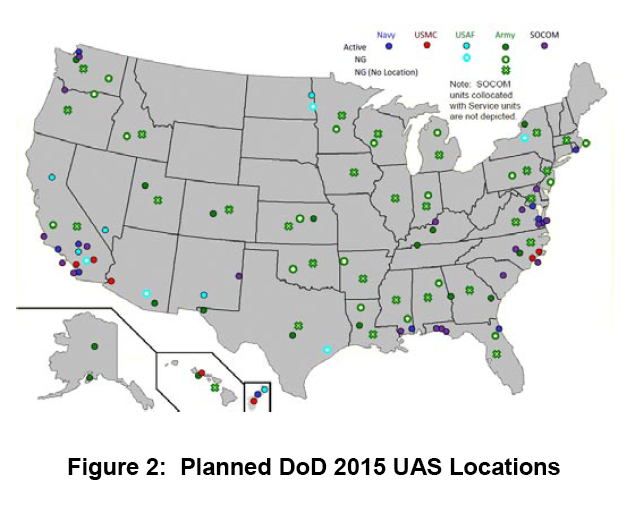
In a separate report issued in April 2012 by the Department of Defense, the Pentagon revealed the locations of over 100 new domestic sites that could soon serve as launch sites for military drones. 

The list of present and proposed drone bases includes 39 of the 50 states, as well as Guam and Puerto Rico.

As for congressional oversight of such serious potential threats to fundamental individual liberties, Representative Ted Poe (R-Texas) has introduced the Preserving American Privacy Act of 2013. Poe’s bill mandates that “in operating a public unmanned aircraft system or disclosing any covered information collected by such operation, a governmental entity shall minimize, to the maximum extent practicable, the collection or disclosure” of “information that is reasonably likely to enable identification of an individual; or information about an individual’s property that is not in plain view.”

On the Senate side, Senator Rand Paul (R-Ky.) is taking the lead in the fight to prevent unconstitutional surveillance.

On May 22, Paul introduced the Preserving Freedom from Unwarranted Surveillance Act of 2013. This measure protects an individual’s right to privacy against unwarranted drone surveillance.

Paul’s Preserving Freedom from Unwarranted Surveillance Act would reaffirm the right of Americans to be “to be secure in their persons, houses, papers, and effects, against unreasonable searches and seizures” as guaranteed by the Fourth Amendment.

“The use of drone surveillance may work on the battlefields overseas, but it isn’t well-suited for unrestrained use on the streets in the United States. Congress must be vigilant in providing oversight to the use of this technology and protection for rights of the American people. I will continue the fight to protect and uphold our Fourth Amendment,” Senator Paul said.

Despite these laudable legislative efforts and despite surging international opposition to President Obama’s remote control warfare and death-by-drone program, one of those high-altitude, high-tech, snoop-and-snipe aircraft – owned or loaned by the federal government – may already be flying missions in the skies over the United States.


Joe A. Wolverton, II, J.D. is a correspondent for The New American and travels frequently nationwide speaking on topics of nullification, the NDAA, and the surveillance state. He can be reached at
This email address is being protected from spambots. You need JavaScript enabled to view it.

Republished with permission from: The New American

Texas Threat to Abortion Clinics Dodged at Flea Markets

0

Bloomberg
July 12, 2013

At an open-air flea market outside McAllen, Texas (BEESTX), near the Mexican border, shoppers can buy a goat and get their car windows tinted. Tables with handwritten signs touting Viagra (MDPSVIAG) are stocked with herbal remedies promising to burn fat and boost breast size. You can also find pills to end a pregnancy.

Bazaars like this have become home to a black market where women too poor to afford an abortion at a clinic or deterred by state mandates such as a 24-hour waiting period can buy drugs to induce a miscarriage on their own, a dozen area residents and doctors said in interviews.

Hundreds of miles north in Austin, the capital, lawmakers may inadvertently increase this illegal trade. Rules set to pass as soon as tomorrow might result in the closing of most, if not all, abortion facilities in the state. If the law – promoted as a way to improve women’s health – makes legal abortion unavailable in Texas, more women may turn to markets such as the one near McAllen and risk their lives.

Read More

<!–

–>

This article was posted: Friday, July 12, 2013 at 9:42 am

Tags: , ,


<!– this is where we need to show the related articles

–>

Republished with permission from: Infowars

Tea party petition to prosecute Eric Holder nears 1 million signers

0

Cheryl K. Chumley
Washington Times
July 12, 2013

A tea party group that launched a petition drive to prosecute U.S. Attorney General Eric Holder reported on its Facebook page that nearly 1 million have signed on – and the movement is only growing by the minute.

The petition from TheTeaParty.net states, in part: “A person is supposed to be innocent until proven guilty. That’s not the case, however, in Obama’s America when he needs to manipulate the people for his own political expediency. Who can he always rely on to be his hatchet man? None other than Attorney General Eric Holder. Do you stand with us in calling for Holder’s resignation and prosecution?”

Signing the online petition sends a letter directly to the signer’s congressional representatives, the site reported. And the group reports on its Facebook page that “we are almost at one million letters.”

Read full article

<!–

–>

This article was posted: Friday, July 12, 2013 at 9:45 am

Tags:


<!– this is where we need to show the related articles

–>

Republished with permission from: Infowars

CEO Pay Went Up 16% Last Year to $15 million — How Much Did Your Pay Go Up?

1

Congratulations CEOs! You’ve been having a great time of it. Salaries are up, and up in a major way. The Economic Policy Institute says you brought home an average $14.1m in 2012. The New York Times, looking at slightly different numbers, claims the news is even better, saying the median number is $15.1m. That’s a 16% increase in one year.

As for the rest of us … well, about that.

The money for our bosses has to come from somewhere, doesn’t it? Here’s one place it likely originated: us.

According to the Department of Labor Statistics, hourly wages plunged by a record-breaking 3.8% in the first quarter of 2013.

These are more than just numbers. This pay disparity is having an increasingly corrosive effect, leaving us governed by and lectured to by an elite that seems out-of-touch with the lives of everyone else.

No wonder you can turn on Bloomberg Radio, like I did last week, and hear this advice: flying on a private jet was extolled as a budget-conscious option for parties of ten or more who were otherwise planning to fly first-class. According to the good folks at XOJET, if the plane is $20,000 for the trip and the average first class ticket about $2,000 … well, you do the math!

Millennials hanging around their parents’ basement, looking for a job online, can remember that “today is the golden age of private jets,” as I heard the guest say in that segment. The economics are unbeatable: students can rent a jet for the day for less than their total student debt bill, which averages about $27,000.

Besides, there are other budget benefits too. Just listen to Suze Orman who, when tough times came after the 2008 crash, told Forbes she was cutting back by only flying private planes for work purposes, using commercial airliner Jet Blue for personal travel. “I don’t care about money,” she said.

This, I admit, might be a sore point with me. I’m flying with my poodle Katiegirl to Los Angeles this week, where my husband is working for the next several weeks. I’d love a private jet, or even just a bit of leg-room where I am not risking stomping my poodle if I attempt to put my feet on the ground, but, hey, I’m paying $400, including a $100 pet fee.

What do I expect for that? A meal? That’s an additional $7 on Virgin America for our preferred plate with BumbleBee lemon pepper tuna. My idea of a budget cut: Katiegirl and I can share dinner. She’s a prodigious beggar, especially when fish, cheese or steak is involved. (OK, poodle digression over).

More examples from the files of the out-of-touch: resolutely cheerful headlines like ” Perhaps the sequester wasn’t so bad after all” or ” Sequestration was a dud.”

Well, maybe that’s true if you are an employed blogger, or a CEO. If you’re a member of Congress you could promptly pass legislation putting stop to your own inconvenience, even as the cutbacks resulted in furloughs for air traffic controllers and airport delays for all passengers including those in cattle/coach, and those flying private jets.

Progress it’s not. Those who have lost their jobs are getting by with less — 16% less, in Ohio, for example, thanks to sequestration-imposed cuts on unemployment checks. But I’m sure they don’t think it’s so bad, now that they can fly without furlough-caused delays.

Or let’s take a minute to discuss the latest in student loans. Rates on government-subsidized loans doubled on July 1 to 6.8%, as Washington pols bickered and dithered over how to get a grip on ballooning student debt, which now stands around $1tn. If you want to know one reason why our economy seems forever stuck at just above stall speed, think about the impact of that debt on the twentysomethings who need to pay it all back.

Republished with permission from: AlterNet

Occupied Bodies

0

Since 1967 Israel has maintained an unofficial policy of detaining Palestinian and Arab war victims in mass graves and cemeteries. Today at last 348 bodies are held prisoner by the Israeli government their families unable to retrieve their remains.

In a traditional conflict, the bodies of the deceased would be returned to their country of origin following peace and removal of the occupying power.  Israel refuses to return the bodies to their families, some of whom have been waiting for decades, on the basis that the conflict is temporary and withholding the remains is necessary to maintain internal security.

Yet as the occupation enters its 46th year and with no end in sight, the Israeli government still retains nearly 350 bodies despite numerous appeals to the Israeli court and international condemnation of the practice. JLAC, The Jerusalem Legal Aid and Human Rights Center, heads up the campaign to release Arab war victims and disclose the fate of those missing. In an interview on Thursday July 11th, at the JLAC office in Ramallah Palestine, lawyer Haytham Khatib explained the motives behind Israel withholding these bodies.

“The rational behind this policy is a security condition, or a security pretext. Israeli considers all of them [deceased combatants] as terrorists, not fighter and soldiers and therefore the Geneva Conventions regarding the treatment of enemy dead do not apply.”

Khatib went on to say “Israel recognizes the importance of funeral and religious practices for Arab peoples, as well as the importance of Martyrs in Palestinian society.” Withholding the remains enacts a “collective punishment” against the families of fighters as well as providing a potential deterrent against future resistance.

This practice of withholding remains is consistent with Israeli attempts throughout history to present its activities in the occupied Palestinian territories (oPt) within the context of perpetual war. As Israeli historian Ilan Pappe wrote in his book The Ethnic Cleansing of Palestine, this context presents actions “In such a manner, that all activities, including atrocities are portrayed as part of a theater of war, wherein things are judged on a moral basis in a manner very different from the ways they would be treated in non-combatant situation.” In this case the imprisonment of the remains of dead combatants is understood as a necessary wartime practice instead of a colony policy designed to exact a toll on those that have resisted the occupation.

The Numbers 

According to JLAC’s campaign coordinator Salem Khilleh, the organization has documented 442 cases of deceased combatants, including 66 that are still missing (assumed dead). 416 of the 442 cases are Palestinian, the rest Arab combatants from neighboring countries who died while fighting in Palestine.  The majority of these victims are PLO fighters who engaged in direct combat with Israeli forces but also include those that died while serving prison sentences, in direct clashes with IDF, killed or missing while crossing border and a few that died in terrorists attacks against Israeli civilians.

The deceased are held in secret cemeteries located in closed military zones. So far only four of these so-called “cemeteries of numbers” have been identified, the exact number of deceased combatants is impossible to know given that Israel has net released information on how many bodies it retains. Salem Khilleh describes these cemeteries: “there are no names just iron bars with numbers corresponding to info on the deceased, the graves are small and shallow often containing multiple bodies.” Prior to 1976 deceased were buried without any clear Israeli policy or process, the bodies left unidentified.  Many of the deceased were placed in mass graves in shallow sandy soil running the risk of exposure and animal disturbance.

JLAC Campaign

In August of 2008 JLAC began its campaign to retrieve the bodies of the dead and disclose the fate of those missing. According to Salem the idea for the campaign began when one of the parents of a deceased soldier contacted JLAC.  “He was 85 at the time; his last wish was to retrieve the body of his son, “ Salem recalled the elderly man saying.

The campaigns first success came with the release of the remains of Mashour Taleb Saleh who was killed 1976 in a PLO guerilla operation in Israel. In 2010, after a successful petition by JLAC to the Israeli Supreme Court, the Israeli Authority released Mashour’s remains to his family, some 33 years after his death.

In an interview in 2010 Mashour’s brother spoke about the Israeli policy.  “Confiscating corpses is an immoral policy, the dead are dead. This is punishment for both the living and the deceased. It’s a policy of revenge; there is no law that allows anyone to retain a corps as prisoner for decades.” Since 2010 JLAC has successfully secured the release of 92 other bodies and is petitioning for the release and disclosure of all remaining deceased combatants along with the missing.

Legality

In a report submitted to the United Nations in 2009, JLAC exposes Israel continued violation of international law and the “the inappropriate and disrespectful actions practiced on human bodies. ” Conventional and customary International Humanitarian Law has determined that contesting parties in armed conflict, whether international or domestic, must respect the dead whether killed in the battlefield or died while in detention. Bodies must be collected, evacuated, buried in properly marked graves and their families must be notified. Moreover, the return of dead bodies to the party that they belong to or upon the request of their next of kin is an international obligation duly recognized under international customary law and relevant treaties.

Israeli actions constitute a direct violation of international Law and Article 17, 120, 130 of the Geneva Convention that outline the criteria for treatment of enemy bodies.

Graves are not adequately maintained and bodies are buried in areas at high risk of exposure. Tombs are not properly marked and families are unaware of their location, bared from visiting their loved ones. Furthermore as Khilleh notes that prior to the 1st of September 1976, “None of the cases were documented, identified or filed.  Some of the bodes were used to harvest organs and as cadavers for medical students, while the conditions of the graves have made it impossible to identify some of the returned remains.   These actions show a severe and criminal disrespect for the bodies of the deceased.”

Yet throughout the conflict Israeli has considered itself within its legal right to retain the remains of these war victims, defining all forms of resistance to the occupation as terrorism. The Israeli governments treatment of the Palestinian dead is consistent with numerous policies in the West Bank where supposed security threats supplant international law.  The expansive nature of the term security in Israeli is used to rationalize the imprisonment of the dead and the living. According to the Palestinian Prisoners rights association Addameer, more than 800,000 Palestinian have been incarcerated in Israeli jails since the onset of the occupation in 1967, thousands of which held in administrative detention without charge or trail.

Colonial Policy

The unofficial Israeli policy of withholding the bodies of Arab and Palestinian war victims, if viewed in comparison to other wartime conflicts, is consistent with international law. However it is important to contextualize this violence within the reality of the conflict itself. Israel continual retention of the Palestinian dead is not a byproduct of war but a form collective punishment for resisting colonialism. Israel’s policy to withhold the remains of enemy combatants is consistent with the State’s narrative of perpetual war. This narrative aims to present the conflict as a battle between competing powers, not the asymmetrical struggle against the ongoing occupation and Judaization of the oPt. The inability for Palestinian and Arab families to burry and honor their loved ones reflects a gross violation of their rights and an extension of Israeli control over the bodies of the living and the deceased. For these Palestinians the occupation extends to the grave.

Sam Gilbert writes about the Middle East.

Republished with permission from: Counterpunch

Judge urges halt to ‘humiliating’ Gitmo genital searches

1

A US judge has called for a halt to genital searches at Guantanamo because they violate detainees’ religious values. An order was also issued for detainees weak from the ongoing hunger strike to be allowed to meet with attorneys in the camp.

US District Judge Judith Royce Lamberth slammed the practice of
genital searches as it “flagrantly disregards the need for a
light touch on religious and cultural matters,”
referring to
the Muslim inmates at the holding facility.

Judge Lambert released a 35-page report explaining why the
genital pat-downs for contraband were discouraging detainees from
consulting their attorneys. Guantanamo lawyers said the intrusive
practice began when detainees were told they would have to go
off-site to meet with legal counsel. Some prisoners reportedly
refused because of the searches.


“The search procedures discourage meetings with counsel and so
stand in stark contrast to the president’s insistence on judicial
review for every detainee,”
Lamberth wrote. “The court, whose
duty it is to call the jailer to account, will not countenance
the jailer’s interference with detainees’ access to counsel.”

Furthermore, Lamberth demanded that detainees who were weak from
hunger striking be allowed enough space to sit upright when they
are being transported.

Lamberth noted that previously staff at Guantanamo had refrained
from touching the prisoners’ genital areas out of respect for
their religious and cultural beliefs. This policy changed with
the arrival of a new commander in May.

Army Col. Greg Julian, Guantanamo spokesperson, responded to the
judge’s words, maintaining that the chain of command “will
review the procedures to figure out how to accommodate the
ruling.”

He stressed that such checks were necessary especially following
the suicide of Yemeni inmate, Adnan Latif, who took an overdose
last year.

The latest ruling follows an appeal by Judge Gladys Kessler to
President Barack Obama to cease the force-feeding of prisoners on
hunger strike at Guantanamo. She stressed in her four-page report
that the court does not have the sufficient powers to intervene
in cases concerning detention or treatment of alleged enemy
combatants.

Currently 106 prisoners out of the 166 foreign captives at the
Guantanamo facility are participating in the hunger strike in
protest of their continued detention. According to reports 45 of
them are undergoing twice daily nasogastric feedings.

The practice of force-feeding has been branded a “gross abuse
of human rights.”
Amnesty International has called on the US
government to give the detainees at Guantanamo fair trials in US
federal courts and charge them or release them immediately.

Over the last decade Amnesty has documented numerous abuses of
prisoners including sensory deprivation, prolonged isolation,
20-hour interrogations, stripping and forcible shaving.

Republished with permission from: RT

Ongoing Fighting in Sinai: Hamas, Islamic Jihad and Iran Wrongfully Blamed

0

Headlines focus on Egypt. Sinai gets little attention. What’s ongoing bears close watching.

On July 7, Maan News headlined “Egypt army ‘preparing for Sinai operation,’ ” saying:

A “large-scale military operation” is planned. “Egyptian forces sealed more tunnels along Gaza’s border.”

“An Egyptian military official told Ma’an the army was preparing for a major operation in Sinai ‘to clean it up from terrorist and criminal cells.’ ”

“The army official said ‘coordination is ongoing between the Egyptians and the Israelis to bring military vehicles, troops and jets into Sinai to fight terror.’ ”

In late June, Egyptian forces “deployed heavily” along Gaza’s border.

“Islamist militants” threatened reprisal for Morsi’s ouster. On July 7, a Sinai pipeline south of el-Arish supplying Israel with gas was blown up.

Previous attacks occurred earlier. This was the first one in over a year. It followed days earlier clashes between unidenfied militants and Egyptian forces. Hamas was wrongfully blamed.

According to an IDF statement:

“The Egyptian military activity in the Sinai is coordinated with Israeli security elements and authorized at the most senior levels in Israel, in order to contend with security threats in the Sinai that pose a threat to both Israel and Egypt.”

At issue is inflicting more punishment on besieged Gazans. Rafah crossing is closed. Palestinians needing urgent medical care unavailable in Gaza can’t get it.

Hundreds stranded in Cairo’s International Airport and elsewhere outside Gaza can’t return home.

According to Max Blumenthal:

“Incitement against Palestinians peaked after the election of the Freedom and Justice Party’s Mohamed Morsi as President.”

Opposition politicians and supportive media figures “exploit(ed Morsi’s) perceived alliance with Hamas to hold him responsible for acts of terror committed in the Sinai Peninsula.”

Anti-Morsi elements wrongfully blame Palestinians. They call them Muslim Brotherhood militants.

Israeli media and Palestinian Authority officials hype the big lie. They do it for self-serving reasons.

Blumenthal quoted retired Egyptian general Sameh Seif Elyazal saying:

“Egyptian law will punish with sentences that could reach 25 years in jail the Palestinians and Syrians and Iraqis who have made calls for incitement to violence at the demonstrations at Rabaa Al-Adawiya in return for money.”

Egypt’s Supreme Council of the Armed Forces (SCAF) massacred over 50 nonviolent protesters. They did so days earlier in Rabaa Al-Adawiya.

They wrongfully called them terrorists. They were praying peacefully outside Republican Guard headquarters.

SCAF officials circulated false stories. They claimed Hamas deployed scores of fighters in Sinai. They lied saying they want revenge for Morsi’s ouster.

Al Hayat is a London-based pro-Saudi broadsheet. It quoted an unnamed “senior Egyptian military official.” He lied about 150 Izz al-Din al-Qassam fighters allegedly entering Sinai through Gaza’s tunnels.

Hamas and Islamic Jihad were wrongfully blamed. Abbas advisor Yasser Abd Rabbo took full advantage. He accused Hamas of “helping terrorists and jihadist gangs in Sinai against the Egyptian army.”

Senior Fatah official Jamal Nazzal threw more fuel on the fire. He wants Hamas overthrown. He urged Palestinians to do it. So-called Fatah/Hamas reconciliation appears more illusory than real.

Legitimate elections are unlikely. Israel’s dirty hands manipulate events. So do Washington’s. SCAF’s a willing partner. Gaza remains isolated. Palestinian suffering continues.

No evidence whatever connects Hamas or Islamic Jihad to Sinai violence. Egypt’s coup d’etat regime issued a decree. It restricts anyone holding PA or Jordanian passports without a national number from entering Egypt.

Expect stepped up vilification of Hamas. On July 10, Press TV headlined “Gunmen attack military commander in Egypt’s Sinai,” saying:

According to a SCAF spokesman, militants attacked a senior commander and second field army chief. They “came under heavy fire, which led to clashes between security forces and the terrorist elements.”

“This is the latest in a string of attacks in Sinai targeting the army and the police in recent days with the aim of sowing chaos and harming the stability and national security of Egypt.”

The commander survived. Other attacks occurred earlier. Expect more to follow. Expect Hamas to be wrongfully blamed.

On July 11, Haaretz headlined “Egyptian army killed dozens of Hamas fighters in Sinai, report says.”

It’s false. Saudi-controlled Al-Hayat propaganda called unidentified militants Hamas fighters. It said 32 were killed. Others were arrested.

Ismail Haniyeh refuted spurious charges. Hamas doesn’t interfere in internal Egyptian affairs. He said it numerous times before. No evidence suggests otherwise.

Egypt wrongfully accused Iran of “unacceptable interference” in its domestic affairs. On Monday, Tehran called Morsi’s ouster a “cause for concern.” It suggested “foreign hands” responsibility.

Iran knows Washington was very much involved. It’s no secret. Perhaps Israel’s dirty hands partnered in what happened. It has close ties to SCAF. Morsi tried improving ties with Tehran.

In 1979, they cooled after Egypt gave Mohammad Reza Shah Pahlavi shelter. It did so after his ouster. In February, Mahmoud Ahmadinejad visited Cairo. He was the first Iranian leader to come in decades.

Both countries are sharply divided on Syria. Iran strongly supports Assad. Morsi, SCAF, and new regime leaders back Washington’s war to oust him.

A Final Comment: Meet Ron Dermer

On July 9, Dermer was appointed Israel’s ambassador to Washington. He’ll replace Michael Oren. He’ll step down this fall. Reports suggest it’s not voluntary. He was removed. Dermer wants his job. He played hardball to get it.

He’s American born. He’s a Florida native. He’s returning to his roots. In 1995, he was economics minister at Israel’s Washington embassy. At the time, he gave up his US citizenship.

He’s ideologically over-the-top. He’s hardline. He’s militant. He’s pro-war. He’s bigoted. He’s dangerous. He reflects the worst of Zionist extremism. He defends the notion of making Israeli Arabs pledge allegiance to a “Jewish and democratic state.”

Foreign policy analyst MJ Rosenberg calls him “as crude as (Oren) is smooth.”

He opposes Palestinian self-determination. He supports occupation harshness. He believes “the principle of two states for two people is a childish solution to a complicated problem.”

According to Reuters and other reports, he has right-wing Republican ties. He’s linked to the neocon fringe. He supported Romney’s presidential candidacy.

An unnamed Israeli political analyst said he made sure Netanyahu stayed close to him. If elected, Dermer “would be the one you send right away,” he said.

“He’s got the right demeanor as a Republican. He has neo-conservative credentials. He has the full backing and confidence of the prime minister, which is important. But for Obama, it’s not the right fit. There’s too much baggage.”

He’s a close Netanyahu associate. For four years, he served as senior advisor and speechwriter. He was his key White House liaison.

In March, he stepped down. He had ambassadorial ideas in mind. He needed time to smooth the way. Israel’s Channel 10 said he’s been long groomed for the job.

Tablet magazine calls him “Bibi’s brain.” He’s his “most influential aide.” He’s Netanyahu’s “alter-ego.”

He’s “done more to shape Israel’s relationship with the United States, its Arab neighbors, and the Palestinians over the past few years than any man aside from the prime minister himself.”

He’s a “jack-of-all-trades — strategist, pollster and speechwriter.” He’s “chief proxy in foreign affairs.” He’s a “constant presence in Netanyahu’s meetings in Washington.”

“Bibi doesn’t move an inch without talking to him.” He’s Wharton/Oxford trained. He’s got “Machiavellian political instincts.” He’s “ferociously competitive. He wouldn’t let a three-year old beat him at ping pong.”

Announcing his appointment, Netanyahu said:

He “has all the qualities necessary to successfully fill this important post.”

“I have known him for many years, and I know that Ron will faithfully represent the State of Israel in the capital of our greatest ally — the USA.”

“On behalf of the citizens of Israel, I wish him great success.”

Dermer’s appointment didn’t surprise. In recent weeks, he spent time in Washington. He held numerous meetings. He made the rounds reassuring Obama officials he won’t disappoint.

It remains to be seen. Pro-Israeli Washington Institute for Near East Policy analyst David Makovsky said tension regarding Dermer’s Republican ties peaked last November.

Appointing him then wouldn’t have been possible. Time soothes old wounds. Today’s it’s much easier.

He’s “very influential with the prime minister. So this is also an opportunity under certain conditions.”

He’s Netanyahu’s closest advisor. No one’s closer. He has his complete confidence and trust. He has unfettered access. Host countries prefer these attributes.

Americans will know dealing with Dermer means they’re doing so directly with Netanyahu. He’s closer to him than anyone.

In America, Israel’s lobby has final say. It approves. AIPAC endorsed him, saying:

“Mr. Dermer has a deep understanding of the critical value of the US-Israel relationship and the importance of further strengthening the alliance between these two democratic allies.”

Stephen Lendman lives in Chicago. He can be reached at lendmanstephen@sbcglobal.net. 

His new book is titled “Banker Occupation: Waging Financial War on Humanity.”

http://www.claritypress.com/LendmanII.html

Visit his blog site at sjlendman.blogspot.com. 

Listen to cutting-edge discussions with distinguished guests on the Progressive Radio News Hour on the Progressive Radio Network.

It airs Fridays at 10AM US Central time and Saturdays and Sundays at noon. All programs are archived for easy listening.

http://www.progressiveradionetwork.com/the-progressive-news-hour 

http://www.dailycensored.com/ongoing-fighting-in-sinai/

Republished with permission from: Global Research

'Syria CW claims pretext to aid rebels'

0

File photo shows foreign-backed militants in Syria.

An Iranian lawmaker says the Western countriesâ„¢ allegations that the Syrian forces have used chemical weapons against foreign-backed militants serve as a pretext to send more weapons to terrorists.

Å“Despite repeated disclosure of atrocities committed by the terrorists in Syria, Western countries and their regional allies still insist on providing them with more arms as well as logistical, educational and financial aid,” Baqer Hosseini, a member of Iran Majlis National Security and Foreign Policy Committee, said on Friday.

The lawmaker added that evidence presented by Russia earlier this week, showing that militants, not the Syrian Army, had used Sarin nerve gas during an attack, has once again revealed the Å“evil face of the enemies of the Syrian government and nation.”

On Tuesday, the Russian Ambassador to the United Nations Vitaly Churkin said Russian experts had collected samples at the site of the attack in the region of Khan al-Assal, near Aleppo, where over two dozen people, including 16 Syrian troops, died on March 19.

Based on the unsubstantiated claim that the Syrian government has used chemical weapons against the militants, President Barack Obama ordered the CIA on June 14 to provide arms to the anti-Syrian groups, saying the government of President Bashar al-Assad had crossed Washingtonâ„¢s red line.

Britain, France, and the United States have accused the Syrian government of using chemical weapons. Damascus has denied the charges, saying it was actually the militants who used chemical weapons on several occasions.

The Syria crisis began in March 2011, and many people, including large numbers of soldiers and security personnel, have been killed in the violence.

PG/SS

Republished with permission from: Press TV

Ireland’s parliament approves ‘life-saving’ abortion

0

BBC News Europe
July 12, 2013

Lawmakers in the Republic of Ireland have voted to legalise abortion under certain conditions for the first time.

The move, approved by a 127-31 vote in the lower house (Dáil), would authorise a termination when doctors deem that a woman is at risk of taking her life. It needs upper house endorsement, too.

The vote follows the case of an Indian woman who died in hospital after she was refused an abortion.

The debate revealed deep splits in the predominantly Catholic country.

Read More

<!–

–>

This article was posted: Friday, July 12, 2013 at 9:24 am

Tags: , , , ,


<!– this is where we need to show the related articles

–>

Republished with permission from: Infowars

Meet the Young Journalist Who Ruined a Couple of NSA Spooks’ Day

0

Last week, a couple of NSA language analysts had a very, very bad day at the University of Wisconsin.

It started out well enough. They headed to a recruiting session, hoping to entice a few bright young minds to join the agency. They showed the two dozen or so students who had assembled a brief slideshow touting the benefits of a career in snooping. It offered important work protecting the country. And it came with good benefits and a fun lifestyle!

Then came the question-and-answer period. Madiha Tahir, a journalist working toward her PhD, started asking questions about the latest revelations on NSA surveillance. Other students joined in and the session went downhill quickly.

An audio recording of the exchange made by Tahir went viral. By the end of the tape, one could almost picture the two agents drowning their sorrows in white Russians (the official cocktail of the NSA) at the Holiday Inn bar after the session.

Tahir joined us for the AlterNet Radio Hour this week. Below is a lightly edited transcript of our conversation.

Joshua Holland: So, Madiha, you saw that they were having an NSA recruiting session, and you decided to go down and check it out. Can you set the scene for us?

Madiha Tahir: Sure. I received an email from the program a day before letting us know that this recruiting session was happening. I went there not actually to speak up but simply because I was curious to see how the NSA would sell itself at a time like this.

I went there, and it was two recruiters, a male and a female. I think at most there were probably 25-30 graduate students in the room, and additionally, there were five high school students who had been brought there by a high school teacher.

JH: Was everybody there out of curiosity like you? Do you think there were people there who were seriously considering a career at the NSA?

MT: When I went there, I thought maybe people were there actually to find out about careers with the NSA, and maybe there were. I have no way of knowing. I do know that once I started to ask questions, a couple of other students joined in. After the exchange, several students got up and left at the same time. I’m told that by the end of the session, there were maybe four people left not including the high school students.

JH: Okay. This is Madiha Tahir asking some questions of a couple of NSA recruiters. Let’s take a little listen here:

Madiha: Yeah, I just had a question. You said earlier that the two tasks that you do, one is sort of figuring out the … tracking down the sort of communications of your adversaries, and the other is protecting the communications of officials.

Recruiter1: Right.

Madiha: Do you consider Germany and the countries that the NSA has been spying on to be adversaries, or are you right now not speaking the truth? I’m just asking for clarification.

Recruiter1: I’m focusing on what our foreign policy requirements are, so, I mean, you can define adversary as enemy, and clearly Germany is not our enemy. But would we have foreign national interests from an intelligence perspective on what’s going on across the globe? Yeah, we do. I mean, our requirements that come to us as an intelligence community organization — from the policymakers, from the military, from whoever — are global.

Madiha: By “adversary,” do you actually mean anybody and everybody? There’s nobody then, by your definition, that is not an adversary, is that correct?

Republished with permission from: AlterNet

A Liberal Dixie? What You May Not Know About the Changing South

0

July 11, 2013
 |

Like this article?

Join our email list:

Stay up to date with the latest headlines via email.

The following piece first appeared in the American Prospect. 

The final rally of Barack Obama’s 2008 presidential campaign took place on symbolically charged ground: the rolling fields of Manassas, site of the first major battle of the Civil War. It was the last stop on an election eve spent entirely in the South: Jacksonville, Charlotte, and finally Northern Virginia. In the autumn chill, an estimated 90,000 people spread out across the county fairgrounds and waited for hours to cheer a new president–and a new South.

By this point, Virginians knew Obama well. In February, he had beaten Hillary Clinton 2 to 1 in the state’s Democratic primary, a blow to her floundering bid. After clinching the nomination, he’d kicked off his general-election campaign in rural Virginia and been a frequent visitor since. Bucking conventional wisdom, Obama’s team had invested heavily in three Southern states: not just perennial battleground Florida but also Virginia and North Carolina, which had not voted Democratic for president since 1964 and 1976, respectively. No Democrat–not even Bill Clinton–had made a serious attempt to win North Carolina or Virginia since Ronald Reagan claimed it in 1980. But Obama was gambling on an emerging South–one that is younger than the rest of the country, far more ethnically diverse than the old black-and-white paradigm, and more liberal-leaning than any Southern generation to precede it.

That emerging South was arrayed in the dark hills around Obama as he flashed into the spotlight. On soil where whites once fought to the death for the right to enslave blacks, this throng had gathered to hail the soon-to-be first black man to be elected president. The next day, Obama carried all three of his Southern targets–55 electoral votes for the party. For Southerners, the message was unmistakable: The future has arrived. The Solid South is dead.

When Americans talk about the South, they tend to be talking about the past. When they talk about Southern politics, they tend to be talking about the old, stereotyped “Solid South”–that uniformly conservative, racist, anti-union, snake-handling cluster of former Confederate states that voted en masse for Democrats from the pre—Civil War through civil rights, then switched their allegiance to the former “party of Lincoln” beginning in the 1970s. Once LBJ and the Democrats betrayed the cause of white supremacy and Richard Nixon cooked up the “Southern Strategy,” the region became as solidly Republican as it once was Democratic. End of story.

Southern politics has never been quite so uncomplicated as that. It took decades for Republicans to outnumber Democrats, and Republican control of the region has never matched the Democrats’ former hegemony. The South has been contested ground for 40 years, with the GOP dominating federal elections and gradually cutting into the Democrats’ hold on state and local offices–culminating in 2012, when Arkansas’s legislature became the last to go Republican. (Virginia’s Senate has a partisan split.)

Over the next two decades, it will become clear to even the most clueless Yankee that the Solid South is long gone. The politics of the region’s five most populous states–Virginia, North Carolina, Georgia, Florida, and Texas–will be defined by the emerging majority that gave Obama his winning margins. The under-30 voters in these states are ethnically diverse, they lean heavily Democratic, and they are just beginning to vote. The white population percentage is steadily declining; in Georgia, just 52 percent of those under 18 are white, a number so low it would have been unthinkable 20 years ago.

By the 2020s, more than two-thirds of the South’s electoral votes could be up for grabs. (The South is defined here as the 11 states of the former Confederacy.) If all five big states went blue, with their 111 electoral votes, only 49 votes would be left for Republicans. (That’s based on the current electoral-vote count; after the next census, the fast-growing states will have more.) Win or lose, simply making Southern states competitive is a boon to Democrats. If Republicans are forced to spend time and resources to defend Texas and Georgia, they’ll have less for traditional battlegrounds like Ohio and Pennsylvania. Even if Democrats aren’t competitive in those states for another decade, they will benefit from connecting with millions of nonvoters who haven’t heard their message. They are building for a demographic future that Republicans dread: the time when overwhelming white support will no longer be enough to win a statewide election in Texas and Georgia.

Republished with permission from: AlterNet

Signature Targeting Comes Home to Roost

0

Isla di Elba, Italia

At the core of the drone program is the theory of signature targeting.  It is a theory based on the idea that analysts can discern “enemy combatants” from an analysis of outward indicators of patterns of behaviour.

As a practical matter, this approach requires the construction (really a primitive synthesis) of some kind of template describing the universe of behaviour indicators before the fact.  In step 2, analysts can compare the observed indicators implicit in a suspected target’s individual behaviour to that predicted by the template.  Step three is to make some kind of assessment – usually a subjective probabilistic calculation – of whether or not the target is a valid target.  The calculation is subjective because the indicator is based on an array of assumptions buried deeply in the template.

In its more sophisticated – read pseudo scientific – incarnation, the comparison can be done mathematically on a computer using artificial intelligence algorithms.  Often this effort involves statistics, including sometimes Bayesian statistics, to give the targeting “analyst” an estimate of the statistical ‘confidence’ in the result of the calculation.  The mechanistic nature of this approach raises the possibility that millions of data inputs can be analyzed on a machine without human intervention, with the results summarized in a neat powerpoint briefing, and presented to an overworked decision-maker, who does not have a clue about the deeply buried subjective assumptions underpinning seemingly objective nature of the calculations.

The operative word in this application of artificial intelligence theory is “artificial” because a real intelligence appreciation, as the American strategist John Boyd showed, resides in a decision maker’s Orientation. Boyd’s theory of Orientation involves a balanced interplay of an ever-evolving synthesis growing out of many-sided, continuing analyses, which cut into a problem from many different angles.  The objective is  insure that one’s Orientation matches the ever-changing requirements of the changing and often menacing external environment.  I worked closely with Boyd while he was developing these ideas.  For readers not familiar with his ideas, my presentation, Evolutionary Epistemology, is a personal interpretation of his basic theory of knowledge generation.  The goal is understand how one evolves an adaptable Orientation to support Observations and Decisions that work in changing conditions of the real world.  Readers interested in learning more about Boyd’s ideas can find them explicated in Coram, Fallows, Richards, and Ozinga. Boyd’s own words (beware, they are cryptic) can be found in the Boyd Compendium.

Boyd’s theory of Orientation is crucial for understanding why an algorithmic template based artificial intelligence is so stupid, and so easy to game by all sides, for all sorts of nefarious purposes.

When viewed through the lens of Orientation, the template described above is merely a hardwired (non-evolving) Orientation based on a one-sided analysis.  The fatal flaw in this conception is fundamental: Template based artificial intelligence schemes confuse analysis with synthesis. (BTW … ‘Connecting the dots’ is a popular phrase making the same mistake – which is the central reason we never seem to be able to connect the dots!)

The confusion of analysis with synthesis in template-based decision making scheme sets the decision maker up for incestuous amplification, which occurs when the preconceptions implicit in the template drive the both the analyst and decision maker to see what he/she wants to see, rather than what is.  The epistemological flaw is basic: Logically, the template requires the analyst to know every possible pattern of a target’s behaviour before the fact. The unrealistic assumption of godlike omniscience reduces the subtle problem of target identification to a simple one of comparative analysis (‘observations’ vs. those predicted by the template) and leads naturally to a mechanistic statistical analysis, together (usually) with a determination of acceptable confidence levels.

In the best of worlds, this kind of hard-wired orientation can be true only if the target is too stupid to adapt unpredictably to the changing conditions that threaten its existence – i.e., if the ‘target’ is an unthinking automaton with no incentive to survive or win.  But human beings are adaptive, thinking, creative, and therefore unpredictable creatures with a will to live:  Already, for example, there are signs some Al Qaeda wannabees are trying to evolve counter-measures to drones – some laughingly simple and sure to be effective – to neutralize what little effectiveness drones might have. (We already know drones are killing too many civilians and producing highly counterproductive grand-strategic blowback effects).

No doubt, at this point some readers may be wondering where I am going with mumbo jumbo about the mindlessness of confusing synthesis (and creativity) with analysis (and predictability).  Well, I urge you to read carefully this important McClatchy report by the inestimable Jonathan Landry. Landry explains in mind numbing detail how you and every American are now in the process of being ‘templated’ by your neighbors and coworkers.  Landry shows how your friends and colleagues are being enlisted to feed indicators into the crosshairs of unseen templates concocted by anonymous, mindless, artificial intelligence apparachiks in the Federal Government and their privatized accomplices in industry, all of whom are cashing in on the self-organizing politics of money in a cultural evolutions that depends on a compliant American citizenry, anesthetized by fear.

Welcome to the Amerikan Deep State, presided over by the most superficially attractive president since John Kennedy, where signature targeting is coming home to roost in your living room, brought to you by the not-so-creative geniuses in NSA, Microsoft, DOD, DHA, Booz-Allen, etc.

Franklin “Chuck” Spinney is a former military analyst for the Pentagon and a contributor to Hopeless: Barack Obama and the Politics of Illusion, published by AK Press. He be reached at chuck_spinney@mac.com

Republished with permission from: Counterpunch

Ireland’s parliament approves ‘life-saving’ abortion

0

BBC News Europe
July 12, 2013

Lawmakers in the Republic of Ireland have voted to legalise abortion under certain conditions for the first time.

The move, approved by a 127-31 vote in the lower house (Dáil), would authorise a termination when doctors deem that a woman is at risk of taking her life. It needs upper house endorsement, too.

The vote follows the case of an Indian woman who died in hospital after she was refused an abortion.

The debate revealed deep splits in the predominantly Catholic country.

Read More

<!–

–>

This article was posted: Friday, July 12, 2013 at 9:24 am

Tags: , , , ,


<!– this is where we need to show the related articles

–>

Republished with permission from: Infowars

Meet the Young Journalist Who Ruined a Couple of NSA Spooks' Day

0

July 9, 2013
 |

Like this article?

Join our email list:

Stay up to date with the latest headlines via email.

Last week, a couple of NSA language analysts had a very, very bad day at the University of Wisconsin.

It started out well enough. They headed to a recruiting session, hoping to entice a few bright young minds to join the agency. They showed the two dozen or so students who had assembled a brief slideshow touting the benefits of a career in snooping. It offered important work protecting the country. And it came with good benefits and a fun lifestyle!

Then came the question-and-answer period. Madiha Tahir, a journalist working toward her PhD, started asking questions about the latest revelations on NSA surveillance. Other students joined in and the session went downhill quickly.

An audio recording of the exchange made by Tahir went viral. By the end of the tape, one could almost picture the two agents drowning their sorrows in white Russians (the official cocktail of the NSA) at the Holiday Inn bar after the session.

Tahir joined us for the AlterNet Radio Hour this week. Below is a lightly edited transcript of our conversation.

Joshua Holland: So, Madiha, you saw that they were having an NSA recruiting session, and you decided to go down and check it out. Can you set the scene for us?

Madiha Tahir: Sure. I received an email from the program a day before letting us know that this recruiting session was happening. I went there not actually to speak up but simply because I was curious to see how the NSA would sell itself at a time like this.

I went there, and it was two recruiters, a male and a female. I think at most there were probably 25-30 graduate students in the room, and additionally, there were five high school students who had been brought there by a high school teacher.

JH: Was everybody there out of curiosity like you? Do you think there were people there who were seriously considering a career at the NSA?

MT: When I went there, I thought maybe people were there actually to find out about careers with the NSA, and maybe there were. I have no way of knowing. I do know that once I started to ask questions, a couple of other students joined in. After the exchange, several students got up and left at the same time. I’m told that by the end of the session, there were maybe four people left not including the high school students.

JH: Okay. This is Madiha Tahir asking some questions of a couple of NSA recruiters. Let’s take a little listen here:

Madiha: Yeah, I just had a question. You said earlier that the two tasks that you do, one is sort of figuring out the … tracking down the sort of communications of your adversaries, and the other is protecting the communications of officials.

Recruiter1: Right.

Madiha: Do you consider Germany and the countries that the NSA has been spying on to be adversaries, or are you right now not speaking the truth? I’m just asking for clarification.

Recruiter1: I’m focusing on what our foreign policy requirements are, so, I mean, you can define adversary as enemy, and clearly Germany is not our enemy. But would we have foreign national interests from an intelligence perspective on what’s going on across the globe? Yeah, we do. I mean, our requirements that come to us as an intelligence community organization — from the policymakers, from the military, from whoever — are global.

Madiha: By “adversary,” do you actually mean anybody and everybody? There’s nobody then, by your definition, that is not an adversary, is that correct?

Republished with permission from: AlterNet

A Liberal Dixie? What You May Not Know About the Changing South

0

July 11, 2013
 |

Like this article?

Join our email list:

Stay up to date with the latest headlines via email.

The following piece first appeared in the American Prospect. 

The final rally of Barack Obama’s 2008 presidential campaign took place on symbolically charged ground: the rolling fields of Manassas, site of the first major battle of the Civil War. It was the last stop on an election eve spent entirely in the South: Jacksonville, Charlotte, and finally Northern Virginia. In the autumn chill, an estimated 90,000 people spread out across the county fairgrounds and waited for hours to cheer a new president–and a new South.

By this point, Virginians knew Obama well. In February, he had beaten Hillary Clinton 2 to 1 in the state’s Democratic primary, a blow to her floundering bid. After clinching the nomination, he’d kicked off his general-election campaign in rural Virginia and been a frequent visitor since. Bucking conventional wisdom, Obama’s team had invested heavily in three Southern states: not just perennial battleground Florida but also Virginia and North Carolina, which had not voted Democratic for president since 1964 and 1976, respectively. No Democrat–not even Bill Clinton–had made a serious attempt to win North Carolina or Virginia since Ronald Reagan claimed it in 1980. But Obama was gambling on an emerging South–one that is younger than the rest of the country, far more ethnically diverse than the old black-and-white paradigm, and more liberal-leaning than any Southern generation to precede it.

That emerging South was arrayed in the dark hills around Obama as he flashed into the spotlight. On soil where whites once fought to the death for the right to enslave blacks, this throng had gathered to hail the soon-to-be first black man to be elected president. The next day, Obama carried all three of his Southern targets–55 electoral votes for the party. For Southerners, the message was unmistakable: The future has arrived. The Solid South is dead.

When Americans talk about the South, they tend to be talking about the past. When they talk about Southern politics, they tend to be talking about the old, stereotyped “Solid South”–that uniformly conservative, racist, anti-union, snake-handling cluster of former Confederate states that voted en masse for Democrats from the pre—Civil War through civil rights, then switched their allegiance to the former “party of Lincoln” beginning in the 1970s. Once LBJ and the Democrats betrayed the cause of white supremacy and Richard Nixon cooked up the “Southern Strategy,” the region became as solidly Republican as it once was Democratic. End of story.

Southern politics has never been quite so uncomplicated as that. It took decades for Republicans to outnumber Democrats, and Republican control of the region has never matched the Democrats’ former hegemony. The South has been contested ground for 40 years, with the GOP dominating federal elections and gradually cutting into the Democrats’ hold on state and local offices–culminating in 2012, when Arkansas’s legislature became the last to go Republican. (Virginia’s Senate has a partisan split.)

Over the next two decades, it will become clear to even the most clueless Yankee that the Solid South is long gone. The politics of the region’s five most populous states–Virginia, North Carolina, Georgia, Florida, and Texas–will be defined by the emerging majority that gave Obama his winning margins. The under-30 voters in these states are ethnically diverse, they lean heavily Democratic, and they are just beginning to vote. The white population percentage is steadily declining; in Georgia, just 52 percent of those under 18 are white, a number so low it would have been unthinkable 20 years ago.

By the 2020s, more than two-thirds of the South’s electoral votes could be up for grabs. (The South is defined here as the 11 states of the former Confederacy.) If all five big states went blue, with their 111 electoral votes, only 49 votes would be left for Republicans. (That’s based on the current electoral-vote count; after the next census, the fast-growing states will have more.) Win or lose, simply making Southern states competitive is a boon to Democrats. If Republicans are forced to spend time and resources to defend Texas and Georgia, they’ll have less for traditional battlegrounds like Ohio and Pennsylvania. Even if Democrats aren’t competitive in those states for another decade, they will benefit from connecting with millions of nonvoters who haven’t heard their message. They are building for a demographic future that Republicans dread: the time when overwhelming white support will no longer be enough to win a statewide election in Texas and Georgia.

Republished with permission from: AlterNet

Amnesty’s price: $12,433 for every legalized immigrant household

0

Paul Bedard
Washington Examiner
July 12, 2013

A fight has erupted over the costs of granting amnesty to the estimated 11 million illegal immigrants in America, with the White House claiming the cash benefits to the Treasury are huge and will slash the deficit, and critics showing it will cost Americans more and increase the deficit.

The White House late Thursday dispatched an email to President Obama’s campaign supporters that provided a video claiming that immigration reform will result in a 5.4 percent growth in GDP as “highly skilled” workers and “entrepreneurs” add to the country’s economic base. No mention was made of low-skilled workers, the bulk of illegal immigrants in the country.

“Here’s one of the best things about immigration reform: It’s going to make our economy a lot stronger,” said the White House. “Not enough people are talking about the economic benefits of immigration reform, but it’s exactly the conversation that will help us win the national debate on this issue.”

Read More

<!–

–>

This article was posted: Friday, July 12, 2013 at 9:15 am

Tags: , ,


<!– this is where we need to show the related articles

–>

Republished with permission from: Infowars

Corals Face Extinction By 2100

0

http://www.truthdig.com/report/item/corals_face_extinction_by_2100_20130712/

Posted on Jul 12, 2013

Republished with permission from: TruthDig

US Homeland Security Secretary Janet Napolitano set to resign today

0


 Keep up with the news by installing RT’s extension for . Never miss a story with this clean and simple app that delivers the latest headlines to you.


United States Homeland Security Secretary Janet Napolitano is expected to resign from her federal role on Friday in order to head the University of California school system.

Following an initial report from Reuters suggesting Sec.
Napolitano was set to resign, the Los Angeles Times reported
early Friday that the former two-term governor or Arizona will
exit her role with the Obama administration in lieu of job that
will give the UC system their first female head in its 145-year
history.

Republished with permission from: RT

Snowden vows not to harm US

0

[unable to retrieve full-text content]A rights activist says Edward Snowden has vowed not to harm Washington, as Kremlin announced the whistleblower could stay in Russia if he stops US leaks.

Republished with permission from: Press TV

Microsoft’s “Smart Cities” Ideal Template for Stasi Police State

0

Kurt Nimmo
Infowars.com
July 12, 2013

Smart cities are designed by corporations like IMB and Cisco and will utilize the “Internet of Things.” Photo: Free Images Collection

Earlier this week, Microsoft announced its “CityNext,” described as a global initiative intended to develop “smart cities” around the world. “If CityNext succeeds, cities will improve efficiency by installing Microsoft products that harness the cloud and big data,” writes Michael Endler for Information Week.

Information Week heralds the prospect of “big data tools and cloud-powered enterprise apps” empowering workers with “sources ranging from vast databases to real-time data culled from environmental sensors,” technologies that “should allow workers to more quickly derive insights, collaborate with one another and come to decisions.”

So-called “smart cities,” as designed by corporations like IMB and Cisco, will utilize the “Internet of Things,” or IoT, a system of objects networked with RFID, the end result being “a world where every object – from jumbo jets to sewing needles – is linked to the Internet,” as Helen Duce, the RFID Technology Auto-ID European Center at the University of Cambridge, envisions it.

As an example of the sort of system envisioned, Information World cites the massive and unprecedented surveillance system built by Microsoft for the New York Police Department.

Known as the Domain Awareness System, New York’s surveillance apparatus “takes advantage of the 3,000 closed-circuit TV cameras currently in place in Lower and Midtown Manhattan, which will soon be installed in the outer boroughs as well,” according to Stephanie Mlot of PCMag.com. “It can tap into tools like the NYPD’s recently deployed radiation sensors and license plate readers as well as crime records, 911 calls, video tape footage, and more to connect the dots on crime. The new process will help to generate and refine leads, identify patterns, and optimally deploy manpower, said Police Commissioner Raymond W. Kelly.”

Mayor Bloomberg, New York’s renowned government nanny, and the NYPD exploited the attacks of September 11, 2001, to argue for the creation of their high-tech surveillance system. The NYPD, however, soon began to use the system for routine police work, a migration undoubtedly encouraged by its public-private partner, Microsoft.

“Microsoft, as you might recall, has a great and long-standing relationship with government, law enforcement, and even intelligence agencies in the form of helping to fund fusion centers as well as provide fusion center technology,” writes Network World. The technology magazine quotes Dave Mosher, Microsoft VP in charge of program management, who admits the transnational tech corporation “is looking at smaller municipalities, law enforcement agencies and companies that handle major sporting events.” In other words, the market for surveillance extends beyond police departments and government agencies.

NYPD’s Domain Awareness System.

The “multi-device ecosystem” proselytized by Microsoft and documented intelligence asset Google provides an ideal foundation for the sort of all-encompassing and artificially intelligent surveillance envisioned by the global elite. Smart cities, smart meters, smart growth – such catchy phrases pushed by sharp ad campaigns are instrumental to the lingua franca of control.

Increasingly, if we continue to use technology, millions will be pushed into the “cloud,” a “shared service” and “converged infrastructure” where we no longer control or even own our own data, but it is housed on a centralized computer behind a wall emblazoned with terms of service and contractual stipulations.

This scheme is ideal for control freaks who obsessively collect data for the sake of formulating social profiles and building mountainous electronic dossiers, primarily for the art of ferreting out potential threats to the establishment and the corporatist-fascist status quo. Nazi Germany’s Gestapo and East German’s Stasi were also obsessed with this sort of detail-driven data collection, but could at best only imagine the technological advances utilized by the modern authoritarian state.

Microsoft peddles its brave new world of gadgets and devices tapping into big data as representing the “sort of efficiency” that might “not only save lives during an emergency but also drive day-to-day savings that total millions, and perhaps even billions, of dollars over time,” while simultaneously downplaying its work on the sort of massive surveillance system that will go live in September in Bluffdale, Utah. Some reports suggest that the new NSA “data center could hold as much as 5 zetabytes, an astronomical sum equivalent to 62 billion stacked iPhone 5s,” Fox News reported last month. “According to the NSA, the Utah facility will cost $1.2B and is the Department of Defense’s largest ongoing construction project in the continental U.S.”

Microsoft has not acknowledge its role in the NSA’s massive new data center, preferring instead to push its consumer products and, of course, its lucrative effort to build surveillance systems for government and police departments.

The most recent NSA revelations have taught us that large transnational corporations like Microsoft, Apple, Google, and Facebook are not adverse to cooperating with the surveillance state and their efforts are hidden behind facile denials and slick public relations campaigns.

<!–

–>

This article was posted: Friday, July 12, 2013 at 9:10 am

Tags: , , , ,


<!– this is where we need to show the related articles

–>

Republished with permission from: Infowars

'Snowden will finally go to LatAm'

0

[unable to retrieve full-text content]Wikileaks has said US intelligence leaker Edward Snowden is planning to go to Latin America eventually, amid reports that the whistleblower is to apply for asylum in Russia.

Republished with permission from: Press TV

Egyptians hold rival rallies in Cairo

0

Egyptian supporters of the Muslim Brotherhood and deposed president, Mohamed Morsi, wave national flags during a rally outside Cairo’s Rabaa al-Adawiya mosque on July 12, 2013.

Thousands of supporters and opponents of ousted Egyptian president, Mohamed Morsi, have held fresh rival rallies across the Egyptian capital amid simmering political tensions in the country.

Morsi’s supporters gathered on Friday outside the Rabaah el-Adawiya Mosque in an eastern Cairo district to call for his reinstatement.

Muslim Brotherhood, the influential group from which Morsi emerged, has vowed to keep protesting until he is reinstated.

Hundreds of Egyptian soldiers and police in riot gear massed near pro-Morsi demonstrations.

Morsi’s opponents are planning rallies at the iconic Liberation Square, including a mass Iftar (fast-breaking meal) on the first Friday of the fasting month of Ramadan.

Meanwhile, Egyptâ„¢s interim government has stepped up its crackdown on the movement, ordering the arrest of Brotherhood’s spiritual leader, Mohamed Badie.

United Nations Secretary-General Ban Ki-moon has expressed concern over the detention of political activists in Egypt.

In a phone conversation with Egyptian Foreign Minister Mohamed Kamel Amr on Thursday, Ban said, Å“There is no place for retribution or for the exclusion of any major party or community in Egypt.”

The military’s overthrow of Morsi on July 3 has sparked deadly clashes and deepened divisions in the North African country.

Morsi’s supporters say they are not seeking confrontation or violence. However, protests against last weekâ„¢s coup have turned violent on several occasions.

The army has used force to disperse demonstrators, killing dozens of people in Cairo. In the worst incident on Monday, more than 80 protesters who were mostly Morsiâ„¢s supporters were killed.

Morsi was unseated on July 3 and the chief justice of Egyptâ„¢s Supreme Constitutional Court, Adly Mansour, was sworn in as interim president the following day.

JR/KA/SS

Republished with permission from: Press TV

Counting Coup

0

When is a coup not a coup? When the Commander-in-Chief says it’s not. That is how it is now with the coup (or whatever the State Department calls it) in Egypt.

If they call it what it is, the Obama Administration is required by law to cut off aid to the Egyptian army. That would jeopardize what little leverage they still have in the Arab world’s most populous country, now that there are no reliably subservient autocrats holding the reins of power there.

The American taxpayer’s money has been pouring into the Egyptian army’s coffers for thirty-four years —ever since Jimmy Carter bought (“brokered”) peace between Egypt and Israel at Camp David.

No sane imperialist would risk throwing that away; only a fool, like John McCain, who lacks the sense he was born with, would even think about it.

Were the United States to sever ties with the Egyptian army, it would be bad for Israel too; that surely also weighs on Obama’s mind.

There may be no love lost between the “security services” of those two countries, but there is an understanding and therefore a modicum of stability from which Israel benefits. When Israel is happy, the Israel lobby is happy; and Obama rests easy.

Evidently, that political reality is not understood by all sectors of the Israeli Right. If it were, McCain and his co-thinkers would be singing a different tune.

Of course, for Obama, laws are there to obey or disobey as the occasion warrants.

The man is, at best, a serial violator of the spirit of the laws — especially the Fourth, but also the First and Fifth, Amendments to the U.S. Constitution. Basic principles of international law — like respect for national sovereignty and for the human rights of persons seized abroad as prisoners – fare no better.

Obama is not much of a stickler for abiding by the letter of the law either. Therefore, no matter how clear it is that aid to post-coup Egypt must be cut off, don’t count on him to do it anytime soon.

The Obama way — unlike the more brazen George W. Bush way — is, wherever possible, to reinterpret or even change laws, no matter how clear they may be, in order to make his government’s lawlessness and its acquiescence in the lawlessness of others possible, whenever that suits his purpose.

This is why banksters and torturers prosper while Guantanamo prisoners on hunger strikes are force-fed, and why his drones kill non-combatants of all ages, genders and nationalities (including American).

In the days ahead, expect the Obama White House to come forth with a torrent of legalistic obfuscation and nitpicking of the “I did not have sex with that woman, ever” kind, but with the difference that Obama is more shameless and smoother than Bill Clinton ever was.

Let those who obsess over Law School rankings take note: insofar as those two Leaders of the Free World are representative specimens, Harvard beats Yale in the sleaze department by a significant margin.

There are also coups in process closer to home. One of them has been going on for decades. At first, the pace was so slow that the American public could almost be forgiven for not noticing.

But no longer: not since the 9/11 attacks on the Pentagon and World Trade Center provided the Bush and Obama Administrations with enough “get out of jail free” cards to enable our leaders to get away with more than just murder.

“Coup” is a bit of a misnomer — because a slowly unfolding coup is what logicians call a contradictio in adjecto, a contradiction in terms. The word suggests an abrupt transformation, a change that takes place in a flash.  The adjective contradicts what it modifies.

But in this case, there is no right word — not so much because the phenomenon is unprecedented as because it is has yet to be properly named.

Until it is, “coup” is as good a name as any inasmuch as what has been going on is coup-like in every other respect.

The word calls attention to the fact that the United States has undergone a regime change as profound as in any bona fide coup d’état.

And it also suggests that forces external to the political system implemented the change – as in more standard cases, including the current Egyptian one.

Regime change can be, and often is, the work of forces internal to the society undergoing transformation. It can come about through evolutionary processes or it can result from deliberate, revolutionary activity.

When there are coups, however, fundamental changes are imposed from outside — if not directly through the offices of foreign powers, then by a military that stands apart from the society it officially protects and defends.

It took the Egyptian army barely two days to change the Egyptian political scene fundamentally. Our “bipartisan” political class — a group as insulated from popular control as any army – has taken decades to do as much.

The fact that their coup has taken place in slow-motion affects how it is perceived. This is why most Americans, unlike most Egyptians, don’t quite understand what has happened. But the results are similar, and are every bit as far-reaching.

* * *

What has been overthrown and replaced is the form of government established in Philadelphia in 1787 — a concoction based upon a division of powers into independent executive, legislative and judicial branches, each of which “checks and balances” the other.

Formally, that system still exists. Substantively, however, it has been changed beyond recognition.

For one thing, the distribution of power has been reconfigured; the executive branch has assumed many of the powers originally assigned to Congress.

Congress still controls the money and is therefore still relevant. But its power is a shadow of what it used to be. Nowhere is this more evident than in matters of war and peace.

Despite all the wars the United States has waged over the past seven decades, Congress has not issued a single declaration of war since 1941, as our Constitution plainly says it must when military actions are undertaken.   

Instead, it has “authorized” the use of force.  Lately, these authorizations have been so open-ended that they give the executive branch carte blanche to do almost anything it wants. Even more than George Bush, Obama has taken full advantage.

For the diminution of Congressional power, we mainly have a succession of imperial presidents to thank. But these presidents couldn’t have gotten away with it without the active cooperation of Congress itself.

The judiciary’s power to overrule Congress and the White House — to operate as a super-legislature or executive – is not itself a Constitutional provision, but the practice is so deeply entrenched that it is almost never contested.

The Supreme Court today, the Roberts Court has been especially flagrant in its usurpation of legislative powers.

But then, in ways that have only recently become apparent, even its own powers have been impinged upon — thanks largely to its own connivance.

We know this because The New York Times has been shamed into doing its job — ever so slightly. Try as they might, they could not just continue only serving as an unofficial propaganda arm of the American government while the The Guardian actually practiced journalism by reporting on whistle-blower Edward Snowden’s revelations of National Security Agency spying.

And so, the Times reported last Sunday that, operating in secret, the Foreign Surveillance Intelligence Court, the so-called FISA court, comprised of eleven members – chosen by (who else?) Chief Justice John Roberts – has without public scrutiny or meaningful oversight “quietly become almost a parallel Supreme Court, serving as the ultimate arbiter on surveillance issues and delivering opinions that will most likely shape intelligence practices for years to come.”

In other words, even the Supremes are no longer supreme.

They are in theory, of course; just as, in theory, only Congress can declare war. The Constitution has not been “suspended,” as it was in Egypt. It is just ignored with impunity whenever that suits the government’s purpose.

And, to make matters worse, it is not even the government that is calling the shots, so much as what is supposedly just part of its executive branch — the part that is not subject to popular control even in theory; the part that has metastasized into a security-military complex.

So long as this is the case, the fact that our Constitution has not been suspended like Egypt’s was is a distinction without a difference.

However it is also a reason for hope — a slender reed, but better than nothing at all.

Because ours is still officially a Constitutional republic, it is not yet impossible, within the existing political framework, to restore the kind of Constitutional government our founders envisioned.

Indeed, had Americans elected a President in 2008 who was anything like the President many of them thought they had voted for, he might have been able to turn things around. At least he had enough political capital in the first few months of his Administration — before he squandered it utterly.

And were Congress not full of pusillanimous, bought and paid for Democrats and Republicans who care not a wit about the public good, it could still assert the authority that is rightfully its own.

But, whatever was once the case, the Democratic Party now is probably beyond redemption. It has been that way ever since Bill Clinton had his way with it two decades ago.

Many liberals thought otherwise in 2008; but after five years of Barack Obama and Harry Reid and Nancy Pelosi, it is hard to see how even they can sustain the illusion.

Meanwhile, Congressional Republicans live in mortal fear of constituents even more benighted than themselves. Thanks to gerrymandering, they mostly represent “safe” districts. Therefore they don’t need to appeal to Democrats or “centrists” or to sane people at all; they need only please the GOP-Tea Party lunatic fringe.

Don’t count on them, therefore, to restore Constitutional government. Because, as they see it, it never hurts to oppose Obama, they may sometimes do the right thing. But they will never do it for the right reasons. They are a risible and untrustworthy lot.

Had our decrepit Congress not established the FISA court and then turned its administration over to a crusading right-wing Chief Justice, we might now have a judicial system that is still somewhat respectful of basic rights and liberties. Instead we have an unaccountable kangaroo court surreptitiously quashing them at every opportunity.

Politicians in capitalist societies are always constrained by the exigencies of capitalist development, though the degree of constraint varies, depending on circumstances. As a general rule, though, they cannot do anything much if they do not, so to speak, get with the program.

This is why in states in capitalist societies counter-systemic policies are non-starters. They cannot be sustained or, in most circumstances, even attempted.

In America today, however, there are more than just the usual constraints at work.

From the seventies on, our government has pursued policies that have transformed capitalism in the United States and other capitalist centers. As a result, the financial sector has become the driving force of capital accumulation — to a degree that is unprecedented in the history of capitalism.

In this brave new world of finance capital, financial markets reign supreme. And increasing economic inequality has wiped out many of the progressive achievements of the preceding century.

Our capitalists, the one percent of the one percent, have become as obscenely rich as capitalists have ever been, and they always get their way. It is not just that they constrain political actors; in America today, they own them.

And they like the way things are. No Constitutional republic for them; and certainly no democracy where the popular masses, the demos, rule; from their point of view, “we, the people” are the enemy.

We are not living in a full-fledged police state; far from it. But our political class is hard at work putting the infrastructure for one in place.

It is because he made that reality so painfully apparent that Edward Snowden has become Public Enemy Number One, and a hero to people throughout the entire world.

He is the one the coup leaders want to suppress; and the one the rest of us want and need to hear.

We need to hear, beyond any shadow of a doubt, just how our Constitutional form of government has been overthrown, and how our political leaders, in service to the one percent of the percent, have brought this about.

* * *

In Latin America, they tell a joke: why has the United States never suffered a coup? Because it has no American embassy.

True enough for those who fetishize the details of paradigmatic instances of bona fide coups d’état.

But the punch line is false in the larger sense. To pull of a coup here, our capitalists didn’t need an embassy or a CIA or any of those special ops (Murder Incorporated) types our Commander-in-Chief loves to deploy.

They may need them in the future; and they are preparing the groundwork in case they do. But to get to where we now are, none of that was necessary.

In an overripe capitalist economy like ours, base and servile politicians in league with “impersonal” market forces have been more than enough.

ANDREW LEVINE is a Senior Scholar at the Institute for Policy Studies, the author most recently of THE AMERICAN IDEOLOGY (Routledge) and POLITICAL KEY WORDS (Blackwell) as well as of many other books and articles in political philosophy. His most recent book is In Bad Faith: What’s Wrong With the Opium of the People. He was a Professor (philosophy) at the University of Wisconsin-Madison and a Research Professor (philosophy) at the University of Maryland-College Park.  He is a contributor to Hopeless: Barack Obama and the Politics of Illusion (AK Press).

Republished with permission from: Counterpunch

Questions Surrounding 2011 Triple Murder Point to Government Gover-up in Boston Marathon Bombing

0

The New York Times published a front-page article Thursday (“In 2011 Murder Inquiry, Hints of Missed Chance to Avert Boston Bombing”) that raises new questions about the alleged perpetrators of the April 15 Boston Marathon bombing and adds to the evidence of a government cover-up in the explosions that killed three people and wounded more than 260 others.

Citing “senior law enforcement officials,” the article asserts that the elder of the two Tsarnaev brothers alleged to have detonated two bombs near the finish line of the marathon, Tamerlan Tsarnaev, was involved in the murder of three men in Waltham, Massachusetts, a suburb of Boston, on September 11, 2011–the tenth anniversary of the terror attacks on New York and Washington DC.

The ostensible occasion for the article was the arraignment on Wednesday of Dzhokhar Tsarnaev, Tamerlan’s younger brother, on multiple terrorism charges before a federal judge in Boston. Dzhokhar Tsarnaev, 19, was captured on April 19 following a shootout in which his older brother was killed. He pled not guilty to 30 counts, most of which potentially carry the death penalty. (See: “Boston Marathon bombing suspect Dzhokhar Tsarnaev arraigned in federal court”).

The Times article published Thursday asserts that Ibragim Todashev, a friend of Tamerlan Tsarnaev and, like Tsarnaev, an ethnic Chechen and martial arts fighter, was also involved in the triple slaying. The authors of the article repeat the official story that Todashev confessed to the involvement of Tamerlan Tsarnaev and himself in the gruesome killings during hours of interrogation at his Florida apartment last May 22. The questioning ended with a Federal Bureau of Investigation (FBI) operative repeatedly shooting and killing Todashev.

The Times, which, like the rest of the US media, has remained silent for weeks on the state execution of Todashev, presents as fact the FBI claim that Todashev “flipped out” after confessing to the murders and attacked the FBI agent. The newspaper passes quickly over the murder of someone who might have shed much light on Tsarnaev and his connections to others, including US intelligence and police agencies, merely referring to “circumstances that remain unclear,” and noting “skepticism” among “some close to the victims” about the official account of Todashev’s death.

The FBI has detained and is currently preparing to deport Todashev’s roommate Tatiana Gruzdeva, a fact that has been buried by the US media, including the Times. Civil liberties groups believe Gruzdeva has valuable knowledge regarding Todashev’s interactions with the FBI. Hassan Shibly of the Counicl on American-Islamic Relations told the World Socialist Web Sitethat the moves against Gruzdeva have been made to prevent her from speaking publicly about the case. “There is a lot of mystery around the detention,” Shibly said. “There appears to be some sort of cover-up going on.”

The bulk of the Times article discusses the failure of the authorities to question Tamerlan Tsarnaev in the course of their investigation into the triple murder, which it describes as “the most brazen crime in the memory of this Boston suburb.” It quotes or cites numerous acquaintances of the three victims and Tsarnaev who either urged the police to question Tsarnaev, were bewildered over the police’s failure to do so, or felt shock and concern over Tsarnaev’s absence from the funeral of his slain friend and his callous attitude toward the murder.

The authors note that had the local authorities pursued a “more vigorous” investigation into the slayings, Tamerlan Tsarnaev might have been apprehended and “the bombings might never have happened.”

What the Times entirely leaves out, however, is the fact that federal security and intelligence agencies had already been warned of Tamerlan Tsarnaev’s radical Islamist beliefs and his desire to link up with Islamist separatist and terrorist groups operating in his North Caucasus, Russian homeland. The newspaper nowhere suggests that the FBI, CIA or Homeland Security Department bears any responsibility for the unexplained failure to investigate Tsarnaev’s role in the Waltham killings.

This omission and the article’s perfunctory treatment of the Todashev killing mark the piece as an attempt at damage control, aimed at shoring up the badly discredited official cover-up of the Boston bombing.

On September 12, 2011, the bodies of three men–Brendan Mess, Erik Weissman, and Raphael Teken–were discovered in their Waltham apartment with their throats slit. It was determined that the killings had occurred the previous day.

Crime scene investigators concluded that the killings had been carried out by perpetrators who were skilled in the martial arts and known to the victims, enabling them to gain entry without a struggle. According to the Times, Tamerlan Tsarnaev was one of Mess’ “closest friends and a frequent visitor to the Harding Avenue apartment.”

Tsarnaev was strangely unmoved by the death of his close friend, according to several sources cited by the Times, including Tsarnaev’s wife.

The newspaper quotes an unidentified friend as saying: “We did mention Tamerlan again to the police after he was not there for Brendan’s services… I felt that the police were not really looking in the right places.”

John Allan, the owner of the Wai Kru martial arts gym where Mess, Tsarnaev and Todashev all worked out, said that Tsarnaev seemed totally untroubled by the death of his friend, not displaying any signs of grief. “As I said something, there was kind of a smile on Tamerlan’s face, and he laughed it off,” Allan said.

According to Times, relatives and friends of the victims believe the investigation was called off prematurely without reason, and that “basic policing work could have solved the case.” Neither the favored lunch spot of Mess nor the mixed martial arts gym frequented by Mess and Tsarnaev was visited by officers in charge of the investigation. The mother of one of the victims, Bellie Hacker, is quoted describing the stance of the investigators as “passive and waiting.”

Of Todashev, who was introduced to the gym by Tsarnaev, Allan said: “He’s got a bad temper, he clearly has anti-American sentiment, a radical-style Muslim who was training with Tamerlan at this gym, and at the end praying towards Mecca with him.”

Jamal Abu Rubieh, who owns a diner in Brookline that was frequented by Mess together with Tsarnaev and Weissman, said investigators “never called us over here at his hangout place or came to ask questions.”

Susan Zalkind, a friend of Erik Weissman who has been researching the case since 2011, told the Times she has been surprised by the absence of a real investigation, saying, “Despite being one of the most gruesome and unusual crimes of the year, I saw the least amount of public outreach.”

Mess’ girlfriend of nine months told the Times that she had informed investigators that Tamerlan Tsarnaev was a regular guest at the apartment where the murders occurred. She said law enforcement authorities never attempted to follow up with her on this matter.

A host of questions arise from the account presented by the Times. Why did the government suppress the investigation of the Waltham killings? Who made the decision not to pursue the multitude of leads connecting Tamerlan Tsarnaev to the victims, as any standard criminal investigation would?

The failure to investigate Tsarnaev in connection with the murders is all the more inexplicable given what the FBI already knew about him. It had been warned by Russian intelligence in March 2011 that Tamerlan Tsarnaev was a dangerous radical Islamist with possible terrorist inclinations or connections. The FBI claims, according to congressional testimony by FBI Director Robert Mueller, to have conducted a “thorough” investigation of Tsarnaev, including questioning him and other members of his family.

The FBI says it found nothing suspicious about Tsarnaev and closed the case. Even if one accepts this dubious claim, how is it to be explained that the grisly murder that September, on the anniversary of 9/11, of one of Tsarnaev’s best friends and two others, both Jewish, did not arouse the agency’s suspicions? Why was the FBI investigation not reopened and why did the agency make no effort to ensure that Tsarnaev was questioned in relation to the killings?

Four months later, in January of 2012, Tsarnaev was allowed to travel unhindered to Dagestan in Russia’s North Caucasus and remain there for six months, establishing contacts with Islamist separatist and terrorist groups. This was so despite the fact that his name had been placed on at least two terrorist watch lists.

Finally, in advance of last April’s Boston Marathon, a major international event that attracts tens of thousands of participants and spectators from around the world, the FBI failed to inform state and local officials on the Joint Terrorism Task Force of its contacts with Tsarnaev or his stay in Russia.

There has been no serious attempt to explain these staggering contradictions and anomalies. Instead, the same red herring used to cover up the role of US intelligence agencies in allowing the 9/11 attacks to take place–failure to “connect the dots” or “communicate”–has been trundled out once again before an incredulous public.

The official story–upheld by the Times–is the least likely explanation for the Boston bombing, an event that became the pretext for an unprecedented military-police lockdown of a major American city.

The most plausible explanation is that Tamerlan Tsarnaev was a US intelligence asset working with the FBI and/or other agencies. He was protected because he was deemed useful, perhaps in furthering US covert operations in the North Caucasus or other criminal US imperialist operations. Chechen Islamist terrorists make up a significant contingent of the foreign forces funneled by the CIA into Syria to help wage the current US-backed war for regime-change.

Like virtually every other terrorist attack launched in the US, the Boston bombing was ultimately bound up with the global machinations of US imperialism. 9/11 and Al Qaeda had their roots in the CIA-backed mujahidin war against a pro-Soviet government in Afghanistan in the 1980s. The latest atrocity was likely linked to US efforts, mobilizing the most reactionary forces, to destabilize the Caucasus and establish American hegemony across the Middle East.

And as with 9/11, the Boston bombing has been used to intensify the assault on the democratic rights of the American people and develop the means for mass repression and dictatorial rule.

Republished with permission from: Global Research

Edward Snowden Plans to Seek Temporary Asylum in Russia: Reports

0

Kirit Radia
ABC News
July 12, 2013

American spy fugitive Edward Snowden emerged from his hideout in the Moscow airport today to speak with international human rights groups about his future plans, almost three weeks after he first disappeared inside the vast Russian facility.

Citing a Human Rights Watch official apparently in the meeting, The New York Times reported Snowden plans to seek temporary asylum in Russia, which has offered it. Russia’s President Putin previously said Snowden was welcome to stay in his country, but only as long as he stops linformation that “damages our U.S. partners.”

Snowden said in the meeting that Putin’s condition should not be a problem. “No actions I take or plan are meant to harm the U.S.,” Snowden reportedly said. “I want the U.S. to succeed.”

Read More

<!–

–>

This article was posted: Friday, July 12, 2013 at 9:05 am

Tags: , , ,


<!– this is where we need to show the related articles

–>

Republished with permission from: Infowars

Nominee to Head FBI Explains Case for Domestic Drone Strike

0

President Obama’s nominee to head the FBI told senators that he opposed the use of drones to kill Americans inside the United States unless they qualified as “imminent threats” to the security of the homeland.

At a hearing before the Senate Judiciary Committee on July 9, prospective FBI director James Comey (shown in inset) testified that targeting U.S. citizens for drone assassination should be an option only when they are “imminent threats,” although he failed to define that crucial term.

Comey’s comment came in response to a question by freshman Senator Ted Cruz (R-Texas). Cruz, a consistent defender of individual rights, asked Comey if he believed “that the Constitution allows the United States government to use a drone to target with lethal force a U.S. citizen on U.S. soil, if that individual does not pose an imminent threat.” Comey responded that he did not believe it did.

There are a couple of problems with that exchange. First, Senator Cruz should have tailored that question much more narrowly, preventing Comey from theorizing a scenario where an American could be killed by a drone piloted by an agent of the federal government.

Second, Comey’s terse response (he answered a simple “no” to the question Cruz put to him) presaged the possibility not only that an American could be targeted for a drone strike, but also that the justification for a death resulting from such a strike could be hidden behind a haze of vague language and slippery standards.

Comey comes by his imprecision honestly. At a hearing of the Senate Judiciary Committee in June, outgoing FBI Director Robert Mueller testified that his agency has used drones to monitor American citizens within the United States. Using typically ill-defined language, Mueller qualified the admission by saying the unmanned aerial vehicles have been used in only a “very, very minimal way.”

During his testimony it seemed Mueller was almost coining words in order to dramatically downplay the use of drones in the FBI’s domestic surveillance. “And I will tell you that our footprint is very small. We have very few and of limited use and we’re exploring not only the use but also the necessary guidelines for that use,” he testified.

Mueller’s testimony was the first time that the FBI admitted deploying drones to monitor citizens. The key word in that last sentence being “admitted.”

“It’s very seldom used and generally used in a particular incident when you need the capability,” Mueller said. “It is very narrowly focused on particularized cases and particularized needs.”

Some of those “particularized needs” were described in further detail by FBI spokesman Paul Bresson. In his testimony, Bresson said that the bureau used a drone to support local law enforcement during the standoff and hostage situation in Alabama in January of this year.

As Bresson described the deployment, the drone was used then in a way typical of the “very limited circumstances” when the FBI can use them to support a “specific operational need.” The drones, he added, “allow us to learn critical information that otherwise would be difficult to obtain without introducing serious risk to law enforcement personnel.”

Neither Mueller nor Comey (nor Bresson, for that matter) was pressed at their respective hearings to commit to a specific standard for the use of drones by domestic federal law enforcement. Constitutionalists know, however, that the standard has already been set. That standard is the Fourth Amendment.

On July 9, however, Senator Rand Paul (R-Ky.) sent a letter to Director Mueller asking him to clarify his remarks regarding the FBI’s use of drones in domestic surveillance. In the letter (the second sent by Paul to Mueller), the senator wrote:

Given that drone surveillance over American skies represents a potentially vast expansion of government surveillance powers without the constitutionally-guaranteed protection of a warrant, it is vital that the use of these drones by the FBI be fully examined in an open and transparent manner. The American people have a right to know the limits that the federal government operates under when using these drones, and whether further action by Congress is needed to protect the rights of innocent Americans.

Paul warned Mueller that should his inquiry go unanswered, he “will object to the consideration of that nomination and ask [his] colleagues to do the same.”

As Senator Paul indicated, the Fourth Amendment protects the “right of the people to be secure in their persons, houses, papers, and effects, against unreasonable searches and seizures.”

Furthermore, the Fourth Amendment also protects fundamental principles of justice by requiring that the government may rely only on warrants that are based “upon probable cause, supported by oath or affirmation, and particularly describing the place to be searched, and the persons or things to be seized.”

While it is new, the FBI’s admission of its use of drones to conduct unwarranted surveillance, the act of ignoring liberty and the Constitution that protects it is not novel.

As the documents released by Edward Snowden reveal, the NSA has just as little concern for constitutional limits on its power or the inalienability of certain fundamental rights.

President Obama, for his part, has embraced yet another standard for greenlighting a domestic death by drone. The White House claims that killing Americans without due process is “legal,” “necessary,” “ethical,” and “wise.”

In commenting on a white paper released by the Justice Department and obtained by NBC News, White House Press Secretary Jay Carney used these words to describe the targeted assassination of American citizens overseas. Those marked for death by drone are those believed by the president to be collaborating (in a notably undefined manner) with “al-Qaeda and its associated forces.”

In a footnote, the Justice Department explains that the “laws of war” will be used to determine whether a group is a “co-belligerent” with al-Qaeda. That is the sum of the guidance and notice given to those Americans residing overseas who might unknowingly be targets for the next Hellfire missile.

In the newly released memo, the Justice Department insists that such life or death decisions will be handled by “an informed, high-level official of the U.S. government.” That is hardly sufficient protection of the due process rights of Americans. Due process requires that the suspected terrorist “co-belligerent” be charged with a crime, allowed to answer those charges, and defend himself against those charges before an unbiased judge in court.

In the spirit of the testimonies of Comey and Mueller, the Justice Department white paper argues that such constitutional procedures must be by-passed in the name of national security, arguing that the safety of America is more important than the constitutionally protected rights of one individual. The document propounds the “imminent threat” standard, as well, claiming that only those who pose an “imminent threat of violent attack against the United States” will be targeted.

When asked later in the hearing about whether he thought that civilian-piloted drones posed “security concerns,” Comey replied, “I do, even as a private citizen reading about the increasing availability of drones. I watched what to me was a sobering video of someone who had put a firearm on a drone and fired it remotely while flying one of these cheaply acquired drones, a hundred-dollar drone. It’s certainly something that lies in our future if not in our present.”

Again, Comey demonstrates a lack of understanding of basic principles of constitutional law.

The Constitution is a compact between sovereign states wherein the parties created an agent – the federal government – and granted it a small slate of enumerated powers. The articles and amendments of that document are meant to establish the scope of the agent’s powers, not to control or criminalize civilian behavior. State laws ably serve that purpose.

Furthermore, while it may be within the FBI’s purview to investigate accusations of illegal use of drones by private citizens, it is unqualifiedly not within that organization’s authority to violate the restrictions of the Fourth Amendment. The Fourth Amendment, moreover, was included in the Bill of Rights in order to protect “the people” from attempts by the federal government to deprive them of their God-given right to be free from unwarranted watching.

At the conclusion of the hearing, lawmakers were reminded that they have one week in which to submit written questions to Comey.


Joe A. Wolverton, II, J.D. is a correspondent for The New American and travels frequently nationwide speaking on topics of nullification, the NDAA, and the surveillance state. He can be reached at
This email address is being protected from spambots. You need JavaScript enabled to view it.

Republished with permission from: The New American

'Snowden mulls asylum in Russia'

0

[unable to retrieve full-text content]US intelligence leaker Edward Snowden mulls applying for asylum in Russia, human rights officials said after meeting with the whistleblower at Moscow’s international airport.

Republished with permission from: Press TV

Several killed in Syria mortar attack

0

[unable to retrieve full-text content]Several people have been killed and injured by foreign-backed militants in a mortar attack on an area in the Syrian capital, Damascus.

Republished with permission from: Press TV

Bahrainis rally against torture in jail

0

A Bahraini protester holding a noose around his neck reading “The government’s policies” marches with fellow demonstrators during an anti-government demonstration in the village of Karrana on July 5, 2013.

Bahraini demonstrators have taken to the streets in several regions in the Persian Gulf state to protest against the torture of pro-democracy activists arrested by the Al Khalifa regime.

The protests took place on Friday in the capital Manama and a number of villages including Salmabad, Sitra and Diraz.

The protests comes after Bahraini pro-democracy activist Rayhana Al-Mousawi said on Thursday that the Al Khalifa regime forces tortured her physically and psychologically while in custody.

Also on Thursday, Bahrainâ„¢s main opposition party, the al-Wefaq National Islamic Society, issued a statement saying that the actions of the regime Å“reflect its detachment from Islamic, national ,and humanitarian values and principles, and its behavior refers to degraded practice which does not exclude assaults on women and detention camps, in a way which crossed the red line.”

Å“By that behavior, the regime has drawn a new map for practice, and what detainee Rayhana Al-Mousawi and others had revealed was a complete degradation and a deprivation from humanitarian and national values… and all the officials in this regime hold the responsibly of its outcomes,” the statement said.

The Bahraini uprising began in mid-February 2011, when the people, inspired by the popular revolutions that toppled the dictators of Tunisia and Egypt, started holding massive demonstrations.

The Bahraini government promptly launched a brutal crackdown on the peaceful protests and called in Saudi-led Arab forces from neighboring states.

Dozens of people have been killed in the crackdown, and the security forces have arrested hundreds, including doctors and nurses accused of treating injured revolutionaries.

Bahrainis say they will continue holding demonstrations until their demand for the establishment of a democratically elected government is met.

MAM/KA

Republished with permission from: Press TV

Russian rights officials to meet Snowden

0

Lawyer Genry Reznik, invited by US intelligence leaker Edward Snowden, speaks with journalists inside the terminal F of Moscow’s Sheremetyevo airport on July 12, 2013.

Two Russian human rights officials are to meet US intelligence leaker Edward Snowden, after receiving invitations to go to Moscowâ„¢s Sheremetyevo international airport.

The pair invited to the Friday meeting are Sergei Nikitin, head of Amnesty Internationalâ„¢s Russia office and Tatiana Lokshina, deputy head of the Russian office of Human Rights Watch.

Lokshina posted the emailed invitation on the social network Facebook, which read that Snowden wants to make “a brief statement and discussion regarding the next steps forward in my situation.”

Snowden did not directly address the asylum offers he has received from Venezuela, Bolivia and Nicaragua in the invitation.

However, he expressed gratitude for the offers and said, Å“I hope to travel to each of them.”

He also accused the United States of Å“an unlawful campaign … to deny my right to seek and enjoy this asylum.”

Snowden has also invited local officials of Transparency International and the United Nations refugee agency.

Snowden is technically outside of Russian territory since he is still in the transit zone at the airport.

He arrived to Moscow on June 23 from Hong Kong, where he fled before his leaks about American spying operations were published in media.

The former US intelligence contractor is wanted by Washington for leaking classified documents revealing Americaâ„¢s espionage activities worldwide.

CAH/KA

Republished with permission from: Press TV

Iran rejects secret N-site allegation

0

The Iranian Foreign Ministry has rejected allegations by the terrorist Mujahedin-e Khalq Organization (MKO) accusing Tehran of building a secret nuclear site.

Reacting to the allegation on Friday, the ministryâ„¢s spokesman, Seyyed Abbas Araqchi, dismissed the claim as mere lies by the Å“desperate” terrorist group.

On Thursday, the MKO claimed to have evidence of an underground nuclear site built under a mountain near the city of Damavand, 70 kilometers (43 miles) northeast of Tehran.

The terrorist group alleged that the site had existed since 2006 with the first series of underground tunnels and four external depots recently completed.

Å“This report is by no means true and is denied [by the Islamic Republic of Iran],” Araqchi said, adding, Å“The terrorist MKO has been so discredited that the publication of such stories by them is not worth a response,” he added.

The Mujahedin-e Khalq Organization – blamed for the assassination of many Iranian people and officials after the 1979 Islamic Revolution – fled to Iraq in the 1980s, where they enjoyed the support of former Iraqi dictator, Saddam Hussein, and set up a military base near the Iranian border in Diyala Province.

Members of the anti-Iranian group currently live at Camp Liberty, a former US military camp near Baghdad Airport, after their relocation from their former Camp Ashraf under growing pressure from the Iraqi government and people for the terrorist group to leave the country.

The US, Israel and some of their European allies have frequently accused Iran of pursing military goals in its nuclear energy program with the US and EU using that pretext to impose illegal unilateral sanctions against the Islamic Republic.

Tehran has categorically rejected the accusation, arguing that as a signatory to the Non-Proliferation Treaty and a member of the International Atomic Energy Agency (IAEA), it is entitled to develop nuclear technology for peaceful purposes.

Also, during its numerous inspections of Iran’s nuclear facilities, the IAEA has never found any evidence that the Iranian nuclear energy program has been diverted toward non-civilian purposes.

MRS/SS

Republished with permission from: Press TV

French Suit: NSA Spying a 'Foreign Attack' on Civil Liberties

0

As the NSA spying scandal ripples across the world, French human rights organizations announced Thursday they are taking legal action against US spying that they say violated civil liberties and left no French citizen safe.(Photo: FIDH)

The International Federation for Human Rights (FIDH) and the Human Rights League jointly filed a suit Thursday demanding the French government investigate not only NSA’s Prism surveillance program, but also the cyber companies–including Facebook, Apple, Google, Yahoo, Microsoft and Skype–that were party to the unlawful snooping.

An FIDH lawyer declared the spying an unprecedented and “massive attack on individual liberties by a foreign state, because it potentially concerns every French citizen and internet user,” the Guardian reports.

A FIDH statement declares that the very basis of French civil liberties are at stake.

This blatant intrusion into individuals’ lives represents a serious threat to individual liberties and, if not stopped, may lead to the end of the rule of law.

Outrage in France continues to grow after whistleblower Edward Snowden exposed an NSA spying program that monitors email and phone data across the world, in violation of countless national privacy laws, including on French soil.

_____________________

This work is licensed under a Creative Commons Attribution-Share Alike 3.0 License

Republished with permission from: Common Dreams

With Glass-Steagall Revival, A Call to Bust Up the Megabanks

0

US Sen. Elizabeth Warren (D-MA) and others on Thursday introduced a new bill that revives the call to bust up the nation’s largest banks and financial institutions by once again demanding a separation between the traditional banking practices of savings and loans from the far more riskier behavior taken on by large investment, complex trading, and hedge fund operations.

The legislation, called the 21st Century Glass-Steagall Act, is designed as the modern version of the Banking Act of 1933 (the original Glass-Steagall) whose repeal in 1999 many credit with ushering in the banking deregulations that spawned the housing crisis and financial collapse of 2008.

Despite repeated efforts to “break up the big banks” by public interest groups and some legislators, all of those efforts–despite the destructive recession, foreclosure crisis, and unemployment epidemic–have been thwarted by the politically powerful financial industry represented by Wall Street lobbyists and others.

“The four biggest banks are now 30% larger than they were just five years ago,” said Sen. Warren, “and they have continued to engage in dangerous, high-risk practices that could once again put our economy at risk. The 21st Century Glass-Steagall Act will reestablish a wall between commercial and investment banking, make our financial system more stable and secure, and protect American families.”

Reporting to the development, Huffington Post’s Zach Carter comments:

The legislation is unlikely to be signed into law, but underscores a deepening rift between the House and Senate over financial accountability. While bipartisan coalitions in the House have been moving legislation to deregulate swaps — the complex financial products at the heart of the 2008 banking collapse — a host of Senate bills cracking down on Wall Street risk have garnered Democratic and GOP support.

__________________________________________

This work is licensed under a Creative Commons Attribution-Share Alike 3.0 License

Republished with permission from: Common Dreams

Russia rights officials to meet Snowden

0

[unable to retrieve full-text content]Russian rights officials are to meet US intelligence leaker Edward Snowden after receiving an invitation calling on them to go to Moscow international airport.

Republished with permission from: Press TV

Bomb blast in Somali capital kills 2

0

[unable to retrieve full-text content]At least two people have been killed due to a powerful explosion and ensuing gunfire near the heavily-fortified Mogadishu International Airport, Somali security officials say.

Republished with permission from: Press TV

US, Europe militants fighting in Syria

0

Russian Deputy Foreign Minister Mikhail Bogdanov says hundreds of militants fighting against the government of Syrian President Bashar al-Assad come from the United States and European countries including Russia.

Å“Syrian and Russian special services are exchanging information in connection with reports that about 600 foreign militants, including from Russia, the USA and Europe, are fighting in the territory of Syria,” Bogdanov said on Thursday.

On June 21, Russian President Vladimir Putin said some 600 Russians and Europeans are fighting as militants in Syria to bring down the government of President al-Assad.

In May, the Syrian president said militants from 29 different countries are fighting against the government in different parts of the country.

Foreign-sponsored militancy in Syria has taken its toll on the lives of many people, including large numbers of Syrian soldiers and security personnel, since March 2011.

Western powers and their regional allies including the Israeli regime, Turkey, Saudi Arabia and Qatar are partners in supporting anti-Syria militant groups, including al-Qaeda-linked terrorists, to destabilize Syria and overthrow the government of President Bashar al-Assad.

In an interview with Syrian daily Al-Thawra published on July 4, President Assad said the opposition and their foreign supporters have Å“exhausted all their tools” in a conspiracy against Syria.

Meanwhile, police in Spain said last month that they had arrested eight people in the countryâ„¢s Ceuta enclave for allegedly trying to recruit extremists and fund and facilitate their travel to Syria to fight alongside the militants.

Spain accused the arrested people of being linked to the al-Qaeda.

MAM/KA

Republished with permission from: Press TV

Car bomb blast kills 10 in N Iraq

0

[unable to retrieve full-text content]At least 10 people have been killed after a car bomb exploded outside a Shia mosque in northern Iraq.

Republished with permission from: Press TV

Defense to make its final case in Zimmerman trial

0

FoxNews.com
July 12, 2013

Watch the latest video at video.foxnews.com

Lawyers for George Zimmerman get their turn Friday morning to convince a jury of six women that the neighborhood watch volunteer shot and killed Trayvon Martin in self defense.

A Florida prosecutor closed out Thursday’s court proceedings attempting to paint Zimmerman as an angry vigilante who “tracked” Martin through a gated community and provoked the confrontation that claimed the teenager’s life.

Full article here

<!–

–>

This article was posted: Friday, July 12, 2013 at 6:28 am

Tags:


<!– this is where we need to show the related articles

–>

Republished with permission from: Infowars

Snowden: 'Unlawful' US Campaign Blocking My Right to Asylum

0

Snowden has been holed up in the transit area of Moscow’s Sheremetyevo Airport since June 23. (Photo: Reuters)Whistleblower Edward Snowden has accused his native US with waging an “unlawful” and “threatening” campaign against his attempt to seek political asylum in a foreign nation, and according to news agencies, has invited representatives from key human rights and legal groups to meet with at the Sheremetyevo airport in Moscow where he has been stranded in stateless limbo for nearly three weeks.

According to Reuters–which indicated the authenticity of a letter posted to Facebook by one of the human rights groups invited to the meeting by communicating separately with Snowden–said Amnesty International and Transparency International had been invited to meet Snowden, with at least the former confirming it would attend.

“This dangerous escalation represents a threat not just to the dignity of Latin America or my own personal security, but to the basic right shared by every living person to live free from persecution.” -from email to human rights groups attributed to Edward Snowden

In addition, according to Al-Jazeera, Human Rights Watch, the UN Representative to the Russian Federation and the Deputy Speaker of the Duma were invited to attend. There would be no press access, though indications were that Snowden may hold audience with press at a later date.

Tanya Lokshina, a Human Rights Watch employee in Moscow, posted this note to her Facebook page on Friday:

Yes, I’ll be going to Sheremetyevo this afternoon. I’m not sure this is for real but compelled to give it a try. Wouldn’t want to create an impression that HRW is not interested in what Snowden has to say.

Earlier, Lokshina posted the text of the email the group received, though she noted to reporters that she could not independently verify if it truly was from Snowden:

from: edsnowden@lavabit.com

I have been extremely fortunate to enjoy and accept many offers of support and asylum from brave countries around the world. These nations have my gratitude, and I hope to travel to each of them to extend my personal thanks to their people and leaders. By refusing to compromise their principles in the face of intimidation, they have earned the respect of the world.

Unfortunately, in recent weeks we have witnessed an unlawful campaign by officials in the U.S. Government to deny my right to seek and enjoy this asylum under Article 14 of the Universal Declaration of Human Rights. The scale of threatening behavior is without precedent: never before in history have states conspired to force to the ground a sovereign President’s plane to effect a search for a political refugee. This dangerous escalation represents a threat not just to the dignity of Latin America or my own personal security, but to the basic right shared by every living person to live free from persecution.

I invite the Human Rights organizations and other respected individuals addressed to join me on 12 July at 5:00PM at Sheremetyevo Airport in Moscow for a brief statement and discussion regarding the next steps forward in my situation. Your cooperation and support will be greatly appreciated in this matter.

Sincerely, Edward Joseph Snowden

MEETING DETAILS: Please meet at 4.30pm at Sheremetyevo airport in Terminal F, in the centre of the arrival hall. Someone from airport staff will be waiting there to receive you with a sign labelled “G9”. Please bring a copy of this invite and ID to show that you work for your organization as security will likely be tight at this meeting. A maximum of three people are able to attend from each organization. For any questions please contact the airport administration on +8 916-816-4335.

And Sergei Nikitin, the head of Amnesty International Russia, told the Guardian: “Yes, I have received a brief email. It said that [Snowden] would like to meet with a representative of a human rights organisation — there was not much information there. I’m planning to go.”

___________________________________________________

This work is licensed under a Creative Commons Attribution-Share Alike 3.0 License

Republished with permission from: Common Dreams

The Government Is Spying On ALL Americans’ Digital and Old-Fashioned Communications

1

Washington’s Blog
July 12, 2013

Even now — after all of the revelations by Edward Snowden and other whistleblowers — spying apologists say that the reports are “exaggerated” or “overblown”, and that the government only spies on potential bad guys.

In reality, the government is spying on everyone’s digital and old-fashioned communications.

For example, the government is photographing the outside information on every piece of snail mail.

The government is spying on you through your phone … and may even remotely turn on your camera and microphone when your phone is off.

As one example, the NSA has inserted its code into Android’s operating system … bugging three-quarters of the world’s smartphones. Google — or the NSA — can remotely turn on your phone’s camera and recorder at any time.

Cell towers track where your phone is at any moment, and the major cell carriers, including Verizon and AT&T, responded to at least 1.3 million law enforcement requests for cell phone locations and other data in 2011. (And — given that your smartphone routinely sends your location information back to Apple or Google — it would be child’s play for the government to track your location that way.) Your iPhone, orother brand of smartphone is spying on virtually everything you do (ProPublica notes: “That’s No Phone. That’s My Tracker“).

The government might be spying on you through your computer’s webcam or microphone. The government might also be spying on you through the “smart meter” on your own home.

The FBI wants a backdoor to all software. But leading European computer publication Heise said in 1999 that the NSA had already built a backdoor into all Windows software.

And Microsoft has long worked hand-in-hand with the NSA and FBI so that encryption doesn’t block the government’s ability to spy on users of Skype, Outlook, Hotmail and other Microsoft services.

(And leading security experts say that the NSA might have put a backdoor in all encryption standards years ago. … meaning that the NSA can easily hack into encrypted communications.)

“Black boxes” are currently installed in between 90% and 96% of all new cars. And starting in 2014, all new cars will include black boxes that can track your location.

License plate readers mounted on police cars allow police to gather millions of records on drivers … including photos of them in their cars.

If you have a microphone in your car, that might also open you up to snoopers. As CNET points out:

Surreptitious activation of built-in microphones by the FBI has been done before. A 2003 lawsuit revealed that the FBI was able to surreptitiously turn on the built-in microphones in automotive systems like General Motors’ OnStar to snoop on passengers’ conversations.

When FBI agents remotely activated the system and were listening in, passengers in the vehicle could not tell that their conversations were being monitored.

A security expert and former NSA software developer says that hackers can access private surveillance cameras. Given that the NSA apparently already monitors public cameras using facial recognition software, and that the FBI is building a system which will track “public and private surveillance cameras around the country”, we can assume that government agencies might already be hacking into private surveillance cameras.

The CIA wants to spy on you through your dishwasher and other “smart” appliances. As Slate notes:

Watch out: the CIA may soon be spying on you–through your beloved, intelligent household appliances, according to Wired.

In early March, at a meeting for the CIA’s venture capital firm In-Q-Tel, CIA Director David Petraeus reportedly noted that “smart appliances” connected to the Internet could someday be used by the CIA to track individuals. If your grocery-list-generating refrigerator knows when you’re home, the CIA could, too, by using geo-location data from your wired appliances, according to SmartPlanet.

“The current ‘Internet of PCs’ will move, of course, toward an ‘Internet of Things’–of devices of all types–50 to 100 billion of which will be connected to the Internet by 2020,” Petraeus said in his speech. He continued:

Items of interest will be located, identified, monitored, and remotely controlled through technologies such as radio-frequency identification, sensor networks, tiny embedded servers, and energy harvesters–all connected to the next-generation Internet using abundant, low cost, and high-power computing–the latter now going to cloud computing, in many areas greater and greater supercomputing, and, ultimately, heading to quantum computing.

***

ITworld’s Kevin Fogarty thinks that J. Edgar Hoover, were he still with us, would “die of jealousy” upon hearing about the tools soon to be at Petraeus’ disposal.

And they’re probably bluffing and exaggerating, but the Department of Homeland Security claims they will soon be able to know your adrenaline level, what you ate for breakfast and what you’re thinking …from 164 feet away. (In addition, people will probably soon be swallowing tracking devices for medical purposes)

The government is allegedly scanning prisoners’ brains without their consent at Guantanamo. In the near future, brain scanners may be able to literally read our thoughts (and see this).

The government is currently testing systems for use in public spaces which can screen for “pre-crime”. As Nature reports:

Like a lie detector, FAST measures a variety of physiological indicators, ranging from heart rate to the steadiness of a person’s gaze, to judge a subject’s state of mind. But there are major differences from the polygraph. FAST relies on non-contact sensors, so it can measure indicators as someone walks through a corridor at an airport, and it does not depend on active questioning of the subject.

CBS News points out:

FAST is designed to track and monitor, among other inputs, body movements, voice pitch changes, prosody changes (alterations in the rhythm and intonation of speech), eye movements, body heat changes, and breathing patterns. Occupation and age are also considered. A government source told CNET that blink rate and pupil variation are measured too.

A field test of FAST has been conducted in at least one undisclosed location in the northeast. “It is not an airport, but it is a large venue that is a suitable substitute for an operational setting,” DHS spokesman John Verrico told Nature.com in May.

Although DHS has publicly suggested that FAST could be used at airport checkpoints—the Transportation Security Administration is part of the department, after all—the government appears to have grander ambitions. One internal DHS document (PDF) also obtained by EPIC through the Freedom of Information Act says a mobile version of FAST “could be used at security checkpoints such as border crossings or at large public events such as sporting events or conventions.”

The risk of false positives is very real. As Computer World notes:

Tom Ormerod, a psychologist in the Investigative Expertise Unit at Lancaster University, UK, told Nature, “Even having an iris scan or fingerprint read at immigration is enough to raise the heart rate of most legitimate travelers.” Other critics have been concerned about “false positives.” For example, some travelers might have some of the physical responses that are supposedly signs of mal-intent if they were about to be groped by TSA agents in airport security.

Various “pre-crime” sensing devices have already been deployed in public spaces in the U.S.

The government has also worked on artificial intelligence for “pre-crime” detection on the Web. And given that programs which can figure out your emotions are being developed using your webcam, every change in facial expression could be tracked.

According to the NSA’s former director of global digital data — William Binney — the NSA’s new data storage center in Utah will have so much storage capacity that:

“They would have plenty of space … to store at least something on the order of 100 years worth of the worldwide communications, phones and emails and stuff like that,” Binney asserts, “and then have plenty of space left over to do any kind of parallel processing to try to break codes.”

***

[But the NSA isn’t stopping there.] Despite its capacity, the Utah center does not satisfy NSA’s data demands. Last month, the agency broke ground on its next data farm at its headquarters at Ft. Meade, Md. But that facility will be only two-thirds the size of the mega-complex in Utah.

The NSA is building next-generation quantum computers to process all of the data.

NBC News reports:

NBC News has learned that under the post-9/11 Patriot Act, the government has been collecting records on every phone call made in the U.S.

This includes metadata … which can tell the government a lot about you. And it also includes content.

The documents leaked by Edward Snowden to Glenn Greenwald show:

But what we’re really talking about here is a localized system that prevents any form of electronic communication from taking place without its being stored and monitored by the National Security Agency.

It doesn’t mean that they’re listening to every call, it means they’re storing every call and have the capability to listen to them at any time, and it does mean that they’re collecting millions upon millions upon millions of our phone and email records.

In addition, a government expert told the Washington Post that the government “quite literally can watch your ideas form as you type.” A top NSA executive confirmed to Washington’s Blog that the NSA is intercepting and storing virtually all digital communications on the Internet.

McClatchy notes:

FBI Director Robert Mueller told a Senate committee on March 30, 2011, that “technological improvements” now enable the bureau “to pull together past emails and future ones as they come in so that it does not require an individualized search.”

The administration is building a facility in a valley south of Salt Lake City that will have the capacity to store massive amounts of records — a facility that former agency whistleblowers say has no logical purpose if it’s not going to be a vault holding years of phone and Internet data.

***

Thomas Drake, a former NSA senior executive who challenged the data collection for several years, said the agency’s intent seems obvious.

“One hundred million phone records?” he asked in an interview. “Why would they want that each and every day? Of course they’re storing it.”

***

Lending credence to his worries, The Guardian’s latest report quoted a document in which Alexander purportedly remarked during a 2008 visit to an NSA intercept station in Britain: “Why can’t we collect all the signals all the time?”

***

One former U.S. security consultant, who spoke on condition of anonymity to protect his connections to government agencies, told McClatchy he has seen agency-installed switches across the country that draw data from the cables.

“Do I know they copied it? Yes,” said the consultant. “Do I know if they kept it? No.”

NSA whistleblower Russel Tice — a key source in the 2005 New York Times report that blew the lid off the Bush administration’s use of warrantless wiretapping — says that the content and metadata of alldigital communications are being tapped by the NSA.

The NSA not only accesses data directly from the largest internet companies, it also sucks up huge amounts of data straight from undersea cables providing telephone and Internet service to the United States.

After all, the government has secretly interpreted the Patriot Act so that “everything” is deemed relevant … so the government can spy on everyone.

The NSA isn’t the only agency which is conducting massive spying.

The Wall Street Journal notes:

The rules now allow the little-known National Counterterrorism Center to … copy entire government databases–flight records, casino-employee lists, the names of Americans hosting foreign-exchange students and many others. The agency has new authority to keep data about innocent U.S. citizens for up to five years, and to analyze it for suspicious patterns of behavior. Previously, both were prohibited. Data about Americans “reasonably believed to constitute terrorism information” may be permanently retained.

The changes also allow databases of U.S. civilian information to be given to foreign governments for analysis of their own. In effect, U.S. and foreign governments would be using the information to look for clues that people might commit future crimes.

“It’s breathtaking” in its scope, said a former senior administration official familiar with the White House debate.

Reason notes:

Gazillions. That’s the number of times the federal government has spied on Americans since 9/11 through the use of drones, legal search warrants, illegal search warrants, federal agent-written search warrants and just plain government spying. This is according to Sen. Rand Paul, R-Ky., who, when he asked the government to tell him what it was doing to violate our privacy, was given a classified briefing. The senator – one of just a few in the U.S. Senate who believes that the Constitution means what it says – was required by federal law to agree not to reveal what spies and bureaucrats told him during the briefing.

Even if the US government weren’t recording all of that data, England’s GCHQ spy agency is … and issharing it with the NSA.

Germany, Australia, Canada and New Zealand are also recording and sharing massive amounts of information with the NSA.

Private contractors can also view all of your data … and the government isn’t keeping track of which contractors see your data and which don’t. And because background checks regarding some contractors are falsified, it is hard to know the types of people that might have your information.

And top NSA and FBI experts say that the government can retroactively search all of the collected information on someone since 9/11 if they suspect someone of wrongdoing … or want to frame him.

The American government is in fact collecting and storing virtually every phone call, purchases, email, text message, internet searches, social media communications, health information, employment history, travel and student records, and virtually all other information of every American.

The Wall Street Journal reported that the NSA spies on Americans’ credit card transactions. Senators Wyden and Udall — both on the Senate Intelligence Committee, with access to all of the top-secret information about the government’s spying programs — write:

Section 215 of the Patriot Act can be used to collect any type of records whatsoever … including information on credit card purchases, medical records, library records, firearm sales records, financial information and a range of other sensitive subjects.

Many other government agencies track your credit card purchases as well.  In fact, all U.S. intelligence agencies — including the CIA and NSA — are going to spy on Americans’ finances.

The IRS will be spying on Americans’ shopping records, travel, social interactions, health records and filesfrom other government investigators.

The Consumer Financial Protection Board will also spy on the finances of millions of Americans.

As Washington Monthly noted in 2004, Congress chopped off the head of the Total Information Awareness program … but the program returned as a many-headed hydra:

A program can survive even when the media, the public, and most of Congress wants it killed. It turns out that, while the language in the bill shutting down TIA was clear, a new line had been inserted during conference–no one knew by whom–allowing “certain processing, analysis, and collaboration tools” to continue.

….Thanks to the Central Intelligence Agency and the National Security Agency, which had lobbied for the provision, TIA didn’t die–it metastasized. As the AP reported in February [of 2004], the new language simply outsourced many TIA programs to other intelligence offices and buried them in the so-called “black budget.” What’s more, today, several agencies are pursuing data mining projects independent of TIA, including the Department of Homeland Security, the Justice Department, the CIA, the Transportation Security Administration, and NASA….Even with TIA ostensibly shut down, many of the private contractors who worked on the program can continue their research with few controls.

The government is flying drones over the American homeland to spy on us. Indeed, the head of the FBI told Congress that drones are used for domestic surveillance … and that there are no rules in placegoverning spying on Americans with drones.

Senator Rand Paul correctly notes:

The domestic use of drones to spy on Americans clearly violates the Fourth Amendment and limits our rights to personal privacy.

Emptywheel notes in a post entitled “The OTHER Assault on the Fourth Amendment in the NDAA? Drones at Your Airport?”:

http://www.emptywheel.net/wp-content/uploads/2012/01/Picture-7.png

***

As the map above makes clear—taken from this 2010 report—DOD [the Department of Defense] plans to have drones all over the country by 2015.

Many police departments are also using drones to spy on us. As the Hill reported:

At least 13 state and local police agencies around the country have used drones in the field or in training, according to the Association for Unmanned Vehicle Systems International, an industry trade group. The Federal Aviation Administration has predicted that by the end of the decade, 30,000 commercial and government drones could be flying over U.S. skies.

***

“Drones should only be used if subject to a powerful framework that regulates their use in order to avoid abuse and invasions of privacy,” Chris Calabrese, a legislative counsel for the American Civil Liberties Union, said during a congressional forum in Texas last month.

He argued police should only fly drones over private property if they have a warrant, information collected with drones should be promptly destroyed when it’s no longer needed and domestic drones should not carry any weapons.

He argued that drones pose a more serious threat to privacy than helicopters because they are cheaper to use and can hover in the sky for longer periods of time.

A congressional report earlier this year predicted that drones could soon be equipped with technologies to identify faces or track people based on their height, age, gender and skin color.

The military is paying for the development of drones with facial recognition software which “remember” people’s faces … and read “malintent”.

Moreover, Wired reports:

Transit authorities in cities across the country are quietly installing microphone-enabled surveillance systems on public buses that would give them the ability to record and store private conversations….

The systems are being installed in San Francisco, Baltimore, and other cities with funding from the Department of Homeland Security in some cases ….

The IP audio-video systems can be accessed remotely via a built-in web server (.pdf), and can be combined with GPS data to track the movement of buses and passengers throughout the city.

***

The systems use cables or WiFi to pair audio conversations with camera images in order to produce synchronous recordings. Audio and video can be monitored in real-time, but are also stored onboard in blackbox-like devices, generally for 30 days, for later retrieval. Four to six cameras with mics are generally installed throughout a bus, including one near the driver and one on the exterior of the bus.

***

Privacy and security expert Ashkan Soltani told the Daily that the audio could easily be coupled with facial recognition systems or audio recognition technology to identify passengers caught on the recordings.

RT notes:

Street lights that can spy installed in some American cities

America welcomes a new brand of smart street lightning systems: energy-efficient, long-lasting, complete with LED screens to show ads. They can also spy on citizens in a way George Orwell would not have imagined in his worst nightmare.

With a price tag of $3,000+ apiece, according to an ABC report, the street lights are now being rolled out in Detroit, Chicago and Pittsburgh, and may soon mushroom all across the country.

Part of the Intellistreets systems made by the company Illuminating Concepts, they havea number of “homeland security applications” attached.

Each has a microprocessor “essentially similar to an iPhone,” capable of by Text-Enhance” href=”http://rt.com/news/big-brother-street-lamps-286/#” target=”_blank”>wireless communication. Each can capture images and count people for the police through a digital camera, record conversations of passers-by and even give voice commands thanks to a built-in speaker.

Ron Harwood, president and founder of Illuminating Concepts, says he eyed the creation of such a system after the 9/11 terrorist attacks and the Hurricane Katrina disaster. He is“working with Homeland Security” to deliver his dream of making people “more informed and safer.”

The TSA has moved way past airports, trains and sports stadiums, and is deploying mobile scanners to spy on people all over the place. This means that traveling within the United States is no longer a private affair.

You might also have seen the news this week that the Department of Homeland Security is going tocontinue to allow searches of laptops and phones based upon “hunches”.

What’s that about?

The ACLU published a map in 2006 showing that nearly two-thirds of the American public — 197.4 million people — live within a “constitution-free zone” within 100 miles of land and coastal borders:

The ACLU explained:

  • Normally under the Fourth Amendment of the U.S. Constitution, the American people are not generally subject to random and arbitrary stops and searches.
  • The border, however, has always been an exception. There, the longstanding view is that the normal rules do not apply. For example the authorities do not need a warrant or probable cause to conduct a “routine search.”
  • But what is “the border”? According to the government, it is a 100-mile wide strip that wraps around the “external boundary” of the United States.
  • As a result of this claimed authority, individuals who are far away from the border, American citizens traveling from one place in America to another, are being stopped and harassed in ways that our Constitution does not permit.
  • Border Patrol has been setting up checkpoints inland – on highways in states such as California, Texas and Arizona, and at ferry terminals in Washington State. Typically, the agents ask drivers and passengers about their citizenship. Unfortunately, our courts so far have permitted these kinds of checkpoints — legally speaking, they are “administrative” stops that are permitted only for the specific purpose of protecting the nation’s borders. They cannot become general drug-search or other law enforcement efforts.
  • However, these stops by Border Patrol agents are not remaining confined to that border security purpose. On the roads of California and elsewhere in the nation — places far removed from the actual border — agents are stopping, interrogating, and searching Americans on an everyday basis with absolutely no suspicion of wrongdoing.
  • The bottom line is that the extraordinary authorities that the government possesses at the border are spilling into regular American streets.

Computer World reports:

Border agents don’t need probable cause and they don’t need a stinking warrant since they don’t need to prove any reasonable suspicion first. Nor, sadly, do two out of three people have First Amendment protection; it is as if DHS has voided those Constitutional amendments and protections they provide to nearly 200 million Americans.

***

Don’t be silly by thinking this means only if you are physically trying to cross the international border. As we saw when discussing the DEA using license plate readers and data-mining to track Americans movements, the U.S. “border” stretches out 100 miles beyond the true border. Godfather Politics added:

But wait, it gets even better! If you live anywhere in Connecticut, Delaware, Florida, Hawaii, Maine, Massachusetts, Michigan, New Hampshire, New Jersey or Rhode Island, DHS says the search zones encompass the entire state.

Immigrations and Customs Enforcement (ICE) and Customs and Border Protection (CBP) have a “longstanding constitutional and statutory authority permitting suspicionless and warrantless searches of merchandise at the border and its functional equivalent.” This applies to electronic devices, according to the recent CLCR “Border Searches of Electronic Devices” executive summary [PDF]:

Fourth Amendment

The overall authority to conduct border searches without suspicion or warrant is clear and longstanding, and courts have not treated searches of electronic devices any differently than searches of other objects. We conclude that CBP’s and ICE’s current border search policies comply with the Fourth Amendment. We also conclude that imposing a requirement that officers have reasonable suspicion in order to conduct a border search of an electronic device would be operationally harmful without concomitant civil rights/civil liberties benefits. However, we do think that recording more information about why searches are performed would help managers and leadership supervise the use of border search authority, and this is what we recommended; CBP has agreed and has implemented this change beginning in FY2012.***

The ACLU said, Wait one darn minute! Hello, what happened to the Constitution? Where is the rest of CLCR report on the “policy of combing through and sometimes confiscating travelers’ laptops, cell phones, and other electronic devices–even when there is no suspicion of wrongdoing?” DHS maintains it is not violating our constitutional rights, so the ACLU said:

If it’s true that our rights are safe and that DHS is doing all the things it needs to do to safeguard them, then why won’t it show us the results of its assessment? And why would it be legitimate to keep a report about the impact of a policy on the public’s rights hidden from the very public being affected?

***

As Christian Post wrote, “Your constitutional rights have been repealed in ten states. No, this isn’t a joke. It is not exaggeration or hyperbole. If you are in ten states in the United States, your some of your rights guaranteed by the Bill of Rights have been made null and void.”

The ACLU filed a Freedom of Information Act request for the entire DHS report about suspicionless and warrantless “border” searches of electronic devices. ACLU attorney Catherine Crump said “We hope to establish that the Department of Homeland Security can’t simply assert that its practices are legitimate without showing us the evidence, and to make it clear that the government’s own analyses of how our fundamental rights apply to new technologies should be openly accessible to the public for review and debate.”

Meanwhile, the EFF has tips to protect yourself and your devices against border searches. If you think you know all about it, then you might try testing your knowledge with a defending privacy at the U.S. border quiz.

Wired pointed out in 2008 that the courts have routinely upheld such constitution-free zones:

Federal agents at the border do not need any reason to search through travelers’ laptops, cell phones or digital cameras for evidence of crimes, a federal appeals court ruled Monday, extending the government’s power to look through belongings like suitcases at the border to electronics.

***

The 9th U.S. Circuit Court of Appeals sided with the government, finding that the so-called border exception to the Fourth Amendment’s prohibition on unreasonable searches applied not just to suitcases and papers, but also to electronics.

***

Travelers should be aware that anything on their mobile devices can be searched by government agents, who may also seize the devices and keep them for weeks or months. When in doubt, think about whether online storage or encryption might be tools you should use to prevent the feds from rummaging through your journal, your company’s confidential business plans or naked pictures of you and your-of-age partner in adult fun.

International airports are treated as “borders”, exempt for Fourth Amendment protections. As such,145 airports should be added to the map above.

Do you still believe that the government is only spying on bad guys in “targeted” searches?

Quackity quack: Eight evil genius ways to fake a vitamin study (and scare consumers into being afraid of fish oils)

0

Mike Adams
Natural News
July 12, 2013

Quackity quack, the quacks are back, and this time they’re targeting fish oil supplements, claiming that taking fish oils raises your risk of prostate cancer.

Hogwash. This is just another case of pure fearmongering quackery by the anti-vitamin crowd. Remember: All these people attacking vitamins are the very same people who are on the take from Big Pharma. Remember, too, that companies like GlaxoSmithKline (GSK) have already been convicted of multiple felony crimes by the U.S. Department of Justice. And today in China, GSK was caught yet again engaging in widespread bribery and criminal fraud.

See the Natural News story: GlaxoSmithKline admits to criminal pharma fraud in 3 billion dollar case

Do you honestly think these companies wouldn’t fake a bunch of studies (and pay off a bunch of researchers) in order to try to discredit vitamins, superfoods and fish oils?

So here’s how they do the quackity quack dance: Seven ways they fake vitamin studies to scare people into being afraid of lifesaving nutrition:

Quack science trick #1) Run the vitamin study on people who are already diseased

I’ve seen this numerous times, with vitamin studies being done on people who are in critical care situations with heart attacks, for example. On their death beds, they’re given things like vitamin E, so that when an alarmingly high percentage of them die, the quacksters can blame the vitamins!

If you really dig deep into many of these fearmongering studies that try to discredit vitamins, you’ll find they were conducted on people who were already about to croak. …or quack.

Quack science trick #2) Run the vitamin study using synthetic, low-quality vitamins made by pharmaceutical companies

Here’s another favorite tactic: Instead of using high-quality fish oils or vitamin E, researchers source the most low-grade, synthetic chemical crap they can find. Then they call it vitamin E, or fish oils, or whatever they want.

It turns out there are no rules whatsoever regarding the vitamin labels researchers can use to describe substances. They can literally take human sewage sludge, dry it into a powder, encapsulate it into a pill, then call it a “vitamin B-12 supplement.”

And then – OMG! – vitamin B-12 has been “scientifically” found to make people sick! See how easy it is?

Quack science trick #3) Kick everybody out of the study whose health improves

When real vitamins are used for these studies (which is rare), they tend to make people experience improved health outcomes. So what quack researchers do to make sure their study results look really scary is to kick all the healthy people out of the study, thereby “shaping the data” into whatever results they want.

How do you kick healthy people out of a study? You simply find their record in the study spreadsheet or database and then hit delete. It’s that simple. And it happens every day in the quacked-up, fraud-infested “science” being paid for by Big Pharma in order to try to discredit vitamins (and thereby make people default to prescription medications instead).

Quack science trick #4) Just fabricate all the data

Why bother even recruiting people into a study? As Big Pharma researchers have already been caught doing over and over again, all you really have to do is fabricate the entire study by inventing all the data.

Take the case of Dr. Scott Reuben as a prime example. This “superstar” Big Pharma researcher took a bundle of money from Pfizer and other drug companies ($420,000 in all), then proceeded to fabricate dozens of studies which were then published in “peer-reviewed” medical journals. The Wall Street Journal even reported on all this, along with hundreds of other media outlets.

Dr. Reuben was ultimately found to have been faking pro-pharma research data for 13 years. Quackity quack! And he’s not alone. In fact, the faking of research to discredit vitamins while downplaying the serious health risks of pharmaceuticals is routine across the industry.

And the medical journals are all in on the scam, too, because they’re all financially supported by drug company ads! Quackery has never been so profitable…

Quack science trick #5) Combine vitamins with pharmaceuticals, then blame the vitamins

Here’s another popular ploy used by researchers to discredit vitamins: In addition to giving study subjects a vitamin pill, also give ‘em something really toxic such as a statin drug.

But don’t mention the statin drug in the study; just focus on how many people were “harmed by the vitamin.” Sure, the subjects got sick, but no one is ever told the real reason why.

Are there researchers who will LIE like this in “scientific” studies? Umm… do politicians break campaign promises? Of course they do. Anything to get money or power.

Quack science trick #6) Find a source of cheap vitamins contaminated with heavy metals

Heavy metals like arsenic can also be readily found in some low-grade, cheap sources of nutritional supplements (often made by drug companies, it turns out).

For example, cheap sources of calcium are often contaminated with lead. Cheap sources of seaweeds are often contaminated with arsenic. Cadmium is also easy to find in certain low-grade supplements. Somehow, apparently as if by magic, researchers always manage to find the most heavily-contaminated made-in-China supplements to use in their quack smear studies (which are really engineered smear campaigns).

Notice, by the way, that they never disclose the actual metals content of their supplements. Rarely do they ever disclose the country of origin, either. That’s because they’re sourcing these “poison pills” from China, and actually searching for the most toxic pills they can find.

Quack science trick #7) Play mind games with study subjects

Many studies that are claimed to be “double-blind” really aren’t. The researchers secretly know exactly which study subjects are receiving the pills vs. placebo.

And in the case of these vitamin researchers – who actually set out from the start to discredit vitamins and fish oils – they can then proceed to influence the results by playing mind games with the patients.

For example, they can tell the people who receive placebo that they’re actually receiving “the good stuff” and should expect to get better. Their minds make it real, and they get better, thereby discrediting the vitamin itself which looks overshadowed by placebo.

Or they can tell the people receiving the vitamin that they are actually “receiving a placebo,” so they shouldn’t expect to get any better. Their minds make it real, downplaying the biochemical benefits of the vitamin, thereby making the vitamin look useless.

They use the same mind games all the time to show positive results from prescription medications. In fact, the placebo effect is the only thing really going for many prescription drugs such as antidepressants.

Quack science trick #8) Package the pills in a toxic capsule, or use toxic excipients or fillers

Here’s how the recent study bashing fish oils was probably pulled off: the fish oil CAPSULE can be specially formulated to contain highly-toxic hormone-disrupting cancer-causing chemicals such as BPA.

You can actually formulate fish oil capsules to contain “plasticizers” by sourcing them from a factory in China. They will be glad to manufacture fish oil capsules with 10,000 times more BPA than they might normally have, thereby slamming the prostate gland with a cancer-causing, tumor-growing hormone chemical that’s well known to cause cancer.

This will never be detected because nobody working at the medical journals (nor in the mainstream media) actually conducts any quality control tests on the substances used in the study. They just assume the researchers are acting with integrity… and that’s often not the case.

Formulating fish oil pills to cause cancer is a no-brainer, especially if you’ve got financial connections to the same global drug cartels that are running bribery schemes in countries like China – and this was just confirmed yet again by the Chinese Government.

Read more and see for yourself:

China says GSK executives have confessed to bribing doctors
http://www.guardian.co.uk/business/2013/jul/11/glaxosmithkline-china-…

GlaxoSmithKline staff ‘confess’ to China bribery charges
http://www.telegraph.co.uk/finance/newsbysector/pharmaceuticalsandche…

GlaxoSmithKline executives face China bribery probe
http://www.bbc.co.uk/news/business-23265958

Big Pharma criminality no longer a conspiracy theory: Bribery, fraud, price fixing now a matter of public record
http://www.naturalnews.com/036417_Glaxo_Merck_fraud.html

<!–

–>

This article was posted: Friday, July 12, 2013 at 6:20 am

Tags: ,


<!– this is where we need to show the related articles

–>

Republished with permission from: Infowars

New Black Panthers: “Unrest All Over America” if Zimmerman Acquitted

0

Extremist group: “It can never be called a riot — it’s a rebellion”

Paul Joseph Watson
Infowars.com
July 12, 2013

The extremist New Black Panthers Party has predicted “unrest all over America” if George Zimmerman is acquitted, although the group denied that it was organizing riots in light of claims its leader had vowed to burn down white communities.

Image: New Black Panthers

A quote being attributed to New Black Panthers leader Samir Shabazz by numerous Internet sites states, “This time we’re doing it right… This time we’re not burning down our communities. This time we’re going out to Whitey’s suburbs and burning down HIS community. We’re going to make Whitey feel the pain.”

There appears to be no primary evidence that Shabazz actually made that statement, although he has previously made vile threats about murdering white people.

According to the group’s Twitter feed, it will “engage in no unlawful activity” in response to the verdict, but the organization also states, “We can’t and WON’T try to control the general dissatisfied population. For sure we are ORGANIZING.” The group is also planning “rallies and street maneuvers” but refuses to provide details

In another tweet, the group comments that there is “a HIGH chance of rebellion across the nation if Zimmerman is acquitted on all charges,” in addition to another message which states, “If Zimmerman is acquitted there is likely to be unrest all over America, It will be way beyond the capacity of the NBPP.”

“For the record whatever God moves Black People to do after the verdict, it can never be called a riot — it’s a rebellion,” states another tweet.

Other rumors are circulating that the Panthers are transporting busloads of agitators into the town of Sanford in order to stir up trouble, although evidence for this doesn’t seem to extend beyond unsubstantiated claims being made on the Internet.

Members of the original Black Panther party have insisted the NBPP is illegitimate and has no connection with its predecessor. The NBPP, founded in 1989, is classified by the Anti-Defamation League, the Southern Poverty Law Center, and the U.S. Commission on Civil Rights as a hate group. The organization is noted for its ability to draw large numbers of people out to protest.

Thousands of Trayvon Martin supporters have vowed to riot, loot and attack white people if Zimmerman is found not guilty, prompting authorities to prepare for civil unrest.

Although nobody wants to see violence in the aftermath of the Zimmerman verdict, labeling preparation for unrest by police racist, as Time Magazine did yesterday, is clearly naive and dangerous given what happened during the 1992 LA riots.

View a selection of tweets made by the official New Black Panthers account below.

*********************

Paul Joseph Watson is the editor and writer for Infowars.com and Prison Planet.com. He is the author of Order Out Of Chaos. Watson is also a host for Infowars Nightly News.

<!–

–>

This article was posted: Friday, July 12, 2013 at 6:19 am

Tags: ,


<!– this is where we need to show the related articles

–>

Republished with permission from: Infowars

Here Comes the Pain: Detroit To “Significantly Cut Vested Pensions” For Retirees

0

Mac Slavo
SHTFPlan.com
July 12, 2013

During the summer of 2011, as Ben Bernanke and his mainstream propaganda arm convinced Americans that green shoots were cropping up all over the nation, warnings of the coming destruction of America’s pension funds had begun to emerge.

Government employees may currently enjoy higher salaries and benefits than the private sector, but they have been given a false sense of security.

Whether you are a police officer, fireman, school teacher, or utility worker, you could have serious problems down the road.

Chances are that every major metropolitan area in the country is heavily in the red. This means that the jobs and retirement futures of millions of people are under threat.

[The only] option will be for ex-Federal governments to start reducing benefits and firing workers.

Just two years on we’re seeing the warnings manifest in the real world.

Once again, we focus the microscope on Detroit, which to those paying attention, is America’s canary in the coal mine signaling what’s to come for the rest of the country.

With the threat of a city bankruptcy looming, Detroit city workers and retirees are pushing back against the state-appointed emergency manager, filing lawsuits to limit his options and refusing to accept demands to keep details of their discussions secret.

One lawsuit, filed in Ingham County Circuit Court in the state capital Lansing, seeks to stop Governor Rick Snyder from allowing the emergency manager, Kevyn Orr, to file Chapter 9 municipal bankruptcy. That lawsuitclaims Orr’s plan to significantly cut vested pensions would violate strong protections in the Michigan constitution for retirement benefits of public-sector workers.

…

In his June 14 proposal to creditors, Orr listed pensions as unsecured debt of the city. Payment on pensions, retiree healthcare and $641 million of general obligation bonds all would be made from the city’s proceeds from $2 billion of notes Orr plans to sell as part of his restructuring plan.

The plan, if enacted, would be expected to result in significant cuts in pension payments. Although the city currently lists $643.7 million in unfunded pension liabilities, Orr in his report said the number is closer to $3.5 billion if “more realistic assumptions” are taken into account.

…

Pensions generally are considered off limits in bankruptcies, Nicholson said. “It’s very, very rare for any entity to go after people’s pensions because it puts people in the poor house,” he said.

The push back from labor groups is a new front in a growing resistance to Orr’s efforts.

Notice that everyone assumes the unfunded liabilities are $640 million, but in reality, once you start looking at the numbers, the city owes five times as much — $3.5 billion! That’s a significant miscalculation.

It’s very simple to figure out what happens here using basic arithmetic.

Labor unions and city employees can sue the city to their heart’s content. This will not change the facts:

There’s no money.

See, this is the problem at its root.  The unions bargained in bad faith, either knowing factually or being in possession of enough information to know that what they were asking for couldn’t be provided.  It was fiscally impossible given the projected increase in cost over the retiree lifetimes.

They didn’t care and they bludgeoned the city and its people into approving these “contracts” anyway.

The problem is that the only remaining options are to take some fraction of the original amount which can actually be paid or get nothing.  And the longer they wait and the harder they push the closer to zero their recovery becomes, as the cost of litigation takes from the recovery and in addition the city continues to decay and will keep doing so until it is fiscally restored to a sound foundation with its taxes and spending brought both into balance and to a competitive level.

Kevyn Orr doesn’t have to concede anything.  He holds the whip hand in that the city is a wasting asset and the longer the unions keep screwing around and screaming the less they get.

Karl Denninger’s Market Ticker

This is a nationwide problem.

If you are a government employee, a labor union member, or even a retiree from the private sector, you had better be looking for ways to protect your current retirement portfolio or find yourself a new source of income, because that money you’ve been promised is going to be wiped out.

The pain is coming and millions of Americans will end up in the poor house as a result.

BET ON IT:

We’ve discussed the coming wave of State and local defaults, and it appears that the end game is close…

…

Eventually, the Federal government will hit its (real) debt ceiling as well. That will happen when no one else but The Federal Reserve will buy the US Treasury’s debt issues, at which point the retirement accounts, 401k’s, savings and dollar denominated assets of every American will be completely and utterly destroyed.

No worries, right? Because they told you that YOUR retirement account is perfectly safe and those investments you’ve spent your entire life acquiring are in good hands.

Do you really want to keep pretending this isn’t happening?

<!–

–>

This article was posted: Friday, July 12, 2013 at 6:24 am

Tags: ,


<!– this is where we need to show the related articles

–>

Republished with permission from: Infowars

Iraq: Between Drug Dealers and Death Squads

0

As a result of nationalised oil, during the 1980’s the Government of Saddam Hussain had run literacy campaigns, which saw illiteracy drop to less than 10% of Iraq’s entire population. UNESCO applauded the fact, that Iraqis were able to access free education and come out with qualifications and employment on the other side. It was stated in 1998:

“UNESCO said that Iraq was one of the only countries in the world where, even if you were born in absolute poverty, with illiterate parents you could come out of the education system either a brain surgeon, archaeologist or whatever you wished to become.”

What has tragically replaced education, stability and employment is an increasing subservience to alcohol and drugs, with “violence, unemployment and poverty” leading to a dramatic “increase in alcohol abuse,” according Younis Obeidi, a psychiatrist at the Ibn Rushd Hospital.

Kamel Ali, head of the Iraqi Health Ministry’s drug and alcohol-prevention programme, stated in 2007

“the consumption of alcohol in Iraq has surprisingly increased”, with “every day more patients looking for help as their addiction begins to seriously affect their personal lives.”

“Iraq has one of the worst treatment and follow-up regimes for alcohol abusers in the Middle-East,” Ali states, with staff shortages further complicating the situation and denying patients access to consistent after-care.

That same year, the Iraqi Psychologists Association illustrated how an internal study had shown “the number of alcoholics in care had increased by 34 percent compared to the figure for June 2006″ but a lack of funding, had prevented the study from being published.

Drugs have also become an alternative to the squalor of poverty, as the first three years of theUS/UK occupation, saw over 2 million people “living below the poverty line”. In May 2005, the UN announced, that Iraq was about to become a transit station for heroine, “which is manufactured in Afghanistan and is heading towards Europe through neighbouring Iran”.

Having been made homeless due to sectarian violence and left unemployed, Abu Teif turned to the selling of drugs to “support his family — three children and a handicapped wife”, whose disability was caused by militants shooting her “for not wearing a veil”.

“At the beginning it was like a miracle. It was easy work and I had a lot of clients and I didn’t even know the effect of the drugs.I learned what the effects could be only after an addict tried to kill me to get heroin.”

“I started to see food in my home again. My grandchildren also started eating well and my wife was able to get proper treatment for her leg, but those days soon ended”, when drug dealers started to extort more money from him and then threatened to kill his wife and family if he tried to escape the drugs trade”.

“I don’t know how to escape this life” Abu Teif stated, “If I try to run away with my family they will find me”, his words echoing the same fears as those fleeing death squads, “I started to do wrong by selling drugs and now I’m paying the price.”

In a July article for news agency Al-Monitor, journalist Adnan Abu Zeed warned: “the negative effects of illegal drugs in Iraq are becoming more apparent” as Iraq “is being transformed from a country that exports drugs into a consumer of them”.

Zeed described a situation, where throughout Iraqi cities, growing numbers of young people are high on drugs, where this new generation of war’s children, are finding solace in the arms of these substances. 

Drugs are also spreading like wildfire in places that use child labour, such as car repair shops, and road junctions where cheap goods are sold. Asaad Yassin is just one example, who at the tender age of 14, is also a drug addict. 

Abu Sami, whose eldest son is addicted to drugs declared: “My fear is no longer about an explosive or a car bomb, but about the terrorism of addiction.” Ahmad al-Jubouri, a middle school teacher from Babel is unable to help his heroin-addicted brother, because the city has no drug rehabilitation centre. 

At the end of 2012, an Iraqi parliamentary committee stated, “The security, the judicial and the health services are embarrassed about the spread of drugs”, and police sources claim “Investigating [those boys] is not part of [the police’s] daily duties”.

Meanwhile, the Iraqi Ministry of Interior’s response has been to issue a statement, which simply states that drugs “cause a person to commit crime.”

Republished with permission from: Global Research

Shocking Photos: Racist 1969 FBI Coloring Book For Kids Advocates Killing ‘Pig Cops’

0

Anthony Gucciardi
Infowars.com
July 12, 2013

Disturbing and highly racist photos from a 1969 coloring book distributed to kids via the FBI’s ‘COINTEL’ program were a part of the secretive operation that sought to infiltrate groups like the Black Panthers by spreading such insane propaganda in their name.

Amazingly, the COINTEL program is an admitted staple in what makes up the secret programs that the FBI and federal government at large have and continue to run against public interest. What’s more, anyone can easily access a large amount of information on programs like COINTEL with a simple Google search. You’ll find that COINTEL has a major entry on Wikipedia, where the operation is plainly stated as historical fact that was both illegal and conducted secretly until busted in 1971. You can also see the images on the The University of Notre Dame website. 

Another disturbing excerpt from the 1969 coloring book for kids:

Another excerpt from the fake COINTEL coloring book.

Another excerpt from the fake COINTEL coloring book.

From the Wikipedia article, which is linked up with albums of photos from the program as well as other items used as phony propaganda pieces to discredit movements:

“COINTELPRO (an acronym for Counter Intelligence Program) was a series of covert, and at times illegal, projects conducted by the United States Federal Bureau of Investigation (FBI) aimed at surveying, infiltrating, discrediting, and disrupting domestic political organizations.”

In other words, this is simply admitted history that you’ve probably never heard about until now. Especially not in the mainstream media.

You can even find the entirety of the phony 1969 Black Panther coloring book on Archive.org. And there’s no real reason to believe that the project stopped back in 1971 when the Citizens’ Commission to Investigate the FBI went and broke into the FBI offices to expose the program through stolen dossiers. Until then, it was a highly secretive shadow operation that was meant to work through CIA-style deception and slander. Today, intelligence agencies continue this war through attempting to infiltrate the alternative news, militia groups, and others.

Here are some more images, including the cover of the phony COINTEL Black Panther coloring book for kids:

fbi-cointel-black-panther-cover

fbi-black-panthers-cointel2

fbi-black-panthers-cointel3

black-panthers-cointel4

fbi-black-panthers-cointel5

This post originally appeared at Story Leak

US vows L Am against Snowden asylum

0

A group of protesters against US electronic spying operations express support for protecting Edward Snowden (file photo).

The US government is intensifying its threats against Latin American states that may offer asylum to leaker of NSA electronic spying efforts, warning them of Å“lasting consequences.”

The United States is engaging in an all-out diplomatic push to try to block former contractor of US spy agencies, Edward Snowden, from finding refuge in Latin America, where three governments have publicly pledged to grant him asylum, The New York Times reported Thursday.

Throughout the region, the report says, American embassies have relayed Washingtonâ„¢s message that allowing Snowden into Latin America, Å“even if he shows up unexpectedly, would have lasting consequences.”

Å“There is not a country in the hemisphere whose government does not understand our position at this point,” a senior State Department official is cited in the report as saying, emphasizing that aiding Snowden Å“would put relations in a very bad place for a long time to come.”

Å“If someone thinks things would go away, it wonâ„¢t be the case,” the official further added.

The development comes as US Vice President Joseph Biden took the unusual step of calling Ecuadorian President Rafael Correa to urge him against granting asylum to Snowden.

Senior State Department officials, according to the report, have also pressed Venezuela on the issue Å“with both sides keenly aware that hopes for better ties and an exchange of ambassadors after years of tension could be on the line.”

The report then goes on to point out, however, that Washington is finding that its leverage in Latin America is limited just when it needs it most, Å“a reflection of how a region that was once a broad zone of American power has become increasingly confident in its ability to act independently.”

Å“Our influence in the hemisphere is diminishing,” said Bill Richardson, a former American ambassador to the United Nations who visited Venezuela this year as a representative of the Organization of American States.

Å“Itâ„¢s important that the Obama administration and Secretary of State Kerry devote more time to the region and buttress our relationship with some of the moderate countries, like Mexico and Colombia and Brazil and Peru, to resist that anti-US movement,” Richardson in further cited as saying by the US-based daily.

This is while the Latin American leaders and officials from Argentina, Ecuador, Suriname, Venezuela, Brazil and Uruguay joined Boliviaâ„¢s President Evo Morales in the Bolivian city of Cochabamba last week to condemn the illegal European action in forcing down Moralesâ„¢s plane over Europeâ„¢s airspace, demanding a formal apology from Western European countries of France, Italy, Portugal and Spain.

The Latin American leaders expressed outraged over the incident, dismissing it as a violation of national sovereignty and a slap in the face for a region that has suffered through humiliations imposed by Europe and numerous US-backed military coups.

“United we will defeat American imperialism. We met with the leaders of my party and they asked us for several measures and if necessary, we will close the embassy of the United States,” said President Morales. “We do not need the embassy of the United States.”

MFB/MFB

Republished with permission from: Press TV

Emirati infected with SARS-like virus

0

The picture shows the Middle East Respiratory Syndrome Coronavirus (MERS-CoV) seen under an electron microscope.

An Emirati citizen has reportedly been infected with a new deadly respiratory virus related to the Severe Acute Respiratory Syndrome (SARS), the first case so far recorded in the United Arab Emirates (UAE).

In a Thursday statement, Emirati health authorities announced that the 82-year-old man, who had been diagnosed with the Middle East Respiratory Syndrome Coronavirus (MERS-CoV), suffers from cancer and is currently under treatment.

The statement added that this was the first case of the MERS coronavirus infection to have been reported in the Persian Gulf state.

The deadly virus has mostly affected neighboring Saudi Arabia where 65 cases have been detected, including 38 fatalities so far.

Last week, the World Health Organization (WHO) announced that it had held emergency talks on the MERS virus.

MERS-CoV is a cousin of SARS. The virus first emerged in the Middle East, and was discovered on September 2012 in a Qatari man who had recently traveled to Saudi Arabia.

Similar cases have also been reported in Jordan, Qatar, Germany, France, Italy, Tunisia and the United Kingdom. Health officials say the virus is likely to have already spread between people in some circumstances.

Health officials are trying to find out how humans are contracting the virus in a bid to find the best remedy to it.

It does not appear to be as contagious as SARS, which killed some 800 people in a 2003 epidemic.

MERS-CoV is most closely related to a bat virus. Scientists are considering whether bats or other animals like goats or camels are a possible source of infection.

MKA/KA

Republished with permission from: Press TV

Obama wags the dog over Syria chemical weapons

0

A team of Russian experts recently submitted reports to the UN detailing how chemical weapons used in Syria were not consistent with what the armed forces use, suggesting that rebels groups were responsible for the attack. The Obama administration unwaveringly holds Bashar Assad’s forces responsible for using sarin nerve gas against civilians, and is now using these allegations to justify a military escalation of the conflict. When a crude chemical weapon containing sarin nerve gas killed 30 people after it was set off near Aleppo on March 19, the Syrian government immediately called for an investigation into the incident, prompting accusations and speculation from all sides.

President Obama immediately cast doubt over concerns that the rebels could have been behind the attack and, despite the lack of any compelling evidence, the US concluded in June that Syrian government forces were the perpetrators. The use of chemical weapons signified the crossing of Obama’s much-touted ‘red line’ by government forces, prompting Washington to announce that it would now openly supply the rebels with arms. Meanwhile, Russia made it clear that they were not convinced by Washington’s claims as prominent Russian political figures made comparisons between Obama’s unverified claims of chemical weapons in Syria and Bush’s fabricated claims of WMDs in Iraq.

Read the full story on RT.com

Nile Bowie is a Malaysia-based political analyst and a columnist with Russia Today. He also contributes to PressTV, Global Research, and CounterPunch. He can be reached at nilebowie@gmail.com.

Improving Iran-Argentina ties irk US

0

As Iran and Latin American countries are joining forces to increase south-south cooperation, growing ties between the two sides, particularly those between Iran and Argentina, have infuriated the United States, Press TV reports.

The US has fiercely reacted to the move by Argentinaâ„¢s National Prosecutor General Alejandra Gils Carbo in preventing a special prosecutor to a 1994 bombing attack on the Argentine Israelite Mutual Association (AMIA) from attending the US Congress to level allegations against Iran.

Alberto Nisman has collected a 500-page indictment in which he deliberately accuses the Islamic Republic of Å“infiltrating” regional countries to spread an Å“intelligence network.”

Å“The people of Iran should know that in Argentina we call things like Nisman report an absurdity which has no legal and technical grounds. Nisman underestimates Latin America and should only be interested in finding the truth about the AMIA attack,” head of the Movement of Latin American Integration for Social Expression (MILES) political party Luis Dâ„¢Elia told Press TV.

In a letter personally addressed to Argentine President Cristina Fernandez de Kirchner, American lawmakers expressed their disappointment over the veto of Nismanâ„¢s visit to the US Congress.

They questioned the Å“veracity” of the South American countryâ„¢s intentions to probe the 1994 AMIA attack through a memorandum of understanding recently reached between Argentina and Iran.

Tehran and Buenos Aires reached a comprehensive agreement to jointly probe the 1994 bombing of the AMIA Jewish Community center in Argentina.

Iranian Foreign Minister Ali Akbar Salehi and his Argentinean counterpart Hector Timerman signed a memorandum of understanding in late January under which the two countries agreed to shed light on the bombing attack, which killed 85 people and wounded 300 others.

Å“Although these sectors are trying to bastardize it, the agreement is bringing concrete results. Besides, the people of Iran have been historically tight to Argentina. It is a positive accord and shows Argentinaâ„¢s determination to strengthen ties with countries [that] are also fighting for their sovereignty,” Ex-Coordinator of Urban Policies Lito Borello said.

US interference in Argentinaâ„¢s affairs has received a major setback in the past days following allegations on Washingtonâ„¢s spying programs in Latin America. Argentinaâ„¢s president has called for a Å“strong” condemnation statement from the Mercosur trade bloc.

Å“Argentina has maintained a clear position in favor of the ratification of the accord with the Islamic Republic of Iran. Argentinaâ„¢s interest is to allow the AMIA case to move forward and to know the truth,” Head of the Lower House Commission on Foreign Affairs Guillermo Carmona said.

The MoU, which lays the foundation for the creation of a Truth Commission to investigate the AMIA attack, has been recently approved by Iranian President Mahmoud Ahmadinejad.

SF/NN/HMV

Republished with permission from: Press TV

‘Muslims in India unjustly profiled’

0

A human rights advocate has called for an end to racial profiling of Indian Muslims, Press TV reports.

Zafar Agha, member of the National Commission for Minority Educational Institutions (NCMEI) said in an interview with Press TV that Indian Muslims have long been unjustly profiled as terrorists and held in prolonged detention in the name of fighting terror.

Å“Historically speaking, the primary factor and one of the reasons for which Muslims have suffered has been the partition. Itâ„¢s a tragic fact that those Muslims who stayed back in India, they were blamed for the partition in 1947. That created a sort of a mindset within the system that it started discriminating against the Muslims,” Agha stated.

The expert said Indian police forces also target Muslim youths who have been victims of widespread communal profiling, while heightening feelings of alienation, fear, insecurity and helplessness.

Å“In so many cases – when you are recording me this morning, I read a report that the nine Muslim boys who were arrested under terror charges were released by the court. The Ishrat Jahan case, everybody knows. So many innumerable – [Malaka] bomb blast, Mecca Masjid bomb blast, [Simjada] express bomb blast, itâ„¢s now on record and proved that these cases were primarily some so-called Hindu groups were involved. No Muslims were involved,” the rights advocate said.

Muslims in India continue to be economically, politically and socially oppressed, even though Islam is the second most practiced religion in the country and Muslims make up around 14 percent or about 160 million of the countryâ„¢s population of 1.1 billion.

GMA/HSN

Republished with permission from: Press TV

'Iran to send vessels to Venezuela soon'

0

Iranâ„¢s Minister of Industry, Mines and Trade Mehdi Ghazanfari says the Islamic Republic will deliver several vessels to Venezuela in the Å“near future.”

During a Thursday ceremony to launch the development of a loading and unloading dock at the Persian Gulf Special Economic Zone, Ghazanfari said that shipping industry could bring about economic growth for the country.

Å“So far, we have signed a deal to sell several vessels to Venezuela and we should deliver the orders in the near future,” he added.

Iran has completed the building of the first Aframax tanker for the Venezuelan national oil company, PDVSA. Iranian Vice President for International Affairs Ali Saeedlou told reporters in Moscow on July 1 that the tanker will be delivered to the Latin American country soon.

The vessel was one of the four tankers ordered by the Venezuelan company and built by Iran Marine Industrial Company (Sadra).

Ghazanfari stressed that although Iranâ„¢s shipping industry has been sanctioned by hegemonic powers, the country has made a significant progress in the industry thanks to Iranian engineers.

The minister said that colonialist countries seek to pile up different types of pressures on the Islamic Republic to inhibit the development of the countryâ„¢s shipping industry.

Despite all such pressures, Ghazanfari pointed out, Iranâ„¢s shipping industry is now among the top ones in the world and currently ranks 14th in terms of providing insurances to giant and cargo ships as well as oil tankers.

He also hailed the manufacturing of an ocean-going tanker by Iran Shipbuilding and Offshore Industries Complex Co. (ISOICO) as a sign of the countryâ„¢s high capabilities in shipbuilding industry.

AR/HMV

Republished with permission from: Press TV

The American Way of Torture

0

Torture is now solidly installed in America’s repressive arsenal, not in the shadows where it has always lurked, but up front and central, vigorously applauded by prominent politicians. Rituals of coercion and humiliation seep through the culture, to the extent that before Christmas American travelers began to rebel at the invasive pat-down searches, conducted by the TSA’s airport security teams, groping around bosoms and crotches.

Covertly, there was always plenty of torture, just as there were assassinations, high and low.  After World War Two the CIA’s predecessor, OSS, imported Nazi experts in interrogation techniques.  But this was the era of Cold War competition: Uncle Sam the Good against the dirty Russians and Chinese. The US government would go to desperate lengths to counter accusations that its agents in the CIA or USAID practiced torture.

One famous case was that of Dan Mitrione, working for the US Agency for International Development, teaching refinements in torture techniques to Brazilian and Uruguayan interrogators. Mitrione was ultimately kidnapped by the Tupamaro guerillas and executed, becoming the subject of Costa Gavras’ movie State of Siege. The CIA mounted major cover-up operations to try to discredit the accusations against Mitrione, quoted as having said to his students: “The precise pain, in the precise place, in the precise amount, for the desired effect.”

The American liberal conscience began to make its accommodation with torture in June, 1977, which was the month the London Sunday Times published a major expose of torture of Palestinians by the Israeli armed forces and the security agency, Shin Bet. Suddenly American supporters of Israel were arguing that certain techniques—sensory deprivation, prolonged stress positions while hooded, incarceration in “cells” the size of packing crates, etc—somehow weren’t really torture, or were morally justifiable torture under “ticking time bomb” theory.

Ahead lay the repellent spectacle of Professor Alan Dershowitz of Harvard Law School, and a supposed liberal defender of civil rights, recommending to Israel the notion of “torture warrants”, with the targets of the warrants being  “subjected to judicially monitored physical measures designed to cause excruciating pain without leaving any lasting damage.’ One form of torture recommended by the Harvard professor was “the sterilized needle being shoved under the fingernails.”

With the Great War on Terror, launched after the World Trade Center attacks of 9/11/2001, torture made its march into the full light of day.

One hands-on executive in this itinerary was George Bush’s secretary of defense, Donald Rumsfeld, as Andrew Cockburn described here in 2007. At Guantanamo, it was Rumsfeld who gave verbal and subsequently written
endtimesapproval to torture suspects, using the notorious techniques of isolation, sleep deprivation and psychic degradation, with Rumsfeld micromanaging the humiliations. (For one prisoner’s horrifying torments in Guantanamo, read Richard Neville’s account of David Hicks’  book, Guantanamo, My Journey.)

In the case of Abu Ghraib in Iraq, there is again a trail of evidence showing it was Rumsfeld who personally decreed and monitored stress positions, individual phobias, such as fear of dogs, sleep deprivation, and waterboarding. One US army officer, Janis Karpinski, described finding in Abu Ghraib a piece of paper stuck on a pole outside a little office used by the interrogators.

It was a memorandum signed by Rumsfeld, authorizing techniques such as use of dogs, stress positions, starvation. On the paper, in Rumsfeld’s handwriting, was the terse instruction, “Make sure this happens!!”

James Bovard wrote in CounterPunch that “Perhaps Bush’s most important legacy is his embrace of torture:”

“In a June 2010 speech in Grand Rapids, Michigan, he declared, ‘Yeah, we water-boarded Khalid Sheikh Mohammed. I’d do it again to save lives.’ There is no independent evidence that Bush-era torture saved any American lives.

“The fact that a former president can stand up in public and admit that he ordered torture is a sea change for the American republic. (While he was president, Bush consistently denied that the U.S. government engaged in torture.) In reality, the Bush administration’s torture policies were simply the most vivid example of its belief that the president was entitled to do as he pleases. Assistant Attorney General Steven Bradbury declared in 2006, ‘Under the law of war, the president is always right.’”

On the home front torture as a drastic mode of social control flowered luxuriantly in the America’s prison system, whose population began to rocket up in the 1970s to its present 2.5 million total. Sanctioned male rape goes hand in hand with increasingly sadistic solitary confinement with prolonged sensory deprivation—a condition in which some 25,000 prisoners are currently being driven mad.

As the Bush years drew to a close liberals dared hope that the rule of law would return and with it respect for internationally agreed prohibitions on torture and treatment of combatants. Anticipation grew that the torturers, with the Bush high command at the apex, would face formal charges. Candidate Obama sedulously fanned that hope.

The moment of opportunity arrived on January 20, the day Obama was sworn in as president and declared that “As for our common defense, we reject as false the choice between our safety and our ideals,” he said. He added that the United States is “ready to lead once more.”

On January 21, 1977, on his first day in office President Jimmy Carter fulfilled his campaign pledge issuing a pardon to those who avoided serving in the Vietnam war by fleeing the U.S. or not registering. If he’d waited a month or two, the honeymoon was already turning tepid and he might well have lost his nerve.

In his second full day in office, President Obama signed a series of executive orders to close the Guantanamo detention center within a year, ban the harshest interrogation methods and review military war crimes trials.

In his first state of the Union address, a week later Obama declared to the joint session of Congress that “I can stand here tonight and say without exception or equivocation that the United States of America does not torture. We can make that commitment here tonight.” Within days of this guarantee, Obama’s Justice Department lawyers were telling U.S. judges in explicit terms that the new administration would not be moving on from Bush’s policies on the legal status of renditions and of supposed enemy combatants.

These lawyers from Obama’s Department of Justice emphasized to judges that they, like DoJ lawyers instructed by Bush’s lawyers, held that captives seized by the US government and conveyed to secret prisons to be tortured, had no standing in US courts and the Obama regime has no legal obligations to defend or even admit its actions in any US courtroom.  “Enemy combatants” would not be afforded international legal protections, whether on the field of battle in Afghanistan or, if kidnapped by US personnel, anywhere in the world.

The torture system is flourishing and the boundaries of the American empire are demarcated by overseas torture centers.

Alexander Cockburn’s memoir, A Colossal Wreck, will be published by Verso in September. 

Jeffrey St. Clair is the author of Been Brown So Long It Looked Like Green to Me: the Politics of Nature, Grand Theft Pentagon and Born Under a Bad Sky. His latest book is Hopeless: Barack Obama and the Politics of Illusion. He can be reached at: sitka@comcast.net. 

This essay originally appeared in the January 2011 print edition of CounterPunch.

Republished with permission from: Counterpunch

Bernanke’s 180

0

Well, that didn’t take long, did it?

It’s been less than a month since tough-talking Ben Bernanke threatened to pull the rug out from under the stock market by scaling back on his $85 billion per-month liquidity program called QE, and now, he’s done a complete reversal without batting an eye.

On Wednesday, Chairman Flipflop announced that Central Bank monetary policy would be “Highly accommodative…for the foreseeable future.” This is a shocking about-face from his June 19 announcement it “would be appropriate to moderate the monthly pace of purchases later this year”.  There’s a world of difference between stepping on the gas and tapping on the brakes.

Naturally, traders were euphoric about Bernanke’s change of heart. In a wild and festive day of trading, the Dow Jones gained 169 points while the S&P 500 zoomed skyward to 1,675, a new record. Here’s more from Bloomberg:

“The S&P 500 gained 1.4 percent to 1,675.11 at 4 p.m. in New York. The index topped the closing record of 1,669.16 reached May 21, erasing losses since Bernanke first suggested the Fed might curb stimulus this year…

Central bank stimulus has helped fuel a rally in stocks worldwide, with the benchmark U.S. index surging 148 percent from its March 2009 low. The S&P 500 has advanced for six straight days, the longest winning streak since March 11. …

“Everybody’s hanging on the Fed’s every word,” Malcolm Polley, who manages $1.1 billion as chief investment officer at Stewart Capital Advisors LLC in Indiana, Pennsylvania, said by telephone. “Even though Bernanke’s comments after the last FOMC meeting really weren’t hawkish, the market has wanted more clarity in terms of what he meant. Bernanke was as clear as one can be, saying ‘We’re not going to step on the brakes. We’re just going to let up on the accelerator.’”

Don’t kid yourself, Fearless Ben is not going to take his foot off the accelerator until they physically remove him from the Captain’s chair at the Eccles Building and cart him off for retirement in sunny Boca Raton. He’s already been burned once, he’s not going to try it again. No way. It’s going to be pedal-to-the-metal until the bitter end, until the myriad financial bubbles start bursting one-after-the-other like a string of firecrackers tossed into an incinerator. By then, Chairman Wussman will be long-gone, ensconced on some quiet Florida beach, spritzing water on his tanning pate, and thumbing casually through his wife’s tabloids. Not with a bang, but a whimper go former Maestros.

Now a number of analysts think that Bernanke did NOT do a 180. They still cling to the idea that the notorious “taper” will begin sometime in late September. But this is ridiculous. Bernanke’s over-arching message is unambiguously clear; the Fed is going to keep flooding the financial markets with liquidity until Kingdom come. (Repeat: “Highly accommodative monetary policy for the foreseeable future”) Sure, the Fed might insert all kinds of meaningless mumbo-jumbo in the minutes to bamboozle the pointy-head nerds who parse every word like it’s holy scripture, but that doesn’t mean anything. The Fed is just trying to shore up its threadbare credibility and make it look like monetary policy is based on an objective, empirical assessment of economic data. (Righto!) The fact is, the markets know what they heard, and what they heard was what Bernanke wanted them to hear. How can there be any doubt about that? If Bernanke did not get the reaction he wanted, he would have dispatched his lieutenants to the various media – the same way he did after the June 19th fiasco —so they could “clarify” (Re: reverse) what he’d said. But that hasn’t happened nor will it because Bernanke achieved precisely what he wanted to achieve; he pushed up stock prices, stopped bond yields in their tracks, and made quite a few rich investors, even richer.

Mission Accomplished!

It’s worth noting that Bernanke’s original statement turned out to be a bigger trainwreck than any of the Fed governors had anticipated. The members of the FOMC thought they were just stating the obvious, that is, that the $85 billion per month “emergency” stimulus program would gradually be reduced if the economy got better. That sounds innocuous enough, doesn’t it?

So, they were surprised by the reaction. They were surprised that ructions in the bond market sent long-term rates up a full percentage point ravaging bank balance sheets, REITs, bond funds and the housing market. Check this out from the Wall Street Journal: 

“A swift, steep rise in long-term interest rates since early May, stoked by comments from the Fed chairman, is presenting challenges .. for the largest U.S. banks as they struggle to overcome lackluster loan demand, a weak economy and a slew of new regulations that are crimping profits…

The full percentage-point jump in long-term rates, the sharpest increase since 2010, already has eroded $31 billion in accounting gains from banks’ securities portfolios through late June, according to Federal Reserve data….

U.S. banks are highly sensitive to rate changes, since any shift can affect how much it costs them to borrow money and how much they can charge to lend that money to customers.”

Ouch! $31 Bil. That’s gonna leave a bruise! Then there’s REITs (Real Estate Investment Trusts) debacle. Here’s the rundown from Bloomberg:

“Since the May 2 comments, shares of the companies, which use borrowed money to make $400 billion in credit market bets, dropped about 20 percent and the value of their assets has plunged after the Federal Reserve triggered a flight from bond funds by signaling plans to slow its debt-buying program….

REITs may have needed to sell about $30 billion of government-backed mortgage securities in just one week last month to maintain the amount of borrowing relative to their net worth, according to JPMorgan Chase & Co. Those types of sales deepened losses in the mortgage-bond market, which had the worst quarter since 1994, accelerated the exit from fixed-income funds and fueled a jump in home-loan rates to a two-year high. …

Annaly Capital Management Inc. (NLY)’s Wellington Denahan, head of the largest mortgage real-estate investment trust, told investors less than three months ago that reports REITs could threaten U.S. financial stability were as misleading as the media frenzy over shark attacks in 2001.”

How do you like that; the bloodbath in REITs could “threaten U.S. financial stability.” And if the system does crash, who are people going to blame?

Professor B.S. Bernanke, that’s who! I’m guessing that old Ben would prefer a retirement party that doesn’t involve tar and feathers. But that’s just a guess.

And then there’s the carnage in the bond market. Once again, Bloomberg sums it up pretty well:

“Investors are finding no shelter from the worst corporate-bond losses in almost five years as debt plunges for the most creditworthy to the riskiest borrowers in every industry worldwide….

All 16 industries in the index lost during the period, from a 0.7 percent decline for the debt of automakers to a 3.5 percent drop in energy-company bonds. ….

U.S.-listed bond mutual funds and exchange-traded funds posted record monthly redemptions of $61.7 billion through June 24, surpassing the previous record of $41.8 billion in October 2008, according to an e-mailed statement last week by TrimTabs Investment Research in Sausalito, California.

The bond-market selloff accelerated after Bernanke said June 19 the Fed may start dialing down its $85 billion monthly bond purchasing program this year and end it entirely in mid-2014 if growth is in line with the central bank’s estimates.

There has been no safe haven,” said Jeroen van den Broek, head of credit strategy for ING Bank NV in Amsterdam… “We’re seeing a complete focus on rates and everything surrounding Bernanke.”

And, finally, there’s housing, a market that has become addicted to Bernanke’s low interest-crack. The recent uptick in mortgage rates —from 3.35% on the 30-year “fixed” in early May to 4.64 percent today is a big enough bump to put the kibosh on new and existing home sales while putting serious downward pressure on prices. Check this out from Marketwatch:

“Rising mortgage rates will make home-buying more expensive, and some buyers will have to scale back purchase plans. Goldman Sachs analysts estimated that recent mortgage-rate gains mean that for a median-priced single-family home, which costs about $200,000, borrowers who put down 20% face an increase of about $100 in their monthly mortgage payments.

Mortgage News Daily, which closely tracks the market, described Friday as “among the worst days in mortgage rate history,” and said some lenders’ rates rose as high as 4.875%.”

And here’s something else to mull over; it’s from a survey conducted by the folks at Urban Turf who found that “38% of Prospective Home Buyers Halt Search Due to Rate Shock”. Here’s an excerpt from the text:

“Two weeks ago, long-term interest rates spiked to 4.46 percent to reach their highest level since July 2011.

While there have been media reports that state rising rates will not deter people from looking for a new home, we have heard differently. So, UrbanTurf polled prospective homebuyers to see if the jump in rates had resulted in a delay in their housing search.

The results were revealing. Of the several hundred buyers who answered the poll, 38 percent said that they would be putting their search on hold because of rising rates, while 57 percent said that they would keep looking. (5 percent were unsure how the rate spike would influence their decision.)

While rates dropped back down last week to 4.29 percent, all signs point to them remaining above 4 percent for the foreseeable future, so it is interesting to see how many buyers have put their search for a new home on hold.”

And this is just part of the trouble Bernanke unleashed when he announced his “taper strategy” in late June. He also wiped out an estimated $2.7 trillion in global market cap. and sent the Forex (currency markets) into a catatonic seizure.

So—the truth is— Bernanke’s turnaround has less to do with monetary policy than it does with damage control.

He’s just trying to stop the bleeding.

MIKE WHITNEY lives in Washington state. He is a contributor to Hopeless: Barack Obama and the Politics of Illusion (AK Press). Hopeless is also available in a Kindle edition. Whitney’s story on declining wages for working class Americans appears in the June issue of CounterPunch magazine. He can be reached at fergiewhitney@msn.com.

Republished with permission from: Counterpunch

Canada train wreck toll reaches 24

0

Rescue workers dig through the rubble for victims of the train disaster in Lac-Megantic, Quebec on July 8, 2013.

Four more bodied have been found in the wreckage of the town center in a small town in Quebec, Canada following a fuel-carrying train crash, bringing to 24 the number of people confirmed dead.

Another 26 people remained missing and believed killed in the tiny Lac-Magantic town as of Thursday evening, in what has been described as Canadaâ„¢s worst railway disaster since 1864 which would bring the total number of dead to 50.

The development comes as provincial and municipal leaders in Quebec fiercely criticized executives of the company that operated the driverless freight train for their slow response to the deadly disaster.

Quebec Premier Pauline Marois said the behavior of the company, Montreal, Maine & Atlantic (MMA) and its chairman, Ed Burkhardt, had been Å“absolutely deplorable.”

Mayor of Lac-Magantic, Colette Roy-Laroche, further stated that the company executives should have visited the disaster scene much sooner.

Å“I am truly shocked that he didnâ„¢t get in touch with me as quickly as possible,” Roy-Laroche said of Burkhardt, adding that she did not meet with him when he toured her town on Wednesday.

The MMA train was carrying 72 tanker cars of crude oil when it smashed into Lac-Megantic early on Saturday and exploded in a wall of fire that flattened dozens of buildings, including a crowded bar.

The freight train was reportedly part of a huge expansion in rail shipments of crude oil across North America as oil output has drastically climbed in Canada and the US state of North Dakota and oil pipelines have run out of space.

Most of the 2,000 evacuated residents of Lac-Magantic have been allowed to return home, but the critically devastated “red zone” at the townâ„¢s center is regarded as Ëœa crime zoneâ„¢ and is closed to everyone but investigators.

Quebec police, meanwhile, have gone over half the roped-off area, said spokesman Michel Forget, but the most difficult task was yet to come due to the remaining oil and gas, as well as the tanker cars that had to be removed.

He added that some areas would likely take days and even weeks to reach, noting that the police would probably find more of the missing bodies.

The Canadian government said it would wait for the end of the investigations before taking decisions on rail safety.

MFB/MFB

Republished with permission from: Press TV

And the Secret Word Is …

0

If we are to regard ourselves as a grown-up nation-and anything else will henceforth be mortally dangerous-then we must, as the Biblical phrase goes, put away childish things; and among these . . . the first to go, in my opinion, should be . . .the search for absolute security. . . .

—George Kennan, The Sources of Soviet Conduct, in Foreign Affairs (1947.)

Now we know what they so badly wanted to tell us but couldn’t and what a revelation it is. I refer to the exciting and long awaited news reported in the Wall Street Journal as to what it was that Senators Mark Udall and Tom Wyden have been dying to tell the American public about the operations of the N.S.A.  but were unable to disclose because the information was of such a top-secret nature that they were not authorized to disclose it.

According to the WSJ,  the secret information that the senators had that was so confidential they could only hint at it was an interpretation of one word in the Patriot Act by the FISA Court. The super super secret word was “relevant.” To the non-lawyer this may seem like a secret that was hardly worth keeping and, indeed, it may even seem so to the legal mind. To understand the true import of this revelation a bit of history is important. The word “relevant” has become important because of two other words, “special needs.”

In legal parlance “special needs” has referred to two different things. In one context it refers to individuals who because of health and related issues are described as having “special needs.” In another context, and the one that concerns us today, it refers to situations that because of their great importance are used to justify the government obtaining court orders permitting it to conduct searches without first obtaining a warrant as would normally be required by the 4th amendment to the Constitution.

“Special needs” finds its genesis in a 1989 case in which a court ruled that an individual’s Fourth Amendment protection from unreasonable search was not violated when random drug tests were conducted on railway workers. The court reasoned that running a railroad was a sufficiently dangerous operation that it was reasonable for the government to conduct random drug tests of employees without first obtaining a court order permitting the tests.  Following this line of reasoning, the FISA court greatly expanded the use of “special needs” to include warrantless collection of vast amounts of communication information that it claims pertain to “special needs” i.e. “terrorist activities.”  Once the court adopted the broad interpretation of “special needs,” the  jump to “relevant” was an easy one. Relevant, too, comes with a bit of history, however.

Until the FISA Court adopted a broader meaning for “relevant” something was considered “relevant” in criminal law if it was information pertinent to a particular investigation. If, for example, a prosecutor sought an order asking a judge to permit the prosecutor to tap the phone of Whitey Bulger so it could see if he was ordering people to be killed, a court would almost certainly have considered that “relevant” to the inquiry and permitted the tap without requiring that Whitey be given notice of the tap. If, however, the prosecutor asked the court for permission to obtain the phone records of all the residents of the  community in which the prosecutor thought Whitey lived, the court would have laughed the prosecutor out of the court while denying the request. . The FISA court, as we now know, lacks a sense of humor. Not only does it lack a sense of humor, it has quite a different idea of what is meant by the word “relevant” when used in the context of its activities. It believes that because of the special needs attendant upon terrorist investigations an order permitting the aggregation of records on millions of people would be relevant to an investigation. Put another way, it would seem that anything the government wants, the FISA court thinks the government should get.

The FISA judges do not take kindly to the suggestion that the court is simply a rubber stamp for the government’s request for secret orders. That became obvious when  Russell Tice, a former National Security Agency analyst described the FISA Court as a “kangaroo court with a rubber stamp.” Reggie Walton, the Court’s presiding judge took umbrage at the comment saying: “The perception that the court is a rubber stamp is absolutely false” he told the Guardian newspaper. He said “There is a rigorous review process of applications submitted by the executive branch. . . .” Judge Walton’s assertion of rigorous review was borne out by statistics.

According to a report in the Guardian, in 2012 the court received 1,856 requests for surveillance which was a 5% increase over the number of requests received in 2011. Although there was a slight increase in the number of requests received, there was one number that neither increased nor decreased during those two years. The unchanged number was zero-the number of requests for surveillance that the FISA court, applying the rigorous scrutiny described by Judge Walton, turned down. Zero does not help us understand the meaning of “rigorous review.” The requests for surveillance that were approved, however, help us understand the meaning of “special needs” and “relevant.”

Christopher Brauchli is a lawyer living in Boulder, Colorado. He can be emailed at brauchli.56@post.harvard.edu.

Republished with permission from: Counterpunch

Why US Employers Will Control Immigration

0

The US right has harboured two opposing views on immigration for decades. Either foreign workers are a threat, taking American jobs, living on social welfare and challenging public security; or they are virtuous, hard workers who will do jobs Americans now don’t want, determined entrepreneurs who arrive penniless in the US and start up their own businesses. Are they a burden on the nation or an asset to the economy? The conservatives want to protect “American values”, while the neoliberals advocate more open borders to stimulate growth.

Mitt Romney, the Republican Party’s presidential candidate in 2012, urged illegal immigrants to “self-deport” back home – if not, the authorities would do it for them. This did not endear him to the millions of Latinos in the US waiting for a relative to be made legal: he won only 27% of their votes, compared with Barack Obama’s 71% (1).

“It’s really hard to get people to listen to you on economic growth, on tax rates, on healthcare, if they think you want to deport their grandmother,” said Florida senator and Tea Party star Marco Rubio just after the election. The Republican Party needs to abandon its anti-immigrant rhetoric if it still wants to win presidential elections – not just legislative elections, where gerrymandering can ensure success.

‘Keep the best’

Leading conservatives have recently started talking about the economic benefits of freedom of movement. Anti-tax activist Grover Norquist recently wrote: “The United States is the most immigrant-friendly nation in the world and the richest country in the world. This is not a coincidence. Those voices that would make us less immigrant-friendly would make us less successful, less prosperous, and certainly less American” (2). Paul Ryan, member of Congress for Wisconsin and former vice-presidential candidate, said: “We need to make sure that we have an economy that is wired for the 21st century. And that means we need to keep the best and the brightest here in America. That means, hardworking people who want to contribute, work hard, play by the rules, and rise. That helps everybody in this country. That is what immigration is” (3).

Obama had promised during his election campaign to reform US immigration policy. In December 2012 a bipartisan group of eight senators (including Rubio) met in an unusual spirit of cooperation to draft a reform bill, and in April the Border Security, Economic Opportunity and Immigration Modernization Act was presented to Senate. It has attracted influential supporters ranging from the libertarian Cato Institute to the centre-left Center for American Progress, from the US Chamber of Commerce (USCC) to the American Federation of Labor and Congress of Industrial Organizations (AFL-CIO), and from the conservative Wall Street Journal to the pro-democratic television station MSNBC.

The legalisation of millions of illegal immigrants, which civil rights organisations have been demanding for many years, is the most promising element – and the most controversial. Some on the US right are opposed to an “amnesty” that rewards those who have broken the law. To appease these fringe elements of the Republican Party, whose support will be needed to get the act passed, the “path to citizenship” is designed to be long, expensive and uncertain.

The 11 million illegal immigrants who arrived in the US before 31 December 2011 would be granted “probationary status” for 10 years, provided they paid a fine, back taxes (if they had worked illegally) and administration fees totalling several hundred dollars. At the end of the 10 years, during which they would have to pay taxes but would not have access to Medicaid, health insurance or social security, they would receive a permanent residence permit (Green Card) and the right, after another three years, to apply for US citizenship. To be naturalised, they would need to pass tests (English language, civics) and have a spotless record: the slightest criminal misdemeanour would waste all their efforts. The oldest (who may die before completing the process), the poorest (who can’t afford it) and the most recent arrivals (who have entered the US since the cut-off date) would be excluded.

The eight senators have also demanded tighter border controls. The federal authorities estimate that they currently prevent 40% of attempted illegal crossings; they would have to stop 90%. That may be difficult without extensive militarisation: there are already 10 guards for every mile of the US border with Mexico. “The priorities of those politicians supporting comprehensive immigration reform appear concerned with making a pathway to citizenship more discouraging than realisable,” said leftwing magazine Counterpunch (4). Yet it still looks too easy to some on the right.

The debate over legalisation has nearly eclipsed another aspect of the reform that is just as important, and just as enlightening about the new view of immigration in the US: an overhaul of the work visa system. In 2007 President George W Bush asked the AFL-CIO and the USCC to come up with joint proposals. But while the USCC wanted to expand its reserve of immigrant labour, the AFL-CIO feared that an influx of migrant workers would lead to a fall in US wages. They were unable to agree. Since then, pressure groups have pleaded for more visas to be issued each year, including the National Association of Home Builders, farmers’ groups, the USCC and thinktanks such as the Cato Institute, the Brookings Institution and ImmigrationWorks USA. Facebook founder Mark Zuckerberg and colleagues in Silicon Valley have formed a lobby to press for easier visa conditions for highly qualified workers.

In February USCC president Thomas Donahue and his AFL-CIO counterpart Richard Trumka announced a historic agreement directly linked to the immigration reform project. “We have created a new model, a modern visa system,” said Trumka, who sees legal immigration as a way to swell union ranks. The text of the agreement suggests that modernity also stands for flexibility and greater submission to the demands of employers, who, if the law is passed, could adjust the flow of immigrants to suit themselves.

The number of engineers, scientist and mathematicians who can be invited to work in the US each year, currently restricted to 65,000, would rise to 110,000, or even 180,000 during periods of rapid economic growth, exacerbating brain drains already costly to their home countries. Foreign scientists educated at US universities would be granted permanent residence; they currently get a one-year visa. India and China produce five to six times as many new engineers as the US every year, and the US is trying to catch up.

A new “W visa” would be created for low-skilled workers in sectors short of labour (5) such as restaurants, hotels, retail and personal services, where jobs are underpaid and non-exportable, and immigrant labour keeps prices low. In the New York Times, David Brooks wrote: “Thanks to the labor of low-skill immigrants, the cost of food, homes and child care comes down, living standards rise and more women can afford to work outside the home” (6).

The USCC asked for 400,000 of these visas; the AFL-CIO wanted only 10,000. The number of visas would be set at 20,000 in the first year, 35,000 in the second, 55,000 in the third and 75,000 in the fourth. After that, it would be determined by the Bureau of Immigration and Labor Market Research, a new agency set up to manage the system and respond to the demands of the business sector, with a cap of 200,000. This system based on just-in-time planning would defer to the private sector. The American Enterprise Institute thinktank comments: “Market forces are the best way to determine how many and which immigrants employers want to hire. Arbitrary caps set by politicians or bureaucrats cannot respond quickly enough to changes in the economy, nor can they fully incorporate hard-to-measure local economic conditions.”

No more Green Card lottery

The text of the Act does not explain how a labour shortage is defined or measured. Employers, who are required to treat immigrants and US citizens the same, could easily take advantage of its ambiguity to bring wages down, or prevent them from rising, as former labour secretary Robert Reich, who now teaches economics at Berkeley, explains: “As soon as any increase in demand might begin to push their wages higher, employers can claim a labor shortage – allowing in more guest workers, who will cause wages to drop back down again” (7).

This measure is based on a narrow vision of migration, focused on numbers. There would be restrictions on the number of visas for family members: siblings and married children over the age of 31, among others, would be excluded. Because chance has no place in a world governed by market principles, the reform would also end the Green Card lottery, in which 55,000 foreigners win permanent residence rights in the US every year. The new merit-based system would take into account the sector in which the applicant intends to work, qualifications, country of origin and command of English. It would be a filtered, selective system, involving no luck or randomness.

In the US, where everything has its price, immigrants are increasingly seen as a “long-term investment”, based on a rational calculation of costs and benefits. It has even been suggested that the federal government should auction work visas to businesses and that “the auction price of permits would signal the demand for immigrants and guide the upward and downward adjustment of the permit numbers” (8). That sounds like auctioning slaves.

Benoît Bréville is deputy editor of Le Monde diplomatique.

Notes.

(1) See Jérôme Karabel, “Obama defeats the Southern Strategy”, Le Monde diplomatique, English edition, December 2012.

(2) Grover Norquist, “Immigration reform is a no-brainer to help the economy”, The Guardian, London, 24 April 2013.

(3) Gerald F Seib, “Ryan Takes a Key Role on Immigration”, The Wall Street Journal, New York, 30 April 2013.

(4) Mark Vorpahl, “The Argument for Amnesty”, Counterpunch, 5 February 2013.

(5) Before employing a foreign national, US enterprises must prove that they have tried to hire a US citizen.

(6) David Brooks, “The Easy Problem”, The New York Times, 31 January 2013.

(7) Robert Reich, “What Immigration Reform Could Mean for American Workers, and Why the AFL-CIO is Embracing It”, 2 April 2013.

(8) Giovanni Peri, “The Economic Windfall of Immigration Reform”, The Wall Street Journal, 12 February 2013.

This article appears in the excellent Le Monde Diplomatique, whose English language edition can be found at mondediplo.com. This full text appears by agreement with Le Monde Diplomatique. CounterPunch features two or three articles from LMD every month.

Republished with permission from: Counterpunch

The Wild Fires This Time

0

One of the cornerstones of current forest policy is the assumption that western forests are outside of their “normal” density and appearance or what is termed “historic variability”. The commonly given reasons for this are a hundred years of mismanagement that included logging of old growth, fire suppression, and livestock grazing. The idea that forests are out of “balance” or “unhealthy” is the reason we are told for larger fires and insect outbreaks. Due to this past mismanagement we are told that forests are “over grown” “decadent” and ready to burn.

The solution we are told is more logging of public lands to “restore” forests to their pre-management era appearance and resiliency. However, this idea fails to recognize that large fires and insects are a natural consequence of current climatic conditions and that the forest is perfectly capable of “restoring” itself. What is missing in the discussion is that a “healthy” forest is one where natural processes like insects, disease and wildfires still operate, not some static image or preconceived notions of stand structure or appearance.

Not to dismiss the past management that largely continues unabated today, including on-going logging, grazing and fire suppression, but whether the current forest stand condition is that far from past conditions is a matter of increasing debate. This is especially important because the proposed solution to the perceived problem is to log the forest.

Deforestation is no longer done just to provide timber companies with profits or consumers with wood. Now lumber companies are involved in a much more noble enterprise–they are logging the trees to “restore” the presumed forest “health.

The scientific basis for “restoration” is dependent on fire scar studies. These studies suggest that the drier forests composed of lower elevation ponderosa pine and Douglas fir burned frequently and thus kept density low with “park-like” open stands of mostly larger trees. Keep in mind the discussion is focused on lower elevation forests since higher elevation forests like lodgepole pine, fir and spruce are characterized by much longer fire intervals and definitely were not affected to any significant degree by fire suppression.

So we often hear how such low elevation dry forests burned regularly at frequent intervals in “light, “cool” blazes that removed the litter and killed the small trees, but did little harm to the larger trees.

Like a lot of myths, there is some truth to this generalization, and no doubt in some areas this characterization is accurate. But more recent studies using different methods have started to question this well-established story-line. These alternative interpretations are finding that the intervals between fires is much longer then previously suspected, and that stand replacement blazes (where most of the trees are killed) were likely more common even among lower elevation dry forests then previously thought.

PROBLEMS WITH FIRE SCAR METHODS

The major method for determining the fire history of an area is to find trees with scars created by fires. If the tree is not killed by the blaze, it will develop a scar that can be counted in the tree rings. This record of past fires is then used to determine the “fire rotation” or the time it takes to burn a specific area one time.

There are four major flaws with many fire scar studies. These methodological flaws contribute to a shorter fire rotation bias–in other words, they tend to over state the effect of fire suppression on forests. And if the fire rotation is longer, than much of what is being characterized as unhealthy forest may be perfectly normal and healthy.

The first flaw is targeted sampling. A researcher walks through the forest looking for areas with an abundance of fire scarred trees. The trees in this area are then sampled and used to determine the fire history for the area.  In the 1930s the bank robber Willy Sutton was asked why he robbed banks. Sutton is reputed to have replied with the self evident “because that is where the money is.” In a sense that is how fire researchers have gathered their data on fires–they sample in places with a lot of fire scars.

The problem with targeted sampling is that it’s non random. It’s like going into a brewery to poll people about
whether they like beer. Places with an abundance of fire scars tend to have naturally low fuel loadings. But these sites may not be representative of the surrounding landscape such as north facing slopes or valley bottoms which may be wetter or have higher productivity–thus longer intervals between blazes.

The second flaw is composite fire scars. Most fire studies add up all the fire scars recorded into a “composite” timeline. The problem with this technique is that the more scars you find and count, the shorter the fire interval becomes. Since the majority of fires do not burn more than a single tree or a small group of trees, using these scars in the composite tends to bias the final count towards much more frequent intervals. Some fire researchers now try to counter this by only including fire scars recorded the same year on 3 or more trees. Nevertheless, even this may overstate the frequency of fire in a given study area.

In other words, your composite may suggest a fire burned within your study area once every 5 years or whatever, but most of these blazes only burned a few trees, then ecologically speaking they are insignificant. What are important are the fires that burn most or all of the study area. These larger blazes may be far less frequent and take 100 years to burn most or all of the study area. Since the critical issue for the forest is the occurrence of the occasional blaze or series of fires that burns most, if not all of the entire study area, the real fire rotation for such an area may be 100 years, not every 5 years.

The third flaw is fire distribution. If you read fire studies carefully they will usually note the longest interval without any recorded fire. Often this is a significant period of many decades. Why is this important? Because the average person hears that there were fires every 10 or 20 years and assumes that fires operate like clocks on a regular schedule. In reality fires come in episodic groups usually dictated by periodic droughts that are controlled by shifts in off shore currents like the Pacific Decadal Oscillation, thus tend to be grouped together in certain drought prone decades.

Let me give a hypothetical example of how “averaging” fire intervals can skew interpretations. Let’s say a particular fire history study found a fire interval that averaged one blaze every 20 years. In a 100 years, this works out to 5 fires. However, since fires tend to burn only in drier decades, one could easily have 3 fires in the first decade, and two in the last decade and no fires for the 80 years in between.

Why is this important? Because the common assumption is that if the fire interval is 20 years, fires would keep tree density low and reduce fuel build up. However, if no fires burned in an area for 80 years or whatever the fire free interval may have been, then there may not be an “abnormal” build up of fuel or increase in tree density, when in fact, nothing is out of the ordinary at all .

Finally the fourth major flaw is assuming that stand replacement blazes are unusual in dry lower elevation forests. Because most fire scar studies are non-random, and target areas with fire scars, the other areas are not sampled. Often the reason these non-sampled areas lack significant numbers of fire scarred trees is because all trees may have been killed in a stand replacement fires–so are not there to be recorded.

Due to these flaws and errors in interpretation, many fire scar histories (but not all) may seriously misrepresent the fire rotation of an area. If the period between fires is considerably longer than previously thought, then our forests may not be far out of their historic variability and may be well within that variability. In either case, they do not require “restoration” because they are not out of balance.

The other major justification for logging is to reduce the perceived increase in fire occurrence and severity often blamed on past forest management including fire suppression. As pointed out above, most forests may not be that far outside of historic conditions.

The fact that we are seeing more and larger fires fits perfectly with the pattern that is expected under current climatic conditions. In other words, if you have drier weather conditions, with high temperatures, low humidity and high winds, you will get more fires. You will get larger fires.

The prevailing climatic conditions are driving most of the apparent change in fire frequency and severity. For instance, the Southwest is in the grips of a drought that hasn’t been seen in five hundred years. Not surprisingly, there are fires now burning across the region bigger and more intense than any seen in the past.  However, Paleo fire studies confirm that such large fires may not be abnormal when compared to the fires that burned similar severe droughts occurred in the past centuries.

This is not to suggest that all fire scar historical reconstructions are wrong–but it does raise the prospect that many of our assumptions about fire may be inaccurate or biased to some degree. Many of the logging proposals in the West are likely based on flawed assumptions about fire ecology and historic conditions. And before any “restoration” logging is accepted as necessarily, the underlying assumptions should be carefully evaluated to make sure they are not skewed towards a shorter rotation that actually does not characterize the area accurately.

George Wuerthner has published 36 books including Wildfire: A Century of Failed Forest Policy.

Republished with permission from: Counterpunch

Western Ambivalence on Egypt

0

While Modernists cling to the axiom ‘ballots not bullets’ we must ask ourselves why people keep choosing to risk their lives and confront bullets. Referendums are organized and use ballots as a form of expression; an evolution of pebbles used by the Romans. Protests on the other hand are unorganized, chaotic and insecure but far more expressive. It is quite perplexing why several think-tankers and policy specialists have ignored this phenomenon.

Joel Beinin has remarked that since William Quandt left Brookings the think-tank has gone down hill. In that regard Beinin, Mersheimer and Walt and others have dedicated enough space to question Brookings’ credentials as a think tank that values research. Glenn Greenwald has also more recently tackled its weak academic credentials in the drones debate. Brookings’ Saban Centre for Middle East Policy, headed by Tamara Coffman Wittes is financed by Haim Saban, the known Israeli American Zionist businessman it additionally lacks the academic credentials for it to be taken seriously alongside several other likeminded organizations. Most notably: Washington Institute for Near East Policy (WINEP), American Enterprise Foundation, The Heritage Foundation, The Hudson Institute, The Jewish Institute for National Security Affairs (JINSA) and others. The new development is Brookings Doha, headed by none other than Shadi Hamid, a fellow at the Saban Center too.

In January 2011 Shadi Hamid published an article titled: “Arab Islamist Parties: Losing on Purpose?” in the Journal of Democracy published by John Hopkins University. This piece provides penetrating insight in that it is evidence of Brookings’ thinking pre-January 2011. The crux of the argument centered round the classic ‘moderation of Islamists in rule’ axiom followed by Hamid’s own insight that Islamists have yet to come out in full force. This is because according to Hamid they, as a social movement, are more interested in da’wa than politics. He argues:

Such deference makes it difficult to envision Islamist opposition groups taking significant risks, whether through civil disobedience or mass protest, to weaken Arab autocrats’ tight grip on power. But if not Islamists, then who? If Islamist groups are not willing to win–and liberal and leftist parties are unable to–then democracy will remain an unlikely prospect in the Arab world.

Hamid then concludes in a rather odd and deterministic way:

 As Islamists have grown comfortable losing elections–and with much of the world comfortable watching them lose–Arab democracy has drifted further out of reach.

Debating what democracy is or isn’t is a larger question; even if it is one that is constantly being ignored. It suffices to draw several smaller conclusions from this piece. First the congruency of Hamid and the MB’s view that democracy belongs firmly to the Islamists (and modern Islamists for that matter in order to utilize the Salafis as a scarecrow) affirms the MB’s exclusionary tactics to begin with. Second is the notion that Egypt is Islamist; this is drawn from the unsubstantiated statement that leftists and ‘seculars’ (without defining either category or asking whether that is a mutually exclusive category) have no currency in society and do not resonate. Third, which maybe the only point that I agree with, is the fact that Islamists are status quo and pro-regime. They are not interested in strikes, protests and changing the rules of the game. Rather they use their social arm to change the rules of the game in order to make it work for them. It is no surprise therefore when Brookings attempts to deliver ‘neutral’ analysis and ‘critique’ the MB on its civil society draft law they do so while reiterating their history as the victim. One has to ask though: throughout those years of being the victim why was it that the labor movement was hit hard while mosques were allowed to operate? Why were social services privatized using civil society? This does not make the victim argument for the MB that strong.

Another way the Brookings repeats the MB punch line is in its treatment of the protests of Taksim. This is seen in its narrative of Taksim, one that is increasingly pro-Erdogan:

The Arab uprisings were not simply about discontent. They were, and remain, revolts against despotic rulers with no democratic legitimacy, whose violent response led to thousands of deaths. That can’t be likened to Turkey, whose democratic experiment is decades old, and whose prime minister won free and fair elections, three times over — increasing his share of the vote every time while his rivals’ dwindled.

Hellyer of Brookings and Aykol, a columnist at Hurriyet, display the same logic of the MB: the sanctity of the ballot box. This is a startling picture compared to the authoritarianism of the Turkish government towards reporters and dissenters. It is interesting how the article fails to mention that the protest movement, symbolized in the protest against the decision to tear down the park and build a mall, epitomizes the AKP’s cruel neoliberal authoritarianism. Anthropologists have commented on how Turkey’s countryside continues to grapple with socioeconomic grievances while Turkish soap operas emphasis its European and developed nature. Therefore the previous statement, while dissociates the struggle from its common sister at Tahrir, also has another discursive lacuna: failure to triangulate the Tahrir movement as also against neoliberalism.

In that regard Brookings Doha is ahead of everyone else in the Academic Industry Complex and has developed its own native informant panopticon. Staffed by several natives who are willing to spew its, and the MB’s, party line it finds itself with new found legitimacy. Omar Ashour, a fellow at Brookings and a professor at Exeter university made intriguing remarks ahead of the MB’s first cabinet, though he criticized the government for being filled with regime holdovers his section that dealt with ‘pro-change forces’ was odd:

As for the pro-change forces, Minister of Information Salah Abd al-Maqsud, a leading figure in the Muslim Brothers’ media wing, will control a sector that continues to attack the group and Morsi, even after his electoral victory. The new youth minister, Osama Yassin, another leading Muslim Brother, was the de facto “security chief” in Tahrir Square during the 18 days that toppled former President Hosni Mubarak. He belongs to the so-called “iron organization,” a strong, committed faction led by Khairat al-Shater, the Brotherhood’s first deputy chairman (deputy general guide).Four other ministries went to pro-revolution and Islamist figures. Mohamed Mahsoob, a leading figure in the moderate Islamist al-Wasat Party who campaigned against the return of Mubarak-era officials, became Minister of Legal and Parliamentary Affairs. Hatem Saleh, the deputy chairman of the Civilization Party, which joined the Muslim Brotherhood’s electoral coalition in the last parliamentary election, was named Minister of Industry and Foreign Trade….Finally, Ahmed Mekki, the former deputy head of the Court of Cassation, Egypt’s highest appeals court, will lead the justice ministry, which is in need of real change. Mekki is a strong proponent of judicial independence, and was dubbed “the revolution’s representative” in Qandil’s government….Overall, only ten of the 35 ministries went to pro-change forces…

The interesting notion here is that ‘pro-change’ and ‘pro-revolution’ are synonymous with Islamists and the opposite holds. Again we see the tendency to exclude all other forces from such a definition and we see the failure to triangulate the co-optation of the judiciary. Mahsoub’s role in the Cabinet was well known: to begin maneuvers to co-opt the judiciary. When Abu el Ela Mady did not get the position of Prime Minister he quit after defending the constitutional declaration. In that regard he is a loyal Islamist who heeds the call to ‘defend Islam’ (embodied in the Brotherhood) but can still quibble over key positions. The same held for Ahmed Mekki who defended the constitutional declaration for sometime and waited for the next cabinet to exit after being tainted. As for Hatem Saleh of the Civilization party, now merged with Al Wasat, he is a businessman that is tainted with allegations of monopolization and crony capitalism. Ashour, in a different piece goes on to describe those who protest against the Brotherhood as ‘spoilers to democracy’ and fails to mention the increasing incursion then of the executive on the state in Egypt:

Finally, total spoilers are usually led by individuals who see the world in all-or-nothing terms and often suffer from pathological tendencies that prevent the pragmatism necessary for compromise settlements. For those, a coercion strategy is advised by Stedman; a strategy that relies on the use or the threat of punishment to deter or alter unacceptable spoiler behavior or reduce the capability of the spoiler to disrupt democratic transition.

Ashour is, in laymen’s terms, inciting for “coercion” after the November Constitutional Declaration and the enthusing violence by the Brotherhood. Again no mention is made either of the state sanctioned Brotherhood violence and torture backed by the police or the unilateral decision to seize the judiciary’s power. Instead he describes dissenters as “pathological”. This, while highly disturbing, provides key insight into the mode of thinking then at the time.

Staying true to its host, Brookings continues to polish the Qatari regime and the House of Al Saud, which shows how its understanding of democracy is peculiar and in reference to its patrons. In fact some researchers pay homage to Brookings for allowing it to facilitate research in these otherwise off-limits countries. It is no surprise this in turn produces policy papers that talk about the liberalization of Gulf Countries.

Its of no surprise that Brookings, along with other think tanks, chose to publish far more Op-Eds than research papers and in certain platforms where their soundbites have no space for rebuttals. This creates a certain Middle East ‘pedagogy’ where critics find themselves swimming upstream with no where to voice their opposition. It is not my intent, as Mersheimer and Walt have argued in The Israeli Lobby and US Foreign Policy, that there is a conspiracy to control key positions and all those individuals are in one way on the incumbent’s payroll (though one does wonder after wikileaks and whistleblowers’ revelations who is being hired to execute what). Nor is it my intent to turn this into a witch-hunt and round up people via guilt by association of a certain organization. But one cannot deny the unequivocal view that in the face of mounting dissent and criticism there is an organized cohort of organizations and individuals that stick to the incumbent’s logic in Egypt and propagate it like there is no tomorrow.

One of the pillars of said logic is the famed “Egypt is too big to fail” punch line that the academic Industry complex continue to repeat. Tamra Cofman Wites of Brookings made an intriguing remark before the House Committee on Foreign Relations:

Egypt has been a stalwart opponent of nuclear proliferation [original emphasis]. As the region and the world continue to confront the dangers of Iran’s nuclear program, we have a shared interest in preventing the spread of nuclear weapons, and countering Iran’s efforts to undermine regional stability.

With half of these think-tankers and policy specialists having come from the USNSC and US State Department and having found themselves landed in comfortable retirement posts in NGOs (Robert Mackey, extensively critiqued by Mersheimher and Walt of ICG is a case in point) and think-tanks they continue to repeat the executive summaries of USNSC reports. It is unlikely that these think tankers and area specialists will move beyond the ‘stability’ paradigm argument. It precisely why these specialists do not engage, or to be quite frank may not have read, works such as Oliver Roy’s book ‘The Failure of Political Islam’ and Lorenzo Videno’s ‘The New Muslim-Brother-hood in the West’. It is not surprising that Tamara Wittes wrote on the 4th of July (with a disclaimer claiming the piece was written on the 3rd of July) utterly critiquing the military for its ‘coup’ only to backtrack and write an article in the USA Today titled: “A popular impeachment in Egypt: Column” co-authored with Michael O’Hanlon a Brookings academic as well. Both pieces, extremely divergent, neglect to mention Morsi’s November Constitutional Declaration, which would in most democracies provide good grounds for impeachment. This is hardly surprising to hear from the Saban Center ‘scholar’, Haaretz’s report titled “4 reasons Israel will miss Morsi” suggests that the biggest loser from Morsi’s ouster is Israel. To add to the confusion Wittes then signed on to the statement issued by the ‘Egypt Working Group’ a collection of “think tanks” that feature the Atlantic Council’s Michelle Dunne, Daniel Calingaert of the NGO Freedom House and Reuel Gerecht of the ‘Foundation for the Defense of Democracies’. The point is not that these individuals, who are on Capitol Hill and disjointed from the situation, are the ones that form the discourse on the region. It is that they view the events within the narrow confines of American partisanship. It is why they frequently backtrack and reverse their positions. These individuals are far from ‘non-partisan’ or ‘analytical’.

They are ideological and confined to the donors of these organizations and the United States Government and their various organs. Most of them have a USG background. Wittes’ flip-flop shows the ambivalence that the West seems to be suffering from in digesting events in Egypt. If this will be labeled a coup, is it anymore of a coup than February 11th 2011?

Karim Malak writes about Middle East politics. He can be reached at: karimmkarim@aucegypt.edu

Republished with permission from: Counterpunch

Why are We in the Streets?

0

Giza, Egypt.

We are demonstrating in front of Cairo University in Giza to defend the rule of law: what we call ‘Shar’iyya’ or legitimacy. This could easily be confused by some in the Western media with ‘SharÄ«’a’ or Islamic law.

It is not news that Morsi is now held in the Republican Guard Building by Gen. Mohsin Shazly. But there was news yesterday from Abdel Bari Atwan, editor of the London-based newspaper Al Quds Al Arabi), who reported on leaks from associates of Defense Chief and Coup leader, Gen. Abdel-Fattah al-Sisi, on his Facebook page. There he shows that the latest bloodbath in front of the Republican Guard Building was planned in order to weaken Morsi’s resolve. Chief of Staff Sidqi Subhi had visited Morsi’s cell several times in vain in order to intimidate him to agreeing to either formally resign or be restored as a figurehead President with symbolic powers.

The Muslim Brotherhood is usually portrayed in the media as some kind of a Satanic organization that is keen on imposing ‘SharÄ«’a’ in Egypt, while this is in fact a Salafist agenda. There is perhaps a lack of understanding of the difference between the Muslim Brotherhood and Salafis in the West. The Muslim Brotherhood is not a religious organization in the traditional sense; its main focus has been to promote democracy and political freedoms among Egypt’s citizens, as well as charitable and social programs among the country’s poor and working class.

The demonization of the Muslim Brotherhood has been the policy for over thirty-years of the Mubarak régime in order to justify its repressive rule. This corrupt régime has been the recipient of $1.5B from US taxpayers every year. But whatever one thinks of the Muslim Brotherhood, it is a small group within the Egyptian population as a whole, and yet there are Egyptians from all walks of life gathered here today in demonstrations around the country against the military régime, in support of the rule of law.

Baltagies or ‘thugs’ paid and recruited by Egypt’s corrupt security apparatus are an everyday feature of our lives. Many of these thugs are prisoners on probation who are also controlled by the police, and paid to cause mayhem and destruction, including committing rapes and murder. As of late many were gathered at Tahrir Square and committed at least 100 rapes as reported by the Health ministry. They are also seen on the edges of the anti-Morsi demonstrations ‘clashing’ with whomsoever they are ordered to ‘clash’ with. When reporters talk of ‘clashes’ between pro and anti-Morsi demonstrators, it is always the case that these thugs fight on the side of the anti-Morsi element, and their intervention usually ends up with casualties.

For news that doesn’t follow the régime’s agenda, the Al-Hiwar channel from London has replaced all the Islamic satellite channels which have been closed down by the régime. There is much discussion there about the latest bloodbath in front of the Republican Guard Building, and contradictory video footage taken by both Muslim brotherhood members and members of the military are submitted for inspection and discussed. As in the case of video footage from the conflict in Syria, it becomes impossible to tell who did what to whom. All that we are left with are the dead men, women and children and the facts that those men, women and children were actually praying at the time of death, and that they were shot in the back with army issue bullets.

For those that are confused about the bigger picture, and why all this is happening, a  recent interview between ex-British PM and ‘Middle-East Envoy’ Tony Blair and broadcaster Krishnan Guru Murthy on London’s Channel 4 News is discussed, which brings some light as to the views of some international leaders. In that interview Blair said that the military ‘intervention’ was absolutely necessary in order to rescue the economy from collapse. But was it?

Morsi’s government had faced a hidden plot from Saudi Arabia, Kuwait and the United Arab Emirates to undermine it, including cutting off the supply of oil products causing, among other things, massive fuel shortages and queues at the gas pumps. The military coup actually took place just as Morsi began to solve this problem through new contracts from oil products with Iraq. In fact, after the coup, we were surprised to find that shipments of oil supplies from Saudi Arabia, Kuwait and the UAE have suddenly resumed.

The economy under Morsi was, given the circumstances, actually doing rather well, despite the constant attacks by the ‘baltagies’ on crucial road junctions, railway lines, hotels, and tourist destinations. In fact, the supply chain of crucial commodities to the poor has been completely revamped under Morsi, as waste and corruption were largely curtailed.

As far as we can see, the people in the streets have no intention of coming to an agreement with the military in order to provide them with a democratic cover for their tyranny. We have begun to understand Morsi’s apparent stubbornness in his desire to follow the principles of democracy absolutely, although perhaps not ‘pragmatically’. While ‘pragmatism’ is an important quality in politics, it can easily turn into actions that are corrupt and unjust, unless there is already a structure to the country’s social fabric that is democratic.

What is being built now is this very democratic structure to the nation, something which it has never had. Although majoritarianism can seem to be somewhat blinkered, Egypt is a fairly homogeneous society, unlike other Middle-Eastern nations. The quite complex AV+ voting system does give the ability for many non-party list independents to stand for Parliament, which can greatly offset any potentially unfairness in the majoritarian process.

Therefore when we say we are in the streets to defend ‘Shar’iyya’ or the rule of law, it is because this is not the time for pragmatism, it is the time for putting into place the structure of a new nation that can be strong enough in the future to allow politicians to practice their pragmatic skills without harming the nation.

Mohamed Mālik can be reached at malektex@hotmail.com.

Mohamad Omar (surgeon), can be reached at m.omar84@yahoo.com). 

Also contributed to this report: Badr Mohamad Badr (teacher), Yasser Mahran (lawyer), Ahmad Abdel-Ghafar (businessman) Hossam Elzomor (journalist), Sayed Khamis (teacher), Mohamad Gheith (pharmacist), others -whom we thank — have also helped in its redaction.

Republished with permission from: Counterpunch

The Revolution Shall be Cannibalized

0

Too much food makes one obese, or at the very least flabby; too much revolution strips the credentials of those who want it, destroys the premises with which it is started, and undermine the cause. We have seen how rebellions cannibalise themselves. Bolshevism moved into bureaucratic stasis and murderous Stalinism; the French Revolution ended up, like Saturn, eating its children by first severing them on the guillotine after attacking the aristocrats. The finest example of this analysis remains Albert Camus’ The Rebel (1951), a searing account about how rebellion can turn on itself.

That process is largely one of the utopian dreamer who dons the uniform of combat. The society makers, the dreamers, and the utopians strike in the hope that the next order is a more just one. The prisons are opened. The unjust institutions are either reformed or abolished. But disenchantment follows. As Camus observed, the atrocities that follow by means of terror are committed on the basis of a temporary emergency. You enslave people to free them.

The key to overcome this, suggests Camus, is the careful acknowledgment of transcendental values, be it the liberty of the subject, or the sanctity of life. Be aware of those who deny history, who demand the fresh start in a vacuum of intoxicated enthusiasm.

The narrative of justification behind the deposing of Mohamed Morsi is markedly similar. It was an engineered emergency, and one that argued that the revolution had been hijacked by Islamist enthusiasts and followers of Sharia. The democratic experiment fell into the hands of the “wrong people”. (Oh, the trials and tribulations of a democratic system!)

This view is best expressed by Al Hayat’s senior diplomatic correspondent Raghida Dergham, who thanked Egypt for restoring “to the Arab uprising its insistence on reform and freedom” and repudiating “dictates and despotism, in a spirit of rebellion, pride and perseverance.” Notably, the military are but an instrument for Dergham’s vision of reform, an enlightened body, in fact “the people’s army” (Huffington Post, Jul 5). Generals, it seems, can be enlightened.

Morsi, in the words of Alon Ben-Meir of the Centre for Global Affairs at New York University, “worked tirelessly to consolidate his powers while doing next to nothing to save the economy from pending collapse” (Mindanao Examiner, Jul 9). Freedom of speech was assaulted; a constitution filled with Sharia law was implemented and “Islamic siege mentality and authoritarianism” embraced. For all that, Ben-Meir argues that “political Islam and democracy can work, but not by pushing for early elections.” The time limit? Two years.

In 2004, Reuel Marc Gerecht claimed in The Islamic Paradox that such figures as Hosni Mubarak invariably fed fundamentalism, a process that might create fundamentalist critics. Secular dictatorships were not necessarily better than Islamic ones. Islamist rule was not necessarily incompatible with democratic tenets.

The coup (yes, let’s call it that) also reveals a few foundational ideas. One is that Islam, or to be more precise, Islamic political governance, is incapable of democratic practice. “This is also a good opportunity for those who had wagered on a ‘Turkish model’,” argues Dergham, “to reconsider the application of such a model of religious rule in the Arab region.”

This is a dangerous premise, for it is exactly one that some clerics and fundamentalists would have you believe. The work, in other words, is being done for the radicals by the very people who might oppose them. The Muslim Brotherhood, is other words, is being placed outside the tent rather than being accommodated.

The other dangerous idea is that democracy, by its very nature, can be abridged by military fiat should the need arise. The generals are the perceived guardians who can step in to rescue a sinking ship. A popular vote can be nullified.

One way of undermining a revolution preaching democracy is by despising the very principle of legality, by affirming a mythological supremacy that rejects the law book as it stands. To be legal, we need to undermine it. To be functional, the constitution needs suspension in order to be redrafted. This is the logic that Nazi Germany’s most fluent and controversial jurist believed in: the law of the exception, argued Carl Schmitt, should be embraced, rather than rejected. Emergency decrees might be necessary to protect an order.

The offspring of this suspension, however, can be rather dangerous. In the case of Weimar Germany during the 1930s, democracy delivered a certain Adolf Hitler who stormed in while the democrats went to sleep. That particular “transitional” government lasted till May 1945. It proved a costly one.

Little surprise, then, that such governments as the United States have been tip-toeing around the term “coup”. Whole states in the past have been delegitimised on the basis of the term. The script in Washington since the days of the Wilson administration was that an interruption of constitutional rule demanded severe international chastisement. Military aid would also cease to such a regime. Hence the need to call it something else.

The military, according to Rep. Mike Rogers, chairman of the House Intelligence Committee, is “the one stabilising influence in Egypt that I think can temper down the political feuding that you’re seeing going on now, and then help a process that will allow for multiple factions of parties and beliefs to participate.”

Egypt again teeters. The Muslim Brotherhood will be thinking of past failures when the Islamic experiment won, or threatened to win in the polls but was felled by military involvement. Algeria in 1991 is the most potent example. Pro-Morsi supporters have already been slain. Civil war may be in the offing, though what is more likely is a return to the bloody cycle that defies accommodation in favour of despotism. The optimists will be hoping for a third way, one untidily wedged between, to use Ross Douthat’s expression, “the minaret and the tank.” So far, the tank is winning.

Binoy Kampmark was a Commonwealth Scholar at Selwyn College, Cambridge. He lectures at RMIT University, Melbourne. Email: bkampmark@gmail.com

Republished with permission from: Counterpunch

Turkey says Egypt coup ‘illegitimate’

0

Turkish Prime Minister Recep Tayyip Erdogan (R) and ousted Egyptian President Mohamed Morsi

Turkish Prime Minister Recep Tayyip Erdogan has voiced strong opposition against a military coup in Egypt that ousted President Mohamed Morsi, denouncing the move as Ëœillegitimate.â„¢

Commenting on the recent happenings in Egypt on Thursday, Erdogan said Ankara regards every military coup as Å“illegitimate,” Turkeyâ„¢s official news agency Anadolu reported.

Å“Every military coup, regardless of its target, country and reason, is the murderer of the democracy, people and the future of the country,” Erdogan said, adding that anti-government protests in Cairoâ„¢s Liberation Square did not legalize coup.

Egypt plunged into violence after the countryâ„¢s powerful military ousted Morsi, suspended the constitution, and dissolved the parliament on July 3. The military overthrow followed days of mass protests against Morsi.

The army declared chief justice of Egyptâ„¢s Supreme Constitutional Court, Adly Mansour, as interim president on July 4.

The Turkish premier added, Å“If the squares are indicators, where will you place Rabâ„¢a Al-Adawiya Square?” referring to the square near the presidential palace in the Egyptian capital, where supporters of Morsi stage their gatherings.

On July 5, Erdogan condemned the removal of Morsi from office through a military intervention and criticized the West for failing to call the ouster a coup.

Since last week, Egypt has been witnessing mass protests and deadly clashes involving supporters and opponents of Morsi and security forces. Many people have been killed over the past few days, with more than 80 deaths reported on July 8 alone.

On July 10, Egyptâ„¢s military-backed interim government stepped up its crackdown on the Muslim Brotherhood, ordering the arrest of its spiritual leader, Mohamed Badie and other senior figures.

UN Secretary General Ban Ki-moon has expressed concern over the detention of political activists in Egypt, saying, Å“There is no place for retribution or for the exclusion of any major party or community in Egypt.”

MKA/HSN

Republished with permission from: Press TV

Mr. Tweddle’s Factory

0

Allan Tweddle wants to build a manufacturing facility.

He would prefer to build it in West Virginia – where he lives.

But he’s going to build it in Ontario, Canada – where he was born.

Why?

Well, one factor is health care costs.

Canada has a single payer system.

You go to a doctor.

You present your medical card.

No bills. No deductibles. No co-pays.

They swipe your card and that’s it.

“Health care in Canada is paid by personal income taxes,” Tweddle says. “Instead of paying premiums to a profit driven insurance company, you pay it through your personal taxes and then the government provides universal health care.”

From a businessman’s perspective, health care costs are 20 percent cheaper in Canada than in the United States.

There are many other factors that were on the checklist that Tweddle went down before deciding to locate his facility in Ontario.

Education, the corporate tax rate (18 percent in Canada compared to 35 percent in the United States), federal government incentives.

“It was a no brainer,” Tweddle said.

Tweddle is chairman of the board of a company called Composite Transport Technologies.

He says the company will be producing a new technology for aircraft that will reduce the carbon footprint of those planes and save on fuel costs.

Tweddle is disappointed that he wasn’t able to decide to build the manufacturing facility in West Virginia, where he lives with his wife Barbara.

He says he could have built the facility in the Bridgeport/Clarksburg area where there is an airplane industrial cluster – including manufacturers Pratt & Whitney, Bombardier and Lockheed. (Tweddle says fully 30 percent of Lockheed’s C-130 transport plane is built in Clarksburg.)

Health care costs were one factor weighing against West Virginia.

Another factor was the education system.

He says West Virginia has one of the worst education systems and Ontario has one of the best.

“When you try to recruit young people to come and work for you, they ask about the education system,” Tweddle said.

Again, a no brainer.

Canada’s single payer system and education system are two good reasons more automobiles are being built in Ontario than in Michigan, he says.

“Several auto company executives are now saying publicly the reasons they are building in Ontario are health care costs and education,” Tweddle reports.

Why don’t American business groups come out for single payer?

“Many are for it,” Tweddle says.

Tweddle says that earlier this year, he was speaking with Steve Roberts, president of the West Virginia Chamber of Commerce.

“And he told me he was for a single payer system,” Tweddle said. “I”m not sure his board is for it, but he’s for it.”

Tweddle is not happy with the level of debate in the United States over the health care system.

“During the debate over Obamacare, the conservative Prime Minister of Canada – Stephen Harper – and the conservative prime minister of the UK – David Cameron – both said – not in these exact words – but they both said – stop lying about our system – we will never go back to the system you have in the United States for anything.”

Russell Mokhiber edits Single Payer Action.

Republished with permission from: Counterpunch

The BART Strike and Mainstream Media

0

On July 1, the unionized employees of BART (Bay Area Rapid Transit) went out on what became a four and a half day strike. Despite the melodramatic tone of the media–practically depicting these transit workers as a group of ungrateful renegades–it was the first shutdown of BART since 1997.

Although no agreement was reached, the union (Service Employees International Union, Local 1021 and Amalgamated Transit Union, Local 1555) willingly returned to work, willingly extended the existing contract (which had expired) for 30 days, and promised to continue to bargaining in good faith.

In the absence of a “live” contract, the union was not legally required to give advance notification of a strike. But in order to ensure an orderly shutdown, they thoughtfully did so anyway. If the transit union were half as militant as suggested, they would have pulled the plug without notice, and then rejoiced in the chaos that ensued. But they didn’t do that.

When I was a union negotiator, pulling the plug without notice was exactly what we did. We’d bargained for more than four months and gotten nowhere. While our strike was not totally unexpected (after all, management was aware the contract had expired), suddenly hearing machinery being shut down and seeing workers march off the job definitely got their attention. But the transit union didn’t do that. They played it courteously.

As for the sticking points in BART negotiations, the issues are pretty much standard boilerplate agenda items (e.g., pay raises, job security, protection of medical benefits, etc.), along with some miscellaneous safety concerns (e.g., requesting thicker glass for ticket offices in high crime areas). Nothing unreasonable, nothing unexpected, nothing from out of left field.

One thing is clear during a strike: You can’t believe anything you read in the mainstream media. Not only are reporters too gullible or lazy to check out management propaganda, they seem to take perverse pride in automatically siding with the company against the union, even when they themselves belong to a labor union.

On the first day of our 57-day strike, some years ago, local TV showed up to interview our negotiators. It was a three-person crew: a photogenic woman reporter, a camera guy, and a sound guy. While the woman was interviewing our spokesman, the two guys casually asked why we struck. We told them what the issues were. They wished us luck, bumped fists, and exchanged solidarity handshakes with us. Power to the people!

But that evening, in addition to showing the interview with our spokesman, they ran footage of an interview with “Betty,” an hourly worker we weren’t aware had been interviewed. They must have caught her at the back picket line. I knew Betty. She was a smart, efficient worker. But because she had a mic and a camera jammed in her face, and an aggressive, sharp-eyed reporter peppering her with questions, she was extremely nervous. Who wouldn’t be?

Unfortunately, the reporter got Betty to say some things that made her sound not only woefully ignorant, but made her sound as if she were being held captive. When Betty was asked what the main issues were, she said she didn’t know. This after weekly updates posted by the bargaining board!! Betty said she didn’t know why we were on strike, but that she’d been told to stand picket.

My heart sank when I saw that interview. This bright, presentable woman came off as some sort of proletarian automaton. “Yes, comrade. I will do as commanded.” When our chief negotiator, an officer with the International old enough to be our dad, heard about the interview, he went absolutely ape-shit. He actually tried to blame us for it, arguing that we were responsible for educating the membership. It was a very bad scene.

The local newspapers were worse. They fell for the oldest trick in the book, allowing the company to add up every dollar in compensation (including wages, health insurance, pension, overtime pay, vacation pay, holiday pay, meetings, safety shoes, cafeteria chits, you name it), and then present it in the form of an hourly wage, making it sound like we were making $75 per hour. The media ate it up.

The same thing is happening with the BART strike. Management is purposely inflating the union’s package and poor-mouthing its own predicament, hoping to crush the union by appealing to the public’s jealousy and resentment.

The LA Times (July 6) asked a regular BART rider what she thought of the strike. Having heard the union was resisting increases in healthcare premiums, and speaking of her own job, she said, “We don’t even have healthcare benefits.” Ah, yes, another case of the media taking the whip to us, urging us on in our race to the bottom.

David Macaray, an LA playwright and author (“It’s Never Been Easy: Essays on Modern Labor” 2nd edition), was a former union rep.  Dmacaray@earthlink.net

Republished with permission from: Counterpunch

From Trayvon Martin to Obama: the Politics of Race in America

0

Author and Human Rights activist, Kevin Alexander Gray, is the former President of the American Civil Liberties in South Carolina. Gray is author of “Waiting for Lightning to Strike: The Fundamentals of Black Politics” and “The Decline of Black Politics: From Malcolm X to Barack Obama.”

In the following interview with Dennis J Bernstein, Gray asserts that “We need a new movement, new leadership,  to challenge the empire.  We need to set up freedom schools and a different kind of mechanism to re-educate the people who are under the whip, so they realize it’s not them selves beating each other up — it’s coming from up top.”

In the interview, Gray reflects on the Tray von Martin Trial, Gun Control and the 2nd Amendment, the recent roll back of the landmark 1965 civil rights legislation, Bradley Manning, Immigration reform, and Obama’s role as a war-marker and self-proclaimed hands-on player in the US Drone Assassination program.

DB:  Let’s start with your thoughts on the Trayvon Martin case.

KG: While you want to see justice for the death of Trayvon Martin, and you want the family and society to have a measure justice, you still have to remember that as much as you despise what George Zimmerman did, trials are for the accused. The justice system exists to defend the rights of the accused.  So while we grieve the death of Trayvon Martin, and are opposed to the concept of racial profiling, and we are opposed — at least I’m opposed — to the law stand your ground, which gives a lot of people what they believe is a license to kill, we still must believe in a system that protects the rights of the accused, even those we despise.  I understood why the prosecution would try to humanize George Zimmerman and keep the term racial profiling out of the courtroom.  What you want on trial is George Zimmerman, not necessarily racial profiling.

DB:  You are a very kind man.  We are going to get a broad view here.  But there wouldn’t have been a need for a fair defense of the accused if there wasn’t massive grassroots action to make sure that he was indicted.  Many people get away with this without a trial, right?

KG:  Absolutely.  The trial is George Zimmerman’s day in court.  There is also a public response beyond the reaction to the murder of this young man.  The public and civil rights response in the aftermath should have been on “Stand Your Ground.”  Beyond the marches and knowing that racial profiling exists, people killed and oppressed because of their race, and a justice system and society that looks at black boys and men in particular as villains and threats, there is a mind set that goes back to myth of the Mandingo and slave culture.  If we wanted to do something legislatively to deal with the gun law, we would have attacked stand your ground.  Nobody has done that yet — not Jesse Jackson, Al Sharpton or the NAACP.  Nobody.

DB:  Would you take a shot at attacking it right now?

KG:  I believe in the second amendment.  When you look at who own guns in the country, it’s white men, yet the people they seek to disarm are usually people of color.  I don’t own a gun.  I am a man of peace.  In my mind, the second amendment is not about hunting and fishing.  When you look at when the Constitution and Bill of Rights were written, they were not talking about hunting and fishing.  They were talking about defending themselves against a tyrannical government.  To me, the second amendment, though unspoken, is about the peoples right to revolt against a tyrannical government.  Nobody wants to talk about whether to get rid of the second amendment in an open, sensible way.  I believe in the right of self-defense.  Most people who believe in the second amendment and the right to self-defense don’t believe they need stand your ground to defend the second amendment or to defend their lives.  All stand your ground does is take away the rights or abilities of the courts and police to make you explain why you shot somebody, rather than just saying I was defending myself and let it be at that.  You had to go into court and show how you were defending your life.  That’s the problem with stand your ground, and we have not tackled that.  Over the past 20 years we have seen a build up of these concealed weapon laws — now up to 15 states have open carry laws.  That’s where we are moving, and nobody is tackling that.  Everybody will get in front of the camera and say this guy shouldn’t have shot this guy.  But when the rubber meets the road, we must challenge this legislatively, and nobody is doing that.

DB:  I can remember a group of black people who wanted to express their belief in the second amendment, and that was the Black Panthers.  I don’t remember the NRA [National Rifle Association] standing up for their rights.

KG:  That is when these guns laws were tightened up — when the armed black folks were talking about their rights.  We are in a different place.  Over the last 20-30 years, there’s been a proliferation of pro-gun groups concealed carry groups — not just the NRA.  There is the Citizens for the Right to Keep and Bear Arms.  Over 40 states have stand your ground laws.  The pro-gun lobby, pro-gun advocates, are not just the NRA.  There are over 350 million guns in this
country on record, the majority owned by whites. There are probably another 100 million guns not on the books.  There are a lot of guns in this country.  People want to attack the NRA, which has a large constituency base — they have members who aren’t members.  But vilifying the NRA as a way to tackle this is not the way to go.  The way to go may be the way the pro-gun lobby and advocates did it — going to the state legislatures, bit by bit, adding more gun laws at the state level,  and we have not tackled that.

DB:  Are there any major pro-gun African-American organizations?

KG:  Not that I am aware of.  Black folks own guns.  I’m in the South.  I know many people who own guns.   They go to the shooting range and get concealed carry permits. I have brothers, uncles, nephews — we were all raised with guns.  We are at war every 20 years.  I was a range officer while I was in the military.  We trained people to shoot guns.  To train people to shoot guns, send them to war to shoot guns, then all of a sudden to say guns are bad — people are not going to listen.

DB:  They are going to send 120,000 people who know guns to a new surge on the border.  Guns aren’t gong anywhere.  They are being expanded and available to the powers that be.

KG:   They will go to a southern border where there is a drug war going on.  I believe there were 50,000 people killed in Mexico in the drug war last year.  The U.S.  plans on sending 20, 30, 40 additional border troops to the southern border with Mexico and now they talk about building a wall.  The president just came back from Germany and stood at the Brandenberg gate where Ronald Reagan said “tear down this wall.”  What are we doing?   We are building a wall at the southern border, with more troops.  We’re not building a wall at the Canadian border or putting troops there.  It is blatantly racist, and nobody is talking about that.  This country is heading in a terrible direction.  Around the world people view us as Nazis.  We think we can kill, spy, and assassinate with impunity, and usually it’s aimed at  people of color, both domestically and abroad.

DB:  Coming back to the trial, do you have any doubt that Mr. Zimmerman is going to get a fair trial?

KG:  There are six women on the jury, and I don’t know how many are mothers, but they would have to feel the pain of Sabrina Fulton and Tracy Martin.  I have deep respect and admiration for those two parents when I watch them endure their loss in that courtroom scene every day, and relive or find out more information about the death of their son. I obviously have more compassion for them than I do for George Zimmerman.  I am against the death penalty.   I am glad he isn’t facing the death penalty, and I hope he can get a fair trial, but I hope he’s found guilty, serves some time and reflects on how imbecilic and monstrous what he did was, for the family, the community, and for himself.  I hope he and his family will reflect on how racist their statements sound to the rest of us -that we are animals.  Just because a kid is black, a kid is a kid, or might smoke marijuana, doesn’t make him a criminal.  Not every black male walking the earth is some punk up to no good.

DB:  Now can you talk about the Voter Rights Act?  What did the Supreme Court do?

KG:  They ruled on section 5, which is the pre-clearance section of the Voting Rights Act.  We were concerned they would declare both section 4 and 5 unconstitutional.  Section 5 means that nine southern states must go to the Justice Department if they want to make changes to any kind of voting practice or electoral process.  It doesn’t just apply to race.  I have filed several voting rights cases, and the last one I filed was when the state legislature tried to change when third parties could select their standard bearers, and whether those third parties could endorse the candidate of the major parties.  The state was trying to set the date the third parties could have their conventions.  We challenged that in court under the Voting Rights Act and won.  I had one other case involving a predominantly black county which elected a predominantly black school board, and two legislators, from both the house and senate, both democratic, both of whom went to private schools, tried to change that mechanism by writing a state law so state legislators could pick school board members.  We challenged that in court and won.  That was in advance of voter ID issue that occurred prior to the elections.  The court also blocked that because they failed the pre-clearance provisions of the Voting RIghts Act.  The court struck that down saying what Congress did in 2009 was instead of going back and looking at things as they are now, or the not so recent past, Congress failed to go back and examine those states that were covered under pre-clearance to see if they needed to be under preclearance.  They didn’t add any states to those that were covered under section 5. The Court said back in 1965 Congress did that.  What Congress did in 2009 was lazy and only looked at what happened in 1965, and didn’t go back look at the Voting Rights Act now.  The goal of the right wing is to get rid of the Voting Rights Act all together.  They know the chances of coming to an agreement about what states should be covered under the Voting Rights Act in this Congress are slim to none.  That’s why people say the Voting Rights Act is effectively dead.  I disagree.  I think we need to do what we did in the past, which was organize around the Voting Rights Act and maybe pick up Jesse Jackson Jr.’s mission of introducing a resolution to have a statue of Rosa Parks put in the Capital.  I give Jesse Jackson, Jr. a lot of credit even though he’s about to go to jail.  He also talked in his book A More Perfect Union about a constitutional amendment that calls for a protected right to vote.  Rep. Keith Ellison of Minnesota is picking that up.  Maybe we need to focus on a constitutional amendment that protects the right to vote.  We must look at those impediments to voting and from a progressive perspective talk about how we broaden voting rights in this country, rather than lamenting what this court has done.

DB:  Many people don’t understand the enforcement nature of that legislation.  In 1965 and 1995, even 1996, there was still the same problem.  Even if you pass legislation, you couldn’t get federal officers to enforce it, so it was meaningless unless you brought in folks from the north to go down there to enforce it, correct?

KG:  Yes.  Things are a bit more sophisticated now.  There are all these voter ID laws put in place to slow down the pace of black and minority voting in the south.

DB:  So it continues.  You live in South Carolina.  Is the Klan shop still open?

KG:  Oh yes.

DB:  And they flew the confederate flag until when?

KG:  This is the ideological home of white supremacy.  We understand that and fight all the time.  That is why preclearance and the Voting Rights Act is a handy tool.  We have to fight to use it all the time.  It’s a procedural mechanism, and it will be interesting to see moving forward what happens when we don’t have it.

DB:  We certainly want to move forward.  I think I did a story in 1996 about the Old Boys parties organized by federal agents from the AFT and FBI.  They had racist parties with signs about watermelon eating contests — these were federal officers in 1995 in the south.  When we investigated the church burnings in 1995 and 1996, the federal officers did the same thing they did in 1965- they showed up and blamed the black people for burning down their own churches.  Now they’re accusing them of voter fraud.

KG:  That’s right.  I was involved in editing a black newspaper and organizing with the Rainbow Coalition and other groups to bring attention to the church fires.  We had congressional hearings on the fires and Clinton came, many churches were rebuilt and some people were prosecuted.  We can’t ever depend on anybody else.  The victims need to lead their own way out of oppression.

DB:  The investigation in Mississippi was conducted by Jim Ingram, who was number three in Cointelpro.  He was sued for doing illegal activities — trying to disrupt organizing by black groups.  He was in charge in 1966 to find out who was burning the black churches while lots of black people were being hung in prisons.  This was not long ago.

KG:  Every 28 hours, a black person is killed by a police officer in America.  Now they want to put a surge of border agents to the southern border of the U.S.  Trayvon Martin, the Voting Rights Act, the wealth gap between whites and blacks getting ever wider — it’s sad.  We have a black president and over 10,000 black elected officials across the country, all of whom are the direct recipients of the Voting Rights Act.  Yet it seems things keep getting worse and worse and worse.  There’s obviously something else that needs to happen in the body politic in this country.  Minority communities in particular must raise the level of political consciousness and activism to defend them selves.  I’m not talking about defending ourselves by grabbing a carbine and getting behind a barricade.  How do we move a movement back into the streets, educate people at a local level?  I asked some young folks if they knew what happened today with the Voting Rights Act.  They didn’t know what happened or even what the Voting Rights Act is. They didn’t know the courts decision on the Voting Rights Act was probably as significant as the Dred Scott decision because they didn’t know what the Dred Scott decision was.

DB:  Do they know who Jimmy Lee Jackson is?

KG:  No, they don’t.  My 10 year old grand-daughter said to me last night that she didn’t think Paula Deen was racist.  Of course I taught her about that. I said, what is racism, young sister?  This is where we are now.  Many young folk don’t seem to think it matters.  Somebody must have told them institutional racism doesn’t exist.  They have no idea what white supremacy or white privilege is.  Maybe they will know about it when they are in a crowd of white folks and somebody picks them out, but something needs to happen in our community, to re-politicize our kids to what it is they are losing, and what it will mean for their future if they have one.  That’s what’s missing in black politics in this country.  Many folk think that voting for Obama was it.  They had a hope that somebody taking on the office as the head of the empire was going to change something.

DB:  I must admit I am profoundly disappointed in some folks who were on this program regularly, and for every terrible thing Barak Obama has done, they have a beautiful, endless explanation and are willing to go public with it.  The drones — we need the surveillance.  Why didn’t they go after the white presidents doing the surveillance?  There are many excuses.  Has it helped to have a black president?  Have things substantially changed because of that?

KG:  I hear a lot of people say, “White folk did it, why can’t he do it?”  I say, “What are we for, equal injustice for all?”  It comes down to whether or not you want to run or change the system.  It used to be the black movement was about changing the system.  Now we have over 10,000 elected officials across the country, so we become part of the system.  We are running the system, are the technocrats of the system.  So the goal becomes to do the job just as good or better than the white person who had the job did it.  The surveillance — I’ve had to argue people down on Snowden.  I think what Snowden did is heroic, I’m rooting for him.  People say to me he ought to go down, go to jail, he’s a traitor.  A traitor? I tell them “The government is spying on you, me and the whole wide world.  We have an assassination program going on around the world.  You think an assassination program, a secret government, secret police, drones, constant surveillance, trial without jury and no due process is a good thing?”  ”Well we have to protect ourselves from the enemy.”  Dude, who is in jail?  It’s not a bunch of Islamic fundamentalist extremists in jail. It’s [people of color] black and brown folk in jail.  Who do you think they are using the surveillance on?  Non-violent drug offenders have their phones monitored so they can be put back in jail and wreck their lives.  That’s what is going on.  You are the target here, somebody else is the target across the ocean or down below the border.  We must challenge this and right now there is no leadership to challenge this.  I watched Chris Hayes on MSNBC — I’ve even been on his show — and he criticized Snowden possibly going to Cuba — “with Castro and the Cubans.”  So now we are anti-socialist, anti-communist?  Is this where we are?   We need a new movement, new leadership,  to challenge the empire.  We need to set up freedom schools and a different kind of mechanism to re-educate the people who are under the whip, so they realize it’s not them selves beating each other up — it’s coming from up top.

DB:  The interchange between Glenn Greenwald and David Gregory demonstrates the level of ignorance we see.  Self-censorship is so deep he thinks he’s a journalist and his job, instead of monitoring the centers of power and reporting to the people, is to defend the State Department.  Black and white together — our ignorance is so deep, the educational system is so thin, people’s ability to think critically is so lacking — we are in deep trouble.

KG:  These people have been cheerleaders for empire and war mongering.  That’s where we’re at now.  It’s seeping into the heart of it all.  These communities are rooting for the war mongering and not realizing how the rest of the world is viewing us- as war mongers, as an empire that wants to exploit and bully people.  We are bullies in this country, with a bully mentality.  We must figure out a movement that connects up with the other movements that are rolling all around the world — Turkey, Brazil, France, Spain, Egypt, Tunisia.  That’s what the government fears — that it will hit here.  It needs to hit here and be led by the people who are the most affected by it — the people who are at the bottom.  We must find some mechanism to tweak their political consciousness so they know who the real enemy is.

DB:  We are closely watching a group called the Dreamers, which includes undocumented young folks and workers who do the hardest work in the fields.   They are now on a rolling hunger strike.  These dreamers and this movement are the cutting edge of civil rights, if you will, at this point.  Maybe it’s something we need to pay a lot of attention to.

KG:  When black and brown people, Latinos of America, Central and South America, blacks of African descent and Indigenous people finally realize they are better together than apart, we’ll have a movement.  Instead, a lot of black folk believe Latinos are taking jobs from them.  I always tell people they don’t call New Mexico, New Mexico for no reason.  They have to realize that workers must come together.  When that happens, we’ll have a movement.  We have black folk who say the gay rights movement has nothing to do with the civil rights movement.  Of course it does.  When all these groups get together as the gay community cheers the defeat of DOMA [Defense of Marriage Act], they need to realize in their celebration that they may have won, but yesterday was a bad day for those who believe in the rights of minorities and people of color.  If they don’t understand the significance of what happened both yesterday and today, and temper their celebration with the need to go back and rejoin with this other group, they will miss a teachable moment for themselves.

DB:  How do you think Barack Obama will be thought of in the history books?

KG:  That’s his problem.   Obviously, as the first African-American president, he will be in the history books, because that’s a big deal.  He’ll have that.  The rest of us who write history will be calling him the assassination president, a failure — somebody who expanded the empire with a black face and the face of a beautiful black family.  He did nothing more than serve as a cover for the disastrous policies of this country and take one more step to ruin for this country.  I don’t think his legacy will be good at all.  Those in the mainstream will write what they write, because they are with the empire.   But for many of us, those writers at CounterPunch, The Progressive, some at The Nation – those historians — will call him the assassination president who aided in the erosion of the international rule of law.

Dennis J Bernstein is a host of “Flashpoints” on the Pacifica radio network and the author of Special Ed: Voices from a Hidden Classroom. You can access the audio archives at www.flashpoints.net.

Republished with permission from: Counterpunch

Rohingya refugees in India face danger

0

Indiaâ„¢s encroaching monsoon season threatens thousands of persecuted Rohingya Muslim refugees who are living in camps and poor conditions, Press TV reports.

The United Nations High Commissioner for Refugees (UNHCR) has warned of a Å“humanitarian catastrophe” as displaced Rohingya Muslims face the threat of monsoon floods in Myanmar and India.

Å“We are living here. Thatâ„¢s the only benefit we have after fleeing Myanmar. Our condition is terrible. The weather hasnâ„¢t been kind to us. The rain lashes our plastic shelter in the middle of the night and we canâ„¢t do anything about it. Itâ„¢s our life,” a refugee told Press TV.

Experts predicted that more than 60,000 Rohingya Muslims remain in flood-prone areas and makeshift shelters in the rainy Asiatic region.

Å“We always need the UNHCR aid efforts. The Indian government has done some good jobs but thatâ„¢s not enough. We need refugee status to send our kids to school. We need jobs and subsidized food but we donâ„¢t get them because we are Muslims,” another refugee said.

Rohingya Muslims are not officially recognized as Indian citizens and are denied passports, access to health-care, education and jobs.

In Myanmar, many Rohingyas have been killed and thousands displaced in attacks by extremist Buddhists over the past year.

Å“Buddhists think we are outsiders and have no rights to live in Myanmar. We can only live in Myanmar if we become Buddhists. No Muslim country has helped us so far that much. Only Iran has supported our plight in Myanmar,” said another refugee.

GMA/HSN

Republished with permission from: Press TV

Tehran-Baku ties growing: Iran envoy

0

Iranian Ambassador to Baku Mohsen Pak-Ayeen says relations between Azerbaijan and the Islamic Republic of Iran are on a growing trend and at a desirable level.

Å“The deep cultural, religious and historical commonalities between the two countries have led to the expansion of relations in many fields, but this trend should continue,” Pak-Ayeen said Thursday in a meeting to discuss the reopening of Aslanduz customs checkpoint located on the Iranian-Azerbaijani border.

He said Iran and Azerbaijan have more than 380 kilometers of common border, which plays an instrumental role in the development of ties between the two nations.

The Aslanduz border customs checkpoint in Parsabad district in the northwestern Iranian province of Ardabil will reopen in the near future, said the Iranian diplomat

According to Pak-Ayeen, the required infrastructure has been developed for the Aslanduz customs checkpoint to resume operations there, and there are no obstacles to its reopening.

Azerbaijan welcomes the reopening of the customs, which will improve the living conditions and increase the income of the locals living on either side of the border, he said, adding that it will also contribute to the further promotion of bilateral ties.

AR/NN/HMV

Republished with permission from: Press TV

Sexuality and Solidarity after Gezi

0

On 28 June, the inhabitants of Kayacık village gathered to protest the ongoing construction of a kalekol (a high-tech military post with automated weapon capabilities) in the Lice district of Diyarbakir, located in Turkey’s Kurdistan. Lice district had been repeatedly burned down by “anti-terrorism” operations of the Turkish state in the 1990s–operations that claimed hundreds, if not thousands, of lives buried in undisclosed mass graves to this day. This time, the brutal military response to the protest–in the middle of a peace process currently underway between the Turkish state on the one hand and the Kurdistan Workers Party (PKK) guerillas and the larger Kurdish movement on the other–left nine people wounded, and claimed the life of an eighteen-year-old protestor, Medeni Yıldırım. The news of the deadly military response spread quickly via Facebook and Twitter, and a protest march from the Galatasaray Square to Taksim Square was called at six pm the following day. This day also happened to be the sixth day of the Twenty-First LBTT Pride Week in Istanbul. In light of these calls for protest the “Alliances and Oppositions” panel, aimed at discussing the LGBTQ communities’ solidarity with other oppositional groups after Gezi, was immediately postponed.  All participants at the event were subsequently encouraged to join the ranks of the protestors at Galatasaray Square.

photo 1 taksim square march

Photo Credit: Serra Akcan/NarPhotos

When the LBGT individuals joined the march towards Taksim Square with their rainbow flags, the slogans protestors chanted included, “everywhere is Lice, everywhere is Resistance!” and “Resist Lice, ‘same-sexers’ (eÅŸcinseller in Turkish) are with you!” Shortly after the march started to dissipate after a sit-in protest at Taksim Square, the second and biggest dance party organized under the auspices of the Pride Week got under way at Garaj Istanbul, a concert hall also located in Taksim. After deliberations about canceling it altogether in the midst of another atrocity committed by the Turkish state, the show, featuring an unplugged performance by the brilliant Kurdish vocalist, Aynur DoÄŸan, went on. Protest chants in solidarity with Lice repeatedly interrupted, or rather provided the choir to, the performance.

In the midst of overwhelming news reporting and political analyses of the “resistance” from a variety of perspectives,  the LGBTQ community’s presence at Gezi Park has at best been reduced to a quirky footnote–a footnote indexing the “liberal” and “open-minded” nature of the nascent alignment of resistance at Gezi Park. At worst, these analyses presented the LGBTQ community as the miner’s canary for the nefarious plans of the ErdoÄŸan administration: one marking the moralizing thrust behind the government’s urban renewal project of the red-light and entertainment district of BeyoÄŸlu at large, of which the demolition and “redevelopment” of the Gezi Park was only a small part. With their rainbow flags and creatively sarcastic slogans and banners, of the LGBTQ community’s strong presence at Gezi was taken as a mere visual embellishment to serious analyses of other things and communities assembled under the banner of “resistance:” From analyses of the changing cultural outlook of Marxist and socialist political formations and shifting parameters of class relations in Turkey, to those of the sustainability of the “resistance” movement in the near future, their presence without exception escaped critical scrutiny in English- and Turkish-language media alike, when it was not deliberately sidelined to the fringes of the analytical frame reserved for more “pressing” matters and more “sizeable” communities.

Contrary to this overwhelming tendency, I want to situate the LGBTQ individuals and their collective political action at and beyond Gezi at the center of my analysis. If we approach them as political subjects to be reckoned with, I suggest, we could learn a few lessons about the connections between sexuality and solidarity. Such lessons could help us rethink the allegedly modular alignment of modern state power and (homo)sexuality beyond familiar frameworks that either posit the latter as an effect of (neo)imperial cultural forms making their way into the Middle East, or present its “protection” or “toleration” as the latest litmus test of how “liberal” and “democratic” a state is.

Gezi Park was not only the biggest “cruising” spot for the community, not unlike Park-e Laleh in Tehran, the Tiergarten in Berlin, or the Rambles in New York’s Central Park. It was also the last remaining “queer” space for working-class folks denied access to the burgeoning “queer” scene of Istanbul, which was built around an increasing number of high-end bars and clubs. From sex-workers and hustlers looking for customers, to men looking to have sex with men, to the occasional romantic looking for hir lover, the marble steps of the park, themselves “converted” from the tombstones of the Armenian cemetery that once stood in its place, have seen it all: Gezi Park had been a space of seemingly “strange” encounters that cut across class, political ideology and gender identity divides long before its occupation by a variety of activists and concerned citizens. For the “LGBT Blok” with their impressive frontline struggle against police brutality, enshrined in the picture below, the struggle was squarely about the Park and more. Furthermore, the sustained presence of the “Blok” at Gezi was not peopled by seasoned activists or cruising regulars alone. On the contrary, the “LGBT Blok” in particular and other emergent factions of dissent that occupied the park pulled in previously “unaligned” or “apolitical” individuals into the protests. Not unlike pious youth at odds with the vicious capitalism of the ErdoÄŸan administration, who became increasingly politicized through their encounters with the “Anti-Capitalist Muslims,” LGBTQ individuals encountered their community anew as a politically viable one through the “Blok,” blurring the activist/regular folk distinction even more. It was precisely this process of “politicization” and the resultant comfort of self-expression as political subjects that set the stage for solidarity among diverse factions at Gezi.

For the LGBTQ community in particular, it would not be an exaggeration to suggest that the decade-long Pride slogan, “Whose Morality is Public Morality?” found its most concrete footing at Gezi. As Samuel Delany describes the remaking of midtown Manhattan, in Times Square Blue, Times Square Red, the “urban renewal” project underway in the BeyoÄŸlu aimed not only at building spaces deemed more profitable for late capitalism, but also at cleansing the district of its allegedly immoral inhabitants and practices. To paraphrase ErdoÄŸan, in order to ensure the “safety” and “well-being” of Turkey’s youth and build his “conservative generation” through increased procreation (“at least three children” per couple, he repeatedly ordered), BeyoÄŸlu had to be cleansed, and the LGBTQ spaces dismantled. In other words, ErdoÄŸan’s larger “renewal” project has always been equally interested in generating capital accumulation and heterosexual procreation.

photo 2 rainbow flag on top of the barricades

Lambda Istanbul

With trans sex-workers’ homes on Bayram Sokak in Taksim and Avcılar recently raided by the police, sixty-nine trans individuals murdered because of their gender identity since 2002 alone, and the former Health Minister calling same-sex desire an “illness,” the LGBT community in Turkey has been under sustained attack for quite some time. The LGBT community, in other words, had all the reason to stand in solidarity with the Kurdish movement, and not only because the “Kurdish” Peace and Democracy Party (the BDP in Turkish) has been the sole supporter of including sexual orientation and gender identity in the new constitutional amendment addressing the equality of all citizens. It was because both communities, which are by no means mutually exclusive, have realized that it was the same political project that aimed at persecuting Kurds and queers alike.

This is not to say that there were no attempts made at rendering the aforementioned communities as mutually exclusive. On 15 July 2008, Ahmet Yıldız, a twenty-six-year-old physics student at Marmara University, was shot dead in his car near his apartment in Üsküdar, Istanbul. Five months prior to the attack, Ahmet had filed for police protection in the face of the death threats he had been receiving, yet his request was rejected on unspecified grounds. Three out of the five bullets, fired from an unidentified vehicle, ripped through Ahmet’s chest. The only son of “a wealthy and conservative Kurdish family” from Sanliurfa, who desperately tried to convince him to come back home and get himself “cured,” Ahmet’s heartbreaking murder, dubbed as the first “gay honor killing” in Turkey by The Independent, was rendered even more distressing by the fact that Ahmet’s family refused to claim his deceased body and proceed with a proper burial. Ahmet Yıldız’s body now rests in a cemetery for the nameless in Istanbul. Meanwhile, the prime suspect for the murder, Ahmet’s father, remains on the run, and the trial drags on in absentia. The protests organized and public statements released by LGBT organizations in Turkey condemned the framing of the murder as a problem of the conservative and traditional Kurds of Turkey, and instead highlighted the structural failure of the state in protecting its citizens from preventable and often deadly violence, particularly when they are women and/or LGBTQ individuals. Despite these attempts, however, Ahmet’s murder came to stand for the incommensurable divide assumed between the inspiringly (if not wholly) liberal and secular West and the conservative and pious East in Turkey.

When the LGBTQ community and their allies took over Istiklal Avenue in Taksim by the thousands again last Sunday, the slogan of “Ahmet Yıldız is here, where are his murderers?” was not forgotten. Neither were Lice and the most recent atrocity of the Turkish state that claimed the life of an eighteen-year-old, as described in the opening of this piece. The LGBTQ individuals’ political stance and concrete actions in Turkey at and beyond Gezi point to a different constellation of sexuality and solidarity that cannot be explained away by reducing them to objects of modular discourses alone. Instead, their cruising onto the political field of Turkey, and their growing solidarity with a variety of political formations, clearly demonstrate ways in which queer politics could be imagined and practiced anew. It was thanks to this practice of queer politics, and the solidarity between the “LGBT Blok” and the women’s movements that workshops on misogynist and homophobic language were organized in Taksim to encourage protestors to think twice before resorting to such language in their slogans criticizing the ErdoÄŸan administration.

photo 3 Ahmet Yildiz  pride

Photo Credit: Eric Politzer

The history and the present of (homo)sexuality in the Middle East have produced a plethora of scholarship recently. The most controversial example of this scholarship is probably Joseph Massad’s Desiring Arabs, which came to define homosexuality as an effect of Western modernity and colonialism, rendered modular through (neo)imperialism. Massad’s aim, as he explains in his recent interview with Félix Boggio Éwanjé-Épée and Stella Magliani-Belkacem in French and republished by Jadaliyya, “is not to remind us that ‘sexuality’ is experienced differently in different historical or geographical contexts, and that it has distinct ‘cultural” interpretations that shape it. Rather, what I insist on is that ‘sexuality’ itself, as an epistemological and ontological category, is a product of specific Euro-American histories and social formations, that it is a Euro-American ‘cultural’ category that is not universal or necessarily universalizable.” By extension, anyone like Ahmet Yıldız who insists on making claims based on sexuality is “complicit” with neocolonial sexualization or sexual neocolonization of the Middle East. Massad’s analysis offers us a purist and diffusionist division of the universe into two mutually exclusive realms, whereby only one of these two holds sexuality in all its forms. For Massad, in other words, scientis sexualis only emerges once and in one place – Europe – and then gets transplanted on the Middle East (and the rest of the non-European world), a place without a history of sexuality of its own, where sexual practices are only defined negatively, as that which is not the object of scientis sexualis. Such an approach assumes, rather than demonstrates, perfect subjugation of the object (sexuality) to the regime (scientis sexualis) that aims to govern that object in the “West.” It also fails to account for the sheer complexity and the productive multiplicity of meaning that emerges against a “Middle Eastern” genealogy of sexuality: a genealogy that itself gets brutally fractured and successfully rendered “foreign” to the “natives” of the Middle East themselves in their encounters with scientis sexualis, as Afsaneh Najmabadi has skillfully demonstrated in Women with Mustaches and Men without Beards: Gender and Sexual Anxieties of Iranian Modernity.

In other words, it is only once amrad, mukhannas, köçek, and zenne are systematically displaced from the historically sedimented grammars of sexuality in the Middle East that hamjins baz, kuni, eÅŸcinsel, as well as gay, lesbian, homosexual, and queer come to dominate the contemporary uses of a modern grammar of sexuality in the Middle East. My aim here is not to excavate an archeology of these fractured genealogies in order to redeem a sovereign field of gender and sexuality studies in the Middle East. It is rather to suggest that there is a disavowed history of sexuality, sexual practices, and, yes, sexual identities, that precedes the modularity of what Massad conceives as “sexuality and what reduces queer solidarity to “Gay International.” In other words, this disavowal itself structures the conditions of possibility for sexed subjects to articulate their sexualities, name their practices, and if they so choose, organize their politics. It is precisely due to this historical disavowal, which strips the “natives” of their “native” signs of sexuality, that these natives remain susceptible to charges of being degenerate and immoral products of Western modernity by those still armored with their intact “discursive traditions.” Therefore, it is of critical importance that we examine what people do on the ground with “signs” of sexuality, or parole of sexuality, as opposed to getting caught up in its semantico-referential grammar à la Saussure. The “LGBT Blok” in particular, and the LGBTQ community at large in Turkey more generally, might give us a few clues as to how it is done.

Emrah Yildiz is a Joint PhD Candidate in Social Anthropology and Middle Eastern Studies at Harvard University. His research interests include historiography and ethnography of borderlands, anthropology of Islam and pilgrimage, political economy and contraband commerce, as well as studies of gender and sexuality in the Middle East.

Republished with permission from: Counterpunch

Mandela's Greatness May Be Assured – But Not His Legacy

0

When I reported from South Africa in the 1960s, the Nazi admirer Johannes Vorster occupied the prime minister’s residence in Cape Town. Thirty years later, as I waited at the gates, it was as if the guards had not changed. White Afrikaners checked my ID with the confidence of men in secure work. One carried a copy of Long Walk to Freedom, Nelson Mandela’s autobiography. “It’s very eenspirational,” he said.

Mandela had just had his afternoon nap and looked sleepy; his shoelaces were untied. Wearing a bright gold shirt, he meandered into the room. “Welcome back,” said the first president of a democratic South Africa, beaming. “You must understand that to have been banned from my country is a great honor.” The sheer grace and charm of the man made you feel good. He chuckled about his elevation to sainthood. “That’s not the job I applied for,” he said drily.

Still, he was well used to deferential interviews, and I was ticked off several times – “you completely forgot what I said” and “I have already explained that matter to you.” In brooking no criticism of the African National Congress (ANC), he revealed something of why millions of South Africans will mourn his passing but not his “legacy.”

I had asked him why the pledges he and the ANC had given on his release from prison in 1990 had not been kept. The liberation government, Mandela had promised, would take over the apartheid economy, including the banks – and “a change or modification of our views in this regard is inconceivable.”  Once in power, the party’s official policy to end the impoverishment of most South Africans, the Reconstruction and Development Programme (RDP), was abandoned, with one of his ministers boasting that the ANC’s politics were Thatcherite.

“You can put any label on it if you like,” he replied. ” . . . but, for this country, privatization is the fundamental policy.”

“That’s the opposite of what you said in 1994.”

“You have to appreciate that every process incorporates a change.”

Few ordinary South Africans were aware that this “process” had begun in high secrecy more than two years before Mandela’s release, when the ANC in exile had, in effect, done a deal with prominent members of the Afrikaaner elite at meetings in a stately home, Mells Park House, near Bath. The prime movers were the corporations that had underpinned apartheid.

Around the same time, Mandela was conducting his own secret negotiations. In 1982, he had been moved from Robben Island to Pollsmoor Prison, where he could receive and entertain people. The apartheid regime’s aim was to split the ANC between the “moderates” they could “do business with” (Mandela, Thabo Mbeki and Oliver Tambo) and those in the frontline townships who led the United Democratic Front (UDF). On July 5, 1989, Mandela was spirited out of prison to meet P.W. Botha, the white minority president known as the Groot Krokodil (Big Crocodile). Mandela was delighted that Botha poured the tea.

With democratic elections in 1994, racial apartheid was ended, and economic apartheid had a new face. During the 1980s, the Botha regime had offered black businessmen generous loans, allowing them to set up companies outside the Bantustans. A new black bourgeoisie emerged quickly, along with a rampant cronyism. ANC chieftains moved into mansions in “golf and country estates.”  As disparities between white and black narrowed, they widened between black and black.

The familiar refrain that the new wealth would “trickle down” and “create jobs” was lost in dodgy merger deals and “restructuring” that cost jobs. For foreign companies, a black face on the board often ensured that nothing had changed. In 2001, George Soros told the Davos Economic Forum, “South Africa is in the hands of international capital.”  

In the townships, people felt little change and were subjected to apartheid-era evictions; some expressed nostalgia for the “order” of the old regime. The post-apartheid achievements in desegregating daily life in South Africa, including schools, were undercut by the extremes and corruption of a “neoliberalism” to which the ANC devoted itself. This led directly to state crimes such as the massacre of 34 miners at Marikana in 2012, which evoked the infamous Sharpeville massacre more than half a century earlier. Both had been protests about injustice.

Mandela, too, fostered crony relationships with wealthy whites from the corporate world, including those who had profited from apartheid.  He saw this as part of “reconciliation.” Perhaps he and his beloved ANC had been in struggle and exile for so long they were willing to accept and collude with the forces that had been the people’s enemy. There were those who genuinely wanted radical change, including a few in the South African Communist Party, but it was the powerful influence of mission Christianity that may have left the most indelible mark. White liberals at home and abroad warmed to this, often ignoring or welcoming Mandela’s reluctance to spell out a coherent vision, as Amilcar Cabral and Pandit Nehru had done.

Ironically, Mandela seemed to change in retirement, alerting the world to the post 9/11 dangers of George W. Bush and Tony Blair. His description of Blair as “Bush’s foreign minister” was mischievously timed; Thabo Mbeki, his successor, was about to arrive in London to meet Blair. I wonder what he would make of the recent “pilgrimage” to his cell on Robben Island by Barack Obama, the unrelenting jailer of Guantanamo.

Mandela seemed unfailingly gracious. When my interview with him was over, he patted me on the arm as if to say I was forgiven for contradicting him. We walked to his silver Mercedes, which consumed his small grey head among a bevy of white men with huge arms and wires in their ears. One of them gave an order in Afrikaans and he was gone.

John Pilger’s film, Apartheid Did Not Die, can be viewed at www.johnpilger.com.

Republished with permission from: Truth Out

Will Portugal Be Austerity’s Next “Catastrophic Success”

0

Portugal, considered to be the best student of austerity economics in Western Europe, has seen little economic benefit from the budget cuts and tax hikes of Prime Minister Pedro Passos Coelho and Finance Minister Vítor Gaspar. Protesting the effects of a budget that even The Economist described as “more pain, less gain,” Portugal’s two largest trade unions brought transport to a halt across the country on June 27 in a general strike. 

Facing these poor results and public opposition, Finance Minister Gaspar-considered the architect of Portuguese austerity-suddenly resigned last week. Amid the failures to meet fiscal targets, blockages of portions of his budgets by the Constitutional Court, and perceiving “significant erosion” of public support, Gaspar felt compelled to leave the government. His resignation was followed by that of Foreign Minister Paulo Portas, head of the Christian Democratic CDS-PP, the junior governing coalition partner to PM Coelho’s center-right Social Democratic Party.

These resignations have added economic uncertainty to Portugal’s economy to accompany the political uncertainty, as bond yields and stocks fell after their announcements. Despite Coelho’s public refusal to quit as well, Portugal’s President Aníbal Cavaco Silva is meeting with the country’s political parties beginning today as he decides whether or not to dissolve parliament and call snap elections. Recent polling indicates that if an election were called, the center-left Socialist Party (PS) and other left-wing parties would capture a majority of seats. If they formed a coalition together, they would likely try to negotiate the terms of the bailout, a platform of the PS’s likely partners in government, the Communist Party (PCE) and the Left Bloc (BE).

Back in May, prime minister Pedro Passos Coelho told Portuguese citizens, “The choice is not between austerity and no austerity. Not meeting the terms would cause us to leave the euro and have catastrophic consequences for all.” But austerity’s already has catastrophic consequences for ordinary Portuguese. As one man — among the poorest of Portugal’s poor, and resident of a shantytown where inhabitants are as desperate for water — put it: “Life is bad.”

Back in 2008, the 500 or so slum dwellers of Terras do Lelo were finally looking forward to a better life.

The authorities had decided where they would relocate the mainly Portuguese-speaking immigrants and Roma from their plywood and corrugated iron shacks that disfigure the fringes of one of south Lisbon’s smartest beach resorts. 

And then the financial crisis struck.

…Five years on, as Portugal slashes its budget to please international lenders that provided a 78-billion euro bailout in 2011, there are no longer any public funds to erase the scar of shanties that would not look out of place in Mumbai or Soweto. 

“Right now the state has no money to move people from here, but they should at least provide us with minimum conditions,” said Euclides Fernandes, 33. The slums have no legal electricity, no sewerage and no running water.

“The emergency in the neighbourhood is water,” said Fernandes, who lost his construction job when the sector slumped. “With unemployment everything gets worse. We’re feeling it. Families who were paying rent and now don’t have an income are coming back here.” 

The poverty of Terras do Lelo may be extreme, but the one-two punch of budget austerity and recession is being felt across Portugal, a nation of 10.6 million.

As Europe’s financial crisis deepened and Portugal reeled, Lisbon’s walls talked. “Abandon all hope, you who still believe in me,” they said, in Portuguese. “Portugal died. R.I.P.” 

That epitaph was long gone by earlier this month, when I joined Nogueira, 37, for one of her walks. But we found other writings, including several with the same blunt refrain of hopelessness.

“You will never own a house in your life,” it said. Except it said this with an unprintable adjective before “your life.” It said this with vitriol and heartache.

In the late 1990s and early 2000s, Portugal was a very different place, riding high on the promise of the European Union, optimistic. So, to varying degrees, were Greece, Spain, Ireland, Italy. Today they’re enduring a magnitude of sacrifice, uncertainty and anxiety that trumps what America is going through, not to belittle our hurt, and that serves as a warning and lesson.

What happens when the gap between what people thought lay ahead of them and what they now confront is allowed to widen as quickly and as much as it has in these countries? How do they adjust?

It’s a combustible concoction wherever it occurs: Increasing productivity, widening inequality, and rising unemployment create tinder-box societies.

Public anger and frustration can ignite in two very different ways. One is toward reforms that more broadly share the productivity gains.

The other is toward demagogues that turn people against one another.

Portugal’s conservative, austerian governing coalition doesn’t not realize it, but — in the words of Bonnie Tyler’s 1983 hit single — they are “living in a powder keg and giving off sparks.” More austerity measures may be the spark that sets off a conflagration that consumes Portugal.

Republished with permission from: Truth Out

There Will Be At Least One Riot

0

Watching the George Zimmerman Trial has triggered a flood of memories. I have been subject to abusive policing most of my life. To have a black male body in the world is to be an adversary of the state–the lived experience of a black boy born inside the American empire.   It began my junior of high school. My best friend, Rick was driving so we could pick up our dates. The St. Louis Police Department stopped us. Rick’s license and insurance were up to date. We had not broken any laws or traffic rules–save that we were young, black, and male.

At the time, I weighed about 120 pounds soaking and stood no more that 4 feet and 11 inches. Rick weighed about ten more pounds than I and was about 5 inches taller. The four police officers with their hands on their holstered guns ordered us out of the car. They proceeded to frisk us– searching for drugs. After coming up empty in their initial search of the car and our person, one officer stuck his hand down Rick’s pants in his underwear and fondled about to see if Rick had drugs tucked under his scrotum. 

After humiliating us, the officers let us go without apology. Rick–the epitome of high school cool– was visibly shaken but we laughed it off and went to pick up our dates. Having been recently politicized by the music of Public Enemy and the 1988 presidential campaign of Rev. Jesse Jackson, we were fully aware of our circumscribed place inside American democracy. I was angry and riotous in my soul. And this would not be the last time, I felt violated by a policing agency.   

As a student at the University of Tennessee-Knoxville, I was taking a late night stroll after a studying marathon. Having grown three inches and gained about 5 pounds since my high school days, I would be surrounded by campus police and demanded that I show my student ID. I refused and noted that I did not think I was in South Africa and that I needed a pass card.  This only agitated the officers, to say the least. They became more aggressive and draw closer to me with hands on holstered guns. 

To my advantage, I was a student leader. Earlier that year I organized a march and rally in response to the acquittal of the police officers who viciously beat Rodney King. The subsequent riots shook the nation and we responded with a 10,000-person rally on campus.  Hence, the campus police chief knew me. I demanded that my assailing officers call him. They, sarcastically, obliged. The police chief ordered the campus police to stand down. The next day he came to my student organization’s office and profusely apologized.

While pastoring in South Jamaica Queens, New York, my student pastor and I were driving down Sutphin Boulevard. Detectives pulled us over in an unmarked car.  Now my student pastor was a non-gender conforming white female-bodied person. In a word, she looked like a “little white boy”.   As the police approached the vehicle–a very used luxury SUV–their hands were on their holstered weapons and demanded my license and registration.

When stopped by the police I developed a custom of explaining my reason for being. I began my spill to the police officer. “Hello, officer, my name is Rev. Osagyefo Uhuru Sekou. I am the Senior Pastor of Lemuel Haynes Congregational Church located at …” The female Latina officer, immediately, interrupts and says: “Your eyes look red. Have you been smoking weed?” 

“No ma’am, I just returned from Haiti on an interfaith mission in the aftermath of the earthquake and I am exhausted. I am coming from morning bible study”, I explained with blood shot red eyes and exasperation. 

“You can get an Oscar for your act”; the female officer quipped then ordered me out of the car. My student pastor was questioned and asked if she is ok.  

They began to search my vehicle and I tell them that they are going to find a lot of bibles and church programs with my name listed as pastor. I also shared that all the goods in the trunk area were for donations to send to the Haitian tent village. Neither officer was impressed. The male officer lets me know that my driver’s license has expired and believes that my car is stolen. “You are going to jail!”, he gloated.  I began to give my student pastor instructions on calling my lawyer and demanding that she does not let anyone at the church know that I have been arrested. The police officer goes to his car and calls his captain.  As his talking to his captain and looking at me, his eyes got big. He hung up the mobile phone. Gave me back my license without explanation.

A few years later I moved to Boston. Driving down Massachusetts Avenue, admittedly, I ran a light. A black motorcycle cop flagged me down.  He began to curse me out.

“I am going to take your little black motherfucking ass to jail”, he bragged. 

He continues to berate me: “I am sick of you fucking thugs”. I interrupted him and too explain I really do not know the city well. “Where the fuck are you from?” he demanded. 

“I just moved here from New York”, I informed him with a trembling voice. 

“What the fuck for?” continuing to belittle me. 

“To go to Harvard”, I stated with bowed head and broken spirit. 

“Oh”, he responded with consternation. His whole attitude changed. He wrote me a ticket and sent me on my way. 

Though I am a fellow with the Fellowship of Reconciliation–the nation’s oldest interfaith peace organization–and served as the leader in the United States peace movement during the second Iraq war, my soul feels riotous as I recount these instances. I was trained in the tradition of nonviolent social resistance at the Highlander Center around the age of Trayvon Martin. This week I have wanted to throw a stone at the televised Zimmerman trial. My tutoring in nonviolent civil disobedience by James Lawson–the architect of the Nashville Civil Rights campaign is bending under the burden of hurt and hate. As pastor, I have preached Jesus is the prince of peace but my spirit yearns for revenge. As father of black boys, I am afraid and angry at once.  Bob Marley’s “Burning and Looting” has become my hymn as of late. Yet my experiences as a black male-bodied person are not the most egregious and the arbitrary policing of black male bodies are not unique to the United States. 

During my self-imposed exile in Paris, I witnessed the city of lights set ablaze. 

The 2005 riots were prompted youth died as result of being chased by police. Throughout the Paris suburbs, African and Arab youth burned cars and destroyed property. Upon interviewing these young folks, they often noted that they felt persecuted by the “state” and its protectors on a daily basis.  While there, I delivered a lecture at the American University in Paris entitled, Les émeutes et Espoir (Riots and Hope). By comparing the plight of French Arabs and Africans to African Americans, I argued that riots were a result of hopelessness in a society that places black bodies in exile. Deploying Dr. Martin Luther King, Jrs’ axiom–riots are the cry of the voiceless–I posited that burning cars were the burning concerns of those who lived on the night side of a society.   

While interviewing family members and friends of Mark Duggan, this sentiment was expressed in the London Riots 2011. Duggan’s death at the hands of London Metropolitan Police caused riots throughout England. In London and Paris, I felt an eerie familiarity with their beings. The societies in which we live are prone to police, punish, and pulverize our bodies. These experiences often combined with economic deprivation and social alienation stir the kinds of riotous possibilities that visit me, now. And I am not alone. Black mothers, fathers, and friends are glued to the television and social media–hoping and praying that justice will be served. For the past year or so they have tucked in their children extra tight.  Parents will give “the talk” to their boys, ad nausem.  “Stay out of trouble”, they will admonish their shining black princes. For many, especially the young and disinherited, their hearts will burn with riotous rage. 

Riots initiated by people of color in Western societies are typified by three factors: young alienated ethnic community, a history of police brutality, and a bias criminal justice system in which othered bodies do not receive fair treatment. This powder keg sparked by unjust police or vigilante violence against a member of the ethnic community. All over the world during demonstrations and subsequent riots, congregations of resistance in the church of the public elicit a protest call and response: “What do we want !  Justice! When do we want it ! Now !” Riots are then a response to the unrequited ideals of their nation. 

From Rodney King to Mark Duggan to Trayvon Martin, the challenging relationship between police and ethnic communities has erupted in social protest, initially. Trayvon Martin killing by George Zimmerman prompted protests all of the country. Clergy preached in hoodies from their pulpits and one congressman read scripture in a hoodie on the House of Representative floor. Rallies were replete with not only hoodie-clad protesters but also many carried bags of skittles and canned ice teas. All in solidarity with Trayvon Martin’s last act of being.

At once such rally last year at Union Square in New York City, I talked to a mother who brought her young son. “I am not an activist,” she clarified. “And I ain’t never been to a protest but I want him to know that he has rights and this ain’t right”, she said pulling her son closer as though to protect him. 

For many, the case is simple: Zimmerman racially profiled Martin; hunted him down and murdered him. The national outcry created the context for Zimmerman’s arrest.  Now, the question before that nation is what will be the aftermath of the George Zimmerman trial. The trial itself offers critical insights into the riotous possibilities based on racist perception. 

The most telling element is not the gut-wrenching testimony of Trayvon Martin’s parents or the lambasting of his friend’s Rachel Jeantel. The defense called a number of witnesses to dispute Trayvon’s mother’s testimony that it was her son was calling for help in the last seconds of his life. While the attempt to discredit a mother’s ears is disgusting, it is part and parcel of a silencing of black pain in the American courts.  Equally, the presiding judge’s ruled that the word race could not be uttered in testimony or questioning. 

Perhaps, it is because race is the adjudicator of justice in American democracy. In fact, extrajudicial punishment of black male bodies has rarely been discouraged in the courts. The trail of Roy Bryant and J.W. Milan for the Emmett Till’s murder —the most infamous vigilante violence case in the nation history–was a farce.   Thus, a George Zimmerman’s acquittal is very real. 

The most telling and disturbing feature of the defense’s strategy was the call of Mr. Connelly as a witness. Connelly, a friend of Zimmerman, is former Vietnam army medic. The defense noted Connelly’s service in the Vietnam War qualified him to distinguish Zimmerman’s voice on a 911 call. Much like the United States engagement in Vietnam so is its engagement with African American men. In word the nation is at war with black male bodies. Like Vietnam is it’s a protract war.  From lynching to Jim Crow and the New Jim Crow (prison industrial complex) and continued state sanctioned vigilante violence against black male bodies is a war. 

The pain of being black and male in America is a weighty existence. The history and contemporary denigration of black-maled bodies takes an emotional toll. The toll is greater for the young who see a black man in the White House and a million black men in prison. Black male existence in America is Sisyphean. To walk down the street is to be struck in the chest with the absurdity of being black and male in America. Black boys are not boys but menace to be disciplined and punished; a cradle to prison pipeline is their way out of the ghetto.  

In New York City alone, over 600,000 black and brown young men have been “stop and frisk” by the police for just being. Hands stuck in their underwear–molesting their manhood; their civil and human liberties are non-existent. And the only national apparatus with word justice in its name has not lived up to its moniker.  Limited employment possibilities combined with the daily indecencies of living are a recipe for nihilism. 

Such systematic quietude and ontological emptiness sets the stage for riots. As rioters in Paris, L.A., and London, all told me “if we can not get justice in the court we will get it in the streets”.  After protests and prayer, testimony and trial what is left to do? What are we to do when nonviolent protest has failed and the justice system has betrayed its name? Where is the rage to go? Shall those on the end of injustice commit suicide? 

To invoke Camus, once more, the riot is the rebels’ No to indignity and injustice.  It is temporal blow against a hegemony waging omnipresent war on one’s being. After all of the ancestral and lived indignity, protests and a televised trial, and an acquittal, riots may be the only options for some. I pray that I am not a prophet.  Whether George Zimmerman is found guilty or not; if ambers light the cityscape or jubilation erupts; there will be at least one riot– in my soul. 

Republished with permission from: Truth Out

Senate Set to Confirm New FBI Head Who OK'd Waterboarding, Defends Mass Spying, Indefinite Detention

0

At his confirmation hearing to head the FBI, former Bush administration Deputy Attorney General James Comey refused to criticize the broad, ongoing collection of the phone records of Americans and defended the indefinite detention of U.S. citizens deemed to be enemy combatants. Comey also explained why he signed off on a memo authorizing waterboarding while serving under Attorney General John Ashcroft. We get reaction from former specialFBI agent Coleen Rowley, who served with the Bureau from 1981 to 2004. The New York Times just published her op-ed titled “Questions for the FBI Nominee.” In 2002, Time magazine named her and two other female whistleblowers as Time’s “Person of the Year,” for warning about the FBI’s failure to help prevent the 9/11 attacks.

TRANSCRIPT

This is a rush transcript. Copy may not be in its final form.

Amy Goodman: In our next segment, we’ll be looking at the trial of Bradley Manning. I’m Amy Goodman, with Nermeen Shaikh.

Nermeen Shaikh: We turn now to the confirmation hearing of James Comey, President Obama’s nominee to run the FBI for the next 10 years, replacing Robert Mueller. Comey served as deputy attorney general under John Ashcroft in the Bush administration. In this role, Comey signed off on a controversial legal memo authorizing waterboarding of prisoners and approved of the indefinite detention of José Padilla, a U.S. citizen who was held on a military brig for three years without charge. During his confirmation hearing before the Senate Judiciary Committee, Comey was questioned about these issues as well as his views on domestic surveillance. This is committee chair Senator Patrick Leahy of Vermont.

Sen. Patrick Leahy: I’ll ask you the same question I asked Attorney General Mukasey when he was before this committee for confirmation. I found–actually, I found his answer unsatisfactory, but I’ll ask you the same question. Do you agree that waterboarding is torture and is illegal?

James Comey: Yes.

Sen. Patrick Leahy: Thank you. And would you agree to answer this question the same way no matter who is president?

James Comey: Oh, certainly.

Sen. Patrick Leahy: Thank you. Now, the surveillance powers of the FBI have grown. Americans are becoming increasingly concerned the FBI is becoming more of a domestic surveillance agency than a crime-fighting, intelligence-gathering organization. ThePATRIOT Act, other authorities, they can get vast amounts of information, including the data of law-abiding Americans, something that creates concerns, I know, among my fellow Vermonters. So, do you believe the bulk collection of metadata for domestic telephone calls or emails is appropriate, even when the majority of individuals with whom the calls or emails are associated are law-abiding Americans?

James Comey: Senator, I am not familiar with the details of the current programs. Obviously, I haven’t been cleared for anything like that, and I’ve been out of government for eight years. I do know, as a general matter, that the collection of metadata and analysis of metadata is a valuable tool in counterterrorism.

Nermeen Shaikh: That was FBI nominee James Comey. While Comey described waterboarding as torture and illegal, he acknowledged signing a memo authorizing its use when he was in the Bush Justice Department. Comey did not say why his view on waterboarding had changed since 2005.

During the hearing, senators repeatedly praised Comey for refusing to reauthorize the Bush administration’s warrantless spy program while serving as acting attorney general in the place of John Ashcroft, who was recovering from surgery. Comey alerted Ashcroft after top White House aides rushed to Ashcroft’s hospital bed in a failed bid to win his approval for the spying. According to news reports, the surveillance program later resumed under a similar legal framework, and senior Bush administration officials have said Comey raised few objections to other surveillance programs.

Amy Goodman: Well, for more on the nomination of James Comey, we’re joined now by former FBIspecial agent Coleen Rowley. She was with the FBI from 1981 to 2004. She was a division legal counsel for 13 years and taught constitutional rights to FBI agents and police. In 2002, Time magazine named her and two other women whistleblowers as _Time_’s “Person of the Year” after she testified before Congress about the FBI’s failure to help prevent the 9/11 attacks. Her latest article, “Questions for the FBI Nominee,” appeared in The New York Times.

Were those questions asked yesterday, Coleen Rowley? What do you think it’s significant for us to understand about who Comey is?

Coleen Rowley: Well, to their credit, the senators did ask some of the questions, especially the ones that focused on James Comey’s authorization of waterboarding and sleep deprivation, and especially that question, I think, was asked and answered. It wasn’t answered very well, but it was–because James Comey claimed now that it’s illegal. It’s progress over Mukasey, who denied that waterboarding is torture. But he could not really explain why he had signed off on these authorities for CIA that included sleep deprivation and waterboarding. So the senators did an OK job of asking some of the questions. James Comey hedged on most of those; he did not answer those. He would claim that he did not know or the information was classified. Especially that hospital standoff question, he claimed that that is still classified, and he could not explain what changed and why he objected to the warrantless monitoring beforehand, but then went along with it afterwards.

Nermeen Shaikh: Well, during Tuesday’s confirmation hearing for the FBI director nominee, James Comey, he was asked about his approval in 2004 of a legal memo that authorized torture techniques designed to inflict pain or terror during the interrogation of detainees. Comey was deputy attorney general at the time. The memo was known as the Bradbury memo.

Sen. Al Franken: You talked about how sleep deprivation can be torture, and I think you said in combination with other methods. This is what the Bradbury memo says about a sleep deprivation: “In this method, the detainee is standing and is handcuffed, and the handcuffs are attached by a length of chain to the ceiling. The detainee’s hands are shackled in front of his body, so that the detainee has approximately a two- to three-foot diameter of movement. The detainee’s feet are shackled to a bolt in the floor,” end-quote. The memo also says that the detainee wears diapers and that sleep deprivation can cause swelling in the lower extremities. The memo goes on to say that none of this amounts to torture, and it authorized sleep deprivation for up to 180 hours. That’s seven-and-a-half days. That is torture, isn’t it?

James Comey: That was my reaction. And I remember that description vividly, Senator. That’s one of the things that led me to ask, “Who are we as Americans?” And we have to have that conversation about–even if someone says it’s effective, someone says it doesn’t violate this vague statute, there’s this third question that that description cries out for us to answer.

Sen. Al Franken: OK, I’m out of time, but I would say that was a memo that you–that you approved. Now, that was one of separate–separate methods that was talked about in that one. That was the first Bradbury.

Nermeen Shaikh: That was James Comey being questioned by Senator Al Franken. Coleen Rowley, could you respond to that?

Coleen Rowley: Well, the senators generally lauded James Comey for obeying and upholding the law, and they claimed that he had spoken truth to power. But this episode where he signed off on waterboarding and sleep deprivation–and I will just interject that I’m very proud that Minnesota Senator Al Franken gave the graphic, gruesome description of what sleep deprivation actually is, because maybe if some of these officials had understood that, they would not have signed off as this being legal. James Comey also claimed that the statute, the 1994 statute prohibiting torture in the United States, is vague. In fact, there’s a convention against torture that the United States has signed, and almost all experts claim–say that that statute is very clear. And so, there is a real strong irony here that the new–probably the new FBI director actually signed off on a completely illegal method of interrogating prisoners.

Amy Goodman: Talking to former FBI agent Coleen Rowley, named by Time magazine as “Person of the Year,” I wanted to go back to the Comey hearing and back to the questioning of Senator Al Franken, this about the case of José Padilla–José Padilla pronounces his name in that way, as opposed to José Padilla; he had changed his name–the U.S. citizen who was held as an enemy combatant by the George W. Bush administration. For over three years, Padilla was held without charge in solitary confinement on a military brig in South Carolina.

Sen. Al Franken: Do American citizens always have the right to talk to an attorney when they are entained–when they are detained by their own government on American soil?

James Comey: I suppose one of the reasons you may not have been satisfied is I’m not sure I was expert enough, or still am, to give you a really good answer to that. I think the answer is, yes, except when that person is detained as a prisoner of war in an ongoing armed conflict. That is, a prisoner of war, the person does not have a constitutional right to counsel. I think that was the position that the Justice Department took in Mr. Padilla or Padilla’s case. And so, I think that is the position.

Sen. Al Franken: And who determines whether that person is a prisoner of war, an American citizen–

James Comey: Right.

Sen. Al Franken: –on American soil, who’s arrested on American soil? Who makes that determination? And doesn’t that person have a–an American citizen now–

James Comey: Mm-hmm.

Sen. Al Franken: –have a right to an attorney to make the case that “I’m not a prisoner of war”?

James Comey: Well, they certainly have a right to access to the courts, as was done in that case, to file a habeas corpus petition to challenge the president’s decision that–and designation that person is involved in an armed conflict with United States. But that’s a different question from whether they have a constitutional right to have a lawyer. I think the district judge in that case said that as a matter of his ability to oversee habeas corpuspetitions, he thought the person ought to have a lawyer to assist him in the preparation of that petition. I don’t think the judge found he had a constitutional right to counsel.

Sen. Al Franken: OK, I’m–

James Comey: And as you said, it’s a one-off, horrific case, that was a very difficult one, so it’s–it’s obviously not a settled area, because I don’t know that it’s ever happened other than in Padilla’s case.

Amy Goodman: That’s the FBI director nominee James Comey being questioned again by Senator Al Franken of Minnesota. Coleen Rowley, you taught the FBI and police Constitution–the Constitution, and you were an agent for years. Your response to what he said, and what else you feel we should know about James Comey?

Coleen Rowley: Well, James Comey was the official that held a press conference and strongly defended the ability of the United States to use this law of war and to hold enemy combatants incommunicado. Of course, in Padilla’s case, he was held for nearly three years, and I think two years without an attorney. So–and, actually, because James Comey spoke once in Minnesota with Walter Mondale, and Walter Mondale asked him about that case, James Comey went a step further in 2009–and this was in my questions in the New York Times op-ed. He actually said that we have to have an ability to incapacitate suspects when there is not adequate evidence to use in court or a foreign government gives the United States evidence that needs to be secret. So, he’s–in 2009, which came quite a long time afterwards, he is still defending this concept of indefinite detention without the right–not only the right to attorney, but even the right to be adjudicated in a criminal court.

Nermeen Shaikh: And what exactly did he mean by “incapacitate”?

Coleen Rowley: Well, he made a reference to the way that we can hold mentally ill people through a different process rather than adjudicating criminal guilt. And he said if there’s a way to hold the mentally dangerous in–without–so that they’re not–so that we can maintain safety, there must be a way to do this with dangerous terrorist suspects.

Nermeen Shaikh: During Tuesday’s Senate confirmation hearing, FBI director nominee James Comey was also asked about domestic surveillance. He insisted that the secret Foreign Service Intelligence Act, orFISA, court provided effective congressional oversight.

James Comey: I think that folks don’t understand that the FBI operates under a wide variety of constraints, starting with the attorney general’s detailed guidelines on how it’s to conduct intelligence investigations, criminal investigations and counterintelligence investigations. I think sometimes folks also don’t understand what the FISA court is. They hear “secret court.” Sometimes they hear “rubber stamp.” In my experience, which is long, with the FISA court, folks don’t realize that it’s a group of independent federal judges who sit and operate under a statutory regime to review requests by the government to use certain authorities to gather information, and it is anything but a rubber stamp. Anyone who knows federal judges and has appeared before federal judges knows that calling them a rubber stamp is–shows you don’t have experience before them.

Nermeen Shaikh: That was FBI nominee James Comey. The FISA court issued almost 1,800 surveillance orders last year. Every single government request was approved. Coleen Rowley, your response to what Comey said?

Coleen Rowley: Yes, and this number of FISA court orders is at over double what it was before 9/11. There’s a huge difference between when a criminal court carefully analyzes probable cause for purposes of monitoring and what the FISA court does.

I will go back to that hospital room standoff, because I think there’s a piece that the public does not understand about James Comey’s famous hospital standoff. He was not objecting to the massive data collection as much as he was just objecting to the legal footing of what had–what was probably John Yoo’s theory of unbridled executive power and the ability to override the FISA statute, to override Congress. It looks like there was a period of time before the FISA court got this blanket authority under the FISAAmendments Act to give–to rubber-stamp orders for–blanket orders for everyone’s telephone and email data. It looks like there was a period of time where James Comey authorized, went along with Bush’s massive data collection under a new theory. Goldsmith’s theory was that it was pegged to the Authorization to Use Military Force. And when they used that Authorization to Use Military Force, of course, to repeal parts of the FISA, none of the Congress would have understood that when they voted back in October 2001 to authorize the United States to go to war in Afghanistan, that they were also repealing a part of solid Foreign Intelligence Surveillance Act law.

Amy Goodman: FBI nominee James Comey also discussed his position on whistleblowing.

James Comey: I think whistleblowers are also a critical element of a functioning democracy. Folks have to feel free to raise their concerns and, if they’re not addressed up their chain of command, to take them to an appropriate place.

Amy Goodman: I mean, it’s interesting, Coleen Rowley. Here we are talking about this as Edward Snowden is, we believe, still in the Russian airport applying for political asylum in many different countries. The Democratic senators congratulating Comey for his questioning of the wireless wiretapping–of warrantless wiretapping, and yet you don’t see anything like their same response when it comes to questioning what President Obama has been doing with the NSA.

Coleen Rowley: That’s right. They did ask Comey some good questions about the law that allows the government to read emails after six months, and they asked some questions about pending legislation to fix the NSA. Comey kind of hedged on those questions and said he could not really offer an opinion. The key thing here is that Comey did not really oppose warrantless monitoring, and actually looks like he just wanted the legal underpinnings to be adjusted.

And as far as whistleblowers, of course, in the FBI and as well as many of these other intelligence agencies, there is no recourse in court. You never get your day in court. So, of course–Senator Grassley mentioned this–there’s no other option for people who witness true illegality, as Edward Snowden did. What do you do when you’re witnessing violations of the Constitution and there is no internal chain of command or mechanism to get that information out? And Comey, of course, I don’t think, is–is not going to answer that, because he doesn’t want to prejudice the situation right now of the government prosecuting Edward Snowden.

Amy Goodman: Do you believe she should be confirmed?

Coleen Rowley: Well, it’s a sad–

Amy Goodman: He should be confirmed?

Coleen Rowley: Yeah, you know what’s really sad here is that it looks like the next FBI director will be someone who signed off on illegal torture, can’t really explain why. But yet it’s sadder still that amongst the pool out there that they consider to be appropriate candidates for FBI director, Comey actually might be one of the better ones. I mean, this is a very sad state of affairs right now.

Amy Goodman: I want to thank you very much, Coleen Rowley, and point out that, if confirmed, he serves a 10-year term. Coleen Rowley was a special agent for the FBI from 1981 to 2004, division legal counsel for 13 years, teaching constitutional rights to FBI agents and police, also testified before Congress about the FBI’s failure to help prevent the 9/11 attacks and was named Person of the Year by Timemagazine.

This is Democracy Now! When we come back, the Bradley Manning trial.

Republished with permission from: Truth Out

Indignation Across Europe At Revelations of US Spying on Its Citizens

0

JAISAL NOOR, TRNN PRODUCER: Welcome to The Real News Network. I’m Jaisal Noor in Baltimore.

As NSA whistleblower Edward Snowden continues to leak documents shedding light on spying conducted by the U.S. and its allies, today we’ll look at the international ramifications of his actions.

Now joining us to talk about the latest news is Annie Machon. She was an intelligence officer for the U.K.’s MI5 in the 1990s. But she left after blowing the whistle on incompetence and crimes of the British spy agencies. She’s now a writer, media commentator, political campaigner, and international public speaker on a variety of intelligence-related issues. She’s also the director of Law Enforcement Against Prohibition or LEAP in Europe.

Thank you so much for joining us, Annie.

ANNIE MACHON, FMR. MI5 INTELLIGENCE OFFICER: My pleasure. Thank you for inviting me.

Noor: So, Annie, can you give us your reaction to Edward Snowden and his ongoing leaks in light of your own personal experiences as a whistleblower?

Machon: Well, obviously I’ve been riveted by what he’s had to say and the content of his disclosures. But also it brought back a number of personal memories for me, because in the 1990s I worked as an intelligence officer for MI5 and resigned with my then partner and colleague David Shayler, to blow the whistle on an awful series of crimes of the U.K. spy agencies.

And it’s interesting looking at the Snowden story, because he’s the only whistleblower I’ve ever seen, apart from us, to preemptively go on the run in order to remain at liberty to argue his corner in order to keep the stories coming out, because he feels they are important to be discussed in an intelligent manner. So for us it’s a strange thing to watch. You know, he fled to Hong Kong. He is now in Moscow. His liberty is at stake. In our case, we had to flee to the Netherlands and then on to France in the summer of 1997 with MI5 and at MI6 and the secret police of the U.K. hot on our trail. And they wanted to try and rest us and put us on trial for breach of the Official Secrets Act as if we would we were the criminal, not the people who were actually committing the crimes within the intelligence agencies.

Noor: And you’re joining us from Europe. Can you talk about what kind of reaction his revelations have had? You know, he’s revealed the U.S. relationship with spying in England, as well as countries like Germany and elsewhere.

Machon: Well, it’s been quite riveting, because, of course, and there has been a very close relationship particularly between the U.K. intelligence agencies, the spying post, the listening post called GCHQ (Government Communications Headquarters) and the NSA over the decades. So I think most people sort of assumed that sort of thing went on, but they didn’t know for sure. And suddenly Snowden has confirmed not only that is going on, but the sheer scale that they can now spy on us. We are looking at something with the technical capability of the internet. They can read everything that we say, everything that we write, everything that we ingest, everything we think. So what we’re looking at is quite a dystopian sort of surveillance global state, which is what the U.S. is now building.

So the indignation across Europe, particularly the fact that Snowden has revealed that E.U. partners were spied on in order for the U.S. to get advantage in trade negotiations and political negotiations have certainly produced quite a lot of anger over here. And it’s also interesting as well, because certainly companies countries like Germany and France have very strong constitutions to protect basic civil liberties and basic human rights, including the right to privacy. In Germany particularly of all countries, with its history of the Gestapo and the Stasi, the secret police and East Germany, has very, very strong Constitution to protect individual privacy and freedom to communicate privately. And suddenly we are seeing that that doesn’t exist anymore, because the NSA has produced this global surveillance state. So there’s been a lot of anger over here and a lot of pushback. And, of course, it’s now jeopardizing certain trade talks. It’s jeopardizing certain other internet sort of agreements and things like that. I mean, for example, last year we had this thing they were trying to push through called ACTA, the Anti-Copyright Trade Agreement, which was enforced on Europe by the entertainment industry in the U.S. And that got squashed because there was massive revulsion and there were sort of demonstrations trying to get rid of it in Europe. And then they tried to push it back into the European legislation. And now, of course, with issues of Tempora, which is the U.K. and the U.S. picking up all the information transatlantically, and PRISM, where they can spy on everything we’re doing on social media, what we’re looking at is a huge pushback against U.S. internet legal hegemony.

Noor: And it hasn’t been just the U.S. conducting this surveillance. Is that correct?

Machon: Absolutely. I mean, the U.K. has definitely been playing a major role in this too. The Tempora program that Edward Snowden revealed shows that GCHQ can hook into all transatlantic fiber-optic cables between the the U.S. and Europe. So they can pick up everything. And this is done illegally under U.K. law, as far as I can see, because they’re supposed to be very strict regulations about what they can intercept. And even if you’re doing a domestic phone call or domestic email, you know, U.K. to U.K. address, often these things take whatever reach is available, which can the international. So what we looking at now is the ability to spy on everybody everywhere. So this is a real problem, I think, for our democracies. And there is no meaningful oversight in the U.K.. We have a series of very archaic laws that are designed to ensure that if someone is a real threat to national security, like a terrorist or whatever, then if you want to investigate them, you get a politically approved warrant in order to invasively investigate the communications of that person. What we’re looking at now is just hoovering up everyone’s information. It’s data mining on a massive scale. So the new technology has allowed people, has allowed the spies to do this. And we are unaware of this. And they’re trying to bend the old laws to fit the modern technological capability. And this is a problem for everybody. People try and say, well, if you don’t done nothing wrong, you have nothing to hide. It’s not about that. One, we have a basic right to privacy enshrined by the Universal Declaration of Human Rights from 1948. And two, the idea you’ve done nothing wrong can shift. The goalposts can shift. And they have shifted over the past. So today you might be out on the streets waving a placard because you’re objecting to some political action or to some environmental issue or something. Tomorrow, if the laws change–and the governments can change the laws–suddenly tomorrow you might be deemed to be a domestic extremist or terrorist or whatever because you are objecting and protesting. So the old adage, you know, you do nothing wrong, you’ve got nothing to fear is just bogus.

Noor: So some of Snowden’s critics have attacked him for releasing how the U.S. collects data internationally, saying that this jeopardizes national security. What’s your response to those claims?

Machon: I think anyone involved in things like terrorism or money laundering or organized crime or pedophilia or whatever is going to be very conscious of the fact that they can be tracked and surveilled in using electronic communications anyway. They will have already taken steps to protect themselves. So applying this sort of law as a sort of massive scoop to hoover up everybody’s information actually just gets the information of those who are innocent, who are just going about their daily lives. And of course the U.S. government is going to say, he’s a traitor, he did this for whatever reason. But I think he’s made it very plain in what he has stated publicly, which is not much, but he stated publicly that he believes in the way of life, the U.S. Constitution, such as it is now. He believes that it’s worth fighting for. In fact, he even says it’s worth dying for. So the old ideas of basic human rights, basic privacy, of the freedom to communicate with our friends, with our family, with our contacts without necessarily having Big Brother looking over our shoulders is fundamental to a free and open democracy. And that’s what he’s saying he’s trying to protect. And I certainly agree with what he’s saying. And, of course, when the mainstream media, of course the propaganda arm of the government is going to say he’s a traitor or spy or whatever. This is what happens to every whistleblower who comes out. Every time a whistleblower exposes the criminality of the state, they will be deemed to be to criminal. They will be smeared by the government. We see this time and time and time again.

Noor: Now, lawsuits have been filed in the U.S. and in England this week challenging aspects of the surveillance. Can you talk about the prospects of getting a measure of accountability from these surveillance agencies?

Machon: Well, in the U.K. I think it’s highly unlikely. Everything is [incompr.] U.K. intelligence agencies are protected behind a whole barrage of laws, not least the Official Secrets Act of 1989. And even our foreign secretary has gone of the record saying, dismissing what Snowden said, saying of course the intelligence agencies have to obey the law. And I mentioned before, the law ten, 15, 20, 25 years ago to govern a sort of activity and of course the tech has–the technology has exponentially expanded since that time, and yet it’s being–the laws are being elastically extended to cover the new technological capabilities. There is very little likelihood that we will get open justice in the U.K. In the U.S. even 10, 15 years ago, one might have had more hope that there would be open justice. However, since the Patriot Act came into force, I think it’s unlikely that we will ever get into any real meaningful oversight of the spies thereto. It’s almost like the FISA court, which covers the sort of intelligence intercepts laws, has become a sort of secret equivalent of the Supreme Court. So if the Supreme Court is trying to investigate something, there will just be complete cover-up of what the intelligence agencies do, and it will go to the FISA court.

Noor: Thank you so much for joining us.

Machon: Thank you.

Noor: And thank you for joining us on The Real News Network.

Republished with permission from: Truth Out

The Koch Brothers Are Waging War Against the Poor

0

Koch.(Photo: Sue Peacock / Flickr)Charles Koch thinks he has the solution to America’s income inequality problem, and what a large problem it is.

We have the most unequal distribution of wealth and income in this country since the 1920’s.

Right now, the wealthiest 400 Americans own more wealth than the entire bottom-half of the country, and the six heirs to the great Wal-Mart fortune own more wealth than the bottom 30 percent of Americans.

The top 1 percent of Americans own 40 percent of the entire nation’s wealth, while the bottom 60 percent owns less than 2 percent, and the bottom 40 percent of all Americans own just .3 percent of the nation’s wealth.

Since 1979, after-tax income for the top 1% of Americans is up 281%, while it’s only up 16% and 25% for the bottom-fifth and middle-fifth of Americans respectively.

And, according to the Economic Policy Institute, CEO pay spiked 725 percent between 1978 and 2011, while worker pay rose just 5.7 percent during the same time.

It’s clear that income inequality is a major problem in America, and that something needs to be done right now to fix it.

That’s where Koch comes in.

The conservative mogul who is worth over $43 billion says that eliminating the minimum wage is a solution to America’s poverty woes.

On Wednesday, the Charles Koch Foundation launched a $200,000 media blitz in Wichita, Kansas, Koch’s home state, saying that the minimum wage is THE major obstacle to economic growth in America.

There is no credible information or data that backs up Koch’s claims that the minimum wage impedes economic growth, and that doing away with it would solve any of our problems.

In fact, the data says otherwise.

In a letter released by the Chicago Federal Reserve, Economists Daniel Aaronson and Eric French show that raising the federal minimum wage by $1.75 to $9 an hour would increase household spending by around $48 billion the next year, and everybody knows that economies are driven by demand, also known as consumer spending.

The fact is that doing away with the minimum wage will do absolutely nothing to reduce the extraordinary levels of poverty and income inequality in this country. So what will?

First, contrary to what Republicans in Washington love to argue, we need to strengthen and expand social safety net programs, not do away with them.

Americans who are living on the edge need some bootstraps to pull themselves up by.

Programs like Medicaid and food stamps are essential because they provide those bootstraps and help them get back on their feet.

Next, we must invest more into education, so young people can succeed when they enter the workplace.

Right now, the United States ranks 17th in the world among developed countries when it comes to overall education, and 25th in math and science. That sucks.

We also need to take on the loopholes that make our tax system favor the rich, and roll back the Reagan tax cuts.

America’s wealthiest citizens must pay their fair share, and do their part to support the American economy, rather than just living off the backs of the working class.

We also need to take an axe to all the corporate loopholes in our tax code, put there by lobbyists and corporate shills in Congress.

To make this work, this nation’s trade policies have to change.

No more so-called free trade deals like NAFTA, CAFTA, SHAFTA and the Trans Pacific Partnership agreement. Giant transnational corporations should not have the right or the power to move our jobs overseas, and it’s insane that our tax code is encouraging them to do that.

Finally, any company whose business model depends on screwing their workers with pay that is so low that those workers qualify for food stamps and Medicaid should be put out of business.

If we just set the minimum wage to what it was in 1968, $10.25 in today’s dollars, we begin the process rebuilding our middle-class.

Charles Koch inherited much of his money from his daddy, Fred. He’s never known what it’s like to run a household budget on the minimum wage. Taking wage policy advice from Charles Koch is like taking advice on how to run a neighborhood watch program from George Zimmerman.

When it comes to the Koch brothers lecturing us about how the working poor should be paid, we all need to take Nancy Reagan’s advice and “just say no.”

Republished with permission from: Truth Out

House Bill 2 Passes Texas House as Abortion Rights Coalition Prepares for Senate

0

House Bill 2.(Photo: Lauren Gerson / Flickr)The hugely contested omnibus anti-abortion bill, House Bill 2, which threatens to impose some of the toughest abortion rights restrictions in the nation passed the Texas House Wednesday with a vote of 96-49 after more than ten hours of debate. But as the bill heads to the Senate floor, a coalition of pro-choice activists are using every tool they have to keep fighting – from keeping up with legislative schedules to taking nonviolent direct action.

The House passed the bill after the House Committee on State Affairs hosted a second hearing on HB 2 last Tuesday, approving it shortly after midnight and cutting off the more than 1,000 voices who still wished to testify on the bill. Texas Gov. Rick Perry called a second special session after Sen. Wendy Davis (D-Fort Worth) and hundreds of Texans successfully thwarted Texas Republicans’ plans to pass the bill with a bold 11-hour filibuster.

Now that the bill has passed the Texas House, the earliest it can move to the Senate floor is Friday, unless it becomes “tagged” by a legislator, which would put a 48-hour hold on the bill. Democratic lawmakers have offered more than two dozen amendments to the bill, but all have been rejected by the bill’s author, Jodie Laubenberg (R-Parker).

Five people affiliated with the activist group RiseUp Texas were arrested Wednesday for disrupting the legislative proceedings just as the vote was occurring, with one woman shouting,”I’m a queer woman of color. I object to these proceedings,” as Texas Department of Public Safety (DPS) troopers moved in, eventually escorting her out of the House gallery.

RiseUp Texas is a coalition of organizations and individuals working in coordinated groups through Occupy-style general assemblies.

“All of the love that we have been getting from across the nation has inspired us to stick it out through all of the atrocious things that we have seen here over the past couple of weeks,” says RiseUp Texas spokesperson Rockie Gonzalez. Gonzalez told Truthout that RiseUp has members working at the Capitol around the clock, as well as daily meetings and breakout groups, with caucuses representing people of color, immigrants and LGBTQ people.

But the coalition is fighting an uphill battle against ever-shifting legislative procedures – from the timestamp change that occurred at the end of Senator Davis’ filibuster showing that the original bill, SB5, had passed before the midnight deadline, to the cutting off of testimony without prior warning – that seem to point to a rigged legislative game.

Houston National Organization for Women (NOW) member Sarah Slamen was forcibly removed after she was recognized by the Senate Health and Human Services committee chair Monday night to testify.”My tone was just as insolent as the people who were against abortion,” she said. “They just didn’t like what I was going to say to them.”

“It’s an arbitrary censoring of citizens in public hearings. We own that capitol, we own that government, and they keep trying to kick us out,” she told Truthout.”This can only call for civil disobedience because they don’t follow their own rules.”

Slamen said she never saw legislators call decorum on anyone who testified in support of the bill, despite the fact that many gave disrespectful testimony comparing women to worms, bald eagles and leather wallets, among other things.”Texas is turning women into sexual chattel again.”

HB 2 would ban all abortions after 20 weeks, require physicians to have hospital admitting privileges within 30 miles of any abortion facility, and require all abortions to be performed in ambulatory surgical centers that require doctors to administer in person the drugs that induce abortion.

Currently, only five clinics in Texas meet the requirements of the bill. The cost of obtaining an abortion at an ambulatory surgical center is significantly higher than at other facilities.

The Senate is expected to pass the bill but opponents of the legislation are laying the groundwork for a federal lawsuit to block the bill if it becomes law.

“Those communities, immigrant communities, people-of-color communities, rural communities, oftentime, those are the people that belong to church groups, and those are the people we are trying to advocate for. We’re not trying to make the argument look black-and-white, that it’s just Republican Christians who support [the bill], because that’s actually not the truth,” Gonzalez said. “Those communities are alienated by the white feminist approach.” 

Mainstream feminist activism has been criticized for its lack of inclusiveness of people of color and other marginalized groups.

Republished with permission from: Truth Out

Pelican Bay Prison Hunger-Strikers

0

Prisoners in Pelican Bay State Prison’s Security Housing Unit (SHU) are isolated for at least twenty-two and a half hours a day in cramped, concrete, windowless cells. They are denied telephone calls, contact visits, any kind of programming, adequate food and, often, medical care. Nearly 750 of these men have been held under these conditions for more than a decade, dozens for over 20 years. This treatment has inflicted profound psychological suffering and caused or exacerbated debilitating physical ailments.  

Ostensibly, these men are in the SHU because they associate with gang members and isolating them is necessary to prevent gang activity and racially motivated violence. But in the summer and fall of 2011, these men, joined by other SHU prisoners throughout California, showed this claim to be the lie that it is. Organizing across racial lines, more than 6,000 SHU prisoners went on hunger strike for several weeks to protest their conditions. That’s right – men who have been isolated for over a decade and deprived of basic human rights because they are allegedly connected to racially divided gangs worked together to demand basic rights and constitutional protections for themselves and one another. Now they have resumed their hunger strike, demanding that the California Department of Corrections and Rehabilitation meet their demands. 

Read the Series:

Pelican Bay Two Years Later: Those Still Buried Alive Vowing Hunger Strike “Till the End”

Pelican Bay Prison Hunger-Strikers’ Stories: Richard Wembe Johnson

Pelican Bay Prison Hunger-Strikers’ Stories: Gabriel Reyes

Pelican Bay Prison Hunger-Strikers’ Stories: Todd Ashker

Pelican Bay Prison Hunger-Strikers’ Stories: Luis Esquivel 

Past Truthout Coverage of Pelican Bay

Pelican Bay Prison: One Year Later, Policy Remains “Debrief or Die”

California Prison Hunger Strike Ends, Conditions of “Immense Torture” Continue

Republished with permission from: Truth Out

On the News With Thom Hartmann: North Carolina Citizens Are Protesting Out-of-Control Republicans, and More

0

In today’s On the News segment: Over the last two months, activists and civil leaders have been protesting extreme Right-wing policies in North Carolina; Senate Democrats tried to restore lower student loan interest rates, but couldn’t get support for their proposal; and more.

Thom Hartmann here — on the news…

You need to know this. North Carolina citizens are protesting Republicans that they say are out of control. Over the last two months, activists and civil leaders have been protesting extreme Right-wing policies in weekly “Moral Monday” rallies. This week, more than 2,000 people gathered at the state capitol in Raleigh, to oppose anti-abortion legislation being considered by state lawmakers. The public outcry over that bill’s extreme provisions led Republican Governor Pat McCrory to threaten a veto if the bill made it to his desk. So – the measure stalled. However, GOP state lawmakers came up with a sneaky new way to put the abortion restrictions into law. Yesterday, Republicans in the North Carolina House of Representatives attached anti-choice measures to a motorcycle safety bill, without notifying the public or fellow legislators. Democratic State Representative Joe Sam Queen tweeted, “New abortion bill being heard in the committee I am on. The public didn’t know. I didn’t even know.” He then added, “I wish I had more time to look at this new bill before I had to ask questions about it or debate it.” Apparently, GOP legislators removed some of the most extreme anti-abortion provisions, in an effort to avoid another veto threat. However, Governor McCrory wasn’t fooled by the Republican’s ploy. He condemned the deceptive way the legislation was brought forward, and called the bill a “sham.” Upon learning of the Republicans’ devious tactics, North Carolina residents and activists were outraged. Melissa Reid, of Planned Parenthood, said, “It is a disgrace to North Carolina that legislators have again resorted to sneak attacks to move their anti-women’s health agenda forward. This is outrageous and [it’s] not how the people’s business should be conducted.” After this latest Republican attempt to push extreme policies in North Carolina, it’s likely that there will be an even larger crowd at the next “Moral Monday” protest.

In screwed news… On Wednesday, Senate Democrats tried to restore lower student loan interest rates, but couldn’t get support for their proposal. Republican lawmakers refuse to extend the 3.4 percent borrowing rate for another year, and would rather tie interest rates to financial markets. Both competing plans failed, as senators couldn’t reach a bipartisan majority high enough to overcome the 60 vote threshold. Democrats want to keep that rate low for another year, while Congress considers a broad overhaul of student loans. Republicans want to tie borrowing rates to financial markets, which would leave students at the mercy of an unstable and rigged banking system. Unless both parties can agree on a plan, students will be hit with a 6.8 percent interest rate on any new college loans. This will greatly increase the financial strain on students and families. Democratic Senator Tom Udall said, “Today our nation’s students once again wait in vain for relief. They expected more of us and I share their disappointment. Today, we failed. And, our nation’s students pay the cost of that failure.”

In the best of the rest of the news…

The Employment Non-Discrimination Act has passed its first hurdle in the Senate. Yesterday, the Senate Health, Education, Labor & Pension Committee voted 15 to 7 in favor of the bill, which could finally put an end to LGBT discrimination the workplace. Currently, 29 states have no laws protecting gay or lesbian people from being fired, and 33 states offer no protection for transgender people. The bill got support from all of the Democrats on the committee, along with “yes” votes from Republican Senators Mark Kirk, Lisa Murkowski, and Orrin Hatch. The White House released a statement welcoming the bipartisan committee approval, and said, “We look forward to the full Senate’s consideration of [the] ENDA, and continue to urge the House to move forward on this bill that upholds American’s core values of fairness and equality.”

The Washington, D.C. city council is considering a plan to decriminalize marijuana in the district, and the measure stands a good chance of being approved. On Wednesday, Councilmen Tommy Wells and Marion Barry introduced the legislation, in hopes of changing D.C.’s drug policy, which has given the city the highest marijuana arrest rate in our nation. If the measure passes, people found with less than one ounce of pot would received a $100 ticket, instead of being hauled off to jail. Grant Smith, of the Drug Policy Alliance, explained that thousands of District residents have been bogged down with criminal records after being caught with small amounts of marijuana. He said, “That’s one of the underlying motivations for the council, to address this as a way to improve people’s lives who’ve been impacted by an arrest record needlessly.” The Metropolitan Police Department issued a statement objecting to the proposal. But, considering that 75 percent of D.C. voters support the decriminalization of marijuana, experts say that it’s only a matter of time before this change will happen.

And finally… It’s not uncommon for parents to let small children play with their smartphones, but it’s not every day that your one-year old accidentally buys a car. Portland resident Paul Stoute had recently been checking out “fixer-uppers” on an eBay app, when he let his daughter, Sorella, hold his phone. Much to his surprise, he received an email afterwords thanking him for his purchase of a 1962 Austin-Healy Sprite. The couple have since added password protection on their phones, and deleted any apps that could lead to unexpected purchases. Thankfully, the car only cost him $225, but it wasn’t exactly ready for a test drive. The girl’s mother, Christina, said that the car came with two engines – and they were both sitting in the back seat! Although he didn’t intend to purchase the car, Mr. Stoute decided to keep it, and fix it up as a 16th birthday present for his daughter. Considering the car’s shape, it may be a good thing he’s got 15 years to complete the project.

And that’s the way it is today — Thursday, July 11, 2013. I’m Thom Hartmann — on the news.

Republished with permission from: Truth Out

The Liar Negates His Own Existence

0

“The liar negates his own existence.” I researched this quote, determined to find its source after e-pal, musician, and fellow writer Jeff Costello sent it in response to something I told him. I found plenty of interesting websites, one generating a precious memory and something else, but I’ll tell you more about that later.

On another, I bumped into Jean-Paul Sartre and spent almost an hour with him–and Prof. Bob Zunjic’s analysis of Being and Nothingness. Here’s a sip to stimulate your thirst:

In contrast to the conscious intention to distort something Sartre points out that ‘a man does not lie about what he is Ignorant of; he does not lie when he spreads an error of which he himself is the dupe; he does not lie when he is mistaken.’ This is a strong indication that there is a difference between a lie and a mistake.

After that detour, I continued to excavate, substituting the words “reality” for “existence” and “deceiver” for “liar”–but was unsuccessful. So this week, I wrote Jeff and asked him. He replied that it’s an original and gave me permission to use it. I had already, many times, just not in an article.

“The liar negates his own existence.” Or hers. The importance of this truth is personal, in two realms that Venn significantly. One area is my own small life. The other is the vast, because it is the greater planetary/ecosystem-atic.

Each of us who receives a lie becomes a consumer of lies, affected by the deception of the liar, be it an individual or the decider class. In fact, those among the decider class, the Wall St. pirates and their political puppets, are affected too. They just can’t see the future, obscured as it is by the present gratification of uber-wealth.

“The liar negates his own existence.” In lying, he/she creates himself/herself, aided by the imagination and trust of the target that wants to believe. Perhaps, needs to believe.

The liar depends on this need and exploits it.

Again, the person you thought you knew is not real. That vessel is empty, nothing, POOF, gone. When something or someone spotlights the dishonesty, the liar’s exposed; the emperor has no clothes.

You can only miss what you thought was there. And wasn’t. But then you question your ability to assess character. You know if you’d been given all the information, the truth, you’d have made different decisions. You weren’t offered that choice.

Therein lies another violation.

And it’s far from over. Because despite annulment, the damage remains.

When George Bush manipulated public opinion, claiming repeatedly that Saddam Hussein had WMD and later admitted that there were no WMD, the damage of the lie persisted. Ask the displaced Iraqis or those who had no means to escape the invasion. Ask the maimed, the orphans, the war widows and widowers. Ask the troops and their families.

When Barack Obama speaks of “a commitment to peace, justice, equality, and compassion towards our fellow human beings,” his words don’t invalidate or reverse the effects of war, injustice, inequality, and indifference the world has witnessed throughout his tenure.

“The liar negates his own existence.” Understanding this is simple. Surviving the consequence isn’t.

So, back to that precious memory I mentioned. While attempting to reference the quote, I clicked a site that linked to Douglas R. Hofstadter’s book, Gödel, Escher, Bach: an Eternal Golden Braid. It’s among my husband Charles’s collection of favorites. When I opened it, I found a love note I’d written to him on an index card. He must’ve used the note as a bookmark. I placed the book on my bedside table to begin soon. After I complete a challenge, something that poses a dilemma. Remind me to tell you about this sometime.

Missy Beattie has written for National Public Radio and Nashville Life Magazine. She was an instructor of memoirs writing at Johns Hopkins’ Osher Lifelong Learning Institute in Baltimore. Email: missybeat@gmail.com.

Republished with permission from: Counterpunch

Resistance in Catatumbo

0

Open letter — Mr. President [Santos]: I would like to have you tell me to my face that I am a guerrilla. None of us are. We are workers, peasants who try to live as we can. It’s not easy to live here. Our crops produce only losses. We have to sell very cheap and can’t buy things (…) I would like to show you how we live, how the schools are, with children eating on the ground (…) All they care about here is oil…”

(signed) Margarita — on strike in Catatumbo

Peasants in Catatumbo, in Norte de Santander department, launched demonstrations and highway blockades on June 11, which have continued. Some 15,000 peasants have taken part. They were responding to a Colombian government decision to destroy coca plants they grow for the sake of economic survival. Massed soldiers and anti-riot police carried out violent repression. The government claims the peasants are associated with leftist insurgents, the Revolutionary Armed Forces of Colombia (FARC).

Talks between government representatives and the peasant organization Ascamcat began on June 19 in Tibu municipality. They quickly ended when Ascamcat leaders and 200 Ascamcat observers walked out because Army and police generals were present. For three days, 7000 demonstrators enduring tear gas and rubber bullets tried to block troops, police, and military supplies from leaving the airport in Ocaña. Then on June 22 anti-riot police there shot and killed two peasants and wounded dozens. They killed two more on June 25.

Attempts to negotiate beginning on June 27 have moved no farther than arguments over moderators and what to do about the Ascamcat observers. Continuing military operations in Catatumbo may be the first in Colombia to be carried out under the auspices of controversial legislation about to become law. It centers on military jurisdiction and covers crimes committed by soldiers engaged in “armed conflict.”  There is concern about impunity: military courts gain jurisdiction, displacing civilian courts, and “international humanitarian law” would apply, no longer human rights law.

The vital interests of both sides relate primarily to land use. Agrarian issues were the first and presumably the most important of six agenda at peace talks underway in Cuba between the FARC and government. What happens in Catatumbo may serve as a stress test of sorts for any peace settlement.

Protesters are saying: approve a Peasant Reserve Zone (ZRC) for Catatumbo, let young coca plants grow, substitute legal crops gradually and collaboratively, provide subsidies for impoverished peasant families during a transition period, ban mining and industrial agriculture in any ZRC, and fund projects “prioritized by the Plan of Sustainable Development of the ZRC.” And honor human rights.

Support for ZRC’s has grown since they were authorized under Colombian law in 1994. Incora, the state agency responsible for ZRC’s, sees them as “an instrument of development for stabilizing the peasant economy, avoiding the expansion of the agricultural frontier, neutralizing the concentration of property, and enjoying benefits set up for peasant reserves within a framework of environmental sustainability.”

A ZRC in Norte de Santander would incorporate 925,000 acres. There are only six ZRC’s in Colombia now. FARC negotiators in Cuba propose that 59 be created. Says government critic Alfredo Molana: “The peasant reserve zones are the only way to stop land concentration in areas designated as rural.”  

The influence of Catatumbo’s geography, history, and economy is crucial to what is happening now. Norte de Santander is the third ranking coca producing department in Colombia. On the domestic market, farmers’ agricultural products are unable to compete with subsidized food products from the United States. State services like health care, nutritional support, schools, and provision for the elderly are rare. Multi-national corporations have extracted oil in the region for almost a century. Foreign and domestic partnerships have expanded African palm plantations in order to produce and export palm oil used as bio-fuel. Coal reserves in the region are larger than deposits mined at Cerrejon, the world’s largest open pit coal mine, in La Guajira department. Gold and uranium are mined and natural gas is produced. .

For paramilitaries and guerrillas, Catatumbo’s location next to Venezuela allows for coca marketing and cross — border sanctuaries. Colombian paramilitaries have carried out destabilization operations in Venezuela. Leftist insurgents operate throughout the region. Paramilitaries moved into Catatumbo in 1999 more to deal in coca and wage terror than to fight FARC insurgents.

They killed thousands of rural inhabitants. Murder and mayhem induced 100,000 peasants to abandon an estimated 2.5 million acres of land and move to cities. Aimed ostensibly at demobilizing paramilitaries, Colombia’s Justice and Peace Law took effect in 2005, and the paramilitaries’ presence diminished. So-called “criminal bands” took their place.

According to an observer, “Catatumbo is a zone of great wealth with biodiversity and big deposits of petroleum and coal. The Colombian state and the national, multinational, and transnational corporations used the paramilitary strategy to implement dynamics of violence and terror (…) all for removing peasants and indigenous people from their lands, which they appropriate.”

Irish writer Gearoid O Loingsigh notes that, “Economic plans for the region are the reasons behind the paramilitaries’ arrival. (…) National and international capital whether from multinational corporations or from capital disguised as international aid, as much from USAID as from the EU, is not going to stop. (…) But for peasants and communities, there’s no way out except for those national and international policies to end. [Without] an alternative to the paramilitary model, corporations and the regional, national, and international economic interests will return to drown social organizations in a bloodbath, like they did during these years.”

What happened during June, 2013 is a case in point. There was repression, a commentator reports, associated with “forcibly eradicating coca cultivation in order to impoverish peasants and displace them. They move as refugees to the cities or provide cheap labor for the multinational palm oil industry.”

Catatumbo’s tradition of resistance is long: eighty years ago peasants and oil workers united in a “Strike over Rice,” and El Tarra’s Coomultar cooperative, founded in 1978, undertook debt relief, economic development, and local government reorganization. In the 1980’s peasants backed an oil workers’ strike, the leftist Patriotic Union coalition elected mayors, and the Popular Civic Movement of Ocaña fought for social services and organized a strike for peasant rights. A decade later peasants marched as part of national mobilizations.  In Catatumbo, “a new concept of local power began to emerge through citizen participation in decisions shaping the destinies of communities.”    

Military repression targets such activism. According to Paula Martinez Cortes, the paramilitary onslaught in Catatumbo led to “destruction of and control over peasant, labor, and insurgent forms of social organization, which readied the territory for new projects of mining exploration and exploitation and mega projects to produce biodiesel.”

Colombia’s government, in the hands of a wealthy elite, serves U.S. interests, even as it subjugates poor, unarmed peasants. The U.S. government enjoys a system of proxy occupiers. There’s no need for U.S. war-makers or proxy ones. Funding for Colombia’s police and military must be provided, along with advisors and technical and intelligence support. But the inconvenience is minimal, and the U.S. public is generally unaware. The example of Colombia as a functioning U.S. agent in Latin America could well serve as a beacon light for U.S. interveners and accomplices similarly involved elsewhere in the world, at an earlier stage.

Additionally, peasants in Catatumbo are victims not just because they have to sell their labor cheap but because the rich and powerful see them as disposable. That requires a creative rescue strategy. Victimized peasants, of course, share the right of everyone to survival and lives of dignity. But to make good on that ideal, the existing reality of their situation must be attended to. That would be imperialist domination. The Catatumbo peasants have received declarations of solidarity from throughout Latin America, and even Europe. The ones with impact, however, are those pointing to the responsible party, who has to be named.

W. T. Whitney Jr. is a retired pediatrician and political journalist living in Maine.

Republished with permission from: Counterpunch

‘Investors mustn’t miss out on Iran oil’

0

Iranian Oil Minister Rostam Qasemi (R) attends an international conference in the German city of Frankfurt to discuss Å“energy security” on July 11, 2013.

Iranian Oil Minister Rostam Qasemi has urged foreign oil traders and investors not to lose the opportunity of making investment in Iranâ„¢s lucrative oil and gas industry.

In a meeting with Iranian and German oil managers and economic activists in Frankfurt, Germany, on Thursday, Qasemi outlined the Islamic Republicâ„¢s potentialities in oil, gas and energy sectors despite the illegal US-engineered sanctions.

Although sanctions have created some problems for Iran, they have failed to stop the development of the nationâ„¢s oil industry, he said.

Å“Despite the Westâ„¢s unjust sanctions, Iranâ„¢s oil industry has followed its development trend well, and we are going to achieve complete self-sufficiency in various upstream, midstream and downstream industries by seizing the opportunities that the Westâ„¢s sanctions have created for us,” Qasemi stated.

He called on foreign economic enterprises to seize the opportunity and get involved in various sectors of Iranâ„¢s oil, gas and petrochemical industries.

Qasemi was in Germany to attend an international conference, which was hosted by the Munich Security Conference Foundation (MSC) and the F.A.Z. Forum in the city of Frankfurt to discuss Å“energy security.”

At the beginning of 2012, the United States and the European Union imposed fresh sanctions on Iranâ„¢s oil and financial sectors aimed at preventing other countries from purchasing Iranian oil and conducting transactions with the Central Bank of Iran. The sanctions came into force in early summer 2012.

In November 2012, the US Senate approved a new round of sanctions against Iran’s energy, ports, shipping and shipbuilding sectors.

The illegal US-engineered sanctions have been imposed based on the unfounded accusation that Iran is pursuing non-civilian objectives in its nuclear energy program.

Iran rejects the allegation, arguing that as a committed signatory to the Non-Proliferation Treaty and a member of the International Atomic Energy Agency, it has the right to use nuclear technology for peaceful purposes.

SF/NN/HMV

Republished with permission from: Press TV

A Look at the Movement Against the US War in Iraq

0

In the fall of 1990 and into the early weeks of 1991 millions of people around the world protested the anticipated US-led war against Iraq. From Washington, DC to London; Berlin to Tokyo; Bangladesh to Gaza, massive protests were held in the months leading up to the January 16, 1991 attack. I myself attended one of the most emotionally powerful antiwar protests I had ever attended the day before the war began. It was in Olympia, WA. Over 3000 people (in a county with a population of around 100,000) attended a rally and then marched to the Washington State Capitol. We entered the building and took over the chambers for several hours. Some protesters spent the night and only left when they were removed by Washington State Police.

A similar scenario developed in the fall of 2002 and the early part of 2003.  While the Bush White House issued ultimatums to the Iraqi government and called them negotiations, Secretary of State Colin Powell presented a tableau of lies to the United Nations in a vain attempt to get its approval for the upcoming US invasion of Iraq.  Meanwhile, Vice President Dick Cheney, Secretary of Defense Donald Rumsfeld, and the generals who worked with them ferried hundreds of thousands of US military men, women and machines to Kuwait and other nations in the region. The Navy continued to move its ships into position. On February 15, 2003, over ten million people around the world protested, demanding and pleading that Washington and London back off from their invasion plans. As Brian Becker of ANSWER wrote me in an email: “The Iraq anti-war movement succeeded in doing something that was without precedent. We created a mass movement that brought millions of people into the streets — in the U.S. and around the world – prior rather than after the outbreak of a military conflict.” Like the protests in 1990 and 1991, these protests were also ignored. Becker continued, “Bush, Cheney and Rumsfeld raced to invade Iraq because they knew that the only way to change the political calculus which had left them entirely isolated, in the political sense, was to change the facts on the ground in Iraq, so to speak.”

A month later the second massive US attack on Iraq began. That attack too was met with worldwide protest. Unfortunately, as the first days of the war became weeks, the protest diminished while the war forces monopolized the media and the battlefield. By May 1, 2003, George Bush was confident enough in his victory that he strode onto the USS Lincoln and told the world the military mission had been accomplished. Little did he and his advisors know that the war was actually in its infancy. Certain elements of the antiwar movement began to take notice, although most of its members and organizers had reluctantly surrendered their determination, acknowledging another victory for the US war machine.

Then, that machine got too big for its britches. It began the task of occupying the nation of Iraq, taking over the administration of its towns, villages and cities. A subservient regime of Iraqi technocrats and politicians, many of them recent exiles, joined with various clerics and tribal leaders to take over that element of power Washington was willing to share with them. Reconstruction money began to pour into the coffers of US and other non-Iraqi corporations in a cynical pretense at making it appear that Washington was truly interested in helping the Iraqis rebuild their nation after two US invasions and many years of sanctions. At first, most Iraqis kept their opinions to themselves, but when US forces rode into the town of Fallujah and fired on a protest of citizens who wanted a school returned that had been overtaken by US forces for their use. A few days later, four Blackwater (now called Academi) mercenaries were killed and hung from a bridge leading into Fallujah. This was the advent of the Iraqi resistance and the first indication to the overconfident US public that the Pentagon was not going to have as easy a time as they were used to. Fallujah became a center of resistance to the US occupation. In May 2004, the US military went crazy, going into the town, dropping white phosphorus and pretty much killing at random.

Although there were some in the antiwar movement who argued that the US military should remain in Iraq to “fix what it broke,” the growing Iraqi resistance convinced most within the antiwar camp that if they did not organize with the demand to bring the troops home immediately, the possibility of the war getting further out of hand loomed rather large. The two national networks in the US antiwar movement intensified their organizing, answering a grassroots demand for greater resistance to the war. A third group calling itself World Can’t Wait also formed and began working independently and with the other organizations. There was never unanimity amongst these groups and at times there was open enmity. The differences were political at their foundation, but were exacerbated by tactical and strategic disagreements, as well.

These differences were not new or specific to the antiwar movement of the 2000s. Like Joe Lombardo of United National Antiwar Coalition stated to me in an email, “I believe part of it dates back to the splits that existed between the National Peace Action Coalition and the People’s Coalition for Peace and Justice back in the days of Vietnam and to divisions in the left since the time of the Russian revolution.” A more recent appearance of these differences can be found in the movement that developed in 1990-1991 before and during the first US invasion of Iraq. It manifested itself then between the two national networks: The Coalition to Stop U.S. Intervention in the Middle East and The National Campaign for Peace in the Middle East.  The organizers of the former included many members of the Workers World Party (WWP). The latter group represented more new left and liberal elements of the peace and anti-intervention movements; members of its leadership and rank and file were closely tied with the left side of the Democratic Party. In addition, there were non-affiliated student, anarchist and workers organizations that organized their own protests while also supporting the much larger protests organized by the national coalitions. As it turned out, the disagreements made a single antiwar protest impossible.

A similar breakdown of alliances appeared in 2002, as it became apparent the Bush White House was intent on invading Iraq. This time around the trend formerly represented by The Coalition to Stop U.S. Intervention in the Middle East was now represented by ANSWER (Act Now to Stop War and End Racism), a group formed by the International Action Center, which in turn was primarily composed of WWP members. The second trend was represented by United for Peace and Justice (UFPJ). The political differences between the two groups were sharper, especially since UFPJ – the group which had essentially replaced the National Campaign—was even more closely aligned with the left elements of the Democratic Party.

In 1990-1991, the Coalition to Stop U.S. Intervention in the Middle East opposed the US sanctions against Iraq. The National Campaign for Peace in the Middle East did not.  This was a crucial difference between the two organizations. In addition, the Coalition to Stop U.S. Intervention in the Middle East wished to tie the question of Palestine and the Israeli occupation to the issue of US war in the Middle East. The National Campaign for Peace in the Middle East did not. A similar set of differences appeared in the antiwar movement of the 2000s. Of course, UFPJ did not support the totally discredited idea of sanctions any longer, but there was enough opposition in the group to connecting the issue of the Israeli occupation to the antiwar position that it remained off the list of UFPJ demands for most of the decade. Despite the very real differences between these two organizations, they did manage to actually sponsor at least two national protests jointly.

The more interesting protests took place outside of either coalition and involved street blockading, sit-ins and occasional street battles. Although these protests were certainly attended by those who had organized and attended the mainstream marches and rallies, they represented an attempt to actually resist the war machine, not just oppose it. Perhaps the most militant and directed of these protests took place in Olympia and Tacoma, Washington where protesters blocked shipments of military Stryker vehicles bound for Iraq.

Another group included in the latter mix would be the antiwar groups composed of military veterans and active duty troops, Veterans for Peace (VFP) and the Iraq Veterans Against the War (IVAW). When I asked Patrick McCann, the recently elected national president of VFP about the role VFP and IVAW played in the movement against the war in Iraq, he responded, “Veterans for Peace is the riddle that the war-mongers can’t resolve.” Noting that, “when the Iraq war began, those opposing war there were in a significant minority. We were able to turn that around in a few short years.” In part, continued McCann, this occurred, because VFP helped to set a tone in the peace movement that does not blame the warrior for the war…. (Furthermore)Veterans for Peace (and groups like IVAW) helped to develop a support network for active-duty soldiers that want to resist illegal war and illegal orders.” Additionally, VFP refuses to fetishize the wearer of the uniform, unlike those that support the war and some liberal antiwar groups.

Yet, the antiwar movement did not achieve its absolute goal. The complete withdrawal of all US troops, mercenaries and agents has not happened. It is true that most US troops are out of Iraq, yet CIA, mercenaries and Special Forces still remain. In the US war in Afghanistan, the war continues to chug along, occasionally taking the lives of US soldiers and Marines and more frequently taking the lives of Afghans. In addition, US Special Forces, CIA mercenaries and drones continue to kill at will around the globe.

Why and how? How effective was the antiwar movement of the 2000s in limiting (if not ending) the US war in Iraq? Why did it fail in preventing the war itself and why did it not end it more quickly? The amount of space allowed for this article can only provide some basic insights into these questions. Yet, these insights should be the beginning of a larger effort to examine and learn from the experience of that movement.

First and foremost, the closeness of some members of the larger coalition, UFPJ, to the Democratic Party essentially insured that anti-imperialist elements within the antiwar movement would ultimately be marginalized. Although ANSWER’s analysis was (and is) more consistently anti-imperialist, it has its own problems, especially in its appeal to many in the antiwar left and its tendency to avoid talking about the excesses of authoritarian leaders like Saddam Hussein. In my opinion, it is virtually impossible to oppose the machinery of US imperialism without an anti-imperialist understanding of the US role in the world. Any other approach limits the success and the goals of any antiwar movement. This is exactly what happened. The presence of the Democratic Party in the antiwar movement and its ability to siphon off so many activists into various politician and single-issue campaigns pretty much guaranteed the election of a Democrat in 2008; a Democrat who would tone down the US wars while maintaining Washington’s quest for world domination.

Another manifestation of the drawbacks in being so closely aligned with a major political party (Democrats) is that once that party is in power, any movement associated with it is almost certain to fizzle out. As Debra Sweet of World Can’t Wait wrote in an email, “The crowning blow to the mass movement against the wars was that the Bush regime was driven out – by a mass movement created from the top to support a president whose mission was to save the system, restore US credibility internationally, speak the language of multiculturalism, while essentially carrying out the program of empire as commander in chief.” Barack Obama is the current face of this charade.

From the moment the US invaded Afghanistan, the opposition to that action has been muted. Besides the anti-imperialists of the left and right most people in the US have at the least, tacitly supported the endeavor. Once again, the fact that it was not opposed by most of the US antiwar movement until late in the game is evidence of where the lack of an anti-imperialist understanding can lead. The US presence in Afghanistan, beginning at the very latest in the 1970s with US support of the anti-Soviet mujahedin, was never about freedom for the Afghan people or about capturing Osama bin Laden. It was always about extending the US presence into the region. So is the ongoing support for the regimes in Pakistan, no matter how repressive and anti-democratic they may be.

There are those on the left who consider an overtly anti-imperialist position to be an ultra-left position. My understanding is that while it may be a radical position (as in radical means going to the root of the problem), it is not ultra-left. Indeed, given the overtly imperialist nature of US foreign policy, any other approach to opposing US military actions is certain to be piecemeal and rarely successful. If we do not understand the problem, then how can we address it correctly? A tangent of this is the quandary some who oppose the war but not the warriors face. In many cases, this position creates a situation where antiwar protesters almost fetishize the soldier, thereby removing the soldier’s own agency. To the credit of VFP and IVAW, they seem to understand this possibility and work with veterans and the non-military public in trying to address this issue. Perhaps the most public of these efforts were the 2008 Winter Soldier hearings in the Washington, DC area. Not only did these hearings reveal the atrocities that made up the Iraq and Afghan wars; they also provided the warriors with one means to deal with their involvement.

After the large protests of January 2007, the antiwar movement fragmented further. ANSWER organized a couple more marches on the Pentagon that focused on the link between war and poverty, among other things. Other groups organized locally. Thousands of regular folks opposed to the war joined US presidential campaigns, with many of them ultimately helping Barack Obama win the White House in November 2008. The pace of the US-fueled sectarian conflict and death squad murders inside Iraq slowed and fewer US troops and Marines saw the deserts of Iraq. In fact, many were being re-assigned to Afghanistan. By 2010, relatively few US troops remained in Iraq.

In June 2010, I received an email inviting me to a conference in Albany, NY. The purpose of the conference was to form a new antiwar network in the United States. While I did not attend the conference, I did write about it. Originally intended as an antidote to the lethargy and recriminations that had set in to the two primary national organizations, the United National Antiwar Conference (UNAC) was composed of pacifist, religious, political, left, and anti-imperialist organizations and individuals hoping to resolve the split. As Joe Lombardo said to me, “Many of us could not accept that, in the belly of the beast, in the heart of imperialism, there was no serious opposition to the U.S. war policies. Additionally, it was right around the time of the first Gaza flotilla and we felt that the antiwar movement could no longer take an agnostic position on Palestine. So UNAC took a strong position in support of Palestinian rights. This caused a big debate and some people left UNAC over this debate…. At the end of our conference we held a march through the streets of Albany to a local mosque that had the Imam and other members attacked through FBI dirty tricks. We saw this as a statement that the antiwar movement was coming to support the Muslims against these attacks.” The Islamophobia aspect of the wars on Islamic nations had largely been ignored by most of the United States. UNAC continues to organize and debate around these and related issues. However, according to some attendees, the occasional conferences held by the organization are often consumed with irrelevant nitpicking amongst leftist groups.

Meanwhile, the masses of people that were in the streets during the bulk of the US war in Iraq are no longer there, despite the ongoing drone war and the growing presence of US influence in the Syrian civil war. In part this is due to the economic concerns most of us have in the wake of the market crash; the subsequent bailouts and the growing trend towards austerity measures being enforced across the planet. However, some of the apparent apathy is related to the deceptively antiseptic appearance of drone warfare. The way drone attacks are presented to the US public makes it appear that there is very little damage, collateral or otherwise. As far as most people are concerned, only the “bad guys” are being killed. This perception of drone warfare alone separates the death and destruction of warfare even further from those in whose name it is being waged. Of course, as eyewitness reports from residents and eyewitnesses make clear, drone strikes are not clean and often intentionally target first responders and civilians.

When I asked World Can’t Wait’s Debra Sweet how to respond to this “new” warfare, she responded with a challenge. “There is no substitute for mass mobilization in the streets; it’s more important and mood-changing than anything else. But to get that takes getting to the youth, many of whom remember nothing at all pre-Bush; their world is one of permanent war with no borders.” Sweet’s last phrase is chilling on its own. The implications of it are even more so. For those who oppose any war involving US forces the task is clear. The means toward accomplishing the task, however, remain open for discussion.

Ron Jacobs is the author of the just released novel All the Sinners, Saints. He is also the author of The Way the Wind Blew: a History of the Weather Underground and Short Order Frame Up and The Co-Conspirator’s Tale. Jacobs’ essay on Big Bill Broonzy is featured in CounterPunch’s collection on music, art and sex, Serpents in the Garden. His third novel All the Sinners Saints is a companion to the previous two and is due out in April 2013.  He is a contributor to Hopeless: Barack Obama and the Politics of Illusion, published by AK Press. He can be reached at: ronj1955@gmail.com.

Republished with permission from: Counterpunch

Rage Against the System: Why It Matters

0

Rage Against the System: Why It Matters
by Stephen Lendman
Public anger in Egypt, Turkey, Palestine, Brazil, Chile, across Europe, in America against Wall Street, and elsewhere is real. It’s visceral. It’s deep-seated. It’s growing. It reflects what media scoundrels won’t explain.
Democracy’s more illusion than real. People get the best kind money can buy. Manipulated elections control things. Systemic rule is hardline. Progressive change is verboten.
Monied interests have final say. Corporate giants rule the world. Exploiting nations, markets and people for profit matters most. 
Governments conspire with business to facilitate it. Popular needs more than ever go begging. People increasingly are on their own sink or swim.
Wealth, power, and privilege are hugely disproportionate. Wars on humanity rage. Freedom’s on the chopping block for elimination. Rule of law principles don’t matter.
Might makes right. Police state tactics assure it. They’re vicious. Things go from bad to worse. Humanity and planet earth are up for grabs.
Independent thought is verboten. Controlling the message is prioritized. 
Most nations aren’t fit places to live in. Hardline governments keep things that way. Popular uprisings reflect discontent too intense to contain. 
Public anger rages against systemic injustice. It’s exploitive. It’s predatory. It’s uncaring. It’s merciless. It’s untenable.
Immanuel Wallerstein envisions disruptive change. It’s happening in real time. It’s coming incrementally. Something different lies ahead. It could be better or worse.
We’re “in the midst of a structural transition from a fading capitalist world economy to” something new. That’s “the real battle of the next 20 – 40 years,” Wallerstein believes.
How things play out matter. Future prospects depend on it. Rage against the system is needed. People power works. Change comes bottom up. 
Breaking free isn’t easy. Sustained commitment is needed. Struggles are longterm. Triumphs depend on keeping them. Waned energy is self-defeating.
Powerful forces want things that way. Media scoundrels march in lockstep. They support entrenched interests. They aid and abet state crimes. They support corporate exploitation. 
They turn truth on its head. They substitute fiction for fact. They manipulate people to back what demands condemnation.
They glorify wars in the name of peace. They believe human and civil rights don’t matter. They’re suppressed for our own good, they say. 
They champion might over right. They endorse neoliberal harshness. It’s polar opposite fairness, equity and justice. 
A 19th century proverb is ignored at our own peril, saying:
“Only when the last tree has died and the last river been poisoned and the last fish been caught will we realize we cannot eat money.”
Egypt’s uprising is ground zero. It reflects the heart of today’s storm. Don’t expect media scoundrels to explain. Tragedy’s unfolding in real time. Generals unseated a sitting government. 
Coup d’etat authority rules. A coup is a coup is a coup. It’s illegitimate. New York Times articles, commentaries and editorials don’t explain.
They endorse neoliberal harshness. They support technocratic rule. They call Beblawi’s prime ministerial appointment “a signal that the military-led transitional government intends to move forward with economic reforms and restructuring including reductions in the country’s vast public subsidies.”
They ignore greater harm coming. They’re mindless of extreme public pain. They’re dismissive of coup d’etat authority.
A July 10 editorial never once mentioned the word. It’s fundamental. It explains illegitimate rule.
Times editors fear potential civil war. Egypt’s military treads on thin ice. It’s transition plan leaves much to be desired.
There’s much “to be alarmed about,” they said. “Experts say it repeats many mistakes of the last transition….”
Ousting a sitting government matters most. Doing so puts a lie to democratic rule. Times editors don’t explain.
“Egypt needs to move from military control to an elected civilian government,” they said.
Egyptians chose one. Now it’s gone. Morsi and other Freedom and Justice Party officials are under house arrest. Junta power rules.
Democracy’s a convenient fiction. Nothing ahead suggests positive change. Times editors ignored what’s most important. So did columnist Thomas Friedman.
His writing reflects some of the worst hack journalism. It won him three Pulitzer Prizes. His books are best-sellers. He’s featured on corporate TV.
He supports imperial aggression. He’s no big thinker. He’s disingenuous. He’s shallow and it shows.
Journalism Professor Robert Jensen explained. He tells America’s privileged class what it wants to hear, he said.
He does it with “pithy-though-empty anecdotes, padded with glib turns and phrases.”
“He’s the perfect oracle for a management-focused, advertising-saturated, dumbed-down, imperial culture that doesn’t want to come to terms with the systemic and structural reasons for its decline.”
He avoids speaking truth to power. He ducks afflicting the comfortable. He “never goes very far beyond parroting the powerful and comforting the comfortable.”
Many others like him do the same thing. They show up often on Times pages.
On July 9, Friedman headlined “Egypt at the Edge,” saying:
Avoiding civil war is still possible. He left unexplained why perhaps it’s likely. He ignored longstanding grievances. He never once mentioned the word “coup.”
He focused on Ramadan’s holy month instead, saying:
“One can only hope that the traditional time for getting family and friends together will provide a moment for all the actors in Egypt to reflect on how badly they’ve behaved – all sides – and opt for the only sensible pathway forward: national reconciliation.”
“In the wake of….violent turmoil, it is no longer who rules Egypt that it is at stake. It is Egypt that is at stake. This is an existential crisis.”
Friedman and others like him avoid explaining what’s most important. Democracy in Egypt’s a four-letter word. It’s a convenient fiction.
Junta power rules. Generals make policy. Politicians serve at their pleasure. America has final say. Egypt’s capital isn’t Cairo. It’s Washington. It’s been that way for decades.
People power didn’t oust Mubarak. Strings were pulled in America. Morsi’s fate was similar. Mahdi Darius Nazemroaya is right.
Longstanding grievances are real. Conditions now perhaps are worse than ever. Ousting Morsi was strategic. At issue is “pre-empt(ing) a popular revolution from taking place.”
In 2011, removing Mubarak changed nothing. Things went from bad to worse. This time won’t be different. 
Appointed Prime Minister Hazem el-Beblawi explained. So-called economic reforms assure greater public pain. Popular concerns will remain unaddressed.
“We must create a clear understanding for the public that the level of subsidies in Egypt is unsustainable, and the situation is critical,” said Beblawi.
“Subsidies have exceeded reasonable limits, and take more than 25 percent of the budget.”
“People must understand that they must accept some of the consequences: the canceling of subsidies requires sacrifices from the public and therefore necessitates their acceptance.”
Widespread poverty, unemployment, and extreme deprivation turned Egypt into a tinder box. Doing so makes “popular revolution” possible.
Illegitimately changing of the guard aggravates things. At best, it may delay one. It won’t prevent it.
According to Friedman, “there is only one way for Egypt to avoid the abyss: the military, the only authority in Egypt today, has to make clear that (ousting) the Muslim Brotherhood (reflects) ‘reset.’ “
It’s “for the purpose of starting over and getting the transition to democracy right this time.”
“(T)he job of Egypt’s friends now is not to cut off aid and censure, but to help it gradually but steadily find that moderate path.”
Jensen’s right about Friedman. He tells America’s privileged class what it wants to hear. He avoids painful truths. He’s well-paid to do so. Readers are best served by avoiding him.
Conditions in Egypt remain tense. Extreme violence could erupt any time. Public anger isn’t assuaged. Growing numbers of Egyptians deplore America. They do so for good reason.
One protester perhaps spoke for others. He has “a problem with American politics that tries to interfere with the way we want to live and that is not right,” he said.
Proliferating anti-Obama posters are visible. Anti-American sentiment is strong. According to Pew Research, 80% of Egyptians expressed negative attitudes toward Washington. Just 16% are positive.
About 75% deplore Obama. Visceral disapproval reflects his handling of foreign affairs. Regional sentiment is similar. America and Israel are widely despised. 
Ousting Morsi intensifies negativity. Expect nothing positive ahead to change things. Belt-tightening assures greater public rage. Popular revolution may follow. It may transcend borders for vitally needed change.
Stephen Lendman lives in Chicago. He can be reached at lendmanstephen@sbcglobal.net. 
His new book is titled “Banker Occupation: Waging Financial War on Humanity.”
http://www.claritypress.com/LendmanII.html
Visit his blog site at sjlendman.blogspot.com. 
Listen to cutting-edge discussions with distinguished guests on the Progressive Radio News Hour on the Progressive Radio Network.
It airs Fridays at 10AM US Central time and Saturdays and Sundays at noon. All programs are archived for easy listening.
http://www.progressiveradionetwork.com/the-progressive-news-hour 
http://www.dailycensored.com/rage-against-the-system-why-it-matters/

Republished with permission from: Stephen Lendman

Egypt at the Crossroads

0

Egyptian society finds itself at a crossroads. The violence unleashed in recent days appears to be just the beginning and the repercussions for the entire region are apparent to all.

To better understand what is currently happening it is important to place the political events in their proper social and economic context. Only an analysis of the class nature of this conflict will permit progressive forces both in Egypt and in other Middle Eastern societies to derive the necessary political lessons from the unfolding events.

In the face of the political vacuum created by three decades of autocratic rule under Mubarak, only the Muslim Brotherhood was capable of organizing a disciplined response to his abrupt overthrow. Various decades of organizing mutual aide societies and social service networks among the poor, at times with the tacit approval of what was otherwise a negligent regime, gave popular legitimacy to the Brotherhood. Its followers were recruited from the disaffected within the margins of society. This was the ample social base from which the Freedom and Justice Party was organized in January of 2011. The result was a narrow victory in the 2012 elections and control over the parliament.

Notwithstanding, it is important to examine the class origins of the Muslim Brotherhood’s leadership to better understand its ideology as well as the crux of its conflict with the armed forces on the one hand, and with the opposition on the other. The leaders of the Brotherhood come from the Egyptian petty bourgeoisie. More specifically, their leadership is composed of elements from the liberal professions and small-scale industrialists that developed during the waning days of British domination. (In reality, the British protectorate lasted until 1952.) In the heart of the Brotherhood’s leadership one will find engineers, doctors and local capitalists with interests in manufacturing whose operations often employ hundreds of workers. In sum, the power of this group is the result of an alliance between small capital and the declassed elements of society they have been able to mobilize.

The complex character of social life in the Middle East often results in a confluence of anti-imperialist rhetoric and religious affirmation. So called “political Islam” is the logical form nationalism takes in societies in which all factions of the ruling class, along with the petty bourgeoisie, tend to see religion as the most effective ideological tool to complement the brutal repression of the working masses. Beyond all of its religious rhetoric and moralizing declamations, the economic program of the Muslim Brotherhood is nothing more than an attempt to break the stronghold of larger-scale, local capitalist interests concentrated in the Egyptian State (more specifically within the armed forces) and aligned to international capital. Like all small-scale capitalists suffocated by monopoly, they demand an opening of the market and an end to state control held by elements with which they have conflict. They perceive this state monopoly to be buttressed by foreign interests. As such, they are the representatives of reactionary small capital whose economic nationalism embraces free markets. A peculiar combination indeed!

The upper echelons of the Egyptian army have managed state power to accumulate great quantities of capital in the areas of construction, manufacturing, service industries, etc. The practice of using the neocolonial State as an instrument to accumulate capital is commonplace. The legacy of Nasser lay in developing the mechanisms by which the armed forces could serve as the institutional framework for this capital accumulation. Both Sadat and Mubarak deepened this practice. Through the Ministry of Military Production, the military directors of state enterprises have been able to exploit the labor of hundreds of thousands of workers to whom they pay abysmally low wages to ensure the maximum extraction of surplus value. The ties between the upper crust of the military and both the public sector and private enterprises are vast and well known. Indeed, the extent of wealth accumulated by this militarist clique is so great that they were recently able to function as financiers to the non-militarized sectors of the State. It is important to note, however, that its role as financier has not reached the point at which it can negate the power of regional “donors” (e.g. Qatar, Saudi Arabia) or the pernicious influence of the IMF.

As such, the upper crust of the military, buttressed by $1.3 billion in US military aid (a sum only surpassed by that received by the imperialist puppet state of Israel), represents big, native capital in the Egyptian context. It is a situation reminiscent of the corporatist state under Mussolini, which saw a complete fusion of big business and the State. The idea that the armed forces exist “above” class conflicts as the representatives of the nation is not only characteristic of petty bourgeois reaction, it forms the ideological basis of all reactionary regimes. What big, Egyptian capital has done is revive the remnants of this petty bourgeois demagogy as a distraction. Their short-term political strategy consists of recruiting a faction of the opposition to the Muslim Brotherhood capable of lulling the radicalized masses.

Let us see how and why.

The Egyptian “opposition” is composed of a heterogeneous mass. It could not be otherwise given the history of brutal repression to which the majority has been subjected. On the one hand we find a liberal faction of this opposition composed of another sector of the petty bourgeois that is “enlightened” and “very democratic.” Groups such as Tamorad, the Constitutional Party, etc. that have entered the National Salvation Front highlight their secularism and promote a vision of modernity. They are classic liberals and Mohamed ElBaradei is their best-known representative. Educated in the US and Europe, very cosmopolitan, he seems to be the preference of the West.

The tacit alliance between this liberal faction and the army is based on demagogy on the one hand and the quest to eliminate a rival on the other. It is certainly a most precarious alliance but it serves for the moment the logic and political objectives of both sides. For the militarists, the immediate political objective consists in propping up a political force sufficiently credible to calm the discontent for the moment without interfering with either its economic interests or its relations with the West. Their immediate target is small capital, which has dared to challenge its monopoly from parliament and the non-militarized apparatuses of the State. They are keenly aware, however, that the greater threat to their power comes from below. The liberals achieve an opportunity to administer the State in exchange for a pledge to not interfere with the economic interests of the military or international finance capital. Their prize consists of the crumbs that are left to them.

There is another important faction of the opposition composed of workers, only some of which are organized, and the radicalized youth. They are the true catalysts of the processes unleashed even if they may lack organizational coherence for the moment. The mobilization of this progressive force is a popular and spontaneous response to the perpetual crisis that afflicts the Egyptian economy; an economy that is oriented towards exports in which the recent and abrupt changes in trade relations (It is interesting to note that since the ascension of the Muslim Brotherhood agricultural imports e.g. wheat, corn, from the United States to Egypt have been reduced to zero.) have aggravated an already precarious problem of unemployment and high consumer prices. They have joined the National Salvation Front to spread their vision of the future, which combines political freedom and a call to end extreme social and economic inequity. Some form part of the trade union movement, which has a long history of arduous battles, often under conditions of illegality. Others form part of radicalized student circles with a degree of socialist consciousness.

The challenge that this progressive faction of the opposition has is how to assert its ideological and organizational independence. The tensions between the different factions within the National Salvation Front are evident. It would seem that at the moment, the balance of forces favors the liberal faction as the hegemonic group within the opposition. Progressive groups run the risk of ending up consumed by the liberal rhetoric intended to disarm them both ideologically and organizationally, or breaking with the liberal opposition before being able to take their message of radical transformation to the whole society sufficiently deep enough to penetrate its collective conscience. Isolating themselves completely could leave them vulnerable to the tanks and helicopters of the US-backed militarists without even the slightest politico-military preparation.

It seems that the true progressives in Egypt will have to be content playing second fiddle in the current political contest. Their struggle for the moment will be to conquer the political space necessary to reinforce their organizational structures and carry out a campaign of systematic and coherent agitation among the millions of discontents. If they are able to seize this moment to conquer a true opening of the political space as well as to articular a clear and coherent program it will be a step forward.

For the moment the blood running in the streets is that of the poor that the Brotherhood has mobilized in its interests. While this remains the case, the liberals will continue to be content with “monitoring” the situation. Tomorrow, just as yesterday, those same cannons will be pointed at the workers and the progressive youth. The question remains: Will they be prepared?

Carlos Borrero is a New York based writer.

Republished with permission from: Counterpunch

Ongoing Fighting in Sinai

0

Ongoing Fighting in Sinai
by Stephen Lendman
Headlines focus on Egypt. Sinai gets little attention. What’s ongoing bears close watching.
On July 7, Maan News headlined “Egypt army ‘preparing for Sinai operation,’ ” saying:
A “large-scale military operation” is planned. “Egyptian forces sealed more tunnels along Gaza’s border.”
“An Egyptian military official told Ma’an the army was preparing for a major operation in Sinai ‘to clean it up from terrorist and criminal cells.’ “
“The army official said ‘coordination is ongoing between the Egyptians and the Israelis to bring military vehicles, troops and jets into Sinai to fight terror.’ ” 
In late June, Egyptian forces “deployed heavily” along Gaza’s border.
“Islamist militants” threatened reprisal for Morsi’s ouster. On July 7, a Sinai pipeline south of el-Arish supplying Israel with gas was blown up.
Previous attacks occurred earlier. This was the first one in over a year. It followed days earlier clashes between unidenfied militants and Egyptian forces. Hamas was wrongfully blamed.
According to an IDF statement:
“The Egyptian military activity in the Sinai is coordinated with Israeli security elements and authorized at the most senior levels in Israel, in order to contend with security threats in the Sinai that pose a threat to both Israel and Egypt.”
At issue is inflicting more punishment on besieged Gazans. Rafah crossing is closed. Palestinians needing urgent medical care unavailable in Gaza can’t get it. 
Hundreds stranded in Cairo’s International Airport and elsewhere outside Gaza can’t return home.
According to Max Blumenthal:
“Incitement against Palestinians peaked after the election of the Freedom and Justice Party’s Mohamed Morsi as President.”
Opposition politicians and supportive media figures “exploit(ed Morsi’s) perceived alliance with Hamas to hold him responsible for acts of terror committed in the Sinai Peninsula.”
Anti-Morsi elements wrongfully blame Palestinians. They call them Muslim Brotherhood militants.
Israeli media and Palestinian Authority officials hype the big lie. They do it for self-serving reasons.
Blumenthal quoted retired Egyptian general Sameh Seif Elyazal saying:
“Egyptian law will punish with sentences that could reach 25 years in jail the Palestinians and Syrians and Iraqis who have made calls for incitement to violence at the demonstrations at Rabaa Al-Adawiya in return for money.”
Egypt’s Supreme Council of the Armed Forces (SCAF) massacred over 50 nonviolent protesters. They did so days earlier in Rabaa Al-Adawiya. 
They wrongfully called them terrorists. They were praying peacefully outside Republican Guard headquarters. 
SCAF officials circulated false stories. They claimed Hamas deployed scores of fighters in Sinai. They lied saying they want revenge for Morsi’s ouster.
Al Hayat is a London-based pro-Saudi broadsheet. It quoted an unnamed “senior Egyptian military official.” He lied about 150 Izz al-Din al-Qassam fighters allegedly entering Sinai through Gaza’s tunnels.
Hamas and Islamic Jihad were wrongfully blamed. Abbas advisor Yasser Abd Rabbo took full advantage. He accused Hamas of “helping terrorists and jihadist gangs in Sinai against the Egyptian army.”
Senior Fatah official Jamal Nazzal threw more fuel on the fire. He wants Hamas overthrown. He urged Palestinians to do it. So-called Fatah/Hamas reconciliation appears more illusory than real. 
Legitimate elections are unlikely. Israel’s dirty hands manipulate events. So do Washington’s. SCAF’s a willing partner. Gaza remains isolated. Palestinian suffering continues.
No evidence whatever connects Hamas or Islamic Jihad to Sinai violence. Egypt’s coup d’etat regime issued a decree. It restricts anyone holding PA or Jordanian passports without a national number from entering Egypt.
Expect stepped up vilification of Hamas. On July 10, Press TV headlined “Gunmen attack military commander in Egypt’s Sinai,” saying:
According to a SCAF spokesman, militants attacked a senior commander and second field army chief. They “came under heavy fire, which led to clashes between security forces and the terrorist elements.”
“This is the latest in a string of attacks in Sinai targeting the army and the police in recent days with the aim of sowing chaos and harming the stability and national security of Egypt.”
The commander survived. Other attacks occurred earlier. Expect more to follow. Expect Hamas to be wrongfully blamed.
On July 11, Haaretz headlined “Egyptian army killed dozens of Hamas fighters in Sinai, report says.”
It’s false. Saudi-controlled Al-Hayat propaganda called unidentified militants Hamas fighters. It said 32 were killed. Others were arrested.
Ismail Haniyeh refuted spurious charges. Hamas doesn’t interfere in internal Egyptian affairs. He said it numerous times before. No evidence suggests otherwise.
Egypt wrongfully accused Iran of “unacceptable interference” in its domestic affairs. On Monday, Tehran called Morsi’s ouster a “cause for concern.” It suggested “foreign hands” responsibility.
Iran knows Washington was very much involved. It’s no secret. Perhaps Israel’s dirty hands partnered in what happened. It has close ties to SCAF. Morsi tried improving ties with Tehran. 
In 1979, they cooled after Egypt gave Mohammad Reza Shah Pahlavi shelter. It did so after his ouster. In February, Mahmoud Ahmadinejad visited Cairo. He was the first Iranian leader to come in decades.
Both countries are sharply divided on Syria. Iran strongly supports Assad. Morsi, SCAF, and new regime leaders back Washington’s war to oust him.
A Final Comment: Meet Ron Dermer
On July 9, Dermer was appointed Israel’s ambassador to Washington. He’ll replace Michael Oren. He’ll step down this fall. Reports suggest it’s not voluntary. He was removed. Dermer wants his job. He played hardball to get it.
He’s American born. He’s a Florida native. He’s returning to his roots. In 1995, he was economics minister at Israel’s Washington embassy. At the time, he gave up his US citizenship.
He’s ideologically over-the-top. He’s hardline. He’s militant. He’s pro-war. He’s bigoted. He’s dangerous. He reflects the worst of Zionist extremism. He defends the notion of making Israeli Arabs pledge allegiance to a “Jewish and democratic state.”
Foreign policy analyst MJ Rosenberg calls him “as crude as (Oren) is smooth.”
He opposes Palestinian self-determination. He supports occupation harshness. He believes “the principle of two states for two people is a childish solution to a complicated problem.”
According to Reuters and other reports, he has right-wing Republican ties. He’s linked to the neocon fringe. He supported Romney’s presidential candidacy.
An unnamed Israeli political analyst said he made sure Netanyahu stayed close to him. If elected, Dermer “would be the one you send right away,” he said.
“He’s got the right demeanor as a Republican. He has neo-conservative credentials. He has the full backing and confidence of the prime minister, which is important. But for Obama, it’s not the right fit. There’s too much baggage.”
He’s a close Netanyahu associate. For four years, he served as senior advisor and speechwriter. He was his key White House liaison. 
In March, he stepped down. He had ambassadorial ideas in mind. He needed time to smooth the way. Israel’s Channel 10 said he’s been long groomed for the job.
Tablet magazine calls him “Bibi’s brain.” He’s his “most influential aide.” He’s Netanyahu’s “alter-ego.” 
He’s “done more to shape Israel’s relationship with the United States, its Arab neighbors, and the Palestinians over the past few years than any man aside from the prime minister himself.”
He’s a “jack-of-all-trades – strategist, pollster and speechwriter.” He’s “chief proxy in foreign affairs.” He’s a “constant presence in Netanyahu’s meetings in Washington.”
“Bibi doesn’t move an inch without talking to him.” He’s Wharton/Oxford trained. He’s got “Machiavellian political instincts.” He’s “ferociously competitive. He wouldn’t let a three-year old beat him at ping pong.”
Announcing his appointment, Netanyahu said:
He “has all the qualities necessary to successfully fill this important post.” 
“I have known him for many years, and I know that Ron will faithfully represent the State of Israel in the capital of our greatest ally – the USA.”
“On behalf of the citizens of Israel, I wish him great success.”
Dermer’s appointment didn’t surprise. In recent weeks, he spent time in Washington. He held numerous meetings. He made the rounds reassuring Obama officials he won’t disappoint. 
It remains to be seen. Pro-Israeli Washington Institute for Near East Policy analyst David Makovsky said tension regarding Dermer’s Republican ties peaked last November. 
Appointing him then wouldn’t have been possible. Time soothes old wounds. Today’s it’s much easier.
He’s “very influential with the prime minister. So this is also an opportunity under certain conditions.”
He’s Netanyahu’s closest advisor. No one’s closer. He has his complete confidence and trust. He has unfettered access. Host countries prefer these attributes.
Americans will know dealing with Dermer means they’re doing so directly with Netanyahu. He’s closer to him than anyone.
In America, Israel’s lobby has final say. It approves. AIPAC endorsed him, saying:
“Mr. Dermer has a deep understanding of the critical value of the US-Israel relationship and the importance of further strengthening the alliance between these two democratic allies.”
Stephen Lendman lives in Chicago. He can be reached at lendmanstephen@sbcglobal.net. 
His new book is titled “Banker Occupation: Waging Financial War on Humanity.”
http://www.claritypress.com/LendmanII.html
Visit his blog site at sjlendman.blogspot.com. 
Listen to cutting-edge discussions with distinguished guests on the Progressive Radio News Hour on the Progressive Radio Network.
It airs Fridays at 10AM US Central time and Saturdays and Sundays at noon. All programs are archived for easy listening.
http://www.progressiveradionetwork.com/the-progressive-news-hour 
http://www.dailycensored.com/ongoing-fighting-in-sinai/

Republished with permission from: Stephen Lendman

CEO Pay Went Up 16% Last Year — How Much Did Your Pay Go Up?

0

July 10, 2013
 |

Like this article?

Join our email list:

Stay up to date with the latest headlines via email.

Congratulations CEOs! You’ve been having a great time of it. Salaries are up, and up in a major way. The Economic Policy Institute says you brought home an average $14.1m in 2012. The New York Times, looking at slightly different numbers, claims the news is even better, saying the median number is $15.1m. That’s a 16% increase in one year.

As for the rest of us … well, about that.

The money for our bosses has to come from somewhere, doesn’t it? Here’s one place it likely originated: us.

According to the Department of Labor Statistics, hourly wages plunged by a record-breaking 3.8% in the first quarter of 2013.

These are more than just numbers. This pay disparity is having an increasingly corrosive effect, leaving us governed by and lectured to by an elite that seems out-of-touch with the lives of everyone else.

No wonder you can turn on Bloomberg Radio, like I did last week, and hear this advice: flying on a private jet was extolled as a budget-conscious option for parties of ten or more who were otherwise planning to fly first-class. According to the good folks at XOJET, if the plane is $20,000 for the trip and the average first class ticket about $2,000 … well, you do the math!

Millennials hanging around their parents’ basement, looking for a job online, can remember that “today is the golden age of private jets,” as I heard the guest say in that segment. The economics are unbeatable: students can rent a jet for the day for less than their total student debt bill, which averages about $27,000.

Besides, there are other budget benefits too. Just listen to Suze Orman who, when tough times came after the 2008 crash, told Forbes she was cutting back by only flying private planes for work purposes, using commercial airliner Jet Blue for personal travel. “I don’t care about money,” she said.

This, I admit, might be a sore point with me. I’m flying with my poodle Katiegirl to Los Angeles this week, where my husband is working for the next several weeks. I’d love a private jet, or even just a bit of leg-room where I am not risking stomping my poodle if I attempt to put my feet on the ground, but, hey, I’m paying $400, including a $100 pet fee.

What do I expect for that? A meal? That’s an additional $7 on Virgin America for our preferred plate with BumbleBee lemon pepper tuna. My idea of a budget cut: Katiegirl and I can share dinner. She’s a prodigious beggar, especially when fish, cheese or steak is involved. (OK, poodle digression over).

More examples from the files of the out-of-touch: resolutely cheerful headlines like ” Perhaps the sequester wasn’t so bad after all” or ” Sequestration was a dud.”

Well, maybe that’s true if you are an employed blogger, or a CEO. If you’re a member of Congress you could promptly pass legislation putting stop to your own inconvenience, even as the cutbacks resulted in furloughs for air traffic controllers and airport delays for all passengers including those in cattle/coach, and those flying private jets.

Progress it’s not. Those who have lost their jobs are getting by with less — 16% less, in Ohio, for example, thanks to sequestration-imposed cuts on unemployment checks. But I’m sure they don’t think it’s so bad, now that they can fly without furlough-caused delays.

Or let’s take a minute to discuss the latest in student loans. Rates on government-subsidized loans doubled on July 1 to 6.8%, as Washington pols bickered and dithered over how to get a grip on ballooning student debt, which now stands around $1tn. If you want to know one reason why our economy seems forever stuck at just above stall speed, think about the impact of that debt on the twentysomethings who need to pay it all back.

Republished with permission from: AlterNet

The 6 Types of Atheists and Non-Believers in America

0

July 11, 2013
 |

Like this article?

Join our email list:

Stay up to date with the latest headlines via email.

With the rising number of people in America– now nearly one in five–who have no religious affiliation at all, more people are asking questions about who exactly these unbelievers are. Not all of them identify as atheist or agnostic or a non-believer, but plenty do, and while there are many people offering to defend this particular community, few are willing to speak for them.

After all, unlike religious believers, non-believers have no authorities, no hierarchies, no theology, nothing for us to look at to determine exactly who these people are. In addition, the public image of atheists, who are a diverse group in reality, is being shaped by a handful of vocal white men–Richard Dawkins and Christopher Hitchens being the most famous–who, while well-respected in the atheist community, are not really representative.

Because of this, researchers at the University of Tennessee at Chattanooga decided to poll and interview non-believers to find out what kind of people abandon religious faith and why. Based on this research, the project authors were able to divide non-believers into six basic categories, some of which may surprise you.

First things first: While atheists have a public image of being dogmatic and belligerent–an image that famous atheists like Bill Maher only end up reinforcing–researchers found that to absolutely not be true. Only 15 percent of non-believers even fit in the category of those who actively seek out religious people to argue with, and the subset that are dogmatic about it are probably even smaller than that. But that doesn’t mean that the majority of non-believers are just sitting around, twiddling their thumbs and not letting atheism affect their worldview. On the contrary, researchers found that the majority of non-believers take some kind of action in the world to promote humanism, atheism or secularism. Here is a breakdown of the types.

1. Intellectual Atheist/Agnostic. By far, the most common kind of non-believer, at nearly 38 percent. This group enjoys intellectual discourse, and while they’re often very certain about their beliefs, they’re not belligerent about it. These types often get mistaken for dogmatic atheists, however, because they have a tendency to join skeptic’s groups or otherwise find avenues to discuss non-belief with others. However, as researchers note, these non-believers “associate with fellow intellectuals regardless of the other’s ontological position,” so long as their friends “versed and educated on various issues of science, philosophy, ‘rational’ theology, and common socio-political religious dialog.” They like debating religion, but aren’t particularly interested in chasing down believers to give them a hard time.

2. Activist. This group also gets commonly accused of being dogmatic, but like the intellectual atheist, while they’re firm in their beliefs, they’re intellectually flexible and don’t prioritize attacking believers. Instead, they are motivated by a strong sense of humanist values to make change in the world, often making related issues–such as feminism, gay rights, or the environment–a priority over simply advocating atheism. This group also advocates for a better, more egalitarian atheist community, according to researchers: “They seek to be both vocal and proactive regarding current issues in the atheist and/or agnostic socio-political sphere.” Because of this, they unfortunately attract a lot of abuse from a small but vocal minority of atheists who disapprove of linking secularism with larger social justice issues, but they do have the numbers on their side. They are the second biggest sub-category of non-believers, making up 23 percent of non-believers.

3. Seeker-Agnostic. This group, which makes up 7.6 percent of non-believers, are unlikely to be as critical of religion as most other groups. They prioritize not-knowingness. If you ever come across people saying, “I don’t know, but neither do you!” regarding religious belief, you’re dealing with a seeker-agnostic. They don’t really believe in anything, but they are uncomfortable committing to non-belief completely. They routinely get accused of intellectual cowardice by atheists, but researchers defend them, saying, “For the Seeker-Agnostic, uncertainty is embraced.”

Republished with permission from: AlterNet

Penis Fencing? The 10 Weirdest Facts About Sex In the Animal Kingdom

0

July 11, 2013
 |

Like this article?

Join our email list:

Stay up to date with the latest headlines via email.

If your friends ever give you a hard time because of your peculiar eating, just point them to Nicolas Cage. In 2010 the actor revealed that he choses his noms in a unique way. From the Guardian:

“I actually choose the way I eat according to the way animals have sex. I think fish are very dignified with sex. So are birds. But pigs, not so much. So I don’t eat pig meat or things like that. I eat fish and fowl.”

It’s an odd criteria. At any rate, none of the animals below will ever have to worry about ending up in Mr. Cage’s crockpot because they have some seriously strange nookie. Enjoy this glimpse into some of the weirdest sex in the animal kingdom.

1. I’ll Melt With You

Some anglerfish live in the deepest, darkest depths of the ocean and if you looked like this, you might want to hide out down there too. They lure prey by means of a rod that juts out of their heads and attracts other fish, like a fishing lure. In some species, says Animal Planet, that lure contains luminescent bacteria, a light that tempts gullible creatures to their doom. What a stunning feat of evolution. And yet the mating ritual of the deep sea angler fish makes that look like a card trick.

The male anglerfish is tiny compared to the female. He’s born with only the most elemental of body systems, but he can find a female anywhere because she emits a pheromone trail that his keen olfactory organ is able to track. He latches onto her with his teeth which fuse to her body and then he begins to melt into her–disintegrating and integrating with her body, absorbing into her until all that’s left of him are his reproductive organs, which she can use to fertilize her eggs when she’s ready. It’s a codependent’s wet dream. In fact, in this Animal Planet animation of the process they say scientists used to think the little nubbins jutting out of the side of the deep sea anglerfish female were extra fins. Actually, they are male anglerfish, fused into her skin.

2. Urine like Flynn

You’d think the quills– up to 30,000 of them–would make every act of porcupine sex like an Evel Knievel stunt. The weird thing is that the quills aren’t the weird thing.

First of all, the female is only sexually receptive 8-12 hours a year. Hours. A year. Tiny window. Like the one Luke Skywalker had to blow up the Death Star. And yet female porcupines have a 90% reproductive success rate, reports  Slate’s Jason Bittel. Hard to believe, considering how it all begins. Both Bittel and Cecil Adams of the Straight Dope refer to porcupine expert Uldiz Roze, and Adams quotes directly from Roze’s book North American Porcupine: 

“The male approaches on his hind legs and tail, grunting in a low tone. His penis springs erect. He then becomes a urine cannon, squirting high-pressure jets of urine at the female. Everything suggests the urine is fired by ejaculation, not released by normal bladder pressure….In less than a minute, a female may be thoroughly wetted from nose to tail.”

Bittel says this jet can shoot about 6 feet. Sometimes it just pisses her off to get pissed on. Sometimes, though, she evidently finds it sexy (women!). If she’s ready to accept the male, she lifts her tail and the male rests his hands on the un-quilled underside of said tail and gets down to one to five minutes of porcupette-producing business.

Republished with permission from: AlterNet

'Signature Strikes' and Obama's Empty Rhetoric on Drones

0

Photo Credit: Paul Fleet/Shutterstock.com

July 11, 2013
 |

Like this article?

Join our email list:

Stay up to date with the latest headlines via email.

On March 17, 2011, four Hellfire missiles, fired from a U.S. drone, slammed into a bus depot in the town of Datta Khel in Pakistan’s Waziristan border region. An estimated 42 peoplewere killed. It was just another day in America’s so-called war on terror. To most Americans the strike was likely only a one-line blip on the evening news, if they even heard about it at all.

But what really happened that day? Who were those 42 people who were killed, and what were they doing? And what effect did the strike have? Did it make us safer? These are the questions raised, and answered, in a must-watch new video just released by Robert Greenwald’s Brave New Foundation.

The attack was what has come to be called a “signature strike.” This is when the CIA or the military makes the decision to fire based not on who the targets are but on whether they are exhibiting suspicious patterns of behavior thought to be “signatures” of terrorists (as seen on video from the drone). Given that the CIA is killing people it’s never identified based on their behavior, one would assume a certain rigor has gone into defining the criteria for the kinds of behavior that get one killed.

So what’s a signature behavior? “The definition is a male between the ages of 20 and 40,” former ambassador to Pakistan Cameron Munter told the Daily Beast’s Tara McKelvey. “My feeling is one man’s combatant is another man’s — well, a chump who went to a meeting.” The New York Times quoted a senior State Department official as saying that when the CIA sees “three guys doing jumping jacks,” the agency thinks it is a terrorist training camp.

That day in Datta Khel, the signature behavior was a meeting, or “jirga,” which is an assembly of tribal elders who convene to settle a local dispute. In this case, a conflict over a chromite mine was being resolved. And, in fact, the elders had informed the Pakistani army about the meeting 10 days in advance. “So this was an open, public event that pretty much everyone in the community and surrounding area knew about,” says Stanford law professor James Cavallaro in the video.

Pretty much everyone in the community and surrounding area. But not U.S. intelligence. Or the head of the CIA. Or the president. Or the guy in Virginia or Nevada or some other undisclosed location pressing the button on the drone controller.

And so, almost all the tribal elders of the area were killed by the drone missiles. Akbar Ahmed is a retired Pakistani ambassador to the UK and now a professor at American University. “It’s feeding into the sense that no one is safe, nowhere is safe, nothing is safe,” he says in the video. “Even a jirga, the most cherished, the most treasured institution of the tribal areas. So we cannot even sit down and resolve an issue — that is not safe anymore.” As professor Cavallaro put it, “the loss of 40 leaders on a single day is devastating for that community.”

And far from building stability in places like Pakistan, something the administration talks a lot about, in fact the strike actually removed, in one fell swoop, the most stabilizing forces in an entire community.

Jalal Manzar Khail was at his nearby home that day and remembers the attack, which also claimed four of his cousins. Khail’s six-year-old son was later afraid — not unreasonably — to sleep in their house. “We cannot go home,” Khail recounts his son saying. “We have to spend the night in the tree.” Khail adds, “Convey my message to Americans: The CIA and America have to stop … they’re just creating more enemies and this will last for hundreds of years.”

Republished with permission from: AlterNet

The 10 Cheesiest "Just Say No" After-School Specials

0

July 11, 2013
 |

Like this article?

Join our email list:

Stay up to date with the latest headlines via email.

After-school specials and made-for-TV movies about the dangers of drug use originated in the early ’70s, but these message-driven flicks hit their peak in the ’80s, during the “Just Say No” era of President Reagan. Basic cable networks churned out these movies designed to teach kids valuable lessons about drugs and sex, while networks launched a series of after-school specials centered around the theme. While the results were high on anti-drug propaganda, they were notably low on production values and acting quality. Still, the franchise did launch the careers of several prominent names–while providing a final big payday for some fading stars.

Stoned (1980)

In the first several of anti-drug movies featuring Scott Baio, he plays the role of awkward high school freshman Jack Melon. He initially refuses a joint offer from the school’s reputed pothead and dealer Teddy (Jeffrey Frichner), but eventually tries it and the two strike up a friendship. Jack’s pot use quickly leads to a deteriorating relationship with his brother older Mike (Vincent Bufano), his new classmate Felicity (Largo Woodruff) rejecting his advances and his Spanish teacher Mr. David (John Herzfeld) calling him out during a lecture for being stoned. Jack smokes a joint prior to a lake outing with Mike and accidentally whacks his older brother with an oar while rowing, leading to Mike waking up in the hospital with a broken nose and no memory of what happened. When their father demands to know the details, Mike tells him that he smacked into a tree trunk after swimming ahead of the boat and that Jack saved his life. The incident turns Jack off smoking pot and (of course!) he ends up winning back Felicity as soon as his habit is kicked.

One Too Many (1985)

Unlike many after-school drug specials which featured Hollywood stars before they made it big, this one starred Val Kilmer post- Top Secret and Michelle Pfeiffer post- Grease 2 and Scarface. Unfortunately, the plot was hardly A-list worthy. In a flashback montage, Pfeiffer plays the role of Annie, a nerdy high school student whose boyfriend Eric (Kilmer) is a major drinker. Eric starts a fight with Annie’s best friend Beth (Mare Winningham) one night while drinking and the couple leave. Although both have been booze, Annie has drunk somewhat less, and insists that Eric give her his keys so that she can drive them home. When Beth runs out into the road to stop them, Annie accidentally smashes into her with his car and kills her. Because she was legally drunk at the time, Annie is sent to juvenile hall, facing a potential vehicular manslaughter charge.

The Boy Who Drank Too Much (1980)

Based on a novel of the same name by Shep Greene, Scott Baio continued his anti-drug propaganda career by playing the role of a likable high school hockey player, Buff Saunders, who drinks excessively to escape his damaged home life. His father (Don Murray) is also an alcoholic and absent when Buff is eventually rushed to the hospital for alcohol poisoning. Buff eventually enters rehab in order not to lose his position on the team, and his straight-laced hockey teammate Billy Carpenter (Lance Kerwin) commits to helping him stay clean and sober. Billy’s grades start to drop due to his efforts in helping Buff, who leaves the hospital when his friend misses one meeting because it’s his birthday, but the hockey star  ultimately manages to stay on the wagon.

The Fourth Man (1990) (7 minutes in)

Playing up the statistic at the time that seven percent or more of all high school students are on steroids, the film features Joey (Peter Billingsley), a non-athletic bookworm whose father (Tim Rossovich) is a former football hero. Joey’s father raves over the athletic accomplishments of his best friend Steve (Vince Vaughn), so he tries out for the high school track team in an effort to win his father’s approval. When diet and exercise don’t yield quick results, a sports equipment store employee recommends steroids for Joey. Although his track results begin to improve drastically, Joey begins to exhibit episodes of roid rage and his grades fall drastically. Eventually, a near-fatal collapse reveals Joey’s addiction to steroids and his family intervenes to help him.

Republished with permission from: AlterNet

‘Fruitvale Station’ Is More Than a Movie, It’s Become a Landmark

0

July 11, 2013
 |

Like this article?

Join our email list:

Stay up to date with the latest headlines via email.

When audiences see actor Michael B. Jordan get pulled off the BART train in “ Fruitvale Station,” they’ll see the dramatized last moments of Oscar Grant’s life, filmed at the actual station where BART police officer Johannes Mehserle killed him on New Year’s Eve 2009. The feature film premieres nationally on July 12 to plenty of early buzz and rave reviews for director Ryan Coogler’s debut effort, and for performances from actors like Jordan and Academy Award winner Octavia Spencer, who plays Grant’s mother. But for many in the Bay Area who lived through Grant’s death and the national outrage that followed, the real-life sets will be just as arresting.

Fruitvale Station became a landmark in the community almost immediately after Mehserle gunned Grant down there. Situated in the middle of a bustling Latino immigrant neighborhood, Fruitvale is a popular starting point for protests and marches for a range of issues. But it will forever be tied to Grant’s death. “Anyone in our community can point to other locations where somebody was killed or brutalized by the police,” says Dereca Blackmon, an organizer and co-founder of the Coalition Against Police Executions, which was formed after Grant’s death. “What Fruitvale actually memorializes is, ‘Here is where a cop was actually caught and held accountable.’ “

The film opens with the cell phone footage that lit up the Internet in the days after Grant was killed. Fruitvale’s cement walls and faded beams are there in the grainy cell phone vidoes. So are the glass windows looking out onto the street below, turned into mirrors in the night; the staggered brown tile floors; the fluorescent lighting and cream interior walls of the BART train. Today many people wait for their trains exactly in the spot where Grant was killed. And that same cement wall and those same dark windows are there in the movie, when Grant and his friends and Mehserle are replaced by actors.

It was New Year’s Eve 2009 and Grant and his friends were on their way back to the East Bay from San Francisco. They’d taken public transit on his mom’s suggestion, for safety. Along the ride a fight broke out on the train. At Fruitvale BART, transit police officers pulled Grant and his friends off the car while the train, packed with New Year’s Eve revelers, idled with its doors open. Mehserle and other transit police officers were responsible for calming down the situation, but did exactly the opposite. After an officer named Tony Pirone kneed Grant and called him “a bitch ass n––-,” Pirone and Mehserle moved to handcuff him–Pirone by pushing his knee down on top of Grant’s neck. Mehserle stood, pulled his Sig Sauer P226 from its holster, and shot Grant in the back. Grant was lying face down on the platform. He was just 22 years old.

All of this was caught on video and uploaded to YouTube. It shook up the country. Police violence is nothing new for black and brown communities, but something was different this time. Mehserle shot an unarmed Grant at point blank range, while he was laying on his stomach. The cell phone videos provided unequivocal proof of the kind of police brutality that is an all too regular part of life for many young men of color.

In the days following Grant’s death Davey D, host of Hard Knock Radio on KPFA in the Bay Area says he remembered seeing people in Oakland crying openly. “People were so angry and so frustrated and so in disbelief that this was happening,” says Davey D. “You could see the look of pain in people’s faces.” Grant was killed three weeks before President Obama was first inaugurated, and the nation’s glee over electing its first black president was still palpable. There was a sense that justice would be swift, the radio journalist recalls. So after the shooting happened and Obama never addressed it, and the Department of Justice’s inquiry ultimately went nowhere, the letdown was especially bitter.

Republished with permission from: AlterNet

Chinese Workers Takeover Their Factories, With Bosses Kidnapped

0

July 11, 2013
 |

Like this article?

Join our email list:

Stay up to date with the latest headlines via email.

More than 200 workers at the Zhongji Pile factory in Huizhou, Guangdong Province, surrounded the company’s office building June 30. They demanded that the five executives inside pay them.

The workers said Zhongji, which makes concrete pilings for bridges, at first promised to pay them at least RMB 4500 per month (about $734 in U.S. dollars). But later their work hours were cut back because of the recession, and for the last three months they have not been paid.

What’s worse, the administrators declared they would sell the factory without the workers’ permission. This drove them to take action.

The workers blocked the main entrance to the building with desks and guarded the building in groups. They said they would not let the executives go unless they paid them.

The five executives were trapped in an office on the fifth floor. They tried many methods to escape, none of them successful. They even tried to attack the government officials who came to investigate, in order to provoke the police to take them away.

They viciously told the officials and journalists that the workers had ill-treated them, cut the water and electricity, and denied them food. In reality, the supplies of water, electricity, meals, and cold air were all right. The bosses were just not free to leave.

The government sent more officials to placate the workers and try to get both sides to an agreement, and the bosses were set free July 3 while the two sides negotiated.

It is not the first “kidnapping” this year. At almost the same time, on June 21 in Beijing, workers from SMS Medical Apparatus used the same strategy on their American boss.

The boss, named Stanis, owed all the workers two months’ salary and tried to move the factory to Bangladesh. So the workers trapped him for four days until he gave up. He promised to pay them and said he would not move the factory away.

In recent years more and more workers in China are choosing to fight. Some strikes are large in scale and well-organized, even though workers don’t have a union. But most are small like those described here, where the workers try to use as many “strange” tactics as they can–very different from strikes in other nations.

Han Tang works with a worker center in Guangdong Province. He adds, “I’d like to tell our friends all over the world that the Chinese workers are always with them, though they may not have many words.”

– See more at: http://www.labornotes.org/2013/07/chinese-workers-kidnap-factory-executi…

More than 200 workers at the Zhongji Pile factory in Huizhou, Guangdong Province, surrounded the company’s office building June 30. They demanded that the five executives inside pay them.

The workers said Zhongji, which makes concrete pilings for bridges, at first promised to pay them at least RMB 4500 per month (about $734 in U.S. dollars). But later their work hours were cut back because of the recession, and for the last three months they have not been paid.

What’s worse, the administrators declared they would sell the factory without the workers’ permission. This drove them to take action.

The workers blocked the main entrance to the building with desks and guarded the building in groups. They said they would not let the executives go unless they paid them.

The five executives were trapped in an office on the fifth floor. They tried many methods to escape, none of them successful. They even tried to attack the government officials who came to investigate, in order to provoke the police to take them away.

Republished with permission from: AlterNet

Imprisoned CIA Whistle-Blower: “Everyone Is Corrupt, I’ve Come to Learn”

0

[unable to retrieve full-text content]

Imprisoned CIA whistle-blower John Kiriakou has advice for Edward Snowden — and a warning for the rest of us.


John Kiriakou, the former CIA officer who blew the whistle on Bush’s torture program and is now in prison, sent an open letter to Edward Snowden last week warning him not to trust the FBI.

“DO NOT,” Kiriakou wrote, “under any circumstances, cooperate with the FBI. FBI agents will lie, trick, and deceive you. They will twist your words and play on your patriotism to entrap you. They will pretend to be people they are not — supporters, well-wishers, and friends — all the while wearing wires to record your out-of-context statements to use against you. The FBI is the enemy; it’s part of the problem, not the solution.”

These are the words of a registered Republican who voted for Gary Johnson, whom the Rosenberg Fund for Children denied a grant, informing him that he wasn’t “liberal enough,” Kiriakou says, for the award – and who last year received a birthday card from Jerry Falwell Jr.

Kiriakou is the first CIA veteran to be imprisoned. It was after he blew the whistle on Bush’s torture program that the CIA, FBI and Justice Department came down on him, at first charging him with aiding the enemy and later convicting him of disclosing the identities of undercover colleagues at the CIA.

The FBI raided his house in the process. They took his computers. They also took his family photos because, they said, he could have embedded secret messages in them.

“I did not start this thing with the idea that I was going to be a whistle-blower,” Kiriakou told Salon in December, two months before being sent off to a low-security prison in Loretto, Pa., with a 30-month sentence.

I interviewed Kiriakou for about an hour and half at that time, a couple of months before he went to prison, waiting to publish it until he was well into serving his sentence. The idea was to outline the slope of his descent — his journey from the powerful to the powerless.

“In this weird, roundabout way,” he told me then, “the Justice Department, the FBI and the CIA made me the anti-torture guy, which I never set out to be … But over the years,” despite the initial intentions, “my feelings have grown stronger and stronger” against torture, “that torture is not right under any circumstances.”

Recruited by the CIA while in graduate school, Kiriakou spent most of his life on the side of the establishment, leading raids against top al-Qaida officials in Pakistan as the chief of counterterrorism operations, including the one in which Abu Zubaydah was captured.

He had said in an ABC interview with Brian Ross that al-Qaida members “hate us more than they love life,” that they wanted to kill every American and every Jew because, he said, it’s just who they are.

That was also the interview in which Kiriakou pissed off the power establishment, becoming the whistle-blower he had never set out to be. He was on Ross’ show defending himself against allegations that he, personally, had tortured Zubaydah. But what he didn’t know was that torture as a state policy had never been confirmed in any official capacity, even though everyone in Washington knew about it.

Five years before, in 2002, Kiriakou had never heard of “enhanced interrogation techniques.” He’d just left Greece where he was doing counterterrorism work when the CIA decided to move him to a different office in Pakistan. In the interim, a fellow CIA officer approached Kiriakou and said that they were going to use some of these interrogation techniques on Zubaydah.

“I had never heard of waterboarding,” Kiriakou said. “So [the CIA officer] explained to me that it simulates drowning and that we’re gonna keep him up for nine, 10 days at a time, and we’re gonna put him in a dog cage, and — [Zubaydah] had this fear of bugs — we’re gonna put cockroaches in the cage. I said that wasn’t something I wanted to be involved in.”

Kiriakou was alarmed by the proposal. He consulted a senior agency officer who called it “torture,” Kiriakou said, and then told him “‘that this was a slippery slope, that someone would die and there would be a congressional investigation. Do you want that?’” the officer asked. “I said ‘no.’”

The officer would later deny that this conversation took place.

Kiriakou and other officers were told that the CIA rarely used these interrogation techniques. Internally, it was reported that Zubaydah had been waterboarded one time. It wasn’t until spring of 2009, five years after leaving the agency, that Kiriakou found out that was a lie. Zubaydah, in fact, had been waterboarded 83 times according to the inspector general’s report. They had tortured him before getting legal approval, “in anticipation of getting permission,” Kiriakou said.

“It was a coverup,” Kiriakou said. “Everyone is corrupt I’ve come to learn.”

The incident, coupled with all the travel, rubbed Kiriakou the wrong way and in 2004 he stepped down from his position.

“I resigned to spend more time with my kids,” he said. “I was tired of going off to Baghdad and Kabul and Yemen.”

Kiriakou worked as a consultant for the Big Four accounting firm Deloitte in the years following, before moving on to ABC News as a terrorism expert. With his security clearance gone, he fell out of the loop – until he got the phone call from Brian Ross.

“I had been out four, almost four years at that point,” Kiriakou said. “I had stopped paying attention to this kind of stuff. I was vaguely aware that Human Rights Watch had reported that prisoners had been waterboarded and Amnesty was talking about it.”

It was true that the public knew. But Kiriakou went too far when he detailed the approval process. Bush had been defending the administration by saying that any cases of torture were because of rogue officers.

“I said no, no, no. This had the signature of the president on it,” he said. “And not just the president but Condi Rice as national security advisor, John Ashcroft as the attorney general, George Tenet as director of the CIA and about a dozen lawyers from the National Security Council.

“And it wasn’t just that one day Tenet signed this paper and then they started torturing people,” Kiriakou said. “It was every single time they wanted to torture someone, they had to get the [Director of Central Intelligence] signature.”

“And so I confirmed it,” he told me, “confirmed that torture was a state policy and when I confirmed it, my whole life changed.”

The CIA quickly filed a crimes report with the Justice Department against Kiriakou for leaking top-secret information in the interview with ABC. “I read about it on CNN,” he said.

The Justice Department ended up dismissing the charges because the information, it declared, was already public knowledge. Kiriakou was relieved.

“We learned later,” Kiriakou told me, “that every time I gave a speech, every time I went on a TV show, every time I wrote an Op-Ed” — including one that appeared in the L.A. Times in 2008, for which his wife was called in and interrogated (it turns out the “top-secret” information the CIA accused Kiriakou’s wife of giving her husband was made available on Bolivia’s foreign ministry website) — the agency “would file another crimes report against me, even though I was getting this stuff cleared.”

The CIA was never concerned with protecting classified information. Had it been, the agency would have notified Kiriakou each time a crimes report was filed against him for talking about the torture program as a way of preventing him from continuing to do so. Instead it was encouraging him to keep talking until, during one interview or Op-Ed, he slipped up and said something they could use against him. They weren’t targeting classified information. They were targeting him.

In 2009, Kiriakou took the position of senior investigator on the Senate Foreign Relations Committee under John Kerry. His job was to investigate waste, fraud, abuse and illegality and he turned his attention to the 2001 Dasht-i-Leili massacre, in which an American-backed warlord had been responsible for the deaths of hundreds, perhaps even thousands, of Taliban soldiers when he ordered them to be crammed into metal containers and then loaded onto trucks bound for a prison in Shibarghan, Afghanistan.

A source had told Kiriakou that Americans wearing T-shirts and blue jeans oversaw the box-up of the prisoners.

“I wanted to know,” Kiriakou said, “were these guys CIA officers? If they weren’t, who were they? Were they Defense Department? Were they contractors? Who were these guys? And why didn’t they stop this from happening?

“I interviewed everybody,” Kiriakou said. “I interviewed Larry Wilkerson, Colin Powell’s chief of staff and Karl Ford, the assistant secretary, Pierre Prosper, the special rapporteur for human rights. I called Colin Powell.”

Six weeks later, Kiriakou got a phone call from John Kerry asking if he was investigating the CIA.

“I said, ‘Yes, I am.’ [He said,] ‘I want you to stop right now.’ I said ‘but we’ve got a story here. This is a serious situation.’ ‘I want you to stop right now,’” Kerry repeated. “So I stopped.”

Perturbed, Kiriakou moved on to another investigation dealing with a violation of the cover agreement between the CIA and State Department. He wrote a letter to the CIA asking why a woman included on the list of newly hired State Department officers was going undercover for the first time when she had been with the CIA for 25 years.

“Some time passed,” Kiriakou said, “and then a colleague comes into my office and he says, ‘You got a letter of response from the agency.’ I said, ‘I haven’t seen any letter.’ He said, ‘They classified it top-secret’ and I wasn’t cleared for top-secret. I said, ‘What’s it say?’ It says, ‘Go fuck yourself.’”

The harassment continued. In the summer of 2010, Kiriakou was having lunch with a foreign diplomat who proposed hiring him as a spy. The diplomat offered to pay him in cash if he could provide information on U.S. trade strategies.

Kiriakou refused the deal and reported the incident to the Senate Security Office. The FBI advised him to keep in touch with the diplomat and let him know that he would think about the offer. Kiriakou met with the diplomat five or six times, he says, before finding out that he was an FBI agent and had been trying to get incriminating statements from Kiriakou.

“He was trying to get me to say something to trap myself,” he said. “I didn’t bite.”

Eventually, the CIA and FBI gave up, not on Kiriakou but on charging him solely under the Espionage Act. In the two years that followed the incident with the foreign diplomat, the agencies put together a case against Kiriakou that accused him of violating the Intelligence Identities Protection Act, a law that hadn’t sent anyone to prison in 27 years.

In January 2012, Kiriakou was charged and then, in April, finally indicted, losing his position on the Senate Foreign Relations Committee along with the pension that came with it. In September, the District Court for the Eastern District of Virginia closed its doors to the public because many of the testimonies, it said, contained classified information.

Kiriakou eventually pleaded guilty to one count of violating the IIPA. In its criminal complaint, the Justice Department suggested that Kiriakou had put CIA agents in danger when he disclosed their names to the New York Times, for which he was a source.

“I thought for the whole duration” of the trial, Kiriakou said, “that I was gonna win this thing and then I didn’t.

“I had to come up with something for my kids,” he said. “I said, ‘You know I’ve been in this fight with the FBI for a year. Well, I lost. And so my punishment is I have to go to Pennsylvania and teach bad guys how to get their high school diplomas.’ My 8-year-old started crying. I said, ‘You can come visit me any time you want. I’ll call every single day.’

“But an 8-year-old needs his father. This is the age where he wants to camp out in the backyard and go fishing.”

Kiriakou has published three letters since arriving at the prison in Loretto, including the one to Edward Snowden. The others chronicle life during his first few months there.

Already, he says, a corrections officer (or CO) has tried to pit him against a Muslim prisoner who, Kiriakou was told, is the uncle of the Times Square bomber. The Muslim prisoner was told separately that Kiriakou had gotten off the phone with Washington recently, with an order to kill him as the relative of a terrorist.

“It turns out that he’s an Iraqi Kurd from Buffalo, NY,” Kiriakou writes. “He was the imam of a mosque there” and was in prison for refusing to testify against his parishioners — the Lackawana 7. “He had nothing to do with terrorism,” he says. “Instead, we’re friendly, we exchange greetings in Arabic and English, and we chat.”

Now, Kiriakou faces regular abuse. He’s been introduced to the “shake-down,” whereby officers “trash all of our worldly possessions … COs can treat us like subhumans” here, he writes.

“At the beginning I thought it was personal,” Kiriakou said about his fight against the CIA, FBI and Justice Department, that “I had angered someone, that there was some personal vendetta against me. But as time has passed, I’ve come to the conclusion that this is institutional — there’s been so many personnel changes. There’s almost nobody left at the agency who was in a leadership position when I was there …

“The agency hates two things,” he finally told me. One “is if you resign.” And “the other if you talk to the press.

“I did both. So I wasn’t really one of them.”


Related Stories

Republished with permission from: AlterNet

African and Arctic Spaces

0

If you read The Economist, no doubt you have read J. M. Ledgard’s unsigned reports from East Africa. He’s the newspaper’s correspondent in Nairobi, but he’s also a skilled novelist. His earlier novel, Giraffe, was about the slaughter of forty-nine giraffes in a Communist Czechoslovikia Zoo. Before East Africa, Ledgard was a correspondent in Eastern Europe. No surprise, then, that much of his second novel, Submergence, is set in East Africa, specifically Somalia, where the author has spent meaningful time, talking to clandestine operatives from the West as well as jihadists who play a major part in his story. There’s also a parallel story set in Europe (significantly near Greenland) involving an oceanographist.

The novel’s two threads are drawn together by an earlier love affair of the main characters (James More, a descendant of Sir Thomas More, in East Africa; and Danny Flinders, a biomathematician, in Europe, preparing for a dive in a submersible to one of the remotest areas of the ocean’s floor.) If this sounds like a bit of a stretch, forget that immediately. Ledgard’s novel is an erudite exploration of going down in space–not only into the watery depths of the unknown but also into equally fraught human relationships on land and man’s longing and capacity for sustaining love. As Danny muses at the beginning of her affair with James, “Life is never neat, it is made up of doors and trapdoors. You move down baroque corridors, and even when you think you know which door to open, you still need to have the courage to choose.”

James’s situation in Somalia involves plenty of courage but no choice at all. He’s an English intelligence operative, who’s been using water for his cover, that is, sustainable water for developing areas. As the novel begins, he’s locked in a tiny, fetid cell which appears to have once been a shower, though no water comes through the pipe. He’s been taken by jihadists who assume he’s a spy, though they have no precise evidence, so he’s dragged along with them as they move from camp to remote camp. The jihadists (or, perhaps more accurately wannabe jihadists) are a motley group–high or rhetoric and low on expertise. Still, they scare him with a mock execution, soon after they capture him, staged in the sea–an ironic counterpoint to Danny’s own work in the depths of the oceans.

Ledgard is wont to pontificate but in an ironic way, capturing the jihidists’ naïve worldview: “The strategy of the jihadists allied to al-Qaeda in Somalia is to create chaos in order to establish a supreme Islamic nation pure in its religion: a caliphate of Greater Somalia at the forefront of the global jihad. Local and foreign fighters will strike at Christian Ethiopia and Kenya, seeking to liberate the Muslims in those countries, thereby dragging America, Europe and the other Crusaders into the fray. The goal of the global jihad is to replicate itself through force of arms, creating a Muslim superstate: intercontinental, without borders, adjudged by the same laws and united by prayer.”

Good luck. At one camp, Yusuf, the leader of the group, who excoriates American movies, makes an exception for classic Disney films, especially Bambi. He stands up and tells the others that they should identify with the fawn. “The Crusaders were man. The forest was the mangrove in which the believers were safe. It did not trouble Yusuf that they were watching an American narrative. To him, it was pure. It had religious worth.” There are also Submergenceuplifting video games, “including one where you got to fight Christians in the sixth-century Holy Land.” Somewhat later, after months at a remote camp without enough food, James will observe, “They had ambitions of dominion, but they could not feed themselves. They were like the hyenas in an African story who stack themselves up into the sky, one atop another, because they had been told the moon was a sweetmeat they could reach up and eat.”

Danny’s world is equally fraught with danger, “concentrated on the estimation of microbial life in the deepest layer” of the ocean. “She was bound for the largest uncharted hydrothermal vent field in the world, far below the plunging icebergs and the blue-black top, in a part of the Hadal deep whose unlit clock ticked at an incalculably slower speed.”  The depths are oozing with microbial life, most of it unidentified, of great potential for future medicine. But the risks of the descent are overwhelming, enough to make the most hearty scientist think twice.

Ledgard his done his homework, consulted authorities at the Woods Hole Oceanographic Institution at Columbia University and in Europe. The passages describing Danny’s descent are lyrical, detailed with beauty and apprehension. Moreover, the parallel stories are linked by recurring images–especially of water–and, of course, the passion that James and Danny share for one another. The result? A strangely haunting love story, leaping across geographical distances, careers, geopolitics–replete with interesting factoids and details of each character’s idiosyncrasies and fears, a rare work of beauty in the face of such risk and terror.

J. M. Ledgard: Submergence

Coffee House Press, 218 pp., $15.95

Charles R. Larson is Emeritus Professor of Literature at American University in Washington, D.C. Email: clearson@american.edu.

Republished with permission from: Counterpunch

Russia sends aid to Palestinians in Syria

0

Palestinians fleeing the Yarmouk refugee camp in Damascus are seen at a Lebanese border crossing with Syria, December 2012.

Russia has delivered a consignment of humanitarian aid to the Palestinian refugees residing in Syria.

Oleg Voronov, the spokesman for the Russian Ministry of Emergency Situations, said a total of 70 tons of humanitarian supplies were dispatched by two Il-76 aircraft to Syriaâ„¢s port city of Latakia on Thursday, RIA Novosti news agency reported.

Å“The aid was provided by the Russian government as part of humanitarian support for the Palestinian refugees living on the territory of Syria,” the official added.

In April, Moscow also sent more than 30 tons of humanitarian assistance to Syria in an effort to help the victims of the ongoing turmoil in the country.

According to UN Relief and Works Agency for Palestine Refugees (UNRWA), Syria hosts more than 500,000 Palestinian refugees registered by the organization.

On June 16, UNRWA Commissioner General Filippo Grandi said seven out of eight Palestinian refugee camps in Syria have been affected by the consequences of the foreign-sponsored militancy in the country.

More than 1.4 million of registered Palestinian refugees reside in 58 recognized camps in Jordan, Lebanon, Syria, the Gaza Strip and the occupied West Bank, according to the UNRWA.

Last year, the Russian Foreign Ministry said it would allocate USD two million to the humanitarian organization in 2013 as the issues of Palestinian refugees Å“had been aggravated due to complicated transformation processes in the Middle East.”

Foreign-sponsored militancy in Syria, which erupted in March 2011, has taken its toll on the lives of many people, including large numbers of Syrian soldiers and security personnel.

While the West and its regional allies support anti-Damascus militants operating inside Syria, Russia remains a supporter of the Syrian government.

MKA/HSN

Republished with permission from: Press TV

The Lone Greenhorn

0

The Lone Ranger. I had to see it. I’ve been reading a lot of critiques over the lame Native stereotyping and yes, there is validity to the complaint. But, I’ve also been talking with friends who went to see it and liked it – Native friends, as well as non-Natives. Some see it as a spoof of the way old Westerns always demeaned Natives. Some see it as the Native Django — “Tonto gets to kill evil white guys.”

When I was a kid watching the original TV show, Jimmy Johnson and I would always root for Tonto. Then again, we always rooted for the “Indians.”

I went and saw it with a buddy — a Native guy from Wyoming — a Vietnam sniper. He liked it. He’s one who saw it as a spoof. “Funny, but way too long …mediocre plot…even the music was bad, other than they finally got William Tell in there near that long ending” was his final assessment.

Well, it is a spoof. A bad one. A long leap from Blazing Saddles or Paint Your Wagon, though you could span the huge gap with the exploding mine shaft of Western cliches it contains.

It’s more like Will Smith’s Wild, Wild West. You can’t watch it without getting in some laughs — many for the telegraphed jokes and sight gags sheer stupidity, than for their cleverness. It’s a lame story, but maybe a bit better than Wild, Wild West, however.

The original Tonto was an Amos & Andy caricature of a lone Potawatomi warrior. (Plausible only because many of his nation were force-relocated to the southwest (Oklahoma) from the Great Lakes region. This Tonto is Comanche, driven crazy and is an outcast because of his childhood part in saving two evil white men who then massacre his people for silver.

Somehow Monument Valley, Promontory Point, Canyonlands and Sierra forests are all in Texas/Indian Country. Buffalo roam Monument Valley. And Tonto is a Wendigo hunter — a cannibalistic creature from Algonquin (read: Eastern seacoast) lore. Historical and Geographical accuracy never enter the picture.

It is racist – in the way that gives us sidekicks like Jar Jar Binks or Mr. Yunioshi (or any number of Bruce Willis or Eddie Murphy flicks) …and there are tons of Magical Indian cliches and Tonto slips from using words like “fatigued” to pidgin and stilted nonsense like “Greetings, noble spirit horse” unaccountably. The “sacred fool” (Tonto means “idiot” in the Spanish spoken in the Southwest) and the “wendigo hunter” tropes are repeated throughout. And the dead bird he wears on his head and keeps feeding just comes off as bizarre — though some say that Crazy Horse went to battle with a dead red tail hawk on his head.

Would it be problematic stereotyping if Tonto was played by a Native, not Johnny Depp? Yes, for the same reasons…even though Tonto is the central character and at least interesting; while, Armie Hammer is just awful as the Lone Ranger who is a bumbling tenderfoot in this remake. Then again, the Comanche are presented heroically and there are Native actors employed — the great Native actor Saginaw Grant is superb as the erudite Chief Big Bear. It’s no Django, either. Tonto never shoots anyone, but the bad guys do end up dead…in the looong run.

There are only two women characters: one plays — the plucky, widow in distress; the other — the plucky, brothel owner…they don’t even share a word of dialogue together. Woeful dialogue throughout. Somehow it got a PG-13 rating despite cannibalism, scalpings, skull crushing, and, of course, genocide. (Keep the kids at home!) It’s just a bad movie.

Best line: when the Lone Ranger tries to stop the Comanche from going to war after they were unjustly attacked. Chief Big Bear demurs and says, “We are already ghosts.”

When at the end, a railroad magnate tries to buy off the Lone Ranger with a gold watch, tells him: “There’s plenty more where that came from. Always nice to have a lawman on the side of progress and industry.” (The LR refuses to take off the mask, gives back the watch box and walks away. You find out later that the watch wasn’t in the box, as Tonto had taken it and traded some birdseed for it.)

So, it had quite the obvious set up for a sequel at the end…but, with 5 people at a 500-seat matinee, I don’t think so. Thank Gaia! Heads are gonna roll at Disney.

MICHAEL DONNELLY is a long-time supporter of the American Indian Movement (AIM). He can be reached at pahtoo@aol.com 

Republished with permission from: Counterpunch

North Korea to hold military parade

0

A report says a variety of missiles have been mobilized in North Korea in preparation for a huge military parade to commemorate the 60th anniversary of the end of the Korean War.

According to a Friday report by South Koreaâ„¢s Yonhap news agency, recent satellite imagery has showed that over 10,000 North Korean soldiers are practicing for the parade at Mirim Airport close to the North Korean capital, Pyongyang.

The parade will be held on July 27, which is celebrated by North Koreans as the Day of Victory.

The report also quoted an unnamed south Korean military source as saying that Å“Satellite imagery showed Scud, Nodong and Musudan missiles installed on mobile launchers,” referring to North Koreaâ„¢s short-, medium- and long-range ballistic missiles.

Å“Considering the fact that nearly all ground force equipment was present, there is a possibility that its long-range KN-08 missiles could appear at the end of the parade,” the source said.

South Korean military officials are paying great attention to whether Pyongyang would present its newest missiles, which can carry nuclear warheads, in the parade, the report said.

North Koreaâ„¢s ruling communist party announced plans in February for holding a military parade as well as mass rallies and a show of fireworks for 2013 celebrations.

On July 11, North Koreaâ„¢s official Korean Central News Agency (KCNA) reported that North Korean leader Kim Jong-un visited a war museum built anew to mark the anniversary.

During the 2012 military parade to celebrate the 100th birthday of late North Korean founder Kim Il-sung, Pyongyang presented more than 850 pieces of its military equipment. North Korea also unveiled its KN-08 missiles.

The two Koreas are still technically at war since the 1950-53 Korean War ended with an armistice rather than a peace treaty.

MR/HSN

Republished with permission from: Press TV

Ashton to meet P5+1 on Iran talks

0

EU Foreign Policy Chief Catherine Ashton is to meet top officials from the P5+1 group of six major powers to discuss the blocâ„¢s future talks with Iran.

Ashton is to host the meeting – to be attended by senior officials from the US, Britain, China, Russia, France and Germany – in Brussels next Tuesday to discuss “how to move forward in the Iran nuclear file,” said her spokesman Michael Mann.

Å“We are keen to make concrete progress in the talks (with Iran),” Reuters quoted him as saying.

Iran and the P5+1 have held several rounds of talks on a range of issues, with the main focus being on Tehranâ„¢s nuclear energy program.

The latest round of negotiations between the two sides was held in Istanbul, Turkey, on May 16. Two earlier meetings had also been held in the Kazakh city of Almaty on April 5-6 and February 26-27.

The US, Israel, and some of their allies have repeatedly accused Iran of pursuing non-civilian objectives in its nuclear energy program.

Tehran has categorically rejected the accusation, arguing that as a signatory to the Non-Proliferation Treaty (NPT) and a member of the International Atomic Energy Agency (IAEA), it is entitled to develop nuclear technology for peaceful purposes.

Meanwhile, numerous inspections of Iran’s nuclear facilities by the IAEA have never found any evidence showing that the Iranian nuclear energy program has been diverted toward non-civilian purposes.

AR/NN/HMV

Republished with permission from: Press TV

Portuguese activists urge govt. to quit

0

Dozens of protesters in Portugal have disrupted an open session of the countryâ„¢s parliament, calling on the government to step down amid a persisting crisis over the institution of austerity measures.

The protesters were removed by police on Thursday from the legislatureâ„¢s public gallery as the parliament speaker hinted that regulations on access to the galleries may be reconsidered.

The development comes as the financially troubled country was cast into panic on Thursday when Portuguese President Anibal Cavaco Silva called for early elections next year, rejecting a plan to mend a reported split within the government on austerity measures required for the eurozone country to exit its bailout imposed by the European Union (EU) and the International Monetary Fund (IMF).

The decision reportedly served as a warning to all major political parties, demonstrating that the conservative president does not regard any of them capable of ruling successfully until the EU-IMF bailout expires next June.

Silvaâ„¢s announcement prompted pointed criticism in the eurozone nation that has slumped into its worst economic downturn since the 1970s as the result of the austerity imposed by the bailout, which include massive tax hikes in addition to spending cuts.

Portuguese markets, meanwhile, plunged in reaction to the presidentâ„¢s call for early elections. Its stocks fell 1.7 percent.

The Portuguese are growing increasingly hostile to the austerity measures as the nationâ„¢s unemployment rate has climbed to near record levels of about 18 percent.

MFB/MFB

Republished with permission from: Press TV

Salehi, Amr discuss Egypt developments

0

The supporters of ousted President Mohamed Morsi hold his pictures during a demonstration on July 10, 2013.

Iranian Foreign Minister Ali Akbar Salehi and his Egyptian counterpart Mohamed Kamel Amr have exchanged views on the latest developments in Egypt.

In a telephone conversation between Salehi and Amr on Thursday, the Iranian minister said Egyptâ„¢s fate should be determined by its own nation and that any decision made by the Egyptian people should be respected by all.

Å“The trend of democracy which has started in Egypt will be a sustainable trend and will get stronger by the day,” Salehi said.

He called on all Egyptian political groups and elite to join hands and consolidate national unity as soon as possible.

Å“The Islamic Republic of Iran has always sought and will seek the best relations with Egypt,” the top Iranian diplomat pointed out.

The Egyptian minister, for his part, called for the highest level of ties with Iran, expressing hope his contacts with his Iranian counterpart would continue.

On July 3, General Abdel Fattah al-Sisi, the head of Egyptâ„¢s army, announced that President Mohamed Morsi was no longer in office. Sisi also dissolved the Egyptian constitution.

The Chief Justice of Egyptâ„¢s Supreme Constitutional Court, Adli Mansour, was sworn in as interim president on July 4.

Iran’s Foreign Ministry Spokesman Abbas Araqchi on July 8 dismissed as Å“unacceptable” the Egyptian Armyâ„¢s intervention in the political affairs of the North African country, saying foreign hands are at work in Egypt.

Å“Definitely there are foreign hands at work and this issue cannot be denied…. Without a doubt a strong Egypt will not be desired by Westerners and the Zionist regime [of Israel]. Therefore, it is natural to consider their meddling in Egypt a possibility,” Araqchi added.

Meanwhile, UN Secretary General Ban Ki-moon has expressed concern over the detention of political activists in Egypt, saying, Å“There is no place for retribution or for the exclusion of any major party or community in Egypt.”

SF/NN/HMV

Republished with permission from: Press TV

‘China, US to restart investment treaty’

0

China and the United States have agreed to restart negotiations regarding a ËœBilateral Investment Treatyâ„¢, with Beijing opening previously protected sectors of its economy, a US official says.

Å“The commitment made today stands to be a significant breakthrough and marks the first time China has agreed to negotiate a Bilateral Investment Treaty, to include all sectors and stages of investment, with another country,” said US Treasury Secretary Jack Lew on Thursday.

Beijing agreed to drop previous efforts to exempt certain sectors of its economy, opening more sectors to foreign trade and ownership.

Å“All these technical discussions have paved the way for the substantial negotiation,” said Chinese Commerce Minister Gao Hucheng, adding that Å“There is a common purpose, which is to try to find ways to reduce and mitigate differences and barriers that both sides place in our trade and investment relations.”

China and the US began negotiations under former US President George W. Bush in 2008, but discussions were stalled after President Barack Obama took office in 2009.

Beijing and Washington have held four rounds of Strategic and Economic Dialogue in the past several years. The fifth round of the talks opened in Washington on July 8 and will wrap up on Friday.

Meanwhile, any possible deal would need the approval of the US Senate.

Investors seeking to spend in either nation would still face certain limits, particularly fear of political repercussions in Congress, which has recently struggled with national security regarding China.

Beijing has consistently criticized Washingtonâ„¢s cooperation both with treaty partners, including Japan, South Korea, and the Philippines, as well as other countries such as Vietnam, which are not traditional allies.

GMA/HSN

Republished with permission from: Press TV

Court defers Delhi gang-rape verdict

0

Indian protesters shout slogans during a demonstration calling for better safety for women following the rape of a young woman in New Delhi. (File photo)

A juvenile court in India has deferred announcing a verdict pertaining to the trial of a teenager accused of participating in the fatal gang-rape of a 23-year-old medical student in New Delhi in December.

The suspect, who was 17 at the time of the attack on a moving bus, is charged with rape, murder, destroying evidence, and other crimes including kidnapping. The court was due to give its verdict on July 11, but it is now expected on July 25.

Å“The court has completed the hearing. The order has been deferred to 25th of July,” Public Prosecutor Madhav Khurana told reporters on Thursday.

If found guilty, the court can give him a maximum term of three years in a reform facility since the suspect was six months short of becoming an adult when the attack was carried out.

However, the mother of the victim who has previously called for all suspects to be hanged said, Å“We hope we get justice on July 25th.”

The student was gang-raped and savagely beaten on the moving bus and thrown out on to the street on December 16, 2012. She succumbed to her injuries in a hospital in Singapore on December 29.

The horrific nature of the crime shocked Indians and sparked mass protests across the country.

The teenager has denied any involvement in the crime.

Five other males were also arrested and put on trial for gang-rape, murder and robbery among other charges. However, one of them died while in prison from a suspected suicide in March.

The adult suspects face a maximum death penalty if convicted.

MR/HSN

Republished with permission from: Press TV

Syria militants kill FSA commander

0

File photo shows Takfiri militants near the city of Aleppo, northwest Syria.

A group of Takfiri militants in Syria have reportedly killed a senior commander of the so-called Free Syrian Army (FSA) amid growing infighting among the foreign-sponsored armed groups in the country.

Qassem Saadeddine, an FSA spokesman, said on Thursday that the militants killed Kamal Hamami, known by his nom de guerre Abu Bassel al-Ladkani, following a meeting with him to discuss battle plans in the Syrian port city of Latakia.

According to Saadeddine, the militants have also threatened to kill all senior commanders of the foreign-backed armed group.

Over the past months, rivalries and infighting have been on the rise among highly-divided militants operating inside Syria.

On June 5, dozens of militants were killed and wounded as violent infighting broke out between several Takfiri groups in Syriaâ„¢s northwestern province of Idlib, according to locals.

Foreign-sponsored militancy in Syria has taken its toll on the lives of many people, including large numbers of Syrian soldiers and security personnel, since March 2011.

Western powers and their regional allies including the Israeli regime, Turkey, Saudi Arabia and Qatar are partners in supporting anti-Syria militant groups, including al-Qaeda-linked terrorists, to destabilize Syria and overthrow the government of President Bashar al-Assad.

In an interview with Syrian daily Al-Thawra published on July 4, President Assad said the opposition and their foreign supporters have Å“exhausted all their tools” in a conspiracy against Syria.

MKA/HSN

Republished with permission from: Press TV

‘UAE should rethink expulsion of Iranians'

0

Iranâ„¢s Foreign Minister Ali Akbar Salehi has expressed concern over the expulsion of Iranian nationals from the United Arab Emirates (UAE), urging Abu Dhabi to reconsider the move.

The top Iranian diplomat made the remarks in a telephone conversation with his Emirati counterpart Sheikh Abdullah Bin Zayed al-Nahyan.

During the telephone conversation, the two ministers also discussed key regional and international developments as well as issues of mutual concern, including the situation in Egypt.

They also underlined the need to further consolidate and expand bilateral ties.

According to a report published by ISNA on July 6, over the recent months the UAE has revoked the residency permits of dozens of Iranians, some of whom had lived in the country for as long as 25 years, and forced them to leave the Arab country without providing any reason.

Iranâ„¢s Foreign Ministry Spokesman Abbas Araqchi said a day after the report was published that the Ministry and the Iranian Embassy in Abu Dhabi were seriously following up on the case.

He said a number of foreign nationals had been expelled from the UAE following a decision by the Emirati Interior Ministry to apply some changes to the Persian Gulf stateâ„¢s population of foreign nationals.

Araqchi added that the situation of Iranian nationals living in the Arab state would be discussed during the Iran-UAE Joint Consular Committee meeting scheduled to be held after the Muslim fasting month of Ramadan.

Vahid Ahmadi, a senior Iranian legislator, has also criticized Abu Dhabi over the move, saying the National Security and Foreign Policy Committee of Iranâ„¢s Majlis would carry out an investigation into the matter.

In a meeting with UAE Prime Minister Sheikh Mohammed bin Rashid in April, Iranâ„¢s Interior Minister Mostafa Mohammad-Najjar had also criticized the UAEâ„¢s expulsion of Iranians from Dubai.

He said that the move would not have a good impact on bilateral relations between the two countries.

AR/NN/HMV

Republished with permission from: Press TV

‘Egypt wheat stocks running low’

0

An Egyptian farmer harvests wheat on his farm.

Egyptâ„¢s supply of imported wheat has reached a critical point, with current levels estimated to last for another two months, the former minister of supplies says.

The minister of supplies under ousted President Mohamed Morsi, Bassem Ouda, said Thursday that only 500,000 tons of imported wheat remain in the country – a shortage much more acute than previously disclosed.

Vice Chairman of the General Authority for Supply Commodities (GASC) Mamdouh Abdel Fattah announced that Egypt has enough wheat to last until November, though he failed to reveal how much of the grain was imported.

Å“I would like to say I am confident we have enough stocks and hence it is unlikely we buy from the international market soon, especially with the current increase in prices,” said Abdel Fattah.

Although Egypt grows its own wheat, it is the largest importer of the cereal grain, bringing in about 10 million tons a year.

The United Nations Food and Agriculture Organization (FAO) warned that Egypt may face serious food security concerns as the civil unrest grows.

Since last week, Egypt has been the scene of rival rallies and clashes between thousands of the supporters and opponents of the ousted president. Many people have been killed over the past few days, with more than 80 deaths reported on July 8 alone.

On July 3, General Abdel Fattah al-Sisi, the head of Egyptâ„¢s army, announced that President Morsi was no longer in office. Sisi also dissolved the Egyptian constitution.

Egyptâ„¢s Foreign Ministry spokesman Badr Abdelatty has said that Morsi is currently being held in a Å“safe place for his safety.”

GMA/HSN

Republished with permission from: Press TV

New rival demos to be held in Egypt

0

Supporters of ousted Egyptian President Mohamed Morsi hold portraits of him during a demonstration in Cairo. (File photo)

Opponents and supporters of Egyptâ„¢s ousted President Mohamed Morsi have called for new demonstrations for the first Friday of the holy month of Ramadan.

Egyptâ„¢s Muslim Brotherhood has pledged to continue its peaceful resistance against the overthrow of Morsi. The group has called for separate demonstrations across the capital, Cairo.

Å“We will continue our peaceful resistance to the bloody military coup against constitutional legitimacy,” the Brotherhood said in a Thursday statement, adding, Å“We trust that the peaceful and popular will of the people shall triumph over force and oppression.”

Meanwhile, rival groups have called for protests on Friday, including a mass iftar – the breaking of the Muslim fast – in Cairoâ„¢s iconic Liberation Square.

On July 11, Egyptâ„¢s interim Prime Minister Hazem El-Beblawi said he would not rule out the participation of Muslim Brotherhood in the new government.

Å“I do not look at political association… If someone is named from (the Brotherhoodâ„¢s) Freedom and Justice Party, if he is qualified for the post,” he may be considered, Beblawi said.

Muslim Brotherhood has already dismissed the new premierâ„¢s offer, saying Fridayâ„¢s protests are against Å“a bloody military coup.”

On July 10, Egyptâ„¢s military-backed interim government stepped up its crackdown on the Brotherhood, ordering the arrest of its spiritual leader, Mohamed Badie and other senior figures.

Last week, Badie vowed in a speech that Brotherhood activists would pack the streets in their millions until Morsi would be restored to power.

Meanwhile, UN Secretary General Ban Ki-moon has expressed concern over the detention of political activists in Egypt, saying, Å“There is no place for retribution or for the exclusion of any major party or community in Egypt.”

On July 3, General Abdel Fattah al-Sisi, the head of Egyptâ„¢s army, announced that President Morsi was no longer in office. Sisi also dissolved the Egyptian constitution.

The chief justice of Egyptâ„¢s Supreme Constitutional Court, Adli Mansour, was sworn in as interim president on July 4.

Egyptâ„¢s Foreign Ministry spokesman Badr Abdelatty told reporters on July 10 that Morsi is currently being held in a Å“safe place for his safety.”

MR/HSN

Republished with permission from: Press TV

Pete Ashdown: Internet entrepreneur pushes for govt that stands for 'basic human rights'

0

As US broadband giants betray customer privacy in the name of profit, the owner of a Utah-based internet company has stood up for his customers’ privacy, refusing to compromise his personal or professional integrity for warrantless wiretapping.

Pete Ashdown is the founder of XMission, an independent internet
service provider (ISP) based in Utah. The company has built a
stellar reputation among users concerned with protecting their
privacy.

His profile has been on the rise as of late because of his
company’s refusal to turn over customer data that is
requested by an administrative subpoena instead of a warrant.
Ashdown refuses to honor subpoena requests because they prove
that the government agency seeking the data did not, or was
unable, to provide “probable cause” mandated by the
Constitution.  

Verizon, AT&T, Google, Facebook, and other tech giants have
tried to maintain the public’s trust by blaming the government
for forcing them to turn over personal information. However, a
recent report indicated that some of the companies profited from
the turnover.  

“When I started XMission in 1993, I was mainly trying to get a
stable Internet connection at home,
” Ashdown told RT. “I
had one where I worked, at [computer graphics company] Evans and
Sutherland, and where I was going to school at the University of
Utah, but home was sporadic. I figured if I needed one, there
were other techies like me who needed one too.”

When he founded XMission 20 years ago, Ashdown could never have
predicted how people would come to rely on technology in their
daily lives.

“I honestly had no idea the Internet would become as
ubiquitous and essential as it is today,
” he said. “I
thought my server would live in a closest and I’d collect a tidy
check each month, and that would be the end of it.”

Frustrated by the lack of technology literate lawmakers in
Washington, Ashdown ran for Senate in 2006 and 2012 against
Republican Orrin Hatch, who has represented Utah since 1977.

“As time went on, it became apparent to me that there was
nobody on the technology front in office in Washington
,” he
said. “There still isn’t anyone.”  

Pete Ashdown (Image from peteashdown.org)Ashdown’s consecutive losses came
as little surprise — Utah is consistently ranked among the most
conservative US states. But Ashdown still found himself
frustrated over the amount of money pervading politics. A
candidate running on their conscience is forced to run against a
machine that dominates both parties, he said.

“I would need overwhelming outside financial support to
convince me to run for Congress again
,” Ashdown said. “I
ran against PAC money and for a constitutional amendment to
overturn Citizen’s United in 2012, and interests in the
Democratic Party campaigned against me for that reason. With a
number of disappointments from the Obama administration on civil
liberties, I find the modern Democratic Party quite distant from
my ideals.”

That disappointment is especially disheartening because of
Ashdown’s support for Obama in 2008, when much of the country was
hopeful that the first African-American president would lead the
nation away from post-September 11 paranoia.

“I owned a building that the Utah for Obama office worked out
of in 2008. I walked door to door for President Obama with my
wife Robin, who also campaigned for him in Colorado. He has been
beyond disappointing for me. America needs another FDR more than
ever right now, someone who doesn’t cower to military and
financial interests and will stand for fundamental human
rights.”

Perhaps the only way for an individual to fight back against
invasive government tactics is by voting with dollars. The
Electronic Frontier Foundation (EFF), a digital-rights group, has
praised XMission, while the company’s transparency report proves
it is a model for start-ups looking to avoid the profit-first
attitude that pervades Google and the like. However, XMission
only offers email, web hosting, and cloud services for customers
outside Utah.

“If they don’t or can’t use XMission, I encourage them to
question the companies they do use, and if they don’t get an
answer they respect, look into a small local provider who may
take their concerns more seriously,
” Ashworth said.

The shift in public opinion is a direct result of the disclosures
made by former National Security Agency contractor Edward
Snowden, who revealed widespread government surveillance
targeting American citizens and visitors from abroad. Snowden,
who 55 per cent of Americans regard as a conscientious
whistleblower, has been demonized by lawmakers on both sides of
the aisle.

“To hear some of the rhetoric about Snowden being a traitor
angers me,”
Ashdown said. “Snowden isn’t the one who
committed the crime. He reported the constitutional crimes of the
people who are running the agencies monitoring Americans. “

“If the government really wants to keep secret information
secret, they should follow the law and the Constitution in their
actions, not only here, but abroad. Don’t get me started on
Guantanamo.”

Republished with permission from: RT

UK Labour leader Miliband proposes end to union block membership

0


By
Chris Marsden

12 July 2013

Labour leader Ed Miliband has utilised a set-piece confrontation over the selection of one of its parliamentary candidates to propose a change in the party’s relationship with the trade unions that will make it a party “Representing the national interest.”

He proposes to abandon the present arrangement, rooted in the establishment of the party by the trade unions more than a century ago, whereby members of the 16 unions affiliated to Labour automatically become members of the party and the trade union leaders then cast a block vote on their behalf. The arrangement presently covers around 3 million people, who pay £3 each.

Miliband now wants those workers who have not already opted out of paying the union’s political levy, under laws introduced by the Conservative government of Margaret Thatcher in the 1980s, to “opt-in” as individual party members. He has asked former General Secretary of the Labour Party Ray Collins to draw up plans to be implemented before the next general election.

He also wants to pioneer US-style primaries to allow registered “supporters” to choose candidates, trailing the move for the London mayoral elections. By doing so he hopes to attract more money from business donors and to make the case anew for state funding of political parties, which he pledged to reopen talks on if Labour is elected.

The impulse for Miliband’s reformist zeal is the desire to prove to big business that Labour is right-wing enough to be trusted with government in the event of the downfall of the present Conservative-Liberal Democrat coalition. For historic reasons, this is couched in the language of freeing the party from the undue influence of the trade unions. But the reality is that Labour will still rely on the trade union leaders for its funds–either through signing up members to the new system or direct donations to the party.

More importantly Labour will rely upon the very trade union leaders it criticises to stifle the opposition of their members and impose the savage attacks demanded by the ruling elite.

The reaction of the trade unions to Miliband’s initiative makes clear that they will continue to work hand-in-glove with Labour and the employers whatever new arrangement is cooked up regarding financing and selection procedures.

Nothing could have appeared more acrimonious than Labour’s selection contest in Falkirk, Scotland. The Unite union had signed up around 100 members to the Labour Party and campaigned for its preferred candidate, as it is entitled to do under existing rules. However, the accusation was made that some had been signed up without their knowledge who would then vote in a certain way– a somewhat contradictory proposition. Labour then called in the police to investigate the alleged malpractice.

Unite’s leader Len McCluskey, a self-designated “left” who was formerly close to the Militant Tendency and its successor organisation, the Socialist Party, was incensed. Not only had he been made the subject of a police investigation, but his claim that Labour could be pushed leftwards through a recruitment drive lay in tatters.

Writing in the Guardian, he hailed his union’s “success” in combating the efforts of the right wing, led by the inner party think-tank and journal Progress, “largely funded by Lord Sainsbury, which has been sparing no expense to get its candidates adopted” and of the party leadership more generally to “parachute favoured candidates into safe seats, with the constituency party bypassed.”

But McCluskey finished with a pledge of loyalty to a “stock of shared values” with Labour. “I believe that Miliband is rebuilding that stock of shared values,” he wrote. “A row over selections is not going to undo that.”

Following Miliband’s speech, when the BBC noted the praise for Milband from former Labour leader Tony Blair for his “bold and strong” leadership, McCluskey replied, “It’s not often I agree with Tony Blair but I think he is spot on… a new relationship is something I’m very comfortable about.”

Retracting his opposition to “opting in,” he said, “The principle of what he’s saying, about making certain that individual trade unionists actually take a conscious decision to opt in to being active in the Labour party, is something that I would welcome.”

The same prostrate pose was adopted by Labour MP Tom Watson, who resigned as Labour’s campaign coordinator over Falkirk. He sent a resignation letter that was spectacular in its obsequiousness, hailing Miliband as “my friend and leader” and describing himself as “your loyal servant” who “will be with you all of the way, cheering you on from the backbenches.”

Watson endorsed arch-Blairite and Shadow Foreign Secretary Douglas Alexander as Labour’s campaign co-ordinator, declaring “There are millions of people wanting Labour to win the next general election. A unified labour party is an essential component of our plan.”

Such are the forces to which workers are directed by the political representatives of the middle class pseudo-left. They argue among themselves only over whether this involves a campaign to “reclaim” the Labour Party for the working class, or whether the trade unions should now form the backbone of a new party to replace Labour.

Journalist and spokesman for the recently created People’s Assembly, Owen Jones, describes Labour as a party of the working class by virtue of its connection with the trade unions, warning that ending the link would also end “what connection with working people it still has, leaving it a rootless party, a mere plaything of vacuous careerists and apparatchiks.”

Alternatively, the Socialist Party acknowledges that Labour is already an avowed party of big business. But its concern is for the political fate of the trade union bureaucracy if they continue to maintain their political alliance with Miliband and company.

In friendly advice delivered prior to Miliband’s speech, it warned that if Unite capitulates, “This would be disastrous, not just for its political strategy but for its industrial one too. There would be growing anger and indignation in the rank and file, and doubts would be raised over the union’s commitment to fight for its policy. This would cause serious problems for Len and the left leadership of the union and jeopardise their position.”

The SP urge Unite “to take the bold step” of “disaffiliating from New Labour” because “[t]he working class has waited too long for its own party since New Labour accepted the free market and dropped its famous Clause 4, Part IV, which envisaged nationalisation and socialism.”

The reality is that nothing Miliband has done this past week is surprising. As he said regarding Labour’s historic connections with the trade unions, “Decade by decade, from Neil Kinnock to John Smith to Tony Blair, we have been changing that relationship.”

What this does not address is with what type of organisations Labour still enjoys such intimate relations with, despite its rightward evolution. The trade unions have undergone precisely the same type of political transformation as the Labour Party and have marched in lock step with it into the most intimate relations with big business. In the process they have presided over a virtually unbroken series of defeats for the working class stretching over decades. Members have left in droves, leaving behind them eviscerated shell-organisations that utilise all of their residual influence to police the working class on behalf of the government, corporations and the banks.

The last thing the working class must do is wait on the unions to forge a path independent of Labour. Any party founded by the unions would be pro-capitalist and led by proven traitors. A new workers’ party can only be constructed through a political rebellion against the trade unions, based upon a genuinely socialist and internationalist programme. The obeisance of the trade union apparatchiks before Miliband and his media backers will act as a spur to such a development.


‘
];
var html = htmlArray.join(”);
var pCount = $(‘#content’).children(‘p’).length;
var position = Math.floor(pCount*0.1);
$(‘#content’).children(‘p’).eq(position).before(html);
$(‘#inline-appeal’).children(‘form’).children(‘.more-options’).children(‘a’).click(function() {
$(‘#inline-appeal’).children(‘.initially-hidden’).show();
$(this).parent().hide();
return false;
});
}
}

function appendBottomAppeal() {
if (!$(‘#content’).is(‘.width72,.category’)) {
var htmlArray = [
‘

‘
];
var html = htmlArray.join(”);
if ($(‘#article-tools’).length > 0) {
$(‘#article-tools’).before(html);
} else {
$(‘#content’).append(html);
}
$(‘#inline-appeal’).children(‘form’).children(‘.more-options’).children(‘a’).click(function() {
$(‘#inline-appeal’).children(‘.initially-hidden’).show();
$(this).parent().hide();
return false;
});
}
}
$(document).ready(function(){
appendInlineAppeal();
appendBottomAppeal();
});

Republished with permission from: World Socialist Web Site

British government calls for more repressive powers following deportationof Abu Qatada

0


By
Jordan Shilton

12 July 2013

In the wake of the deportation of Muslim cleric Abu Qatada to Jordan, a crackdown is being prepared on legal provisions by the British government, together with a strengthening of repressive measures directed against political organisations deemed “extremist”.

The extradition of Qatada to face terrorism charges was hailed by the entire political establishment as a victory. After Conservative Home Secretary Theresa May announced on Sunday morning that Qatada had left Britain on a private jet in the early hours, former Labour Party home secretary John Reid responded by declaring, “We all wish we were in May’s position now”.

The radical Islamist cleric came to Britain in the mid 1990s, and was alleged to be in contact with leading figures within Al Qaeda. He was at one time described as Osama Bin Laden’s “spiritual ambassador” in Europe. He was first detained by the authorities in 2001.

Qatada’s case illustrates the complete disregard for basic democratic and legal principles within Britain’s ruling elite. He was held in detention for more than eight years without ever being charged with a crime. The evidence, which forms the basis of the charges he will now face in Jordan, was gathered through the use of torture, in which the British and American intelligence services are both implicated.

Despite rulings by several judges that the conditions of Qatada’s detention were inhumane and in breach of human rights law, the government ignored calls from an immigration tribunal last year recommending that he be released on highly restrictive bail.

Along with government colleagues, May claimed that the safety of Qatada and his access to a fair trial had been secured through an inter-governmental agreement with the Jordanian authorities. This supposedly ensures that he will not suffer ill-treatment in Jordan and that evidence obtained through torture would not be permissible in his trial. This is laughable. There is no legal basis to guarantee such assurances, with the only enforcement mechanism being the monitoring of Qatada’s treatment by a local human rights organisation.

Moreover, a precedent has been created that allows the government to send detainees to face trial in Jordan or another authoritarian regime in the Middle East, where their legal rights will be non-existent.

Immediately after Qatada had been flown out of the UK from an army air base in London, government officials vowed to do away with many of the rights granted to defendants in the deportation process, including the right to appeal. May complained that the proceedings against Qatada had taken 12 years, before stating that this should “never happen again”. She continued that it would be necessary to eliminate the “many layers of appeals available to foreign nationals we want to deport”.

Such measures are expected to appear in the government’s immigration bill in the autumn, which will roll out a raft of proposals designed to target the rights of immigrants to social welfare, education and health care.

The media have largely hailed Qatada’s deportation, without any concern as to its implications for democratic rights. Simon Jenkins wrote bluntly in the Guardian, “British citizens are entitled to some benefit of doubt, but the state is entitled to demand good behaviour from visitors or potential citizens or send them home”.

A withdrawal of the UK from the European Convention of Human Rights is actively being discussed within the government. This comes just weeks after May indicated that the government is to expand its powers to target “extremists”. Responding to the killing of soldier Lee Rigby in London, the home secretary said she intended to free up the government to ban political organisations more easily, remove material from the Internet deemed inappropriate and grant the press regulator Ofcom the power to censor interviews on television and in other forms of media with individuals considered to be “extremist”.

The erosion of democratic rights in Britain is already far advanced. The vast battery of counter-terrorism legislation adopted in the aftermath of 9/11 has created the framework of a police state, including detention without trial, the undermining of freedom of speech and expression, a vast expansion of the operations of intelligence services and attacks on the right to a fair trial.

In the same week that Qatada’s deportation was finalised, the Justice and Security Act 2013 came into force, which institutionalises a procedure allowing the government to use secret evidence in any civil trial.

Although the justification for the build-up of these powers is the “war on terror” and the need to combat “Islamic extremism”, the real target of these anti-democratic measures is the working class. The exposure by former National Security Agency whistleblower Edward Snowden of the huge spying operations run from Britain, which goes beyond even those organised in the United States, has illustrated that the ruling elite is monitoring the activities of the whole population.

In any event, it was not a lack of powers at the disposal of the state that provoked the delays in deporting Qatada. Rather it was concerns that the pursuit of a legal trial in Britain could have revealed the involvement of British intelligence forces in cultivating him as a useful asset. This was part of a much broader policy by the security services of developing connections with Islamist figures operating in Britain who allied themselves with Al Qaeda.

As well as providing information on Muslim communities to the MI5 domestic spying operation, this collaboration allowed the intelligence services to organise political provocations that could then be used to legitimise further attacks on democratic rights. The supposed danger posed by such figures was used as a justification for the vast expansion of state powers contained within the Terrorism Act 2000, and subsequent pieces of legislation including the Terrorism Act 2006, which contained unprecedented attacks on freedom of speech rights.

In this environment, the police and special security forces were given the green light to operate with ever more open brutality, as was tragically displayed in the murder of Jean Charles de Menezes in London in the summer of 2005.

Close relations were developed with the radical Islamist preacher Abu Hamza al-Masri, who was protected for years by the secret services before being tried and sentenced to jail in 2006. The Finsbury Park mosque in London, where Hamza preached, was heavily infiltrated by intelligence agents.

Security forces first approached Qatada in the late 1990s to urge him to tone down his “rhetoric” in his sermons, according to a Guardian report. Shortly before the then Labour government of Tony Blair introduced anti-terrorist legislation providing for detention without trial, Qatada disappeared and was discovered several months later in a council house in south London. Later investigations uncovered the involvement of intelligence services in helping him evade capture.

In an investigation carried out by the Times, it was shown that Britain had received warnings from six allied governments about the potential risk posed by Qatada, but had initially not taken any action.

Summing up the reasons for the delay in legal proceedings against Qatada, Richard Norton-Taylor wrote last year in the Guardian, “Putting the terror suspect on trial would quite simply embarrass MI5”. This was because “far too much embarrassing information about MI5 and the Met Police would come out in court”.


‘
];
var html = htmlArray.join(”);
var pCount = $(‘#content’).children(‘p’).length;
var position = Math.floor(pCount*0.1);
$(‘#content’).children(‘p’).eq(position).before(html);
$(‘#inline-appeal’).children(‘form’).children(‘.more-options’).children(‘a’).click(function() {
$(‘#inline-appeal’).children(‘.initially-hidden’).show();
$(this).parent().hide();
return false;
});
}
}

function appendBottomAppeal() {
if (!$(‘#content’).is(‘.width72,.category’)) {
var htmlArray = [
‘

‘
];
var html = htmlArray.join(”);
if ($(‘#article-tools’).length > 0) {
$(‘#article-tools’).before(html);
} else {
$(‘#content’).append(html);
}
$(‘#inline-appeal’).children(‘form’).children(‘.more-options’).children(‘a’).click(function() {
$(‘#inline-appeal’).children(‘.initially-hidden’).show();
$(this).parent().hide();
return false;
});
}
}
$(document).ready(function(){
appendInlineAppeal();
appendBottomAppeal();
});

Republished with permission from: World Socialist Web Site

Iran FM due in Turkey to discuss Egypt

0

Iranâ„¢s Foreign Minister Ali Akbar Salehi will travel to Turkey to hold talks with senior Turkish authorities on the latest developments in Egypt.

Salehi will set off for Turkey on Friday for an hours-long visit, Iranian Foreign Ministry Spokesman Abbas Araqchi told IRNA on Thursday.

Å“During the visit, the foreign minister will hold talks and consultations with Turkish officials on regional issues, particularly developments in Egypt,” Araqchi said.

Egypt plunged into violence after the countryâ„¢s powerful military ousted President Mohamed Morsi, suspended the constitution, and dissolved the parliament on July 3. The military overthrow followed days of mass protests against Morsi.

The army also declared Chief Justice of Egyptâ„¢s Supreme Constitutional Court, Adly Mansour, as interim president.

The Egyptian Muslim Brotherhood condemned the move as a military coup and called mass protests, demanding the reinstatement of the deposed president.

On Thursday, United Nations Secretary General Ban Ki-moon expressed concern over the detention of political activists in Egypt, saying, Å“There is no place for retribution or for the exclusion of any major party or community in Egypt.”

SF/NN/HMV

Republished with permission from: Press TV

US ships F-16s to Egypt as junta intensifies crackdown

0

[unable to retrieve full-text content]The Obama administration’s shipping of F-16 warplanes to Egypt is a clear signal of support to last week’s military coup.

Republished with permission from: World Socialist Web Site

US senators reach tentative deal to increase subsidized student loan rates

0

[unable to retrieve full-text content]US senators say they have reached a deal that would increase the interest rates of federally subsidized student loans

Republished with permission from: World Socialist Web Site

The Luxembourg government resigns over secret service scandal

0

[unable to retrieve full-text content]The Luxembourg government resigned Wednesday evening due to a scandal involving the country’s secret services.

Republished with permission from: World Socialist Web Site

Questions surrounding 2011 triple murder point to government cover-up in Boston Marathon bombing

0

[unable to retrieve full-text content]The New York Times published a front-page article Thursday that raises new questions about the alleged perpetrators of the Boston Marathon bombing and adds to the evidence of a government cover-up.

Republished with permission from: World Socialist Web Site

India: NLC strike against privatisation continues

0

[unable to retrieve full-text content]The Tamil Nadu government’s offer to buy a stake in the company will only lead to further restructuring as the prelude to further “disinvestment.”

Republished with permission from: World Socialist Web Site

Exploitation and ruthless working conditions in the German meat industry

0

[unable to retrieve full-text content]A recent television documentary has shown how far Angela Merkel’s government has gone to introduce brutal conditions into the German labour market.

Republished with permission from: World Socialist Web Site

Edward Snowden in the court of public opinion

0

[unable to retrieve full-text content]The majority of Americans, including the vast majority of young people, support Edward Snowden despite his universal denunciation of the political establishment and the mass media.

Republished with permission from: World Socialist Web Site

Bradley Manning’s defense rests its case

0

[unable to retrieve full-text content]On Wednesday, the defense rested its case in the court-martial of Bradley Manning, a trial that reveals the anti-democratic character of the US government.

Republished with permission from: World Socialist Web Site

Australian meat workers defy pay-cutting ultimatum

0

[unable to retrieve full-text content]Workers at the Teys/Cargill meat plant at Beenleigh rejected the company’s “final offer” despite its threat to shut the plant.

Republished with permission from: World Socialist Web Site

Australian PM outlines new pro-business “productivity” agenda

0

[unable to retrieve full-text content]The speech, a pro-business manifesto, marked the first elaboration of Rudd’s economic program since he returned as prime minister late last month.

Republished with permission from: World Socialist Web Site

Israel ready to build more settler units

0

Laborers work at the construction site of a housing project at an illegal Israeli settlement in East al-Quds (Jerusalem), December 2012.

The Israeli regime says it is prepared to Ëœimmediatelyâ„¢ construct 10,000 illegal settler units in the occupied West Bank and East al-Quds (Jerusalem) in an attempt to lower housing costs.

Israeli Minister for Construction and Housing Uri Ariel said on Wednesday, Å“To immediately alleviate the housing crisis we must massively build in (east) Jerusalem (al-Quds) and the settlement blocs” in the occupied West Bank.

He further said that the new homes must be built in the illegal settlements of Beit Arye, Ofarim and Elkana and added, Å“We are prepared to launch 10,000 units there immediately.”

The Israeli minister also called on Prime Minister Benjamin Netanyahu to resolve the regimeâ„¢s housing crisis by approving the projects.

The Tel Aviv regime continues expanding its illegal settlements in the occupied Palestinian territories despite international criticism against the move.

On June 26, Israel approved final plans to construct nearly 70 new settler units in East al-Quds. The units will be built in Har Homa, an illegal settlement neighborhood in the southern sector of the city.

More than half a million Israelis live in over 120 illegal settlements built since Israelâ„¢s occupation of the Palestinian territories of the West Bank and East al-Quds in 1967.

The settlements are considered illegal by the international community as the territories were captured by Israel and are hence subject to the Geneva Conventions, which forbid construction on occupied land.

The United States, as a permanent member of the UN Security Council, has supported the Israeli regime on several occasions by vetoing resolutions against Tel Aviv.

The Palestinian Authority has said it will not return to talks with Israel unless the regime completely freezes settlement construction.

MKA/HSN

Republished with permission from: Press TV

'Good Samaritan' puts up 500K to free Texas teen facing prison time for Facebook post

0

Five months after he was arrested and imprisoned for a sarcastic Facebook post, Justin Carter has been bailed out of jail by an “anonymous good Samaritan” who put up half a million dollars to help send the teenager home.

Carter, a 19-year-old Texan, was detained earlier this year
after a woman from another country saw a video he posted online
and reported it to police as a “terroristic threat.”
Just 18 at the time, Carter was involved in a spat with another
Facebook user over the computer game “League of Legends.” 

“Someone had said something to the effect of ‘Oh you’re
insane, you’re crazy, you’re messed up in the head
,”
Carter’s father, Jack, told the local KKUVE News at the time,
“to which he replied, ‘Oh yeah, I’m real messed up in the
head, I’m going to shoot up a school full of kids and eat their
still, beating hearts
.” 

The teen reportedly followed up his joke with “LOL” and
“JK,” Internet abbreviations for “laugh out loud”
and “just kidding.” But that appendix apparently escaped
the Canadian woman who reported the “threat” and the
Texas police officers, who quickly threatened Carter with eight
years in prison. 

Carter has been locked up ever since, at times held in solitary
confinement and struggling to fend off attacks from other
inmates. His attorney confirmed Thursday that he had been freed
by an unknown donor. Carter’s next court date is unknown. 

“Without getting into the really nasty details, he’s had
concussions, black eyes, moved four times from base for his own
protection
,” Jack Carter told NPR earlier this month.
“He’s put in solitary confinement, nude, for days on end
because he’s depressed. All of this is extremely traumatic to a
kid. This is a horrible experience
.”

The Texas sheriff who had Carter arrested said the young man’s
future is up to the local prosecutor to decide. 

Justin’s mother, Jennifer, started a petition on Change.org
pleading with the public to help her free her son. The open
letter has attracted more than 125,000 signatures, although she
noted the support is still more important than ever with Justin
free on bail. 

“I’m happy to have him out right now, but my son is still
facing a felony terrorism charge and years in prison if found
guilty
,” she wrote on July 11. “I have said all along
that his Facebook joke was made in poor taste and understand
why it raised some concern, but Justin has no prior record and
he was clearly not actually threatening anyone
.”

Republished with permission from: RT

North Carolina Republicans sneak abortion restrictions through in motorcycle safety bill

0

North Carolina has voted to enact a spate of new standards on women’s health clinics that provide abortions – attached to a motorcycle safety bill. The new restrictions could well lead to the closure of all but one of the state’s abortion providers.

Republican lawmakers say they believe that the new legislation
will make abortion safer for women, by directing state regulators
to enact standards for abortion clinics that will bring them in
line with outpatient surgical centers, reports the AP.

Among the new regulations included in the bill, known as HB 695,
are requirements for doctors to be present during the entire
surgical abortion procedure, as well as when a patient is
administered the first dose of a chemically induced abortion.

The legislation also prohibits government-provided insurance
plans to pay for abortions, and grants North Carolina’s health
department to enact temporary new rules over the state’s 31
women’s health clinics that provide abortion services at will.

Republican governor Pat McCrory, who had campaigned under a
pledge not to restrict access to abortion, threatened to veto the
first draft of the bill, which was modified to include a
stipulation that rules over abortion providers should not
“unduly” restrict
access. Though the governor could still veto the bill, McCrory
noted that major portions of the first draft were “of sound principle and value.”

The first draft of the new abortion laws was introduced when a
bill meant to combat “Sharia
law,”
HB 695, was transformed into an anti-abortion
omnibus bill. After McCrory announced on Wednesday that HB 695
would require significant changes, the legislation was then
reintroduced as a part of SB 353, a motorcycle safety act.

Some committee members only became aware that the motorcycle
safety act had been altered to include the new abortion
legislation after a hearing began on Wednesday morning.

“New abortion bill being heard
in the committee I am on,”
tweeted state Representative
Joe Sam Queen. “The public
didn’t know. I didn’t even know,”
he added.

The governor’s legislative director informed the state committee
on Wednesday that he was “fine with the changes being made” to
the motorcycle safety bill, reports The Carolina Mercury.

Only one of North Carolina’s 16 clinics currently providing
abortions is a licensed ambulatory surgical center, meaning that
the remainder are almost certain not to comply with new state
regulations due to the cost of upgrading their facilities.

Similar legislation in states such as South Carolina and Virginia
has led to clinic closures, according to women’s health advocacy
groups who spoke with the AP.

The legislative process for North Carolina’s new abortion
legislation is similar to that passed by 17 states which have
implemented 43 new abortion restrictions so far in 2013,
according to RH Reality Check.

North Carolina’s House voted 74-41 to approve the new rules as
part of the motorcycle safety act following what was described by
the AP as a “highly
charged”
three-hour debate.

The bill will now head to the state Senate for consideration.
Support among conservative lawmakers in both the House and Senate
indicates that the new legislation would override the governor’s
veto.

Republished with permission from: RT

‘Snowden yet to reply to Venezuela offer’

0

Venezuelan Foreign Minister Elias Jaua says US whistleblower Edward Snowden has yet to reply to the Latin American country’s offer of asylum and there has been no contact with the former CIA employee.

On July 5, Venezuelan President Nicolas Maduro offered to grant Å“humanitarian asylum” to Snowden, who has been holed up at a Moscow airport since June 23 when he travelled from Hong Kong to avoid US extradition.

“As head of state, the government of the Bolivarian Republic of Venezuela decided to offer humanitarian asylum to the young American Edward Snowden so that he can live (without) … persecution from the empire,” Maduro said, referring to the United States.

On Thursday, the Venezuelan foreign minister was asked if Caracas had received a response to President Maduroâ„¢s asylum offer. “Not yet,” Jaua said.

Foreign ministers of Argentina, Brazil, Uruguay and Venezuela were in the Uruguayan capital Montevideo to attend the meeting of the South American trade bloc Mercosur. Presidents of the group will meet on Friday in Montevideo.

Speaking on the sidelines of the Mercosur conference, Jaua stated that Venezuelan government could not contact Snowden.

Russian MP Alexei Pushkov created confusion on July 9 when he tweeted that the American fugitive had accepted the Venezuelan asylum offer, but the MP deleted his post a half an hour later.

Wikileaks, the online whistleblower, said after Pushkovâ„¢s tweet that Snowden had “not yet formally accepted asylum in Venezuela.”

The US has revoked the 30-year-oldâ„¢s passport, with State Department spokesperson Jen Psaki saying the fugitive Å“should not be allowed to proceed in any further international travel, other than is necessary to return him to the US.”

Snowden leaked two top secret US government spying programs under which the National Security Agency (NSA) and the Federal Bureau of Investigation (FBI) are eavesdropping on millions of American and European phone records and the Internet data from major Internet companies such as Facebook, Yahoo, Google, Apple, and Microsoft.

On June 9, Snowden admitted his role in the leaks in a 12-minute video recorded interview published by The Guardian.

In the interview, he denounced what he described as systematic surveillance of innocent US citizens, saying his “sole motive is to inform the public as to that which is done in their name and that which is done against them.”

The NSA scandal took even broader dimensions when Snowden revealed information about its espionage activities targeting friendly countries.

GJH/HN

Republished with permission from: Press TV

EC takes telecom companies by surprise

0

The European Commission launched surprise investigations of several telecoms companies on July 11, 2013.

The European Commission has carried out surprise investigations of telecoms companies that are suspected of abusing their dominant market status.

On Tuesday, the European Commission said in a statement that its anti-trust officials had made the “unannounced inspections” at dominant companies like Orange, Deutsche Telekom and Telefonica.

Reports say that the companies which wholesale Internet access are suspected of abusing their status in the market to prevent the emergence of rival companies.

The Commission added that it “has concerns” the companies “may have violated EU anti-trust rules that prohibit the abuse of a dominant market position.”

A spokesman for France’s Orange said it was “currently the target of a probe by European Commission services.”

Spain’s Telefonica said that “in relation to the inspections announced today by the European Commission, Telefonica is closely cooperating with the Commission as it is common practice in the company.”

German Deutsche Telekom said it was “very surprised by these new probes into Internet communications.”

IA/HN

Republished with permission from: Press TV

2.5mn Syrian children's education at risk

0

About 22 percent of Syrian schools have been destroyed or badly damaged in over two years of unrest, jeopardizing the education of 2.5 million children, Save the Children aid agency has said.

Over the past year, the Syrian crisis contributed to a dramatic rise in the number of violent incidents affecting children’s education worldwide, the UK-based aid agency said in a report issued on Friday.

The agency said that over 70 percent of 3,600 such incidents in 2012 took place in Syria.

It added that school buildings were bombed, teachers came under violent attacks and children were recruited by armed groups.

The agency stated that the violence destroyed or rendered unusable some 3,900 schools across Syria by January 2013.

“But more recent estimates in April show a very rapid increase in this number, with 22 percent of the country’s 22,000 schools rendered unusable,” it said.

“The combined effects of conflict have jeopardized the education of 2.5 million school-age children and young people.”

Save the Children Chief Executive Jasmine Whitbread said in a statement attached with the report, “The classroom should be a place of safety and security, not battlegrounds where children suffer the most appalling crimes. Children who are targeted in this way will be paying the price for the rest of their lives.”

On June 30, Syriaâ„¢s Local Administration Minister Omar Al Ibrahim Ghalaounji said that more than two years of foreign-sponsored terrorism in the country has damaged about 9,000 state buildings and cost $15 billion in losses to the public sector.

Ghalaounji said in comments published in Syrian newspapers that the damage worth of $15 billion to the public sector was caused between March 2011 and March 2013.

He added that the damage was the result of “terrorist attacks on government buildings and infrastructure.”

Former Syrian Planning Minister Abdullah al-Dardari has recently said that the Syrian crisis has cost $60-$80 billion in damages to the countryâ„¢s economy.

He stated that the Syrian economy has contracted by about 35 percent, compared to the 6 percent annual growth the country enjoyed in the five years before 2011.

According to Dardari, Syriaâ„¢s economy has lost about 40 percent of its gross domestic product (GDP), and there are some 2.5 million unemployed people in the country today.

Syria has been gripped by deadly unrest since 2011. According to the United Nations, more than 90,000 people have been killed and millions of others displaced in the violence.

Damascus says the chaos is being orchestrated from outside the country, and there are reports that a very large number of the militants are foreign nationals.

The Syrian government says the West and its regional allies — especially Qatar, Saudi Arabia, and Turkey — are supporting the militants.

GJH/MHB

Republished with permission from: Press TV

Evidence mounts against elder Tsarnaev in 2011 triple homicide

0

Almost two years after three men were found murdered in a Boston apartment, the case remains unsolved. As more evidence emerges, though, people close to the victims now say that police should have identified Tamerlan Tsarneav as a likely killer.

The bodies were discovered on September 11, 2011 in a small
apartment in Waltham, Massachusetts just outside the city. Each
was positioned with his stomach down, head turned, and with
marijuana sprinkled over his back. The bodies were identified as
the apartment’s owner, Brendan Mess, 25, along with Erik
Weissman, 31, and Raphael Teken, 37. 

Mess was known to be a close friend of Tsarnaev, who — along with
his younger brother Dzhokhar — has emerged as the prime suspect
in the April 15 Boston Marathon bombing that killed three people
and injured nearly 270 others. Tamerlan, 26, was killed in the
early morning hours of April 19, 2013 as he fled police. 

The FBI is now comparing DNA extracted from Tsanaev’s corpse to
samples taken from the crime scene in 2011, according to The New
York Times. 

In 2011 Mess often invited the elder Tsarnaev to his apartment
and trained him in martial arts. Mess is thought to have earned
money as a low-level drug dealer, an occupation police had
initially believed to have been behind his demise. Tsarnaev
reportedly sold marijuana and may have done business with Mess.

Despite the care given to how the victims were positioned after
their deaths and no signs of a struggle, police told the Times
the murders were the result of a “drug rip-off.” 

Ibragim Todashev, a friend of Tsarnaev, told FBI agents after the
bombing that he and Tamerlan had killed the three men in
September 2011. The two men, both of Chechen descent, are thought
to have targeted Mess, Weissman, and Teken for a drug-related
robbery. 

Todashev, who was killed by FBI agents at the same meeting after
a mysterious scuffle with one of the interrogators, said Tsarnaev
“was more of a wannabe drug dealer than a big one.”  

Those close to Mess, Weissman and Teken now believe that had
police spoken to enough suspects, the Boston bombing may have
been prevented. Speaking to the Times, law enforcement sources
are adamant the case was “professionally done.” 

“We did mention Tamerlan again to the police after he was not
there from Brendan’s services
,” said a close friend of Mess
on the condition of anonymity. “I felt that the police were
not really looking into the right places
.” 

A former girlfriend of Mess said she overheard him discussing
plans with Tsarnaev in hushed tones and, when pressing Mess,
“he told me not to worry about it.” 

John Allan, who owned a gym Tsarnaev frequented, said he spoke to
him not long after Mess was found dead in the triple
homicide. 

“As I said something, there was kind of a smile on Tamerlan’s
face, and he laughed it off
,” Allan told the Times. “He
laughed off the fact that he was murdered, like: ‘Aw, man. It’s
crazy right? Huh huh. It’s crazy right? I guess if you [sell
drugs], that’s what’s going to happen
.’” 

Those affected by the murders have reiterated that the perception
police could have done more has left them frustrated almost two
years later. 

“Despite being one of the most gruesome and unusual crimes of
the year, I saw the least amount of public outreach
,” said
Susan Zalkin, a friend of Weissman. 

While the lack of surviving suspects makes it unlikely the
murders will be resolved in the near future, Dzhokhar Tsarnaev
pleaded not guilty to 30 counts in connection with the Boston
Marathon bombing this week. Seventeen of the charges make him
eligible for execution. 

In his first public appearance since the attack, Tsarnaev
appeared disheveled and wide-eyed as he was led into the crowded
Boston courtroom. When his publicly appointed attorney tried to
speak for Tsarnaev, the judge cut him off and demanded that the
19-year-old suspect say “not guilty” by his own volition.

Republished with permission from: RT

Inflation Is Too Low? Are You Kidding Us Bernanke?

0

BernankeFederal Reserve Chairman Ben Bernanke said this week that inflation in the United States needs to be higher. Yes, he actually came right out and said that. It almost seems as if Bernanke is trying to purposely hurt the middle class. On Wednesday, Bernanke told the press that “both sides of our mandate are saying we need to be more accommodative“. Of course he was referring to the Fed’s dual mandate to keep unemployment and inflation low, but Bernanke has a very unique interpretation of that mandate. According to Bernanke, inflation in the U.S. is now “too low“. The official inflation rate is currently sitting at about 1 percent, and Bernanke insists that such a low rate of inflation is not good for the economy. He would prefer that the rate of inflation be up around 2 percent, and he is hoping that more “monetary accommodation” will help push inflation up and the unemployment rate down.

But what Bernanke will never admit is that the official inflation rate is a total sham. The way that inflation is calculated has changed more than 20 times since 1978, and each time it has been changed the goal has been to make it appear to be lower than it actually is.

If the rate of inflation was still calculated the way that it was back in 1980, it would be about 8 percent right now and everyone would be screaming about the fact that inflation is way too high.

But instead, Bernanke can get away with claiming that inflation is “too low” because the official government numbers back him up.

Of course many of us already know that inflation is out of control without even looking at any numbers. We are spending a lot more on the things that we buy on a regular basis than we used to.

For example, when Barack Obama first entered the White House, the average price of a gallon of gasoline was $1.84. Today, the average price of a gallon of gasoline has nearly doubled. It is currently sitting at $3.49, but when I filled up my vehicle yesterday I paid nearly $4.00 a gallon.

And of course the price of gasoline influences the price of almost every product in the entire country, since almost everything that we buy has to be transported in some manner.

But that is just one example.

Our monthly bills also seem to keep growing at a very brisk pace.

Electricity bills in the United States have risen faster than the overall rate of inflation for five years in a row, and according to USA Today water bills have actually tripled over the past 12 years in some areas of the country.

No inflation there, eh?

Well, what about health insurance?

Yup, that has been going up rapidly as well. Since 2010, employee health insurance premiums have been rising an average of between 8 and 9 percent a year.

So where is this low inflation that everyone has been talking about?

It certainly cannot be found in college tuition costs. Since 1986, the cost of college tuition in the United States has risen by 498 percent.

What about at the supermarket?

We all have to buy food. It sure would be nice if inflation was low there.

Unfortunately, anyone that shops for groceries on a regular basis knows exactly how painful food prices are becoming.

And over time, those increases really add up. An article by Benny Johnson details how the prices of many of the things that we buy on a regular basis absolutely soared between 2002 and 2012. Just check out these price increases…

Eggs: 73%

Coffee: 90%

Peanut Butter: 40%

Milk: 26%

A Loaf Of White Bread: 39%

Spaghetti And Macaroni: 44%

Orange Juice: 46%

Red Delicious Apples: 43%

Beer: 25%

Wine: 60%

Electricity: 42%

Margarine: 143%

Tomatoes: 22%

Turkey: 56%

Ground Beef: 61%

Chocolate Chip Cookies: 39%

So how in the world can Bernanke possibly come to the conclusion that inflation is too low?

Is he insane?

If you want to see a really good example of the impact that inflation has had on our economy in recent years, just check out this amazing chart which shows what Bernanke’s reckless policies have done to the prices of commodities during his tenure.

Meanwhile, paychecks are not rising at the same pace that inflation is. In fact, median household income in the United States has fallen for four years in a row. Overall, it has declined by over $4000 during that time span.

So the cost of living just keeps rising, but the middle class is making less money than before.

That certainly is not good news.

Of course a big reason for this is because the quality of jobs in America continues to steadily decline. Only 47 percent of adults have a full-time job at this point, and 53 percent of all American workers make less than $30,000 a year.

Most families are just barely scraping by from month to month, and Bernanke has the gall to say that he needs to try to get prices to rise even faster.

Is Bernanke also going to increase all of our paychecks in order to make up for the “inflation tax” that is being imposed on all of us?

Of course not.

And sadly, it appears that the number of Americans that are losing their jobs is starting to move upward again. We just learned that initial claims for unemployment benefits rose to 360,000 last week.

That is getting dangerously close to the 400,000 number that I keep talking about.

The middle class in the United States is shrinking with each passing day, and Bernanke seems absolutely clueless.

His answer to every economic problem always seems to involve printing more money. Thankfully, about 1.8 trillion dollars of that money is being stashed away at the Fed and has not gotten out into the real economy yet.

But someday that money will be unleashed on the real economy, and it will create crippling inflation.

Unfortunately, Bernanke doesn’t seem to really be too concerned about the mountains of cash that the big banks have parked at the Fed. He is just happy that his reckless money printing has pumped up the stock market to new all-time highs.

He should enjoy this little period of euphoria while he can, because this bubble will burst like all false financial bubbles eventually do.

And when this bubble bursts, the foolishness of Bernanke and the Federal Reserve will be glaringly apparent to everyone.

Republished with permission from: The Economic Collapse

Militants kill policeman in Egypt Sinai

0

[unable to retrieve full-text content]Militants have attacked a security checkpoint in Egypt’s Sinai Peninsula, killing a policeman.

Republished with permission from: Press TV

Srebrenica massacre victims reburied

0

Tens of thousands of mourners have convened in Bosnia to rebury 409 victims of the 1995 Srebrenica massacre whose remains have been newly identified.

The ceremony was held on Thursday, on the 18th anniversary of the massacre.

There were 44 boys, aged between 14 and 18, and a baby girl among the victims identified. Reports say as many as 2,306 victims are still missing.

“I feel like I’m losing them again today,” said Ramiza Siljkovic, mother of two sons, whose bones were recovered from two mass graves.

About one hundred thousand people were killed by Serb troops during Bosnia’s 1992-95 war.

In July 1995, Serb forces attacked Srebrenica, a town located near the border with Serbia, and a designated “safe area” protected by UN peacekeeping troops. The forces killed more than 8,000 Muslim men and boys.

“Innocent and helpless victims were faced with the cold and merciless hatred of criminals akin to those in the Nazi camps of Hitler’s Germany,” said Bakir Izetbegovic, the Muslim member of Bosnia’s tripartite presidency.

Bosnian Serb military commander Ratko Mladic and former Bosnian Serb leader Radovan Karadzic were reportedly behind the massacre.

They are on trial before the International War Crimes Tribunal in The Hague. They are charged with genocide, war crimes and crimes against humanity.

In June, 2012, judges refused to dismiss Karadzicâ„¢s charge of genocide about his involvement in the 1995 Srebrenica massacre.

The 67-year-old was arrested on a bus in Belgrade in 2008, more than a decade after he was first indicted for ordering atrocities during the Bosnian war in the 1990s.

He is also accused of involvement in the forcible removal and murder of thousands of Croatian civilians during Dalj massacre, Erdut massacre, and Lovas massacre between 1991 and 1993.

IA/HN

Republished with permission from: Press TV

Human-Animal Hybrids: Sick And Twisted Chimeras Are Being Created In Labs All Over The Planet

0

Human Animal Hybrid?

Did you know that scientists all over the globe are creating extremely bizarre human-animal chimeras? Over the past decade, there have been some absolutely stunning advances in the field of genetic modification. Today, it is literally possible for college students to create new lifeforms in their basements. Unfortunately, laws have not kept pace with these advancements, and in many countries there are very few limits on what scientists are allowed to do. As you will read about below, extremely creepy human-animal hybrids are now being created in laboratories all over the planet. And this is just the stuff that is publicly admitted. Can you imagine what kind of sick and twisted experiments are taking place in the dark corners of secret labs that nobody knows about? And what happens if these creatures get out into the wild and starting mating? At that point, it would be nearly impossible to “put the genie back into the bottle”. Scientists seem very eager to test the limits of what is possible, but what they are unleashing may have consequences that none of us ever dreamed possible.

Just the other day, we learned that scientists have created mice that have an artificial human chromosome “in every cell of their bodies”.

So what should we call such creatures? They are definitely not fully mice anymore.

Scientists are hailing this as a “breakthrough” which could lead to all sorts of new treatments for disease. The following is from an article entitled “Mice with human chromosomes — the genetic breakthrough that could revolutionise medicine“…

Scientists have created genetically-engineered mice with artificial human chromosomes in every cell of their bodies, as part of a series of studies showing that it may be possible to treat genetic diseases with a radically new form of gene therapy.

In one of the unpublished studies, researchers made a human artificial chromosome in the laboratory from chemical building blocks rather than chipping away at an existing human chromosome, indicating the increasingly powerful technology behind the new field of synthetic biology.

This is quite bizarre.

But creating mice with artificial human chromosomes is one thing.

Creating mice with partly human brains is a whole different ball of wax.

According to LifeNews.com, researchers at the University of Wisconsin have successfully transferred cells from human embryos into the brains of mice. Those cells began to grow and develop, and they actually made the mice smarter…

Yet experiments like these are going forward just the same. In just the past few months, scientists at the University of Wisconsin and the University of Rochester have published data on their human-animal neural chimeras. For the Wisconsin study, researchers injected mice with an immunotoxin to destroy a part of their brains—the hippocampus—that’s associated with learning, memory, and spatial reasoning. Then the researchers replaced those damaged cells with cells derived from human embryos. The cells proliferated and the lab chimeras recovered their ability to navigate a water maze.

For the Rochester study, researchers implanted newborn mice with nascent human glial cells, which help support and nourish neurons in the brain. Six months later, the human parts had elbowed out the mouse equivalents, and the animals had enhanced ability to solve a simple maze and learn conditioned cues. These protocols might run afoul of the anti-hybrid laws, and perhaps they should arouse some questions. These chimeric mice may not be human, or even really human, but they’re certainly one step further down the path to Algernon. It may not be so long before we’re faced with some hairy bioethics: What rights should we assign to mice with human brains?

Is this really a good idea?

Do we really want to start creating entities that are part-human?

Apparently, it is now even possible to grow entire human organs inside animals. In fact, scientists in Japan plan to start systematically growing human organs inside of pigs within 12 months. The goal is to increase the number of organs available for medical transplants as a recent Infowars.com article explained…

A panel of scientists and legal experts appointed by the Japanese government will be gathering together to begin drafting guidelines governing Japan’s historic embryonic research. If all goes according to plan, scientists hope to begin growing human organs in animals within the next 12 months.

The research sounds like something out of a science fiction novel. Scientists place a human stem cell into the embryo of an animal to create a “chimeric embryo” that can be implanted into the animal’s womb. According to the Telegraph, the animal in question will most likely be a pig.

Once the embryo is implanted it will grow into a perfect human organ — a heart, a kidney, a pancreas, and so on. Then, when the adult pig is slaughtered, the organ will be harvested and transplanted into someone who needs a new one.

But once a human organ is grown inside a pig, that pig is no longer fully a pig.

And without a doubt, that organ will no longer be a fully human organ after it is grown inside the pig. Those receiving those organs will be allowing human-animal hybrid organs to be implanted into them.

One can only imagine what the consequences of doing such a thing would be.

You would think that there should be strict limits on this kind of a thing. And in a few areas around the globe, there are some limits. But most of the time the ethical decisions are left up to the scientists…

Two years ago, the UK Academy of Medical Sciences released a groundbreaking report on “animals containing human material”. It concluded that most research on chimeras is permitted by existing UK laws. But it also identified some experiments that should not (yet) be done because of strong ethical objections. One is to breed an animal that has human sperm or eggs. Another is to create a non-human primate with a humanised brain.

Most people would be absolutely shocked to learn some of the things that are currently being done in the name of science.

For example, did you know that rice that contains actual human genes is being grown right now in Kansas?…

Unless the rice you buy is certified organic, or comes specifically from a farm that tests its rice crops for genetically modified (GM) traits, you could be eating rice tainted with actual human genes. The only known GMO with inbred human traits in cultivation today, a GM rice product made by biotechnology company Ventria Bioscience is currently being grown on 3,200 acres in Junction City, Kansas – and possibly elsewhere – and most people have no idea about it.

Since about 2006,Ventria has been quietly cultivating rice that has been genetically modified (GM) with genes from the human liver for the purpose of taking the artificial proteins produced by this “Frankenrice” and using them in pharmaceuticals.

We are corrupting nature, and yet very few people seem alarmed. When the Daily Mail reported back in 2011 that scientists in the UK had created “more than 150″ human-animal hybrid embryos, hardly anyone got upset about it…

Last night a campaigner against the excesses of medical research said he was disgusted that scientists were ‘dabbling in the grotesque’.

Figures seen by the Daily Mail show that 155 ‘admixed’ embryos, containing both human and animal genetic material, have been created since the introduction of the 2008 Human Fertilisation Embryology Act.

This legalised the creation of a variety of hybrids, including an animal egg fertilised by a human sperm; ‘cybrids’, in which a human nucleus is implanted into an animal cell; and ‘chimeras’, in which human cells are mixed with animal embryos.

Sadly, this kind of thing is being done all over the planet. Just check out some of the truly bizarre human-animal hybrid experiments that have been taking place all over the globe according to a recent Slate article…

Not long ago, Chinese scientists embedded genes for human milk proteins into a mouse’s genome and have since created herds of humanized-milk-producing goats. Meanwhile, researchers at the University of Michigan have a method for putting a human anal sphincter into a mouse as a means of finding better treatments for fecal incontinence, and doctors are building animals with humanized immune systems to serve as subjects for new HIV vaccines.

Are you disgusted by those examples?

You should be.

Here are some other ways that humans and animals are being combined…

–Rabbit Eggs with Human Cells

–Pigs with Human Blood

–Sheep with Human Livers

–Cow Eggs with Human Cells

–Cat-Human Hybrid Proteins

And these are just the things that we know about.

What kind of sick and twisted experiments are going on around the globe that we don’t know about?

Like I mentioned at the top, we live at a time when the possibilities in the field of genetic modification seem endless.

But just because we can do something does not mean that we should actually do it.

The movie “Splice” demonstrated the danger of creating an entirely new lifeform that is only partially human. When we create something that is neither fully human or fully animal, what kind of spirit enters that being? What would the consequences be if such beings started mating with other animals? Could we end up creating creatures that are far beyond our capacity to control?

Unfortunately, Pandora’s box has already been opened and it is going to be extremely difficult to control the creation of human-animal hybrids. This technology is racing ahead all over the planet, and at this point even college students can create new lifeforms in their own basements.

We are entering a strange new world, and nobody is quite sure what comes next.

About the author: Michael T. Snyder is a former Washington D.C. attorney who now publishes The Truth. His new novel entitled “The Beginning Of The End” is now available on Amazon.com.

Republished with permission from: The Truth Wins

Brazil’s workers hold nationwide demos

0

Brazilian workers stage a demonstration in Brasilia on July 11, 2013.

Thousands of Brazilians have staged demonstrations across the country in a day of industrial action, calling for improvement and change in their job conditions.

On Thursday, Brazilâ„¢s biggest trade union federations called for a nationwide strike on the “National Day of Struggle” to protest work conditions and call for more constructive measures to curb runaway inflation.

The demonstrators were mainly industry workers, shopkeepers, civil servants, teachers and hospital staff.

Better wages, shorter working hours, job security, improved public transport and bigger investments in public health and education are the most important demands of the unions.

Protesters blocked highways in 18 states of the country.

In Sao Paulo, demonstrators blocked traffic and held banners reading, “More taxes for the rich, fewer taxes for the poor.”

“We want things to improve in the country. We are marching because health and education are in crisis in Brazil. There must be a change,” said Rosely Paschetti, a Sao Paulo municipal employee.

In the city of Santos, dock workers blocked access to Latin America’s biggest port Santos. The strikers reportedly blocked access to ports in six other states.

Protesters held rallies in other major cities such as Sao Jose dos Campos, Rio, Brasilia, Salvador de Bahia, Porto Alegre, Belo Horizonte, Curitiba, Florianopolis, Fortaleza, and Manaus.

Brazil has been hit by nationwide protests since June 17, when street rallies began initially over a rise in bus fares.

However, the anger has now snowballed into nationwide demonstrations, with people demanding the government to address the issues of high taxes, inflation, corruption, and poor public services.

The protesters are also opposed to the spending of over 26 billion US dollars of public money on the two major sporting events of the 2014 World Cup and the 2016 Olympics.

IA/MHB

Republished with permission from: Press TV

Ban voices concern over arrests in Egypt

0

United Nations Secretary General Ban Ki-moon has expressed concern over the detention of political activists in Egypt.

In a phone conversation with Egyptian Foreign Minister Mohamed Kamel Amr on Thursday, Ban said Å“there is no place for retribution or for the exclusion of any major party or community in Egypt.”

The UN secretary general Å“reiterated his support for the aspirations of the Egyptian people, and called for a peaceful dialogue that includes all parts of Egypt’s political spectrum to find a way forward.”

On Wednesday, Egyptâ„¢s prosecutor general ordered the arrest of 10 Muslim Brotherhood leaders, including supreme leader Mohammed Badie, on charges of inciting violence outside the Republican Guard headquarters in Cairo on July 8.

The Egyptian Medical Syndicate said on Tuesday that 84 people had killed in clashes between supporters of Egyptâ„¢s ousted President Mohamed Morsi and security forces outside the Republican Guard barracks.

On July 3, Egyptian army chief General Abdel Fattah al-Sisi announced that Morsi was no longer in office and declared that the head of the Supreme Constitutional Court, Adly Mansour, had been appointed as the new interim president.

Egypt has been the scene of rival rallies and clashes between thousands of the supporters and opponents of Morsi in the wake of his ouster.

Morsi is reportedly being held Å“preventively” by the military.

MAM/MHB

Republished with permission from: Press TV

Bomb blast kills 2 in SW Pakistan

0

Pakistani Security forces examine the scene of a bomb blast in the town of Chaman (file photo).

At least two people have been killed and eight others injured after a bomb blast rocked the southwestern Pakistani town of Chaman.

The explosion took place on Thursday near a military checkpoint close to the Afghan border.

According to a senior local administration official Usman Gul, the injured included four paramilitary Frontier Corps (FC) officials.

There has been no claim of responsibility for the attack, but pro-Taliban militants have been blamed for similar attacks in the past.

Reports say acts of violence have claimed the lives of more than 6,000 people in Pakistan over the past six years.

Militants have carried out numerous attacks against security forces as well as civilians and managed to spread their influence in various regions of the country, despite frequent offensives by the Pakistani Army.

Thousands of Pakistanis have lost their lives in bombings and other militant attacks since 2001, when Pakistan entered an alliance with the United States in the so-called war on terror.

Thousands more have been displaced by the wave of violence and militancy sweeping across the country.

Pakistani Prime Minister Nawaz Sharif said on Wednesday that the option of dialogue with pro-Taliban militant groups should be kept open to end terrorism across the violence-wracked country.

MAM/HN

Republished with permission from: Press TV

Synthetic Pathogens Strike!

0

Celeste
Planet Infowars
July 11, 2013

darppath

The Department of Defense (DOD) and DARPA have invested in research on natural and synthetic pathogens to give war-fighters the cutting-edge health-care so that they can operate at peak performance.

7-Day Biodefense

The research is known as 7-Day Biodefense which focuses on novel technologies to prevent emerging pathogen infection, and once infected to sustain survival, and to build future immunity.

Global surveillance networks have noticed an uptick in frequency and diversity of new infectious micro-organisms. This increase is predominately due to nefarious biological experimentation and release from bio-weapons facilities such as Plum Island and National Bio and Agro Defense Facility in Kansas, owned and operated by Homeland Security.

Natural Pathogens

Potential biological exposure threats come from two categories:

Natural pathogens that manifest due to the narrowing of genetic diversity due to genetic modification; migration causing a spread of vectors; climate change; increased density of vulnerable populations with pathogen reservoirs; and the perceived increase between humans and animals. For instance Dr. Eldridge the Washington State Veterinarian bragged with glee at a regulatory hearing that he had quarantined some horses that acquired Piroplasmosis through ticks. He successfully quarantined the horses but not the ticks putting Eastern Washington residents and their animals at-risk for tick-acquired illnesses.

Read full article

<!–

–>

This article was posted: Thursday, July 11, 2013 at 5:50 pm

Tags: ,


<!– this is where we need to show the related articles

–>

Republished with permission from: Infowars

Sum of All (Seattle) FEMA Region X

0

Planet Infowars
July 11, 2013

Organizing North and central Seattle! Meet others in the area just as ardent about Liberty as you. Formulate emergency action plans, legal strategies, and street teams to unlock minds. Plan events and share ideas to crush the plan of despotism that is (agenda 21). Utilize your first amendment right. Speak out! Speak often; and speak well against the publics programed responses to tyranny. Enlighten, enrich and empower the mind of humanity with the sustenance of Liberty and truth!

Read full article

<!–

–>

This article was posted: Thursday, July 11, 2013 at 5:40 pm

Tags: ,


<!– this is where we need to show the related articles

–>

Republished with permission from: Infowars

Da Hells Wrong With People?

0

Johnnyboy1111777
Planet Infowars
July 11, 2013

We had a beautiful lightning storm over here in my area tonight, and I was looking at the lightning and just taking in its breathtaking beauty. It was awesome, I could see God every time the sky lit up from the Lightning, I could see His masterpiece there.

So I walk into the gas station to get a pack of smokes, and this guy behind the counter is just sitting there staring down at his paper work or whatever he’s doing, and so I thought I’d say a little something, and I told him that, “If people can’t see God in a beautiful lightning storm like that, then I can’t help them, You know what I mean?” And without changing his facial expression he says, “It’s just a discharge, dude.”

Read full article

This article appeared in the Activism category.

<!–

–>

This article was posted: Thursday, July 11, 2013 at 5:41 pm

Tags:


<!– this is where we need to show the related articles

–>

Republished with permission from: Infowars

Fukushima 2013: “Remaining Radioactive Mass”, “Dangerous Leaking Radioactive Water”, All Four Reactors are “Getting Worse”

0

The first thing to know about the danger from the radioactive mass remaining on site in the three reactors that melted down at Fukushima is that nobody knows how much radioactive material there is, nobody knows how much uranium and plutonium it contains, and nobody knows how to make it safe – so no one knows how great the continuing danger is.

In order to prevent nuclear material from being diverted to use in weapons, the International Atomic Energy Agency of the U.N. requires each country to report regularly on the volume of nuclear materials in its nuclear power plants. At Fukushima, this is currently impossible with the cores of the three reactors that melted down.

Diversion of this material to weapons use is not a problem at the moment, since the level of radioactivity is high enough to kill anyone who comes close to it, which is why it hasn’t been moved. On the other hand, it is necessary to move it in order to measure it, and even if it was movable now, the technology to measure it does not yet exist.

 Cooling the Cores Keeps Them from Burning, but Creates Radioactive Water

The Japanese Atomic Energy Agency has joined with the U.S. to develop the necessary new technology, which it hopes to begin using within a decade. The Japanese agency calls this collaboration the “world’s first” attempt at such technology, since a similar U.S. initiative to measure the melted core from the 1979 Three Mile Island accident failed.

 As long as Fukushima’s owner, the Tokyo Electric Power Company (TEPCO), keeps the three melted cores and the fuel rods in three other storage pools sufficiently submerged in cooling water, the radioactive material will not overheat, burn, and spew radioactive debris as far as wind or water might take it.

Watertight fuel pools are used effectively at nuclear power plants around the world, including Fukushima before the March 2011 earthquake and tsunami. Now the reactor structures are no longer watertight and TEPCO has pumped millions of gallons of fresh and “least contaminated” into the structures since then, and continues to do so.

Radioactive Water Is Dangerous, And It Has To Go Somewhere

Water used to cool nuclear fuel and waste becomes radioactive itself, as does the groundwater that infiltrates the structures. This radioactive water continues to reach the Pacific Ocean in varying quantities, as TEPCO attempts to keep it in check.

As of May 7, the Japan Times reported that TEPCO had installed 290 huge storage talks at Fukushima to hold more than 78 million gallons (290,000 tons) of radioactive water, with another 25 million gallons still uncollected. Fukushima is generating an estimated 100,000-plus gallons (400 tons) of radioactive water every day

 TEPCO estimates that groundwater is entering the complex at a rate of at least 54,000 gallons per day. In May 2012, the Japanese government ordered TEPCO to build a wall deep into the ground around the plant to keep groundwater out, a plan that might become operational by early 2015.

TEPCO is expanding its storage capacity to about 1.9 billion gallons by clearing forest and other areas around the compound. While this would probably suffice for another three years, the site is running out of storage space. Additionally, some of the storage tanks have begun to leak and contaminated water is leaking into the soil.

In the Nuclear Business, Truth Has a Limited Half-Life

To address these difficulties, TEPCO is proposing to treat its radioactive water to remove some of the radioactivity, and then release the rest into the Pacific Ocean. There is local opposition to this plan, especially from fishermen.

 In July 2012, as some officials were assuring the public that fish from the Pacific were safe to eat, the Japan Fisheries Agency compiled statistics showing the opposite. As reported by a Canadian website, Vancouver’s straight.com:

“The numbers show that far from dissipating with time, as government officials and scientists in Canada and elsewhere claimed they would, levels of radiation from Fukushima have stayed stubbornly high in fish.

“In June 2012, the average contaminated fish catch had 65 becquerels of cesium per kilo. That’s much higher than the average of five Bq/kg found in the days after the accident back in March 2011, before cesium from Fukushima had spread widely through the region’s food chain. In some species, radiation levels are actually higher this year than last.”

What We Know is Dwarfed by What We Don’t Know About Radioactivity

In March 2013, researchers from the Stanford University Hopkins Marine Station issued a report on Bluefin tuna caught off the California coast and tested for radioactive cesium. The report found that Bluefin tuna were 100 per cent contaminated, that not one was cesium-free. The report did not address such questions as whether cesium would continue to accumulate in tuna or whether it was appearing in other fish species.

The important aspect of this research, according to the Stanford News, was that:

“The work supports the idea that the Fukushima radioisotopes can be used to reliably determine the previously unknown trans-oceanic movements of juvenile Pacific bluefin tuna. This information could be used to prevent tuna from being overfished.”

Would You Like a Side of Hot Seaweed With Your Hot Tuna? 

Reporting on the same information, the Two Rivers Tribune in northern California noted:

“On the coast of California, there is a deep sea kelp forest at Corona del Mar that now contains concentrations of radiation that are 250 times higher than levels found in kelp prior to the Japanese nuclear accidents. A research article published in Scientific American reports that radiation accumulated in fish that ate near the kelp…. Presently, there is no research as to what is the exact effect on fish and their offspring will be from the increased levels of radiation that are being found….

“The Japanese government has banned both the domestic sale and international export of most fish that are caught off the Fukushima coast. Radiation levels are still rising two years after the nuclear accidents. In January of 2013 the tested levels of cesium were about 2,540 times what is considered safe for human consumption. Strontium levels are 240 times the legal limit.”

It’s Not a Cover-up If Governments Gather No Useful Information, Is It?   

Apparently there is no comprehensive, Fukushima-related radiation testing being carried on by the U.S. Canadian, or other governments whose people are directly affected. Nor is there any international body publicly performing this work.

The Global Monitoring Division of the Earth System Research Laboratory of the National Oceanic & Atmospheric Administration (NOAA) of the U.S. Dept. of Commerce monitors global levels of “carbon dioxide, carbon monoxide, methane, nitrous oxide, surface and stratospheric ozone, halogenated compounds including CFC replacements, hydrocarbons, sulfur gases, aerosols, and solar and infrared radiation.”

Worldwide nuclear weapons programs and nuclear power generation add ionizing radiation to the atmosphere continuously. NOAA’s website offers five different safety programs related to ionizing radiation. But if NOAA (or any other government entity) is measuring ionizing radiation in the atmosphere, that information is not easily found.

What if “National Security” Depends on Citizens’ Insecurity? 

Search the NOAA website for strontium-90 or cesium-137 (one of the more common and more serious products of the Fukushima meltdowns with a half-life of 30 years) and there is one result, which begins promisingly:

“The Environmental Measurements Laboratory (EML) has maintained a global network of deposition sampling sites for nearly 40 years. Through CMDL support, American Samoa (SMO) and Mauna Loa (MLO) have been a part of this network for many years. This network was initiated to investigate the transport and fate of radioactivity produced from atmospheric testing of nuclear weapons. Strontium-90 was the radionuclide of primary interest due to the relatively high quantity released and its physical and chemical properties that made it a concern to human health.”

But this posting dates from 1996 and includes no data later than 1996.

Radiation Dose So Far Not Harmful, U.N. says — But It’s Not Over Yet 

In February the World Health Organization (WHO) of the U.N. released an almost 200-page assessment of the health risks from the Fukushima disaster, “the first-ever analysis of global health effects due to radiation exposure” from Fukushima. In a press release issued in Geneva, WHO concluded that: “for the general population inside and outside of Japan, the predicted risks are low and no observable increases in cancer rates above baseline rates are anticipated.”

Using preliminary dose estimation data to make its predictions, the WHO report also found “that the estimated risk for specific cancers in certain subsets of the population in Fukushima Prefecture has increased and, as such, it calls for long term continued monitoring and health screening for those people.”

The release quotes Dr Angelika Tritscher, Acting Director for WHO’s Food Safety and Zoonosis Department, saying that: “In addition to strengthening medical support and services, continued environmental monitoring, in particular of food and water supplies, backed by the enforcement of existing regulations, is required to reduce potential radiation exposure in the future.”

And the WHO report “notes that the psychosocial impact of Fukushima] may have a consequence on health and well-being. These should not be ignored as part of the overall response.”

If decommissioning of Fukushima ever starts, it will take decades. 

According to Natural News reporter Ethan Huff, the lack of reliable information – at least in Japan – may be less the fault of government than mainstream media:

“New data released by Japan’s Ministry of Health, Labor and Welfare (MHLW) shows once again that the Fukushima Daiichi nuclear disaster is far from over. Despite a complete media blackout on the current situation, levels of Cesium-137 (Cs-137) and Cesium-134 (Cs-134) found in produce and rice crackers located roughly 225 miles (~ 362 km) away from Fukushima are high enough to cause residents to exceed the annual radiation exposure limit in just a few months, or even weeks.

“According to Fukushima-Diary.com, which posts up-to-date information about the Fukushima disaster, rice crackers and tangerines produced in the Shizuoka prefecture are testing high for both Cs-137 and Cs-134.”

Meanwhile in recent weeks, TEPCO reportedly dumped contaminated groundwater into the Pacific, then announced that radiation levels in the seawater near Fukushima had reached record levels, probably because the radioactive water “leaked.”

At the Fukushima site, Energy News reports, workers are expecting the situation with all four reactors to get worse. While there are somewhat credible contingency plans for three of the reactors, the fourth — reactor #2 — has radiation levels that are already so intense, one worker said, that in an emergency, “a prepared squad is likely to perish before it accomplishes its mission.”

Another said, “We are clueless about reactor #2.”

Republished with permission from: Global Research

Syria Army: Losses inflicted on militants

0

The Syrian Army says it has inflicted heavy losses on foreign-sponsored militants fighting against the government across the country.

On Thursday, the army destroyed at least two truckloads of arms and ammunition belonging to the militants near a military center in the northern city of Aleppo, the official news agency SANA reported.

In addition, the Syrian armed forces killed many militants.

Syrian security forces also attacked militant positions in areas around the capital Damascus.

According to military sources, a large number of terrorists, including foreign nationals, were killed in clashes near the southern countryside of Damascus and the eastern district of Ghouta.

The Army also killed and wounded many members of armed groups in the governorates of Idlib, Daraa, Homs, Lattakia, and Deir ez-Zor. Several insurgents were also reportedly killed during the operations.

The offensive follows gains in Homs province by the Syrian troops in recent weeks.

The army established control over the strategically-important town of Qusayr, between Homs and the Lebanese border, in early June. Syrian troops were backed by forces from the Lebanese resistance movement Hezbollah during the Qusayr operation.

The Syrian armyâ„¢s push against the militants rattled their sponsors.

Syrian Information Minister Omran al-Zoubi said on June 26 that Saudi Arabia is trembling with fear because of the Syrian Armyâ„¢s recent successes against the militants.

In a meeting with US Secretary of State John Kerry in Jeddah, Saudi Arabian Foreign Minister Saud al-Faisal insisted on June 25 that the militants in Syria must be armed with anti-aircraft and anti-tank weapons.

Zoubi said that the Saudi weapons and money is the main reason behind bloodshed in Syria, adding that Faisal “is lost in the Syrian blood.”

Syria has been gripped by deadly unrest since 2011. According to the United Nations, more than 90, 000 people have been killed and millions of others displaced in the violence.

Damascus says the chaos is being orchestrated from outside the country, and there are reports that a very large number of the militants are foreign nationals.

The Syrian government says the West and its regional allies — especially Qatar, Saudi Arabia, and Turkey — are supporting the militants.

GJH/HN

Republished with permission from: Press TV

Wells Fargo Exposes Truth on Fiat Currency

0

Jeff Berwick
Intellihub
July 11, 2013

The cognitive dissonance about the dollar never fails to amaze me. People know in their bones that their dollars will be worth a lot less in the future… yet they continue to trust and cling to the dollar as a store of value. They invest in things denominated in dollars that pay interest well below the rate of inflation. Or they go for all out gambling in the stock market to have a hope of outpacing inflation enough to build a tiny bit of wealth to leave to their grandkids.

Commodities like copper with an industrial demand may fall in price – even drastically – in the midst of a global depression. But the 30% or so drop in the price of something like copper will be running hard against the US government’s need to inflate away the value of the US dollar by having the Fed create new money to buy up more and more government debt. Inflation tends to outpace falling prices due to falling demand. The folks at Wells Fargo understand this and seem to be trying to help clear up some of the public confusion.

Read more

<!–

–>

This article was posted: Thursday, July 11, 2013 at 5:17 pm

Tags:


<!– this is where we need to show the related articles

–>

Republished with permission from: Infowars

War crimes court restores genocide charge against Karadzic

0

Carol J. Williams
latimes.com
July 11, 2013

The U.N. war crimes tribunal for the former Yugoslavia reinstated a charge of genocide against wartime Bosnian Serb leader Radovan Karadzic on Thursday, reversing a trial court’s ruling that prosecutors hadn’t made a convincing case that the Serb nationalist “possessed genocidal intent.”

The decision by a five-judge appeals panel coincided with a solemn ceremony in the Bosnian town of Srebrenica, where the recently identified remains of 409 victims of Europe’s worst massacre since World War II were reburied. Karadzic and Bosnian Serb army commander Gen. Ratko Mladic face charges in their concurrent war crimes trials for their alleged roles in orchestrating the July 11, 1995, killings of more than 8,000 Muslim men and boys.

At the U.N. court in The Hague, Netherlands, the appeals panel’s chief judge read out its decision reversing the ruling a year ago that prosecutors had failed to present compelling evidence that Karadzic plotted to exterminate Muslims and Croats during the 1992-1995 war.

Read more

<!–

–>

This article was posted: Thursday, July 11, 2013 at 5:15 pm

Tags: , ,


<!– this is where we need to show the related articles

–>

Republished with permission from: Infowars

U.S. begins flying deportees to Mexico City

0

AZ Central
July 11, 2013

U.S. immigration authorities have begun flying deportees deep into Mexico in an effort to discourage them from trying to return.

U.S. Immigration and Customs Enforcement says the first of twice-weekly flights from El Paso, Texas, to Mexico City left Thursday with 133 deportees aboard, all men.

ICE spokeswoman Nicole Navas says the flights will accommodate up to 136 men and women but no children. Deportees fly from throughout the United States to Chaparral, N.M., for a short bus ride to El Paso.

The flights are not voluntary, unlike a previous program to deport Mexicans arrested by the Border Patrol during Arizona’s deadly summer heat.

Under a two-month trial last year, more than 2,300 Mexicans returned on 18 flights. The U.S. and Mexico agreed in April to make the arrangement permanent.

<!–

–>

This article was posted: Thursday, July 11, 2013 at 5:14 pm

Tags: ,


<!– this is where we need to show the related articles

–>

Republished with permission from: Infowars

Sept. 11 mastermind allowed to design vacuum cleaner

0

The Oregonian
July 11, 2013

Confined to the basement of a CIA secret prison in Romania about a decade ago, Khalid Sheikh Mohammed, the admitted mastermind of the 9/11 terrorist attacks, asked his jailers whether he could embark on an unusual project: Would the spy agency allow Mohammed, who had earned his bachelor’s in mechanical engineering, to design a vacuum cleaner?

The agency officer in charge of the prison called CIA headquarters and a manager approved the request, a former senior CIA official told The Associated Press.

Mohammed had endured the most brutal of the CIA’s harsh interrogation methods and had confessed to a career of atrocities. But the agency had no long-term plan for him. Someday, he might prove useful again. Perhaps, he’d even stand trial one day.

Read More

<!–

–>

This article was posted: Thursday, July 11, 2013 at 5:05 pm

Tags: , ,


<!– this is where we need to show the related articles

–>

Republished with permission from: Infowars

Rudy Giuliani says political correctness by Obama administration hurts nation’s ability to stop terrorist attacks

0

Joseph Straw
nydailynews.com
July 11, 2013

As alleged Boston bomber Dzhohkar Tsarnaev was about to be arraigned, Rudy Giuliani told Congress Wednesday that “political correctness” by the Obama administration may have thwarted efforts to stop the Boston attack.

Testifying before the House Homeland Security Committee, the former New York mayor complained that the administration has become too cautious about identifying potential Islamic terror threats.

“You can’t fight an enemy you don’t acknowledge,” Giuliani told the hearing, which was called to examine intelligence breakdowns that might have allowed the Boston bombers to carry out their attack.

Read more

<!–

–>

This article was posted: Thursday, July 11, 2013 at 5:11 pm

Tags: ,


<!– this is where we need to show the related articles

–>

Republished with permission from: Infowars

New App Allows Users to Tattle on Gun Owners

0

Site encourages users to report gun owners who hold anti-governmental political views

Adan Salazar
Infowars.com
July 11, 2013

A new Smart Phone app advertising itself as “tattle ware” allows users to upload information regarding locations where they have “gun related concerns,” allowing people to anonymously report their neighbors and others if they take issue with their ownership of firearms.

gunappThe Gun Geo Marker app, created by a group called The Walkingtools Laboratory at UCSD and UNIFESP and available through the Google Play Android marketplace, says “marking dangerous sites on the App’s map” will let “you and others… be aware of the risks in your neighborhood.”

“The Gun Geo Marker operates very simply, letting parents and community members mark, or geolocate, sites associated with potentially unsafe guns and gun owners,” the app’s Google Play store description states.

“Electronically marking these locations can help others in the area learn about their geography of risk from gun accidents or violence,” the software’s creators claim.

GunGeoMarker.org’s “Gun Marking Guidelines” outline what types of gun owners users should be concerned with, in addition to making political jabs at the U.S. Congress, the National Rifle Association, and varying degrees of gun owners.

The program gives users the option to mark homes, businesses and other locations with different designations that the app’s creators believe will increase public safety because, as its website states, “congress has left parents with so few options to protect their families from potentially dangerous gun owners that erring on the side of safety is highly advised.”

Gun owners fearful of a centralized gun-owner database may thank the University of California in San Diego along with the Federal University of São Paulo, Brazil for the ingenious app, which can not only identify homes that are merely suspected of having guns, but can also note if they’re loaded or not, and whether or not they may be locked in a safe.

According to the app, “unlocked, loaded or carelessly stored weapons should generally be treated with concern by friends, neighbors and visitors,” and should potentially be marked.

Also, if you’ve recently just picked up your first firearm, you’re liable to marked as a threat by someone. “First time gun owners or others who may not have not taken basic gun safety training, or who were not raised in a culture of gun safety, represent a real and present danger to their community, themselves and their family members,” the site states.

One way to gauge a potential gun owner threat, the site says, is to quiz owners on if they know the four basic gun safety rules. “If a gun owner can not list these basic safety principles, or demonstrates a cavalier attitude toward gun safety, or becomes angry when you ask about it, then the location at which they store or use their guns should be marked as soon as it is feasible.”

As well as documenting a person who “frequently displays or brandishes weapons,” Gun Geo Marker users are encouraged to mark the homes of people “whose children speak frequently of their parent’s gun ownership, or who talk about guns as a potential tools for conflict resolution.”

gunappart

“If your children or your child’s friends know of insecure weapons (unlocked, stored loaded, or potentially accessible to your children), then the location of these weapons should be marked and other actions (such as disallowing your children from playing at that home or with those kids) should be taken immediately.”

The guidelines ignore the fact that children left on their own at home are just as likely as their parents to have to defend themselves against a home invasion, and should therefore also be properly trained on how to safely access and handle firearms.

The app’s makers also encourage users to mark the homes of anyone who owns a firearm speaks of “radical anti-government propaganda and/or representations of paranoid political beliefs,” as these folks may also be people who support terrorist organizations. “Bumper stickers or other public displays supporting gun ownership are not a problem, but when combined with radical anti-government propaganda and/or representations of paranoid political beliefs or support for terrorist organizations, these owners and their locations may well be worth marking.”

The site does advise, however, to refrain being overzealous in possibly redundant markings, such as if gun-owners have already identified themselves with bumper stickers. “Even if it is likely — and it is — that an NRA bumper sticker indicates that a gun is stored in the home, you might also notice that such owners have already self-identified to the public, and most certainly have nothing to hide. It may be redundant to place an electronic mark near their property when they are already marking themselves.”

The app’s controversial aim seems similar to the controversy a New York newspaper found itself embroiled in last December. After the Journal News published an online map designating which homes likely harbored firearms, bold criminals began targeting those homes, leading the newspaper to take down its map claiming New York’s newly enacted gun control laws spurred the change, not public criticism.

While attempting to be fair to the rights of individuals protected under the Constitution, the site also simultaneously denounces gun ownership as a “psychological need” for some and as a way to “express an identity or some sense of personal power or strength that may be otherwise be lacking.”

As much as the software’s developers claim safety as their motivation for creating the app, the real truth is it is just another technology geared to promote distrust among the general population.

Much like the official secret police of Germany in the 1930s, the Gestapo, relied on a large network of informers comprised largely of average citizens, the new app enlists citizens to spy on one another, and encourages users to single out individuals who may not feel comfortable having their firearms registered federally.

<!–

–>

This article was posted: Thursday, July 11, 2013 at 5:12 pm

Tags: , , ,


<!– this is where we need to show the related articles

–>

Republished with permission from: Infowars

Al-Qaida kills Free Syrian Army commander

0

Denver Post
July 11, 2013

Militants linked to al-Qaida in Syria killed a senior figure in the Western- and Arab-backed Free Syrian army on Thursday, an FSA source said, signaling a widening rift between Islamists and more moderate elements in the armed Syrian opposition.

Kamal Hamami, a member of the Free Syrian Army’s Supreme Military Council, known by his nom de guerre Abu Bassel al-Ladkani, was meeting with members of the Islamic State of Iraq and the Levant in the port city of Latakia when they killed him, Qassem Saadeddine, a Free Syrian Army spokesman, told Reuters.

“The Islamic State phoned me saying that they killed Abu Bassel and that they will kill all of the Supreme Military Council,” Saadeddine said from Syria.

Read more

<!–

–>

This article was posted: Thursday, July 11, 2013 at 5:09 pm

Tags: ,


<!– this is where we need to show the related articles

–>

Republished with permission from: Infowars

Unrest in Egypt and declining U.S. inventories are driving wholesale prices up

0

Gary Strauss
USA Today
July 11, 2013

Gas prices are heading up again.

Rising crude oil prices and a fall in U.S. supplies are driving wholesale gas prices up sharply. That has yet to be fully reflected at the retail level.

Prices at the pump – up 4 cents the past week to a national average of $3.52 a gallon – could climb another 15 cents or higher over the next two weeks. A year ago, the national average was $3.38.

“It’s getting ugly,” says Patrick DeHaan, senior analyst for gasbuddy.com. “First and foremost, the political problems in Egypt are driving crude oil prices, but there has also been a sharp drop in oil supplies the past two weeks. This is coming at a time when demand is at its annual July peak.”

Read More

<!–

–>

This article was posted: Thursday, July 11, 2013 at 5:00 pm

Tags: , ,


<!– this is where we need to show the related articles

–>

Republished with permission from: Infowars

Surveillance Surge on the Border: How to Turn the US-Mexican Border into a War Zone

0

Todd Miller
truth-out.org
July 11, 2013

The first thing I did at the Border Security Expo in Phoenix this March was climb the brown “explosion-resistant” tower, 30 feet high and 10 feet wide, directly in the center of the spacious room that holds this annual trade show. From a platform where, assumedly, a border guard would stand, you could take in the constellation of small booths offering the surveillance industry’s finest products, including a staggering multitude of ways to monitor, chase, capture, or even kill people, thanks to modernistic arrays of cameras and sensors, up-armored jeeps, the latest in guns, and even surveillance balloons.

Although at the time, headlines in the Southwest emphasized potential cuts to future border-security budgets thanks to Congress’s “sequester,” the vast Phoenix Convention Center hall – where the defense and security industries strut their stuff for law enforcement and the Department of Homeland Security (DHS) – told quite a different story. Clearly, the expanding global industry of border security wasn’t about to go anywhere. It was as if the milling crowds of business people, government officials, and Border Patrol agents sensed that they were about to be truly in the money thanks to “immigration reform,” no matter what version of it did or didn’t pass Congress. And it looks like they were absolutely right.

All around me in that tower were poster-sized fiery photos demonstrating ways it could help thwart massive attacks and fireball-style explosions. A border like the one just over 100 miles away between the United States and Mexico, it seemed to say, was not so much a place that divided people in situations of unprecedented global inequality, but a site of constant war-like danger.

Below me were booths as far as the eye could see surrounded by Disneyesque fake desert shrubbery, barbed wire, sand bags, and desert camouflage. Throw in the products on display and you could almost believe that you were wandering through a militarized border zone with a Hollywood flair.

To an awed potential customer, a salesman in a suit and tie demonstrated a mini-drone that fits in your hand like a Frisbee. It seemed to catch the technological fetishism that makes Expo the extravaganza it is. Later I asked him what such a drone would be used for. “To see what’s over the next hill,” he replied.

Until you visit the yearly Expo, it’s easy enough to forget that the U.S. borderlands are today ground zero for the rise, growth, and spread of a domestic surveillance state. On June 27th, the Senate passed the Border Security, Economic Opportunity, and Immigration Modernization Act. Along with the claim that it offers a path to citizenship to millions of the undocumented living in the United States (with many stringent requirements), in its more than 1,000 pages it promises to build the largest border-policing and surveillance apparatus ever seen in the United States. The result, Senator John McCain proudly said, will be the “most militarized border since the fall of the Berlin Wall.”

Read more

Researchers Create Inner Ear from Stem Cells, Opening Potential for New Treatments

0

Science Daily
July 11, 2013

Indiana University scientists have transformed mouse embryonic stem cells into key structures of the inner ear. The discovery provides new insights into the sensory organ’s developmental process and sets the stage for laboratory models of disease, drug discovery and potential treatments for hearing loss and balance disorders.

A research team led by Eri Hashino, Ph.D., Ruth C. Holton Professor of Otolaryngology at Indiana University School of Medicine, reported that by using a three-dimensional cell culture method, they were able to coax stem cells to develop into inner-ear sensory epithelia – containing hair cells, supporting cells and neurons – that detect sound, head movements and gravity. The research was reportedly online Wednesday in the journal Nature.

Previous attempts to “grow” inner-ear hair cells in standard cell culture systems have worked poorly in part because necessary cues to develop hair bundles – a hallmark of sensory hair cells and a structure critically important for detecting auditory or vestibular signals – are lacking in the flat cell-culture dish. But, Dr. Hashino said, the team determined that the cells needed to be suspended as aggregates in a specialized culture medium, which provided an environment more like that found in the body during early development.

Read More

<!–

–>

This article was posted: Thursday, July 11, 2013 at 4:55 pm

Tags: , ,


<!– this is where we need to show the related articles

–>

Republished with permission from: Infowars

Mammals Can ‘Choose’ Sex of Offspring, Study Finds

0

Science Daily
July 11, 2013

A new study led by a researcher at the Stanford University School of Medicine shows that mammalian species can “choose” the sex of their offspring in order to beat the odds and produce extra grandchildren.

In analyzing 90 years of breeding records from the San Diego Zoo, the researchers were able to prove for the first time what has been a fundamental theory of evolutionary biology: that mammals rely on some unknown physiologic mechanism to manipulate the sex ratios of their offspring as part of a highly adaptive evolutionary strategy.

“This is one of the holy grails of modern evolutionary biology – finding the data which definitively show that when females choose the sex of their offspring, they are doing so strategically to produce more grandchildren,” said Joseph Garner, PhD, associate professor of comparative medicine and senior author of the study, published July 10 in PLOS ONE. The results applied across 198 different species.

The scientists assembled three-generation pedigrees of more than 2,300 animals and found that grandmothers and grandfathers were able to strategically choose to give birth to sons, if those sons would be high-quality and in turn reward them with more grandchildren. The process is believed to be largely controlled by the females, Garner said.

“You can think of this as being girl power at work in the animal kingdom,” he said. “We like to think of reproduction as being all about the males competing for females, with females dutifully picking the winner. But in reality females have much more invested than males, and they are making highly strategic decisions about their reproduction based on the environment, their condition and the quality of their mate. Amazingly, the female is somehow picking the sperm that will produce the sex that will serve her interests the most: The sperm are really just pawns in a game that plays out over generations.”

The study builds on a classic theory first proposed in a 1973 paper by scientists Robert Trivers and Dan Willard, founders of the field of evolutionary sociobiology. They challenged the conventional wisdom that sex determination in mammals is random, with parents investing equally in their offspring to generate a 50-50 sex ratio in the population. Instead, they hypothesized that mammals are selfish creatures, manipulating the sex of their offspring in order to maximize their own reproductive success. Thus, parents in good condition, based on health, size, dominance or other traits, would invest more in producing sons, whose inherited strength and bulk could help them better compete in the mating market and give them greater opportunities to produce more offspring. Conversely, mothers in poor condition would likely play it safe, producing more daughters, whose productivity is physiologically limited. Other hypotheses make similar predictions — that females who choose mates with particularly “good genes” (e.g. for attractiveness) should produce so called “sexy sons” as a result, Garner said.

The hypothesis was reinforced in 1984 in a seminal Nature paper by T.H. Clutton-Brock at the University of Cambridge, who found that among wild red deer, dominant mothers produced significantly more sons than deer who held a subordinate position within the herd.

“This paper was a huge leap forward, providing the first suggestion that the idea might work in mammals,” Garner said. “But because it relied on data from only two generations, it couldn’t show whether females that produced more sons also gained more grandchildren from those sons.” In fact, this key prediction of the hypothesis has remained untested, because complete three-generation pedigrees are so hard to obtain in the wild, Garner said.

Read More

Will North Colorado Be The 51st State In The Union?

0

North ColoradoThere are ten counties in northern Colorado that are discussing plans to secede from the state of Colorado in order to form a new state that would be known as “North Colorado”. North Colorado would have a population of more than 300,000 people, and it would be the 42nd largest state in the country by land area. The county officials that are leading this movement say that a “collective mass” of issues has resulted in this desire to leave the state of Colorado for good. In recent years, the Democratically-controlled state legislature has been pursuing new regulations on the oil and gas industries, it has imposed strict new renewable energy standards throughout the state and it has adopted new gun control measures that are highly unpopular with rural voters. The desire to be independent of the meddling bureaucrats in the state capital is certainly a commendable goal, but there are some obstacles that will make establishing a new state very difficult. Hopefully the challenges will not cause those pursuing this new state to lose heart.

Recently, representatives from ten Colorado counties held a meeting in the town of Akron to map out the boundaries for the new state…

Ten counties, including Weld and Morgan, started talking about seceding last month. Now some people Lincoln and Cheyenne counties say they want to join a new state they’d call “North Colorado.”

Organizers of the secession effort say their interests are not being represented at the state Capitol. Representatives from the 10 counties held a meeting on Monday in the town of Akron in Weld County to begin mapping the boundaries for the new state they say will represent the interests of rural Colorado.

Agriculture and the oil and gas industries would dominate this new state. In fact, right now about 80 percent of the oil and gas revenue in the state of Colorado comes from the counties that are talking about seceding…

“I say 80 percent of the oil and gas revenue in the state of Colorado is coming out of northeastern Colorado — Weld, Yuma County, and some of other counties,” Weld County Commissioner Sean Conway said. “Seventy percent of the K-12 funding is coming off the state lands in Weld County alone. I’m telling you we are economic drivers.”

So the state of Colorado may not be very eager to see those counties leave.

But water rights may be an even bigger issue. Four of the five counties that do the most farming in Colorado would become part of North Colorado. But the farmers in those counties are heavily dependent on the water rights that they rent from cities that would not be a part of North Colorado.

A new state could make getting the water that those farmers need much more difficult. The following comes from a Huffington Post article…

“A water right is the livelihood of many, many people in northeast Colorado … and if you put the security of that right at risk at all — as starting a brand new state might do — that could be enough to convince people they don’t want to go forward with this (new state),” said James Witwer, a water attorney in Denver, who represents various municipalities and agricultural water users in northeast Colorado. “It would be problematic and risky.”

Eight major U.S. rivers flow from Colorado’s mountains and into surrounding states and, because of that, Colorado has agreements in place with its neighbors — compacts that require certain amounts of water to flow across state lines.

Such an agreement would have to be made between Colorado and North Colorado.

There are also significant political issues that make a new state a long shot.

Even if the voters approve seceding from the state of Colorado, the new state must also be approved by the Colorado General Assembly and the U.S. Congress.

And getting approval from Congress seems extremely unlikely.

First of all, Democrats in Congress would be fundamentally opposed to this new state for the same reason that Republicans won’t let Washington D.C. become a state. Democrats would not want to allow two new Republican senators from the state of North Colorado to shift the balance of power in the U.S. Senate.

Republicans may not like the idea of North Colorado either, because it could significantly hurt the Republicans in future presidential elections. Right now, Colorado is considered to be a swing state. If North Colorado was formed, the Republicans would always win that state, but Democrats would always take the much larger state of Colorado. It would shift electoral college math even more in favor of the Democrats.

So it is definitely a long shot that we will ever see the state of North Colorado become the 51st state in the Union.

But without a doubt there are a lot of people that are very passionate about the idea. In fact, those organizing this movement say that a few more Colorado counties may join and that even a couple of counties in neighboring Kansas have expressed interest.

And organizers hope to have something on the ballot this November possibly.

It will be very interesting to watch and see what happens. No new state has been created out of an old state since West Virginia seceded from Virginia in 1863. And of course that was during the Civil War.

According to the New York Daily News, there have been lots of attempts to create new states out of old ones in U.S. history, but the vast majority of them have ended up failing…

This process has been successfully used in the past to create five new states – Vermont, Kentucky, Tennessee, Maine and West Virginia, according to the National Constitution Center.

But the road to statehood is mostly littered with failures. There have been more than seventy-five unsuccessful attempts at statehood, including the fantasy states of Forgottonia, Texlahoma, Nickajack, Absaroka, and Long Island.

The odds are definitely against North Colorado.

But they should be applauded for stepping up and taking action. You will never accomplish anything if you just sit on your sofa eating chips and watching television all the time.

So what do you think about the possibility of a 51st state called North Colorado? Please feel free to share what you think by posting a comment below…

North Colorado

Republished with permission from: The Economic Collapse

Lizard Fossil Found: 23-Million-Year-Old Remains Preserved In Amber In Mexico

0

Meredith Bennet-Smith
Latino Fox News
July 11, 2013

Mexican scientists are studying a complete fossil of a lizard that lived some 23 million years ago and whose soft tissue remains have been preserved in amber.

The small piece of fossil resin, which is in the shape of a trapezoid and entombs the skeleton, was found several months ago in the Simojovel amber deposits of the northern part of the southeastern state of Chiapas.

Amber often contains small remains of plants and animals, but it is rare to find complete vertebrates such as this lizard, preliminarily identified as a new species of the genus Anolis and currently on display at the Amber Museum in San Cristobal de las Casas.

Read more

<!–

–>

This article was posted: Thursday, July 11, 2013 at 4:44 pm


<!– this is where we need to show the related articles

–>

Republished with permission from: Infowars

'Blood on the Tracks': Rail Empire's Cost-Cutting and the Lac-Mégantic Train Inferno

0

Rail World Inc. President Edward Burkhardt speaks to the media as he tours Lac-Mégantic, Quebec, on Wednesday, July 10, 2013. Burkhardt said Wednesday that an employee failed to properly set the brakes of the train that crashed into a town in Quebec, killing as many as 50 people. (AP Photo/ The Canadian Press, Ryan Remiorz)As anxious families members in the Quebec town of Lac-Mégantic received news from authorities that relatives still missing are now presumed dead–bringing the possible total deaths in last weekend’s train derailment to fifty people–anger is growing with the emergence of more details about the profit-hungry rail company behind the disaster.

First responders fight burning trains after a derailment and explosion in Lac-Megantic, Quebec last Saturday. (Photo: Reuters) While twenty bodies have been recovered, police officials on Wednesday met with members of thirty additional families.

“We’ve met with the families of these deceased or potentially deceased persons,” said Quebec provincial police Inspector Michel Forget at a press conference, “and we informed them of the potential loss of their nears.”

Amid the sadness permeating the town, anger was also taking hold.

In one incident reported by the Montreal Gazette, a local resident responded in anger after he noticed an employee of the Montreal, Maine & Atlantic Railway behaving aggressively” toward a newspaper photographer, the Gazette’s own John Kenney, who was taking pictures of the burnt out rail cars.Lac-Mégantic resident Alex Larabée (left), who said he knew many people who perished in Saturday’s train disaster, confronts a man who said he worked for the Montreal, Maine & Atlantic Railway Tuesday, July 9, 2013 in Nantes where oil cars sit on track. The man had been looking at the cars. A Maine & Atlantic Railway train carrying cars holding oil derailed Saturday in downtown Lac-Mégantic, caught on fire and exploded. Explosions and fireballs followed causing loss of life and heavy destruction. (Photo: John Kenney/Gazette)

The Gazette reports (restricted):

Kenney was taking photographs of some oil tanker cars parked on the track in the village of Nantes when the employee approached him and screamed at him menacingly.

“The gentleman was just an inch away from John and was yelling at him, trying to intimidate him,” Larabée said.

Then the employee, who described himself as an investigator from Illinois but did not give his name, called police and complained that Larabée had threatened him. Larabée says the employee pushed him in the chest.

Larabée, who lives on the border between Lac-Mégantic and the neighbouring village of Nantes, went to the scene because he was concerned about whether the tanker cars posed a safety hazard.

“I went to see if the cars were losing oil,” Larabée said.

The cars had been part of the train involved in Saturday’s derailment but had been decoupled from the rest of the train Friday night and remained parked on the track in Nantes, he said.

“I saw there was a gentleman there. I asked him if they were leaking. I asked in French and he started swearing at me in English, calling me a f—ing frog and all that,” Larabée said.

Larabée said The Gazette’s Kenney told the man to calm down, adding that all he needed to do was ask them politely to leave rather than become aggressive.

Larabée said the confrontation left him with an even more negative view of the railroad company than before.

“We’ve been living with this in our community for half a week, and then this employee screams at me and insults me,” Larabée said.

“I said, ‘Our community has been completely destroyed through your fault, and on top of that you are trying to intimidate us by being aggressive,’ ” he said. “It really shows their flagrant lack of respect for us (residents).”

But as news spread of the death toll, the growing focus on Edward Burkhardt, CEO of the rail company that owned the train, continued.

“It was all about cutting, cutting, cutting. It’s just an example of putting company profits ahead of public safety.” -Jarod Briggs, former MMA employee who resigned over safety concerns

Burkhardt is the CEO of both Montreal, Maine & Atlantic Railway (MMA), the company directly associated with the derailment which unleashed so much destruction, and its much larger parent company, Rail World Inc. As Common Dreams reported Wednesday, the CEO so far has been deflecting any and all blame for the disaster, denying he had first blamed local firefighters and later saying it was the fault of an employee for not setting the brakes.

But as additional reporting by the Chicago Tribune, Wall Street Journal and Toronto Star shows, Burkhardt’s “railway empire” has been fueled by an aggressive business strategy that has relied on busting railway workers unions, privatizing public rail systems, and imposing controversial changes that critics say supplant safety with pursuit of profit.

From the Tribune:

Burkhardt’s career in the industry includes a 12-year stint as president of a railroad that broke convention by shunning unions, reinvesting profit rather than paying dividends to investors and expanding internationally.

Burkhardt helped to found Wisconsin Central railroad in 1987 on a business model that took advantage of the 1980 law that deregulated the U.S. rail industry, according to Tribune articles.

Complaints from railway unions slowed the railroad’s start and caused early financial troubles, but the company quickly emerged as a profitable enterprise, according to reports.

Relating to safety concerns, the Wall Street Journal adds that

former workers have criticized Mr. Burkhardt for being a proponent of single-engineer-operated trains and so-called radio-controlled trains, in which trains are controlled remotely in train yards. Mr. Burkhardt said that in a modern engine there is no role for a second person and that remote control improves safety in yards. Such practices are increasingly common in the industry, particularly in Europe and New Zealand. In North America, though, most train operators still use two staff, including Canada’s two largest, Canadian National Railway Ltd. and Canadian Pacific Railway Ltd.

But, as the Toronto Star reports, that kind of cost-cutting by Burkhardt implemented at MMA in Quebec and Maine resulted in warnings from employees that safety had been put in jeopardy:

When he took over the Montreal, Maine & Atlantic Railway in 2003, [Burkhardt] cut employee wages by 40 per cent according to a company history in the Bangor Daily News.

There were more layoffs and cuts in expenditures in 2006 and again in 2008.

The company also announced plans “to improve safety and efficiency” by cutting its locomotive crews in half, replacing two workers with a single employee.

That prompted at least one veteran engineer to quit the company in part over his fears for safety.

Jarod Briggs, who had worked on railways since 1998, told the Star he left MMA in 2007 because he thought leaving only one engineer in charge of a train – as happened in Lac-Mégantic – was too risky.

“If you have two people watching you can catch a mistake,” he said in a phone interview from his home in Maine. “It was all about cutting, cutting, cutting. It’s just an example of putting company profits ahead of public safety.”

Briggs, who used to work on the company’s routes into Canada, said he was dismayed but not entirely surprised by the disaster in Lac Mégantic.

_________________________________________________

This work is licensed under a Creative Commons Attribution-Share Alike 3.0 License

Republished with permission from: Common Dreams

Zimbabwe Hospital Fined Women For Screaming During Childbirth

0

Alana Horowitz
The Huffington Post
July 11, 2013

A hospital in Zimbabwe fined women who screamed during childbirth, according to a new report on global corruption.

The report, released this week from Transparency International, found that nurses in the economically struggling country were told to charge women a $5 penalty for “raising false alarm.”

The report also found that women who couldn’t pay the fines, or other delivery fees, were detained at the hospital and charged interest.

Read More

<!–

–>

This article was posted: Thursday, July 11, 2013 at 4:39 pm

Tags: , ,


<!– this is where we need to show the related articles

–>

Republished with permission from: Infowars

US Government Records $116.5 Billion Surplus In June

0

Martin Crutsinger
The Huffington Post
July 11, 2013


WASHINGTON — The federal government on Thursday reported a rare surplus of $116.5 billion in June, the largest for a single month in five years. The gain kept the nation on track for its lowest annual deficit in five years.

The surplus was due in part to $66.3 billion in dividend payments from Fannie Mae and Freddie Mac. The mortgage giants were taken over by the government at the height of the 2008 financial crisis and are now repaying taxpayers for the support they received.

Through the first eight months of the budget year, the deficit has totaled $509.8 billion, according to the Treasury. That’s $394.4 billion lower than the same period last year.

The Congressional Budget Office forecasts the annual deficit will be $670 billion when the budget year ends on Sept. 30. If correct, that would be well below last year’s deficit of $1.09 trillion and the lowest since President Barack Obama took office. It would still be the fifth-largest deficit in U.S. history.

The Obama administration also estimates a lower annual deficit, although it projects a slightly higher figure of $759 billion.

Steady economic growth and higher tax rates have boosted the government’s tax revenue this year. At the same time, government spending has barely increased. The dividend payments from Fannie and Freddie have also helped.

The federal deficit represents the annual difference between the government’s spending and the tax revenues it takes in. Each deficit contributes to the national debt, currently $16.7 trillion.

The improving deficit picture has taken pressure off negotiations to raise the federal borrowing limit, although that battle is likely to resurface in the fall. Obama has remained at odds with Republicans over cutting benefit programs and imposing further tax increases.

The deficit reached a record $1.41 trillion in budget year 2009, which began four months before Obama took office. The Obama administration was forced to deal with a severe economic downturn that reduced revenues and boosted government spending in such areas as unemployment benefits and food stamps. The government also had to allocate billions of dollars to stabilize the financial system.

Read More

Trapped: An air escape from Moscow unlikely for NSA leaker Snowden

0

Hannah Allam and Matt Schofield
McClatchy
July 11, 2013

Beginning a third week holed up in a Moscow airport’s transit zone, Edward Snowden finds himself far enough away to evade U.S. authorities, but also too far from any of the sympathetic nations willing to shelter him.

Aviation experts say that even if Snowden accepts the tentative offers of Venezuela, Nicaragua or Bolivia to give him shelter, it’s virtually impossible to chart a flight plan to those nations that doesn’t include traveling over or refueling in a U.S.-friendly country that could demand inspection of the plane — and detain him.

Nations have full, exclusive jurisdiction over their airspace, so any plane carrying Snowden could be forced to land if it flies over the territory of a country that’s willing to help American authorities capture the fugitive intelligence contractor. Snowden faces felony charges in the United States for leaking classified documents that detailed the National Security Agency’s extensive surveillance apparatus.

Read more

<!–

–>

This article was posted: Thursday, July 11, 2013 at 4:28 pm

Tags: , ,


<!– this is where we need to show the related articles

–>

Republished with permission from: Infowars

Farm Bill passes in House, without food stamp funding

0

Ed O’Keefe
The Washington Post
July 11, 2013

House Republicans successfully passed a Farm Bill Thursday by splitting apart funding for food stamps from federal agricultural policy, a move that infuriated the White House and congressional Democrats who spent most of the day trying to delay a final vote.

Lawmakers voted 216 to 208 make changes to federal agricultural policy and conservation programs and end direct subsidy payments to farmers. But the measure says nothing about funding for the Supplemental Nutrition Assistance Program, or food stamps, which historically constitutes about 80 percent of the funding in a Farm Bill.

No House Democrat voted for the measure. Twelve Republicans also opposed it. House Speaker John Boehner (R-Ohio) voted in favor of it, even though speakers traditionally don’t vote.

Read More

<!–

–>

This article was posted: Thursday, July 11, 2013 at 4:31 pm


<!– this is where we need to show the related articles

–>

Republished with permission from: Infowars

39 die as carnage in Iraq continues

0

Iraqis inspect the aftermath of a car bomb attack in Baghdad, June 25, 2013.

A wave of attacks in Iraq, mostly targeting security forces and Shia Muslims, has killed at least 39 people and injured dozens more, according to Iraqi security and hospital sources.

All of the deadly incidents occurred on Thursday.

In the town of Muqdadiya, 80 kilometers (50 miles) northeast of the capital Baghdad, a car bomb exploded at a funeral tent where family members of a Shia Muslim were receiving condolences. And as survivors gathered to evacuate the injured, another bomber detonated explosives tied to his body. The bombings killed 11 people and injured 22 more.

No group has claimed responsibility for the Muqdadiya attacks, but officials say the main suspects are militants linked to al-Qaeda.

On the road between Haditha and Baiji, northwest of Baghdad, unidentified gunmen opened fire on security personnel charged with protecting the country’s vital oil infrastructure, killing 11 of them and injuring several others. Three other members of the security forces were also killed in the attack.

In Tikrit, north of Baghdad, three roadside bombs targeted police patrols, killing three police officers and injuring five others.

In Khaldiya, a town in Anbar province, gunmen and bombers killed four policemen and inured eight. One of the attackers was also shot dead by the police.

In other attacks on security forces, militants fired three mortars at the police directorate in Fallujah, also in Anbar province, and a bomber detonated his explosives among the policemen, leaving one police officer dead and three more wounded.

A car bomber killed one policeman and two civilians and wounded nine others in south-central Baghdad.

In the northern city of Mosul, gunmen shot dead a soldier in front of his home, and a roadside bomb killed a police officer and wounded another policeman.

One civilian was gunned down in the south of Mosul, while another man was shot dead in the Sharqat area, northwest of Baghdad.

Moreover, a car bomb wounded 32 people in the northern town of Tuz Khurmatu, while two other car bombs in northwest of the city of Kirkuk injured 14 people.

The incidents are the latest in a string of attacks across Iraq that have left more than 2,500 people dead since the beginning of April.

GJH/MHB

Republished with permission from: Press TV

Mozilla joins fight in support of AT&T hacker

0

The group responsible for the immensely popular Firefox Web browser has put their weight behind imprisoned security researcher Andrew “Weev” Auernheimer. The Mozilla Foundation has filed a legal brief asking for the hacker’s conviction to be overturned.

Mozilla issued a friend of the court testimony from its Silicon
Valley headquarters this week that asks the United States
Department of Justice to reconsider the conviction of
Auernheimer, a 27-year-old hacker and security expert who was
sentenced earlier this year to 41 months in
prison for violating the Computer Fraud and Abuse Act.

The Electronic Frontier Foundation and George Washington
University law professor Orin Kerr filed an appeal on behalf of Auernheimer earlier this month
imploring the Justice Department to vacate the conviction and
free the hacker from behind bars, where he has been held at times
in solitary confinement since starting his sentence this past
March. Now in the wake of a separate amicus brief filed by a team
of computer experts weeks earlier, the Mozilla Foundation has
authored a statement of their own in support of Auernheimer.

Prosecutors said Auernheimer violated the CFAA because a computer
program he operated helped him uncover the email addresses of
around 114,000 Apple iPad owners due to a security lapse that
left valuable user data hosted on the servers of telecom company
AT&T free for the taking.

“AT&T chose not to employ passwords or any other
protective measures to control access to the email addresses of
its customers
,” attorneys wrote in the appeal earlier this
month. “The company configured its servers to make the
information available to everyone and thereby authorized the
general public to view the information. Accessing the email
addresses through AT&T’s public website was authorized under
the CFAA and therefore was not a crime
.”

Now on the heels of the brief filed by professional security
researchers, Mozilla is asking the Justice Department to do
something about what they say is an unjust conviction.

Andrew Auernheimer (Reuters / Fayetteville Police)

According to Mozilla and their attorney, Stanford Law School’s
Jennifer Granick, Auernheimer’s unauthorized auditing of
AT&T’s servers should not be considered a crime, but praised.

“[R]esearchers cannot always conduct testing with the approval
of a computer system’s owner
,” Granick wrote. “Such
independent research is of great value to academics, government
regulators and the public even when – often especially when –
conducted without permission and contrary to the website owner’s
subjective wishes
.”

In interpreting the CFAA, however, prosecutors and the jury that
convicted Auernheimer viewed it as legislation that limits the
behavior of computer users when an external system – in this case
AT&T’s servers – are accessed without explicit authorization.
Although Auernheimer did not crack any passwords or bypass a
security mechanism, he nonetheless accessed unprotected data that
the telecom company did not want to be disclosed.

“The outdated law has been abused to cover situations far
removed from the type of criminal hacking Congress had in mind
when it passed the law in
1986,” EFF staff attorney Hanni
Fakhoury told Wired earlier this month.

Indeed, Mozilla argued in their brief that Auernheimer and his
co-defendant, Daniel Spitler, “did not avoid any password
requirement, decrypt any encrypted data, access any private
accounts or cause the AT&T website to malfunction
.”

“I’m going to prison for arithmetic,” Auernheimer said
before his sentencing.

In the latest appeal, Granick wrote for Mozilla that “The CFAA
draws a line between lawful ‘authorized’ access and illegal
‘unauthorized’ access to computers. The concept of
‘authorization’ is different and distinct from a computer owner’s
expressed or implicit desires
.”

“Rather, this Court should hold that an individual who
accesses unsecured data published on a public website
is ‘authorized’ under the CFAA, regardless of the website owners’
subjective
wishes,” wrote Granick. “Such a holding
would reduce the chill that the risk of CFAA criminal liability
places on the important work of privacy and security
researchers
.”

According to Mozilla, prosecuting Auernheimer for finding data
stored openly on the Web presents a way for the government to go
after even the most novice computer users simply for typing
random addresses into a browser. In the brief, Granick even
acknowledged that changing a single integer in the website for
the Court of Appeals for the Fourth Circuit’s homepage can return
results that would, by some interpretations, warrant a
conviction.

“Many individual users modify web requests by typing new
values in the browser address bar. Changing these values is
useful when navigating through online photo albums or reading
through comment threads for online forums. Doing so is
technologically identical to what Auernheimer and his
co-defendant did
,” the brief reads.

EFF - Electronic Frontier Foundation

In fact, Granick goes on to cite other instances where similar
independent security tests conducted without authorization
exposed instances of alleged privacy abuse that in turn spawned
litigation. In one instance from earlier this year, investigative
journalists with Scripps News found the personally identifiable
information of 170,000 telephone customers were openly available
online. When Scripps approached the owner of the server to point
out the glaring flaw, they were threatened with prosecution under
the CFAA.

“I don’t see much difference between what happened in that
case and what happened here
,” Tor Ekeland, an attorney for
Auernheimer, responded at the time. “Except maybe that the DOJ
might be a bit sensitive about going after reporters given their
current track record on that front
.”

Granick noted in her brief that, as a result of that report,
three state attorneys general launched probes into the company’s
privacy misconduct.

“None of this important work was done in accordance with any
website owner’s subjective wishes. Very often, a website owner’s
interests are antithetical to user security and privacy. If this
conviction stands, future investigators who discover egregious
security or privacy practices by sending common HTTP requests to
public websites may reasonably be too afraid to report the breach
to the offending company or to the public so that they may
protect themselves. Make no mistake: the Bad Guys already will
have found the sensitive information and used it for identity
fraud; it is the Good Guys who are chilled by overbroad
interpretations of the CFAA
,” she wrote.

Auernheimer is currently serving his three-and-a-half year prison
sentence at a federal facility in central Pennsylvania. Spitler
pleaded guilty before the Auernheimer case wrapped up in March
and received a less stringent punishment for testifying against
his one-time collaborator: only 12-18 months.

Republished with permission from: RT

‘West allegations against Syria naive’

0

Russia has condemned the West for its Å“naive” allegations of banned arms use by government forces in Syria, saying it is doing its utmost to ensure that an investigation into the issue is conducted.

On Thursday, the Russian ambassador to the United Nations said the groundless allegations are made to hinder the efforts to arrange a UN investigation into chemical weapons use in Syria.

“Unfortunately I think what our Western colleagues have been doing is trying to produce the maximum number of allegations with minimum credibility in an effort, one might think, to create maximum problems for arranging such an investigation,” Vitaly Churkin stated.

He also refuted the charges by the US State Department that Russia is trying to prevent the UN from investigating the use of chemical weapons in Syria.

Å“The notion that Russia is blocking anything is completely misleading,” Churkin said, adding, Å“We have been doing everything we could in order to make sure that that investigations were to happen.”

On Wednesday, Russian Foreign Minister Sergei Lavrov confirmed the use of chemical weapons by foreign-backed militants fighting against the Syrian government.

“Our experts took samples on the spot and studied them in the very lab which is certified by the Organization for the Prohibition of Chemical Weapons and came to the conclusion that both the shell and the sarin it contained were home-made,” the Russian foreign minister said.

Å“According to our additional information, these shells and the substance were made last February in the Syrian territory which at that time was under the control of the Free Syrian Army and made by one of the affiliated armed groups,” Lavrov added.

On Tuesday, the Russian ambassador said firsthand evidence showed that militants, and not the Syrian army, manufactured sarin nerve gas and used it during an attack near the city of Aleppo in March.

Churkin said that Russian experts collected samples at the site of the attack in the region of Khan al-Assal, where over two dozen people, including 16 Syrian troops, died on March 19.

The Syria crisis began in March 2011, and many people, including large numbers of soldiers and security personnel, have been killed in the violence.

IA/MHB

Republished with permission from: Press TV

Video: Police Pulverize Suspect Like a Pinata

0

German police took turns kicking and beating the man with batons.

Kit Daniels
Infowars.com
July 11, 2013

Nightclub security cam footage reveals German police viciously striking and kicking a defenseless suspect in a savage assault that left the man hospitalized for six hours.

At least three officers held the suspect up so another officer could kick him in the groin area to take him down.

Once the suspect fell to the floor, four officers restrained him while another officer beat the suspect with a baton, turning the helpless man into a Piñata.

http://www.youtube.com/watch?feature=player_embedded&v=AUqV6KW-v-Y

As the suspect cowered on his hands and knees, the officers continued to hold him steady for the baton-swinging officer, which improved his batting accuracy.

At least six officers were on the scene to “handle” the lone suspect with kicks and blows.

According to Bild.de, this brutal police beating occurred on June 23 at the “Track 9″ disco in Bremen, a city of over a half-million people in northwestern Germany.

The disco, being in a nightclub district, is heavily patrolled by police.

The suspect, name withheld, went out with friends to celebrate his birthday.

His brother apparently complained to the doorman that a cigarette machine ate his change.

The doorman kicked them out. Police then showed up and began to thrash the suspect.

Once he laid injured and motionless on the ground, the officers tied his wrists together and took him to an emergency room.

Still recovering from his injuries, the suspect filed an official complaint with the public prosecutor who is investigating.

It is unfortunate that Infowars covers incidents of police abuse several times a week.

We recently reported via yourblackworld.net that a police officer struck a honor student in the head with a police baton, leaving her unconscious with broken teeth.

In May, a Costco pizza sampler was shot dead by police after their Taser would not work.

Animals have also been the victims of violent police abuse.

In a video that went viral, California police killed a man’s dog after they arrested the man for “obstruction of justice.”

It appears that barbaric police behavior is now trending worldwide.

Conservative Coalition Takes Stand for Religious Liberty in Military

0

A coalition of conservative leaders and congressmen gathered on Capitol Hill July 9 to lend their support to an amendment, offered in the National Defense Authorization Act (NDAA), that is designed to protect the religious freedoms of U.S. military personnel. The effort was led by the Family Research Council, which recently released a report documenting incidents of hostility toward religious expression in the military.

FRC President Tony Perkins noted that an ongoing campaign of intimidation against religious freedoms, which was initially launched against the Air Force in 2004 by atheist attorney Mikey Weinstein, is now “bleeding over into every branch – leading even military chaplains to wonder about their security in referencing the Bible.”

Perkins said that in a military culture where evangelical Christians are increasingly being targeted as extremists, “the pressure to impose a secular culture on our nation’s military has intensified tremendously during President Obama’s time as commander-in-chief. His administration, whose primary goal seems to be opposing Americans’ conscience rights, is continuing that attack on a military culture defined by a long tradition of faith.”

The NDAA religious freedom amendment (Section 530), offered by Rep. John Fleming (R-La.), would expand the “protection of rights of conscience of members of the Armed Forces and chaplains,” according to language in the amendment, giving them the freedom both to speak and act in accordance with their beliefs.

Speaking at the press conference, Rep. Fleming said that “there’s a long list of things that have been happening in very recent years that for those who do the most for us – uniformed members – who put their lives on the line and who have done that over 237 years, those who have fought for our religious liberties the most are the ones today who are having those very liberties taken from them.”

Among the long list of documented attacks against religious liberty in the military offered in the FRC report:

– In 2010 the FRC’s Tony Perkins was disinvited from a military event where he was scheduled to speak after he came out publicly against Obama’s efforts to overturn the “Don’t Ask, Don’t Tell” policy banning homosexuals from serving in uniform. Similarly, in 2010 noted evangelist Franklin Graham was disinvited from the Pentagon’s National Day of Prayer Service after he criticized Islam over its treatment of women.

– In 2011 officials at the National Cemetery in Houston banned Christian prayers at funeral services for military personnel, a policy that was only lifted after intense effort by veterans groups and conservative lawmakers.

– An ethics course that had been part of the training for nuclear missile officers at California’s Vandenberg Air Force Base for twenty years was pulled from the curriculum because of Christian content.

– In 2011 Walter Reed National Military Medical Center issued an official patient and visitor policy stating: “No religious items (i.e. Bibles, reading material, and/or artifacts) are allowed to be given away or used during a visit.” The policy was rescinded only after a political firestorm erupted in the House of Representatives.

– In 2012, a Pennsylvania Army Reserve Equal Opportunity training brief on extremism included “Evangelical Christianity” and “Catholicism,” as examples of religious extremism, along with al-Qaeda, Hamas, Islamophobia, and the Ku Klux Klan.

– In 2013 an Air Force officer was forced to remove a copy of the Bible from his desk. Fox News reported that the “officer was told he could no longer keep a Bible on his desk because it [might] appear that he was condoning a particular religion.”

Ron Crews of Chaplain Alliance for Religious Liberty, who also spoke at the press conference, said that his group “continues to receive reports from military personnel who are concerned their religious liberties are being infringed, even as they offer their lives to protect the religious liberty of all Americans.” He emphasized that Rep. Fleming’s amendment to the NDAA “is necessary because it appears that some in the Department of Defense mistakenly understand religious liberty to protect only one’s beliefs, rather than the resulting actions and speech based on one’s beliefs. Yet to believe is to live out your beliefs, to express your beliefs.”

He noted that the amendment’s language is “carefully worded to respect good order and discipline while protecting religious liberty of our men and women in uniform.”

At the press conference the coalition introduced a new website, www.militaryfreedom.org, designed to offer support and advice to military personnel who feel their religious freedoms have been attacked.

In addition to the FRC and the Chaplain Alliance, organizations involved in the coalition include the Center for Security Policy, Media Research Center, Judicial Watch, American Family Association, Liberty Counsel, American Values, Family-Pac Federal, Patriotic Veterans, Center for Military Readiness, American Civil Rights Union, and the International Conference of Evangelical Chaplain Endorsers.

Republished with permission from: The New American

‘Mali govt. officials return to Kidal’

0

Members of the Malian and the Tuareg delegations shake hands after signing a ceasefire agreement in Ouagadougou, the capital of Burkina Faso, on June 18, 2013.

Malian government officials have returned to the northern city of Kidal almost a week after the Malian army reestablished control over the strategic city, an army commander says.

Colonel Mamary Camara, the cityâ„¢s military chief, issued a statement saying the officials, including regional governor Colonel Adama Kamissoko, on Thursday returned to Kidal, which had been held by the Tuareg rebels.

Å“I am very happy to be back in this part of the country, and the message I am bringing to the population is to turn out in large numbers for the [July 28] presidential election so they can elect a president of their choice,” Kamissoko said.

The rebels had agreed to allow the army to enter the northern city in a peace deal that was signed between the government and the rebels last month.

The peace agreement — mediated by regional African powers, the United Nations, and the European Union — was signed on June 18 by Mali’s Territorial Administration Minister Colonel Moussa Sinko Coulibaly and representatives of two Tuareg movements in Ouagadougou, the capital of neighboring Burkina Faso.

The consensus was reached after nearly two weeks of negotiations between all sides.

In January, France launched a war in the West African country under the pretext of driving out militants occupying the north.

On February 1, Amnesty International said Å“serious human rights breaches” — including the killing of children – were occurring in the French war in Mali.

Chaos broke out in Mali after President Amadou Toumani Toure was toppled in a military coup on March 22, 2012. The coup leaders said they mounted the coup in response to the government’s inability to contain the Tuareg rebellion in the north of the country, which had been going on for two months.

However, in the wake of the coup d™état, the Tuareg rebels took control of the entire northern desert region, but the Ansar Dine extremists then pushed them aside and took control of the region, which is larger than France or Texas.

MAM/MHB

Republished with permission from: Press TV

Revealed: Microsoft's Secret Collaboration With NSA

0

[unable to retrieve full-text content]

(Pichi Chuang/Reuters)The latest NSA documents revealed by the Guardian on Thursday show the scope and scale to which Microsoft and its well known affiliates Skype and Outlook.com worked with the U.S.

[field_image_caption-raw]

read more

Republished with permission from: Common Dreams

French Lawsuit: NSA Spying a ‘Foreign Attack’ that Leaves No One Safe

0

As the NSA spying scandal ripples across the world, French human rights organizations announced Thursday they are taking legal action against US spying that they say violated civil liberties and left no French citizen safe.

The International Federation for Human Rights (FIDH) and the Human Rights League jointly filed a suit Thursday demanding the French government investigate not only NSA’s Prism surveillance program, but also the cyber companies–including Facebook, Apple, Google, Yahoo, Microsoft and Skype–that were party to the unlawful snooping.

An FIDH lawyer declared the spying an unprecedented and “massive attack on individual liberties by a foreign state, because it potentially concerns every French citizen and internet user,” the Guardian reports.

A FIDH statement declares that the very basis of French civil liberties are at stake.

This blatant intrusion into individuals’ lives represents a serious threat to individual liberties and, if not stopped, may lead to the end of the rule of law.

Outrage in France continues to grow after whistleblower Edward Snowden exposed an NSA spying program that monitors email and phone data across the world, in violation of countless national privacy laws, including on French soil.

Republished with permission from: Common Dreams

Former Cop Turned Nurse Assaults Patients at Oregon Hospital

0

Maxine Bernstein
The Oregonian
July 11, 2013

A 38-year-old nurse fired from Legacy Emanuel Medical Center will be in court Thursday morning to face an indictment accusing him of sexually assaulting three women who were seeking treatment at the Portland hospital’s emergency room.

Jeffrey Neyle McAllister, who previously worked as a police officer in Beaverton and Seaside, was arrested Wednesday at his Northwest Portland home.

McAllister attacked three patients in private rooms in the ER between last September and this past April, the indictment alleges. The investigation began after a patient came forward in early April, police said.

In one case, McAllister is accused of providing an opiate-addicted patient with extra drugs before sexually assaulting her, investigators said.

McAllister faces two counts of first-degree rape, three counts of first-degree sex abuse, four counts of first-degree sodomy and one count each of second-degree sex abuse and third-degree sex abuse.

As of Wednesday, the Oregon State Board of Nursing had not taken disciplinary action against McAllister, said Barbara Holtry, a spokeswoman.

In fact, the state board had renewed McAllister’s nursing license on April 18 for two more years while he was under investigation by Portland police, state records show. An investigator from the board assisted Portland police in the McAllister inquiry, but it’s not clear when she got involved, and Holtry would not say.

If a licensee meets the hours required for the nursing practice, pays the fees and no criminal charges show up on a check of the state law enforcement database, then the board would renew the license, Holtry said.

“Certainly something hitting the newspaper or someone being arrested would show up on our radar, and we’d open up an investigation,” Holtry said.

A state board investigation into a registered nurse could result in discipline, ranging from a reprimand to revokation of a license, Holtry said.

After the initial complaint in April, investigators identified additional victims, police said.

“There might be more women out there who might have been afraid to report it,” said Sgt. Pete Simpson, a Police Bureau spokesman. “The victims he chose were people who maybe wouldn’t be the most believable perhaps because of their lifestyle or addiction issues.”

McAllister worked at Legacy Emanuel as an ER technician from 2005 to 2008 and as a registered nurse in the emergency room from 2008 until April. He was fired in April, said Amber Shoebridge, a hospital spokeswoman.

McAllister also worked part time at Providence St. Vincent Medical Center in Portland and Mid-Columbia Medical Center in The Dalles.

McAllister worked by contract as an on-call nurse in the emergency room at St. Vincent from November 2009 until he applied for a full-time nursing job and was hired April 8, said Lisa Helderop, a St. Vincent spokeswoman.

On April 10, the hospital learned of the allegations at Legacy Emanuel and immediately placed McAllister on paid administrative leave, Helderop said. McAllister, because of his shifts, did not work at St. Vincent from April 8-10, and St. Vincent has not received any complaints about him, she said.

Police alerted Mid-Columbia Medical Center on June 5 that McAllister was under investigation, said Richard Baltus, a hospital spokesman. But investigators asked that the hospital keep the matter confidential and not alert McAllister, Baltus said.

Mid-Columbia did not schedule nursing shifts for McAllister after that, but a week later, the hospital suspended McAllister based on the investigation, he said.

Baltus confirmed that McAllister is a brother of Mark McAllister, a urologist at Mid-Columbia. Mark McAllister is expected to be called as a witness by attorneys for a Mid-Columbia patient who had complained to him, her surgeon, in February 2011 that an anesthesiologist had forced her to touch him sexually during surgery. The case is scheduled for trial in October.

Jeffrey McAllister also had worked security for Legacy Health System from 2004 to 2005. He was a Beaverton police officer from October 2002 until April 2004 when he resigned before completing probation, said Beaverton Detective Sgt. Jim Shumway. McAllister was a Seaside police officer from 1996 to 2002 and a reserve officer for the Independence Police Department in 1997.

McCallister is being held in the Multnomah County Jail in lieu of $2.26 million bail.

— Maxine Bernstein

Diverse Opposition Mounts Assault on 'Fatally Flawed' KXL Report

0

Harvard University students protest the Keystone XL tar sands pipeline. (Photo: openmediaboston/cc/flickr)In light of new evidence showing gross conflicts-of-interest and a ‘fatally flawed’ assessment, a host of voices have once again come out against the State Department’s draft Supplemental Environmental Impact Statement (SEIS) on the impact of the Keystone XL tar sands pipeline.

As the Obama administration mulls over the final stages of evaluation, the group commissioned to produce the SEIS, Environmental Resources Management Inc. (ERM), has reportedly “played Pinocchio” in acknowledging their extensive ties to Big Oil, according to new research released Wednesday by Friends of the Earth and The Checks & Balances Project.

According to the groups, both ERM and their subsidiary Oasis Environmental have “ongoing contractual relationships with the Alaska Gas Project,” (otherwise known as the South Central LNG Project, which is co-owned by TransCanada, ExxonMobil, ConocoPhillips and BP) and had attempted to “scrub” the employment record of an ERM employee with a prior record as a consultant on the Alaska Pipeline Project.

Further, the groups cite ERM’s own publicly available documents which show that the firm has had business “with over a dozen companies with operating stakes in the Alberta tar sands.”

These connections fly in the face of ERM’s disclosures on their conflict-of-interest form, on which they claimed to have no “direct or indirect relationship […] with any business entity that could be affected in any way by the proposed work.”

“Clearly,” writes DeSmogBlog’s Steve Horn reporting on these developments, “that’s far from the case.”

“If ERM lied about its relationship with TransCanada, how can Secretary Kerry, President Obama or the American people believe anything the company says about the pipeline’s environmental impact?” -Ross Hammond, Friends of the Earth

“From the beginning, the State Department’s review of Keystone has been plagued by influence peddling and conflicts of interest,” said Ross Hammond, senior campaigner for Friends of the Earth. “This is more serious: If ERM lied about its relationship with TransCanada, how can Secretary Kerry, President Obama or the American people believe anything the company says about the pipeline’s environmental impact?”

In the wake of this new evidence, the groups are asking Secretary of State John Kerry to “halt this flawed review process” and throw out the ERM study saying it is “impossible for the State Department to fairly evaluate whether the pipeline is in the national interest when its environmental review was conducted by a company with deep ties to the oil industry.”

Environmentalists are not the only ones questioning the validity of the upcoming State Department decision in light of this calamitous assessment.

Citing the Friends of the Earth report, even Bloomberg Businessweek laments that these conflicts of interest may mean “game over” for the Keystone XL.

And in a letter sent Wednesday, Rep. Henry Waxman (D-Calif.) and Sen. Sheldon Whitehouse (D-RI) urged the State Department to correct the “significant mistakes” in the draft SEIS, which include underestimating the costs of transporting the crude tar sands and the falsity of calling the project ‘inevitable.’

As Anthony Swift of the Natural Resources Defense Council observed:

[The Lawmaker’s] letter compiles an enormous body of evidence demonstrating the fatal flaws in the analysis that led the State Department to ignore Keystone XL’s significant climate impacts. The Congressmen note the recent rejection of the proposed Northern Gateway pipeline by British Columbia and the growing public opposition to tar sands pipelines throughout Canada demonstrates that tar sands expansion isn’t inevitable.

Blasting the State Department’s tabulation of increased emissions, which omits emissions from co-products of tar sands besides gasoline and diesel, the legislators estimate that replacing conventional crude with tar sands from Keystone XL would amount to 24.3 million metric tons of carbon dioxide equivalent (MMTCO2e) each year or 1.2 billion MMTCO2e over the project’s minimum lifetime.

“[I]f the climate change effects of the Keystone XL pipeline are not considered to be significant, it is unclear whether there is any individual project in the US that would ever be considered significant,” they write, referring to comments made by President Obama during his June climate change speech.

“We request the State Department to acknowledge that the Keystone XL tar sands pipeline would have significant consequences for climate change,” they conclude, adding that a “thorough and meaningful analysis” must be done in order to properly assess the effect of the pipeline on “emissions of carbon pollution and the threat of climate change.”

_____________________

This work is licensed under a Creative Commons Attribution-Share Alike 3.0 License

Republished with permission from: Common Dreams

Saudi princess charged in California with human trafficking

0

A Saudi Arabian princess has been arrested and charged for trafficking up to five women in Santa Ana, Calif. A Kenyan worker told authorities that she was held captive for about a year and forced to work long hours for little pay.

Saudi princess Meshael Alayban, one of the six wives of Prince
Abdulrahman bin Nasser bin Abdulaziz al Saud, is facing up to 12
years in prison if she is convicted of human trafficking. Police
arrested the 42-year-old after a domestic worker from Kenya
reported her to police.

The 30-year-old Kenyan woman on Wednesday fled the
apartment she was working in as a domestic servant, flagged down
a bus, and sought help from the passengers. The woman told police
that she was hired in Kenya last year, where she signed a
two-year contract to work 40 hours a week for an employment
agency for $1,600 a month. She was then shipped to Saudi Arabia,
where her passport was taken from her and she was forced to work
twice as many hours as she initially agreed upon. She received
less than half the money she was promised.

Alayban’s family came to the US with the five victims in May and
forced the women into domestic labor for little pay. Four of the
women are from the Philippines. The Kenyan woman told police she
worked 16-hour days, 7 days a week, for only $220 a month. She
was forced to cook, clean, wash dishes, do laundry and iron
clothes for at least eight people in four different apartments in
Irvine.

“This is not a contract dispute,” Orange County District
Attorney Tony Rackauckas told the court during a bail hearing on
Wednesday. “This is holding someone captive against their
will.”

Once police arrived at the apartment where the four other women
were staying, the victims all left the home voluntarily and told
authorities that they wanted to be free, Irvine police chief
David Maggard Jr. told the AP.

“The law of our nation and California does not tolerate people
who deprive or violate the liberty of another and obtain forced
labor or services,”
Rackauckas said.

Attorney Paul S. Meyer, who is representing Alayban, said that
the victims suffered no physical abuse and that there is no
evidence of any physical restraint.

“This is a domestic work hours dispute,” he told the AP.

“We intend to fully investigate this matter, and expect that
the truth will resolve it,”
he told the LA Times.

The Saudi princess has been charged with one felony count of
human trafficking and is being held on $5 million bail. A judge
has ordered her to surrender her passport and stay within Orange
County if she is released. The Saudi consulate has offered to put
up $1 million bail for Alayban.

The incident is the first forced labor human trafficking case to
be prosecuted in Orange County since Proposition 35, the
“Californians Against Sexual Exploitation Act”, was approved last
November. The proposition increased prison terms for human
traffickers. If convicted, Alayban faces a maximum sentence of 12
years.

Republished with permission from: RT

Oklahoma Woman's Fight Against Real ID Moves Forward

0

Oklahoma woman Kaye Beach refused to renew her driver’s license several years ago as a means to protest forced biometric enrollment, a decision that prompted a full-fledged legal battle. It appears some progress has been made in the suit, as a motion for summary judgment has been filed in Beach’s lawsuit on June 19. The motion is a request for judgment in her favor, contending that all the factual and legal issues are in her favor.

According to the Constitutional Alliance, an organization supporting Beach’s case, the ordeal began when Beach was cited for driving with an expired license in Norman, Oklahoma, because she felt that being forced to renew her driver’s license with biometric information was a violation of her constitutional rights.

Beach’s fight is against the REAL ID and the biometric technology upon which it relies. Those who are issued REAL ID driver’s licenses must submit to fingerprinting and having their picture taken with high resolution digital cameras which capture, map, and digitize their features for use with facial recognition technology.

Beach’s suit focuses on the First, Second, Fourth, Fifth, Ninth, and 14th Amendments, as well as states’ rights, to an extent.

In March 2011, Beach attempted to apply for a renewal driver’s license, when she was informed that she would be required to take a high-resolution digital photograph, and that she would not be able to receive a renewal license without allowing the Department of Public Safety to capture her biometric facial photograph or fingerprints.

Beach had requested an accommodation to allow her to forgo submitting to a digital face photograph based on a religious objection, but was told by the Department of Public Safety that biometrics were required by law and therefore, no exceptions were to be made.

According to the motion, Beach’s decision to abstain from biometric enrollment is “religiously motivated”:

Ms. Beach’s religiously motivated practice is abstaining from allowing her biometric information to be capture, placed into a database and linked with other entities and jurisdictions in an international system of identification she believes manifests certain Biblical prophecies and prohibitions.

Ms. Beach’s religiously motivated practice is based on her sincerely held religious beliefs that the Bible, specifically Revelation 13: 16-18 and 14: 9-1, explicitly commands believers to not participate in a global numbering identification system using the number of man, and eternally condemns participation in that system.

Since the format for the biometric facial photograph is an internationally set format determined by the United Nations’ International Civil Aviation Organization (ICAO), and the data is accessed by the international organization American Association of Motor Vehicle Administrations, participating in this program violates those deeply set religious beliefs.

In 2011, L-1 Identity Solutions, a company that provides nearly every driver’s license in the United States and provides the biometric software for driver’s licenses, was sold to Safran, a French company that is 30 percent owned by the French government. If L-1 has direct or indirect access to state Department of Motor Vehicle databases, it would in turn have access to personal information including biometrics and Social Security numbers. As a side note, Safran has been a valued partner of Communist China for nearly 40 years, according to the Constitutional Alliance.

To make matters worse, Congress was absent in this decision making process.

The motion for summary judgment asserts these points and highlights the significant impact that not being able to receive a license has been on Beach’s life.

The motion states, “As a result of the State’s refusal to provide an accommodation, Ms. Beach is unable to lawfully drive a motor vehicle and in fact was criminally charged for driving without a valid driver’s license; Ms. Beach has been denied the ability to acquire prescription medication; Ms. Beach has been denied the ability to use her debit card; Ms. Beach has been denied the ability to rent a hotel room; and Ms. Beach has been denied the ability to obtain a P.O. Box.”

Beach was well aware of what she was getting herself into by undertaking this tremendous task. However, she asserts that national IDs are the “hallmark of a totalitarian society.”

In a 2011 interview with The New American, Beach explained that it has been her goal to raise awareness on the unconstitutionality of the REAL ID: “I’ve been an activist since 2007, and I’ve been working to try to get legislation passed to protect us and educate the public on the REAL ID issue. When my driver’s license expired, I realized the state was not going to protect us and so I opted against renewing my license.”

Beach’s victory would be significant, in that she is seeking to have her photo removed entirely from the DMV database, and would have a low-resolution photo on her driver’s license instead of a high-resolution one.  

Mark Lerner of the Constitutional Alliance observed that biometric enrollment is a very real danger, and is a significant component in the immigration bill – the Border Security, Economic Opportunity, and Immigration Modernization Act – as well.

In an interview with The New American, Lerner explained, “As part of the immigration bill, the Department of Homeland Security would have the authority to create a photo database, a utilizing facial recognition. Though it is not explicitly stated, it is implied that they will collect a photo and compare it to the state DMV.”  

Kentucky Senator Rand Paul has expressed similar concerns relating to biometrics in the immigration bill. On May 24, Paul wrote an opinion piece for the Washington Times, wherein he states, “Many see measures contained in this bill, such as a strong E-Verify and a ‘photo tool,’ as a means to control unlawful immigrants’ access to unlawful employment. I worry that they go too far…. We should scrap a national identification database and pass immigration reform that secures the borders, expands existing work-visa programs and prevents noncitizens from access to welfare.”

To combat this component of the immigration bill, Paul introduced the Protect our Privacy Act, which would prohibit the issuance of a national ID card. “A National ID card violates our right to privacy by helping to consolidate data and facilitate the government in the tracking of individuals,” Paul opines.

Lerner contends that it is imperative that the use of biometric data be opposed at all levels. “It’s obvious our government wants to create a 24/7 digital footprint for us, and that is dependent on biometric information,” he told The New American.  

Republished with permission from: The New American

N.Y. Times: Libertarians Soft on Slavery, Confused About Civil War

0

As part of the establishment media’s ongoing project of gerrymandering the liberty movement in advance of the 2016 presidential campaign, the New York Times has published an article purporting to expose some libertarians’ “embarrassing” interpretation of the Civil War.

“In fact, libertarians have spent years trying to deal with the sliver of their movement that is focused on re-litigating the Civil War. Yes, the Civil War, which officially ended 148 years ago,” declares the Times’ Rachel Weiner.

As one slogs through Weiner’s repetitive and meandering article, the not-at-all-subtle subtext jumps off the page and slaps the reader. The between-the-lines battering ram: Libertarians are racists. Well, except for the establishment-approved libertarians.

Proof of the latent “neo-Confederate” racisms, according to Weiner, is the libertarian criticism of Abraham Lincoln. “And there are some ideological similarities that explain the gravitation of the anti-Abraham Lincoln crowd to the pro-liberty movement,” Weiner writes.

What could libertarians possibly have against the founder of modern centralization, a man who viewed the United States less as a union and more of a nation – an opinion, by the way, that would have resulted in immediate excommunication from the Constitutional Convention of 1787.

As libertarian and nullification expert Tom Woods wrote a recent blog post:

The precedents set by Lincoln during the war have been exploited ever since by left-liberals and neoconservatives, who are all too glad to respond, when you object to some enormity of the War on Terror, “Why, even Lincoln did these things!”

In every other country in our hemisphere in which slavery was abolished in the nineteenth century it was done peacefully, without 1.5 million people dead, wounded, or missing.

The Lincoln legacy involves glorifying wars of nationalism and demonizing efforts at secession, wherever they may be and whatever the circumstances. To this day, Americans are taught to sympathize with central governments trying to keep territories from breaking away, and to look with disgust at smaller units seeking self-government.

Of course, to the water carriers of consolidated government such as the New York Times and Reason magazine (this “libertarian” outlet is sequestered from their racist colleagues. In her article, Weiner informs readers that Reason is “firmly in the anti-neo-Confederate camp,” citing their criticism of Ron Paul for “allying himself with that strain in libertarianism”), anyone who makes the mistake of supporting states’ rights also supports slavery.

“Libertarians are anti-war and in favor of market-based solutions, and some argue that even though slavery was abominable, it would have ended for economic reasons with far less bloodshed if the North had allowed the South to secede,” Weiner says.

Weiner’s inability to wrap her head around complex issues is on display best in the following selection from her article:

“Though I think Lincoln was the worst tyrant in U.S. history and his war was illegal, immoral, unconstitutional, I do not think the [Confederacy] was some quasi-libertarian bastion of freedom or justified,” said Stephan Kinsella. “The real enemy is, as always, the State – whether it be the USA or the [Confederate States of America].”

That thread of thinking makes it hard to know where to draw the line when some self-described libertarians edge over from criticizing the Union to celebrating the Confederacy.

Could Kinsella have been any clearer in his condemnation of all statist attempts to curtail liberty?

Overall, Weiner and the libertarians she shields from her racist smear believe that the United States is a consolidated nation and that the states are obstructionist at best.

The right to secede, according to this set, does not exist, and the Civil War settled that question once and for all.

The Civil War made one thing clear: The federal government believes (and the Confederacy was forced to concede) that might makes right. The Union army defeated the army of the Confederacy; therefore, so the thinking goes, secession is no longer a constitutional remedy available to states. Might makes right.

Only it doesn’t. Think of it this way. Assume my neighbor and I disagree over the exact location of the boundary line between our properties. One day, while I’m out building a shed that my neighbor believes encroaches on his property, we start arguing and the argument escalates to a full-fledged fist fight and I knock out my neighbor. Does that mean that the location of our mutual property line has been settled? Does the pummeling of my neighbor make my opinion of the location of that line the legal boundary? Of course not. Might, it seems, does not make right, neither in boundary disputes regarding land nor in similar conflicts over state sovereignty.

One more analogy to help Weiner and others understand secession.

Assume that a number of homeowners in a neighborhood get together to improve the security, safety, and prosperity of the neighborhood by forming a homeowners association (HOA). The neighbors draw up a covenant and grant to the HOA certain enumerated powers. The new HOA is authorized to pass rules restricting the parking of cars on the street, the length of a lawn, the color a house in the group can be painted, and how tall a home can be built.

Let’s assume that our imaginary HOA has a covenant granting oversight of just those few areas to an HOA council. Present and future homeowners are made aware of the covenant and they are bound to conform to its mandates.

Imagine if one day, the HOA council passes a resolution mandating that every resident of the neighborhood purchase a Toyota – a green Toyota Camry, to be precise. Inspectors hired by the HOA council are sent out to watch every house, check every garage, and verify vehicle registrations to make sure the edict is obeyed.

Would the homeowners be required to heed this resolution? Additionally, in whom would be the right to decide if adoption of the car mandate was within the power of the HOA? The homeowners, of course!

Do you think the homeowners would recognize the right of the HOA council to decide the legitimacy of its car mandate? When property owners began complaining about the obvious overreach at the next general meeting of the HOA council, do you think they would be assuaged by the council’s reassurance that the dictate was perfectly within its covenant authority?

What would happen if the council then insisted on the purchase and ratified its own ruling? Can you imagine a single homeowner who would accede to that sort of ordinance inanity?

Assume, for argument’s sake, that one or more of them ran down and traded in their cars in order to conform to the car mandate. Would that affect the HOA agreement? Would the HOA have those powers? Would one homeowner’s refusal to obey the mandate, moreover, have any bearing whatsoever on a neighbor’s compliance?

Somehow the simplicity of this elementary lesson in contract law is lost on establishment-friendly libertarians (Tom Woods calls them “sweetie pie libertarians”). Perhaps it is not lost on them, but the heft of the logic is outweighed by the seductive siren call of establishment favor.

Finally, the circular, self-aggrandizing reasoning of this claque of journalists is no better displayed than in the last sentence of the New York Times article.

“All of which is a sign that this tension within libertarianism is not going away any time soon,” writes Weiner.

Liberty is larger than labels, though, and those who are engaged in the fight to restore constitutionally protected freedom and limited government to Washington, D.C. will not – any time soon – fall for the establishment’s balkanization of their ranks and the construction of ghettos within the expanding landscape of the liberty movement.


Joe A. Wolverton, II, J.D. is a correspondent for The New American and travels frequently nationwide speaking on topics of nullification, the NDAA, and the surveillance state. He can be reached at
This email address is being protected from spambots. You need JavaScript enabled to view it.

Republished with permission from: The New American

Critics Blast US Retailers' Corporate-Dominated Factory Safety "Sham"

0

Names of killed Bangladesh workers are strung outside a GAP shareholders meeting in May 2013. (Photo: Anirvan/cc/flickr)In what is being blasted as a “sham” and an “expensive PR stunt” by workers’ rights groups, 17 North American retailers–including the Gap and Wal-Mart–launched a Bangladesh worker safety plan Wednesday as a means of sidestepping a legally binding international agreement.

The plan, called the “Alliance for Bangladesh Worker Safety” was devised as an alternative to the Bangladesh Safety Accord–a union-led and legally binding agreement signed by over 70 international brands and retailers.

“Gap and Wal-Mart’s safety plan is a sham which won’t make factories safe and only serves to undermine the Bangladesh Safety Accord,” said Murray Worthy, sweatshops campaigner at the human rights watchdog group War on Want.

Both agreements were spurred by the enormous international outcry following the Rana Plaza disaster in April when over 1,100 workers were killed in the collapse of a substandard Bangladesh factory. Previous to the collapse, a series of devastating garment factory fires highlighted the dangerous working conditions in the country and the enormous risk posed to millions of workers paid as little as $40 a month.

“This is just more of the same corporate-dominated voluntary measures that were so clearly proven to have failed in the Rana Plaza disaster,” Worthy continued. “Gap, Wal-Mart and the other brands behind the Alliance must scrap this expensive PR stunt and join the rest of the clothing industry in signing the comprehensive, legally binding and life-saving Bangladesh Safety Accord.”

Other signers of the Alliance include Target, Macy’s, Nordstrom, Kohl’s, Sears, L.L. Bean and J.C.Penney.

The deal alleges to inspect all factories used by the signatories within a year and establish a common set of safety standards. Further, the retailers will reportedly pay up to $1m a year each to support mandatory training for factory staff and managers and to support “worker participation committees” in every factory to deal with complaints about working conditions, the Guardian reports.

However, according to a response by a half-dozen labor rights groups reported by IPS, “companies that decide to withdraw from the alliance are only penalized by being forced to pay their share of administrative costs. For large companies, this would work out to around five million dollars — while Wal-Mart alone brings in more than 400 billion dollars annually.”

“Companies that sign onto the alliance but fail to meet a commitment face no adverse consequences beyond expulsion from the scheme. Instead, workers will continue to pay,” Richard Trumka, president of the AFL-CIO, told IPS.

Further, Trumka notes that the “so-called” Global Alliance for Bangladesh Worker Safety was developed without consulting with workers or union representatives and other critics point out that the “worker participation committees” will likely undermine workers’ rights to join trade unions and organize freely.

“This confirms what labor rights advocates have long predicted: that Wal-Mart, Gap and companies like them simply do not want to make any promises they actually have to keep,” said the labor rights coalition. “What they want is to be able to make promises now, at a time of major public and media scrutiny, that they can walk away from whenever it suits them, at a token cost.”

_____________________

This work is licensed under a Creative Commons Attribution-Share Alike 3.0 License

Republished with permission from: Common Dreams

In 'Chilling' Ruling, Chevron Granted Access to Activists' Private Internet Data

1

Following their guilty sentence for the dumping of 18.5bn gallons of toxic waste in the Ecuadorian Amazon, Chevron is amassing the personal information of the environmentalists and attorneys who fought against them in an effort to prove ‘conspiracy.’ (Photo: Rainforest Action Network/ cc/ Flickr)The US government is not the only entity who, with judicial approval, is amassing massive amounts of personal information against their so-called enemies.

A federal judge has ruled to allow Chevron, through a subpoena to Microsoft, to collect the IP usage records and identity information for email accounts owned by over 100 environmental activists, journalists and attorneys.

The oil giant is demanding the records in an attempt to cull together a lawsuit which alleges that the company was the victim of a conspiracy in the $18.2 billion judgment against it for dumping 18.5 billion gallons of oil waste in the Ecuadorean Amazon, causing untold damage to the rainforest.

The “sweeping” subpoena was one of three issued to Google, Yahoo! and Microsoft.

“Environmental advocates have the right to speak anonymously and travel without their every move and association being exposed to Chevron,” said Marcia Hofmann, Senior Staff Attorney with the Electronic Frontier Foundation, who–along with environmental rights group EarthRights International (ERI)–had filed a motion last fall to “quash” the subpoenas.

“These sweeping subpoenas create a chilling effect among those who have spoken out against the oil giant’s activities in Ecuador,” she added at the time.

According to ERI, the subpoena demands the personal information about each account holder as well as the IP addresses associated with every login to each account over a nine-year period. “This could allow Chevron to determine the countries, states, cities or even buildings where the account-holders were checking their email,” they write, “so as to ‘infer the movements of the users over the relevant period and might permit Chevron to makes inferences about some of the user’s professional and personal relationships.'”

In their statement about the ruling, ERI notes that the argument given by presiding US District Court Judge Lewis Kaplan–who was previously accused of prejudice against the Ecuadorians and their lawyers–was as “breathtaking as the subpoena itself.” They continue:

According to Judge Kaplan, none of the account holders could benefit from First Amendment protections since the account holders had “not shown that they were U.S. citizens.”

Now, let’s break this down. The account-holders in this case were proceeding anonymously, which the First Amendment permits. Because of this, Judge Kaplan was provided with no information about the account holders’ residency or places of birth. It is somewhat amazing then, that Judge Kaplan assumed that the account holders were not US citizens. As far as I know, a judge has never before made this assumption when presented with a First Amendment claim. We have to ask then: on what basis did Judge Kaplan reach out and make this assumption?

_____________________

This work is licensed under a Creative Commons Attribution-Share Alike 3.0 License

Republished with permission from: Common Dreams

Big Pharma Using India's Poor as 'Lab Rats' to Test Meds

1

Indian heart patient Niranjan Lal Pathak, at the center for AFP’s reporting, poses at his residence in Indore on September 23, 2012. (AFP Photo)Multinational pharmaceutical companies are treating patients in India like “lab rats,” distributing untested drugs for research purposes without the patients’ informed consent, Agency France-Presse highlighted on Thursday in a report pulling from personal accounts.

The issue is ongoing and widespread and has been subject to a Supreme Court Case in India – which led Supreme Court judges R.M. Lodha and A.S. Dave to state, “There has to be some sense of responsibility. Human beings are treated like guinea pigs.”

Pharmaceutical companies often go to India where the rules are less strict and the testing procedures subsequently far less costly.

“In Europe and the United States the laws are pretty strict. India, on the other hand, makes for a less restrictive destination for drug trials because the regulator lacks teeth,” said health campaigner Amulya Nidhi, who works for the Swasthya Adhikaar Manch group, which is fighting on behalf of many of the pharmaceutical trial victims.

As a result, “many desperate and poor people in India are unwittingly taking part in clinical trials for drugs by Indian and multinational pharmaceutical companies that outsource the work to unregulated research organizations,” AFP reports.

Such was the case with Niranjan Lal Pathak, the center of the AFP article, who was offered free treatment for a heart complaint at his local hospital. The medicine, unbeknownst to him, turned out to be an untested drug called Atopaxar, developed by Japan-based pharmaceutical company Eisai for anxiety disorders. Pathak was the victim of a drug trial without his informed consent.

His family says that Pathak is now suffering from extreme dementia–a side effect of the drug.

“He barely recognizes us. His life is finished and so are our hopes to see him healthy and happy again,” a family member told AFP.

“The label on the medicines often does not specify that it is meant for trial, and vulnerable people end up being used as lab rats,” said Nidhi.

The problem is rampant, according to AFP, while India’s lawmakers are currently mulling over amendments to the Drugs and Cosmetics Act that would place the responsibility on companies that are supposed to oversee the trials. However, no time-frame has been given to pass the act.

Recent reporting by The Times of India showed that up to 2,600 “human guinea pigs” have died in the past seven years during drug trials by foreign pharmaceutical corporations.

According to the paper, trials of 475 drugs took place during that time but only 17 of them were actually approved for marketing in India.

Clinical trials of two drugs–Bayer’s Rivaroxaban and Novartis’s Aliskiren vs. Enalapril–accounted for the most deaths and were repeatedly used despite widespread fatalities.

In 2011, Al Jazeera documented this growing trend over the last decade, showing US pharmaceutical companies who have moved their testing operations overseas to cut costs. The “costs,” however, are externalized on low income patients around the world–with deadly results. Watch below:

_______________________

This work is licensed under a Creative Commons Attribution-Share Alike 3.0 License

Republished with permission from: Common Dreams

DC Living Wage Victory Over Wal-Mart Corporate Bullying

0

Community Bargaining Agreement Rally in Washington, DC (Photo: Respect DC)The Washington DC city council passed a ‘living-wage’ bill Wednesday, rebuffing Wal-Mart’s virulent public opposition to the legislation, which included a Tuesday op-ed in the Washington Post in which the retail giant declared it will pack its bags and leave the city before it pays humane wages.

“We are very happy that the council went through and passed the bill yesterday,” Mike Wilson of Respect DC–a coalition of over 30 workers’ rights, environmental, inter-faith, and community organizations–told Common Dreams. “This will be a big boost for DC retail workers and prevent the race to the bottom of large multinationals.”

“If [Wal-Mart is] so committed to paying poverty wages they don’t want to be here, that’s their decision,” he added.

Wal-Mart officials speaking after the bill passed city council alleged they will reverse plans to build six mega-stores as a result of the decision. The Washington Post reports:

“Nothing has changed from our perspective,” Wal-Mart spokesman Steven Restivo said in a statement after the vote, reiterating that the company will abandon plans for three unbuilt stores and “review the financial and legal implications” of not opening three others under construction.

The bill mandates that city retailers–with buildings greater than 75,000 square feet and with corporate sales over one billion dollars–pay an elevated minimum wage of $12.50 an hour.

After passing city council, it next heads to the desk of Mayor Vincent Gray, who has the final power to sign the legislation into law.

Supporters of the bill say it makes a small but meaningful dent in the poverty, wage disparity, and social inequalities gripping the city.

Since 2010, Wal-Mart has publicly moved forward with plans to build six mega-stores in Washington DC. In the days leading up to the city hall vote, the retail giant issued a public ultimatum, declaring ‘it’s us or the living-wage legislation.’

The dozens of community and labor organizations with Respect DC have been organizing against Wal-Mart’s poverty wages since its 2010 public bid. When the retail giant refused to enter into a ‘community bargaining agreement’ with Washington DC residents to ensure basic human rights standards in the workplace, hopes turned to the living-wage bill introduced in January of this year.

Similar living-wage bills have been introduced since 2004, but failed to gain necessary traction. Worker and community advocates are thrilled that their months of organizing public support have brought the bill this far.

“We are happy the city council was not intimidated by Wal-Mart’s threats and decided to stand strong with the workers,” said Wilson. “Now we hope the mayor does the right thing.”

Meanwhile, large retail workers are not the only ones in DC demanding a living wage. Hundreds of federally contracted workers, including food court workers at two Smithsonian museums, are on strike demanding that Obama sign legislation for a living wage for the workers who, literally, make the hill run by “greeting visitors and selling memorabilia at the Smithsonian Museums, driving trucks hauling federally-owned loads and making military uniforms for our troops,” according to a Good Jobs Nation statement.

The city-wide mobilizations for living wages come amidst reports that the economic recession has eroded wages, job security, and full-time work across the country.Martin Luther King Day Rally (Photo: Respect DC)

_____________________

This work is licensed under a Creative Commons Attribution-Share Alike 3.0 License

Republished with permission from: Common Dreams

Criticisms Mount Against 'Fatally Flawed' Keystone Impact Statement

0

[unable to retrieve full-text content]

Harvard University students protest the Keystone XL tar sands pipeline. (Photo: openmediaboston/cc/flickr)In light of new evidence showing gross conflicts-of-interest and a 'fatally flawed' assessment—as the Obama Administration mulls over the final stages of evaluation—a host of voices have once again come out against the State Department's draft report on the impact of the Keystone XL tar sands pipeline.

[field_image_caption-raw]

read more

Republished with permission from: Common Dreams

'Strongly Suspected' Fukushima Leaking Radioactivity Into Ocean and Has Been for Two Years

0

An anti-nuclear march on the two-year anniversary of the Fukushima disaster. (Photo: Julian/cc/flickr)The Fukushima nuclear plant is likely leaking radioactive water into the Pacific Ocean and has been doing so ever since the disaster began in March 2011, the head of Japan’s Nuclear Regulation Authority revealed on Wednesday.

Officials with the NRA said they “strongly suspected” the contamination was reaching the ocean.

Shunichi Tanaka told reporters:

I think contamination of the sea is continuing to a greater or lesser extent. It was contaminated at the time of the accident, but I think it has been continuing for the last two years. Coming up with countermeasures against all possible scenarios is a top priority.

The New York Times adds that in his “unusually candid comments” Tanaka “also said that neither his staff nor the plant’s operator knew exactly where the leaks were coming from, or how to stop them.”

Tanaka’s comments come a day after levels of radioactive cesium-134 and cesium-137 were detected as high as 90 times greater than they were just three days prior.

_____________________

This work is licensed under a Creative Commons Attribution-Share Alike 3.0 License

Republished with permission from: Common Dreams

'Blood on the Tracks': CEO's History of Cost-Cutting Precedes Oil Train Inferno

0

[unable to retrieve full-text content]

<img alt="" border="0" class="image-full" src="/sites/commondreams.org/files/imce-images/bukrhardt.jpg" style="width: 540px; height: 304px;" title="Rail World Inc. President Edward Burkhardt speaks to the media as he tours Lac-Megantic, Quebec, on Wednesday, July 10, 2013. Burkhardt said Wednesday that an employee failed to properly set the brakes of the train that crashed into a town in Quebec, killing as many as 50 people.

read more

Republished with permission from: Common Dreams

Microsoft helped the NSA bypass encryption, new Snowden leak reveals

0

Microsoft worked hand-in-hand with the United States government in order to let federal investigators bypass encryption mechanisms meant to protect the privacy of millions of users, Edward Snowden told the Guardian.

According to an article published on Thursday by the British
paper, internal National Security Agency memos show that
Microsoft actually helped the federal government find a way to
decrypt messages sent over select platforms, including the
Outlook.com Web chat, the Hotmail email service and the Skype
messaging product.

The Guardian wrote that Snowden, the 30-year-old former systems
administrator for NSA contractor Booz Allen Hamilton, provided
the paper with files detailing a sophisticated relationship
between America’s intelligence sector and Silicon Valley.

The documents, claim the Guardian, are marked top-secret and come
in the wake of other high-profile disclosures that have been
attributed to Snowden since he first started collaborating with
the paper for articles published beginning June 6. The United
States government has since indicted Snowden under the Espionage
Act, and he has requested asylum from no fewer than 20 foreign
nations.

Thursday’s article is authored by Glenn Greenwald and Laura
Poitras, two journalists who interviewed Snowden at length before
he publically revealed himself to be the source of the NSA leaks.
They are joined by co-authors Ewen MacAskill, Spencer Ackerman
and Dominic Rushe, who wrote that the classified documents reveal
not just the degree in which Microsoft worked with the feds, but
also detail the Internet surveillance program known as PRISM
previously disclosed by the whistleblower, as well as tech
companies’ true relationship with the government as brokered
through back-door deals.

“The latest NSA revelations further expose the tensions
between Silicon Valley and the Obama administration
,” the
journalists wrote. “All the major tech firms are lobbying the
government to allow them to disclose more fully the extent and
nature of their cooperation with the NSA to meet their customers’
privacy concerns. Privately, tech executives are at pains to
distance themselves from claims of collaboration and teamwork
given by the NSA documents, and insist the process is driven by
legal compulsion.
”

In the case of Microsoft, however, it appears as if the Bill
Gates-founded tech company went out of its way to assist federal
investigators.

Among the discoveries made by the latest Snowden leaks, Guardian
journalists say that Microsoft specifically aided the NSA in
circumventing encrypted chat messages sent over the Outlook.com
portal before the product was even launched to the public.

“The files show that the NSA became concerned about the
interception of encrypted chats on Microsoft’s Outlook.com portal
from the moment the company began testing the service in July
last year
,” they wrote. “Within five months, the documents
explain, Microsoft and the FBI had come up with a solution that
allowed the NSA to circumvent encryption on Outlook.com
chats
.”

According to internal documents cited by the journalists,
Microsoft “developed a surveillance capability” that was
launched “to deal” with the feds’ concerns that they’d be
unable to wiretap encrypted communications conducted over the Web
in real time.

“These solutions were successfully tested and went live 12 Dec
2012
,” the memo claims, two months before the Outlook.com
portal was officially launched.

In a tweet, Greenwald wrote that “the ‘document’ for the
Microsoft story is an internal, ongoing NSA bulletin over 3
years
,” and that the Guardian “quoted all relevant
parts
.” The document is not included in the article.

Elsewhere in the report, the Guardian revealed that Microsoft
worked with intelligence agencies in order to let administrators
of the PRISM data collection program easily access user
intelligence submitted through its cloud storage service SkyDrive
and the Skype messaging program.

“Skype, which was bought by Microsoft in October 2011, worked
with intelligence agencies last year to allow Prism to collect
video of conversations as well as audio
,” they wrote.

That allegation comes as a stark contrast to claims made
previously by Skype in which they swore to protect the privacy of
its users. It doesn’t come as a terrible surprise, however, and
RT reported previously that earlier documentation supplied by
Snowden showed that the government possesses the ability to
listen in or watch Skype chats “when one end of the call is a
conventional telephone and for any combination of ‘audio, video,
chat and file transfers’ when Skype users connect by computer
alone
.”

Earlier, RT acknowledged that Microsoft obtained a patent last
summer that provides for “legal intercept” technology that allows
for agents to “silently copy communication transmitted via the
communication session
” without asking for user
authorization. In recent weeks, however, Microsoft has
attacked the government over its secretive spy powers and even
asked the Foreign Intelligence Surveillance Court if they could
be more transparent in discussing the details of FISA requests
compiling tech companies for data.

“We continue to believe that what we are permitted to publish
continues to fall short of what is needed to help the community
understand and debate these issues
,” Microsoft Vice President
John Frank wrote last month.

“In the past, Skype made affirmative promises to users about
their inability to perform wiretaps
,” Chris Soghoian of the
American Civil Liberties Union told the Guardian. “It’s hard
to square Microsoft’s secret collaboration with the NSA with its
high-profile efforts to compete on privacy with Google
.”

Earlier this week, Yahoo requested that the FISA court unseal
documents in their own FISA battle. That ruling in 2008 compelled
Yahoo, and later other Silicon Valley entities, to supply the
government with user data without requiring a warrant.

“Blanket orders from the secret surveillance court allow these
communications to be collected without an individual warrant if
the NSA operative has a 51 percent belief that the target is not
a US citizen and is not on US soil at the time
,” the Guardian
reporters wrote. “Targeting US citizens does require an
individual warrant, but the NSA is able to collect Americans’
communications without a warrant if the target is a foreign
national located overseas
.”

During a press conference this past march, FBI general counsel
Andrew Weissman said that federal investigators plan on being
able to wiretap any real-time Internet conversation by the end of
2014.

“You do have laws that say you need to keep things for a
certain amount of time, but in the cyber realm you can have
companies that keep things for five minutes
,” he said.
“You can imagine totally legitimate reasons for that, but you
can also imagine how enticing that ability is for people who are
up to no good because the evidence comes and it goes
.”

Republished with permission from: RT

Bankrupt Detroit pays lawyers $1,000 an hour

0

“Tapped out” Detroit is facing a $380 million deficit, but the firm hired to restructure the city’s finances pays its lawyers $1,000 an hour because “that’s the going rate”.

The company hired to restructure Detroit’s financing, Jones Day,
has stacked up a $1.4 million bill, according to a report by
another law firm AM Law Daily, which obtained the figures. The
report added that lawyer David Heiman has billed the city
$149,419 for 153 hours of legal work since March, reports a WWJ,
a local TV channel.

AM Law Daily said that the 153 hour or six week total amounts to
more than one-third of what Jones Day is owed under their
contract to city authorities.

Charlie Langton, a legal analyst at WWJ – a CBS owned Detroit
based TV channel — said that the man who approved the $1.4
million fee used to work for Jones Day, raising the possibility
of a conflict of interest.

“Emergency manager Kevyn Orr approved the fees totaling about
$1.4 million, but what makes this even more controversial is that
the law firm getting all the money is Jones Day — that’s Orr’s
former law firm. Oh, you want some more controversy? That $1.4
million is just for six weeks of work,”
Langton said.

“Detroit is going bankrupt and that’s the going rate,” he
added.

Orr is a bankruptcy expert who was hired in March by the state to
sort out Detroit’s perilous finances, which are running into a
$380 million deficit, but which in the long-term could hit $17
billion. Orr is asking bond owners to accept steep mark downs on
what they’re owed as a short term way of easing the debt burden.

The report details that the costs were connected to advice on
restructuring, labor and pension analysis and chapter 9 advise
relating to the US Bankruptcy Code. Orr says that top lawyers are
needed because of the amount of money that’s at stake and has
defended the fees he’s charging.

“That advise may come in in handy because on Wednesday, Kevyn
Orr must deal with the demand from the police and fire pension
board to force the city to pay an unpaid $30 million pension
contribution,”
Langton said in relation to Orr’s comments on
the fees his lawyers were receiving.

After a closed meeting with creditors last month, Orr said that
Detroit is “tapped out” and that there is a 50-50 chance the city
will file for municipal bankruptcy.

Orr was hired back in March to save the city from complete
bankruptcy and in May he released a report showing that the city
was in a far worse sate than many people thought.

“There’s probably no city that’s more financially challenged
in the entire United States,”
Michigan Governor Rick Snyder
said in March, referring to the Michigan city of Detroit.

The multiple problems of mismanagement of the city’s services,
loads of liabilities and an ever growing deficit are compounded
by widespread blight and ever falling economic activity.

Although Detroit covers a larger area than Boston, Manhattan and
San Francisco combined it has 60,000 vacant plots of land and
78,000 vacant buildings of which 38,000 are thought to be in a
potentially dangerous condition. Since Detroit’s heyday as the
center of US car production in the 1950’s its population has
shrunk by 60%.

Republished with permission from: RT

Why Jenny McCarthy Is Too Dangerous for "The View"

0

Photo Credit: DFree/Shutterstock.com

July 11, 2013
 |

Like this article?

Join our email list:

Stay up to date with the latest headlines via email.

Now that Elisabeth Hasselbeck has officially departed “The View” for the conservative echo chamber of Fox News, where she can spout crazy whatever she wants without having to defend herself to Whoopi Goldberg — it makes a certain kind of sense that the leading candidate to join the show is another pretty, divisive blonde. But if ever there were a reason to write off “The View” entirely, the mere thought of Jenny McCarthy smiling out at America every morning ought to close the deal.

When reports first surfaced early this week that McCarthy was in “serious talks” to fill a host’s seat, the choice certainly seemed to make perfect sense. Like Hasselbeck, McCarthy is an attractive presence with a solid history as part of a television team cast ( “Singled Out”: NEVER FORGET.) She is also, like Hasselbeck, pretty friggin’ nuts.

In recent years, McCarthy has been best known for her staunch stance against childhood immunization, her firm belief that it was vaccination that caused her son Evan’s autism, and what she has described as her son’s “recovery” from the condition. No matter that the work of Andrew Wakefield, the man who first claimed a link between the MMR vaccine and autism, was later exposed as “an elaborate fraud,” or that McCarthy insists she’s not anti-vaccination –  as the head of Generation Rescue, McCarthy still perpetuates the idea of “environmental triggers” and a correlation between autism and vaccination, as well as controversial, unproven advice on “recovery” “treatments.” Yes, by all means, let us give a woman like that an hour a day on network television to perpetuate junk science, and dissuade parents who may be staying at home with their babies from vaccinating their children. Because, hey, what could go wrong with that? It’s not like we’d have outbreaks of childhood diseases or anything.

Sure, a controversial blonde is a ratings grabber, which is problematic in and of itself. Wouldn’t it be nice if you didn’t have to have a reputation as a ridiculous crackpot to get a shot on “The View”? But take a deeper look. In addition to her potentially dangerous medical views, McCarthy has also evolved from the funny, self-effacing good-time girl she once was into a stone bore. Her Twitter feed is jammed with sponsored links – in case you’re wondering, she likes hair removal, Carl’s Jr., and insoles. Her blog posts are likewise cringe-worthy — a woman asking for sex advice receives the humblebrag reply, “I’m a bit worried about giving you advice on this one, only because I’m a Scorpio.” There’s not much about her that doesn’t reek of self-involvement, as well as an inability and unwillingness to engage in any kind of dialogue. Not great attributes in a host. Instead, McCarthy sees herself as a “spiritual warrior” and a “mother warrior,” a woman full of self-righteousness, alarming self-certainty and a truly uncharismatic penchant for tweeting about footwear. It’s enough to make you miss Hasselbeck — at least she could go all emotional loose cannon now and then and make for some interesting television. McCarthy, in contrast, is the worst kind of bore — the kind who earnestly believes she’s interesting and important, and who is fully convinced she’s right.

Mary Elizabeth Williams is a staff writer for Salon and the author of “Gimme Shelter: My Three Years Searching for the American Dream.” Follow her on Twitter: @embeedub.  

Republished with permission from: AlterNet

Fomenting Civil War in Egypt

0

The killing of more than 50 people at a demonstration in support of ousted Egyptian President Morsi in Cairo on July 8 has justifiably horrified many in Egypt and internationally. The pro-Morsi elements have placed the blame on the military forces, while the military claims it was attacked with live ammunition. While accusations are hurled back and forth, a new aspect to this story is emerging — the presence of a third force, namely snipers stationed on rooftops firing at both sides of the conflict. This revelation raises serious questions about the true nature of the conflict in Egypt and the disturbing similarities between this incident and similar ones in Syria, Thailand, and elsewhere.

The Cairo Massacre

As thousands gathered near the Republican Guard headquarters where many believe the Egyptian military is holding former President Morsi, violence erupted, killing at least 51 people and injuring hundreds. The bloody incident marked a clear transition from a purely political conflict to a potential civil war.

According to military officials, pro-Morsi “terrorists” attempted to storm the building, thereby eliciting a violent response from the military forces defending themselves. Colonel Ahmad Mohammad Ali, a spokesman for the Egyptian military claimed that police personnel were attacked while attempting to secure the area. He noted that, “They were on top of buildings…they either fired or threw things down…they were firing live ammunition and the military had to defend itself.” Colonel Ali’s comments have been echoed by most major media outlets in Egypt which are largely controlled by forces sympathetic to the military and the former Mubarak regime. However, the Muslim Brotherhood and other pro-Morsi forces paint a distinctly different picture.

A statement on the Muslim Brotherhood’s Freedom and Justice Party website naturally blames the Egyptian military forces for wantonly killing what it describes as “peaceful protestors who reject the military coup and demand reinstatement of their elected President Mohamed Morsi.” From the Islamist perspective, the massacre, as well as the coup itself, was a direct assault not only on the Muslim Brotherhood but on democracy itself. Moreover, the killings seem to have set the precedent that Islamist elements have no recourse in Egypt other than violence.

Despite the differences between these opposing factions, there is a common thread between them — both are blaming the other for inciting the violence that could lead to a total destabilization of the country. However, here it critical to note that the bulk of the killings on Monday took place at the hands of unknown snipers stationed on rooftops, as shown in this youtube video. Although the snipers appear to be wearing military uniforms, their actual identity remains unclear. Because it is impossible to verify exactly who the snipers were, and who they were working for, it is critical to instead examine the possible motives or lack thereof.

The military has claimed repeatedly that they were attacked and that the response was purely defensive. However, this cannot possibly explain the presence of military snipers on rooftops, no mere defensive posture. Conversely, the claim by the Muslim Brotherhood and allied supporters that the snipers were obviously Egyptian military does not seem consistent with the political circumstances, nor the facts on the ground.

First and foremost, it should be noted that the military stands nothing to gain and everything to lose from using such tactics. Having seized power in what can only be regarded as one of the most “popular coups” (not my term) in modern history, they already had the majority of the country and world opinion on their side. There was no worldwide condemnation of their actions, rather, governments seemed to be falling over themselves to “look forward” and “call for stability”, both simply coded language for tacit support. So, with the world watching Egypt, carefully scrutinizing every move the military and secular opposition make, in what possible way could they stand to benefit from sowing such chaos? Naturally, they stood to gain nothing. Moreover, the notion that Egyptian military snipers would fire at their fellow soldiers is far-fetched to say the least.

Secondly, the Muslim Brotherhood and their supporters undoubtedly understood the impossibility of fighting the military on the streets. Whatever weapons sources claim they had (bottles, rocks, small arms) are certainly not enough to significantly impact the military. The notion that these demonstrators attempted to “storm” the Republican Guard headquarters seems laughable. Although the crowd was predominantly comprised of fervent supporters of the deposed President Morsi, they were still regular Egyptians, not militant Salafists or some such formation.

So it would seem that neither side really stood to benefit or had the capability to do what the other side is suggesting. That would then raise the most critical question of all…if the snipers were not part of either side, then who exactly were they? It would seem that the only logical conclusion would be that the snipers were from some as yet unknown third party whose interest was not in taking sides but in ensuring that violent clashes and killings would take place so as to stoke tensions and foment civil war. Keen observers will note that we have seen this scenario before, most recently in Syria.

The Syrian and Thai Precedent

At the outbreak of the violence in Syria in 2011, many wondered how the situation on the ground escalated so quickly. It would seem, according to mainstream Western media reports, that the Syrian security forces had simply gone mad and began killing peaceful demonstrators at random. However, what became clear within days was the fact that unknown snipers stationed on rooftops in cities such as Deraa and Hama were indeed the main culprits. As seen in these videos as well as countless articles, the presence of snipers on rooftops throughout Syria is undeniable. Naturally, the claim was immediately made that the snipers were merely Assad’s military forces. Conveniently enough, no evidence was ever produced that showed the initial snipers were indeed government soldiers.

Interestingly, the Arab League observer mission, itself openly hostile to the Assad regime, noted in its report of early 2012 that many of the atrocities including sniper shootings, could be correctly attributed to a third, unknown force inside the country. As the report noted:

                               The Mission determined that there is an armed entity that is not mentioned in the                                        protocol. This development on the ground can undoubtedly be attributed to the                                           excessive use of force by Syrian government forces in response to protests that                                                  occurred before the deployment of the Mission demanding the fall of the regime. In                                             some zones, this armed entity reacted by attacking Syrian security forces and citizens,                                                causing the government to respond with further violence.

The report corroborates what many eyewitnesses have stated, namely that some of the violence that erupted at the outset of the conflict in Syria was attributable to this “third force” replete with snipers and military training and equipment. Predictably, the report attempts to spin the violence from the “third force” as being purely in response to the Syrian military, but provides no evidence other than a generic assertion that “undoubtedly [the violence] should be attributed to the excessive use of force by Government forces”. Essentially then, it should be clear that there was some element inside of Syria during the early stages of the conflict that used snipers and other forms of violence and terror to push the opposition and government into full scale war. It seems to have worked quite successfully.

Syria is certainly not the only country that has experienced this sort of phenomenon. In 2010, violence erupted between the government of Thailand and red shirted supporters of US-backed former Prime Minister Thaksin Shinawatra. Just as in Syria, mysterious gunmen armed with sniper rifles, machine guns, and grenades emerged within the ranks of the red shirts and began attacking Thai troops, killing a prominent Colonel and six other soldiers. The attempt to “storm” a military facility with protestors was clearly a cynically orchestrated cover for the fomenting of chaos and possible destabilization of the country with the intention of installing Washington’s darling Shinawatra. Here again we see that snipers and other armed, unknown fighters were at the center of the incident.

What happened in Thailand was no mere accident. It required coordination and planning, financing and materiel support. This indicates that, contrary to the mainstream media’s fantastical narrative, this was no mere political protest and should not be treated as such. Rather, as in Syria, we see a clear example of the lengths to which certain elements will go to achieve their political aims.

The details of the massacre in Egypt are still coming out, so it is impossible to say for certain exactly what happened. However, judging from previous experiences in Syria and Thailand, one should have reservations about the narrative being sold to the public. Who exactly were those snipers in Cairo? Who gave the order to fire at both pro-Morsi protestors and at the military forces? The answers to these and other questions must emerge with time. Hopefully, there is still a united and peaceful Egypt when they finally do.

Republished with permission from: Global Research

Feds asked not to attend Def Con hacker meeting over NSA scandal

0

Federal agents should call a “timeout” and not attend this year’s Def Con event, the hacking convention’s founder said in a website message. Snowden’s revelations of the NSA spying program have made the hackers “uncomfortable” with the feds, he explained.

For the first time since its founding in 1992, Def Con says that
employees of three-letter federal agencies are not welcome at the
world’s largest hacking convention.

Held annually in Las Vegas, Nevada, the conference has been
“an open nexus of hacker culture, a place where seasoned pros,
hackers, academics, and feds can meet, share ideas and party on
neutral territory,”
founder Jeff Moss — known under the alias
“The Dark Tangent” — wrote on Def Con’s main page.

But the unlikely combination may not happen this year, as the
hackers are not happy with the NSA’s massive surveillance scheme
which was revealed by Edward Snowden. Moss, who is also an
advisor on cyber security to the Department of Homeland Security,
told federal agents that “we need some time apart.”

“When it comes to sharing and socializing with feds, recent
revelations have made many in the community uncomfortable about
this relationship. Therefore, I think it would be best for
everyone involved if the feds call a “time out” and not attend
DEF CON this year,”
the convention leader stressed.

Photo from www.defcon.org

Moss later told Reuters that there will not be a “witch
hunt”
for feds. He added that IDs will not be checked and
people will not be kicked out of the event.

But he clearly indicated that tensions are running high among
convention attendees over the US surveillance programs, and asked
federal officials to “give everybody time to think about how
we got here, and what comes next.”

According to security analyst Kyle R. Maxwell, there is “a
mood in the hacker community that has resurged to levels…not seen
in years.”

“The Snowden affair really only brought to the forefront
problems that seemed to worsen during the Bush administration,
then got quiet with many people felt that perhaps things will
change under President Obama. Clearly, that was not the case by
any stretch of the imagination,”
Maxwell wrote in his blog as
he reacted to Def Con’s announcement.

An image grab from a www.defcon.org video shows US National Security Agency Director Keith Alexander speaking and showing slides at Def Con 20, July 26-29, 2012.

Just last year, Def Con featured a keynote address by NSA
director Keith Alexander. Department of Defense Director Jim
Christy has also been attending the convention since 1999, as
part of his open campaign to recruit the best hacker talent into
the military and US federal agencies. Many more agents have
reportedly preferred to attend anonymously.

This year’s Def Con — which is scheduled for August 1-4 — is
unlikely to see Alexander attending. The NSA director does,
however, still plan on delivering a speech at the Black Hat
hacking conference on July 31, according to Moss.

Republished with permission from: RT

African Leaders Set Obama Straight on Homosexuality

0

During his recent trip to Africa, President Obama was the focus of some no-nonsense instruction about homosexuality both from citizens as well as top African religious and government leaders. At a joint press conference June 27 with Senegal’s president, Macky Sall (shown), Obama declared: “My basic view is that regardless of race, regardless of religion, regardless of gender, regardless of sexual orientation, when it comes to the law, people should be treated equally, and that’s a principle that I think applies universally.”

Responding to Obama’s comments Senegal’s President Sall quickly made it clear that he and his nation do not see eye-to-eye with America’s chief executive. “We are not ready to decriminalize homosexuality,” Sall emphasized, with his people and even the nation’s major newspapers expressing their overwhelming support.

In fact, many of Senegal’s citizens thought their president should have been more emphatic. “He should have said, ‘This can never exist in Senegal; this can never happen here,’” Tidiane Gueye, a resident of Senegal’s capital city of Dakar, told the New York Times. “Senegal is 95 percent Muslim,” Gueye added. “As a Muslim country, we will not permit laws that allow gays to marry.”

Another Senegalese, retired military officer Bouramon Ndour, applauded Sall, saying that “he did extremely well,” in standing up to Obama. Speaking of homosexuality, Ndour said that “nobody here can accept that … we are absolutely staunch on it. Look, this is a Muslim country. Over our dead bodies!”

Kenya’s leaders were just as adamant, with Deputy President William Ruto, speaking at a Catholic church on June 30, saying that for those, like Obama, who embrace homosexuality, “that is their business. We believe in God.” He added that “the nation of Kenya is a God-fearing nation.”

Similarly Nairobi’s archbishop, Cardinal John Njue, said that Obama might as well “forget and forget and forget” about the the legalization of homosexuality in Africa. “I think we need to act according to our own traditions and our faiths,” he said. Speaking of America, Njue said that “those people who have already ruined their society … let them not become our teachers to tell us where to go.”

Sheikh Saliou Mbacke, a Muslim leader in Senegal, said that faith leaders throughout Africa have a duty to speak out against homosexuality, especially if there is pressure to make the African people change their views. “The subject of homosexuality must not be used as a tool to blackmail and coerce society to defy God’s command, which is more important than any world power,” he said. “We will oppose any manner of arm-twisting that threatens us to embrace it in our societies.”

In Tanzania, Anglican Bishop Michael Hafidh said most African leaders would have preferred that Obama keep his opinions on homosexuality to himself and to focus on economic issues facing the continent. Homosexuality “is not an important issue for us now,” he said. “We don’t recognize or even think of it, let alone its legalization. I think since we have a lot of resources, our discussions with the rest of the world should be more about investments and trade.”

A total of 38 countries throughout Africa, where the majority religious faiths are Islam and Christianity, have laws against homosexual conduct.

Photo of U.S. President Obama with Senegalese President Macky Sall: AP Images

Republished with permission from: The New American

California Prison System Guilty of Eugenics

0

GiGi Erneta
Infowars.com
July 11, 2013

Our government’s latest contribution to eugenics includes the sterilization of female inmates in California and a vaccine to sterilize dogs.

In a new investigative report, doctors under contract with the California Department of Corrections sterilized nearly 150 females between 2006 and 2010. A prisoner who worked in the infirmary overheard medical staff encouraging the sterilization of multiple offenders.

Despite the fact federal and state laws ban prisoner sterilizations with federal monies, California used state funds.

California was the second state to pass eugenics laws in 1909, two years after Indiana made it legal to sterilize the “feeble-minded,” according to University of Virginia bioethicist Paul Lombardo.

The Asexualization Act of 1909, allowed the California prison system to legally castrate male prisoners and remove the ovaries of female inmates. In keeping with the principles of Social Darwinism, they were able to “select” whom they deemed fit to procreate.

Margaret Sanger, the founder of Planned Parenthood, perpetuated eugenics at about the same time. In 1934 she authored her infamous paper, “America Need a Code for Babies.”

The government is committed to eugenics. Presidential candidate Hillary Clinton won the Margaret Sanger award in 2009 and said she “was in awe of her.”

The government also wants to sterilize dogs. It start testing the vaccine GonaCon in September on dogs on two different Indian Reservations. In the GonaCon test, “dogs will be caught, micro chipped, tattooed, collared, injected and released,” explains spay and neuter expert Ruth Steinberger.

It is interesting that the US government has selected Indian Reservations as the testing grounds for sterilization, considering they forced Native American women into sterilization in the 1970’s.


Republished with permission from: Infowars

Report: US Energy Infrastructure a Sitting Duck in Face of Climate Change

0

Hurricane Sandy offered a glimpse of what future storms could mean for energy infrastructure (Photo: Arlington County/cc/flickr)The nation’s energy infrastructure is a sitting duck in the face of climate change.

This is according to a report released Thursday from the Department of Energy that looks at how the effects of climate change–from increasing temperatures, decreased water supplies and rising sea levels–threaten the nation’s energy network.

U.S. Energy Sector Vulnerabilities to Climate Change and Extreme Weather looks at examples where energy infrastructure has already been impacted by extreme weather events. 

In the summer of 2010, for example, two nuclear power plants–Hope Creek in New Jersey and Exelon’s Limerick Generating Station in Pennsylvania–had to reduce power when the cooling waters from rivers was too high. Or take July 2011 when an Exxon pipeline beneath the Yellowstone River was ravaged by flood debris, spewing oil into the river. 

And coming temperatures increases, heatwaves, droughts and shrinking water supplies are only set to worsen with runaway greenhouse gases, bringing further threats.

Rather than steering away from water-intensive and water-polluting energy extraction techniques like fracking, the report states that “attendant water demands for their development and production become increasingly important.”

“Water is obviously the big question,” the Associated Press quotes Jonathan Pershing, deputy assistant secretary of energy for climate change policy and technology, who oversaw the report, as saying. “In drought you don’t have enough water. As seas rise, you have too much.”

A press release on the report lists more of the upcoming challenges:

  • Increased risk of temporary partial or full shutdowns at thermoelectric (coal, natural gas, and nuclear) power plants because of decreased water availability for cooling and higher ambient and air water temperatures. Thermoelectric power plants require water cooling in order to operate. A study of coal plants, for example, found that roughly 60 percent of the current fleet is located in areas of water stress.
  • Increasing risks of physical damage to power lines, transformers and electricity distribution systems from hurricanes, storms and wildfires that are growing more intense and more frequent.
  • Higher air conditioning costs and risks of blackouts and brownouts in some regions if the capacity of existing power plants does not keep pace with the growth in peak electricity demand due to increasing temperatures and heat waves. An Argonne National Laboratory study found that higher peak electricity demand as a result of climate change related temperature increases will require an additional 34 GW of new power generation capacity in the western United States alone by 2050, costing consumers $45 billion. This is roughly equivalent to more than 100 new power plants, and doesn’t include new power plants that will be needed to accommodate growth in population or other factors.

“We don’t have a robust energy system, and the costs are significant,” the New York Times quotes Pershing as saying. “The cost today is measured in the billions. Over the coming decades, it will be in the trillions. You can’t just put your head in the sand anymore.”

The American Society of Civil Engineers also recently flagged the nation’s energy grid and distribution system as being in need of serious investment, giving it a grade of D+ in its 2013 Report Card for America’s Infrastructure.

_______________________

This work is licensed under a Creative Commons Attribution-Share Alike 3.0 License

Republished with permission from: Common Dreams

Farmer risks his life to stop wildfire with tractor (VIDEO)

0

A Colorado farmer on Monday risked his life to stop a wildfire that broke out in a Weld County hayfield, using his tractor to dig a fire line just a few feet from the scorching blaze.

After a thunderstorm brought lightning to a rural area near
Brighton, Colo., a fire broke out and quickly consumed 20-30
acres of an 80-acre hayfield. To prevent the fire’s spread, local
farmer Eric Howard got in his John Deere tractor and chased the
flames, digging a fire line around the blaze to cut off its path.

Black smoke surrounded the tractor as Howard skimmed the largest
part of the fire, but the farmer persisted until he had contained
the deadly blaze.

“It was probably an 80 acre field,” he told CBS Denver.
“And it started quick and it burned fast.”

Screenshot from youtube.com @JFentastic

Fire lines, also known as firebreaks, create gaps that deprive
fires of vegetation to burn, keeping them contained within the
area. Fires sometimes jump over such lines, but can be held back
temporarily. The farmer’s efforts were enough to contain the
blaze until firefighters were able to extinguish it.

Weld County produces the most grain in the state of Colorado and
is considered a high-value area for farmers. Howard’s daring
response saved an estimated 50 acres of the 80-acre hayfield.

But Colorado has recently experienced several devastating
wildfires, and dry conditions in Weld County leave open the
possibility for additional summer blazes. In June, more than 500
homes were destroyed near Colorado Springs in the Black Forest
fire, killing two residents and forcing thousands to evacuate.
The fire has been termed the most destructive in state history,
causing over $80 million in damages, the Colorado Springs
Independent reported.

Screenshot from youtube.com @JFentastic

In late June, 11 separate fires burned through 139 square miles
of Colorado at the same time, due to low humidity, high wind
speeds and little precipitation. The cluster of fires were
known as the West Fork Complex fire, and collectively spanned
over 53,000 acres.

“It’s not typical to have these kinds of fires here,” Pete
Blume, a commander with the Rocky Mountain Type 1 Incident
Command Team, told the AP. But record-breaking wildfires have now
plagued Colorado for two summers in a row.

Last summer, the Waldo Canyon fire killed two residents and
destroyed 347 homes near Colorado Springs. It quickly burned
through more than 18,000 acres of land in less than a month. More
than 32,000 residents were forced to evacuate their homes. The
fire was considered the most destructive in state history until
the Black Forest fire surpassed it last month.

Although the hayfield fire in Weld County was small in comparison
to some of the other fires the state has experienced this summer,
it has gained significant attention due to the farmer’s
courageous response.

A video showing Howard’s tractor digging the fire lines has
received thousands of upvotes and more than 1,800 comments on
reddit, and the YouTube video has received about 130,000 views.

Republished with permission from: RT

Revealed: How Microsoft handed the NSA access to encrypted messages

0

Glenn Greenwald, Ewan MacAskill, Laura Poitras,
Spencer Ackerman and Dominic Rushe

Guardian.co.uk
July 11, 2013

Microsoft has collaborated closely with US intelligence services to allow users’ communications to be intercepted, including helping the National Security Agency to circumvent the company’s own encryption, according to top-secret documents obtained by the Guardian.

The files provided by Edward Snowden illustrate the scale of co-operation between Silicon Valley and the intelligence agencies over the last three years. They also shed new light on the workings of the top-secret Prism program, which was disclosed by the Guardian and the Washington Post last month.

The documents show that:

– Microsoft helped the NSA to circumvent its encryption to address concerns that the agency would be unable to intercept web chats on the new Outlook.com portal;

– The agency already had pre-encryption stage access to email on Outlook.com, including Hotmail;

– The company worked with the FBI this year to allow the NSA easier access via Prism to its cloud storage service SkyDrive, which now has more than 250 million users worldwide;

– Microsoft also worked with the FBI’s Data Intercept Unit to “understand” potential issues with a feature in Outlook.com that allows users to create email aliases;

– Skype, which was bought by Microsoft in October 2011, worked with intelligence agencies last year to allow Prism to collect video of conversations as well as audio;

– Material collected through Prism is routinely shared with the FBI and CIA, with one NSA document describing the program as a “team sport”.

Read full article

Halabja attack chemical suppliers sued

0

Families of the victims of the 1988 chemical attack on Iraqi Kurdish city of Halabja are taking legal action against foreign firms for supplying chemical substances to the countryâ„¢s former dictator Saddam Hussein, Press TV reports.

Head of Halabjaâ„¢s Chemical Victims Society Luqman Abdul-Qadir has called on the relatives of the victims to file lawsuits against the firms that armed the Iraqi dictator with chemical weapons.

Å“Firstly, the people who committed these crimes cannot ignore this case because they are part of the crime. Secondly, itâ„¢s to make sure that crimes like Halabja will not happen again because they may happen again somewhere else if not dealt with accordingly, and thirdly, itâ„¢s to compensate the families of the victims,” Addul-Qadir said.

Almost 750 people have reportedly registered lawsuits so far. Studies suggest that the chemical arms came from countries like Germany, France, Britain and the United States.

In this regard, Ayad Kakayi with the Erbil-based Kurdistan Bar Association said, Å“We have their contracts to sell chemicals and we know that the Baâ„¢ath regime and Saddam Hussein used them not to serve people but to hurt humanity. Itâ„¢s clear that the businessmen came to talk to them anyway and sold these chemicals through illegal channels.”

More than 5,000 people, mostly Kurds, were killed after Iraqi planes dropped chemical bombs on Halabja and its suburbs under the leadership of Ali Hassan al-Majid, Saddamâ„¢s cousin, on March 16, 1988.

Another 7,000 were injured, crippled, or suffered long-term health problems in the biggest poison gas attack in history.

Victims of the Halabja genocide say they are determined to seek justice from any country or business involved in selling chemical weapons to the Ba’athist regime of Saddam Hussein.

MKA/SS/HMV

Republished with permission from: Press TV

Mystery Video: Is Viral Checkpoint Footage Real?

0

Infowars.com
July 11, 2013

A recent video has gone viral showing a checkpoint officer smashing the door glass of a driver’s car.

But is it a contrived situation?

The footage available through YouTube appears to be part of a comedian’s film showing himself in bizarre situations, including dancing in a wig and driving while wearing a gas mask.

Could this be part of an orchestrated effort to demonize those wishing to uphold their Fourth Amendment rights, or was the producer simply having fun with the border agents?

<!–

–>

This article was posted: Thursday, July 11, 2013 at 1:02 pm

Tags:


<!– this is where we need to show the related articles

–>

Republished with permission from: Infowars

City Denies Man’s Claim After Police Shot at Him Mistaking Him for Christopher Dorner

2

Julie Wilson
Infowars.com
July 11, 2013

Southern California resident David Purdue has had his claim denied by the City of Torrance, California and the local police department after he was mistaken for ex-LAPD cop Christopher Dorner. Police were searching for Dorner after he allegedly went on a killing spree that left four dead, including two police officers and wounded three other police officers.

Purdue filed an excessive force complaint against the city after police crashed their vehicle into his and fired several shots at him. Purdue says police still shot at him even after he had been cleared as not being the suspect.

Despite bullets whistling by Purdue’s head, miraculously he was not hit, but today suffers from back pain caused by the crash. The injury has prevented him from returning to his job as a baggage handler at the LA International Airport.

Purdue was traveling to the beach for an early-morning surf session on February 7 of this year, when he had his unfortunate encounter with the Torrance police.

The victim says he had no warning when police began firing shots at his Honda truck. After police ordered Purdue out of his vehicle, they held him at gunpoint and detained him for nearly an hour.

Torrance police have refused to comment while the lawsuit is ongoing.

Two other women were targeted that day in the same neighborhood while delivering newspapers.

Margie Carranza, 47, and her mother, Emma Hernandez, 71, were shot at by police after their vehicle was mistaken for Dorner’s. Hernandez was shot twice in the back and Carranza suffered injuries from the broken glass.

Infowars.com reported in April that the women received $4.2 million from the City of Los Angeles, which the women will split amongst them.

Based on the women’s settlement, one can only wonder if Purdue would have received compensation if he had been hit with bullets that day.

Robert Sheahen, the attorney for the City of Torrance said, “Any loss suffered was unavoidable; the officers were just doing their job.”

This statement is commonly used an excuse for police misconduct, and is seemingly a tactic that has worked thus far.

Further Sheahen stated, “Instead of resuming dialogue, Torrance has retained outside counsel, at a potential cost of hundreds of thousands of dollars. This is money which in good faith should be going to the Perdue family.”

Police claim 38-year old Dorner committed suicide via a gunshot to the head. However, other reports claim he was burned alive while hiding inside a cabin after police set it ablaze.

Dorner previously served in the Navy and then went to work for the Los Angeles Police Department in 2005.

According to Dorner, he was wrongly terminated in 2009 for “making accusations against a training officer that included an allegation that the officer kicked a suspect in July 2007.”

In an online manifesto, Dorner alleged that the LAPD was a “racist organization that ruined his life.”


Republished with permission from: Infowars

Walmart Shrugs: Pulls Plans to Build Stores in Washington, D.C.

0

Writing in the Washington Post on Tuesday, Walmart’s regional general manager Alex Barron told Washington, D.C.’s city council that if they voted to pass the Large Retailer Accountability Act (LRAA), his company would “not pursue [building] stores at Skyland, Capitol Gateway or New York Avenue” shopping centers, and they would “thoroughly review” their interest in completing three other stores near completion elsewhere in the district.

The LRAA was dreamed up by council member Vincent Orange, chairman of the Business, Consumer and Regulatory Affairs Committee and first introduced earlier this year by council member Phil Mendelson. In its original form, it called for large retailers (such as Walmart) to pay a minimum “living” wage of $11.75 an hour to its employees, instead of the district’s current minimum wage of $8.25 an hour. It was designed to target Walmart, but it was later revised to mandate a $12.50 an hour minimum wage and would apply to any retail outlet affiliated with a parent company with annual revenues of $1 billion or more. That would then impact other retailers, such as Target, Nike, Apple, Costco, Macy’s, and Home Depot, as well. The new rule would apply to existing retailers already in place within two years.

Said Barron:

For almost three years, Wal-Mart has worked on a plan to bring new stores to Washington, and we are close to opening our first location in the city….

In November 2010, Wal-Mart announced a plan to bring more jobs, shopping options and fresh food choices to Washington’s residents. Just 12 months ago, we increased our investment – from four stores to six and from 1, 200 jobs to 1,800 – in an effort to expand access and opportunity to more under-served communities in the city.

The company invested heavily in promoting its plans, including an unprecedented Community Partnership Initiative, essentially a public service announcement that invited public feedback in response to its plans. It pointed out that Walmart was not accepting any tax incentives, was planning to stock products from local producers and allow space inside their stores for local retailers, and was creating a job-training program open to the city’s residents. It also promised to support local non-profits with some of its revenues. As a result, a recent poll showed nearly three out of four residents favoring the additional investment in stores by Walmart in the D.C. area.

But, said Barron,

Despite the consensus … about the economic value that our stores would bring, some members of the DC Council are advancing an eleventh-hour effort to try to undermine our efforts and change the way businesses like Wal-Mart must operate in the city.

This legislation is arbitrary and discriminatory and … it discourages investment in Washington…. The LRAA would result in fewer jobs, higher prices and fewer total retail options [for consumers]….

As a result, Wal-Mart will not pursue stores at Skyland, Capitol Gateway or New York Avenue if the LRAA is passed.

The next day the city council passed LRAA, 8-5. Council member Orange retorted: “Washington, DC, is the hottest market, not just for businesses but for residents, and they have a lot of disposable income. I believe businesses are going to come in and get this anyway.”

This puts Mayor Vincent Gray in a bind. He has been actively promoting Walmart’s investment into the district as part of his administration’s economic development plan. He expressed great pleasure at Wal-Mart’s Community Partnership Initiative, saying, “This agreement represents an unprecedented citywide commitment from a retailer.… Wal-Mart is showing what it means to be a good corporate neighbor.”

Gray is also running for reelection and needs votes, and passage of the LRAA leaves him with the option of vetoing the legislation and forcing the council to override it (it would take nine votes to do so), or let it ride, and let his administration’s efforts go for naught.

One of the five council members who voted against the bill, Yvette Alexander, represents Ward 7 where two of Walmart’s stores were slated to be built. She said she was “angry and upset” about the council’s intransigence: “This means back to the drawing board for Ward 7.… This is going to just about ruin two major development plans [in my ward].”

Walmart’s decision would also drastically impact at least one of the shopping centers where it would have been an anchor tenant, Skyland. Said project developer Gary Rappaport: “If there’s not a Wal-Mart in Skyland, then Skyland is not able to go forward.”

LRAA is not only foolish economically but discriminatory as well. As the blogger at Antiplanner noted: “Why is it that only employees of Wal-Mart [are targeted] and not employees of smaller retail shops, supermarkets, restaurants or other businesses?” In one phrase the blogger pointed out the economic foolishness of the LRAA and minimum wage laws in general: “Certainly $12.50 an hour is more than $8.25, but $12.50 times zero jobs is a lot less than $8.25 times 1,800 jobs.”

Walmart has built itself into the world’s largest retailer by serving customers. With gross revenues approaching half a trillion dollars annually and employing more than 2 million people worldwide, the company now has 8,500 stores in 15 countries. It scarcely needs to bother itself with self-serving, economically ignorant but politically correct politicians who seek their own ends at the expense of consumers. If Mayor Gray doesn’t veto the measure (or if his veto is overridden by the D.C. council), Walmart will just shrug its shoulders and move on to other places where it can more freely serve its customers better.

Economist Mark Perry noted that the consumer rules, or should:

French economist Frederic Bastiat wrote almost two hundred years ago in the early 1800s that “It is necessary to view economics from the viewpoint of the consumer. All economic phenomena must be judged by the advantages and disadvantages they bring to the consumer.”

If we apply that profound, timeless economic insight to the DC situation today and consider the significant economic benefits that six Wal-Mart stores will bring to inner-city DC residents (everyday low prices for groceries, clothing, household and other consumer goods, $4 drug prescriptions, etc.), in addition to creating 1,800 new retail jobs and 600 construction jobs for workers, it would really be a politically-motivated “economic death wish” for the DC city council and mayor to drive Wal-Mart away from the District.

For Walmart such a decision would merely be an annoyance. For those consumers, however, that decision would mean higher prices, fewer jobs, and a generally poorer economy. These are economic principles that even city councils should not ignore. 

A graduate of Cornell University and a former investment advisor, Bob is a regular contributor to The New American magazine and blogs frequently at www.LightFromTheRight.com, primarily on economics and politics. He can be reached at
This email address is being protected from spambots. You need JavaScript enabled to view it.
.


Republished with permission from: The New American

U.S. Funded Anti-Morsi Activists, Terrorist Advocacy With Foreign Aid

0

U.S. foreign aid dollars have been channeled to a U.S.-based radical advocating terrorism against Egyptian civilians, according to a July 10 report by Emad Mekay of the U.C.-Berkeley Investigative Reporting Program, along with funding for other opponents of the former Egyptian President Mohammad Morsi.

One recipient of U.S. “democracy” aid, former Egyptian police Colonel and Supreme Court Justice Omar Afifi Soliman, posted the following advice to opponents of Morsi on this Facebook page, according to Mekay’s report published on Al Jazeera-English:

“Make a road bump with a broken palm tree to stop the buses going into Cairo, and drench the road around it with gas and diesel. When the bus slows down for the bump, set it all ablaze so it will burn down with all the passengers inside.… God bless,” Soliman’s Facebook post last month read. In late May he instructed, “Behead those who control power, water and gas utilities.”

All posts on Soliman’s Facebook page from the past year have been removed since publication of Mekay’s report. Mekay noted in his investigative exposé that Soliman has been on the federal payroll since 2009, and continues to receive taxpayer funding:

In an interview with the Investigative Reporting Program at UC Berkeley, Soliman reluctantly admitted he received US government funding from the National Endowment for Democracy, but complained it wasn’t enough. “It is like $2000 or $2,500 a month,” he said. “Do you think this is too much? Obama wants to give us peanuts. We will not accept that.”

Establishment officials engaging in damage control for the Egyptian and “democracy” foreign aid programs have tried to minimize Soliman’s role in the U.S. foreign aid program – notwithstanding the fact that the former police colonel and Supreme Court judge served as a panelist at a 2011 Carnegie Endowment forum called “Egypt’s Transition and the Challenge of Security Sector Reform.” (The Carnegie Endowment is one of the most influential and politically connected establishment organizations.) “U.S. money ends up in the hands of all sides (especially the military), so to depict the protests and overthrow of Morsi as some sort of U.S.-funded plot is inaccurate and irresponsible,” Anand Gopal of  the New America Foundation told the DailyCaller.com in defense of the U.S. foreign aid program.

While Soliman may indeed have been a non-factor in the June 30 Egyptian military coup, subsidizing the former Egyptian policeman’s pro-terrorist rants hardly counts as a ringing vindication of efficient use of United States taxpayer’s foreign aid dollars. Indeed, Soliman’s taxpayer-subsidized comments may even qualify as a crime in the U.S., as it is a federal crime to engage in a “conspiracy to kill, kidnap, maim, or injure persons or damage property in a foreign country.”

Mekay noted in his report, which has gone viral over the Internet, that U.S. foreign aid programs also assisted political parties opposed to the ruling Justice and Freedom Party, associated with the Islamist Muslim Brotherhood: 

Information obtained under the Freedom of Information Act, interviews, and public records reveal Washington’s “democracy assistance” may have violated Egyptian law, which prohibits foreign political funding. It may also have broken US government regulations that ban the use of taxpayers’ money to fund foreign politicians, or finance subversive activities that target democratically elected governments.

Indeed, U.S. officials working for “Non-Governmental Organizations” created by the National Endowment for Democracy (NED) have openly boasted that they work directly with partisan political parties within Egypt. British-Egyptian citizen Hafsa Halawa notes that she works for the National Democratic Institute (NDI) in Egypt, an NED-created corporation affiliated with the U.S. Democratic Party. Her online résumé at LinkedIn.com indicates that she claims to have served as “Program Assistant for political parties team at NDI, Egypt – trained, communicated & aided parties to formulate successful campaigns after the revolution of January 25th in Egypt.”

The New American reported July 3 that U.S. foreign aid programs, specifically the “democracy” training initiatives of the U.S. Department of State and the NED that focused upon online activism, may have contributed to the protests that ousted Morsi. Though a clear connection between the U.S. government’s Middle East Partnership Initiative (METI) and the Egyptian coup has not been documented, Mekay’s report makes a strong case for a thorough investigation of the links between the online-based Tamarod movement that produced the coup and U.S. foreign aid.

Indeed, the telephone call between top military officials of the United States and Egypt just hours before the coup threat – though sold to the public through a Wall Street Journal article as a condemnation of military intervention – may have served as a wink interpreted by U.S.-trained Egyptian military leaders as a “go ahead” signal for a coup. Indeed, the Obama administration – required under federal law to suspend foreign aid payments when a democratically elected government is overthrown in a coup – has yet to pull foreign aid to Egypt despite subsequent military massacres of civilians. 

Meanwhile, the military government has cracked down on the free press, including both pro-Morsi stations and independent stations such as Al Jazeera-Egypt. “The army shutting TV channels proves al-Sisi’s weakness in the situation,” the director of programming for Al Jazeera-Egypt, Essam Fouad, told the English-language edition of Al Jazeera after his television went dark by military decree. “If he was strong he wouldn’t keep people from knowing the truth.” The Muslim Brotherhood website claims that more than a thousand of its supporters have been detained in the subsequent military crackdown.

Photo of a wounded Egyptian: AP Images

Republished with permission from: The New American

Egypt's MB vows to continue resistance

0

Egyptian supporters of the Muslim Brotherhood shout slogans in favour of Egypt’s deposed president Mohamed Morsi after breaking their fasts outside Cairo’s Rabaa al-Adawiya mosque on July 10, 2013.

Egyptâ„¢s Muslim Brotherhood has promised to continue its peaceful resistance against the overthrow of President Mohamed Morsi in a military coup.

Å“We will continue our peaceful resistance to the bloody military coup against constitutional legitimacy,” the movement said in a statement on Thursday.

It added that the Å“peaceful and popular will of the people shall triumph over force and oppression.”

The statement comes a day after Egypt’s military-backed government stepped up its crackdown on the movement. The interim government has ordered the arrest of Brotherhood’s spiritual leader, Mohamed Badie.

Despite the crackdown, Egyptâ„¢s new interim Prime Minister Hazem el Beblawi says he may offer cabinet posts to Brotherhood members.

The offer has already been rejected by the group, on whose ticket Morsi won the 2012 presidential election. The movement is demanding Morsi’s reinstatement.

Protests against last weekâ„¢s coup have turned violent on several occasions. The Army has used force to disperse demonstrators, killing more than 80 people in Cairo.

Meanwhile, thousands of supporters of the ousted president have held fresh rallies calling for his reinstatement. The demonstrations took place in Cairoâ„¢s Nasr city as well as the second largest city of Alexandria. Morsiâ„¢s supporters say they will continue protests until the collapse of the military rule.

The Muslim Brotherhood has called for mass rallies on Friday, starting from mosques, where weekly congregational prayers are held. Meanwhile, the anti-Morsi Tamarud or Rebellion movement has invited its followers for rival rallies in Cairo’s Liberation Square on the same day.

JR/KA

Republished with permission from: Press TV

Homelessness tops 5-year high in UK

1

A new report says homelessness in northern England has witnessed a 42 percent increase in just one year, with the homeless choosing to live in a network of disused sandstone caves near the town centre of Stockport, Greater Manchester.

There have been up to four people a night sleeping rough in the cave system perched on a 20-foot precipice overhanging a river, only a short distance from public view, reported the Manchester Evening News.

Å“The number of people turning up each day for support has soared from around 60 to 70 to around 140 in the last three years”, said Jonathan Billings, a project manager with the local homeless charity Wellsprings.

His organization has witnessed a particular surge in demand among more middle class, affluent people.

After having worked for years, they lost everything in the downturn, he said. Billings emphasised the risk these people face when sleeping without shelter.

Å“Unfortunately when people are sleeping rough they will come to very dangerous places. I know of people who have fallen into the river.”

Official statistics published by the government show a five-year high in homelessness across the UK. This includes 54,540 households declared homeless, with some 4,500 households now living in bed and breakfast accommodation (B&B).

MOL/HE

Republished with permission from: Press TV

'Elections sole solution to Egypt crisis'

0

Supporters of ousted Egyptian president, Mohamed Morsi, gather during a demonstration at Rabia al-Adawiya Mosque in Nasr City, Cairo, on July 7, 2013.

An Iranian lawmaker says promoting democracy and holding free elections constitute the sole way out of the current political crisis in Egypt.

Å“The only way out of this dead-end is for the [Egyptian] people to be able to determine their fate with regard to both the parliament and the president on the basis of democracy and elections,” Chairman of Iran Majlis National Security and Foreign Policy Committee Alaeddin Boroujerdi said on Thursday.

The Iranian legislator further stated that Egypt is Å“the most important Arab state in the Arab and Islamic world,” whose stability and security is, therefore, of very high significance.

Å“Although the policy of the Zionist regime (Israel) and the United States is to foster insecurity in Egypt, I think Egypt will pass through this stage and attain stability,” Boroujerdi noted.

Commenting on Iranâ„¢s stance on the ongoing crisis in the Arab state, the Iranian lawmaker said the Islamic Republic has always favored stability and peace in Egypt.

Egypt plunged into violence after the countryâ„¢s powerful military ousted President Mohamed Morsi, suspended the constitution, and dissolved the parliament on July 3. The military overthrow followed days of mass protests against Morsi.

The army also declared chief justice of Egyptâ„¢s Supreme Constitutional Court, Adly Mansour, as interim president.

The Egyptian Muslim Brotherhood condemned the move as a military coup and called mass protests demanding the reinstatement of the deposed president.

Since last week, Egypt has been witnessing mass protests and deadly clashes involving supporters and opponents of Morsi and security forces. Many people have been killed over the past few days, with more than 80 deaths reported on July 8 alone.

MKA/SS/HMV

Republished with permission from: Press TV

At least 15 killed in Iraq bomb attack

0

[unable to retrieve full-text content]At least 15 people have been killed in a bomb attack targeting Shia mourners in the Iraqi city of Baquba, north of the capital Baghdad.

Republished with permission from: Press TV

Wait! Study Shows Diet Soda Is Not Just Bad for You, It Makes You Fat

0

Photo Credit: Sam72/Shutterstock.com

July 11, 2013
 |

Like this article?

Join our email list:

Stay up to date with the latest headlines via email.

Diet soda has long been held up as a beacon of hope for those seeking to lose weight. Coca cola and PepsiCo. had to think of some way to keep selling an increasingly weight-conscious public their beverages, and it worked. Consumption of diet sodas has skyrocketed in the last quarter of a century, with about 30 percent of Americans drinking sodas containing  artificial-sweeteners like aspartame, sucralose and saccharin. Americans have even felt they are counterracting otherwise calorie-filled meals by drinking these calorie-free beverages.

In recent years, the healthfulness of the artificial sweeteners used in diet sodas has been seriously questioned, but now, a study from Purdue University has found that not only are diet sodas linked to health problems like diabetes, heart disease and possibly cancer, they might even make you gain weight!

According to USAToday, Susie Swithers, a professor of psychological sciences and a behavioral neuroscientist at Purdue reviewed a number of recent studies looking at whether drinking diet soft drinks over the long-term increases the likelihood that a person will overeat, gain weight and then develop other health problems.

One large study found that people who drank artificially sweetened soda were more likely to experience weight gain than those who drank non-diet soda.

Of course, other studies revealed other health problems linked to diet soda consumption, like those who drank diet soda had twice the risk of developing metabolic syndrome, often a precursor to cardiovascular disease, than those who abstained.

Here’s how so-called diet drinks backfire, as described in USAToday:

Studies in animals note a link between consuming artificial sweeteners and overeating that leads to weight gain, said Swithers, whose own research relies on animal models. Somehow artificial sweeteners throw off the body’s ability to know how many calories it needs.

“We think there’s a much more basic fundamental learning process that’s getting interrupted,” she said.

Normally when someone consumes something sweet, the body expects calories and sugar to follow. But when a person drinks diet soda the payoff never arrives.

“You get this kind of confusion and that can lead to overeating, and at least in the animal model that can lead to an increase in blood sugar spikes,” Swithers said.

Of course, diet sodas are not the only places that artificial sweeteners creep into our diets. Some yogurts and baked goods incorporate the no-cal sweet stuff.

Still, there’s enough data on diet soda here, she added, for people to act.

Unsurprisingly, The American Beverage Association, the trade association for the non-alcoholic drinks industry, disputes Smithers’ claims, calling her research an “opinion piece not a scientific study.”

Swithers, whose laboratory research is funded by the National Institutes of Health, disputes that. Her paper appears in Wednesday’s issue of the journal ” Trends in Endocrinology & Metabolism.”

Republished with permission from: AlterNet

Air Force clears Booz Allen of wrongdoing in Snowden case

0

The United States Air Force is saying defense contractor Booz Allen Hamilton is off the hook for the conduct of former employee Edward Snowden.

Snowden, 30, worked for Booz Allen Hamilton for only three months
before he left his job in May and fled to Hong Kong. There he
supplied journalists with sensitive government documents obtained
using the security clearance that came with his position as a
systems administrator with the firm.

On Wednesday this week, Reuters reported that Booz Allen
Hamilton, or BAH, had been cleared of any wrongdoing by the Air
Force.

“At this time … there is no evidence that at the time of Mr.
Snowden’s misconduct, BAH knew or should have known, approved or
acquiesced in Snowden’s misconduct
,” a military official told
the news agency.

“There is no evidence that the Snowden matter constitutes a
reoccurrence of the practices that led to the Air Force proposing
BAH for debarment
,” the official said. “To date, the Air
Force … is satisfied with BAH’s efforts to improve it ethics
and compliance programs, and its internal controls
.”

Snowden is currently believed to be holed up inside of a Moscow,
Russia airport awaiting the results of asylum requests placed
with more than 20 countries. With the Air Force’s latest
decision, though, BAH can finally breathe a sigh of relief. Had
the Air Force not let BAH off the hook, the firm risked losing
its contract with all departments of the Pentagon. So far,
though, no other government agencies have published similar
determinations.

Edward Snowden (AFP Photo)

Booz Allen is reported to generate around 99 percent of its total
revenue thanks to its work with the US government, and raked in
$5.76 billion during the first three months of the year.

When Snowden first revealed himself as the leaker of National
Security Agency documents last month, BAH issued a statement
saying, “News reports that this individual has claimed to have
leaked classified information are shocking, and if accurate, this
action represents a grave violation of the code of conduct and
core values of our firm
.”

“If our relationships with such [US government] agencies are
harmed, our future revenue and operating profits would
decline
,” BAH said in a separate announcement last month. The
contractor subsequently saw their stocks dip to the lowest
they’ve been in four months.

The Guardian newspaper first began publishing leaked documents
attributed to Snowden on June 6, and three days later he
identified himself as the source in an interview with journalists
Glenn Greenwald and Laura Poitras.

In a follow-up interview conducted a week later by the South
China Morning Post, Snowden said “My position with Booz Allen
Hamilton granted me access to lists of machines all over the
world the NSA hacked
.”

“That is why I accepted that position,” he said.

Snowden’s contract with BAH was terminated two days later, a
decision that spokesman James Fisher told Reuters resulted from
the employee’s “grave violation of Booz Allen’s code of
conduct and core values
.”

Republished with permission from: RT

Shell to Spend $160 Million to Help End Pollution Case

0

Kristin Jones and Alison Sider
Wall Street Journal
July 11, 2013

Oil giant Royal Dutch Shell PLC has agreed to pay a fine and spend as much as $160 million on projects to resolve allegations that its refinery and chemical plant near Houston emitted harmful amounts of benzene and other air pollutants, the Justice Department said.

The U.S. Environmental Protection Agency argued in a complaint that Shell improperly operated steam-operated flaring devices at its Deer Park, Texas, plant, causing excessive amounts of hazardous materials such as benzene to be released into the air.

The settlement between Shell, the EPA and the Justice Department comes as the EPA is targeting industrial pollution including at refineries and chemical plants. Last year, the agency brought complaints about pollution from refineries owned by BP PLC and Marathon Petroleum Corp.

Read full article

<!–

–>

This article was posted: Thursday, July 11, 2013 at 12:16 pm

Tags: ,


<!– this is where we need to show the related articles

–>

Republished with permission from: Infowars

Illinois Rep. Calls for Troops On Chicago’s Streets

0

Kurt Nimmo
Infowars.cxom
July 11, 2013

Democrat wants National Guard troop response to gun violence. Photo: Muscatatuck Urban Training Center

Democrat wants National Guard troop response to gun violence. Photo: Muscatatuck Urban Training Center

Rep. Monica Davis, a Chicago South Side Democrat, has demanded that the Governor of Illinois deploy the State Police and the National Guard on the city’s violence-wracked streets.

“I am requesting with this press conference that Gov. Patrick Quinn order the Illinois National Guard (and) the Illinois State Police (to) come to Chicago and work with our mayor Ron (sic) Emanuel to provide safety for the children, ” Davis told a local CBS news station.

Davis suggested Gov. Pat Quinn appoint a task force to “guide the behavior of the National Guard. We don’t want them to have us fearing them also. We want them there for safety and protection,” The News Gazette reports.

The 13 term Democrat linked street violence to recently passed concealed carry legislation.

“I said to his staff that I’d like to meet with the governor and talk about this issue of violence, and then we can talk about this issue,” Davis said. “And I have yet to get a response.”

Another Democrat state lawmaker, Rep. Brandon Phelps, said Chicago residents will “finally get to exercise their Second Amendment rights” with passage of a concealed weapon law. The law was enacted on Tuesday when the Illinois House and Senate moved to override Gov. Quinn’s veto.

Monique Bond, a spokesperson for the Illinois State Police, said law enforcement expects 300,000 applicants will request concealed carry permits within the first year.

“If the governor wants to get serious about crime, let’s find out about all the shootings going on in Chicago,” Phelps told the Chicago Sun-Times. “They’ve got the strictest gun laws in the nation, but they still lead in shootings and murders.”

Illinois is now the 50th state to allow residents to fully practice the Second Amendment.

<!–

–>

This article was posted: Thursday, July 11, 2013 at 12:20 pm

Tags: ,


<!– this is where we need to show the related articles

–>

Republished with permission from: Infowars

Experts: Obama’s plan to predict future leakers unproven, unlikely to work

Jonathan S. Landay and Marisa Taylor
Miami Herald
July 11, 2013

In an initiative aimed at rooting out future leakers and other security violators, President Barack Obama has ordered federal employees to report suspicious actions of their colleagues based on behavioral profiling techniques that are not scientifically proven to work, according to experts and government documents.

The techniques are a key pillar of the Insider Threat Program, an unprecedented government-wide crackdown under which millions of federal bureaucrats and contractors must watch out for “high-risk persons or behaviors” among co-workers. Those who fail to report them could face penalties, including criminal charges.

Obama mandated the program in an October 2011 executive order after Army Pfc. Bradley Manning downloaded hundreds of thousands of documents from a classified computer network and gave them to WikiLeaks, the anti-government secrecy group. The order covers virtually every federal department and agency, including the Peace Corps, the Department of Education and others not directly involved in national security.

Under the program, which is being implemented with little public attention, security investigations can be launched when government employees showing “indicators of insider threat behavior” are reported by co-workers, according to previously undisclosed administration documents obtained by McClatchy. Investigations also can be triggered when “suspicious user behavior” is detected by computer network monitoring and reported to “insider threat personnel.”

Federal employees and contractors are asked to pay particular attention to the lifestyles, attitudes and behaviors — like financial troubles, odd working hours or unexplained travel — of co-workers as a way to predict whether they might do “harm to the United States.” Managers of special insider threat offices will have “regular, timely, and, if possible, electronic, access” to employees’ personnel, payroll, disciplinary and “personal contact” files, as well as records of their use of classified and unclassified computer networks, polygraph results, travel reports and financial disclosure forms.

Over the years, numerous studies of public and private workers who’ve been caught spying, leaking classified information, stealing corporate secrets or engaging in sabotage have identified psychological profiles that could offer clues to possible threats. Administration officials want government workers trained to look for such indicators and report them so the next violation can be stopped before it happens.

Read more

Defiant Yahoo clashes with FISA court, demands government unseals secret records

0

A request made by Internet giant Yahoo to a secretive federal court could allow the Silicon Valley company to finally detail a past attempt to fend off a surveillance program it insisted was unconstitutional.

The Foreign Intelligence Surveillance Court told Yahoo in 2007
that it had to provide the government with data on the Internet
activity of users without waiting for a signed warrant, a request
that the company ignored and then unsuccessfully tried to refute.
Despite claims that providing the court with that data would
violate the constitutionally-protected privacy of its users,
though, a panel of judges assigned under the Foreign Intelligence
Surveillance Act, or FISA, told Yahoo they would be required to
comply or else they would be in violation of the law.

Only this year, however, was Yahoo allowed to acknowledge the
government’s request, and even still they are barred from
discussing details of their argument, which under FISA rules are
treated as highly confidential. That could all change, however,
if a FISA court panel agrees with Yahoo’s request to go public
with their legal filings five years after the fact.

News of Yahoo’s renewed request comes courtesy of the San Jose
Mercury News, who broke the story early Thursday. Mercury
reporter Brandon Bailey called Yahoo’s request “a rare legal
move
” and said, if revealed, the public will once and for all
see what efforts the Internet giant took to unsuccessfully fight
back the court’s attempt to persuade tech companies into
cooperating with a government data-gathering effort that is all
the more controversial five years later.

Although its long been known that at least one major Internet
company fought against the FISA ruling, Yahoo was only allowed to
acknowledge their role last month, an action that came just days
after former National Security Agency contractor Edward Snowden
allowed The Guardian newspaper to publish documents exposing the
government’s vast surveillance efforts. One of those files, a
NSA-authorized slideshow, showed how Yahoo, Google, AOL and other
Internet giants were compelled under federal law to let the
government go through user records without a warrant being signed
using a program called PRISM.

That disclosure attributed to Snowden and others have sparked
international outrage directed at Uncle Sam and the NSA, and has
also rekindled discussions about not just government surveillance
but also the privacy of millions of Americans. Yahoo thinks that
by being able to publish its own arguments in the
little-discussed FISA battle that they’d be able to show they
“objected strenuously” to the government’s demands, Bailey
wrote.

“If Yahoo succeeds in unsealing some of the court files, legal
experts say, it would be a historic development and an important
step toward illuminating the arguments behind the controversial
Internet surveillance program known as PRISM
,” wrote Bailey.

Indeed, attorneys with both the American Civil Liberties Union
and the Electronic Frontier Foundation are already lauding
Yahoo’s request.

“This is the first time we’ve seen one of these companies
making this broad an argument in favor of transparency in the
FISA court
,” ACLU attorney Alex Abdo told Mercury News.

Mark Rumold, an attorney who has worked on surveillance court
issues for the EFF, added that Yahoo’s arguments, while currently
under seal, couldn’t have found a more powerful opponent in the
FISA court.

“When you get presented with an order you don’t think is
constitutional and the government says, ‘We have this secret
court opinion that it is constitutional,’ then you are pretty
much stuck
,” Rumold said.

Also last month Yahoo announced that the federal government made
upwards of 13,000 requests for user data during the last six
months, although FISA rules prohibit them from detailing those
demands any further, much to the chagrin of Yahoo.

“Like all companies, Yahoo! cannot lawfully break out FISA
request numbers at this time because those numbers are
classified; however, we strongly urge the federal government to
reconsider its stance on this issue
,” the company said in a
statement at the time.

Since Snowden began disclosing documents to the media, Yahoo,
Google and Microsoft have all asked the FISA court to reexamine
their opinion. According to the Washington Post, Google argued in
their latest FISA paperwork that “the company has a
constitutional right to speak about information it’s forced to
give the government
.”

Snowden is currently believed to be in stuck in a Moscow airport
hoping to eventually get asylum from one of the 20-plus countries
he’s requested assistance from. He is facing charges in the
United States under the Espionage Act.

Republished with permission from: RT

Iran daily gas output to rise by 14%

0

An Iranian energy official says the countryâ„¢s daily gas production will increase by 14 percent by the end of the current Iranian calendar year (March 20, 2014).

Managing Director of National Iranian Oil Company (NIOC) Ahmad Qalebani said on Wednesday that Iran produced 700 million cubic meters per day (mcm/d) of rich natural gas last Iranian calendar year (ended March 20, 2013), and the figure is expected to hit 800 mcm/d in the fourth quarter of the current Iranian calendar year.

He further noted that South Pars Gas Field is one of the major and key energy hubs in Iran, and a large portion of the gas produced in the country originates from this giant field.

Qalebani stated that partially inaugurating phases 15 and 16 of the South Pars Gas Field, and part of the gas sweetening facilities of phase 17 in addition to launching one train of phase 12 are major steps to be taken this year to increase the country’s gas output.

Iranâ„¢s South Pars, divided into 24 phases, is part of a larger gas field shared with Qatar which holds about 14 trillion cubic meters of gas, or about eight percent of the total world reserves, and more than 18 billion barrels of liquefied natural gas resources.

The Iranian part of the field covers an area of 3,700 square kilometers.

According to Iranian Oil Minister Rostam Qasemi, five phases of the South Pars Gas Field will come on stream in early September despite US-engineered sanctions against Iran over its nuclear energy program.

Qasemi announced on July 5 that a large proportion of equipment required for the development of 17 phases of the giant gas field is now being supplied by domestic manufacturers.

MP/SS/HMV

Republished with permission from: Press TV

Living Wage Victory in DC as Wal-Mart Throws Temper Tantrum

0

[unable to retrieve full-text content]

(Photo: Press TV)The Washington DC city council passed a 'living-wage' bill Wednesday, rebuffing Wal-Mart's virulent public opposition to the legislation, which included a Tuesday op-ed in the Washington Post in which the retail giant declared it will

[field_image_caption-raw]

read more

Republished with permission from: Common Dreams

Creating a Military-Industrial-Immigration Complex

0

http://www.truthdig.com/report/item/creating_a_military-industrial-immigration_complex_20130711/

Posted on Jul 11, 2013

Republished with permission from: TruthDig

UK Man Dies After being Tased by Police

0

Helen Pidd
The Guardian
July 11, 2013

By Junglecat, via Wikimedia Commons

By Junglecat, via Wikimedia Commons

A man who died after being tasered by police in Manchester has been named locally as 23-year-old factory worker Jordan Begley. He is said to have suffered a “medical episode” and died after police fired at him with the stun gun.

Officers responded to reports of a disturbance at about 8.15pm on Wednesday in Gorton, east Manchester, and used the Taser while detaining the man. The police force referred the case to the Independent Police Complaints Commission.

Begley was described by his boss as “a very good lad” who had been saving up to move out of his mother’s house. Paul Sivori, of Sivori’s ice cream factory, said Begley had been working full-time at the plant for at least three years, both in the depot, which supplies a fleet of ice cream vans, and in the factory shop.

Read full article

<!–

–>

This article was posted: Thursday, July 11, 2013 at 11:53 am

Tags:


<!– this is where we need to show the related articles

–>

Republished with permission from: Infowars

Man Refuses To Comply With Internal Checkpoint; Border Patrol Smashes Their Way Into Vehicle

0

Has possessions confiscated, detained for NINE HOURS

Steve Watson
Infowars.com
July 11, 2013

A man who recently refused to comply with an internal checkpoint in Pine Valley, Calif. filmed border patrol officers smashing their way into his vehicle while he was inside. He was then detained for over nine hours before being released without charge.

When Robert Trudell of Yuma, Ariz. was stopped at the checkpoint miles from the border a few weeks ago, he refused to wind down his window and speak to the Border Patrol officials, or consent to a warrantless search of his car.

Instead he picked up his camera and started photographing the agents that began to surround the vehicle.

Trudell had rigged his car up with several video cameras in anticipation of passing through the checkpoint, having previously driven through it in the preceding days. Trudell is actively opposed to internal checkpoints and makes a habit of protesting them by filming his non compliance and then uploading the footage to his YouTube channel.

After several minutes of refusing to comply and photographing the agents, they brought out a drug sniffing dog, which failed to turn up any narcotics. Agents then consulted the Sheriff before literally smashing through the car window, sending shards of glass towards Trudell’s face and torso.

The agents then ordered Trudell to get out of his car, before putting him in handcuffs.

Watch the footage below with Trudell’s commentary:

Trudell also posted more unedited footage of the incident:

Responding to queries on the incident from news websites and blogs, Trudell explained what happened after the cameras stopped rolling.

“I was detained for 9 hours following, handcuffed for 6, fingerprinted, photographed, criminal history check, FBI Interview looked up, stripped everything but my shoelaces, ID and Credit Cards and placed on foot in El Cajon that night at 10:30. The ACLU was waiting to see if they are pursuing Criminal Charges against me before filing a Civil Suit against them.—Rob”

Trudell also gave the following comments to reporters with The Blaze:

“The event started in Pine Valley, California, at 12:35 in the afternoon and I was released on foot in the city of El Cajon, California at 10:30 p.m. that night by two plain clothes agents driving an unmarked black Dodge Charger,” Trudell explained. “The agents placed a brown paper bag in the parking lot which contained my shoelaces, ID and credit cards along with asset forfeiture receipts for my computers, cameras, car, phone and glasses.”

He also clarified that he has not been charged with any offense that he is aware of.

Trudell gave more details in answers to questions posed to him by viewers of his video:

Q. What happened after?

A. “I was hoping the window would be broken open. I bought a spare ahead of time. Afterward everything I had was confiscated other than ID and Credit Cards. They held my Computers, Cameras, Phone for 21 days with no sight of when I’d get it back. I was handcuffed for 6 hours of my 9 hours in Detention. I wasn’t offered a toilet for most of that time. I was set on the? streets of El Cajon at 10:30pm on foot 200 miles from home and 100 miles from my destination. I was denied covering events. —Rob

Q. Have you filed suit yet??

A. No. The ACLU is looking at the videos.Are you familiar with things like this? What type? of scenario could I expect in a Civil Suit? What things can we all gain? —Rob

Q. Did? they really have to bust the window or were they just being bell ends?

A. I wasn’t going to open the window or door. I wasn’t Consenting to a Search which they make very clear is being done with the hand held, belt mounted and shoulder mounted Sniffing devices they wave around and in Vehicles. I have no idea? what there Cause or Suspicion was for breaking the window open. —Rob

Q. what country is that? ah, land of? the free, i understand…

A. Land? of the Free of all Your Material Goods, and Free to Keep Your Hands Behind Your Back in Cuffs for 6 Hours, Free of Toilets for 9 Hours, and Free of Your Vehicle for the Ping Pong Weekend and Free of Cameras to Film the Senior Table Tennis Event. —Rob

Q. What did you do for? them to act like that?

A. I didn’t? Consent to a Search and Remained Silent (well except for the “Hmm?” to understand his Order.) —Rob

Q. Damm so are you going after them for damages and? property damage?

A. They gave me a SF-95? form to file for Damages. —Rob

Q. So did they charge you with? anything?

A. I don’t think so. They held my stuff for 21 days. The Property guy said he was waiting for them to file some Charges and to try to get a Search Warrant to look at my Videos (They had my Laptop, Phone and iPod also till? today.)

Whether you agree with Trudell’s behaviour at the checkpoint or not, there are certain undeniable facts that should be pointed out about this incident.

Firstly, using the excuse of attempting to apprehend illegal immigrants, Border Patrol agents have set up a network of internal checkpoints inside the United States. As we have documented, in some cases the checkpoints are as much as 100 miles from the border.

Despite what a Supreme Court ruling says, since the checkpoints are situated far away from the Mexican border, they are clearly a violation of the 4th Amendment, which protects, “The right of the people to be secure in their persons, houses, papers, and effects, against unreasonable searches and seizures, shall not be violated, and no Warrants shall issue, but upon probable cause, supported by Oath or affirmation, and particularly describing the place to be searched, and the persons or things to be seized.” Of course, the Supreme Court also once ruled that black people in America were slaves.

The ACLU has dubbed the 100-mile area in which the checkpoints have been positioned as the “Constitution-free Zone,” noting that 2 out of 3 Americans live within this buffer zone — around 190 million people in total.

There is no law that says refusing to comply with Border agents and/or police at such checkpoints gives probable cause to search an individual’s vehicle. It certainly does not provide probable cause for agents to smash their way into the vehicle, particularly given that the occupant was not being aggressive, and no positive response from the drug sniffing dog was registered.

This is just the latest in a series of confrontations caught on video showing Americans standing up to the 4th Amendment-violating checkpoints.

Last year, we reported on the case of Steven Anderson, who refused to show his papers at another Border Patrol checkpoint while traveling through California.

Anderson provided a sterling example of how to stand up for your rights in such a situation. When Border Patrol agents attempted to detain him for questioning, Anderson refused, citing his right as an American citizen to “go free on my way.”

In another incident last year, a truck driver who passed through a checkpoint in Texas, 30 miles from the Mexican border, stood up for his 4th Amendment rights by refusing to answer questions and eventually driving away.

These videos and hundreds of others like them accentuate the fact that Americans are not required to answer Border agents’ questions (usually starting with “Are you a United States citizen?”). Nor are Americans required to consent to any searches at such checkpoints.

Visit www.checkpointusa.org/blog to learn more about this program. By actively “flexing” their rights, these brave citizens expose the techniques DHS and Border Patrol agents (and police in general) use to trick and intimidate citizens into compliance.

Not all Americans who refuse to have their rights violated have been as successful as those in the videos above. In 2008, retired San Diego social worker Vince Peppard and his wife had their car ransacked after refusing to consent to being searched.

Alex Jones has also encountered similar “interior checkpoints” on numerous occasions, including the incident documented in the video below.

–––––––––––––––––––––-

Steve Watson is the London based writer and editor for Alex Jones’ Infowars.com, and Prisonplanet.com. He has a Masters Degree in International Relations from the School of Politics at The University of Nottingham, and a Bachelor Of Arts Degree in Literature and Creative Writing from Nottingham Trent University.


Republished with permission from: Infowars

Texas School Ignored Coerced Classroom Oral Sex with Teacher, Girl Says

0

Photo Credit: Adam Gregor/Shutterstock.com

July 11, 2013
 |

Like this article?

Join our email list:

Stay up to date with the latest headlines via email.

A Texas high school teacher made a student give him oral sex in his classroom and school officials ignored what was going on, the former student claims in court.
     K.M. sued the Willis Independent School District in Federal Court. The school district is the only defendant.
     Willis is 48 miles north of Houston.
     “Bruce Kincaide … was an assistant girls basketball coach and teacher at WHS during the 2010-2011 and 2011-2012 school years. [K.M.] was a basketball player at WHS and Mr. Kincaide was one of her coaches, but she never had Mr. Kincaide as an academic teacher,” the complaint states.
     “Mr. Kincaide, during [K.M.’s] junior year, began befriending her through one or more discussions, through text messaging, phone calls, emails, etc. They had met previously through basketball at WHS, but Mr. Kincaid had not paid her any special attention prior to her junior year. During summer between [K.M.’s] junior and senior years, Mr. Kincaide became more and more aggressive in his actions towards [K.M.]: for example, he was writing suggestive communications, making physical gestures toward [K.M.] and suggesting that he ‘liked ‘her in a physical manner and that he was even having sexually suggestive dreams about her.
     “During this time, [K.M.] learned that Mr. Kincaide was in a sexual relationship with another student at WHS, a personal friend of [K.M.]. Plaintiff further alleges that Mr. Kincaide was making suggestive advances towards other girls in the school.”
     K.M. claims Kincaide started calling her out of class to visit him in his classroom during his planning period.
     She claims says her teacher, Ms. Huffer, “knew or should have known that Mr. Kincaide did not have a class at that time and that the attention being paid to [K.M.] was inappropriate,” but that the other teacher let her go anyway.
     “[K.M.] would proceed to Kincaide’s room, and on the first few occasions, Mr. Kincaide would kiss and grope [K.M.]. [K.M.] did not know how to respond to the advances, and was afraid to tell anyone of the advances,” the complaint states.
     “As the semester progressed, and the calls to have [K.M.] leave Ms. Huffer’s class increased, Mr. Kincaide began demanding oral sex be performed by [K.M.] in Mr. Kincaide’s classroom following his visual exploration of porn sites on the school’s computer. Mr. Kincaide would lock the classroom door to avoid anyone walking in. [K.M.] was called out of Ms. Huffer’s class and into Mr. Kincaide’s room in excess of 20 times during his ‘off’ period.”
     K.M. claims that Huffer and other school officials “turned a blind eye to what was going on” with Kincaide even as he looked at porn on school computers, showed increased attention to K.M. and other students, sent thousands of texts during school hours to K.M. and other students and “became extremely possessive of [K.M.], which included not allowing other coaches to work with her during basketball practice.”
     The complaint adds: “In December 2011, another WHS female student that Mr. Kincaide was having a relationship with was out of town, and Mr. Kincaide told [K.M.] to come to his house. As her coach, [K.M.] was vulnerable to Mr. Kincaide because of his age, physical size and authority. Mr. Kincaide directed [K.M.] to put her car out of site, and proceeded to take her in the house, where he put his hands around [K.M.’s] neck and proceeded to engage in sexual intercourse with [K.M.] against her will. [K.M.] was scared and fearful to report the occurrence initially; however, another friend whom [K.M.] confided in reported the relationship and Mr. Kincaide was subsequently charged criminally; those charges are still pending in the 9th District Court, Montgomery County, Texas.”
     K.M. claims that after the news broke about Kincaide’s charges the school principal, Leslie Holtcamp, “attempted to badger [her] into changing her account of events.”
     “WISD was apparently not even going to seek criminal charges against Mr. Kincaide, instead trying to sweep the events under the rug. However [K.M.] (with the help of her mother and local law enforcement) pursued criminal charges against Mr. Kincaide,” the complaint states. (Parentheses in complaint.)
     “Admitting some level of fault in the events that occurred, WISD, following Mr. Kincaide’s arrest, paid for [K.M.] to attend therapy with a counselor in Conroe, Texas, and continued to pay for said therapy through December 2012 (6 months after [K.M.] had graduated). Had WISD not realized its part and potential civil liability for what had occurred, it would not have gratuitously paid for counseling services. WISD was apparently hoping that [K.M.] would go away with some free counseling; however the damages caused by WISD far exceed a few counseling sessions.” (Parentheses in complaint.)
     K.M. seeks punitive damages for civil rights and Title IX violations.

Republished with permission from: AlterNet

Who’s at the top of Britain’s Tory party?

0

Prime Minister David Cameron shaking hands with Israeli regimeâ„¢s agent in Britain, Daniel Taub.

by Stuart-Littlewood

Ten years ago Tam Dalyell, the ËœFather of the Houseâ„¢ (the most senior member of the House of Commons in the British Parliament), sparked a huge row by accusing the then Prime Minister, Tony Blair, of Å“being unduly influenced by a cabal of Jewish advisers.”

In an interview with Vanity Fair, Dalyell named Lord Levy (Blairâ„¢s personal envoy on the Middle East), Peter Mandelson (whose father was Jewish), and Jack Straw, the Foreign Secretary (who has Jewish ancestry), as three of the leading figures who had influenced Blairâ„¢s policies on the Middle East.

He told The Telegraph: Å“If it is a question of launching an assault on Syria or Iran…. then one has to be candid.” Blair, he said, was also indirectly influenced by Jewish people in the Bush administration, including Richard Perle, a Pentagon adviser, Paul Wolfowitz, the deputy defence secretary, and Ari Fleischer, the Presidentâ„¢s press secretary.

Dalyellâ„¢s remarks were sad and unfounded, said Lord Janner, chairman of the Holocaust Education Trust. Å“Tony Blair is his own man. He will follow advice if he considers it correct and not otherwise. He has been a good friend of the Jewish people and the Jewish state.”

Dalyell was misguided, said Rabbi Dr Jonathan Romain, a spokesman for Britainâ„¢s Reform Synagogues. Å“Concerning Iraq it was crystal clear that Tony Blair was not swayed by popularity or anyone else but by his own deep convictions. It is also obvious that the majority of President Bushâ„¢s circle are Christian Evangelicals rather than Jews.”

Ned Temko, the American-born editor of the Jewish Chronicle, said: Å“I just think these sort of comments are offensive and are a profound misunderstanding of the way foreign policy is made in the United States or here.”

Dalyell also told The Scotsman on Sunday: Å“Blair and Straw have become far too close to these people and Lord Levy, who is an unaccountable ambassador in the Middle East, is part of this group. They are acting on an extremely Zionist, Likud-nik agenda. In particular I am concerned that some of them are pushing for an attack on Syria, for reasons of Israeli security. ”

MP Louise Ellman, a member of the Inter-Parliamentary Committee Against Anti-Semitism, said: Å“This absurd proposition implies a Jewish plot in high places…”

Former Foreign Secretary Sir Malcolm Rifkind, a senior member of Scotlandâ„¢s Jewish community, was rudely dismissive: Å“We all know that Tam gets bees in his bonnet and eight times out of 10 they are nuts but the other two are brilliant. This is, Iâ„¢m afraid, one of the nutty ones.”

Next day the Guardian reported that Dalyell could face an investigation for inciting racial hatred. Eric Moonman, president of the Zionist Federation, was seeking advice on whether there was a case for referral. Å“I believe there is,” he said.

Today it is obvious that old Tam was neither nutty nor misguided. He joined the dots and saw the danger, as did many others.

ËœThe Torah partyâ„¢

Meanwhile the Jewish cabal flourishes. A few weeks ago Ian Livingston was handpicked by Prime Minister David Cameron for the trade minister job. Cameron, who had previously broken with traditional wisdom and appointed the first Jewish ambassador to Israel, was reported by an ecstatic Times of Israel as having now decided to bring into the government possibly its most committed Jew yet, and certainly its most outspoken supporter of Israel, which Livingston called Å“the most amazing state in the world.”

Livingston is not elected. Heâ„¢s appointed. The newspaper went on to name other top Jewish figures in the Conservative party such as co-chairs Lord Feldman and Grant Shapps MP, senior treasurer Howard Leigh, a member of the Jewish Leadership Council; and former party treasurers Richard Harrington MP and Lord Fink, another member of the JLC.

Å“There are so many Jews at the top of Britainâ„¢s Conservative party, Prime Minister David Cameron once quipped, that it should be known as the Torah party rather than the Tory party,” crowed the paper.

And to make the Prime Minister feel thoroughly at home in his Torah party a Jewish scholar, after tracing Cameronâ„¢s ancestry, claimed he could be Å“a direct descendant of Moses or, at least, a cousin”.

In case our American friends are puzzled by this Torah/Tory business, ËœToryâ„¢ is an old 17th century name for the modern Conservative party founded in the 1830s.

Three years ago The Jewish Chronicle published a list of Jewish MPs in Britainâ„¢s parliament, naming 24. The Jewish population in the UK at that time was – and probably still is – around 280,000 or just under 0.5%. There are 650 seats in the House of Commons so, on a proportional basis, Jews could expect 3 seats. But with 24 they were 8 times over-represented. Which meant, of course, that other groups were under-represented.

The UKâ„¢s Muslim population is about 2.4 million or nearly 4%. Similarly, their quota would be 25 seats but they had only 8 – a serious shortfall. If Muslims were over-represented to the same extent as Jews (i.e. 8 times) theyâ„¢d have 200 seats. Imagine the hullabaloo.

Israeli flag-waving

Over-representation in the House of Commons is only part of the picture. Many more Jews have been inserted into the House of Lords and other non-elected and unaccountable positions. An even bigger worry is the huge number of non-Jewish Zionists that have infiltrated every level of political and institutional life. They swell the pro-Israel lobby to such an extent that it is believed to account for 80% of the Parliamentary Conservative Party, which now rules with the Liberal Democrats as their junior coalition partner.

Too many pro-Israel MPs speak and act as if theyâ„¢d rather wave the Israeli flag than the Union Jack. These ËœIsrael-firstersâ„¢ never condemn the regimeâ„¢s illegal occupation, apartheid-style policies, war crimes and refusal to sign up to nuclear non-proliferation, inspection and safeguards. They lock Britain (and British foreign policy) into Israelâ„¢s sickening ambitions and immorality. Defending the indefensible, as they do, inevitably raises questions for our national security, a deadly serious issue given the sheer number of Zionists now in British public life and the enemies they have made across the world, and continually provoke.

The Jewish Chronicle, in its 2006 special report ËœTeam Cameronâ„¢s big Jewish backersâ„¢, revealed the support that enabled Cameron to suddenly burst into the political limelight, almost unknown, to take the Conservative leadership. With no significant achievement under his belt he was then able to manoeuvre, with the help of his backers, into Britainâ„¢s PM slot.

He is also a self-declared Zionist and voted for the war in Iraq, so how trustworthy does that make him? In a speech to Jewish fundraisers in London last year he declared: Å“There is no contradiction between being a proud Jew, a committed Zionist and a loyal British citizen.” How can someone who so closely aligns himself with a belligerent foreign military power like Israel hope to convince us that heâ„¢s 100 percent loyal to Britain and her interests, while once again drawing us unwillingly into conflict with Israelâ„¢s enemies, this time Iran and Syria, with whom we have no quarrel?

Cameronâ„¢s Foreign Secretary, William Hague, has been a member of Conservative Friends of Israel since he was 15. Hague once said: Å“The unbroken thread of Conservative Party support for Israel that has run for nearly a century from the Balfour Declaration to the present day will continue.”

Alistair Burt, a former officer of the Parliamentary group of Conservative Friends of Israel, is Foreign Office minister for the Middle East. And David Lidington, who has spoken of being a Å“staunch defender” of the State of Israel, is Foreign Office minister for Europe.

So the key stooges are safely installed and activated.

Powerless to deliver justice

It is said that becoming a Friend of Israel is a necessary stepping-stone to high office. Consequently fans of Israel are embedded at all levels in the fabric of British political life and at the heart of the Government.

When a group of concerned academics wrote to the Committee on Standards in Public Life complaining about Israelâ„¢s Å“deep penetration”, they were told it was not something the committee could investigate. A closer look revealed that some members of the committee had close links with Friends of Israel.

How do these Israeli flag wavers think it looks, standing shoulder to shoulder with religious fanatics and psychopaths who horribly persecute the Christian and Muslim communities of the Holy Land? It is especially offensive to see them endorsing a pseudo democracy that dishes out thuggish treatment even to children who, says the UN, are arrested by Israeli military and police and systematically subjected to degrading treatment, and often tortured. Read the report and weep.

Thanks to its misplaced admiration for Israel, the British government fails to intervene and stand up for justice. The disgrace is unbearable. Here is just one of many appalling examples. Right now Christians in that once beautiful country are under imminent threat of losing their land, their livelihood, and their way of life because an emergency law cooked up by the illegal occupier Israel, and upheld by an Israeli court, allows the Israelis to seize territory in the Cremisan Valley near Bethlehem. This brazen land-grab opens the way for the hated separation wall (ruled illegal by the International Court of Justice) to be extended across the valley, connecting two Israeli settlements built on stolen Palestinian land in the eastern suburbs of Jerusalem.

The onward construction of the barrier will divide a Salesian Catholic monastery from the neighbouring Salesian Catholic convent, confiscate most of the conventâ„¢s property, and cut off 58 Palestinian families from their agricultural lands – including vineyards, olive groves, and pastures. The barrier will also separate families and surround an elementary school on three sides, forcing young children to pass through a checkpoint to go to class.

The ICJ required the wall to be dismantled, not extended. And it reminded all States party to the Fourth Geneva Convention that they are under an obligation Å“to ensure compliance by Israel with international humanitarian law as embodied in that Convention”. That was 9 years ago. The world is still waiting. The States never act. Compliance never happens. Non-compliance is rife, and highly profitable to Israel.

And Israelâ„¢s allies, including Britain, perversely reward its non-compliance. Across the West Bank, continuing restrictions on Palestinian access to agricultural lands have led to the slow abandonment and eventual confiscation of those lands by Israeli authorities.

Israelâ„¢s Knesset has approved the first reading of the Prawer Plan to remove 40,000 indigenous Bedouin people from their ancestral homeland in the Negev. This evil scheme clears the way for the $4 billion Å“Blueprint Negev” project intended to transform the Negev into a majority-Jewish area even though the Bedouin have lived there for thousands of years.

At the same time one of Israelâ„¢s most dangerous lunatics, Avigdor Lieberman (chairman of the foreign affairs and defence committee), is calling for Israel, after imposing a vicious 7-year blockade, to conquer the Gaza Strip and carry out Å“a thorough cleansing”, just because Hamas still hasnâ„¢t succumbed to Israelâ„¢s illegal occupation of the Palestinian homeland.

Britain could, at a stroke, bring Israel to heel and force the regime to conform to international law or face massive trade penalties.

MOL/HE

_________

Stuart Littlewood is a marketing specialist turned writer-photographer in the UK. He is author of the book Radio Free Palestine, which tells the plight of the Palestinians under occupation.

Republished with permission from: Press TV

Israel nabs 5-year-old 'stone-thrower'

0

Israeli forces detain a five-year-old Palestinian boy for throwing stones at a settlerâ„¢s car and his father in al-Khalil on July 9, 2013.

Israeli forces have detained a five-year-old Palestinian boy for allegedly throwing a stone at a settler’s car near the southern West Bank city of al-Khalil (Hebron).

The boy was arrested Tuesday at a checkpoint near al-Khalilâ„¢s Ibrahimi Mosque, Israeli human rights group B’Tselem reported on Thursday.

The five-year-old was then taken into an Israeli military jeep and taken to his parents’ house.

The soldiers then took the boy and his father to an army base before eventually transferring them to a Palestinian police station.

At the Israeli base, the father was handcuffed and blindfolded. He said he was interrogated, beaten and fined 5,000 dinars (roughly USD 7,000) for his sonâ„¢s rock throwing.

“The footage clearly shows that this was not a mistake made by an individual soldier, but rather conduct that was considered reasonable by all the military personnel involved,” B’Tselem Director Jessica Montell wrote in a letter to the militaryâ„¢s legal adviser in the West Bank.

Å“It is particularly troubling that none of them apparently thought any part of the incident was problematic: Not the fact that they scared a five-year-old boy out of his wits, nor threatening him and his parents to ‘hand him over’, nor threatening to arrest the father on no legal grounds, nor handcuffing and blindfolding the father in front of his son,” she added.

Like in Israel, the arrest or detention of youths under the age of 12 is forbidden in the West Bank, even if they are suspected of perpetrating a crime.

MRS/SS/HMV

Republished with permission from: Press TV

Illinois concealed carry now on the books

0

Kevin McDermott
St. Louis Post Dispatch

July 11, 2013

Leaning against a display case at Metro Shooting Supplies in Belleville on Wednesday afternoon, Tyler Bennett showed how comfortably his Smith & Wesson pistol fit his right hand.

The 9mm semiautomatic with a 12-round magazine, still warm from the 75 bullets that Bennett had fired through it at Metro’s indoor range, is small but powerful. Bennett said he selected it last year for the day that finally arrived Tuesday, when Illinois became the last state in the nation to legalize concealed carry.

“That (concealed carry) was in the back of my mind when I bought this gun,” said Bennett, 21, of Belleville.

Read more

<!–

–>

This article was posted: Thursday, July 11, 2013 at 11:35 am

Tags: ,


<!– this is where we need to show the related articles

–>

Republished with permission from: Infowars

Judge Rules to Allow Chevron's "Sweeping" Subpoena of Activists' Internet Data

0

[unable to retrieve full-text content]

Following their guilty sentence for the dumping of 18.5bn gallons of toxic waste in the Ecuadorian Amazon, Chevron is amassing the personal information of the environmentalists and attorneys who fought against them in an effort to prove ‘conspiracy.’ (Photo: Rainforest Action Network/ cc/ Flickr)The United States government is not the only entity who, with judicial approval, is amassing massive amounts of personal information a

[field_image_caption-raw]

read more

Republished with permission from: Common Dreams

Israel trains troops to fight Hezbollah

0

Israeli soldiers take part in drill simulating a battle with Hezbollah in a training camp near the northern city of Haifa July 11, 2013.

The Israeli regime is holding military exercises to train soldiers on how to invade the south of Lebanon and fight the Lebanese resistance movement Hezbollah.

The war games are underway in a training camp at Elyakim military base near the northern Haifa city.

The camp, built in 2006 following the Israel-Lebanon war, is modeled on a village in south Lebanon. Israeli soldiers undergo training in the camp to learn to fight Hezbollah in the future.

In 2006, Hezbollah forces caused havoc on invading Israeli forces in the south and eastern parts of Lebanon. Israel was forced to retreat without achieving any of its objectives.

The Israeli military frequently violates Lebanon’s airspace, territorial waters and border.

The violations contravene United Nations Security Council Resolution 1701, which ended the Israeli war on Lebanon in 2006.

UN Security Council Resolution 1701, which brokered a ceasefire in the war of aggression Israel launched on Lebanon in 2006, calls on Tel Aviv to respect Lebanonâ„¢s sovereignty and territorial integrity.

SAB/KA/HMV

Republished with permission from: Press TV

Massive Greek protests enter third day

0

Teachers hold placards reading ‘No to demolition of public education’ during a protest rally in front of the Greek Parliament on July 11, 2013 in Athens.

Greek municipal workers have staged a third day of protests in the capital Athens against the governmentâ„¢s plan to lay off public sector workers.

Civil servants including police officers and teachers marched towards the Greek parliament on Thursday, chanting anti-government slogans during a protest against the governmentâ„¢s new redundancy scheme in a bid to secure EU-IMF bailout funds.

The main union for Greek municipal workers also called on members to occupy government buildings and blockade the entrance of the city hall in Greece’s second largest city, Thessaloniki.

Major unions also announced plans to wage a general strike on July 16 after the Greek government submitted a draft bill to the parliament on Tuesday, detailing the redeployment of civil servants.

Meanwhile, the government announced on Tuesday that it was placing 4,200 workers, including school guards and teachers, on an eight-month suspension with reduced pay this month.

By the end of this year, some 25,000 civil servants overall must be redeployed and an additional 4,000 fired under terms of the new bailout agreement.

On Monday, eurozone finance ministers agreed on the recommendations by the so-called troika of international lenders – the European Union (EU), the European Central Bank (ECB), and the International Monetary Fund (IMF) – to release 6.8 billion euros (USD 8.7 billion) in rescue loans.

The bailout arrived despite a missed deadline by the government to place 12,500 workers on an involuntary transfer program.

Athens was granted a 110-billion-euro (USD 145-billion) bailout by the so-called troika in May 2010.

Another 130-billion euro (USD 170-billion) rescue package was approved in February 2012.

The country has been at the epicenter of the eurozone debt crisis, while harsh austerity measures have left about half a million people without jobs.

GMA/KA/

Republished with permission from: Press TV

Border Patrol agents fear criminals may infiltrate their ranks after surge in hiring

0

Border Patrol agents are protesting an amendment to the immigration reform bill, which would add $38 billion to border security spending and add nearly 20,000 agents. The officers claim that such a hiring surge would compromise quality.

Last month, Sens. John Hoeven (R-N.D.) and Bob Corker (R-Tenn.)
introduced a last-minute amendment to the immigration reform
bill, which garnered Republican support and helped pass the
legislation in the Senate. The amendment increases spending on
the US-Mexican border by $46.3 billion in the first 10 years, and
provides funds to grow the Border Patrol from 21,394 agents to
40,000.

The amended bill passed 67-27 in the Senate and now awaits its
vote in the House.

But leaders of the union representing 17,000 Border Patrol
officers are starkly opposed to the amended legislation, and
argue that doubling the number of agents would lead to hurried
and poorly conducted background checks and loosened hiring
standards. In a rush to hire the 20,000 additional agents,
corners would be cut, training would be shortened, and the
government might mistakenly hire criminals.

Union leaders are basing their concerns on the hiring surge that
occurred over the past eight years, when earlier mandates passed
under former President George W. Bush forced the Border Patrol to
double in size.

“The last time they hired any large number of Border Patrol
agents … they were given a badge or a gun and put out on the
field and then a red flag would come up by the time they finally
did a background check,”
National Border Patrol Council
spokesman Shawn Moran told Yahoo! News. “…We really do
appreciate the intent of Senators Hoeven and Corker with the
increase in manpower. We just think it can be done better and,
frankly, cheaper.”

During the last hiring surge, thousands of applicants with
criminal backgrounds applied for a job at the Border Patrol,
including one who admitted kidnapping and ransoming hostages in
the Ivory Coast and several who had molested children or
committed rape, the Center for Investigative Reporting’s Andrew
Becker discovered. Many of these applicants made it all the way
through the hiring process and were stopped after taking the
polygraph test. But thousands of other applicants were hired
during the 2006 surge without undergoing this exam.

Between 2004 and 2012, Border Patrol employees were arrested more
than 2,000 times, and union leaders are concerned that another
hiring surge would allow more criminals to slip through the
cracks.  

“I know a few agents that are a menace to society, but they
have a badge and a gun,”
a veteran agent and training
instructor told ABC 10 News last January. 

Instead of hiring thousands of new agents, Moran said it would be
more effective and cheaper for current agents to be given the
option to work 10-hour days instead of eight-hour days. Working
overtime would increase their hourly rate, but also avoid the
expenses of hiring and training thousands of new agents and
reduces the risk of conducting hurried background checks.

“Don’t get me wrong: Could we use 20,000 more agents? Yes.
That’d be great,”
Chris Cabrera, the vice president of a
chapter of the Border Patrol union in the Rio Grande Valley of
Texas, told Yahoo. “We’re sitting on a porous border. Twenty
thousand is a great number, but I don’t see it as an achievable
goal.”

Republished with permission from: RT

Arizona Cop Fired After Foul Mouthed Tirades Caught on Tape

0

“I’ve got one tool and that tool is to beat people up and take them to jail.”

Infowars.com
July 11, 2013

A Phoenix police officer who was fired after disturbing footage surfaced of him verbally and physically abusing citizens believes there was nothing wrong with his behavior and even made an appeal to get his job back.

Phoenix Police officer Richard Greco was captured red-handed by his own audio and video recording devices referring to innocent civilians as “retarded,” and repeatedly addressing another arrestee as a “bitch.”

“I’m talking to you you piece of sh** now get the fu** over here,” the officer is heard telling another person who he appears to shove as well.

At one point in the collection of videos, Greco took on the role of relationship counselor, telling one couple that if they couldn’t resolve their issues his only recourse would be to resort to violence and take them to jail. “I’ve got one tool and that tool is to beat people up and take them to jail,” Greco states.

The Phoenix Police Department apparently did not want the aggressive foul-mouthed officer back on the force, and publicly released footage taken from Greco’s own department issued lapel-cam after he attempted to appeal the termination.

Even more troubling, the 10-year-officer defended his outrageous behavior to investigators saying that since no one complained, he didn’t think he was doing anything wrong.

“My own litmus test is if I don’t go home and lose sleep over it, it’s not the end of the world. Not a single one of these people complained about me so that seems to tell me that they didn’t think it was a problem either,” Greco told internal affairs investigators.

Needless to say, the officer’s appeal was denied.

Hopefully Greco’s case will be an example to other police officers of how not to treat the citizenry whom they are sworn to serve and protect, not disrespect.

(H/T: Mikael Thalen)

<!–

–>

This article was posted: Thursday, July 11, 2013 at 11:19 am

Tags:


<!– this is where we need to show the related articles

–>

Republished with permission from: Infowars

The Crisis as a Problem of and For Mental Health

0

Many mainstream studies are now relating mental health problems, including rising suicide and alcohol-related death rates, to the present economic crisis. However, they usually fail to question the social system that has caused the crisis and, indeed, tend to seek solutions to mental health problems within the selfsame system. The problem of mental health today is not a matter of people getting depressed because of a flawed system that can be tweaked slightly in order to fix things. The social system itself is completely insane. Awareness of reality and, accordingly, of one’s essential needs, is the bedrock of mental health. So, too, are thinking realistically about our social circumstances and being able to function, personally and collectively, with autonomy, solidarity and enjoyment. Yet, these capacities tend to fail when a ruling minority imposes psychopathic and addictive ways of functioning which create a society that is well on the way to self-destruction because it attacks the great majority of its own members.

In the economic realm, this crisis is the all-too predictable result of fraudulent operations carried out by bankers and financiers trafficking in intangible financial products and counting on the blind faith of investors. The speculative bubble grew and grew until it burst and everyone was left to face the consequences of generalised public and private debt. Hardly anyone was aware of the situation or tried to stop it. The powers-that-be encouraged it. The madness of the neoliberal sect is clear when its apostles claim that they don’t fear the effects that crazy or depraved decisions might have on the system because “the market” will iron out any creases, or that setting legal limits to the accumulation of wealth impairs the proper functioning of the “economy”, when it is so evident that this oikonomia (originally “household management”) is undermining the interests and health of the whole human family.

This crisis has shown yet again how difficult it is to go against the flow of conventional wisdom. It may be an economic crisis but it is also a tremendous failure of rational thinking. For the crisis to have happened, unthinking faith in the system was required. Critics and whistleblowers became enemies of the state. Everyone was sucked in. Quite apart from the distress of its victims this neoliberal system is a mental health problem, for itself and for everyone, because of:

* people who make the big economic decisions, and their “scientific” advisers who wilfully or blithely ignore the precipice yawning at their feet;

* the institutions and political parties which, having benefitted from the immediate largesse of speculation, scurried to remove the legal limits imposed — following the Crash of 1929 — on monopolistic activity and simply ignored humanity’s huge and pressing social, ecological and cultural problems as if they had suddenly been erased, or didn’t matter;

* the general population, in being seduced by the illusion of easy riches, turning to individualism, and shunning solidarity and joint efforts to create a sustainable, just world.

The economic, political and ideological responses to the crisis are posited on continuation of everything that caused it in the first place. The pundits now dictating economic policy are the same and so are the parties in power. There has been no self-criticism and no thought of any change of direction. In neoliberal Europe (once called the Europe of peoples), the economic measures being imposed are not aimed at reactivating a productive economy in the citizens’ interests but at debt recovery, feeding the banks and the plundering of countries. The lies and arrogance of the powers-that-be are markedly psychopathic. For them, human beings have no value unless it is to further enrich the rich or as a source of ever-cheaper labour.

This crisis is also a crisis of identity — of personal and collective alienation — if we understand by “identity” the way we see ourselves, our elected leaders and our fellow citizens. It has laid bare the failure of the “democratic” system of representation in which blatantly corrupt ruling parties operate by means of secretive decisions, make the citizens pay for their crimes and folly and limit them to voting (or not voting) every four years, thus ensuring that they will abstain from any meaningful participation in matters that affect everyone. How represented does a jobless person feel by politicians whose first “solution” to his or her problems is to cut welfare provisions and health, education and social services, or by the Spanish MP Andrea Fabra whose response in parliament to the cutting of unemployment benefits was !Que se jodan¡ (“Fuck them!”)? And what about all the lies they’re telling? What about the sadism? All of this is a serious, systemic problem of the mental health of society as a whole.

Ill-treatment usually causes anxiety and submission in the victim. The problem is that fear — a necessary feeling associated with objective and/or subjective danger — is labelled as mental illness, and apprehension as “depression”, the victim’s problem. The “market” has an answer: pills aplenty for the victim and his or her ailing identity. In this demented world, the psychopath making antisocial decisions, who feels no guilt, is considered to be in good mental shape. Any notion of mental suffering as a natural response to a social problem is medicalised and thus dismissed because discussing it as such would entail questioning the very foundations, values and ethics of society.

The victims of the crisis constantly find that, in their search for work or help, nobody gives a damn. Like many excluded and ill-treated people, they cut themselves off from the world and feel ashamed and guilty about their fate. Some fall ill. However, what they need most of all is personal empowerment, which means having moral authority, being able to think for themselves, recovering their free will from the unworthy system that has appropriated it, and acting as citizens in the most civic sense of the word. Some people try to cope with fear and uncertainty by asking for help, contacting others who are in the same situation, learning with them how to recover their dignity and trying to free themselves from the subjugation of social exclusion. These are processes that, sufficiently extended — as in the case of groups and organisations combating gender violence against women — could eventually change political culture, the law, the economic reality and the mental health of the society.

In our interdisciplinary work in Barcelona with a group of people who have been unemployed for a long time we see very clearly how they experience their situation with a mixture of feelings of injustice, guilt and anger and, in particular, overwhelming insecurity, isolation and despair. Some defence mechanisms marshalled against these painful feelings and their concomitant effects on family and social relationships take the form of trying to avoid facing up to the horrible situation by taking refuge in a passive, infirm, fragile identity. Other healthier responses to anxiety include confronting the causes of the pain and accepting the need to do so by means of:

* seeking help and understanding as a way of combating the prevailing sadism and despair;

* group sharing and elaboration of the experience in order to avoid mental vacuity, resort to alcohol or withdrawal;

* constructing spaces for working together in seeking employment, creating self-help networks, etc.

In our work we focus on the ways in which different spheres of life are affected in terms of work, poverty, social relations in a generalised culture of abuse and impunity, and the risk — encouraged by populist politics — of “identifying with the aggressor” and turning hatred against even more vulnerable people, including children, women and immigrants. The family is the great “container” and support for affected people, but it is also prone to excessive tensions when denied support from society. Fortunately, the crisis, unemployment, evictions et cetera have also given rise to groups that offer help and foster awareness beyond individual problems, making visible what is invisible, moving from the individual to the collective dimension, and turning this perception into action so as to intervene in and change the conditions that cause the problems. Each of these institutions might be seen as a microcosm of the sane society we need to have if the population is to enjoy good mental health.

Many people are aware of the fast-growing statistics representing such mental health problems as depression, alcoholism and suicide. Much lesser known are the sharply increasing numbers of healthy people who are being treated for false mental health problems. In 2007, before the onset of the crisis, an official study on mental health in Catalonia (DASMAP, 2007) found that 26% of the population was being treated in primary health care for non-existent mental health disorders. The results of the study which, unsurprisingly, were not widely publicised, alert us to a massive “psychiatrisation” of the population. Indeed, there seems to be a general trend of over-prescription of anxiolytics, especially in economically depressed areas, which is now even being reported by such newspapers as the Daily Mail which, in June 2013, noted that one in six inhabitants of the Welsh town Blaenau Gwent (population 60,000) are on antidepressants. Wales, hard hit by the crisis, has the highest antidepressant use in the United Kingdom. In 2011, in England, there were 46.7 million prescriptions for a population of 53 million, which is to say 0.88 per person. The situation in the United States is similar (one adult in eight on antidepressants overall, and one in four women aged between 50 and 64). Spain and Catalonia lead the world in consumption of anti-depressives. In Catalonia, for example, there were 15.6 million prescriptions for anti-depressives in 2012, an average of more than two per person.

This is a bonanza for the big pharmaceutical companies which — aggressively pursuing neoliberal principles — finance clinical guides (endorsed, in Catalonia and elsewhere, by the public health authorities) suggesting that depressions are under-diagnosed. The intervention of big business in the mental health of entire nations is also an ideological and political struggle to enforce as “scientific” the biology-based views of the most reactionary sectors which label people and medicate them, while decrying as “unscientific” practices that seek to understand people from an interdisciplinary and community-based perspective (as upheld by the WHO).

In the United States, for example — and a similar process is observed in Catalonia — drug companies target an elite sales force of “key opinion leaders” (KOLs) who, through their writing and teaching, determine how mental illness will be diagnosed and treated. Marcia Angell writes in The New York Review of Books that of the 170 contributors to the Diagnostic and Statistical Manual of Mental Disorders, Fourth Edition (American Psychiatric Association, 2000), “almost all of whom would be described as KOLs, ninety-five had financial ties to drug companies, including all of the contributors to the sections on mood disorders and schizophrenia”. Thanks to these KOLs, people seeking health care because they are anxious and upset, a very rational response to the economic and social difficulties caused by the crisis, are classified as “mentally ill”, drugged with far from innocuous addictive substances and rendered even less capable of facing individual and collective problems.

Perhaps the most distressing manifestation of all this is the shocking rise in the numbers of children diagnosed as mentally ill, some of them as young as two years old. The latest “illness” to have been “discovered” in this regard is “attention deficit hyperactivity disorder” (ADHD) and its variants, for which children (10% of adolescents in the United States) are treated with amphetamines which affect memory, cause insomnia, induce psychosis and are addictive. There is a clear class factor involved as Marcia Angell points out:

As low-income families experience growing economic hardship, many are finding that applying for Supplemental Security Income (SSI) payments on the basis of mental disability is the only way to survive. It is more generous than welfare, and it virtually ensures that the family will also qualify for Medicaid. […] But to qualify nearly always requires that applicants, including children, be taking psychoactive drugs. […C]hildren from low-income families are four times as likely as privately insured children to receive antipsychotic medicines.

“Mental health” today is very different from the old paradigm of locking up disturbed people in lunatic asylums. Theoretically, a patient is someone with the same rights as anybody else, including the right to health care. However, the reality is that the prevailing quick-fix, commercially desirable option locks people away in iatrogenic prisons, creating even-more vulnerable individuals and a society with fast-growing numbers of “mentally ill”, dependent, infantile, drugged-out, docile people who can’t face up to problems, claim their rights or protest. This chemically induced passivity is very convenient for a sociopathic system like neoliberalism where people’s health — society’s health — is just another sphere of profitable business. Many public health officials have been lured away from their social responsibilities by the siren song of a highly restrictive, lucrative, technocratic model in which people, far from being cherished as members of the community, are “managed” as “clients” (to be taken advantage of). The neoliberal system not only causes social, and hence mental, distress but has invented illnesses that have turned mental health care into a vast market for peddling amphetamines and antidepressants. When mental health becomes technocratic, a mere appendage of the biotechnological industry, not only individuals but whole societies suffer. The key to individual and social mental health is human dignity and, for that to flourish, we need a very different kind of society from the one that neoliberalism has inflicted on us. Or shall we just renounce our human bonds, our principles and our values and let them have their way with us?

Dr. Lluís Isern is a member of the International Psychoanalytical Association.

Republished with permission from: Counterpunch

Toshi Seeger, Beloved Activist and Wife of Pete Seeger, Dies at 91

0

Toshi Seeger (1922-2013) and her husband Pete. Toshi-Aline Ohta Seeger, the wife of legendary folk musician Pete Seeger, has died at the age of 91, according to Sing Out magazine and others.

According to family friends, Toshi died at the couple’s longtime home in New York’s Hudson Valley on July 9, just nine days short of what would have been their 70th wedding anniversary.

Known and celebrated as an artist and activist in her own right, Toshi Seeger was often seen as the grounding force throughout her husband’s career and over the nearly seven decades of marriage they shared together.

“There’s was a true partnership,” writes Sing Out’s Mark Moss in his remeberance. “Without Toshi’s counsel and support, and always outspoken and direct opinions, it’s clear to anyone who ever met these two remarkable people that, without Toshi, Pete would never have had the foundation and freedom to do the work that made him so legendary.”

Describing Toshi as a “consummate dreamer and optimist,” Moss also recounts her early life and how she met young Seeger:

Toshi was born in Munich, Germany, to an American mother and a Japanese father. Her parents brought her to the U.S. when she was 6 months old, as soon as it became legal for the two to be married here. They found an apartment in New York City, where her father found work as the building’s caretaker.

Toshi grew up in a family of progressives. She went to the High School of Music and Art, and . After a few years of friendship, meeting Pete at square dances around NYC, Pete and Toshi were married in 1943, just before Pete was about to ship out overseas. She was age 21 at the time. […]

In 1949, following the war, the two moved to Beacon, NY, where they raised their children Danny, Mika and Tinya. They built a cabin for shelter, and lived in that beautiful woodland mountain ever since.

Young Toshi. (Photo by Gene Deitch)“The thoughts of Clearwater’s staff, board, and crew are with Pete and the Seeger family and friends today,” read a status update on the Facebook page of the Hudson River Sloop Clearwater, where Seeger had devoted much of her organizing efforts over the years. “Toshi-Aline Ohta Seeger was a powerful force for good who made many positive contributions to the world, and she will be sorely missed by all who knew her.”

In a separate statement, Clearwater’s executive director Jeff Rumpf said Toshi’s death is a “huge loss for Clearwater and the world.”

“Toshi is a real mother, a mother for social justice, a mother for festivals all over the world and people singing,” he said. “She is a mother that embodies all the spirit your own mother does and spreads it out over the community. We’re really going to miss Toshi.”

And the local Hudson Valley Times-Record reports:

In 1949, Pete and Toshi moved to Beacon, where they raised children Danny, Mika and Tinya in a cabin by the Hudson River. It was there that Pete would chop down the trees for firewood and fitness, and Toshi would help Pete advocate for social justice, free speech and cleaner waters. Their efforts would grow into the first Great Hudson River Revival, the cornerstone event for the nonprofit organization Clearwater. Toshi was for years the artistic programmer of the Revival.

Residents of Beacon were sad to hear of the news of Seeger’s passing, noting that she was a major force in what made the city an artistic and creative vessel.

“What Pete means to Beacon and certainly Toshi as well, they’re as important to Beacon as the mountain is,” said Dan Rigney, president of the Beacon Arts Community Association.

“Our hearts are all breaking tonight for them and we really particularly want Pete to know how much Toshi meant to us, and how much he means to us as well,” Rigney added.

________________________________

This work is licensed under a Creative Commons Attribution-Share Alike 3.0 License

Republished with permission from: Common Dreams

Gun rights activist Adam Kokesh to stay in jail after refusing to speak to judge

0

During a Thursday morning arraignment hearing outside of Washington, DC, jailed activist Adam Kokesh refused to answer questions from a judge and was told that he’ll continue to be locked-up without bond.

Kokesh, 31, will likely now stay in a northern Virginia detention
facility until a preliminary hearing scheduled for October 2 is
held. He was arrested Tuesday evening at his Herndon, Virginia
home and charged with drug and gun felonies.

The raid on Kokesh’s home occurred amid a United States US Park
Police investigation that was brought on by a video the Second
Amendment activist posted on YouTube a week earlier.

In the clip, Kokesh is seen loading a shotgun in downtown DC’s
Freedom Plaza two blocks from the White House while calling for
“the final American Revolution.”

“We will not be silent. We will not obey. We will not allow
our government to destroy our humanity
,” Kokesh said in the
clip, which was recorded after his planned “Open Carry March” was
cancelled amid warnings from law enforcement. Kokesh hoped to
have hundreds, perhaps thousands, of residents walk into the
nation’s capital carrying loaded firearms in defiance of the
district’s ban on guns outside of the home.

After police concluded a search of Kokesh’s Herndon, VA house on
Monday, they charged him with possession of a Schedule I or
Schedule II narcotic, namely psychadelic mushrooms, and also
having drugs while possessing a firearm. If convicted on that
count alone, he would receive a minimum sentence of two years.

Kokesh was scheduled to be arraigned Wednesday, but reportedly
refused to leave his holding cell. He finally made his appearance
before a judge the following morning, but had to be carted in on
a wheelchair because he refused to cooperate.

“He happened to be in a wheeled chair because he did not want
to walk
,” First Lieutenant Steve Elbert of the Fairfax County
Sheriff’s Office told WTOP News.

When he was wheeled before a judge to be arraigned, Kokesh
reportedly refused to speak.

“I’ll take your silence as your consent,” a Fairfax County
judge told him, according to WJLA News.

A friend of Kokesh told News4 Washington that refusing to leave
the jail cell was meant to be an act of civil disobedience. The
Sherrif’s Office previously confirmed that Kokesh initially
refused to be photographed or fingerprinted upon being detained.

Kokesh has been arrested repeatedly in the past, including
earlier this year at a marijuana legalization rally in
Philadelphia and at a dance-off he hosted inside the Jefferson
Memorial in DC two years earlier. He told News4 last week that
the YouTube video that sparked a police investigation was also an
act of civil disobedience.

“I loaded a shotgun on Independence Day, but I didn’t kill
anybody. I didn’t drone any children
,” Kokesh said. “I
didn’t steal any children’s future. I didn’t sell this country
into debt. I didn’t do any of the crimes that the man two blocks
over at the White House is responsible for
.”

Republished with permission from: RT

Florida police officers entangled in widespread sex scandal

0

Tamera Lush
AP
July 11, 2013

Authorities are investigating a widespread sex scandal involving nearly a dozen police officers in one Florida city after a civilian crime analyst detailed trysts with the men in police and fire stations, patrol cars, motels and even in a parking lot after a memorial service for a slain officer.

Sue Eberle, 37, has told officials that she had consensual and sometimes coerced sex with the officers and a firefighter, and that she once was propositioned by a city worker in Lakeland. Eberle’s accounts of the liaisons were largely corroborated by her sexual partners and others within the police department, and published in a graphic, 59-page report written in an incredulous tone by the county’s top prosecutor. It said the department’s problems investigating crimes might be caused by some high-ranking officers being more interested in having sex with Eberle than doing their jobs.

Read More

<!–

–>

This article was posted: Thursday, July 11, 2013 at 10:44 am

Tags: ,


<!– this is where we need to show the related articles

–>

Republished with permission from: Infowars

Israel plans $1.9 bn military budget cut

0

A massive budget deficit in Israel has forced its military to slash USD 1.9 billion in spending through a series of cuts and a reorganization of its forces.

The military on Wednesday unveiled a series of proposed cuts and reorganizations that would lay off 3,000-5,000 career soldiers by 2018, retire old military equipment such as Patton tanks and M109 artillery cannons, and shut several air squadrons and naval units .

Army representatives and the Israeli parliamentâ„¢s defense budget committee are to convene in the Knesset for a major hearing on July 21, prior to the final voting deadline on the national budget on July 31.

The Chief of General Staff of the Israeli military, Lieutenant General Benny Gantz, said the armyâ„¢s plan, which also includes the construction of a new division at Syriaâ„¢s occupied Golan Heights, would see seven billion shekels (some USD 1.9 billion) cut over the coming five years.

Israelâ„¢s 2013 budget, which passed a first vote in the Knesset in May, calls for peeling the military budget by three billion shekels (some USD 820 million), down to 58.4 billion shekels (USD 16.148 billion).

The Israeli military has come under fire over a recent purchase of a sixth Dolphin-class submarines, which are capable of carrying nuclear weapons, for a base fee of USD 500 million.

The army also drew criticism after it indicated it may seek three squadrons of the US-made F-35 fighter jets at roughly USD 150 million per unit. The purchase, along with all of the additional costs of outfitting and maintaining the new planes, could cost Israeli taxpayers up to USD 15 billion.

Discontented Israelis have been staging mass demos in Tel Aviv and other cities to protest against the regime’s economic plans and the painful austerity measures.

The planned rise in income and value-added taxes, as well as cut in welfare benefits come as Israelis, according to the International Monetary Fund, are struggling with high rates of poverty.

MRS/SS/HMV

Republished with permission from: Press TV

Judge In Zimmerman Case Pressured by Obama Administration?

3

Bizarre outburst against Zimmerman suggests prejudice

Paul Joseph Watson & Alex Jones
Infowars.com
July 11, 2013

Speculation is raging that the judge in the George Zimmerman case could have been put under pressure by the Obama administration after she staged a bizarre outburst during which she interrogated Zimmerman while repeatedly silencing his lawyers.

The hostile exchange began when Judge Debra Nelson asked Zimmerman if he planned to testify.

Essentially, Judge Nelson told Zimmerman he had the “absolute right to remain silent” but then proceeded to demand he answer her questions interrogation-style while silencing his lawyers.

Defense attorney Don West twice objected to Nelson’s interrogation, prompting the judge to raised her voice and exclaim, “Your objection is overruled!” in a manner more befitting of an angry parent lecturing a child than a legal professional.

Both of Zimmerman’s lawyers appeared shocked as attorney Mark O’Mara asked under his breath, “what is going on?”

Several legal experts and observers said the outburst was unprecedented.

“I have never seen that in more than 30 years of court reporting,” tweeted journalist Kathi Belich.

Former Senatorial candidate Richard Rivette also expressed his shock at the judge’s behavior.

“This judge is an idiot. I spent five years investigating high profile capital cases defending people from the death penalty, and worked for the Federal judiciary as an independent investigator on other cases. No judge ever inquires as to whether a defendant will testify until the entire defense case is presented. If the defense rests and does not call the defendant then the judge knows there will be no testimony. If the defense calls the defendant then that’s when the judge finds out. They have to get through the entire case first. To see if it is valid after prosecution cross-examines their witnesses and experts as to whether a defendant SHOULD testify, which is decided in private not in public, and NOT on the record. By doing this, the judge has undermined a portion of Zimmerman’s credibility. He looks like he is waffling and this is normal judge/defendant questioning, which it is NOT,” said Rivette.

Respondents to the story at the National Review Online also expressed their view that Zimmerman was being railroaded.

“A fix is in from the administration to find Zimmerman guilty regardless of what it takes,” commented one.

“By demanding that Zimmerman respond to a question, after she has assured him that he has the right to remain silent, she is undermining his right to remain silent and making it appear as though he and his attorneys are not firm in their convictions. This judge is shameless,” added another.

Judge Nelson also ruled this week that Trayvon Martin’s text messages, which showed that Martin had been involved in fights before and was trying to buy or sell a gun, cannot be shown to the jury, which some suggested was another indication of an anti-Zimmerman bias.

Nelson also granted a request by prosecutors to block the defense’s attempt to show the jury a computer-animated depiction of the fight between Martin and Zimmerman.

She is also likely to allow the jury to consider lesser charges against Zimmerman in light of the prosecution’s probable failure to prove its case for second-degree murder, another indication that the state is desperate to avoid him walking free.

Judge Nelson has been very careful at every stage of the trial to dismiss evidence or testimony that could convince the jury in favor of acquitting Zimmerman.

Now some are asking the question — did Nelson’s aggressive outburst represent an attempt to prejudice the jury against Zimmerman?

Given the likelihood that Zimmerman will be acquitted, has Judge Nelson been put under pressure by the federal government to aggressively advocate for the prosecution, just as Supreme Court Justice John Roberts was apparently pressured to vote to uphold Obamacare?

Ever since President Barack Obama personally inserted himself into the controversy by declaring Trayvon Martin to be akin to the son he never had, higher-ups have constantly meddled in the case in an effort to secure a murder charge for a scenario that Zimmerman would not normally have even been arrested for under Florida’s Stand Your Ground law.

Indeed, ex-Sanford police chief Bill Lee told CNN yesterday that “he felt pressure from city officials to arrest Zimmerman to placate the public rather than as a matter of justice,” and that his investigation “provided no probable cause to arrest Zimmerman at the scene.”

It also emerged this week that the federal government encouraged and funded last year’s protests demanding the arrest of Zimmerman via the Community Relations Service, a division of the Department of Justice. Documents obtained by Judicial Watch show that the CRS was “deployed to Sanford, FL, following the Trayvon Martin shooting to help organize and manage rallies and protests against George Zimmerman,” spending millions of dollars in the process.

Given the plethora of threats by Trayvon supporters to stage violent riots if Zimmerman is acquitted, could Nelson be under pressure to secure a charge of at least manslaughter in order to avoid nationwide civil disorder?

If that’s the case, her apparent effort to prejudice the jury clearly suggests that a mistrial has taken place.

*********************

Paul Joseph Watson is the editor and writer for Infowars.com and Prison Planet.com. He is the author of Order Out Of Chaos. Watson is also a host for Infowars Nightly News.

<!–

–>

This article was posted: Thursday, July 11, 2013 at 10:29 am

Tags: ,


<!– this is where we need to show the related articles

–>

Republished with permission from: Infowars

Sharif offers dialogue to end terrorism

0

Pakistani Prime Minister Nawaz Sharif says the option of dialogue with pro-Taliban militant groups should be kept open to end terrorism across the violence-wracked country.

Å“The window of dialogue should be kept open all the time,” Sharif told a gathering of members of parliament from the militants-infested tribal regions on Wednesday.

He described terrorism as the most serious challenge plaguing Pakistan.

Å“We have no option except vigorously pursuing a well-planned and coordinated strategy to find a meaningful solution to the problem of terrorism,” the premier added.

Sharif has been an advocate of peace talks with Taliban militants since his election campaign which ended in his May victory.

Earlier in the day, a Taliban spokesman was quoted as saying that the militants might agree on a truce if Sharif and his party showed seriousness in holding the peace talks.

However Pro-Taliban militants last month withdrew their peace talks offer to the new government after a US terror drone killed their deputy chief, Wali-ur-Rahman Mehsud.

Militants have carried out numerous attacks against security forces as well as civilians and managed to spread their influence in various regions of the country, despite frequent offensives by the Pakistani Army.

Pakistani security forces have launched several operations in the troubled northwest in a bid to flush out militants from its tribal zone.

Despite the Pakistani government’s operations against Tehrik-e Taliban Pakistan (TTP) militants and associated groups, they have been able to spread their influence in various regions of the country and kill thousands of people.

Thousands of Pakistanis have lost their lives in bombings and other militant attacks since 2001 when Pakistan entered an alliance with the US on the so-called war on terror, according to local media.

JR/KA

Republished with permission from: Press TV

Florida braces for possible race riots after Zimmerman trial

0

A jury in Sanford, Florida will begin deliberating in the second-degree murder trial of George Zimmerman as early as this week, and authorities are preparing for a potentially violent response.

Deliberations in the trial are scheduled to begin this Friday,
and a jury could conclude that Zimmerman, the Hispanic former
neighborhood watch captain who fatally shot unarmed black
teenager Travyon Martin in February 2012, is not guilty of
second-degree murder.

But amid a racially-charged case that has attracted the attention
of much of the nation, a not-guilty verdict could prompt people
in Sanford and elsewhere to rise up, sparking fears that riots
could emerge if the 12 jurors acquit the defendant.

Now in hopes of diminishing the likelihood of a possible riot,
officials in Florida are asking that people try to hold back and
not provoke others to engage in potentially violent mass action.
In case those attempts prove futile, though, investigators with a
locally federally-funded fusion center are already combing
through Internet posts and other social media in an attempt to be
on top of any activity before it gets out of control.

“With the verdict coming, we wanted to get ahead of the curve
and not wait until something happened
,” Broward County
Sheriff’s Department spokesperson Keyla Concepcion told USA
Today. “We want to get people talking now. We know the power
of social media. We aren’t sitting here with our arms crossed
just waiting for something to happen
.”

For others, though, mass action might be the only way to get a
particular opinion across. After all, it wasn’t until weeks of
protests across the country that police arrested Zimmerman, who
originally avoided charges altogether thanks to a “Stand Your
Ground” law in Florida that allows civilians to use lethal force
in some instances. As news of an unarmed teenager being shot dead
by a man nearly ten years his senior spread, however, protests
were planned across the country and Zimmerman was eventually
indicted.

“With Trayvon, the noise was too loud for them. That’s why
they couldn’t sweep it under the rug
,” lifelong Sanford
resident Shantree Hall told the Associated Press.

And indeed, authorities do expect that platforms like social
media could expedite any calls for action once a verdict is
returned. The AP reported that the Miami-Dade Police Department’s
intelligence operation, the Southeast Florida Fusion Center, has
already been scouring social media to watching for “signs of
unusual interest
” in the Zimmerman trial.

Juan Perez, director of the department, added that his office is
considering roping off certain “First Amendment Zones” in
neighborhoods across southern Florida so that demonstrations
could occur in controlled spaces in order to prevent the
spreading of any violence.

“We want to make sure people have the right to protest,”
Perez said, but not before adding, “Our job is going to be to
minimize those opportunities to rob a store or shoplift
.”

“We don’t have information about a specific event that might
take place at the conclusion of the trial, but we encourage
everyone to keep any protests peaceful
,” added Broward County
Sheriff Scott Israel.

Concepcion, the spokeswoman for Israel’s department, added to USA
TODAY, “In a matter of just minutes on social media you can
gather a sizable crowd — whether it be for positive or
negative
.”

Pleas directing the public to stay calm in the event of an
acquittal have led law enforcement and community leaders alike to
caution against any alarming activity. On Monday, local police
officers, teenager and Miami Heat basketball star James Jones all
appeared in an online video encouraging residents of Sanford not
to act violently in the event of an unfavorable verdict.

The video asks viewers “to stand together as one” and
cautions “Don’t lack composure because in one instance it
could be over so let’s make the choice and raise your voice and
not your hands
.”

“Let’s give violence a rest because we can easily end up
arrested,” the video insists.

The last violent riot to occur in southern Florida dates back to
1980, when residents of the mostly-black Liberty City and
Overtown neighborhoods of Miami took to the streets after a jury
acquitted four white police officers in the death of a black
Marine Corp vet. Eighteen people died by the end of the three-day
riot.

Republished with permission from: RT

Isn’t Britain a surveillance society?!

0

Number of privately-owned CCTVs in Britain is 70 times more than govt.-run cameras

A new study has found that the number of privately-owned CCTV surveillance cameras is 70 times more than the number of cameras run by the UK government itself.

The study commissioned by the British Security Industry Association (BSIA) also revealed that there are almost 6 million surveillance cameras actively watching people going all around, the Evening Standard reported.

According to the study the British police and authorities have some 70,000 cameras running which makes Å“perhaps only 1.2 to 1.7 percent” of the overall number of CCTV cameras in the UK.

The study claims to Å“represent one of the most comprehensive attempts to assess the extent of CCTV use” and uses Å“complex calculations” based on available information, the report said.

The BSIA study puts the number of cameras in Britain something between 4.1?million and just over 5.9?million, and it stresses that an exact number is impossible to determine.

Previous reports dating back to 2006 and 2011 estimated the number to be as large as 4.2 million and as little as 1.85 million.

According to the research, cameras that are in public control include more than 10,000 CCTV units installed by the police and some 60,000 more controlled by local authorities across Britain.

The London Tube network alone has 13,000 cameras, with an average of 52 cameras per station. The study estimates that between 290,000 and 370,000 cameras are run by state schools.

But the majority of surveillance cameras in Britain are privately owned. The study claims that some 2.7?million CCTV cameras are owned by private businesses and individuals.

The research found that the reasons surrounding the use of private cameras include the protection of property, crime detection, and safety.

The studyâ„¢s conclusions challenge the UKâ„¢s popular image as a Å“Big Brother” state, claiming that such notions are Å“misplaced.” Instead, its authors believe the lack of regulation governing privately run cameras is a bigger concern for Britain, and have called for establishing rules to enforce Å“better standards.” There are currently no rules governing the use of private CCTV cameras.

MOL/HE

Republished with permission from: Press TV

Five healthy snacks you can enjoy without guilt

Sandeep Godiyal
Natural News
July 11, 2013

The phenomenon of guilt involving eating is just a state of mind. Why would someone feel guilty when all he wanted to do is eat? The hype about guilt-free eating has been misinterpreted by many to mean not eating at all. Self-deprivation does more damage to the psychological balance in our bodies than the attainment of a beautiful body. The key to avoiding such moments in life is by knowing what you eat and not self-starvation. Here are some foods you can indulge in.

Go for protein

Yogurt and cottage cheese are excellent sources of energy, have great flavor, and are low in calories. The pro-biotic ingredient in yogurt helps keep your insides clean and healthy. In your selection, settle for Greek yogurt. If you don’t like it, cottage cheese is a great alternative. Both of these food choices can be added with fresh fruits, especially those with high antioxidant properties, to optimize the nutrients you get. All these come at a great price: fewer calories.

Go for popsicles

Weird as it may sound, you can turn melted chocolate, chunks of banana, cookie sheets, and a popsicle stick into a nutritious and delicious snack. Here’s what you can do: melt dark chocolate and coat it with chunks of banana. Place the coated fruit on a cookie sheet, place it in the freezer, and enjoy a sweet snack after a few minutes. Simple isn’t it? It contains fewer calories, too.

Go for trail mix

Also called gorp, trail mix is a favorite among hikers, bikers, and whomever’s along the trail. However, this does not mean that you need to be out there in order to eat this. You can prepare a trail mix at home and even take some at work. You’ll find that trail mix is also effective for hunger pangs. With a lot of fiber, nutrients, and fewer calories, you’ll have something to munch without feeling guilty afterwards.

Go for the frozen indulgence

Ideal during the summer season, smoothies and frozen fruits are a refreshing way to beat the heat. Filled with vitamins and lower in calories, frozen fruits can just be anything. If you want, you can blend chunks of fruit with crushed ice to create a homemade smoothie on your own.

Go for the healthier chips

Commercially produced chips contain unwanted fats and calories. For this reason, people shun away from them but merely eating a few ounces causes them tons of guilt. What you can do to satisfy your craving is to make your own. Get a corn tortilla and spread lime juice on it. Cut it in the size you like and place it in the oven. While being baked, prepare the add-ons: tomatoes, onions, cilantro, and garlic. When baked, cover with the add-ons and enjoy.

All of the above snacks have commonalities: they can be made at home and they are fresh. So there goes the clue you’re waiting for. While you find a high amount of caloric content from commercially processed foods, you minimize it when you prepare the same foods yourself.

Sources for this article include:

http://www.choosemyplate.gov/food-groups/protein-foods-why.html

http://blog.fooducate.com

http://www.organicsoul.com

http://www.creativegourmet.com.au/FAQRetrieve.aspx?ID=38890

Learn more: http://www.naturalnews.com/041143_healthy_snacks_active_lifestyle_whole_foods.html#ixzz2Yka1iQF1

Cuba (New Mexico) Applies to USAID

0

“U.S. government hypocrisy has grown so pervasive over the last decades that it provokes yawns and glazed looks.”

– Saul Landau

Dear President Obama,

I want to send you this letter for two reasons.

First, because here in Cuba, New Mexico me and my family voted for you. We all are in favor of a change we can believe in. And we need it!

Second, because me, my family and neighbors were happy, impressed and a little surprised to learn that despite all the school closings in Chicago and the over 50,000 homeless people living in the streets of New York you thought of us, Cuba residents and American citizens.

We were amazed when we learned that you said, “Cuba’s future must be freely determined by the Cuban people. Sadly, that has not been the case for decades, and it is not the case today. The people of Cuba deserve the same rights, freedoms and opportunities as anyone else. And so the United States is going to continue supporting the basic rights of the Cuban people.” And we say AMEN!

We could not have said it any better. You cannot believe how many times our political/voting rights have been violated and our ballots lost. Imagine we are asked to vote only on where the speed traps that finance our small towns us should be! Yes, we want our rights, freedom and opportunities.

We got together with a lot of our friends — here in Cuba everyone knows everyone else — and we have decided to send you this formal letter to let you know that we want to be considered for the USAID CUBA Program. We understand that the money is over $50 million. We know that there are other towns called Cuba in Alabama, Missouri, New York, Wisconsin, Minnesota, Illinois and Kansas. But we are the FIRST to apply.

Now, we do need humanitarian aid. And we have more than our share of our relatives in jail because of the lopsided justice system that we have in this county. Let me tell you of our needs: here is Cuba we have 64.5 rapes per 100,000 [it is 27.5 for the country]. And you will be scared to visit us if you knew of our assault rate! It is 2,065/100,000. That is 9 times what the US has. You know what it is for burglaries? Zero. We have little to steal from each other. Our overall crime index is 2,387/100,000. The country’s is: 1,610. So you get an idea of our serious problems. [1]

We understand that your department of state has a County Report on the violation of our rights, but our state officials claim they have no such document. Please send us one.

We are excited that there is money for democracy promotion in our county too. We cannot run for elections because we cannot afford campaigning. And also, politicians in New Mexico don’t get paid except when they go to Santa Fe which is only about six weeks out of the year. So, they have to do favors to their friends to get kickbacks; but you sending us money so that we can really build and practice democracy is wonderful.

Someone called us and said that there is even some money for newspapers, internet connection and the “free flow of information.” Let me tell you, that will be welcomed here too. The Albuquerque radio stations seldom say anything about us, and the papers do the same. And we cannot afford our own radio station or weekly reader because our literacy is no good.

We know that there are other places around the country that also call themselves Cuba; but we are really deserving of your aid. Why? Because we have sent a lot of our kids to every war you in DC have declared. We did so even before we were state. When America went to war with  Spain, in1898 we were there! That is why Cuba the island is called that. Your heard of the  Rough Riders? Those were our great grandparents; we still save their regimen recruitment call “to be composed exclusively of frontiersmen possessing exclusive qualifications as horsemen and marksmen.” McKinley went to war down south. We named one of our counties with his name. Teddy Roosevelt led us, and we named another county after him as well. And do you know that the first military governor of New Mexico was Colonel Leonard Wood [from the first New Mexico Volunteer cavalry]? And what we got since? Poverty:49% in 2009 [23.5 % for the state]. Do you realize that residents with incomes below 50% of the poverty level account for 17% of us Cubans in NM! Not even the black residents in Washington, DC has that! Oh, we have a significant share of Indians [My grandson tells me I should write native Americans]. OK, you know the figure? 54% of us live below the poverty line. Yes sir!

We need some of that money for some schools and teachers. Do you know that our illiteracy is very high, but even when we manage to go to school and graduate from high school you know how many of our HS graduate are unemployed? Sixty percent Mr. President.! And do you know our poverty rate if we don’t have a high school diploma? 77.4%.

We are so glad you are no longer doing what all those rotten politicians were doing up to now — spending our money in foreign aid abroad.

And don’t believe when you read that the United Nations says that Cubans have a 100% literacy and that we have more university graduates than any other county anywhere, or that we have won every major math competition with high school students from Latin America. We don’t compete in those things. We are in such bad shape that just a few days ago our fire chief lost his own home to a fire. [2] Maybe with your help we can escape gambling, welfare, dependency and early death.

We are so glad that finally someone in the US government is paying attention to OUR OWN REAL CUBA!

Nelson P Valdés is Emeritus Professor of Sociology and director of the Cuba-L Direct and of ZunZum Project, Inc.

Notes. 

[1]

http://www.usa.com/cuba-nm-crime-and-crime-rate.htm

[2]

http://www.kasa.com/dpps/news/krqe_news/region_3/cuba-fire-chief-loses-home-to-fire_6267167

Republished with permission from: Counterpunch

Disillusioned and Disoriented on the Rock Island Trail

0

I went jogging on the beautiful Rock Island Trail today. It begins in Peoria and courses 26 miles north. Trees line much of the trail and protect its users from the sun and wind. And beyond the trees are cornfields and in some locations freshly constructed houses.

After crossing a bridge over a creek about two and one-half miles north, there sits a new neighborhood which abuts the trail. I was stunned at its beauty. The houses are mansions and their grass is green and manicured.

But even though the architecture is stunning, it seems like a ghost town. I could hear the laughter of kids playing basketball in one of the mansions back yards but I could see no one. I assume that the people who own these homes have worked hard and need to continue to work hard to pay for these palaces. But I fear they don’t get to spend a lot of time in their homes because they are working so hard to pay for them.

And when I think of these homeowners I also think that they most likely need to keep their jobs and stay quiet on issues that may upset their employer. They need their jobs to keep their homes and their health insurance and the other amenities that life in this north Peoria suburb has to offer.

rockisland

I am constantly caught in a place between two extreme worlds. One world is north Peoria where nothing is lacking and the other is Haiti where almost everything is lacking. And neither world is healthy and perhaps neither population is deserving of these extreme conditions.

I feel comfortable in saying that Oniste Honore does not deserve her condition in Port-au-Prince.

A couple of months ago I wrote here and here regarding this thirty-eight-year-old Haitian woman who has a large tumor on her forehead. It started out as a small mass three years ago but today the tumor is enormous. And Oniste is in constant pain.

Many friends of mine and people who stumbled on to these posts have responded. Hospitals and physicians have been contacted and approached in Texas, California, Maryland, Virginia, Florida, Oklahoma, Iowa, Indiana, and in Illinois.

And so far we have found seven doctors who said they would operate Oniste. The only problem is that their medical centers have said no. One surgeon in a major medical center in the midwest described his medical center’s admininistration as a “black abyss” and told me that the medical center showed little interest in Oniste.

How can a medical center show “little interest” in Oniste?

It is quite frustrating to find doctors who will donate their time and expertise to help but then have Oniste be rejected by the medical centers where the surgery would be performed. And Haitian Hearts is offering the medical centers 10,000 dollars for the care of Oniste.

Let me tell you about what happened here in Peoria during our search for medical care for Oniste.

On May 30 after I posted from Haiti in the Journal Star about Oniste’s plight, I received an e mail from a Peoria physician whose expertise is cranio-facial surgery. He is also a high ranking member of Peoria’s Medical Society. In his e mail he stated that he thought he could do this surgery for Oniste and even described the surgical technique he would use. He said that he would do whatever he could to help Oniste and he refused any funds to operate Oniste.

When I got back to Peoria from Haiti on June 4 I went to his outpatient clinic and hand carried her Haitian MRI to him for him to review. He studied it right then with his physician partners and told me he could remove the tumor from Oniste’s forehead as an outpatient in the clinic. He even gave me a tour of the free standing clinic’s surgical suite and introduced me to his operating room nurses. It is an ultra modern operating room where thousands of surgeries have been done using both local and general anesthesia. In over thirty years I have never seen an operating room in Haiti near as nice as this one.

I was elated.

The surgeon said he would talk with the clinic’s physician founder the next morning when they both had office hours to get his final ok. I couldn’t believe this good fortune for Oniste. (We even had a host family who offered their home to Oniste.)

Over the next three weeks I called this physician many times to see what his boss said. But I could not get a definite answer whether he would be allowed to operate Oniste. The physician frequently said he was still in discussion with the clinic owner and needed to firm things up. He said he would call me back but never did. My initial happiness for Oniste turned to gloom.

During the month of June I kept in touch with Oniste and told her not to give up. She assured me that she would not. However, Oniste’s pain was great and her brother e mailed me and said she was becoming depressed. We continued looking for other places for Oniste. Haitian Hearts patients played a big role contacting physicians and medical centers in various States.

On June 22 I called the Peoria surgeon one more time and he stated that he was going to meet with his boss one more time and that he would call me the next afternoon.

The next day he did call and told me that Oniste was accepted for surgery at the outpatient clinic. I thanked him again and told him that two letters would need to be e-mailed to the American Consulate in Haiti. One letter would need to be from him and the second letter from his boss. These letters would allow Oniste to obtain her visa from the Consulate for travel to Peoria for surgery. I also stressed the importance of doing this within 24-48 hours because of Oniste’s precarious condition. He agreed and said the letters would be done in 48 hours.

I drove to the clinic that afternoon and I met with the administrative secretary and explained to her all the details of what needed to be in the letters to the Consulate. I told her I would e-mail her all the information and the links to the Consulate so the letters could be done properly and quickly. She was pleasant, listened attentively, and took notes. I showed her pictures of Oniste and again stressed the importance of getting the letters e mailed to the Consulate as soon as possible. She said she would “do her part” but she did get my attention when she expressed on two occasions her concern about getting the two doctors to sign the letters. I wondered how hard this could be since both physicians were seeing patients just a few feet from her office.

When I left their office I had a bad feeling in the pit of my stomach. Frankly, I was still wondering whether this was really going to happen. Would Oniste be operated here at this clinic in Peoria?

The next morning on June 26 at 6 AM I sent her an e mail explaining in depth the links to the American Consulate in Port-au-Prince. The links explain what the letters to the Consulate needed to contain. If all the requirements of the US Consulate are not contained in the letters Oniste would not be granted her visa for travel. And no visa would mean no surgery.

Later that same morning I received an e mail from the secretary which stated:

Dr. Carroll,

We had a surprise Medicare recertification audit begin this morning and is expected to go through the end of the week. As you can imagine, this has thrown a wrench in all my plans for today and possibly the entire week. I will update you when we have completed our letters.

Now I was really worried. I e mailed her and asked if another secretary could type the letters. She replied that she was the only one who could do it.

That was two weeks ago. And there are still no letters to the American Consulate from this clinic. And it has been six weeks since their surgeon originally contacted me and stated he would do whatever he could to help Oniste.

So Oniste lingers on in Haiti.

Oniste.

Oniste.

Over the years I have found that the sticking point getting Haitian Hearts patients operated is at the administrative level of the medical center. One can have a willing surgeon (and secretary) as we do here in Peoria, but if administration or the boss says no, the surgery does not get done. And if a physician is employed by a clinic or hospital, he or she will usually not buck administration because they like their job and its benefits. And in a small tight community business leaders will stick together for sure.

Should this clinic and its director be reprimanded for an ethics violation? I think so. But of course this will not happen here in Peoria. Too many people are in the right positions. And this is Illinois too.

I wonder how much money the physician owner of this medical clinic needs to be happy? How many Jaguars does he need to own? Couldn’t he even be happier knowing that he helped save Oniste’s life if he participated in her care? If he became a doctor decades ago to help people, wouldn’t this please him as he nears retirement? Isn’t medical care intended to help people, not enrich providers?

Uninsured patients in Peoria and Port-au-Prince are suffering greatly. Oniste is just one example. Should doctors get all upset about this stuff? Should Oniste just be another afterthought? Am I wrong to post this? Am I wrong to beg for her care and then be frustrated when people hide their heads in the sand? If your family member had the same problem and no money, wouldn’t you be begging too? It is very hard to beg for care, but it is much harder to be Oniste in the hundred degree afternoon temperature of Port-au-Prince as Tropical Storm Chantal takes aim at Haiti tonight.

Susan Sontag writes in “Regarding the Pain of Others”:

“Someone who is perennially surprised that depravity exists, who continues to feel disillusioned (even incredulous) when confronted with evidence of what humans are capable of inflicting in the way of gruesome, hands-on cruelties upon other humans has not reached moral or psychological adulthood. No one after a certain age has the right to this kind of innocence, of superficiality, to this degree of ignorance, or amnesia.”

However, Pope Francis recently discussed apathy in the face of the suffering. “So many of us, and I include myself, are disoriented,” the pope said. “We’re no longer attentive to the world in which we live. We don’t care about it; we don’t take care of what God created for all; and we’re no longer capable even of taking care of one another.”

Oniste, if you are reading this, I am embarrassed. I am sorry for you and for all of us. Our society does not seem to be capable of taking care of you. Well meaning people do exist but are caught between their lifestyles and the powers that control them.

John A. Carroll, M.D. is a physician working in Port-au-Prince.

Republished with permission from: Counterpunch

Biggest dry dock launched in south Iran

0

Iran’s President Mahmoud Ahmadinejad has inaugurated the country’s biggest dry dock in the southern province of Hormozgan for the maintenance of Iran’s ocean-going vessels.

The project, situated in the port city of Bandar Abbas, about 1,320 kilometers (820 miles) south of Tehran, was inaugurated on Thursday.

The dry dock can accommodate 300,000-ton tanker ships up to 370 meters long, 80 meters wide, and 14.5 meters high, in addition to 140,000-cubic meter LNG carriers with a length of 470 meters, a width of 80 meters and a height of 14.5 meters.

The Bandar Abbas dry dock was constructed at a cost of USD 443 million, which was entirely financed by Iran Shipbuilding and Offshore Industries Complex Co. (ISOICO).

The project has created 5,000 direct jobs and is expected to create almost 40,000 indirect jobs through its contribution to the development of affiliated industries in the province.

The dry dock will enable Iran to earn 300 million euros per annum by building two oil and gas tanker ships and overhauling at least 17 other vessels per year.

MP/SS/HMV

Republished with permission from: Press TV

Argentineans protest oil deal with US

0

Argentinean demonstrators have poured into the streets to protest against an agreement that allows a major US oil company to extract natural resources from the South American country.

Activists gathered in the capital city of Buenos Aires on July 9 – Argentinaâ„¢s National Independence Day – to mark the countryâ„¢s independence from Spain in 1816, as well as to protest against a deal between state-owned energy company YPF and US ËœBig Oilâ„¢ Chevron.

Å“The path to gaining energy sovereignty cannot be gained on spurious agreements with Chevron – a company that sows death and destruction not only in Latin America but also in the Middle East,” said Ezequiel Lopardo, a secretary of the Quebracho Organization.

On Tuesday, Argentina’s Supreme Court lifted a freeze on Chevron assets in the country, paving the way for the US supermajor oil giant to push ventures with Argentina’s YPF.

The contract would allow the multinational energy firm to exploit the unconventional oil and gas region of Vaca Muerta – located in the Southern province of Neuquen.

Protesters said the agreement challenges Argentinaâ„¢s sovereignty, and instead called on President Cristina Fernandez de Kirchner to strengthen ties with other independent allies.

Å“Technology co-capacities of Iran or Venezuela could perfectly make up for YPFâ„¢s extraction and exploration needs. Iran and Venezuela have proved to have autonomous oil capacities. We believe in such strategic alliances that gives us independence but which cannot be reached with Chevron as our partner,” said Fernando Esteche, head of the Quebracho Organization.

GMA/KA

Republished with permission from: Press TV

Ben Bernanke says Federal Reserve stimulus still needed

0

Agence France-Presse
July 11, 2013

Federal Reserve Chairman Ben Bernanke said Wednesday that the Fed’s easy-money policy is still necessary, because the jobs market remains weak and inflation remains too low for comfort.

Speaking in Cambridge, Massachusetts, Bernanke also warned that the full impact on the economy of steep government spending cuts initiated in March was yet to be seen, underscoring the need for more Fed support.

“Both the employment side and the inflation side are saying that we need to be more accommodating,” he said, answering questions after a speech.

Read full article

<!–

–>

This article was posted: Thursday, July 11, 2013 at 9:52 am

Tags: ,


<!– this is where we need to show the related articles

–>

Republished with permission from: Infowars

Admitting the Communist Desire

0

The following is excerpted from a dialogue that will appear in the July 2013 issue of Socialism and Democracy at www.sdonline.org.

Joseph G. Ramsey: How would you trace your own relationship to communism as a cause and a concept? For how long have you viewed communism as your political horizon? Has communism always defined the end point, the horizon for you?

Jodi Dean: I don’t think of the horizon–or communism–in terms of an end point. The horizon is the division that marks where we are. The division that marks where we are with respect to politics is that between communism and capitalism. This has been true at least since 1917 and arguably since 1848. It’s important to think of communism not as an end but rather as the only condition under which a politics adequate to the needs, demands, and common will of the people is possible. Under any other conditions, interests other than those of the people rule (coerce).

I find myself feeling anxious about the term ‘your political horizon’ because it makes it sound as if the communist horizon (that is, the fundamental opposition between communism and capitalism) was subjective or personal rather than objective. The communist horizon isn’t something specific to anyone. It’s a fact of the world, the event of 1917. …

I didn’t think about communism via the metaphor of a horizon until I heard Bruno Bosteels use García Linera’s term at a conference in Rotterdam in 2010. The conference, called “Waiting for the Political Moment,” was completely interesting in part because it gave me the sense not only that communism was back on the table (which was already clear after the Birkbeck conference) but that the tables had turned, so to speak. The arguments that had been so popular, the ones that had seemed to be winning in academic contexts, the ones associated with Foucault, Deleuze, deconstruction, a particular kind of post-structuralist theory, weren’t so persuasive anymore. The ones that were persuading people, that were the most compelling, were the ones coming from communist orientations. …

Ramsey: Shifting gears a bit, how would you characterize your relationship to Occupy Wall Street, from a practical and a theoretical perspective? The closing chapters of your new book both unite with aspects of this recent social upsurge and offer sharp criticisms of some of the ideological common sense that was very influential in Occupy. I think here of your take on concepts of horizontalism, direct democracy, autonomy, etc. To put it sharply: What are the problems with these concepts as political organizers for our fledgling radical movement?

Dean: Most succinctly put: the problem with these concepts is that they deny or obscure antagonism. They are insufficiently divisive in several senses. They do not break sufficiently with the dominant ideology that urges people to participate and that celebrates individual freedom. Autonomy in Occupy doesn’t seem to be pointing to autonomy from organized parties (as the term has done historically in Italy, for example). Rather, it blends together with libertarian emphases on the consent of each individual person. Horizontalism (which may well have been a powerful ideal in Argentina, and I take it that at least part of the emphasis on horizontality in Occupy comes from Marina Sitrin’s important work on horizontalidad in that country) resonated in the US primarily because it is part of the current neoliberal environment. For example, corporations (particularly Google; the New York Times runs
laudatory pieces on horizontal decision making in ‘hip’ companies about every six months) celebrate their flat structures, their inclusive decision-making, that make them flexible and responsive. Or, think of Thomas “The World Is Flat” Friedman. The uncritical uptake of horizontality in Occupy needs to be read in terms of its setting in a critique of bureaucracy, regulation, and expertise that has been deployed by the libertarian right against the welfare state, against any government control of the economy, and against the academy. It should also be read in terms of communicative capitalism’s emphases on connectivity and communication such that all opinions and ideas are communicatively equivalent.

There is another sense in which the concepts of direct democracy etc are insufficiently divisive–they proceed as if all political ideas are equal. We saw this in some of the anti-party rhetoric last fall. On the one hand, this rhetoric voiced a concern with breaking out of the chokehold of the mainstream political parties–and of course I agree with that. On the other, the refusal to draw lines makes it seem like libertarians, anti-Fed Ron Paulites, and anti-tax people are on the same side as people who want more control over the banking sector and people who are anti-corporate. Communists and socialists can work with the latter, but not with the former whose politics is basically one of expanding opportunities for the market.   …

Ramsey: Throughout The Communist Horizon you frame an opposition between desire, which you tend to align with communism, and drive which you generally identify as a form of enjoyment that ensnares subjects in the existing networks of communicative capitalism? What does it mean to formulate communism from the standpoint of desire? Is drive always politically bad/suspect? Or can we speak of a drive that would be oriented towards communism? 

Dean: Drive isn’t oriented toward something; it’s shaped from loss and just attaches to any old thing, easily moving from one object of intense attachment to another (I’m tempted to say that with respect to politics drive manifests itself as a kind of political Asperger’s syndrome; you know, how everyone is at one moment obsessed with binary oppositions, then fracking, then “isms,” then debt). It’s a repetitive circuit that results from failure, where people get off (get a little nugget of enjoyment) from failing. So drive also structures melancholia, as we see in Freud’s discussion in Mourning and Melancholia where he uses the language of drive that he develops in the The Instincts and Their Vicissitudes. This language is reflexive, inward-turning as well as self-loathing. I argue that communicative capitalism (and consequently contemporary democracy as well as contemporary media networks) exhibit the reflexive structure of drive. Examples: getting stuck in the intertubes, clicking around, looking but not finding, repeating the same gestures, having the same pointless arguments, getting invested in them even when (or especially when) they don’t matter.

Now, it’s possible for drive’s repetitions to have destructive effects as with vicious circles in feedback systems or when bubbles burst in markets. Žižek describes this version of drive as a kind of prior clearing that creates the space for something new. I don’t disagree with this, but I don’t think it provides a politics (or, the politics it suggests is one of waiting for the rupture–which Žižek sometimes suggests when he appeals to Bartleby or when he emphasizes the importance of thinking rather than getting caught up in activity; I prefer to think of not getting caught up in activity in terms of working to break the hold of drive’s repetitions). Desire doesn’t turn inward; it looks outward, toward the horizon. A communism thought in terms of desire, then, is one that recognizes the necessity of breaking out of the trap of reflexivity, of installing a gap.

At this point, I am focused on thinking of communism in terms of a collective desire for collectivity. Because I understand communicative capitalism as structured in terms of drive, I don’t see the benefit in theorizing communism this way–communism is a break with this, a rupture of the circuit that lets us look outwards.

Ramsey: It’s difficult to miss the Lacanian influence here. I’ve seen some within self-identified socialist or communist circles writing about your book in somewhat dismissive ways, focusing on the ‘Lacanese’ you employ as if it is does more to obfuscate than to illuminate. What do you see as the value of Lacan here for radical theory and for the communist movement in particular?

Dean: The unconscious matters–we’ve been talking about desire and drive, both unconscious processes. Language matters. Understanding the subject matters. Psychoanalysis offers a theoretical apparatus that helps us think about these components of our thought and experience. It provides us with ways of addressing our attachments to dysfunction and self-hate, to perceived needs for guarantees and certainty, as well as to our ambivalence toward masters.

But, to use an odd cliché I may have never used before, ‘the proof of the pudding is in the eating.’ If people don’t find Lacan/lacanese illuminating, it will be obfuscating. It’s that way with any specialized discourse or vocabulary.

Maybe an example will help. In The Communist Horizon I use Lacan to suggest an idea of the party as situated at the overlap of two lacks, such as the people’s lack of knowledge of what they desire as well as the party’s own lack of knowledge, the fact that it can’t guarantee a particular future. Given these lacks, the role of the party is to keep the site at which they overlap open as the gap necessary for the collective desire for collectivity. The question is then whether this formulation helps us think of new or better ways to organize.

Ramsey: Would it be fair to say then, building upon these “two lacks,” that the party you envision must be one that is able both to learn and to teach, and moreover to incite and sustain the collective desire to both learn and teach?

Dean: Yes, particularly the latter insofar as sustaining desire requires cultivating a kind of relation or orientation to what is lacking. I sometimes wonder whether prior visions or versions of the communist party have overplayed its teaching role and then in a backlash against this overplaying ended up fetishizing some kind of authentic workers’ or people’s knowledge that the party has to learn. What if instead we recognize that the party is a collective and that collectives bring together people with different skills, experience, and knowledge? A communist party orients its collective toward the truth of communism. The primary task of the party is the revolutionary overthrow of capitalism and establishment of communism. This is more than a pedagogy, to say the least.

Ramsey: In the book you cite Marx’s famous communist motto (a phrase that precedes Marx as well) “from each according to ability, to each according to need,” writing that “this principle contains the urgency of the struggle for its own realization” (15). I often speak of the communist kernel of hope as inherent in the fact that among the needs of human beings is the need to satisfy others’ needs (and perhaps to be or to feel needed by those others as well). How does your reframing of communism from the standpoint of desire relate to the (more traditional?) framing of communism as oriented towards the satisfaction of need, and the development of human abilities? How do need and desire relate within your thinking here?

Dean: Here’s the rub: we all know that people have needs. Even the worst capitalists know this. The political question concerns our relation to these needs. This is a matter of desire and will. Are needs to be addressed singularly or collectively? Desire, then, involves the politicization of needs.

Ramsey: Often it seems to me that communists put forth our goals as a matter of what we will eliminate or abolish (“the 4 Alls” etc. “the gaps” or divisions that are inherent in class society, etc). Not so much in terms of what we want to cultivate or unleash. Often when we speak of what we strive to unleash or cultivate (“global human flourishing” etc.) it is depicted as something that will come after the elimination or overturning of various oppressive institutions, ideologies, state structures, class relations, etc. I’m not suggesting that it is wrong to say we want to eliminate A, B, and C, or that we want to abolish or overthrow X, Y, and Z. But it sometimes seems to me as if desire and the pursuit of what we “really want” is positioned somehow “on the other side” of this abolishing, overturning, eliminating, etc. — now being the time for “self-sacrificing struggle” and the repression of desire for the sake of the greater good, of the collectivity, of the revolution down the road. Desire here may become something we’ll only get back to on the “other side” of some kind of revolutionary break. Nothing against revolutionary breaks, and the openings they provide, of course. But your focus on communism as a matter of desire—”the collective desire for collective desiring”—seems to me notable and refreshing as a way to bring that future flourishing we communists often imagine into the present, but in a way that still propels us forward towards cultivating human liberation. It gives a positive lean to communist subjectivity, even if that subjectivity continues to be defined (as desire) by lack. 

Dean: I love the way you are putting this and will now have to use this! It’s nicely succinct and clear.

Ramsey: It seems to me that often on the radical left, we speak of pursuing the “satisfaction of human needs.” Everyone getting enough food to eat, clean, water, shelter, etc. All crucial stuff, obviously. But this emphasis on the emancipated society as a state of satiety and “satisfaction” may give short shrift to the way that — on another level— communism and liberation is not only, or even primarily, about satisfying people’s immediate material needs (though this too), so much as it is about cultivating a hunger, or, as you would put it, a desire. A political desire. 

Dean: Sorry to keep interrupting but I like your expression ‘state of satiety and satisfaction’ and your evocation of a hunger – it reminds me of Benjamin’s critique of left melancholic hacks preoccupied with their digestion.

Ramsey: Something I’m just starting to think about is what the difference is between conceiving of communist politics as a matter of satisfying human needs — and cultivating new needs — vs. a matter of desire. What do you see as the stakes of foregrounding communism as a matter of desire?

Dean: The opening up of a gap so as to free us to envision new possibilities. You know how people tend to criticize the left for not having a vision, not having a goal, not having ideas? Well, this only makes sense for a left that has abandoned communism. Once we claim communism, then we insert ourselves into a logic of desire such that we have to think strategically as well as tactically, we have to start thinking in terms of what communism for us will look like and how we can get there.

Ramsey: In reading (and re-reading) The Communist Horizon I was struck by your rather complex, even vexed, relationship to the concept of the proletariat. On the one hand you give a forceful (and quite Leninist) account of the “dictatorship of the proletariat” as the organization of the exploited and oppressed to forcibly suppress the oppressor. Similarly you reflect that the current Left reluctance to identify with a Marxist term such as the proletariat may reflect chiefly the negative influence of decades of anti-communist (and anti-Soviet) propaganda. You in fact point out how Marx and Engels, as well as such contemporary Marxist thinkers as Étienne Balibar, contrary to pervasive anti-Marxist stereotypes, all have understood the proletariat precisely not as a straightforward empirical/sociological category limited to, say, factory workers, but rather as an open category encompassing all those who are structurally positioned opposite to and yet constitutive of capital and its ceaseless processes of accumulation. 

And yet, after all of this rather firm defense of the concept, you reject the proletariat as a name for the subject of communism, at least in a contemporary US-European context. What struck me was the way, in the exact places where you reject the proletariat as a term (in favor of a notion of “the people as the rest of us” as shaped by and opposed to the process of proletarianization), you refer not just to the proletariat but to “the industrial” proletariat (77) and to “factory labor” (78). My question is: why the insertion of these qualifiers here? Is it possible to deploy a concept of the proletariat that is not centered on the site of the industrial factory? Why reject the proletariat as such, rather than just its narrow misconstrued empirical “industrial” image? Is your decision to reject the proletariat justified by the post/de-industrialization and/or financialization/precariatization of the US economy? Or more so by a pragmatic adaptation to contemporary ideology and popular misunderstanding? Is your sense that the proletariat as a concept–though used by Marx and Marxists in a more dialectical and dynamic sense that is intellectually still valid–is so mis-identified today with a narrow notion of clock-punching factory workers as to be politically unhelpful? Why not continue to fight for a dialectical notion of the proletariat (alongside the notion of proletarianization, which you more clearly uphold)? Why uphold the latter but not the former?

Dean: This is the part of my argument about which I am most ambivalent. As you suggest, financialization does not mean that there is no proletariat, especially when we follow Marx, Engels, and Balibar and recognize that ‘proletariat’ is not an empirical category. I ended up arguing for the idea ‘the people as the rest of us’, first, for pragmatic reasons. A year or so ago I gave a talk at No Space in Williamsburg. At one point, someone in the audience asked “who here is a proletarian?” No one raised a hand (I may be getting the details of this wrong, but this is how I remember it). So, even though a bunch of folks were unemployed and precarious, they didn’t feel right identifying themselves as proletarian. Since I was already fighting for the name communism (controversial to some folks), I decided not to hold on to proletarian. I also felt like there were good commie grounds for this, as Lukács argues in his book on Lenin. There he speaks of Lenin’s radical notion of the people.

Ramsey: And then of course there is your argument for speaking of the “sovereignty” rather than the “dictatorship” of the people (with people here substituted for the proletariat). What’s the significance of this shift in terminology?

Dean: The primary theoretical reason for the shift is that dictatorship is temporary. Arguments for the dictatorship of the proletariat occur in the context of the withering away of the state. I don’t accept such a withering away, particularly once we recognize the distributed and differentiated nature of contemporary states. State operations occur at multiple levels–local, municipal, national, international–and are distributed into a wide array of operations, from inspecting food production, to providing air traffic control, to funding infrastructure projects, to overseeing public health, to collecting and redistributing revenue. I don’t think these things will or should go away and I don’t think they should be handled via markets. They are matters to be determined by the people for their collective good. The state is a tool for the people to handle these things (of course, it isn’t now; now it’s the way capitalists keep themselves in power). I think it’s important to get away from claims regarding the withering away of the state–they seem to point to the end of politics, but politics won’t end as long as there are people.

Ramsey: This is very interesting, and not uncontroversial these days! Of course, perhaps predictably, some have criticized your book for continuing to uphold (some would say “falling back on”) the terms of Party and State. What is your response to those who argue that we must chart a communist road that does without these terms as anchor-points? How would the “State” which you envision for a communist movement be similar to or different from the state apparatus that exists today? Are we talking about taking over existing entities and running them under different leadership and with different methods or priorities? Or the sweeping away of existing institutions and the creation of new ones? 

Dean: Here I agree with Žižek: politics without the party and the state is politics without politics. It’s a kind of hysterical provocation, or macho play-acting that eschews responsibility and reduces politics to fashionable sloganeering. Getting more specific can help: we can realize that there are different kinds of states and different kinds of parties. When people reject the party because they are rejecting electoral politics, they have a good point and a lot of history on their side. When people reject the state on the basis of the failure of socialism to develop into communism, they also have a good point. The underpinning of most of these discussions is a set of assumptions regarding the European experience, the Soviet experience, and the Chinese experience. But what if we attend more to Latin America? To Nepal? To the role of revolutionary communists in anti-colonial struggle? To the role of communists in anti-racist struggles in the US in the thirties?

We dismiss too much if we assume that the bad experiences of the French and Italians with their communist parties means that there is no role for an organization like a party in contemporary politics now. On the state: again, we can improve our thinking here by considering different state apparatuses and functions, the way they are distributed, the role of law, etc. I don’t think all existing institutions need to be eliminated–why reinvent the wheel? A jury system is a good idea. Layered institutions (local, municipal, county, state, region, nation, hemisphere) as well as economic sectors and sets of interests that crisscross one another also make sense for complex societies. And so does the rule of law — as long as this rule is exercised for and in the interest of the working class, the people as the rest of us (which is the basic idea of the dictatorship of the proletariat). Maybe the best way to put it would be in terms of the need to reevaluate all existing institutions from the standpoint of the people/working class, and seeing what is worth saving. …

Ramsey: I was struck by the fact that there is nowhere in The Communist Horizon an overt argument for “communism” as being a better or more useful name for the emancipatory project than, say, “socialism” is. Why is communism the name of the horizon for you? What is the significance of the name here?

Dean: This is a good question. For the longest time I thought of myself simply as a socialist and didn’t worry about the difference. Then, I guess it was Antonio Negri who started to emphasize the accomodationism of European socialism (although on that note one can say the same about, say, the Italian communist party). The difference matters in terms of installing a gap: communism opens us up to something else in a way that socialism doesn’t. And why is that the case? Because we know that socialism doesn’t require the abolition of capitalism. It works for capitalism with a human face. Is this an option? I don’t think so. And, if it could be an option, it would only be in the context of the political space secured by active, militant communists.

Ramsey: And the fact that the über-capitalist dictatorship of China still refers to itself as “communist” and thus taints this name? 

Dean: No one thinks China is communist.

The full version of this dialogue will appear in the July issue of Socialism and Democracy, www.sdonline.org .  

Jodi Dean is author of numerous books and many articles, as well as the keeper of a well trafficked radical blog I Cite . Her most recent book is The Communist Horizon (Verso, 2012).

Joseph G. Ramsey is co-editor of Cultural Logic: an electronic journal of marxist theory and practice www.clogic.eserver.org and a participant in the Kasama Project. He can be contacted at jgramsey AT gmail.com. 

Republished with permission from: Counterpunch

Claim: Justice Department Stoked Fires of Anti-Zimmerman Protests

0

If there’s racial violence following the George Zimmerman verdict, will it bear Department of Justice fingerprints? According to public advocacy group Judicial Watch, the answer is yes.

At issue are the actions of the DOJ’s “Community Relations Service” (CRS), a little-known branch of the department whose operatives were initially sent to Sanford, Florida, in the wake of the George Zimmerman/Trayvon Martin shooting incident. The CRS’ ostensible mission is to engage in “impartial mediation practices and conflict resolution.” Based on documents obtained via a Freedom of Information Act request, however, Judicial Watch (JW) claims that the CRS agitated on behalf of anti-Zimmerman forces. The documents reveal the following, reports JW:

– March 25 — 27, 2012, CRS spent $674.14 upon being “deployed to Sanford, FL, to work marches, demonstrations, and rallies related to the shooting and death of an African-American teen by a neighborhood watch captain.”

– March 25 — 28, 2012, CRS spent $1,142.84 “in Sanford, FL to work marches, demonstrations, and rallies related to the shooting and death of an African-American teen by a neighborhood watch captain.”

– March 30 — April 1, 2012, CRS spent $892.55 in Sanford, FL “to provide support for protest deployment in Florida.”

– March 30 — April 1, 2012, CRS spent an additional $751.60 in Sanford, FL “to provide technical assistance to the City of Sanford, event organizers, and law enforcement agencies for the march and rally on March 31.”

– April 11-12, 2012, CRS spent $552.35 in Sanford, FL “to provide technical assistance for the preparation of possible marches and rallies related to the fatal shooting of a 17 year old African American male.”

The amount of money spent is small, but what was the effect? This may be hard to gauge with precision, as the law requires CRS operatives to hold their counsel in confidence, but JW also tells us:

On April 15, 2012, during the height of the protests, the Orlando Sentinel reported, “They [the CRS] helped set up a meeting between the local NAACP and elected officials that led to the temporary resignation of police Chief Bill Lee according to Turner Clayton, Seminole County chapter president of the National Association for the Advancement of Colored People.” The paper quoted the Rev. Valarie Houston, pastor of Allen Chapel AME Church, a focal point for protesters, as saying “They were there for us,” after a March 20 meeting with CRS agents.

Separately, in response to a Florida Sunshine Law request to the City of Sanford, Judicial Watch also obtained an audio recording of a “community meeting” held at Second Shiloh Missionary Baptist Church in Sanford on April 19, 2012. The meeting, which led to the ouster of Sanford’s Police Chief Bill Lee, was scheduled after a group of college students calling themselves the “Dream Defenders” barricaded the entrance to the police department demanding Lee be fired. According to the Orlando Sentinel, DOJ employees with the CRS had arranged a 40-mile police escort for the students from Daytona Beach to Sanford.

These revelations come as no surprise to many critics. For example, former DOJ civil-rights attorney turned whistleblower J. Christian Adams wrote just last month, “Right now, hanging on the door of a federal employee’s office in the Department of Justice Voting Section is a sign expressing racial solidarity with Trayvon Martin. What this has to do with the Department of Justice is perhaps a mystery, but not to me.” What Adams alludes to in his last sentence is his assertion that a climate of intense racial bias exists in the DOJ’s Civil Rights Division; in particular, while under oath in 2010, Adams accused his former employer of ordering Civil Rights Division lawyers not to pursue voting-rights cases involving black perpetrators and white victims. Adams said that this is why the government dropped the voter-intimidation case against the Black Panthers caught on video in an apparent attempt to menace white voters at a Philadelphia polling place in 2008. Adams’ accusations were corroborated by his former DOJ supervisor, Christopher Coates.

Adams also claims that this racial atmosphere starts at the top – with Attorney General Eric Holder himself. In fact, in a 2011 interview with Fox News’ Sean Hannity, Adams made the shocking revelation that Holder carries a card in his wallet that essentially says “that blackness is more important than anything else and that the black U.S. attorney has common cause with the black criminal.”

Returning to the Zimmerman case, Adams reports that one of the Black Panthers initially charged in the Philadelphia incident, organization chieftain Malik Zulu Shabazz, “called for a 10,000 strong black-male mob to seize George Zimmerman.” Adams then wrote:

[But] instead of calming the racial tensions, the DOJ took sides. Instead of calming the mob, the DOJ joined it – providing training for the mob and even arranging a police escort.

This is justice, race-hustler style. When Malik Zulu Shabazz demands blood, Eric Holder arrives to deliver a more moderate face to mob anger.

But notice Holder never condemned the calls for vigilantism. Why would he? We’ve learned Holder’s sense of justice depends on what the parties look like. He never has a discouraging word for certain agitators, including Malik Zulu Shabazz.

Perhaps adding further perspective, aforementioned ex-Sanford police chief Bill Lee just asserted in a CNN interview that there was pressure from outside forces to arrest Zimmerman even though the facts of the case didn’t warrant such an action; Lee also says that part of the reason he was fired from his position as police chief was his refusal to yield to that pressure.

But there may be great opportunity to make arrests soon. With a verdict expected in the Zimmerman trial within the next two weeks, Broward County, Florida, has prepared a response plan in anticipation of possible riots – DOJ inspired or otherwise. 

Republished with permission from: The New American

Why Do Human Beings Exist?

0

Why Do Human Beings Exist?

by RICHARD C. COOK

If we are honest about it, we have to admit that if we do not know why human beings exist, then we do not know why we personally exist, since we are in fact human.

Obviously we are driven to activity by many external sources–parents, school teachers, siblings, and friends, then later spouses, our boss at work, the tax man, the bank that lent us money, etc. We may find ourselves more or less able to meet these demands or more or less willing.

There are also the internal imperatives of hunger, thirst, desire for sex, a need for success, etc. Or sometimes we just want to escape. There are healthy ways–taking a vacation–and less healthy–becoming a drug addict or alcoholic.

We may even seek an explanation for our existence by reading books, going to church, maybe even practicing yoga or meditation. We may seek meaning through creativity of various kinds, including enterprise, parenting, art, music, athletics, etc. Such seeking is natural. So where does it lead?

It makes a great deal of difference if we think that somehow we were created by a higher intelligence vs. just happening to be here. If we choose the former, we run the risk of projecting onto that higher intelligence our own feeble emotions of anger and judgment and believing we are “sinners in the hands of an angry God,” as an 18th century American cleric put it. But this type of self-flagellation won’t take us far unless we want to be candidates for an asylum.

Maybe then we can look to science for help. Modern science has postulated a universe much larger and more expansive than suspected by people of an earlier time. Instruments like the Hubble space telescope show galaxies seemingly without end. NASA’s Kepler space probe discloses the abundance of planets in our own galaxy that may support life like that on earth. The Big Bang suggests that the universe continues to grow from a central point, with new worlds likely coming into existence all the time.

So if there is a Divine Presence who set it all in motion, where is he/she/it today? Esoteric teachings suggest that the Creator permeates the entire cosmos at the finest vibrational level, but who makes the decisions about how the whole thing operates? If there is such a thing as free will, what kind of guidelines exist by which choices made may be evaluated?

What if the universe were viewed as a very large business? Obviously the man (or woman) at the top could not do everything on his (or her) own. Perhaps the big boss would know more than anyone about the business and its products. But he (or she) would need a lot of help at all levels of the organization, from the departmental level to the production floor.

There would also be needed an entry mechanism by which new employees would be inducted, trained, and oriented to their jobs. An orderly business would provide means for individuals to move up the ladder to more responsible positions as they became more mature, knowledgeable, and responsible. It would certainly help if the firm had some influence over the educational system by which those with potential for working in its employ gained through their education the skills that were advantageous to their future employment.

Maybe the universe resembles this model. Maybe there is a Creator who has a job to accomplish through the creation. Maybe it all has a purpose. Maybe the Creator can’t run it all by itself. Maybe help is needed. Maybe beings have been created to provide such help. Maybe those beings have also been given a developmental path by which they can move up the ladder to greater responsibility. Maybe those beings are of the same nature of unconditional love as the one at the top seems to be. Maybe those beings are us.

Copyright 2013 by Richard C. Cook

Richard C. Cook is a former federal analyst and NASA whistleblower, now a teacher of meditation and spirituality in Roanoke, Virginia. His latest book is “Return of the Aeons: The Planetary Spiritual Ascension.” His website is www.richardccook.com. He may be contacted at rickycook21@hotmail.com.

Will Resveratrol Really Prevent Aging?

0

Will Resveratrol Really Prevent Aging?

It’s almost impossible to avoid those internet ads urging you to buy resveratrol. They claim it’s the fountain of youth in supplement form. News stories tout resveratrol as a cure for various diseases as well as a preventative against aging. Is it true or just hype?

Researchers from the University of Florida reviewed the available research and concluded that it may be some of each. Study authors say that the polyphenol compound known as resveratrol may not prevent old age, but it might make it more tolerable.

While acknowledging the search for an anti-aging cure in a pill, the researchers admitted that it doesn’t exist. But they did find that resveratrol may lessen many of the “scourges and infirmities of old age.”

Reviewing the body of human clinical research on resveratrol, they found it has “anti-aging, anti-carcinogenic, anti-inflammatory and antioxidant properties.”  But the authors admitted that more research is needed to determine its specific benefits.

The study, which appeared online in Molecular Nutrition and Food Research, also examined results from thousands of laboratory studies with enzymes, cultured cells and laboratory animals.

The researchers found that despite numerous clinical studies on resveratrol’s beneficial effects on animals, there is little evidence that it benefits human health.  That’s because there haven’t been as many studies on humans.

Resveratrol is a chemical compound found in certain plants that acts as an antibiotic to fight off both bacteria and fungus.

Although red wine is the best known dietary source of resveratrol, it is also found in raspberries, mulberries, blueberries, and cranberries. Few people realize that resveratrol is also found in peanuts, pine trees and in Japanese knotweed, from which most resveratrol supplements are derived.

Scientists began exploring the potential health benefits of resveratrol in 1992 when it was first found in red wine. It was thought to be a possible explanation of the “French Paradox,” or the observation that the French eat a high saturated fat diet and drink red wine, but do not suffer the same rates of heart disease as Americans.

Others disagree, attributing the cardiac health of the French to the very saturated fats that Americans fear. According to the Weston A. Price Foundation, saturated fat has never really been proven to be linked to heart disease, despite the government’s consistent vilification of animal fats.

We do know that resveratrol acts as a powerful antioxidant. Oxidation causes cells to lose electrons and form “free radicals” that can cause cell damage. That in turn leads to various diseases.

Various clinical trials have indicated that as a polyphenol – an antibiotic substance produced by plants as a defense against microorganisms — resveratrol prevents the growth of some cancers in mice. 

A team of American and Italian scientists have suggested that this “healthy” ingredient in red wine also stops breast cancer cells from growing by blocking the growth effects of estrogen.

In a study published in The FASEB Journal, researchers found that resveratrol inhibits the proliferation of hormone resistant breast cancer cells. This has important implications for the treatment of women with breast cancer whose tumors eventually develop resistance to hormonal therapy.

The researchers treated different breast cancer cell lines with resveratrol and compared their growth with cells left untreated. They found an important reduction in cell growth in cells treated by resveratrol, while no changes were seen in untreated cells. Additional experiments revealed that this effect was related to a drastic reduction of estrogen receptor levels caused by resveratrol itself.

The Editor-in-Chief of The FASEB Journal called the findings exciting and said that “scientists haven’t finished distilling the secrets of good health that have been hidden in natural products such as red wine.”

There are no human studies backing up the claim that resveratrol might extend life. Many believe it may have anti-aging properties based on studies showing that it increases the life-spans of yeast, worms, fruit flies, fish and mice.

But it may help avoid some diseases associated with aging. Research from Rensselaer Polytechnic Institute found that resveratrol has the ability to neutralize the toxic effects of proteins linked to Alzheimer’s disease.

The study was published in the Journal of Biological Chemistry. It shows that resveratrol selectively targets and neutralizes clumps of peptides or proteins that are bad and have been linked to Alzheimer’s, but leaves alone those that are benign.

Other research shows that resveratrol may:

Reason enough to enjoy a glass of red wine.

Disclaimer: This article is not intended to provide medical advice, diagnosis or treatment. Views expressed here do not necessarily reflect those of GreenMedInfo or its staff.

Republished with permission from: Green Med Info

Cow's milk has constipating properties in children.

0

Article Publish Status: FREE

Abstract Title:

Does milk cause constipation? A crossover dietary trial.

Abstract Source:

Nutrients. 2013 Jan ;5(1):253-66. Epub 2013 Jan 22. PMID: 23340316

Abstract Author(s):

Elesa T Crowley, Lauren T Williams, Tim K Roberts, Richard H Dunstan, Peter D Jones

Article Affiliation:

Department of Rural Health NSW, University of Newcastle, Tamworth, NSW 2340, Australia. elesa.crowley@hnehealth.nsw.gov.au

Abstract:

The aims of this study were to: (1) determine whether replacement of cow’s milk protein with soy resolves Chronic Functional Constipation (CFC); and (2) investigate the effects of cow’s milkβ casein A1 and cow’s milk β casein A2 on CFC. Children diagnosed with CFC were recruited to one of two crossover trials: Trial 1 compared the effects of cow’s milk and soy milk; Trial 2 compared the effects of cow’s milk β casein A1 and cow’s milk β casein A2. Resolution of constipation was defined as greater than eight bowel motions during a two week intervention. Thirteen children (18 to 144 months) participated in Trial 1 (6 boys, 7 girls). Nine participants who completed the soy epoch all experienced resolution (p

Republished with permission from: Green Med Info

Fruit restriction does not appear to have beneficial effects on glycemic control in patients with type 2 diabetes

0

BACKGROUND: Medical nutrition therapy is recognized as an important treatment option in type 2 diabetes. Most guidelines recommend eating a diet with a high intake of fiber-rich food including fruit. This is based on the many positive effects of fruit on human health. However some health professionals have concerns that fruit intake has a negative impact on glycemic control and therefore recommend restricting the fruit intake. We found no studies addressing this important clinical question. The objective was to investigate whether an advice to reduce the intake of fruit to patients with type 2 diabetes affects HbA1c, bodyweight, waist circumference and fruit intake.

METHODS: This was an open randomized controlled trial with two parallel groups. The primary outcome was a change in HbA1c during 12 weeks of intervention. Participants were randomized to one of two interventions; medical nutrition therapy + advice to consume at least two pieces of fruit a day (high-fruit) or medical nutrition therapy + advice to consume no more than two pieces of fruit a day (low-fruit). All participants had two consultations with a registered dietitian. Fruit intake was self-reported using 3-day fruit records and dietary recalls. All assessments were made by the”intention to treat”principle.

RESULTS: The study population consisted of 63 men and women with newly diagnosed type 2 diabetes. All patients completed the trial. The high-fruit group increased fruit intake with 125 grams (CI 95%; 78 to 172) and the low-fruit group reduced intake with 51 grams (CI 95%; -18 to -83). HbA1c decreased in both groups with no difference between the groups (diff.: 0.19%, CI 95%; -0.23 to 0.62). Both groups reduced body weight and waist circumference, however there was no difference between the groups.

CONCLUSIONS: A recommendation to reduce fruit intake as part of standard medical nutrition therapy in overweight patients with newly diagnosed type 2 diabetes resulted in eating less fruit. It had however no effect on HbA1c, weight loss or waist circumference. We recommend that the intake of fruit should not be restricted in patients with type 2 diabetes.

TRIAL REGISTRATION: http://www.clinicaltrials.gov; Identifier: NCT01010594.

Republished with permission from: Green Med Info

Human skeletal muscle ascorbate is highly responsive to changes in vitamin C intake and plasma concentrations.

0

BACKGROUND: Vitamin C (ascorbate) is likely to be essential for skeletal muscle structure and function via its role as an enzyme cofactor for collagen and carnitine biosynthesis. Vitamin C may also protect these metabolically active cells from oxidative stress.

OBJECTIVE: We investigated the bioavailability of vitamin C to human skeletal muscle in relation to dietary intake and plasma concentrations and compared this relation with ascorbate uptake by leukocytes.

DESIGN: Thirty-six nonsmoking men were randomly assigned to receive 6 wk of 0.5 or 2 kiwifruit/d, an outstanding dietary source of vitamin C. Fasting blood samples were drawn weekly, and 24-h urine and leukocyte samples were collected before intervention, after intervention, and after washout. Needle biopsies of skeletal muscle (vastus lateralis) were carried out before and after intervention.

RESULTS: Baseline vastus lateralis ascorbate concentrations were ~16 nmol/g tissue. After intervention with 0.5 or 2 kiwifruit/d, these concentrations increased ~3.5-fold to 53 and 61 nmol/g, respectively. There was no significant difference between the responses of the 2 groups. Mononuclear cell and neutrophil ascorbate concentrations increased only ~1.5- and ~2-fold, respectively. Muscle ascorbate concentrations were highly correlated (P

CONCLUSIONS: Human skeletal muscle is highly responsive to vitamin C intake and plasma concentrations and exhibits a greater relative uptake of ascorbate than leukocytes. Thus, muscle appears to comprise a relatively labile pool of ascorbate and is likely to be prone to ascorbate depletion with inadequate dietary intake. This trial was registered at the Australian New Zealand Clinical Trials Registry (www.anzctr.org.au) as ACTRN12611000162910.

Republished with permission from: Green Med Info

Berries reduce postprandial insulin responses to wheat and rye breads in healthy women.

0

Starch in white wheat bread (WB) induces high postprandial glucose and insulin responses. For rye bread (RB), the glucose response is similar, whereas the insulin response is lower. In vitro studies suggest that polyphenol-rich berries may reduce digestion and absorption of starch and thereby suppress postprandial glycemia, but the evidence in humans is limited. We investigated the effects of berries consumed with WB or RB on postprandial glucose and insulin responses. Healthy females (n = 13-20) participated in 3 randomized, controlled, crossover, 2-h meal studies. They consumed WB or RB, both equal to 50 g available starch, with 150 g whole-berry purée or the same amount of bread without berries as reference. In study 1, WB was served with strawberries, bilberries, or lingonberries and in study 2 with raspberries, cloudberries, or chokeberries. In study 3, WB or RB was served with a mixture of berries consisting of equal amounts of strawberries, bilberries, cranberries, and blackcurrants. Strawberries, bilberries, lingonberries, and chokeberries consumed with WB and the berry mixture consumed with WB or RB significantly reduced the postprandial insulin response. Only strawberries (36%) and the berry mixture (with WB, 38%; with RB, 19%) significantly improved the glycemic profile of the breads. These results suggest than when WB is consumed with berries, less insulin is needed for maintenance of normal or slightly improved postprandial glucose metabolism. The lower insulin response to RB compared with WB can also be further reducedby berries.

Republished with permission from: Green Med Info

Pycnogenol is effective in treating symptoms associated with menopausal syndrome.

0

OBJECTIVE: To evaluate the efficacy of a relatively low daily dosage of Pycnogenol French maritime pine bark extract for improvement of climacteric symptoms.

STUDY DESIGN: In a double-blind, placebo-controlled study 170 perimenopausal women were enrolled and treated with 30 mg Pycnogenol or placebo twice daily over a period of 3 months. Climacteric symptoms were evaluated by the Women’s Health Questionnaire (WHQ) and by the Kupperman index, accompanied by an investigation of sex hormones and routine blood chemistry.

RESULTS: Seven women dropped out of each group due to noncompliance or personal reasons, but not as a result of treatment. A significant placebo effect was apparent in this study, suggesting an improvement of a majority of the WHQ categories. Compared to baseline, Pycnogenol significantly (p

CONCLUSION: This study, applying a relatively low daily dose, allows identification of those climacteric symptoms which respond particularly well to supplementation with Pycnogenol.

Republished with permission from: Green Med Info

Bees' honey attenuation of metanil-yellow-induced hepatotoxicity in rats.

0

Article Publish Status: FREE

Abstract Title:

Bees’ honey attenuation of metanil-yellow-induced hepatotoxicity in rats.

Abstract Source:

Evid Based Complement Alternat Med. 2013 ;2013:614580. Epub 2013 Jun 3. PMID: 23818929

Abstract Author(s):

Abdulrahman L Al-Malki, Ahmed Amir Radwan Sayed

Article Affiliation:

Department of Biochemistry, Faculty of Science, King Abdulaziz University, P.O. Box 80203, Jeddah 21589, Saudi Arabia.

Abstract:

The present study aims to investigate the protective effect of bees’ honey against metanil-yellow-induced hepatotoxicity in rats. Rats were divided into 7 groups: control group; three groups treated with 50, 100, and 200 mg/kg metanil yellow, and three groups treated with metanil yellow plus 2.5 mg · kg(-1) · day(-1) bees’ honey for 8 weeks. The obtained data showed that the antioxidant/anti-inflammatory activity of bees’ honey reduced the oxidative stress in the liver tissue and downregulated the inflammatory markers. In addition, the elevated levels of AGE and the activated NF- κ B in the metanil-yellow-treated animals were significantly attenuated. Moreover, the levels of TNF- α and IL-1 β were significantly attenuated as a result of bees’ honey administration. Furthermore, the histopathological examination of the liver showed that bees’ honey reduced fatty degeneration, cytoplasmic vacuolization, and necrosis in metanil-yellow-treated rats. In conclusion, the obtained data suggest that bees’ honey has hepatoprotective effect on acute liver injuries induced by metanil-yellow in vivo, and theresults suggested that the effect of bees’ honey against metanil yellow-induced liver damage is related to its antioxidant/anti-inflammatory properties which attenuate the activation of NF- κ B and its controlled genes like TNF- α and IL-1 β .

Republished with permission from: Green Med Info

Prolonged preconditioning with natural honey against myocardial infarction injuries.

0

Abstract Title:

Prolonged preconditioning with natural honey against myocardial infarction injuries.

Abstract Source:

Pak J Pharm Sci. 2013 Jul ;26(4):681-6. PMID: 23811442

Abstract Author(s):

Tahereh Eteraf-Oskouei, Elnaz Shaseb, Saba Ghaffary, Moslem Najafi

Article Affiliation:

Department of Pharmacology, Faculty of Pharmacy, Tabriz University of Medical Sciences, Tabriz, Iran.

Abstract:

Potential protective effects of prolonged preconditioning with natural honey against myocardial infarction were investigated. Male Wistar rats were pre-treated with honey (1%, 2% and 4%) for 45 days then their hearts were isolated and mounted on a Langendorff apparatus and perfused with a modified Krebs-Henseleit solution during 30 min regional ischemia fallowed by 120 min reperfusion. Two important indexes of ischemia-induced damage (infarction size and arrhythmias) were determined by computerized planimetry and ECG analysis, respectively. Honey (1% and 2%) reduced infarct size from 23±3.1% (control) to 9.7±2.4 and 9.5±2.3%, respectively (P

Article Published Date : Jun 30, 2013

Study Type : Animal Study


Republished with permission from: Green Med Info

'Bahrain PM grants immunity to torturer'

0

Bahraini Prime Minister Khalifa bin Salman Al Khalifa has granted immunity to a police officer involved in torturing Shia medics who had been arrested in anti-regime demonstrations.

A recent video posted online shows the Bahraini prime minister telling the police officer that the latter is above the law.

The officer, identified by the Bahrain Center for Human Rights as Lieutenant Colonel Mubarak bin Huwail, was cleared on July 1 of charges of having Å“used force, torture, and threats” against six Shia doctors who were detained during anti-regime protests in 2011.

“No one can apply the law to you. No one can do anything about what Iâ„¢m saying to you. Whoever applies these laws against you is using them against us. We are one,” the Prime minister said.

“As I told you, I came here to thank you for your patience, and for your kind work. The work of this whole family is the reason behind your reputation, which can’t get any better,” he added.

The prime minister went on to say that the officer Å“is our son, and nothing shall harm you, wherever you are, I’ll always be there for you.”

Bahrain has been hit by turmoil on its streets since mid-February 2011, with protesters calling on the Al Khalifa royal family to relinquish power.

The Bahraini regime launched a brutal crackdown on the peaceful protests and called in Saudi-led Arab forces from neighboring states to assist the suppression.

Dozens of people have been killed in the crackdown, and the security forces have arrested hundreds, including doctors and nurses accused of treating injured revolutionaries.

SAB/KA/HMV

Republished with permission from: Press TV

Report on Iraq reconstruction says fraud, waste cost US $1.5 billion

0

Press TV
July 11, 2013

A soldier with the 25th Infantry Division takes a break as he observes Iraqi workers renovating a school in Al Awad, Iraq, July 17, 2008.

Fraudulent and wasteful spending in Iraq’s reconstruction projects has cost U.S. taxpayers at least $1.5 billion, a new report says.

Press TV

Press TV

The Special Inspector General for Iraq Reconstruction reported Tuesday that the money was wasted on U.S. reconstruction efforts in Iraq between 2004 and 2013.

The report urged Congress to create a new agency called the Office for Contingency Operations to prevent future waste and excess.

“If it had existed at the outset of the Iraq program, the United States might have avoided wasting billions of taxpayer dollars,” said the report, titled “Learning From Iraq.”

U.S. reconstruction efforts lacked legitimacy and the support of the Iraqi people, said John Herbst, the director of the Center for Complex Operations at the National Defense University in Washington.

“You must have sufficient security before engaging in reconstruction activity,” said Herbst. “That cost us billions of dollars and too many lives.”

In Iraq, the price tag for the war, according to nonpartisan congressional researchers, was at least $806 billion, although that figure doesn’t take into account related expenses such as coming decades of veterans’ benefits and other costs including medical treatment and job retraining for wounded soldiers.

According to a study by Harvard scholar Linda Bilmes in March, the Iraq and Afghanistan wars will cost the U.S. between $4 trillion and $6 trillion in the long term.

An Associated Press analysis in March showed that U.S. government will be paying for the Iraq and Afghanistan wars for the next 100 years.

<!–

–>

This article was posted: Thursday, July 11, 2013 at 9:38 am

Tags: , , ,


<!– this is where we need to show the related articles

–>

Republished with permission from: Infowars

Venezuela: U.S. and Opposition’s Private Sector Waging Economic War, Attacking Food Sovereignty

0

The economic war by the opposition private sector against Venezuela continues apace. It actually began years ago as one of the prongs of Washington’s pitchfork for the overthrow of the constitutionally and democratically elected socialist government here. The most well known attack on the economy was the managers’ walkout and industrial sabotage of PDVSA the nationalized oil industry that nearly destoyed the economy but failed due to the brilliant response by the workers and the government. Since then, Washington and it’s opposition front in Venezuela have developed new strategies and tactics to wage war on the government with what Hillary Clinton called, “soft power”.

The Counter-Revolutionand Its Fronts

There was the speculation by the stock exchange houses in Caracas, resulting in capital flight; the corrupting of the private bank officials resulting in the theft of millions of depositors’ funds; infiltration of government bureaucracies by the fifth column to render services ineffective; the circulation of illegal drugs into Venezuelan youth, particularly in locales of the Chavista electorate; Colombian paramilitary groups crossing the border illegally to spawn violence and in some cases, executing labor leaders; the organizing and funding of the opposition by the US State Department for elections and violent street actions; the August 2012 attack on Venezuela’s biggest oil refinery at Amuay; the sabotage of the national electrical system causing blackouts throughout the country; the opposition’s denial of agriculture on vast stretches of their privately-held fertile lands; artificially-produced inflation by means of the parallel dollar market and attacks on the production and distribution of food and household items with their control of food processing and distribution and their hoarding and dumping of massive quantities of food to create shortages in the market. Of course each of these attacks against the revolution have been made-to-order for consumption by the US/European capitalist media to convince the public that the Venezuelan government is failing and more broadly that “socialism doesn’t work”.

The Government Fights Back

It hasn’t been easy but throughout the 14 years of Chavez’ presidency the government has patiently and systematically responded to each new front opened by the opposition. Since the October 12, 2012 election won convincingly by President Chavez, the opposition has stepped up their attacks in a number of these areas and increasingly the new Maduro-led government has become more aggressive in defeating them.Shortly after appointing his cabinet following his April 14th election victory, he fired bureaucrats who have served as impediments to the revolution. Some of them simply didn’t do their jobs, denying prompt and effective public services and others directly undermined the mission and work of the revolutionary government. Maduro’s purging of officials in Indepabis, Venezuela’s consumer protection agency serves as one example and his replacement of directors in the national electric system is another. His appointment of Jesse Chacon as Minister of Electricity and their subsequent militarization of the nation’s electrical depots has greatly reduced the number and length of the blackout sabotage across the country. As the government has gained more control of the electrical system, we have seen the opposition shift their focus to sabotage of food distribution.

Sabotage Of Food Processing & Distribution

The sabotage of food processing and distribution has been going on for years. In the last two weeks of January, 2008, more than 13,000 tons of food were seized by the government as part of Chavez’ Food Sovereignty Plan launched in order to fight speculation, hoarding and sabotage in the food distribution chain. Jorge Martin wrote at the time, “The main lesson is that food sovereignty is not compatible with capitalism”. When he announced government measures to gain control of the food distribution system on January 22, President Chavez explained,“Among the responsibilities of the government, one of them is to attack the capitalist model, the monopolies and rackets, so that the people, the workers, together with the revolutionary government can take the country forward”.

40,000 Tons Of Hoarded Food Seized Since January

Since last November, the opposition has stepped up two main fronts: manipulating the parallel dollar-bolivar exchange rate market causing the devaluation of the local currency, the bolivar and the hoarding and price speculation on basic food products typical of the average Venezuelan family’s diet. Regarding the foods kept off the market, it’s worth mentioning that most of it is under price controls which offers lower profits to the opposition food industries. There have been times when for weeks it has been impossible to find corn meal for making traditional repas or powdered milk or recently even toothpaste and toilet paper — in some areas — of the country. It seems the US and some European media has placed an extra emphasis on the shortage of toilet paper in a few locations of the country, perceiving the propaganda value for readers’ imaginations — “OMG An entire country without toilet paper!!” We Venezuelans can only smile at this level of ignorance but we can sympathize given the blanket negative brainwashing to which the average news reader is subjected in the United States and Europe. But now that the government and the security forces are working in tandem with the local population and the Communal Councils for intelligence purposes, large amounts of foodstuffs have been found hoarded all over the country. Since January at least 40,000 tons of food has been found hidden in various locations. This sort of action is both political and economic — political in the sense that the population will blame the government for these artificially engineered shortages prejudicing its popularity; economic in the sense that it puts pressure on the government to raise the prices of basic foods thus sparking inflation.

400 Tons Of Hoarded Food Seized On June 18

Many people prefer to believe opposition claims that it is government mismanagement and policy causing shortages but on June 18th in Tachira state, 400 tons of basic foods were found hoarded in a secret warehouse in the city of San Cristobal. The products discovered were 195 tons of rice, one ton of ground coffee, 4,000 liters of cooking oil plus sugar, black beans, toilet rolls, canned sardines and tuna, lentils, peas, oats, mayonnaise, tomato sauce and serviettes. All foods sold at regulated process. The discovery was made by a joint operation led by Tachira state governor, José Vielma Mora, in conjunction with the state police and the tax authorities (SENIAT). The fact that this merchandise was found in Tachira state, which borders with Colombia, could mean that the food was due to be illegally smuggled into Colombia and sold in supermarkets there at much higher prices than in Venezuela.

Republished with permission from: Global Research

India to keep up Iran ties despite bans

0

The Indian ambassador to Tehran says India will continue its cooperation with Iran despite bans. (File photo)

Indian Ambassador to Iran D. P. Srivastava says New Delhi is determined to continue cooperation with the Islamic Republic despite the illegal US-engineered sanctions against the country.

The Indian envoy noted on Wednesday that Iran purchased USD 4.3 billion worth of goods from India last year using rupee for payment, stressing that India will continue to cooperate with Iran despite the US-led sanctions.

He made the remarks in a meeting with Iran’s Deputy Minister of Labor, Cooperative, and Social Welfare for International Affairs Mohammad-Taqi Hosseini in Tehran.

The meeting, which was held on the request of the Indian ambassador, focused on exploring ways of bolstering Tehran-New Delhi relations.

Hosseini, for his part, described the meeting as positive, stressing the need for the continuation of bilateral negotiations between the two countries.

Å“The Indian side should pay more attention to price of export commodities and their quality, and try to dispel the Iranian sides’ concerns,” the Iranian official stated.

The United States, Israel and some of their allies have repeatedly accused Iran of pursuing non-civilian objectives in its nuclear energy program, with the US and European Union using the claim as an excuse to impose illegal sanctions against Tehran.

Iran has categorically rejected the allegation, stressing that as a committed member of the International Atomic Energy Agency and a signatory to the Non-Proliferation Treaty it is entitled to develop nuclear technology for peaceful purposes.

MKA/SS/HMV

Republished with permission from: Press TV

Children Share Personal Stories At Program On Gun Violence

0

CBS Chicago
July 11, 2013

Gun violence was in the lesson plan for some South Side students today, many of whom have personal stories to tell.
The kids were taking part in the Freedom Schools National Day of Social Action at Trinity United Church of Christ on the 400 block of West 95th Street.

11-year-old Winston Hill told the other children about how he was checking the news on his iPad one Saturday night when he came across a story about the shooting death of his cousin.

He said she was shot in the leg and the bullet had traveled to her heart and killed her. He said she was his favorite cousin. He cried when he said he misses her and never gets to see her anymore and that she had a lot of dreams.

Read More

<!–

–>

This article was posted: Thursday, July 11, 2013 at 9:10 am

Tags: , ,


<!– this is where we need to show the related articles

–>

Republished with permission from: Infowars

A Question for Egypt

0

A Question for Egypt

Millions gathered in squares and streets

They wanted the end of the system

They wanted to topple Mubarik and his regime.

When the military men understood the resolve of the crowd

They took Mubarik away.

That was the first phase.

Then came the Brotherhood

Elected by many not of its number

They wanted to end the old regime for ever.

But the Brotherhood broke its promises,

Clung to the old system

Sent sewage down the tunnels of Gaza

Praised the man in the White House.

Did nothing at home

except torment Copt and women and Shia.

Angered by the betrayal

The people came out again

In numbers larger than before

And demanded an end to the regime they had elected

Millions came out.

The military men  understood the resolve of this crowd,

They smilded and took Brother Morsi away.

Killed a few dozen of his people

As the millions chanted ‘freedom’.

But what if the Army and its friends

Carry on like the Brotherhood and Mubarik

And the millions coime out again,

Who will take the Army away?

Tariq Ali is the author of The Obama Syndrome (Verso).

Republished with permission from: Counterpunch

A Murder in Durban

0

Durban, South Africa.

In the last days of June Nkululeko Gwala was assassinated in Cato Crest — a shack settlement in Durban that is in the process of being upgraded with formal housing. Just over three months ago Thembinkosi Qumbelo was gunned down in the same streets. Both men had been prominent figures in the increasingly bitter struggles around housing that have convulsed Cato Crest in recent months. There have been road blockades, a land occupation — named, as they often are these days, ‘Marikana’ — and the offices of two municipal councillors have been burnt down.

Five people from the area all, like Gwala, members of the shack dweller’s movement Abahlali baseMjondolo, are in hiding after being subject to death threats from local party structures. Others have been told that their access to what counts as work — ‘volunteering’ to work as a cleaner in the grandly named Expanded Public Works Programme in exchange for food vouchers — will be withdrawn. At times these threats have been openly issued in public meetings by ANC leaders.

In situations like these there are always all kinds of rumours. But there’s no question that people are scared. Nothing of possible political consequence is discussed on the telephone, meetings are held furtively and when a new person arrives with an account of threats from the local party structures they are very carefully checked out before even being allowed to enter a room.

People are certain that Gwala was murdered by the same men who killed Qumbelo and that one of the assassins is still hanging around, in a long black coat and a black cap pulled low, waiting for his chance to strike again. It’s often pointed out that these assassinations look like those that have become routine in the taxi industry and that the local Councillor, Mzimuni Ngiba, is a taxi owner.

One man says that he saw a municipal VIP vehicle parked around the corner on the day when Gwala was murdered. A whole busload of people say that while they were travelling back to Cato Crest from Gwala’s funeral in Inchanga they saw Ngiba in a car, a white Toyota Tazz, with the Mayor. Most people seem to think that it was the comments made by the ANC chairperson in Durban, Sibongeseni Dhlomo, in a public meeting on the day of Gwala’s murder that authorised the hit.

It’s not usually clear how far up the party hierarchy sanction for political violence goes. But given that in the past senior figures in both the municipal and provincial government have offered open endorsement for violence against independently organised activists, that this violence has been carried out with impunity and the escalating rate of assassination within the ANC in KwaZulu-Natal naivety in this regard seems as ill-advised as paranoia.

A few years ago state violence at the hands of the police and private security companies in Durban was most often driven by attempts to beat back popular opposition to evictions. Today demands for housing or services like sanitation and electricity can still result in conflict. But now that the Municipality’s attempt to resegregate large swathes of the city on the basis of class by removing shack settlements from middle class suburbs has been thoroughly defeated it is the arrival of ‘delivery’ that most often tends to result in protest and violence at the hands of the police or party thugs.

There are a number of reasons why ‘delivery’ is so acutely contested. One is that it is invariably imposed from above without any sort of meaningful negotiation. “They will never”, S’bu Zikode from Abahlali baseMjondolo says in angry resignation, “dirty their hands by negotiating with poor people.” This means that development that might look good on a spreadsheet can be experienced as catastrophic by its ‘beneficiaries’. In one of the more bizarre cases people in eTafuleni, many of whom have large homes, some with as many as 7 rooms, along with grazing land, have discovered that the Municipality considers their homes to be shacks and wants them to move into a transit camp — a government built and controlled shack settlement.

A second common problem is that in open violation of law and policy attempts are invariably made to exclude large groups of people from the list of ‘beneficiaries’. This helps the technocrats because it reduces their estimation of the ‘backlog’. It helps the politicians because its causes bitter divisions within communities. The most common strategy to achieve exclusion is that shack renters are left homeless or sentenced to the limbo of the transit camp, while shack owners are given houses. Increasingly, although not invariably, this process of excluding some from the count of who is entitled to receive what the state offers is given an ethnic inflection. In recent months the idea that the right to public goods should be mediated by ethnicity has been actively endorsed by senior ANC figures in Durban who, scurrilously, have blamed their inability to provide housing to people on migrants from the Eastern Cape — the geographic reference is a proxy for ethnicity.

Another factor generating conflict is rampant corruption. Sometimes it takes an informal form, with houses being allocated via deals struck on the bonnet of a councillor’s car. At other times it becomes a rival formality that intersects with other aspects of the formal system. There is even a case of a person presenting a receipt for an illegally bought house to the courts to justify her demand, as an upstanding property owner, to have her neighbours, longstanding residents of the area, evicted from their shacks.

People who are moved from their own shacks to transit camps are invariably told that they will be first on the list to access housing when houses have been built. But once the houses are built it is not unusual for people unknown to local residents to be installed in the houses amidst bitter recrimination driven by allegations of corruption. Because there is no open process governing allocation, and at times no obvious rationale behind who gets a house and who doesn’t, there is always the risk that rumours of corruption can exceed the reality of corruption.

The brazen use of the state’s housing programme to reward loyalty to the ruling party is also central to the acrimony that more or less inevitably accompanies ‘delivery’. If you are renting your shack, have no money to pay a bribe, have not demonstrated your fealty to the local party bosses and are seen to be of an ethnicity with a lesser claim to the city ‘delivery’ may very well mean eviction. There are also rivalries, sometimes violent, within the party around who gets access to jobs, tenders and the right to allocate houses.

All of this explains a lot of the fury that has accompanied the arrival of ‘delivery’ in Cato Crest. But none of this is unique to Cato Crest. Last year the Zakheleni shack settlement erupted. Earlier this year it was KwaNdengezi. In both cases there was serious armed intimidation from or linked to local party structures and people had to flee their homes. Right now in places like Siyanda and Uganda tensions resulting from claims of corruption are running high.

The realities of public housing as it is actually built and allocated are so far from the technocratic fantasies laid out in policy documents, and from how the law is supposed to work, that new forms of power are being developed from above and below to deal with the situation. Councillors, often accompanied by bodyguards bristling with guns and menace, are sometimes little more than gangsters, their authority sustained by intimidation and patronage. The violence required to defend the development model is still sometimes exercised by the police and private security but it is increasingly being taken over or outsourced to freelance thugs by local party structures. Activists report that it’s not unusual for people who have been in and out of jail to be given key roles in directing housing projects. Appeals to the Municipality to act against gangster councillors — whether expressed via fax, protest or the occupation of the City Hall — are invariably ignored.

New forms of social power are emerging in response to the intersection between elected authority and gangsterism. Abahlali baseMjondolo has weathered serious repression and currently has fifty four branches across the city. In KwaNdengezi the local traditional leader and the Commander at the local police station have both emerged as far more credible brokers than the local councillor. The Station Commander, embarrassed at having his officers arrest people, including an old woman, on the orders of the local councillor is now calling all the constituencies in the area together to negotiate a way through the mess.

Alliances are also constantly shifting. In Siyanda the Branch Executive Committee of the ANC has decided to support Abahlali baseMjondolo in a planned protest against the local councillor. In Kennedy Road it is the police that have warned Abahlali baseMjondolo about new plans for violence being hatched by the local ANC. It was a retired nurse, a Black Consciousness activist in the 70s, who introduced people in Cato Crest to Abahlali baseMjondolo. She was appalled to discover that her gardener had been consigned to the Cato Crest transit camp and hooked him up with the movement.

The ANC admits that it has no plan to deal with the housing crisis in Durban. Its own figures indicate that there are 400 000 people in 500 shack settlements waiting for houses. If the current trajectory is maintained most of those people will die in their shacks. The municipal housing programme that does exist is profoundly inadequate in many ways but there is very little discussion of this for the simple reason that, from the top to the bottom, it has been captured by people linked into the party. It is being massively abused for their own pecuniary interests and to secure support for the party. It can’t meet the needs of Durban’s residents but it can turn a poor person into a business person with a car and a gun overnight and, with equal rapidity, it can also turn a business person into the sort multi-millionaire that collects imported sports cars as a hobby. The questions that are being posed in Durban from above are about the distribution of state resources and not how to use them to meet people’s needs more effectively. S’bu Zikode stresses that an effective challenge from below requires unity to be built between shack owners and renters, and across ethnicities, by developing a clear sense of “the real enemy”.

In 2013 the office of the Mayor of Durban may sit on a street named after Pixely Ka Seme, one of the intellectuals present at the founding of the ANC in 2012. But the party, with its toxic mix of millionaires and gangsters, is a world away from the vision of Seme, and the best of those that followed him. For Mazwi Nzimande, a young militant in Abahlali baseMjondolo, the lesson is clear: “You must always love justice more than any organisation.”

Richard Pithouse teaches politics at Rhodes University in South Africa.

Republished with permission from: Counterpunch

Flashbacks, Fireworks–and Cars that Backfire?

0

Public Radio International has been doing a series on war veterans with PTSD, Post Traumatic Stress Disorder. For Its 4th of July edition this year, Marco Werman interviewed Hannah Allam, a national correspondent for McClatchy Newspapers who did tours in Iraq as a reporter. Allam told Werman that fireworks on the 4th “trigger all sorts of bad memories . . . “ You want to “hit the deck,” she told Werman, “because that’s what you’ve been taught.”

Allam’s story gave me flashbacks–not to Vietnam in 1969 but to an anti-war march in Madison, Wisconsin in the 1980s. The march against U.S. intervention in Central America and I was in the lead contingent of Vietnam Veterans Against the War (VVAW). We were just a few yards down State Street from the University campus when a group of fraternity boys threw firecrackers in front of us, hoping, we guessed, that we would embarrass ourselves by “hitting the deck.” None of us did.

I didn’t give the incident or the flashback phenomenon much thought until working on a book about claims that Vietnam veterans had been spat on by anti-war activists. Beyond the lack of evidence that the spitting incidents over occurred, I found it curious that so many people believed the stories when many of them contained implausible details that belie their truth. Claims, for example, that spitting protesters met GIs deplaning at the San Francisco Airport could not have been true because those planes landed at military airbases.

The spitting stories sharpened my interest in flashbacks because many of the stories wove the two narratives together. And like with the accounts of spat-on veterans–that “everyone knows happened,” even though there is virtually no evidence that they did–the record of veterans “hitting the deck” when hearing firecrackers is thin at best. In teaching college classes on post-war culture, I’ve heard a dozen students recount stories of uncles or neighbors who hit the deck on the 4th of July, or when a beer glass drops in a bar. When asked, no students ever say they actually saw something like that and yet they all seem to “know it’s true.”

And, like many of the spitting stories, hit-the-deck stories have ancillary details that raise suspicion. One of my favorites is the veteran who hits the deck upon hearing a car backfire. I grew up in rural Iowa in the 1950s when gasoline engines were still evolving; the older models pre-dating World War II did, indeed, occasionally backfire. But when I read years later about backfiring cars causing Vietnam veterans to hit the deck, I wondered: really, in the 1970s or 1980s? Possible, I supposed, but pretty unlikely.

Like the “spitting hippy-chick” who supposedly met returnees from Vietnam at the San Francisco Airport, backfiring cars became a staple prop in the flashback stories; they were a kind of folklore, perhaps a form of urban legend. They represented an attempt to enhance the story, perhaps because the teller himself was less than confident in what he was telling. Like elements of exaggeration in stories always do, they made me wonder what else was wrong with story.

Many of the hit-the-deck stories combine firecrackers and backfiring cars so I should not have been
surprised that Allam’s would as well. Yet, this was a journalist interviewed by a journalist so I did not expect to hear Allam say that it wasn’t just fireworks that set off memories, but “cars backfiring . . .” Really, in 2003-05 when she says she made return trips to the States from assignments abroad? Why is this in her story? And why did PRI editors keep it in? The issue isn’t so much the veracity of the claim but her resort to half-century-old imagery popularized in post-Vietnam War lore to make a point.

Allam’s follow-up that hitting the deck is “what you’ve been taught” is another reach for authenticity that doesn’t work–standard though such claims are in stories like these. As something taught (and learned), hitting the deck would have to be as much about muscle memory as anything else, an act repeated hundreds, if not thousands of times, and closely associated with sensory perceptions honed by repeated exposure to the relevant sights, sounds, and circumstances. None of that is possible, if for no other reasons than training routines not having time for that, and events in war being episodic with devices like the roadside bombs she references presenting situations that are nearly one-of-a-kind.

So what are we to make of Allam’s story and PRI’s willingness to air it on a day when listeners were especially impressionable to veterans’ stories and news on the well-being of Americans back from war?

In a 1994 article, psychiatrist Fred Frankel wrote that flashbacks are as likely to be the product of imagination as memory. The imagined experiences can be pure fantasies, thoughts inspired by the “war stories” of other veterans, or the story-lines created by novelists and screenwriters and then merged with memories of actual events. The claim of a flashback can credential for listeners the real-deal combat status of a veteran, and its resemblance to scenes made familiar through popular culture can enhance its authenticity.

Since the very notion of flashbacks germane to PTSD derives from the Vietnam War context, it makes sense that Werman introduced his interview with Allam with a reference to the 1989 film Born on the 4th of July about Vietnam veteran Ron Kovic. At a 4th of July parade in his honor, the Kovic character played by Tom Cruise, experiences what Werman calls “a traumatic flashback to the firefights he was part of in Vietnam.” “That’s the hard reality of PTSD,” intones Werman.

No, I thought, that’s Hollywood. And considerable though the reality of war and post-war adjustments written into the film by Oliver Stone may have been, there is still the question of why Vietnam remains the reference point for making sense of American wars a half-century later, and why images like backfiring cars made iconic by raconteuring Vietnam veterans still work as story-telling devices today.

Like good radio journalism should, Werman’s interview with Allam raised important questions. Inadvertently, in this case, the questions raised are themselves as symptomatic of American culture as of the men and women home from its current wars–questions that might be as much about the unsettled memories of Vietnam as of the wars in Iraq and Afghanistan.

Jerry Lembcke is Associate Professor of Sociology at College of the Holy Cross in Worcester, Mass. He is the author of The Spitting Image: Myth, Memory and the Legacy of Vietnam and  Hanoi Jane: War, Sex, and Fantasies of Betrayal. His next book PTSD: Diagnosis or Identity in Post-empire America? is is due out in January, 2014. He can be reached at  jlembcke@holycross.edu.

Republished with permission from: Counterpunch

Blast rocks northwest Pakistan, kills 2

0

Pakistani soldiers pound militants’ position in an area of northwestern Pakistan (file photo)

A powerful explosion has killed at least two people in Pakistan’s troubled northwestern tribal region, security sources say.

A bomb exploded near a mosque in Kohat, a main city of Khyber Pakhtunkhwa province on Thursday. The explosion happened just as worshipers were leaving the mosque after noon prayers.

Local security officials said the bomb was planted in a motorcycle parked near the mosque and the explosion was carried out through a remote-controlled device.

Å“Between four and five kilograms of explosive material was used in the bomb. I can confirm the death of two people and seven people were injured,” the daily Dawn newspaper quoted Kohat District Police officer Dilawar Bangash as saying.

Security officials said they have cordoned off the area after the blast, and launched an investigation into the incident.

No group or person has yet claimed responsibility for the deadly attack, but pr-Taliban militant groups have been blamed for such attacks in the past.

Pakistani security forces have launched several operations in the troubled northwest in a bid to flush out militants from its tribal zone.

Despite the Pakistani government’s operations against Tehrik-e Taliban Pakistan (TTP) militants and associated groups, they have been able to spread their influence in various regions of the country and kill thousands of people.

Thousands of Pakistanis have lost their lives in bombings and other militant attacks since 2001 when Pakistan entered an alliance with the US in its so-called war against terrorism.

Thousands of Pakistanis have lost their lives in bombings and other militant attacks since 2001, when Pakistan entered an alliance with the US in the so-called war on terror.

Thousands more have been displaced by the wave of violence and militancy sweeping across the country.

JR/KA

Republished with permission from: Press TV

Mandela’s Tarnished Legacy

0

When I reported from South Africa in the 1960s, the Nazi admirer Johannes Vorster occupied the prime minister’s residence in Cape Town. Thirty years later, as I waited at the gates, it was as if the guards had not changed. White Afrikaners checked my ID with the confidence of men in secure work. One carried a copy of Long Walk to Freedom, Nelson Mandela’s autobiography. “It’s very eenspirational,” he said.

Mandela had just had his afternoon nap and looked sleepy; his shoelaces were untied. Wearing a bright gold shirt, he meandered into the room. “Welcome back,” said the first president of a democratic South Africa, beaming. “You must understand that to have been banned from my country is a great honour.” The sheer grace and charm of the man made you feel good. He chuckled about his elevation to sainthood. “That’s not the job I applied for,” he said drily.

Still, he was well used to deferential interviews and I was ticked off several times — “you completely forgot what I said” and “I have already explained that matter to you”. In brooking no criticism of the African National Congress (ANC), he revealed something of why millions of South Africans will mourn his passing but not his “legacy”.

I had asked him why the pledges he and the ANC had given on his release from prison in 1990 had not been kept. The liberation government, Mandela had promised, would take over the apartheid economy, including the banks — and “a change or modification of our views in this regard is inconceivable”.  Once in power, the party’s official policy to end the impoverishment of most South Africans, the Reconstruction and Development Programme (RDP), was abandoned, with one of his ministers boasting that the ANC’s politics were Thatcherite.

“You can put any label on it if you like,” he replied. “ …but, for this country, privatisation is the fundamental policy.”

“That’s the opposite of what you said in 1994.”

“You have to appreciate that every process incorporates a change.”

Few ordinary South Africans were aware that this “process” had begun in high secrecy more than two years before Mandela’s release when the ANC in exile had, in effect, done a deal with prominent members of the Afrikaaner elite at meetings in a stately home, Mells Park House, near Bath. The prime movers were the corporations that had underpinned apartheid.

Around the same time, Mandela was conducting his own secret negotiations. In 1982, he had been moved from Robben Island to Pollsmoor Prison, where he could receive and entertain people. The apartheid regime’s aim was to split the ANC between the “moderates” they could “do business with” (Mandela, Thabo Mbeki and Oliver Tambo) and those in the frontline townships who led the United Democratic Front (UDF). On 5 July, 1989, Mandela was spirited out of prison to meet P.W. Botha, the white minority president known as the Groot Krokodil (Big Crocodile). Mandela was delighted that Botha poured the tea.

With democratic elections in 1994, racial apartheid was ended, and economic apartheid had a new face. During the 1980s, the Botha regime had offered black businessmen generous loans, allowing them set up companies outside the Bantustans. A new black bourgeoisie emerged quickly, along with a rampant cronyism. ANC chieftains moved into mansions in “golf and country estates”.  As disparities between white and black narrowed, they widened between black and black.

The familiar refrain that the new wealth would “trickle down” and “create jobs” was lost in dodgy merger deals and “restructuring” that cost jobs. For foreign companies, a black face on the board often ensured that nothing had changed. In 2001, George Soros told the Davos Economic Forum, “South Africa is in the hands of international capital.”

In the townships, people felt little change and were subjected to apartheid-era evictions; some expressed nostalgia for the “order” of the old regime.  The post-apartheid achievements in de-segregating daily life in South Africa, including schools, were undercut by the extremes and corruption of a “neoliberalism” to which the ANC devoted itself. This led directly to state crimes such as the massacre of 34 miners at Marikana in 2012, which evoked the infamous Sharpeville massacre more than half a century earlier. Both had been protests about injustice.

Mandela, too, fostered crony relationships with wealthy whites from the corporate world, including those who had profited from apartheid.  He saw this as part of “reconciliation”. Perhaps he and his beloved ANC had been in struggle and exile for so long they were willing to accept and collude with the forces that had been the people’s enemy. There were those who genuinely wanted radical change, including a few in the South African Communist Party, but it was the powerful influence of mission Christianity that may have left the most indelible mark. White liberals at home and abroad warmed to this, often ignoring or welcoming Mandela’s reluctance to spell out a coherent vision, as Amilcar Cabral and Pandit Nehru had done.

Ironically, Mandela seemed to change in retirement, alerting the world to the post 9/11 dangers of George W. Bush and Tony Blair. His description of Blair as “Bush’s foreign minister” was mischievously timed; Thabo Mbeki, his successor, was about to arrive in London to meet Blair. I wonder what he would make of the recent “pilgrimage” to his cell on Robben Island by Barack Obama, the unrelenting jailer of Guantanamo.

Mandela seemed unfailingly gracious. When my interview with him was over, he patted me on the arm as if to say I was forgiven for contradicting him. We walked to his silver Mercedes, which consumed his small grey head among a bevy of white men with huge arms and wires in their ears. One of them gave an order in Afrikaans and he was gone.

John Pilger’s film, Apartheid Did Not Die, can be viewed on www.johnpilger.com

Republished with permission from: Counterpunch

Obama’s All-out Global War Against an American Asylum Seeker

0

President Barack Obama has met his unlikely match in a former Army Special Forces recruit-turned CIA technician-turned National Security Agency contractor. Obama has issued what amounts to an «all-points-bulletin» for Edward Snowden who, in May, left his job at NSA Hawaii as a contractor for Booz Allen Hamilton and departed Honolulu for Hong Kong with a treasure trove of classified documents pointing to NSA’s massive electronic surveillance of Americans without a warrant and billions of people around the world. 

Obama, who fancies himself as a cool-under-fire seasoned politician from the rough and tumble south side of Chicago clearly did not like being upstaged by a young privacy-minded intelligence specialist who grew up in North Carolina and the Maryland suburbs of Baltimore. After all, Obama inherited from George W. Bush the most intrusive surveillance powers ever amassed in a president of the United States and he was not about to have an impudent young man embarrassing the first African-American president.

In the case of U.S. Army Private First Class Bradley Manning, charged with releasing classified information to WikiLeaks, including over 250,000 State Department cables, Obama personalized his war against whistleblowers by making the following pre-trial statement: «We are a nation of laws.  We don’t let individuals make decisions about how the law operates.  He[Bradley Manning] broke the law!» Once again, as he has shown with ordering drone murders of U.S. citizens abroad, Obama has shown he has no problem being judge, jury, and sometimes, executioner. By personalizing his attempt to snatch Snowden, Obama made his quest political, not criminal. That alone makes Snowden a political refugee worthy of being granted asylum by any reasonable measure of international law.

Obama, who has never mastered the intricacies of diplomacy, began making global demands that Snowden be returned immediately to the United States to face what Obama’s supporters called «justice». In the official request to officials of the Hong Kong Special Administrative Region for Snowden to be extradited to the United States, the U.S. State Department was so hasty it provided a wrong middle name for Snowden, James instead of Joseph, and no passport number. Hong Kong said it could not process an erroneous and incomplete extradition request from Washington. The Obama administration, acting like a Third World tin horn dictatorship, responded by threatening to cancel Hong Kong’s liberal mutual visa agreement with the United States and other unspecified sanctions.

The State Department immediately revoked Snowden’s passport but he managed to travel to Moscow on a safe conduct document issued by the Ecuadorian consul in London, Fidel Narvaez, which was a decision that earned a strong rebuke from Ecuador’s President Rafael Correa. The corporate media then reported that Correa rejected Snowden’s asylum request in Ecuador when no such decision had been made. What Correa said was what many other countries said. Snowden’s asylum request in Ecuador could only be considered if he were physically present on Ecuadorian soil. Correa would not guarantee safe passage from Moscow to Ecuador.

When Snowden flew to Moscow with an obvious wink and a nod from China, the United States threatened the Chinese with retaliatory action, even though Snowden’s revelations blew a giant hole in Washington’s propaganda about America being constantly subjected to Chinese state-sponsored computer hacking. In fact, Snowden’s revelations to the South China Morning Post provided evidence that NSA was targeting civilian networks and computers in China and Hong Kong, including those serving hospitals and universities. Hong Kong demanded an explanation from the United States. China was able to show Obama as a supreme hypocrite.

After Snowden arrived in Moscow, the interventionist neo-conservative U.S. ambassador in the Russian capital, Michael McFaul, began pressuring Russia to extradite Snowden to the United States despite the fact that there is no U.S-Russian extradition treaty. McFaul was not the only ambassador to go to war with a host government over Snowden. Deputy Secretary of State William Burns, the man Obama and Secretary of State John Kerry assigned to bag Snowden and return him to the United States, began sending cables to U.S. diplomatic missions abroad that they were to stop at nothing to get Snowden.

When Iceland was warned not to grant Snowden asylum, the Icelandic Parliament tabled a bill that would have granted Snowden Icelandic citizenship. The bill was sponsored by six members from small minority parties – the Pirate Party, the Left-Green Movement, Bright Future, and the Social Democratic Alliance – but the Obama administration was able to wield enough influence with the center-right government to ensure the bill was dead-on-arrival.

When Snowden booked but failed to board an Aeroflot flight to Havana from Moscow, Obama put his administration on red alert. Because Ecuador had given asylum at its embassy in London to WikiLeaks co-founder Julian Assange, Washington believed Snowden may have been planning an escape to Quito. Vice President Joe Biden phoned Ecuadorian President Rafael Correa to pressure the country not to grant Snowden asylum. Ecuador, being threatened with America’s cancellation of a preferential trade agreement, abrogated it anyway, accusing Obama of blackmail, and offered the amount lost to Ecuador with the loss of the trade pact, $23 million, to fund human rights education for Americans.

When Bolivian President Evo Morales and Venezuelan President Nicolas Maduro traveled to Moscow to attend the 13-nation Gas Exporting Countries Forum (GECF), Obama and the NSA again went on high alert in the event either one of the two leaders decided to spirit Snowden away from Russia in their presidential jets. From Moscow, Maduro said he would consider Snowden’s asylum request.

NSA ordered «surge» surveillance of the communications of Maduro and Morales, especially Morales, who joked about giving asylum to the American whistleblower. In answer to a question about granting Snowden asylum, Morales responded, “Why not? .. His case has triggered international debate, and of course, Bolivia is ready to take in people who denounce things».

Wrongly believing that Morales had decided to fly Snowden from Moscow to La Paz aboard his Falcon presidential aircraft, the United States, through its ambassadors in Rome, Paris, Madrid, and Lisbon, convinced these nations to close their airspace to Morales’s plane, a clear violation of accepted norms of international law and one that placed the Bolivian leader and his staff and crew in personal jeopardy. Morales and his party were forced to land in Vienna where they spent 14 hours.

Spain’s Foreign Minister José Manuel García-Margallo reported that the Obama administration told the Spanish government that Snowden was on Morales’s plane, which was false. That information was reportedly conveyed by the U.S. ambassador to Vienna, William Eacho, an Obama campaign fundraiser and investment banker from Bethesda, Maryland. Spain’s ambassador to Vienna, Alberto Carnero Fernandez, attempted to board Morales’s aircraft while on the ground in Vienna in order to search for Snowden.

The air piracy committed by the United States against Morales resulted in a firestorm in Latin America. Asylum requests by Snowden were granted by Venezuela, Nicaragua, and Bolivia. Uruguay’s First Lady, Senator Lucia Topolansky, also said Uruguay would grant asylum and several Brazilian lawmakers pressed President Dilma Rousseff to grant Snowden asylum. Latin American countries roundly condemned Morales’s forced landing in Vienna as the five European countries involved offered up nonsensical explanations for their actions. Regional Latin American organizations condemned the Obama administration and the five European countries, all of which are NSA «Third Party» signal intelligence-gathering collaborators, offered up excuses for their actions but no valid reasons… Not surprisingly, Italy and France were among the countries that also rejected Snowden’s asylum request.

Other countries rejecting Snowden’s asylum bid after massive pressure was exerted by the Obama administration included India, Germany, Poland, Finland, and Brazil. When a rumor surfaced that Zimbabwe might offer Snowden asylum, the Obama team, traveling with the president in Africa, let it be known that crippling sanctions imposed on President Robert Mugabe’s government would be increased.

Snowden withdrew his asylum request to Russia after President Vladimir Putin said Snowden would have to first stop leaking classified information.

Obama has maintained a personal vendetta against all national security whistleblowers but in the case of Snowden, Obama has become a driven Captain Ahab in search of his prey. Obama will stop at nothing to capture Snowden as he showed with his actions against Morales’s plane, reported Pentagon contingency plans to force the Moscow-to-Havana Aeroflot plane to land in Miami had Snowden been aboard, and threats of trade sanctions against various countries considering granting Snowden asylum.

Obama’s post-pubescent looking Press Secretary Jay Carney arrogantly declared that Snowden «should not be allowed to proceed in any further international travel other than travel that would result in him returning to the United States».

Ironically, people around the world, regardless of ethnicity, began cheering for the quiet guy from the Baltimore suburbs against the bully from south Chicago. Obama’s personalization of his war against a single American citizen has not only made Snowden a political refugee but an American folk hero.

Wayne Madsen is an Investigative journalist, author and syndicated columnist. Has some twenty years experience in security issues. As a U.S. Naval Officer, he managed one of the first computer security programs for the U.S. Navy. He has been a frequent political and national security commentator on Fox News and has also appeared on ABC, NBC, CBS, PBS, CNN, BBC, Al Jazeera, and MS-NBC. He has been invited to testify as a witness before the US House of Representatives, the UN Criminal Tribunal for Rwanda, and an terrorism investigation panel of the French government. A member of the Society of Professional Journalists (SPJ) and the National Press Club. Lives in Washington, D.C.

Republished with permission from: Global Research

May the Federal Government Define Marriage?

0

In an article published on July 9, USA Today explained that in the wake of the Supreme Court’s ruling overturning the Defense of Marriage Act (DOMA), “The legal battle over same-sex marriage has shifted from the Supreme Court to state capitals and lower courts as supporters seek to build on their recent victories and opponents hope to thwart that progress.”

The piece reports that “lawyers representing same-sex couples filed a lawsuit in Pennsylvania on Tuesday and vowed to follow soon with others in North Carolina and Virginia. Those cases will be added to at least 11 pending from New Jersey to Hawaii.”

Also following in the wake of the Supreme Court’s 5-4 condemnation of traditional marriage, some observers worry that such will lead to the forced recognition of gay “marriage” in all 50 states because of the requirements of the Full Faith and Credit Clause of the Constitution. 

Some legal scholars are questioning whether the homosexual lobby and their allies in the press and in Congress may now use the Full Faith and Credit Clause as a sword to force their will upon the entire country. However, for those who hold the Constitution sacred and wish to avoid any sort of unnecessary tinkering with it, the analysis described above is faulty and misrepresents the intent of the Constitution, particularly the Full Faith and Credit Clause.

Several years ago, this very issue was addressed in a decision handed down by the U.S. District Court in Tampa, Florida. In that ruling, U.S. District Judge James Moody, Jr. correctly held that “the Supreme Court has clearly established that the Full Faith and Credit Clause does not require a State to apply another State’s law in violation of its own legitimate public policy. Florida is not required to recognize or apply Massachusetts’ same-sex marriage law because it clearly conflicts with Florida’s legitimate public policy of opposing same-sex marriage.”

Judge Moody’s opinion was correct and, more importantly, it was constitutionally sound. 

Article IV, Section I of the Constitution reads:

Full Faith and Credit shall be given in each State to the public Acts, Records, and judicial Proceedings of every other State. And the Congress may by general Laws prescribe the Manner in which such Acts, Records and Proceedings shall be proved, and the Effect thereof.

In this matter of fundamental constitutional importance, it is crucial to understand precisely what the Full Faith and Credit clause was and was not intended to do. First, as a matter of indisputable historical record, states have occasionally refused to acknowledge marriages legally entered into in other states. According to the Supreme Court’s interpretation of the Full Faith and Credit Clause, states that have valid public policy exceptions to legal acts of other states do not have to recognize those acts. Some argue that such exceptions would disrupt the smooth and unregulated movement of citizens.

There is an additional aspect of the Full Faith and Credit Clause that would protect states from being constitutionally forced to give legal effect to homosexual unions contracted in other states. The exact wording of the Full Faith and Credit Clause requires that states give “full faith and credit” to the “public acts, records, and judicial proceedings of every other state.” Marriages, strictly speaking, are not judicial acts; they are licensed acts, and as such they do not fall under the Full Faith and Credit umbrella, any more than a license to practice law in one state guarantees that same right in a neighboring state. The Full Faith and Credit Clause, then, does not require one state to validate a same-sex unions entered into in another, but actually protects it from having to do so.

There is another argument thwarting the effort to use the Supreme Court’s ruling in United States v. Windsor as a crowbar to force every state in the union to recognize same-sex “marriage”: nullification.

Marriage is a word with a meaning. In every major religion in the world, marriage is a sacrament, a union endowed with spiritual significance and performed by clergy.

In Judaism and Christianity, for example, for millennia marriage has been defined as the union of a man and a woman, with the Lord as a witness.

Jesus Christ himself sanctified this particular sacrament, commanding, “What therefore God hath joined together, let not man put asunder.” And, let’s not forget that the Lord’s first miracle was performed at a wedding ceremony.

With that understanding in mind, one turns to the lack of constitutional authority over such acts. There is not a single word in the Constitution that grants the federal government the power to define marriage.

As Representative Justin Amash (R-Mich.) explained in advance of the Supreme Court decision, “I don’t want the government deciding who has a legitimate baptism, who has a legitimate communion, who’s involved in other personal relationships we have. I want the government out of it.”

The constitutionally consistent congressman went on to explain that “there is a growing segment of Americans who understand that having the federal government define it is a big problem, and would feel much more comfortable with having the states determine the issue.”

Enter the 10th Amendment.

The 10th Amendment makes clear that if any power is “not delegated to the United States by the Constitution, nor prohibited by it to the states,” that power is “reserved to the states respectively, or to the people.”

The right of states to refuse to enforce unconstitutional federal acts is known as nullification.

Nullification is a concept of constitutional law recognizing the right of each state to nullify, or invalidate, any federal measure that exceeds the few and defined powers allowed the federal government as enumerated in the Constitution.

Nullification exists as a right of the states because the sovereign states formed the union, and as creators of the compact, they hold ultimate authority as to the limits of the power of the central government to enact laws that are applicable to the states and the citizens thereof.

Constitutionally speaking, then, whenever the federal government passes any measure not provided for in the limited roster of its enumerated powers, those acts are not awarded any sort of supremacy. Instead, they are “merely acts of usurpation” and do not qualify as the supreme law of the land. In fact, acts of Congress are the supreme law of the land only if they are made in pursuance of its constitutional powers, not in defiance thereof.

Hamilton put an even finer point on the issue when he wrote in Federalist, No. 78, “There is no position which depends on clearer principles, than that every act of a delegated authority contrary to the tenor of the commission under which it is exercised, is void. No legislative act, therefore, contrary to the constitution, can be valid.”

Additionally, Representative Amash’s statement quoted above, as well as the fundamentally religious nature of marriage, potentially presage the tumbling down of a constitutional slippery slope where the federal government presumes to have the power to redefine baptism, the Eucharist (the Lord’s Supper), and other facets of faith.

One can foresee future “human rights” arguments laid out in federal lawsuits complaining, for example, that the exclusion of women from the priesthood is discriminatory and has the “effect to disparage and to injure” women, depriving them of their “personhood and dignity.” In the wake of the Windsor ruling, this scenario is but a small step into the future of federal usurpation over faith.

For now, it is the proper application of the Full Faith and Credit Clause that is the focus of proponents of traditional marriage.

The Full Faith and Credit clause has generally worked smoothly and quietly without receiving the same level of judicial attention as more controversial provisions of the Constitution, such as the commerce clause, due process, equal protection, and the treaty-making power. 

With the attention given to the same-sex union issue, such radical redefining of fundamental facets of faith will become the focus of more attention in the near future. Having accomplished the endowment of the federal government with the power to rule on matters of religion, advocates of homosexual unions, armed with the Windsor decision, will now misinterpret the Full Faith and Credit Clause in such a way that those who have purposely set about to remove the fetters of the Constitution from the federal government will find legal albeit unconstitutional means to achieve their insidious project of destroying the United States one family at a time.

Joe A. Wolverton, II, J.D. is a correspondent for The New American and travels frequently nationwide speaking on topics of nullification, the NDAA, and the surveillance state. He can be reached at
This email address is being protected from spambots. You need JavaScript enabled to view it.

Republished with permission from: The New American

Majority of Americans disapprove of Obama’s foreign policy handling

0

Approval for Barack Obama’s foreign policy has dropped to an all-time low, with just 40 percent of Americans backing the president’s handling of international affairs, while 52 percent disagree with his performance on the global stage, a new poll reveals.

The survey, released by Quinnipiac University on Thursday, shows
that overall assessments of Obama’s foreign policy are equally
bleak when broken down on an issue-by-issue basis.

Only 33 percent of Americans support Obama’s proposed path on
dealing with Syria, with the majority opposed to intervention.
 

Among those polled, only 27 percent of registered voters believe
US involvement in Syria serves the national interest, while the
same number Americans support the president’s plan of providing
arms and military supplies to forces fighting to topple the
government of President Bashar Assad.

Meanwhile, 59 percent of Americans remain opposed to providing
material support to Syrian rebels, with the overall lack of
support cutting across party lines.

However, by a margin of 49 percent to 38 percent, voters did
approve of the use of unmanned drones or missiles to attack
Syrian government targets if it did not put American lives at
risk.

Perceptions of his handling of the war in Afghanistan remains
divided, with 46 percent agreeing with the course the president
is taking and 45 percent opposed.

The president however, was viewed positively on counterterrorism
issues, garnering a 52 percent approval rating. 

Reuters/Pawel Kopczynski

The latest survey also
revealed that 48 percent of respondents disapprove of Obama’s
overall job performance, with only 44 percent approving, a slight
bump from a May poll which put his negative rating at 49 percent
and his approval rating at 45 percent. However, an April poll had
the president polling favorably, with 49 percent supporting and
45 percent opposing his job performance. 

The poll was conducted between June 28 and July 8 among 2,014
registered voters with a margin of error of 2.2 percent.

Despite Obama’s handling of terror-related issues generally being
viewed as positive, a separate Quinnipiag poll released Wednesday
found that 45 percent of the public believe the government’s
antiterrorism policies have “gone too far in restricting the
average person’s civil liberties.” Forty percent on the other
hand, said they have “not gone far enough to adequately protect
the country.” 

Screenshot from www.quinnipiac.edu

When posed the same question
in 2010, only 25 percent of the pubic said the government had
gone too far in restricting civil liberties, while 63 said it
hadn’t done enough to secure the country. 

American voters further said, by a margin of 55 to 34 percent,
that Edward Snowden, the former NSA contractor who blew the lid
on the agency’s sweeping surveillance programs, is a
whistleblower rather than a traitor.

“The massive swing in public opinion about civil liberties and
governmental anti-terrorism efforts, and the public view that
Edward Snowden is more whistleblower than traitor are the public
reaction and apparent shock at the extent to which the government
has gone in trying to prevent future terrorist incidents,”

said Peter Brown, assistant director of the Quinnipiac University
Polling Institute.

“The fact that there is little difference now along party
lines about the overall anti- terrorism effort and civil
liberties and about Snowden is in itself unusual in a country
sharply divided along political lines about almost everything.
Moreover, the verdict that Snowden is not a traitor goes against
almost the unified view of the nation’s political
establishment,”
he continued.

Republished with permission from: RT

Critics Blast US Retailers' "Corporate-Dominated" Factory Safety "Sham"

0

[unable to retrieve full-text content]

Names of killed Bangladesh workers are strung outside a GAP shareholders meeting in May 2013. (Photo: Anirvan/cc/flickr)In what is being blasted as a “sham” and an “expensive PR stunt” by workers' rights groups, 17 North American retailers—including the Gap and Wal-Mart—launched a Bangladesh worker safety plan Wednesday as a means of sidestepping a legally binding international agreement.

[field_image_caption-raw]

read more

Republished with permission from: Common Dreams

Syria troops kill militants in Dara’a

0

Foreign-backed militants look at the government forces’ positions through a window as they hold a position in an empty room in the Salaheddine district of the northern Syrian city of Aleppo, on July 9, 2013.

Syrian Army troops have carried out mop-up operations in the southern city of Daraâ„¢a, killing a number of foreign-backed militants, Syrian media reports.

The Syrian government forces managed to purge a number of militants of Qatari, Jordanian, Saudi, Libyan and Egyptian nationalities on Thursday, the official SANA news agency said.

According to military sources, the operations were carried out in several areas including al-Balad, al-Jumrok, al-Naserieh, al-Shajara.

The sources also said that the Syrian forces dismantled 13 explosive devices planted by the militants in Daraâ„¢a countryside.

Similar operations were conducted in al-Qariateen town in the western province of Homs, and Syrian soldiers found several rockets with their launching pad, computers, and satellite transmitters.

On Tuesday, Syrian troops killed several militants, including wanted terrorists from the so-called al-Tawhid Brigade, in al-Khalidieh neighborhood of Homs.

On the same day, another Army unit clashed with a number of militants near a sports club in al-Rastan city, killing a number of terrorists, among them militant leader Obeid Hassan Obeid, nicknamed Abi Allaith.

Moreover, a number of militants were killed and injured in al-Hula area when their hideouts were targeted in the villages of al-Hosn and al-Taybieh al-Gharbieh on Tuesday.

The Syria crisis began in March 2011, and many people, including large numbers of soldiers and security personnel, have been killed in the violence.

The Syrian government says the chaos is being orchestrated from outside the country, and there are reports that a very large number of the militants are foreign nationals.

Damascus says the West and its regional allies, such as Qatar, Saudi Arabia, and Turkey, are supporting the militants.

SAB/KA

Republished with permission from: Press TV

Australians urged to vote for Assange

0

British MP and founder of the Respect Party George Galloway has encouraged the Australian people to vote for WikiLeaks founder Julian Assange in the countryâ„¢s coming Senate elections.

Galloway addressed the Australian people in Sydney, during a speech broadcast on Press TV.

Å“I want to remind you that in the Senate electionsâ„¢ forthcoming year in this state, you have the possibility of casting a vote, which will affect international politics at the highest level. If you elect Julian Assange, the founder of WikiLeaks, a senator for New South Wales, you will cause absolute chaos in the British and American governments, and wouldnâ„¢t that be a fine thing,” he said.

Galloway also stated that this is an Å“era of confrontation” where voters have the opportunity to be part of Å“striking back” by voting for Assange.

This comes after Galloway met with the WikiLeaks founder last Saturday at the Ecuadorean embassy in London to commemorate Assangeâ„¢s one year anniversary of being stranded there.

The British MP described Assangeâ„¢s Å“incarceration” as Å“unjust” in a Å“small room” in a small embassy building.

The WikiLeaks founder is still holed up in the Ecuadorean mission in London after he was granted asylum by Ecuador last year.

British officials have threatened to arrest Assange if he steps out of the embassy building, while the constant 24 hour police presence on standby for grabbing him is costing the UK taxpayer around £11,000 a day.

Assange and his supporters fear that his arrest and extradition to Sweden over alleged sex offenses there, is a plot to hand him over to the US where he could face harsh consequences for disclosing files about the U.S.-led invasions of Iraq and Afghanistan.

BGH/MOL/HE

Republished with permission from: Press TV

In photos: Palestinian Workers’ Everyday Nightmare at Israeli Checkpoints

0

The Eyal terminal at the city of Qalqiliya is one of forty fixed checkpoints located along the boundary between the occupied West Bank and Israel. The terminals are part of an elaborate system of physical and administrative obstacles that Palestinians must navigate in order to enter Israel to work. Every Sunday thousands arrive to the terminal before sunrise to begin their workweek; for many it’s the start of a 12-plus hour day which will begin and end at the same metal turnstile.

Eyal checkpoint was opened in 2004 after the completion of Israel’s wall that completely surrounds the city of Qalqiliya. The economic effects of Israeli movement restrictions on Palestinians in this region have been particularly acute, requiring many men and women to make the tortuous journey to Israel for work. These pictures were taken between 3:45am and 7am on 11 May 2013 and underline both the dehumanizing nature of the occupation and the resolve of the Palestinian people who face these hardships every day.

Palestinian men line up at the Eyal checkpoint in the northern occupied West Bank city of Qalqiliya. Thousands of Palestinian men arrive at the checkpoint before dawn due to the long delays that keep them waiting for hours as they attempt to enter Israel for work.

The Palestinian men must first pass through a series of remotely-controlled metal turnstiles, a feature of many checkpoints operated throughout the West Bank. At Eyal, a private security officer controls the flow of workers from an enclosed booth, unlocking the gate and allowing Palestinian passage into Israel one person at a time.

A Palestinian man has a coffee at one of the numerous food stalls that line the road leading up to the checkpoint. The makeshift booths serve the thousands of workers passing through Eyal in the early hours.

With food, coffee and cigarettes in hand, Palestinian men walk to get in the line that will lead them through the caged pathway at Eyal checkpoint.

The movement restrictions that dominate Palestinian life in the occupied West Bank are well-represented at Eyal. As one man waiting in line said simply: “Life here is a series of cages.”

A section of Israel’s wall is visible in the background, purportedly built as a security measure but in effect annexes occupied West Bank land. Once completed, the wall will extend more than 700 kilometers – twice as long as the boundary between Israel and the West Bank – with 85 percent of the wall built in Palestinian territory, thus becoming the de facto border. In Qalqiliya, the barrier confines the city in every direction, cutting the town off from its surrounding land and neighboring communities.

A car cuts through a line of Palestinian men as they wait just outside the enclosed passageway that leads to the entrance of the checkpoint. A constant stream of cars and taxis ferry people from the surrounding area to the checkpoint that serves as the main entrance point into Israel for Palestinian workers throughout the area.

Muslim Palestinians pray at the Eyal checkpoint before crossing into Israel.

As the morning light arrives, the surrounding military infrastructure comes into focus. From the checkpoint and beyond, the Qalqiliya region is dominated by walls, fences and towers.

An imposing Israeli military tower looks down over the workers as they pass through the checkpoint. Eyal is one of forty permanent Israeli checkpoints that control Palestinian movement.

A Palestinian youth runs a makeshift coffee stand while his father sits beside a fire before getting in line to cross into Israel.

A Palestinian man lights a cigarette while waiting to cross through the checkpoint.

Palestinian men smoke cigarettes before getting into the line that will take them through the Eyal checkpoint to their jobs inside Israel. The majority of those passing into Israel to work are middle-aged men who work in Tel Aviv. Israel will only allow work permits for those over 35; young persons, especially men, are considered a security risk.

A Palestinian youth takes a break from working at a makeshift coffee stand at the Eyal checkpoint. Vendors sell food and drinks at the checkpoint to the thousands of men who cross the border each day to reach their jobs inside Israel.

A Palestinian man grimaces in pain as he pushes through the single gate that serves as the only entrance to the Eyal checkpoint. The gate frequently locks without warning, forcing the men to wait in a crowded, fenced-in enclosure.

A man rises above the crowd in an attempt to orchestrate the passage of an increasingly restless crowd. A security officer can be heard shouting commands in Hebrew over the loudspeaker, threatening the Palestinian crowd with more delays.

Two Palestinian men wait to cross through the Eyal checkpoint. Many wait on the edges of the crowd for a lull in the commotion, which usually doesn’t happen until later in the morning. The permit system in place allows passage of certain people at specified times, and all who pass through Eyal must return through the same terminal.

The sun rises on a crowd of Palestinian men still waiting to file through the single gate into the Eyal checkpoint. The checkpoint will remain congested until late into the morning.

Text and captions by Sam Gilbert.

Daniel Tepper is a photographer based in Ramallah specializing in the practices and effects of the Israeli occupation of Palestine. Follow him on Instagram @daniel_tepper. All images by Daniel Tepper.

Republished with permission from: Global Research

Iran, Nakhchivan restart gas swap

0

A senior Iranian gas industry official says the Islamic Republic and Azerbaijanâ„¢s Nakhchivan Autonomous Republic have resumed natural gas swap days after the transport of gas from Azerbaijan to its southern neighbor was suspended due to repairs.

Managing Director of National Iranian Gas Company Javad Owji said on Wednesday that the suspension of Iranâ„¢s natural gas imports from Azerbaijan was due to basic and regular repairs on the Azeri part of the pipeline which transfers gas between the two countries.

He added that exporting Iran’s gas to Nakhchivan has started, and Azerbaijan will also resume exporting natural gas to Iran in the next few days.

Å“Iran is currently exporting natural gas to Turkey and Armenia without interruption,” Owji pointed out.

State Oil Company of Azerbaijan Republic (SOCAR) announced earlier this month that the supply of gas from Azerbaijan to Iran was suspended as of July 2 because of repairs on the Astara-Kazi Magomed pipeline.

As a result, the gas supply of Astara power station was also suspended between July 3 and 4.

Azerbaijan exports natural gas to Iran within the framework of swap operations in order to provide Nakhchivan Autonomous Republic with gas.

Iran has swapped more than 1.75 billion cubic meters of natural gas from Azerbaijan to Nakhchivan over the past 8 years.

The gas swap reached its highest volume in 2012, when Iran exported 347 million cubic meters of Azeri gas to Nakhchivan Autonomous Republic.

MP/SS/HMV

Republished with permission from: Press TV

UK PM raps Salmond for waving Scot flag

0

British Prime Minister David Cameron has criticised Scottish First Minister Alex Salmond for waving a Scottish flag behind him, during the celebration of the Wimbledon tennis championship.

Cameron claimed that Salmondâ„¢s cheers for Scottish tennis champion Andy Murray was a political statement, thinking that it Å“didnâ„¢t feel right” and that it was a Å“day for sport not politics”.

Analysts believe that there would have been chaos if Cameron had displayed a Union Jack flag as well.

Salmond defended waving the Scottish flag after Murrayâ„¢s win, saying he did not know his seat would be behind the British Prime Minister and that his gesture was not at all a political statement.

Even though Britain has strict rules about waving large flags, Salmond added that the Wimbledon authorities had been understanding about his motion.

Cameronâ„¢s reactions can be seen as to how much he opposes Scotlandâ„¢s break away from the UK.

Earlier this year, Cameron urged Scotland to avoid breaking up the nation by its decision to hold an independence referendum next year, claiming that the country currently enjoys Å“the best of both worlds.”

BGH/MOL/HE

Republished with permission from: Press TV

Luxembourg PM quits amid spy scandal

0

Luxembourg Prime Minister Jean-Claude Juncker has announced his resignation after failing to convince lawmakers that he was not responsible for the countryâ„¢s spy scandal.

The European Unionâ„¢s longest serving prime minister made the announcement Thursday after facing a parliamentary probe accusing him of failing to curb abuse of power by the country’s intelligence agency SREL.

Junckerâ„¢s socialist coalition partner called for the dissolution of parliament and urged the veteran premier to request new elections.

Å“I will convene the government tomorrow morning at 10:00 (08:00 GMT) and will go to the Palace to suggest snap elections to the Grand Duke,” Juncker said.

The parliamentary report follows allegations that Juncker failed to stop illegal phone-taps and corruption, though the 58-year-old premier rejected the claims saying that the intelligence service is not his top priority.

Luxembourg initiated the probe after a weekly newspaper published a secret conversation between Juncker and the head of SREL from 2008, and revealed that the countryâ„¢s Grand Duke was in regular contact with Britain’s MI6.

Juncker has been prime minister since 1995 and was head of the Eurogroup of eurozone finance ministers until he stepped down in January.

Juncker is known as one of the pioneers of the idea of the euro currency.

GMA/KA

Republished with permission from: Press TV

Police taser another UK man to death

1

Jordan Begley, 23, has been tasered to death by the UK police inside his own home in Gorton, Manchester.

British police have again tasered a young man to death before trying to arrest him for what they described as Ëœhaving a knifeâ„¢ in his hands inside his own home.

The 23-year-old man, named locally as Jordan Begley, had a “medical episode” after being fired with the stun gun on Wednesday evening in Gorton, Manchester.

An unidentified friend of the man told the press that eight armed police officers attended Begley after responding to a 999 call in Beard Road which said there was a man with a knife.

“They turfed his mum outside and then went in”, the friend said.

“There were about eight armed response officers went in”, he added.

“He didn’t have a knife though. I know for a fact he would not have had a knife”, noted the friend.

A police cordon surrounded 10 terraced houses at the end of Beard Road, and a forensic tent has been erected.

“I saw the lad being brought out the house and put in the ambulance. Paramedics were working away on the CPR with the doors open”, said neighbour Kirstie Porter.

“Everybody was out in the street, all the neighbours. There was police everywhere, loads of vans turned up, there was police all over with guns all over.

“The ambulance was there for about five or 10 minutes and then it drove off.

“His mum and brother were sobbing in the street”, added Kirstie.

Another woman, who did not wish to be named, said: “There’s a lot of bad boys around here but Jordan was one of the good guys.”

Assistant Chief Constable Garry Shewan said: “Police received a 999 call reporting a disturbance on Beard Road in Gorton where there was a man with a knife.

“Officers were dispatched immediately and arrived in eight minutes.

“On arrival, a Taser was discharged to detain a 23-year-old man.

“At this time it is unclear what happened, but at some point afterwards the man suffered a medical episode.

“Paramedics performed first aid on the man at the scene before he was taken to hospital where he sadly died.”

MOL/HE

Republished with permission from: Press TV

'Egypt turmoil benefits Zionists'

0

Supporters of ousted Egyptian president, Mohamed Morsi, protest as army soldiers stand guard in front of the Republican Guard building in Nasr City, Cairo. (File photo)

The Society of Qom Seminary Scholars has issued a statement expressing regret over the current situation in Egypt and noting that domestic conflicts in the North African country only benefit the Zionist regime of Israel.

In a statement released on Thursday, the scholars noted that internal conflicts can push Å“this important country” toward an Å“ambiguous and complicated fate and affect the entire region.”

The religious body advised conflicting parties Å“to stop fratricide,” adhere to the principle of dialogue, and avoid violence as the sole solution to the ongoing crisis in Egypt.

Å“The Egyptian-Egyptian conflicts have no other result but to make the sworn enemies of the Islamic Ummah happy, especially the Zionist regime [of Israel] which has been wounded by the wave of the Islamic Awakening,” they added.

Egypt plunged into violence after the countryâ„¢s powerful military ousted Mohamed Morsi following days of mass protests, suspended the constitution and dissolved the parliament on July 3.

The army also declared chief justice of Egyptâ„¢s Supreme Constitutional Court, Adly Mansour, as interim president.

The Egyptian Muslim Brotherhood condemned the move as a military coup and called mass protests demanding the reinstatement of the deposed president.

On Wednesday, the Egyptian Prosecutor General ordered the arrest of Muslim Brotherhood leaders including the supreme leader of the group, Mohammed Badie, on charges of inciting violence.

Many people have been killed in violent clashes involving supporters and opponents of Morsi and security forces over the past few days, with more than 80 deaths reported on July 8 alone.

MRS/SS/HMV

Republished with permission from: Press TV

‘Egypt turmoil benefits Zionists’

1

The Society of Qom Seminary Scholars has issued a statement expressing regret over the current situation in Egypt and noting that domestic conflicts in the North African country only benefit the Zionist regime of Israel.

In a statement released on Thursday, the scholars noted that internal conflicts can push Å“this important country” toward an Å“ambiguous and complicated fate and affect the entire region.”

The religious body advised conflicting parties Å“to stop fratricide,” adhere to the principle of dialogue, and avoid violence as the sole solution to the ongoing crisis in Egypt.

Å“The Egyptian-Egyptian conflicts have no other result but to make the sworn enemies of the Islamic Ummah happy, especially the Zionist regime [of Israel] which has been wounded by the wave of the Islamic Awakening,” they added.

Egypt plunged into violence after the countryâ„¢s powerful military ousted Mohamed Morsi following days of mass protests, suspended the constitution and dissolved the parliament on July 3.

The army also declared chief justice of Egyptâ„¢s Supreme Constitutional Court, Adly Mansour, as interim president.

The Egyptian Muslim Brotherhood condemned the move as a military coup and called mass protests demanding the reinstatement of the deposed president.

On Wednesday, the Egyptian Prosecutor General ordered the arrest of Muslim Brotherhood leaders including the supreme leader of the group, Mohammed Badie, on charges of inciting violence.

Many people have been killed in violent clashes involving supporters and opponents of Morsi and security forces over the past few days, with more than 80 deaths reported on July 8 alone.

MRS/SS/HMV

Republished with permission from: Press TV

Made in Haiti, Dumped in Haiti: Slave Labor and the Garment Industry

0

PORT-AU-PRINCE–In Haiti, people wear T-shirts bearing unlikely English messages: “We’re the 2% who don’t care,” says one; a respectable-looking grandmother dons a T-shirt emblazoned with “Crack is Whack!”; a little boy without shoes or pants wears a “Save Darfur” T-shirt; while training an illegal militia, a tough former army lieutenant sports a “Varsity Cheerleader” T-shirt.

The absurd messages on these garments–by-products of globalization–are often lost in translation for Haitians, but the crueler irony is that decades of neo-liberal measures have pushed Haiti to expand its apparel industry to export T-shirts to US markets. Garments are then branded with various designs, sold, consumed, discarded, and shipped back to Haiti, along with other used clothes, for resale in local markets, undercutting and decimating Haitian tailors and their trade in traditional-style clothing.

Decades of tariff-free food imports and flooding of food aid sourced from heavily subsidized US farmers has similarly sabotaged the Haitian agriculture sector, forcing people into urban slums, where they compete for jobs in the garment assembly sector. In the 1950s, agriculture made up 90 per cent of Haiti’s exports; today, 90 per cent of exports are from the apparel sector, while more than half the country’s food is imported.

These days, demand for Haitian-style clothing designs has been reduced to uniforms, church clothes–for those practicing Vodou and members of other religious groups–or high-end fashion and tourist boutiques. And the streets throughout the country look like a protracted, open-air friperie, where clothing made cheaply all over the world–bought, worn, and discarded in Montreal, New York, or Dallas–is shipped to the Caribbean and can be seen billowing in the exhaust fumes of busy Haitian high streets or clogging canals, adding to the Haiti’s water and sewage crisis.

“Professional tailors who do haute couture are disappearing from the country,” says Daomed Daniel, a tailor who has run his own shop in Cité Soleil for 30 years. Daniel says he used to have full-time work, but the expansion of the used-clothing market, locally known as pepe orcontrebande because it is often smuggled and dumped illegally, has forced him to live mainly on commissions earned by making children’s school uniforms.

Members of the Association des Tailleurs et Couturiers de Port-au-Prince (ATCP), a network of independent tailors operating out of houses around Carrefour, complain they can’t compete with the excess of garments made in China, Honduras, and Bangladesh that are then dumped, second-hand, in Haiti. But tailors willing to work in the export garment-assembly sector have to do just that.

In a 2009 report, Oxford economist Paul Collier argued that Haiti’s poverty and deregulated labour market made it “fully competitive with China, which is the global benchmark.” Haiti’s poverty and low minimum wage make it an appealing competitor in the global commodity chain, and it is also conveniently located at the doorstep of North America.

Preferential free-trade deals signed between Haiti and the United States–named HOPE (Haitian Hemispheric Opportunity through Partnership Encouragement Act, 2006), HOPE II (2008) and HELP (Haiti Economic Lift Program, 2008)–have been part of a push to expand Haiti’s apparel industry by branding “Made in Haiti” garments as somehow humanitarian, socially responsible, and good for Haiti’s “development,” while also giving duty-free access to US markets.

After the devastating earthquake in Haiti in 2010, the international community pledged an unprecedented $5 billion–at the time, the largest pot of post-disaster reconstruction money ever pledged. However, the centrepiece of this post-earthquake reconstruction fund was not the creation of jobs, rebuilding of houses, nor the construction of water and sanitation infrastructure to prevent the spread of and death from the worst cholera epidemic in modern history, but rather to build a giant, Korean-run, $300 million industrial park forapparel manufacture in Caracol, far away from the earthquake-affected area and at the heart of an environmentally protected region, which is also home to some of the most fertile agricultural land in Haiti.

A new minimum-wage law was passed in the fall of 2012 to ensure workers in the Haitian garment-outsourcing sector would earn 300 gourdes for an eight-hour day (around CAD$7). But according to an audit released in mid-April 2013 by Better Work, a labour and business development partnership between the International Labour Organization and the International Financial Corporation (ILO-IFC), 100 per cent of apparel manufacturers evaluated in Haiti failed to comply, continuing to pay the previous wage of 200 gourdes (around CAD$4.70).

In order to earn 300 gourdes, a team of 18 workers must reach a quota of 3,600 T-shirts per day, which often takes well over eight hours, according to Telemark Pierre, the coordinator of Syndicat des Ouvriers du Textile et de l’Habillement (SOTA or Union of Textile and Clothing Workers), formed in September 2011.

“The state hasn’t done anything to force the minimum-wage law to be respected,” says Pierre. “Workers do revolt, but timidly, and factories put a lot of pressure on workers to not join the union.”

In a market driven by the profit-making of multinationals, the garment sector isn’t about creating jobs for Haitians so much as displacing jobs from one poor country to another, poorer one, making Haiti’s poverty its “comparative advantage.” The Korean clothing giant Sae-A, which produces for Walmart, Target, and Gap, has been accused of anti-union repression, including “acts of violence and intimidation” in Guatemala and, more recently, inNicaragua. It closed its operations in Guatemala due to union disputes, before setting up shop in Caracol, Haiti. Richard Lavallée, Better Work Haiti’s program manager, says Better Work managers in Nicaragua hear from their producers that “Haiti is a real threat….When we speak to producers in Haiti, it’s El Salvador, it’s Nicaragua that poses a threat. So, there’s no doubt they watch each other and are in competition.”

In early February 2013, a Haitian workers’ union, Batay Ouvriye, reported that Leo Vedél, a worker at the Premium Apparel assembly plant in Port-au-Prince, which subcontracts exclusively to Montreal apparel company Gildan, was assaulted and then fired when he demanded he be paid the legal minimum wage.

Gildan is the leading producer of blank T-shirts for the North American market and has subcontracted to manufacturers in Haiti for a decade. Geneviève Gosselin, Gildan’s corporate communications director, told The Dominion she hadn’t heard of the new minimum-wage law, nor of Better Work’s latest findings. “Our company is committed to respecting labour rights and international labour standards,” she said, but “the way the law is drafted creates confusion locally [and has] never been clarified by the appropriate authorities.”

When the Haitian labour minister’s assistant director, Marie-France Mondesire, was asked byThe Dominion why so few companies in the export garment sector respect the new minimum-wage law, she replied, “That’s your interpretation of the law,” and hung up the phone.

In contrast, speaking at a press conference on April 29, Haitian Labour Minister Charles Jean Jacques said, “Significant strides have been made in the implementation of the law on the minimum wage,” citing Better Work’s finding that 16 per cent of workers in the outsourcing sector now earn the minimum wage.

“The minister has either not understood the report or is not telling the truth,” said Yannick Etienne, Batay Ouvriye’s lead national coordinator, speaking with The Dominion from a May Day march in Ouanaminthe, the free-trade assembly zone in northern Haiti.

“It’s a regression,” said Etienne, pointing out that 90 per cent of workers should be earning the new minimum wage. In a country with an unemployment rate estimated between 40 and 80 per cent, Etienne says that workers are so desperate that they tolerate the breach of minimum-wage law.

According to a 2011 study by the American Federation of Labor and Congress of Industrial Organizations (AFL-CIO), the estimated cost of living in Port-au-Prince is $29 a day. Two hundred gourdes for an eight-hour work shift is one-sixth the AFL-CIO’s estimated living wage. Transport to and from work and a modest lunch could easily cost a worker 120 gourdes. Indeed, Haitians earn less today than they did under the Duvalier dictatorship; wages have barely increased and are worth half their 1984 purchasing power.

Port-au-Prince’s largest and grimiest meat, vegetable, and clothing market, Croix-des-Bossales, located downtown by the seaport, receives unregulated weekly cargoes of used clothing. Rummaging through the multicolour mounds, one can easily find dozens of T-shirts originally “Made in Haiti” for export, now dumped and being resold in Haiti for around $2.50. On the other hand, new, traditionally Haitian-style linen shirts are scarce, don’t sell for less than CAD$50, and might actually have been made in Miami.

The absurdity of a Haitian worker spending half of his or her wage on a second-hand T-shirt imported from the US that might say “Thank you, Paine Webber” (referring to the now-defunct Wall Street stock brokerage firm) could be lost in translation; the cruel irony of the worker’s poverty–a condition of working for a sub-poverty wage in the global commodity chain–is not. Neither is the fact that Haiti is the only country in modern history to have been founded by a successful slave rebellion.

Isabeau Doucet is a freelance journalist, TV producer and anthropology MA who spent over a year in Haiti after the earthquake. Her work has appeared in The Guardian, The Nation, Al Jazeera English, the New York Times, and Briarpatch Magazine, among others.

Republished with permission from: Global Research

Flash floods kill 44 in southwest China

0

Rescuers evacuate residents from landslide-hit areas in Dujiangyan, in China’s Sichuan Province, July 10, 2013.

At least 44 people have been killed and millions more affected as floods and landslides continue to wreak havoc in several regions of southwestern China.

Chinese Ministry of Civil Affairs said on Thursday the devastating floods, triggered by four days of nonstop torrential rains, have also left over 60 others missing.

Thousands of people have been forced to leave their homes over the past days. Heavy downpours have also cut off access to many roads and destroyed hundreds of homes in the region.

Meanwhile, the state news agency Xinhua reported that 352 tourists have been rescued from the area since Wednesday night.

More than three million people in 16 provinces, autonomous regions and municipalities have been affected by severe weather conditions.

The southwestern province of Sichuan is among the worst-hit. Many of the casualties in Sichuan were due to a massive landslide that struck a scenic resort outside the city of Dujiangyan.

Bridges have been closed and train service suspended in the worst-affected areas.

Mudslides and flooding are common in China’s mountainous areas, killing hundreds of people every year.

JR/KA/HMV

Republished with permission from: Press TV

Police State USA: Obama Gives Himself Control of all Communication Systems in America

US President Barack Obama quietly signed his name to an Executive Order on Friday, allowing the White House to control all private communications in the country in the name of national security.

President Obama released his latest Executive Order on Friday, July 5, a 2,205-word statement offered as the “Assignment of National Security and Emergency Preparedness Communications Functions.” And although the president chose not to commemorate the signing with much fanfare, the powers he provides to himself and the federal government under the latest order are among the most far-reaching yet of any of his executive decisions.

“The Federal Government must have the ability to communicate at all times and under all circumstances to carry out its most critical and time sensitive missions,” the president begins the order. “Survivable, resilient, enduring and effective communications, both domestic and international, are essential to enable the executive branch to communicate within itself and with: the legislative and judicial branches; State, local, territorial and tribal governments; private sector entities; and the public, allies and other nations.”

US President Barack Obama (AFP Photo/Pool/Luke Sharrett)

US President Barack Obama (AFP Photo/Pool/Luke Sharrett)

President Obama adds that it is necessary for the government to be able to reach anyone in the country during situations it considers critical, writing, “Such communications must be possible under all circumstances to ensure national security, effectively manage emergencies and improve national resilience.” Later the president explains that such could be done by establishing a “joint industry-Government center that is capable of assisting in the initiation, coordination, restoration and reconstitution of NS/EP [national security and emergency preparedness] communications services or facilities under all conditions of emerging threats, crisis or emergency.”

“The views of all levels of government, the private and nonprofit sectors, and the public must inform the development of NS/EP communications policies, programs and capabilities,” he adds.

On the government’s official website for the National Communications Systems, the government explains that that “infrastructure includes wireline, wireless, satellite, cable, and broadcasting, and provides the transport networks that support the Internet and other key information systems,” suggesting that the president has indeed effectively just allowed himself to control the country’s Internet access.

In order to allow the White House to reach anyone within the US, the president has put forth a plan to establish a high-level committee calling from agents with the Department of Homeland Security, Pentagon, Federal Communications Commission and other government divisions to ensure that his new executive order can be implemented.

In explaining the order, the Electronic Privacy Information Center (EPIC) writes that the president has authorized the DHS “the authority to seize private facilities when necessary, effectively shutting down or limiting civilian communications.”

In Section 5 of his order, President Obama outlines the specific department and agency responsibilities that will see through his demands. In a few paragraphs, President Obama explains that Executive Committee that will oversee his order must be supplied with “the technical support necessary to develop and maintain plans adequate to provide for the security and protection of NS/EP communications,” and that that same body will be in tasked with dispatching that communiqué “to the Federal Government and State, local, territorial and trial governments,” by means of “commercial, Government and privately owned communications resources.”

Later, the president announces that the Department of Homeland Security will be tasked with drafting a plan during the next 60 days to explain how the DHS will command the government’s Emergency Telecommunications Service, as well as other telecom conduits. In order to be able to spread the White House’s message across the country, President Obama also asks for the purchasing of equipment and services that will enable such.

Republished with permission from: Global Research

Iran, Tunisia to boost maritime ties

0

Iranian and Tunisian naval officials have agreed to further tap into their maritime capacities for the transportation of goods between the two countries’ ports.

The agreement came on Wednesday during the third meeting of Iran-Tunisia joint committee for port and maritime cooperation in Tehran, Fars News Agency reported.

During the meeting, the two sides emphasized further development of bilateral port and maritime cooperation, implementation of the Iran-Tunisia commercial shipping agreement, and further activation of the two countries’ joint port and maritime cooperation committee.

The two sides also exchanged memoranda of understanding on the sisterhood of Iranian and Tunisian ports, as well as safety and firefighting, which were decided to be signed in the next meeting of the two countries’ officials.

Other decisions made during the bilateral meeting included the signing of a memorandum of understanding for the recognition of each otherâ„¢s maritime certificates, and taking necessary measures to utilize both countries’ maritime capacities for the transportation of goods between Tunisian and Iranian ports.

They also agreed to expand the cooperation between the Islamic Republic of Iran Shipping Lines (IRISL) and Tunisiaâ„¢s state-owned shipping line (CTN).

MFB/SS/HMV

Republished with permission from: Press TV

Watch Live: Greenpeace Activists Scale UK's Tallest Building to Protest Arctic Drilling

0

Six women activists from Greenpeace are in the process of scaling Britain’s tallest building, known as the Shard for its ice-like design, in a dramatic protest against ongoing plans to drill for oil in the Arctic.

Watch their ascent here:

Greenpeace was providing live voice-over commentary on their live stream as people around the world watched the climbers make their way up the side of the skyscraper.

Follow the events on the Greenpeace/UK Twitter feed:

The group of climbers released this photo of themselves before beginning their climb:

This work is licensed under a Creative Commons Attribution-Share Alike 3.0 License

Republished with permission from: Common Dreams

Time Magazine: Cops Preparing For Pro-Trayvon Riots Is Racist

0

Author fails to acknowledge deluge of Twitter threats

Paul Joseph Watson
Infowars.com
July 11, 2013

Time Magazine writer Marc W. Polite argues that despite a deluge of Twitter messages from Trayvon Martin supporters threatening to riot if George Zimmerman is acquitted, police preparations for potential unrest are based on little more than racism.

Image: Wikimedia Commons

In an article entitled Preparing for Riots After Zimmerman Verdict Is Racial Fear Mongering, Polite states that the “pre-emptive call for calm (by police) runs counter to recent history, and may be akin to racial fear mongering” as part of an, “assumption of violence on the part of the black community, and of black men.”

Nowhere in his piece does Polite mention the plethora of threats made by Trayvon Martin supporters, primarily made on Twitter, that brazenly promise riots, looting, attacks on white people, and murder attempts on Zimmerman if he is found not guilty.

“No one seems to be concerned about the possible violence of Zimmerman supporters if Zimmerman is convicted,” adds Polite, failing to acknowledge that unlike Trayvon supporters, thousands of Zimmerman backers have not took to social media networks to openly announce their plans to riot if they don’t like the verdict.

Even if disorder is unlikely, the sheer volume of messages from Trayvon supporters threatening to stage violence and looting means it would be remiss of authorities not to at least prepare for some kind of unrest.

The race of the people making those threats should make no difference whatsoever. If thousands of white supremacists were making threats to riot, rob and kill, would Time Magazine publish an article labeling police racist for preparing to deal with it?

Polite’s article also fails to mention the fact that Trayvon supporters already staged disorder last year in response to Zimmerman not being arrested, when gangs of teenagers ransacked a Walgreens in north Miami, hardly a “sophisticated” form of protest, as Polite claims has been embraced by pro-Trayvon activists.

Polite argues that relatively recent murders where the victims were black men did not prompt nationwide riots. However, in none of these cases did the President of the United States insert himself into the controversy at the outset as Obama did when he stated, “If I had a son, he’d look like Trayvon.”

In addition, it has now come to light that many of the early pro-Trayvon Martin protests were actually encouraged by the Obama administration.

As Michael Snyder writes, “Judicial Watch has obtained documents which prove that the Community Relations Service, a division of the Department of Justice, was sent to Sanford, Florida in late March 2012 “to help organize and manage rallies and protests against George Zimmerman“. This included spending quite a bit of money, arranging meetings between the NAACP and local leaders, and providing police escorts for protesters.”

Numerous prominent voices, including former Chicago cop Paul Huebl have warned that the outcome of the trial will lead to riots that could surpass those seen in the aftermath of the Rodney King beating.

Sheriffs in several Florida counties have been preparing for the potential that the outcome of the trial could spark riots for weeks. Sanford Police Chief Cecil Smith and other city officials are worried that a Zimmerman acquittal could spark “violence” and have crafted a “secret law enforcement” plan to deal with potential social disorder. They are also working with the Department of Homeland Security.

Meanwhile, authorities in Broward County are concerned about flash mob violence being organized via Twitter and are preparing to flood the social network with anti-riot messages when the Zimmerman trial concludes.

*********************

Paul Joseph Watson is the editor and writer for Infowars.com and Prison Planet.com. He is the author of Order Out Of Chaos. Watson is also a host for Infowars Nightly News.

<!–

–>

This article was posted: Thursday, July 11, 2013 at 6:10 am

Tags:


<!– this is where we need to show the related articles

–>

Republished with permission from: Infowars

Shifting The Public Psyche

0

Infowars.com
July 11, 2013

Paul Joseph Watson talks to activist Silkie Carlo about how to shift the group-think public psyche, the demonization of whistleblowers, as well as ways of reducing people’s cognitive dissonance and “system justification” psychology.

<!–

–>

This article was posted: Thursday, July 11, 2013 at 5:21 am

Tags:


<!– this is where we need to show the related articles

–>

Republished with permission from: Infowars

Rahm Trying to Circumvent New IL Concealed Carry Law with Bogus Gun Free Zones

0

Ammoland
July 11, 2013

Even before Governor Pat Quinn (D) tried to use his “amendatory veto power” to weaken the concealed carry law soon to go into effect throughout Illinois, Mayor Rahm Emanuel had been working behind the scenes to make lawfully carrying a concealed weapon as difficult as possible in Chicago.

Breitbart News first reported on June 26 that Emanuel was trying to set up new gun free zones throughout Chicago. These zones consist of certain streets that school buses travel to get to schools and certain streets that children use to walk to school. The mayor wants them to become new areas which are off-limits for firearm and ammunition possession—even if the firearm in question is possessed by a law-abiding citizen with a concealed carry permit.

This means a parent with a concealed-carry permit who wants to walk their child home to keep him or her safe will be out of luck.

But of course, the criminals who are using firearms to wreak havoc throughout the city will still carry their guns on these “gun free” streets: as they do so, they will know their law-abiding, would-be victims are defenseless. And in time, as violence rises in these areas, gun control proponents will be able to claim that concealed carry failed in Chicago.

Full article here

<!–

–>

This article was posted: Thursday, July 11, 2013 at 5:20 am

Tags: , , , ,


<!– this is where we need to show the related articles

–>

Republished with permission from: Infowars

Horror as patient wakes up in NY hospital with doctors trying to harvest her organs for transplant profits

Mike Adams
New American
July 11, 2013

I’ve warned Natural News readers about this several times over the last decade: Do NOT become an organ donor! Although you may wish to help others out of the goodness of your (literal) heart, the sinister truth is that doctors routinely harvest organs from LIVING patients right here in the USA.

And here’s yet more proof. This true story will astound you.

Waking up on the organ harvesting table…

A woman named Colleen Burns recently opened her eyes to find herself on an operating table in a hospital in Syracuse, NY. Looking around, she noticed that she was the subject of the operation. It turns out doctors were about to harvest her organs and send them to other waiting surgeons who would transplant them into other patients.

This isn’t fiction. It was covered by ABC News and several other news sources. It really happened.

And how did it happen? Doctors falsely pronounced her dead by fraudulently claiming she had suffered “cardiopulmonary arrest” and “irreversible brain damage.” This gave them the medical justification to start slicing away even while the woman’s heart was still beating.

This is a big “holy crap I didn’t know that” fact about organ donations: Doctors don’t wait until you’re really dead. At least not by any normal definition of “dead.”

See, you and I think “dead” means your heart isn’t beating, your brain isn’t functioning, and you’re lifeless. But hospitals – which happen to generate huge profits from the trade of transplant organs — have a strong financial incentive to declare you “medically dead” long before you’re actually lifeless.

They can, in fact, declare you “dead” even when your heart is still beating and you still have brain activity. And they often do. This is how a lot of the organ harvesting in America actually gets done: patients that are on the verge of death (but not yet actually dead) are simply “declared” dead, then their organs are quickly removed, killing them for good.

It’s a crime that takes place every day in America, where U.S. hospitals have been caught over and over again engaging in black market organ trafficking.

Read: U.S. Hospitals Secretly Promote Black Market Trading of Harvested Organs for Transplants

A multi-billion-dollar industry

Organ trafficking is a multi-billion-dollar industry. Wealthy people around the world are always in need of new kidneys, new livers, new hearts and other body parts.

And guess who makes the money on all these organ transplants? The doctors, hospitals and drug companies, of course. Organ transplants are a hugely profitable industry – largely because they get the organs for free. Patients who are killed by these doctors are never paid for their organs. The fact that they “donate” them actually means they are donating their immensely valuable organs to a for-profit system that’s going to earn potentially millions of dollars off the organs of a single donor.

So while the donor patient gets murdered for his or her organs, the doctors engaged in organ removal and organ transplants get wealthy. Transplant recipients and health insurance companies pay huge dollars for organ transplant surgeries, and the profits are ongoing because transplant recipients must also pay for a long course of organ transplant anti-rejection drugs, all priced at monopoly prices (of course).

Truth be told, the organ transplant industry is all about money – at any cost. It’s about killing patients who might otherwise survive in order to take their organs and make millions of dollars transplanting them into other patients… patients who typically only have a few months to live even after the transplant.

Read: Global organ harvesting a booming black market business; a kidney harvested every hour.

Transplanted organs are often damaged or infested with disease

Here’s another dirty little trick the organ transplant industry will never tell you: The organs that are transplanted into other patients are often fatally damaged and full of infectious diseases.

As yet more proof of this, take the case of Colleen Burns, mentioned above. She tried to commit suicide by taking a toxic combination of prescription medications. According to the doctors, this toxic cocktail of chemicals was fatal, and it killed her (they pronounced her dead).

Yet, simultaneously, they still insisted her organs were healthy enough to transplant into another patient! That’s why they almost began harvesting them.

In other words, even organs that doctors know are heavily damaged with toxic chemical cocktails will still be transplanted into other patients! (This is 100% true.)

But it’s even worse than that…

Transplant organs often riddled with disease: hepatitis, stealth viruses, mad cow disease and more

There are effectively zero quality standards in the organ transplant industry. If the organ still functions at any level, it’s “good enough” to be slapped into a transplant patient even though that organ might actually kill them.

One of the reasons organ transplant patients often die so quickly after receiving transplants is because the organs they often receive are ticking time bombs of disease.

Introducing a diseased heart or kidney into someone’s body, for example, can suddenly infest that person with hundreds or even thousands of viruses and blood-borne illnesses that quickly overcome their weakened immune systems. This is made even worse by the anti-rejection drugs which, by definition, cause extreme suppression of immune function.

So at the exact time that new diseases are being introduced into the transplant recipient’s body, their immune system is being undermined by anti-rejection drugs. Not surprisingly, this is a recipe for disaster, and that’s one reason why so many patients die so quickly after receiving “donor” organs.

Iraq war veteran killed by cancer-ridden transplant lungs

As an example of what I just described above, in 2009, an Iraq war veteran named Matthew Millington was given a lung transplant using lungs that were riddled with a fast-growing cancer.

Not surprisingly, he died less than 10 months later. Did all the organ transplant doctors and surgeons give him a refund for their botched procedure? Of course not! Organ transplants do not come with warranties, and you’re often given a diseased, damaged or heavily infested organ that’s going to kill you. (But you still gotta pay up!)

There are roughly 100,000 people waiting for organ transplants in the USA right now. But there are only a fraction of that number of organs available in any given year, so doctors are under intense pressure to 1) harvest organs from people who aren’t yet dead, and 2) use ANY organs they can find, even organs that are riddled with disease.

Again, these are the dirty little secrets of the organ transplant industry that you’ll never be told by any doctor. Expect to hear nothing but denials if you ask organ transplant doctors about any of this.

More healthy organ donors “need to suddenly die”

The other challenge the transplant industry faces is that healthy people who take care of their organs through nutrition and exercise simply don’t tend to die very often. The kind of people most likely to die (and therefore most like to donate organs) are alcoholics, drug addicts and people who are obese and diseased. Therefore, those are the kind of organs that end up being available for transplant: nasty “fatty” livers and cancerous lungs, for example.

Ideally, the organ transplant industry would like to see a lot of young, healthy people getting decapitated in military training exercises or automobile accidents. That would supply a fresh supply of healthy organs that might actually be worth transplanting. In China, of course, this is why Falun Gong members are routinely arrested and imprisoned: they eat super-healthy diets and so have high-grade organs that can be profitably harvested from political prisoners there.

The practice of arresting people, imprisoning them and sometimes even murdering them for their organs is a lot more widespread than you think. How do you suppose Steve Jobs got a new liver so quickly, even while thousands of other people were waiting for one? He bought it. Gee, do you really think Steve Jobs stood in line like everyone else and then magically a liver appeared for him much faster than for anyone else?

Presumed consent

There is a push under way around the world to harvest organs from everyone who doesn’t explicitly say no. These laws are called “presumed consent” laws, and they exist only to provide a fresh supply of human organs to generate billions of dollars in profits for the sick, criminal-minded organ transplant industry.

As a 2011 article in the British Medical Journal explains, these “presumed consent” laws mean doctors can start harvesting the organs of your wife, your children or other loved ones without even asking family members for permission!

As the BMJ article explains:

Presumed consent is alternatively known as an ‘opt-out’ system and means that unless the deceased has expressed a wish in life not to be an organ donor then consent will be assumed. This can be divided into what is known as a ‘hard opt-out’ where the family are not consulted.

There’s even a website about this – PresumedConsent.org – which uses a lot of flowery language and feel-good imagery to hide the fact that it’s pushing for doctors to pronounce more patients “dead” and take their organs so that the organ transplant industry can make a few billion more dollars each year.

What we’re talking about here is coercive organ harvesting in order to feed the organ trafficking and transplant industries.

Think about that the next time some clueless paper-pusher asks you at the DMV, “Do you want to be an organ donor?”

Just answer: “No thanks. I prefer that doctors actually try to keep me alive.”

Don’t give doctors any incentive to kill you. They already kill enough patients even when they aren’t trying.

Trust me on this: say NO to organ donation. If you really want to help people, teach them to protect the organs God already gave them through superfoods, nutrition, exercise and healthy living.

Read more:
http://www.ncbi.nlm.nih.gov/pmc/articles/PMC3363073/
http://www.naturalnews.com/028497_organ_transplants_kidneys.html
http://www.naturalnews.com/028994_organ_transplants_black_market.html

Government’s “Secret Interpretation” of Patriot Act: “EVERYTHING” Is Relevant … So Spy on EVERYONE

Washington’s Blog
July 11, 2013

Senators Wyden and Udall — both on the Senate Intelligence Committee, with full access to information on the spying program — have said that for at least 2 years that the government was using a “secret interpretation” of the Patriot Act which would shock Americans, because it provides a breathtakingly wide program of spying. And see this.

Wyden and Udall said that they couldn’t reveal to the public — or even other members of Congress who lack top security clearance — what the secret interpretation is … and that most Congress members weretotally ignorant about it.

The author of the Patriot Act and chairman on the House Judiciary Subcommittee on Crime, Terrorism, Homeland Security, and Investigations — Congressman Jim Sensenbrenner — says that the government has gone far beyond what the Patriot Act intended, and that the Act “was originally drafted to preventdata mining” on the scale that’s occurred.

A top NSA whistleblower told us that the secret interpretation is that the government spies on everyone.

The Wall Street Journal has just disclosed the specifics of the “secret interpretation”:

In classified orders starting in the mid-2000s, the court accepted that “relevant” could be broadened to permit an entire database of records on millions of people, in contrast to a more conservative interpretation widely applied in criminal cases, in which only some of those records would likely be allowed, according to people familiar with the ruling.

“Relevant” has long been a broad standard, but the way the court is interpreting it, to mean, in effect, “everything,” is new, says Mark Eckenwiler, a senior counsel at Perkins Coie LLP who, until December, was the Justice Department’s primary authority on federal criminal surveillance law.

***

Two senators on the Intelligence Committee, Ron Wyden (D., Ore.) and Mark Udall (D., Colo.), have argued repeatedly that there was a “secret interpretation” of the Patriot Act.The senators’ offices tell the Journal that this new interpretation of the word “relevant” is what they meant.

Interpreting “relevant” as meaning “everything” throws more than 200 years of American law on its head … plus a couple hundred additional years of British common law on which early American law was based. The most basic principle of evidence law is that only information actually relevant to the case can be admitted.

Moreover, top national security experts say that pretending that “everything” is “relevant” means that intelligence agencies will be swamped with useless information … which will make them less able to prevent terrorist attacks.

And the courts are providing no checks and balances on the spying program.

Gunmen kill 14 troopers in Iraq

0

[unable to retrieve full-text content]Gunmen in Iraq have killed 14 security troopers as they were breaking their fast on the first day of the holy month of Ramadan.

Republished with permission from: Press TV

‘Italy keen for anti-drug work with Iran’

0

The file photo shows Iranian border guards displaying packets of seized drugs near the border with Afghanistan.

Italian Ambassador to Tehran Luca Giansanti has called for enhanced cooperation between his country and the Islamic Republic of Iran in the fight against narcotics smuggling.

In a Wednesday meeting with Iranian anti-narcotics police chief Brigadier General Ali Moayyedi, the Italian envoy hailed as exemplary the strong interaction between Italyâ„¢s Central Anti-Drug Service and Iranâ„¢s Police in the anti-drugs fight.

He said that Italy was keen to expand relations with Iran in campaign against narcotics smuggling and added, Tehran-Rome have a long record of cooperation in this regard.

The envoy also hailed Iran as a flag bearer of combating against drugs in the region and called for establishing immediate interaction between the anti-drug police forces of the two countries in order to exchange views and experience.

Iran, which has a 900-kilometer common border with Afghanistan, has been used as the main conduit for smuggling Afghan drugs to narcotics kingpins in Europe.

Despite high economic and human costs, the Islamic Republic has been actively fighting drug trafficking over the past three decades.

Iran has spent more than USD 700 million to seal the borders and prevent the transit of narcotics destined for European, Arab and Central Asian countries.

The war on drug trade originating from Afghanistan has claimed the lives of nearly 4,000 Iranian police officers over the past 34 years.

AR/NN

Republished with permission from: Press TV

Ahmadinejad opens energy projects

0

Iran’s President Mahmoud Ahmadinejad inaugurating energy projects in southern Iran, July 11, 2013

Iranâ„¢s President Mahmoud Ahmadinejad has inaugurated several energy projects in southern Iran, saying the Islamic Republicâ„¢s oil industry is now majorly run by Iranian experts.

Å“Eight years ago, early after the instatement of the 10th [Iranian] administration, the foreign oil companies that were active in Iran quit work with a mean spirit and wishfully thinking that the Iranian oil industry would come to a halt,” said President Ahmadinejad on Thursday during a ceremony to inaugurate three developmental and infrastructural projects in the southern province of Hormozgan.

Noting that the annual investment of those foreign oil companies that left Iran was less than USD 1.5 billion, the president emphasized that they regarded Iranian oil as Å“their paternal inheritance” and claimed a share in Å“this God-given wealth of the Iranian nation,” using their investments to inflict political costs on Iran and claim ownership over most of the countryâ„¢s oil revenues.

The Iranian president went on to note that, with the effort of the Iranian oil industry experts and labor force, nearly all the work in this sector is now being done by domestic experts.

He also said that, in the past eight years, the average annual investment in Iran’s oil industry has been 15 billion dollars.

He further noted, however, that there are still a number of foreign companies active in Iran’s oil industry Å“but under equal terms” as Iran, which is reflective of Å“the glory, capability and flourishing of the Iranian nationâ„¢s talents.”

President Ahmadinejad then added that, despite enemy efforts to make things difficult for the Islamic Republic, the Iranian nation will overcome all difficulties, Å“since Iranians are a great nation with 7,000 years of bright civilizational history.”

Pointing to the benefits of the new developmental and infrastructural projects in Hormozgan, the president referred to the oil in the Hengam zone as Å“high-quality” and said that the achievement made in the area was Å“very huge and valuable.”

In order to increase the production capacity at the Hengam Oil Field, the drilling in the project is conducted at sea, where oil and gas exploration facilities are installed…, Å“which is technically a very sophisticated and great task,” Ahmadinejad further said.

The Iranian president also vowed that the Iranian Persian Gulf Island of Qeshm will soon turn into Å“one of the nationâ„¢s largest oil and gas zones,” providing thousands of job opportunities for the people of the island.

He also said the projects for increasing the mineral and industrial capacity of the wharf at Iranâ„¢s Persian Gulf special economic zone as well as a ship building and repair facility in the area were Å“technically very advanced” and were a major step toward Iranian self-sufficiency in the field.

MFB/NN/HJL

Republished with permission from: Press TV

PKK chooses two new leaders

0

The Kurdistan Workersâ„¢ Party (PKK) has named Cemil Bayik and Bese Hozat as its new leaders, reports say.

The announcement was made on Wednesday, a day after a 162-delegate congress held on Iraqâ„¢s Qandil Mountain.

According to local media, Bayik, a founder and close ally of imprisoned leader Abdullah Ocalan, was named as the groupâ„¢s new leader.

Ocalan, who was captured by Turkish security forces in the Kenyan capital Nairobi in 1999, is serving a life sentence at Imrali Island prison on charges of leading the PKK in its armed campaign against Ankara.

Bayik, a former member of Kurdish Communities Union Executive Council is known for his anti-Ankara rhetoric.

Reports say that Hozat, a female PKK figure who led its womenâ„¢s wing, was also elected joint leader.

Bayik will replace Murat Karayilan, who commanded the PKK from a base in Iraq. Karayilan was named the new leader of the groupâ„¢s military wing.

In May, the PKK announced that its militants were withdrawing from Turkey to settle in bases in northern Iraq, as part of a peace deal between Ankara and the group.

The PKK has been fighting for an autonomous Kurdish region in southeastern Turkey since the 1980s. The conflict has left tens of thousands of people dead.

Several thousand PKK members are believed to be living in Turkey, while the groupâ„¢s armed wing is based in northern Iraq.

SZH/HSN

Republished with permission from: Press TV

Twin bombings kill 5 in Afghanistan

0

Afghan policemen are seen at the site of a blast in Afghanistanâ„¢s Helmand Province, July 11, 2013.

At least five people, including two police officers, have been killed in twin bombings in Afghanistan’s southern Helmand Province.

A provincial government spokesman, Ummar Zawaq, said the policemen lost their lives on Thursday in Marja District, where they had rushed to the scene of an earlier roadside bomb attack that had already killed three civilians.

Zawaq added that the second blast also inured a third officer.

No group has claimed responsibility for the deadly incident. Afghan officials have blamed Taliban militants for the bombings, though.

Improvised explosive devices, including roadside bombs, are by far the most lethal weapons the Taliban militants use against Afghan forces, foreign troops, and civilians.

In late April, the Taliban announced the start of their annual Å“offensive” against US-led and Afghan forces, vowing a new wave of attacks across Afghanistan.

The militant group said it would use Å“every possible tactic” to inflict casualties on Afghan and US-led forces.

The announcement prompted Afghan authorities to tighten security in major cities across the country, including the capital, Kabul.

The increasing number of casualties in Afghanistan has caused widespread anger against the United States and other NATO member states, undermining public support for the Afghan war, which began in 2001.

The United States and its allies invaded Afghanistan in the noted year as part of Washington’s so-called war on terror. The offensive removed the Taliban from power, but the country is still gripped by insecurity.

DB/HJL

Republished with permission from: Press TV

SNC undermining Geneva talks: Russia

0

Russian Foreign Minister Sergei Lavrov says the new president of the so-called Syrian National Coalition (SNC) is hindering attempts to hold the proposed Geneva talks, which aim to find a political solution to the crisis in Syria.

Ahmad Assi Jarba, the new SNC leader, said on July 7 that the foreign-backed opposition group would not attend the conference – planned by the United States and Russia – unless the militants make military advances on the ground first.

Referring to the argument by hawkish Jarba, Lavrov said on Wednesday, Å“If you follow this logic, we will never manage to convene any conference.”

Å“Our Western partners took responsibility for getting the opposition to attend the Geneva conference without preconditions,” the Russian foreign minister said.

Lavrov was speaking at a news conference after a meeting with the foreign minister of Belarus.

On May 7, Russia and the United States agreed in Moscow to convene a conference on Syria, which is planned to serve as a follow-up to an earlier Geneva meeting held in June 2012.

On July 6, the foreign-backed Syria opposition elected the Saudi-linked member, Jarba, as its new president during its latest meeting in the Turkish city of Istanbul.

Meanwhile, the Russian foreign minister said on Wednesday that Moscow has confirmed the use of chemical weapons by Takfiri militants operating inside Syria.

MR/HSN/HJL

Republished with permission from: Press TV

Qatar felicitates Rohani on Ramadan

0

Qatarâ„¢s new ruler Sheikh Tamim bin Hamad Al Thani has congratulated Iranian President-elect Hassan Rohani on the occasion of the holy month of Ramadan.

In a telephone conversation on Wednesday, the Qatari emir also congratulated Rohani on his election as the new president of Iran and said his country was interested in the Islamic Republic.

Rohani won Iranâ„¢s June 14 presidential election with 18,613,329 votes, or 50.7 percent of a total of 36,704,156 ballots.

Nearly 50.5 million Iranians, including more than 1.6 million first-time voters, were eligible to participate in the presidential election. The voter turnout in the election was 72.7 percent, according to the Interior Ministry.

Rohani, for his part, wished success for the new Qatari ruler as well as the government and nation of the Persian Gulf country and congratulated him on the month of Ramadan.

Å“The holy month of Ramadan is the month of mercy and friendship and we hope that God will assist us in contributing to the restoration of peace and reconciliation among Muslims in the region,” Rohani said.

The two sides also emphasized closer bilateral ties between Iran and Qatar.

On June 25, Qatari ruler Sheikh Hamad bin Khalifa Al Thani officially abdicated power in favor of his son, Sheikh Tamim. The 61-year-old Emir, who had overthrown his father in a coup in 1995, handed over the power to his 33-year-old son after 18 years of ruling the country.

AR/NN/HJL

Republished with permission from: Press TV

Leader encourages Qur'anic lifestyle

0

Leader of the Islamic Revolution Ayatollah Seyed Ali Khamenei at a ceremony attended by the reciters and memorizers of the holy Quran in Tehran, July 10, 2013

Leader of the Islamic Revolution Ayatollah Seyyed Ali Khamenei says the recitation and memorization of the holy Quran is a prerequisite to achieving an Å“ideal Qurâ„¢anic society.”

Å“Qurâ„¢anic guidance and an Islamic lifestyle should be dominant in an Islamic society,” said the Leader in a ceremony bringing together the reciters and memorizers of the holy Qurâ„¢an as well as Qurâ„¢anic scholars on Wednesday, marking the first day of the fasting month of Ramadan in Iran.

Pointing to certain efforts made to promote Western culture in other societies, Ayatollah Khamenei said adherence to the Western culture by the majority of the people across the world Å“does not constitute a model or [good] reason to follow this culture in an Islamic society.”

Å“Qurâ„¢anic guidelines and criteria should be followed in an Islamic society,” the Leader further underlined, adding that faith, common sense, and the sayings of Imams and prophets constitute Qurâ„¢anic criteria.

Expressing satisfaction with the growing interest in the recitation and memorization of the holy Qurâ„¢an among Iranian youth, the Leader urged all members of the society to read the Qurâ„¢an.

Also during the ceremony, the reciters and memorizers recited verses from the Qurâ„¢an.

Ramadan is the ninth month on the Islamic calendar. Muslims fast from dawn to dusk during the month, and refrain from eating and drinking, smoking, and indulging in anything that is in excess or ill-natured.

MFB/NN/HJL

Republished with permission from: Press TV

How Egypt’s ‘Revolution’ Betrayed Itself

0

“The revolution is dead. Long live the revolution,” wrote Eric Walberg, a Middle East political expert and author, shortly after the Egyptian military overthrew the country’s democratically elected President Mohammed Morsi on July 3.

But more accurately, the revolution was killed in an agonizingly slow death, and the murders were too many to count.

Mohamed ElBaradei, a liberal elitist with a dismal track record in service of western powers during his glamorous career as the head of the International Atomic Energy Agency, is a stark example of the moral and political crisis that has befallen Egypt since the ouster of former President Hosni Mubarak.

ElBaradei played a most detrimental role in this sad saga, from his uneventful return to Egypt during the Jan. 2011 revolution — being casted as the sensible, western-educated liberator — to the ousting of the only democratically-elected president this popular Arab country has ever seen. His double-speak was a testament not only to his opportunistic nature as a politician and the head of the Dostour Party, but to the entire political philosophy of the National Salvation Front, the opposition umbrella group for which he served as a coordinator.

The soft-spoken man, who rarely objected to the unfair pressure imposed on Iraq during his services as the head of the UN nuclear watch dog, was miraculously transformed into a fierce politician with persisting demands and expectations. His party, like the rest of Egypt’s opposition, had performed poorly in every democratic election and referendum held since the ouster of Mubarak. Democracy proved him irrelevant. But after every failure he and the opposition managed to emerge even louder thanks to a huge media apparatus that operated around the clock in a collective, undying commitment in rearranging the country’s political scene in their favor, regardless of what the majority of Egyptians thought.

Soon after General Abdel-Fattah el-Sissi announced a military coup on July 04, in what was a clearly well-organized conspiracy involving the army, much of the media, the opposition and disaffected Mubarak-era judges, silencing the Muslim Brotherhood and their own media were paramount. The level of organization in which the coup conspirators operated left no doubt that the military was most insincere when two days earlier they had given the quarreling political parties 48 hours to resolve their disputes or else.

But of course there was no room for compromise as far as ElBaradei’s opposition was concerned, and the army knew that well. On June 30, one year since Morsi had taken office following transparent, albeit protracted elections, the opposition organized with the sinister goal of removing the president at any cost. Some called on the army, which has proven to be extremely devious and untrustworthy, to lead the ‘democratic’ transition. ElBaradei even invited supporters of the former regime to join his crusade to oust the Brotherhood. The idea was simple: to gather as many people in the streets as possible, claiming a second revolution and calling on the military to intervene to save Egypt from Morsi and his supposed disregard of the will of the people. The military, with a repulsive show of orchestrated benevolence, came to the rescue, in the name of the people and democracy. They arrested the president, shut down Islamic TV stations, killed many and rounded up hundreds of people affiliated with the ruling party. Fireworks ensued, ElBaradei and his men gloated, for Egypt had supposedly been saved.

Except it was not.

“Mubarak-era media owners and key members of Egypt’s liberal and secular opposition have teamed up to create arguably one of the most effective propaganda campaigns in recent political history, to demonize Morsi and the Muslim Brotherhood,” wrote Mohamad Elmasry of the American University in Cairo.

Much of the media in Egypt never truly shifted allegiances. It remained as dirty and corrupt as it was during the Mubarak regime. It was there to serve the interest of the powerful business and political elites. But, due to the changing political reality — three democratic elections and two referendums, all won by Islamic party supporters —  it was impossible for them to operate using the same language. They too jumped on the revolution bandwagon using the same frame of references as if they were at the forefront of the fight for freedom, equality and democracy.

Egypt’s reactionary forces, not only in the media, but also the pro-Mubarak judges, the self-serving military, etc, managed to survive the political upheaval not for being particularly clever. They simply had too much room to regroup and maneuver since the desperate opposition, ElBaradie and company, put all of their focus on discounting Morsi, undermining the Muslim Brotherhood, and undercutting the democratic process that brought them to power. In their desperation and search for power, they lost sight of the revolution and its original goals, disowned democracy, but more importantly endangered the future of Egypt itself.

What took place in Egypt, starting with the orchestrated ‘revolution’ on June 30, from the army’s ultimatum, to the military coup, to the shameless reinvention of the old order — accompanied with repopulating the prisons and sending tanks to face unarmed civilians — was not only disheartening to the majority of Egyptians, but was a huge shock to many people around the world as well. Egypt, which once inspired the world, is now back to square one.

Since the onset of the so called Arab Spring, an intense debate of numerous dimensions has ensued. One of its aspects was concerned with the role of religion in a healthy democracy. Egypt, of course, was in the heart of that debate, and every time Egyptians went to the ballot box they seemed to concur with the fact that they wished to see some sort of marriage between Islam and democracy. It was hardly an easy question, and until now there have been no convincing answers. But, as in any healthy democracy, it was the people who were to have the final say. The fact that the choice of a poor peasant from a distant Egyptian village didn’t match ElBaradei’s elitist sensibility is of no consequence whatsoever.

It is unfortunate, but hardly surprising, that many of the idealists who took to Tahrir Square in Jan. 2011 and spoke of equal rights for all, couldn’t bear the outcome of that equality. Some complained that decades of marginalization under Mubarak didn’t qualify Egypt’s poor, uneducated and illiterate to make decisions pertaining to political representation and democratic constitution. And in a sad turn of events, these very forces were openly involved in toppling the democratically-elected president and his party, as they happily celebrated the return to oppression as a glorious day of freedom. ElBaradie may now return to center stage, lecturing Egypt’s poor on what true democracy is all about — and why, in some way, the majority doesn’t matter at all.

Ramzy Baroud is editor of PalestineChronicle.com. He is the author of The Second Palestinian Intifada: A Chronicle of a People’s Struggle  and  “My Father Was a Freedom Fighter: Gaza’s Untold Story” (Pluto Press, London).

Republished with permission from: Counterpunch

A Testament of Human Resilience

0

The sun has not yet risen on Eyal checkpoint in the northwestern city of Qalqilya.  Already hundreds of Palestinians queue up and wait to cross into Israel and begin the workweek. In the coming hours, roughly four thousand Palestinians from the Qalqilya region and the northern West Bank will pass through the encaged L-shaped corral, through the single turnstile all destined for work in Israel’s cities and towns.

Erak 

42-year-old Erak is eating his breakfast and drinking his morning coffee, each purchased from one of the many makeshift food vendors that line the road leading up to the checkpoint.  Noticeably tired but relentlessly friendly, Erak describes a routine that echoes the lives of many of the Palestinians waiting to cross over. From Sunday through Thursday, Erak arrives at Eyal checkpoint no later than 3am. The early arrival is required due to the long waits (up to 3 hours) and subsequent bus ride which ferries Palestinians to their respective places of employment. Erak’s home, wife and four kids are in Jericho, a two-hour bus drive that compels Erak to stay in Qalqilya district during the week, away from his family.

Each night he returns to Qalqilya at 5pm from his job in Tel Aviv, a fourteen-hour day that begins and ends at the same Israeli checkpoint that so many Palestinians are required to navigate in order to seek better wages. This brutal schedule has been created by a situation all too familiar throughout the West Bank, where an elaborate system of physical and administrative obstacles restricts the movement of Palestinians both within and outside of the occupied Palestine territories.

Fawis

It is almost 6 am and Fawis is at the on the edge of a large and increasingly impatient crowd of Palestinians pushing and sometimes climbing over one another to gain entry to the turnstile. A private Israeli Security officer remotely controls the passage of Palestinians through the gate, buzzing each man in one by one. As the morning progresses the speed in which the workers are allowed through has slowed considerably. As Fawis talks, an Israeli officer barks instructions over the loudspeaker, denying entrance to those who do not have the proper paperwork.

Fawis is a 61-year-old resident of Qalqilya who works construction in Tel Aviv. Fawis spoke about the frustration and hardship of this life.  “Every day at least 13-hours from when I wake up to when I get back home. Sometime I wait three hours to get into Israel. When you come back to the house you take shower then go to sleep. Next day it’s the same thing.”

Fawis worked in Qalqilya and Ramallah for years, but as work became harder to find he sought out employment in Israel. When asked about the reason for working in Israel, Fawis spoke about the increasingly difficult conditions in Qalqilya. “I tell you life is not easy, too hard, the life is very expensive now, the money is not enough here. Fourteen years ago, it was different but now here we have few other choices. Israel is [strangling] Palestine. We don’t have anything in Palestine, we buy only their food, their products.”

Fawis has his Palestinian ID, magnetic identification card and his work permit, which he explained were required for him to enter into Israel to work. Fawis’s Israeli issued work permit is for only three months, requiring him to go through the often torturous process of getting a new one when his runs out. When asked about this process, Fawis lamented, “it is difficult. Sometimes you wait 2 weeks, one month or even three to get your permit and sometimes you don’t get one at all. Each time it is different.“

The checkpoints and the permit regime instill an anxious uncertainty in Palestinians, where control over their basic livelihood is left to chance and their very movement controlled by an occupying power. In cities like Qalqilya, who have felt more acutely than others the dramatic economic effects of occupation, work in Israel is a necessity, even if the process of getting there is arduous and dehumanizing. As Fawis put it, “All I have is the work, it is not easy being over there but I have to work.”

Qalqilya

The Qalqilya district, where Fawis is from, is considered one of the most agriculturally fertile in the West Bank. In the past, the region prospered as many Israelis and Palestinians came to the general market in Qalqilya to buy produce that was grown in the surrounding land.

All that changed during the second intifada in 2000 when Israel instituted the system of restrictions on Palestinian movement, culminating in the construction of the “security barrier” (x).

In 2003 Israel completed the section of the illegal barrier that now encircles the city on four sides, with one checkpoint and one “fabric of life” road allowing Palestine access into and out of the city. The route of the wall separates the district into isolated districts, cutting off cities and towns from one another. Like much of the wall that resides inside Palestine (85%), the route of the “security barrier” in Qalqiya was designed to encompass and physically annex large settlement blocks that dot the district, becoming the de-facto border of Israel proper (xi).

When the wall was completed around Qalqilya, 50% of the city’s agricultural land was confiscated, nearly 1000 acres (xii). The majority of the agricultural land in the district is located in area C or in the seam zone between the green line and the separation wall. These areas, which are under direct control by the Israeli military, can only be accessed through a series of Israeli controlled agricultural gates and only by those who have a permit to do so.

According to B’Tselem’s “Arrested Development” report on the impact of the separation barrier, these restrictions on farmers access to their lands has had a dramatic affect on the economy of the region. Many farmers were forced to abandon high profit crops that require daily cultivation and the severe restrictions of movement have made access to markets for perishable goods increasingly difficult (xii).  Furthermore, the seizure of thousands of acres of land to establish settlements, without compensation to the farmers, has only exacerbated the problem (xii).

The cumulative effect has been that, in Qalqilya district, unemployment in 2009 was at 23.4 percent, the highest in the West Bank (xii).  Much like Gaza, Qalqilya is under economic siege by the Israeli occupation. The construction of the barrier and placement of the two checkpoints has led to the closing of some 622 businesses in Qalqilya city. By 2006 Israeli restrictions on new construction made the population density in the city the highest in Palestine, higher even than Gaza city (xii). These conditions have pushed many Palestinians to work in Israel even  as the process of doing so has become increasingly difficult.

7:30 Eyal checkpoint

Eyal is a wholly different place in the light of day.  The throngs of Palestinians have gone, the vendors are packed up; all that is left is the series of fences, gates and towers that dominate the area. Walking back through the city you can see the metropolis of Tel Aviv in the distance where both Fawis and Erak will be laboring in the months to come.

Unfortunately their plight is not unique, the hardships faced by Palestinians at Eyal checkpoint and Qalqilya in general are products of a system of Israeli control that is part of so many lives in the occupied territories. Eyal is a constant reminder of the degree to which every aspect of these peoples’ lives, work and travel is dictated by the relentless Israeli project to make life as difficult as possible for all Palestinians.

Yet in the midst of this hardship, I recall what Fawis said at the end of our conversation. “This life is hard, but I am a Palestinian! I would never leave and maybe one day when I am very old, all this [as he points to the checkpoint] will be gone.”

Fawis returns to the restless crowd of Palestinians waiting at the gate. The light on top of the turnstile turns from red to green allowing one more body to pass into Israel.  And while much of the daily lives of these men and women is controlled by an occupying power, people like Fawis will continue to hold out hope that life can and will change for the people of Palestine.

Sam Gilbert writes for Palestine Monitor.

Work Cited

(x) “ACT Palestine Forum.” actpalestineforum.org. N.p., 22 02 2012. Web. 10 May 2013.

(xi) “Alternative News: Qalqilya’s Checkpoint for Workers.” www.alternativenews.org. Alternative Information Center, 19 03 2012. Web. 10 May 2013.

(xii) Hareuveni, Eyal. Arrested Development:  The Long Term Impact of Israel’s Separation Barrier in the West Bank.  B’Tselem, 2012.  Pri

Republished with permission from: Counterpunch

Brotherhood role in gov’t not ‘ruled out’

0

Egyptâ„¢s interim Prime Minister Hazem El-Beblawi says he will not rule out the participation of Muslim Brotherhood in the new government.

Å“I do not look at political association… If someone is named from (the Brotherhoodâ„¢s) Freedom and Justice Party, if he is qualified for the post,” he may be considered, Beblawi said on Thursday.

Å“I am taking two criteria for the next government. Efficiency and credibility,” said Beblawi, who was appointed as interim premier on July 9.

On Wednesday, Muslim Brotherhoodâ„¢s political wing, Freedom and Justice Party, rejected offers by Beblawi to join the interim government.

Å“We reject all that comes from this coup,” said Tareq al-Morsi, the spokesman for the Muslim Brotherhood.

The group said that it will not hold talks with the interim government until ousted President Mohamed Morsi is reinstated.

At the same time, Egyptâ„¢s Prosecutor General ordered the arrest of Muslim Brotherhood leaders including the supreme leader of the group, Mohammed Badie, on charges of inciting violence.

On July 3, General Abdel Fattah al-Sisi, the head of Egyptâ„¢s army, announced that President Morsi was no longer in office. Sisi also dissolved the Egyptian constitution.

The chief justice of Egyptâ„¢s Supreme Constitutional Court, Adli Mansour, was sworn in as interim president on July 4.

Egypt has been the scene of rival rallies and clashes between thousands of supporters and opponents of Morsi.

Since last week, Egypt has been witnessing mass protests and deadly clashes involving supporters and opponents of Morsi and security forces. Many people have been killed over the past few days, with more than 80 deaths reported on July 8 alone.

DB/HSN

Republished with permission from: Press TV

“Pipeline on Rails” Plans for the Railroads Explode in Quebec

0

The boom in oil fracking and tar sands has lured the great and small to the rails in search of profits and jobs.

The great include Bill Gates, who took time from the virtual world of software to acquire controlling interest in the Canadian National railroad(CN), part of the real world of steel rails, mile long trains and the rumble of linked diesel locomotives pulling tar sands oil out of Alberta.

The not so great, like Edmund Burkhardt, CEO of Rail World, which controls the short line “Montreal, Maine and Atlantic Railway” saw the boom in rail transported petroleum as a way to make his mini-empire of short lines profitable.

And of course the “small people”, railroad employees of the “Montreal, Maine and Atlantic Railway” like Tom Harding, the engineer of the train that blew up, found steady workrunning the endless strings of crude oil tankers across Canada and the US to refineries. Harding, by the way, is now being blamed by CEO Burkhard for the disaster.

Railroad industry watchers have predicted even more exponential growth for the “pipeline on rails” booming on in the shadow of the stalled Keystone pipeline plans still awaiting Obama’s signature.

Now all these plans are up in the air, after the Montreal, Maine and Atlantic Railway train’s engine caught fire, was shut down, which might then have been the cause for the brakes to leak off, sending fully loaded oil tank cars careening down the grade into Lac Megantic, Quebec where they exploded, incinerating dozens of people.

A veteran carman (someone who hooks up the railroad cars to a locomotive) Phil Amadon emailed me his thoughts about the incident.

“First, even if the locomotives are shut down the train should have held with proper procedures and maintenance.   If the cars and locomotives have proper brake shoes and piston travel and brake lever angularity (all part of standard maintenance) and the hand brakes are tightly tied on the locomotives and the first five cars and two out every ten cars on the grade including the last two. Also with standard periodic maintenance the piston should hold if the brakes are dumped into emergency (zero leakage at the piston is part of the proper shop single car test) WITH PROPER PROCEDURES AND MAINTENANCE THEY SHOULD HAVE HELD.    In fact I have bled off properly maintained cars where the cars have maintained set for WEEKS.   I suspect that these cars may have been part of a unit train rotation that gives the rail industry loopholes to escape standard maintenance”

According to engineer Ron Kaminkow, General Secretary of Railroad Workers United, the general procedure for leaving trains unattended on the mainline includes: “Setting the automatic brake full service; setting the independent to fully applied; setting a handbrake on each locomotive; and setting handbrakes on enough cars to hold the train. Then testing that the handbrakes by releasing both the automatic and independent brakes to see if the equipment rolls. If the train does not move, it is now considered secure. If it were to roll, then the worker(s) would once again apply the air brakes, apply more handbrakes and repeat this test. Once the train is deemed secure, the automatic and independent brakes are once again fully applied and the train left standing. A time-consuming job which is more effectively and far more safely performed by a two employee crew.” As noted earlier, engineer Harding is being blamed for not setting enough brakes by his boss, Burkhardt, who said in the face of an angry crowd in Lac Megantic“ “It is very questionable whether the hand brakes were properly applied. In fact I’ll say they weren’t”.As the saying goes “s**t goes downhill.” Every railroader should take note.

“It will make another trip”, as is the policy with unit trains. I heard that phrase during my railroad career after pointing out a problem which usually was a worn-out brake shoe, not something not so critical as a fuel leak. Just the same it was always a temptation for a foreman to take a chance that locomotive will make it safely to its next destination. Maintenance supervisors are judged largely on how many “makers” they get out of the shop on their shift. They are under the temptation to take shortcuts that are “officially” frowned upon. The maxim being, “don’t get caught.”

Which brings up the question of proper maintenance for both air and fuel leakage, which we also have to question since the locomotive that was running caught on fire. For diesel fuel to ignite in the engine compartment it would have to spray or drip on the exhaust.. You would think that any sort of check at the last maintenance stop for fuel would have discovered this problem. Everything points to a railroad oriented to the bottom line as policy, full speed ahead.

In the case of Rail World, taking shortcuts is official policy. The CEO is a staunch advocate of single employee crews and remote control. The train that exploded in Québec had only one crew member, the engineer in charge of the whole train, saving the expense of a conductor, a job still the rule on most Class 1 roads. Not that they major railroads aren’t eyeing getting rid of this job. Far from it.

The cross craft caucus of rail workers, Railroad Workers United, has been campaigning against the use of single employee crews since 2009 when conductor Jared Boehlke was killed in the yard where I worked. Jared was a remote control operator working alone attempting a repair. Now these cost cutting plans by the railroad carriers have been exposed by a horrendous disaster to a shocked general public who now see that not only railworkers are at risk from the cost cutting railroads. If the plans of the railroad industry to take advantage of the delay in building the Keystone pipeline now are nixed, the industry has only its own profit driven greed to blame, personified by the CEO of Rail World.

Moving dangerous cargo whether by rail or pipeline can never be perfectly safe. But in a capitalist economy where profits rule and bean counters run corporations like Rail World we can be sure that more accidents like that in Québec will happen. It will take an aroused public, supporting campaigns like the one against single employee crews being waged by Railroad Workers United, to counter the plans of the rail and pipeline profiteers to wring the last dollar out of the North Dakota fracking and the Canadian tar sands. And speaking just for myself, it will take an aroused public to demand that we end our climate destructive addiction to fossil fuels, stop the fracking and leave the tar sands in the forests.

Locomotives, railroaders take note, can run on electricity generated by renewable energy.

Jonathan Flanders spent 25 years as a Railroad Machinist, member and past President of IAM 1145. Steering committee member of Railroad Workers United. Retired. He can be reached at: jonathan.flanders@verizon.net.

Republished with permission from: Counterpunch

State Dept Contractor ERM Lied About TransCanada Ties

0

The contractor the Obama U.S. State Department hired for the Supplemental Environmental Impact Statement (SEIS)of the northern half of TransCanada’sKeystone XL (KXL) tar sands export pipeline overtly lied on its conflict-of-interest disclosure form that it signed and handed to State in June 2012.

A major research dossier unfurled today by Friends of the Earth-U.S. (FOE-U.S.) and The Checks & Balances Project (CBP) shows that Environmental Resources Management, Inc. (ERM Group) played “Pinocchio” in explaining its ties — or as they say, lack thereof — to Big Oil, tar sands and TransCanada in particular on its conflict-of-interest form.

The two groups dug deep and revealed State’s contractor ERM and its subsidiary Oasis Environmental both have ongoing contractual relationships with the Alaska Gas Project – now known as the South Central LNG Project – co-owned by TransCanada, ExxonMobil, ConocoPhillips and BP. Further, ERM’s Socioeconomic Advisor Mark Jennings served as a “Consultant to ExxonMobil Development Company for the Alaska Pipeline Project, according to his now-scrubbed LinkedIn profile.

ERM’s own documents — FOE-U.S. and CBP further explain — also reveal the multinational firm has business ties with over a dozen companies active in the Alberta tar sands, including Exxon, Shell, Chevron, Conoco Phillips, Total and Syncrude.

On its conflict-of-interest form, ERM said it had no “direct or indirect relationship … with any business entity that could be affected in any way by the proposed work.” Clearly, that’s far from the case.

In March, ERM Group — a City of London-based dues-paying member of the American Petroleum Institute (API) with a history of rubber-stamping ecologically hazardous oil and gas infrastructure projects — said KXL’s northern half ”is unlikely to have a substantial impact on the rate of development” of the tar sands in its SEIS. Thus, it will also have little impact on climate change, according to ERM’s SEIS, contracted out by TransCanada on behalf of the State Department.

FOE-U.S. says these most recent developments further call the entire SEIS into question, and that doesn’t include the fact that State recently revealed it’s clueless as to the exact route of the Keystone XL.

“From the beginning, the State Department’s review of Keystone has been plagued by influence peddling and conflicts of interest,” said FOE-U.S.’s Ross Hammond in a press statement.

“This is more serious: If ERM lied about its relationship with TransCanada, how can Secretary Kerry, President Obama or the American people believe anything the company says about the pipeline’s environmental impact?”

As PLATFORM London explains, ERM Group — also a dues-paying member of fracking industry lobbying force Marcellus Shale Coalition up until Oct. 2011 – is part of the “Carbon Web.” That’s shorthand for “the network of relationships between oil and gas companies and the government departments, regulators, cultural institutions, banks and other institutions that surround them.”

Given the state of play, both FOE-U.S. and CBP have called for State’s Office of the Inspector General to conduct a thorough investigation, examining how and why ERM was chosen. They’ve also called for a complete halt in the KXL review process until that transpires.

“Secretary Kerry must halt this flawed review process and direct the State Department to conduct a full, unbiased review of the Keystone XL pipeline’s impact,” Gabe Elsner, director of CBP said in a press statement.

“In addition, the State Department Inspector General should pursue a full investigation into how a contractor with clear conflicts of interest was allowed to write the U.S. government’s assessment of Keystone XL and why the State Department failed to bring those conflicts of interest to light. Finally, the State Department should determine appropriate disciplinary actions for ERM to discourage contractors from lying to the federal government in the future.”

Friends of the Earth U.S. has set up an action page where concerned citizens can send letters to State Secretary John Kerry calling for an investigation into the many conflicts of interest scandals within the environmental review process.

Steve Horn is a Madison, WI-based freelance investigative journalist and Research Fellow at DeSmogBlog, where this piece originally appeared.

Republished with permission from: Counterpunch

An Open Letter to President Obama from Gasland Director Josh Fox

0

Photo Credit: Gasland Part II

July 9, 2013
 |

Like this article?

Join our email list:

Stay up to date with the latest headlines via email.

Dear President Obama, Vice President Biden, Secretary Moniz, Heather Zichal and Valerie Jarrett,

I write to request a meeting with you and families directly impacted by oil and gas drilling and fracking–as documented in Gasland Part II–together with a small group of scientists and engineers who are also featured in the film. We would like to discuss health and economic impacts felt by communities located near the oil and gas fields, share our first-hand stories, and provide you with evidence on rates of well leakage, water contamination, air pollution and methane emissions.

We are aware that your administration has met with the natural gas industry and their representatives and lobbyists many times. We now ask you to meet with us: representatives of those suffering from unconventional drilling and fracking, and members of the scientific community who wish to inform you of the perils of this unprecedented push to drill.

We believe that the natural gas industry has not been forthcoming with your administration about the real effects of drilling and fracking on our water, air, land, climate, public health and safety–and on democracy itself. As such, we seek to discuss with you the dark side of fracking, a perspective that has not yet been presented to you with adequate weight or emphasis.

In 2008, when I was offered a gas lease on my land in the upper Delaware River watershed in Pennsylvania, I decided to investigate the effects of drilling and fracking around the nation. That investigation became the documentary Gasland. While filming, I discovered widespread water contamination, air pollution, methane leakage, land scarring and massive industrialization of previously rural, suburban or urban areas. Most disturbingly of all, I discovered in the gasfields of America people who had lost control of their lives, their communities and their human and civil rights.

Although I had never before made a documentary, Gasland was accepted at the Sundance Film Festival, picked up by HBO, nominated for the 2011 Academy Award for Best Documentary and received four Emmy nominations–winning one for my direction. The film has been aired on television in over 30 countries to an estimated audience of 50 million people.

I have now made a second film, Gasland Part II, which covers a new form of contamination–the capture of our regulatory agencies by the oil and gas industry. I document industry’s undue influence on your administration as well as on state and local regulators whose job is to protect the public health and safety. A striking pattern emerges: Time and again, regulators investigating citizens’ concerns determine the gas development operation nearby is a clear cause of water contamination, only to walk away after protest from industry reaches an uncomfortable pitch. The film’s portrayal of the exclusion of “we the people” from the dialogue about the future of energy in the United States should concern you. Gasland Part II premieres July 8, on HBO.

We thus respectfully request a meeting with you. More specifically, I wish to introduce you to members of seven families from disparate regions across the nation who have all had their lives ruined by drilling and fracking operations. These families are emblematic. They represent thousands of people who have had their basic rights trampled by drilling on nearby properties and by the attendant gas refining and delivery infrastructure. These citizens include–

  • The Lipsky family in Texas, whose water was contaminated and made flammable by Range Resources;
  • The Gee family in Pennsylvania, who, after four generations, were forced off their land by a six-well horizontal drill pad built by Shell on a neighboring property;
  • The Fenton family in Wyoming, who have been battling Canadian drilling giant Encana and who are now suffering health problems from the air and water contamination around their house;
  • The Tillman family of Dish, Texas, who were forced by polluted air to move from the town that Mr. Tillman was serving as mayor;
  • The Switzer and Ely familes of Dimock, Pennsylvania, whose water was shown to be contaminated by both the federal Environmental Protection Agency and the Pennsylvania Department of Environmental Protection–only to receive a roller coaster ride of broken promises by both agencies; and
  • The Bevins family from West Virginia, whose son CJ was killed on a drilling pad in New York as a result of an unsafe drilling site, and whose campaign has helped alert the country that workers in the oil and gas industry are seven times more likely to die on the job than workers in other industries.

In addition, I would like you to meet with the scientists in the film: Dr. Tony Ingraffea, Dr. Robert Howarth and Professor Mark Z. Jacobson.

Republished with permission from: AlterNet

How Tim Geithner Gets $200,000 a Pop to Chat With Big Banks

0

July 10, 2013
 |

Like this article?

Join our email list:

Stay up to date with the latest headlines via email.

Cashing in on the speaker circuit the minute you leave office is a well-traveled road in Washington. In recent decades, the number of speaking bureaus has mushroomed, and the negotiations often start even before the office is vacated. As Puff Daddy once sang, “ It’s All About the Benjamins.”

Some former “public servants” hop on the gravy train by taking up lobbying. But the speaker circuit is getting to be just as lucrative.

When they’re not pushing a discredited austerity agenda that harms the public and enriches the financial sector and the wealthy, Erskine Bowles (former White House chief of staff) and Alan Simpson (former senator from Wyoming) get their bread buttered on the speaker circuit to the tune of $40,000 a hit. (David Dayen notes that this is three times the amount that recipients of Social Security can expect in retirement per year.) Who is paying them? Behemoth banks like Bank of America and Manhattan investment groups, naturally.

Former president Bill Clinton blows right past Bowles and Simpson, raking in an estimated $106 million in speaking fees since leaving office, with individual payouts ranging from $28,000 to an eye-popping $750,000. Citigroup, Lehman, Merrill Lynch, Deutsche Bank, and Goldman have paid him up to $425,000 a pop just to talk the sweet language of bank-friendly capitalism.

Former Treasury Secretary Timothy Geithner has wasted not a moment to shove his snout in the financial sector speaking-engagement trough. Geithner’s bank-centric worldview dominated the White House in the aftermath of the financial crisis, doing untold damage to ordinary Americans. As renowned economist Simon Johnson has explained,  “Geithner came to stand for providing large amounts of unconditional support for very big banks…” at the New York Federal Reserve and continued this pattern in Washington. He favored unqualified assistance to troubled banks rather than throwing out incompetent managers and directors or working to change harmful policies. The fact that we still have dangerous Too-Big-to-Fail banks on our hands is part of his dismal legacy.

The banking world is very grateful for Geithner’s championing of their interests over the public’s. Just six months after he left the Treasury in January, it has showered Geithner with cash. Deutsche Bank lavished him with $200,000 to speak at a conference in June. Private equity groups are also shoveling over piles of dough: Blackstone and Warburg Pincus paid Geithner $100,000 each for recent speaking engagements.

Here’s betting your local PTA can’t quite pony up those fees.

Bribery, corruption, and using one’s office for private financial gain are nothing new in politics, but we are reaching a fevered pitch that may end up outdoing the days of 19th century robber barons. Last year, the U.S. ranked #19 on Transparency International’s list of countries according to how clean the political system is perceived to be, just above Chile. Singapore, Australia, Canada, Germany, and Japan all ranked higher. The reason why the U.S. is slipping in the rankings? The tsnunami of money in politics, of course.

There’s an old saying, “He who pays the piper calls the tune.” Maybe that’s why Geithner’s theme song has always been, “ I Left My Heart at Citigroup.”

Lynn Parramore is an AlterNet senior editor. She is cofounder of Recessionwire, founding editor of New Deal 2.0, and author of ‘Reading the Sphinx: Ancient Egypt in Nineteenth-Century Literary Culture.’ She received her Ph.d in English and Cultural Theory from NYU, where she has taught essay writing and semiotics. She is the Director of AlterNet’s New Economic Dialogue Project. Follow her on Twitter @LynnParramore.

Republished with permission from: AlterNet

Oregon Students Fight Back Against Debt, And Win

0

July 10, 2013
 |

Like this article?

Join our email list:

Stay up to date with the latest headlines via email.

Last week Congress allowed the interest rate on subsidized federal Stafford student loans to double from 3.4 percent to 6.8 percent. This was just the latest in a series of indignities for students, whose debt burden has skyrocketed to $1 trillion as higher education costs continue to climb upward. Faced with a lifetime of crushing debt they cannot escape–student loans cannot be refinanced or discharged in bankruptcy, and even their Social Security payments can be garnished–these borrowers often delay the major purchases that drive growth, like houses or automobiles. Even the Federal Reserve has cited student debt as a drag on the U.S. economy.

With Congress inert, one state has stepped forward with an idea. The same day federal student loans doubled last week, Oregon’s legislature unanimously passed HB3472, or the “Pay it Forward” debt-free higher education plan. Once the bill is fully implemented–a process that will require votes from the legislature and the public over several years–Oregon high school graduates will be able to attend public colleges or universities in the state for free, and have a small percentage of their future income taken into a fund to pay for the next generation. It’s almost an inverse of Social Security: Instead of paying to ensure a measure of dignity in retirement at the end of life, Oregonians will pay to ensure an investment in student learning at the beginning.

The bill’s passage did not result from a multi-year coordinated effort hammered out by elite policymakers. Incredibly, it started just this past fall, with a college senior project at Portland State University. The 6-credit “capstone” course was called “Student Debt: Economics, Policy and Advocacy,” and it sought to combine deep research of the history of student debt with the real-world experience of actively seeking potential remedies. “We wanted to propose a solution to begin to resolve the issue on the state level,” said Ariel Gruver, one of the 15 students.

The instructors for the course were Mary King, an economics professor, and Barbara Dudley, a longtime political activist and co-founder of the Oregon Working Families Party. Created in 2006, the Oregon WFP nominates candidates for the state legislature that sign on to its policy agenda, which focuses on issues of economic justice. (Instead of a separate ballot line like the party uses in New York, the Oregonian party cross-nominates candidates so their party affiliation reads “Democrat, Working Families Party.”) The party has emerged as an important political force in the state. Of the 90 members of the Oregon House and Senate, 35 are cross-nominees of the WFP, including two Republicans. “We have become a valuable name to have on the ballot for Democrats and Republicans,” Dudley said. “On our issues, the parties don’t just line up like a football team.”

While students analyzed the student debt crisis, Dudley cast around for possible solutions. The process brought her to the Pay It Forward plan, the brainchild of John Burbank of the Economic Opportunity Institute (a Seattle-based liberal policy shop). Under Burbank’s plan, students would matriculate at public colleges and universities for free, and pay 3 percent of their future earnings for around 20 years into a fund to pay for successive students. Community college students would only have to pay 1.5 percent. The payments would come out as a pre-tax payroll deduction, and the more money graduates make over time, the more they would pay.

This creates an incentive to choose a career based on personal fulfillment, rather than one that earns lots of money to pay down student debt. Income-based repayment exists at the federal level, but it’s a higher percentage of income (capped at 10 percent of discretionary income) and it merely pays off individual student loan debt. It does not have Pay It Forward’s element of universality, where everyone pays into the program and attends college tuition-free.

Republished with permission from: AlterNet

"They Throw Kids on the Ground, Put Guns to Their Heads" — The Horrors Unleashed by Police Militarization

0

July 10, 2013
 |

Like this article?

Join our email list:

Stay up to date with the latest headlines via email.

The following is an excerpt from RISE OF THE WARRIOR COP: The Militarization of America’s Police Forces by Radley Balko. Reprinted with permission from PublicAffairs Books.

Betty Taylor still remembers the night it all hit her.

As a child, Taylor had always been taught that police officers were the good guys. She learned to respect law enforcement, as she puts it, “all the time, all the way.” She went on to become a cop because she wanted to help people, and that’s what cops did. She wanted to fight sexual assault, particularly predators who take advantage of children. To go into law enforcement–to become one of the good guys–seemed like the best way to accomplish that. By the late 1990s, she’d risen to the rank of detective in the sheriff’s department of Lincoln County, Missouri–a sparsely populated farming community about an hour northwest of St. Louis. She eventually started a sex crimes unit within the department. But it was a small department with a tight budget. When she couldn’t get the money she needed, Taylor was forced to give speeches and write her own proposals to keep her program operating.

What troubled her was that while the sex crimes unit had to find funding on its own, the SWAT team was always flush with cash. “The SWAT team, the drug guys, they always had money,” Taylor says. “There were always state and federal grants for drug raids. There was always funding through asset forfeiture.” Taylor never quite understood that disparity. “When you think about the collateral effects of a sex crime, of how it can affect an entire family, an entire community, it just didn’t make sense. The drug users weren’t really harming anyone but themselves. Even the dealers, I found much of the time they were just people with little money, just trying to get by.”

The SWAT team eventually co-opted her as a member. As the only woman in the department, she was asked to go along on drug raids in the event there were any children inside. “The perimeter team would go in first. They’d throw all of the adults on the floor until they had secured the building. Sometimes the kids too. Then they’d put the kids in a room by themselves, and the search team would go in. They’d come to me, point to where the kids were, and say, ‘You deal with them.’” Taylor would then stay with the children until family services arrived, at which point they’d be placed with a relative.

Taylor’s moment of clarity came during a raid on an autumn evening in November 2000. Narcotics investigators had made a controlled drug buy a few hours earlier and were laying plans to raid the suspect’s home. “The drug buy was in town, not at the home,” Taylor says. “But they’d always raid the house anyway. They could never just arrest the guy on the street. They always had to kick down doors.” With just three hours between the drug buy and the raid, the police hadn’t done much surveillance at all. The SWAT team would often avoid raiding a house if they knew there were children inside, but Taylor was troubled by how little effort they put into seeking out that sort of information. “Three hours is nowhere near enough time to investigate your suspect, to find out who might be inside the house. It just isn’t enough time for you to know the range of things that could happen.”

That afternoon the police had bought drugs from the stepfather of two children, ages eight and six. Both were in the house at the time of the raid. The stepfather wasn’t.

Republished with permission from: AlterNet

Got an Abusive Boss? There's an App for That

0

Photo Credit: Flickr: Progress Ohio

July 10, 2013
 |

Like this article?

Join our email list:

Stay up to date with the latest headlines via email.

For workers in America, it can be hard to know where to turn when a boss pays you late or not at all, doesn’t provide benefits, or just yells at you for no good reason.

“Some people who use these tools will get turned on and they will become activists for life.”

That’s why a Working America, a “community affiliate” of the AFL-CIO that focuses specifically on nonunion workers, launched a website last month that makes it easy to get that kind of information. FixMyJob.com is a bit like WebMD, but instead of typing in your aches and pains, you tell it about problems at your workplace. Launched on June 5, the site has already garnered 5,000 visitors, according to Working America organizer Chris Stergalas.

After choosing from a comprehensive list of workplaces and problems, visitors to FixMyJob.com get a set of resources and options for taking action. While unionization is a part of the solution for many problems, the site also informs workers about labor laws and instructs them on how to advance proposals to defend their rights. The site is a part of Working America’s expanded new campaign to organize people in their communities in all 50 states, says Executive Director Karen Nussbaum.

In both online and offline campaigns, Nussbaum said, the aim of Working America is to reach beyond the workplace and rally support at the local level for a pro-labor agenda. Working America’s list of priorities includes living wage laws, expanded health care, adequately funded public schools, and the protection of voting rights.

Before the launch of Working America, Nussbaum had served as founder and director of 9to5, National Association of Working Women; as director of the Women’s Bureau of the U.S. Department of Labor; and as an advisor to former AFL-CIO president John Sweeney. I recently spoke with her about her vision for Working America, about FixMyJob.com, and about what the 50-state expansion means for the prospects of union revival.

Working America was founded in 2003 partly as an answer to the question of how to mobilize people who are not union members but would benefit from activism by and for working people. Nussbaum said that, from the beginning, her staff “concentrated on talking to workers in their communities.” Scoring success in mobilizing blue-collar voters for electoral campaigns, the organization created a foundation of members, and it is increasingly attempting to mobilize them around broader issues like working conditions, paid sick leave, and the right to join unions.

She added that the ultimate goal of Working America is “finding the connections with collective bargaining.” But she’s experimenting with different ways of organizing that might lead there. “It’s about taking whatever path opens on the way.”

In past years, Working America focused on battleground states during elections. But regional and statewide labor federations have pushed the organization to expand to all 50 states over the next five years. At first, Nussbaum said, that goal seemed “preposterous,” but she has come to embrace it. Ultimately, she said, she appreciated the strategic value of supporting local labor structures as they connect with community allies and work on issues that go beyond a single workplace.

One reason why the 50-state strategy is necessary is the national proliferation of so-called “right-to-work” laws and attacks on voting rights, two issues that Working America has taken up in Pittsburgh, Penn..

Nussbaum describes the approach taken by activists leading the Pittsburgh campaign:

These are a group of mostly white people in their 40s and 50s. They decided that voter protection actually was the key issue for them. Their group set a goal of reaching a million people in the Pittsburgh area on the issue. Part of that million was going to be reached by doing letters to the editor and circulation of the newspaper and so on. It also included things like a guy who said, “I go to my hardware store every weekend and everybody there knows me, so I will set up a table at the hardware store every weekend,” which is what he did. Another woman said that she dropped her father off at adult daycare every day, and so she would talk to the workers and other people at the adult daycare center.

Republished with permission from: AlterNet