The Facts: “This Is Something You Don’t Hear On The News Because They Want to Pick and Choose The Stats That Meet Their Agenda” (Video)

0
Mac Slavo
January 15th, 2013
SHTFplan.com

Read by 9,241 people

The media conglomerates and political machine have their agenda, and it’s not to tell you the truth.

There are a lot of statistics being spewed about gun violence in America, much of them coming from purportedly credible news sources watched by millions of misinformed Americans.

Do you want to know what’s really happening — where we find the highest levels of violent crime, gun violence, and the underlying causes?

I think it’s important to also look at the overall violent crime. This is something you don’t hear on the news because they want to pick and choose the stats that meet their agenda. But, when you look at violent crime, the UK has much, much more than ours.

So, less guns does not necessarily mean less violent crime.

…

One thing I’ll tell you is our media and our politicians have not been clear with this. They make it seem so much easier than it is.

There are a few things we do know.

Over the past twenty years our violent crime rate has dropped by 50%.

We know where the crime is coming from — metropolitan areas with population of over 250,000.

We know that the UK has a higher violent crime rate. We also know that we have six times more large metropolitan areas than they do.

All of those factors have to be considered.

I feel like our media isn’t being honest about this. They’re using the public airwaves to spread their agenda and wrong information…Piers Morgan.

As well as our politicians that are already introducing legislation before they understand what the problem is… Diane Feinstein.

Did you know, in 2011, out of the homicides that were caused by firearms, only 3.5% were caused by rifles? And the AR-15 is a subset of the rifle group. Way to pinpoint the problems.

I’m gonna tell you what.

If they want to solve violent crime they need to put on their boots and go to those neighborhoods and figure out how to improve the poverty level, how to create jobs, and how to improve the education system.

That is how you’re going to reduce violent crime in these neighborhoods.

The facts don’t lie.

Watch Amidst The Noise blow holes through the entire anti-gun argument:

The approach to the problem being taken by policy makers is completely backwards. In New York, they have outlawed assault rifles and reduced maximum magazine capacity to seven (7) rounds of ammunition, essentially turning law abiding Americans in criminals overnight.

Do they really think this will curb violent crime? Really?

Ask the people of Chicago how gun restrictions are working out. The entire city is, as local police officers have described it, a domestic war zone, with over 500 people killed last year.

The issues are and always have been population density and lack of socio-economic opportunity — not the fact that Americans are allowed to own and carry semi-automatic weapons.

It’s time to end the debate about which guns Americans can or can’t possess, and start talking about how to ramp up production to meet demand.

You want to stop gang violence, random killings, home invasions, and thuggery in America?

Let law abiding citizens arm themselves to the teeth.

Author: Mac Slavo
Views: Read by 9,241 people
Date: January 15th, 2013
Website: www.SHTFplan.com

Copyright Information: Copyright SHTFplan and Mac Slavo. This content may be freely reproduced in full or in part in digital form with full attribution to the author and a link to www.shtfplan.com. Please contact us for permission to reproduce this content in other media formats.

Subscribe To Our Newsletter

Liestrong

0

We realize the subject matter is about as tangential to the core themes discussed here as possible, but since hypocrisy of this magnitude has to be seen to be believed, and traditionally was only possible when emanating from the Federal Reserve (did we say tangential?) we present: Liestrong… in his own words.

Your rating: None Average: 5 (3 votes)

Al Sharpton Takes Apart ‘Gun Appreciation Day’ Organizer Larry Ward

0

I’m not sure why ‘Gun Appreciation Day’ organizer Larry Ward decided it was a good idea to come on and spar with the Rev. Al Sharpton over the legacy of MLK and whether he would have approved of his upcoming event, which is scheduled just before the holiday honoring Dr. King, but all I can say is, it wasn’t pretty.

Ward appeared on CNN last week and made the ridiculous statement that “slavery would not have happened if slaves were armed” and pretended that his event “honors the legacy of Dr. King.” Sharpton took apart that and the rest of his arguments quite nicely during this interview.

WATCH: Gun Appreciation Day organizer insists he’s honoring MLK’s legacy, Sharpton responds:

Ward joined Rev. Al Sharpton on PoliticsNation to defend his controversial comments about King, and Sharpton argued vigorously about King’s legacy, pointing out that the civil rights leader preached non-violence and was killed by a gun. […]

Ward justified his argument by pointing out that King once applied for and was denied a gun permit, but Sharpton added that King later said he was glad he had been turned down for the permit and that he would never carry a gun again.

Ward continued to push the issue as a civil right. “Dr.King fought for equal opportunity, and we look at cities like Chicago and New York that have a majority of minorities in it right now and those cities themselves do not grant the same access the same equal opportunity that somebody in Texas would have to defend themselves.”

Sharpton and Ward discussed Ward’s claim that slavery wouldn’t have happened if slaves could own guns. When Sharpton pointed out that armed slave rebellions of the early 19th century failed to liberate any slaves, Ward continued his argument that gun ownership is a civil right and that citizens have the right to use whatever weapons the government uses against them.

Ward also tried to distance Gun Appreciation Day from the Newtown shooting. ”This Gun Appreciation Day, just so we’re clear, is not in reaction to the shooting in Newtown,” Ward said. “It’s in reaction to the reaction.”

When asked if Gun Appreciation Day included appreciating high capacity ammunition and automatic weapons, Ward said, “Absolutely,” adding that he believes that “any ban on a semi-automatic weapon would not have changed the outcome of what happened in Newtown.”

According to ABC News, “Ward represents conservative clients through his firm, Political Media; Revolution PAC, the libertarian group launched by Ron Paul supporters, is one of his biggest.” Color me not shocked given Ron Paul’s history. Looks like he’s doing his best to make sure he raises his profile by getting some face time in the corporate media with this stunt.

Inflation sticks at 2.7 percent for third month in December

0

LONDON (Reuters) – British inflation held at 2.7 percent for the third month running in December, while producer prices dipped below forecast as a rise in utility bills was offset by lower fuel costs.

Some analysts had feared a higher headline inflation number and financial markets on Tuesday took the figures as modestly reassuring for British consumers and for policymakers struggling to fend off recession.

But the numbers were unlikely to make it any easier for the Bank of England to push ahead with more moves to stimulate growth.

The FTSE 100 share index ticked higher, having been flat, while the pound hit a session high against the dollar before trimming those gains.

“It’s a relatively good number. If you look at the core (inflation) as well that’s down to 2.4 percent,” said Deutsche Bank economist George Buckley.

“It’s still too high. It needs to come down further obviously,” Buckley said, suggesting slack in the economy could help bring down inflation over the course of the next year. “But for the moment it’s remained sticky.”

The Office for National Statistics said utility prices rose 3.9 percent on the year while fuel costs fell by 0.2 percent. It said the biggest downward pressure on the index came from a fall in transport costs as airlines cut fares.

Prices at the factory gates rose 2.2 percent on the year, below a Reuters poll forecast of 2.4 percent.

Stubborn inflation, above the Bank of England’s 2 percent target since November 2009, is likely to have been a key argument against more quantitative easing at the bank’s monthly policy meeting last week.

Several analysts said higher food costs – up 13.4 percent from domestic producers – would likely push consumer inflation back above 3 percent at some point this year. That would force central bank governor Mervyn King to write a letter to the finance ministry explaining why he is so far off target.

“Looking further ahead it looks likely that we’ll get another inflation overshoot in 2013,” said Commerzbank economist Peter Dixon. “It’s entirely possible that by mid-year we’ll get a very sharp spike in inflation back above 3 percent.”

High inflation has put pressure on consumer spending, which accounts for around two thirds of all expenditure in the British economy.

The central bank’s latest quarterly forecasts, released in November, showed inflation peaking in the third quarter of 2013, falling below the target only a year later.

(This story is refiled to correct headline to clarify inflation held at 2.7 percent for 3rd month)

(Editing by Ruth Pitchford)

Money note: Music sales only account for 6 percent of average artist’s earnings

0

A new online survey asking over 5,000 US musicians detailed questions about the sources of their revenue has revealed that music sales only account for 6 percent of their income.

The “Money from Music” survey conducted by Peter DiCola at the Northwestern University School of Law examined how composing, recording, performing live, session work, merchandising, teaching, managing and promoting affected a musicians bottom line in the digital age.

Based on his sample of musicians, only 12 percent of their income was earned directly from copyrighted material, while 10 percent was earned from sources with a “mixed relationship to copyright.” Meanwhile, 78 percent of their revenue was generated from sources indirectly related to copyright or unrelated to copyright.

More specifically, the study revealed that only 6 percent of the average musicians’ income came directly from recorded material. Lives performances, meanwhile, accounted for 28 percent.

DiCola’s survey also weakens the major labels’ longstanding argument that Internet piracy has diminished the next generation of artists by discouraging them from making music a full-time career.

While slightly more musicians agreed with the statements “Unauthorized file-sharing has made It more difficult for me to earn income,” and “My music has been devalued,” a higher percentage said overall, they could currently “make more money as a musician.”

DiCola concludes that many musicians would not feel much of a financial effect from increased copyright protection, with the exception of the richest artists — those earning an average $330,000 a year — where 68 percent of their income is directly related to copyright.

“Rather than providing marginal incentives to create to all musicians at all times, copyright law mostly affects the revenue of the highest-income musicians in a direct fashion. This is not a surprise, given the prevalence of winner-take-all markets in the entertainment industry,” DiCola writes.

The recording industry’s visceral stance against downloading is reflected in the fact that they have been hit hardest by piracy. The recording Industry Association of America says music sales more than halved from 14.6 billion in 1999, when Napster was first introduced, to $7.0 billion in 2011.

In what critics have described as a last ditch effort to stay afloat in the digital age, 360 deals are becoming increasingly popular, whereby labels now take a percentage of all an artist’s income, including live performances, recorded music, and any other sources of revenue in exchange for financial and promotional support.

Despite his doubts concerning the connection between revenue and stronger copyright protection for many artists, DiCola believes some copyright regime is still necessary, especially for many who have carved out a specific niche in the music world.

“Musical creativity takes a number of forms, not just the kinds that copyright law protects. This broader perspective should not, however, obscure the reliance on copyright for many musicians in particular subgroups.”

“Those who focus their activity on composing rely on composition revenue and are much more vulnerable to harm from copyright infringement. The same goes for recording artists who rely on sales of sound recordings.”

America’s War for Reality

0

The real struggle confronting the United States is not between the Right and the Left in any traditional sense, but between those who believe in reality and those who are entranced by unreality. It is a battle that is testing whether fact-based people have the same determination to fight for their real-world view as those who operate in a fact-free space do in defending their illusions.President Ronald Reagan.

These battle lines do relate somewhat to the Right/Left divide because today’s right-wing has embraced ideological propaganda as truth more aggressively and completely than those on the Left, though the Left (and the Center, too) are surely not immune from the practice of ignoring facts in pursuit of some useful agit-prop.

But key elements of the American Right have set up permanent residence in the world of make-believe, making any commonsense approach to the real-world challenges nearly politically impossible. The Right’s fantasists also have the passions of true-believers, like a cult that gets angrier the more its views are questioned.

So, it doesn’t matter that scientific evidence proves global warming is real; the deniers will insist the facts are simply a government ploy to impose “tyranny.” It doesn’t matter how many schoolchildren are slaughtered by semi-automatic assault rifles — or what the real history of the Second Amendment was. To the gun fanatics, the Framers wanted armed rebellion against the non-violent political process they worked so hard to create.

On more narrow questions, it doesn’t matter whether President Barack Obama presents his short or long birth certificates, he must have somehow fabricated the Hawaiian state records to hide his Kenyan birth. Oh, yes, and Obama is “lazy” even though he may appear to an objective observer to be a multi-tasking workaholic.

Simply put, the Right fights harder for its fantasyland than the rest of America does for the real world.

The American Right’s collective departure from reality can be traced back decades, but clearly accelerated with the emergence of former actor Ronald Reagan on the national stage. Even his admirers acknowledge that Reagan had a strained relationship with facts, preferring to illustrate his points with distorted or apocryphal anecdotes.

Reagan’s detachment from reality extended from foreign policy to economics. As his rival for the 1980 Republican presidential nomination, George H.W. Bush famously labeled Reagan’s supply-side policies — of massive tax cuts for the rich which would supposedly raise more revenues — as “voodoo economics.”

But Bush, who knew better, then succumbed to Reagan’s political clout as he accepted Reagan’s vice presidential offer. In that way, the senior Bush would become a model for how other figures in the Establishment would pragmatically bend to Reagan’s casual disregard for reality.

Perception Management

The Reagan administration also built around the President a propaganda infrastructure that systematically punished politicians, citizens, journalists or anyone who dared challenge the fantasies. This private-public collaboration — coordinating right-wing media with government disinformationists — brought home to America the CIA’s strategy of “perception management” normally aimed at hostile populations.

Thus, the Nicaraguan Contras, who in reality were drug-connected terrorists roaming the countryside murdering, torturing and raping, became “the moral equivalent” of America’s Founding Fathers. To say otherwise marked you as a troublemaker who had to be “controversialized” and marginalized.

The remarkable success of Reagan’s propaganda was a lesson not lost on a young generation of Republican operatives and the emerging neoconservatives who held key jobs in Reagan’s Central American and public-diplomacy operations, the likes of Elliott Abrams and Robert Kagan. The neocons’ devotion to imperialism abroad seemed to motivate their growing disdain for empiricism at home. Facts didn’t matter; results did. [See Robert Parry’s Lost History.]

But this strategy wouldn’t have worked if not for gullible rank-and-file right-wingers who were manipulated by an endless series of false narratives. The Republican political pros manipulated the racial resentments of neo-Confederates, the religious zeal of fundamentalist Christians, and the free-market hero worship of Ayn Rand acolytes.

“What was left of the Left often behaved like disgruntled fans in the bleachers booing everyone on the field, the bad guys who were doing terrible things as well as the not-so-bad guys who were doing the best they could under impossible conditions.”

That these techniques succeeded in a political system that guaranteed freedom of speech and the press was not only a testament to the skills of Republican operatives like Lee Atwater and Karl Rove. It was an indictment of America’s timid Center and the nation’s ineffectual Left. Simply put, the Right fought harder for its fantasyland than the rest of America did for the real world.

There were a number of key turning points in this “info-war.” For instance, Reagan’s secret relationship with the Iranian mullahs was partly revealed in the Iran-Contra scandal, but its apparent origins in treacherous Republican activities during Campaign 1980 — contacting Iran behind President Jimmy Carter’s back — were swept under the rug by mainstream Democrats and the Washington press corps.

Similarly, evidence of Contra drug-trafficking — and even CIA admissions about covering up and protecting those crimes — were downplayed by the major newspapers, including the Washington Post and the New York Times. Ditto the work of Central American truth commissions exposing massive human rights violations that Reagan aided and abetted.

The fear of taking on the Reagan propaganda machine in any serious or consistent way was so great that nearly everyone looked to their careers or their personal pleasures. One side dug in for political warfare and the other, too often, favored trips to wine country.

Distrusting the MSM

As this anti-empiricism deepened over several decades, the remaining thinking people in America came to distrust the mainstream. The initials “MSM” — standing for “mainstream media” — became an expression of derision and contempt, not undeserved given the MSM’s repeated failure to fight for the truth.

National Democrats, too, showed little fight. When evidence of Republican misconduct was available — as in the investigations of the early 1990s into Iran-Contra, Iraq-gate and the October Surprise case — accommodating Democrats, such as Rep. Lee Hamilton and Sen. David Boren chose to look the other way. [See Robert Parry’s America’s Stolen Narrative.]

The Democrats even submitted when the Right and the Republicans overturned the electoral will of the American people, as happened in Election 2000 when George W. Bush stole the Florida election and thus the White House from Al Gore. [For details, see the book, Neck Deep.]

In the decades after the Vietnam War, the American Left also drifted into irrelevance. Indeed, it’s common in some circles on the Left to observe that “America has no Left.” But what was left of the Left often behaved like disgruntled fans in the bleachers booing everyone on the field, the bad guys who were doing terrible things as well as the not-so-bad guys who were doing the best they could under impossible conditions.

“The country is going to need its conscious inhabitants of the real world to stand up with at least the same determination as the deluded denizens of the made-up world.”

This post-modern United States may have reached its nadir with George W. Bush’s presidency. In 2002-03, patently false claims were made about Iraq’s WMD and virtually no one in a position of power had the courage to challenge the lies. Deceived by Bush and the neocons — with the help of centrists like Colin Powell and the editors of the Washington Post — the nation lurched off into an aggressive war of choice.

Sometimes, the Right’s contempt for reality was expressed openly. When author Ron Suskind interviewed members of the Bush administration in 2004, he encountered a withering contempt for people who refused to adjust to the new faith-based world.

Citing an unnamed senior aide to George W. Bush, Suskind wrote: “The aide said that guys like me were ‘in what we call the reality-based community,’ which he defined as people who ‘believe that solutions emerge from your judicious study of discernible reality.’ …

“‘That’s not the way the world really works anymore,’ he continued. ‘We’re an empire now, and when we act, we create our own reality. And while you’re studying that reality – judiciously, as you will – we’ll act again, creating other new realities, which you can study too, and that’s how things will sort out. We’re history’s actors … and you, all of you, will be left to just study what we do.’”

Reality Bites Back

Despite this imperial arrogance, real reality gradually reasserted itself, both in the bloody stalemate in Iraq and in the economic crises that Bush’s anti-regulatory and low-tax policies created at home. By Election 2008, the American people were awaking with a terrible hangover from a three-decade binge on anti-reality moonshine.

In that sense, the election of Barack Obama represented a potential turning point. However, the angry Right that Ronald Reagan had built — and the corresponding crippling effects on the Center and the Left — didn’t just disappear.

The Right counterattacked ferociously against the nation’s first African-American president, even intimating violent revolution if Obama acted on his electoral mandate; Obama often behaved like one of those accommodating Democrats (in retaining much of Bush’s national security team, for instance); the mainstream press remained careerist; and the Left demanded perfection regardless of the political difficulties.

This combination of dysfunction contributed to the rise of the Tea Party and the Republican congressional victories in 2010. But Election 2012, with Obama’s reelection and a general rejection of Tea Party fanaticism, has created the chance of a do-over for American rationalists.

After all, the United States continues to see the consequences of three decades of right-wing delusions, including high unemployment; massive deficits; self-inflicted financial crises; a degraded middle class; poor health care for millions; a crumbling infrastructure; an overheating planet; costly foreign wars; a bloated Pentagon budget; and children massacred by troubled young men with ridiculously easy access to semi-automatic assault rifles.

Yet, if rational and pragmatic solutions are ever going to be applied to these problems, it is not just going to require that President Obama display more spine. The country is going to need its conscious inhabitants of the real world to stand up with at least the same determination as the deluded denizens of the made-up world.

Of course, this fight will be nasty and unpleasant. It will require resources, patience and toughness. But there is no other answer. Reality must be recovered and protected — if the planet and the children are to be saved.

© 2012 Consortium News

Can Obama Slay the NRA Beast?

0

Obama will announce a gun violence package on Wednesday. Can his reforms overpower a shady, extremist and powerful NRA?

January 15, 2013  |  

Like this article?

Join our email list:

Stay up to date with the latest headlines via email.

Senate Majority Leader Harry Reid is no stranger to domestic violence. His father killed himself with a gunshot to his head more than four decades ago. And his state, Nevada, is no stranger as well. It’s had the nation’s highest rate of women killed by men–most by gunshots–during five of the past six years, the Violence Policy Center reported.   

But in 2010–where Nevada had that bloody distinction for the third year in a row–Reid did the gun lobby a big favor. Pro-gun libertarians were saying that the president’s health care reforms would allow government to compile a registry of gun owners. Reid feared the rumors could derail the Patient Protection and Affordable Care Act. So on page 776 of the giant bill, he added lines barring doctors from gathering information on a patient’s guns or ammunition, and also barred insurers from charging higher rates to gun owners.     

The National Rifle Association wanted the language, the Washington Post noted, which child health advocates and pediatricians noticed recently. Some were furious, asking how could they treat victims of violence if they could not ask about guns at home? Reid’s staff tried to spin it, saying he put it in because of insurance issues. But most of the language concerned limiting would-be gun registries, gun databases and data gathering.

“This illustrates the fact that the NRA has insinuated themselves into the small crevices of anything they can do in their power to prohibit sensible gun safety measures,” Denise Dowd, a Kansas City, Missouri, emergency care physician told the Post.

Insinuate is the right word. Since the early 1980s, a newly militant NRA has been at the forefront of finding, exploiting and nurturing cracks in state and federal gun controls–just as it has created and publicized an exaggerated view of Second Amendment rights. While its political successes are undeniable, it also has built a myth that it cannot be challenged–a myth that is starting to crumble in 2013’s emerging gun control debates.

Understanding how and what the gun lobby has accomplished is a prerequisite to unraveling its political influence and addressing gun violence–and assessing whether President Obama’s pending gun control reforms are likely to be effective.

A Long And Dark Shadow

It’s hard to believe that Reid’s staff didn’t know that the NRA and Republicans have put limits on the federal government’s abilities to collect, study and share gun-related crime data since 1996–part of a strategy to minimize informed public debate. But suppressing government and academic research on guns was only one part of the NRA playbook.

The gun lobby sponsored academics to write tilted Second Amendment analyses touting an individual’s gun rights while omitting America’s history of gun controls. They lobbied Congress and states to roll back as many gun laws as possible, or grant new privileges to gun owners, such as allowing concealed weapons in public. They donated to political campaigns–ramping up after horrific incidents such as 1999’s Columbine High School massacre–and were most successful when Republicans were in power.

As Dowd noted, they kept targeting and finessing the fine print of the law. Before the Newtown school shootings, they were the only group pushing the Justice Department to loosen rules letting non-citizens buy guns, which it did last June. And days before the Newtown shooting, the NRA was urging members to comment on a proposed DOJ regulation to allow the use of “armor-piercing” bullets for “sporting purposes.”

The modern gun lobby emerged in the late 1970s, after a libertarian faction led by Harlon Carter, a champion marksman and ex-federal Border Control Agency chief staged a coup inside the NRA and replaced a board of directors who wanted to focus on its historic hunting and marksmanship mission. (The NRA had supported gun control laws since its founding in 1871, but started having reservations in the late 1960s.) After the 1977 coup, Carter changed the NRA motto to an edited Second Amendment, “The Right of the People to Keep and Bear Arms Shall Not Be Infringed.” That reflected its new agenda: making exaggerated constitutional claims of gun rights–to push back on gun controls; and a view that government was the enemy of gun owners’ freedom.

10 Interesting Facts About Your Brain on Sex

0

It might not look like the sexiest body part, but it really is.

January 15, 2013  |  

Like this article?

Join our email list:

Stay up to date with the latest headlines via email.

Remember the Seinfeld episode where Jerry’s penis has an argument with his brain and loses? It’s a classic: we’ve all been torn between love/lust and logic. (If you haven’t, check for a belly button because this isn’t your home world.) This brilliant bit of comedy is totally relatable but a little misleading in one way: the brain is the one that sends signals to the penis in the first place. It’s pretty reliably running things, IMing the other body parts like crazy, regulating chemicals, making calculations and responding to stimuli, half the time without you even knowing about it. There’s a reason “the brains of the outfit” denotes someone who is really in charge. 

So why does the brain sometimes signal us to do stupid things, especially in regard to sex and relationships? Isn’t that a little like one conjoined twin punching the other in the mouth? How does the brain decide who attracts us? What is it doing behind our backs, and how do we change as we mature?

Here are some of the ways the joys, quandaries and mechanics of sex are all in your head.

1. Size matters.

The preoptic area of the hypothalamus, which regulates mating behavior, is a little more than twice as big in men as it is in women and has twice as many cells. Medical Net says difference starts to show up when we’re about four years old. 

2. Location. Location. Location.

The male brain devotes twice as much real estate to sex as the female brain. They think about it, but do they listen about it? 

Some men certainly do, and maybe more will now that there’s visible evidence of what some women have been trying to tell them for quite some time: there is a great deal of difference between vaginal and clitoral stimulation. Now you can see it. Researchers at Rutgers University used an MRI to map what locations on the sensory cortex correspond to the vagina, clitoris and nipples. All three clearly in very different locations in the brain. (Click and scroll down for the images.)

The fact that nipple stimulation lit up the areas corresponding to the genitals as well as the chest area seemed to come as a surprise. Linda Geddes of New Scientist quotes researcher Barry Komisaruk as saying, “When I tell my male neuroscientist colleagues about this, they say: ‘Wow, that’s an exception to the classical homunculus,'” he says. “But when I tell the women they say: ‘Well, yeah?’ It may help explain why a lot of women claim that nipple stimulation is erotic, he adds.”

Claim? 

Anyway, those images are pretty spiffy, and they’re ripe for a new line of greeting cards. Valentine’s Day is coming and those hearts and cherubs need a break. 

3. In what part of the brain do we find the “Not tonight, honey” headache?

It was a comic trope of the olden days for women who didn’t want sex to opt out due to headache, but it turns out migraine sufferers seem to have a higher libido than other sufferers. LiveScience reported on a 2006 study from the Wake Forest School of Medicine which found that people who suffer from migraine headaches reported a sex drive about 20% higher than those prone to regular tension headaches. The key might be the neurotransmitter serotonin. High serotonin levels are associated with low libido; the researchers reported that migraine sufferers had low serotonin levels. And About.com reports that a 2001 survey of women who had sex during migraines 30% noticed a decrease in pain, 5.3% said the pain increased, and 17.5% reported the pain went away. 

What You DON’T Say Might be Held Against You

0
Joe Wright
Activist Post

It’s hard to believe, but yet another entrenched constitutional right is up for debate to be trampled upon: the right to remain silent. This right, in fact, even goes beyond the U.S. Constitution and has become a chestnut of virtue for all: silence is golden. Well, apparently not anymore if the Supreme Court sides for the police in the case ofSalinas vs. Texas.

The case stems from a 1992 double-murder where police questioned Genevevo Salinas who was reported to have attended a party of the deceased. After Salinas voluntarily agreed to answer questions of the attending police officers, he refused one question: whether shotgun shells that were found at the scene would match a gun taken from the apartment. Instead, officers would later testify that his body language answered for him:

he ‘looked down at the floor, shuffled his feet, bit his bottom lip, clinched his hands in his lap, began to tighten up.’ (Source)

Salinas was later charged and sentenced to 20 years based on this evidence, and the testimony of a friend who said he confessed. The question then becomes if the constitutional right to remain silent extends to the pre-arrest phase of investigation.

Santelli Slams Keynesians: “The Answer Is Always More Money”

0

Correlation, causation; cause-and-effect; Birinyi’s Ruler; and Bernanke’s Hammer. CNBC’s Rick Santelli attempts to open some minds to the “nefarious” levels to which banks and politicians will go to infer from data and bolster our crowd-sourced confirmation biases. Santelli dismisses the meme that government dysfunction is the cause of our problems – instead stating that it is the effect. The main cause of this dysfunction is that we have problems we need to solve, politicians who know how to solve them, but that solving them is not only going to be painful for everyone – but most importantly for their respective bases – and therefore dysfunction ensues. From ratings downgrades not being caused by dysfunction (rather by an inability to deal with entitlements spending and debt) to the Federal Reserve losing the nation’s trust acting not for liquidity needs but for insolvency; Santelli aims his magic marker finally at the Keynesians, for whom cause-and-effect is all, adding that their answer to everything is “always more money” to paper over short-term pain, as he rhetorically asks “in ten years when we look back, is the weight of all this debt going to take care of all of these impulsive upticks?” Must watch…

Your rating: None Average: 5 (4 votes)

Aaron Swartz’s Politics

0

Aaron Swartz was my friend, and I will always miss him. I think it’s important that, as we remember him, we remember that Aaron had a much broader agenda than the information freedom fights for which he had become known. Most people have focused on Aaron’s work as an advocate for more open information systems, because that’s what the Feds went after him for, and because he’s well-understood as a technologist who founded Reddit and invented RSS. But I knew a different side of him. I knew Aaron as a political activist interested in health care, financial corruption, and the drug war (we were working on a project on that just before he died). He was a great technologist, for sure, but when we were working together that was not all I saw.

In 2009, I was working in Rep. Alan Grayson’s office as a policy advisor. We were engaged in fights around the health care bill that eventually became Obamacare, as well as a much narrower but significant fight on auditing the Federal Reserve that eventually became a provision in Dodd-Frank. Aaron came into our office to intern for a few weeks to learn about Congress and how bills were put together. He worked with me on organizing the campaign within the Financial Services Committee to pass the amendment sponsored by Ron Paul and Alan Grayson on transparency at the Fed. He helped with the website NamesOfTheDead.com, a site dedicated to publicizing the 44,000 Americans that die every year because they don’t have health insurance. Aaron learned about Congress by just spending time there, which seems like an obvious thing to do. Many activists prefer to keep their distance from policymakers, because they are afraid of the complexity of the system and believe that it is inherently corrupting. Aaron, as with much of his endeavors, simply let his curiosity, which he saw as synonymous with brilliance, drive him.

Aaron also spent a lot of time learning how advocacy and electoral politics works from outside of Congress. He helped found the Progressive Change Campaign Committee, a group that sought to replace existing political consulting machinery in the Democratic Party. At the PCCC, he worked on stopping Ben Bernanke’s reconfirmation (the email Aaron wrote called him “Bailout Ben”), auditing the Fed and passing health care reform. I remember he sent me this video of Financial Services Committee Chairman Barney Frank, on Reddit, offering his support to Grayson’s provision. A very small piece of the victory on Fed openness belongs to Aaron.

By the time I met and became friends with Aaron, he had already helped create RSS and co-founded and sold Reddit. He didn’t have to act with intellectual humility when confronting the political system, but he did. Rather than approach politics as so many successful entrepreneurs do, which is to say, try to meet top politicians and befriend them, Aaron sought to understand the system itself. He read political blogs, what I can only presume are gobs of history books (like Tom Ferguson’s Golden Rule, one of the most important books on politics that almost no one under 40 has read), and began talking to organizers and political advocates. He wanted, first and foremost, to know. He learned about elections, political advertising, the data behind voting, and grassroots organizing. He began understanding policy, by learning about Congressional process, its intersection with politics, and how staff and influence networks work on the Hill and through agencies. He analyzed money. He analyzed corruption.

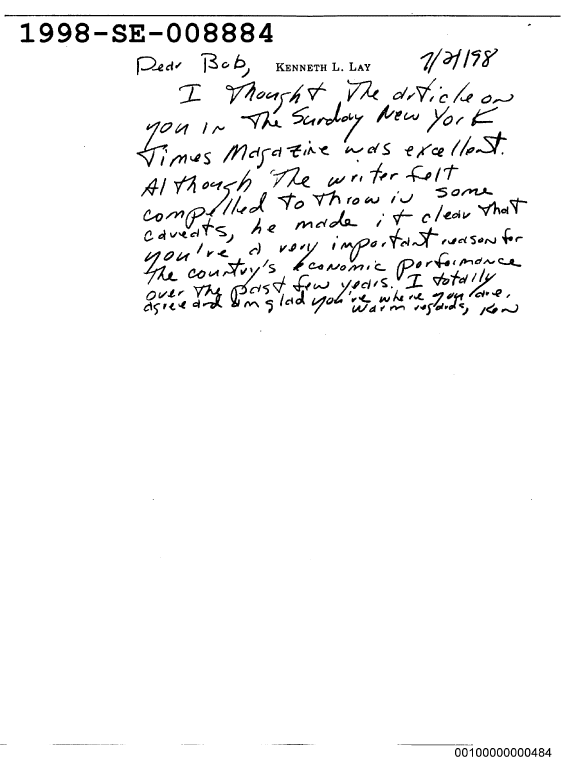
And he understood how it worked. In November of 2008, Aaron emailed me  the following: “apologies if you’ve already seen it, but check out this mash note to Rubin from Lay. ahh, politics.” This was attached to the message.

This note, from Enron CEO Ken Lay to Treasury Secretary Bob Rubin, perfectly encapsulates the closed and corroded nature of our political system — two corporate good ole boys, one running Treasury and one running Enron, passing mash notes. This was everything Aaron hated, and fought against. What I respected about Aaron is that he burned with a desire for justice, but also felt a profound desire to understand the system he was attempting to reorganize. He didn’t throw up his hands lazily and curse at corruption, he spent enormous amounts of time and energy learning about and working the political system. From founding Reddit, to fighting the Fed. That was Aaron.

Aaron approached politics like he approached technology. His method was as follows – (1) Learn (2) Try (3) Gab (4) Build. He was methodical about his work, and his approach to life – this essay on procrastination will give you a good window into his mind. Aaron liked to “lean in” to difficult problems, work at them until he could break them down and solve them. He had no illusions about politics, which is why he eventually became so good at it. He didn’t disdain the political process the way so many choose to, but he also didn’t engage in flowery lazy thoughts about the glory of checks and balances. He broke politics down and systematically attempted to understand the system. Aaron learned, tried, gabbed, and then built.

This is a note I got from him years ago, when we were trying to put together flow charts of corporate PAC money and where it went.

“Been playing around with the numbers tonight. Turns out corporate PAC money explains 45% of the variance in ProgressivePunch scores among Dems. Scatterplot attached. Right is progressive, down is no corporate PAC money. So you can see how all the people with less than 80% progressive punch scores get more than 20% of their money from PACs.”

This is a chart of power, one of many Aaron put together to educate himself (and in this case, me). Most geeks hate the political system, and are at the same time awed by it. They don’t actually approach it with any respect for the underlying architecture of power, but at the same time, they are impressed by political figures with titles. Aaron recognized that politics is a corrupt money driven system, but also that it could be cracked if you spent the time to understand the moving parts. He figured out that business alliances, grassroots organizing, and direct lobbying to build coalitions was powerful, whereas access alone was a mirage. He worked very hard to understand how policy changes work, which ultimately culminated in his successful campaign to stop SOPA in 2011. This took many years of work and a remarkable amount of humility on his part.

But he was driven by a desire for justice, and not just for open information. He wanted an end to the drug war, he wanted a financial system not dominated by Bob Rubin, and he wanted monetary policy run to help ordinary people. Some of his last tweets are on monetary policy, and the platinum coin option for raising the debt ceiling (which is a round-about way of preventing cuts to social welfare programs for the elderly). Aaron was a liberal who saw class and race as core driving forces in American politics. In a lovely essay on how he organized his career, he made this clear in a very charming but pointed way.

So how did I get a job like mine? Undoubtedly, the first step is to choose the right genes: I was born white, male, American. My family was fairly well-off and my father worked in the computer industry. Unfortunately, I don’t know of any way of choosing these things, so that probably isn’t much help to you.

But, on the other hand, when I started I was a very young kid stuck in a small town in the middle of the country. So I did have to figure out some tricks for getting out of that. In the hopes of making life a little less unfair, I thought I’d share them with you.

Making “life a little less unfair.” Those aren’t the words of a techno-utopianist, those are the words of a liberal political organizer. They remind me of how Massachusetts Senator Elizabeth Warren has described her own work. Aaron knew life would always be unfair, but that was no reason not to try to make society better. He had no illusions about power but maintained hope for our society if, I suppose, not always for himself. This is a very difficult way to approach the world, but it’s why he was so heroic in how he acted. I want people to understand that Aaron sought not open information systems, but justice. Aaron believed passionately in the scientific method as a guide for organizing our society, and in that open-minded but powerful critique, he was a technocratic liberal. His leanings sometimes moved him towards more radical postures because he recognized that our governing institutions had become malevolent, but he was not an anarchist.

I am very angry Aaron is dead. I’ve been crying off and on for a few days, as it hits me that he’s gone forever. Aaron accomplished more in 13 than nearly everyone I know will get done in their entire lives, and his breadth of knowledge and creativity in politics were stunning, all the more so since he was equally well-versed in many other fields. But what I respected was his curiosity and open-mindedness. He truly loved knowledge, and loved people who would share it. We used to argue about politics, him a hopeful and intellectually honest technocratic liberal and me as someone who had lost faith in our social institutions. We made each other really angry sometimes, because I thought he was too sympathetic to establishment norms, and he thought I couldn’t emotionally acknowledge when technocrats had useful things to say. But I respected him, and he frequently changed my mind.  I saw that what looked like stubbornness was just intellectual honesty and a deep thirst for evidence. He wanted to understand politics, because he thought that understanding, and then action, was the key to justice.

As I said, I am very angry that he is dead. I don’t want to get into the specifics of his case, because others have discussed it and the political elements of it more eloquently than I ever could. His family and partner have put out a powerful statement placing blame appropriately.

Aaron’s death is not simply a personal tragedy. It is the product of a criminal justice system rife with intimidation and prosecutorial overreach. Decisions made by officials in the Massachusetts U.S. Attorney’s office and at MIT contributed to his death. The US Attorney’s office pursued an exceptionally harsh array of charges, carrying potentially over 30 years in prison, to punish an alleged crime that had no victims. Meanwhile, unlike JSTOR, MIT refused to stand up for Aaron and its own community’s most cherished principles.

I want to make a few points about why it’s not just sad that he is gone, but a tragedy, a symbol for all of us, and a call to action.

Aaron suffered from depression, but that is not why he died. Aaron is dead because the institutions that govern our society have decided that it is more important to target geniuses like Aaron than nurture them, because the values he sought — openness, justice, curiosity — are values these institutions now oppose. In previous generations, people like Aaron would have been treasured and recognized as the remarkable gifts they are. We do not live in a world like that today. And Aaron would be the first to point out, if he could observe the discussion happening now, that the pressure he felt from the an oppressive government is felt by millions of people, every year. I’m glad his family have not let the justice system off the hook, and have not allowed this suicide to be medicalized, or the fault of one prosecutor. What happened to Aaron is not isolated to Aaron, but is the flip side of the corruption he hated.

As we think about what happened to Aaron, we need to recognize that it was not just prosecutorial overreach that killed him. That’s too easy, because that implies it’s one bad apple. We know that’s not true. What killed him was corruption. Corruption isn’t just people profiting from betraying the public interest. It’s also people being punished for upholding the public interest. In our institutions of power, when you do the right thing and challenge abusive power, you end up destroying a job prospect, an economic opportunity, a political or social connection, or an opportunity for media. Or if you are truly dangerous and brilliantly subversive, as Aaron was, you are bankrupted and destroyed. There’s a reason whistleblowers get fired. There’s a reason Bradley Manning is in jail. There’s a reason the only CIA official who has gone to jail for torture is the person — John Kiriako – who told the world it was going on. There’s a reason those who destroyed the financial system “dine at the White House”, as Lawrence Lessig put it. There’s a reason former Senator Russ Feingold is a college professor whereas former Senator Chris Dodd is now a multi-millionaire. There’s a reason DOJ officials do not go after bankers who illegally foreclose, and then get jobs as partners in white collar criminal defense. There’s a reason no one has been held accountable for decisions leading to the financial crisis, or the war in Iraq. This reason is the modern ethic in American society that defines success as climbing up the ladder, consequences be damned. Corrupt self-interest, when it goes systemwide, demands that it protect rentiers from people like Aaron, that it intimidate, co-opt, humiliate, fire, destroy, and/or bankrupt those who stand for justice.

More prosaically, the person who warned about the downside in a meeting gets cut out of the loop, or the former politician who tries to reform an industry sector finds his or her job opportunities sparse and unappealing next to his soon to be millionaire go along get along colleagues. I’ve seen this happen to high level former officials who have done good, and among students who challenge power as their colleagues go to become junior analysts on Wall Street. And now we’ve seen these same forces kill our friend.

It’s important for us to recognize that Aaron is just an extreme example of a force that targets all of us. He eschewed the traditional paths to wealth and power, dropping out of college after a year because it wasn’t intellectually stimulating. After co-founding and selling Reddit, and establishing his own financial security, he wandered and acted, calling himself an “applied sociologist.”  He helped in small personal ways, offering encouragement to journalists like Mike Elk after Elk had broken a significant story and gotten pushback from colleagues. In my inbox, every birthday, I got a lovely note from Aaron offering me encouragement and telling me how much he admired my voice. He was a profoundly kind man, and I will now never be able to repay him for the love and kindness he showed me. There’s no medal of honor for someone like this, no Oscar, no institutional way of saying “here’s someone who did a lot of good for a lot of people.” This is because our institutions are corrupt, and wanted to quelch the Aaron Swartz’s of the world. Ultimately, they killed him. I hope that we remember Aaron in the way he should be remembered, as a hero and an inspiration.

In six days, on January 18th, it’s the one year anniversary of the blackout of Wikipedia, and some have discussed celebrating it as Internet Freedom Day. Maybe we should call this Aaron Swartz Day, in honor of this heroic figure. While what happened that day was technically about the internet, it should be remembered, and Aaron should be remembered, in the context of social justice. That day was about a call for a different world, not just protecting our ability to access web sites. And we should remember these underlying values. It would help people understand that justice can be extremely costly, and that we risk much when we allow those who do the right thing to be punished. Somehow, we need to rebuild a culture that respects people like Aaron and turns away from the greed and rent-extraction that he hated. There’s a cycle in American history, of religious “Great Awakenings”, where new cultural systems emerge in the form of religion, often sweeping through communities of young people dissatisfied with the society they see around them. Perhaps that is what we see in the Slow Food movement, or gay rights movement, or the spread of walkable communities and decline of vehicle miles, or maker movement, or the increasing acceptance of meditation and therapy, or any number of other cultural changes in our society. I don’t know. I’m sure many of these can be subverted. What I do know is that if we are to honor Aaron’s life, we will recognize him as a broad social justice activist who cared about transforming our society, and acted to do so. And we will take up his fight as our own.

Brits seeking to join Syria war nabbed

0

Four men have been arrested in Britain on charges of seeking to travel to Syria to join a foreign-backed insurgency against the country’s popular government of president Bashar al Assad.

Scotland Yard said in a statement that its forces have arrested four men as part of an investigation into travel to Syria in support of terrorist activity there.

According to the statement, police forces detained one of the men while he was trying to take a flight from London’s Gatwick airport last Wednesday.

Three others were snatched at different addresses in east London the other day, added the statement.

The man arrested at the airport is aged 33 while the others were aged 18, 22 and 31 respectively, police said, adding that they were being held by the Metropolitan Police’s Counter Terrorism Command.

“These arrests form part of an investigation into travel to Syria in support of alleged terrorist activity. Inquiries continue,” police said.

“Two men have previously been charged in connection with this investigation.”

A British trainee doctor, Shajul Islam, 26, and another man, Jubayer Chowdhury, 24, are due to go on trial in Britain in June charged with the kidnapping of two Western journalists by terrorists in Syria.

MOL/HE

Egypt police fire tear gas at protesters

0

An Egyptians railway worker attempts to remove debris from tracks following a train incident in Giza in Badrashin, about 40 kilometers west of Cairo, Egypt, on January 15, 2013.

Egyptian police have attacked the protesters gathering in the main railway station in the city of Alexandria, demanding rail safety.

The protest came on Tuesday, hours after 19 people lost their lives when a train which was carrying Egyptian military recruits to an army camp in Cairo derailed in the Giza neighborhood of Badrasheen.

Police fired tear gas to disperse hundreds of protesters who had clashed with passengers and attempted to prevent the trains from leaving the station.

Egypt’s roads and railways have a poor safety record, with a string of deadly crashes.

In November 2012, nearly 50 school children were killed after a train collided with their bus in central Egypt.

Meanwhile, the opposition National Salvation Front issued a statement, saying that the Tuesday deadly incident along with the one that occurred last November “affirmed the urgent need for President [Mohamed] Morsi and his government to reorder their priorities.”

More than 100 people were also injured in the recent train incident.

According to Egyptian state media, Morsi paid a visit to the injured who had been transferred to military hospital in the capital for treatment.

In Egypt’s deadliest railway tragedy, more than 360 passengers were killed in a train incident in 2002.

MR/PKH

Corporate Gold on the Fiscal Cliff

0

In economist and New York Times columnist Paul Krugman’s book, End This Depression Now!, there’s a chapter titled “The Second Gilded Age” in which he describes the extraordinary rise in wealth and power of the very rich during this era of unregulated greed. Since Ronald Reagan’s election in 1980, the top one percent of Americans have seen their incomes increase by 275 percent. After accounting for inflation, the typical hourly wage for a worker has increased just $1.23.

Big Money, as Krugman writes in his book, buys Big Influence. And that’s why the financiers of Wall Street never truly experience regime change – their cash brings both political parties to heel. So it is that the policies that got us where we are today – in this big ditch of chronic financial depression – have done little for most, but have been very good to a few at the top.

But they’re not satisfied with having only most of it – they want it all. If Krugman were writing his book today, he could find plenty of evidence in the deal that supposedly kept us from going over the fiscal cliff. Behind closed doors, Congress larded it with corporate tax breaks worth tens of billions of dollars – everything from tax credits for NASCAR racing and the railroads to subsidies for Hollywood, rebates for the rum industry and loopholes for off-shore financing that could help giant multinationals like General Electric avoid billions of dollars in corporate income taxes.

Writing in the conservative Washington Examiner, columnist Tim Carney says many of these expensive giveaways were “spawned by a web of lobbyists, donors and staffers surrounding Democratic Sen. Max Baucus of Montana,” chairman of the Senate Finance Committee. As we know from the Obamacare fight, Baucus is a connoisseur of revolving door corruption. “Pick any one of the special-interest tax breaks extended by the cliff deal,” Carney wrote, “and you’re likely to find a former Baucus aide who lobbied for it on behalf of a large corporation or industry organization.” Even the pro-business Wall Street Journal was appalled. They called it a “Crony Capitalist Blowout.”

And so it was – and more. It was payback time for all those campaign donations. CEOs and lobbyists were tripping over themselves as they traipsed up and down Pennsylvania Avenue between Congress and the White House. You’ve no doubt heard about Fix the Debt, that group of business execs and retired politicians taking out TV ads and campaigning to slash the deficit. In The New York Times, Nick Confessorereported, “…close to half of the members of Fix the Debt’s board and steering committee have ties to companies that have engaged in lobbying on taxes and spending, often to preserve tax breaks and other special treatment.”

Get it? They’re privately protecting their interests as they publicly urge austerity on everyone else.

Lloyd Blankfein, CEO and chair of the global investment giant Goldman Sachs, is on Fix the Debt’s Fiscal Leadership Council. Here’s what he said when asked by CBS News’ Scott Pelley about how he would reduce the federal deficit: “You’re going to have to undoubtedly do something to lower people’s expectations – the entitlements and what people think that they’re going to get, because it’s not going to – they’re not going to get it… Social Security wasn’t devised to be a system that supported you for a 30-year retirement after a 25-year career… in general, entitlements have to be slowed down and contained.”

Yes, but Blankfein and Goldman Sachs make sure their entitlements aren’t touched! Here’s the story: After 9/11, Congress created tax-exempt Liberty Zone bonds to help small businesses rebuild near Ground Zero. Turns out Goldman’s friends in high places consider it a small business, too, although it made $5.6 billion in profits last year. As the fiscal cliff fiasco was playing out over New Year’s Eve, faster than the ball dropped in Times Square, a deal was struck that will extend the subsidies for Goldman’s fancy new headquarters in lower Manhattan. In their 43 stories of glass and steel, and a footprint two city blocks long, Goldman Sachs reigns supreme — thanks to a system rigged by and for the powerful rich.

And then, according to The Wall Street Journal, just before the fiscal cliff deal’s higher individual tax rates kicked in, Goldman handed “Lloyd Blankfein and his top lieutenants a total of $65 million in restricted stock” – bonuses awarded a month earlier than usual so they could all beat the coming tax hike from which they have been spared for more than ten lucrative years.

It won’t surprise you to learn that, “Corporations announced more special dividends last month than in any other December since at least 1955.” Doing everything they can to avoid helping pay off the debt their CEOs have been urging Congress to cut.

As for working people – tough luck. Because the fiscal cliff deal ends the cut in payroll taxes, the average worker this year will take home about a thousand dollars less.

Juncker Warns EUR Exchange Rate “Dangerously High”, Or Europe Wants Its Cake And To Eat It Too

0

We have long been discussing the fundamental paradox dichotomy that Europe finds itself in, where on one hand the continent needs ECB intervention to keep it together with indirect debt monetization and current account deficit funding via TARGET2, yet on ther other, where ECB intervention always ends up pushing the EUR higher relative to its FX peers. The problem of course, is that the higher the EUR goes, the weaker German exports become, and as we observed just this morning, the faster Germany’s collapse into recession happens. Sure enough, Europe finally figured out what has been obvious to virtually anyone with half a brain for many months:

  • JUNCKER SAYS EURO EXCHANGE RATE ‘DANGEROUSLY HIGH’

That’s great, and we agree with Juncker for once, but there is major problem with this: the lower the EUR goes, the greater the redenomination risk. Sorry Europe – that’s just the way it is. The second the EUR goes back to the mid and lower 1.20s, PIIGS bonds will go bidless, and “rednomination risk” will rear its ugly head.

Sure enough, the EURUSD plunges the second this latest vberbal intervention hits:

In other words, while Europe wants its cake and to eat it too, it can’t have it both ways. Unless of course, the ECB is in regime change mode, and instead of pushing the EUR higher going forward, it will send it lower, only for Mario Draghi come out and tell everyone to “not short the Euro, beeleeevee me.”

What is worse is that with all correlation algos pegging the ES to the EURUSD, a shift out of Europe will mean lower risk asset prices in the US, and more easing out of the Fed, which in turn will push the EUR once again much higher.

And so on.

Oh, aren’t currency wars so much fun, especially since Mario Draghi may now want to reassess his advice from last July, that “it’s pointless to go short on the euro.” So… is it pointful now?

Last, but never least, because we can’t say it enough, Tom Stolper FTW.

Your rating: None Average: 5 (1 vote)

China set to survey disputed isles

0

File photo shows the disputed islands known as Senkaku in Japan and Diaoyu in China in the East China Sea.

China is set to carry out a detailed survey of the disputed isles claimed by both Tokyo and Beijing in a bid “to safeguard its maritime rights and interests.”

According to a statement issued by China’s National Administration of Surveying, Mapping and Geoinformation on Tuesday, the geographical survey is part of a comprehensive program to map the country’s “territorial islands and reefs.”

No other details are given regarding the program.

The announcement comes a day after Japanese media said Tokyo would deploy two more patrol ships near the disputed islands in the East China Sea for defensive purposes.

According to Japanese public broadcaster, the NHK, the vessels, including a 3,100-ton Chikuzen and a 335-ton Kurose, are set to be positioned at the regional coast guard in August and October.

Japan and China have long been in a dispute over the sovereignty of the islands, which would give the owner exclusive oil, mineral and fishing rights in the surrounding waters.

The islands, which are controlled by Japan and form part of Okinawa prefecture, are known as Senkaku in Japan and Diaoyu in China.

China presented the United Nations with a detailed explanation of its sovereignty over the disputed islands based on certain geological features in December 2012.

Tensions heightened between the two countries after Japan signed a deal on September 11, 2012 to buy three of the islands from their private Japanese owner in line with plans to nationalize the archipelago. Hundreds of Chinese held several anti-Japan demonstrations following the Japanese move.

MAM/PKH

Renault to make 7500 layoffs by 2016

0

French car sales slump 7.8% percent in October. (file photo)

France’s Renault has announced some 7,500 layoffs by 2016 as the floundering company seeks to sharpen its competitive edge.

Renault said on Tuesday that it has settled with unions over making 5,700 redundancies through natural attrition after making employees retire three years earlier.

“If an agreement is signed with unions, this staff redeployment would require neither a plant closure nor a voluntary redundancy program,” Renault Head of Operations in France Gerard Leclercq said.

The company says the 17 percent workforce reduction will contribute to saving 400 million euros through spending cuts, which will give Renault “room for investment and development of its activities.”

The layoffs come in a bid to make Renault more competitive to European and worldwide markets by hiring employees with “critical skills.”

“On the basis of a progressive recovery of the European market, establishing such an agreement would allow for growth in French output that is more sustained than that of the European market” as a whole, Renault said in its forecast.

The “staff redeployment” has already gone ahead in Renault’s division in the debt-stricken country of Spain.

According to new data released by the French Constructers’ Committee of French Automobiles (CCFA) in November 2012, the country’s car sales plummeted 13.3 percent in the first 10 months of last year.

French automakers have tried to solve their economic problems by slashing capacity and cutting costs.

The worsening debt crisis has forced EU governments to adopt harsh austerity measures and tough economic reforms, which have triggered incidents of social unrest and massive protests in many European countries.

GVN/PKH

Tower Block Fire: Husbands Describe Their Grief

0

Two men who lost their families in a horrific tower block fire have been telling of their phone conversations with their wives in the flat where they were sheltering.

It also emerged that another of the six victims, fashion designer Catherine Hickman, had asked previously asked why there were no diagrams showing where the fire exits were.

Rafael Cervi and Mbet Udoaka were both at work when the fire broke out at Lakanal House, Camberwell, south east London, on July 3, 2009.

Jurors at the “super inquest” at Lambeth Town Hall heard that Mr Cervi’s wife Dayana Francisquini, 26, his step-daughter Thais, six, and his son Felipe, three, all died in the blaze.

Dayana’s father Fernando Francisquini said he could see his daughter through the window moving curtains and a mattress to keep out the smoke.

Mr Cervi told the jury: “I lost my entire family, my wife and a couple of kids that I had. Everything that I built, everything that I dreamed of was over in three hours.”

On the day of the blaze, he rang his wife 10 times, trying to reassure her. He also called 999, and alerted her father who lived within walking distance of the flat.

Mr Francisquini said they pleaded with firefighters to rescue the family.

“Rafael and I were begging them to go and help them as the fire was in the flat next to hers,” he said.

Helen Udoaka, 34, and her three-week-old daughter Michelle also died in the blaze, along with Miss Hickman, 31.

Mrs Udoaka’s husband Mbet said: “My life will never be the same again, I can never get over these deaths, over the death of my beautiful Helen and my lovely Michelle.”

Mrs Udoaka, who was on maternity leave at the time, had moved to the UK in 2007 from Nigeria.

Counsel to the inquest James Maxwell-Scott read parts of a statement made by Mr Udoaka after the fire, recalling the last conversation he had with his wife.

The statement said: “The last words she said to me were that the smoke was too much, she couldn’t bear it any more, Michelle our daughter was going to heaven.”

Miss Hickman’s boyfriend of six years, Mark Bailey, said she had asked him where the fire exits were in the block, and why there were no diagrams to show residents where to go.

Two weeks before the blaze, he had asked a fireman in a park whether they could have a home visit to get advice but he replied it was “nothing to do with him”, the inquest heard.

Mr Bailey, who was in New York at the time of the fire, flew back to be with Miss Hickman’s family in the New Forest.

They were only informed she had died three or four days after the blaze.

“During that time I was feeling indescribable,” Mr Bailey said. “I was overwhelmed by grief and I would wake up every night screaming and crying.

“I would wake up and think that Catherine was next to me, and then realise what had happened.”

The inquest was adjourned until Wednesday.

The GOP’s Boldest Election-Rigging Move Yet

0

Ballots are run though counting machines at a polling station in Janesville, Wis., on Election Day, Nov. 6, 2012. (Photo: Narayan Mahon / The New York Times)Ballots are run though counting machines at a polling station in Janesville, Wis., on Election Day, Nov. 6, 2012. (Photo: Narayan Mahon / The New York Times)Boris Bazhanov was Joseph Stalin’s personal secretary from 1923 to 1928, and later served as secretary of the Soviet Political Bureau. In his memoirs published in 1980, he recounts something Stalin told him about voting.

“I consider it completely unimportant who in the party will vote, or how,” Stalin said. “But what is extremely important is this — who will count the votes, and how.” Despite never having to worry about surviving popular elections, or really being a fan of democracy, Stalin knew the trick to subverting a democracy wasn’t in getting your people to vote, but instead was in making sure their votes were counted in a way that made sure your side won.

You can get 100% of the population voting, but if you can selectively decide which votes to count and which to throw out, you’ll win every time. As playwright Tom Stoppard quips in his play, Jumpers, “It’s not the voting that’s democracy; it’s the counting.”  

Now it appears the Republican Party has picked up on this, and is preparing for its boldest maneuver yet to ensure Democrats never again win the White House, by changing the way presidential Electoral Votes are counted.

The plan works like this: Instead of giving all of a state’s Electoral College votes to the popular vote winner of that state, Republicans want Electoral College votes in a small number of states to be doled out based on who won each Congressional district, plus two votes going to the popular vote winner. 

Of course, those Congressional districts in several traditionally blue states like Pennsylvania, Wisconsin, Ohio, and Michigan were drawn by newly-elected Republicans state legislatures after the 2010 census. And they were drawn in a way that already gives Republicans an advantage by carving up Democratic strongholds and creating “safe” Republican seats. That’s how Republicans kept control of the House of Representatives in 2012, despite House Democrats winning  a million and a half more votes nationwide than House Republicans.

For example, last November President Obama won the popular vote in Wisconsin and thus received all of Wisconsin’s 10 Electoral College votes. But under this new Republican plan, he would have only received one Electoral College vote for each Congressional district that he won. Since he only won three newly-gerrymandered districts, he would have only gotten three votes, plus two more votes for winning the popular vote. Mitt Romney, who won five gerrymandered districts, would have received five votes. So, under this scenario, despite winning the popular vote in Wisconsin by a 7-point landslide last November, President Obama would have walked away from the Badger State with an equal number of Electoral College votes as Mitt Romney — five each.

Now you can see why Republicans like this idea!

With this simple tweak in how Electoral College votes are counted, the big win for the President in Wisconsin turns into a tie. In fact, had all the battleground states adopted this new vote counting scheme, Mitt Romney would be our President today, despite losing the popular, majority vote in every single battleground state: Ohio, Wisconsin, Florida, Virginia, Pennsylvania, Michigan, and so on.

The way Congressional districts in several blue states are drawn today means it would be virtually impossible for a Democrat to win the White House should all of these states adopt this new method of counting Electoral College votes — at least until 2020, when the next census comes due and Congressional districts are redrawn.

Again, as Stalin said, it’s not about who votes, it’s about how the votes are counted.

Now, as you might imagine, an idea like this is explosive. It would hand the White House over to Republican one-party rule. And any political party that truly believes in a democracy that reflects the will of the people would never embrace an election-rigging scheme like this.      

But Republicans have no shame.

This exact idea was first proposed in 2011 by Pennsylvania’s Republican Governor Tom Corbett. Again, that’s a Governor proposing it and not some local crackpot party official. Luckily, Corbett abandoned it before the election, or else Mitt Romney would have won the state’s majority share of Electoral College votes despite losing the popular vote statewide.

But, after seeing how bad they got shellacked in November, more and more prominent Republicans are voicing their support for this idea. The idea has been revived in Pennsylvania. Also, Wisconsin’s Governor Scott Walker said he supports it, and his colleague, Republican Assembly Speaker Robin Vos is promising to introduce legislation to make it happen. Ohio’s Republican Secretary of State, Jon Husted, wants to do it, too. And so, too, do Republican state lawmakers in Michigan.

But most shocking of all, the latest endorser of this election-rigging scheme is none other than the top Republican Party official himself, RNC Chair Reince Preibus. In an interview with the Milwaukee Journal-Sentinel, Priebus said, “I think it’s something that a lot of states that have been consistently blue that are fully controlled red out to be looking at.” 

What all this adds up to is this: Republicans are really going to try to do this. Over the next few years, they really are going to try to rig the next election.

After all, what other choice do they have?

They could ditch trickle-down economics, which the American middle class now knows is nothing more than a scam that makes the rich richer while making the poor poorer. But since that would mean casting aside what George W. Bush referred to as his “base” — the billionaire class — we know that won’t happen.

Republicans could just accept the issue of women’s’ choice as settled and stop trying to limit women’s access to contraceptives or talking about “legitimate” rape. But that might cause the religious zealots on the Right who are preparing for the rapture to stop donating, and even leave the Republican Party. So, that won’t happen.

They could adopt a more compassionate approach to minorities in hopes of adapting to America’s changing demographics. Or they could just ditch their war on the New Deal and accept that the majority of Americans like social insurance programs like Medicare and Social Security. But we know that won’t happen, either — there’s too much money there that their bankster buddies on Wall Street want to get their hands on.

The truth of the matter is, Republicans simply aren’t willing to say “no” to the billionaires, and evolve from their prehistoric and unelectable current form into a political party that can actually build majority coalitions once again.

So, the only option left for a party that can’t win elections is to rig elections.

Consider this a warning. We thought we’d seen the worse. But Voter Suppression ID laws, cuts to early voting, long lines in heavily Democratic precincts, and new hurdles to voter registration are nothing compared to this latest vote-rigging scheme.

While most of us are focused on “fiscal cliffs” and budget battles in Washington, DC, the real fight for the future of our democracy is, right now, happening in State legislatures in Wisconsin, Ohio, and Michigan.

To badly paraphrase Paul Revere: Awaken the citizenry and spread the word!

Gun, ammunition sales soar in US

0

Gun and ammunition sales in the US have spiked over the past two weeks as people rush to stock up arsenals before any restrictions that might be imposed, Press TV reports.

As impending restrictions on gun sales are spurring fear among some gun owners that they won’t have easy access to weaponry, leading liberal lawmakers plead for stores to curb gun sales.

“I’m urging our major gun retailers in America; the Walmart and the Sports Authority, to suspend sales of modern assault-style weapons until the Congress is able to fully consider and vote on legislation to curb gun violence,” said US Senator Chuck Schumer.

In a series of meetings with gun policy stakeholders, including the National Rifle Association (NRA), US Vice President Joe Biden offered a comprehensive package of proposals on preventing gun violence in the country.

NRA officials left the talks disenchanted and challenged negotiations with the Vice President on gun policy. Biden is to offer its proposals to President Barack Obama on Tuesday.

“The National Rifle Association is one of the most useless and reactionary groups in America,” said US domestic policy analyst Brent Budowsky.

“They offered the President nothing. They don’t want to give up any guns. They want people running around with machine guns and semi-automatic weapons.”

Following the Newtown shooting spree, President Obama appointed Biden to lead an effort to find proposals “to reduce the epidemic of gun violence.” The president also pledged to present the proposals to Congress.

Biden’s suggestions include universal background checks and limits on high capacity clips like the one used in the Sandy Hook shooting spree, which left 20 children and six adults dead on December 14, 2012.

TE/SS

‘Standard Rules of Engagement’: IDF Shoots Dead Unarmed Palestinian Boy

0

An unarmed seventeen-year-old Palestinian boy was shot dead by Israeli security forces who claimed they only followed ‘standard rules of engagement’ on Tuesday.

Relatives of Samir Awad mourn his death at a hospital in Ramallah, to where his body was taken after the shooting. (Photograph: Issam Rimawi/Zuma Press/Corbis) Samir Awad was shot in “the head, back and chest,” according to reports. Though Israel Defense Force officials did admit that live fire was used, they claimed soldiers were within their right to use lethal force against the boy.

Palestinian witnesses, however, claim that Awad was killed “in cold blood” as he tried to run away from the area near the separation wall in West Bank village of Budrus.

As The Guardian reports:

[Awad was] among a group of boys who had just completed an exam on the last day of school before a midterm break when they approached the barrier, reports said. The Israeli Defense Forces said the youths were “attempting to infiltrate into Israel“, and its soldiers “responded immediately”. It confirmed live fire was used.

According to villagers, Samir was grabbed by soldiers who were concealed in a trench. He broke free and was running away when a soldier or soldiers opened fire. He was hit by three or four bullets, in his head, torso and leg.

Ayed Morrar, a member of the village popular resistance committee, said: “They shot him in cold blood, they shot him in the back. He wasn’t threatening them.” He said there had been no stone-throwing at the time of the shooting.

As Haaretz reports on Tuesday, Awad is the fourth Palestinian killed by IDF fire in recent days. On Monday a 21-year-old Gaza man, Mustafa Abu Jarad, died after being shot in the head by Israeli forces.

“Time and time again we hear of the claim that the young Palestinians provoked or hurled stones, but nothing justifies the shooting of live rounds at children.”

On Saturday a 21-year-old Palestinian was shot dead by IDF troops while trying to cross the barrier near the southern West Bank town of Dura, and the day before a 22-year-old man was killed and another injured–also by the IDF–in northern Gaza.

Morrar, also interview by Haaretz said there was “no just cause to open fire” in the Awad case and that the spate of recent killings by Israeli Defense Forces is creating increased tension throughout the occupied West Bank.

“In recent days we feel an escalation by the army, which shoots at everything that approaches the fence, even if they are children,” Mora told Haaretz. “Time and time again we hear of the claim that the young Palestinians provoked or hurled stones, but nothing justifies the shooting of live rounds at children.”

The true provocation, Mora explained, is Israelis building of the separation wall on private Palestinian lands.

Israelis, he said, “shouldn’t speak of provocations, the fact they built the fence on our lands is provocation.”

Hagel Prostrates Himself Before the Lobby, Gets Votes

0

The drama around Chuck Hagel’s nomination for Secretary of Defense seems to be heading into its predictable third act. While much attention has been given to Hagel’s heterodox views (for D.C.) on the Middle East, and the threat that several Democrats might oppose his nomination over Israel, both the nominee and the party seem to be getting in line behind the President (and conveniently the lobby).Chuck Hagel’s nomination for Secretary of Defense seems to be heading into its predictable third act.

Politico is reporting this morning on a letter Hagel sent to California Sen. Barbara Boxer answering her concerns regarding his views on U.S. policy towards Iran and Israel, the Israel lobby, as well as issues pertaining to women and gays and lesbians in the military. You can read Hagel’s letter here. In it he does an about face on several positions to move towards the conventional wisdom in Washington. The most glaring example is the issue of sanctions against Iran, where Hagel had previously argued against unilateral U.S. sanctions in favor of multilaterial action. No longer. From the letter:

I have long supported economic sanctions that are applied in concert with allies and partners. I strongly supported the Obama Administation’s approach which has brought to bear unprecedented multilateral sanctions on Iran, including UN Council Resolution 1929. Regarding unilateral sanctions, I have told the President I completely support his policy on Iran. I agree that with Iran’s continued rejection of diplomatic overtures, further effective sanctions, both multilateral and unilateral — may be necessary and I will support the President.

Hagel also apologized for using the term “Jewish lobby” and promised the special relationship is in safe hands if he is confirmed:

As to my use of the phrase “Jewish lobby” to describe those who advocate for a strong U.S.-Israeli relationship, I’ve acknowledged that this was a very poor choice of words. I’ve said so publicly and I regret saying it. I used that terminology only once, in an interview. I recognize that this kind of language can be construed as anti-Israel. I know the pro-Israel lobby is comprised of both Jewish and non-Jewish Americans. In the Senate, I was a strong supporter of Defense appropriations, which provided enduring support for Israel’s security. Most Americans, myself included, are overwhelmingly supportive of a strong U.S.-Israel strategic and security relationship.

Hagel proves his pro-Israel bona fides by promising to deepen military cooperation with Israel and repeating a beltway mantra as American as baseball and apple cake:

America’s relationship with Israel is one that is fundamentally built on our nations shared values, common interests and democratic ideals. The Middle East is undergoing dramatic and historic changes, ones which surround Israel with tremendous uncertainty. We are working together daily, hand in hand, in unprecedented ways, to counter old, new and emerging mutual threats. I fully intend to expand the depth and breadth of U.S.-Israel cooperation.

Caving to political pressure sure pays quick dividends. Following the letter, Boxer annoucned she is on board with the Hagel nomination. Charles Schumer also announced he will support Hagel following similar outreach. From the New York Times:

Of deepest concern to Mr. Schumer and many Israel advocacy groups, are Mr. Hagel’s positions on the nuclear threat posed by Iran, particularly his suggestions in the past that a military strike against Iran would be counterproductive. It is a position that is out of step with the Obama administration, which became increasingly hawkish on Iran during the 2012 campaign.

“On Iran, Senator Hagel rejected a strategy of containment and expressed the need to keep all options on the table in confronting that country,” Mr. Schumer said. “But he didn’t stop there. In our conversation, Senator Hagel made a crystal-clear promise that he would do ‘whatever it takes’ to stop Tehran from obtaining nuclear weapons, including the use of military force.”

As a senator from Nebraska, Mr. Hagel voted against several rounds of sanctions against Iran that ultimately passed the Senate, citing unilateral sanctions are ineffective. On this matter too, Mr. Schumer seemed to find comfort. “Senator Hagel clarified that he ‘completely’ supports President Obama’s current sanctions against Iran,” Mr. Schumer said. “He added that further unilateral sanctions against Iran could be effective and necessary.”

On nearly every other issue that Mr. Schumer brought up with Mr. Hagel – his views on the militant Islamist groups Hezbollah and Hamas, his prior comments about gays, his use of the term “Jewish lobby” to refer to Israel advocacy groups – all seemed to be tamped down in the meeting.

“I know some will question whether Senator Hagel’s assurances are merely attempts to quiet critics as he seeks confirmation to this critical post,” Mr. Schumer said. “But I don’t think so. Senator Hagel realizes the situation in the Middle East has changed, with Israel in a dramatically more endangered position than it was even five years ago.”

Newtown: Obama To Unveil Gun Proposals

0

President Barack Obama will unveil “a package of concrete proposals” to curb gun violence on Wednesday, the White House has said.

Vice President Joe Biden, who Mr Obama directed to lead a panel tasked with creating the proposals, will join the president at the White House at 11.45am to announce the measures.

“The president and the vice president will hold an event here at the White House to unveil a package of concrete proposals to reduce gun violence and prevent future tragedies like the one in Newtown, Connecticut,” White House spokesman Jay Carney said.

The Obama administration has been moving quickly on the issue following last month’s shooting at Sandy Hook Elementary, which Mr Obama has called the worst day of his presidency.

But opposition has grown among pro-gun groups and Americans who fear their weapons will be taken away. The US has the highest rate of gun ownership of any country in the world.

Mr Obama acknowledged a tough fight ahead in a deeply divided Congress, whose support would be needed to pass the most sweeping changes under consideration, including a ban on assault weapons, limits on high-capacity ammunition magazines and background checks for anyone seeking to purchase a gun.

Such changes “make sense,” Mr Obama said. Lawmakers will have to “examine their own conscience” in the debate ahead, he added.

But the gun issue will have to compete for Congress’ time in coming weeks with several looming fiscal issues, and Republican leaders have said action on guns will have to wait.

The president also can use his executive powers to make some changes, and congressional officials say he is considering 19 steps that he could enact without approval from Congress.

The plan’s most contentious elements face intense opposition from the influential National Rifle Association, which enjoys strong support from Republicans as well as several Democrats and is known to punish politicians who stray from its point of view.

The assault weapons ban, which Mr Obama has long supported, is expected to face the toughest opposition in Congress, which passed a 10-year ban on the high-grade, military-style weapons in 1994.

Supporters did not have the votes to renew it once it expired.

As the president spoke Monday, some parents who lost children in the Connecticut shooting spoke out for the first time, calling for a national dialogue to help prevent similar tragedies. They spoke one month after the shooting.

“We want the … shootings to be recalled as the turning point where we brought our community and communities across the nation together and set a real course for change,” said Tom Bittman, a co-founder of Sandy Hook Promise group.

States and cities have been moving against gun violence as well. In New York, Governor Andrew Cuomo was poised to sign into the law the most restrictive gun law in the nation.

“This is a scourge on society,” Gov Cuomo said Monday night. “At what point do you say, ‘No more innocent loss of life?'”

The New York bill had bipartisan support, with the leader of the Republican-held state Senate saying it does not infringe on the Constitution’s Second Amendment of the US Constitution, which guarantees the right of citizen to bear arms.

At the national level, advocacy groups also have been pushing Mr Obama to order the Justice Department to crack down on those who lie on background checks – only a tiny number are now prosecuted.

Such a step has support from the NRA, which has consistently argued that existing laws must be enforced before new ones are considered.

The president’s proposals are also expected to include steps for improving school safety and mental health care, as well as recommendations for addressing violence in entertainment and video games.

Snow And Ice Cause Further Disruption

0

Further snow and transport disruption is expected across parts of Britain on Tuesday.

As much as six inches of snow has fallen on high ground overnight as a second heavier band was set to move south and east.

The weather has already led to more than 20 motorists needing to be rescued from their cars and forced one rail operator to restrict speeds and cancel services.

The Met Office issued an amber weather warning for snow on the East Midlands, eastern England, the North East and Yorkshire. Those warnings are expected to run until around 9am.

Widespread ice could also cause problems, with temperatures close to freezing.

Rail operator Greater Anglia said routes between London Liverpool Street and Cambridge, Colchester, Ipswich and Norwich would be subject to a 60mph speed limit overnight because of the snow.

Some parts of Norfolk and Lincolnshire could get a second snowfall as the weather system spins out over the North Sea overnight and back towards land again, Mr Lee added.

The rest of the country should have a dry but chilly day, but temperatures in Scotland, the North East and Eastern England will struggle to rise above zero, while London will get to around 3C (37F).

Temperatures are expected to drop further to around minus 8C (17.6F) on Wednesday night with the possibility of more light snow flurries.

Forecasters have warned the cold snap could last until Friday.

:: Send us your photos or videos of the snow where you are.

As Germany Prepares To Repatriate Its Gold, We Hope They Have Learned From The “Monetary Sins Of The Past”

0

As initially reported here yesterday, in what is the biggest news of the week, and possibly the year, the Bundesbank has broken away from its “all is well” posturing exhibited as recently as three months ago, and in a dramatic reversal of its diplomatic position, has demanded repatriation of some of its NY Fed and all of its Paris-domiciled gold. We applaud Herr Wiedmann for this move, although we hope that the German people are allowed to witness, and verify, the arrival of the actual gold as opposed to simply empty crates. Of course, at the end of the day the actual delivery is irrelevant: what matters is this first shot across the bow of the current monetary system – one which juxtaposes sound money versus infinitely dilutable electronic fiat more than ever before – by a major conservative central bank, one in possession of the second largest official gold reserve, second only to the Fed itself. That said, we can only hope that the German request for gold repatriation is not met with the same enthusiastic response that France encountered when it too attempted to repatriate its gold held by London back in the 1930s, just before a whole lot of things in the global economy went horribly wrong…

Specifically, in 1965 The Economist interviewed Jacques Rueff, a French economist and advisor to the French Government. In the following exchange (caught on pages 84-85 of the pdf “Monetary Sins of the Past“, which are required reading to anyone who thinks what is going on now is in any way new or different), the Economist blames France for exerting pressure on London during the 1930s, through the withdrawal of sterling balances held at the Bank of England. We thank Martin Sibileau for the reminder about this key exchange.

What is disclosed is enlightening and entertaining, and may well serve as the basis for what the response Buba may encounter today.

Jacques Rueff: In 1930 I was financial attache in the French Embassy in London, and in that capacity I was responsible for the deposits of the French Treasury with British banks. They were the direct result of eight years of the gold-exchange standard, because we had kept the pounds sterling in London, as my colleagues in New York had kept in the American market the dollars that had been pouring into the French Treasury from 1927 onward. Then, in 1931, the failure of the Austrian Creditanstalt caused successive waves of repatriations; and it was this collapse of the gold-exchange standard that, without any possible doubt, transformed the depression of 1929 into the Great Depression of 1931.

The Economist: While you are on this historical episode, what would your comments be on the very widespread view that it was to a substantial extent French pressure on London at that time, through the withdrawal of sterling balances, that was in part responsible for the general collapse later on?

Jacques Rueff: Let me tell you that, unhappily for the world, the French pressure did not exist, or was so mild that it had no effect. There is a very interesting document from this period, a letter from Sir Austen Chamberlain, who was then Foreign Secretary in London, to M. Poincaré, who was Prime Minister and Finance Minister in France; it must be of 1928. Sir Austen said, “We know that you are entitled to ask gold for your sterling, but in the frame of the close friendship between Britain and France we ask you, so as to avoid trouble for the City of London, not to do that.” And we were, I must say, weak enough to comply with this request and not ask for gold. The fact that I had such important sterling deposits in London shows that we did not use this right to ask for gold. The adjustment, which would hardly have been felt if carried out on a day-to-day basis, was not made, and we had the fantastic boom of 1927, 1928, and 1929. This explains the depth of the collapse and of the depression, because the adjustment was so long delayed. We were too gentle in complying with official appeals not to convert our sterling balances into gold.

Fast forward to today, and we can’t help but wonder if some 30 years from today, an advisor to the Bundesbank will not rewrite the above to something as follows:

BUBA Advisor: …There is a very interesting document from this period, a letter from [William Dudley], who was then Foreign Secretary in London, to Herr Weidmann, who was Head of the Bundesbank; it must be of 2013. Sir Austen said, “We know that you are entitled to ask gold for your sterling, but in the frame of the close friendship between the United States and Germany we ask you, so as to avoid trouble for the Wall Street, not to do that.” And we were, I must say, weak enough to comply with this request and not ask for gold. The fact that I had such important sterling deposits in New York shows that we did not use this right to ask for gold. The adjustment, which would hardly have been felt if carried out on a day-to-day basis, was not made, and we had the fantastic boom of 2013, 2014, and 2015. This explains the depth of the collapse and of the depression, because the adjustment was so long delayed. We were too gentle in complying with official appeals not to convert our sterling balances into gold.

We can only hope that the Bundesbank is not quite as “gentle” as Paris was some 80 years ago in complying with London’s gentle denial to comply with the French repatriation request. In fact, quite the opposite: we hope Bundesbank pulls all of its gold, as do all other nations because in the aftermath of the “collapse and depression” that will soon follow, he who defected first, will have defected best. Everyone else will be left with paper promises of repayment by a broke and insolvent government which went as far as suggesting the minting of a trillion dollar coin to absolve it of its own particular monetary sins.

h/t Martin Sibileau

Your rating: None Average: 5 (1 vote)

Victory for Indonesian Workers After News of Nike Thugs Spread

0

Indonesian factory workers claimed a small victory on Tuesday after news spread that suppliers for international sportswear behemouth Nike paid local military personnel to intimidate them into agreeing to below minimum wage pay.

(Image via developeconomies.com) Workers at the Nike shoe factory in the west Java city of Sukabumi will now be paid a higher minimum wage after reporting that they were bullied into signing a petition saying that they supported the factory’s claim to be exempt from the recent wage increase.

After news of the harrassment leaked, the Jakarta Globe is reporting that the factory has revoked their application for exemption.

Three labor rights groups– US-based Educating for Justice (EFJ), the Alliance for Labor Unions in Indonesia (MPBI) and the Trade Union Rights Center–revealed on Monday the findings of a recent investigation into several Nike factories that were seeking wage exemptions.

ABC Australia reports:

In mobile phone footage of the factory, shown to ABC, a man standing over workers can be heard telling them, “you all have to sign it”.

The woman who took the footage does not want to be named, but says she and other workers tried to reject the pay restriction.

“We got summoned by military personnel that the company hired to interrogate us and they intimidated us,” she said.

“The first thing that scared me was his high tone of voice and he banged the table.

“And also he said that inside the factory there were a lot of military intelligence officers. That scared me.”

Additionally, EFJ director Jim Keady reports that trade union officials at the factory were deceived into signing the agreement when a meeting’s sign-in sheet was “fraudulently attached to a document that stated the signatories agree to the factory management’s requests to be exempt from the new minimum wage.”

“Nike unfortunately exercises imperialist values–values that run counter to the commitments to democracy and human rights,” Keady said.

Indonesian workers won a 44 percent minimum wage raise to 2.2 million rupiah ($228) a month after millions of workers striked this fall over low pay and cost of living increases; the pay increase in Jakarta was supposed to be made effective January 1.

According to the Surya Tjandra, director of Indonesia’s Trade Union Rights Center, at least six Nike-contracted factories had applied for an exemption to the recent pay increase, allowing employees to be paid $3.70 a day instead of $4.

“You have to provide financial conditions of the company in the last two years which show some not profit, and then you have to accept some consent from the workers directly, which is not that easy because for the workers, the new wages is [sic] actually better and fairer,” he said.

Of Tuesday’s news that the Sukabumi factory was retracting their bid for exemption, Keady said:

I’m very happy for the workers in the factory. They are getting the justice they deserve.

Now we have to move forward case by case, factory by factory and make sure that in all 40 [Indonesian] Nike factories, the 171,000 workers get what they deserve.

So far, the investigative team has only looked into shoe manufacturing plants, but they suspect the majority of Nike apparel factories will also be trying to avoid paying the new minimum wage.

US set to lose top rating over debt ceiling. Again

0

A picture shows the entrance of Fitch ratings agency (AFP Photo / Miguel Medina)

A picture shows the entrance of Fitch ratings agency (AFP Photo / Miguel Medina)

If the US Congress fails to raise the debt ceiling and sends the country into default, it risks losing its top credit rating.

­One credit agency has already assured it may downgrade America’s score if there’s any sort of delay in coming up with a budget plan.

If the US fails to increase its debt limit by March 1, it may not be able to pay its bills and could fall into default. Fitch Ratings, a top credit agency, said Tuesday that it would downgrade the nation’s AAA credit rating if Congress fails to agree on a plan “in a timely manner”.

“In Fitch’s opinion, the debt ceiling is an ineffective and potentially dangerous mechanism for enforcing fiscal discipline,” the company said.

A credit rating influences a nation’s borrowing costs, which would be higher if a country proves unable to repay its debts. Lower credit ratings could potentially harm the US economy by increasing its borrowing costs. Even if the US were not sent into default, Fitch would consider downgrading America’s credit rating if it witnesses another heated bipartisan debate that stalls time-sensitive progress.

Fitch said on its website that a repeat of the 2011 congressional battle, which almost sent the US into default, would instigate a formal review of the country’s credit rating and increase skepticism in Congress’ ability to come to agreements.

“The pressure on the US rating, if anything, is increasing,” said David Riley, managing director of Fitch Ratings’ global sovereigns division. “We thought the 2011 crisis was a one-off event.”

Standard & Poor’s downgraded America’s AAA rating after Congress’ debt limit battle in 2011. Moody’s Investor Services did not downgrade the country’s rating, but gave it a negative outlook. The US is still burdened with this negative outlook, with Moody’s having expressed doubtfulness over its ability to come up with a deficit-reduction plan in a timely manner.

And even if the US once again averts the financial crisis, Fitch said it would consider downgrading the country’s rating anyway.

“In the absence of an agreed and credible medium-term deficit-reduction plan that would be consistent with sustaining the economic recovery and restoring confidence in the long-run sustainability of US public finances, the current negative outlook on the AAA rating is likely to be resolved with a downgrade later this year even if another debt-ceiling crisis is averted,” Fitch said.

And a downgraded credit rating is not the only consequence the country faces if it fails to raise the debt ceiling. The US may run out of cash to pay its bills, which would abandon those dependent on government assistance. The US would not be able to afford paying for Social Security, veterans benefits, US troops, aid for low-income families or government salaries.

In order to force the Obama administration to cut spending, some Republican leaders have pledged to allow the US to fall into default and shut down the government, thereby hurting the nation’s credit rating.

The top three credit rating agencies — Fitch Ratings, Standard & Poor’s, and Moody’s — have all at one point expressed doubt in Congress’ ability to raise the debt ceiling, and Fitch’s announcement makes the country’s economic outlook even more dire than before.

Kashmiris slam Shia killings in Pakistan

0

Thousands of people in the Indian-administered Kashmir have demonstrated to voice their anger over the killings of Shia Muslims in Pakistan, Press TV reports.

The demonstration was staged on Tuesday across the Muslim-majority region where the protesters carried banners declaring “We protest the killings of innocent Shia Muslims in Pakistan.” They also chanted slogans condemning the bomb attacks in Pakistan on January 10.

“We are asking how long these Shias of Pakistan have to suffer… We are here to express solidarity with the families (of the victims),” a protester told Press TV.

Reports say Shia Muslims in Kashmir have also shut down businesses to express solidarity with the victims and their families.

On January 10, nearly 130 people were killed and many others injured in a wave of bombings targeting both Pakistani security guards and civilians, including Shia Muslims.

More than 110 of the victims lost their lives in twin bomb attacks that targeted Shias in a crowded place in Quetta. The outlawed terrorist group Lashkar-e-Jhangvi claimed responsibility for the attacks.

Massive protests were also held across Pakistan to denounce the violence with protesters accusing the Pakistani government of failing to take proper action to prevent terror attacks on Shias, who make up 20 percent of the country’s 180-million-strong population.

Violence has escalated against Shia Muslims in different parts of Pakistan in recent months. Since the beginning of 2012, hundreds of Shias have been killed in the country. Doctors, engineers, high-ranking government officials, teachers, and politicians have been the main targets of the deadly attacks.

MAM/PKH

Saudi clerics against women in council

0

Saudi King Abdullah first announced that he was planning to name women to the Shura Council in 2011. (File Photo)

Dozens of Saudi clerics have staged a protest against King Abdullah’s decision to appoint women to the Shura Council, a body that advises the government on new laws.

About 50 clerics gathered in front of the Royal Court in the capital, Riyadh, to express their opposition to the King’s decision to appoint 30 women to the previously all-male consultative Shura Council.

They demanded a meeting with King Abdullah and his top aide Khaled al-Tuwaijri to offer them what they called advice.

“The clerics were in front of the royal court to address the king and Tuwaijri with regard to women in the Shura Council…they waited for two hours but were denied access,” Waleed Abu al-Khair told Reuters by phone.

On Friday, the Saudi monarch gave a fifth of the seats in the consultative body to women as part of social reforms promised in 2011. The kingdom’s top religious authorities, including the Grand Mufti, have accepted the decision.

This is the second demonstration by clerics, who had issued a fatwa banning any kind of public protest, since the appointment of women to the council.

“There is a contradiction…. The real Salafis do not do what these (clerics) are doing,” said Saudi political analyst Khaled al-Dakheel.

“Maybe we are now faced with a socio-political change in the society where we have the traditional Salafi school of thought that adheres to all its principles and now there is a new generation of Salafis emerging that hopes for different proposals. This requires examination,” Dakheel said.

Saudi women need permission from their male guardians to travel or take certain jobs and will vote for the first time in 2014.

The kingdom is the only country that does not allow women to drive.

HM/PKH/SS

1,500 foreign inmates ‘beyond term’

0

Nearly 1,500 foreign prisoners are being held in British jails beyond the term of their sentence.

A total of 547 foreign offenders are being held in prisons after their sentences have ended, while a further 919 are in immigration removal centres, immigration minister Mark Harper revealed.

Mr Harper, who was responding to a parliamentary question by Conservative MP Priti Patel, could not confirm how long the prisoners had been held.

Prime Minister David Cameron pledged nearly two years ago to put an end to agreements that mean foreign offenders cannot be returned home without their consent.

In April 2010, there were 701 foreign offenders detailed in jail after their sentence, which fell to 516 in April 2011 but rose again to 552 in the same month in 2012, the figures revealed.

The number of people held in immigration detention centres after completing a prison sentence has fallen from 1,213 in April 2010 to 812 in April 2012.

­Foreigner to become Louvre Museum’s new chief?

0

The Louvre Museum (RIA Novosti / Alexandra Masaltseva)

The Louvre Museum (RIA Novosti / Alexandra Masaltseva)

The French authorities are considering the option of hiring a non-French citizen for the post as head of one of France’s most prestigious museums.

The measure comes as the museum’s budget for 2013 will be reduced by Hollande’s administration, Bloomeberg reports. This means that the new Louvre director will have to attract investors, hence he or she will need to have broad international contacts and experience of finance.  

The new chief of Louvre will also be curating exhibitions, managing the staff. He will also need to know about the peculiarities of the French government system, be fluent in the French language and have work experience in one of the world’s top museums or culture centers.

The vacancy has opened after the present museum director Henri Loirette, who has served at the post for 12 years, announced his intention to quit the job in December 2012.

The museum needs to find a new chief before May 2013.

In 2013 the French budget cut spending by 10 billion Euros. The country’s culture budget was axed by 2,3 per cent compared to the previous year.

No other foreigner has ever headed the Louvre. Only one foreign citizen, German historian Werner Schpies has headed the National Museum of Modern Art at the Georges Pompidou Center in Paris, between 1997 and 2000.

Chavez recovery “favorable”: VP

0

Venezuelan President Hugo Chavez speaks during a press conference in Caracas on October 9, 2012.

Venezuela’s Vice President Nicolas Maduro has said President Hugo Chavez has made progress in recovering from the cancer operation.

Upon the return from visiting Chavez in Cuba’s capital Havana, Maduro said on Tuesday the president is “climbing the hill, he is advancing” to a full recovery.

Chavez spoke about national matters with Maduro and other members of the government who visited the ailing president over the past few days.

Maduro’s comments support what Chavez’s brother had said regarding the president’s medical condition.

“Reports that the president is in a coma and that the family is discussing ending life support are totally false,” Adnan Chavez, said on Sunday.

Venezuela’s Vice President departed for Cuba on January 11 to visit Chavez’s family, medical team and the commander himself.

Maduro, elected by Chavez to rule in his absence, led the government in its new term on January 10 after the Supreme Court unanimously decided that the current government could remain in office until Chavez takes the oath.

Chavez, who first came to power in 1999, was re-elected to a new six-year term in October 2012. He — when back to full strength — will swear-in as his third term in front of the Supreme Court.

The 58-year-old Venezuelan president traveled to Havana on December 10 for a fourth operation after his cancer reappeared.

GVN/PKH

Farcebook

0

As we anxiously await the titanic announcement about to spew forth from Menlo Park, we thought a look at 2013’s +20% performance was worthwhile. We would expect to hear a plethora of ‘monetizing mobile’ and a cajillion eyeballs must mean something. Will the Facebook phone replace the Obama-phone? Will being ‘liked’ provide external stimulus? Will they be merging with Dell (or Radioshack?) Feeling bullish? Be wary, implied vol is at its most expensivce to realized vol in 7 months… Rest assured, we will bring the critical headlines as they break…

  • *FACEBOOK SAYS IT’S A PRODUCT ANNOUNCEMENT               :FB US
  • *FACEBOOK ANNOUNCES GRAPH SEARCH                         :FB US

FB stumbling now -1.7%

Implied vol is very expensve to realizeds (i.e. people are ‘hedged’)…

Your rating: None Average: 5 (1 vote)

Cenk Uygur Asks Alex Jones if He’s Ever Sought Mental Health Treatment

0

From this Monday evening’s The Young Turks, this interview with Alex Jones wasn’t quite as contentious as the one he had with Piers Morgan last week, but it wasn’t a whole lot better. I did enjoy watching Cenk get a chance to ask him if he’d ever sought any mental health treatment after listening to quite a bit of his ranting and raving. I can also say it didn’t break my heart to see two of these wingnuts tearing each other apart and Jones ripping on Glenn Beck after he criticized his interview on CNN.

Alex Jones to Glenn Beck: ‘Thomas Jefferson would spit on you’:

In this clip from Cenk’s interview with radio host Alex Jones, whose rant on Piers Morgan’s CNN show was dismissed by Glenn Beck as an attempt to make gun advocates seems crazy, Jones says, “You jackass mainline conservatives don’t speak for me. You’re the ones that have discredited true conservatism and libertarianism. Thomas Jefferson would spit on you, you little bastard. You little piece of trash. That’s what I have to say to Glenn Beck.”

If you’re in for some more abuse, you can watch the extended interviews with Jones here and here.

­New Zealand calls on Hobbit makers to pay back $56 million subsidy

0

New Zealand calls on Hobbit makers to pay back $56 million subsidy

New Zealand calls on Hobbit makers to pay back $56 million subsidy

Following the tremendous box office success of The Hobbit film a New Zealand official has called on the moviemakers to repay the $56 million (NZ$67 million) subsidy they received from the country’s taxpayers to fund shooting in New Zealand.

The first movie in Peter Jackson’s upcoming trilogy based on J.R.R.Tolkien’s best-selling children’s book “The Hobbit, or There and Back Again” has become one of the last year’s most successful film projects, that has so far grossed over $1 billion worldwide.

New Zealand official Winston Peters, a former deputy prime minister and leader of the state’s centrist First party suggests that Warner Bros and MGM should return the country’s money, the Guardian reports.

“Now the first movie has grossed more than $1 billion, Warner Brothers should repay the NZ$67 million subsidy the movie moguls sucked from Kiwi taxpayers,” The Guardian quotes Peters as saying.

In his statement, the official mentioned 3000 jobs, which the movie project would create in New Zealand. However he expressed doubt that these jobs actually went to New Zealanders.

“How many of [these jobs] will exist once the final film has premiered and how many of these jobs actually went to New Zealanders?” he asked. “There is no doubt now that the deal with the movie industry was more about lining pockets than creating jobs.“

Warner Bros, MGM and Peter Jackson’s production team received the funds from New Zealand after the producers threatened to transfer filming to central Europe.

Surprise! When Banks Oversee Their Own Review ‘No Harm Found’

0

No wonder the Fed and the OCC snubbed a request by Darryl Issa and Elijah Cummings to review the foreclosure fraud settlement before it was finalized early last week. What had leaked out while the Potemkin borrower reviews were underway showed them to be a sham, as we detailed at length in an earlier post. But even so, what actually took place was even worse than hardened cynics had imagined.

We are going to be reporting on this story in detail, since we are conducting an in-depth investigation. But this initial report by Huffington Post gives a window on a good deal of the dubious practices that took place during the foreclosure reviews. I strongly suggest you read the piece in full; there is a lot of nasty stuff on view.

There are some issues that are highlighted in the piece, others that are implication that get somewhat lost in the considerable detail. The first, as stressed by Sheila Bair and other observers, is that the reviews were never designed to succeed. This is something we and others pointed out; this was all an exercise in show. The OCC had entered into these consent orders in the first place with the aim of derailing the 50 state attorney general settlement negotiations. This was all intended to be diversionary, but to make it look like it had some teeth, borrowers who were foreclosed on in 2009 and 2010 who thought they were harmed were allowed to request a review. If hard was found, they could get as much as $15,000 plus their home back if they had suffered a wrongful foreclosure, or if they home had already been sold, $125,000 plus any equity in the home. Needless to say, the forms were written at the second grade college level, making them hard to answer. A whistleblower for Wells Fargo reported that of 10,000 letters, harm was found in none because the responses were interpreted in such a way as to deny harm (for instance, if the borrower did not provide dates of certain incidents, those details were omitted from the assessment).

But the results were even worse than that, hard as it is to believe. For instance, even though the OCC stipulated that the banks hire supposedly independent reviewers, they were firmly in control of the process. From the article, describing the process at Bank of America, where a regulatory advisory firm Promontory was supposed to be in charge:

Bank of America contractors were reviewing Bank of America loans at a Bank of America facility under the management of full-time Bank of America employees. They were reporting those results to Promontory, the outside independent consultant, whose employees started their reviews based on what Bank of America contractors had concluded.

As the auditor, Promontory had authority to overrule any conclusion drawn by a Bank of America contractor. Promontory has defended its work as independent from influence by Bank of America. But the Bank of America contractors said it was clear to them that what they noted during their reviews was integral to the process. They continued to do substantive, evaluative review work until a few months ago, they said, when they were told that their job going forward was simply to dig up documents for Promontory.

Of course, Promontory protests that it was in charge. It is hard to take that seriously when no one from Promontory was on premises. And the proof is that the Bank of America staff suppressed the provision of information:

Another contract employee recounted the time he noted in a file that he couldn’t find vital documents, such as notice supposedly sent to a homeowner that a foreclosure was pending. “Change your answer,” he said he was told on several occasions by his manager.

Second is that the OCC was changing the goalposts as the reviews were underway. But was that due to OCC waffling or pushback by the consultants acting in the interest of the banks to derail the process by making the results inconsistent over time? If you do the first month of reviews under one set of rules and then get significant changes in month two, that implies you have to revise or redo the work in month one. That serves the consultants just fine, their bills explode. And the banks get to bitch that the reviews are costing too much, which gives them (and the OCC) a pretext for shutting them down, which is prefect, since they were all intended to be a PR rather than a substantive exercise from the outset.

Consider this section:

From the the consultants’ point of view, it was the government regulators who had some explaining to do. First there was the constant change in guidance, throughout at least the first eight months of the process, as to what they wanted the auditors to do and how they wanted them to do it, they said. The back-and-forth was so constant, one of the consultants involved with the process said that specific guidelines for determining if a mortgage borrower had been harmed by certain kinds of foreclosure fraud still weren’t in place as late as November 2012.

Huh? Tell me how hard it is to determine harm. If a borrower was charged fees not permitted by statue or the loan documents, there was harm. If the fees were in excess of costs (not permitted) there was harm. If the fees were applied in the wrong order, there was harm. If a borrower was put into a mod, made the payments as required in the mod agreement, but they weren’t applied properly and they were foreclosed on despite following bank instructions, there was harm. Honestly, there are relatively few cases where there is ambiguity unless you are actively trying to throw a wrench in the process, and it is not hard to surmise that is exactly what was happening. That is not to say there might not have been ambiguity on the OCC side, but it is not hard to surmise that this was contractor/bank looking to create outs, not any real underlying problem of understanding harm v. not harm.

It looks that some of the costly process changes were also due to the consultants being caught out as being in cahoots with their clients rather than operating independently:

The role of the Bank of America contract employees did not change to simply doing support work for Promontory until near the end of last year. That happened after ProPublica reported that Promontory’s employees were checking over Bank of America’s work, rather than conducting a fully independent review.

Finally, the article mentions (but does not dwell on) the fact that there was considerable evidence of borrower harm:

The reviewer said she found some kind of bogus fee in every file she looked at, ranging from a few dollars to a few thousand dollars. Another who looked for errors that violated state statutes estimated that 30 to 40 percent of loan files contained mistakes.

One reviewer who provided a comment that we elevated into a post was far more specific:

…in one case I reviewed the borrower paid approximately 25K to reinstate his mortgage. Then he began to make his mortgage payments as agreed. Each time he made a payment the payment was sent back stating he had to be current for the bank to accept a payment. He made three payments and each time the response was the same. Each time he wrote and called stating he had sent in the $25K to reinstate the loan and had the canceled check to prove it. After several months the bank realized that they had put the 25K in the wrong account. At that time that notified him that they were crediting his account, but because of the delay in receiving the reinstatement funds into the proper account he owed them more interest on the monies, late fees for the payments that had been returned and not credited and he was again in default for failing to continue making his payment. The bank foreclosed when he refused to pay additional interest and late fees for the banks error. I was told that I shouldn’t show that as harm because he did quit making his payments. I refused to do that.

There was another instance when there was no evidence that the bank had properly published the notice of sale in the newspaper as required by law. The argument the bank made when it was listed as harm to the borrower was “here is the foreclosure sale deed, obviously we followed proper procedure, and you should change your answer as to harm.”

Often there is no evidence of a borrower being sent a proper notice of intent to accelerate the mortgage. When these issues are noted in a file we are told to ignore them and transfer those files to a “special team” set up to handle that kind of situation. You choose whatever meaning you like for that scenario.

To add insult to injury, the settlement fiasco was shut down abruptly without the OCC and the Fed coming with a method for compensating borrowers. So the records have been left in chaos. That pretty much guarantees that any payments will be token amounts spread across large number of borrowers, which insures that borrowers that suffered serious damage, such as the case cited above, where the bank effectively extorted an extra $25,000 from a borrower before foreclosing on him, will get a token payment, at most $8,000 but more likely around $2,000. Oh, and you can be sure that the banks will want a release from private claims as a condition of accepting payment. $2,000 for a release of liability is a screaming deal, and it was almost certainly the main objective of this exercise from the outset. Nicely played indeed.

Prosecutor pursuing Aaron Swartz linked to suicide of another hacker

0

Aaron Swartz.(Reuters / Noah Berger)

Aaron Swartz.(Reuters / Noah Berger)

One of the prosecutors investigating Reddit co-founder Aaron Swartz, who committed suicide this weekend, has also been accused of driving another hacker to kill himself,

In 2008 Jonathan James killed himself after being implicated in the largest personal identity hack in history. The case was spearheaded by Massachusetts Assistant US Attorney Stephen Heymann, who was also integral to the investigation against Swartz, Buzzfeed reports.

Heymann reportedly pursued James with zeal, he was the first minor to be taken into custody for a federal cybercrime case.

In the criminal complaints filed with the US District Court in Massachusetts, James was believed to have been identified as “JJ.”

Two weeks after the Secret Service raided his house in conjunction with the investigation led by Heymann into the theft of tens of thousands of credit card numbers, James was found dead.

In his suicide note, James wrote the decision to take his own life was a direct response to the federal investigation implicating him in a crime he says he did not commit.

“I have no faith in the ‘justice’ system. Perhaps my actions today, and this letter, will send a stronger message to the public. Either way, I have lost control over this situation and this is my only way to regain control,” Buzzfeed cites the note as saying.

“Remember,” he continued, “it’s not whether you win or lose, it’s whether I win or lose, and sitting in jail for 20, 10, or even 5 years for a crime I didn’t commit is not me winning. I die free.”

In 2010 Heymann received the Attorney General’s Award for Distinguished Service for his role in “directing the largest and most successful identity theft and hacking investigation ever conducted in the United States.”

The case against Swartz however, was vastly different, as the Internet freedom activist was being investigated for his involvement in the theft of content hosted on JSTOR, a digital archive used by universities and other research institutions. Swartz, who was living in New York City at the time of his death, had accessed JSTOR through the Massachusetts Institute of Technology’s library, which led to his 2011 indictment in Boston.

Though JSTOR decided not to press charges — and even urged the US government to drop the case — MIT went ahead with a civil suit. Other critics lambasted the US attorney in Boston for the office’s desire to press ahead with charges which would have Swartz behind bars for longer than some convicted of homicide. Those close to Swartz believe that the possibility of a lengthy prison sentence is what led to his suicide on January 11.

His defense team suspected federal attorneys were using Swartz as an example to show how serious they take online crime, the Huffington Post reports.

Swartz’s attorney Elliot Peters accused Heymann of aggressively pursuing Swartz because the case “”was going to receive press and he was going to be a tough guy and read his name in the newspaper.”

Andrew Good, a Boston attorney who had previously represented Swartz in the case, said he told federal prosecutors that Swartz was a suicide risk.

“Their response was, put him in jail, he’ll be safe there,” Good said.

Pictet’s Four Horsemen Of The Euro-pocalypse

0

Euro area industrial production decreased in November, for the third month running, and reached its lowest since April 2010. Indeed, industrial production fell by 0.3% m-o-m in November, worse than the 0.2% m-o-m rise expected. The October figure was revised up marginally from -1.4% m-o-m to -1.0% m-o-m.

Industrial production plunged for all periphery countries
In terms of country, the industrial production figures were mixed with 8 out of 12 countries experiencing negative m-o-m growth. It is worth noting that all periphery countries recorded a sharp monthly decrease: Italy: -1.0%, Spain: -2.5%, Greece: -1.5%, Portugal: -3.4% and Ireland: -1.1%. As a result, the rate of recovery in the periphery remains well below the average. As for core countries, industrial production increased slightly in Germany (0.1% m-o-m) for the first time since July 2012. France and the Netherlands also posted positive growth, 0.5% m-o-m and 1.0% m-o-m respectively.

Trough in Q4?
Recent business surveys (PMIs, Ifo, Insee and Isae) have confirmed a stabilisation in activity, albeit in negative territory. So there is still hope that Q1 could see some improvement in core countries, but yesterday’s result are more evidence of further contraction in Q4.

Deeper contraction in Q4
On average, October and November industrial production combined plunged 2.4% compared to Q3, significantly lower than the 0.3% q-o-q recorded in Q3. This tends to confirm our scenario of a strong contraction of overall economic activity in Q4. Therefore, we are standing by our forecast of -0.4% q-o-q real GDP growth in Q4, -0.4% for the whole of 2012 and -0.3 % for 2013 (consensus -0.1%).

Current optimism likely to be challenged by poor economic data
Despite hope of an improvement in activity in Q1 2013, the overall picture remains very gloomy, especially for the periphery countries. Without external help (ECB unorthodox measures, fiscal federalism, etc.) these countries are likely to remain entrenched in recession. As a result, doubts about their ability to service their debt are likely to resurface and therefore to dent the optimism currently prevailing on financial markets.

Obama in Africa: Somalia, Mali and the War Powers Resolution

0

obama_war1

Critics of President Obama’s 2011 aerial intervention in Libya may recall one of that conflict’s most striking features: the administration’s failure to invoke the 1973 War Powers Resolution(WPR). The War Powers Resolution is that tasteless congressional fruit of the late Vietnam War era. A war-weary Congress, finally cognizant of decade-long failure to perform its most important duty, passed the joint resolution over Nixon’s veto as US troops departed South Vietnam for home. Engendered by a well-founded if woefully tardy legislative realization that presidents of neither party could be trusted with sole authority over decisions regarding overseas bombing, strafing, and shooting—never mind that the Constitution provided no such unilateral power—the WPR placed some real if manageable limits on presidential war making power.

The WPR permits the president to commit US forces abroad only with the express authorization of Congress or when forced to by “a national emergency created by attack on the United States, its territories or possessions, or its armed forces.” The law requires the president to alert Congress within forty-eight hours of committing armed forces to combat. It limits their deployment to sixty days, plus a further thirty-day withdrawal period, without a declaration of war or authorization for the use of military force.

Without exception, chief executives from Nixon on claimed the act unconstitutional. It’s not as easy to play Imperial President when hemmed in by such legal nonsense. Nevertheless, presidents have by and large played along with the terms of the WPR, mostly because it hasn’t much cramped their interventionary muscles, and because successive Congresses have authorized presidential wars when asked. Party affiliation does not predict the most egregious gaming of the WPR. Clinton and Obama were and are as manipulative as were Reagan or the Bushs. Cowardly federal courts have shied away from determining the constitutionality of the law.

A strict reading of the law ought to have prevented nearly all of the 130 plus instances when presidents reported their armed actions to Congress under the resolution. This is so for the simple reason that the US and its armed forces rarely find themselves under attack. Ironically, 9/11, the “new Pearl Harbor,’ legally justified an armed response but the glaring absence of a conventional enemy (obvious to some of us even then) has bedeviled the US military ever since. But, of course, the WPR has not been subject to plain readings.

Instead, presidents have gone to war when they saw fit, twisting or ignoring the WPR as needed to preclude or fend off the principled protests of a handful of legislators. When compelled by the WPR to stop bombing Kosovo in 1999, Bill Clinton kept the planes flying more than two weeks past the sixty-day deadline on the theory that Congress had funded and thus implicitly authorized the operation, a  reading that directly contradicted the resolution’s clause that funding was not equivalent to authorization. When compelled by the WPR to stop bombing Libya in 2011, Barack Obama kept the planes flying long past the deadline on the theory that the hundreds of sorties did not constitute “hostilities,” and that the operation was under NATO not US command.

Considering President Obama’s disingenuous response to the WPR in 2011, what explains his timely report to Congress of US aerial participation in the failed French extrication of its captive agent from Somalia? Newfound respect for the rule of law? Hardly. Instead, the action enables the President to claim he adhered to the law in a low risk one-off operation on behalf of an ally while scoring points with François Hollande. The US will collaborate closely with France as the war in Mali escalates. If US participation is limited to drones, there will not be much clamor for invocation of the WPR. The test will come should the French get bogged down in the vast deserts of northern Mali, and the armed US role expands.

The French expressed surprise, after the downing of an attack helicopter, at how well armed are its Islamist opponents in Mali. But why the surprise? The US knows, as France surely must, that thousands of Soviet-era MANPADS (shoulder-fired anti-aircraft missiles), among other lethal hardware, went missing following the fall of Ghaddafi. Tuareg members of Ghaddafi’s military likely made off with a bunch of them as they returned home to northern Mali. Some of these surely made their way into the hands of the new Islamist overlords of northern Mali who quickly sidelined the Tuareg struggle for an independent homeland. Only some portion of them are probably still functional (they require charged battery packs), but these are weapons that can far more easily down airliners than contemporary military aircraft. They are dream weapons for harming the innocent, for producing ‘collateral damage.’ They are on the loose as a direct result of US/NATO intervention in Libya, the conflict where President Obama failed to abide by the War Powers Resolution.

The WPR is the vehicle by which Congress sought to reassert its authority in the wake of its tragic failure in Vietnam. It is arguably unnecessary given Congress’ enumerated powers to declare war and mind the national treasury. But constitutionally necessary or not, the WPR is a failed means to the noble end of limiting executive war making. Congress should begin immediate hearings to consider a replacement, and in the meantime insist the current administration adhere to its imperfect writ in Mali and elsewhere.

Steve Breyman is Associate Professor of Science and Technology Studies at Rensselaer Polytechnic Institute in Troy, New York.

Inequality Rages as Dwindling Wages Lock Millions in Poverty

0

The official unemployment rate in the US may be slowly ticking down, but the rank of those who classify as ‘the working poor’ has continued to skyrocket, according to a new report.

A server waits on customers. Hit hardest by the trend of stagnant wages are those in service industries, like retail jobs, food preparation, clerical work and customer assistance. (Jeff Adkins/For the Chicago Tribune) Along with overall income inequality growth in the US, a new report by Working Poor Families Project says that over 200,000 families fell into poverty in 2011 even with both parents working. 

National job growth saw a recovery from the worst days following the 2008 housing crash and subsequent financial crisis, but even as the recession ebbed in some areas or for some groups, many middle class or lower-middle class workers who returned to employment did so with much reduced wages.

As lead author of the report, Brandon Roberts, points out in an op-ed at Reuters on Tuesday:

These are not just the unemployed. Rather they are families that, despite having a working adult in the home, earn less than twice the federal poverty income threshold — a widely recognized measure of family self-sufficiency. They are working, but making too little to build economically secure lives. And their number has grown steadily over the past five years.

They are cashiers and clerks, nursing assistants and lab technicians, truck drivers and waiters. Either they are unable to find good, full-time jobs, or their incomes are inadequate and their prospects for advancement are poor.

The report, which analyzed figures from the US Census in 2011, determined that nearly 10.4 million such families – or 47.5 million Americans – now live near poverty, defined as earning less than $45,622 for a family of four.

Data showed that the top 20 percent of Americans received 48 percent of all income while those in the bottom 20 percent got less than 5 percent.

Statistics also showed that roughly 23.5 million, or 37 percent, of U.S. children lived in working poor families compared with about 21 million, or 33 percent, in 2007, the report said.

“Although many people are returning to work, they are often taking jobs with lower wages and less job security, compared with the middle-class jobs they held before the economic downturn,” the report said. “This means that nearly a third of all working families … may not have enough money to meet basic needs.”

“We’re not on a good trajectory,” Brandon Roberts, who manages the privately-funded Working Poor Families Project, told The Washington Post. “The overall number of low-income working families is increasing despite the recovery.”

And Reuters reports:

The group’s analysis adds to the body of data focused on the slipping U.S. middle class even as there are signs of the nation’s economy slowly coming back to life with improvements in the housing sector and lower unemployment rate.

For some Americans, the comeback has yet to begin.

Data showed that the top 20 percent of Americans received 48 percent of all income while those in the bottom 20 percent got less than 5 percent, the report said.

The analysis also found regional differences.

States in the South, such as Georgia and South Carolina, and those in the West, such as Arizona and Nevada, had the greatest increase in the number of working poor. The increase was slower in the Mid-Atlantic and Northeast.

“It’s important to draw attention to the fact that there are real families behind those statistics,” said Alan Essig, who heads the Georgia Budget and Policy Institute, adding that his state is still struggling with housing and unemployment.

And the Washington Post adds:

The growth in the ranks of the working poor coincides with continued growth in income inequality. Many of the occupations experiencing the fastest job growth during the recovery also pay poorly. Among them are retail jobs, food preparation, clerical work and customer assistance.

___________________________

Eight Things I Miss About the Cold War

0

At a book festival in Los Angeles recently, some writers (myself included) were making the usual arguments about the problems with American politics in the 1950s — until one panelist shocked the audience by declaring, “God, I miss the Cold War.” His grandmother, he said, had come to California from Oklahoma with a grade-school education, but found a job in an aerospace factory in L.A. during World War II, joined the union, got healthcare and retirement benefits, and prospered in the Cold War years. She ended up owning a house in the suburbs and sending her kids to UCLA.

Several older people in the audience leaped to their feet shouting, “What about McCarthyism?” “The bomb?” “Vietnam?” “Nixon?”

All good points, of course. After all, during the Cold War the U.S. did threaten to destroy the world with nuclear weapons, supported brutal dictators globally because they were anti-communist, and was responsible for the deaths of several million people in Korea and Vietnam, all in the name of defending freedom. And yet it’s not hard to join that writer in feeling a certain nostalgia for the Cold War era. It couldn’t be a sadder thing to admit, given what happened in those years, but — given what’s happened in these years — who can doubt that the America of the 1950s and 1960s was, in some ways, simply a better place than the one we live in now? Here are eight things (from a prospectively longer list) we had then and don’t have now.

1. The president didn’t claim the right to kill American citizens without “the due process of law.”

Last year we learned that President Obama personally approved the killing-by-drone of an American citizen living abroad without any prior judicial proceedings. That was in Yemen, but as Amy Davidson wrote at the New Yorker website, “Why couldn’t it have been in Paris?” Obama assures us that the people he orders assassinated are “terrorists.” It would, however, be more accurate to call them “alleged terrorists,” or “alleged terrorist associates,” or “people said by some other government to be terrorists, or at least terroristic.”

Obama’s target in Yemen was Anwar al-Awlaki, an American citizen who was said to be a senior figure in al-Qaeda in the Arabian Peninsula. According to the book Kill or Capture by Daniel Klaidman, the president told his advisors, “I want Awlaki. Don’t let up on him.” Steve Coll of the New Yorker commented that this appears to be “the first instance in American history of a sitting president speaking of his intent to kill a particular U.S. citizen without that citizen having been charged formally with a crime or convicted at trial.” (Awlaki’s 16-year-old son, whom no one claims was connected to terrorist activities or terror plots, was also killed in a separate drone attack.)

The problem, of course, is the due-process clause of the Fifth Amendment, which prohibits “any person” from being deprived of “life, liberty, or property without due process of law.”  It doesn’t say: “any person except for those the president believes to be terrorists.”

It gets worse: the Justice Department can keep secret a memorandum providing the supposed “legal” justification for the targeted killing of a U.S. citizen, according to a January 2013 decision by a federal judge. Ruling on a Freedom of Information lawsuit brought by the ACLU and the New York Times, Judge Colleen McMahon, wrote in her decision, “I can find no way around the thicket of laws and precedents that effectively allow the executive branch of our government to proclaim as perfectly lawful certain actions that seem on their face incompatible with our Constitution and laws while keeping the reasons for their conclusion a secret.”

It’s true that the CIA has admitted it had an assassination program during the Cold War — described in the so-called “family jewels” or “horrors book,” compiled in 1973 under CIA Director James Schlesinger in response to Watergate-era inquiries and declassifiedin 2007. But the targets were foreign leaders, especially Fidel Castro as well as the Congo’s Patrice Lumumba and the Dominican Republic’s Rafael Trujillo. Still, presidents preferred “plausible deniability” in such situations, and certainly no president before Obama publicly claimed the legal right to order the killing of American citizens. Indeed, before Sept. 11, 2001, the U.S. regularly condemned “targeted killings” of suspected terrorists by Israel that were quite similar to those the president is now regularly ordering in the Pakistani tribal borderlands, Yemen, and possibly elsewhere.

2. We didn’t have a secret “terrorism-industrial complex.”

That’s the term coined by Dana Priest and William Arkin in their book Top Secret America to describe the ever-growing post-9/11 world of government agencies linked to private contractors charged with fighting terrorism. During the Cold War, we had a handful of government agencies doing “top secret” work; today, they found, we have more than 1,200.

For example, Priest and Arkin found 51 federal organizations and military commands that attempt to track the flow of money to and from terrorist networks. And don’t forget the nearly 2,000 for-profit corporate contractors that engage in top-secret work, supposedly hunting terrorists. The official budget for “intelligence” has increased from around $27 billion in the last years of the Cold War to $75 billion in 2012. Along with this massive expansion of government and private security activities has come a similarly humongous expansion of official secrecy: the number of classified documents has increased from perhaps 5 million a year before 1980 to 92 million in 2011, while Obama administration prosecutions of government whistleblowers have soared.

It’s true that the CIA and the FBI engaged in significant secret and illegal surveillance that included American citizens during the Cold War, but the scale was small compared to the post-9/11 world.

3. Organized labor was accepted as part of the social landscape. 

“Only a fool would try to deprive working men and women of their right to join the union of their choice.” That’s what President Dwight D. Eisenhower said in 1952. “Workers,” he added, “have a right to organize into unions and to bargain collectively with their employers,” and he affirmed that “a strong, free labor movement is an invigorating and necessary part of our industrial society.” He caught the mood of the moment this way: “Should any political party attempt to… eliminate labor laws, you would not hear of that party again in our political history.” “There is,” he acknowledged, “a tiny splinter group, of course, that believes you can do these things, but their number is negligible… And they are stupid.” 

You certainly wouldn’t catch Barack Obama saying anything like that today.  

Back then, American unions were, in part, defended even by Republicans because they were considered a crucial aspect of the struggle against Communism. Unlike Soviet workers, American ones, so the argument went, were free to join independent unions. And amid a wave of productive wealth, union membership in Eisenhower’s America reached an all-time high: 34% of wage and salary workers in 1955. In 2011, union membership in the private sector had fallen under 7%, a level not seen since 1932.

Of course, back in the Cold War era the government required unions to kick communists out of any leadership positions they held and unions that refused were driven out of existence. Unions also repressed wildcat strikes and enforced labor peace in exchange for multi-year contracts with wage and benefit increases. But as we’ve learned in the last decades, if you’re a wageworker, almost any union is better than no union at all.

4. The government had to get a warrant before it could tap your phone. 

Today, the Foreign Intelligence Surveillance Act Amendments Act (yes, thatrepetitive tongue twister is its real name) gives the government vast powers to spy on American citizens — and it’s just been extended to 2017 in a bill that Obama enthusiastically signed on December 29th. The current law allows the monitoring of electronic communications without an individualized court order, as long as the government claims its intent is to gather “foreign intelligence.” In recent years, much that was once illegal has been made the law of the land. Vast quantities of the emails and phone calls of Americans are being “data-mined.” Amendments approved by Congress in 2008, for instance, provided “retroactive immunity to the telecom companies that assisted the Bush administration in its warrantless wiretapping program,” which was then (or should have been) illegal, as the website Open Congress notes. 

There were several modest congressional attempts to amend the 2012 FISA extension act, including one that would have required the director of national intelligence to reveal how many Americans are being secretly monitored. That amendment would in no way have limited the government’s actual spying program. The Senate nevertheless rejected it, 52-43, in a nation that has locked itself down in a way that would have been inconceivable in the Cold War years.

It’s true that in the 1950s and 1960s judges typically gave the police and FBI the wiretap warrants they sought. But it’s probably also true that having to submit requests to judges had a chilling effect on the urge of government authorities to engage in unlimited wiretapping.

5. The infrastructure was being expanded and strengthened.

Today, our infrastructure is crumbling: bridges are collapsing, sewer systems are falling apart, power grids are failing. Many of those systems date from the immediate post-World War II years. And the supposedly titanic struggle against communism at home and abroad helped build them. The best-known example of those Cold War infrastructure construction programs was the congressionally mandated National Defense Highways Act of 1956, which led to the construction of 41,000 miles of the Interstate Highway System. It was the largest public works project in American history and it was necessary, according to the legislation, to “meet the requirements of the national defense in time of war.” People called the new highways “freeways” or “interstates,” but the official name was “the National System of Interstate and Defense Highways.”

Along with the construction of roads and bridges came a similar commitment to expanding water delivery systems and the electrical and telephone grids. Spending on infrastructure as a share of gross domestic product peaked in the 1960s at 3.1%. In 2007, it was down to 2.4% and is assumedly still falling.

Today the U.S. has dropped far behind potential global rivals in infrastructure development. An official panel of 80 experts noted that China is spending $1 trillion on high-speed rail, highways, and other infrastructure over the next five years. The U.S., according to the report, needs to invest $2 trillion simply to rebuild the roads, bridges, water lines, sewage systems, and dams constructed 40 to 50 years ago, systems that are now reaching the end of their planned life cycles. But federal spending cuts mean that the burden of infrastructure repair and replacement will fall on state and local governments, whose resources, as everyone knows, are completely inadequate for the task.

Of course, it’s true that the freeways built in the 1950s made the automobile the essential form of transportation in America and led to the withering away of public mass transit, and that the environment suffered as a result. Still, today’s collapsing bridges and sewers dramatize the loss of any serious national commitment to the public good.

6. College was cheap.

Tuition and fees at the University of California system in 1965 totaled $220. That’s the equivalent of about $1,600 today, and in 1965 you were talking about the best public university in the world. In 2012, the Regents of the University of California, presiding over an education system in crisis, raised tuition and fees for state residents to $13,200. And American students are now at least $1 trillion in debt, thanks to college loans that could consign many to lifetimes as debtors in return for subprime educations.

In 1958, in the panic that followed the Soviet Union’s successful launch of Sputnik, the first satellite, public universities got a massive infusion of federal money when the National Defense Education Act (NDEA) was passed. The Department of Education website today explains that the purpose of the NDEA was “to help ensure that highly trained individuals would be available to help America compete with the Soviet Union in scientific and technical fields.” For the first time, government grants became the major source of university funding for scientific research. The Act included a generous student-loan program.

With the end of the Cold War, federal funding was cut and public universities had little choice but to begin to make up the difference by increasing tuitions and fees, making students pay more — a lot more.

True, the NDEA grants in the 1960s required recipients to sign a demeaning oath swearing that they did not seek the violent overthrow of the U.S. government, and that lots of government funding then supported Cold War military and strategic objectives. After all, the University of California operated the nuclear weapons labs at Livermore and Los Alamos. Still, compare that to today’s crumbling public education system nationwide and who wouldn’t feel nostalgia for the Cold War era?

7. We had a president who called for a “war on poverty.”

In his 1966 State of the Union address, President Lyndon Baines Johnson argued that “the richest Nation on earth… people who live in abundance unmatched on this globe” ought to “bring the most urgent decencies of life to all of your fellow Americans.” LBJ insisted that it was possible both to fight communism globally (especially in Vietnam) and to fight poverty at home. As the phrase then went, he called for guns and butter. In addition, he was determined not simply to give money to poor people, but to help build “community action” groups that would organize them to define and fight for programs they wanted because, the president said, poor people know what’s best for themselves.

Of course, it’s true that Johnson’s “War on Poverty,” unlike the Vietnam War, was woefully underfunded, and that those community action groups were soon overpowered by local mayors and Democratic political machines. But it’s also true that President Obama did not even consider poverty worth mentioning as an issue in his 2012 reelection campaign, despite the fact that it has spread in ways that would have shocked LBJ, and that income and wealth inequalities between rich and poor have reached levels not seen since the late 1920s. Today, it’s still plenty of guns — but butter, not so much.

8. We had a president who warned against “the excessive power of the military-industrial complex.”

In Eisenhower’s “farewell address,” delivered three days before John F. Kennedy’s inauguration, the departing president warned against the “unwarranted influence, whether sought or unsought, by the military-industrial complex.” He declared that “the potential for the disastrous rise of misplaced power exists and will persist.” The speech introduced the phrase “military-industrial complex” into the vernacular. It was a crucial moment in the Cold War: a president who had also been the nation’s top military commander in World War II was warning Americans about the dangers posed by the military he had commanded and its corporate and political supporters.

Ike was prompted to give the speech because of his disputes with Congress over the military budget. He feared nuclear war and firmly opposed all talk about such a war being fought in a “limited” way. He also knew that, when it came to the Soviet Union, American power was staggeringly preponderant. And yet his opponents in the Democratic Party, the arms industry, and even the military were claiming that he hadn’t done enough for “defense” — not enough weapons bought, not enough money spent.  President-elect Kennedy had just won the 1960 election by frightening Americans about a purely fictitious “missile gap” between the U.S. and the Soviets.

It’s true that Ike’s warning would have been far more meaningful had it been in his first or even second inaugural address, or any of his State of the Union speeches. It’s also true that he had approved CIA coups in Iran and Guatemala, and had green-lighted planning for an invasion of Cuba (that would become Kennedy’s Bay of Pigs disaster). He had also established Mutual Assured Destruction as the basis for Cold War military strategy, backed up with B-52s carrying atomic bombs in the air 24/7.

By the end of his second term, however, Ike had changed his mind. His warning was not just against unnecessary spending, but also against institutions that were threatening a crisis he feared would bring the end of individual liberty. “As one who knows that another war could utterly destroy this civilization,” the president urged his fellow citizens to resist the military-industrial complex. None of his successors has even tried, and in 2013 we’re living with the results.

…But there is one thing I do NOT miss about the Cold War: nuclear arsenals on hair-trigger alert.

Our Cold War enemy had nuclear weapons capable of destroying us, and the rest of the planet, many times over. In 1991, when the Cold War ended, the Soviet Union had more than 27,000 nuclear weapons.  According to the Federation of American Scientists, these included more than 11,000 strategic nuclear weapons — warheads on land-based intercontinental ballistic missiles (ICBMs), submarine-launched missiles, and weapons on bombers capable of attacking the US — along with more than 15,000 warheads for “tactical” use as artillery shells and short-range “battlefield” missiles, as well as missile defense interceptors, nuclear torpedoes, and nuclear weapons for shorter-range aircraft. We learned in 1993 that the USSR at one time possessed almost 45,000 nuclear warheads, and still had nearly 1,200 tons of bomb-grade uranium. (Of course, sizeable Russian — and American — nuclear arsenals still exist.) In comparison to all that, the arsenalsof al-Qaeda and our other terrorist enemies are remarkably insignificant.

New York approves tough gun control law

0

New York is expected to pass gun control legislation Tuesday that bans military-style rifles and imposes tighter restrictions on ammunition. The bill also brings forth new requirements that will keep guns out of the hands of the mentally ill.

The bipartisan measure was passed 43-18 by the New York Senate and is expected to pass the Democratic-controlled Assembly early Tuesday afternoon. The measure would be the first gun control bill to pass since the gun massacre at an elementary school in Newtown, Conn., which left 26 people dead, 20 of which were first grade children.

“This is a scourge on society,” New York Gov. Andrew Cuomo said Monday night about the shooting. “At what point do you say, ‘No more innocent loss of life.’”

In an attempt to reduce gun violence — especially mass shootings — New York legislators have been working together to impose greater restrictions on the sale of deadly weapons. The new bill further restricts assault weapons by defining them based on a single feature, rather than two features. Under current state law, assault weapons are defined based on having two “military rifle” features, such as a muzzle flash suppressor, a bayonet mount, a pistol grip, or a folding stock. By reducing the qualifications to only one feature, more guns would be considered “assault weapons” and would therefore subject potential buyers to tighter background checks.

New Yorkers would no longer be able to buy assault weapons over the Internet, would be subjected to a background check in order to make a purchase from a private dealer, and would be charged with a misdemeanor for failure to store their weapon safely.

“This is not about taking anyone’s rights away,” said Bronx Sen. Jeffrey Klein. “It’s about a safe society … today we are setting the mark for the rest of the country to do what’s right.”

The new provision also mandates a police registry of all assault weapons. Current owners will be required by law to register such weapons. New York would enter all information into a statewide gun registry, altering the current system in which each county or municipality sets its own standard.

New Yorkers will also be limited to purchasing magazines that carry seven bullets, which is a reduction from the current limit of 10.

To reduce the chance of the mentally ill acquiring weapons, therapists who believe their patients might have intentions to use a gun illegally will be required by law to report this to their mental health director, who will then report it to the state Department of Criminal Justice Services.

Additionally, penalties for gun crimes will be more severe than in the past. Taking a gun to a school, for example, would result in higher sentencing than previously.

Some opponents of tighter gun control regulations believe these measures are unnecessary and in some cases, unconstitutional.

“We have taken an entire category of firearms that are currently legal in the homes of law-abiding, tax-paying citizens. … We are now turning those law-abiding citizens into criminals,” said New York Sen. Greg Ball.

But Senate Republican leader Dean Skelos of Long Island believes the bill’s restrictions will only make the country safer without violating any rights.

“It is well-balanced, it protects the Second Amendment,” he said.

Meanwhile, Maryland Gov. Martin O’Malley has created a gun control proposal that is also expected to soon pass the state legislature.

“There is a sickness in our country. That sickness is gun violence,” O’Malley said Monday at a gun violence summit at Johns Hopkins University. “Perhaps there is no way to completely prevent the next Newtown tragedy. But then again, perhaps there is. None of us can predict the future… And, yet, we know every life is valuable.”

Like Cuomo, O’Malley plans to ban military-style “assault weapons” and limit the size of permitted gun magazines. He would also require tighter background checks and take steps to prevent guns from landing in the hands of the mentally ill.

The two governors have been leading figures in the post-Newtown gun control debate. While New York will most likely become the first in the nation to adopt tighter regulations after last month’s deadly massacre, other states may soon follow in Cuomo’s footsteps.

Safe sex students ‘in CCTV romp’

0

An investigation is under way at one of the country’s leading universities after students were alleged to have been caught having intercourse on camera during a safe sex ball.

The University of Exeter’s students’ guild has begun to look into the incident after footage from the event, during which an apparently naked couple appear to be having sex, was circulated on the internet.

The charity event was held just before Christmas.

A union spokesman said in a statement: “The students’ guild recognises that confidential CCTV footage has been filmed without our permission.

“The guild is making sure the affected parties will be supported during this difficult time.

“Measures were in place to provide high levels of security, but we are aware that irresponsible behaviour has taken place and we are working hard to rectify the situation.

“A full investigation is under way in which action proportionate to the seriousness of the situation will be taken.”

The university said it would be making no further comment.

Devon and Cornwall Police confirmed it had no plans to investigate the matter because a complaint of alleged criminal activity had not been made.

The University of Exeter recently accepted an invitation to join the Russell Group, which represents the UK’s leading research-intensive institutions, while it has also been named in the top ten of several recent “good university” guides.

Gold Market Instability: Does the US Have Fungible Gold Assets to the Degree Claimed?

0

According to Handelsblatt, a respected publication, Germany is serious about repatriating significant amounts of gold held outside of Germany, mostly by the Federal Reserve. This sends a message about storing gold near you and taking delivery no matter who is holding it.

When France did this years ago it sent panic amongst the US financial leadership to the degree of monetary aggression.

Why? The inviting question has always been does the US have fungible gold assets to the degree claimed.

ReservenBundesbank will deutsches Gold zurückholen
14.01.2013, 21:07 Uhr

Nach der Gründung der Bundesbank wurden große Teile der deutschen Goldreserven aus Sicherheitsgründen bei den Alliierten deponiert. Nun soll das Gold aus New York und Paris zurückgeholt werden.

Frankfurt. Die Bundesbank hat ein neues Konzept ausgearbeitet, wo sie künftig ihre Goldreserven lagern will. Nach Informationen des Handelsblatts sieht dieses Konzept, das am kommenden Mittwoch bekanntgegeben werden soll, vor, den heimischen Standort aufzuwerten, in New York dafür weniger Gold zu lagern und überhaupt kein Gold mehr in Paris zu horten.

Damit reagiert die Notenbank auch auf einen Bericht des Bundesrechnungshofes, der die Jahresabschlüsse der Bundesbank prüft und ihr empfohlen hatte, ein aktuelles Lagerstellenkonzept zu erstellen und zu dokumentieren.

More…

clip_image001

Charles De Gaulle was the first person in modern history to call the hand of the USA on its then obligation to convert French held dollar reserves into gold. I was a senior trader at the time.

History will look back on this salvo fired across US war financing as being the beginning of the end of the US dollar as the reserve currency of choice.

The reaction on the part of the US was to cut the tie between the dollar and convertibility. This again raises the question of does the USA have fungible gold to the degree that is claimed without 3rd party audits or any viewing publicly whatsoever.

If it is true as reliable sources today reported that Germany wishes to repatriate a significant amount of its gold, then that request is a modern version of the first salvo that Charles de Gaulle fired at the US treasury over convertibility.

Assume that no close violated Alf’s downside price and it is possible that today’s revelation concerning Germany is an event leading to gold’s first main target above the recent high of $2111. It is significant because under normal circumstances no major central bank would insult another major central bank in that manner.

Today’s report, if true, is a salvo fired at the concept that the USA has all the gold it claims and all the gold it stores for others. If true, this event is the most important gold development since Charles De Gaulle called the US hand that it would stand by convertibility which many then assumed it could not because even then the amount of gold held was publicly questioned.

Please review the following video of Charles De Gaulle

Guest Post: Why Expansionist Central States Inevitably Implode

0

Submitted by Charles Hugh-Smith of OfTwoMinds blog,

The Expansionist State is on the path to insolvency and systemic political crisis.

The S-Curve usefully charts the gradual development, explosive rise and eventual stagnation and collapse of complex systems. Remarkably, natural phenomena such as the spread of bacteriological diseases and financial dynamics both follow S-Curves as they mature, stagnate and collapse. I have described the dominant dynamic of our era (1981-present), financialization, with the S-Curve: Financialization’s Self-Destruct Sequence (August 16, 2012)

The S-Curve also helps us understand why the Expansionist Central State is doomed to inevitable implosion/collapse. This chart displays the key dynamics:

In its initial “boost phase,” State investment in the low-hanging fruit of public infrastructure offers a high yield. Examples include rural electrification, the rapid expansion of the railroad system, the construction of the Interstate Highway system, and the publicly funded research and development of science and technology that enabled the basic protocols and software infrastructure of the world wide web.
 

These investments of public tax revenues acted as multipliers of private investment and leaps in productivity.
 

We can see in the chart that modest fiscal deficits when public monies are leveraging fast growth in the overall economy have little consequence, for tax revenues are climbing more or less alongside State expenditures as the economy rapidly expands.
 

The key dynamic in State spending is this: the allocation of public capital is intrinsically a political process, not a market or communal process. Thus politically powerful cartels and guilds will secure State funding for their vested interests, and potentially higher-value investments will go begging.
 

This is the opportunity cost of any financial decision: the opportunities left behind in the decision-making must be weighed along with the purported benefits of the chosen avenue of spending.
 

As the State expands its share and control of the economy, this political allocation of capital and national income also expands. As the State grabs an ever-larger share of the economy and extends its Central Planning to every layer of the economy, the “best game in town” inevitably becomes lobbying the State for funds and perquisites.
 

Private investment decisions start being made on the basis of State subsidies and tax loopholes rather than market-based metrics. This dynamic is especially pernicious: not only does the State increasing choose to fund projects with diminishing returns as a result of political allocation, the State’s expansion of command and control distorts private investment as well.
 

The Expansionist State thus distorts the investment decisions of the entire economy, public and private. Households don’t buy a home because it is a fruitful investment, they buy it to obtain the mortgage interest deduction. Corporations buy medical-supply companies because they see Medicare as low-risk cash-cow, and so on.
 

State expenditures cease to yield productive returns as spending increasingly goes to politically favored cartels. Did the billions of dollars spent on the B-1 Bomber in the 1980s yield a weapons system that provided leverage amd dominance? No, it was a horrendously costly and inefficient jobs project, with the defense cartel skimming millions of dollars off a program that had been terminated by those who realized the money would be better spent on other defense needs.

Has higher education improved dramatically as a result of the vast increase in spending on higher education? Has the health of American improved dramatically as a result of the vast increase in spending on healthcare? The answer in both cases is obviously no. Increasing spending simply increases systemic friction and unproductive skimming.
 

Central State spending has reached the point of negative returns: money is dumped into cartels but the yield on the investment is near-zero. This is the point of stagnation, where spending keeps rising but tax revenues are no longer keeping pace because the State has become an enormous drag on the economy.
 

Political allocation of the national income knows no bounds. Politically, there are never any limits. If tax revenues aren’t keeping pace, then the State must borrow increasing sums of money to fund its spending. Politicians and their State fiefdoms/private-sector masters, the cartels of finance, defense, healthcare, education, construction, etc. are screaming for more funding; where it comes from is secondary to easing the political pain.
 

So the political class raises taxes on all but the parasitic class (finance) and wealthy cartels and corporations buy loopholes and exclusions to the new taxes. The burden falls on higher income households, who then have less to invest in the private sector.
 

We are at the inflection point indicated on the chart where the lines cross, just before the crisis: tax revenues are lagging spending in an enormous structural deficit; the State dominates the economy and its spending cannot possibly be contained, due to the political promises made to entitlement constituencies, fiefdoms and cartels, and the drag of unproductive State spending has sent the economy into systemic decline.
 

Each constituency, cartel and fiefdom is convinced that they are acting in their own best interests in demanding more State funding and subsidies. As a result, they are blind to the consequence of everyone becoming dependent on the Expansionist State: the collapse of a system that is now yielding a highly negative return on State spending.
 

When State spending is expanding faster than tax revenues (which are a function not just of tax rates but of economic expansion) and the underlying productive (non-State, non-finance) economy, then the gap can only be filled by borrowing money. This works until the interest on the fast-rising debt begins to crowd out spending on entitlements and other politically protected programs.
 

Progressives assume all State spending is productive; this is clearly a false assumption. Some State spending may be productive, but when it is allocated by a corrupting political process, the inevitable outcome is most State spending devolves to unproductive transfers from the politically weak to the politically powerful.
 

Tweaking tax policy or raising the debt ceiling will not change any of these dynamics.The Expansionist State is on the path to implosion (insolvency) and collapse, i.e. a political crisis. If we understand the core dynamics of the Expansionist Central State–the political allocation of scarce national income to favored constituencies and cartels–we understand why this process is inevitable.

France offers an illuminating example of this path to implosion and collapse, but every Expansionist Central State from China to the U.S. is also on the same path. France, the Hidden Zombie in Europe (Mish).
I describe these dynamics in more detail in my book Resistance Revolution Liberation: A Model for Positive Change.


New video with CHS and Gordon Long (25 min.): 2013 Themes:

Your rating: None Average: 5 (1 vote)

Germany’s Bundesbank Repatriating Gold from the New York Federal Reserve

Several German newspapers are reporting a surprising move by the Bundesbank in the aftermath of the “German gold scandal”. Handelsblatt’s sources confirm that a portion of the German gold stored with the New York Fed and the Banque de France is about to be moved back to Germany. [The information remains to be be confirmed by official sources, GR Editor]

gold This move by the Bundesbank may trigger a chain reaction, prompting other countries to start repatriating the gold stored in London, New York or Paris.

So far, only countries that have a strained relationship with the US have resorted to gold repatriation. Now, Bundesbank will be seen as walking in Hugo Chavez’s footsteps.

европа долг деньги золото кризис 2012 октябрь коллаж

If gold repatriation becomes a worldwide trend, it will be obvious that both the US and UK have lost their credibility as gold custodians.

For gold markets worldwide, this move may mark a switch from “financial gold” to “physical gold”, but the process is definitely in its early stages. The decision to repatriate the German gold is a big victory for a part of the German press that first forced Bundesbank to admit that 69% of its gold is stored outside Germany. Almost certainly both the German press and at least several German lawmakers will demand a verification procedure for the gold bars returned from New York, just to make sure that Germany doesn’t receive gold-plated tungsten instead of gold. It seems that German decision makers no longer trust their American partners.

Veiled Threat Directed against China: U.S. Deploys Raptor Stealth Fighters To Okinawa

0

Raptor F-22 fighter jet

TOKYO: Nine U.S. F-22 stealth fighters were stationed at the U.S. Air Force’s Kadena base in Japan’s Okinawa for a four-month deployment, local media reported late Monday.

The fighters that arrived at the base Monday were originally based at Langley-Eustis joint air base in the state of Virginia in the United States, Japan’s Kyodo News Agency reported.

Three more fighters of this kind are expected to arrive at Kadena shortly for the 7th temporary deployment in the base since 2007, while about 300 servicemen will be also sent to the base, Kyodo said.

Meanwhile, the Japanese Self-Defense Force (SDF) and the U.S. air forces held a five-day joint military drill in an air base at the prefecture of Miyazaki.

The SDF had a war game which joined by Japan’s only airborne force on Sunday in Chiba Prefecture focusing on island defense. About 20 aircrafts and 33 armored vehicles, along with some 300 SDF members, participated in the drill.

The SDF planned to exercise a joint military drill with the United States in an island in Okinawa but was canceled for strong opposition from local residents.

Disclaimer: The contents of this article are of sole responsibility of the author(s). The Centre for Research on Globalization will not be responsible for any inaccurate or incorrect statement in this article. The Center of Research on Globalization grants permission to cross-post original Global Research articles on community internet sites as long as the text & title are not modified. The source and the author’s copyright must be displayed. For publication of Global Research articles in print or other forms including commercial internet sites, contact: publications@globalresearch.ca

www.globalresearch.ca contains copyrighted material the use of which has not always been specifically authorized by the copyright owner. We are making such material available to our readers under the provisions of “fair use” in an effort to advance a better understanding of political, economic and social issues. The material on this site is distributed without profit to those who have expressed a prior interest in receiving it for research and educational purposes. If you wish to use copyrighted material for purposes other than “fair use” you must request permission from the copyright owner.

For media inquiries: media@globalresearch.ca

Hollywood’s Waterboard: Review of the CIA’s “Zero Dark Thirty”

0

spy

The Oscar nominations have been announced and despite much hope on this side of the pond there is no place for Skyfall in the Best Picture category. There is, however, a place for not one but two spy films telling good old fashioned patriotic tales: Argo and Zero Dark Thirty.  Argo tells the 1979-80 story of the ‘Canadian Caper’, part of the Iran hostage crisis in the wake of the ’79 revolution.  Zero Dark Thirty is the first big budget, big name production to depict the official story of the hunt for Osama Bin Laden, culminating in his death in May 2011.  Along with Lincoln, it is looking to be a great year for chest-beating, flag-saluting U!-S!-A!-chanting types.

Like Skyfall, Zero Dark Thirty is primarily a human story, focusing on the work of one CIA agent who is trying to find Bin Laden. Unsurprisingly, she is an attractive, young, white female, the demographic of character with the broadest appeal in the Western world.  ’Maya’ is shown tracking down Bin Laden over a number of years via a closely-trusted courier. Her insistence and persistence are a major factor in the success of the narrative in reaching its bloody climax. The other major factor is torture.

The film opens with an audio montage from 9/11, including the most-discussed ‘is this real world or exercise?’ dialogue from the NORAD tapes. With the horror of the attacks still ringing in our ears we are thrown forward several years and shown a ‘black site’ at an ‘undisclosed location’ where we are party to extended scenes of ‘enhanced interrogation techniques’.

Hollywood’s Waterboard

The ‘detainees’ are portrayed being waterboarded, beaten, constantly degraded and insulted, generally abused and in one scene dehumanised by being made to strip naked and then led around on the floor via a dog collar and lead.  The sexual undertones to all this, particularly when S&M bonkbuster 50 Shades of Grey is the most successful book in recent memory, are presumably intended to titillate the audience.  This is Hollywood torture, where attractive young white spies dominate and humiliate tall dark strange terrorists.

This theme of dehumanising the ‘terrorists’ while sympathetically humanising the intelligence agents torturing them makes up most of the first hour of this lengthy film.  The implication is clear: the torture was a necessary response to 9/11.  This is the first major untruth of Zero Dark Thirty, as everything from the court record to declassified CIA ‘interrogation’ manuals proves that torture was an accepted practice in the more secretive agencies of governments in the US and beyond for decades prior to 9/11.

There has been considerable criticism of the films apparent advocation of torture in both the mainstream and alternative media, and some criticism of whether it is accurate to portray torture as being essential to the success of the hunt for Bin Laden.  Even acting CIA director Michael Morell said that the film, ‘creates the strong impression that the enhanced interrogation techniques that were part of our former detention and interrogation program were the key to finding Bin Laden. That impression is false.’  That torture was not only a necessary response to 9/11 but also that it was essential in finding the alleged sponsor of 9/11 — Bin Laden — is the second major untruth of the movie.

Despite this criticism, the question that hasn’t been asked is whether anything in this story is actually true.  Despite immense and perhaps unprecedented official co-operation in the making of Zero Dark Thirty struggled with basic facts.  For example, the film includes what was obviously a quite expensive CGI-laced reconstruction of the bus bombing in London on 7/7.  The film not only gets the route number of the bus wrong, it also shows it blowing up while moving rapidly (which it certainly wasn’t) and in the wrong spot in Tavistock Square.

These are quite basic details that one can establish with only a few minutes research.  That the filmmakers got these facts wrong illustrates that they weren’t really concerned with accuracy, but with telling a story in such a way that it would have an emotional impact.  The simulated bus explosion is just about the only action in the opening 40 minutes of the film that isn’t either torture sequences or CIA agents drinking coffee and looking stressed.  It livens up what is otherwise a horrifying but very tedious narrative.

Did they find Bin Laden?

According to Zero Dark Thirty, and much of the official information leaked or published before the film’s release, the CIA found Bin Laden’s courier and right-hand man Abu Ahmed al-Kuwaiti and he led them to the house in Abbottabad.  However, they were unable to get any kind of photographic or otherwise physical evidence of exactly who was in the house, and therefore whether it was Bin Laden.

The movie includes a scene showing then CIA director Leon Panetta asking his analysts how certain they are that Bin Laden is actually in the large, walled house in Abbottabad.  The answer comes back: 60% sure, with the notable exception of our sympathetic, flame-haired go-getting protagonist, who is 100% sure.  We never seen what Panetta said to President Obama because, despite Judicial Watch’s efforts to claim so, this wasn’t actually a party political film.  It was something far, far worse than that.  The presence of James Gandolfini — a man most famous for playing neurotic, serial killing gangster Tony Soprano — as head of the CIA is a sick joke that symbolises what this film is truly about.

According to the film the CIA and DOD were far from certain that they had actually found Bin Laden before the raid took place.  Nonetheless the order is given, and two stealth helicopters are provided for the job of getting over the Afghan border into Pakistan to carry out the assault.  The action is notably understated, with no musical score underpinning the various packs of SEALs running around the house shooting at people.  This is presumably to give the climax a realistic feel though it only requires a brief examination to find problems and questions.

The film offers a third version of events in the third floor of the house in Abbottabad.  Initial, officially-supported reports say that Bin Laden, or whoever the man was who was killed on the third floor of the house, used a woman as a human shield and fired shots at the encroaching SEALs before they killed him.

This story stood until it was directly contradicted in the 2012 book No Easy Day: The Firsthand Account of the Mission that Killed Osama bin Laden.  In that book the pseudonymous Mark Owen says that ‘Bin Laden’ was unarmed and did not use anyone as a human shield.  Instead, he records how he was behind the ‘point man’ going up the stairs and that ‘Less than five steps’ from the top of the stairs he heard gunfire.  Apparently, ‘Bin Laden’ was shot when he ducked his head out from inside the room where he died.  No Easy Day replaced 50 Shades of Grey at the top of the bestseller lists shortly after September 11th 2012.

Zero Dark Thirty contradicts this again, showing no exchange of fire or human shields, but showing several SEALs waiting at the top of the stairs (not one with ‘Mark Owen’ a few steps further down).  They whisper ‘Osama’, and then when ‘Bin Laden’ opens the door they shoot him in the face.  While this is considerably closer to ‘Mark Owen’s version than to the White House version, it doesn’t fully replicate either story.

There are no sequences in Zero Dark Thirty depicting any kind of DNA testing, or the reported burial at sea that officially explains why there can be absolutely no external verification of who the man was that the SEALs shot on the third floor of that house.  Following the mission Zero Dark Thirty shows the body of ‘Bin Laden’ being flown back to a base in Afghanistan where it is quickly and unequivocally identified by the female CIA agent.

‘Maya’ is then shown getting into an immense cargo plane to fly home (on her own, a typically Pentagonian waste of resources) whereupon she breaks down and cries.  Again, the message is clear: what’s at stake here is not an illegal military operation and deception on a grand scale, but the fact that this pretty young woman doesn’t have anything to focus her life on anymore.

Official Secrets

The Bin Laden raid of early May 2011 was conducted in near-total secrecy.  No word of it leaked out beforehand.  In fact, and as Zero Dark Thirty highlights, by April 2011 there wasn’t much talk about Bin Laden and many people thought he was already dead and perhaps had been for several years.  It appears that no one even told the Pakistanis, despite the assault taking place on their soil.

It seems that the CIA had no specific information linking Bin Laden to the house before the raid.  The process by which the body was identified after the raid has been shrouded in secrecy.  FOIA requests from major mainstream news and ‘reputable’ lobbying organisations have been refused.  The DOD denies having a death certificate or any records of DNA testing or an autopsy.  They have also denied having any photographs of the body.

The DOD have released a small number of largely-redacted emails from people on the USS Vinson involved in the preparation and burial of the body.  While it does seem that a body was wrapped and buried at sea, none of the emails provide any confirmation of whose body it was and less than a dozen people were informed about what was happening.  No sailors watched the sea burial.  An email summarising the burial notes that, ‘The paucity of documentary evidence in our possession is a reflection of emphasis placed on operational security during the execution of this phase of the operation.’ The CIA have acknowledged that they hold some relevant records, both documents and photographs, but they have refused to release anything at all and so far the courts have backed them.

To fill the space left by ‘the paucity of documentary evidence’ we have been offered Zero Dark Thirty and we can expect a handful of copycat movies in the years to come.  It is a film that enjoyed truly extraordinary co-operation from the CIA, not just from the Office of Public Affairs but from everyone they dealt with in their pre-production meetings.  Even this was a largely secret matter, that we only know about now because the extremely partisan group Judicial Watch obtained many pages of emails detailing meetings between Kathryn Bigelow and Mark Boal and various people from the DOD and CIA.

Filling in the blanks

What is abundantly clear from these emails is just how enthusiastic the CIA were about the project, almost as though they had been sitting around waiting for someone to call them and ask about the Bin Laden raid.  The DOD were slightly more reticent, but ultimately very keen to help.  One email from July 17th 2011 details how meetings between CIA officials and Bigelow “went really, really well.  Mr Morell gave them 40 minutes, talked some of the substance again, told them we’re here to help with whatever they need, and gushed to Kathryn about how much he loved ‘The Hurt Locker’.”

Another CIA email says that, ‘We really do have a sense that this is going to be the movie about UBL — and we all want the CIA to be as well-represented in it as possible.’  Another email from the same person — Marie E Harf of the Office of Public Affairs — says, ‘I know we don’t pick favorites but it makes sense to get behind a winning horse… Mark and Kathryn’s movie is going to be the first and the biggest. It’s got the most money behind it, and two Oscar winners on board.’  It wasn’t all one way as another email records how Mark Boal ‘agreed to share scripts and details about the movie with us, so we’re absolutely comfortable with what he will be showing.’

The CIA even granted the filmmakers access to ‘The Vault’, an office where some of the key planning for the raid took place.  Similarly in one meeting with Boal and Bigelow the DOD even suggested a specific Navy SEAL for them to talk to about the raid.  These agencies have been so secretive about the assault itself, even when it is the mainstream news asking for information, and yet both the CIA and DOD were apparently willing to tell two Hollywood filmmakers all about it.  This is not just a hypocrisy, to fail to release evidence to the public while offering maximum possible information and assistance to Hollywood filmmakers.  It is the double dealing ‘secrecy’ of the security state.

In amongst the inaccuracies, the official revisionism, the humanising of faceless, murdering institutions and the endless glowering of the protagonist there is a dynamic at play that is crucial to understand and to resist.  The same pattern of behaviour can be found across almost all security services: refuse to release any facts, but give huge support to the fiction.  Just as the FAA/NORAD recordings asked ‘Is this real world or exercise?’ we might ask of Zero Dark Thirty: is this real world or myth-making? All the documents cited in this review can be download here, and they are perhaps as important for what they don’t record as they are for what they do.

The ultimate effect of this dynamic is the advanced of the security state.  Whoever was truly in that house in Abbottabad were actually killed, there appears to be no dispute about that.  There is no good reason, and certainly no hard evidence in the public domain, to believe that among those killed was Osama Bin Laden.  By refusing to release any evidence, but giving tremendous assistance to a Hollywood film depicting them in a very sympathetic light, the CIA and DOD have got away with murder, and even managed to get huge numbers of people to praise them for murder.

Indeed, the most poignant moment in the whole film, complete with emotive swelling music and softly edited slow-mo is when the SEALs have to blow up the downed stealth helicopter.  It is as though amongst all the murder and torture and traumatising of children and adults alike the loss of a helicopter is the greatest tragedy.  This truly alienated, immoral and boring film will no doubt win awards and make a handsome profit, but it is a vehicle for ongoing secrecy and ongoing violence.  It deserves to be boycotted, or at least to only be watched for free online at zero profit to the people who made it.

Gay Marriage Poses ‘Real Threat’ To Teachers’ Religious Freedom, Claims Tory MP

0

Same-sex marriage poses a “real threat” to the freedoms of teachers with traditionalist views, a Tory MP has warned.

David Burrowes said classrooms would be subjected to a “new state orthodoxy” where teachers who opposed gay weddings would be gagged for fear of being sacked.

His comments came as the former Archbishop of Canterbury Lord Carey said legal advice showed churches which refused to marry gay couples could be sued and teachers sacked for refusing to teach about them.

However Burrowes also lashed out at a pro-life group’s “unhelpful and offensive” warnings that same-sex marriage could “gayify” straight children, insisting the issue was about marriage and not homosexuality.

The Society for the Protection of Unborn Children (SPUC) has written to secondary school heads calling for them to campaign against gay marriage.

As well as joining the warnings that “conscientious objectors” faced the sack, it highlighted fears schools would be forced to “promote homosexuality”.

At a launch event in London, one platform speaker warned of “invidious sexualisation” and gave graphic accounts of what she said was unsuitable material already shown to young people.

“Lads who would otherwise not be heading into ‘gayland’ will go there,” said Lisa Nolland, described as the convener of the Marriage, Sex and Culture Group of Anglican Mainstream.

Expanding gay sex education “will gayify our straight kids”, she added.

The approach drew a stinging retort from Burrowes during a question and answer session. He said he found it “offensive that the debate gets into this area”.

“That’s not needed or wanted,” he said, urging the group not to use the campaign against gay marriage for a more general attack on homosexuality.

He told the Huffington Post UK: “The campaign is about marriage, it is not about the issue of homosexuality. The focus is on whether marriage should be redefined or not.”

“I didn’t think it was helpful, or appropriate, or right, or relevant.”

“I was invited to a meeting about the real concerns there are among teachers about gay marriage.

“The issue is about teachers in schools who want to uphold the view of marriage as between a man and a woman who will feel reluctant to say that’s their view,” he said.

“People will feel circumscribed by a new state orthodoxy.

“As MPs we can say it until we are blue in the face but out in the classroom there will be a real threat to their freedoms.”

In his letter to peers Lord Carey said the advice of a senior lawyer prepared for the Coalition for Marriage campaign undermined the government’s “quadruple lock” to protect churches.

Ministers intend to legally bar the Church of England from carrying out same-sex marriages and put other measures in place to ensure no church is forced to against its wishes.

But the advice from Aidan O’Neill from Matrix Chambers suggested the ban was “eminently challengeable” in the European Court of Human Rights.

Lord Carey wrote: “More worrying still has been the failure of the government to see that they are creating significant problems for those working in the public sector, for parents and even children.

“Like you I was horrified at the treatment of Adrian Smith, the housing manager from Trafford, who was demoted and had his pay docked by 40% for posting a message to his friends on a social networking site, saying that gay marriage in churches was ‘an equality too far’.

“If the government presses ahead with its plans, cases like Mr Smith’s will almost certainly become commonplace.”

Colin Hart, campaign director of the Coalition for Marriage, said: “This detailed legal opinion puts a sword to the lie that the government’s safeguards will not be tested in the European Courts and the threats to them are negligible.”

Ike’s Dream, Obama’s Reality: 8 Things I Miss About the Cold War

0

At a book festival in Los Angeles recently, some writers (myself included) were making the usual arguments about the problems with American politics in the 1950s — until one panelist shocked the audience by declaring, “God, I miss the Cold War.” His grandmother, he said, had come to California from Oklahoma with a grade-school education, but found a job in an aerospace factory in L.A. during World War II, joined the union, got healthcare and retirement benefits, and prospered in the Cold War years. She ended up owning a house in the suburbs and sending her kids to UCLA.

Several older people in the audience leaped to their feet shouting, “What about McCarthyism?” “The bomb?” “Vietnam?” “Nixon?”

All good points, of course. After all, during the Cold War the U.S. did threaten to destroy the world with nuclear weapons, supported brutal dictators globally because they were anti-communist, and was responsible for the deaths of several million people in Korea and Vietnam, all in the name of defending freedom. And yet it’s not hard to join that writer in feeling a certain nostalgia for the Cold War era. It couldn’t be a sadder thing to admit, given what happened in those years, but — given what’s happened in these years — who can doubt that the America of the 1950s and 1960s was, in some ways, simply a better place than the one we live in now? Here are eight things (from a prospectively longer list) we had then and don’t have now.

1. The president didn’t claim the right to kill American citizens without “the due process of law.”

Last year we learned that President Obama personally approved the killing-by-drone of an American citizen living abroad without any prior judicial proceedings. That was in Yemen, but as Amy Davidson wrote at the New Yorker website, “Why couldn’t it have been in Paris?” Obama assures us that the people he orders assassinated are “terrorists.” It would, however, be more accurate to call them “alleged terrorists,” or “alleged terrorist associates,” or “people said by some other government to be terrorists, or at least terroristic.”

Obama’s target in Yemen was Anwar al-Awlaki, an American citizen who was said to be a senior figure in al-Qaeda in the Arabian Peninsula. According to the book Kill or Capture by Daniel Klaidman, the president told his advisors, “I want Awlaki. Don’t let up on him.” Steve Coll of the New Yorker commented that this appears to be “the first instance in American history of a sitting president speaking of his intent to kill a particular U.S. citizen without that citizen having been charged formally with a crime or convicted at trial.” (Awlaki’s 16-year-old son, whom no one claims was connected to terrorist activities or terror plots, was also killed in a separate drone attack.)

The problem, of course, is the due-process clause of the Fifth Amendment, which prohibits “any person” from being deprived of “life, liberty, or property without due process of law.” It doesn’t say: “any person except for those the president believes to be terrorists.”

It gets worse: the Justice Department can keep secret a memorandum providing the supposed “legal” justification for the targeted killing of a U.S. citizen, according to a January 2013 decision by a federal judge. Ruling on a Freedom of Information lawsuit brought by the ACLU and the New York Times, Judge Colleen McMahon, wrote in her decision, “I can find no way around the thicket of laws and precedents that effectively allow the executive branch of our government to proclaim as perfectly lawful certain actions that seem on their face incompatible with our Constitution and laws while keeping the reasons for their conclusion a secret.”

It’s true that the CIA has admitted it had an assassination program during the Cold War — described in the so-called “family jewels” or “horrors book,” compiled in 1973 under CIA Director James Schlesinger in response to Watergate-era inquiries and declassified in 2007. But the targets were foreign leaders, especially Fidel Castro as well as the Congo’s Patrice Lumumba and the Dominican Republic’s Rafael Trujillo. Still, presidents preferred “plausible deniability” in such situations, and certainly no president before Obama publicly claimed the legal right to order the killing of American citizens. Indeed, before Sept. 11, 2001, the U.S. regularly condemned “targeted killings” of suspected terrorists by Israel that were quite similar to those the president is now regularly ordering in the Pakistani tribal borderlands, Yemen, and possibly elsewhere.

2. We didn’t have a secret “terrorism-industrial complex.”

That’s the term coined by Dana Priest and William Arkin in their book Top Secret America to describe the ever-growing post-9/11 world of government agencies linked to private contractors charged with fighting terrorism. During the Cold War, we had a handful of government agencies doing “top secret” work; today, they found, we have more than 1,200.

For example, Priest and Arkin found 51 federal organizations and military commands that attempt to track the flow of money to and from terrorist networks. And don’t forget the nearly 2,000 for-profit corporate contractors that engage in top-secret work, supposedly hunting terrorists. The official budget for “intelligence” has increased from around $27 billion in the last years of the Cold War to $75 billion in 2012. Along with this massive expansion of government and private security activities has come a similarly humongous expansion of official secrecy: the number of classified documents has increased from perhaps 5 million a year before 1980 to 92 million in 2011, while Obama administration prosecutions of government whistleblowers have soared.

It’s true that the CIA and the FBI engaged in significant secret and illegal surveillance that included American citizens during the Cold War, but the scale was small compared to the post-9/11 world.

3. Organized labor was accepted as part of the social landscape. 

“Only a fool would try to deprive working men and women of their right to join the union of their choice.” That’s what President Dwight D. Eisenhower said in 1952. “Workers,” he added, “have a right to organize into unions and to bargain collectively with their employers,” and he affirmed that “a strong, free labor movement is an invigorating and necessary part of our industrial society.” He caught the mood of the moment this way: “Should any political party attempt to… eliminate labor laws, you would not hear of that party again in our political history.” “There is,” he acknowledged, “a tiny splinter group, of course, that believes you can do these things, but their number is negligible… And they are stupid.” 

You certainly wouldn’t catch Barack Obama saying anything like that today.  

Back then, American unions were, in part, defended even by Republicans because they were considered a crucial aspect of the struggle against Communism. Unlike Soviet workers, American ones, so the argument went, were free to join independent unions. And amid a wave of productive wealth, union membership in Eisenhower’s America reached an all-time high: 34% of wage and salary workers in 1955. In 2011, union membership in the private sector had fallen under 7%, a level not seen since 1932.

Of course, back in the Cold War era the government required unions to kick communists out of any leadership positions they held and unions that refused were driven out of existence. Unions also repressed wildcat strikes and enforced labor peace in exchange for multi-year contracts with wage and benefit increases. But as we’ve learned in the last decades, if you’re a wageworker, almost any union is better than no union at all.

4. The government had to get a warrant before it could tap your phone. 

Today, the Foreign Intelligence Surveillance Act Amendments Act (yes, that repetitive tongue twister is its real name) gives the government vast powers to spy on American citizens — and it’s just been extended to 2017 in a bill that Obama enthusiastically signed on December 29th. The current law allows the monitoring of electronic communications without an individualized court order, as long as the government claims its intent is to gather “foreign intelligence.” In recent years, much that was once illegal has been made the law of the land. Vast quantities of the emails and phone calls of Americans are being “data-mined.” Amendments approved by Congress in 2008, for instance, provided “retroactive immunity to the telecom companies that assisted the Bush administration in its warrantless wiretapping program,” which was then (or should have been) illegal, as the website Open Congress notes. 

There were several modest congressional attempts to amend the 2012 FISA extension act, including one that would have required the director of national intelligence to reveal how many Americans are being secretly monitored. That amendment would in no way have limited the government’s actual spying program. The Senate nevertheless rejected it, 52-43, in a nation that has locked itself down in a way that would have been inconceivable in the Cold War years.

It’s true that in the 1950s and 1960s judges typically gave the police and FBI the wiretap warrants they sought. But it’s probably also true that having to submit requests to judges had a chilling effect on the urge of government authorities to engage in unlimited wiretapping.

5. The infrastructure was being expanded and strengthened.

Today, our infrastructure is crumbling: bridges are collapsing, sewer systems are falling apart, power grids are failing. Many of those systems date from the immediate post-World War II years. And the supposedly titanic struggle against communism at home and abroad helped build them. The best-known example of those Cold War infrastructure construction programs was the congressionally mandated National Defense Highways Act of 1956, which led to the construction of 41,000 miles of the Interstate Highway System. It was the largest public works project in American history and it was necessary, according to the legislation, to “meet the requirements of the national defense in time of war.” People called the new highways “freeways” or “interstates,” but the official name was “the National System of Interstate and Defense Highways.”

Along with the construction of roads and bridges came a similar commitment to expanding water delivery systems and the electrical and telephone grids. Spending on infrastructure as a share of gross domestic product peaked in the 1960s at 3.1%. In 2007, it was down to 2.4% and is assumedly still falling.

Today the U.S. has dropped far behind potential global rivals in infrastructure development. An official panel of 80 experts noted that China is spending $1 trillion on high-speed rail, highways, and other infrastructure over the next five years. The U.S., according to the report, needs to invest $2 trillion simply to rebuild the roads, bridges, water lines, sewage systems, and dams constructed 40 to 50 years ago, systems that are now reaching the end of their planned life cycles. But federal spending cuts mean that the burden of infrastructure repair and replacement will fall on state and local governments, whose resources, as everyone knows, are completely inadequate for the task.

Of course, it’s true that the freeways built in the 1950s made the automobile the essential form of transportation in America and led to the withering away of public mass transit, and that the environment suffered as a result. Still, today’s collapsing bridges and sewers dramatize the loss of any serious national commitment to the public good.

6. College was cheap.

Tuition and fees at the University of California system in 1965 totaled $220. That’s the equivalent of about $1,600 today, and in 1965 you were talking about the best public university in the world. In 2012, the Regents of the University of California, presiding over an education system in crisis, raised tuition and fees for state residents to $13,200. And American students are now at least $1 trillion in debt, thanks to college loans that could consign many to lifetimes as debtors in return for subprime educations.

In 1958, in the panic that followed the Soviet Union’s successful launch of Sputnik, the first satellite, public universities got a massive infusion of federal money when the National Defense Education Act (NDEA) was passed. The Department of Education website today explains that the purpose of the NDEA was “to help ensure that highly trained individuals would be available to help America compete with the Soviet Union in scientific and technical fields.” For the first time, government grants became the major source of university funding for scientific research. The Act included a generous student-loan program.

With the end of the Cold War, federal funding was cut and public universities had little choice but to begin to make up the difference by increasing tuitions and fees, making students pay more — a lot more.

True, the NDEA grants in the 1960s required recipients to sign a demeaning oath swearing that they did not seek the violent overthrow of the U.S. government, and that lots of government funding then supported Cold War military and strategic objectives. After all, the University of California operated the nuclear weapons labs at Livermore and Los Alamos. Still, compare that to today’s crumbling public education system nationwide and who wouldn’t feel nostalgia for the Cold War era?

7. We had a president who called for a “war on poverty.”

In his 1966 State of the Union address, President Lyndon Baines Johnson argued that “the richest Nation on earth… people who live in abundance unmatched on this globe” ought to “bring the most urgent decencies of life to all of your fellow Americans.” LBJ insisted that it was possible both to fight communism globally (especially in Vietnam) and to fight poverty at home. As the phrase then went, he called for guns and butter. In addition, he was determined not simply to give money to poor people, but to help build “community action” groups that would organize them to define and fight for programs they wanted because, the president said, poor people know what’s best for themselves.

Of course, it’s true that Johnson’s “War on Poverty,” unlike the Vietnam War, was woefully underfunded, and that those community action groups were soon overpowered by local mayors and Democratic political machines. But it’s also true that President Obama did not even consider poverty worth mentioning as an issue in his 2012 reelection campaign, despite the fact that it has spread in ways that would have shocked LBJ, and that income and wealth inequalities between rich and poor have reached levels not seen since the late 1920s. Today, it’s still plenty of guns — but butter, not so much.

8. We had a president who warned against “the excessive power of the military-industrial complex.”

In Eisenhower’s “farewell address,” delivered three days before John F. Kennedy’s inauguration, the departing president warned against the “unwarranted influence, whether sought or unsought, by the military-industrial complex.” He declared that “the potential for the disastrous rise of misplaced power exists and will persist.” The speech introduced the phrase “military-industrial complex” into the vernacular. It was a crucial moment in the Cold War: a president who had also been the nation’s top military commander in World War II was warning Americans about the dangers posed by the military he had commanded and its corporate and political supporters.

Ike was prompted to give the speech because of his disputes with Congress over the military budget. He feared nuclear war and firmly opposed all talk about such a war being fought in a “limited” way. He also knew that, when it came to the Soviet Union, American power was staggeringly preponderant. And yet his opponents in the Democratic Party, the arms industry, and even the military were claiming that he hadn’t done enough for “defense” — not enough weapons bought, not enough money spent.  President-elect Kennedy had just won the 1960 election by frightening Americans about a purely fictitious “missile gap” between the U.S. and the Soviets.

It’s true that Ike’s warning would have been far more meaningful had it been in his first or even second inaugural address, or any of his State of the Union speeches. It’s also true that he had approved CIA coups in Iran and Guatemala, and had green-lighted planning for an invasion of Cuba (that would become Kennedy’s Bay of Pigs disaster). He had also established Mutual Assured Destruction as the basis for Cold War military strategy, backed up with B-52s carrying atomic bombs in the air 24/7.

By the end of his second term, however, Ike had changed his mind. His warning was not just against unnecessary spending, but also against institutions that were threatening a crisis he feared would bring the end of individual liberty. “As one who knows that another war could utterly destroy this civilization,” the president urged his fellow citizens to resist the military-industrial complex. None of his successors has even tried, and in 2013 we’re living with the results.

…But there is one thing I do NOT miss about the Cold War: nuclear arsenals on hair-trigger alert.

Our Cold War enemy had nuclear weapons capable of destroying us, and the rest of the planet, many times over. In 1991, when the Cold War ended, the Soviet Union had more than 27,000 nuclear weapons.  According to the Federation of American Scientists, these included more than 11,000 strategic nuclear weapons — warheads on land-based intercontinental ballistic missiles (ICBMs), submarine-launched missiles, and weapons on bombers capable of attacking the US — along with more than 15,000 warheads for “tactical” use as artillery shells and short-range “battlefield” missiles, as well as missile defense interceptors, nuclear torpedoes, and nuclear weapons for shorter-range aircraft. We learned in 1993 that the USSR at one time possessed almost 45,000 nuclear warheads, and still had nearly 1,200 tons of bomb-grade uranium. (Of course, sizeable Russian — and American — nuclear arsenals still exist.) In comparison to all that, the arsenals of al-Qaeda and our other terrorist enemies are remarkably insignificant.

© 2013 Jon Wiener

Crucifix Battle: British Airways to pay 32,000 euro after sacking woman for wearing cross

0

British Airways employee Nadia Eweida holds her crucifix as she poses for a picture in central London on January 15, 2013.(AFP Photo / Carl Court)

British Airways employee Nadia Eweida holds her crucifix as she poses for a picture in central London on January 15, 2013.(AFP Photo / Carl Court)

The European Court of Human Rights (ECHR) has ruled that British Airways violated an employee’s right to freedom of religion by firing her for wearing a crucifix at work. The Strasbourg court awarded the Coptic Christian 32,000 euros in compensation.

­“The domestic authorities failed sufficiently to protect the first applicant’s right to manifest her religion, in breach of the positive obligation under article 9,” the ECHR said in a majority ruling, citing Article 9 of the European Convention of Human Rights, which guarantees freedom of thought, conscience and religion.

Nadia Eweida, a practicing Coptic Christian, was awarded €2,000 ($2,665) in compensation by the court after it ruled against an earlier decision by UK courts. A further €30,000 (almost $40,000) was awarded in legal costs. The British Airways check-in clerk was asked to leave her job in 2006 after refusing to remove her crucifix.

A UK employment tribunal ruled that Eweida had not been subjected to religious discrimination. However, by the time the court made its ruling, British Airways had already changed its uniform code on visible items of jewelry to allow symbols of faith to be worn.

“The fact that the company was able to amend the uniform code to allow for the visible wearing of religious symbolic jewelry demonstrates that the earlier prohibition was not of crucial importance,” the judges said in a comment on British Airways’ police change.

The ECHR ruling said the British court had failed to balance the competing issues in Eweida’s case. While the employer wished to protect a certain corporate image, Eweida desired to display her religious beliefs. Though British Airways had a legitimate motive, “the domestic courts accorded it too much weight,” the ECHR’s judgment said.  

With Eweida’s case as precedent, Strasbourg was not quite so benevolent to another complainant.

Shirley Chaplain, a nurse from Exeter, was transferred to a desk job by the Royal Devon and Exeter NHS Trust for refusing to remove a confirmation crucifix she had worn for 30 years. Though the case appears to be almost identical to Eweida’s, the judges ruled unanimously that the British courts had resolved Chaplain’s issue fairly.

The ECHR judges ruled that the request by the hospital authorities to remove the cross for reasons of health and safety to prevent the spread of infections “was inherently more important,” and that the hospital was “well placed to make decisions about clinical safety.”

UK Prime Minster David Cameron said he was “delighted” by the ECHR’s ruling, and that the “principle of wearing religious symbols at work has been upheld.”  

But Keith Porteous-Wood of the National Secular Society said the idea of a ban on wearing crosses was “absolutely risible,” because hundreds of thousands of people around the UK wear crosses “with no problem at all.”

Porteous-Wood said he was delighted with the ruling because “we don’t want to see a hierarchy of rights with religion at the top.”

Outrage as “Public” Locked Out of “Public Hearings” on Tar Sands Pipeline

0

Protesters braved a rare, wet snow as they demonstrated against the Enbridge Northern Gateway Pipeline in Vancouver on Monday Jan. 14. (Photo:Darryl Dyck/The Canadian Press)Thousands of activists marched on downtown Vancouver Monday to protest the nature of public hearings on the proposed Northern Gateway pipeline, claiming that “the public” opponents of the pipeline are being locked out while industry backers are given special access.

Buoyed by the recent vigor of the Idle No More campaign, environmental activists, indigenous groups and other opponents of the proposed tar sands pipeline condemned the public portion of the National Energy Board (NEB) panel hearings on the basis that they limit public comment.

“They’re constraining the dialogue,” said protest organizer Suresh Fernando, explaining that the presenters are being restrained in what they can say. For example, they “can’t make reference …to the oilsands and the bigger picture.”

Despite being heralded as “public”, the hearings are restricted to presenters, members of the NEB panel, industry backers including Enbridge representatives; members of the community are secluded to a seperate venue where they watch the proceedings via live stream.

According to a blog post on the Pipe Up Against Enbridge site, “the process set up to review the proposed Enbridge Northern Gateway pipeline and tankers project, is keeping the public out of the public process.”

They continue:

Anyone who wishes to witness the proceedings can only do so at a separate hotel, three kilometres away, via a video feed.

This separation of public from public process is happening only for the community hearings in Victoria and Vancouver. These hearings are the only substantive opportunity for concerned citizens to share their concerns with the panel. They should also be the opportunity for us to witness our friends, neighbours, and community members, to watch and listen to the diversity of voices, the diversity of reasons for opposing tankers and pipelines.

Because it is through bearing witness, through listening to each other, that we build community and can work together to take whatever steps are needed to protect our coast.

But we are being denied witness.

In an address to the crowd outside, Eddie Gardner of the Stó:lo Nation blasted Stephen Harper, the Canadian Prime Minister, and other conservatives for recent changes made to environental laws declaring, “the Harper government has one of the most aggressive, high-carbon strategies in the world.”

He continued:

[Harper] implemented that legislation, it has become law, and he did it with crass and ruthless disregard for the environment.

Stephen Harper is hell bent to expand the tar sands.

Canada is coming alive to Harper’s real agenda… He is one of the biggest enemies of the environment.

The Canadian Press reports that the protests were “bolstered” by the “nationwide Idle No More campaign, which brought First Nations from as far as the Haisla Nation on the North Coast, near the would-be tanker port of Kitimat, B.C.”

The joint review panel is canvassing communities throughout B.C. and Alberta for comment on the proposed pipeline and has scheduled eight days of community hearings in Vancouver in the coming weeks. According to NEB spokeswoman Kristen Higgins, “(Whatever) information is on the public record is the information the panel can use to write their reports and make their recommendations.”

_____________________

Those who did make it in to the hearings did so with great effort. According to Pipe Up Against Enbridge, presenters had to register 18 months ago and schedule a presentation six months ago, “all without knowing when or where you would be speaking.” Reporting on some of the pipeline opponents testimonies, they wrote:

Dr. Gerald Graham, trained in marine response by the Canadian Coast Guard, said “the consequences of a major spill could be catastrophic and irreversible.” Reverend Ken Gray, an Anglican priest, reminded us to not treat others–including First Nations and all of creation–as we do not wish to be treated. This project, he said, “will injure us all and provide a shameful heritage for generations to come.”

A tar sands worker, Lliam Hildebrand, said that he would rather be using his trade to work in renewable energy. He shared with the panel a survey he conducted with his coworkers, “the hands and feet of our energy future.” A strong majority of these workers support a moratorium on raw oil exports and the transition of oil and gas subsidies to the renewable energy sector. “Workers in the oil sands understand that this project doesn’t make sense to Canada.”

_____________________

Outside of the hotel where the panel is taking place, a group of local multi-media artists erected a 25-foot-long installation called Hope the Whale. Twitter posts (#hopethewhale), videos and photos are projected onto the white whale’s skin, “to symbolize the expansive and growing community of people with a vision of an oil-free coast in BC,” wrote the group Pipe Up Against Enbridge.

Hope the Whale from Zack Embree on Vimeo.

The Golden Age Of US Corporations Is Ending: S&P 500 Cash Has Peaked And Is Now Declining

0

One of the biggest “givens” of the New Normal was that no matter what happens, US corporations would build their cash hoard come hell or high water. Whether this was a function of saving for a rainy day in a world in which external liquidity could evaporate overnight, whether it was to have dry powder for dividends and other shareholder friendly transactions, or to be able to engage in M&A and other business transformations (but not CapEx, anything but CapEx), corporate cash swelled to over $2 trillion (the bulk of it held in deposit accounts, or directly invested in “cash equivalents” i.e. risk assets, in banks in the US and abroad). Whatever the use of funds, the source was quite clear: ever declining interests rate which allowed corporate refinancings into ever lower cash rates, a “buyer’s market” when it comes to employees, the bulk of which have been transformed into low paid geriatric (55 years and older), part-time workers: the only two categories that have seen a steady improvement in employment since the start of the second great depression, and low, low corporate taxes (for cash tax purposes; for GAAP purposes it is different story altogether). So some may be surprised that the great corporate cash hoard build appears to have finally tapered off. As the chart below from Goldman shows, after hitting an all time high of 11.2%, the ratio of S&P500 cash to total assets has once again started to decline.

The implications of this chart may be innocuous, or, more likely, they may be very profound.

Recall that it was about 2 quarters ago that corporate profit margins peaked and have since declined steadily. Add to that the decline in revenues and EPS, and one can see that the natural cash generation capacity of US companies is also declining in parallel. Of course, as this is a ratio, the question is what other assets are rising to compensate for it.

We know what assets are not rising: Net P,P&E for one has been flat at best if not declining, as the rate of Depreciation and Amortization has been far greater than CapEx investments in recent years. While this has been a benefit for cash flow creation (lower taxes), it has also meant that future revenues will continue contracting as absent reinvestment in a business, absent renewing the capital base of businesses, there can be no organic growth.

Which means the offset may be rising goodwill, which is possible with the recent increase in M&A, although as the H&P – Autonomy transaction showed, goodwill on balance sheets is one fraudulent reports away from being fully written down.

It could also be Net Working Capital, which however means that more and more corporate liquidity is locked up in Net-30/60/ or 90 terms, which while indicative of some easing in counterparty confidence, means that should companies need full access to their cash, they won’t have it.

Finally, it may well be a pure and simply outflow of cash as more and more is dividended to shareholders, or as retained earnings are built up following stock repurchases, following urgent shareholder demands to boost returns.

We hope to have a far more detailed answer to the question what is offsetting the drop in Corporate cash after the earning season is over, when we can analyze the full S&P500 balance sheet on a sequential basis. 

But what is certain is that the days of the inexorable corporate cash growth are now over, and cash is now declining. What is also declining is the future growth of corporations, as well as their general profitability, even as their capex spending remains at near all time low depressed levels, while the asset base is aging faster and faster, generating lower and lower ROAs. One thing that will certainly be rising for US corporations, are cash tax rates, meaning even more cash outflows.

Which leads us to square one: now that corporate cash is once again declining, as it did in the period from the early 2000s until 2007 when the Great Depression 2.0 hit, only to soar afterward, does this mean that any hope of aggressive corporate EPS growth is now limited at best, and any future growth in the S&P is solely due to multiple expansion driven by the Fed’s dilution of money in circulation. And since the answer is yes, the problem with the latter is that multiple expansion works, until it doesn’t – i.e., until such time as the pace of input cost increase overwhelms the rise in revenues, and the only way for corporate profitability, and shareholders returns, is down.

That will be the time to get out of corporate Dodge.

Your rating: None Average: 5 (1 vote)

Welcome to Blockadia!

0

We are members of Peaceful Uprising and Utah Tar Sands Resistance, groups that are working to stop tar sands mining from beginning in Utah. As tar sands mining is scheduled to begin in Utah in 2013, we deeply valued the chance to visit the Tar Sands Blockade in Texas several months ago to gain insight from other grassroots organizers. Finding solidarity across such a distance inspired this piece.

On January 10, Oklahomans marched on a section of the Keystone XL pipeline in Stroud, Okla., to launch a direct action campaign against the project. Just three days earlier, more than 100 activists stormed into the Houston headquarters of TransCanada, the corporation contracted to build Keystone. Meanwhile, a new tree-sit went up to block the path of the pipeline’s construction in Diboll, Texas. These actions represent the spirit of Blockadia–a vast but interwoven web of campaigns standing up against the fossil fuel industry and demanding an end to the development of tar sands pipelines.

Blockadia is a place where the future of the environmental movement is being negotiated. In this vast region of proposed tar sands pipelines–particularly the Keystone XL, which reaches from Alberta to the Gulf of Mexico; and the Northern Gateway, which extends from Alberta to the coast of British Columbia–communities are engaged in struggles that draw strength from one another. From ahunger strike in Houston to the third annual signingof the Save the Fraser Declaration in Vancouver, these communities have been ramping up their efforts in recent weeks.

Complemented by the recent firestorm of actions for indigenous rights by the Idle No More movement across Canada and the world, Blockadia is bringing a renewed emphasis on social justice to the environmental movement.

The efforts of communities throughout Blockadia share three main characteristics that make the struggle against tar sands pipelines different than any environmental campaign in U.S. history: the normalization of direct action; the involvement of rural and indigenous groups along with more typical “activists;” and the ability of tar sands extraction to motivate even those who tolerated conventional oil pipelines.

Through these qualities, Blockadia’s campaigns are building a unified front larger than anything the environmental movement has ever seen, making the struggle potentially winnable despite the steep odds against it.

1. Normalization of direct action in land defense

The communities along the pipeline routes have come to accept that it’s OK for people who don’t fit into a typical activist stereotype (think young, urban, and highly educated) to practice civil disobedience to protect their land. In Texas and elsewhere, rural landowners and others who never imagined themselves diving into direct action are doing so because it’s their only recourse to protect their homes and families. In Texas, landowners such as the 78-year-old Eleanor Fairchild have stood in the way of bulldozers.

“Direct action is scary, it’s technical, and it does require some knowledge and skill sharing,” says Ron Seifert, spokesperson for the Tar Sands Blockade. Nonetheless, when all other strategies have failed, locals have embraced itBlockadia isn’t just a Texas thing. Geraldine Thomas-Flurer, coordinator of the Yinka Dene Alliance–a group of six First Nations that stands against the Northern Gateway pipeline, which would carry tar sands from the Alberta mines to the coast of British Columbia–says the First Nations in this region are prepared to physically block its construction if it comes to that. Over 130 First Nations have signed onto a declaration prohibiting the pipeline–the Save the Fraser Declaration–that was coordinated by the Yinka Dene Alliance.“Many of our chiefs have said that they would lay down their lives in a nonviolent way if it came to that,” Thomas-Flurer says. “People have said they would die for this. I would die to stop this.” 

Jane Kleeb of Bold Nebraska, a group that defends the rights of bread-basket landowners facing TransCanada’s legal team, makes a similar point. “If construction were to start in our state, you would see people doing civil disobedience, no doubt.Some Nebraskans traveled to Washington, D.C., for the protests against the Keystone XL in August 2011, which ended in mass arrests.

“Some of the old timers say they’ve never picketed in their entire lives,” Kleeb says. “I could definitely see these [people] blocking roads with their pickup trucks or blocking roads with themselves and their neighbors.” She also pictures locals moving cattle into the pipeline’s path to stop construction, techniques that take advantage of the flat landscape and available resources.

2. Involvement of rural communities and indigenous peoples

Another way Blockadia differs from earlier movements is that local people are taking leading roles because they understand how the pipelines will affect their lives. This stands in stark contrast to other high-profile environmental campaigns–such as protests against mountaintop removal in Appalachia and the efforts to block logging in the Pacific Northwest–that culminated in bitter hostilities between non-resident organizers and locals who felt their livelihood was under attack.

Locals are not showing up holding pro-pipeline signs in this struggle. That’s due to the effective outreach concerned locals have made to their own communities.

Ron Seifert, spokesperson for the Tar Sands Blockade, emphasizes that local people began working to stop the pipeline years ago. Only later did non-resident activists come in and join with locals, who had already been drawing publicity toward the issue.

Geraldine Thomas-Flurer says First Nations and non-indigenous people are working together in solidarity in British Columbia. “It’s a unified voice,” she asserts, adding that the majority of the public in the province stands firmly against tar sands pipelines. “I never thought I would ever see the day that we would come together. Relationships are changing, stereotypes are disappearing, there’s more respect for one another. If anything, this Enbridge Northern Gateway has unified British Columbia.”

Labor is also joining the opposition. Dave Coles, president of Canada’s Communications, Energy, and Paperworkers Union, says a huge portion of workers in Alberta’s tar sands industry stand firmly against tar sands pipelines. “We represent thousands and thousands of members in the tar sands,” he says. “Our members who work in the tar sands are unanimous in their support for killing this thing.”

Not only do energy workers understand that the energy sector’s economic boom and bust cycle will eventually put them out of a job, he says, but they hold that the pipeline would be detrimental to Canada for economic reasons, as well as for human rights and the environment.

Although TransCanada and Enbridge have tried to launch counter-campaigns in support of the pipelines, these have not been successful. Enbridge launched a massive campaign to draw support for the Northern Gateway, but Thomas-Flurer says that it hasn’t been working.

“Enbridge tries to stir the pot,” she says. “They’re gonna try to divide and conquer. We’ve been there, done that. It’s old hat to us because it’s happened to our people throughout history.”

The building trades sector has also attempted to launch counter-protests, says Coles, but these have been driven by leadership rather than workers, and thus lack momentum.

Seifert adds that TransCanada’s propaganda campaign has been largely ineffective. “We have yet to be met with counter-protests,” he notes, saying the credit for that belongs to “local communities who have spent years building awareness.”

Another reason why counter-protests haven’t taken hold in the U.S. is that locals know they’re fighting a foreign corporation. According to Kleeb, “You constantly hear ranchers and farmers say, ‘How in America can a foreign corporation take land that my ancestors homesteaded, that portions of their family died for in the Dust Bowl?’”

In British Columbia, First Nations are also fighting against an invasive power. “We’ve never signed a treaty,” Thomas-Flurer says. “We’ve never ceded our land. We’ve never gone to war. We’ve never given up title to our traditional territories. And the law is on our side.”

3. People who tolerated fracking and oil pipelines are drawing the line at tar sands

Many of those rising up against tar sands pipelines tolerated other industries that environmentalists consider highly polluting. But the dangers of tar sands pipelines are too hard to ignore.

Earl Hatley, Riverkeeper of the Grand River in the Waterkeeper Allliance and member of the Cherokee Nation, is leading a battle against the Keystone XL in the Oklahoma courts. “I’m not against oil and gas pipelines,” he says. “I just couldn’t sit back in my watershed with all the problems that I’m facing and watch the pipeline go through.”

In Texas, one of the landowners who has been most outspoken about the pipeline–and who was arrested in October for standing in the way of a bulldozer–has been invested in the oil industry for much of her life, says Seifert.

“Eleanor Fairchild is the widow of an oil geologist, and her family was involved with the oil industry, and she’s not opposed to pipelines categorically or fossil fuels categorically,” he says.

Though Texas is known for its allegiance to the oil industry, many people felt betrayed by the industry’s deception.

“TransCanada misrepresented its pipeline to everyone,” Seifert explains. “It never mentioned to anyone that it was a tar sands pipeline, ever.” Tar sands pipelines carry diluted bitumen–tar sands oil–along with highly toxic solvents that are necessary to make the thick slurry flow through a pipe.

“A lot of people didn’t know what tar sands were at first, but they were outraged when they found out,” Seifert says. “They were outraged that they were never told what will be in the pipe.”

The future of Blockadia

Whether these unique factors will add up to a victory is anyone’s guess. Some seemingly key ingredients to success–ones that other campaigns like the anti-nuclear movement of the 1980s achieved–are still absent. This issue hasn’t cracked popular media, and as a consequence, few people besides environmentalists and front-line communities have heard about it. Tar sands hasn’t become a campaign issue in electoral politics, either.

Nevertheless, the three unifying factors of Blockadia form a vital foundation that gives this movement a chance not only to block the proposed tar-sands pipelines, but to radicalize the environmental movement as well. With historically marginalized people stepping into the forefront of the movement, and historically privileged groups fighting for rights they once took for granted, momentum is building.

The coming months will show whether Blockadia can win the hearts and minds of the broader public, catalyzing neighboring communities into action and creating the overwhelming support that would be required for the campaigns to achieve their ultimate goals.

In the meantime, throughout Blockadia, people are more fully comprehending and articulating the intertwined nature of social justice and environmental issues, and working together on these causes. The active engagement of people in the frontline communities is giving environmentalism the heart it desperately needed, connecting movements for the healthy survival of communities to movements bent on protecting our land and water.

Aaron Swartz – a Fighter Against the Privatization of Knowledge

0

Context: As yet there are no context links for this item.

Transcript

PAUL JAY, SENIOR EDITOR, TRNN: Welcome to The Real News Network. I’m Paul Jay in Baltimore.

Aaron Swartz was a brilliant 26-year-old software developer who most recently worked at a company called Thoughtworks, a global software developer, but before that, was well known as a developer of Reddit, the inventor of RSS, and one of the designers of Creative Commons. Well, Aaron committed suicide on Friday, January 11. At the time of his death, Aaron Swartz was under indictment for using MIT access to log into JSTOR, a database of scholarly articles, and downloading those articles with the intent to make them public. If Swartz had been convicted of these charges, he faced more than 30 years in prison.Now joining us to talk about Aaron the man and the significance of this case: first of all, Roy Singham. He’s the founder and chairman of Thoughtworks Inc., the company that Aaron most recently worked for. And Brian Guthrie. Brian was a coworker with Aaron, and he’s also a software developer and internet activist. Thank you both for joining us. BRIAN GUTHRIE, SOFTWARE DEVELOPER AND INTERNET ACTIVIST: Thank you.JAY: So, Roy, first of all, talk quickly about the basic case, but really what was at stake. I mean, the question I suppose everybody’s asking is: why was the prosecutor going after Aaron with such fervor? Nothing actually was ever released. He took these documents perhaps with the intention of making them public, but he never did. But yet they were making a major case out of this.ROY SINGHAM, FOUNDER AND CHAIRMAN, THOUGHTWORKS: Yeah, no, no. The family issued a very, I think, poignant statement about this when they were defining this as prosecutorial overreach, and, unfortunately, in this case, also the complicity of MIT in letting this happen. I mean, understanding that these documents were downloaded, he had the right to access them, they were sitting on a server, nobody else received them, there was no victim in this alleged crime, none, why would you take–because you would have to allege intent to distribute.By the way, these documents are academic documents. These are not, you know, corporate secrets, they’re not state secrets. These are often–most of these documents were created over, you know, centuries of human knowledge. And so the idea that there was an economic benefit to be gained is not true. So there was no economic motivation. There was no damage done to any of the institutions. JSTOR, which was the actual company from–organization from which the documents were downloaded, was quite frankly aghast at the end that this would–’cause they would have said, we’d settle, we don’t believe in any charges.So here you have a government going after somebody where there are no damages and no victim, and at the same time the people who might have been the victim have said, please stop. Very unusual.JAY: So, clearly the objective has to be to send a message that anyone that has the kind of specialized know-how or talent that Aaron had, you stay away from privately owned or state-owned documents, period. This has to be about, you know, making–sending the message to this community.SINGHAM: Yeah. I mean, again, you know, different people have different views on this. Glen Greenwald, in his, I think, brilliant piece in The Guardian, looks at all the potential theories of why would this overreach have occurred. You know, was it because, you know, they wanted to make him a sample case? Was it because he had made some powerful enemies in the United States?As you probably know, he was the guy who led or certainly that he helped the movement against the defeat of the piracy act. You know, so he led that. He had already entangled with the government in showing then that the things [incompr.] that they had already produced for the courts ought to be free. He downloaded them. He had embarrassed them in this way. So he clearly had already reached the attention point of the FBI and the government. So we know that he was a target.What this individual prosecutor did, however, in Boston, in addition to whatever political issues are undoubtedly underlying his case–this was a vindictive, mean office of–and remember, this is the federal prosecutor’s office. It is the–you know, this was not a state issue. The state prosecutors in Massachusetts was not going after him. This was a federal prosecutor, you know, of Massachusetts, Carmin Ortiz. And the particular prosecutor, they were vicious over a two-year period in attempting to drive this young, beautiful boy, man, into jail. So, now, what is the political case versus what were the individual motives of these two prosecutors at a minimum? And we called for this in our press statement today [incompr.] Today I’m speaking as an individual to you. But in our press statement, this idea that, you know, you can have prosecutors who use the plea bargaining system to drive people into admission of guilt [incompr.] defend this stuff is millions of dollars, bankruptcy, 35 years in prison. This is terrifying to any person. And so a number of issues have to be called into play, in our opinion, and certainly in my opinion and Brian’s opinion, who also worked closely, you know, with Aaron. If this is allowed unchallenged, we will lose the next generation of Aarons, the next generation of the most important intellectual leaders of the planet. That’s what’s at stake. I have some personal views, which I would agree, you know, in terms of what was the underlying political motive. But I think first that the family really, you know, would want us to say this. You know, why was nobody in the federal government blocking the federal prosecution from taking on this [incompr.]JAY: Brian, you worked alongside Aaron. Tell us a little bit about the man. What motivated him, first of all, do you think, to take these documents in the first place? I don’t think he ever denied doing it. But it was part of a broader vision he had about the world. What was that?GUTHRIE: Aaron is most often known for his technical contributions, but he really had the soul of a philosopher and activist. He was extremely widely read. He reached out early and often in his life to his heroes and people he admired, asking how he could get involved and how he could help out. And he used those technical skills to improve things all over the internet. I mean, one thing that you see people talking about everywhere is how often Aaron would reach out, out of the blue, with offers to help, to get involved, to support their website in some way. He really had a prodigious intellect and genuinely wanted to use that intellect and his skills and energy to do good in the world.He was also a tremendous writer, very, very thoughtful. And his personality really comes out, I think, in his online writings. When you met Aaron in person, face to face, he was a little quiet, he was very humble. He didn’t come across as being this incredible activist. But really, when you follow what he had to say online and read the online archive of his thoughts and his opinions, you see this unbelievably thoughtful individual with a wealth of knowledge who really had done the research and worked his way through the issues.JAY: You must have discussed this specific case with him. How did he explain to you why he had done it and what his expectations were?SINGHAM: Aaron had a pretty disciplined approach to the way he worked and how he wanted to do good in the world in the issue of copyright specifically. He was targeting databases of documents that really had a public-good aspect and should have been opened by virtue of either government funding or content that was otherwise public domain as the property of the United States people. For example, the PACER database is a database of court documents that he helped to bring out into the open internet that PACER was charging money for. Those documents are public domain. They are funded and produced by the United States people. There’s no reason why they should be behind a paywall. And that was the sort of thing that Aaron did. He was looking for the disconnect between the laws that we have about our information and the way in which regular people have access to that information. And that’s what he was doing here. He was trying to bring an important database of documents that should have been opened out into the world.SINGHAM: And there’s all kinds of even [incompr.] nuances. For example, most academics who write these journals, they’re not getting paid for these materials. They’re often funded by state institutions. And so–and/or the copyright has expired and these kind of things. In fact, JSTOR just last week released millions of documents, because–.GUTHRIE: Twenty percent of their archive.SINGHAM: Twenty percent. One of the things that he said in his speech, I think, in 2011 was, you know, here we have the last hundreds of years of human knowledge. I as a student in a wealthy country, in a wealthy institution, I have access to this, but, you know, a young girl in India, she has no access to the world’s scientific and literary culture. I mean, this is a really dramatic change in how we think of knowledge. I mean, there was a library, and you can go read this. Now we’re saying that a poor, you know, child in some country, in Brazil, has no access to the world’s intellectual legacy. This really morally offended him. And he also understood, you know, the damage that it was going to do to society. GUTHRIE: [incompr.] JSTOR has a mission to do public good, and they were certainly founded with good intentions. And I think that we’ve been a lot happier with the way they’ve comported themselves here than with some of the other institutions that were involved. But Aaron’s point was that academics share access to that knowledge already. JSTOR started to charge a prescription fee to institutions to gain access to their databases. And academics already share access to that. They invite people into their networks. They’ll share passwords in order to give other people access. Academics form a community around sharing with the intent to bring that knowledge out into the world. They’re not, most of them, reflexively protective people of their research. They want more people to go out and read their research.But people growing up and living in places without access to those expensive subscriptions don’t have the same wherewithal to gain access to that knowledge. And he wanted to change that in a really big way.JAY: So, Roy, why does this prosecutor–and as you said, it’s not likely just one prosecutor here. There’s got to be other people in the justice department that are aware of all this. Why do they go after him (same question again) so strongly? Why do they consider this so threatening?SINGHAM: So, I mean, you know, obviously we don’t have the chance–I mean, Heymann, who is the particularly egregious prosecutor, he worked for Ortiz. He was the head of the office. The two of them have, in my opinion, a 100 percent culpability for the overreach and for what happened here. Whether or not, you know, Holder or other people discussed this case, it’s highly implausible to me that they didn’t. And if you look at the timing of when these charges were filed against Aaron, it was exactly at the time of, you know, Assange and Manning, and there was just this paranoia, you know, in the Justice Department, in Homeland Security, that [incompr.] There’s a generation of hackers out there that if we do not suppress and grab these people, our national security is in threat. And so the mood at the time was really, let us go out and guarantee [incompr.] even says this, not only Aaron, I mean, Jeremy Hammond, the Anonymous, a lot of these guys who–and [incompr.] who have been very active in internet freedom, they are being hunted down globally. I mean, this is–so if you ask me as a social–an historic thing, I had an internal debate with some of our colleagues last night about the press statement that we issued, because, you know, there is this question of why would Thoughtworks care as the company, ’cause we are very much calling for an investigation of prosecutorial overreach, and we’re calling also for an apology by MIT to the family and for changes in policy. Why is that important? Isn’t internet access important? Yes. If we allow the 12-year-old–and if you look at Aaron’s site, for example, there’s a 14-year-old who posted about how Aaron is their hero. Imagine if that 14-year-old who could be the next Aaron reads this thing about, you know, his–you know, the threats of imprisonment and what happened to Aaron. That young, you know, future humanist internet, you know, revolutionary is crushed.We have been forced into a defensive position to fight the suppression of civil resistance and disobedience. And unfortunately we, some of us–that’s why it was just amazing, the last two days, some of the most creative and intelligent responses of the community towards these egregious acts.JAY: Is part of this that, you know, the United States has military superiority over just about everybody, they have financial superiority over just about everybody? But is it–and when it comes to computer technology–and they are so vulnerable on that front–that maybe they don’t have intellectual superiority, and that leaves them feeling open?GUTHRIE: We have a narrative that we’ve constructed because technology is new and because it seems scary of the rogue hacker who can gain access to any system and do what they want with it at will, which simply isn’t true. I mean, our understanding of technology is certainly still evolving. But I think Aaron got sucked into that narrative that prosecutors can use to their advantage if they’re trying to bring home a prosecution, if they can paint Aaron in a particular way that makes him part of this unnoble, vast conspiracy of hackers. And Aaron–.JAY: Yeah. You explained something to me off-camera which is important, which is that Aaron actually didn’t hack anything. I mean, he had a password. What Aaron did is akin to somebody going into a library with their library card and photocopying books and then, you know, planning to hand out the copies, isn’t it?SINGHAM: But remember, he didn’t even make the copies. In that case, he didn’t even make the copies.GUTHRIE: Right. It’s equivalent to checking out a lot of books very quickly, right? Unfortunately, it impacted the system for other people because he was downloading the papers very quickly. But he didn’t do anything that any reasonable person would characterize as hacking. He didn’t break into any systems. He didn’t change any passwords. He didn’t do anything that the website he was accessing didn’t already allow people to access. He didn’t so much as change the URL, which is an extremely–SINGHAM: Obvious.GUTHRIE: –an extremely obvious–it’s something that increasingly has come to be used as a tool to accuse people of hacking. If you ever changed the URL of a YouTube video, there are people who would claim that under the wrong circumstances that’s hacking. And Aaron didn’t even go that far. He simply wasn’t that person.JAY: So doesn’t this mean–I mean, if an ordinary student that had no history of internet activism, of having had such high-level skills, if an ordinary student had done the same thing, it seems like it’s not likely to have had the same kind of prosecutorial effort here. Were they not going after him because he’s Aaron Swartz and because they’re afraid of what people like Aaron are capable of?SINGHAM: I mean, that’s my opinion, that this is a calculated move be the authorities to suppress the next generation. And, by the way, these civil disobedience are the same as Dr. King, the same as Gandhi, right? The argument that, you know, Gandhi broke the law because he called for the salt tax or, you know, Dr. King violated the law by, you know, breaking segregation, if a small transgression of an unjust law–. I mean, Aaron, you know, was a risk-taker. He believed–you know, and whether or not he could have possibly foreseen this [incompr.] absurd response is probably unlikely. But he understood that the laws that were no longer keeping up with the changes of technology, that laws that had passed 30 or 40 years ago had no relevance in this new area, were being used by a small group of very large corporations to privatize and monetize what was the human legacy of intellectual capital. That’s why even The Economist, not known for its progressive views, called him the “commons man” and not [incompr.] in the sense of the defender or one of the great defenders of the concept of the commons [incompr.] and, as we know, that complete erosion. So Aaron in that sense was taking on directly the economic interests of the people who are trying to privatize human knowledge.But he also knew that there was a relationship between that and the state, which was actually why most of what you worked with him on was activism around legislation for this, because he then began to realize that the broader context was a political context. Even as passionate as he was about the Creative Commons, he was also passionate about the next generation of fighters.JAY: Yeah. Brian, talk a little bit about the other areas that Aaron worked in, ’cause you told me off-camera this actually was really a very small piece of Aaron’s activism.GUTHRIE: Yeah. I mean, Aaron–again, we know him as a technologist, but technology to him was a tool. It’s something that he wanted to leverage to really make change in the world. The work we were doing with him at Thoughtworks involved building a piece of software using the same tools and techniques that your startups in Silicon Valley are using to get people to post more on Facebook, applying that same level of analytical detail to encourage people to do good in the world and bring their voice out into the collective of people who are trying to change things.And so to that end, they’re working on a piece of software that he intended to bring out and make–it’s available for free now. You can download it yourself. It’s released under an open-source license. He wanted to use that to bring the most advanced tools for social activism on the internet in the world to people who might not otherwise have access to them without a subscription fee.SINGHAM: Yeah. I mean, [incompr.] people think of him in some ways as a global Western hero. He was deeply an internationalist. I mean, in this particular [incompr.] he realized that the knowledge about campaigning and structuring right now is a wealthy-country phenomenon, and that even the progressives, there’s a risk that the agendas are set not by the people themselves, but by an elite, even an elite that’s pretending to speaking on behalf of the people. And so he was fiercely a democrat in the small-D sense of saying, what happens if I’m a villager in Burundi and I want to have my campaign around whatever my issues are, and I don’t want that agenda to be [incompr.] by somebody in Washington, or even [incompr.] person in New York, how do they use that [incompr.] cell phones and all these things. He was an incredibly advanced thinker about the nature of political power, how to democratize access, how the internet ought to have been used to disempower wealth accumulation and power accumulation. He was really one of the last standing, you know, in that sense, humanists who fought aggregated power and totalitarian states.JAY: Brian, people like Aaron usually are able to make a lot of money, and that’s what they focus on. But he never seemed all that interested in it, if that’s what–if I understand correctly. GUTHRIE: Yeah. It–to his enormous credit, you know, I think he could have gone almost anywhere and done almost anything. I think he fell into money rather than seeking it. And, you know, it’s to his enormous credit that he continued to pursue opportunities, wherever he could find them, to do good rather than make money. And he actively pursued that, rather than staying with the company helped found, Reddit.com, after it sailed to Condé Nast, he parted ways with them and used that money the same way we’d use oxygen, not to help propel him into the ranks of the wealthy, but to keep him going and give him the freedom to do what he needed to do to improve the world.SINGHAM: Yeah, I mean, just–you know, I mean, I think people–I mean, Larry said it in his pieces. It wasn’t a lot of money. It wasn’t as much money as people think. GUTHRIE: Yeah.SINGHAM: And he was only one of the owners. And he pretty much decimated that in the cause of all these things, PACER, living–you know, he wasn’t a man of means.GUTHRIE: Yeah.SINGHAM: Right? And so there’s a little bit of a misleading thing that–to believe that he sat there. So, therefore, here is this guy. And I–as a technologist, I’m very worried that young technical people are given the beautiful pictures of Steve Jobs as an icon. The human race needs Aaron Swartz as an icon, not Steve Jobs, because we are lucky, I mean, in our industry, because we get to do things we like for a living [inaud.] What do you use that for? And Aaron, in that sense, [incompr.] in my mind, the most important role model of your generation, certainly in the United States, and, I would argue, for somebody of privilege in the world, that there cannot be–.And, you know, it’s hard for me. And I think Aaron–and, I mean, you know, you and I are in this incredibly fortunate thing, ’cause we spent a lot of time with Aaron in the last, you know, six or eight months. And I have cried for two days straight, as you have. And it’s only today, in day three, that we can sort of begin to rebuild Aaron’s legacy in the way that we know he would want us to. The thing that really disturbs me in all this kind of stuff is that they want to pigeonhole Aaron into too many narrow sets, right? It’s the hacker or the internet guy. I have met–you and I have met lots of people. Can you imagine a deeper-caring person? I mean, it’s just incredible. I mean, I still cry. I mean, he would touch anybody and do anything. I–we had a meeting, you know, recently about how could we change American views towards Muslims. Here’s this young, beautiful Jewish kid. He walks into a room with a bunch of, you know, Muslim activists saying, we have to do something to change American opinion. He gets up on a white board and he says, listen, what we need to do is have a war against the merchants of hate. [incompr.] He walked in there for–what, you guys were in there for an hour or two.GUTHRIE: Right.SINGHAM: He would do those kind of things. His breadth of the issues that he would concern with were truly astounding. And a lot of the people, because he was in that sense quite a radical–I mean, he read Chomsky when he was 15. And those kind of things, again, people don’t want to talk about. He was deeply unsatisfied. In fact, one of his speeches on SOPA, you know, when he first called about it, he says, listen, I’m not interested in copyright law; I want to deal with health care access, you know, I want to deal with this financial crisis, I want to understand how we don’t have the Congress in the pay of these military contractors. I mean, he was thinking about every issue.JAY: Roy, a lot of people watching are going to ask–you know, are going to be asking the question, you know, why didn’t he want to fight this case. Now, we know that Aaron suffered from depression. And so–I mean, it’s not one and one equals two that he was facing a jail sentence and this was his choice; he wasn’t–you know, I mean, the depression obviously played a major role here.GUTHRIE: One of the things that’s come out into the internet after his passing is that–one of the things I’ve learned–I had no the problem was this big–is that the minimum amount of money to fight a federal grand jury case, even if you’re completely innocent, even if you do, I guess, one day of trial and then walk away, you’re looking at $1.5 million. I can’t imagine the kind of [crosstalk]SINGHAM: Money he didn’t have.GUTHRIE: Yeah. Yeah. And in order to do that, he would have had to go out and, I think, ask for that money, right? And that–.SINGHAM: And we were trying to help raise that money for him. I kept on personally saying, Aaron, the community will come to your defense. But he was such a polite, private person, that was just inconceivable to him. Yeah. And I think, you know, one never knows what happened to somebody’s–in their brain. And, you know, I’ve had to deal with it in my personal life, people who I know are depressed. And I’ve thought a lot about this question of depression. So I’m aware that depression is a complex thing. And he was very open about it. I mean, very few people of his stature would have been as open and honest as he was about this thing. You know.And I feel that, you know, I can say safely that he was loved. I mean, you know, his partner and his parents are just amazing people. You know, he knew that he was loved. But it is difficult, no matter what anybody says, to have somebody who’s thinking about the most deepest future of the human race to have this distraction, to be embarrassed about himself, to know there’s a possibility of going to jail. I have–none of us in the family or in the company allege a direct correlation. But, you know, we did care for him. [incompr.] loved him.And, of course, any time you have a tragic thing, we all had to go through a self-realization–did we do enough, could we have done more. I mean, there’s no way around that as a grieving process. But that misses the point. What if he hadn’t? Would that change the outcome of going after prosecutorial reach? Would that excuse what MIT did? Would not the same terror to a young person fearing a jail sentence have occurred? It doesn’t in the end matter, really, about the thing. It’s personally a tragedy for Aaron and personally a tragedy for all of us who loved him. And that’s a horrible thing, and we want accountability for that. But the broader is much deeper: intimidate the next generation of intellectual fighters, and we have created the world’s greatest totalitarian state that dwarfs 1984.JAY: Alright. Thank you both for joining us.GUTHRIE: Thank you.JAY: And thank you for joining us on The Real News Network.~~~ADAM SWARTZ: The internet really is out of control. But if we forget that, if we let Hollywood rewrite the story so it was just big company Google who stopped the bill, if we let them persuade us we didn’t actually make a difference, if we start seeing it as someone else’s responsibility to do this work and it’s our job just to go home and pop some popcorn and curl up on the couch to watch Transformers, well, then next time they might just win. Let’s not let that happen.TEXT ON SCREEN: Aaron Swartz 1986-2013.

End

DISCLAIMER: Please note that transcripts for The Real News Network are typed from a recording of the program. TRNN cannot guarantee their complete accuracy.


Comments

Our automatic spam filter blocks comments with multiple links and multiple users using the same IP address. Please make thoughtful comments with minimal links using only one user name. If you think your comment has been mistakenly removed please email us at contact@therealnews.com

Please enable JavaScript to view the comments powered by Disqus.

Coulter: If You Compare White Populations, US Murder Rate Same as Belgium

0

Leave it to Coultergeist to inject a little race baiting into the gun control debate on Hannity’s show. She just can’t stop herself: Coulter On Gun Violence: ‘If You Compare White Populations, We Have The Same Murder Rate As Belgium’:

Ann Coulter visited Sean Hannity‘s show Monday night to discuss President Obama‘s recent cabinet picks, as well as his possible actions on gun control. Coulter said she had just come back from England where they have “not bought into” the “diversity enthusiasm” of the States. “The liberals,” Coulter claimed, are “pushing and pushing and pushing” to have more mass murderers of color.

“If you compare white populations, we have the same murder rate as Belgium,” Coulter said. “So perhaps it’s not a gun problem, it’s a demographic problem.”

“Demographic problem,” huh? Perhaps it’s a poverty problem, Annie. I’m not sure where she’s getting her statistics, but I imagine it’s her usual source: pulled out of her rear end.

Never mind that the better part of these mass murderers we’ve seen lately were committed by white males, or that we might have more crime where most of the people actually live in the cities as opposed to rural areas, or in poverty-stricken inner cities as opposed to wealthy suburban areas. No, Ann would rather blame the homicide rates on the color of someone’s skin and pretend that white people never commit murder. It’s really disgusting, the things they’ll resort to on Fox in order to carry water for the gun manufacturers and their lobbyists at the NRA.

Widest Discrepancy Ever Between AAPL Reality And Analyst Hopium

0

With price-targets now apparently nothing more than a ‘talking-point’, it is, perhaps, of little surprise that the gap between the average sell-side analyst’s price target for AAPL and the current price is the widest it has ever been. And of course, the ‘buys’ versus ‘sells’ has not budged at all… for your reading pleasure, the 50 analysts’ price targets for AAPL… and the two non-lemmings (Per Lindberg and Edward Zabitsky) that see potential downside for AAPL.

Average price target (orange) vs price (black)- and the difference (lower pane)… Evidently the number of ‘buys’ versus ‘sells’ has hardly budged…

with Topeka proudly clinging to their $1111 price target (talking point)…

Data: Bloomberg

Your rating: None Average: 5 (3 votes)

Australian Secret Services wants Powers to Hack Personal Computers

0

News.com.au

SPY agency ASIO wants to hack into Australians’ personal computers and commandeer their smartphones to transmit viruses to terrorists.

The Attorney-General’s Department is pushing for new powers for the Australian Security Intelligence Organisation to hijack the computers of suspected terrorists.

But privacy groups are attacking the ”police state” plan as ”extraordinarily broad and intrusive”.

A spokesman for the Attorney-General’s Department said it was proposing that ASIO be authorised to ”use a third party computer for the specific purpose of gaining access to a target computer”.

”The purpose of this power is to allow ASIO to access the computer of suspected terrorists and other security interests,” he told News Limited.

”(It would be used) in extremely limited circumstances and only when explicitly approved by the Attorney-General through a warrant.

”Importantly, the warrant would not authorise ASIO to obtain intelligence material from the third party computer.”

The Attorney-General’s Department refused to explain yesterday how third-party computers would be used, ”as this may divulge operationally sensitive information and methods used by ASIO in sensitive national security investigations.”

But cyber specialist Andrew Pam, a board member of the Electronic Frontiers lobby group, predicted ASIO could copy the tactics of criminal hackers to seize control of target computers.

Australians’ personal computers might be used to send a malicious email with a virus attached, or to load ”malware” onto a website frequently visited by the target.

”This stuff goes on already in the commercial and criminal world, and security agencies could be using the same techniques to commandeer people’s computers and use them to monitor a target,” Mr Pam said.

”Once you get control of a computer and connect to their network you can do whatever you want.”

The ASIO Act now bans spies from doing anything that ”adds, deletes or alters data or interferes with, interrupts or obstructs the lawful use of the target computer by other persons”.

But ASIO wants the ban lifted, so Attorney-General Nicola Roxon can issue a warrant for spies to secretly intercept third-party computers to disrupt their target.

The departmental spokesman said the federal government had made ”no decisions” about whether to grant ASIO the new power.

The government would first consider advice from the federal Parliamentary Joint Committee on Intelligence and Security, which is reviewing national security legislation.

Victoria’s acting Privacy Commissioner, Dr Anthony Bendall, has told the committee that ASIO’s proposed new powers are ”characteristic of a police state.”

”To access a third party’s computer, which has no connection with the target, is extraordinarily broad and intrusive,” his submission states.

But the Attorney-General’s Department insists that ASIO will not examine the content of third-party computers.

”The use of the third party computer is essentially like using a third party premises to gain access to the premises to be searched, where direct access is not possible,” it states in response to questions from the committee.

”It involves no power to search or conduct surveillance on the third party.”

The department said technological advances had made it ”increasingly difficult” for ASIO to execute search warrants directly on target computers, ”particularly where a person of interest is security conscious.”

Australian Council for Civil Liberties president Terry O’Gorman yesterday said ASIO should have to seek a warrant from an independent judge, rather than a politician.

He warned that ASIO might be able to spy on individuals – including journalists protecting a whistleblower – by tapping into their computers.

”I’m concerned they will access all sorts of information on a computer that has nothing to do with terrorism,” he said.

Distributed by RINF Alternative News

M5 Pile-Up: Manslaughter Charges Dropped

0

Manslaughter charges have been dropped against Geoffrey Counsell after seven people died in a pile-up on the M5 during thick fog.

The 50-year-old was operating a firework display in a field close to the motorway, at Taunton Rugby Club, at the time of the crash on the night of November 4, 2011.

Mr Counsell, who is from Somerset, was charged with seven counts of manslaughter on October 19 last year.

But when he appeared at Bristol Crown Court, he was told the manslaughter charges were being dropped and he would instead face a charge under the Health and Safety at Work Act of failing to ensure the safety of others.

The incident, which involved 34 vehicles and left 51 people injured, was described as one of the worst British motorway crashes in memory.

Witnesses afterwards spoke of thick smoke causing visibility problems for motorists.

Anthony and Pamela Adams, Maggie and Michael Barton, Malcolm Beacham, Terry Brice and Kye Thomas all died.

Peter Blair, prosecuting, said they had reviewed the decision following meetings with a range of experts in different disciplines.

“The outcome of the review that took place and developments, including the additional charge of failing to ensure the safety of others under the Health and Safety Act, was the decision that the prosecution will not be pursuing the manslaughter charges,” he said.

Adrian Derbyshire, defending, told the court his client should “never have been charged with manslaughter”.

But he added the prosecution told him it was the right decision at the time and new evidence had come forward that prompted the decision to review the case.

Judge Neil Ford QC said the case would now be marked as a closed file.

Last calls of tower blaze victims

0

Two men who lost their entire families in a devastating tower block fire were among bereaved relatives who have given evidence to a “super inquest” into the deaths of six people.

Rafael Cervi and Mbet Udoaka were both working when the fatal blaze broke out at Lakanal House, Camberwell, south east London on July 3, 2009, but managed to speak to their wives on the phone as smoke filled the flat where they were sheltering.

It also emerged that another victim of the fire, designer Catherine Hickman, had asked why there were no diagrams to show where fire exits were in the block.

Jurors at Lambeth Town Hall heard that Mr Cervi’s wife Dayana Francisquini, 26, his step-daughter Thais, six, and his son Felipe, three, all died in the tragedy.

Dayana’s father Fernando Francisquini could see his daughter through the window moving curtains and a mattress as she was trapped in the flat, the inquest was told.

Mr Cervi told the jury: “I lost my entire family, my wife and a couple of kids that I had. Everything that I built, everything that I dreamed of was over in three hours.”

On the day of the blaze, he rang his wife 10 times, trying to reassure her. He also called 999, and alerted her father who lived within walking distance of the flat.

Mr Francisquini said they pleaded with firefighters to rescue the family.

“Rafael and I were begging them to go and help them as the fire was in the flat next to hers,” he said.

Miss Hickman, 31, also died in the blaze, along with Helen Udoaka, 34, and her three-week-old daughter Michelle.

6 Economic Steps to a Better Life and Real Prosperity for All

0

We’ve got to break out of the old ways of thinking about the economy.

Photo Credit: Shutterstock.com

January 15, 2013  |  

Like this article?

Join our email list:

Stay up to date with the latest headlines via email.

Most activists tend to approach progressive change from one of two perspectives: First, there’s the “reform” tradition that assumes corporate control is a constant and that “politics” acts to modify practices within that constraint. Liberalism in the United States is representative of this tradition. Then there’s the “revolutionary” tradition, which assumes change can come about only if the major institutions are largely eliminated or transcended, often by violence.

But what if neither revolution nor reform is viable?

Paradoxically, we believe the current stalemating of progressive reform may open up some unique strategic possibilities to transform institutions of the political economy over time. We call this third option evolutionary reconstruction. Like reform, evolutionary reconstruction involves step-by-step nonviolent change. But like revolution, evolutionary reconstruction changes the basic institutions of ownership of the economy, so that the broad public, rather than a narrow band of individuals (i.e., the “one percent”) owns more and more of the nation’s productive assets.

1. A People’s Bank

One area where this logic can be seen at work is in the financial industry. At the height of the financial crisis in early 2009, some kind of nationalization of the banks seemed possible. It was a moment, President Obama told banking CEOs, when his administration was “the only thing between you and the pitchforks.” The president opted for a soft bailout, but that was not the only possible decision.

When the next financial crisis occurs — and many experts think it will –a different resolution may well be possible. One option has already been put on the table. In 2010, 33 senators voted to break up large Wall Street investment banks that were “too big to fail.” Such a policy would not only reduce financial vulnerability, it would alter the structure of institutional power .

Nor is an effort to break up banks, even if successful, likely to be the end of the process. The modern history of anti-trust and finance suggests that the big banks, even if broken up, will ultimately regroup. So what can be done when breaking them up fails?

Traditional reforms have aimed at improved regulation, higher reserve requirements and the channeling of credit to key sectors. But future crises may bring into play a spectrum of sophisticated proposals for more radical change. For instance, a “Limited Purpose Banking” strategy put forward by conservative economist Laurence Kolticoff would impose a 100% reserve requirement on banks. Since banks typically provide loans in amounts many times their reserves, this would transform them into modest institutions with little or no capacity to finance speculation. It would also nationalize the creation of all new money as federal authorities, rather than bankers, directly control system-wide financial flows.

More striking is the argument of Willem Buiter, the chief economist of Citigroup, that if the public underwrites the costs of bailouts, “banks should be in public ownership.” In fact, had the taxpayer funds used to bail out major financial institutions in 2007-2010 been provided on condition that voting stock be issued in return for the investment, one or more major banks would have become essentially public banks. 

Nor is this far from current political tradition. Unknown to most, there have been a large number of small and medium-sized public banking institutions for some time now. In fact, the federal government already operates 140 banks and quasi-banks that provide loans and loan guarantees for an extraordinary range of domestic and international economic activities.

The economic crisis has also produced widespread interest in the Bank of North Dakota, a highly successful state-owned bank founded in 1919. Between 1996 and 2008, the bank returned $340 million in profits to the state. The bank enjoys broad support in the business community, as well as among progressive activists. Legislative proposals to establish banks patterned in whole or in part on the North Dakota model have been put forward by activists and legislators in more than a dozen states .

Internet Freedom and Copyright Reform: Aaron Swartz’s Suspicious Death

0

aaron-swartz-100021334-orig

 The Wall Street Journal headlined “An Internet Activist Commits Suicide.”

New York’s medical examiner announced death by “hang(ing) himself in his Brooklyn apartment.”

Lingering suspicions remain. Why would someone with so much to give end it all this way? He was one of the Internet generation’s best and brightest.

He advocated online freedom. Selflessly he sought a better open world. Information should be freely available, he believed. A legion of followers supported him globally.

Alive he symbolized a vital struggle to pursue. Death may elevate him to martyr status but removes a key figure important to keep alive.

The New York Times headlined “Internet Activist, a Creator of RSS, Is Dead at 26, Apparently a Suicide.”

He was an Internet folk hero. He supported online freedom and copyright reform. He advocated free and open web files. He championed a vital cause. He worked tirelessly for what’s right.

Internet Archive founder Brewster Kahle called him “steadfast in his dedication to building a better and open world. He is among the best spirits of the Internet generation.”

Who’ll replace him now that he’s gone? He called locking up the public domain sinful. He selflessly strove to prevent it.

In July 2011, he was arrested. At the time, he was downloading old scholarly articles. He was charged with violating federal hacking laws. MIT gave him a guest account to do it.

He developed RSS and co-founded Reddit. It’s a social news site.

He was found dead weeks before he was scheduled to stand trial. He was targeted for doing the right thing. He didn’t steal or profit. He shared. His activism was more than words.

The Electronic Frontier Foundation (EFF) defends online freedom, free speech, privacy, innovation, and consumer rights. It “champion(s) the public interest in every critical battle affecting digital rights.”

On January 12, it headlined “Farewell to Aaron Swartz, an extraordinary hacker and activist.” It called him “a close friend and collaborator.” Tragedy ended his life.

Vital questions remain unanswered. Supporters demand answers. So do family members.They blame prosecutors for what happened. Their statement following his death said the following:

“Aaron’s death is not simply a personal tragedy. It is the product of a criminal justice system rife with intimidation and prosecutorial overreach. Decisions made by officials in the Massachusetts US Attorney’s office and at MIT contributed to his death.”

Swartz did as much or more than anyone to make the Internet a thriving open knowledge ecosystem. He strove to keep it that way. He challenged repressive Internet laws.

He founded Demand Progress. It “works to win progressive policy changes for ordinary people through organizing and grassroots lobbying,” he said.

It prioritizes “civil liberties, civil rights, and government reform.” It ran online campaigns for justice. It advocated in the public interest. It challenged policies harming it.

He mobilized over a million online activists. His other projects included RSS specification, web.py, tor2web, the Open Library, and the Chrome port of HTTPS Everywhere.

He launched Creative Commons. He co-founded Reddit. He and others made it successful. His Raw Thought blog discussed “politics and parody.” He had much to say worth hearing.

In 2011, he used the MIT campus network. He downloaded millions of journal articles. He used the JSTOR database. Authorities claimed he changed his laptop’s IP and Mac addresses. They said he did it to circumvent JSTOR/MIT blocks.

He was charged with “unauthorized (computer) access” under the Computer and Abuse Act. He did the equivalent of checking out too many library books at the same time.

Obama prosecutors claim doing so is criminal. They’ve waged war on Internet freedom. They want Net Neutrality and free expression abolished. They want fascist laws replacing them.

They usurped diktat power. They spurn rule of law principles and other democratic values. They enforce police state authority. They prioritize what no civil society should tolerate.

They claimed Aaron intended to distribute material on peer-to-peer networks. He never did. It hardly mattered. Documents he secured were returned. No harm. No foul. Federal authorities charged him anyway.

In July 2011, a Massachusetts grand jury indicted him. He was arraigned in Boston US District Court. He pled not guilty to all charges. He was freed on a $100,000 unsecured bond.

If convicted, he faced up to 35 years imprisonment and a $1 million dollar fine. He wanted scientific/scholarly articles liberated. They belong in the public domain. He wanted everyone given access. It’s their right, he believed.

He wanted a single giant dataset established. He did it before. He wasn’t charged. Why now?

“While his methods were provocative,” said EFF, his goal was “freeing the publicly-funded scientific literature from a publishing system that makes it inaccessible to most of those who paid for it.”

EFF calls it a cause everyone should support. Aaron was politically active. He fought for what’s right. Followers supported him globally.

In the “physical world,” at worst he’d have faced minor charges, said EFF. They’re “akin to trespassing as part of political protests.”

Doing it online changed things. He faced possible long-term incarceration. For years, EFF fought this type injustice.

Academic/political activist Lawrence Lessig called Aaron’s death just cause for reforming computer crime laws. Overzealous prosecutors are bullies. They overreach and cause harm.

EFF mourned his passing, saying:

“Aaron, we will sorely miss your friendship, and your help in building a better world.” Many others feel the same way.

Did Aaron take his own life or was he killed? Moti Nissani is Wayne State University Department of Biology Professor Emeritus. “Who Killed Aaron Swartz,” he asked?

He quoted Bob Marley saying: “How long shall they kill our prophets while we stand aside and look?” He listed reasons why Obama administration scoundrels wanted him dead.

His death “was preceded by a vicious, totally unjustified, campaign of surveillance, harassment, vilification, and intimidation.”

CIA/FBI/Mossad/MI5 assassins expertly “mak(e) murder look like suicide.” Numerous “enemies of the state” die under suspicious circumstances. Media scoundrels don’t explain.

US authorities “had excellent reasons to kill” Aaron. He was legendary in his own right like John Lennon, MLK, Malcolm X and others. He threatened status quo dominance. He denounced Obama’s kill list and anti-Iranian cyber attacks.

Powerful government and business figures deplored him. In 2009, FBI elements investigated him. Charges didn’t follow.

Despite extreme pressure, he pressed on. He defied prosecutorial authority. In October 2009, he posted his FBI file online. Doing do “probably signed his own lynch warrant,” said Nissani.

Two days before his death, JSTOR, his alleged victim, declined to press charges. It went further. It “announced that the archives of more than 1,200 of its journals would be available to the public free.”

Aaron had just cause to celebrate. “Are we to believe” he hanged himself instead?

Government officials and corporate bosses “had plenty of reasons” to want him dead. He challenged their totalitarian agenda. “He was creative, idealistic and unbendable.”

“He was young and admired by many.” Did “invisible government” elements kill him?

“They did so either indirectly through constant harassment….or, most likely, directly by hanging him and” blaming him for their crime.

“All this raises a dilemma for those of us possessing both conscience and a functioning brain.” How much longer will we stand by and do nothing?

How long will we tolerate what demands condemnation? When will we defend our own interests?

Freedom is too precious to lose. Preserving it depends on us. No one will do it for us. It’s not possible any other way. It never was. It never will be.

Aaron’s Guerrilla Open Access Manifesto

His own words say it best.

“Information is power,” he said. “But like all power, there are those who want to keep it for themselves.”

“The world’s entire scientific and cultural heritage, published over centuries in books and journals, is increasingly being digitized and locked up by a handful of private corporations.”

“Want to read the papers featuring the most famous results of the sciences? You’ll need to send enormous amounts to publishers like Reed Elsevier.”

“There are those struggling to change this. The Open Access Movement has fought valiantly to ensure that scientists do not sign their copyrights away but instead ensure their work is published on the Internet, under terms that allow anyone to access it.”

“But even under the best scenarios, their work will only apply to things published in the future. Everything up until now will have been lost.”

“That is too high a price to pay. Forcing academics to pay money to read the work of their colleagues? Scanning entire libraries but only allowing the folks at Google to read them?”

“Providing scientific articles to those at elite universities in the First World, but not to children in the Global South? It’s outrageous and unacceptable.”

” ‘I agree,’ many say, but what can we do?’ The companies hold the copyrights. They make enormous amounts of money by charging for access, and it’s perfectly legal — there’s nothing we can do to stop them. But there is something we can, something that’s already being done: we can fight back.”

“Those with access to these resources — students, librarians, scientists — you have been given a privilege. You get to feed at this banquet of knowledge while the rest of the world is locked out.”

“But you need not — indeed, morally, you cannot — keep this privilege for yourselves. You have a duty to share it with the world. And you have: trading passwords with colleagues, filling download requests for friends.”

“Meanwhile, those who have been locked out are not standing idly by. You have been sneaking through holes and climbing over fences, liberating the information locked up by the publishers and sharing them with your friends.”

“But all of this action goes on in the dark, hidden underground. It’s called stealing or piracy, as if sharing a wealth of knowledge were the moral equivalent of plundering a ship and murdering its crew. But sharing isn’t immoral — it’s a moral imperative. Only those blinded by greed would refuse to let a friend make a copy.”

“Large corporations, of course, are blinded by greed. The laws under which they operate require it — their shareholders would revolt at anything less. And the politicians they have bought off back them, passing laws giving them the exclusive power to decide who can make copies.”

“There is no justice in following unjust laws. It’s time to come into the light and, in the grand tradition of civil disobedience, declare our opposition to this private theft of public culture.”

“We need to take information, wherever it is stored, make our copies and share them with the world. We need to take stuff that’s out of copyright and add it to the archive.”

“We need to buy secret databases and put them on the Web. We need to download scientific journals and upload them to file sharing networks. We need to fight for Guerrilla Open Access.”

“With enough of us, around the world, we’ll not just send a strong message opposing the privatization of knowledge — we’ll make it a thing of the past. Will you join us?”

Does Aaron’s manifesto sound like someone planning suicide?

Stephen Lendman lives in Chicago and can be reached at lendmanstephen@sbcglobal.net.

His new book is titled “Banker Occupation: Waging Financial War on Humanity.”

 http://www.claritypress.com/LendmanII.html

 Visit his blog site at sjlendman.blogspot.com and listen to cutting-edge discussions with distinguished guests on the Progressive Radio News Hour on the Progressive Radio Network Thursdays at 10AM US Central time and Saturdays and Sundays at noon. All programs are archived for easy listening.

http://www.progressiveradionetwork.com/the-progressive-news-hour

http://www.dailycensored.com/aaron-swartzs-suspicious-death/

Kamaz’s Nikolaev snatches Dakar lead

0

Russia Nikolaev Eduard jumps with a truck at the 2013 Dakar Rally (AFP Photo / Franck Fife)

Russia Nikolaev Eduard jumps with a truck at the 2013 Dakar Rally (AFP Photo / Franck Fife)

Top Kamaz driver Eduard Nikolaev has taken the overall lead in the truck category after Stage 9 of the Dakar Rally in South America.

­Nikolaev was only sixth on the stage between the Argentinean cities of San Miguel de Tucuman and Cordoba, but a breakdown for his main rival, Gerard de Rooy, propelled the Russian to the top.

The Dutchman’s Iveco truck stopped soon after the start due to the turbine failure and steering gear problems.  

Meanwhile, the stage victory was claimed by Ales Loprais, who represents Czech Republic behind the wheel of a Tatra.

“It was a very interesting stage, with a winding course not unlike those you can find in WRC,”
Nikolaev told Dakar.com. “It was quite hard on the brakes. We had to tackle very fast parts and very slow ones. When all’s said and done, we had a good stage.”

“We went at our pace, even though we’d seen De Rooy stopped next to the course,” he added.

Nikolaev now leads the overall standing, with second placed Czech Tatra driver Martin Kolomy 17 minutes and 56 seconds behind.

The third spot in the standing is occupied by another Kamaz of Yrat Mardeev, with over 33 minutes separating him from the leader.

This year’s Dakar Rally consists of 14 stages, with the finish in Santiago de Chile on January 19.

Obama to Congress: Raise Debt Ceiling Without Spending Cuts

0

Washington, DC – President Barack Obama urged Congress on Monday to lift the nation’s debt ceiling without spending cuts, warning of dire consequences to the economy if lawmakers again push deliberations to the brink.

In the last news conference of his first term, Obama said he wouldn’t negotiate with congressional Republicans who wanted to use the obligation to lift the debt ceiling as an opportunity to curtail federal spending.

“They will not collect a ransom in exchange for not crashing the American economy,” the president said. “The full faith and credit of the United States of America is not a bargaining chip.”

The tough talk came as Obama prepares to take his second oath of office and a new fiscal crisis looms, just two weeks after he and Congress tussled over a New Year’s deal to avoid a series of tax hikes and deep spending cuts.

That deal didn’t include raising the $16.4 trillion debt ceiling, which the Treasury Department said was reached Dec. 31. Treasury has tapped emergency borrowing authority to pay creditors, but that fix is fast expiring and the president warned Monday that “time is running short.”

He urged Congress to raise the debt ceiling without conditions and focus on a new fiscal plan to reduce the budget deficit by cutting spending and raising new revenue. He argued that the results of the November election show that voters side with his economic prescription.

“It turns out the American people agreed with me,” he said. “They want us to get our books in order in a balanced way, where everybody pulls their weight, everyone does their part.”

He said he’d be open to “modest adjustments” to programs such as Medicare, but he argued that the deficit can’t be solved by spending cuts alone. And he argued that lawmakers would risk the nation’s reputation by haggling over the debt ceiling — risking a credit downgrade like the one imposed in 2011 after a fight over raising the debt ceiling.

“To even entertain the idea of this happening, of the United States of America not paying its bills, is irresponsible,” he said.

Obama argued that raising the debt ceiling pays for expenses that already have accrued, likening the debate to arguing over a restaurant check once the diner has polished off his plate. And he warned that failing to lift the ceiling might delay Social Security checks and veterans’ benefits.

He brushed aside suggestions from congressional Democrats that he invoke an obscure provision in the Constitution to pay increased debt without congressional approval. “There are no magic tricks here. There are no loopholes,” the president said.

“What I will not do is to have that negotiation with a gun at the head of the American people,” he said. “The threat that unless we get our way, unless you gut Medicare or Medicaid . . . that we’re going to threaten to wreck the entire economy. That is not how historically this has been done. That’s not how we’re going to do it this time.”

Republicans reacted with some history of their own, noting that Obama had voted against raising the debt ceiling when he was a senator and George W. Bush was president.

“The president says he will not negotiate on cutting spending as part of raising the debt ceiling, but he voted against raising the debt ceiling as a United States senator, saying that to increase the debt ceiling constituted ‘a sign of leadership failure,’ ” said Rep. Cathy McMorris Rodgers, R-Wash, the chairwoman of the House Republican Conference.

“The president and his allies need to get serious about spending, and the debt-limit debate is the perfect time for it,” Senate Republican leader Mitch McConnell of Kentucky said in a statement.

A month to the day of the elementary school shooting in Newtown, Conn., Obama said he expected later this week to present his proposals for reducing gun violence. He said he intended to “vigorously pursue” them, but he acknowledged that Congress is unlikely to do all that he asks.

“Will all of them get through this Congress? I don’t know,” the president said, adding, “If there is a step we can take that will save even one child from what happened in Newtown, we should take that step.”

Obama declined to offer specifics on what he’ll propose.

But he said he continued to support more stringent background checks, a “meaningful” assault-weapons ban and the ability to keep high-capacity magazine clips “out of the hands of folks who shouldn’t have them.”

The administration also is expected to pursue some measures it can enact without congressional authorization, including improving how it tracks guns that fall into the hands of criminals.

The president warned against a “rush to judgment,” after criticism that thus far he’s picked only white men for top Cabinet positions in his second term. He argued that he had “as diverse if not a more diverse” White House and Cabinet in his first term than other administrations, and that he’d build on that record in his second.

“Until you’ve seen what my overall team looks like, it’s premature to assume that somehow we’re going backwards,” he said. “We’re not going backwards, we’re going forward.”

Barracks murder appeal ‘scandalous’

0

A man found guilty of murdering two British soldiers in Northern Ireland has had his convictions quashed.

Brian Shivers was sentenced to 25 years for the 2009 murders of English sappers Mark Quinsey, 23, and Patrick Azimkar, 21, outside Massereene army barracks in Antrim.

The Court of Appeal in Belfast has now ruled the verdicts in the non-jury trial unsafe.

His appeal against additional convictions on six counts of attempted murder and one of possession of two firearms and ammunition with intent to endanger life was also allowed.

The Public Prosecution Service (PPS) must now consider whether to apply for a retrial for the 47-year-old from Magherafelt, who is terminally ill with cystic fibrosis. He will remain in custody pending the decision.

Last January, judge Mr Justice Anthony Hart, who has now retired, found that Shivers set light to the getaway car used in the attack. Mr Justice Hart said he was satisfied that DNA on burnt matches found at the scene belonged to the defendant.

But the Court of Appeal ruled that such an act, after the shootings, was not sufficient to prove that Shivers was guilty of the role of secondary party in the murders.

The summary of judgement stated: “The Chief Justice (Sir Declan Morgan) said that the court did not accept that a person who provides assistance after a murder with full knowledge of what has happened becomes guilty of murder and that there was no authority to support such a proposition.”

Sappers Quinsey and Azimkar were gunned down at the gates of the barracks as they stepped outside to collect a pizza delivery in March 2009.

A Ministry of Defence spokesman said: “Our thoughts remain with the families of Sappers Patrick Azimkar and Mark Quinsey at this extremely difficult time.”

­Biblio Tech: First library without books to open in USA

0

AFP Photo / Emmanuel Dunand

AFP Photo / Emmanuel Dunand

This is probably how all the libraries will look like in the future — lots of gadgets and no books. The US is about to get the first bookless public library.

The city of San Antonio is Texas is to introduce the new type of library, where there will be no books. Instead of printed copies the library will be loaning out e-readers and offering thousands of titles for the devices.

The idea behind the project is to bring the electronic reading gadgets to everyone, allowing those who cannot afford one the chance to read electronic books.

According to the San Antonio Express, the initiators of the project hope to open the first branch next fall.

“It’s not a replacement for the (city) library system, it’s an enhancement,” one of the men behind the idea, Bexar County Judge Nelson Wolff is quoted by the newspaper as saying.

The idea is to launch new fully digital libraries in the areas where there are no traditional libraries. Adding the bookless electronic reading service to old libraries is still an option to be considered and most probably will be introduced as well.

The project will require at least $250,000 of investment to license the first 10,000 book titles. Other expenses, such as designing and constructing the spaces and purchasing the necessary equipment are also likely to be significant.

Action

0

Action

Tuesday, 15 January 2013 10:24 By Matt Bors, Universal UClick | Cartoon

 Action

Copyright Universal UClick.

Matt Bors relentlessly skewers the latest absurdities of American politics and culture. From war to religion to obsessive lawn care, Bors’ cartoons dissect and expose the news, “avoiding the Donkeys and Elephants of many of his peers,” to make readers think and laugh about real issues. Bors’ unique cartoons feature a vivid style and biting humor that have earned him a great deal of praise. Drawn! Magazine editor John Martz says that Bors is “one of few in his field whose work redefines what an editorial cartoon should look like.”


Show Comments

Hide Comments

$1 Trillion++ Global Warfare: For Whom the War Bill Tolls

The $1 trillion-plus Iraq and Afghanistan wars were the first US wars since the American Revolution to have been fought without a general tax increase to cover them. Without tax increases to pay for the Pentagon’s ballooning budget, the country’s debt as a percentage of GDP has grown. Since a rise in debt relative to income can’t continue indefinitely without undesirable consequences, politicians are looking for ways to arrest the trend. It’s very likely that the burden of covering the costs of ran-away US military spending will fall upon poor and middle-income Americans. High-profile economists like N. Gregory Mankiw are preparing public opinion for eventual rate hikes, concealing the role played by US war spending in driving up the percentage of debt to GDP, and blaming growing entitlement spending on the need to raise taxes.

Harvard economics professor N. Gregory Mankiw, economic policy adviser to George W. Bush and Mitt Romney, and author of a widely used introductory economics textbook, weighed in this Sunday in The New York Times on the growing ratio of US debt to gross domestic product and what to do about it. [1] Forget about raising taxes on the wealthy, counselled Mankiw. Instead, stick it to everyone else. Here’s Mankiw’s reasoning:

  •  Debt as a proportion of national income is growing “thanks largely to growth in entitlement spending.”
  •  If debt to GDP continues to grow, investors will eventually refuse to lend at manageable rates, tipping the United States into a Greek-style financial crisis.
  •  The crisis can’t be averted simply by raising taxes on the rich. There just aren’t enough wealthy taxpayers around to make much of a difference. Nor would tax increases on the wealthy be fair. “The current tax system looks plenty progressive,” says Mankiw. “The rich are not…shirking their responsibilities.”
  •  Instead, entitlements need to be scaled back and taxes hiked on the vast majority of Americans.

Mankiw presents this as a corrective to too much wishful thinking on middle-class tax rates. But his argument is more snow job than corrective.

Wasteful Military Spending

The former chairman of the council of economic advisers misses the elephant in the room on federal spending: the military and the wars in Iraq and Afghanistan. According to World Bank figures, from 1999 US military expenditures have steadily increased as a share of national income, rising from 3.0 percent of GDP to 4.7 percent by 2011. [3] New York Times’ reporters Thom Shanker and Elisabeth Bumiller reported last year that the US military budget “has doubled to $700 billion a year since the terrorist attacks of Sept. 11, 2001.” [3] Yes, doubled. If anything is growing, the military is. The Pentagon’s budget is now “the highest in absolute and in inflation-adjusted, constant (for any year) dollars since 1946, the year after the Second World War ended. Adding non-Pentagon defense-related spending, the total may exceed $1 trillion.” [4]

Before anyone says, “Yes, but defense spending had to increase to deal with the threat of al-Qaeda,” doubling the military budget doesn’t stop someone from buying an airline ticket and concealing a bomb in his underwear. Police methods and foreign policy correctives, not stealth bombers and tanks, are needed to deal with terrorist attacks. Besides, whether the spending increase is justified or not, the fact of the matter is that outlays on the military have skyrocketed. That Mankiw fails to mention this is more than a little fishy.

The US defense budget exceeds the combined expenditures of the next 14 highest spenders–China, Russia, the UK, France, Japan, Saudi Arabia, India, Germany, Brazil, Italy, South Korea, Australia, Canada and Turkey. All but two of these countries are US allies. [5] China and Russia are not part of a US-led military alliance. But their combined military expenditures are less than one-third of the Pentagon’s budget. It’s difficult to imagine how hard headed deficit hawks aren’t scolding Washington for its wasteful overspending on defense, unless the professed deficit hawks are using debt as a pretext to argue for cut-backs in programs for poor and middle-income Americans.

The Pentagon’s obesity is largely due to the United States becoming entangled–no, starting–two completely unnecessary and extremely expensive wars: one on Iraq, based on the lie that Saddam Hussein had weapons of mass destruction, and one on Afghanistan, to topple the Taliban who will likely return to power in a negotiated settlement.

Bumiller reported in 2010 that both wars had “cost Americans a staggering $1 trillion to date, second only in inflation-adjusted dollars to the $4 trillion price tag for World War II, when the United States put 16 million men and women into uniform and fought on three continents.” [6] With the war in Afghanistan dragging on at a cost of “about $2 billion a week” [7] another $200 billion has come due since Bumiller tallied up the original $1 trillion price tag. Genuine concern about managing US finances would have long ago led to an end to both wars (not just one), if not complete avoidance of either to begin with.

Taxes were not raised to pay for either war. This is the first time since the American Revolution that Washington hasn’t called upon taxpayers to ante up. [8] The reason Americans haven’t been asked to shell out for these wars is clear. Neither was likely to galvanize Americans to accept sacrifices. So, the only way to get Americans behind them was to fight the wars in a way that allowed the country to avoid “breaking a sweat,” as historian David Kennedy put it. [9]

Many Americans are willing to acknowledge that the wars should never have been fought, but rationalize them by pointing to the supposed good they’ve done (the toppling of Saddam Hussein, improved conditions for women in Afghanistan.) But how accepting will they be when they’re presented with the bill, as they most assuredly will be? Someone will have to pay eventually. The trick for politicians will be to blame the bill on something else. Entitlements come to mind.

The Flat Tax System

If Mankiw ignores the obvious links among rising military expenditures, absent tax increases, and a climbing debt to GDP ratio, he also ignores property, state, excise, and sales taxes, to argue that the wealthy are already paying their fair share, and that “the current tax system looks pretty progressive.” Well, yes, the current federal income tax system does look progressive, and Mankiw would be on target if federal income tax were the only one Americans pay. But they also pay sales taxes, property taxes and more. Factor in all other taxes and the tax system isn’t quite as progressive as Mankiw would have us believe. As Washington Post reporter Ezra Klein noted in September, “Confining the discussion to the federal income tax…makes the tax code look much more progressive than it actually is.” [10]

So, just how unprogressive is the tax system? According to the Institute on Taxation and Economic Policy, total taxes in 2011 as a percentage of income were [11]:

– Top 1% of income earners, 29.0%
– Bottom 99%, 27.5%

In other words, taking into account all the taxes Americans pay and not just the one Mankiw wants to confine the discussion to, the real tax system is essentially flat. The super-wealthy are paying about the same rate as everyone else. And yes, while the poor pay little if anything in federal taxes, they make up for it in state, local and other levies. Which means that were federal income taxes hiked on the bottom 99 percent, as Mankiw urges, the real tax system would go from flat to regressive.

taxday2012table

Who Benefits?

It’s widely believed that taxes on the wealthy are redistributed to the poor, and while some redistribution of tax revenue from wealthy to poor does occur, what’s less widely known, and rarely talked about, is the massive redistribution of tax revenue from the bottom 99 percent to the top one percent. This is clear if we recognize that:

– The bulk of taxes are paid by the bottom 99 percent (which is why defenders of the current flat tax system, like Mankiw, keep reminding us that hiking taxes on the rich will make little difference to government finances. The heavy lifting is done by poor and middle-income Americans.)
– A large fraction of tax revenue is used to fund activities the wealthy disproportionately benefit from.

What do federal income taxes pay for?

A large part goes to defense contractors, companies like Lockheed-Martin, Boeing, Northrop Grumman, Raytheon and General Dynamics. The top executives and shareholders of these companies–in other words, the super-rich–make off like bandits in regular times, but have benefited even more handsomely ever since post 9/11 military expenditures doubled. Profits of the top five defense contractors “rose from $2.4 billion in 2002, adjusted for inflation, to $13.4 billion in 2011,” a 450 percent increase. [12]

Another part of US military funding is used to finance US wars. US military interventions almost invariably create profit-making opportunities for the top one percent. For example, then US ambassador to Libya Gene Cretz was positively rhapsodic about the business opportunities that were opened by the US-led (from behind) Nato assault that toppled Muammar Gadhafi, not just petroleum-related but infrastructure contracts too. [13] In the charmed circle of US capitalism, defense contractors reap a bonanza of profits by supplying the Pentagon with arms, which the Pentagon use to destroy infrastructure that US engineering giants like Bechtel rebuild. War can be profitable.

Military and non-military aid to other countries also eats up a sizeable chunk of the federal budget. The bottom 99 percent, who contribute the bulk of funds to these programs, benefit only indirectly, if at all. Instead, their tax dollars are converted into credits, which are doled out to other countries to purchase goods and service from US corporations, the direct beneficiaries. For example, the $3 billion in annual military aid Israel receives travels from taxpayers’ pockets to US defense contractors’ coffers. The arms industry sends military equipment to Israel, with payment for the purchase never leaving the United States. The same kind of arrangement is used to provide economic aid to poor countries. These countries don’t get cash to spend as they see fit. They get credits to spend on American goods and services. There may be benefits to poor and middle-income Americans in job opportunities, but the benefits are disproportionately enjoyed by the top executives and shareholders of the companies on which the credits are spent.

Another sizeable part of US tax revenue goes to purchasers of US debt–the debt that piled up to pay for the wars Washington didn’t want to raise taxes to pay for. Needless to say, poor and middle-income Americans are not major holders of US debt. The super-wealthy are. And super-wealthy bondholders are often the same people who own shares in companies that supply the Pentagon and benefit from new foreign business opportunities that US military interventions secure.

So, no, the tax system isn’t a one-way circuit where the super-wealthy pick up the tab for everyone else’s entitlements, as Mankiw and others would have us believe. Instead, a large part of the tax system’s function is to transfer tax revenues from the bottom 99 percent to activities–foreign aid, military appropriations, wars, and interest on debt–that the top one percent disproportionately benefit from.

Conclusion

The United States has doubled military spending since 9/11, outspending its peer competitors, China and Russia, by more than a factor of three. It has squandered more than $1 trillion on wars that never should have been fought, and continues to waste $2 billion a week on war in Afghanistan. This excess has been paid for by borrowing rather than taxes, presumably to avoid hurting Americans in their pocketbooks, a pain that would likely provoke anti-war opposition. But the bills are coming due. Mankiw, and other prizefighters for the super-wealthy, are drawing attention away from outsize military spending–a significant contributor to burgeoning debt–and directing it instead to entitlements. They’re also deceptively ignoring payroll, property, sales and other taxes, to argue that the US tax system is progressive and that the wealthy already pay their fair share. In other words, Mankiw is arguing for higher taxes on poor and middle-income Americans, misdirecting attention to entitlement spending to conceal what the bill is really for: military spending that the super-rich have used to fatten their bank accounts.

Lessons learned.

A. Nothing comes free. Military spending can’t be doubled–and $1 trillion-plus wars fought– without someone eventually being handed the bill. And in the United States, the bill is always paid by the bottom 99 percent. This bill will be paid in entitlement cutbacks and tax increases.

B. The job of establishment economists is to make robbing poor and middle-income Americans seem both necessary and desirable. Feudal lords relied on priests to justify the exploitation of working people. Bankers, top executives and investors have economists.

Notes

1. N. Gregory Mankiw, “Wishful thinking and middle-class taxes”, The New York Times, December 29, 2012.
2. The World Bank, http://data.worldbank.org/indicator/MS.MIL.XPND.GD.ZS
3. Thom Shanker and Elisabeth Bumiller, “Weighing Pentagon cuts, Panetta faces deep pressures”, The New York Times, November 6, 2011.
4. Thom Shanker and Elisabeth Bumiller, “Weighing Pentagon cuts, Panetta faces deep pressures”, The New York Times, November 6, 2011.
5. Stockholm International Peace Research Institute, 2012
6. Elisabeth Bumiller, “The war: A trillion can be cheap”, The New York Times, July 24, 2010.
7. David E. Sanger, Eric Schmitt and Thom Shanker, “Steeper pullout is raised as option for Afghanistan”, The New York Times, June 5, 2011.
8. Elisabeth Bumiller, “The war: A trillion can be cheap”, The New York Times, July 24, 2010.
9. Ibid.
10. Ezra Klein, “The one tax graph you really need to know”, The Washington Post, September 19, 2012.
11. http://ctj.org/images/taxday2012table.jpg
12. Study co-written by Lawrence J. Korb for the Center for American Progress, cited by Walter Pincus in “Excess-profits tax on defense contractors during wartime is long overdue”, The Washington Post, December 31, 2012.
13. David D. Kirkpatrick, “U.S. reopens its embassy in Libya”, The New York Times, September 22, 2011. Cretz said, “We know that oil is the jewel in the crown of Libyan natural resources, but even in Qaddafi’s time they were starting from A to Z in terms of building infrastructure and other things. If we can get American companies here on a fairly big scale, which we will try to do everything we can to do that, then this will redound to improve the situation in the United States with respect to our own jobs.”

Scratchy investment: Cat trumps finance gurus at stock-picking

0

Want to increase your investment portfolio? Better ask your cat than a professional stockbroking team, the Observer’s share portfolio challenge has revealed.

­The challenge pitted professionals Justin Urquhart Stewart of wealth managers Seven Investment Management, Paul Kavanagh of stockbrokers Killick & Co, and Schroders fund manager Andy Brough against students from John Warner School in Hoddesdon, Hertfordshire. The third contestant group had only one member — a ginger feline named Orlando, the Guardian reported.

Each team was allowed to invest a notional $8,000 in any five companies from the FTSE All-Share index at the beginning of 2012. Every three months they could exchange their stocks, replacing them with others from the index.

While the professionals used their investment experience and traditional stock-picking methods, Orlando’s selections were guided by him pushing his favorite toy mouse over a grid of numbers associated with different companies.

By the end of September, the professionals had generated $802 of profit compared to the $471 earned by Orlando. However, fortunes changed in the fourth quarter: Lucky investment choices saw the cat increase its portfolio by an average of 4.2 percent to finish at year’s-end with $8,946, compared to the professionals’ $8,355.

All but one of Orlando’s stocks made gains during the last three months of the year, including Filtrona, which Orlando had hastily swapped for the underperforming Scottish American Investment Trust in September, the Guardian reported.

The professionals declined to swap out any stocks at the end of the third quarter, and later were poorer for it. British Gas and Imagination Technologies dragged their portfolio down by an average 7.1 percent, with British Gas sinking by 19 percent and Imagination Technologies falling 16.8 percent. At the same time, the students performed best in the final quarter, increasing their portfolio by an average of 5.4 percent, though they finished in last place. 

The stock market is notoriously difficult to predict, and the results of the challenge show that the random selection of stocks used as a strategy by Orlando could give even better results than professional skills and knowledge. The ‘random walk hypothesis’ was popularized by economist Burton Malkiel; it claims that share prices move completely at random, making stock markets entirely unpredictable. It may be wise to ask your cat for investment advice after all!

UK’s legacy in Palestine, total failure

0

Intl. conference to discuss Britain’s failed legacy in Palestine

The London-based Palestinian Return Centre (PRC) is organizing an international conference to discuss “Britain’s legacy in Palestine”, which takes a deep look at the UK’s failed policy in Palestine.

The gathering, which coincides with the fourth Palestine Memorial Week, to be held from 19th-25th Jan 2013, will be used as a formal launching pad for an anti-Balfour Declaration Campaign.

International Balfour Campaign is a five year initiative by the PRC to mark the centenary of the Balfour Declaration in 2017.

The Balfour Declaration was a November 2, 1917 letter from British Foreign Secretary Arthur James Balfour to Lord Rothschild, the president of the British Zionist Federation that made public the British support of a Jewish homeland in Palestine.

The Balfour Declaration led the League of Nations to entrust the United Kingdom with the Palestine Mandate in 1922.

Now, the main objective of the Balfour campaign is said to be raising awareness about Britain’s failed policies in Palestine and their devastating outcomes for the oppressed people of the region.

The UK’s failed policy in the region brought sufferings for thousands of Palestinians living under the British rule at the time and many more millions who are enduring terrible human rights abuses and occupation under the Zionist regime of Israel.

According to reports the conference will be inaugurated by Prof Manuel Hassassian, Palestinian Ambassador to the UK, Mohamad al Hamid of PRC and a number of MPs.

Among topics to be discussed during the conference there are three in the first session including the Theological and Ideological Roots of the Balfour Declaration, British Policy in Palestine, and the continuation of Britain’s colonial Legacy in Palestine by the Israeli regime.

“Ethnic cleansing of Palestine: Same goal different model”, and “Living Under occupation, the mechanics of ongoing ethnic cleaning”, are also among topics to be discussed at the second session of the conference.

Pushing the UK government to apologize to the Palestinians will also be top on the agenda of the International Campaign.

MOL/HE

No business as usual with Pakistan

0

No business as usual with Pakistan after barbaric killings in Kashmir: India’s PM

Indian Prime Minister Manmohan Singh says there cannot be “business as usual” between his country and neighboring Pakistan after “the barbaric” killing of two Indian soldiers by Pakistani troops in Kashmir.

“After the barbaric act there cannot be business as usual” with Pakistan, said Singh on Tuesday.

“What has happened is unacceptable. Those responsible for this crime will have to be brought to book,” he added.

On Monday, the Indian Army Chief General Bikram Singh also issued a statement saying that the recent attack was “a pre-planned activity” and Indian security forces will “retaliate aggressively.”

This comes after India said Pakistani forces have killed two Indian soldiers on the military control line (LoC) near disputed Kashmir on January 8.

According to military sources, an Indian patrol was ambushed by Pakistani soldiers in southern Kashmir’s Mendhar sector, 173 kilometers (107 miles) west of Jammu.

Pakistan, however, denied India’s allegations, saying Indian troops had crossed the de facto border of LoC in Kashmir, called the Line of Control, storming a military checkpoint.

Kashmir lies at the heart of more than 60 years of hostility between India and Pakistan. Both countries claim Kashmir in full but each only has control over a section of the territory.

Despite a 2003 ceasefire along the Line of Control, the area still witnesses violence by both sides.

MAM/PKH

Punishment Before Trial: More Than 1,000 Days and Counting for Bradley Manning

0

I read the news about Colonel Denise Lind’s ruling in the case against Bradley Manning with great interest. She ruled that Manning, the U.S. soldier accused of releasing thousands of military and diplomatic emails and cables to Wikileaks was indeed subjected to excessively harsh treatment whilst in military detention and this must surely be seen as a small victory for the Manning defense team.

The punishment of Bradley Manning goes directly against the Uniform Code of Military Justice’s own laws, namely Section 813 article 13, which basically states, “No punishment before trial.” This law was obviously broken. People in this country are entitled to a “speedy trial,” which is normally between 100 and 120 days from the date of the crime. Bradley Manning has been incarcerated for more than 1,000 days before his trial has begun and even a United Nations investigation confirmed that Manning was being held in inhumane conditions that was tantamount to torture.

In my humble opinion, the judges’ ruling, granting Manning a 112-day reduction in any sentence he might receive, is welcome but far short of true justice. If the military broke its own laws and President Obama even declared publicly that Manning had broken the law, then how can anyone say that this could be a “fair” trial? Which military judge is going to go against the statements of his or her commander in chief?

An internal investigation by the Marine Corps, which operates the prison in which Manning was being held, stated that Manning’s jailers violated their own policies in imposing oppressive conditions. The Obama administration’s own State Department spokesman, PJ Crowley, denounced the detention conditions as “ridiculous and counterproductive and stupid” and was fired for his outspokenness.

President Obama, a constitutional lawyer, pays great lip service to “whistle blowers,” maintaining that the U.S. needs people who will attempt to tell the truth, that the country needs people of courage to step forward when they witness wrongdoing of any kind, but cannot see the need to protect Bradley Manning. Perhaps the greatest crime that Manning committed was one of embarrassing the military and disturbing the status quo and one also has to wonder why the newspapers that profited from the publication of the events are not being brought to task. Manning is accused of aiding the enemy but surely the members of Al-Qaeda can read the newspaper.

When Bradley Manning saw and was asked to take part in things that troubled his heart and soul he went through the normal channels, bringing his concerns to his superiors only to be disregarded. As a U.S. soldier Manning swore an oath to protect the constitution of the United States and when he witnessed murder and mayhem being carried out in the name of the American people he felt it necessary to reveal what he knew. I truly believe that he wanted, above all, to start a serious dialogue about what was really being done in our name.

When Daniel Ellsberg released the Pentagon Papers to the American public in 1971, the case against him was thrown out when it was discovered that the Nixon administration had illegally broken into his offices. If, as the judge in Manning’s case declared, he was subjected to excessively harsh treatment in military detention then surely he case against Bradley Manning should be held to the same standards.

I became a citizen of this country more than 30 years ago and it is an honor and a privilege to be a small part of the USA. I came here to “the land of the free” because of the wonderful people I met and the beauty of the country I saw. The fact is that we are supposed to be a nation of laws, but when we break our laws and very little is done about it then I begin to question one of the primary reasons I came here in the first place.

© 2012 Graham Nash

Blasts hit Aleppo University, 15 killed

0
No Operation

The requested page was not found.
Please visit the PressTV homepage Here

© Copyright 2010 Press TV. All rights reserved.

Why Was the Secret Service Involved in Aaron Swartz Case?

0

aaron

Over on TechDirt, they’re asking this question: Why, two days before Aaron Swartz’ arrest, did the Secret Service take over handling of the case? Their question comes from Marcy Wheeler’s excellent reporting on new documents disclosed in his case:

According to a suppression motion in his case, however, two days before Aaron was arrested, the Secret Service took over the investigation.

On the morning of January 4, 2011, at approximately 8:00 am, MIT personnel located the netbook being used for the downloads and decided to leave it in place and institute a packet capture of the network traffic to and from the netbook.This was accomplished using the laptop of Dave Newman, MIT Senior Network Engineer, which was connected to the netbook and intercepted the communications coming to and from it.Later that day, beginning at 11:00 am, the Secret Service assumed control of the investigation. [my emphasis]

In fact, in one of the most recent developments in discovery in Aaron’s case, the government belatedly turned over an email showing Secret Service agent Michael Pickett offering to take possession of the hardware seized from Aaron “anytime after it has been processed for prints or whenever you [Assistant US Attorney Stephen Heymann] feel it is appropriate.” Another newly disclosed document shows the Pickett accompanied the local cops as they moved the hardware they had seized from Aaron around.

Her point is well-taken: According to the Secret Service website, they get involved in computer crime investigations in limited situations, and downloading academic papers from JSTOR fits none of the criteria.

But if you go and look at the testimony of the Secret Service before Congress, you might find the answer there. In April 2011, Special Agent Pablo Martinez testified before the Senate Judiciary Subcommittee on Crime and Terrorism. The purpose of his testimony was to inform the subcommittee about measures to coordinate and investigate computer crimes which could result in economic loss. Buried in that testimony, there is this:

The Secret Service developed a multifaceted approach to combating cyber crime by: expanding our Electronic Crimes Special Agent Program; expanding our network of Electronic Crimes Task Forces; creating a Cyber Intelligence Section; expanding our presence overseas; forming partnerships with academic institutions focusing on cybersecurity; and working with DHS to establish the National Computer Forensic Institute to train our state and local law enforcement partners in the area of cyber crime. These initiatives led to the opening of 957 criminal cases and the arrest of 1,217 suspects in fiscal year 2010 for cyber crime related violations with a fraud loss of $507.7 million. The arrest of these individuals prevented an additional loss estimated at $7 billion dollars and involved the examination of 867 terabytes of data, which is roughly the equivalent of 867,000 copies of the Encyclopedia Britannica. As a result of these efforts, the Secret Service is recognized worldwide for our investigative and innovative approaches to detecting, investigating and preventing cyber crimes.

Could one of those partners have been MIT? Did the Secret Service and FBI fear that their partnership work in the area of combating computer crime and online fraud would be revealed?

On the question of partnerships, let’s have a look at Janet Napolitano’s speech at MIT and what she had to say about the government relationship with the university:

MIT, of course, is the source of one of the great national-security collaborations, in the form of the Lincoln Laboratory, which currently works with DHS on several projects. I have seen a good example of an impressive DHS-MIT project, which is called the Imaging System for Immersive Surveillance — or “ISIS.” The prototype camera, which is at Boston’s Logan Airport, greatly expands our ability to spot suspicious objects and quickly analyze any breaches in security.

Marcy asks whether MIT asked the Secret Service to get involved*. From these two pieces of information, it’s unclear whether or not they actually asked, or it was simply routine in cases where there was not just one (perceived) breach on the network, but a persistent effort to breach and download information. Accept for the moment that federal law enforcement agencies make wingnuts’ paranoia look mild. In my limited experience, they’re paranoid and make presumptions of major guilt over minor things, leaving the accused with the unpleasant task of proving their innocence.

Since MIT is a collaborator on national security via their Lincoln laboratory, I think it’s entirely possible that at the point where the feds were brought into the case, they were fearful that JSTOR was simply a dry run for their national security scholarship; hence, the Secret Service involvement.

There are other explanations as well, but they all seem to lead back to some kind of belief that Aaron Swartz was doing more than simply downloading journal articles from JSTOR. In short, I believe they feared he was going to steal and publish “national security secrets.” Take this little piece Special Agent Martinez’ subcommittee testimony with regard to the Secret Service CERT liason program:

The primary goals of the program are: to broaden the Secret Service’s knowledge of software engineering and networked systems security; to expand and strengthen partnerships and relationships with the technical and academic communities; to provide an opportunity to work closely with CERT-SEI and Carnegie Mellon University; and to present the results of this partnership at the quarterly meetings of our ECTFs.

In August 2004, the Secret Service partnered with CERT-SEI to publish the first ever “Insider Threat Study” examining the illicit cyber activity in the banking and finance sector. Due to the overwhelming response to this initial study, the Secret Service and CERT-SEI, in partnership with DHS S&T, are working to update the study. An updated study, expected to be released in late 2011, will analyze actual incidents of insider crimes from inception to prosecution. The research team will share its findings with federal, state, and local law enforcement, private industry, academia and other government agencies.

It’s always the damned banks, isn’t it? But the point here is that there’s clearly academic-government research partnerships, forensic partnerships, and policy partnerships. They want to guard those, and with some good reason.

The problem I see is that Aaron Swartz didn’t touch any data from those partnerships, yet from investigator to prosecutor, they treated him as though he were the modern-day Rosenberg spy team rolled up in one really, really smart young guy. Instead of reading what he wrote in the Guerrilla Open Access Manifesto, where he clearly said that he believed information should be free, and he intended to free it, they leapt to a conclusion and then reached for every fragment they could find to support it. As Marcy points out, the government invoked that manifesto for the very first time in their response to Swartz’ Motion to Suppress:

In other words, precisely at the moment the government defended all the searches it did of Swartz, it (for the first time, I believe) introduced a new descriptor (in addition to the adjectives “writer, hacker, and activist”): Swartz wrote the Guerilla Open Access Manifesto.

The reference is particularly odd, being introduced (though not elaborated on) in this brief defending the investigative approach used by MIT and then the government. It effectively invokes First Amendment protected speech to justify investigative tactics.

Of course, in the end, no Monday-morning quarterbacking will restore Aaron Swartz. But if it leads us to a place where we might have a real conversation about prosecutorial and investigatory overreach, perhaps it will at least begin to facilitate a long-overdue conversation about why people mistrust government with reason, what safeguards government should implement to protect the rights of citizens, and why we must reject celebrating prosecutors who want to “make examples” of others.

Now that the government has dropped the charges against him posthumously, I am hoping his attorneys will release all of the pleadings and documents related to his case. It’s time to have an honest conversation about this notion of “homeland security”, who exactly is being protected (besides banks, of course), and how it can come to pass that the full force of the FBI and Secret Service came down on the head of a smart, passionate person who simply wanted to publish academic papers for everyone to access.

*Update: As I was going through the new documents released in the case more carefully, I came across a report of new discovery released by Deputy US Attorney Heymann. It indicates that MIT police were involved in the investigation from day one and remained involved. That tracks with reports that MIT, unlike JSTOR, was not willing to drop the charges against Swartz and actually assisted in the investigation.

What is most heartbreaking, however, is that the US Attorney’s office, even after they had all of the facts and knew there had been no breach of national security, would not agree to any sentence that did not include prison time. They had also been warned that Swartz was a suicide risk, and showed no heart at all.

Andy Good, Swartz’s initial lawyer, is ­alternately sad and furious.

“The thing that galls me is that I told Heymann the kid was a suicide risk,” Good told me. “His reaction was a standard reaction in that office, not unique to Steve. He said, ‘Fine, we’ll lock him up.’ I’m not saying they made Aaron kill himself. Aaron might have done this anyway. I’m saying they were aware of the risk, and they were heedless.”

Good says the hard-line attitude was not unique to his case, but the facts were. People who steal things usually benefit financially from it. Swartz downloaded the material because he believed that such information – in this case, much of it research underwritten by taxpayers – should be free to the public. He did it not to make a buck, but to make a point.

Swartz and his lawyers were not looking for a free pass. They had offered to accept a deferred prosecution or probation, so that if Swartz pulled a stunt like that again, he would end up in prison.

Marty Weinberg, who took the case over from Good, said he nearly negotiated a plea bargain in which Swartz would not serve any time. He said JSTOR signed off on it, but MIT would not.

“There were subsets of the MIT community who were profoundly in support of Aaron,” Weinberg said. That support did not override institutional interests.

There it is, in black and white. An “almost done deal”, except it was MIT who walked away from it. They should be ashamed.

Why Has Obama Pardoned So Few Prisoners?

0

President Barack Obama during a news conference in the East Room of the White House, in Washington, January 14, 2013. (Photo: Stephen Crowley / The New York Times) President Barack Obama during a news conference in the East Room of the White House, in Washington, January 14, 2013. (Photo: Stephen Crowley / The New York Times) Six and a half years ago, I drove out to Lompoc federal penitentiary in the hills outside Santa Barbara to interview Weldon Angelos, a young man who had received the improbable sentence of fifty-five years without parole for selling marijuana, ostensibly while carrying a small pistol in an ankle holster. 

A rap artist from Salt Lake City and friend to Napoleon and other eminences of the hip-hop world, Angelos had been ensnared by an informant in a series of undercover marijuana purchases that reeked of entrapment. What might have been a two-bit state pot case became a high-stakes federal case. When Angelos–who denied carrying a gun when dealing–refused to enter a guilty plea, the feds played hardball, piling more indictments onto the original charge. In December 2003, more than a year after he had been arrested, Angelos was found guilty on several counts, though he was acquitted on others. Because of mandatory minimum statutes linked to the firearms charges, the presiding judge–a George W. Bush appointee named Paul Cassell–was left with no discretion at sentencing. After asking the prosecuting and defense attorneys to advise him on the constitutionality of the sentence, a distraught Cassell handed down the fifty-five-year term, a punishment he called “unjust, cruel and even irrational.” In his opinion, he urged then-President Bush to pardon the young father of three and right a clear judicial wrong. 

Angelos was 23 when he was arrested. He was in his mid-20s when I met him. It was such an obvious injustice that I thought the odds were pretty good he’d be out of prison by the time he was 30. Surely one or another president would pardon him or commute his sentence, either reducing it or allowing him to be released on time served.

But today Angelos is in his early 30s and fast approaching his ten-year anniversary behind bars. Bush didn’t pardon him. Neither has President Obama–despite earlier pleas on Angelos’s behalf from several ex-governors, dozens of ex—federal prosecutors and judges, and four US attorneys general; despite growing concerns over mandatory minimum sentences from members of Congress; despite the pledge by onetime Salt Lake City mayor and civil rights lawyer Rocky Anderson to “do anything I can to remedy this unbelievable injustice”; despite The Washington Post and other leading publications urging clemency; despite the fact that, at least rhetorically, the Obama administration has moved away from the sensational, fearmongering tactics of the drug war, and that drug czar Gil Kerlikowske doesn’t even like to talk about a “war on drugs”; despite the fact that in late 2012 Obama said the feds had “bigger fish to fry” than prosecuting marijuana users in states moving toward legalization; despite the fact that one state after another has rolled back its most draconian mandatory minimum sentences for small-time drug users and dealers.

“He has a family who deserve to see their father at home with them,” wrote Napoleon (Mutah Beale) in a letter to President Obama urging him to secure Angelos’s release. “But the most important thing is he can be a benefit to the troubled kids as Weldon is a changed man.”

So why hasn’t Obama done the right thing? Could it be that Angelos has just gotten lost in the shuffle? Possibly–but if that’s the reason, there would be evidence that Obama has used his pardon and commutation powers wisely in other cases. Unfortunately, that’s not true.

While in the White House, Bill Clinton pardoned well over 100 people. So did President Bush. To date, Obama has pardoned less than two dozen and commuted even fewer sentences. His first commutation wasn’t until late November 2011, when, according to CBS News, he ordered the release of a woman who had served ten years of a twenty-two-year sentence for cocaine distribution. CBS reported that “the latest numbers from the US Pardon Attorney show that since taking office Obama has denied 872 applications for pardons and 3,104 for commutations of sentence.” A year later, ThinkProgress reported that the only presidential pardon granted in 2012 was for the lucky turkey, as part of the Thanksgiving tradition.

A president who talks the talk about more sensible, nuanced drug policy, and whose oratory frequently invokes what is best in the American political imagination, has shown himself remarkably reluctant to use one of the most important of presidential prerogatives–the power to right judicial wrongs. “This president,” says Anderson, “has been unbelievably timid and disinclined to do justice in cases that scream out for commutation. There’s not a lot of moral or political fortitude in play.”

On January 5, The New York Times ran an editorial calling on the president to exercise his pardon power–while also pointing out that the Justice Department, too, “has undermined the process with huge backlogs and delays, and sometimes views pardons as an affront to federal efforts to fight crime.” The Times also blamed Ronald Rodgers, the lawyer who runs the Office of the Pardon Attorney and has obstructed the process, and argued that his office should be replaced with “a new bipartisan commission under the White House’s aegis, giving it ample resources and real independence.”

In the long run, when it comes to preventing future unjust sentences like the one given Angelos, Congress and state legislatures should be the ones to roll back the excesses of the drug war. And there’s no doubt that Obama, a constitutional law scholar, understands how much more powerful legislation is than the willful, even capricious, pardon function of the president. (After all, Clinton was excoriated for what appeared to be pardons issued in exchange for campaign and other contributions. And Bush was heavily criticized for commuting the prison term of his disgraced adviser Lewis Libby.) But when there’s a massive miscarriage of justice–as has happened all too often during the forty years of the “war on drugs”–the president’s ability to pardon or commute sentences is vital.

How does one tell Weldon Angelos’s kids that their father will not only never walk them to school but that he will never walk their children to school? That if he survives fifty-five years in prison, he might get out just in time to walk his great-grandchildren to school. It’s unconscionable that such a sentence should stand. If Angelos and other drug war prisoners with absurd sentences remain in prison through Obama’s second term, it will be a stain on the president’s legacy.

Liliana Segura recently talked with documentary film maker Rebecca Richman Cohen, in “Why Should Medical Marijuana Providers Die in Prison?” (Nov. 30).

The Prosecution of Aaron Swartz Paints Obama’s Justice Department as Needlessly Cruel and Capricious

0

A powerful indictment of our justice system, the Swartz case exemplifies the sick hypocrisy of persecuting information activists while corrupt corporations and bankers get off easy.

January 15, 2013  |  

Photo Credit: SVLuma/Shutterstock.com

Like this article?

Join our email list:

Stay up to date with the latest headlines via email.

On Friday, January 11, 2013, 26-year-old visionary technologist and social activist Aaron Swartz hanged himself in New York City. A passionate advocate for making access to online information as widespread as possible, Swartz was grappling with the fallout from his efforts to do just that.

Two years before Swartz ended his life, he was arrested by police from the Massachusetts Institute of Technology and the City of Cambridge, Mass., police for breaking and entering into an MIT storage closet. In the closet, Swartz had stashed an Acer laptop  he had programmed to download in bulk millions of scholarly articles from JSTOR, a non-profit database that provides access to the articles for academic libraries. At the time, articles on JSTOR were locked behind a paywall for non-academics who wished to access them through their own computers. Swartz aimed to make them available, free of charge, to anyone who wanted to read them.

At the time of his arrest, an investigation of Swartz’s MIT/JSTOR action was already underway, and two days earlier, the Secret Service’s online crime division assumed control of the probe. The Secret Service routinely conducts complex computer crime investigations; its involvement signaled the treatment of this as a major crime, not a caper. Six months later, U.S. Attorney Carmen Ortiz charged Swartz with a four-count indictment.  

To those who knew Swartz’ ethic, that indictment already seemed like overkill, essentially labeling an effort to share information as wire and computer fraud. But then last year, Ortiz multiplied each of the main charges, turning the same underlying actions into a 13-count indictment that threatened Swartz with a 35-year sentence.

Swartz had long struggled with depression that may have contributed to his suicide. But his family and associates have also blamed the government’s conduct in prosecuting Swartz. A statement issued by the family the day after Swartz’s suicide charges that “the U.S. Attorney’s office pursued an exceptionally harsh array of charges, carrying potentially over 30 years in prison, to punish an alleged crime that had no victims.”

And therein lies the almost incomprehensible legal background to this tragedy. Both before and after his arrest, Swartz had dedicated much of his life to using the internet to making information freely accessible. His goal here — the government claims he intended to publish the journals online, but made no claim he wanted to profit off of them — would have put academic research, much of it funded by federal grants, in the hands of the people who paid for it.

The Free Exchange of Ideas

Academic inquiry is founded on the free exchange of ideas. And most of the journals’ authors do not get paid for the articles they wrote. Swartz’s “crime” here would have served to foster intellectual exchange, the entire point of publishing scholarly journals. In fact, since Swartz’s indictment, JSTOR has opened up access to its journals for individuals who register. To some extent, then, Swartz’ goal has been implemented by his alleged victim.

Moreover, as Alex Stamos, an expert witness who would have testified in Swartz’s defense, points out, both the alleged victims of this crime had built their systems to foster openness. MIT deliberately allows visitors to access their system. At the time of the alleged crimes, JSTOR permitted users at MIT an unlimited number of downloads. Both networks lacked very basic safeguards to prevent abuse.

And both alleged victims have expressed regret at what has happened. Before the federal government charged Swartz, JSTOR settled its complaint against him, though MIT did not. In response to his death, JSTOR reiterated that it “regretted being drawn into from the outset, since JSTOR’s mission is to foster widespread access to the world’s body of scholarly knowledge.” And in addition to also expressing sorrow, MIT President Rafael Reif promised an investigation into MIT’s role in his prosecution, raising questions about what alternatives MIT had to cooperating in Swartz’s prosecution.

While MIT’s remorse may be tragically belated, both the alleged victims in this case seem to recognize that the prosecution violated the ethics of openness that JSTOR and MIT claim to uphold.

In spite of all this, the government portrayed Swartz’s action as theft, painting him as a common criminal. “Stealing is stealing whether you use a computer command or a crowbar, and whether you take documents, data or dollars. It is equally harmful to the victim whether you sell what you have stolen or give it away,” said Ortiz at a press conference announcing the charges.

How the Deadly Prosecution of Aaron Swartz Represents the Extreme Security-State Tendencies of Obama’s Justice Department

0

A powerful indictment of our justice system, the Swartz case exemplifies the sick hypocrisy of persecuting information activists while corrupt corporations and bankers get off easy.

January 15, 2013  |  

Photo Credit: SVLuma/Shutterstock.com

Like this article?

Join our email list:

Stay up to date with the latest headlines via email.

On Friday, January 11, 2013, 26-year-old visionary technologist and social activist Aaron Swartz hanged himself in New York City. A passionate advocate for making access to online information as widespread as possible, Swartz was grappling with the fallout from his efforts to do just that.

Two years before Swartz ended his life, he was arrested by police from the Massachusetts Institute of Technology and the City of Cambridge, Mass., police for breaking and entering into an MIT storage closet. In the closet, Swartz had stashed an Acer laptop  he had programmed to download in bulk millions of scholarly articles from JSTOR, a non-profit database that provides access to the articles for academic libraries. At the time, articles on JSTOR were locked behind a paywall for non-academics who wished to access them through their own computers. Swartz aimed to make them available, free of charge, to anyone who wanted to read them.

At the time of his arrest, an investigation of Swartz’s MIT/JSTOR action was already underway, and two days earlier, the Secret Service’s online crime division assumed control of the probe. The Secret Service routinely conducts complex computer crime investigations; its involvement signaled the treatment of this as a major crime, not a caper. Six months later, U.S. Attorney Carmen Ortiz charged Swartz with a four-count indictment.  

To those who knew Swartz’ ethic, that indictment already seemed like overkill, essentially labeling an effort to share information as wire and computer fraud. But then last year, Ortiz multiplied each of the main charges, turning the same underlying actions into a 13-count indictment that threatened Swartz with a 35-year sentence.

Swartz had long struggled with depression that may have contributed to his suicide. But his family and associates have also blamed the government’s conduct in prosecuting Swartz. A statement issued by the family the day after Swartz’s suicide charges that “the U.S. Attorney’s office pursued an exceptionally harsh array of charges, carrying potentially over 30 years in prison, to punish an alleged crime that had no victims.”

And therein lies the almost incomprehensible legal background to this tragedy. Both before and after his arrest, Swartz had dedicated much of his life to using the internet to making information freely accessible. His goal here — the government claims he intended to publish the journals online, but made no claim he wanted to profit off of them — would have put academic research, much of it funded by federal grants, in the hands of the people who paid for it.

The Free Exchange of Ideas

Academic inquiry is founded on the free exchange of ideas. And most of the journals’ authors do not get paid for the articles they wrote. Swartz’s “crime” here would have served to foster intellectual exchange, the entire point of publishing scholarly journals. In fact, since Swartz’s indictment, JSTOR has opened up access to its journals for individuals who register. To some extent, then, Swartz’ goal has been implemented by his alleged victim.

Moreover, as Alex Stamos, an expert witness who would have testified in Swartz’s defense, points out, both the alleged victims of this crime had built their systems to foster openness. MIT deliberately allows visitors to access their system. At the time of the alleged crimes, JSTOR permitted users at MIT an unlimited number of downloads. Both networks lacked very basic safeguards to prevent abuse.

And both alleged victims have expressed regret at what has happened. Before the federal government charged Swartz, JSTOR settled its complaint against him, though MIT did not. In response to his death, JSTOR reiterated that it “regretted being drawn into from the outset, since JSTOR’s mission is to foster widespread access to the world’s body of scholarly knowledge.” And in addition to also expressing sorrow, MIT President Rafael Reif promised an investigation into MIT’s role in his prosecution, raising questions about what alternatives MIT had to cooperating in Swartz’s prosecution.

While MIT’s remorse may be tragically belated, both the alleged victims in this case seem to recognize that the prosecution violated the ethics of openness that JSTOR and MIT claim to uphold.

In spite of all this, the government portrayed Swartz’s action as theft, painting him as a common criminal. “Stealing is stealing whether you use a computer command or a crowbar, and whether you take documents, data or dollars. It is equally harmful to the victim whether you sell what you have stolen or give it away,” said Ortiz at a press conference announcing the charges.

Turtles and Tomahawk Missiles, Together at Last? War is Not the Answer to Climate Change

0

Two Soldiers with 2-8 Cav., 1BCT, 1st Cav. Div., reach the turnaround point, June 25, on the battalion’s 12 mile road march portion of the Iron Warrior Stakes competition. (Photo: Spc. Kim Browne / US Army)The tendency to invoke a national security framework in discussions of climate change can lead to misguided and opportunistic policies centered on greenwashed imperialism.

Over the past few years a handful of liberal environmentalists, pundits and scientists have been co-opting the language and methods of the National Security State in order to declare a “War on Climate Change.”

A number of recent articles on the topic illustrate just how far militarism has coiled its way around climate change politics. A recent blog post by Joe Romm, an editor at Climate Progress, noted President Obama’s likely (and now actual) nomination of Senator John Kerry (D-Massachusetts) as secretary of state. The article described Kerry as a “climate hawk” who “believes that climate change is the ‘biggest long term threat‘ to national security.”

Then there is the blog Climate Code Red, which published “Scientists call for war on climate change, but who on earth is listening?” on December 7, 2012. The magazine New Scientist, in a November 2, 2012 editorial: “The US military is a useful ally on climate change,” it exclaimed. “Letting the military lead the way might be the best way to build a new energy economy.” The editorial lauds the Pentagon’s ability to generate research dollars, and as a result develop new markets for new technologies.” Greens, too, should support the man oeuvre … when you’ve got a war to fight, it helps to have the big boys on your side.”

And three days after the New Scientist editorial, Boston Globe columnist Juliette Kayyem wrote, “After Sandy, environmentalists, military find common cause,” adding to the chorus of voices singing the praises of the National Security State’s interest and involvement in climate change.

Kayyem, coincidentally a former assistant secretary at the Department of Homeland Security, wrote, “War might be an entirely accurate – and now even more appropriate – word to describe the urgency of the effort to curb climate change … because climate change poses a continuing and unpredictable threat to national and global security.” The Pentagon first ranked climate change as a national security threat in 2010, and in November 2012 the National Academy of Sciences sounded alarms in a report that noted “the security establishment is going to have to start planning for natural disasters, sea-level rise, drought, epidemics and the other consequences of climate change.” However, the Boston Globe’s Kayyem does point out that the Pentagon’s involvement is not driven by altruistic humanitarian or ecological concern, but rather US geopolitical interests, such as the potential threat to US military bases around the globe as a result of a rise in sea-level.

The latest war metaphor was coined by Grist staff writer David Roberts in an October 2010 column, “Introducing ‘climate hawks‘.” Roberts says he wanted a new label to define a new subset of people concerned with climate change and clean energy. For Roberts, traditional environmentalists should not be leading the discussion on climate change. No, Roberts wanted to create a name that could bring people together from the usually opposed corporate, military and activist communities. He asked his readers for ideas, although “climate hawk” ended up being proposed by one of his colleagues at Grist. Roberts explains why he liked the term:

First and foremost, it doesn’t carry any implications about The Truth. It doesn’t say, ‘I’m right, you’re wrong. I’m smarter and more enlightened than you.’ Instead it evokes a judgment: that the risks of climate change are sufficient to warrant a robust response…. It becomes about values, about how hard to fight and how much to sacrifice to defend America and her future…. The health of Mother Earth just doesn’t move that many people. For better or worse, more Americans respond to evocations of toughness in the face of a threat. In foreign policy a hawk is someone who, as Donald Rumsfeld used to put it, ‘leans forward,’ someone who’s not afraid to flex America’s considerable muscle, someone who takes a proactive attitude toward gathering dangers.

Climate Progress’s Romm chose “Climate Hawk” as their phrase of the year in 2010. But the term has been gaining ground. More recently, after November’s election, it was used in a headline by Mother Jones,”Five Climate Hawks Who Won Tuesday”, demonstrating that the term is finding its way into mainstream environmental vernacular.

A “climate hawk” flexes muscles, fights and – most importantly – defends America. The term and the reasoning co-opt the language and logic of masculinity, militarism and nationalism, and thus perpetuate a cultural ailment that afflicts US society and how it approaches national and international dilemmas (think War on Drugs, War on Terror, etc.)”Any term one chooses to describe a movement will be more inviting to some and more alienating to others,” said Robert Jensen, a professor of journalism at University of Texas at Austin’s College of Communication. “Someone like me, who has been a harsh critic of US militarism and imperialism and an advocate for radical change to deal with climate, doesn’t care what a movement is called, because the work goes on.”

According to George Lakoff, Goldman Distinguished Professor of Cognitive Science and Linguistics at the University of California at Berkeley, the use of the term “climate hawk” and using national security within a climate frame are ambiguous and open to interpretations. He believes that a term like “climate hawk” and the nexus between climate change and national security are being used by some with the intention of instilling the urgency of the situation to our health as a nation and the need for aggressive policy and action. “Resorting to turning climate policy over to the Defense Department is certainly a failure,” said Lakoff, of a possible misinterpretation. “I don’t think that is what either Romm or Kerry has in mind.”

However, in its militarism, the term can alienate women, who are often on the front lines of climate struggle. “Many would argue that a culture of militarized nationalism is firmly established in the US, and that patriarchy directly relates to this culture. Patriarchy marginalizes that which is associated with femininity while privileging masculinity,” said Nicole Detraz, assistant professor of political science at the University of Memphis. “Societal depictions of women as caregivers or mothers, and men as leaders or fighters establish men as the ‘most appropriate’ actors to take care of the real world of security.”

Militarism has been creeping into the mainstream environmental movement for years. On December 4, 2012, The World Wildlife Federation announced it would use drones to track poachers in Africa, thanks to a $5 million grant from Google. Al Jazeera correspondent Eddie Walsh examined the global implications of non-state actors engaging in drone surveillance and other international security activities. Private military security contractors operating largely with impunity in Iraq, Afghanistan and other conflict zones already have brought similar issues to light.

“I strongly believe militarism stands in the way of achieving progress on climate change,” said Betsy Hartmann, director of the population and development program and professor of development studies at Hampshire College, who currently focuses on the militarization of climate change in her research and writing. “Linking climate change and national security is a dangerous road to go down.”

First “climate hawks,” now “enviro-drones.” While climate change does have the capacity to cause destabilization in areas of the world, as well as become an existential threat for many, looking at this through a national security framework divides the world between us and them, while reinforcing the dangerous notion of American exceptionalism. “Using this language suggests that there are no solutions, so we have to fight,” added Hartmann.

Unfortunately, this is a road we have been traveling down for some time now, and adopting foreign policy discourse and tools exacerbates this troubling tendency.

According to Detraz, whose research critically examines the environment, security and gender, the trend of “utilizing security discourse” for national and international problems dates back to the Cold War. “There is typically a perception that security issues garner a great deal of attention and resources, and that framing environmental issues as security issues can tap into this,” said Detraz. “For these reasons, environmentalists who want to raise awareness of climate change may use concepts/terms like climate security, the insecurity of energy dependence, or environmental conflict.”

In a 2009 editorial, The New York Times advocated securitizing environmental discourse. Lamenting Congress’s failure to pass legislation to reduce greenhouse gases, it argued in an editorial, “The Climate and National Security,” that, “Proponents of climate change legislation have now settled on a new strategy: Warning that global warming poses a serious threat to national security,” and that it was “pretty good politics” because “many politicians will do anything for the Pentagon.” Hampshire’s Hartmann said that this strategic decision by mainstream environmentalists is a testament to the power of the fossil fuel industry and climate denial in this country.

Also in 2009, the CIA opened the Center on Climate Change and National Security. But when a historian at the National Security Archived sent a Freedom of Information Act request to the CIA for copies of its reports on climate change the request was denied because the agency said the information was classified. Another example of the “benefits” of the CIA’s partnership with climate change activists comes courtesy of WikiLeaks. The US State Department, acting at the behest of the CIA, sent out a directive “seeking human intelligence on UN diplomats,” as well as “compromising intelligence on the officials running the climate negotiations” to undermine and manipulate the 2009 climate talks in Copenhagen, as the Guardian reported in two separate articles on Dec. 3, 2010.

The Obama Administration ended up closing the CIA’s center on climate change in November 2012. “The goal of the intelligence apparatus is to help make Americans safer and more secure,” Romm, also a senior fellow at the Center for American Progress, told Public Radio International’s (PRI) program, “Living on Earth” on December 6, 2012. “And, since global warming is clearly a growing threat to our security, both directly and through how it affects countries that we have an interest in, we need to focus the CIA’s and the Pentagon’s thinkers on climate change.”

Do we? Professor Detraz argues that if actors adopt a relatively narrow, environmental conflict discourse we are likely to get policies that are narrowly focused on protecting and enhancing state security.

An October 2011 report prepared by the Defense Science Board, which advises the secretary of defense, supports Detraz’s argument. “The United States, however, has neither the knowledge nor the resources needed to produce widespread amelioration. US resources must be focused on the most serious US national risks,” it reads. The report, which pays particular attention to Africa, also pointed out, “In some instances, climate change will serve as a threat multiplier, exacerbating tensions between tribes, ethnic groups and nations. In other cases, [it] will seem more like Mother Nature’s weapon of mass destruction.”

“It’s dangerous that some liberal environmentalists bought into this climate conflict narrative about poor people of color becoming violent when climate change makes resources scarce. This narrative draws on deep-seated stereotypes of Africans in particular as savages and barbarians, incapable of technological and institutional innovation or cooperation,” said Hartmann. “The media loves this stuff because fear sells in this country, especially racialized fears of poor people. The tragedy is that this approach works against the kind of international solidarity we need to build popular, democratic and effective solutions to climate change.”

There have been other national security climate change projections of regional destabilizations caused by famine, droughts, subsequent migration flows, as well as wars fought over resources. This also calls into question the term “climate refugees,” a depoliticized term that minimizes or fails to consider the socioeconomic factors and institutionalized structures of racism and oppression that make certain populations more vulnerable to environmental instability.

“One of the strongest critiques of environmental security discourses [is] that they result in othering populations, many of whom are disproportionately vulnerable to climate change impacts. It is true that when institutions from the global North have discussed climate migrants they have tended to assume that it is a problem of people from Southern states entering their borders,” according to Detraz.

This can lead racist, xenophobic backlashes by both state actors and right-wing movements. “I advocate using narratives that highlight the human security threats that stem from environmental degradation, and the economic, social, and political vulnerabilities that make environmental insecurity a very real experience for millions of people,” she added.

As the Defense Science Board points out, it is not about stopping or reversing climate change, but rather the focus is about mitigating and adapting to projected crises that threaten US national security interests. And we shouldn’t fool ourselves. These interests are guided by maintaining US global hegemony and unfettered access to the world’s resources, not empathy, human rights or environmental sustainability. Accepting and perpetuating the narrative of climate security, and by talking about climate change through a national security framework, opens doors for the national security state to execute its imperial tools, with a new imperial alibi: a new, green humanitarian imperialism, with some NGO’s, International Financial Institutions, and academics serving as accessories. This is another method of preserving the global world order and Western-based notions of development.

For instance, the Pentagon’s enlisting of academics in its war efforts has stirred controversy in the recent past with university anthropologists helping the war efforts in Afghanistan and Iraq and University of Kansas geographers mapping indigenous land in Oaxaca, Mexico. The Scientific American reported in March 2012 in an article, “US Defense Department Develops Map of Future Climate Chaos” that University of Texas researchers, courtesy of a 5-year $7.6 million defense department grant, will be creating maps to show “where vulnerability to climate change and violent conflicts intersects throughout the African continent.” The US has expanded military operations in recent years with the creation of AFRICOM, something viewed as driven by “resource exploitation and imperial expansion,” and announced in December that it will be increasing troops and drones for 2013. The continent is in the midst of a natural resource boom, and China’s growing presence in the continent’s resource markets has bothered Washington and is perceived as challenging US hegemony in the region.

Also lurking in the dark imaginations of Pentagon planners could be something akin to regional military climate change operations – think Plan Colombia for climate change, and how the War on Drugs is not exclusively about stopping or controlling drug trafficking or consumption.

Guatemala has already provided an example of so-called environmental security. In 2010, then-president of Guatemala Alvaro Colom created a “green battalion” allegedly to protect Laguna del Tigre National Park Maya Biosphere Reserve in the department of Petén. But the creation of the battalion was the result of an agreement with French oil company Perenco. According to the Latin American Herald Tribune, “Colom said oil drilling is not the cause of environmental damage in that region and instead put the blame on land invasions by small farmers and cattle raising.” Indeed, this prediction seems to be coming true. “Some of these soldiers have taken part in forced evictions of communities living inside the park and are currently responsible for what amounts to a state of siege for those still living inside. Not only are the 25 to 30 communities inside the park forbidden from cutting a tree without a permit, they are under constant pressure from soldiers and armed park rangers,” wrote journalist Dawn Paley, writing for Briarpatch magazine in July 2012. In the US we’ve seen private mercenary company Blackwater called upon for security in response to natural disaster Hurricane Katrina, while BP hired private security contractors in 2010 to keep reporters away from the beaches after the Deepwater Horizon oil spill in the Gulf Coast.

It is sad that a national discussion on climate change that points to facts, science, solidarity and peaceful democratic measures has been lost on some people and deemed ineffective. Nevertheless, Lakoff, who is the author of Don’t Think of an Elephant!: Know Your Values and Frame the Debate, a book widely believed to have influenced the Democratic Party and progressive organizations, points out that, “Peace, justice, and equality have been tried and don’t even motivate liberals, despite their truth.” But the voices that apply these principles risk being excluded from the conversation as a militaristic, fear-mongering framework gains more traction. It is important to examine the cultural pathologies that have taken us down this “dangerous road.”

“Human beings have always had a capacity for violence, but not all societies are pathological in their glorification of violence. I believe the root of this pathology is patriarchy, the foundational hierarchy of men over women,” said the University of Texas’s Jensen. “The domination-subordination dynamic at the heart of patriarchy defines our world, including our conceptions of nation, of racial identity, of wealth accumulation.”

This also currently defines our relationship with nature, which in modern times has been driven by accumulation and domination. Responses guided by this pathos, whether it is through militarism or scientific “panaceas,” such as genetically modifying agriculture or geoengineering, further illustrate this mentality.

So where do we begin?

“We start by recognizing that the story of progress, technological solutions and endless bounty are a fantasy. We face the fact that the human species is now facing an end to the endless expansion of the fossil fuel era and a permanent contraction,” said Jensen. “We start by growing up.”

‘Iran world’s biggest fuel oil exporter’

0

File photo shows gas flare of an Iranain oil production platform.

A senior Iranian oil industry official says the Islamic Republic is the world’s leading exporter of fuel oil, selling an average of over 16 million liters per day of the product regardless of US-led sanctions.

Managing Director of the National Iranian Oil Products Distribution Company (NIOPDC) Mostafa Kashkouli said on Tuesday that Iran has exported 16.6 million liters of fuel oil per day since the beginning of the current Iranian calendar year (starting March 20, 2012).

Noting that Iran is currently among the biggest exporters of fuel oil in the world and the region, Kashkouli stated that Iran’s fuel oil conforms to the highest international standards.

The official added that Iran has sold an average of about 5 million liters of fuel oil and gasoline per day to passing vessels in the Persian Gulf and the Strait of Hormuz since the beginning of the year.

The US and the EU have imposed tough sanctions against Iran’s financial and oil sectors since the beginning of 2012, claiming that the country’s nuclear energy program includes a military component.

The sanctions, which prevent other countries, including the European Union member states from purchasing Iran’s oil or extending insurance coverage for tankers carrying its crude, came into effect last summer.

On August 1, 2012, the US Congress approved more illegal embargoes against Tehran, which seek to punish banks, insurance companies, and shippers that help Tehran sell its oil.

Tehran refutes claims over its nuclear energy program, noting that frequent inspections by the International Atomic Energy Agency have failed to prove any diversion in Iran’s nuclear energy program toward military purposes.

PG/SS/IS

Kremlin ranks 5 ministers as inefficient — report

0

Prime Minister Dmitry Medvedev meets with deputy prime ministers at Gorki residence, the Moscow region. From left: deputy prime ministers Dmitry Kozak, Olga Golodets, First Deputy Prime Minister Igor Shuvalov, Deputy Prime Minister Dmitry Rogozin, right. Vladislav Surkov, second right, Deputy Prime Minister, and Chief of Government Staff.(RIA Novosti / Ekaterina Shtukina)

Prime Minister Dmitry Medvedev meets with deputy prime ministers at Gorki residence, the Moscow region. From left: deputy prime ministers Dmitry Kozak, Olga Golodets, First Deputy Prime Minister Igor Shuvalov, Deputy Prime Minister Dmitry Rogozin, right. Vladislav Surkov, second right, Deputy Prime Minister, and Chief of Government Staff.(RIA Novosti / Ekaterina Shtukina)

Only the Russian President is entitled to evaluate the government’s efficiency according to PM Dmitry Medvedev. The statement comes as media published ministers’ rating allegedly put together by officials from the presidential administration.

“The duty of the members of the presidential administration is to provide for the activities of the head of state,” stated Medvedev’s press-secretary Natalia Timakova. That is if those “high-ranking” officials really exist and were not made up by journalists,” she added.

On Tuesday, Izvestia daily wrote that the Kremlin is developing individual criteria to assess the work of heads of ministries and regional governors. The paper also published an unofficial rating of the cabinet members based on opinions given by senior representatives of the administration.

Unnamed Kremlin sources ranked the work of seven Russian ministers as high-powered. Those include, in particular, Foreign Minister Sergey Lavrov, as well Interior Affairs chief Vladimir Kolokoltsev, and Defense Minister Sergey Shoigu.

Nine ministers were labeled as “stable.”There are some shortcomings in their performance, but they are improving and are stronger than their predecessors, a source in the administration told the paper.

Meanwhile, five members of the government got an “inefficient” mark. The backward team includes Ministers of Education, Regional Development, Labor, Transport and the Minister for the Development of the Russian Far East.

President Vladimir Putin’s spokesperson, Dmitry Peskov, underlined the opinion of certain members of the Administration about government workers is subjective.

“So far, there is no official formula for the evaluation of efficiency of government members. It is being created. That would be a new practice in our country,” the press-secretary told Interfax.

The current government was formed in May last year, following Putin’s return to the Kremlin and Medvedevs’ — to the White House. Three quarters of the Cabinet that had previously been chaired by Putin were replaced by new members.

That was followed by a reshuffle in November 2012, when Defense Minister Anatoly Serdyukov was fired in the middle of a fraud scandal. He was replaced by Sergey Shoigu — the Governor of Moscow Region at a time. For 18 years prior to that, Shoigu was heading the Emergency Ministry — which was considered one of the country’s most efficient.

Need for speed: Swedish cleaning lady steals train, crashes into house (PHOTO, VIDEO)

0

Policemen stand in front of a local train that derailed into a residential building in Saltsjoebaden, Sweden, on January 15, 2013.(AFP Photo / Jonas Ekstromer)

(6.3Mb) embed video

In a massive joyriding accident, a young cleaning lady stole a train and crashed into a house in the suburbs of Sweden’s capital, and was then taken to hospital hours later with serious injuries. No one else was hurt in the accident.

­On Tuesday morning, the 20-year-old cleaner managed to start the train, breaking her way through a line barrier after driving for about a mile only to derail and crash into a nearby house 25 meters further.

Luckily, no passengers were inside the locomotive at the time. The train, which destroyed the building’s wall and smashed the kitchen, did not kill any of the house’s residents.

“It’s incredibly lucky that no one in the house was injured,” a police spokesperson told Swedish TT news agency. It was later reported that five people were sleeping in the building when the train crashed into it.

The impact of the crash trapped the woman in the engine car of the hijacked vehicle for two hours. She was then extracted by rescue crews and flown to a hospital by helicopter, with serious injuries.

A local train derailed into a residential building in Saltsjoebaden, Sweden, on January 15, 2013.(AFP Photo / Scanpix Sweden)

A subcontractor operating the line where the accident took place said that it is not yet known why the woman stole the train. The unlucky cleaner-turned-train-conductor was reportedly detained on suspicion of destruction of public property.

The incident sparked a stir in Swedish media, with local politicians demanding that the public transport operator revise its security procedures. Questions arose as to how the woman managed to break into the train and then drive away so easily.

“It shouldn’t be possible for unauthorized people to drive our trains,” Christer G Wennerholm of the Stockholm County Council’s traffic committee said in a statement.

But public transport officials expressed confusion about the incident, and were unable to comment on the matter.

“The train must have been going much faster than it normally does,” a Stockholm public transport spokesperson was quoted by Swedish media as saying. He was only able to explain why the train escaped the depot barrier and then derailed.

Policemen stand in front of a local train that derailed into a residential building in Saltsjoebaden, Sweden, on January 15, 2013.(AFP Photo / Jonas Ekstromer)

OIC calls for ceasefire in Mali

0

File photo shows rebels in northern Mali.

The Organization of Islamic Cooperation (OIC) has called for a ceasefire in the West African nation of Mali, describing the recent military intervention in the country as “premature.”

Ekmeleddin Ihsanoglu, the Secretary-General of the OIC to which Mali is a member, on Tuesday called for “an immediate ceasefire in Mali and for all parties to go back to the negotiations which were led by Burkina Faso” in December 2012.

Meanwhile, France says it will triple its soldiers who are currently fighting the rebels in Mali.

On Tuesday, a source close to French Defense Minister Jean-Yves Le Drian said “There will be a gradual [French military] buildup [in Mali] to a figure of 2,500.”

France’s plan to increase troops in Mali comes after French President Francois Hollande said there were currently 750 soldiers in the West African country.

Meanwhile, the OIC chief also expressed deep concern over “the military escalation” in Mali, calling for maximum self-restraint from all parties in order to reach a peaceful solution to the conflict.

Chaos broke out in the African country after Malian President Amadou Toumani Toure was toppled in a military coup on March 22, 2012. The coup leaders said they mounted the coup in response to the government’s inability to contain the Tuareg rebellion in the north, which had been going on for two months.

MR/PKH/SS

‘No nuclear activity at Parchin site’

0

File photo shows centrifuges at Natanz uranium enrichment site in central Iran.

Iran has dismissed allegations about clandestine nuclear activities at Parchin military site, which is situated near the capital, Tehran.

“Parchin is a military site and continues its own specific activities without having anything to do with [Iran’s] nuclear work,” Iran Foreign Ministry Spokesman Ramin Mehmanparast said on Tuesday.

He noted that inspectors from the International Atomic Energy Agency (IAEA) have so far visited Parchin twice.

Mehmanparast said Iran and the IAEA can reach an agreement on the full recognition of the Islamic Republic’s nuclear rights in return for addressing concerns and removing possible ambiguities about Iran’s nuclear energy program.

Iran and the IAEA will hold a new round of talks in Tehran on Wednesday. They last met in December 2012.

On Tuesday, IAEA Deputy Director General Herman Nackaerts said the Agency’s inspectors hope to win Iran’s green light to visit Parchin.

“We hope that we will be allowed to go to Parchin and if access is granted we will welcome the chance to do so,” Reuters quoted Nackaerts as saying.

Iran Foreign Ministry spokesman criticized IAEA’s foot-dragging on closing Iran’s nuclear dossier.

“If every day fresh allegations are raised over one location in Iran and based on these allegations they (IAEA) demand to visit all our military sites without showing any commitment to our peaceful nuclear activities, this process will never end,” he added.

The United States, Israel and some of their allies have repeatedly accused Iran of pursuing non-civilian objectives in its nuclear energy program.

Iran argues that as a committed signatory to the Non-Proliferation Treaty and a member of the IAEA, it is entitled to develop and acquire nuclear technology for peaceful purposes.

KA/SS

Cleaner Steals Train And Hits House In Sweden

0

A cleaner has been arrested after stealing a train before it crashed at high speed into a house, Swedish officials say.

The woman was seriously injured when the train derailed at Saltsjobaden station, southeast of Stockholm, and collided with the building, police spokesman Lars Bystrom confirmed.

She was flown to hospital in the capital city and has been arrested on suspicion of endangering the public.

The cleaner stole the four-carriage train at a depot then drove it around a mile (1.6km) before it crashed, a spokesman for train operator Arriva said.

Witnesses said the train did not slow down when it reached the station before smashing through the stop barriers at the end of the track.

No-one in the house, which sits around 50 metres from the stop barriers, was injured and there were no passengers on board the train at the time.

Beyond Torture: ‘Zero Dark Thirty’ and the Promotion of Extrajudicial Killing

0

The film Zero Dark Thirty has sparked debate on its justification of torture, its misuse of facts, and its pro-CIA agenda. The main focus of the debate so far has been on whether torture was necessary to track Osama bin Laden and whether the film is pro or anti torture.

Criticism of the film has come from the highest levels of the political establishment. In a letter to the CIA, Diane Feinstein, Karl Levin and John McCain, members of the Senate Select Committee on Intelligence, fault the film for showing that the CIA obtained through torture the key lead that helped track down Osama bin Laden. The letter further blasts former CIA leaders for spreading such falsehoods in public statements.

Film director Kathryn Bigelow and screenwriter Mark Boal, who worked with the CIA in the making of this film, likely did not expect such push back since they seem to have got a green light from the White House.

In the face of these attacks, some have risen to the film makers’ defense such as Mark Bowden, the author of The Finish: The Killing of Osama bin Laden. Writing in the Atlantic, he argues that the film is not pro-torture because the first scene shows that torture could not stop an attack in Saudi Arabia, instead it was cleverness and cunning that produced results.

Far more commentators, however, in a range of mainstream media from the New York Times, to CNN and the Daily Beast, have stated that the film lied about torture. Taking their lead from Feinstein et al numerous voices have condemned the film and insisted that bin Laden’s whereabouts where obtained through means other than torture.

It’s hard to say who is correct. The CIA clearly has an interest in promoting its version in order to win public support for its clandestine activities. The Democrats have an interest in distancing themselves from torture so as to separate themselves from the worst of the Bush era policies.

While much of the air is being sucked up by this debate, scant attention has been paid to the larger, and in my view, more significant message of this film: that extra judicial killing is good. The film teaches us that brown men can and should be targeted and killed with impunity, in violation of international law, and that we should trust the CIA to act with all due diligence.

At a time when the key strategy in the “war on terror” has shifted from conventional warfare to extra judicial killing, here comes a film that normalizes and justifies this strategy. The controversy around this film will no doubt increase its box office success, but don’t expect mainstream debate on extrajudicial killing. On this, there is bipartisan consent. Therefore the real scandal behind this Oscar nominated film–its shameless propaganda for extrajudicial murder–will remain largely hidden.

Rebranding the Killing Machine

Zero Dark Thirty has very clear cut “good guys” and “bad guys.” The CIA characters, in particular Maya and Dan, are the heroes and brown men, be they Arab or South Asian, are the villains.

The first brown man we encounter, Omar, is brutally tortured by Dan as Maya the protagonist (played by Jessica Chastain) watches with discomfort and anxiety. We soon learn, however, that Omar and his brethren wanted “to kill all Americans” thereby dispelling our doubts, justifying torture, and establishing his villainy.

In an interesting reversal (first established by the TV show 24) torture, a characteristic normally associated with villains, is now associated with heroes. This shift is acceptable because all the brown men tortured in the film are guilty and therefore worthy of such treatment. Maya soon learns to overcome her hesitation as she becomes a willing participant in the use torture. In the process, audiences are invited to advance with her from discomfort to acceptance.

A clear “us” versus “them” mentality is established where “they” are portrayed as murderous villains while “we” do what we need to in order to keep the world safe. One scene in particular captures “their” irrational rage against all Americans. This is the scene when Maya is attacked by a barrage of machine gun fire as she exits a safe house in her car. We are then told that her identity as a CIA agent is not public and that in fact all Americans are the targets of such murderous rage and brutal attacks in Pakistan.

Pakistan, the country in which the majority of the film is set, is presented as a hell hole. In one the early scenes, Maya as a CIA freshman new to the area, is asked by a colleague what she thinks of Pakistan. She replies: “it’s kind of fucked up.”

Other than being the target of bombing attacks in her car and at a hotel, a part of what seems to make Pakistan “fucked up” is Islam. In one scene she is disturbed late at night by the Muslim call to prayer sounding loud enough that it wakes her from her sleep. Disgusted by this, she grunts “oh God” and rolls back to sleep. Maya also uses the term “mullah crackadollah” to express her contempt for Muslim religious leaders (I have never heard this term before and hope that I transcribed it correctly. I certainly do not wish to waste another $14 to watch the film again, and will wait till the film is out on DVD to confirm this term).

What does not need re-viewing to confirm is the routine and constant use of the term “Paks” to refer to Pakistani people, a term that is similar to other racist epithets like “gooks” and “japs.” The film rests on the wholesale demonization of the Pakistani people. If we doubt that the “Paks” are a devious lot that can’t be trusted, the film has a scene where Maya’s colleague and friend is ambushed and blown to bits by a suicide bomber whom she expected to interrogate.

Even ordinary men standing by the road or at markets are suspicious characters who whip out cell phones to inform on and plot against the CIA. It is no wonder then that when Pakistanis organize a protest outside the US embassy we see them with contempt and through the eyes of Maya, who is standing inside the embassy, and whose point of view we are asked to identify with.

For a film maker of Bigelow’s talent it is shocking to see such unambiguous “good guys” and “bad guys.” The only way to be brown and not to be a villain in her narrative is to be unflinchingly loyal to the Americans, as the translator working for the CIA is. The “good Muslim” does not question, he simply acts to pave the way for American interests.

Against the backdrop of this racist dehumanization of brown men, Maya and her colleagues routinely use the word “kill” without it seeming odd or out of place. After Maya has comes to terms with the anguish of losing her friend in the suicide attack she states: “I’m going to smoke everybody involved in this operation and then I’m going to kill Osama bin Laden.” When talking about a doctor who might be useful in getting to bin Laden, she says if he “doesn’t give up the big man” then “we kill him.”

At the start of the film Maya refuses a disguise when she re-enters the cell in which Omar is being held. She asks Dan if the man will ever get out and thereby reveal her identity to which he replies “never,” suggesting that Omar will either be held indefinitely or killed.

A top CIA official blasting a group of agents for not making more progress in the hunt for bin Laden sums up the role of the CIA as a killing machine in the following manner, he says “do your fucking jobs and bring me people to kill.” By this point in the film, the demonization of brown men is so complete that this statement is neither surprising nor extraordinary.

It is a clever and strategic choice that the resolution of film’s narrative arc is the execution of Osama bin Laden. After all, who could possibly object to the murder of this heinous person other than the “do good” lawyers who are chastised in the film for providing legal representation for terrorists.

Here then is the key message of the film: the law, due process, and the idea of presenting evidence before a jury, should be dispensed with in favor of extra judicial killings. Further, such killings can take place without public oversight. The film not only uses the moral unambiguity of assassinating bin Laden to sell us on the rightness and righteousness of extra judicial killing, it also takes pains to show that this can be done in secret because of the checks and balances involved before a targeted assassination is carried out.

Maya is seen battling a male dominated bureaucracy that constantly pushes her to provide evidence before it can order the strike. We feel her frustration at this process and we identify with her when she says that she is a 100% sure that bin Laden is where she says he is. Yet, a system of checks and balances that involves scrupulous CIA heads, and a president who is “smart” and wants the facts, means that due diligence will not be compromised even when we know we are right.

This, in my view, is the key propaganda accomplishment of the film: the selling of secret extra judicial killing at a time when this has been designated the key strategy in the “war on terror” for the upcoming decade.

The Disposition Matrix

As I have argued in my book Islamophobia and the Politics of Empire, the Obama administration has drawn the conclusion, after the failed interventions in Iraq and Afghanistan, that conventional warfare should be ditched in favor of drone strikes, black operations, and other such methods of extra judicial killing.

The New York Times expose on Obama’s “kill list,” revealed that this strategy is one presided over by the president himself. John Brennen, his top counterterrorism advisor, is one of its key authors and architects. Brennen’s nomination to head the CIA is a clear indication that this strategy will not only continue but that the spy agency will more openly become a paramilitary force that carries out assassinations through drone attacks and other means, with little or no public oversight.

Greg Miller’s piece in the Washington Post reveals that the Obama administration has been working on a “blueprint for pursuing terrorists” based on the creation of database known as the “disposition matrix.” The matrix developed by the National Counterterrorism Center brings together the separate but overlapping kill lists from the CIA and the Joint Operations Special Command into a master grid and allocates resources for “disposition.” The resources that will be used to “dispose” those on the list include capture operations, extradition, and drone strikes.

Miller notes that Brennen has played a key role in this process of “codify[ing] the administration’s approach to generating capture/kill lists.” Based on extensive interviews with top Obama administration officials Miller states that such extra judicial killing is “likely to be extended at least another decade.” Brennan’s nomination to the CIA directorship no doubt will ensure such a result.

In short, at the exact point that a strategic shift has been made in the war on terror from conventional warfare to targeted killing, there comes a film that justifies this practice and asks us to trust the CIA with such incredible power.

No doubt the film had to remake the CIA brand dispelling other competing Hollywood images of the institution as a clandestine and shady outfit. The reality, however, is that unlike the film’s morally upright characters Brennan is a liar and an unabashed torture advocate (except for waterboarding).

As Glenn Greenwald notes, Brennen has “spouted complete though highly influential falsehoods to the world in the immediate aftermath of the Osama bin Laden killing, including claiming that bin Laden “engaged in a firefight” with Navy SEALS and had “used his wife as a human shield”.”

Zero Dark Thirty, nominated for the “best picture of year” Oscar award, is a harbinger of things to come. The National Defense Authorization Act (NDAA) signed into law by Obama earlier this month includes an amendment, passed in the House last May, that legalizes the dissemination of propaganda to US citizens. Journalist Naomi Klein argues that the propaganda “amendment legalizes something that has been illegal for decades: the direct funding of pro-government or pro-military messaging in media, without disclosure, aimed at American citizens.”

We can therefore expect not only more such films, but also more misinformation on our TV screens, in our newspapers, on our radio stations and in social media websites. What used to be an informal arrangement whereby the State Department and the Pentagon manipulated the media has now been codified into law. Be ready to be propagandized to all the time, everywhere.

We live in an Orwellian world: the government has sought and won the power to indefinitely detain and to kill US citizens, all wrapped in cloud of secrecy, and to lie to us without any legal constraints.

The NDAA allows for indefinite detention, and a judge ruled that the Obama administration need not provide legal justification for extra judicial killings based on US law thereby granting carte blanche authority to the president to kill whoever he pleases with no legal or public oversight.

Such a system requires an equally powerful system of propaganda to convince the citizenry that they need not be alarmed, they need not speak out, they need not think critically, in fact they need not even participate in the deliberative process except to pull a lever every couple of years in an elaborate charade of democracy. We are being asked, quite literally, to amuse ourselves to death.

© 2012 Mondoweiss.net

Fair Russia submits parliamentary request to annul ban on US adoptions

0

Fair Russia MPs Dmitry Gudkov (left) and Ilya Ponomaryov (right), photo by RIA Novosti / Vladimir Fedorenko

Fair Russia MPs Dmitry Gudkov (left) and Ilya Ponomaryov (right), photo by RIA Novosti / Vladimir Fedorenko

Members of the leftist opposition faction Fair Russia have officially asked parliament to cancel the legislative amendment that bans the adoption of Russian orphans by US citizens.

Three Fair Russia MPs submitted the legislative initiative to the State Duma on Tuesday even though on the same day the Lower House’s constitutional committee announced that no action must be taken on a similar petition prepared by the Novaya Gazeta daily and signed by over 100,000 Russian citizens.

Support of over 100,000 people officially obliges the parliament to treat any petition as a legislative initiative, but the head of the Constitutional Committee stated that there was no effective way to verify the signatures that had been submitted via the internet and therefore no further action would be taken.

Fair Russia’s support by-passes the loophole and forces the Lower House to again consider the fourth amendment to the Dima Yakovlev Law that bans all adoptions of Russian children by US citizens as well as the participation of any US organizations in such adoptions. At the same time, any changes to the law are highly unlikely as in late December the State Duma deputies unanimously voted in support of the bill that contained the ban.

“We want the State Duma to discuss the issue once again. This bill will definitely influence public opinion. Water wears away the stone, every new petition, every rally and every discussion bring us closer to changes,” one of the authors of the proposal, MP Dmitry Gudkov, said in an interview with Novaya Gazeta.

Fair Russia MPs said that they would suggest the Constitutional Committee consider their proposal at its session on Friday, January 18.

Fair Russia MPs added that they based their legislative proposal on the same petition from Novaya Gazeta. The original document reads that the suggestion to cancel the ban on US adoptions is based on the necessity to protect the orphans’ right for adoption and life in a full-pledged family, regardless of ethnicity and citizenship of the adoptive parents.

The ban on US adoption is a part of the Dima Yakovlev Law — a larger document that imposes sanctions on foreign nationals who are complicit in violations of Human Rights and on US officials who were involved in unlawful actions against Russian citizens.

The amendment on adoptions has already caused a lot of controversy in Russian society. Protests have come from the public, media and even officials, such as the Foreign Minister and Minister of Science and Education. Despite all this, the Dima Yakovlev Law was approved by Parliament, signed by the President and came into force on January 1 this year.

At the same time, Vladimir Putin’s spokesman, Dmitry Peskov, told reporters that the Russia-US adoptions agreement will remain in force for another year and those orphans whose adoption procedure had already started still had a chance to join their new families in America. He added that recent opinion polls showed that the majority of Russians supported the ban.

Putin’s spokesman noted that the people who expressed concern over the fate of Russian orphans were absolutely right. But he called upon them to understand that the legislative measures were not limited to a simple ban, but also included a whole package of measures seeking to simplify domestic adoptions and increase the state aid and tax bonuses for the adoptive parents.

The Heat is on as the NYT Closes Its Environment Desk

0

Late last week, the New York Times made news — when it broke that the paper has shuttered its environment desk. The change isn’t supposed to result in any layoffs, and the managing editor for news operations, Dean Baquet, told the news site Inside Climate that it — they haven’t lost interest in covering environmental issues. The reporters will just be doing it from other formal desks.The New York Times shut down its environment desk earlier this month, after the hottest year on record. (Photograph: Richard Drew/AP)

The change is still disheartening, to put it mildly. Compelling, well-reported environmental stories are only becoming more important, and the Times has, without a doubt, been a leader of that coverage — especially since it launched the environment desk in 2009.

Take just one example of environmental coverage: climate change. Even as the issue gets more imperative, the science more complicated, and the implications more apparent, climate coverage has dropped around the world last year, according to a study by the Daily Climate. The Times was notable in that it led the five largest daily papers in the US in coverage of the issue, and actually increased the number of stories on it last year.

I couldn’t agree more with Baquet’s argument that environment stories are never really just about the environment: they’re “partly business, economic, national or local, among other subjects”. But these stories are also always united by the fact that they are about the environment in some way. They’re about how we affect the environment or how it affects us: they’re complex and multilayered, and reporting on the subject requires the story to have some degree of scientific context, a way of telling the story across those themes. And it requires something more from the reporter — a solid background in the subject matter, a reasonable understanding of the science and issues at play, and the ability to explain complex subjects in a way that will make sense to readers.

It’s true that “environment” stories are about a lot more than just that, but that very fact requires reporters dedicated to connecting those dots, as well as editors who can guide that coverage. That’s why having a team of reporters and an editor committed to that beat is essential.

That’s not to say that the other beats — business, health, politics — should not also be involved. But that can and should be done in addition to a dedicated team of reporters on the beat. Many of the reporters who cover this beat bring an educational background in the subject, or at least, have had years of covering it to develop an expertise. There is a skill set that needs to be developed in order to tell these stories well.

I also agree with the sentiment that the Times’ move will help shift environmental stories out of what has been called the “green ghetto”. It does often seem like many outlets marginalize environmental stories by putting them on a specific blog or webpage, rather than integrating them in the publication at large. Elsewhere, this practice tends to exacerbate the idea that the environment is some sort of niche or special interest.

I’ve never felt like that was true at the Times, where environmental stories regularly get prominent placement. If anything, it seemed that they were able to write stories worthy of front-page coverage specifically because they had a team dedicated to producing them.

I also get that environmental stories aren’t that sexy. (Trust me, I write them!) But they are important, and sometimes, as journalists, we cover things that are necessary, but not shiny. I think Glenn Kramon, the paper’s assistant managing editor, described it best as to why they’ve committed resources to covering the issue, in the recent Daily Climate piece:

“I ask myself, ‘In 20 years, what will we be proudest that we addressed, and where will we scratch our head and say why didn’t we focus more on that?'”

I asked Beth Parke, the executive director of the Society of Environmental Journalists (SEJ), about the Times’ decision. SEJ is membership group dedicated to supporting, training, and elevating environmental reporting and reporters, and I’m a proud member that has benefited from its mentorship and opportunities. Park noted — and I agree — that journalism organizations should be widening the net on environmental stories:

“I don’t think excellence in coverage necessarily has to be either team/unit or individual assignment based. The best outfits do both. Any news organization that aspires to excellence in public service must cover environmental issues or they are failing.

“They need to do it, consistently, via dedicated reporter(s), dedicated team(s), and through the lens of varied beats. Environment is a big story and only getting bigger.”

It’s good to hear that, at this point, the paper isn’t planning to cut any of those reporters; they’re just shifting them around. Should they expand the issues and skill sets of this beat to other desks? Of course. My concern is that there will simply be less environmental coverage, or at least, less prominent environmental coverage.

It’s hard not to think of some of the recent outlets that have cut their environment desks, making similar promises that this would not deflate their coverage of the issue. CNN reduced their environment team four years ago, stating at the time that the plan was “to integrate environmental, science and technology reporting into the general editorial structure rather than have a stand alone unit”. I think most CNN viewers would agree that the network’s environmental coverage has been lacking since then. NBC also slashed its environmental reporters in 2008 — in the middle of “Green Week”, an irony it failed to note.

I can only hope that the New York Times doesn’t follow that trend.

War in Libya Was Called “Success,” But Now Here We Are Engaging with the Blowback in Mali

0

No scrutiny, no build-up, no parliamentary vote, not even a softening-up exercise. Britain is now involved in yet another military conflict in a Muslim land, or so we have been informed. British aircraft are flying to Mali while France bombs the country, arguing that Islamist militia must be driven back to save Europe from the creation of a “terrorist state”. Amnesty International and West Africa experts warned of the potential disaster of foreign military intervention; the bombs raining on the Malian towns of Konna, Léré and Douentza suggest they have been definitively ignored.

Mali’s current agony has only just emerged in our headlines, but the roots go back generations. Like the other Western colonial powers that invaded and conquered Africa from the 19th century onwards, France used tactics of divide-and-rule in Mali, leading to entrenched bitterness between the nomadic Tuareg people — the base of the current revolt — and other communities in Mali.Soldiers preparing a French jet at the Saint Dizier airbase in eastern France on Sunday. French fighter jets bombed rebel targets in a major city in Mali’s north Sunday. (Photo: Laure-Anne Maucorps/French Army/AP)

To some Westerners, this is a distant past to be ignored, moved on from, and certainly not used to preclude noble interventions; but the consequences are still being felt on a daily basis. Initially, the French Foreign Minister, Laurent Fabius, suggested its colonial legacy ruled out a France-led intervention; its sudden involvement is far more rapid than expected.

But this intervention is itself the consequence of another. The Libyan war is frequently touted as a success story for liberal interventionism. Yet the toppling of Muammar Gaddafi’s dictatorship had consequences that Western intelligence services probably never even bothered to imagine. Tuaregs — who traditionally hailed from northern Mali — made up a large portion of his army. When Gaddafi was ejected from power, they returned to their homeland: sometimes forcibly so as black Africans came under attack in post-Gaddafi Libya, an uncomfortable fact largely ignored by the Western media.

Awash with weapons from Libya’s own turmoil, armed Tuaregs saw an opening for their long-standing dream for national self-determination. As the rebellion spread, the democratically elected President Amadou Toumani Touré was deposed in a military coup and — despite allowing a transitional civilian-led government to take power — the army retains its dominance.

There can certainly be no sympathy for the militia now fighting the Malian government. Originally, it was the secular nationalists of the National Movement for the Liberation of Azawad who led the uprising; they have now been pushed aside by Islamist jihadists with a speed that has shocked foreign analysts. Rather than achieving an independent Tuareg state, they have far more sweeping ambitions, linking up with similar groups based in northern Nigeria. Amnesty International reports horrendous atrocities: amputations, sexual violence, the use of child soldiers, and rampant extra-judicial executions.

But don’t fall for a narrative so often pushed by the Western media: a perverse oversimplification of good fighting evil, just as we have seen imposed on Syria’s brutal civil war. Amnesty reports brutality on the part of Malian government forces, too. When the conflict originally exploded, Tuaregs were arrested, tortured, bombed and killed by the security forces, “apparently only on ethnic grounds”, Amnesty says. Last July, 80 inmates arrested by the army were stripped to their underwear, jammed into a 5sqm cell; cigarettes were burnt into their bodies; and they were forced to sodomise each other. Back in September 2012, 16 Muslim preachers belonging to the Dawa group were rounded up at a checkpoint and summarily executed by the army. These are acts committed by those who are now our allies.

When the UN Security Council unanimously paved the way for military force to be used at some point last month, experts made clear warnings that must still be listened to. The International Crisis Group urged a focus on a diplomatic solution to restore stability, arguing that intervention could exacerbate a growing inter-ethnic conflict. Amnesty warned that “an international armed intervention is likely to increase the scale of human-rights violations we are already seeing in this conflict”. Paul Rogers, professor of peace studies at Bradford University, has argued that past wars show that “once started, they can take alarming directions, have very destructive results, and often enhance the very movements they are designed to counter”.

It is conceivable that this intervention could — for a time — achieve its goals of pushing back the Islamist militias, and shore up Mali’s government. But the Libyan war was seen as a success, too; and here we are now engaging with its catastrophic blowback. In Afghanistan, Western forces remain engaged in a never-ending war which has already helped destabilised Pakistan, leading to drone attacks that have killed hundreds of civilians and unleashed further chaos. The price of Western interventions may often be ignored by our media, but it is still paid nonetheless.

Western intervention led by France, supported by Britain and with possible US drone attacks on the way will undoubtedly fuel the narrative of radical Islamist groups. As Professor Rogers puts it to me, it will be portrayed as “one more example of an assault on Islam”. With the speed and reach of modern forms of communication, radical groups in Western Africa and beyond will use this escalating war as evidence of another front opened against Muslims.

It is disturbing — to say the least — how Cameron has led Britain into Mali’s conflict without even a pretence at consultation. Troops will not be sent, we are told; but the term “mission creep” exists for a reason, and an escalation could surely trigger deeper British involvement. The West has a terrible record of aligning itself with the most dubious of allies: the side we have picked are far from human-rights-loving democrats.

© 2012 The Independent

“The Debt Ceiling” and Obama’s Budget Cutting Agenda

0

obamadollar

In what was billed as the last press conference of his first term, US President Barack Obama laid out an agenda for his next term that will be focused on slashing hundreds of billions of dollars from federal health care and retirement programs, including Medicare and Social Security.

Obama couched his plans with a heavy dose of lying demagogy, seeking to present his administration as a force of opposition against Republican demands for austerity. In fact, differences between the two parties center largely on tactical disagreements over the precise mechanism by which cuts will be imposed.

The bulk of the press conference was focused on threats from House Republicans to refuse to raise the US debt limit without an agreement on huge spending cuts. The debt ceiling, which is due to be breached sometime next month, must be raised by Congress. If Congress does not do so, the federal government will be unable to pay some of its bills.

In 2011, both the Democrats and Republicans utilized the a debt ceiling crisis–which resulted in the decision by several ratings agencies to downgrade US debt–to push through major austerity measures. These included several of the components of the “fiscal cliff.” At the very beginning of the New Year, Obama reached an agreement with Republicans to extend most tax cuts that were part of the cliff, while delaying automatic spending cuts for two months.

In insisting that the debt ceiling not be used as a “bargaining chip,” Obama is expressing the concerns of dominant sections of the ruling class that doing so could imperil confidence in the US dollar and American debt.

“While I’m willing to compromise and find common ground over how to reduce our deficits” Obama insisted, “America cannot afford another debate with this Congress about whether or not they should pay the bills they’ve already racked up.” He added, “Let’s give our businesses and the world the certainty that our economy and our reputation are still second to none.”

The preference of the Obama administration is that Republicans and Democrats work out, separately from the debt issue, major cuts in entitlement programs, along with “comprehensive tax reform,” which would involve the lowering of corporate and income tax rates and the elimination of some deductions.

As a model, Obama held up his “grand bargain” framework with House Republican Speaker John Boehner discussed in 2011 and revived at the end of last year.

The discussions with Boehner reportedly revolved around some $900 billion in spending cuts. Specific measures included raising the retirement age for Medicare eligibility from 65 to 67 and reducing cost-of-living increases for Social Security. These measures, which are in fact only the beginning of the cuts that are being planned, will lead directly to fewer elderly people with health insurance and an increase in poverty among retirees.

Spelling out the bipartisan agenda, Obama said at the press conference, “If the goal is to make sure that we are being responsible about our debt and our deficit–if that’s the conversation we’re having, I’m happy to have that conversation. And by closing some additional loopholes through tax reform, which Speaker Boehner has acknowledged can raise money in a sensible way, and by doing some additional cuts, including making sure we are reducing our health care spending, which is the main driver of our deficits, we can arrive at a package that gets things done.”

Obama referred to the huge cuts in health care in typical Orwellian language as “modest adjustments to programs like Medicare to protect them from future generations.”

In the same breath as he proposed cuts in these very programs, Obama criticized Republicans for seeking to “cut commitments that we’ve made on things like Medicare or Social Security or Medicaid.”

The changes to Social Security, which already pays retired workers far below what is required to meet expenses, would be particularly devastating. Major cuts in benefits are to be pushed through by altering inflation calculations to reduce the annual cost of living adjustment (COLA).

In a recent editorial criticizing this proposal (while at the same time insisting that changes in Social Security can and must be made), the New York Times noted that “the administration appears to have embraced [the change] as a worthy end in itself”–that is, that the cuts are almost certain to be included in any agreement. Altering the inflation formula, the Times noted, would “reduce benefits by some $135 billion over 10 years, and far more in later decades.” This would all come directly from the income of retired workers.

The framework of the agreement that the administration hopes to reach was also made clear by the nomination of Jacob Lew, Obama’s chief of staff, to be treasury secretary. Lew, a former Wall Street executive, was the key Obama administration negotiator during the discussions over the “grand bargain” in 2011.

The thoroughly cynical posturing of the Obama administration cannot conceal the fact that in the past and current “debates” over the deficit, both the Democrats and Republicans are entirely agreed on the most basic issue: that while the corporate and financial elite pulls in record profits, the working class must be made to pay for the capitalist crisis through a drastic reduction of its living standards.

US Prepares Support for French Military Intervention in Mali

0

WASHINGTON – U.S. Secretary of Defence Leon Panetta has applauded France’s surprise airstrikes on Islamist rebels in northern Mali that began late last week and continued over the weekend.

The United States has poured money into training the Malian military in the last several years. Above, U.S. Special Forces inspect weapons in Mali in 2007. (Credit: The U.S. Army/ CC by 2.0) Panetta added that the U.S. government is readying plans for assistance in the ongoing operations, which scholars and human rights workers worry could continue for an extended period.

“I commend France for taking the steps that it has, and we have promised…to provide whatever assistance we can to try to help them in that effort,” Panetta told reporters on Monday.

“We have a responsibility to make sure that Al Qaeda does not establish a base for operations in North Africa and Mali,” he continued. “The effort is to try to do what is necessary to halt [rebel] advances and to try to secure some of the key cities in Mali.”

On Friday, the French government authorised airstrikes and ordered 550 French troops into Mali, where for 10 months the massive northern section of the country has been under the control of a combination of Islamists, ethnic Tuareg nationalists and criminal gangs. In March, the weak government in Bamako fell to a military coup, creating a power vacuum in the north.

Since then the international community has debated how to proceed. While France, Mali’s former colonial power, has pushed a military option, others such as the United States and the United Nations have been more cautious.

Still, in December, Washington and Paris co-sponsored a U.N. resolution that allowed for a military operation carried out by the West African grouping ECOWAS, for which the United States has offered training. (Washington is barred by law from training the Malian army until democratic elections are held.)

The ECOWAS force is not expected to be ready to enter Mali until the fall at the earliest, however. Meanwhile, Islamists reportedly linked to Al Qaeda have continued advancing against the Malian military. The French actions over the weekend sought to halt rebel attempts to take the central city of Konna, a strategy with which Washington appears to agree.

“It was clear to France and to all of us that that could not be allowed to continue,” Panetta said Monday. ”That’s the reason France has engaged, and it’s the reason that we’re providing cooperation to them in that effort.”

While Panetta refused to offer details of new U.S. assistance, he did state that there would be “some limited logistical support” and “intelligence support”, as well as “some areas of airlift”.

Both the United Kingdom and Canada have stated that they would send aircraft to assist in the Mali mission. The European Union on Monday said that it would not send any combat mission to North Africa, although it publicly supported the French decision.

Already a crisis

While France’s move appears to have taken observers by surprise, the strikes are reportedly received with cautious relief by many Malians.

Mali’s interim president, Dioncounda Traore, has been pleading for an intervention. And Oumou Sall Seck, the first woman mayor elected in northern Mali, warned in an opinion piece published in late December, “Immediately reclaiming northern Mali from violent extremists must become a priority. And it can’t be done without international help, especially from key powers like America and France.”

With international action now underway, however, the mission’s exact scope is unclear. “I’m very surprised that things moved so quickly, given that there had been no movement and just a lot of talk for some time,” Susanna Wing, a professor at Haverford College who has written widely on Mali, told IPS.

“The French are clearly operating in the hope of a rout, but that is not likely to happen quickly. I’m worried this could go on and on and result in a real civilian catastrophe. It’s important to remember that there’s already a humanitarian crisis in Mali, with some 400,000 refugees having fled.”

Humanitarian groups are sounding the alarm, with Medecins Sans Frontieres and Amnesty International on Monday calling on international forces to protect civilians and health infrastructure.

While rumours surfaced on Monday of greater U.S. involvement in the fast-evolving situation in Mali, Wing says such involvement seems unlikely.

“Intelligence support, troop training — that seems reasonable, but I would be very surprised if there were anything other than that,” she says. “Since Somalia, everyone knows the U.S. isn’t going to move to put troops on the ground anytime soon.”

A more recent memory guiding many international actors, including the United States, may be that of Libya. The 2011 intervention and the resulting outflow of both weapons and fighters are widely regarded as having led directly to the subsequent spike in violence in Mali.

Piecemeal intelligence

Washington has been building up a covert network of Special Forces bases and operations in Africa over the past decade, and the sudden and dramatic decline in stability in Mali in the past year has come as a stinging surprise to many U.S. policymakers, particularly in the military.

According to new analysis published on Monday in the New York Times, Washington under President Barack Obama has spent upwards of 600 million dollars in a “sweeping effort to combat militancy” in North Africa. The effort has included a significant focus on Mali, which was regarded as a bastion of stability and where the United States has poured money into training the military.

“Has this backfired?” Wing asked. “The Malian military training that was provided was useful, but what the U.S. government was not doing was putting all the pieces together.”

For instance, she said, the Pentagon should not have been surprised by discontent within the military that led to this spring’s coup. Furthermore, despite a key move during the 1990s to integrate ethnic Tuareg into the state military, Wing noted that little effort was put into actually resolving longstanding northern grievances of underdevelopment and decentralisation.

“The U.S. was always just looking at fragments of the picture and saying they would continue to support the situation through training operations,” Wing said. “It’s piecemeal intelligence — in Mali, somehow, the whole picture was never seen.”

© 2012 IPS North America

Man Arrested After Rail Acid Alert

0

A 27-year-old man has been arrested on suspicion of endangering railway safety after a bottle containing hydrochloric acid was left on a train, British Transport Police have said.

Middlesbrough railway station was cleared and the Northern Rail service to Darlington evacuated after the corrosive liquid was found on Sunday evening, sparking a major response by the emergency services.

British Transport Police released two CCTV images of a man officers wanted to trace, and a Middlesbrough man has since been arrested on suspicion of endangering safety on the railway.

A spokeswoman said: “We would like to thank members of the public for coming forward with information, as well as the media for assisting with our appeal.

“The man remains in custody and is currently helping police with their inquiries.”

https://www.btp.police.uk/(British Transport Police)

Threats of ‘Revolution’ in Pakistan as Popular Outrage Grows

Supporters of Muhammad Tahir ul Qadri, who addressed protesters outside parliament on Tuesday, repeated calls for the ouster of the government. (Photo: W. Khan/European Pressphoto Agency)Pakistan’s internal political atmosphere was tense Tuesday as tens of thousands gathered outside Parliament in the capital city of Islamabad to join a popular protest against corruption in government, calling for ‘revolution’ if their demands for a peaceful transition of power were not followed.

A conflation of anti-corruption sentiment and anger over internal terrorist attacks and ongoing violence in the tribal areas of western Pakistan–including ongoing US drone strikes that many blame, at least in part, on the ruling parties–are coming together to challenge the government’s legitimacy.

On the same day as the protests in Islamabad, the nation’s supreme court ordered the arrest of Prime Minister Raja Pervez Ashraf in connection with a corruption scandal.

Cleric-turned political activist Tahir-ul-Qadri led the throngs of angered Pakistanis outside Parliament with an impassioned speech against the ruling government.

“We are here in front of the parliament house just to save our country from collapse and from complete ruin,” he said in an address reported by Al-Jazeera. Though he welcomed the news about PM Pervez, he urged his supporters to continue their sit-in until Wednesday.

“We need substantial changes and reforms in our democratic political electoral system. We want to put democracy in its letter and spirit in place,” he said.

Imran Khan, the leader of the opposition Pakistan Tehreek-e-Insaf party, who has focused on ending the ongoing violence in his country, announced that his party would call for nationwide protests if a caretaker government was not announced within eight days.

As Al-Jazeera reports:

The Guardian adds:

The country’s political class has for weeks feared that a so-called “million man march” led by the Islamic scholar Tahir-ul-Qadri would be used as a pretext to postpone elections scheduled for the next few months.

In the early hours of Tuesday morning, Qadri had already declared to his supporters that the “false mandate of the rulers is over” and ordered President Asif Ali Zardar to dissolve parliament immediately.

“Zardari has become an ex-president,” said Qadri while addressing the crowd from behind a bulletproof screen placed on top of a sea container in the middle of Islamabad’s central avenue. “Dissolve the assembly or the people will do it,” he said.

Many commentators have questioned Qadri’s motives, fearing he is a stalking horse for the powerful military and judiciary. Both institutions are highly antagonistic to civilian politicians, whom they regard as corrupt and unable to grapple with Pakistan’s acute problems.

During a second Tuesday speech by Qadri to thousands of people who had camped on the street overnight, the cleric confirmed many people’s fears by heaping praise on the army and judges.

Imran Khan says terrorism and corruption could ‘be wiped out in 90 days’

New Track India reports:

Pakistan Tehreek-e-Insaf (PTI) chief Imran Khan, who arrived in Quetta to join the protesting families of those who died [in a terrorist attack last week], has said that terrorism “can be wiped out in 90 days”.

Khan had previously said that the PTI could eradicate corruption in three months if voted into power, reports The Express Tribune.

Khan said his party was very clear on the matter of terrorism. He said certain terrorists can be brought to the negotiation table, while others will have to be dealt with guns.

Khan arrived in Quetta to express solidarity with the protesting families, who have been staging a sit-in at Alamdar Road since Friday, alongside 86 coffins carrying the victims’ shrouded bodies.

Even 36 hours after the deaths of their loved ones, the families say they will not bury their dead unless the army takes control of the provincial capital and protects members of their sect from vigilante-style wings of extremist groups.

Khan said the incumbent government did not care about anyone, except for itself. He said Pakistan has no future under the present government. He added that people are fleeing Balochistan due to the current situation of security.

PM arrested over corruption charges

The New York Times reports:

In its order issued Tuesday, the Supreme Court ordered the National Accountability Bureau, a government body that investigates graft, to arrest Mr. Ashraf and 15 other senior current or former officials, including a former finance minister and a former finance secretary.

The case relates to longstanding allegations that Mr. Ashraf took millions of dollars in kickbacks as part of a deal to build two electricity power plants while serving as minister for water and power between March 2008 and February 2011.

The order comes more than a year after two opposition figures filed a complaint in the supreme court against Mr. Ashraf. Three months later, in March 2012, the court ruled that that power plants were illegal, ordered their closure, and instituted proceedings against Mr. Ashraf.

_________________________

Afghanistan’s Forgotten Refugees

0

In 2008, Seyed Hasan, a father of 6, fled his home in the Wardak province of eastern Afghanistan. Hasan and his family were targeted by the Taliban for resisting their demands. It had been seven years since the United States had intervened to oust the group, but the Taliban was still acting with impunity in broad swaths of the country.

Hasan’s family applied for refugee status in Turkey, but their initial claim was rejected, leading them to seek assistance from the Istanbul-based Helsinki Citizens Assembly Refugee Advocacy and Support Program (HCA-RASP), an NGO for which I work. Over four years later, the family was finally granted refugee status. But their situation did not improve. Employers continued to exploit Hasan when he was lucky enough to find work, multiple family members were in need of medical assistance, and the children young enough to enroll in school lacked the resources to do well. 

Years of living life at an impasse led Hasan to recently ask me, his legal adviser, “Why do they treat us Afghans this way?” 

Turkey is not the worst place in the world to be a refugee, but nor is it the best. When signing the 1951 Refugee Convention and the 1967 Protocol, Turkey applied a “geographical limitation,” or reservation whereby only individuals fleeing European countries would be recognized and afforded full rights as refugees. As a result, non-European asylum-seekers are granted access to “temporary asylum” while they await a determination of their status by the United Nations High Commissioner for Refugees (UNHCR). Once recognized as refugees, they are allowed residence in Turkey while the UNHCR attempts to have them resettled to third countries. Permanent legal residence, or local integration, is not an option. 

Hasan’s question arose from having watched many newly arrived Iranian and Iraqi refugees pass through the asylum system with relative ease, spending sometimes as little as one year in Turkey before having an opportunity for a fresh start in the West. Meanwhile, Afghans did not seem to be going anywhere. Young Afghan men lost prime years of their lives practically begging for access to education while others established informal refugee camps in public parks. Many took notice of the government’s generous provision of camps and other services for Syrian refugees. Conditions lead Hasan’s eldest son to attempt an illegal crossing to Greece, only to end up back with his family after being detained, returned, and fined. 

The New York Times and New American Media each recently featured compelling pieces highlighting the predicament facing thousands of Iraqis who have sacrificed their own personal safety cooperating with American service members and contractors, but face enduring obstacles in their ability to gain protection in the United States. Is the very same thing happening as the United States plans its withdrawal from Afghanistan?

The Refugee Admissions Program, administered by the U.S. State Department’s Bureau of Population, Refugees, and Migration (PRM), is the mechanism that allows for recognized refugees in other parts of the world to start new lives in the United States. As the world’s top receiver of refugees by far, the United States has set a ceiling for overall refugee admission at 80,000 for each of the last several years. In reality, only about 58,000 are actually admitted annually. The fact that over 20,000 spots have gone unfilled each year is indeed a problem, but not the only one. 

Only 428–or 0.8 percent of the total refugees admitted to the United States in 2011–were from Afghanistan. The U.S. government had allocated 35,500 of the yearly available spots for refugees from the Near East and South Asia, including Iraq, Bhutan, and Afghanistan. Almost 20 percent of the overall 2011 admissions, or 9,388 persons, were Iraqi. The recent articles advocate for an increase in this number and an ease in access to the system, but even a cursory look at the statistics should elicit a double-take at the tiny number of Afghans admitted. 

Hasan and other Afghans in Turkey represent only a small fraction of the over 2.6 million Afghan refugees worldwide, most of whom live in neighboring Pakistan and Iran. As new sanctions cripple Iran’s economy, Afghans are crossing the border into Turkey in increasing numbers and are expected to surpass Iranians to form the second-largest group of refugees in Turkey next year. 

Certainly responsibility for these refugees must be shared by various actors, not just the United States. Only 26 countries currently have resettlement programs, and those that do should increase their quotas. Turkey itself must open up local integration as a durable solution. But for now, Hasan must await an answer from the nation that put boots on the ground in his country in 2001.    

What response can our NGO give to Hasan? Is there anything more to it than the apparent brutal truth: among the already unwanted, you are the least favored? The standard explanation by UNHCR-Turkey that refugees from countries sharing a border with Turkey get priority due to security considerations has lost credibility, particularly since three times as many Somalis have left Turkey in the last seven years than Afghans. Although they may not know the specific name of the American law (the Lautenberg Amendment), Afghans know from experience that Iranian religious minorities are given priority in the resettlement system.

The recent attention to Iraqi refugees and their resettlement plight provides an opportunity to take stock of the broader inequities and inefficiencies of the U.S. Refugee Admissions Program. If our generous resettlement program is in fact an indication of our commitment to international law and humanitarianism, then we should establish a system that is transparent and does not favor specific religious groups while others wait endlessly. 

Resettlement quotas should reflect the size of each refugee group in first-countries of asylum like Turkey–and barring major vulnerability, referrals should be made according to the date of refugee recognition, so that new arrivals do not jump ahead of others. Simplifying the system will also lead to more resettlement for Afghans. In doing so, we will gain back the confidence and trust of many, like Hasan, who have lost their home and their future, at least in part to American geopolitical adventures.

© 2012 Foreign Policy In Focus

Tory MP Complains Broadcast Media Is Too Aggressive With Politicians

0

David Cameron’s former press secretary, Camborne and Redruth MP George Eustice, has attacked broadcast media for “undermining public trust” in politics by being too aggressive with politicians.

Speaking during a parliamentary debate on Tuesday, Eustice said political parties should be allowed to air more frequent party political broadcasts in order to speak directly to voters without having their words misinterpreted and over analysed by journalists.

“Broadcasters have duty to impartially enshrined in the Broadcasting Act, however the framework under which they operate does create a particular character of journalism,” he said.

“It does require them, by balancing both sides, to come up with, often, very anodyne reports which don’t necessarily hep the public reach an opinion.”

Eustice, who is one of the most vocal Tory supporters of the Leveson proposals for the statuary underpinning of independent press regulation, served as Cameron’s press secretary between 2005 and 2008. He was also head of press under Michael Howard’s leadership of the Tories.

Now a Tory MP himself, Eustice attacked the way TV news broadcasters such as the BBC and Sky News used their political journalists to explain to the viewers what politicians were saying – rather than just letting the MP speak for themselves.

“It does mean there is an emphasis on the two-way with the political correspondent, while the party leader who has just given a speech may be given 12 to 18 seconds to say what it is they are trying to do with a particular speech, there will then be plenty of time for a one or two minute two-way with the correspondent where they try and interpret or put a gloss on what a party leader is supposedly saying,” he said.

“That has led to what I think is an over emphasis on process and political strategy,” he said. “Rather than giving politicians the credit for what they are doing, which is saying what it is they actually believe.”

Politician’s words, Eustice said, were “always interpreted through the prism of political strategy which undermines public trust in the political process”.

“There is a tendency to have very hostile interview scenarios where you almost have a duel between the interviewer and the politician, where the objective from the programme’s point of view is to make the politican evasie and on the back foot,” he added.

Eustice said the law should be changed to allow political parties more chance to speak directly to voters.

“It is now OK to have advertising for toys to children at maybe 6.30 or 7.00 in the morning, but we can’t possibly tolerate the idea of advertising political ideas to grown adults. We need to challenge this idea,” he said.

Culture minister Ed Vaizey acknowledged that political broadcasts enabled parties to put their view across without the “gloss of a BBC political editor”.

However Vaizey said he did not want to “risk undermining the impartiality of British TV” by changing the rules governing political broadcasting.

Pain in Spain: Austerity Falls Mostly on the Middle Class, And Yet…

0

Once the cafe tables are up, a wide pedestrian thoroughfare is an excellent place for a protest. Los Indignados march with a banner that reads “United for a Change”. (Photo via occupyclass.org)Scratch the surface of any austerity policy, and chances are you’ll see a bank protection program masquerading as good economic policy.

That’s certainly the case here in Spain, where banks are being made whole, while the middle class is getting flayed and spayed.

But curiously, there’s something missing.

The depression-scale economic collapse here isn’t accompanied by the kind of complete unmooring of society one would expect. In short, the economy is depressed, but the people aren’t.

Angry? Certainly. Active? Yes. You can read it in the ubiquitous graffiti; you can hear it in the massive protests in major cities like Barcelona and Madrid. But look closely at the pictures of these protesters, and you’ll see not despair and defeat, but conviction, and even the occasional smile.

If the US were experiencing 25% unemployment and a rapidly shrinking economy, the social fabric would be coming unmoored. But here in Spain, folks still amble along the many pedestrian-only promenades in their cities; they still sit in cafes sipping espresso or a glass of wine; they still congregate in parks and take the time to enjoy the day. Families are out and about, lovers stroll, old men congregate.

Life goes on; simple contentment and joy still seems possible.

On a trip to Ireland in 2011, I observed the same kind of thing. Ask about the economy at a local pub and you were likely to get a shrug and a smile and a slightly dark witticism. Their attitude seems to have been affluence was great while it lasted, but not really critical to their sense of well-being. Like a favorite Uncle who drifted into town, then left. Nice, but not necessary.

Back in the USA the economy is still growing and unemployment has been coming down, albeit very slowly. It’s less than half that of Ireland, Spain, or Greece. Yet the mood here borders on gloom, and the political discourse approaches hysteria.

It’s worth asking why.

The answer can be found in tunnels. Tunnels? Yup. Tunnels.

Here’s why.

Pass through the Pyrenees, and you’ll go through countless tunnels. The Spanish seem to bore through the mountains at the slightest sign of an impediment. A route that we would turn into several miles of switchbacks in the US is converted to a quarter mile of drilled rock in Spain.

The Spanish design their roads for the driver’s convenience. They’ve taken the same approach with their cities, their towns, their public policies, and their lifestyles. The endpoint — the polestar of their efforts — is human health and satisfaction.

In the US, we design for cost-effectiveness or profit. Tunnels are expensive. Publicly owned pedestrian promenades eat up valuable real estate and encourage leisure time, and leisure is free, but time is money. Take an entire afternoon with an espresso or two? No way. Gotta turn tables to make money. Siestas? Fugheddaboutit.

But the protests here in Spain are deadly serious business. If human satisfaction is the end point, social justice is a factor. Nobody likes to get screwed, and austerity is screwing the middle class in every country where it has been tried. Ironically, it’s

also further damaging their economies. At a time when middle class buying power is needed to fuel economic growth and enhance investor confidence, the middle class is being devastated. What company wants to invest in expansion when those it depends upon to buy, can’t?

There will come a tipping point, when the citizens of Spain — or Greece or Ireland or Portugal — can no longer tolerate the inequity and disparity and injustice of a system designed to benefit the few at the expense of the many and major political upheavals will occur. That time is very close in Spain and Greece.

But these upheavals will not be the result of blindly craving more stuff. They’ll be about a financial system designed to serve the few, colliding with a society that is used to a quality of life we can hardly fathom in the hamster-wheel economic system we’ve enslaved ourselves to in the US.

And now we have Republicans threatening to hold the entire world hostage, all for the purpose of concentrating yet more wealth in the top 1% of society, and giving corporations and the financial sector even more leeway to rob us blind, cheat us, and poison our climate.

Make no mistake, that is what this whole fiscal cliff thing is about. Debt and deficits are merely red herrings they use to further enrich the rich.

What we really need is a lot more tunnels and promenades … and a society which recognizes that the pursuit of happiness is more than a blind, lemming-like search for a few more dollars.

One Third Of Tory Voters Would Defect To Ukip In Euro Elections, Poll Finds

0

Almost one third of people who voted Conservative in 2010 would vote for Ukip in the in European Parliament elections were the ballot to be held tomorrow, according to a poll published on Tuesday.

According to YouGov, 32% of voters who backed David Cameron at the general election would abandon the Tories in favour of Nigel Farage’s anti-EU party if given an immediate choice.

Joe Twyman, YouGov’s director of political and social research, said: “With a third of Conservative supporters in 2010 already saying they will vote for UKIP in 2014, the increased focus Europe and therefore UKIP will receive in the run-up to next year’s European Elections means it is possible that the numbers will get worse for the Conservatives as we get closer to polling day. If this trend continues it is likely Ukip will be picking up the most votes at the European Elections.”

The poll also revealed13% of voters who backed the europhile Liberal Democrats in the last general election would also back Ukip.

At present Labour is leading the polls for the European elections due in 2014, with 38% backing Ed Miliband.

The Conservatives are currently in second place on 27% and Ukip are third with 17%. The Lib Dems are fourth with just 12%.

Today’s YouGov poll highlights the problem the prime minister has with Ukip ahead of his major speech on Britain’s future membership of the EU.

Cameron is hoping that an offer of some form of referendum on the UK’s relationship with Brussels will satisfy eurosceptic voters and MPs who are unhappy with the present arrangement.

SEE ALSO: Nick Clegg Warns Referendum Could Have ‘Chilling Effect’ On Economy

Goldman Backtracks After King Broadside

0

Goldman Sachs has decided not to hold back investment bankers’ bonuses until the new financial year to benefit from the cut in the top rate of income tax from 50p to 45p, which comes into effect on April 6.

The development emerged just hours after Bank of England Governor Sir Mervyn King delivered a broadside at anyone planning to defer their bonus in this way, which he said would be “depressing” and “lacking in care and attention” to the rest of society.

He warned banks that they risk losing public goodwill if they defer payments to exploit the cut in the top rate, announced by Chancellor George Osborne in last year’s Budget.

Over the past few days, it became known that Goldman Sachs was considering holding back bonuses until after April 6, a move which could potentially cost the Treasury millions of pounds.

The company, which publishes its full-year results tomorrow and is expected to inform staff of 2012 bonus levels shortly afterwards, has declined to comment publicly on the issue.

But, according to people familiar with the process, the bank’s compensation committee decided at a meeting today not to go ahead with the deferral.

Earlier, the King slammed bosses at Goldman Sachs for considering delaying bonus payments so its millionaire bankers can pay less tax.

Goldman was one of a number of City institutions contemplating deferring bonuses until after April 6th when the top rate of income tax drops from 50p to 45p.

Mervyn King said he found the proposed tactic “depressing” given the country’s current economic situation.

goldman sachs tax

In 2011 Goldman Sachs paid out nearly £8billion in bonuses

He said: “I find it a bit depressing that people who earn so much find it would be even more exciting to adjust their payouts to benefit from the tax rate, knowing that this must have an impact of the rest of society.

“I think it would be a rather clumsy and lacking in care and attention to how other people might react. And in the long run, financial institutions do depend on goodwill from society.”

Such a move could cost the Treasury of millions of pounds.

King said that it would not be “unlawful” for banks to defer bonus payments in this way.

The chairman of the Commons Public Accounts Committee, Margaret Hodge, also condemned the reported move by Goldman Sachs.

“What we are seeing now is the immoral situation whereby people who earn a lot of money just believe it’s cool not to pay tax,” she told The Times.

“It fails to understand the importance of everyone contributing to the common good and Goldman Sachs just don’t get it. They feel no responsibility for paying their fair share of tax.”

His sentiments echoed those made in Westminster on Monday as Labour increased pressure on Chancellor George Osborne to prevent the “opportunistic money grab”.

Quick Poll

Should George Osborne crack down of this type of tax avoidance?

chris leslie tax

Chris Leslie accused the government of being “out of touch”

Chris Leslie, shadow Treasury minister, said: “It cannot be right that this out-of-touch government is making millions of working people and pensioners on modest incomes pay more while giving millionaires and bankers a huge tax cut.

‘Banks need to think carefully about their own reputations if they seek to avoid tax in this way, but the ultimate responsibility lies with David Cameron and George Osborne.”

Mervyn King Slams Goldman Sachs Tax Avoidance Strategy

0

UPDATE: Goldman Sachs has decided not to hold back investment bankers’ bonuses until the new financial year to benefit from the cut in the top rate of income tax from 50p to 45p, which comes into effect on April 6.

The Governor of the Bank of England has slammed bosses at Goldman Sachs for considering delaying bonus payments so its millionaire bankers can pay less tax.

The bank is one of a number of City institutions contemplating deferring bonuses until after April 6th when the top rate of income tax drops from 50p to 45p.

Mervyn King said he found the proposed tactic “depressing” given the country’s current economic situation.

goldman sachs tax

In 2011 Goldman Sachs paid out nearly £8billion in bonuses

He said: “I find it a bit depressing that people who earn so much find it would be even more exciting to adjust their payouts to benefit from the tax rate, knowing that this must have an impact of the rest of society.

“I think it would be a rather clumsy and lacking in care and attention to how other people might react. And in the long run, financial institutions do depend on goodwill from society.”

The move could cost the Treasury of millions of pounds.

King said that it would not be “unlawful” for banks to defer bonus payments in this way.

The chairman of the Commons Public Accounts Committee, Margaret Hodge, also condemned the reported move by Goldman Sachs.

“What we are seeing now is the immoral situation whereby people who earn a lot of money just believe it’s cool not to pay tax,” she told The Times.

“It fails to understand the importance of everyone contributing to the common good and Goldman Sachs just don’t get it. They feel no responsibility for paying their fair share of tax.”

His sentiments echoed those made in Westminster on Monday as Labour increased pressure on Chancellor George Osborne to prevent the “opportunistic money grab”.

Quick Poll

Should George Osborne crack down of this type of tax avoidance?

chris leslie tax

Chris Leslie accused the government of being “out of touch”

Chris Leslie, shadow Treasury minister, said: “It cannot be right that this out-of-touch government is making millions of working people and pensioners on modest incomes pay more while giving millionaires and bankers a huge tax cut.

‘Banks need to think carefully about their own reputations if they seek to avoid tax in this way, but the ultimate responsibility lies with David Cameron and George Osborne.”

Afghans reject US bid to train police

0

US plan to continue its local police training bid in Afghanistan even after the pullout of its troops there has been rejected by top Afghan officials, highlighting persisting disputes over future role of American forces in the country.

Top Afghan officials insist that Obama’s recent offer to remove US troops from Afghan villages must include Special Operations forces tasked with training the so-called Afghan Local Police (ALP), despite assumption by American officials that police trainers would be exempt from the pledged military force drawdown, The Washington Post reports on Tuesday.

While the US military regards the ALP training mission as “critical to security throughout Afghanistan, the effort has been opposed by top Afghan officials, including President Hamid Karzai, who argues that it helps create lawless armed militias, undermining the authority of the central government’s security forces.

The dispute, the report says, “Underscores just how difficult negotiations over a long-term security partnership could be during the next year.”

The report adds that while US officials say the local police training prevents assaults by militant groups, President Karzai “insists that it invites attacks.”

According to the daily, nearly 4,500 US Special Operations forces are tasked with training the ALP, a force of over 18,000 villagers “who are armed, paid and taught to defend their communities against encroaching insurgents.”

The report further reiterates that although Karzai initially approved the formation of the ALP under pressure from US military commanders, he has persistently objected to the presence of US-led forces in Afghan villages, expressing skepticism of their ability to protect Afghan civilians and describing them as “a source of instability and tension.”

Meanwhile, the daily quotes Karzai’s spokesman Aimal Faizi as stating in a Monday interview that the Afghan president has met with a number of civilians in recent months that “have accused the local police of rape, murder and theft in their villages.”

The report goes on to add that “many Western human rights organizations” verify such assessment.

“The creation of the ALP is a high-risk strategy to achieve short-term goals in which local groups are again being armed without adequate oversight or accountability,” it says, quoting a 2011 Human Rights Watch report.

American officials, however, stand by the program, describing it as a viable solution to Afghanistan’s security problems in remote villages. This is despite reports that since 2010, there have been at least three instances of ALP recruits shooting at their American trainers.

MFB/MFB

Yen Bounce Featured in Consolidative Session

0

Most of the major currencies are consolidating within yesterday’s trading ranges. The main feature has been comments from Japan’s Minister of Economic Revival that appeared to declare victory in the government’s attempt to weaken the yen. News wires quoted him saying that the yen had corrected its excessive rise and was currently in line with fundamentals. 

This triggered a wave of short covering yen positions, driving the down form around JPY89.60 to near JPY88.60 in initial reaction that lasted about an hour. It has been consolidating since, mostly below JPY88.90. The sharp recovery of the yen was also felt on the crosses, though a more consolidative tone that was seen in the European morning was fading and the currencies moved back toward the lows as North American traders prepared to return to their screens.  

The yen has weakened about 6.5% since the Japanese election was called that led to the LDP victory and the return of Abe, on promises of monetary and fiscal stimulus for an economy slipping into its third recession in four years. There was surprising little reaction from Japan’s trading partners from its effort to talk the yen down. That said, Bank of Korea Governor Soo said yesterday it may have to take action to counter the impact of the weak yen on Korean exports and last week, in an unusual reference to the foreign exchange market a regional Fed president (Bullard) said he was ” a little disturbed” by the yen.

It appears that Japanese officials had signaled that they were not looking for a large move or a persistent decline. The JPY90 level for the dollar was often cited as upper end of what they desired. Today’s comments by Minister Amari seems to be an attempt to blow air in the yen’s parachute to help assure a soft landing.  Separately, the BOJ’s quarterly report cut its assessment of 8 of 9 regions. This is consistent with new easing and even doubling its inflation goal at next week’s meeting. 

In terms of economic data, there were two features in the European morning. UK inflation was in line with expectations with CPI rising 0.5% for a 2.7% year-over-year increase. Input producer prices rose a 0.2%, a little more than expected , while output prices slipped 0.1%, whereas the consensus called for unchanged. This should be watched as it may be revealing information about profit margins. Separately, it was reported that the German economy expanded 0.7% last year, which points to a 0.5% contraction in Q4. There are other reports suggesting that the German government is preparing to slash this year’s growth forecast. 

There is another talking point today. A German paper is reporting that as soon as tomorrow the German government may announce a redeployment of its gold reserves, which currently mostly held by other central banks, including the Federal Reserve (45%), UK (13%), and France (11%). The report suggests some of the gold will be repatriated from the US and all of its holdings from France will return to Germany. Some observers are claiming this is a sign of underlying mistrust. 

This seems to assume what ought to proved. If Germany were to sell some of its Treasury holdings, with the same value of the gold, it would not raise questions.  Given the extent of the integration of Germany and France, the repatriation of German gold from France is hardly even a rounding error in the relationship. 

Separately, an interesting story in the precious metals today is that price of platinum has moved above the price of gold for the first time since last March. Apparently, a key factor here is shrinking supply from South Africa, which is by the far the world’s largest producer.

In the US today, there is full slate of economic reports.   The retail sales report would generally be among the features, but given that the payroll savings tax just increased to 2%, the data in the Dec reading is dated, though consumption appears to have held up going into the fiscal cliff. The Empire survey is for the month of January and thus more current. An improvement from the -8.1 reading in December is widely expected.    Producer prices are often just of passing interest to the capital markets. Business inventories, the last economic report, will help economists finalize Q4 GDP estimates. 

Your rating: None

Iranian woman scientist wins AMS award

0

Iranian math scientist Maryam Mirzakhani has received the 2013 biennial Satter Prize in mathematics presented by American Mathematical Society.

The Satter Prize is dedicated to a woman to recognize and appreciate the winner’s mathematical accomplishments.

Born in 1977 in Tehran, Mirzakhani grew up in the Iranian capital and got her bachelor in math from the country’s prestigious university, Sharif University of Technology, in 1999, while later she received her master and PhD degrees from Harvard University in the United States.

“Thanks to my great teachers in Iran, both in high school and at Sharif University for providing a stimulating environment for their students,” she expressed at the award ceremony.

Mirzakhani is an alumna of Iran’s National Organization for Development of Exceptional Talents (NODET), who was crowned two gold international medals.

She won gold medals in both the International Mathematical Olympiad (Hong Kong 1994) in which she scored 41 out of 42 points, and in the International Mathematical Olympiad (Canada 1995) with a perfect score of 42 out of 42 points, ranking her 1st jointly with 14 other participants.

She became full professor of Mathematics at the age of 31 in 2008 at Stanford University where she is currently working.

Her research interests mainly include hyperbolic geometry,Teichmüller theory, ergodic theory, and symplectic geometry.

FGP/FGP

Palestinian teen shot dead in West Bank

0

Israeli soldiers gather next to their vehicle during clashes with Palestinians in the West Bank town of al-Khalil (Hebron), December 12, 2012.

A Palestinian teenager has been shot dead by Israeli military forces in the northern West Bank, Palestinian medical and security sources say.

Seventeen-year-old Samir Ahmed Awad was killed instantly after being shot by Israeli forces in the chest and the leg near the village of Ras Karkar, some 10 kilometers (about six miles) northwest of the city of Ramallah.

Earlier, another young Palestinian was shot dead by Israeli troops.

A 21-year-old farmer, Mustafa Abu Jirad, was shot in the head near the city of Beit Lahia on Monday.

On January 11, a Palestinian man was killed and another injured by Israeli army gunfire in northern Gaza. The two men, one of them a 20-year-old farmer, were hit by live fire east of Jabaliya.

Israel launched a major military offensive against the besieged Palestinian territory on November 14, which lasted until November 21, 2012. The war left more than 160 Palestinians, including many women and children, dead and about 1,200 others injured.

AO/HN/HJL

‘Morsi invites Iran pres. for OIC summit’

0

Iran’s President Mahmoud Ahmadinejad (R) and his Egyptian counterpart Mohamed Morsi

An Iranian official says Iran’s President Mahmoud Ahmadinejad has been invited by his Egyptian counterpart to participate in the upcoming summit of the Organization of Islamic Cooperation (OIC) in Cairo.

During his weekly press conference on Tuesday, Iran’s Foreign Ministry Spokesman Ramin Mehmanparast said Egyptian President Mohamed Morsi had invited Ahmadinejad to attend the summit, which is scheduled for February 6-7.

Mehmanparast said the summit would be a good opportunity for the two presidents to hold talks.

During the February summit, Egypt will take over the OIC presidency for the next three years.

The OIC, which was established in 1969, is the second-largest inter-governmental organization after the United Nations and has 57 member states spread over four continents.

“Continuous consultation among influential regional countries, including Iran and Egypt, can be effective and beneficial to the expansion of bilateral relations and the resolution of regional crises,” Mehmanparast added.

Tehran and Cairo resumed their bilateral ties after the Egyptian revolution that toppled dictator Hosni Mubarak in 2011.

Iran had severed ties with Egypt because Cairo signed the 1978 Camp David Accord with the Israeli regime and offered asylum to Iran’s deposed monarch Mohammad Reza Pahlavi.

Morsi visited Iran for the 16th Non-Aligned Movement in August 2012, which was the first trip by an Egyptian president to Tehran since the victory of the Islamic Revolution in 1979.

MYA/HMV/HJL

France to send more troops to Mali

0

France is planning to triple the number of its military soldiers fighting anti-government militants in the West African nation of Mali.

“There will be a gradual build-up [in the number of French troops in Mali] to a figure of 2,500,” said a source close to Defense Minister Jean-Yves Le Drian on Tuesday.

The announcement of France’s plans to increase the number of troops in Mali comes after French President Francois Hollande said there were currently 750 soldiers in the West African country.

During a visit to a French military base in the United Arab Emirates, Hollande had also announced a rise in the number of French troops in Mali, describing the overnight air raids against the fighters in Mali as successful.

On Sunday, French fighter jets pounded rebel bases in the cities of Gao and Kidal in northern Mali. A number of militants were reportedly killed.

According to reports, French warplanes also launched an attack on the rebels’ stockpiles of munitions and fuel in the town of Afhabo, about 50 kilometers (30 miles) from Kidal.

Earlier on Tuesday, the United Nations Security Council expressed support for France’s military intervention in Mali.

The US has also voiced its support, offering to assist France in its bombing campaign.

Chaos broke out in the African country after Malian President Amadou Toumani Toure was toppled in a military coup on March 22, 2012. The coup leaders said they mounted the coup in response to the government’s inability to contain the Tuareg rebellion in the north of the country, which had been going on for two months.

SZH/SZH

Palestinians plan another tent village

0

Israeli police forces evict a Palestinian activist from an area known as E1 in the West Bank, January 13, 2012.

Palestinian activists have devised plans to set up another tent village in the occupied Palestinian territories as a sign of protest against Israel’s settlement policies.

The exact location of the planned tent village has not been announced yet, but it is expected to be set up at the site of Israel’s future settlement projects, referred to by the Israelis as E1.

The move came following a forced evacuation of some 200 Palestinian and foreign activists, who had set up makeshift tents in the Israel-occupied Palestinian territory of the West Bank on Friday to confront a recent Israeli plan to construct new settlement units in the area.

It is the second time that the pro-Palestine activists are using the tactic to protest against Tel Aviv’s settlement construction policies.

On Sunday, Israeli forces attacked the activists’ tent camp and forcibly evacuated them.

Palestinian protesters said that at least six activists were wounded in the attack.

UN Secretary-General Ban Ki-moon on Monday slammed Israel’s attack on peaceful Palestinian protesters, calling the protest non-violent. Ban reiterated that the Palestinians reserve the right to stage peaceful demonstrations, urging Israel to respect the inalienable right of the Palestinian people.

The UN chief also called on Israeli Prime Minister Benjamin Netanyahu to abandon his new plans of settlement construction in the West Bank.
Despite international condemnations, Israel has announced new plans to construct 170 new settler units and 84 “guest rooms” in the West Bank region.

The E1 project aims at connecting the West Bank settlement of Maale Adumim to the occupied Palestinian territory of East al-Quds (Jerusalem), about six kilometers away. The plan will cut off the northern part of the West Bank from the south.

More than half a million Israelis live in over 120 illegal settlements built since the 1967 Israeli occupation of the West Bank and East al-Quds.

The UN and most countries consider the Israeli settlements illegal because the territories were captured by Israel in the 1967 war and are hence subject to the Geneva Conventions, which forbid construction on occupied lands.

AO/HN/HJL

Nazi Occult Connection Revealed

0

Igor Bukker

The Third Reich required various experts: executioners and cannon fodder, scientists, engineers, and saboteurs. Mystics were no exception. One of the structures of the 7th RSHA, engaged in research and philosophical justification for terror propaganda was called “Witching Sonderkommando.” The task of the department was to study witch trials.

According to one of the versions, the documents dated from the 11-18 centuries were studied for occult purposes. Another version says that the documents were studied to explore medieval methods of interrogation and torture. The real reasons turned out to be trivial and prosaic.

The library of the “special project – the Witch” (Hexen-Sonderauftrag, H-Sonderauftrag) has more than 140,000 books and archival documents collected in the castle of Count Haugwitz, which was confiscated in the summer of 1943 by the RSHA, Reich Security Main Office. The abbreviated name of  the “special team” – H-Sonderkommando (Hexenforschung) – originates from the German word ‘Hexe’ meaning ‘witch,’ ‘sorceress.’ This expensive project was in the works for almost ten years: from September 1935 to January 1944.

It is known that the SS Reichsführer and Chief of German Police, Heinrich Himmler, always showed a sincere interest in everything connected with mystical and occult phenomena. In the spring of 1939, the head of the SS Security Service, on behalf of Himmler, sent a secret directive to his subordinate, which prescribed to find witches in the pedigree of the SS Reichsführer. His family had a legend that was passed from generation to generation about a woman of their clan who was burned in public. Soon afterwards, Himmler received an archival document from which it was clear that on April 4th, 1629, a witch – Margaret Gimbler from Markeisheim was burned in public.

Himmler would often give absurd orders to people with academic education, who had to both carry out the order and to save their reputation in front of the scientific community. However, with the “witch project,” the case was assigned not only to the egg-headed men of science, but also to agile and practical guys from the ideological 7th department of the RSHA.

The administration of the project was assigned to SS Brigadeführer Franz Alfred Six. This young Nazi functionary and intellectual (by the time of the formation of the RSHA, he was a little more than 30 years old) has never been engaged in the studies of witch trials. Serving as the first head of the 2nd, and then the 7th departments of the RSHA, he would send regulations and directives to his employees. It is worth of note that Six managed to “excel” in the Eastern front. In summer of 1941,  serving as the SS Standartenfiihrer, Alfred Six, the commander of Sonderkommando SD “Moscow” in the structure of Einsatzgruppen B, took part in mass executions of Jews in the Soviet Union. However, the trial of war criminals did not sentence him to death, and Six lived until 1975.

The “with card file”, or Hexenkartothek of Heinrich Himmler still causes conflicting opinions among historians. Some see a lot of mistakes in it that used to be made by people with higher education, who negligently treated the tasks assigned to them. Others insist that the staff of the special department demonstrated a remarkable insight in deciphering ancient documents. Some critics paid attention to the propaganda of the materials collected in the files. It was noted that the project team were disappointed with a small number of victims of repression and not particularly severe sentences against witches and sorcerers.

The department of the “study people and their essence” was directly involved in the research of witch trials. There was absolutely no mystery there in the spirit of medieval inquisitors or the famous “The Hammer of the Witches.” The researchers were not interested in the subtleties of the relationship between witches and Satan, or their means of transportation to the Sabbath, or the signs which could easily calculate a witch. The emphasis was placed on the opposition of the Church and of the German people – the “Christian influence” on German culture. Based on the theoretical message of the “guilt of the church” in the persecution of witches, conclusions were made about the negative impact of Christianity on the pagan Germans. It was not only the medieval “witch hunt” that was studied and explored, but also, in particular, “the influence of Christianity on German soldiers during World War II (appeals, sermons, etc.) or the “Jewish idea of ​​the Messiah in Christian incarnation and its stratification on the German the idea of ​​the leader.”

Nazis needed the “witching project” not for mystical purposes or for studying the arsenal of tortures. Nazi officers had quite practical ideological problems. Not that long ago, historians of the Third Reich discovered documents that indicated that ideologists of the National-Socialist state attempted to show the hostility of the Christian Church to everything that could be regarded as genuinely German. The materials collected in the “witching card file” would be enough for writing popular books and newspaper articles about the genocide of the German race to fit the historical reality to required political goals.

Matisse Painting The Garden Found By Art Sleuth

0

A Matisse painting worth £600,000 will be returned to a museum in Sweden this week, 25 years after it was stolen.

Art detective Chris Marinello, who has recovered £160m of stolen art work in the past two decades, located Matisse’s The Garden in Essex earlier this month.

It will now be returned to the Museum of Modern Art in Stockholm.

In the last year alone, there has been a 10% rise in thefts of paintings and antiques.

The worldwide art black market is worth over £4bn.

There are 51,000 lost or missing art pieces in the UK according to the Lost Arts Register.

Mr Marinello told Sky News that waiting the thieves out is the best strategy.

He said: “Eventually they are going to try and sell them, there is nothing you can do with stolen art.

“It is essentially worthless, these pieces do find their way on to the market place and that’s when we pounce.”

For art galleries security has become paramount.

Last year thieves raided Rotterdam museum and walked off with works from the likes of Picasso, Monet, Gauguin and Matisse’s potentially worth hundreds of millions.

Richard Reed from Hiscox insurance says art galleries have to strike a fine balance.

He said: “It is their primary business to be open to the public and make their works accessible.

“At the same time they have a duty to protect them and it’s a knife edge they have to walk.”

Matisse’s The Garden is due to be returned to Sweden in the next few days before a formal exhibit being planned in the spring.

How Torture Misled the US into an Illegal War

0

Informed Comment

An important problem with the narrative line of “Zero Dark Thirty,” Kathryn Bigelow’s film about the Central Intelligence Agency’s quest for Usama Bin Laden, is not just that it comes across as pro-torture but that it ignores the elephant in the room: Bad intelligence elicited by torture almost derailed that quest to put down al-Qaeda by diverting most resources to Iraq.

“Zero Dark Thirty” stands in a long line of Hollywood-Washington collaborations that essentially do the work of propaganda. The lineage includes Michael Curtiz’s 1942 “Casablanca” with Humphrey Bogart, whichwas produced under the Office of War Information’s guidelines; the director assigned it the government-prescribed theme of “III B (United Nations – Conquered Nations) Drama,” as Tanfer Emin Tunc argues.

The film is misleading precisely because it does what the Bush administration did not do. It stays with Afghanistan, Pakistan and al-Qaeda. At one point a CIA official complains that there are no other working groups concentrating on al-Qaeda, that it is just the handful of field officers around the table. But he does not say that the Bush administration ran off to Iraq and closed down the Bin Laden desk at the CIA. Nor do any of the characters admit that bad intelligence, including that gathered by torture, helped send the United States off on the Great Iraq Wild Goose Chase.

I care about this issue in part for reasons of my own biography. As a Baby Boomer who was against the Vietnam War, I had never had much to do with the US government until the September 11 attacks. Had I not been on the doorstep of 50 when they took place, I might well have enlisted. I felt 9/11 profoundly, to my very soul, and was depressed about it for years. I wanted to do what I could to understand al-Qaeda and help destroy it. When RAND and other providers of speakers in Washington asked me to come out and talk to analysts from various government agencies, I was pleased to do it. At the time, Arabists and Islam experts in the US were not so numerous, and pernicious self-proclaimed experts had proliferated. There was a lot of Islamophobia around, and most Americans who did not know the Middle East first hand did not realize that al-Qaeda was a tiny fringe, not representative of Islam.

I don’t know if all those talks I gave in DC to inter-agency audiences were ever useful in fighting al-Qaeda, but I certainly hope so, and I was proud to do my bit in presenting an informed and analytical approach to fighting the phenomenon. I was trying to model for them social analysis as academics understand it. I was also honored to address people who were doing their best to confront a major security challenge.

But because I saw the Iraq War as a distraction from the fight against al-Qaeda, and was vocal about critiquing its prosecution, the Bush White House decided that it did not want me consulting in DC and tried to have me blackballed. The Bushies were fine with a phalanx of quacks and phony experts descending on the capital to charge millions for their crazed schemes. But having someone come to town who knew whereof he spoke was intolerable. In the end, the White House asked the Director of National Intelligence and the CIA to find dirt on me and try to destroy my reputation.

Bush and Cheney exploited al-Qaeda and the threat of terrorism to erode civil liberties at home and to reshape Iraq and its oil riches abroad. But they weren’t that interested in actually finding Bin Laden or rolling up al-Qaeda. Someone like myself, who could see that Iraq was a massive train wreck and that it actually prolonged al-Qaeda’s significance, was most inconvenient in 2005 and 2006.

So, I mind the the narrative of “Zero Dark Thirty” for personal reasons. It leaves out a key obstacle to the quest it recounts. Some of what is wrong with the film may derive from its beginnings, as a story about how the quest for Bin Laden failed. That premise had to be changed after May 2, 2011, of course. But a film that began with an exploration of failure should have highlighted the Iraq distraction and the bad intel from torture all the more.

I made this point when al-Qaeda operative Ibn Shaykh al-Libi died in a Qaddafi prison in 2009:

The best refutation of Dick Cheney’s insistence that torture was necessary and useful in dealing with threats from al-Qaeda just died in a Libyan prison. See also Andy Worthington.

Al-Qaeda operative Ibn al-Shaykh al-Libi was captured trying to escape from Afghanistan in late 2001. He was sent to Egypt to be tortured, and under duress alleged that Saddam Hussein was training al-Qaeda agents in chemical weapons techniques. It was a total crock, and alleged solely to escape further pain. Al-Libi disavowed the allegation when he was returned to CIA custody. But Cheney and Condi Rice ran with the single-source, torture-induced assertion and it was inserted by Scooter Libby in Colin Powell’s infamous speech to the United Nations.

If torture can mislead you into launching a war that results in hundreds of thousands of deaths, then it should be avoided, quite apart from the fact that it is illegal and that the United States is signatory to binding treaties specifying its illegality. (It is coming out that Bush-Cheney’s own CIA Inspector-General expressed the view that the Bush-era torture was medically unsound, did not produce the desired results, and contravened the UN Convention against torture.

Here is what Condi Rice told the Lehrer News Hour in 2002, based on the torture-induced statements of the late al-Libi:

‘ “We clearly know that there were in the past and have been contacts between senior Iraqi officials and members of Al Qaeda going back for actually quite a long time,” Rice said. “We know too that several of the [Al Qaeda] detainees, in particular some high-ranking detainees, have said that Iraq provided some training to Al Qaeda in chemical weapons development.” ‘

In my book, Napoleon’s Egypt: Invading the Middle East, I note that Gen. Bonaparte forbade the use of torture by French military interrogators in Cairo, on the grounds that it produced too much misinformation. Napoleon was not exactly squeamish. And even he would have been ashamed of the crew we had in Washington before last January.

End/ (Not Continued)

Critics such as Glenn Greenwald argued that the film assumes that torture yielded key intelligence, especially the identity of Bin Laden’s courier, Abu Ahmad al-Kuwaiti. Most intelligence officials say that the al-Kuwaiti lead did not come from waterboarding or other torture techniques,

In the end, I’m not entirely sure that the film shows torture succeeding for the CIA. In fact, al-Kuwaiti’s identity is confirmed by other techniques in the film. In one instance a man (“Ammar”) who was tortured to no effect is tricked into believing that he had already given up operational information. This kind of technique is called in intelligence work ‘false flag tradecraft,’ i.e. fooling an informant by feeding him or her a set of false premises. In part, this success comes from a rapport the man made with “Maya,” the relentless woman field officer. Again, in real life interrogations, such rapport and such false flag techniques are always more successful than torture.

In another scene, a Pakistani man who is interrogated begins by saying that he had been tortured in the past by the Pakistani Inter-Services Intelligence, and is willing to cooperate to avoid further mistreatment at American hands. I suppose that exchange serves as a suggestion that torture works in the long run, but what he gives the Americans is this case freely given.

The screenplay does, nevertheless, have a fascination with torture, and implies at several points its utility, as Karen Greenberg showed in these pages last week. Thus, when al-Kuwaiti’s true identity is established, a field officer complains that it can no longer be double-checked with detainees because President Obama had closed down the torture program. This odd complaint assumes that detainees who had protected his identity despite years of abuse and brutalization would have fingered al-Kuwaiti if only waterboarded a few times more.

That torture was ineffective in tracing Bin Laden was confirmed by Senator John McCain.

McCain wrote in 2011,

 “I asked CIA Director Leon Panetta for the facts, and he told me the following: The trail to bin Laden did not begin with a disclosure from Khalid Sheik Mohammed, who was waterboarded 183 times. The first mention of Abu Ahmed al-Kuwaiti – the nickname of the al-Qaeda courier who ultimately led us to bin Laden – as well as a description of him as an important member of al-Qaeda, came from a detainee held in another country, who we believe was not tortured. None of the three detainees who were waterboarded provided Abu Ahmed’s real name, his whereabouts or an accurate description of his role in al-Qaeda. In fact, the use of “enhanced interrogation techniques” on Khalid Sheik Mohammed produced false and misleading information. He specifically told his interrogators that Abu Ahmed had moved to Peshawar, got married and ceased his role as an al-Qaeda facilitator – none of which was true. According to the staff of the Senate intelligence committee, the best intelligence gained from a CIA detainee – information describing Abu Ahmed al-Kuwaiti’s real role in al-Qaeda and his true relationship to bin Laden – was obtained through standard, noncoercive means.” 

McCain was tortured while a POW in Vietnam and is among the few prominent American politicians to stand forthrightly against what George W. Bush and Dick Cheney did in committing the US to war crimes. He is a critic of the film, and I think his view of this matter should be taken extremely seriously.

I did not like “Zero Dark Thirty” as a film. I found it emotionally thin, grim and relentless. It failed to establish an emotional connection to any of the characters, or to flesh them out as characters. The violence is deployed for the purposes of surprise rather than suspense, so that its dramatic effect is limited. It is episodic (we know that the Islamabad Marriott was blown up; shouldn’t the film present a theory as to why?) Any suspense is further blunted by our lack of connection to the protagonist. Whereas in “Argo,” my heart was in my mouth when the embassy employees were in danger, I just couldn’t summon that kind of interest in Jessica Chastain’s “Maya.” The characters remain undeveloped because this film is plot driven, but also because it is primarily didactic, intended to send a message. Unfortunately, instead of glorifying the genuine heroes who have mostly rolled up al-Qaeda (an evil organization that wants to kill your children), it covers many of them with the shame of war crimes.

US Military suicides continue to climb, reaching record in 2012

0

The US Military’s suicide rate grew a startling 15 percent in 2012. The Pentagon, which has put great effort into lowering military suicide rates, has acknowledged that battle casualties are no longer the primary reason for soldiers’ deaths.

­Modern US warfare is Internet-centric and relies heavily on drones and robots, which has helped bring combat losses to historic lows; suicide now accounts for more deaths of US soldiers than battlefield conflict.

The official website of the US Department of Defense has published preliminary reports of at least 177 potential active-duty suicides and 126 potential non-active-duty suicides in 2012. The report reveals a marked surge in suicides since 2011, when 165 confirmed active-duty and 118 non-active-duty suicides were registered.

In all, 349 servicemembers in all branches of the US Military committed suicide in 2012, up 15 percent from 301 suicides in the military in 2011, AP reported, citing a Pentagon source. The number of US Military suicides in 2012 exceeded the total combat fatalities in Afghanistan in 2012, which the AP calculated at 295 deaths.

Reports on US military suicides have revealed that the US Army, the largest body within the US military (around 562,000 personnel), has the highest number and rate of military suicides: Over 32 per 100,000 troops.

The US Marines Corps (over 202,000 personnel) was second with nearly 24 suicides per 100,000 troops. The US Navy (around 323,000 personnel) and US Air Force (around 330,000 personnel) have practically identical suicide rates of 18 per 100,000 troops.

­US military suicide rate 2012

US Army — 182 suicides
US Marines Corps — 48 suicides
US Navy — 60 suicides
US Air Force — 59 suicides

The average suicide rate in the US military — 24 suicides per 100,000 soldiers — is lower than the civilian suicide rate for men aged 17 to 60 — 25 suicides per 100,000 in 2010.

The latest US military suicide statistics for 2011 suggest that a suicidal soldier is usually an unmarried white man under the age of 25, recently enlisted and with less than a college education. Around 60 percent of military suicides are committed with firearms, though in most cases the guns are personally owned, not military-issued.

The Pentagon has instated several measures in a bid to curb the rising number of suicides. For example, soldiers and their family members can receive professional psychological help from the National Suicide Prevention Lifeline, where “trained consultants are available 24 hours a day, seven days a week, 365 days a year.”

The US Army sponsors research into medications to prevent suicides, such as a nasal spray that eliminates suicidal thoughts. But despite these breakthroughs, the problem has continued to grow.

David Rudd, a military suicide researcher and dean of the College of Social and Behavioral Sciences at the University of Utah, told AP that he is not optimistic about further anti-suicide developments. “Actually, we may continue to see increases,” Rudd explained, adding that Iraq and Afghanistan war veterans commit suicides because of PTSD, depression, alcohol and substance abuse, while those not deployed take their lives because of problems with relationships, finances or the law.

The suicide rate among veterans vastly exceeds that of active-duty troops. According to estimates last year by the US Department of Veterans’ Affairs, a US military veteran commits suicide every 80 minutes — totaling 18 veterans a day.

In 2010, the Iraq and Afghanistan Veterans of America nonprofit reported that veterans account for 20 percent of the 30,000 annual US suicides, though only 1 percent of Americans have served in the military.

“Despite the increased efforts, the increased attention, the trends continue to move in a troubling and tragic direction,” Defense Secretary Leon Panetta acknowledged at a joint suicide prevention conference between the Pentagon and Department of Veterans’ Affairs in June 2012.

India deplores killings of its troopers

0

A file photo of an Indian army soldier, who looks towards the Pakistani side on the Indian side of Line of Control (LOC) near Kaman Post.

India has deplored the killings of two Indian soldiers by Pakistani troops, saying the Indian forces reserve the “right to retaliate at time and place of its choice.”

Indian Army chief General Bikram Singh termed the killing and beheading of an Indian soldier as “an unpardonable act,” saying the Indian army is fully prepared to respond to all internal and external challenges.

“I am proud to say that the Indian Army has been able to fulfill the country’s expectations. Our country has been facing both internal as well as external challenges and let me assure you, that the Indian Army is ready for all the challenges,” Singh said in New Delhi on Monday.

India says that Pakistani forces killed two Indian soldiers on the military control line (LoC) near disputed Kashmir on January 06.

According to military sources, an Indian patrol was ambushed by Pakistani soldiers in southern Kashmir’s Mendhar sector, 173 kilometers (107 miles) west of Jammu.

Pakistan, however, denied India’s allegations, saying Indian troops had crossed the de facto border of LoC in Kashmir, called the Line of Control, storming a military checkpoint.

Kashmir lies at the heart of more than 60 years of hostility between India and Pakistan. Both countries claim Kashmir in full but each only has control over a section of the territory.

Despite a 2003 ceasefire along the Line of Control, the area still witnesses violence by both sides.

AO/HN

Hundreds of Sandy Survivors Call for Passage of $51 Billion Dollar Aid Package

0

Context: As yet there are no context links for this item.

Transcript

JAISAL NOOR (TRN AND FSRN): IN NY SATURDAY HUNDREDS OF ROCKAWAY RESIDENTS CALLED ON CONGRESS TO PASS TENS OF BILLIONS OF DOLLARS IN AID FOR STORM SURVIVORS. THE CROWD PASSED STREET AFTER STREET OF FLOOD DAMAGED HOMES, PILES OF GARBAGE,AND PIECES OF THE DESTROYED BOARDWALK ON THE STORM ERODED BEACH.

THE THEME OF ACTION WAS: “WALK A MILE IN OUR SHOES,” AND COMMUNITY LEADERS AND ELECTED OFFICIALS URGED THE PUBLIC TO HOLD CONGRESS ACCOUNTABLE FOR QUICKLY PASSING A COMPLETE AID PACKAGE.CONGRESSMEMBER GREGORY MEEKS REPRESENTS NEW YORK’S 5TH DISTRICT, WHICH INCLUDES HARD-HIT FAR ROCKAWAY. CONGRESSMEMBER GREGORY MEEKS”Come walk these beaches, come see these homes, because if you come see them and look into the eyes of all of you, because when we look into your eyes, you will see great Americans who deserve the help of their government and we need to pass the $51 billion dollars now” JN: MANY ARE FRUSTRATED BY THE SLOW PACE OF RECOVERY AND THE DELAYED ACTION BY CONGRESS. ROCKAWAY RESIDENT DENNIS SELEEBY HAS BEEN VOLUNTEERING SINCE THE STORM HIT MORE THAN TWO MONTHS AGO. HE SAYS THEY STILL NEED BASIC SUPPLIES Rockaway resident Dennis Seleeby”I bring truckloads of water-water to people, drinking water because water mains are breaking. And people aren’t supposed to do their wash in the water, so certainly of course not drink it. And this is America but not the America I grew up in. And I still put an American flag on everything I do, so its very painful for me to have to do this, and its disgusting for me to to see the things that I see”JN: EARLIER THIS MONTH, THE HOUSE AUTHORIZED NEARLY $10 BILLION DOLLARS FOR THE NATIONAL FLOOD INSURANCE PROGRAM, BUT DID NOT PASS AN ADDITIONAL $51 BILLION PREVIOUSLY APPROVED IN THE SENATE. THIS WEEK, THE HOUSE WILL CONSIDER TWO SEPARATE RELIEF BILLS, THE FIRST PROVIDING ABOUT $17 BILLION IN AID, THE SECOND, AN AMENDMENT FROM NEW YORK AND NEW JERSEY LAWMAKERS FOR ANOTHER $33 BILLION. THE LATTER IS EXPECTED TO FACE OPPOSITION BECAUSE IT CONTAINS FUNDING FOR NON-EMERGENCY PROGRAMS INCLUDING MONEY FOR PREVIOUS DISASTERS, BEACH REPLENISHMENT AND BETTER STORM FORECASTING. AT THE RALLY, RESIDENTS SAID FUNDING PREVENTIVE MEASURES IS ESSENTIAL TO BETTER PREPARE LOW LYING AREAS FOR FUTURE STORMS.ROCKAWAY RESIDENT”We have to take care of the first line of protection. And that’s obviously, as you see here, there’s no rocks, there’s no dunes, there’s no boardwalk, there’s no sea wall, we have zero protection. Its gone. We used to have a bigger beach, the beach used to be up to here. Now its gone. It was gone after Irene, It’s gone after this Superstorm Sandy, we need a lot of money here put on The Rockaways by the Army Corps of Engineers and we are going to be doing this, until we get it done. We are doing this rally today to make sure It all gets done. “JN: RESIDENTS ALSO SAID PASSING THE FULL AID BILL WAS NECESSARY TO FIX OTHER, POTENTIALLY HIDDEN PROBLEMS.PETER CORLISS, MARCH ORGANIZER”The big analogy I am trying to say is that what the Rockaways and all these communities are suffering from right now is is a kidney punch. everybody can see a bloody nose, and you can get a camera on that, but where the damage is now, you can see some of this here and God Bless them. “JN: MARCH ORGANIZER PETER CORLISS, WHOSE MOTHER LIVES IN THE ROCKAWAYS SAYS PASSING THE FULL AID PACKAGE IS CRITICAL BECAUSE IT INCLUDES MONEY TO PAY FOR MOLD REMOVAL, WHICH CAN BE COSTLY.PETER CORLISS, MARCH ORGANIZER”I think what is really important is that we get people to go down and see what mold looks like in a basement. I know my mom’s own house’s test results look like, they are not good. And I think that we also need to make sure people see how this is impacting family’s and businesses and you are going to tear apart communities if you can’t get these relief dollars in soon. “JN: MANY, LIKE CORLISS STRESSED THAT IMMEDIATE ACTION WAS NEEDED TO ASSIST THOUSANDS WHO REMAIN DISPLACED OR WITHOUT HEAT AND HOT WATERPETER CORLISS, MARCH ORGANIZER”If we don’t want want to see bodies piling up come the first winter storm, we need to get them to safe shelter, you just can’t play around with people’s lives. We have been very blessed with a mild winter so far, we can’t expect that to hold. JN: ACTIONS WERE ALSO HELD IN CONEY ISLAND, GERRITSEN BEACH, STATEN ISLAND, AND LONG ISLAND, AS WELL AS IN NEW JERSEY’S UNION BEACH, SEASIDE AND BRIGANTINE.ORGANIZERS SAY THEY WILL TAKE FURTHER ACTION IF THE LAWMAKERS FAIL TO APPROVE FULL FUNDING FOR SANDY RECOVERY. VIDEO COURTESY OF RENEGADE PIX. REPORTING FOR THE REAL NEWS AND FSRN, THIS IS JAISAL NOOR IN NEW YORK.


Comments

Our automatic spam filter blocks comments with multiple links and multiple users using the same IP address. Please make thoughtful comments with minimal links using only one user name. If you think your comment has been mistakenly removed please email us at contact@therealnews.com

Please enable JavaScript to view the comments powered by Disqus.

Police Watchdog Investigates London Deputy Mayor For Policing

0

The deputy mayor for policing in London is being investigated by the police watchdog over allegations linked to a previous job, it was revealed today.

A spokeswoman for the Independent Police Complaints Commission (IPCC) said the body received the referral about Stephen Greenhalgh yesterday from the Greater London Authority (GLA).

She said: “This referral follows a complaint made to the GLA regarding the conduct of deputy mayor for policing Stephen Greenhalgh.

“The allegations which form the complaint relate to Greenhalgh’s previous role at a London local authority. The complaint is currently being considered by the IPCC.”

Greenhalgh’s current role means he has the authority to appoint and sack senior officers in the capital.

Last month it was reported that Mayor of London Boris Johnson had warned Greenhalgh over claims he touched a woman’s bottom in a lift at City Hall.

Greenhalgh said he had no recollection of the alleged incident, but apologised for anything that might have been misunderstood.

This was not treated as misconduct and was not referred to the IPCC.

Inflation rate unchanged at 2.7%

0

Winter energy bill hikes helped keep the annual rate of inflation at 2.7% for the third month in a row, official figures showed.

The Office for National Statistics said the Consumer Prices Index was unchanged in December, although some economists predict it could rise to above 3% by the summer.

Price increases from four of the “big six” energy suppliers came into effect last month, dampening the impact of a fall in fuel costs.

UN supports France Mali intervention

0

The United Nations Security Council (UNSC) says it supports France’s recent military intervention in the West African nation of Mali.

According to France’s UN Ambassador, Gerard Araud, a meeting of the 15-member UNSC on Mali expressed “understanding and support” for the military intervention on Monday.

On Sunday, French fighter jets pounded rebel bases in the cities of Gao and Kidal in northern Mali.

According to reports, French warplanes also launched an attack on the rebels’ stockpiles of munitions and fuel in the town of Afhabo, about 50 kilometers (30 miles) from Kidal.

The UN also said that 30,000 people had fled the fighting.

Also on Sunday, French Foreign Minister Laurent Fabius announced that Algeria had authorized the overflight of its territory, allowing French warplanes to use its airspace for conducting bombing strikes on the north of the West African country.

US Defense Secretary Leon Panetta has also backed the French intervention in Mali, saying that his country is willing “to provide whatever assistance” needed in the bombing campaign.

Chaos broke out in the African country after Malian President Amadou Toumani Toure was toppled in a military coup on March 22, 2012. The coup leaders said they mounted the coup in response to the government’s inability to contain the Tuareg rebellion in the north of the country, which had been going on for two months.

SZH/HN

Queen Vetoed Passing War Powers To Parliament, Whitehall Documents Reveal

0

Republicans have reacted with horror to the revelation that the Queen and the Prince of Wales exercise their power to veto legislation that is proposed by parliament, with the monarch even having blocked an attempt to hand MPs the power to declare war.

On Tuesday, the Guardian revealed that at least 39 bills had been subject to the monarchy’s power to agree to or block new laws.

The information came to light after Downing Street lost a court battle with the paper to prevent publication of the internal Whitehall record.

Graham Smith, the chief executive of Republic, the campaign group which wants to get rid of an unelected head of state, said the royal veto was “a serious affront to our democracy”.

“It is extraordinary that in this day and age our elected politicians have to ask the permission of the Queen and her eldest son before they can pass new laws,” he said.

“With Prince Charles routinely interfering in politics we can now see that he has real leverage over ministers. It’s no wonder they pay such close attention to his views.”

“The palace’s claims this is nothing more than a formality are unbelievable: why did the government fight tooth and nail to keep this information secret? It is time we had full disclosure on the extent of this royal power and how it has affected the laws we now all live under.”

The Cabinet Office document shows that among the new laws that required the Queen’s consent was the Civil Partnership Act 2004 as it contained a clause about the validity of the relationships “that would bind Her Majesty”.

And the government was obliged to ask the prince of Wales for his consent for the Merchant Shipping and Maritime Security Act 1997 as he owns the harbour of the Isle of Scilly though the Duchy of Cornwall.

The Queen also vetoed entirely a private member’s Bill, the Military Actions Against Iraq (Parliamentary Approval) Bill 1999, that would have transfered the power to authorise military strikes against Iraq from the monarch to Parliament

It is widely assumed that the royal prerogative, the authority to declare war, rests now with the prime minister rather than the Queen herself.

However, these documents raise questions about how much power the monarch still has over the elected government of the day.

Lib Dem MP Julian Huppert said the fact there had been a “fight to to keep this quiet” showed the significance of the Whitehall document.

“It’s quite concerning there is wider influence, and secretive influence, of the monarchy in these things than had previously been revealed,” he told The Huffington Post UK.

And he said he was particularly concerned about the revelation the Queen had fought to keep parliament from gaining the power to authorise, or block, military action.

“The power to go to war is an incredibly important thing,” he said. “It’s important to bring the country on side and to do things in a clear way and leave the choice up to parliament.

He added: “I think it’s astonishing that the first vote on Afghanistan happened in this parliament, there wasn’t one before that, that’s absolutely astounding in what claims to be parliamentary democracy.”

And Labour MP Paul Flynn told HuffPost that the revelations showed Britain was a “long way form having a full democracy”.

And he said the Monarchy had “so many privileges” the idea they could “amend or frustrate legislation” was “not part of the deal”.

Lib Dem Andrew George told The Guardian:”This is opening the eyes of those who believe the Queen only has a ceremonial role.”

“At any stage this issue could come up and surprise us and we could find parliament is less powerful than we thought it was.”

On Tuesday Cabinet Office minister Chloe Smith said the “signification” of the Queen’s and the Prince of Wales’s consent for certain Bills was “a parliamentary requirement” and noted that neither had refused to consent to any government Bill in the last ten years.

In a parliamentary answer given to George, she said the government did not hold figures for how many bills have required royal consent over the last 10 years and to collect such data would “incur disproportionate cost as there are many bills in each session”.

A Buckingham Palace spokeswoman said: “It is a long established convention that the Queen is asked by parliament to provide consent to those bills which parliament has decided would affect crown interests. The sovereign has not refused to consent to any bill affecting crown interests unless advised to do so by ministers.”

Related on HuffPost:

Walmart plans to employ 100,000 veterans over 5 years

0

The world’s largest retail chain Walmart Stores Inc has announced plans to hire more than 100,000 veterans in the US over the next five years.

­“Hiring a veteran can be one of the best business decisions you make … veterans have a record of performance under pressure,” Reuters cited Walmart US Chief Executive Bill Simon’s speech be to delivered on Tuesday at the National Retail Federation conference.

The job offer will apply to any honorably discharged veteran within his or her first twelve months off active duty. “We believe Walmart is already the largest private employer of veterans in the country, and we want to hire more,” Simon said.

The company plans to provide most of the jobs at Walmart stores and clubs, while some veterans will be employed in distribution centers, according to Simon. The retailer will start its veterans’ jobs campaign on Memorial Day in May.

The company would be able to employ any veteran in at least a part-time job, according to New York Times, citing Gary Profit, senior director of military programs at Walmart as saying.

Currently Walmart group is the largest private employer in the United States, with about 1.4 million employees, according to a March regulatory filing.

Walmart’s hiring initiative was also welcomed by First Lady Michelle Obama’s team.

“As our wars come to an end and our troops continue to come home, it’s more important than ever that all of us — not just the government, but our businesses and non-profits as well — do our part to serve those who have served us so bravely,” Michelle Obama said in the Walmart statement.

Last year the US Congress passed legislation that — among other things — gave employers tax credits for hiring veterans.

The unemployment rate for veterans serving after the Sept. 11 terrorist attacks is 10%, about two percentage points higher than the overall rate across the US, the Bureau of Labor Statistics reported. With lack of education and experience other than the military, and wounds of war both physical and mental, young veterans face a tough job market in the US.

While employers appreciate the qualities veterans bring such as resistance to stress and problem-solving skills, they are reluctant to hire them because of concerns about mental health, triggered by military experience, according to Veterans Affairs. Nearly 450,000 recent veterans have been diagnosed with PTSD and other mental disorders.

Supreme Court orders arrest of Pakistani PM for corruption amid protest

0

Pakistani supporters of Canadian-Pakistani cleric Tahir-ul Qadri look on during a protest march in Islamabad on January 15, 2013.(AFP Photo / Farooq Naeem)

Pakistani supporters of Canadian-Pakistani cleric Tahir-ul Qadri look on during a protest march in Islamabad on January 15, 2013.(AFP Photo / Farooq Naeem)

Pakistani officers scuffled with followers of a cleric at a mass anti-government protest, firing shots in the air to disperse the demonstrators. Thousands gathered in Pakistan’s capital to call for revolution and the resignation of the government.

Followers of Canadian-Pakistani Sufi cleric Muhammad Tahirul Qadri marched through Islamabad as part of a two-day mass protest again government corruption. Qadri demanded that the Pakistani parliament dissolve itself by 11:00am local time (06:00 GMT) on Tuesday.

“Morally, your government and your assemblies have ended tonight,” he said in a public address on Monday. “I will give [the government] a deadline until tomorrow to dissolve the federal parliament and provincial assemblies. After that, the people’s assembly here will take their own decision.”

The situation spiraled out of control when the deadline passed, as scuffles broke out between protesters and the police. Officers fired tear gas shells at the ground and shots into the air to disperse the crowd.

Muhammad Tahirul Qadri, leader of Minhaj-ul-Quran movement speaks before a protest march from Lahore to Islamabad January 13, 2013.(Reuters / Mohsin Raza)

Pakistani supporters of Canadian-Pakistani cleric Tahir-ul Qadri rest during a protest march in Islamabad on January 15, 2013.(AFP Photo / Farooq Naeem)

Pakistani supporters of Canadian-Pakistani cleric Tahir-ul Qadri shout slogans during a protest march in Islamabad on January 15, 2013.(AFP Photo / Farooq Naeem)

Qadri’s supports pelted police with stones and beat them with sticks. Six activists were allegedly injured in the altercation. In an email to AP, Qadri blamed the security forces for the violence, claiming that they attempted to arrest him.

Thousands continued to rally in central Islamabad in support of the cleric after the spate of violence. A city official told Reuters that there were around 30,000 people remaining the streets.

Barricades were set up around government buildings in the center of Islamabad, and additional security personnel have been deployed. Mobile phone networks have also been shut down in the area, as authorities fear cellphones could be used to detonate bombs.

Qadri has demanded that the Pakistani governmental elections scheduled for this spring should be delayed until corruption is stamped out in the current regime.

The Pakistani government warned that they will not concede the cleric’s demands following the outbreak of violence. “We will not accept Qadri’s pressure because his demands are unconstitutional,” Interior Minister Rehman Malik told local television channels

Pakistani supporters of Canadian-Pakistani cleric Tahir-ul Qadri hold placards during a protest march in Islamabad on January 15, 2013.(AFP Photo / Farooq Naeem)

­

Military puppet?

Although Qadri enjoys significant support among Pakistan’s lower- and middle-class, some suspect that he is being backed by the Pakistani military.

The cleric has denied any involvement with the military, although he said that the army could form a transitional government while new rulers are elected, giving rise to speculation over his connections to the military.

“I have no link with military institutions,”
he told Reuters earlier. “I am one of the biggest staunch believers… of democracy in the whole world.”

If the Pakistani elections proceed as planned this year, it will be the first time a civilian government has conducted democratic elections in the country’s history.

Pakistani supporters of Canadian-Pakistani cleric Tahir-ul Qadri chant slogans during a protest march in Islamabad on January 15, 2013.(AFP Photo / Farooq Naeem)

Breast Cancer: NHS Drugs For Women At Risk

0

Women with a high risk of breast cancer could be prescribed drugs to prevent the disease.

New guidelines from the National Institute for Health and Clinical Excellence (Nice) recommend that post-menopausal women with a strong family history of breast cancer are given the option of taking medication to reduce their risk.

The move was hailed as “historic” by a leading breast cancer charity.

Between 3% and 5% of the 48,000 breast cancers each year are caused by genes that are passed down families. They raise the risk of the disease to around 80% – compared to 12% for the average woman.

Currently women with one of the genes have regular mammograms to spot tumours early.

Some, including Sharon Osbourne, choose to have their breasts removed even though they are perfectly healthy, to reduce their risk to low levels.

But recent studies have shown that taking the drugs tamoxifen or raloxifene for five years can halve the risk of cancer. Nice says the evidence is strong enough to recommend so-called “chemoprevention”.

The US Food and Drug Administration has already approved the drugs for preventing cancer.

Chris Askew, chief executive of Breakthrough Breast Cancer, said: “This draft guideline represents a historic step for the prevention of breast cancer.

“It is the first time drugs have ever been recommended for reducing breast cancer risk in the UK.

“This is exciting as, even though most women do not have a significant family history of the disease, it’s crucial that those who do have an array of options to help them control their risk.”

Neither of the drugs is currently licensed for preventing cancer and Nice warns that any doctor prescribing them would have to take “full responsibility for the decision”.

The recommendation is part of new draft guidelines on familial breast cancer.

They also extend genetic testing to more women with relatives affected by the disease, as well as recommend regular MRI scans for younger women who carry high risk genes.

Professor Mark Baker, director of the Centre for Clinical Practice at Nice, said: “It’s wise for any person with a family history of cancer to receive appropriate investigations and screening that would otherwise be unnecessary if a family history did not exist.”

Dell may leave the floor, as personal computers lose allure

0

Reuters / Brendan McDermid

Reuters / Brendan McDermid

Dell, once the world’s biggest producer of personal computers, is now about to stop trading its stock and go private. The company is looking for a new direction as tablets are replacing conventional PCs.

Dell Inc. is reportedly in talks with private — equity firms Silver Lake Partners and TPG about the buyout, according to The Wall Street Journal (WSJ).The have been going on for the last two or three months, and the talks could turn into a deal within the next 6 months, according to the media sources. Other investors including pension funds could also join the deal, with an exact list of the bidding group remaining unfinalized.

Dell’s “valuation is off the charts low,” WSJ quotes one industry executive.

The shares of the PCs producer lost above 30% during last year, as it’s suffering a painful shift in the industry.

In 2006 Dell lost its market championship, which was coupled with brand new gadgets such as smartphones and tablets grabbing consumer attention.

So — called new era gadgets have never been the focus of Dell’s operations, as PC sales still produce more than a half of the company’s revenue at a time when conventional computers seem to be going into oblivion. PC shipments fell 4.9% year on year in 4Q 2012, with Dell’s alone suffering a 20.9% decline, according to research firm Gartner.

The drop ate the into Dell’s bottom line, as its profit fell 47% year on yearin the quarter ended November 2.

At a meantime, other technological companies like Apple and Samsung that have led the tablet and smartphone boom and are boasting record high financials.

Experts agree that tablets are now winning the market, with conventional PCs likely to be abandoned altogether.

“Whereas as once we imagined a world in which individual users would have both a PC and a tablet as personal devices, we increasingly suspect that most individuals will shift consumption activity to a personal tablet, and perform creative and administrative tasks on a shared PC,” says Mikako Kitagawa, senior analyst at Gartner.

Investors were upbeat about Dell’s plans to go private, as its shares jumped on the news the company held talks of a buyout.

Opposition blogger quits state culture council after paedophilia scandal

0

Rustam Adagamov.(AFP Photo / Natalia Kolesnikova)

Rustam Adagamov.(AFP Photo / Natalia Kolesnikova)

Rustem Adagamov, a Russian professional blogger and a representative of the independent opposition, has decided to quit the state culture council a fortnight after his ex-wife publicly accused him of paedophilia.

Adagamov announced his departure via his Facebook account. The blogger wrote that in the months of participating in the Presidential Council on Culture he received no “reasonable” suggestions for taking part in any of the committees. He went on to call the council a ‘Potemkin village’, fraud and fiction.

However, the blogger’s announcement on voluntarily quitting came shortly after the Russian Culture Minister Vladimir Medinskiy said in a televised interview that he would insist on Adagamov’s removal from the council as the activist has not attended any sessions of the body. “We have not got a single excuse that would allow to state that he is of any value for us,” the minister added.

Neither mentioned the scandal that currently surrounds Adagamov. It started after the blogger’s ex-wife, Tatyana Delsal, publicly accused him of sexually abusing a 12-year old girl. According to Delsal’s statements that she repeated in an interview with RT, the paedophile cases took place several years ago when Adagamov lived in Norway and were the main reason she demanded a divorce.

Adagamov refuted the accusations and threatened to sue the people who distributed the information on social networks, but said he would not take any action against his ex-wife for moral reasons. So far, the blogger has made no legal moves, but Russian prosecutors said last week that they had started a preliminary investigation.

Rustem Adagamov has both Russian and Norwegian citizenship as he lived in Norway for a long time, working for an advertising agency. At the same time he maintained a blog on the Livejournal platform (which then belonged to its American creators), mostly posting photos and pictures, becoming one of the most popular bloggers in Livejournal’s Russian segment. In 2006 Livejournal was purchased by Russian company SUP Media and the new owners hired Adagamov as a professional blogger who would raise the interest in the project as well as represent it in public.

Since then, Adagamov’s posts became more and more politicized which can be explained by the Russian internet users’ general interest in politics and also by the fact that the latest parliamentary and presidential elections were important and popular events and therefore the new media wanted to capitalize on them.

Eventually the blogger was elected to the Coordination Council of Opposition — a semi-formal body uniting those who are critical of authorities but who do not support any alternative political party. The elections took place in October last year and about 81,000 people took part in them which is a miniscule share of about 108 million of voters.

After the paedophilia scandal broke some members of the Coordination Council suggested that Adagamov could be removed from their ranks, but added that they needed more solid proof than the allegations by an ex-spouse.

EU Uncertainty Could Have ‘Chilling Effect’ On Economy Warns Clegg

0

Nick Clegg has warned that uncertainty over the UK’s membership of the European Union could have a “chilling effect” on the British economy.

In a stark warning over calls for a referendum, the deputy PM said the public should only get a say if there was a transfer of powers to Brussels – and denied breaking a pre-election promise of a popular vote.

In a long-awaited speech on Friday, prime minister David Cameron is expected to announce plans for a referendum on a new settlement with Brussels after the 2015 general election.

He has rejected calls for an immediate in/out referendum on British membership, which he said would present voters with a “false choice”.

But he said it would be right to seek the “fresh consent” of the British people after negotiating a new settlement for the UK.

Cameron has been caught in an increasingly ill-tempered row within his party, with some Tory backbenchers calling for a public vote on the EU, while business leaders and grandees including Lord Heseltine have warned of the dangers of UK withdrawal.

The issue is also straining relations with the Tories’ strongly pro-EU Liberal Democrat coalition colleagues.

Lib Dem leader Clegg joined the warnings of business leaders over the impact of exit or the threatened prospect of it.

“I do not think we should do anything to jeopardise our leadership (in Europe) and we certainly should not do anything which would have a chilling effect on jobs in this country,” he said.

“We should be very careful at a time when the British economy is still haltingly recovering from the worst economic shock in a generation to create a very high degree and a prolonged period of uncertainty because in my view uncertainty is the enemy of growth and jobs and our priority, in this Government and in the national duty, has got to be to foster growth and jobs.

“If you are an investor investing in the United Kingdom to create jobs here it is unnecessary to create a high degree of uncertainty which might actually chase away that investment and might diminish the number of jobs in this country.”

He went on: “I obviously do not agree with the premise that we can, on our own, unilaterally, simply rewrite the terms of our membership of this European club.

“We do not know yet how the rules are going to be rewritten within the eurozone. We don’t know when that will happen, in what way and crucially we do not know what that will ask of the United Kingdom.

“We need to give the people of the United Kingdom the reassurance that if there is a new treaty… and if that new treaty asks new things of the United Kingdom – in other words a transfer of powers from Westminster to Brussels – then of course we should have a referendum at that point.”

The coalition had legislated to promise a referendum in that instance, he said.

In tetchy exchanges, he repeatedly denied going back on a 2010 election manifesto promise to offer voters a say on Britain’s membership of the EU.

“We have done in Government what we said in the manifesto,” he said, that there should be a vote “if there is a set of circumstances and a new treaty which asks new things of the United Kingdom involving a transfer of powers”.

During the election campaign Clegg declared that he remained “unambiguously committed” to having a plebiscite on the question of Britain’s membership of the EU when the issue next arose.

“When that comes back on the agenda then I think the only honest question to ask is the fundamental question: are you in or are you out?” he said in April 2010.

“I would argue fervently that we should be in there to lead.”

Iran urges more Pakistan anti-terror bids

0

Iran’s Foreign Ministry Spokesman Ramin Mehmanparast has called on the Pakistani government to make greater efforts in combating terrorism.

“Unfortunately, terrorist attacks in regional countries have endangered the lives of innocent people and we expect Pakistan’s government to expend more effort in fighting terrorism,” Mehmanparast said during his weekly press conference on Tuesday.

On January 10, nearly 130 people, including Shia Muslims, were killed and many others injured in a wave of deadly attacks targeting both Pakistani security guards and civilians in the country.

“All regional countries should cooperate to uproot this ominous phenomenon,” Mehmanparast added.

“Terrorism is the result of the interference of foreign countries in the region; they created this ominous phenomenon in order to achieve their political objectives,” Mehmanparast said, adding that the Organization of Islamic Cooperation (OIC) can play a major role in mobilizing regional countries for the fight against acts of terror.

The crisis in Mali

Commenting on the crisis in Mali, the Iranian official said, “Our foreign policy is based on respecting the territorial integrity of countries,” adding that foreign countries must cease their support for armed groups that threaten the stability and security of countries.

Chaos broke out in the West African country after Malian President Amadou Toumani Toure was toppled in a military coup on March 22, 2012. The coup leaders said they had mounted the coup in response to the government’s inability to contain the Tuareg rebellion in the north of the country, which had been going on for two months.

French President Francois Hollande announced on Friday that his country had launched a military intervention in its former colony to fight against the rebels.

Mehamnparast added, “We believe security and stability must be established, the territorial integrity of countries must be respected and any popular demand must be met through democratic procedures.”

Iran-P5+1 talks

Referring to the talks between Iran and the P5+1 (Britain, China, France, Russia, and the US plus Germany), Mehmanparast said both sides had reached an agreement on the date of the negotiations.

The Iranian official added that the agreement had been concluded during a phone conversation between EU’s Deputy Secretary General for Political Affairs Helga Schmid and Undersecretary of Iran’s Supreme National Security Council Ali Baqeri on Monday.

The Iranian Foreign Ministry spokesman, however, did not mention the date of the next round of talks.

“The deputy of [EU foreign policy chief] Mrs. [Catherine] Ashton is expected to inform us of the P5+1 response about the venue of the talks so that we could resume the negotiations,” he added.

Iran and the P5+1 have held several rounds of multifaceted talks mainly over Iran’s nuclear energy program.

The United States, Israel and some of their allies have repeatedly accused Iran of pursuing non-civilian objectives in its nuclear energy program.

Iran argues that as a committed signatory to the Non-Proliferation Treaty (NPT) and a member of the International Atomic Energy Agency (IAEA), it is entitled to develop and acquire nuclear technology for peaceful purposes.

MYA/HMV/HJL

Iran film to grab Aussie award at home

0

The director of Iranian Film Festival Australia is slated to travel Iran to dedicate the festival’s award to the acclaimed Iranian movie Facing Mirrors.

Anne Démy-Geroe one of the directors of the Australian festival will come to Iran to give the Pomegranate Audience Award during a ceremony.

The movie’s producer and screenwriter Fereshteh Taerpour, Negar Azarbaijani (director), the actress Shayesteh Irani and some other cineastes contributed to make the film are to attend the award ceremony.

Facing Mirrors won the prize at the 2nd edition of Iranian Film Festival Australia held in five cities of Brisbane, Canberra, Adelaide, Melbourne and Sydney on October, 2012.

Negar Azarbaijani’s well-praised movie weaves together the lives of two women with different social and cultural backgrounds.

Facing Mirrors has been lauded at many international festivals as the film garnered numerous awards.

The movie won the Best Feature-length movie Award at the 2012 San Francisco International LGBT Film Festival as well as the Best Narrative Feature Award at the 2012 International Three Dollar Bill Cinema in Seattle.

Azarbaijani’s first directorial debut was also awarded at the 8th edition of Syracuse International Film Festival held in the United States.

The film was also well received by both Iranian and Canadian audiences at the 2011 edition of Montreal’s World Film Festival and therefore the authorities decided to schedule an extra screening at the event.

FGP/FGP

No Combat Role For British Troops Insist Ministers

0

Ministers have assured British troops will not be drawn combat operations against al Qaida-backed rebels in Mali ahead of a meeting of the National Security Council on Tuesday.

Ministers insist the UK is providing only “limited logistical support” in support of the French military mission in the west African state, with no plans to deploy ground forces.

The first of two giant RAF C-17 transport aircraft was due to leave Paris last night with supplies for the French force sent in by President Francois Hollande following an appeal for help by the Mali government.

mali british troops

Britain is supplying logistical support and two C-17 transport aircraft

A second C-17 is expected to leave today after encountering what was described as a “minor technical fault” in the French capital.

Foreign Office minister Mark Simmonds said a “small detachment of technical personnel” was already at the airport in the capital Bamako to “operate and if necessary defend” the aircraft.

In a Commons statement yesterday he said David Cameron had made clear Britain was offering only limited back-up support when he spoke to Hollande at the weekend.

“The Prime Minister has made categorically clear that the initial supporting deployment will be for a period of one week,” he said.

“He has also made clear that there will be no combat troops from the UK involved and we have no plans to provide more military assistance.”

He said the situation in Mali was of “grave concern” to the UK and that it was essential to prevent the rebel-held north becoming a “springboard for extremism” in the region.

Meanwhile the European Union has said it is bringing forward a planned military training mission to Mali, which will now be launched “in the second half of February or early March”.

Hundreds of French troops were deployed to the country on Saturday after the rebels overran the strategically important town of Konna last week.

Despite the presence of the French, the government forces suffered a further setback with the loss of the garrison village of Diabaly in central Mali, taking the rebels within 250 miles of Bamako.

Former foreign office minister Peter Hain expressed scepticism at predictions by the French that their troops would be out of the country “in a matter of weeks”.

“That seems to me pretty unlikely,” he said. “This could become an incredibly long, drawn-out and difficult morass.”

A Ministry of Defence spokeswoman said an RAF C-17 carrying French military personnel and supplies has now arrived in Bamako.

Nick Clegg Unveils Liberal Party ‘Memorial’

0

Nick Clegg inadvertently lamented the death of his own party’s values on Monday when he unveiled a plaque commemorating the founding of the Liberal Party and refereed to it as a “memorial”.

As the Liberal Democrat leader reflected on the beginnings of the political party 150 years ago that led to the creation of the Lib Dems in 1988, he drew laughs from the crowd of about 25 people.

After a speech by Robert Davis, deputy leader of Westminster Council, Clegg said: “And also to reiterate your congratulations to the Liberal Democrat History Group who have done so much to raise funds for this memorial … not memorial, this sign of our rich party’s history.”

nick clegg plaque

Nick Clegg and the “memorial”

Most historians date the Liberal Party’s origin to a meeting at Willis’s Rooms in King Street, St James’s, London, on June 6, 1859, when Whigs, Peelites and Radicals united to form the Liberals.

Now a modern office building called Almack House, opposite auction house Christie’s, the green plaque marks the site as the birthplace of one of Britain’s most enduring political movements.

The plaque reads: “The Liberal Party was founded on this site on 6th June 1859.”

Clegg, who was more than 20 minutes late, said: “There are many things about today which are different to 1859. I strongly suspect June 1859 was warmer than January 2013.”

The Lib Dem leader described being asked to unveil the plaque as a “privilege” and reminded the crowd that back in 1859, the liberal politicians came together to “bring down the conservative ministry of the time whilst of course we are now in coalition with the Conservative Party of our time”.

He added: “So much of what happened then has echoes today.”

Clegg said the Liberal Democrats are still a “party proud of representing a wide coalition of views” and “representing the country as a whole”.

He added: “Much has changed since then but much has endured and remained consistent over the ages as well.”

Duncan Brack, of the Liberal Democrat History Group, which is sponsoring the plaque, said of that meeting a century and a half ago: “Among those attending were Lord Palmerston, John Bright and Lord John Russell – and the meeting paved the way for the political ascendancy of Liberal prime minister William Gladstone.”

Davis described the occasion as “momentous” and said: “When Palmerston, Russell and their Radicals, Peelites and Whigs coalesced around the issue of Italian reunification, at this very location in 1859, I am sure everyone expected the union to be a temporary one.

“For generations British political life has been fluid, with numerous changes of government, factions and minority administrations.

“However, for what was then such a disparate union, the Liberal Party has endured, helping to shape so much of British politics since.

“And the timing of this unveiling could not be more appropriate, as its successor – the Liberal Democrat Party – once more finds itself in government.”

Putting it straight: Russian football prodigy Kokorin refutes gay rumor (PHOTOS)

0

Aleksandr Kokorin (L) and Pavel Mamaev in Miami (Photo from instagram.com user kokorink9)

Aleksandr Kokorin (L) and Pavel Mamaev in Miami (Photo from instagram.com user kokorink9)

One of Russia’s most talented young footballers, Aleksandr Kokorin of Dynamo Moscow, says he is straight and photos with CSKA Moscow player Pavel Mamaev have been misinterpreted.

­The rumors appeared after pictures of Kokorin and Mamaev’s vacation in Miami posted on Instagram, showing the young men hugging and even kissing.

One of the photos of the two players together was followed by Mamaev’s caption, saying: “I love him.”

“It was funny to learn that some people responded to our pictures by wondering: ‘What’s their sexual orientation?’
Kokorin told Sovetsky Sport newspaper. “I can explain: I have known Pasha for a very long time, since my school days. On the pitch we’ve always been rivals, but became friends in life. He’s like a brother to me.”

The 21-year-old said that he has a girlfriend and that Mamaev is also in a relationship with a woman.

“It was them [the girlfriends], who took those pictures,”
he added. “And we photographed them too. Only we decided not to upload their pictures.”

Kokorin is considered on of the most talented young footballers in Russia.
The forward has scored 11 goals in 20 appearances for Dynamo in the first half of the 2012/13 season.  

Russian national team’s coach, Fabio Capello, sees him as a first choice, with Kokorin already winning 12 caps and a goal for his country.

His friend Mamaev, 24, has played 160 games (9 goals) in the Russian Premier League for Torpedo Moscow and CSKA.

The defensive midfielder has an appearance for Russia to his name, but with an apparent difficult character that seems to be hampering his career.

Photo from instagram.com user kokorink9

Photo from instagram.com user kokorink9

Photo from instagram.com user kokorink9

CSKA Moscow′s Pavel Mamayev in the Russian Football Premier League′s Round 19 match against Mordovia Saransk.(RIA Novosti / Vladimir Fedorenko)
CSKA Moscow’s Pavel Mamayev in the Russian Football Premier League’s Round 19 match against Mordovia Saransk.(RIA Novosti / Vladimir Fedorenko)

Dynamo Moscow′s Alexander Kokorin in the Russian Football Premier League′s 13th round match against Krylya Sovetov Samara..(RIA Novosti / Vladimir Fedorenko)
Dynamo Moscow’s Alexander Kokorin in the Russian Football Premier League’s 13th round match against Krylya Sovetov Samara..(RIA Novosti / Vladimir Fedorenko)

‘Majority of Israelis want budget cuts’

0

Israelis take part in a demonstration calling for social justice and against the cost of living in Tel Aviv on August 4, 2012.

A new Israeli survey shows a majority of Israelis favor heavy cuts to settlement funding and the military budget, a report says.

According to a survey from “Voting for a Social Budget,” almost 63.7 percent of Israelis have shown a remarkable disconnection from Tel Aviv’s policies, saying the officials should make heavy cuts to the subsidies for settlement projects in the West Bank and the military spendings, Israeli paper Ha’aretz reported on Monday.

The recent poll triggers speculations that the voters of the upcoming election in the Occupied Palestinian Territories are more concerned about domestic issues rather than the occupation and oversea wars.

Despite earlier promises to allocate more finance to social reforms following months-long protests in the occupied territories last year, Israeli Prime Minister Benjamin Netanyahu said that he will add three billion shekels (nearly USD 700 million) to the military budget.

This is while a recent report said that Israel’s budget deficit soared to its highest level in three years.

On Sunday, Israel’s Finance Ministry said the 2012 budget deficit came in at NIS (new Israeli shekel) 39 billion (over USD 10 billion), which corresponded with 4.2 percent of gross domestic product.

Israel’s 2012 budget deficit was the highest since 2009 when Israel was wrestling with a recession triggered by the global financial meltdown and overspending stood at 5.1 percent. However, the deficit dropped to 3.8 percent in 2010 and 3.3 percent in 2011.

In July 2011, Israeli demonstrators took to the streets across Israel to protest against the high costs of food, housing, education, and healthcare as well as huge income gaps and social inequalities.

AO/HN

Afghan soldiers fire at US-led troopers

0

In this photograph taken on June 22, 2010, foreign soldiers are seen preparing for a patrol at their base in Nahr e Saraj village, Helmand, Afghanistan.

Afghan soldiers have opened fire on US-led troopers in the latest “green-on-blue” attack in war-torn Afghanistan, Press TV reports.

The attack took place in the town of Bala Bolouk of the western Farah Province on Tuesday.

Afghan officials said that the attackers managed to escape the scene after the shooting.

The Taliban claimed three Italian troopers were killed and four others wounded in the “insider” attack – in which Afghan security forces turn their weapons on US-led forces.

However, neither Afghan nor NATO officials have reported any causalities, yet.

The Taliban also claimed that three Afghan soldiers involved in the attack joined the militant group following the attack.

More than 61 US-led forces were killed in “insider” attacks in Afghanistan in 2012, the highest since the US invaded the country in 2001.

The foreign troopers lost their lives in 45 “green-on-blue” attacks last year.

The fatalities do not include an American adviser, who was killed by an Afghan female police on December 24. A total of 35 US-led forces were shot dead by Afghan forces in 2011.

The United States invaded Afghanistan in 2001 under the pretext of combating terrorism. The invasion removed the Taliban from power, but Afghanistan remains insecure despite the presence of tens of thousands of US-led forces there.

AZA/DB/HN/HJL

‘Iran, P5+1 should discuss lifting bans’

0

Chairman of Iran’s Majlis National Security and Foreign Policy Committee Alaeddin Boroujerdi

A senior Iranian lawmaker says the next round of talks between Iran and a group of six world powers (P5+1) must focus on the removal of illegal US-engineered sanctions against Tehran.

“Considering the unjust and illegal sanctions imposed by the European Union and the United States against the Iranian nation, the lifting of the bans must be the main subject of the upcoming talks with the P5+1,” Alaeddin Boroujerdi, the chairman of Iran’s Majlis National Security and Foreign Policy Committee, said on Monday.

The Iranian lawmaker reiterated that all agreements with the P5+1- Britain, China, France, Russia, and the United States plus Germany – must be reached in line with Iran’s national interests and no unilateral concession should be given to the opposite party.

Referring to the venue and date of the upcoming negotiations, Boroujerdi said the talks will probably be held in the Turkish city of Istanbul in February. However, he said, “Iran’s Supreme National Security Council (SNSC) will make the final decision” in this regard.

The last round of talks between Iran and the five permanent members of the UN Security Council plus Germany was held in Moscow in June 2012.

Iran and the P5+1 have held several rounds of talks with a focus on Iran’s nuclear energy program.

Iran’s SNSC Secretary Saeed Jalili has said that Tehran welcomes the readiness of the six major world powers to hold constructive talks with Iran.

“Just as Iran feels obligated to act within the framework of the International Atomic Energy Agency (IAEA) regulations and in line with the Non-Proliferation Treaty (NPT), it is adamant on asserting its rights within the same framework,” Jalili stated on January 4.

The United States, Israel and some of their allies have falsely accused Iran of pursuing non-civilian objectives in its nuclear energy program. The US and certain other countries have imposed sanctions against the Islamic Republic over the unfounded allegation.

Iran has vehemently rejected the allegations against its nuclear energy program, arguing that as a committed signatory to the NPT and a member of the IAEA, it is entitled to use nuclear technology for peaceful objectives.

In addition, the IAEA has conducted numerous inspections of Iran’s nuclear energy facilities, but has never found any evidence showing that Iran’s nuclear energy program has been diverted to nuclear weapons production.

YH/HMV/HJL

Figures show Italy deep in recession

0

Recent figures, released for the month of November, suggest Italy remains deep in recession ahead of general elections in the country.

According to data, released by the country’s National Institute for Statistics (ISTAT) on Monday, Italy witnessed a 1.0 percent drop in its industrial output in November.

The fall follows a 1.1 percent drop in October, marking the country’s third steep consecutive monthly decline.

The recent industrial output figure shows a 7.6-percent fall from the same month last year.

The eurozone’s third-largest economy also faced a 2.1-percent decline in its energy production and a 1.3-percent drop in investment goods output in November.

Italy is facing general elections in February, which will determine the 630 members of the Chamber of Deputies and 315 elective members of the Senate, the two houses of the country’s parliament.

Under the government of Prime Minister Mario Monti, Italy’s public debt reached its highest level of EUR 2.0 trillion in October, the Bank of Italy said on December 28, 2012.

Italy also has the second-highest debt level in the eurozone. Greece holds the worst eurozone GDP debt level.

Europe plunged into financial crisis in early 2008. The worsening debt crisis has forced EU governments to adopt harsh austerity measures and tough economic reforms, which have triggered incidents of social unrest and massive protests in many European countries.

SZH/HN

HMV Calls In Administrators After Sales Drop

0

HMV has thrown in the towel after years of struggling to fend off nimbler rivals by calling in administrators in a move which puts more than 4,000 jobs in jeopardy.

As Sky News revealed exclusively earlier on Monday evening, the board of HMV has served notice of its intention to appoint Deloitte to oversee last-ditch efforts to rescue the high street entertainment retailer.

Following a board meeting that lasted several hours, HMV directors, led by the chairman, Philip Rowley, and chief executive Trevor Moore, decided the business could no longer trade without insolvency protection.

HMV had been in talks with its lenders until last week about a new financing package, the terms of which could not be agreed, according to insiders.

The company said on Monday:

“On 13 December 2012, the Company announced that as a result of current market trading conditions, the Company faced material uncertainties and that it was probable that the Group would not comply with its banking covenants at the end of January 2013. The Company also stated that it was in discussions with its banks.

“Since that date, the Company has continued the discussions with its banks and other key stakeholders to remedy the imminent covenant breach.

“However, the Board regrets to announce that it has been unable to reach a position where it feels able to continue to trade outside of insolvency protection, and in the circumstances therefore intends to file notice to appoint administrators to the Company and certain of its subsidiaries with immediate effect.

“The Directors of the Company understand that it is the intention of the administrators, once appointed, to continue to trade whilst they seek a purchaser for the business.”

Trading in HMV’s shares, which are now expected to be worthless, will be suspended on Tuesday morning.

The appointment of Deloitte follows the accountancy firm’s work on the collapse of Woolworths in 2008.

HMV has been caught between the encroachment onto its turf of supermarket chains such as Tesco and Asda, and the explosive growth of digital specialists like Amazon which are unencumbered by hefty real estate costs.

Chuka Umunna, the shadow business secretary, said the news of HMV’s potential demise was “deeply worrying”:

“HMV is a national institution that has been a feature of our high streets for over 90 years, so this news is deeply worrying. For the sake of HMV’s employees, we hope a way can be found to keep the business going — the demise of this national institution would be a sad loss to British retail.”

HMV traces its roots back to 1921, when Sir Edward Elgar, the renowned composer and conductor, opened its first store on London’s Oxford Street.

Retail insiders said Deloitte is likely to be “inundated” with offers for parts of HMV’s business, including its brand, but said it was unlikely that any buyer would emerge for the whole business.

Armstrong confesses to doping on Oprah show — report

0

Lance Armstrong.(AFP Photo / Joel Saget)

Lance Armstrong.(AFP Photo / Joel Saget)

US cyclist Lance Armstrong, who was stripped of his seven Tour de France titles by anti-doping authorities, has finally admitted that he took performance-enhancing drugs.

­Armstrong made his confession during an interview Monday with Oprah Winfrey recorded in his home town of Austin, Texas, the AP reported, quoting an anonymous source familiar with the situation.

The episode of the ‘Oprah Winfrey Show’ is set to air on Thursday, January 17.

”Just wrapped with @lancearmstrong More than 2 1/2 hours. He came READY!”
Winfrey wrote on Twitter after her interview with the cyclist.

The confession came just several hours after he visited the Livestrong Foundation. Armstrong, a cancer survivor, founded the charity in 1997 to help others battling cancer.

The 41-year-old, who was forced to leave the charity after the doping scandal emerged last year, said “I’m sorry” to the organization’s staff, and expressed regret for the damaged caused by the controversy.

Armstrong had been accused of using banned performance-enhancing drugs throughout his whole career. The athlete previously denied all allegations, and even went to court to defend his name.

He was stripped of all his titles, including seven Tour de France wins, as a result of an investigation by the United States Anti-Doping Agency (USADA). All of Armstrong’s results after 1998 were annulled, and the American was banned for life from cycling.

At the time, the athlete did not confess to the doping, and claimed he was tired of fighting with the anti-doping authorities.

Iran Amini to conduct Kazakh orchestra

0

Eminent Iranian musician Arash Amini is slated to conduct Kazakhstan State Symphony Orchestra during a concert in the country’s northern region, Akmola.

Organized by ECO Cultural Institute (ECI), the concert is to be presented as part of Listen to Us III musical program which is to introduce the works of great composers in the ECO member states.

The concert titled The Dream of an Eastern Night will show the performance of Aram Khachaturian from Armenia, Fikret Amirov from Azerbaijan, Heshmat Sanjari and Loris Tjeknavorian from Iran, and several other ECO leading composers.

Arash Amini is the artist director of Iran’s Rudaki Symphony Orchestra as well as the director of Music Department in ECI.

Amini was hailed byTajikistan’s highest national honorary award in 2011 as he conducted the Opera Orchestra of Dushanbe in a commemoration ceremony for the 20th anniversary of Tajikistan’s independence.

He also performed a program along with a group of Iranian and Kazakh musicians in a cultural week on Persian poet and mathematician Omar Khayyam in the capital city of Kazakhstan, Astana.

The Dream of an Eastern Night is scheduled to be held on January 17, 2013.

FGP/FGP

‘US anti-Iran claim on Yemen, unfounded’

0

An Iranian lawmaker has rejected as unfounded US claims about Iran’s interference in Yemen, describing Washington’s presence as the actual cause of instability in the region.

Ahmad Shohani said on Monday that the US accusations about Iran’s interference in Yemen’s domestic affairs are unfounded and based on political agendas.

Shohani said the US officials are trying to score political points by making anti-Iranian remarks.

“Over the past few years, the US has tried to create Iranophobia among regional countries by leveling accusations at Iran,” Shohani said, adding that Washington has, over the past year in particular, made the allegation of Iran’s interference in Yemen by “provoking the Yemeni officials.”

US Ambassador to Yemen Gerald Feierstein on Sunday accused Iran of interfering in Yemen’s domestic affairs.

Shohani added, “The US and the West are trying to influence regional public opinion by creating a negative anti-Iranian climate through using the media under their control and justify their meddlesome presence in the region by exploiting this hazy atmosphere,” Shohani said.

“The US seeks to create tension in the region, because tension serves this country’s interest as it can sell its weapons,” the Iranian lawmaker added.

Commenting on the same issue, another Iranian lawmaker, Seyyed Baqer Hosseini, said, “The Islamic Republic of Iran is against the disintegration of any Muslim country, because it considers the disintegration of regional countries, including Yemen, against the interests of the Muslim world and in the interests of enemies.”

Hosseini added, “Tehran respects other countries’ sovereignty and the nations’ right to determine [their] own fate and will never countenance interference in other countries’ internal affairs.”

MYA/HMV/HJL

German Bank Heist: Robbers Tunnelled In

0

Robbers dug a 30-metre tunnel into the safe deposit room of a Berlin bank, German police have said.

The criminals escaped with the contents of safety deposit boxes, setting fire to the tunnel as they left to destroy any evidence.

Berlin police spokesman Thomas Neuendorf says the tunnel led from an underground garage into Volksbank’s safe deposit room.

Mr Neuendorf said the tunnel was “very professional” and must have taken weeks or even months to complete.

It was elaborately constructed and even had ceiling supports.

Police were alerted to the break-in early Monday when a security guard noticed smoke coming from the deposit room.

Mr Neuendorf says police are still trying to determine what valuables were stolen from the deposit boxes.

19 Egyptians killed in army train crash

0

People gather around the wreckage of a train in Giza in Badrashin, about 40 km west of Cairo, Egypt, January 15, 2013.

A train carrying Egyptian military recruits to an army camp has derailed near the capital, Cairo, killing at least 19 people and injuring 107 others.

Officials say the incident took place on Tuesday when the train jumped the track in the Giza neighborhood of Badrasheen near the capital.

The injured passengers, some of them in critical condition, have been taken to nearby hospitals for treatment.

Egypt’s roads and railways have a poor safety record, which have caused a string of deadly crashes.

In November, nearly 50 school children lost their lives after a train collided with their bus in central Egypt.

In Egypt’s deadliest railway tragedy, more than 360 passengers were killed in a train incident in 2002.

DB/HN/HJL

‘Gates of Hell’: US grants France ‘logistic’ aid in Mali conflict

0

French soldiers walk past a hangar they are staying at the Malian army air base in Bamako January 14, 2013.(Reuters / Joe Penney)

French soldiers walk past a hangar they are staying at the Malian army air base in Bamako January 14, 2013.(Reuters / Joe Penney)

The US has pledged intelligence and logistic aid to French forces battling al-Qaeda militants in Mali. In response to the French bombardment of the country, rebel leaders pledged to strike the “heart of France” and open the “gates of Hell.”

The international community has rallied behind France’s campaign in Mali, offering logistical support. Fears have been voiced on the international stage that if al-Qaeda-linked rebels entrench in Mali, the country could become a platform for them to spread throughout the region.

US Defense Secretary Leon Panetta confirmed that the US was providing intelligence to French forces in Mali. “One is obviously to provide limited logistical support, two is to provide intelligence support and three to provide some airlift capability,” Panetta said during a press briefing.

“We have made a commitment that al-Qaeda is not going to find any place to hide,” Panetta told reporters on Monday. Canada, Belgium, Denmark and Germany have also publicly supported the French incursion, pledging logistical support in the crackdown on the rebels.

West African defense chiefs will meet on Tuesday to approve the deployment of ground troops into Mali to tackle the Islamist rebel forces.

“On January 15, the committee of Chiefs of Defense Staff will meet in Bamako to approve the contingency plan,” the mission head of the Economic Community Of West African States (ECOWAS), Aboudou Toure Cheaka, told Reuters.In one week, troops would effectively be on the ground as a precursor to a full intervention plan, Cheaka said.

The original UN-approved initiative to deploy 3,330 West African troops was scheduled for this September, but the plan was brought forward when the French began their aerial bombardment of northern and central Mali on Friday. Nigeria, Burkina Faso, Niger, Guinea and Senegal have all pledged troops, but said that a full deployment would have to wait because of training constraints.

The French government issued a statement on Monday that it would send 2,500 troops to support Malian government soldiers and the West African security force. France has already deployed some 550 troops to Mali under ‘Operation Serval.’

Despite the heavy French bombardment of rebel targets in the northern and central regions of the country over the weekend, Islamist militants are continuing to advance in their push towards the capital Bamako.

Rebel militants wrested the town of Diabaly from Malian security forces in a counterattack, the French Ministry of Defense reported on Monday. A leader of the al-Qaeda-affiliated of Movement for Oneness and Jihad in West Africa (MUJAO) told AFP that the rebels would strike the “heart of France” for their “attack on Islam.”

The French had “opened the gates of hell” and sprung a trap far “more dangerous than Iraq, Afghanistan and Somalia,” the MUJAO leader said.

Northern Mali was captured by Islamist militants nine months ago; the international community has been debating since then over what action should be taken. The conflict escalated last week when France launched its air assault to “maintain stability in the region.”

The EU will hold a meeting on Thursday to assess the situation and how best to aid the French forces in Mali.

Mali: First RAF Aircraft Lands With Supplies

0

An RAF transport aircraft loaded with French armoured vehicles has touched down in conflict-stricken Mali.

French forces have been carrying out air attacks on al Qaeda-backed rebels in the West African state in recent days.

The UK has offered two C-17 Globemaster transport planes to help out, but the Foreign Office insisted there are no plans to deploy British ground forces.

The Mali government appealed for France’s help after Islamist rebels began moving south at the end of last week.

Hundreds of French troops were deployed to the country at the weekend after the rebels overran the strategically important town of Konna – about halfway between Mali’s northern and southern borders – on Thursday.

France’s ambassador to the UN says thousands of African troops are expected in Mali, to support local and French forces in their fight against the rebels.

The first of the two giant RAF transport aircraft took off from Paris on Monday and landed in Mali with supplies for French forces.

A second C-17 is expected to leave soon after encountering what was described as a “minor technical fault” in the French capital.

Foreign Office Minister Mark Simmonds said David Cameron had offered only limited back-up support to French President Francois Hollande.

“The Prime Minister has made categorically clear that the initial supporting deployment will be for a period of one week,” he told the Commons.

“He has also made clear that there will be no combat troops from the UK involved and we have no plans to provide more military assistance.”

The US is providing intelligence-gathering assistance to the French in their assault, Defence Secretary Leon Panetta said.

EU foreign ministers are to hold an extraordinary meeting this week, probably on Thursday, to discuss the situation.

On Sunday, French forces forced back Islamists from the strategic town of Konna.

There had been fears that if their advance was not halted, they could have carried on all the way to the capital Bamako in the south.

Up to 60 Islamists are reported to have been killed in air assaults on Sunday, which were centred around Gao and Kidal.

Despite the French successes, Islamist forces still hold a huge swathe of the north of the country.

Christmas Cup kick starts Russian athletics season

0

Russian long jumper, Darya Klishina (RIA Novosti / Syisoev)

(21.0Mb) embed video

With Moscow set to host the World Athletics Championships this August, several top athletes, including reigning European indoor long jump champion, Darya Klishina, began this year’s campaign at the 20th Christmas Cup in Moscow.

­There are eight months to go until Russia hosts the World Athletics Championships for the first time.

With the New Year celebrations now over, several of the country’s top athletes gathered in Moscow for the capital’s first competitive meeting this year, while many former track stars and current coaches kept an eye on Russia’s upcoming talent.

“The Christmas Cup is an important preparation stage for the Russian championship, where the national team squad is determined,”
Svetlana Masterkova, two-time Olympic champion, told RT. “Usually, around 40 per cent of the Russian team consists of Muscovites.”

“This is the opening competition of the season, and we can see the athletes’ form and approach,”
Valentin Maslakov, Russia’s athletics head coach, stressed. “Many tournaments will be held this year and, despite there being eight months to go before the world championships, all athletes dream of performing there.”

Over the years, the Olympics have proved to be the swan song for numerous athletes as they hope to retire at the top, after the world’s biggest competition.

However, since Moscow was named host venue for this summer’s world championships, the prospect of ultimately performing in their home nation has changed the plans of many Russians.

“Long before the London Games, we asked a lot of our stars not to quit the sport after the Olympics as we want to perform well at the home world championships,”Maslakov revealed.

Still, many of those, who competed in London, preferred to watch the competition, rather than take part as they continued to rest after last year’s busy season.

Probably, the most notable athlete at the Christmas Cup was European indoor long jump champion, Darya Klishina, who had a poor season last year — failing to qualify for the Olympics — and has a lot to prove in 2013.

And, despite a relatively modest second-placed finish, the 21-year-old remains focused on improving.

“If I’d won gold at the Olympics, then I could relax a little,”
Klishina stressed. “But things went wrong last year and I failed to make it to London. So I need to boost my results, as my dream is to perform at the Moscow world championships.”

The 2013 winter season started with the Christmas Cup, and this year will be one to remember for all the athletes and fans in the Russian capital as the focus turns towards Moscow’s first ever World Championships in August.

Afghan soldiers fire at US-led troopers

0

Afghan soldiers have opened fire on US-led troopers in the latest “green-on-blue” attack in war-torn Afghanistan, Press TV reports.

The Taliban said three Italian soldiers were killed and four others wounded in the Tuesday “insider” attack.

DB/HJL

Iraq exhibits photos on stolen artifacts

0

Iraqi Tourism and Antiquities Ministry has organized a photo exhibition displaying the artifacts smuggled to outside the country, Press TV reports.

Most of the showcased antiquities were stolen during and after the US led invasion of Iraq in 2003, said Iraq’s Tourism and Antiquities Minister Liwaa Smaisim.

Iraq has held the exhibition in an attempt to retrieve its stolen and smuggled ancient pieces.

Over 133,000 looted antiquities due to Iraqi government’s attempts have been brought back from different countries so far, Smaisim noted.

Iraq is home to relics of the world’s most ancient urban civilizations but many of its priceless artifacts were plundered and sold to the collectors abroad during the country’s wars.

“One of the most important ancient pieces is the Jewish Scripts Archive which was stolen by the US government and handed over to Israel under the pretext of keeping it under maintenance after being damaged during the invasion,” said Head of the Iraqi Museums.

While Iraqi officials are following the case, the country’s historians have described the exhibition as a proof that the Iraqi government is officially claiming its national treasures.

FGP/FGP

UN concerned over Israeli plan

0

UN Secretary General Ban Ki-moon at UN headquarters in New York on November 29, 2012.

The UN Secretary-General, Ban Ki-moon has once again voiced concerns about Israel’s new settlement plans on the Occupied Palestinian Territories, urging the regime to put an end to its expansionist policies.

The UN chief is following “with concern” the Israeli Prime Minister Benjamin Netanyahu’s plans of illegal settlement construction in the E1 area, UN deputy spokesman, Eduardo del Buey said on Monday.

Despite international condemnations, Israel has announced new plans to construct 170 new settler units and 84 guest rooms in the West Bank region.

E1 project aims at connecting the West Bank settlement of Maale Adumim to East al-Quds (Jerusalem), about six kilometers away. The plan will cut off the northern part of the West Bank from the south.

Ban further threw his weight behind a recent Palestinian demonstration at the site of Israel’s new settlement projects, which was broken up by Israeli forces, urging Israel to respect Palestinians’ right to peaceful protests.

On Sunday, Israeli troops forcibly evacuated a protest camp, set up by Palestinian and foreign activists at Israel’s upcoming settlement sites in the occupied West Bank.

According to witnesses, at least six activists were wounded in clashes with Israeli forces.

The UN secretary-general has repeatedly criticized Israel for its E1 settlement, calling the settlements illegal under international law.

Israel is globally condemned for its continued construction of Jewish settlements on the occupied territories.

More than half a million Israelis live in over 120 illegal settlements built since the 1967 Israeli occupation of the Palestinian territories of the West Bank and East al-Quds.

The UN and most countries regard the Israeli settlements as illegal because the territories were captured by Israel in the 1967 war and are hence subject to the Geneva Conventions, which forbid construction on occupied lands.

AO/HN

Pakistani police attack cleric supporters

0

Pakistani cleric Tahir-ul-Qadri gestures before the start of a long-march in eastern Pakistan’s Lahore, Jan. 13, 2013.

The Pakistani police have attacked supporters of an influential Muslim cleric during an anti-corruption rally in Islamabad.

The security forces used tear gas to disperse a growing crowd of demonstrators holding the protest rally near the parliament building on Tuesday.

Reports say the protesters also threw stones at security forces near the parliament and smashed the windowpanes of vehicles.

The demonstration was held after Pakistani cleric Tahir-ul Qadri called on his supporters to march into the capital to demand a peaceful “revolution” and the dissolution of parliament.

Qadri gave a one-day-long deadline to the government to dissolve the parliament.

“After that, the people’s assembly here will take their own decision,” he said on Monday.

Qadri and his followers left the city of Lahore on Sunday and reached Islamabad late on Monday.

The officials accuse the cleric of trying to delay elections, due by May, and sow political chaos.

However, the supporters of Qadri say he wants an end to the corruption and problems facing Pakistan.

DB/HN

Market Buzz: Apple and the Fed in the limelight

0

Traders work on the floor of the New York Stock Exchange (NYSE) in New York.(AFP Photo / Stephen Chernin)

Traders work on the floor of the New York Stock Exchange (NYSE) in New York.(AFP Photo / Stephen Chernin)

Russian markets are expected to react sharply to comments by US Federal Reserve Chair Ben Bernanke, while gains in China are likely to boost indices.

­Russian indices moved higher Monday, supported by strong corporate results in the retail and resource sectors. The MICEX and the RTS both jumped 1.2%.

European stock markets closed in the red Monday as investors awaited a speech by US Fed Chief Ben Bernanke on the country’s monetary policy. The Stoxx Europe 600 fell 0.4% and the German DAX 30 rose 0.2%, led by gains of chemicals group BASF SE. The French CAC 40 rose 0.1%, supported by banking.

US stocks closed mostly lower on Monday after Apple announced a cut in iPhone production. Bernanke’s pledge that the Fed’s easing policy has a low risk of inflation also failed to cheer investors. The Dow Jones itched 0.1%, the S&P 500 shed less than 0.1% and the Nasdaq Composite lost 0.3%. Shares of Apple fell 3.6% in a $17bn selloff after the WSJ reported that LCD panel producers cut output for Apple amid slower-than-expected global sales of the iPhone 5.

Asian stocks traded mixed Tuesday, supported by Japanese gains on the weaker yen; losses by Apple also hit the tech sector. Japan’s Nikkei rose 0.7% to its highest level since the end of April 2010. Hong Kong’s Hang Seng Index shed 0.3% and the Shanghai Composite added 0.4%, extending gains on speculation that mainland China would open stock markets to foreign investors. Australia’s S&P/ASX 200 declined 0.3%, and South Korea’s Kospi shed 0.9%.

US court convicts 12-year-old of murder

0

National Socialist Movement (NSM)’s Regional Director Jeffrey Hall holds a neo-Nazi flag. (file photo)

A US juvenile court has convicted a 12-year-old Californian boy of second-degree murder over the shooting of his neo-Nazi father two years ago.

The court made the decision on Monday based on Joseph Hall’s motives and understanding of the law rather than a ruling of guilty or innocent.

“The minor knew what he did was wrong,” said Judge Jean Leonard of the Riverside County Superior Court, east of Los Angeles.

Hall, who has a disposition hearing on February 15, could serve 11 years inside a juvenile detention center.

According to Leonard, at the age of 10, the offender shot dead his father at point-blank range on May, 2011.

Hall’s father, Jeffrey, 32, was a regional director of the National Socialist Movement (NSM), a white separatist group.

The defense argued that Hall, as a child, had a lifetime of abuse and his father had conditioned him to violence.

“He was abused and neglected from the womb,” she said. “The NSM taught him things a minor should not know about,” said Leonard.

The court for the under-18s took into consideration the effects of a lifetime of torture from the parental figure.

Kathleen Heide, a criminologist, told reporters that as little as 16 murder victims over the past 32 years were slain by their offspring, who were 10-year-olds or younger ones.

GVN/HN

C&L’s Late Night Music Club With U-God

0

Title: Lipton

I’m a big rap fan, but it’s rare that I get to post any songs from that genre that aren’t profanity ridden and offensive to most. Luckily, this track from one of Wu-Tang’s lesser known members is nice and clean. Gat a favorite rap song?

Dopium
Dopium

Artist: U-God

Price: $11.98

(As of 01/14/13 03:41 pm details)

France’s Mali intervention simply a PR move?

0

French soldiers from the 2nd RIMA (French Navy Infantry Regiment), arriving from France, stand at the 101 military airbase near Bamako on January 14, 2013, before their deployment in north of Mali (AFP Photo / Eric Feferberg)

(33.2Mb) embed video

France’s decision to intervene in Mali is just a public relations bid by President Hollande, as his domestic policies have yet to live up to his campaign promises, political activist John Rees has told RT.

­Instead of bombing yet another Muslim state, France, Rees argues, should work to resolve domestic disputes with their minorities.

RT: Paris says it’s waging ‘a war against terrorism’ in Mali — So its goals seem noble at least …

John Rees: Well, we’ve heard this so many times. I’m surprised that they haven’t bored themselves by repeating this line. We heard it over Afghanistan, we heard it over Iraq. We heard it over Libya and we should recall that more than a decade ago, at the beginning of this process, the head of the security service in Britain warned the then PM Tony Blair that the interventions in Afghanistan and Iraq which spread the threat of terrorism, not reduce it. That warning has proved sadly absolutely correct. There was no Al-Qaeda in Iraq before we invaded it- there is now. Al-Qaeda had not spread to Pakistan in the way that it has now since the invasion of Afghanistan. As we heard from your correspondent, the intervention in Libya has led directly to the spread of al- Qaeda in Mali now. We should at least have learned by now that this is not the way you reduce the threat of terrorism, this is actually the way in which you bolster it, in which you increase its attractiveness to young people in the region.

RT: Should France just sit back and let terrorism and extremism reign over Mali where it could perhaps become a haven for extremism and terrorism and just threaten regional stability but become a base for terrorist operation worldwide…

JR: If the French want to do something about reducing the antagonism between their state and the Muslim people both in France and abroad, they should start at home. They should start withdrawing the laws which make it illegal for women to wear Islamic hair dresses in France. They should withdraw the law that now makes it illegal for Muslims to pray in the streets in France. Perhaps if they want better relations with the Muslim world, they could start by bettering the relations with the Muslim community in France itself. That would be a far more significant step forward than bombing yet another Muslim country.

RT: When will African nations be left to solve their internal problems by themselves — without foreign interference?

JR: I think when they stand up to the imperial powers. I think it is a mistake on the part of the Mali government, no matter what its difficulties to call for help from the very who are people responsible since colonial times for so much of a disaster in that part of the world. Only a small look North and East would tell you that in the Middle East constant attention of the imperial powers have generation after generation worsened the problem not made it better.

RT: The dust has not yet settled since the Libyan military campaign spearheaded by France — and the country is at war once again — will the French public support it?

JR: They may well do. I think your correspondent was right when they said that there is very little difference in Sarkozy response over Libya and Hollande’s response over the Mali crisis. That is sad because Hollande promised so much. Its his inability to deliver on the domestic front, his inability to live up to the high hopes that many in France hoped that he would deal with austerity, which has driven him into incredibly reckless foreign policy in a hope that it would bolster his poll ratings. These gambles sometimes turnout to be correct but in recent history in Europe they often turned out to be incorrect. It was the end of Blair the premiership- when he attacked Iraq. It took some years to work himself through but that is what happened. Hollande needs to look at that and wonder whether or not he wants to shred the same power.

Yen Soars Following Econ Minister Comments That It Has Corrected In Line With Fundamentals

0

And just like that the Abe Yen “open-ended” devaluation is gone as soon as it came. About an hour ago the USDJPY proceed to plunge, first slowly and then very fast, following remarks from Japanese Economics Minister Akira Amari who said that excessive yen weakness could have a negative impact on people’s livelihoods through rises in prices of imports, and that it has corrected to a level in line with fundamentals. Almost immediately the USDJPY slid 100 pips to a low of 88.62 yen in the wake of Amari’s comments, and last stood at 88.96 yen, down 0.7 percent from late U.S. trade on Monday. As for giant “splatting” noise heard around that world, that was every Goldman senior banker slapping themselves on the forehead as effectively one comments ended the carefully built up tension leading to over 1000 pips in Yen devaluation on fears of unlimited easing without any actual intervention, and just promises, combined the best of what both the Fed and the ECB have done. Of course, each day that passes bring draws closer to some actual action out of the BOJ, and a day when the Yen slide with impunity based solely on fears of intervention, finally ends.

And speaking of Goldman bankers, prior to this news it was reported that the new, old PM Abe would meet with Yale Professor Emeritus Koichi Hamada and other academics today for lunch, and would consult on who should succeed Masaaki Shirakawa as head of the BOJ. For the sake of endless paper devaluation everywhere, and subsequent repatriation of gold by every central bank, it better be a Goldman banker (think Mark Carney).

Because only with the unlimited hubris that a central bank collective run entirely by Goldman alumni, can and will the final reset be dramatically accelerated.

Your rating: None

‘Criminal refuge’: UK police warn against opting-out of EU laws

0

British proposals to withdraw from EU law could make the UK “a refuge for foreign criminals” and repatriate justice powers from Brussels, Scottish chief constables have warned.

­The Association of Chief Police Officers in Scotland (Acpos) has said that opting out of the European Arrest Warrant (EAW) would make it “significantly” difficult to locate and extradite suspects from abroad, as the system allows regional law enforcement agencies to access the databases of forces in Europe. This move, Acpos argues would result in more bureaucracy, costs and removal of agents from frontline policing.

In 2012 David Cameron indicated that the government would disengage the UK from some laws, including the EAW in 2014. In a statement to the Lords European Union Committee’s inquiry into Cameron’s proposal, Acpos cautioned against it, saying the UK the is “vulnerable to an increased risk of foreign criminals and criminality,” the Irvine Herald quoted.

The Crown Office and Procurator Fiscal Service also objected the move saying “Scottish fugitives remain at large in serious cases while more foreign criminals would remain at large on our streets with little or no information available to the Scottish authorities about the risk they present to the public.”

In June this year, crime and policing legislation comes under the jurisdiction of the European Court of Justice. London, under the Lisbon Treaty, must either opt out of every measure or allow the EU jurisdiction.

Complicated Politics: Democrats and the Grand Bargain

0

It is a well-known fact that President Obama wants a “grand bargain” with the Republicans, a deal that would reduce future deficits both by raising tax revenues and cutting spending, including on the so-called “entitlement programs”. He has offered this idea up repeatedly to Speaker Boehner and other Republican leaders in the 2011 debt ceiling talks and in the 2012 fiscal cliff debate, and media reports suggest that he is discussing the idea again with Republicans in the lead-up to the next perils of Pauline budget crisis in that is only a few weeks off.

Democrats in the progressive wing of the party (of which, full disclosure, I am a card-carrying member) think the idea of cutting Social Security, Medicare, and/or Medicaid benefits is terrible public policy because senior citizens who can least afford it will be badly hurt, and we have been working hard to convince the President to back away from this offer. This may be difficult to do, though, as the President has some strong (wrong, in my judgment, but compelling to the President’s political and legislative team) political reasons for wanting to do this grand bargain. But the politics of this deal are very different for the rest of the party, and it may well be that progressives can win over a lot more of those Democrats than conventional wisdom currently expects.

The Obama team’s logic is that they are sick and tired, understandably, of Republicans wanting to make every single issue, every policy debate, about the deficit issue, and they don’t want our country to keep lurching from fiscal crisis to fiscal crisis as Republicans continue to look for “leverage” to force more cuts. And the White House, to their credit, is eager to move on to other issues that will move the country forward, such as immigration reform and gun safety issues. They believe that if they can finally close the deal and get the grand bargain they have been searching for, they will be on strong political ground to say, “Hey, we’ve already done something big on that, it’s time to move on.”

Now I happen to believe their logic is wrong on the politics of the issue, as Republicans’ strongest political issue by far is the deficit, and they will never give it up– no matter what happens, they will keep demanding more and more cuts, and the deficit hawks in the media and well-funded groups like Fix The Debt will back them up. But even if you were to grant that the White House was right on the politics of this issue for them, for Democratic members of Congress the politics on this issue, the politics are completely different.

For starters, members of Congress are far more affected by what I call the intensity factor. Remember about 25 years ago when senior citizens surrounded Rep. Rostenkowski’s car and started rocking it back and forth because of a bill they didn’t like on catastrophic health care? Think what seniors today might do if their Social Security benefits were cut. That kind of intensity drives bad media coverage back home, primary challenges, contributions to opponents- and it kills your contributors’ and volunteers’ and base voters’ enthusiasm levels.

The threat of a primary is not as great on the Democratic side as on the Republicans, as the progressive movement has less money and capacity in general to mount many successful primary challenges. In the last several cycles, there has usually been one major primary challenge (some successful, some not) to an incumbent from the left, and that isn’t enough to strike fear into most Democrats’ hearts. The intensity factor, though, might change the dynamics on this, adding new money and volunteers to primary fights. Add to that the combination of progressive forces with older voters who have just had their Social Security cut, and incumbent Democrats might have something to worry about, especially in states like PA, OH, MI, WI, and IA with both large numbers of seniors and large numbers of union members.

Beyond the primaries, though, the politics of cutting benefits is far worse for Democratic incumbents in an off year general election. Think about the demographics alone: in the past two Presidential elections, the percent of the electorate that came from voters 65 and over was 16%, whereas in the 2010 off-year election it jumped to 21%. And seniors have been one of the most volatile demographic groups in the electorate in recent years, and one not inclined to like Democrats very well: Democrats lost them by 8% in 2008, by a whopping 21% in 2010, and by 12% in 2012.

But seniors are far from the only worry with a bad vote on Social Security or Medicare. The voters that Democrats have to turn out in big numbers in an off-year are base voters. Base voters hate the idea of cutting Social Security, Medicaid, and Medicare, and a Democrat who had to defend that vote would be looking square in the face at a base voter constituency that was likely to be very depressed. I’ve lived through two off-year elections where Democratic base voters were unexcited about voting- 1994 and 2010- and I don’t relish living through that again.

What will be especially brutal in the off-year election for Democrats who believe they have cut a responsible bi-partisan deal that will protect them from Republican attacks is that the unaccountable outside groups with their millions of dollars in attack ads won’t hesitate to do brutal ads on them for cutting Social Security and Medicare, just as they did the last two elections attacking them for “cutting” Medicare. It won’t matter that the Republicans wanted to cut even more, or that the money for the ads comes from millionaires who would love to see these programs privatized: the attack dogs will not hesitate to make political hay off such a vote.

Beyond rank and file members of Congress, there is another major force in the Democratic party for whom a grand bargain is potentially deadly, and that is potential Presidential candidates. Try explaining your vote cutting Social Security to the heavily senior citizen and base activist-dominated Iowa caucuses. I’ve been involved in five different Presidential campaigns, and I feel pretty confident saying that it would be extremely tough to win a Democratic Presidential primary after voting to cut Social Security benefits.

Even if you grant that the politics of the grand bargain idea are good for President Obama, they are poison for Democrats in Congress who have to run again in 2014 and 2016. The President, who will never run for office again, may feel like his best political alternative is to ignore the wishes of both his base and the seniors who have never voted for him anyway on an issue like Social Security cuts. For the rest of the party, they had better take a close look at how this will affect their own political well-being.

At least 19 dead, scores injured in Egypt train crash

0

At least 19 dead, scores injured in Egypt train crash

At least 19 dead, scores injured in Egypt train crash

Egyptian state media say 19 people have been killed and 107 more wounded as two cars of a passenger train derailed outside Cairo.

­Health Ministry officials said the injured were already in hospitals near the accident site, in the Badrasheen neighborhood of Giza.

A security official speaking anonymously told Ahram Online that many of the wounded were in critical condition.

The train is said to have been carrying army recruits when it crashed.

President Mohamed Morsi named a new transportation minister just this month after the post was vacated following a November train accident that killed 49 kindergarteners.

‘Red October’: Global cyber-spy network uncovered by Russian experts

0

Picture by Kaspersky Lab’s Global Research & Analysis Team

Picture by Kaspersky Lab’s Global Research & Analysis Team

A sophisticated cyber-espionage network targeting the world’s diplomatic, government and research agencies has been uncovered by the Kaspersky Lab, whose experts say the malware’s complexity could rival that of the notorious Flame virus.

­The system’s targets include a wide range of countries, with the primary focus on Eastern Europe, former Soviet republics and Central Asia — although many in Western Europe and North America are also on the list.

In addition to attacking traditional computer workstations, Rocra — a shortened name for Red October, the name given the network by the Kaspersky team — can steal data from smartphones, dump network equipment configurations, snatch files from removable disk drives, including those that had been erased, and scan through email databases and local network FTP servers.  

Unlike other well-known highly automated cyber-espionage campaigns like Flame and Gauss, the Rorca’s attacks all appear to be carefully chosen. Each operation is apparently driven by the configuration of the victim’s hardware and software, native language and even habit of document usage.

The information extracted from infected networks is often used to gain entry into additional systems. For example, stolen credentials were shown to be compiled in a list for use when attackers needed to guess passwords or phrases.

The hackers behind the network have created more than 60 domain names and several server hosting locations in different countries — the majority of those known being in Germany and Russia — which worked as proxies in order to hide the location of the “mothership” control server.

That server’s location remains unknown.

Experts have uncovered over 1,000 modules belonging to 30 different module categories. While Rocra seems to have been designed to execute one-time tasks sent by the hackers’ servers, a number of modules were constantly present in the system executing persistent tasks. For example, retrieving information about a phone, its contact list, call history, calendar, SMS messages and even browsing history as soon as an iPhone or a Nokia phone is connected to the system.

The hackers’ primary objective is to gather information and documents that compromised governments, corporations or other organizations and agencies. In addition to focusing on diplomatic and governmental agencies around the world, the hackers also attacked energy and nuclear groups and trade and aerospace targets.

No details have been given so far as to who the attackers could be. However, there is strong technical evidence to indicate that the attackers have Russophone origins, as Russian words including slang have been used in the source code commentaries. Many of the known attacks have taken place in Russian-speaking countries.

Click to enlarge
Click to enlarge

The hackers designed their own authentic and complicated piece of software, which has its own unique modular architecture of malicious extensions, info-stealing modules and backdoor Trojans. The malware includes several extensions and malicious files designed to quickly adjust to different system configurations while remaining able to grab information from infected machines.

These included a ‘resurrection’ module, which allowed hackers to gain access to infected machines using alternative communications channels and an encoded spy module, stealing information from different cryptographic systems such as Acid Cryptofiler, which is known to be used by organizations such as NATO, the European Parliament and the European Commission since 2011.

The first instances of Red October malware were discovered in October 2012, but it has been infecting computers since at least 2007, according to Kaspersky. The Kaspersky Lab worked with a number of international organizations while conducting the investigation including the US, Romanian and Belorusian Computer Emergency Readiness Teams. 

The EU has attempted to counter the huge rise in cyber-espionage by launching the European Cybercrime Center, which opened on Friday.

Picture by Kaspersky Lab’s Global Research & Analysis Team

A War To Reverse The French Government’s Descent Into Unpopularity Hell

0

Wolf Richter  www.testosteronepit.com  www.amazon.com/author/wolfrichter

Normally, the media would have given it priority: French President François Hollande and Prime Minister Jean-Marc Ayrault have become more unpopular than ever before. But the poll was shoved into the background by France’s bombing campaign in Mali–which released an avalanche of positive comments and support from all sides, at least in France. With impeccable timing.

In a poll conducted on Friday and Saturday just before the Mali intervention, only 39% of the respondents had a positive opinion of Hollande, a new low, a plunge of 19 percentage points in seven months. A brief uptick in November had been a mirage. By contrast, Nicolas Sarkozy, during the same period in his term (January 2008), was still riding high with an approval rating of 54%.

And poor Ayrault. He never even had an uptick. His ratings have gone straight to hell. Only the speed has varied from poll to poll. After seven months of watching his handiwork, only 35% of the French still have a positive opinion of him–down 21 percentage points since he took office. His predecessor, François Fillon, had never sunk this low.

“This raises the question of Jean-Marc Ayrault’s legitimacy,” explained the Institute LH2, which had conducted the poll. Even on the left, the “presidential and governmental action is not convincing….” He would soon have to be sacked.

Suddenly the intervention in Mali. A savior. It was triggered when jihadists, who’d taken over parts of northern Mali, started rolling south towards Mopti, the second largest city. It has an airport, and a paved highway to the capital Bamako about 400 miles to the south. Mopti would have been the staging point for taking Bamako. So the French started bombing jihadist positions and convoys.

The intervention has monopolized French media with talking heads and voices of all stripes, and with a tsunami of articles, overflowing with support for the operations.

Just before 11 p.m. Monday night, Ayrault emerged from a meeting at the Hôtel Matignon, his official residence, where he’d briefed ranking Members of Parliament. Steely-voiced, he told his compatriots: “Faced with the threat of terrorism, the government’s commitment will not weaken. I welcome the support shown by all political forces.”

Every detail was suddenly important. Hollande left for Abu-Dhabi and Dubai, but even while traveling, he’d make decisions. Nigerian troops were on their way to Mali and would be there next week. Algeria, which borders Mali along the northern edge, vowed to close its borders, as did Mali’s other neighbors. According to witnesses, about 30 French armored vehicles entered Mali from the Ivorian border town Pôgô.

Tuareg rebels, who took control of the northern territory of Azawad early last year and declared its independence, only to be sidelined or run off by jihadists, had their own announcement: they offered to support the French. “We’re ready to help, we are already involved in the fight against terrorism,” said a representative of their National Movement for the Liberation of Azawad (MNLA).

All day, there was similarly exciting stuff to talk about–and the much maligned Prime Minister may have finally found his footing. Even Marine Le Pen, head of the right-wing National Front, who has relentlessly hammered away at the government, and who berated both the Hollande and Sarkozy governments for minimizing the “mounting Islamic fundamentalism in France,” well, even she grudgingly called Hollande’s decision “legitimate.”

There were a few holdouts however. Jean-Luc Mélenchon, left-wing firebrand and 4th in last year’s presidential elections, grumbled: “The UN mandate stipulated that this was an African problem to be resolved by Africans.” Not known for mincing words, he added, “They’re grown-ups, they have real countries, but yet again we find ourselves going back to our old bad habits of intervening here and there on the continent. We haven’t learned a single lesson.” And he asked, “Which of the wars over the last 20 years that had to be undertaken with urgency, and that would have solved a problem, actually succeeded?”

On the right, Dominique de Villepin, career diplomat, Prime Minister under Jacques Chirac, and archenemy of Sarkozy, penned an editorial that acknowledged the critical situation Mali found itself in when jihadists began rolling south, but… “Let’s not give in to the reflex of war for the sake of war,” he wrote. “The obvious haste, the déjà-vu of the arguments of the ‘war against terrorism’” worried him. “Let’s learn a lesson from a decade of lost wars, in Afghanistan, in Iraq, in Libya.”

Wars, he went on, “promote separatism, failed states, the iron law of armed militias.” He doubted that this war would lead to success; its goals were ill-defined, and France was fighting without a solid Malian partner. Pointing at the coups that had ousted the president in March and the prime minister in December, at the collapse of the divided army, and at the general failure of the state, he asked, “Who will support us?”

But for the moment, these concerns don’t matter. France has found a theme behind which to unite. To heck with the unemployment fiasco, the declining private sector, the collapsing auto industry. A breath of fresh air for the government. To be followed by a major jump in approval ratings. And Ayrault might cling to his job for a while longer.

Yet, the auto industry is at risk. “Volkswagen has chosen to wipe out PSA Peugeot Citroën,” said a source in Hollande’s entourage. But now there’s a plan, a desperate, misbegotten, taxpayer-funded deal. Read…. Secret French Plan In the European War Of The Automakers.

Your rating: None

It Begins: Bundesbank To Commence Repatriating Gold From New York Fed

0

In what could be a watershed moment for the price, provenance, and future of physical gold, not to mention the “stability” of the entire monetary regime based on rock solid, undisputed “faith and credit” in paper money, German Handelsblatt reports in an exclusive that the long suffering German gold, all official 3,396 tons of it, is about to be moved. Specifically, it is about to be partially moved out of the New York Fed, where the majority, or 45% of it is currently stored, as well as the entirety of the 11% of German gold held with the Banque de France, and repatriated back home to Buba in Frankfurt, where just 31% of it is held as of this moment. And while it is one thing for a “crazy, lunatic” dictator such as Hugo Chavez to pull his gold out of the Bank of England, it is something entirely different, and far less dismissible, when the bank with the second most official gold reserves in the world proceeds to formally pull some of its gold from the bank with the most. In brief: this is a momentous development, one which may signify that the regime of mutual assured and very much telegraphed – because if the central banks don’t have faith in one another, why should anyone else? – trust in central banks by other central banks is ending.

Much more importantly, it is being telegraphed as such, with Buba fully aware of just what the consequences of this (first partial, and then full; and certainly full vis-a-vis the nouveau socialist regime of Francois Hollande which will soon hold zero German gold) repatriation will be in a global monetary arena, which is already scraping by on the last traces of faith in a monetary system that is slowly but surely dying but first diluting itself to oblivion. And in simple game theory terms, the first party to defect from the prisoner’s dilemma of all the bulk of global gold being held by the Fed, defects best. Then the second. Then the third. Until, in this particular case, the last central bank to pull its gold from the NY Fed and the other 2 primary depositories of developed world gold, London and Paris, just happens to discover their gold was never there to begin with, and instead served as collateral to paper gold subsequently rehypothecated several hundred times, and whose ultimate ownership deed is long gone.

It would be very ironic, if the Bundesbank, which many had assumed had bent over backwards to accommodate Mario Draghi’s Goldmanesque demands to allow implicit monetization of peripheral nations’ debts has just “returned the favor” by launching the greatest physical gold scramble of all time.

From Handelsblatt:

Die Bundesbank hat ein neues Konzept ausgearbeitet, wo sie künftig ihre Goldreserven lagern will. Nach Informationen des Handelsblatts (Dienstausgabe) sieht dieses Konzept, das am kommenden Mittwoch bekanntgegeben werden soll, vor, den heimischen Standort aufzuwerten, in New York dafür weniger Gold zu lagern und überhaupt kein Gold mehr in Paris zu horten.

Derzeit lagert das Gold der Bundesbank ihren Angaben zufolge in New York, London, Paris und Frankfurt. In der amerikanischen Notenbank Fed lagern 45 Prozent der insgesamt 3.396 Tonnen Gold, in der Bank of England in London 13 Prozent, in der Banque de France in Paris elf Prozent und im Hauptsitz in Frankfurt 31 Prozent. Diese Verteilung soll sich nun ändern.

We present it in the original for fear of losing something in translation, but in broad English terms the above reads as follows:

The German Bundesbank is developing a new approach as to where its gold will be stored. According to exclusive information, to be fully announced on Wednesday, the bank will in the future hold less gold in the New York Fed, and no more hold in Paris (Banque de France). As a result, the distribution of German gold, of which 45% is held in New York, 13% in London, 11% in Paris and 31% in Frankfurt, is about to change.

There is no need to explain why this is huge news (for those who have not followed our series on the concerns and issue plaguing German gold can catch up here, here, here, here, and certainly here) . At least no need for us to explain. Instead we will let the Bundesbank do the explanation. The following section is the answer provided by the Bundesbank itself in late October in response to the question why it does not move the gold back to Germany:

The reasons for storing gold reserves with foreign partner central banks are historical since, at the time, gold at these trading centres was transferred to the Bundesbank. To be more specific: in October 1951 the Bank deutscher Länder, the Bundesbank’s predecessor, purchased its first gold for DM 2.5 million; that was 529 kilograms at the time. By 1956, the gold reserves had risen to DM 6.2 billion, or 1,328 tonnes; upon its foundation in 1957, the Bundesbank took over these reserves. No further gold was added until the 1970s. During that entire period, we had nothing but the best of experiences with our partners in New York, London and Paris. There was never any doubt about the security of Germany’s gold. In future, we wish to continue to keep gold at international gold trading centres so that, when push comes to shove, we can have it available as a reserve asset as soon as possible. Gold stored in your home safe is not immediately available as collateral in case you need foreign currency. Take, for instance, the key role that the US dollar plays as a reserve currency in the global financial system. The gold held with the New York Fed can, in a crisis, be pledged with the Federal Reserve Bank as collateral against US dollar-denominated liquidity. Similar pound sterling liquidity could be obtained by pledging the gold that is held with the Bank of England.

And in case the above was not clear enough, below is the speech Buba’s Andreas Dobret delivered to none other than NY Fed’s Bill Dudley in early November:

Please let me also comment on the bizarre public discussion we are currently facing in Germany on the safety of our gold deposits outside Germany — a discussion which is driven by irrational fears.

In this context, I wish to warn against voluntarily adding fuel to the general sense of uncertainty among the German public in times like these by conducting a “phantom debate” on the safety of our gold reserves.

The arguments raised are not really convincing. And I am glad that this is common sense for most Germans. Following the statement by the President of the Federal Court of Auditors in Germany, the discussion is now likely to come to an end — and it should do so before it causes harm to the excellent relationship between the Bundesbank and the US Fed.

Throughout these sixty years, we have never encountered the slightest problem, let alone had any doubts concerning the credibility of the Fed [ZH may, and likely will, soon provide a few historical facts which will cast some serious doubts on this claim. Very serious doubts]. And for this, Bill, I would like to thank you personally. I am also grateful for your uncomplicated cooperation in so many matters. The Bundesbank will remain the Fed’s trusted partner in future, and we will continue to take advantage of the Fed’s services by storing some of our currency reserves as gold in New York.

Incidentally, what Zero Hedge did provide after this article, was factual evidence that the Buba’s very much “trusted partner” had been skimming it on physical gold deliveries on at least one occasion, in “Exclusive: Bank Of England To The Fed: “No Indication Should, Of Course, Be Given To The Bundesbank…”

So we wonder: what changed in the three months between November and now, that has caused such a dramatic about face at the Bundesbank, and that in light of all of the above, will make is explicitly very unambigous that the act of gold repatriation, assuming of course that Handelsblatt did not mischaracterize what is happening and misreport the facts, means the “excellent relationship” between the Fed and Buba, not to mention Banque de France which will shortly hold precisely zero German gold, has just collapsed.

Also, if the Bundesbank is first, who is next?

Finally, once the scramble to satisfy physical gold deliverable claims manifests itself in the market, we can’t help but wonder what will happen to the price of gold: both paper and physical?

Your rating: None Average: 5 (9 votes)

How to Lose Your Entire Savings In an Instant

0

By the look of things, Europe’s banking system is breaking down again.

Bankia’s shareholders have received a nasty new year’s surprise. They may lose most of their investments or even all of them says the Spanish bank rescue fund in its latest report.


According to FROB, the Fund for Orderly Bank Restructuring, Bankia has a negative value of 4.2 billion euros, and its parent group BFA is 10.4 bn in the red.


Valuation is key in the recapitalisation of Spain’s banking system, weighed down by massive bad loans accumulated in a property bubble that burst in 2008. Bankia/BFA is set to receive 18 bn euros of European aid, and become the country’s biggest bailout recipient.


http://www.euronews.com/2012/12/27/bankia-worthless-says-new-report/


Greece’s four largest banks need to boost their capital by 27.5 billion euros ($36.3 billion) after taking losses from the country’s debt swap earlier this year, the largest sovereign restructuring in history.     


National Bank of Greece SA, the country’s biggest lender, needs to raise 9.8 billion euros, according to an e-mailed report by the Athens-based Bank of Greece (TELL) today. Eurobank Ergasias SA (EUROB) needs 5.8 billion euros, Alpha Bank (ALPHA) needs 4.6 billion euros and Piraeus Bank SA (TPEIR) needs 7.3 billion euros, according to the report. Total recapitalization needs for the country’s banking sector amount to 40.5 billion euros, the report said.

http://www.bloomberg.com/news/2012-12-27/greek-bank-capital-needs-at-eu27-5-billion-bank-of-greece-says.html

The above articles tell us point blank that Europe’s banking crisis is neither fixed nor even close to over.

Consider the article on Spain.

A little known fact about the Spanish crisis is that when the Spanish Government merges troubled banks, it typically swaps out depositors’ savings for shares in the new bank.

So… when the newly formed bank goes bust, “poof” your savings are GONE. Not gone as in some Spanish version of the FDIC will eventually get you your money, but gone as in gone forever.

This is why Bankia’s collapse is so significant: in one move, former depositors at seven banks just lost virtually everything.

In the case of Greece, the above article needs some perspective. Sure, €27.5 billion sounds like a lot of money, but just how big is it relative to Greece’s banks.

The entire capital base of the Greek banking system is only €22 billion.

By saying that Greek banks need €27.5 billion Greece is essentially admitting that is needs to recapitalize its entire banking system. Also, you should know that Greek banks are still sitting on €46.8 billion in bad loans.

There is a word for a banking system with a capital base of €22 billion and bad loans of €46.8. It’s INSOLVENT.

Take note, the EU Crisis is anything but over. The ECB may have pushed it back by a year by promising unlimited bond buying… but that relief rally is coming to an end.

With that in mind, smart investors are taking advantage of the lull in the markets to position themselves for what’s coming.

We offer several FREE Special Reports designed to help them do this. They include:

Preparing Your Portfolio For Obama’s Economic Nightmare

What Europe’s Crisis Means For You and Your Savings

How to Protect Yourself From Inflation

And last but not least…

Bullion 101: Everything You Need to Know About Investing in Gold and Silver Bullion…

You can pick up free copies of all of the above at:

http://gainspainscapital.com/

Best

Phoenix Capital Research

Your rating: None

Fk The Deficit

0

I caught some of Obama’s last presser of his first administration and although he is fighting against the psychos wanting to destroy the global markets by refusing to raise the debt ceiling; I just don’t understand some of his other words pertaining to our economy. Why does the President spend so much time on convincing America that the deficit is the GOD of all things and he’s there to reduce it in a balanced approach? That’s not what he was elected for.

The always awesome Charles Pierce:

The general public seems to think that The Economy is defined by how many people are working and how many people are not. The political elite, including the president, and the courtier press that services that elite, all seem to define the economy through the deficit. The cognitive dissonance in Washington is about how best to deal with an economy defined by the deficit. The cognitive dissonance in the country is about how best to deal with an economy that is being defined at the highest levels of the government in a way that the rest of the country finds odd and inadequate. So when the general public hears the president say this…

As I said on the campaign, one component to growing our economy and broadening opportunity for the middle class is shrinking our deficits in a balanced and responsible way. And for nearly two years now I’ve been fighting for such a plan, one that would reduce our deficits by $4 trillion over the next decade, which would stabilize our debt and our deficit in a sustainable way for the next decade. That would be enough not only to stop the growth of our debt relative to the size of our economy, but it would make it manageable so it doesn’t crowd out the investments we need to make in people and education and job training and science and medical research – all the things that help us grow.

…it thinks the president has his priorities in the wrong order. When he talks about The American People, and the Middle Class thereof, he ought not to convince himself that he was re-elected because he’s the guy who’ll best bring down The Deficit. He got re-elected because the other guy convinced America that he wouldn’t much care if people ate grass by the side of the road. The people who voted for this president did not do so because they wanted a balance program to bring down the deficit. They did so because they thought he was less likely to make their everyday lives harder than they already are. Because, as the blog’s First Law Of Economics states: Fk The Deficit. People Got No Jobs. People Got No Money.

Prez Obama has used the Republican talking points about the federal debt for a long time now and I had hoped it would disappear for his second term, but I’ve been mistaken. I wonder if it’s the Beltway Villagers unduly influencing his advisers to make sure he constantly talks like this when discussing the economy in front of America, or if he really believes this FOX News strategy. It makes no sense at all. Americans want to work. Americans want to make money.

That’s what the economy means to them.

The additional maddening thing is that if you fix the jobs problem you largely fix the deficit problem. The reverse is not true. If you “fix” the deficit you kill the jobs.

It’s that simple.

Mehdi’s Morning Memo: The Great Political Sulk

0

The ten things you need to know on Tuesday 15 January 2012..

1) ‘THE GREAT POLITICAL SULK’

Last week, the PM and Deputy PM were renewing their vows and extolling the virtues and achievements of their coalition government. Last night, the latter’s party blocked a key proposal of the former’s party, prompting a Tory peer to denounce the deputy prime minister for his “great political sulk”.

From the Daily Mail:

“Angry Tories rounded on Nick Clegg for staging a ‘sulk’ after Libs Dems last night voted down constituency boundary reform.

“The Government was defeated by 300 votes to 231 in the Lords, where Lib Dem ministers voted against their Tory Coalition partners for the first time. Reforms will now be delayed until 2018.

“Last night Tory peer Lord Dobbs said Lib Dem leader Mr Clegg had staged ‘a great political sulk’.

“David Cameron has vowed to equalise constituency sizes, but the Lib Dems are furious over what they see as a betrayal after contentious plans to reform the House of Lords failed.”

The Tories desperately need this policy in order to secure around 20 extra seats at the next election and the prime minister is said to be prepared to use the Parliament Act in order to overturn the Lords amendment in a Commons vote later this month. But does he have enough support in the lower house to do so? The SNP has said it now plans to join Labour and the Lib Dems in voting against the boundary changes.

Good luck, Dave!

2) CAMERON’S EUROPE SPEECH, PART 101

Whatever happened to Great British Sovereignty, eh? The prime minister, it seems, doesn’t even have the power to decide which day to give a speech on.. er.. repatriating powers..

Due to German objections, it’ll now be on Friday, not next Tuesday, explains the Times splash:

“David Cameron will this week light a five-year fuse under Britain’s place in Europe after being forced, under pressure from Germany, to bring forward his long-awaited EU speech.

“..[A]rrangements for his EU speech slid into disarray yesterday when he was forced to change the date because of objections from Angela Merkel.

“The German Chancellor advised Mr Cameron during a telephone call on Sunday night that his preferred date of January 22 would be viewed poorly in Berlin and Paris.

“No 10 planners and the Foreign & Commonwealth Office failed to notice that next Tuesday is the 50th anniversary of the Elysée treaty, a key date in the Franco-German calendar, which is being marked by elaborate commemorations.”

Whoops!

Meanwhile, the Guardian reports that the UK is in “danger of putting at risk the fight against terrorism and organised crime if the Conservatives win a battle within the coalition to end British involvement in a series of European Union justice measures”.

Oh dear. Oh, and Nick Clegg has just been on the Today programme saying the Lib Dem position on a referendum has not changed: “We need to give the British people the reassurance that if there is a new [EU] treaty.. in the future.. then, of course, we should have a referendum at that point.” He also said a premature referendum could have a “chilling” effect on the UK economy.

3) NEW YEAR, NEW WAR

The French government has had strong backing from the UN Security Council overnight, for its ongoing attacks on Islamist rebels in Mali, but is urging African Union troops to take over the mission as soon as possible. The Guardian reports on its front page that ” an Islamist militant leader warned the French government its intervention in Mali had opened the ‘gates of hell’.”

Meanwhile, the Independent splashes on a “warning” to Number 10 from the UK military’s “top brass”:

“Defence chiefs have warned against Britain becoming enmeshed in the mission against Islamists in Mali, pointing out that any action could be drawn-out and require significantly greater resources than have so far been deployed.

“The most senior commanders are due to make their apprehension clear at a meeting of the National Security Council with the Prime Minister today. They have the backing of the Defence Secretary, Philip Hammond.”

Has the military learned the lessons of Iraq and especially Afghanistan? You’d hope so. Right?

4) MALI: BY NUMBERS

15.8m number of people living in Mali
90 percentage of population which is Muslim
53 average life expectancy
550 number of French troops deployed so far
1960 the year Mali gained independence from France

(via Huffington Post)

5) THE ROYALS’ ‘NUCLEAR DETERRENT’

Republicans like me are always accused of exaggerating the political and constitutional power of the good ol’ monarchy.

Well, check out this astonishing report in today’s Guardian:

“The extent of the Queen and Prince Charles’s secretive power of veto over new laws has been exposed after Downing Street lost its battle to keep information about its application secret.

“Whitehall papers prepared by Cabinet Office lawyers show that overall at least 39 bills have been subject to the most senior royals’ little-known power to consent to or block new laws.

“.. In one instance the Queen completely vetoed the Military Actions Against Iraq Bill in 1999, a private member’s bill that sought to transfer the power to authorise military strikes against Iraq from the monarch to parliament.

“.. Charles has been asked to consent to 20 pieces of legislation and this power of veto has been described by constitutional lawyers as a royal ‘nuclear deterrent’ that may help explain why ministers appear to pay close attention to the views of senior royals.”

Out-rageous!

BECAUSE YOU’VE READ THIS FAR…

Watch this video of the funniest moments from Sunday night’s Golden Globes awards ceremony.

6) GOD VS THE COALITION

Have ministers been attacking senior civil servants in recent weeks in order to distract attention from country’s economic problems and their own political difficulties? That’s the view of GOD – Gus O’Donnell – as reported in the Independent:

“In an unprecedented intervention, the recent Cabinet Secretary Lord O’Donnell accuses ministers of undermining civil service morale by blaming officials for self-inflicted difficulties..

“‘There is a correlation between attacking the civil service and a Government’s standing in the polls,’ Lord O’Donnell told The Independent. ‘The fact is that the eurozone crisis has meant the economy has not recovered as fast as everyone would have liked. But that is not the fault of the civil service.’ Lord O’Donnell also warned of the dangers of rushing through new policies without sufficient thought.

“‘No one could argue that this Government has been prevented (by the civil service) from pursuing radical policies,’ he said. ‘Just look at health, education and welfare. They are not short of radical policies. The issue is whether they are the right policies.'”

Ouch.

7) LOWER PENSIONS FOR ALL!

As I pointed out in yesterday’s Memo, the centre-right papers have been very excited about the government’s plans for a new flat-rate stat pension, which would help stay-at-home mums. Today’s Independent, citing research from the Institute for Fiscal Studies (IFS), pours cold water on the policy:

“According to the IFS, ‘the main effect in the long run will be to reduce pensions for the vast majority of people, while increasing rights for some particular groups, most notably the self-employed.’ It said this verdict applied to people born after about 1970. ‘In the long run, the reform will not increase accrual for part-time workers and women who take time out to care for children. In fact, in common with everyone else, these groups would end up with a lower pension.'”

8) CHRISTIANS, UNITE!

From the BBC:

“The European Court of Human Rights is due to deliver a landmark ruling in the cases of four British Christians who claim they suffered religious discrimination at work.

“They include an airline worker stopped from wearing a cross and a registrar who did not want to marry gay people.

“The four insist their right to express their religious beliefs was infringed.”

Watch this space. The ruling is expected at around 9am.

9) DEADBEAT NATION

Barack Obama, re-elected and reinvigorated, took the fight over the debt ceiling to the Republicans yesterday, with some pretty strong rhetoric – from the Huffington Post:

“President Barack Obama issued a strong warning to Republicans on Monday that he will not negotiate over the debt ceiling or allow Republicans to use it as a bargaining chip.

“‘To even entertain the idea of the United States of America not paying our bills is irresponsible. It’s absurd,’ Obama said in a press conference.

“.. If the country failed to meet these obligations, Obama argued, investors around the world would question the credibility of the United States.

“‘We are not a deadbeat nation,’ Obama said. ‘So there’s a very simple solution to this: Congress authorizes us to pay our bills.'”

Meanwhile, The Hill reports:

“‘I’m a pretty friendly guy. I like a good party,’ Obama said during his press conference Monday at the White House. He joked that, ‘now that my girls are getting older, they don’t want to spend that much time with me anyway, so I’ll be probably calling around, looking for somebody to play cards with.'”

10) BORIS BEAR

Sorry, what?

From the Times:

“A 12ft sculpture of a polar bear named Boris has been unveiled in Sloane Square to raise awareness of the plight of the species. It was unveiled by the Mayor of London’s father, Stanley Johnson, who is an environmental campaigner.”

PUBLIC OPINION WATCH

From the Sun/YouGov poll:

Labour 44
Conservatives 31
Lib Dems 11
Ukip 9

That would give Labour a majority of 124.

140 CHARACTERS OR LESS

@TomHarrisMP Thinking of writing an article about how Twitter’s increasing unpleasantness and intolerance is making it less relevant.

‏@DAaronovitch I enjoy the incredulity with which Government Nick Clegg reacts to evidence of Opposition Nick Clegg. #bbcr4today

@joshgreenman We are not a deadbeat nation. We are a dubstep nation.

900 WORDS OR MORE

Rachel Sylvester, writing in the Times, warns Cameron not to morph into a “pub bore”: “A tough line on Europe and shirkers may be popular, but the Prime Minister has to play the measured statesman.”

Polly Toynbee, writing in the Guardian, says: “On the economy, Europe, tax and the NHS, the trajectory is all in favour of Ed Miliband. Now his party can start to dare.”

Will Straw, writing in the Daily Telegraph, says: “A referendum would give pro-Europeans the chance to win the case for democratic reform.”

Got something you want to share? Please send any stories/tips/quotes/pix/plugs/gossip to Mehdi Hasan (mehdi.hasan@huffingtonpost.com) or Ned Simons (ned.simons@huffingtonpost.com). You can also follow us on Twitter: @mehdirhasan, @nedsimons and @huffpostukpol

Flying Towards War? Drone Race Signals Escalation in China-Japan Standoff

0

The development and acquisition of drones has become crucial to the ever-expanding arms race between China and Japan, as tensions over disputed islands in the East China Sea could soon reach boiling point.

Weaknesses in Japan’s surveillance capability and the ongoing territorial dispute over the Senkaku islands, known as the Diaoyu in China, have spurred Tokyo to purchase an advanced drone model from the US.

Japan’s vulnerability was highlighted late last year when Japanese radar failed to detect a low-flying Chinese aircraft passing over the group of disputed islands.

The drones will seemingly be deployed “to counter China’s growing assertiveness at sea, especially when it comes to the Senkaku islands,” the Kyodo news agency quoted an unnamed defense ministry official as saying.

Japanese concerns that the islands will be used by China as a prelude to testing regional power balances, prompted Japan’s Defense Ministry to request $2.4 billion dollars from hawkish Prime Minister Shinzo Abe, whose conservative government swept to power on December 26.

The funds will be used for extra PAC-3 missile interceptors and upgrades for F-15 fighter planes, Bloomberg cites a document distributed by the ministry as saying.

Japan has further decided to increase overall defense spending to some $54.3 billion, the first defense hike in a decade. Abe further promised on the campaign trail to bulk up the country’s army and coast guard.

James Corbett, editor of the Japanese-based Corbett Report news website, told RT the latest conflict had yet to filter down to the citizen level in Japan like it had in China, where nationalistic sentiment is on the rise.

With the Senkaku/Diaoyu Islands serving as the focal point for the current standoff, Corbett says Sino-Japanese military conflict will likely become the new norm.

“…now that Abe is in power — he’s known as a hardline nationalist — and now that Xi JinPing is taking the helm of China for the next 10 years, I think he’s looking to put his stake down as someone who is really a strong defender of China. So I think we’re really going to see an entrenched position on both sides and it looks like there is a new normal of wars and increasing [military] expenditures that are likely for the next several years.”

China has taken measures to significantly ratchet up its drone program in a move which US analysts described as a “worrisome trend.”

In October Chinese state media said 11 drone bases would be built along China’s coastline, and “at least one drone will be stationed at each base,” the Guardian cites China Radio International as reporting.

China rolled out eight new models in November at an annual air show in the southern coastal city of Zhuhai, photographs of which were featured prominently in the state-owned media.

In December it was further announced that the People’s Liberation Army were readying to test-fly a domestically developed drone, which analysts said is likely a clone of the US’s carrier-based X-47B.

The unclassified document published by the US Defense Science Board in July outlined fears China “could easily match or outpace US spending on unmanned systems.”

Sino-Japanese relations took a drastic turn for the worse after the Japanese government purchased the disputed islands from a private Japanese owner last September.

Tensions have continued to rise, as an increasingly frequent cat and mouse came between Chinese surveillance planes and Japanese F015 fighters risks descending into a potentially deadly game of brinkmanship.

Chinese government ships have entered Japanese-controlled waters on multiple occasions in recent months, prompting regular standoffs with the Japanese coast guard.

On Tuesday Japan summoned China’s ambassador to Tokyo to protest an incursion by 4 Chinese maritime surveillance ships, allegedly occurring Monday.

China remained undaunted, with Reuters quoting the Communist Party chief of China’s marine surveillance corps, Sun Shuxian, as saying “Japan has continued to ignore our warnings that their vessels and aircraft have infringed our sovereignty.”

“This behavior may result in the further escalation of the situation at sea and has prompted China to pay great attention and vigilance.”

WWIII Scenario

Jared Diamond: Do Hunter-Gatherer Societies Raise Their Children Better Than Americans Do?

0

Why the traditional way of raising kids is better than ours. An excerpt from Diamond’s new book.

January 14, 2013  |  

Like this article?

Join our email list:

Stay up to date with the latest headlines via email.

The following is an excerpt from The World Until Yesterday: What Can We Learn from Traditional Societies? by Jared Diamond (Viking, 2012). 

How much freedom or encouragement do children have to explore their environment? Are children permitted to do dangerous things, with the expectation that they must learn from their mistakes? Or are parents protective of their children’s safety, and do parents curtail exploration and pull kids away if they start to do something that could be dangerous?

The answer to this question varies among societies. However, a tentative generalization is that individual autonomy, even of children, is a more cherished ideal in hunter-gatherer bands than in state societies, where the state considers that it has an interest in its children, does not want children to get hurt by doing as they please, and forbids parents to let a child harm itself.

That theme of autonomy has been emphasized by observers of many hunter-gatherer societies. For example, Aka Pygmy children have access to the same resources as do adults, whereas in the U.S. there are many adults-only resources that are off-limits to kids, such as weapons, alcohol, and breakable objects. Among the Martu people of the Western Australian desert, the worst offense is to impose on a child’s will, even if the child is only 3 years old. The Piraha Indians consider children just as human beings, not in need of coddling or special protection. In Everett’s words, “They [Piraha children] are treated fairly and allowance is made for their size and relative physical weakness, but by and large they are not considered qualitatively different from adults … This style of parenting has the result of producing very tough and resilient adults who do not believe that anyone owes them anything. Citizens of the Piraha nation know that each day’s survival depends on their individual skills and hardiness … Eventually they learn that it is in their best interests to listen to their parents a bit.”

Some hunter-gatherer and small-scale farming societies don’t intervene when children or even infants are doing dangerous things that may in fact harm them, and that could expose a Western parent to criminal prosecution. I mentioned earlier my surprise, in the New Guinea Highlands, to learn that the fire scars borne by so many adults of Enu’s adoptive tribe were often acquired in infancy, when an infant was playing next to a fire, and its parents considered that child autonomy extended to a baby’s having the right to touch or get close to the fire and to suffer the consequences. Hadza infants are permitted to grasp and suck on sharp knives. Nevertheless, not all small-scale societies permit children to explore freely and do dangerous things.

On the American frontier, where pop
ulation was sparse, the one-room schoolhouse was a common phenomenon. With so few children living within daily travel distance, schools could afford only a single room and a single teacher, and all children of different ages had to be educated together in that one room. But the one-room schoolhouse in the U.S. today is a romantic memory of the past, except in rural areas of low population density. Instead, in all cities, and in rural areas of moderate population density, children learn and play in age cohorts.

School classrooms are age-graded, such that most classmates are within a year of each other in age. While neighborhood playgroups are not so strictly age-segregated, in densely populated areas of large societies there are enough children living within walking distance of each other that 12-year-olds don’t routinely play with 3-year-olds.

But demographic realities produce a different result in small-scale societies, which resemble one-room schoolhouses. A typical hunter-gatherer band numbering around 30 people will on the average contain only about a dozen preadolescent kids, of both sexes and various ages. Hence it is impossible to assemble separate age-cohort playgroups, each with many children, as is characteristic of large societies. Instead, all children in the band form a single multi-age playgroup of both sexes. That observation applies to all small-scale hunter-gatherer societies that have been studied. In such multi-age playgroups, both the older and the younger children gain from being together. The young children gain from being socialized not only by adults but also by older children, while the older children acquire experience in caring for younger children. That experience gained by older children contributes to explaining how hunter-gatherers can become confident parents already as teenagers. While Western societies have plenty of teenage parents, especially unwed teenagers, Western teenagers are suboptimal parents because of inexperience. However, in a small-scale society, the teenagers who become parents will already have been taking care of children for many years.

Violence Flares Again In Belfast

0

Fresh trouble flared in east Belfast just hours after senior police and politicians on all sides called for peace on the streets.

Officers were attacked again on Monday evening in the lower Newtownards Road area after a series of small demonstrations by loyalists in protest against the decision to restrict the flying of the Union flag above City Hall.

belfast vioence

Policing the riots has already cost more than £7 million

A number of roads were blocked for a time. Some motorists held up in long tailbacks complained that police failed to take tougher action to clear masked demonstrators waving flags.

Bus services in the east of the city were also suspended after what Translink described as “two incidents.” Water cannons were called in after mobs attacked officers with stones, bottles and missiles. There were no early reports of injuries.

Earlier senior police and politicians united in their demands for an end to the violent protests which have blighted Northern Ireland over the past six weeks. The first minister, Peter Robinson, branded rioters the enemies of democracy and claimed they were being exploited by elements seeking to wreck the peace process.

“You do not respect a Union flag if you are using it as a weapon to charge against someone,” Mr Robinson said. “You are not showing respect for the Union flag if you need to wear a mask when carrying it.

“For many the issue of the flying of the Union flag at Belfast City Council is now a cynical cover for the real political agenda which is to destroy the political process.”

theresa villiers

Northern Ireland minister Theresa Villiers had talks in Belfast on Monday

Civil unrest has erupted in parts of Northern Ireland since Belfast City councillors voted on 3 December to restrict the number of days the Union flag would be flown over City Hall.

To date 101 police officers have been injured, one of whom is still in hospital.

There have been 112 arrests and 85 people, including a number of children, have been charged with public order offences.

The bill for policing the riots has already exceeded £7 million.

Northern Ireland’s top police officer Matt Baggott has called for politicians to act quickly to resolve the crisis.

The Police Service of Northern Ireland (PSNI) Chief Constable revealed his commanders on the ground were revising their tactics, but said sweeping protesters off the streets was not a realistic option.

He said: “Even when the PSNI was 12,000 strong it would not have been possible to take such a rigid approach towards protests. Our approach has always been to be measured and responsible.

“We have simply to put public safety first.”

Loyalists threw petrol bombs at police and also at homes and a Catholic church in the neighbouring Catholic Short Strand area.

Conall McDevitt, an SDLP member of the Northern Ireland Assembly, and one of the Belfast councillors who voted for the flag to come down, said the attack on St Matthews Church and surrounding houses was a shameful act of hate. He also said the continuing attacks on police were “sick”.

Syrian Terrorists Establish “Intelligence Agency” (Mukharbarat), Undercover “Secret Security Force”

0

syriafree army

“The people who lived here were killed by democracy.” Writing on the wall of a house in Haditha, Iraq, after the massacre of twenty four people by US Marines, November 2005.

Having reduced Iraq to a state of terror, shambles, years of near pogrom, and, as the tenth anniversary of possibly modern history’s most illegal invasion, with car bombs and resultant body parts still a near routine nightmare, it seems the democracy bringing US-EU-NATO axis is about to score another own goal in Syria.

Their pet insurgents — in the nation where capital city Damascus is believed the longest continuay inhabited city on earth, is mentioned sixty seven times in the bible and where the language of Jesus, Aramaic, is still spoken in some areas — are torturing, killing, beheading and destroying history itself.

Now, it seems, the Western liberty bringers, plus alleged factory plundering pal Turkey (i) are party to establishing their very own Mukharbarat.

This secret security force in Middle East countries is a name usually spoken in whispers with a furtive glance over the shoulder, by people of fortitude for whom fear is mostly a foreign language.

Now reports state (ii) that the murderous “mutineers” (pictured being paid in US $s) have set up their very own Mukharbarat to: “protect the revolution.” and to gather information to plan attacks on forces of a sovereign government.

Underlining further the chaotic, blind folly (as Iraq, Libya) of their Western backers, the Report states of the Mukharbarat backers: “The organization  appears to operate independently from the main opposition Syrian National Coalition and the Free Syrian Army, effectively answering to itself.”

The Arab world’s secret services are undisputedly a bi-word for ruthlessness (however given Abu Ghraib, Bagram, Guantanamo, rendition flights, secret trials, torture, waterboarding etc., there is no high moral ground.) But the words of “Haj”, one self styled rebel might yet make the Arab world’s worst excesses look mild, as the US and UK did Saddam’s:

“We are watching everybody. We have gathered information about every violation that happened in the revolt”, he said.

“Those we cannot punish now will be punished after toppling Assad. Nothing will be ignored. We have our members among all the working brigades. They are not known to be intelligence and they operate quietly.”

His agents, Haji said, worked undercover as activists, citizen journalists or fighters. “Nothing will be ignored” he warned darkly.

Notes

Chicago Takes the Lead in Assault Weapon Divestment

0

Chicago Mayor Rahm Emanuel announced today that Chicago would take the first step in firearm divestment by examining all city pension funds for investments in assault weapons manufacturers and sellers.

(Photo: Olivier Douliery/ MCT/ Newscom) Speaking at a gun violence event at the Center for American Progress, Emanuel said he would “lead a charge among all mayors,” urging them to do the same.

“We do know that there are some holdings, and they may not add up to a lot of money, but every dollar matters,” said City Comptroller Amer Ahmad of the city’s five major pension funds, which contain more than $13.5 billion in assets.

“We hope that other cities and states start picking this up, and we’re hearing that others may,” he added. “This could become a good national movement.”

This big announcement comes as the city homocide rate posted a 15 percent rise over the previous year, with 513 people killed in Chicago in 2012–mostly by gun violence.

Sparking what appears to be a trend, last week a California teachers pension fund voted unanimously to divest from the firearm industry, calling the Dec. 14 Sandy Hook massacre a “tipping point” in the ongoing battle over guns and gun legislation.

By Decree Of The King: “There Are Some Steps That We Can Take That Don’t Require Legislation”

0
Mac Slavo
January 14th, 2013
SHTFplan.com

Read by 13,416 people

President Obama, much like his predecessors, has implemented scores of policy changes by way of Executive Order, a legal technique that allows the Commander-In-Chief to delegate legislation that, just like a bill passed in Congress, has the full force and authority of law.

Presidents have used executive powers to delegate authority over all sorts of issues since Abraham Lincoln first used this Executive power to mobilize troops against rebels operating in southern states. Franklin Roosevelt declared the possession of gold illegal by way of executive order in the 1930′s. A recent order by President Obama authorizes the seizure of farms, energy resources and skilled laborers in the event of a declared national emergency. An order authorizing the use of force and war in Kosovo was issued by President Bill Clinton in 1999.

Thousands of such orders have been issued, with President Obama having signed 144 of them so far during his first term.

But, arguably, there will be no Executive Order as significant and impactful as the one the President is promising to implement next.

According to assessments by Vice President Joe Biden and President Obama, they believe they have the authority to utilize this Constitutionally provided method of decree with respect to Americans’ right to bear arms:

My understanding is the vice president’s going to provide a range of steps that we can take to reduce gun violence.

Some of them will require legislation, some of them I can accomplish through executive action.

And so I will be reviewing those today, and as I said, I will speak in more detail to what we’re going to go ahead and propose later in the week.

But I’m confident that there are some steps that we can take that don’t require legislation and that are within my authority as president, and where you get a step that, has the opportunity to reduce the possibility of gun violence, then i want to go ahead and take it.

They may not have the ability to outlaw firearms, but you can bet they are exploring every legal loophole possible to restrict access to semi-automatic weapons (handguns and rifles), the acquisition of ammunition, and the private sale of guns and accessories between individuals.

THIS IS GOING TO HAPPEN.

Our only hope once done is that the Supreme Court will quickly move to reject the President’s decrees.

Author: Mac Slavo
Views: Read by 13,416 people
Date: January 14th, 2013
Website: www.SHTFplan.com

Copyright Information: Copyright SHTFplan and Mac Slavo. This content may be freely reproduced in full or in part in digital form with full attribution to the author and a link to www.shtfplan.com. Please contact us for permission to reproduce this content in other media formats.

Subscribe To Our Newsletter

Impeachment Of President Barack H. Obama For War Crimes

Veterans for Peace (VFP) adopted the following resolution at their annual meeting, Portland, Oregon, August 2011.

The text of this resolution was sent to members of the US House of Representatives on August 22, 2011.

capitol

Impeachment Of President Barack H. Obama For War Crimes

President Obama, on 19 March 2011, committed a criminal act by ordering the U.S. military to war in Libya without first obtaining the consent of the U.S. Congress in a direct violation of the U.S. Constitution.

Whereas, the illegal U.S. invasion, bombing and occupation of Iraq initiated by the Bush administration continues under the Obama administration; and

Whereas, the U.S. government is currently engaged in illegal wars in Iraq, Afghanistan, Pakistan, Yemen, Somalia, and Libya, and President Obama pledged to increase the number of military personnel and tax dollars spent on the these wars, and

Whereas, the U.S. military used and continues to use depleted uranium munitions, cluster bombs and white phosphorous in densely populated areas in violation of U.S. laws and international laws and treaties prohibiting the indiscriminate killing of civilians; and,

Whereas, the Geneva Conventions specifically prohibit the use of especially injurious weapons and materials causing unnecessary harm that remain active and lethal after battle, and over large areas of land, and

Whereas, large numbers of babies born in Iraq and Afghanistan suffer life-long illness and deformity like severe disfigurements and brain damage, Down’s syndrome, and weak hearts doctors state are caused by the U.S. military’s massive and widespread use of toxic and radioactive materials, and

Whereas, millions upon millions of Iraqi, Afghani, Pakistani, Yemeni, Somali, and Libyan civilians have been maimed, poisoned, displaced from their homes, and killed in a direct result of ongoing, illegal acts of war by the United States, and

Whereas, illegal, immoral and counterproductive detainee torture and brutalization at the hands of the U.S. military’s Immediate Reaction Force continue at Guantanamo under the Obama administration and in particular, the torture of Pfc. Bradley Manning at Quantico, Virginia, and

Whereas, President Obama is an accessory after the fact in obstructing justice by failing to order the Department of Justice to initiate investigations into numerous and blatant U.S. war crimes committed by the Bush administration, for which it is manifestly accountable under the law, and

Whereas, Millions of Americans, including Veterans For Peace and Prosecute Them Now, supported the impeachment of Bush/Cheney for the same war crimes that are being committed now by Obama in violation of the U.S. Constitution, U.S. federal laws, the United Nations Charter, the Hague Convention, the Geneva Conventions, The United Nations Convention Against Torture and the Nuremberg Tribunal Charter, and

Whereas, Veterans For Peace and Prosecute Them Now are committed to the stated mission to restrain our government from intervening overtly and covertly in the internal affairs of other nations, to seek justice for veterans and victims of war, to increase public awareness of the exact costs of war, and to abolish war as an instrument of national policy;

Therefore Be It Resolved that Veterans For Peace call on the U.S. House of Representatives to immediately begin impeachment proceedings against President Barack H. Obama for failure to uphold his sworn oath to protect and defend the Constitution of the United States of America from all enemies foreign and domestic, and for his commission of war crimes, crimes against humanity, obstruction of justice and the violation of numerous national and international laws, treaties and conventions.

On the News With Thom Hartmann: White House Supports Immigration Reform With Pathway to Citizenship, and More

0

In today’s On the News segment: Seattle teachers boycott new standardized test, and more.

Thom Hartmann here — on the news…

You need to know this. Internet trailblazer and activist Aaron Swartz is dead at age 26. Aaron, who often appeared on this show, was found dead in his apartment after an apparent suicide over the weekend. He had long battled depression. But friends, family, and supporters of Aaron are placing the blame for his death on the Department of Justice, which was currently prosecuting Aaron for an incident that happened back in 2011 on the campus of MIT. Aaron, an advocate for freedom of information on the Internet, was busted for tapping into MIT’s network, and downloading millions of scholarly journals from the online database JSTOR. Despite it being a victimless crime, and JSTOR itself settling the matter with Aaron, the Department of Justice stepped in to make an example out of Aaron — charging him with multiple crimes and the possibility of serving more than 30 years in prison — which is more than killers, bank robbers, child pornographers, and terrorist sympathizers receive. The Secret Service even got involved in the matter. According to a statement — Aaron’s family blamed his death on, “an exceptionally harsh array of charges.” Our justice system is clearly broken. How is that banksters who steal billions, or corporate executives who are responsible for the deaths of workers on oil rigs and mines, never see a day in jail. But whistleblowers and freedom of information activists have the book thrown at them, and suffer the full might of the United States Justice Department? Over the weekend — online activists affiliated with Anonymous claimed responsibility for taking down the websites of MIT and the Department of Justice. One thing is for sure, the online community, which had joined together in the past for significant achievements, like the defeat of SOPA and PIPA, will not let Aaron die in vain. Like the suicide of the Tunisian street vendor, which kicked off the Arab Spring, Aaron’s death just may be a spark to wake Americans up to this cancer in our justice system, this abuse of copyright laws, and this corporate domination of the internet, and our society. Let’s hope.

In screwed news…gun-crazy America is arming up. While Vice President Biden and his gun taskforce think of ways to stem horrific gun violence in America — the shootings and the gun purchases keep piling up. According to the Children’s Defense Fund, nearly 450 children and teenagers have been shot by a gun just since the 113th Congress was sworn in earlier this month. But the NRA is refusing to contribute anything meaningful to the debate, with the head of the NRA saying on Sunday that he opposes any sort of measure that will require background checks for ALL gun purchases. Currently, about 40% of gun purchases do not come with any sort of background check at all. And thanks to the fear mongering going on in the gun community, assault rifles are fling off the shelves around the nation. According to the National Shooting Sports Foundation, there were 2.2 million gun background checks performed in December, which is more than a 58% increase over the same period in 2011. The longer our lawmakers wait to pass common sense gun safety measures, the more weapons of war will find their way onto our street corners, our shopping malls, and our schools. It’s a dangerous game that the gun lobby is playing.

In the best of the rest of the news…

Teachers in Seattle are fed up with the corporate school reform agenda — and they are standing up against standardized testing. Nearly the entire teaching faculty at Garfield High School announced they will not teach, or administer, a new standardized test for 9th graders known as the MAP — the Measures of Academic Progress. The teachers say such standardized testing is a waste of time and money. A second school is even expected to join the boycott. In a statement about their decision, the teachers said, “After this thorough review, we have all come to the conclusion that we cannot in good conscience subject our students to this test again.” Under George W. Bush, the use of standardized testing to judge progress in our schools exploded — despite little evidence that these tests are actually good measures of how well a student is learning. In reality — all these tests do is enrich corporate executives — like George W’s brother Neil Bush — who sell these standardized tests to schools. Good on the Seattle teachers for fighting back against this education scam — and let’s hope other teachers around the nation join this movement.

According to the White House — comprehensive immigration reform must include a pathway to citizenship. As the New York Times reports — the White House will soon tackle immigration reform head-on, with a call to allow undocumented immigrants currently in the United States an opportunity to be citizens one day. This is certain to draw the ire of Republicans, who call any sort of pathway to citizenship, “amnesty.” But expect party elders on the Right — who understand the changing demographics in America — to sign on to immigration reform, in a desperate attempt to not become an irrelevant party in a rapidly changing United States.

And finally…take the trillion-dollar platinum coin off the table. Just like the 14th Amendment solution, the Obama administration ruled out using a platinum coin to raise the debt ceiling, should Republicans in the House not act. A statement from the Treasury released on Saturday read, “Neither the Treasury Department nor the Federal Reserve believes that the law can or should be used to facilitate the production of platinum coins for the purpose of avoiding an increase in the debt limit.” And with that, the best chance Ronald Reagan had to put his face on a U.S. coin was lost. White House spokesman Jay Carney said there is no back-up plan, and it’s up to Congress to raise the debt-limit. In other words — the fate of the entire global economy is in the hands of House Republicans. Be concerned. Be very concerned.

And that’s the way it is today — Monday, January 14, 2013. I’m Thom Hartmann — on the news.

Why Some People Hate Sex: the Fascinating Psychology Behind Sexual Revulsion

0

How to find a path to a healthy intimacy.

January 14, 2013  |  

Photo Credit: Shutterstock.com/auremar

Like this article?

Join our email list:

Stay up to date with the latest headlines via email.

Mark and Stacey, an attractive couple in their early thirties, have only been married two years and they’re already knotted in conflict. In our first session, Mark, an intense, athletically built man, gets to the point, “I hate it that we’re such a stereotype, but it’s the typical scenario of me wanting more sex than she does. We’re down to once every two weeks–if I’m lucky–and it’s driving me crazy. I have a strong sex drive, so if it were up to me, we’d do it every day, the way we used to when we were dating. Now, not only do I not get my sexual needs met, but I feel rejected because most of the time I get shot down when I initiate.”

Stacey, slim, darkhaired, sits rigidly in her chair. “I know we don’t have sex as much as Mark likes,” she says, with an edge in her voice, “but for me to want to make love, I have to feel emotionally connected to him and, to be honest, most of the time, I just don’t. He seems so obsessed about this issue. I constantly feel pressure to satisfy him. It’s like raw sex is the only thing he wants from me. It’s gotten to the point where any time he touches me I freeze up–I’m afraid to respond even affectionately because if I do, he thinks it’s an invitation to sex.”

“Yeah, in some ways that’s the hardest part of it for me,” Mark interrupts, “the way she sees me now. She looks at me like I’m one of those guys on The Sopranos. I like sex, but I’m no drooling animal. I can be romantic and I do try to help her feel close, but whatever I do does no good,” he says despondently. “No matter how sensitive I try to be, it’s like she has this view of me as a sex-crazed gorilla.”

I ask each of them to describe what typically happens when they do have sex. Stacey says, “After some time goes by when we haven’t had sex, Mark gets more and more sulky, and I begin to feel I’m like a bad, unloving wife. So I hug him or pat his shoulder or maybe just smile at him or something and, oh boy! That’s all it takes–he’s off to the races. I feel I can’t say no again, and so we’ll get in bed and start kissing. I try to be as warm as I can get myself to be; I don’t want to just lie there like a dead fish. And, usually, at a certain point, I can work myself up so that I’m into it, sort of. Afterwards, I feel relieved because I know he feels happier and not so angry at me and, also, he’ll back off and I won’t have to do it for a while.”

Mark seems not to have heard the many negative qualifiers in Stacey’s description of their sex life. “That’s what I don’t get,” he exclaims with exasperation. “In the middle of it, she comes alive and seems to like what I’m doing, but the next day she’s uninterested again. If you like it, why not want more? Also, I don’t enjoy the beginnings that much because I want to feel wanted by her, not like I have to kick start her engine every time. I’m not one of these guys who just wants to satisfy himself. I’m good at foreplay and I’ve learned what she likes.”

Mark and Stacey are caught in a classic struggle, and most couples therapists have responded with a now-classic technique: get him to back off by issuing a moratorium on sex and assigning exercises that allow them to show affection to each other without any sexual expectation. Trained as a problem-solving, strategic therapist, I used to give that directive to couples and often found that it had the desired effect. It probably would’ve worked with Mark and Stacey, too. As he contained himself so she felt less under seige and more cared for, eventually they could’ve found a frequency that felt okay to each, checked off this particular glitch on their list of relationship issues, and left therapy reasonably satisfied.

Why Are Right-Wingers So Crazy in Love with Israel?

0

It’s much more than evangelical Christians hoping for the rapture.

January 14, 2013  |  

Like this article?

Join our email list:

Stay up to date with the latest headlines via email.

Ever since word leaked that Chuck Hagel would be nominated for Secretary of Defense, Senate Republicans have launched a non-stop attack against their former colleague from Nebraska. It’s not just neoconservatives. The assault comes from across the ranks of the GOP. The charge that first dominated the headlines and is still, in many quarters, the loudest: Hagel is “anti-Israel.”

To call the evidence for this charge thin is an understatement. In the Senate Hagel went on record with the same pro-Israel sentiments expected of every senator: “The United States will remain committed to defending Israel. Our relationship with Israel is a special and historic one,” he said.

TheL.A. Times notes that he put American money where his mouth was, “voting repeatedly to provide [Israel] with military aid.” He supported an Israeli-Palestinian peace as long as it did not compromise Israel’s security or its Jewish identity — a crucial demand for most Israelis.

So what are his alleged “anti-Israel” crimes?

  1. He suggested that Israel should negotiate directly with Hamas — which in fact Israel is already doing, since it’s obvious that no peace agreement can endure and keep Israel secure unless Hamas signs on to it.

  1. When Hagel affirmed America’s enduring support for Israel, he added that “it need not and cannot be at the expense of our Arab and Muslim relationships.” In other words, he wants an even-handed policy that puts American interests first.

  1. In an interview Hagel once said that, as a senator, he did put U.S. interests first: “The Jewish lobby intimidates a lot of people [on Capitol Hill]. … I support Israel, but my first interest is I take an oath of office to the Constitution of the United States.” The interviewer, the State Department’s long-time (and Jewish) Mideast expert Aaron David Miller, said that Hagel was merely stating “a fact: the pro-Israeli community or lobby has a powerful voice. … To deny that is simply to be completely out of touch with reality.” Miller called the attempts to paint Hagel as anti-Semitic “shameful and scurrilous.”

To sum up the charge, Hagel has shown that when it comes to the Israel-Palestine issue he faces the facts, takes a reasonable view, and as Secretary of Defense would put his own country’s interest first.

To his critics, that’s simply unacceptable. Like most supporters of the Israeli government, they treat even the slightest hint of criticism as if it were a mortal attack on Israel itself. The slightest deviation from their “Israel can do no wrong” agenda evokes howls of condemnation.

Who are these American devotees of (right-wing) Israel? Here is the one place Hagel can be faulted. His widely cited comment about the power of “the Jewish lobby” suggests that Jews are to blame for keeping U.S. Mideast policy so blatantly one-sided all these years. Hagel later apologized, saying that he really meant the “pro-Israel lobby.” But the mistaken stereotype persists that Jews control U.S. Mideast policy.

In fact, what American Jews do is debate vigorously among themselves about Israel and U.S. policy. There are multiple Jewish “pro-Israel” lobbies promoting quite different views. A spokesman for one of those lobbies, J Street, rightly says that by now “the center of the community is exactly where Sen. Hagel is on issues relating to Israel.” And J Street has recent polling data to prove it.

Maybe that’s one big reason AIPAC (the American-Israel Public Affairs Committee), the Anti-Defamation League, and other old-guard Jewish groups that typically support Israel, right-wing and wrong, are so far remaining silent on the Hagel nomination. Maybe they’re finally recognizing the truth that Peter Beinart and so many others are revealing: Those big-name organizations are run by aging conservatives who are out of step with the rest of American Jewry. Few serious observers credit their claim to speak for the Jewish community as a whole. As their credibility fades, so does their political power.

Cameron faces tightrope EU speech, shuns exit vote

0

LONDON (Reuters) – Prime Minister David Cameron will spell out plans to dilute Britain’s membership of the European Union on Friday, a move that could reshape its role in the world, upset some of the premier’s allies and decide his government’s fate.

On Monday, when the date for the long talked about speech was finally fixed for January 18 in the Netherlands, the Conservative leader disappointed some in his party by rejecting calls for a quick referendum on leaving the bloc. But he did seem to offer the public the prospect of a vote after renegotiating London’s terms of membership.

In what could be one of the most fateful speeches on Europe by a British leader since World War Two, Cameron is expected to say the euro crisis and the closer integration it is driving is a chance for Britain, which has rejected the single currency, to establish a more arms-length relationship with its 26 partners.

Critics say his manoeuvring risks setting in chain an unpredictable sequence of events that could see Britain quit the Union – willingly or unwillingly – and leave the world’s sixth largest economy looking like an offshore version of Switzerland or Norway, with considerably less influence than it now wields.

But Cameron, leading a party and a country with a strong anti-European streak, dismisses such talk as fear-mongering. He says he wants Britain to remain in a reformed EU but to seize back control of areas of public life where he and others believe Brussels’ influence has become overbearing and pernicious.

In his speech, Cameron is likely to identify major policy areas – from immigration to employment law and legal affairs – where he wants to claw back core competencies from the EU.

“Right now I think there are a lot of people who say ‘I would like to be in Europe, but I’m not happy with every aspect of the relationship, so I want it changed’. That is my view,” he told the BBC in an interview on Monday.

With anti-EU feeling on the rise at home, he is likely to promise a rare referendum on any new settlement he manages to broker, part of a process that risks upsetting many countries in the EU, by far Britain’s biggest trading partner.

“It would be an act of mutual weakness for the UK and for Europe if Britain were to leave the Union,” French European Commissioner Michel Barnier said on Monday.

That message was reinforced by a French diplomatic source in the office of President Francois Hollande who said Britain could not have an “a la carte” Europe: “Britain cannot be like Norway in terms of its obligations and still benefit from the single market,” the source said.

Joaquin Almunia, the vice president of the European Commission, said a British decision to leave the EU would be “very bad” for other member states and “a disaster” for London, and he thought it would be “extremely difficult” for Cameron to renegotiate ties with the bloc.

“When you belong to a club you cannot be an influential member saying I don’t want to accept this provision,” he told the BBC’s Hardtalk programme.

TIGHT SPOT

Britain joined the bloc in 1973, two decades after the project was begun in the wake of World War Two by France, Germany, Italy and the Benelux countries. Norway and Switzerland are among the few west European states now left out of the EU, though they enjoy specially favoured relations with it.

Cameron is in a tight spot. Opinion polls have consistently shown that a slim majority of the British public wants to leave the EU and a powerful clique inside his own party is pressuring him to call an “in or out” referendum.

He is also in danger of being outflanked on the issue by an upstart political party whose popularity has surged.

Yet prominent business leaders, the opposition Labour party, and figures like former Labour prime minister Tony Blair have warned that his stance risks damaging inward investment and damaging Britain’s standing on the world stage.

The issue is potentially career-ending for Cameron. Margaret Thatcher, one of his predecessors, was ousted by her party over the EU and it is a subject that has triggered bitter infighting.

The United States, a close ally, is watching closely. A senior U.S. official made an unusually forceful diplomatic intervention into what is an emotive domestic debate last week, saying Washington wanted Britain to stay inside the EU and remain a “strong voice”.

That appeared to be a calculated message sent at a time when Cameron was putting the finishing touches to his Europe speech.

U.S. officials said the comments, by Philip Gordon, President Barack Obama’s assistant secretary of state for European and Eurasian Affairs, restated what was a well-known U.S. position on the subject.

But it was the first time that Washington had voiced its concerns publicly and the intervention laid bare the risks anti-EU rhetoric pose to Britain’s cherished “special relationship” with the United States, the foundations of which were laid during the two countries’ alliance in World War Two.

Britain has long had an ambivalent relationship with Europe. After the war, London looked to its empire and former colonies for trade and only joined the European club after years in which France, wary of American influence over Britain, kept it out.

Britain has pointedly not adopted the single currency zone nor joined the Schengen open border agreement and Brussels is often depicted in the country’s press as a meddling and wasteful superstate that threatens Britain’s sovereignty.

COALITION STRAINS

Many Britons blame the EU for what they regard as excessive immigration and say they want Britain to seize back full control of its borders and for British judges to not be subordinate to supranational bodies such as the European Court of Justice.

But many others in the EU are growing exasperated by what they see as Britain’s new doubts about the European project.

An ally of German Chancellor Angela Merkel warned on January 10 that Cameron risked isolating Britain and paralysing European integration if he held a referendum, while Irish Prime Minister Enda Kenny has described the idea of Britain quitting the EU as “disastrous”.

Complicating matters is the pro-EU stance of Cameron’s coalition partners in the two-party government, the centre-left Liberal Democrats.

Their leader Nick Clegg has described talk of repatriating powers from Brussels as a “false promise wrapped in a Union Jack” and strong anti-EU rhetoric in Cameron’s speech could deepen rifts in the coalition.

Liberal Democrat foreign policy spokesman Martin Horwood said flirting with an EU exit would be taking an “insane risk” with the British economy.

“There are alarm bells ringing in governments around the world that Britain is on some path to exit and that David Cameron hasn’t stood up to the Eurosceptics, or Europhobes, in his own party,” he told Reuters.

However, anything less than offering a vote containing an option to quit the EU would anger many Conservative lawmakers.

“He could unite 95 percent of the Conservative Party if he were to announce a renegotiation of the terms of our relationship with Europe followed by an in-out referendum,” said Peter Bone, a Conservative Eurosceptic lawmaker.

Any member state has the right to secede from the European Union, though none has ever done so.

Cameron says he is acutely aware of the economic benefits of trading with a single market of 500 million Europeans. The bloc accounts for around half of Britain’s trade.

Opposition leader Ed Miliband, whose Labour Party has a 12-point opinion poll lead over the Conservatives, said on Sunday it would be “incredibly dangerous” to commit to a referendum on Britain’s EU membership: “The prime minister,” he said, “Is sleep-walking us towards the exit door.”

(Additional reporting by Mohammed Abbas and Tim Castle in London, Paul Taylor and Mark John in Paris and Gareth Jones and Erik Kirschbaum in Berlin; Editing by Alastair Macdonald)

Aaron Swartz, a Spark in Life and Death

0

When the profiteers in Hollywood and Corporate America tried to wall-up and censor the Internet last year with SOPA and PIPA, activists needed a spark to fight back against this assault on the free and open web.

And Aaron Swartz was there.

The internet trailblazer and activist, who had already contributed such things to the web as an early version of the RSS feed and Reddit, stood up and joined the vanguard in this movement. He co-founded the organization, Demand Progress, which was instrumental in leading the largest online protest in the history of the Internet against SOPA and PIPA. Thanks to this effort, on January 18th, 2012, tens of thousands of websites blacked out, and ultimately, SOPA and PIPA were defeated by this online grassroots activism. 

Today, that same internet is “blacked out” with remembrances and obituaries of Aaron Swartz, who took his life over the weekend. And in each of those remembrances, Aaron is described as a spark that made things happen. And for the rest of us who still believe, as Aaron did, in a free and open internet and a compassionate and just nation (a message he often espoused on our show, The Big Picture), we can only hope he provides the same sort of spark in death that he did in life.

He was never afraid to talk about the depression he battled most of his life, often giving eloquent and deeply personal insight into how difficult it is to fight this disease. Ultimately, Aaron lost this battle with depression just like so many other Americans who never receive the help they need in a nation that doesn’t consider healthcare, especially mental healthcare, a basic human right.

But the depression alone didn’t kill Aaron. In a statement released over the weekend, Aaron’s family placed the blame on our Department of Justice, which was prosecuting Aaron for an incident that happened on the campus of MIT back in 2011.

Aaron snuck into a utility closet on MIT’s campus, plugged a computer into the network and began downloading millions of academic journals that were stored behind a pay-wall belonging to the online database JSTOR.

Aaron likely knew this was illegal, though the expert witness for Aaron’s defense, Alex Stamos, argues that Aaron’s actions may not have been criminal after all. Regardless, Aaron was an activist who was willing to challenge the status quo of corporate welfare copyright laws that restricted the free flow of information — from academic journals to music and movies — on the internet. And he was willing to blur the lines of legality in this effort.  

In fact, Aaron was acting in the spirit of Thomas Jefferson who, himself, was not too keen on the idea of heavy-handed patents on ideas and intellectual property. As he wrote in 1813, “That ideas should freely spread from one to another over the globe, for the moral and mutual instruction of man, and improvement of his condition, seems to have been peculiarly and benevolently designed by nature, when she made them, like fire, expansible over all space, without lessening their density in any point, and like the air in which we breathe, move, and have our physical being, incapable of confinement or exclusive appropriation.”

Jefferson then concluded, “Inventions then cannot, in nature, be a subject of property. Society may give an exclusive right to the profits arising from them, as an encouragement to men to pursue ideas which may produce utility, but this may or may not be done, according to the will and convenience of the society, without claim or complaint from anybody.”

Given the activism we’ve seen on the Internet over the last few years, one could conclude that, just as Jefferson described, patent and copyright laws should be changed “according to the will and convenience of the society.” This was one of Aaron’s pursuits.

That’s not to justify Aaron’s crime, but instead to put it in some much-needed context. There are gray-haired lawmakers and corporate suits writing laws that no longer make sense, given how the vast majority of this new generation actually uses the internet. And, arguably, we’re nearing a tipping point in which this disconnect will be untenable.

This might explain why the Department of Justice reacted to Aaron’s MIT antics in the way that it did. Rather than cede ground in this upcoming struggle, the powers that be wanted to squash the struggle from the get-go by making an example out of Aaron.

Despite it being a victimless crime, and JSTOR itself settling the matter with Aaron, the Department of Justice threw the book at him. He was charged with multiple crimes and faced the possibility of serving decades in prison —a harsher punishment than most killers, bank robbers, child pornographers, and terrorist sympathizers get. The Secret Service even involved itself in the matter. And at the urging of the U.S. Attorney for the Massachusetts district, Carmen Ortiz, Aaron was looking at the very real possibility of spending much of the rest of his life in prison.

As Aaron’s family said in a statement, his death was the result of, “an exceptionally harsh array of charges, carrying potentially over 30 years in prison, to punish an alleged crime that had no victims.”

Aaron was an activist, not a murderer. The punishment for his crime should have reflected this reality, but it didn’t. Instead, Aaron was dogged to death by an overzealous Justice Department that targets activists and whistleblowers with all its fury, while turning a blind eye to actual criminals – thieves and murderers – on Wall Street and in Corporate America.

This is the exact same sort of prosecutorial overreach we’re now getting used to in a nation that more and more resembles a police state. It’s a nation where soldiers like Bradley Manning, whistleblowers like John Kiriakou, politicians like former Alabama Governor Don Siegelman who dare to take on Karl Rove, and medical marijuana growers receive the full brunt of the American Justice system and suffer dearly for their crimes or non-crimes.

But at the same time, banksters who steal billions, and corporate executives who are responsible for the deaths of their employees on oil rigs and in mine shafts never see a day in jail.

Remember when Conservative faux-journalist, James O’Keefe and his colleagues walked into a sitting United States Senator’s office and tried to wiretap her phones? O’Keefe got three years of probation. But Aaron’s crime was worth of 30 years and a one million dollar fine?

It’s clear: if you are a right-winger defending the oligarchs of Corporate America, then the ustice Department gives you a break. But if you’re trying to speak truth to America and protect the common man’s access to information and economic opportunity, then you’re treated as an enemy of the state.  

The Occupy movement drew attention to this two-tiered, corrupt justice system. Just as it gave attention to the threats to a free and open internet, and just as it gave attention to the broader struggle underway in an America taken over by Wall Street and corporate executives who are out to destroy what’s left of the middle class.

In Aaron’s death, all of these injustices again confront us. And, based on what we’ve seen so far on the internet in the days since Aaron’s death, it’s clear that the progressive online community will not let Aaron’s fight be forgotten.

Often out of the tragedy of death comes a spark to make lives better for the living. We saw that play out in Tunisia, when a young street vendor, Mohamed Bouazizi, set himself on fire to protest the kleptocratic rule of his government and bring attention to the suffering of his generation. Within weeks, Tunisia’s oppressive government was toppled by largely nonviolent actions of average citizens. So, too, were Egypt’s and Libya’s. The Arab Spring was born. 

Let’s hope that Aaron’s death will be just like his life — a spark for nonviolent revolutionary change to bring about a more just, freer, and more equal America.

Daughter abductor must stay in jail

0

A former insurance salesman jailed for contempt of court after abducting his daughter and taking her to Pakistan must stay in prison, even though the girl has been found, a High Court judge said.

Razwan Ali Anjum, 29, had asked Mr Justice Holman to free him in the wake of the discovery of six-year-old Atiya Anjum-Wilkinson more than three years after she vanished. But the judge said Anjum had “gone on and on and and on and on” disobeying High Court judges’ orders to reveal Atiya’s whereabouts and could take “no credit at all” for her return.

Mr Justice Holman said an “apology and expression of remorse” carried “very little weight” and ruled that Anjum should stay in jail until at least March. Atiya’s mother, Gemma Wilkinson, 34, who thought her former partner was taking the girl to a Lancashire seaside resort for a week, said she was pleased with the judge’s decision.

“I am happy he’s still in custody,” Ms Wilkinson said, after the High Court hearing in London. “It just gives me a little bit more time to settle Atiya in.”

Anjum had been ordered by the High Court to reveal the whereabouts of Atiya after the youngster vanished at the age of three in November 2009. He refused to comply with the order and was imprisoned in April 2010 after a judge concluded he was in contempt of court.

Atiya, now six, was found in Pakistan on Christmas Eve following police investigations. She was reunited with her mother a few days later after being flown back to the UK, the High Court was told. Ms Wilkinson, a former charity worker, started legal action in 2009 in an attempt to force Anjum to reveal Atiya’s whereabouts.

A number of High Court judges have examined the case over the past three years and have imposed a series of jail terms after concluding Anjum was in contempt. Anjum was serving the latest of those sentences – a 12-month term imposed in October. He would have been eligible for release on parole in April.

Mr Justice Holman said Anjum should not yet be released because his punishment had to be “considerable”. The judge instead decided the 12-month term imposed in October should be cut to 10 months following Atiya’s discovery. Lawyers said that would make Anjum eligible for release on parole in March.

Judges have heard that Anjum’s “on-off” relationship with Ms Wilkinson ended in 2008 and that Atiya vanished after going to stay with her father the following year. Anjum had said he was taking Atiya to Southport. Instead he took her to Lahore, Pakistan, and told Ms Wilkinson she was “never going to see Atiya again”.

He had referred to Ms Wilkinson as “only or merely her birth mother”, judges heard. One judge said the case was “as bad a case of child abduction as I have encountered”.

HMV Board In Crisis Talks Over Chain’s Future

0

Directors of HMV are this evening locked in talks about the retailer’s future amid growing concern that it could become the latest big-name high street chain to succumb to the flat-lining British economy.

I have learned that the board of HMV has been meeting today to thrash out options for the company, which are said to include a possible plan to call in administrators.

People close to the situation said that a number of options remained under consideration and that any announcement about a board decision was unlikely until later on Monday or Tuesday. It remains conceivable that HMV’s lenders or another party will ride to its rescue and avert the need to appoint administrators.

If HMV did concede defeat in its attempt to trade itself back to health by calling in administrators, it would deal a devastating symbolic blow to the future of the British high street.

It would also put more than 4,000 jobs at risk, just days after the camera retailer Jessops announced its demise, with the closure of nearly 200 shops and the loss of almost 2000 jobs.

HMV is run by Trevor Moore, who recently took over having held the chief executive’s post at Jessops.

If administrators are called in, the retailer’s board would probably hire either Deloitte or KPMG, two of the big four accounting firms, to oversee the process, according to people close to the situation.

Some of HMV’s 230 UK stores could yet be saved from closure if the company manages to attract a bidder. However, analysts have said for some time that a viable HMV is likely to involve a significantly smaller number of shops trading on UK high streets.

Apollo Management, the US-based investment firm, has been acquiring some of HMV’s debt from its lenders and was reported last month to be keen on a takeover of the company. Reports today suggested that it was no longer interested in buying HMV.

HMV has been the subject of periodic speculation that it would fall into administration for several years as it faced increasingly intense competition from supermarkets as well as online retailers such as Amazon.

Its shares, already close to having negligible value, were further hit just before Christmas when the company warned that it risked breaching its banking covenants at the end of January, blaming poor sales in the run-up to Christmas.

The company has not yet disclosed its trading performance during the crucial festive period although a decision last week to launch a huge sale across its product range reignited fears — denied by HMV — that it was running short of cash.

HMV insiders said the company has been considering updating the market next week on Christmas trading.

HMV has raised tens of millions of pounds by selling assets including the Hammersmith Apollo music venue and the Waterstone’s bookseller in an effort to buy itself more time to execute a turnaround strategy devised by Simon Fox, Mr Moore’s predecessor.

The music industry’s biggest companies have also chipped in to help prolong HMV’s future, participating in a new financing package last year.

The prospective administration of HMV is politically complicated by the fact that the company’s two biggest lenders are Lloyds Banking Group and Royal Bank of Scotland, which both count the British taxpayer as their largest shareholder.

HMV traces its heritage back to 1921 when Sir Edward Elgar, the renowned composer and conductor, opened its first store on London’s Oxford Street.

HMV declined to comment on Monday evening.

Your Brain Is Flawed — 12 Scientific Reasons Human Beings Are Wildly Irrational

0

While flaws in our judgment help us process information more efficiently, they lead us to make grave mistakes.

January 14, 2013  |  

Like this article?

Join our email list:

Stay up to date with the latest headlines via email.

The following article first appeared on io9.

The human brain is capable of 1016 processes per second, which makes it far more powerful than any computer currently in existence. But that doesn’t mean our brains don’t have major limitations. The lowly calculator can do math thousands of times better than we can, and our memories are often less than useless – plus, we’re subject to cognitive biases, those annoying glitches in our thinking that cause us to make questionable decisions and reach erroneous conclusions. Here are a dozen of the most common and pernicious cognitive biases that you need to know about.

Before we start, it’s important to distinguish between cognitive biases and logical fallacies. A logical fallacy is an error in logical argumentation (e.g. ad hominem attacks, slippery slopes, circular arguments, appeal to force, etc.). A cognitive bias, on the other hand, is a genuine deficiency or limitation in our thinking – a flaw in judgment that arises from errors of memory, social attribution, and miscalculations (such as statistical errors or a false sense of probability).

Some social psychologists believe our cognitive biases help us process information more efficiently, especially in dangerous situations. Still, they lead us to make grave mistakes. We may be prone to such errors in judgment, but at least we can be aware of them. Here are some important ones to keep in mind.

1. Confirmation Bias

We love to agree with people who agree with us. It’s why we only visit websites that express our political opinions, and why we mostly hang around people who hold similar views and tastes. We tend to be put off by individuals, groups, and news sources that make us feel uncomfortable or insecure about our views – what the behavioral psychologist B. F. Skinner called cognitive dissonance. It’s this preferential mode of behavior that leads to the confirmation bias – the often unconscious act of referencing only those perspectives that fuel our pre-existing views, while at the same time ignoring or dismissing opinions – no matter how valid – that threaten our world view. And paradoxically, the internet has only made this tendency even worse.

2. Ingroup Bias

Somewhat similar to the confirmation bias is the ingroup bias, a manifestation of our innate tribalistic tendencies. And strangely, much of this effect may have to do with oxytocin – the so-called “love molecule.” This neurotransmitter, while helping us to forge tighter bonds with people in our ingroup, performs the exact opposite function for those on the outside – it makes us suspicious, fearful, and even disdainful of others. Ultimately, the ingroup bias causes us to overestimate the abilities and value of our immediate group at the expense of people we don’t really know.

3. Gambler’s Fallacy

It’s called a fallacy, but it’s more a glitch in our thinking. We tend to put a tremendous amount of weight on previous events, believing that they’ll somehow influence future outcomes. The classic example is coin-tossing. After flipping heads, say, five consecutive times, our inclination is to predict an increase in likelihood that the next coin toss will be tails – that the odds must certainly be in the favor of heads. But in reality, the odds are still 50/50. As statisticians say, the outcomes in different tosses are statistically independent and the probability of any outcome is still 50%.

Relatedly, there’s also the positive expectation bias – which often fuels gambling addictions. It’s the sense that our luck has to eventually change and that good fortune is on the way. It also contribues to the “hot hand” misconception. Similarly, it’s the same feeling we get when we start a new relationship that leads us to believe it will be better than the last one.

Republicans set to let US default

0

Republicans set to let US default

Republicans set to let US default

To force the Obama administration to cut spending, some House Republicans have advocated allowing the US to fall into default or shut down the government. By running out of money, the US would be unable to pay its bills as early as mid-February.

Some Republicans on Monday expressed their intentions to send the country into default if significant spending isn’t cut soon. The government could run out of cash as early as February 15 — but partisanship is preventing the parties from agreeing on a deficit-reduction plan to keep the US economy going.

“I think it is possible that we would shut down the government to make sure President Obama understands that we’re serious,” House Republican Conference Chairwoman Cathy McMorris Rodgers told Politico. “We always talk about whether or not we’re going to kick the can down the road. I think the mood is that we’ve come to the end of the road.”

Gathering for private meetings, GOP leaders agreed that they consider it riskier to add to the US debt than undergo a default. Republican leadership officials said that more than half of their members are ready to let the country run out of money and shut down the government to have their voices heard.

“The President could absolutely never have to deal with the debt limit again. It will just require him to get serious about spending cuts,” Brendan Buck, spokesman for House Speaker John Boehner, R-Ohio, wrote in a tweet.

President Obama addressed the issue during a news conference Monday, outlining the bills that would be left unpaid if the country were to fall into default.

“If congressional Republicans refuse to pay America’s bills on time, Social Security checks and veterans benefits will be delayed,” Obama said. “We might not be able to pay our troops, or honor our contracts with small business owners. Food inspectors, air traffic controllers, specialists who track down loose nuclear materials wouldn’t get their paychecks.”

Between Feb. 15 and March 15, the government will receive $277 billion in revenue and face $452 billion in bills that it would not be able to pay unless it increases the debt ceiling and/or cuts spending. Those who rely on government programs, such as Social Security recipients, veterans, and the poor, would be cut off from receiving aid and government employees would not be able to work. Interest rates would rise, the nation’s credit rating could be downgraded, and other countries would be less likely to trust the US financially.

Obama called the GOP stance on raising the debt ceiling “irresponsible” and “absurd” and pledged not to let Republican threats destroy the US economy and create “a self-inflicted wound”.

“They will not collect ransom in exchange for not crashing the American economy,” he said during his last news conference of his first term in office. “The full faith and credit of the United States of America is not a bargaining chip. And they better decide quickly because time is running short.”

Obama Says GOP Won’t Get “Ransom” to Lift Debt Limit

0

President Obama on Monday warned Republicans against refusing to raise the nation’s debt ceiling, calling such talk “irresponsible” and “absurd” and saying it would set off an economic crisis and financial hardship.

“They will not collect a ransom in exchange for not crashing the American economy,” Mr. Obama said during his final news conference of his first term in office. “The full faith and credit of the United States of America is not a bargaining chip.”

The president repeated his vow to seek what he called a “balanced” approach to reduce the nation’s deficit during the months ahead. But he said he would not negotiate on the debt ceiling, and he said Republicans in Congress would be responsible for the effects of a refusal to raise it.

“It would be a self-inflicted wound on the economy,” Mr. Obama said. “It would slow down our growth and tip us into recession. To even entertain the idea of this happening is irresponsible. It’s absurd.”

He added: “America cannot afford another debate with this Congress about whether or not they should pay the bills they’ve already racked up.”

Mr. Obama disclosed that Vice President Joseph R. Biden Jr. had already presented him with proposals to combat gun violence and promised to unveil them publicly later this week. He said his package would include a ban on assault weapons and on high-capacity magazines, as well as expanded background checks. But he declined to say how hard he would push for an assault weapons ban, and acknowledged that it and other gun measures might not pass.

“We’re going to have to come up with answers that set politics aside, and that’s what I expect Congress to do,” he said, reiterating his support for gun measures. “Will all of them get through this Congress? I don’t know. But what’s uppermost in my mind is making sure I’m honest with the American people and Congress about what I think will work.”

Mr. Biden said last week that he would present his recommendations to Mr. Obama on Tuesday, so the president’s comments suggested that the timetable had been moved up. He said that the vice president’s working group had “presented me now with a list of sensible common-sense steps,” and that he would meet with Mr. Biden later on Monday. He added that he expected to make a “fuller presentation” later in the week.

Six days before he is to be inaugurated again, Mr. Obama is preparing a brisk agenda for the early days of his second term. In addition to negotiations over the debt limit, Mr. Obama is preparing for a difficult debate over spending cuts and has said he will propose a comprehensive overhaul of the nation’s immigration system.

The president is also seeking approval of a new team to lead his government, having made nominations to replace his secretaries of state, defense and the Treasury. The efforts to reshape his administration – some of which are already proving difficult – are likely to dominate much of the next several weeks.

Mr. Obama defended himself against criticism that his top second-term appointees so far had all been white men, saying his first-term team was “as diverse, if not more diverse, a White House and cabinet as any in history.” He pointed out that over the past four years his secretary of state, homeland security secretary, two Supreme Court justices and top health care advisers were all women.

He urged critics not to “rush to judgment,” because he had made only a few selections so far. “Until you’ve seen what my overall team looks like, it’s premature to assume that somehow we’re going backwards,” he said. “We’re not going backwards, we’re going forward.”

Holding a news conference now suggested that the president was eager to begin pushing his agenda even in advance of his inaugural speech next Monday and his State of the Union speech on Feb. 12.

Mr. Obama on Monday rejected the idea of a “Plan B” that might avoid a clash with Republicans over the debt ceiling. Some ideas that have been floated include minting a $1 trillion platinum coin that could allow the government to spend beyond the debt ceiling.

The president did not directly address the idea of such a coin, but he said: “There are no magic tricks here. There are no loopholes. There are no easy outs.”

Mr. Obama said he understood the “impulse to get around this in a simple way,” but he said that there was no way around the need for Congress to authorize enough debt as is necessary to pay for spending that had already been approved.

“What Congress can’t do is tell me to spend ‘X’ and then say we’re not going to give you the authority to pay the bills,” Mr. Obama said.

Mr. Obama seemed to grow somewhat testy at continued questions about his refusal to negotiate over the debt ceiling. “We can’t manage our affairs in such a way that we pay our bills and we provide some certainty in the way we pay our bills?” he said with a tone of exasperation. “I don’t think anyone would consider my position unreasonable here.”

Responding to Mr. Obama’s remarks, the House speaker, John A. Boehner of Ohio, said in a statement: “The American people do not support raising the debt ceiling without reducing government spending at the same time. The consequences of failing to increase the debt ceiling are real, but so too are the consequences of allowing our spending problem to go unresolved.”

He added: “Without meaningful action, the debt will continue to act as an anchor on our economy, costing American jobs and endangering our children’s future. The House will do its job and pass responsible legislation that controls spending, meets our nation’s obligations and keeps the government running, and we will insist that the Democratic majority in Washington do the same.”

On the debt limit, the Treasury has said it must be increased between mid-February and March so the government can continue to borrow to pay its bills, including to foreign creditors, Social Security beneficiaries and myriad others over obligations incurred by presidents and Congresses over the years.

Congressional Republicans have said they will not support an increase without dollar-for-dollar spending cuts. But Mr. Obama vows that he will not be forced into negotiations that put the nation’s credit at risk, as it was in mid-2011, when brinkmanship damaged the economy and led one rating firm to downgrade the nation’s credit rating.

Mr. Obama said he hoped that common sense would prevail in discussions over spending, but added that if Republicans chose to “shut the government down,” the party would be responsible for the consequences.

“If the Republicans in Congress have made a decision that they want to shut down the government in order to get their way, then they have the votes, at least in the House, to do that,” he said.

He said that if that happened, it would be “a mistake” and “short-sighted.”

He said Republicans were driven by a suspicious view of government that led them to want cuts in services that benefited older people and children.

“That view was rejected by the American people when it was debated during the presidential campaign,” he said.

On guns, Mr. Obama pledged to take executive actions, where possible, to reduce gun violence in areas that do not require legislation. He cited better data collection about gun violence by the federal government as one area he might be able to address administratively.

The president blamed gun rights groups for scaring people into thinking that the government was about to take away their guns.

“Even the slightest hint of some sensible, responsible legislation in this area fans this notion that somehow, here it comes, everybody’s guns are going to be taken away,” Mr. Obama said.

He said the increases in gun sales in recent weeks were understandable, given the comments of the gun rights groups. But he said law-abiding gun owners should not be concerned that his administration wants to limit their ability to own weapons.

“They don’t have anything to worry about,” Mr. Obama said. “The issue here is not whether or not we believe in the Second Amendment.”

He added, “It’s a fear that’s fanned by those who are worried about the possibility of any legislation getting out there.”

On immigration, the White House said over the weekend that the president planned to propose a comprehensive bill that would give illegal immigrants a pathway to citizenship. A similar effort failed to advance six years ago despite a push by President George W. Bush.

But White House aides believe that Republicans will be more amenable to that effort now, following the presidential election, in which Hispanic voters overwhelmingly supported Mr. Obama.

As he wraps up his first term, Mr. Obama also defended himself against the perception that he is insular and has not done more to reach out to members of Congress in less formal ways to build relationships that would help defuse tension over issues like the debt ceiling.

“I’m a pretty friendly guy,” he said. “I like a good party.”

But he noted that holding Congressional picnics at the White House and going golfing with Mr. Boehner had not resulted in a grand bargain over spending and taxes. “We had a great time,” he said. “But that didn’t get a deal done in 2011.”

He added that his daughters were getting older and did not want to spend as much time with him, so perhaps he would have more time for socializing with lawmakers in his second term. “I’m getting kind of lonely in this big house,” he said. But the divisions of recent years are rooted in serious policy differences, he added. “That’ll be true whether I’m the life of the party or a stick in the mud,” he said.

© 2013 The New York Times Company Truthout has licensed this content. It may not be reproduced by any other source and is not covered by our Creative Commons license.

‘Sandy Hook Truthers’ Crank Their Gun-Nuttery Up to the Max

0

A vile conspiracy theory is gaining traction in the gun rights community.

January 14, 2013  |  

Like this article?

Join our email list:

Stay up to date with the latest headlines via email.

There’s been no shortage of delusional claims made by the gun manufacturers’ lobby and its allies in the wake of the Sandy Hook massacre. Usually, they revolve around macho fantasies of gun owners heroically keeping their cool during surprise attacks, taking down mad gunmen without killing onlookers or being shot by arriving police. In the real world, of course, these are the kinds of people who tend to shoot themselves while  shopping for milk at Walmart, rummaging around in their purses for lipstick or sleeping (sleeping can be really dangerous). 

But last week, Salon’s Alex Seitz-Wald reported that a far more disturbing delusion is gaining traction on the fringes of the “gun rights” movement. Seitz-Wald calls them “Sandy Hook Truthers,” and he appeared on the AlterNet Radio Hour to discuss the phenomenon. Below is a lightly edited transcript of the discussion (you can listen to the whole show here).

Joshua Holland: Alex, Talking Points Memo reported this week that Joe Biden has given some hints of the recommendations that his Gun Control Task Force might offer as soon as next week. They’re talking about banning high-capacity magazines and mandating universal background checks. Did you know that as many as 40 percent of all firearm sales in this country are done without a background check?

Alex Seitz-Wald: Yes. It’s really unbelievable. This is the so-called “gun show loophole,” but it extends way beyond gun shows. I can go online on Craigslist right now and find a gun and buy it, without any kind of background check or oversight.

JH: Any private citizen who’s not a licensed firearms dealer can just sell a gun to anybody without doing anything. It’s just crazy. 

Anyway, we’re going to have a big fight on our hands against one of the most powerful lobbies in Washington, the NRA, which represents the interests of firearms’ manufacturers. That fight is only coming, really, because 20 young children were cut down with a Bushmaster at a Connecticut school. That brings us to your report this week on Salon.com, which I found mindblowing. Alex, tell us about the worst Sandy Hook conspiracy theory out there.

ASW: Yes. This is really unbelievable — I could hardly believe it myself, but we all know about 9/11 truthers by now. These are the people who thought that 9/11 was an inside job. Now these folks — I’m calling them the “Sandy Hook truthers” — these are people, and there’s a surprising number of them, who think that the Sandy Hook massacre either didn’t happen or did happen, but was perpetrated by maybe government agents or crazy liberals.

There are different versions of the theory, all in an attempt to create a national movement for gun control. Obama or somebody killed all these little kids in order to get you and me to talk about guns and get the American people interested in gun control.

This was out there for a little while, but then it really picked up steam after they latched onto a girl named Emily Parker. She was a 6-year-old who was killed, and her father has been pretty active in the media. There was a funeral service in Utah, where the governor spoke, and that got a lot of attention. A photo emerged of her sister, sitting on Obama’s lap when he went and visited the family. The girl is wearing the same dress that Emily was wearing in a photo that the family had distributed to the media. To the Internet conspiracy theorists, it must be the same girl. Emily Parker must be alive! Therefore, the whole thing was a hoax.

Canada to aid France operation in Mali

0

Canada will send a Boeing C-17 Globemaster transport aircraft to aid France in its military operation in Mali

Canada Prime Minister Stephen Harper announces plan to send military transport aircraft to aid France in its military intervention in Mali.

“While the government of Canada is not, and will not be, considering a direct Canadian military mission in Mali, Canada is prepared… to provide limited and clearly defined logistical support to assist the forces that are intervening in Mali,” Harper said on Monday.

The Canadian PM also said that Ottawa received a request from Paris “for heavy-lift aircraft to assist in the transport of equipment into the Malian capital of Bamako.”

The Royal Canadian Air Force will send a Boeing C-17 Globemaster transport aircraft to France to support its military operation for a one-week period.

Earlier in the day, Germany said it was considering ways to provide logistical, medical and humanitarian aid to France in its military action in Mali.

A NATO spokesman also said on Monday that the alliance would support France’s operations in Mali but that it had not received any request from Paris for help and there had been no “discussion within NATO of this crisis.”

An American official, who spoke on the condition of anonymity, said on Saturday that Washington had offered to send drones, adding that US commanders also planned to provide intelligence, aerial refueling tankers and logistical backup.

The British government also said in a statement on Saturday that it would “provide logistical military assistance to help transport foreign troops and equipment quickly to Mali.”

France began its military intervention in Mali on Friday, saying the war effort meant to halt advances made by the rebels, who control the north of the West African country.

Chaos broke out in the West African country after Malian President Amadou Toumani Toure was toppled in a military coup on March 22, 2012. The coup leaders said they had mounted the coup in response to the government’s inability to contain the two-month Tuareg rebellion in the north of the country.

SAB/MA

Michelle Rhee’s Failing Report Card

0

Michelle Rhee gained notoriety as the chancellor of DC’s public schools under Adrian Fenty’s administration from 2007 to 2011. Her conduct in this position was one of the main reasons he was not re-elected. Among other things, she publicly took pleasure in firing large numbers of teachers and administrators. Incredibly, she also claims not to have realized that high stake testing would provide incentives for teachers or administrators to cheat on the scoring of exams. 

Since she left the DC school system she started a new organization, StudentsFirst, which was created to push for the sort of changes to the school system she sought to implement as chancellor. The organization received considerable media attention for a report card it issued on the public school systems in the 50 states earlier this week. While most of the items on the report card were part of an educational agenda of questionable merit (see Diana Ravitch’s blog for specific critiques), one item had nothing to do with education whatsoever.

Rhee’s report card gave schools a failing grade if teachers received a defined benefit pension (worse if it was backloaded). The school system gets an “A” in this category if teachers only had a 401(k) type defined contribution plan or a cash balance account.

Pensions are now and have historically been an important part of teachers’ compensations. Teachers, like most public sector employees, are paid less in wages than workers in the private sector with comparable education and experience. They make up much of this gap with a better benefit package, including better pension benefits, than workers in the private sector receive.

Given this reality, it is difficult to see how students are helped if a school system replaces a defined benefit pension that guarantees teachers a specific level of income after they retire, with a defined contribution plan, where retirement income will depend on the teachers’ investment success and the timing of the market. Since state governments don’t have to care about the timing of market swings, only overall averages, assuming timing and investment risk is an important benefit that governments can provide their workers at essential zero cost. A defined benefit pension will make a job more attractive to workers than if the state gave teachers the same amount of money in the form of a contribution to a 401(k) account.

In short, Rhee’s report card means that states get credit for making their teachers more financially insecure without saving the government a penny. This position might coincide with a business agenda to eliminate defined benefit pensions, but it is very difficult to see how it will improve our children’s education.

In/out EU vote a false choice – PM

0

David Cameron is to set out his vision for Britain’s future relations with the European Union in a long-awaited speech in the Netherlands on Friday.

The Prime Minister is expected to announce plans for a referendum on a new settlement with Brussels after the 2015 general election.

He has rejected calls for an immediate in/out referendum on British membership, which he said would present voters with a “false choice”. But he said it would be right to seek the “fresh consent” of the British people after negotiating a new settlement for the UK. Speaking to BBC Radio 4’s Today programme, Mr Cameron stopped short of explicitly promising a referendum, but said consent would be sought in a “straightforward way”.

Mr Cameron has been caught in an increasingly ill-tempered row within his party, with some Tory backbenchers calling for a public vote on the EU, while business leaders and grandees including Lord Heseltine have warned of the dangers of UK withdrawal. Cabinet minister Kenneth Clarke is expected to share a pro-EU platform with Labour’s Lord Mandelson later this month, and Mr Cameron is coming under pressure from Liberal Democrat coalition partners not to lead the UK towards the exit door.

Labour said the PM had lost control of the agenda on Europe, and appeared to be putting the demands of party loyalty ahead of the national interest.

But Mr Cameron told Today: “The principle, I think, should be this: if you are fundamentally changing the relationship between Britain and Europe, then you should be having a referendum. If we had an in/out referendum tomorrow or very shortly, I don’t think that would be the right answer, for the simple reason I think we would be giving people a false choice, because right now there are a lot of people who are saying I would like to be in Europe but I’m not happy with every aspect of the relationship so I want to change.”

Amid claims from some in his party that it might be in Britain’s interests to leave the EU, the Prime Minister said: “I’m in favour of our membership of the European Union and I’m optimistic and confident that we can achieve changes in the European Union to make sure that Britain feels more comfortable with our relationship with Europe. I’m confident we can do that.”

Reports that Mr Cameron was planning a major speech on Europe date back to September last year, and the PM himself joked that he was taking a “tantric” approach by delaying it so long. It had been thought it would finally be delivered next Wednesday, but reports suggest that plan was changed to avoid clashing with German and French celebrations on January 22 of the 50th anniversary of the 1963 Elysee Treaty sealing post-war reconciliation.

After the announcement of the date on the Number 10 Twitter feed, Labour denounced the handling of the issue as a “shambles”. Shadow foreign secretary Douglas Alexander said: “When it comes to David Cameron’s speech on Europe, he can’t seem to decide on a date, let alone a policy. It’s not so much a Number 10 strategy as a Number 10 shambles.”

European Commission vice-president Joaquin Almunia has warned that it would be a “disaster” for the UK if it withdrew from the EU. He told the BBC’s Hardtalk programme that renegotiating the UK’s terms of membership would be “extremely difficult”, adding: “If you want to be in a club and you want to be an important member of the club – as I think the UK should be – you cannot be influential and relevant saying, ‘I don’t want this, I don’t want that’.”

Hackers claim new air traffic system can be hijacked

0

AFP Photo / Kevork Djansezian

AFP Photo / Kevork Djansezian

The Federal Aviation Administration is in the midst of upgrading its air traffic control system at a cost of tens of billions of dollars. A big price might not fix an even bigger problem, though, as hackers suggest that system could be compromised.

The FAA is already in the process of rolling out its Next Generation Air Transportation System, of NextGen, a state-of-the-art program that will keep tabs on every plane in US airspace using GPS technology in lieu of relying on traditional radar. In the wake of a series of incidents where GPS signals were spoofed, though, serious problems could emerge in the coming years.

“If I can inject 50 extra flights onto an air traffic controller’s screen, they are not going to know what is going on,” Canadian computer consultant Brad Haines told NPR last year. Because Haines and others can emulate unencrypted and unauthenticated GPS signals sent from imaginary planes, he says NextGen stands to warrant some upgrades before it’s ready for the rest of the world.

“If you could introduce enough chaos into the system — for even an hour — that hour will ripple though the entire world’s air traffic control,” Haines told NPR.

Haines’ ideas are outrageous, but not exactly out of this world. Just last year, a Texas college professor spoofed, or faked, GPS signals in order to hijack an unmanned aerial vehicle right in front of the US Department of Homeland Security. The United States stands to have as many as 30,000 UAVs, or drones, flying overhead by the end of the decade. When Todd Humphreys of the University of Texas at Austin spoke with RT though, he said those aircraft could come down if hackers have their way.

“The navigations systems of these drones have a variety of sensors,” Humphreys told RT, “…but at the very bottom is a GPS unit – and most of these drones that will be used in the civilian airspace have a civilian GPS unit which is wide open and vulnerable to this kind of attack. So if you can commander the GPS unit, then you can basically spoon feed false navigation information to the navigation center of these drones.”

“Spoofing a GPS receiver on a UAV is just another way of hijacking a plane,” the professor added in an interview with Fox News.

Indeed, the system implemented by the FAA under NextGen will rely on similar technology. With the deep pockets of the government involved in NextGen, though, the GPS signals sent by planes flying overheard are likely to be encrypted. What damage could still be done remains a mystery for now, though, since the FAA is unwilling to let hackers perform any testing to see what could be carried out.

“I still wonder if it would be possible to fool the system on the edges,” Nick Foster, a colleague of Haines, told NPR. “I think the FAA should open it up and let us test it.”

The FAA isn’t all that willing for the time being, though, and perhaps with good reason: a 2009 report filed by the Wall Street Journal found that civilian air-traffic computer networks have been penetrated multiple times in only a few short years. At the time, the Journal cited a federal report issued by the US Department of Transportation that they said “warned that the Federal Aviation Administration’s modernization efforts are introducing new vulnerabilities that could increase the risk of cyberattacks on air-traffic control systems.”

Meanwhile, a report released just last month by the Department of Homeland Security acknowledged that America’s critical infrastructures, including the transportation sector, were subject to unprecedented cyberattacks in 2012.

“The threat of hackers interfering with our air-traffic control systems is not just theoretical; it has already happened,” Rep. Tom Petri (R- Wisconsin) told the Journal for their 2009 report. “We must regard the strengthening of our air-traffic control security as an urgent matter.”

Taylor Amerding of CSO says the NextGen system will cost taxpayers $27 billion, plus an additional $10 billion from the commercial aviation industry, in order to implement in full. Once it is rolled out, the FAA will still use radar to track flights, but only in addition to relying on GPS signals.

“Don’t for a moment believe there won’t be radar anymore,” aviation specialist Martin Fisher tells CSO. “Commercial aircraft will still have anti-collision radar and proximity alarms.”

2 More Horrific Gang Rapes: Why Rage Against Women Is Boiling Over in India

0

Like the accused witches of Europe, women in India have become scapegoats.

January 14, 2013  |  

Photo Credit: Shutterstock.com

Like this article?

Join our email list:

Stay up to date with the latest headlines via email.

A cow, the symbol of all living things in India, may wander the streets unmolested. A woman, on the other hand, may not. Just weeks after the horrific gang rape in New Delhi that left a student dead and a nation protesting widespread violence against women, we learn of two more brutal attacks against women who were doing nothing more than traveling from one place to another.

Over the weekend, a village woman was gang-raped by seven men after boarding a bus in the Gurdaspur district of Punjab state. A second woman who got off a Delhi-bound train in the Bhagalpur district of Bihar state (one of India’s most backward), was gang-raped, murdered and her body strung from a tree in a mango orchard.

Women in the U.S. are certainly no strangers to violence, but most of us walk out the door with reasonable assurance that we will reach our destination. The ferocity of the attacks in India, combined with the indifferent responses of public officials, makes the heart lurch and the mind reel. It is not enough for the women to be raped. They must be tortured; their bodies dumped like trash or displayed as macabre trophies — and then perhaps blamed for the violence. Hatred so fierce seems irrational and inscrutable. Women have always been the targets of male attacks, but in India today, what could be causing it to boil over into mayhem?

Looking back a few hundred years in Western history may offer us some clues to the riddle of what’s wrong in India.  

Between the 15th and 17th centuries, 500,000 people in post-medieval Europe were convicted of witchcraft and set aflame like human torches. As many as 85 percent of these people were women. Since a death sentence required a confession, torture was common, the more painful and gruesome, the better.

It’s no accident that witch trials coincide with the early modern period, when the social and economic structures of the Middle Ages were giving way to new organizations. The trials peaked between 1560 and 1630, and then faded out by the mid-18th-century. Many factors likely contributed to the slaughter, including religious clashes between Protestants and Catholics and climate-driven crop failure that caused farmers to look for something or someone to blame.

Anthropologist Marvin Harris, in his book Cows, Pigs, Wars, and Witches, proposes that witches were targeted by the Church and secular lords to focus and divert public anger at a time of enormous economic upheaval. “The practical significance of the witch mania…,” he writes, “was that it shifted responsibility for the crisis of late medieval society from both Church and state to imaginary demons in human form.” Harris argues that religious and secular authorities led the witch hunts in order to deflect the blame for bad economic conditions from themselves and to reassert their power.

But why were women the main targets? The early modern period witnessed shifts from rural, agricultural patterns of living to more urban ones. Rural landed estates were built on patriarchal structures. Clans emphasized a warlike culture to defend systems of land tenure in which women were usually degraded, their perceived helplessness and cowardice emphasized to highlight male valor and prowess.

With few exceptions, landed estates were run by men, and primogeniture (which was not universal) placed special value on male children. Strict division of labor between women and men was routine. Cruel abuse of women was certainly common, but the movement of people in these rural areas was fairly limited and oversight was intense. The early modern period brought increased mobility and changes in work relations. As feudalism declined and capitalism began to emerge, global trade took off. Transportation developed rapidly, along with technology. Land was no longer the only form of wealth that mattered; banking developed, along with insurance and investing. Women began to participate in market trade, and country girls were increasingly employed in the cities and towns.

Canada Suspends Aid to Haiti; UN, US, Canada Spend Money on “Security” as Cholera Persists

0

Transcript

PAUL JAY, SENIOR EDITOR, TRNN: Welcome to The Real News Network. I’m Paul Jay in Baltimore.

The Canadian cabinet minister who is in charge of the Canadian International Development Agency has said he is going to review Canada’s aid to Haiti, suggesting they might suspend new money for Haiti. And here’s what he said:

“Our government has a responsibility to maximize the value of Canadian taxpayers’ dollars. However, we remain concerned with the slow progress of development in Haiti, in large part due to weaknesses in their governing institutions.”

Fantino said this in a statement posted on CIDA’s website on Tuesday.

Now joining us to talk about development in Haiti and what he thinks of the Canadian minister’s statement is Mark Weisbrot. Mark is codirector of the Center for Economic and Policy Research in Washington, D.C. He’s a regular columnist for The Guardian and a regular contributor to The Real News.

Thanks for joining us, Mark.

MARK WEISBROT, CODIRECTOR, CENTER FOR ECONOMIC AND POLICY RESEARCH: Thank you.

JAY: So what do you make of what the minister’s saying? They’re saying that there hasn’t been enough progress, they need more transparency, and that essentially the governing institutions of Haiti are failing.

WEISBROT: Well, the first two things: there definitely hasn’t been enough progress. I mean, it’s terrible. You had, you know, 1.5 million people who were made homeless by the earthquake. You still have 358,000 of them living in camps. A lot of the ones who’ve been moved out of the camps were just forced out, and so they don’t have anyplace to live. You have 1 million people living in housing that’s basically unsafe, that they shouldn’t be living in, that needed repairs or are supposed to be demolished. And so, you know, they didn’t even solve the most basic housing problem.

So of the money from USAID, 67 percent of that is going to inside-the-beltway contractors. Only 1 percent is going to Haitian firms.

So, again, you know, [incompr.] doing anything to build the capacity, even in the health ministry, for example, although they’re starting to change that a little bit, to deal with the reconstruction. And, you know, the worst thing of all to me is that they actually–you know, the UN troops actually brought this deadly disease of cholera to Haiti. Over 7,900 Haitians have been killed and over 600,000 infected. In fact, most of the cholera infections in the whole world in the last couple of years, since they brought it there, have been in Haiti.

So this is something that they created. They made this mess. Haiti didn’t have cholera for over a century, and it’s something that they’re going to have to live with for years. And what are they doing, what have they done to just provide clean water and sanitation, which most Haitians don’t have, access to sanitation? And probably 40 percent don’t have drinkable water. This is what, you know, spreads the disease. This is the cause of the disease, really. The normal way you [incompr.] the disease is to provide water and sanitation. And they haven’t even done that. The UN hasn’t even taken responsibility for having done this, even though everybody knows they did it. I mean, Bill Clinton acknowledged it in March, and you had, you know, any number of scientific studies from New England Journal of Medicine, the Center for Disease Control, you know, all these studies show that this disease was brought to Haiti by UN troops.

And they won’t even–you know, now, finally, in December, you know, two years after they brought cholera there, they finally say, okay, we’re going to come up with a plan, we’re going to have a ten-year plan to get clean water and sanitation to Haiti, and, of course, also the Dominican Republic. But it’s going to take years before they actually do anything. And in the meantime they’ve even cut back–in the last year they’ve cut back on cholera treatment centers and cholera treatment units. So, you know, 357 people died in the last quarter of last year from cholera. This is really an outrage. And I don’t think it would be permitted in any other country.

JAY: Right. Now, when Canada talks about the failure of Haitian institutions, some people argue there’s a certain kind of irony to that, because after the earthquake, wasn’t it Canada, the United States, and the UN that kind of made sure that Haitian society returned to what it had been pre-earthquake, that the elites remained in power and the various institutions remained essentially serving those elites?

WEISBROT: Well, it’s worse than that. I mean, yeah, why don’t they have a government? Because, you know, the U.S. and Canada and France have–you know, overthrew the last democratically elected government in 2004. And that’s when they brought in the UN troops. And I should say, you know, a lot of people think the UN troops that brought the cholera to Haiti actually came in after the earthquake to help, but that isn’t true. They actually came in after the coup in 2004, which was the second time that the United States overthrew the democratically elected government in Haiti, the first in just the last 20 years. You know. The first time, it was the same president. It was Jean-Bertrand Aristide. He was overthrown the first time in 1991.

So why doesn’t Haiti have a government? Because the so-called international community, they never let them build a government, never let them have their own government. And that’s, you know, of course the fundamental problem.

And then you look at these troops who were never invited there. Then they bring this deadly disease. And they’re eating up, you know, most of the–enormous amounts of money. In the last two years, the money that the UN troops have cost just to maintain–and these are people, you know, troops that the Haitians don’t even want there–you know, that’s almost as much as you would need for the $2.2 billion for the whole ten years, which of course the UN and the international community doesn’t have.

So the money is there. They’re using it to maintain this troop presence, to basically occupy this country. And they have no legitimate reason for it. I mean, this isn’t–you know, sometimes they call them peacekeeping troops, but they’re not peacekeeping troops. They weren’t brought in at any time during, you know, a civil war or to keep the peace, and there’s no peacekeeping agreement under which they are there.

So this is one of the terrible ironies of the international community running around and blaming the Haitians for the mess that they have created.

JAY: Alright. Thanks for joining us, Mark.

WEISBROT: Thank you.

JAY: And thank you for joining us on The Real News Network.

End

DISCLAIMER: Please note that transcripts for The Real News Network are typed from a recording of the program. TRNN cannot guarantee their complete accuracy.

Snow: Cold Snap Brings Fears Of Travel Chaos

0

Snow fell over parts of Britain overnight but the wintry weather has not caused any significant disruption yet.

Snow was reported across the Midlands, South East England and parts of Scotland, but did not accumulate.

The Highways Agency reported no major problems overnight, but are still braced for potential adverse weather conditions to come.

Staff at Heathrow Airport monitored the weather closely but no flights were cancelled due to the weather.

However adverse weather conditions are causing some disruption to flights at Leeds Bradford Airport.

The Met Office upgraded its “cold weather action” warning to level three – one underneath a national emergency – for all of England.

It still has three amber snow warnings in place in the East Midlands, North East England and Yorkshire to highlight the hazardous conditions and likelihood of disruption to travel services caused by the ice, snow and freezing temperatures.

A second, heavier band of sleet and snow is expected to move eastwards across the country this morning, bringing up to 10cm of snow on higher ground.

Rain and sleet will continue to spread east in the afternoon, turning to snow across Buckinghamshire and Oxfordshire.

However snow will turn to wintry showers by Monday night.

Temperatures are expected to drop further to around -8C on Wednesday night with the possibility of more light snow flurries.

The Highways Agency has said it is “well prepared” for winter conditions.

A spokeswoman said: “We have a fleet of 500 state-of-the-art winter vehicles on standby, supported by tried-and-tested winter resilience plans.

“We have reviewed salt stock levels and taken action where needed to enhance our resilience and we have again established a reserve salt stock to help ensure that there is enough salt to deal with severe winter.

“Our roads will be treated whenever there is a risk of ice or snow. However, even when roads have been treated, drivers should still take care, especially on stretches where the local road layout or landscape means there could be a greater risk of ice forming.”

:: Send us your photos or videos of the snow where you are.

Benefit changes in UK ‘social atrocity’

0

The UK government’s changes to the benefits system have been described as a “social atrocity” by a Welsh government minister, who resembled the changes to neo-Thatcherite reforms “at its foulest”.

The Welsh Housing Minister Huw Lewis launched a blistering attack on the coalition’s reforms being imposed on the benefits system, calling them “social atrocity”.

Lewis warned of an impending crisis in Wales in terms of housing, with planned changes to entitlement to benefits having a “destructive, destabilising effect” on entire communities in deprived areas.

He said the “Welsh government was unable to intervene or provide alternative accommodation if tens of thousands of families faced the prospect of leaving their homes, because the UK government has “its hand on our throats” and was “strangling” public spending”.

“You’ve got a perfect storm here. This really is neo-Thatcherite politics at its foulest. People need to understand that this is in many ways a reprise of the 1980s that we’re being faced with”, said Lewis.

“In some aspects it’s actually worse and even more nefarious than the 1980s”, he added.

“The welfare bill in the 1980s actually grew because of the consequences of the deflationary economics of the Thatcher government.

“We’ve got a government now that is deflationary in terms of its economic politics and is also axing the welfare bill simultaneously. That’s something that not even Thatcher attempted.

“The combination of those two things is that we are heading, to my mind, towards a social atrocity that is being perpetrated on people that are struggling to get by”, the Welsh government minister pointed out.

Lewis – who is responsible for both housing and regeneration in Wales – launched a stinging attack on the effect of coalition policies in Wales.

He said a “huge swathe” of people across Wales would come under pressure to afford day-to-day living costs, adding that tens of thousands could face leaving their homes or cutting back on food or heating in a bid to make ends meet.

MOL/HE

President Obama to Republicans: We Are Not A Deadbeat Nation

0

I said a few weeks ago that if President Obama refused to use the platinum coin or the 14th Amendment to stop the debt ceilling fight, it’s because he wants his Grand Bargain deal with the Republicans, and having a showdown is the best way to make it happen. I saw nothing during today’s press conference to change my opinion that the president is determined to make the Republicans sit down and cut a deal that includes cuts to Social Security and Medicare. Read the transcript here:

President Barack Obama ratcheted up pressure on congressional Republicans to authorize an increase in the nation’s debt limit, warning of potentially catastrophic results for many Americans and the overall economy if the U.S. were to default on its obligations.

“The issue here is whether or not America pays its bills,” Obama said at a press conference on Monday, the last of his first term in office. “We are not a deadbeat nation.”

Anticipating a politically bruising fight this spring with the GOP — members of which in Congress have increasingly and openly discussed the prospect of refusing to raise the debt ceiling or allowing a government shutdown — Obama urged lawmakers to avoid using the vote over the debt limit as a point of leverage.

And the president sought to frame the risks of default in stark terms. He warned markets would go “haywire” if Congress would not act; Obama said that interest rates would rise, and checks to Social Security beneficiaries and military veterans would cease.

But as some Democrats urge the administration to consider options to sidestep Congress and assert the authority to unilaterally authorize more borrowing, Obama all but ruled out these sorts of “Plan B” options.

‘German actor abused daughter for yrs’

0

The sister of German actress Nastassja Kinski has revealed that their father, late famous actor Klaus Kinski, would sexually abuse her during childhood, a report says.

According to a recent article published by the German newspaper Bild, Nastassja said, “My sister is a heroine, because she has freed her heart, her soul and also her future from the weight of the secret.”

In her memoir called Kindermund (Children’s Mouths), Pola Kinski, 60, recounts how her well-known father sexually abused her multiple times during a 14-year period. He had warned his daughter not to tell anyone about his acts.

Pola disclosed in her book that the abuse took place when their parents divorced in 1955 and the young girl had to travel all over Europe with her father. Nastassja said she wept upon reading Pola’s accounts before being published. She stressed her support for Pola, saying she was deeply shocked by her recounts.

“Just because someone calls himself a father, as in this case, does not mean that he is a father. The horror has taken place nevertheless. Even fathers do horrible things,” Nastassja stated.

The German actress further said, “A book like Pola’s helps all children, youths and mothers who are afraid of fathers, who swallow their fear and hide everything away in their souls.”

“There is always help – all children should know that.”

Nastassja also said her sister’s remarks remind “tyrant fathers” that their power and force will not last forever and their tyranny will be revealed someday.

Following Pola’s revelations, Nastassja also accused her father of attempting to abuse her. The German actress said her father did not actually rape her but that “he tried to.” If he were still alive today, “I would do everything to ensure he went to prison,” she said.

In 1991, Klaus Kinski died of a heart attack at the age of 65 in the US state of California.

Pola said she was tired of seeing that Germany idolized his he father and she published the autobiography to let the public know what kind of a man Klaus really was.

MKA/HSN

Matt Taibbi & Former Bank Regulator William Black on Bailout Secrets and How New Foreclosure Deal Spares Banks From Justice

0

JUAN GONZÁLEZ: We turn now to look at the state of Wall Street four years after the massive bailout and the news of this week’s mortgage settlements with the major banks. Matt Taibbi has just written a new piece for Rolling Stone titled “Secrets and Lies of the Bailout.” Also still with us is former financial regulator William Black, author of The Best Way to Rob a Bank Is to Own One. He is an associate professor of economics and law at the University of Missouri-Kansas City.

Matt, beginning with you, the latest announcement of the agreement for some of the banks to pay several billion dollars now to–supposedly to homeowners who were cheated in one way or another in the foreclosure crisis?

MATT TAIBBI: Yeah, I mean, I think this is just–to me, the most significant aspect of this is that it speaks to the failure of the government to address the foreclosure problem still, four and five years after the financial crisis. And one of the points I make in the piece I just wrote, “Secrets and Lies of the Bailout,” is that foreclosure relief was originally written into the statute, the TARP statute, as a primary function of the original bailouts. It’s right there in black and white, section 109, that TARP was supposed to provide all–a massive program of foreclosure relief, and they never got around to it. And the only bailout program that ever provided any foreclosure relief was HAMP, and that only–to date, they’ve only ended up spending about $3 [billion] or $4 billion out of all the bailout on that program. They have now–through litigation, there are these settlements that are starting to trickle in, but it’s just too little, too late. And you contrast that with what happened at the beginning of the bailout, where the banks and the financial companies were instantly handed hundreds of billions, trillions of dollars of relief, and I think that that dichotomy is important for people to recognize, that the relief for ordinary people is still coming slowly and insufficiently years later, whereas relief for Wall Street came instantaneously and was excessive.

AMY GOODMAN: The latest news about AIG, the board has decided not to sue the American people–

MATT TAIBBI: Right.

AMY GOODMAN: –for not bailing them out enough, not joining the former CEO, Hank Greenberg.

MATT TAIBBI: I think they probably didn’t want to become a Saturday Night Live routine this weekend, but yeah.

AMY GOODMAN: Can you talk about the significance of this and what actually is going on? Greenberg, the CEO, the former CEO, is suing.

MATT TAIBBI: Right, right, yes. This is a longstanding dispute between the former CEO of AIG, Hank Greenberg, and the government. And it’s funny. If you actually read Greenberg’s suit, there are some points in it that have a little bit of validity. I mean, it’s still preposterous that Greenberg, who was, in a way, kind of like the Patient Zero of the financial crisis, because the scandal that he started at AIG back in the 2000–in the early 2000s. It was a reinsurance scandal where he was artificially inflating the balance sheet of AIG, that led to a downgrade of AIG, which led to the catastrophe of 2008, when the company went into–imploded. And that subsequently caused the entire financial crisis. You can really point to Hank Greenberg as maybe the guy who caused the financial crisis, and here he is suing the American government over the bailout.

But one of the things he says in this–his lawsuit is that the bailout of AIG was not really a bailout of AIG, it was a bailout of the companies that were owed money by AIG, because they gave 100 cents on the dollar to all the companies–the counterparties of AIG, like Goldman Sachs and Deutsche Bank and Barclays, and that if he were in that position, he would have negotiated a much tougher deal. That’s probably true. I mean, there’s actually some validity to that point, that there’s no way, under any rational circumstances, that those companies should have gotten 100 cents on the dollar for the money they were owed by AIG.

JUAN GONZÁLEZ: William Black, I’d like to ask you about this whole issue of the mortgage settlement that was announced. It is really, to me, amazingly scandalous that, years later, justice has not been forthcoming for all of these homeowners who lost their homes. I think the settlement calls for about $3.5 billion in cash to some three million homeowners; that works out to maybe about $1,000 a homeowner. And here we had instances of banks, with the massive robo-signings, evicting people from homes that they didn’t even legally own at the time. And the thing became such a mess that the government review ended up wasting about a billion dollars just on the consultants hired to review all the bank foreclosures. What do you make of this settlement?

WILLIAM BLACK: So, the first thing is, this is more of what Matt and people like me have been writing about for years: the complete immunity of the elite Wall Street folks who caused this crisis through fraud, who became wealthy because of those frauds, and were then bailed out as a result of their frauds. None of them are being prosecuted. So we have admissions–and, by the way, this would have continued but for the discovery of this fraud. In other words, the banks weren’t stopping it on their own.

The robo-signing, that means what they were doing was lying systematically to the tune, typically, of the large places, of 10,000 times a month, so over 100,000 times a year, committing felonies that would lead to people being made homeless in America, in many cases. It’s just an astonishing aspect that nobody has gone to prison for all of this and that they gave them one of the largest grants of immunity you’ll ever see.

Second thing, as you say, the money in the press reports is grossly inflated. There’s only about $3 billion in cash. You’re quite correct, that works out to less than $1,000 per victim. So it is exactly what Barofsky quotes Geithner as saying, that these housing programs were not designed for the victims; they were designed to, quote, “foam the runways” for the banks to reduce their loss exposure. So the rest of the supposed $5 billion in settlement is really just what in the commercial world we call “troubled debt restructurings,” which are the things you would do anyway if the government didn’t exist, because in most cases it’s better for the bank not to have the default, to instead reduce the principal slightly. So, none of that is actually a bailout. None of it is actually a settlement. It’s just the banks doing that which will profit maximize for the banks anyway.

AMY GOODMAN: …June, when JPMorgan Chase’s Jamie Dimon testified on Capitol Hill. This is Oregon Democratic Senator Jeff Merkley questioning Dimon.

SEN. JEFF MERKLEY: In 2008, 2009, your company benefited from half-a-trillion dollars in low-cost federal loans, $25 billion in TARP loans, of TARP funds, untold billions indirectly through the bailout of AIG that helped address your massive exposure in repurchase agreements and derivatives. With all of that in mind, wouldn’t JPMorgan have gone down without the massive federal intervention, both directly and indirectly, in 2008 or 2009?

JAMIE DIMON: I think you were misinformed. And I think that misinformation is leading to a lot of the problems we’re having today. JPMorgan took TARP because we were asked to by the secretary of Treasury of the United States of America, with the FDIC in the room, head of the New York Fed, Tim Geithner, chairman of the Federal Reserve, Ben Bernanke. We did not, at that point, need TARP. We were asked to, because we were told–I think correctly so–that if the nine banks there–and some may have needed it–take this TARP, we can get it to the–all these other banks and stop the system from going down. We did not–

SEN. JEFF MERKLEY: I’m going to cut you–

JAMIE DIMON: We did not borrow from the Federal Reserve, except when they asked us to. They said, “Please use these facilities, because it makes it easier for other” –

SEN. JEFF MERKLEY: We would all like to be asking–

JAMIE DIMON: And we were not bailed out by AIG, OK? If AIG itself would have–we would have had a direct loss of maybe a billion or $2 billion if AIG went down, and we would have been OK.

SEN. JEFF MERKLEY: Then you have a difference of opinion with many analysts of the situation who felt the AIG bailout did benefit you enormously. And I’m not going to carry that argument with you now.

JAMIE DIMON: Well, but they’re factually–

SEN. JEFF MERKLEY: Sir–

JAMIE DIMON: They’re factually wrong.

SEN. JEFF MERKLEY: Sir, this is not your hearing. I’m asking you to respond to questions. And I also only have five minutes.

AMY GOODMAN: That was Oregon Democratic Senator Jeff Merkley questioning JPMorgan Chase’s Jamie Dimon. Matt Taibbi, the significance of this exchange?

MATT TAIBBI: Well, I think that’s one of the things that’s really interesting. And one of the things that I write about in this article is that this is what Neil Barofsky, the bailout inspector, calls the “original sin” of the bailout, which is this moment in time where–right after TARP was passed, where the government elected to call companies that were unhealthy and insolvent “healthy” and “solvent.” When they scrapped the plan to buy up troubled assets–remember, TARP was the Troubled Asset Relief Program–well, they scrapped that idea a few days after the bill was passed and decided to just dump a whole bunch of money onto the balance sheets of these banks. This was called the Capital Purchase Program. They spent $125 billion right off the bat. It was spent on nine companies. And one of the things they said was, all of these companies are healthy and viable. And it turned out later, according to numerous sources, including all the SIGTARP reports, including–according to Barofsky and other sources, that they didn’t even check to see if these companies were solvent at the time. They had no interest in discovering that, one way or the other. And, in fact, many of these companies were on the brink of failure at the time. Barofsky was told specifically that Morgan Stanley and Goldman Sachs were both on the brink of disaster when they were given this money.

It’s interesting that Jamie Dimon talks about how his company didn’t need that Fed money. You know, it came out in the–in Bloomberg’s Freedom of Information request, when they got all the data from the audit of the Federal Reserve, it came out that his company, at that time, in late 2008, had a $50 [billion] or $60 billion line of credit with the Fed on top of all the money they were getting through the TARP bailout, through the bailout of Bear Stearns and other facilities. So, apparently, they didn’t need all that money, you know, that $100 billion or whatever it was they got from the federal government; it was just they were taking it because they were being polite, they were being–and they were asked to by the federal government. And this fiction, that they didn’t need the money, that they were healthy all the time, the government–we not only gave them money, but we vouched for them, and now we’re stuck vouching for them basically forever. And that’s the ongoing bailout that has become the real problem.

JUAN GONZÁLEZ: I wanted to ask William Black–in the deal that the Obama administration reached on taxes recently with the House Republicans, there hasn’t been a lot of attention to the issue of what happened to carried interest. The hedge fund moguls of the world were most concerned about that, their abililty to evade taxes by having their payments as capital gains instead of actual fees and salaries. Could you talk about what the Obama administration did there?

WILLIAM BLACK: Yeah. Let me mention just one thing, though, that fits to Matt’s point. They also changed the accounting rules, so the banks didn’t have to recognize their losses, so that they could hide them and pretend to be healthy. So that’s a huge part of that story.

As to taxes, you know, this was, again, a classic example of the Obama administration snatching defeat from the jaws of victory, where it had all the leverage and negotiated against itself once again. And so, yes, the wealthiest folks–and this is the irony, of course, is we’re talking about the George Romneys of the world–I’m sorry, the Mitt Romneys of the world–I grew up in Michigan; I’m dating myself–are the principal beneficiary through the–something that is completely unsupportable, on any policy ground, which is this carried interest, which simply treats income as if it weren’t income anymore for the wealthiest Americans who receive their money from running hedge funds. And that’s continued.

AMY GOODMAN: Let’s end with the legacy of the outgoing treasury secretary, Timothy Geithner. On Thursday, President Obama praised his time in office.

PRESIDENT BARACK OBAMA: Thanks in large part to his steady hand, our economy has been growing again for the past three years. Our businesses have created nearly six million new jobs. The money that we spent to save the financial system has largely been paid back. We’ve put in place rules to prevent that kind of financial meltdown from ever happening again. An auto industry was saved. We made sure taxpayers are not on the hook if the biggest firms fail again. We’ve taken steps to help underwater homeowners come up for air and opened new markets to sell American goods overseas. And we’ve begun to reduce our deficit through a balanced mix of spending cuts and reforms to a tax code that, at the time that we both came in, was too skewed in favor of the wealthy at the expense of middle-class Americans. So, when the history books are written, Tim Geithner is going to go down as one of our finest secretaries of the Treasury.

AMY GOODMAN: That was President Obama. Professor Black, final seconds.

WILLIAM BLACK: OK. First, Geithner is a principled person who caused the crisis. He was supposed to be the top regulator preventing it in New York and did nothing. Second, he has created crony capitalism, American style. Third, those regulations in fact will not prevent future crises and were designed to make sure they were not. And I agree strongly with Matt that the choice of Jack Lew is to not only produce continuity with Geithner’s disastrous failed policies, but to signal the administration’s desire to continue the bailout of Wall Street.

AMY GOODMAN: Matt Taibbi?

MATT TAIBBI: Yeah, I think the legacy of Tim Geithner is simple. He’s the architect of “too big to fail.” And that’s going to be, historically, his legacy. When this all blows up–and it’s going to blow up, for sure, because it can’t–things can’t continue the way they are right now–people are going to look back in history, and they’re going to say, “Who was to blame for this?” And Timothy Geithner is going to be the guy who designed this entire system.

JUAN GONZÁLEZ: Of course, and he will always be remembered as the first treasury secretary who neglected to pay his own taxes.

MATT TAIBBI: Right, right, there’s that, true, exactly.

AMY GOODMAN: We want to thank you both for being with us. Matt Taibbi, a contributing editor at Rolling Stone, his latest piece, “Secrets and Lies of the Bailout.” We’ll link to it at democracynow.org. And William Black, professor of university–professor at University of Missouri-Kansas City. This is Democracy Now! We’ll be back in a minute on this anniversary of the earthquake in Haiti. Stay with us.

Palestinian shot by Israel dies in Gaza

0

A Palestinian man who was shot by Israeli forces in the besieged Gaza Strip has died following a struggle for his life in critical condition, medical sources say.

The 21-year-old farmer, Mustafa Abu Jirad, was shot in the head near the city of Beit Lahia on Monday.

The Tel Aviv regime has repeatedly violated the terms of a ceasefire it signed with Palestinians, which ended the eight-day Israeli war on Gaza in November 2012.

On January 11, a Palestinian man was killed and another injured by Israeli army gunfire in the northern parts of Gaza. The two men, one of them a 20-year-old farmer, were hit by live fire east of Jabaliya.

Israel launched a major military offensive against the besieged Palestinian territory between November 14 and 21, 2012, which left over 160 Palestinians, including many women and children, dead and about 1,200 others injured.

Gaza has been blockaded since 2007, which is a situation that has caused a decline in the standard of living, unprecedented levels of unemployment, and unrelenting poverty.

The Israeli regime denies about 1.7 million people in Gaza their basic rights, such as freedom of movement, jobs that pay proper wages, and adequate healthcare and education.

PG/HSN

Legal team may sue Israel over Gaza war

0

A Palestinian is seen at the site of an Israeli airstrike in the city of Rafah in southern Gaza, November 20, 2012.

A delegation of lawyers has headed to the Gaza Strip to collect evidence about the Israeli war on the besieged Palestinian territory in November 2012.

On Monday, the ten-member team, including seven Turkish lawyers, travelled to Gaza. Two Egyptian lawyers and a lawyer from Saudi Arabia also accompanied the team. Reports say that the delegation will be led by Necati Ceylan. the secretary general of the International Lawyers Association.

Members of the delegation say they plan to file a lawsuit against the Tel Aviv regime after finding convincing evidence with regard to crimes committed by Israel during the eight-day war on Gaza.

“If sufficient and convincing evidence is found, we will begin legal procedures against those who have committed the crimes. We will prepare a detailed report on Gaza and submit it to relevant Turkish officials,” said Refik Korkusuz, one of the members of the delegation.

According to the Israeli military, during the November war – between November 14 and 21 – more than 1,500 targets were hit across Gaza. Over 160 Palestinians, including women and children, were killed and about 1,200 others were injured in the Israeli attacks.

In retaliation, Palestinian resistance fighters fired rockets and missiles on Israeli cities, killing at least five Israelis.

The Israeli regime and the Palestinian resistance movement of Hamas agreed to an Egyptian-brokered ceasefire.

The November 2012 Israeli war on Gaza was Tel Aviv’s second deadly attack on the Palestinian strip in four years. Israeli regime also waged a 22-day war on the densely-populated enclave in 2008, which killed over 1,400 Palestinians, including at least 300 children.

MAM/HSN

Treasury Nominee Jack Lew’s Pro-Bank, Austerity, Deregulation Legacy

0

JUAN GONZÁLEZ: President Obama is facing criticism for nominating another former Wall Street executive to become treasury secretary. On Thursday, Obama tapped his own chief of staff, Jack Lew, to replace Timothy Geithner. Lew was an executive at Citigroup from 2006 to 2008 at the time of the financial crisis. He served as chief operating officer of Citigroup’s Alternative Investments unit, a group that bet on the housing market to collapse.

Lew has also long pushed for the deregulation of Wall Street. From 1998 to January 2001, he headed the Office of Management and Budget under President Clinton. During that time, Clinton signed into law two key laws to deregulate Wall Street: the Financial Services Modernization Act of 1999 and the Commodity Futures Modernization Act of 2000.

On Thursday, independent Senator Bernie Sanders of Vermont criticized Lew’s nomination, saying, quote, “We don’t need a treasury secretary who thinks that Wall Street deregulation was not responsible for the financial crisis.”

At a press conference at the White House Thursday, President Obama praised Jack Lew’s record.

PRESIDENT BARACK OBAMA: Jack has the distinction of having worked and succeeded in some of the toughest jobs in Washington and the private sector. As a congressional staffer in the 1980s, he helped negotiate the deal between President Reagan and Tip O’Neill to save Social Security. Under President Clinton, he presided over three budget surpluses in a row. So, for all the talk out there about deficit reduction, making sure our books are balanced, this is the guy who did it–three times. He helped oversee one of our nation’s finest universities and one of our largest investment banks. In my administration, he’s managed operations for the State Department and the budget for the entire executive branch. And over the past year, I’ve sought Jack’s advice on virtually every decision that I’ve made, from economic policy to foreign policy.

AMY GOODMAN: For more on the nomination of Jack Lew, as well as other news about Wall Street, we’re joined by two guest. William Black, author of The Best Way to Rob a Bank Is to Own One_, he’s associate professor of economics and law at the University of Missouri-Kansas City, former senior financial regulator. His recent 2446848.html”>article for the Huffington Post is called “Jacob Lew: Another Brick in the Wall Street on the Potomac.”

We’re also joined by Matt Taibbi, contributing editor for Rolling Stone magazine, his latest piece, “Secrets and Lies of the Bailout,” which we’ll talk about in a bit, author of Griftopia: A Story of Bankers, Politicians, and the Most Audacious Power Grab in American History.

We welcome you both to Democracy Now! Professor Black, let’s start with you. Your assessment of Jack Lew?

WILLIAM BLACK: Well, on financial matters, Jack Lew has been a failure of pretty epic proportions, and he gets promoted precisely because he is willing to be a failure and is so useful to Wall Street interests. So, you’ve mentioned two of the things in terms of the most important and most destructive deregulation under President Clinton by statute. But he was also there for much of the deregulation by rule, and a strong proponent of it, and he was there for much of the cutting of staff. For example, the FDIC, the Federal Deposit Insurance Corporation, lost three-quarters of its staff, and that huge loss began under Clinton. And the whole reinventing government, Lew was a strong supporter of that. And, for example, we were taught–instructed by Washington that we were to refer to banks as our “clients” in our role as regulators and to think of them as clients.

He goes from there to Wall Street, where he was a complete failure. You noted that part of what Citicorp did was bet that housing would fall. That was actually one of their winning bets. But they actually made a bunch of losing bets, as well. And the unit that he was heading would have not been permissible but for the deregulation of getting rid of Glass-Steagall under President Clinton. And you saw, as an example of Citicorp, why we shouldn’t be doing this. Why would we create a federal subsidy where all of us, through the U.S. government, are on the hook for Citicorp’s gambling on financial derivatives for its own account, you know, running a casino operation? That makes absolutely no public policy sense.

Then he comes into the Obama administration, and he was disastrously wrong. He tried very hard to impose austerity on the United States back in 2011, which is–he wanted, you know, the European strategy, which has pushed the eurozone back into recession, and Spain, Greece and Italy into Great Depression levels of unemployment.

And this is the guy, after all of these failures, who also is intellectually dishonest. He will not own up to his role and deregulation’s role and de-supervision’s role in producing this crisis–and not just this crisis, but the Enron-era crisis and the savings-and-loan debacle.

JUAN GONZÁLEZ: Well, Matt Taibbi, your reaction to the nomination of Jack Lew by President Obama?

MATT TAIBBI: I think there’s a couple things. I agree with everything that Professor Black said. I think it’s–the symbolism of this choice is, I think, very important for people, just the mere fact of picking somebody from Citigroup and from that same Bob Rubin nexus that Timothy Geithner came from. And, you know, you heard Barack Obama, as he’s introducing Jack Lew, praising Tim Geithner as somebody who’s going to go down in history as one of the great treasury secretaries of all time. I think what this tells everybody is that Jack Lew is going to represent absolute continuity with the previous treasury secretary, who had a very specific agenda when it came to Wall Street. And I think we’re just going to expect more of the same, more of the same really being overt and covert support of these too-big-to-fail institutions that Lew worked for, Citigroup being the worst and most disastrous example of that kind of company. So I think it’s–the choice of somebody from that particular firm is fraught with pretty upsetting symbolism for the country, I think.

AMY GOODMAN: I want to go back to 2010, when Jack Lew appeared before the Senate Budget Committee for a confirmation hearing after he was nominated by President Obama to head the Office of Management and Budget. During the hearing, he was questioned by Senator Bernie Sanders.

SEN. BERNIE SANDERS: Do you believe that the deregulation of Wall Street, pushed by people like Alan Greenspan, Robert Rubin, contributed significantly to the disaster we saw on Wall Street several years ago?

JACK LEW: Senator, I–as when we discussed, I mentioned to you, I don’t consider myself an expert in some of these aspects of the financial industry. My experience in the financial industry has been as a manager, not as an investment adviser. My sense is, as someone who has, you know, generally been familiar with these trends, is that the problems in the financial industry preceded deregulation. There was an increasing emphasis on highly abstract leveraged derivative products that got us to the point that, in the period of time leading up to the financial crisis, risks were taken. They weren’t fully embraced. They weren’t well understood. I don’t personally know the extent to which deregulation drove it, but I don’t believe that deregulation was the, you know, proximate cause. I would defer to others who are more expert about the industry to try and parse it better than that.

AMY GOODMAN: That’s Jack Lew responding to Bernie Sanders, who, when President Obama announced his nomination of treasury secretary–to treasury secretary of Jack Lew, Senator Sanders said, “We don’t need a treasury secretary who thinks that Wall Street deregulation was not responsible for the financial crisis.” Professor Black?

WILLIAM BLACK: Well, I mean, we can agree that he lacks expertise in the area, but he was supposed to have expertise. This was supposed to be his area of expertise, both in his role as OMB head under Clinton, and then, of course, as being in the industry and actually implementing the fruits of this deregulation.

So–and he has the history, in one sense, correct. He says the problem arose before deregulation. That’s true that derivatives were already a problem before deregulation. And so, Brooksley Born proposes to deal with the problem by having a regulation to deal with credit default swaps. And then the Clinton administration, in league with Greenspan, in league with Phil Gramm, and with one of the important architects of all of this being Jack Lew, squashes Brooksley Born to destroy the proposed regulation and to pass something, the Commodity Futures Modernization Act–talk about a dishonest phrase–that not only said, “You, Brooksley Born, cannot go forward with this particular regulation,” the statute actually said, “We hereby withdraw all regulatory powers to protect the nation, period. From the federal government, from the state and local governments, we exempt you from the gambling laws. We exempt you from the boiler room laws to prevent fraudulent operations.” It’s one of the most extraordinary abusive things in the world, heavily involved with AIG’s ability to produce not just the disaster at AIG, but the disaster of credit–of the CDOs that blew up a larger portion of the world. And those CDOs would not have been possible without these credit default swaps.

So, this is a guy who designed the disaster, participated in the disaster on Wall Street, was made rich by it. We haven’t talked about the fact that he got a huge bonus for destroying–helping to destroy the world at Citicorp. And he got it through the bailout of Citicorp by the U.S. government. So he produces disaster, profits from the disaster, we pay him bonuses for causing the disaster, and then we have the absurdity of the president of the United States saying that this is a man with a track record of unmitigated success. It is exactly the opposite, in terms of finance. He is a worthy successor to Tim Geithner, in that he has screwed up everything substantively he has ever touched.

JUAN GONZÁLEZ: William Black, I’d like to ask you about another aspect of Lew’s portfolio: his stance on austerity. You have raised questions in terms of his continued support of austerity measures, as opposed to efforts by the government to stimulate the economy. Could you talk about that?

WILLIAM BLACK: Yeah, and this is an irony, as well, in terms of the political aspects and Obama. So, under Lew, in his new incarnation a while back as OMB head of–for Obama, I have a piece that talks about how OMB under Obama sounds almost exactly like the tea party. So, it adopts all of their rubric about, you know, these terrible social programs, this terrible safety net and how it’s going to imperil our nation, and what we need to do is be balancing the budget–in other words, austerity.

Now, had Obama succeeded in following Lew’s recommendation in July 2011, when they were trying to negotiate the so-called “grand bargain,” which is really the grand betrayal of the safety net–unemployment in July 2011 was 9.1 percent. Austerity in the United States would have done just what it did in Europe. Unemployment would have surged. So, all through 2012, the election year, unemployment would have been going up well above 10 percent, quite possibly into the 11 and 12 percent range, which is where it is in Europe. Obama would have been toast; would have been no chance. He would have been crushed in the election. The Democrats would have lost control of the Senate, and such. And these folks, even today, are claiming that the failure to achieve the grand betrayal and to cut the safety net is their great disappointment. So, they not only tried to destroy themselves and the country, they are continuing to do that, and indeed, but for Harry Reid literally throwing the Obama administration’s suggestion that they do cuts to the safety net in the fireplace and burning it up, they would have gotten it as part of this interim austerity deal that was just done about eight days ago.

AMY GOODMAN: We’re going to break, then come back to this discussion with William Black, professor at University of Missouri-Kansas City, and Matt Taibbi, Rolling Stone editor. “Secrets and Lies of the Bailout” [is] his latest piece. This is Democracy Now! Back in a minute.

Great Fallout: NDAA Chinese tunnel scare ‘smokescreen for US nuclear intentions’

A US defense report has called for contingency planning to neutralize a vast Chinese tunnel network with both “conventional and nuclear forces.” James Corbett told RT the “Underground Great Wall” scare is being used to mask US nuclear ambitions.

Orders for the Commander of the US Strategic Command (STRATCOM) to submit a report on means of nullifying China’s underground tunnel network were outlined in the new National Defense Authorization Act (NDAA) signed by President Barack Obama on January 2.

The NDAA-directed report will further seek to identify knowledge gaps regarding China’s nuclear weapons programs, a request which was likely spurred by a controversial 2011 study out of Georgetown University entitled “Strategic Implications of China’s Underground Great Wall.”

The researchers claimed that China’s Second Artillery Corps, a secretive branch of the country’s military tasked with protecting and deploying its ballistic missiles and nuclear warheads, had dug some 3,000 miles of tunnels which currently housed up to 3,000 nuclear warheads — ten times US intelligence estimates.

The report drew a firestorm of criticism via its unconventional Internet-based research methods, which relied on Google Earth, blogs, military journals and even a fictional television program about Chinese artillery soldiers, to reach its conclusions.

But the questionable conclusions of the Georgetown report and Washington’s drive to more properly assess China’s military capability, are more reflective of Washington’s own ‘nuclear strategy’ than Beijing’s ambitions, James Corbett, editor of the Japanese-based Corbett Report news website, argues.

RT: The U.S. government is operating on the assumption that there are three thousand kilometers worth of tunnels crisscrossing China. Is that something you’d find believable?

James Corbett: Well, I’m not even sure that the US government really believes it. This is really on the back of a study that was commissioned out of George Town University last year — or two years ago now — that found that in this network of tunnels that we do know exist and can see from satellite telemetry…and it’s just sheer speculation what exists within them at this point. US intelligence estimates puts the Chinese nuclear arsenal at 300 but this study out of George Town in 2011 estimated that it could house as many as 3,000 nuclear warheads. So basically as part of the NDAA [National Defense Authorization Act] 2013 they’re basically saying that now STRATCOM is going to have to issue a report to identify the potential problems involved in this and whether or not they’ll be able to confront this with conventional or nuclear forces in the event that they actually need to take action.

 RT:We’ve got most of America’s ballistic submarines, we’ve also got more US ships moving to the Pacific, the Pentagon all the while promising to contain China, and now planning for a possible nuclear strike. That’s not exactly going to help already strained relations, is it?

JC: It really isn’t. I don’t think we have to look at this report within the context of their going to move in with a nuclear strike right at this point but I think it has to be seen as a wider part of US nuclear policy that’s been stretching out for decades now, trying to come up with ways to justify the existence of some of the US’ existing nuclear arsenal and looking for ways to create new weapons. So, for example, we have the B61-11 nuclear bunker busters with a 400 kiloton yield that they’ve been harboring and talking about for the better part of a decade now in relation to Iran and trying to bust through into Iran’s underground nuclear facilities or alleged nuclear facilities. Now they’re just shifting that rhetoric over to the Asia-Pacific as part of this Asia-Pacific pivot. I think to a certain extent this is just to justify the existence of the US arsenal and to make sure that things like the new START —the strategic arms reduction treaty — basically gets scuttled before it gets off of the ground. And there’s a lot in this new NDAA that really seeks to undermine the president’s ability should he ever want to actually reduce the nuclear stockpile. So I think the congress is definitely trying to get their foot in the door and stop any types of arms reductions before they can actually be implemented.

RT:There are certainly some who say that the American president is powerless when going head to head with the military industrial complex. We’ve been getting reports that there have been some rather peculiar, high altitude jet forays between China and Japan, some Japanese jets tailing Chinese jets, basically playing high altitude games of cat and mouse, possibly reigniting another territorial dispute. Is it possible that those two could get involved in something slightly more intense?

JC: It certainly could, and of course the more bellicose that the US becomes against China, the more safe Japan will feel in either threatening or responding to these aggressions. So I think it really only serves to put a match next to this powder keg that is the Asia-Pacific region, especially now that this really is heating up and that the American is turning here, we’re going to see more and more of these types of situations come along that could justify even further military intervention. So we have to look at the types of nuclear rhetoric that is coming out right now as not necessarily an intent to strike soon, but [as something] to keep our eyes on as this rhetoric continues to ratchet up.

Letter to a Reporter

0

A reporter, who will here remain nameless, had asked me little more than a year ago to comment on the question of “jobs” available to philosophy majors.  I don’t think she liked my response, which was in the form of a long letter, but I think it may be appropriate for this forum, so here it is, in its entirety–Lewis Gordon

***


Here are my thoughts.  The formulation of “the job market” confuses the question of education with vocational training. If it were a matter of simply training people for jobs, a stratified society with assembly-line employment would be a better social arrangement. In truth, the job situation is a function of artificial scarcity because of misguided, often neurotic, and very contradictory efforts. 

The first is this silly notion of insisting on the private sector as the sole or at least fundamental source of employment.  The goal of the private sector is profit, not employment, so regardless of training, no one would have job options in that sector without necessity being imposed on it, for, again, the goal there is to make profits, which by definition requires lowering costs, including minimizing the hiring of workers, who are regarded in the private sector more as a necessary evil than subjects of obligation. 

On the other hand, the reason for the public sector is the common good (however that is defined), and if that good necessitates employment, it should, in effect, provide that, just as public universities, we should remember, were created through the commitment to and the necessity of an educated citizenry.  To insist, then, that government abrogates its responsibility for the public good–which includes the production of public employment where there are no or at least few private ones–means, then, a stalemate situation of unemployment.

Although there are detractors to the notion of government filling employment gaps, I recommend consulting this community of economist who argue for full employment in response to the naysayers:


I mention all this because the question of the humanities depends on understanding the distinction between education and certification.  The latter is more linked to employment opportunities; the former pertains to long-term questions `of quality of life. Philosophy is rooted in the activities that led to the emergence of schooling and higher education in the first place. It is, in its origins, from ancient understandings of free time (
scholÄ“) to devote to the cultivation of one’s humanity; liberated from the necessities of simply staying alive, the view was that one could then dedicate one’s time to uniquely human activities. In effect, then, the humanities are about learning to be more human.

Students who study philosophy have historically taken many paths. Some become teachers (primary through secondary), others continue their education and become college or university professors. And still others go on to the professional schools (e.g., law or business), and there are those who enter other professions, as my colleague Don Baxter at the University of Connecticut outlined in a report, “What Can I Do with a Philosophy Degree?”:

In France, the most prestigious professional path for many is to achieve a teaching degree in philosophy (especially at the École normale supérieure and the Sorbonne) and then move on to other disciplines while bringing that knowledge to them.


In the past, it was understood that humanities degrees offered an application pool of people with strong thinking skills and cultivated reflections on maturity and ethical life–in short, characteristics of leadership.  I was, for example, offered opportunities after my undergraduate degree in philosophy in the 1980s to join a firm on Wall Street to receive training in the stock market. I know of many who faced similar options, some of whom acted on the invitations, and many over the years who did quite well with those routes.  The reasoning was that it makes sense to have people around, whether in business or government, with, well, the ability to reason.  To this day, many do not and will never understand my decision to become a high school teacher and subsequently a university professor.

Unfortunately, our society has taken a negative turn for reasons that would require a much longer letter than what I am writing right now.  As it moved more to the right with neoliberal and neoconservative aims, it began to devalue education in favor of certification and the valorization of learning institutions such as business schools, law schools, and other professional and vocational schools.  An accompanying decline in the quality both of ideas and ethics followed, and as graduates of those institutions and their accompanying values (or lack thereof) emerged more in management, the results have become evident as we witness the level of theft and naked celebration of cruelty, selfishness, and greed that have wrecked our society, in what should be called class massacre instead of class warfare on the part of the rich, avaricious, and powerful, which created the traumatic situation we now face. 

Along the way, these vices have been coughed up to and, indeed, forced down the throats of much of our society with the mantra and threat of endangered job security.   The hysteria leads to increased unethical behavior. The rise in plagiarism in schools and decline in actual time devoted to academic work by many students makes sense where students are less concerned with their education than they are with simply being credentialed.  (My colleagues in liberal arts, especially those teaching general education courses notice, for example, that such behavior is most high among the students from the business schools, which is a reflection of the unfortunate path our society is taking.) 

The correlate on higher levels have become such that the more prestigious schools are offering the liberal arts while the less prestigious ones are dumbing down their offerings not only with general education courses (a disaster that is making college education seem more like high school than anything else) but also with a mad quest for funding from donors who care less about education–and, in fact, often don’t even understand it–and imagine universities being better off without professors (another example of that point I made about cost-effectiveness being interpreted as the elimination of workers).

So, the realities are these.  Professional schools and the sciences often offer immediate employment but not long-term mobility and fulfillment.  Humanities students tend to have a more difficult time in the beginning (for obvious reasons, for instance, of an absence of specificity for employment; education is, by definition, a more general activity). But in the long run, studies have shown that graduates of the humanities tend to lead more fulfilling lives and excel at higher levels of employment.   An excellent article discussing these matters is the following:


Finally, much of what I am saying here depends on ignoring some other realities about education and employment. In the United States, employment is heavily racially inflected.  It is still slanted more in favor of whites regardless of achievements, as many black and brown peoples discover upon gaining access to institutions by which they gain actual knowledge about employment opportunities, where comparable white candidates or those in similar class location still earn, in some cases, up to several times the income of their colored counterparts.  What this tells us, then, is that there is a serious schism, ever widening, between education and employment opportunities, and the latter are often dependent on variables that may have less to do with
skills than with social location.

Philosophy, then, as a discipline devoted to thinking, must always be more creative than the social circumstances allow.  If a philosophy major is treated as training for a vocation, it would be too narrow and by definition untrue to itself.  It must, counter to what the narrow-minded will prefer, be open to possibilities. A philosopher, then, must be someone who always does both-and, who, in doing philosophy, also does something other than philosophy.  I consider this to be its strength, and it should be willing to hold itself accountable in those terms, to be, that is, a reflection of the society faced with the challenge of self-justification.

Anyhow, please feel free to use whatever of these thoughts is useful. I have taught several thousand students over the past 20 years, and I receive letters from them regularly on the lives they are leading.  That I teach existentialism and Africana philosophy should give you an indication of why freedom and the cultivation of our humanity are so important to me and why I consider what these areas of thought offer students are the intellectual resources with which actually to live their lives.

Best,
Lewis Gordon

April’s Death: Bridger ‘Probably Responsible’

0

The man accused of the abduction and murder of April Jones has appeared in court and pleaded not guilty, though his barrister says he is “probably responsible” for her death.

Mark Bridger, 47, sat in the dock at Mold Crown Court flanked by two security guards as details of the charges were read out. He clearly replied “not guilty” to the charges as April Jones’ parents stared into the glass-fronted dock.

The judge made an order under the Contempt of Court Act that none of the evidence mentioned should be publicly reported.

But he added that Bridger’s barrister’s statement that Bridger was “probably responsible” for the death of April, could be reported.

Earlier the murmurings from people gathering in Court One were silenced as Mr and Mrs Jones walked in with police family liaison officers.

Mrs Jones shook her head as Bridger was led back into custody by court officers after the hearing.

As well as facing charges of abducting and murdering April, Bridger is also accused of unlawfully disposing of and concealing her body with intent to pervert the course of justice.

April’s disappearance sparked an outpouring of public support, with hundreds of people joining the search in the early days. 

She was last seen playing on her bike on Machynlleth’s Bryn-y-Gog estate, in north Wales, where she lived, on October 1 last year.

On the day she went missing Mr and Mrs Jones had allowed April to play out late as a treat after she received a glowing report from school.

Former lifeguard  Bridger was arrested the following day.

Officers resumed efforts to find the five-year-old’s body on January 7 after a two-week break.

In December Superintendent Ian John, who is heading the search, said it will continue on the same scale and with equal numbers into the new year.

Just before Christmas her parents made an emotional plea on Facebook, which said: “We just want you home for Christmas.”

The message continued: “11 weeks now my baby April been missing. It’s so hard you not here running around asking how long before father Christmas is coming + you trying to open your present + try and help us wrap
presents for family + friends.. please come home.”

Bridger, who appeared in court wearing jeans and a navy sweater, will face trial next month.

Obama backs assault weapons ban

0

US President Barack Obama speaks at a White House news conference on January 14, 2013.

US President Barack Obama says he supports an assault weapons ban, after accepting a “sensible” list of measures to reduce gun violence from Vice President Joe Biden.

Obama said at a White House news conference on Monday that stronger background checks for gun buyers and control of high capacity magazines and a ban on assault weapons were proposals that he said made sense.

However, the president told reporters a month after the elementary school massacre in Newtown that some proposals to curb gun violence in the country might fail to pass in the US Congress.

“If there is a step that we can take that will save even one child from what happened in Newtown, we should take that step,” Obama said in a reference to the December 14 massacre at Sandy Hook Elementary School, which left 20 children and six adults dead.

“The belief that we have to have stronger background checks, that we can do a much better job in terms of keeping these magazine clips with high capacity out of the hands of folks who shouldn’t have them, an assault weapons ban that is meaningful… those are things I continue to believe make sense,” Obama told reporters.

“Will all of them get through this Congress? I don’t know. But what’s uppermost in my mind is making sure I’m honest with the American people and with members of Congress about what I think will work,” he added.

The President stated that cabinet ministers led by Biden “presented me now with a list of sensible common sense steps that can be taken to make sure that the kind of violence we saw at Newtown doesn’t happen again.”

Obama said he would present the details of the proposals on gun violence later this week.

The US has experienced several mass killings over the past six months including the Newtown massacre.

In another shooting incident a week later, four people, including the shooter, were killed in the state of Pennsylvania. A number of police officers were reportedly injured during the fire exchange.

More than 100,000 Americans have signed an online petition to the White House, dubbed “We the People,” asking the Obama administration for a renewed national debate on gun control.

The National Rifle Association (NRA), however, has proposed to deploy armed guards in American schools as a means to deter future shootings.

SAB/MA

Why a Priest’s 911 Call After Being Stuck in Bondage Gear Should Not Have Been News

0

I’m actually feeling sorry for a sexually hypocritical Catholic priest.

January 14, 2013  |  

Photo Credit: zentilia/ Shuttestock.com

Like this article?

Join our email list:

Stay up to date with the latest headlines via email.

Wow. I didn’t think it was possible. But I’m actually finding myself feeling sorry for a sexually hypocritical Catholic priest.

In November of 2012, a Catholic priest made a 911 call asking for emergency help, because he had gotten stuck in a bondage mask and handcuffs (he was apparently alone at the time). The story is now all over the Internet — as is the recording of his 911 call.

Normally, I’d be all over a “religious sexual hypocrisy” story like this one. The Catholic Church’s teachings on sex and sexuality are repugnant to me. And I’m revolted by the hypocrisy of priests and other leaders in the church who demand that their followers practice an absurd, morally convoluted, out-of-touch set of sexual ethics… and then don’t even practice those ethics themselves.

But this story has me creeped out. And not in the usual way.

It’s creeping me out because of the violation of privacy.

People in sexual situations that are both dangerous and potentially embarrassing need to be able to call for help, without fearing that they’re going to be publicly humiliated and that their call for help is going to be spread all over the Internet. How many kinky people — hell, not just kinky people, anyone with any unconventional sexual practices — are going to read this story and be reluctant to call 911 when they’re stuck in handcuffs, when they have something stuck in their ass, when they can’t get a cock ring off, when they stumble in their bondage boots and break their nose?

I don’t know anything about this priest, other than the fact that he got stuck in bondage gear and made a 911 call to help get him out. I don’t know if he was in a more conservative church that practiced a lot of sexual shaming, or if he was in a more inclusive one that c herry-picked out the nasty pits of Catholic sexual shame. I don’t know if he preached sexual shame to his followers while secretly doing kinky stuff, or if he openly opposed the Church’s teachings on sexuality, or if in his public life he just stayed away from the whole topic. I don’t know that it matters. Well, of course it matters in the larger sense.

But I don’t think it matters to this story. I think that, when he was stuck in handcuffs, he should have been able to call 911 without fearing that it would result in his massive public humiliation. His public shaming sends a really crappy message to anyone involved in unconventional sex: “If you’re responsible and take care of your safety by asking for help when you need it, from the people whose job it is to help you, you could easily wind up with your sexual practices becoming the laughing stock of the Internet.”

Since the founding of the Clergy Project, I’ve become more sympathetic to the plight of clergy members who find themselves no longer believing in the teachings of their religion, but who don’t see a way to get out. And that’s true whether the teachings they no longer believe are, “Kinky sex is bad,” or, “God exists.” But again, I don’t know whether that’s the story here or not. I don’t know whether this priest — whose name I’m deliberately not using, since I don’t want to be contributing to the very dogpile I’m critiquing here — was ethically tormented by the conflict between his private actions and the tenets of the faith he was publicly espousing… or whether he was just a straight-up hypocrite, secretly cackling with glee over how he was pulling the wool over everyone’s eyes.

Internet Voting Not the Solution to Long Lines, Machine Breakdowns on Election Day, Common Cause Tells Lawmakers

0

WOODBRIDGE, Va. – January 14 – The long lines, machine breakdowns and disputes over voter identification that marred the 2012 election will not be solved by moves to permit voting on the Internet, through email or by fax, Common Cause warned today.

Susannah Goodman, director of Common Cause’s National Voting Integrity Campaign, told a congressional forum that online voting remains too unreliable and too vulnerable to hacker attacks to be implemented.

“We are talking about our right to vote – a right we cannot sacrifice for what may be a great new idea, but one that is untested and not ready for prime time,” Goodman asserted. She added that “while many ideas will be fielded to alleviate the problems we saw last Election Day, some measures are just not ready for adoption.”

The forum, convened by U.S. Sen. Mark Warner and Rep. Gerry Connolly, D-Va., examined weaknesses in voting laws and procedures as well as proposals to ensure that all eligible voters have an opportunity to cast their ballots and all votes are counted as cast.

Virginia was the site of some of the nation’s longest lines on Election Day, as heavy turnout combined with a shortage of voting machines in some localities to slow down the vote. In some areas, waits lasted up to three hours, forcing precincts to remain open long past their scheduled 7 p.m. closing times.

Goodman said Common Cause supports online voter registration, which in several states has reduced the confusion that often surrounds difficult-to-decipher handwritten registration forms. More work needs to be done to make online registration available to voters who lack computers or Internet connections, she added, and registrars must have contingency plans in place to deal with computer malfunctions and other problems.

Common Cause recruited several thousand volunteer election monitors and deployed them to key precincts in 13 states to keep tabs on last November’s voting. The workers saw “antiquated voter registration systems, under-resourced election offices, and restrictive voting laws and deceptive practices targeted at minimizing participation by specific populations,” Goodman said.

While problems with voting in Florida and Ohio have been spotlighted in press reports, “problems existed in every state in our nation,” Goodman asserted. “From Pennsylvania and Virginia to California and Arizona and everywhere in between, eligible American voters were turned away because of problems such as improper training of poll workers, faulty voter registration records, and long, long lines.”

A complete copy of Goodman’s statement is available here.

Anonymous hacks MIT in honor of info activist Aaron Swartz

0

Aaron Swartz (Reuters / Noah Berger)

Aaron Swartz (Reuters / Noah Berger)

Members of the hacktivist movement Anonymous gained access to MIT’s website over the weekend and published a statement celebrating recently deceased info activist Aaron Swartz while attacking the justice system that stood to imprison him for decades.

Swartz, who co-founded both the website Reddit and the activism organization Demand Progress, passed away Friday of a reported suicide. And while he openly discussed his bouts with depression in the past, Swartz’ parents and advocates alike have suggested that a serious legal fight that has dominated the activist’s life in recent years played a role in his passing.

The 26-year-old Harvard fellow was slated to appear in federal court during the coming weeks because the United States says he illegally download millions of academic papers from the website JSTOR, presumably for public distribution, while logged onto the computer network of the Massachusetts Institute of Technology. David Segal, the executive director of Demand Progress, originally equated it to “checking too many books out of the library.” If convicted, however, Swartz could have been sentenced to upwards of 35 years in prison.

In a statement published shortly after his death, the family of the activist said, “Aaron’s death is not simply a personal tragedy. It is the product of a criminal justice system rife with intimidation and prosecutorial overreach. Decisions made by officials in the Massachusetts US Attorney’s office and at MIT contributed to his death.”

“Unlike JSTOR,” wrote his family, “MIT refused to stand up for Aaron and its own community’s most cherished principles.” Hours later, Anonymous hacked into MIT.edu and posted a statement on two pages echoing that sentiment.

“Whether or not the government contributed to his suicide, the government’s prosecution of Swartz was a grotesque miscarriage of justice, a distorted and perverse shadow of the justice the Aaron died fighting for – freeing the publically-funded scientific literature from a publishing system that makes it inaccessible to most of those who paid for it,” the message read in part.

Through his alleged crime, wrote Anonymous, Swartz “enable[ed] the collective betterment of the world through the facilitation of sharing – an ideal that we should all support.” But while JSTOR elected to avert following charges against him – and even planned to release much of their library for free – the Justice Department soldiered on with plans to prosecute Swartz to the fullest extent.

“Stealing is stealing whether you use a computer command or a crowbar, and whether you take documents, data or dollars,” said Carmen M. Ortiz, he United States Attorney for the District of Massachusetts, after an indictment was filed against Swartz in 2011.

In addition to staring at a possible 35-year sentence, Swartz also faced up to one million dollars in fine. After an indictment was filed against him in July 2011 for wire fraud, computer fraud, obtaining information from a protected computer and criminal forfeiture, he was released on $100,000 bond.

“The situation Aaron found himself in highlights the injustice of US computer crime laws, particularly their punishment regimes and the highly-questionable justice of pre-trial bargaining,” the Anonymous-penned message said. “Aaron’s act was undoubtedly political activism, it had tragic consequences.”

In addition to the unauthorized posts made in memory of Swartz, hacktivist took down MIT.gov and the website for the Department of Justice, DOJ.gov, using distributed denial-of-service (DDoS) attacks on Sunday. The White House has recently been petitioned to make that method of digital demonstration a protected form of First Amendment-protect protest.

Swartz, a frequent guest and commentator on RT, passed away Friday in New York. Services will be held Tuesday outside of Chicago.

Limbaugh: Liberals Don’t Shoot Kids, They Use Abortion

0

In the middle of a rant about gun control, outing people with gun permits in the newspaper, and counter-outing journalists at the same paper, Rush Limbaugh comes up with this, with regard to proponents of responsible gun safety laws:

They’re good people. They’d never use a gun to kill kids. They use abortion for that.

If I were an advertiser on Limbaugh’s show, I’d worry about having my brand associated with inflammatory, unnecessary cracks like that. Seriously. That was offensive, unnecessary and a complete non-sequitur, designed to feed his slavering masses some red meat at the expense of women’s health across the nation.

Oh, I know. Limbaugh fancies himself to be just a jokester who says these things but doesn’t really mean them. Sure he does!

Consider this a public service announcement. The effort to encourage advertisers to leave Rush Limbaugh’s airwaves goes on, and is succeeding, mostly because people object to comments like this.

So Rusty, just keep making an ass of yourself, and we’ll keep on making sure you bleed until you’ve bled Clear Channel dry and have to rely on wingnut welfare just to stay on the air.

Florida sheriff wants drones to monitor civilians

0

Drones have already been deployed across several US states, but thousands of UAVs could soon be flying all across the country for surveillance purposes that some privacy advocates consider unconstitutional.

The Federal Aviation Administration has received at least 60 applications for drone employment in the US and this month approved 348 drones for domestic use. Most of the currently employed unmanned aerial vehicles (UAVs) are being used along the Mexican border to help law enforcement officers crack down on illegal immigration, but some drones will soon be used to monitor civilians.

The sheriff’s office in Orange County, Fl., has already experimented with two domestic surveillance drones that it plans to use over metro Orlando starting this summer, the Orlando Sentinel reports. The drones would not be armed, but would be used to track down criminals, terrorists and illegal immigrants, as well as be used for environmental monitoring and wildfire surveillance, according to the Congressional Research Service (CRS).

The FAA predicts that 30,000 UAVs will fly over the US in less than 20 years, which has alarmed privacy advocates who claim the drones are a violation of the Fourth Amendment, which protects against ‘unreasonable searches’.

“This is unwise and unnecessary. … Sheriffs are supposed to be sheriffs, not the US Army,” said Doug Head, a Democratic activist who closely follows Orange County politics.

“It’s really easy to increase public surveillance. But when the inevitable problems arise, it’s much harder to bring them back,” said Baylor Johnson, a Miami-based spokesman for the American Civil Liberties Union.

Nationwide, about a dozen law enforcement agencies have or are using a drone for surveillance purposes already. Some legislators have attempted to place restrictions on the UAVs to protect their constituents’ privacy. Florida state Sen. Joe Negron, R-Stuart, introduced a bill to limit the use of drones and allow their employment only when the federal government predicts a terrorist attack, to collect evidence in criminal cases where a search warrant has been approved, and during hostage-taking situations.

“I don’t think [drones] should be used to spy on American citizens,” Negron told USA Today, adding that the UAVs are “fine for killing terrorists.”

Across the nation, at least nine other legislators have taken steps to restrict the use of drones on their constituents. In December, state Sen. Alex Padilla introduced a bill to try to regulate drones in California, while Massachusetts Rep. Ed Markey introduced a bill to establish national privacy safeguards and limit surveillance. Missouri Rep. Casey Guernsey considers the use of surveillance drones unconstitutional and this month introduced the ‘Preserving Freedom from Unwarranted Surveillance Act’, which would require law enforcement to obtain a warrant in order to use UAV surveillance to gather criminal activity.

“As drones become less expensive, our fear is that police and other agencies could use them for fishing expeditions that infringe on individual’s right to privacy,” Gary Brunk, executive director for the American Civil Liberties Union of Kansas and Western Missouri, told the Kansas City Star.

Employing drones in Orange County would cost $22,000 to $25,000 per vehicle, which County Sheriff Jerry Demings believes is well worth the money “to help keep our community safe.”

But Negron calls domestic drones an “intrusion of privacy”. The FAA is currently coming up with a set of rules that would regulate how drones can be used and how they can share the airspace with other commercial and private vehicles. Once these guidelines have been established in 2015, thousands of unmanned aircrafts will be brought into the American skies to search for criminal activity and monitor US citizens every questionable move.

5 Creepy New Ways for Police to Intrude on Your Rights

0

Handcuffs that give shocks? Mobile iris scan readers? Thanks to Homeland Security cash, police departments are stocking up on all kinds of creepy new technologies.

January 14, 2013  |  

Like this article?

Join our email list:

Stay up to date with the latest headlines via email.

One of the most disturbing trends in law enforcement in recent years is the hyper-paramilitarization of local police forces. Much of the funding for tanks for Fargo’s hometown cop shop comes from the Department of Homeland Security. The feds have a lot of money to throw around in the name of preventing terrorism, and municipalities want to get that money. As anyone who has done budgeting knows, the best way to ensure your funding stays high is to request a lot of money and spend it all.

As a result, every year the police get more tools, gadgets, weapons, and surveillance technologies that, whatever their stated purpose, serve to give cops greater capabilities to curtail the rights of anyone unlucky enough to be standing in their path.

We were going to list these in order from least to most creepy, but that proved far too challenging. So here are some cop tools you may not be familiar with, in no particular order.

1. Shock-cuffs. These made a splash in late 2012 when it was reported that Scottsdale Inventions had submitted a patent for metal handcuffs capable of delivering “high-voltage, low amperage shocks to disrupt a person’s voluntary nervous system,” much like Tasers. Depending on the model used, the handcuffs could shock a detainee at the will of his captor, or if the detainee wanders past a certain border — like an invisible fence for dogs.

Even more disturbing is the potential to arm the handcuffs with needles capable of injecting medications, sedatives or any number of liquid or gas substances into the detainee. But don’t worry — some models may include a flashing light or sound-alert to warn the person that a shock is about to happen.

2. Rapid DNA analysis. One of the main stories of the future of policing will be cops’ ability to collect biometric data in the field, instead of at the downtown precinct. EFF reported earlier this month on a potentially troubling technology called Rapid DNA analysis, being developed by contractors with the federal government. The machine, which is about the size of a laser printer, has the ability to collect, analyze and catalog your DNA onsite in about 90 minutes.

The stated purpose of the technology is to help identify family relationships between refugees, which could be beneficial if used in limited ways. According to EFF, however, the US Citizenship and Immigration agency suggests “that DNA should be collected from all immigration applicants– possibly even infants–and then stored in the FBI’s criminal DNA database.” As with all data collection in the US, the wrench only goes one way, and once local police forces obtain this technology the potential for abuse is huge.

3. Mobile fingerprinting. Police forces across the country have become enamored of smart phone-sized fingerprint scanners. The police use the devices to scan two fingers of the suspect and transmit the data via Bluetooth to the officer’s laptop in his cruiser. The laptop then checks the image against criminal databases for a match.

The ACLU of Washington is concerned that the devices could be used to collect fingerprints, not simply scan them, though Seattle police insist they don’t keep the scanned fingerprints.

4. Iris scans. When I was arrested covering Occupy in December 2011, a livestreamer who was an old hat at political arrests warned me about the iris scan. Beginning in 2010, the NYPD started scanning arrestees’ irises on intake and immediately prior to arraignment. The stated purpose of these scans is to ensure that the person brought before the judge is the right one (there were some instances of mistaken identity), but in practice the scope of the iris scan is much broader. It’s plainly an example of collecting biometric data of people who haven’t been convicted of a crime, as well as a mechanism to punish those who refuse the scan.

Finding Excuses to Torture

0

Canada Supports Torture: An Instrument of "Terrorism Propaganda"

Despite evidence over the centuries that torture fails to elicit reliable information — and is criminal as well — apologists for George W. Bush and movies like Zero Dark Thirty continue to perpetuate the myth that torture is a necessary evil, at least when Americans are doing the torturing, as Lawrence Davidson writes.

In 2005, I wrote an essay, published in the journal Logos, entitled “Torture in our Time.” In it I laid out the historical evidence for the conclusion that torture rarely works. This position goes back at least to the Enlightenment when Cesare Beccaria wrote a famous pamphlet, “ On Crimes and Punishments” (1764) in which he observed the obvious:
“The impression of pain, then, may increase to such a degree that, occupying the mind entirely, it will compel the sufferer to use the shortest method of freeing himself from torment. … He will accuse himself of crimes of which he is innocent so that the very means employed to distinguish the innocent from the guilty will most effectually destroy all difference between them.”

Along with false admissions of guilt, those under torture will tell their tormenter just about anything, regardless of truth and accuracy. Modern researchers, and even modern practitioners of interrogation, know this to be so. They have come to the same conclusion as Beccaria. Torture produces more false and fictional information than not.

For instance, Darius Rejali in his book Torture and Democracy (2009), tells us that “the available evidence [against the efficacy of torture] is conclusive” and alludes to the fact that, for 250 years, criminologists, and psychologists have been pointing this out.

Image: Depiction of torture methods in the 16th Century. 

The ex-intelligence officer, Colonel John Rothrock, who headed a combat interrogation team in Vietnam, told the Washington Post in 2005 that, given the Vietnam experience, “he doesn’t know any professional intelligence officers of my generation who would think this [torture] is a good idea’” even in a so-called “ticking bomb” scenario.

The inclusion of “my generation” in Rothrock’s statement implies that each generation has to learn the truth about torture anew, over the wreckage of newly broken bodies.

More recently, in December 2012, the Senate Intelligence committee approved a report which, in some 6,000 pages, concludes that “the harsh interrogation measures used by the CIA [that is the torture techniques allowed by the administration of George W. Bush] did not produce significant intelligence breakthroughs.”

This specifically includes the production of intelligence leading to the discovery of Osama bin Laden. Indeed, the report says that torture actually became “counterproductive in the broader campaign against al-Qaeda.” All this led Sen. Dianne Feinstein, D-California, chairman of the Senate Intelligence Committee, to call Bush Jr.’s secret CIA prisons and use of torture “terrible mistakes.”

The Eternal Skeptics

For a certain subset of the population (and not just in the U.S.) these truths do not matter. This subset constitutes a modern warrior caste and their followers. The American sampling includes many (but not all) neoconservatives, classic tough-guys turned politicians, faux-realists, military professionals, and an ever-present small number of people who just like to hurt and humiliate others and find their way into professions that allow them to do so (often the actual torturers).

For all these folks the evidence against torture appears counter-intuitive and just does not “feel right.” Therefore, intuitively, these skeptics feel more comfortable with another statement, that might be juxtaposed with Beccaria’s above. This one was written by White House Counsel Alberto R. Gonzales, in a memorandum for President Bush on Jan. 25, 2002:

“The nature of the new war places a high premium on … the ability to quickly obtain information from captured terrorists in order to avoid further atrocities against American civilians.  In my judgment, this new paradigm renders obsolete Geneva’s [the Geneva Convention Against Torture] strict limitations on questioning of enemy prisoners.”

Currently, it is the Republican Party that harbors many of the skeptics who share this opinion about the efficacy of torture and the “obsolete” nature of the treaties (ratified by the United States) forbidding it.

Some Republicans on the Senate Intelligence Committee that issued the latest report proving torture’s uselessness, even refused to participate in the report’s investigatory process. For them this might have been the result of obeying their party’s dictate to remain loyal to the discredited Bush administration.

For others though, it was loyalty plus their belief (in the face of all the evidence to the contrary) that Bush was correct to send the CIA out into the world to cause unbearable pain and suffering. They believe such behavior materially contributed to “making America safe.”

Making Torture’s Case at the Movies

Unfortunately, there is a general tendency on the part of Americans to agree with the skeptics. And, this trend is about to be strengthened. There is now a movie, Zero Dark Thirty (the work of the Oscar-winning director Kathryn Bigelow) in U.S. theaters that will reinforce the erroneous view that torture works.

Zero Dark Thirty purports to tell the story, based on “first-hand accounts,” of the hunt for and killing of Osama Bin Laden. According to this film, torture formed a “critical aspect of intelligence gathering” process. There is good evidence that the U.S. government assisted in making the movie, if not the actual writing of the script.

It would be nice if some talented director could make a movie, based on “first-hand accounts” of the making of the Senate report on Bush era torture. But that sort of movie will not be made because Washington has no desire to tie its hands in this regard. Nor will the truly accurate documentaries (see below) that do exist on the prison camp at Guantanamo Bay, or the now defunct hell-hole that was Abu Ghraib, get national distribution.

However, we can expect many more films like Zero Dark Thirty. This is because the recent 2013 National Defense Authorization Act (NDAA) signed by President Barack Obama makes legal direct government funding of propaganda aimed at the American population. Perhaps the U.S. government is about to buy its own back-lot in Hollywood.

There is a story about Abraham Lincoln that claims that every time he was confronted by someone extolling the benefits of slavery, he had a desire to see it (slavery) tried out on the one defending it. Torture can be approached the same way.

Does President Bush Jr. and ex-counsel Alberto Gonzales think it is a vital part of America’s defense? Do those Republicans on the Senate Intelligence Committee have such faith in torture that they can dismiss out of hand 6,000 pages of contrary evidence?

OK. Let’s see torture tried out on these fellows and note whether they will confess to false reports about, say, their sex lives.

Just wishful thinking. The torturers we are talking about are all past or present powerful government officials and their henchmen. Most of them will die in bed and maybe, someday, have their face put on a postage stamp. Their horrid deeds, already excused, will soon be forgotten.

For what are crimes when committed by the average person, are but vices when committed by the powerful (so said Benjamin Disraeli). Finally, it has been known for ages that, as the old Latin saying goes, “in times of war the laws go silent.”

Note: Here are three good documentaries touching on the U.S. practice of torture: Alex Gibney, “Taxi to the Dark Side;” Rory Kennedy, “Ghosts of Abu Ghraib;” Annie Sunberg and Ricki Stern, “The End of America.”

Lawrence Davidson is a history professor at West Chester University in Pennsylvania. He is the author of Foreign Policy Inc.: Privatizing America’s National Interest; America’s Palestine: Popular and Official Perceptions from Balfour to Israeli Statehood; and Islamic Fundamentalism.

Welcome to Blockadia!

0

Volunteers with the Tar Sands Blockade in Texas lock down to forest-clearing equipment while others support them. (Photo: Elizabeth Brossa)We are members of Peaceful Uprising and Utah Tar Sands Resistance, groups that are working to stop tar sands mining from beginning in Utah. As tar sands mining is scheduled to begin in Utah in 2013, we deeply valued the chance to visit the Tar Sands Blockade in Texas several months ago to gain insight from other grassroots organizers. Finding solidarity across such a distance inspired this piece.

On January 10, Oklahomans marched on a section of the Keystone XL pipeline in Stroud, Okla., to launch a direct action campaign against the project. Just three days earlier, more than 100 activists stormed into the Houston headquarters of TransCanada, the corporation contracted to build Keystone. Meanwhile, a new tree-sit went up to block the path of the pipeline’s construction in Diboll, Texas. These actions represent the spirit of Blockadia–a vast but interwoven web of campaigns standing up against the fossil fuel industry and demanding an end to the development of tar sands pipelines.

Blockadia is a place where the future of the environmental movement is being negotiated. In this vast region of proposed tar sands pipelines–particularly the Keystone XL, which reaches from Alberta to the Gulf of Mexico; and the Northern Gateway, which extends from Alberta to the coast of British Columbia–communities are engaged in struggles that draw strength from one another. From a hunger strike in Houston to the third annual signing of the Save the Fraser Declaration in Vancouver, these communities have been ramping up their efforts in recent weeks.

Complemented by the recent firestorm of actions for indigenous rights by the Idle No More movement across Canada and the world, Blockadia is bringing a renewed emphasis on social justice to the environmental movement.

The efforts of communities throughout Blockadia share three main characteristics that make the struggle against tar sands pipelines different than any environmental campaign in U.S. history: the normalization of direct action; the involvement of rural and indigenous groups along with more typical “activists;” and the ability of tar sands extraction to motivate even those who tolerated conventional oil pipelines. Blockadia’s campaigns are building a unified front larger than anything the environmental movement has ever seen.

Through these qualities, Blockadia’s campaigns are building a unified front larger than anything the environmental movement has ever seen, making the struggle potentially winnable despite the steep odds against it.

1. Normalization of direct action in land defense

The communities along the pipeline routes have come to accept that it’s OK for people who don’t fit into a typical activist stereotype (think young, urban, and highly educated) to practice civil disobedience to protect their land. In Texas and elsewhere, rural landowners and others who never imagined themselves diving into direct action are doing so because it’s their only recourse to protect their homes and families. In Texas, landowners such as the 78-year-old Eleanor Fairchild have stood in the way of bulldozers.

“Direct action is scary, it’s technical, and it does require some knowledge and skill sharing,” says Ron Seifert, spokesperson for the Tar Sands Blockade. Nonetheless, when all other strategies have failed, locals have embraced it.

Blockadia isn’t just a Texas thing. Geraldine Thomas-Flurer, coordinator of the Yinka Dene Alliance–a group of six First Nations that stands against the Northern Gateway pipeline, which would carry tar sands from the Alberta mines to the coast of British Columbia–says the First Nations in this region are prepared to physically block its construction if it comes to that. Over 130 First Nations have signed onto a declaration prohibiting the pipeline–the Save the Fraser Declaration–that was coordinated by the Yinka Dene Alliance. First Nations in British Columbia are prepared to physically block construction of the pipeline, if it comes to that.

“Many of our chiefs have said that they would lay down their lives in a nonviolent way if it came to that,” Thomas-Flurer says. “People have said they would die for this. I would die to stop this.”

Jane Kleeb of Bold Nebraska, a group that defends the rights of bread-basket landowners facing TransCanada’s legal team, makes a similar point. “If construction were to start in our state, you would see people doing civil disobedience, no doubt.”

Some Nebraskans traveled to Washington, D.C., for the protests against the Keystone XL in August 2011, which ended in mass arrests.

“Some of the old timers say they’ve never picketed in their entire lives,” Kleeb says. “I could definitely see these [people] blocking roads with their pickup trucks or blocking roads with themselves and their neighbors.” She also pictures locals moving cattle into the pipeline’s path to stop construction, techniques that take advantage of the flat landscape and available resources.

2. Involvement of rural communities and indigenous peoples

Another way Blockadia differs from earlier movements is that local people are taking leading roles because they understand how the pipelines will affect their lives. This stands in stark contrast to other high-profile environmental campaigns–such as protests against mountaintop removal in Appalachia and the efforts to block logging in the Pacific Northwest–that culminated in bitter hostilities between non-resident organizers and locals who felt their livelihood was under attack.

Locals are not showing up holding pro-pipeline signs in this struggle. That’s due to the effective outreach concerned locals have made to their own communities.

Ron Seifert, spokesperson for the Tar Sands Blockade, emphasizes that local people began working to stop the pipeline years ago. Only later did non-resident activists come in and join with locals, who had already been drawing publicity toward the issue.

Geraldine Thomas-Flurer says First Nations and non-indigenous people are working together in solidarity in British Columbia. “It’s a unified voice,” she asserts, adding that the majority of the public in the province stands firmly against tar sands pipelines. “I never thought I would ever see the day that we would come together. Relationships are changing, stereotypes are disappearing, there’s more respect for one another. If anything, this Enbridge Northern Gateway has unified British Columbia.”

Labor is also joining the opposition. Dave Coles, president of Canada’s Communications, Energy, and Paperworkers Union, says a huge portion of workers in Alberta’s tar sands industry stand firmly against tar sands pipelines. “We represent thousands and thousands of members in the tar sands,” he says. “Our members who work in the tar sands are unanimous in their support for killing this thing.”

Not only do energy workers understand that the energy sector’s economic boom and bust cycle will eventually put them out of a job, he says, but they hold that the pipeline would be detrimental to Canada for economic reasons, as well as for human rights and the environment.

Although TransCanada and Enbridge have tried to launch counter-campaigns in support of the pipelines, these have not been successful. Enbridge launched a massive campaign to draw support for the Northern Gateway, but Thomas-Flurer says that it hasn’t been working.

“Enbridge tries to stir the pot,” she says. “They’re gonna try to divide and conquer. We’ve been there, done that. It’s old hat to us because it’s happened to our people throughout history.”

The building trades sector has also attempted to launch counter-protests, says Coles, but these have been driven by leadership rather than workers, and thus lack momentum.

Seifert adds that TransCanada’s propaganda campaign has been largely ineffective. “We have yet to be met with counter-protests,” he notes, saying the credit for that belongs to “local communities who have spent years building awareness.”

Another reason why counter-protests haven’t taken hold in the U.S. is that locals know they’re fighting a foreign corporation. Another reason why counter-protests haven’t taken hold in the U.S. is that locals know they’re fighting a foreign corporation. According to Kleeb, “You constantly hear ranchers and farmers say, ‘How in America can a foreign corporation take land that my ancestors homesteaded, that portions of their family died for in the Dust Bowl?’”

In British Columbia, First Nations are also fighting against an invasive power. “We’ve never signed a treaty,” Thomas-Flurer says. “We’ve never ceded our land. We’ve never gone to war. We’ve never given up title to our traditional territories. And the law is on our side.”

3. People who tolerated fracking and oil pipelines are drawing the line at tar sands

Many of those rising up against tar sands pipelines tolerated other industries that environmentalists consider highly polluting. But the dangers of tar sands pipelines are too hard to ignore.

Tar sands pipelines carry diluted bitumen–tar sands oil–along with highly toxic solvents that are necessary to make the thick slurry flow through a pipe. Earl Hatley, Riverkeeper of the Grand River in the Waterkeeper Allliance and member of the Cherokee Nation, is leading a battle against the Keystone XL in the Oklahoma courts. “I’m not against oil and gas pipelines,” he says. “I just couldn’t sit back in my watershed with all the problems that I’m facing and watch the pipeline go through.”

In Texas, one of the landowners who has been most outspoken about the pipeline–and who was arrested in October for standing in the way of a bulldozer–has been invested in the oil industry for much of her life, says Seifert.

“Eleanor Fairchild is the widow of an oil geologist, and her family was involved with the oil industry, and she’s not opposed to pipelines categorically or fossil fuels categorically,” he says.

Though Texas is known for its allegiance to the oil industry, many people felt betrayed by the industry’s deception.

“TransCanada misrepresented its pipeline to everyone,” Seifert explains. “It never mentioned to anyone that it was a tar sands pipeline, ever.” Tar sands pipelines carry diluted bitumen–tar sands oil–along with highly toxic solvents that are necessary to make the thick slurry flow through a pipe.

“A lot of people didn’t know what tar sands were at first, but they were outraged when they found out,” Seifert says. “They were outraged that they were never told what will be in the pipe.”

The future of Blockadia

Whether these unique factors will add up to a victory is anyone’s guess. Some seemingly key ingredients to success–ones that other campaigns like the anti-nuclear movement of the 1980s achieved–are still absent. This issue hasn’t cracked popular media, and as a consequence, few people besides environmentalists and front-line communities have heard about it. Tar sands hasn’t become a campaign issue in electoral politics, either.

Nevertheless, the three unifying factors of Blockadia form a vital foundation that gives this movement a chance not only to block the proposed tar-sands pipelines, but to radicalize the environmental movement as well. With historically marginalized people stepping into the forefront of the movement, and historically privileged groups fighting for rights they once took for granted, momentum is building.

The coming months will show whether Blockadia can win the hearts and minds of the broader public, catalyzing neighboring communities into action and creating the overwhelming support that would be required for the campaigns to achieve their ultimate goals.

In the meantime, throughout Blockadia, people are more fully comprehending and articulating the intertwined nature of social justice and environmental issues, and working together on these causes. The active engagement of people in the frontline communities is giving environmentalism the heart it desperately needed, connecting movements for the healthy survival of communities to movements bent on protecting our land and water.

Melanie Jae Martin and Jesse Fruhwirth wrote this article for YES! Magazine, a national, nonprofit media organization that fuses powerful ideas with practical actions.

This work is licensed under a Creative Commons License

Obama’s Second Term Chance to Fulfill No-Nuke Pledge

0

Any great and important goal requires boldness to be achieved. Leadership itself requires boldness and persistence. Shortly after assuming office in 2009, President Obama demonstrated this boldness in a widely acclaimed speech in Prague. To rousing applause, he said, “So today, I state clearly and with conviction America’s commitment to seek the peace and security of a world without nuclear weapons.”

Unfortunately, in the next breath, he reversed direction, offering a familiar reassurance to the military-industrial-governmental complex: “I’m not naïve,” he said. “This goal will not be reached quickly – perhaps not in my lifetime. It will take patience and persistence.” Before finishing this coded message to the security establishment back home, he reversed direction once again, declaring, “But now we, too, must ignore the voices who tell us that the world cannot change. We have to insist, ‘Yes, we can.’ “

In a matter of seconds, less time than it would take to launch America’s civilization-destroying (or omnicidal) nuclear arsenal, the new President seemed to engage in a debate with himself. America has a commitment to zero nuclear weapons. However, it won’t happen quickly. But, on the other hand, the world can change and it can happen. It was perhaps an unintended glimpse of the incoherence that results from trying to blend Obama the visionary with Obama the realist.

The principal missing elements for realizing the goal of a world free of nuclear weapons are political will and clarity of intention. In President Obama’s first term, the realist side of his geopolitical bipolarity clearly emerged as dominant. We can only hope that in his second term the visionary side will gain ascendancy, which also happens to coincide with what will best contribute to American security and world peace. President Obama has an unparalleled opportunity to realize his vision to move the world boldly toward nuclear zero.

Why should he do so? Nuclear weapons should not really be viewed as weapons at all. They are insanely destructive devices of annihilation: not only immoral, but irrational. They cannot be used without the most flagrant violations of the laws of warfare: killing indiscriminately and causing unnecessary suffering. Their effects cannot be contained in time or space. They harm not only present generations; they threaten to foreclose the future altogether. Archbishop Desmond Tutu, one of the great moral leaders of our time, regards nuclear weapons as an “obscenity.” They are also extraordinarily expensive, having cost the United States alone more than $7.5 trillion since the onset of the Nuclear Age, and they invite others to mimic our irresponsible behavior.

Further, President Obama should act because there has never been a time in world politics more supportive of major moves toward zero nuclear weapons. None of the leading states in the world is locked in strategic or ideological struggle. This unprecedented calm on the global stage offers a rare opportunity to rid the world of nuclear weapons. It will not last forever and should be seized upon by every government on the planet, including our own.

What should President Obama do to demonstrate the requisite political will to move forward? First, he needs to explain his goal and raise the awareness of the American people and the people of the world, letting them know why a world without nuclear weapons will make them safer. He needs to explain that nuclear deterrence is only a theory, one that relies upon human rationality and infallibility, even in times of stress, and thus is subject to failure at any time, as well as irrelevant to the nature of current security threats.

Second, Obama needs to make bold proposals for fulfilling the Non-Proliferation Treaty obligations of the United States and other nuclear weapon states to engage in good faith negotiations for an immediate end of the nuclear arms race, for total nuclear disarmament and for a treaty on general and complete disarmament under strict and effective international control. Most important, he needs to convene the countries of the world, including the nine nuclear weapon states, to begin negotiations for a new treaty, a Nuclear Weapons Convention, based on a detailed proposal for the phased, verifiable, irreversible and transparent elimination of nuclear weapons.

Third, he could signal the US commitment to a world free of nuclear weapons by  pledging never to use nuclear weapons first and taking steps to adapt US nuclear policy to this pledge. Lowering the alert status of the US nuclear arsenal and ending the policy of launch on warning would demonstrate his seriousness of purpose. These steps would also make the US more secure by reducing the possibilities of accidental nuclear war.

It must be presumed that President Obama received the Nobel Peace Prize in 2009 on the basis of promise, not performance. His second term offers a golden opportunity to show the world that the people in Oslo knew what they were doing, but he has little time to waste!

Congo’s M23 conflict: Rebellion or resource war? (Op-Ed)

0

M23 rebels in DR Congo have threatened to march to the capital and depose the government. UN reports confirm that rebels receive support from key US allies in the region, and Washington’s role in the conflict has become difficult to ignore.

Instability, lawlessness and violence are nothing new to those who live in the troubled eastern regions of the Democratic Republic of the Congo. An estimated 6.9 million Congolese have perished since 1996 in a spate of ceaseless military conflicts that have long gripped this severely-overlooked and underreported region. In late November 2012, members of the M23 rebel group invaded and took control of Goma, a strategic provincial capital in North Kivu state with a population of 1 million people, with the declared purpose of marching to the nation’s capital, Kinshasa, to depose the ruling government.

M23’s president, Jean Marie Runiga, later agreed to withdraw only if the ruling President Joseph Kabila listened to the group’s grievances and adhered to their demands. Rebel leaders have threatened to abandon peace talks unless Kinshasa signs an official ceasefire, a demand the government dismissed as unnecessary.

Kinshasa called on M23 to respect previous agreements to withdraw 20km outside of Goma in a move to prevent the region falling back into war after two decades of conflict, fought largely over the DRC’s vast wealth of copper, cobalt diamonds, gold and coltan.

The United Nation’s peacekeeping mission in DR Congo has come under fire for allowing M23 to take Goma without firing a single shot, despite the presence of 19,000 UN troops in the country. The UN’s Congo mission is its largest and most expensive peacekeeping operation, costing over US$1 billion a year. UN forces recently announced they would introduce the use of surveillance drones over the DRC, in addition to imposing a travel ban and asset freeze on M23 leader Jean-Marie Runiga and Lt. Col. Eric Badege.

A confidential 44-page report issued by a United Nations panel accused the governments of neighboring Rwanda and Uganda of supporting M23 with weapons, ammunition and Rwandan military personnel. Despite both nations denying these accusations, the governments of the United States, Britain, Germany and the Netherlands have publicly suspended military aid and developmental assistance to Rwanda. The governments of both Rwanda and Uganda, led by President Paul Kagame and President Yoweri Museveni respectively, have long been staunch American allies and the recipients of millions in military aid.

M23 President Jean-Marie Runiga (2nd R) arrives to address the media in Bunagana in eastern Democratic Republic of Congo.(Reuters / James Akena)

Historical precedent

 The DRC has suffered immensely during its history of foreign plunder and colonial occupation; it maintains the second-lowest GDP per capita despite possessingan estimated $24 trillion in untapped raw minerals deposits.

During the Congo Wars of the 1996 to 2003, the United States provided training and arms to Rwandan and Ugandan militias who later invaded the Congo’s eastern provinces where M23 are currently active. In addition to enriching various Western multinational corporations, the regimes of Kagame in Rwanda and Museveni in Uganda both profited immensely from the plunder of Congolese conflict minerals such as cassiterite, wolframite, coltan (from which niobium and tantalum are derived) and gold; the DRC holds more than 30 per cent of the world’s diamond reserves and 80 per cent of the world’s coltan.

In 1990, civil war raged between Hutu and Tutsi ethnic groups in neighboring Rwanda; Washington sought to overthrow the 20-year reign of then-President Juvénal Habyarimana (a Hutu) by installing a Tutsi client regime. At the time, prior to the outbreak of the Rwandan civil war, the Tutsi Rwandan Patriotic Army (RPA), led by the current president, was part of Uganda’s United People’s Defense Forces (UPDF).

Kagame, who received training at the US Army Command and Staff College in Leavenworth, Kansas, invaded Rwanda in 1990 from Uganda under the pretext of liberating the Tutsi population from Hutu subjugation. Kagame’s forces defeated the Hutu government in Kigali and installed himself as head of a minority Tutsi regime in Rwanda, prompting the exodus of 2 million Hutu refugees (many of whom took part in the genocide) to UN-run camps in Congo’s North and South Kivu provinces.

Following Kagame’s consolidation of power in Rwanda, a large invasion force of Rwandan Tutsis arrived in North and South Kivu in 1996 under the pretext of pursuing Hutu militant groups, such as the Democratic Forces for the Liberation of Rwanda (FDLR). Under the banner of safeguarding Rwandan national security, troops from Rwanda, Uganda and Burundi invaded Congo and ripped through Hutu refugee camps, slaughtering thousands of Rwandan and Congolese Hutu civilians, including many women and children.

US Special Forces trained Rwandan and Ugandan troops at Fort Bragg in the United States and supported Congolese rebels, who brought down Congolese dictator Mobutu Sese Seko — they claimed he was giving refuge to the leaders of the genocide.

After deposing Mobutu and seizing control in Kinshasa, a new regime led by Laurent Kabila, father of the current president, was installed. Kabila was quickly regarded as an equally despotic leader, eradicating all opposition to his rule; he turned away from his Rwandan backers and called on Congolese civilians to violently purge the nation of Rwandans, prompting Rwandan forces to regroup in Goma.

Laurent Kabila was assassinated in 2001 at the hands of a member of his security staff, allowing his son, Joseph, to usurp the presidency. The younger Kabila derives his legitimacy from the support of foreign heads of state and the international business community, primarily for his ability to comply with foreign plunder.

During the Congo’s general elections in November 2011, the international community and the UN remained silent regarding the mass irregularities observed by the electoral committee. The United Nations Organization Stabilization Mission in the Democratic Republic of the Congo (MONUSCO) has faced frequent allegations of corruption, prompting opposition leader Étienne Tshisikedi, who is currently under house arrest, to call for the UN mission to end its deliberate efforts to maintain the system of international plundering and to appoint someone “less corrupt and more credible” to head UN operations.

MONUSCO has been plagued with frequent cases of peacekeeping troops caught smuggling minerals such as cassiterite and dealing weapons to militia groups. Kabila is seen by many to be self-serving in his weak oversight of the central government in Kinshasa. M23 rebels have demanded the liberation of all political prisoners, including opposition leader Étienne Tshisikedi, and the dissolution of the current electoral commission that was in charge 2011’s elections, widely perceived to be fraudulent.

Displaced civilians from Walikale arrive at Magunga III camp outside of the eastern Congolese city of Goma.(Reuters / Alissa Everett)

Role of US in Rwanda’s M23 backing

M23, or The March 23 Movement, takes its name from peace accords held on March 23, 2009, which allowed members of the National Congress for the Defense of the People (CNDP), an earlier incarnation of today’s M23, to integrate into the Armed Forces of the Democratic Republic of the Congo (FARDC) and be recognized as an official political party.

The CNDP was an entirely Rwandan creation, and was led by figures such as Bosco Ntaganda. In accordance to the deal reached in 2009, the Congolese government agreed to integrate 6,000 CNDP combatants into the FARDC, giving Ntaganda, a Rwandan Tutsi and former member of the Rwandan Patriotic Army, a senior position in the integrated force.

The current M23 offensive began in April 2012, when around 300 former CNDP personnel led by Ntaganda defected from FARDC, citing poor working conditions and the government’s unwillingness to meaningfully implement the 23 March 2009 peace deal.

According to UN reports, Ntaganda controls several mining operations in the region and has derived enormous profits from mineral exploitation in eastern Congo, in addition to gaining large revenues from taxation levied by Rwandan-backed “mining police.” Bosco Ntaganda appears to be assisting Rwanda’s Tutsi government in plundering eastern Congo’s natural resources, which has gone on since Kagame came to power in 1994; M23 is basically paid for with the money from tin, tungsten and tantalum smuggled from Congolese mines.

UN reports detail Rwanda’s deep involvement by even naming Rwandan personnel involved; Ntaganda takes direct military orders from Rwandan Chief of Defense Staff General Charles Kayonga, who in turn acts on instructions from Minster of Defense General James Kabarebe. Both Britain and France reportedly found the UN report to be “credible and compelling.”

Susan Rice, US Ambassador to the United Nations, finds herself mired in scandal yet again; Rice has come under fire for suppressing information on Rwanda’s role in the ongoing resource looting and rebellion in eastern Congo. Rice delayed the publication of a UN Group of Experts report detailing Rwandan and Ugandan depredations in Congo, while simultaneously subverting efforts within the State Department to rein in Kagame and Museveni.

Rice, in her role as assistant secretary of state for African affairs in 1997 under the Clinton administration, tacitly approved Rwanda and Uganda’s invasion of the Democratic Republic of Congo and was quoted in the New York Times as saying, “…they [Kagame & Museveni] know how to deal with that, the only thing we have to do is look the other way.”

Another article published in the New York Times by Helen Cooper detailed Rice’s business connections to the Rwandan government:

“Ms. Rice has been at the forefront of trying to shield the Rwandan government, and Mr. Kagame in particular, from international censure, even as several United Nations reports have laid the blame for the violence in Congo at Mr. Kagame’s door… Aides to Ms. Rice acknowledge that she is close to Mr. Kagame and that Mr. Kagame’s government was her client when she worked at Intellibridge, a strategic analysis firm in Washington… After delaying for weeks the publication of a United Nations report denouncing Rwanda’s support for the M23 and opposing any direct references to Rwanda in United Nations statements and resolutions on the crisis, Ms. Rice intervened to water down a Security Council resolution that strongly condemned the M23 for widespread rape, summary executions and recruitment of child soldiers. The resolution expressed ‘deep concern’ about external actors supporting the M23. But Ms. Rice prevailed in preventing the resolution from explicitly naming Rwanda when it was passed on Nov. 20.”

M23 rebel fighters walk as they withdraw near the town of Sake, some 42 km (26 miles) west of Goma.(Reuters / Goran Tomasevic)

Geopolitics of plunder

It must be recognized that Kagame controls a vastly wealthy and mineral-rich area of eastern Congo — an area that has long been integrated into Rwanda’s economy — with total complicity from the United States.

As Washington prepares to escalate its military presence throughout the African continent with AFRICOM, the United States Africa Command, what long-term objectives does Uncle Sam have in the Congo, considered the world’s most resource-rich nation?

Washington is crusading against China’s export restrictions on minerals that are crucial components in the production of consumer electronics such as flat-screen televisions, smart phones, laptop batteries, and a host of other products. The US sees these Chinese export policies as a means of Beijing attempting to monopolize the mineral and rare earth market.

In a 2010 white paper entitled “Critical Raw Materials for the EU,” the European Commission cites the immediate need for reserve supplies of tantalum, cobalt, niobium, and tungsten among others; the US Department of Energy 2010 white paper “Critical Mineral Strategy” also acknowledged the strategic importance of these key components.

In 1980, Pentagon documents acknowledged shortages of cobalt, titanium, chromium, tantalum, beryllium, and nickel. The US Congressional Budget Office’s 1982 report “Cobalt: Policy Options for a Strategic Mineral” notes that cobalt alloys are critical to the aerospace and weapons industries and that 64 per cent of the world’s cobalt reserves lay in the Katanga Copper Belt, running from southeastern Congo into northern Zambia.

Additionally, the sole piece of legislation authored by President Obama during his time as a Senator was SB 2125, the “Democratic Republic of the Congo Relief, Security, and Democracy Promotion Act of 2006”. In the legislation, Obama acknowledges Congo as a long-term interest to the United States and further alludes to the threat of Hutu militias as an apparent pretext for continued interference in the region; Section 201(6) of the bill specifically calls for the protection of natural resources in the eastern DRC.

The United States does not like the fact that President Kabila in Kinshasa has become very comfortable with Beijing, and worries that Congo will drift into Chinese economic orbit. Under the current regime in Congo, Chinese commercial activities have significantly increased not only in the mining sector, but also considerably in the telecommunications field.

In 2000, the Chinese ZTE Corporation finalized a $12.6 million deal with the Congolese government to establish the first Sino-Congolese telecommunications company; furthermore, the DRC exported $1.4 billion worth of cobalt between 2007 and 2008. The majority of Congolese raw materials like cobalt, copper ore and a variety of hardwoods are exported to China for further processing and 90 per cent of the processing plants in resource rich southeastern Katanga province are owned by Chinese nationals.

In 2008, a consortium of Chinese companies were granted the rights to mining operations in Katanga in exchange for US$6 billion in infrastructure investments, including the construction of two hospitals, four universities and a hydroelectric power project.

In 2009, the International Monetary Fund (IMF) demanded renegotiation of the deal, arguing that the agreement between China and the DRC violated the foreign debt relief program for so-called HIPC (Highly Indebted Poor Countries) nations.

The IMF successfully blocked the deal in May 2009, calling for a more feasibility study of the DRCs mineral concessions. An article published by Shamus Cooke of Workers Action explains:

“This act instantly transformed Kabila from an unreliable friend to an enemy. The US and China have been madly scrambling for Africa’s immense wealth of raw materials, and Kabila’s new alliance with China was too much for the US to bear. Kabila further inflamed his former allies by demanding that the international corporations exploiting the Congo’s precious metals have their super-profit contracts re-negotiated, so that the country might actually receive some benefit from its riches.”

During a diplomatic tour of Africa in 2011, US Secretary of State Hilary Clinton herself has irresponsibly insinuated China’s guilt in perpetuating a creeping “new colonialism.” China annually invests an estimated $5.5 billion in Africa, with only 29 per cent of direct investment in the mining sector in 2009 — while more than half was directed toward domestic manufacturing, finance, and construction industries. China has further committed $10 billion in concessional loans to Africa between 2009 and 2012.

As Africa’s largest trading partner, China imports 1.5 million barrels of oil from Africa per day, accounting for approximately 30 per cent of its total imports. Over the past decade, 750,000 Chinese nationals have settled in Africa; China’s deepening economic engagement in Africa and its crucial role in developing the mineral sector, telecommunications industry and much needed infrastructural projects iscreating “deep nervousness” in the West, according to David Shinn, the former US ambassador to Burkina Faso and Ethiopia.

Too big to fail, or too big to succeed?

In December 2012, Dr J Peter Pham published a bizarre Op-Ed in the New York Times titled, “To Save Congo, Let It Fall Apart.” Pham is the director of the Michael S. Ansari Africa Center and is a frequent guest lecturer on the US Army War College, the Joint Special Operations University, and other US Government affiliated educational institutions; he is a Washington insider, and understanding his rationale is important, as his opinion may very well shape US policy in Congo. Pham argues that Congo is an “artificial entity” that is “too big to succeed,” and therefore, the policy direction taken by the US should be one of promoting balkanization:

“Rather than nation-building, what is needed to end Congo’s violence is the opposite: breaking up a chronically failed state into smaller organic units whose members share broad agreement or at least have common interests in personal and community security… If Congo were permitted to break up into smaller entities, the international community could devote its increasingly scarce resources to humanitarian relief and development, rather than trying, as the United Nations Security Council has pledged, to preserve the ‘sovereignty, independence, unity, and territorial integrity’ of a fictional state that is of value only to the political elites who have clawed their way to the top in order to plunder Congo’s resources and fund the patronage networks that ensure that they will remain in power.”

What Pham is suggesting is policy to bring out the collapse of the Congolese nation by creating tiny ethno-nationalist entities too small to stand up to multinational corporations. The success of M23 must surely have shaken President Kabila, whose father came to power with the backing of the Ugandan and Rwandan regimes in 1996, employing the same strategies that M23 is using today.

If Kabila wants to stay in power, he needs the capability of exercising authority over the entire country. Sanctions should be imposed on top-level Rwandan and Ugandan officials and all military aid should be withheld; additionally, Rwandan strongman Paul Kagame should be investigated and removed from his position. Kambale Musavuli, of the Washington DC-based NGO, Friends of Congo, has it right when he says:

“People need to be clear who we are fighting in the Congo… We are fighting Western powers, the United States and the United Kingdom, who are arming, training and equipping the Rwandan and Ugandan militaries.”

M23 military leader General Sultani Makenga attend press conference in Bunagana in eastern Democratic Republic of Congo.(Reuters / James Akena)

­Nile Bowie for RT

The statements, views and opinions expressed in this column are solely those of the author and do not necessarily represent those of RT.

Syrian Students In UK ‘Facing Deportation, Torture, Death’

Hundreds of Syrian students face being expelled from the UK and sent back to their home country, where they could face torture and even death, the Huffington Post UK has learnt.

Up to 650 students face deportation to Syria where they may be subject to “detention, torture and even assassination at the hands of the Syrian regime”, according to the Centre for Assisting Refugee Academics.

Due to the conflict in Syria, many students can no longer pay their tuition fees as their sponsors have either been killed or imprisoned, meaning they cannot afford to continue studying.

syria torture

It’s claimed that students risk being detained and tortured if they return to Syria

Mo Saqib, a third year student at Manchester University, is campaigning for the UK government to assist students whose degree funding has been cut by the Assad regime. Along with Christine Gilmore, a PhD student a Leeds University, he has been accruing evidence of the plight of Syrian students.

He told HuffPost UK: “The UK government’s position is that it’s up to universities how to assist students- we have evidence of universities who have already expelled students, and others who have threatened to do so. Expelled students will then be deported to Syria, where they risk being detained and tortured, or even killed, by the Assad regime.

“Their lives are at greater risk if they are suspected of having supported the Syrian revolution while in the UK. The UK government needs to step in and help Syrian students just as it was able to Libyan students in the same situation.”

He added: “For those students not sponsored by the government, but by family or companies instead, their families members are now either dead or out of work, and many businesses have closed or been destroyed,” Saqib says.

According to Saqib, many universities have transferred the financial liability onto the Syrian students – despite them having no means of paying.

“A number of universities have already expelled students. Others have made clear to students that the financial liability is on them – either they will be expelled, or the qualification will be withheld until the fees are paid.”

The National Union of Students is now launching a campaign on behalf of the Syrian students to force the British government to guarantee them financial support. At least 100 students were sponsored by the Syrian government under the British Council’s capacity building scheme but have had their funding stopped by the Syrian authorities.

According to the NUS, the students face “severe financial penalties from the Syrian authorities”. HuffPost UK has seen a draft motion for the NUS’s policy executive, which states:

“Syrian students whose student visas lapse and lose the right to work risk destitution in the UK.

“The British government must make an uncompromising commitment to supporting the rights and freedoms of the Syrian people. The foreign secretary William Hague ensured that Libyan students affected by the conflict in 2011 were able to continue their studies and should extend this gesture to all Syrian students.”

Foreign office minister Alistair Burt tweeted his support for Syrian students on Monday:

alistair burt

Despite Burt’s backing, Saqib says this is simply not good enough.

“Mr Burt has left the matter to universities’ own discretion, some of whom are expelling students. If a student is expelled, they may also be deported back to Syria, where they risk being detained, tortured or killed as the regime continues to indiscriminately target innocents.

“Mr Burt appears to think that the matter is one of transferring funds over to the UK. He is wrong, as students’ sponsors are either dead or out of work, hence unable to accrue funds,” Saqib adds.

“Furthermore, banks in Syria are also controlled by the regime and they are unlikely to fund students they suspect of engaging in anti-regime activities.”

The NUS has resolved to urge all UK universities to waive or reduce the tuition fees, or extend the payment period for any Syrian student affected by the conflict.

“UK universities should not make any Syrian student sponsored by the Syrian government personally liable for their tuition fees but should register their tuition fees debts against the Syrian authorities,” the NUS adds.

“[We resolve] to request all UK universities to make hardship grants, scholarships and bursaries available to all affected Syrian students, whether sponsored or privately funded, to cover their living expenses.”

HuffPost UK has contacted both Salford University and the University of Leeds, who have agreed to provide comments on Tuesday.

Welcome To CrazyTown USA: Arming School Janitors

0

Are you ready for the CrazyTown USA on guns? It’s here, it’s near and coming to a wingnut village near you.

Toledo Blade:

The Montpelier Exempted Village Schools Board of Education has approved the carrying of handguns by its custodial staff.The 5-0 vote of the board Wednesday night to allow handgun training for four custodians to be able to tote weapons at the K-12 campus at the Williams County school came after last month’s deadly shooting rampage at Sandy Hook Elementary School in Connecticut. School officials say that having armed personnel – believed to be the first for any school system in Ohio – is designed to thwart incidents of violence and prevent what happened in Newtown, Conn., from occurring here. “Sitting back and doing nothing and hoping it doesn’t happen to you is just not good policy anymore. There is a need for schools to beef up their security measures,” Supertendent Jamie Grime told The Blade today. “Having guns in the hands of the right people are not a hindrance. They are a means to protect.”

School board President Larry Martin said that while the school district began looking into arming employees about six months ago, the board didn’t announce the concept publicly until Wednesday’s monthly meeting. He said the Dec. 14 massacre of 20 children and six staff at Sandy Hook heightened the decision to put the resolution on the board agenda.”Our main goal is to offer safety for our students while they are in the classrooms and in the buiding,” Mr. Martin said. “We have to do something and this seems like the most logical, reasonable course to go with.”Before voting on the resolution, which was approved 5-0, village Police Chief Jeffrey Lehman met with the board and superintendent in executive session to provide advice, suggestions, and his professional opinion, said Mr. Martin, a school board member for 20 years.

Have you ever heard of a more ridiculous idea than this in a long time? OK, strike that, but it’s still insane, dangerous and very reckless.

Via Lawyers Guns and Money.

Really hard to see what could go wrong here. And given that school custodians are often poorly paid and treated as expendable labor, my thoughts that nothing could go wrong are only reinforced.

Anonymous Hacks MIT Calling for Systemic Reforms

0

In response to what has been described as prosecutorial bullying, inflated sentences, “grotesque miscarriage of justice” and subsequent tragedy of Aaron Swartz’s suicide, the hacker collective Anonymous broke into the Massachusetts Institute of Technology website over the weekend and replaced the homepage with a tribute, “In Memoriam, Aaron Swartz.”

Swartz, an outspoken advocate of open information, had been recently embroiled in a legal battle over digital copyright for allegedly harvesting four million academic papers from MIT’s JSTOR online database.

Salon’s Natasha Lennard adds that, “although JSTOR told federal prosecutors it had no interest in pursuing charges against Swartz, the DoJ, led by a harsh and zealous Boston prosecutor, threw everything they could at the young activist.”

‘The government’s prosecution of Swartz was a grotesque miscarriage of justice, a distorted and perverse shadow of the justice that Aaron died fighting for.’ Calling for computer crime law reform, Anonymous’s statement decried the lawsuit, writing:

The government’s prosecution of Swartz was a grotesque miscarriage of justice, a distorted and perverse shadow of the justice that Aaron died fighting for–freeing the publicly-funded scientific literature from a publishing system that makes it inaccessible to most of those who paid for it–enabling the collective betterment of the world through the facilitation of sharing–an ideal that we should all support.

Additionally, a statement released by the web pioneer’s family and partner on Sunday directed their grief over Swartz’s tragic suicide towards the institutions –the U.S. government and MIT–that threatened the brilliant technologist and social justice activist with jail for, by some counts, up to 50 years:

Aaron’s death is not simply a personal tragedy. It is the product of a criminal justice system rife with intimidation and prosecutorial overreach. Decisions made by officials in the Massachusetts U.S. Attorney’s office and at MIT contributed to his death. The US Attorney’s office pursued an exceptionally harsh array of charges, carrying potentially over 30 years in prison, to punish an alleged crime that had no victims. Meanwhile, unlike JSTOR, MIT refused to stand up for Aaron and its own community’s most cherished principles.

In a blog post this weekend, Swartz’s longtime friend and mentor Lawrence Lessig called the prosecution a “bully,” writing:

From the beginning, the government worked as hard as it could to characterize what Aaron did in the most extreme and absurd way. The “property” Aaron had “stolen,” we were told, was worth “millions of dollars” – with the hint, and then the suggestion, that his aim must have been to profit from his crime. But anyone who says that there is money to be made in a stash of ACADEMIC ARTICLES is either an idiot or a liar. It was clear what this was not, yet our government continued to push as if it had caught the 9/11 terrorists red-handed.

For remember, we live in a world where the architects of the financial crisis regularly dine at the White House – and where even those brought to “justice” never even have to admit any wrongdoing, let alone be labeled “felons.”

In that world, the question this government needs to answer is why it was so necessary that Aaron Swartz be labeled a “felon.” For in the 18 months of negotiations, that was what he was not willing to accept, and so that was the reason he was facing a million dollar trial in April – his wealth bled dry, yet unable to appeal openly to us for the financial help he needed to fund his defense, at least without risking the ire of a district court judge.

Swartz’s trial was set to start this spring and his attempts to reach a plea-bargain with the government recently fell apart after Assistant U.S. Attorney Stephen Heymann told Swartz’s lawyer, Elliot Peters, “Mr. Swartz would need to plead guilty to every count, and the government would insist on prison time.”

The Washington Post reports, in an update to the statement (which has since been taken down), Anonymous said it “does not blame MIT for Swartz’s death,” citing a letter from MIT President Rafael Reif that said the school would investigate the role MIT played in Swartz’s case.

In response to the tragic news, supporters have started a White House petition to remove U.S. Attorney Carmen Ortiz, who supervised the prosecution of in Swartz’s case, saying that “a prosecutor who regularly uses the threat of unjust and overreaching charges… is a danger to the life and liberty of anyone who might cross her path.”

Anonymous Hacks MIT Calling for Systemic Reforms

0
Common Dreams
Breaking News & Views for the Progressive Community.
Independent, non-profit newscenter since 1997.

To inform. To inspire. To ignite change for the common good.

Drones are the “Weapon of Choice” in Obama’s Destruction of Due Process

0

The United States continues the constant pounding of the tribal region of North Waziristan in Pakistan.

On January 10, AFP reports that six “militants” allegedly working for al-Qaeda were killed in a drone strike.

This is the seventh drone strike this year in the area.

The latest state-sanctioned assassination was carried out when CIA-controlled drones fired four Hellfire missiles at a village and a motorcycle near the town of Mir Ali, according to AFP sources.

In what should come as no surprise to anyone following the unconscionable chronicle of the never-ending drone war, there is no word as to the identity of either the targets or the victims.

Of course, the White House insists that several “leaders” of al-Qaeda have been killed in the attacks.

As reported by Long War Journal:

Four senior and midlevel al Qaeda and Taliban leaders are reported to have been killed in the seven strikes since the beginning of the New Year. The US killed Mullah Nazir, the leader of a Taliban group in South Waziristan who was closely allied with Bahadar, al Qaeda, and the Afghan Taliban, in a strike on Jan. 3. In a second strike on Jan. 3, the US killed Faisal Khan, commander in the Movement of the Taliban in Pakistan commander. In one of two strikes on Jan. 6, the US killed Wali Mohammed, a Taliban commander who is said to have directed suicide operations for the Movement of the Taliban in Pakistan. And in one of the two strikes on Jan. 8, an al Qaeda leader known as Sheikh Yasin Al Kuwaiti is reported to have been killed.

And the Obama administration is certainly proud to report (although they are notoriously tight-lipped about the death-by-drone program) that in a similar attacks in the same region carried out on January 8, eight other “militants” were assassinated. Again, from Long War Journal:

Just after midnight, the CIA-operated, remotely piloted Predators or the more deadly Reapers first struck a compound in the village of Haider Khel near the town of Mir Ali. Eight missiles were fired at the compound, which was thought to be owned by an “important Taliban leader,” The Nation reported; however, it is unclear if he was killed in the strike. Five people are reported to have been killed.

A Pakistani security official told AFP that four “militants” were killed in the strike. Reuters reported that one of those killed was a “foreign tactical trainer” from either Somalia or the United Arab Emirates.

The US drones then fired several more missiles at a compound in the nearby village of Eissu Khel. Three people were reported killed in the strike, but it is unclear if they were militants or civilians.

Unclear, and to the president, unimportant. The president’s on-the-record statements regarding the serial drone killings reveal that he considers himself the judge, jury, and executioner – and does not believe he is obliged to provide evidence to the American people.

In fact, it would be very naïve to believe these (allegedly) targeted assassinations only kill innocents due to unfortunate miscalculations. When the judicial and executive powers of government are consolidated and restraints on the exercise of power are cast aside, it can be expected – based both on our knowledge of history and on the nature of man – that power will be abused and no one’s rights or life will be safe from elimination by despots.

In interviews with CNN and Fox, the president consistently defended the fact that he orders drone strikes to assassinate people based on nothing more than his suspicion that they threaten U.S. national security. But for all his apparent frankness, there is one aspect of his drone-based assassination program about which the president remains mum.

This silence shrouds the cold and callous manner in which civilian deaths are disregarded by the president when it comes to counting the number of fatalities resulting from his death-by-drone campaign. “Mr. Obama embraced a disputed method for counting civilian casualties,” the New York Times reported in an article published May 29, 2012. When read in conjunction with the headline from an Associated Press article reading “Iraq to Stop Counting Civilian Dead,” a picture of global casualness as to casualties begins to emerge.

The Times clarified: “Mr. Obama embraced a disputed method for counting civilian casualties that did little to box him in. It in effect counts all military-age males in a strike zone as combatants, according to several administration officials, unless there is explicit intelligence posthumously proving them innocent.” (Emphasis added.)

The highly informative New York Times piece illuminates much of the macabre methodology of aggregating the names of enemies of the state to President Obama’s proscription list.

Recounting the scene at one of the regularly scheduled Tuesday intelligence briefings at the White House, Jo Becker and Scott Shane wrote, “The mug shots and brief biographies resembled a high school yearbook layout. Several were Americans. Two were teenagers, including a girl who looked even younger than her 17 years.”

It cannot be too soberly restated that these seemingly cold-blooded conferences are occurring every week in the Oval Office and are presided over by the president of the United States.

That last fact is essential if one is to understand the era into which our Republic has entered. The president of the United States, in this case Barack Obama, sits in a chair in the White House rifling through dossiers of suspected terrorists. After listening to the advice of his claque of counselors, it is the president himself who designates who of the lineup is to be killed. As the New York Times explains: “Mr. Obama has placed himself at the helm of a top secret ‘nominations’ process to designate terrorists for kill or capture, of which the capture part has become largely theoretical. He had vowed to align the fight against Al Qaeda with American values; the chart, introducing people whose deaths he might soon be asked to order, underscored just what a moral and legal conundrum this could be.”

There is a salient question that the president would likely laugh at were it to be posed to him: Where is the constitutional authority for creating and issuing kill orders?

The presidential presumption of guilt by association followed by the autocratic order of a lethal drone strike rightly worries many constitutionalists and friends of liberty. In fact, many questions prompted by the president’s drone program remain unanswered. Why can’t these alleged “terrorists” be tried in our federal court system? For decades those accused of terroristic crimes have been formally charged with those crimes, had those charges heard before an impartial federal judge, and been permitted to mount a defense to those crimes.

Due process as a check on monarchical power was included in the Magna Carta of 1215. This list of grievances and demands codified the king’s obligation to obey written laws or be punished by his subjects. Article 39 of the Magna Carta says: “No freemen shall be taken or imprisoned or disseised [dispossessed] or exiled or in any way destroyed, nor will we go upon him nor send upon him, except by the lawful judgment of his peers or by the law of the land.”

Over the years, the Magna Carta was occasionally revised and amended. In 1354, the phrase “due process of law” appeared for the first time. The Magna Carta as amended in 1354 says: “No man of what state or condition he be, shall be put out of his lands or tenements nor taken, nor disinherited, nor put to death, without he be brought to answer by due process of law.”

This fundamental restraint on the royal presumption of the power to lop off heads on command was incorporated by our Founders in the Bill of Rights, particularly in the Fifth Amendment that says in relevant part: “No person shall … be deprived of life, liberty, or property, without due process of law.”

President Obama’s nearly daily approval of drone-delivered assassinations is an effrontery to over 650 years of our Anglo-American law’s protection from autocratic decrees of death without due process of law. When any president usurps the power to place names on a kill list and then have those people summarily executed without due process, he places our Republic on a trajectory toward tyranny and government-sponsored terrorism.

Finally, one wonders where the pacifist bloc of the coalition that elected Barack Obama in 2008 has gone now that there candidate has become president and not only continued his predecessors program of drone diplomacy, but has accelerated it.

From 2004-2007, President George W. Bush authorized only 10 drone strikes. During Barack Obama’s first year in office – 2009 – that number increased by more than 500 percent.

Every time a U.S. drone fires a Hellfire missile at a “compound” and kills “militants,” every one of those uncounted, unnamed, unindicted victims – regardless of guilt or innocence – was assassinated, not executed. Execution implies justice and American justice requires due process.

Joe A. Wolverton, II, J.D. is a correspondent for The New American and travels frequently nationwide speaking on topics of nullification, the NDAA, and the surveillance state. He can be reached at jwolverton@thenewamerican.com This email address is being protected from spambots. You need JavaScript enabled to view it. .

The Pentagon as a Global NRA

0

Given these last weeks, who doesn’t know what an AR-15 is? Who hasn’t seen the mind-boggling stats on the way assault rifles have flooded this country, or tabulations of accumulating Newtown-style mass killings, or noted that there are barely more gas stations nationwide than federally licensed firearms dealers, or heard the renewed debates over the Second Amendment, or been struck by the rapid shifts in public opinion on gun control, or checked out the disputes over how effective an assault-rifle ban was the last time around? Who doesn’t know about the NRA’s suggestion to weaponize schools, or about the price poor neighborhoods may be paying in gun deaths for the present expansive interpretation of the Second Amendment? Who hasn’t seen the legions of stories about how, in the wake of the Newtown slaughter, sales of guns, especially AR-15 assault rifles, have soared, ammunition sales have surged, background checks for future gun purchases have risen sharply, and gun shows have been besieged with customers?

If you haven’t stumbled across figures on gun violence in America or on suicide-by-gun, you’ve been hiding under a rock. If you haven’t heard about Chicago’s soaring and Washington D.C.’s plunging gun-death stats (and that both towns have relatively strict gun laws), where have you been?

Has there, in fact, been any aspect of the weaponization of the United States that, since the Newtown massacre, hasn’t been discussed? Are you the only person in the country, for instance, who doesn’t know that Vice President Joe Biden has been assigned the task of coming up with an administration gun-control agenda before Barack Obama is inaugurated for his second term? And can you honestly tell me that you haven’t seen global comparisons of killing rates in countries that have tight gun laws and the U.S., or read at least one discussion about life in countries like Colombia or Guatemala, where armed guards are omnipresent?

After years of mass killings that resulted in next to no national dialogue about the role of guns and how to control them, the subject is back on the American agenda in a significant way and — by all signs — isn’t about to leave town anytime soon. The discussion has been so expansive after years in a well-armed wilderness that it’s easy to miss what still isn’t being discussed, and in some sense just how narrow our focus remains.

Think of it this way: the Obama administration is reportedly going to call on Congress to pass a new ban on assault weapons, as well as one on high-capacity ammunition magazines, and to close the loopholes that allow certain gun purchasers to avoid background checks. But Biden has already conceded, at least implicitly, that facing a Republican-controlled House of Representatives and a filibuster-prone Senate, the administration’s ability to make much of this happen — as on so many domestic issues — is limited.

That will shock few Americans. After all, the most essential fact about the Obama presidency is this: at home, the president is a hamstrung weakling; abroad, in terms of his ability to choose a course of action and — from drones strikes and special ops raids to cyberwar and other matters — simply act, he’s closer to Superman. So here’s a question: while the administration is pledging to try to curb the wholesale spread of ever more powerful weaponry at home, what is it doing about the same issue abroad where it has so much more power to pursue the agenda it prefers?

Flooding the World With the Most Advanced Weaponry Money Can Buy

As a start, it’s worth noting that no one ever mentions the domestic gun control debate in the same breath with the dominant role the U.S. plays in what’s called the global arms trade. And yet, the link between the two should be obvious enough.

In the U.S., the National Rifle Association (NRA), an ultra-powerful lobbying group closely allied with weapons-making companies, has a strong grip on Congress — it gives 288 members of that body its top “A-rating” — and is in a combative relationship with the White House. Abroad, it’s so much simpler and less contested. Beyond U.S. borders, the reality is: the Pentagon, with the White House in tow, is the functional equivalent of the NRA, and like that organization, it has been working tirelessly in recent years in close alliance with major weapons-makers to ensure that there are ever less controls on the ever more powerful weaponry it wants to see sold abroad.

Between them, the White House and the Pentagon — with a helping hand from the State Department — ensure that the U.S. remains by far the leading purveyor of the “right to bear arms” globally. Year in, year out, in countries around the world, they do their best to pave the way (as the NRA does domestically) for the almost unfettered sales of ever more lethal weapons. In fact, the U.S. now has something remarkably close to a monopoly on what’s politely called the “transfer” of weaponry on a global scale. In 1990, as the Cold War was ending, the U.S. had cornered an impressive 37% of the global weapons trade. By 2011, the last year for which we have figures, that percentage had reached a near-monopolistic 78% ($66.3 billion in weapons sales), with the Russians coming in a distant second at 5.6% ($4.8 billion).

Admittedly, that figure was improbably inflated, thanks to the Saudis who decided to spend a pile of their oil money as if there were no tomorrow. In doing so, they created a bonanza year abroad for the major weapons-makers. They sealed deals on $33.4 billion in U.S. arms in 2011, including 84 of Boeing’s F-15 fighter jets and dozens of that company’s Apache attack helicopters as well as Sikorsky Blackhawk helicopters — and those were just the highest-end items in a striking set of purchases. But if 2011 was a year of break-the-bank arms-deals with the Saudis, 2012 doesn’t look bad either. As it ended, the Pentagon announced that they hadn’t turned off the oil spigot. They agreed to ante up another $4 billion to Boeing for upgrades on their armada of jet fighters and were planning to spend up to $6.7 billion for 20 Lockheed 25 C-130J transport and refueling planes. Some of this weaponry could, of course, be used in any Saudi conflict with Iran (or any other Middle Eastern state), but some could simply ensure future Newtown-like carnage in restive areas of that autocratic, fundamentalist regime’s land or in policing actions in neighboring small states like Bahrain.

And don’t think the Saudis were alone in the region. When it came to U.S. weapons-makers flooding the Middle East with firepower, they were in good company. Among states purchasing (or simply getting) infusions of U.S. arms in recent years were Bahrain, Egypt, Iraq, Jordan, Kuwait, Oman, Tunisia, Qatar, the United Arab Emirates (UAE), and Yemen. As Nick Turse has written, “When it comes to the Middle East, the Pentagon acts not as a buyer, but as a broker and shill, clearing the way for its Middle Eastern partners to buy some of the world’s most advanced weaponry.”

Typically, for instance, on Christmas Day in 2011, the U.S. signed a deal with the UAE in which, for $3.5 billion, it would receive Lockheed Martin’s Theater High Altitude Area Defense, an advanced antimissile interception system, part of what Reuters termed “an accelerating military buildup of its friends and allies near Iran.” Of course, selling to Arab allies without offering Israel something even better would be out of the question, so in mid-2012 it was announced that Israel would purchase 20 of Lockheed Martin’s F-35 Joint Strike Fighters, America’s most advanced jet (and weapons boondoggle), still in development, for $2.7 billion.

From tanks to littoral combat ships, it would be easy to go on, but you get the idea. Of course, U.S. weapons-makers in Pentagon-brokered or facilitated deals sell their weaponry and military supplies to countries planet-wide, ranging from Brazil to Singapore to Australia. But it generally seems that the biggest deals and the most advanced weaponry follow in the wake of Washington’s latest crises. In the Middle East at the moment, that would be the ongoing U.S.-Israeli confrontation with Iran, for which Washington has long been building up a massive military presence in the Persian Gulf and on bases in allied countries around that land.

A Second Amendment World, Pentagon-Style

It’s a given that every American foreign policy crisis turns out to be yet another opportunity for the Pentagon to plug U.S. weapons systems into the “needs” of its allies, and for the weapons-makers to deliver. So, from India to South Korea, Singapore to Japan, the Obama administration’s announced 2012 “pivot to” or “rebalancing in” Asia — an essentially military program focused on containing China — has proven the latest boon for U.S. weapons sales and weapons-makers.

As Jim Wolf of Reuters recently reported, the Aerospace Industries Association, a trade group that includes Boeing, Lockheed Martin, and other weapons companies, “said sales agreements with countries in the U.S. Pacific Command’s area of activity rose to $13.7 billion in fiscal 2012, up 5.4% from a year before. Such pacts represent orders for future delivery.” As the vice president of that association put it, Washington’s Asian pivot “will result in growing opportunities for our industry to help equip our friends.” We’re talking advanced jet fighters, missile systems, and similar major weapons programs, including F-35s, F-16s, Patriot anti-missile batteries, and the like for countries ranging from South Korea to Taiwan and India.

All of this ensures the sharpening of divides between China and its neighbors in the Pacific amid what may become a regional arms race. For the Pentagon, it seems, no weaponry is now off the table for key Asian allies in its incipient anti-China alliance, including advanced drones. The Obama administration is already brokering a $1.2 billon sale of Northrop Grumman’s RQ-4 “Global Hawk” spy drones to South Korea. Recently, it has been reported that Japan is preparing to buy the same model as its dispute sharpens with China over a set of islands in the East China Sea. (The Obama administration has also been pushing the idea of selling advanced armed drones to allies like Italy and Turkey, but — a rare occurrence — has met resistance from Congressional representatives worrying about other countries pulling a “Washington”: that is, choosing its particular bad guys and sending drone assassins across foreign borders to take them out.)

Here’s the strange thing in the present gun control context: no one — not pundits, politicians, or reporters — seems to see the slightest contradiction in an administration that calls for legal limits on advanced weaponry in the U.S. and yet (as rare press reports indicate) is working assiduously to remove barriers to the sale of advanced weaponry overseas. There are, of course, still limits on arms sales abroad, some imposed by Congress, some for obvious reasons. The Pentagon does not broker weapons sales to Iran, North Korea, or Cuba, and it has, for example, been prohibited by Congress from selling them to the military regime in Myanmar. But generally the Obama administration has put effort into further easing the way for major arms sales abroad, while working to rewrite global export rules to make them ever more permeable.

In other words, the Pentagon is the largest federally licensed weapons dealer on the planet and its goal — one that the NRA might envy — is to create a world in which the rights of those deemed our allies to bear our (most advanced) armaments “shall not be infringed.” The Pentagon, it seems, is intent on pursuing its own global version of the Second Amendment, not for citizens of the world but for governments, including grim, autocratic states like Saudi Arabia which are perfectly capable of using such weaponry to create Newtowns on an unimaginable scale.

A well regulated militia indeed.

Afghans slam Shia killings in Pakistan

0

Afghans have taken to the streets in the capital, Kabul, to express anger over the killings of Shia Muslims in Pakistan, Press TV reports.

The demonstration, organized by the Hazara community, was staged on Monday. The protesters carried banners and chanted slogans condemning the bomb attacks in Pakistan on January 10.

Demonstrators said they would continue to hold protests until the violence against the Shia community in Pakistan stopped.

“We have gathered here to protest over the massacre of Hazara people in Pakistan. Unfortunately the international community and the Pakistani government have not paid any attention regarding this massacre. We urge the international community and Pakistan’s government to stop such genocide,” a protester told Press TV.

On January 10, nearly 130 people were killed and many others injured in a wave of bombings targeting both Pakistani security guards and civilians, including Shia Muslims.

More than 110 of the victims lost their lives in twin bomb attacks that targeted Shias in a crowded place in Quetta. The outlawed terrorist group Lashkar-e-Jhangvi claimed responsibility for the attacks.

Massive protests were also held across Pakistan to denounce the violence with protesters accusing the Pakistani government of failing to take proper action to prevent terror attacks on Shias, who make up 20 percent of the country’s 180-million-strong population.

Violence has escalated against Shia Muslims in different parts of Pakistan in recent months. Since the beginning of 2012, hundreds of Shias have been killed in the country. Doctors, engineers, high-ranking government officials, teachers, and politicians have been the main targets of the deadly attacks.

MAM/HSN/MA

Berlusconi bid to halt sex trial rejected

0

An Italian court has rejected a request from former Prime Minister Silvio Berlusconi’s defense team for his trial for underage sex to be suspended until after national elections in February.

Milan court turned down on Monday the request by Berlusconi’s legal team to halt the hearing during the election campaign. The elections are scheduled to be held on February 24-25.

The lawyers argued that the position of Berlusconi as leader of the center-right coalition campaigning for the elections constituted a legal impediment to his appearing in court.

The 76-year-old billionaire, who served as the country’s prime minister from 1994 to 2011, is accused of paying to have sex with Karima El-Mahroug, known as Ruby the Heart Stealer, in 2010 when she was 17.

Mahroug, now 20, also arrived to testify for the first time in the Monday court. She had missed the last two proceedings in December, saying she was on holiday in Mexico.

Berlusconi’s lawyer Niccolo Ghedini said the request to suspend the hearing was to prevent the proceedings from being “exploited” for political ends.

However, prosecutor Ilda Boccassini said, “I ask that this trial be allowed to go ahead because a trial cannot be suspended because of a campaign.”

Votes “are not a legal question to be considered by this court,” she added.

The court is expected to announce the verdict next month.

The prosecutors accused Berlusconi’s legal team of seeking to suspend the hearing to avoid a verdict before the upcoming national elections.

In November 2011, Berlusconi was forced to step down as prime minister after coming under immense pressure for mishandling the Italian economy.

Italy started to experience recession after its economy contracted by 0.2 percent in the third quarter of 2011 and by 0.7 percent in the fourth quarter of 2011.

SAB/MA

Hawks on Iraq Prepare for War Again, Against Hagel

0

In the bitter debate that led up to the American invasion of Iraq in 2003, Senator Chuck Hagel of Nebraska said that some of his fellow Republicans, in their zest for war, lacked the perspective of veterans like him, who have “sat in jungles or foxholes and watched their friends get their heads blown off.”

Those Republicans in turn called him an “appeaser” whose cautious geopolitical approach dangerously telegraphed weakness in the post-Sept. 11 world.

The campaign now being waged against Mr. Hagel’s nomination as secretary of defense is in some ways a relitigation of that decade-old dispute. It is also a dramatic return to the public stage by the neoconservatives whose worldview remains a powerful undercurrent in the Republican Party and in the national debate about the United States’ relationship with Israel and the Middle East.

To Mr. Hagel’s allies, his presence at the Pentagon would be a very personal repudiation of the interventionist approach to foreign policy championed by the so-called Vulcans in the administration of President George W. Bush, who believed in pre-emptive strikes against potential threats and the promotion of democracy, by military means if necessary.

“This is the neocons’ worst nightmare because you’ve got a combat soldier, successful businessman and senator who actually thinks there may be other ways to resolve some questions other than force,” said Richard L. Armitage, who broke with the more hawkish members of the Bush team during the Iraq war when he was a deputy to Secretary of State Colin L. Powell.

William Kristol, the editor of The Weekly Standard, who championed the Iraq invasion and is leading the opposition to Mr. Hagel’s nomination, says the former senator and his supporters are suffering from “neoconservative derangement syndrome.”

Mr. Kristol said he and other like-minded hawks were more concerned about Mr. Hagel’s occasional arguments against sanctions (he voted against some in the Senate), what they deem as his overcautious attitudes about military action against Iran and his tougher approach to Israel than they were about his views on Iraq – aside from his outspoken opposition to the American troop surge there that was ultimately deemed successful.

Mr. Kristol’s latest editorial argues that Mr. Hagel’s statement that he is an unequivocal supporter of Israel is “nonsense,” given his reference in a 2006 interview to a “Jewish lobby” that intimidates lawmakers into blindly supporting Israeli positions.

“I’d much prefer a secretary of defense who was a more mainstream internationalist – not a guy obsessed by how the United States uses its power and would always err on the side of not intervening,” he added. Of Mr. Hagel and his allies, Mr. Kristol said, “They sort of think we should have just gone away.”

In fact, the neoconservatives have done anything but disappear. In the years since the war’s messy end, the most hawkish promoters have maintained enormous sway within the Republican Party, holding leading advisory posts in both the McCain and Romney presidential campaigns as their counterparts in the “realist” wing of the party, epitomized by Mr. Powell, gravitated toward Barack Obama.

And while members of both parties think the chances are good that Mr. Hagel will win confirmation, the neoconservatives are behind some of the most aggressive efforts to derail it, through television advertisements, op-ed articles in prominent publications and pressure on Capitol Hill, where some Democrats, including Senator Charles E. Schumer of New York, have also indicated reservations.

Their prominence in the fight over Mr. Hagel’s nomination is testament to their continued outsize voice in the public debate, helped by outlets like The Weekly Standard, research groups like the American Enterprise Institute and wealthy Republican financiers like the casino magnate Sheldon Adelson, whose nearly $100 million in political donations last year were driven largely by his interest in Israel. The Republican Jewish Coalition, on whose board of directors Mr. Adelson sits, was among the first to criticize the Hagel nomination.

The most outspoken among them had leading roles in developing the rationale and, in some cases, the plan for invading Iraq and deposing Saddam Hussein.

One critic is Elliott Abrams, a national security adviser to Mr. Bush during the Iraq war who pleaded guilty in the Iran-contra scandal to withholding information from Congress. He called Mr. Hagel an anti-Semite who has “some kind of problem with Jews” in an interview on NPR last week. (The Council on Foreign Relations, where Mr. Abrams is a senior fellow, distanced itself from his comments.)

The Emergency Committee for Israel, a conservative group, has run a TV advertisement and has a Web site calling Mr. Hagel an inappropriate choice for the Defense Department, citing some of his votes against sanctions on Iran and Libya and his calls to engage in direct talks with groups like Hamas. Its donors have included the activist financier Daniel S. Loeb, and Mr. Abrams’s wife, Rachel, serves on its board.

And of course, there is Mr. Kristol himself, who in the late 1990s helped form a group called the Project for a New American Century. In 1998, the organization released a letter to President Bill Clinton arguing that Saddam Hussein posed a potential nuclear threat to the United States, Israel and moderate Arab states and should be ousted.

It was signed by several future members of the Bush national security team: Donald H. Rumsfeld, who served as defense secretary; Paul D. Wolfowitz, who served under Mr. Rumsfeld; Mr. Abrams; and outsider advisers, including Richard N. Perle, a former chairman of the Defense Policy Board Advisory Committee; and Mr. Armitage. Serving as a research associate was Michael Goldfarb, who is helping to direct the Emergency Committee for Israel’s attacks against Mr. Hagel.

Around the same time in the late 1990s, Mr. Hagel was allied with Mr. Kristol and other hawks calling for the commitment of ground troops in support of the Clinton administration’s intervention in Kosovo. Mr. Kristol went so far as to suggest Mr. Hagel as a potential running mate for Mr. Bush in 2000, calling him an “impressive and attractive first-term senator.”

Their relationship broke with Mr. Hagel’s criticism of the Iraq war, and his rare status as a Congressional Republican critical of the intervention led to plentiful TV bookings and the antipathy of the war’s architects and supporters. Besides being a member of the Senate Foreign Relations Committee, Mr. Hagel had added cachet by way of two Purple Hearts from his service in Vietnam, which left shrapnel embedded in his chest and, he has said, a unique perspective on war.

“Here was a Republican with national security credentials saying that the Republican president was being irresponsible on national security – that’s potent,” said Kenneth L. Adelman, a member of the Defense Policy Review Board at the time and a frequent sparring partner with Mr. Hagel on television. “It drove me up the wall not so much that he was Republican, because I didn’t care that much from a political point of view – I thought the substance of his arguments were just wrong and unfounded.”

Mr. Hagel’s earliest concerns arose before the Congressional vote authorizing the use of force. “You can take the country into a war pretty fast,” he said in an interview with The New York Times in 2002, “but you can’t get us out as quickly, and the public needs to know what the risks are.” In the interview, he took a swipe at Mr. Perle, then one of the most visible promoters of the war, saying, “Maybe Mr. Perle would like to be in the first wave of those who go into Baghdad.”

Mr. Perle had never served in the military. Along with Mr. Hagel’s comment in Newsweek that many of the war’s most steadfast proponents “don’t know anything about war,” his criticism prompted a national discussion about “chicken hawks,” a derisive term for those advocating war with no direct experience of it. And his comments drew a rebuke from The Weekly Standard that Mr. Hagel was part of an “axis of appeasement.”

Mr. Hagel’s words appear to sting to this day. “Normally you hope your cabinet officers don’t resort to ad hominem argument,” said Mr. Perle, who is now a fellow at the American Enterprise Institute. In an interview, he said his opposition to the nomination stemmed from his fear that Mr. Hagel was among those who “so abhor the use of force that they actually weaken the diplomacy that enables you to achieve results without using force.”

Yet Mr. Hagel did ultimately vote to give Mr. Bush the authority to go to war. He has said that he did so to give the administration diplomatic leverage and that he now regrets it. Explaining his vote on the floor of the Senate, he warned, “We should not be seduced by the expectations of ‘dancing in the streets’ after Saddam’s regime has fallen.”

If Mr. Hagel’s call for caution seems prescient, several opponents have argued that his prediction that the 2006 troop surge would fail was not – a position sure to come up frequently as confirmation hearings get closer.

UK seeking to relaunch Mideast talks

0

The Zionist regime’s aggressive approach towards the Palestinians following the recognition of Palestine by the international community has prompted the UK and its allies to plan a new proposal to re-launch the so-called Middle East peace process.

The new peace proposal for the Middle East being spearheaded by Britain and France requires Zionist regime’s authorities to resolve the conflict with the Palestinians within a year, the Daily Telegraph reported.

The initiative is expected to be tabled by March following the formation of a new Israeli cabinet after next week’s general election [in the occupied Palestinian territories], according to the report.

The proposal, which will include a provision for a Palestinian state with its capital in east Jerusalem (al-Quds), could eventually be adopted as a pan-European initiative by the EU’s foreign policy chief, Baroness Ashton, the newspaper reported.

“We do know that the EU is planning to come up with something after the elections, when the new government has been formed,” one Israeli source told the Daily Telegraph.

It (the proposal) will reportedly suggest negotiations between Israel and the Palestinians based on pre-1967 borders with appropriate land swaps, including the establishment of a Palestinian state with East Jerusalem (al-Quds) as its capital and will also involve an Israeli settlement freeze, the report said.

William Hague, the Foreign Secretary, has told the House of Commons that he was consulting with his French and German counterparts about how to lend European weight to a US-led peace initiative.

This comes as all past initiatives, proposed by the UK, US or other European states led to nowhere because of the Zionist regime’s expansionist policies and its continuation of building settlements inside the already occupied Palestinian territories.

MOL/HSN/HE

Aaron Swartz: Reddit Co-Founder Killed Himself Due to Government Censorship and Harassment?

Reddit co-founder and free speech activist Aaron Swartz killed himself due to government censorship and harassment. (He was probably clinically depressed and apparently committed suicide; no one is alleging that he was murdered.)

Aaron developed RSS, created the architecture for the Creative Commons licensing system, helped lead the charge against SOPA and other Internet censorship attempts, and fought passionately for free speech and the use of the Web as a force for good.

showbiz aaron swartz Reddit Co Founder Killed Himself Due to Government Censorship and Harassment ... In His Honor, Can Reddit Stop Censoring?


In his honor, can Reddit stop censoring? As we noted last month:

Reddit [is] censoring.

I’m not talking about censoring specific websites (For example, I was informed today that Reddit’s News category censors all stories from this website. But that’s just an example). I’m talking about censoring entire categories of news media.

Specifically, Reddit’s WorldNews category has 2.5 million subscribers. Most tv news shows have less than 2.5 million daily viewers. So that means that Reddit’s WorldNews is itself a mainstream media source in terms of numbers. And many more people see WorldNews stories on the front page of Reddit, even if they are not subscribers to the WorldNews subreddit.

(Reddit is owned by the 46th largest company in the United States — Advance Publications — which owns a number of mainstream newspapers and magazines.)

Yet WorldNews censors blogs, and doesn’t consider them real news sources. Here’s a discussion I had recently with WorldNews moderators:

Clipboard02 Reddit Co Founder Killed Himself Due to Government Censorship and Harassment ... In His Honor, Can Reddit Stop Censoring?In fact, the top independent experts in every field — economics, business, foreign affairs, military, science, energy, etc. — have their own blogs, making blogs one of the best sources of information, a good way to fact-check the mainstream news, and the best way to read the experts’ insights direct and unfiltered. See this, this and this.

Indeed, the whole reason that news blogs have become popular is that they get around the censorship which is ubiquitous in the mainstream television news. And social media is popular as a news source — especially among youth — because it pretendsthat it provides uncensored news, where a free market of popularity governs.

That’s obviously not the case, where specific websites — and entire classes of media, such as blogs — are barred.

Reddit holds itself out as a young, hip, progressive news source. But if it is censoring blogs, it fails to live up to any of these claims.

The government already censors and manipulates social media. More proof here andhere.

It is sad that the moderators of the social media sites themselves are doing the same thing.

In honor of Aaron, can Reddit start honoring the right to free speech … and stop censoring?

Update … This post was censored by the politics subreddit almost immediately after posting:

What Do Lady Gaga, Nick Griffin And Mitt Romney All Have In Common?

0

Students at Oxford University’s debating union have got their knickers in a twist after invitations were accidentally sent out to Lady Gaga, Nick Griffin and Mitt Romney.

Oops.

A statement from Oxford Union’s press officer Alex Reut-Hobbs was sent out to members of the press on Monday, clarifying the invitations were a mistake.

“Recently it came to the attention of the Oxford Union that a new member of the Union’s Secretary’s committee had arbitrarily sent out a batch of invitations to several people,” he confessed.

“Although the committee member did not at any point clear these invitations with the President or any other senior member of the Union committee, they wrote the letters in the President’s name and on behalf of the Union as a whole.”

To make matters worse, all of the invitations were withdrawn, bar Nick Griffin’s.

“We have since rescinded the invitation in no uncertain terms,” Reut-Hobbs added.

The unnamed offending Oxford Union member appears to be in hot water over the blooper and is currently facing disciplinary action.

“The Oxford Union does not wish to be associated with the BNP in any way whatsoever,” the email continued. “We strongly disagree with their views. It is unfortunate and deeply regrettable that this miscommunication has occurred.”

The union was only alerted to the mistake after an article was published by Hope Not Hate, prompting calls for the BNP leader’s invitation to be withdrawn.


Judith Flacks

Stop actively inviting BNP leaders to speak on campus! Realise your responsibility to student welfare

It’s not the first time Griffin attracted the attention of students; in 2012, student journalists from the Leeds Student put their necks on the line and published an interview with the highly controversial figure.

LIKE HUFFPOST UK STUDENTS ON FACEBOOK | FOLLOW US ON TWITTER

Anti-regime protests hit Manama bazaar

0

Anti-regime protests in Bahrain erupt on January 14, 2012 over the death of a man who had inhaled poisonous tear gas, fired by Saudi-backed Bahraini security forces.

Anti-regime protests in Bahrain over the death of a man, who had inhaled poisonous tear gas fired by Saudi-backed Bahraini security forces, have hit Manama’s bazaar.

Protests erupted on Monday in several villages near the Bahraini capital, Manama, over the killing of 88-year-old man Habib Ibrahim Abdullah.

Abdullah lost his life on Sunday after Bahraini security forces attacked a peaceful anti-regime protest and fired tear gas in Malkiya village, south of Manama. The protester’s nine-year-old grandson was also injured in the incident.

Last year, Amnesty International warned about the Bahraini regime’s use of tear gas against protesters and called for an investigation into the tear gas-related deaths.

The Bahraini uprising began in mid-February 2011. Manama promptly launched a brutal crackdown on peaceful protests.

Thousands of pro-democracy protesters have staged numerous demonstrations in the streets of Bahrain, calling for the Al Khalifa family to relinquish power.

On March 14, 2011, troops from Saudi Arabia and the United Arab Emirates marched into the country to assist the Bahraini government in its crackdown on the peaceful protesters.

Scores have been killed, many of them under torture while in custody, and thousands more detained since the popular uprising in Bahrain began.

Protesters say they will continue holding anti-regime demonstrations until their demand for the establishment of a democratically-elected government and an end to rights violations are met.

SF/SS

Anti-France protest goes off in Beirut

0

Pro-Palestine activist Georges Ibrahim Abdallah (R) is being escorted by French police into court. (File photo)

Supporters of Lebanese activist Georges Ibrahim Abdallah have gathered outside the French embassy in Beirut, throwing eggs and stones at the building in protest against France’s decision not to approve his extradition.

The protest comes after the French Interior Ministry refused on Monday to sign documents for the extradition of Abdallah, which was requested by a French court as a condition for his release.

The protesters in Beirut demanded the immediate release of the 61-year-old Lebanese national.

He was also granted parole in November 2012. However, Abdallah was not released, pending a decision on an appeal by prosecutors.

On January 10, the court in Paris confirmed the parole decision and gave the interior ministry until January 14 to issue an expulsion order.

Abdallah, who has spent 28 years in jail and is a former member of the Popular Front for the Liberation of Palestine (PFLP), was arrested in 1984 and sentenced to life in prison three years later over allegations of involvement in the 1982 killings of US military attache Charles Robert Ray and Israeli diplomat Yacov Barsimantov.

Abdallah had been denied release on seven previous occasions since he became eligible for parole in 1999.

During a visit to France last year, Lebanese Prime Minister Najib Miqati called for the release of Abdallah, naming him a “political prisoner.”

PG/HSN

David Cameron’s EU Speech Set For Friday, As Tory MPs Hope For In/Out Referendum

0

David Cameron will deliver his long awaited speech on the future of Britain’s relationship with the European Union in the Netherlands on Friday, Downing Street confirmed on Monday.

The prime minister had initially been thought to have pencilled in Tuesday the 22nd to set out his desire for a “fresh settlement” between Westminster and Brussels that would see the UK take back some powers.

The prime minister’s spokesperson refused to be drawn on why Friday had been chosen, however it has been reported that Angela Merkel complained that 22 January also marked the 50th anniversary of Franco-German friendship.

No. 10 said the Netherlands had been chosen as the site for the speech as the Dutch were a founding member of the EU with a similar perspective to the British.

“The prime minister wants to set out his views on the future of the EU, how it needs to develop and how Britain’s relationship with it needs to develop,” the spokesperson said.

“I think giving the speech in founding member of the EU, a country that is not dissimilar to the UK, has a strong global trading outward looking, is entirely appropriate.”

Cameron will meet with Dutch prime minister Mark Rutte during his trip, but he will not share a platform with him for the speech set to be delivered to European diplomats, business leaders and others.

Many Tory MPs hope Cameron will use his speech to promise British voters an in/out referendum after the next election, however judging from the prime minister’s most recent comments they may be disappointed.

On Monday morning the prime minister dismissed the idea of an immediate in/out referendum, insisting that would be putting a “false choice” in front of voters.

But he said he is “not against a referendum” altogether and is in favour of one “in some cases”.

“The principle, I think, should be this: if you are fundamentally changing the relationship between Britain and Europe, then you should be having a referendum,” he told BBC Radio 4’s Today programme.

Asked whether it should be a straightforward question of in or out, Cameron said he would set out more detail in the highly-anticipated speech.

“You will have to wait for the speech for the full details but obviously I want to give people a proper choice,” he said.

“What I don’t favour, I think if we had an in/out referendum tomorrow or very shortly I don’t think that would be the right answer, for the simple reason I think we would be giving people a false choice, because right now there are a lot of people who are saying I would like to be in Europe but I’m not happy with every aspect of the relationship so I want to change.

“That is my view, so I think an in/out referendum is a false choice.”

Cameron joked last year that his long tease of Tory MPs over the content of his speech was “tantric”. For many backbench Tories anything less than an in/out referendum will not be a severe let down.

­Rhyme it: Online robot creates poetry out of Twitter posts

0

Screenshot from twitter.com user @pentametron

Screenshot from twitter.com user @pentametron

A Twitter bot turning random public posts into poetry has become the latest darling of Twitter. Pentametron is represented by Shakespeare’s face framed in a Twitter egg, and rhymes random users’ posts into poetic couplets.

Knowingly or not many users write their posts on Twitter in iambic pentameter. Pentametron, the online robot created by enthusiast Ranjit Bhatnagar seeks out such tweets and then re-tweets them in rhyming couplets.

The rhymed tweets appear on Pentametron’s public Twitter account and on the robot’s website. Users whose public messages, fitting into the ten-syllable alternating-stress meter commonly used by Shakespeare, may never even know their posts have become part of an amusing online poetry project.

The robot uses only plain text, first of all getting rid of emoticons and smiles, the Gawker reported earlier this year. Then the robot checks the pronunciation of each word in the CMU Pronouncing Dictionary to determine whether the post is in iambic pentameter and then combines the posts into couplets and even 14-lined sonnets.

The creator of the robot Ranjit Bhatnagar says he’s always been keen to find ways to make his life brighter. “I always find some new funny or accidentally profound thing there to enjoy,” he told Gawker.

“It’s fascinating to me that … one of the most popular sites just moves words around… One of the goals of Pentametron is to show how weird and interesting this giant flood of language is,” he added.

Screenshot from pentametron.com

Hedge Funds Most Levered And Long Since 2004

0

In the last days of 2012 we penned an article describing the current situation of the market as follows: “Margin Debt Soars To 2008 Levels As Everyone Is “All In”, Levered, And Selling Vol.” Today, Bloomberg catches up with this rather critical topic, and confirms that the buying power of the biggest marginal traders left in the market who do not recycled deposits into stocks – hedge funds – is nothing more than debt piled upon debt, as “Leverage among managers who speculate on rising and falling shares climbed to the highest level to start any year since at least 2004, according to data compiled by Morgan Stanley.” BBG also recaps what our readers already know: “Margin debt at NYSE firms rose in November to the most since February 2008, data from NYSE Euronext show.” In other words: everyone is all in and levered. And soon, in about two weeks, Bloomberg will figure out that everyone, or at least a central bank here or there, is, indeed, “selling vol.“

From Bloomberg:

Gross leverage, a measure of hedge fund borrowing that shows how much their holdings exceed the cash invested by clients, was 153 percent in the week ended Jan. 4, up from an average of 152 percent in 2012 and 143 percent a year ago, according to data from New York-based Morgan Stanley. The level has averaged 143 percent since 2005, the data show.

Managers are borrowing more amid a 15 percent rally in the S&P 500 since June, a gain that was mostly missed by professional investors who speculated shares would fall, according to data from Hedge Fund Research Inc. and International Strategy & Investment Group.

Borrowing increased as President Barack Obama and Republican lawmakers reached an agreement averting more than $600 billion in automatic tax increases and spending cuts.

Sadly, Bloomberg’s conclusion is off:

The rising use of borrowed money shows that everyone from the biggest firms to individuals is willing to take more risks after missing the rewards of the bull market that began in 2009. While leverage means bigger losses should stocks decline, investors are betting that record earnings and valuations 9.8 percent below the six-decade average will help push the Standard & Poor’s 500 Index toward the record it set in October 2007.

“The first step of increasing risk is just going long, the second part of that is levering up in order to go longer,” James Dunigan, who helps oversee $112 billion as chief investment officer in Philadelphia for PNC Wealth Management, said in a Jan. 8 telephone interview. “Leverage increasing in the hedge-fund area suggests they’re now getting on board.”

Actually no.

What near record leverage means is that hedge funds have absolutely zero tolerance for even the smallest drop in prices, which are priced to absolute and endless central bank-intervention perfection – sorry, fundamentals in a time when global GDP growth is declining, when Europe and Japan are in a double dip recession, when the US is expected to report its first sub 1% GDP quarter in years, when corporate revenues and EPS are declining just don’t lead to soaring stock prices. 

It also means that with virtually all hedge funds in such hedge fund hotel names as AAPL (the stock held by more hedge funds – over 230 – than any other), any major drop in the price would likely lead to a wipe out of the equity tranche at the bulk of AAPL “investors”, sending them scrambling to beg for either more LP generosity, or to have their prime broker repo desk offer them even more debt. And while the former is a non-starter, the latter has so far worked, which means that most hedge funds have been masking losses with more debt, which then suffers even more losses, and so on.

Is this sustainable? Find out soon, perhaps in as soon as one month, when it will finally be up to the flailing market, not some trillion dollar nonsense, to get Congress to a debt-ceiling compromise (because it is not different this time). It is at that point that we will find out just how much the surge in leverage is due to optimism, and how much due to being held hostage by a market in which to keep up with the beta rally one has no choice but to layer debt upon debt upon debt to pretend alpha still works in the New Normal.

Or else: “career risk.“

Your rating: None Average: 5 (3 votes)

‘Sugarmama has arrived’: Sharapova takes Twitter by storm

0

Russia's Maria Sharapova plays a return to compatriot Olga Puchkova in their women's singles match on the first day of the Australian Open (AFP Photo / Greg Wood)

Russia’s Maria Sharapova plays a return to compatriot Olga Puchkova in their women’s singles match on the first day of the Australian Open (AFP Photo / Greg Wood)

Russian tennis queen Maria Sharapova needed just one short entry to become a star on Twitter.

­“Your ultimate sugarmama has arrived,” Sharapova’s first ever tweet said.

The entry was followed by a colorful picture, on which the World No. 2 imitates the inflating of soap bubbles.

Over 23.000 people followed Maria’s microblog in the first hours after it was launched, with the number increasing every minute.

Besides Twitter, Sharapova has an account on Facebook and an official website.

The 25-year-old is currently in Melbourne competing in the first Grand Slam of the season, the Australian Open.

Maria had a perfect start to the event, not giving a single game away to compatriot Olga Puchkova 6-0 6-0 in the first round.

Maria Sharapova (Screenshot from twitter.com user @MariaSharapova)

How About Gun Control for the Pentagon?

0

U.S. Army Pvt. Adam Eggers shoots his M4 rifle at a live-fire range on Camp Blessing in Kunar province, Afghanistan, July 27, 2009(Photo: U.S. Army Spc. Evan D. Marcy / US Army)“There has to be a national conversation” about gun control, says Nancy Pelosi. The killing of school children and teachers in Newtown, Connecticut and other shootings since have turned up the heat.

If, after Newtown, it’s all talk and no action, the former House Speaker said this week, “it’ll amount to a dereliction of duty on the part of us in public office.”

Too right. Pelosi wants to see action. The president’s demanding it too. So are state leaders. New York Governor Andrew Cuomo, who has his sights set on the presidency (if you’ll excuse the expression), has proposed not only rewriting the state’s existing assault weapons ban but also more expansive mental health checks and background checks of gun buyers, lower limits on how many bullets a single gun magazine can fire and a new requirement that gun buyers be periodically recertified.

At the level of congress and the states, all sights (if you’ll excuse the expression again) are set on gun control. State district attorneys are joining the call for reform and almost 100 lawmakers have signed onto a proposal to limit handgun purchases to just one gun a month. (Apparently one a month is too strict a diet for the other 435.)

There’s just one piece of the picture missing. Now that lawmakers, DAs, governors and the White House have all agreed that gun violence is wrong, when are we going to start talking about troops and bombs and drones? You think American weapons are a problem in the US? Take a look at what American weapons are dong outside the country.

In Newtown, shooter Adam Lanza’s weapons killed twenty kids, six teachers and his mom and shocked the nation. As Robert Dreyfuss recently pointed out here, American weapons have killed hundreds, probably thousands of kids in Afghanistan. In that one country alone, all sorts of people have US weapons. (The sales are good for the US economy, even if the weapons are used with some regularity against Americans.) Afghan soldiers carry US guns. So do some of the former Mujahadeen “freedom fighters” the Army’s up against. (The United States sold them guns when the freedom they were fighting for was from Soviet, rather than US occupation.)

US troops carry US guns too, of course. Last March, an army sergeant used his to methodically slaughter sixteen civilians, including at least nine kids in their homes in southern Afghanistan one Sunday morning.

And then there are those drones. Seven drone attacks in the last two weeks have killed an estimated forty people in Pakistan and Yemen so far this year and we’re not even half way through January. The Bureau of Investigative Journalism reports that from June 2004 through mid-September 2012, drone strikes killed 474-881 civilians, including 176 children.

For all the droning on about violence, it would be good to hear someone drone on just a bit about drones.

The good news is surely this. We’re finally taking aim at gun violence (as the headline writers say). The powerful gun lobby the National Rifle Association has taken some hits. Thanks to Lee Fang, we know all about their corporate backers, and NRA President Wayne LaPierre came in for no end of grief when he finally broke his post-Newtwon silence and suggested stationing more shooters in more schools. Arm schools to protect schools? Ridiculous.

Except that’s exactly US foreign policy. The NRA works for its corporate partners no harder than the State Department works for theirs. US government-brokered arms sales tripled to a record high in 2011: $66.43 billion dollars, more than three-quarters of the global arms market, driven by major arms deals with Persian Gulf states. For all the talk of background checks stateside, when the US approved a $30 billion deal with the authoritarian state of Saudi Arabia, it wasn’t the background, only the size of the check that got much attention. (President Obama said the sale would be good for jobs and the State Department said that in such an insecure region, the arms deal would be good for sercurity.) And when was the last time we periodically recertified Israel?

The United States last year did its best to keep ammunition out of a new treaty on small arms, and the Land of the Free won’t even sign the international ban on land-mines. If the president really wants action on high-capacity killing, how about a deal: gun owners give up Bushmasters when the US agrees absolutely to ban cluster bombs?

It may be I’m getting ahead of myself. Perhaps we should aim a little lower. One step at a time. Set our sights on just one handgun a month. And how about just one shooting metaphor? At least that would be a start.

This story originally appeared in The Nation.
Copyright © 2013 The Nation distributed by Agence Global.

Hannity Concern Trolls and Invites Secession

0

So much cognitive disconnect, so little time. While Hannity, idiot that he is, suggests that the left is pushing SO HARD and radicalizing everyone SO MUCH (projection, Sean?) that the right wing might have no option but to just secede. And don’t you think that’s a radical idea, but then so was the Declaration of Independence.

Oh, Scammity. Facts matter. Here are a few to counteract your nonsense.

  1. Republican states receive more federal funding than Democratic states. That includes those Hannity touts in this particular rant, like Louisiana and South Carolina.
  2. Make a million, keep half. That’s half a million in your pocket, dude. Hannity goes on and on about how places like California and New York are so “overtaxed” that people are just going to rebel and…you know. He ignores the fact that wages are higher in these states, and high-earning individuals live in them. Here’s a dirty little secret: If you earn a million dollars and pay 50 percent in taxes, you still have half a million in your pocket. That would be different than the person who earns $25,000 and might pay no federal or state income tax, but does pay sales tax and spends every single penny of that net income to live. They have zero in their pockets. Who comes out ahead?
  3. Secession means an end to federal subsidies – Of course Hannity is really just posturing for the sake of posturing and firing up the wingnuts, but he should be honest enough to admit that if states secede, they take over all responsibility for their populations, and it won’t be quite as easy for those people to scuttle over the border into the United States of Decent People Who Aren’t Corporate Hacks post-secession.

Secede if you must, conservatives, but don’t forget to take your share of the national debt with you. Make sure you take Hannity, too. Buh-bye!

Will We Adjust to Life on a Finite Planet or Continue Devouring Our Future?

0

Smokestacks spewing smoke into sky, backlit(Photo: iDanSimpson)Clive Hamilton in his “Requiem for a Species: Why We Resist the Truth About Climate Change” describes a dark relief that comes from accepting that “catastrophic climate change is virtually certain.” This obliteration of “false hopes,” he says, requires an intellectual knowledge and an emotional knowledge. The first is attainable. The second, because it means that those we love, including our children, are almost certainly doomed to insecurity, misery and suffering within a few decades, if not a few years, is much harder to acquire. To emotionally accept impending disaster, to attain the gut-level understanding that the power elite will not respond rationally to the devastation of the ecosystem, is as difficult to accept as our own mortality. The most daunting existential struggle of our time is to ingest this awful truth–intellectually and emotionally–and continue to resist the forces that are destroying us.

The human species, led by white Europeans and Euro-Americans, has been on a 500-year-long planetwide rampage of conquering, plundering, looting, exploiting and polluting the Earth–as well as killing the indigenous communities that stood in the way. But the game is up. The technical and scientific forces that created a life of unparalleled luxury–as well as unrivaled military and economic power–for the industrial elites are the forces that now doom us. The mania for ceaseless economic expansion and exploitation has become a curse, a death sentence. But even as our economic and environmental systems unravel, after the hottest year in the contiguous 48 states since record keeping began 107 years ago, we lack the emotional and intellectual creativity to shut down the engine of global capitalism. We have bound ourselves to a doomsday machine that grinds forward, as the draft report of the National Climate Assessment and Development Advisory Committee illustrates.

Complex civilizations have a bad habit of destroying themselves. Anthropologists including Joseph Tainter in “The Collapse of Complex Societies,” Charles L. Redman in “Human Impact on Ancient Environments” and Ronald Wright in “A Short History of Progress” have laid out the familiar patterns that lead to systems breakdown. The difference this time is that when we go down the whole planet will go with us. There will, with this final collapse, be no new lands left to exploit, no new civilizations to conquer, no new peoples to subjugate. The long struggle between the human species and the Earth will conclude with the remnants of the human species learning a painful lesson about unrestrained greed and self-worship.

“There is a pattern in the past of civilization after civilization wearing out its welcome from nature, overexploiting its environment, overexpanding, overpopulating,” Wright said when I reached him by phone at his home in British Columbia, Canada. “They tend to collapse quite soon after they reach their period of greatest magnificence and prosperity. That pattern holds good for a lot of societies, among them the Romans, the ancient Maya and the Sumerians of what is now southern Iraq. There are many other examples, including smaller-scale societies such as Easter Island. The very things that cause societies to prosper in the short run, especially new ways to exploit the environment such as the invention of irrigation, lead to disaster in the long run because of unforeseen complications. This is what I called in ‘A Short History of Progress’ the ‘progress trap.’ We have set in motion an industrial machine of such complexity and such dependence on expansion that we do not know how to make do with less or move to a steady state in terms of our demands on nature. We have failed to control human numbers. They have tripled in my lifetime. And the problem is made much worse by the widening gap between rich and poor, the upward concentration of wealth, which ensures there can never be enough to go around. The number of people in dire poverty today–about 2 billion–is greater than the world’s entire population in the early 1900s. That’s not progress.”

“If we continue to refuse to deal with things in an orderly and rational way, we will head into some sort of major catastrophe, sooner or later,” he said. “If we are lucky it will be big enough to wake us up worldwide but not big enough to wipe us out. That is the best we can hope for. We must transcend our evolutionary history. We’re Ice Age hunters with a shave and a suit. We are not good long-term thinkers. We would much rather gorge ourselves on dead mammoths by driving a herd over a cliff than figure out how to conserve the herd so it can feed us and our children forever. That is the transition our civilization has to make. And we’re not doing that.”

Wright, who in his dystopian novel “A Scientific Romance” paints a picture of a future world devastated by human stupidity, cites “entrenched political and economic interests” and a failure of the human imagination as the two biggest impediments to radical change. And all of us who use fossil fuels, who sustain ourselves through the formal economy, he says, are at fault.

Modern capitalist societies, Wright argues in his book “What Is America?: A Short History of the New World Order,” derive from European invaders’ plundering of the indigenous cultures in the Americas from the 16th to the 19th centuries, coupled with the use of African slaves as a workforce to replace the natives. The numbers of those natives fell by more than 90 percent because of smallpox and other plagues they hadn’t had before. The Spaniards did not conquer any of the major societies until smallpox had crippled them; in fact the Aztecs beat them the first time around. If Europe had not been able to seize the gold of the Aztec and Inca civilizations, if it had not been able to occupy the land and adopt highly productive New World crops for use on European farms, the growth of industrial society in Europe would have been much slower. Karl Marx and Adam Smith both pointed to the influx of wealth from the Americas as having made possible the Industrial Revolution and the start of modern capitalism. It was the rape of the Americas, Wright points out, that triggered the orgy of European expansion. The Industrial Revolution also equipped the Europeans with technologically advanced weapons systems, making further subjugation, plundering and expansion possible.

“The experience of a relatively easy 500 years of expansion and colonization, the constant taking over of new lands, led to the modern capitalist myth that you can expand forever,” Wright said. “It is an absurd myth. We live on this planet. We can’t leave it and go somewhere else. We have to bring our economies and demands on nature within natural limits, but we have had a 500-year run where Europeans, Euro-Americans and other colonists have overrun the world and taken it over. This 500-year run made it not only seem easy but normal. We believe things will always get bigger and better. We have to understand that this long period of expansion and prosperity was an anomaly. It has rarely happened in history and will never happen again. We have to readjust our entire civilization to live in a finite world. But we are not doing it, because we are carrying far too much baggage, too many mythical versions of deliberately distorted history and a deeply ingrained feeling that what being modern is all about is having more. This is what anthropologists call an ideological pathology, a self-destructive belief that causes societies to crash and burn. These societies go on doing things that are really stupid because they can’t change their way of thinking. And that is where we are.”

And as the collapse becomes palpable, if human history is any guide, we like past societies in distress will retreat into what anthropologists call “crisis cults.” The powerlessness we will feel in the face of ecological and economic chaos will unleash further collective delusions, such as fundamentalist belief in a god or gods who will come back to earth and save us.

“Societies in collapse often fall prey to the belief that if certain rituals are performed all the bad stuff will go away,” Wright said. “There are many examples of that throughout history. In the past these crisis cults took hold among people who had been colonized, attacked and slaughtered by outsiders, who had lost control of their lives. They see in these rituals the ability to bring back the past world, which they look at as a kind of paradise. They seek to return to the way things were. Crisis cults spread rapidly among Native American societies in the 19th century, when the buffalo and the Indians were being slaughtered by repeating rifles and finally machine guns. People came to believe, as happened in the Ghost Dance, that if they did the right things the modern world that was intolerable–the barbed wire, the railways, the white man, the machine gun–would disappear.”

“We all have the same, basic psychological hard wiring,” Wright said. “It makes us quite bad at long-range planning and leads us to cling to irrational delusions when faced with a serious threat. Look at the extreme right’s belief that if government got out of the way, the lost paradise of the 1950s would return. Look at the way we are letting oil and gas exploration rip when we know that expanding the carbon economy is suicidal for our children and grandchildren. The results can already be felt. When it gets to the point where large parts of the Earth experience crop failure at the same time then we will have mass starvation and a breakdown in order. That is what lies ahead if we do not deal with climate change.”

“If we fail in this great experiment, this experiment of apes becoming intelligent enough to take charge of their own destiny, nature will shrug and say it was fun for a while to let the apes run the laboratory, but in the end it was a bad idea,” Wright said.

Is AIPAC Waging A Shadow War On Hagel?

0

Is the Israel lobby’s premier organization outsourcing its assault on Chuck Hagel?

January 14, 2013  |  

Like this article?

Join our email list:

Stay up to date with the latest headlines via email.

“A lobby is like a night flower: It thrives in the dark and dies in the light.” — former AIPAC foreign policy director Steve Rosen

If the most powerful Israel lobbying group in America is to be believed, it has no involvement in the increasingly ugly campaign to sabotage the nomination of former Republican Senator Chuck Hagel to Secretary of Defense. According to Eli Lake, a reliable water carrier for the Israeli government and its various Beltway lobbying arms, the America-Israel Public Affairs Committee (AIPAC) is “sitting out” the Hagel fight. The same day, another faithful pro-Israel partisan, Jeffrey Goldberg, speculated on his blog at the Atlantic that “AIPAC will not mount a significant campaign” against Hagel.

“AIPAC does not take positions on presidential nominations,” insisted AIPAC spokesman Marshall Wittman.

But a closer investigation of the campaign against Hagel indicates that AIPAC — and by extension, the Israeli government — may be outsourcing the attacks to its longtime former spokesman, the notoriously combative pro-Israel operative Josh Block. Through Block, who was until very recently quoted by reporters as a “former AIPAC spokesman,” AIPAC has apparently been able to assail one of President Barack Obama’s key nominees without risking the political fallout that such a gambit might invite.

“Because Josh Block does not work for AIPAC anymore, he can say whatever he wants,” MJ Rosenberg, a former editor of AIPAC’s weekly newsletter and ex-congressional aide who is now one of the Israel lobby’s premier critics, told me. “And he does: when AIPAC wants a message sent, it tells journalists, ‘We have no comment but you can call Josh Block.’ And Block, who is in constant contact with AIPAC, gives the line but AIPAC has deniability — they can just say, he doesn’t work for us.”

AIPAC has good reasons to keep its fingerprints off the public campaign to demonize Hagel. For one, AIPAC thrives on its ability to influence lawmakers on both sides of the aisle, requiring it to avoid alienating the key congressional Democrats who rubberstamp the anti-Palestinian resolutions and Iran sanctions legislation it routinely authors. If AIPAC waded into the Republican-led crusade against Hagel in a public way, it might enrage some of its most reliable Democratic allies in Congress, generating unnecessary acrimony that might complicate future lobbying initiatives.

What’s more, were AIPAC to openly oppose President Barack Obama on a key cabinet pick, it would risk deepening the tension between Obama and Israeli Prime Minister Benjamin Netanyahu, who came dangerously close to openly campaigning for Obama’s Republican opponent, Mitt Romney, during the 2012 presidential campaign. Given the already icy relationship between Netanyahu and Obama, it is no surprise that AIPAC has gone to such lengths to distance itself from the campaign against Hagel.

Another reason for AIPAC’s reluctance to publicly oppose Hagel is its complicated legal status. Though it functions as a virtual arm of the Israeli government, AIPAC is not regulated by the US Department of Justice as other foreign agents are. If it were ever exposed for directly coordinating with the Israeli government, AIPAC would be required to register with the DoJ under the Foreign Agents Registration Act. Its staff members would then be allowed to carry the line of the Israeli government, but only under strict regulations that would severely hamper their effectiveness, and erode their image as a homegrown reflection of America’s supposedly pro-Israel sensibility.

According to Rosenberg, this is where Block enters the picture.

“The Josh Block phenomenon is a strategem to get around laws relating to foreign lobbying,” Rosenberg explained. “He talks to the Israeli embassy constantly and can and does convey what the Netanyahu government wants. But, hey, he isn’t AIPAC, so he can do that. He’s just a citizen. That’s why Josh Block is infinitely more valuable as ex-AIPAC than he was before.”

The Geopolitical Hotspots Of 2013

0

Because in a world in which markets no longer are affected by fundamentals, and reflect nothing more than what politicians (and their Wall Street lobbies) believe the “fair value” of risk assets should be, it is likely that any fat-tail events will emerge not out of the markets, but out of politics (and perhaps out of central banks, although it is a safe bet that the world’s central planners will merely do much more of the same). The chart below summarizes the geopolitical hotspots of the coming 12 months, which together with everything else are no longer reflected in asset prices courtesy of the central banks completely destroying the market’s discounting function.

Source: Deutsche Bank

Your rating: None

Syrian prime minister due in Tehran

0

Iran’s Foreign Ministry Spokesman Ramin Mehmanparast says Syrian Prime Minister Wael al-Halqi will arrive in the Iranian capital, Tehran, on Tuesday.

“The Syrian Prime Minister will arrive in Tehran tomorrow (Tuesday), leading a high-ranking political and economic delegation,” Mehmanparast said on Monday.

He also reaffirmed Iran’s support for Syrian President Bashar al-Assad’s roadmap for the restoration of peace in his crisis-stricken country.

“The most peaceful way to stop more damage to people [of Syria] in the shortest possible time and create appropriate conditions to meet people’s demands is the plan announced by Bashar Assad which conforms to the plan we [Iran] had earlier outlined,” Mehmanparast noted.

In an address on January 6, the Syrian president proposed a new strategic roadmap for dialogue with the opposition and political parties to resolve the unrest in Syria.

Assad called for an end to terrorist operations in Syria and urged “concerned states and parties” to stop funding, arming and harboring militants.

“We believe that the self-declared advocates of democracy in different countries should support solutions which would restore peace and stability to Syria and create suitable conditions for people to participate in an election and cast their votes,” Mehmanparast said.

“We believe that Syria is home to 24 million people, but the armed groups, regardless of the fact that some of them are foreign nationals or backed by foreign countries, are just a small part of that population who number 100,000 at most. Based on what criteria, one can say that they represent the majority of the Syrian people to determine conditions for Assad to step down?” he asked.

Syria has been experiencing unrest since March 2011, and many people, including large numbers of security forces, have been killed in the turmoil.

The Syrian government says the chaos is being orchestrated from outside the country, and there are reports that a very large number of the militants are foreign nationals.

KA/SS/MA

5 Celebrities Who Shill For Pathetic Junk Food and Drinks

0

Beyoncé for Pepsi, Jennifer Aniston for Smartwater: Many celebrities shill for products that are worthless, or worse.

January 14, 2013  |

Photo Credit: Shutterstock.com

Like this article?

Join our email list:

Stay up to date with the latest headlines via email.

This article was published in partnership with  GlobalPossibilities.org.

Super Bowl season is upon us, and with that time of year comes a slew of new celebrity endorsements on our TV sets and billboards. Last year around this time AlterNet published an article about celebrities with endorsement deals for dubious products and financial services — think Hulk Hogan for Rent-a-Center and Alec Baldwin for Capital One.

This week, in a blog post for the New York Times Mark Bittman wondered why celebrities think it’s acceptable to shill soda — “a product that may one day be ranked with cigarettes as a killer we were too slow to rein in.”

That made us think it’s time to update our year-old list with an exploration of questionable food and beverage endorsement deals. But first, let’s hear more from Bittman on why he’s so bothered by stars selling their likeness to soda companies:

Some will say that soda is food and that there’s no smoking gun as there is with tobacco. But food provides nourishment, and soda doesn’t. In fact, it packs calories that provide no satiety and directly cause weight gain, and despite the recent Journal of the American Medical Association meta-analysis questioning the link between obesity and early death, we know there is a link between obesity and diseases like diabetes.

Two things can slow down this machine: anti-tobacco-style legislation and public opinion.

There’s one group of people that excels at turning around popular opinion: celebrities. Below are several (among many) stars who we generally like, but whose endorsement deals might not be so wholesome.

1. Beyoncé for Pepsi

Bittman cites a number of celebrity soda endorsers in his Times piece, but he mostly focuses on superstar singer Beyoncé, who is “eager, evidently, to have the Pepsi logo painted on her lips and have a limited-edition Pepsi can bearing her likeness” as part of a larger $50 million campaign pegged to the upcoming Super Bowl. Bittman points out that “unless she’s donating some or all of that money, this is an odd move for a politically aware woman who, with her husband, Jay-Z, raised money for President Obama and supported Michelle Obama’s Let’s Move campaign, meant to encourage children to exercise.”

That is an odd paradox, and we all know that Beyoncé is too smart not to have picked up on it. And in a broader sense, given soda’s known health risks, it’s strange that soda endorsements are perceived as some of the more wholesome deals out there; everyone from Elton John to Britney Spears to Cindy Crawford has had one. Is it really just because of the money (which is clearly substantial)? Or is it possible that celebrities don’t think soda is “that bad”?

2. Jennifer Aniston for Smartwater

Smartwater may not be as unhealthy as Pepsi, but it is a pretty big waste of money and plastic bottles.

For the uninitiated, Smartwater is simply bottled water with added electrolytes that allow parent company Glacéau to jack up the price. Electrolytes are important for staying hydrated, but most people do not need them added to their water. On a more fundamental level, the bottled water industry is doing terrible things for our planet by creating an enormous amount of plastic waste.

Perhaps Jennifer Aniston felt better about endorsing a bottled water product than a brand of soda. But guess what? Glacéau is a Coca-Cola company. So even if Aniston didn’t endorse a soda product, she still endorsed a soda company.

(We do have to give it to Smartwater and Aniston for a somewhat clever recent ad poking fun at our celebrity-obsessed culture, and in particular the media’s nonstop speculation about Aniston’s love life and empty womb.)

Qualified Mortgages, Loan Credit Standards and Safe Harbors for Securities Fraud

0

“Default, dear Brutus, is in our stars, not in ourselves……”   

Paraphrase from Julius Caesar Cassius (pronounced “Cash Us”)  

The announcement last week of the new “qualified mortgage” regulations by the Consumer Financial Protection Bureau has generated a largely muted reaction from the industry, banks and non-banks alike.  The smaller specialized lenders and servicers in the world of distressed residential mortgage finance can easily live with the new normative standard. 

Meanwhile, the large banks are exiting the capital intensive portions of the mortgage business stage right under pressure from Basel III and other regulations.  Under B III, mortgage servicing rights above 15% of tangible common equity will require 100% capital weighting.  And yet, when it comes to lending standards and risk, one could argue, that the new QM rule is more permissive than the bad old days of the subprime boom. And some people do. 

“The Qualified Residential Mortgage rule is meant to discourage “risky” mortgages,” opines our friend and risk manager Nom de Plumber.  “However, if risk is defined as value or cash flow volatility, please note how both real estate and personal incomes are far riskier than their associated mortgages—-whose payments are typically static rather than volatile.”   

He continues:  “During this crisis, borrowers generally defaulted not because their mortgage payments skyrocketed unexpectedly, but because their home prices and employment income collapsed. The best solution for risky home prices and incomes is less mortgage leverage.  Yet, a 43% DTI is the official, post-crash threshold for “safe, affordable” mortgage payments, oddly far above the 30% to 35% DTI underwriting range of pre-bubble days.”  

Once again, notes Nom de Plumber, the regulators are obfuscating.  “The QRM rule is barking up the wrong tree, sidestepping the core, persistent problem of excessive debt to purchase unaffordable homes.”

Ed Pinto at AEI also is critical of the new rule for being too permissive, “CFPB’s new ‘qualified mortgage’ rule: The devil is in the details,”:

“The rule is made pursuant to the Dodd-Frank Act’s provision calling for minimum mortgage standards. It is being touted as making sure “prime” loans will be made responsibly. Yet true to the government’s long history of promoting excessive leverage, it sets no minimum down payment, no minimum standard for credit worthiness, and no maximum debt-to-income ratio. Under its tortured definition of “prime”, a borrower can have no down payment, a credit score of 580, and a debt ratio over 50% as long as they are approved by a government-sanctioned underwriting system.”

Pinto is critical of the fact that the CFPB has grandfathered the FHA and GSEs such as Fannie and Freddie for seven years.  He also echoes the criticism of Nom de Plumber by noting that “the CFPB has codified HUD’s view that the way to distinguish a prime loan from a subprime one is by the interest rate charged, not risk.”

Of course one area where regulators, Congress, the White House and others are entirely silent is securities fraud.  With Attorney General Eric Holder busily destroying what remains of the Department of Justice, there is no agency in the US governance apparatus  to address fraud.  The degree of securities fraud seen in the Subprime boom was so large that it did threaten the US economy in a systemic way, thus leading to the bailout.  But the bailout also hid the bad deeds of a number of prominent officials in Washington and on Wall Street.  Just read the first 100 pages of Sheila Bair’s book, “Bull by the Horns.”

“In a nutshell, the “real” point is shockingly simple,” notes one veteran bank attorney.  “We forgot a basic lesson of banking.  There is no such thing as an ‘off balance sheet liability’ of any financial intermediary on which the financial system depends.”

As the crisis hit, he argues, we faced an inevitable need to “recognize as much as $67 trillion of ‘shadow banking’ unreported ‘off balance sheet’ liabilities.  Like a manufacturer that suddenly discovers that it’s only product produces cancer and that the damages exceed its net worth, the banking system was flat broke and on course to destroy all the wealth ever accumulated within a year or so.”  

“Absent the outstanding crisis management of Chm. Bernanke and others,” says the long serving securities counsel, “the ‘unreported’ $67 trillion liability represented a 67% ‘hit’ to the world’s $100 trillion of ‘market value’ for equities,” thus explaining the stock market crash of 2008-9.  “If we had not taken steps to prevent deflation and drastically reduce the ‘carry’ cost of all debt, we were a mere 33% away from total worldwide bankruptcy and the inevitable WW III that would have followed,” he argues.

“Sheila Bair got the FDIC to end ‘off  balance sheet liabilities’ of US insured banks on Sept. 27, 2011 (assuming bankers are unwilling to stoop to outright thefts that insiders are obligated to report under 18 USC Sec. 4).  If her position holds up, we should be past this problem and on a path to ultimate recovery in another year or so.”

Maybe, but the battle in Washington over restraints on securities fraud rages on.  From the moment America’s leaders decided to dismantle depression era control of banking (the “level playing field commission” correctly made that a bi-partisan goal in 1969) we began experimenting with “how” and discovering problems that needed solution for the economy to function.  From then on, the power of unanticipated consequences led us to the doom we faced in 2008 and the economic gloom we now suffer.

For example, it soon became clear to the likes of Bill Isaac (GOP) and Paul Volcker (Dem) that de-regulated banks needed capital requirements or the FDIC’s insurance fund would be decimated.  They discovered, however, that one area of finance, funding trade receivables for manufacturing, was both essential and functioning very well without capital backing, because the depression era lenders created a system based on the Scottish reserve model that was self-correcting.  

That observation led Isaac, Volcker and his successor ( Alan Greenspan) to “bless” the notion that a “few very strong banks” should be allowed to do this “risk-free” form of lending in “conduits” that would not be included for capital purposes.  That, of course, soon blossomed into the entire $67 trillion “shadow banking” industry.

When those “shadow” liabilities came due in 2006-8, recognition of the hidden liability (backed by assets which had no discernible value at the time) destroyed the net worth of just about everyone.  As one of the largest hedge fund managers in the world said to me in 2008, “for a few months we were all broke.”

The illusion that conduits would only be used for low risk lending only lasted through for a few years in the 1980s.  The expansion of “off balance sheet liabilities” beyond funding of “risk free” trade receivables a few “trusted banks,” along with the emergence of the private RMBS market, forced FASB to consider when receivables were “sold.”  In 1982 it decided that the issue was whether the seller “purported” to sell the receivables (reliance on legal “form,” ignoring such obvious issues as “recourse” that converts a “sale” into an “equitable mortgage”).  

FDIC, thinking that standard was phony, “opted out” of FASB’s rule and relied on “regulatory accounting” to allow only the “big safe bank conduits” and other “safe” off balance sheet deals it “liked.”  The S&L crisis proved “regulatory accounting” was a calamity.  FSLIC’s blessing of special rules to hide losses led, in the Winstar case, to the US having to cover the phony capital FSLIC created using regulatory accounting.

FASB in the early 1990s studied its “purport to be a sale” test and correctly decided it was phony.  It adopted “legal isolation” (which recognizes that US law converts fraudulent transfers into secured debts–whereby money paid in exchange for assets a bank wants to hide from capital requirements must be repaid when the “seller’s” receiver recovers assets fraudulently transferred).  Effective January 1, 1997, FDIC accepted FASB’s legal isolation rule, dumping “regulatory accounting” on this issue.

The next “OOPS” soon emerged.  ABS/MBS lawyers for banks had lobbied FASB for a looser “isolation” standard for banks by absurdly telling FASB that “trustees” in Bankruptcy (Article 1 “administrative” officers) have more power than FDIC as a bank “receiver” (appointed with Article III “judicial” power–giving receivers truly awesome authority).  FASB fell for the lie.  As a result, FASB’s first “legal isolation” test was believed to be easier on banks than on others. 

In this instance the permissive tendency of Washington in the FASB rule making combined with the bank lawyers’ mistaken reading of receivership law to create an impossible situation.  FASB falsely assumed receivers have less power, but it turned out that FDIC could overturn literally ALL pre-receivership deals.  The banks’ lawyers had, in fact, negotiated a standard which allowed for NO financial asset “sales” by banks.  

An accounting profession committee posed that very problem to FASB and FDIC and asked if “no sales” was what FDIC wanted.  That’s resulted in FDIC’s adoption of a “safe harbor” rule for bank asset “sales” that ignored fraudulent transfer laws (which convert transfers for the purpose of leaving a selling bank with inadequate capital into secured borrowings).

It is that rule which Sheila Bair dumped in September 2011, in favor of a rule that finally “levels the playing field,” giving banks the exact power of non-banks–an ability to “sell” assets when the transaction is not done as a fraudulent transfer.

Lawyers that built careers writing the fraudulent transfer arrangements by which banks stripped themselves of assets and generated a large part of the $67 trillion “shadow banking” empire that imploded in 2007-8 are understandably “shocked.”  Unless they can find a new loophole, they will be required to opine on fraudulent transfer law in the same manner as has applied to non-bank lawyers since 1997.  Absent conformance with those laws, future transfers designed to retain “tail” risk while reducing the capital needed to protect FDIC against “tail” loss will be accounted for as secured borrowings–eliminating a major cause of the crisis.

Like the “tax shelter” salesmen of the early 1980s (who found their business depleted when Congress decided to stop that trade), lawyers whose business it was to generate the $67 trillion “shadow banking” empire undoubtedly feel deprived of valuable “rights.”  Their problem, however, is shockingly simple.  It is a “fraudulent transfer” to transfer assets with intent to leave the transferor with inadequate capital. This has been Anglo-American law since at least the 14th Century.  It is the foundation on which free-enterprise capitalism builds the leverage that permits accelerated growth for new value-added concepts. 

All state laws reflect this standard.  Thus every bank “sale” done for the purpose of reducing regulatory capital is, by definition, fraud — a form of bank theft. 

Only government can waive theft, as long as FDIC affirmatively “waived” the right to challenge these frauds, attorneys could not be required to opine that the transactions complied.  When FDIC stopped waiving this type of fraud in September of 2011, “misprision of felonies” (18 USC Sec. 4) mandates that attorneys disclose these matters to authorities.  Conversely, this may also mean that banks can’t be prosecuted for transfers before made FDIC changed course in September 2011. 

Will bank lawyers win a debate by saying “since we clearly cannot be caught having to reveal our clients’ thefts, the accountants need to change their rules so we don’t need to tell them when theft is occurring”?  Stay tuned. 

www.rcwhalen.com

Your rating: None

Guest Post: The Neoliberal Financial Skim

0

Submitted by Charles Hugh Smith from Of Two Minds

The Neoliberal Financial Skim

The perfection of the Neoliberal order is a parasitic financial sector protected by the Central Bank and State.

If the Status Quo is ultimately a distribution system, as correspondent Simon H. proposes, then we should focus our attention on the inordinate share of the system’s profits being distributed to the financial sector. Frequent contributor B.C. has ably captured this perfection of Neoliberal economic order in five charts.

The essence of neoliberalism is that a liberalized financial sector will efficiently regulate itself via market mechanisms and make more profitable use of capital than either the State or the non-financial sectors of the economy.

The State’s proper role is the classical Neoliberal view is the following:

1. Get out of the way so the financial sector is free to enrich the nation with market-based allocation of capital

2. If reducing regulation is not possible, then benign neglect will do

3. Reduce the State’s skim of the economy so more of the national income flows to the private economy, where the financial sector’s can allocate capital according to profit potential rather than the State’s cronyism and/or political corruption.

This is the classic theory, but in practice the Neoliberal financial sector is the ultimate perfection of cronyism and political corruption, as the Central Bank and State protect the financial sector’s vast skim of the national income with a combination of toothless regulations and regulations that are only enforced for purposes of percetpion management (see Soviet Show Trials).

When the aforementioned benign neglect is insufficient to divert the national income to the parasitic finance-rentier sector, then the Central Bank and State actively transfer taxpayer monies to the financial sector via tax breaks, loopholes, and massive direct and indirect subsidies.

With this context in mind, please look at the following charts to grasp the scope and scale of the State-protected financial sector skim:

Precisely what benefits from this gargantuan parasitic skim flow to the general good? Into whose pockets does this gargantuan parasitic skim flow? Hint: not the lower 90% of the American populace.

The perfection of the Neoliberal order is a parasitic financial sector protected by the Central Bank and State. That is the U.S. Status Quo in a nutshell.

Your rating: None Average: 4.5 (8 votes)

‘Patriots in Turkey ready by February’

0

NATO says its Patriot surface-to-air (SAM) missiles being deployed along Turkey’s border with Syria should be operational by early February.

“We would expect the Patriots to be operational by early February, if not earlier,” a spokesperson for the North Atlantic Treaty Organization said on Monday.

He said the transport of troops and material got underway in early January and would continue over the next few weeks.

In November 2012, NATO announced a plan to deploy six Patriot missile batteries to “protect Turkey” from potential missile strikes from Syria.

The United States and Germany are providing two batteries and about 400 troops each to operate the missiles. The Netherlands will also dispatch 360 troops and the other two batteries.

Germany will begin deploying its main contingent of up to 350 soldiers in mid-January.

A team of US military forces have already been stationed in the southeastern city of Gaziantep and more personnel and equipment would be airlifted there in the coming days.

Each Patriot battery has an average of 12 missile launchers.

Syria has censured the Turkish plan to deploy the Patriots along its border, calling it another act of provocation by the government of Turkish Prime Minister Recep Tayyip Erdogan.

Many people, including large numbers of Syrian army and security personnel, have been killed in the turmoil that began in Syria nearly two years ago. The Syrian government says the chaos in the country is being orchestrated from outside.

PG/HSN

We Are All Aaron Swartz! Fighting Back Against the “Intellectual Property” Racket

0

Aaron Swartz’ passing becomes even more tragic if we do not recognize what he spent his life fighting for, and realize that no matter where we think we stand on the issue of Internet freedom, the interests driving the debate from Wall Street and Washington, do not have any of our best interests in mind.

In your standard dictatorship, activists are brought out back and shot.

In the United States’ crypto-dictatorship, activists are bullied by the state until they go bankrupt, are buried under a mountain of legal woes, are publicly discredited or humiliated, or as in the case of activist and Reddit co-founder Aaron Swartz, made to crack under the constant pressure, and commit suicide.

While superficially the United States may seem more progressive, a dead activist bullied to death for his political views, is a dead activist — whether it was a bullet in the back of the head by SS officers, or a mountain of litigation dumped upon someone by the US Department of Justice.

We are All Aaron Swartz.

Aaron Swartz protesting SOPA (image right)

Swartz was an active opponent of the media industry’s various assaults on Internet freedom and sharing, including the scandalous SOPA/PIPA and ACTA bills. He was the director of Demand Progress, which pursued the following campaigns:

The big business lobbyists who are behind the Internet Blacklist Bill are already making the sequel. The “Ten Strikes” bill would make it a felony to stream copyrighted content – like music in the background of a Youtube video, movies and TV shows – more than ten times.

Click here to read the text of the bill and voice your opposition.

2. Oppose Protect-IP We knew that members of Congress and their business allies were gearing up to pass a revised Internet Blacklist Bill – which more than 325,000 Demand Progress members helped block last winter – but we never expected it to be this atrocious. Last year’s bill has been renamed the “PROTECT IP” Act and it is far worse than its predecessor.

The new PROTECT-IP Act retains the censorship components from COICA, but adds a new one: It bans people from having serious conversations about the blacklisted sites. Under the new bill, anyone “referring or linking” to a blacklisted site is prohibited from doing so and can be served with a blacklist order forcing them to stop.

3. Bin Laden Is Dead. Will The Patriot Act Live On?The Patriot Act was enacted as a supposedly temporary measure in the wake of 9-11. With Bin Laden’s passing, the era of the Patriot Act, of spying on Americans who aren’t suspected of crimes, of heavy-handed abuse of our dearly held civil liberties, must come to an end.We need to act now to make sure we win this fight. Tens of thousands of Demand Progress members have already urged Congress to fix the Patriot Act. Will you ask Congress and the President to return us to the legal norms that existed before 9-11 and start respecting our civil liberties?
4. Tell Facebook: Stop Censoring Political SpeechA range of Facebook users, from political dissidents to technology bloggers, are reporting the sudden blocking of their pages. Facebook provided no prior warning, nor was there a clear process established to restore access to the blocked pages.

Will you fight back?

5. Tell The DOJ: Investigate Goldman Sachs

Investigators discovered that Goldman traders bragged about selling “shitty” deals to clients and the mega-bank bet against the same financial products it was selling to investors. And they’ve lied about it all the way to the bank.

Millions of Americans have lost their jobs, and small-time homeowners are in jail for mortgage fraud, but no CEOs have been prosecuted for their roles in the financial crisis. It’s time to change that.

6. Tell Your Lawmakers: Shut Down The New Debtors’ Prisons

Americans are in more debt than ever before, and the banks are going to new extremes to squeeze us for every last penny: If you can’t pay up, they’ll try to get you locked up.

7. Could the Government Really Shut Down Facebook?

Immigration and Customs Enforcement (ICE) and the Department of Homeland Security (DHS) are out of control. They’ve been seizing domain names without due process: they shut down 84,000 sites by accident last month, arrested a man for linking to other websites, and government officials think ICE and DHS are claiming powers that would even threaten sites like Facebook.

8. Fight Internet ‘Kill Switch’

Are our leaders better than Egypt’s? Across the globe, governments know that the Internet is increasingly the lifeblood of democracy – that’s why Egypt’s oppressive regime just shut down the Internet there.

But even as American politicians condemn Egypt for doing so, they’re pushing legislation to give our government the power to do the exact same thing here at home! The so-called ‘Kill Switch’ would let the president turn off our Internet – without a court even having to approve the decision.

Join over 40,000 in fighting it. Add your name!

9. Let the PATRIOT Act Expire

The most noxious parts of the USA PATRIOT Act are about to expire – but Congress wants to extend them again. These provisions let the government spy on people without naming them in a warrant, and secretly access your library and bank records under a gag order prohibiting anyone from letting you know.

Join over 60,000 in opposing extension. Add your name!

10. No Mandatory Internet IDs!

Commerce Secretary Gary Locke just announced that he’s developing virtual ID cards for Internet users – and they could pose a severe threat to our privacy! The program’s called the “National Strategy for Trusted Identities in Cyberspace” and the draft proposal indicates that we’d be forced to use the IDs for any online transactions with the government, and for online interactions with businesses that use them.

Over 30,000 have told Gary Locke to back off. Add your name!

11. Protect Whistleblowers at Big Banks

Crimes committed by the big banks helped crash our economy – and WikiLeaks is saying that a whistle-blower has sent them enough evidence to take down Bank of America. So now the big banks are fighting back by trying to get the government to muzzle future whistle-blowers.

Tell the SEC not to listen to them. Add your name!

12. Don’t Let them Outlaw WikiLeaks!

Politicians are leading the charge to outlaw WikiLeaks and undermine freedom of the press. First Sen. Joe Lieberman (I-CT) successfully pressured Amazon.com to stop hosting the WikiLeaks website and now, as Julian Assange has been arrested in the UK, he’s introduced a new bill changing the law to make WikiLeaks illegal.

More than 30,000 have signed our petition to stop him. Add your name!

13. Stop the TSA’s Nude Scanners!

Across the country, TSA is replacing airport metal detectors with scanners that take nude photos of you – violating your rights, zapping you with X-rays that could cause cancer, and slowing down the lines. And if you opt-out, they feel up your “sensitive regions.”

Lawmakers in New Jersey and Idaho are trying to stop them. Let’s get a similar bill introduced in every state! Contact your lawmaker!

14. Stop the Internet Blacklist!

Immigration and Customs Enforcement (ICE) and the Department of Homeland Security (DHS) are out of control. They’ve been seizing domain names without due process: they shut down 84,000 sites by accident last month, arrested a man for linking to other websites, and government officials think ICE and DHS are claiming powers that would even threaten sites like Facebook.

Over 300,000 signers! Add your name!

PLUS: Download our new flyer for our Stop The Internet Blacklist campaign and start a grassroots movement in your area!

Clearly, Demand Progress is not just another faux-NGO working in tandem with special interests under the guise of “human rights,” “freedom,” and “democracy” to peddle further exploitation and expansion of the powers that be — but rather identified these special interests by name, and exposed both their agenda and the means by which they attempt to achieve it. Swartz’ death is a tragic one, and compounded by the dismissive, almost celebratory atmosphere across the corporate-media of the passing of a man they labeled a suspected criminal.

Swartz was targeted by the US Department of Justice, MIT, and their corporate-financier sponsors because he was a prominent and particularly effective voice against real creeping oppression. He was a pragmatic, technical individual and proposed solutions that short-circuited the typical and ineffectual political infighting that drives most disingenuous or misguided causes.We all stand the potential of being targeted like Swartz if we allow these monopolies to continue dictating the destiny of human progress. We are all Aaron Swartz — and must realize his targeting and subsequent suicide is the manifestation of the real danger these insidious monopolies pose to us.

Sharing is Not a Crime.

Technologically empowered openness and generosity across the corporate-financier dominated Western World is no more a real offense than was being Jewish inside Nazi Germany. But like Nazi Germany, anything can be “outlawed” if it suits political and economic special interest. Are we truly “criminals” for not respecting laws born of special interests, detached from the will and best interests of the people? No, we most certainly aren’t.

Swartz allegedly downloaded scholarly files from an open and unsecured academic archive (and here). The original files are still very much intact and at the disposal of the organization that maintains the archives. Nothing was stolen, yet Swartz was accused of “theft,” facing 30 years in prison and a 1 million dollar fine — this in a nation where rapists and murders can spend less time in prison, and elected representatives involved in willfully selling wars based on patently false pretenses walk free without even the faintest prospect of facing justice.

Swartz’ crusade against the corporate-financier interests attempting to monopolize and control communication and technology is surely why he was targeted by the federal government, academia, and their corporate-financier sponsors. It is no different than an activist being brought out back of a kangaroo court in a third-world dictatorship, and shot. The silence from so-called “human rights” advocates over the treatment, and now death of Aaron Swartz is deafening — exposing them yet again as another cog in the machine.

It is time to fight back — and time to fight back without the help of these disingenuous NGOs and their purposefully futile tactics of solely protesting and petitioning. Pragmatic, technical solutions must also be explored and deployed at the grassroots to shatter these corporate-financier monopolies at the very source of their power — that is — our daily patronage and dependence on their goods and services.

The Plan.

An alternative to the networks, media, services, and even hardware must be devised and deployed across our local communities. Laws born of special interests and flying in the face of the people’s best interests must be exposed, condemned, and entirely ignored. Taking away a human being’s freedom because they copied and shared a file is unconscionable — as unconscionable as imprisoning a human being because of their political, religious, or racial background. We would ignore laws imposed upon our society singling out blacks or Jews, but not laws criminalizing sharing solely for the benefit of corporate special interests?

In December 2012′s “Decentralizing Telecom,” a plan for establishing a second Internet, locally built and maintained, and connected with neighboring networks to run parallel to the existing Internet — but be free of large telecom monopolies — was proposed.

Also published in December of 2012, was “Sharing is Not a Crime: A Battle Plan to Fight Back,” which illustrated the importance of shifting entirely away from proprietary business models and instead, both using and producing open source hardware, software, news, and entertainment.

Establishing local, and eventually national and even international parallel networks is possible, but will take time. Turning toward open source software can begin today, with a visit to OSalt.com and exploring alternatives that are already being used by millions today.

A bridge between where we are now and a truly free Internet made by the people, for the people, and entirely maintained in a decentralized, local manner, is what are called “Pirate Boxes.” David Darts, an artist, designer, and coder, describes a Pirate Box as:

PirateBox is a self-contained mobile communication and file sharing device. Simply turn it on to transform any space into a free and open communications and file sharing network.

Share (and chat!) Freely Inspired by pirate radio and the free culture movements, PirateBox utilizes Free, Libre and Open Source software (FLOSS) to create mobile wireless communications and file sharing networks where users can anonymously chat and share images, video, audio, documents, and other digital content.

Private and Secure PirateBox is designed to be private and secure. No logins are required and no user data is logged. Users remain completely anonymous — the system is purposely not connected to the Internet in order to subvert tracking and preserve user privacy.

Easy to Use Using the PirateBox is easy. Simply turn it on and transform any space into a free communication and file sharing network. Users within range of the device can join the PirateBox open wireless network from any wifi-enabled device and begin chatting and sharing files immediately.

Under David’s FAQ’s regarding Pirate Boxes, a particularly useful question is answered:

Can I make my own PirateBox?

Absolutely! The PirateBox is registered under the GNU GPLv3. You can run it on an existing device or can be built as a stand-alone device for as little as US$35. For detailed instructions, visit the PirateBox DIY page.

For the media-industry to stop the spread of local hardware solutions like Pirate Boxes, they would have to literally be in every single community, inside every single person’s house, to prevent people from taking legally purchased or freely available media, and sharing it — akin to publishers policing the entire population to prevent readers from lending their friends and family their copy of a particular book.

The basic principles and experience one gets from building and using a Pirate Box can allow them to tackle larger mesh networks and eventually, decentralize telecom. By encouraging local meetings where PirateBoxes are used, the foundation for new local organizations and institutions can be laid.

New Paradigms Require New Institutions — Join or Start a Hackerspace

Not everyone possesses the knowledge and skills necessary to create local networks or develop alternatives to the goods and services we currently depend on corporate-financier monopolies for. Even those that do, cannot, by themselves, effectively research, develop, and deploy such alternatives. By pooling our resources together in common spaces called “hackerspaces,” we can. Hackerspaces are not just for technically talented individuals, but a place where anyone with the inclination to learn can come and participate.

Hackerspaces can be organized under a wide range of templates — including clubs where dues are paid, spaces that earn income through providing courses or services to the community, and many others. It will be in hackerspaces, and local institutions like them, that a truly people-driven paradigm shift takes place — one of pragmatism and progress, not endlessly broken political promises from elected officials.

People can visit Hackerspaces.org to see the closest organization near them where they can join in. Conversely, for those who either don’t have a hackerspace nearby to join, or simply want to start their own, see, “How to Start a Hackerspace,” for more information on where to begin.

Finally…

Aaron Swartz’ passing becomes even more tragic if we do not recognize what he spent his life fighting for, and realize that no matter where we think we stand on the issue of Internet freedom, the interests driving the debate from Wall Street and Washington, do not have any of our best interests in mind.

We are all Aaron Swartz — to reclaim the battle cry abused so flagrantly by the West’s faux-democratic “awakening” in the Arab World and beyond. And we must all become active opponents of this agenda to usurp our ability to determine our own destiny. Aaron Swartz was an exceptional proponent of Internet freedom and openness — but by all of us joining the ranks of this cause, we exponentially complicate the system’s ability to target and destroy any one of us. If your cause is just, and your means constructive and pragmatic, there isn’t just “safety” in numbers, there is invincibility.

Two of the Biggest Issues the Financial System Will Face in 2013

0

This week is options expiration week: the week in which various call and put positions will expire. Wall Street is notorious for using these weeks to gun the markets this way and that in order to insure that the greatest number of puts and calls expire worthless. So expect the market to be even more volatile than usual this week.

Outside of this, the investment world is slowly emerging from its Central Bank policy induced stupor to realize two of our long-standing themes:

  1. That European markets are highly overvalued based on their underlying fundamentals.  
  2. China has an inflation problem and cannot print money non-stop to keep its economy on track.

Regarding #1, Bloomberg ran an article over the weekend expressing concerns that the European markets are overvalued. The truth of the matter is that the entire European banking system is insolvent. There is simply no other way to describe a banking system that is leveraged at 26 to 1 with net assets at nearly 300% of GDP (Europe’s GDP is $16 trillion and its banking system is $46 trillion).

However, the mainstream media can never tell the ugly truth here (doing so would trigger a panic). So instead we’re going to see concerns voiced that Europe is “overvalued” and that European economies need to pick up because the ECB is essentially tapped out.

This is about as close as we’ll get to the media admitting Europe is bust and out of solutions. The fact that this story is already showing up in the media should be a warning that the next round of the EU Crisis is likely around the corner. Both Spain and Greece have recently admitted their banks are at negative value. Expect the news to worsen out of Europe in the coming weeks. What happens if the markets call Mario Draghi’s bluff? We’ll find out this year.

Regarding #2, roughly 30% of China’s population lives off of $2 per year. Food inflation hits this country very hard. And the Government is now stuck between a rock (a slowdown in its economy) and a hard place (higher inflation that results in mass civil unrest).

As a result of this, the Government has to focus on managing expectations both inside and outside of the country. Inside of China this means making public displays of cracking down on corruption to keep the population calm (many Chinese area beginning to ask themselves, “why should I go along with a system in which I’m not getting wealthy but corrupt officials are?” The Government is also taking measures to control prices (see the ongoing rise in Chinese imports despite the economic slowdown) in an attempt to keep inflation at bay.

Outside of China, the Government needs to send signals to the rest of the world that it will not be engaging in massive stimulus without triggering a capital run. Notice that the language coming out of the new leadership is carefully crafted: new party leader Xi Jinping has openly stated that China will not be pursuing “high” growth rates through stimulus going forward.

The message here is that “we’ll engage in stimulus, but we won’t be pumping anywhere near the amount needed to hit double digit growth.” The investment world is totally convinced China is going to pump $1 trillion or more into its economy. Chinese officials are denying this. Take note… typically when the investment world finds out it’s wrong there are serious fireworks.

These are just two of the major issues pointing towards 2013 being a debacle for investors. With that in mind, smart investors are taking advantage of the lull in the markets to position themselves for what’s coming.

We offer several FREE Special Reports designed to help them do this. They include:

Preparing Your Portfolio For Obama’s Economic Nightmare

What Europe’s Crisis Means For You and Your Savings

How to Protect Yourself From Inflation

And last but not least…

Bullion 101: Everything You Need to Know About Investing in Gold and Silver Bullion…

You can pick up free copies of all of the above at:

http://gainspainscapital.com/

Best

Phoenix Capital Research

Your rating: None Average: 1 (1 vote)

Germany backs France action in Mali

0

French fighter jets pictured in mali on January 13, 2013.

Germany says it is considering ways to provide logistical, medical and humanitarian aid to France in its military intervention in Mali.

“For the federal government and for Foreign Minister (Guido) Westerwelle it is clear that Germany will not leave France alone in this difficult situation,” Foreign Ministry spokesman Andreas Peschke said at a news conference on Monday.

“Such support could come in the field of logistics, medical support or humanitarian support,” he also said.

Peschke also told reporters that Westerwelle and Defense Minister Thomas de Maiziere would consider how Berlin “can offer concrete support, other than military action.”

The German ministers will hold talks with Chancellor Angela Merkel and the French government to find out how Germany can provide help to France in its military action in Mali, he added.

Also on Monday, a NATO spokesman said that the alliance would support France’s operations in Mali but that it had not received any request from Paris for help and there had been no “discussion within NATO of this crisis.”

“We welcome the efforts of the international community in support of the implementation of the United Nations … resolution 2085 (on Mali),” the spokesman said.

On Sunday, French Foreign Minister Laurent Fabius stated that the United States, Britain, Denmark and other European countries provided support for the French-led operation.

“We have the support of the Americans for communications and transport,” Fabius said on Sunday.

An American official, who spoke on the condition of anonymity, said on Saturday that Washington had offered to send drones, adding that US commanders also planned to provide intelligence, aerial refueling tankers and logistical backup.

The British government also said in a statement on Saturday that it would “provide logistical military assistance to help transport foreign troops and equipment quickly to Mali.”

France began its military intervention in Mali on Friday, saying the war effort meant to halt advances made by the rebels, who control the north of the West African country.

Chaos broke out in the West African country after Malian President Amadou Toumani Toure was toppled in a military coup on March 22, 2012. The coup leaders said they had mounted the coup in response to the government’s inability to contain the two-month Tuareg rebellion in the north of the country.

SAB/MA

Mali rebels vow revenge on ‘French soil’

0

File photo shows militants fighting against the central government in Mali.

The rebel forces fighting in northern Mali have vowed to avenge France’s military operation against them on the French soil.

Abou Dardar, the leader of one of Mali’s rebel groups called Movement and Jihad in West Africa (MUJAO), promised on Monday that the rebels would strike “at the heart of France” in response to its attacks on their bases.

When asked about where they would strike, Dardar said, “Everywhere, in Bamako, in Africa and in Europe.”

On Sunday, French fighter jets pounded the rebel bases in the cities of Gao and Kidal in northern Mali.

At least five members of Ansar Dine, another rebel group in Mali, were killed during the French raid in Gao.

According to reports, French warplanes also launched an attack on the rebels’ stockpiles of munitions and fuel in the town of Afhabo, about 50 kilometers (30 miles) from Kidal. The area is a stronghold of Ansar Dine.

France began its military action in Mali on January 12 for what it said was to halt advances made by the rebels who control northern Mali.

On Sunday, French Foreign Minister Laurent Fabius said Algeria had allowed French warplanes to use its airspace for bombings in the northern parts of Mali.

Fabius also said the United States, the UK, Denmark, and other European nations are also supporting the French-led military intervention in the African country.

Unrest erupted in Mali after President Amadou Toumani Toure was toppled in a military coup on March 22, 2012.

The coup leaders said they had mounted the coup in response to the government’s failure to contain the Tuareg rebellion in the north of the country.

MKA/HSN

Anti-France protest goes off in Beirut

0

Supporters of Lebanese activist, Georges Ibrahim Abdallah, throw eggs and stones at French embassy in Beirut to protest against France’s decision not to sign the documents for his extradition.

PG/MA

AARON SWARTZ: WHaT KiND oF a WoRLD?

0

WALL STREET PLUTOCRATS


.

According to Reuters, tomorrow, JP Morgan’s Board will consider releasing an internal report that faults CEO Jamie Dimon’s oversight of a division that lost more than $6.2 billion in botched trades.

The office of the Comptroller of Currency may wrist slap the Bank as early as today for lax anti-money laundering controls.

Separately, JP Morgan agreed in a deal announced last week to pay $2 billion on top of $5.29 billion assessed last year, to settle mortgage abuse charges.

A few more stinky bad apples, right Jamie?


MINI MADOFF
.

As is usual in today’s Klepto-Crony-Fraudocratic-Ponzi-Plutopian world, no criminal charges are contemplated and the swindling CEO midget at the top of JP Madoff’s wonderful magnificent perpetually ponzi klepto crony pyramid has absolutely nothing to be worried about with regard to the safety and security of his fat assed TBTF throne of fraud.

What kind of a world is this you ought justifiable ask?


JAMIE MADOFF--What Kind of World?


HERE IS WHAT KIND OF A WORLD…

“For remember, we live in a world where the architects of the financial crisis regularly dine at the White House — and where even those brought to “justice” never even have to admit any wrongdoing, let alone be labeled “felons.”

In that world, the question this government needs to answer is why it was so necessary that Aaron Swartz be labeled a “felon.” For in the 18 months of negotiations, that was what he was not willing to accept, and so that was the reason he was facing a million-dollar trial in April — his wealth bled dry, yet unable to appeal openly to us for the financial help he needed to fund his defense, at least without risking the ire of a district court judge.

And so as wrong and misguided and fucking sad as this is, I get how the prospect of this fight, defenseless, made it make sense to this brilliant but troubled boy to end it.”

Lawrence Lessig


.
INFORMATION IS FREEDOM

Swartz was ahead of his time 

A victim cut-down in his prime

His criminal deed

To help those in need?

I no longer understand “crime”

The Limerick King


R.I.P. Aaron Swartz…

Your rating: None

Iran to phase out euro, dollar in trade

0

Iran plans to phase out dollar, euro in foreign trade: Econ. min.

Iran’s economy minister says the country plans to phase out dollar and euro in its foreign trade.

Iran’s Minister of Economic Affairs and Finance Shamseddin Hosseini says the country plans to phase out dollar and euro in its future international transactions after the US and the European Union (EU) imposed sanctions on Iran.

“[Iranian] government has made up its mind to phase out vehicle currencies such as dollar and euro in its [foreign] trade,” Hosseini told reporters on the sidelines of the first meeting of the heads of Economic Cooperation Organization’s tax organizations in Tehran on Monday.

He added that after the imposition of sanctions on Iran by the US and the EU, the Central Bank of Iran (CBI) immediately moved to change the country’s hard currencies reserves into euro and gold which “was beneficial to the country.”

The Iranian minister noted that a change in trade model would reduce the country’s need to vehicle currencies, including dollar and euro.

Hosseini stated that Iran’s trade partners have welcomed the decision due to the currency war waged by the US through devaluation of dollar and also because of West’s financial crisis which has convinced other countries to phase out vehicle currencies.

On November 22, 2012, the CBI Governor Mahmoud Bahmani called for the use of local currencies in the global trade system as alternative to dominant tenders.

“Iran has taken proper measures to remove dominant currencies, particularly dollar and euro, from its foreign currency reserves as well as its international trade. [In doing this, Iran has shown that] it is possible to do trade without relying on major currencies,” he said.

At the beginning of 2012, the US and the European Union imposed new sanctions on Iran’s oil and financial sectors with the goal of preventing other countries from purchasing Iranian oil and conducting transactions with the Central Bank of Iran.

SF/SS/MA

The 3 Percent Cut to Social Security, a.k.a. the Chained CPI

0

Social security(Image: Social Security via Shutterstock)According to inside-Washington gossip, Congress and the president are going to do exactly what voters elected them to do: they are going to cut Social Security by 3 percent. You don’t remember anyone running on that platform? Yeah, well, they probably forgot to mention it.

Of course, some people may have heard Vice President Joe Biden when he told an audience in Virginia that there would be no cuts to Social Security if President Obama got re-elected. Biden said: “I guarantee you, flat guarantee you, there will be no changes in Social Security. I flat guarantee you.”

But that’s the way things work in Washington. You can’t expect the politicians who run for office to share their policy agenda with voters. After all, we might not like it. That’s why they say things like they will fight for the middle class and make the rich pay their fair share. These ideas have lots of appeal among voters. Cutting Social Security doesn’t.

While the politics of cutting Social Security are bad, it also doesn’t make much sense as policy. In Washington, the gang who couldn’t see an $8 trillion housing bubble until its collapse sank the economy has now decided that deficit reduction has to be the preeminent goal.

They don’t care that we are still down more than 9 million jobs from our growth trend; deficit reduction must take priority. These whiz kids apparently also don’t care that the cuts that have already been made are slowing growth and costing us jobs.

If we actually did have to reduce the deficit, it’s hard to see why Social Security would be at the top of the list. After all, the vast majority of seniors are not doing especially well right now. Our defined benefit pension system is disappearing and 401(k)s have not come close to filling the gap. Retirees and near retirees have lost much of the wealth they had managed to accumulate when the collapse of the housing bubble destroyed much of their home equity.

From a policy standpoint, it would make far more sense to tax Wall Street speculation. Congress’ Joint Tax Committee estimated that a 0.03 percent tax on each trade could raise almost $40 billion a year. Such a tax would also make the financial sector more efficient by eliminating a huge volume of wasteful trading.

It also is bizarre that Social Security would even be considered in the context of the deficit. In law and in practice, it is a separate program, financed by its own designated stream of revenue. Cutting benefits as part of a deficit deal means that we will be making cuts to Social Security with zero quid pro quo in the form of increased revenue. That hardly makes sense if the point is to protect the program.

What’s more, the cut in fashion in Washington is especially poorly targeted. The idea is to reduce the annual cost of living adjustment by 0.3 percentage points annually by using a different inflation index. That translates into a cut in benefits of 3 percent for those who have been retired ten years, 6 percent after 20 years, and 9 percent after 30 years. The people who have been retired the longest and are, therefore, the poorest, will see the largest cuts.

And remember those pledges not to cut benefits for those currently retired? Oh right, no one meant that to be taken seriously.

The benefit-cutters’ argument is another nice piece of DC humor. The argument is that the current index overstates inflation. However, there is an experimental index produced by the Bureau of Labor Statistics which shows the current index actually understates inflation for seniors.

That is just an experimental index, but if the concern really is accuracy, then the obvious answer would be to construct a full index to examine the cost of living for the elderly. But that suggestion just draws contempt from the Social Security cutters.

In order to avoid feeling too badly about their plan to cut Social Security, many of the cutters want to protect some programs for low-income people. For example, Supplemental Security Income (SSI) a program for the disabled and low-income seniors, will be protected. The word is that SSI will continue to be indexed to the current inflation index.

If we believe the claim that the chained Consumer Price Index (CPI) – which is different from other inflation indexes because it factors in consumers switching to cheaper products when prices go up, thereby measuring a lower inflation rate – is the more accurate measure of inflation, this is a proposal to increase SSI benefits each year by an amount that is 0.3 percentage points more than the annual rate of inflation. That may make sense to inside Washington types, but anywhere else, this is loon tune stuff. If SSI benefits are too low (they are), then raise them. What possible logic can there be to have benefits rise each year by a bit more than the actual rate of inflation?

The bottom line is that President Obama and many leading Democrats are prepared to give seniors a larger hit to their income than they gave to the over-$250,000 crowd. And the whole reason it is necessary is that the Wall Street types who wrecked the economy say so. Is everybody happy?

Sen. Corker Claims There are Questions Regarding Hagel’s ‘Temperament’

0

As Sarah Jones at Politicususa rightfully noted, this is pretty rich coming from today’s Republican party: The Party of Hotheads Cheney and McCain is Concerned About Hagel’s Temperament:

On ABC’s This Week, Senator Bob Corker (R-TN) concern trolled about the ‘temperament’ of Republican former Senator Chuck Hagel (R-NB), whom Obama has nominated as Secretary of Defense. To back up his concern, Corker referenced possible issues with staffers, “I think there are numbers of staffers who are coming forth now just talking about the way he has dealt with them.” […]

What staffers? Can he name one of them? Does Corker “think” they are coming forth or have they come forth? And since Hagel’s staffers would have most likely been Republican, it’s possible that such a desperate move might stink to high heaven of a Republican Party agenda, if in fact they ever do “come forth.” But really, since when do staffers weigh in on nominations?

Corker is worried about temperament, and he’s proving that by spreading unfounded rumors from alleged anonymous staffers that may or may not be a figament of his imagination. […]

The real issue Republicans have with Hagel is that not only has he been to war, unlike most in the chicken hawk party, but he is a two-time recipient of the Purple Heart and he is against a war-first strategy. Hagel warned us before invading Iraq that it is very easy to start a war, and not so easy to end one. Republicans were outraged at Hagel for suggesting such a fact.

I never thought I’d see the day when a modern day Republican suggested that temperament should be an issue. After all, this is the party of distemper. This is the party that allegedly can’t control its members from shouting insults during a State of the Union address. This is the party that lied us into war and ran Sarah Palin as a Vice President.

It’s ironic that the party of irascible hotheads Dick Cheney and John McCain is concerned about Hagel’s temperament, because if they had listened to him, we never would have invaded Iraq. Hagel’s temperament is actually an argument for his confirmation.

I’m wondering when Corker has ever expressed any concern for this guy’s temperament?

(Bob Schieffer asks McCain why he’s opposed to every one of President Obama’s cabinet picks on his gazillionth appearance on the Sunday talk shows.)

Transcript via below the fold.

STEPHANOPOULOS: Senator Corker, you had some positive things to say about Senator Hagel last month when his name was first floated. You said you had good relations on the Senate Foreign Relations Committee. Do you see anything out there now that should disqualify him from the Pentagon post?

CORKER: Well, I think like a lot of people, the hearings are going to have a huge effect on me. I know I talked to Chuck this week. He’s coming in to see me next week. But I think the hearings, this is going to be a real hearing process, unlike many of the people who end up being confirmed or not confirmed.

You know, I have a lot of questions about just this whole nuclear posture views. Those are things that haven’t really been discussed yet. Obviously people have concerned about his stance towards Iran and Israel.

But I think another thing, George, that’s going to come up is just his overall temperament, and is he suited to run a department or a big agency or a big entity like the Pentagon, and so look —

STEPHANOPOULOS: Do you have questions about his temperament?

CORKER: — forward to sitting down — I — what’s that?

STEPHANOPOULOS: Do you have questions about his temperament?

CORKER: I think — I think there are numbers of staffers who are coming forth now just talking about the way he has dealt with them. I have certainly questions about a lot of things. I begin all of these confirmation processes with an open mind. I did have a good relationship with him. I had a good conversation with him this week. But I think this is one where people are going to be listening to what he has to say, me in particular about the things I just mentioned, but especially some of the positions he’s taken generally speaking about our nuclear posture.

I think you know that I affirmed the new START Treaty. A lot of modernization was supposed to take place as a result of that on our nuclear arsenal. That’s not happening at the pace that it should. The Pentagon is going to have a big effect on that, and for me, that is going to be a very big issue.

Dangerous Crossroads: Japan to Seek NATO Support Against China

0
By Liu Sha

Japanese Prime Minister Shinzo Abe will write a letter to the North Atlantic Treaty Organization (NATO) to call for closer ties in the face of China’s rising maritime power.

The letter will say that China’s frequent patrols in the disputed Diaoyu Islands and increasing maritime power has intensified the security situation in East Asia, Japanese newspaper Yomiuri Shimbun reported on Sunday.

In the letter, Abe will also mention that Japan is ready to take a more active role in maintaining stability and prosperity in East Asia, NHK reported.

According to the report, Katsuyuki Kawai, chairman of the Lower House Foreign Affairs Committee of Japan, will arrive at Brussels next Wednesday and bring Abe’s personal letter to NATO Secretary General Anders Fogh Rasmussen.

This letter, viewed as another move by Japan to enhance its military capability, comes after the nation increased its defense budget for the first time in 11 years last Sunday against the background of the Diaoyu Islands disputes.

Japan Self-Defense Forces also conducted a 2,000-man island-retaking drill on Sunday, China Central Television reported.

Liu Jiangyong, deputy director and professor of the Institute of International Studies at Tsinghua University, said that Japan would not succeed in uniting NATO.

“NATO’s main task was to maintain the peace and protect human rights in Europe and many member countries of NATO are facing economic problems, which they hope to fix with the help of China,” Liu told the Global Times.

Liu said Abe was repeating failed moves, referring to the fact that Abe was the first Japanese head to visit NATO headquarters in 2007 but no military ties resulted, as he wished.

Although the two sides shared security threats such as the North Korean nuclear and missile programs, most NATO members do not have a conflict of interest with China in terms of sea territory, Liu said.

In the letter that will be sent to NATO, Abe will also note that North Korea’s behavior led to the tense security environment in East Asia, NHK reported.

Abe’s first overseas trip after re-taking the position of prime minister was to South East Asian countries in January after his visit to the US was delayed due to US President Barack Obama’s tight schedule, Reuters reported.

However, most Southeast countries would not take a side and risk conflict with China, Liu said, adding Japan is on the way to being isolated from other countries.

Lü Chao, a researcher with the Liaoning Academy of Social Sciences, told the Global Times that despite Japan’s efforts to fix the relationship with South Korea, Seoul’s release of attempted Yasukuni arsonist Liu Qiang, a Chinese national, showed common ground with China.

Abe gave a speech on Friday, accusing China of deliberately targeting Japanese companies during protests against Japan as part of a strategy of confrontation over the territorial dispute.

Agencies contributed to this story

Stop NATO e-mail list home page with archives and search engine:
http://groups. yahoo.com/ group/stopnato/ messages

Stop NATO website and articles:
http://rickrozoff. wordpress. com

Rosatom spares no expense to buy out Canada’s Uranium One

0

Reuters / Stringer Canada

Reuters / Stringer Canada

Russia’s state corporation Rosatom has paid 30% above market price to take over completely Canadian uranium producer, Uranium One.

The uranium extraction company ARMZ (Effective Energy N.V.), a wholly owned subsidiary of Russia’s nuclear energy corporation Rosatom, is to pay almost $2.8 billion for 48.6% of Uranium One Inc. The second-largest uranium producer in Canada agreed to the sale on Monday.

The shares themselves are worth about $1.3 billion, but the deal provides for a 32% premium on the 20-day volume weighted average price of the common shares on the Toronto Stock Exchange for the period ending January, 11.

Even with a premium that high the deal is a valuable long-term investment for ARMZ, FK BKS expert Oleg Petropavlovsky told Gazeta.ru.
“Since the Fukushima disaster in 2011 shares of Uranium One lost almost two thirds of their value: then they cost $6.8 each, now its $2.41,” Petropavlovsky said.

ARMZ was already the largest shareholder in Uranium One owning 51.4% of the company.

Head of ARMZ board of directors Vadim Zhivov explained that the deal is a friendly one and was unanimously approved by the independent members of Uranium One board of directors.

The proposed acquisition provides for a non-solicitation covenant from Uranium One and ARMZ with a “right to match”. It also requires Uranium One to pay a termination fee of over $45 million in certain circumstances.

A special committee of independent directors of Uranium One said that the deal is in the best interests of the company and is fair to its shareholders.

Obama’s Cabinet of Austerity and War

The major cabinet selections announced by President Barack Obama point to the reactionary character of the policies he will pursue in his second term. His administration will be committed to slashing public spending on programs like Social Security, Medicare and Medicaid while it escalates imperialist violence in the Middle East, Central Asia, Africa and other parts of the world.

obama3The two most significant nominations of the past ten days have been John Brennan for director of the Central Intelligence Agency and Jacob Lew for secretary of the treasury. Both are top Obama aides–Brennan is deputy national security adviser for counterterrorism, Lew is the president’s chief of staff–and will leave the White House to take up two of the most powerful positions in government.

The concentration of power within an ever-narrower circle of loyalists is the hallmark of a regime that increasingly operates as a law unto itself. In both foreign policy and domestic policy, the Obama administration seeks to expand the sphere of executive action at the expense of the legislature, a process that continues from administration to administration, Democrat and Republican alike, as American democracy continues to erode.

Brennan is the personification of the foreign policy of the Obama administration, which relies more and more on assassination by drone missiles and Special Forces operations. Obama had to shelve plans to name Brennan to head the CIA when he first took office in 2009 because the former deputy executive director of the CIA was too closely identified with the policies of rendition, torture and murder carried out under the Bush administration.

Brennan, who today claims to have opposed the use of torture, during the Bush administration publicly defended “harsh interrogation methods” by US operatives and the “rendition” of alleged terrorists–neither charged nor convicted of any crime–to foreign countries to be tortured by US allies. He has more recently defended the supposed right of the president to order extra-judicial drone missile assassinations, including of American citizens–a program that he has personally supervised. Since the beginning of 2013, these attacks have been sharply escalated in Pakistan and elsewhere.

Today, with the Obama administration having embraced and accelerated the use of murder as a central instrument of American foreign policy, the elevation of a figure like Brennan evokes no significant opposition from either party or any section of the political or media establishment,. The principal difference between the foreign policy of Bush and that of Obama is that Bush preferred open military invasion to destroy regimes targeted by Washington, while Obama places greater emphasis on covert operations and extra-judicial targeted killings to carry out the same dirty job. This, however, by no means precludes direct military attacks against any number of countries, most immediately Syria and Iran.

In choosing Lew to head the Treasury, Obama abandons any pretense that federal regulators should have some independence from Wall Street, selecting a former top official of Citibank to head the agency that controls the finances of the US government. Lew worked for Charles Prince, sacked as CEO of the largest US bank in October 2007, and then for his successor Vikram Pandit, who headed the bank during the 2008 Wall Street crash, when it escaped liquidation only thanks to the bailout by the Bush and Obama administrations.

Lew entered the Obama administration as a top State Department official before moving to the White House in 2010 for a second term as budget director. (He held the same position in the Clinton administration). A year later, he succeeded fellow banker William Daley as White House chief of staff.

Lew’s assumption of the top role at Treasury cements the return to status quo ante for Wall Street, in the fifth year since the financial crash. Profits, stock prices and CEO pay have all returned to the stratospheric levels that prevailed before the crash–while the jobs and living standards of working people remain at near-Depression levels.

Not a single prominent Wall Street figure has been jailed or even tried for the colossal destruction caused by the crash. Now a former banker has been placed in charge of the US government agency with the principal responsibility for managing federal finances.

Lew is not, however, primarily a Wall Street executive. The bulk of his career has been spent in government, particularly in overseeing the federal budget and spending on social programs. He is identified with cuts in entitlement programs going back to 1983, when he was a junior figure in the office of House Speaker Tip O’Neill, devising cuts in Social Security in talks with the Reagan administration.

Lew was a fiscal warrior in the Clinton administration, particularly in the years when Clinton worked with Newt Gingrich and congressional Republicans to destroy welfare programs like Aid to Families with Dependent Children. He has played the same role in the Obama administration, working on the abortive “grand bargain” with Republican leaders of July 2011, in which Obama agreed to raise the Medicare eligibility age from 65 to 67 and reduce future cost-of-living increases for Social Security recipients.

There has been a smattering of liberal criticism of the nominations of Brennan and Lew, as well as John Kerry to replace Hillary Clinton as secretary of state and Chuck Hagel for secretary of defense, not from a policy standpoint, but because all four appointees are white men. Evidently these commentators believe that the victims of austerity and US military aggression will feel better if those who perpetrate such policies are black, Hispanic, female or gay.

Obama’s cabinet appointments once again give the lie to those liberal and pseudo-left commentators who promoted illusions that Obama, if reelected, would in his second term respond to the popular will and pursue a more “progressive” agenda. The politically criminal role of such forces is underscored by the right-wing cabinet being assembled by Obama, whose leading figures embody the ruling class’ assault on the living standards and democratic rights of the working class at home and its policy of aggression and unending war abroad.

Lib Dem Peers Help Labour Defeat Tories Over Boundary Changes

0

Labour and Lib Dem peers joined forces on Monday to defeat David Cameron over plans to re-draw the electoral map, leading the Tories to accuse Nick Clegg of trying to “fix the next election” in his favour.

The House of Lords voted to delay any change to number and size of constituencies from 2013 to 2018, a blow to Tory hopes of making the change before the next election. The government’s plans were defeated by 68 votes.

The vote was also the first time first time Lib Dem and Tory ministers have voted against each other since the formation of the coalition in 2010.

The proposed re-drawing of the map would likely benefit the Tories to the tune of 20 extra Commons seats. By siding with Labour against the plan, the Lib Dems aim to make it harder for Cameron to secure an overall majority in 2015.

Clegg decided to order his MPs to vote against the boundary changes after Tory backbenchers scuppered plans to reform the House of Lords.

Angry Tory peers rounded on Clegg and the Lib Dems during the debate in the Lords, arguing the changes to the electoral map were not connected to reform of the House of Lords – but rather had been linked to the AV referendum.

Former Conservative Scotland secretary Lord Forsyth accused the deputy prime minister of a “double cross” given Cameron had delivered Tory votes for the referendum.

“The prime minister risked the future of the Conservative Party as a party of government by agreeing to that [The AV referendum],” he said. “And yet here we have today, the Liberals still trying to gerrymander our constitution.”

Tory peer Lord Dobbs slammed Lib Dem peers for voting against the boundary review, telling them he would need the “telescope at Jodrell Bank” to find their principles and accused Clegg of trying to “fix the next election”.

Despite the Lib Dem pledge to vote against the changes and Monday’s defeat in the Lords, the prime minister has indicated he still intends to push it to a vote in the Commons.

Without Lib Dem MPs, Cameron is highly unlikely to have the votes he needs to win, as he would need to convince MPs from the other small parties, including the six SNP MPs, to vote with him.

An alliance of Tories, the SNP and DUP members would number 317. There are 312 Labour and Lib Dem MPs.

Earlier on HuffPost:

The “Iron Curtain”: The Crushing of Eastern Europe (1944-1956)

0

The Tragic Failure of "Post-Communism" in Eastern Europe

The period following WWII in eastern Europe is considered to be a black one, best forgotten. All the pre-war governments had been quasi-fascist dictatorships which either succumbed to the Nazi onslaught (Poland) or actively cooperated with the Germans (Hungary, Romania, Bulgaria). The Soviet liberation was greeted with trepidation by many — with good reason for the many collaborators. Within a few years of liberation, eastern Europe was ruled by austere regimes headed by little Stalins.

As in France and Italy, women who consorted with the Germans were treated with contempt. There was a rash of rape as millions of Soviet soldiers filled the vacuum left before the post-war occupation structures were established. The Soviet soldiers had been motivated by an intense hatred of the Nazis, and their revenge was worse than that of the American, British etc soldiers, none of whom at lost their loved ones and homes or had faced invasion of their homelands. The chaos did considerable damage to post-war relations and soured the prospect of building socialism to many who otherwise would have given the new order that was imposed on them a chance. ‘Imposed’ is certainly the operational word, as the Soviets gave security and policing to their local communist allies.

As in all wars, there were no winners (except those lucky soldiers who emerged unscathed with lots of booty). The east European communists had been decimated by Stalin’s pre-war purges. The liberal and rightwing forces were persecuted. War does not discriminate between good and bad property. As in all upheavals, farsighted bad guys step forward, play along on the winning side, and reap their rewards.

Given this deadly scenario and the subsequent Cold War, it is surprising just how much positive resulted from the Soviet occupation of eastern Europe, and despite author Anne Applebaum’s unremitting anti-communism (her Gulag won the Pulitzer Prize in 2003), it keeps peaking through her Iron Curtain.

Applebaum focuses on Poland, Hungary and East Germany, clearly because they experienced uprisings following Stalin’s death in 1953 (sparked by liberal reforms that spun out of control instigated by — of all people — NKVD chief Lavrenti Beria). They are very different cultures and their post-war experiences are very different, despite following a scenario written in Moscow, including both the good (social welfare and anti-capitalism) and the bad (‘red terror’ and dogmatic imitation of Stalinism).

She drew on dozens of personal interviews of east Europeans who were either key figures in the period of ‘high Stalinism’ as she calls it or simply people who lived their lives, worked and supported (or didn’t) the regime they lived under, and now in their waning years, were glad to reflect on what happened, how they functioned. Appelbaum’s husband is Polish Foreign Minister Radoslaw Sikorski, and her treatment of Poland is particularly detailed.

Yes, people were persecuted unjustly, though it was mostly leading political figures who suffered, or people who refused to read the writing on the wall and spoke out (heroically or foolishly, a judgment call) during the wave of purges which began in the late 1940s. Two cardinals’ experiences are of interest: the Polish Stefan Wyszynski and the Hungarian Jozsef Mindszenty.

The former compromised with the communists, and only went to prison briefly in September 1953, telling a fellow priest: “Workers, peasants, intellectuals, all kinds of people from all over the nation are in prison, it’s good that the primate and priests are in prison too, since out task is to be with the nation.” He remained under house arrest until 1956.

Mindszenty refused any compromise with the authorities, instead firing off insults guaranteed to infuriate them. He demanded in that the Hungarian church receive US aid directly at a time when the gathering Cold War made this impossible. He publicly pontificated: “The American donations were a sign of the all-embracing solidarity of the world Church. World Bolshevism did not like them at all.” As a result of one broadside after another, he was given a life sentence for treason in a 1949 show trial that generated worldwide condemnation, including a UN resolution. Freed in the Hungarian Revolution of 1956, he was granted political asylum and lived in the US embassy in Budapest for 15 years, and finally allowed to leave the country in 1971.

Wyszynski’s 1950 secret agreement with the authorities allowed the Church to keep much of its property, separated church from politics, prohibited religious indoctrination in public schools, and allowed authorities to select a bishop from 3 candidates presented. This pact is arguably better than the agreement, say, the French church has. And Karol Wojtyla was selected by the communists as bishop.

What comes through in the interviews is just how positive the whole post-war period was for the majority of the people, how the communist program gave great opportunities to the vast majority in education, work and health care. How despite the ‘high Stalin’ show trials and inanities of the period, such as the slavish naming of a new socialist town Sztalinvaros in Hungary, a then-young worker on a woman’s brigade now remembers trudging through the mud and living in damp barracks “with immense nostalgia”, though she later became somewhat disillusioned as an activist. (She protested — and was chastised for it — against the campaign to convince workers to go into debt to buy ‘Peace Bonds’ which she saw as just a hidden tax.)

Just as the communists created myths and enshrined them in their history books at the time, the victors in the Cold War are now writing their own version of history. Yes, Warsaw’s wedding cake Palace of Culture, a ‘gift’ from Stalin, and nearby dreary apartment blocks, spoiled the skyline. But the communists also had the old city in Warsaw meticulously reconstructed.

And how to explain Alexander Dymschitz, head of the cultural division of the Soviet Military Administration in post-war Berlin, who insisted that artists get the coveted “first” ration card, a larger piece of bread and more meat and vegetables? Asked why, Dymschitsz declared, “It is possible that there is a Gorki among you. Should his immortal books remain unwritten, only because he goes hungry?”

The whole socialist ‘experiment’ in eastern Europe lasted only four short decades, and considering the animosity of the West (and many locals), was a remarkable success in raising economic and cultural standards. Applebaum sneers at the trials of “wreckers” and saboteurs, but from day one, the US and its by-then subservient client states in western Europe repressed their own communists, and the CIA waged an undeclared war on the socialist bloc, parachuting in émigrés to blow up bridges, wreck equipment and even spread crop diseases.

Applebaum’s meticulous research stopped when it comes to any of this, though there is lots of documentation. For example, the CIA funded Ukrainian fascist leader Mykola Lebed (a Nazi collaborator and murderer of Jews and Poles) from 1949—91 to carry out black ops against the Soviet Union from his front organization Prolog in New York. According to CIA director Allen Dulles, he was “of inestimable value to this Agency and its operations”.

The most spectacular instance of US subversion in the Cold War was the 1980s CIA plan to sabotage the economy of the Soviet Union. A KGB turncoat gained access to Russian purchase orders and the CIA slipped in the flawed software, which triggered “the most monumental non-nuclear explosion and fire ever seen from space”. The KGB never practised this kind of black ops, despite hysterical propaganda to the contrary.

Neither does Applebaum admit the real state of opinion in eastern Europe about this whole period. An October 2010 poll in Berlin among former East Germans revealed that 57% defend the overall record of the former East Germany and 49% agreed that “the GDR had more good sides than bad sides. There were some problems, but life was good there.” Only 30% of Ukrainians approve of the change to democracy (vs 72% in 1991), 60% of Bulgarians believe the old system was better. The disastrous effects of the collapse of the Soviet Union on life expectancy, especially of men, which fell from 64 to 58, is well known.

Compare this with the 60% of Americans in 2010 who said they feel the country is on the wrong track (albeit down from 89% in 2008 during the closing days of Bush II rule).

Iron Curtain also ignores the devastating effect of the collapse of the socialist bloc had on the world at large. By unleashing the free market from the 1980s on, inequality between the richest and poorest nations increased from 88:1 (1970) to 267:1 (2000). The US was henceforth able to invade countries everywhere at will, as indeed it has done, killing millions of innocent people and patriots now dismissed as the ‘enemy’. But this is of no concern to Applebaum from her comfortable perch in Thatcherite London at the Legatum Institute, nor of her staunchly anti-communist hubbie in Warsaw. Nor of other rewriters, financed by the likes of Soros’s Open Institutes.

What is most irritating in Iron Curtain, apart from its cliched Churchillian title, is its assumption that all readers will accept that the term ‘totalitarian’ applies — uniquely — to the socialist bloc, that “totalitarian education would eliminate dissent; that civic institutions, once destroyed, could not be rebuilt; that history, once rewritten, would be forgotten.” A 1956 US National Intelligence Estimate made just months before the collapse of the Hungarian communist order, predicted gloomily (and a tad enviously) that over time dissidence in eastern Europe would be worn down “by the gradual increase in the number of Communist-indoctrinated youth”.

The alert reader, unburdened by “Intelligence”, will find many such glaring hints that ‘totalitarian’ really has much more to do with the West, with its seductive materialist ‘me’ culture, fashioning people oblivious to the welfare of their society. Post-WWII western Europe was promised apple pie in the sky, and got it thanks to the Marshall Plan aimed at winning the new Cold War. Once the socialist bloc was no longer, the apple pie disappeared, as we see in the collapse of living standards across Europe (the US as well), there being no competition anymore to the real totalitarian system, where protests are easily absorbed.

Not so the dictatorships of eastern Europe, which were brittle, far from totalitarian. The spontaneous re-emergence of unsanctioned institutions in Hungary after the death of Stalin is particularly impressive. The “totalitarian personalities” that Applebaum conceives of are rather found every day in Walmart queues or on 4th of July celebrations.

While young Poles, Germans and Hungarians were at the forefront of their new socialist orders, they were also — just as in the West — at the forefront of rebellion against what many saw as the stifling status quo. For the most part, Polish bikiniarze or Hungarian jampecek, the counterparts of American rockers and British teddy boys, hadn’t experienced the horrors of the war, had little sense of the 1930s as a period of communist ferment, and found western mass consumer culture much more appealing than the modest socialist one stressing personal responsibility and solidarity with the victims of imperialism around the world.

Jazz and western styles became ideological tools, especially in East Germany, with RIAS (Radio in the American Sector) broadcasting from West Berlin, and West Germany sheet music made available for the East’s dance bands. At a German composers’ conference in 1951, an East German musicologist denounced “American entertainment kitsch” as a “channel through which the poison of Americanism penetrates and threatens to anaesthetize the minds of workers”, embodying “the degenerate ideology of American monopoly capital with its lack of culture, its empty sensationalism and above all its fury for war and destruction.” We are supposed to laugh at this, but this critique sounds even more cogent today, and could be taken from a Salafist newspaper in Egypt or a leftist tract in the US.

When the baby boom hit especially Czechoslovakia in the 1960s, it resulted in an explosion of creative energy, and a delayed unraveling of the by-then tattered ‘high Stalinism’ there, but once again context intervened. In retrospect, if the Prague Spring had been allowed to blossom, Czechoslovakia would have been quickly absorbed by the West, and the Cold War eastern dominoes would have fallen much sooner.

But 1968 was the high point of European social democracy, and who knows what might have resulted from a melding of the two systems at that time? That the fall came in 1990 at the height of neoliberalism meant that capitalism at its totalitarian worst called all the shots, and there is little to crow about by the 99% of us — East or West. Alas, this is far from the minds of the neoliberal victors as they churn out their history books.

Apple cuts orders for iPhone 5 parts, as demand lags

0

Apple has reduced orders for components for its iPhone 5, as the gadget hasn’t prove to be as popular as expected. Simultaneously inexpensive smartphones from its closest rival — Samsung — are gaining in popularity.

Apple’s orders for iPhone screens between January and March were almost half the number it had been previously planned, as The Wall Street Journal quotes its sources.

Competition from other Android — based smartphones, with Samsung models being the strongest rival, ate into the demand for iPhones. South Korea’s Samsung has already left Apple behind in terms of smart phones sales. Inexpensive gadgets by Chinese Huawei Technologies Co is also taking away part of the demand from Apple.

As for 3Q 2012 Apple had 14.6% of world smartphone shipments, which is well below its all — time high of 23% registered in 4Q 2011, according to International Data Corporation. Meanwhile, Samsung shares have skyrocketed by 31.3% in 3Q 2012 from 8.8% a year earlier, with the company expecting to set another record operating profit in 4Q 2012 on the back of strong sales of its Galaxy smartphones.

Released in September 2012, the iPhone 5 marked Apple’s effort to retain its strong market position amidst growing competition. The latest iPhone comes with a longer four -inch screen, which compares to the previous 3.5 inch version.

Most recently, Apple was reported it is to launch a budget version of the iPhone, which is expected to help gain a foothold in developing markets. The price tag will reportedly be between $99 and $149, which is approximately a third the price of current models costing $650 without a contract in the US, as Bloomberg reports. The smartphone would be smaller than current models and would be made from cheaper parts.

Noam Chomsky Slams America’s Selfish Ayn Randian Elites

0

Chomsky explains how elites’ obsession with short-term personal gain threatens humanity.

January 14, 2013  |  

Like this article?

Join our email list:

Stay up to date with the latest headlines via email.

In an interview broadcast on Al Jazeera English, Noam Chomsky argues that people who have the most privilege owe the most to society. “The more privilege you have the more responsibility you have,” says Chomsky, “It’s elementary.” 

Asked why the opposite seems to be true in America, where many wealthy people refuse to give up their time or money to help those in need, Chomsky replies that the lack of public responsibility among many elites makes sense; after all, if you’ve devoted your life to enriching yourself and wealth is what you value the most, you don’t care as much about other people. But it goes beyond that, argues Chomsky. “It’s also institutional. In its more pathological form, it’s Ayn Rand ideology: ‘I just don’t care about anyone else. I’m only interested in benefiting myself. That’s good and noble.”

“It’s responsibility to yourself. You’re maximizing your own short-term gain.” 

Beyond the financial crash brought on by Wall Street greed, another area where short-term gain presents a dire threat to humanity is climate change. “It’s imminent that global warming will cause a major catastrophe … if you don’t pay attention to it because it’s an externality: ‘I’m interested in gain, not what happens to my grandchildren’ — then you’re going to accelerate the disaster.”

Watch the rest of the video below. (h/t Raw Story). 

Hawaii: 120 Years of US Occupation: Militarism and “America’s Pacific Century”

0

hawaii

Many tourists from the US and around the world visit Hawaii for its beautiful islands and its beaches covered with white sand. It is known for its food and traditional luau celebrations, its native people and its culture. When you vacation in Hawaii it offers surfing, snorkeling, scuba diving, fishing, hiking and many other activities. It has been the 50th State of the United States since August 21st, 1959. Since statehood, tourism has been the main industry followed by Education, Government and the Military. However, Hawaii was a country whose government of Queen Lili’uokalani was overthrown more than 120 years ago on January 17th, 1893, when Hawaii was actually known as the Kingdom of Hawaii. It is a part of history that needs to be told.

Hawaii has experienced a transformation of its culture and politics into a Western-style democracy that has seen a steady decline in the indigenous Hawaiian population. In a US Census Bureau of 2011 reported that native Hawaiians and Pacific Islanders accounted for only 10.1% of the total population.

Hawaii has also experienced a militarization of its country since President William McKinley; a veteran of the American Civil War expanded the US military on Hawaii with several bases. Military expansion continued under President Theodore Roosevelt. After the attack on Pearl Harbor on December 7th, 1941 the US military expanded its power and declared Martial Law until October 24th, 1944. Since then Hawaii has been turned into a major strategic location for the US military. Since January 1st, 1947, the U.S. Pacific Command (USPACOM) was established after World War II with its headquarters based in Aiea, a small Hawaiian town on the island of Oahu, near the community of Halawa Heights. The story of Hawaii is tragic and the world needs to know exactly what happened to the sovereignty of this nation. It is not just an island where you can have an adventurous vacations, because the truth is that Hawaii was systematically stolen from its native population by an imperial power, one that it was setting its horizons towards the rest of the world, but this time through the Pacific Ocean.

Before the American Occupation

The Kingdom of Hawaii had been an independent Chiefdom since 1810 with smaller independent chiefdoms of O’ahu, Maui, Moloka’i, Lana’i, Kaua’i and Ni’ihau that were unified by the chiefdom of Hawaii under King Kamehameha I or “Kamehameha the Great”. Hawaii had its own culture and political systems for at least 2,000 years before the unification of Hawaii in 1810. There were two families who ruled the Kingdom of Hawaii, the House of Kamahameha who ruled from 1810-1872 and the Kalakaua Dynasty from 1873-1893.

King Kamehameha I

King Kamehameha I

Kamehameha I ruled from 1810 until 1819, the year he died. His son King Kamehameha II was his successor and ruled Hawaii from May 8, 1819 until July 1824 the day he died of measles in London.Then King Kamehameha III, the second son of Kamehameha I, was the successor to the throne. The Hawaiian Kingdom was governed independently until 1838. It was based upon a system of common law, which included the ancient kapu (taboo) and the traditions of the Chiefs. King Kamehameha III initiated and influenced the Declaration of Rights and signed it on June 7, 1839. It was the first step into a modern democracy, one that did not follow the ancient ways of life that the people of Hawaii were accustomed to. It offered protections to all classes of people, Government, Chiefs and Native tenants.

King Kamehameha II

King Kamehameha II (right)

The Declaration of Rights opening statement read as follows:“God hath made of one blood all nations of men to dwell on the earth,” in unity and blessedness. God has also bestowed certain rights alike on all men and all chiefs, and all people of all lands. These are some of the rights which He has given alike to every man and every chief of correct deportment; life, limb, liberty, freedom from oppression; the earnings of his hands and the productions of his mind, not however to those who act in violation of the laws”. On October 8, 1840, King Kamehameha III voluntarily relinquished his powers and created a constitution that recognized three divisions of a civilized monarchy that included the King as the Chief Executive, the Legislature, and the Judiciary. The King represented the Government class, the House of Nobles represented the Chiefly class and the House of Representatives represented the Tenant class (Native Hawaiians). The Hawaiian Government’s function was to protect the rights that were already established by the 1839 Declaration of Rights. King Kamehameha III introduced Hawaii’s first constitution as a constitutional monarchal system modeled after the Declaration of Independence of the United States. The Constitution defined the duties of each branch of government through laws stated that protected the rights and maintained the duties with respect for better relations between all three classes of people.

King Kamehameha III

King Kamehameha III

The new constitution encouraged the development of the country with industry and commerce. The Constitution granted land tenure which protected the rights of landowners as to promote the cultivation of soil modeled after feudalism in Medieval Europe where tenants were allowed to occupy lands in exchange for their service or labor. However, such arrangements under the revised constitution did not require a vassal-style service by both the Chiefly and Tenant classes to the King as in medieval times.By 1843, King Kamehameha III sent delegations to the United States and Europe to settle differences and negotiate treaties for recognition of Hawaii’s Independence. That same year, the success of the delegations meetings with the US and Europe acknowledged Hawaii’s call for their recognition as an independent nation. Many nations recognized Hawaii’s claim of sovereignty by 1843 and signed on to numerous Treaties and Conventions over the years including Denmark (1846), Great Britain (1851), Sweden and Norway (1852), France (1857), Belgium (1862), Netherlands (1862), Italy and Spain (1863), Russia (1869), Japan (1871), Austria-Hungary (1875), Hamburg and Bremen (now Germany in 1879), Portugal (1882) and many others. Ironically, the United States which recognized Hawaii’s claim to sovereignty and signed numerous treaties and conventions in 1849, 1870, 1875, 1883 and 1884.On December 15, 1854 King Kamehameha III had died, his successor, King Kamehameha IV born Alexander Ê»Iolani Liholiho Keawenui was assumed office of the Constitutional Monarch. He died of chronic asthma on November 30, 1863. Lot Kapuaiwa, a former Premier became King Kamehameha V under constitutional law of 1852. He was the architect behind the 1864 Constitution or the ‘Kamehameha Constitution’ that did not relinquish more power to the Monarch, because the power of the Monarch it once had, was now limited.

King Kamehameha IV

King Kamehameha IV (right)

It was also law that the Monarch had to take an oath of office to serve the people. The new constitution also removed the office of the Kuhina Nui (Premier) because it interfered with the duties of the Minister of Interior. On December 11, 1872, King Kamehameha V died. He did not name a successor to the throne. On January 8, 1873, William Charles Lunalilo of the Kalakaua Dynasty was elected successor to King Kamehameha V. One year later on February 3rd, 1874, King Lunalilo died without naming a successor. The Hawaiian Legislature then elected David Kalakaua on February 12th, 1874 in a special session. His first act was to nominate and confirm his younger brother, William P. Leleiohoku, as successor, but on April 10, 1877, William P. Leleiohoku had died. King David Kalakaua publicly announced Lydia Kamaka’eha Dominis to be his successor who was later called Queen Lili’uokalani. By 1887, turmoil erupted when the Bayonet Constitution was imposed on Hawaii by a small group of American, European and Hawaiian nationals called the “Honolulu Rifles” which had more than 1,500 armed men. They had a meeting and planned to take away the political rights from the native population. They threatened King David Kalakaua with death if he did not accept their demands. One of the demands was for a new Cabinet Council, so on July 7, 1887 the new “Bayonet Constitution” was forced upon the King by the newly imposed members of his cabinet.

King Kamehameha V

King Kamehameha V

However, the Legislative Assembly had been adjourned since October 16, 1886 making the new constitution illegal because it did not obtain the consent or the necessary ratification of the Legislative Assembly. The new constitution forced voters including foreign nationals (who were considered aliens and first time voters) to swear an oath to support the constitution before they could vote in any election. The “Honolulu Rifles” used the vote to disenfranchise the majority vote of the native Hawaiian population so that “White” foreign nationals can gain control of the Legislature and it also provided a loophole that benefited the self-imposed Cabinet Council to control the Monarchy. Hui Kalai’aina or the Hawaiian Political Party was an organization that protested against the constitution of 1887. Hui Kalai’aina consistently petitioned King David Kalakaua to bring back the legitimate 1864 constitution.

The Overthrow of Queen Lili’uokalani

Queen Lili'uokalani

Queen Lili’uokalani

The Annexation of Hawaii was a result of a planned Coup d’état by a group of Christian Missionaries who came from Boston, Massachusetts called the Committee of Safety, a 13-member group of the Hawaiian League or ironically known as the Annexation Club composed of American, Hawaiian, and European citizens who were also members of the Missionary Party. The Coup also involved American and European residents who supported the Reform Party of the Hawaiian Kingdom.On January 16, Charles B. Wilson a Marshal of the Kingdom was told that a planned coup was taking place by Hawaiian detectives. Wilson requested warrants to arrest members of the Committee of Safety and called for martial law. But the members were politically connected to United States Government Minister John L. Stevens so the requests were denied by Attorney General Arthur P. Peterson and members of the Queen’s cabinet to avoid any violence if they issued the arrest warrants.The planned Coup was led by Lorrin A. Thurston, a grandson of American missionaries and future President of the Provisional Government of Hawaii, Sanford B. Dole. He was supported by American and European business interests that were living in Hawaii. Thurston was also supported by the Reform Party of the Hawaiian Kingdom who registered voters and delivered voter turnouts for political candidates in their favor. After Wilson tried to negotiate with Thurston which failed, he began a mobilization of armed men for a confrontation with the Committee of Safety with Captain Samuel Nowlein of the Royal Household Guard and accumulated a force of about 496 men to protect the Queen.

Lorrin A. Thurston

Lorrin A. Thurston

The Coup began on January 17, 1893 when a local police officer was shot and wounded trying to stop a wagon carrying weapons to the Honolulu Rifles. The Committee of Safety organized the Honolulu Rifles to position themselves at Ali’olani Hale, right across the street from Iolani Palace (the Queen’s residence) and waited for her response to the Coup.The overthrow of Queen Lili’uokalani took place on January 17, 1893. The Committee of Safetyremoved the queen, overthrew the entire monarchy, and led the charge for Hawaii’s annexation to the United States. What prompted the actions undertaken to overthrow the Queen? Three days prior to the Coup, which was on January 14, 1893, Queen Lili’uokalani drafted a new constitution that carried the principles and the laws of the Constitution of 1864. During the Coup, the Committee of Safety was concerned that American citizens could have possibly been in danger of retaliation from the Native population, so the United States government Minister John L. Stevens called for US Marines and sailors from the USS Boston to protect the Consulate, Arion Hall and the US Legation. The Queen was deposed and the Kingdom of Hawaii was under the control of the US military.

Sanford B. Dole

Sanford B. Dole

U. S. Marines and sailors who were ordered to land in Hawaii at the conspirators request contributed to the success of the coup. Queen Lili’uokalani was placed under house arrest at the Iolani Palace. It led to the formation of the Republic of Hawaii for a short time. In order to avoid bloodshed Queen Lili’uokalani temporarily relinquished her throne and issued the following statement to the United States Government:

I, Liliuokalani, by the grace of God and under the constitution of the Hawaiian Kingdom, Queen, do hereby solemnly protest against any and all acts done against myself and the constitutional Government of the Hawaiian Kingdom by certain persons claiming to have established a Provisional Government of and for this Kingdom. That I yield to the superior force of the United States of America, whose minister plenipotentiary, His Excellency John L. Stevens, has caused United States troops to be landed at Honolulu and declared that he would support the said Provisional Government.Now, to avoid any collision of armed forces, and perhaps the loss of life, I do, under this protest and impelled by said forces, yield my authority until such time as the Government of the United States shall, upon the facts being presented to it, undo (?) the action of its representative and reinstate me in the authority which I claim as the constitutional sovereign of the Hawaiian Islands.

Done at Honolulu, this 17th day of January, A. D. 1893.

A provisional government was established and assumed power until the annexation of Hawaii took place with the United States. On February 1, 1893, the US Minister (ambassador) John L. Stevens proclaimed Hawaii a protectorate of the United States. A treaty of annexation was submitted to the United States Senate, on February 15, 1893 but the newly elected U.S. President Grover Cleveland, withdrew the treaty of annexation and appointed former Democratic congressman from Georgia, James H. Blount, as Special Commissioner to investigate the illegal intervention by U.S. diplomatic and military personnel on behest of the business elites. Although Blount did not interview any of the conspirators for the report, he concluded that the United States legation and the US Marines and Navy were responsible for the overthrow of Queen Lili’uokalani’s government as an illegal act that violated international laws.

On November 16, 1893, President Cleveland proposed to return Queen Lili’uokalani to the throne if she granted amnesty to those responsible for the Coup. She refused the offer. It was then reported that Queen Lili’uokalani would have the conspirators “beheaded”, but she denied the accusation. She did admit however that she intended the Coup plotters to suffer the punishment of banishment. In her book, Hawaii’s Story by Hawaii’s Queen by Liliuokalani, Queen of Hawaii (1838-1917) clearly stated her position on beheading her opponents and how the media misinformed the public on what she actually said:

I well knew, and it has been conclusively shown in this history, that my actions could not be binding or in any way recognized unless supported by the ministers in cabinet meeting. This was according to law, and according to the constitution these very persons had forced upon the nation. Perhaps Mr. Willis thought that all he had to do was to propose, and then that my place was to acquiesce. But he asked again for my judgment in the matter as it stood, and seemed determined to obtain an expression of opinion from me. I told him that, as to granting amnesty, it was beyond my powers as a constitutional sovereign. That it was a matter for the privy council and for the cabinet. That our laws read that those who are guilty of treason should suffer the penalty of death.

He then wished to know if I would carry out that law. I said that I would be more inclined personally to punish them by banishment, and confiscation of their property to the government. He inquired again if such was my decision. I regarded the interview as an informal conversation between two persons as to the best thing for the future of my country, but I repeated to him my wish to consult my ministers before deciding on any definite action. This terminated the consultation, excepting that Mr. Willis specially requested me not to mention anything concerning the matter to any person whomsoever, and assured me he would write home to the government he represented.

He did so. It was a long month before he could receive any reply; but when it came he communicated the fact to me, and asked for another interview at his house. This time he also inquired if there was any other person I would like to have with me. I suggested the name of Mr. J. O. Carter, at which the American minister seemed to be highly pleased. So at the stated hour we met. This time Mr. Willis had present as his stenographer Mr. Ellis C. Mills, afterward American consul-general at Honolulu. He first read me what he said were some notes of our former interview. From whence did these come? By Mr. Willis’s own proposition we were to be entirely alone during that interview, and to all appearance we were so. Was there a stenographer behind that Japanese screen? Whatever the paper was, Mr. Willis finished the reading of it, and asked me if it was correct. I replied, “Yes.”

Doubtless, had I held the document in my hand, and had I been permitted to read and examine it, for the eye perceives words that fall unheeded on the ear, I should then have noticed that there was a clause which declared that I was to have my opponents beheaded. That is a form of punishment which has never been used in the Hawaiian Islands, either before or since the coming of foreigners. Mr. Willis then asked me if my views were the same as when we met the first time; and I again said “Yes,” or words to that effect. Mr. Carter inquired if I rescinded so much of Mr. Willis’s report as related to the execution of the death penalty upon those in revolt. To this I replied, “I do in that respect.”

Yet, notwithstanding the fact was officially reported in the despatches of Mr. Willis, that I especially declared that my enemies should not suffer the death penalty, I found to my horror, when the newspapers came to Honolulu from the United States, that the President and the American people had been told that I was about to behead them all! There is an old proverb which says that “a lie can travel around the world while the truth is putting on its boots.” That offensive charge was repeated to my hurt as often as possible; although I immediately send my protest that I had not used the words attributed to me by Mr. Willis in our informal conversation, and that at my first official interview with him I had modified (so far as my influence would go) the law of all countries regarding treason.

The American government and media were demonizing the Queen by misreporting what she was saying about the death penalty. It made the Hawaiian Kingdom look like a barbaric society when it came to law and order. President Cleveland sent the issue of reinstating Queen Lili’uokalani to the United States Congress with a referral for a US Senate investigation. But later the Queen changed her position on the issue of punishment. So on December 18, 1893, US Minister Willis demanded that the Queen should be returned to the throne by the Provisional Government without knowing that President Cleveland had already sent a referral to Congress. So the Provisional government flatly refused the demands of US Minister Willis knowing that the issue was out of the President’s hands. The US Congress commissioned John Tyler Morgan, a known racist and a supporter of Hawaiian Annexation to investigate the Hawaiian revolution.

John Tyler Morgan

John Tyler Morgan

The Morgan Report was produced on February 26, 1894 found all parties involved in the coup “NOT GUILTY”. Shortly after the Morgan Report was released, President Cleveland changed his position and ignored the Queen’s demands upon the US government to intervene on Hawaii’s political situation concerning her reinstatement of her throne. President Cleveland resumed normal diplomatic relations with the Provisional Government of the Republic of Hawaii. On July 4, 1894, Sanford B. Dole became the President of the Republic of Hawaii and was recognized by the United States government as a protectorate. The Republic continued to govern Hawaii but was unpopular among the country’s residents who were against annexation, so voting rights became limited to only 4,000 people who were eligible to the Republic’s standards; most of them were politicians that were already in power.

The US government did not reinstate the constitutional government of the Hawaiian Kingdom after it was clear that the Provisional government was fully responsible for the political dilemma.Then a resistance took place between January 6th and January 9th, 1895 on the island of Oahu, Hawaii by Royalists who opposed the overthrow of the Kingdom of Hawaii, known as a Counter-revolution. The Counter-revolution was led by Robert Wilcox, Joseph Nawahi, a former Minister of Foreign Affairs and Charles T. Gulick, an advisor to both Kalākaua and Queen Liliʻuokalani and other members of the former Royal Guard who were disbanded in 1893.

They recruited native Hawaiians who were willing to fight, but were inexperienced and their numbers were small in comparison to the Provisional government’s forces who were well armed and funded through Hawaii’s treasury. The plan was to restore Queen Liliuokalani to the throne. The rebels had smuggled arms from California and sent to a secret Honolulu location. Three separate battles took place on Oahu, but the rebels lost the fight. After the battles, arms were found at Washington Place; Queen Lili’uokalani was convicted of treason and was under house arrest at ‘Iolani Palace. She formally abdicated on January 24, 1895, and eventually won clemency for the rebels.The US government’s non-action on Hawaii’s political status continued after the rebellion. The US government waited for five years until President Cleveland left office on March 1897.

Then a new President of the United States was elected and it was non-other than Republican William McKinley who defeated Democrat William Jennings Bryan. One of President McKinley’s campaign planks was that “The Hawaiian Islands should be controlled by the United States and no foreign power should be permitted to interfere with them.” President McKinley entered a second treaty of annexation with the same group of men of the U.S. legation that was involved in the overthrow of the Constitutional Monarchy on June 16, 1897. However, due to the protests submitted by Queen Lili‘uokalani and more than 21,169 signature petitions by Hawaiian Nationals against annexation, the treaty could not be ratified by the US Senate.

On December 1897, the U.S. Battleship Maine was sent to Havana Harbor to “protect U.S. citizens and property” during the Cuban War of Independence, the road to war with Spain was in the making.On February 15th 1898, The USS Maine exploded and sunk killing more than 260 sailors. The US Naval Court of Inquiry created the Sampson Board to investigate the incident and declared that the incident occurred by a submerged explosive mine, but no blame was put on a particular country at the time. “Yellow” journalism of William Randolph Hearst blamed the attack on Spain (In 1969, the U.S. Navy determined that the USS Maine exploded due to a defective boiler). However, the American public and congress along with the Republican Party wanted war with Spain, thanks to the propaganda by the media who published headlines such as “Remember the Maine, to Hell with Spain” brought war fever to the people and won popular support.

President McKinley continued negotiations with Spain for Cuba’s Independence with a three-point plan that called for a cease-fire for at least six-months, allow civilians the freedom to return to their homes and communities and allow US Ambassador Steward Woodford to have Spain agree if peace is not achieved by October 1st President McKinley would then find a solution to the crisis, but it was unsuccesful. McKinley sent the matter to Congress. Congress declared war and McKinley sent a list of demands through US Ambassador Steward Woodford for the immediate cease-fire with the Cuban rebels and the withdrawal of Spain from Cuba since the Cuban War of Independence was ongoing. Spain agreed to U.S. demands on April 10, but before McKinley received Spain’s response he had reversed his position on war with Spain and called for “forcible intervention” to bring peace to Cuba. On April 20, 1898, Congress passed a joint resolution which McKinley signed and called for the recognition of Cuba’s Independence; the withdrawal of Spain from Cuba authorizes the President to use the military to meet its demands and denied any intention of occupying Cuba after Spain withdrew its forces which the Teller Amendment attached to the Joint resolution had implied. The resolution was received by Spain with an ultimatum that the US would use military force if Cuba’s independence was not recognized.

On April 21st Spain broke diplomatic relations with the US and on the following day the US implemented a naval blockade of all Cuban ports. On April 24th Spain declared war on the US. The next day, the US formally declares war on Spain by Act of Congress although the US had declared war by its blockade of the Cuban ports.On May 4th, 1898 Representative Frances G. Newlands of Nevada introduces Joint Resolution of Annexation known as the Newlands Resolution in House of Representatives regarding Hawaii’s political situation. Part of the resolution said:

Whereas the Government of the Republic of Hawaii having, in due form, signified its consent, in the manner provided by its constitution, to cede absolutely and without reserve to the United States of America all rights of sovereignty of whatsoever kind in and over the Hawaiian Islands and their dependencies, and also to cede and transfer to the United States the absolute fee and ownership of all public, Government, or Crown lands, public buildings or edifices, ports, harbors, military equipment, and all other public property of every kind and description belonging to the Government of the Hawaiian Islands, together with every right and appurtenance thereunto appertaining;

Therefore Resolved by the Senate and House of Representatives of the United States of America in Congress Assembled, That said cession is accepted, ratified, and confirmed, and that the said Hawaiian Islands and their dependencies be, and they are hereby, annexed as a part of the territory of the United States and are subject to the sovereign dominion thereof, and that all and singular the property and rights hereinbefore mentioned are vested in the United States of America.

In a Secret Debate on the Annexation of Hawaii on May 31st, 1898, Republican Senator Henry Cabot Lodge saw the Annexation of Hawaii as a Military strategic location concerning the Spanish-American War:

“Mr. President, if I had been permitted to continue I could have finished in ten minutes. I have really made the argument which I desire to make. If it had not been that it would have precipitated a protracted debate, I should have argued then what has been argued ably since we came into secret legislative session, that at this moment the Administration was compelled to violate the neutrality of those islands, that protests from foreign representatives had already been received, and complications with other powers were threatened, that the annexation or some action in regard to those islands had become a military necessity”

On June 15th, The House of Representatives passed the resolution. Then on July 6th in a 42-21 vote with the absence of 26 Senators passed the resolution. Present McKinley signed the Newlands Resolution the next day on July 7th. By August 12th, 1898, Hawaii is a US territory.

A ceremony took place that removed the Hawaiian flag and replaced it with an American flag. It also established Hawaii as a US military base to fight Spain in the Pacific Ocean notably, Guam and the Philippines. It was a plan by the US government to annex Hawaii as a military strategic location recommended by Alfred T. Mahan. Mahan was considered an important strategist on the issue of “Sea Power”. His strategies influenced Navies from Great Britain, Germany, Japan and the United States. He wrote a letter to the New York Times which was published back on January 31st, 1893 caught the attention from the editor of ‘The Forum’ and asked him to state his case to the military on the importance of Hawaii called “Hawaii and Our Future Sea-power.” It was published in the March-August 1893 issue. In the letter Mahan wrote:

To the Editor of the “New York Times”:—

There is one aspect of the recent revolution in Hawaii which seems to have been kept out of sight, and that is the relation of the islands, not merely to our own and to European countries, but to China. How vitally important that may become in the future is evident from the great number of Chinese, relatively to the whole population, now settled in the islands.

It is a question for the whole civilized world and not for the United States only, whether the Sandwich Islands, with their geographical and military importance, unrivalled by that of any other position in the North Pacific, shall in the future be an outpost of European civilization, or of the comparative barbarism of China. It is sufficiently known, but not, perhaps, generally noted in our country, that many military men abroad, familiar with Eastern conditions and character, look with apprehension toward the day when the vast mass of China–now inert–may yield to one of those impulses which have in past ages buried civilization under a wave of barbaric invasion. The great armies of Europe, whose existence is so frequently deplored, may be providentially intended as a barrier to that great movement, if it come. Certainly, while China remains as she is, nothing more disastrous for the future of the world can be imagined than that general disarmament of Europe which is the Utopian dream of some philanthropists.

China, however, may burst her barriers eastward as well as westward, toward the Pacific as well as toward the European Continent. In such a movement it would be impossible to exaggerate the momentous issues dependent upon a firm hold of the Sandwich Islands by a great, civilized, maritime power. By its nearness to the scene, and by the determined animosity to the Chinese movement which close contact seems to inspire, our own country, with its Pacific coast, is naturally indicated as the proper guardian for this most important position. To hold it, however, whether in the supposed case or in war with a European state, implies a great extension of our naval power. Are we ready to undertake this?

A.T. MAHAN, Captain, United States Navy

 Hawaii was annexed because it was a strategic location for imperial reasons. One of them was to have a military presence on the Pacific ocean in close proximity to East Asia which includes China, Japan, North and South Korea, Mongolia and Taiwan. The other reason was to have access to Asian markets for American Corporate interests.

The Territory of Hawaii and the “Big Five” Corporate Monopoly

Under President McKinley, Americans fought against Spain in 1898 in the Caribbean (Cuba and Puerto Rico), and in the Pacific (The Philippines, and Guam). Hawaii’s strategic location for warfare in the Philippines was vital to American interests. President McKinley also signed the Hawaiian Organic Act of 1900. It established the Office of the Territorial Governor, a control mechanism that allowed the Governor of Hawaii to be dictated by the President of the United States. The Territorial Governor can be removed at any time without the consensus of the Hawaiian people. Since then Hawaii’s tourism industry expanded. The US Military also expanded under American Presidents William McKinley and Theodore Roosevelt with several bases on the island of Oahu. By 1906, the island of Oahu was fortified as a “Ring of Steel,” with gun batteries pointed outwards towards the Pacific Ocean mounted on steel coastal walls. Today there is even a Hawaii Army Museum.

From July 7, 1898 until August 21st, 1959 the “Big Five” were multi-million dollar corporations that operated during the Kingdom era until Hawaii became the 50th state. The “Big Five” benefited from the annexation and became dominate power in the Hawaiian economy. The “Big Five” were Castle & Cooke, Alexander & Baldwin, C. Brewer & Co., American Factors (who was later renamed to Amfac) and Theo H. Davies & Co. Sugarcane plantations gained investments by eliminating tariffs imposed on the sugarcane that was sent to the United States which benefitted them with extra money to spend on new equipment, acquire more land and hire more cheap labor. The companies did not compete with each other because they joined forces by working together to keep the prices on their goods and services relatively high. This allowed them to gain enormous profits. The executives of the “Big Five” collaberated on all issues even as board of directors for all of their companies. They gained political power since their corporations dominated all of Hawaii. They controlled the labor force and even steered the labor force to vote in their favor. Hawaii was effectively ruled by the “Big Five” as an oligarchy. They backed only white candidates who were Republicans to run the government. Democrats were not popular among the Oligarchs.

A signature produce from Hawaii that is known and sold in many countries around the world today was Pineapples. The Pineapples industry was started by Sanford B. Dole’ s cousin, James Drummond Dole known as the Hawaiian Pineapple Company, today it called the Dole Food Company. James Dole arrived around 1899 and started the first Pineapple Plantation. Around that same time on August 8, 1899, Hurricane San Ciriaco struck Puerto Rico followed by another hurricane which severely damaged the agricultural industry that left more than 3,000 dead and left thousands of people without food or shelter. The Hurricanes also destroyed more than 80% of Puerto Rico’s coffee crop. It contributed to the shortage of sugar produced in the Caribbean. A demand for the sugar from Hawaii and other sugar producing countries needed more workers in the labor force. Puerto Rican laborers were recruited to meet the world market demands of sugar. Other immigrants including Koreans, Filipinos, Japanese, Portuguese and the Chinese were recruited to work on plantations in Hawaii as well since the early 1850’s.

The Attack on Pearl Harbor and FDR’s Role

Pearl Harbor Attack on December 7, 1941

Pearl Harbor Attack on December 7, 1941

It is now known that by 1941, the US government decrypted Japanese military and Diplomatic codes before the attack on Pearl Harbor took place according to World War II veteran and Author Robert Stinnett who wrote ‘Day of Deceit: The Truth About FDR and Pearl Harbor’ . Stinnett’s obtained documents related to intelligence gathering of intercepted codes that proved President Franklyn Delano Roosevelt and at least 35 other people in the top levels of the US government and the military knew that an imminent attack on Pearl Harbor was going to take place through the Freedom of Information Act.

A photograph of letter written to President Roosevelt’s high-level military advisors Captains Walter S. Anderson and Dudley W. Knox by Lt. Commander Arthur H. McCollum of the Office of Naval Intelligence (ONI) was discovered on January 24, 1995. In the letter, an 8-point plan to lure Japan into attacking US ships. The 8-point plan read as follows:

9. It is not believed that in the present state of political opinion the United States Government is capable of declaring war against Japan without more ado; and it is barely possible that vigorous action on our part might lead the Japanese to modify their attitude. Therefore, the following course of action is suggested:

A. Make an arrangement with Britain for the use of British bases in the Pacific, particularly Singapore.
B. Make an arrangement with Holland for the use of base facilities and acquisition of supplies in the Dutch East Indies.
C. Give all possible aid to the Chinese Government of Chiang-Kai-Shek
D. Send a division of long range heavy cruisers to the Orient, Philippines’, or Singapore.
E. Send two divisions of submarines to the Orient.
F. Keep the main strength of the U.S. fleet now in the Pacific in the vicinity of Hawaiian Islands.
G. Insist that the Dutch refuse to grant Japanese demands for undue economic concessions, particularly oil.
H. Completely embargo all U.S. trade with Japan, in collaboration with a similar embargo imposed by the British Empire. 10.

If by these means Japan could be led to commit an overt act of war so much the better. In any case we should be prepared to accept the threat of war.

President Roosevelt seized on the opportunity. Author Robert Stinnett links the connection between the attack on Pearl Harbor and FDR’s ambitious plan to bring the US into war with Japan in six actions of the McCollum’s 8-point:

“President Roosevelt can be directly linked to ..six of McCollum’s proposed actions: namely Actions B and G, curtailing Japanese access to natural resources of Southeast Asia — for he met with Dutch officials and received Japanese intercepts concerning Japan- Dutch negotiations in 1940-41; Action C, aid to China: FDR directed the Administration’s China strategy which antagonized Japan’s leaders who were engaged in war with China. On September 25, 1940, the administration approved a $25 million loan to China’s U.S.-recognized government headed by Generalissimo Chiang-Kai-Shek. …

The conclusive evidence that links FDR or high-level administration officials to the eight action proposals is as follows: Action A: Arrange for U.S. use of British Pacific Bases. Arrangements were made for U.S. use of Rabaul’s Simpson Harbor, a British possession in New Britain in South Pacific, as USN Advance Pacific Base F. Orders came from Admiral Harold Stark, FDR’s Chief of Naval Operations

One of the most stunning comments that FDR was quoted as saying was “I just want them to keep popping up here and there and keep the Japs guessing, I don’t mind losing one or two cruisers, but do not take a chance of losing five or six.” Stinnett further wrote that “from March through July 1941, White House records show that FDR ignored international law and dispatched naval task groups into Japanese waters on three such pop-up cruises.” Stinnett makes the case that prove that one of FDR’s actions were deliberate by sending US Navy cruisers to Japanese waters to create a response from the Japanese by way of a military attack:

Documentation that directly links FDR with McCollum’s Action D — sending US Navy cruisers in provocative moves against Japan includes the following first discussion in the White House Feb 10, 1941. Present were President Roosevelt, Secretary of State Cordell Hull, Secretary of War Henry L. Stimson, Secretary of Navy Frank Knox, General George Marshall, Army Chief of Staff and Admiral Harold R. Stark, Chief of Navy Operations. Stark warned FDR that the cruises “will precipitate hostilities”

The plan was to lure the US into a war with Japan. What were the benefits of such actions by the US government? So that the US can justify to the American people that Japan is a threat to the US population. It was also a boost to the Military-Industrial Complex by creating a war economy that provides jobs to produce weapons that benefit American corporations. It allowed the US to expand its Imperial agenda in the Pacific Region and it allowed the US to expand its bases on the Territory of Hawaii. Japan finally attacked Pearl Harbor on December 7th, 1941 following provocative acts by the US which left 2,403 US military personal dead and 1,178 injured. Japan suffered 64 deaths from their attack. On that day President Roosevelt delivered “The Day of Infamy Speech” and congress declared war on Japan shortly after. America entered World War II.

Martial Law in Hawaii 1941-1944

Martial Law Declared

Martial Law Declared

After the Attack on Pearl Harbor, a dark moment in Hawaii’s history occurred. Martial Law was declared on December 7th, 1941 until October 24th, 1944. The US declared Hawaii a war zone that can be a potential target for invasion and infiltration by its enemies. The territorial governor of Hawaii Joseph Boyd Poindexter suspended the Writ of Habeas Corpus meaning that the military can detain you without no judge or jury and signed a declaration of martial law prepared by the US army. Army commander General Short stationed on Oahu declared he was the military governor in charge until he was relieved of command on December 17th 1941. Martial Law continued until October 24, 1944. It was legally justified under the Hawaiian Organic Act of 1900 that made Hawaii a US territory in which section 67 of the Organic act stated: That the governor shall be responsible for the faithful execution of the laws of the United States and of the Territory of Hawaii within the said Territory, and whenever it becomes necessary he may call upon the commanders of the military and naval forces of the United States in the Territory of Hawaii, or summon the posse comitatus,or call out the militia of the Territory to prevent or suppress lawless violence, invasion, insurrection, or rebellion in said Territory, and he may, in case of rebellion or invasion, or imminent danger thereof, when the public safety requires it, suspend the privilege of the writ of habeas corpus, or place the Territory, or any part thereof, under martial law until communication can be had with the President and his decision there on made known. According to Joseph Garner Anthony, a prominent Lawyer who was based in Honolulu, Hawaii and served as Attorney General in the Territory of Hawaii from October 1942 until December 1943 stated that Martial law in Hawaii was unconstitutional. On May 31st, 1942 Anthony published an article in the California Law Review called ‘Martial Law in Hawaii’ described what the orders of the military governor were:

The general orders of the Military Governor cover a wide range of subjects, the jurisdiction and powers of all civil courts, the creation of military tribunals for the trial of civilians, regulation of traffic, firearms, gasoline, liquor, food stuffs and feed, the possession of radios, the censorship of the press, communications by wireless, cable and wireless telephone, the freezing of wages for all persons employed on the Island of Oahu, and the regulation of the possession of currency.

Martial law was intentionally directed at the Japanese population, but it targeted all Hawaiian residents. Anthony describes that the military controlled all aspects of civilian life. It controlled all government functions and the judicial system which was replaced with a military tribunal. Constitutional rights were suspended. All civilians were forced to submit to curfews and blackouts, fingerprinting, food and gas rationing. Martial Law censored the news personal communications. Personal mail was screened and read by the army. Foreign languages were banned for telephone calls, newspapers, and radio. All Hawaiian residents were required to carry Identity cards by law. The Japanese population were highly restricted and oppressed by the military in every aspect of their lives. J. Garner Anthony was proven correct because after the war, the United States Supreme Court found that martial law in Hawaii had been unconstitutional in a Supreme Court decision based on the Duncan v. Kahanamoku case. Kahanamoku was a military police officer who arrested Lloyd C. Duncan, a civilian employed as a ship fitter for public intoxication during the war.

Hawaii under Martial Law

Hawaii under Martial Law

Hawaii was not a state, but still was administered under the Hawaiian Organic Act of 1900 which instituted martial law. Duncan was therefore tried by a military tribunal but appealed to the Supreme Court for a Writ of Habeas Corpus or for a person who was arrested to be brought before a judge or a court jury to decide the fate of the defendant. The Supreme Court ruled in Duncan’s favor on February 25, 1946 stating that Duncan v. Kahanamoku case did not give the military any authority to try civilians in military tribunals because it was unconstitutional therefore Martial Law in the state of Hawaii was not different than other US states of the union. Justice Hugo Black declared in an opinion that law and policy is as follows:

It follows that civilians in Hawaii are entitled to the constitutional guarantee of a fair trial to the same extent as those who live in any part of our country. We are aware that conditions peculiar to Hawaii might imperatively demand extraordinarily speedy and effective measures in the event of actual or threatened invasion. . . . Extraordinary measures in Hawaii, however necessary, are not supportable on the mistaken premise that Hawaiian inhabitants are less entitled to constitutional protection than others. For here Congress did not in the Organic Act exercise whatever power it might have had to limit the application of the Constitution [citation omitted]. The people of Hawaii are therefore entitled to constitutional protection to the same extent as the inhabitants of the 48 states.

The case was finally declared that the military tribunals were unconstitutional.

“Our system of government clearly is the antithesis of total military rule and the founders of this country are not likely to have contemplated complete military dominance within the limits of a Territory made part of this country and not recently taken from an enemy. They were opposed to governments that placed in the hands of one man the power to make, interpret and enforce the laws. Their philosophy has been the people’s throughout our history. For that reason we have maintained legislatures chosen by citizens or their representatives and courts and juries to try those who violate legislative enactments. We have always been especially concerned about the potential evils of summary criminal trials and have guarded against them by provisions embodied in the constitution itself.

Legislatures and courts are not merely cherished. American institutions, they are indispensable to our government. Military tribunals have no such standing. For as this Court has said before, ‘…the military should always be kept in subjection to the laws of the country to which it belongs, and that he is no friend to the Republic who advocates the contrary. The established principle of every free people is, that the law shall alone govern, and to it the military must always yield.”

J. Garner Anthony published an article in the Yale Law Journal titled “Hawaiian Martial Law in the Supreme Court,” on November 1947. He wrote:

It will probably be years before the historian of the future can clearly appraise the motives and causes that led the Army to pursue the course it did in Hawaii. It is inconceivable that those in high places in the War Department were not cognizant of the fact that the regime erected in Hawaii superceding the civil Government was not only illegal but contrary to our most cherished traditions of the supremacy of the law. It is readily understandable that military personnel not familiar with the mixed peoples of Hawaii should have certain misgivings concerning them. However, the conduct of the populace on December 7 and thereafter should have put these military doubts at rest. To be sure it took some time for the military authorities to assure themselves that the civil population was all that it seemed—a loyal American community. What is not understandable is why the military government was continued after several years had elapsed and the fears of the most suspicious had been allayed.

It was dark moment in Hawaii’s history that signifies what a military dictatorship is capable of. The Hawaiian population experienced Martial law and its oppressive tactics first hand.

Hawaii Statehood 1959

In 1959, Hawaii had a Plebiscite vote that allowed residents to vote on whether to become a State or remain as a territory of the United States. Independence was not on the ballot. Non-native Hawaiians (Whites) outnumbered the Native-Hawaiians who were in favor of Statehood, won the majority vote. Native Hawaiians (the Kanaka Maoli) were disenfranchised again so they were denied the right to decide the which path their country would take. With the United States and Hawaii’s state legislature in control of the vote, it was no surprise what outcome would be produced. According to International Human Rights attorney and advocate in the 1993 People’s International Tribunal in Hawaii Jose Luis Morin wrote an essay in 1997 for NACLA Report on the Americas titled “Hawaii: Stirrings in the Colony” wrote:

As it had done with Puerto Rico in 1953, the United States used the 1959 plebiscite to declare to the United Nations that the people of Hawaii had attained full self-government through the exercise of self-determination. Based on this misrepresentation, and without further investigation or monitoring of the election, Hawaii-together with Alaska- was removed from the UN list of Non-Self-Governing territories. Thereafter, the Kanaka Maoli have been hindered in their ability to use international law in the struggle for their rights.

The vote took Hawaii off the list of Non-Self-Governing Territories of the United Nations that included Alaska, Guam, the Panama Canal Zone and others who were controlled by colonial powers had under international law the right to decide self-determination through a fair and peaceful de-colonization process. Hawaii was denied that right through fraud. It happened again in the 1996 Native Hawaiian vote. The state of Hawaii —sponsored a vote with a question. “Shall the Hawaiian People elect delegates to propose a Native Hawaiian government? According to Morin “All told, 60% did not participate, while 10% voted against the measure. These figures are due in large part to the success of a boycott against the plebiscite organized by Stop the State-Sponsored Plebiscite-a coalition of Kanaka Maoli organizations that refused to legitimate the vote with their participation” It was a protest against the fraudulent nature of the vote. Morin continued:

As with the 1959 statehood plebiscite in Hawaii, the outcome of the Native Hawaiian vote was orchestrated through various Legislative maneuvers and fraudulent electoral practices. The entire enterprise was created and financed by the state legislature-a body not representative of the Kanaka Maoli people. The state legislature dictated the time, manner, process and ballot question. It also granted itself the power to accept or reject the results of the vote as well as the outcome of the “Hawaiian Constitutional Convention” that would allegedly follow the vote, by making explicit that no legal changes were possible without state approval.

Hawaii’s fight for independence will continue despite the fact that the voting system is fraudulent. The world one day will recognize the injustice committed against the Hawaiian people. They will demand an end to the colonial dilemma by demanding free and fair elections for the Hawaiian population. The Hawaiian people deserve better. They have been victims of US imperialism for more than 120 years.

Hillary Clinton’s “America’s Pacific Century”

Secretary of State Hillary Rodham Clinton wrote an article entitled “America’s Pacific Century” based on the need to expand America’s power into the Pacific region on the November 2011 issue of Foreign Policy Magazine. Clinton clearly defined the US role in the region:

Harnessing Asia’s growth and dynamism is central to American economic and strategic interests and a key priority for President Obama. Open markets in Asia provide the United States with unprecedented opportunities for investment, trade, and access to cutting-edge technology. Our economic recovery at home will depend on exports and the ability of American firms to tap into the vast and growing consumer base of Asia. Strategically, maintaining peace and security across the Asia-Pacific is increasingly crucial to global progress, whether through defending freedom of navigation in the South China Sea, countering the proliferation efforts of North Korea, or ensuring transparency in the military activities of the region’s key players.

Clinton talk’s about a regional strategy that would dictate to key Asian states in the Pacific how they will work with Washington concerning American interests.

A strategic turn to the region fits logically into our overall global effort to secure and sustain America’s global leadership. The success of this turn requires maintaining and advancing a bipartisan consensus on the importance of the Asia-Pacific to our national interests; we seek to build upon a strong tradition of engagement by presidents and secretaries of state of both parties across many decades. It also requires smart execution of a coherent regional strategy that accounts for the global implications of our choices.

WHAT DOES THAT regional strategy look like? For starters, it calls for a sustained commitment to what I have called “forward-deployed” diplomacy. That means continuing to dispatch the full range of our diplomatic assets – including our highest-ranking officials, our development experts, our interagency teams, and our permanent assets – to every country and corner of the Asia-Pacific region. Our strategy will have to keep accounting for and adapting to the rapid and dramatic shifts playing out across Asia. With this in mind, our work will proceed along six key lines of action: strengthening bilateral security alliances; deepening our working relationships with emerging powers, including with China; engaging with regional multilateral institutions; expanding trade and investment; forging a broad-based military presence; and advancing democracy and human rights.

The Regional Strategy Clinton is describing is to support regimes in Asia that comply with Washington’s demands with her Bilateral Security alliances, for example the Prime Minister of Thailand Thaksin Shinawatra and his sister Yingluck who the Obama administration supports. According to the Agence France-Presse (AFP) on November 15th, 2011 regarding Clinton’s trip to offer assistance to a flood ravaged Thailand with a commitment to support Shinawatra politically with the National Endowment for Democracy (NED) and militarily “One of the messages that the secretary will bring directly to the Thai people and the government is that we believe it is in the national security and political interest of the United States to have this government succeed” according to a Senior State Department official.

Secretary of State Hillary Rodham Clinton

Secretary of State Hillary Rodham Clinton

The comment on what Clinton’s message will be coincides with what she wrote in her article:

Our treaty alliances with Japan, South Korea, Australia, the Philippines, and Thailand are the fulcrum for our strategic turn to the Asia-Pacific. They have underwritten regional peace and security for more than half a century, shaping the environment for the region’s remarkable economic ascent. They leverage our regional presence and enhance our regional leadership at a time of evolving security challenges.

The United States is preparing a plan that would engage with China militarily and economically. It will take place from the Hawaii, where the United States Pacific Command (USPACOM) is located at Camp H. M. Smith, a town of Aiea on the island of Oahu. Hawaii is the main place where all operations of the US government to destabilize, launch a war, or threaten China, North Korea and any other nation who does not cooperate within Washington’s Imperial agenda for the next 100 years.

The 2011 APEC Leader’s Meeting was held at the Hawaii Convention Center in Honolulu, Hawaii from November 12—13 of 2011. In the press conference about talked about the economic impact of the Asia-Pacific will have on the US economy. President Obama said “Now, the single greatest challenge for the United States right now, and my highest priority as President, is creating jobs and putting Americans back to work. And one of the best ways to do that is to increase our trade and exports with other nations” which highlighted the economic importance of the meeting. However, as Obama continued his speech he said that “No region will do more to shape our long-term economic future than the Asia Pacific region. As I’ve said, the United States is, and always will be, a Pacific nation.” Back on July 11, 2011 The Global Times of China reported that Admiral Mike Mullen, chairman of the Joint Chiefs of Staff at the Renmin University of China in Beijing stated in a speech to the “Cooperative Security and Regional Stability in Asia” meeting that “Now, more than ever, the US is a Pacific nation. It is clear that our military interests and economic well-being are tied to Asia.” The US is positioning itself to counter China’s influence in the world and Hawaii is the strategic location to do it from.

President Obama mentioned that his priorities are bringing jobs to America. His actions proved correct. According to former Democratic Senator Daniel K. Inouye’s website http://www.inouye.senate.gov/ who passed away on December 17, 2012, an article titled “Hawaii to Receive More Than $366 Million for Military Construction, Support for Homeland Security and Veterans Affairs” confirmed that starting in 2013, the Senate Committee on Appropriations had approved more than $366 million would be allocated for construction projects and support for the Department of Homeland Security and the Department of Veterans Affairs.

The Senate Committee on Appropriations approved $366,099,000 for military construction projects in Hawaii including $181 million to build new housing at Schofield Barracks and Wheeler Army Airfield, $5 million for a C-130 rinse facility at U.S. Coast Guard Air Station Barbers Point and $24 million for a waterfront operations center at Joint Base Pearl Harbor Hickam, Chairman Daniel K. Inouye, Senator Daniel K. Akaka, U.S. Representative Mazie K. Hirono and U.S. Representative Colleen Hanabusa announced today.

Hawaii’s largest industry is government, which includes local, state and federal departments. It also includes the Military-Industrial Complex and other federal agencies including Department of Homeland Security (DHS) and the Transportation Security Agency (TSA). According to Senator Inouye:

“Today, as America’s defense posture shifts to account for the challenges in the Asia Pacific, the military’s mission in this region is as important as it was when I served in the Army many years ago,” said Senator Inouye. “These measures provide the funding necessary to build the infrastructure and housing we need in Hawaii to support our men and women in uniform. I will see to it that the government continues to provide whatever the military needs to perform their duties and return home safe to their families and loved ones. The construction projects included in these bills will also create much needed jobs for Hawaii’s construction industry. The Committee’s action on the Department of Veterans Affairs budget continues our efforts to improve care for our veterans, many of whom will be returning to Hawaii as we wind down the war in Afghanistan. Finally, I am pleased the Department of Homeland Security bill supported requests which will help keep our communities in Hawaii safe by supporting the Coast Guard’s many missions and preserving Federal Emergency Management Agency grants for the state and county governments in Hawaii. I would urge my colleagues in the Senate to quickly approve these measures,” said Chairman Inouye.

Hawaii has been turned into a vacation destiny as well as a military strategic location for the United States of America. Hawaii has economic problems and over the years, an increase of homeless people according to an Associated Press article published before the APEC meeting titled ‘Hawaii grapples with homelessness as summit nears’ reported that “Hawaii has the third-highest ratio of homeless people to residents of any state, better only than Nevada and Oregon, according to the National Alliance to End Homelessness.” But the Military-Industrial Complex takes precedence over any other issue that involves the Hawaiian population and their well-being.

Hawaii has been occupied since 1893 and continues to be exploited for its location and its agricultural resources that include pineapples. Hawaii’s future will be difficult with a US military presence that dominates the politics, culture and economy. With Hawaii’s independence movements, environmentalists and anti-war activists continue to protest the occupation. However, US Imperial ambitions will continue expand over the Asia-Pacific region until China and North Korea give in to Washington’s demands. But do not expect China or North Korea to back down from US aggression anytime soon. The fact that President Clinton signed United States Public Law 103-150 that acknowledged the illegal actions committed by the United States government and that the Hawaiian people did not surrender their sovereignty or that in 1999, the United Nations stated that the plebiscite vote that led to Hawaii’s statehood was a direct violation of article 73 of the United Nations’ charter only confirms that the Hawaii statehood vote was illegal and even non-binding. Hawaii’s struggle for independence will continue for years to come because the people are on the right side of history.

10 Awful Crimes That Get You Less Prison Time Than What Aaron Swartz Faced

0

The young hacker faced a harsher prison than that for manslaughter, bank robbery, or selling slaves.

January 14, 2013  |  

Like this article?

Join our email list:

Stay up to date with the latest headlines via email.

On Friday, Internet pioneer and open information activist Aaron Swartz took his own life at the age of 26. At the time of his death, Swartz was under indictment for logging into JSTOR, a database of scholarly articles, and rapidly downloading those articles with the intent to make them public. If Swartz had lived to be convicted of the charges against him, he faced 50 years or more in a federal prison.

To put these charges in perspective, here are ten examples of federal crimes that carry lesser prison sentences than Swartz’ alleged crime of downloading academic articles in an effort to make knowledge widely available to the public:

  • Manslaughter: Federal law provides that someone who kills another human being “[u]pon a sudden quarrel or heat of passion” faces a maximum of 10 years in prison if subject to federal jurisdiction. The lesser crime of involuntary manslaughter carries a maximum sentence of only six years.
  • Bank Robbery: A person who “by force and violence, or by intimidation” robs a bank faces a maximum prison sentence of 20 years. If the criminal “assaults any person, or puts in jeopardy the life of any person by the use of a dangerous weapon or device,” this sentence is upped to a maximum of 25 years.
  • Selling Child Pornography: The maximum prison sentence for a first-time offender who “knowingly sells or possesses with intent to sell” child pornography in interstate commerce is 20 years. Significantly, the only way to produce child porn is to sexually molest a child, which means that such a criminal is literally profiting off of child rape or sexual abuse.
  • Knowingly Spreading AIDS: A person who “after testing positive for the Human Immunodeficiency Virus (HIV) and receiving actual notice of that fact, knowingly donates or sells, or knowingly attempts to donate or sell, blood, semen, tissues, organs, or other bodily fluids for use by another, except as determined necessary for medical research or testing” faces a maximum of 10 years in prison.
  • Selling Slaves: Under federal law, a person who willfully sells another person “into any condition of involuntary servitude” faces a maximum prison sentence of 20 years, although the penalty can be much higher if the slaver’s actions involve kidnapping, sexual abuse or an attempt to kill.
  • Genocidal Eugenics: A person who “imposes measures intended to prevent births” within a particular racial, ethnic or religious group or who “subjects the group to conditions of life that are intended to cause the physical destruction of the group in whole or in part” faces a maximum prison term of 20 years, provided their actions did not result in a death.
  • Helping al-Qaeda Develop A Nuclear Weapon: A person who “willfully participates in or knowingly provides material support or resources . . . to a nuclear weapons program or other weapons of mass destruction program of a foreign terrorist power, or attempts or conspires to do so, shall be imprisoned for not more than 20 years.”
  • Violence At International Airports: Someone who uses a weapon to “perform[] an act of violence against a person at an airport serving international civil aviation that causes or is likely to cause serious bodily injury” faces a maximum prison sentence of 20 years if their actions do not result in a death.
  • Threatening The President: A person who threatens to kill the President, the President-elect, the Vice President or the Vice President-elect faces a maximum prison term of 5 years.
  • Assaulting A Supreme Court Justice: Assaults against very senior government officials, including Members of Congress, cabinet secretaries or Supreme Court justices are punished by a maximum prison sentence of just one year. If the assault “involved the use of a dangerous weapon, or personal injury results,” the maximum prison term is 10 years.

It should be noted that Swartz faced such a stiff sentence because prosecutors charged him with multiple federal crimes arising out of his efforts to download and distribute academic papers. Similarly, a person who robbed a bank, sold a slave, and then rounded out their day by breaking Justice Scalia’s nose would also risk spending the next 50 years in prison, just like Aaron Swartz did.

  • submit to reddit
Liked this article? Join our email list
Stay up to date with the latest headlines via email

10 Awful Crimes That Get You Less Prison Time Than What Aaron Swartz Faced for Freeing JSTOR Articles

0

The young hacker faced a harsher prison than that for manslaughter, bank robbery, or selling slaves.

January 14, 2013  |  

Like this article?

Join our email list:

Stay up to date with the latest headlines via email.

On Friday, Internet pioneer and open information activist Aaron Swartz took his own life at the age of 26. At the time of his death, Swartz was under indictment for logging into JSTOR, a database of scholarly articles, and rapidly downloading those articles with the intent to make them public. If Swartz had lived to be convicted of the charges against him, he faced 50 years or more in a federal prison.

To put these charges in perspective, here are ten examples of federal crimes that carry lesser prison sentences than Swartz’ alleged crime of downloading academic articles in an effort to make knowledge widely available to the public:

  • Manslaughter: Federal law provides that someone who kills another human being “[u]pon a sudden quarrel or heat of passion” faces a maximum of 10 years in prison if subject to federal jurisdiction. The lesser crime of involuntary manslaughter carries a maximum sentence of only six years.
  • Bank Robbery: A person who “by force and violence, or by intimidation” robs a bank faces a maximum prison sentence of 20 years. If the criminal “assaults any person, or puts in jeopardy the life of any person by the use of a dangerous weapon or device,” this sentence is upped to a maximum of 25 years.
  • Selling Child Pornography: The maximum prison sentence for a first-time offender who “knowingly sells or possesses with intent to sell” child pornography in interstate commerce is 20 years. Significantly, the only way to produce child porn is to sexually molest a child, which means that such a criminal is literally profiting off of child rape or sexual abuse.
  • Knowingly Spreading AIDS: A person who “after testing positive for the Human Immunodeficiency Virus (HIV) and receiving actual notice of that fact, knowingly donates or sells, or knowingly attempts to donate or sell, blood, semen, tissues, organs, or other bodily fluids for use by another, except as determined necessary for medical research or testing” faces a maximum of 10 years in prison.
  • Selling Slaves: Under federal law, a person who willfully sells another person “into any condition of involuntary servitude” faces a maximum prison sentence of 20 years, although the penalty can be much higher if the slaver’s actions involve kidnapping, sexual abuse or an attempt to kill.
  • Genocidal Eugenics: A person who “imposes measures intended to prevent births” within a particular racial, ethnic or religious group or who “subjects the group to conditions of life that are intended to cause the physical destruction of the group in whole or in part” faces a maximum prison term of 20 years, provided their actions did not result in a death.
  • Helping al-Qaeda Develop A Nuclear Weapon: A person who “willfully participates in or knowingly provides material support or resources . . . to a nuclear weapons program or other weapons of mass destruction program of a foreign terrorist power, or attempts or conspires to do so, shall be imprisoned for not more than 20 years.”
  • Violence At International Airports: Someone who uses a weapon to “perform[] an act of violence against a person at an airport serving international civil aviation that causes or is likely to cause serious bodily injury” faces a maximum prison sentence of 20 years if their actions do not result in a death.
  • Threatening The President: A person who threatens to kill the President, the President-elect, the Vice President or the Vice President-elect faces a maximum prison term of 5 years.
  • Assaulting A Supreme Court Justice: Assaults against very senior government officials, including Members of Congress, cabinet secretaries or Supreme Court justices are punished by a maximum prison sentence of just one year. If the assault “involved the use of a dangerous weapon, or personal injury results,” the maximum prison term is 10 years.

It should be noted that Swartz faced such a stiff sentence because prosecutors charged him with multiple federal crimes arising out of his efforts to download and distribute academic papers. Similarly, a person who robbed a bank, sold a slave, and then rounded out their day by breaking Justice Scalia’s nose would also risk spending the next 50 years in prison, just like Aaron Swartz did.

  • submit to reddit
Liked this article? Join our email list
Stay up to date with the latest headlines via email

­Mind games: Reading classics stimulates brain activity

0

Reading classics stimulates brain activity (AFP Photo / John D Mchugh)

Reading classics stimulates brain activity (AFP Photo / John D Mchugh)

British scientists have proved that reading Shakespeare and other classics can stimulate the mind and has a beneficial effect on brain activity.

Scientists at Liverpool University have monitored the brain activity of a number of volunteers while they were reading works by William Shakespeare, T.S Eliot and others, The Daily Telegraph reports.

Then the original texts were altered and “translated” to simpler modern language and given to the readers again.

The data recorded during reading both versions of the text proved that the more “sophisticated” the language in both prose and poetry the more electrical activity the reader’s brain showed.

Scientists tracked the brain activity caused by certain words and saw that unusual words and complicated sentence structures stimulated the brain.

“Serious literature acts like a rocket-booster to the brain. The research shows the power of literature to shift mental pathways, to create new thoughts, shapes and connections in the young and the staid alike,” The Daily Telegraph quotes Professor Philip Davis involved in the study as saying.

According to the study poetry particularly stimulates activity in the right hemisphere of the brain responsible for self-reflection, creativity and imagination.

“Poetry is not just a matter of style. It is a matter of deep versions of experience that add the emotional and biographical to the cognitive,” Professor Davis said.  

Sophisticated and unusual words in the text also prompted better concentration of the reader after they’ve come across these words.

The researchers’ conclusion that reading the classics is better and more useful for the mind than easy-reads might not be a surprise to many avid readers.

How 20 Tents Rocked Israel: Palestinians Take the Fight to their Occupiers

0

israelmap

When the Palestinian leadership won their upgrade to non-member observer status at the United Nations in November, plenty of sceptics on both sides of the divide questioned what practical benefits would accrue to the Palestinians. The doubters have not been silenced yet.

Palestinian Authority President Mahmoud Abbas has done little to capitalise on his diplomatic success. There have been vague threats to “isolate” Israel, hesitant talk of “not ruling out” a referral to the International Criminal Court, and a low-key declaration by the Palestinian Authority of the new “state of Palestine”.

At a time when Palestinians hoped for a watershed moment in their struggle for national liberation, the Fatah and Hamas leaderships look as mutually self-absorbed as ever. Last week they were again directing their energies into a new round of reconciliation talks, this time in Cairo, rather than keeping the spotlight on Israeli intransigence.

So instead, it was left to a group of 250 ordinary Palestinians to show how the idea of a “state of Palestine” might be given practical meaning. On Friday, they set up a tent encampment that they intended to convert into a new Palestinian village called Bab al-Shams, or Gate of the Sun.

On Sunday, in a sign of how disturbed Israel is by such acts of popular Palestinian resistance, Israeli prime minister Benjamin Netanyahu had the the occupants removed in a dawn raid – despite the fact that his own courts had issued a six-day injunction against the government’s “evacuation” order.

Intriguingly, the Palestinian activists not only rejected their own leaders’ softly-softly approach but also chose to mirror the tactics of the hardcore settlers.

First, they declared they were creating “facts on the ground”, having understood, it seems, that this is the only language Israel speaks or understands. Then, they selected the most contentious spot imaginable for Israel: the centre of the so-called E-1 corridor, 13 square-kilometres of undeveloped land between East Jerusalem and Israel’s strategic city-settlement of Maale Adumim in the West Bank.

For more than a decade, Israel has been planning to build its own settlement in E-1, though on a vastly bigger scale, to finish the encirclement of East Jerusalem, cutting off the future capital of a Palestinian state from the West Bank.

The US had stayed Israel’s hand, understanding that completion in E-1 would signal to the world and the Palestinians the end of a two-state solution. But following the UN vote, Netanyahu announced plans to build an additional 4,000 settler homes there as punishment for the Palestinians’ impertinence.

The comparison between the Bab al-Shams activists and the settlers should not be extended too far. One obvious difference is that the Palestinians were building on their own land, whereas Israel is breaking international law in allowing hundreds of thousands of settlers to move into the West Bank.

Another is that Israel’s response towards the two groups was preordained to be different. This is especially clear in relation to what Israel itself calls the “illegal outposts” – more than 100 micro-settlements, similar to Bab al-Shams, set up by hardcore settlers since the mid-1990s, after Israel promised the US it would not authorise any new settlements.

Despite an obligation to dismantle the outposts, successive Israeli governments have allowed them to flourish. In practice, within days of the first caravans appearing on a West Bank hilltop officials hook up the “outposts” to electricity and water, build them access roads and redirect bus routes to include them. The spread of the settlements and outposts has been leading inexorably to Israel’s de facto annexation of most of the West Bank.

In stark contrast, all access to Bab al-Shams was blocked within hours of the tents going up and the next day Netanyahu had the site declared a closed military zone. As soon as the Jewish Sabbath was over, troops massed around the camp. Early on Sunday morning they stormed in.

Netanyahu was clearly afraid to allow any delay. Palestinians started using social media over the weekend to plan mass rallies at road-blocks leading to the camp site.

However futile the activists’ efforts prove to be on this occasion, the encampment indicates that ordinary Palestinians are better placed to find inventive ways to embarrass Israel than the hidebound Palestinian leadership.

Senior PLO official Hanan Ashrawi extolled the activists for their “highly creative and legitimate nonviolent tool” to protect Palestinian land. But the failure of PA officials, including Saeb Erekat, to make it to the site before it was cordoned off by Israel only heightened the impression of a leadership too slow and unimaginative to respond to events.

By establishing Bab al-Shams, the activists visibly demonstrated the apartheid nature of Israel’s rule in the occupied territories. Although one brief encampment is unlikely by itself to change the dynamics of the conflict, it does show Palestinians that there are ways they themselves can take the struggle to Israel.

Following the Israeli raid, that point was made eloquently by Mohammed Khatib, one of the organisers. “In establishing Bab al-Shams, we declare that we have had enough of demanding our rights from the occupier – from now on we shall seize them ourselves.”

That, of course, is also Netanyahu’s great fear. The scenario his officials are reported to be most concerned about is that this kind of popular mode of struggle becomes infectious. If Palestinians see popular non-violent resistance, unlike endless diplomacy, helping to awaken the world to their plight, there may be more Bab al-Shamses – and other surprises for Israel – around the corner.

It was precisely such thinking that led Israel’s attorney-general, Yehuda Weinstein, to justify Netanyahu’s violation of the injunction on the grounds that the camp would “bring protests and riots with national and international implications”.

What Bab al-Shams shows is that ordinary Palestinians can take the fight for the “state of Palestine” to Israel – and even turn Israel’s own methods against it.

Jonathan Cook won the Martha Gellhorn Special Prize for Journalism. His latest books are “Israel and the Clash of Civilisations: Iraq, Iran and the Plan to Remake the Middle East” (Pluto Press) and “Disappearing Palestine: Israel’s Experiments in Human Despair” (Zed Books). His new website is www.jonathan-cook.net.

“Time Often Heals What Reason Cannot”

0

From Mark Grant, author of “Out of the Box“

Quod ratio non quit saepe sanavit mora

Time often heals what reason cannot
 
It was three years ago, yesterday, when I first said that Greece would go bankrupt. The yield on the Greek ten year at the time was 4.38%.

What a long and wild ride it has been since then and the forks in the road have been marked with turmoil, disdain and an ever increasing amount of debt for this small nation. The solution for each and every problem has been more money appended by more taxes and more austerity measures and the Greeks keep lining up and will keep lining up until the cash dries up and then other conclusions will be found. You may think it is a never ending story and that the current act will go on forever but that would not be my bet nor do I think it is a likely conclusion. Whether it is the German Parliament or the IMF or some other nation in Europe under the guise of nationalism and prudence who has had enough and rightly says, “That is enough;” there is an ultimate endpoint to this game.

I think it will come during 2013 as the pre-eminent ward of the State gets shunted or, come spring, when the people are back in the Streets, the protests are peaceful no longer. The sovereign debt has been a great vehicle for trading as violent moves were marked by political expediency but the winning hands of last year may not play out quite so well in this year and the Barbarians have not yet left the gate.
 
The Europeans say the crisis is mostly over but given the hard numbers I say the worst of the crisis has not yet begun.
 
The financial conditions of Greece, Portugal and Spain are not better but worse than they were one year ago and the actual debt to GDP ratios are higher. All that stands between these countries and the guillotine is a promise by Mr. Draghi that will likely be put to the test during the next twelve months. When the white knights are talking backwards and the dormouse is threatened with keeping his head it is unwise to keep playing Croquet!
 
Municipal Bonds
 
The Federal tax exempt status of these securities goes back to the Constitution under the various provisions that separate the powers of the Federal government from the States. Much is to be found in the “Commerce Clause” but that is not the only repository of the separation of powers. The 1895 Supreme Court case, Pollock v. Farmers’ Loan & Trust Co., is the basis for much of the law since then and while the 1988 case South Carolina v. Baker seemed to open the door for Congress to tax these securities if they so desired the outcome is hardly clear. As much is bandied about in the Press indicating that the laws could be changed at will; this is not the quite the case nor has it been tested. Any attempt by Congress to tax Municipal Bonds would undoubtedly be met by a hue and cry from many State governments and the legal challenges would take a good length of time so that the outcome of such a political move is not only unclear but the time that it would take to effectuate it, if possible, is years out into the future. This is why I feel that the ownership of Municipals continues to be relatively safe and that the definition of tax-exempt versus Federally taxable does not rest with Congress alone. There is a lot of legal minutia that applies to the purpose and function of Municipal Bonds and quirks abound but when it comes down to General Obligation Bonds and Revenue Bonds for general public use then to tax them would require an overhaul of the Securities Acts of 1933 and 1934 which would be problematic enough in itself. I do not say that the rabid and carnivorous in Washington won’t try but I do say that legislative changes would be formidable and that the Supreme Court would have the last word on the subject. Consequently any fears can be somewhat postponed due to the length of the process if attempted. 

The old paradox: Can God make a stone so heavy that he can´t lift it?”

           -Stephen Hawking

Your rating: None Average: 5 (1 vote)

Impact of Growth Undeniable in Face of Toxic Beijing Smog

0

(Photo: ChinaFotoPress/Getty)Dense, grey smog shrouded Beijing on Saturday prompting criticism and a rare government alert, as state media raises questions over the country’s lack of information transparency and the rapid growth of industrialization.

As the Chinese capital recorded its worst pollution reading since the air quality monitor on was installed in the US embassy in 2008, the government advised citizens to stay indoors and ordered government fleets to hault driving. The acrid smog cut visibility to 100 meters forcing flight cancellations while ceasing work at many factories and building sites.

Public anger in response to the dangerous levels of pollution spread Monday as state media joined internet users in questioning government transparency, as urbanization and economic development have taken precedent over environmental concerns.

“In the middle of a rapid urbanization process, it is urgent for China to think about how such a process can press forward without compromising the quality of urban life with an increasingly worse living environment,” wrote one editorial in China Daily.

According to Al Jazeera, officials in China have a history of “covering up environmental and other problems by not releasing information.”

However, the undeniable extent of the growing problem of air pollution–which can be attributed to the country’s rapid pace of industrialization, reliance on coal power and explosive growth in vehicle ownership–was made plain this weekend, inciting public outrage and forcing a government response.

Al Jazeera continues:

In an editorial on Monday the state-run Global Times newspaper called for more transparent figures on pollution, urging Beijing to change its “previous method of covering up the problems and instead publish the facts”.

Earlier this month a chemical spill into a river was only publicly disclosed five days after it happened, and the authorities were widely criticized for initially denying the existence of the Severe Acute Respiratory Syndrome (SARS) outbreak in 2003.

“The choice between development and environmental protection should be made by genuinely democratic methods,” the Global Times said. “Environmental problems shouldn’t be mixed together with political problems.”

Beijing authorities said readings for PM2.5–particulate matter less than 2.5 micrometers in size, small enough to deeply penetrate the lungs–hit 993 micrograms per cubic meter at the height of the pollution on Saturday, almost 40 times the World Health Organization’s safe limit, Al Jazeera reports.

Small particulate matter can cause cardiopulmonary disease, lung cancer and acute respiratory infection, according to the Journal of Toxicology and Environmental Health.

According to the Associated Press, the growing Chinese middle class has been more vocal about the quality of the environment, and credits a Twitter feed from the U.S. Embassy that gives hourly PM2.5 readings with increasing demands for improved air quality. They report:

The Chinese government now issues hourly air quality updates online for more than 70 cities.

“I think there’s been a very big change,” prominent Beijing environmental campaigner Ma Jun said, adding that the government knows it no longer has a monopoly on information about the environment. “Given the public’s ability to spread this information, especially on social media, the government itself has to make adjustments.”

The wave of pollution peaked on Saturday and remained hazardous on Monday with a PM2.5 reading of 321. The high levels are expected to last until Tuesday.

A woman helps adjust her friend’s face mask. (Photo: Alexander F. Yuan/AP)

A composite view of north and central China as most of the country endures a third day of heavy air pollution on 13 January. (Photo: MODIS/Aqua/NASA)

More Guns

0

More Guns

Monday, 14 January 2013 09:01 By Matt Bors, Universal UClick | Cartoon

More Guns

Copyright Universal UClick.

Matt Bors relentlessly skewers the latest absurdities of American politics and culture. From war to religion to obsessive lawn care, Bors’ cartoons dissect and expose the news, “avoiding the Donkeys and Elephants of many of his peers,” to make readers think and laugh about real issues. Bors’ unique cartoons feature a vivid style and biting humor that have earned him a great deal of praise. Drawn! Magazine editor John Martz says that Bors is “one of few in his field whose work redefines what an editorial cartoon should look like.”


Show Comments

Hide Comments

Peggy Noonan Thinks the Time is Ripe For Republicans to be Democrats!

0

(h/t Heather for the vid, Andrew for the tip)

I confess that I almost wish I would be invited to sit on a panel for “This Week” now. Whatever they are serving in the green room is some pretty strong stuff, based on how loopy Peggy Noonan is in this clip. Or maybe she’s dipping into the Captain Morgan provisions in the limo on the way in to the studios.

Either way, Nooners is in love with her bizarre “Republicans should be pirates and steal Democratic ideas!” column and endorses it again while simultaneously wailing about President Obama’s inability to play along with the implacable Republican obstructionism and destructive Republican policies.

Luckily, Paul Krugman takes the role of sane person (because you know that’s too much work for host George Stephanopoulos) and tries to direct Noonan out of her circular logic loop. But then Stephanopoulos asks her about this nutty pirate theory, giving her the opportunity to wax rhapsodic and slightly tipsily:

First of all, don’t be the depressed gray-suited gaggle that comes forward in the halls of the House once a day to speak in a sort of a almost furtive and sad manner about what’s going on. No great themes ever emerge, nothing ever seems to get said.

Look, this is a time to remember in a way the joy of politics. The Republicans are in a bad position right now. They just lost a big election. They are a bunch of folks in Washington, the president is one man with a mike. That man, the president, can always overpower them. My feeling is this is a wonderful time to be daring and surprising. Go to the populist right on economic issues, on things issues like breaking up the banks and the carried interest loopholes. Go for immigration, don’t wait for the president.

I know. I’m just here to amuse, Paul.

If anyone can figure out a sensible and likely political angle from that strange salad of pollyannish optimism and flat out delusion, please share, because I’m not seeing it.

Putting The Near-Record Equity Inflow In Context

0

There are some people who are very confused by last week’s news of the “second highest inflow into equity funds on history.” First and foremost, this is not “retail” capital reallocation, as EFSF/Lipper compile primarily institutional and ETF flow data. And indeed, as we reported earlier last week, the injection into the market, which also includes allocation to such vehicles as equity funds and ETFs by institutions, was driven primarily by a $220 billion surge in deposits in December, subsequently used by banks to reinvest said capital (most of which, ironically, coming from equity sales by retail investors as banks simply take the proceeds and reinvest into stocks). At the same time, retail investors [sic] continued to solidly pull money out of equity mutual funds. But while the source of funds was wrong, the use of funds was indeed accurate, and in the first week of the year there was a massive, $22 billion allocation to equities, second only to the $23 billion dumped into equity funds in the third week of September 2007. What happened the first time we such such an epic injection (whether it is from deposits, or from levered funding, or who knows what)? Brad Wishak of Newedge shows very clearly what happened then.

Will this comparable attempt to send stocks even higher and fool retail to be the dumb money bagholder once again succeed? Or will this time not be different? Of course, back in 2007 we actually had a market: now it is merely a place where the Fed parks $85 billion in freshly printed money each and every month. So maybe this time will be different after all.

Your rating: None Average: 5 (2 votes)

Chinese Officials Hint at Easier Access to Mainland Markets

0

The Chairman of China Securities Regulatory Commission (similar to the US SEC) said that China can increase by 10-fold the size of the two main channels by which foreign investors buy mainland financial assets.   

It can, Guo Shuqing said, increase quotas under the Qualified Foreign Institutional Investors and the Renminbi Qualified Foreign Institutional Investors. The latter would make it easier for the yuan in Hong Kong (CNH) to be used to purchase Chinese securities.    

This hint helped lift China shares by over 3%, their largest gain in a month. The Shanghai Composite’s 3% rise brings the gain to 19% off the multi-year low near 1949 (the year of China’s Revolution) in early December. 

China has gradually eased some capital market access rules. At the end of last year, China removed a ceiling on sovereign wealth funds and central banks ownership of Chinese securities. It also indicated it will launch an experimental program that would make it easier for some to buy foreign stocks and bonds.

Separately, China State Administration of Foreign Exchange (SAFE) indicated that it establish a new office that will channel some of the more than $3.3 trillion of reserves into supporting Chinese companies foreign direct investment. Data suggest Chinese companies are rapidly expanding their overseas presence. Direct investment rose by a quarter in the Jan-Nov 2012 period.

These developments say nothing about the near term direction of the yuan. The dollar fell about 3% against the yuan in the second half of 2012 and has since consolidated mostly between CNY6.21 and CNY6.24, with a brief and shallow push through CNY6.25 in mid-December. We suspect, if risk comes off, the dollar can recover to re-test those mid-December highs.

Some observers have suggested that through the yen’s depreciation, it will export inflation to China. The higher inflation would be a reason that officials will angle for a stronger yuan.                                        

We are skeptical. The main factor behind the recent jump in Chinese inflation was vegetables and pork and is clearly more weather than currency related. Japan has not inflation to export. The persistence of deflation is one of the drivers behind the LDP push for a weaker yen.

The macro-economic consideration of a weaker yen is about competitiveness. Just as Chinese officials do not want to see the US dollar decline, they do not want their regional rival (Chinese and Japanese fighter jets were shadowing each other in the region of the disputed islands) to gain a competitive advantage by depreciating the yen.

Your rating: None

Firebird flame: Sochi Winter Olympic torch unveiled

0

Russian ice dancers Tatyana Navka (R) and Ilya Averbukh hold the Olympic torch for the Sochi 2014 Winter Olympics during a presentation ceremony in Moscow.(Reuters / Maxim Shemetov)

Russian ice dancers Tatyana Navka (R) and Ilya Averbukh hold the Olympic torch for the Sochi 2014 Winter Olympics during a presentation ceremony in Moscow.(Reuters / Maxim Shemetov)

Russia’s Olympic Committee has presented the Olympic Torch, one of the central elements of the upcoming Sochi-2014 XXII Winter Olympics. Inspired by Russian fairytale Firebird, it will make a journey like no other Games torch before it.

­The presentation ceremony that took place on Monday in Moscow’s GUM trade center facing Red Square was attended by a large number of Russian renowned athletes, celebrities and sports officials.

Ilya Averbukh, Tatyana Navka, Olesya Vladykina, Natalia Vodianova and Dmitry Chernyshenko at the presentation of the Olympic torch and uniform for the 2014 Olympic and Paralympic Games in Sochi.(RIA Novosti / Vladimir Astapkovich)

Like the city of Sochi itself, a popular subtropical seaside surrounded by snowy mountaintops, the Olympic torch looks like fire and ice combined, realized in silver and red colors and resembling a feather of the Firebird immortalized in Igor Stravinsky’s eponymous ballet.

The torch for the Paralympic Winter Games is represented in silver and blue.

Top model and charity worker Natalia Vodianova at the presentation of the Olympic torch and uniform for the 2014 Olympic and Paralympic Games in Sochi.(RIA Novosti / Vladimir Astapkovich)

According to the fairytale, the one who obtains the Firebird’s feather gets good luck in its purest form and this is exactly that has been inspiring the creators of the torch, visual designer Vladimir Pirozhkov and technical designer Andrey Vodyanik.

The Olympic Torch Relay will start on October 7, 2013. Before the Olympic Flame reaches the cauldron of the stadium in Sochi, it will spend 100 days traveling through 2,900 Russian cities and settlements. The torch will travel 65,000km with the help of over 14,000 torchbearers.

Russia’s Olympic Committee has promised that up to 90 per cent of the citizens of the Russian Federation will be in “one step” proximity to the Olympic run.

The Olympic Flame will visit the North Pole, the bottom of the world’s biggest reserve of fresh water, Lake Baikal, get on top of Europe’s highest mountain, Mt. Elbrus (5,642 meters) in Russia’s North Caucasus, and there is even a chance that the flame will go — surprise-surprise! — into space on the International Space Station, where cosmonauts will take it with them for a spacewalk.

The torch has not only been designed to arrest the gaze of the Russian public. It is a technically-advanced heavy-duty device meant to keep the Olympic Flame safe in various environments while being carried by thousands of people with different physical abilities.

Despite being nearly one meter (95 centimeters) long, the torch weighs only 1.5kg due to the use of aluminum and special polymers. Engineers say the burner section of the torch has been specifically designed to produce a previously-unseen massive orange-red flame. Also, the gravity center of the torch has been moved to the lower part of the device to facilitate carrying and prevent the torch from being wrenched from the hand of a torchbearer by wind gusts.

The device uses ecologically friendly natural propane gas to produce a stable large flame in all weather conditions from -40 to +50 Celsius. Naturally, an ISS spacewalk, the Baikal Lake dive and the Elbrus conquest will imply more sophisticated devices to be used.

Overall 14,000 silver-and-red and more than 1,000 silver-and-blue torches will be manufactured and each torchbearer will keep his or her torch as a souvenir.

Screenshot from RT video

Screenshot from RT video

­

Saudi king appoints Nayef governor

0

Saudi Arabia’s King Abdullah has appointed the head of the Crown Prince Court, Saud bin Nayef, the governor of the oil-producing Eastern Province.

“Prince Mohamad bin Fahad bin Abdulaziz is relieved of his duties as the governor of Eastern Province, upon his request, and Prince Saud bin Nayef bin Abdulaziz… is appointed governor of the province,” a statement by the Saudi Royal court said on Monday.

Since February 2011, protesters have held demonstrations on an almost regular basis in Saudi Arabia, mainly in the Qatif region and the town of Awamiyah in Eastern Province, primarily calling for the release of all political prisoners, freedom of expression and assembly, as well as an end to widespread discrimination.

However, the demonstrations turned into protests against the repressive Al Saud regime, especially after November 2011, when Saudi security forces killed five protesters and injured many others in the province.

Reports say nearly a dozen people were killed in the province in 2012.

Prince Mohamad bin Fahad was relieved of his post following demands by protesters for his removal.

The newly appointed Prince Saud is the elder brother of Interior Minister Prince Mohammed bin Nayef. After serving as the Saudi ambassador to Spain, Prince Saud was recalled to Riyadh to serve at the court of his late father, Crown Prince Nayef, who was also interior minister.

Activists say they believe the new appointment will not have a serious impact on the policies in Eastern Province.

“It is a significant change. But to my knowledge in the upper echelons of the state, the view of Qatif is very much influenced by security issues,” said Tawfiq Al Seif, a community leader in Saudi Arabia.

PG/HSN

Does Bank Of England Hold €235 Million Of Irish Gold Reserves?

From GoldCore

Does Bank Of England Hold €235 Million Of Irish Gold Reserves?

Today’s AM fix was USD 1,667.75, EUR 1,246.82 and GBP 1,034.39 per ounce.
Friday’s AM fix was USD 1,669.50, EUR 1,258.29 and GBP 1,036.25 per ounce.

Silver is trading at $30.88/oz, €23.24/oz and £19.31/oz. Platinum is trading at $1,665.00/oz, palladium at $705.00/oz and rhodium at $1,150/oz.


Cross Currency Table — (Bloomberg)

Gold fell $9.70 or 0.58% in New York on Friday and closed at $1,663.20/oz. Silver slipped to as low as $30.174 before it also rebounded, but it still finished with a loss of 0.97% Friday.

For the week, gold was up 0.42% while silver was up nearly 1%. The question is whether this brings an end to the recent period of weakness after 5 weeks of consecutive losses. Demand from Asia and China remains robust and should support and lead to a recovery in prices.


XAU/EUR Exchange Rate, 2011-2013 — (Bloomberg)

Spot gold traded nearly flat on Monday in Asia and has edged higher as investors nervously await a string of economic data this week to examine if the grand money printing recovery plan is working for the world’s top economies.

The week’s U.S. economic highlights include Retail Sales, PPI, Empire Manufacturing, and Business Inventories on Tuesday, CPI, Net Long Term TIC Flows, Industrial Production, Capacity Utilization, the NAHB Housing Market Index, and the fed’s Beige Book on Wednesday, Initial Jobless Claims, Housing Starts, Building Permits, and the Philadelphia Fed on Thursday, and Michigan Sentiment on Friday.


XAU/EUR Exchange Rate, 2008-2013 — (Bloomberg)

Today, at 2100 U.S. Federal Reserve Chairman Ben Bernanke speaks and answers audience and online questions at the University of Michigan regarding monetary policy, recovery from the global financial crisis and the many long term challenges facing the American economy.

A poll of London Bullion Market Association members said gold prices will rise between 5.1% and 14% this year, continuing the yellow metal’s bull run into the 13th year.

The euro rose to its highest against the dollar since April 2012, after ECB head Mario Draghi set a bullish tone by not giving any indication the bank would ease monetary policy. Although with ultra loose monetary policies set to continue gold looks set to continue eking out gains in the “single currency”.

As central banks globally continue to diversify into gold, the question of who owns and controls national gold reserves is beginning to get increasing scrutiny.

Central banks internationally are being petitioned to return their nation’s gold to their own countries rather than have them stored offshore in foreign jurisdictions.

People in many nations, including Germany and Switzerland, are petitioning their governments to repatriate their gold from the U.S. Federal Reserve and Bank of England. The demands come as peoples internationally slowly realise the importance of gold in preserving wealth and ensuring financial freedom.

Gold’s historic, symbolic, financial and monetary value is slowly being appreciated anew.

The Central Bank of Ireland continues to be queried about the status of the Irish gold reserves. It has been reluctant to release information and said that it is “not obliged” to release information due to certain “rules and regulations”.


Ireland International Reserves Monetary Gold – Central Bank of Ireland 

Ireland’s finance minister, Michael Noonan, has also been asked about the country’s gold vaulted at the Bank of England, such as whether the gold is held in allocated form with a bar list available and whether the gold is leased out into international markets. Answers are as of yet not forthcoming.

The Sunday Independent, Ireland’s best selling Sunday broadsheet covered the story yesterday in an article (see news) published yesterday which is being widely shared on the internet and commented upon:

Bankrupt Ireland owns six tonnes of gold, the bulk of which is held at the Bank of England, it has been revealed.

The Central Bank of Ireland said the value of its gold holdings was €235m last time it checked. This represents just over 1 per cent of its total investments.

A spokeswoman said the Central Bank was a party to the Washington Agreement on Gold, which recognised gold as an important element of global monetary reserves.

She said the Central Bank had not entered into any lease arrangements regarding any of its gold but would not provide specific details of its storage arrangements with the Bank of England.

Goldcore founder Mark O’Byrne said the Irish people had a right to know where Ireland’s gold reserves were stored, how they were stored and whether they were loaned or leased out into the market.

He said the perception in Ireland that gold was in a bubble was absolute nonsense. Most people in Ireland don’t even know what the price of gold is, he said.

The real debate we should be having is the risk posed by currency devaluation, said Mr O’Byrne, not just in Ireland with the euro but with sterling, the dollar and every other paper currency in the world.

He said a slew of people who had warned about the Irish property market were completely ignored and those warning about currency devaluation now were being ignored again.


Currency Ranked Returns in Euros — (Bloomberg)

While Ireland’s gold reserves aren’t much only six tonnes, the principle is important.

People in democracies have a right to know where their gold reserves are stored, how they are stored and whether they are loaned or leased out into the market.

Especially as gold reserves may help protect nation states from systemic and monetary crises and help maintain faith in increasingly debased paper and electronic currencies.

For breaking news and commentary on financial markets and gold, follow us on Twitter.

NEWS

UK bank sits on a pot of €235m in Irish gold — The Independent

Gold to lack glitter in 2013, says survey – FT

Gold Seen Advancing as Much as 14% This Year in LBMA Survey – Bloomberg

Gold futures move higher as dollar slips — Market Watch

Gold inches up on stronger euro, physical buying – Reuters

Treasury, Fed kill idea of $1 trillion platinum coins to avert debt crisis – Reuters

Latest debt ceiling fix-it: IOUs – CNN

Platinum Set to Hit Parity With Gold, But Comeback May Be a Blip – CNBC

COMMENTARY

Will Gold Go To $10K/oz to $13K/oz? – CNBC

Treasury, Fed Kill Trollin’ Dollar Coin — Zero Hedge

Public U.S. gold audit petition hits White House website – Mineweb

America’s Money Vault – 55 Million Dollar Gold Deposit — National Geographic

At last, question time for the money printers — The Telegraph

Your rating: None

Pakistan Shias bury bombings victims

0

Pakistani Shia Muslims mourn the victims of bombings in Quetta, Balochistan Province, on January 13, 2013.

Pakistan’s Shia Muslims have buried the victims of recent bombings in Balochistan Province, four days after the attacks in the city of Quetta.

On January 10, nearly 130 people were killed and many others injured in a wave of bombings targeting both Pakistani security guards and civilians, including Shia Muslims.

More than 90 of the victims lost their lives in twin bomb attacks that targeted Shias in a crowded place in Quetta. The outlawed terrorist group Lashkar-e-Jhangvi claimed responsibility for the attack.

The burial of the victims on Monday came after Shia Muslim protesters put an end to their nearly four-day protest demanding tighter security in the city.

Pakistani Prime Minister Raja Pervez Ashraf visited the families of the victims on Sunday and dismissed the provincial government of southwestern Balochistan in response to the demands of the Shias.

Prior to the prime minister’s visit, the families of the victims in Quetta had refused to bury the bodies of the victims, calling on Islamabad to dispatch security forces to the province to implement law and order.

Meanwhile, Ashraf announced late Sunday that Governor Zulfiqar Ali Magsi would be the chief executive of the province. According to article 234 of the Pakistani constitution, the governor’s rule in Balochistan will be effective for two months from Monday.

Massive protests were held across the country to denounce the violence against Shias, with protesters accusing the Pakistani government of failing to take enough action to prevent terror attacks on Shias. Shias make up about 20 percent of Pakistan’s population of 180 million.

Violence has escalated against Shia Muslims in different parts of the country in recent months. Since the beginning of 2012, hundreds of Shias have been killed in Pakistan. The attacks have targeted many doctors, engineers, high-ranking government officials, teachers, and politicians.

MAM/HSN

Teargas, clashes at funeral for Bahraini protester

0

Bahraini Shiite Muslims hold national flags on the top of a van during the funeral of Habib Ebrahim Abdullah on January 13, 2013.(AFP Photo / Mohammed Al-Shaikh)

Bahraini Shiite Muslims hold national flags on the top of a van during the funeral of Habib Ebrahim Abdullah on January 13, 2013.(AFP Photo / Mohammed Al-Shaikh)

Bahraini government forces clashed with protesters on Sunday at the funeral of a demonstrator killed by teargas at a previous rally. Violent crackdowns continue as the demonstrators protest against the royal family, ruling for more than 40 years.

Scores of Bahrainis attended the funeral of the protestor Haj Habib Ibrahim Abdullah, which resulted in another demonstration against the ruling Al-Khalifa family’s regime.

Protesters shouted slogans against the regime and called for release of jailed activists. Government forces fired teargas and birdshot to disperse the crowd.

A demonstration on Sunday was held at the funeral of Abdullah, who died after inhaling poisonous teargas. He and his grandson were exposed to lethal gas fired by government forces during a peaceful anti-regime demonstration last Monday. The nine-year-old grandson is now suffering from side effects and is being treated abroad, Ahlul Bayt News Agency reports.

Abdullah and his grandson were exposed to gas during a previous peaceful demonstration which was held in Malkiya village last Monday aftertop Bahraini court overturned an appeal by 13 anti-regime activists on their sentences for protesting in 2011. Seven of the activists received life sentences, the other sentences ranged from five to 15 years in prison.

The 13 whose appeals were overturned were originally part of a group of 20 activists convicted by a military tribunal of conspiring against Bahrain’s Sunni royal family and “setting up terror groups to topple the regime.” They then lost an appeal in civilian court in September 2011. Seven chose not to appeal again.

Bahraini Police forces run to disperse protestors during clashes following the funeral of Habib Ebrahim Abdullah on January 13, 2013.(AFP Photo / Mohammed Al-Shaikh)

Thousands of Shiites protested against the jailing of 13 activists on charges of plotting to overthrow Bahrain’s monarchy on Saturday near Manama, witnesses said, AFP reports.

The demonstrators shouted “we will not resign ourselves to it” and “we will not forget the prisoners”, while some carried photos of the convicted. The protest was held under close supervision of police forces.

Anti-government protesters have been holding peaceful demonstrations across Bahrain since February 2011, calling for an end to the Al-Khalifa family rule which continues in the country since 1974. The protesters also stand for an end to the discrimination of the state’s Shiite majority by the predominant Sunni government.

Eighty people have been killed and thousands arrested since the unrest began. Many opposition figures have been arrested on the allegation of planning to topple the government.

According to a 2011 reports by Human Rights Watch, the government regularly abuses its citizens. The abusesinclude denying defendants the right to counsel and to present a defense, denial of medical access to protesters injured by security forces, torture and ill-treatment during interrogation.

Bahraini Shiite Muslim protestors cover their faces to protect themselves from tear gas during clashes following the funeral of Habib Ebrahim Abdullah on January 13, 2013.(AFP Photo / Mohammed Al-Shaikh)

Bahraini Shiite Muslim protestors run towards riot police holding petrol bombs during clashes following the funeral of Habib Ebrahim Abdullah on January 13, 2013.(AFP Photo / Mohammed Al-Shaikh)

Bahraini Shiite Muslim women hold national flags as they take part in the funeral of Habib Ebrahim Abdullah on January 13, 2013.(AFP Photo / Mohammed Al-Shaikh)

Bahraini regime forces attack protesters

0

Bahraini forces attack protestors during clashes following the funeral of Habib Ebrahim Abdullah on January 13, 2013 in the village of Malikiyah, south of Manama.

Saudi-backed Bahraini forces fire tear gas and rubber bullets to disperse protesters angry over the death of a man who had inhaled poisonous tear gas fired by regime forces.

Protests erupted on Monday in several villages near the capital Manama over the killing of 88-year-old man Habib Ibrahim Abdullah.

Abdullah died on Sunday after inhaling poisonous tear gas, fired at a peaceful anti-regime protest in the Malkiya village. The protester’s nine-year-old grandson was also injured in the incident.

Meanwhile in the eastern town of Sitra, riot police attacked protesters with tear gas and rubber bullets, injuring several people.

Last year, Amnesty International warned about the Bahraini regime’s use of tear gas against protesters and called for an investigation into the tear gas-related deaths.

Since mid-February 2011, thousands of pro-democracy protesters have staged numerous demonstrations in the streets of Bahrain, calling for the Al Khalifa royal family to relinquish power.

On March 14, 2011, troops from Saudi Arabia and the United Arab Emirates marched into the country to assist the Bahraini government in its crackdown on the peaceful protesters.

Scores have been killed, many of them under torture while in custody, and thousands more detained since the popular uprising in Bahrain began.

Protesters say they will continue holding anti-regime demonstrations until their demand for the establishment of a democratically-elected government and an end to rights violations are met.

PG/MA

More Than Half Of Republicans Prepared To Let US Default

0

Yesterday, Citigroup floated the idea that a temporary government shutdown once the full array of debt ceiling extension measures expires some time in mid/late February, is possible, which would also mean the first technical default of the US depending on the prioritization of US debt payments. Now, Politico reports that this idea is rapidly gaining support within the GOP and that “more than half of GOP members are prepare to allow default unless Obama agress to dramatic cuts he has repeatedly said he opposes.” It gets better… or worse depending how many ES contracts on is long: “Many more members, including some party leaders, are prepared to shut down the government to make their point. House Speaker John Boehner “may need a shutdown just to get it out of their system,” said a top GOP leadership adviser. “We might need to do that for member-management purposes – so they have an endgame and can show their constituents they’re fighting.”” Of course, at this point not even a US government bankruptcy may send the ES more than one or two ticks lower. After all, there is no risk of anything happening anywhere, any time.

More from Politico:

House Republicans are seriously entertaining dramatic steps, including default or shutting down the government, to force President Barack Obama to finally cut spending by the end of March.

The idea of allowing the country to default by refusing to increase the debt limit is getting more widespread and serious traction among House Republicans than people realize, though GOP leaders think shutting down the government is the much more likely outcome of the spending fights this winter.

“I think it is possible that we would shut down the government to make sure President Obama understands that we’re serious,” House Republican Conference Chairwoman Cathy McMorris Rodgers of Washington state told us. “We always talk about whether or not we’re going to kick the can down the road. I think the mood is that we’ve come to the end of the road.”

The country would eventually default if House Republicans refuse to raise the debt limit, which the Treasury estimates will hit in late February or early March. The government would shut down if House Republicans instead were to refuse to extend the law funding current government operations on March 27.

Boehner assumes he can ultimately talk members out of default, but he is so wounded and weakened from last month’s tax-hike battle that the speaker might very well be wrong. Obama assumes Republicans would never be so foolish as to put the economy at risk to win a spending fight. Conservatives say he’s definitely wrong on that score. They say he’s the foolish and reckless one for piling up $6 trillion in debt on his watch.

The coming spending fights make the Christmastime tax increase battle seem like child’s play. While everyone knew the tax drama would end with the rich paying more taxes, no one can telegraph how the coming spending fights will unfold. And the economic stakes are more dire.

“For too long, the pitch was, we’ll deal with it next time,” said Rep. Jason Chaffetz, a conservative from Utah. He said GOP lawmakers are prepared to shut things down or even default if Obama doesn’t bend on spending. “No one wants to default, but we are not going to continue to give the president a limitless credit card.”

Starting Monday, Boehner will huddle with his leadership team to discuss his preliminary thinking on a spending strategy. A source who attended meetings to prepare for those private talks said GOP leaders are authentically at a loss on how to control members who don’t respond to the normal incentives of wanting to help party leaders or of avoiding situations – like default – that could be public relations nightmares.

And while historically a US default would send the USD soaring on a flight to safety, this time around nobody knows what will happen, as the algos out there are, for some amusing reason, pushing more capital into the EUR. And with the weak USD to strong ES correlation, it just may be that a US default would send the S&P 500 limit up.

Perfectly rational “market.”

Your rating: None Average: 5 (1 vote)

IAEA Former Inspector: No Evidence of Iranian Nuclear Weapons Activity at Parchin

0

Context: As yet there are no context links for this item.

Transcript

PAUL JAY, SENIOR EDITOR, TRNN: Welcome to The Real News Network. I’m Paul Jay in Baltimore.

On January 16, the IAEA, the International Atomic Energy Agency, will be back in Iran continuing their negotiations to further inspect the nuclear program of Iran. Now joining us to discuss what’s at stake in all of this is Bob Kelley. Robert is the nuclear engineer who’s carried out IAEA inspections in many countries, including Iraq. He worked for the IAEA in ’92 and ’93, and again from 2001 to 2009. He worked at the Los Alamos National Laboratory in the U.S. for 25 years. He’s currently a senior research fellow at the Stockholm International Peace Research Institute. And he joins us now from Vienna.Thanks for joining us, Bob.ROBERT KELLEY, FMR. DIRECTOR, INTERNATIONAL ATOMIC ENERGY AGENCY: Good evening.JAY: So, first of all, what is the importance of the meetings on January 16?KELLEY: Well, this is another in a series of meetings that IAEA has been holding on what’s called the political military dimensions, possible military dimensions of Iran’s program. They’ve been going on now for well over a year. And each meeting ends in a communique that says, we’re just about ready to close a deal. The deals don’t seem to get closed.It’s mostly about going to a site in Iran near Tehran called Parchin. Parchin is a very large military explosives plant, and the IAEA thinks there’s something there that we need to see.JAY: Okay. So this is–as you say, there’s been a sort of a pattern before these meetings with sort of expectations raised that everything’s going to get sorted out, and then IAEA comes back disappointed they didn’t get what they wanted. But there are some specific issues that the IAEA has been raising that they say Iran is not cooperating with or is trying to hide something. So let’s go through these issues one by one. And I have to say, I’m not an expert in all of this, so I’ve asked Robert to help me with the questions I’m asking, ’cause I’m not sure I know all the right questions to ask. So here’s question number one:Did Iran demolish the buildings the IAEA wants to visit, which is something they are accusing Iran of? What’s your answer to that, Bob?KELLEY: No, they didn’t demolish the buildings that the agency wants to see. In fact, the most important building is still standing and has been undergoing some renovation, but it’s still there. IAEA is claiming that five buildings there have been destroyed. But the only one I can see of any significance is a garage.JAY: And this is at this Parchin site that they keep talking about.KELLEY: Yes, this is at Parchin. Parchin is a huge site with maybe 1,000 buildings. But there’s a small site that the agency is interested in. JAY: And what do they think is going on there that makes them so interested?KELLEY: Someone has told them that there were experiments there involving explosives and nuclear materials. The agency has not been able to make a good case that that’s true, but they seem to dogmatically believe it ’cause someone’s told them that.JAY: And that someone we think is probably Israel.KELLEY: Well, some external intelligence agency certainly has spoken to IAEA and given them information, which the agency is not sharing with the public, except in bits and pieces. So they believe that if there were explosives there involving both uranium and explosives, then that would probably be a violation of Iran’s safeguards agreements, international agreements, and would lead to some kind of sanctions.JAY: So if we look at these photographs, what we’re seeing is it looks like there’s been construction activity around this what you’re saying looks like a garage, and the IAEA is suggesting they’re trying to clean up, cover something up. What’s your take when you look at these photographs?KELLEY: Well, the large, long white building that you see in the image is much bigger than the garage. The one that was torn down was about the size of a four-car garage. But that big white building supposedly contains a great big steel explosive containment chamber, in which Iran would have been doing experiments. And IAEA has failed to make the case that those experiments actually happened or are necessary. If there were no experiments in that building involving uranium, then IAEA has no business going there, and the Iranians saying, you have no business going there.JAY: And how do they know what’s going on inside that building? Or what makes them think that there’s such a thing happening there? This is, again, based on this information from this intelligence agency.KELLEY: Well, exactly, yeah. They say, someone told us. If you go back and read the report that IAEA wrote in November 2011, they say, someone told us there’s a chamber here and this is what they were doing. The agency has no independent information to state that. So they’re just believing someone else. JAY: Your point when looking at the photographs is that maybe they knocked down a garage, but there’s no evidence of any other kind of cleanup going on there.KELLEY: There is a huge amount of bulldozing going on. And this is one of the things that IAEA is screaming about that doesn’t make any sense. IAEA is saying, well, they took down the security fences; this worries us. Normally when people take down security fences, it’s because they’re reducing security. So that shouldn’t worry IAEA.But then the agency says, well, they are bulldozing nearly 25 hectares–what’s that?–over 50 acres of land near this building. What they don’t point out is it’s far from the building in normal terms. It’s as if it’s saying, we’re worried about something that’s happening in the White House, and someone is bulldozing the Mall near the Capitol, and that worries us. There is no connection between the two things. Now, immediately around this building of interest, they have taken out some parking lots and done some bulldozing, but that won’t affect the way the IAEA takes samples.JAY: What do the Iranians say is going on in that area around the bulldozing and the garage and that?KELLEY: I don’t believe that the Iranians have made any public statement. I haven’t seen it. So if they’ve said anything, I have not seen any such statement. They just in general say, IAEA, you have no business coming to this site, what we’re doing here doesn’t concern you, so go away. JAY: Bob, we’re showing people a photograph which is a larger section of that area. I guess it shows a lot of the 25 hectares. What are we seeing in this photograph?KELLEY: Well, I think a good analogy there would be to say it’s like the Washington Mall. You see that red zone is very long and thin. It extends in both directions away from this building more than a half a kilometer. And in that area there have been lots of piles of dirt and old trees and things that are now being flattened out. The area in yellow is the area right next to the building that one might argue, if there was uranium to be found on the ground there, this is the area that one might look. And in that area in yellow, Iran has in fact done some bulldozing. But immediately to the other side of the building, you see in green right next to the building they’ve done nothing, they’ve done nothing at all. And it’s very clear why this is happening. The area in green is a rocky cliff, and that all along that red area is a rocky cliff. So the area that’s flat inside the red boundary is being flattened as a construction site, and the rocky cliff is not, because you don’t build buildings on a rocky cliff.JAY: So the IAEA is suggesting that all this bulldozing could prevent them from looking for uranium samples. What do you make of that argument?KELLEY: That’s a pretty specious argument. When you look for a uranium environment, particularly when you’re looking for traces of a few grams that might have been handled inside that white building, you do it with very powerful sampling techniques that involve very clean wipes. And you look at corners and crevices inside the building and try to take small samples. You don’t take samples of dirt. That’s not how sampling of this kind is done for tracing things in the environment, because all dirt has uranium in it and it’s impossible to find the particles you’re looking for if you take dirt samples. So the samples that they need to take are inside the building and inside the equipment. So the bulldozing really doesn’t make much difference. I would point out that there was a case where water seemed to have run from the building into a ditch. And if that were part of a cleanup effort and they washed uranium into the ditch, that would be a place where you might look for bulk uranium, ’cause that ditch has been covered up by this bulldozing effort. But that’s not how you take environmental samples in general. You take them inside the building.JAY: Now, what if the IAEA does want bulk samples because they think for some reason they’re going to get a better sampling and they’re saying now the bulk samples won’t be as effective?KELLEY: Well, they’d walk out the door of the building and they’d walk about 15 paces to the west, which happens to be down in that image, and the area has been completely undisturbed. So they can do whatever they want there. They can take samples of dirt and they can take samples of vegetation. They can look under rocks to see if there is a place where contamination might be hiding. So if they want to go west of the building, they don’t even have to put their shoes on. That’s part of the reason.JAY: The IAEA is suggesting that Iran used pink tarps to cover up the site in the summer of 2012 to kind of cover up what they were doing in terms of getting rid of some of the dirt and such. What do you make of that?KELLEY: Well, I find that to be somewhat hilarious. The agency says that they were shrouding the buildings with pink tarps. Normally you don’t camouflage things with bright pink tarps. And those tarps jumped out at you on the satellite imagery. Well, they’re not tarps at all. That’s styrofoam insulation, such that is used throughout the world when you’re renovating a building.JAY: But there is something in terms of how the Iranians are acting as well, is there not? The Parchin site, if I understand it correctly, was more or less dormant for quite some time and then all of a sudden got very active. And the IAEA, at least, is saying the Iranians have yet to explain why it got so active.KELLEY: Oh, I couldn’t agree with you more. People say to me all the time, look, Bob, if Iran wanted to solve this problem, all they have to do is let the IAEA in, or they could let someone else in. They could let a busload of reporters go to the place, or they could let an American team go through.I actually thought when the Non-Aligned Movement had their meeting in Tehran a few months ago that they were going to let the NAM come in and take pictures and say what’s going on. But they don’t do that. And I think in that sense they’re behaving shamefully, because they’ve totally messed up a site where it could be either a crime scene or it could be a scene that gives them total vindication that the IAEA is wrong. And all of this activity they’ve done has just muddied the waters.But you have to go back and look. IAEA visited two other buildings at Parchin and made two other visits to Parchin and never said what they were looking for and never said what they found. And so the Iranians are saying, now, wait a minute, if you’re going to make a big deal about coming here and you’re going to stake the reputation of your agency that we’re doing something, you’re going to have to say afterwards what happened. I mean, if the IAEA goes in there and doesn’t find anything, I think the director general has staked the reputation of their agency on a very flimsy premise.JAY: Thanks very much for joining us, Robert.KELLEY: You’re most welcome.JAY: And thank you for joining us on The Real News Network.

End

DISCLAIMER: Please note that transcripts for The Real News Network are typed from a recording of the program. TRNN cannot guarantee their complete accuracy.


Comments

Our automatic spam filter blocks comments with multiple links and multiple users using the same IP address. Please make thoughtful comments with minimal links using only one user name. If you think your comment has been mistakenly removed please email us at contact@therealnews.com

Please enable JavaScript to view the comments powered by Disqus.

Actress ‘killed after sink fight’

0

Former EastEnders actress Gemma McCluskie was beaten to death by her brother after a row over an overflowing sink, a court has been told.

Tony McCluskie had left taps on at the flat they shared and Miss McCluskie, 29, who played Kerry Skinner, the niece of Ethel Skinner, in the BBC soap in 2001, thought this was the “last straw”. She drove home to ask the cannabis-smoking McCluskie to leave but was never seen alive again, the Old Bailey was told.

Crispin Aylett, QC, prosecuting, said McCluskie killed his sister, cut up her body and dumped it in the Regent’s Canal in east London. He then led police on a “wild goose chase” after reporting her missing in March, last year, jurors heard.

McCluskie, 35, of Pelter Street, Shoreditch, east London, has pleaded guilty to the manslaughter of his sister but denies murder. He claims to have “blanked out” after arguing with her and has no recollection of killing her, the court was told.

Mr Aylett said: “For some time, there had been tension between Miss McCluskie and her brother. To Gemma, this was largely as a result of the defendant’s habitual use of cannabis – and its most toxic form, skunk.

“Gemma told a friend ‘He’s permanently stoned. He puts a spliff in his mouth first thing in the morning and doesn’t know what he’s doing’. On Thursday March 1, last year, McCluskie had got up, gone to the bathroom and forgotten the taps were on in the sink. Unsurprisingly, Miss McCluskie was exasperated by this. She had had enough. Later, while she was out, her friends heard her arguing on the telephone with her brother about what had happened.”

Mr Aylett said the next day, McCluskie sent his sister a text pretending she was still alive and ending “Love ya xx”. Her friends had grown anxious about her and had not been able to contact her.

“A number of them began calling or sending texts to the defendant asking if he had heard from her,” Mr Aylett added. To one on Saturday night, he replied: “She didn’t take the car, keys are on the side in the kitchen plus we wouldn’t know if she took any clothes (as) she (has) so many!”

Then he reported her missing to police who from details given to them by McCluskie, categorised her disappearance as low risk. On Sunday, McCluskie told officers that a former boyfriend owed her money and police should speak to him. On Tuesday morning, a woman navigating her barge on the canal in Hackney, noticed a suitcase floating in the water. It hit the side of the vessel and sprung open. He said: “Inside was a female torso, no legs, no arms and no head.”

Miss McCluskie had been identified by a small tattoo of a bow on her body. Over the next fortnight, her arms and legs were recovered separately from the water. But her head, which had been dumped in the canal at the same time, was not found until September.

Summary Of Key Events In The Coming Week

0

The week ahead will deliver important data from the US and China. In the US, the focus will be on retail sales and housing starts, as well as on the Philadelphia Fed and U. Michigan Consumer Sentiment surveys. Turning to China, the consensus forecast for China Q4 GDP is 7.8%yoy, while secondary data will come from the country’s IP and FAI data updates.

Monday 14 January

  • India WPI (Dec): GS expects 7.2%yoy. Bloomberg Consensus expects 7.37%yoy. Previous print was 7.24%yoy
  • India CPI (Dec): Previous print was 9.90%yoy
  • Euro area IP (Nov): Bloomberg Consensus expects 0.3%mom. Previous print was -1.4%mom.

Tuesday 15 January

  • Germany GDP 2012: GS expects 1.0%yoy. Bloomberg Consensus expects 0.8%yoy. Previous print was 3.0%yoy
  • UK CPI (Dec): GS expects +2.7%yoy. Bloomberg Consensus expects 2.7%. Previous print was 2.7%yoy.
  • US Empire manufacturing survey: Bloomberg Consensus expects -1.00. Previous print was -8.10.
  • US Retail sales (Dec): GS expects +0.5%mom. Bloomberg Consensus expects 0.2%. Previous print was 0.3%mom.
  • US PPI (Dec): GS expects a flat read, while Bloomberg Consensus expects -0.1%mom. Previous print was -0.8%mom.
  • Also of interest: Singapore retail sales, Philippine remittances.

Wednesday 16 January

  • Australia Westpac Consumer Confidence (Jan): Previous reading was 100.
  • Japan machinery orders (Nov): Bloomberg Consensus expects -6.8%yoy. Previous print was 1.2%yoy.
  • US CPI (Dec): Previous print was -0.3%mom. We and consensus expect 0.0%mom this time.
  • US IP (Dec): Previous print was 1.1%mom. We are in line with consensus and forecast a read of 0.3%mom.
  • US Capacity Utilization (Dec): We are slightly above consensus at 78.6%, versus consensus at 78.5%. The last read was 78.4%.
  • Also of interest: US TIC data

Thursday 17 January

  • Australia Employment (Dec): GS Expects +5k. Bloomberg Consensus expects +3.5k. Previous print was 13.9k.
  • US Initial Jobless Claims: Consensus expects 370,000, almost flat from previous read at 371,000.
  • US Philadelphia Fed survey (Jan): We expect a read of +4.0, below consensus expectations at +6.0. Last month’s read was 4.6.

Friday 18 January

  • China GDP (Q4): GS expects 7.9%yoy. Bloomberg Consensus expects 7.8%. Previous print was 7.4%yoy.
  • China IP (Dec): GS expects 9.7%yoy. Bloomberg Consensus expects 10.2%yoy. Previous print was 10.1%yoy.
  • China retail sales (Dec): GS expects 15.2%yoy. Bloomberg Consensus expects 15.1%yoy. Previous print was 14.9%yoy.
  • China FAI (Dec): GS expects 20.4%yoy. Bloomberg Consensus expects 20.7%yoy. Previous print was 20.7%yoy.
  • New Zealand CPI (Q4): GS expects 0.1%qoq. Previous print was 0.3%qoq.
  • UK Retail sales – ex autos (Dec): GS expects +0.2%mom. Bloomberg Consensus expects +0.2%mom. Previous print was 0.1%mom.
  • US U. Michigan Confidence (Jan): GS expects 74.0, up from last month’s 72.9 but below the consensus forecast at 75.0

And a focus solely on Europe:

  • Week starting 14 January: Troika mission to Portugal concludes. For our latest thoughts on Portugal, see separate article in this issue of Focus Europe.
  • 15 January: German 2012 GDP report. As usual, Germany will publish its estimate of GDP growth in 2012 before releasing the Q4 report (due on 14 February). We expect German GDP to have increased 0.8% in real terms in 2012. This assumes a 0.3% qoq contraction in Q4 and that growth in earlier quarters is unrevised.
  • 15 January: Spain auction. Bills.
  • 15 January: Greece auction. Bills.
  • 17 January: Spain auction. Bonds.
  • 20 January: Lower Saxony election, Germany. With the federal elections in September/October, the election in Lower Saxony ought to offer the market some insight into political support, in particular for the FDP/Liberals, the junior coalition partner to Merkel’s conservative CDU/CSU. The Liberals have been faring badly in polls at or below the 5% threshold since March 2011. Unless they improve their lot or conservative voters tactically vote for the Liberals to ensure their representation in parliament, they might not enter the next Bundestag. An important milestone is the state election in late January in Lower Saxony, home state of the current Liberal party chairman and minister of the economy, Philipp Rösler. The Liberals must strive to pass the 5% threshold for re-entering the state parliament. If they fail, a 40%-plus result for the Conservative state premier, David McAllister, is unlikely to suffice to keep him in power, with the government then changing to an SPD/Green coalition led by Stephan Weil (SPD). In that case another change in the leadership of the Liberal party and/or a tactical opening to a centre-left government might occur, again adding even more uncertainty to the Liberals’ success at the ballot box.
  • 21 January: Quarterly data on government debt for EMU countries. Data for Q3 2012.

Your rating: None Average: 5 (2 votes)

Mark Bridger ‘probably behind April Jones death’

0

Former lifeguard Mark Bridger is “probably responsible” for the death of five-year-old April Jones but denies her abduction and murder, a court has heard.

Bridger, of Mount Pleasant farmhouse in the village of Ceinws, near Machynlleth, will stand trial later this year accused of murdering April, who went missing in mid-Wales last year.

April was last seen playing out on her bike on Machynlleth’s Bryn-y-Gog estate, where she lived, on the evening of October 1.

Bridger was arrested the following day, but the search for April’s body goes on.

Bridger entered not guilty pleas to abduction, murder and perverting the course of justice at Mold Crown Court.

But Brendan Kelly, defending, told the court his client’s defence involves him “conceding that he probably killed the child”.

Mr Justice Griffith-Williams said: “That matter can be reported. You have indicated that the defendant’s case is that he was probably responsible for the death of April.”

The judge ordered that no other evidence in the case can be reported.

‘Mali rebels take control of Diabaly’

0

France’s Defense Minister Jean-Yves Le Drian says Mali rebels have taken control of the town of Diabaly in central part of the West African country.

MAM/MA

‘French soldier dies in Somalia’

0

The al-Shabab militant group in Somalia says a French soldier captured during a failed hostage rescue raid in the African country has died of his wounds.

MKA/HSN

Pakistan Shias bury bombings victims

0

Pakistan’s Shia Muslims have buried the victims of recent bombings in Balochistan Province, four days after the attacks in the city of Quetta.

MAM/HSN

Saudi king appoints Nayef governor

0

Saudi Arabia’s King Abdullah has appointed the head of the Crown Prince Court, Saud bin Nayef, the governor of the oil-producing Eastern Province.

PG/HSN

France to screen Farhadi’s latest film

0

Academy Award-winning Iranian filmmaker Asghar Farhadi’s latest creation The Past is programmed to be screened in the French movie theaters.

The movie which is Farhadi’s sixth directorial experience is scheduled to hit French screens from May, 2013.

Depicting the story of an Iranian girl and a boy of North African origin, the movie was shot in the French capital, Paris.

While the movie is currently passing its last phase of production, its shooting started on October 8, 2012.

Farhadi’s immigrant romantic drama The Past has been named among the top 100 most anticipated films of 2013.

International Memento Films Production co-director Alexander Mallet-Guy produced the film.

The Artist’s Argentine-French actress Bérénice Bejo who replaced former candidate Marion Cotillard along with the French actor of Algerian origin, Tahar Rahim and the acclaimed Iranian actor Ali Mosaffa star in the movie.

Pitched at €11-million budget, The Past is Farhadi’s first filmmaking experience in a foreign country.

The Memento Films Production distributes Farhadi’s previous films About Elly and A Separation in France.

Farhadi’s Nader and Simin: A Separation won the Oscar for the Best Foreign Language Film at the 84th Academy Awards.

The film also received the award for the Best Foreign Language film at the 2012 edition of Golden Globes as well as the Best Foreign Film Award of the 2012 César Awards in Paris.

FGP/FGP

France launches airstrikes in northern Mali to ease intervention

0

A picture released by the French Army Communications Audiovisual office (ECPAD) on January 13, 2013 shows French soldiers equipping a French Rafale jet fighter with GBU (Guided Bomb Unit).(AFP Photo / Ecpad Laure-Anne Maucorps)

A picture released by the French Army Communications Audiovisual office (ECPAD) on January 13, 2013 shows French soldiers equipping a French Rafale jet fighter with GBU (Guided Bomb Unit).(AFP Photo / Ecpad Laure-Anne Maucorps)

France has engaged airstrikes in northern Mali to clear the way for an intervention force concentrating on the capital. Despite promises that military campaign in Mali will be a short one, there are fears that Paris has got into a lengthy conflict.

­On Sunday, the third day of French intervention into the west African state of Mali, France’s Rafale fighters bombed out Islamists’ strongholds in the north near the region’s main city of Gao, causing the militants to flee, reports AFP. The French Air Force also eliminated arms stockpiles and fuel reserves belonging to Al-Qaeda-linked Ansar Dine (Defenders of Faith), MUJWA and AQIM militant groups and attacked extremists’ bases on the border with Mauritania using 250kg bombs.

Locals welcomed actions of French Air Force which stopped the nine-month rule of the Islamists and now expect the Malian army’s return into the region to prevent militants from coming back. Reportedly, the Malian army has already made significant gains, recapturing the towns of Douentza and Konna.

The office of French President Francois Hollande announced that cabinet is holding a meeting on Monday morning on the Mali crisis. The French mission in the UN has informed that the UN Security Council will also discuss the situation in Mali later on Monday.

French Foreign Minister Laurent Fabius has assured that Islamists in Mali have already been “stopped” and “taking care” of terrorist groups in the country is “a question of weeks.” He also informed that the assault on Islamist compounds on Sunday has become possible as Algeria finally opened its aerospace to French Air Force operations despite previously opposing French interference into Mali’s affairs.

Still, the French authorities have acknowledged that encountered Islamist extremists in Mali are well-trained and armed with advanced weapons, something that has not been expected. On Saturday the militants wounded a helicopter pilot who later died in hospital, becoming France’s only confirmed combat fatality to the moment.

A French armoured vehicle is load in a British army Boeing C-17 cargo aircraft arriving from British Brize Norton base en route to Bamako.(AFP Photo / Charly Triballeau)

France has still not forgotten its “great colonial past” in Africa and Asia and the operation in Mali, a former French colony (1892-1960), is yet another proof to that fact, told RT political writer and journalist Barry Lando. He said France will be stuck in the operation for longer than it expects and Paris will after all have to negotiate with the rebels.

“The French do not know what their objectives [in Mali] are, how long it is going to go on,” claims Lando. The journalist points out that northern Mali is comparable to the size of France itself, questioning “a few hundred” French troops’ capability to track down the Islamists on such a vast territory that the militants call home and know all too well.

“It is a potentially huge involvement, a very long task. In the end what you are going to do is to negotiate with these people, this is the only way out and I think this is how it is going to end,” predicted Lando.

French soldiers prepare material to be load in a British army Boeing C-17 cargo aircraft arriving from British Brize Norton base en route to Bamako.(AFP Photo / Charly Triballeau)

Following a military coup in Mali in March 2012, Islamists used the destabilized situation in the country to gain control of the northern part of Mali with the help of nomadic Tuareg tribes.

The use of the international force in Mali to help the country’s government regain control of the northern territories was authorized by the UN Security Council in December. Resolution 2085 authorizes the deployment of 3,300 African-led international troops. The Economic Community of West African States (ECOWAS) is expected to hold an extraordinary summit in Cote d’Ivoire’s capital, Abidjan, on Wednesday.

African nations Burkina Faso, Niger, Senegal and Togo promised to contribute 500 troops each, whereas Benin pledged to send 300 service personnel. The African troops that will start to arrive next Sunday will be going under command of the Nigerian General Shehu Abdulkadir.

France has already deployed some 550 troops to Mali under ‘Operation Serval’. The contingent’s commander, Colonel Paul Geze, has announced that French task force’s primary aim is to protect the 6,000 expat community in the capital, Bamako. Another task group will be deployed in the town of Mopti, about 500km to the north of the capital.

Britain is also giving France logistical support, delivering military and medical supplies to Mali.

English soldiers are seen inside a British army Boeing C-17 cargo aircraft arriving from the British Brize Norton base and en route to Bamako.(AFP Photo / Charly Triballeau)

So far there have been reports of over 100 killed militants, including one of the leaders of Ansar Dine. Mali’s President Dioncounda Traore has confirmed that 11 Malian soldiers had died in the fighting. Human rights group report of at least 11 civilians, including three children, killed since the beginning of the counter-terrorist operation in Mali.

­

Did Porn Warp Me Forever?

0

Like other boys my age, I grew up with unlimited access to smut. At 23, I wonder if it’s totally screwed me up

January 14, 2013  |

Like this article?

Join our email list:

Stay up to date with the latest headlines via email.

It was the era of Kazaa and we knew no better. Among my group of male friends at my austere private elementary school, watching, discussing and even sharing pornography became a sexual outlet. With the ease of downloading, we would burn CDs and swap them in school with “clever” titles taken from some album with a vague penis reference (like Will Smith’s ignominious “Big Willie Style”). That way, we could talk about porn in public, asking each other on field trips, “What did you think of that new Craig David CD I burned for you?” The “inside joke” rose to evil middle-school comic genius when other students bought the actual music albums to get in on the trend. It was a typical preteen hijink, except that the images on those CDs were far more raw than the traditional Playboy pin-up.

Both of my parents were shrinks, and even though I was generally comfortable talking about sex in my household, porn – especially the porn I was watching – just had to be taboo. It was inexplicably gross, divorced from the concept of sex as it had been explained to me. If sex was a man inserting his penis into a woman’s vagina, then how did girls drinking cum out of champagne glasses fit into that picture? Because of its unspeakable nature, Internet porn became inextricably linked with the anxiety of being caught.

I would sneak downstairs to the family computer once the house was dark. As I would settle into the polyester-cotton seat of the swivel chair and open a browser, my heart would thump with a mix of thrill and shame, my ears perked for any reason to abort my mission – zip, pull and dart with an excuse ready about checking the weather for tomorrow. (An excuse that worked more than once. I was a tidy kid). The terror and guilt would only be overridden with lust once the videos began to stream. It was an addict’s high, a high-stakes heist for sexual pleasure – an association that would not soon recede in my primal brain.

I distinctly remember the first time I ejaculated. Even back then it felt weirdly insidious – an innocent, exuberant, almost ancient moment of sexual development, stained with the futuristic debasement of a flashing screen. I leapt up from the chair at the family computer and bounded upstairs to the bathroom. I looked into the mirror, truly proud that I could now fulfill my procreative proclivities, and raised my arms and said out loud to myself, “I can be a dad.”

When I was 13, we moved to a new house with a lock on the computer room door. I was still cautious, but a few times I had my pants down when I heard the clicking of someone jiggling the locked doorknob.

Were you watching pornography?

No.

We checked the history, and there were porn sites on it.

Must be a virus.

It’s an impasse that many parents and children have known. It’s not just that it’s embarrassing, it’s paralyzing – no one knows how or exactly why to move forward. What, you want me to admit that I was watching porn? What does that do? Am I supposed to be ashamed of this? Do you expect me to stop? Everyone I know is doing this!

* * *

Those of you who’ve browsed youporn.com or redtube.com or any other porn site know the set up. The sidebar will list the categories: Mature, Hentai, S&M, gangbang, foot fetish, redhead. Under each category there are pictures and videos (but c’mon, who would look at pictures when there are videos?), and with a fast enough Internet connection, you can skip to your favorite part of a video and move on to another.

‘Foreign pullout to boost Afghan security’

0

Afghan President Hamid Karzai says Afghanistan will become a “more secure” country once US-led forces leave the Asian state by the end of 2014, Press TV reports.

Speaking to reporters on Monday upon his arrival in Kabul and following his meeting with US President Barack Obama in Washington, the Afghan president expressed optimism that the Afghanistan’s security will improve after the pullout of the US-led forces.

“Afghanistan will be a more secure and better place,” he said.

Commenting on the US demand to grant immunity to the American soldiers who will remain in Afghanistan post-2014, Karzai reiterated that the negotiations over the issue inquires a second round of discussions with the presence of Afghanistan’s Loya Jirga, a “grand assembly” of political and community leaders.

On Friday, in a joint press conference with his Afghan counterpart, Obama said that Afghanistan must grant US forces legal immunity if Kabul wants American troops to stay in the country beyond 2014.

Karzai noted, “The issue of immunity is under discussion [and] it is going to take eight to nine months before we reach [an] agreement.”

The Obama administration is contemplating a plan to keep up to 9,000 US soldiers in Afghanistan to conduct what it calls counter-terrorism operations and provide assistance to Afghan forces.

Afghanistan and the US signed a strategic partnership agreement in May, which would allow the US to keep some military bases in Afghanistan after its key forces withdraw from the country.

Karzai, however, said Kabul would not sign any new security agreements with the United States until the prisoners held in US custody were transferred to Afghan authorities.

During the press conference, Obama pledged that US-led forces would hand the lead role in the ‘fight against militants’ to Afghan forces in the next few months.

The United States invaded Afghanistan in 2001 under the pretext of fighting terrorism.

The invasion removed the Taliban regime from power; but, torn apart by a war that has lasted for 12 years, Afghanistan is still dealing with untamed violence, rising insecurity, and social problems.

AZA/AO/SZH/HJL

‘Egypt must prevent anti-Iran moves’

0

Chairman of Iran’s Majlis National Security and Foreign Policy Committee Alaeddin Boroujerdi

A senior Iranian lawmaker has called on the Egyptian government to prevent measures that could undermine the relations between Tehran and Egypt.

On Monday, Chairman of Iran’s Majlis National Security and Foreign Policy Committee Alaeddin Boroujerdi urged the Egyptian government to condemn an anti-Iran conference recently held in Cairo and prevent future measures that could undermine the relations between the two countries.

Boroujerdi made the remarks in reference to an anti-Iran conference which was held in Egypt concurrent with the recent visit of Foreign Minister Ali Akbar Salehi to the African country.

“It seems that this measure has been carried out by the radical Salafi elements, who are led by countries such as Qatar and Saudi Arabia, and with the aim of preventing the expansion of ties and cooperation between Iran and Egypt,” the Iranian lawmaker added.

“We hope that, despite political and economic problems in the new Egypt, [Egyptian President Mohamed] Morsi does not fall into the trap of such radical groups,” Boroujerdi said.

Earlier on Monday, Head of Iran’s Interest Section in Egypt Mojtaba Amani also criticized the conference and said Tehran had voiced its protest to the Egyptian Foreign Ministry with regards to this issue.

Iran had severed ties with Egypt because Cairo signed the 1978 Camp David Accords with the Israeli regime and offered asylum to Iran’s deposed monarch Mohammad Reza Pahlavi.

However, Tehran and Cairo resumed their bilateral ties after the Egyptian revolution that toppled dictator Hosni Mubarak in 2011.

MYA/HMV/HJL

Ex-policeman jailed for wife murder

0

A controlling former policeman found guilty of murdering his estranged wife at her high street hair salon has been sentenced to life in jail with a minimum term of 28 years.

A judge said Ivan Esack planned the killing “to the minute” before he knifed Natalie Esack, 33, up to 11 times because he could not cope with her being with someone else.

The 8in (20cm) blade bent and the tip broke off under the ferocity of the attack at Esack Hair and Beauty in High Street, Ashford, Kent, on April 30 last year.

Following the stabbing, Esack, 38, turned to his estranged wife’s colleague Chelsea Ford, then 17, and said: “She deserved it, the bitch.”

In the period before the killing, he told Mrs Esack she was a “dead woman walking” and added: “Tick tock, tick tock.”

At Maidstone Crown Court on Friday, the ex-Kent Police detective constable turned aspiring football agent, of Rosewood Drive, Ashford, was found guilty of murder following a three-week trial.

‘We won’t sell our healthcare’: Madrid rallies against privatized medical (PHOTOS, VIDEO)

0

Healthcare workers shout slogans as they take part in a protest against the local government’s plans to cut public healthcare spending in Madrid January 13, 2013.(Reuters / Susana Vera)

(3.8Mb) embed video

Thousands swarmed the streets of Madrid enraged at a bill to privatize public hospitals as part of sweeping cuts. The ‘white tide’ of protesters slammed the measure as ‘politically motivated’ and putting the Spanish health system in jeopardy.

Most of the participants of the mass rally were dressed in white, which has come to be known as one of the trademark features of the so-called white tide protests. The protesters began their second march of the year at Plaza de Colon, parading through the center of Madrid under the slogan: “You don’t sell healthcare, you defend it.”

They called on politicians to reverse the controversial bill that will sell off 10 public hospitals and 10 per cent of health centers to private enterprise to deal with Spain’s crippling deficit.

“The quality will worsen, you cannot manipulate public health to your advantage, the desire to make profit should not being governing the health system,” said Spanish nurse María José del Pozo to Reuters.

Healthcare workers and supporters take part in a protest against the local government′s plans to cut public healthcare spending outside′s Spain′s Health Ministry in Madrid.(Reuters / Susana Vera)
Healthcare workers and supporters take part in a protest against the local government’s plans to cut public healthcare spending outside’s Spain’s Health Ministry in Madrid.(Reuters / Susana Vera)

The leader of Madrid’s Socialist Party, Tomaz Gomez, joined the demonstrations on Sunday, voicing concerns that Spain’s government was putting public health “at risk.”

“If the public health service in Madrid collapses, the public health service will collapse all over Spain,”
Gomez told Europa Press Television, adding that Madrid needed to put a stop to this attempt to barter with health of its citizens.

The Spanish government maintains that the cuts are necessary to combat Spain’s rising national deficit. The conservative People’s Party who took power in last year’s elections intends to cut 2.7 billion euro from the 2013 budget to reduce public debt to 0.7 per cent of GDP from 1.5 per cent last year.

Medical student David Carmona (L) sings a song defending public healthcare with another demonstrator as they protest outside the Spanish Health Ministry against the local government′s plans to cut public healthcare spending in Madrid.(Reuters / Susana Vera)
Medical student David Carmona (L) sings a song defending public healthcare with another demonstrator as they protest outside the Spanish Health Ministry against the local government’s plans to cut public healthcare spending in Madrid.(Reuters / Susana Vera)

Of the proposed cuts, the executive plans to make around 553 million euro to the health sector.

Spain’s medical association has taken issue with the government’s numbers and states that the cost of running public hospitals is not greater than the running-costs of private institutions. Additionally, they have argued that private hospitals concentrate more on short-term, less serious illnesses, which allows them to get better results with fewer resources.

More than a hundred members of the management body of Madrid’s health centers have handed in their resignations after the bill was passed and there have been various calls for medical staff to go on strike from Monday 14.

Madrid’s Health Minister Javier Fernandez Lasquetty has criticized the protests for “having nothing to do with the interests of Madrid’s citizens.”

“These are disputes between medical syndicates for their own interests and at the price of the medical aid for the people of Madrid,” said Fernandez Lasquetty.

Healthcare workers and supporters take part in a protest against the local government′s plans to cut public healthcare spending outside′s Spain′s Health Ministry in Madrid.(Reuters / Susana Vera)
Healthcare workers and supporters take part in a protest against the local government’s plans to cut public healthcare spending outside’s Spain’s Health Ministry in Madrid.(Reuters / Susana Vera)

­

Record protests

The Spanish government’s desperate measures to cut back on spending in an attempt to reduce public deficit amid a double-dip recession have been met with increasing public ire.

Last year saw a record 36,000 public protests according to figures gathered by Prime Minister Mariano Rajoy’s People’s Party, almost double the amount of previous years.

Healthcare workers and supporters raise their hands as they take part in a protest against the local government′s plans to cut public healthcare spending outside′s Spain′s Health Ministry in Madrid.(Reuters / Susana Vera)
Healthcare workers and supporters raise their hands as they take part in a protest against the local government’s plans to cut public healthcare spending outside’s Spain’s Health Ministry in Madrid.(Reuters / Susana Vera)

Gunman opens fire on Greek party HQ with AK-47

0

A police member stands on January 14, 2013 outside the headquarters of the New Democracy conservative party in Athens. Shots were fired early on January 14 near the offices of main Greek ruling party New Democracy in Athens, police said, after a recent wave of arson attacks against political offices.(AFP Photo / Aris Messinis)

A police member stands on January 14, 2013 outside the headquarters of the New Democracy conservative party in Athens. Shots were fired early on January 14 near the offices of main Greek ruling party New Democracy in Athens, police said, after a recent wave of arson attacks against political offices.(AFP Photo / Aris Messinis)

A gunman opened fire on the headquarters of Greece’s ruling New Democracy party in a seemingly randomized shooting spree. The building was empty at the time of the attack, but one round hit the office where the Greek PM sometimes works.

Spokesperson for the Greek government Simos Kedikoglou told press that no party members were in the building at the time of the attack and that one of the stray bullets had hit the window of the office where the Prime Minister occasionally works.

Minister Antonis Samaras spends most of his time in a different office in the center of Athens.

“Of course there could have been (victims). There could have been a cleaner in the prime minister’s office or a security guard at the site,” Kedikoglou said. He stressed that the “government will take every action necessary to safeguard our democracy.”

Police immediately cordoned off the area around the Greek capital’s crowded Syngrou Avenue, to the South of the city center.

According to police reports, two men emerged from a vehicle on Syngrou Avenue and one opened fire on the New Democracy Party’s headquarters with a Kalashnikov.

Police are now investigating a stolen burnt out car that they suspect to be the vehicle used in the incident.

No group or political organization has yet claimed responsibility for the attack, but it comes off the back of a wave of attacks on New Democracy officers with firebombs over the weekend.

Similarly, on Friday unidentified assailants reportedly threw the homemade incendiary devices into the homes of five Greek journalists working for state media. Government spokesperson Kedikoglou’s brother was also targeted in the spate of attacks, sparking a sharp condemnation from the Greek government.

An anarchist group said it was behind the attacks on January 11, justifying the attack as a protest against the one-sided coverage of the financial crisis by the Greek press.

“We believe the attacks are related to the latest economic developments and the way the journalists present the facts,”
a police official, who preferred to be unnamed, told Reuters.

Greece has just entered into the sixth year of its toxic financial crisis, with the government planning to implement more austerity measure to try and bring down the public deficit.

The sweeping measures have sparked widespread public anger, triggering protests and street violence throughout the country. As a result of the crisis Greece has seen a rise in the popularity in more extremist political groups as disillusioned Greeks move away from mainstream politics.

AFP Photo / Aris Messinis

AFP Photo / Aris Messinis

AFP Photo / Aris Messinis

‘US must show change in practice’

0

US must show change in practice: Iranian cmdr.

Deputy Commander of the Islamic Revolution Guards Corps (IRGC) Brigadier General Hossein Salami

A top Iranian commander says the Islamic Republic has not trusted and will not trust claims made by US officials unless they make practical changes to their attitude vis-à-vis Iran.

“The Islamic Republic has not and will not trust the words of US authorities, unless practical changes are made,” Deputy Commander of the Islamic Revolution Guards Corps Brigadier General Hossein Salami said on Monday.

Referring to the nomination of former US Senator Chuck Hagel for the position of defense secretary in the US, Salami said, “The US policy-makers make interesting claims, but, considering their actions, their words are meaningless for us.”

US President Barack Obama on January 7 nominated Hagel for the position of defense secretary despite political uproar over the nomination.

At a White House press conference Obama said Hagel is “the leader our troops deserve,” and praised his “willingness to speak his mind.”

Salami said the US strategy and interests dictate the policies of the country’s officials.

Hagel left the Senate in 2008. Certain comments by him have been interpreted as being against the Israeli regime.

The 66-year-old was the first Republican senator to publicly criticize the war in Iraq, calling it the worst foreign policy blunder since the Vietnam War, and has, on several occasions, opposed any plan to launch a military strike against Iran.

MYA/HMV/HJL

Russian banks to create ’emergency plans’ through stress testing

0

A view of the Russian central bank at night in Moscow.(Reuters / Denis Sinyakov)

A view of the Russian central bank at night in Moscow.(Reuters / Denis Sinyakov)

Russian key lenders are to get advice from the Russian Central Bank (CBR) on how to create ‘emergency plans’ in case of a banking crisis. CBR wants to make sure lenders will have enough reserves and planning to tackle a crisis without State aid.

This week CBR will produce its recommendations for banks on how to make up a plan for financial recovery, should a crisis situation emerge, Vedomosti daily reports. Having looked at their crises in the past, the banks will need to assess a possible downturn of assets, as well as of live money, then calculate the aftermath of the worst case scenario and understand which of its resources it’s going to use, according to Mikhail Sukhov, deputy head of CBR.

In 2008 when the crisis first hit Russian banking it was mainly State money that helped the country’s lenders remain afloat, says S&P analyst Sergey Voronenko. It spent then about $46.7bn in rescue funds, according to the World Bank estimates.

The list of lenders addressed by the CBR should include 30 of Russia’s biggest banks, with the recommendation to make up such emergency plans remaining so far a matter of choice, according to Mikhail Sukhov, deputy head of CBR, talking to the paper. “…this will be a kind of a test for banks for responsibility -whether they’ll follow the recommendations or not”, he said.

The next step would include amendments to existing legislation that’ll force certain banks to make such plans, with the exact names of “systematically important” institutions being now under consideration, Sukhov explained.

The move by the CBR isn’t something new for many Russian banks, as most of them have been making up such stress — tests for internal use for a while. The requirement by Russia’s key banking regulator shouldn’t be much trouble for large and medium banks, says S&P analyst Sergey Voronenko.

Now “it’s important to stimulate banks to use those [recommendations] in their daily operations,” commented Ekaterina Trofimova, the first Vice President at Gazprombank.

Basel III — a new set of global banking standards scheduled to come into force in Russia this year — should become another stimulus for the country’s lenders to rely on its own funds rather than State support. One of the key Basel III requirements is tighter rules for a banks’ own capital.

Stress testing has become the usual practice for major world economies after the ongoing crisis emerged. Big international lenders now need to follow stricter rules, or so-called lifetime testaments. In the US, the 19 major banks such as J.P. Morgan, Citigroup, Goldman Sachs Group, Morgan Stanley and Bank of America provide roadmaps on how to handle three different economic scenarios from mild to severely adverse. That’s in case of not only a domestic downturn but also a global economic turmoil. The biggest British banks are also set to produce such “testaments”, with the European Central Bank discussing an option for such a measure.

Such an approach of better self — sufficiency by banks was approved by G20 members in November 2011.

NSPCC fears delays in reporting child abuse

0

A children’s charity has urged youngsters to report abuse sooner in the wake of the Jimmy Savile scandal.

A poll conducted by the NSPCC found that fewer than one in five would report abuse concerns as soon as they arose.

The charity’s own data shows that almost half of people who contact its helpline have waited over a month to get in touch, with some waiting much longer.

A six-week television campaign begins on Monday, explaining how the public can report abuse.

Peter Watt, director of the NSPCC’s helpline, said: “Child sexual abuse is not a problem that died with Jimmy Savile. It is a problem that continues today, with children across the UK suffering at the hands of a minority of adults.

“Whilst the uplift in reports of abuse and new figures indicating that people are more willing to speak out is very welcome, it’s also clear that people are still waiting for that elusive certainty before taking action.

“People clearly have the desire to act but are unsure how or when to do it.

“The truth is you will probably never be certain because of the hidden nature of abuse, especially sexual abuse.

“And the poll also shows that 59% of people are not confident that they could spot the signs if a child they knew was being sexually abused.”

Concerns have been raised that reporting abuse immediately, could result in families being needlessly investigated.

On Sky News’s Sunrise programme, presenter Eamonn Holmes asked the NSPCC’s head of child protection, Chris Cloke, if there could be any repercussions from informing on their friends or family.

Mr Cloke said: “We know that people are concerned that if they get it wrong, it could back fire on them. But we say put yourself in the place of a child and what it’s like if you are a child and are being harmed.

“If that goes on for a long time, it can also have repercussions over a long time.”

Savile’s record of abuse is thought to be unprecedented – with 28 alleged victims being boys and girls aged under 10. However, many of the TV star’s accusers only came forward after his death.

Psychologist Dr Linda Papadopoulos said: “Jimmy Savile was allowed to abuse in part because people were not certain what they were seeing was abuse, and in part because the children themselves were not listened to or believed.

“It’s vital that people listen to what children are saying, and that they report concerns immediately even if they are not certain.”

:: Anyone who has concerns about a child or wants advice can contact the NSPCC for free 24 hours a day, by calling 0808 800 5000, or emailing help@nspcc.org.uk

Governor’s rule imposed in Balochistan

0

Pakistani Prime Minister Raja Pervez Ashraf (C) in a press conference in the city of Rawalpindi on October 12, 2012.

Governor’s rule has been imposed in Pakistan’s southwestern Balochistan Province following the dismissal of the provincial government, Press TV reports.

Pakistani Prime Minister Raja Pervez Ashraf announced that Governor Zulfiqar Ali Magsi would be the chief executive of the province late Sunday after visiting families of victims, killed in deadly bomb attacks in the city of Quetta on Thursday.

The Pakistani government’s decision came amid countrywide protests of Shia Muslims, who accused Islamabad of failing to take over security of the province.

The families of the dead refused to bury the bodies of their loved ones after nearly four days in a bid to pressure the government into restoring security to Balochistan and put an end to the ongoing violence against Shia Muslims.

The victims, however, are scheduled to be buried on Monday afternoon, following the premier’s meeting with Shias in Quetta on Sunday.

The Pakistani premier said the decision was made after consultation with coalition partners and other opposition leaders.

According to article 234 of the Pakistani constitution, the governor’s rule in Balochistan will be effective for two months from Monday.

On January 10, nearly 130 people were killed and many others injured in a wave of deadly attacks targeting both Pakistani security guards and civilians, including Shia Muslims.

Shias make up 20 percent of the country’s 180-million-strong population.

Thousands of Pakistanis have lost their lives in bombings and other militant attacks since 2001 when Pakistan entered an alliance with the United States in the so-called war on terror.

Violence has escalated against Shia Muslims in different parts of Pakistan in recent months. Since the beginning of 2012, hundreds of Shias have been killed in the country. The attacks have targeted many doctors, engineers, high-ranking government officials, teachers, and politicians.

AO/SZH

Clashes must end in Syria: Iran

0

Syrian Army soldiers patrol a neighborhood in the northwestern city of Aleppo, November 11, 2012.

Iranian Foreign Ministry Spokesman Ramin Mehmanparast has demanded an end to the clashes in Syria, saying the prolongation of the violence will inflict further losses on the people in the Arab country.

“We believe that clashes must end because an increase in conflicts and violence endangers people’s lives and inflicts further losses on the Syrians or the nationals of other countries in Syria,” Mehmanparast said on Monday.

The Iranian official reiterated that the rights of the Syrian people must be respected and the Syrians must be allowed to determine their destiny through fair elections.

“All countries are duty-bound to prepare the grounds so that the Syrian people could express their views in fair elections.”

Mehmanparast rejected any foreign military intervention in Syria and said the grounds must be prepared for “national dialog.”

He stressed that the Syrian unrest must be settled through a political solution and no country should be allowed to make decisions for the Syrians.

Referring to the release of Iranian pilgrims who had been kidnapped in Syria, Mehmanparast said Iran secured the release of its national with the help of Syria and regional countries.

“Abducting innocent people to exert political pressure on the [Syrian] establishment is an inhumane means; and with the help of other countries we should prevent such acts.”

On August 4, 2012, forty-eight Iranian pilgrims, who were traveling on a bus from Damascus International Airport to the shrine of Hazrat Zainab (AS) on the outskirts of the Syrian capital, were abducted by foreign-sponsored Syrian militants.

The abductees were set free in a swap deal between the Syrian government and the militants last week.

An undisclosed number of Turkish nationals arrested by Syrian security forces in recent months were among those released by Damascus in the swap deal.

“We might be able to assess the release of the abducted Iranian pilgrims in exchange for the freeing of a number of other individuals as a positive step in line with [Syrian President] Bashar Assad’s proposed solution [to end the crisis in the Arab country].”

In an address on January 6, the Syrian president proposed a new strategic roadmap and the holding of dialogue with the opposition and political parties to resolve the unrest in Syria.

Assad called for an end to terrorist operations inside Syria and urged “concerned states and parties” to stop funding, arming and harboring militants.

Syria has been experiencing unrest since March 2011, and many people, including large numbers of security forces, have been killed in the turmoil.

The Syrian government says the chaos is being orchestrated from outside the country, and there are reports that a very large number of the militants are foreign nationals.

YH/HMV/HJL

Canada natives continue to protest

0

Thousands of people gathered in West Edmonton Mall Sunday, January 13, as Idle No More protests continued following a meeting between First Nations leaders and Premier Stephen Harper Friday.

Thousands of people have held a protest rally in Edmonton, the capital of the Canadian province of Alberto to show their support for the rights of indigenous people in the country.

Chanting slogans and hitting drums, the protesters packed into West Edmonton Mall late Sunday to signal that they would continue protests in solidarity with the native rights movement “Idle No More”.

Organizers of the rally said that more than 2,500 people participated in the protest.

“It’s beautiful. It’s a way for us to showcase our traditions, and our spirituality and our realities to the rest of people who occupy what is now Canada,” said Quetzala Carson, a Native Studies student at the University of Alberta.

“One meeting is not enough. We really need to work on what is going on with Bill – 45, it wasn’t changed. It wasn’t changed at all,” she added.

The indigenous communities, also known as the First Nations, have been protesting against poor living conditions and high unemployment rate.

The protest follows a meeting between Canadian Prime Minister Stephen Harper and native leaders on Friday.

During the 4-hours-long meeting on Friday, Harper agreed to pay more attention to native demands and aboriginal issues, but made no promises.

Harper’s office said in a statement that the “government remains committed to ongoing dialogue on aboriginal issues and to taking achievable steps that will provide better outcomes in First Nations communities.”

Protests have been staged across the North American country after Canadian rights activist Theresa Spence went on a hunger strike on December 11, 2012.

Spence boycotted the Friday meeting, saying in a statement that she would not attend the meeting with Harper because Governor General David Johnston, who is a representative of Queen Elizabeth II, would not be taking part in it.

In a report released on December 19, 2012, Amnesty International called on Canada to address human rights abuses in the country, particularly with respect to the rights of indigenous peoples.

DB/SZH

Firebird feather inspires Sochi 2014 torch

0

Sochi 2014 ambassador, Ilya Averbukh, displays the Olympic torch (RIA Novosti / Vladimir Astapkovich)

Sochi 2014 ambassador, Ilya Averbukh, displays the Olympic torch (RIA Novosti / Vladimir Astapkovich)

The torches for the Sochi 2014 Olympic and Paralympic flame relays have been presented in the Russian capital.

­Sochi 2014 ambassadors Tatyana Navka, Natalia Vodianova, Ilya Averbukh and Olesya Vladykina took part in the ceremony at the GUM shopping center just meters away from Red Square.

The torch shape resembles the feather of a firebird, which is a regular character in many Russian fairytales.  

They were developed by a group of Russian designers and engineers, led by Vladimir Pirozhkov and Andrey Vodyanik.

The Olympic and Paralympic torches are identical in shape and size and only differ in color.

The Olympic torch is made in the traditional Russian sport color of red, while the Paralympic is sky blue to symbolize the strength and spirit of the Paralympic Movement.

The torch casing is made of aluminum alloy, with the handle and central insert moulded from high-duty polymer.

Each torch is 0.95 meter long and weighs about 1.8 kilograms. The weight and center of gravity are designed for maximum ease of use while running.

The design also provides for reliable burning in strong wind, frost or any other bad weather conditions.

14,000 Olympic and over a 1,000 Paralympic torches will be produced for the Sochi 2014 Olympic Games relay, which will start on October 7.

‘Anti-Iran confab in Egypt targeted ties’

0

Head of Iran’s Interest Section in Egypt Mojtaba Amani says the organizers of an anti-Iran conference in Egypt sought to undermine the relations between Tehran and Cairo.

“The main objective of the organizers of the conference was to target the relations between Iran and Egypt, therefore they tried to hold the so-called conference concurrent with the visit of our country’s foreign minister [Ali Akbar Salehi],” Amani said on Monday.

After visiting Burkina Faso, Ghana and Benin, Salehi arrived in the Egyptian capital on January 9 on the fourth leg of his African tour.

During his meeting with Egypt’s President Mohamed Morsi on January 10, Salehi extended Iranian President Mahmoud Ahmadinejad’s invitation to Morsi to visit Tehran.

He also met with Egyptian Foreign Minister Mohammed Kamel Amr, Arab League Secretary General Nabil al-Arabi, UN-Arab League Joint Special Representative for Syria Lakhdar Brahimi, Grand Sheikh of Al-Azhar Mosque Ahmed Al-Tayeb and Patriarch of Egypt’s Coptic Christians Pope Tawadros II.

Tehran has voiced its protest to the Egyptian Foreign Ministry over the anti-Iran conference, Amani said, adding, however, that some such events are outside the control of the Egyptian officials due to the political situation in the African country.

“There are different political tendencies inside Egypt’s current ruling system, some of which are strongly opposed to the establishment of relations between Iran and Egypt,” Amani said.

Amani added that certain countries that feel threatened by close relations between Iran and Egypt are increasing their efforts to undermine the two countries’ bilateral ties.

Iran had severed ties with Egypt because Cairo signed the 1978 Camp David Accords with the Israeli regime and offered asylum to Iran’s deposed monarch Mohammad Reza Pahlavi. However, Tehran and Cairo resumed their bilateral ties after the Egyptian revolution that toppled dictator Hosni Mubarak in 2011.

MYA/HMV/HJL

Scores of militants killed across Syria

0

A Syrian rebel shoots at government forces in the northwestern city of Aleppo on November 15, 2012.

Syrian Army soldiers have killed scores of foreign-backed militants fighting government forces during nationwide mop-up operations.

A number of armed men were killed during intense clashes with Syrian troops in the al-Lirmoun neighborhood of Aleppo city, situated 310 kilometers (193 miles) north of the capital Damascus, on Sunday, the official SANA news agency reported.

Government forces also destroyed several cars used by terrorists, among them a pickup truck equipped with a heavy machine gun, after the battles.

Syrian Army troops also defused six explosive devices, weighing between 30 and 80 kilograms, near a hospital in Aleppo.

In addition, Syrian troops engaged several foreign-sponsored gunmen as they were trying to steal rolls of cotton fabric from a textile workshop in the city.

Also on Sunday, a unit of soldiers arrested eight armed men in Aleppo, who had terrorized citizens and committed numerous counts of murder, robbery, and looting.

Separately, Syrian government forces attacked gunmen and killed a large number of them in the Manaq, Rasm al-Abboud, Keshish, and al-Safira districts of Aleppo Province.

A pickup truck equipped with Dushka machine guns was destroyed in the clashes, and a large amount of munitions was also confiscated.

Syrian soldiers also inflicted heavy losses on militants in the al-Kelaseh, al-Sokri, Bab al-Neirab and Bani Zaid areas of Aleppo city.

Elsewhere, a unit of Syrian forces attacked gunmen and killed a large number of them in the Abu Khashab neighborhood of Deir al-Zour city, located 450 kilometers (279 miles) northeast of Damascus, on Sunday.

Syria has been experiencing unrest since March 2011. Many people, including large numbers of security forces, have been killed in the turmoil.

The Syrian government says that the chaos is being orchestrated from outside the country, and there are reports that a very large number of the militants are foreign nationals.

MP/SZH