Tehran stock market sets new record

0

The main index of the Tehran Stock Exchange (TSE) has set a new record, surpassing the 54,000 unit mark for the first time.

In Saturdayâ„¢s trade, the TSE hit a record high of 54042 points in the morning session, making a leap of 600 points from Thursday.

Reports say the record came as a result of a surprise rush by online traders.

The rise in TSE trades has been attributed to industrial heavyweights such as Gol-Gohar Mining and Industrial Company, Esfahan Oil Refining Company, Chadormalu Mining and Industrial Company, Bank Mellat, Telecommunications Company of Iran, Mines and Metals Development Investment Co. and Tabriz Oil Refining Company.

Major Iranian industries are directly involved in the TSE, making it unique in the Middle East.

Founded in 1967, the Tehran Stock Exchange has been one of the world’s best performing stock markets in recent years and ranked as the best bourse index in Europe, Africa and Middle East in 2010 in terms of performance of the main index.

The TSE’s annual growth rate of main indices was also ranked as second best among all members of the World Federation of Exchanges (WFE).

The WFE is the association of 52 regulated exchanges around the world which aims to develop and promote standards in markets.

ASH/NN

Republished with permission from: Press TV

Syria cannibal vows more grisly crimes

0

The foreign-backed militant who was seen eating an organ of a dead Syrian soldier in a recent video has threatened to commit more gruesome murders if foreign-backed terrorists in Syria do not receive more military aid from abroad.

Å“We will do worse than this if we donâ„¢t get help and no-fly-zone and heavy weapons,” said Khalid al Hamad, known by his nom de guerre Abu Sakkar, in an exclusive interview with the British state-run broadcaster, the BBC.

Å“I didnâ„¢t want to do this but I was forced to. We should scare them and humiliate them just as they are doing to us … I did this so they will be deterred. Now, they will not dare be wherever Abu Sakkar is,” he pointed out.

A footage posted online on May 12, showed Abu Sakkar, a founder of the militant Farouq Brigade, knife in hand slicing parts of a dead soldier’s torso before turning to the camera and putting the organ in his mouth.

At the time of the filming, al Hamad reportedly believed that he was eating the manâ„¢s liver, but a surgeon who saw the video said the organ in question was actually a lung.

The video, one of the most gruesome to emerge from the Syrian unrest, has sparked a flood of Facebook Å“shares” and YouTube views.

In April, two Time reporters saw the video and a few weeks later obtained a copy of it. Witnesses to the filming told Time that the video was authentic, but the magazineâ„¢s journalists initially did not release the video, believing it could have been faked for propaganda purposes, then attempted to authenticate it, and only publicized it after al Hamad confirmed that the video was real.

Human Rights Watch, which validated the video, issued a report on May 13 in which it called on the United Nations Security Council to refer the Syria situation to the International Criminal Court to ensure accountability for all war crimes and crimes against humanity.

Å“It is not enough for Syriaâ„¢s opposition to condemn such behavior or blame it on violence by the government,” said Nadim Houry, HRWâ„¢s Deputy Middle East Director. Å“The opposition forces need to act firmly to stop such abuses.”

Å“I have another video clip that I will send to them. In the clip I am sawing another Shabiha [pro-government militiaman] with a saw. The saw we use to cut trees. I sawed him in small pieces and large ones,” al Hamad said in his earlier interview with Time.

The Syria crisis began in March 2011, and many people, including large numbers of soldiers and security personnel, have been killed in the violence.

The Syrian government says that the chaos is being orchestrated from outside the country, and there are reports that a very large number of the militants are foreign nationals.

ASH/NN

Republished with permission from: Press TV

Army makes gains in Damascus suburb

0

[unable to retrieve full-text content]Syrian government forces have made gains against the foreign-backed militants in the area of Hujaira near the capital, Damascus, media reports say.

Republished with permission from: Press TV

North Carolina National Guard Rapid Reaction Force Civil Unrest Training Photos

0

Public Intelligence
July 6, 2013

The following photos depict soldiers from the 252nd Combined Arms Battalion training in June for their role as a “rapid reaction force” capable of responding anywhere in the state of North Carolina within “four to eight hours with additional forces arriving within 24 to 36 hours.” The same unit trained in March to respond “to an emergency ahead of federal assets by providing site security, establishing roadblocks or checkpoints, and assisting civilian authorities in controlling civil disturbances.”

The exercises depicted below were held from June 10-14 at an abandoned shopping mall and a water treatment facility in Charlotte. Soldiers trained to suppress protesters who perform a sit-in as part of a fictional group called “The Pink Panthers.” According to the North Carolina National Guard, the exercise at the water treatment facility tests soldiers’ “ability to use nonlethal force to disperse a crowd of aggressors.” Photos of the exercise show soldiers operating from Be On the Look Out (BOLO) notices with the identities of specific individuals in the crowd, listed as “AIN Members,” that are to be targeted for arrest.

More photos here

<!–

–>

This article was posted: Saturday, July 6, 2013 at 3:57 am

Tags: ,


<!– this is where we need to show the related articles

–>

Republished with permission from: Infowars

Militarized police gone wild across America

0

Terrorizing citizens, shooting pet dogs, behaving like occupying military force

Mike Adams
Natural News
July 6, 2013

America is rapidly devolving into the oppressive police state we’ve been warning readers about. Right now, cops are exhibiting thuggish, out-of-control “mafia” behavior as they run loose across America, terrorizing innocent citizens, shooting up the vehicles of people who are merely driving cars on public roadways, taking warrantless blood draws from drivers, shooting pet dogs of people who are merely filming police, raiding farmers at gunpoint over raw milk and terrorizing young women for buying bottled water and cookie dough.

All of these are real and happening right now in America. The cause behind them? Police are being “militarized” through federal training while being given weapons of war through federal grants. Police departments across the country are now being handed armored assault vehicles, surveillance drones and full-auto assault rifles. Along with this equipment comes a training and engagement posture that is increasingly aggressive and militaristic, subjecting more and more Americans to the kind of “theater of war” engagement tactics that the U.S. military would typically use at a roadblock in Afghanistan, for example. (See latest example, below.)

Military tactics and equipment now used by your local police

“In recent years, police departments have widely adopted military tactics, military equipment (armored personnel carriers, flash-bang grenades) – and, sometimes, the mindset of military conquerors rather than domestic peacekeepers,” writes TimesDispatch.com.

President Obama famously said, during the gun control debate of 2012, that, “AK-47s belong in the hands of soldiers, not on the streets of America.” Yet it is his administration that’s putting weapons of war on the streets of America via local police departments. By arming police and training police in the hardware and tactics of military warfare, the Obama administrations is doing an end-run around Posse Comitatus and effectively putting wartime troops on the streets of America.

As part of all this, federal law enforcement have been training with so-called “no hesitation targets” that train them to instinctively shoot pregnant women, children, young moms and old men. These targets – whose existence was first denied, and then downplayed when the denials didn’t work – offer irrefutable proof that the corrupt, criminal government currently running the USA is actively planning to engage women, children and senior citizens with weapons of war.

This is, of course, on top of the long-confirmed two billion rounds of ammunition the Department of Homeland Security has ordered (and partially acquired) in an attempt to stockpile enough ammunition for a twenty-year war with the American people. Once again, this stockpiling of hollow-point ammo by DHS was first denied, then downplayed, and now has been called a “conspiracy theory” even thought it is confirmed by the federal government iself which says it needs the ammo for “training purposes.”

The IRS is now being trained with AR-15 rifles, and DHS has also purchased thousands of armored assault vehicles that are mine resistant and bulletproof.

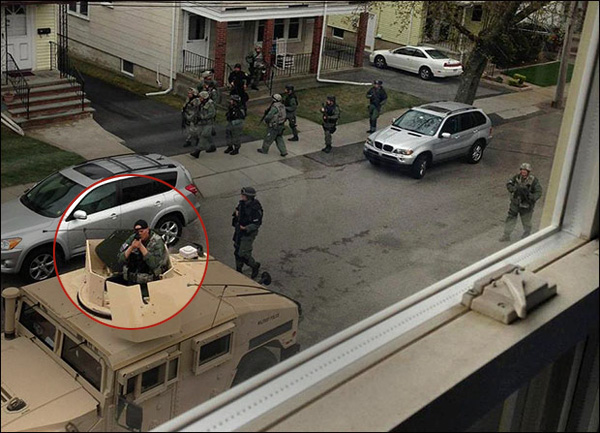
Meanwhile, the Boston marathon bombing proved that local police will now act completely outside of law and initiate Martial Law in a manhunt for a teenager. It wasn’t declared Martial Law, of course… it was called “shelter in place,” meaning you could not leave your homes. Once the lockdown was in place, Boston police went door to door, yanking citizens out of their homes at gunpoint, screaming at them to put their hands up or be shot on sight. This was all done completely without any warrant or any suspicion of wrongdoing on the part of homeowners.

It later turned out that the entire Boston marathon bombing was meticulously planned in advanced by the Boston police and was run as a “terror drill” to terrorize Boston and give the police some much-needed practice in running a police state oppression scenario. This is all 100% confirmed and openly admitted. Even the Boston Globe reported, on June 8th:

The scenario had been carefully planned: A terrorist group prepared to hurt vast numbers of people around Boston would leave backpacks filled with explosives at Faneuil Hall, the Seaport District, and in other towns, spreading waves of panic and fear. Detectives would have to catch the culprits. … But two months before the training exercise was to take place, the city was hit with a real terrorist attack executed in a frighteningly similar fashion.

Now, apparently, local law enforcement can simply utter the word “manhunt!” and completely ignore all citizens’ rights, the Bill of Rights, due process and state and federal law. Police have become rogue gangs with complete immunity from all crimes even while they are the ones committing crimes on a massive scale. They can pull you over for no crime whatsoever, stick their fingers inside your anus and call it a “roadside search” while using the same glove on you that they just used on somebody else’s anus. (True story. Click here for source.)

Police terrorize 20-year-old girl for buying bottled water and cookie dough

The latest example of the terror being dished out by local police operations is found in the story of Ann Downey, a young girl whose vehicle was assaulted by plain clothed “undercover” policewho she thought were trying to carjack her.

It is very important to listen to the audio of Ann’s 911 call begging for help as she and her friend were rushed by six men with guns:

It turns out Ann Downey was being terrorized by members of Virginia’s Department of Alcoholic Beverage Control (ABC), which apparently consists of trigger-happy police who are so bored out of their minds that they can think of nothing more useful to do than terrorize young women for buying cookie dough.

Imagine the scene: You’re getting into your car after buying some cookie dough, then suddenly six non-uniformed men rush your car and start screaming at you while wielding guns. At least one of the undercover officers drew his weapon, according to media reports.

Am I the only one here who might have pulled out my own gun and started shooting in self defense, believing my life to be in extreme danger by a rogue gang of armed criminals who were aggressively rushing my vehicle?

As far as I’m concerned, these ABC goons are lucky they didn’t get shot, and if they had been shot, it would be hard to argue that the woman wasn’t exercising her right to self defense in shooting them.

It’s important to note here that the driver of the vehicle, named Elizabeth Daly, was charged with three felonies. In a statement posted online, Daly said:

“This has been an extremely trying experience and one that has called into question what I value most: my integrity, honor and character. …Cookie dough and ice cream for a fundraiser should not put you through an extremely degrading night and afternoon in jail, appearing in court, posting bond, having to pay an attorney …not allowed to leave the state, causing you endless nights of no sleep, [a]ffecting your school work and final exams, wondering if you would be dismissed from school, wondering how this would damage your reputation and ability to get a job, all while waiting on pins and needles to see what the Commonwealth is going to offer you.”

See the interactive map of paramilitary police raids taking place across America

Here’s a map showing just some of the paramilitary police raids and attacks on American citizens:

To see the full map with interactive pop-ups, visit:

http://www.cato.org/raidmap

As you view the map above, keep in mind how widespread these events really are. Just last week in Nevada, a couple filed suit against local police there, claiming they were raided and shot with “pepperball rounds” by police that wanted to use their home as a stakeout location. For refusing this demand, the couple were shot at and then arrested for “obstructing justice.”

As the lawsuit reads:

[Police officers] conspired among themselves to force Anthony Mitchell out of his residence and to occupy his home for their own use. It was determined to move to [the home address] and attempt to contact Mitchell. If Mitchell answered the door he would be asked to leave. If he refused to leave he would be arrested for Obstructing a Police Officer. If Mitchell refused to answer the door, force entry would be made and Mitchell would be arrested.

Seconds later, officers, including Officer Rockwell, smashed open plaintiff Anthony Mitchell’s front door with a metal ram as plaintiff stood in his living room. As plaintiff Anthony Mitchell stood in shock, the officers aimed their weapons at Anthony Mitchell and shouted obscenities at him and ordered him to lie down on the floor. Officers, including Officer David Cawthorn, then fired multiple pepperball rounds at plaintiff as he lay defenseless on the floor of his living room. Anthony Mitchell was struck at least three times by shots fired from close range, injuring him and causing him severe pain. Officers then arrested him for obstructing a police officer, searched the house and moved furniture without his permission and set up a place in his home for a lookout.

This is America? Think again…

When do Americans stand up and say, “Enough!”

So here’s the question: At what point will Americans realize their country has become a Stasi-inspired police state tyranny? When will they march on their state capitols and demand to be treated with dignity and respect rather than being beaten, shot, arrested, intimidated and censored by police?

And I ask this question as a supporter of local law enforcement. I’ve worked with police, trained with police and volunteered with police. I know that most police officers across the country are honorable men and women who are trying their best to keep the peace. But the number of “good” police seems to be shrinking while the number of “rogue” cops is on the rise.

This highly disturbing trend is an intentional one put in place by the Obama administration that’s trying to militarize police all across the nation in a run-up to something very, very big: an event that is expected to cause nationwide rioting and social unrest.

Why else would DHS buy 2+ billion rounds of ammunition, bulletproof roadside checkpoint booths, armored assault vehicles and full-auto assault rifles? Why else would police be trained to shoot pregnant women, children and senior citizens on sight? Why else would the government be spying on every phone call, email and text of every U.S. citizen right now?

We are living under a nightmare Big Brother police state right now, and it’s not an accident. This has all been brought in for a specific purpose: to first acclimate the public to a police state presence (hence the TSA security pat-downs), and then to activate that police infrastructure to engage in the mass-arrest or mass-murder of Americans.

The American people are asleep at the wheel while tyranny encircles them

This will happen as long as Americans allow it to happen. Every day that the American people spend distracted by gay marriage, sports celebrities, TV programs and the Kardashians is another day that the criminal elite running this country build up their infrastructure of terror and oppression against the People.

While Americans are hypnotized into a state of delusional denial by CNN and the New York Times, the Obama administration is strangling freedom to death with a determined rollout of total surveillance, actual death squads that target journalists, the criminalization of whistleblowing, the targeting of reporters in the mainstream media, the intimidation of patriot groups by the IRS and a hundred other forms of oppression, intimidation and blackmail.

What we are witnessing here is a government gone completely criminal. This is a government that now openly kidnapped the President of Bolivia on the off chance that his airplane might have been carrying Ed Snowden. This is the government that openly admits to the existence of secret kill lists that target American citizens for assassination. This is the government that runs the world’s largest surveillance spy program which even spies on ally nations like Germany and France.

Trickle-down tyranny

The U.S. government abides by no law and respects no limits whatsoever to its power. It is a rogue, out-of-control criminal mafia that has taken over positions of government in order to grant itself the appearance of authority.

It is this mafia mentality that’s trickling down to local police departments in the form of aggressive tactical training, armored assault vehicles and even police uniforms which now look like something torn right out of a dystopian, Orwellian sci-fi flick depicting a dark future.

I coined the term “Trickle-Down Tyranny” in 2011. The phrase was later picked up by Michael Savage and became the title of his book by the same name.

Since 2011, Savage himself has become increasingly outspoken about the rise of tyrannical government, the oppression of freedom in America, and the dangerous tactics of intimidation and oppression being practiced by police nationwide.

Everyone can see what’s happening: America is turning into an occupied police state. Individual freedoms are bring crushed. All the rights guaranteed under the Bill of Rights are being systematically destroyed by design. The Obama administration is rapidly becoming the Orwellian dictator we all feared might one day rise up in America, yet half of America remains too far gone to open their eyes and realize what’s happening.

And so the injustices are allowed to accelerate to the point where innocent Americans are being routinely terrorized by law enforcement. While the guilty run free, the innocent are targeted for shakedowns, arrest or beatings.

This is the death of freedom in America. You are watching the destruction of the Land of the Free and the rise of Obama’s tyrannical regime.

If you and millions of others do not rise up against this, you may one day find yourself collapsed on your knees, looking over a large ditch of fresh bodies while a “police officer” holds a pistol to the back of your head and pulls the trigger.

You, like hundreds of millions before you, are about to become another statistical victim of government gone bad. Throughout history, rogue governments have murdered at least 260 million people. And it all began with precisely the same process we are seeing unfold in America today.

Rise up or be exterminated.

<!–

–>

This article was posted: Saturday, July 6, 2013 at 3:57 am

Tags:


<!– this is where we need to show the related articles

–>

Republished with permission from: Infowars

‘Sana’a explosion kills 3 policemen’

0

Three policemen were killed when a bomb hidden in a plastic bag exploded in the Yemeni capital Sanaâ„¢a, a security services official says.

The official added that the blast took place on Saturday after the explosive device which was planted close to a police checkpoint in the north of the capital went off as the policemen opened the bag to check its contents.

Two policemen were killed immediately by the blast which also injured two others. One of the wounded lost his life later.

No group has yet claimed responsibility for the attack. However, police have launched an investigation to find those behind the deadly assault.

In July 2012, a large bomb explosion targeting a police academy in Sanaâ„¢a left least 25 people dead. Many others were also injured in the bombing at the entrance to the police academy.

In May 2012, at least 100 Yemeni troops were killed and more than 300 others injured after a bomb attack was carried out during a parade rehearsal in the capital.

Saturdayâ„¢s explosion came after a period of calm in Sanaâ„¢a. The Arabian Peninsula countryâ„¢s politicians are currently participating in a national dialogue which seeks to lay the ground for a new constitution and planned February 2014 general elections.

MR/HN

Republished with permission from: Press TV

Exclusive Preview of Interviews from Obama Deception 2

0

Infowars.com
July 6, 2013

An exclusive preview of interviews from the upcoming Obama Deception 2 Film. Interviews include Sheriff Richard Mack,Joel Skousen, and Pastor Chuck Baldwin.

<!–

–>

This article was posted: Saturday, July 6, 2013 at 3:56 am

Tags: ,


<!– this is where we need to show the related articles

–>

Republished with permission from: Infowars

‘Egypt clashes kill 30, injure 1,138’

0

[unable to retrieve full-text content]Egypt’s Ambulance Authority head says the clashes in the North African country have killed 30 people and injured 1,138 others.

Republished with permission from: Press TV

Venezuela offers asylum to U.S. fugitive Snowden

0

Daniel Wallis and Deisy Buitrago
Reuters
July 6, 2013

Venezuela’s President Nicolas Maduro offered asylum to former U.S. intelligence contractor Edward Snowden on Friday in defiance of Washington, which is demanding his arrest for divulging details of secret U.S. spy programs.

Snowden, 30, is believed to be holed up in the transit area of Moscow’s Sheremetyevo international airport and has been trying to find a country that would take him since he landed from Hong Kong on June 23.

“In the name of America’s dignity … I have decided to offer humanitarian asylum to Edward Snowden,” Maduro told a military parade marking Venezuela’s independence day.

“He is a young man who has told the truth, in the spirit of rebellion, about the United States spying on the whole world.”

Full article here

<!–

–>

This article was posted: Saturday, July 6, 2013 at 3:55 am

Tags:


<!– this is where we need to show the related articles

–>

Republished with permission from: Infowars

Is It “Anti-Faith” To Prepare For The Coming Economic Collapse?

0

Michael Snyder
Economic Collapse
July 6, 2013

Does being a prepper show a lack of faith in God? Should good Christians reject prepping altogether? Yesterday, someone actually accused me of being “anti-faith” because I am encouraging people to prepare for the coming economic collapse. This person believes that if I had faith, then I would make “no provision” for what is ahead and simply trust “in God’s providence alone”. So is that person right? Is it really “anti-faith” to prepare for the coming economic collapse? I spent quite a bit of time thinking about these questions today.

Those that visit my site on a regular basis know that I am a Christian and I am very open about that fact. I am someone that places a very high value on faith. The Scriptures tell us to “trust in the Lord with all your heart and lean not on your own understanding”. Without God, none of us has any hope. In fact, without God I would probably be dead by now.

But faith is not about sitting on your couch and waiting for God to do everything for you. Rather, faith is about taking action on what God has directed you to do.

What I don’t understand is why any of these Christians that are 100% against prepping continue to go to work. If we are to make “no provision” for ourselves and simply trust “in God’s providence alone”, then why do they need to earn a paycheck? Why can’t they just sit home and wait for God to fill up their bank accounts?

Yes, God can do mind blowing supernatural things that require absolutely no participation on our part. I know, because it has happened to me. But the vast majority of the time, God works with us. He requires us to take steps of faith and obedience, and in the process He leads us, He guides us, He blesses us and He opens doors for us.

The story of Noah is a perfect example of this. He was perhaps the very first “prepper”. God could have kept Noah and his family safe from the flood by transporting them to some sort of very comfortable “heavenly waiting area” and brought them back when everything was dry, but He didn’t do that. Instead, God warned Noah about what was coming and ordered him to build a boat.

So did Noah just sit back and wait for God to do everything for Him? No, he exercised his faith by taking action. He believed the warning and he built a giant boat. In Hebrews 11:7, Noah is commended for his radical faith which produced radical action…

By faith Noah, when warned about things not yet seen, in holy fear built an ark to save his family. By his faith he condemned the world and became heir of the righteousness that is in keeping with faith.

Faith almost always involves action. God wants to see if we are going to believe Him and do what He has instructed us to do.

And the amount of faith that Noah exhibited was staggering. The boat that he and his family built was approximately the size of a World War II aircraft carrier. It took a very, very long time to build that boat and collect all of the food and supplies for his family and for all of the animals.

And surely Noah must have gotten very tired of all of the mocking as he warned everyone else about what was coming for decades.

But in the end, Noah’s prepping paid off. He and his family were saved, and everyone else drowned.

Unfortunately, there are lots of Christians out there today that are 100% against preparing for what is ahead, even though they will admit that an economic collapse is coming.

The individual that accused me of being “anti-faith” is an example of this. The following is an excerpt from the message that this person wrote to me…

Now, although I agree with you about the things you write about the corruption of the financial system, and that there will be a collapse, yet I do not agree with you in promoting people to be self-sufficient contrary to the Lord’s teaching. If you truly have God then no provision needs to be made at all for yourself, just trust in God’s providence alone.

This individual agrees that a collapse is coming, but insists that we should do absolutely nothing to prepare for it.

Is that really what God would have us do?

In Genesis 41, God revealed to Joseph that there would be seven good years followed by seven lean years. So did Joseph party for seven years and “trust in God’s providence alone” for the lean years?

No, Joseph engaged in an “emergency food storage project” unlike anything that the world had ever seen up until that point. By heeding God’s warning and taking action, he ended up saving the nation of Egypt and his entire family.

Some people believe that preparing for hard times means that you are “fearful”, but I don’t see it that way at all.

Rather, I believe that there is hope in understanding what is happening and that there is hope in getting prepared.

The people that stick their heads in the sand right now are going to get blindsided by what is coming. Many of them will totally give in to despair when they realize that they have lost everything.

I think that we would all benefit greatly by taking advantage of the wisdom found in Proverbs 6:6-11…

Go to the ant, you sluggard; consider its ways and be wise! It has no commander, no overseer or ruler, yet it stores its provisions in summer and gathers its food at harvest.

How long will you lie there, you sluggard? When will you get up from your sleep? A little sleep, a little slumber, a little folding of the hands to rest– and poverty will come on you like a thief and scarcity like an armed man.

You don’t prepare when the storm hits. Rather, you prepare while the storm is still off in the distance.

Throughout the Scriptures, those that “prepare” are commended.

For example, just check out the following parable of Jesus that we find inMatthew 25…

“At that time the kingdom of heaven will be like ten virgins who took their lamps and went out to meet the bridegroom. Five of them were foolish and five were wise. The foolish ones took their lamps but did not take any oil with them. The wise ones, however, took oil in jars along with their lamps. The bridegroom was a long time in coming, and they all became drowsy and fell asleep.

“At midnight the cry rang out: ‘Here’s the bridegroom! Come out to meet him!’

“Then all the virgins woke up and trimmed their lamps. 8 The foolish ones said to the wise, ‘Give us some of your oil; our lamps are going out.’

“‘No,’ they replied, ‘there may not be enough for both us and you. Instead, go to those who sell oil and buy some for yourselves.’

“But while they were on their way to buy the oil, the bridegroom arrived. The virgins who were ready went in with him to the wedding banquet. And the door was shut.

“Later the others also came. ‘Lord, Lord,’ they said, ‘open the door for us!’

“But he replied, ‘Truly I tell you, I don’t know you.’

“Therefore keep watch, because you do not know the day or the hour.

Do we want to be like the wise virgins or the foolish virgins?

Yes, we never want to become obsessed with material things. We need to keep our priorities in order and focus on the things that are really important.

But that doesn’t mean that we can all just sit on our couches, eat chips, and wait for God to do everything for us.

In my opinion, we have been warned about the coming economic collapse in a multitude of different ways. At this point, what is coming should be glaringly obvious to anyone with half a brain.

On my site, I have shared thousands upon thousands of facts and statistics that show that a horrific economic collapse is coming. If you are new to all of this, the following are just a couple of articles that can get you started…

-”40 Statistics About The Fall Of The U.S. Economy That Are Almost Too Crazy To Believe”

-”Show This To Anyone That Believes That Things Are Getting Better In America”

I am trying to do my best to warn people about what is coming from my little spot on the wall. In the Scriptures, those that are aware that a threat is coming are responsible for warning others about it. The following is a short excerpt from Ezekiel 33…

Son of man, speak to your people and say to them: ‘When I bring the sword against a land, and the people of the land choose one of their men and make him their watchman, and he sees the sword coming against the land and blows the trumpet to warn the people, then if anyone hears the trumpet but does not heed the warning and the sword comes and takes their life, their blood will be on their own head. Since they heard the sound of the trumpet but did not heed the warning, their blood will be on their own head. If they had heeded the warning, they would have saved themselves. But if the watchman sees the sword coming and does not blow the trumpet to warn the people and the sword comes and takes someone’s life, that person’s life will be taken because of their sin, but I will hold the watchman accountable for their blood.’

Are you a watchman on the wall?

Are you blowing your trumpet?

That is one of the reasons why I work so hard on my articles. I hope that people will use them as a tool to help warn others about what is coming.

My goal is never to create fear. Rather, my goal is to wake people up and give them hope.

Yes, very, very painful economic times are coming.

Those that heed the warnings and diligently prepare will have a good chance of weathering the coming storm.

I honestly don’t know what those that have made absolutely no preparations are going to do.

<!–

–>

This article was posted: Saturday, July 6, 2013 at 3:54 am

Tags:


<!– this is where we need to show the related articles

–>

Republished with permission from: Infowars

Busan Filmfest to screen ‘Painting Pool’

0

Iranian filmmakerâ„¢s Maziar Miriâ„¢s latest film The Painting Pool has been selected to go on the screen at the 18th Busan International Film Festival.

The movie is scheduled to be presented at Å“A Window on Asian Cinema” section of the most prestigious film event in South Korea, Busan film festival.

The section is dedicated to the new or the most-talked-about films created by the talented Asian filmmakers.

The movie took Best Film Award by Audiences and Best Set Design Award at the 31th Fajr Film Festival in Iran.

Felicity Land, The Book of Law, The Reward of Silence, Gradually, and The Unfinished Song are among Miriâ„¢s better-known works.

Founded in 1996, Busan film festival is one of the most significant film festivals in Asia.

The 18th Busan International Film Festival is programmed to take place from October 3 to 12, 2013.

FGP/FGP

Republished with permission from: Press TV

Iran v-ballers score win against Cuba

0

Members of the Iranian national menâ„¢s volleyball team pose for a photo after they score a 3-2 superb win against Cuba in the 2013 FIVB World League in Havana on July 6, 2013.

The Iranian national menâ„¢s volleyball team have achieved a superb win against their Pool B rivals Cuba as part of their heroics in the 2013 FIVB World League in a thrilling five-set match in the Cuban capital city of Havana.

Iranian sportsmen outclassed their opponents 3-2 (26-24, 25-19, 25-19, 25-22, 16-14) in an extraordinary game in Havana early Saturday.

The Iranian team started the match disappointingly as they lost the first and second sets 26-24 and 25-19 and seemed unable to maintain the great performance which had earned them 7 points in their previous four matches against Serbia and European powerhouse, Italy.

The Iranian squad, however, came back strong with far fewer mistakes to first take the third 25-19 and win the fourth 25-22 to even the match 2-2 and force a 5th set which again ended in Iran’s favor 16-14.

The Iranian volleyball players finally succeeded in achieving 2 points in the standings behind Serbia with Cuba at the bottom.

In the Pool Bâ„¢s other match-ups, Russia beat Germany 3-2 and Italy will play Serbia.

On June 30, Italy defeated Iran 3-2 in a difficult five-set match in Sassari, the second-largest city of Sardinia Island, after Iran registered its second victory of the tourney by beating Italy 3-1 in the northern Italian city of Modena.

On June 23, Iranian volleyball players gained their first victory in the 2013 FIVB World League against Serbia.

The Iranian national volleyball squad defeated Serbia 3-2 (25-20, 24-26, 23-25, 25-22, 15-12) in a home match at Azadi Sports Complex in western Tehran.

SF/NN

Republished with permission from: Press TV

‘Syria army troops advancing in Homs’

0

Syrian troops are seen in the city of Homs. (File photo)

Syrian army troops are advancing in the militant-infested parts of the western city of Homs, Syrian state media say.

Reports said on Saturday that army soldiers took control of several buildings in the district of Khaldiyeh.

Units of army also inflicted heavy losses on the foreign-backed militants in the several parts of the strategic city and killed dozens of them in the operation.

The Syrian army forces have also restored security in industrial area of Qaboun near the capital Damascus, killing a number of militant there.

The Syrian army has conducted successful operations against the foreign-backed Takfiri militants over the past weeks.

The army established control over the strategically important town of Qusayr, near the Lebanese border, in early June.

Foreign-sponsored militancy has taken its toll on the lives of many people, including large numbers of Syrian soldiers and security personnel, since March 2011.

In an interview with Syrian daily Al-Thawraon published on July 4, President Assad said the opposition and their foreign supporters have Å“exhausted all their tools” in a conspiracy against Syria.

DB/HN

Republished with permission from: Press TV

EP: Ban on Morales plane unacceptable

0

European Parliament President Martin Schulz has described as Å“ridiculous and unacceptable” the measure by certain EU countries to ban Bolivian President Evo Moralesâ„¢s plane to fly over their air space.

Schulz made the remarks in the opening ceremony of a New Economy European Forum in the presence of Spain’s former Prime Minister Felipe Gonzalez in the capital Madrid on Friday.

On July 2, France, Spain, Portugal and Italy refused to allow Morales’ plane, which was flying from Moscow back to Bolivia, to cross their airspace due to false rumors that US surveillance whistleblower Edward Snowden was on board.

Bolivian Foreign Minister David Choquehuanca said after the incident that Morales’ life had been put in danger by the forced emergency landing in Austria.

Schulz further said that the European countries refused to allow Moralesâ„¢s plane to fly through their airspace at the request of the United States.

The European countries must respect the international law, he warned.

The Bolivian president was in Moscow to attend a meeting of natural gas-producing nations.

Bolivia is one of the countries to which Snowden has applied for asylum.

Snowden is currently in a transit zone at Domodedovo International Airport in Moscow, after the United States revoked his passport to prevent him from travelling further.

He has already sought asylum in 20 countries, namely China, India, Cuba, Brazil, Bolivia, Venezuela, Ecuador, Italy, Ireland, the Netherlands, Norway, Poland, Russia, Spain, Switzerland, Austria, Finland, France, Germany and Iceland.

Washington has asked these countries not to provide asylum to Snowden.

However, during a Friday speech commemorating the anniversary of the Bolivarian Republicâ„¢s independence, Venezuelan President Nicolas Maduro offered to grant Å“humanitarian asylum” to Snowden.

The US has revoked Snowdenâ„¢s passport, with State Department spokesperson Jen Psaki saying the whistleblower Å“should not be allowed to proceed in any further international travel, other than is necessary to return him to the US.”

Snowden revealed two top secret US government spying programs, under which the National Security Agency (NSA) and the Federal Bureau of Investigation (FBI) have been spying on a global scale.

The NSA scandal took even broader dimensions when Snowden revealed information about US espionage activities targeting countries friendly to the US.

YH/HN

Republished with permission from: Press TV

SNC fails again in electing new leader

0

The members of the so-called Syrian National Coalition (SNC) are seen during a meeting in Istanbul on May 23.

The divided foreign-backed Syrian opposition has failed to elect a new leader during its latest meeting in the Turkish city of Istanbul.

Both top candidates — Ahmad Jarba, a tribal figure linked with Saudi Arabia, and Mustafa al-Sabbagh, a businessman who is Qatar’s point man, were not able to gain half of the 115 votes of the members of the so-called Syrian National Coalition (SNC) early on Saturday.

Another meeting was scheduled for later on Saturday as the SNC is split into three power centers including Å“the Muslim Brotherhood, the Sabbagh faction, and a Saudi-backed bloc that includes Jarba,” according to Reuters.

The foreign-backed opposition has been without a leader for months.

The meeting, which kicked off on Thursday, is the second of its kind by the troubled opposition group over the past two months to unite.

George Sabra became acting president of the SNC in April 2013, shortly after Moaz al-Khatib resigned as the group’s leader.

According to reports, the militants are already in possession of anti-tank missiles provided by Saudi Arabia.

On June 14, US President Barack Obama ordered his administration to provide the militants with weapons.

The unrest in Syria erupted in March 2011, and many people, including large numbers of Syrian soldiers and security personnel, have been killed so far.

The Syrian army has conducted successful operations against the foreign-backed Takfiri militants over the past weeks.

The army established control over the strategically important town of Qusayr, near the Lebanese border, in early June. Syrian troops were backed by forces from the Lebanese resistance movement of Hezbollah during the Qusayr operation.

In May, Syrian President Bashar al-Assad said militants from 29 different countries are fighting against the government in different parts of the country.

DB/HN

Republished with permission from: Press TV

China, Switzerland ink FTA

0

China and Switzerland signed a free trade agreement, on July 6, 2013.

China and Switzerland have inked a free trade agreement (FTA), marking the Asian giantâ„¢s first such pact with a continental European economy.

On Saturday, Chinese Commerce Minister Gao Hucheng and Swiss Economy Minister Johann Schneider-Ammann signed the agreement at the Commerce Ministry in Beijing.

The countries reached the agreement after more than two years of negotiations. It aims to increase the $26.3 billion in bilateral trade they recorded in 2012.

“This free trade agreement has an important significance for the relationship between the two countries,” said Schneider-Ammann after signing the deal.

“It’s absolutely important that the bigger economies find ways to keep open their markets because (the) more open the global market… the better the chances to do business,” he said.

He added, Å“We get a chance to spread out the risk of the Swiss economy a little bit over the borders of our European neighborhood.”

Switzerland and China had sealed the framework of the agreement in May when China’s Prime Minister Li Keqiang paid a visit to the landlocked European nation.

The deal still needs to be approved by the Swiss parliament before it can take effect.

According to the World Bank, China is the world’s second-biggest economy. Switzerland also ranked as the world’s 19th-largest economy in 2012.

After the European Union and the US, China is Switzerland’s third-biggest trading partner.

Bilateral trade between China and Switzerland mainly includes imports and exports of watches, medicines, textiles, and dairy products.

IA/HN

Republished with permission from: Press TV

Syria army forces advance in Homs

0

[unable to retrieve full-text content]Syrian army troops are advancing in the militant-infested parts of the western city of Homs, Syrian state media say.

Republished with permission from: Press TV

New Pornographers Claim Their Work Is Ethical, Feminist and 'Sex-Positive,' But Will It Sell?

0

July 4, 2013
 |

Like this article?

Join our email list:

Stay up to date with the latest headlines via email.

The 8th annual Feminist Porn Awards, held in Toronto, April 4 to 6, were organized by Good for Her, a Toronto-based, women-orientated, sex paraphernalia store. Some 110 programs were submitted for such categories as Golden Beaver (Canadian content) and Smutty Schoolteacher (sex-ed).

When Carlyle Jansen started Good For Her in 1997, there were a very limited number of porn videos that appealed to her customers. “There was a narrow selection of videos, in particular those highlighting people of color, gays and lesbians, transsexuals and women with a variety of body types and desires,” she recalls.

The Feminist Porn Awards (FPA) grew out of discussions among the company’s employees to host an event that would acknowledge and celebrate diverse ways to sexually represent people, particularly women. Jansen noted that her customers wanted porn they could identify with. “They wanted movies, high-quality productions,” she said, “that did not feel degrading, were not misogynistic and turned them on rather than off.”

The FPA was launched in 2006 and has grown ever since; it’s now a two-night event that includes a separate, more academic conference organized by activist and educator Tristan Taormino.

Jansen readily acknowledges that much of conventional porn is degrading toward women and that sex trafficking can happen in the industry, but she believes sweeping generalizations about the industry are unfounded. With feminist porn, which she says is a “small but growing market,” she notes that “women with larger bodies are not fetishized and people of color are not stereotyped.”

“The growth is due, in part, to the drop in the cost of production,” she says. High-performance cameras are more affordable, editing systems are cheaper and easier to use and online distribution is a game changer.”

She believes that feminist porn has an often-unacknowledged aspect: education. She notes that feminist porn shows viewers how to enhance their lovemaking, how to communicate in the moment and “how to put on a condom without breaking the flow.”

Jansen says that feminist porn is based on three key factors: choice, diversity and respect. “Choice,” she argues, “is about personal preference, which safe-sex practices are used, with whom they want to perform, and sometimes even the food on the set.”

“Diversity,” she points out, “is an acknowledgment that every female actor is not a skinny white woman and male actors are not only guys with rock-hard penises. It also expands the types of desires and expressions on film beyond the stereotypes.”

And respect, she adds, “includes how performers are paid, treated and performing what turns them on.” Together, these factors help define and illustrate an actor’s consent.

The feature-length and short-subject works shown during the Feminist Porn Awards illustrated the creative range of feminist porn. For example, April Flores’ World features Flores, a plus-size Latina porn star. Krutch stars Mia Gimp, a disabled performer.

One of the big winners at the FPA is Juicy Pink Box, a “feminist” porn company specializing in lesbian erotica.” It won awards in 2011 for Taxi and 2012 for Boutique for “best lesbian series.”

The company was founded and is run by Jincey Lumpkin, its “chief sex officer.” Lumpkin came to feminism and porn late. “I grew up in Georgia,” she says, “and was raised thinking feminists were man haters.” “I always wonder why there was a sexual double-standard,” she recalls. “Later I realized that feminism is about equality.” “Male-initiated sex was acceptable; guys were just being guys,” she argues. “But women who were sexual, who initiated, were dubbed ‘sluts.’ Why?”

Lumpkin started her company five years ago in order to, she says, “undo generations of anti-sex media, especially about women.”

Republished with permission from: AlterNet

Why Brazilians Are Sick of Corrupt Politicians: And Signs That Their Government is Actually Listening

0

Brazilian protesters in Porto Alegre.
Photo Credit: Ricardo Araújo/Flickr

July 5, 2013
 |

Like this article?

Join our email list:

Stay up to date with the latest headlines via email.

What does it take to drive a million people to the streets in over 100 cities? On a short visit to Brazil, I had a chance to ask citizens that question.

The protests, which have swept the country over the last three weeks, were initially sparked in Sao Paulo by a plan to raise busfares. But that was just the straw that broke the camel’s back. Anger about unemployment, inflation, ridiculously crappy public services, billions spent on an upcoming World Cup tournament, and rampant political corruption have boiled over in a country that has been hailed as one of the world’s great emerging economic powerhouses.

Heavyweight Champions of Corruption

Since the protests began, a new poll shows that the government’s approval rating has tanked by almost half, to 30 percent, the lowest point in two decades. Brazilian President Dilma Rousseff, who leapt onto the national stage by winning the presidency in 2010 as the candidate of the Workers’ Party (PT), has been charged with tackling corruption and pressing social and economic issues facing the country. But since Rousseff’s election, the PT has been rocked by scandal and the president has had a difficult time stemming a growing tide of public discontent. Her ratings were on the wane even before the protests.

In contrast to the response of the Obama administration and New York’s billionaire mayor to the Occupy protests, which ranged from indifference to brutal suppression, Rousseff has actually listened to the protestors who were battered by the rubber bullets of the military police and has even asked Congress to hold a non-binding national vote to find out what changes Brazilians would like to see happen. Her chances of re-election, which are still high, will be impacted by how she is able to respond to the current unrest.

Brazilians trust the presidency more than the Congress, but that’s not saying a whole lot. To understand why Brazilians look upon the government as a kind of malignant tumor, you have to know a little history.

When it comes to corruption, Brazil’s politicians are heavyweight champions, making our guys–if you can believe it’s possible–look like rank amateurs (see this eye-popping report in the New York Times). The legacy of no-holds-barred vice and violence goes back to the 1960s, when Senator Arnon de Mello calmly shot a colleague dead on the Senate floor. The killing was considered an accident, and de Mello escaped punishment. After all, he was aiming at another senator.

So how bad is the current crop of politicians sitting in Brazil’s Congress? Answer: off-the-charts bad. There was the guy accused of using slave labor on his cattle ranch back home. Then there’s the one who allegedly likes to have enemies offed with chainsaws and vats of acids. One member of Congress decided to buy votes from poor women in his district by offering free sterilization. Drug trafficking, money laundering, kidnapping – you name it, Brazilian politicians have done it in spades. The problem is that members of Congress enjoy protection from prosecution, and they almost never go to jail. They’re kind of like bankers that way, and possibly even more despised.

The entrenched power brokers in Congress are pretty much deaf to the cries of protesters, and the heads of Brazil’s individual states have far more power than, say, American state governors, so they can block the will of the president. Rousseff may push for reform, but she faces plenty of obstacles to achieving anything significant.

But the protesters in Brazil are not without hope. In asking how the Brazilian protests compared to those in other countries, one person I spoke to offered that in his view, America’s Occupy movement was about hopelessness–the resignation felt by people whose political and economics systems were unresponsive to their needs. He contrasted this with a more optimistic feeling among protesters in Brazil: many believe that changes may actually be possible within the existing system. I also heard Brazil’s situation contrasted with protests in other South American countries, like Chile. Chile’s protests, in which people took to the street for four or five years, also started over busfare, but the reaction of Chilean politicians was much more indifferent than Brazil’s.

Republished with permission from: AlterNet

Chomsky: How Do We Defend Ourselves from the Corporate and Imperial Forces That Threaten Our Existence?

0

July 5, 2013
 |

Like this article?

Join our email list:

Stay up to date with the latest headlines via email.

With wrenching tragedies only a few miles away, and still worse catastrophes perhaps not far removed, it may seem wrong, perhaps even cruel, to shift attention to other prospects that, although abstract and uncertain, might offer a path to a better world – and not in the remote future.

I’ve visited Lebanon several times and witnessed moments of great hope, and of despair, that were tinged with the Lebanese people’s remarkable determination to overcome and to move forward.

The first time I visited – if that’s the right word – was exactly 60 years ago, almost to the day. My wife and I were hiking in Israel’s northern Galilee one evening, when a jeep drove by on a road near us and someone called out that we should turn back: We were in the wrong country. We had inadvertently crossed the border, then unmarked – now, I suppose, bristling with armaments.

A minor event, but it forcefully brought home a lesson: The legitimacy of borders – of states, for that matter – is at best conditional and temporary.

Almost all borders have been imposed and maintained by violence, and are quite arbitrary. The Lebanon-Israel border was established a century ago by the Sykes-Picot Agreement, dividing up the former Ottoman Empire in the interests of British and French imperial power, with no concern for the people who happened to live there, or even for the terrain. The border makes no sense, which is why it was so easy to cross unwittingly.

Surveying the terrible conflicts in the world, it’s clear that almost all are the residue of imperial crimes and the borders that the great powers drew in their own interests.

Pashtuns, for example, have never accepted the legitimacy of the Durand Line, drawn by Britain to separate Pakistan from Afghanistan; nor has any Afghan government ever accepted it. It is in the interests of today’s imperial powers that Pashtuns crossing the Durand Line are labeled “terrorists” so that their homes may be subjected to murderous attack by U.S. drones and special operations forces.

Few borders in the world are so heavily guarded by sophisticated technology, and so subject to impassioned rhetoric, as the one that separates Mexico from the United States, two countries with amicable diplomatic relations.

That border was established by U.S. aggression during the 19th century. But it was kept fairly open until 1994, when President Bill Clinton initiated Operation Gatekeeper, militarizing it.

Before then, people had regularly crossed it to see relatives and friends. It’s likely that Operation Gatekeeper was motivated by another event that year: the imposition of the North American Free Trade Agreement, which is a misnomer because of the words “free trade.”

Doubtless the Clinton administration understood that Mexican farmers, however efficient they might be, couldn’t compete with highly subsidized U.S. agribusiness, and that Mexican businesses couldn’t compete with U.S. multinationals, which under NAFTA rules must receive special privileges like “national treatment” in Mexico. Such measures would almost inevitably lead to a flood of immigrants across the border.

Some borders are eroding along with the cruel hatreds and conflicts they symbolize and inspire. The most dramatic case is Europe. For centuries, Europe was the most savage region in the world, torn by hideous and destructive wars. Europe developed the technology and the culture of war that enabled it to conquer the world. After a final burst of indescribable savagery, the mutual destruction ceased at the end of World War II.

Scholars attribute that outcome to the thesis of democratic peace – that one democracy hesitates to war against another. But Europeans may also have understood that they had developed such capacities for destruction that the next time they played their favorite game, it would be the last.

The closer integration that has developed since then is not without serious problems, but it is a vast improvement over what came before.

A similar outcome would hardly be unprecedented for the Middle East, which until recently was essentially borderless. And the borders are eroding, though in awful ways.

Syria’s seemingly inexorable plunge to suicide is tearing the country apart. Veteran Middle East correspondent Patrick Cockburn, now working for The Independent, predicts that the conflagration and its regional impact may lead to the end of the Sykes-Picot regime.

The Syrian civil war has reignited the Sunni-Shiite conflict that was one of the most terrible consequences of the U.S.-U.K. invasion of Iraq 10 years ago.

The Kurdish regions of Iraq and now Syria are moving toward autonomy and linkages. Many analysts now predict that a Kurdish state may be established before a Palestinian state is.

If Palestine ever gains independence in something like the terms of the overwhelming international consensus, its borders with Israel will likely erode through normal commercial and cultural interchange, as has happened in the past during periods of relative calm.

That development could be a step toward closer regional integration, and perhaps the slow disappearance of the artificial border dividing the Galilee between Israel and Lebanon, so that hikers and others could pass freely where my wife and I crossed 60 years ago.

Such a development seems to me to offer the only realistic hope for some resolution of the plight of Palestinian refugees, now only one of the refugee disasters tormenting the region since the invasion of Iraq and Syria’s descent into hell.

The blurring of borders and these challenges to the legitimacy of states bring to the fore serious questions about who owns the Earth. Who owns the global atmosphere being polluted by the heat-trapping gases that have just passed an especially perilous threshold, as we learned in May?

Or to adopt the phrase used by indigenous people throughout much of the world, Who will defend the Earth? Who will uphold the rights of nature? Who will adopt the role of steward of the commons, our collective possession?

That the Earth now desperately needs defense from impending environmental catastrophe is surely obvious to any rational and literate person. The different reactions to the crisis are a most remarkable feature of current history.

At the forefront of the defense of nature are those often called “primitive”: members of indigenous and tribal groups, like the First Nations in Canada or the Aborigines in Australia – the remnants of peoples who have survived the imperial onslaught. At the forefront of the assault on nature are those who call themselves the most advanced and civilized: the richest and most powerful nations.

The struggle to defend the commons takes many forms. In microcosm, it is taking place right now in Turkey’s Taksim Square, where brave men and women are protecting one of the last remnants of the commons of Istanbul from the wrecking ball of commercialization and gentrification and autocratic rule that is destroying this ancient treasure.

The defenders of Taksim Square are at the forefront of a worldwide struggle to preserve the global commons from the ravages of that same wrecking ball – a struggle in which we must all take part, with dedication and resolve, if there is to be any hope for decent human survival in a world that has no borders. It is our common possession, to defend or to destroy.

© 2013 Noam Chomsky — Distributed by The New York Times Syndicate

Noam Chomsky is a professor of linguistics and philosophy at MIT.

Republished with permission from: AlterNet

American Intellectuals' Widespread Failure to Stand Up to Billionaires and Authoritarian Power

0

July 5, 2013
 |

Like this article?

Join our email list:

Stay up to date with the latest headlines via email.

This article is an excerpt from Robert Jensen’s new book, We Are All Apocalyptic Now: On the Responsibilities of Teaching, Preaching, Reporting, Writing, and Speaking Out, available in print and on Kindle.

Given the considerable resources in the United States spent to subsidize intellectual work, why are so many intellectuals–journalists, academics, writers–not critiquing the many hierarchical institutions and not highlighting the disastrous consequences of these systems? Why are so many intellectuals instead providing support for the institutions and systems? Why is the majority of intellectual work in the United States not challenging but instead helping to prop up the unjust distribution of wealth and power, and the unsustainable extractive/industrial system?

Both intellectuals and the people who provide the resources that allow intellectuals to work should ponder this crucial question.

I am not suggesting that to be a responsible intellectual one must agree with me on all these issues, that anyone who does not agree with my approach to these issues is a soulless sell-out. My argument is that if we take seriously the basic moral principles at the core of modern philosophical and theological systems we claim to believe in, in light of the data on social injustice and the serious threats to ecological sustainability, these questions should be central in the work of intellectuals. Based on my experience as a journalist, professor, and political activist–a life in which I have always worked in intellectual professions and interacted with many other intellectuals in various settings–I have learned that the story is complicated but that a sharp critique of intellectuals as a social formation is warranted.

First, let’s recognize that intellectual work generally comes with considerable privilege. That does not mean that intellectuals don’t work hard, make sacrifices, or feel stress. But in general, intellectuals are compensated well for work that is not physically hazardous and can be rewarding on many levels. There are many intellectuals-in-training (graduate students) and underemployed intellectuals (adjunct faculty) who face overwhelming workloads and few perks, and so we should be cautious about generalizing too much about the category of “intellectual.” This analysis focuses on those doing intellectual work with the most privilege and the most autonomy.

Ideally, we pay intellectuals to help us deepen our understanding of how the world works, toward the goal of shaping a world more consistent with our moral and political principles, and our collective self-interest. What are the forces that keep people, especially relatively privileged people, mute in the face of such a clear need for critical intellectual work? The first, and easiest, answer is individual self-interest–the status and economic rewards that come to intellectuals who serve power. Upton Sinclair put it most succinctly: “It is difficult to get a man to understand something, when his salary depends upon his not understanding it.”

No doubt some intellectuals make calculations about how to use their abilities to enrich themselves, but in my experience such crass greed is relatively rare. I suspect that a desire to be accepted by peers is at least as powerful a motivation for intellectuals to accept the status quo. Humans are social animals who generally seek a safe and secure place in a social group, and there’s no reason intellectuals would be different. Even when concentrated wealth and power do not threaten people with serious punishments, the desire to be a well-regarded member of an intellectual community is a powerful conformity-inducer. When one’s professional cohort works within the worldview that the wealthy and powerful construct, the boundaries of that world seem appropriate. Curiosity about what lies beyond those boundaries tends to atrophy.

Republished with permission from: AlterNet

Why It Takes Organized Resistance To Bring in the Sweeping Change That the Public Wants

0

July 5, 2013
 |

Like this article?

Join our email list:

Stay up to date with the latest headlines via email.

Organized Resistance Brings Sweeping Change: Lessons for the US

By Kevin Zeese and Margaret Flowers

It has been an incredible week of protest leading to change.  The power of the people has been on display and there are lots of lessons we can learn from how the people have wielded that power.

The big story of the week was Egypt.  Protests organized by Tamarod (Rebel) that have been building for months, resulted in the biggest protest in Egypt’s history, four days of mass protest beginning on June 30 that ended the rule of President Mohamed Morsi.  More than a week ago, Tamarod recommended that the head of the Egyptian Constitutional Court become the interim president and that is what was announced by the Egyptian military.  The military made the announcement after lengthy meetings with religious groups, including minority religions; opposing political parties, including a Muslim party; and civil society including Tamarod.  All of these groups spoke at the press conference announcing the transition. The theme that threaded itself through the comments was that all factions in Egypt, including the Muslim Brotherhood, should be included, and that the revolution which began in January 2011 was beginning anew.

While people cheered the military facilitating the transition, they are well aware of the risk of military rule and already are opposing it.  Signs could be seen that opposed the military being in charge along with protesting the rule of Morsi. People remember the harsh military rule that occurred after the fall of Mubarak, but also remember — and remind the military — that the people went into the streets and forced the military to hold elections.  Already, there is a site with a countdown and checklist from the transition government to an elected government.  A lot remains to unfold but so far the military does not seem to be dominating the transition. The whole world is watching — especially the tens of millions of Egyptians who helped to end the rule of Morsi.  Many commentators are making the point that if the military is going to have any legitimacy it needs the support of the people.

An interesting note from Egypt is that in the January 2011 revolt, Egypt followed Tunisia into the Arab Spring.  This time, we may see Tunisia follow Egypt in challenging religious rule as Tamarod has now been organized in Tunisia and is following a similar tactical path as was followed in Egypt.

It was not only in Egypt where the organized resistance of the people won, in Brazil they are winning as well.  After three weeks of protest in Brazil, President Dilma Rousseff conceded many of the demonstrators’ demands, and called for a national compromise to improve public services, by investing 100% of Brazil Oil revenues in education and health care (the legislature agreed to 75%). In addition, there is support for more participatory democracy so the people have more say in the direction of the country. People continue to be in the street demanding that change continue, changes be increased and that they occur quickly.

In Turkey, the spark that lit the fire of nationwide protests against neoliberalism has been put out. The Gezi Park remodeling has been stopped by a court saying it did not serve a public purpose.  It seems unlikely, now that the people’s consciousness has been raised, that resolving the Gezi Park dispute will end the dissatisfaction of the people with the economy and government.

An open letter from “Comrades in Cairo” described how the revolts around the world were connected.  There are a variety of common denominators, but in essence the people of the world are suffering from the grip of neoliberal economics.  This is the economics of transnational corporate capitalism.  Whether people are living under a dictatorship, religious government or in a managed democracy, they are suffering from economic policies that call for cuts to public services, privatization of government functions, as well as tax and other policies that funnel money to the wealthiest. As a result countries like Brazil and Turkey looked like success stories with rising GDPs, but in reality, the money went to very few and most people are suffering; both countries were tinderboxes waiting for mass protest to be ignited.

Republished with permission from: AlterNet

Can You Smoke Pot and Call Yourself Sober?

0

July 5, 2013
 |

Like this article?

Join our email list:

Stay up to date with the latest headlines via email.

This article first appeared at The Fix.

“I never formally decided to start smoking pot again,” Annie says with a slight shrug. “It just sort of happened.” Annie is 32, and has been alcohol-free (thanks to San Francisco AA) for almost five years.

Like many others, Annie’s path to recovery was long and sloppy. After drinking to excess, getting fired from jobs, decimating friendships and putting herself in shady situations throughout her teens and 20s, Annie says finally getting sober was like breathing a massive sigh of relief. “I never hit a crazy-dramatic bottom, but I was just done. Once I made the decision to try AA, I didn’t really hesitate,” she remembers. “I knew it was time.” 


After landing in AA, Annie stayed in the center of the boat. “I did what I was told to do–I got a sponsor, went to meetings, worked the steps, had sponsees,” she says. In fact, she still does most of that stuff. The only thing that’s changed is that she’s not officially sober-with-a-capital-S anymore–she started smoking pot again last year, after a program friend confided that he had a medical marijuana card. He used weed to treat his anxiety, but didn’t tell his sponsor about his habit.

“[My friend] didn’t feel weird about it, and it helped his anxiety so much,” Annie recalls. Having a history of anxiety herself, the notion of having something external that could genuinely help soothe her rattled nerves sounded, well, almost irresistible. “Meditation and prayer are great, but at the end of the day, they weren’t helping enough when I went into a panic spiral,” she says. After mulling it over for a couple months, Annie decided to try pot, too. Now she smokes every few weeks when non-AA friends have it (she avoids buying it because she fears getting addicted).

“Pot doesn’t affect me the way alcohol did,” Annie says. “It doesn’t make me act out–it mainly just makes me chill and tired.” She hasn’t told her sponsor or her program friends, and she sometimes feels guilty for harboring such a major secret. But her main concern? What other AAs would think if they knew. “I have no interest in doing anything other than smoke every now and then. But I know people would judge me for the weed thing and say my sobriety is null and void.” 


In a way it is, claims Dr. Scott Bienenfeld, CEO and medical director of Rebound Brooklyn, a Williamsburg recovery center. “Changing your mental state with a chemical goes against what we talk about as sobriety,” he says. “There’s a difference between sobriety and abstinence.” Bienenfeld says he sees clients like Annie–sober alcoholics who eventually try to embrace “manageable marijuana” use–all the time. “It’s considered part of the harm reduction model,” he explains. But the doctor finds pot “the hardest addiction to treat, because when people stick needles in their arms, the cavalry comes running. When people drink, it’s loud and messy. But pot isn’t associated with precipitous dysfunction; instead it’s a very long, gradual burnout.”

Annie may not be the only stealthy smoker out there, but (surprise!) not all “sober” pot users continue to participate in AA. Shawn, 30, of Oakland, Calif., started smoking pot about a year into his sobriety, initially just to help him sleep. He didn’t tell anyone in the hopes of avoiding any AA “backlash.” Over time, his usage grew, and he drifted further and further from the program, despite remaining abstinent from alcohol on his own. For the most part, Shawn says he hasn’t experienced any negative consequences from leaving AA or from using weed. He currently smokes every day for anxiety relief, but says he “doesn’t consider it abusive” because it’s “not hurting him” or anyone else. It’s also not hindering his work or relationships (lucky guy!).

Republished with permission from: AlterNet

Why the Rude Cell-Phone Users Have Won

0

July 5, 2013
 |

Like this article?

Join our email list:

Stay up to date with the latest headlines via email.

Of all those minded to speak their brains in the aftermath of a Sainsbury’s worker’s refusal to serve someone who was on their mobile phone, a section of callers to Jeremy Vine’s radio deserve a special berth in hell. “Wow,” tweeted the presenter. “People calling saying they have every right to speak on mobile at supermarket checkout, ‘because the staff work for me’.”

Evidently, there really are people who imagine their mere presence in a supermarket elevates them to the position of CEO of ArseCorp, while the purchase of a pack of frozen peas and some bogroll licences them to deploy their full Princess Michael of Kent impression.

But then, I suppose that level of entitlement isn’t the greatest surprise to those of us who frequent the badlands of urban chain retail. Only last week I was behind a woman at a till when the shop assistant was forced to ask her a question. It took quite a while to get madam’s attention, what with her focus on relaying the inexplicable details of some gentleman “not showing me respect”, but contact did finally penetrate — only for our heroine to apologise to the person to whom she was speaking, fix the checkout worker with a stunned expression, and hiss: “Er, excuse me? I’m on the PHONE?”

Come my afterlife revolution, she’d be spending eternity punching 50-character numbers into tills because Satan’s barcode scanner was broken, while hell’s most churlish extras played the role of people unable to tear themselves away from phone calls about their useless sales team or Kim Sears’ hair.

In this life, alas, she seems to sail on regardless, her ilk having apparently inherited the Earth during one of those proverbial meetings I missed. It was years ago that I first saw someone answer their phone in a cinema during the film, but I now expect it as so routine that I suspect we have moved beyond the softly-softly approach to reforming public manners, and into the-only-language-they-understand territory.

In fact, I hereby move that the government immediately appoints a modern etiquette tsar, and that it is Ryanair boss Michael O’Leary. (Already, I can’t help feeling Michael has missed a trick in not capitalising on the Sainsbury’s business by declaring that anyone who approaches a Ryanair check-in desk on their mobile will be immediately banished to the back of one of his biblical queues, or be forced to surrender that phone and check it in as a separate item of hold baggage at a cost of £1,651.)

Failing the O’Leary appointment, the alternative is to cocoon oneself somewhere other people’s phones can’t get. The cliche dictates you’d need to go halfway up Everest — but of course there’s now a mobile mast just by base camp, presumably to enable the tourist hordes to shout: “I’m halfway up Everest!” or “I’m having a ruck with some Sherpas!” into their icicle-festooned handsets. I suppose there’s always my kitchen in central London, where you are without question less likely to be able to get reception than you are on the north face. Though not actually lead-lined, it appears so unreachable by all forms of modern technology that it would make an ideal Amish dwelling, or hideaway for Edward Snowden.

I once went to visit a Maasai village in Tanzania, where a tribesman delivered a speech to our tourist party on how the village was entirely untouched by the modern world. Halfway through — and apparently without irony — we were interrupted by a buzzing, and he broke off and fumbled in his shuka before producing a top-end BlackBerry that had hit the market mere weeks previously, and took a call on it. Obviously, I bought a ton of bracelets from him once he’d rung off — frankly, you had to doff your hat.

Republished with permission from: AlterNet

Las Vegas Suburb Accused of Plotting to Seize 5,000 Homes with Eminent Domain to Flip Them for a Profit

0

July 5, 2013
 |

Like this article?

Join our email list:

Stay up to date with the latest headlines via email.

LAS VEGAS (CN) – The City of North Las Vegas is endangering its financial status with a cockeyed plan to seize up to 5,000 homes through eminent domain, buy them with public money and flip them, a man claims in court.
     Gregory D. Smith sued North Las Vegas, its City Council and City Attorney Jeffrey Barr, in Federal Court. They are the only defendants.
     “The City of North Las Vegas has entered into and embarked upon a plan to use the power of eminent domain to condemn and seize privately-owned residential mortgage loans in the City,” the complaint states.
     “The City intends to target for seizure mortgages 1) that are performing, i.e. current in their mortgage debt obligation of the homeowner; and 2) where homeowners owe more on their mortgages than the current fair market value of their home, i.e. ‘underwater’ mortgages; and 3) that are owned by private securitization trusts in secondary mortgage market lending portfolios rather than backed by the federal government through Fannie Mae, Freddie Mac, or the Federal Housing Authority.
     “An example of the functioning of the Plan is a home in North Las Vegas worth $200,000 in the real estate market today but with a $300,000 current mortgage balance. The City plans to condemn and seize privately owned residential mortgage loans and to pay the owner of that note what it believes is just compensation, say, $150,000 for purposes of the example, from money borrowed from private investors. The City would then purport to accept a short payoff of the mortgage loan originally seized, through a new loan for, say, $190,000, if such new financing could be found and the homeowner can qualify for same. The City then plans to extinguish the original $300,000 note it had seized for $150,000 and to pocket the $40,000 difference as revenue to the City.
     “There are, by City estimates, approximately 5,000 mortgages in North Las Vegas that qualify and will be targeted for seizure by exercise of the power of eminent domain.
     “On June 19, 2013, the City Council approved a contract (the ‘Agreement’) between itself and MRP to initiate and carry out the Plan.
     “Preparation for and implementation of the Plan will require expenditure of public funds. Seizing all 5,000 or so of the estimated numbers of mortgage loans targeted by the City, at $150,000 each, would require the City to borrow more than $750 million. Such borrowing will entail interest, fees, and servicing costs. Indeed, the loaned monies themselves would represent City funds to be expended on the Plan.
     “The Plan itself and the Agreement entered into by the City with MRP, calls for expenditure of public monies by the City. Out of the $40,000 of City revenue identified as the outcome of the example described above in Paragraph 15, the City would be required under the Agreement to compensate MRP and its investors for their ‘facilitation’ of the Plan.
     “At its June 19, 2013 meeting, the City Council directed the City Attorney to engage outside legal counsel to advise the City on its conduct of the Plan, and has or will expend public monies for such engagement and retention.
     “The public fisc of the City of North Las Vegas will be depleted and endangered by the unlawful use of public monies expended in pursuit of the Plan, which is an unlawful and invalid exercise of government power under the United States and Nevada Constitutions, and under Nevada statutory law.”
     Smith wants the plan enjoined as unconstitutional.
     He is represented by Don Springmeyer, with Wolf, Rifkin, Shapiro, Schulman & Rabkin.
     North Las Vegas, pop. 220,000 is a suburb of Las Vegas.

Republished with permission from: AlterNet

Would We Be Better Off Without the Internet?

0

July 5, 2013
 |

Like this article?

Join our email list:

Stay up to date with the latest headlines via email.

“If I could, I would repeal the Internet,” wrote Washington Post columnist Robert Samuelson on June 30. “It is the technological marvel of the age, but it is not – as most people imagine – a symbol of progress. Just the opposite. We would be better off without it.”

When “the Internet” heard this news, it didn’t know whether to laugh, cry, or get really pissed off. The Internet is the opposite of progress!? Them’s fighting words! Pretty bold talk from a writer who has been covering business and economic affairs for nearly four decades. You wanna repeal the Internet? Why not uninvent the Gutenberg printing press, while you’re at it?

Samuelson cites the danger of cyberwarfare as his primary reason for wanting to roll back the tide. The Internet has created “new avenues for conflict and mayhem,” he writes, and even though we can’t point to a whole lot of lives lost as a result of the Internet, well, it could happen!

Samuelson has been justly mocked for his fear-mongering. As many have pointed out, all new technologies bring with them the potential for chaos and trouble. Imagine how much mass slaughter we could have avoided without the Industrial Revolution? And why stop there? I’ve heard it argued that the transition from hunter-gatherer societies to settled agriculture made possible social stratification and theocratic despotism. Agriculture: We would be better of without it. Repeal grain!

But I am not here to make fun of Robert Samuelson. When he moderates his thesis, in his last paragraph, and states that “The Internet’s virtues are overstated, its vices understated.” I find myself nodding my head. There is new evidence, every day, of the mixed blessings delivered by the Internet. Just to pick one example from current headlines: The vast advances in government surveillance capability that we’ve all been wringing our hands about lately are directly attributable to the fact that our lives are now inextricably lived online. No question, the sharing economy has a dark side.

Of course, the notion of repealing the Internet is ludicrous. The most gaping hole in Samuelson’s column is his failure to identify any meaningful plan of action that would progressively address the changes wrought by “The Internet.” “If I could repeal the Internet I would, but I can’t, so I’ll just whine” is a terrible excuse for a column. But even on this point, I feel sympathy for Samuelson, because progressively addressing the downsides of “the Internet” is miserably difficult. Even when we think we know what we should do – in the case of surveillance, tougher privacy laws – it’s not clear that our solution will actually fix anything.

* * *

I might be predisposed to take Samuelson more seriously than the rest of “the Internet” because the grand narrative of change wrought by the Internet on society feels increasingly personal. A few days ago, I attended a gathering at a San Francisco watering hole held in honor of Tim Redmond, a longtime fixture of progressive Bay Area journalism. He had recently been fired from his position as editor in chief of the San Francisco Bay Guardian – a direct result of a recent change in ownership at the venerable local weekly. My first job in journalism was at the Bay Guardian, so even though it had been literally decades since I hung out with the Guardian crowd, I decided to stop by.

Maybe I was trying to assuage my guilt. In January 1994, I quit the Guardian to devote myself to writing full-time about the Internet for anyone who would pay me. My last cover story for the Guardian was a pre-World Wide Web tutorial: “How to Connect to the Internet.” You want to blame someone for hyping the Internet? I am available.

Republished with permission from: AlterNet

Iran to mark Golestan Palace inscription

0

Iranian Cultural Heritage and Tourism Organization (ICHTO) is planning to celebrate inscription of Golestan Palace on UNESCO list during an official ceremony.

President Mahmoud Ahmadinejad along with several Iranian officials are to attend the ceremony that will be held at Golestan Palace on July 7, 2013.

Iranâ„¢s Golestan Palace was inscribed on the UNESCO World Heritage List, during the recent summit held in June.

The United Nations Educational, Scientific and Cultural Organization made the decision during its World Heritage Committeeâ„¢s 37th annual session in Phnom Penh, Cambodia.

The palace was built in Tehran in the 16th century when the Safavid Dynasty was ruling Iran.

The site received its most characteristic features following extensions in the 19th century, when the ruling Qajar family selected the palace as the royal residence and seat of power. Golestan Palace currently consists of eight key palace structures mainly used as museums.

Å“The Golestan Palace is considered of Outstanding Universal Value because it is presented as the most complete and only remaining example of a royal palace which is an architectural masterpiece of the Qajar era,” the International Council on Monuments and Sites (ICOMOS) had earlier said in a statement.

The committee also assessed Iranâ„¢s Meymand Cave Village along with 32 other submitted sites from around the world for a possible inscription on the World Heritage list.

World Heritage site is a title that is given to the locations, which have “outstanding universal value” to all of humanity, according to the UNESCO description.

This yearâ„¢s session of UNESCO World Heritage Committee also removed Iranâ„¢s ancient Bam Citadel from its List of World Heritage in Danger as the members recognized that remains of the historical citadel had been sufficiently stabilized.

Naqsh-e Jahan Square, Armenian monastic ensembles of Iran, Bam and its cultural landscape, Bisotoun, Pasargadae, Persepolis, Sheikh Safi al-din shrine, Shoushtar historical hydraulic system, Soltaniyeh, Tabriz historic bazaar complex, Takht-e Soleiman, Tchogha Zanbil and the Persian garden are among the Iranian historical heritage inscribed on UNESCOâ„¢s World Heritage List.

FGP/FGP

Republished with permission from: Press TV

Bomb blast kills 3 in Yemeni capital

0

[unable to retrieve full-text content]At least three policemen have been killed and a fourth wounded in a bomb explosion in the Yemeni capital, Sana’a, security officials say.

Republished with permission from: Press TV

‘Strong quake strikes off Sumatra’

0

An earthquake measuring 6.4 on the Richter scale has struck off the Indonesian island of Sumatra, the US Geological Survey (USGS) says.

The temblor hit at a shallow depth of just 23 kilometers (14 miles) off the southwest coast of the island, the USGS said on Saturday.

The epicenter was near the archipelago of Mentawai where a 7.7-magnitude quake in 2010 caused a tsunami which killed over 400 people.

However, no tsunami warning was issued after Saturdayâ„¢s quake and there were no immediate reports of damage.

Å“Judging from the quake’s magnitude and the distance from the epicenter to the land, I don’t think the quake will have a significant impact,” said an official from the local meteorology, climatology and geophysics agency.

Å“There’s little potential to cause damage,” the official added, saying that people in two provinces on Sumatra mildly felt the earthquake.

The tremor followed a 6.1-magnitude inland quake on July 2 which hit Indonesia’s Aceh province, on Sumatra’s northern tip, destroying houses and causing landslides.

According to the National Disaster Management Agency, so far 35 people have been confirmed dead from July 2 earthquake which also left some 16,000 people homeless.

In 2004, a tsunami triggered by a magnitude 9.1 quake killed over 170,000 people in the natural disaster-prone province and tens of thousands more in countries around the Indian Ocean.

Indonesia is vulnerable to earthquakes since it is located on the Pacific Ring of Fire, a region where tectonic plates collide and cause recurrent seismic and volcanic activity.

MR/HN

Republished with permission from: Press TV

‘US media black out public demands’

0

The media cartel in the US seeks to cover up Washingtonâ„¢s illegal actions and black out popular demands in the country, a political analyst tells Press TV.

Å“We have a granite-like almost impervious mythmaking machine in Washington D.C., a propaganda machine that owns and controls the mass media as well,” Mark Mason said in a Friday interview.

The analyst slammed the prevailing corruption in the US media, saying, Å“They (US media) don’t cover grassroots issues. They don’t cover issues regarding violations of the Constitution by the president of the United States.”

While there are so much of the grassroots movements across the United States, Mason said, the mainstream media turn a blind eye to those developments.

He pointed to the US propaganda strategies in the coverage of the news regarding American whistleblower Edward Snowden, adding the US media portray the situation Å“as if Snowden is some kind of a criminal which is highly biased. He is a …hero with regards to civil liberties in the United States.”

Snowden, a former CIA employee, revealed two top secret US government spying programs, under which the National Security Agency (NSA) and the Federal Bureau of Investigation (FBI) have been spying on a global scale.

The NSA scandal took even broader dimensions when Snowden revealed information about US espionage activities targeting countries friendly to the US.

Snowden has been holed up at Moscow’s Sheremetyevo Airport since June 23, when he traveled from Hong Kong to avoid extradition to the US.

He has already sought asylum in 20 countries, namely China, India, Cuba, Brazil, Bolivia, Venezuela, Ecuador, Italy, Ireland, the Netherlands, Norway, Poland, Russia, Spain, Switzerland, Austria, Finland, France, Germany and Iceland.

Washington has asked these countries not to give asylum to Snowden.

ASH/NN

Republished with permission from: Press TV

Argentina backs Iran against US, Israel

0

Argentinaâ„¢s National Prosecutor General Alejandra Gils Carbo has prevented a special prosecutor to a 1994 bombing attack on the Argentine Israelite Mutual Association (AMIA) from attending the US Congress to level allegations against Iran, Press TV reports.

Å“Ever since the prosecutor general took office, she has given solid proofs of her political determination to put justice only on behalf of the interests of the Argentinean people,” Argentinean lawmaker Leonardo Grosso told Press TV.

Prosecutor Alberto Nisman was expected to present an indictment to the US Congress accusing Iran of allegedly Å“infiltrating” Latin America to establish Å“intelligence networks.”

Nismanâ„¢s invitation was sponsored by Ileana Ross Lehtinen, the president of the US Congress Foreign Affairs Committee and a staunch supporter of US-led wars around the world.

The development comes after Argentina and Iran moved toward an enhancement of relations.

Tehran and Buenos Aires reached a comprehensive agreement to jointly probe the 1994 bombing of the AMIA Jewish Community center in Argentina.

Iranian Foreign Minister Ali Akbar Salehi and his Argentinean counterpart Hector Timerman signed a memorandum of understanding in late January for the two countries to shed light on the bombing on the AMIA building in Buenos Aires, which killed 85 people and wounded 300 others.

Å“It was a very wise decision by the prosecutor general… The AMIA bombings happened here and everything must be solved here. There is an agreement approved by Argentina and Iran that will shed light on the case and allow us to look things over,” Leader of the Islamic Community of Argentina Sheikh Mohsen Ali said.

Argentinean President Cristina Kirchner has welcomed the agreement reached between the two countries as Å“historic.”

Argentinaâ„¢s National Prosecutor General Gils Carbo was officially nominated by the Argentinean president for the post last year with both ruling party and opposition MPs approving her designation.

She has been under constant pressure by pro-Israel lobbies. Following the approval of the Buenos Aires-Tehran agreement at Argentinaâ„¢s Congress earlier this year, the AMIA and the Delegation of Israeli-Argentine Associations (DAIA) filed an appeal demanding the judiciary to declare the unconstitutionality of the accord.

The MoU, which lays the foundation for the creation of a Truth Commission to investigate the AMIA attack, has been recently approved by Iranian President Mahmoud Ahmadinejad.

SF/NN/HJL

Republished with permission from: Press TV

Targeting Foreign Leaders: Longstanding US Policy

0

Targeting Foreign Leaders: Longstanding US Policy
by Stephen Lendman
No one’s safe from America’s long arm. From inception, CIA operatives developed skills to kill. 
Fidel Castro survived hundreds of assassination attempts. He knows best how Washington operates. 
Other leaders weren’t as lucky. In April 1994, CIA surface-to-air missiles killed Rwandan President Juvenal Habyarimana and Burundi President Cyprien Ntaryamira.
Downing their plane put Paul Kagame in power. He became Washington’s man in Rwanda. Ethnic slaughter continued what began earlier. It’s longstanding US policy. It advances America’s imperium.
Mobutu replaced Lumumba in Congo. Pinochet followed Allende in Chile. Saddam’s gone. So is Gaddafi. William Blum documented 50 CIA foreign leader assassination attempts. Half or more times were successful. Chavez perhaps was the latest.
He succumbed to cancer. For decades, America experimented with cancer causing substances. Expert technologies exist. 
Assassination this and many other ways claimed lives of foreign leaders. Washington eliminated ones it wanted removed. Sometimes it was by unexplained plane crashes. Every time was state-sponsored murder.
Evo Morales had just cause to worry. EU allies yielded to US pressure. They obstructed his safe passage home from Moscow. He made an emergency landing. He had to. 
He was running out of fuel. He might have crash landed. He could have died. Perhaps a CIA missile’s planned next time. Chavez knew Washington wanted him dead. Perhaps his final thought was they succeeded.
John Pilger called forcing down Morales’ plane “an act of air piracy and state terrorism.” It reflects flagrant lawlessness. “(G)angsterism” rules the world, said Pilger. Cowards and hypocrites “dare not speak its name.”
Bolivia formally complained to UN authorities. It cited EU aggression. It claimed a high altitude kidnapping. Washington was largely silent. 
No explanation worth hearing was forthcoming. State Department spokesperson Jennifer Psaki said:
“We have been in contact with a range of countries that had a chance of having Snowden land or travel through their country but I am not going to outline what those countries were or when (these contacts) happened.”
Obama bears full responsibility. He pressured EU nations to comply. Another article said they operate like US colonies. They do so disgracefully in the process.
On July 3, Bolivia Rising headlined “Faced with US aggression against Bolivian President Evo Morales, UNASUR and ALBA hold emergency meetings,” saying:
France, Spain, Italy and Portugal revoked airspace passage rights. 
Morales’ plane was originally routed Moscow – Lisbon. It was done so for refueling. Hours before takeoff, Portugal revoked landing rights.
An alternate route was Moscow – Canary Islands for refueling. Doing so required overflying France and Spain.
While airborne, both countries denied use of their airspace. So did Italy. An emergency Vienna landing followed.
Austrian authorities demanded permission to search Morales’ plane. Doing so violates Vienna Convention international law. It’s fundamental. It’s inviolable. It protects diplomatic immunity.
Morales refused to comply. “I am not a delinquent,” he said. “I am a president and I learned to know and respect international law. It seems that other presidents don’t do so.”
In Vienna, he added:
“We won’t be threatened. We are a small country but with dignity.” 
“I tell the European countries, we are not in times of colonization and we won’t be intimidated. This is the time of the peoples.”
Bolivian Vice President Garcia Linera added:
“(W)e saw the most shameful page of the political history of some European countries, not only because they violated international agreements but also because they have violated their own dignity as countries.” 
It’s “verified that the colonies are not in America and Africa. Rather sadly, (they’re) in Europe.”
Bolivia’s UN envoy Sacha Llorenti blamed Washington. Orders came from the White House, she suggested.
“By no means should a diplomatic plane with the president aboard be diverted from its route and forced to land in another country.”
On Tuesday, angry peaceful protesters gathered outside France’s La Paz embassy.
Latin American leaders cried foul. Shakespeare explained best. They “doth protest too much, methinks.” 
Public anger conceals business as usual. Affairs of state matter most. Bristling comments make good headlines.
Venezuelan Foreign Minister Elias Jaua called it “an abuse to have put Evo Morales’ life in danger.”
“We call on all countries, above all those in Latin America and the Caribbean…to make declarations regarding this abuse.”
“The least important thing is if Snowden was on board or not. We’re talking about a presidential plane, with special licenses”
“Portugal and France should take responsibility (for their actions).  They’re a “real violation of all the norms of…immunity of a president of a republic and of the sovereignty of countries and of official flights.”
Venezuela “holds the United States government, and all the governments who have denied flight permission to the presidential plane of brother president Evo Morales accountable, for the life of president Evo Morales, for his dignity as president.”
Snowden faces an “empire which tries to control the world.”
Argentinian President Christina Kirchner called what happened “madness.”
The Havana Times headlined “Cuba Denounces Affront to Evo Morales.” It published a Ministry of Foreign Affairs Statement. It said in part:
Refusal to grant Morales overflight and landing rights “constitutes an inadmissible, unfounded and arbitrary act, an offense to all of Latin America and the Caribbean.”
It “cannot be tolerated for any reason whatsoever, an act which damages all of Our America and deserves international repudiation.”
“Cuba calls on the international community to mobilize against these violations of international law and human rights.”
Venezuelan President Nicolas Maduro twittered solidarity with Morales, saying:
“(F)rom Venezuela we will respond to this dangerous, disproportionate and unacceptable aggression.”
“I am in contact with Evo. They have violated all the international immunities that protect heads of state, because of the imperial obsession.”
Ecuador’s Foreign Minister Ricardo Patino said “(w)e will not allow this affront against a Latin American leader.”
Organization of American States (OAS) secretary general Jose Miguel Insulza expressed “profound displeasure.Nothing justifies an action as disrespectful to the highest authority of a country.”
OAS operates out of Washington. Its members include 35 countries. Their deference to America is longstanding. They largely serve capital, not populist interests. They value multilateral trade relations. 
They’re beholden to Washington’s economic leverage. It’s eroding. It hasn’t ended. It remains significant. It’s losing influence. Imperial dominance fades slowly. 
It’s shelf life has a long way to go. Its markets are too valued to lose. Its capital has divine rights, but less so. Its military might’s too formidable to ignore.
Latin leaders rail about interventionist America. They recall earlier dark times. Despots replaced democrats. Territories were annexed. Nations became colonies. 
Latin America no longer is Washington’s back yard. One day perhaps it’ll be entirely free. Maybe later. Not now. Nations able to bully others to comply have power. Changing things take unity to resist.
Breaking free matters. Countries exerting sovereign rights over subservience inspire others. Fidel did and survived. Raul’s 82. 
Chavez did. He’s gone. Maduro, Morales, Correa, Cuba’s next generation, and others matter. It’s their job to free Latin America from Washington’s scourge. 
Doing so involves more than rhetorical posturing. It takes fortitude. It requires supporting right over wrong. It takes action, not words. Hopefully enough regional leaders are up to the challenge. 
Hopefully others will join them. Change requires they do so. Sovereign freedom’s its own reward.
Stephen Lendman lives in Chicago. He can be reached at lendmanstephen@sbcglobal.net. 
His new book is titled “Banker Occupation: Waging Financial War on Humanity.”
http://www.claritypress.com/LendmanII.html
Visit his blog site at sjlendman.blogspot.com. 
Listen to cutting-edge discussions with distinguished guests on the Progressive Radio News Hour on the Progressive Radio Network.
It airs Fridays at 10AM US Central time and Saturdays and Sundays at noon. All programs are archived for easy listening.
http://www.progressiveradionetwork.com/the-progressive-news-hour 
http://www.dailycensored.com/targeting-foreign-leaders-longstanding-us-practice/

Republished with permission from: Stephen Lendman

Business As Usual in Egypt

0

Business As Usual in Egypt
by Stephen Lendman
Days of street protests created illusory change. Everything changed but stayed the same. The pattern’s familiar. Ousting Morsi assures same old, same old.
Washington prioritizes Middle East control. It wants it unchallenged. It’s the oil, stupid. Saudi Arabia, Iran, Iraq, and other regional states have nearly two-thirds of proved world oil reserves. They have huge gas deposits.
Egypt’s the largest Arab country. It’s geopolitically important. It supports America’s imperium. US officials prioritize continuity. Michel Chossudovsky asked: “Was Washington Behind Egypt’s Coup d’Etat?”
What’s known suggests it. Morsi was America’s man in Cairo. Mass public outrage opposed him. Promises made were broken. People needs go unaddressed. 
Western monied interests are served. Same old, same old persists. What Washington says goes. People have no say. Democracy’s more illusion than reality. Hardline rule excludes it.
Morsi became damaged goods. He fell from grace. He’s gone. Meaningful change won’t follow. Ousting him wasn’t “against US interests,” said Chossudovsky. “(I)t was instigated to ensure ‘continuity’ on behalf of Washington.”
Throughout the so-called Arab spring, Obama sought “to undermine secular governments in the Middle East and North Africa and install a model ‘Islamic State,’ which would serve US geopolitical and corporate interests.”
“Continuity pertaining to neoliberal economic reform is central to US sponsored regime change.”  
Morsi’s empowerment “was conditional upon his acceptance of IMF ‘economic medicine.’ ” It serves Western interests. It’s financial terrorism. It reflects debt entrapment. It serves monied interests.
Structural adjustment harshness is mandated. Morsi’s marching orders included privatizing state enterprises, doing so on the cheap, mass layoffs, deregulation, ignoring public needs, wage freezes or cuts, unrestricted access for Western corporations, marginalizing trade unionism, and cracking down hard on nonbelievers.
Impoverished Egyptians rebelled. Replacing Mubarak with Morsi didn’t help. Conditions are worse than ever. People demand better. They demand change. Ousting Morsi won’t help.
Media reports are wrongheaded. Egypt’s military maintains longstanding ties to the Pentagon. It’s role “is not to protect a grassroots movement,” said Chossudovsky.
It’s to “manipulate the uprising and quell dissent on behalf of Washington.” It’s to insure regime change “does not result in a political transition which undermines US control over the Egyptian State and military.”
Annual US aid isn’t charity. It buys influence. It helps secure control. Egypt’s capital isn’t Cairo. It’s Washington.
US officials decide Egyptian policy. Egypt’s Supreme Council of the Armed Forces (SCAF) commanders “take their orders from the Pentagon.”
General Abdul Fatah al-Sisi heads SCAF. He’s been top commander since August 2012. He’s Defense and Military Production Minister. He’s a 1977 Egyptian Military Academy graduate. He got US training. He’s a US War College graduate.
He maintains close Pentagon ties. “It is highly unlikely that (he) would have acted without a ‘green light’ from the Pentagon,” said Chossudovsky.
Washington manipulated Mubarak’s ouster. It toppled Morsi. People power didn’t remove them. America did. Media scoundrels don’t explain. Managed news and analysis misinformation substitutes for truth and full disclosure.
New York Times editors headlined “Crisis in Egypt,” saying:
Morsi “was Egypt’s first democratically elected leader….It would be tragic if Egyptians allowed the 2011 revolution (ousting) Mubarak to end with this rejection of democracy.”
Fact check
Democracy in Egypt is verboten. It doesn’t exist. It never did. It isn’t planned. Hardline rule persists. In 2011, parliamentary elections were held. Ahead of the June 2012 presidential runoff, SCAF reacted. 
A two-step process was used. Egypt’s Supreme Constitutional Court (SCC) annulled results. It did so illegitimately. 
SCAF dissolved parliament. It disbanded the constituent assembly. It was tasked with drafting a new constitution. At issue then and now is retaining junta power. 
Egypt’s anti-democratic tradition is longstanding. Elections are corrupted by fraud. Morsi was more anointed than elected. SCAF has final say.
It proposes and vetoes legislation. It convenes and adjourns parliament. It appoints and replaces the prime minister and cabinet members. It decides how Egypt’s governed. 
Elected officials serve military ones. Authoritarian rule remains firm. Elections provide a veneer of democracy. It exists in name only. The real thing’s verboten.
SCAF maintains full political, economic and military control. It decides when or if to suspend constitutional rights, institute martial law, enforce censorship, curtail anti-regime protests, marginalize opposition, and restrict assemblies and free movement.
It controls arrests and indefinite detentions. They persist with or without charges. Military tribunals rule. Extrajudicial police state harshness persists. Brute force confronts regime opponents. Rogue states operate this way.
Times editors claimed Washington has “little leverage over either Mr. Morsi or the opposition, which more often than not held Washington at arm’s length.”
Obama “reacted with appropriate caution to Mr. Morsi’s ouster. (He) expressed deep concern over the military’s action, urged all sides to exercise restraint and reiterated that the United States takes no side except to support democracy and the rule of law.”
Fact check
Washington approved Morsi’s candidacy and “election.” It maintains virtual total leverage over Egyptian policy. It prioritizes unchallenged control. It mandates authoritarian rule. It deplores democracy. It spurns it at home and abroad.
Washington Post editors were no better. “US must suspend aid after Egypt’s coup,” they headlined.
“The armed forces forcibly removed and arrested President Mohamed Morsi, who won 51 percent of the vote in a free and fair election little more than a year ago.”
Obama must “us(e) the leverage of aid to insist on a democratic transition.”
WaPo and other scoundrel media editors exclude what readers most need to know. Misinformation substitutes for truth.
Wall Street Journal editors support neoliberalism writ large. They headlined “After the Coup in Cairo,” saying:
General al-Sisi “promis(ed) new elections, albeit with a timetable.” With “prominent opposition” leaders, he “announce(d) a new ‘roadmap’ for Egypt’s future. (He) proposes a broadly representative committee to rewrite the constitution and to form a technocratic government.”
SCAF doesn’t “seem eager to govern directly. Egyptians would be lucky if their new ruling generals turn out to be in the mold of Chile’s Augusto Pinochet. (He) took power amid chaos but hired free-market reformers and midwifed a transition to democracy.”
It’s hard imagining more convoluted rubbish. An earlier 9/11 ousted Salvador Allende. Piranhas replaced him. Chile became an unfettered capitalist laboratory. It became the first Chicago School state.
Chileans experienced brave new world harshness. State terror enforced it. Hardline shock therapy was instituted. Doing so transformed South America’s most vibrant democracy into laissez faire hell. Coup d’etat viciousness ruled.
Technocrats decided economic policy. Inflation exploded. In the first year, it hit 375%. Mass layoffs cost thousands of jobs. Social safety net protections disappeared. Economic contraction caused mass suffering. Cheap imports flooded the country. Local businesses died.
Free market paradise meant unemployment, poverty, hunger, homelessness, and brutal crackdowns on resisters. By the late 1980s, nearly half of Chilean households were impoverished. 
Privileged elites benefitted hugely. Inequality remains extreme. Chile is one of Latin America’s the most unequal societies. Longstanding policies shifted wealth upward. 
One percent of the population benefitted greatly. It has over one-third of Chile’s wealth. Inflation adjusted pay for 90% of society declined. It rose 150% for its 1% and 300% for its 0.1%.
Chicago School fundamentalism creates wastelands. Chile remains a model of economic unfairness. Crony capitalism reflects out-of-control corruption, inequality and injustice. 
In Western and many other societies, neoliberal harshness robs millions of futures. Don’t expect Journal editors to explain.
A Final Comment
Washington supports wealth, power, and privilege. Hardline rule is prioritized. Democracy is verboten. It’s not tolerated at home and abroad. 
Fraudulent elections substitute for open, free and fair ones. Media control fosters group think. Absolute control is mandated. 
Ordinary people have no say. Ideological extremism harms millions. Monied interests alone matter. Imperial priorities take precedence. People needs go begging. Inequality is institutionalized. Don’t expect media scoundrels to explain.
Stephen Lendman lives in Chicago. He can be reached at lendmanstephen@sbcglobal.net. 
His new book is titled “Banker Occupation: Waging Financial War on Humanity.”
http://www.claritypress.com/LendmanII.html
Visit his blog site at sjlendman.blogspot.com. 
Listen to cutting-edge discussions with distinguished guests on the Progressive Radio News Hour on the Progressive Radio Network.
It airs Fridays at 10AM US Central time and Saturdays and Sundays at noon. All programs are archived for easy listening.
http://www.progressiveradionetwork.com/the-progressive-news-hour 
http://www.dailycensored.com/business-as-usual-in-egypt/

Republished with permission from: Stephen Lendman

‘Mandela very ill but not unconscious’

0

Anti-apartheid activist Denis Goldberg has said that Nelson Mandela is in a very bad health condition but he is Å“not unconscious.”

On Friday, Goldberg, Mandela’s friend for more than half a century, said that the former South African anti-apartheid leader was “clearly a very ill man, but he was conscious and he tried to move his mouth and eyes when I talked to him.”

Goldberg added, “He is definitely not unconscious,” saying “he was aware of who I was.”

He also said the issue of turning off Mandelaâ„¢s medical life support machine was discussed and rejected.

“I was told the matter had been raised and the doctors said they would only consider such a situation if there was a genuine state of organ failure,” Mandela’s friend said.

“Since that hasn’t occurred they were quite prepared to go on stabilizing him until he recovers,” he added.

On Wednesday, Makaziwe Mandela, the eldest daughter of Nelson Mandela, said Mandela was breathing by medical life support machine and that his condition was Ëœperilous.â„¢

Å“He is assisted in breathing by a life support machine… the anticipation of his impending death is based on real and substantial grounds,” Makaziwe said.

The papers say Mandelaâ„¢s Å“perilous” breathing situation has lasted at least six days and his condition has been Å“critical” since June 23.

South African officials have neither confirmed nor denied whether Mandela is on life-support condition.

The 94-year-old icon was taken to hospital for a lung infection. His lung troubles date from his 27 years in prison.

Mandela, who led the country to democracy in 1994, left office in 1999 after serving one term as South Africaâ„¢s president. Seen as South Africaâ„¢s moral compass, the highly-revered leader announced his retirement from public life in 2004, but continued to make a number of public appearances.

The former South African president has received more than 250 awards over four decades, including the 1993 Nobel Peace Prize.

IA/HN

Republished with permission from: Press TV

France to give Tunisia €500mn: Hollande

0

France’s President Francois Hollande delivers a speech at the Constituent Assembly in Tunis July 5, 2013.

The French president says Paris will provide Tunisia with 500 million euros (USD 645 million) in loans and grants to support the North African country.

Å“In the next year we will give Tunisaia loans and grants worth 500 million euros,” Francois Hollande said in a speech to Tunisia’s Constituent Assembly on Friday.

He added that sixty million euros of Tunisiaâ„¢s debt to France would also be used for investment projects.

Å“You are heading in the right direction. In Libya the transition has been tainted by violence; in Egypt the transition was stopped after the removal of the elected president…,” the French president further said.

Hollandeâ„¢s visit to Tunisia is the first by a French head of state since the revolution in 2011 that led to the ouster of the former dictator Zine El Abidine Ben Ali.

The Tunisian government has condemned the recent overthrow of Egyptian President Mohamed Morsiâ„¢s government and the Muslim Brotherhood, describing it as a coup.

On July 3, Egypt’s army chief ousted Morsi, who took office in June 2012, and dissolved the country’s constitution in a move aimed at resolving the countryâ„¢s political crisis.

General Abdel Fattah al-Sisi also said that new parliamentary elections would be held, and declared head of Supreme Constitutional Court Adli Mansour as the caretaker leader.

The Tunisia revolution, which inspired those in Egypt and Libya, started when 26-year-old street vendor Mohammed Bouazizi set himself on fire on December 17, 2010 in protest against the confiscation of his wares by a municipal official.

MR/HN

Republished with permission from: Press TV

Ancient farming tools unearthed in Iran

0

The archaeobotanical remains excavated at Iran’s Zagros Mountains have yielded the earliest record of long-term plant management in this Asian country.

In 2009, a team of German and Iranian archaeologists discovered the remains of a Stone Age farming community in the foothills of Zagros Mountains at an area known as Chogha Golan in Ilam province.

Led by Professor Nicholas Conard of the University of Tubingen, the study demonstrates a rare snapshot of a life dates back to 12,000 years ago when humans first started experimenting with farming.

Conard who is an expert on stone tools after finding some grains and seeds at the site sent them to his colleague Simone Riehl to recheck.

The analysis of the picked grains represented Iran as one of the agricultureâ„¢s origins at the era, according to a paper published in the journal Science.

“As most of the grains were pre-agricultural, they were cultivating what we consider wild progenitors of modern crops,” Riehl reported.

Ancient mortars, stone figurines and grinding tools found in a large mound in the Zagros Mountains led the researches to be sure the people of the estimated period were grinding wheat and barley about 12,000 years ago.

The findings suggest a large social group lived there under fairly stable economic conditions, researchers believe.

The team also discovered sculpted clay objects, clay cones, depictions of animals and humans throughout the site.

The experts believe that the study sheds new light on understanding about the geographic origins of agriculture in the world.

The researchers had earlier suggested that agriculture arose at multiple places throughout the Fertile Crescent, the region of the Middle East believed to be the cradle of civilization.

“The thing that is most astounding is that the recent study extends the Fertile Crescent much farther east for the early agricultural sites, which are dated to 11,500 to 11,000 years ago,” said George Willcox, an archaeologist at the CNRS (National Center for Scientific Research) in France.

FGP/FGP

Republished with permission from: Press TV

France denies spying reports

0

France has dismissed reports that its intelligence agencies are spying on the citizens by monitoring their telephone and internet communications.

On July 4, French daily Le Monde reported that the data from communications were being stored on a supercomputer at the headquarters of the Directorate-General External Security (DGSE) foreign intelligence service.

The report said that the DGSE Å“systematically collects electromagnetic signals emitted by computers in France, as well as the data feed between France and abroad: the entirety of our communications are being spied upon.”

On Friday, spokesperson for Franceâ„¢s Prime Minister Jean-Marc Ayrault rejected as Å“inexact” the reports by the French daily.

Å“Several services conduct monitoring operations for security reasons,” an official from Ayrault’s office said.

The official added that the data could only be delved into if Ayrault œso decided after advice from the CNCIS (National Commission of Security Interceptions Control.)

The revelation by the French daily comes as the country has sharply criticized the United States over eavesdropping on EU offices, calling on

on the European Union to put off talks with the US on a major free trade agreement set to begin in Washington on July 8.

Recent reports in the UK daily The Guardian and German newsmagazine Der Spiegel have revealed extensive secret surveillance by the US National Security Agency (NSA) of EU offices, including diplomatic missions in Washington and at the United Nations in New York and also at the EU headquarters in Brussels.

Der Spiegel said in its June 29 report that the NSA had gained access to EU internal computer networks.

Revelations about the US surveillance program and its widespread spying on other countries were made public by former NSA contractor Edward Snowden.

The American whistleblower has assured that the information he obtained about US surveillance programs will continue to be published.

YH/HN

Republished with permission from: Press TV

Koreas start talks on industrial zone

0

[unable to retrieve full-text content]North and South Korea have kicked off talks on reopening the jointly-run Kaesong Industrial Zone, following recent political tension between the two neighbors.

Republished with permission from: Press TV

FSA chief to meet militant commanders

0

The chief of staff of the so-called Free Syrian Army (FSA) is to meet the commanders of foreign-backed militants fighting against Syrian troops in the Turkish city of Istanbul.

Faraj Hamood, who works with the militants on the ground in Syria, told the Turkish newspaper Hurriyet Daily News on Friday that General Salim Idris will deliver instructions to the militants “on how to regain power in Homs.”

Hamood also said that he expected to return to Syria within a week with instructions from Idris “over the transfer of the weapons.”

He also said that the situation in Homs was deteriorating and the western Syrian city is under the bombardment of government’s bomber aircraft.

In Homs, the Syrian army has dealt heavy blows to the armed groups in several neighborhoods of the city in the recent days.

Meanwhile, Yamen Walid al-Johari, a Syrian insurgent commanding around 200 militants near the city of Dara’a, said that “they lacked weapons, food, medical aid, and shelter.”

This is while, the divided foreign-backed Syrian opposition is struggling to name a new leader, amid growing pressure from its Western and Arab supporters to unite.

The so-called Syrian National Coalition (SNC) began a meeting in Istanbul on Thursday in an attempt to reach consensus on a new leader.

The meeting is the second of its kind by the troubled opposition group over the past two months to unite.

Reports say tribal figure Ahmad Jarba and the SNC acting head, Mustafa Sabbagh, are possible candidates to lead the group.

George Sabra became acting president of the SNC in April 2013, shortly after Moaz al-Khatib resigned as the group’s leader.

According to reports, the militants are already in possession of anti-tank missiles provided by Saudi Arabia.

On June 14, US President Barack Obama ordered his administration to provide the militants with weapons.

The unrest in Syria erupted in March 2011, and many people, including large numbers of Syrian soldiers and security personnel, have been killed so far.

The Syrian army has conducted successful operations against the foreign-backed Takfiri militants over the past weeks.

The army established control over the strategically important town of Qusayr, near the Lebanese border, in early June. Syrian troops were backed by forces from the Lebanese resistance movement of Hezbollah during the Qusayr operation.

In May, Syrian President Bashar al-Assad said militants from 29 different countries are fighting against the government in different parts of the country.

DB/HN

Republished with permission from: Press TV

Strong quake jolts Indonesia’s Sumatra

0

[unable to retrieve full-text content]A powerful earthquake measuring 6.4 on the Richter scale has struck an area off the Indonesian island of Sumatra, the US Geological Survey (USGS) says.

Republished with permission from: Press TV

FSA chief to meet militant commanders

0

The chief of staff of the so-called Free Syrian Army (FSA) is to meet the commanders of foreign-backed militants fighting against Syrian troops in the Turkish city of Istanbul.

Faraj Hamood, who works with the militants on the ground in Syria, told the Turkish newspaper Hurriyet Daily News on Friday that General Salim Idris will deliver instructions to the militants “on how to regain power in Homs.”

Hamood also said that he expected to return to Syria within a week with instructions from Idris “over the transfer of the weapons.”

He also said that the situation in Homs was deteriorating and the western Syrian city is under the bombardment of government’s bomber aircraft.

In Homs, the Syrian army has dealt heavy blows to the armed groups in several neighborhoods of the city in the recent days.

Meanwhile, Yamen Walid al-Johari, a Syrian insurgent commanding around 200 militants near the city of Dara’a, said that “they lacked weapons, food, medical aid, and shelter.”

This is while, the divided foreign-backed Syrian opposition is struggling to name a new leader, amid growing pressure from its Western and Arab supporters to unite.

The so-called Syrian National Coalition (SNC) began a meeting in Istanbul on Thursday in an attempt to reach consensus on a new leader.

The meeting is the second of its kind by the troubled opposition group over the past two months to unite.

Reports say tribal figure Ahmad Jarba and the SNC acting head, Mustafa Sabbagh, are possible candidates to lead the group.

George Sabra became acting president of the SNC in April 2013, shortly after Moaz al-Khatib resigned as the group’s leader.

According to reports, the militants are already in possession of anti-tank missiles provided by Saudi Arabia.

On June 14, US President Barack Obama ordered his administration to provide the militants with weapons.

The unrest in Syria erupted in March 2011, and many people, including large numbers of Syrian soldiers and security personnel, have been killed so far.

The Syrian army has conducted successful operations against the foreign-backed Takfiri militants over the past weeks.

The army established control over the strategically important town of Qusayr, near the Lebanese border, in early June. Syrian troops were backed by forces from the Lebanese resistance movement of Hezbollah during the Qusayr operation.

In May, Syrian President Bashar al-Assad said militants from 29 different countries are fighting against the government in different parts of the country.

DB/HN

Republished with permission from: Press TV

Rohani vows strong ties with world

0

Iranian President-elect Hassan Rohani has pledged to improve amicable relations with countries based on mutual respect and interests as well as good neighborliness.

In a message to Italian President Giorgio Napolitano, Rohani touched upon the age-old and cordial ties between Tehran and Rome, adding that mutual bonds between the two nations have laid the groundwork for lasting bilateral cooperation.

Rohani thanked Napolitano for having sent him a congratulatory message over his victory in Iranâ„¢s presidential election on June 14.

The Iranian president-elect expressed hope that Tehran and Rome would further enhance reciprocal ties in all fields and at all levels based on mutual respect and interests.

In response to a congratulatory message from Tunisian President Moncef Marzouki, Rohani said his administration would do its best to further expand the relations between the two countries.

The promotion of friendly ties has always been a priority of Iranâ„¢s foreign policy, Rohani said.

In another message to Brazilian President Dilma Rousseff, the Iranian president-elect expressed hope that Tehran and Brasilia would further boost their cooperation during his tenure.

Also, in response to Sudanese President Omar al-Bashirâ„¢s congratulatory message, Rohani said he would seek to forge closer ties with Khartoum during his tenure.

He said the promotion of ties with Sudan has always been a central plank of Iranâ„¢s foreign policy.

In his message to Turkmen President Gurbanguly Berdimuhamedov, Rohani stressed the importance of bolstering mutual relations with neighboring countries based on good neighborliness and mutual respect.

Rohani won Iran’s 11th presidential election, garnering over 18 million of more than 36 million ballots. The voter turnout in the election was 72.7 percent.

SF/NN/HJL

Republished with permission from: Press TV

Court to issue New Delhi rape verdict

0

Indian activists hold placards while they stage a demonstration in Bangalore, condemning the December 16 gang rape in New Delhi. (file photo)

A court in India will deliver the first verdict next week over the fatal gang-rape of a 23-year-old medical student in the capital, New Delhi.

The juvenilesâ„¢ court which has been hearing the case of a teenager, accused in last December’s fatal assault on the woman on a bus, is set to give its verdict on 11 July.

Å“Arguments will be held first and then the judgment will be out,” defense lawyer Rajesh Tiwari said on Friday.

The victim was gang-raped and savagely beaten in the moving bus and thrown out on to the street of New Delhi. She succumbed to her injuries in a hospital in Singapore on December 29, 2012.

Tiwari added the court has prevented him from commenting on the trial or its result, noting, Å“At this stage we are barred by it from speaking on the expected verdict but after July 11 I will express my opinion.”

The suspect, whose name cannot be released under Indian laws, was 17 years old at the time of the crime. If found guilty, the court can give him a maximum term of three years in a reform facility since he was under 18 when the crime was committed.

Five other males were also arrested and put on trial for gang-rape, murder and robbery among other charges. They face a maximum death penalty if convicted.

However, one of the suspects was found dead in prison in March. Officials of the jail said they believed he committed suicide.

The four other suspects are on trial at a special court established to fast-track the case. The judge is expected to announce a verdict in the next few months.

The horrific nature of the crime shocked Indians and mass protests broke out across the country in December 2012 and January 2013.

MR/HN

Republished with permission from: Press TV

Brazilian police clash with protesters

0

An anti-government protest in the Brazilian city of Belo Horizonte, June 22, 2013

Brazilian police have clashed with the anti-government protesters in Rio de Janeiro who were calling for transparency in government spending and improvements in public services.

The clash took place outside the home of Rio de Janeiroâ„¢s governor on Friday, when thousands of protesters were confronted by police firing teargas at them.

The protesters responded by throwing rocks at the police and burning garbage cans, as the confrontations escalated and spread to the nearby neighborhood.

At least six protesters were arrested and several police officers injured during the clashes.

Brazil has been hit by nationwide protests since June 17, when street rallies began initially over a rise in bus fares.

However, the anger has now snowballed into nationwide demonstrations, with people demanding the government to address the issues of high taxes, inflation, corruption, and poor public services.

The protesters are also objecting to the spending of more than USD 26 billion of public money on the two major sporting events of the 2014 World Cup and 2016 Olympics.

YH/HN/HJL

Republished with permission from: Press TV

No proof Iran is after N-weapon: Straw

0

Former British Secretary of State for Foreign and Commonwealth Affairs Jack Straw

Former British Foreign Secretary Jack Straw has rejected the baseless allegation about the existence a military dimension to Iranâ„¢s nuclear energy program by emphasizing that there is no evidence for such a claim.

Å“There is no evidence, not from the IAEA (the International Atomic Energy Agency), not from the Americans… There is no evidence that they (Iranians) are involved in building a bomb,” Straw said at a Thursday TV panel discussion at the British state-run broadcaster, the BBC.

Straw, who served as acting shadow deputy prime minister of the United Kingdom in 2010, also referred to the 2007 US National Intelligence Estimate (NIE) that verified Iran was not after nuclear arms.

The NIE report, prepared by 16 US intelligence agencies, confirmed with Å“high confidence” the peaceful nature of Iranâ„¢s nuclear program. A similar report was also published in 2011.

At one point during the discussion, Straw struck back at a fellow panelist, who was insisting on the unfounded allegation about Iran’s nuclear energy program, and asked her, Å“Have they (the Iranians) got a nuclear bomb?” and then posed the rhetorical question to the defiant panelist, Å“Where is the evidence?!”

Straw welcomed the election of Hassan Rohani as Iranâ„¢s next president in the July 14th vote, saying, Å“What I have been urging the government is that we do our best to reengage with Iranians, because there is a chance now that we can.”

Rohani, who was Iran’s former chief nuclear negotiator from October 2003 to August 2005, won Iranâ„¢s 11th presidential election, garnering 50.7 percent of a total of 36,704,156 ballots.

The US, Israel and some of their allies falsely claim that Iran is pursuing non-civilian objectives in its nuclear energy program, with Washington and the European Union using the unfounded claim as a pretext to impose illegal sanctions on Iran.

Tehran strongly rejects the allegation over its nuclear energy activities, maintaining that as a committed signatory to the Non-Proliferation Treaty (NPT) and a member of the IAEA, it has the right to use nuclear technology for peaceful purposes.

Elsewhere in his remarks, Straw underscored the importance of Iranâ„¢s role in regional developments, calling for Iranâ„¢s involvement in resolving the Syrian crisis, including the need for Tehranâ„¢s participation in the upcoming international Geneva conference on Syria.

Å“Critically, we have got to get Iran to this peace conference that is planned at some stage in Geneva,” Straw said.

The Syria crisis began in March 2011, and many people, including large numbers of government forces, have been killed.

ASH/NN/HJL

Republished with permission from: Press TV

Violent clashes spread in Egypt as US backs army coup

0


By
Alex Lantier

6 July 2013

Clashes spread throughout Egypt yesterday as security forces cracked down on protests by supporters of Muslim Brotherhood (MB) President Mohamed Mursi, who was ousted in a coup Wednesday. The coup–launched with US support to end mass protests against Mursi and pre-empt the development of a political movement in the working class–now threatens to plunge Egypt into civil war.

Initial reports indicated that dozens were killed and at least 400 injured in protests in Cairo, Alexandria, and the Sinai Peninsula yesterday.

The Egyptian generals are coordinating their crackdown closely with Washington. The chairman of the US Joint Chiefs of Staff, General Martin Dempsey, spoke with Egyptian chief of staff, Lieutenant General Sedki Sobhi, Thursday, also contacting Israeli army officials. These ties show that, while the initial target of repression is the MB, the ultimate target of the military regime is working class opposition to the free-market and pro-imperialist policies that Washington demands.

To block the growth of opposition to the coup from the working class, the army is relying on liberal and pseudo-left forces that back the Tamarod (“rebel”) coalition, such as the National Salvation Front (NSF) of Mohamed ElBaradei and the Revolutionary Socialists (RS). Tamarod officials supported the coup, appearing on Wednesday next to military strongman General Abdul Fatah Khalil al-Sisi as he announced the installation of the new military regime. Yesterday, the NSF called on Egyptians to “protect” the regime in street protests.

In Cairo, the army fired on a pro-Mursi protest at the Republican Guard barracks, where Mursi is being held, killing three and wounding at least 65. Deadly fighting continued yesterday evening on the October 6 Bridge near Tahrir Square, as security forces intervened in clashes between pro- and anti-Mursi protesters.

At least 12 were confirmed dead yesterday in Alexandria, after gun battles erupted between pro- and anti-Mursi demonstrators, with police joining the anti-Mursi side.

In the Sinai, where Islamist forces have substantial support, the army declared a state of emergency after a wave of attacks on army installations in Al-Arish, Sheikh Zuweid, and Rafah, and on the Al-Arish airport. Reports indicated that 20 Islamist fighters as well as several soldiers and policemen have died in clashes since Mursi’s ouster.

Sheikh Ibrahim El-Manei, the head of the Union of Sinai Tribes, said that the region resembles a “battlefield.” Alluding to the risk of civil war, he added that he was wary of “the Algerian and Syrian scenarios.” He was referring to the bloody Algerian civil war of 1991-2002 and to the ongoing US-led proxy war in Syria, both of which featured armed Islamist insurgencies fighting the national army.

General Ala Ezzedine told Egypt’s state-run daily Al Ahram that the army will soon start a “mass operation” to crush opposition in the Sinai.

The army is moving to destroy the MB’s positions in the state. Newly-installed President Adly Mansour dissolved the Shura Council, the Islamist-dominated upper house of parliament, by decree yesterday.

The army also reportedly has arrested up to 300 leading MB officials, including MB Supreme Leader Mohamed Badie and billionaire Deputy Leader Khairat al-Shater.

The coup is proceeding with Washington’s full support. The Obama administration has even cynically sought to avoid admitting that what is taking place in Egypt is a coup, as this would legally bar Washington from paying its yearly $1.3 billion subsidy to the Egyptian army.

US congressmen have also indicated that they favor ignoring the law to continue backing the coup. “The law by its terms dictates one thing, and sensible policy dictates that we don’t do that,” Democratic Representative Howard Berman told the New York Times. “That’s why the executive branch gets to decide whether it’s a coup or not. Under the plain meaning rule, there was a coup.” However, Berman added that he opposed cutting off aid to the Egyptian army.

The Egyptian military junta that Washington is supporting is a deeply reactionary regime, dedicated above all to crushing opposition in the working class.

Perhaps the clearest indication of the reactionary policies US imperialism intends for the Egyptian army to carry out came in a column from the Wall Street Journal, calling for the new junta to model itself on Chilean dictator and mass murderer General Augusto Pinochet.

The Journal called for Washington to “help Egypt gain access to markets, international loans, and investment capital. The US now has a second chance to use its leverage to shape a better outcome. Egyptians would be lucky if their new ruling generals turn out to be in the mold of Chile’s Augusto Pinochet, who took power amid chaos but hired free-market reformers and midwifed a transition to democracy.”

Pinochet came to power in a US-backed coup on September 11, 1973 that overthrew the Popular Unity government of Salvador Allende. His regime murdered, tortured, or exiled hundreds of thousands of Chileans.

Pinochet’s reactionary free-market policies, which devastated working class living standards in Chile, are considered a model for Egypt by US financiers as they push for deeply unpopular cuts to state subsidies to grain and fuel prices. These are critical to keeping bread and transportation affordable for working class families in Egypt.

Former World Bank chief economist for the Middle East Caroline Freund wrote: “The right approach to Egypt’s economic problems would be to force it to bite the bullet now by ending wasteful expenditures, especially fuel subsidies. These cost almost half of government revenue, at a time when Egypt’s budget deficit is more than 10 percent of gross domestic product and growing.”

The Egyptian military regime is aggressively signaling to international finance capital that it will carry out the policies demanded of it. Farouq El-Oqda, a former head of Egypt’s central bank, is now being offered the prime ministership. Adel El-Labban, a former Morgan Stanley banker who is now a leading executive at Bahrain-based Ahli United Bank, is reportedly another candidate for the post. Voice of America noted that businessmen are enthusiastic about the army regime, as “a more technocratic administration” anxious to lure “back some of the investors and money which have fled the country.” It cited Karim Helal, the chairman of investment bank ADI Capital: “I believe that anybody who is asked to join the cabinet won’t hesitate.”


‘
];
var html = htmlArray.join(”);
var pCount = $(‘#content’).children(‘p’).length;
var position = Math.floor(pCount*0.1);
$(‘#content’).children(‘p’).eq(position).before(html);
$(‘#inline-appeal’).children(‘form’).children(‘.more-options’).children(‘a’).click(function() {
$(‘#inline-appeal’).children(‘.initially-hidden’).show();
$(this).parent().hide();
return false;
});
}
}

function appendBottomAppeal() {
if (!$(‘#content’).is(‘.width72,.category’)) {
var htmlArray = [
‘

‘
];
var html = htmlArray.join(”);
if ($(‘#article-tools’).length > 0) {
$(‘#article-tools’).before(html);
} else {
$(‘#content’).append(html);
}
$(‘#inline-appeal’).children(‘form’).children(‘.more-options’).children(‘a’).click(function() {
$(‘#inline-appeal’).children(‘.initially-hidden’).show();
$(this).parent().hide();
return false;
});
}
}
$(document).ready(function(){
appendInlineAppeal();
appendBottomAppeal();
});

Republished with permission from: World Socialist Web Site

Unions end Bay Area California transit strike without a contract

0


By
David Brown

6 July 2013

After only four days, the strike of Bay Area Rapid Transit (BART) workers in Northern California has been called off by the unions without any contract agreement, resuming service at the nation’s fifth-largest public transportation system. The pickets ended and BART service resumed at 3:00 pm Friday afternoon.

Workers are returning to the job under a 30-day extension of the old contract as part of a calculated effort by the union leaders, BART management, and state politicians to enforce another concessions contract. The over 3,000 workers that were primarily members of two unions, the Service Employees International Union (SEIU) and the Amalgamated Transit Union (ATU).

An end to the strike came after the direct intervention of the administration of California’s Democratic Party governor, Jerry Brown. California Labor Secretary Marty Morgenstern demanded a return to work Thursday night. A spokesman for Brown said, “The state’s mediators–who were instrumental in brokering this deal–will continue to work with BART and its unions to reach an agreement that prevents any further service disruptions.”

None of the reasons for workers overwhelmingly voting to strike have been resolved. BART is still demanding concessions on pay, pensions, and health care that will mean a significant decline in real wages.

At the same time that she announced the resumption of service, the BART General Manager Grace Crunican said “the issues that brought us here remain unresolved.” SEIU and ATU negotiators agreed with that assessment.

Since before the strike even began the unions worked to isolate their own members and minimize the effect a strike would have on the employers.

The strike began on Monday, when the last contract, which froze workers wages four years ago and included $100 million in concessions, expired. The week prior, workers voted for strike authorization by 98.5 percent in the SEIU and 99.9 percent in the ATU locals.

Contracts for City of Oakland workers and AC Transit workers expired at the same time as BART workers. Despite the city workers being represented by the same SEIU local as the BART workers, they only struck on Monday and continued to work without a contract while BART was on strike.

The leadership of the ATU went even further and had their members in AC Transit, the bus system for the entire East Bay, work as effective strike breakers. While the BART strike was ongoing, AC Transit increased their service to mitigate the effects of the strike, and the ATU agreed to this intensification of work without a contract.

During the strike, workers were given no strike pay, pickets were only maintained at a handful of BART stations, and there was no effort to win over broader sections of the public. In short, the union leadership sought to ensure that the strike was as limited and ineffective as possible.

The economic cost of the strike for workers is significant. As part of the agreement ending the strike, workers will not receive pay for the duration that they were on strike. This was amplified by the fact that workers lost vacation pay by being on strike on the Fourth of July.

The SEIU and ATU returned to the bargaining table Tuesday after the direct intervention of Gavin Newsom, California’s lieutenant governor and the former mayor of San Francisco.

Newsom and other state officials explicitly denounce the wage demands of the workers. In accepting renewed negotiations, the SEIU and ATU made no mention of wages, signaling their agreement with Newsom.

In agreeing to call off the strike without a new contract, the SEIU and ATU are following the same playbook as the Chicago Teachers union (CTU) and the Communications Workers of America (CWA).

In the Chicago teachers strike of September 2012, the CTU called a halt after nine days and forced their members to work for three weeks before they could even vote on whether to accept the proposed concessions contract. The CTU was terrified that the militancy of their members and the broad support among Chicagoans for the teachers would embarrass Obama’s reelection campaign.

In August 2011 the CWA and International Brotherhood of Electrical Workers (IBEW) called off a strike of 45,000 Verizon workers. At the time the union bureaucrats claimed that the two week strike had forced Verizon to “bargain seriously.” Instead Verizon workers were on the job four 14 months afterwards without a contract.

Like Verizon, with BART there is not a contract on the table, or even a tentative agreement, and the strike is called off behind the backs of the workers.

The unions, in close political alliance with the Democratic Party, function to contain and smother working class struggle. When strikes do erupt, the aim of the unions is to demoralize workers and wear down opposition.

The cuts facing BART workers, Oakland city workers, and AC Transit workers are part of a broader program of austerity being carried out by both the Democrats and Republicans, throughout the state and across the country.

The same Democratic politicians that the unions have been financing like State Governor Jerry Brown, Mayor of Oakland Jean Quan, and Mayor of San Francisco Ed Lee, have been enforcing budget cuts and wage concessions on millions of workers.

Any serious struggle against concessions immediately becomes a struggle against the Democratic Party and its cronies in the trade unions.


‘
];
var html = htmlArray.join(”);
var pCount = $(‘#content’).children(‘p’).length;
var position = Math.floor(pCount*0.1);
$(‘#content’).children(‘p’).eq(position).before(html);
$(‘#inline-appeal’).children(‘form’).children(‘.more-options’).children(‘a’).click(function() {
$(‘#inline-appeal’).children(‘.initially-hidden’).show();
$(this).parent().hide();
return false;
});
}
}

function appendBottomAppeal() {
if (!$(‘#content’).is(‘.width72,.category’)) {
var htmlArray = [
‘

‘
];
var html = htmlArray.join(”);
if ($(‘#article-tools’).length > 0) {
$(‘#article-tools’).before(html);
} else {
$(‘#content’).append(html);
}
$(‘#inline-appeal’).children(‘form’).children(‘.more-options’).children(‘a’).click(function() {
$(‘#inline-appeal’).children(‘.initially-hidden’).show();
$(this).parent().hide();
return false;
});
}
}
$(document).ready(function(){
appendInlineAppeal();
appendBottomAppeal();
});

Republished with permission from: World Socialist Web Site

Obama glorifies militarism on the Fourth of July

0


6 July 2013

In Fourth of July remarks delivered in a brief radio/Internet address and repeated to a military audience on the White House lawn, President Obama hailed the US armed forces, the most powerful instrument of violence on the planet, as the bearer of freedom to the world.

There was a yawning contradiction in the White House celebration. Obama was compelled to give lip service to the events associated with July 4, 1776, one of the landmarks in mankind’s ongoing struggle against tyranny and oppression. Yet the US president himself personifies modern tyranny, the domination of the world by a new aristocracy of wealth and privilege whose rule is more rapacious and bloodstained than that of King George III.

Obama invoked the heroism of the revolutionaries who took up arms against the British Empire, then the most powerful on the planet, to uphold the ideals of democracy and equality. “It was bold and it was brave,” he said. “And it was unprecedented, it was unthinkable. At that time in human history, it was kings and princes and emperors who made decisions.”

The American Revolution was successful, he continued, and now the United States is the greatest nation in the world: “A land of liberty and opportunity. A global defender of peace and freedom. A beacon of hope to people everywhere who cherish those ideals.”

In reality, the United States is a land of mass poverty and mass unemployment, in the sixth year of the worst economic crisis since the Great Depression. It is characterized by staggering and ever-rising levels of social inequality. It is the “global defender” of the interests of American big business, to which it systematically sacrifices the democratic rights of both the American working class and the population of the world.

Far from being a “beacon of hope,” the United States is looked on around the globe as the purveyor of death and destruction, whether raining down missiles from remote-controlled drones, or vacuuming up the private communications of virtually the entire population of the world. The American military has attacked and occupied more countries than any other since the Second World War. The United States spends more on war than the next 17 countries combined. US troops have been engaged in nearly continuous warfare for the past dozen years.

Obama gave his brief address in the midst of a campaign of persecution against a genuine defender of freedom and democracy, former National Security Agency contractor Edward Snowden, who has courageously informed the American public and the people of the world of the illegal and unconstitutional mass spying being carried out by the US government.

The president should think twice before he advises the American people “to live up to the words of that Declaration of Independence,” since Jefferson’s immortal prose asserts the right of the people to revolt against oppression and to replace a tyrannical government with one based on genuine equality and democracy.

Jefferson wrote those words when the American bourgeoisie was a rising and progressive class, and could genuinely speak for the entire population against the predations of the British crown. Those days are long gone. Today the American capitalist class is the most parasitic and reactionary social force on the planet, wallowing in untold wealth while the conditions of life for the vast majority of the American population stagnate and decline.

Significantly, Obama made no reference in his remarks to the other great democratic anniversary being celebrated this week, the 150th anniversary of the Battle of Gettysburg, one of the critical turning points in the American Civil War. Tens of thousands of people flocked to the battlefield to take part in the commemoration, a mass turnout that has been virtually ignored, both by the corporate-controlled media and the US political establishment.

Abraham Lincoln, in his Gettysburg Address, could powerfully assert the direct connection between the American Revolution and the bloody struggle for freedom and against slavery 87 years later. But the American ruling class today is instinctively hostile to the historical struggles with which it was once associated.

The American people are increasingly concerned and angry over the mounting attacks on democratic rights and the vast increase in social inequality. A Gallup poll published this week found that 71 percent felt the Founding Fathers would be ashamed of modern America. That percentage has doubled over the last decade.

It is the working class, not any section of the corrupt and reactionary political establishment, that can and must take up the struggle to defend democratic rights. The decisive question is to understand the fundamental causes of the growth of militarism and police-state repression–the deepening contradictions of capitalism as a world system–and make the defense of democratic rights an integral part of the independent political mobilization of the working class in the struggle for socialism.

Patrick Martin


‘
];
var html = htmlArray.join(”);
var pCount = $(‘#content’).children(‘p’).length;
var position = Math.floor(pCount*0.1);
$(‘#content’).children(‘p’).eq(position).before(html);
$(‘#inline-appeal’).children(‘form’).children(‘.more-options’).children(‘a’).click(function() {
$(‘#inline-appeal’).children(‘.initially-hidden’).show();
$(this).parent().hide();
return false;
});
}
}

function appendBottomAppeal() {
if (!$(‘#content’).is(‘.width72,.category’)) {
var htmlArray = [
‘

‘
];
var html = htmlArray.join(”);
if ($(‘#article-tools’).length > 0) {
$(‘#article-tools’).before(html);
} else {
$(‘#content’).append(html);
}
$(‘#inline-appeal’).children(‘form’).children(‘.more-options’).children(‘a’).click(function() {
$(‘#inline-appeal’).children(‘.initially-hidden’).show();
$(this).parent().hide();
return false;
});
}
}
$(document).ready(function(){
appendInlineAppeal();
appendBottomAppeal();
});

Republished with permission from: World Socialist Web Site

European intelligence agencies carry out massive Internet spying

0


By
Peter Schwarz

6 July 2013

The forced landing of the Bolivian president’s plane in Vienna has exposed European governments’ protests against massive surveillance by the US intelligence agency NSA as a sham.

Evo Morales was forced to land in Vienna on Tuesday because several European countries–including France, Italy, Spain and Portugal–closed their air space to his aircraft, which was en route from Moscow to La Paz. This was due to incorrect suspicions that American whistleblower Edward Snowden was aboard the plane.

The incident was a disgrace, especially for the French President François Hollande. On Monday, he had criticized the NSA interception measures undertaken by the United States. “We cannot accept such conduct among partners and allies. We demand that this cease immediately”, he said.

On Tuesday, he then functioned as a deputy sheriff for the US intelligence services, endangering the life of the President of Bolivia in order to deliver up to the United States the man who revealed the scope of NSA wiretapping.

France subsequently apologized to the Bolivian government. In doing so, Hollande admitted indirectly that he had taken the decision himself on the closure and opening up of France’s airspace.

He spoke of “conflicting information about the passengers who were on board”–suggesting that he had received reports that Snowden was on board. “As soon as I knew that it was the plane of the Bolivian President, I immediately granted overflight permission,” he added.

All the other European governments behaved much like the French. Although the public is indignant about the massive data interception being carried out by the United States, not one European government is willing to grant Snowden asylum.

Even the scandalous treatment of the Bolivian president did not lead to a murmur of protest in the European capitals.

When the CIA used European airspace to kidnap alleged terror suspects in order to torture them (so-called “extraordinary renditions”), quite different standards applied. Not a single government made claim to their sovereignty to close their airspace, although the flights were clearly illegal.

In Italy, 22 CIA agents and the former head of Italian intelligence Nicolo Pollari, were sentenced to long prison terms for the kidnapping of an Egyptian cleric. Some EU countries–such as Poland and Romania–even provided the CIA with torture facilities.

Behind this attitude is more than simple servility and cowardice towards US imperialism. What connects the European governments with Washington is their common class interests.

They are concerned that the US government is spying on their state offices, diplomatic missions and corporations; and the knowledge gained is then used to blackmail them. Nevertheless, they work closely with the US secret services and maintain a similar surveillance apparatus themselves to monitor their own populations and to suppress social and political opposition.

The longer the debate over Snowden’s revelations continues, the more comes to light about what actually happening in Europe.

For example, the daily Le Monde revealed on Thursday that the French foreign intelligence service DGSE (General Directorate of External Security) “systematically collects the electromagnetic signals from computers and phones in France, as well as the exchange [of data] between France and abroad.”

“The whole of our communications system is spied upon,” writes the newspaper. “The politicians know it, but secrecy is the rule: this French Big Brother works in secret. It defies all control.”

As in America, it is claimed that the secret services only look at the metadata, not the content. “The DGSE collects data on the phone calls of millions of subscribers, emails, SMS, faxes … and the entire Internet activity on Google, Facebook, Microsoft, Apple and Yahoo,” wrote Le Monde. “The set-up is valuable for the fight against terrorism. It also makes it possible to spy on any person at any time.”

In this way, the DGSE collects billions upon billions of pieces of data that are stored on three floors in the basement of its offices in Paris. The secret service’s supercomputers can process dozens of millions of gigabytes of data.

According to Le Monde, the other French intelligence services also have access to this huge database. Under the cloak of it being “anonymous information” even the police have access to certain information. The set-up is totally illegal, since there is no legal basis for the massive storage of such data by the secret services.

The German foreign intelligence service BND also collects large amounts of data, as its former CEO Hans-Georg Wieck confirmed in an interview with Deutschlandfunk radio. Wieck said he was not surprise at the extent of Internet surveillance by British and US intelligence agencies. Such procedures are “the natural, daily bread of the secret services”–including the BND.


‘
];
var html = htmlArray.join(”);
var pCount = $(‘#content’).children(‘p’).length;
var position = Math.floor(pCount*0.1);
$(‘#content’).children(‘p’).eq(position).before(html);
$(‘#inline-appeal’).children(‘form’).children(‘.more-options’).children(‘a’).click(function() {
$(‘#inline-appeal’).children(‘.initially-hidden’).show();
$(this).parent().hide();
return false;
});
}
}

function appendBottomAppeal() {
if (!$(‘#content’).is(‘.width72,.category’)) {
var htmlArray = [
‘

‘
];
var html = htmlArray.join(”);
if ($(‘#article-tools’).length > 0) {
$(‘#article-tools’).before(html);
} else {
$(‘#content’).append(html);
}
$(‘#inline-appeal’).children(‘form’).children(‘.more-options’).children(‘a’).click(function() {
$(‘#inline-appeal’).children(‘.initially-hidden’).show();
$(this).parent().hide();
return false;
});
}
}
$(document).ready(function(){
appendInlineAppeal();
appendBottomAppeal();
});

Republished with permission from: World Socialist Web Site

Wayne State students in Detroit face 8.9 percent tuition increase

0


By
Usman Clemens

6 July 2013

Students returning to Wayne State University in Detroit for the 2013-2014 school year face a massive tuition hike, an 8.9 percent increase, or approximately a $900 hike in tuition, for full-time resident undergraduate students taking 30 credit hours. This significantly surpasses tuition rises at other public universities in the state such as Oakland University, with a 3.4 percent increase and University of Michigan, with a 3.5 percent increase.

The tuition proposal, which the WSU Board of Governors approved last week in a 5-2 vote, is part of a continuing assault on the right to university education. In his first budget after being elected in 2010, Michigan’s Republican Governor Rick Snyder cut higher education funding by 15 percent in order to pay for a big business tax cut.

As a result, and despite a return of some of the funding, Wayne State’s allocation of funding from the state is equivalent to what the university received in 1991. In effect, the cut amounts to a loss in virtually two decades worth of funding increases.

As a consequence, WSU has cut its budget by $50 million in the last three years and $19 million in the last year. At present, Michigan spends more on its prisons than it does on its colleges and universities.

Debbie Dingell, chair of the Wayne State Board of Governors, declared in a press release announcing the tuition hike, “The state has decided higher education is not a high priority. We have to face the limitations of our basic funding source — student tuition.”

The situation is exacerbated by state rules, which set a 3.75 percent limit on the amount that WSU can increase its tuition. The result of exceeding this limit is a loss in about $500,000 in state funding. This will inevitably be used as an excuse for further tuition increases in upcoming semesters.

The increase will bring tuition revenue to $348 million, which is a $14 million increase from last year. At the same time, enrollment is projected to fall by two percent for the upcoming school year.

WSU tuition rates have risen sharply over the past 5 years as the state has cut funding. A comparison of tuition rates in the 2008-2009 school year to the upcoming 2013-2014 school year reveals a rise of approximately $3,000 dollars for students taking 30 credit hours.

Tuition increases will hit particularly hard in the Detroit metro area, since Wayne State has traditionally served as a destination for students who can’t afford the higher tuition charged at University of Michigan and Michigan State. Many WSU students work full time in order to help pay the cost of college. At present some 80 percent of WSU students receive some type of financial aid.

The impact of rising tuition has been compounded by the attacks on grants, scholarships and financial aid by the ruling elite. The Obama administration’s 2011 cuts of billions of dollars in the Pell Grant program for lower income families, combined with millions of dollars in cuts to the Michigan Promise Scholarship by former Democratic Governor Jennifer Granholm, have made it even more difficult for students and workers to get an education. This is driving students to take even further loans inflating the already over $1 trillion student loan bubble.

Parallel to the attack on education is the attack on those who educate. Last year the Wayne State administration attacked the tenure protection of professors at the university. At the time, WSU President Allan Gilmour used the expiration of the faculty’s three-year contract to demand provisions in the their new contract allowing for termination for “just cause.” Gilmour stated that he wanted negotiations with the American Association of University Professors (AAUP) to address “flexibility” and “accountability.” The AAUP ultimately agreed to a concession-laden eight-year contract.

While demanding that students and educators sacrifice, Gilmour, a former auto executive, took in $400,000 in compensation in 2011.

The assault on higher education is occurring against the backdrop of the loss of millions of decent-paying jobs since the 2007-2008 financial crisis and their replacement with primarily service-sector jobs. Many young people have tried to remedy their personal situations by enrolling in college, with the hopes that a degree will help them find better jobs. However, because of the rapidly increasing costs of attending a university, along with ever decreasing wages, many are driven to take massive loans in order to finance their educations.

Students who are currently faced with dire situations will have little prospects once they leave school. Official youth unemployment in the US is 16.2 percent–or more than twice the official rate for the population as a whole. However, the reality of the situation is that many millions more have stopped looking for work altogether, resulting in a real unemployment rate of 22.9 percent.


‘
];
var html = htmlArray.join(”);
var pCount = $(‘#content’).children(‘p’).length;
var position = Math.floor(pCount*0.1);
$(‘#content’).children(‘p’).eq(position).before(html);
$(‘#inline-appeal’).children(‘form’).children(‘.more-options’).children(‘a’).click(function() {
$(‘#inline-appeal’).children(‘.initially-hidden’).show();
$(this).parent().hide();
return false;
});
}
}

function appendBottomAppeal() {
if (!$(‘#content’).is(‘.width72,.category’)) {
var htmlArray = [
‘

‘
];
var html = htmlArray.join(”);
if ($(‘#article-tools’).length > 0) {
$(‘#article-tools’).before(html);
} else {
$(‘#content’).append(html);
}
$(‘#inline-appeal’).children(‘form’).children(‘.more-options’).children(‘a’).click(function() {
$(‘#inline-appeal’).children(‘.initially-hidden’).show();
$(this).parent().hide();
return false;
});
}
}
$(document).ready(function(){
appendInlineAppeal();
appendBottomAppeal();
});

Republished with permission from: World Socialist Web Site

Thai cabinet reshuffle amid growing economic uncertainty

0


By
John Roberts

6 July 2013

Thai Prime Minister Yingluck Shinawatra reshuffled the cabinet last Sunday for the fifth time since her Puea Thai-led coalition was installed August 2011. Changes were made to 18 cabinet posts, the most significant being in defence and finance, and 11 ministers were removed altogether. Yingluck herself replaced Air Chief Marshal Sukumpol Suwanatat as the country’s defence minister.

Government spokesman Teerat Ratanasevi told the media that the new line-up would allow the government to implement its strategies after facing “many challenges” in the first half of its term in office. The government has been heavily criticised in business circles over its handling of the rice pledging scheme, delays in implementing a $US11 billion water management megaproject following the devastating 2011 floods and its failure to proceed with a planned $71 billion infrastructure program.

The government’s popular support is also falling. Puea Thai lost a by-election for a Bangkok seat on June 16 to the opposition Democrat Party by 2,000 votes, having won it in 2011 by 8,000 votes. Opinion polls conducted by Bangkok University in June showed support for Puea Thai had fallen to 41 percent from 48.8 percent in November.

Puea Thai won the 2011 election on the basis of populist promises to ease the social crisis confronting working people, including guaranteed rice prices for farmers, a first car tax rebate and a 300 baht increase in the daily minimum wage. The government now faces demands from big business to end or wind back these measures as the Thai economy is hit by the economic slowdown in China and the continuing global economic crisis.

Finance Minister Kittiratt Na-Ranong said late last month that the situation in China had caused major economic agencies to downgrade Thailand’s growth forecasts. Thailand is heavily dependent on exports and China is its top trading partner. The International Monetary Fund has put the GDP figure at 4.75 percent for 2013, lower than the Bank of Thailand’s estimate of 5.1 percent.

The Thai National Shippers Council has predicted that export growth this year would be 3 percent, down from the previous forecast of 4.92 percent. The Bank of Thailand reported in May that exports had dropped 5.1 percent to 603 billion baht ($US19.5 billion) compared to last year. The Kasikorn Research Centre predicted that trade with China would grow by only 1 percent this year, the lowest rate in four years.

Big business is demanding an end to the government’s populist measures and greater government spending on infrastructure in order to place the country in a better position to compete for foreign investment. The scramble for foreign investment is expected to intensify throughout the region once the planned Association of Southeast Asian Nations (ASEAN) common market comes into effect in 2015.

The rice pledging scheme has been a particular focus of criticism. As originally conceived, the government would buy rice from farmers at a guaranteed price of 15,000 baht a tonne–at the time 50 percent above the market price–and stockpile it to force up world prices. Instead India and Vietnam have boosted rice exports, with India overtaking Thailand as the world’s top rice exporter. The result has been that the government has spent 600 billion baht, lost 136 billion baht and has 17 million tonnes of unsold ageing rice that it cannot sell.

The previous Commerce Minister cut the guarantee price on June 18 by 20 percent to 12,000 baht provoking an angry reaction among farmers and protests in Bangkok. The government reversed the decision on July 1 leading to bitter criticism that Puea Thai was pandering to its social base in the rural north and north east of the country. The Bangkok Post remarked: “From the government’s point of view it is money well spent because it has an immediate effect–no protests by farmers who, instead, will shower the government with flowers.”

Yingluck’s decision to take the post of defence minister is driven by the need to establish secure closer relations with the security forces. The government is well aware that it will confront mounting social unrest as it proceeds to implement the demands of big business.

Yingluck came to office in 2011 after five years of political upheaval following the military coup that ousted her brother Thaksin Shinawatra in 2006. The traditional ruling elites clustered around the monarchy, including the military and state apparatus, were hostile to Thaksin’s pro-market measures that undermined their economic position and populist appeals to the rural masses that threatened their political clout.

The military brutally suppressed protracted “Red Shirt” protests by the pro-Thaksin United Front for Democracy against Dictatorship (UDD) in May 2010 amid deep fears within the ruling class as a whole that the social struggles were spiralling out of control. A deal was struck behind closed doors to allow Puea Thai to come to power if it won the 2011 election as long as the monarchy was protected and Yingluck kept out of the military’s internal affairs.

Opposition leader Abhisit Vejjajiva criticised Yingluck’s decision to become defence minister, claiming that she was seeking to influence the sensitive annual rotation of military officers in senior posts and gain greater control over the defence forces. If that had been the case, however, there would have been sharp opposition from top military leaders, which appears not to be the case. According to sources cited by the Bangkok Post, armed forces chief Thanasak Patimaprakorn and army commander Prayuth Chan-ocha agreed to the move.

While seeking closer relations with the military, Yingluck is undermining the influence of the UDD leadership in the government. Prominent UDD leader Jatuporn Prompan criticised the government, saying that those who sacrificed in the 2010 have received very little. He noted he had not been given a cabinet post and only one UDD leader was in the ministry. “The redshirts are not a sure thing for Puea Thai,” Jatuporn said, “They can rise again.”

Prompan’s warning is a message to Yingluck that she needs the support of the UDD which played the key role in containing the 2010 protests. While workers and farmers increasingly denounced the country’s wealthy elites and began to raise their own demands for a better life, Prompan and UDD leaders confined the demands to the call for new elections. Following the violent suppression of the Bangkok protests, they opposed any challenge to the military’s emergency rule.

The latest cabinet reshuffle is an indication that Yingluck is distancing herself from the UDD’s empty populism as she prepares to impose the austerity measures demanded by big business. At the same time, she is seeking closer relations with the military to deal with the social unrest that her government’s policies will inevitably provoke.


‘
];
var html = htmlArray.join(”);
var pCount = $(‘#content’).children(‘p’).length;
var position = Math.floor(pCount*0.1);
$(‘#content’).children(‘p’).eq(position).before(html);
$(‘#inline-appeal’).children(‘form’).children(‘.more-options’).children(‘a’).click(function() {
$(‘#inline-appeal’).children(‘.initially-hidden’).show();
$(this).parent().hide();
return false;
});
}
}

function appendBottomAppeal() {
if (!$(‘#content’).is(‘.width72,.category’)) {
var htmlArray = [
‘

‘
];
var html = htmlArray.join(”);
if ($(‘#article-tools’).length > 0) {
$(‘#article-tools’).before(html);
} else {
$(‘#content’).append(html);
}
$(‘#inline-appeal’).children(‘form’).children(‘.more-options’).children(‘a’).click(function() {
$(‘#inline-appeal’).children(‘.initially-hidden’).show();
$(this).parent().hide();
return false;
});
}
}
$(document).ready(function(){
appendInlineAppeal();
appendBottomAppeal();
});

Republished with permission from: World Socialist Web Site

Ontario teachers’ union president “fights” Liberals, then becomes their candidate

0


By
Carl Bronski

6 July 2013

Ken Coran, the just retired president of the Ontario Secondary School Teachers’ Federation (OSSTF), was nominated Tuesday night as the Liberal Party candidate for an upcoming provincial by-election in London, Ontario.

His uncontested nomination came only weeks after the winding down of a year-long dispute between teachers’ unions and the big business Ontario Liberal government. Coran’s name had originally been floated last November by the Liberals as a possible future candidate, but, as explained by Liberal official Scott Courtice, “the timing wasn’t right.”

Indeed, last fall and winter over 100,000 teachers in elementary and high schools across the province mobilized to reject the Liberals’ anti-democratic Bill 115 which suspended collective bargaining rights, froze wages, imposed sweeping concessions on sick-day provisions and outlawed the right-to-strike.

During the dispute both Coran (and Elementary teachers’ union head Sam Hammond) worked might and main to contain teachers’ outrage against the government’s attacks. In his role as OSSTF president, Coran occasionally found it necessary to denounce the government of then Premier Dalton McGuinty so as to assuage his seething membership and better position himself to scuttle the opposition to the Liberals and their austerity demands.

To burnish his “anti-government” credentials, the OSSTF president mobilized his members to campaign to defeat the Liberals in a crucial by-election in Kitchener last September and signed on to a court challenge against McGuinty’s legislated suspension of the collective bargaining process.

But Coran, a longtime member of the Liberal provincial riding association in London, had been a fervent supporter of the McGuinty government since the former premier was first elected ten years ago. From very early on in negotiations for new teachers’ contracts last summer and fall, Coran (and Hammond) agreed with the Liberal demands for a wage freeze and other concessions, but insisted that their role as well-paid interlocutors between their members and the local school boards must not be overridden by government fiat.

Both men worked to contain the genuine anger of rank-and-file teachers by first proposing mild (and often voluntary) work-to-rule campaigns. Then in late November they sent three contracts accepting Liberal concession demands to local memberships–two of which were soundly rejected. Localized and token one-day strikes by elementary school teachers just prior to the Christmas break were not extended as both Hammond and Coran bowed to a January Ontario Labour Board ruling declaring that any further job action was illegal.

No sooner was Ontario Premier Dalton McGuinty replaced by his long-time ally Kathleen Wynne in late January than the teachers’ unions began negotiations with the government to “regularize” the contracts imposed by legislative fiat under Bill 115. At the same time, they empowered their pension fund representatives to quietly negotiate pension give-backs in a separate side-arrangement that was never put to the membership for a vote. In April, the OSSTF pushed through a “negotiated” concessionary contract virtually identical to that imposed under Bill 115. A deal with Hammond’s elementary school union followed shortly thereafter.

The nomination of Coran by the Liberals has caused a certain degree of consternation amongst the social-democratic politicians of the New Democratic Party (NDP). With strong backing from the unions, the provincial NDP has propped up the Liberal minority government in consecutive confidence motions on their austerity budgets.

In the spring of 2012, the NDP ensured the adoption of a Liberal budget that made sweeping social spending cuts–cuts larger than those the hated Conservative government of Mike Harris imposed in the 1990s as part of its “Common Sense Revolution.” The centerpiece of the Liberal budget was a two-year public-sector wage freeze. When the Liberals subsequently imposed contracts on the teachers, the NDP, like Coran and Hammond, feigned opposition. However, no sooner did the Liberals replace McGuinty with Wynne, one of his longtime cabinet ministers who had herself voted for Bill 115, than the NDP and unions signaled that they were eager to resume their close collaboration with the Liberals and sustain them in office.

In May, the NDP, backed by the unions, voted to support a Liberal budget that extended and deepened the government’s austerity measures, by pledging to limit the total increase in government spending to 1 percent annually through 2017 and to provide no additional money for public sector wage increases until the budget is balanced four years hence. Fittingly the legislative session ended with Wynne and Ontario NDP leader Andrea Horwath embracing on the floor of the provincial parliament.

NDP officials have denounced Coran as a turncoat, claiming he was a supporter of the provincial NDP’s London West by-election candidate as late as last month, and also a member of the federal NDP at least eighteen months ago. It seems, however, that Coran also held a membership with the local London Liberal association. When asked when he last carried a membership card for the NDP, Coran answered, “I’m going to have to get back to you on that. I couldn’t give you a defined date.”

What most concerns the NDP in this whole sordid affair is the ever-more trenchant exposure of their political perspective as virtually indistinguishable from that of the big business Liberal Party. Coran, a former union president, can simultaneously carry the banner of both parties without compunction because the NDP and the Liberals are two sides of the same austerity coin.

Ontario Federation of Labour president Sid Ryan–a prominent NDP member and strong advocate of the party sustaining the minority Liberal government in office–refused, for his part, to attack Coran. Rather he opined that his nomination further “complicates” the labour bureaucracy’s choice of which candidate to support in the August 1 London West by-election.

While Ryan, the quintessential Ontario union bureaucrat-in-chief, is “befuddled”–and most certainly embarrassed in the bargain–by Coran’s Liberal nomination, rank-and-file teachers have hastened to record their outrage.

A letter signed by teachers at Nepean High School near Ottawa and sent to their union expressed “outrage”, “anger” and “utter betrayal.” The letter went on to note, “It now appears that while OSSTF members were attending rallies far and wide, withdrawing their voluntary services, and even engaging in limited strike action to fight for our collective bargaining rights, Ken Coran was more concerned with delivering his own members to the Liberal government in order to ensure he had a position in the party when his term with OSSTF was over.”

Reader comments in the London Free Press and other provincial newspapers held similar sentiments. One teacher wrote, “There hasn’t been a bigger traitor since Judas Iscariot.” Another stated, “Perfect timing Mr. Coran. The last day of school is a great time to announce your candidacy for a party that utterly betrayed the public school teachers. As a high school teacher who lost substantially due to the imposition of Bill 115, I have to ask how committed you really were to our cause.”

Another blogger struck close to the heart of the matter. “Now there will be some who argue that Coran will be better in a position to influence policy from the inside. Most though will see Coran as a traitor to the cause. Me? No, I don’t see him as a traitor. A traitor is someone who betrays you. Who was your friend and joins the other side. Nah, Ken Coran was never a friend of the teachers, and neither are the unions. They are the cop in the workplace. There to enforce the rule. Oh, sure. They squawk a little about certain things, but fundamentally they are no different. Opportunist? Sure. A hypocrite in light of his rhetoric? Absolutely. A traitor? Not for a long time.”

The author also recommends:

Ontario teachers to face pension cuts under union-promoted deal

http://www.wsws.org/en/articles/2013/05/15/onta-m15.html

[15 May 2013]


‘
];
var html = htmlArray.join(”);
var pCount = $(‘#content’).children(‘p’).length;
var position = Math.floor(pCount*0.1);
$(‘#content’).children(‘p’).eq(position).before(html);
$(‘#inline-appeal’).children(‘form’).children(‘.more-options’).children(‘a’).click(function() {
$(‘#inline-appeal’).children(‘.initially-hidden’).show();
$(this).parent().hide();
return false;
});
}
}

function appendBottomAppeal() {
if (!$(‘#content’).is(‘.width72,.category’)) {
var htmlArray = [
‘

‘
];
var html = htmlArray.join(”);
if ($(‘#article-tools’).length > 0) {
$(‘#article-tools’).before(html);
} else {
$(‘#content’).append(html);
}
$(‘#inline-appeal’).children(‘form’).children(‘.more-options’).children(‘a’).click(function() {
$(‘#inline-appeal’).children(‘.initially-hidden’).show();
$(this).parent().hide();
return false;
});
}
}
$(document).ready(function(){
appendInlineAppeal();
appendBottomAppeal();
});

Republished with permission from: World Socialist Web Site

Modest US job growth masks impact of mass unemployment

0


By
Barry Grey

6 July 2013

The US Labor Department on Friday reported a net increase in US non-farm payrolls of 195,000 in June, while the official unemployment rate remained steady at 7.6 percent.

The increase in new jobs, some 30,000 higher than that predicted by economists, together with a combined upward revision of 70,000 jobs for April and May, was generally hailed by the media and touted by the Obama administration as a sign of a “strengthening recovery.”

In reality, the job figures for June reflect a stagnant economy in which long-term, mass unemployment has become entrenched and a large majority of new jobs are either part-time or in industries that pay low wages and offer few benefits.

At the rate of job-creation reported for June, it will take another seven years for the US economy to close the 8.5 million “jobs gap” that has emerged since the official onset of recession in December of 2007. (The US still has 2.4 million fewer jobs than in December 2007, and it should have added 6.1 million more jobs since then than it has, just to keep up with the growth in the labor force).

According to the Economic Policy Institute, it would take a steady monthly net job growth of 340,000 to overcome this gap and restore unemployment to pre-recession levels by January of 2016.

The private sector last month generated a net increase of 202,000 jobs, according to the Labor Department, but federal, state and local governments eliminated a total of 7,000 positions. Of these, 5,000 were federal jobs, reflecting the initial impact of the across-the-board $85 billion cut in federal spending this fiscal year imposed under the so-called “sequestration” program worked out between the Obama administration and congressional Republicans that took effect on January 1.

Among these cuts are reductions of up to 20 percent in benefits for the long-term unemployed–those out of work for more than six months–who presently number over 4.3 million people and make up 36.7 percent of those officially counted as unemployed. Prior to the onset of the recession, the percentage of long-term unemployed was below 20 percent.

According to the government, there were 11.8 million unemployed workers in June, an increase of 17,000 from May. There were an additional 8.2 million workers holding part-time positions but wanting to work full-time, plus 2.6 million so-called “marginally attached” workers desiring a job but not counted among the unemployed because they had not looked for work over the previous month. Within this latter group, “discouraged workers,” who have given up looking for work, number 1 million, an increase of 206,000 from a year earlier.

In June, the number of involuntary part-time workers shot up by 322,000, an indication of growing desperation among laid-off workers, who are forced to accept positions at a fraction of the pay they received in their previous jobs.

While the official jobless rate held at 7.6 percent–historically, an extremely high level–the so-called “underemployment” rate, including those working part-time for economic reasons and those who have stopped looking for work, shot up by half a percentage point, from 13.8 percent in May to 14.3 percent in June. This, the highest level since February and the biggest monthly increase since the height of the crisis in 2009, is a more accurate measure of the social crisis than the headline figures in the jobs report.

Some 23 million Americans are officially counted as “underemployed,” and even this figure significantly underestimates the real scale of unemployment and its associated social ravages.

The bulk of the payroll gains occurred in industries dominated by low wages and extreme levels of exploitation. The “leisure and hospitality” sector accounted for 75,000 of the new jobs and the retail sector contributed another 37,000. Construction added only 13,000 net jobs and manufacturing actually lost 6,000 positions, continuing a months-long trend of job-shedding.

Most of the employment gains took place among a single demographic–women aged 20 to 24. There was no improvement in the key category of workers aged 25 to 54.

The devastating impact of the protracted jobs crisis on the most vulnerable sections of the working class was reflected in an increase in the official jobless rate among African Americans, which rose to 13.7 percent in June from 13.5 percent in May.

The labor force participation rate–the percentage of adults who are either employed or looking for work–ticked up by a tenth of a percentage point to 63.5 percent, far below the levels that prevailed prior to the beginning of the slump. The employment to population ratio–the percentage of adults who are actually working–also rose by a tenth of a percentage point to 58.7 percent. This is the same percentage that prevailed in September 2012, when the Federal Reserve Board began its third round of massive bond purchases, known as “quantitative easing,” ostensibly to bring down the unemployment level.

The Obama administration responded to this dismal picture with its usual combination of complacency and cynicism. Alan Krueger, President Obama’s chief economic adviser, repeated verbatim the stock phrases he has used month after month, saying: “While more work remains to be done, today’s employment report provides further confirmation that the US economy is continuing to recover from the worst downturn since the Great Depression.”

Wall Street’s main concern was that the jobs report not be so robust as to encourage the Fed to move more quickly than expected to pare back its current level of asset purchases. At $85 billion a month, or more than $1 trillion a year, this huge infusion of virtually free credit into the financial markets provides an unprecedented windfall for the banks and finance houses, fueling the rise in stock prices and the fortunes of the financial elite.

Encouraged by statements Thursday by European central bank heads that near-zero interest rates would remain in place, and heartened by the indications in the Labor Department’s employment report of continuing pressure on workers to accept lower wages, the US markets rose sharply Friday. All three major indexes jumped about 1 percent, with the Dow gaining 147 points.


‘
];
var html = htmlArray.join(”);
var pCount = $(‘#content’).children(‘p’).length;
var position = Math.floor(pCount*0.1);
$(‘#content’).children(‘p’).eq(position).before(html);
$(‘#inline-appeal’).children(‘form’).children(‘.more-options’).children(‘a’).click(function() {
$(‘#inline-appeal’).children(‘.initially-hidden’).show();
$(this).parent().hide();
return false;
});
}
}

function appendBottomAppeal() {
if (!$(‘#content’).is(‘.width72,.category’)) {
var htmlArray = [
‘

‘
];
var html = htmlArray.join(”);
if ($(‘#article-tools’).length > 0) {
$(‘#article-tools’).before(html);
} else {
$(‘#content’).append(html);
}
$(‘#inline-appeal’).children(‘form’).children(‘.more-options’).children(‘a’).click(function() {
$(‘#inline-appeal’).children(‘.initially-hidden’).show();
$(this).parent().hide();
return false;
});
}
}
$(document).ready(function(){
appendInlineAppeal();
appendBottomAppeal();
});

Republished with permission from: World Socialist Web Site

Latin American governments blast hijacking in Snowden manhunt

0


By
Bill Van Auken

6 July 2013

Five South American heads of state joined with Evo Morales in Cochabamba Thursday to denounce the US-instigated grounding of the Bolivian president’s plane. The action was ostensibly taken in response to faulty intelligence that the former National Security Agency contractor Edward Snowden, who has exposed massive illegal spying by the NSA, was on board the aircraft.

On Friday, speaking on the occasion of Venezuela’s Independence Day, President Nicolas Maduro said he would offer asylum to Snowden. “In the name of America’s dignity… I have decided to offer humanitarian asylum to Edward Snowden,” he told a televised military parade. It is not clear whether Maduro is attaching any conditions to the offer.

Also on Friday, Nicaraguan President Daniel Ortega appeared to make a conditional offer of asylum. Speaking at a public event, he said, “If circumstances permit it, we would receive Snowden with pleasure and give him asylum here in Nicaragua.”

The meeting on Thursday, which included half of the heads of state of the Union of South American Nations (UNASUR, its acronym in Spanish), was convened after Morales returned to Bolivia aboard a presidential jet that had been detoured from its approved flight path Tuesday and forced to land in Vienna, Austria, where it remained for nearly 14 hours.

Some three hours into the plane’s flight from Moscow, the governments of France, Portugal, Italy and Spain refused it permission to travel through their airspace, compelling it to make the emergency landing in Vienna due to dwindling fuel. The actions of these governments was in violation of international treaties and air traffic agreements and placed the lives of Morales and other senior Bolivian officials on board at risk.

The joint declaration issued following the meeting between Morales and Argentine President Cristina Fernandez de Kirchner, Ecuadorean President Rafael Correa, Venezuelan President Nicolas Maduro, Uruguayan President Jose “Pepe” Mujica and the president of Surinam, Desi Bouters, accused the European powers of turning the Bolivian president into “virtually a hostage” and setting “a dangerous precedent in relation to existing international law.”

It went on to demand that the governments of France, Portugal, Italy and Spain provide explanations for their actions and issue “public apologies” for the “grave acts” committed against Morales.

The statement denounced the extraordinary forcing down of a head of state’s aircraft in mid-flight as an example of “neo-colonial practices” and condemned “illegal acts of espionage that threaten citizens’ rights and the friendly co-existence between nations.”

The statement made no direct mention, however, of Edward Snowden, the target of the extra-legal US manhunt, whose reported presence on Morales’ plane was the motive for the European governments’ bellicose actions.

The former NSA contractor is reportedly still trapped in the transit zone of Moscow’s Sheremetyevo International Airport, where he arrived on June 23. According to WikiLeaks, he has made applications for asylum to 27 countries, many of which have summarily rejected his request.

The governments of Ecuador, Bolivia and Venezuela have indicated that they would consider his bid for asylum. The Ecuadorean government, however, made a sharp shift from its earlier cooperation with Snowden. Having initially provided him a safe-passage document for his flight from Hong Kong to Moscow, it then declared the move a “mistake” and rescinded the document. Quito has since insisted that Snowden would have to be on Ecuadorean soil before asylum could be considered.

Venezuela’s President Maduro, meanwhile, announced that his government would await “the reaction of the world” before deciding on the asylum request.

While in Moscow attending a summit of gas-exporting nations, Morales gave the most forthright statement on Snowden’s appeal, stating that Bolivia was “ready to accept those who disclose espionage.” Asked directly if he would grant asylum, Morales replied, “Yes. Why not?”

It is by no means clear whether the US really suspected that Snowden was on Morales’ aircraft–which departed from a different airport than the one where the ex-NSA contractor has been confined–or whether it sought through an act of international gangsterism against the Bolivian president to intimidate anyone considering aiding Snowden.

Spain’s foreign minister, José Manuel García-Margallo, in an interview with Spanish state television, TVE, rejected the demand from UNASUR, insisting that his government had no reason to apologize.

“They told us he [Snowden] was inside” the plane, he said, while claiming that Spain’s overflight authorization had not been rescinded, but merely expired after France and Portugal refused to allow Morales’ plane to enter their airspace. “The reactions of the European countries was because of the information that they gave us that he was inside,” he added.

While García-Margallo did not volunteer who “they” were, he was asked directly whether the Spanish government had been in telephone contact with US officials regarding the incident. “That information remains secret,” he replied.

Morales has charged that while he was detained on the ground in Vienna, the Spanish ambassador to Austria came to the airport and asked to be invited onto the airplane “to have a coffee.” The Bolivian president refused, charging that the request amounted to a thinly veiled attempt to search the aircraft for Snowden. “I am not a criminal,” he declared.

For its part, Washington has refused to comment on the widespread charges that it instigated the forcing down of Morales’ plane, which amounts to an act of war between nations.

Venezuela’s President Maduro stated that a European minister “told me personally that it was the CIA that gave the order to the air traffic authorities, which gave the alert that Snowden was going in the plane.”

Both Bolivia and Venezuela have rejected demands from Washington that they extradite Snowden should he land on their soil. The extradition request arrived in La Paz just a day after Morales’ ordeal in his flight back from Moscow.

The Bolivian foreign ministry described the request as “strange, illegal and unfounded,” given that Snowden wasn’t even in the country.

For his part, Morales threatened to expel the US diplomatic mission and shut down its embassy. “We don’t need the pretext of cooperation and diplomatic relations so that they can come and spy on us,” said the Bolivian president.

Venezuela’s Maduro said that his government had received a similar request from Washington. He rejected it saying that Washington has “no moral authority” to pursue Snowden after he exposed “crimes against humanity.”

“They have no moral authority to request the extradition of a young man who exposed the illegality under which the Pentagon, the CIA and the power of the US work,” said Maduro. “I reject any request they are making for extradition.”

The Venezuelan president added that the US government should first comply with Venezuela’s demand for the extradition of Luis Posada Carriles, who is wanted in Venezuela for the 1976 terrorist bombing of a Cuban passenger plane that killed all 78 people aboard. The US has rejected the request and effectively provided the Miami-based Cuban exile terrorist with political asylum.

Bolivia can make a similar case, with Washington dismissing its demands for the extradition of the country’s former president, Gonzalo Sanchez de Lozada, who is wanted not for exposing government crimes, as in the case of Snowden, but rather for massacring scores of unarmed demonstrators.

Snowden’s life remains in grave danger, with the Obama administration demanding his return to face espionage charges, which carry a potential death penalty. As the Morales episode makes clear, Washington is prepared to kill him or those it believes are aiding him.


‘
];
var html = htmlArray.join(”);
var pCount = $(‘#content’).children(‘p’).length;
var position = Math.floor(pCount*0.1);
$(‘#content’).children(‘p’).eq(position).before(html);
$(‘#inline-appeal’).children(‘form’).children(‘.more-options’).children(‘a’).click(function() {
$(‘#inline-appeal’).children(‘.initially-hidden’).show();
$(this).parent().hide();
return false;
});
}
}

function appendBottomAppeal() {
if (!$(‘#content’).is(‘.width72,.category’)) {
var htmlArray = [
‘

‘
];
var html = htmlArray.join(”);
if ($(‘#article-tools’).length > 0) {
$(‘#article-tools’).before(html);
} else {
$(‘#content’).append(html);
}
$(‘#inline-appeal’).children(‘form’).children(‘.more-options’).children(‘a’).click(function() {
$(‘#inline-appeal’).children(‘.initially-hidden’).show();
$(this).parent().hide();
return false;
});
}
}
$(document).ready(function(){
appendInlineAppeal();
appendBottomAppeal();
});

Republished with permission from: World Socialist Web Site

Germany: Participation of Socialist Equality Party (PSG) confirmed in the parliamentary election

0


By
our reporters

6 July 2013

At its meeting yesterday the Federal Election Commission agreed to the participation of the Socialist Equality Party (PSG) in the German parliamentary election this September. At the same meeting, the commission rejected the applications by a number of other political groups to take part in the election.

In the weeks prior to yesterday’s committee meeting the PSG was involved in a drawn-out confrontation with the Federal Election Office. Already at the end of May the PSG had made a written application to take part in the ballot and sent copies of its program: “The Historical Foundations of the Partei für Soziale Gleichheit,” plus its statement for the current federal election.

The documents presented by the PSG included protocols of the constitution of the party leadership, party conventions and an extensive documentation dealing with the participation of the PSG in public political life.

A few days after receiving the material the Federal Election Officer declared that the documents provided fulfilled the legal requirements for participation, but that he had considerable doubts as to whether the PSG had fulfilled the substantive requirements for ballot status. He asked for additional proof of the party’s structure, membership, public activities and participation in the political process.

The PSG once again provided an extensive presentation of its political work. Since 1989 the PSG has participated in 14 elections, including the 2009 parliamentary elections, the 2009 European election and the election for the Berlin Senate in 2011. It has collected several tens of thousands of support signatures all of which were authenticated by registry offices. The party organized hundreds of information tables and presented its election program in many radio and television spots. For the Berlin election campaign two years ago the PSG put up 6,000 election posters and distributed hundreds of thousands of handbills.

The PSG provides the German editorial board for the World Socialist Web Site, and last year published over 1,000 in-depth articles on major political, cultural, and scientific topics. In its presentation to the commission the PSG pointed out that the WSWS had many more readers than the official magazine of the main opposition party, the Social Democratic Party SPD party. (According to alexa.com, the WSWS is in the top 15,000 most visited web sites in Germany. The SPD magazine lies around 75,000.)

The PSG also publishes the bi-monthly print magazine gleichheit dealing with current political and cultural issues, which is available not only at party events and via subscription but also at 44 bookshops and newsagents. The PSG also publishes additional material such as its periodical Auto Workers info leaflet, which is distributed to all the major car plants in Germany.

In a long and impressive list the PSG documented all of its public events during the past three years, including lectures on the history of the Russian Revolution, the significance of the political struggle of Leon Trotsky against Stalinism, and current issues such as the Egyptian revolution, the defense of the Greek working class against EU austerity programs, the struggle to defend the GM-Opel plant against closure, and its campaign in defense of Germany’s best known author, Günter Grass. Some of these events were attended by several hundred visitors.

Following a declaration by the Federal Election Officer that he maintained his doubts concerning its party status, the PSG commissioned a prestigious law firm to defend its interests and announced that in the event of a denial of ballot status the party would immediately lodge an appeal with the Federal Constitutional Court.

In the event, the Election Committee unanimously approved the PSG’s participation in the federal election at its meeting on Friday.

A total of 58 parties and political associations had applied to participate in the election. This was in excess of the total four years ago when the number of organizations applying for ballot status had already greatly increased. The reason for such a proliferation of parties is obvious. Many people are of the opinion that the prevailing political and social conditions are intolerable and must be changed. At the same time they quite rightly lack any confidence that the established parties represent their interests.

Those seeking political change no longer look to the parties already sitting in the German parliament, which all complain of loss of membership. Instead, new parties and organizations are being formed, often on the basis of limited and confused programs.

One new organization calls itself the party of “Common Sense”, another the “Party of Reason”, which puts forward a right-wing economic program. There is the “Party of Non-voters” and the “No” party, which seek to voice the general rejection of official politics. And then there are a number of parties which raise particular social problems, such as the “Party of the Oppressed”, which advocates protection for tenants and opposes pension cuts. Its application was turned down by the Election Committee.

These parties are a confused expression of the broad rejection of official politics, and the established parties react to them with undisguised hostility.

Twenty political associations were rejected, invariably on the basis of formal objections. The Federal Election Commission, which presumes to decide on the authorization and refusal of parties, is itself an undemocratic and unelected body. It is chaired by the Federal Election Officer, who is appointed directly by the Interior Minister. He appoints the members of the Federal Election Commission from a list presented by the mainstream political parties.

The PSG will use the election campaign to propagate its socialist program, thereby providing a clear and progressive political alternative for the population. The PSG calls upon all readers of the WSWS to actively support its election campaign.


‘
];
var html = htmlArray.join(”);
var pCount = $(‘#content’).children(‘p’).length;
var position = Math.floor(pCount*0.1);
$(‘#content’).children(‘p’).eq(position).before(html);
$(‘#inline-appeal’).children(‘form’).children(‘.more-options’).children(‘a’).click(function() {
$(‘#inline-appeal’).children(‘.initially-hidden’).show();
$(this).parent().hide();
return false;
});
}
}

function appendBottomAppeal() {
if (!$(‘#content’).is(‘.width72,.category’)) {
var htmlArray = [
‘

‘
];
var html = htmlArray.join(”);
if ($(‘#article-tools’).length > 0) {
$(‘#article-tools’).before(html);
} else {
$(‘#content’).append(html);
}
$(‘#inline-appeal’).children(‘form’).children(‘.more-options’).children(‘a’).click(function() {
$(‘#inline-appeal’).children(‘.initially-hidden’).show();
$(this).parent().hide();
return false;
});
}
}
$(document).ready(function(){
appendInlineAppeal();
appendBottomAppeal();
});

Republished with permission from: World Socialist Web Site

Demonstrations held against NSA spying, persecution of Snowden

0


By
our reporters

6 July 2013

Demonstrations were held in over 100 cities throughout the United States on Thursday in opposition to the illegal and unconstitutional spying programs revealed by whistleblower Edward Snowden.

The “Restore the Fourth” movement, which began on the aggregator site Reddit and describes itself as a “non-partisan, non-violent movement,” organized demonstrations on July Fourth, US Independence Day, in New York, Los Angeles, San Francisco, Chicago, Boston, Seattle, Memphis, Miami, and many other cities.

The movement takes its name from the Fourth Amendment, which upholds the right of citizens to be free from “unreasonable searches and seizures” of their “persons, houses, papers, and effects,” without the issuing of a specific warrant based upon probable cause.

In New York City, several hundred people participated in the protest. As is now usual for any protest of any size in New York City, the marchers were trailed by New York City Police Department (NYPD) vans and motorcycles as well as officers with bundles of plastic handcuffs.

Many carried signs calling for a halt to NSA spying on the American people. Some carried hand-made signs that read “This is 2013 not 1984” and “Stop spying on us. Protect whistleblowers!” Others associated the abridgment of Fourth Amendment rights by the Obama Administration with the NYPD’s aggressive stop-and-frisk program, in which hundreds thousands of largely minority youth are searched without cause by police each year.

Marcus, a high-school student from Brooklyn, told the WSWS, “I came to the rally because I have followed the Snowden story and NSA leak very closely. I felt it was my civic duty to make my voice heard and support those who are coming out for Snowden.

“I believe Edward Snowden was forever loyal to the country and the people. It was his loyalty to the government he questioned, and he was right.

“The government is acting unconstitutionally and with hypocrisy. The Constitution has a Fourth Amendment that says we have the right to be secure in our property and our persons. The government violated that right by extending section 215 of the Patriot Act, justifying the Prism program, and giving the FISA courts secret, unchecked power.

“Edward Snowden deserves protection by the international community. He did a service to his country and the world, and for that he deserves our gratitude and our protection.”

In Washington DC, the WSWS spoke with Graham, a high school student. “Privacy is something people have a right to. The people should be able to conduct their affairs without others looking into what they’re doing.”

Gabriel, an independent documentary filmmaker, commented on the systemic nature of the problems that face American workers and students. He added that politicians cannot be trusted to serve the interests of the population if it means “working against the banks and so many other interest groups.”

Andy, a college student, emphasized the straightforward language contained in the Fourth Amendment. “The Fourth Amendment clearly says people are protected from surveillance without a warrant. They have done away with that, so apparently we are all suspects now.”

Dave, a DC worker who was at the rally with a friend, discussed the need for an independent political party that is able to operate outside of the domination of banks and corporations. On Snowden, he said, “I think it’s important to keep in mind that the Obama administration has prosecuted more whistleblowers than any other president ever did. Money interests definitely control our government. I guess they always have, but it’s so blatant now with rulings like Citizens United. Old party lines don’t matter anymore, and the choices Americans are given in every election only represent a small fraction of the political spectrum.”

At Daley Plaza in Chicago, the WSWS spoke with Siobhan, a student, who said “I am tired of it, I’m tired of our rights being slowly taken away. One of the most important things is our privacy. I’m a citizen. I’ve done nothing wrong. I’m not a criminal.”

About the difficult conditions faced by American workers she said, “It’s ridiculous. My mother is sick–she has heart disease and diabetes. She has worked all her life, and she should be retired. But no, she works at Target. She’s worked all her life for nothing.”

Don, a Vietnam War veteran, said he was excited to see young people becoming politically active. He also spoke about the economic downturn, “I feel bad for you guys, your generation. Lower class, middle class–it makes no difference anymore. We’re all under the same pressures.”

Kristina, a writer for the World Socialist Web Site, addressed the crowd to explain the reasons behind the assault on democratic rights in the United States and internationally. “The ruling elite treats US citizens as enemies because they are terrified of the prospect of a politically organized movement of working people and youth,” she said, before calling attention to the Socialist Equality Party’s campaign to defend Edward Snowden and democratic rights.

In Los Angeles, the WSWS spoke with Korelan, who said, “What’s happening to Snowden is horrible.”

When asked about Obama, Korelan replied, “We were really inspired by him before he was running, we thought he was a cool guy, the only guy against the Iraq War. We were swept up in ‘change,’ change that we could believe in, and now it seems like he’s honestly worse than Bush. He hasn’t closed Guantanamo or ended the use of drone strikes.”

“I think drone strikes are horrible,” she continued. “I don’t see anyone in the government working for peace. They are just trying to get better at killing more people.”

“It’s funny because I resigned myself to being a little bit of a complacent American on the NSA issue, but then my husband was saying, you know, you can never say you’re safe because you’re not doing anything wrong, because next week what you could be doing could be considered wrong.”

Korelan added, “I am trying to find a political party I can believe in. I think I consider myself a socialist…We should get rid of all the military spending.”

Geoff commented on the Democratic Party, “I used to be a Democrat, and I had faith in the Clinton administration, but after Clinton I stopped supporting the Democrats. I feel like there is no political representation for me. Everyone had hope in Obama, so I voted for him, but it was just more of the same.”


‘
];
var html = htmlArray.join(”);
var pCount = $(‘#content’).children(‘p’).length;
var position = Math.floor(pCount*0.1);
$(‘#content’).children(‘p’).eq(position).before(html);
$(‘#inline-appeal’).children(‘form’).children(‘.more-options’).children(‘a’).click(function() {
$(‘#inline-appeal’).children(‘.initially-hidden’).show();
$(this).parent().hide();
return false;
});
}
}

function appendBottomAppeal() {
if (!$(‘#content’).is(‘.width72,.category’)) {
var htmlArray = [
‘

‘
];
var html = htmlArray.join(”);
if ($(‘#article-tools’).length > 0) {
$(‘#article-tools’).before(html);
} else {
$(‘#content’).append(html);
}
$(‘#inline-appeal’).children(‘form’).children(‘.more-options’).children(‘a’).click(function() {
$(‘#inline-appeal’).children(‘.initially-hidden’).show();
$(this).parent().hide();
return false;
});
}
}
$(document).ready(function(){
appendInlineAppeal();
appendBottomAppeal();
});

Republished with permission from: World Socialist Web Site

Australia: Sharp rise in number of workers unable to find jobs

0


By
Mark Church

6 July 2013

Job vacancies in Australia have fallen dramatically over the past 12 months, and the number of workers, especially young people, unable to find work has grown sharply, according to official data released this week.

The unravelling of the mining boom has resulted in a rising tide of layoffs in the mining sector and supporting industries, while other sectors of the economy, including retail, service and manufacturing, continue to stagnate and decline. Public sector cutbacks by the federal Labor government, as well as the states and territories, have worsened the situation.

According to the Australian Bureau of Statistics, in the March quarter there were five unemployed for every vacant job available nationally. Vacancies in the private sector have dropped by 29,000 or 18.5 percent over the past year. In the public sector, the fall was even sharper–by 4,300 or 28 percent.

These figures indicate that not only are people being retrenched but that finding another job is becoming harder. The most populous states of New South Wales and Victoria recorded 6 and 5.1 unemployed to each vacancy respectively. The island state of Tasmania was the worst-hit, with a ratio of 11 to 1.

For now, the mining states and territories remain better off. But even in the Northern Territory there were with 2.1 unemployed workers for each vacancy and 2.6 in Western Australia.

Overall, the gulf between employment and vacancies has risen to its highest level since the global financial crash of 2008, although it is still below the historic peak of nearly 27 unemployed to each vacancy in 1991, prior to the mining boom.

Young workers are facing the greatest difficulties. New data from the Department of Education, Employment and Workplace Relations reveals that more than 50,000 young people were unsuccessful in attempts to find work in May, up by 15,000 from a year earlier. The number of jobseekers who received Youth Allowance (other) increased by 41.8 percent, to 50,204, from 35,404 in May last year. Over the same 12 month period, the combined total of Newstart (unemployment) Allowance and Youth Allowance recipients increased by 20 percent, from 661,036 to 792,947.

These statistics provide an indication of the rising toll of unemployment, which is increasing among young people at double the overall rate.

According to the Bureau of Statistics, which uses different estimating methods, there were 116,500 unemployed 15- to 19-year-olds, which is 14.5 percent of those in the labour force. This is nearly three times the overall official jobless rate of 5.6 percent. The bureau’s figures mask the full extent of unemployment, as anyone who works for even one hour a week is considered employed.

Another indicator of the growing difficulty in finding work is the rise in long-term unemployment. Altogether, the number of people unemployed for more than 12 months and looking for work increased by 27 percent in the past year.

The impact of the federal Labor government’s deepening cuts to education and social spending was highlighted this week when the Australian National University announced it will eliminate 230 jobs, after losing $51 million in federal funding. This is despite a planned expansion of student enrolments by 2,550 over the next two years, thus placing increased workloads on academics and all staff.

Other universities are likely to follow, because the Labor government slashed $2.5 billion in higher education funding in its May budget.

Also in the public sector, the South Australian state Labor government said it will cut 600 jobs from its health sector over the next four years.

Global corporate restructuring is continuing to affect thousands of workers. Computer giant IBM revised its international “Project Mercury” reorganisation, originally reported to involve 200 job losses, to scrap 1,500 jobs, or 10 percent of its Australia workforce.

In other significant job cuts, telecommunications contractor Service Stream announced it will axe 100 jobs due to falling profits.

The rapid unwinding of the mining boom is producing an ongoing swathe of job losses in mining and related industries. Peabody Energy last week sacked 400 contractors from its coal mine operations in Queensland and New South Wales.

The international mining giant Glencore-Xstrata announced it will cut 450 jobs from its operations in Queensland: 150 from Oaky Creek mine and 300 from Newlands. Belridge Enterprises will close its Goondicum ilmenite mine near the small south-eastern Queensland town of Monto, costing 35 jobs.

Mining contractor Hasting-Deering, which supplies heavy machinery, will eliminate 120 jobs from its offices in Rockhampton and Mackay in central Queensland. Heavy machinery contractor WesTrac said it will cut 200 jobs in the Hunter Valley region, north of Sydney, as part of a planned axing of 350 jobs, or 10 percent of its Australian workforce.

Another major contractor, Downer Mining, has announced a wave of job cuts in recent months. The latest are 100 at Fortescue Metals Group’s Christmas Creek iron ore mine in the West Australian Pilbara region and another 185 from BMA’s Goonyella Riverside coal mine in Queensland.

The recessionary conditions that already exist in the non-mining sectors were underscored by the latest Australian Industry Group (AIG) Performance Index, which for June was 49.6. This was actually an improvement from May, but represented the 24th consecutive monthly decline. The service sector index recorded 41.5, its 17th month of decline. Any figure below 50 indicates a contraction.

Amid this intensifying economic and social crisis, the Labor government has supported every corporate restructuring and the trade unions have enforced each retrenchment. They are working closely together to stifle and suppress working-class opposition, in order to maintain the profitability of the corporate elite.

The author also recommends:

Corporate Australia unleashes wave of job cuts
[12 June 2013]


‘
];
var html = htmlArray.join(”);
var pCount = $(‘#content’).children(‘p’).length;
var position = Math.floor(pCount*0.1);
$(‘#content’).children(‘p’).eq(position).before(html);
$(‘#inline-appeal’).children(‘form’).children(‘.more-options’).children(‘a’).click(function() {
$(‘#inline-appeal’).children(‘.initially-hidden’).show();
$(this).parent().hide();
return false;
});
}
}

function appendBottomAppeal() {
if (!$(‘#content’).is(‘.width72,.category’)) {
var htmlArray = [
‘

‘
];
var html = htmlArray.join(”);
if ($(‘#article-tools’).length > 0) {
$(‘#article-tools’).before(html);
} else {
$(‘#content’).append(html);
}
$(‘#inline-appeal’).children(‘form’).children(‘.more-options’).children(‘a’).click(function() {
$(‘#inline-appeal’).children(‘.initially-hidden’).show();
$(this).parent().hide();
return false;
});
}
}
$(document).ready(function(){
appendInlineAppeal();
appendBottomAppeal();
});

Republished with permission from: World Socialist Web Site

Bahrain rally demands prisoners’ freedom

0

The son of a jailed Bahraini political activist is seen wearing a shirt with his father’s picture reading, Å“I want my dad,” in the village of Karrana, July 5, 2013.

Thousands of Bahraini protesters have staged a demonstration against the Al Khalifa regime outside the capital, Manama, to demand the release of political prisoners.

Chanting anti-regime slogans, the protesters, including men, women and children, marched on the Budaiya Highway, west of Manama, on Friday.

They also carried Bahraini flags as well as anti-regime banners and placards, demanding freedom and democracy in the Persian Gulf country.

The demonstration had been called by the main opposition Al-Wefaq party and other political groups. Al-Wefaqâ„¢s Secretary General Ali Salman was also present at the rally.

On Thursday, Salman said at a press conference that Bahrainâ„¢s Interior Ministry had arrested more than 640 individuals on various charges during the last three months.

At least 13 opposition leaders are held in prison for involvement in protests against the Bahraini regime.

The regimeâ„¢s courts have handed down life sentences to seven of the activists, including prominent activist Abdulhadi al-Khawaja, and gave the others jail terms ranging from five to 15 years.

Since mid-February 2011, thousands of pro-democracy protesters have staged numerous demonstrations in the streets of Bahrain, calling for the Al Khalifa family to relinquish power.

Following the eruption of the protests, the Bahraini regime promptly launched a brutal crackdown on the peaceful protests and called in Saudi-led Arab forces from neighboring states to assist the suppression.

Dozens of Bahraini people have been killed in the crackdown, and the security forces have arrested hundreds, including doctors and nurses.

Bahrainis say they will continue holding demonstrations until their demand for the establishment of a democratically-elected government is met.

DB/HN/HJL

Republished with permission from: Press TV

Venezuela leader offers Snowden asylum

0

Venezuelan President Nicolas Maduro (R) attends the 202nd anniversary of Venezuela’s independence, Caracas, July 5, 2013.

Venezuelan President Nicolas Maduro has offered to grant Å“humanitarian asylum” to US whistleblower Edward Snowden.

Å“As head of state, the government of the Bolivarian Republic of Venezuela decided to offer humanitarian asylum to the young American Edward Snowden so that he can live (without)… persecution from the [American] empire,” Maduro said on Friday.

The 50-year-old socialist leader made the offer during a speech commemorating the anniversary of the Bolivarian Republicâ„¢s independence.

Venezuela declared independence from Spain on July 5, 1811.

Minutes before Maduroâ„¢s offer, Nicaraguan President Daniel Ortega also said his country would grant Snowden political asylum Å“if circumstances permit” it.

Snowden, a former CIA employee, has been holed up at Moscow’s Sheremetyevo Airport since June 23, when he traveled from Hong Kong to avoid extradition to the US.

He has already sought asylum in 20 countries, namely China, India, Cuba, Brazil, Bolivia, Venezuela, Ecuador, Italy, Ireland, the Netherlands, Norway, Poland, Russia, Spain, Switzerland, Austria, Finland, France, Germany and Iceland.

Washington has asked these countries not to provide asylum to Snowden.

The US has revoked Snowdenâ„¢s passport, with State Department spokesperson Jen Psaki saying the whistleblower Å“should not be allowed to proceed in any further international travel, other than is necessary to return him to the US.”

Snowden revealed two top secret US government spying programs, under which the National Security Agency (NSA) and the Federal Bureau of Investigation (FBI) have been spying on a global scale.

The NSA scandal took even broader dimensions when Snowden revealed information about US espionage activities targeting countries friendly to the US.

GJH/HJL

Republished with permission from: Press TV

How Egypt Killed Political Islam

0

The rebirth of the Egyptian revolution ushered in the death of the first Muslim Brotherhood government. But some near-sighted analysts limit the events of Egypt to a military coup. Yes, the military is desperately trying to stay relevant – given the enormous initiative of the Egyptian masses – but the generals realize their own limitations in this context better than anybody. This wasn’t a mere re-shuffling at the top of society, but a flood from the bottom.  

In reality the Egyptian people had already destroyed the Morsi regime (for example government buildings had already been occupied or shut down by the people), which is why the generals intervened – the same reason they intervened against Mubarak: better to try to lead than be led by the people. But the people remain in the driver’s seat, no matter what “national salvation government” the generals try to cobble together to retain legitimacy before the Egyptian people.  

Political legitimacy – especially in times of revolution – must be earned, not assumed. Revolutionary legitimacy comes from taking bold actions to satisfy the political demands of the people: jobs, housing, public services, etc. A “democracy” that represents only Egypt’s upper crust as the Muslim Brotherhood government did, cannot emerge from a revolution and maintain itself; it was destroyed by a higher form of revolutionary democracy.

The brief, uninspiring reign of the first Muslim Brotherhood government will alter the course of Middle East history, whose modern chapter was formed, in part, by the rise of the Brotherhood. The Egyptian Muslim Brotherhood has done the Middle East a profound favor by exposing its political and economic ideology for what it is: pro-western/capitalist economic policies that serve the IMF-dominated big banks, while preventing any real measures to address Egypt’s jobs crisis and massive inequality – itself born from previous neo-liberal privatization policies.    

What did the Brotherhood do with the corrupt state they inherited? They tried to adapt; they flirted with the Egyptian military, coddled up to the security services, and seduced the dictatorship’s primary backer, the United States. They shielded all the Mubarak criminals from facing justice.

The Brotherhood’s foreign policy was also the same as Mubarak’s, favoring Israel at the expense of the Palestinians, and favoring the U.S.-backed Syrian rebels against the Syrian government, while increasingly adopting an anti-Iran agenda. A primary financial backer of the Muslim Brotherhood government was the oil-rich monarchy of Qatar (a U.S. puppet government), who helped steer the foreign policy of the Egyptian government.  

The Muslim Brotherhood followed the same policies as the dictatorship because they serve the same elite interests. Consequently, political Islam will no longer be a goal for millions across the Middle East, who will opt for a new politics that will serve the real needs of the people of the region.  

Political Islam outside of Egypt is also being rapidly discredited across the Middle East. In Turkey the mass protests that erupted were, in part, a reaction by the youth in Turkey to the conservative political and free-market economic policies of the Islam-oriented government. 

The people of Iran recently chose the most religiously moderate of candidates to represent them, whose electoral campaign sparked an emerging mass movement.  

The Syrian Muslim Brotherhood has allowed itself to become a pawn of U.S. foreign policy against the Syrian government, participating in a U.S.-organized “transition government” that will take power, in theory, after the U.S.-backed rebels destroy the Syrian government. The Syrian government’s battlefield victories and the new Egyptian revolution will further set back the Syrian Muslim Brotherhood. 

Political Islam was already stained by the disgraceful monarchies of the Middle East. The especially corrupt and decrepit dictatorship of Saudi Arabia has thoroughly exploited Islam, where a fundamentalist version of Sharia law is reserved for the Saudi masses, while the Saudi monarchy partakes in any kind of illegal or immoral behavior it wants. Saudi Arabia’s only source of political legitimacy is its self-portrayal as the “protector of Islam” – since the holiest Islamic cities are in Saudi Arabia. But the Ottoman Empire that was destroyed in WWI also based its legitimacy on being the “defender of Islam” – both exploited Islam for political and financial power.  

Of course, Islam is not the only religion that is exploited by elites. The ruling class of Israel defiles Judaism by using it to legitimize the state’s racist and expansionist policies. A nation-state based on religion – like Israel – implies that the non-religious minority be treated as second class citizens, while also implying that the “most devout,” i.e. most conservative religious groups, gain greater influence and are granted greater privileges by the state. 

The same is true in the United States for the Republican Party – and increasingly the Democrats – who base much of their legitimacy on a fundamentalist version of Christianity, the inevitable result of which discriminates against non-Christians, though especially Muslims. Republicans increasingly rely on whipping up their fundamentalist Christian base against immigrants, Muslims, and homosexuals, allowing them the cover to pursue a pro-corporate and militarist foreign policy.   

In the Middle East the modern history of political Islam was birthed by the Western powers after WWII, who installed and supported monarchies across the Middle East to maintain cheap oil and subservient governments; these monarchies use a fundamentalist version of Islam as their primary source of legitimacy. 

This Islamic-exploitative policy was extended to fight the rise of the powerful pan-Arab socialist governments that favored a Soviet-style publicly-owned economy, first initiated by the still-beloved Egyptian President Gamal Abdel Nasser. Retired CIA agent Robert Baer discusses this pro-Islamic/anti-Soviet dynamic in his excellent book, Sleeping With the Devil, How Washington Sold Our Soul For Saudi Crude.  

When Arab countries – like Syria, Iraq, Libya, Tunisia, etc. – followed Egypt’s example in the 1960′s and later took action against the rich and western corporations, the U.S. and Saudi Arabia relied ever more strongly on the Muslim Brotherhood and other Islamic extremists to destabilize these nations or steer their politics to the right.  

When the Muslim Brotherhood tried to assassinate Egypt’s Nasser, he used the military and state repression to destroy the organization, whose members then fled to Syria and Saudi Arabia. Then the Brotherhood tried to assassinate Syrian President Hafez al-Assad – Bashar al-Assad’s father  – who followed Nasser’s example and physically destroyed the organization. Libya’s Gaddafi and Tunisia’s Bourguiba – both popular Presidents for years – likewise took aggressive action against the Brotherhood’s own aggressive, reactionary tactics, which remained protected and nurtured by U.S.-backed Saudi Arabia. 

This policy of using radical Islamists against Soviet-allied states was extended further when the U.S. and Saudi Arabia funded, armed, and trained the groups later known as al-Qaida and the Taliban against the Soviet-allied Afghanistan government. After this “success” the same policy was applied to Yugoslavia, where the radical Islamists, known as the Kosovo Liberation Army, were funded and supported by Saudi Arabia and the U.S. as they targeted the Soviet-inspired Yugoslavia government.  Now, the Saudi-backed radical Islamists are being employed against the Syrian government.  

With the fall of the Soviet Union, the semi-socialist Arab nations that depended on it for trade and support found themselves economically and politically isolated, and consequently shifted their economies towards western capitalist policies seeking injections of capital (foreign investment) and new avenues for trade.   

This transition required neo-liberal policies – especially widespread privatization schemes – that created vast inequality and unemployment, and eventually became the main economic causes of the revolutionary movements now known as the Arab Spring. Ironically, to combat their flagging popularity, these regimes lessened restrictions on the Islamic parties as a way to funnel energy away from economic demands, while also acting as a counterbalance to the political left.  

The Arab Spring toppled dictatorships but didn’t provide an organized political alternative. The Muslim Brotherhood was sucked into this vacuum, and was quickly spit out as a viable political alternative for the demands of a revolutionary Egypt and the broader Middle East.

And although the Egyptian military again holds the reins of institutional power in Egypt, it understands the people’s distrust of the post-Mubarak military, and is thus limited in its ability to act, since mass repression would further inflame the revolution and possibly fracture the army – the same way it did when former President Nasser rose to power in a junior officer’s leftist coup (a similar type of coup was attempted and failed by Hugo Chavez before he was president).  

Ultimately, the Muslim Brotherhood and other similar Islamic political organizations are not a natural expression of the religious attitudes of people in the Middle East, but instead an unnatural political creation that serves a specific geo-political agenda, specifically that of the United States, Israel, and Saudi Arabia.  

The Egyptian people have now had the experience of political Islam and have discarded it, in the same way a tank deals with a speed bump. Now new policies must be sought based on a different political-economic ideology, until one is found that will represent the actual needs of the people.   

Until the Egyptian masses discover and organize around a platform that serves the people’s needs, a series of other governments will be constructed in an attempt to keep Egypt’s elites – and their western foreign backers – in place. These governments will be likewise tossed aside until one emerges that represents the needs of the people.   

There is a valid fear that the Muslim Brotherhood will choose to take up arms in Egypt in the same way that the Algerian Islamists triggered a civil war when the military annulled the elections they had won. The Brotherhood may say, “We tried elections and the results were denied to us.”   

But revolution is the greatest expression of democracy, and only by extending the revolution can a potential civil war between the Brotherhood and the military be averted. The power of both groups can be undercut by a revolutionary movement that fights for improving the living conditions – with concrete demands – of the majority of Egyptians. The lower ranks of both the army and the Muslim Brotherhood will sympathize with such a movement, allowing for a new direction for the country.    

Many revolutionaries in Egypt have learned a thousand political lessons in a few short years; they will not easily allow the army to usurp their power. The Egyptian revolution is the most powerful revolution in decades and has already re-shaped the Middle East. It will continue to do so until the people’s needs are met.

Shamus Cooke is a social service worker, trade unionist, and writer for Workers Action (www.workerscompass.org). He can be reached at shamuscooke@gmail.com  

Republished with permission from: Global Research

Iran must attend Geneva 2, Russia says

0

A high-ranking Russian official says Moscow is strongly opposed to a repetition of the Libya scenario in Syria and believes that representatives of all Syrian parties, as well as neighboring countries and Iran, should attend the upcoming Geneva talks on the Syrian crisis.

In an exclusive interview with the Arabic-language network Rusiya al-Yaum on Friday, Russian Deputy Foreign Minister Gennady Gatilov said that Moscow thinks that all the neighboring countries of Syria — such as Jordan, Lebanon, Saudi Arabia, Qatar, and of course Iran, which has its own weight — are directly connected to developments in Syria and can influence them.

He went on to say that Iranâ„¢s regional role is no secret to anyone, but some US allies are denying the importance of Iran for resolving the Syrian conflict and are opposed to inviting Tehran to the Geneva 2 conference, claiming that Iran’s participation would not be beneficial.

Russia strongly disagrees with such allegations and believes all influential regional countries — including Iran — must attend the Geneva 2 talks so that a political solution can be found, Gatilov said.

On June 5, the Russian Foreign Ministry renewed Moscowâ„¢s call for Iran to be invited to the Geneva 2 talks.

Å“This is a matter of principle because the composition of the conference should be balanced,” Russian Deputy Foreign Minister Mikhail Bogdanov said.

Bogdanov acknowledged Washingtonâ„¢s opposition to inviting Iran to the peace conference but insisted that Iranâ„¢s absence in the Geneva 1 talks last summer “was a mistake and it should not be repeated.”

On May 28, Russian Foreign Minister Sergei Lavrov emphasized the necessity of Iranâ„¢s attendance at the upcoming talks in Geneva. Å“The issue of Iran is key for us. Iran, without question, is one of the most important nations,” he said.

The Syria crisis began in March 2011, and many people, including large numbers of government forces, have been killed.

Damascus says the chaos is being orchestrated from outside the country, and there are reports that a very large number of the militants are foreign nationals.

The Syrian government says the West and its regional allies — especially Qatar, Saudi Arabia, and Turkey — are supporting the militants.

In addition, several international human rights organizations say the militants operating in Syria have committed war crimes.

MP/HGL

Republished with permission from: Press TV

Is It Really “Anti-Faith” To Prepare For The Coming Economic Collapse?

12

PreppersDoes being a prepper show a lack of faith in God? Should good Christians reject prepping altogether? Yesterday, someone actually accused me of being “anti-faith” because I am encouraging people to prepare for the coming economic collapse. This person believes that if I had faith, then I would make “no provision” for what is ahead and simply trust “in God’s providence alone”. So is that person right? Is it really “anti-faith” to prepare for the coming economic collapse? I spent quite a bit of time thinking about these questions today.

Those that visit my site on a regular basis know that I am a Christian and I am very open about that fact. I am someone that places a very high value on faith. The Scriptures tell us to “trust in the Lord with all your heart and lean not on your own understanding”. Without God, none of us has any hope. In fact, without God I would probably be dead by now.

But faith is not about sitting on your couch and waiting for God to do everything for you. Rather, faith is about taking action on what God has directed you to do.

What I don’t understand is why any of these Christians that are 100% against prepping continue to go to work. If we are to make “no provision” for ourselves and simply trust “in God’s providence alone”, then why do they need to earn a paycheck? Why can’t they just sit home and wait for God to fill up their bank accounts?

Yes, God can do mind blowing supernatural things that require absolutely no participation on our part. I know, because it has happened to me. But the vast majority of the time, God works with us. He requires us to take steps of faith and obedience, and in the process He leads us, He guides us, He blesses us and He opens doors for us.

The story of Noah is a perfect example of this. He was perhaps the very first “prepper”. God could have kept Noah and his family safe from the flood by transporting them to some sort of very comfortable “heavenly waiting area” and brought them back when everything was dry, but He didn’t do that. Instead, God warned Noah about what was coming and ordered him to build a boat.

So did Noah just sit back and wait for God to do everything for Him? No, he exercised his faith by taking action. He believed the warning and he built a giant boat. In Hebrews 11:7, Noah is commended for his radical faith which produced radical action…

By faith Noah, when warned about things not yet seen, in holy fear built an ark to save his family. By his faith he condemned the world and became heir of the righteousness that is in keeping with faith.

Faith almost always involves action. God wants to see if we are going to believe Him and do what He has instructed us to do.

And the amount of faith that Noah exhibited was staggering. The boat that he and his family built was approximately the size of a World War II aircraft carrier. It took a very, very long time to build that boat and collect all of the food and supplies for his family and for all of the animals.

And surely Noah must have gotten very tired of all of the mocking as he warned everyone else about what was coming for decades.

But in the end, Noah’s prepping paid off. He and his family were saved, and everyone else drowned.

Unfortunately, there are lots of Christians out there today that are 100% against preparing for what is ahead, even though they will admit that an economic collapse is coming.

The individual that accused me of being “anti-faith” is an example of this. The following is an excerpt from the message that this person wrote to me…

Now, although I agree with you about the things you write about the corruption of the financial system, and that there will be a collapse, yet I do not agree with you in promoting people to be self-sufficient contrary to the Lord’s teaching. If you truly have God then no provision needs to be made at all for yourself, just trust in God’s providence alone.

This individual agrees that a collapse is coming, but insists that we should do absolutely nothing to prepare for it.

Is that really what God would have us do?

In Genesis 41, God revealed to Joseph that there would be seven good years followed by seven lean years. So did Joseph party for seven years and “trust in God’s providence alone” for the lean years?

No, Joseph engaged in an “emergency food storage project” unlike anything that the world had ever seen up until that point. By heeding God’s warning and taking action, he ended up saving the nation of Egypt and his entire family.

Some people believe that preparing for hard times means that you are “fearful”, but I don’t see it that way at all.

Rather, I believe that there is hope in understanding what is happening and that there is hope in getting prepared.

The people that stick their heads in the sand right now are going to get blindsided by what is coming. Many of them will totally give in to despair when they realize that they have lost everything.

I think that we would all benefit greatly by taking advantage of the wisdom found in Proverbs 6:6-11…

Go to the ant, you sluggard; consider its ways and be wise! It has no commander, no overseer or ruler, yet it stores its provisions in summer and gathers its food at harvest.

How long will you lie there, you sluggard? When will you get up from your sleep? A little sleep, a little slumber, a little folding of the hands to rest– and poverty will come on you like a thief and scarcity like an armed man.

You don’t prepare when the storm hits. Rather, you prepare while the storm is still off in the distance.

Throughout the Scriptures, those that “prepare” are commended.

For example, just check out the following parable of Jesus that we find in Matthew 25…

“At that time the kingdom of heaven will be like ten virgins who took their lamps and went out to meet the bridegroom. Five of them were foolish and five were wise. The foolish ones took their lamps but did not take any oil with them. The wise ones, however, took oil in jars along with their lamps. The bridegroom was a long time in coming, and they all became drowsy and fell asleep.

“At midnight the cry rang out: ‘Here’s the bridegroom! Come out to meet him!’

“Then all the virgins woke up and trimmed their lamps. 8 The foolish ones said to the wise, ‘Give us some of your oil; our lamps are going out.’

“‘No,’ they replied, ‘there may not be enough for both us and you. Instead, go to those who sell oil and buy some for yourselves.’

“But while they were on their way to buy the oil, the bridegroom arrived. The virgins who were ready went in with him to the wedding banquet. And the door was shut.

“Later the others also came. ‘Lord, Lord,’ they said, ‘open the door for us!’

“But he replied, ‘Truly I tell you, I don’t know you.’

“Therefore keep watch, because you do not know the day or the hour.

Do we want to be like the wise virgins or the foolish virgins?

Yes, we never want to become obsessed with material things. We need to keep our priorities in order and focus on the things that are really important.

But that doesn’t mean that we can all just sit on our couches, eat chips, and wait for God to do everything for us.

In my opinion, we have been warned about the coming economic collapse in a multitude of different ways. At this point, what is coming should be glaringly obvious to anyone with half a brain.

On my site, I have shared thousands upon thousands of facts and statistics that show that a horrific economic collapse is coming. If you are new to all of this, the following are just a couple of articles that can get you started…

-“40 Statistics About The Fall Of The U.S. Economy That Are Almost Too Crazy To Believe“

-“Show This To Anyone That Believes That Things Are Getting Better In America“

I am trying to do my best to warn people about what is coming from my little spot on the wall. In the Scriptures, those that are aware that a threat is coming are responsible for warning others about it. The following is a short excerpt from Ezekiel 33…

Son of man, speak to your people and say to them: ‘When I bring the sword against a land, and the people of the land choose one of their men and make him their watchman, and he sees the sword coming against the land and blows the trumpet to warn the people, then if anyone hears the trumpet but does not heed the warning and the sword comes and takes their life, their blood will be on their own head. Since they heard the sound of the trumpet but did not heed the warning, their blood will be on their own head. If they had heeded the warning, they would have saved themselves. But if the watchman sees the sword coming and does not blow the trumpet to warn the people and the sword comes and takes someone’s life, that person’s life will be taken because of their sin, but I will hold the watchman accountable for their blood.’

Are you a watchman on the wall?

Are you blowing your trumpet?

That is one of the reasons why I work so hard on my articles. I hope that people will use them as a tool to help warn others about what is coming.

My goal is never to create fear. Rather, my goal is to wake people up and give them hope.

Yes, very, very painful economic times are coming.

Those that heed the warnings and diligently prepare will have a good chance of weathering the coming storm.

I honestly don’t know what those that have made absolutely no preparations are going to do.

Republished with permission from: The Economic Collapse

We Can Handle the Truth

0

http://www.truthdig.com/report/item/_20130705/

Posted on Jul 5, 2013

Republished with permission from: TruthDig

Remembering Why the Right Doesn’t Own the Stars and Stripes

0

http://www.truthdig.com/report/item/remembering_why_the_right_doesnt_own_the_stars_and_stripes_20130705/

Posted on Jul 5, 2013

Republished with permission from: TruthDig

Iranian women's futsal team wins silver

0

Members of the Iranian womenâ„¢s futsal team pose with their silver medals after the final match with Japan at the Songdo Global University Campus Gymnasium in Incheon, South Korea, on July 5, 2013.

The Iranian national womenâ„¢s futsal team has claimed the silver medal at the 2013 Asian Indoor and Martial Arts Games in South Korea, even though they lost the final match to powerhouse Japan, which won the gold.

The Japanese squad defeated the Iranians 2-1 on Friday at the Songdo Global University Campus Gymnasium in the city of Incheon, which is located in northwestern South Korea. Lebanese national Rim Dakkak al-Chami was the referee.

The Iranians started the match with vigor and valor and dominated the first half. Iranâ„¢s Nasimeh Sadat Gholami opened the scoring only four minutes into the game. Although the Iranian players had plenty of marvelous opportunities to score more goals during the first half, they squandered their chances.

The match gained momentum after the break as the Japanese started playing with much more purpose. Seven minutes into the second half, the Blues seized a perfect chance and evened the score.

The Iranian squad exerted a spell of pressure on their rivals but was unable to break down Japanâ„¢s well-drilled defense.

Both teams failed to produce a winner in the remaining minutes of regular time as well as the first 5-minute extra time.

Ultimately, a fateful goal in the second 5-minute extra time separated the two sides and determined the winner.

The Iranian women’s futsal team advanced to the final of the 2013 Asian Indoor and Martial Arts Games by defeating Indonesia 4-0 in a semifinal match at the Songdo Global University Campus Gymnasium on Wednesday.

Fereshteh Karimi scored two goals for Iran and Nasimeh Sadat Gholami and Niloufar Ardalan also found the back of the net in the semifinal.

MP/HGL

Republished with permission from: Press TV

30 killed, 300 injured in Egypt clashes

0

Egyptian protesters carry an injured supporter of ousted President Mohamed Morsi after he was shot by security forces outside the headquarters of the Republican Guard in Cairo on July 5, 2013.

Thirty people have been killed and over 300 injured across Egypt in clashes between opponents and supporters of ousted President Mohamed Morsi and in clashes between pro-Morsi protesters and security forces, according to Egyptian Health Ministry officials.

In the Mediterranean city of Alexandria, the fierce clashes between rival protesters erupted after Friday prayers over this weekâ„¢s ouster of Morsi in a military coup, the official MENA news agency reported.

Twelve people were killed and at least 200 injured in the Alexandria violence.

In the capital Cairo, security forces shot dead three pro-Morsi demonstrators on Friday outside the headquarters of the Republican Guard that provoked deadly clashes between the protesters and the forces.

Pro- and anti-Morsi protesters also clashed in running street battles in the capital, leaving several more people dead and scores of others injured.

The demonstrators hurled fireworks and stones at each other across a bridge near Cairoâ„¢s Tahrir Square.

In separate incidents in the North Sinai town of El Arish, five policemen were shot dead by unidentified gunmen.

In the southern city of Assiut, at least one more person died from gunshot wounds.

The Egyptian Army later restored order in Cairo and in some other cities, but the nationwide violence left at least 30 dead and 318 injured, security officials said.

Earlier in the day, Muslim Brotherhood supreme leader Mohammed Badie said the military coup against Egyptâ„¢s first democratically elected president is illegal and millions will remain on the street until Morsi is reinstated as president.

Badie made the remarks during a speech to tens of thousands of Brotherhood supporters gathered at Rabia al-Adawiya Mosque in Cairo.

He vowed to “complete the revolution” that toppled the Western-backed regime of former Egyptian dictator Hosni Mubarak in 2011.

Badie repeatedly referred to Morsi as the president, who was removed from power after millions of people protested over his leadership, saying Morsi “is my president and your president and the president of all Egyptians.”

He vowed Morsi would return to the office soon. “God make Morsi victorious and bring him back to the palace,” Badie stated. “We are his soldiers we defend him with our lives.”

On Wednesday, Egypt’s army chief ousted Morsi, who took office in June 2012, and dissolved the country’s constitution in a move aimed at resolving the countryâ„¢s political crisis.

General Abdel Fattah al-Sisi also said that new parliamentary elections will be held, and declared head of Supreme Constitutional Court Adli Mansour as the caretaker leader.

The Egyptians launched the revolution against the pro-Israeli regime on January 25, 2011, which eventually brought an end to the 30-year dictatorship of Mubarak on February 11, 2011.

GJH/MHB

Republished with permission from: Press TV

Muslim Brotherhood no. 2 arrested

0

Khairat al-Shater, the deputy leader of the Muslim Brotherhood, has been arrested, an Egyptian Interior Ministry general has announced.

“Khairat al-Shater and his brother have been arrested at the request of the prosecution,” AFP quoted the general, who spoke on condition of anonymity, as saying on Friday.

Shater, a wealthy businessman seen as the movement’s main political strategist, was arrested at his apartment in Cairo.

Security sources said that he was taken into custody on suspicion of incitement to violence.

On Friday, at least 30 people were killed and hundreds of others injured across Egypt during clashes between tens of thousands of opponents and supporters of ousted President Mohamed Morsi, according to Egyptian Health Ministry officials.

Earlier in the day, Muslim Brotherhood supreme leader Mohammed Badie said the military coup against Egyptâ„¢s first democratically elected president is illegal and millions will remain on the street until Morsi is reinstated as president.

He vowed to “complete the revolution” that toppled the Western-backed regime of former Egyptian dictator Hosni Mubarak in 2011.

Badie repeatedly referred to Morsi as the president, who was removed from power this week after millions of people protested over his leadership, saying Morsi “is my president and your president and the president of all Egyptians.”

He vowed Morsi would return to the office soon. “God make Morsi victorious and bring him back to the palace,” Badie stated. “We are his soldiers we defend him with our lives.”

On Wednesday, Egypt’s army chief ousted Morsi, who took office in June 2012, and dissolved the country’s constitution in a move aimed at resolving the countryâ„¢s political crisis.

General Abdel Fattah al-Sisi also said that new parliamentary elections will be held, and declared head of Supreme Constitutional Court Adli Mansour as the caretaker leader.

The Egyptians launched the revolution against the pro-Israeli regime on January 25, 2011, which eventually brought an end to the 30-year dictatorship of Mubarak on February 11, 2011.

MN/MHB

Republished with permission from: Press TV

The Vanishing Rights of the American Citizen

1

The US Supreme Court struck down a key portion of the 1965 Voting Rights Act, gutting one of the most important pieces of civil rights legislation in American history, and marching the country resolutely towards open fascism and authoritarianism.

With this act of the extremist Supreme Court, the disenfranchisement and silencing of the American citizen is closer to completion. Not satisfied with their previous rape of voting rights –-the illegal installation George W. Bush to the seat of world power in 2000–this cabal of corrupt political facilitators has essentially given political operatives and corporations its blessing to subvert elections at will.

Racism, race-related voter suppression, and other methods of flagrant election manipulation will be “allowed to happen”. The ability to install a chosen politician into power has become that much easier, and political change that much more impossible. Efforts to “clean up the vote”now face permanent derailment.

 Justices (or more accurately “Injustices”) Roberts, Scalia, Alito, Thomas, and Kennedy know that institutional racism has never been eradicated.  With a wink and a nod to their fellow Washington colleagues, they know that a gridlocked Congress–dominated by fellow right-wing extremists and bipartisan consensus corporatists–will not undo the damage they just caused.For all of them, the Constitution is a piece of waste paper.

For the Washington consensus, and particularly right wing extremist Tea Party fanatics, this coup is a cause for celebration. Consider every US election in the future already stolen.Or perhaps more accurately, pre-emptively seized for corporate power.

What must be understood is that the destruction of this fundamental liberty is no isolated act by the Supreme Court. There is a long-term agenda that is being hammered out, and it does not include the preservation of civil rights. It certainly does not include protecting or preserving democracy.

The United States has been in a state of emergency since 9/11/01. This state of emergency is permanent. The Patriot Act is eternal. War is endless.

As detailed by Michael C. Ruppert in Crossing the Rubicon, the attacks of 9/11and the Patriot Act sounded the death knell for civil liberties. As he noted, “thousands of times per day, in the discourse of public officials and candidates, in the media and on the street, America is exalted as the land of the free. While the truth of the matter was never quite as simple as that, the decades when this sentiment had a real basis in fact and in law are long gone”. Gone, or in the process of being eliminated, are the rights of association, information, speech, privacy, protest, legal representation, a free press, and freedom from unreasonable searches–among many others.

Recent events merely serve as reminders of what has already been lost.A police state already flourishes within US borders. As the Edward Snowden affair rudely underscores, the NSA and the CIA have the world under surveillance, but on a scale and depth even beyond Snowden’s own whistleblowing revelations. As demonstrated by the mobilization of force in the wake of the Boston bombing, the country can be locked down the moment there is an order from the Homeland Security apparatus.

This is how an empire in decline, facing world resource scarcity and the sunset of its global petroleum-based system, maintains control.

This is how a militarized national security and war machine keeps its citizens monitored and surveilled, shackled, and pacified.

And without a vote, politically silenced.


Republished with permission from: Global Research

'Nicaragua willing to shelter Snowden'

0

Nicaraguan President Daniel Ortega says his government would grant US intelligence leaker Edward Snowden political asylum “if circumstances permit” it.

“We are open, respectful of the right to asylum, and it is clear that if circumstances permit it, we would receive Snowden with pleasure and give him asylum here in Nicaragua,” AFP quoted Ortega as saying on Friday.

The president said his government has received an asylum application at its embassy in Moscow.

Snowden, a former CIA employee, has been holed up at Moscow’s Sheremetyevo Airport since June 23 when he travelled from Hong Kong to avoid US extradition.

He has already sought asylum in 20 countries. The countries are China, India, Cuba, Brazil, Bolivia, Venezuela, Ecuador, Italy, Ireland, Netherlands, Norway, Poland, Russia, Spain, Switzerland, Austria, Finland, France, Germany and Iceland.

The US has revoked Snowdenâ„¢s passport, with State Department spokesperson Jen Psaki saying the fugitive Å“should not be allowed to proceed in any further international travel, other than is necessary to return him to the US.”

Snowden leaked two top secret US government spying programs under which the National Security Agency (NSA) and the Federal Bureau of Investigation (FBI) are eavesdropping on millions of American and European phone records and the Internet data from major Internet companies such as Facebook, Yahoo, Google, Apple, and Microsoft.

On June 9, Snowden admitted his role in the leaks in a 12-minute video recorded interview published by The Guardian.

In the interview, he denounced what he described as systematic surveillance of innocent US citizens, saying his “sole motive is to inform the public as to that which is done in their name and that which is done against them.”

Washington, which says Snowden must be tried on espionage charges for disclosing government spying programs, had ordered some European countries to prevent the flight carrying Bolivian President Evo Morales from using their airspace on Tuesday over alleged suspicion that the whistleblower was on board the plane.

MN/MHB

Republished with permission from: Press TV

BART Strike Comes to End For Now

0

Photo Credit: WikiMedia Commons/ShakataGaNai

July 5, 2013
 |

Like this article?

Join our email list:

Stay up to date with the latest headlines via email.

The BART strike came to an end Friday at 3 p.m. after the transit agency and unions agreed to extend the current contract to have 30 more days of negotiation. According to the San Francisco Chronicle, state Labor Secretary Marty Morgenstern and state mediators made the request, since there was still much negotiation to do. The Chronicle wrote that: “When asked how many contract issues remain to be resolved, Morgenstern could only chuckle. ‘I don’t have that much time,’ he said.”

The Chronicle also reported that Morgenstern thanked the unions for ending their strike for now, stating: “It’s not easy to come back off a strike without a contract.”

Negotiations between the two parties took place for nine hours Tuesday night, 10 hours Wednesday and 12 hours Thursday. However, it appears that not much progress was made.

Antonette Bryant, president of Amalgamated Transit Union Local 1555, which represents BART’s train operators and station agents, told the Chronicle, “The last week has been a complete waste of time … We’re still waiting for BART to respond to a proposal we made last Sunday.”

Pete Castelli, executive director of the Service Employees International Union Local 1021, which represents BART’s mechanics, maintenance workers and professional staff, told the Chronicle, “They keep bringing up the small stuff, but we’re not even talking about the main issues.”

He also raised concerns that BART management has been working with anti-labor consultants and hopes to impose a contract on BART workers. This imposition can occur if negotiations are at a stalemate. The employer, then, can make its “last, best and final offer,” which striking workers must accept when they decide to come off strike.

According to the Chronicle, while BART management has denied these motivations, they had scheduled, then canceled, two board meetings this week, which included the agenda item “unilateral implementation of certain terms and conditions of employment for employees.” A spokeswoman said the item was simply “procedural.”

Four years ago, however, a contract was imposed on BART workers with the ATU after the union rejected their final offer.

While the current contract will be extended until Aug. 4, the new contract will be retroactive to July 1. Unions head back to the bargaining table on Monday.

For more information on the strike and workers’ demands, check out “ 7 Key Things You Need to Know About the BART Strike in California.”

UPDATE: This afternoon, SEIU 1021 released a statement expressing disappointment with BART management for “stalling” negotiations. Castelli said:

We are happy to be back to work moving the Bay Area, but we do so knowing that BART management has raised hypocrisy to a whole new level. Management has spent taxpayer money on themselves like they were Wall Street bankers! While BART General Manager Grace Crunican pays herself $320,000/year, she refuses to adjust employee compensation to simply keep up with the cost of living here in the Bay Area.

BART management has spent a million dollars of taxpayer money paying consultants to pursue a union busting strategy based on the tactics of what anti-labor forces have done in the Midwest over the last several years. But we have news for them: the Bay Area will stand up for working people.

Alyssa Figueroa is an associate editor at AlterNet. Follow her on Twitter @alyssa_fig.

Republished with permission from: AlterNet

Systematic review of the efficacy of herbal galactogogues.

0

Abstract Title:

Systematic review of the efficacy of herbal galactogogues.

Abstract Source:

J Hum Lact. 2013 May ;29(2):154-62. Epub 2013 Mar 6. PMID: 23468043

Abstract Author(s):

Mylove Mortel, Supriya D Mehta

Article Affiliation:

Division of Epidemiology and Biostatistics, University of Illinois at Chicago, IL, USA. mylove.mortel@uchospitals.edu

Abstract:

Exclusive breastfeeding has been linked to many positive health outcomes, yet its widespread adoption as the primary mode of providing nutrition to infants remains challenging. The most common reported reason for early breastfeeding cessation is perception of inadequate milk production. To augment breast milk production, a substantial number of women turn to herbal galactogogues despite the limited scientific evidence of their efficacy and safety. We conducted a systematic review of published literature to evaluate the efficacy of herbal galactogogues. PubMed was searched from inception to October 2012 using an iterative search process that proceeded from broad categories to specific herbs. Manuscript references were also reviewed. Only experimental studies with objective outcome measures were included. Six trials met our search criteria. Using an adapted version of the CONSORT checklist, each trial was evaluated for potential sources of bias in design and reporting. Shatavari, torbangun, fenugreek, milk thistle, and a Japanese herbal medication were the 5 herbal preparations studied. Five trials found an increase in breast milk production. Several limitations exist that affect the validity of the trial results, including small sample size, insufficient randomization methods, poorly defined eligibility criteria, use of poly-herbal interventions, and variable breastfeeding practices among enrolled subjects. Given the insufficiency of evidence from these trials, no recommendation is made for the use of herbs as galactogogues. Well-designed and well-conducted clinical trials that address the above limitations are necessary to generate a body of evidence as a basis for recommendations regarding herbal galactogogues.

Article Published Date : Apr 30, 2013

Study Type : Meta Analysis


Republished with permission from: Green Med Info

Ban expresses alarm over Egypt violence

0

United Nations Secretary General Ban Ki-moon has called on Egyptian security forces to protect protesters and prevent deadly clashes between rival factions.

On Friday, at least 30 people were killed and hundreds of others injured across Egypt during clashes between tens of thousands of opponents and supporters of ousted President Mohamed Morsi, according to Egyptian Health Ministry officials.

The UN chief expressed alarm at violent clashes, including reports of deaths and injuries caused by security forces and “horrifying reports of sexual violence,” Banâ„¢s spokesman said in a statement issued late on Friday.

He added that Egyptâ„¢s politicians must show their commitment to “a peaceful and democratic dialogue which includes all of Egyptâ„¢s constituencies, including women,” his spokesman said.

“The way forward should be determined by the people of Egypt themselves,” the spokesman stated. “For such a process to succeed, there is no place for retribution or for the exclusion of any major party or community.”

He also called on the Egyptians to work together to restore constitutional order and civilian governance in the country.

On Wednesday, Egypt’s army chief ousted Morsi, who took office in June 2012, and dissolved the country’s constitution in a move aimed at resolving the countryâ„¢s political crisis.

General Abdel Fattah al-Sisi also said that new parliamentary elections will be held, and declared head of Supreme Constitutional Court Adli Mansour as the caretaker leader.

The army announced the roadmap hours after its two-day ultimatum to Morsi came to an end.

The Egyptians launched a revolution against the pro-Israeli regime of dictator Hosni Mubarak on January 25, 2011, which eventually brought an end to his 30-year dictatorship on February 11, 2011.

GJH/MHB

Republished with permission from: Press TV

Muslim Brotherhood deputy leader arrested

0

[unable to retrieve full-text content]Khairat al-Shater, the deputy leader of the Muslim Brotherhood, has been arrested, an Egyptian Interior Ministry general has announced.

Republished with permission from: Press TV

Economic Bizarro World: Persistently High Unemployment And Skyrocketing Bond Yields Are Good?

0

Bizarro Up Is Down - Photo by RRZEiconsThe mainstream media is heralding today’s “fantastic” employment numbers as evidence that the U.S. economy is steadily recovering. But is that really true? The number of jobs created in June was just a little bit more than what is required to keep up with population growth, and the official unemployment rate remained at 7.6 percent. And if you look deeper in the numbers, they don’t look very good at all. The percentage of low paying part-time jobs in the economy continues to rise, the number of full-time jobs actually decreased and the U-6 unemployment number jumped from 13.8% in May to 14.3% in June. That is a stunning increase. And if the labor participation rate in this country was at the level it was at prior to the last recession, the official unemployment rate would be sitting at 11.1%. But according to the mainstream media, all of this is wonderful news. It is like we are in some sort of economic bizarro world where bad is good and down is up.

When the jobs numbers were released on Friday, Business Insider breathlessly declared that it “was jobs day in America, and America crushed expectations.”

USA Today ran an article on the jobs numbers with the following headline: “First Take: As job gains grow, optimism rises“.

But should we really be celebrating?

Posted below is a chart that shows the percentage of working age Americans with a job since the beginning of the year 2000. This chart does include the jobs numbers that were released on Friday…

Employment-Population Ratio 2013

Can you see a “recovery” in there somewhere?

Am I missing something?

Let me look again. This time I will squint really hard.

Nope – I still can’t see a recovery.

For three and a half years we have been stuck in a range between 58 percent and 59 percent. We are way, way below where we were before the recession.

So can we please not even begin to use the word “recovery” until we at least get above the 59 percent level?

And most of the jobs that are being created are of very poor quality. As I mentioned above, the figures show that the number of full-time jobs actually decreased last month. And as Zero Hedge pointed out, manufacturing employment has actually declined for four months in a row…

Even as the manufacturing jobs continue to collapse, posting their fourth consecutive monthly drop in June to 11.964 million jobs, minimum wage waiters and bartenders have never been happier. In June Restaurant and Bar employees just hit a new all time high of 10,339,800 workers, increasing by a whopping 51,700 in one month.

Things are pretty good in America right now if you want to flip burgers or wait tables. But if you want a good job that you can support a family with, things are getting even worse.

Meanwhile, bond yields soaring into the stratosphere.

The yield on 10 year U.S. Treasuries absolutely exploded today. It opened at 2.50% and closed at 2.71%. When I saw what had happened I could hardly believe it.

If bond yields continue to climb like this, it is going to cause some massive problems in the financial markets. The following is from an article by John Rubino…

A few things to look for: recalculations of the deficit in light of spiking interest costs, comparisons of US and Japanese yields and speculation about what this means for Japanese rates – followed by dire analyses of Japan’s future borrowing costs – and last but not least, a growing concern for the hundreds of trillions of dollars of interest rate derivatives that now have one counterparty deeply in the red.

Most Americans don’t think too much about bond yields, but if they keep spiking it is going to dramatically affect every man, woman and child in the entire country.

Yesterday, I described some of the consequences that rapidly rising bond yields would have…

And if interest rates on U.S. Treasury bonds start to rise to rational levels, the U.S. government is going to have to pay more to borrow money, state and local governments are going to have to pay more to borrow money, junk bonds will crash, the market for home mortgages will shrivel up and economic activity in this country will slow down substantially.

Plus, as I am fond of reminding everyone, there is a 441 trillion dollar interest rate derivatives time bomb sitting out there that rapidly rising interest rates could set off.

Never before have we had anything like the gigantic derivatives bubble that is hanging over global financial markets like a sword of Damocles.

As interest rates continue to go up, the derivatives bubble could burst at any time. When it does, we are going to see financial carnage unlike anything we have ever seen before.

2008 was just the warm up act. What is coming next is going to be the main event.

But in the economic bizarro world that we are living in, the mainstream media insists that skyrocketing interest rates are nothing to worry about.

Today, USA Today ran a headline that declared the following: “Investors: Don’t panic over bond yield spike“.

And Yahoo actually ran a story entitled “Why higher U.S. yields should cheer investors“. Needless to say, the arguments in that story are not very convincing.

And in that story they even admit that record amounts of money were being pulled out of bond funds in June…

Capital is already flowing out of low-yielding bonds. PIMCO Total Return fund, the world’s largest bond fund, suffered record outflows of $9.6 billion in June, in a second straight month of withdrawals.

Mutual and exchange-traded bond funds lost a record $79.8 billion in June, according to TrimTabs Investment Research.

The rush for the exits in the bond market is threatening to become an avalanche.

I hope that this is not the beginning of a financial panic. I hope that we have more time before the next major wave of the economic collapse strikes.

But I certainly cannot guarantee that things will remain stable. Once fear starts to sweep through financial markets, things can change very, very quickly.

Republished with permission from: The Economic Collapse

Dick and Trayvon … Connect the Dots

0

http://www.truthdig.com/report/item/dick_and_trayvon_connect_the_dots_20130705/

Posted on Jul 5, 2013

Republished with permission from: TruthDig

26 slaughtered in Iraq charnel house

0

Iraqis look at the wreckage at the site of a car bombing in Baghdad’s Sadr City. (file photo)

Twenty-six people have been killed and 58 injured in separate attacks across Iraq, according to security and medical officials.

All of the deadly incidents occurred on Friday.

Fifteen people were killed and 32 injured when a car bomb exploded near a Shia religious center in the Graiat area of north Baghdad at around 8:00 p.m. (1700 GMT), AFP reported, citing an Iraqi police colonel and a medical official.

In the town of Samarra, some 95 kilometers north of Baghdad, seven people were killed and nine were injured after a bomber, disguised as an army officer, blew his car up near the Al-Razzaq Mosque just before mid-day Friday prayers. The bomber was also killed in the attack.

In Kut, a town 160 kilometers southeast of Baghdad, one person was killed and 17 were injured when a bomb exploded in Al-Amil Square at around 10:00 a.m. (0700 GMT).

Police officials said that two militants also died in the northern town of Hawijah when the bomb they were trying to plant suddenly blew up.

No group immediately claimed responsibility for any of Fridayâ„¢s attacks.

Iraq has seen a surge in violence since the start of the year, with the UN reporting that more than 2,500 people were killed from April through June, the highest level since 2008.

Earlier this month, UN Special Representative to Iraq Martin Kobler advised Iraqâ„¢s leaders to hold meetings to address the countryâ„¢s problems, including the car bomb attacks.

Iraqi Prime Minister Nouri al-Maliki has said that militant groups and the remnants of the former Baâ„¢athist regime are responsible for the latest wave of violence in the country.

MN/HGL

Republished with permission from: Press TV

12 killed, 200 injured in Alexandria

0

[unable to retrieve full-text content]Twelve people have been killed and at least 200 injured in the Egyptian city of Alexandria during clashes between thousands of opponents and supporters of ousted President Mohamed Morsi, according to Egyptian Health Ministry officials.

Republished with permission from: Press TV

‘Israel can now siphon Lebanon's oil’

1

Lebanese caretaker Energy Minister Gebran Bassil says Israel has discovered a new offshore gas field near his countryâ„¢s territorial waters which allows Tel Aviv to tap into Lebanon’s oil deposits.

Å“Israel discovered a new gas field that is about 4 kilometers from the Lebanese [maritime] border and theoretically this means that Israel now has the possibility to reach Lebanese oil and this is a new and dangerous development,” Bassil said on Friday, the Lebanese newspaper The Daily Star reported.

Bassil said that Israel could drill either vertically or horizontally in the new field to access Lebanon’s oil resources.

He urged President Michel Suleiman and caretaker Prime Minister Najib Mikati to hold an extraordinary cabinet session to approve two decrees needed to move the oil exploration process forward.

Å“The first decree is about the marine blocs and the second is about the possibility of oil exploration and production,” the minister said.

Å“It is possible, both politically and by the constitution, to hold an extraordinary session to approve these two decrees,” he noted.

He also stated that the Lebanese army and the resistance movement Hezbollah have the ability to protect Lebanon’s oil reserves from Israel.

MN/MHB

Republished with permission from: Press TV

Think Your Money is Safe in an Insured Bank Account? Think Again.

1

A trend to shift responsibility for bank losses onto blameless depositors lets banks gamble away your money.

When Dutch Finance Minister Jeroen Dijsselbloem told reporters on March 13, 2013, that the Cyprus deposit confiscation scheme would be the template for future European bank bailouts, the statement caused so much furor that he had to retract it. But the “bail in” of depositor funds is now being made official EU policy. On June 26, 2013, The New York Times reported that EU finance ministers have agreed on a plan that shifts the responsibility for bank losses from governments to bank investors, creditors and uninsured depositors.

Insured deposits (those under €100,000, or about $130,000) will allegedly be “fully protected.” But protected by whom? The national insurance funds designed to protect them are inadequate to cover another system-wide banking crisis, and the court of the European Free Trade Association ruled in the case of Iceland that the insurance funds were not intended to cover that sort of systemic collapse.

Shifting the burden of a major bank collapse from the blameless taxpayer to the blameless depositor is another case of robbing Peter to pay Paul, while the real perpetrators carry on with their risky, speculative banking schemes.

Shuffling the Deck Chairs on the Titanic

Although the bail-in template did not hit the news until it was imposed on Cyprus in March 2013, it is a global model that goes back to a directive from the Financial Stability Board (an arm of the Bank for International Settlements) dated October 2011, endorsed at the G20 summit in December 2011. In 2009, the G20 nations agreed to be regulated by the Financial Stability Board; and bail-in policies have now been established for the US, UK, New Zealand, Australia, and Canada, among other countries. (See earlier articles here and here.)

The EU bail-in plan, which still needs the approval of the European Parliament, would allow European leaders to dodge something they evidently regret having signed, the agreement known as the European Stability Mechanism (ESM). Jeroen Dijsselbloem, who played a leading role in imposing the deposit confiscation plan on Cyprus, said on March 13 that “the aim is for the ESM never to have to be used.”

Passed with little publicity in January 2012, the ESM imposes an open-ended debt on EU member governments, putting taxpayers on the hook for whatever the ESM’s overseers demand. Two days before its ratification on July 1, 2012, the agreement was modified to make the permanent bailout fund cover the bailout of private banks. It was a bankers’ dream — a permanent, mandated bailout of private banks by governments. But EU governments are now balking at that heavy commitment.

In Cyprus, the confiscation of depositor funds was not only approved but mandated by the EU, along with the European Central Bank (ECB) and the IMF. They told the Cypriots that deposits below €100,000 in two major bankrupt banks would be subject to a 6.75 percent levy or “haircut,” while those over €100,000 would be hit with a 9.99 percent “fine.” When the Cyprus national legislature overwhelming rejected the levy, the insured deposits under €100,000 were spared; but it was at the expense of the uninsured deposits, which took a much larger hit, estimated at about 60 percent of the deposited funds.

The Elusive Promise of Deposit Insurance

 While the insured depositors escaped in Cyprus, they might not fare so well in a bank collapse of the sort seen in 2008-09. As Anne Sibert, Professor of Economics at the University of London, observed in an April 2nd article on VOX:

Even though it wasn’t adopted, the extraordinary proposal that small depositors should lose a part of their savings — a proposal that had the approval of the Eurogroup, ECB and IMF policymakers — raises the question: Is there any credible protection for small-bank depositors in Europe?

She noted that members of the European Economic Area (EEA) — which includes the EU, Switzerland, Norway and Iceland — are required to set up deposit-insurance schemes covering most depositors up to €100,000, and that these schemes are supposed to be funded with premiums from the individual country’s banks. But the enforceability of the EEA insurance mandate came into question when the Icelandic bank Icesave failed in 2008. The matter was taken to the court of the European Free Trade Association, which said that Iceland did not breach EEA directives on deposit guarantees by not compensating U.K. and Dutch depositors holding Icesave accounts. The reason: “The court accepted Iceland’s argument that the EU directive was never meant to deal with the collapse of an entire banking system.” Sibert comments:

[T]he precedents set in Cyprus and Iceland show that deposit insurance is only a legal commitment for small bank failures. In systemic crises, these are more political than legal commitments, so the solvency of the insuring government matters.

The EU can mandate that governments arrange for deposit insurance, but if funding is inadequate to cover a systemic collapse, taxpayers will again be on the hook; and if they are unwilling or unable to cover the losses (as occurred in Cyprus and Iceland), we’re back to the unprotected deposits and routine bank failures and bank runs of the 19th century.

In the US, deposit insurance faces similar funding problems. As of June 30, 2011, the FDIC deposit insurance fund had a balance of only $3.9 billion to provide loss protection on $6.54 trillion of insured deposits. That means every $10,000 in deposits was protected by only $6 in reserves. The FDIC fund could borrow from the Treasury, but the Dodd-Frank Act (Section 716) now bans taxpayer bailouts of most speculative derivatives activities; and these would be the likely trigger of a 2008-style collapse.

Derivatives claims have “super-priority” in bankruptcy, meaning they take before all other claims. In the event of a major derivatives bust at JPMorgan Chase or Bank of America, both of which hold derivatives with notional values exceeding $70 trillion, the collateral is liable to be gone before either the FDIC or the other “secured” depositors (including state and local governments) get to the front of the line. (See here and here.)

Who Should Pay?

Who should bear the loss in the event of systemic collapse? The choices currently on the table are limited to taxpayers and bank creditors, including the largest class of creditor, the depositors. Imposing the losses on the profligate banks themselves would be more equitable , but if they have gambled away the money, they simply won’t have the funds. The rules need to be changed so that they cannot gamble the money away.

One possibility for achieving this is area-wide regulation. Sibert writes:

[I]t is unreasonable to expect the area as a whole to bail out a particular country’s banks unless it can also supervise that country’s banks. This is problematic for the EEA or even the EU, but it may be possible — at least in the Eurozone — when and if [a] single supervisory mechanism comes into being.

A single regulatory agency for all Eurozone banks is being negotiated; but even if it were agreed to, the US experience with the Dodd-Frank regulations imposed on US banks shows that regulation alone is inadequate to curb bank speculation and prevent systemic risk. In a July 2012 article in The New York Times titled “Wall Street Is Too Big to Regulate,” Gar Alperovitz observed:

With high-paid lobbyists contesting every proposed regulation, it is increasingly clear that big banks can never be effectively controlled as private businesses. If an enterprise (or five of them) is so large and so concentrated that competition and regulation are impossible, the most market-friendly step is to nationalize its functions.

The Nationalization Option

Nationalization of bankrupt, systemically-important banks is not a new idea. It was done very successfully, for example, in Norway and Sweden in the 1990s. But having the government clean up the books and then sell the bank back to the private sector is an inadequate solution. Economist Michael Hudson maintains:

Real nationalization occurs when governments act in the public interest to take over private property. . . . Nationalizing the banks along these lines would mean that the government would supply the nation’s credit needs. The Treasury would become the source of new money, replacing commercial bank credit. Presumably this credit would be lent out for economically and socially productive purposes, not merely to inflate asset prices while loading down households and business with debt as has occurred under today’s commercial bank lending policies. 

Anne Sibert proposes another solution along those lines. Rather than imposing losses on either the taxpayers or the depositors, they could be absorbed by the central bank, which would have the power to simply write them off. As lender of last resort, the central bank (the ECB or the Federal Reserve) can create money with computer entries, without drawing it from elsewhere or paying it back to anyone.

That solution would allow the depositors to keep their deposits and would save the taxpayers from having to pay for a banking crisis they did not create. But there would remain the problem of “moral hazard” — the temptation of banks to take even greater risks when they know they can dodge responsibility for them. That problem could be avoided, however, by making the banks public utilities, mandated to operate in the public interest. And if they had been public utilities in the first place, the problems of bail-outs, bail-ins, and banking crises might have been averted altogether.

Ellen Brown is an attorney, president of the Public Banking Institute, and author of twelve books, including Web of Debt and its recently-published sequel The Public Bank Solution. Her websites are http://WebofDebt.com, http://PublicBankSolution.com, and http://PublicBankingInstitute.org.

Republished with permission from: Global Research

‘5 South Pars phases on stream in Sep.’

0

Five South Pars phases will come on stream in late September: Iran oil min.

Iranian Oil Minister Rostam Qasemi says five phases of the South Pars gas field will come on stream by the end of September despite US-engineered sanctions against Iran over its nuclear energy program.

Qasemi said on Friday that a large proportion of equipment required for the development of 17 phases of the giant gas field is now being supplied by domestic manufactures.

He further noted that Iran is turning sanctions into opportunities, and has managed to domestically produce the parts subject to the sanctions through close cooperation between its universities and research centers.

The South Pars gas field is located in the Persian Gulf straddling the common border between Iran and Qatar. It is estimated that the field contains 14 trillion cubic meters of gas and 18 billion barrels of condensates.

The field covers an area of 3,700 square kilometers. The gas production projects in the Pars Special Economic Energy Zone have been divided into 28 phases.

National Iranian Oil Company (NIOC) Managing Director Ahmad Qalebani announced in early June that all phases of the South Pars gas field will come on stream in the near future.

Qasemi also said that Iran will turn into a major petrol exporter once Setareh Khalij-e Fars (Persian Gulf Star) — the countryâ„¢s biggest refinery — is operational in the southern port city of Bandar Abbas, located about 1,320 kilometers (820 miles) south of Tehran, at the beginning of the next Iranian calendar year, which begins on March 21, 2014.

He went on to say that Iran plans to mainly export its oil derivatives to its neighboring states.

Iran is engaged in talks with its neighboring countries in order to reach agreements with them over the export of natural gas, the Iranian oil minister said, stressing that the country will change its revenue source from oil to gas in the near future.

Qasemi stated that Iran is currently constructing 70 petrochemical units, and the countryâ„¢s annual production of petrochemicals will jump to 100 million tons from the current 60 million tons once those projects come on stream.

At the beginning of 2012, the United States and the European Union imposed new sanctions on Iranâ„¢s oil and financial sectors.

On October 15, 2012, the EU foreign ministers agreed on another round of sanctions against Iran.

The illegal US-engineered sanctions were imposed based on the unfounded accusation that Iran is pursuing non-civilian objectives in its nuclear energy program.

Iran rejects the allegation, arguing that as a committed signatory to the nuclear Non-Proliferation Treaty (NPT) and a member of the International Atomic Energy Agency (IAEA), it has the right to use nuclear technology for peaceful purposes.

MP/MHB

Republished with permission from: Press TV

NSA Surveillance Disclosures Recall Days of East German STASI

0

When Wolfgang Schmidt learned about NSA leaker Edward Snowden’s revelations concerning the agency’s ability to collect personal data on millions of American citizens, he was astonished. When he was a lieutenant colonel in East Germany’s secret police, the STASI, his department, was limited to tapping just 40 phones every day. If a decision was made to tap a new phone, one of the others had to be disconnected. Said Schmidt: “For us, this would have been a dream come true … so much information on so many people!”

Before the fall of the Berlin Wall, the German Democratic Republic (GDR) employed more than 90,000 people, including 15,000 soldiers in the GDR army and 2,000 full-time collaborators. There were also 175,000 “unofficial” collaborators. One STASI official estimated the total to be closer to 500,000 people, or about five percent of the country’s population at the time.

They were assigned to all major industrial plants as well as schools, universities, and hospitals. Other informants worked as trolley conductors, janitors, doctors, nurses, and teachers – people who had frequent contact with citizens. At its peak the STASI had one informer for every six citizens.

When Malte Spitz, a member of Germany’s Green Party, sued his telephone company, Deutsche Telekom (DT) back in 2010, he learned that the new technology is vastly more intrusive than even the STASI in its heyday. The compact disc he received from DT as part of the settlement included more than 35,000 pieces of data that revealed

when Spitz walked down the street, when he took a train, when he was in an airplane. It shows where he was in the cities he visited. It shows when he worked and when he slept, when he could be reached by phone and when [he] was unavailable. It shows when he preferred to talk on his phone and when he preferred to send a text message. It shows which beer gardens he liked to visit in his free time. All in all, it reveals an entire life.

Stefan Wolle, the curator at Berlin’s East German Museum, was able to retrieve the STASI records of their surveillance of his activities and discovered, to his surprise, just how much of it was valueless and banal:

When the wall fell, I wanted to see what the STASI had on me, on the world I knew. A large part of what I found was nothing more that office gossip, the sort of thing people used to say around the water cooler about affairs and gripes, the sort of things that people today put in emails or texts to each other.

The lesson is that when a wide net is cast, almost all of what is caught is worthless.

And therein lies the problem facing the NSA today. As it collects and stores billions of e-mails and texts and phone calls, the amount of data is soaring into the trillions. The question becomes: Who is going to do the sorting, sifting and winnowing of that immensely large quantity of data? Where will these people come from? Who will train them? Who will pay for their education? How will they be able to sort through endless haystacks looking for an occasional needle?

The NSA is facing the “cotton gin” conundrum. With Eli Whitney’s invention of the cotton gin in 1793, the cost of producing cotton began slowly to fall. This made the value of each slave rise enormously over the next six decades. In 1790 there were approximately 700,000 slaves, but that number had nearly quintupled by 1860 to 3.2 million. From the website of the Eli Whitney Museum the impact of his invention on slavery is explained:

Whitney (who died in 1825) could not have foreseen the ways in which his invention would change society for the worse. The most significant of these was the growth of slavery. While it was true that the cotton gin reduced the labor of removing seeds, it did not reduce the need for slaves to grow and pick the cotton. In fact, the opposite occurred. Cotton growing became so profitable for the planters that it greatly increased their demand for both land and slave labor. In 1790 there were six slave states; in 1860 there were 15. From 1790 until Congress banned the importation of slaves from Africa in 1808, Southerners imported 80,000 Africans. By 1860 approximately one in three Southerners was a slave.

Here’s the conundrum: As the cost of gathering infinite data on large numbers of people falls essentially to zero, the cost of analyzing and acting on that data will rise dramatically. This will do to high-priced talent what it did to the price of slaves: It will drive it up. As professor Gary North noted in his members-only newsletter: “Computers cannot file lawsuits. They cannot assess the importance of information. They cannot compare raw data to statute law. They cannot evaluate the relevance of raw data for various scenarios.”

This is the bottleneck facing the NSA. It can (and will) collect all the data it wants. It can store it in its data banks in Bluffdale, Utah, Fort Meade, Maryland, and elsewhere. But the bottleneck remains. The “cotton gin” conundrum remains. Who is going to do the sorting? How many will it take? Where will the money come from?

 Photo of Berlin Wall: AP Images

A graduate of Cornell University and a former investment advisor, Bob is a regular contributor to The New American magazine and blogs frequently at www.LightFromTheRight.com, primarily on economics and politics. He can be reached at
This email address is being protected from spambots. You need JavaScript enabled to view it.

Republished with permission from: The New American

Privacy group demands Supreme Court halts NSA surveillance programs

0

A privacy watchdog group on Thursday announced that it will file a petition asking the Supreme Court to vacate the ruling that allows the National Security Agency to gather domestic surveillance data.

At a Restore the Fourth rally in Washington, D.C. on Thursday,
the Domestic Surveillance Project division of the Electronic
Privacy Information Center (EPIC) announced plans to once again
urge the high court to revoke authorization of the NSA spy
programs. The rally was one of many public events held in
the US to protest the NSA surveillance programs first leaked by
whistleblower Edward Snowden last month. 

“We believe that the NSA’s collection of domestic
communications contravenes the First and Fourth Amendments to the
United States Constitution, and violates several federal privacy
laws, including the Privacy Act of 1974, and the Foreign
Intelligence Surveillance Act of 1978 as amended
,” the
petition reads.

“We ask the NSA to immediately suspend collection of solely
domestic communications pending the competition of a public
rulemaking as required by law. We intend to renew our request
each week until we receive your response
,” the petition
continues.

Nearly 2,000 US residents have signed the EPIC petition, which is
addressed to NSA Director General Keith B. Alexander and Defense
Secretary Chuck Hagel. A previous petition filed on June 17
received no response from the government.

As the privacy group announced its plans, crowds across the US
gathered on the July 4 holiday to protest the NSA surveillance
programs. More than 400 people gathered at Restore the Fourth
events in New York and Washington, and about 300 gathered in San
Francisco. Americans gathered in about 100 other cities, holding
signs and chanting in opposition of domestic spying. Organizers
of the rallies told Reuters that about 10,000 people were
expected to rally for their cause on Thursday.

“Happy Fourth of July! Immediately stop your unconstitutional
spying on the world’s Internet users — The People
,” read a
statement on the Restore the Fourth website.

The NSA’s programs have also sparked outrage and generated
lawsuits and petitions from a number of other Americans and
privacy groups, including the American Civil Liberties Union. The
ACLU’s lawsuit differs from EPIC’s petition by claiming that the
agency’s programs violate the First Amendment, with no mention of
the Fourth Amendment.

But with multiple documents filed against the agency and EPIC
pledging to file new documents every week, it may become more
difficult for the NSA to ignore the complaints.

“EPIC truly believes that this Foreign Intelligence
Surveillance Court exceeded its authority, is not acting in
accordance with the law and needs to be overturned – and cannot
be allowed to continue conducting this surveillance
,” Amie
Stepanovich, director of EPIC’s Domestic Surveillance Project,
told ThinkProgress.

The privacy group plans to file its petition on Monday. 

Republished with permission from: RT

‘UN stance on abducted diplomats woeful’

0

Kidnapped Iranian diplomats Taqi Rastegar Moqaddam, Kazem Akhavan, Ahmad Motevasseliyan and Seyyed Mohsen Mousavi (left to right)

An Iranian legislator has criticized the United Nations for its double-standard approach towards the fate of the four Iranian diplomats still missing after being kidnapped over three decades ago in Lebanon.

Esmail Kowsari, a member of the Majlis National Security and Foreign Policy Committee, told the Fars News Agency on Friday that Tehran has not received any clear response with regards to the destiny of the four abducted diplomats in spite of serious follow-up on the case.

Å“When an American or Israeli soldier is taken captive, they quiz the entire world. However, no one has been answerable despite Iranâ„¢s serious follow-up on the fate of the four kidnapped diplomats. The UNâ„¢s double-standard approach is lamentable,” he stated.

On July 4, 1982, Ahmad Motevasseliyan, Seyyed Mohsen Mousavi, Taqi Rastegar Moqaddam and Kazem Akhavan were kidnapped by a group of Israel-backed gunmen at a checkpoint in northern Lebanon.

The Lebanese militia forces headed by Samir Geagea was known for its close ties with Israel at the time and was responsible for transferring many Lebanese and foreigners to Israeli custody at the peak of Israelâ„¢s invasion of Lebanon in 1982.

Geagea has made contradictory statements concerning the Iranian diplomats, initially saying that his militia handed them to the Israeli regime and later claiming that they witnessed their killing inside Lebanon.

The Lebanese resistance movement Hezbollah has said that the fate of the abducted Iranians was raised in indirect negotiations with the Israeli regime on a prisoner exchange deal after the war of aggression Israel launched against Lebanon in 2006.

However, the regime in Tel Aviv has refused to release any information about the four missing Iranians.

MP/MHB

Republished with permission from: Press TV

Supping with the Devil: The Australian Catholic Church's Bargain With the State

0

King David, in the Old Testament, spoke with the wisdom of profound and dramatic experience: “Put not your trust in princes, nor in the sons of men, in whom there is no help” (Psalm 146, verse 3, King James Bible). It is a phrase which Australia’s adherents of the Catholic Church must now ponder with renewed application. To understand the import of this – and to ascertain the possible implications of this Australian development for American believers – we must first grasp the general demographics of antipodean religious practice.

Catholicism is the largest single religious body in Australia now. (All the figures in this paragraph, and in the next two paragraphs, are taken from the 2011 national census.) The 5.4 million Australians who identify themselves as Catholics constitute slightly over one-fourth – 25.3 per cent – of the country’s total population. In second place – though until the 1980s it was securely in first place – is the Anglican Church, with which 17.1 per cent of Australians identified in 2011. The Uniting Church (a 1977 amalgamation of Presbyterian, Methodist and Congregationalist parishes) comes third nationally, with 5 per cent. All other Christian communities, including traditional Presbyterianism, are smaller still. Persons who state that they belong to non-Christian religions amount to 7.2 percent. 

Nevertheless, the most consistent growth area among Australians – accounting for 31.7 per cent of the populace – has been that of “no religion.” There is every reason to suppose that already the 31.7 per cent figure of 2011 is out of date, and that the next census (due in 2016) will show a higher number still in that box. No Australian Bureau of Statistics data exist to determine the earlier allegiances, if any, of the non-religious. We therefore do not know – either from the Australian Bureau of Statistics itself, or from any private source analogous to America’s Pew Research Center – how many individuals in the 2011 “no religion” category are ex-Catholics, how many ex-Anglicans, how many ex-Lutherans, and so forth. 

But to quote Henry David Thoreau: “some circumstantial evidence is very strong, as when you find a trout in the milk.” Much which is relevant to Australia can be gleaned suggestively, if not always conclusively, from American sources. The Pew Research Center’s report of June 13, 2008 revealed that the proportion of ex-Catholics in the U.S.A. had grown to fully 10 per cent of the total population. American Catholicism has undergone a spectacular hemorrhaging in terms of membership. The only reason this has not been automatically obvious in national Catholic statistics (since self-identified Catholics still account for around 25 per cent of Americans, just as they do for around 25 per cent of Australians) is that Hispanic immigration, much of it notoriously illegal, has thus far stanched the outward flow of members from that church. The National Catholic Reporter announced on February 11, 2011: 

There are now 22 million ex-Catholics in America, by far the greatest net loss for any religious body. One in three Americans raised Catholic have left the church. Were it not for immigration, Catholicism in America would be contracting dramatically: for every one member the church adds, it loses four. 

So much for Catholicism in America. What of Catholicism in Australia? Why is it imperiled these days as never before in its 225-year history? 

To this last question, the fundamental answer can be very simply conveyed: In the 1970s Australian Catholicism made a misguided and dangerous, however well-intended, bargain with the Total State. The current screaming-headlines coverage of Catholic sex scandals – above all, of sex scandals in Victoria and New South Wales – ensures that in 2013 this bargain is not merely immoral, but untenable. Few events in modern Western history furnish more 

Was the misbegotten church-state “partnership” the sole cause of Australian Catholicism’s current dreadful problems? By no means. Nobody has ever suggested that it was. Given the upheavals that befell Catholicism throughout (and, to a lesser extent, beyond) the West after the Second Vatican Council of 1962-1965 – Pope Paul VI referred, in 1972, to the process as “auto-demolition” – an existential crisis might well have afflicted Australian Catholics in any case. Yet the de facto amalgamation of church and state not only failed to alleviate the crisis’s particular symptoms in Australia. In addition, it ensured that the crisis would be particularly severe locally, because Big Government had been accorded leverage over antipodean churches – by no means always Catholic – which, in the churches of happier lands, it simply did not possess.

The Historical Backdrop

During the earliest days of Australia’s European settlement (which began in 1788), Catholicism was banned in theory but tolerated in practice. In 1831 – as outlined in the Spring 2010 edition of Britain’s Salisbury Review – all remaining statutory limitations on Catholic observance in Australia were abolished, as were Anglicanism’s formal privileges, by (Anglican) Governor Richard Bourke. Of course, as we know from American history, attitudes cannot be legislated into oblivion. On balance, until the 1970s, being a Catholic in Australia was more of a disadvantage than a help (and predictably, being an ex-Catholic was – as it remains – a guarantee of lifelong affluence). True, Australia had no Ku Klux Klan; and it elected its first Catholic Prime Minister (James Scullin) in 1929, only a year after New York Governor Al Smith had soundly lost his presidential campaign on the Catholic issue. Yet as late as 1958 Scottish-born newspaper editor John Douglas Pringle – no friend of the Vatican, and unaffiliated with any Christian group – felt impelled to write thus:

Anti-Catholic feeling is extremely strong in Australia. From time to time it bursts out like lava from a sleeping volcano, burning and destroying everything it touches … once allowed to escape it is inclined to sweep with it a very large proportion of the population who have no religious views at all. 

The greatest grievance of Australian Catholics was being compelled to subsidize public schools that they themselves never used. In the 1960s the demand that Catholics’ own schools be afforded State Aid – the preferred phrase of both adherents and opponents – became louder than ever. Sir Robert Menzies, prime minister since 1949 (and Presbyterian all his life), owed most of his 1963 election victory to promising Catholic voters that state aid for their parochial education system would be forthcoming. Yet the opposition Labor Party, despite or because of its large Catholic contingent, had deplored state aid for ages. Only after 1967 did a new, modish, and agnostic federal Labor leader, Gough Whitlam, permit approval of state aid to be included in Labor’s platform. Even then he incurred vituperative opposition within his own ranks. The Victorian parliament’s militantly anti-state aid Labor movement preferred severe defeat at the 1970 state election to partaking of pro-state-aid policy in place at federal level. Finally, following Whitlam’s accession to the Prime Ministry in 1972, the deed was done. Bipartisan support for state aid became institutionalized. And every Catholic school in Australia received unprecedented governmental munificence that has continued ever since. The surreal pro-state-aid unity-ticket of Catholic conservatives like Melbourne layman B.A. Santamaria, Catholic liberals like Melbourne poet Vincent Buckley, and secularists like Whitlam had triumphed. As in the 1960s with U.S. President Lyndon Johnson’s Great Society, so in the 1970s with Australia’s churches: It became an article of unquestionable faith that every problem could be solved by throwing other people’s money at it. (Much of the detail in this process can be found – told by a hostile left-winger named Max Wallace – in the Spring 2012 number of the periodical Dissent.) 

Readers will by now have guessed the tragic practical consequences of state aid in terms of Catholicism (consequences for which, when they became inescapable, Santamaria angrily reproached himself). Catholic doctrine, easy enough to enforce in classrooms back when parents disgusted at heterodox teaching could vote with their pocketbooks, became impossible to uphold when the nihilist pedagogue was being as lavishly cosseted by taxpayers as was the faithful believer. Given that instruction in Catholic seminaries also hugely benefited from injections of government funding – and given that after 1968 the number of seminary candidates within Australia had plunged – houses of priestly formation became little more than dumping-grounds for publicly funded homosexual cliques. Just how pernicious these cliques were, during the 1970s and 1980s above all; how much they owed to the influence of fellow homosexual activists like the sinister church-employed psychologist Ronald Conway; how successful their infiltration of Australian Catholic management actually was; and how, in the prevailing atmosphere of unsupervised Dionysiac license, ordained heterosexuals found it easy to rape underage girls: these four stubborn facts have emerged – as has much else – with horrifying ancillary detail. They have emerged for two reasons and for two reasons alone: the ease with which the Internet allows shocked Catholic laity in Australia (unconstrained by the local print media’s absurdly punitive defamation laws) to demand official action on the church’s scandals; and still more, the Victorian parliament’s current inquiry into religious sex abuse. A royal commission at the national level, instigated by Julia Gillard – then prime minister – in November 2012, will follow up the Victorian inquiry’s work.

Notwithstanding the dire examples of Catholicism in Boston, Milwaukee, and Los Angeles before its eyes, Australia’s Catholic episcopate ignored the clamor for leadership as long as it could. In the teeth of available evidence, it alleged – when it condescended to notice the topic at all – that the clamor was little more than gossiping by anti-Catholic troublemakers. No Catholic bishop sings that foolish song any more. George Cardinal Pell (shown at top of article), Archbishop of Sydney since 2001 after having served for the preceding five years in Melbourne, reluctantly agreed to appear and to be cross-examined at the inquiry’s sessions. So did Cardinal Pell’s successor in the Melbourne see, Archbishop Denis Hart, celebrated less for any theological significance than for telling a female abuse victim: “Go to hell, b***h” (The Age [Melbourne], August 11, 2009).

The results of such cross-examining have inspired an appalled fascination among television viewers throughout the land. At one especially harrowing point, Cardinal Pell sought to explain earlier ecclesiastical appeasement of erotically voracious priests by saying that in the 1970s “there were no protocols and no procedures” (Sydney Morning Herald, May 27) to be invoked against such priests. Apparently in the Cardinal’s own parallel universe, we all need explicit protocols before we can conclude that sacerdotal rapists preying on children warrant reproach.

Both Cardinal Pell and Archbishop Hart, amidst their unwilling and maladroit apologies to individual victims’ families, attempted to place all the blame for the situation upon the Cardinal’s Melbourne predecessor: the late Sir Francis Little, archbishop from 1974 to 1996. Why they themselves should be believed on this score, considering their own history of having ranked with Little’s closest lieutenants, is not immediately clear. In any event, the Cardinal – after, rather than before, his grueling inquiry appearance – conveyed the impression that, going one better than France’s Bourbons, he has learned nothing and forgotten everything. When Julia Gillard promised (as reported in a front-page story by The Australian on May 30) that her government would actually increase its subsidies to Catholic schools – she mentioned the planned total figure of $14.5 billion – the Cardinal persisted in his delusion that Australian Catholicism had secured federal grants by some kind of divine right. Loud was his pique (shared by the National Catholic Education Commission) at even the vaguest hint that such subsidies might be reduced. In plain language, the Cardinal – for all his pugnacious talk about independence – sees nothing wrong with being a heathen regime’s pensioner, as long as his preferred religious superstructure benefits from such a regime’s largess.

Alas for the sanguine hopes that the Cardinal retains, the truth of such largess was spelled out by William F. Jasper in The New American itself on July 21, 1997, using five words: “What government subsidizes, it controls!” Author Felix Gills had earlier noted of the U.S. scene (Philadelphia Inquirer, March 30, 1995):

In the 1960s, when federal aid to students in higher education was launched, Congress assured colleges there would be no strings attached. Then came affirmative action legislation. 

How much conceivable worth can high-sounding governmental blather about preserving “religious freedom” (or “academic freedom”, or whatever other freedom you please to cite) possess anywhere? Five decades of public pedagogy throughout the English-speaking world have demonstrated, again and again, such blather’s sheer – and in most cases deliberate – fraudulence. 

What Must Be Done

The following procedures are the only possible methods by which the continuing crisis in Australian Catholicism (at present, no more than 15 per cent of Australian Catholics even turn up at church on Sundays) might be susceptible to easing. The crisis is only secondarily sexual. Primarily it is a crisis of authority, and in more limited terms, of the disastrous outcomes inseparable from half a century of reposing blind trust in Big Brother.

First, the separation of school and state. Without the constant extortion of funding from the taxpayer (who could himself be, and often is, vehemently opposed to everything the churches represent), the schools of Australia’s mainline churches would nearly all close down. Australian Catholicism’s system of parochial schooling – or rather, the system of Australian parochial schooling which stridently purports to be Catholic – cannot survive the current outrage, unless the responsibility for the system’s maintenance is put squarely on the church itself. The same with Anglican schools, Uniting Church schools, Lutheran schools, and what not. Islam, Hassidic Judaism, and the Society of Friends have all conclusively demonstrated (in their various ways) that genuinely private religious schooling is entirely workable in even a society as socialistic as Australia’s, if — and solely if — the will to freedom from tyranny exists.

Second, a clear official commitment by Australian Catholicism (and other branches of Australian Christianity) to encourage homeschooling. By American standards, Australian homeschooling remains limited, hedged about with pettifogging legal restrictions, and unpopular. It is increasingly becoming less so. Even the Australian Broadcasting Corporation – in a report of January 29, 2012 which complained that “the authorities appear reluctant to prosecute [homeschoolers]” – had to admit in the same report that the number of homeschooled Australian students was “more than 50,000.”

Third, the resignations of Cardinal Pell and Archbishop Hart. These can no more be long postponed. Every day on which both men cling to their offices is a day of exacerbated shame for their co-religionists. Whatever the precise levels of either man’s technical guilt or innocence, both men’s reputations have been permanently ruined by their defensive bungling before the Victorian parliamentary committee. Television coverage of the committee’s hearings has seen to that. For better or worse, these bishops can no more recover from the embarrassing spectacle of their prime-time news-bulletin ineptitude, than Johnson in 1968 could recover from Walter Cronkite’s prime-time censure of presidential policy concerning Vietnam. In future Australian culture wars against centralizing pagan despotism, either man’s presence on the Judeo-Christian side will be not merely useless but harmful. An authority figure can do great things when he is hated. He can do nothing of merit when he is despised.

The future royal commission will, as the prelates themselves appreciate, be an even tougher test. Let them recall Shakespeare’s words in Othello:

Good name in man or woman, dear my lord,

Is the immediate jewel of their souls.

Who steals my purse, steals trash. ‘Tis something, nothing;

‘Tis mine, ‘tis his, and has been slave to thousands.

But he who filches from me my good name

Robs me of that which not enriches him

And makes me poor indeed. 

By the way, the widespread notion that Catholics are in honor bound to abide by any ruling from their clergy is a myth: an enduring myth, but a myth. St. Thomas Aquinas, generally considered the greatest of all Catholic theologians, wrote: “When the faith is endangered, a subject ought to rebuke his prelate even publicly.” A hundred years later, in the 14th century, St. Catherine of Siena proclaimed: “We have had enough of exhortations to be silent. Cry out with a hundred thousand tongues! I see the world is rotten because of silence.” 

None of these three recommendations touches upon specific Catholic policy with regard to removing sex criminals from Catholic institutions. Discussing that subject here would be needless and, to most non-Catholic readers, boring. After all, a substantial literature – mostly but not wholly American – from experts like Michael Rose (responsible for the profoundly influential volume Goodbye, Good Men) has emerged regarding how Catholic bishops can “man up” enough to compel such in-house reforms. Supposing that all three of the above recommendations were carried out, then Australian Catholicism’s societal collapse – the sort of collapse which the world has seen with modern Ireland, where diplomatic relations with the papacy have been cut, and where merely to wear clerical garb is to be spat on in Dublin’s streets – would still be possible.

But unless all three are carried out, such a societal collapse is absolutely assured. In this environment, remembrance of a daunting epigram by German historian Oswald Spengler cannot be legitimately avoided. “Optimism,” warned Spengler, “is cowardice.”

Photo at top shows George Cardinal Pell next to statue of St. Thomas More, who was beheaded for putting his allegiance to God above his allegiance to the State as represented by King Henry VIII; photo source: AP Images

R.J. Stove is a Catholic who lives in Melbourne.

Republished with permission from: The New American

Brotherhood leader says coup illegal

0

[unable to retrieve full-text content]Muslim Brotherhood supreme leader Mohammed Badie says the military coup against Egypt’s first democratically elected president is illegal and millions will remain on the street until Mohamed Morsi is reinstated as president.

Republished with permission from: Press TV

No Hope On The Jobs Front: Rising Unemployment in America

3

Do you remember the promise of the New Economy that was going to replace the lost “dirty fingernail” manufacturing jobs with innovative highly paid New Economy jobs? Well, the promise was just another deception from the elites who have stolen Americans’ future.

For the umpteenth consecutive month and year, the June BLS payroll jobs report (released on July 5) shows that the US economy has created no such jobs. The same old tired categories account for the same old lowly paid new domestic service jobs.

Of the 195,000 new private sector jobs alleged to have been created, 75,000 or 38% are accounted for by the category “leisure and hospitality.” Within this category there were 52,000 new waitresses and bartenders, and 19,000 jobs in “amusements gambling, and recreation.”

Retail trade added 37,000 employees. Is your local shopping center that busy?

Wholesale trade added 11,000.

Zero Hedge points out that the retail and wholesale jobs numbers seem inconsistent with the latest report from the Institute of Supply Management, which shows a sharp drop in new order components and business activity.

http://www.zerohedge.com/news/2013-07-03/non-manufacturing-ism-crashes-lowest-february-2010-new-orders-devastated-july-2009-l

Perhaps the New Economy’s inefficiency requires more people to sell less.

Professional and business services added, allegedly, 53,000 jobs, which are largely building management services, janitors, employment services, and temporary help.

Ambulatory health care services added 13,000 jobs.

Financial activities allegedly added 17,000 jobs despite the Bank of America moving its property appraisals to India.

http://www.bizjournals.com/charlotte/blog/morning-edition/2013/07/bank-of-america-routing-property.html?ana=lnk

Local government, despite severe budget cuts, added 13,000 jobs.

The BLS news release points out that the number of involuntary part-time workers (the number of people who are unable to find full-time jobs or whose hours were cut back) increased by 322,000 in June to 8.2 million.

This deplorable report provided the cover for the market riggers to take the stock market up and the gold market down. Remember that economic theory about “rational markets”? Another deception.

Republished with permission from: Global Research

“Planning 9/11″: The Five “High-Value” Guantanamo Detainees Improperly Presumed Guilty

0

It is a bedrock principle of our system of justice that everyone who is charged with a crime is presumed innocent unless and until proven guilty. That includes “high-value detainees” awaiting trial in Guantánamo’s military commissions. Yet pre-trial hearings held June 17-21 in the cases of five men charged with planning the 9/11 attacks revealed a clear presumption of guilt on the part of the government.

Khalid Shaikh Mohammad, Walid Muhammad Salih Mubarak bin ‘Attash, Ramzi bin al Shaibah, Ammar al Baluch, and Mustafa Ahmed Adam al Hawsawi have been charged with crimes for which they could be sentenced to death. Regardless of the emotions surrounding the terrorist attacks, these defendants must be treated fairly, in accordance with the law.

The issues litigated in the hearings included undue influence exerted on the military commission by political leaders, defects in the charging process, government violation of the attorney-client privilege, the right of the accused to exculpatory evidence in the hands of the International Committee of the Red Cross, and the exclusion of the accused from some pre-trial hearings. Judge James Pohl, who presides over these cases, took the motions under advisement. That means he postponed ruling on them until later. Although one defendant filed a motion to prevent the government from force-feeding him, that motion was not heard.

Undue influence in the charging process

Defense attorneys argued that high government officials exerted undue influence on the charging of their clients. The Military Commissions Act (MCA) expressly prohibits “any person” from unlawfully influencing or coercing the action of a military commission. Yet top US officials proclaimed the guilt of some of the defendants before they were charged and their cases set for trial in the military commissions. President George W. Bush made more than 30 public statements directly implicating Khalid Shaikh Mohammad in the 9/11 attacks; some of Bush’s statements also named Ramzi bin al Shaibah and Mustafa Ahmed Adam al Hawsawi. Secretary of State Donald Rumsfeld and White House Press Secretary Ari Fleischer made similar statements.  President Barack Obama, Vice President Joe Biden, and Attorney General Eric Holder referred to the defendants as “terrorists.” Holder named all five defendants as “9/11 conspirators.” Obama and White House Press Secretary Robert Gibbs specifically referred to Mohammad, as did Sens. John McCain (R-Arizona) and Lindsey Graham (R-South Carolina). The guilt of the defendants, all of whom face the death penalty, was pre-determined. 

Defects in the charging process

Mohammed al Qahtani was charged in 2008 along with the five defendants in the present case. But Susan Crawford, the former Convening Authority (CA) — who decides whether and what to charge against defendants in military commissions — determined that al Qahtani’s case should not be referred for prosecution. The CA found that “[w]e tortured [Mohammed al] Qahtani … His treatment met the legal definition of torture. And that’s why I did not refer the case” for prosecution. 

Torture of the present defendants may well have affected the decision to charge them as well, and particularly, whether to seek the death penalty (capital charges). CA Adm. Bruce MacDonald testified that a capital referral was not a foregone conclusion. But defense counsel were prevented from effectively developing that information.

The Sixth Amendment to the Constitution assures the right to effective assistance of counsel when the government is considering whether to pursue the death penalty. Yet the period preceding the formal charging of these defendants was replete with insurmountable obstacles to “learned counsel,” making their assignment meaningless. Under the MCA, defendants have the right to learned counsel, who are learned in applicable law relating to capital cases, to ensure defendants are effectively represented. But several roadblocks to their representation rendered their assignment mere window-dressing.

Learned counsel were denied timely security clearances, so they were unable to meet with their clients or read 1,500 pages of classified documents. The denial of access to the clients damaged the attorney-client relationship and prevented the defense from building rapport, which is essential in eliciting from the accused facts and circumstances that could lessen his culpability or establish actual innocence.

Because professionals known as “mitigation specialists” were also denied security clearances, they, too, could not meet with the accused to assist in the gathering of information the defense could submit to prevent their clients from being charged with the death penalty. According to American Bar Association Guidelines, a mitigation specialist is considered: “an indispensable member of the defense team throughout all capital proceedings. Mitigation specialists possess clinical and information-gathering skills and training that most lawyers simply do not have.”

Furthermore, the accused were denied qualified and security-cleared translators, and one defendant had no case investigator until weeks before the charges were referred to the commission. Finally, there was a total obstruction of privileged attorney-client communications.

Thus, counsel were stymied in their efforts to effectively communicate with their clients about their detention, interrogation and torture by the US government, life history, current and past mental statuses, current location of their family, and the whereabouts of any educational, medical, or other records.

Government violation of the attorney-client privilege and interference with the right to counsel

The attorney-client privilege is the oldest privilege for confidential communications in the common law.  Yet defense attorneys are prevented from bringing written work product to client meetings without revealing the contents to the government, unless they are signed or written by the defense team. Counsel are forced to rely on their memories to discuss complex legal issues. 

Because of the government’s ongoing interference with the attorney-client privilege, bin ‘Attash had not received written privileged communication from his defense counsel from October 2011 until May 2012, when counsel filed a motion barring invasion of attorney-client communications. This caused “profound damage to the relationship between Mr. bin ‘Attash and his counsel.”

In addition, prison authorities established a “privilege team” to screen items prisoners could have in their cells to prevent their possession of “informational contraband”(which is given such a broad definition it could include media reports on efforts to close Guantánamo). But the review team includes intelligence agents, and they need not keep the information confidential. 

Lawyers are forbidden from talking about “historical perspectives or [having] discussions of jihadist activities” or “information about current or former detention personnel” with their clients. Thus, Mohammad’s lawyer cannot ask his client why he may have plotted against the United States or who might have tortured him in the CIA black sites. Al Baluchi’s attorney is precluded from comparing his client’s alleged role in the offense with conspirators in other acts of terrorism who have and have not faced the death penalty. This is a serious interference with the defendant’s ability to present a defense.

Judge Pohl will likely issue new rules regarding attorney-client communications as early as this month.

Defense right to material in possession of International Committee of the Red Cross (ICRC)

The ICRC is an independent, neutral and impartial humanitarian organization. The Geneva Conventions contain a mandate for the ICRC to provide protection and assistance to victims of armed conflict and other situations of violence. ICRC’s confidential information must be kept confidential. All recipients of ICRC reports, including US authorities, are obligated to protect and abide by ICRC’s confidentiality. They are precluded from disclosing any confidential information in judicial or other legal proceedings.

Since 2002, the ICRC has visited detainees at Guantánamo. The ICRC engages in a confidential dialogue with the government about the conditions of confinement at Guantánamo. It also engages in confidential private interviews with detainees. The ICRC maintains its access, and its status of neutrality, because it guarantees confidentiality. But the ICRC can decide to turn over some of its material at its discretion.

The defense made a motion to compel the government to produce all correspondence between the ICRC and the Department of Defense regarding the conditions of confinement of the accused, including all ICRC reports, records and memoranda.

The prosecution argued “somewhat presumptuously” (in the ICRC’s words) that it should be able to review all confidential ICRC material to determine what should be provided to the defense.

There is a tension between the ICRC’s insistence on confidentiality, the government’s security concerns and the defendants’ right to exculpatory evidence under the Due Process Clause. The Supreme Court ruled in Brady v. Maryland that prosecutors must disclose materially exculpatory evidence in the government’s possession to the defense. That includes any evidence that goes toward negating a defendant’s guilt, that would reduce a defendant’s potential sentence, or evidence bearing on the credibility of a witness. Moreover, defense counsel argued that since this is a death case, there should be more favorable procedures for the defense. The prospect of an execution, without full disclosure of mitigating evidence, would shock a foreign government as much, if not more than, the provision of ICRC materials.

Exclusion of accused during closed pretrial hearings

Defense counsel objected to the exclusion of their clients during closed pretrial proceedings. The prosecution maintained that defendants must be excluded from hearings in which classified material is discussed. The MCA guarantees the right of the accused to be present at all hearings unless he is disruptive or during deliberations. The defense argued that defendants should be allowed to attend hearings in which classified information is discussed, if the information came from the accused himself. For example, Mohammad’s attorney wants his client to be present when they discuss his torture. The government waterboarded Mohammad 183 times at the CIA black site. Hearings were held from which the accused were excluded.

Motion to prevent force-feeding

Learned counsel for Hawsawi filed a motion to prevent the government from force-feeding his client, or in the alternative, to be notified in advance and given an opportunity to be heard before any force-feeding is employed. Hawsawi has been participating in the hunger strike at Guantánamo, but has not yet been force-fed. His counsel argued that “Mr. Hawsawi has been peacefully protesting by refusing food, on and off, for months now. Given his slender build and already relatively low body weight, it is entirely plausible that forced feeding is imminent.” This motion was not argued at the hearings because the judge found it premature, as Hawsawi is not being force-fed yet.

Of the 166 detainees remaining at Guantánamo, 104 are participating in the hunger strike, and 44 are being force-fed. The written procedures refer to force-feeding as “re-feeding.” Although they contain a few redactions (material blacked out), the pages that describe the procedure for “re-feeding” are totally redacted.

In 2006, the United Nations Human Rights Commission concluded that the violent force-feeding of detainees at Guantánamo amounted to torture. The Obama administration is also violently force-feeding detainees. The Constitution Project’s Task Force on Detainee Treatment found that “improper coercive involuntary feedings” were being undertaken with “physically forced nasogastric tube feedings of detainees who were completely restrained.” Boston University Professor George Annas, who co-authored a recent article in The New England Journal of Medicine, characterized the method of force-feeding being used on Democracy NOW!, as a “very violent type of force-feeding.” The American Medical Association and the World Medical Association have declared that force-feeding should not be used on a prisoner who is competent to refuse food.

On May 1, 2013, the Office of the United Nations High Commissioner on Human Rights wrote to the US government:

[I]t is unjustifiable to engage in forced feeding of individuals contrary to their informed and voluntary refusal of such a measure. Moreover, hunger strikers should be protected from all forms of coercion, even more so when this is done through force and in some cases through physical violence. Health care personnel may not apply undue pressure of any sort on individuals who have opted for the extreme recourse of a hunger strike. Nor is it acceptable to use threats of forced feeding or other types of physical or psychological coercion against individuals who have voluntarily decided to go on a hunger strike.

Four detainees filed a motion in a Washington DC federal court on June 30 to stop them from being force-fed and force-medicated with Reglan, a drug that can cause severe neurological disorders. Reprieve brought the motion on behalf of Shaker Aamer, Nabil Hadjarab, Ahmed Belbacha and Abu Wa’el Dhiab, all of whom have been cleared for release from Guantanamo.

Looking ahead

 Trials in these cases will not begin before 2015. President Obama should halt all military commission proceedings and announce that the trials will be held in federal civilian courts, which have shown they are more than capable of prosecuting terrorism cases. As demonstrated in both this piece and the one I wrote about al Nashiri’s pretrial hearings, justice is impossible to achieve in military commissions, where guilt is a foregone conclusion.

Marjorie Cohn is a professor at Thomas Jefferson School of Law, former president of the National Lawyers Guild and deputy secretary general of the International Association of Democratic Lawyers. Her most recent book is The United States and Torture: Interrogation, Incarceration, and Abuse. Her next book, Drones and Targeted Killing, will be published in 2014 by University of California Press.

Copyright, Truthout.org. Reprinted with permission.

http://www.truth-out.org/news/item/17367-five-high-value-guantanamo-detainees-improperly-presumed-guilty

Republished with permission from: Global Research

Zimmerman Lawyer Tries to Bully Trayvon's Mother to Say her Son "Caused His Own Death"

0

July 5, 2013
 |

Like this article?

Join our email list:

Stay up to date with the latest headlines via email.

Alleged murderer George Zimmerman’s attorney Mark O’Mara coldly questioned Trayvon Martin’s mother Sybrina Fulton on Friday, going so far to suggest her slain son was responsible for his own death. Fulton had testified that she heard her Martin’s voice screaming for help on a 911 call, and O’Mara suggested that she only said so because she wouldn’t want her son to have been acting badly.

“If it was your son, in fact, screaming as you testified, that would suggest that it was Mr. Zimmerman’s fault that led to his death,” O’Mara said to Fulton, “And if it was not your son screaming, if it was, in fact, George Zimmerman then you would have to accept the probability that it was Trayvon Martin that caused his own death, correct?”

“I don’t understand your question,” Fulton replied, “I heard my son screaming.”

Then, O’Mara took it a bit further, saying “You certainly had to hope that was your son screaming even before you heard it, correct?”

“I didn’t hope for anything,” Fulton said, “I just simply listened to the tape.”

O’Mara tried to discredit by saying, “I don’t meant to put you through this any more than necessary, but you certainly would hope your son, Trayvon Martin, did nothing that could have led to his own death, correct?”

“What I hope for is that this wouldn’t have ever happened and he would still be here,” Fulton replied to the callous remark, “That’s my hope.”

O’Mara’s questioning nods to the notion that “Zimmerman’s innocence rests on the notion of Trayvon’s criminality,” Mychal Denzel Smith writes in the Nation, adding that,  “And in this country, it’s not that difficult to convince six people of the criminality of a 17-year-old black boy.”

Kristen Gwynne is an associate editor and drug policy reporter at AlterNet.  Follow her on Twitter: @KristenGwynne

Republished with permission from: AlterNet

BART Strike Comes to an End For Now

0

Photo Credit: WikiMedia Commons/ShakataGaNai

July 5, 2013
 |

Like this article?

Join our email list:

Stay up to date with the latest headlines via email.

The BART strike will come to an end on Friday at 3 p.m. after the transit agency and unions agreed to extend the current contract to have 30 more days of negotiation. According to the San Francisco Chronicle, state Labor Secretary Marty Morgenstern and state mediators made the request, as there was still much negotiation to do. The Chronicle wrote that: “When asked how many contract issues remain to be resolved, Morgenstern could only chuckle. ‘I don’t have that much time,’ he said.”

The Chronicle also reported that Morgenstern thanked the unions for ending their strike for now, stating: “It’s not easy to come back off a strike without a contract.”

Negotiations between the two parties took place for nine hours Tuesday night, 10 hours Wednesday and 12 hours Thursday. However, it appears that not much progress was made in the course of these negotiations.

Antonette Bryant, president of Amalgamated Transit Union Local 1555, which represents BART’s train operators and station agents, told the Chronicle, “The last week has been a complete waste of time … We’re still waiting for BART to respond to a proposal we made last Sunday.”

Pete Castelli, executive director of the Service Employees International Union Local 1021, which represent BART’s mechanics, maintenance workers and professional staff, told the Chronicle, “They keep bringing up the small stuff, but we’re not even talking about the main issues.”

He also raised concerns that BART management has been working with anti-labor consultants and hopes to impose a contract on the BART workers. This imposition can occur if negotiations are at a stalemate. The employer, then, can make its “last, best and final offer” which striking workers must accept when they decide to come off strike.

According to the Chronicle, while BART management has denied these motivations, they had scheduled, then canceled, two board meetings this week, which included the agenda item, “unilateral implementation of certain terms and conditions of employment for employees.” A spokeswoman said the item was simply “procedural.”

Four years ago, however, a contract was imposed on BART workers with the ATU after the union rejected their final offer.

While the current contract will be extended until Aug. 4, the new contract will be retroactive to July 1. Unions head back to the bargaining table on Monday.

For more information on the strike and workers’ demands, check out “ 7 Key Things You Need to Know About the BART Strike in California.”

Alyssa Figueroa is an associate editor at AlterNet. Follow her on Twitter @alyssa_fig.

Republished with permission from: AlterNet

Car bombing kills 15 in north Baghdad

0

[unable to retrieve full-text content]Fifteen people have been killed and 32 injured by a car bomb that exploded near a Shia religious center in north Baghdad, according to police and hospital sources.

Republished with permission from: Press TV

Police in California receive death threats after killing man’s dog

0

The police officers caught on tape last week fatally shooting a dog in front of a crowd of people are now facing criticism and even death threats from animal lovers across the nation.

A video of last Sunday’s incident quickly went viral, directing a
wave of condemnation towards the Hawthorne, California Police
Department.

Three police officers were involved in the arrest of 52-year-old
Leon Rosby, who they say was disturbing a crime scene by
videotaping it and blasting music from his car. While
apprehending the man, Rosby’s pet Rottweiler, Max, jumped out of
an open car window and approached the officers while barking. One
policeman shot the dog four times, causing the writhing animal to
slowly bleed to death on the street.

Since the cell phone video was posted on YouTube, the officers
and their families have received threatening phone calls, emails
and Facebook messages. In some cases, California residents who
share the same name as the officers have mistakenly received
threats. A shop in Glendale was flooded with angry phone calls
because the storeowner’s name is the same as Hawthorne police
spokesman Lt. Scott Swain.

“These aren’t just threats of ill-will,” Hawthorne Police
Chief Robert Fager told NBC News. “These are absolutely
threats to life
.”

The police department issued a statement on Wednesday apologizing
for the fatal shooting of the dog and the pain it inflicted upon
animal lovers. The statement garnered thousands of critical
comments on the department’s website and Facebook page.

“Unfortunately, in the midst of this social media response,
fallacies are being perpetuated and outright criminal threats are
being made
,” the police department wrote. “In the public
forum of various websites, department employees have been
misidentified as the officer who shot. This has led to criminal
threats of harm directed not only at city employees, but also at
similarly-named public citizens who just happen to live and work
in our surrounding region
.”

But the department’s apology did little to calm the criticism,
and angry pet lovers have continued to threaten the police and
condemn their actions.

“You know you’re a disgrace when people would rather see your
officers dead than an innocent dog. Find a hole, crawl in
it
,” Facebook user Harmit Tamber wrote on the police
department’s website.

Even Anonymous, the computer hacking activist group, has
commented on the issue. The group has threatened to retaliate
against the Hawthorne Police Department, and on Wednesday a
person wearing a Guy Fawkes mask appeared in YouTube video with a
digitally altered voice to call the shooting
“unacceptable” while promising to take action. A police
source told the Daily Breeze that its website had been attacked
on Monday, and was down for several days. It is not clear who was
behind the attack, but some suspect Anonymous may have been
involved.

During a July 3 press conference, the man whose dog was killed
went on camera to ask people to “just calm down” and to
stop threatening the families of the officers. Even though he
lost his beloved pet, he insisted that “not all police
officers are bad
.”

But since then, the threats have continued. The three police
officers involved in the incident have been pulled from street
duty to avoid any confrontations with angry pet lovers.

Republished with permission from: RT

6 killed, 180 injured in Egypt clashes

0

[unable to retrieve full-text content]Six people have been killed and at least 180 injured across Egypt during clashes between tens of thousands of opponents and supporters of ousted President Mohamed Morsi, according to Egyptian Health Ministry officials.

Republished with permission from: Press TV

Sri Lanka to hold polls in ex-war zone for first time in 25 years

0

Ranga Sirilal and Shihar Aneez
reuters.com
July 5, 2013

Sri Lanka will hold provincial elections in the former northern war zone in September for the first time in 25 years, officials said on Friday, a move demanded by the United Nations since the end of three decades of conflict in 2009.

But Northern Province, which includes the Jaffna peninsula, has been under military control since the end of the war and the government had resisted requests by the West to pull out the army.

Ariyaratne Athugala, director general of the Department of Government Information, said President Mahinda Rajapaksa had issued the proclamation to hold northern provincial council polls.

Read more

<!–

–>

This article was posted: Friday, July 5, 2013 at 1:59 pm

Tags: ,


<!– this is where we need to show the related articles

–>

Republished with permission from: Infowars

Preserve CBP Overtime While Canceling Furloughs, Lawmaker Says

0

Eric Katz
GovExec.com
July 5, 2013

As congressional appropriators consider granting Customs and Border Protection the flexibility to avoid furloughs this year, one lawmaker is urging his colleagues to preserve overtime for the workforce as well.

Rep. Ron Barber, D-Az., whose district’s southern edge borders Mexico, wrote a letter to leadership on the House Appropriations Committee and its Homeland Security Subcommittee criticizing a proposal to cut overtime as unsafe for border security.

“Cuts to agents’ overtime hours will leave Border Patrol stations understaffed and forward operating bases unmanned,” Barber wrote. “This creates windows of opportunity for criminals to cross our borders.”

Read full article

<!–

–>

This article was posted: Friday, July 5, 2013 at 1:53 pm

Tags:


<!– this is where we need to show the related articles

–>

Republished with permission from: Infowars

Possibility Of First Head Transplant Fraught With Ethical And Medical Dilemmas

0

Medical News Today
July 5, 2013

A leading neurosurgeon has revealed a project to carry out the first human head transplantation with spinal linkage within the next two years. The project is code-named HEAVEN/GEMINI.

Published in the June issue of Surgical Neurology International, the project has been outlined by Italian neuroscientist and functional neurosurgeon, Dr. Sergio Canavero. He says the procedure would take 100 surgeons 36 hours to complete, and would cost around £8.5 million ($12.6 million).

In 1970, US neurosurgeon Robert Joseph White performed an operation to transplant a monkey’s head onto another monkey’s body. However, the inability to repair the severed spinal cord due to lack of required technology proved a problem, and the monkey was left paralyzed, passing away days later.

Read more

<!–

–>

This article was posted: Friday, July 5, 2013 at 2:06 pm

Tags:


<!– this is where we need to show the related articles

–>

Republished with permission from: Infowars

Long-Term Study Finds Children With ‘Early Nutrition Programming’ Reduces Disease Later In Life

1

Karen Foster
Prevent Disease
July 5, 2013

Long-term EU funded research with more than 1000 children has found ‘early nutrition programming’ can deliver significant health benefits later in life – including big reductions in obesity.

According to a previous study by University of California, San Diego bioengineers, free fatty acids created during the digestion of infant formula cause cellular death and severe intestinal conditions.

Another study, published in the American Journal of Clinical Nutrition, supports several others that show substituting cow’s milk for breast milk might promote heart disease later in life.

Project leader, professor Berthold Koletzko from the University of Munich, said the 2-year+ EARNEST project showed that infants up to two years of age fed lower protein formulas closer to breast milk weighed less than infants fed high-protein formulas.

The weight differential continued after six months when both sets of infants moved onto similar diets. If projected forward the difference would be as high as 13% at age 14-16.

“This research has enormous potential for improving the health and well-being of future generations, reducing costs for health care and social services, and for enhancing the productivity and wealth of societies,” said professor Koletzko.

The infants in the trial were from five EU countries.

The researchers pointed to non-nutritive elements of breast milk that may deliver health benefits and could explain the weight findings.

The concentrations of aluminum in infant formulas are up to 40 times higher than are present in breast milk. These concentrations are all several times higher than are allowed in drinking water. They are clearly too high for human consumption and certainly too high for consumption by such a vulnerable group as pre-term and term infants.

Previous research has highlighted the potential toxicity of aluminum in infants with confounding disorders (including, prematurity, poor renal function and gastrointestinal disease) and fed infant formulas and these studies when viewed alongside aluminum’s known connections with medicine and human disease should at least deter complacency concerning this issue.

Nestle and Mead Johnson Nutrition recently dismissed calls to remove genetically-modified organisms (GMO) from their infant formula products in the US and now evidence is coming forth on long-term risks related to infant formulations. Epidemiological research has indicated a relationship between infant formula feeding and increased risk of chronic diseases later in life including obesity, type-2 diabetes, and cardiovascular disease. Researchers stated that the comprehensive metabolic implications of formula vs breast-feeding play a role in long-term health risks.

EARNEST partners also developed evidence-based recommendations for dietary fat intake in pregnancy, during breastfeeding, and in infancy.

It explored parental decisions on nutrition and lifestyle, and the messages that influence those decisions.

Professor Koletzko said his experience of the project was like that of a, “mountaineer, who has reached one summit, only for another to appear behind it. More research is required to fully understand how environmental factors adversely affect long-term outcomes and the extent to which the mother is able to protect her child against them.”

More about the project can be found here.

Karen Foster is a holistic nutritionist, avid blogger, with five kids and an active lifestyle that keeps her in pursuit of the healthiest path towards a life of balance.


Republished with permission from: Infowars

CBO: Senate bill could cut illegal immigration by 50%

0

Alan Gomez
USA Today
July 4, 2013

Illegal immigration into the U.S. could be cut in half by an immigration bill passed by the Senate that includes a “border surge” to secure the Southwest border with Mexico, according a new analysis released Wednesday.

The Congressional Budget Office had previously estimated that the Senate’s immigration proposal, crafted by a bipartisan group of senators known as the Gang of Eight, would reduce illegal immigration by about 25%. That proposal would have added 3,500 Customs and Border Patrol officers along the border with Mexico.

But the Senate approved an amendment brokered by Sen. Bob Corker, R-Tenn., and Sen. John Hoeven, R-N.D., that would provide $38 billion to double the size of the Border Patrol to nearly 40,000 agents and flood the region with new drones, sensors and surveillance technology. Those additions, the CBO found, could cut illegal immigration by 33-50%.

Read full article

<!–

–>

This article was posted: Friday, July 5, 2013 at 1:57 pm

Tags:


<!– this is where we need to show the related articles

–>

Republished with permission from: Infowars

Active brain ‘keeps dementia at bay’

2

Helen Briggs
BBC News
July 5, 2013

Keeping mentally active by reading books or writing letters helps protect the brain in old age, a study suggests.

A lifetime of mental challenges leads to slower cognitive decline after factoring out dementia’s impact on the brain, US researchers say.

The study, published in Neurology, adds weight to the idea that dementia onset can be delayed by lifestyle factors.

An Alzheimer’s charity said the best way to lower dementia risk was to eat a balanced diet, exercise and stay slim.

In a US study, 294 people over the age of 55 were given tests that measured memory and thinking, every year for about six years until their deaths.

Continue reading the main story

“Start Quote

The brain that we have in old age depends in part on what we habitually ask it to do in life”

Dr Robert WilsonRush University Medical Center

They also answered a questionnaire about whether they read books, wrote letters and took part in other activities linked to mental stimulation during childhood, adolescence, middle age, and in later life.

After death, their brains were examined for evidence of the physical signs of dementia, such as brain lesions and plaques.

The study found that after factoring out the impact of those signs, those who had a record of keeping the brain busy had a rate of cognitive decline estimated at 15% slower than those who did not.

Dr Robert Wilson, of Rush University Medical Center in Chicago, who led the study, said the research suggested exercising the brain across a lifetime was important for brain health in old age.

He told BBC News: “The brain that we have in old age depends in part on what we habitually ask it to do in life.

“What you do during your lifetime has a great impact on the likelihood these age-related diseases are going to be expressed.”

Cognitive reserve

Dementia exacts a heavy toll on society, with more than 820,000 people in the UK alone currently living with the condition.

Commenting on the study, Dr Simon Ridley, head of research at Alzheimer’s Research UK, said there was increasing evidence mental activity may help protect against cognitive decline. But the underlying reasons for this remained unclear.

“By examining donated brain tissue, this study has shed more light on this complex question, and the results lend weight to the theory that mental activity may provide a level of ‘cognitive reserve’, helping the brain resist some of the damage from diseases such as Alzheimer’s,” he said.

Dr James Pickett, head of research at the Alzheimer’s Society, added: “More research and bigger studies are needed, but in the meantime reading more and doing crosswords can be enjoyable and certainly won’t do you any harm.

“The best way to reduce your risk of developing dementia is to eat a balanced diet, exercise regularly and maintain a healthy weight.”

Amnesty by any Other Name

0

Justin O. Smith
americanthinker.com
July 5, 2013

In appalling, ignominious fashion, the U.S. Congress passed both the Corker-Hoeven Amendment (June 24, 2013) and the Border Security, Economic Opportunity and Immigration Modernization Act (June 27, 2013), as they proved once again, with the help of fifteen Republican senators, that they are more eager to be seen as “citizens of the world” than they are with actually fixing the illegal immigration problem. Much of what occurred during this past week was simply a ploy designed to make the American public think that a tough new immigration bill was passed, when in reality, amnesty was given to upwards of thirty million illegal aliens, rule of law and enforcement was circumvented and our Republic was degraded and endangered.

The U.S. currently deals with an inflow of one million legal immigrants per year; even if one accepts the questionable “11 million” figure for the number of illegal aliens in the U.S., these recent pieces of legislation are illogically conceived, overexpansive, and unsustainable, especially in light of the fact that between 1953 and 2000, the U.S. allowed only 26.3 million legal immigrants into the nation. It is quite like taking the federal responsibility for the addition of two new states, when one considers the numbers.

Border security weighs equally with the economic ramifications of these bills. Sixty-percent of all illegal immigrants are Hispanic, and they account for 30% of the U.S. prison population. But the U.S. government really has no idea how large a segment of the illegal alien population is comprised of criminals and terrorists. In 2010, Jamal Yousef, a Hezb’allah agent, was arrested in New York City with a weapons cache of 100 M-16 assault rifles, 2500 grenades, 100 Ar-15s, C-4 explosives, and anti-tank munitions; and last February, three Mexican nationals were sentenced to ten years in prison for running a marijuana operation out of Wisconsin’s Chequamegon-Nicolet National Forest.

On June 24th, (FoxNews Sunday) Senator Lindsey Graham stated, “We’ve practically militarized the border”, however, this is far from the reality under an Obama administration that will not even allow Border Agents to question criminal suspects about their immigration status and maintains a “catch and release” policy which basically nullifies any attempts to enforce border controls. No one is “in the shadows”. Illegal aliens are now proudly proclaiming their illegal status. And currently, a 70-mile-deep swathe into the U.S. interior along hundreds of miles of the U.S.-Mexico border are posted as outside of effective U.S. government control; much of this corridor is now controlled to varying degrees by transnational criminals and the Mexican drug cartels, who are the only ones “militarizing the border.”

Corker-Hoeven, drafted behind closed doors and given no time for constituent review, will cost U.S. taxpayers significantly more than its initial $40 billion price tag, for nothing in return. It adds 20,000 new border agents; it would not make any difference if it added two million new agents. 30 million illegals will be “legalized” and the damage will be done. One should also recall the 1986 amnesty and the broken promise of immigration law enforcement, and the Border Security Fence Act of 2006 that was never fully implemented; in 2011, Janet Napolitano cut border security spending from $1.3 billion to $573 million, and she ended the Security Border Initiative Network, because she did not view it as “cost effective” or “viable”: Page 35-line 24 of Corker-Hoeven places the completion of 700 miles of border fence at Napolitano’s discretion, and page 30-line 4 does the same regarding the use of technology.

Under Article 32 of the Mexican Constitution, a person cannot immigrate to Mexico without first demonstrating a particular skill or potential usefulness; Article 34 requires immigrants to have the means to support themselves; applicants for legal immigrant status are screened for mental illness and prior criminal acts as outlined by Article 37. And, entering Mexico illegally is a felony punishable by 5 years in prison and a 5,000 peso fine; more importantly, only citizens of their republic can take part in the politics of the country, according to Article 133.
After Monday’s vote on the Corker-Hoeven Amendment, Mexico’s Foreign Minister Jose Antonio Meade stated, “Fences do not unite us. They are not the solution to the migratory phenomenon and are not consistent with a secure and modern border.” What hypocrisy… what a double standard!

With unbelievable hubris, the illegal aliens exacerbated the problem by demanding a path to citizenship immediately… no humble request here. Much of this emanates from La Raza, Presente.org, and the Dream Act Coalition. Reyna Mntoya of United We Dream in Arizona recently stated, “We’re not willing to compromise on citizenship.” Wait a minute… whose country is this anyway!?

  • A d v e r t i s e m e n t

Claims of deficit reduction from the bills’ supporters are full of manipulations and accounting tricks using Social Security contributions by newly created “registered provisional immigrants” to fund associated increases in spending. But, all this and more will necessarily be paid out almost immediately (food stamps/unemployment) to native Americans removed from the workforce, because these newly legalized immigrants are suggested to be ineligible, by the Democrats, for subsidies on the ObamaCare exchanges until after they become citizens, which is certain to be challenged under the 14th Amendment; this allows employers to escape the $3,000 fine attached to failure to insure American workers and makes the immigrants the more cost effective route for businesses. On top of this, add the billions of dollars paid out for the benefits of these RPIs during their retirement.

America witnessed Marco Rubio, Mitch McConnell, Bob Corker, Lamar Alexander and ten other Republican Senators (Wicker changed his vote) shamelessly align themselves against their constituencies and join a coalition of business groups, unions, gay rights, Latino, and immigration advocates, and poltroons, quislings, and Democrats, such as Chuck Schumer and Robert Menendez. McConnell could have at least attempted to stop this bill through the Senate procedural process; and, while Rubio has stressed “border security” to Americans for months, he recently appeared on Univision’s Spanish speaking talk show, “Al Punto”, and said, that if the bill passed, “First comes legalization…”

What “modernization” can be found in a bill stuck in circa 1986 with rewards for illegal aliens, a blanket amnesty, and an immediate path to citizenship? Where is there any real “border security” or “economic opportunity” in this bill for U.S. citizens.— naturalized immigrants and native born alike – who pay their taxes, fight our wars and obey our laws?

Many of our Senators, such as Marco Rubio, Chuck Schumer, and Bob Corker, are duplicitous masters of political theater, as they ignore the fact of high unemployment, a $5000 drop in median income for families since 2007 and a .1% economic growth, and they divide and conquer us by engaging in identity politics. They have pushed ahead with this big-government piece of legislation that they call “comprehensive immigration” over the objections of the majority of Americans, in just the same manner they used with ObamaCare; the nation will not get the quality high-skilled, high-tech workers Congress suggests it needs through this Reward/Amnesty bill for thirty million of the most poorly skilled imaginable. And for those concerned about children who grew up here as illegal aliens, their cases can be adjudicated case by case through a special court. But our U.S. government should not assume a responsibility or a constitutional writ that does not exist and spend the treasure of Americans to satisfy foreigners: doing the right thing and following the rule of law is not always easy, and sometimes it includes seemingly harsh action. We are either a nation of laws, a republic, or we are not; identify the illegal aliens and deport them!

Now, unfortunately, too much going forward rests in the hands of a weak Speaker John Boehner. It will be the responsibility of House Republicans to force Boehner to reject the Senate bill and the race-based politics of Senator McCain, Senator Menendez and many others. Race pandering is the sort of thing that conservatives have always rejected historically; the House must reject those who have described opponents to this bill as “nativists, racists, misogynists and elitists”, as they illustrate their willingness to embrace the millions of young and old of all races and nationalities who seek to enter the U.S. legally in their search for the right to Live Free! America cannot build an integrated, cohesive nation of assimilated immigrants, maintain her heritage of exceptionalism or guarantee everyone equal opportunity at success through race pandering in the U.S. Senate. Start the calls and letters to Congress now, if you hope to save America from this terrible monstrosity called “comprehensive immigration” legislation!

<!–

–>

This article was posted: Friday, July 5, 2013 at 1:50 pm

Tags:


<!– this is where we need to show the related articles

–>

Republished with permission from: Infowars

D.C. Police Investigating Kokesh

0

Hadas Gold
Politico

July 5, 2013

D.C. police are investigating libertarian activist and radio host Adam Kokesh after he released a video showing himself loading a shotgun in the middle of Freedom Plaza in Washington.

In the video, Kokesh loads the shot gun four times as he stands in the plaza on Thursday with the Capitol building clearly shown behind him.

“We will not be silent, we will not obey, we will not allow our government to destroy our humanity,” Kokesh says as he loads the gun. “We are the final American revolution. See you next Independence Day.”

Read more

<!–

–>

This article was posted: Friday, July 5, 2013 at 1:42 pm

Tags: , , ,


<!– this is where we need to show the related articles

–>

Republished with permission from: Infowars

Controlling the Message: Targeting Press TV

0

Controlling the Message: Targeting Press TV
by Stephen Lendman
Washington and Israeli Lobby pressure bear full responsibility. At issue is blatant censorship. It’s suppressing truth and full disclosure. 
It’s controlling the message. It’s preventing viewers from getting vital news, information and analysis. Press TV features it daily. It provides a vital service. 
It’s must viewing. It tells viewers what they most need to know. It does so accurately, thoroughly and truthfully. It’s too important to lose. It’s targeted for that reason. 
Doing so manufactures consent. It’s a euphemism for mind control. In 1917, George Creel first used it. He turned pacifist Americans into raging German haters.
Alex Carey studied corporate propaganda. He inspired others to do so. His book titled “Taking the Risk Out of Democracy: Corporate Propaganda versus Freedom and Liberty said:
“The twentieth century has been characterized by three developments of great political importance: the growth of democracy, the growth of corporate power, and the growth of corporate propaganda as a means of protecting corporate power against democracy.”
State-sponsored propaganda works the same way. Americans are the most over-entertained, under-informed people anywhere. They believe most anything they’re told ad nauseam. 
They’re easy marks. Big Lies seduce them. They launch wars. Media scoundrels repeat them. They’re weapons of mass deception. They convince people wrong is right. Alternative voices are marginalized.
Press TV’s one of the best. It’s too important to lose. Iran bashing is longstanding. America and Israel bear full responsibility. Independent governments aren’t tolerated.
Truth is verboten. Press TV’s a longstanding target. Suppressing its message is prioritized. Last fall, 27 EU nations blocked 19 Iranian television and radio stations.
European satellite provider Eutelsat sold its soul. It went along. It agreed to silence them across Europe.
A statement said, “We terminated the contracts because it was the order of the European Commission. We have to follow.”
No one’s obligated to obey illegal diktats. Doing so reflects complicity.
Months of on and off jamming preceded Eutelsat’s announcement. Its own charter obligates it to “adher(e) to the principle of non-discrimination and fair competition in defining its strategy and carrying out its operations.”
Michel de Rosen heads it. He’s CEO. He sits on corporate boards. From 1996 – 1999, he was a French Ministries of Finance and Defense official.
He’s an Israeli citizen. He’s hardline. He’s a committed Zionist. He supports Israel’s worst crimes.
Press TV is Iran’s 24-hour English language news service. It’s broadcast to most parts of the world. It’s done so by satellite, cable and online. 
Its US presence is limited through intermediary companies. Major cable operators Comcast and Time Warner exclude it. So do media conglomerates Disney, Viacom and Fox.
Last October 12, Britain’s Office of Communications (Ofcom) banned its broadcasts. Allegedly it was for noncompliance with UK law. 
It was brazen censorship. It was about silencing vital news, information and analysis. Ofcom claimed it bowed to government and royal family pressure. Doing so violates UK media law. 
In May 2011, Ofcom said Press TV breached rules “by airing a 10 second extract from an interview with Iranian-born Canadian journalist Maziar Bahari while (detained) in an Iranian prison.”
Britain’s Foreign Office told Washington’s London embassy that it was “exploring ways to limit (Press TV’s) operations….”
In January 2012, London’s Guardian headlined “Suppressing Press TV is deplorable – Ofcom should restore its license now,” saying:
“The suppression of any media outlet anywhere in the world is an affront to freedom of expression and appalling to contemplate.” 
“That a British agency should be responsible for such an act of repression is scarcely credible. Its UK license should be speedily restored.”
Suppressing dissent is official US policy. So is marginalizing alternative views. Washington wants Press TV silenced. 
The FY 2013 National Defense Authorization Act (NDAA) bans it from US airwaves. Broadcasters and cable channels exclude it. Former CIA director William Casey once said:
“We’ll know our disinformation program is complete when everything the American public believes is false.”
Former CIA director William Colby said the Agency “owns everyone of any significance in the major media.” At issue is controlling the message.
Obama’s Treasury Department is involved. On February 6, sanctions against Iranian officials were linked to alleged censorship. Treasury’s Office of Foreign Assets Control (OFAC) targets IRIB (Islamic Republic of Iran Broadcasting).
It falsely claimed Iran uses “state-run media transmissions to trample dissent.” It duplicitously “point(ed) to distorted or false IRIB news reports.” It prohibits Press TV and other Iranian media in America.
On July 1, Press TV was excluded from satellite operators Hotbird 13-B, Eutelsat 25-C, Eutelsat 21-B, Eutelsat 8-West-A, Intelsat 20, Galaxy 19, and Optus D-2. I
Iran’s Spanish-language channel Hispan-TV was removed from Eutelsat 8 West A, Eutelsat 7 West A, and Intelsat 21. 
Its Arabic news channel al-Alam was banned from Eutelsat 8 West A. Its general entertainment English and Arabic television network iFilm was pulled from Eutelsat 21-B, Eutelsat 25-C, Hotbird 13-B, Eutelsat 7 West A, Intelsat 20, and Optus D-2. 
Its al-Kawthar channel was taken off the satellites Eutelsat 8 West A, Eutelsat 7 West A, and Galaxy 19. 
These moves followed International Telecommunications Satellite Organization (ITSO) officials asking Washington and major satellite operator Intelsat to stop banning Iranian channels. 
Intelsat admitted acceding to US pressure. Israel exerts its own. Its US lobby controls Washington. European operators lied. They claimed they’re abiding by anti-Iranian sanctions. They don’t apply to Iranian media.
Media expert Nader Talebzadeh said:
“A new voice that gives alternative views (and) alternative debates with high-caliber critics of the West from the West is a sweat, and that’s why they want them to be off the air.”
Article 19 of the Universal Declaration of Human Rights states:
“Everyone has the right to freedom of opinion and expression; this right includes freedom to hold opinions without interference and to seek, receive and impart information and ideas through any media and regardless of frontiers.”
Article 10 of the European Convention of Human Rights states: “
“Everyone has the right to freedom of expression. This right shall include freedom to hold opinions and to receive and impart information and ideas without interference by public authority and regardless of frontiers.” 
Media activists call attacking Iranian media an assault on free expression. America’s First Amendment protects it. Without it all other freedoms are at risk. It’s too important to lose.
Press TV viewers reacted. One said its targeted for “expos(ing) Western powers’ hypocrisy, injustices, atrocities, and all other issues they don’t want the world to know.”
Another said “Press TV doesn’t toe the line. How many times have you said America is great and god’s chosen country? Anyone who disagrees with the American narrative is wrong at best. They are intentionally blind to the truth.”
A further comment stressed Zionist influence. Its “propaganda machine” doesn’t want its lies exposed. “Whatever happens worldwide, if deemed unfortunate to the case of the Zionists, it is not mentioned at all.”
National Union of Journalists head Dominique Pradalie criticized EU censorship.
“The National Union of Journalists, which I represent,” she said, “supports freedom of expression and free access to information.” 
“Censorship is fine only if someone is trying to violate someone else’s human rights, but here that’s not the case at all.”
“We must be vigilant against all types of censorship. Citizens have a constitutional right to have access to foreign media sources. It cannot be prevented.”
Kevin Barrett co-founded the American Muslim Political Action Committee. He’s an author, radio host, and former university lecturer.
He said “(l)et’s face the facts here. (Treasury’s) Office of Asset Control was handed over to a bunch of hardline neoconservative arch Zionist Likudnik radical Israeli partisans.”
They were “given carte blanche authority by the US government to go after Iran in an all-out monetary and ideological war.”
They’re “trying to shut down the free flow of ideas back and forth between the West and Iran. If they have nothing to fear from Press TV, al-Alam, and other Iranian channels, this wouldn’t be a problem.”
“It’s a case of egregious hypocrisy these people endlessly blabber on about free speech and democracy.” They tolerate none of it at home or abroad. They want truth silenced.
“The real issue is that Iran uses soft power.” It does so through television and other communications. It “gets the truth to” Western audiences. Doing so “mortally threatens” Zionist lies and distortions. Its response is “kill the messenger.”
It’s not working. Growing numbers of Western viewers object. Press TV said:
“The truth cannot be concealed forever, and those that want to hear the voice of Iranian media will inevitably find a way to watch the channels of their choice.”
“Iranian channels are also doing their utmost to ensure that their audience can have easy access to their broadcast.”
Online surveys show 92% of respondents call banning Iranian media an assault on free speech. US/EU/Israeli actions are lawless. Might makes right doesn’t wash. International law matters.
Free-flowing information is fundamental. People have a right to know. Modern technology makes it possible. Western subversion won’t work. Truth won’t be silenced. It’s too important to lose. Without it, all else is lost.
Stephen Lendman lives in Chicago. He can be reached at lendmanstephen@sbcglobal.net. 
His new book is titled “Banker Occupation: Waging Financial War on Humanity.”
http://www.claritypress.com/LendmanII.html
Visit his blog site at sjlendman.blogspot.com. 
Listen to cutting-edge discussions with distinguished guests on the Progressive Radio News Hour on the Progressive Radio Network.
It airs Fridays at 10AM US Central time and Saturdays and Sundays at noon. All programs are archived for easy listening.
http://www.progressiveradionetwork.com/the-progressive-news-hour 
http://www.dailycensored.com/controlling-the-message-targeting-press-tv/

Republished with permission from: Stephen Lendman

South American Leaders Protest Rerouting of Bolivian Plane

0

South American leaders invited to attend a special summit in the Bolivian city of Cochabamba released a joint statement on July 4 demanding an explanation and an apology from the governments of France, Italy, Portugal, and Spain, after the nations closed their airspace to the plane carrying Bolivia’s President Evo Morales (shown in front) two days earlier. Officials in the four nations had suspected that NSA whistleblower Edward Snowden was on board Morales’ plane.

Following a 14-hour layover in Vienna, Austria, Morales continued on to Bolivia – where he received an enthusiastic welcome at the La Paz airport on Wednesday night.

Morales was returning from a summit in Moscow, where, in an interview with Russia Today, he indicated that he would be willing to consider a request from Snowden for asylum in Bolivia. However, the Bolivian leader said he never saw Snowden in Moscow, and that Bolivia has not received a formal request for asylum for him. Snowden is believed to be waiting in the transit area of Moscow’s Sheremetyevo International Airport, pending approval of his asylum request from one of 20 countries he has applied to.

“United we will defeat American imperialism. We met with the leaders of my party and they asked us for several measures and if necessary, we will close the embassy of the United States,” USA Today quoted Morales’ statement at the summit. “We do not need the embassy of the United States.”

The Indian newspaper The Hindu reported that Morales has blamed the U.S. government for pressuring European countries to refuse to allow his plane to fly through their airspace, describing this action as a violation of international law. 

The U.K. Guardian and other sources reported that Spanish Foreign Minister Jose Manuel Garcia-Margallo said on Spanish National Television that Spain and other European countries were told that Snowden was aboard the Bolivian presidential plane, revealing that “they told us that the information was clear, that he was inside.”

Garcia-Margallo did not say who supplied the information and declined to say whether he had been in contact with the United States. However, he did say that the European countries’ actions with regard to the Bolivian presidential plane were based on this information.

He was joined in the special summit by the leaders of Argentina, Ecuador, Suriname, Venezuela, and Uruguay. Among those were Argentina’s President Cristina Fernandez, who said: “One thinks of the developed nations who invest so much money in their intelligence and security apparatuses and then all of a sudden, these very security agencies wrongly informed their governments. Evidently, they informed them that inside President Morale’s plane was a person who was exercising his right to asylum.”

The Hindu quoted a statement made at the Cochabamba summit by Ecuadorean President Rafael Correa, who said that he and the other leaders were giving their full support to Morales following the rerouting of the plane, describing it as an aggression against the Americas. “We’re not going to accept that in the 21st century there’s first, second and third rate countries,” said Correa. “The leaders and authorities in Europe have to take a lesson in history and understand that we’re not 500 years behind. This Latin America of the 21st century is independent, dignified and sovereign.”

Speaking at a rally at a Cochabamba sports arena ahead of the summit, Venezuelan President Nicolas Maduro criticized alleged attempts by Spanish officials to search Morales’s plane – and also accused the CIA of pressuring several European countries to deny the Bolivian presidential plane their airspace. “A minister of one of those European governments told me personally that it was the CIA who gave the order to the aeronautical authorities, the one who gave the alert that Snowden was on the plane,” said Correa. “The CIA is more powerful than governments.”

Considering that Maduro is the successor to Venezuela strongman Hugo Chávez, many in the West might take his words with a grain of salt, but his statement nevertheless raises important points.

The Christian Science Monitor,in a report, quoted Coletta Youngers, identified as a senior fellow at the Washington Office on Latin America, an NGO. “A diplomatic plane with a president on board, diverted from its route and then searched – it is precisely the kind of mistreatment that the Bolivian government has rejected in its bilateral relations with the United States,” said Youngers. “This would not happen to President Obama’s plane; why should diplomatic protocol be shunned for President Morales?”

The Monitor noted that none of the nations to which Snowden has applied has yet approved his request for asylum, though it is still being considered by Venezuela and Bolivia. 

Snowden has said that his preferred country in which to take up residency would be Iceland, describing the country as one that has “stood up for people over internet freedom.”

Snowden, a former employee of a National Security Agency (NSA) contractor, Booz Allen Hamilton, first came to public attention when his leaked information about the National Security Agency’s secret monitoring of the Internet and collection of our telephone logs were made public. Snowden worked extensively with Glenn Greenwald of the British Guardian, which published a series of exposés based on Snowden’s disclosures in June 2013. 

When Greenwald asked him what the leaked documents reveal, Snowden replied:

That the NSA routinely lies in response to congressional inquiries about the scope of surveillance in America. I believe that when [Senator Ron] Wyden and [Senator Mark] Udall asked about the scale of this, they [the NSA] said it did not have the tools to provide an answer. We do have the tools and I have maps showing where people have been scrutinized most. We collect more digital communications from America than we do from the Russians.

When Greenwald asked Snowden why he decied to become a whistleblower, he answered: 

The NSA has built an infrastructure that allows it to intercept almost everything. With this capability, the vast majority of human communications are automatically ingested without targeting. If I wanted to see your emails or your wife’s phone, all I have to do is use intercepts. I can get your emails, passwords, phone records, credit cards.

I don’t want to live in a society that does these sort of things.… I do not want to live in a world where everything I do and say is recorded. That is not something I am willing to support or live under.

Snowden left Hawaii for Hong Kong on May 20 and traveled to Moscow on June 23.

On June 14, U.S. federal prosecutors charged Snowden with espionage and theft of government property.

Related articles:

Snowden Headed to Ecuador for Asylum?

Fox News Focuses on Snowden, Ignores Gov’t Assault on Bill of Rights

The Predictable Response to Edward Snowden’s Disclosure of PRISM


Republished with permission from: The New American

White man’s skull has Australians scratching heads

0

AFP/Fox News
July 5, 2013

The centuries-old skull of a white man found in Australia is raising questions about whether Captain James Cook really was the first European to land on the country’s east coast.

The skull was found in northern New South Wales in late 2011, and police initially prepared themselves for a gruesome murder investigation.

But scientific testing revealed that not only was it much older than expected, but possibly belonged to a white man born around 1650, well before Englishman Cook reached the eastern seaboard on the Endeavour in 1770.

Read more

<!–

–>

This article was posted: Friday, July 5, 2013 at 1:18 pm

Tags: ,


<!– this is where we need to show the related articles

–>

Republished with permission from: Infowars

Gun-Free Chicago: 5 Shot Dead, 27 Wounded to Start Holiday Weekend

1

Extrano’s Alley
July 5, 2013

The Chicago Sun Times reports a typical start to a weekend in Chicago, where guns are banned unless you are a Chicago Alderman named Mell. So far the banging weekend has produced at least five shot dead, with 27 wounded.

In the meantime, in the heavily armed State of Arkansas, where people can tote a gun any way that pleases them, this mornings headlines do not mention a single new murder. Motorcycle fatalities down by 45%, a lady got a surprise visit from the stem cell donor who saved her life, a suspect was arrested in a May murder, two more children have drowned in backyard pools, and life goes on in well armed Arkansas.

While the citizens of gun free — except for Aldermen named Mell — Chicago have little to celebrate except death.

Muslim Brotherhood: Egypt On Brink Of Police State

0

ibtimes.co.uk
July 5, 2013

The Muslim Brotherhood on Thursday (July 4) warned that Egypt was on the brink of a police state.

“The Muslim Brotherhood would like to stress and affirm that they are part and parcel of the national fabric of Egypt and they have spent their effort throughout the past years and decades in the context of the constitution and the law and we would like to stress on the following facts: one, our full refusal and revoke of the military coup that has happened against the president, against the constitution and against the legitimacy of the state and our full denial of co-operation with the authority that has extorted the will of the people and we will not share into that authority. We will participate in all peaceful, people-led protests and events against this military coup,” said Brotherhood Spokesman, Gehad El-Haddad.

“We put full responsibility on every person that participated in that coup and empowered it to happen and we put responsibility on them — on anything, any harm happening to the person of the presidency, to the legitimacy of the nation, to Dr. Mohamed Mursi and we call on them to momentarily end the illegitimate detainment of the president, of the elected president, between him and his people,” he said.


Read more

European firms ‘could quit US internet providers over NSA scandal’

0

Ian Traynor
Guardian.co.uk
July 5, 2013

European businesses are likely to abandon the services of American internet providers because of the National Security Agency surveillance scandal, the European commission has warned.

Neelie Kroes, the commission vice-president who speaks on digital affairs, predicted that providers of cloud services, which allow users to store and access data on remote servers, could suffer significant loss of business if clients fear the security of their material is under threat.

The warning came as it appeared that the Americans and the Europeans were to start investigating alleged breaches of data privacy in the EU as well as US intelligence and espionage practices.

Read full article

<!–

–>

This article was posted: Friday, July 5, 2013 at 1:28 pm

Tags:


<!– this is where we need to show the related articles

–>

Republished with permission from: Infowars

Egypt troops fire on pro-Morsi rally; 3 reported dead

0

Sarah Lynch and Doug Stanglin
usatoday.com
July 5, 2013

Egyptian troops opened fire Friday on mainly Islamist demonstrators outside the Republican Guard military barracks where ousted President Mohammed Morsi is being held, killing as many as three people.

The BBC, quoting the head of Cairo’s emergency services, reported that three people were killed and 69 injured in the shooting, while the Associated Press said one person was killed.

There was also some confusion regarding the source of the gunfire. Reporters for various news organizations reported seeing Egyptian troops open fire on the crowd. Reuters quoted a military spokesman as saying the army fired only blank rounds and tear gas at the protesters, not live ammunition.

Read more

<!–

–>

This article was posted: Friday, July 5, 2013 at 1:27 pm

Tags:


<!– this is where we need to show the related articles

–>

Republished with permission from: Infowars

Chemtrails are Labeled as “Exotic Weapons Systems” on Record

0

Logan
Planet Infowars
July 5, 2013

Bill Text
107th Congress (2001-2002)

H.R.2977 – Space Preservation Act of 2001 (Introduced in House — IH)

HR 2977 IH

107th CONGRESS1st Session H. R. 2977 To preserve the cooperative, peaceful uses of space for the benefit of all humankind by permanently prohibiting the basing of weapons in space by the United States, and to require the President to take action to adopt and implement a world treaty banning space-based weapons.

IN THE HOUSE OF REPRESENTATIVES October 2, 2001Mr. KUCINICH introduced the following bill; which was referred to the Committee on Science, and in addition to the Committees on Armed Services, and International Relations, for a period to be subsequently determined by the Speaker, in each case for consideration of such provisions as fall within the jurisdiction of the committee concerned

A BILL To preserve the cooperative, peaceful uses of space for the benefit of all humankind by permanently prohibiting the basing of weapons in space by the United States, and to require the President to take action to adopt and implement a world treaty banning space-based weapons.

Be it enacted by the Senate and House of Representatives of the United States of America in Congress assembled,

SECTION 1. SHORT TITLE.

This Act may be cited as the `Space Preservation Act of 2001′.

SEC. 2. REAFFIRMATION OF POLICY ON THE PRESERVATION OF PEACE IN SPACE.

Congress reaffirms the policy expressed in section 102(a) of the National Aeronautics and Space Act of 1958 (42 U.S.C. 2451(a)), stating that it `is the policy of the United States that activities in space should be devoted to peaceful purposes for the benefit of all mankind.’.

Read more

Analysis: Portugal, Greece risk reawakening euro zone beast

0

Luke Baker
reuters.com
July 5, 2013

(Reuters) — A teetering Portuguese government has underlined the threat that the euro zone debt crisis, in hibernation for almost a year, may be about to reawaken.

From Greece to Cyprus, Slovenia to Spain and Italy, and now most pressingly Portugal, where the finance and foreign ministers resigned in the space of two days, a host of problems is stirring after 10 months of relative calm imposed by the European Central Bank.

Portuguese Prime Minister Pedro Passos Coelho told the nation in an address late on Tuesday that he did not accept the foreign minister’s resignation and would try to go on governing.

Read more

<!–

–>

This article was posted: Friday, July 5, 2013 at 1:21 pm

Tags: ,


<!– this is where we need to show the related articles

–>

Republished with permission from: Infowars

Terrorists dupe Kansas City Al Qaeda supporter, 2 others

0

foxnews.com
July 5, 2013

A Kansas City man and two other aspiring holy war combatants in the U.S. thought their contributions to Al Qaeda would buy them front-row seats in global jihad, but instead the money was divvied up among leaders in Yemen for their personal gain, according to court records.

Hundreds of pages of court documents in Kansas City and New York illustrate how Khalid Ouazzani – a Kansas City used auto parts salesman and failed real estate investor – and two other naturalized American citizens were fleeced out of tens of thousands of dollars by Al Qaeda leaders who exploited their zeal to wage holy war, The Kansas City Star reported.

In a recent letter to a New York federal judge, a lawyer representing cell member Sabirhan Hasanoff – a Brooklyn accountant at PricewaterhouseCoopers who moved to Dubai in 2007 – acknowledged that Hasanoff once dreamed about jihad glory but instead got taken by a Yemeni con man.

Read more

<!–

–>

This article was posted: Friday, July 5, 2013 at 1:05 pm

Tags: ,


<!– this is where we need to show the related articles

–>

Republished with permission from: Infowars

Syria rebels meets to find leader, proves ready for arms

0

jpost.com
July 5, 2013

Syria’s fractious opposition coalition meets on Thursday under pressure to name a new leader and prove to its Western and Arab backers it can be trusted with advanced weapons to beat back a concerted offensive by President Bashar Assad.

The opposition’s inability to unite has made Western countries reluctant to send weapons, even as Assad’s forces have seized initiative in recent months and Washington and its European allies have vowed to aid his enemies.

Rebels are under siege in the strategic city of Homs and trying to hold on to swathes of territory across the country, while the opposition in exile has been unable to exert authority on the ground and halt strides toward radical Islamism.

Read more

<!–

–>

This article was posted: Friday, July 5, 2013 at 1:10 pm

Tags: ,


<!– this is where we need to show the related articles

–>

Republished with permission from: Infowars

Egypt Crisis: Watch Live Coverage

0

Infowars.com
July 5, 2013

Watch live coverage of gunfire in Egypt as supporters of ousted president Mohamed Morsi vow to defend him.

Source: The Telegraph

<!–

–>

This article was posted: Friday, July 5, 2013 at 1:11 pm

Tags: ,


<!– this is where we need to show the related articles

–>

Republished with permission from: Infowars

Support for Mr Teague, from the science adviser of CBS 1968-1971, he witnessed something in 1969

0

Awe130
Planet Infowars
July 5, 2013

From 1968 to 1971 Mr. R. Hoagland was the science adviser for CBS News. During a press conference in 1969, Mr. Hoagland witnessed something that is inline with what Mr. Teague told on the Infowars Nightly News (2 July 2013). Mr. Hoagland tells that he got informed, as well as other journalists, that the moon landings where filmed in a sound studio in Nevada the whole thing was a fake. The head of NASA/JPL Public Affairs Mr. F. Bristo was present during this event. It is time we start to see what really happened, if anyone has more information you can contact us. Did man land on the moon? Maybe, but something seems really wrong with the Apollo photo material from the moon.

http://www.awe130.nl/index.php/the-news-awe130/22

Former NASA Mission Control Operator Raymond Teague reveals questions he has about the moon-landing:

Visit Planet Infowars

<!–

–>

This article was posted: Friday, July 5, 2013 at 1:04 pm

Tags:


<!– this is where we need to show the related articles

–>

Republished with permission from: Infowars

Congressional Stooges of AIPAC and Israel

0

Michael S. Rozeff
lewrockwell.com
July 5, 2013

EDWARD R. ROYCE Chairman, House Foreign Affairs Committee
ELIOT L. ENGEL Ranking Member
CHRISTOPHER H. SMITH
BRAD SHERMAN
ILEANA ROS-LEHTINEN
GREGORY W. MEEKS
DANA ROHRABACHER
ALBIO SIRES
STEVE CHABOT
GERALD E. CONNOLLY
JOE WILSON
THEODORE E. DEUTCH
MICHAEL T. MCCAUL
BRIAN HIGGINS
TED POE
WILLIAM KEATING
MATT SALMON
DAVID CICILLINE
TOM MARINO
ALAN GRAYSON
JEFF DUNCAN
JUAN VARGAS
ADAM KINZINGER
BRADLEY S. SCHNEIDER
MO BROOKS
JOSEPH P. KENNEDY III
TOM COTTON
AMI BERA
PAUL COOK
ALAN S. LOWENTHAL
GEORGE HOLDING
LOIS FRANKEL
RANDY K. WEBER, SR.
GRACE MENG
SCOTT PERRY
JOAQUIN CASTRO
STEVE STOCKMAN
TULSI GABBARD
RON DESANTIS
KAREN BASS
TREY RADEL
DOUG COLLINS
MARK MEADOWS
TED S. YOHO

See here and here. These stooges of AIPAC have signed a letter in their words “urging President Obama to increase the pressure on Iran to dismantle its nuclear weapons programs.”

I denounce every one of these members of Congress as irresponsible liars, because Iran has no nuclear weapons program to dismantle. Every person in this list should be removed from office for taking on AIPAC’s hard line on Iran.

They are irresponsible not only in lying but in acting with haste. The election of Iran’s new president is only a few weeks past (June 14, 2013) and already they have reached the judgment that the election changes nothing. To the contrary, there are positive signals coming from Iran.

Sanctions kill. They are a form of warfare. The U.S. continues to pressure Iran and impose hardships on her people. The U.S. government remains cruel and uncivilized in its treatment of many peoples, including Iran’s.

Shame on these members of Congress for plunging ahead with Israel’s hard line and passing up the opportunity to negotiate a settlement.

<!–

–>

This article was posted: Friday, July 5, 2013 at 1:01 pm

Tags:


<!– this is where we need to show the related articles

–>

Republished with permission from: Infowars

Stevia first natural sugar substitute

0

The plant extract called stevia is 300 times sweeter than sugar

Rosso
Planet Infowars
July 5, 2013

It sounds too good to be true — all the sweetness of sugar but with none of the calories.

The final product is a white powder (similar to powdered sugar).

Stevia is a genus of about 240 species of herbs and shrubs in the sunflower family (Asteraceae), native to subtropical and tropical regions from western North America to South America.

Read more

<!–

–>

This article was posted: Friday, July 5, 2013 at 12:54 pm

Tags: ,


<!– this is where we need to show the related articles

–>

Republished with permission from: Infowars

Oil rises, underpinned by Egypt concerns, U.S. data

0

Jeanine Prezioso
Reuters
July 5, 2013

Brent crude oil prices were trading above $107 per barrel for the first time in three months on Friday, underpinned by political unrest in Egypt that continued to fuel concerns of oil supply disruptions in the Middle East.

U.S. crude oil prices maintained a 14-month high, supported by data showing U.S. employers added more jobs than expected in June, as other commodity prices sank.

The news pushed the U.S. dollar to a near three-year high against a basket of currencies, .DXY which can lead to lower oil prices. Commodities priced in dollars become more expensive for holders of other currencies as the dollar strengthens.

Read more

<!–

–>

This article was posted: Friday, July 5, 2013 at 12:58 pm

Tags: , ,


<!– this is where we need to show the related articles

–>

Republished with permission from: Infowars

BBC Reporter Shot While Covering Egypt

0

mirror.co.uk
July 5, 2013

Legendary BBC reporter Jeremy Bowen has his head bandaged after being SHOT covering today’s protests in Egypt.

He was wounded as tens of thousands of people took to the streets over the ousting of president Mohammed Morsi by the military.

The demonstrators, mainly Islamists, vowed to restore Morsi to office.

The BBC confirmed that Bowen had been wounded but that he was “fine”.

Bowen himself tweeted: “Thanks for the messages. I’ve been hit by a couple of shotgun pellets. Am fine and heading out.”

The military forced Morsi out on Wednesday after millions of Egyptians turned out in four days of protests demanding his removal.

In the 48 hours since, the military has moved against the Muslim Brotherhood’s senior leadership, putting Morsi under detention and arresting the group’s supreme leader and a string of other figures.

One killed in south Egypt clashes

0

[unable to retrieve full-text content]At least one person has been killed and several others injured in clashes between supporters and opponents of ousted Egyptian president, Mohamed Morsi, in the southern Assiut city.

Republished with permission from: Press TV

Oil rises, underpinned by Egypt concerns, U.S. data

0

Jeanine Prezioso
Reuters
July 5, 2013

Brent crude oil prices were trading above $107 per barrel for the first time in three months on Friday, underpinned by political unrest in Egypt that continued to fuel concerns of oil supply disruptions in the Middle East.

U.S. crude oil prices maintained a 14-month high, supported by data showing U.S. employers added more jobs than expected in June, as other commodity prices sank.

The news pushed the U.S. dollar to a near three-year high against a basket of currencies, .DXY which can lead to lower oil prices. Commodities priced in dollars become more expensive for holders of other currencies as the dollar strengthens.

Read more

<!–

–>

This article was posted: Friday, July 5, 2013 at 12:58 pm

Tags: , ,


<!– this is where we need to show the related articles

–>

Republished with permission from: Infowars

BBC Reporter Shot While Covering Egypt

0

mirror.co.uk
July 5, 2013

Legendary BBC reporter Jeremy Bowen has his head bandaged after being SHOT covering today’s protests in Egypt.

He was wounded as tens of thousands of people took to the streets over the ousting of president Mohammed Morsi by the military.

The demonstrators, mainly Islamists, vowed to restore Morsi to office.

The BBC confirmed that Bowen had been wounded but that he was “fine”.

Read more

<!–

–>

This article was posted: Friday, July 5, 2013 at 12:56 pm

Tags:


<!– this is where we need to show the related articles

–>

Republished with permission from: Infowars

One killed in south Egypt clashes

0

[unable to retrieve full-text content]At least one person has been killed and several others injured in clashes between supporters and opponents of ousted Egyptian president, Mohamed Morsi, in the southern Assiut city.

Republished with permission from: Press TV

‘Britain needs to work with Egyptians’

0

British Foreign Secretary William Hague says his country will continue to work with Egypt’s interim authorities despite not supporting the military intervention that toppled president Mohamed Morsi.

The Egyptian army forced Morsi out of office and held him in detention after days of deadly protests against his rule.

Hague insisted that Britain had to be “practical” in dealing with the situation.

“We have to work with whoever is in authority in Egypt,” Hague told BBC radio.

“We have to do that for the safety of British nationals, we have to do that because there are so many British companies there”, the Foreign Secretary claimed.

Hague tempered his condemnation of the army’s role in Egyptian politics by saying it was a “popular intervention.”

“We will always be clear that we don’t support military intervention but we will work with people in authority in Egypt. That is the practical reality of foreign policy,” he said.

“This is a military intervention in a democratic system. We have to understand it’s a popular intervention, there’s no doubt about that in the current state of opinion in Egypt.”

Britain on Tuesday warned its nationals against all but essential travel to most of Egypt and said those already in the country should consider leaving.

Egypt underwent several decades of British rule until independence in 1922, while Britain invaded Egypt along with France and Israel in the 1956 Suez crisis.

MOL/HE

Republished with permission from: Press TV

Bomb attacks kill eight in Iraq

0

Iraqis inspect the site of a car bomb attack in the Al-Haq Square in Samarra, on July 5, 2013.

At least eight people have been killed and many others wounded in two bomb attacks in Iraq.

In the town of Samarra, some 95 kilometers (60 miles) north of the capital Baghdad, seven people were reportedly killed and nearly 10 others wounded after a bomber, disguised as an army officer, blew his car near a mosque on Friday.

In the southeastern city of Kut, one person was killed and nearly 20 others were wounded when a bomb hidden in a mosque went off before Friday Prayers.

No group has yet claimed responsibility for the attacks.

There has been recently an upsurge in violence across Iraq whose authorities say Qatar and Saudi Arabia have had a hand in some of the deadly incidents.

The United Nations says a total of 1,045 people were killed and nearly 2,400 were injured in violent incidents across Iraq in May while a total of 761 Iraqis lost their lives and 1,771 others wounded in terrorist attacks across the country in June.

Earlier this month, UN Secretary-General Ban Ki-moonâ„¢s Special Representative for Iraq Martin Kobler called on the Iraqi leaders to Å“sit together” and address the countryâ„¢s problems, including car bomb attacks throughout Iraq.

Iraqi Prime Minister Nouri al-Maliki has said that militant groups and the remnants of the former Baâ„¢athist regime are responsible for the latest wave of violence in the country.

MAM/KA/SS

Republished with permission from: Press TV

Egyptians march on to state TV HQ

0

[unable to retrieve full-text content]Supporters of the ousted Egyptian president, Mohamed Morsi, have marched on to the national broadcasting center in central Cairo.

Republished with permission from: Press TV

'Military action on Syria serves Israel'

0

Foreign-backed militants train near Aleppo, northwestern Syria. (File photo)

Iran™s Ambassador to Beirut Ghazanfar Roknabadi says a military approach vis-à-vis the ongoing crisis in Syria will serve Israeli security in the region.

Å“Adopting a military approach against Syria will help guarantee the security of the Zionist regime [of Israel] in the region,” Roknabadi said in a Friday interview with Al-Manar website.

He added that an overthrow of the Syrian government will help the Tel Aviv regime get out of a quagmire it has already been trapped in.

Å“The Islamic Republic of Iran insists on a political approach to resolve the crisis in Syria and we believe that an appropriate solution cannot be achieved through the continuation of conflict in Syria,” Roknabadi reiterated.

Foreign-sponsored militancy has taken its toll on the lives of many people, including large numbers of Syrian soldiers and security personnel, since March 2011.

The West and its regional allies including the Israeli regime, Saudi Arabia, Qatar and Turkey are partners in supporting anti-Damascus militants seeking to topple the government of President Bashar al-Assad.

Several international human rights organizations have said that the militants operating in Syria are committing war crimes.

SF/KA

Republished with permission from: Press TV

Illinois Governor Vetos Concealed Carry Legislation

0

When a ruling last December by the U.S. Seventh Circuit Court of Appeals mandated that the State of Illinois legalize concealed carry of a firearm, it mandated that if the state did not act within 180 days, the court would take further action. As reported last month for The New American, the Democrat-controlled legislature managed to pass a bill with only days to spare, and the bill that passed was a compromise that did not please either side. The hope expressed by the various parties shaping the compromise bill was that it at least offered the hope of the bringing the state into compliance with the court’s ruling. But now, a last moment veto by Gov. Pat Quinn (shown) is threatening to destroy that compromise and risks further direct involvement by the court in changing the state’s laws that presently fundamentally hinder the free exercise of citizen’s constitutional rights.

An article for FoxNews.com sets forth the changes that the Democratic governor is attempting to insert unilaterally into the concealed carry law:

But, by using what is known as his “amendatory veto power,” Quinn could imperil the carefully crafted deal, which now heads back to the legislature.… 

Among those changes, he called for guns to be banned from any business where alcohol is served. 

“Guns and alcohol don’t mix. And I think it’s very important that the legislature understand that message from the people of Illinois,” Quinn said.

He also added a restriction so that licensed gun owners would only be allowed to carry a single concealed gun and one ammunition clip holding up to 10 rounds. 

Critics are quick to note the arbitrary character of Quinn’s modifications to the bill. For example, banning law-abiding citizens from being able to carry their concealed carry into any restaurant that happens to serve alcohol – regardless of whether that citizen even partakes of such beverages – simply illustrates the fact that Quinn’s “amendatory veto” is an appeal to sentiment.

The measure of Gov. Quinn’s confusion is evident in his July 2 statement to the Illinois House of Representatives:

As Governor, it is my foremost duty to keep the people of Illinois safe. In the first half of this year, there were 843 shootings and 184 murders in the City of Chicago alone. There’s no doubt that gun violence is a plague in many Illinois communities. That’s why any changes to our state’s gun policy must protect the people and minimize the risk of gun violence on our streets.

First, the governor has forgotten that his foremost duty is to uphold the law; as Article V, Section 8 of the Illinois State Constitution declares, the governor “shall be responsible for the faithful execution of the laws.” At the moment, the state’s failure to uphold the Second Amendment of the United States Constitution and the ruling of the circuit court raises a serious question of Quinn’s role in the “faithful execution of the laws” that he is sworn to uphold.

Second, the governor’s unwillingness to discriminate between the actions of criminals and acts of self-defense by law-abiding citizens bespeaks the confusion that reigns in the minds of gun control advocates. As reported by Bob Adelmann for The New American, studies continue to demonstrated that concealed carry reduces the level of violence, with Florida proving an superb example of this nationwide trend:

When Florida passed the first “shall-issue” law requiring authorities to issue concealed weapons permits to qualified citizens upon request in 1987, critics warned that the Sunshine State would soon become the “Gunshine” State, with predictions of differences being settled by gun fights in the streets, and crime soaring. The exact opposite happened. As Guncite.com noted, “homicide rates dropped faster than the national average [and] through 1997, only one permit holder out of over the 350,000 permits issued, was convicted of homicide.”

Given the recent history of the connection between public safety and concealed carry, Quinn’s veto not only interferes with efforts by the legislature to bring the state into compliance with the U.S. Constitution, it also endangers the citizens of the state.

Quinn’s actions may also have further consequences that he and other opponents of Second Amendment liberties may not like: The court may elect to eliminate all state statutes that currently prohibit concealed carry. When Quinn hesitated to act following passage of the legislation last month, Attorney General Lisa Madigan requested a month extension to allow the governor time to weigh his options. Now, Quinn’s veto essentially guarantees that the state will not be in compliance with the court’s ruling when the new deadline expires on July 9. By interfering with both a court ruling and the will of the people of Illinois expressed through the legislature, Quinn’s actions could lead to a further collapse of the state’s unconstitutional restrictions on the right to keep and bear arms. If such a development takes place, the governor and his legislative allies in Springfield may discover that the hard-won rights of the people will not be easily surrendered. 

Republished with permission from: The New American

Pro-abortion Mob Continues as Texas Lawmakers Gather to Pass Pro-Life Bill

0

As the Texas legislature convened a special session July 1 to consider a bill that would ban abortion after 20 weeks of pregnancy, rabid pro-abortion activists once again congregated at the state Capitol, heckling solemn pro-life activists and preparing to attempt to shut down the legislative process as they did at the tail end of a late-June special session. The nearly lawless mob was spurred on by Democratic State Senator Wendy Davis, whose solitary filibuster during the earlier session temporarily postponed a vote on the pro-life bill, and energized the pro-abortion mob to successfully stall passage and signing of the bill until after the official ending of the first special session at midnight on Tuesday, June 25.

“Davis talked for more than ten hours [June 25] in helping to run out the clock on the legislation that would be one of the most restrictive anti-abortion laws in the country, if approved,” reported CNN. “The last ditch attempt by Senate Republicans to pass it before a midnight deadline was thwarted by [pro-abortion] spectators in the Capitol chanting ‘Shame! Shame! Shame!’”

The bitter mob action, which prevented lawmakers and Republican Governor Rick Perry from completing the legislative business for which Texas voters had commissioned them, appeared to meet the approval of President Obama, who tweeted that “something special is happening in Austin tonight.” Obama has famously vowed to veto any federal legislation that protects pre-born children from late-term abortions.

In calling the legislature back into special session to consider the bill – which has enough votes to pass, along with the solid backing of a majority of Texans – Perry vowed that he would not allow what he described as the “mob rule” and “unprecedented anarchy” of the pro-abortion crowd to derail the will of the people a second time.

“The Texas Legislature is poised to finish its history-making work this year by passing legislation to protect the unborn and women’s health,” Perry said in part in a statement July 1. He added that “we will not allow the breakdown of decorum and decency to prevent us from doing what the people of this state hired us to do.”

In addition to banning most abortions after the 20th week of pregnancy (except for rape and when the life of the mother is supposedly in danger), the bill will significantly tighten regulations on abortion clinics and regulate who may perform the procedure. Pro-abortion critics of the bill claim that it will shut down most abortion clinics in the state.

“I’m all about honest, open debate,” Perry said in response to Davis’ 10-hour spectacle and the pro-abortion quasi-riot that effectively prevented passage of the pro-life bill. “Parliamentary tactics are certainly nothing new. But what we witnessed Tuesday was nothing more than the hijacking of the democratic process. And this is simply too important a cause to allow the unruly actions of a few to stand in its way.”

It appears as though the legislative process may be in for a new round of mobocracy as the lawmakers prepared for another try at passing the pro-life bill. Senator Davis made the rounds of national news shows July 2, vowing more of the same tactics that shut down passage during the first special session. Davis told NBC’s Meet the Press that she was not inclined to “concede the argument” on the bill, even though passage appeared certain. She called the right to abortion an issue of “personal liberty” for women, adding that “in Texas, we hold very dear to intrusions against our personal liberty. We fight very hard against that. And we will fight as we begin the session.”

As the new session began, Davis had plenty of help from a re-energized pro-abortion mob, which again showed up at the state capitol, heckling pro-life activists who were quietly singing “Amazing Grace,” shamelessly shouting down the worshippers with cries of “Hail Satan.” Other pro-abortion protesters provided children with signs that were so vulgar and immoral that what was printed can’t be recorded on this website.

Bill Donohue of the pro-life Catholic League graciously offered, “It would be unfair to say that all pro-abortion supporters would support this obscenity, and indeed most would not.” He wondered, however, why more civil abortion proponents said nothing to condemn the unacceptable actions of the pro-abortion mob that gathered at the Texas State Capitol. Donohue noted that “when someone in the pro-life community acts in an offensive way, he is quickly condemned. By contrast, there are pro-abortion fanatics who draw their inspiration from Satanic forces. Worse, many of those in the pro-abortion community are quite content to stay silent about such offenses.”

The Christian Post quoted faith-based public relations expert Mark DeMoss as tweeting, “Do supporters of late-term abortion in TX help their cause by chanting ‘Hail Satan’ … over the top of pro-lifers singing ‘Amazing Grace’?”

In another tweet, conservative columnist Jonah Goldberg noted that “’Hail Satan!’ was actually the compromise chant. The hot-heads wanted ‘We Know It’s Murder And We Don’t Care!’”

Nonetheless, Governor Perry predicted that when the special session concludes, the pro-life bill “will pass overwhelmingly and will become the law in the state. I think the voice of the people of Texas will be heard.”

Speaking at a National Right to Life convention in Dallas on July 1, pro-life Texas Lieutenant Governor David Dewhurst said that he would “never lose hope” in the efforts to protect the unborn and their mothers in his state, “because the numbers are still on our side. Surveys still show more Americans are pro-life than pro-abortion.”

LifeNews.com noted that recent polls show that 64 percent of Americans support legislation like that offered in Texas, which would protect unborn children who can feel pain. “Compelling medical evidence shows unborn children can feel pain by 20 weeks after conception, if not earlier,” reported LifeNews.

Debate on the pro-life legislation is expected to start on the Texas floor on Monday, July 8.

Photo of radical pro-abortion protesters: AP Images

Republished with permission from: The New American

’1984 Not an Instruction Manual’

0

John Keller
lewrockwell.com
July 5, 2013

It’s not clear where to begin with this story. Restore the Fourth rallies took place across the US yesterday. The rallies themselves are very heartening as those interviewed are young, progressive, self-described Obama voters, and probably not a few Ron Paul style libertarians based on the signs and T-shirts worn. Be sure to check out the top 40 signs via BuzzFeed — great stuff in here. Very thrilling for the cause of liberty as the NSA scandal knocks the scales from the eyes of these disillusioned young people.

Russia Today had great coverage, an interview with the Restore the Fourth founder, woman on the scene interviews at the New York march, and commentary on rallies in other locations. Again, those interviewed are young and more coherent than their “Occupy” counterparts — fantastic! Russia Today? That brings us to the second part of the story. Mass protest rallies break out around the US on a topic that is timely and in the news. Where, one might ask, is the US MSM coverage? Good question, and a look at Google search results shows why the ABCBSMSNBCFOX dinosaurs continue struggling in the La Brea Tar Pit of digital history.

<!–

–>

This article was posted: Friday, July 5, 2013 at 12:29 pm

Tags: , ,


<!– this is where we need to show the related articles

–>

Republished with permission from: Infowars

New Study Confirms Wheat-Autism Link

0

New Study Confirms Wheat-Autism Link

As the autism epidemic continues to accelerate, one of the least well known contributing factors goes mostly unnoticed: wheat consumption. 

A new study published in the open access journal PLoS is reinvigorating the debate over what are the primary causes of the accelerating autism epidemic. Whereas too many within the conventional medical establishment, failing to identify a singular cause, apathetically label the condition “idiopathic,” i.e. cause unknown, or worse, “caused by unknown defective genes,” there is a growing awareness that a multitude of environmental factors including vaccines, chemical exposures, C-sections, antibiotics, genetically modified food, and food intolerances are essential in both understanding and treating this disturbing affliction.

The point therefore is not to prove one thing the cause (e.g. “autism genes”), and another not the cause (e.g. vaccines), as if it were strictly some kind of academic sport or past time, rather, to acknowledge possible contributing factors, and eliminate them whenever possible as a precaution.

The new study titled, “Markers of Celiac Disease and Gluten Sensitivity in Children with Autism,” explored the possible association between gluten sensitivity and autism, which previous research has confirmed only inconsistently.[i]

They described their aim as follows: “[T]o assess immune reactivity to gluten in pediatric patients diagnosed with autism according to strict criteria and to evaluate the potential link between autism and celiac disease.”

They discovered that children with autism had significantly higher levels of IgG antibodies to gliadin, the primary immunotoxic protein in wheat, compared with unhealthy controls. They also found that the IgG anti-gliadin antibody response was significantly greater in the autistic children with gastrointestinal symptoms in comparison to those without them. The elevated IgG antibodies indicate: 1) that their immune systems are identifying gliadin proteins as “other.” 2) that gliadin is not being properly broken down through digestive processes and are entering through a compromised intestinal tract (“leaky gut”) into the blood.

It has been theorized that when the immune system forms antibodies against gliadin, these antibodies cross react with self-structures within the nervous system. Known as molecular mimicry, this break down of immunological self-tolerance can contribute to wide range of neurological problems including neuropathy, ataxia, seizures, and neurobehavioral changes including mania, schizophrenia and autism. Anti-gliadin antibodies are therefore a possible cause of autoimmune neurological damage.  One study published in the Journal of Immunology in 2007 found that anti-gliadin antibodies crossreact with the neurological protein class known as synapsin I, providing a molecular mechanism behind how an immune reaction to gliadin could contribute to neurological degeneration.

When the researchers looked at levels of celiac disease specific blood markers (i.e. antibodies to deamidated gliadin and TG2), they did not differ between patients and controls. Moreover, there was no observed association between the HLA-DQ2 genetic locus of celiac disease susceptibility and increased anti-gliadin antibodies. This is an important finding, as many look upon wheat intolerance or sensitivity as a rare disorder without a clearly defined mechanism of action like celiac disease. They would rather not believe that wheat, which is a glorified grain in wealthier countries, could contribute to a wide range of diseases. Our project, for instance, has identified over 200 potential adverse health effects of gluten consumption. One does not therefore have to have classically defined celiac disease, or “wheat allergy,” to experience adverse effects associated with gluten-grain consumption.

The authors of the study concluded:

A subset of children with autism displays increased immune reactivity to gluten, the mechanism of which appears to be distinct from that in celiac disease. The increased anti-gliadin antibody response and its association with GI symptoms points to a potential mechanism involving immunologic and/or intestinal permeability abnormalities in affected children.

Scientists are cautious, and they should be. For those who are suffering with an autistic child or family member, however, a gluten free diet might be worth exploring now, even if the link is only considered tentative from the perspective of the peer-reviewed clinical literature. One remarkable example of the potential for a gluten free diet to generate great improvement can be viewed on GreenMedTV.com: Boy Recovers from Autism After Going Gluten Free.

Interesting in learning more about this topic? Read:

Wheat: A Missing Piece in the Autism Puzzle

From Autism to Anorexia, It’s All About the Gut

The Dark Side of Wheat

Disclaimer: This article is not intended to provide medical advice, diagnosis or treatment. Views expressed here do not necessarily reflect those of GreenMedInfo or its staff.

Republished with permission from: Green Med Info

New Study Confirms Wheat-Autism Link

0

New Study Confirms Wheat-Autism Link

As the autism epidemic continues to accelerate, one of the least well known contributing factors goes mostly unnoticed: wheat consumption. 

A new study published in the open access journal PLoS is reinvigorating the debate over what are the primary causes of the accelerating autism epidemic. Whereas too many within the conventional medical establishment, failing to identify a singular cause, apathetically label the condition “idiopathic,” i.e. cause unknown, or worse, “caused by unknown defective genes,” there is a growing awareness that a multitude of environmental factors including vaccines, chemical exposures, C-sections, antibiotics, genetically modified food, and food intolerances are essential in both understanding and treating this disturbing affliction.

The point therefore is not to prove one thing the cause (e.g. “autism genes”), and another not the cause (e.g. vaccines), as if it were strictly some kind of academic sport or past time, rather, to acknowledge possible contributing factors, and eliminate them whenever possible as a precaution.

The new study titled, “Markers of Celiac Disease and Gluten Sensitivity in Children with Autism,” explored the possible association between gluten sensitivity and autism, which previous research has confirmed only inconsistently.[i]

They described their aim as follows: “[T]o assess immune reactivity to gluten in pediatric patients diagnosed with autism according to strict criteria and to evaluate the potential link between autism and celiac disease.”

They discovered that children with autism had significantly higher levels of IgG antibodies to gliadin, the primary immunotoxic protein in wheat, compared with unhealthy controls. They also found that the IgG anti-gliadin antibody response was significantly greater in the autistic children with gastrointestinal symptoms in comparison to those without them. The elevated IgG antibodies indicate: 1) that their immune systems are identifying gliadin proteins as “other.” 2) that gliadin is not being properly broken down through digestive processes and are entering through a compromised intestinal tract (“leaky gut”) into the blood.

It has been theorized that when the immune system forms antibodies against gliadin, these antibodies cross react with self-structures within the nervous system. Known as molecular mimicry, this break down of immunological self-tolerance can contribute to wide range of neurological problems including neuropathy, ataxia, seizures, and neurobehavioral changes including mania, schizophrenia and autism. Anti-gliadin antibodies are therefore a possible cause of autoimmune neurological damage.  One study published in the Journal of Immunology in 2007 found that anti-gliadin antibodies crossreact with the neurological protein class known as synapsin I, providing a molecular mechanism behind how an immune reaction to gliadin could contribute to neurological degeneration.

When the researchers looked at levels of celiac disease specific blood markers (i.e. antibodies to deamidated gliadin and TG2), they did not differ between patients and controls. Moreover, there was no observed association between the HLA-DQ2 genetic locus of celiac disease susceptibility and increased anti-gliadin antibodies. This is an important finding, as many look upon wheat intolerance or sensitivity as a rare disorder without a clearly defined mechanism of action like celiac disease. They would rather not believe that wheat, which is a glorified grain in wealthier countries, could contribute to a wide range of diseases. Our project, for instance, has identified over 200 potential adverse health effects of gluten consumption. One does not therefore have to have classically defined celiac disease, or “wheat allergy,” to experience adverse effects associated with gluten-grain consumption.

The authors of the study concluded:

A subset of children with autism displays increased immune reactivity to gluten, the mechanism of which appears to be distinct from that in celiac disease. The increased anti-gliadin antibody response and its association with GI symptoms points to a potential mechanism involving immunologic and/or intestinal permeability abnormalities in affected children.

Scientists are cautious, and they should be. For those who are suffering with an autistic child or family member, however, a gluten free diet might be worth exploring now, even if the link is only considered tentative from the perspective of the peer-reviewed clinical literature. One remarkable example of the potential for a gluten free diet to generate great improvement can be viewed on GreenMedTV.com: Boy Recovers from Autism After Going Gluten Free.

Interesting in learning more about this topic? Read:

Wheat: A Missing Piece in the Autism Puzzle

From Autism to Anorexia, It’s All About the Gut

The Dark Side of Wheat

Disclaimer: This article is not intended to provide medical advice, diagnosis or treatment. Views expressed here do not necessarily reflect those of GreenMedInfo or its staff.

Republished with permission from: Green Med Info

Nevada cops sued over forced occupation of private homes

0

It’s been a few hundred years since the Third Amendment was written to keep King George from quartering British troops in American homes, but a lawsuit just filed in Nevada suggests it’s as relevant as ever.

The framers of the Constitution ratified the Third Amendment to
ensure citizens would never again have to accommodate soldiers,
but a few centuries later it’s become more-or-less an antiquated
law that’s rarely referenced in federal court. That changed
recently when a family from Henderson, Nevada accused the local
police department of constitutional violations after officers of
the law allegedly took residence in two neighborhood homes.

According to a legal filing first obtained by Courthouse News
Service, a handful of Henderson Police Department officers and
the city itself are being sued for an array of charges –
including Third Amendment violations – over an incident that
mirrors the making of the American Revolution.

Attorneys for the plaintiffs say police officers demanded they be
allowed to occupy two homes owned by their clients on the city’s
Eveningside Avenue in 2011 in order to conduct an investigation
involving a neighbor’s residence. When the owners refused to
comply with the request, they were reportedly arrested for
obstruction and brought to jail.

Police were investigating an incident at 363 Eveningside Avenue
that July when Officer Christopher Worley called up the occupant
of a neighboring property, Anthony Mitchell, and said he’d need
to use his house in order to gain a ‘tactical advantage’ over the
neighbor’s residence. Mitchell reportedly made it clear that he
did not want to get involved in the probe and told Worley he
would not be able to offer assistance. According to the lawsuit,
Officer David Cawthorn, Sgt. Michael Waller and Worley all then
“conspired among themselves to force Anthony Mitchell out of
his residence and to occupy his home for their own use
.”

“It was determined to move to 367 Eveningside and attempt to
contact Mitchell. If Mitchell answered the door he would be asked
to leave. If he refused to leave he would be arrested for
Obstructing a Police Officer. If Mitchell refused to answer the
door, force entry would be made and Mitchell would be
arrested
,” the report determined.

Moments later, the officers “arrayed themselves in front of
plaintiff Anthony Mitchell’s house and prepared to execute their
plan
,” after which they “loudly commanded” they be let
inside. Seconds later, Mitchell’s door was knocked down with a
metal battering ram and the police entered his home.

“As plaintiff Anthony Mitchell stood in shock, the officers
aimed their weapons at Anthony Mitchell and shouted obscenities
at him and ordered him to lie down on the floor
,” the suit
alleges.

As the police moved into the home, Mitchell was reportedly called
an “asshole” by the cops, ordered to crawl on the floor
and then shot several times with non-lethal ‘pepperball rounds’
from close range. He was then arrested for obstructing an officer
while the cops combed through his house without permission, but
not before they also opened fire at the plaintiff’s dog,
prompting it to howl “in fear and pain.”

At the same time, officers approached Anthony’s parents down the
block at 362 Eveningside and asked father Michael Mitchell if
he’d accompany them back to a local ‘command center’ to assist
with negotiating the surrender of the neighbor suspected of
domestic violence. When he got there, though, he became concerned
that the cops had tricked him into leaving so they could try to
gain access to yet another home. Michael Mitchell then tried to
head back home, but when he left the command center he was
arrested, handcuffed and placed in the back of a cop car.

Attorney for the family say there was no reasonable grounds to
detain Michael Mitchell, nor probable cause to suspect him of
committing any crime. That didn’t keep officers from holding both
him and his son Anthony for nine hours, however, before they were
ultimately released after posting bond.

All criminal counts against the Mitchells were later dismissed
with prejudiced, but the family has now lobbed charges of their
own. Their attorney is asking for a trial by jury to hear the
case and ideally award his clients punitive damages for
violations of the Third, Fourth and Fourteenth Amendments,
assault and battery, conspiracy, defamation, abuse of process,
malicious prosecution, negligence and emotional distress.

Republished with permission from: RT

Nevada cops sued over forced occupation of private homes

2

It’s been a few hundred years since the Third Amendment was written to keep King George from quartering British troops in American homes, but a lawsuit just filed in Nevada suggests it’s as relevant as ever.

The framers of the Constitution ratified the Third Amendment to
ensure citizens would never again have to accommodate soldiers,
but a few centuries later it’s become more-or-less an antiquated
law that’s rarely referenced in federal court. That changed
recently when a family from Henderson, Nevada accused the local
police department of constitutional violations after officers of
the law allegedly took residence in two neighborhood homes.

According to a legal filing first obtained by Courthouse News
Service, a handful of Henderson Police Department officers and
the city itself are being sued for an array of charges –
including Third Amendment violations – over an incident that
mirrors the making of the American Revolution.

Attorneys for the plaintiffs say police officers demanded they be
allowed to occupy two homes owned by their clients on the city’s
Eveningside Avenue in 2011 in order to conduct an investigation
involving a neighbor’s residence. When the owners refused to
comply with the request, they were reportedly arrested for
obstruction and brought to jail.

Police were investigating an incident at 363 Eveningside Avenue
that July when Officer Christopher Worley called up the occupant
of a neighboring property, Anthony Mitchell, and said he’d need
to use his house in order to gain a ‘tactical advantage’ over the
neighbor’s residence. Mitchell reportedly made it clear that he
did not want to get involved in the probe and told Worley he
would not be able to offer assistance. According to the lawsuit,
Officer David Cawthorn, Sgt. Michael Waller and Worley all then
“conspired among themselves to force Anthony Mitchell out of
his residence and to occupy his home for their own use
.”

“It was determined to move to 367 Eveningside and attempt to
contact Mitchell. If Mitchell answered the door he would be asked
to leave. If he refused to leave he would be arrested for
Obstructing a Police Officer. If Mitchell refused to answer the
door, force entry would be made and Mitchell would be
arrested
,” the report determined.

Moments later, the officers “arrayed themselves in front of
plaintiff Anthony Mitchell’s house and prepared to execute their
plan
,” after which they “loudly commanded” they be let
inside. Seconds later, Mitchell’s door was knocked down with a
metal battering ram and the police entered his home.

“As plaintiff Anthony Mitchell stood in shock, the officers
aimed their weapons at Anthony Mitchell and shouted obscenities
at him and ordered him to lie down on the floor
,” the suit
alleges.

As the police moved into the home, Mitchell was reportedly called
an “asshole” by the cops, ordered to crawl on the floor
and then shot several times with non-lethal ‘pepperball rounds’
from close range. He was then arrested for obstructing an officer
while the cops combed through his house without permission, but
not before they also opened fire at the plaintiff’s dog,
prompting it to howl “in fear and pain.”

At the same time, officers approached Anthony’s parents down the
block at 362 Eveningside and asked father Michael Mitchell if
he’d accompany them back to a local ‘command center’ to assist
with negotiating the surrender of the neighbor suspected of
domestic violence. When he got there, though, he became concerned
that the cops had tricked him into leaving so they could try to
gain access to yet another home. Michael Mitchell then tried to
head back home, but when he left the command center he was
arrested, handcuffed and placed in the back of a cop car.

Attorney for the family say there was no reasonable grounds to
detain Michael Mitchell, nor probable cause to suspect him of
committing any crime. That didn’t keep officers from holding both
him and his son Anthony for nine hours, however, before they were
ultimately released after posting bond.

All criminal counts against the Mitchells were later dismissed
with prejudiced, but the family has now lobbed charges of their
own. Their attorney is asking for a trial by jury to hear the
case and ideally award his clients punitive damages for
violations of the Third, Fourth and Fourteenth Amendments,
assault and battery, conspiracy, defamation, abuse of process,
malicious prosecution, negligence and emotional distress.

Republished with permission from: RT

Russia opposition leader faces jail term

0

Russian opposition leader Alexei Navalny (C) is detained by the police during a protest in central Moscow. (File photo)

Russian prosecutors have demanded jail term for a top opposition leader suspected of embezzlement.

Alexei Navalny appeared before a court in the central Russian city of Kirov on Friday.

If convicted, the 37-year-old opposition leader could face a six-year jail term. In that case, he will effectively remain behind bars until after the next presidential election in 2018.

The prosecutors also asked the court to fine him about USD 30,000.

Navanly is accused of causing around USD 500,000 loss to the budget of the northern Kirov region in a deal while working for a liberal regional governor.

“I believe that the punishment proposed by the state is just and proportionate to the committed crime and the loss suffered by the state,” prosecutor Sergei Bogdanov told the court, adding, “It will also serve as a lesson to others who intend to commit this sort of crime.”

The opposition leader, however, denied the charges, saying they were politically motivated.

Navanly has led demonstrations against President Vladimir Putin and exposed the governmentâ„¢s alleged corruption.

He recently expressed his willingness to run for president.

The verdict is expected on July 18.

SAB/KA/SS

Republished with permission from: Press TV

Russia opposition leader faces jail term

0

Russian prosecutors have demanded jail term for a top opposition leader suspected of embezzlement.

Alexei Navalny appeared before a court in the central Russian city of Kirov on Friday.

If convicted, the 37-year-old opposition leader could face a six-year jail term. In that case, he will effectively remain behind bars until after the next presidential election in 2018.

The prosecutors also asked the court to fine him about USD 30,000.

Navanly is accused of causing around USD 500,000 loss to the budget of the northern Kirov region in a deal while working for a liberal regional governor.

“I believe that the punishment proposed by the state is just and proportionate to the committed crime and the loss suffered by the state,” prosecutor Sergei Bogdanov told the court, adding, “It will also serve as a lesson to others who intend to commit this sort of crime.”

The opposition leader, however, denied the charges, saying they were politically motivated.

Navanly has led demonstrations against President Vladimir Putin and exposed the governmentâ„¢s alleged corruption.

He recently expressed his willingness to run for president.

The verdict is expected on July 18.

SAB/KA/SS

Republished with permission from: Press TV

Breaking News—Today’s Job Report

After reading my account of today’s payroll jobs report, please proceed to today’s main article, “Lawlessness Is The New Normal.”

No Hope On The Jobs Front

Paul Craig Roberts

Do you remember the promise of the New Economy that was going to replace the lost “dirty fingernail” manufacturing jobs with innovative highly paid New Economy jobs? Well, the promise was just another deception from the elites who have stolen Americans’ future.

For the umpteenth consecutive month and year, the June BLS payroll jobs report (released on July 5) shows that the US economy has created no such jobs. The same old tired categories account for the same old lowly paid new domestic service jobs.

Of the 195,000 new private sector jobs alleged to have been created, 75,000 or 38% are accounted for by the category “leisure and hospitality.” Within this category there were 52,000 new waitresses and bartenders, and 19,000 jobs in “amusements gambling, and recreation.”

Retail trade added 37,000 employees. Is your local shopping center that busy?

Wholesale trade added 11,000.

Zero Hedge points out that the retail and wholesale jobs numbers seem inconsistent with the latest report from the Institute of Supply Management, which shows a sharp drop in new order components and business activity. http://www.zerohedge.com/news/2013-07-03/non-manufacturing-ism-crashes-lowest-february-2010-new-orders-devastated-july-2009-l Perhaps the New Economy’s inefficiency requires more people to sell less.

Professional and business services added, allegedly, 53,000 jobs, which are largely building management services, janitors, employment services, and temporary help.

Ambulatory health care services added 13,000 jobs.

Financial activities allegedly added 17,000 jobs despite the Bank of America moving its property appraisals to India. http://www.bizjournals.com/charlotte/blog/morning-edition/2013/07/bank-of-america-routing-property.html?ana=lnk

Local government, despite severe budget cuts, added 13,000 jobs.

The BLS news release points out that the number of involuntary part-time workers (the number of people who are unable to find full-time jobs or whose hours were cut back) increased by 322,000 in June to 8.2 million.

This deplorable report provided the cover for the market riggers to take the stock market up and the gold market down. Remember that economic theory about “rational markets”? Another deception.

About Dr. Paul Craig Roberts

Paul Craig Roberts was Assistant Secretary of the Treasury for Economic Policy and associate editor of the Wall Street Journal. He was columnist for Business Week, Scripps Howard News Service, and Creators Syndicate. He has had many university appointments. His internet columns have attracted a worldwide following. His latest book, The Failure of Laissez Faire Capitalism and Economic Dissolution of the West is now available.

The post Breaking News–Today’s Job Report appeared first on PaulCraigRoberts.org.

W. Virginia Using ‘Seat Belt Checkpoint’ To Conduct Illegal Search And Seizure

1

Donna Anderson
Infowars.com
July 5, 2013

seatbeltOn Tuesday, July 2, the Beckley Police Department conducted a seat belt checkpoint which yielded zero citations for sea tbelt violations, which really isn’t surprising when you consider Beckley’s new seat belt law doesn’t go into effect until July 9. The officers did, however, manage to find cause to bring in the K-9 corps and conduct a few illegal drug searches.

Beckely, West Virginia, law enforcement officials conducted the seat belt checkpoint ostensibly to raise awareness about the impending changes to the seat belt law which would make lack of seat belt usage a primary offense in West Virginia.

Since the new law doesn’t kick in until July 9, officers had no grounds to rest anyone who wasn’t using a seat belt. A press release said, “The Beckley Police Department will continue to utilize highway safety funded checkpoints to crack down on impaired driving, violations of our traffic safety laws, and increase awareness for safe driving habits in an effort to make our roadways safer.”

Yet, while conducting the ‘seat belt’ checkpoint, officers also brought in the K-9 corps and made five drug arrests, seizing 96 grams of marijuana, crack cocaine, and $1,500 in cash.

Beckley, W. Va. isn’t the only city conducting illegal search and seizures under the guise of protecting motorists. Last week, police in Mayfield Heights, Ohio set up fake drug checkpoints along I-271 with plenty of signs posted to scare motorists into committing some sort of suspicious activity, such as veering out of their line or pulling over into the median. Mayfield Heights officers made three drug arrests that day.


Republished with permission from: Infowars

The Brotherhood Has Failed

0

Let me come back to the story about Zhou Enlai, the Chinese Communist leader. When asked what he thought about the French Revolution, he famously answered: “It’s too early to say.”

This was considered a typical piece of ancient Chinese wisdom — until somebody pointed out that Zhou did not mean the revolution of 1789, but the events of May 1968, which happened not long before the interview in question.

Even now it may be too early to judge that upheaval, when students tore up the cobblestones of Paris, confronted the brutal police and proclaimed a new era. It was an early forerunner of what is happening today all over the world.

Questions Abound. Why? Why now? Why in so many totally different countries? Why in Brazil, Turkey and Egypt at the same time?

We know how it started. In the souk of Tunis, of all places. I have been there many times, when Yasser Arafat was staying in that city. The market always struck me as a happy place, full of noise, eager shopkeepers, haggling tourists and local men with jasmine flowers behind their ears.

It was there that a policewoman confronted a fruit vendor and overturned his cart. He was mortally insulted, set himself on fire and set in motion a process that now involves many millions of people around the world.

The Tunis example was taken up by the Egyptian masses, who assembled in Tahrir Square and eventually overturned their dictator. Then it was our turn, and almost half a million Israelis went out into the streets to protest the price of cottage cheese. Then there were upheavals in Syria, Yemen, Bahrain and other Arab states, collectively known as the Arab Spring. In the US, the Occupy Wall Street movement staged its own Tahrir Square in New York. And now millions are demonstrating in Turkey and Brazil, and Egypt is aflame again. One may add Iran and other places.

How did this come about? How does it work? What is the hidden mechanism?

And especially: why at this point in time?

I can think of two interrelated phenomena in contemporary life that make the uprisings possible and probable: television and the social media.

Television informs viewers in Kamchatka about events in Timbuktu within minutes. The huge demonstrations in Istanbul’s Taksim Square could be followed in real time by people in Rio de Janeiro.

Once upon a time, it took weeks for people in Piccadilly Circus in London to hear about events in the Place de la Concorde in Paris. After the battle of Waterloo, the Rothschilds made their killing by using messenger pigeons. In 1848, when revolution spread from Paris throughout Europe, it took its time, too.

Not any more. Brazilian youngsters saw what was happening in Gezi Park, Istanbul, and asked themselves: why not here? They saw that determined young men and women could withstand water cannon, tear gas and batons, and felt that they could do it, too.

The other instrument is facebook, Twitter and the other “social media”. Five young men sitting in a Cairo caf_ and talking about the situation could decide to launch an online petition for the removal of the incumbent president, and within a few days tens of millions of citizens signed. Never before in history was such a thing possible, or even imaginable.

This is a new form of direct democracy. People don’t have to wait anymore for the next elections, which may be years away. They can act immediately, and when the groundswell is powerful enough, it can develop into a tsunami.

However, revolutions are not made by technologies, but by people. What is it that arouses so many different people in so many different cultures to do the same thing at the same time?

For example, the rise of religious fundamentalism. In recent decades, this has happened in several countries and with several religions. Jewish fundamentalism is setting up settlements in the Occupied West Bank and threatening Israeli democracy. All over the Arab world and many other Muslim countries, Islamic fundamentalism raises its head, causing havoc. In the US, evangelical fundamentalism has created the Tea Party and is dragging the Republican Party to the extreme right, much against its own interest.

I don’t know about other religions, but there are news stories about Buddhists attacking Muslims in several countries. Buddhists? I always though that this was an exceptionally peaceful creed!

How to explain these simultaneous and parallel symptoms? Commentators use the German philosophical expression, Zeitgeist (“spirit of the times”). This explains everything and nothing. Like that other great human invention, God.

So is the Zeitgeist behind the upheavals now? Don’t ask me.

There are many curious similarities between the mass revolts in different countries.

They are all made by young people of the so-called middle class. Not by the poor, not by the rich. Poor people do not make revolutions — they are too busy trying to feed their children. The Bolshevik revolution of 1917 was not made by the workers and peasants. It was made by disaffected intellectuals, many of them Jewish.

When you see a group of demonstrators in a newspaper picture, you do not know at first glance whether they are Egyptians, Israelis, Turks, Iranians or Americans. They all belong to the same social class. Young people alienated by a heartless globalization, confronted by a labor market that no longer offers the bright prospects they expect, university students for whose skills there is little demand. People with jobs, but who find it hard to “finish the month”’ as we say in Hebrew.

The immediate causes are varied. Israelis demonstrated against the price of cottage cheese and new apartments. Turks protest against the plan to turn a popular Istanbul park into a commercial project. Brazilians rise up against a small increase in bus fares. Egyptians are now protesting against the efforts of politicized religion to take over the state.

But at root, all these protests express a common disgust with politics and politicians, with a power elite that is seen as remote from ordinary people, with the immense power of a tiny group of the ultra-rich, with a barely understood globalization.

The same mechanism that makes these revolutions possible also produces their outstanding weakness.

The model was already apparent in the Paris events of May 1968. These started with a student protest which was joined by millions of workers. There was no organization, no common ideology, no plan, no overall leadership. Activists gathered in a theater, debated endlessly, giving voice to all sorts of possible and impossible ideas. In the end there were no concrete results.

There was a certain spirit. Claude Lanzmann, the writer and director of the monumental film Shoah, once described it to me this way: The students were burning cars. So every evening I spent a lot of time finding a secure place for my car. Until I suddenly said to myself: What the hell! What do I need a car for? Let them burn it!

This spirit lingered for some time. But life went on, and the great event was soon just a memory.

This may happen again now. Again the same thing is happening everywhere: No organization, no leadership, no program, no ideology.

The very fact that everyone has a voice on facebook seems to make it easier to agree on “against” than on “for”. The young protesters are anarchist by nature. They abhor leaders, organizations, political parties, hierarchies, programs, ideologies.

You can call a demonstration on facebook, but you cannot hammer out a joint ideology that way. But, as Lenin once remarked, without a political ideology there is no political action. And he was an expert on the art of revolution.

There is a great danger that all these huge demonstrations will fade away some day — Zeitgeist again — without leaving anything behind, except some memories.

This has already happened in Israel. The mass demonstrations had some influence on this year’s elections, but the new parties are indistinguishable from the old ones. New politicians have taken the place of old politicians. But nothing real has changed. Neither on the national nor on the social level.

In any democracy, real change can only take place through new political parties which enter parliament and make new laws. For this you need political leaders — now, in the era of TV, more than ever. It is not enough to generate a lot of steam — you need an engine to make the steam do useful work.

The tragedy in Egypt — a country I love — demonstrates this perfectly. The revolution overthrew the dictatorship, but in the elections that followed, the revolutionaries were unable to unite, create a joint political force, elect leaders. Victory was snatched by the Muslim Brotherhood, who were well organized with a solid leadership.

The brotherhood has failed. Power, after decades of persecution, went to their heads. They threw away caution. Instead of building a new state on moderation, compromise and inclusion, they could not wait. So they may lose all.

The democratic revolutionaries have yet to prove that they are able to lead a country — in Egypt or anywhere else. They may yet launch a world-wide Human Spring. Or they may leave nothing behind, except a vague longing.

It’s up to them.

URI AVNERY is an Israeli writer and peace activist with Gush Shalom. He is a contributor to CounterPunch’s book The Politics of Anti-Semitism.

Republished with permission from: Counterpunch

Zimmerman Prosecution Imploding, Analysts Say

0

The prosecution of George Zimmerman for second-degree murder in the killing of Trayvon Martin last year appears to be collapsing, thanks in large part to testimony offered by witnesses called by prosecutors, according to legal experts and analysts. Even though the judge refused to allow Martin’s history of drug use, fighting, and school suspensions into evidence, explosive witness testimony provided during the trial may still prove devastating to authorities and their bid to convict Zimmerman.

More than a few commentators have suggested that the murder charges were concocted to satisfy race profiteers, the out-of-control U.S. Justice Department, and the establishment media. Critics of the prosecution, including heavy-hitting law professors and attorneys, say prosecutors have engaged in ethical violations in what appears, to many analysts at least, to be an over-zealous bid to convict Zimmerman in the absence of solid evidence.

“The state of Florida’s politically driven decision to charge George Zimmerman with murder has resulted, as some of us predicted it would, in a pathetically weak case,” explained Andrew McCarthy, a former attorney for the U.S. Department of Justice who has been following the case closely. “It has taken only a few days of trial to collapse of its own weightlessness – undone, in fact, by the direct testimony of a prosecution witness…. This case does not belong in a criminal court. That it has gotten this far is a sad triumph of demagoguery over due process.”

As The New American reported last week, the prosecution’s so-called “star witness,” 19-year-old Rachel Jeantel, proved to be a huge embarrassment for state prosecutors. The young woman – apparently the last person to speak with Martin, then 17, prior to his death early last year – actually ended up benefiting the defense, according to countless legal analysts and pundits commenting on the case.

In addition to the public exposure of potentially incriminating posts on social-media services referencing drug use, drunk driving, underage drinking, and more, Jeantel’s testimony in court appeared to make a mockery of the prosecution. The witness was forced to admit, for example, that she could not read a letter she supposedly “wrote” outlining the events of February 26, 2012, the night Martin was killed. “I don’t read cursive,” she explained.

During testimony, Jeantel admitted to lying under oath, putting her credibility in serious doubt. She eventually conceded that she did not know who started the fight, too. Her demeanor in court, meanwhile – eye-rolling, referring to an attorney as “the bald-headed dude,” answering questions with remarks like “that’s retarded,” and more – was widely criticized as well.

The “star witness” also revealed that Martin had described Zimmerman, who is Hispanic, as a “creepy-a** cracker” over the phone on the night he was killed – a term widely understood as a racist pejorative used to describe whites. Jeantel testified that she did not think the term “cracker” was racist but that she thought Zimmerman’s actions may have been motivated by race.

Much of the establishment press and the race-profiteering industry, of course, have bent over backwards trying to paint Zimmerman as a racist – even using deception, as in the case of NBC’s editing of Zimmerman’s 911 call. Prosecutors tried it as well, albeit in a more subtle manner, alleging that Zimmerman had “profiled” Martin. Now, the “racism” allegations aimed at Zimmerman appear to have become less tenable at the very least, with critics of the prosecution suggesting Martin was in fact the racist.  

Jeantel, however, was hardly the only prosecution witness to apparently hurt the state’s case for murder. John Good, a neighbor who said he witnessed the fight between Zimmerman and Martin that preceded the fatal shooting, was also called to testify by prosecutors. Instead of bolstering the prosecution’s case, though, the witness’ testimony proved to be a major boost to Zimmerman and his claim of self-defense, according to analysts.

In essence, Good contradicted a previous witness – and possibly the entire narrative of Zimmerman as the crazed, vigilante-type aggressor. Good told the court this week that he saw Martin on top pummeling Zimmerman seconds before the gunshot rang out, just as the defendant has maintained from the beginning.

“Could you describe who was on top and who was at bottom,” asked prosecutor Bernie de la Rionda. Good responded by saying that the color on top was dark, as Martin’s sweatshirt was that night, and that the man underneath was wearing red, as Zimmerman was. The witness also testified that the person on the bottom during the fight had “lighter skin color.” Martin, of course, was black.

“The person on the bottom, I could hear a ‘Help,’” Good said during the trial, suggesting that it was Zimmerman who was screaming for assistance, rather than Martin. Who cried for help amid the fight – Martin or Zimmerman – has become a strong point of contention, with prosecutors and at least one witness suggesting it was Martin while the defense team and Good say it was Zimmerman. Good also said he saw the person on top using what seemed like mixed martial arts (MMA)-style “ground and pound” tactics against the person on the bottom.

After Good’s testimony, the prosecution called Jonathan Manalo, another neighbor. Manalo, who took the now-infamous photos of Zimmerman’s head injuries, testified that he talked to Zimmerman moments after the fatal shooting. The witness said that Zimmerman looked like he “got his butt beat” after the fight, also supporting the defense’s claims of self-defense, according to analysts.

Another witness who testified for the prosecution was Jacksonville medical examiner Valerie Rao. Her credibility has been questioned by experts, reported the Huffington Post, in light of complaints filed against her. While Rao only reviewed photos and videos, she told the court that Zimmerman’s injuries – bloody wounds on the back of his head and an injured nose – appeared “insignificant” and “not life-threatening.” Under cross-examination by the defense, Rao said that grazes on Martin’s knuckles were consistent with him having thrown a punch.     

To secure a conviction in the case, which attracted nationwide attention when race-profiteers and anti-gun zealots thought it could be useful, the state of Florida will have to prove beyond a reasonable doubt to jurors that the former Neighborhood Watch chief acted with a “depraved mind” and disregard for human life. At this point, with prosecutors reportedly about to rest their case, that seems like a long shot. Experts said pursuing manslaughter charges may have been more plausible, but even that would be a tough case to prove beyond a reasonable doubt.

Zimmerman, of course, has maintained from the beginning that he shot Martin in self-defense following a series of burglaries in the neighborhood. According to Zimmerman’s version of the story, Martin, who was unarmed, brutally attacked him, slamming his head against the ground. Photos of the injuries appear to corroborate the claims, legal analysts say. Finally, when Martin reached for Zimmerman’s gun, Zimmerman was forced to shoot, the defendant argued.

A crime lab analyst for the Florida Department of Law Enforcement, Anthony Gorgone, testified this week that Martin’s DNA was not found on the grip of Zimmerman’s pistol. Under cross-examination by the defense, however, Gorgone admitted it was possible that Martin had touched the gun without leaving DNA traces.         

Prosecutors are trying hard to attack Zimmerman’s credibility, most recently putting a college professor on the stand who taught Zimmerman about self-defense laws as part of a criminal litigation course. The Seminole State College professor testified about the defendant’s knowledge of Florida’s “Stand Your Ground” law, which Zimmerman denied knowing about in a media interview.

If convicted, Zimmerman could face up to life in prison, with a minimum of 25 years. According to news reports, the prosecution is just about ready to rest its case, making way for the defense to present its own witnesses and evidence. The trial is expected to go on for at least a few more days, and then the all-female jury will have to make its decision. What happens after that remains to be seen, but warnings of nationwide riots if Zimmerman were to be acquitted have been growing louder every day.  

Photo of wounds to the back of Zimmerman’s head on the night of the shooting: AP Images

Alex Newman is a correspondent for The New American, covering economics, politics, and more. He can be reached at
This email address is being protected from spambots. You need JavaScript enabled to view it.
.

Related articles:

Star Witness Against Zimmerman Flops Big Time

Amid Controversy, Zimmerman Murder Trial Begins

Judge in Trayvon Martin Case Rules Some Evidence Off Limits

First Anniversary of Florida Shooting Still Raises Questions

Zimmerman Injury Photo Raises Questions About Prosecution, Media

Racists Prepare for “Race War” Over Florida Shooting

Experts Weigh in After Four Witnesses in Trayvon Martin Case Change Story

Medical Report Shows Martin Attacked Zimmerman

Dershowitz: Prosecutor Should Drop Charges Against Zimmerman

Democrat Anti-Self-Defense “Trayvon Amendment” on Hold, For Now

“Stand Your Ground” and Self Defense

Florida “Stand Your Ground” Task Force Meets, Democrat Wants Changes

Anti-Gun Zealots Exploit Florida Tragedy

UN “Human Rights” Boss Questions Fla. Law, Demands Justice for Trayvon

Prosecutors In Zimmerman Case Release Affidavit, But Face Trouble Getting Conviction

Zimmerman Charged With Second-Degree Murder

Republished with permission from: The New American

Former MF Global Head Jon Corzine Sued for Theft of Customer Funds

0

The sanctions sought against Jon Corzine, the former head of MF Global, by the U.S. Commodity Futures Trading Commission (CFTC) in a lawsuit filed in U.S. Southern District Court in New York on June 27 should end Corzine’s career as a Wall Street manipulator and send him into ignominious oblivion.

In the 47-page filing by Steven Ringer, a CFTC attorney, the charges against Corzine (and his co-conspirator, Edith O’Brien, who, as assistant treasurer of his firm, aided and abetted the theft) include violating the sacrosanct rule against using customers’ funds for the firm’s own purposes. In this case, wrote Ringer:

MF Global … on the brink of failure and in desperate need of cash to survive, invaded its customer funds and violated these fundamental customer protections on a scale never previously seen in the U.S. futures markets, harming thousands of people….

Jon Corzine, the Chief Executive Officer … is legally responsible for MF Global’s misuse of customer money. Edith O’Brien, MF Global’s Assistant Treasurer, is also liable.

After reviewing the timeline of Corzine’s attempts to turn a small futures trading company into a rival of his old firm, Goldman Sachs, the filing said:

Corzine bears responsibility for MF Global’s unlawful acts. He held and exercised direct or indirect control of MF Global and [its parent company MF Global Holdings] and either did not act in good faith or knowingly induced these violations.

The Fiscal Times gave a brief overview as to what is happening with the MF Global case:

In an agreement with the CFTC that’s still subject to court approval, MF Global has agreed to make sure its commodity customers get back the amounts owed to them as of October 31, 2011, when it declared bankruptcy. It has also agreed to pay a $100 million penalty. The CFTC doesn’t have the authority to bring criminal charges against Corzine, but it is looking to ban him from the futures and options industry, a ruling that would be tantamount to ending his Wall Street career.

Of course, the path leading Corzine to charges by the CFTC began long before Corzine became CEO of MF Global in March 2010. In fact, it really began, according to Suzanne McGee, a financial writer and investigator for the Wall Street Journal, when he was ousted as CEO at Goldman Sachs (GS) in 1999. Although he was made very rich when GS went public, earning him more than $400 million in the process, he hungered for more. In 2000, he ran for senator from New Jersey in what was then the costliest campaign in history and served until 2005 when he decided to run for governor. He won that election and served until 2010 when he was replaced by Chris Christie.

In March of that year, he was named chairman and CEO of MF Global, a company which, according to McGee, he hoped to turn into a rival of his old firm, Goldman Sachs. He began aggressively soliciting new investors while at the same time making highly leveraged bets, sometimes 30:1 and more, on major anticipated moves in the financial markets. His primary bet at the time was that he could profit from gains in foreign sovereign debt securities issued by some of Europe’s most indebted nations, including Spain, Italy, Portugal, Belgium, and Ireland. Despite protestations from his board of directors, he continued to add to his bets which, at the time of MF Global’s filing for bankruptcy in November 2011, exceeded $6 billion.

In August of that year, the firm began having cash flow problems, stemming from losses on those bets, and began using customer funds to cover them. Things came to a head, however, within days of Moody’s downgrade of MF Global on October 24. JP Morgan demanded repayment on some of its inter-day loans to the firm at the same time that the Securities and Exchange Commission (SEC) demanded that Corzine increase his firm’s capital base by $200 million. He ran out of both time and money over the weekend of October 29 and 30 when a suitor, Interactive Brokers, terminated discussions to buy the faltering firm.

By the time the dust had settled, customer accounts were short $1.6 billion, and Corzine resigned. And for a while it appeared that he would escape unscathed from the eighth largest bankruptcy filing in the history of the United States, except for some bad publicity.

The CFTC filing last week, however, put an end to any such fantasizing Corzine might have had:

Plaintiff [CFTC] respectfully requests that this Court … find MF Global … [and] MF Global Holdings liable … for [various listed] violations [and] Corzine liable as a controlling person for MF Global’s violations [and] enter an order of permanent injunction enjoining Corzine and O’Brien … from directly or indirectly … entering into any transactions involving commodity futures, options on commodity futures, commodity options, security futures options, swaps … and/or foreign currency … for their own accounts or for any account in which they have a direct or indirect interest.

In addition, the court was petitioned to make Corzine’s customers whole and return any and all earnings, salary, commission, payments, or other benefits received from participating in the fraud. It gets worse:

[The court is requested to] enter an order directing [Corzine and O’Brien] to pay a civil monetary penalty in the amount of the higher of (1) triple the monetary gain [earned by Corzine and O’Brien] or (2) $140,000 for each violation [of CFTC rules].

Assuming the court goes along with these requests (which it should, given the “smoking gun” recordings of telephone conversations and e-mails Ringer and the CFTC possess between Corzine and O’Brien), this will be the last hurrah for the man who would rival his former employer, and built on other people’s money without their permission. Corzine will disappear into history and oblivion as the thief who was finally caught and brought to justice for abusing the confidence of his customers for his own benefit.

A graduate of Cornell University and a former investment advisor, Bob is a regular contributor to The New American magazine and blogs frequently at www.LightFromTheRight.com, primarily on economics and politics. He can be reached at
This email address is being protected from spambots. You need JavaScript enabled to view it.
. 

Republished with permission from: The New American

Info-graphic: NSA Is A Billion Times More Expansive Than The Stasi

0

US agency would need a facility the size of Europe to store physical copies of information it will hold

Steve Watson
Infowars.com
July 5, 2013

A stunning info-graphic put together by a German data company reveals just how expansive the NSA’s data retention program has become.

In the wake of the Snowden revelations, eyes have been trained on the NSA and its almost completed new facility in the Utah desert.

the NSA’s warrantless wiretapping program has grown in gargantuan proportions and now intercepts 1.7 billion US electronic communications every single day. Those communications will soon all be funneled through the top secret $2 billion spy center, which the NSA has refused to provide Congress with details of.

Comparing the NSA to the East German Stasi, experts at Open Data City in Berlin, decided to visualize the scope of both spy agencies, to make a point of how much further advanced the NSA is.

Of course, the Stasi kept all it’s files in physical form, while as revealed by NSA whistleblower William Binney, the NSA data center in Utah will be capable of storing 5 zettabytes of information (5 billion terabytes).

“They would have plenty of space with five zettabytes to store at least something on the order of 100 years worth of the worldwide communications, phones and emails and stuff like that,” Binney asserts, “and then have plenty of space left over to do any kind of parallel processing to try to break codes.”

Cisco quantifies a zettabyte as the amount of data that would fill 250 billion DVDs.

Open Data City notes that a filing cabinet requires 0.4 m square, and can hold about 60 folders containing roughly 30,000 pages of paper, which equates to somewhere in the region of 120 MB of data.

Given these facts, the Utah data center, if it were to store printed copies of all the information it can hold, would consume about 17 million square kilometers of space. The shaded area in the image below shows you how much space that is. It pretty much covers the entire continent of Europe.

In comparison, the Stasi Records Authority spanned a mere 200 kilometers at its facility in Berlin. Consequently, the NSA can hold nearly 1 billion times more data than the Stasi could.

Of course, there is no need to worry, for the NSA vows that it only targets terrorists and extremists, just liked the Stasi did.

–––––––––––––––––––––-

Steve Watson is the London based writer and editor for Alex Jones’ Infowars.com, and Prisonplanet.com. He has a Masters Degree in International Relations from the School of Politics at The University of Nottingham, and a Bachelor Of Arts Degree in Literature and Creative Writing from Nottingham Trent University.


Republished with permission from: Infowars

Hate Crime: Gays Brutally Beat Christians in America

0

Be tolerant or we will beat you into submission!

Kit Daniels
Infowars.com
July 5, 2013

Seattle Pridefest marchers viciously attacked a Christian street preacher, pummeling him in the back of the head and kicking him in the ribs as he knelt in pain on the ground.

WARNING: Strong language and violence in video.

As revealed in the disturbing video, two Christian street preachers stood near a gay pride march, one holding a large sign and the other one clutching a Bible.

The sign did not make any targeted, inflammatory statements against any particular group.

But several of the marchers did not care.

A heavy-set and a woman broke off from the march to confront the preachers. The preacher in the “Trust Jesus” t-shirt tried to block the initial shoving with a Bible.

Both preachers attempted to retreat from conflict.

A short man knocked the other preacher down, taking his sign away as the heavy-set man sucker punched him in the head.

The short man showed no mercy as he kicked the now-down preacher in the ribs.

After the brutal assault on both the preachers and free speech, two police officers walked towards the quickly fleeing attackers.

According to Life Site News, the officers did arrest 36-year-old Jason Queree as well as an additional suspect.

<!–

–>

This article was posted: Friday, July 5, 2013 at 11:56 am

Tags:


<!– this is where we need to show the related articles

–>

Republished with permission from: Infowars

The Brotherhood Has Failed

0

Let me come back to the story about Zhou Enlai, the Chinese Communist leader. When asked what he thought about the French Revolution, he famously answered: “It’s too early to say.”

This was considered a typical piece of ancient Chinese wisdom — until somebody pointed out that Zhou did not mean the revolution of 1789, but the events of May 1968, which happened not long before the interview in question.

Even now it may be too early to judge that upheaval, when students tore up the cobblestones of Paris, confronted the brutal police and proclaimed a new era. It was an early forerunner of what is happening today all over the world.

Questions Abound. Why? Why now? Why in so many totally different countries? Why in Brazil, Turkey and Egypt at the same time?

We know how it started. In the souk of Tunis, of all places. I have been there many times, when Yasser Arafat was staying in that city. The market always struck me as a happy place, full of noise, eager shopkeepers, haggling tourists and local men with jasmine flowers behind their ears.

It was there that a policewoman confronted a fruit vendor and overturned his cart. He was mortally insulted, set himself on fire and set in motion a process that now involves many millions of people around the world.

The Tunis example was taken up by the Egyptian masses, who assembled in Tahrir Square and eventually overturned their dictator. Then it was our turn, and almost half a million Israelis went out into the streets to protest the price of cottage cheese. Then there were upheavals in Syria, Yemen, Bahrain and other Arab states, collectively known as the Arab Spring. In the US, the Occupy Wall Street movement staged its own Tahrir Square in New York. And now millions are demonstrating in Turkey and Brazil, and Egypt is aflame again. One may add Iran and other places.

How did this come about? How does it work? What is the hidden mechanism?

And especially: why at this point in time?

I can think of two interrelated phenomena in contemporary life that make the uprisings possible and probable: television and the social media.

Television informs viewers in Kamchatka about events in Timbuktu within minutes. The huge demonstrations in Istanbul’s Taksim Square could be followed in real time by people in Rio de Janeiro.

Once upon a time, it took weeks for people in Piccadilly Circus in London to hear about events in the Place de la Concorde in Paris. After the battle of Waterloo, the Rothschilds made their killing by using messenger pigeons. In 1848, when revolution spread from Paris throughout Europe, it took its time, too.

Not any more. Brazilian youngsters saw what was happening in Gezi Park, Istanbul, and asked themselves: why not here? They saw that determined young men and women could withstand water cannon, tear gas and batons, and felt that they could do it, too.

The other instrument is facebook, Twitter and the other “social media”. Five young men sitting in a Cairo caf_ and talking about the situation could decide to launch an online petition for the removal of the incumbent president, and within a few days tens of millions of citizens signed. Never before in history was such a thing possible, or even imaginable.

This is a new form of direct democracy. People don’t have to wait anymore for the next elections, which may be years away. They can act immediately, and when the groundswell is powerful enough, it can develop into a tsunami.

However, revolutions are not made by technologies, but by people. What is it that arouses so many different people in so many different cultures to do the same thing at the same time?

For example, the rise of religious fundamentalism. In recent decades, this has happened in several countries and with several religions. Jewish fundamentalism is setting up settlements in the Occupied West Bank and threatening Israeli democracy. All over the Arab world and many other Muslim countries, Islamic fundamentalism raises its head, causing havoc. In the US, evangelical fundamentalism has created the Tea Party and is dragging the Republican Party to the extreme right, much against its own interest.

I don’t know about other religions, but there are news stories about Buddhists attacking Muslims in several countries. Buddhists? I always though that this was an exceptionally peaceful creed!

How to explain these simultaneous and parallel symptoms? Commentators use the German philosophical expression, Zeitgeist (“spirit of the times”). This explains everything and nothing. Like that other great human invention, God.

So is the Zeitgeist behind the upheavals now? Don’t ask me.

There are many curious similarities between the mass revolts in different countries.

They are all made by young people of the so-called middle class. Not by the poor, not by the rich. Poor people do not make revolutions — they are too busy trying to feed their children. The Bolshevik revolution of 1917 was not made by the workers and peasants. It was made by disaffected intellectuals, many of them Jewish.

When you see a group of demonstrators in a newspaper picture, you do not know at first glance whether they are Egyptians, Israelis, Turks, Iranians or Americans. They all belong to the same social class. Young people alienated by a heartless globalization, confronted by a labor market that no longer offers the bright prospects they expect, university students for whose skills there is little demand. People with jobs, but who find it hard to “finish the month”’ as we say in Hebrew.

The immediate causes are varied. Israelis demonstrated against the price of cottage cheese and new apartments. Turks protest against the plan to turn a popular Istanbul park into a commercial project. Brazilians rise up against a small increase in bus fares. Egyptians are now protesting against the efforts of politicized religion to take over the state.

But at root, all these protests express a common disgust with politics and politicians, with a power elite that is seen as remote from ordinary people, with the immense power of a tiny group of the ultra-rich, with a barely understood globalization.

The same mechanism that makes these revolutions possible also produces their outstanding weakness.

The model was already apparent in the Paris events of May 1968. These started with a student protest which was joined by millions of workers. There was no organization, no common ideology, no plan, no overall leadership. Activists gathered in a theater, debated endlessly, giving voice to all sorts of possible and impossible ideas. In the end there were no concrete results.

There was a certain spirit. Claude Lanzmann, the writer and director of the monumental film Shoah, once described it to me this way: The students were burning cars. So every evening I spent a lot of time finding a secure place for my car. Until I suddenly said to myself: What the hell! What do I need a car for? Let them burn it!

This spirit lingered for some time. But life went on, and the great event was soon just a memory.

This may happen again now. Again the same thing is happening everywhere: No organization, no leadership, no program, no ideology.

The very fact that everyone has a voice on facebook seems to make it easier to agree on “against” than on “for”. The young protesters are anarchist by nature. They abhor leaders, organizations, political parties, hierarchies, programs, ideologies.

You can call a demonstration on facebook, but you cannot hammer out a joint ideology that way. But, as Lenin once remarked, without a political ideology there is no political action. And he was an expert on the art of revolution.

There is a great danger that all these huge demonstrations will fade away some day — Zeitgeist again — without leaving anything behind, except some memories.

This has already happened in Israel. The mass demonstrations had some influence on this year’s elections, but the new parties are indistinguishable from the old ones. New politicians have taken the place of old politicians. But nothing real has changed. Neither on the national nor on the social level.

In any democracy, real change can only take place through new political parties which enter parliament and make new laws. For this you need political leaders — now, in the era of TV, more than ever. It is not enough to generate a lot of steam — you need an engine to make the steam do useful work.

The tragedy in Egypt — a country I love — demonstrates this perfectly. The revolution overthrew the dictatorship, but in the elections that followed, the revolutionaries were unable to unite, create a joint political force, elect leaders. Victory was snatched by the Muslim Brotherhood, who were well organized with a solid leadership.

The brotherhood has failed. Power, after decades of persecution, went to their heads. They threw away caution. Instead of building a new state on moderation, compromise and inclusion, they could not wait. So they may lose all.

The democratic revolutionaries have yet to prove that they are able to lead a country — in Egypt or anywhere else. They may yet launch a world-wide Human Spring. Or they may leave nothing behind, except a vague longing.

It’s up to them.

URI AVNERY is an Israeli writer and peace activist with Gush Shalom. He is a contributor to CounterPunch’s book The Politics of Anti-Semitism.

Republished with permission from: Counterpunch

Zimmerman Prosecution Imploding, Analysts Say

0

The prosecution of George Zimmerman for second-degree murder in the killing of Trayvon Martin last year appears to be collapsing, thanks in large part to testimony offered by witnesses called by prosecutors, according to legal experts and analysts. Even though the judge refused to allow Martin’s history of drug use, fighting, and school suspensions into evidence, explosive witness testimony provided during the trial may still prove devastating to authorities and their bid to convict Zimmerman.

More than a few commentators have suggested that the murder charges were concocted to satisfy race profiteers, the out-of-control U.S. Justice Department, and the establishment media. Critics of the prosecution, including heavy-hitting law professors and attorneys, say prosecutors have engaged in ethical violations in what appears, to many analysts at least, to be an over-zealous bid to convict Zimmerman in the absence of solid evidence.

“The state of Florida’s politically driven decision to charge George Zimmerman with murder has resulted, as some of us predicted it would, in a pathetically weak case,” explained Andrew McCarthy, a former attorney for the U.S. Department of Justice who has been following the case closely. “It has taken only a few days of trial to collapse of its own weightlessness – undone, in fact, by the direct testimony of a prosecution witness…. This case does not belong in a criminal court. That it has gotten this far is a sad triumph of demagoguery over due process.”

As The New American reported last week, the prosecution’s so-called “star witness,” 19-year-old Rachel Jeantel, proved to be a huge embarrassment for state prosecutors. The young woman – apparently the last person to speak with Martin, then 17, prior to his death early last year – actually ended up benefiting the defense, according to countless legal analysts and pundits commenting on the case.

In addition to the public exposure of potentially incriminating posts on social-media services referencing drug use, drunk driving, underage drinking, and more, Jeantel’s testimony in court appeared to make a mockery of the prosecution. The witness was forced to admit, for example, that she could not read a letter she supposedly “wrote” outlining the events of February 26, 2012, the night Martin was killed. “I don’t read cursive,” she explained.

During testimony, Jeantel admitted to lying under oath, putting her credibility in serious doubt. She eventually conceded that she did not know who started the fight, too. Her demeanor in court, meanwhile – eye-rolling, referring to an attorney as “the bald-headed dude,” answering questions with remarks like “that’s retarded,” and more – was widely criticized as well.

The “star witness” also revealed that Martin had described Zimmerman, who is Hispanic, as a “creepy-a** cracker” over the phone on the night he was killed – a term widely understood as a racist pejorative used to describe whites. Jeantel testified that she did not think the term “cracker” was racist but that she thought Zimmerman’s actions may have been motivated by race.

Much of the establishment press and the race-profiteering industry, of course, have bent over backwards trying to paint Zimmerman as a racist – even using deception, as in the case of NBC’s editing of Zimmerman’s 911 call. Prosecutors tried it as well, albeit in a more subtle manner, alleging that Zimmerman had “profiled” Martin. Now, the “racism” allegations aimed at Zimmerman appear to have become less tenable at the very least, with critics of the prosecution suggesting Martin was in fact the racist.  

Jeantel, however, was hardly the only prosecution witness to apparently hurt the state’s case for murder. John Good, a neighbor who said he witnessed the fight between Zimmerman and Martin that preceded the fatal shooting, was also called to testify by prosecutors. Instead of bolstering the prosecution’s case, though, the witness’ testimony proved to be a major boost to Zimmerman and his claim of self-defense, according to analysts.

In essence, Good contradicted a previous witness – and possibly the entire narrative of Zimmerman as the crazed, vigilante-type aggressor. Good told the court this week that he saw Martin on top pummeling Zimmerman seconds before the gunshot rang out, just as the defendant has maintained from the beginning.

“Could you describe who was on top and who was at bottom,” asked prosecutor Bernie de la Rionda. Good responded by saying that the color on top was dark, as Martin’s sweatshirt was that night, and that the man underneath was wearing red, as Zimmerman was. The witness also testified that the person on the bottom during the fight had “lighter skin color.” Martin, of course, was black.

“The person on the bottom, I could hear a ‘Help,’” Good said during the trial, suggesting that it was Zimmerman who was screaming for assistance, rather than Martin. Who cried for help amid the fight – Martin or Zimmerman – has become a strong point of contention, with prosecutors and at least one witness suggesting it was Martin while the defense team and Good say it was Zimmerman. Good also said he saw the person on top using what seemed like mixed martial arts (MMA)-style “ground and pound” tactics against the person on the bottom.

After Good’s testimony, the prosecution called Jonathan Manalo, another neighbor. Manalo, who took the now-infamous photos of Zimmerman’s head injuries, testified that he talked to Zimmerman moments after the fatal shooting. The witness said that Zimmerman looked like he “got his butt beat” after the fight, also supporting the defense’s claims of self-defense, according to analysts.

Another witness who testified for the prosecution was Jacksonville medical examiner Valerie Rao. Her credibility has been questioned by experts, reported the Huffington Post, in light of complaints filed against her. While Rao only reviewed photos and videos, she told the court that Zimmerman’s injuries – bloody wounds on the back of his head and an injured nose – appeared “insignificant” and “not life-threatening.” Under cross-examination by the defense, Rao said that grazes on Martin’s knuckles were consistent with him having thrown a punch.     

To secure a conviction in the case, which attracted nationwide attention when race-profiteers and anti-gun zealots thought it could be useful, the state of Florida will have to prove beyond a reasonable doubt to jurors that the former Neighborhood Watch chief acted with a “depraved mind” and disregard for human life. At this point, with prosecutors reportedly about to rest their case, that seems like a long shot. Experts said pursuing manslaughter charges may have been more plausible, but even that would be a tough case to prove beyond a reasonable doubt.

Zimmerman, of course, has maintained from the beginning that he shot Martin in self-defense following a series of burglaries in the neighborhood. According to Zimmerman’s version of the story, Martin, who was unarmed, brutally attacked him, slamming his head against the ground. Photos of the injuries appear to corroborate the claims, legal analysts say. Finally, when Martin reached for Zimmerman’s gun, Zimmerman was forced to shoot, the defendant argued.

A crime lab analyst for the Florida Department of Law Enforcement, Anthony Gorgone, testified this week that Martin’s DNA was not found on the grip of Zimmerman’s pistol. Under cross-examination by the defense, however, Gorgone admitted it was possible that Martin had touched the gun without leaving DNA traces.         

Prosecutors are trying hard to attack Zimmerman’s credibility, most recently putting a college professor on the stand who taught Zimmerman about self-defense laws as part of a criminal litigation course. The Seminole State College professor testified about the defendant’s knowledge of Florida’s “Stand Your Ground” law, which Zimmerman denied knowing about in a media interview.

If convicted, Zimmerman could face up to life in prison, with a minimum of 25 years. According to news reports, the prosecution is just about ready to rest its case, making way for the defense to present its own witnesses and evidence. The trial is expected to go on for at least a few more days, and then the all-female jury will have to make its decision. What happens after that remains to be seen, but warnings of nationwide riots if Zimmerman were to be acquitted have been growing louder every day.  

Photo of wounds to the back of Zimmerman’s head on the night of the shooting: AP Images

Alex Newman is a correspondent for The New American, covering economics, politics, and more. He can be reached at
This email address is being protected from spambots. You need JavaScript enabled to view it.
.

Related articles:

Star Witness Against Zimmerman Flops Big Time

Amid Controversy, Zimmerman Murder Trial Begins

Judge in Trayvon Martin Case Rules Some Evidence Off Limits

First Anniversary of Florida Shooting Still Raises Questions

Zimmerman Injury Photo Raises Questions About Prosecution, Media

Racists Prepare for “Race War” Over Florida Shooting

Experts Weigh in After Four Witnesses in Trayvon Martin Case Change Story

Medical Report Shows Martin Attacked Zimmerman

Dershowitz: Prosecutor Should Drop Charges Against Zimmerman

Democrat Anti-Self-Defense “Trayvon Amendment” on Hold, For Now

“Stand Your Ground” and Self Defense

Florida “Stand Your Ground” Task Force Meets, Democrat Wants Changes

Anti-Gun Zealots Exploit Florida Tragedy

UN “Human Rights” Boss Questions Fla. Law, Demands Justice for Trayvon

Prosecutors In Zimmerman Case Release Affidavit, But Face Trouble Getting Conviction

Zimmerman Charged With Second-Degree Murder

Republished with permission from: The New American

Former MF Global Head Jon Corzine Sued for Theft of Customer Funds

0

The sanctions sought against Jon Corzine (shown), the former head of MF Global, by the U.S. Commodity Futures Trading Commission (CFTC) in a lawsuit filed in U.S. Southern District Court in New York on June 27 should end Corzine’s career as a Wall Street manipulator and send him into ignominious oblivion.

In the 47-page filing by Steven Ringer, a CFTC attorney, the charges against Corzine (and his co-conspirator, Edith O’Brien, who, as assistant treasurer of his firm, aided and abetted the theft) include violating the sacrosanct rule against using customers’ funds for the firm’s own purposes. In this case, wrote Ringer:

MF Global … on the brink of failure and in desperate need of cash to survive, invaded its customer funds and violated these fundamental customer protections on a scale never previously seen in the U.S. futures markets, harming thousands of people….

Jon Corzine, the Chief Executive Officer … is legally responsible for MF Global’s misuse of customer money. Edith O’Brien, MF Global’s Assistant Treasurer, is also liable.

After reviewing the timeline of Corzine’s attempts to turn a small futures trading company into a rival of his old firm, Goldman Sachs, the filing said:

Corzine bears responsibility for MF Global’s unlawful acts. He held and exercised direct or indirect control of MF Global and [its parent company MF Global Holdings] and either did not act in good faith or knowingly induced these violations.

The Fiscal Times gave a brief overview as to what is happening with the MF Global case:

In an agreement with the CFTC that’s still subject to court approval, MF Global has agreed to make sure its commodity customers get back the amounts owed to them as of October 31, 2011, when it declared bankruptcy. It has also agreed to pay a $100 million penalty. The CFTC doesn’t have the authority to bring criminal charges against Corzine, but it is looking to ban him from the futures and options industry, a ruling that would be tantamount to ending his Wall Street career.

Of course, the path leading Corzine to charges by the CFTC began long before Corzine became CEO of MF Global in March 2010. In fact, it really began, according to Suzanne McGee, a financial writer and investigator for the Wall Street Journal, when he was ousted as CEO at Goldman Sachs (GS) in 1999. Although he was made very rich when GS went public, earning him more than $400 million in the process, he hungered for more. In 2000, he ran for senator from New Jersey in what was then the costliest campaign in history and served until 2005 when he decided to run for governor. He won that election and served until 2010 when he was replaced by Chris Christie.

In March of that year, he was named chairman and CEO of MF Global, a company which, according to McGee, he hoped to turn into a rival of his old firm, Goldman Sachs. He began aggressively soliciting new investors while at the same time making highly leveraged bets, sometimes 30:1 and more, on major anticipated moves in the financial markets. His primary bet at the time was that he could profit from gains in foreign sovereign debt securities issued by some of Europe’s most indebted nations, including Spain, Italy, Portugal, Belgium, and Ireland. Despite protestations from his board of directors, he continued to add to his bets which, at the time of MF Global’s filing for bankruptcy in November 2011, exceeded $6 billion.

In August of that year, the firm began having cash flow problems, stemming from losses on those bets, and began using customer funds to cover them. Things came to a head, however, within days of Moody’s downgrade of MF Global on October 24. JP Morgan demanded repayment on some of its inter-day loans to the firm at the same time that the Securities and Exchange Commission (SEC) demanded that Corzine increase his firm’s capital base by $200 million. He ran out of both time and money over the weekend of October 29 and 30 when a suitor, Interactive Brokers, terminated discussions to buy the faltering firm.

By the time the dust had settled, customer accounts were short $1.6 billion, and Corzine resigned. And for a while it appeared that he would escape unscathed from the eighth largest bankruptcy filing in the history of the United States, except for some bad publicity.

The CFTC filing last week, however, put an end to any such fantasizing Corzine might have had:

Plaintiff [CFTC] respectfully requests that this Court … find MF Global … [and] MF Global Holdings liable … for [various listed] violations [and] Corzine liable as a controlling person for MF Global’s violations [and] enter an order of permanent injunction enjoining Corzine and O’Brien … from directly or indirectly … entering into any transactions involving commodity futures, options on commodity futures, commodity options, security futures options, swaps … and/or foreign currency … for their own accounts or for any account in which they have a direct or indirect interest.

In addition, the court was petitioned to make Corzine’s customers whole and return any and all earnings, salary, commission, payments, or other benefits received from participating in the fraud. It gets worse:

[The court is requested to] enter an order directing [Corzine and O’Brien] to pay a civil monetary penalty in the amount of the higher of (1) triple the monetary gain [earned by Corzine and O’Brien] or (2) $140,000 for each violation [of CFTC rules].

Assuming the court goes along with these requests (which it should, given the “smoking gun” recordings of telephone conversations and e-mails Ringer and the CFTC possess between Corzine and O’Brien), this will be the last hurrah for the man who would rival his former employer, and built on other people’s money without their permission. Corzine will disappear into history and oblivion as the thief who was finally caught and brought to justice for abusing the confidence of his customers for his own benefit.

A graduate of Cornell University and a former investment advisor, Bob is a regular contributor to The New American magazine and blogs frequently at www.LightFromTheRight.com, primarily on economics and politics. He can be reached at
This email address is being protected from spambots. You need JavaScript enabled to view it.
. 

Republished with permission from: The New American

Hundreds Walk to "Heart of Destruction" for Tar Sands Healing

0

(Image via Healingwalk.org)Environmental activists, indigenous groups and hundreds of other concerned citizens are heading to the “heart of destruction” in Northern Alberta Friday to conduct a healing ceremony for the land and the people suffering from the toxic and globally devastating expansion of tar sands mining.

Led by First Nations leaders and the Keepers of the Athabasca, the fourth annual “Tar Sands Healing Walk“–taking place July 5 and 6–will lead participants past the toxic lakes of tailings wastewater and massive mining scars along the Athabasca River in Fort McMurray, Alberta as an opportunity to witness first-hand the rampant destruction taking place.

Following a series of workshops scheduled for Friday, over 500 participants from Canada and the US, including notable environmentalists Bill McKibben and Naomi Klein, will take part in the march, walking 8 miles along what is now called “the sacrifice zone.”

The idea is not to “have a protest, but instead to engage in a meaningful ceremonial action to pray for the healing of Mother Earth, which has been so damaged by the tar sands industry,” said Clayton Thomas-Muller, one of the workshop presenters and a coordinator with the Idle No More movement.

“This is a sacred walk because it invites us all to begin a process of healing — healing the land from violence, healing ourselves from our dependence on an economy based on that violence, and healing our deeply imperiled democracy.” -Naomi Klein

And as the organizers wrote on the event website:

This is a different kind of event. Everyone is asked to participate but please leave your protest signs and organizational banners at home. Come and see the impacts of the tar sands and be a part of the healing. First Nations leaders will conduct a traditional healing ceremony on the walk but everyone is encouraged to bring their own spirituality, their own customs, and their own beliefs.

“This is a sacred walk because it invites us all to begin a process of healing — healing the land from violence, healing ourselves from our dependence on an economy based on that violence, and healing our deeply imperiled democracy,” author and activist Naomi Klein told the Guardian ahead of the walk.

The organizers hope the event will draw much-needed attention to both the ecological and community destruction which has occured as a result of, what activist Sarah Harmer refers to as, the “largest unsustainable development project on the planet.” 

“The land is sick here. The people are sick from polluted air, water and food,” says Jesse Cardinal, co-organizer from the Keepers of the Athabasca.

The Keepers have also sent invitations, signed by over 7,000 people, calling on Canadian Minister for Natural Resources Joe Oliver and Premiere of Alberta Allison Redford to participate in the ceremony though no response has been given.

_____________________

This work is licensed under a Creative Commons Attribution-Share Alike 3.0 License

Republished with permission from: Common Dreams

Gitmo Hunger Strikers to Face 'Force-Feeding Factory' During Ramadan

1

(Photo: AP)The U.S. government refused Guantanamo Bay detainees’ demands for an immediate halt to force-feeding of hunger striking prisoners during Ramadan and vowed to continue this practice through the holy Muslim holiday that starts July 8.

In court documents filed Wednesday, the U.S. Department of Justice rejected a federal suit by Guantanamo inmates Shaker Aamer, Nabil Hadjarab, Ahmed Belbacha, and Abu Wa’el Dhiab demanding an immediate end to the practice of drugging and force-feeding at least 45 detainees on the grounds it constitutes cruel and inhumane treatment.

The U.S. government declared that the federal court does not have legal jurisdiction over the Guantanamo detainees because they are not considered ‘persons’ under the Religious Freedom Restoration Act.

Obama Administration officials say they will simply uphold the ‘status quo’ on force-feedings.

Yet, in a legal response to the government’s Wednesday decision, the detainees lawyers–affiliated with anti-torture group Reprieve–argue:

Guantanamo Bay has become a festering wound of human rights violations… The status quo, of course, is that petitioners are being held indefinitely without any sort of trial or military commission proceeding, even though they were cleared for release years ago. That respondents now profess a desire to prolong this status quo via force-feeding is staggering.”

Colonel Greg Julian, director of public affairs for US southern command, told the Guardian, “We do not force-feed observant Muslims during daylight hours during Ramadan. These policies have been in place for years, and are consistent with our mission to safely detain while supporting the religious practices of those in US custody.”

Yet, the lawyers representing the detainees warned in a Reprieve statement:

Based on Guantanamo authorities’ own numbers, there will be “just 10 hours and 44 minutes [between sunset and sunrise] for respondents to implement two force-feedings of 45 detainees for up to an hour of feeding time and four hours of total observation time per detainee which could require dozens of restraint chairs and hundreds of staff.

If this can even be achieved, Guantanamo Bay will become a veritable force-feeding factory.

Furthermore, critics charge that forced-drugging and feeding constitute torture no matter when they are administered, as the detainees are strapped to restraining chairs, forcibly drugged with the dangerous Reglan, and have tubes forced through their nostrils into their stomachs in a painful procedure that many charge is a form of torture.

“Hunger striking is the sole peaceful means that I have to protest my indefinite detention,” declared Belbacha in Reprieve statement released last week.

Over 100 of the 106 Guantanamo Bay detainees are on a hunger strike that has raged since February, in protest of open-ended, indefinite detentions, absence of due process, and widespread torture, including solitary confinement.

The four inmates who filed the court petition are just some of the many who are still being detained despite already being cleared for release.

President Obama–who ran for president in 2008 on the promise he would close Guantanamo Bay–claimed last month he would expedite the release of people wrongfully detained in Guantanamo.

The detainees lawyers say that, while the U.S. government argues the force-feeding is necessary to prevent them from ‘laying waste to their bodies,’ the reality is that “petitioners’ indefinite detention, however, is laying waste to their souls.”

_____________________

This work is licensed under a Creative Commons Attribution-Share Alike 3.0 License

Republished with permission from: Common Dreams

Think Your Money is Safe in an Insured Bank Account? Think Again

0

http://www.truthdig.com/report/item/think_your_money_is_safe_in_an_insured_bank_account_think_again_20130705/

Posted on Jul 5, 2013

Republished with permission from: TruthDig

MB vows non-stop protests in Egypt

0

[unable to retrieve full-text content]Egypt’s Muslim Brotherhood vows to continue unabated string of mass protests outside the presidential palace in the capital city of Cairo until the ousted President Mohammed Morsi returns to power.

Republished with permission from: Press TV

Palestinians deplore immunity for Gantz

0

Lt. General Benny Gantz, Chief of Staff of the Israeli regimeâ„¢s army, 2nd person left has been given immunity by the UK government.

The Palestinian Center for Human Rights (PCHR) has slammed the UK governmentâ„¢s decision to grant immunity to Zionist regime’s army chief during a visit to Britain.

Lt. General Benny Gantz, Chief of Staff of the Israeli regimeâ„¢s army, arrived in the UK of Tuesday, for the first such visit by an Israeli army chief since 1998.

The UK government granted Gantz’s trip the status of Special Mission, thus granting him immunity from the UK’s criminal justice system, PCHR said.

Hickman & Rose Solicitors, who represent the victims of General Gantz’s actions together with PCHR, said the decision “sends the dangerous message that political considerations will be placed ahead of the rule of law.”

“Credible evidence exists indicating Gantz’s involvement in the commission of war crimes: these allegations should be investigated and, if appropriate, Gantz should be prosecuted,” PCHR said.

“He should not be pre-emptively granted immunity by the UK government, circumventing normal criminal justice procedures.”

Lt. General Gantz is suspected of involvement in the commission of war crimes, particularly with respect to his role in the November 2012 assault on the Gaza Strip, codenamed Operation Pillar of Defense, PCHR says.

A week earlier, the UK government also applied Special Mission status to the visit of Major General Doron Almog, a retired army official suspected of war crimes, granting him immunity from Britain’s criminal justice system.

Almog canceled his scheduled UK visit at the last minute for unknown reasons.

In 2005, a British court issued an arrest warrant for Major General Doron Almog in relation to the destruction of 59 Palestinian homes in Rafah refugee camp in 2002 as part of a sustained policy of house demolitions in Gaza, PCHR said.

British police were preparing to arrest Almog on suspicion of war crimes after he and his wife flew to the United Kingdom in 2005, but he refused to leave his plane at Heathrow airport following a tip-off about the arrest warrant and was allowed to return to the occupied Palestinian territories.

The decision to grant immunity to both Israeli authorities “sends the clear message that Israel can commit war crimes in the Gaza Strip with impunity,” PCHR said.

There is a risk, the group said, that Special Missions will be used to protect allies of the government and undermine the “basic principle of equal application of the law and the UKâ„¢s international legal obligation to seek out and prosecute suspected war criminals.”

MOL/HE

Republished with permission from: Press TV

Egypt MB urges end of military rule

0

Egyptian Muslim Brotherhood’s Supreme Leader Mohammed Badie has called for an end to military rule in the North African country, saying that protesters will stay on the streets in support of the ousted President Mohamed Morsi.

Badie added that army and security forces must stop shooting people, noting that Morsi is the president of all Egyptians.

MAM/SS

Republished with permission from: Press TV

Bahrain jails 29 anti-regime protesters

0

A court in Bahrain has sentenced 29 people to one month in prison for trying to enter a heavily guarded area that was once the center of the Persian Gulf nation’s anti-government protests.

Defence Lawyer Mohamed al-Wasti said on Friday that the group was convicted of trying to bypass security cordons last year to reach Pearl Square, the epicenter of protests in early 2011.

Al-Wasti said the protesters plan to appeal Thursday’s court ruling.

The iconic Pearl Square structure was demolished on March 18, 2011, two days after Bahraini and Saudi forces, backed by tanks and helicopters, cleared the landmark square where anti-government protesters had been camped for several weeks.

The court decision comes as opposition groups are calling for stepped-up protests against the Al Khalifa regime.

Reports say at least 13 opposition leaders are held in prison for involvement in protests against the Bahraini regime.

The regimeâ„¢s courts handed down life sentences to seven of the activists, including prominent activist Abdulhadi al-Khawaja, and gave the others jail terms ranging from five to 15 years.

Since mid-February 2011, thousands of pro-democracy protesters have staged numerous demonstrations in the streets of Bahrain, calling for the Al Khalifa royal family to relinquish power.

The Bahraini regime promptly launched a brutal crackdown on the peaceful protests and called in Saudi-led Arab forces from neighboring states.

Dozens of Bahraini people have been killed in the crackdown, and the security forces have arrested hundreds, including doctors and nurses.

Bahrainis say they will continue holding demonstrations until their demand for the establishment of a democratically-elected government is met.

PG/SS

Republished with permission from: Press TV

Obamacare Strikes: Part-Time Jobs Surge To All Time High; Full-Time Jobs Plunge By 240,000

0

zerohedge.com
July 5, 2013

As a reminder: jobs have quantity and quality components. The quantity component was good enough to convince the 10 Year the taper is imminent (if not stocks, which continue to trade dislocated from any and all fundamentals). But how about the quality? In a word: not good. In June, the household survey reported that part-time jobs soared by 360,000 to 28,059,000 — an all time record high. Full time jobs? Down 240,000. And looking back at the entire year, so far in 2013, just 130K Full-Time Jobs have been added, offset by a whopping 557K Part-Time jobs. And there is your jobs “quality” leading to today’s market euphoria (if only for now).

June full-time vs part-time:

And the divergence historically:

Source: BLS

<!–

–>

This article was posted: Friday, July 5, 2013 at 11:19 am

Tags: ,


<!– this is where we need to show the related articles

–>

Republished with permission from: Infowars

Teenager Jailed for Facebook "Terrorist Threat" Is Now On Suicide Watch

0

July 5, 2013
 |

Like this article?

Join our email list:

Stay up to date with the latest headlines via email.

The nineteen-year-old jailed for making a “terrorist threat” after posting an obviously sarcastic comment on Facebook is now reportedly on suicide watch in jail, where he has been held on $500,000 bond since February. Texas gamer Justin Carter was arrested after for a remark he made during a Facebook debate about the videogame “League Legends.”  “[S]omeone had said something to the effect of ‘Oh you’re insane, you’re crazy, you’re messed up in the head,’” Carter’s dad Jack told ABC affiliate KVUE, “To which [Justin] replied ‘Oh yeah, I’m real messed up in the head, I’m going to go shoot up a school full of kids and eat their still, beating hearts,’ and the next two lines were ‘lol and jk’ [all sic].”

Carter struck a chord with a Facebook user concerned that he lived near an elementary school, and reported him to police. Now, the teenager is not only facing a third-degree felony and decade in prison, but is also dealing with the trauma of incarceration.

 “Without getting into the really nasty details, he’s had concussions, black eyes, moved four times from base for his own protection,” Jack elaborated on Justin’s current condition in jail. “He’s been put in solitary confinement, nude, for days on end because he’s depressed. All of this is extremely traumatic to this kid. This is a horrible experience,” his dad told NPR. 

“He’s very depressed, very scared, and … concerned that he’s not going to get out,” Carter’s father Jack told CNN, “He’s pretty much lost all hope.” Carter’s parents do not have the means to come up with half-a-million dollars to release their son.

Carter’s dad said he understands sensitivity to police shootings, but that the The Comal County District Attorney could have made a far less punitive call.  “I definitely see the need to investigate such claims, absolutely,” Jack Carter told CNN, “But, at some point during the investigation, there has to be some common sense.”

The circumstances of his arrest and incarceration are, indeed, extreme. “I have been practicing law for 10 years, I’ve represented murderers, terrorists, rapists. Anything you can think of. I have never seen a bond at $500,000,” Carter’s attorney, Don Flanary, who has been representing the teenager pro-bono, told NPR.

Kristen Gwynne is an associate editor and drug policy reporter at AlterNet.  Follow her on Twitter: @KristenGwynne

Republished with permission from: AlterNet

Welby makes false start in Holy Land

0

Before he left for the Holy Land I telephoned Justin Welbyâ„¢s office for details of his first visit as the new Archbishop of Canterbury, only to be told none were available in advance. So I emailed a list of questions….

· Will the Archbishop visit Gaza and if so whom will he meet (e.g. Prime Minister Haniyeh)?

· When Archbishop Rowan Williams was eventually allowed into Gaza in 2010 (after initially being refused) he was limited to a measly hour or so for a hurried visit to Ahli hospital. How much time will Archbishop Welby be allowed?

· Whom will he meet in the West Bank?

· Will he be spending as much time with members of the Islamic faith as Jewish leaders?

· Will he inspect the apartheid wall that imprisons Beit ul-Lahm and wait for hours at the checkpoint with the Palestinian workers?

· Will he talk with survivors of the 40-day siege of the Church of the Nativity?

· Will he be thoroughly briefed on the situation by the Latin Patriarch, Kairos and other Christian churches?

· Will he talk with Palestinian students whose education is disrupted or destroyed by the Israelis?

When there was no reply and it became obvious he wasn’t going to Gaza I sent a second email: “It seems that the Archbishop will not be visiting Gaza in spite of the desperate plight of the Christian community and their Muslim brothers and sisters. Was he prevented by the Israelis from including Gaza on his itinerary?

Å“The previous Archbishop, I believe, had a charity interest at the Ahli hospital. Does Archbishop Justin not have similar interests in this part of the Holy Land? Indeed, would you please list his charity involvement in the Palestine arena?”

Again, not even the courtesy of a reply.

The Archbishop announced that he sought Å“to serve all the people of this region, without exception” so I telephoned Lambeth Palace again yesterday to see how far he had gone towards achieving that aim. His press officer was very defensive and said, in effect, that details of the trip were up on the website and there was nothing to add. In such a short visit there had not been enough time to go to Gaza. He would not be drawn on whether the Archbishop had been denied permission by the Israelis. Nor would he comment about the promise to serve all the people of the region Å“without exception” while apparently making a very important exception of the Christian communities in Gaza and Beit ul-Lahm, surely the most oppressed of all.

When is the next trip? Couldn’t say.

Is another trip being planned? Couldn’t say.

Å“People expected more”

Press releases on the Archbishopâ„¢s website tell of woolly words and mutual admiration at inter-Church level, and little else of substance. Fortunately the Guardian printed some pretty blunt observation of its own.

“Palestinian Christians have expressed disappointment that the archbishop of Canterbury did not visit their beleaguered communities to offer solidarity on his first trip to the Holy Land since taking office.”

Welby’s three-day schedule had not included Beit ul-Lahm and its surrounding villages, where Christian families have suffered severe economic hardship as a result of the separation wall, and many have left the Holy Land.

“Palestinian Christians would have expected a close interest from one of the most important Christian figures in the world,” said Xavier Abu Eid, a Palestinian official. “Christianity was born in Palestine, and the followers of Jesus Christ are suffering. These people expected something more.”

Hanan Ashrawi, the veteran Palestinian politician and an Anglican, said the archbishop should have “reached out to Palestinian Christians. He should meet people and talk to them to see the impact of occupation and confiscation [of land].”

The Guardian also told of the struggle Christian families in the village of Beit Jala, near Beit ul-Lahm, are having in their campaign against Israel’s seizure of Palestinian land to make way for the hated separation wall, which threatens to divide people from their lands and livelihoods and cut off the monks of the Cremisan monastery from the nearby convent and local community.

That obscene wall, by the way, was ruled illegal by the International Court of Justice 9 years ago and ordered to be dismantled.

The head of the Catholic church in England, the archbishop of Westminster, Vincent Nichols, had roundly criticised Israeli land appropriation and the UK government had also taken up the case, said the Guardian. “Christians in Palestine don’t even know [Welby] is here,” remarked one Beit Jala campaigner. “He has made no effort to go to the heart of the issues concerning Christians here.”

A friend who has made many trips to the area, retired surgeon David Halpin, wrote a letter to the Archbishop ahead of his visit, in which he said:

In Gaza I met Father Manuel Musallam, a remarkable man, who led the Roman Catholic congregation and an excellent school which educated mostly Muslim children without distinction and with love. I saw the mutual respect and affection between Muslim and Christian and learned from the former that Jesus – Issa – was regarded as one of the six prophets.

In Jerusalem (al-Quds), which is under the complete control of the Israeli ‘regime’, and in Beit ul-Lahm which is imprisoned by the same entity, I saw Christians and Christian leaders hemmed round and greatly oppressed.

In the ‘secular’ states of Syria and Iraq I know very well that Christian churches and their adherents were protected contrary to propaganda, as indeed too were the synagogues.

International order is unwinding fast; division is one of the tools used by psychopathic leaders like Obama, Cameron, Hollande and Netanyahu.

A very important sign would be made if you, Archbishop Welby, were to prolong your trip to the hinge of humanity by visiting Gaza and Syria.

Å“Help mankind reach upwards”

Receiving no reply, Dr Halpin wrote again that the Archbishop™s visit œwas even more disappointing to millions of us than we had imagined.

Å“He found time to go to Vad Yashem, but a mile away he could have knelt at Deir Yassin… The terror arising from that barbarism was a strong catalyst for the violent ethnic cleansing (euphemism) of two-thirds of the Palestinian Arab population, 20% of whom were Christian incidentally.

Å“I took note of this quote – ËœThe archbishop emphasised his very clear emotions and feeling that the State of Israel is a legitimate state… and has a right to exist in security and peace within internationally agreed boundaries. However, the same right applied to all people in the region without exception.â„¢

Å“I have no doubt that Archbishop Welby recognises the absolute necessity for adherence to international law by all parties. In particular, and with Vad Yashem fresh in his soul, he would bow to the Principles of Nuremberg and the following Charter of the UN. Those have been trampled completely by a multitude of psychopaths – Johnson, Reagan, Begin, Peres, Sharon, Netanyahu, Bush Snr and Junior, Pinochet, Straw, BLAIR to name just a few. None has been indicted, found guilty and imprisoned until their deaths like Hess. But Welby’s job is to pick up the papers out of the dirt and the blood and to help mankind reach upwards.

Å“The ‘State’ of Israel is not a state. It was founded on terrorism and massive clearance of the native population. That continues in the ‘West Bank’ with the constant aggressive expansion of the illicit settlements, with the ‘Judaisation’ of ‘East’ Jerusalem (al-Quds) and with the inhuman plan to corral 40,000 Bedouin into towns in the Negev – like dogs on chains. So given the political ideology that drove it into existence and the lawlessness then and since, it is truthful and accurate to say ‘the Zionist entity’.

Å“So far, Archbishop Welby has inspired no one. Without expressions and solid actions showing principle and moral courage, the Church of England will wither further as the weeping of women and children grows louder in other lands.”

Dire situation in the Holy Land should be a priority for Welby

Iâ„¢d add that Welby must waste no time getting to grips with the tragedy that has been allowed to overtake the Holy Land if he is to command respect outside the splendour of his Lambeth Palace residence.

Weâ„¢re not forgetting that he recently refused to endorse the courageous and very necessary work of the EAPPI (Ecumenical Accompaniment Programme in Palestine and Israel, which provides a protective presence to vulnerable communities, monitors and reports human rights abuses and supports Palestinians and Israelis working together for peace). Thatâ„¢s a black mark he has yet to expunge. One positive snippet of information to come out of his ill-planned expedition was that on his way to Ramallah he passed through the notorious Qalandiya checkpoint and spoke with human rights observers with the EAPPI. Did he suddenly see the light?

On his next trip the Archbishop should please take enough time to do the Holy Land, its people and the dire situation justice. There is nothing – absolutely nothing – on the Anglican agenda more important than this.

Welby told Christian leaders in Jerusalem (al-Quds) that he believes in blunt speaking. Let us see if he now stands up in the House of Lords and, along with the 25 other bishops on the bench, roundly condemns the illegal Israeli occupation, and berates those unprincipled politicians who tolerate and perpetuate its devastating effect on human life and hopes for dignity and freedom.

by Stuart Littlewood

DISCLAIMER: The authors’ views expressed in this article do not necessarily reflect the views of Press TV News Network.

Republished with permission from: Press TV

Zimmerman Lawyer Bullies Trayvon’s Mother to Say her Son "Caused His Own Death"

6

Alleged murderer George Zimmerman’s attorney Mark O’Mara coldly questioned Trayvon Martin’s mother Sybrina Fulton on Friday, going so far to suggest her slain son was responsible for his own death. Fulton had testified that she heard her Martin’s voice screaming for help on a 911 call, and O’Mara suggested that she only said so because she wouldn’t want her son to have been acting badly.

“If it was your son, in fact, screaming as you testified, that would suggest that it was Mr. Zimmerman’s fault that led to his death,” O’Mara said to Fulton, “And if it was not your son screaming, if it was, in fact, George Zimmerman then you would have to accept the probability that it was Trayvon Martin that caused his own death, correct?”

“I don’t understand your question,” Fulton replied, “I heard my son screaming.”

Then, O’Mara took it a bit further, saying “You certainly had to hope that was your son screaming even before you heard it, correct?”

“I didn’t hope for anything,” Fulton said, “I just simply listened to the tape.”

O’Mara tried to discredit by saying, “I don’t meant to put you through this any more than necessary, but you certainly would hope your son, Trayvon Martin, did nothing that could have led to his own death, correct?”

“What I hope for is that this wouldn’t have ever happened and he would still be here,” Fulton replied to the callous remark, “That’s my hope.”

O’Mara’s questioning nods to the notion that “Zimmerman’s innocence rests on the notion of Trayvon’s criminality,” Mychal Denzel Smith writes in the Nation, adding that,  “And in this country, it’s not that difficult to convince six people of the criminality of a 17-year-old black boy.”

Kristen Gwynne is an associate editor and drug policy reporter at AlterNet.  Follow her on Twitter: @KristenGwynne

Republished with permission from: AlterNet

Missouri May Reinstate Gas Chamber

0

July 5, 2013
 |

Like this article?

Join our email list:

Stay up to date with the latest headlines via email.

 Missouri may have to reinstitute the gas chamber as a result of the state Supreme Court’s refusal to set execution dates, the state attorney general said.

The Missouri Supreme Court has refused to set any execution dates until a federal legal challenge is resolved on to the state’s use of propofol in its new execution protocol.

Attorney General Chris Koster said in a motion this week that waiting for the litigation to run its course could cause the state’s limited supply of propofol to expire unused on the shelf. Koster said that if the court doesn’t reverse course, then Missouri will have to find statutorily authorized alternatives to perform executions.

The only such alternative is the gas chamber.

“It may be the last option we have to enforce Missouri law,” Koster told the Kansas City Star.

Missouri last executed a prisoner in the gas chamber in 1965. Missouri and other states turned to lethal injection after a U.S. Supreme Court ruling in 1972 stopped executions across the country.

Even though its gas chamber has been dismantled, Missouri never removed the option from the law.

Propofol is an intravenously administered, short-term anesthetic. It was famously injected into Michael Jackson before the pop star died.

Republished with permission from: AlterNet

Texas troopers under fire for yet another roadside strip-search

5

Two Houston women have filed a lawsuit against the Texas Department of Public Safety claiming they were subjected to a humiliating roadside body cavity search that left them violated and traumatized.

“I was embarrassed, in a bikini, on the side of the freeway.
And it hurts so bad to even go through something like that
,”
27-year-old Brandy Hamilton told KTRK News.

Hamilton and 26-year-old Alexandria Randle were driving home to
Houston after spending last year’s Memorial Day at a nearby beach
with family and friends when Texas Trooper Nathaniel Turner
pulled them over for speeding on the side of Highway 288 and
ordered them to exit their vehicle. The women were still wearing
their bathing suits and were not permitted to put clothes on or
cover up before exiting the car.

The trooper claimed to smell marijuana in the car and called a
female trooper to search the women’s body parts for drugs,
despite numerous pleas from the ladies.

 “The male officer, his words verbatim were, ‘We’re gonna
get familiar with your womanly parts
,” Hamilton told KXAN.

“You’re going to go up my private parts?” a surprised
Hamilton asked trooper Jennie Bui, who responded with “Yes,
ma’am
.”

The trooper’s dash camera recorded the roadside cavity search and
depicts Hamilton’s alarmed expression as the female trooper
touched her ‘private parts’ and inserted a finger into her
genitalia. The trooper used the same pair of gloves to search the
genital regions of both women. Randle can be heard crying
uncontrollably as she is probed.

“She just came right over and there was no switch out of
anything, which is disgusting
,” Randle told KTRK, noting that
she considers this a case of molestation.

“Do you know how violated I feel?” Hamilton told the
female officer during the 40-minute traffic stop. No drugs were
found, but the women were given a ticket for possession of drug
paraphernalia. Turner claims he found a piece of a smoked blunt
in the car.

“Don’t smoke weed in your car and you won’t have to go through
this
,” Turner told the women at one point during the search.

The women claim to be traumatized by the incident, especially
since it took place in broad daylight, on the side of a highway,
in full view of three sheriff’s deputies.

The Texas Department of Public Safety suspended Turner on June 10
and terminated Bui on June 29.

But the incident is not an isolated case: two other Texas state
troopers were recently indicted on charges of sexual assault and
oppression for a roadside cavity search conducted last
year. Angel Dobbs, 38, and her niece Ashley Dobbs, 24, were
subjected to a similar genital search in which the trooper used
the same pair of gloves on both women. The case was settled for
$185,000 in late June.

And Texas Attorney Allie R. Booker told the Daily Mail that there
is a third such case that has not yet become public, but closely
resembles the other two.

“How are these people behaving in the same manner, hundreds of
miles away from each other
?” she said. “There’s got to be
some factor at the DPS that makes these officers think they can
do this
.”

Republished with permission from: RT

'Morsi supporters storm police station'

0

[unable to retrieve full-text content]Supporters of ousted Egyptian president, Mohamed Morsi, have stormed a police station in Giza governorate on the west bank of the Nile, while demonstrating against the overthrow of Morsi’s government, Egyptian daily al-Ahram reports.

Republished with permission from: Press TV

UN asked to probe Libya arms in Syria

0

Foreign-backed militants look at a multi-rocket launcher in a Syrian town close to the Turkish border. (File photo)

Russia has called on the United Nation Security Council (UNSC) to probe reports that massive arms stockpiled by former Libyan dictator Muammar al-Gaddafi are making their way to foreign-sponsored militants in Syria.

Å“Russia applied to the UNSC Committee overseeing sanctions against Libya asking to initiate an investigation of the information (about the alleged arms supply to the Syrian opposition from Libya)…,” the Russian Foreign Ministry said in a statement on Friday.

“If this information is correct, it means a severe violation of international embargo imposed on Libya,” the statement added.

On June 21, the New York Times reported that the evidence collected in Syria together with flight-control data and interviews with militia members, smugglers, militants, analysts and officials in several countries attest to the fact that a great deal of effort, spearheaded and financed by Qatar, is underway to transport arms from Libya to Syrian anti-government gunmen.

The report further noted that Qatari C-17 cargo planes have landed at least three times in Libya this year, including flights from Mitiga International Airport in Tripoli on January 15 and February 1 as well as another that departed Benghazi on April 16.

The aircraft would pick up a shipment of weapons each time. The munitions were then taken to the Turkish-Syrian border, and passed onto the Syrian militants.

Officials say the arms shipments from Libya to Syria principally appear to be the work of armed groups in the North African country rather than the weak central government in Tripoli.

Fawzi Bukatef, a former revolutionary commander who has recently been appointed as Libyaâ„¢s ambassador to Uganda, said Libyan militiamen have been shipping weapons to Syrian militants for more than a year.

Turmoil has gripped Syria for over two years, and many people, including large numbers of Syrian soldiers and security personnel, have been killed in the foreign-sponsored militancy.

MAM/KA

Republished with permission from: Press TV

A subset of children with autism displays increased immune reactivity to gluten, the mechanism of which appears to be distinct from that in celiac disease

0

OBJECTIVE: Gastrointestinal symptoms are a common feature in children with autism, drawing attention to a potential association with celiac disease or gluten sensitivity. However, studies to date regarding the immune response to gluten in autism and its association with celiac disease have been inconsistent. The aim of this study was to assess immune reactivity to gluten in pediatric patients diagnosed with autism according to strict criteria and to evaluate the potential link between autism and celiac disease.

METHODS: Study participants included children (with or without gastrointestinal symptoms) diagnosed with autism according to both the Autism Diagnostic Observation Schedule (ADOS) and the Autism Diagnostic Interview, Revised (ADI-R) (n = 37), their unaffected siblings (n = 27), and age-matched healthy controls (n = 76). Serum specimens were tested for antibodies to native gliadin, deamidated gliadin, and transglutaminase 2 (TG2). Affected children were genotyped for celiac disease associated HLA-DQ2 and -DQ8 alleles.

RESULTS: Children with autism had significantly higher levels of IgG antibody to gliadin compared with unrelated healthy controls (p

CONCLUSIONS: A subset of children with autism displays increased immune reactivity to gluten, the mechanism of which appears to be distinct from that in celiac disease. The increased anti-gliadin antibody response and its association with GI symptoms points to a potential mechanism involving immunologic and/or intestinal permeability abnormalities in affected children.

Republished with permission from: Green Med Info

Turkey slams Egypt army over 'coup'

0

Ousted Egyptian president, Mohamed Morsi (L), and Turkish Prime Minister Recep Tayyip Erdogan salute the audience at the Justice and Development Party congress. (File photo)

Turkey has condemned the removal of Egypt’s ousted president, Mohamed Morsi, from office through a military intervention, criticizing the West for failing to call the ouster a coup.

“No matter where they are … coups are bad…. Coups are clearly enemies of democracy,” Turkish Prime Minister Recep Tayyip Erdogan said in a televised speech on Friday, adding, “Those who rely on the guns in their hands, those who rely on the power of the media cannot build democracy…. Democracy can only be built at ballot box,” he added.

Erdogan, who had established friendly ties with Morsi, welcomed the African Union’s decision to suspend Egypt over the army’s intervention, and criticized the Westâ„¢s double standards.

“The West has failed the sincerity test…. No offense, but democracy does not accept double standards,” he said.

The Turkish prime minister stated that the four military coups Turkey has seen in the past half a century prove why military uprisings must not be tolerated.

“Each military coup, with no exception, has caused Turkey to lose decades…. Each military coup has paralyzed Turkish economy. Each military coup has caused the country, nation and young generations to pay heavy prices,” he said.

On Thursday, Turkish Foreign Minister Ahmet Davutoglu denounced the overthrow of the democratically-elected Egyptian president as an Å“illegitimate” military coup.

Å“Whatever the reason is, it is unacceptable that a democratically-elected government was overthrown by illegitimate means, even more, with a military coup,” he said, calling for an immediate end to Morsiâ„¢s detention.

After days of massive anti-government protests across Egypt, the army declared on July 3 that Morsi was no longer in office and announced the suspension of the countryâ„¢s constitution.

Chief justice of Egyptâ„¢s Supreme Constitutional Court, Adly Mansour, was appointed by the army as interim president of the country and was sworn in on July 4.

The Egyptian military, which started arresting Morsiâ„¢s aides and associates after the late Wednesday announcement, says Morsi is being held Å“preventively.”

MRS/SS

Republished with permission from: Press TV

Violent clashes kill 6 across Egypt

0

Supporters of ousted Egyptian president, Mohamed Morsi, carry a man who was shot in a gun battle outside the Cairo headquarters of the Republican Guard on July 5, 2013.

At least six people have been killed and dozens more injured as political tensions intensified in Egypt following the ouster of former president, Mohamed Morsi.

Violence broke out on Friday in several parts of the country as supporters of the deposed president held nationwide rallies, demanding Morsi’s reinstatement.

At least three people were reportedly killed in the capital Cairo, after security forces opened fire on pro-Morsi demonstrators who were marching toward the club of the Republican Guard, where Morsi is being held.

In a separate incident, at least two people were killed in clashes between supporters and opponents of Morsi in the southern city of Luxor

Another person was killed in Giza, located on the west bank of the Nile, some 20 kilometers southwest of central Cairo.

Meanwhile, twenty others were wounded in clashes in the city of Damanhour, the capital of the Beheira Governorate.

Morsi was unseated on July 3 and the chief justice of Egyptâ„¢s Supreme Constitutional Court, Adly Mansour, was sworn in as interim president of Egypt on July 4.

Morsi is reportedly being held Å“preventively” by the military. Senior army officials say he might face formal charges over accusations made by his opponents.

Several arrest warrants have been issued for members of Muslim Brotherhood.

JR/KA/SS

Republished with permission from: Press TV

‘Not Your Colony’: Bolivia Threatens Shutdown of US Embassy

0

Sarah Lazare
commondreams.org
July 5, 2013

Bolivian President Evo Morales threatened Thursday to shut down the U.S. embassy in his country after a forced re-routing and downing of his plane earlier this week on suspicion that NSA whistleblower Edward Snowden was on board.

Morales was flanked by the heads of state of Venezuela, Ecuador, Argentina, and Uruguay as he announced the possible embassy closure at a special meeting in Cochabamba, Bolivia. He declared:

Being united will defeat American imperialism. We met with the leaders of my party and they asked us for several measures and if necessary, we will close the embassy of the United States. We do not need the embassy of the United States.

The South American government leaders blasted the ‘kidnapping’ of the Bolivian president as an act of brute power, revealing that the U.S. and European governments still view themselves as the colonial rulers of Latin America. Uruguay’s president Jose Mujica declared:

Read more

<!–

–>

This article was posted: Friday, July 5, 2013 at 10:41 am

Tags:


<!– this is where we need to show the related articles

–>

Republished with permission from: Infowars

Ghosts of the NSA: Relics of Cold War Spying

0

Johannes Korge
Spiegel
July 5, 2013

The National Security Agency has long been active in Germany, though much of its spying was conducted against the Eastern Bloc during the Cold War. Today, former listening stations and other facilities dot the German landscape.

Tracking down traces of the National Security Agency in Germany isn’t particularly difficult. One merely has to head to Berlin and look for the city’s highest point. It can be found in the southwest corner of the city – Teufeslberg, or “Devil’s Mountain.” Made of piled up rubble gathered from Berlin following World War II, the “mountain” rises 115 meters (377 feet) above the nearby waterway known as the Havel.

In the winter, it is the place where Berliners meet to sled; in the summer it is a haven for mountain bikers and daytrippers. And hobby historians: At the very top of the hill stands the most famous NSA relict in Germany – five gigantic white radar balls. The listening station was used until the end of the Cold War, primarily to spy on the east.


Read more

<!–

–>

This article was posted: Friday, July 5, 2013 at 10:44 am

Tags: ,


<!– this is where we need to show the related articles

–>

Republished with permission from: Infowars

Groups March on Alberta Tar Sands in Walk to Heal Earth and People

0

(Image via Healingwalk.org)Environmental activists, indigenous groups and hundreds of other concerned citizens are heading to the “heart of destruction” in Northern Alberta Friday to conduct a healing ceremony for the land and the people suffering from the toxic and globally devastating expansion of tar sands mining.

Led by First Nations leaders and the Keepers of the Athabasca, the fourth annual “Tar Sands Healing Walk” taking place July 5 and 6 will lead participants past the toxic lakes of tailings wastewater and massive mining scars along the Athabasca River in Fort McMurray, Alberta as an opportunity to witness first-hand the rampant destruction taking place.

Following a series of workshops scheduled for Friday, over 500 participants from Canada and the US, including notable environmentalists Bill McKibben and Naomi Klein, will take part in the march, walking 8 miles along what is now called “the sacrifice zone.”

The idea is not to “have a protest, but instead to engage in a meaningful ceremonial action to pray for the healing of Mother Earth, which has been so damaged by the tar sands industry,” said Clayton Thomas-Muller, one of the workshop presenters and a coordinator with the Idle No More movement.

“This is a sacred walk because it invites us all to begin a process of healing — healing the land from violence, healing ourselves from our dependence on an economy based on that violence, and healing our deeply imperiled democracy.” -Naomi Klein

And as the organizers wrote on the event website:

This is a different kind of event. Everyone is asked to participate but please leave your protest signs and organizational banners at home. Come and see the impacts of the tar sands and be a part of the healing. First Nations leaders will conduct a traditional healing ceremony on the walk but everyone is encouraged to bring their own spirituality, their own customs, and their own beliefs.

“This is a sacred walk because it invites us all to begin a process of healing — healing the land from violence, healing ourselves from our dependence on an economy based on that violence, and healing our deeply imperiled democracy,” author and activist Naomi Klein told the Guardian ahead of the walk.

The organizers hope the event will draw much-needed attention to both the ecological and community destruction which has occured as a result of, what activist Sarah Harmer refers to as, the “largest unsustainable development project on the planet.” 

“The land is sick here. The people are sick from polluted air, water and food,” says Jesse Cardinal, co-organizer from the Keepers of the Athabasca.

The Keepers have also sent invitations, signed by over 7,000 people, calling on Canadian Minister for Natural Resources Joe Oliver and Premiere of Alberta Allison Redford to participate in the ceremony though no response has been given.

_____________________

This work is licensed under a Creative Commons Attribution-Share Alike 3.0 License

Republished with permission from: Common Dreams

Study: Too Little Carbon Dioxide Will Destroy Earth

0

Do you want to save the planet? Fire up the SUV this holiday weekend and go for a pleasure ride; burn some more coal in your barbecue grill; crank up the house’s AC; and, generally, aspire to a Paul Bunyan-size carbon footprint. Because according to astrobiologist Jack O’Malley-James speaking at the National Astronomy meeting at the University of St. Andrews in Scotland, life on Earth will suffer a carbon-dioxide-related extinction. But contrary to popular-culture belief, the problem will be too little of the naturally occurring gas.

It probably won’t ruin any of your plans, as this fate awaits us nearly billion years down the geological road, but the process by which life may end is rather simple. The Daily Mail reports:

[A]s the Sun ages and grows hotter, greater evaporation and chemical reactions with rainwater will take away more and more carbon dioxide.

In less than a billion years, its levels will be too low for photosynthesising plants to survive, say scientists. When that happens, life as we know it on Earth will cease to exist.

With the loss of plants, herbivorous animals will also die out, as well as the carnivores that prey on them.

At this point microbes will rule the Earth, though their days in the sun – pun intended – will likewise end. As the sun grows even hotter, the oceans will evaporate, making the planet inhospitable to all but the sturdiest micro-organisms. “Any remaining life will be restricted to pockets of liquid water, perhaps at cooler, higher altitudes or in caves underground,” says O’Malley-James.

While it’s probably hard to forecast weather for 1,000,002,013 A.D., many experts have pointed out that CO2 needs to hire a PR team, misunderstood and maligned as it is by global-warming proponents. For instance, Mike Adams of Natural News asks, “If CO2 is so bad for the planet, why do greenhouses pay to produce it?” He then offers the answer:

CO2 is a plant NUTRIENT.

Nope, it’s not a pollutant that threatens human civilization as has been ridiculously claimed by global warming doomsday pushers. CO2 actually increases plant yields, accelerates “re-greening” and improves reforestation of the planet. [Emphasis in original.]

In fact, Adams doesn’t mince words, stating:

The more you really examine the scientific truth about carbon dioxide rather than the politically-charged “hate speech” against Mother Nature being spewed by people like Al Gore, the more you realize CO2 is a crucial nutrient for the Earth’s environment and ecosystem. In fact, the vast majority of all the CO2 released into the atmosphere is produced by Mother Nature via animals in the ocean.

Note here that carbon dioxide is to plants what oxygen is to man. People have reduced stamina and more trouble breathing at higher altitudes because there’s less oxygen in the air; likewise, decreased CO2 inhibits plant photosynthesis, which is why botanists pump the gas into their greenhouses. This is also one reason the age of the dinosaurs was marked by lush foliage blanketing the Earth: Carbon dioxide levels were 5 to 10 times those of today.

But while CO2’s affect on flora is well established, its influence on temperature is a different matter. In fact, some scientists believe increased carbon dioxide may actually cool the atmosphere. Writes Principia Scientific International:

A recent NASA report throws the space agency into conflict with its climatologists after new NASA measurements prove that carbon dioxide acts as a coolant in Earth’s atmosphere.

NASA’s Langley Research Center has collated data proving that “greenhouse gases” actually block up to 95 percent of harmful solar rays from reaching our planet, thus reducing the heating impact of the sun. The data was collected by Sounding of the Atmosphere using Broadband Emission Radiometry, (or SABER). SABER monitors infrared emissions from Earth’s upper atmosphere, in particular from carbon dioxide (CO2) and nitric oxide (NO), two substances thought to be playing a key role in the energy balance of air above our planet’s surface.

Whatever the effect of CO2 on climate, many experts also point out that the computer forecasting models predicting a steadily warming planet are belied by actual temperature records. Wrote the Daily Mail last year:

The world stopped getting warmer almost 16 years ago, according to new data released last week.

The figures, which have triggered debate among climate scientists, reveal that from the beginning of 1997 until August 2012, there was no discernible rise in aggregate global temperatures.

This means that the “plateau” or “pause” in global warming has now lasted for about the same time as the previous period when temperatures rose, 1980 to 1996. Before that, temperatures had been stable or declining for about 40 years.

So if the critics of Anthropogenic Global Warming theory are correct, the only man-made aspect of the matter is the data itself. Nonetheless, while it’s entirely possible the climate won’t be heating up anytime soon, the rhetoric surrounding it most surely will.

Republished with permission from: The New American

ObamaCare's Death Panels for Nursing Homes

0

In August of 2009 former vice-presidential candidate Sarah Palin took a lot of heat from the Left and mass media for her Facebook post attacking the rationing aspects of ObamaCare. In that well-known message, Mrs. Palin coined the term “death panels” to identify the bureaucrats who would oversee the dispersal of medical resources.

One really can’t blame Mrs. Palin for having used such wording. When talking about a law as gargantuan and far-reaching as ObamaCare, someone has to make things understandable and palatable for the layman by putting it into simple terms. But she lost that precious chance to educate the masses on the ills of the healthcare behemoth by oversimplifying its bureaucratic structure to the point that it looked as if all sick people would present themselves before a panel that would determine whether they were worthy of care.

Although her choice of words, and the imagery itself, were poor, the thinking behind her statements was accurate: that the government would employ decision- and policy-makers who would determine what level of healthcare is appropriate for specific classes of people, from the incurable to the handicapped to the elderly.

To that end, three different entities have been created by ObamaCare. Multiple Accountable Care Organizations (ACOs) have been set-up that will reward doctors for keeping costs under control. The 15-member Independent Payment Advisory Board (IPAB) will limit payments to doctors, hospitals, and healthcare providers, forcing their hand in deciding what to offer. The Patient-Centered Outcomes Research Institute (PCORI) will create templates for what constitutes worthwhile investments in health by private and public providers.

Save the IPAB, which had its launch delayed to 2016, those organizations, those panels, have their efforts well underway to limit care and replicate what Big Government has already proven that it can do so well in another aspect of the medical industry – abortion – in deciding who should live and who should die.

Consider what the Patient-Centered Outcomes Research Institute (PCORI) is doing in nursing homes.

One of the first projects it has funded is a $1.9 million study through the University of Rochester (New York) Medical Center that will seek to establish new federal standards for end-of-life care in nursing homes, ultimately mandating palliative care in their halls. The point of program is to transform elder care facilities from places where people go to be taken care of and live, to places where people go to be neglected and die.

The lead investigator behind the study, Helena Temkin-Greener, Ph.D., M.S., thinks that senior citizens are already turning nursing homes into the latter category. In the URMC’s news release she says that “nursing homes are increasingly becoming a place where people die” while citing an absurd statistic that says that says that by 2020, 40 percent of all deaths in America will occur in nursing homes, which is twice the current rate.  

Changing the very landscape of the elder care industry and lifestyle, from one of life to one of death, seems almost unbelievable. But the study – which will define the future of nursing care – is taking place, at a whopping 32 nursing homes across New York.  

This study ties in perfectly with the goals and vision of not only the PCORI, but also the aforementioned Independent Payment Advisory Board, which has been charged with finding cost savings in Medicare. What better way to cut costs than to limit the resources available to – and therefore the lifespan of – the recipient class?   

Granted, Medicare should see cost cuts – like to “zero” since it’s an unconstitutional, immoral federal program – but not through forced death and/or the corrupt means of indoctrination that might ultimately make that purposeful federal neglect of older seniors acceptable, just as societal manipulation and re-education did for the very existence and alleged need for Medicare. Prior to the launch of that federal leviathan in 1965, oldsters took care of themselves or their families did it for them; no one was left to suffer and die. But, in the few decades that have followed, society has grown to believe that Medicare is a “need” (so much so that the average American doesn’t classify it as an entitlement) and that reliance has created an emasculated populace totally unaware of how to survive without it. They can’t – and they won’t – just as future nursing homes will show. Medicare allocations depleted, the aged (and their children) will welcome death sooner than they traditionally would have.

That’s the way the socialists operate. They want to dictate and control every aspect of our lives, from cradle to grave, while ensuring that no one can live without the help of the nanny state. Forcing the nation’s older people to die once they can’t contribute to society and the “communal good” is no different from what communists did in the 20th century when they put to death 80 to 100 million people in mass killings around the world.

It’s eerily coincidental that the Baby Boomers – who will be the first to see their lives shortened by ObamaCare’s breed of killing – number nearly 80 million themselves.

The death panels have to be licking their chops.

Republished with permission from: The New American

TSA Keeping Secret Watch List

1

J. D. Heyes
Natural News
July 5, 2013

It’s being described as an enhancement to security, but what it amounts to is just another way the federal government is becoming more invasive and less tolerant of your privacy.

The Transportation Security Administration has announced recently (and very quietly) that it is expanding a so-called watch list of individuals who are supposedly in violation of the intrusive agency’s security rules.

The announcement came in the form of an entry in the Federal Register in late 2012:

As part of the effort to identify individuals that are low risk, TSA also is creating and maintaining a watch list of individuals who are disqualified from eligibility from TSA Pre[check]TM, for some period of time or permanently, because they have been involved in violations of security regulations of sufficient severity or frequency.

Just because you’re a ‘preferred’ customer doesn’t mean you won’t be searched anyway

According to the TSA’s website, the pre-screening program “allows select frequent flyers of participating airlines and members of U.S. Customs and Border Protection (CBP) Trusted Traveler programs to receive expedited screening benefits during domestic travel. Eligible participants use dedicated screening lanes for screening benefits which include leaving on shoes, light outerwear and belts, as well as leaving laptops and 3-1-1 compliant liquids in carry-on bags.”

In “qualifying” for the program; however, the traveler is allowing TSA access to all of your personal information, in exchange for skirting the chaotic and invasive pre-boarding examination every other traveler has to endure.

The announcement continued:

Disqualifying violations of aviation security regulations may involve violations at the airport or on board aircraft, such as a loaded firearm that is discovered in carry-on baggage at the checkpoint, or a threat to use a destructive device against a transportation conveyance, facilities, or personnel. The TSA Pre[check]TM Disqualification List will be generated by TSA’s Performance and Results Information System (PARIS).

What is ironic about this program is that regardless of whether a traveler qualifies, he or she will still be “randomly” subjected to the same treatment as other travelers. “TSA will always incorporate random and unpredictable security measures throughout the airport and no individual will be guaranteed expedited screening,” the agency says on its website, under “Frequently Asked Questions.”

The program really seems to function more as a way for the federal government to gather information on travelers who are fed up with the ridiculously invasive pat-down and screening procedures at the nation’s airports.

“Given that it was recently discovered that some TSA procedures, including complaints, are operated and processed in all manner of different ways and at the whim of each individual TSA agent, it is no stretch of the imagination to expect that anyone merely opting out of the body scanners, complaining about pat-downs, or filming at checkpoints could be considered to be in ‘violation,’ and therefore added to this latest watch list,” InfoWars.com observed.

Growing civil liberties issue

A few years ago, the American Civil Liberties Union said it was receiving a high volume of complaints from air travelers about the TSA’s screening procedures, but that they elected not to complain about it to the agency for fear of being singled out and placed on a watch list.

“These complaints came from men, women and children who reported feeling humiliated and traumatized by these searches, and, in some cases, comparing their psychological impact to sexual assaults,” the ACLU said in a statement.

In a suit against the federal government, the civil rights organization is representing citizens who believe they’ve been put on a TSA no-fly list without explanation. Under current conditions, anyone on that list who submits a letter to the Department of Homeland Security, under which TSA falls, asking to be removed has no way of knowing if their request has been considered, without trying to get on another plane.

Sources:

http://www.infowars.com

http://www.gpo.gov/fdsys/pkg/FR-2012-11-19/html/2012-28058.htm

http://www.tsa.gov/tsa-pre%E2%9C%93%E2%84%A2

http://www.aclu.org/passengers-stories-recent-travel/

The 10 Most Dangerous Places to be a Woman in America

0

July 5, 2013
 |

Like this article?

Join our email list:

Stay up to date with the latest headlines via email.

Lately, the preferred strategy for reproductive rights opponents in the United States seems to be: if you can’t beat Roe v. Wade, then simply regulate around it.

Whether it’s the newly-imposed 72-hour waiting period for women seeking abortions in South Dakota, or Virginia’s Targeted Regulation of Abortion Provider (TRAP) law that shuttered a clinic  after 40 years in operation because the ventilation and temperature control systems required by the new regulations were simply too expensive – when it comes to undermining women’s autonomy and banning abortion in 2013, it’s all about petty bureaucracy.

The current battle playing out in Texas is only one example among dozens of states trying to bury abortion rights in red tape.

A roundup of some of the most dangerous places to be a woman in the United States right now:

North Dakota

The spring of 2013 was a busy time for lawmakers in Bismarck. The GOP-controlled legislature passed four draconian measures  with strong majorities, giving North Dakota the dubious distinction of having the most restrictive abortion laws in a country rich with restrictive abortion laws.

The most shocking – though probably the least likely to survive a legal challenge – is the ban on abortions after a fetal heartbeat is “detectable,” which can be identified by a transvaginal ultrasound as early as six weeks into a pregnancy. With only a narrowly defined exception for the life of the mother, it is the most extreme pre-viability ban in the country. After signing the measure, Republican Gov. Jack Dalrymple acknowledged that it had very little chance of standing: “Although the likelihood of this measure surviving a court challenge remains in question, this bill is nevertheless a legitimate attempt by a state legislature to discover the boundaries of Roe v. Wade.”

But the greatest threat to abortion access in the state, reproductive rights advocates say, is not the six-week ban – it’s a TRAP law passed during the same session. Much like the the omnibus bill currently being debated in Texas, North Dakota’s law requires that clinics obtain hospital admitting privileges, a requirement that could shutter the state’s last remaining abortion provider, the Red River Women’s Clinic. As clinic director Tammi Kromenaker recently told RH Reality Check, hospitals mandate clinics transfer 10 patients a year in order to maintain these agreements, a requirement the clinic could never meet: “I’ve had one time that I’ve had to admit a patient in the last ten years,” she explained. “The other [antiabortion] bills aren’t really a threat right now, but this one could close us,” she added.

Reproductive rights groups have filed suits challenging both laws, which are slated to go into effect in August.

Kansas

In April, Kansas lawmakers approved their own antiabortion omnibus bill. The measure contains more than a dozen provisions to deny services to women seeking abortions, two of which are currently being held up in court.

The first is a troubling provision to  redefine what constitutes a medical emergency so that pregnant women experiencing life-threatening complications – including hemorrhaging, infection and ruptured ectopic pregnancies — would be forced to wait at least 24 hours before obtaining an emergency abortion. After signing the legislation that would imperil the lives of pregnant women in medical emergencies, Republican Gov. Sam Brownback remarked: ”All human life is sacred. It’s beautiful. With this, we continue to build this culture of life in our state.”

A second provision of the law mandates that doctors inform women seeking abortions that fetuses can experience pain after 20 weeks, a scientifically-disputed claim, and that “the abortion will terminate the life of a whole, separate, unique, living human being.” Under the same law, doctors are also required to tell women that abortion puts them at greater risk for breast cancer, despite the fact that this is a medically unsubstantiated claim that has been refuted by medical experts, including the National Cancer Institute.

Republished with permission from: AlterNet

Egypt is "stable," army tells KSA King

0

Egypt Armed Forces Chief General Abdel Fattah al-Sisi has told Saudi Arabia’s King Abdullah that the situation in North African country is “stable,” the Saudi state news agency says.

Meanwhile, the Egyptian Interim President Adly Mansour has dissolved the parliament and appointed the new head of general intelligence.

MAM/SS

Republished with permission from: Press TV

L’avventura siriana del ex-presidente Morsi

0

25 de Giugno 2013

Gli Egittologi ci raccontano che il faraone Amenofi II, figlio del grande Tutmosi III, fu costretto a domare una ribellione ai confini dell’attuale Siria. Schiacciata la rivolta, rientrò trionfalmente con migliaia di prigionieri, tra cui sette principi siriani che aveva personalmente giustiziato con la sua clava. Ne attaccò i corpi alla prua del vascello e li portò fino a Tebe (oggi Luxor), dove sei di essi furono esposti sulle mura del tempio di Karnak. Il corpo del settimo sventurato venne portato fino in Nubia e subì la medesima sorte atroce dei suoi compatrioti “per servire di esempio ai principi etiopi e per insegnar loro a rispettare l’autorità del padrone” (1)

Molti secoli dopo, il presidente Morsi si ritrova in una situazione analoga. Avrebbe ben voluto condurre una spedizione punitiva contro il presidente Bachar, portare il suo cadavere insieme a quello di qualcuno dei suoi familiari, per esibirli come trofeo di guerra in piazza Tahrir. Navigando lungo le anse del suo mitico fiume, sarebbe poi disceso verso sud, portando con sé i resti del presidente siriano, avrebbe attraversato la frontiera e raggiunto le rive lontane del lago Tana, dove nasce il Nilo bleu, per mostrare agli Etiopi chi è il vero padrone delle acque del Nilo.

Ma non è Amenofi. Il presidente Morsi eccelle più nel campo del gesticolare che in quello dell’audacia.

Infatti, dopo la sua elezione, si è applicato a sostenere gli insorti siriani, sperando di avere rapidamente la “testa” del presidente Bachar, che avrebbe tanto voluto “appuntare” sul suo misero bilancio presidenziale e, nello stesso tempo, rendere un servizio ai suoi finanziatori, alla confraternita del Fratelli Mussulmani di cui fa parte e agli islamisti egiziani di diverse sensibilità. Dall’altro lato, tenta di mostrare le “unghie” alla “cattiva” Etiopia, che pretende la sua parte di acque del Nilo, ignorando i vecchi trattati che considera obsoleti. Da questo punto di vista, il discorso esplicitamente guerrafondaio del presidente egiziano e dei suoi sostenitori islamisti è, non solo sorprendente da parte di leader di un paese dell’importanza dell’Egitto, ma non si addice affatto alle regole elementari di una diplomazia responsabile ed efficace.

Il presidente Mohamed Morsi durante il dibattito sull’Etiopia

Bassem Youssef fa la parodia di questa riunione scandalosa
A dire il vero, Morsi non ha niente a che vedere con Amenofi, stando alle numerose gaffe politiche che ha commesso durante il suo primo anno di magistratura, tanto che alcuni giornalisti si sono interrogati sulle sue “capacità di uomo di Stato” (2). Senza contare gli indecorosi comportamenti durante le visite ufficiali (3) o altre caratteristiche personali, ancora più imbarazzanti per l’etichetta e l’aura presidenziale, perfino di un paese come l’Egitto (4).

Comportamenti assai sgarbati del presidente Morsi in presenza di Julia Gilard, primo ministro australiano

E’ importante notare, d’altra parte, che tra i paesi della regione che aiutano attivamente la ribellione siriana e che hanno come unica opzione politica l’annientamento del presidente Bachar, la stampa internazionale è solita menzionare il Qatar, l’Arabia Saudita o la Turchia. Molto più raramente viene citato l’Egitto, nonostante che le posizioni dei suoi leader “post-primavera” siano intransigenti quanto quelli degli altri paesi, forse di più.
Come gli “Undici di Atene” che svolgevano al contempo il ruolo di poliziotti e magistrati nell’antica città greca, undici paesi si sono riuniti a Doha il 21 giungo 2013 per “coordinare l’aiuto ai ribelli siriani” (5). Accanto a cinque paesi occidentali membri del G8 (Stati Uniti, Francia, Regno Unito, Germania e Italia), erano presenti: il Qatar, l’Arabia Saudita, la Turchia, la Giordania, gli Emirati Arabi Uniti e, ovviamente, l’Egitto. Secondo alcune fonti, solo la Germania e l’Italia non sono stati d’accordo sugli aiuti militari agli insorti siriani (6).

Riunione degli “Undici” a Doha (21 giugno 2013)

Qualche giorno prima di questa riunione dei “veri” Amici della Siria (gli amici “tout court” erano assai più numerosi in occasione degli incontri precedenti), il presidente Morsi ha annunciato la rottura “definitiva” delle relazioni diplomatiche del suo paese con la Siria e ha “esortato la comunità internazionale a istituire una zona di esclusione aerea in Siria per dare aiuto ai ribelli contro le forze governative” (7). Ricordiamo in proposito che perfino l’amministrazione Obama aveva respinto questa idea, giudicandola inadatta alla situazione siriana (8).
Questa decisione, annunciata il 15 giugno 2013 da Morsi in uno stadio del Cairo davanti a un parterre di islamisti suoi sostenitori, è di fatto un ulteriore elemento-chiave della sua politica di appoggio senza riserve agli oppositori siriani.

Morsi rompe le relazioni diplomatiche dell’Egitto con la Siria
Il presidente egiziano non ha mai cambiato rotta dopo il suo accesso alla magistratura suprema. Fin dal suo discorso di investitura del 30 giugno 2012 all’Università del Cairo, subito dopo avere prestato giuramento come primo presidente egiziano eletto. Aveva allora dichiarato: “Noi sosteniamo il popolo siriano. Noi vogliamo che cessi lo spargimento di sangue” (9).
Con “popolo siriano” intendeva “ribellione siriana” e la storia ci ha mostrato che mai è stato versato tanto sangue siriano come dopo queste dichiarazioni.
Parlano le cifre: dall’agosto 2012 (vale a dire poche settimane dopo il discorso di investitura di Morsi) ad oggi, il numero delle vittime siriane è cresciuto da 25.000 (10) e 93.000, e quello dei rifugiati da 200.000 a più di 1,6 milioni (11). Come in questo genere di conflitti è la popolazione civile a essere più esposta, va da sé che la politica estera del presidente “fratellista” è catastrofica almeno quanto quella che vanta in politica interna. In un anno Morsi è riuscito a creare un clima di insoddisfazione popolare generalizzato, come dimostrano i milioni di firme raccolte sotto una petizione popolare che invoca le sue dimissioni (12).
Desiderando assumere la leadership del controllo sulla ribellione siriana, Morsi e la sua amministrazione hanno favorito la creazione al Cairo del Consiglio per la rivoluzione siriana (CRS), un nuovo gruppo di costituito da oppositori siriani. Creato solo un mese dopo l’investitura del presidente egiziano, il CRS avrebbe dovuto costituire una alternativa al Consiglio Nazionale Siriano (CNS), che all’epoca era agitato da dissensi interni (13), e formare un governo siriano in esilio al Cairo (14). Fortemente criticata dall’ESL (Esercito Siriano Libero, la milizia dei “ribelli”), questa iniziativa non ha avuto l’effetto sperato e i segreti disegni di Morsi non hanno superato lo stato embrionale.
Morsi ha anche usato tribune internazionali per esporre la sua “politica siriana”. Così, in occasione del 16° summit dei Paesi non Allineati, tenuto a Teheran alla fine di agosto 2012, egli ha provocato un incidente diplomatico, denunciando “il regime oppressivo” siriano davanti ai rappresentanti dei 110 paesi partecipanti. Irritata dal tenore del discorso di Morsi, la delegazione siriana ha abbandonato l’assemblea (15).

Morsi al 16° summit dei Paesi non Allineati

Pochi giorni prima, l’amministrazione semipubblica dell’operatore satellitare di comunicazioni egiziano, Nilesat, aveva deciso di non ritrasmettere i programmi delle televisioni statali siriane, ufficialmente a richiesta della Lega Araba (16). Naturalmente una tanto rapida e severa sanzione non avrebbe potuto farsi senza l’approvazione e l’entusiasmo del governo egiziano.

In proposito occorre riconoscere che gli islamisti egiziani in generale, e i Fratelli Mussulmani in particolare, hanno la memoria corta. Nel 2008, sotto il “regno” di Mubarak, il canale satellitare Al-Hiwar, (assai) vicino alla confraternita, era stato anch’esso oscurato da Nilesat (17). La decisione era stata assunta dai vertici del governo dell’epoca che consideravano l’emittente molto critica nei loro confronti. La misura era stata peraltro presa in coincidenza con le dichiarazioni di Jamal Mubarak (figlio dell’ex presidente), che bollava alcune emittenti come “partigiane e impegnate a arrecare danno all’Egitto” (18).
E quale era stata la reazione dei Fratelli Mussulmani? Sul loro sito è possibile leggere ancora: “L’oscuramento dell’emittente Al-Hiwar da parte di Nilesat contraddice tuti i valori e le logiche professionali” (19). Non vale lo stesso per i canali siriani? Soprattutto se si tenga conto dell’onnipresenza dei dissidenti siriani nei programmi delle televisioni egiziane e del black-out totale sulle informazioni provenienti dal governo siriano.
Dopo il passo un po’ azzardato della creazione del CRS, l’Egitto ha ripreso l’iniziativa durante la conferenza di Doha del novembre 2012. L’incontro aveva partorito col forcipe una “Coalizione nazionale dell’opposizione siriana”, che avrebbe dovuto raggruppare le diverse fazioni dell’opposizione siriana in un organismo molto più federatore del CNS. Pur esprimendo molte riserve su questa nuova entità (20), l’Egitto si è impegnato a offrirgli ospitalità e accogliere il suo Quartier Generale al Cairo (21). Per restare sempre sulla scena in rapporto al dossier siriano.
Intervistato dalla CNN nel gennaio 2013, Morsi ha accusato Bachar di crimini di guerra contro il suo popolo (22). Occorre ricordare che era stato lo stesso presidente egiziano a inviare, qualche mese prima, delle lettere molto calorose al presidente israeliano Shimon Peres, definendolo “caro e grande amico” e “amico fedele” (23), dopo tutti i massacri perpetrati dallo stato ebraico contro i Palestinesi. E che era stato sempre Morsi a dire che “gli ebrei sono sanguisughe, discendenti da porci e scimmie” nel 2000, quando non era ancora presidente. (24)

Morsi alla CNN

Dichiarazione di Morsi sugli ebrei nel 2010

Nonostante l’inesorabile aggravamento della situazione economica e finanziaria dell’Egitto (25), Morsi e il suo governo si sono impegnati ad aiutare finanziariamente la ribellione siriana (26) durante il recente incontro degli “Undici”.

Questa strategia è stata aspramente criticata in Egitto. Qualcuno è convinto che Morsi utilizzi il dramma siriano per sviare l’attenzione dai problemi economici complessi, mentre altri pensano trattarsi di una vera e propria dichiarazione di guerra (27).
Il giornalista egiziano Moustafa Bakri ha scritto che “questa posizione, che riflette quella della presidenza, costituisce una esplicita ammissione che i leader egiziani sono coinvolti nella guerra contro la Siria e che sostengono ufficialmente l’invio e la presa in carico di combattenti, fornendo loro un salvacondotto per quando rientreranno nel paese” (28).
Da parte sua, il Movimento 6 aprile, punta di lancia della contestazione anti-Mubarak, ha ritenuto che la rottura delle relazioni con la Siria dimostra la mancanza di visione politica da parte del presidente, “dal momento che la situazione in Siria è complicata e richiede prima di tutto delle decisioni che pongano fine al bagno di sangue”(29).
Bisogna riconoscere che la linea adottata da Morsi e dal suo governo non è per niente ispirata all’interesse dell’Egitto, ma piuttosto a quello della Confraternita dei Fratelli Mussulmani. I loro agganci ideologici con i ribelli siriani sunniti, la loro sete di vendetta nei confronti delle atrocità commesse da Assad padre contro i Fratelli Mussulmani siriani, le loro relazioni privilegiate con il Qatar, gran “tesoriere” dei movimenti islamisti, i loro legami fraterni con lo sceicco Youssef Al-Qardaoui, redattore capo delle fatwa per la jihad in Siria e predicatore-vedette dell’emirato del Qatar e, infine, il loro desiderio di piacere ad ogni costo all’amministrazione statunitense per potersi mantenere al potere, sono queste le grandi linee che spiegano la loro strategia nel dossier siriano.
Ma dov’è allora questa volontà di lavorare affinché cessi lo spargimento di sangue siriano? E chi si ricorda che ai tempi del presidente Nasser, considerato dai Fratelli Mussulmani come uno dei loro peggiori nemici, l’Egitto e la Siria formavano un solo paese?
Lo stesso è nella politica interna. Morsi e il suo governo mettono in primo piano la loro appartenenza alla confraternita e il loro desiderio di “fratellizzare” la vita politica del paese li ha spinti a fare nomine controverse. Dei 27 governatorati egiziani, dieci sono attualmente guidati da Fratelli Mussulmani (30). A Luxor, la mitica Tebe, perla del turismo egiziano, è Adel Mohamed Al-Khayat, ex capo del gruppo islamista radicale Jamaa el-Islamiya, ad essere stato nominato governatore. Nel 1997 questa organizzazione terrorista aveva rivendicato un attentato perpetrato a Luxor. Bilancio: 62 morti (58 turisti e 4 Egiziani), alcuni dei quali selvaggiamente finiti all’arma bianca. L’incontenibile protesta suscitata da una simile nomina ha costretto il governatore di fresca nomina (ed ex terrorista) alle dimissioni (31).

Graffiti che accusano il governatore di Luxor di essere un terrorista
Attualmente l’opposizione egiziana sembra galvanizzata dalla gigantesca manifestazione che sta organizzando per il 30 giugno 2013, per chiedere le dimissioni del presidente Morsi ed elezioni anticipate. Inizialmente presa alla leggera dalla confraternita, tale avvenimento, che coincide col primo anniversario della presidenza Morsi, comincia ora a preoccuparla seriamente. Potrà resistere a questo ultimo colpo?

Campagna “Tamarrod” (Ribellione)

Trascrizione: “Tamarrod anticipa i tempi per impedire a Morsi di cominciare il suo secondo anno di presidenza”
Frutto del leggendario senso dell’humor egiziano, una battuta ha imperversato in rete dopo la controversa decisione del presidente Morsi: “Felicitazioni al popolo siriano! Morsi ha rotto le relazioni diplomatiche con voi. Speriamo che il 30 giugno le rompa anche con noi!”
In questo caso particolare, e a cagione del fatto che non assomiglia affatto ad Amenofi II, Morsi seguirà le orme di Amenhotep VII, il cui regno durò un solo anno. Nonostante ciò si può leggere sulla stele eretta nel tempio di Karnak: “Io sono il re a Tebe” (32).

morsiL’aventure syrienne de l’ex-président Morsi

Italiano : http://www.ossin.org/

Riferimenti:

1. Gaston Maspero, « Histoire ancienne des peuples de l’Orient », Hachette, Paris, (1876),
http://remacle.org/bloodwolf/livres/maspero/invasions.htm#_ftnref250

2. Aliaa Al-Korachi, «Crise politique: Les agissements problématiques de Morsi », Al-Ahram Hebdo, 12 dicembre 2012,
http://hebdo.ahram.org.eg/NewsContent/952/10/124/1045/Crise-politique-Les-agissements-probl%C3%A9matiques-de-.aspx
3. Blottr, « Egyptian President filmed rearranging himself on live TV [VIDEO] »,27 settembre 2012,http://www.blottr.com/breaking-news/egyptian-president-filmed-rearranging-himself-live-tv-video

4. Rania Massoud, « Morsi, la charia et le savon », L’Orient le jour, 24 aprile 2013,http://www.lorientlejour.com/article/811556/morsi-la-charia-et-le-savon.html
5. AFP, « Syrie: 11 pays samedi à Doha pour coordonner l’aide aux rebelles », Le Nouvel Observateur, 21 giugno 2013,
http://tempsreel.nouvelobs.com/topnews/20130621.AFP7138/syrie-11-pays-samedi-a-doha-pour-coordonner-l-aide-aux-rebelles.html

6. AFP, « Les «Amis de la Syrie » vont renforcer l’aide à l’opposition », Libération, 22 giugno 2013,http://www.liberation.fr/monde/2013/06/22/les-amis-de-la-syrie-vont-renforcer-l-aide-a-l-opposition_912999

7. Alexandre Buccianti, « Morsi rompt les liens diplomatiques entre l’Égypte et la Syrie », RFI, 16 giugno 2013, http://www.rfi.fr/afrique/20130616-le-president-morsi-rompt-liens-diplomatiques-entre-egypte-syrie
8. AFP et Reuters, « Washington rejette l’idée d’une zone d’exclusion aérienne en Syrie », Le Monde, 15 giugno 2013, http://www.lemonde.fr/proche-orient/article/2013/06/15/washington-rejette-l-idee-d-une-zone-d-exclusion-aerienne-en-syrie_3430667_3218.html

9. AFP, « L’Égypte soutient le peuple syrien, veut que l’effusion de sang cesse (Morsi) », L’Orient le jour, 30 giugno 2012,
http://www.lorientlejour.com/category/Derni%C3%A8res+Infos/article/766269/LEgypte_soutient_le_peuple_syrien%2C_veut_que_leffusion_de_sang_cesse_%28Morsi%29.html

10. AFP, « L’opposition syrienne crie au massacre à Daraya », La Presse, 26 agosto 2012,http://www.lapresse.ca/international/dossiers/crise-dans-le-monde-arabe/syrie/201208/26/01-4568225-lopposition-syrienne-crie-au-massacre-a-daraya.php

11. AFP, « Angelina Jolie réclame de l’aide pour les réfugiés syriens », La Presse, 19 giugno 2013,
http://www.lapresse.ca/cinema/nouvelles/celebrites/201306/19/01-4662839-angelina-jolie-reclame-de-laide-pour-les-refugies-syriens.php

12. AFP, « EGYPTE. Morsi appelle au dialogue », Le Nouvel Observateur, 22 giugno 2013,http://tempsreel.nouvelobs.com/monde/20130622.OBS4236/egypte-morsi-appelle-au-dialogue.html

13. Reuters, « Égypte: Un nouveau groupe d’opposition syrien créé au Caire », 20 Minutes, 31 luglio 2012, http://www.20minutes.fr/ledirect/979735/egypte-nouveau-groupe-opposition-syrien-cree-caire
14. RTBF, « Syrie: un gouvernement en exil au Caire va être formé », 31 luglio 2012,http://www.rtbf.be/info/monde/detail_syrie-combats-pres-du-siege-des-renseignements-aeriens-a-alep?id=7813539

15. AFP, « Sommet des non-alignés : premier incident diplomatique entre l’Égypte et la Syrie », Le Monde, 30 agosto 2012, http://www.lemonde.fr/proche-orient/article/2012/08/30/ouverture-du-sommet-des-non-alignes-a-teheran_1753031_3218.html
16. AFP, « Nilesat arrête la diffusion des chaînes satellitaires syriennes », Huffington Post Québec, 5 settembre 2012, http://quebec.huffingtonpost.ca/2012/09/05/nilesat-arrte-la-diffusi_n_1858038.html

17. The global Muslim Brotherhood, « U.K. Muslim Brotherhood TV Channel Suspended », 27 aprile 2008, http://globalmbreport.org/?p=809
18. Reporters sans frontières, « La diffusion de la chaîne de télévision Al-Hiwar interrompue sur le satellite Nilesat », 3 aprile 2008, http://archives.rsf.org/imprimer.php3?id_article=26445

19. Ikhwanweb, « The Egyptian government bans the Al Hiwar space channel on Nile Sat », 4 aprile 2008,
http://www.ikhwanmisr.com/~ikhwan/article.php?id=16556

20. Dedefensa, « Les dessous coquins de l’accord de Doha », 14 novembre 2012,http://www.dedefensa.org/article-les_dessous_coquins_de_l_accord_de_doha_14_11_2012.html

21. Reuters, « L’opposition syrienne basée au Caire », 19 novembre 2012, http://www.lefigaro.fr/flash-actu/2012/11/19/97001-20121119FILWWW00548-opposition-syrienne-basee-au-caire.php
22. CNN, « Morsy backs Syrian calls for al-Assad to face war crimes trial », 7 gennaio 2013,http://www.cnn.com/2013/01/06/world/meast/egypt-morsy-interview

23. May Al-Maghrabi et Noha Ayman, « Morsi joue la realpolitik », Al Ahram Hebdo, 24 ottobre 2012,
http://hebdo.ahram.org.eg/NewsContent/0/1/130/532/Morsi-joue-la—realpolitik.aspx

24. Roger Astier, « Vidéo: Morsi: “Les juifs sont des suceurs de sang, les descendants des porcs et des singes!” », JSSNews, 5 gennaio 2013, http://jssnews.com/2013/01/05/video-morsi-les-juifs-sont-des-suceurs-de-sang-les-descendants-des-porcs-et-des-singes/
25. Direction générale du Trésor français, « Situation économique et financière de l’Égypte », 4 giugno 2013,
http://www.tresor.economie.gouv.fr/7458_situation-economique-et-financiere-de-legypte-avril2013

26. Manar Mohsen, « Egypt to aid Syrian rebels », Daily News Egypt, 15 giugno 2013,http://www.dailynewsegypt.com/2013/06/15/egypt-to-aid-syrian-rebels/

27. La voix de la Russie, « Égypte-Syrie : rupture des relations », 16 giugno 2013,http://french.ruvr.ru/2013_06_16/L-Egypte-la-rupture-avec-la-Syrie-6373/

28. Karim Chaabane, « Mostafa Bakri: Morsi appuie les opérations terroristes en Syrie », El Fagr, 14 giugno 2013,
http://new.elfagr.org/Detail.aspx?nwsId=361442&secid=1&vid=2#

29. Sybille De Larocque, « La stratégie syrienne du président Morsi vivement critiquée en Égypte », JOL Press, 18 giugno 2013,
http://www.jolpress.com/egypte-diplomatie-syrie-strategie-syrienne-president-mohamed-morsi-vivement-critiquee-article-820206.html

30. The Big Story, « Egypt appoints 17 governors, including 8 islamists », 16 giugno 2013,http://bigstory.ap.org/article/egypt-appoints-17-governors-including-8-islamists

31. AFP, « Égypte : le nouveau gouverneur controversé de Louxor démissionne », Le Monde, 23 giugno 2013,
http://www.lemonde.fr/afrique/article/2013/06/23/egypte-le-nouveau-gouverneur-controverse-de-louxor-demissionne_3435051_3212.html#xtor=RSS-3208

32. Kim Ryholt, « The Political Situation in Egypt during the Second Intermediate Period c.1800-1550 B.C. », Museum Tusculanum Press, (1997), p.160.

Republished with permission from: Global Research

Nevada Police face rare Third Amendment lawsuit for Force Comandeering Homes

0

Family arrested for not immediately surrendering their home

Adan Salazar
Infowars.com
July 5, 2013

A Nevada family has filed a federal lawsuit citing the rarely invoked Third Amendment, alleging police unlawfully barged into their homes and forcefully evicted them in order to set up surveillance depots to spy on a neighbor.

hendersonbadge2The incident took place in July 2011 and gives a new appreciation to the third item on the Bill of Rights, which is supposed to prohibit the government from forcing people to house soldiers.

In full, the Third Amendment states:

No Soldier shall, in time of peace be quartered in any house, without the consent of the Owner, nor in time of war, but in a manner to be prescribed by law.

The complaint alleges plaintiff Anthony Mitchell, a resident of the southwestern Las Vegas suburb of Henderson, was contacted by Henderson Officer Christopher Worley and told his home was needed for police to gain a “’tactical advantage’ against the occupant of the neighboring house.”

According to Courthouse News, the complaint states, “Anthony Mitchell told the officer that he did not want to become involved and that he did not want police to enter his residence. Although Worley continued to insist that plaintiff should leave his residence, plaintiff clearly explained that he did not intend to leave his home or to allow police to occupy his home.”

Police were not content taking “No” for an answer. The complaint goes on to detail the subsequent raid that followed after Mitchell refused to allow officers entry.

Screen capture via Henderson Police Department website.

Screen capture via Henderson Police Department website.

“The officers banged forcefully on the door and loudly commanded Anthony Mitchell to open the door to his residence.

“Surprised and perturbed, plaintiff Anthony Mitchell immediately called his mother (plaintiff Linda Mitchell) on the phone, exclaiming to her that the police were beating on his front door.

“Seconds later, officers, including Officer Rockwell, smashed open plaintiff Anthony Mitchell’s front door with a metal ram as plaintiff stood in his living room.

“As plaintiff Anthony Mitchell stood in shock, the officers aimed their weapons at Anthony Mitchell and shouted obscenities at him and ordered him to lie down on the floor.

“Fearing for his life, plaintiff Anthony Mitchell dropped his phone and prostrated himself onto the floor of his living room, covering his face and hands.”Addressing plaintiff as ‘asshole’, officers, including Officer Snyder, shouted conflicting orders at Anthony Mitchell, commanding him to both shut off his phone, which was on the floor in front of his head, and simultaneously commanding him to ‘crawl’ toward the officers.

“Confused and terrified, plaintiff Anthony Mitchell remained curled on the floor of his living room, with his hands over his face, and made no movement.

When Mitchell failed to immediately comply with the officer’s conflicting orders, he was shot at close range with at least three “PepperBall” rounds, non-lethal air rifle rounds similar to paintballs which are typically accurate at distances of up to 60 feet.

Screen capture from PepperBall website.

Screen capture from PepperBall website.

As an added bonus, officers also “gratuitously” shot Mitchell’s dog Sam causing her to howl “in fear and pain” and flee the residence into a nearby fenced-in alcove where she remained “without access to water, food, or shelter from the sun for much of the day, while temperatures outside soared to over 100 degrees Fahrenheit,” even though, as mentioned in the complaint, the dog cowered in fear in a corner of the room and posed no threat.

Unbeknownst to Anthony, his parents, Michael and Linda, were experiencing nearly the exact same military-style raid as he was, though they lived several houses down the street.

After deviously coaxing Anthony’s father Michael to leave his home, police also attempted to occupy his residence, but were met with resistance by Anthony’s mother, who opened the door but denied officers entry unless they could produce a warrant — a request they ignored.

Linda was pulled out of her home and escorted up the street to the police command post while officers, without explanation, searched her house and purse.

Meanwhile, Anthony’s father had made arrangements to be picked up from the command post by his other son, James. “When plaintiff Michael Mitchell attempted to leave the HPD command center to meet James, he was arrested, handcuffed and placed in the back of a marked police car,” the complaint states.

Anthony and his father were booked on charges of obstructing an officer and jailed for at least nine hours before they were bailed out. The Mitchells’ complaint suggests charges were filed against them “to provide cover for defendants’ wrongful actions, to frustrate and impede plaintiffs’ ability to seek relief for those actions, and to further intimidate and retaliate against plaintiffs.”

The family is suing for violations of the Third, Fourth and Fourteenth Amendments in addition to seeking punitive damages for assault and battery, conspiracy, defamation, abuse of process, malicious prosecution, negligence and emotional distress.

Source: Courthouse News Service

<!–

–>

This article was posted: Friday, July 5, 2013 at 10:12 am

Tags:


<!– this is where we need to show the related articles

–>

Republished with permission from: Infowars

History: How the US Installed a Proxy “Brotherhood” Government in Egypt

0

This incisive article focusing on the installation of a US supported Muslim Brotherhood government was first published in June 2012.

by Tony Cartalucci

landdestroyer.blogspot.com and Global Research

June 2012

From Egypt to Syria, the Muslim Brotherhood does the West’s bidding — now joined by overt State Department fronts.

Were anyone to still believe the rhetoric of the so-called “Arab Spring,” one would be admittedly confused over the emerging political landscape in Egypt where the military establishment and the Muslim Brotherhood have emerged from what was supposedly a “pro-democracy” “popular uprising.”

However, if anyone understood that the “pro-democracy” protesters were in fact US State Department-funded, trained, and equipped mobs providing cover for the attempted installation of the Muslim Brotherhood amongst many other potential Western proxies, the current political battle would make perfect sense.

Image: Mohammed Morsi (above) is the Muslim Brotherhood’s current presidential candidate. As evidence continues to mount against the Brotherhood, implicating them as overt proxies of Western foreign policy, their credibility took another blow as the US State Department’s April 6 Movement endorsed Morsi. Below, Egypt’s youth are once again duped by Western propaganda and fellow Egyptians conspiring against their own nation and people. 
….

The Egyptian military, like in many developing nations, may accept money from the West, may train with Western forces, and may even participate in Western machinations of global domination, but are ultimately nationalists with the means and motivation to draw lines and check the West’s ambitions within Egypt and throughout Egypt’s sphere of influence. The necessity for the West of removing not only Hosni Mubarak who had refused to participate in a wider role against Iraq and Iran, but the grip of the military itself over Egyptian politics and replacing it with the Muslim Brotherhood who is already hard at work in Syria attempting to overthrow one of Iran’s primary regional allies, is paramount.

“Pro-democracy” movements, particularly the April 6 youth movement, trained, funded, and equipped by the US State Department, serve the sole purpose of giving the Muslim Brotherhood’s installation into power a spin of “legitimacy” where otherwise none exists. Those within these “pro-democracy” movements with legitimate intentions will be inevitably disappointed if not entirely thrown under the wheels of Western machinations as regional war aimed at destroying Iran, Syria, and Lebanon’s Hezbollah arch of influence slowly unfolds.

Muslim Brotherhood were, are, and will be Western Proxies

Despite the Brotherhood’s lofty rhetoric, it has from its inception been a key proliferator of Western foreign policy. Currently, the Syrian arm of the Muslim Brotherhood has been involved heavily, leading in fact, the US, Israeli, Saudi, and Qatari-backed sectarian violence that has been ravaging Syria for over a year. In a May 6, 2012 Reuters article it stated:

“Working quietly, the Brotherhood has been financing Free Syrian Army defectors based in Turkey and channeling money and supplies to Syria, reviving their base among small Sunni farmers and middle class Syrians, opposition sources say.”

While Reuters categorically fails to explain the “how” behind the Brotherhood’s resurrection, it was revealed in a 2007 New Yorker article titled, “The Redirection” by Seymour Hersh, as being directly backed by the US and Israel who were funneling support through the Saudis so as to not compromise the “credibility” of the so-called “Islamic” movement. Hersh revealed that members of the Lebanese Saad Hariri clique, then led by Fouad Siniora, had been the go-between for US planners and the Syrian Muslim Brotherhood.

Hersh reports the Lebanese Hariri faction had met Dick Cheney in Washington and relayed personally the importance of using the Muslim Brotherhood in Syria in any move against the ruling government:

“[Walid] Jumblatt then told me that he had met with Vice-President Cheney in Washington last fall to discuss, among other issues, the possibility of undermining Assad. He and his colleagues advised Cheney that, if the United States does try to move against Syria, members of the Syrian Muslim Brotherhood would be “the ones to talk to,” Jumblatt said.” –The Redirection, Seymour Hersh

The article would continue by explaining how already in 2007, US and Saudi backing had begun benefiting the Brotherhood:

“There is evidence that the Administration’s redirection strategy has already benefitted the Brotherhood. The Syrian National Salvation Front is a coalition of opposition groups whose principal members are a faction led by Abdul Halim Khaddam, a former Syrian Vice-President who defected in 2005, and the Brotherhood. A former high-ranking C.I.A. officer told me, “The Americans have provided both political and financial support. The Saudis are taking the lead with financial support, but there is American involvement.” He said that Khaddam, who now lives in Paris, was getting money from Saudi Arabia, with the knowledge of the White House. (In 2005, a delegation of the Front’s members met with officials from the National Security Council, according to press reports.) A former White House official told me that the Saudis had provided members of the Front with travel documents.” –The Redirection, Seymour Hersh

It was warned that such backing would benefit the Brotherhood as a whole, not just in Syria, and could effect public opinion even as far as in Egypt where a long battle against the hardliners was fought in order to keep Egyptian governance secular. Clearly the Brotherhood did not spontaneously rise back to power in Syria, it was resurrected by US, Israeli, and Saudi cash, weapons and directives.

And most recently, as the West frequently does before elections it wishes to manipulate, premature claims by the Muslim Brotherhood of a victory during a presidential runoff were made headlines by the Western media in an effort to portray the Brotherhood as the victors and lay the groundwork for contesting any results other than a decisive win for the West’s proxy of choice.

US State Department-run Radio Free Europe Radio Liberty’s (RFE/RL) “Muslim Brotherhood Declares Victory In Egypt Election,” amongst many other articles attempted to give readers the impression that the Muslim Brotherhood had indeed already won the election. In reality the official tallies had yet to be given and it was merely the Brotherhood’s own rhetoric upon which the report was based. As election results were finalized, and the Brotherhood’s candidate, the US-educated Muhammad Morsi, appeared not to have the decisive victory claimed by his party and the Western media, immediately accusations of voter fraud were leveled against the Egyptian government.

Image: From the US to Serbia, to Egypt and back again, US State Department-funded, trained, and equipped agitator Ahmed Maher poses at the scene of “Occupy D.C.” Ironically, Americans claim Maher and his “April 6″ movement have inspired them to rise up against their corrupt government, unaware that his movement was insidiously created by the US government. Photo: courtesy Ahmed Maher, Spencer Ackerman 
….
The West is already combining its various proxy fronts for what it sees as a pivotal showdown and perhaps another opportunity to overthrow any remaining nationalist tendencies within the Egyptian military. Despite the Muslim Brotherhood, allegedly being a theocratic sectarian party, the antithesis of what the secular April 6 Movement allegedly stood for, Ahmed Maher, the movement’s founder threw his full support behind the Brotherhood.

Maher it should be remembered, had been in the US, Serbia, and back again to the US for a series of training and networking opportunities arranged by the US State Department before during and after the so-called “Arab Spring.” What seemed like politically ideological opposites, between April 6 and the Muslim Brotherhood, in fact share a common denominator — they are instruments executing Western foreign policy.

Libya, Egypt, Syria and Beyond to Form United Front Against Iran

Weakening Egypt before NATO’s assault on Libya was a crucial step in ensuring the latter’s absolute destruction and the creation of what is now a Libyan terror-emirate shipping cash, weapons, and fighters east and west to destabilize and overthrow various governments on the Anglo-American’s long “to-do” list. The West’s ability to install a Muslim Brotherhood government in Egypt, with it’s substantial regional standing and influence would be a serious blow not only to Syria, but to Iran as well. The Muslim Brotherhood in Egypt is already echoing calls by the US and Israel for “intervention” in Syria.

Along with Libya, Egypt and of course the Gulf States of Saudi Arabia, Qatar, the UAE, and with the possibility of the Brotherhood coming to power in Syria as well, a united front against Iran would be formed and prepared to fight a proxy war on the West’s behalf against the Islamic Republic.

Such a reordering has not only been mapped out in US foreign policy documents like Brookings Institution’s “Which Path to Persia?” report, but mirror designs against China where all of Southeast Asia is slated for destabilization, regime change, and realignment to carry out the West’s ambitions to contain and even collapse a rising China.

Republished with permission from: Global Research

The Servility of the Satellites

0

Paris, France.

The Snowden affair has revealed even more about Europe than about the United States.

Certainly, the facts of NSA spying are significant. But many people suspected that something of the sort was going on. The refusal of France, Italy and Portugal to allow the private aircraft of the President of Bolivia to cross their airspace on the mere suspicion that Edward Snowden might be aboard is rather more astonishing.

Together, these revelations confirm the completion of the transformation of the “Western democracies” into something else, an entity that as yet has no recognized name.

The outrage against the Bolivian President confirmed that this trans-Atlantic entity has absolutely no respect for international law, even though its leaders will make use of it when it suits them. But respect it, allow it to impede their actions in any way? Certainly not.

And this disrespect for the law is linked to a more basic institutional change: the destruction of effective democracy at the national level. This has been done by the power of money in the United States, where candidates are comparable to race horses owned by billionaires. In Europe, it has been done by the European Union, whose bureaucracy has gradually taken over the critical economic functions of independent states, leaving national governments to concoct huge controversies around private matters, such as marriage, while public policy is dictated from the EU Commission in Brussels.

But behind that Commission, and behind the US electoral game, lies the identical anonymous power that dictates its desires to this trans-Atlantic entity: financial capital.

This power is scheduled to be formally extended in the near future by the establishment of a free trade zone between the European Union and the United States. This development is the culmination of the so-called “European construction” that over several decades has transferred powers of sovereign European states to the EU, which in turn will transfer its power to trans-Atlantic institutions, all under the decisive control of “the Markets” — euphemism for financial capital.

The citizenry is informed of the latest stage of this ongoing de-democratization process only when it is well under way. The result is an ever-wider gap between “the political class”, which includes both politicians and the mass media, on one hand, and the general population on the other. The principal remaining task of the political class is to entertain the general population with the illusion that they are still living in a democracy, and that the officials they elect are acting in their interests.

When something like the grotesque incident of the Bolivian presidential plane occurs to expose the servility of the country’s officials, the mainstream media can be counted on to spin it out of sight. French television largely ignored the event — a negligence made easier by the latest Egyptian upheaval. One big international story per day is all the media consider suitable for a public whose basic news diet is centered on weather, sports and sex crimes.

In Germany, anti-communist propaganda having used constant denunciations of Stasi prying to bury any recollection of the lost benefits of the East German regime, such as full employment, child care and
foolsjohnstonesocial equality for women, the revelations of NSA prying could not be overlooked. Even leading politicians in Germany seemed genuinely indignant.

In France, political leaders made faint sounds of disapproval and rapidly changed the subject. Insofar as the incident was mentioned at all, the line was that there was no point in making a big fuss about practices that we sophisticated Great Powers know all about anyway and practice ourselves. The smug “we do it too” self-incrimination is a way to claim that France is still a big bad power, and not a mere satellite of the United States.

During a TV interview yesterday, French foreign minister Laurent Fabius was shown a video of President Obama repeatedly referring to French president François Hollande as “President Houlon”. Fabius rapidly changed the subject to praise France’s important role in fostering war in Syria. The fact that the French president is considered so insignificant that Obama need not bother to learn his name was not worth noticing.

Obama’s disregard for Hollande, Hollande’s disregard for the President of Bolivia, are all part of this new world order ruled not by human concerns at all, but by “the markets”. It is not that the markets give direct orders in such matters. But the reduction of government to “governance” whose primary function is to keep the people quiet while institutions, laws and armed forces pursue the task of making the world safe for investment capital to reap its maximum profits, people are disempowered and politics becomes an empty exercise in conformity.

The explanation for this surrender lies in the ideology that has dominated Europe, and France perhaps most of all, for the past half century. A particular interpretation of the history of the mid-twentieth century has undermined confidence in popular sovereignty, (wrongly) accused of leading to “totalitarianism”. This ideology has prepared elites to abdicate in favor of technical institutions and “markets” that seem innocent of all political sins.  The power of financial capital and its US champion is less the cause than the result of this political abdication.

Only this can explain the extraordinary rush of European governments to obey the slightest whim of the American master, on the eve of the negotiations for a trans-Atlantic free trade zone which European leaders will portray to their populations as compensation for the ongoing destruction of the European social welfare model. Principles, diplomatic decency, Edward Snowden, must all be sacrificed to this desperate last attempt to put Europe out of reach of the influence of its people.

A couple of commentators have gone so far as to suggest that Edward Snowden must be some sort of plant, supposedly to show people that the US government is all powerful. The affront to the Bolivian President illustrates this even more strikingly. But in the long run, awareness of the scope of this power is the first step toward liberation.

DIANA JOHNSTONE is the author of Fools Crusade: Yugoslavia, NATO and Western Delusions. She can be reached at  diana.josto@yahoo.fr

Republished with permission from: Counterpunch

Teachers stage one-day strike in UK

0

Thousands of British teachers have gone on a one-day strike to protest against the coalition governmentâ„¢s enforced cuts on their pay, pensions and attack on their conditions.

At least 4,500 teachers marched through the streets of Manchester in northwest England on June 27 as the first of a series of regional days of action called jointly by the two main teaching unions, the National Union of Teachers (NUT) and National Association of Schoolmasters Union of Women Teachers (NASUWT).

The action affected 3,000 schools as similar marches and rallies were in Liverpool, Preston and Chester, with the aim of diffusing the growing anger of teachers vis-à-vis the government led by ruling Conservatives.

Trades Union Congress (TUC) Public Services representative and Labour Party member Kevin Rowan addressed the rally which was held in an 800-seat conference room, leaving the majority of the demonstrators outside.

Rowan made continuous references to the TUCâ„¢s supposed support for teachers, declaring it was Å“absolutely ready to support public sector workers”.

Å“We will not hesitate to support coordinated industrial action whenever and wherever that industrial action takes place”, he declared.

Like the rest of the public sector, teachers already face having to work longer and pay more towards an inferior pension. Education Secretary Michael Gove is also proposing to shorten school holidays, lengthen the school day and abolish planning and preparation time, conditions which are already in place in the governmentâ„¢s flagship Academy schools, along with performance-related pay.

MOL/HE

Republished with permission from: Press TV

The NSA and That 1970s Show

0

The Obama administration and the NSA have claimed domestic spying on Americans is necessary to prevent ‘terrorist’ attacks. From 1970 to 2013 approximately 3,500 Americans were killed in terrorist attacks. That is around 81 deaths per year attributable to terrorism. It is estimated an average 195,000 people per year die from preventable medical errors. And as both the attacks of September 11, 2001 and the recent Boston Marathon bombings illustrate, it was the Federal government’s failure to respond to actionable intelligence gathered through traditional methods that preceded the attacks, not an absence of the information needed to prevent them. This renders the official U.S. storyline around the dangers of terrorism and ‘the government’s’ response to it contrived misdirection. The NSA is conducting increasingly intrusive domestic surveillance, but preventing ‘terrorism’ has nothing to do with its reasons for doing so.

The NSA had been operating for about a quarter century by the time the Church Committee investigations into domestic spying by U.S. intelligence agencies began in 1975. What came out of the Committee was (illegal) domestic spying by intelligence agencies had been carried out against left-leaning dissidents–anti-war groups, civil rights groups and the radical left. The warning issued at the time (1975) was that NSA’s capabilities were intrusive enough that if turned against Americans the capacity for totalitarian control would exist. Current calls for another Church Committee to investigate NSA spying face the challenge of history–the first Church Committee caused a minor interruption, but no substantive changes, in the trajectory toward totalitarian control. And the strategy of ‘official’ Washington is to create the illusion of change through investigation. Enough is already known to arrest and prosecute senior NSA leadership for current abuses.

The relation of ‘terrorist’ threats to spying around the world, including on Americans, is the ‘American’ conundrum–how does the corporate state bent on total domination and control sell all-encompassing surveillance as it also tries to sell ‘freedom’ and ‘democracy’ as both goal and result of Western ‘capitalism?’ Again, in recent decades only 0.04% as many Americans per year have died from terrorist attacks as died from preventable medical errors. Were preventing ‘American’ deaths the true goal of domestic spying, closing the agencies and investing ‘their’ budgets into upgrading healthcare practices would provide hundreds of times greater benefit. The obvious conclusion is preventing ‘terrorism’ has little to nothing to do with the growth of the surveillance state.

The current fear-bomb being trotted out by Democrat loyalists, as if corporate-state fascism weren’t bi-partisan, is the likely consequence of another terrorist attack like ‘9/11’ on remaining civil liberties. In the first place, fear of ‘terrorism’ is only the current marketing strategy for selling surveillance. The Church Committee found U.S. intelligence agencies spying on domestic dissident groups–citizens actively engaged being citizens in a purported democracy. Since then (1975) the surveillance state has grown larger and more intrusive regardless of the contemporaneous marketing strategies used to sell it. The goal of corporate state domination and control of ‘the world’ fits the decades-old trajectory of U.S. intelligence agencies and another ‘terrorist’ attack like ‘9/11’ would most likely support the existing marketing campaign while having no effect on the continuing build-out of surveillance technologies.

In the second place, there already was another terrorist attack— at the 2013 Boston Marathon. It wasn’t as spectacular as ’9/11,’ but the essential elements–a Federal government with broad and intrusive spy capabilities received multiple warnings from traditional intelligence sources but still failed to prevent the attacks, were present. Even the ‘terrorist’s’ rationales shared essential elements–‘blowback’ from botched foreign policies that had caused large numbers of casualties to ‘others.’ And when the Boston Marathon bombings occurred it was the peaceful Occupy Boston the local FBI and ‘fusion’ centers had their eyes on, not the bombers Russian intelligence had warned the FBI multiple times were a threat. Just as the Church Committee had found in 1975, it was spying on domestic dissident groups Federal resources in 2013 were dedicated to.

But the real challenge for ‘bi-partisan’ defenders of domestic spying, or rather partisan defenders of which-ever Party is nominally ‘leading’ the country at any given time, is how an alleged, purported, theoretically, democratic-capitalist political economy can declare its citizens enemies of the state en masse and retain political legitimacy (viability). The premise behind the hypothesized consequences of another ‘9/11’ is of government completely divorced from the consent of the ‘governed.’ The implied threat is: if you think Barack Obama, Jeb Bush, or whomever is nominal leader when another ‘9/11’ occurs, is a dim fascist today, just wait to see what real fascism is. But here is the punch line: ten new ‘9/11s’ at once wouldn’t kill one-fifth as many Americans as die every year from preventable medical errors. The Federal response to ‘terrorism’ is a smoke screen–terrorism isn’t now, nor has it been in modern history, a real threat to the well being of the citizenries of the West.

Again, the focus of the domestic spying uncovered by the Church Committee was on anti-war (Vietnam) groups, civil rights groups and the radical left in the U.S. That the Boston FBI and regional ‘fusion center’ were concentrating their spying efforts on the peaceful Occupy Boston while ignoring credible threats of terrorism when the Boston Marathon bombings occurred fits this history. Government spy efforts weren’t directed at domestic anti-government forces–a/k/a the radical right, they were directed at anti-corporate interests. And tellingly, much of the labeling of domestic ‘terrorists’ in the U.S. relates to economic harms caused by actions against corporations. Animal rights activists, among whom I count myself, become ‘terrorists’ if they cause economic ‘harm’ to the corporate terrorists running factory farms. The struggle between citizens with purported equal rights in a (political) democracy is turned to state power used by corporations against ‘ordinary’ citizens in the corporate state.

The joining of state with corporate power is what makes the argument ‘if you’ve got nothing to hide, you’ve got nothing to worry about’ from domestic spying so intrinsically dangerous. The claim is premised on the classical liberal conceit ‘political’ representatives represent the ‘national’ interest when capitalist plutocracy assures they represent the interests of profit-seeking corporations against their competitors, customers and workforces. As antique Scottish economist Adam Smith had it around the time the U.S. Constitution was inked, the rationale for labor unions was to counter the market power industrialists had over labor–it wasn’t to gain undue advantage. And as the recent decades long efforts by bi-partisan Washington to diminish the power of organized labor illustrate, ‘radical’ theories are not required to come to the conclusion government efforts against organized labor favor capitalists over labor. The corporate-state is not a ‘neutral’ actor as reified economic power in the struggle for profits.

Again with the case of animal rights because it so clearly illustrates the issues, it is any economic harm caused corporate ‘farms’ through activism, not simply the destruction of property, which gets activists labeled ‘terrorists.’ This includes accurate portrayal of the practices of factory farms that causes ‘consumers’ not to buy factory-farm products. Under this set of laws the non-violent boycotts of the civil rights movement could have constituted ‘terrorism’–the refusal to buy meals at lunch counters that causes factory-farm suppliers to ‘lose profits’ is the new definition of ‘terrorism.’ And where does this leave labor that demands its share of corporate profits when reducing corporate profits is ‘terrorism?’ The alleged threat of ‘foreign terrorism’ used to justify the surveillance state is laid bare as the threat to capitalist expropriation when the language of fascist law is made public.

The current tactic of corporate-state liars-in-chief, Barack Obama, Keith Alexander and James Clapper, is to confess to the facts of NSA spying effectively brought to light when they must and nothing more. Where this leaves ‘the facts’ is Messrs. Obama, Alexander and Keith are known liars who have lied in the past about domestic spying programs and have only confessed to facts divulged outside their control. The inference is they are still lying about domestic spying programs and will continue to do so until new revelations are made public. What the broader facts reveal is a government that has declared the American (global) people enemies of the state and by inference, the actors in whose interest the state is acting enemies of the people. To be clear, it isn’t the remnants of the American ‘left’ creating this division–it is the corporate-state that is.

Obama administration defenders hide behind the trajectory of domestic spying by the NSA to argue criticism of Mr. Obama’s lawlessness is ‘partisan.’ But it is Mr. Obama’s administration, and in particular ‘his’ Justice Department, which actively interpreted laws the administration inherited in ways described by Senators Ron Wyden and Mark Udall as radical, meaning significantly more broadly than disinterested interpretation would have it. When combined with administration interpretations of the due process requirements behind Mr. Obama’s ‘kill lists,’ his misuse of the ‘Espionage Act’ to crush ‘whistle blowers,’ and his secret negotiations of trade deals (Trans-Pacific Partnership) designed to shift power from the populace to corporations, Mr. Obama has acted as leader of the rising corporate-fascist state. And the secrecy behind which the administration hides is clear evidence Mr. Obama knows his actions are against the public interest and would be objected to if they were known.

The in-your-face lawlessness of ‘official’ Washington, Wall Street and the global corporate elite rests on this class being above the law and outside public accountability. But as domestic spying and Mr. Obama’s claimed right to murder U.S. citizens without evidence indicate, ‘freedom’ from ‘the law,’ as defined as executive whim, is not being extended to the rest of us by official Washington. And were the difference mere class privilege there would be no need to extend corporate-state power as is being done. Most Americans regard domestic spying being in ‘their’ interest without knowing either the scale or scope of the spy programs or their real intent. The rationale of ‘protection’ from terrorism is demonstrably ludicrous when the microscopic scale of ‘the problem’ is considered. The re-defining of ‘terrorism’ as threat to corporate profits is the most telling of actual rationales. And that definition has dubious history in the fascist state debacles of the twentieth century.

Rob Urie is an artist and political economist in New York.

Republished with permission from: Counterpunch

How to Make Kale Chips (3 minutes)

0

A very simple recipe for kale chips.

Crouching Garnish, Hidden SuperFood: The Secret Life of Kale

Written by Sayer Ji, Founder
Could kale, a less domesticated, disheveled form of cabbage, really be one of the most potent healing foods in existence today? Few foods commonly available at the produce stand today are as beneficial to your health as kale. And yet, sadly, it is more commonly found dressing up something not as healthy in a display case than on someone’s plate where it belongs.

Republished with permission from: Green Med Info

Prevent Alzheimer’s by Sunning & Skipping Sunscreens

0

Alzheimer’s is largely a disease of the modern world & a big part of the problem is the atrocious advice given by doctors. Their decades-long battle to keep us out of the sun is one of the epidemic’s causes.

Originally published on Gaia Health

Elderly couple, happy in the sun

The thought of growing old and losing your golden years to Alzheimer’s is frightening, but most of us can avoid that fate. A new study has found a clear connection between Alzheimer’s and Vitamin D levels in the blood. You can lower your risk of developing dementia by simply getting out in the sun and throwing the sunscreens away.

The advice you’ve gotten over the last decades from modern medicine–to stay out of the sun and if you must go out, then slather yourself with sunblockers–is among the worst things they’ve done to us. It’s likely one of the primary reasons that Alzheimer’s has become almost the norm for people as they age.

Titled Vitamin D, cognition, and dementia, A systematic review and meta-analysis, this study published May 2012 in Neurology compared the results of Mini-Mental State Examination (MMSE) scores and blood levels of Vitamin D in people.  They found that lower levels of Vitamin D were associated with lower cognitive ability.

Another recent study published in the Journals of Gerontology in March 2012, Higher Vitamin D Dietary Intake Is Associated With Lower Risk of Alzheimer’s Disease: A 7-Year Follow-up, followed 498 women for 7 years. They found that women with lower intakes of Vitamin D at the beginning of the study were more likely to develop Alzheimer’s.

Published in the Journal of Alzheimer’s Disease in March 2012, Genomic and Nongenomic Signaling Induced by 1α,25(OH)2-Vitamin D3 Promotes the Recovery of Amyloid-β Phagocytosis by Alzheimer’s Disease Macrophages, demonstrated that Vitamin D helps clear amyloid-β plaques that develop in the brains of Alzheimer’s patients. This may mean that Vitamin D can help reverse Alzheimer’s, but that isn’t clear at this point, as the brain damage itself may not be reversible. It does, though, strongly indicate that Vitamin D can prevent that damage./

In the journal Neurobiology of Aging, published in August 2012, Vitamin D receptor and Alzheimer’s disease: a genetic and functional study documented the connection between inadequate systemic Vitamin D and the development of Alzheimer’s.

You have a couple of realistic choices in obtaining adequate Vitamin D to help avoid Alzheimer’s. One is to take pills. That, of course, is not the natural way to do it. It also may become next-to-impossible soon as regulating agencies start to crack down on vitamin potencies. Since 400 IUs a day is officially considered adequate Vitamin D intake, in the face of research that clearly shows our needs are better measured in thousands of units, relying on pills could become a dangerous tactic.

However, the sun is still available–and it’s free! You can obtain doses many times the inadequate official recommendations by getting out and exposing some skin for just a few minutes a day. Better yet, combine that time with some sort of exercise. Walking in the sun accomplishes two health benefits at one time. Why not do it?

In fact, there’s no connection between sun exposure and melanoma,* other than for people who get serious sunburns. This article won’t focus on studies that document it, but Gaia Health has covered the topic in Suntans Have Nothing to Do with Cancer, But Most Sunscreens Do and Sunlight–Required Nutrient, Not a Health Risk, among others.

*[Note: a recent meta-analysis found that sunlight exposure reduced melanoma risk]

So get outside and get some rays! Just don’t get burned.

But that’s not the only bad advice that’s gone along with the idea of staying out of the sun. The other part of that advice, to slather your skin in sunblocking lotions, could very well have something to do with the massively increased rate of cancer over the last decades–including melanoma. Aside from blocking the benefits of the sun, most sunscreens contains cancer-causing ingredients, which your skin soaks up and spreads around your body.

Unless you must be in the sun in a manner that will cause you to get burned, then you are better off simply skipping the sunblock lotions. You’ll increase your chances of having good health in mind and body if you get out and catch some rays.

If you can’t readily get out into the sun, then read How to Get Vitamin D Without the Sun for information on supplementation, food sources of Vitamin D, and sunbooths.

While you’re at it, stay away from anxiety drugs. Onn 27 September 2012 the BMJ published Benzodiazepine use and risk of dementia: prospective population based study,  which found that people who take benzodiazepines, such as Valium, can be more than twice as likely to develop Alzheimer’s.

Benzodiazepines have now been shown to increase the chance of Alzheimer’s disease. Considering the fact that these drugs are effective for only a short time, then become so addictive they can be pure torture to get off, do you really want to risk developing Alzheimer’s in exchange for a short period of time anxiety-free? Besides, if you’re suffering from anxiety, what could be a better way of dealing with it than getting out in the sun and getting some exercise?

Disclaimer: This article is not intended to provide medical advice, diagnosis or treatment. Views expressed here do not necessarily reflect those of GreenMedInfo or its staff.

Republished with permission from: Green Med Info

USPS Admits Snooping of Mail

0

UPI
July 5, 2013

The U.S. Postal Service photographs all mail processed nationwide in a program similar to U.S. electronic surveillance, officials and security experts say.

“Basically they are doing the same thing as the other programs, collecting the information on the outside of your mail – the metadata, if you will – of names, addresses, return addresses and postmark locations, which gives the government a pretty good map of your contacts, even if they aren’t reading the contents,” computer security expert Bruce Schneier told The New York Times.

The warrantless surveillance program for law enforcement is called Mail Isolation Control and Tracking. It’s been in effect almost 11 years.

Read more

Cops Lockdown Neighborhood After Shots Fired Into Air On July 4th

0

Infowars.com
July 5, 2013

serveprotectPolice in Las Vegas, Nevada, sent in a SWAT team and locked down an entire neighborhood in response to somebody firing shots into the air, a common occurrence during July 4th celebrations.

The Las Vegas Metropolitan Police Department told a local news station it “believes the gun is in a home in the area or a vehicle and they obtained a search warrant from the District Attorney to put the neighborhood on lockdown while they look for the gun.”

After taking a number of people into custody, a SWAT team was sent in to “clear” the area. The police told residents to evacuate, but none elected to do so.

In June, the United States Conference of Mayors (USCM) held its annual meeting in Las Vegas.

According to a Mayors Against Illegal Guns press release, the USCM called on Congress to rollback the Second Amendment and impose a background check on all firearms sales and add mental health and other health records to the National Instant Criminal Background Check System, or NICS.

Mayors Against Illegal Guns was founded by New York City Mayor Michael Bloomberg and Boston Mayor Thomas Menino. Bloomberg contributed $3 million of his own money to fund the group largely comprised of Democrat mayors.

<!–

–>

This article was posted: Friday, July 5, 2013 at 9:53 am

Tags: , ,


<!– this is where we need to show the related articles

–>

Republished with permission from: Infowars

Dozens of Egyptians injured in clashes

0

Egyptians cheer and wave their national flag as they gather in Cairo’s landmark Tahrir square following the toppling of president Mohammed Morsi on July 4, 2013.

Dozens of people have been injured as supporters and opponents of ousted Egyptian president Mohamed Morsi clashed in the Nile Delta province of Beheira.

On Friday, police fired tear gas at opponents and supporters of the deposed president clashing in Egyptâ„¢s northern province.

The clashes broke out after tens of thousands of pro-Morsi protesters took to the streets across the country in what Muslim Brotherhood called a Å“Day of Rejection” against the overthrow of Morsiâ„¢s government.

In the capital, Cairo, the Brotherhood supporters denounced the intervention of the army and called for the reinstatement of the countryâ„¢s first democratically-elected president.

Å“May God bring Morsi back to power,” said protesters outside the Rabaa al-Adawiya Mosque.

Thousands of flag-waving Morsi supporters also marched to Cairo University, where hundreds of Brotherhood supporters camped.

Meanwhile, anti-Morsi coalition called on Å“all Egyptians to mobilize in Egypt’s squares” in order to Å“protect the June 30 Revolution.”

A deadly gunfight erupted as thousands of Morsi supporters gathered outside the Republican Guard headquarters, where Morsi is believed to be held.

At least three people were killed and many other injured in the gunfight that erupted after protesters approached the headquarters chanting “traitors” and “Morsi is our president.”

Prominent opposition figure Mohamed ElBaradei, however, defended the intervention of the army.

“We asked the army to intervene because the other option was a civil war. We were between a rock and a hard place, and people need to understand that,” he said.

Egypt plunged into a fresh wave of unrest after General Abdel Fattah al-Sisi, head of the Egyptian Army, declared that Morsi was no longer in office and announced the suspension of the countryâ„¢s Constitution after days of massive anti-government protests across Egypt on June 3.

A day later, the chief justice of Egyptâ„¢s Supreme Constitutional Court, Adli Mansour, was sworn in as interim president of the country. The Egyptian military said Morsi was being held Å“preventively.”

SAB/KA

Republished with permission from: Press TV

John Adams: The Most Conservative of Founding Fathers

0

Jack KerwickAs Russell Kirk suggests in his classic, The Conservative Mind, there is no one among America’s Founding Fathers who provides as articulate and discerning a vision of genuinely conservative thought as John Adams.

Adams was a man of great learning and genius. He also is among the most prolific political authors that the United States ever produced. Kirk says that his “body of political thought exceeds, both in bulk and in penetration, any other work on government by an American.” Yet uniting his voluminous writings are certain characteristically conservative themes.

Regarding the egalitarian’s dream regarding “the natural equality” of all human beings, Adams is dismissive. In a letter to his friend, turned adversary, turned friend again, Thomas Jefferson, Adams is blunt: “Jus cuique, the golden rule, is all the equality that can be supported or defended by reason or common sense.”

In his correspondence with John Taylor, Adams writes: “That all men are born to equal rights is clear. Every being has a right to his own, as moral, as sacred, as any other has. This,” he says, “is as indubitable as a moral government in the universe.” However, as for the egalitarian fiction that was taking his world by storm, “for honor’s sake,” and “for truth and virtue’s sake, let American philosophers and politicians despise it.” 

Adams remarks: “But to teach that all men are born with equal powers and faculties, to equal influence in society, to equal property and advantages through life, is as gross a fraud, as glaring an imposition on the credulity of the people, as ever was practiced by monks, by Druids, by Brahmins, by priests of the immortal Lama, or by the self-styled philosophers of the French Revolution.”     

The egalitarianism of his contemporaries is an “ideology.” For Adams, this meant that it is “the science of Idiocy.” Moreover, it is “a very profound, abstruse, and mysterious science” that yields no “discoveries” and “no bottom.” The ideology of egalitarianism is “the bathos, the theory, the art, the skill of diving and sinking in government.” It is what’s “taught in the school of folly,” “the academy” of which, along with several prominent French thinkers, such notable defenders of the American Revolution as Benjamin Franklin and Thomas Paine “were the great masters.”   

Adams warns his American and French contemporaries that “amid all their exultations,” these utopians would be well served to recognize that “the perfectibility of man is only human and terrestrial perfectibility.” Their best efforts will never change the fact that “cold will still freeze and fire will never cease to burn; disease and vice will continue to disorder, and death to terrify mankind.” Human beings are motivated by “self-preservation” and “emulation.” Adams adds that only “the balance of a well-ordered government will …. be able to prevent” the latter “from degenerating into dangerous ambition, irregular rivalries, destructive factions, wasting seditions, and bloody wars.”

However, even if the human perfectibility of the egalitarian dreamers was possible, it wouldn’t be desirable. “Grief drives men into habits of serious reflection, sharpens the understanding, and softens the heart; it compels them to rouse their reason, to assert its empire over their passions, propensities, and prejudices, to elevate them to a superiority over all human events.” Adams concludes that “in short,” grief makes human beings into “stoics and Christians.”

Particularly in our day, when it has become second nature for Americans, including self-described “conservatives,” to turn to their government to satisfy their material needs and desires, Adams’ individuality is a tough pill to swallow. But it is true. Just as importantly, he knew that grief, in conjunction with “the balance of a well-ordered government” – a government comprised of “a balance of power,” as Adam described it – is necessary for the preservation of liberty.

“The numbers of men in all ages have preferred ease, slumber, and good cheer to liberty, when they have been in competition. We must not then depend alone upon the love of liberty in the soul of man for its preservation.” The love for liberty is no “more rational, generous, or social, in one” man than in another “until in man it is enlightened by experience, reflection, education, and civil and political institutions.”

Liberty is not an abstraction, Adams knew, but a culturally-specific good dependent upon institutional arrangements and moral tradition.   

This Independence Day, let us recall the largely lost wisdom of the man who probably is the most conservative of the Founding Fathers.

Republished with permission from: The New American

Shots Fired in Cairo as 'Friday of Rejection' Spurs Counter Protests

0

[unable to retrieve full-text content]

Photo via Twitter / Sharif Kouddous (Dead body being taken to a car to be driven away pic.twitter.com/iXBqLRi2fN)Reports are now surfacing that the Egyptian military has opened fire on large crowds who had gathered in support of the recently ousted Egyptian president Mohamed Morsi.

[field_image_caption-raw]

read more

Republished with permission from: Common Dreams

State Department Spends $630,000 on Social Media Campaign

0

Betting the farm on an exorbitant social media campaign, the State Department doled out more than $630,000 to boost Facebook “likes” for four of the pages on its website, according to a new report by the agency’s inspector general (IG).

The program was launched after the department ramped up its presence on social media by writing blogs, setting up Twitter accounts, launching Facebook pages, and utilizing other Web-marketing efforts to lure attention from foreign audiences. A post on the State Department’s official website acknowledged that the Bureau of International Information Programs (IIP), which blueprinted the strategy, was not designed to engage domestic users, but to provide the “places, content, and infrastructure needed for sustained conversations with foreign audiences” to bolster the country’s reputation abroad:

IIP supports both physical and virtual places, including approximately 820 American Spaces around the world, as well as a growing social media community that numbers over 22 million followers. Content includes publications, video, and U.S. expert speakers, who engage foreign audiences both in person and through virtual programs. IIP manages the infrastructure for all embassy and consulate websites, translations of public remarks by the President and Secretary, and internal websites serving field public diplomacy officers. [Emphasis in original.]

The marketing effort, which launched its initiatives between 2011 and March 2013, elevated the agency’s fan numbers for each of the four pages from 100,000 to more than 2 million – and to 450,000 on Facebook’s foreign-language pages – the report asserted. However, responding to the idea of the campaign’s purported “success,” many employees said the State Department was “buying fans,” and that its efforts were largely exaggerated. Such claims stem from the idea that the bureau was accruing “fans” who may have clicked once on an ad but have never committed any further engagement.

The IG report discovered that the number of Facebook users who “actively engaged” with each page was meager, with a mere two percent “liking,” sharing, or commenting on any entry within the previous week. Furthermore, the effort became even less effective in September 2012, when Facebook changed its format for news feeds.

The modification made it so the department would not have to pay for advertisements to market to users who have already “liked” its Facebook pages. “This change sharply reduced the value of having large numbers of marginally interested fans,” the report explained. For example, a post on cyber censorship this March reached about 234,000 Facebook users on its first day, but only 20,000 would have seen the post on their news feed without paid advertising.

The IG report heavily emphasized the fact that the State Department’s Web-marketing outreach lacks a strategy for targeting the most advantageous audience. “The absence of a Department wide PD [public diplomacy] strategy tying resources to priorities directly affects IIP’s work,” the report affirmed. “Fundamental questions remain unresolved. What is the proper balance between engaging young people and marginalized groups versus elites and opinion leaders?” 

The IG stressed that the State Department seemed to be focused primarily on increasing its own popularity, rather than relaying meaningful information that addresses features of public diplomacy. The report explained:

In recent months, IIP leadership instructed social media staff members to put more policy-oriented information on their sites. However, page managers were concerned that too much policy material, especially if it is not related closely to the primary interest of the page fans, would drive away their youthful audience and cause their fan numbers and engagement statistics to drop. They felt caught between conflicting directives. In March 2013, IIP was developing a social media policy strategy. This kind of document is essential to clarify the goals of IIP’s social media efforts, acknowledge the tradeoff between seeking high numbers of fans and engaging with foreign audiences, and find the right balance between youth and elite audience engagement.

The IG offered a number of recommendations, including one that the bureau decrease spending by directing its advertising on public diplomacy measures and not on boosting the number of Facebook “likes” on its pages.

State Department spokeswoman Jen Psaki noted July 3 that the agency has greatly reduced spending on the social media campaign and that it plans to implement many of the IG’s recommendations. Psaki added that the IIP now spends only $2,500 per month on its online marketing efforts: “I think that’s a clear indication we’ve taken the recommendations seriously and put changes in place.”

Still, regardless of the efficacy of the State Department’s Web-marketing endeavors, the question remains: Should federal agencies be spending any amount of taxpayer dollars on social media? One might suggest that, in the scheme of things, the dollar amount and effectiveness of these programs are irrelevant, due to the fact that the role of government does not entail boosting its prestige in the social media world.

Photo: AP Images

Republished with permission from: The New American

Number of Underemployed, Part-Time Workers Jumps 332K in June

0

Susan Jones
CNS News
July 5, 2013

The number of Americans employed part time for economic reasons (involuntary part-time workers) increased by 322,000 to 8.2 million from May to June, the Labor Department reported on Friday.

“These individuals were working part time because their hours had been cut back or because they were unable to find a full-time job,” said the news release from the Bureau of Labor Statistics.

As the Obama administration prepares to roll out the Democrats’ health-insurance-for-all plan in 2014, many businesses have warned that they will keep their payrolls below 50 full-time workers to avoid penalties imposed by the law.

Read more

<!–

–>

This article was posted: Friday, July 5, 2013 at 9:32 am

Tags: ,


<!– this is where we need to show the related articles

–>

Republished with permission from: Infowars

FSA Rebel ‘Suicide Bomber’ Vows to Attack US, Europe

0

Obama sends weapons to terrorists who want to impose Sharia law in America

Paul Joseph Watson
Infowars.com
July 5, 2013

A new video has emerged of an FSA rebel would-be suicide bomber vowing to attack the US and Europe once he is finished in Syria, underscoring once again how the Obama administration is openly arming terrorists who hate America.

The clip shows an interview with a would-be suicide bomber who failed in carrying out his planned attack. After the man has recovered from his injuries he vows to return to fighting for the western-backed FSA in Syria before then traveling to Europe and America.

In addition to helping get “Sharia (law) established in all the countries,” the rebel promises to go on to Europe and America to carry on his jihad.

“He must go to America, to Europe, and it is (the) next step for him,” states the translator, adding that the rebel also wants to kill all Christians and Jews, as well as all non-Sunni Muslims, in pursuit of establishing Sharia law in Syria, while any who remain afterwards will be forced to pay a tax.

The would-be suicide bomber’s warped doctrine is by no means a minority view. We have documented innumerable examples where FSA rebels, whom the Obama administration is now officially supporting with heavy weaponry, have openly declared their allegiance with Al-Qaeda terrorists while committing a series of brutal atrocities.

– Immediately after the State Department declared Jabhat al-Nusra (the primary fighting force in Syria attempting to topple Assad) a terrorist organization, 29 different FSA rebel outfits pledged allegiance to the Al-Qaeda group, which previously killed U.S. troops in Iraq.

– A top FSA General recently told Al-Jazeera that the FSA is co-operating with Al-Nusra.

– FSA rebels are defecting to Jabhat al-Nusra in droves.

– FSA rebels have vowed to “fight the U.S.” once they finish with Bashar Al-Assad.

– FSA rebels have been filmed burning US and Israeli flags on more than one occasion.

– FSA rebels have been filmed on previous occasions singing songs that glorify Osama Bin Laden and the 9/11 attacks.

– One FSA group even calls its fighting unit the “Osama Bin Laden” brigade.

– Another video shows FSA rebels chanting, “We are all with Osama bin Laden!”

– FSA rebels have voiced their desire to see the Al-Qaeda flag fly over the White House once the rebels are victorious across the region.

The fact that Syrian rebels are being led by and are espousing the same extremist ideals as Al-Qaeda terrorists has now been proven in triplicate, yet western governments are still marching forward with deranged programs to arm the very same jihadists who on numerous occasions have openly announced their plan to turn those weapons on the west as soon as they are finished in Syria.

*********************

Paul Joseph Watson is the editor and writer for Infowars.com and Prison Planet.com. He is the author of Order Out Of Chaos. Watson is also a host for Infowars Nightly News.

<!–

–>

This article was posted: Friday, July 5, 2013 at 9:43 am

Tags: ,


<!– this is where we need to show the related articles

–>

Republished with permission from: Infowars

'Not Your Colony': Bolivia Threatens Shutdown of US Embassy

0

Bolivian President Evo Morales Threatens Closure of U.S. Embassy (Photo: Zuma/Rex)Bolivian President Evo Morales threatened Thursday to shut down the U.S. embassy in his country after a forced re-routing and downing of his plane earlier this week on suspicion that NSA whistleblower Edward Snowden was on board.

Morales was flanked by the heads of state of Venezuela, Ecuador, Argentina, and Uruguay as he announced the possible embassy closure at a special meeting in Cochabamba, Bolivia. He declared:

Being united will defeat American imperialism. We met with the leaders of my party and they asked us for several measures and if necessary, we will close the embassy of the United States. We do not need the embassy of the United States.

The South American government leaders blasted the ‘kidnapping’ of the Bolivian president as an act of brute power, revealing that the U.S. and European governments still view themselves as the colonial rulers of Latin America. Uruguay’s president Jose Mujica declared:

We are not colonies any more. We deserve respect, and when one of our governments is insulted we feel the insult throughout Latin America.

Ecuadorean President Rafael Correa pointed out:

If this had happened to the president of the United States, it probably would have been grounds for war.

Washington is widely believed to have applied the political pressure to France, Portugal, Italy and Spain that led to the forced downing of the Bolivian president’s flight. European countries acted on a tip that Snowden was on board the flight, the media revealed Thursday, but they refused to admit where the information came from.

Snowden was not found on the flight.

Morales said Tuesday that he would grant political asylum to Snowden if asked. Critics have slammed the U.S. for the global manhunt for Snowden as retaliation against whistleblowers and bullying of countries who do not participate in the international crackdown. Guardian writer John Pilger had harsh words for the incident:

The forcing down of Bolivian President Evo Morales’s plane — denied airspace by France, Spain and Portugal, followed by his 14-hour confinement while Austrian officials demanded to “inspect” his aircraft for the “fugitive” Edward Snowden — was an act of air piracy and state terrorism. It was a metaphor for the gangsterism that now rules the world and the cowardice and hypocrisy of bystanders who dare not speak its name.

The U.S. remains silent about the ‘kidnapping’ incident.

_____________________

This work is licensed under a Creative Commons Attribution-Share Alike 3.0 License

Republished with permission from: Common Dreams

US Postal Service photographing 160 billion letters annually

0

As Washington officials continue to grapple with the fallout from the NSA scandal, it has been revealed that the US Postal Service photographs the outside of every piece of mail it processes each year – around 160 billion pieces annually.

At the request of law enforcement agencies, postal workers take
pictures of the letters and packages before they are
delivered, the New York Times reported.

The information is then stored for an indefinite period of time
in the event a law enforcement official requests it. Each year,
tens of thousands of pieces of mail are subjected to further
scrutiny.

Reading the contents of a letter requires a court-ordered
warrant, but in the case of ‘mail cover’ requests, law
enforcement agencies submit a letter to the Postal Service, which
“rarely denies a request.”

Although the ‘mail covers’ program has been around for nearly a
century, its updated successor, the Mail Isolation Control and
Tracking (MICT) program, was created in the aftermath of the
anthrax attacks in late 2001 that killed five people, including
two postal workers.

MICT requests are separated into two categories: those related to
possible criminal activity and those that are meant to protect
national security. Requests based on suspected criminal activity
average 15,000 to 20,000 per year, unnamed law enforcement
officials told the Times.  

The number of requests for mail covers related to the fight
against terrorism has not been made public.

Although law enforcement officials must have warrants to open
private correspondence, former President George W. Bush signed
off on a document in 2007 that gave the federal government the
authority to open mail without warrants in “emergencies or in
foreign intelligence cases.”

The Federal Bureau of Investigations revealed the existence of
MICT last month in the course of an investigation over
ricin-laced letters mailed to President Barack Obama and New York
City mayor Michael Bloomberg.

News of the US Postal Service’s surveillance program comes as
Washington is facing heated criticism over a formerly covert
surveillance program that gave the National Security Agency
(NSA), in cooperation with nine of the world’s largest internet
companies, sweeping powers to collect data on telephone calls and
internet habits of billions of people both at home and abroad.
 

The information was made public after former NSA contractor,
Edward Snowden, blew the whistle on the activities.

Officials in the Obama administration, meanwhile, are attempting
to justify the NSA’s surveillance programs, saying the electronic
monitoring amounts to the same thing as examining the outside of
a letter. At the very least, the program shows that traditional
mail is held up to the same kind of scrutiny that the NSA has
given to phone calls, e-mail and internet services.

“It’s a treasure trove of information,” James J. Wedick, a
former FBI agent told The New York Times. “Looking at just the
outside of letters and other mail, I can see who you bank with,
who you communicate with – all kinds of useful information that
gives investigators leads that they can then follow up on with a
subpoena.”

But, he added: “It can be easily abused because it’s so easy
to use and you don’t have to go through a judge to get the
information. You just fill out a form.”

Bruce Schneier, a computer security expert and an author, called
the program an invasion of privacy.

“Basically they are doing the same thing as the other
programs, collecting the information on the outside of your mail,
the metadata, if you will, of names, addresses, return addresses
and postmark locations, which gives the government a pretty good
map of your contacts, even if they aren’t reading the
contents,”
he told the US newspaper.

The surveillance requests on mail covers are granted for about 30
days, and can be extended for up to 120 days.

Republished with permission from: RT

4 killed in southern Egypt clashes

0

[unable to retrieve full-text content]Violent clashes between supporters and opponents of ousted president, Mohamed Morsi, have claimed the lives of at least four people in west of Luxor Governorate in southern Egypt.

Republished with permission from: Press TV

Infowars.com Poll: NSA Surveillance Most Serious Obama Scandal

0

Kurt Nimmo
Infowars.com
July 5, 2013

An informal Infowars.com poll posted earlier this week shows that 50 percent of respondents rank the NSA surveillance revelations as the most serious Obama administration scandal to date.

scandalpollThe Benghazi scandal comes in a distant second with 20 percent of the votes, followed closely by the IRS targeting of Tea Party groups.

Obama’s drone strikes and the wiretapping of journalists trail with 9 percent and 4 percent respectively.

In response to the NSA’s Stasi-like surveillance of Americans, a number of “Restore the Fourth” demonstrations were held around the country on the 4th of July. The demonstrations were hosted by Fight for the Future and Restore the Fourth, two organizations dedicated to preserving the Fourth Amendment.

Demonstrations in defense of the Fourth and the Bill of Rights were held in San Francisco, Boston, New York City and Washington, D.C., and other cities around the country.

The movement also enjoys a strong online presence. It is popular on Reddit, Imgur, 4chan, WordPress and other sites.

“The tech community is really rallying behind this and really recognizing that if their users are suspicious of using their services because they think the government could be watching them, that’s a huge hit to their business model,” Evan Greer, the campaign manager for Fight for the Future, told NBC News on Thursday.

Meanwhile, the Benghazi scandal heated up earlier this week after Darrell Issa, Chairman of the House Oversight Committee, subpoenaed four State Department officials to answer questions about the deadly attack on the U.S. consulate on September 11, 2012. The issuance of a subpoena means the Obama administration can no longer drag its feet on answering questions about the incident.

The Obama administration’s “massive and unprecedented intrusion” into the First and Fourth Amendment rights of Associated Press journalists after the Justice Department illegally collected phone records in an effort to discover sources behind a news story on Yemen has all but disappeared from the news.

In June, Associated Press president Gary Pruitt said during a speech delivered at the National Press Club that “the chilling effect is not just at AP, it’s happening at other news organizations as well. Journalists from other news organizations have personally told me it has intimidated sources from speaking to them… Now, the government may love this. I suspect they do. But beware the government that loves secrecy too much.”

On Wednesday, a researcher with the Center for Naval Analyses, a group that does contract research for the Pentagon, said Obama’s drone program kills ten times the number of civilians killed in manned airstrikes in Afghanistan.

Despite the study, officials in the Obama administration insist illegal drone strikes kill few civilians. The officials claim between just 20 and 50 civilian deaths since 2008, while the Pentagon reports just 50 civilian deaths over a ten-year period or less than 2.5% of deaths from drone strikes in total between 2001 and 2011.

The apparent lack of interest in Obama’s drone war reflected in the Infowars.com poll may be a microcosm of a larger and more disturbing trend.

A national study released late last month by Duke University’s Institute for Homeland Security Solutions and non-profit research house RTI International found that 57% of the general public supports the use of drones, including domestic use of the unmanned aircraft for applications other than missions in Pakistan, Yemen and other third world countries.

<!–

–>

This article was posted: Friday, July 5, 2013 at 9:03 am

Tags: , , , , , ,


<!– this is where we need to show the related articles

–>

Republished with permission from: Infowars

Codex Alimentarius’ Meeting on Veterinary Residues in Foods

0


 Codex Alimentarius' Meeting on Veterinary Residues in Foods

Originally published on the National Health Federation’s website.

Minneapolis, Minnesota is the hosting City for Codex Alimentarius’ meeting on Veterinary Residues in Foods during the last week of August 2013. NHF will be there attending  not only the plenary session but the working group on the Guidelines on Risk Management Recommendations for Residues of Veterinary Drugs  with the intention and goal of protecting the food supply and assuring we have access to clean but also truly healthful products. We need your support in order to participate. Please visit www.thenhf.com[i] and help to underwrite expenses for this vital attendance.

The average American consumes 200 pounds of meat and fish, 67 pounds of poultry, 30 pounds of eggs, and 600 pounds of dairy products each year.[ii]

When hospitals decide clean meat is a priority, we know we’ve come to the tipping point of desperation. A recent article by Christine Sarich states, “Due to a precedent-setting move by the University of California at San Francisco (UCSF) Medical Center and a recent almost-unanimous vote by the Academic Senate of the university, over 650,000 meals served to hospital patients each year will now be free of meat that has been treated with antibiotics.”

“There is overwhelming scientific consensus that overuse of antibiotics in livestock is a health hazard to people,” remarked Dr. Thomas Newman, a member of the Senate.[iii]

We create antibiotic resistance and hormonal imbalance in ourselves when we eat meat, dairy, or honey tainted with antibiotic residues. In researching “vet residues” on the internet this came up, “The major classes of veterinary drugs include antibiotics, anthelmintics, coccidiostats, nonsteroidal anti-inflammatory drugs, sedatives, corticosteroids, beta-agonists and anabolic hormones. These drugs, which are administered to live animals, can remain as residues in animal tissues.”

Obviously we are ingesting far more than antibiotics with animal products and with the volumes of consumption noted above.

Contraband drugs like nitrofurans, chloramphenicol, clenbuterol and diethylstilbestrol continue to be used because they are cheap despite having been banned in most countries due to their carcinogenicity. Testing equipment is often substandard or incapable of testing to the correct parts per million (ppm). The problem is magnified when coupled with pesticides, artificial flavors and coloring, as well as other additives, preservatives and alternative chemicals commonly found in processed food, and of course, GMO grains fed to animals.

Monica Eng of the Chicago Tribune states that “[t]he FDA can issue legal limits but admits it doesn’t have the means to enforce them by inspecting farms. Last year, the U.S. Food and Drug Administration issued 78 warning letters (up from nine in 2002) to livestock producers or brokers whose meat samples bore traces of illegal drugs or of residues that were illegally high.

Those numbers likely underestimate the problem, as the U.S. Department of Agriculture samples only a fraction of the animals slaughtered each year. The FDA enforces regulations on residues but said it doesn’t have the resources to inspect every facility connected with an animal found to be in violation.” [iv]

Even bees don’t escape antibiotic dosing as their hives are treated for “disease management.” Samples are taken to ensure the honey produced by the treated bees does not contain unacceptable concentrations of the medicines. Invariably, Codex’s definition of “unacceptable concentrations” is far higher than the consumer’s would be and that is where NHF comes in and why we need your support to speak for you at Codex.

Codex Ontario

Just as NHF’s triumph at Codex in Beijing in March 2013, where we were successful in reducing aluminum in the food and beverage supply by up to 50% and eliminating it entirely in other cases — even challenging the manufacturers to create equipment that doesn’t require aluminum to “keep it from catching fire”[v] — once again NHF anticipates being the productive goad to changing animal husbandry practices globally.

However, we cannot do this without you. NHF has been protecting individuals and families since 1955 and so many aren’t even aware how hard we fight to protect health and health freedom. We do not receive any government funding but rely on the faithful support of members and donors. Please consider adding the National Health Federation to your charitable giving program[vi] on a regular monthly basis so we can count on having the funding in place to represent the needs of the consumer at the seat of power: Codex Alimentarius.

Remember, NHF is the only health-freedom organization with the power to speak, submit research and comments, and review the final report on the outcome of these meetings. We are also only one of five consumer groups at Codex and as in the case of our attendance in Beijing, NHF was the only consumer group protecting your health and health freedom present out of the entire World represented by independent non-governmental agencies (INGOs) and Country delegates. Were NHF not in attendance, your health would surely be affected. The aluminum victory is just one victory your support has afforded the World and your family this year.

The NHF enjoys a unique place of incredible power in the health-freedom world and we can each be very proud to be a part of a great organization creating so much positive change in the World!

Disclaimer: This article is not intended to provide medical advice, diagnosis or treatment. Views expressed here do not necessarily reflect those of GreenMedInfo or its staff.

Republished with permission from: Green Med Info

'Not Your Colony Anymore': Bolivia Threatens Shutdown of US Embassy Over 'Kidnapping' of President

0

[unable to retrieve full-text content]

Bolivian President Evo Morales Threatens Closure of U.S. Embassy (Photo: Zuma/Rex)Bolivian President Evo Morales threatened Thursday to shut down the U.S. embassy in his country after a forced re-routing and downing of his plane earlier this week on suspicion that NSA whistleblower Edward Snowden was on board.

[field_image_caption-raw]

read more

Republished with permission from: Common Dreams

Genetically Engineered “Terminator Seeds” – Death and Destruction of Agriculture

0

Genetically Engineered

Artist unknown

The widely held belief is that genetically modified ‘terminator seeds‘ are not available on the commercial market anywhere. Since 2001, there has been a de facto worldwide moratorium on the use of terminator technology (UN Convention on Biological Diversity). By definition, such seeds are genetically engineered to make them sterile and unusable for replanting, resulting in farmers having to buy new seeds from a central supplier each year.

Under Article 28 of the Agreement on Trade-Related Aspects of Intellectual Property Rights  (the TRIPS Agreement), “planting, harvesting, saving, re-planting, and exchanging seeds of patented plants, or of plants containing patented cells and genes, constitutes use,” and is prohibited by the intellectual property laws of signatory states

Previously, farmers just replanted their own seeds and exchanged them among themselves. As with the forced enclosure of common land in England hundreds of years ago, ordinary farmers today are being denied access to their heritage too: the common exchanging, saving, evolving and breeding of seeds. By using various legal and political instruments, through seed monopolies and seed patenting, big agribusiness has taken over the cotton seed market, especially in India, where over 90 to 95 percent of all cotton is now genetically modified and controlled by big corporations.

It is frequently argued that the high debt incurred by Indian farmers and resultant farmer suicides (over 250,000 since 1997) have largely resulted from the need to purchase costly pesticides and expensive seeds each year because they contain a ‘terminator’ gene. Environmentalist Vandana Shiva has taken a good deal of flak from some quarters for implying that seeds with ‘non-renewable’ genetic traits are responsible for the mass farmer suicides in India. Her most strident critics say that this is a much-propagated myth or outright lie, given the global ban on the commercial use of ‘terminator’ seeds. So, who are we to believe?

Tiruvadi Jagadisan worked with Monsanto for nearly two decades, including eight years as the managing director of India operations. The former Monsanto boss said government regulatory agencies with which the company used to deal with in the 1980s simply depended on data supplied by the company while giving approvals to herbicides.

As reported in India Today in 2009, he is on record as saying that India’s Central Insecticide Board simply accepted foreign data supplied by Monsanto and did not even have a test tube to validate the data and, at times, the data itself was faked. Jagadisan stated that Monsanto was getting into the seed business and that he had information that a ‘terminator gene’ was to be incorporated in the seeds being supplied by the firm.

It begs the question, who can we trust? Monsanto, a company with a more than dubious history of safety standards and scruples, and state regulatory bodies in India, a country where corruption throughout officialdom runs deep and is well documented, or people like Vandana Shiva and farmers on the ground who suspect terminator technology is already a reality?

Back in 2005, biologist Pushpa Bhargava alleged that there were reports that unapproved varieties of several genetically modified crops were being sold to farmers. He spoke of terminator seeds being sold to farmers and stated that one farmer came to him with some samples of sterile seeds and wanted him to test them to see whether they were terminator seeds. Dr Bhargava urged the central government to wake up to these happenings and take urgent steps.

The real experts, the farmers with generations of tradition and know-how to call upon, suspect something is amiss.

“We do not buy seeds from the market because we suspect they may be contaminated with genetically engineered or terminator seeds,” Pavamma, a Dalit woman, near the town of Zaheerabad, as quoted in ‘Women in India take on Monsanto’ by Arun Shrivastava, Global Research, 9 Oct, 2006

The European Union has already suspected Indian Basmati rice could be contaminated with GMOs, despite, as with ‘terminator seeds’, GM food crops not having been ‘officially’ released onto the commercial market inIndia. How stringent are the checks on crops in India, whether in terms of ‘terminator’ technology or GMOs in general?

Either way, due to the corporate patenting and monopolization of GM seeds, farmers are compelled to regularly buy expensive seeds and use excessive amounts of chemicals on their crops. They thus incur massive debt due to spiraling input costs and weak returns as a result of US agribusiness manipulating global commodity prices courtesy of policies enacted on its behalf by the US government.

While the debate rages as to whether certain seeds contain a ‘terminator gene’ or more likely some other trait that at least diminishes seed virility, the outcome of global policies that have benefited big agribusiness, as well as seed patenting and seed monopoly (and the swallowing the seed companies’ pesticides!) has been the widespread termination of farmers’ lives in India. With reports of collapsed cotton yields throughout the state of Maharashtra in India , ‘cutting edge’ biotechnology is proving to be terminal on many levels.

Regardless of the absence or presence of any ‘terminator’ gene, biotech products are too often proving to be ‘terminator seeds’ in all but name.

Disclaimer: This article is not intended to provide medical advice, diagnosis or treatment. Views expressed here do not necessarily reflect those of GreenMedInfo or its staff.

Republished with permission from: Green Med Info

Egypt Army kills 3 pro-Morsi protesters

0

An Egyptian supporter of the Muslim Brotherhood and ousted president Mohamed Morsi shouts religious and political slogans during a protest near in the Egyptian capital Cairo, on July 5, 2013.

Egyptian troops have opened fire on demonstrators who were rallying in support of the ousted president Mohamed Morsi in the capital Cairo, killing three people.

The incident took place on Friday after supporters of the ousted president marched on the headquarters of the Republican Guard.

Several people were also wounded in the shooting.

Chanting slogans like “Traitors!” and “Morsi is our president!”, the protesters demanded the reinstatement of the deposed president.

Å“We will die not as a sacrifice for Morsi, but so the Egyptian people recover their freedom,” said a protester during the rally.

Tanks and troops have been deployed throughout the capital, including near the presidential palace.

Dozens were injured in clashes between rival protesters in the Nile Delta city of Daman-hoor.

Also on Friday, the Egyptian army sent troops in Morsiâ„¢s hometown of Zagazig, in Shariqiya province, following clashes between opponents and supporters of the ousted president. According to Health Ministry, at least 80 people were injured in the clashes.

Egypt plunged into a fresh wave of unrest after General Abdel Fattah al-Sisi, head of the Egyptian Army, declared that Morsi was no longer in office and announced the suspension of the countryâ„¢s Constitution after days of massive anti-government protests across Egypt on June 3.

A day later, the chief justice of Egyptâ„¢s Supreme Constitutional Court, Adli Mansour, was sworn in as interim president of the country. The Egyptian military said Morsi was being held Å“preventively.”

MAM/KA

Republished with permission from: Press TV

Attack kills 12 police in S Afghanistan

0

File photo shows Afghan security forces in Kabul.

At least a dozen policemen have been killed after a bomber detonated his explosives-packed vest in an officersâ„¢ dining hall in Afghanistan’s Uruzgan Province, Press TV reports.

The deadly attack, which claimed 12 lives, took place on Friday at lunch time when the hall was packed with policemen.

The bomber Å“detonated his explosives in a battalion station in Tirin Kot, the provincial capital,” said Abdullah Hemat, the Uruzgan governor’s spokesman.

Afghan police have stationed their forces in a base in the central province of Uruzgan to secure the main highway to Kandahar Province in the south.

Investigation was underway to determine how the assailant passed three checkpoints into the dining hall.

Earlier in the day, in the southern province of Kandahar, another bomber attacked a checkpoint at the border with Pakistan, killing at least two people.

No group has claimed responsibility for either of the attacks. Afghan officials have blamed Taliban militants for similar bombings.

Improvised explosive devices are by far the most lethal weapons Taliban militants use against Afghan forces, foreign troops, and civilians.

Attacks on foreign troops are expected to rise in the next months, as Taliban militants have announced the beginning of their Ëœoffensiveâ„¢ across Afghanistan.

The announcement prompted the Afghan authorities to tighten security in major cities across the country, including the capital Kabul.

The United States and its allies invaded Afghanistan in October 2001 as part of Washingtonâ„¢s so-called war on terror.

The offensive removed the Taliban from power, but insecurity continues to rise across the country, despite the presence of thousands of US-led troops.

AZA/JR/KA/SS

Republished with permission from: Press TV

2°C Climate Target ‘Is Half What’s Needed’

0

http://www.truthdig.com/report/item/2c_climate_target_is_half_whats_needed_20130705/

Posted on Jul 5, 2013

Republished with permission from: TruthDig

Surveillance State USA: Government Scanning, Storing Billions of Pieces of Mail

0

According to an article in the New York Times on Thursday, images captured from over 160 billion pieces of mail per year are fed into a massive database, from which the government can construct in depth profiles of individuals, tracking their personal and political connections.

The MICT program parallels the National Security Agency spy programs revealed by whistleblower Edward Snowden. While these programs store phone records and collect email and other Internet activity, the MICT gathers this information on all mail senders, without any individualized suspicion of criminal activity. While a warrant is technically necessary to inspect the actual contents of the mail, in 2007 President George Bush authorized law enforcement to open mail without a warrant in exceptional cases.

In previous decades, under the “mail cover surveillance” program, the Postal Service granted law enforcement agencies access to mail items for 30 days based on individual requests relating to suspected criminal activity. Since 2001, this program has evolved into the MICT, which collects information indiscriminately on every piece of mail.

“In the past, mail covers were used when you had a reason to suspect someone of a crime,” Mark Rasch, who has worked on computer crimes for the Justice Department, told the Times. “Now it seems to be, ‘Let’s record everyone’s mail so in the future we might go back and see who you were communicating with.’ Essentially you’ve added mail covers on millions of Americans”

Bruce Schneier, a computer and security expert, added, “They are doing the same thing as the other programs, collecting the information on the outside of your mail, the metadata, if you will, of names, addresses, return addresses and postmark locations, which gives the government a pretty good map of your contacts, even if they aren’t reading the content,” he said.

Former FBI agent James Wedick told the Times that the mail snooping yields “a treasure trove of information,” and that “looking at just the outside of letters and other mail, I can see who you bank with, who you communicate with–all kinds of useful information that gives investigators leads that they can then follow up on with a subpoena.”

Wedick affirmed, “It can be easily abused because it’s so easy to use, and you don’t have to go through a judge to get the information. You just fill out a form.” The Postal Service has power to authorize law enforcement agencies to surveil mail, without judicial review, and the Times reported that these requests are rarely denied.

The Times reported that the program is used by numerous government agencies, including the Federal Bureau of Investigation, the Internal Revenue Service, the Drug Enforcement Administration and the Department of Health and Human Services.

The MICT program was instituted and had been operating secretly for over a decade, since its was implemented after the 2001 anthrax attacks. The FBI quietly revealed its existence in a June 7 criminal complaint related to alleged ricin attacks directed at President Barack Obama.

The revelation of the MICT program adds to a long list of the information that is being systematically gathered by government agencies–from the NSA phone record and Internet data programs, to the accumulation of vast databases of photographs to be used for facial recognition. All of this is being done in violation of basic democratic rights and behind the backs of the American people.

Republished with permission from: Global Research

Iran oil industry unfazed by sanctions

0

Iran oil, gas industry unaffected by US-led sanctions: Oil min.

File photo shows an offshore oil facility in southern Iran.

Iran oil minister says development of the countryâ„¢s oil and gas industry is going on despite the escalation of illegal US-engineered sanctions against the Islamic Republic.

Å“Despite these conditions [sanctions], development of the [Iranian] petroleum industry continues more strongly…,” Iranian Oil Minister Rostam Qasemi said on Friday.

The minister added that Iran has become self-sufficient in manufacturing large parts of equipment needed in major gas and oil projects currently underway in the country.

The Iranian official also hailed the Islamic Republicâ„¢s ninth and tenth administrations under the President Mahmoud Ahmadinejad for making large investments in the field of oil and gas, despite toughing sanctions by the West.

Å“Before the sanctions, our country used to import billions of dollars of gasoline every year, but today, several refineries have been inaugurated in the country and more refineries will be launched soon,” Qasemi said.

At the beginning of 2012, the United States and the European Union imposed new sanctions on Iranâ„¢s oil and financial sectors with the goal of preventing other countries from purchasing Iranian oil and conducting transactions with the Central Bank of Iran.

The sanctions came into force in early summer 2012.

In November 2012, the US Senate approved a new round of sanctions against Iran’s energy, ports, shipping and shipbuilding sectors.

The illegal US-engineered sanctions have been imposed based on the unfounded accusation that Iran is pursuing non-civilian objectives in its nuclear energy program.

Iran rejects the allegation, arguing that as a committed signatory to the Non-Proliferation Treaty and a member of the International Atomic Energy Agency, it has the right to use nuclear technology for peaceful purposes.

PG/SS

Republished with permission from: Press TV

Lawlessness Is The New Normal

0

In various articles and in my latest book, The Failure of Laissez Faire Capitalism And Economic Dissolution Of The West, I have pointed out that the European sovereign debt crisis is being used to terminate the sovereignty of the countries that are members of the EU.

There is no doubt that this is true, but the sovereignty of the EU member states is only nominal. Although the individual countries still retain some sovereignty from the EU government, they are all under Washington’s thumb, as demonstrated by the recent illegal and hostile action taken on Washington’s orders by France, Italy, Spain, Portugal, and Austria against the airliner carrying Bolivia’s President Evo Morales.

Flying back to Bolivia from Moscow, Morales’ plane was denied overflight and refueling permission by Washington’s French, Italian, Spanish, and Portuguese puppets and had to land in Austria, where the presidential plane was searched for Edward Snowden. It was a power play by Washington to kidnap Snowden from Bolivia’s presidential airliner in defiance of international law and to teach upstart reformers like Morales that independence from Washington’s orders is not permitted.

The European puppet states went along with this extraordinary breach of diplomacy and international law despite the fact that each of the countries is incensed that Washington is spying on their governments, diplomats, and citizens. Their thanks to Snowden, whose revelations made them aware that Washington was recording their every communication, was to help Washington capture Snowden.

This tells us how much morality, honor, integrity there is left in Western civilization: Zero.

Snowden informed the countries of the world that their communications have no independence or privacy from Washington’s eyes and ears. Washington’s hubris and arrogance are shocking. Yet, no country has been willing to stand up to Washington and to give Snowden asylum. Ecuador’s Correa was intimidated and slapped down by Washington and withdrew his offer to Snowden. For China and Russia, Washington’s favorite targets for human rights demonization, giving Snowden asylum would have been a propaganda triumph, but neither country wanted the confrontations that Washington’s reprisals would have caused. 

In short, the governments of the countries on earth want Washington’s money and good graces more than they want truth and integrity or even their independence.  

Washington’s sordid interventions against Snowden and Morales give the world another chance to hold Washington accountable before Washington’s hubris and arrogance force the world into a choice between accepting Washington’s hegemony and World War III. The countries, split among themselves and grasping for money and favor, are, instead, permitting Washington to establish that whatever it does is legitimate. Washington’s lawlessness is being established as the new normal.

The South American governments are unlikely to stand together against Washington’s affront. A few of the countries are led by reformers who represent the people instead of the rich elites allied with Washington, but most prefer calm relations with Washington and domestic elites. South Americans assume that Washington will succeed in overthrowing the reformers as it has in the past.

In Europe headlines are that “NSA surveillance threatens the EU free trade deal” and “Merkel demands explanations.” The protests are the necessary public posturing of puppets and will be regarded as such by Washington. The French government says the trade talks should be temporarily suspended “for a couple of weeks to avoid any controversy.” However, the German government says, “We want this free trade agreement and we want to start the talks now.” In other words, what Merkel describes as “unacceptable Cold War-style behavior” is acceptable as long as Germany gets the free trade agreement.

The lust for Washington’s money blinds Europe to the real consequences of the free trade deal. What the deal will do is to fold Europe’s economies into Washington’s economic hegemony. The deal is designed to draw Europe away from trade with Russia, just as the Trans-Pacific Partnership is designed to draw Asian countries away from China and fold them into US-structured relationships. These deals have little to do with free trade and everything to do with US hegemony.  

These “free trade” deals will commit the European and Asian “partners” to support the dollar. Indeed, it is possible that the dollar will supplant the euro and Asian currencies and become the monetary unit of the “partners.” In this way Washington can institutionalize the dollar and protect it from the consequences of the printing press that is being used to boost the solvency of banks too big to fail and to finance never-ending federal budget deficits.

Republished with permission from: Global Research

UN alarmed over Syria food situation

0

Syrian farmers harvest wheat in a field in Assanamein area, south of Damascus (file photo).

The United Nation food agencies say Syria’s food situation will worsen next year if the ongoing crisis in the Arab nation is not contained.

Å“There is a limited window of opportunity to ensure crisis-affected families do not lose vital sources of food and income… Domestic production over the next 12 months will be severely compromised,” the UN Food and Agriculture Organization (FAO) and the World Food Program (WFP) said in a joint report released on Friday.

The report said four million Syrians are not able to feed themselves, adding, Å“Crop and livestock production, food availability and access to food have all taken an increasingly heavy toll.”

Meanwhile, Syria called on the International Committee of the Red Cross (ICRC) to dispatch humanitarian aid to the Syrians who are trapped by Takfiri groups in the western city of Homs.

In a Thursday statement, the Syrian Foreign Ministry also asked the Red Cross to help safely evacuate the trapped citizens from the areas controlled by armed groups in Homs.

Foreign-sponsored militancy has taken its toll on the lives of many people, including large numbers of Syrian soldiers and security personnel, since March 2011.

The West and its regional allies including the Israeli regime, Saudi Arabia, Qatar and Turkey are partners in supporting anti-Damascus militants seeking to topple the government of President Bashar al-Assad.

In an interview with Syrian daily Al-Thawraon published on July 4, President Assad said the opposition and their foreign supporters have Å“exhausted all their tools” in a conspiracy against Syria.

MAM/KA

Republished with permission from: Press TV

Army opens fire on demos, kills 3

0

[unable to retrieve full-text content]Egyptian troops have opened fire on pro-Morsi demonstrators who were marching on the Cairo headquarters of the Republican Guard, killing three people..

Republished with permission from: Press TV

Pro-Zionist policies ousted Morsi: Cleric

0

A senior Iranian cleric says the pro-Zionist policies adopted by the government of the ousted Egyptian president, Mohamed Morsi, led to his downfall.

Tehran Interim Friday Prayers Leader Ayatollah Seyyed Ahmad Khatami criticized the Morsi administration for spoiling the results of Egyptiansâ„¢ enthusiastic participation in various elections following the 2011 revolution in the country.

Å“Egypt is the birthplace of Islamic wakening … but unfortunately those who came out of this Islamic Awakening acted so badly that a coup was staged once again and the coup leaders took power,” Ayatollah Khatami stated.

Å“Instead of calling for solidarity in the Muslim world, they backed Takfiri murderers and even in the political arena, they treated Israel in such a way that contradicted their past slogans. They approved of the Camp David Accord and tried to promote Iranophobia and Shia-phobia,” he explained.

The cleric further called on the Egyptians not to allow their country to become Israelâ„¢s Å“backyard,” as it was under the former dictator, Hosni Mubarak.

After days of massive anti-government protests in Egypt, Egyptian Army Chief General Abdel Fattah al-Sisi announced on July 2 that Morsi was no longer president.

In his late night speech on the state television, Sisi declared Head of Supreme Constitutional Court Adly Mansour as the interim president, suspended the countryâ„¢s constitution and announced early parliamentary elections.

Following the speech by Sisi, police began arresting key presidential aides and the leaders of the Muslim Brotherhood.

MRS/SS

Republished with permission from: Press TV

Rival protesters clash in Egypt

0

[unable to retrieve full-text content]Several people have been injured as hundreds of supporters and opponents of Egypt’s ousted president Mohamed Morsi clashed in Beheria Province in the Western Delta of Egypt, security sources say.

Republished with permission from: Press TV

Anti-Morsi camp calls for mass protests

0

[unable to retrieve full-text content]A coalition opposed to the ousted Egyptian president Mohamed Morsi calls its supporters to hold mass protest rallies across the North African country.

Republished with permission from: Press TV

‘1984 is not an instruction manual’: Thousands protest NSA spying across US

0

Thousands of protesters in over 100 US cities opted out of traditional July 4th celebrations on Thursday, instead choosing to march in nationwide protests against the US government’s NSA spying program. Participants demanded an end to global surveillance.

Major US cities taking part in the protests included New York, Washington, Los Angeles,
Chicago, Boston, Seattle, Memphis and Miami. London and Munich
also hosted demonstrations.

The ‘Restore the Fourth’ protests were aimed at restoring the
fundamentals of the Fourth Amendment — the part of the Bill of
Rights which protects US citizens against unlawful search and
seizure. The purpose of the rallies was to spread awareness and
encourage action from everyday citizens.

Around 2,000 protesters joined the New York City protest, Restore
the Fourth organizer Tim Colella told RT. Over 300 people
gathered for the rally in San Diego. An additional 300 protesters
marched through the streets of San Francisco chanting, “NSA go
away”
and “Restore the Fourth today.”

Restore the Fourth protesters march in New York City (image by @TimKarr)

Hundreds of demonstrators rallied at the Utah Veterans Memorial
Park on Thursday, protesting against the NSA’s $1.5 billion Utah
Data Center. Participants believe the center to be an example of
the government’s trampling on Fourth Amendment rights, The Salt
Lake Tribune reported.

The online community also joined the rally, with around 30,000
websites displaying banners which demanded the NSA stop snooping
around the world’s data. Reddit, Mozilla, WordPress and others
were among participating websites.

The demonstrations were prompted after whistleblower Edward
Snowden blew the lid on NSA surveillance programs, sparking
global outrage. The 30-year-old former NSA contractor leaked
documents surrounding US spying tactics. 

Kelly Byke, co-organizer of the Restore the Fourth campaign, told
RT that there must be a judicial review of all US surveillance
programs. 

“It is important for Americans to permit and allow these
programs. Why are these programs being enacted without the voice
of the people permitting them to happen? We just want an open
debate. We want to know exactly what is going on, how these
programs are being implemented,”
she said. 

“Privacy is a basic right for everyone in the US and terrorism
programs should not be snooping on US citizens widely,”
Byke
added.

Activist Alexander Banoub said he believes his Fourth Amendment
rights are being breached not only by the government, but also by
the police. “With the NSA leaks and everything that has been
coming out, I feel lied to and betrayed by the government that is
supposed to uphold the constitution.”

A crowd marches against NSA surveillance programs in Chicago (image by @hashtag_justice)

Republished with permission from: RT

‘Iran ready to equip Lebanese army’

0

Iran Ambassador to Beirut Ghazanfar Roknabadi (L) meets with Lebanonâ„¢s Michel Aoun, leader of the Free Patriotic Movement (file photo).

Iran Ambassador to Beirut Ghazanfar Roknabadi has repeated the Islamic Republicâ„¢s readiness to equip the Lebanese army with necessary materiel.

“We had already announced our position. Our stance is unchanging and we are always ready to help equip the Lebanese Army,” Roknabadi pointed out.

He made the remarks during a meeting with Michel Aoun, Lebanon’s leader of the Free Patriotic Movement, in Beirut to discuss bilateral and regional issues.

Iranâ„¢s Defense Minister Brigadier General Ahmad Vahidi had previously announced that Tehran was ready for defense cooperation with Beirut upon the Lebanese side’s request.

Å“Lebanon is our friend. If we receive any demand [for equipping their army], we have full potential to help them,” he had said.

Roknabadi also reaffirmed Iranâ„¢s support of the Lebanese resistance movement as well as the Syrian government.

Foreign-sponsored militancy in Syria, which erupted in March 2011, has claimed the lives of many people, including large numbers of Syrian soldiers and security personnel.

Iran has repeatedly expressed its opposition to any foreign intervention in Syria’s internal affairs, stressing that inclusive dialog and national reconciliation as well as free elections are key to resolving the crisis in the Arab country.

AR/SS

Republished with permission from: Press TV

Lawlessness Is The New Normal – Paul Craig Roberts

Lawlessness Is The New Normal

Paul Craig Roberts

In various articles and in my latest book, The Failure of Laissez Faire Capitalism And Economic Dissolution Of The West, I have pointed out that the European sovereign debt crisis is being used to terminate the sovereignty of the countries that are members of the EU. There is no doubt that this is true, but the sovereignty of the EU member states is only nominal. Although the individual countries still retain some sovereignty from the EU government, they are all under Washington’s thumb, as demonstrated by the recent illegal and hostile action taken on Washington’s orders by France, Italy, Spain, Portugal, and Austria against the airliner carrying Bolivia’s President Evo Morales.

Flying back to Bolivia from Moscow, Morales’ plane was denied overflight and refueling permission by Washington’s French, Italian, Spanish, and Portuguese puppets and had to land in Austria, where the presidential plane was searched for Edward Snowden. It was a power play by Washington to kidnap Snowden from Bolivia’s presidential airliner in defiance of international law and to teach upstart reformers like Morales that independence from Washington’s orders is not permitted.

The European puppet states went along with this extraordinary breach of diplomacy and international law despite the fact that each of the countries is incensed that Washington is spying on their governments, diplomats, and citizens. Their thanks to Snowden, whose revelations made them aware that Washington was recording their every communication, was to help Washington capture Snowden.

This tells us how much morality, honor, integrity there is left in Western civilization: Zero.

Snowden informed the countries of the world that their communications have no independence or privacy from Washington’s eyes and ears. Washington’s hubris and arrogance are shocking. Yet, no country has been willing to stand up to Washington and to give Snowden asylum. Ecuador’s Correa was intimidated and slapped down by Washington and withdrew his offer to Snowden. For China and Russia, Washington’s favorite targets for human rights demonization, giving Snowden asylum would have been a propaganda triumph, but neither country wanted the confrontations that Washington’s reprisals would have caused.

In short, the governments of the countries on earth want Washington’s money and good graces more than they want truth and integrity or even their independence.

Washington’s sordid interventions against Snowden and Morales give the world another chance to hold Washington accountable before Washington’s hubris and arrogance force the world into a choice between accepting Washington’s hegemony and World War III. The countries, split among themselves and grasping for money and favor, are, instead, permitting Washington to establish that whatever it does is legitimate. Washington’s lawlessness is being established as the new normal.

The South American governments are unlikely to stand together against Washington’s affront. A few of the countries are led by reformers who represent the people instead of the rich elites allied with Washington, but most prefer calm relations with Washington and domestic elites. South Americans assume that Washington will succeed in overthrowing the reformers as it has in the past.

In Europe headlines are that “NSA surveillance threatens the EU free trade deal” and “Merkel demands explanations.” The protests are the necessary public posturing of puppets and will be regarded as such by Washington. The French government says the trade talks should be temporarily suspended “for a couple of weeks to avoid any controversy.” However, the German government says, “We want this free trade agreement and we want to start the talks now.” In other words, what Merkel describes as “unacceptable Cold War-style behavior” is acceptable as long as Germany gets the free trade agreement.

The lust for Washington’s money blinds Europe to the real consequences of the free trade deal. What the deal will do is to fold Europe’s economies into Washington’s economic hegemony. The deal is designed to draw Europe away from trade with Russia, just as the Trans-Pacific Partnership is designed to draw Asian countries away from China and fold them into US-structured relationships. These deals have little to do with free trade and everything to do with US hegemony.

These “free trade” deals will commit the European and Asian “partners” to support the dollar. Indeed, it is possible that the dollar will supplant the euro and Asian currencies and become the monetary unit of the “partners.” In this way Washington can institutionalize the dollar and protect it from the consequences of the printing press that is being used to boost the solvency of banks too big to fail and to finance never-ending federal budget deficits.

About Dr. Paul Craig Roberts

Paul Craig Roberts was Assistant Secretary of the Treasury for Economic Policy and associate editor of the Wall Street Journal. He was columnist for Business Week, Scripps Howard News Service, and Creators Syndicate. He has had many university appointments. His internet columns have attracted a worldwide following. His latest book, The Failure of Laissez Faire Capitalism and Economic Dissolution of the West is now available.

The post Lawlessness Is The New Normal — Paul Craig Roberts appeared first on PaulCraigRoberts.org.

Tanks outside Egypt president palace

0

[unable to retrieve full-text content]Tanks have been deployed outside the Egyptian presidential palace in the capital, Cairo, while supporters of ousted president Mohamed Morsi hold a demonstration in nearby Nasr city.

Republished with permission from: Press TV

Trayvon, Rachel and White Privilege

0

Perhaps I’m just a “creepy-a** cracka’ ” who doesn’t get it. But it always seems that when it comes to standards, the left gives you two for the price of one. And the idea that white people “can’t” understand black folks – a similar point to which was made in a recent article about the George Zimmerman trial – is a good example.

But before getting to that particular piece, I have a question: is the issue here that one race simply cannot understand another, or is this really just restricted to white people? Are whites uniquely defective in this regard? To claim the latter seems an awfully bigoted position.

If this problem can afflict any race, however, it brings us to an irony: if black racial theoreticians consider inter-racial understanding so elusive, how can they be so sure they understand whites well enough to be sure that whites can’t understand blacks? Maybe this lack of understanding just afflicts blacks and projection is at issue here – or maybe it’s a problem unique to these black racial theoreticians.

As for the liberal whites who subscribe to these racial theories, if whites cannot understand blacks, how can they claim to do so? And if they can’t understand blacks, how can they be so sure that the understanding of blacks of the whites with whom they disagree is incorrect? Maybe the problem is unique to them.

If this all sounds ridiculous, know that it is. But stupid theories deserve … well, you know.

Speaking of you know, the aforementioned article, “What White People Don’t Understand About Rachel Jeantel,” was penned by a white gal. In fact, author Rachel Samara is white enough for two people, and she writes:

It seems the middle-aged white men on both sides of this [Zimmerman] case are totally unaware of what Rachel’s life is like – a 19-year-old high school student of Haitian descent who knows nothing more than the few block radius she has grown up in.

… She holds vital information that both the defense and prosecution need, but these middle-aged white men questioning her do not get it. Sadly both the prosecution and the defense (but more so the defense) have an extreme disconnect from her reality [which obviously includes heavy drinking, drug use, a vocabulary that’s 25 percent expletives, and lying]….

Now, this much reminds of the All in the Family episode in which two gun-wielding black home invaders enter the Bunker household. During a rather implausible exchange between the criminals and family members, the very liberal college student Michael “Meathead” Stivic gives a brief self-righteous speech explaining the criminals’ actions and tells bigoted Archie (I’m paraphrasing), “You don’t know what an under-privileged life in the inner-city can do to a man!” When one of the home invaders then soulfully asks Stivic, “And what do you know about it?” Meathead sheepishly responds, “Well, I learned about it in sociology class.”

Of course, sociology has advanced much since the 1970s, and I’m sure Samara is on the cutting edge of that esteemed field. But not only does she have little idea of what the middle-aged men in question – who have vastly more life experience than she does –“get,” there’s something she doesn’t get: the lawyers’ job isn’t to understand Rachel Jeantel; they aren’t her therapist or minister. It isn’t about her at all. It’s about a man named George Zimmerman, whose life hangs in the balance. And the job of the defense is to find inconsistencies in a witness’s testimony and discredit it if possible.

Of course, Jeantel has been wronged, but it wasn’t by the white guys at the Zimmerman trial. It was by parents, a leftist government-school system and popular-culture effluent peddlers that ensured she’d become a quasi-illiterate, ignorant, shiftless guttersnipe.

Returning to “white privilege” and in fairness to Samara, she doesn’t take the absolutist position that whites “can’t” understand blacks; she simply says that most whites don’t. And she may be correct. I’ve long observed that most people have trouble understanding mindsets radically different from their own; many people project and ascribe their own mentality to others. This is precisely why, mind you, Westerners often think that democracy suits all cultures in a one-size-fits-all fashion (Islam and “nation building,” anyone?).

The reality, however, is that people run the gamut in discernment. Some understand others poorly, some very well, and many are in-between. But yet there are those who would deny that whites can understand blacks at all, and this is for a very insidious reason:

To shut down debate and silence opposition.

The idea is that since you are wholly incapable of understanding the matter, you have no business even rendering an opinion. And, for sure, your voice shouldn’t be listened to.

But there’s a very simple reason why I can understand blacks: they’re human beings. And all people have certain things in common; we all need food, shelter, warmth, sleep, love, and Truth. We all share a basic human nature, even if the particulars of people’s lives can cause that nature to become twisted in a variety of ways.

Another commonality is that we all need to conform to our society’s just norms. So, no, it isn’t our obligation to jump through hoops to understand Jeantel and her jive. We don’t have to understand terrorists, either, except insofar as doing so will help us destroy them. And children don’t have to be “understood” in the sense of kowtowing to their childishness. Rather, everyone needs to understand, accept and uphold the principles and obligations of good citizenship.

Lastly, there is the commonality of sin and sacrificing reputation. Lying is wrong no matter who does it, and repeated lies will discredit you – even, believe it or not, if you don’t happen to be a little white boy who cried wolf in a fairy tale.

This email address is being protected from spambots. You need JavaScript enabled to view it.
, follow him on Twitter or log on to SelwynDuke.com

Republished with permission from: The New American

Rafah closed for security reasons

0

[unable to retrieve full-text content]Refah border crossing has been closed due to security reasons following deadly attacks on Egyptian soldiers in Sinai Peninsula.

Republished with permission from: Press TV

African Union suspends Egypt

0

[unable to retrieve full-text content]A senior AU official says the African Union has suspended Egypt membership after the military overthrew ousted president, Mohamed Morsi.

Republished with permission from: Press TV

Egypt army declares state of emergency

0

[unable to retrieve full-text content]Egyptian military officials have announced a state of emergency in South Sinai Peninsula and Suez region two days after the army removed President Mohammed Morsi from power.

Republished with permission from: Press TV

July 4th Armed/Anti-NSA March In Austin, TX

0

Infowars.com
July 5, 2013

Patriots took to the streets of Austin and the Texas Capitol Building to exercise their inalienable rights. It wasn’t about celebrating rights, it was about demanding them.

<!–

–>

This article was posted: Friday, July 5, 2013 at 5:44 am

Tags: , ,


<!– this is where we need to show the related articles

–>

Republished with permission from: Infowars

US Egypt Policies Don’t Pass the Laugh Test

0

Ron Paul
Infowars.com
July 5, 2013

A military coup in Egypt yesterday resulted in the removal and imprisonment of the elected president, Mohamed Morsi, a closure of media outlets sympathetic to him, the house arrest of his advisors, and the suspension of the constitution. The military that overthrew Morsi is the main recipient of the $1.3 billion yearly US aid package to Egypt. You could say that the US “owns” the Egyptian military that just overthrew its democratically-elected leader.

The hypocrisy of the US administration on these events in Egypt is stunning. As the New York Times reported today:

 President Obama urged the military to move quickly to return Egypt to a democratically elected government, saying, ‘We are deeply concerned by the decision of the Egyptian Armed Forces to remove President Morsi and suspend the Egyptian Constitution.’ The president notably did not refer to the military’s takeover as a coup – a phrase that would have implications for the $1.3 billion a year in American military aid to Egypt.

Well, Egypt had a democratically-elected government, but it was overthrown by the US-funded Egyptian military!

Let’s review US policy toward Egypt to see the foolish hypocrisy of the government’s interventionism: First the US props up the unelected Hosni Mubarak for decades, spending tens of billions of dollars to keep him in power. Then the US provides assistance to those who in 2011 successfully overthrew Mubarak. Then the US demands an election. The Egyptians held an election that was deemed free and fair and shortly afterward the US-funded military overthrows the elected president. Then the US government warns the military that it needs to restore democracy — the very democracy that was destroyed by military coup! All the while the US government will not allow itself to utter the word “coup” when discussing what happened in Egypt yesterday because it would mean they might have to stop sending all those billions of dollars to Egypt.

All this they do with a straight face. We are not supposed to notice the insanity of their foreign policy.

<!–

–>

This article was posted: Friday, July 5, 2013 at 5:45 am

Tags: , , ,


<!– this is where we need to show the related articles

–>

Republished with permission from: Infowars

China urges dialogue among Egyptians

0

China has called on all political sides involved in the ongoing dispute in Egypt to settle their differences through dialogue, saying Beijing respects the will of the Egyptian nation.

Å“We hope parties concerned in Egypt avoid resorting to violence and resolve their differences through dialogue and consultation as soon as possible, in order to realize reconciliation and social stability,” Chinese Foreign Ministry Spokeswoman Hua Chunying said on Thursday.

Egypt plunged into a fresh wave of unrest after General Abdel Fattah al-Sisi, head of the Egyptian army, declared that President Moahmed Morsi was no longer in office and announced the suspension of the countryâ„¢s Constitution after days of massive anti-government protests across Egypt on June 3.

A day later, the chief justice of Egyptâ„¢s Supreme Constitutional Court, Adli Mansour, was sworn in as interim president of the country. The Egyptian military said Morsi was being held Å“preventively.”

Pointing to the current situation in Egypt, the Chinese diplomat added that Beijing attaches great importance to recent events in the North African country, stressing that China respects the choice of the Egyptian people.

She further emphasized that friendly relations between Cairo and Beijing would continue regardless of the ongoing developments in the Arab state.

According to Hua, the Chinese Embassy in Egypt has been closely monitoring the situation since the outbreak of turmoil.

Morsiâ„¢s Muslim Brotherhood has announced that it would boycott the new political process in the country and also called on its supporters to detach themselves from the recent development.

The group has also called on Egyptians to hold nationwide rallies after Friday prayers to condemn the coup that ousted the countryâ„¢s first-elected president.

MKA/KA

Republished with permission from: Press TV

Russia military hunting computer talents

0

The Russian military has embarked on a major plan to mass recruit computer programmer with college degrees to join the armyâ„¢s newly founded Ëœscience companies.â„¢

In a newly developed plan, labeled Å“the big hunt for programmers,” Russiaâ„¢s Defense Minister Sergey Shoigu emphasized that he used the term in a good sense and that the military required a huge number of software products in the next five years, RT reported Thursday.

In particular, Shoigu is cited in the report as saying that he had already instructed army recruiters to find the St. Petersburg students who had become world champions in computer programming.

Å“We need to work with these guys some way or another because we need them very much,” he reportedly told heads of universities and institutes in a Moscow meeting.

According to preliminary reports, the report adds, such companies, 80 to 100 people each, Å“will work inside higher educational establishments and students and professors will be engaged in scientific projects ordered by the Defense Ministry.”

For students the time spent in the militaryâ„¢s science companies would be considered as army service, which is compulsory in Russia, though people who receive higher education are usually granted a delay in conscription.

The Russian minister further added that there were a great number of tasks that required speedy solutions and noted that he would like to see Å“a new generation of people who would drive forward military science,” vowing to provide such people with everything they needed for their work.

Shoigu also pledged that young programmers would not be recruited as soldiers as Å“they must serve in positions where they must bring maximum good, given their significant scientific and intellectual potential.”

The Russian military, according to the report, is particularly interested in movable electricity generators using alternative energy sources and also water purification devices.

Robots, communications and Å“all innovations” have also been mentioned as other major interests.

According to the report, the initiative to organize science companies in the Russian army appeared earlier this year and was one of the first innovations introduced by Shoigu following his appointment as Defense Minister in November 2012.

MFB/MFB

Republished with permission from: Press TV

The Mindset of the Left: Part III

0

The fundamental problem of the political left seems to be that the real world does not fit their preconceptions. Therefore they see the real world as what is wrong, and what needs to be changed, since apparently their preconceptions cannot be wrong.

A never-ending source of grievances for the left is the fact that some groups are “over-represented” in desirable occupations, institutions and income brackets, while other groups are “under-represented.”

From all the indignation and outrage about this expressed on the left, you might think that it was impossible that different groups are simply better at different things.

Yet runners from Kenya continue to win a disproportionate share of marathons in the United States, and children whose parents or grandparents came from India have won most of the American spelling bees in the past 15 years. And has anyone failed to notice that the leading professional basketball players have for years been black, in a country where most of the population is white?

Most of the leading photographic lenses in the world have – for generations – been designed by people who were either Japanese or German. Most of the leading diamond-cutters in the world have been either India’s Jains or Jews from Israel or elsewhere.

Not only people but things have been grossly unequal. More than two-thirds of all the tornadoes in the entire world occur in the middle of the United States. Asia has more than 70 mountain peaks that are higher than 20,000 feet and Africa has none. Is it news that a disproportionate share of all the oil in the world is in the Middle East?

Whole books could be filled with the unequal behavior or performances of people, or the unequal geographic settings in which whole races, nations and civilizations have developed. Yet the preconceptions of the political left march on undaunted, loudly proclaiming sinister reasons why outcomes are not equal within nations or between nations.

All this moral melodrama has served as a background for the political agenda of the left, which has claimed to be able to lift the poor out of poverty and in general make the world a better place. This claim has been made for centuries, and in countries around the world. And it has failed for centuries in countries around the world.

Some of the most sweeping and spectacular rhetoric of the left occurred in 18th century France, where the very concept of the left originated in the fact that people with certain views sat on the left side of the National Assembly.

The French Revolution was their chance to show what they could do when they got the power they sought. In contrast to what they promised – “liberty, equality, fraternity” – what they actually produced were food shortages, mob violence and dictatorial powers that included arbitrary executions, extending even to their own leaders, such as Robespierre, who died under the guillotine.

In the 20th century, the most sweeping vision of the left – Communism – spread over vast regions of the world and encompassed well over a billion human beings. Of these, millions died of starvation in the Soviet Union under Stalin and tens of millions in China under Mao.

Milder versions of socialism, with central planning of national economies, took root in India and in various European democracies.

If the preconceptions of the left were correct, central planning by educated elites with vast amounts of statistical data at their fingertips, expertise readily available, and backed by the power of government, should have been more successful than market economies where millions of individuals pursued their own individual interests willy-nilly.

But, by the end of the 20th century, even socialist and communist governments began abandoning central planning and allowing more market competition. Yet this quiet capitulation to inescapable realities did not end the noisy claims of the left.

In the United States, those claims and policies reached new heights, epitomized by government takeovers of whole sectors of the economy and unprecedented intrusions into the lives of Americans, of which ObamaCare has been only the most obvious example.

Thomas Sowell is a senior fellow at the Hoover Institution, Stanford University, Stanford, CA 94305. His website is www.tsowell.com. To find out more about Thomas Sowell and read features by other Creators Syndicate columnists and cartoonists, visit the Creators Syndicate Web page at www.creators.com.

COPYRIGHT 2013 CREATORS.COM

Related articles:

The Mindset of the Left: Part I

The Mindset of the Left: Part II

Republished with permission from: The New American

Something’s fishy: Hundreds of animals, fish and birds from Florida natural lagoon are mysteriously dead

0

PF Louis
Natural News
July 5, 2013

More events of mass wild-life species deaths are occurring exponentially, usually without explanation. Often the immediate problem is recognized, but what caused the problem remains unknown.

The term “non-point pollution” pops up, indicating that the source of the problem comes from more than one polluter.

Although several usual suspects are named and gathered in the media, they are merely loosely discussed, but not seriously investigated by journalists, government agencies, or legal authorities.

Industrial representatives routinely influence media and government to ignore the situation or, at best, go through the motions, skim the event’s surface, and leave with nothing conclusive. Either way, there’s no accountability or environmental resolution.

The Gulf BP disaster was a major example of industry’s sway over media and government with the worst man-made ecological disasters in the USA ever.
(http://www.naturalnews.com/029127_Gulf_Coast_cleanup.html).

The recent Indian Creek Lagoon crisis in the central east coast of Florida is an enormous ecological disaster that some consider an inexplicable natural occurrence while others call it a non-point (multi-source) pollution problem. [1]

But something is fishy about the circumstances that precipitated this incident.

  • A d v e r t i s e m e n t

The Indian Creek killing fields

The Indian River Lagoon stretches out for 156 miles along the eastern Florida coast and has been a leading North American haven of bio-diversity with 600 species of fish and sea mammals and 300 species of birds. They are in jeopardy now.

At one point, dolphin deaths occurred daily while manatees (sea cows) were dying at a rate of one a week. Over 300 pelicans, 46 dolphins, and 111 manatees have died as of June 20 2013. Even worse is the destruction of their natural feeding habitat, 47,000 acres of sea grass beds on the lagoon’s shallow water floors. [2]

Algal blooms are a large part of this problem. Some are innately toxic, such as red tides. While others, like brown algae blooms or brown tides, are not toxic, but they destroy the sea grass beds that water creatures need to thrive. [3] One scientist compared losing 47,000 acres of sea grass bed to losing a rain forest.

The non-point pollution’s major suspects are mostly connected to fertilizer phosphorous and nitrogen runoff into the lagoon or waterways that connect to the lagoon.

Central Florida is host to a large phosphate mining and fertilizer production industry. It’s there that the Environmental Protection Agency (EPA), back when they actually investigated, discovered that the source of crop failures, dead farm animals, and sick humans in areas near fertilizer plants were from fluorine gas emissions of phosphate fertilizer plants.

So the EPA, back when they had teeth, mandated those plants install scrubbers to trap toxic fluorine gases. But where to dump those scrubbed toxins cheaply? Hey, why not just sell the stuff to municipal water works so they can fluoridate their drinking water?

Thus selling sodium fluoride waste to municipal water works became a large, easy government enforced market. How much this industry contributes to sudden algae blooms that kill off sea life indirectly and/or directly is not easy to determine.

But EarthJustice.org with the slogan on its logo of “Because the Earth Needs a Good Lawyer,” puts it this way: “Powerful interests who profit from free disposal of pollutants in public waterways are fighting new standards, and they have allies in Congress and in Tallahassee (Florida state capitol).” [4]

Since Governor Rick Scott took office in 2009, he has gutted the Federal EPA, reportedly replacing experienced personnel with people from polluting industries. He also put water protection under the Florida DEP (Department of Environmental Protection), which is less stringent than the EPA.

The cherry for polluters’ toxic sundae came when Gov. Scott vetoed a congressional bill to fund Florida’s Harbor Branch Oceanographic Institute $2 million to study Indian River’s mysterious mass murder and determine its source. [5]

One wonders how much influence the phosphate fertilizer industry has in Tallahassee. When it comes to environmental protection, “tree huggers” are held hostage by corporate-political power.

Sources for this article include:

[1] http://www.dailymail.co.uk

[2] http://www.tampabay.com

[3] http://www.vdh.virginia.gov/epidemiology/DEE/Waterborne/HABS/

[4] http://earthjustice.org

[5] http://www.huffingtonpost.com

<!–

–>

This article was posted: Friday, July 5, 2013 at 5:40 am

Tags:


<!– this is where we need to show the related articles

–>

Republished with permission from: Infowars

July 4th — A Celebration Or A Memorial Service?

0

Simon Black
Sovereign Man
July 4, 2013

Amid all the barbecues and fireworks today in the Land of the Free, it may be worth a short pause to remember the words of Thomas Jefferson some 237-years ago:

“We hold these truths to be self-evident, that all men are created equal, that they are endowed by their Creator with certain unalienable Rights, that among these are Life, Liberty and the pursuit of Happiness.”

“That to secure these rights, Governments are instituted among Men, deriving their just powers from the consent of the governed,”

“That whenever any Form of Government becomes destructive of these ends, it is the Right of the People to alter or to abolish it, and to institute new Government, laying its foundation on such principles and organizing its powers in such form, as to them shall seem most likely to effect their Safety and Happiness.”

Powerful stuff.

In one of the most eloquent treatises in history, Jefferson lays out that human beings are born free. And that we create governments in order to stay free.

  • A d v e r t i s e m e n t

Further, whenever governments become destructive to this effort, human beings have a right to dissolve the government and create a new one.

Jefferson then lays out an entire laundry list of grievances against the British King that have compelled the colonists to throw off the chains of tyranny and form a new government. This “long train of abuses” includes:

– He has erected a multitude of New Offices, and sent hither swarms of Officers to harass our people, and eat out their substance.

– He has obstructed the Administration of Justice

– He is at this time transporting large Armies of foreign Mercenaries to compleat the works of death, desolation and tyranny

– For taking away our Charters, abolishing our most valuable Laws, and altering fundamentally the Forms of our Governments

As the modern, dysfunctional version of the US government has become little better than the court of King George III, one might make the exact same arguments today.

– They have employed a multitude of offices, from the National Security Agency to the US Postal Service, to illegally spy on their citizens.

– They have used the power and intimidation of tax authorities to bully political opposition groups.

– They have authorized the military detention and drone assassination of their own citizens.

– They have indebted future generations who will not be born for decades, and squandered the nations wealth on fraud, waste, and foreign military folly.

– They have destroyed the primary function of the free market by awarding supreme monetary authority to a tiny banking elite.

– They have passed tomes of new laws and regulations which criminalize everything from collecting rainwater to childhood lemonade stands.

I’m sure you would have a several more to add to this list. And I’d be curious to hear from you about it.

By Jefferson’s own standard, it seems rather clear that the government — most governments — have become destructive against their higher purpose: to safeguard the people’s liberty.

Today shouldn’t be a celebration… it should be a memorial service.it may be worth a short pause to remember the words of Thomas Jefferson some 237-years ago Or at least a time to reflect heavily — when will enough finally be enough? When will it be time to act?

<!–

–>

This article was posted: Friday, July 5, 2013 at 5:44 am

Tags: , , ,


<!– this is where we need to show the related articles

–>

Republished with permission from: Infowars

Constitutional Rights Abused at 4th of July Checkpoint

0

Infowars.com
July 5, 2013

Tennessee State Trooper AJ Ross orders me to pull over and get out of my car, bullies me around, gets the drug sniffing K-9, lies about me having “Illegal Drugs” in the car, searches without consent, and tells me that it is ok to take away my freedom.

All while not being detained. All this harassment because my window was not lowered enough to his preference. I broke no laws whatsoever. All of this on a day that we are supposed to be celebrating freedom and liberty. This checkpoint was in Murfreesboro, TN.

<!–

–>

This article was posted: Friday, July 5, 2013 at 5:42 am

Tags: , , ,


<!– this is where we need to show the related articles

–>

Republished with permission from: Infowars

Commercials to be Broadcast Directly Into Consumers’ Heads

0

“Suddenly a voice inside their head is talking to them”

Paul Joseph Watson
Infowars.com
July 5, 2013

A company in Germany has developed technology that will allow commercials and other announcements to be broadcast directly into train passengers’ heads when they lean against the window.

“Tired commuters often rest their heads against windows. Suddenly a voice inside their head is talking to them. No one else can hear this message,” states the video for the campaign launched by Sky Deutschland in association with ad agency BBDO Germany.

“The proposal involves using bone conduction technology, which is used in hearing aids, headphones and Google’s Glass headset, to pass sound to the inner ear via vibrations through the skull,” reports the Telegraph.

The sound is broadcast from a transmitter which is attached to the train window. BBDO said that as soon as approval is obtained from Sky Deutschland, the technology will be rolled out “as quickly as possible”.

Neither company addressed the possibility that tired commuters who rest their head against the window may want to sleep and not be bombarded with annoying commercials.

The technology can also be used to broadcast “mass transport information,” meaning those ominous security announcements you hear in airports and train stations may soon be playing inside your head.

YouTube users reacted to the idea with little in the way of enthusiasm.

“Ugh. We need ad blocker for our brains,” remarked one.

“I think you’ll start to see a few broken windows as this becomes more popular,” added another.

Some were even more vehement, with one user commenting, “I hate the kind of people who come up with these ideas. You are the scum of humanity, and I hope you fail miserably in your misguided pursuit to make everyone else’s life that little bit harder for your own financial gain. Fuck you. Seriously. Fuck you. – A tired commuter.”

As we have previously detailed, the new wave of advertising is focused around the target consumer being bombarded with auditory and visual commercials against their will, technology which resembles the classic Minority Report scene where personalized ads are tailored to individuals via iris scans.

Back in 2006, Google announced that they would use in-built microphones to listen in on user’s background noise, be it television, music or radio — and then direct advertising at them based on their preferences.

In 2011, IBM announced that they are planning to scan “RFID technology that people are carrying around with them” in order to tailor ads to specific consumer tastes.

Last year, high-definition face-scanning cameras were installed at a bus stop in Oxford Street, London as part of a new invasive advertising campaign that delivers gender-specific targeted ad content.

The $60,000 dollar ad, displayed on a screen that is a cross between a huge iPad and an XBox Kinect, plays a 40 second video message when a female’s face is scanned but only a brief message if a man walks past.

Creators of the ad Clear Channel UK and 3D Exposure reacted to concerns about Minority Report style invasive advertising by promising that future projects “may soon surpass what we’ve seen at the cinema.”

*********************

Paul Joseph Watson is the editor and writer for Infowars.com and Prison Planet.com. He is the author of Order Out Of Chaos. Watson is also a host for Infowars Nightly News.


Republished with permission from: Infowars

Activist Posts 4th Amendment on Orwellian Sign Banning 4th of July

0

Anthony Gucciardi
Infowars.com
July 5, 2013

This is what Independence Day is all about. After I wrote a piece covering and tracking down the photo of a city sign banning fireworks, grills, and enacting mandatory bag searches, a local resident and Storyleak reader Tom Wysocki has gone and taped a copy of the Fourth Amendment to every one of the signs in order to remind visitors of their rights.

july-sign-fourth-amendment

Here is a photo of the original sign:

july-4th-lakewood-ban

The sign (now covered in Fourth Amendment copies thanks to Tom), which is actually located in Lakewood Ohio as proven by The Lakewood Observer website, is a result of Lakewood city Mayor Mike Summers’ decision to institute the bans in order to make citizens ‘safer’. Because who cares about your independence when celebrating Independence Day. Among the regulations, which includes a ban on fireworks like sparklers, is the enactment of random and mandatory bag seizures – which the Fourth Amendment clearly protects against.

In an attempt to remind individuals that you don’t have to allow police to search you for no reason this July, as this is not an isolated incident within Lakewood, let’s examine the text of the Fourth Amendment:

“The right of the people to be secure in their persons, houses, papers, and effects, against unreasonable searches and seizures, shall not be violated, and no Warrants shall issue, but upon probable cause, supported by Oath or affirmation, and particularly describing the place to be searched, and the persons or things to be seized.”

It seems our basic freedoms are on life support this July Fourth, and city regulations like these cannot stand uncorrected. One of the best ways is to bring awareness to the issue, as we have done by covering it here yesterday and having great sites like Infowars pick it up and push it into the headlines even further. The next step is activism, which Tom Wysocki did an excellent job of and deserves credit for.

This post originally appeared at Story Leak


Republished with permission from: Infowars

UK coup d'état plots in 19-20 centuries

0

Britainâ„¢s spying agencies have plotted several coups around the world, including Iranâ„¢s coup d’état of 1953.

Britainâ„¢s spying agencies have plotted several coups around the world, including Iranâ„¢s coup d’état of 1921, through which former dictator Reza Pahlavi came to power, and the 1953 coup which resulted in the toppling of the democratically elected government of Iran under Mohammad Mosaddegh.

After World War I, Britain decided to plot a coup to bring an end to the Bolsheviks’ penetration of Iran for the threat it imposed on British possessions in India.

Therefore in February 1921, British officials who were dismayed by the Qajar Dynasty in Iran, put Reza Pahlavi on the throne by providing his troops with ammunition, supplies and pay to help them seize control of the capital city of Tehran in the coup they plotted themselves.

Moreover, in 1953 Britainâ„¢s secret intelligence agency MI6 and the United Statesâ„¢ Central Intelligence Agency (CIA) organized a coup to remove the then elected Prime Minister Mohammad Mossadegh. British officials then propped up the increasingly brutal regime of the Shah [Mohammad Reza Pahlavi] until its collapse in 1979.

Not surprisingly, in a documentary aired on August 18, 2011 on the anniversary of the 1953 coup d’état, Britain’s state-run broadcasting cooperation BBC admitted to the role of the BBC Persian radio as the propaganda arm of the British government in Iran.

The BBC program entitled Cinematograph detailed for the first time how the radio network broadcast anti-Mosaddegh programs to undermine his government.

Å“The British government used the BBC Persian radio for advancing its propaganda against Mosaddegh and anti-Mosaddegh material were repeatedly aired on the radio channel to the extent that Iranian staff at the BBC Persian radio went on strike to protest the move,” the Cinematograph narrator said.

But that is not all, as there is no end to Britainâ„¢s decades of subversive activities and imperialistic interests.

In 1939, the cooperation between Yugoslav Intelligence Service and British spying agencies was intensified after the occupation of Austria and annexation into Nazi Germany. But the two countriesâ„¢ combined intelligence operations did not last too long as Britainâ„¢s policy towards the government of Yugoslavia had shifted from acceptance of its neutrality to pressuring the country for support in the war against Germany.

It was then in March 1941 when Britain planned and directed the Yugoslav coup d™état with British intelligence services supporting the coup plotters. The 1941 Yugoslav coup led to the overthrow of Prince Paul and brought to power the 17-year-old King Peter II.

There are also reports that Mark Thatcher, the son of former British Prime Minister Margaret Thatcher, pleaded guilty in relation to the 2004 Equatorial Guinea coup d’état attempt organized by his friend, Simon Mann.

The charges were related to “possible funding and logistical assistance” in relation to the attempted coup, aimed at toppling President Obiang. Thatcher was then fined 3,000,000 South African rand (£215000), and received a four-year suspended jail sentence.

With all embarrassments Britain has caused to the world, one may think that wherever there is a mess, the UK has a fingerprint.

MOS/HE

Republished with permission from: Press TV

‘Iranian diplomats alive in Israeli jail’

0

Iranâ„¢s Ambassador to Beirut Ghazanfar Roknabadi says Tehran has evidence proving that the four Iranian diplomats kidnapped in Lebanon over three decades ago are still alive and being held in Israeli jails, Press TV reports.

The Iranian envoy made the remarks in a ceremony marking the 31st anniversary of the abduction of the four diplomats — Ahmad Motevaselian, Seyyed Mohsen Mousavi, Taqi Rastegar Moqaddam and Kazem Akhavan – kidnapped on July 4, 1982 by a group of Israel-backed gunmen at a checkpoint in northern Lebanon.

Å“Well, we announced that we couldnâ„¢t find any document which proves they have been martyred here in Lebanon. All of the documents prove that they were transferred when they were kidnapped in Lebanon,” Roknabadi said.

Å“They (diplomats) have been transferred to occupied Palestine,” he added.

He stated that the case is a Å“national and human” issue and called on the international community to exert more pressure on the Israeli regime to release the Iranian diplomats as soon as possible.

Also attending the ceremony was advisor to the Iranian president Maryam Mojtahedzadeh who criticized the international community for remaining tight-lipped on the case.

Å“If they had a different nationality, there would have been an international outcry especially from human rights organizations. But since the Iranians and Israelis are involved, the international community has turned a blind eye,” she told Press TV.

She also called on the Lebanese government and international organizations to adopt serious and effective measures to determine the fate of the four abductees.

The Lebanese forces militia headed by Samir Geagea was known for its close ties with Israel at the time of the abduction of the Iranian diplomats and was responsible for handing over many Lebanese and foreigners to Israeli custody at the peak of Israelâ„¢s invasion of Lebanon.

Geagea has made contradictory statements concerning the Iranian diplomats, initially saying that his militia handed them to Israel and later claiming that they witnessed their killing inside Lebanon.

The Lebanese resistance movement Hezbollah says the fate of the kidnapped Iranians was brought up in indirect negotiations for a prisoner exchange with the Israeli side after the 2006 war.

However, Israel has not released any information about the four missing Iranians.

The families of the abducted diplomats are urging the international community to take up responsibility and establish a fact-finding mission to help solve the decades-long case once and for all.

SF/NN/HMV

Republished with permission from: Press TV

Syria army kills groups of Takfiris

0

Syrian forces have killed a number of Takfiri militants in a series of operations across the country, gaining upper hand in their fight against foreign-backed armed groups.

Reports indicated on Thursday that the Syrian troops confiscated weapons and communication devices during their operations in the northern and southern countryside of Damascus, killing a number of Takfiris.

According to official sources, Syrian soldiers further stormed a terrorist hideout in the southern countryside town of Herjjira, killing many of the Takfiri militants and destroying their arms and ammunition.

Syrian army units also destroyed a storehouse for making explosive devices and a tunnel used by Takfiri armed groups.

Reports indicated that scores of militants were killed in the northwestern strategic city of Aleppo and its suburbs during clashes with the Syrian soldiers, who managed to destroy three mortar cannons, heavy machineguns and ammunition.

In the western city of Homs, the Syrian army has dealt heavy blows to the armed groups in several neighborhoods of the city.

According to reports, Syrian forces killed and wounded several extremist militants in a number of towns and villages in the province of Idlib, tightening their control over a number of terrorist hideouts.

The army troops conducted mop-up operations in the central city of Hama, killing and injuring another group of militants and destroying a warehouse.

Similar operations have also been carried out in the countryside side of Lattakia in western Syria.

Foreign-sponsored militancy has taken its toll on the lives of many people, including large numbers of Syrian soldiers and security personnel, since March 2011.

In an interview with Syrian daily Al-Thawraon published on July 4, President Assad said the opposition and their foreign supporters have Å“exhausted all their tools” in a conspiracy against Syria.

MKA/HSN

Republished with permission from: Press TV

Russia, China begin huge naval drills

0

China and Russia have begun their biggest-ever joint naval drills in the Sea of Japan amid growing indications of a broad-based enhancement of ties between former Cold War rivals.

During the military exercise, which kicked off on Friday, 18 surface ships, one submarine, three aircraft, five ship-launched helicopters and two commando units were involved in the “Joint Sea-2013” maneuvers, which is due to continue through July 12.

The joint exercises will reportedly include anti-submarine warfare, close maneuvering, and the simulated take-over of an enemy ship.

Chinaâ„¢s Chief of the General Staff of the People’s Liberation Army Fang Fenghui reportedly ratified relevant documents with his Russian counterpart Valery Gerasimov and announced the naval drills at a joint press conference in Moscow on Monday.

According to the two officials, the drills are being conducted in Peter the Great Bay of Sea of Japan from July 5 to July 12.

Another joint China-Russia anti- terrorism military drill code-named Peace Mission-2013 has also been scheduled to take place in Russia’s Chelyabinsk from July 27 to August 15, according to the officials.

Fang insisted during the Moscow press conference that the joint drills are not intended to target any third party and meant to enhance cooperation between the two armed forces in military training and boost their capability in coordinating military operations, so that they can play a positive role in safeguarding regional security and stability.

The drills are reportedly much bigger than any previous exercises the Chinese navy has held with a foreign partner.

China’s growing powerful navy is contributing four destroyers, two latest-generation guided missile frigates and a support ship, all of which sailed Monday from the port of Qingdao, where China’s Northern Fleet is based, to Peter the Great Bay near Vladivostok.

“This is our strongest line-up ever in a joint naval drill,” Rear Admiral Yang Junfei, commander of the Chinese contingent, was cited as saying by the local media.

The naval maneuvers take place amid Chinese tensions with regional neighbors including Japan and the Philippines over maritime disputes.

Tokyo and Manilaâ„¢s claims in the East China and South China Seas, respectively, have heightened their tensions with Beijing.

This is while the US and Japanese navies also held joint exercises off the coast of California just last month.

MFB/MFB

Republished with permission from: Press TV

Carpet exhibit held in Tehran

0

An exhibition has been held in the Iranian capital, Tehran, to display exquisite Persian carpets, including hand-woven and tableau carpets as well as nomadic rugs, Press TV reports.

The festival kicked off at the Carpet Museum of Iran on June 30 and was scheduled to run until July 5.

Rugs and carpets from different parts of Iran were put on show at the event attended by dozens of carpet weavers.

Å“These carpets are a hundred percent from wool. The wool from sheep is cut and spun and dyed mostly with natural colors. After that, different designs are woven by the threads,” a carpet producer told Press TV about Bakhtiari rugs, Gelims and Gabbehs.

Gelim and Gabbeh are traditional varieties of Persian carpets.

A tableau carpet expert also said that tableau producers often use Iranian elements as well as famous paintings by renowned Iranian miniaturist Mahmoud Farshchian to create their works of art.

Termeh, an exquisite hand-woven fabric primarily produced in Yazd, was also available in the exhibition. Å“Termeh is made of silk. Each producer has its own designs. We export our products to countries like Iraq and the UAE,” a Termeh producer told Press TV.

Carpet is one of the greatest manifestations of the Persian culture and art.

Iran exports carpets to at least 70 countries in the world. Experts attribute the increasingly lucrative market for Persian carpets worldwide to its quality, color and design.

AR/NN

Republished with permission from: Press TV

Eutelsat steps up war on Iran media

0

Press TV and other Iranian satellite channels have come under a wave of unprecedented attacks by European governments and satellite companies since January 2012. (File photo)

Satellite giant Eutelsat has stepped up its campaign against Iranian media, threatening European service providers with US sanctions, if they continue broadcasting TV channels launched from Iran.

Press TV has obtained some of the letters, which Michel De Rosen, the French-Israeli CEO of Eutelsat, has written to satellite companies warning them against providing services to Iranian media.

He has said that if European satellite companies do not comply with US sanctions against Iranâ„¢s national broadcasting corporation, their assets will be frozen by the government of the United States. De Rosen has also warned service providers that their officials will be denied entry into the US, if they broadcast Iranian channels.

Å“Mr. De Rosen initially raised the issue of EU sanctions against Iran. But when I talked directly with the EU foreign policy chiefâ„¢s spokesperson, Mr. Michael Mann, and aired his comments that EU sanctions did not apply to Iranian media, Mr. De Rosen suddenly changed the story,” said Hamid Reza Emadi, Press TVâ„¢s newsroom director. Å“All of a sudden, Mr. De Rosen starts focusing on US sanctions and completely forgets about the EU embargo that he so passionately talked about before,” he added.

Emadi said Press TV and other Iranian channels have come under immense pressure from European satellite companies in the past 18 months.

Å“Itâ„¢s clear that somebody is driving this forward and it could not be anyone but the Israeli lobby thatâ„¢s very much active both in the US and in Europe. The fact that the American Jewish Committee has openly welcomed the shutting down of Iranian channels shows the extent to which they are satisfied with the work of Eutelsat and its pro-Zionist CEO,” he said.

In January 2012, Press TV was taken off the air in the UK after the British governmentâ„¢s media regulatory body banned the alternative channel for what it called were Ëœadministrative reasonsâ„¢. The decision was followed by satellite providers in Germany, France, Spain and some other western and Arab countries. They banned Press TV together with Iranâ„¢s Spanish-language television Hispan TV and their Arabic-language sister channel al-Alam.

Iranian channels are vocal critics of Israelâ„¢s occupation of Palestine as well as atrocities committed against the Palestinian people. They have spoken openly against the United Statesâ„¢ wars in Iraq and Afghanistan as well as the European governmentsâ„¢ violent crackdown on anti-austerity protests.

Å“Under article 19 of the Universal Declaration of Human Rights, no one is allowed to limit public access to free flow of information. So those who do so violate international human rights norms and must be held accountable,” Emadi said, calling on international human rights organizations to condemn what he called the unprecedented wave of attacks on Iranian media.

HSN/HMV

Republished with permission from: Press TV

Turkey says Morsi ouster ‘unacceptable’

0

Turkey has denounced the overthrow of Egyptâ„¢s democratically-elected President Mohamed Morsi as an Ëœillegitimateâ„¢ military coup, saying Ankara does not accept the move, Press TV reports.

Turkish Foreign Minister Ahmet Davutoglu said on Thursday, Å“Turkey does not accept the removal and detention of elected leaders from power through illegitimate means. The democratically-elected leaders should only be ousted at ballot boxes.”

Å“Whatever the reason is, it is unacceptable that a democratically-elected government was overthrown by illegitimate means, even more, with a military coup,” the Turkish minister added, calling for an immediate end to Morsiâ„¢s arrest.

On July 3, General Abdel Fattah al-Sisi, head of the Egyptian army, declared that President Morsi was no longer in office and announced the suspension of the countryâ„¢s constitution after days of massive anti-government protests across Egypt.

The chief justice of Egyptâ„¢s Supreme Constitutional Court, Adli Mansour, was sworn in as interim president of the country on July 4.

The Egyptian military said Morsi was being held Å“preventively.”

In this regard, Turkish NGO IHH held a press conference in the city of Istanbul, calling for an end to violence in Egypt.

Huseyin Oruc, vice president of the IHH, told Press TV, Å“There is only one common actor for all these things. It is Israel.” Oruc added that the Tel Aviv regime is behind similar incidents happening in other countries such as Syria.

Turkish Prime Minister Recep Tayyip Erdogan also held a meeting in Istanbul to address the situation in Egypt amid nationwide protests calling for his own resignation.

Analysts say the events taking place in Egypt could have serious consequences for the Turkish government. Turkish officials also believe that the recent developments in Egypt could change the situation in Syria.

MKA/HSN

Republished with permission from: Press TV

The New York Times and the NSA’s Illegal Spying

0

This article is excerpted from End Times: The Death of the Fourth Estate by Alexander Cockburn and Jeffrey St. Clair. (CounterPunch/AK Press: 2007).

The first duty of the press is to obtain the earliest and most correct intelligence of the events of the time, and instantly, by disclosing them, to make them the common property of the nation. The statesman collects his information secretly and by secret means; he keeps back even the current intelligence of the day with ludicrous precautions The Press lives by disclosures For us, with whom publicity and truth are the air and light of existence, there can be no greater disgrace than to recoil from the frank and accurate disclosure of facts as they are. We are bound to tell the truth as we find it, without fear of consequences—to lend no convenient shelter to acts of injustice or oppression, but to consign them at once to the judgment of the world.

Robert Lowe, editorial, London Times, 1851.

Robert Lowe’s magnificent editorial was written in response to the claim of a government minister that if the press hoped to share the influence of statesmen it “must also share in the responsibilities of statesmen”. It’s a long, sad decline from what Lowe wrote in 1851 to the disclosure by the New York Times on Friday that it sat for over a year on a story revealing that the Bush administration had sanctioned a program of secret, illegal spying on US citizens here in the Homeland, by the National Security Agency.

And when it comes to zeal in protecting the Bill of Rights, between December 22, 1974 and December 16, 2005 it’s been a steady run down hill for the New York Times. Thirty-one years ago, almost to the day, here’s how Seymour Hersh’s lead, on the front page of the NYT, began:

The Central Intelligence Agency, directly violating its charter, conducted a massive, illegal domestic intelligence operation during the Nixon Administration against the antiwar movement and other dissident groups in the United States, according to well-placed Government sources.

And here’s the lead paragraph of the NYT’s page one story on December 16, 2006 by James Risen and Eric Lichtblau:

Months after the September 11 attacks, President Bush secretly authorized the National Security Agency to eavesdrop on Americans and others inside the United States to search for evidence of terrorist activity without the court-approved warrants ordinarily required for domestic spying, according to government officials.

Government illegality is the sinew of Hersh’s first sentence. He says that that what the CIA did was illegal and that it violated the CIA’s charter. What the NSA has been doing is also illegal. Its warrantless domestic eavesdropping is in direct violation of the 1978 law which came about as a direct result of Hersh’s expose and the congressional hearings that followed. The eavesdropping it also violates the NSA’s charter, which gives the Agency no mandate to conduct domestic surveillance.

Yet in Friday’s story it wasn’t until the end of the third paragraph that Risen and Lichtblau wrote timidly that “Some officials familiar with the continuing operation have questioned whether the surveillance has stretched, if not crossed, constitutional limits on legal searches.”

In the eighth paragraph of Risen and Lichtblau’s story comes the shameful disclosure alluded to above:

The White House asked the New York Times not to publish this article, arguing that it could jeopardize continuing investigations and alert would-be terrorists that they might be understand scrutiny. After meeting with senior administration officials, the newspaper delayed publication for a year to conduct additional reporting. Some information that administration officials argued could be useful to terrorists has been omitted.

Hersh put the word “massive” in his first sentence, and drew undeserved fire for exaggerating the extent of surveillance, which a presidential panel finally admitted was “considerable large-scale substantial”. Risen and Lichtblau shirk any direct estimate of how big the NSA’s domestic spying has been, though one can deduce from the ninth paragraph of the story that probably many thousands of people had their phone conversations, and emails and faxes illegally spied upon by the NSA.

The Times suggests that it held up the story for a year partly to do “additional reporting”. This “additional reporting” seems to have yielded sparse results. Friday’s story was extremely long, but pretty thin, once the basic fact of NSA eavesdropping had been presented. The year’s work doesn’t seem taken the reporters beyond what was urgently leaked to them in 2004 by twelve different government officials concerned about the illegality of what the NSA was doing and the lack of congressional oversight.

Indeed, the Washington Post featured a much more compact story by Dan Eggan that not only stressed the illegality in its first paragraph but had material that Risen and Lichtblau missed, namely that the NSA had begun its illegal program right after 9/11, even before Bush signed the executive order okaying the surveillance, some time in 2002. It was Eggan who reported that faxes had also been spied upon by the NSA.

And again, it was Eggan in the Post who put the NSA story in a larger context, namely the fact that in the past week the Pentagon has been forced to admit that military intelligence agencies such as the Defense Intelligence Agency have also been illegally surveilling US citizens within the US.

In the TALON Program (Threat and Local Observation Notice) a Pentagon unit called Counter Intelligence Field Activity (CEFA) has been amassing thousands of files on potential threats to US endtimesmilitary installations. Many of the subjects of these files have turned out to be antiwar groups and anti-recruiting activists. For example, when CIA director George Tenet visited as campus and encountered protests, the CEFA unit would immediately open files on the protesters. The unit was supposed to purge its files of all names and organizations caught in its drift nets that failed to meet the test of being any form of threat. But of course no such purge took place.

Eggan also reported that “Teams of Defense Intelligence Agency personnel stationed in major US cities [have been] conducting the type of surveillance typically performed by the FBI: monitoring the movements and activities – through high tech equipment of individuals and vehicles.”

The impression one gets from the Washington Post story is that the Bush administration had given the green light to a truly massive program of warrantless domestic surveillance by the NSA and military agencies. The New York Times reporters suggested no such context, setting the spying activities in a more forgiving light, as part of the war on terror.

Who designed this policy? Deep in the Times’ story hardy readers trudging through Risen and Lichtblau’s leaden prose would have tripped over vice president Cheney’s name in the twenty-fifth paragraph where he is described as bringing congressional leaders to his office to brief them on the program. Only at the very end of the story, in the forty-eighth paragraph do such readers as have survived the trek learn that the legal brief justifying this onslaught on the US Constitution was written by Professor John Yoo, at that time at the Department of Justice. Such readers would not have learned – as they did from the Washington Post – that Yoo had written the notorious memos justifying torture. The Times didn’t make it clear that Cheney and Yoo were key players in the Administration’s insistence that the Executive Branch has the inherent powers to sanction domestic spying without oversight from either of the other two branches of the government.

In fact members of Congress, aside from Senator Jay Rockefeller, raised no demur. It was the judiciary, in the form of the judge, Colleen Kollar-Kotelly, presiding over the secret intelligence court established by FISA, who reprimanded Justice Department lawyers for trying to get legal warrants from her, using as “probable cause” data from the illegal surveillance, although not admitting this.

In fact it’s something of a puzzle why the Times finally did publish the story, after sitting the information leaked to it by the NSA officials worried that they might get prosecuted for illegal surveillance. It is true that Friday’s publication came in the closing hours of the battle in the US Senate over reauthorization of the Patriot Act. And its probably true that the publication of the story pushed enough wavering senators into the ranks of those who on Friday successfully fought to get the bill shelved, in a major defeat for the White House.

It’s also true that all year Risen has been hard at work on a book about the conduct of US intelligence agencies in the “war on terror” after 9/11, slated for release next spring. The book’s launch will no doubt be accompanied by some new disclosure by Risen, designed to give the book lift up the charts. Perhaps that too will be a story he’s been keeping in the larder for months.

This lamentable synergy featured in Bob Woodward’s journalistic calculations and also in the promotional circumstances of the book written by Judith Miller, Stephen Engelberg and William Broad, Germs: Biological Weapons and America’s Secret War. The Times front-paged her stories in the paper in a manner designed to push the book up into Bestseller status. It was a clear conflict of interest that earned the paper plenty of money. This was when Miller was sent that envelope of white powder that turned out not to be anthrax spores, which gave the book yet another boost.

Risen, we should remind our readers, is one of the reporters who smeared the late Gary Webb with the charge that Webb had overhyped his 1996 San Jose Mercury News series on the CIA/contra/cocaine connections. Webb didn’t pace his disclosures to suit a book-writing schedule. He only wrote his book after he’d been forced out of his job.

Risen was also one of the New York Times reporters, along with Jeff Gerth, who raced into print with baseless smears that cost Wen Ho Lee almost a year of his life in solitary confinement, being threatened with the death penalty by FBI interrogators. On that occasion Risen and Gerth didn’t wait a year to do additional reporting and fact checking. They rushed to do the government’s bidding (relaying the smears of an Energy Department official who had it in for Wen Ho Lee) just as Risen and the New York Times clicked their heels in the NSA case, sitting on an explosive story through the 2004 election and for months thereafter, and even then agreeing to withhold certain facts.

Such submissiveness on the part of the Times harks back to self censorship by the paper in the early 1950s, covering up CIA plans for coups in Guatemala and Iran; also to the paper’s behavior in 1966 when it had information about IA shenanigans in Singapore and through south-east Asia. The editors submitted the story for review by CIA director John McCone, who made editorial deletions.

In its NSA story, the New York Times meekly agreed not to identify the “senior White House official” who successfully petitioned them to spike the story for a year. The fact that no one was specifically named allowed Bush to discount the entire story when he went the Lehrer News Hour on the next Friday evening.

JEFFREY ST. CLAIR is the author of Been Brown So Long It Looked Like Green to Me: the Politics of Nature, Grand Theft Pentagon and Born Under a Bad Sky. His latest book is Hopeless: Barack Obama and the Politics of Illusion. He can be reached at: sitka@comcast.net. 

Republished with permission from: Counterpunch

‘Iran seeks closer ties with Zimbabwe’

0

Iranâ„¢s Foreign Minister Ali Akbar Salehi says the country is willing to expand its relations with Zimbabwe, saying that both countries can play an effective role on the international scene.

Å“The two countries have common and close political viewpoints and stances, and can play an instrumental role in international relations through consultation and cooperation,” Salehi said in a meeting with Zimbabweâ„¢s President Robert Mugabe.

The top Iranian diplomat urged both sides to capitalize on their Å“mutual potential” in industrial, scientific, economic, trade and technological areas.

He also called for the implementation of joint projects, expressing hope that his visit to Zimbabwe will mark a new phase in reciprocal ties. He also said Iran was ready to share with Zimbabwe its great wealth of experience in different areas.

Mugabe, for his part, said his country was keen to strengthen ties with the Islamic Republic, expressing Harareâ„¢s willingness to employ Iranâ„¢s experience in different fields.

He criticized the unfair relations and double standards in the world as well as the imposition of illegal sanctions by hegemonic powers, and expressed support for Iranâ„¢s right to develop and use peaceful nuclear technology.

The Iranian foreign minister on Thursday embarked on a three-nation tour of African countries. He arrived in Zimbabweâ„¢s capital, Harare, on the first leg of his trip, which will also take him to Namibia and Comoros.

During his five-day tour of the worldâ„¢s second-largest continent, Salehi will sit down with the officials of the three countries to discuss bilateral relations as well as key regional and international issues.

In a separate meeting with Zimbabweâ„¢s Foreign Minister Simbarashe Mumbengegwi, Salehi called for constant consultations between the two countries on regional and international issues.

Å“Iran as the rotating president of the Non-aligned Movement (NAM), and Zimbabwe, as a key member of the movement, can contribute to the resolution of problems facing nations, including the issues in Syria and Africa,” Salehi said.

He also called for the removal of any obstacles to the development of bilateral ties in order to pave the way for closer economic, cultural and trade cooperation.

Mumbengegwi, for his part, said the two countries enjoy close relations, adding that his country intended to explore new grounds for further cooperation with the Islamic Republic.

Salehi’s visit and meetings are in line with a central plank of Iranâ„¢s policy, which is to enhance relations with African nations on all political, economic and cultural fronts.

AR/NN/HMV

Republished with permission from: Press TV

Transcending Sectarian Differences

0

Navigating through the recent events in Egypt requires more factual material (the specifics of Morsi’s record) and more intelligence (than I possess) to evaluate what is happening from a broad theoretical perspective about the nature and meaning of democratic processes and obstacles to their realization. One’s reflex action is to say, all military intervention, especially in deposing an elected leader, is wrong, to be deplored, and resisted. The Egyptian crowds, in the exact circumstances, would disagree. Their argument, as near as I can make out, is that Morsi, by his actions, traduced the Egyptian Constitution in spirit if not also in fact, and thus forfeits the right to its protection for himself and raises the question of its own adequacy to contain and counter perfidious leadership. We think of constitutions, rightly so, as constituting a higher law, a framework of governance from which standards are set forth for guiding legislation and judicial interpretation and mediating between conflicting principles and jurisdictions of authority. Wrongly, we think of constitutions as engraved in stone. Yet, the higher-dimension cannot be dismissed; altering the fundamental law should not be a product of force or expedience. So, where are we, with military intervention, a president who, despite his earlier promises, reverts to Muslim-Brotherhood partiality, and mass protest on a scale that is larger than the one that brought down Mubarak?

My point does not come easily. Military intervention is invariably a danger signal. Yet the Egyptian masses have shown themselves to be a cut above their American counterpart in political sophistication and consciousness, not least in detecting the shortcomings of Morsi. Obama has had a similarly poor record on curbing unemployment and, because he promised so much more in 2008 than Morsi ever did, fell far further short than he in execution, with still, in America, no sign of consequential, resolute mass opposition, let alone demonstrations, whether over job creation, foreclosures and homelessness, now, near-universal surveillance, but throughout, a disregard for civil liberties, protection of the environment, and widening wealth differentials (created through his own policies of feckless regulation). Who then is America to talk about events in Egypt (or elsewhere, for that matter), deploring the removal of “the first democratically elected president,” when the US itself has been in the habit of removing democratically elected presidents for some time, the trade mark of the CIA, and more broadly, interpreting Egyptian events solely in terms of US self-interest, i.e., its own regional presence as the dominant power, the many aspects to the politics of oil, and its Israel-centric military paradigm. Again, though, what of the events? Here my faith lies in the Egyptian people–their power is greater than that of the army’s, moral, perhaps to the extent of actually transforming the Egyptian army into an authentic people’s army–or at least, by their presence, neutralizing its influence and compelling it to keep its promise of early elections.

I am encouraged because in Egypt, and Brazil and Turkey, we are witnessing mass activation against, not flat-out despotism, but somewhat moderate governments (especially, a Brazilian president herself no stranger to torture and imprisonment by the Generals), which suggests a will to democratization beyond its slow historical pace (even Morsi cannot be caricatured as Mubarak) and, I would like to think, part of an inexorable political-ideological trend in which religion, hierarchy, wealth, indeed, all manifestations of division on lines facilitating exploitation, false consciousness, self-pacification, and whatever else demeans or obstructs popular rule, is in process of weakening and eventual disappearance. This means,                              events in Egypt, as elsewhere, must be internally determined, obviously, without American interference. Humanitarian intervention is the cruel practice of Imperialism under liberal auspices. Obama’s initial hope was that the Arab Spring would quickly transform itself into Winter, but instead we have a New Summer, where even liberal politicians can become roasted, the people in the streets and squares of Cairo already appreciating that to be liberal is to be antiradical. Thus far, class per se has not been raised as a banner of justice, yet even to see through moderate government (with its air of liberalism), just as to see through sectarian warfare, supposes an incipient awareness of class: in this sense, that power is stratified on whatever lines it chooses to represent itself, this stratification, graded statuses, under whatever label, representing in practice forms of inequality and attendant inequities that must be abolished if social democracy is to prevail.

In Tahrir Square the watchword appears to be, not class consciousness, but a recognition that religious conflict (here, Morsi’s support for Brotherhood measures and appointments) is a distraction from the greater fight, economic privation facing the masses. Too, not to be underestimated, there is a clear concern that Islamic fundamentalism is a repressive force and denial of the democratic life to which the people aspire. I’m not interested in directly finding Marx’s requirements for class analysis or a class spirit because they are implied in the fact that the people are questioning, questioning the record of a failed government. Were we in America only so fortunate! My Comment to the New York Times article on military intervention follows (July 4):

It is too early to determine the outcome. But every media report emphasizes that Morsi was “the first democratically elected president” Egypt has had, stated ad nauseum—I say this because we view the situation with American blinders. He, like Obama, was democratically elected; he, like Obama, betrayed every promise that gained him election. I am not recommending military intervention in America. I am saying, to be democratically elected, if anything, gives the person a higher standard to meet: that of honesty, integrity, consistency in carrying forth one’s promises.

Morsi failed the test. His sectarian bias contradicted his appeal; the response in Tahrir Square was not, andi-Brotherhood per se. Rather people were saying, we must go beyond sectarian differences and address the REAL problems facing Egypt (which Morsi did not do): unemployment, shortages in key areas, all for the sake of sectarian favoritism. I, like so many, had great faith in him, applauding his election as precisely the TRANSCENDENCE of sectarian differences. It turned out to be otherwise, and anyone who loves democracy (I do not include the Obama administration) will share the feelings of the anti-Morsi crowds, strikingly large by any measure and indicative of popular feeling.

Our $1.3B support of the Egyptian military is obscene in its own right, as the American social safety net is in tatters. Perhaps, STOP military aid everywhere. Period.

Norman Pollack is the author of “The Populist Response to Industrial America” (Harvard) and “The Just Polity” (Illinois), Guggenheim Fellow, and professor of history emeritus, Michigan State University. His new book, Eichmann on the Potomac, will be published by CounterPunch/AK Press in the fall of 2013.

Republished with permission from: Counterpunch

The Battle Against Control Unit Prisons

0

In 1985 some colleagues and I in Chicago registered, with shock, the brutality of the US Penitentiary at Marion in southern Illinois and organized a program to alert the public (really, the movement) about what was going on. We would do just this, we told ourselves, and then get back to all the other movement work in which we were involved. Just this.

But the work, of course, would not be left alone. The inhumanity, brutality and torture by the United States demanded a humane response and we tried to provide that. Fifteen years later we were still fighting against prison brutality in general and control units or isolation units in particular. I have now written Out of Control: A 15 Year Battle to Abolish Control Unit Prisons, a book that can be ordered at Freedomarchives.org. Over those 15 years we sponsored perhaps a 100 demonstrations throughout the country, 200 major educational events, published a huge amount of literature, put forward theoretical insights into prisons and control units in particular and foreshadowed more recent formulations like those of Michelle Alexander in her very wonderful book, The New Jim Crow: Mass Incarceration in the Age of Colorblindness. (For the nuts and bolts of what we did, and how we organized, read my book or go to freedomarchives.org where an abridged version resides, filled with links to documents, audiovisuals, etc.)

In the course of those years, we made several predictions along the way and issued associated cautions. One way to to evaluate the power of an analysis is by its ability to predict. Our two primary predictions were: 1) that imprisonment would reach 1 million by 2000, fueled particularly by a rise in incarceration of people of color; 2) that control unit prisons would proliferate and serve as an anchor dragging the whole system in a more repressive direction. (In contrast the Bureau of Prisons, the BOP, insisted that control units would allow the overall system to run more openly.) We were unfortunately correct on all scores. Our prisons are a human rights disaster. In 1971, no prisoner lived under control unit conditions. Today, there are control units in virtually every state in the union, and whether they are called Control Units, Supermax, SHU (Secure Housing Unit), Administrative Maximum Facility ADX), Communication Management Unit (CMU), a skunk by any other name still stinks. On any given day, over 80,000 prisoners live under these torturous conditions.

HISTORY

Previous to 1963, the worst prison in the U.S. was Alcatraz, the island prison located in the middle of San Francisco Bay. It was the place where the U.S. government sent the people it hated the most. Morton Sobell was incarcerated there, co-defendant of Julius and Ethel Rosenberg who were executed during the McCarthy era. Also interned there was Puerto Rican independence leader and political prisoner, Rafael Cancel Miranda. And of course many others, not all political prisoners.

In 1963 the BOP closed the federal penitentiary at Alcatraz as it had become too expensive to run and was outdated in every possible way. The replacement was USP Marion, located in southern Illinois. Marion then became, as Alcatraz had been, the end of the line of the federal prison system, the place where the US government would send those prisoners it hated the most — not at all the most violent prisoners but those the government wanted hidden from view. One of the corollaries of this was that many of the most resistant and politicized prisoners were sent to Marion. Both Alcatraz and now the new prison at
OutOfContro WeblMarion, Illinois, ran relatively freely. That is, prisoners lived and worked with other prisoners. They ate in a communal dining hall. They had group recreation and religious services. On occasion, a prisoner would be put in solitary (thrown in the hole) in response to a perceived infraction. Today we are used to images of prisoners in solitary confinement, but back then it was not the rule.

In 1972, after guards severely beat a Mexican prisoner, the prisoners went on a work stoppage, refusing to participate in their work assignments. In response the feds locked down one wing of the prison, throwing all the prisoners in that unit into indefinite solitary confinement, in what was essentially the first “control unit.” One of the people locked down was Rafael Cancer Miranda, the well-known Puerto Rican nationalist, who was accused of being a leader of the strike.

In October of 1983, two prisoners at Marion (in fact, members of the Aryan Brotherhood) killed a guard, ironically in the control unit wing of the prison. There was no response in the rest of the prison, no rebellion, no peaceful work stoppage. Nonetheless, the BOP seized on the opportunity to lock down the entire prison, all 350 men. This was the first such control unit prison. The BOP claimed that this was a temporary measure but as the lockdown continued, some of us who had been monitoring the situation were not optimistic that this was a short term development. As 1983 continued into 1984 and then 1985 we grew more and more alarmed. We understood that this was a significant and new historical development, that we were seeing a restructuring of prison life as we knew it. We realized that the government was experimenting, not just on the prisoners, but on us as well. If these horrific conditions could win public acceptability, then control units would proliferate everywhere. In 1985 we issued a call for a conference in Chicago in October to commemorate two years of the lockdown and to better understand what the future held in store.

WHY DO WE CARE ABOUT PRISONS?

I have been asked by many people why would I choose to do work regarding prisons? My answer is simple. In high school and college I was part of the civil rights movement. I picketed Woolworths with CORE, raised money for SNCC workers in the South, heard Dr. King speak in D.C. and Malcolm X in Madison. I see work to abolish control units as a logical continuation of that anti-racist work.

Albert Hunt’s article in the NY Times on Nov. 20, 2011 entitled “A Country of Inmates“  reported that “With just a little more than 4 percent of the world’s population, the U.S. accounts for a quarter of the planet’s prisoners and has more inmates than the leading 35 European countries combined.” Moreover, this mass imprisonment binge does not affect all sectors of the population equally. No, the prisons are overflowing disproportionately with Black and Latino prisoners. As Hunt wrote, “more than 60 percent of the United States’ prisoners are black or Hispanic, though these groups comprise less than 30 percent of the population.” One in nine black children has a parent in jail! If it weren’t for the over-incarceration of people of color, the U.S. imprisonment rates would look similar to those of many a European country.

Although we concentrated on control units, we did so because we saw them as the capstone of a thoroughly racist prison system. Both mass incarceration and control units are united in terms of their underlying ideology. Both come out of a profoundly racist ideology that blames the victim and refuses to deal with the structural challenges and fault lines of our society. And of course, refuses to change the pitiful conditions inside our prisons.

We have never really dealt with the legacy of slavery. We have not dealt with the immigration challenge. We have not dealt with the lack of jobs at a living wage. We have not made room at the table. We have not dealt with how to “rehabilitate” people, especially since, as Malcolm said, they have never “been habilitated.” Rather we have met the challenge of a huge under-reported unemployment problem with an imprisonment binge. And the challenge of an anti-human prison system with control unit prisons.

Our prisons have no real plans for ‘rehabilitation.’ That would require a restructuring of society, a real jobs and education program—one that we need now more than ever but that is not on the horizon. In fact, the jobs program that we do have has been building more prisons and hiring more guards. The prisons are located long distances from the urban centers that most prisoners call home and offer jobs to a totally different sector of the population. The imprisonment binge has served to get largely young men of color off the streets, warehousing them to prevent any disruption that might come from millions of unemployed men of color out on the pavement.

SOCIAL CONTROL OF PEOPLE OF COLOR IN RESPONSE TO MOVEMENTS TOWARDS DEMOCRATIC INCLUSION OF THE 60s

Beyond racism, the more we studied together, the more we learned about imprisonment. The well-known criminologist William Nagel found that there is no relationship between the crime rate and the imprisonment rate, and no relationship between the crime rate and the number of Black people that live in a given state. But he found a strong relationship between the imprisonment rate and the proportion of Black people who live in a given state. In other words, people go to prison because they are Black not because of a rising crime rate. It became apparent to us that prisons are instruments of social control of people of color. Before the 1970s we did not have these huge imprisonment rates, nor did we have control unit prisons. In the 1960s Black people led the way in challenging injustice. They were a force to be reckoned with. When Martin Luther King and Malcolm X were assassinated, there was mass unrest with urban centers going up in flames around the country.

The Attica prison rebellion of 1971 was a watershed where prisoners stood up and said: “We are men. We are not beasts and will not be treated as such.” To a large extent, the rebellion was an expression within Attica of the Black liberation movement on the outside. When the tear gas and bullets cleared, 43 men were dead as a result of Rockefeller-ordered military assault. Control units try to prevent the kind of camaraderie and resistance from developing that was exhibited on the yard at Attica.

For almost 50 years prior to Attica, the U.S. incarceration rates were constant, and commensurate with those of Western Europe. In response to the movements of the 60s and early 70s, particularly civil rights and black liberation, in response to Attica and George Jackson and the California prison movement, imprisonment rates started to soar, and we saw the beginnings of what would become a mass imprisonment binge. It was no accident that control units began to emerge at the same time. Just as prisons control a population on the outside of prisons that was demanding human rights, control units control a rebellious prison population on the inside. The first control unit was opened at Marion in 1972, exactly in response to a peaceful work stoppage and a year after the incredible uprising at Attica.

In 1975 the right-wing ideologue and Harvard Professor Samuel Huntington wrote The Crisis of Democracy, a report for the Trilateral Commission, in which he argued that there was too much democracy and things needed to change. Well, things have changed. And now, thanks to both Republicans and Democrats, the leading ‘democracy’ in the world is also the largest incarceration nation.

THE HUMAN RIGHTS PROBLEM IN THE WORLD TODAY IS RIGHT HERE IN THE U.S.A.

So what is a control unit prison?

There are variations from prison to prison, but generally speaking, a control unit prison is one in which every prisoner is locked away in their own individual cage about 23 hours a day under conditions of severe sensory deprivation. The prisoner eats, sleeps and defecates in the windowless cell. Meals come through a slot in the door. In some cases the prisoner may be out of the cell a couple of times a week for exercise, but in other circumstances the exercise area is even more limited and is attached to the cell itself. Most control unit prisons have little access to education or any recreational outlets.

Usually, control units severely restrict the prisoner’s connection not just with other prisoners, but with family and friends in the outside world. At Marion, only family members could visit, upon approval, and only for a small number of visits per month. The amount of time allowed per visit was severely restricted, and there was no privacy whatsoever and no contact permitted between prisoner and visitor. Visiting took place over a plexiglass wall and through telephones. Guards were always within earshot. The prisoner had to be searched before and after, sometimes cavity searched. The visitor had to undergo a body search as well. The prisoners were brought to the visit in shackles.

Regarding the underlying dynamics, the intent is to make the prisoner feel that his or her life is completely out of control. That is not an unintended consequence. The purpose of the control unit is to make the person feel helpless, powerless and completely dependent upon the prison authorities. The intent is to strip the individual of any agency, any ability to direct his or her own life. A control unit institutionalizes solitary confinement as a way of exerting full control over as much of the prisoner’s life as possible.

There is no pretense that this is a temporary affair. Instead it is long-term, severe behavior modification, and it is the most vile, mind & spirit-deforming use of solitary confinement. Control units represent the darkest side of behavior modification. Inside a control unit, the prisoner usually has no idea how long he or she will be there. It is an indeterminate sentence, and usually the rules or guidelines for exiting are unclear at best and impossible to comprehend at worst. It is a hell without any apparent end. It is truly Kafkaesque and studies have shown that long-term solitary confinement drives many people crazy. As a social worker in the Chicago public schools for 20 years, and as a human being, I don’t believe this severe punishment helps people to change in any positive way. Human interaction is critical. The Quakers first instituted solitary confinement (they called isolation in a cell with a bible “doing penance,” hence “penitentiary”). They thought it would be a more humane alternative than physical punishment such as flogging, but they gave it up when they saw what effect it had on people.

Being sent to a control unit prison is tantamount to torture, as acknowledged by many human rights organizations  including Amnesty International and Human Rights Watch. Amnesty International recently released its 2012 report, “The Edge of Endurance: Conditions in California’s Security Housing Units,” in which the conditions in two California prisons – Corcoran and Pelican Bay – are described as “cruel, degrading and inhuman” and a violation of international standards.

Prisoners are held under conditions that today are not considered ‘humane’ even for animals. This is an extreme abuse of state power.

The existence of the control unit also functions to control other prisoners who are in the general population. This is as important to the system as the impact on those actually in the control unit. The fear of imprisonment in this worst of all prisons is meant to scare all prisoners into tolerating intolerable conditions. The word ‘Marion’ was meant to strike cold fear into the hearts of prisoners throughout the federal prison system.

The people who are sent to control unit prisons are not different from those people in the general population of a maximum security prison in terms of the crimes for which they are incarcerated. Most have not been convicted of violent crimes. Many are political prisoners, jailhouse lawyers, and natural leaders.

DOMESTIC AND INTERNATIONAL CONNECTION

In Out of Control I argue that CEML’s 15 years of work is “the story of one long determined effort against the very core of the greatest military empire that has ever existed on this planet” . . . and that “in this day of debate about Guantanamo and Abu Ghraib, it is absolutely essential to realize that a direct line extends from U.S. control units to these so-called ‘enhanced interrogation’ centers throughout the world.” The connection has always been there because we live under one system, and that system has a domestic side and an international side. But they are really just two sides of the same coin.

In Out of Control I discuss a 1962 Bureau of Prisons (BOP) meeting in Washington, DC between prison officials and social scientists. Billed as a management development program for prison wardens, it took place the same year the BOP opened Marion. Dr. Edgar Schein of MIT, a key player at that meeting, had written previously in a book entitled Coercive Persuasion about ‘brainwashing’ of Chinese Prisoners of War (POWs). In the meeting he presented the ideas in a paper entitled “Man Against Man”:

“In order to produce marked changes of attitude and/or behavior, it is necessary to weaken, undermine, or remove the supports of the old attitudes. Because most of these supports are the face-to-face confirmation of present behavior and attitudes, which are provided by those with whom close emotional ties exist, it is often necessary to break these emotional ties. This can be done either by removing the individual physically and preventing any communication with those whom he cares about, or by proving to him that those whom he respects are not worthy of it, and, indeed, should be actively mistrusted. . . I would like to have you think of brainwashing, not in terms of politics, ethics, and morals, but in terms of the deliberate changing of human behavior and attitudes by a group of men who have relatively complete control over the environment in which the captive populace lives.” (Berrigan, p.6)

Along with these theories, Schein put forward a set of ‘practical recommendations,’ that threw ethics and morals out the window. They included physical removal of prisoners to areas sufficiently isolated to effectively break or seriously weaken close emotional ties; segregation of all natural leaders; spying on prisoners, reporting back private material; exploitation of opportunists and informers; convincing prisoners they can trust no one; systematic withholding of mail; building a group conviction among prisoners that they have been abandoned by or are totally isolated from their social order; using techniques of character invalidation, i.e. humiliation, revilement and shouting to induce feelings of fear, guilt and suggestibility; coupled with sleeplessness, an exacting prison regimen and periodic interrogational interviews.

So-called ‘brainwashing’ strategies that involved physical as well as psychological abuse were being adopted from international arenas and applied inside U.S. prisons. Now, in 2011, similar strategies, honed in Marion and its progeny, are being employed around the world in Guantanamo, Abu Ghraib, and elsewhere.

LESSONS

The underlying ideology has to be challenged because if that doesn’t change, the rulers will tweak this or that to their conveniences, they may make some small changes, or even do the right thing at any given moment, for the wrong reason. But things will revert toward repression.

Understand that the whole criminal justice system, indeed the whole society, needs to be transformed. Fight to change the day-to-day conditions of prisoners but while educating people about the whole situation. Celebrate the small changes but never let them be enough.

Studies don’t necessarily change things. Pressure, both legal and activist, is essential. Hearings can be a step in the right direction but they can also be a smokescreen to lull people into believing something is being done. Or they can be a rubber stamp for some negative developments. For instance, the BOP has apparently just recently agreed to undergo a “comprehensive and independent assessment of its use of solitary confinement in the nation’s federal prisons.” The assessment will reportedly be oriented toward reducing the population of “segregated” prisoners. It is to be conducted by the National Institute of Corrections, an agency of the BOP! That is something to be watched, but skeptically.

Listen to prisoners. Trust what they tell you about prison conditions. Support their efforts to change their situation. Help their voices reach the outside world.

Work with everyone who is willing. We don’t have to all agree but we have to respect each other. Do not let the authorities demonize some activists and bestow accolades on others. That is the old divide and rule.

OPPORTUNITY

The time is right to build a powerful force to oppose these institutions of torture. The people who fought the fascists in the Spanish Civil War are sometimes referred to as “premature anti-fascists”. Perhaps the members of the Committee to End the Marion Lockdown were “premature anti-solitary” activists. But now is the time, now is the moment. Most importantly, prisoners are resisting. 12,000 California prisoners, in the summer of 2011, went on hunger strike in opposition to the conditions in control unit prisons. There is awakening consciousness that these institutions are tantamount to torture. Not a single editorial ever appeared in a significant mass media outlet opposing control units during our 15 years. Now the New York Times has opposed them. Additionally, the money to run these expensive institutions is running out. Illinois’ control unit prison, Tamms, that we fought to prevent from opening, has recently been closed by Governor Quinn. Senator Durbin has called for an investigation into solitary confinement. There are openings. But we cannot rely on politicians to do the right thing. We can work with politicians who are true allies, but we have to be out in the community talking to people, and out in the streets and in front of the prisons, formulating our demands and building a powerful movement.

Fyodor Dostoevsky, in the House of the Dead, said “That to understand a civilization, it is necessary to look within its prisons.” Mohandas Gandhi was once asked “What do you think of Western civilization? His answer was, “I think it would be a good idea.” So come on people. Let’s get on with it.

Nancy Kurshan is the author of Out of Control. She can be reached at: Nkurshan@aol.com 

This essay originally appeared in the May issue of CounterPunch magazine. 


Republished with permission from: Counterpunch

Poison Gas & Arabian Tales

0

“It is not unlike Sherlock Holmes and the dog that didn’t bark. It’s not just that we can’t prove a sarin attack, it is that we are not seeing what we would expect to see from a sarin attack.”

—Jean-Pascal Zanders, former senior research fellow at the European Union’s Institute for Security Studies

Holmes, Sir Arthur Conan Doyle’s fictional detective, cracked the case of the “Silver Blaze” by concluding that a murder and theft had to be an inside job because the watchdog never barked. It would be a good idea to keep this in mind when it comes to determining whether the Syrian government used poison gas against its opponents. And since the Obama administration is citing “proof” that the chemical warfare agent sarin was used by the Syrian government as the basis for escalating its intervention in the two-year old civil war, this is hardly an academic exercise.

Like Holmes, start with the facts.

According to French, British, Israeli and U.S. intelligence services, the regime of President Bashar al-Assad used sarin on at least 10 different occasions, resulting in the deaths of some 100 to 150 people. The “proof” for this is based on tissue and blood samples–British intelligence claims contaminated soil as well–from victims of the attacks. The samples were gathered in Syria, taken to Turkey, and turned over to the intelligence services and the United Nations.

The French newspaper Le Monde also reports that one of its reporters suffered blurred vision and nausea during one of these attacks, and the paper has published photos of purported victims being treated. There is, as well, a video of insurgent fighters donning gas masks. Besides the photos and video images, no evidence has been released to the press.

What about the beast itself?

The chemical was invented in Germany in 1938 as a pesticide. It is a nerve agent–as opposed to a “blistering agent” like mustard gas–and kills by blocking the body’s ability to control the chemical that allows muscles to turn themselves off. As the Office of Emergency Management puts it, “Without an ‘off switch,’ the glands and muscles are constantly being stimulated. They may tire and no longer be able to sustain breathing function.”

You suffocate.

Sarin is a colorless and odorless liquid, and it is “volatile”–that is, it quickly turns into a gas. Even in small concentrations, it is very deadly and can kill within minutes. It is absorbed through the skin or lungs and can contaminate clothing for up to 30 minutes. The British created a far deadlier and less volatile variant of sarin called V. It was an errant VX cloud from the U.S. Army’s Dugway Proving Ground that killed some 6,000 sheep in Colorado’s Skull Valley in 1968.

Many countries have chemical weapons, but some, including the U.S. and Russia, are in the process of destroying them under the 1993 Chemical Weapons Convention. Sarin is considered a “weapon of mass destruction” under UN Resolution 687, although that label is a bit of a misnomer. It is certainly bad stuff. In 1988 Saddam Hussein used sarin to kill several thousand Kurds in the city of Halabja, and sarin and mustard gas were used during the Iran-Iraq War (1980-88). It is estimated that gas inflicted about 5 percent of Iran’s casualties in that war.

But poison gas is generally considered more of a nuisance than a weapon capable of creating large numbers of dead and wounded. It only accounted for 1 percent of the casualties in World War I, and doesn’t compare with a real weapon of mass destruction. The two nuclear bombs dropped on Hiroshima and Nagasaki killed some 250,000 people and injured hundreds of thousands more. And by today’s standard of nuclear weapons, those bombs were tiny.

While chemical weapons are scary, they are no more indiscriminate in what they kill than 1,000 lb bombs and cluster weapons, indeed much of the arsenals of modern armies. Small arms, for instance, inflict 90 percent of civilian casualties.

In any case, President Obama made the use of chemical weapons in the Syrian civil war his “red line,” a barrier he claims has now been breached.

Has it?

Philip Coyle, a senior scientist at Washington’s Center for Arms Control and Non-Proliferation has his doubts, telling the McClatchy newspapers that from what he has observed of the evidence, it doesn’t look as if sarin was used.

Jean-Pascal Zanders, former head of the Chemical and Biological Warfare Project at the Stockholm international Peace Research Institute questions some of the reports in Le Monde. For instance, the newspaper reports that victims traveled a long distance for medical care, which he suggests is unlikely if sarin was used. He also points out there are no reports of medical workers dying from exposure to victims, even though sarin clings to clothing for up to a half hour. He also questions a Le Monde report that one victim was given 15 shots of the antidote atropine, a dose that would surely have been fatal.

“In a world where even the secret execution of Saddam Hussein was taped by someone, it doesn’t make sense that we don’t see videos, that we don’t see photos showing bodies of the dead, the reddened faces and the bluish extremities of the afflicted,” he says.

While the French claim they have an “unbroken chain of custody” from the attack to the lab, even experts who believe the intelligence reports disagree. Greg Thielmann of the Arms Control Association says that while his “guess” is that the poison gas was used, there is a lack of “continuous chain of custody for the physiological samples from those exposed to sarin.”

One “Western diplomat” told the Washington Post, “The chain-of-custody issue is a real issue,” in part because the “red line” speech was an incentive to “prove” chemical weapons had been used. As Rolf Ekeus, a Swedish scientist who headed the UN’s weapons inspections in Iraq, said, “If you are the opposition…you have an interest in giving the impression that some chemical weapons have been used.”

According to a report in the New York Times, samples gathered in Aleppo were carried by a civilian courier from that city to the Turkish border town of Reyhanli, “a journey that took longer than expected. At one point,” reports the Times, “the courier forgot the blood vials, which were not refrigerated, in his car. Ten days after the attack, the vials arrived at the Turkish field office for the Syrian American Medical Society.”

In short, the samples were hardly secured during the week and a half it took them to get to Turkey, and they were delivered into the hands of insurgency supporters.

Carla del Ponte, former war crimes prosecutor and currently a member of the UN Commission of Inquiry on the use of chemical weapons in Syria, says it was the rebels, not Syria, who are the guilty party.

Damascus refuses to allow the UN to test for chemical weapons inside of Syria, which certainly raises suspicions. On the other hand the UN has not exactly been a neutral bystander in the civil war. UN General Secretary Ban Ki-moon has demanded “unfettered access”–an unlikely event in the middle of a war–and while sharply condemning Iran and Russia for supplying arms to Assad, has muted such criticism of Qatar and Saudi Arabia, the main arms suppliers for the rebels.

There is a certain common sense factor in all this as well. Would the Assad government really “cross the red line” in order to kill 150 people?

When U.S. Special Forces invaded Syria in 2008 to attack what they claimed was a “terrorist gathering”–it turned out to be carpenters and farmers–the Syrians protested, but did nothing. At the time, Syria’s Foreign Minister told Der Speigel that Damascus had no wish to “escalate the situation” with the U.S. “We are not Georgia” he added, an illusion to Georgia’s disastrous decision to pick a fight with Russia in the 2008 Russian-Georgian war.

Nor has Syria responded to three bombing raids by Israel, knowing that challenging the powerful Israeli air force would be suicidal.

Western intelligence services want us to believe that Damascus deliberately courted direct U.S. intervention for something totally marginal to the war. Maybe the Assad regime has lost its senses. Maybe some local commanders took the initiative to do something criminal and dumb. Maybe the whole thing is a set-up.

Shouldn’t we wait until the dog barks?

Conn Hallinan can be read at dispatchesfromtheedgeblog.wordpress.com

Republished with permission from: Counterpunch

Civil Rights and the Supreme Court: Why We Can’t Celebrate

0

The recent Supreme Court decisions striking down the federal Defense of Marriage Act (in United States v. Windsor) and reaffirming the California Supreme Court’s rejection of the challenge to Proposition 8–the state ban on gay marriage (in Hollingsworth v. Perry)–mark a major moment in United States civil rights history.  No longer can the federal government discriminate against legally married gays and lesbians, and same sex couples may now legally marry in California.  Though in neither case did the Court go so far as to prohibit states from denying gay and lesbian couples the right to marry, the cases nonetheless constitute a significant milestone.  These outcomes were far from certain in the hands of an institution that only recently had legitimized the prerogative of states to criminally prosecute gays and lesbians, and to deny them basic rights as a legitimate expression of moral opprobrium. But things have changed.  Windsor and Perry are now not only part of our constitutional infrastructure; they are part of the American story of civil rights reform.  In this respect, we have come a long way.  That we have travelled this distance should be cause for celebration.  And, yet, we cannot.

We can’t celebrate because despite the affirmation of one set of rights, another–the civil rights of African Americans–is being relentlessly undermined.  Continuing a decade-long trend of attacking and eroding legal remedies for racial inequality, the Supreme Court effectively gutted the Voting Rights Act —the most powerful and productive civil rights provision secured through the Civil Rights Movement’s bloodiest struggles against racial domination.  In Shelby v. Holder, for the first time in over a century, the Supreme Court ruled that despite the fourteenth amendment’s express grant of authority to Congress to remedy racial discrimination, Congress’ actions were unconstitutional. This was not merely a narrow ruling regarding congressional intentions that might have invited Congressional clarification.  Instead the Court overturned Congress’ bi-partisan conclusions, supported by voluminous evidence, that the promise of racial equality in the democratic arena required ongoing protective measures, and substituted its own groundless judgment that voting rights protections imposed unjust burdens on unfairly stigmatized states.  In so doing, the Court afforded states’ rights greater constitutional concern than individuals’ rights, trading on an old and sadly familiar constitutional technique to suppress racial equality.  Given the current fractured political landscape, the power that the Court so brazenly grabbed from Congress’ grasp may never be restored.  This will further erase the very limited collective memory we have of the sacrifice of the thousands of lives irreparably damaged or lost to achieve these and other civil rights protections.

Yet notwithstanding this aggressive assault on civil rights, and the fact that these rights formed the very terrain out of which more recent demands for equality grew, there was very little public outcry.  This muted response cannot be attributed to any confusion about the inevitable consequences of this devastating loss.  Indeed, in the immediate wake of the decision, various Republican politicians have quickly and unapologetically moved forward to install highly restrictive and unnecessary voter identification laws previously blocked by the VRA, knowing full well, and intending the negative impact those laws will have on people of color and poor people.

We cannot celebrate because even though the Court did not declare affirmative action per se unconstitutional, its ruling in Fisher v. University of Texas will make such policies far more difficult to sustain.  In sending the case back to the lower court, the Supreme Court made a formal nod to precedent in affirming that diversity constituted a crucial interest for an academic institution, but stealthily departed from prior case law in ratcheting up the evidentiary standard that the university is required to meet in order to justify its most limited use of race.  Rather than strike down affirmative action outright, the Court has subjected it to the risk of death by a thousand cuts. The Court’s ideological hostility to policies that seek to dismantle racial inequality is masked behind technical evidentiary rulings that lighten the load for those opposed to diversity and place potentially insurmountable burdens on those who carry the imperatives of racial justice forward. Indeed, while the Court’s majority lowered the bar to embrace Abigail Fisher’s claim that her equal protection rights were violated in the absence of any evidence that she had qualifications superior to those students who were admitted, it ruled that the lower court’s evaluation of the University’s extensive evidence justifying its use of race was not stringent enough, essentially requiring the school to jump over an even higher hurdle to support the policy. Although asserting that these results flow from neutral principles, the Court’s decisions reveal that in effect there are different standards for different claimants–a difference that decidedly is not colorblind but is marked by race. While the case is not over, and the university will have another chance at bat, we should not lose sight of the fact that the game is now rigged.  White claimants along with aggrieved Southern States are the new recipients of the Court’s interventionist sympathies. Together with Shelby, these decisions reflect conservative racial politics dressed up as race-neutral, colorblind constitutional jurisprudence, a repackaging of resistance to racial equality that we cannot celebrate.

We can’t celebrate because the Roberts’ Court continues to impose heavier burdens on those who seek to prove employment discrimination in the workplace–an ongoing problem verified by repeated studies and investigations.  In two decisions that remained largely under the radar, the Court required plaintiffs alleging employment discrimination to essentially submit proof beyond a reasonable doubt in the context of civil cases where the standard is less. Researchers over the past decade have demonstrated that cases asserting race-based discrimination are the most difficult to win, in part because of the kinds of aggressive interpretations of the statutes that the Court has imposed and that lower courts have adopted. The most recent decisions reflect the Court’s zero-sum approach to equality, previewed in a prior ruling that effectively framed efforts to minimize disparate impact discrimination against minorities as intentional discrimination against whites.  In Ricci v. Destefano, the New Haven firefighters case, the Court held that the City’s efforts to avoid the racially exclusionary effects of its promotional test by cancelling the test results for everyone and looking for a less discriminatory metric was itself a form of intentional race based discrimination against whites.  This move effectively placed such disparate impact claims on the critical conditions list, with Justice Scalia seemingly anxiously and peevishly awaiting the opportunity to declare this bedrock provision of the employment discrimination act to be unconstitutional.

We can’t celebrate because the Court continues to frame racial remediation efforts no matter what the context–in education, in employment, in voting–as racial preferences or reverse discrimination. What is even more distressing is that many liberals and progressives frame racial remediation in this way as well.  For example, the standard liberal defense of affirmative action is that the policies are racial preferences that are necessary to ensure diversity.  This framing of affirmative action is precisely what Justice Scalia traded on when he cast the stigma of preferential treatment around the fundamental right of non-discrimination in voting, referring to the Voting Rights Act as a “racial entitlement.”

We can’t celebrate because the Supreme Court cases this term reflect a more general phenomenon whereby African Americans are becoming increasingly irrelevant in social justice advocacy. Whether via calls to “get beyond the black/white paradigm” or the slogan that “gays are the new blacks,” efforts to discuss African Americans as the appropriate subjects of civil rights interventions are regarded as out of step with current realities.  We are to seek remedies for racial inequality without using the “r” word and particularly admonished to avoid any reference to specific forms of anti-black racism.  Apparently, we are to acquiesce to the view that the country–and certainly the Supreme Court–is sick and tired of African American civil rights claims (read: racial grievances), but not sick and tired of African American inequality.  The yawning and sometimes widening inequalities that still exist are, if ever acknowledged, typically framed as a product of our alleged cultural dysfunction.

We can’t celebrate because our President, our leaders and our advisors tell us that we cannot hope to achieve effective coalition by drawing attention to racial inequality.  They insist that we have to find another register in which to make our concerns speak to those who are not concerned about us.  We cannot celebrate because we know what gay rights advocates know: that an inequality that can’t be named cannot be addressed.

We cannot celebrate because African Americans cannot benefit from the kind of empathy that played at least a partial role in mobilizing the public to support marriage equality.  We know that when appeals to be treated as an equal are pitched so that “persuadables” can understand this imperative through the lives of a loved relative, trusted colleague or dear friend, we who have been America’s Others will not gain traction or empathy through such ties.  We cannot celebrate because we know that we are not able to have our difference minimized, because our difference defines not only who we are in the eyes of fellow Americans, but also defines who other Americans imagine themselves to be.

While we join in acknowledging with respect the work and sacrifice that went into achieving the gain of the marriage equality decisions, we do so with the sobriety that comes from recognizing the Court’s decisions for what they are–a vision of equality that appears to create winners and losers but in the end shortchanges everyone. Formal equality–the idea that we all just want to be treated the same–was never the only objective of the civil rights movement, the women’s movement, nor any social movement.  The African American freedom struggle was not over when the Supreme Court decided Brown, or the Civil Rights Act was passed.  Nor was the women’s movement over when women got the right to vote or were no longer excluded from military combat. Immigration rights will not be won if the bill before Congress is passed, nor will the right to marry resolve the ongoing patterns of discrimination against LGBT people. We cannot celebrate because we recognize that despite the myriad constraints imposed by those who stand against human rights in all its various dimensions, we should not accept the current terrain as the map of our possibilities. What we can do is celebrate the clarity that comes from speaking the truth about where things are–a truth that must be reckoned with as a necessary if insufficient precondition towards realizing our freedom dreams.

All of us or none.

Devon Carbado teaches Constitutional Criminal Procedure, Constitutional Law, Critical Race Theory, and Criminal Adjudication. He is an outstanding teacher who was elected Professor of the Year by the UCLA School of Law classes of 2000 and 2006.  In 2003 he received the Law School’s Rutter Award for Excellence in Teaching, and he has also received the University’s Distinguished Teaching Award, the Eby Award for the Art of Teaching. He writes in the areas of critical race theory, employment discrimination, criminal procedure, constitutional law, and identity. He is editor of Race Law Stories (Foundation Press) (with Rachel Moran), and is working on a book on employment discrimination tentatively titled “Acting White” (Oxford University Press) (with Mitu Gulati).  In 2005 Professor Carbado was named an inaugural recipient of the Fletcher Foundation Fellowship.  Modeled on the Guggenheim fellowships, it is awarded to scholars whose work furthers the goals of Brown v. Board of Education.

Kimberlé Crenshaw is a Professor of Law at UCLA and Columbia Law School. She is a leading authority in the area of Civil Rights, Black feminist legal theory, and race, racism and the law.  Her articles have appeared in the Harvard Law Review, National Black Law Journal, Stanford Law Review and Southern California Law Review. She is the founding coordinator of the Critical Race Theory Workshop, and the co-editor of the volume, Critical Race Theory: Key Documents That Shaped the Movement. Crenshaw has been executive director of the African American Policy Forum, a legal think tank since she co-founded it in 1996.

Cheryl Harris began her teaching career at Chicago-Kent College of Law in 1990, after more than a decade in practice that included criminal appellate and trial work, and municipal government representation as a senior attorney for the city of Chicago. As the National Co-Chair for the National Conference of Black Lawyers for several years, she developed expertise in international human rights, particularly concerning South Africa. Professor Harris was a key organizer of several major conferences both in South Africa and in the United States that helped establish a dialogue between U.S. legal scholars and South African lawyers during the development of South Africa’s first democratic constitution in 1994.   Harris is the author of leading works in Critical Race Theory including the highly influential “Whiteness as Property” (Harv. L. Rev.). Her work has also taken up the relationship among race, gender and property, and most recently has focused on race, equality and the Constitution through the re-examination of Plessy v. Ferguson and Grutter v. Bollinger.

Republished with permission from: Counterpunch

What Fukushima Might Have Taught Terrorists

0

The storage systems for highly radioactive used reactor cores at San Onofre is not “hardened” against anything significant.  There are no active air defenses around it of any sort.  Many people bandy the term “hardened” around – using it five times in one report, for instance.  But there is no legal or industry standard definition of “hardened” nuclear waste storage and if there were, San Onofre surely would not qualify.

What some people are calling “hardened” is merely the necessary gamma shielding made of lead and steel a couple of inches thick, surrounded by a cement overpack that is three to five feet thick.  They are NOT referring to spent fuel storage systems that can endure real-world conditions such as impacts from the turbine shafts of jumbo jet airplanes during accidental crashes or terrorist strikes, followed by the pooling and burning of 35,000 pounds of jet fuel.  San Onofre’s dry cask storage farm is directly under several major airline traffic routes, so either an accident or a hijacking could cause an impact.

Nor are they referring to casks that can survive impacts from molten-metal penetrator bombs or carefully-placed shaped charges.

Truly “hardened” dry cask storage would include, at the very least, grade-level or underground enclosures for each cask, with 20-foot-thick reinforced concrete roofs.  The steel alone would cost billions – and be money well-spent.  There would be earthen berms between EACH cask, and jet-fuel run-off channels.  And don’t do this in an earthquake or tsunami-prone zone.  And not near where people or animals are, or will ever be, although there is always a force which might strike at any moment and which can overcome anything humans might build:  Locations under asteroid impact zones – and who knows where that might be – or on top of sudden volcanoes, or actually straddling an earthquake fault line, and probably a few others no one’s thought of…

Unlikely?  Yes.

Impossible?  Far from it.

What we have now is just shielding from gamma rays.  To be truly “hardened” against realistic potential events, you need much, much more.  And you need to find a way to pay for it.

Forcing nuclear waste producers – the electric utilities – to create properly “hardened” storage – on site or elsewhere —is too expensive to be part of an ongoing, profit-motivated nuclear fuel cycle.  Most of them would have to constantly be purchasing more land.  San Onofre hasn’t got the space, that’s for sure.

But where does one put a “properly” hardened dry cask system?  The only way to know the true size and cost would be to shut down ALL the reactors and stop making more “spent fuel.”  Then, at least the problem would be of a finite (though huge) size.  At that point it might be possible to think logically about what to do with ALL the nuclear waste in the country and on the planet – once and for all.  It won’t be cheap and it won’t be easy.

As a nation, we have done nothing about the growing problem of nuclear waste for 65+ years.  Other nations do a variety of things – wrong things.  America’s managed not to make THAT mistake – and instead, has done as little as possible.  Some nations are following our lead and are storing nuclear waste dangerously on site where it is made, regardless of the growing risk to the local population and to the planet.

As so many have said before me, part of finding a solution requires realizing that no solution will be perfect.   But it’s time to solve the nuclear waste problem for real: Quickly and globally.  I know of only one sure-fire step that must be taken:  Shut down ALL nuclear reactors: Their risks and costs don’t justify their existence.  (“Oh!” – cry the pro-nukers – “What about medical isotopes?!?”  For medical requirements, two dedicated systems – one on either side of the globe – would suffice, and they would not produce nearly as much nuclear waste as a power reactor which only produces medical isotopes as a side business.  Also, many medical procedures which use radioactive isotopes are being replaced with more benign methods, such as ultrasound and MRIs.)

Waiting to solving the nuclear waste problem at some future date is potentially disastrous.  The time for the best, strongest, most robust solution is now, when the waste is by far the most toxic it will ever be.  We’ll still need proper containments for today’s spent fuel waste for hundreds of thousands of years, but even just a few centuries from now the overall radioactivity will be several orders of magnitude less than it is today.  Many long-lived isotopes would still remain, but the short-lived fission products – the dominant radioactive isotopes for the first few hundred years – would exist at a fraction of 1% of their current levels.  If those “short-lived” isotopes get out, a lot of permanent damage could be done to the gene pools of every organism on earth including humans.  So early protection is vital: Robust, “hardened” storage in depopulated areas.  And an absolute stop to the continued operation of these uneconomic, accident-prone death-machines known as nuclear power plants.

In a free market, nuclear power would have died for financial reasons by now.  But that’s not happening fast enough, since various regulatory agencies keep the plants profitable for their owners.  But every day the world continues to use nuclear power, the size of the problem the industry leaves behind increases by about 10 tons nationally and 50 tons globally.  That’s a significant amount, because spent fuel is so difficult, expensive and risky to manage.  The spent fuel dilemma is a massive, hidden global problem.  It’s time to define “hardened storage” properly, in terms that fit the geological as well as the geopolitical realities of today.

When it was announced on June 7th, 2013 that the San Onofre Nuclear “Waste” Generating Station (known as “SONGS” because the waste (W) was ignored) would remain closed permanently (after being shut down since January 31st, 2012), it instantly went from having been a “nuclear power plant” to being one of the largest nuclear waste dumps in America, in terms of the quantity of lethal poisons within its space.  It continues to be one of the most vulnerable targets for terrorists in all the world.

An article in Japan Times says that Fukushima “may provide a blueprint for terrorists” for attacks on operating reactors – since “all you need to do… is to cut off the power.”

It’s not quite that simple:  At Fukushima a contributing factor was that the entire area was in turmoil from the earthquake and tsunami.  But if Japan should be worried about terrorism at nuclear facilities, doesn’t it make sense that we should be, too?  Of course it does.

But in fact, anyone who knew anything about nuclear reactors – which surely included the terrorists – has known all along that cutting off the power to a nuclear facility could cause a meltdown.  That’s why for decades, activists have been trying to demand more robust backup power systems for nuclear facilities!  Such enhancements were always deemed “too expensive” but in light of Fukushima, it clearly would have been worth it to spend the money.

What Fukushima might have taught the terrorists is that it’s the radiation that causes the financial and health problems.  Destroying an operating reactor is one way to cause a radiation release, but attacking spent fuel pools or dry casks can work equally well for the purpose of causing widespread contamination and ensuing havoc, panic, and destruction.

And lest we forget, neither Fukushima nor even Chernobyl were anywhere near a “worst case scenario” for those types of reactors.  The majority of the plutonium and uranium remained – and remains – in seething blobs known as “corium.”  One formation of corium at Chernobyl even has a name: The Elephant’s Foot.  It’s crumbling.  At Fukushima three reactors have turned to “corium.”  The corium blobs ooze massive quantities of radioactive particles constantly, and will continue to do so for decades.  And at both Fukushima and Chernobyl, things can still get far worse, and there’s nothing anyone can do if that starts happening.

Meanwhile, their precarious spent fuel pools remain loaded with fuel, 60 feet above ground level in earthquake-damaged, tsunami-damaged, and explosion-damaged buildings.  All the spent fuel anywhere near the melted-down reactors should be removed from the sites immediately.

But at any site, and at San Onofre in particular, terrorists or Mother Nature can damage a spent fuel pool or a dry cask farm, even if damaging an operating nuclear reactor is theoretically easier.

A dry cask storage farm might have a couple of rent-a-cop security guards overseeing it, who are expected to “call for backup” if anything goes wrong – assuming the phone systems are working.  They are not expected to be able to fend off any significant attack by themselves.

An operating reactor has nearly a thousand people working on site, and all of them are (supposedly) trained to be watching for “anything suspicious.”  There can be double that number of people or more, if it’s a multi-reactor facility.

So which is easier to attack?  Spent fuel nuclear sites can release massive quantities of radioactive poisons, although an operating reactor will also release a lot of very short-lived components with half-lives in the 8-day range or even less.  These short-lived radioactive elements will certainly cause additional panic and suffering among the local populace, but it’s the 30-year half-life components such as strontium and cesium, and the 25,000-year half-life plutonium, which will cause long-term or permanent population displacements and loss of manufacturing, agricultural, and natural resources.  These extremely dangerous isotopes are all stored in copious quantities in dry casks.  (As a rule-of-thumb, radioactive materials are considered dangerous for 10 to 20 half-lives.)

While moving the waste several times is risky and should be avoided, waiting to move the waste to truly hardened, monitored storage, away from population centers, is even more pure folly:  It is a gamble which could result in the catastrophic and sudden loss of tens of thousands of lives and trillions of dollars.

For nothing.

Ace Hoffman has been fighting to stop San Onofre for several decades prior to the announcement of its closure.  He is a computer programmer and the author of The Code Killers, a handbook about nuclear issues.

Republished with permission from: Counterpunch

Bernanke’s Inflation Problem

0

Ben Bernanke has an inflation problem. There isn’t any inflation and that’s a problem.

In the last 12 months, consumer prices have risen a mere 1.1 percent which—according to Bloomberg—”matches the smallest increase since records began in 1960″. At the same time, the velocity of money (how fast money changes hands) has slowed to a crawl, in fact, it’s slower than anytime since 1959. Naturally, this lethal combo (low inflation-slow velocity) has impacted growth which just clocked in at a pitiable 1.8 percent. If present trends continue, disinflation could turn to outright deflation sometime in the latter half of 2014 leading to further economic deceleration.

But why is low inflation a problem, after all, lower prices mean consumers get more bang for their buck, right? How can that be bad?

It’s bad because low inflation is a sign of stagnation. When demand is weak, there’s little upward pressure on prices. In a deflationary environment, people hold onto their cash figuring that prices will be lower in the future. Hoarding, in turn, leads to reduced borrowing and spending which puts the economy into a nosedive. It’s all bad. That’s why the Fed has an 2 percent inflation target that it tries to maintain by pumping money into the financial system; it’s to incentivize spending by creating inflation.

So why has the Fed failed to hit its inflation target when it’s expanded its balance sheet by more than $2.3 trillion since Quantitative Easing (QE) first began? Hasn’t all that bond buying pushed up prices?

Nope, it hasn’t, and it’s easy to see why. When the Fed creates reserves at the banks (QE) it adds to base money, but that money does not trickle down to the real economy until the worker bees (you and me) take out loans or run up our VISAs. When credit is not expanding (which it isn’t except for student loans and subprime auto loans), activity flags and the economy shifts into low gear. That’s where we are now. The Fed can change this dynamic by boosting “inflation expectations”, which is to say that if people believe the Fed will succeed in raising inflation, then they’ll spend more dough than they would have otherwise. But Bernanke has flopped on that account, too. His recent announcement (that he would scale back on his asset purchases if the economy improved) sent markets plunging, but even worse, it drove a dagger into inflation expectations. Now no one believes the Fed can raise inflation via QE. The damage to the Fed’s credibility is incalculable.

Paul Krugman thinks Bernanke made a “historic mistake” by talking about tapering too soon, but Krugman also thinks he knows how to minimize the fallout. All Bernanke needs to do is convince the markets that he’s crazy. Here’s a clip from Krugman’s blog at the New York Times:

“What’s the point of Fed communication? Mainly it’s not about the specific numbers; it’s about conveying what kind of central bankers we’re dealing with, and hence what they’re likely to do in the future. Talk of extended easy money can help the economy now precisely because it makes the Fed sound like it’s not a conventionally-minded central bank, eager to snatch away the punch bowl; even asset purchases work mainly because they reinforce that impression of unconventionality.”

This post is a follow up from an earlier piece in which Krugman said the Fed must “credibly promise to be irresponsible”. In other words, Bernanke needs convince everyone that he’s seriously lost it and is going to keep his foot on the gas long after the economy has rebounded. That will send consumers racing off to the shopping malls to buy more trinkets before prices rise.

Are you convinced yet?

Of course, there are a few glitches to this theory, like the fact that higher inflation expectations can’t boost spending when people are already broke. Broke is broke. It’s a condition that people experience in an economy where unemployment is high and wages are stagnant or falling. The cost of money (interest rates) doesn’t matter to people who are broke because they’re not taking out a loan anyway so they don’t give a rip. To them, higher inflation just means more cutbacks at the grocery store or shopping center. This is what we’re seeing in Japan, where the Bank of Japan (BoJ) is on track to double the money supply in the next two years but prices are still falling and the economy is still in the grip of deflation. Take a look at this from Reuters:

“Core consumer prices continued to fall and manufacturers forecast further weakness ahead, government data showed on Friday, underscoring the challenges the Bank of Japan, under new Governor Haruhiko Kuroda, faces in meeting its 2-percent inflation target.

“The deflationary trend shows no signs of changing,” said Yuichi Kodama, chief economist at Meiji Yasuda Life Insurance in Tokyo….

“Expectations for deflation, deeply embedded among the public, are very persistent,” Kodama said. “It appears quite difficult for monetary easing implemented by Governor Kuroda to achieve a positive cycle of inflation and economic recovery.”

So, yes, Abenomics has sent stocks into the stratosphere and chopped the yen into mincemeat, but as far as ending deflation, the results are not so good. And the reason is simple, wages in Japan have been drifting lower for the last 20 years and they’re still falling today. Get a load of this from Bloomberg:

“Ending consumer price declines would give companies and households more incentive to borrow, and boost revenue for businesses and the government in a nation that saw its third recession in five years in 2012….

“The key is wages,” said Nobuyasu Atago, principal economist at the Japan Center for Economic Research and a former BOJ official in charge of price data. “Without pay increases, the economy won’t recover and households will only suffer from inflation.” ….

Japan’s main business lobby signaled it won’t endorse pay rises at regular wage negotiations with labor unions this spring, Kyodo News reported Dec. 20. Prime Minister Shinzo Abe’s Liberal Democratic Party is considering tax breaks for companies that raise pay or expand hiring.” (“Japan Learned to Love Deflation in Wage Malaise Facing BOJ”, Bloomberg)

And here’s more from The Economist:

Keidanren, the main big-business lobby, has remained cool, saying it wants to see more sustainable profit growth before its members agree to basic-pay increases, which are harder to reverse than bonus payments.

Masamichi Adachi of J.P. Morgan says overtime and bonus payments are likely to rise before core salaries do. He says that, rather than higher inflation expectations, the country needs higher growth expectations before companies commit to permanent wage increases. As it is, a planned rise in the consumption tax next year is likely to offset some of the effect of a big fiscal stimulus this year, which means growth may flatten in late 2014.

There is a danger, Mr Adachi adds, that the popularity of Mr Abe’s policies will quickly decline if the public perceives they are getting “cost-push” inflation caused by rising prices, rather than “demand-pull” inflation, caused by rising wages. “A reflationary policy is initially quite well received until inflation actually comes.”

Do you see the pattern here? Profits before wages. Bonuses before wages. Growth before wages. Anything before wages. It’s the same in America, except worse. Big Business may recognize the importance of higher wages in revitalizing the economy, but they’re not going to give ground unless someone puts a gun to their head and forces them to comply. Class war takes precedent over everything, even the health of the economy.

Now check this out from economist Frances Coppola who thinks that QE is a big fraud that neither “increases inflation” nor “debases the currency”:

“There is zero chance of domestically-generated inflation while wages are falling, contractionary fiscal policy is depressing real incomes, banks are not lending and corporates are failing to invest. Externally-driven inflation is possible, and we are of course seeing inflation in asset prices as a consequence of QE. But the core trend is disinflation in developed countries — I hesitate to say “deflation”, since inflation is still above zero, but core inflation is on a downwards trend in nearly all developed countries. … “

Repeat: “There is zero chance of domestically-generated inflation while wages are falling.”

Amazing, isn’t it? Bernanke is pumping $85 billion per month into the financial system and the arrow on the inflation-dial is still headed for the red. Unbelievable. Now everyone can see that QE was just another bubble-making farce that has no impact on the real economy at all. The Fed’s credibility is in a shambles.

No wonder Bernanke is thinking about early retirement.

MIKE WHITNEY lives in Washington state. He is a contributor to Hopeless: Barack Obama and the Politics of Illusion (AK Press). Hopeless is also available in a Kindle edition. Whitney’s story on how the banks targeted blacks for toxic subprime mortgages appears in the May issue of CounterPunch magazine. He can be reached at fergiewhitney@msn.com.

Republished with permission from: Counterpunch

The Emperor Strikes Back

0

Governments abhor transparency, and governments lie. To keep them (comparatively) honest, an engaged and informed citizenry is indispensable.

That requires media that are aggressive and probing, and that are not afraid to speak the truth. We have precious little of that in the United States today.

Government media policy, bought and paid for by corporate interests, has done the cause of transparency incalculable harm. The Internet driven decline of print media hasn’t helped either.

Investigative reporting is now on the ropes, along with almost every other facet of genuine journalism.

Feature writing on apolitical subjects fills some of the void. It keeps our “quality press” from becoming useless. But mind-numbing fluff, long the stock and trade of the Fourth Estate, is the media’s currency of choice.

At the same time, however, more hard information than ever is out there; and it is available around the clock. For that, ironically, we also have the Internet to thank.

But effective ways to put it together and to spread the word are becoming increasingly rare.

To find them and learn from them requires effort. Metaphorically, therefore most people nowadays share the plight of the Ancient Mariner: “water, water everywhere, but not a drop to drink.”

And to make matters worse by orders of magnitude, we have the Obama Administration’s war on leakers — not their own of course, only the ones who cause them embarrassment.

By subjecting whistle blowers like Bradley Manning to punishments that exceed anything that the words “cruel and unusual” suggest, they do their best to intimidate anyone who might have something useful to reveal.  They strike fear in the press corps as well.  This, more than anything else, is what has chilled investigative journalism almost into non-existence.

Like so many of Obama wars, his war on leakers — and on government transparency generally – is undeclared. It is also well disguised. To hear him speak, one might almost imagine that he is on the other side.

In thinking about Obama, it is always timely to remember one of the epigrammatic German War Primer poems Bertolt Brecht wrote as World War II unfolded:

When the leaders speak of peace

The common folk know

That war is coming.

When the leaders curse war

The mobilization order is already written out.

What holds for war holds for media freedom too, but with a certain qualification. Obama and Company are not against freedom of the press per se; just against the conditions for its possibility.

This is why it is perilous to speculate about what, for example, Obama’s government is doing to strike back at Edward Snowden.  Those who know, won’t talk; and those who talk, don’t have a clue what they are talking about.

The only sure thing is that the Administration is in full-fledged disinformation mode.

It is also plain that Obama and his inner circle, along with the military and national security establishment bigwigs whose offenses to democracy risk exposure, are mad as hell, and determined to get Snowden, no matter what.

Historians will eventually figure out what is going on.  It will be especially interesting to learn what No Drama Obama is doing to lean on friend and foe alike.

A particularly odious example was the closing of French air space to the plane on which Bolivian President Evo Morales was returning home from Moscow — because, maybe, Snowden was onboard.

French “Socialists” are a notoriously dastardly lot, but this is low even for them.

Could it be that the French are now determined to justify the Bush-era name change of “French fries” to “freedom fries?”

Or did Boss Obama make them an offer they couldn’t refuse? The answer is obvious, but the devil, as it
were, is in the details; and we won’t know much about them any time soon.

This is because what passes for a quality press these days is all but useless, along with public radio and television. What they are good for is passing on the government’s line. The cable news networks are even worse.

At least there is a Guardian. Glenn Greenwald and the people helping him bring Snowden’s revelations to light are heroes, almost as much as Snowden himself.

There is a certain irony in Americans needing to turn to British newspapers for good old-fashioned muckraking; in the Anglophone world, that used to be an American thing.

The post-9/11 world is full of similar ironies. Remember how demonstrators used to greet police with chants of “Sieg Heil,” and how anything that seemed authoritarian — Arizona’s “papers, please” laws are a recent example — were associated if not with the Third Reich then at least with the Teutonic penchant for Ordnung.

Remember when “the American way” meant freedom from authoritarian nonsense?  Evidently, old stereotypes die hard; they outlive the circumstances that occasioned them.

By now, Germany, in comparison with the United States, not only is, but is also widely perceived to be, a paragon of liberal protections and civil rights, just as surely as The Guardian has taken up the kind of reporting for which The Washington Post and The New York Times used to congratulate themselves — and incongruously sometimes still do.

But The Guardian can only do so much, and without the kind of homegrown media that is essential for democratic governance, it can be hard to figure out what is really going on.

But we can discern general patterns. The Obama Administration’s anti-Snowden crusade reveals several.

Because governments cultivate secrecy, they have always abhorred (unauthorized) leakers, and they have always gone after them to the degree that political circumstances allow. The Obama Administration is the most recent in a long line.

There is a difference however: Obama has ratcheted up the level of repression — enough to make a mockery of formerly sacrosanct Constitutional constraints on government intrusions into individuals’ lives and behaviors, including First Amendment protections for freedom of the press and Fourth Amendment protections against “unreasonable” searches and seizures.

Surely, Obama knows what he is doing. An intelligent man who taught Constitutional law in another life could hardly fail to have noticed how over the top his persecution of whistle-blowers is.

Over the top, but not out of the blue. American governments have been guarding secrets zealously — and sometimes lawlessly — for as long as they have had secrets to guard.

In times of war, they at least had a plausible rationale: “lose lips sink ships” — a tight rein on information that the enemy might exploit is a military necessity.

To the extent that they believe their own propaganda, it is therefore understandable that the Obama Administration would fall into the “loose lips” line.

Al Qaeda may hardly compare with the Axis powers or the late Soviet Union, and the so-called War on Terror may have more to do with projecting imperial power than traditional warfare. But no matter: the steward of the empire must be ever vigilant.

Moreover, Obama has a public image to maintain — for running a tight ship.  And he has a legacy to protect. It is not a pretty one, but he has made it his own.

He got into it late, and his contribution may never quite measure up to George Bush’s or Dick Cheney’s. But Obama has left his mark on our post-9/11 perpetual war regime; and, before events get out of control and the empire splinters apart, he wants to make sure that the world will not forget.

Too bad for him, therefore, that the loose lips line rings hollow. For reasons that hardly need repeating here, the most egregious examples of Obama-style repression have nothing to do with anything that might lead to sinking ships.

There is no plausible construal of “espionage” according to which Bradley Manning or Edward Snowden or, before them, whistle-blowers like Thomas Drake are spies; quite the contrary, like Julian Assange and other Obama targets, their goal is and always has been only to inform “we, the people.”

Despite an avalanche of government lies, and despite the corporate media’s efforts to shape public opinion to accord with the government’s designs, there is no way to disguise the fact that what the Obama Administration is doing vastly exceeds the bounds of reasons of state.

There is no way to justify its machinations. And, at this point, with the public kept so much in the dark, there is not even any way to make sense of it, beyond what should be obvious to students of pop psychology.

Readers of, say, Parade Magazine will see right away that Obama and Co. are insecure; that would account for their hyper-secretiveness. It would even go part way towards explaining their hostility towards those who embarrass them by showing them disrespect or, worse, by revealing their foul deeds to the world.

They take that as an affront, and they take it personally.

Affront the emperor, and feel his wrath. Obama, more than other Presidents before him, is like a parent who is outraged when his children act out. He lacks the wisdom to wait them out, and his anger overwhelms him. His instinct is to kick them out the door.

The difference is that with whistleblowers, there is no analogue to the parent-child bond, and therefore no reason to expect an eventual reconciliation.

In his interview with Glenn Greenwald, Snowden was eloquent in describing how powerless whistle blowers are when offended superpowers set out to do them in. He was right.

At first, it looked like he might nevertheless outwit the world’s most powerful security services. That could still happen; it is hard to say because the government and the media make finding out what is going on nearly impossible.

Not unrelatedly, they are also doing their best to obscure some longstanding features of American foreign policy that cohere seamlessly with Obama’s insecurities.

In his dealings with domestic whistle-blowers, Obama is off the charts. But when it comes to dealing with the empire’s wayward dependents, acting like a foolish, offended parent is the norm.

A case in point: before exiles from revolutionary Cuba became a force to be reconciled with in southern Florida and, from there, in national politics, Eisenhower and Kennedy targeted that former semi-dependency of the American imperium and the American gangster class.

Cuba’s crime, at first, was not Communism; that happened later, partly in reaction to American hostility. It was the island’s rebelliousness that drew the empire’s wrath. How dare they!

Wiser and more mature politicians, serving the same class interests, would have indulged the rebels, and even respected their rebelliousness. They would have realized that, in time, the old dependencies could probably be restored in ways that would redound to the empire’s advantage. Witness, for example, how Charles de Gaulle dealt with victorious Algerian revolutionaries.

To be sure, imperial powers cannot appear vulnerable; bullies never can. Successful defiance is therefore always a threat. But there are wiser — and, not incidentally, also kinder – ways to bring rebels back into the fold than the ones Americans habitually fall into; and they are generally more effective.

However, our political class is dense; changing course for strategic reasons is beyond their ken. And so our politics vacillates between more and less awful — typically, though not always consistently, along party lines.

This is why the United States treats countries that won’t get with the program the way Obama treats Manning and Snowden; why it does the diplomatic equivalent of kicking them into the street and writing them out of the will.

There is, of course, one conspicuous exception: no matter what it does, American governments let Israel have its way. This is not because, like a favored child, Israel tugs at our leaders’ heartstrings.   It is because the Israel lobby has Congress and the White House — and the shapers of opinion in the corporate media and the education establishment – in its grip.

Still, it is extraordinary how shamelessly the Netanyahu government plays the President of the United States — and how brazenly it humiliates Obama’s deputies and the President himself.

Perhaps the most extreme example was the announcement in March 2010, in ample time for the mid-term elections, of new settlement construction in the Occupied Territories, just as Vice President Joe Biden, the most abjectly pro-Israel politician in the Administration, arrived to try (for a change) to restart peace talks between Israel and the Palestinian Authority. Other recent examples are nearly as egregious.

It is telling, though, that, despite trying since 1987, neither the Israeli government nor the Israel lobby have been able to get the United States to free Israeli spy Jonathan Pollard from the American prison system.

Evidently, the feelings of the “intelligence community” trump all.

And when they and an insecure Commander-in-Chief, full of pent up rage, are in league, the combination can be terrifying.

Edward Snowden educated himself about the nature and timbre of transparency’s — and therefore democracy’s – enemies before he decided that he was morally and politically obligated to reveal to the American people, and to the world, what the American government makes of what has long been considered a priceless right, the right of privacy.

And so he blew the whistle on NSA surveillance.

According to many accounts, he was especially cognizant of what the American government is doing to Bradley Manning; and aware of what would be in store for him too, if he too did the right thing.

He went ahead anyway.  For this, the entire world is in Edward Snowden’s debt.

But the hero’s reward, if Obama et. al. get their way, will be terrible to contemplate.

That, for now, is the price one pays for folding back the empire’s veil of secrecy, calling down upon the emperor some of the shame that is his due.

But times change. The whistle-blower’s consolation is the judgment of history; there is no doubt what that will be.

ANDREW LEVINE is a Senior Scholar at the Institute for Policy Studies, the author most recently of THE AMERICAN IDEOLOGY (Routledge) and POLITICAL KEY WORDS (Blackwell) as well as of many other books and articles in political philosophy. His most recent book is In Bad Faith: What’s Wrong With the Opium of the People. He was a Professor (philosophy) at the University of Wisconsin-Madison and a Research Professor (philosophy) at the University of Maryland-College Park.  He is a contributor to Hopeless: Barack Obama and the Politics of Illusion (AK Press).

Republished with permission from: Counterpunch

From the Bubble Economy to Debt Deflation and Privatization

0

The Federal Reserve’s QE3 has flooded the stock and bond markets with low-interest liquidity that makes it profitable for speculators to borrow cheap and make arbitrage gains buying stocks and bonds yielding higher dividends or interest. In principle, one could borrow at 0.15 percent (one sixth of one percent) and buy up stocks, bonds and real estate throughout the world, collecting the yield differential as arbitrage. Nearly all the $800 billion of QE2 went abroad, mainly to the BRICS for high-yielding bonds (headed by Brazil’s 11% and Australia’s 5+%), with the currency inflow for this carry trade providing a foreign-exchange bonus as well.

This financial engineering is not your typical bubble. The key to the post-2000 bubble was real estate. It is true that the past year and a half has seen some recovery in property prices for residential and commercial property. But something remarkable has occurred. So in this new debt-strapped low-interest environment, Hedge funds and buyout funds are doing something that has not been seen in nearly a century: They are buying up property for all cash, starting with the inventory of foreclosed properties that banks are selling off at distress prices.

Ever since World War II, the operating principle of real estate investors is never to use their own money — or at least, to use as little of their own as possible. Debt leveraging leaves the rental income paid to the banks as interest. The absentee owner is after the capital gain at the end of the bubble’s rainbow. That is what a bubble economy is all about. But the only way that investors can obtain current returns above today’s miniscule rates is to buy assets directly for cash.

In a bubble economy, falling interest rates (e.g., from 1980 to today) almost guarantee capital gains. But today’s near-zero interest rates cannot fall any further. They can only rise, threatening capital losses. That is what is panicking today’s bond and stock markets as the Fed talks about ending QE3’s near-zero interest rate regime. So there is little incentive for bond buying. Once interest rates rise, we are in an “anti-bubble” economy. Instead of capital gains driving “wealth creation” Alan Greenspan style, we have asset-price deflation.

In the bubble economy, families became convinced that the way to build up their wealth was to borrow as much as they could to buy the most expensive home they could, and ride the wave of asset-price inflation. But since 2008, consumers have paid down about $5 trillion of personal debt. This has meant using their wages and other income to pay down mortgages, student debt, auto debt, credit-card debt and other bank loans. This leaves only about a quarter of the typical family’s paychecks to spend on goods and services after paying the Finance, Insurance and Real Estate (FIRE) sector and the taxes shifted onto wage earners and consumers. The outlook looks dim for corporate sales and hence earnings. So instead of debt-leveraged inflation of asset prices, we have debt deflation of the overall economy.

To put this in perspective, from 1945 until interest rates rose to their peak in 1980, there was an almost steady 35-year downturn in bond prices. The Bubble Economy was fueled by interest rates being rolled back down to their 1945 levels and even lower. Credit flowed into the financial markets to buy stocks, peaking in the dot.com bubble in 2000, and then to inflate the 2001-2008 real estate bubble.

So we are now in is the Bubble Economy’s legacy. We can think of this as Phase 2: repayment time, along with foreclosure time. That is what happens in debt deflation. The Obama Administration has broken its 2008 campaign promises to Congress and to voters to write down mortgage debt to the ability to pay or to market prices reflecting realistic rental values. The debt legacy has been kept in place, not written down.

Carrying this debt overhead has caused a fiscal crisis. The financial and real estate bubble helped keep state and local finances solvent by providing capital gains taxes. These are now gone — and properties in default or foreclosure are not paying taxes. And whereas public pension funds assumed an 8+% rate of return, they now are making less than 1%. This has left pensions underfunded, and prompted some municipalities to engage in desperate gambles on derivatives. But the Wall Street casino always wins, and most cities have lost heavily to the investment banking sharpies advising them.

In place of a new bubble, financial elites are demanding privatization sell-offs from debt-strapped governments. Pressure is being brought to bear on Detroit to sell off its most valuable paintings and statues from its art museums. The idea is to sell their artworks for tycoons to buy as trophies, with the money being used to pay bondholders.

The same dynamic is occurring in Europe. The European Union and European Central Bank are demanding that Greece sell off its prime tourist land, ports, transport systems and other assets in the public domain — perhaps even the Parthenon. So we are seeing a neo-rentier grab for basic infrastructure as part of the overall asset stripping.

This is a different kind of inflation than one finds from strictly financial bubbles. It is creating a new neo-feudal rentier class eager to buy roads to turn into toll roads, to buy parking-meter rights (as in Chicago’s notorious deal), to buy prisons, schools and other basic infrastructure. The aim is to build financial charges and tollbooth rents into the prices charged for access to these essential, hitherto public services. Prices are rising not because costs and wages are rising, but because of monopoly rents and other rent-extraction activities.

This post-bubble environment of debt-strapped austerity is empowering the financial sector to become an oligarchy much like landlords in the 19th century. It is making its gains not by lending money — as the economy is now “loaned up” — but by direct ownership and charging economic rent. So we are in the “economic collapse” stage of the financialized bubble economy. Coping with this legacy and financial power grab will be the great political fight for the remainder of the 21st century.

Michael Hudson’s book summarizing his economic theories, “The Bubble and Beyond,” is available on Amazon. His latest book is Finance Capitalism and Its Discontents.  He is a contributor to Hopeless: Barack Obama and the Politics of Illusion, published by AK Press. He can be reached via his website, mh@michael-hudson.com

This article was originally published by World Economic Association.

Republished with permission from: Counterpunch

Air Piracy Over Europe

0

Imagine the aircraft of the President of France being forced down in Latin America on “suspicion” that it was carrying a political refugee to safety — and not just any refugee but someone who has provided the people of the world with proof of criminal activity on an epic scale.

Imagine the response from Paris, let alone the “international community”, as the governments of the West call themselves.  To a chorus of baying indignation from Whitehall to Washington, Brussels to Madrid, heroic special forces would be dispatched to rescue their leader and, as sport, smash up the source of such flagrant international gangsterism.  Editorials would cheer them on, perhaps reminding readers that this kind of piracy was exhibited by the German Reich in the 1930s.

The forcing down of Bolivian President Evo Morales’s plane – denied air space by France, Spain and Portugal, followed by his 14-hour confinement while Austrian officials demanded to “inspect” his aircraft for the “fugitive” Edward Snowden – was an act of air piracy and state terrorism. It was a metaphor for the gangsterism that now rules the world and the cowardice and hypocrisy of bystanders who dare not speak its name.

In Moscow for a summit of gas-producing nations,  Morales had been asked about Snowden who remains trapped in Moscow airport. “If there were a request [for political asylum],” he said, “of course, we would be willing to debate and consider the idea.” That was clearly enough provocation for the Godfather.  “We have been in touch with a range of countries that had a chance of having Snowden land or travel through their country,” said a US state department official.

The French – having squealed about Washington spying on their every move, as revealed by Snowden – were first off the mark, followed by the Portuguese. The Spanish then did their bit by enforcing a flight ban of their airspace , giving the Godfather’s Viennese hirelings enough time to find out if Snowden was indeed invoking article 14 of the Universal Declaration of Human Rights, which states: “Everyone has the right to seek and to enjoy in other countries asylum from persecution.”

Those paid to keep the record straight have played their part with a cat-and-mouse media game that reinforces the Godfather’s lie that this heroic young man is running from a system of justice, rather than preordained, vindictive  incarceration that amounts to torture: ask Bradley Manning and the living ghosts in Guantanamo.

Historians seem to agree that the rise of fascism in Europe might have been averted had the liberal or left political class understood the true nature of its enemy. The parallels today are very different; but the Damocles sword over Snowden, like the casual abduction of the Bolivian president, ought to stir us into recognising the true nature of the enemy.

Snowden’s revelations are not merely about privacy, nor civil liberty, nor even mass spying. They are about the unmentionable: that the democratic facades of the United States now barely conceal a systematic gangsterism historically identified with if not necessarily the same as fascism. On Tuesday, a US drone killed 16 people  in North Waziristan, “where many of the world’s most dangerous militants live”, said the few paragraphs I read. That by far the world’s most dangerous militants had hurled the drones was not a consideration. President Obama personally sends them every Tuesday.

In his acceptance of the 2005 Nobel Prize in Literature, Harold Pinter referred to “a vast tapestry of lies, upon which we feed”. He asked why “the systematic brutality, the widespread atrocities” of the Soviet Union were well known in the West while America’s crimes were “superficially recorded, let alone documented, let alone acknowledged”. The most enduring silence of the modern era covered the extinction and dispossession of countless human beings by a rampant America and its agents. “But you wouldn’t know it,” said Pinter. “It never happened. Even while it was happening it never happened. It didn’t matter. It was of no interest.”

This hidden history — not really hidden, of course, but excluded from the consciousness of societies drilled in American myths and priorities — has never been more vulnerable to exposure. Edward Snowden’s whistleblowing, like that of Bradley Manning and Julian Assange and WikiLeaks, threatens to break the silence Pinter described. In revealing a vast Orwellian police state apparatus servicing history’s greatest war-making machine, they illuminate the true extremism of the 21st century. Unprecedented, Germany’s Der Spiegel has described the Obama administration as “soft totalitarianism”. If the penny is finally falling, we might all look closer to home.

John Pilger’s film on Australia, Utopia, will be released in the autumn.   

Republished with permission from: Counterpunch

Israel’s Invisible Nukes, the Latest Chapter

0

A new chapter has been revealed in the fascinating saga of Israel’s invisible nuclear weapon’s program. According to documents released by the National Security Archives, in 1963-64 Argentina played a major role in providing Israel with 80-100 tons of uranium oxide (“yellowcake”) vital for Israel’s clandestine nuclear program.

(It’s not mentioned in the press release, but Argentina’s aid may well have been tit-for-tat–since Israel was also an important supplier of weapons to Argentina.)

Equally fascinating as the news of Argentina’s assistance, is the fact that those “secret” shipments were fairly quickly discovered by Canadian intelligence officials in 1964, who ultimately passed on the news to their British and American colleagues, who passed it on to their civilian leaders.

That news of course cast strong doubts on Israel’s claims that its nuclear program was completely peaceful.

So, what happened? “In response to U.S. diplomatic queries about the sale, the government of Israel was evasive in its replies and gave no answers to the U.S.’s questions about the transaction.”

Over the following months and years, the U.S. and its allies showed no appetite to seriously challenge Israel’s on-going evasions.

Indeed, according to the NSA release, the story of the Argentina yellowcake sale to Israel has remained largely unknown, not just because of Israel’s passion for secrecy, but because the U.S. government and its close allies kept secret for years what they knew at the time.

In fact that policy was nothing new, but the continuation of a refusal by the U.S. and its partners to refuse to publicly recognize Israel’s nuclear weapons program–that began under Dwight D. Eisenhower in the 1950’s–and continues to this day.

The official deception is chronicled by in Seymour Hersh’s authoritative “The Samson Option,” written in 1991.

As Hersh wrote, it was impossible for the Israelis to to hide the massive new construction of their nuclear weapons facility from America’s high-flying U2 spy plane.

In late 1958 or early 1959, CIA photo intelligence experts, spotted what looked almost certainly to be a nuclear reactor being built at Dimona.

They rushed the raw images to the White House, expecting urgent demands from the Oval Office for more information. This was, after all, a development that could initiate a disastrous nuclear arms race in the Middle East.

But there was absolutely no follow-up from the White House. As one of the analysts later told Seymour Hersh “Nobody came back to me, ever, on Israel.” Though the analysts continued regular reporting on Dimona, there were no requests for high-level briefings. “ ‘Thank you,’ and ‘this isn’t going to be disseminated is it?’ It was that attitude.”

“By the end of 1959,” writes Hersh, “the two analysts had no doubts that Israel was going for the bomb. They also had no doubts that President Eisenhower and his advisers were determined to look the other way.”

The reason was evident: Eisenhower publicly was a strong advocate of the Nuclear Non Proliferation Treaty (NPT). If he was formally to “know” of Israel’s nuclear program, he would be obliged to react—against Israel. Which, in the U.S. could mean serious political consequences.

It was only in December 1960, that the Eisenhower administration, nearing its end, leaked word about Dimona and France’s involvement to the New York Times. The administration hoped that, without having to make any official accusations itself, it could oblige the Israeli government to sign the NPT.

But Ben Gurion flatly denied the Times report. He assured American officials —as well as the Israeli Knesset—that the Dimona reactor was completely benign. French officials guaranteed that any plutonium produced at Dimona would be returned to France for safekeeping (another lie).

The Eisenhower administration, however, had no stomach to take on Israel and its American lobby. Despite the reports of CIA analysts, Ben Gurion’s denials went unchallenged.

That hypocrisy would remain official America’s policy to this day—even as U.S. presidents decried the attempts of countries like Iran, North Korea, Syria, India, Pakistan, Libya and Iraq to themselves develop the bomb

BARRY LANDO is a former producer for 60 Minutes who now lives in Paris. He can be reached at: barrylando@gmail.com or through his website.

Republished with permission from: Counterpunch

The Trials of Hannah Arendt

0

Two nights ago, I went to Margarethe Von Trotta’s new film on the great German Jewish philosopher and intellectual Hannah Arendt. It was definitely worth the price of admission.

Von Trotta centers her narrative on Arendt’s coverage of the Eichmann trial in Jerusalem, the source of her famous concept of the banality of evil.

The film addresses something very important that we should be talking about today, but are not. That is, how to think about, and react to, acts of cruelty and destruction that greatly disturb and frighten us.

Looking back, we can see that the Nuremberg Trials (1945-46) and the Trial of Eichmann (1961) represent two very distinct ways of wrestling with this question.

At Nuremberg, the victors of a terrible war decided that the best response to evil was to reinforce their belief in the rule of law, and in the broader sense, putatively universal  principles  of justice.

The Eichmann Trial, which was set in motion by an illegal kidnapping (or rendition, as we’d call it today), represents a very different impulse: the desire of the aggrieved to localize, personalize, and in the end, tribalize the problem of evil that in our midst.

Whereas the Nuremberg trials called on the world to remember and punish, but to also direct the gaze of the human beings—all human beings—toward what Lincoln called the “better angels of our nature”, the trial of Eichmann was about circumscribing the limits of suffering on one hand, and inhumanity on the other, making each, if not the exclusive property of a particular group, certainly the de facto possession or marker of one particular group above all others.

Like all spectacles designed primarily to elicit or stoke strong emotional reactions, and from there, enhance the attractiveness of nationalist projects, this one used heavy doses of theatricality (like having Eichmann speak from a glass cage while flanked by armed guards) to achieve its desired effects, techniques have been seamlessly adopted adopted by the stage managers of today’s similarly Manichaean and simplistic “War on Terror”.

Did the Israeli court really believe the unarmed middle-aged German, like the heavily shackled and guarded “defendants” in the kangaroo tribunals of today’s Guantanamo, posed a physical threat to anyone in the room?

Of course they didn’t.

But by putting up the glass barrier–a sort of moral cordon sanitaire–and flanking him with uniformed guards, they were graphically conveying exactly what they wanted to convey: the idea of evil as a sort of virus that provokes epidemics of cruelty in certain morally defective national groups  in certain moments of history

As a universalist, Arendt could not fully accept the underlying premises of the morality play being staged by the state claiming to speak for the ethnic group of her birth. In Eichmann, she saw a man who, like so many others in an age of totalitarianism, had simply lost what she viewed as essential: the ongoing moral dialogue with the self.

You know, someone just like the drone pilot who sits at a console at Creech Air Force Base and “eliminates” or “wastes” several human beings during the course of a day and then goes home and eats Chinese take-out and watches ESPN.

For Arendt, the problem of Eichmann was not primarily about Jews and Germans, but rather mechanistic modernity’s ability to blunt the basic moral impulses of large swathes of mankind.

She also made the “mistake”, which one can never make if one wants to retain a respectable place in a collective defined–as is reflected quite clearly in Israeli law— more by notions of kinship than by voluntaristic concepts of social cohesion, of muddying the distinction between the supposedly ever-righteous “in-group” and the supposedly ever-evil “out group” by pointing out what appears to be quite true: that certain leaders of the Jewish community facilitated the demise of their own people through their active cooperation with Eichmann and the Nazis.

In short, Hannah had the bad taste to put truth above tribe.

Which gets us to an interesting question.

As it is becoming increasingly clear, even to the most willfully obdurate observers, that the US, far from being the force for good in the world they told you it was in school, regularly subjects whomever it wants whenever it chooses to espionage, torture, kidnapping, blackmail and assassination, what do you put first? ….The truth or the tribe?

How we respond individually and collectively to that question will go a long way to determining not only what kind of lives our children will have, but also quite possibly the fate of the world as we know it.

Thomas S. Harrington teaches in the Department of Hispanic Studies at Trinity College.

Republished with permission from: Counterpunch

Sorting a Mixed Bag

0

It is hot and humid, the last day in June. I don’t have any milk for iced coffee at home, so I head out to the nearest square, before a caffeine head-ache sets in. To get some milk from the store.

I pass a stout stucco church at the foot of the Hill, hear piano music and bells through the open windows, then head up the hill towards the nearby Square, past the house of the local campus police officer who got shot and killed by one of the Boston marathon Bombers. The cops had this whole area blocked off during the big lock-and-load showdown.

Reaching the edge of the square, I stop to chat with the friendly mustached keeper of the corner store. He’s from Pakistan. He is sitting on a stool outside the door, smoking, and greets me with enthusiasm as “my friend.” His smile is warm, though his eyes are red with sleep deprivation. He asks me how I have been, and what I’ve been up to. I tell him I just got back from a trip to Ohio, that I was at an academic conference. What’s new with him? I ask. “Still here, same place,” he tells me.

Between his hands, he holds an pamphlet, an Christian evangelist brochure, which he’s been flipping through. I ask him casually what he thinks of all that religion stuff. His face contracts and he makes a wobbling “mezza mezza” gesture with his hand above beside his head.

“A mixed bag, right?” I suggest, thinking of Marx. How religion is a dialectical and contradictory thing, the site of mystification and delusion as well as utopian yearnings and displaced solutions. The “soul in a soulless world,” he called it, as well as the “opiate of the masses.” (This in an age when opiates were one of the only decent pain killers around.) “The sigh of the oppressed.”

I have been thinking a lot lately of what it would mean for radicals and communists to take religion seriously, in the ways that Marx himself did, even in his atheism. How to relate to the soul in a soulless world in this age of capitalist cynicism? I want to hear what my friend thinks–he tends to be quite level-headed, a free thinker.

“People say one thing, but do another,” he tells me. “How can people be so close with the religion,” he wants to know, “and then kill so many people?” I mention the Crusades. He nods and speaks of Hindu and Muslim and Sikh extremists in Pakistan, and in India, too. Of how the people of India and Pakistan are the same, but are often divided by false ideas. Of people killing people for religion. People talking peace and making war. Seeing my interest in the topic, he ducks inside and behind the shop-counter–the back wall plastered with scratch ticket dispensers and crowded with cigarette cartons–and fetches another Jesus pamphlet. “This is the same thing, but in my language,” he says. It’s a kind of comic book starring a tanned, clean-bearded, chiseled Jesus in white robes as hero. The captions flow through a thin ornamental characters. It looks a bit like Arabic to me, but he explains to me that it’s Urdu. He flips through the pages, showing me. His fingers handle paper with a kind of expertise, as if it’s an extension of his flesh and skin, though I’m not sure exactly what he is showing me. It’s not clear if his interest is in the pamphlet’s truth or falsity, if he is agreeing or mocking it. Perhaps he likes the colorful pictures, or just wants to show me what his native script of Urdu looks like on the page. He speaks four languages, he tells me, including Arabic, and a local tongue from his region of Pakistan. “From one village to another, people don’t speak same language,” he explains. “I go over there, their word for one thing, different word from my village. I can’t understand.”

Social as he is, I wonder if maybe he is reading these pamphlets just so he can make conversation with the person who gave it to him. As if anything that can break the monotony of cash and plastic transaction is to be cupped, held, sucked, like an ice cubes in the desert.

He holds the two pamphlets side by side, cigarette in his lips, and flips through, sounding out the English subtitles, his calloused dark finger tracing across the white page, underlining the text:

“Does life have meaning?”

“Faith: An end to all suffering.”

He is not preaching it to me, but, it would seem, struggling to understand what such questions might mean, or how they would sound in English, the language of commerce and money and banal pleasantries, of “thank you…come again.”

“What makes life seem so meaningless?” He reads the words and lets them hang in the humid air.

He’s told me a bit about his life. How he works 70 hours a week, split between two jobs. How each one keeps him on his feet, shut in a space not much bigger than a phone booth. How his shoe soles are worn paper thin. How sometimes he does his night shift at the corner store in his collared uniform t-shirt from the upscale mall across town, where he operates a garage toll booth, controlling the descending arm with a button, like a plastic parody of an executioner’s axe. Letting patrons out of the dungeon, once they pay the proper fee. Though of course he knows better than anyone that any driver with the will could just plow right through, and probably get away with it, too. He’d be the one left having to explain, the one blamed.

At the end of his shift, he rushes back across town, fighting traffic in his tiny compact; booth to box to counter. Often, he lacks the time even to change his clothes.

On both sides of the city, he is endlessly handling money. Other people’s money, money for the bank, for the building owners, for the boss, for the bills. Thousands and thousands of dollars sometimes in a single day. He spends summer days encased in plexiglass and boxed in by asphalt and blacktop, living underground, beneath the glittering glass encased shops and all the latest shimmering things, the odor of car exhaust and tire rubber and sometimes maybe urine wafting faintly through the air conditioner vents. He is forever thanking people for paying him. For paying others through him. Paid but ten dollars an hour for his labor, his hands have touched the presidential faces, his fingers oil have smudged the paper, of millions. Out of the palm and into the box. Out of the box and into the zipper bag. Out of the bag and into the bank. Out of the bank and off to pay bills. He can read the bank number off a credit card like a blind man reads braille. A human cash register.

He still strains to smile for strangers, through sheets of glass and mental fog, seeking to bridge the strangeness. To infuse the meaningless with meaning. His cheek muscles pucker like a fist turned inside out. His dreams, I imagine, are haunted by bells, the unstoppable ding of the register popping open, the bells jangling metal against the swinging glass door, yanking him back to his station–take their money, bag their boxes and bottles, to tell them to come again. He knows the sticker price of ten thousand commodities. He takes pride in never over packing a bag, never letting his customers’ contents spill out onto the pavement. He’s confessed to me that he’ll let a hungry person who can’t afford it have a candy bar or bag of chips for free, but he shakes his head recalling high school kids who have tried to steal junk food by the box. Working alone, he cannot chase them far beyond the front door. Cannot leave his station unattended. The specter of looting lingers. He hopes the cameras and monitors will deter anyone from pulling a gun on him. The big money comes in from cigarettes and scratch tickets, deadly things he will never let his children touch.

He must know most of the people in neighborhood. Hundreds of people a day come in. Dozens and dozens of regulars visit daily, many of them stopping to chat.

His extended hours may be making him a stranger to his own children–a girl, 4, and a boy 11–but are making him a public figure, a minor city square celebrity. Though for many customers, he remains an invisible appendage to a debit card machine.

His eyes smile through sleep-deprivation that gives him a constant headache. Backed by shelves of boxed pain reliever, he isn’t supposed to sample the merchandise, only sell it. The cameras record his actions, deter his impulses, too. He asks me when we are getting another issue of the Boston Occupier newspaper, which he was happy to make available to for free, laid out by the coffee station. His freedom extends at least as far as the countertops. He calls me “friend” though we don’t know each other’s names, bending the verbal tags of commerce into something human. The smoke from his cigarette at least can float free, up into the sky.

I happen to be carrying a piece of literature myself, and I take it out, a thin Kasama Project pamphlet–neon yellow with a tiger stalking the cover. I crack a joke about my “religion” being “revolution,” about how I think the meaninglessness in the world is due to how capitalism reduces all of life to nothing but money and the need to get it, and how my hope for “heaven” being that we can change things in this world, rather than waiting for the next one. Not sure if he’ll read it, or if I really even want him to. Don’t want him to see me as just another evangelical, or as an oversophisticated, phrase-fat academic radical. And surely he already knows the way this system works–its soul sucking routine, its overpricing of everything except labor-power. I was most interested in listening to him, as I said. But he seems thoughtful and curious, and has downtime to fill, and it seems like he might have the English skills to handle the text. Anything that staves off boredom may be welcome.

Maybe we’ll talk about the Kasama pamphlet next time. But I’m thinking we need literature in Urdu, and Arabic, and Creole, and Spanish, and Portuguese. I’m thinking we should have pamphlets with pictures, in color, with cartoons, with humor, with spirit. I’m thinking about what it would mean for communists to rip a page from religion, to take the serious the meaninglessness that capitalism and materialism breed, the cynical yolk at the heart of every gilded commodity egg. What could we make of the need that draws people towards this “mixed bag” of faith, spirituality, and religion?

He asks me if I’d like a bag for the milk. I tell him no, thanks. I’ll take it as is. We shake hands and I take the cool, plastic-encased Skim by the handle and feel good about this connection I have made with this local shop-keeper, over these last couple of years. We have become friends in a way. And who says that a friend can’t become a comrade?

I wonder how someone like him fits into the scheme of things, the class structure, the struggles at hand, the struggles to come. It’s a family business he works for, with his brothers and cousins, though he puts in almost all the work-hours; and yet he’s a nearly full-time glass-boxed wage slave across town. Is this man “working-class”? And does it even matter? And how could someone like him–so kind and widely known in the community, so aware of life as struggle, so aware of global violence, hypocrisies, and inequalities–be won to revolution, moved from making change to changing the world? Would, could such a project matter to him?

Before heading back up the hill, I catch sight of yet another corner store–there are three of them serving this minor intersection. The married couple from India that run the place across the street are standing outside, looking my way, then ducking back inside. They too spend their days cloistered behind a counter, only they do it together: a kind of husband wife team. Do they see me as a traitor for the half-gallon of milk in my hand? Are they resentful of their competitor’s popularity? They were here first, after all, before this newer shop came along. His friendliness and sociability to them must represent a threat, his smile a knife against their throat. Every dollar he collects is a dollar they don’t get. They too, are working almost all the time, mostly to pay the bank, like him; like him, they hope to send children to college. There too, they call you “friend”–a bit of worry audible in their over-eager greetings.

Family versus family, “Indian” store against “Pakistani” store, competing for the market in this peripheral city square. They sell mostly the same stuff, likely loaded off the very same supplier trucks, by even the very same delivery workers, off of the same dollies. Probably paying off debt to the very same banks. Fighting for the same crumpled dollar bills, courting the same nicotine addicts and scratch ticket junkies. They are involved in the same enterprise of supplying people with plastic wrapped things that they need or want, in exchange for money…and yet they must experience one another as threats, as rivals. They cannot identify with their own mirror image.

I wonder if their days would be less lonely and anxious if they could all find a way to work together, instead of against one another. Merge or ally the stores together, share the work, socialize the means of distribution, cut the paperwork in half, confront the banks and corporate suppliers as a united front, stop undercutting one another’s prices, turn a rival into a friend. Such local moves wouldn’t address the root causes, of course, but still…. I wonder how one might bring unity out of division here; about who can be united against what, by what means, on what basis…. Would it be an outgrowth of economic interest that small shop-keepers could come together, or only in light of some deeper, more universal political truth? How should communists approach the issue of small business? How would socialist reorganization apply here, on this corner?

I pick up the pace and head back towards my apartment, needing coffee to stave off this caffeine headache. With my store-bought milk to cut the bitterness of the coffee.

***

Not much unique or special here, I guess. It’s a familiar scene, one that you can find in many a city square. Competition inverting similarity into rivalry, isolation preventing cooperation, human beings reduced to cash registers, talents being squandered, guts being eaten away by worry, freedom kept at bay by mechanical bells and counters that might as well be cages, lives traded in and smoked away for an educational scratch ticket and a chance at a better life for a son or daughter who grows into a stranger, even as strangers become “friends.” Humanity trying to raise its head and snatch a clean breath through the commodity smog.

It’s far from being the most extreme obscenity of a system that slaughters and starves masses of people daily. From a global perspective, I guess, you could say that these aspiring struggling shop-owners are some of the “lucky ones”: here in American they are the custodians and peddlers rather than producers of commodities. In exchange for a life of monotony and boredom, sore legs and swollen feet, they may–may–have a chance of accumulating a bit of property, acquiring higher education for their children, maybe even in fields that can provide them steady employment…But the social symptoms of a sick system are apparent nonetheless.

I try to listen closely, making friends, noting symptoms, but also seeking ingredients for the cure.

Joe Ramsey is editor of Cultural Logic: an electronic journal of theory and practice www.clogic.eserver.org as well as a participant in the Kasama Project . He can be emailed at jgramsey AT gmail.com. 

Republished with permission from: Counterpunch

Iran, China sign security pact

0

Iran and China have inked a cooperation agreement in various security issues in an effort to enhance stability throughout the region.

The accord was signed by Iranian Interior Minister Mostafa Mohammad-Najjar and Chinese Minister of Public Security Guo Shengkun in Beijing on Thursday.

After signing the agreement, the visiting Iranian official stressed the importance of boosting security in Iran, China and across the region, adding that he had held Å“constructive” talks with Chinese officials in that regard.

Å“This document can be a new basis for cooperation between Iran and China and regional countries in order to safeguard stability and security,” the Iranian minister pointed out.

Under the deal, Tehran and Beijing will work together closely in fighting organized crime, transnational crimes, narcotics, gunrunning, human trafficking and money laundering, he noted.

The two countriesâ„¢ police will also increase their cooperation with the Interpol to exchange information and experience, he said.

The accord is a turning point in mutual security cooperation which will have good effects for the whole region, the interior minister stated.

He noted that Tehran and Beijing agreed to step up their fight against extremism and terrorism which threaten both countries and other regional nations.

Å“China and Iran are strategic partners and have broad and growing relations in various economic, political, cultural and social arenas,” the Iranian minister stated.

The Chinese minister, for his part, hailed the relations between Beijing and Tehran, describing Iran as a friendly country. He added that the very presence of Mohammad-Najjar in China is indicative of the significance of ties between the two countries.

Mohammad-Najjar arrived in Beijing for an official four-day visit at the head of a delegation on Thursday.

SF/NN/HMV

Republished with permission from: Press TV

Neighborhood Watch, With a Twist

0

I have this feeling. I have this feeling and thought that people are gathering at water coolers, in hallways near their cubicles, and on the walking paths of their kingdoms, in the interest of country, duty, honor. You know, to scour each other’s lives. It’s not unlike the Buddy System. That other name, Insider Threat Program, sounds harsh.

So, check this out: There’s a woman who lives in my building. Occasionally, her door’s open. Not just unlocked but wide open. I’m fixated on this. And believe me, when I obsess, I cover every clue. I watch from my window when she’s outside—when she’s basking (ostensibly) in nature and checking the plantings–knowing she could be plotting, unearthing, hiding something among the greenery and behind her curious expression and amiable smile. Or is that an enigmatic expression and sly smile?

So, I lurk, examining minutiae that the less observant would miss. The way she gently touches a leaf–probably a ruse. She wants me to believe she’s kind and, yes, approachable. I almost reported her, but then I had this profound hesitation. Mainly about timing. I’m weighing options, thinking that perhaps the government eventually might offer Wal-Mart vouchers for information. Patient I’ll be, waiting, skulking.

Admittedly, I could be mistaken. But I trust in erring on the side of security. And she may be perfectly sincere, candid, but then again, she could be a real terrorist. Some of you understand what I mean by that. Or perhaps you don’t. I know it’s confusing, but give me a minute to elaborate: If Billy or Bob shoots up a school, he terrorizes but isn’t considered a real terrorist. Yet someone who attempts or carries out something similar but is named Ahmed or Malik is. I guess it’s the foreign (sounding) fusion of vowels and consonants that brews a divergence.

Anyway, there’s more about this woman: She’s computer savvy. I wouldn’t say she’s a techie like Edward Snowden–you know, an infrastructure analyst, but she’s accomplished. I have proof she can attach a file and Cc.

But GET this:

One of her emails contains a RED-flag weirdness beneath her name. And if you don’t believe me, I’ll show you. I’ll copy and paste. Be right back.

Okay, here it is: “またあかなやさはらまたあかさはらやわや !”  And that’s not all. Her closing’s suspicious, too—“Ciao”. My sleuthing puts her language skills at three. Could be more. Is she spying for the Chinese government, the Italian, both? Or is that Chinese up there? I entered it in a Google search and saw pages of that stuff–the unknown, and we all know that the unknown is frightening. And we all know that frightening means: “BE AFRAID.” Because there are evildoers that wish to harm us.

At any rate, I’ve reflected almost a week now. And I’ve studied. I know a little about that campaign called Honor the Oath, which CIA director John Brennan said is “intended to protect our corporate culture of secrecy through education and training.” President Obama said it’s important that military officers be very careful not to leak anything that would put our troops in danger or thwart their missions.

We must’ve educated and trained those European leaders in some crash course, because they don’t seem as angry today as they were yesterday and the day before. I guess it’s because we’re the USA. We do what we do because we can. And even if the embassies have been Lysol disinfected of bugs, our guys have determined beforehand the means to reinstall the latest generation of electronic surveillance devices. Send in a SEAL team, Delta Force, even Schwarzenegger, or better still, that man who went out for a smoke in Boston and noticed something amiss with his boat.

I’m thinking too about the president. I believe him when he says things like: “The American people don’t have a Big Brother who is snooping into their business. I’m confident of that. But I want to make sure everybody is confident of that.”

I am confident, because in a news conference with Tanzanian President Jakaya Kikwete, Obama said:

We should stipulate that every intelligence service – not just ours, but every European intelligence service, every Asian intelligence service, wherever there’s an intelligence service – here’s one thing that they’re going to be doing: They’re going to be trying to understand the world better, and what’s going on in world capitals around the world. If that weren’t the case, then there’d be no use for an intelligence service.

See, he’s just trying to understand the world better. It’s what any Nobel Peace Prize recipient would want–understanding among nations. But this Snowden showdown is something, isn’t it? I mean, Obama’s making some big decisions, diverting Evo Morales’s plane to Vienna where it was searched for Snowden. Makes you wonder what else the young man’s going to reveal, like something truly juicy that could damage our humanitarian image (and those missions yet to be accomplished). Does seem to me the president’s pitting our country against South America. But what do I know about international law, anyway?  I’m sure Obama wants to be transparent. He’s said it repeatedly. So, I’m assuming all this is related to national security and our interests EVERYWHERE.

As Obama says, we don’t have a Big Brother. We don’t have a Big Daddy either. We have something else–a recycled old name that’s friendly, like the Buddy System. Let’s call it Neighborhood Watch, with a twist.

Missy Beattie has written for National Public Radio and Nashville Life Magazine. She was an instructor of memoirs writing at Johns Hopkins’ Osher Lifelong Learning Institute in Baltimore. Email: missybeatgmail.com.

Republished with permission from: Counterpunch

S American heads back Morales, slam EU

0

Bolivian President Evo Morales (center), joined by Venezuelan President Nicolas Maduro (L) and Ecuador’s President Rafael Correa

South American leaders have stood behind Bolivian President Evo Morales after his plane was rerouted over Europe on rumors that NSA leaker Edward Snowden was on board, demanding an apology from some EU nations.

The presidents of Argentina, Ecuador, Suriname, Venezuela and Uruguay joined President Morales in the Bolivian city of Cochabamba on Thursday to address the diplomatic row, demanding a formal apology from Western European countries of France, Italy, Portugal and Spain.

Brazil was also represented at the gathering by President Dilma Rousseff’s top international adviser but Foreign Minister Antonio Patriota missed the summit due to engagements in Europe.

Latin American leaders expressed outraged over the incident, dismissing it as a violation of national sovereignty and a slap in the face for a region that has suffered through humiliations imposed by Europe and numerous US-backed military coups.

“United we will defeat American imperialism. We met with the leaders of my party and they asked us for several measures and if necessary, we will close the embassy of the United States,” said President Morales. “We do not need the embassy of the United States.”

In a joint statement read after the summit, the presidents also said they would back Bolivia’s official complaint with the UN Human Rights Commission.

Ecuadorean President Rafael Correa said he and other leaders were offering full support to Morales following the diversion of his plane over Europe, calling the move an aggression against the Americas.

“We’re not going to accept that in the 21st century there’s first, second and third rate countries,” Correa emphasized.

“The leaders and authorities in Europe have to take a lesson in history and understand that we’re not 500 years behind. This Latin America of the 21st century is independent, dignified and sovereign,” he added.

Venezuelan President Nicolas Maduro, meanwhile, protested alleged attempts by Spanish officials to search the Bolivian presidential plane and accused the CIA of urging a number of European countries to deny their airspace to the presidential aircraft.

“A minister of one of those European governments told me personally that it was the CIA who gave the order to the aeronautical authorities, the one who gave the alert that Snowden was on the plane,” he said at a rally prior to the summit.

“The CIA is more powerful that governments,” Maduro underlined.

Moreover, Argentine President Cristina Fernandez insisted that Latin Americans treasured freedom after fighting for their independence from Europe in the 19th century and then surviving Washington’s 20th-century history of supporting dictatorships in the Americas.

Demanding an apology for rerouting the presidential plane, Fernandez said, “I’m asking those who violated the law in calm but serious manner, to take responsibility for the errors made, it’s the least they can do; to apologize for once in their life, to say they’re sorry for what they’ve done.”

Meanwhile, Morales blamed the Obama administration for pressuring the EU countries to deny his aircraft an over-flight through their airspace on Tuesday, forcing it to land in Vienna, Austria, in a move that he described as a violation of international law.

He was on his way back home after attending a summit in Russian capital of Moscow of leaders of Gas Exporting Countries, during which he reportedly suggested he may consider granting asylum to the NSA whistleblower.

The Bolivian president has said that while the plane was parked in Vienna, the Spanish ambassador to Austria arrived with two embassy personnel and they asked to search the plane. He said he denied them permission.

He received a hero’s welcome in an airport in the Bolivian capital of La Paz late Wednesday night. His return followed the dramatic, unplanned 14-hour layover in Vienna.

MFB/MFB

Republished with permission from: Press TV

Getting Past Stars and Swipes Forever

0

The Fracturing of the American Corporate Elite(Photo: Harvard University Press)Back in 1776, public-spirited patriots emerged from the ranks of colonial America’s privileged. But our corporate elite today seems to offer up only thieving, tax-dodging parasites. Why such a contrast?

Almost ten generations have come and gone since 1776. Yet the giants of 1776 still fascinate us. Books about Benjamin Franklin, Thomas Jefferson, and George Washington still regularly dot our best-seller lists.

What so attracts us to these “founding fathers,” these men of means who put their security, their considerable comfort, at risk for a greater good? Maybe the contrast with what we see all around us.

Today’s men of means display precious little selfless behavior. Our CEOs, bankers, and private equity kingpins remain totally fixated on their own corporate and personal bottom lines. They don’t lead the nation. They steal from it.

So who can blame the rest of us for daydreaming about a time when a significant chunk of our elite showed a real sense of responsibility to something grander than the size of their individual fortunes?

Actually, suggests a new book from University of Michigan sociologist Mark Mizruchi, we don’t have to go back to 1776 to find Americans of ample means who cared about “the needs of the larger society.” We had this sort of elite, he argues in The Fracturing of the American Corporate Elite, a half-century ago.

Many of America’s major corporate leaders, Mizruchi writes, spent the years right after World War II engaged in public-spirited debate over how best to put the Great Depression behind us and build a prosperity that worked for everyone.

These corporate leaders didn’t try to gut the social safety net the New Deal of the 1930s had created. They supported efforts to stretch this safety net even wider. In the postwar years, major corporate executives helped expand Social Security and increase federal aid to education six-fold. They even accepted high federal income tax rates on high incomes – their incomes.

Mizruchi takes care not to go overboard here. Corporate leaders of the mid-20th century years regularly did do battle, at various times and on various issues, with unions and other groups that spoke directly for average Americans. 

But these corporate leaders also did display, notes Mizruchi, “an ethic of responsibility.” They compromised. They tried to offer solutions. They behaved, on the whole, far more admirably than the union-busters, tax-dodgers, and bailout artists who top Americans biggest banks and corporations today.

What explains why our corporate elite behaved so much better a half-century ago? Mizruchi explores a variety of factors. In the 1950s and 1960s, for one, our corporate elite had to share the political center stage with a strong and vital labor movement. Today’s corporate leaders face a much weaker labor presence.

This weaker labor presence has allowed wealth and power to concentrate ferociously at America’s economic summit. We have become, over recent decades, a fundamentally much more unequal nation.  

This inequality, in turn, may be the key to understanding why corporate leaders a half century ago much more resembled the elite of 1776 than our own contemporary corporate movers and shakers. In both 1776 and a half-century ago, our most financially fortunate found themselves in relatively equal societies.

On the eve of the American revolution, researchers have recently documented, England’s 13 American colonies had a much more equal distribution of income and wealth than the nations of Europe.

In the years right after World War II, the United States enjoyed a similar epoch of relative equality. Corporate CEOs in the 1950s only made 20 to 30 times what their workers made, not the 200 and 300 times more, on average, that top corporate execs routinely take in today.

In both 1776 and 1976 America, the top 1 percent overall took less than 10 percent of the nation’s income. The top 1 percent share today, as economist Emmanuel Saez details, is running at over double that level, at 20 percent.

Did this relative equality of revolutionary America and America right after World War II help shape how elites interacted with their societies?

That certainly seems plausible. More equal societies, after all, have narrower gaps between those at the economic summit and everyone else. The narrower the gap in any society, the easier for all – elite and average alike – to feel invested in their society and share a sense of responsibility for its future.

The takeaway for our Fourth of July, 2013 edition? If we want to rekindle that spirit of 1776, not just daydream about it, our course stands clear. We need to create a more equal America.

Republished with permission from: Truth Out

Hints That NSA Is Building Massive, Pervasive Surveillance Capability

0

From left: Gen. Keith Alexander, head of the National Security Agency; Rand Beers, acting deputy secretary of the Department of Homeland Security; Patrick Gallagher, acting deputy secretary of commerce, and Richard McFeely, executive assistant director of the FBI's criminal, cyber, response and services branch, testify at a hearing of the Senate Appropriations Committee on Capitol Hill in Washington, June 12, 2013. (Photo: Christopher Gregory / The New York Times)From left: Gen. Keith Alexander, head of the National Security Agency; Rand Beers, acting deputy secretary of the Department of Homeland Security; Patrick Gallagher, acting deputy secretary of commerce, and Richard McFeely, executive assistant director of the FBI’s criminal, cyber, response and services branch, testify at a hearing of the Senate Appropriations Committee on Capitol Hill in Washington, June 12, 2013. (Photo: Christopher Gregory / The New York Times)Washington – Despite U.S. intelligence officials’ repeated denials that the National Security Agency is collecting the content of domestic emails and phone calls, evidence is mounting that the agency’s vast surveillance network can and may already be preserving billions of those communications in powerful digital databases.

A McClatchy review of public records, statements by Obama administration officials and interviews with cyber and telecom security experts lends credence to assertions that the capability for such surveillance exists.

— FBI Director Robert Mueller told a Senate committee on March 30, 2011, that “technological improvements” now enable the bureau “to pull together past emails and future ones as they come in so that it does not require an individualized search.”

— The administration is building a facility in a valley south of Salt Lake City that will have the capacity to store massive amounts of records — a facility that former agency whistleblowers say has no logical purpose if it’s not going to be a vault holding years of phone and Internet data.

— Security experts, including a former AT&T engineer, say that the NSA has tapped into fiber-optic cables carrying phone and Internet data in cities across the country.

Glenn Greenwald, a columnist for the British newspaper The Guardian who reported on the disclosures of NSA leaker Edward Snowden, said in a speech over the weekend that an upcoming story will describe a classified document that “talks about how a brand new technology enables the National Security Agency to redirect into its own repositories 1 billion cellphone calls every single day.”

“What we are really talking about here is a globalized system that prevents any form of electronic communication from taking place without it being stored and monitored by the National Security Agency,” Greenwald said in a webcast to the Socialism Conference in Chicago. “It means they’re storing every call and have the capability to listen to them at any time.”

Greenwald’s assertions and hints on the public record still offer only a cloudy picture, and the NSA has not disclosed that it is building a storehouse for trillions of digital recordings of phone calls and emails.

The NSA collected bulk data on Americans’ emails for years before that program was shut down in 2011 when intelligence officials could not provide evidence of its effectiveness, Democratic Sens. Ron Wyden of Oregon and Mark Udall of Colorado said in a statement Tuesday. The agency now collects data showing who sent and received emails under a narrower program focused on foreign terrorism suspects.

But the continuing revelations have poured kerosene onto a fiery, long-running post-9/11 debate over whether the NSA, in a scramble for tiny clues that might prevent terrorism, is breaching citizens’ Fourth Amendment rights to privacy.

Jonathan Turley, a George Washington University law professor, charged that what’s already known shows that the NSA has violated the Constitution and created “the greatest threat to privacy in the history of this country. . . . They have created a system that for the first time makes every citizen visible to the government at the simple pressing of a button.”

Michael McConnell, a Stanford University law professor and a former federal appeals court judge, agreed that the program is potentially “dangerous,” but he called the case that it is illegal “extremely weak.” He likened the NSA’s collection of general data, such as who emailed whom, to an airport search of all passengers.

The controversy has prompted members of Congress to put growing pressure on U.S. intelligence agencies to improve their transparency.

The NSA insists that it only eavesdrops on or collects phone content from Americans’ overseas calls, and then only if it has a documented foreign intelligence purpose, such as counterterrorism, and obtains approval from a secret court. The agency’s director, Army Gen. Keith Alexander, told a House of Representatives hearing last month that the programs and other intelligence have protected Americans from terrorist attacks “in a way that does not compromise the privacy and civil liberties of our citizens.”

National intelligence chief James Clapper, in a recent NBC television interview, called it “ludicrous” to suggest that the government wants to listen to the private phone calls of everyday Americans.

During the House hearing, Gen. Alexander told Congress that the agency’s “partnerships” with telecom and Internet companies have helped disrupt more than 50 terrorist attacks over the last 12 years.

Deputy Attorney General Jim Cole testified that the NSA doesn’t know the identities of Americans whose phone numbers are collected and only gets access to call content when investigators have found enough evidence to target a foreign terrorism suspect. So-called “metadata” about billions of emails is treated similarly, officials said.

But even as the Justice Department pursued Snowden on espionage charges from Hong Kong to Moscow, The Guardian reported that the British spy agency GCHQ has tapped into more than 200 cables carrying the world’s phone calls and Internet traffic and is sharing the data with the NSA. By May 2012, it said, 250 NSA analysts had been assigned to help comb through the mountain of data.

Digitized records of calls over Google Voice, Skype and other “voice over Internet” systems, many of them to points overseas, would be among the records.

NSA spokeswoman Judith Emmel said that the “NSA does not ask its foreign partners to undertake any intelligence activity that the U.S. government would be legally prohibited from undertaking itself.”

NSA’s doubters point, in particular, to the agency’s push to build the massive data center in Bluffdale, Utah, whose storage capacity will be measured in the highest metric now used — “yodabytes,” named for Yoda, the “Star Wars” character.

Thomas Drake, a former NSA senior executive who challenged the data collection for several years, said the agency’s intent seems obvious.

“One hundred million phone records?” he asked in an interview. “Why would they want that each and every day? Of course they’re storing it.”

Drake, who fears that NSA chief Alexander is building “extraordinary power,” wound up as the fourth American to face charges under the Espionage Act after he blew the whistle on a wasteful NSA data-collection system. His prosecution, which Drake alleges was both retaliatory and an attempt to silence other potential leakers, eventually crumbled.

Lending credence to his worries, The Guardian’s latest report quoted a document in which Alexander purportedly remarked during a 2008 visit to an NSA intercept station in Britain: “Why can’t we collect all the signals all the time?”

A U.S. government official, who lacked authorization to speak for the record, said that Alexander’s comment was merely “a quip taken out of context.”

NSA officials say the leaks have undermined their attempt to cloak their operations to avoid tipping off terrorists to their sources and methods. But in a debate that touches the vast majority of Americans, the agency hasn’t won many points for candor.

The NSA kept secret for more than four years that it was conducting warrantless wiretaps on overseas callers as part of its hunt for al Qaida members and other terrorists.

Last week, the agency removed from its website a fact sheet describing how it interpreted its authority under a post-Sept. 11, 2001, USA PATRIOT Act provision through which it’s collected Internet records — after members of Congress pointed to an inaccurate statement. Wyden and Udall, who have led congressional scrutiny of the agency, wrote Alexander that the error, which is classified, was “significant, as it portrays protections for Americans’ privacy as being significantly stronger than they actually are.”

The two senators, members of the Senate intelligence committee, chided Alexander that such inaccuracies “can decrease public confidence in the NSA’s openness.”

In a separate letter to spy chief Clapper, Wyden and 25 other senators lamented having learned through an unauthorized disclosure that the Patriot Act had been “secretly reinterpreted to allow the government to collect the private records of large numbers of ordinary Americans.”

In addition, Clapper dashed off an apology letter to the Senate after acknowledging in a recent NBC television interview that he gave “the least untruthful” answer he could in denying in sworn testimony in March that the NSA had collected huge caches of data on Americans.

George Washington’s Turley called Clapper’s statement an admission of a lie. He chastised members of the Senate intelligence committee — led by Democratic Chairwoman Dianne Feinstein of California and ranking Republican Saxby Chambliss of Georgia — for failing to seek a Justice Department perjury investigation, especially since they knew the extent of the surveillance program.

“They didn’t give Roger Clemens a choice: Did you speak truthfully or just get as close as you could?” Turley said, referring to the former New York Yankees pitching star who had to win acquittal by a jury to fend off charges that he lied to Congress in denying steroid use.

Clapper appears to have played a game of semantics over the meaning of the word “collect.” James Bamford, author of “The Shadow Factory” and two other books about the NSA, said that under the agency’s formal definition, an intercept only occurs “when a communication becomes understandable to a human being.”

The Patriot Act gave intelligence and law enforcement authorities a huge tool for looking at phone and Internet data to help identify terror networks. It authorized them to obtain orders from the secret Foreign Intelligence Surveillance Court that directed telecom and Internet giants such as Google, Verizon, AT&T, Facebook, Microsoft and Apple to share email and phone data.

Effectively, the law enabled the intelligence agencies to keep up with technological leaps that have transformed the world of surveillance. Nearly all personal data now moves over fiber-optic cables, each of whose tiny filaments can use pulsating flashes of light to transmit up to 100 billion bits of data per second.

Major phone carriers currently do not store digital recordings of phone calls, except for those occurring under court-ordered wiretaps, said a former technology chief for a major telecom company, who spoke on condition of anonymity to avoid harming relationships.

That means that the NSA only could collect the content of calls by flagging targets going forward or by capturing data and storing some or all of it.

Jim Hayes, head of the California-based Fiber Optic Association who once wrote a classified paper on how to tap into a cable, said that it would be relatively easy for the agency to copy data from a cable.

One former U.S. security consultant, who spoke on condition of anonymity to protect his connections to government agencies, told McClatchy he has seen agency-installed switches across the country that draw data from the cables.

“Do I know they copied it? Yes,” said the consultant. “Do I know if they kept it? No.”

Spokesmen for phone and Internet providers Verizon and AT&T, both of which have been gagged by the national security statutes from discussing their court-ordered assistance to the NSA, declined to comment.

Tish Wells of the Washington Bureau contributed.

Republished with permission from: Truth Out

July 4 in Our Generation: Declaring Independence From Corporate Domination

0

USA flag over Chicago River(Photo: Andrew West)For many Americans, the 13-starred Flag of the American Revolution continues to symbolize resistance to tyranny. Below you will find a new “Declaration of Independence from Corporate Domination.” We recommend it for study and as several of its paragraphs say, for action – during the days before, on, and after the Fourth of July.

We hold these truths to be self-evident:

That all men and women are created equal, endowed by their Creator with certain unalienable rights:

That among these are —

  • life, liberty, the pursuit of happiness, and the sharing of Beloved Community throughout our planet;
  • a life-sustaining share of the Earth’s abundance;
  • honorable jobs with living wages and income, based on livable hours;
  • a rhythm of work and rest that frees time for family, neighborhood, citizenly service, and the spirit;
  • democratic elections not controlled by wealth, in which all citizens have the right and obligation to vote, and legislatures that can respond to the democratic will of their constituents;
  • peace among all peoples;
  • and responsible relationships embodying, healing, and upholding the sacred web of life upon this planet.

We affirm that governments, corporations, and other institutions are founded solely to secure these rights and uphold these responsibilities, deriving their just powers from the consent of those they govern and whose lives they shape.

We affirm that at the present time, the power of large corporations – especially those in banking, the military-industrial complex, health care, and fossil fuels — is dominating many branches and aspects of the American government and deeply damaging both American democracy and the American future;

We affirm that to redress these wrongs, it is incumbent upon the people to undertake nonviolent action through elections, lobbying, free speech and a free press, strikes, purchasing campaigns, sit-ins, teach-ins, rallies, and vigils;

And therefore we demand:

  • Actual full employment with a living income for all on the basis of a 32-hour work week;
  • Universal health care on the model of Medicare for all;
  • An immediate end to military actions and assassinations not specifically and publicly authorized by both Congress and the UN Security Council;
  • Restoration of full Congressional control over declaration or initiation of any war, as well as adherence to the United Nations Charter; the massive reduction and redirection of US military spending to meet the needs of actual defense, not corporate subsidies or domination over other societies; and the redirection of funds now wasted beyond those needs to meeting the urgent civilian needs of the American people and of poverty-stricken regions of the world;
  • The end of quasi-military invasion of the privacy of members of the public, and requirement that all searches and seizures be authorized by specific warrants on probable cause of criminal activity, such warrants to be issued by courts whose membership is public, whose appointments are publicly confirmed by the US Senate, and whose decisions are made public within one month of issuance;
  • Strong laws and treaties establishing both domestic and international law to prevent global climate disaster by capping greenhouse-gas emissions; ending by July 4, 2015 all extreme extraction of carbon fuels, including off-shore oil drilling, hyfrofracturing, tar sands extraction, and mountaintop destruction; and swiftly moving the US and world economy from fossil-fuel dependence to renewable energy;
  • Independent Earth Courts to review and decide whether large projects — physical or institutional — help to heal or endanger the web of life, and to forbid those that create danger.
  • Laws requiring that all large corporations that do any business in the United States be periodically and publicly reviewed at seven-year intervals to ensure and enforce that they are meeting the needs and balancing the interests of their stockholders, workers, customers, the environment, and society as a whole;
  • Constitutional amendments to make unalienable the right and obligaton of every citizen over the age of 18 to vote, and the authority of Congress to enforce this provision; and to pay for all election campaigns solely by public contributions by the US or the states, and contributions from natural persons, actual human beings, under limits set by Congress.
  • Abolition of the filibuster in the U S Senate.

And to the achievement of these goals, through our covenant with each other, and with the help of the sacred Interbreathing of all life, we pledge our hopes, our commitment, our nonviolent action, and our sacred honor.

The Shalom Center’s website is a treasury of Spirit-rooted critique of our present society and practical prophetic proposals for action to heal ourselves and our planet.

Republished with permission from: Truth Out

Millions Turn Up the Heat in Egypt

0

The incredibly massive June 30 protests of millions in dozens of cities across Egypt exceeded expectations of supporters and adversaries alike. The protest demands were “to withdraw confidence in President Mohamed Morsi, to uphold the goals of the revolution and to call for early presidential elections.”

Despite hundreds of thousands of Morsi supporters rallying in Cairo on the same day, there can be no doubt that the one-year old Muslim Brotherhood government is under siege.

The opposition Tamarod (Rebel or Rebellion in Arabic) June 30 protests clearly marks a new and higher stage of the revolution, distinguished not just by their enormous size but by their far-reaching popular demands.

“We reject you,” Tamarod petitions signed by millions declared emphatically before each phrase, “…Because Security has not been established; …Because the deprived have still no place to fit; …Because we are still begging loans from the outside; …Because no justice has been brought to the martyrs; …Because no dignity was left neither for me nor for my country; …Because the economy has collapsed and depends only on begging and,…Because Egypt is still following the footsteps of the United States.”

A mass petition drive represented a new tactic for the government opposition, initiated several months ago by its radical youth wing.

Young Tamarod Rebel organizers switched tactical gears to prepare for June 30 by taking into account police repression of public protests that have increased fears and anxieties and dramatically reduced the size of protests this year.

“The rationale behind ‘Rebel’ is to move the revolution from the squares, in which demonstrations are held, to society at large,” Tamarod leader Abdel-Aziz told English.Ahram.org, website of Egypt’s largest circulation daily newspaper, Ahram.

Instead of simply calling for another demonstration, a broad educational campaign was begun with the ambitious intention of gathering 15 million signatures calling for early presidential elections in order to oust Morsi and to release the ever tightening grip of the Muslim Brotherhood.

“‘Rebel’ forms are now available from street vendors, at bakeries, at grocery stores and at kiosks,” another Tamarod leader told Ahram last week, adding that, instead of people hearing about protests and demonstrations through the media, they can directly communicate with each other in their homes, workplaces and the streets where critical political conversations can take shape.

Ultimately, as June 30 protests approached, credible news agencies reported 22 million people actually signed the Rebel petitions, another unprecedented milestone in a country of 84 million.By contrast, Morsi was elected with 12 million votes on June 30 last year and that was only by the narrow margin of 51 percent. Many indicated they voted for Morsi in the second and final election round because there were only two choices left — Morsi and deposed dictator Hosni Mubarak’s cohort, Ahmed Shafik. Others indicated they voted for Morsi because they believed his religious values enhanced his promises to address the country’s grave social problems.

But, from the very first days of the new government, there were a series of missteps, including an incendiary presidential declaration by Morsi that his decisions would be immune from court review. This arrogant usurpation of power inflamed and outraged the population.

In addition, opposition grew ever more steadily once it became clear that neither were Morsi’s religious values leading to needed economic and social reforms. Instead, his religion was a thin veneer to conceal sectarian and divisive intentions to entrench the Muslim Brotherhood and even more conservative, traditional Islamists into leading government positions.

It is absolutely essential to remind ourselves that the conflict embroiling Egypt should not be posed in secular versus Islamic terms. As one young woman told me during a Tahrir protest last February: “Most of us protesting are also Muslim so it has nothing to do with Morsi being Muslim. It has everything to do with what he is doing to our country.”

The western press often describes the conflict in religious terms to avoid confronting real economic and social problems that is the horrible heritage of U.S. and European investment and aid policies that stress military strength and imports over the country’s domestic economic development.

In any case, religion is being used once again, as in so many historical precedents, as the mask to cover economic and political policies that have largely remain unchanged since the toppling of Mubarak.

“Morsi is selling the same merchandise that Mubarak sold, only…there’s an Islamic label on it,” said lawyer Abdel-Aziz, a leader of the Tamorad Campaign, as quoted in the May 29, 2013 English.Ahram.org. He added that, were Morsi to shave his beard and look into a mirror, he would “see Mubarak staring back at him.”

With this background of seething discontent, the country’s press universally conceded that the Tamarod education campaign easily achieved its June 30 target of mobilizing several million people nationwide.

Army Threats

Foreign investors, western diplomats and Washington, in particular, were stunned. It explains the immediate reaction on July 1 of the equally shell-shocked Egyptian army brass to “give [all parties] 48 hours, as a last chance, to take responsibility for the historic circumstances the country is going through.””If the demands of the people are not met in this period,” the televised broadcast statement read, the army “will announce a future roadmap and measures to oversee its implementation.”

Muslim Brotherhood allies described the armed forces’ response as “ambiguous” and it certainly was intentionally designed that way by a military extremely reluctant to directly intervene. These are not the same popular defense forces embraced as liberators after dictator Hosni Mubarak was deposed on February 11, 2011.

Holding power for one year before the 2012 election of Muslim Brotherhood leader Morsi, the army failed to enact any meaningful reforms while killing and jailing more protestors than during the entire 29-year emergency-decree rule of Mubarak. A significant section of the population would no doubt be reconciled to another takeover by the military as an alternative to Morsi, but there is today a far more conscious and mobilized opposition to this option, openly expressed in statements by important leaders of Tamarod.

The army understands the risks to its stature by openly assuming power and prefers working behind the scenes without spotlights and without reviews in order to conduct its business, and it is a very big business indeed. Recall that the military is estimated to control up to 35 percent of the national economy. All itsnefarious economic affairs are shrouded in secrecy and actually sealed off in the new constitution under “state security” protections.

With these considerations in mind, it is more likely the Supreme Command of the Armed Forces issued more of a veiled threat to exert maximum pressure on both the Muslim Brotherhood and the “loyal” opposition National Salvation Front (NSF) to come to some kind of agreement, such as a coalition government.

In the past, the Muslim Brotherhood totally rejected such efforts. At the same time, important radical leaders have chided their timid NSF partners in the Tamarod movement for their willingness to discard the fight for genuine reforms in exchange for seats in government.

Even if a new government coalition does emerge, it will only succeed in buying some time for the entrenched power structure. Just as all other government renovations have failed, this new “construct” will soon also “destruct” in the face of unaddressed problems of unemployment and rising inflation.

And to be sure, any government that agrees to U.S. government demands for reducing food and fuel subsidies as a precondition for International Monetary Fund (IMF) loans, risks setting off a “revolution of the hungry” —conjecture that appears regularly in the Egyptian press.

It is precisely this dangerous dilemma that has forestalled Morsi from approving pending IMF and World Bank offers of money attached with such onerous stipulations.

How all this plays out will become known rather soon. The Egyptian masses have shown that time has not diminished their zeal for genuine improvements in their lives.

Assemblies of the People

Unlike other upsurges in the Arab world of recent years, the Egyptian rebellion stands atop the field for a number of reasons.

The determination of its people has not been beaten back by U.S. and Saudi Arabia encouraged repression as in Bahrain, Jordan and Yemen; their hopes have not been subverted by fake “reform” governments as in Tunisia and Morocco and their great country has thankfully not been torn apart into tribalism and ethnic and religious conflicts through Balkanized “divide and conquer” U.S. and European influences as in Libya and Syria.

On the contrary, the Tamarod education campaign has begun an important broad discussion on separating church and state in a civil society, on recognizing international standards of labor and women’s rights, on increasing the minimum wage and social subsidies, on ending privatization schemes and protecting state property and on investing loans directly into the economy to create millions of jobs rather than using the money to pay off Mubarak’s debts to foreign banks and governments as demanded by the IMF and World Bank.

These and other absolutely critical reforms are deserving of debate and discussion among the people, particularly because they are not being addressed by parliament or the president. Tamarod is the result. Tamarod filled this political vacuum.

Leading up to June 30, discussions in plazas, squares, work sites, schools and homes throughout Egypt became, in effect, assemblies of the people.

Building an effective mass organization and establishing political clarity among the various strands of opinion within society is an extremely difficult task. The necessary mass political organization of the courageous Egyptian people still severely lags behind their individual political courage and determination to make radical changes but, as a result of Tamarod’s efforts leading up to June 30, it can be said with confidence that the gap began to close.

Republished with permission from: Truth Out

Pacific Ocean Floor Is a Huge Underwater Garbage Dump

0

It’s old news that plastic bags, aluminum cans and fishing debris not only clutter our beaches, but accumulate in open-ocean areas such as the “Great Pacific Garbage Patch” (basically a giant vortex of plastic soup, roughly twice the size of Texas.)

So much for the myth of the beautiful, natural ocean, stretching off towards the horizon.

Now, a paper by researchers at the Monterey Bay Aquarium Research Institute (MBARI) shows that trash is also accumulating in the deep sea, particularly in Monterey Canyon, off the coast of California.

The horrific report was produced using over 18,000 hours of footage from deep sea remotely-operated vehicles, over a period of 22 years; cameras examined the ocean floor as deep as 13,000 feet and found human-made garbage everywhere.

The Pacific Ocean, which for many carries connotations of beauty and romance, is in fact a huge underwater garbage dump.

Kyra Schlining, lead author on this study, said, “We were inspired by a fisheries study off Southern California that looked at seafloor trash down to 365 meters. We were able to continue this search in deeper water–down to 4,000 meters. Our study also covered a longer time period, and included more in situ observations of deep-sea debris than any previous study I’m aware of.”

Deep sea vehicles viewed dive sites all along the West Coast from the Gulf of California to Vancouver Island and all around the Hawaiian Islands. They found the worst accumulation of plastic, metal, fishing debris and other trash lay in Monterey Canyon off the California coast.

However, rather than finding random piles of trash all across the Pacific seafloor, researchers discovered that debris accumulates mostly in deep sea slopes and rocky areas.

“I was surprised that we saw so much trash in deeper water. We don’t usually think of our daily activities as affecting life two miles deep in the ocean,” said lead author of the study Kyra Schlining. “I’m sure that there’s a lot more debris in the canyon that we’re not seeing. A lot of it gets buried by underwater landslides and sediment movement. Some of it may also be carried into deeper water, farther down the canyon.”

How Does Garbage Affect Ocean Life?

There is already evidence that the Great Pacific Garbage Patch causes real problems for members of the ocean ecosystem, both above and below the surface.

In addition to killing birds and fish who try to eat it, new research suggests that the floating trash is giving a certain variety of marine insect an ideal place to breed out on the open ocean, and this could have a big impact on the environment at the surface of the ocean.

In the deep sea environment, the Monterey Bay research team found plastic was the most common material found. Of the plastic items, about half were plastic grocery bags. These increasingly controversial items can choke and smother animals.

Metal objects were the second most common. Of them, about two thirds were aluminum, steel or tin cans. Discarded fishing equipment was also commonly observed, along with glass bottles, papers, cloth and even a shipping container that fell off a ship in 2004. Inside the container are over 1,000 steel-belted tires.

The impacts of deep-sea trash may last for years. Near-freezing water, lack of sunlight, and low oxygen concentrations discourage the growth of bacteria and other organisms that can break down debris. Under these conditions, a plastic bag or soda can might persist for decades.

With the cost of removing all this trash prohibitively expensive, Schlining wants to use this information to educate people on the importance of not introducting litter into the marine environment.

Los Angeles Bans Plastic Bags

To this end, several cities and counties have banned free plastic bags, and Los Angeles became the biggest city in the country to ban free plastic bags in grocery stores. Shoppers in the city will have to tote their own bags, or pay 10 cents each for paper bags.

About $2 million a year is spent to clean up plastic bag litter in Los Angeles, where an estimated 228,000 bags are distributed every hour.

On the downside, even though Bette Midler was at the California Senate, leading a star-studded fight against the use of plastic bags in California supermarkets, the bill fell three votes short of the tally needed for passage.

If you are as disgusted as I am by the knowledge that we are creating huge piles of garbage in our oceans, please make sure you don’t litter our beaches with plastic bags, or anything else.

We can make a difference.

Republished with permission from: Truth Out

Security Checks, Duty-Free Shops and … Beehives?

0

Beekeepers are using empty public land around Seattle-Tacoma Airport to breed and distribute healthier strains of honeybees.

Seattle-Tacoma Airport is home to many kinds of flights, but we’re not just talking about Boeing 777s. The large tracts of empty land on the site are now home to a half a million honeybees, part of a project intended to improve the health of the region’s pollinators.

In 2011, Bob Redmond of The Common Acre, an organization that works to strengthen community through art and gardening projects, called the commissioner of the airport with an idea. He had heard about beehives being placed around Chicago’s O’Hare Airport, and thought it would be a good idea to borrow. Airport staff agreed.

Why put bees around an airport? The loud and potentially hazardous activity at an airport does not mix well with residential or commercial development, so airports tend to be surrounded by large, bare tracts of land. The land around Seattle-Tacoma Airport is publicly owned, but access to it is restricted. That’s great for beekeepers, who prefer to keep their hives away from the general public.

The project, called Flight Path, boasts 18 beehives housing 500,000 bees. The bees will contribute to the ongoing conservation projects of the Port of Seattle, which operates the airport.

“We really see this as a win-win for the community,” Christina Faine, media specialist for the Port of Seattle, said.

The project is a response to the declines in the honeybee population due to a condition known as “colony collapse disorder.” Just last winter, 31 percent of honeybee colonies in the United States were lost, according a study by The U.S. Department of Agriculture.

Redmond says he hopes that airport projects like Seattle’s will breed hardy, genetically diverse bees that can later be distributed to beekeepers.

While one apiary won’t fix the causes of colony collapse disorder–which are complex and poorly understood–it will improve local pollination and hopefully inspire more individuals and organizations to keep bees.

“My dream is that this becomes a pilot project–no pun intended–that other airports can look at and replicate,” Redmond said.

Bees may seem irritating to some when they form hives near residences and sting people, but they are an invaluable part of the ecosystem.

According to Redmond, bees pollinate 70 out of the 100 plants that make up 90 percent of the human diet. Without bees to pollinate our produce, we would be limited to a narrow range of foods. And that’s not to mention honey.

In January, Seattle-Tacoma Airport will host a bee-themed art and education exhibit in concourse–you guessed it–B. The exhibit, which opens in January 2014, will illustrate the connection between food and transportation.

Republished with permission from: Truth Out

Banking on the Public: Going Postal, North Dakota and Other Finance Alternatives

0

Bank sign(Image: Bank sign via Shutterstock)Hundreds of people seeking a roadmap for remaking the banking system gathered north of San Francisco in early June at Public Banking 2013: Funding the New Economy, a conference held at Dominican University, whose Green MBA program was a cosponsor. It was the second annual gathering sponsored by the Public Banking Institute (PBI)–the California-based nonprofit that is popularizing the idea of a North Dakota-style public bank.

A handful of fans of rightwing populist Ron Paul mingled with Occupy Finance folks, grizzled leftists, and middle-class suburbanites whose eyes were opened to the dysfunction of the financial system as they or their neighbors were foreclosed upon. According to PBI, 20 states currently have legislative advocates for state banks, a reform also backed by the think tank Demos, the Center for State Innovation in Madison, the Institute for Local Self-Reliance, and Gar Alperovitz, the author of America Beyond Capitalism who was a keynoter at the conference. The North Dakota bank, formed in 1919 after the farmer-backed Nonpartisan League took over the state legislature, holds the deposits of municipalities and the state government, and collaborates with small banks in the state on loans for small businesses and farmers. During a period when too-big-to-fail banks dismiss smaller loans as being unprofitable, this partnership gives community banks important backing, and indeed, North Dakota has more community banks than any other state. The public bank also generates a surplus that supports the state treasury.

Researchers from PBI, Demos, Institute for Local Self-Reliance and CSI all point out that North Dakota weathered the last bust better than most states not only because it is in the midst of an energy boom but because its public bank provides countercyclical support. The public bank operates on a longer time horizon, and ensures that public deposits are invested close to home, unlike public monies placed in Wells Fargo or JP Morgan Chase. Many governments use these larger banks because smaller community banks don’t have the capacity to handle their relatively large deposits. The state bank solves that problem.

Postal banks got a big boost at the conference when James Sauber, the chief of staff of the National Association of Letter Carriers announced that both his union and the American Postal Workers Union will partner with PBI in a campaign to reinstate simple checking and savings accounts in post offices. The U.S. Postal Service offered simple affordable banking services used by many working class people from 1911 to 1967 when the system was dismantled. “In the 1940s, 4.2 million American had accounts at the post office,” Sauber said. In other countries, postal banks remain important institutions, most notably in Germany, Britain, New Zealand (launched in 2002), Brazil (launched in 2000) and Italy, although Japan is beginning to privatize its postal bank, the largest in the world. The U.S. postal workers are intrigued not only by postal banks’ potential to offer social inclusion–28% of Americans don’t have full access to banking services–but also by the revenue generated that supports the postal system as a whole. “Don’t dismantle this institution–reinvent it,” he said.

The conference boasted another major announcement: The city of Reading, Pennsylvania is redirecting its deposits from big corporate banks and channeling them to local banks that will invest locally by working with a financial intermediary that will handle the relationship. This strategy was promoted by public banking activists in the state and Tom Sgouros, a progressive policy consultant and journalist based in Rhode Island, following PBI’s conference in Philadelphia last year.

The state bank idea faced a setback when the Boston Federal Reserve issued a report dismissing the idea after the Massachusetts legislature agreed to explore it. But with successful public banks operating around the globe, activists in California, Oregon and Vermont in particular are not letting naysayers slow them down.

The conference organizers apparently made it their aim to build left-right alliances. PBI President Ellen Brown’s 2008 book The Web of Debt: The Shocking Truth About Our Money System and How We Can Break Free–won an audience among Tea Partiers with her analysis even while defending a government-run bank. The eclecticism–and at times wrong-headedness–was on display at the podium. After a Green Party leader opened the conference, Bill Still, who ran for the Libertarian Party nomination for U.S. president, told the crowd, “We need to get rid of the government’s ability to borrow…You need to reissue sovereign money.” His film, The Money Masters: How International Bankers Gained Control of America, was praised by W. Cleon Skouson, the John Birch Society-aligned writer championed by Glenn Beck.

Some activists also appear to believe that the public banks will push corporate banks out of operation. Occupy Finance member Julia Willebrand, the Green Party candidate for NYC comptroller, was sporting a “Break Up Big Banks” button, and was challenged by a PBI staffer who said the government wouldn’t have to do that because the state banks would remake the system. Of course, Germany has a whole system of public and cooperative banks that live quite happily without threatening Deutsche Bank and big finance. Indeed, after the recent crisis, Germany’s Left Party proposed a scheme for reducing the power of the corporate banks in favor of public and cooperative banks, acknowledging that it will be a long struggle.

In his plenary, Gar Alperovitz warned against “projectism,” falling into the trap that one initiative–for a public bank, say–can transform the system. “Can we get our heads around the notion that people like us…can transform and build an entirely new economy?” Those championing banking as a public utility cheered their answer.


Axel Troost and Philipp Hersel, How a Socialization of the German Banking System Might Look Like, (New York: Rosa Luxemburg Stiftung, October 2012); Ellen Brown, The Web of Debt: The Shocking Truth About Our Money System and How We Can Break Free (Third Millenium Publishers, 2008); Amy Rapoport, The People’s Bank, American Prospect, April 1, 2013; Doug Henwood, Web of Nonsense, Left Business Observer, July 2009; Arthur MacEwan, “Should We Blame ‘Fractional Reserve’ Banking?” Dollars & Sense, May/June 2013.

Republished with permission from: Truth Out

Egyptian Army Coup Topples President Morsi

0

Jubilation in the streets as Army removes Pres. Morsi and suspends constitution, some Egyptian TV stations shutdown by military forces.

TRANSCRIPT:

JAISAL NOOR, TRNN PRODUCER: Welcome to The Real News Network. I’m Jaisal Noor in Baltimore.

Egyptian President Mohamed Morsi has been overthrown in a military coup. The country’s constitution has also been suspended as the military acts on a 48-hour deadline set on Monday in wake of the massive protests that happened on June 30, in which millions of people came to the streets demanding Morsi step down.

Now joining us from a few blocks from Tahrir Square is Mohamed ElMeshad. He’s an independent journalist based in Cairo, Egypt. He worked for two years for Egypt Independent.

Thank you for joining us.

MOHAMED ELMESHAD, JOURNALIST: Thank you.

NOOR: Now, can you give us a sense of the mood in Cairo right now? just a few hours ago it was announced that Mohamed Morsi, the president of Egypt, was removed from power by the Egyptian military.

ELMESHAD: Well, in a sense it depends on where in Egypt you mean. If you’re talking about downtown where I am, it’s complete jubilation–music in the streets. Fireworks have been nonstop for the past, I would say–I mean, well, for the past two hours, I guess. Most parts of Cairo, I would say, there’s celebrations. It’s very jubilant. If you look at the pro-Morsi demonstrations, obviously it’s the complete opposite. So that really depends and what you’re talking about.

I think, like, for the most part there is a sense of relief because there is an overwhelming kind of sense that we were going towards something–I would call it a civil war, but some sort of discord that was just very alien to Egyptians that had attached to it this sense of unease. So right now there’s a sense of relief on the most part for most people, I would say.

It’s also the sort of–given the situation we’re in, given the context of what we’re going through now, it is definitely–to my mind and to many of the people I know, it is definitely not the worst case but the best case scenario, given what we’re going through.

NOOR: And there’s been some reports of clashes. Al Jazeera’s reporting four deaths and seven injuries in the northern area of Egypt. Can you talk about anything you may have heard about any violence between pro-Morsi and anti-Morsi forces?

ELMESHAD: Well, in the northern parts of Egypt, the [m@druUh@], there’s–the security forces have much less of a hold. What happened–what the military did here is kind of they played a masterstroke in terms of where the pro- and anti-Morsi demonstrators are. Before the statement was given, the military deployed especially around the areas where pro-Morsi demonstrations were happening and the sit-ins were happening. What they did in the main demonstration is before going in they fired warning shots. They kind of–they took control of the entries and exits, frisked everyone going in. They did not–they didn’t act violently, according to reports from people there, but they made sure that groups didn’t leave, they made sure that those who were leaving left without anything they could inflict any harm on anyone else with. So there haven’t been clashes to my knowledge inside of Cairo. Nothing major, significant, big yet has to be added to that.

Having said that, [incompr.] many of the Muslim Brotherhood leaders have indicated that their supporters are ready to die to protect their legitimacy. They’ve said that repeatedly. Hamid el [b@teIgi], a Muslim Brotherhood leader, said that as well. So we’ll have to wait and see.

Aside from clashes, to be fair to the Muslim Brotherhood, one thing they feared–and it seems that it’s almost rightfully so at this point–is that there would be a security crackdown on them. And indeed there have been many reports of travel bans for Muslim Brotherhood leaders. The second or right after the statement was issued, all of the Muslim Brotherhood TV stations and allied TV stations, mostly religious ones, were shut down. I have personal–my sources tell me that they were–there have been arrests, at the least six–I’ve also heard up to 36 arrests–of just media personnel, reporters, producers, administrators working in the Islamic channels by the military and the Interior Ministry.

NOOR: Now, what’s the sense about what the future will hold, the next days and weeks will hold for Egypt?

ELMESHAD: I mean, one thing, for anyone who watched the–who listened to the statement and watched it or read it is that a timeline was not given. So it’s very difficult to tell. One thing that we have learned is that there’s always an immediate sense of jubilation like what happened in February 11, 2011, and the fact that the shortsightedness of the revolutionaries especially meant that there was no clear sense of what would happen. So what we’re hoping is that this isn’t the doomsday scenario that the Muslim Brotherhood supporters envisioned for themselves, because if that’s the case, then we’re dealing with a wounded lion and there’s no telling how they’d react. So we’re hoping that as what has happened today in Cairo, that the military would maintain this sort of wise outlook or wise approach to the Muslim Brotherhood supporters.

As for, like, the official proceedings, we know that tomorrow the head of the supreme constitutional court will take power. Everything else has just been dealt with vague terms such as shortly, transition period. We don’t know.

NOOR: What can you tell us about the meeting that the Egyptian military had with some of the civilian opposition to the Muslim Brotherhood? Supporters of the Tamarod said they do not want to exclude anyone in whatever agreement or deal comes out of this military coup. Can you give us your thoughts?

ELMESHAD: Let me just make a clarification that I feel like, well, to me sort of always grates me when I hear it about Tamarod, and that Tamarod, it’s different. It’s not a political group, and it’s not even a movement, really. It’s kind of like a steering committee, a way for those who just are completely dissatisfied with Morsi’s rule to express it.

However, they have gained a lot of clout for what they’ve done. This is another sort of–it’s seen by many analysts as a masterstroke from the Supreme Council of the Armed Forces is that they have met with not only political figures but, significantly, the two main religious figures, who are the head of Al-Azhar, the largest Sunni institution, the largest Muslim and Sunni Muslim institution in the world; the head of the–the Pope, the Coptic Pope in Egypt, who is the spiritual guide, spiritual leader for about 10 million Coptic Christians in Egypt; along with the Salafi party, Salafist Nour Party, who are a legitimate party. They’ve played massive role in politics recently, along Mohamed ElBaradei, obviously.

So what happened in these meetings is that they figured out a way to incorporate all of the opposition leaders. We don’t know exactly how, but they seem to be pretty satisfied with it, and they’ve all come out and called on their supporters and the members of their faith to support the roadmap as a way to move forward. Again, as I said before, what was happening is there was a sense of discord in society, and they used this sense of discord to convince their supporters or, you know, whoever they influence to convince them that this is a way to get back to a sense of unity, to get back to a sense of consensus in Egypt. And it’s–hopefully it’ll be a way to convince the Muslim Brotherhood that their followers would find a place, because it’s not strictly secular, it’s not strictly Islamist, it’s not strictly Coptic, and it’s not strictly military.

NOOR: And finally, can you tell us about the legacy of the military and where the revolutionaries stand with the fact that the military is now back in power in Egypt?

ELMESHAD: Well, one interesting anecdote I’ll tell you is that right after the minister of defense, Sisi, gave his address or declared the ultimatum two days ago, a group of revolutionary socialists went down to the streets in a semi-sarcastic but semi-really serious tone of chanting, “Down with the”–I mean, holding slogans that said, “Down with military rule”, which is what we were chanting for about a year after Mubarak was ousted. So this is a reminder that we were actually–as the Muslim Brotherhood would say, aren’t these the people that we all were voicing our discontent with? Aren’t these the people who put over 10,000 Egyptians through military court, very unjust military courts that took ten minutes to issue verdicts? Aren’t these the people who, like, beat us up and kicked us out of Tahrir Square many times? Didn’t they thwart the proceedings of justice when we were trying to put some of the old regime figures through–you know, to justice in what we thought would be revolutionary trials but were very, very short, drawn out–I mean, judicial trials? So that memory is too fresh to forget. And while many Egyptians go back to their default of, you know, taking solace in the military institution, a lot of people have–you know, still remember what happened when the military were in power.

And this fear of a coup, again, Sisi, the minister of defense, well, now the commander-in-chief of the army, dealt with it well and never alluding to him taking any power. But what we would hope is that this alliance–I mean, the minister of interior today said that it would stand with the military and what they say. So what’s for sure is that the military are the premier power in the country.

What we would hope is that the alliance of the police and the military does not take us back to the Mubarak era of the iron fist of the security forces, the iron fist of the collective security apparatus that includes the military, that includes the police, that includes the intelligence. That’s a major point that we hope would not reinvent itself, because one thing Morsi didn’t do, as the Supreme Council of the Armed Forces didn’t do when they were in power, is actually do some sort of cleansing to the institutions that allowed Mubarak to be–or that Mubarak used to be such a tyrant. So these are still in place. We would hope that the coming government would have some sort of mandate to purify these institutions. But that’s a big if and a big let’s wait and see, because whoever goes in now will still not have the mandate that a president should have, which is to be the true commander-in-chief of the military and to have the true–to have the minister of interior and the police under his grip.

NOOR: Thank you so much for joining us. And we’ll keep following this story.

ELMESHAD: Thanks a lot.

NOOR: And thank you for joining us on The Real News Network.

Republished with permission from: Truth Out

NSA Leaker Edward Snowden in His Own Words: "You’re Being Watched"

0

We begin today’s special on whistleblowers with Edward Snowden, who came forward in June as the man who leaked details about the National Security Agency secret programs to spy on Americans, foreign governments and individuals around the world. He was praised by the country’s best-known whistleblower, Daniel Ellsberg, who leaked the Pentagon Papers, the secret history of the Vietnam War. “I think there has not been a more significant or helpful leak or unauthorized disclosure in American history ever than what Edward Snowden shared with The Guardian about the NSA – and that definitely includes the Pentagon Papers,” Ellsberg said. This is an excerpt of the interview Snowden did in June with Glenn Greenwald of The Guardian.

TRANSCRIPT:

AMY GOODMAN: Today, we air a special on whistleblowers and leaks. When Edward Snowden came forward in June as the man who leaked details about the National Security Agency’s secret programs to spy on Americans and the world, he was praised by the country’s best-known whistleblower, Daniel Ellsberg, who leaked the Pentagon Papers, the secret history of the Vietnam War. Ellsberg said, quote, “I think there has not been a more significant or helpful leak out or unauthorized disclosure in American history ever than what Edward Snowden shared with The Guardian about the NSA–and that definitely includes the Pentagon Papers,” Ellsberg said.

In a moment, we’ll hear Daniel Ellsberg share a remarkable story about how he leaked the Pentagon Papers. But first I want to turn to Edward Snowden in his own words. This is the interview he did in June with Glenn Greenwald of The Guardian newspaper. It was filmed by Laura Poitras.

EDWARD SNOWDEN: My name’s Ed Snowden. I am 29 years old. I work for Booz Allen Hamilton as an infrastructure analyst for NSA in Hawaii.

GLENN GREENWALD: What are some of the positions that you held previously within the intelligence community?

EDWARD SNOWDEN: I have been a systems engineer, systems administrator, a senior adviser for the Central Intelligence Agency, a solutions consultant and a telecommunications information systems officer.

GLENN GREENWALD: One of the things people are going to be most interested in, in trying to understand what–who you are and what you’re thinking, is there came some point in time when you crossed this line of thinking about being a whistleblower to making the choice to actually become a whistleblower. Walk people through that decision-making process.

EDWARD SNOWDEN: When your in positions of privileged access, like a systems administrator for these sort of the intelligence community agencies, you’re exposed to a lot more information on a broader scale than the average employee, and because of that, you see things that may be disturbing. But over the course of a normal person’s career, you’d only see one or two of these instances. When you see everything, you see them on a more frequent basis, and you recognize that some of these things are actually abuses. And when you talk to people about them in a place like this, where this is the normal state of business, people tend not to take them very seriously and, you know, move on from them. But over time that awareness of wrongdoing sort of builds up, and you feel compelled to talk about it. And the more you talk about it, the more you’re ignored, the more you’re told it’s not a problem, until eventually you realize that these things need to be determined by the public, not by somebody who was simply hired by the government.

GLENN GREENWALD: Talk a little bit about how the American surveillance state actually functions. Does it target the actions of Americans?

EDWARD SNOWDEN: NSA and the intelligence community, in general, is focused on getting intelligence wherever it can, by any means possible, that it believes, on the grounds of sort of a self-certification, that they serve the national interest. Originally, we saw that focus very narrowly tailored as foreign intelligence gathered overseas. Now, increasingly, we see that it’s happening domestically. And to do that, they–the NSA specifically targets the communications of everyone. It ingests them by default. It collects them in its system, and it filters them, and it analyzes them, and it measures them, and it stores them for periods of time, simply because that’s the easiest, most efficient and most valuable way to achieve these ends. So while they may be intending to target someone associated with a foreign government or someone that they suspect of terrorism, they’re collecting your communications to do so. Any analyst at any time can target anyone, any selector anywhere. Where those communications will be picked up depends on the range of the sensor networks and the authorities that that analyst is empowered with. Not all analysts have the ability to target everything. But I, sitting at my desk, certainly had the authorities to wiretap anyone, from you or your accountant to a federal judge, to even the president, if I had a personal email.

GLENN GREENWALD: One of the extraordinary parts about this episode is that usually whistleblowers do what they do anonymously and take steps to remain anonymous for as long as they can, which they hope, often, is forever. You, on the other hand, have this attitude of the opposite, which is to declare yourself openly as the person behind these disclosures. Why did you choose to do that?

EDWARD SNOWDEN: I think that the public is owed an explanation of the motivations behind the people who make these disclosures that are outside of the democratic model. When you are subverting the power of government, that that’s a fundamentally dangerous thing to democracy. And if you do that in secret consistently, you know, as the government does when it wants to benefit from a secret action that it took, it will kind of get its officials a mandate to go, “Hey, you know, tell the press about this thing and that thing, so the public is on our side.” But they rarely, if ever, do that when an abuse occurs. That falls to individual citizens. But they’re typically maligned. You know, it becomes a thing of these people are against the country, they’re against the government. But I’m not. I’m no different from anybody else. I don’t have special skills. I’m just another guy who sits there, day to day, in the office, watches what happening–what’s happening, and goes, “This is something that’s not our place to decide. The public needs to decide whether these programs and policies are right or wrong.” And I’m willing to go on the record to defend the authenticity of them and say, “I didn’t change these. I didn’t modify the story. This is the truth. This is what’s happening. You should decide whether we need to be doing this.”

GLENN GREENWALD: Have you given thought to what it is that the U.S. government’s response to your conduct is in terms of what they might say about you, how they might try to depict to, what they might try to do to you?

EDWARD SNOWDEN: Yeah, I could be, you know, rendered by the CIA. I could have people come after me or any of their third-party partners. You know, they work closely with a number of other nations. Or, you know, they could pay off the triads or, you know, any–any of their agents or assets. We’ve got a CIA station just up the road in the consulate here in Hong Kong, and I’m sure they’re going to be very busy for the next week. And that’s a fear I’ll live under for the rest of my life, however long that happens to be. You can’t come forward against the world’s most powerful intelligence agencies and be completely free from risk.

AMY GOODMAN: Edward Snowden, explaining why he blew the whistle on the National Security Agency.

Republished with permission from: Truth Out

How the Pentagon Papers Came to Be Published by the Beacon Press, Told by Daniel Ellsberg and Others

0

Forty-one years ago, Beacon Press lost a Supreme Court case brought against it by the U.S. government for publishing the first full edition of the Pentagon Papers. It is now well known how The New York Times first published excerpts of the top-secret documents in June 1971, but less well known is how the Beacon Press, a small nonprofit publisher affiliated with the Unitarian Universalist Association, came to publish the complete 7,000 pages that exposed the true history of U.S. involvement in Vietnam. Their publication led the Beacon press into a spiral of two-and-a-half years of harassment, intimidation, near bankruptcy and the possibility of criminal prosecution. This is a story that has rarely been told in its entirety. In 2007, Amy Goodman moderated an event at the Unitarian Universalist conference in Portland, Oregon, commemorating the publication of the Pentagon Papers and its relevance today. Today, we hear the story from three men at the center of the storm: former Pentagon and RAND Corporation analyst, famed whistleblower, Daniel Ellsberg, who leaked the Pentagon Papers to The New York Times; former Alaskan senator and presidential candidate Mike Gravel, who tells the dramatic story of how he entered the Pentagon Papers into the congressional record and got them to the Beacon Press; finally, Robert West, the former president of the Unitarian Universalist Association. We begin with Ellsberg, who Henry Kissinger once described as “the world’s most dangerous man.”

TRANSCRIPT:

AMY GOODMAN: We turn now from Snowden to Daniel Ellsberg. Forty-one years ago, a small, independent press, the Beacon Press, lost a Supreme Court case brought against it by the U.S. government for publishing the first full edition of the Pentagon Papers. It’s now well known how The New York Times first published excerpts of the top-secret documents in June of 1971, but less well known is how the Beacon Press, a small nonprofit publisher affiliated with the Unitarian Universalist Association, came to publish the complete 7,000 pages that exposed the true history of U.S. involvement in Vietnam. Their publication led the Beacon Press into a spiral of two-and-a-half years of harassment, intimidation, near bankruptcy and the possibility of criminal prosecution. This is a story that’s rarely been told in its entirety.

In 2007, I moderated an event at the Unitarian Universalist conference in Portland, Oregon, commemorating the publication of the Pentagon Papers and its relevance today. Thousands of people were in the audience. Today, we hear the story from the three men on the stage at the center of the storm: former Pentagon and RAND Corporation analyst, famed whistleblower, Daniel Ellsberg, who leaked the Pentagon Papers to The New York Times; we also hear from former Alaskan senator and former presidential candidate Mike Gravel–he’ll tell the dramatic story of how he entered the Pentagon Papers into the congressional record and got them to the Beacon Press; finally, Robert West, the former president of the Unitarian Universalist Association.

We begin with famed whistleblower Daniel Ellsberg, who Henry Kissinger once called “the world’s most dangerous man.”

DANIEL ELLSBERG: There were 7,000 pages of top-secret documents that demonstrated unconstitutional behavior by a succession of presidents, the violation of their oath and the violation of the oath of every one of their subordinates–I, for one–who had participated in that terrible, indecent fraud over the years in Vietnam, lying us into a hopeless war, which has, of course–and a wrongful war–which has, of course, been reproduced and is being reproduced right now and may occur again in Iran. So the history of that, I thought, might help us get out of that particular war.

Let me skip over the intervening 22 months then, really, which passed after I first copied the Pentagon Papers, when I was trying to get them out, and the senators and others who were not up to the task of putting them out, people who were otherwise very admirable and very credible in their antiwar activities: Senator Fulbright, Senator McGovern, Gaylord Nelson, Senator Gaylord Nelson, various others. Except for Nelson, Fulbright, McGovern and Senator Mathias, some of the best people in the Senate, had, in fact, contrary to the way it’s often reported, not refused to bring out these papers when I discussed them with them. Each one agreed to bring them out and then thought better of it over a period of time, said they just couldn’t do it, take the risk–in effect, in other words, “You take the risk, but I’ve got an important position here, and I can’t ruffle the waters here.”

I read in–I did give them to The New York Times – sorry, to Neil Sheehan, but with no assurance that they would come out in the Times, and for reasons not clear to me still, Neil, who, again, acted very admirably and credibly, as did the Times, which took a great risk in deciding to publish the papers, did not tell me they were bringing them out. I’m not clear to this day quite why that was. But so I continued up–while they were working to get the papers ready for publication in the spring of 1971, I was still worrying and trying to see where I could get them out. I approached Pete McCloskey, who, again, agreed to do it, but took efforts to get them officially from the Defense Department before he did that. He was very supportive of me during my trial later.

And I also thought then–I read in the paper about a Senator Gravel, whom I really didn’t know much about, from Alaska, who was conducting a filibuster against the draft, which was exactly what should have been done. By the way, I had raised as a litmus test–I probably never told Mike this–I had raised the idea of a filibuster with a number of senators as a litmus test to see whether they were the kind of person who might go one step beyond that and maybe put out these papers. And in every case I got serious answers–they weren’t frivolous–but the point was, as Senator Goodell put it to me, “Dan, in my business, you can’t afford to look ridiculous. You cannot afford to be laughed at.” And he said, “If I could find other people who would join me, I would do it.” I heard that, by the way–I’ll mention–each name I’m mentioning here is very–the top people in the Senate. Senator–oh, darn, at my age I forget some of these names–but anyway, other senators said much the same: “If I could find somebody else to go with me, I would do it, but I can’t do it by myself. I would look foolish. I can’t afford that.”

So here was a senator who was not afraid to look foolish, basically, and that’s the fear that keeps people in line all there lives. Don’t get out of line. It’s the kind of thing you learn at your mother’s knee to get along, go along–your father’s knee. And don’t stick out, don’t make yourself look, you know–don’t raise your head, sort of this thing, and look ridiculous. But he wasn’t afraid to do that on a transcendent issue like the draft in the middle of this war. So I thought, “OK, maybe this is the guy.” I hadn’t met–I had met the other ones before, I knew them. So I didn’t know him. I said, “OK, he’s doing a filibuster.”

So at some point–and we were just discussing this. It’s not even clear in my mind when I had a discussion I’ll mention in a moment, but I do remember very clearly that not knowing that the Pentagon Papers were about to be published by The New York Times on June 13th–the night of June 12th, they came out, I was in Boston at the time–and nobody had told me that this was happening, so I had them in my apartment for the first time ever. I had never allowed them to be in our apartment, lest the FBI swoop down and get them. That was my nightmare. I had a number of copies stashed with different people, so I could say, even from jail, you know, “OK, get that one out or get this out,” with my 10-cent call that I was allowed, that they couldn’t stop it. But I never allowed it to be in my apartment. For once, I had it there because–and Mike did not even know this–because I intended to communicate with his office on Monday to go to Washington, not knowing they were coming out in the Times, and offer this thing to this man who was conducting the filibuster.

So I was quite shocked to learn from a friend in the Times that the building was locked down. They were worried about an FBI raid and an injunction, because they were copying this seven–they were putting out this big study, which I hadn’t been told. So I go, “Well, that’s very interesting.” And meanwhile, I had these papers in my apartment. The FBI might come any minute, and I had already had a scheduled meeting with Howard Zinn that night, with our families–his wife and my wife–to go to see Butch Cassidy and the Sundance Kid. And so, I called Howard, didn’t say it over the phone, but I said, “I’ll come to your apartment. We’ll go from your place,” and I went there with the papers, and asked him if I could dump them in his apartment for that night, which he said, you know, “Fine.” I had already shown him. He was one of two people I’d shown–Noam Chomsky and Howard Zinn, both–some of these papers earlier.

So, the papers came out that night, and we got them at midnight in Harvard Square. There wasn’t a lot of attention on Sunday to them, which everybody was surprised at in The New York Times. The TV didn’t pick it up, and so forth. But on Monday they had got attention, and the key thing was that John Mitchell, the Attorney General, then asked a request of The New York Times that they cease publication of this criminal act, stop this. Remember, they had lost their law firm already, Lord & Day, on the grounds that their lawyers had told them this was treason and a criminal act, and they wouldn’t represent them. And Mitchell was confirming that and telling them that they must stop.

Well, they went ahead; they did not obey the request. So the next day, Tuesday, they enjoined The New York Times for the first time in our history. We know from the tapes now that Nixon had asked Mitchell on the tape–I’ve heard this–the day before, on Monday, Mitchell wanted to put the Times on notice. And, of course, Nixon says, “Have we ever done this before?” And Mitchell says, “Oh, yes, many times.” Terrific legal advice from the bond lawyer. It had never been done in our history and, of course, led to a constitutional battle, which Nixon lost and the attorney general lost. But they did enjoin it, and so the question was what to do next.

I hadn’t been identified yet, but I decided, on the base of one other person who suggested it to me, that I give it to The Washington Post. And meanwhile, I had called up Gravel’s office–I was still able to use a phone, not my home phone, but I went out to a pay phone–and said to the person there, “Is your boss interested in putting out the Pentagon”–I didn’t say the “Pentagon Papers”–”Is your boss intending to keep up this filibuster? Is he going to stay there?” They said, “Oh, absolutely.” I said, “Well, I’ve got some material that could keep him reading till the end of the year, if he’s interested in it, you know.” And that being the number one story at the moment, he sort of guessed what it was. And I think Mike will go on from there. He went on and informed Mike of this possibility. But the question then was how to get them to him. I could no longer travel, as I’d planned to do.

So I’ll end with this story, which will tie in with–Mike can take up the story from there. The question was how to get it to him. I was not in a position to travel at this point. So I did arrange with a former colleague from RAND, Ben Bagdikian, an editor of The Washington Post who had spent a year or two at RAND as a consultant–mic’s down? Can you hear me? OK–Ben Bagdikian, I said, I knew. So I called him up and arranged to have him come to Boston–yeah, it was a colorful story, which I think is told in the thing you have there. He came to Boston, Cambridge. We took a room at the Treadway Inn near Harvard Square, and my wife and I brought these boxes of ill-assorted papers, tremendous stuff we hadn’t collated ideally, to him, and we spent the night with him collating and putting them in an order that he could take back with him. And in the morning he had this big box. He didn’t have–he needed a cord for the box and asked the Treadway, and the motel owner said, “Well, somebody’s been tethering a dog outside. I can give you the dog cord.” So we tied up the box, and he went off and put it on.

My wife and I looked at the television before we went home. We had been all night on this now. This was about 7:00, 8:00, 7:30 in the morning, and there was our home being–with some FBI agents knocking on the door on live television. And they were knocking on the door, so we thought, “Hmm, maybe this isn’t the best time, you know, to go back home, actually.” And what had happened was that Sid Zion, who was mad at the Times for having fired him, had rather quickly found out who their source was, and to get back at them, he had revealed it on a radio show, the Barry Graves show, the night before. So the FBI was at my door, and having seen it on television, I was now in a position to not be caught and to put out the other copies.

Well, the reason–so we didn’t go home. We went underground in Cambridge. For the next 13 days, the FBI conducted what the papers said was the biggest manhunt since the Lindbergh kidnapping, and they were–we were in Cambridge–they were all over the world, in the south of France, in [inaudible] in California. I had a feeling there was a good deal of junketing going on, actually, by the FBI looking for us, but meanwhile we were putting it out to these other newspapers.

And I will mention, as one last point here, it’s always the Times and the Post who are mentioned, of course, as having had the courage to go along with this, as we spent the 13 days putting it out. That’s why I was evading the FBI. I had other copies, and I was putting them out. Actually, there were four injunctions, also The Boston Globe and the St. Louis Post-Dispatch, before they gave up on injunctions, or there would have been more. Altogether 17 other newspapers published those papers. And oddly, they don’t seem to mention it much in their own histories. They don’t commemorate this, as we’re commemorating the Beacon Press right now, but they should. That was a wave of civil disobedience across the country by publishers who were being told that they were violating the Espionage Act, they were committing treason, they were hurting national security. They read the documents we gave them and decided they didn’t agree with that as Americans and patriots, and they published them. So it was institutional civil disobedience of a type–I don’t really know of any country or any other journalists, and that’s a kind of freedom and courage we need to celebrate and we need to continue. So, thank you very much.

AMY GOODMAN: Pentagon whistleblower Daniel Ellsberg. Coming up, presidential candidate Mike Gravel picks up the story from there. But first, our break, sung by Barbra Streisand for Daniel Ellsberg.

[break]

AMY GOODMAN: Barbra Streisand singing “I’ll Get By,” a live recording at a 1973 fundraiser for Daniel Ellsberg. Yoko Ono, The Beatles’ John Lennon, Ringo Starr and George Harrison also attended.

We turn now to Senator Mike Gravel from Alaska, yes, the Democratic presidential candidate today. In 1971, he received the Pentagon Papers from Washington Post journalist Ben Bagdikian, who in turn had gotten them from Daniel Ellsberg.

MIKE GRAVEL: Let me just pick up where he left off, because it really–there’s a lot of little vignettes, and I’ll talk fast, but I want to get all the details out, because I know what you want to know is the inside skinny. You can read the broad lines, but it’s what happened to both our lives at the time that–

Dan calls my office. He talks to Joe Rothstein, who was my administrative assistant. My administrative assistant–I was down in the Senate gym getting a massage. I was on the table. And, of course, you can’t have staff come into the Senate. This is hallowed ground, so–into the Senate gym. So he’s knocking at the door. He says, “I’ve got to see the senator! It’s an emergency!” And he works his way in to get into the massage stall, and the masseur pulls back a little bit, and he whispers down in my ear. He says, “Somebody wants to give you the Pentagon Papers.” I said, “Man! Where is he?” He says, “He’s going to call us back.” So, man, I get dressed up real quick. We bolt back to the office. And I’m sitting in my office waiting for this call.

Along comes this voice. He says, “Senator, would you read the Pentagon Papers as part of your filibuster?” I says, “Yes. Now please hang up.” The reason for that is I have a background in intelligence. When I was 23 years old, I was a top-secret control officer. I could classify and I could declassify, and I was 23 years old.

So now, here are the papers coming at me. I had a sense of what they were, was a history, a history, and, of course, I had read what the Times had published. And so, lo and behold, Dan and I have other conversations. To tell you the truth, our memories are a little vague. He informed me about something that I didn’t know, and occasionally I had done that with him, when he was doing his memoir Secrets. We’d spend near a couple days: “Oh, is that what–that’s your interpretation of what you think we did?” “Yes.” “Well, no, that’s my”–”Oh, no. We did it that way.” And what happens, that’s human beings. We all have a different read on some of the details.

The long and short of it is, he called me in a few days, and he was angry. He was on the phone, and he says, “Why the hell haven’t you used the papers?” And I says, “Why the hell haven’t you got them to me? I don’t have them. I haven’t heard anything.” So he goes back to Ben Bagdikian, and Ben then contacts my office.

Well, quite candidly, I didn’t know who Ben was, but he wanted to get to meet with me. So we meet somewhat secretively on the front steps of the Capitol behind a column in broad daylight during the session. So Ben is standing there. We’re talking about how we’re going to move the papers across, and then out comes Bob Dole, who was one of my enemies, but we’re on the same committee, and he walks up, and Bagdikian is slipping behind a column so he can’t be seen. And so, I get rid of Dole fairly fast, and so we go back.

And Bagdikian had this plan. We’re going to meet someplace out in the country, you know, Rock Creek Park in a dark–I say, “Wait a second, Ben. I’ve got to tell you. I’ve got a little more experience in this than you have. What we’re going to do, here’s how we’re going to transfer the papers: You’re going to come at 12:00 at night under the marquee of the Mayflower Hotel in Washington, D.C. At 12:00 you park your car there. I will come up with my car. You’ll open your trunk. I’ll open my trunk. And I’ll pop the papers in, and I’ll race off. That’s the way we’ll do it, before God and country, and they won’t even know what happened.”

Well, what happens? A group of Alaskan natives walk by, “Oh, there’s our senator,” and they all want to come up and talk with me. And I’m trying to peel them away: “Well, I’ve got to run. I’ve got to run.” And so, I got in my car. We did that. We transferred the papers. I sped away, parked my car, came back in, and Ben and I had a coffee.

I took the papers home. Where are you going to put them? I brought them home. That’s the first time I told my wife at the time, Rita, I says, “I’ve got the Pentagon Papers right here.” And, of course, the whole world was looking, trying to chase him down and catch him and get the papers. She says, “What are you going to do with them?” “We’re going to put them under the bed, and we’re going to sleep on them. That’s what we’re going to do.” We did.

Next morning–I’m dyslexic, and so I couldn’t read all those papers if it took me a year. And so, what happened, I started calling staff in. And I said, “Look at, you’re going to come in. You bring a toilet kit. Don’t tell your wife what you’re doing. You’re just coming to the senator’s house.” And I met them at the door, and I said, “Look at, I’ve got the Pentagon Papers. You come in, you can’t leave until I leave. But I won’t think ill of you if you don’t come in, because there’s risks that we don’t know anything about.” And so, every one, to the person, said, “Senator, let me have it.” So about four or five people for two days were sleeping on the living room floor, and we would go through the papers.

The style that I used in going through it, I was reading my little portion of it, the first part of it, which is the most historic and the most interesting part. But the others would–I said, “Whenever you come across a name, come and show me the name.” I would then read around the context and make a judgment if this should be excised or not. And when we excised, we didn’t just take a pencil, we took scissors and cut it out, so there would be no misunderstandings.

Now, I’ve got to bring the papers from my home to the Capitol, and so I buy two flight bags, you know, those old flight bags without wheels. I buy two of those to honor the papers. And so, I spend the money, pack them up with two bags like that, and so I’m going to take them to the Capitol. But now I’m concerned, so I call the Vietnam Veterans of America, and I say, “Look at, I’ve got a problem. I need somebody to guard my office. And what I want, I want the most disabled veterans you can find.” And lo and behold, I trudge in–and I wouldn’t let my staff touch the papers–so I trudge in with my two big bags, heavy, and, of course, staff is walking with me, and the cops, they’re looking. Why the hell is the senator carrying the bags and the staff is not carrying his bags? So we walk down to the end of the hall, and there are about six, seven soldiers in uniform, you know it, ponytails, badges all over, all in wheelchairs. And they could do wheelies. And all they could do–they didn’t know what I had. All they said: “Go get ’em, Senator! Go get ’em!” I was just about to cry, with the commitment of these human beings. And they guarded the office. No, but they would have thrown their bodies at anybody that tried to break in.

I had the papers, so I go to the floor of the Senate. Now, I had made a deal with Alan Cranston. I had to get–I wanted to read in the filibuster. Now, I had a little bit of ego trip going on here: I wanted to break Strom Thurmond’s record in filibustering. And the draft was going to expire at the end of the month, so I wanted to two days, about close to 48 hours, break his record. Now, how are you going to do that? Most people don’t know when Huey Long and those guys used to debate, what they’d do is–they’re drinking a lot of water–they pee right on floor, right on the Senate floor. Make no mistake about it. But I’m a little more cultured than that. So what I do is I rig myself up. I go to the doctor’s office. I tell him what’s going on, tell him I’m going to filibuster. And so, he rigs me up with a colostomy bag with a little hose down to my ankle. And my administrative assistant’s job is going to bleed the colostomy bag.

Then, it gets better than that. We now go to–I’ve got to get somebody to chair, because you can’t control the floor if you don’t control the chair. So I go to Alan Cranston, my closest friend. I say, “Alan, I need help.” “Well, what do you need, Mike?” “I’ve got the Pentagon Papers.” “Oh, my god, Mike! You need more than help. You’ve got problems,” so he says. I said, “Alan, you don’t have to do anything to risk. You don’t have to touch the papers. You just get in the chair by 5:00. We’ll turn around, and you just stay in that chair as long as I’m filibustering.” And that was our plan. And so, I said, “Now go down to the doctor’s office and get a colostomy bag.” He does that. And, of course, I had a rubber mat. It was very interesting to go into the dynamics of that.

So, lo and behold, I come to the floor of the Senate. I’m trudging in with these papers. I put them next to my desk. And I was a freshman, so I was way on the side. And so, Muskie had come up to me for some committee–we were on the same committee. He’s talking to me. He looks down at these two black bags, and he says, “Mike, are those the Pentagon Papers?” And I look up at him with a blank stare. It was just a joke on his part. But I’m looking at him, “My god!” So, lo and behold–here, I’m a nice guy, so what I wanted to do, I know I’m going to be talking for a couple days, so I want to tell the staff of the Senate that, “Hey, you better call your wife, because you’re not getting out here shortly.”

And so, what I do is I lay on a quorum call. Now, if you’re familiar with the procedures in the Senate, a quorum call, they have to now stop–they have to start calling the roll. And there was only one other senator in the chamber. That was Griffin. The Democrats had gone to a banquet. The Republicans had gone home. And so, there’s two senators in the chamber. So I lay on a quorum call. Griffin walks up to me, and he says, “Mike, what are you going to do?” I says, “Well, you know, I’m just continuing my filibuster on the draft.” But I had always done that because Mansfield had set up a two track. Mind you, I filibustered for five months. It could only happen because Mansfield set it up without anybody seeing his velvet hand. And so, I says, “Well, you know.” He says, “But wait, what are you doing at night?” I said, “Well, the draft is about to expire, and I just want to really make a big show.”

He goes back to his desk, and he’s thinking and he’s thinking. Then, of course, I wait 30 minutes to let the staff notify that they’re going to be there a good part of the evening. And, lo and behold, I make a unanimous consent to remove to quorum call. He objects. The minute he did that, I knew I had just been harpooned. And all I could think is, my mind: Good men don’t win. Good men don’t win. I was so angry. He came up to me, and he says, “Well, Mike, what are you doing?” And I started swearing at him, you cannot believe. Well, by that time, he knew something was really afoot. So he went to the Republican cloak room, said, “Stay away from the Senate,” telling all the Republicans. I’m sending my troops to go out there and get the Democrats to come back from the banquet. Well, that goes on for ’til about 9:30, 10:00, and we could not get a quorum. I’m stuck.

Rothstein comes up to me, and he says, “Senator, we’re stuck. There’s nothing we can do here.” So I grabbed–and he says, “But our attorneys think they’ve got a plan B.” So we grab the bags, trudge back to the office again. By this time, the Vietnam vets are out there, they know there’s something really serious afoot, because there’s a lot of media following us. And so, I go in, sit down. “What’s our plan?” “Well, Senator, it’s interesting. There’s not much hope, but we do have one precedent that we could follow.” And that’s the precedent, believe it or not, the House Un-American Activities Committee, for those of you who know what that means.

He says, “What they were doing is they would go around the country and they would immediately call a hearing so that they could grab somebody, pull him up, swear him in, and get him to talk.” He says, “With that precedent, what you could do”–and now, mind you, I’m a freshman–”you’re chairman of a committee, a subcommittee,”–and, of course, that committee was the Buildings and Grounds Committee. So, lo and behold, they say, “What you could do is you could convene a hearing of this committee, and you would be still within the umbrage of the Senate.” And so, I said, “Fine. Let’s do that.” But what we’ve got to do is we’ve got to have somebody to testify. So we type up the notice that I’m chairman, I’m calling a hearing, slip it under the doors of all these senators who are not there, that I’m notifying them of the hearing, so that that’s covered legally. And then the peace group calls up a Congressman Dowd from Upper New York. He doesn’t know what it’s about. All they tell him on the telephone: “Senator Gravel needs you to come and testify at a very important hearing.” He gets dressed–he was an elderly fellow–gets dressed, comes down, and we convene.

By this time, we’re upstairs in one of the Senate chambers, committee room, and the whole phalanx of the media. And then Congressman Dowd comes up, and I’m sitting there with my two black bags and my staff assistant. And the congressman–and I gavel the meeting to order. “Congressman, can I help you? Now, I understand you want to testify.” He says, “Yes. I’d like to get a federal building in my district.” And I say, “Congressman, let me interrupt you right there. I know you need a federal building in your district, and I’d love to give you a federal building in your district, but I’ve got to tell you, our government’s broke. We don’t have any money to give you a federal building. And let me tell you why we’re broke: because we’re squandering all this money in Southeast Asia. And let me tell you how we got into Southeast Asia.” And I haul out the papers, put them on the table, and I’m reading.

It gets better than that. I read for an hour. Now, here again, I’m dyslexic, but there’s no way on God’s green earth I’m going to read–but I’m reading it. Now, keep in mind I hadn’t slept for about three or four days. And so, I’m reading, and I break out sobbing. It’s about 12:00 at night, and I am sobbing, and I can’t get control of myself. Here’s what was going through my head. A journalist on one of the networks the next morning: “Well, this was a bizarre occurrence the night before. You know, Gravel was very bizarre. He cried.” And so, what I was sobbing over–I had been to Walter Reed a month or more before to walk around, and I couldn’t take it. I couldn’t take it emotionally to look at the wounded. And so, I can handle macro-problems, but not micro-, and so, lo and behold, I kept saying to myself, “My god! I love my country. My country is committing immoral acts. We’re killing human beings. There’s no reason for it.” And I’m sobbing, and as I’m dyslexic, I’m reading rote. You know, I couldn’t follow the words in front of me. So Rothstein comes up to me. He says–and the understatement of the year–he says, “Senator, I think you’ve lost it.”

And so–and I keep sobbing, and then he goes back, and I try to get a hold of myself, and I can’t. And so he comes back. He says, “Senator, why don’t you put it in the record.” And then I sobered up immediately and said, “Oh, yes. I got power. I’m the chairman of this committee. So I move and ask unanimous consent to put all these papers that I was going to read into the record, to put them in the record automatically.” Bang! They’re in the record. That’s how it officially got into the record of the United States of America.

And obviously, the media, by that point, they’re out there going really–so I put the papers back in. We’re trudging back to my office. The media is following us. “We want the papers! We want the papers!” So we cut a deal with them. “Look at, we’ve got a copy of the papers, because we want to hang on to a set. And as we copy them, we’ll turn them to you. We’ll set up a pool, and then you go copy them and distribute them to the world.” That’s what happened all night long. And that’s what made the Supreme Court decision moot, which was at 11:00 or 12:00 that very day. And what they did is they said you could not put on prior restraint, but what you could do is, if you published, you’d be at risk. And that’s what happened. Those that had published took the risks, but they weren’t prepared to take the risks after that.

We scoured the country, and this is where the meeting comes in with Beacon. We scoured the country, could not find one major or minor, or anybody, that would touch the Pentagon Papers. We had some inkling that maybe MIT Press would, so with my staff, Fishman and one other attorney, we go to Boston. Whoever was handling it–and I don’t recall–at the time, he said, “Senator, I’ve got bad news for you. MIT Press won’t touch it with a 10-foot pole.” And then I’m just crestfallen, like we’re going to check how to get back to Washington. He said, “But I’ve got some good news for you: Beacon Press has got the money, and they will publish it. And Gobin Stair and Bob West are downtown in Boston waiting for you, if you want to come down and make the deal with them.” And I said, “Let’s go!” And we had a press conference shortly thereafter. And that’s when we announced that we were going to do it.

I was a Unitarian even before all this happened in Alaska, but I can’t tell you what I feel for Beacon Press, for the Unitarians and for Dan Ellsberg. Dan quoted and likes to say that when I went in the service, I was going in to be a spy, but I wasn’t getting any action, so I went in to be a combat infantry platoon leader. And on the patch on my shoulder said, “Follow me.” Well, when I saw Dan do what he did, all I could think of: Here’s a guy that’s walking up the hill, taking his life in his own hands, and the least I could do is follow Dan Ellsberg.

AMY GOODMAN: Former Alaska senator and Democratic presidential candidate Mike Gravel, who got the Pentagon Papers into the public record. When we come back, the man who allowed the Beacon Press to take the risk of publishing the top-secret documents. If you want a copy of today’s show, you can go to our website, democracynow.org. Back in a minute.

[break]

AMY GOODMAN: Ringo Starr singing “With a Little Help from My Friends,” sung at the 1973 fundraiser for Dan Ellsberg. This is Democracy Now!, democracynow.org. I’m Amy Goodman, as we go now to Robert West, the former president of the Unitarian Universalist Association and Beacon Press. While every other publishing house Senator Gravel had approached and refused to publish the Pentagon Papers, West agreed, despite the considerable political and financial risks involved.

ROBERT WEST: My first involvement with the Pentagon Papers was on a midsummer day in 1971, when the director of Beacon Press, Gobin Stair, came into my office. He told me about the 35 publishers who had refused to publish them, and he requested my approval for Beacon Press to do it. I gave my approval that day, and we started down a path that led through two-and-a-half years of government intimidation, harassment and threat of criminal punishment.

Beacon published the Pentagon Papers that October, after having publicly announced its intention in August. In September, Gobin was visited by two intelligence agents from the Defense Department who, in a meeting Gobin described to me as intimidating, tried to dissuade him from publishing the papers. He also received a phone call from President Nixon, who, after saying what a decent fellow Gobin was, pointedly suggested that he was sure Gobin would not want to get into trouble by proceeding to publish them.

One morning in early November, a vice president of our bank called our UUA treasurer to advise us that FBI agents had secretly been working at the bank for the last seven days. They were there with a subpoena from the federal grand jury that called for copies of all UUA financial records, which meant every check written and every check deposited into UUA accounts over a period of four-and-a-half months, amounting to thousands of checks, including those of all individuals who contributed to our denomination.

Senator Gravel immediately brought contempt proceedings against the government and succeeded in halting the FBI investigation and examination of our bank records for two months. But agents were authorized to resume their scrutiny on January 10. The next day, the UUA filed suit against the FBI, the Justice Department and the grand jury, seeking to stop the investigation. We emphasized the grounds of religious freedom and freedom of association, as well as freedom of the press. And we succeeded in halting it on a temporary basis.

But before all the events had run their course in 1974, we were in federal courts on numerous occasions, including the Supreme Court. FBI agents served grand jury subpoenas on Gobin Stair and our UUA treasurer, and then withdrew them. The U.S. attorney in Boston filed a memorandum in court that indicated the strong likelihood that Beacon Press officials would be prosecuted for criminal activity. And Gobin Stair was subpoenaed to appear at the Ellsberg trial in California, with me next in line.

Ultimately, the mistrial that was declared in the Ellsberg case meant we did not have to appear at the federal trial in California. The federal court in Boston never allowed the FBI investigation of our bank records to continue, and no one associated with Beacon Press or the UUA was prosecuted for criminal activity.

What the government did to us as a continental religious denomination was unprecedented in the history of our nation. The Justice Department investigated our entire denomination’s financial affairs and threatened our association’s staff members because one of our departments, Beacon Press, published one book that was controversial, a text that was already in the public domain.

The relevance of our experience, those 35 years ago, to secrecy and deception in government today is patently obvious. For example, three of the issues and principles that were involved in our court actions were misuse of power of the Justice Department, invasion of privacy, and misuse of secrecy by the government. All of those clearly apply to what is happening today.

In his 1972 dissenting opinion in the Gravel case, Supreme Court Justice Douglas said, “The story of the Pentagon Papers is a chronicle of the suppression of vital decisions to protect the reputations and political hides of men who work an amazingly successful scheme of deception on the American people.” And he went on to say in that decision that he had no choice but to hold that it was the government that is lawless, not the press.

In 1971, Senator Gravel wrote, “The Pentagon Papers show that we have created a new culture, protected from the influence of American life by the shield of secrecy.” In that same year, Beacon Press Editor-in-Chief Arnold Tovell spoke of the Pentagon Papers aiding those who try to unravel exactly how a well-meaning nation could have committed such a colossal blunder in its foreign affairs.

In closing, I would cite these words from my annual report to the 1973 UUA General Assembly, words that could be spoken just as appropriately in this general assembly today: We in this denomination have confidence in a democratic process. We want to make known our determination to resist every government intrusion upon constitutional liberties and to encourage others also to resist. We, as a religious movement, are qualified by our nature, by our heritage, and indeed by our recent experience, to play a significant role at this time in our history to help resist and reverse the ominous trend affecting constitutional liberties. We can, and we will.

AMY GOODMAN: Robert West, you also paid a personal price–is this right?–because your brother worked for the FBI at the time.

ROBERT WEST: Yeah. He was a career–30-year career FBI agent, and he’s 10 years older than I am. And there was a time when if I was going through Washington International Airport, I would just call him up and say hello. He worked out of the FBI agents’ office in Alexandria. And he–one night he told me he would appreciate it if I wouldn’t call him anymore. But I will say this for him: After he retired, we became very close friends, and the man was a liberal. He wound up writing letters against President Bush and against the Iraq War in the newspapers in different parts of Florida. He was a different person. And he was so looking forward to my book coming out, because the longest chapter in it is about the Pentagon Papers, and he kept asking me about it in phone calls. And he died a week before the book was published.

AMY GOODMAN: Dan Ellsberg, why don’t you pick it up from there, and that is how what you did then relates to today. In the last few years, you have been calling for people, who like you 35 years ago were inside the system, to step outside and to release an equivalent of the Pentagon Papers. Do you think they exist–the papers and these people who could step forward?

DANIEL ELLSBERG: Well, of course, the papers exist. The Pentagon Papers, the equivalent of them, exist in safes in Washington, all over Washington, not only in the Pentagon, but in the CIA and the State Department and elsewhere. Are there people who realize what the meaning of those–the full meaning of those papers in their safes? Yes. We know from many leaks and memoirs that have come out that there were people in the White House and the CIA and the Pentagon who realized that we were being lied into war. They realized that as early as 2001.

So my message, Amy, over the last two years has been to officials in that position, of whom there are hundreds, not only in 2001 and 2002, hundreds right now who could prevent a war with Iran that is on the tracks right now, that they know, and that they know would be disastrous. They could put that out with the authority of their position, but especially of documents, at the risk–the certainty–of losing their clearances, which would almost certainly–which would mean losing their career with the executive branch, possibly, very likely, subjecting them to prosecution, possibly to conviction, possibly to prison. And by taking that risk, they would have a high chance of averting a catastrophe that would lead to the deaths of tens, hundreds of thousands of people and disastrously reduce our security. They know that. So by taking their own personal risk, like the 5,000 people who went to prison as draft resisters in Vietnam, and by the people here who took risks with their institution and their privacy, by taking that risk they could avert this.

So my message is to them: Don’t do what I did. Don’t wait ’til the war has started. Don’t wait ’til the bombs have fallen against Iran, or earlier Iraq. Don’t wait ’til the engine of this war is unstoppable. Before the war, take the risk. Reveal what you know to be the truth. Reveal the truth under the lies of your own bosses and your superiors. Obey your oath to the Constitution, which every one of those officials took, not to the commander-in-chief, not to superior officers, but to the Constitution of the United States, which they know is being violated.

AMY GOODMAN: Pentagon whistleblower Daniel Ellsberg, Unitarian leader Robert West, and Democratic presidential candidate Mike Gravel.

Republished with permission from: Truth Out

‘Israel enjoyed Egypt ties under Morsi’

0

The Tel Aviv regime says Israel enjoyed favorable security relations with Egypt under the leadership of ousted President Mohamed Morsi.

On Thursday, Israeli Ynet news quoted an unnamed official as saying that the regime had established Å“good security cooperation with Morsiâ„¢s Egypt,” referring to the situation in the Sinai Peninsula.

The Israeli official made the remarks a day after General Abdel Fattah al-Sisi, head of the Egyptian army, declared that President Morsi was no longer in office and announced the suspension of the countryâ„¢s constitution after days of massive anti-government protests across Egypt.

On July 4, the chief justice of Egyptâ„¢s Supreme Constitutional Court, Adli Mansour, was sworn in as interim president of Egypt.

In this regard, Tzachi Hanegbi, an aide to Israeli Prime Minister Benjamin Netanyahu, praised what he described as continued good ties with Egyptâ„¢s armed forces, expressing hope that the appointment of Mansour would lead to the improvement of the Tel Aviv regimeâ„¢s relations with Cairo, the Jerusalem Post reported.

Meanwhile, former Israeli chief of staff Gabi Ashkenazi also said that Morsiâ„¢s Muslim Brotherhood had a reasonable treatment with the Tel Aviv regime as the group did not renege on the Camp David Accords and launched a crackdown on underground supply tunnels between the Sinai Peninsula and the blockaded Gaza Strip under the Morsi administration.

Over the past months, Egypt has stepped up its crackdown on the supply tunnels leading into Gaza which bring basic needs to the Gazans in the besieged enclave. Egyptian army forces flooded several of tunnels in February.

Egyptâ„¢s ousted president is reportedly being held Å“preventively” by the military. An army official said he might face formal charges over accusations made by his opponents.

Egyptian state media reported that arrest warrants have been issued for a total of 300 Brotherhood officials.

MKA/HSN

Republished with permission from: Press TV

The Changing Video Business

0

The way Americans watch TV is fundamentally and irreversibly changing. This change in video viewing is having two significant consequences, one corporate, the other cultural.

First, changes in viewing habits are reverberating throughout one of the largest and most critical business sectors, media communications; they are leading to both increased competition and consolidation occurring simultaneously. Second, these changes are leading to the further fragmentation of the cultural industry, with an unprecedented increase in the availability of both professional produced media and DIY content.

These consequences are the result of what economist Joseph Schumpeter dubbed some 70 years ago “creative destruction,” a concept to explain the disruptive role of technological innovation under capitalism.

Over the last decade, digital disruption has wrought havoc to the publishing industry (i.e., magazines, newspapers and books) and the record business. Now, it is upsetting the broadcast and cable TV apple cart.

* * *

There are three basic features to the digital disruption now remaking the TV or video industry. First, media production costs have dropped, including for higher-quality digital cameras and Apple’s Final Cut Pro editing software. Second, media distribution has enormously expanded access to content, most notably through the Internet and wireless connectivity. Third, handheld display devices are becoming ubiquitous, transforming video viewing from a fixed, stationary position (i.e., the TV set) to a mobile experience, most notably via a 3G or 4G wireless smartphone and tablet computer. The combined impact of these developments is shaking up the video business.

Part of the reason for the structural problems besetting the TV business is a consequence of the deep economic crisis many Americans continue to face. As the Great Recession drags on, people look for ways to economize. “Cord-cutting” (i.e., ending cable services) and “cord-shaving” (i.e., service cut-backs) are but two signs of the imposition of parsimonious spending habits. People are looking for cheaper or free programming sources.

This partly explains the growing popularity of streaming video services, particularly free, inexpensive and/or advertising-supported programming available online from Google’s YouTube, Amazon, Netflix, iTunes and Hulu. In addition, there has been an enormous increase in the availability of still other original content, whether downloaded from some three-dozen indie movie sites to some 25 million porn sites.

Last year, a Wall Street Journal article noted that the audience for 11 of the top 15 most-watched cable channels, including Nickelodeon, TNT and FX, was shrinking. Reuters reported that a Citigroup analyst, Jason Bazinet, found: “Beginning late last year [2011] we began to notice that the aggregate cable network ratings were falling. And, as the months progressed, the magnitude of the decline kept getting larger.” Over the last two years, things have only gotten worse.

Viewer erosion is one factor contributing to commercial cable TV’s woes. As reported by the NCTA, the industry’s trade association, over the last decade, basic subscribers have declined by nearly 16 percent, to 56.4 million in 2012 from 66.9 million in 2001. This has contributed to the slowing of advertising dollars. (In fact, ad dollars are fleeing traditional TV buys to web-video through sophisticated ad-insert technologies.)

In 2001 video services accounted for 78 percent the cable industry’s revenue whereas in 2011 it had eroded to for 58 percent, a 25 percent shrinkage. Most illuminating, the NCTA reports that the rapid growth of broadband Internet and phone subscriptions have made up the TV revenue shortfall; over the 2001-2011 decade, cable Internet subscribers have jumped nearly 7-fold, to 47.3 million from 7.3 million. Such is the power of digital disruption.

http://www.ncta.com/Statistics.aspx

A 2012 Wall Street Journal article reported that the investor research firm, Sanford C. Bernstein, found that 400,000 pay-TV subscribers cut the cord during the same period. It noted that since 2010, “the pay-TV industry has experienced five different quarters when the number of subscribers declined.” (It warned that the April-June quarter is “traditionally a weak period for pay-TV operators, as college students disconnect their service, typically returning in the fall.”)

In the face of these structural challenges, the cable industry is aggressively milking its cash cow, the cable subscriber. According to a very insightful study from Free Press, “Combating the Cable Cabal,” “since the 2008 recession, the average annual rate of inflation has been 1.4 percent, but the price of expanded basic cable service has increased by an annual average of 5 percent.” Adding insult to injury, “these figures don’t include mandatory equipment-rental costs, which continue to skyrocket.”

There are two alternative ways to distribute video over the Internet. One is known as IPTV (Internet Protocol TV) and includes managed video services delivered in a secure manner over a closed or private Internet Service Provider (ISP) network; this is provided by a telco (e.g., AT&T) or a cable operator (e.g., Comcast) and is part of cable’s “TV Everywhere” campaign. The second, OTT (Over-the-Top, refers to an open or unmanaged video data stream that rides “over the top” of an ISP’s Internet signal. With OTT, assuming one has the right TV-Internet converter box (e.g., Roku Box, Google TV, Apple TV or videogame player), a viewer can access Netflix’s archive, Hulu TV programs, Apple TV’s selections, Amazon Prime and Google’s YouTube.

This situation is compounded by the growing popularity of what is known as “multi-screen” TV viewing. While watching a TV show, an increasing number of viewers interact either with others watching the same show, with friends or engage in other online activities through their smartphone or tablet. In the years between 2000 and 2012, Americans have become “multi-screen” TV viewers with consumer ownership of video-playing devices nearly doubling. In 2000, per-person video devices stood at 1.97 devices; by 2012 it had jumped to 3.96 per person. A 2012 comScore report found that 17 percent of Americans identify themselves as “multi-screen” TV viewers. In addition, 11 percent of Americans watch TV exclusively over PCs, laptops, tablets and/or smartphones.

This phenomenon is driven by the rapid adoption of smartphones and tablets. Michael Degusta, writing in MIT’s Technology Review, noted that smartphones adoption, after taking the better part of a decade to reach 10 percent, has jumped to 40 percent ownership in just two and a half years, faster than any technology except television. As of January 2013, comScore reports that 129.4 million people in the U.S. owned smartphones, accounting for more than half (55%) of mobile devices.

A recent study by Harris Interactive for Telly, a social networking video service and conducted with 2,000 smartphone users, projects that 78 million mobile device owners watch videos on their smartphones. The study found that people 18 to 44 years are three times more likely to watch mobile video than people over 45 years. However, it found that only 10 percent of men are more likely to watch mobile video than women. In the U.S., most mobile video watchers were in the South (37%), followed the Northeast (21%) and then came the West (22%) and Midwest (20%). And households with children are more likely (48%) to watch mobile videos than households without children (30%). The Consumer Electronics Association, a trade association, reports that as of July 2013, tablet ownership among online American households was at 40 percent and its adoption rate was second only to TV set adoption of a half-century ago.

* * *

The battle over the future of web-distributed video is destabilizing the long-established and well-structured original video content business. Perhaps most surprising, it is being driven by the some of the world’s leading high-tech companies, including Apple, Google, Amazon and even Intel.

Apple effectively exploited the phenomenal success of its iPod and iPhone devices (and now the iPad) to fashion what is known as a proprietary “walled garden” to sell content, first music and now videos. It does this through its iTunes service and Apple TV converter box. Rumors about its impending introduction of a proprietary TV set, the iTV, regularly appear in the tech press.

Google bought YouTube in 2010 for $1.65 billion in stock and, since then, YouTube viewing patterns have both increased and shifted. Google’s YouTube is the largest single source of video distributed content on the web; according to comScore, “Google Sites” captured 192 million unique viewers in the month of March 2013. In 2011, it began funding an estimated 160 ventures to feed a streaming OTT original content programming service. It backed ventures involving Tom Hanks, Amy Poehler and others to produce new programs and sign-up big-name talent like Madonna, Jay-Z and Ashton Kutcher to “curate” branded channels. It also supported dozens of start-ups run by established indie makers and others.

Google’s Android operating system (OS) drives many smartphones and tablets, most notably by Samsung. The Harris study notes that Android devices now account for nearly one-half (46%) of video viewing on mobile platforms, having eclipsed Apple at just over a third (36%) of viewing; while Windows devices account for 12 percent and Blackberry just 3 percent.

Going further then others, Google built and operates a high-performance fiber optic network in Kansas City, MO, Kansas City, KS, and Olathe, KS. It’s an advanced, symmetric (i.e., two-way) 1 Gigabit per second (Gbps) network reaching households as well as schools, libraries and hospitals. The network operates at about 20 times faster than most current residential broadband services operating across the country.

Amazon, the nation’s largest online retailer, entered the film business in 2008 when it acquired Without A Box, an indie content aggregator. It expanded its commitment in 2010 with a $2.7 million “first-look” deal with Warner Bros. On June 27th, its movie group, Amazon Studios, started accepting 2-15 minute “sizzle reels” or pitches for feature-length films. Its Hollywonk blog said it was seeking projects that “express an idea that’s begging to be seen on the big-screen, in full-length, full-budget form.” Amazon Studios currently has five movies on its development slate includes a mixed bag of movies: the horror flick, “ZvG: Zombies Vs Gladiators,” a thriller, “Burma Rising,” a sci-fi, “Hiber,” and family comedy, “It Came in the Mail.”

Amazon is also seeking original concepts for primetime television comedies and children’s shows. It will option one new project each month and pay developers $10,000. If the concept is produced, the developer will receive a $55,000 payment, plus 5 percent of Amazon’s net receipts from ancillary sales (e.g., toy and T-shirt licenses) as well as other revenue.

Intel, the giant computer chip manufacturer, is joining the growing roster of tech companies entering the web-delivered video jamboree. It is proposing to establish an OTT cable service. According to Variety, it has committed $2 billion to “pay a 50% to 75% premium over industry-average rates” and has struck deals with CBS, News Corp. and Viacom for web video rights.

Intel provides computer chips for cable-industry set-top boxes. Nevertheless, it is expected to introduce a proprietary set-top box that will offer new features and functions. The box is reported to be equipped with a high-definition (HD) video camera and microphone that will enable several novel applications including a TV-based form of videoconferencing. It is also expected to include facial-recognition software that will create “smart” programming, enabling Intel to identify the viewer(s) and customize programming accordingly; it could block “adult” shows from children. (The civil liberties or privacy consequences of this feature are significant.) CNET reported that Intel is testing the new service with employees in three locations.

* * *

These changes are contributing to market destabilization that take a number of different expressions. For example, old-line cable companies, are under threat and, to possibly block OTT competition, are taking advantage of restrictions in their licensing agreements with program supplies to prohibit them from making content available to new distributors. The New York Times recently reported “the antitrust division of the Justice Department is looking into the issue as part of a broad investigation into cable and satellite company practices ….”

A second expression is an apparent increased in the number of acquisitions and mergers reshaping the media industry. The local broadcast TV station market is consolidating with the Tribune Company cutting a deal for $2.73 to acquired Local TV Holdings and Gannett Co. will buy Belo Corp. for about $1.5 billion. The Columbia Journalism Review also revealed that Sinclair Broadcast, LIN Television and Nexstar Broadcasting are on the prowl for new acquisitions. In addition, cable mogul John Malone, head of Liberty Global and with a 27 percent piece of Charter Communications, is apparently planning a move to take a controlling interest in Time Warner Cable.

Digital disruption is not only changing how people watch video and the TV business, but the available “content” or programming. According to one estimate, there are nearly 25 million porn sites worldwide and they make up 12 percent of all websites. Sebastian Anthony, writing for ExtremeTech, reports that Xvideos is the biggest porn site on the web, receiving 4.4 billion page views (pvs) and 350 million unique visits per month. He claims porn accounts for 30 percent of all web traffic. Based on Google data, the other four of the top five porn sites – and their monthly page views (pvs) – are: PornHub, 2.5 billion pvs; YouPorn, 2.1 billion pvs; Tube8, 970 million pvs; and LiveJasmin, 710 million pvs. In comparison, Wikipedia gets about 8 billion pvs.

Anthony also reports, as expected, that males make up more than four-fifths (82%) of porn viewers while females consist of less the one-fifth (18%). He estimates the average length of time spent on Xvideo at 15 minutes. From an aesthetic perspective, sadly, he notes that most people receive their digital video feeds using low resolution streaming.

How do you watch TV and what do you watch?

David Rosen writes the “Media Current” column for Filmmaker and regularly contributes to AlterNet, Huffington Post and the Brooklyn Rail. Check out www.DavidRosenWrites.com; he can be reached at drosennyc@verizon.net. 

Republished with permission from: Counterpunch

Killers and Roller-Coaster Rides

0

We’re all aware of the reputed Chinese curse about living in interesting times. Upheaval seems to be in the air. According to Wikipedia, the interesting times curse was linked with a second, more worrisome curse: “May you come to the attention of those in authority.”

If a young computer nerd like Edward Snowden can access so much secret information concerning US citizens’ lives, what’s to stop some righteous NSA employee with the moral intelligence of Adolf Eichmann from accessing the same material and, in collusion with a para-military cabal of like-minded and armed patriots, deciding someone (me!) is a national security threat in need of neutralization?

Paranoia? Maybe. But I see it as paying attention and having the historically-based imagination to understand we’re no longer in Kansas – that we actually live in Oz and Toto has been declared a terrorist. The basis of Franz Kafka’s absurd world, of course, is that what you know about yourself doesn’t matter if powerful, secretive elements act hostilely against you based on what they think they know about you.

At an anti-Iraq War demonstration in Philadelphia some years ago, a Civil Affairs cop took me aside and told me the FBI had just called him about me. He seemed to be warning me so I could clean up any suspicious behavior. Since I was exercising my first amendment rights, I felt I had nothing to hide. But, then, I began to wonder why exactly some FBI drone thought I might be a threat and how dangerous for me such a person might be.

It all distills down to Power versus Truth and which one is the lodestar for one’s actions. The Obama administration’s current obsession with crushing whistleblowers is clearly about Power and assuring the bloated national security apparatus he oversees retains all its accumulated Power. This is done by controlling access to the Truth.

In his 2011 book The Future of Power, Joseph Nye, Jr. says we live in an age of the “diffusion of power” in which the nation state is no longer the only game in town. “Transnational actors” of all sorts – corporations, terrorist networks, affinity groups, media and entertainment forces – all vie for power and attention. The fact our lives are overwhelmed by computers, social media and the forces of economic globalization is central to this diffusion. I would argue that US militarism and the burgeoning police state has become a power center in its own right separate from whatever “The United States of America” is – and that this militaristic power center is more and more driven by its own self-aggrandizing impulses.

The nonviolent antiwar/peace movement is, then, arguably a countervailing power center within the land mass that is the United States of America. Unfortunately, this power center has yet to reach any kind of critical mass analogous to how frustrations with corruption are being manifested in Brazil and Egypt. The cruel truth, it’s hard to get anywhere in today’s world unless you’re rich or well armed.

The military goes to great lengths to keep up with change. Consider four-star General Keith Alexander, the director of the NSA, appearing at a hacker convention in jeans and hip t-shirt to recruit young computer nerds to join the NSA or to work with the new US Cyber Command. Edward Snowden was one of these recruits. You can be sure his whistleblower actions have raised fears in the NSA and Cyber Command of other backfiring young nerds. If past is prologue in our national security state, this fear can only lead to more secrecy, more self-aggrandizing behavior and more fear of backfiring nerds – in a dark and ever widening gyre of paranoia.

The times are challenging for leaders of nation states everywhere. In America, it must be tough to stay on top of a 250-year-old democratic experiment while continuing to propagate and believe in the beloved myth of American Exceptionalism. It’s like being in a roller-coaster car dazzled and delighted with the incredible view from the ride’s apogee – all the while terrified of the frightening gravity-driven fall you know is coming. How does a leader keep a grip on it all?

The diffusion of power, Nye points out, involves several things including the natural dynamic of decline, the complementary rise of other, formerly less powerful global entities and the increasing democratization of information flow thanks to computers. You see examples of the diffusion of US power everywhere in the news these days. It’s clearly evident in how Iraq was finally sorted out in favor of our Shiite enemies and in stories out of Afghanistan now.

Consider a news story from the great reporter Rod Nordland of The New York Times about the Afghan Taliban negotiating team in Qatar. His prose assumes a moderately incredulous tone as he reports on the Taliban’s two-front strategy involving diplomatic talks in Qatar, on one hand, and continuing attacks on US troops and Afghan government forces inside Afghanistan, on the other. As it opens to talks, the US, of course, is not easing off on special ops night raids and drone attacks in Afghanistan and Pakistan. The obvious hypocrisy, here, is never recognized. The same with the fact the Taliban are Afghanis and we reside halfway around the globe. The diffusion of US power is evident in the rise of Taliban credibility in Qatar as the Qatar government ignores expressed US wishes and delivers heat-seeker missiles to Islamic rebels in Syria.

The bluster of John McCain, our equivalent of an aged ayatollah, aside, US leaders no longer have the national will or the resources for large military operations. The big stick created by Teddy Roosevelt is not so imposing anymore – and the Taliban know it. The Vietnam and Iraq debacles helped accomplish that, making it clear George Bush the elder was wrong when he said, “We’ve licked the Vietnam syndrome.” Vietnam is a lesson of history American propaganda cannot quash.

The diffusion of US power is clear when both China and Russia refuse to turn over Edward Snowden. As he left for Africa, President Obama pulled back on the previous heated rhetoric and said, “I’m not going to be scrambling jets to get a 29-year-old hacker.” The symbolism of the statement was clear. US projection of military power is shifting from the classic brute invasion force to a finesse-oriented doctrine noted for cyber intelligence and secret killer programs focused on leadership. Lop off their head. Still, the United States is far from out of the global power game, as is evident in how we’re intimidating other nations vis-a-vis Snowden’s stateless plight.

In the cyber war realm, one of the stranger events recently was the Justice Department’s announcement that it was criminally investigating retired four-star Marine General James Cartwright, the guy who virtually founded US Cyber Command. Like Snowden, he allegedly leaked secret information to the press. In his case, it was information about the Stuxnet cyber attack on Iran. So far, Cartwright has not fled to Hong Kong or taken up residence in an airport VIP lounge.

In the Stuxnet case, the US and Israel are clearly the aggressors against Iran. It should also be clear why the US government feels the need to crack down so hard on the release of such information to the American people. After all, it’s no secret to the Iranians, who know who did it and how they did it. But if Americans know this it will be more difficult in the future for our leaders to cite Iranian defensive reactions as outrages justifying a military response. Better to keep the citizens in the dark.

More sobering than the obsessive hunt for whistleblowers is the political argument that the US media should be seen as a “combatant” in future wars.

Ralph Peters is a retired lieutenant colonel, a columnist for USA Today and a Fox News Strategic Analyst. He writes that, “The media are now full-blown participants in the wars of the information age, and ‘lethal journalism’ will prove to be one of the greatest battlefield challenges facing generals and privates alike.” By “lethal journalism” he means the reporting of embarrassing facts about a military operation that affects the civilian-based decision to continue that operation.

The worst case of “lethal journalism” he can think of is the first battle for Falluja. The press reported the battle as morally problematic and politicians pressed the military to stop its assault – at the point the military, to free the city of terrorists, was about to obliterate the city. (I was in Falluja just before this assault was begun.) The point militarists like Peters can’t grasp is that an information-based moral brake on a military operation is not a bad thing if seen in a human context above and beyond that of the closed military culture his thinking flourishes in.

If this kind of criticism grows, most mainstream media will fall in line and, as they now do, self-censor themselves and focus on personality journalism. The Snowden case is a classic example. Instead of whetting the media’s appetite to dig for more real information about massive spying on the American people, Snowden has mostly become a personality-centered human interest story. Will he get out of the Moscow airport? Who will take him in? Both MSNBC and Fox News literally reduced the story to the preposterous comic headline “Where’s Waldo?

Thomas Friedman likes to assume “the view from 30,000 feet.” From there, we seem to be living through an epochal shift no less profound than the one from feudalism to the modern world of nation states – headed for a technology-driven synthesis of the two. Facing such shifting sands, our military is frantically gearing up for cyberwar and developing sophisticated methods for secretly killing the leaders of problematic power centers.

In such a transnational future, one might ask what happens to nation-state relics like the First Amendment? The Second Amendment seems safe, since it’s protected by gun-lovers friendly to militaristic and police institutions. On the other hand, those who favor the First Amendment tend to be in opposition to militarism and police state power centers. What happens to them when the current top-down hunt for leakers becomes more institutionalized as a hostility toward the freedom of information? It’s not hard to imagine a future when the Constitutional protections of a “free” press only include those who go along with the government’s self-imposed and ever-expanding rules of secrecy. Our current Supreme Court seems not far from that now.

Popular Culture as the Canary in the Mine

If so many decisions and actions of our government are secret, where is one to look for an understanding of reality? For me, popular culture is like a canary in the mine offering up prescient warnings of danger out of the human imagination.

Noir or crime fiction is an interesting genre in this respect. We see a hard-boiled, violent sensibility everywhere, in novels, movies, TV shows and computer games. More and more, the killer seems to be our favorite popular archetype and extra-legal, under-the-radar operations the preferred mode for getting things done. Annie Leibovitz captures the murkiness of the noir sensibility in a series of constructed photos, below, featuring A-list Hollywood actors.

The new noir novel Rake by Scott Phillips is about a male actor who plays a popular doctor on a TV soap opera. He’s a charming sociopath who beds beautiful women with ease, a Special Forces vet who was drummed out of the service for behaving badly. He’s in Paris setting up a movie deal and murders a man to advance the production’s fund-raising. The homicide detective on the case knows our protagonist did it, but he does not pursue the case. The victim was an arms dealer, a real bad sort who deserved to die. Plus, the protagonist is giving the detective’s daughter a part in the movie; she’s also a hot babe he has designs on.

It’s a fictional noir comedy right? As I finished the short book, I learned that football star Aaron Hernandez allegedly shot a guy to death in an industrial park not unlike the fictional murder location in Rake. The police now say Hernandez knocked off two other guys days before he appeared on Good Morning America as charming as any mainstream sociopath. The 23-year-old had just landed a $40 million contract with the New England Patriots.

Killing is in the air. It’s become the ultimate corner-cutting strategy; sexy men and women posturing with fetishistic weapons is an entertainment cliché. The Irish mob boss Whitey Bulger isn’t concerned about being known as a sadistic, bloody murderer; what really pisses Whitey off is being seen as an FBI rat. On the militarism front, secret Seal Team killers are high fashion. Nowhere in the culture does killing seem to be treated as morally wrong. Such a posture is not sexy; it’s boring. As in all good melodrama, it’s all good guys and bad guys.

In the realm of secret killing, my colleague Dave Lindorff just uncovered a scary real-life plan in which an unidentified police element or civilian contractor in Houston developed a plan to use “suppressed sniper rifles” to kill leaders of the Occupy Movement – “if necessary.” Texas Occupy leader Remington Allessi told Lindorff, “I believe the sniper attack was one strategy being discussed for dealing with the occupation.” He speculates it was spawned in the Houston Fusion Center, a hub for local and national police entities.

This kind of tactic – identify specific leaders and then kill them – is precisely the new Special Ops doctrine of the US military. On the public relations level, this kill-list doctrine is only applied to the likes of al Qaeda leadership. But seepage into the motivational minds of all sorts of armed official, semi-official and un-official whackos should no longer be seen as that far-fetched. We already have the model of death squads in Latin America, which our leaders were fine with in places like El Salvador – when they felt it was, to quote the Houston document, “necessary.” Similar documents have revealed that official or semi-official police entities have referred to the Occupy Movement as a “terrorist” activity. If a critical mass were to be reached and huge demonstrations occurred in the United States like in Brazil and Egypt the Houston document suggests plans to kill leaders is well within the realm of possibility.

In a Times story on a new TV show called Ray Donovan about a Boston mob family (echoes of Whitey Bulger) that moves to Hollywood, Alessandra Stanley put it this way:

“Everybody is interested in the underbelly of show business. Maybe because conventional authority figures, politicians, lawyers and priests have lost so much mystique, fixers have special currency these days. … [T]here’s a fascination with off-the-books problem solving.”

Fixers? Off-the-books problem solving? Isn’t that what we used to call making the trains run on time?

JOHN GRANT is a founding member of ThisCantBeHappening!, a new independent, collectively-owned, journalist-run, reader-supported online alternative newspaper.

Republished with permission from: Counterpunch

Iran urges broad democracy in Egypt

0

Opposition supporters gather for a protest against Mohamed Morsi in Cairo’s Tahrir Square (file photo).

A Tehran official has urged the Egyptians to distance themselves from militarism, saying that an all-encompassing democratic trend should take hold in Egypt and the achievements of the countryâ„¢s 2011 revolution be preserved.

Iranian Deputy Foreign Minister for Afro-Arab Affairs Hossein Amir-Abdollahian said Egyptiansâ„¢ legitimate demands should be respected in their quest for independence, freedom and democracy.

He noted that any conflict that would lead to violence in Egypt would play into the enemiesâ„¢ hands.

Å“Undoubtedly, the perceptive and insightful people of Egypt will thwart the Zionist regime [of Israel] and enemiesâ„¢ opportunism as well as bids to stop the growing trend of democracy which is the fruit of the Egyptian revolution,” he pointed out.

After days of massive anti-government protests in Egypt, the military on Wednesday overthrew the country’s administration. Egyptian Army Chief General Abdel Fattah al-Sisi announced late on the same day that Mohamed Morsi was no longer in office.

In his late night speech on the state television, Sisi said new parliamentary elections would be held and declared Head of Supreme Constitutional Court Adly Mansour as the interim president. He also suspended the countryâ„¢s constitution elections.

Following Sisiâ„¢s speech, police began arresting key presidential aides and the leaders of the Muslim Brotherhood.

Morsi is reportedly held Å“preventively” by the military. An army official has said that the ousted president might face formal charges over accusations made by his opponents.

Mansour was sworn in as interim president of Egypt on Thursday.

AR/NN/HMV

Republished with permission from: Press TV

Cameroon has 4,000 Nigerian refugees

0

Women refugees in Cameroon seek help from a mobile clinic. (File photo)

Cameroon has received 4,000 refugees from its crisis-hit neighbor Nigeria, bringing the total refugee count to 10,000 people, an official says.

The refugees were fleeing a Nigerian military offensive in the northern region of the country, said Cameroonâ„¢s Far-North region governor Fonka Awa on Wednesday.

Å“There are 4,000 refugees who have come in from Nigeria and we are working out a program with the International Red Cross (ICRC) to set up a refugee camp for them near the town of Mokolo,” Awa stated.

In June, the ICRC registered 6,000 refugees fleeing from Nigeria into neighboring Niger.

Experts blame the Boko Haram militant group for the ongoing violence in Nigeria.

On May 14, Nigerian President Goodluck Jonathan imposed a state of emergency in the states of Borno, Yobe, and Adamawa, compelling thousands of farmers to flee their land with potential of a food crisis.

Since mid-May, the Nigerian military has launched numerous airstrikes on Boko Haram training camps in the northeast of the country, forcing the fighters to leave the camps.

However, the refugees now say that the fighters have regrouped in the mountains and rocky hills in the districts of Gwoza and Bama.

Over the past four years, violence in northern Nigeria, Africaâ„¢s most populous country, has claimed the lives of 3,600 people.

GMA/HSN

Republished with permission from: Press TV

Life and Death in Snitch World

0

When you read crime novelist Jim Nisbet, don’t expect plot-driven mysteries involving square jawed detectives or damsels in distress (or the time-tested, and by now tiresome, hookers with hearts of gold). But unless you’re wedded to predictability, don’t complain about the dearth of traditional genre tropes, as that would be like criticizing Flann O’Brien for not following the model laid out by Charles Dickens. Instead prepare yourself for a world of hurt where good guys not only don’t win but often don’t even enter the picture. It’s a universe where, as crime writer James Ellroy described film noir narratives, “You are fucked!”

Nisbet, author of such sublime novels of all-embracing evil as Dark Companion and the stag-geringly dark Lethal Injection, is not well known outside genre circles in the U.S. but has been writing for more than four decades, publishing twelve novels which have earned him a considerable following in France. Aside from French, his novels have been translated into German, Japanese, Italian, Polish, Hungarian, Greek, Russian, and Romanian.

Nisbet’s just published (by the adventurous Green Arcade, a new imprint  from PM Books) Snitch World is a warped valentine to an all too quickly disappearing San Francisco where working class stiffs share stories of longshore union actions and class consciousness dominates everyday life. Nisbet infuses this book with contrasts between the old school, bumbling street hustler Klinger, denizen of the deliriously lowlife Tenderloin dive the Hawse Hole, and the hi tech smooth operator Marci, obsessed with getting snitchrich quick from the development of bizarre new aps for portable gadgets.

Klinger can barely get from one day to another, living with no fixed address or phone on robberies and small time cons, while Marci resides in lavish digs and is seemingly unable to unplug herself from her state of the art phone that keeps her on the internet 24/7 (not that such mental illness is all that uncommon these days). The intersection of the worlds these characters inhabit is the meat of this novel.

Nisbet’s writing is both meticulous and anarchic, and given his mastery of English it’s no surprise that his published output includes five volumes of poetry. He is an incredibly erudite prose powerhouse who seems to know something about every-thing. He loves to fly off on tangents that take the reader in unexpected directions.

In Snitch World, a cabbie makes mathematical calculations of how many SUVs it would take to pave the planet and Klinger tells a stranger leaning out a window about the lack of water pressure that resulted in San Francisco burning down after the 1906 earthquake (“The hell you talking about?” responds the citizen).

More accessible than some of his other work, Snitch World is a fun, twisted book, and if as widely read as it should be, will further solidify Nesbit’s reputation as a writer’s writer.

Ben Terrall is a Bay Area journalist. He can be reached at: bterrall@gmail.com.

Republished with permission from: Counterpunch

London's Guardian: Out in Front Exposing Lawless NSA Spying

0

London’s Guardian: Out in Front Exposing Lawless NSA Spying
by Stephen Lendman
Give credit when deserved. It happens all too seldom. The Guardian’s an establishment publication. It’s been around since 1821. It’s credentials are well-known. 
It published other notable scoops. It was out in front on Rupert Murdoch’s News International phone hacking scandal. It caused an uproar in parliament. Related police corruption was revealed.
So did information about Murdoch, son James, as well as other News Corp executives and editors having private meetings with Prime Minister David Cameron never disclosed.
Guardian contributors told readers what they need to know. They told enough to matter. They’re reporting responsibly on Snowden. They’re doing what journalists are supposed to do – their job.
They broke news about Snowden’s revelations. Follow-up reports explained more. Expect others ahead.
A previous article discussed Guardian editorial opinion on Snowden. It bears repeating. It headlined “Edward Snowden: in defence of whistleblowers,” saying:
He’s no traitor. America’s First Amendment matters. It “prevents prior restraint and affords a considerable measure of protection to free speech.”
Obama violates its letter and spirit. He’s done so by “show(ing) a dismaying aggression in not only criminalising leaking and whistleblowing, but also recently placing reporters under surveillance – tracking them and pulling their phone and email logs in order to monitor their sources for stories that were patently of public importance.”
Whistleblower Thomas Drake revealed “a vast, systemic institutionalized, industrial-scale Leviathan surveillance state that has clearly gone far beyond the original mandate to deal with terrorism.”
On July 2, Guardian editors followed up with more. They headlined “Edward Snowden: a whistleblower, not a spy.”
He’s in limbo. He’s in Moscow’s Sheremetyevo Airport’s transit area. Washington revoked his passport. Doing so reflects dark side hardball.
“Repeated attempts to continue his journey to sympathetic jurisdictions have failed or been foiled” Guardian editors said.
He acted responsibly. He did so heroically. He deserves much better than he’s gotten.
“All this poses the complex and unavoidable question: what should now happen to Mr. Snowden?”
It matters. He deserves support. The Internet’s “a global phenomenon.” It’s “not an American one.”
Data NSA lawlessly captures “does not belong to the agency or to the US.” It’s long past time America was held accountable.
“Mr. Snowden is clear that he leaked his information in order to alert the world to the unprecedented and industrial scale of NSA and GCHQ secret data trawling.” 
“He did not, he insists, leak in order to damage the US, its interests or its citizens, including those citizens in harm’s way. Nothing of this sort has been published. Nor should it be.”
As long as he’s in limbo, “the real issue remains clouded. (It) damages (his) cause, which this newspaper supports.”
He should leave Russia for safe haven status soon as possible. Washington makes it hard for him to do so. It does it wittingly and maliciously. It’s standard US practice.
Snowden acknowledged he’ll never again be safe. His rights matter.  His welfare is ours. It’s high time world leaders helped him.
It’s irresponsible “treat(ing) him as a spy in the cold war sense. Too many US politicians and government officials are doing so.”
“This is emphatically not a cold war style national security case.” It’s a current one pitting right against wrong.
It’s about striking an “appropriate balance between the power of the secret state and the rights of free citizens in the internet age.”
Charging Snowden with Espionage Act crimes is unconscionable. He’s “not a spy.” He’s not “a foreign agent. He is a whistleblower.” 
He reflects the finest tradition of acting responsibly. He revealed what everyone needs to know. He deserves praise, not persecution. He deserves justice for doing the right thing.
Separately, Guardian contributor Glenn Greenwald headlined “James Clapper, EU play-acting, and political priorities,” saying:
Much more than “unaccountable spying” remains ongoing. Director of National Intelligence James Clapper was caught red-handed.
He lied to Congress. Doing so constitutes perjury. He said NSA doesn’t spy on Americans. Guardian revelations forced him to eat crow. He admitted making “clearly erroneous” comments. 
He stopped short of fully apologizing. He keeps lying. He won’t admit it. On June 21, he wrote Senate Intelligence Committee members.
He claimed he was misunderstood. Mistakes happen, he added. His lie was ball-faced, not unwitting. It was calculated, deliberate and deceptive. Perjury’s a serious offense.
Three federal laws prohibit it:
(1) 18 USC 1621 forbids false statements under oath in official federal proceedings.
(2) 18 USC 1623 bars false statements under oath in federal courts or grand jury proceedings.
(3) 18 USC 1622 (subordination of perjury) prohibits inducing or procuring someone to make false statements violating 18 USC 1621 or 1623 provisions.
Violations are punishable by fine, imprisonment up to five years on each count, or both. Ordinary people pay dearly. Clapper’s free to lie again. 
Expect scoundrel media support. They cheerlead wrongdoing. They do so repeatedly. They violate journalistic ethics. They betray their readers. They’re well paid to do so.
Brazen lawbreaking doesn’t matter. Clapper took full advantage. So do other administration officials. They follow a long tradition. Truth-telling’s frowned on. Doing so assures short careers.
Getting along means going along with lawlessness. Lying in defense of power and privilege is called normal conduct. Doing the wrong thing is considered right.
Rule of law principles matter most. Obeying them is fundamental. Political officials commit crimes without punishment.
“The only political crimes come from exposing and aggressively challenging those officials,” said Greenwald.
EU leaders protested too much. Righteous indignation was fake. They spy like America. Maybe not as sweeping and effectively. It’s not because they don’t try.
They govern extrajudicially. They obstructed Evo Morales. They violated international law doing so. They blocked his free passage home from Moscow. They spurned his rights. They risked his life. They did it under pressure from Washington.
They obey US diktats. Their nations are virtual colonies. Whatever America says goes. They march in lockstep. They haven’t minds of their own. They’re easily manipulated pawns. 
The same goes for most other nations. They fall on their swords irresponsibly. They let America get away with murder and much more. They permit unaccountable lawlessness. 
They ignore what this writer repeats often. Doing the right thing is its own reward. Perhaps they’ll know if they try sometime and see.
On July 2, the Guardian published an extradition guide. Snowden’s partially stateless. Where can he go? If granted asylum, Russia must agree. Putin suggested he will.
He’s “a free man,” he said. The “sooner he chooses his final destination, the better it will be for both of us and for him.” Putin excludes extradition. He’s unlikely to block Snowden’s departure.
International law prohibits making people stateless. Under the UN Charter’s Article 15:
“(1) Everyone has the right to a nationality; 
(2) No one shall be arbitrarily deprived of his nationality nor denied the right to change his nationality.” 
Individuals can voluntarily renounce their US citizenship. It requires doing so in person at a US embassy.
Universal Declaration of Human Rights Article 13 states:
“(1) Everyone has the right to freedom of movement and residence within the borders of each state.
(2) Everyone has the right to leave any country, including his own, and to return to his country.”
Article 14 states:
“(1) Everyone has the right to seek and to enjoy in other countries asylum from persecution.
(2) This right may not be invoked in the case of prosecutions genuinely arising from non-political crimes or from acts contrary to the purposes and principles of the United Nations.”
Article 15 language repeats what UN Charter law states.
Technically Snowden’s not stateless. Washington cancelled his passport. His citizenship is unchanged. The State Department offered him a “one-entry travel document.”
It lets him return home. It assures brutalizing treatment afforded Bradley Manning. If’s an offer made to be refused. Exiting Moscow requires something equivalent to what Ecuador provided.
It issued Snowden a “laissez-passer (let pass)” document. It lets him cross international borders without identity papers. Russia must approve. So must an airline carrier. Private non-commercial travel eliminates that potential obstacle.
Until his status is resolved, Snowden may stay in limbo interminably. Iranian refugee Mehran Karimi Nasseri remained in Charles de Gaulle Airport, Paris, for 18 years. 
From 1956 -1971, Hungary’s Cardinal/Archbishop Jozsef Mindszenty lived confined in Budapest’s US embassy.
Zahra Kamalfar spent 10 months at Moscow’ Sheremetyevo Airport. In 2007, he flew to Canada.
Snowden’s applied to at least 21 countries for asylum. Nine rejected him. Russia accepted him conditionally. Staying requires cease exposing US lawlessness. 
He’s committed to do so. He won’t quit now, nor should he. It’s vital people know what’s going on. America’s crimes are too extreme to ignore. Everyone has a right to know.
Hopefully one or more world leaders will provide asylum. He deserves it and much more. He merits as much safety as he can get.
According to extradition/international law expert Gemma Lindfield, his best option is “a country (with) historically terrible diplomatic relations with the US.”
He’s not entirely safe from Washington’s long arm anywhere. Snowden understands and said so.
Stephen Lendman lives in Chicago. He can be reached at lendmanstephen@sbcglobal.net. 
His new book is titled “Banker Occupation: Waging Financial War on Humanity.”
http://www.claritypress.com/LendmanII.html
Visit his blog site at sjlendman.blogspot.com. 
Listen to cutting-edge discussions with distinguished guests on the Progressive Radio News Hour on the Progressive Radio Network.
It airs Fridays at 10AM US Central time and Saturdays and Sundays at noon. All programs are archived for easy listening.
http://www.progressiveradionetwork.com/the-progressive-news-hour 

Republished with permission from: Stephen Lendman

What's Next in Egypt?

0

What’s Next in Egypt?
by Stephen Lendman
Morsi’s out. Junta power rules. Generals have final say. Democracy’s verboten. Popular interests don’t matter. They never did. They don’t now. What’s next?
Headlines said Egyptians celebrated Morsi’s ouster. Fireworks lit up Cairo’s sky. On February 12, 2011, jubilant crowds reacted the same way. Millions hailed Mubarak’s removal. People overthrew entrenched power, they believed.
Hoped for change didn’t follow. So-called Arab spring didn’t bloom. It wasn’t meant to. Expect nothing different this time. 
Wealth, power and privilege alone matter. It’s de rigueur. It’s true throughout the region. It’s how things are in Western and most other societies.
Washington largely dictates Egyptian policy. One to two billion dollars annually buys lots of influence. Imperial power assures it most of all.
Egyptians want real change. They want vital concerns addressed. They want real democracy, not pretense. They want respect, not repression.
They want decent jobs and pay, affordable prices, and better services. They want longstanding corruption ended. They want poverty alleviated. 
They deserve it and much more. They’ve been denied much too long. They put their bodies on the line for change. They showed courage doing so.
Morsi’s stripped of power. He and his presidential team are under house arrest. They’re held at a military intelligence facility. Warrants were issued for hundreds of Muslim Brotherhood members. 
Some already are in custody. Freedom and Justice Party head Saad el-Katatni was arrested. So was Muslim Brotherhood deputy head Khairet el-Shater.
Supreme Council of the Armed Forces (SCAF) General Abdel Fattah el-Sisi said:
“The address of the president (Tuesday) did not meet the demands of the people.” He added that talks remain ongoing to agree on an interim transition.
Before his ouster, Morsi said he didn’t recognize coup authority. He urged mass opposition. He’s out of office. He’s out of luck. He may end up in prison. He’s powerless to prevent what’s planned.
Coup d’etat power rules. Martial law was declared. Egypt’s constitution was suspended. A new one will be written. 
Parliamentary elections were promised. SCAF said soon as possible. Perhaps months will pass before held. They’ll lack legitimacy like last time.
Military.com headlined “Marines Put on Standby to Respond to Egypt Unrest,” saying:
Marines in Spain, Italy and perhaps elsewhere are poised to intervene. Military.com said they may be sent to Cairo to protect and/or evacuate US citizens. They’ll guard Washington’s embassy.
Perhaps Obama has something else in mind. Pentagon spokesman George Little said:
“We do believe we have taken steps to ensure our military is ready to respond to a range of contingencies.” He stopped short of elaborating.
On July 3, a White House statement was typically duplicitous. It expressed support for “core (democratic) principles (and) universal human rights.”
Obama’s words rang hollow. They always do. He deplores what he claims to endorse. He “urge(d) all sides to avoid violence and come together to ensure the lasting restoration of Egypt’s democracy.”
Egypt never had democracy. It has none now. It won’t no matter what happens going forward. Entrenched power rules. Washington supports it.
Obama’s right saying “(t)he longstanding partnership between the United States and Egypt is based on shared interests and values.” He didn’t explain. He means power, not populism.
Morsi was Washington’s man. He became damaged goods. He fell from grace. SCAF’s coup followed Obama’s approval. Good relations with America matter. Much depends on them. 
Ousting Morsi required permission to do so. Defying Washington is a bad idea. It risks trouble. It assures retaliation. SCAF knows how things work. Going along to get along is fundamental.
Obama effectively endorsed Morsi’s removal. He duplicitously requested Egypt’s military to “move quickly and responsibly to return full authority back to a democratically elected civilian government as soon as possible through an inclusive and transparent process.”
On July 4, Voice of Russia headlined “Judge to lead Egypt after army ousts Morsi,” saying:
SCAF chose Adly Mansour. He’s interim president. He’s an establishment figure. He heads Egypt’s Supreme Constitutional Court.
He helped draft legal procedures ahead of Egypt’s June 2012 election. On June 1, he was appointed SCC chief justice. Now he’s interim president.
Former IAEA head Mohamed ElBaradei is Egypt’s interim prime minister. He heads the so-called National Salvation Front. He does so jointly with former Arab League secretary-general Amr Moussa and Egyptian Popular Current leader Hamdeen Sabahi.
It’s an anti-Morsi umbrella group. It represents divergent views. It defends privilege against populism. It’s pro-Western. It offers no change.
Ordinary Egyptians are entirely left out. Soon enough they’ll know. Celebratory exuberance won’t last. Widespread anger will again erupt. 
Mansour and ElBarardei represent same old, same old. They’ll govern until parliamentary elections are held. ElBaradei looks like Washington’s choice to lead. If elected, Egyptians will again be cheated.
He’s a longstanding establishment figure. Populism’s not his mandate. It’s not his concern. He represents what Egyptians deplore. Soon enough they’ll know.
He’s a pro-Western stooge. His credentials are worrisome. He’s connected to the International Crisis Group. In 1995, it was founded by former World Bank vice president Mark Malloch Brown and former US diplomat Morton Abramowitz. It supports power, not popular interests.
Current and former top officials include Zbigniew Brzezinski, General Wesley Clark, Kofi Annan, Javier Solana, Larry Summers, George Mitchell, Thomas Pickering, George Soros, Kenneth Adelman, Stanley Fischer, and Carla Hills among others.
Ahead of Mubarak’s ouster, ElBaradei supported the US-backed April 6 Youth Movement. Egypt’s so-called revolution was more color than real. Its strategy was fomenting unrest. 
It’s objective was regime change. It’s about installing pro-Western puppets. When previous ones fall from grace, they’re replaced. ElBaradei’s a reliable imperial ally. 
He’s a 2005 Nobel Peace Prize laureate. Nearly always it’s for establishment figures. It reeks of hypocrisy. Disreputable recipients win. It’s more about war, not peace.
Steven A. Cook is a Council on Foreign Relations (CFR) senior fellow. He specializes in Middle Eastern studies. On March 26, 2010, he headlined “Is ElBaradei Egypt’s Hero?”
“Egypt’s close relationship with the United States has become a critical and negative factor in Egyptian politics,” he said.
“The opposition has used these ties to delegitimize the regime, while the government has engaged in its own displays of anti-Americanism to insulate itself from such charges.” 
“If ElBaradei actually has a reasonable chance of fostering political reform in Egypt, then US policymakers would best serve his cause by not acting strongly.” 
“Somewhat paradoxically, ElBaradei’s chilly relationship with the United States as IAEA chief only advances US interests now.”
ElBaradei’s a useful stooge for good reason. He won’t be accused of being one. He’s part of Washington’s plan going forward. 
He’s a wolf in sheep’s clothing. He’s connected to America’s power elite. They’ll present him as a unifying figure. The new boss resembles previous ones. It’s true for reasons mattering most.
ElBaradei looks like Washington’s new man in Cairo. Watch for scoundrel media endorsements. Foreign Policy associate editor David Kenner asked “Could (he) be Egypt’s Next Ruler?”
Rumors suggest maybe so. Ahead of Morsi’s ouster he told Kenner “John Kerry had raised the possibility with him.” At the time, he denied interest.
“At this stage,” he said, “I think I would be more effective frankly being outside the system and try to focus on the bigger picture.”
Saying it perhaps was diplomatic coyness. At the same time, he didn’t discount the possibility. He stressed getting Egypt on the “right track” going forward.
Doing so requires Washington-endorsed leadership. Maybe he has himself in mind. His agenda isn’t what Egyptians want or deserve. They’ll know soon enough.
Stephen Lendman lives in Chicago. He can be reached at lendmanstephen@sbcglobal.net. 
His new book is titled “Banker Occupation: Waging Financial War on Humanity.”
http://www.claritypress.com/LendmanII.html
Visit his blog site at sjlendman.blogspot.com. 
Listen to cutting-edge discussions with distinguished guests on the Progressive Radio News Hour on the Progressive Radio Network.
It airs Fridays at 10AM US Central time and Saturdays and Sundays at noon. All programs are archived for easy listening.
http://www.progressiveradionetwork.com/the-progressive-news-hour 

Republished with permission from: Stephen Lendman

Bottom Feeders

0

If memory serves, my first encounter with James Agee was sometime in 1957 when the Book Find Club published the author’s posthumous novel, A Death in the Family. The novel was so successful (it won the Pulitzer Prize) that the Club reissued Let Us Now Praise Famous Men. That account of Southern tenant farmers (along with Walker Evans haunting photographs) had originally been published in 1941 but sold few copies. Famous Men was an expanded version of an exhaustive article that Agee had originally written for Fortune five years earlier. The manuscript for the magazine article was recently discovered and (again with numerous photographs by Evans) has been published as Cotton Tenants: Three Families. A convoluted publication record, and a sense of déjà vu for me at least because I read the first two titles when they were Book Find Club selections. Unfortunately, the books–now quite rare in those editions–were tossed in a subsequent move.

Of the magazine article, David Whitford observed in a June 10th issue of Fortune this year: “In June 1936 this magazine sent staff writer James Agee and his chosen photographer, Walker Evans, to Hale County, Ala., to report on the lives of cotton sharecroppers during the Depression. Agee and Evans were gone all summer, their progress and whereabouts a mystery for long stretches to their editors in New York, and when they finally returned, and Agee filed his piece, months later, Fortune rejected it.”

Why Henry Luce (the quasi-“enlightened editor”) of Fortune canned the article is understandable. In no way can Cotton Tenants be considered compatible with Democracy; it’s a damning picture of Capitalism, of the masses who are little more than cannon fodder for the rich as was amply demonstrated in Let Us Now Praise Famous Men. Finally brought to publication in 2013, Cotton Tenants begs the question: why do the poor (and today the middle class) put up with a totally rigged economic system that increasingly throws more money at the rich? Why aren’t there riots in the street?  Where is the American Spring?

Adam Haslett in his cutting Preface to Agee’s book refers to the writer as a man who practiced “a kind of morally indignant anthropology. An ethnography delivered from the pulpit.” Later. Haslett brings the issue closer to home: “Cotton Tenants presses us to ask two questions. What, precisely are the economic mechanisms that enforce our own class hierarchies? And what are the ‘structures of intuition’ that serve as the social glue of the system? Providing the answers is the task of engaged journalism to tell us the Cotton Tenants 300dpistory of our own economic collapse and the pain it continues to cause. It is not difficult to see the outlines. Real wages for the working class have been declining for forty years. The increases in ‘efficiency’ and ‘labor productivity’ celebrated by economists have become a transfer mechanism from the poor and middle class to the owners of capital. Wage earners work longer for less; investors reap the rewards.”

Agee himself says it even more damningly in his introduction: “A civilization which for any reason puts a human life at a disadvantage; or a civilization which can exist only by putting human life at a disadvantage; is worthy neither of the name nor of continuance. And a human being whose life is nurtured in an advantage which has accrued from the disadvantage of other human beings, and who prefers that this should remain as it is, is a human being by definition only, having much more in common with the bedbug, the tapeworm, the cancer, and the scavengers of the deep sea.” Parasites all.

I’d be surprised if Henry Luce ever read that passage. The editors who pulled the plug on the article must have protected him from that. But that’s no excuse for the continued wretched response today. The Conservatives in Congress? Barack Obama? I’m beginning to wonder if anyone besides Elizabeth Warren is paying attention to anything about the poor and the middle class.

The cotton tenants Agee focused on in Moundsville, Alabama, were not even the worst off. All three families were white. Agee said he wanted to describe three middle-of-the road situations, not the worst in either extreme. Still, they’ve been beaten down so long that they largely accept their lot. They can’t question their landlord, because to do so would make their situation even worse. In the first chapter (“Business”), Agee makes it clear that they are lucky if there’s any money left over for them at the end of the year, once they’ve paid off their debts (seeds, fertilizer, advances for medical complications, and so on). If they are fortunate in the part of they year after harvest, they get brief periods of employment at $1.25 a day.

Repeatedly, Agee describes some of them as having lost their grip on living, with “very little interest in living,” possessing drowned intellects. In a much later section about education–and this may be the most frightening aspect of the book–Agee writes, “One is that the intellect and the emotions are quite irrelevant to lives such as our three families are leading; so that education is likewise irrelevant to their lives. Another is that such education as they are exposed to is capable of doing more harm than good. Another is that they are peculiarly ill-equipped for self-education.” I doubt if I have ever read anything quite so hopeless.

Other sections cover in minute detail issues of shelter (poor), food (poor), clothing (poor), health (poor)–even leisure (very little besides going into the town on Saturdays and sporadic church attendance on Sundays). A few random quotations about diet will suffice. The cornbread that plays such an extensive part of their diet is often as “appetizing, and as heavy as wet cement.” Vegetables are typically “cooked far beyond greenness to a deep olivecolored death.” “Everything, in fact, fired, boiled, or baked, is heavily seasoned with lard, and flows lard from every pore. So, after a meal or two, do you.” “Consider seriously the favorableness of this food as a diet for an unborn and for a suckling infant; for a child; for an adolescent; for an adult; and consider seriously whether it is not remarkable to the point of nausea that a plant nurtured in such soil should manage to live not in any full health nor in any fulfillment of its form, but at all.”

Agee was writing about a cotton belt “sixteen hundred miles wide and three hundred miles deep. Sixty per cent of those whose lives depend directly on the cotton raised there, between eight and a half million men, women, and children, own no land and no home but are cotton tenants.” Picking cotton, harvesting it, is “terrible work”  Ditto life: terrible.

The photos by Walker Evans (thirty of them included here) call out for equal response, but I’ll leave that to you.

James Agee: Cotton Tenants: Three Families

Photos by Walker Evans.

Melville House, 224 pp., $24.95

Charles R. Larson is Emeritus Professor of Literature at American University in Washington, D.C. Email: clarson@american.edu.

Republished with permission from: Counterpunch

10 Absolutely Absurd Things Texas Republicans Said About Abortion This Year

0

July 3, 2013
 |

Like this article?

Join our email list:

Stay up to date with the latest headlines via email.

On Monday, the Texas legislature reconvened for a special session for the purposes of passing a strict anti-abortion law that would shut all but five clinics in the state and ban abortions after 20 weeks. Democrats successfully ran out the clock on the legislation in late June, an effort that was capped by state Sen. Wendy Davis’ 11-hour filibuster, but this time around the bill will almost certainly pass. ( Move to Texas!) Debate on the bill begins Tuesday, and it’s likely to feature no shortage of overheated statements about Davis, her supporters, and abortion rights. If the last two months of rhetoric from GOP lawmakers and activists is any indication, we just have one bit of advice: Don’t make “Holocaust” your drinking word. Here’s just a small sampling of some of the eyebrow-raising remarks thrown around during the last round of legislative debate:

State Sen. Dan Patrick (R): Defending his party’s chaotic effort to force through a vote as the session was ending, the founder of the state’s tea party caucus told former Arkansas Gov. Mike Huckabee on his radio show that lawmakers had an obligation to ignore proper Senate rules and procedure if it meant saving fetuses: “I spoke to my colleagues and said, when Jesus criticized the Pharisees, he criticized them because their laws and their rules were more important than actually taking care of people. And in my view, stopping a debate to save thousands of lives, well, saving the thousands of lives is more important than our tradition of, well, you should never stop someone.”

State Rep. Bill Zedler (R): On Twitter, referring to reproductive rights activists: “We had terrorists in the Texas State Senate opposing SB 5.”

Gov. Rick Perry: Speaking to a national right-to-life conference on Friday, Perry lamented that Davis, who was raised by a single mother and had her first child at 19, hadn’t drawn the proper lessons from her own life: “It is just unfortunate that she hasn’t learned from her own example that every life must be given a chance to realize its full potential and that every life matters.”

Lt. Gov. David Dewhurst: After initially telling reporters the bill had passed, Dewhurst later offered up an excuse for why it had failed: “An unruly mob, using Occupy Wall Street tactics, disrupted the Senate from protecting unborn babies.” Following that, he threatened to arrest reporters for interfering with the Democratic process: “If I find, as I’ve been told, examples of the media waving and trying to inflame the crowd, incite them in the direction of a riot, I’m going to take action against them. We have reports that members of the media on the floor, on the floor of the Senate, were looking up at the people in the gallery, waving their hands, trying to motivate them to yell more. If I find examples of that, proof certain on our video. I’m going to address this firmly.”

State Rep. Jodie Laubenberg (R): Laubenberg, the bill’s sponsor, suggested during the floor debate that there was no need to include an exception for victims of rape, because rape kits are themselves a form of abortion: “In the emergency room they have what’s called rape kits, where a woman can get cleaned out. The woman had five months to make that decision, at this point we are looking at a baby that is very far along in its development.”

State Rep. Jonathan Strickland (R): On June 23, as reproductive rights activists were protesting in the capitol, he tweeted:

Some days u r extra thankful we still have the right 2 protect ourselves & the 2nd amendment-Today is 1 of those days

Republished with permission from: AlterNet

How We Can Wrench Independence from the Corporate State

0

Flowers, American flags and mementos adorn the outside fence of Station 7 on July 2, 2013 in Prescott, Arizona.
Photo Credit: AFP

July 3, 2013
 |

Like this article?

Join our email list:

Stay up to date with the latest headlines via email.

“Within a few years we are going to have more people off the surface of this planet more often, and we’ll have to determine value in that new environment.” –Jill Tarter, chairwoman of the SETI Institute, CNN Money, June 27, 2013

Do we write words of mourning? Or, do we write words of resistance? Those two braids have joined and from now on will flow together–in our age of the Antropocene.

On October 11, 2012 I participated as a panelist at the Smithsonian Institution in Washington, DC in what was perhaps the first public symposium on the Anthropocene. “A consensus has been reached that the tremendous scope of transformations now occurring on the Earth, with profound effects on plants, animals, and natural habitats, is primarily the result of human activities. Geologists have proposed the term Anthropocene, or the ‘Age of Man,’ for this new period in the history of the planet, which follows the relatively stable Holocene period. On a geological scale the planet has entered a new era,” the Smithsonian press release stated. Climate change and ocean acidification– the evil twins–are the two most destructive forces of this geologic era.

Two recent disasters: one in Uttarakhand, India and the other in Arizona, US show us–that not only ecological devastation but also human casualty–arise from climate change. In both cases, those who tried to save lives–lost their lives. On June 25 an Indian air force helicopter crashed on a steep hillside in Uttarakhand “while on a mission to rescue people stranded in monsoon floods,” the Times of India reported. Twenty people died in that crash. And last Sunday nineteen firefighters died in Arizona “as they were overcome … by the swift, erratic Yarnell Hill Fire,” the USA Today reported.

According to one estimate the flood in Uttarakhand has claimed more than 10,000 lives. If that indeed were true, then it would be the largest human casualty in a single climate change event. Two recent scientific studies: here and here make the connection between climate change and–erratic monsoon and extreme floods in India. And if you have any doubt about the connection between climate change and–extreme drought and fires in the desert southwest of America, take a look at William deBuys’ remarkable book, A Great Aridness: Climate Change and the Future of the American Southwest (Oxford University Press).

I have a personal connection with both places: last November I visited Uttarakhand, and I lived on two separate occasions, a total of eleven years in the desert southwest, in New Mexico. I’m now mourning the deaths in Arizona and Uttarakhand.

For sometime now we have been using the word “extreme” when talking about climate change disasters. We’ve known what it means for ecological loss (see forest death from bark beetles infestation hereand coral graveyards here). Now we know what “extreme” in climate changed extreme weather means for human loss also.

I know less about recent floods in India than I do about fires in the American southwest. So I’ll share a few words about the latter.

In 2011 the Las Conchas Fire burned 156,593 acres and became the largest fire in New Mexico history. As the fire started I wrote an article “New Mexico is burning with potential for nuclear contamination.” I wrote:

I live inside a small old true adobe home. … since Sunday June 26 I’ve had to keep all windows closed to avoid toxic ash from wildfires from entering the breathing space inside the house. The result–I’m hot as hell inside my home and can’t sleep properly.

Republished with permission from: AlterNet

Are Libido Boosters for Women Just Another Big Pharma Scam?

0

July 4, 2013
 |

Like this article?

Join our email list:

Stay up to date with the latest headlines via email.

Since Margaret Sanger launched the US birth control movement almost 100 years ago and the Pill became available 50 years later, women are supposedly free to be as lustful or aggressive as they want, untethered by pregnancy concerns. Yet new drugs for women’s sexuality and media images show that definitions of “normal” female sexuality are still coming from men and big business.

Women are pressured to be more sexual, as the growing “disease” of “hypoactive sexual desire disorder” suggests. They are also pressured to be less sexual, say reports about male  researchers who were testing two new female Viagra-style drugs and worried that women will become sexual aggressors.

The new pills, made by the Dutch drug company Emotional Mind, are Lybrido, which contains testosterone and sildenafil, the active ingredient in Viagra, and Lybridos, which contains testosterone with the antidepressant buspirone.

Of course, many couples are excited about the prospect of steamy new sexual excursions. But, like pills for insomnia, heartburn, hay fever, shyness, attention deficit and mood disorder, women’s sexuality is now also being medicalized into a disease. Women can now be told by their partners and society that they are suffering from female sexual dysfunction even if they feel fine. Or, as an ad when a different “female Viagra” was under consideration put it, “If There is No Desire to Get Physically Romantic, You Could Be Suffering from HSDD.”
One of two ingredients in Lybridos, buspirone, is actually marketed as a chaser to antidepressants because it is known to reverse their negative sexual side effects. The new drugs’ marketers freely admit a large number of US women are on antidepressants, which might well be at the root of their sexual problems! Nearly one in four women between the ages of 50 and 64 take antidepressants said a recent report and both older and new antidepressants can cause diminished libido and anorgasmia, the inability to achieve orgasm, even with adequate stimulation. Needless to say, treating side effects of an expensive pill with another expensive pill is a lucrative business model for Big Pharma.
Still another ingredient in both new drugs, testosterone, is rumored to increase libido in some women and is prescribed by doctors, though it has not been approved for such a use in women yet. “This stuff is great if your libido has gone AWOL,” wrote a 39-year-old woman on the drug rating site Askapatient.com. “This was prescribed to me by a sexologist. The effect became noticeable after about 17 days, but the full effect wasn’t felt until week 5 or 6. Increased intensity of orgasm, frequent feelings of lust, increased desire & arousal. Also excellent for quashing depression, anxiety & insomnia.”
Yet there are many questions about testosterone’s safety. The FDA refused to approved a testosterone patch made by Procter & Gamble to increase women’s sexual desire in 2004. Some say the patch, called Intrinsa, was denied approval because it came too soon after the FDA’s hasty, industry-friendly approval of Vioxx. Marketed as a super aspirin for everyday arthritis or menstrual discomfort, Vioxx resulted in 88,000 heart attacks and 38,000 deaths before it was withdrawn from the market.
Intrinsa produced only “small improvements in sexual parameters and large placebo responses,” said a review that proved a nail in the drug’s coffin. “Unwanted side effects are common and not always reversible.” Who can guess what those side effects are? Nor did it help that three women testified during FDA hearings for Intrinsa that they had developed breast cancer while using it.

It’s no secret that testosterone is being huckstered like estrogen once was, as a sexual fountain of youth. People don’t lose hormones because they get old, they get old because they lose their hormones is the sales pitch. But 10 years ago a federal study found hormone replacement drugs in women greatly increased the risk of breast cancer, ovarian cancer, heart attacks, stroke, blood clots and dementia and testosterone may prove equally as dicey. In fact, hormone replacement was so injurious to women, that in the first year millions quit–2003–breast cancer in the US fell seven percent and 15 percent for tumors fed by estrogen. Heart attacks also fell. Thank you Big Pharma.

Now, testosterone benefits are being hyped and their risks downplayed in the same way. Last year, an issue of Menopausal Medicine, a publication of the American Society for Reproductive Medicine, reported  that “possible beneficial effects of testosterone therapy” include “reduced fracture risk and favorable effects on cognitive function and cardiovascular function,” just what was said about estrogen therapy. Is the new therapy safe? “Women should be fully informed that although the combined findings of the randomized trials of testosterone conducted to date have not demonstrated an increased risk for breast cancer or cardiovascular disease, evidence is not yet available regarding safety of long-term testosterone use,” says the  publication.
But there is another ingredient in the two new female Viagras under development that has been rumored to work for female sexuality. In addition to testosterone, Lybrido contains original Viagra, which women say has produced arousal when they have borrowed or sneaked it from their husbands and boyfriends. A 42-year-old nurse told the New York Times that after taking Viagra, “We were watching television, just a regular movie,” and after an hour she began to feel ”a fullness. I can’t say it was a tingling, but it was some effect of the increased blood flow to the area.”

Still, if Viagra worked for women, at least without other ingredients added, manufacturer Pfizer, the world’s largest drug company, would not have declined to pursue a license for a female version in 2004 when it was raking in billions on the male drug. Studies of women on Viagra drew “inconclusive results” in placebo controlled studies, said the drug giant.

Everything Old Is New Again


Like the new diet pill the FDA approved last year, Qsymia, which combines half of fen phen with the seizure drug topiramate, neither Lybrido and Lybridos are really “new.” Testosterone, Viagra and buspirone are already on the market but cannot be advertised for female sexual dysfunction, or reimbursed by insurance companies.

Yet repurposing two diet-related drugs has failed to produce a blockbuster diet pill, reports Reuters and “doctors have been slow to pick it.” Will the same thing happen to Lybrido and Lybridos?
Three years ago similar excitement about flibanserin, a “female Viagra” made by the German company Boehringer Ingelheim, dwindled like a pre-Viagra age erection. Like Viagra, which was meant to be an angina drug until its erectile effects appeared, flibanserin was meant to be an antidepressant drug until its effect on female sexual desire surfaced. Some trial participants did not want to surrender their unused pills at the end of the study. But, despite medical and media excitement about flibanserin and pleas from Big Pharma, Wall Street, husbands, boyfriends and women, the FDA rejected flibanserin because it didn’t seem to work. Why did trial participants swear by it? Placebo reactions are common in libido drugs because sexuality has such a strong mental component and lends itself to suggestibility.

The new “female Viagra” drugs Lybrido and Lybridos are receiving so much buzz, they were on the cover of the New York Times magazine in June and anchor a heavily promoted book called What Do Women Want? by New York Times writer Daniel Bergner. They are advancing in the FDA approval process and expected to be cleared for larger clinical trials soon. They could be on the market in two years. But will the drugs, if they are approved, really help women who want help with their sex lives and sexual desire? Or are they just another way of defining and cashing in on female sexuality?

Republished with permission from: AlterNet

Glenn Greenwald: Top Officials Are Lying to Our Faces About Government Spying

The NSA revelations continue to expose far more than just the ongoing operations of that sprawling and unaccountable spying agency. Let’s examine what we have learned this week about the US political and media class and then certain EU leaders.

The first NSA story to be reported was our June 6 article which exposed the bulk, indiscriminate collection by the US Government of the telephone records of tens of millions of Americans. Ever since then, it has been undeniably clear that James Clapper, the Director of National Intelligence, outright lied to the US Senate – specifically to the Intelligence Committee, the body charged with oversight over surveillance programs – when he said “no, sir” in response to this question from Democratic Sen. Ron Wyden: “Does the NSA collect any type of data at all on millions or hundreds of millions of Americans?”

That Clapper fundamentally misled Congress is beyond dispute. The DNI himself has now been forced by our stories to admit that his statement was, in his words, “clearly erroneous” and to apologize. But he did this only once our front-page revelations forced him to do so: in other words, what he’s sorry about is that he got caught lying to the Senate. And as Salon’s David Sirota adeptly documented on Friday, Clapper is still spouting falsehoods as he apologizes and attempts to explain why he did it.

How is this not a huge scandal? Intentionally deceiving Congress is a felony, punishable by up to 5 years in prison for each offense. Reagan administration officials were convicted of misleading Congress as part of the Iran-contra scandal and other controversies, and sports stars have been prosecuted by the Obama DOJ based on allegations they have done so.

Beyond its criminality, lying to Congress destroys the pretense of oversight. Obviously, members of Congress cannot exercise any actual oversight over programs which are being concealed by deceitful national security officials.

In response to our first week of NSA stories, Wyden issued a statementdenouncing these misleading statements, explaining that the Senate’s oversight function “cannot be done responsibly if senators aren’t getting straight answers to direct questions”, and calling for “public hearings” to “address the recent disclosures,” arguing that “the American people have the right to expect straight answers from the intelligence leadership to the questions asked by their representatives.” Those people who have been defending the NSA programs by claiming there is robust Congressional oversight should be leading the chorus against Clapper, given that his deceit prevents the very oversight they invoke to justify these programs.

But Clapper isn’t the only top national security official who has been proven by our NSA stories to be fundamentally misleading the public and the Congress about surveillance programs. As an outstanding Washington Post article by Greg Miller this week documented:

“[D]etails that have emerged from the exposure of hundreds of pages of previously classified NSA documents indicate that public assertions about these programs by senior US officials have also often been misleading, erroneous or simply false.”

Please re-read that sentence. It’s not just Clapper, but multiple “senior US officials”, whose statements have been proven false by our reporting and Edward Snowden’s disclosures. Indeed, the Guardian previously published top secret documents disproving the claims of NSA Director Gen. Keith Alexander that the agency is incapable of stating how many Americans are having their calls and emails invaded without warrants, as well as the oft-repeated claim from President Barack Obama that the NSA is not listening in on Americans’ calls without warrants. Both of those assertions, as our prior reporting and Miller’s article this week demonstrates, are indisputably false.

Republished with permission from: AlterNet

The Dangers in the Military Takeover in Egypt

0

July 4, 2013
 |

Like this article?

Join our email list:

Stay up to date with the latest headlines via email.

The democracy of the street — which 16 months ago led to the overthrow of the longstanding President Hosni Mubarak — is claiming the same kind of people’s victory in the overthrow of Morsi.

There are similarities. Like in 2011, the military’s move against the sitting president was calculated as a response to massive popular protests – the military then and now claim to be operating on behalf of the Egyptian people. In 2011 people in Tahrir Square reached out with flowers to soldiers climbing down from their tanks. Yesterday the throngs crowding Tahrir Square cheered the military helicopters flying over the square.

But there are serious differences, and major dangers. This time, the sitting president was not a U.S.-backed military dictator kept in power by U.S. funding and political support. This time, the deposed president was Egypt’s first democratically and popularly elected president in several generations. This time, when the military deployed armored personnel carriers in the streets of certain neighborhoods of Cairo, it was only, apparently, in areas known as strongholds of former President Morsi and the Muslim Brotherhood-based party he represents.

Whether or not the military’s removal of the president constitutes a coup, the removal of a president by force, by the military, doesn’t bode well for Egypt’s fragile, incomplete and already flawed democracy. Where has that ever succeeded? For people’s movements, the take-over by the military of implementation of the street’s demand that Morsi must go, doesn’t bode well for the future of that movement. Things remain very fraught.

Certainly the military did some things right. The announcement by General al-Sisi, the army commander, of the military’s “roadmap” for the post-Morsi period, was quickly followed by statements of agreement and support for the military by a broadly representative group of leaders of key Egyptian constituencies. They included the head of the Coptic (Christian) church in Egypt; the imam of Al-Ahzar, the thousand-year-old institution known as the center of Islamic thought in Egypt; Mohamed el-Baradei, the leader of one of the largest opposition movements and former head of the UN’s International Atomic Energy Agency; and crucially, a spokesperson for the youth-led tamarrud, or Rebel, movement that had initiated the call for these recent days’ protests. Even the al-Nour party, rooted in Egypt’s most extreme Salafi movements, which had been Morsi’s key coalition partner, participated in the parade of voices heralding the new military-led post-Morsi order.

General al-Sisi called for a technocratic cabinet to be formed, to govern the country and to review the constitution, which he suspended. He said there would be a new election law drafted for parliamentary elections, and that an “ethical charter” would be drafted to guarantee freedom of expression and free media. And he said that all measures would be taken “to empower the youth to take part in state institutions and to be key players in the process.” The general claimed that the military does not want to play a political role or to rule Egypt – and on some level that’s probably true. But of course the military said that last time too, and yet continued to rule (quite brutally, by all accounts) for more than another year until President Morsi managed to send them back to their barracks.

He said that the military was responding to the Egyptian people’s “call for help,” and that he did not intend to hold on to the reins of power but to “make good the demands of the revolution.” The roadmap included anointing the chief justice of the Supreme Constitutional Court as interim president, with the power to rule by decree. But the Constitutional Court is hardly an independent institution, let alone one representing the revolutionary process that began in Tahrir Square in 2011. Every judge in that court was appointed by the Mubarak regime; Adly Mansour, the chief judge and now interim president, has been on the court since 1992, and while he was chosen chief justice only a couple of months ago, he remains a hold-over from the Mubarak dictatorship – hardly a representative of “the revolution.”

Republished with permission from: AlterNet

Why Obama Must Pardon Leonard Peltier

0

Barack Obama has taken his two daughters on a dramatic visit to the Robben Island cell once occupied by Nelson Mandela.

Let’s hope he takes them next to the one now occupied by Leonard Peltier.

Mandela was famously held by the apartheid South African government for 27 years. He became a global symbol, then president of his nation.

Mandela was charged, among other things, with attempting to overthrow a government, which he admitted.

For 37 years, Peltier has consistently denied the charges against him, which arose from a native American resistance action at Wounded Knee, South Dakota.

His bitterly contested 1977 conviction in the killing of two FBI agents came in Fargo. Peltier has since been held under extremely harsh circumstances in a variety of US prisons. He has been denied a wide range of basic rights, been severely beaten, and can’t get much-needed medical care. Now in his late sixties, Leonard’s health has dangerously deteriorated.

As an indigenous activist, Peltier has been deemed a political prisoner by Amnesty International and numerous other human rights organizations.

Over the decades, a mountain of evidence has surfaced to back his case. His “trial” was a travesty of injustice. At least one of the judges who once denied his appeals for freedom has reversed his stance.

As president, Bill Clinton was thoroughly briefed on Leonard’s case. To his everlasting shame, he pardoned the financier Marc Rich (who has just died) but failed even to insure Leonard a fair trial. The government admits that for “national security” reasons it continues to hide large volumes of evidence from public scrutiny.

Leonard’s continued incarceration is a slap at the native community, and all those who believe in due process of law. His presence over the decades has been distinguished by a legendary dignity and grace. Among the many writings and films he’s inspired, Peter Matthiessen’s IN THE SPIRIT OF CRAZY HORSE remains the mainstay tribute to a remarkably steadfast spirit.

President Obama’s silence on Leonard’s case casts a long shadow over his visit to Robben Island. Amidst his many tributes to Nelson Mandela, Obama seems to have overlooked–we hope temporarily–that Mandela himself has asked that Peltier be given justice.

So have the Dalai Lama, Bishop Desmond Tutu, the United Nations High Commissioner for Human Rights, the Parliaments of Europe, Italy and Belgium, the Kennedy Memorial Center for Human Rights and many more. Before he passed away three years ago, Judge Gerald W. Heaney of the 8th Circuit Court of Appeals reversed his previous opinion and joined those asking that Peltier be freed.

Most who support Peltier want his immediate release. Some ask that at very least he finally be granted a fair trial, with all the evidence made public. If the government insists on continuing to hold him in the interim, they ask he at least be moved near his Anishnabe and Dakota/Lakota people.

Leonard Peltier has been in jail so long he has grandchildren and great-grandchildren he has never seen.

Obama has said “the world is grateful for the heroes of Robben Island, who remind us that no shackles or cells can match the strength of the human spirit.” He was, he said, “humbled to stand where men of such courage faced down injustice and refused to yield.”

It’s time for the President to show similar courage in the case of Leonard Peltier.

Nelson Mandela, Desmond Tutu and many others have already demanded no less.

You can join them by calling (202)456-1111 or emailing via:

Republished with permission from: AlterNet

How a Pentecostal Preacher in Small-Town Louisiana Became an Atheist Activist

0

July 4, 2013
 |

Like this article?

Join our email list:

Stay up to date with the latest headlines via email.

Try to imagine: You’re a Pentecostal preacher in small-town Louisiana. Your public reputation, your connection with the people you love, indeed your own sense of self-worth, not to mention your livelihood, are hugely dependent on your passionate faith in Christ.

You’ve struggled to make a reputation for yourself as a man of God, a conduit of the Holy Spirit, who can bring spiritual hope and healing to the people around you. You’ve struggled to balance the rigorous demands of your religious calling with the pressing practical needs of your family. You’ve struggled to make sense of the contradictory teachings of the Bible; of the widely divergent and often contentious sects competing for your loyalty; of the deep conflicts between your deeply held Christian doctrine and what you know, as an ethical human being, to be right.

And you’re realizing that you don’t believe in God. At all. Not just in Pentecostalism; not just in Christianity. You have come to realize that religion of any kind simply doesn’t add up.

What do you do?

That’s the story of Jerry DeWitt. It’s a story you may have heard bits and pieces of: if you read his profile in the New York Times, or if you’ve heard about the Clergy Project, the support network for non-believing clergy members, which DeWitt has been intensely involved with since its earliest days. It’s a story that paints a very different picture from the one many people have of atheists: set in the blue-collar and working-poor small-town Bible Belt, it’s a story of a life driven by emotional devotion to service as much as an intellectual devotion to learning. It’s a story of a deep desire to understand and serve God… battling with a deeper desire to understand and accept the truth.

It’s the story told in DeWitt’s new book: Hope after Faith: An Ex-Pastor’s Journey from Belief to Atheism (available in print and Kindle editions). Fascinating, suspenseful, compellingly written, often heartbreaking, sometimes hilarious, and always hopeful even at its darkest, the book had my head spinning. DeWitt kindly took the time to discuss the book with me, and to talk about some of its more absorbing questions and ideas.

Greta Christina: Can you briefly sum up what got you started questioning your faith? What were some of the thoughts and experiences that moved you forward out of religion and into atheism? And what was the final straw?

Jerry DeWitt: The catalyst was an investigation into the idea of Hell and Eternal Punishment. I grew up with an awareness of the Hell concept and even prayed for forgiveness before falling asleep most nights of my childhood, but it wasn’t until it became my responsibility to teach this doctrine that I began to be troubled by it. Is it justifiable for a person to be painfully punished eternally for 70 years of sinful behavior? Something wasn’t adding up.

After more than 25 years of ministry and misery, I found that I had completely dismantled the theological house that I had been dwelling in. Although there were countless timbers of religious thoughts that one by one were tearfully discarded, I have condensed my transition into five stages:

  1. God LOVES everyone
  2. God SAVES everyone
  3. God is IN everyone
  4. God is everyone’s INTERNAL dialog
  5. God is a DELUSION

GC: It’s often said that people need religion in hard times, and that that’s especially true of people whose lives are particularly hard. Reading your book, I do get a sense of the comfort people get from their religion, but at the same time, I get a strong sense of guilt.

Republished with permission from: AlterNet

America's Murderous Bureaucrats

0

In the American justice system, even when a prisoner is not sentenced to be executed, the bureaucrats of the U.S. Justice Department’s Federal Bureau of Prisons still have extra-judicial ways of making sure a politically-targeted prisoner will die in jail.

This is a recent example, when Kathleen Kenney, general counsel for the Bureau of Prisons, informed the husband of a 73-year old woman who is dying of cancer that her request for “compassionate release” was denied because her “health is improving… she does not present circumstances considered extraordinary and compelling… at this time.”

That is what Washington attorney Kenney wrote, without apparent irony, to Ralph Poynter, whose wife is incarcerated at the Carswell Federal Medical Center at the Naval Air Station in Fort Worth, Texas. Kenney’s letter countermanded the April 26 recommendation of the prison warden that Stewart be released.

How Does A Washington Lawyer Practice Medicine in Texas? Badly. 

According to Poynter on lynnestewart.org, “This claim [by Kenney] is at once cynical and false. Lynne Stewart’s cancer continues to spread in her lungs. She remains in isolation as her white blood cell count remains so low that she is at risk for generalized infection. She weakens daily.”

Lynne Stewart is 73, a mother, a grandmother, a great-grandmother, a librarian, and a lawyer (disbarred by her conviction). She has spent most of her 32-year professional life representing clients who might otherwise have been unprotected from the justice system. She has had cancer for several years. It has metastasized.

The United States case against her is also a cancer, and it too, metastasized. 

In the 1990s she represented Omar Abdel-Rahman, also known as “the blind sheikh,” in his defense against terrorist conspiracy charges. Rahman was convicted in 1995 and is now serving a life sentence.

Stewart continued to represent him in appealing his conviction, but she agreed to follow “special administrative measures” imposed by the Justice Dept.  These measures are bureaucratically imposed conditions that, among other things, allowed the government to monitor Stewart and her client without regard to attorney-client privilege. Stewart acknowledges she sometimes violated these special administrative measures, but the Clinton administration chose not to bring charges against her for those violations.

9/11 Changed the American Legal System, For The Worse   

In its deep panic of overreaction to 9/11, the Bush administration first indicted Stewart in 2003. Those charges were dismissed.

Within months, the Bush administration re-indicted her, and publicly proclaimed her guilty. Attorney General John Ashcroft went on the David Letterman Show to announce the indictment, charging her before millions of viewers with conspiring to provide material aid to terrorists. There was no one there to defend her. In ordinary circumstances, Ashcroft’s behavior is a serious violation of legal ethics, but he was never sanctioned.

In 2005, after a nine-month trial, Stewart and two co-defendants were convicted. She faced a sentence of up to 30 years. She was already undergoing treatment for breast cancer. Judge John G. Koetl, saying he did not want to impose a death sentence, gave her 28 months. Stewart commented that she could do it standing on her head.

Judge, a Cousin of the President, Ignored His Conflict of Interest 

Nevertheless, Stewart appealed the decision to the Second Circuit Court of Appeals in Manhattan, where one of the judges was related to the President. As the Center for Constitutional Rights reported it:

“Judge John Walker, George W. Bush’s first cousin, sits on that court. His family made their fortune selling munitions during WWI. He wrote that the 28 months was ‘shockingly low.’

Republished with permission from: AlterNet

Johnny Depp’s Tonto Misstep: Race and “The Lone Ranger”

0

[unable to retrieve full-text content]

The actor's turn as a Comanche character is another chapter in an ugly racial history, experts say.


Johnny Depp has tossed on a lot of outlandish costumes in his long career. In the “Pirates of the Caribbean” franchise, he plays a buccaneer; in “Dark Shadows,” a vampire; in “Charlie and the Chocolate Factory,” an androgynous confectioner.

And with today’s new release “The Lone Ranger,” he’s adding “American Indian” to the pile of personas he’s tried on – and scholars of American Indian history are not pleased.

Depp, who has claimed in the past to have Indian heritage (a claim that Indian Country Today, a media network for the American Indian community, has contested), is playing Tonto, one of the longest-running Indian characters in American media. It’s also an intensely problematic one. Depp, who was adopted into the Comanche Nation after signing on to “The Lone Ranger,” claims that his role is a “salute” to American Indians, and “Smoke Signals” director Chris Eyre, an American Indian, has said, “I completely respectJohnny Depp for making this movie happen and for him to try and rewrite Tonto for a new generation.” Some critics, including Salon’s Andrew O’Hehir, have found bright spots in the film even while acknowledging the problems inherent in its casting. Depp has screenedthe film for the Comanche nation – with many leaders of various tribes in attendance – and Disney donated proceeds from the Los Angeles premiere to the American Indian College Fund.

But for all the trappings of enlightened cooperation, the new Tonto may read as more of the same – and less a salute than an insult.


Tonto, the loyal sidekick of the Lone Ranger (played in the 2013 film by Armie Hammer), has evolved a great deal even prior to the current incarnation. “He may be the most pervasive American Indian character of the 20th century,” said Chadwick Allen, the coordinator for the American Indian studies program at Ohio State University and the author of a forthcoming book about Tonto. “And he’s purely fictional, unlike Pocahontas, Sacajawea, Crazy Horse, Sitting Bull or Geronimo. It’s not surprising he keeps getting recycled. He’s perfectly malleable for whatever the dominant fantasies are for native culture.”

Those fantasies have included, said Allen, an “older, diminutive in stature, explicitly half-breed” version of Tonto, one who perpetually needed saving and didn’t have his own horse, in the early “Lone Ranger” radio serials (on which Tonto was played by a white man). He was portrayed as bloodthirsty rather than concerned with justice, dovetailing with what Allen called “the savage stereotypes of the Indian.”

But in 1936, as the Lone Ranger empire continued to blossom, “Tonto becomes full-blooded, taller, more robust, and around the same age as the Lone Ranger” – coinciding with the implementation of the Indian Reorganization Act, a law that allowed some self-government to American Indians along strictly proscribed lines that resembled American government. When Americans needed Tonto to be a bumbling incompetent or a bloodthirsty savage, he could do that; after the Reorganization Act, effectively intended to help “Americanize” the tribes, he became slightly less than equal in the quest for justice. Harvey Markowitz, the co-author of “Seeing Red: Hollywood’s Pixeled Skins” and an assistant professor of sociology at Washington and Lee University, described the Tonto character as “justification for treating [American Indians] as children, putting them on reservations, and training them to be white people as you take away their land.”

The best-known iteration of Tonto remains the one played by Jay Silverheels in “The Lone Ranger” TV series, which ran from 1949 to 1957, a time during which “Indian termination policy” saw Indians forcibly “integrated” into society and reservations’ special status revoked. Allen described the TV Tonto as “skilled and robust and detached from any native loyalty.” It was Silverheels who popularized a certain halting pidgin-speak and the term “Kemosabe,” as well as a renewed loyalty to the Lone Ranger that felt like a white ruling class reassuring itself.

But it was his halting speech that made Tonto such a memorable character – a halting speech pattern that would seem to be only slightly dialed down in the trailer, in which Depp says, “A vision told me, great warrior would help me on my quest” and “You find treasure, you find the man who killed your brother.” In both clauses, a definite article has been sucked into the vacuum produced by an ethnic stereotype. Silverheels’ Tonto “didn’t have power to articulate his point of view in a way that had any eloquence with the viewing public,” said Joanna Hearne, a professor of English at the University of Missouri and the author of “Native Recognition: Indigenous Cinema and the Western.” “It didn’t reflect the eloquence of indigenous people  and it certainly didn’t reflect the knowledge embedded in the language systems of indigenous people.”

As for Silverheels himself, said Hearne: “He was typecast, but he did use his power to work behind the scenes for Indian actors in Hollywood. […] He helped them with their professional careers, he helped them get on-screen. He helped politicize that work in a productive way.” Depp, for all that he has been adopted by the Comanche tribe (aftersaying that Indians “have to think, somewhere along the line, I’m the product of some horrific rape. You just have that little sliver in your chemical makeup”), is in fact undoing Silverheels’ advocacy by taking a role away from an Indian actor by playing Tonto.

“In some ways, [the so-called practice of ‘redface’] has become less common,” said Hearne, “but Native actors aren’t always hired for lead roles. Think about the werewolves in ‘Twilight.’ Most of the actors playing the wolf pack have Native ancestry. But the lead actor doesn’t.”

And stereotypical portrayals of American Indians are still very much with us: “Look at the products on the shelf at the grocery store,” said LeAnne Howe, a professor of American Indian studies at the University of Illinois and Markowitz’s co-author. “Or the Jeep Cherokee. The Pontiac. Land O’Lakes butter. The Native American cigarettes [American Spirits].” The white idea of that which is Indian – leaving aside the vast number of differences between tribes, American Indians are generally seen as exotic, stoic, “connected with the land” – is among the most easily monetized tropes for anyone seeking the patina of American-ness. The Disney corporation is surely hoping Americans will spend their Independence Day holidays indulging the exoticism of Tonto.

“Other stereotypes, whether Asian, African-American, Mexican-American – have become muted,” said Howe. I don’t think that’s the case with American Indians because we are fewer in numbers. People excuse it as saying they’re honoring us by having representations of Native Americans on butter.”

For some, perceptions of Tonto have changed with time. Howe initially found Tonto sympathetic: “I grew up in the ’50s. I grew up watching Tonto on television. Jay Silverheels for me was heroic. He was the only American Indian I would ever see on television, ever. I look at that today with different eyes.”

“It demeans and makes invisible modern American Indians today,” continued Howe. “No one can take us seriously unless we have some crazy headdress on.”

Every generation gets the Tonto it deserves, perhaps, and only the weekend box-office returns will tell if this one, as played by Depp, catches the imagination of the American public. But for an entertainment culture that evidently seems more concerned with rehashing old stories of itself than in telling a new story in which an American Indian has some agency beyond helping the white man’s quest, Johnny Depp’s the perfect actor; “American Indian” is just another costume he can throw on.

Related Stories

Republished with permission from: AlterNet

The fight against the break-up of the National Health Service

0


By
Tony Robson

5 July 2013

Today health workers and the local community will demonstrate their support for the National Health Service (NHS) on its 65th anniversary, at its birthplace at Trafford General hospital in Greater Manchester, England. Those attending are also protesting the downgrading of Trafford’s A&E unit and the withdrawal of intensive care, acute surgery and children’s services.

The defeat of these cuts and the broader assault on the NHS cannot be achieved on the basis of pleas and entreaties to the government, as advocated by the organisers of today’s event, Save Trafford General.

It should not be necessary to make this point, given the record of the Conservative/Liberal government. The introduction in April 2012 of the Health and Social Care Act (HSC Act) has overturned the foundations of the universal health care system. From being free at the point of use, a US-style health market is being introduced where provision will be increasingly determined by ability to pay. The dismantling of public health care is being accelerated by the imposition of £20 billion in cuts to the NHS budget by 2015–a fifth of its annual expenditure.

Save Trafford General provides a platform for representatives of every political persuasion, including the Tories, Liberal Democrats and the Labour Party, to make worthless pledges of support while their parties pursue policies at a national level that attack the foundations of the NHS.

The claim that the government is open to pressure has been used to provide a veneer of opposition to the Labour Party and trade unions, who have isolated and stifled every manifestation of resistance.

Local Labour MPs Kate Green and Paul Goggins have in fact endorsed the closure plans, providing only that the money be re-invested in the ambulance service and Wythenshawe A&E, a service 10 miles away which is already oversubscribed.

Today’s event makes no effort to mobilise political opposition to the government and its wider austerity programme. People have been asked to simply link arms around the hospital and to join in a Party in the Park for the NHS, following a brief march.

Since the plans to axe the A&E unit were first announced, Save Trafford General has confined all opposition to official channels, working within the framework of the bogus “consultation” process. At its conclusion, a petition of 12,500 local people against the closure plans was handed in to 10 Downing Street, with Chair Matthew Finnegan calling for Prime Minister David Cameron to “stand up for local democracy”.

When this fell flat and the closure plans were approved by Greater Manchester NHS earlier this year, it promoted the decision by Tory and Labour councillors to refer the matter to the Health Secretary Jeremy Hunt, as supposedly a means to prevent the closure plans being implemented. Hunt had already ruled out beforehand any prospect of overturning the decision.

Hunt, who co-authored a book describing the NHS as a “60 year old mistake,” is due to make an announcement on the closure plans in the next days. This week Save Trafford General appealed to him, yet again.

Save Trafford General has hailed the decision by the Unite trade union, Britain’s largest, to participate in today’s event as a boost to the campaign. Yet the union, with 100,000 members within the health service, has not lifted a finger to oppose the closure plans at Trafford General. Rather, Unite’s web site, advertising a number of token events across the country to coincide within the 65th anniversary, describes its attendance at Trafford General as a “photo opportunity.”

The pretence of solidarity with Trafford General by Unison is a fraud. It has co-operated with the closure plans from day one. Unison Staff Side Lead Margaret Roberts worked with the panel overseeing the cuts at Trafford General, stating in January the union was “closely involved since the proposals were first discussed.” She proclaimed “the process as open and transparent and that the Trade Unions were and remain committed to the proposals.”

Meanwhile, the coalition without an electoral mandate, has been able to ram through its plans for outright privatisation. This is under conditions in which a quarter of MPs and members of the House of Lords have financial interests in private health care companies–including Tory, Liberal Democrat and Labour representatives.

Denials that this legislation meant outright privatisation have been disproven by amendments to Section 75 to the HSC Act 2012, which became law in April this year. The regulations governs how health services will be commissioned by the Clinical Commissioning Groups, which have taken over two thirds of the NHS budget. The regulations enforced a compulsory element in the tendering out NHS services to the private sector.

“The NHS is expected to put around £20 billion of contracts out to tender in the next few years amid an escalation of private sector involvement in hospitals, GP surgeries and community health services,” the Financial Times noted.

Trafford General’s A&E unit is one of over 30 being closed nationally. There has been no action by the unions to unify opposition to these cuts. Their call for the government to intervene, on a case by case basis, has enabled the opposition to be fragmented, isolated and defeated.

It was the last Labour government which closed Trafford General’s maternity unit in 2010 as part of the largest restructuring program to date of hospital services across Greater Manchester, with the number of maternity units reduced from 12 to 8.

Trafford General was also the site of one of Labour’s Independent Sector Treatment Centres, in which, for the first time, private companies were permitted to perform NHS funded operations. A 2011 report estimated that £252 million was paid to private companies for operations that were never performed. Netcare at Trafford General was the worst offender, receiving £35.1 million for treatment not provided.

The defence of health care as a basic social right cannot be taken forward within the framework of the capitalist system. The dismantling of the NHS is at the centre of an unprecedented austerity programme, aimed at reversing all the social gains made by the working class.

The Socialist Equality Party has initiated the NHS FightBack campaign, based upon the independent political mobilisation of the working class. The campaign insists:

“The defence of health care and every other basic social right can be taken forward only through a break from the unions and the Labour Party. Action committees must be formed by patients, hospital staff and the workers and youth whose lives and health are being jeopardised. The problem is not a lack of funds or resources, but the monopoly of wealth by the super-rich. This monopoly can be broken only by a mass movement of the working class to bring down the coalition government and replace it by a workers’ government based on socialist policies.”


‘
];
var html = htmlArray.join(”);
var pCount = $(‘#content’).children(‘p’).length;
var position = Math.floor(pCount*0.1);
$(‘#content’).children(‘p’).eq(position).before(html);
$(‘#inline-appeal’).children(‘form’).children(‘.more-options’).children(‘a’).click(function() {
$(‘#inline-appeal’).children(‘.initially-hidden’).show();
$(this).parent().hide();
return false;
});
}
}

function appendBottomAppeal() {
if (!$(‘#content’).is(‘.width72,.category’)) {
var htmlArray = [
‘

‘
];
var html = htmlArray.join(”);
if ($(‘#article-tools’).length > 0) {
$(‘#article-tools’).before(html);
} else {
$(‘#content’).append(html);
}
$(‘#inline-appeal’).children(‘form’).children(‘.more-options’).children(‘a’).click(function() {
$(‘#inline-appeal’).children(‘.initially-hidden’).show();
$(this).parent().hide();
return false;
});
}
}
$(document).ready(function(){
appendInlineAppeal();
appendBottomAppeal();
});

Republished with permission from: World Socialist Web Site

NLC workers in south India strike against privatisation

0


By
Arun Kumar and Deepal Jayasekera

5 July 2013

Around 25,000 permanent and contract Neyveli Lignite Corporation (NLC) workers in the south Indian state of Tamil Nadu began indefinite strike action on Wednesday night in protest against the central government’s plans to privatise five percent of the company. The walkout was in defiance of a Madras High Court order prohibiting the action.

Expressing the widespread opposition towards the Congress-led United Progressive Alliance (UPA) government’s privatisation plans, NLC engineers also joined in the strike.

The central government’s move threatens the jobs, wages and working conditions of NLC’s permanent and contract workforce. The corporation is one of India’s most profitable public sector enterprises. It maintains a large section of its workforce–about 13,000 employees–as contract workers, paying some of them as little as 10 percent of what regular employees receive. Many of the contract workers have between 15 and 30 years’ service at the corporation.

NLC management demanded that workers not proceed with the strike, branding their action as “illegal” and warning that it could shut down power supplies in Tamil Nadu.

In an obvious attempt to prevent the NLC walkout, Tamil Nadu Chief Minister J. Jayalalithaa, who claims to oppose the NLC disinvestment, sent a letter to Indian Prime Minister Manmohan Singh, declaring that her state was ready to buy the 5 percent stake in the company. Indian Finance Minister Palaniappan Chidambaram said the central government would consider the offer, and used the proposal to urge NLC workers to cancel their strike. The Tamil Nadu state government has also mobilised a large police force in Neyveli in preparation for suppressing the industrial action.

NLC’s privatisation can only be fought through a struggle against the demands of international finance capital that are being implemented by both the UPA central government and Jayalalithaa’s All India Anna Dravida Munnethra Kazhagam (AIADMK) state administration. A joint struggle of all NLC workers against privatisation and in defence of contract workers should be developed into a broader offensive of the working class to defend their basic right to jobs, decent wages and working conditions, on the basis of a socialist program.

NLC permanent workers are under the control of the Labour Progressive Front (LPF), which is affiliated to the Dravida Munnethra Kazhagam (DMK), the Anna Workers and Staff Union, the All India Trade Union Congress (AITUC) and the Centre of Indian Trade Unions (CITU). The AITUC and CITU–aligned to the two Stalinist parliamentary parties, the Communist Party of India (CPI) and the Communist Party of India (Marxist) respectively.

While the NLC unions were compelled by the workers’ deep seated opposition to privatisation to organise the July 3 walkout, these organisations have led their members into a blind alley.

Determined strike action last year by the contract workers was betrayed by the Stalinist-led unions after 44 days. When contacted by World Socialist Web Site reporters, several contract workers said that only about half of NLC’s contract workforce decided to participate this time because of last year’s betrayal.

The permanent workers’ unions have made no appeal to contract workers to join the strike. Moreover, the Stalinist AITUC-affiliated Jeeva Contract Workers Union, the main union covering NLC contract workers, did not call on its members to join the walkout until July 2, a day before this week’s strike.

The unions’ opposition to the UPA’s privatisation of NLC is a fraud, bound up with their orientation to the Tamil Nadu ruling elite. The Anna Workers and Staff Union, which is affiliated to the governing AIADMK, has declared that if the central government accepts Jayalalithaa’s offer it will withdraw from the strike.

The Stalinist-controlled unions are playing a pernicious political role by working to subordinate NLC workers to right-wing bourgeois parties like AIADMK.

AITUC district secretary M. Sekar appealed to the Tamil Nadu government to call a state-wide bandh (general strike) against the central government, promoting Jayalalithaa’s reactionary anti-working class administration as an opponent of privatisation. This shameless prostration before Jayalalithaa is in line with the Stalinist CPI’s opportunist political alliance with the AIADMK during the state assembly elections in 2011.

DMK and AIADMK posturing against the UPA government’s measures has nothing to do with any genuine opposition to privatisation or sympathy towards the fate of NLC workers. Their concerns are bound up with the interests of the Tamil Nadu regional bourgeoisie, which they represent. This is why they are desperate to prevent industrial action by NLC workers leading to an electricity crisis in the state. The NLC supplies power to Tamil Nadu and three other neighbouring states in south India. Both these parties, as partners of Indian coalition governments and ruling parties in Tamil Nadu, are fully committed to socially regressive, “free market” economic policies.

Voicing her concerns about a potential power crisis, Chief Minister Jayalalithaa’s letter to Prime Minister Manmohan Singh warned: “The central government’s hasty and poorly reasoned actions have left the government of Tamil Nadu facing entirely avoidable potential labour unrest which could further exacerbate the difficult power situation in the state.”

The DMK was a partner of the UPA government, which is pushing the privatisation of the NLC, until last March. DMK ministers in the UPA government were party to its cabinet decision in June 2006 for disinvestment of 10 percent of the NLC.

The DMK, however, was forced to oppose New Delhi’s plans only after NLC workers began an indefinite strike in early July 2006 that halved power generation in the area. The DMK then warned the central government it would withdraw support from the UPA government if it continued with the plans. Concerned about the possibility of the NLC strike becoming a rallying point of broader movement of the workers against privatisation, the UPA government decided to put its 10 percent disinvestment plans on hold.

Now under conditions of severe economic crisis, the UPA government has decided to move ahead with new privatisation measures, in an attempt to deal with its growing fiscal deficit whilst opening new investment opportunities for international capital.

The authors also recommend :

India: NLC contract workers oppose union sell-out
[5 June 2012]

India: UPA government forced to put disinvestment plans on hold
[11 July 2006]


‘
];
var html = htmlArray.join(”);
var pCount = $(‘#content’).children(‘p’).length;
var position = Math.floor(pCount*0.1);
$(‘#content’).children(‘p’).eq(position).before(html);
$(‘#inline-appeal’).children(‘form’).children(‘.more-options’).children(‘a’).click(function() {
$(‘#inline-appeal’).children(‘.initially-hidden’).show();
$(this).parent().hide();
return false;
});
}
}

function appendBottomAppeal() {
if (!$(‘#content’).is(‘.width72,.category’)) {
var htmlArray = [
‘

‘
];
var html = htmlArray.join(”);
if ($(‘#article-tools’).length > 0) {
$(‘#article-tools’).before(html);
} else {
$(‘#content’).append(html);
}
$(‘#inline-appeal’).children(‘form’).children(‘.more-options’).children(‘a’).click(function() {
$(‘#inline-appeal’).children(‘.initially-hidden’).show();
$(this).parent().hide();
return false;
});
}
}
$(document).ready(function(){
appendInlineAppeal();
appendBottomAppeal();
});

Republished with permission from: World Socialist Web Site

African Union may suspend Egypt

0

Adli Mansour, Egyptâ„¢s chief justice and head of the Supreme Constitutional Court, is applauded by other judges after his swearing in ceremony as the interim president of Egypt, Cairo, July 4, 2013.

The African Union has warned that it may suspend Egypt over a violation of constitutional rule by its army that led to the ouster of President Mohamed Morsi.

The African Union Peace and Security Council announced Thursday that officials will convene on Friday to discuss the situation in Egypt, and then take the required action for the possible suspension of Egypt.

African Union leader Nkosazana Dlamini-Zuma said the Egyptian armyâ„¢s removal of Morsi Å“was in violation of the provisions of the Egyptian constitution and falls under the AU doctrine on unconstitutional changes of government.”

Dlamini-Zuma urged Egyptians to follow the Egyptian law and engage in dialogue in order to end the political crisis.

The African Union statement was echoed by other African leaders including Kenyan President Uhuru Kenyatta, who said, Å“What is happening currently in Egypt is indeed a matter of grave concern not just to us in Africa, but should be a matter of great concern to any true believer of a democratic process.”

On July 3, General Abdel Fattah al-Sisi, the head of Egyptâ„¢s army, announced that President Morsi was no longer in office.

The chief justice of Egyptâ„¢s Supreme Constitutional Court, Adli Mansour, was sworn in as interim president of Egypt on July 4.

The African Union also suspended the Central African Republic in March after militants loyal to Seleka rebel leader Michel Djotodia overthrew the government.

GMA/HSN

Republished with permission from: Press TV

Peru protesters clash with police in Lima

0

Students and civil servants demonstrate in Lima, Peru.

Hundreds of protesting students and civil servants in Peru have clashed with police in the capital city of Lima while marching towards the nationâ„¢s Congress to protest planned educational reforms.

Demonstrators censured Peruvian President Ollanta Humala on Thursday for proposing legislation that he says will improve the higher education system as well as the quality of deteriorating government services.

Civil servants reportedly clashed with riot police as they attempted to demonstrate in front of the presidential palace, which is off-limits to protest rallies, just a day after Humala signed a bill that requires public employees to undergo annual performance evaluations.

Local TV broadcasts showed riot police firing tear gas and water cannons against protesters that were wielding sticks and throwing stones.

Meanwhile, there were reports of several injuries during protests held in Lima and other provincial capitals.

Critics, meanwhile, insist that the proposed law would force thousands from their jobs and take away the autonomy of Peru’s universities. The new laws would reportedly impose tougher standards on universities and bureaucrats.

President Humala, a former military officer, was elected in 2011 as a moderate leftist, though critics argue that he has since leaned to the right.

Although the protest rallies in Peru were not as massive as the recent anti-government demonstrations in South American nations of Chile and Brazil, they may produce renewed criticism of the Peruvian president following several months of relative calm in the nation.

This is while another legislative bill to reform universities and tighten standards for college professors is pending in the Peruvian Congress.

MFB/MFB

Republished with permission from: Press TV

Lebanon Takfiri leader calls for demo

0

Takfiri Sheikh Ahmad al-Assir addresses his supporters in the Lebanese city of Sidon on December 2, 2012.

Hard-line Takfiri Sheikh Ahmad al-Assir has called on his supporters in Lebanon to hold a demonstration on Friday.

In an audio message posted online on Thursday, the radical sheikh urged his followers to Å“make a move this Friday.”

He also accused the Lebanese army and resistance movement Hezbollah of cooperating and conspiring against him.

According to Lebanese media, Assirâ„¢s family confirmed that the recording was his voice.

The audio message was the Takfiri clericâ„¢s first public comment since he escaped from the southern Lebanese city of Sidon last month.

On Thursday, Lebanonâ„¢s Military Prosecutor Judge Saqr Saqr charged 37 people including Sheikh Assir and his two sons over the recent clashes between the radical clericâ„¢s gunmen and the army forces in near Sidon, the Lebanese newspaper Daily Star reported.

Saqr said the group was Å“forming an armed ring with the aim of carrying out crime against people and their property, undermining state authority and harming the state prestige.”

Sheikh Assir is a staunch supporter of Takfiri militants fighting the Syrian government. Takfiris dismiss most of Islamic sects as infidels.

Lebanese security forces have been searching for the hard-line cleric since the end of deadly clashes between his supporters and army troops in Sidon last month.

The clashes broke out on June 24 after Assirâ„¢s supporters ambushed an army checkpoint, killing some 18 Lebanese soldiers. Dozens of his followers were also reported killed in the violence, which raised tensions throughout Lebanon and ended with the cleric on the run.

In the Thursday audio message, Sheikh Assir claimed that Hezbollahâ„¢s role in the fighting was Å“leadership, management and supervision to make sure the army carried out orders.”

Assir was unknown just two years ago, but he gained prominence as the spillover into Lebanon from the conflict in neighboring Syria has escalated. The cleric is believed to have hundreds of armed supporters in Sidon involved in the fighting.

Lebanonâ„¢s army has pledged to fight until it Ëœfinishes withâ„¢ the radical sheikh.

MKA/HSN

Republished with permission from: Press TV

Iran urges Egyptians to remain vigilant

0

Opponents of the ousted Egyptian president, Mohamed Morsi, wave national flags during a protest outside the presidential palace, in Cairo, Egypt, on July 3, 2013.

Tehran has called on the Egyptians to remain vigilant in the face of divisive enemy plots, expressing hope that the current developments in the African country would play out in favor of the nationâ„¢s interests.

On Thursday, Araqchi voiced optimism that Å“the resilient Egyptian nation, thanks to its prudence and deep understanding of the difficult situation ahead, would hold at bay the opportunism of foreigners and enemies of Egyptâ„¢s independence and grandeur.”

He stressed the importance of respect for the Egyptiansâ„¢ legitimate demands and reinforcement of national unity, urging the Egyptian people to avoid violence.

Iran is following the developments in Egypt and respects the Egyptian peopleâ„¢s political will, Araqchi added.

The spokesman expressed hope that the demands of the Egyptian people, parties, and political groups would be heeded through a democratic path, and the ground prepared for Egyptians from all walks of life to have a say in running the countryâ„¢s affairs.

After days of massive anti-government protests in Egypt, the military overthrew the country’s President Mohamed Morsi. Egyptian Army Chief General Abdel Fattah al-Sisi announced late on Wednesday that Morsi was no longer in office.

In his late night speech on state television, Sisi declared Head of Supreme Constitutional Court Adly Mansour as the interim president, suspended the countryâ„¢s constitution and announced early parliamentary elections.

Following Sisiâ„¢s speech, police began arresting key presidential aides and the leaders of the Muslim Brotherhood.

A senior Egyptian Army official said on Thursday that Morsi is being held Å“preventively” by the military.

SF/NN/HMV

Republished with permission from: Press TV

Ex-US envoy talks Egypt-Ethiopia dispute

0

The former US ambassador to Ethiopia says a peaceful solution can be found regarding the controversial dam project on the Nile River in Ethiopia, which is disputed by Egypt.

Å“This can be resolved in a peaceful manner. To my knowledge, there has never been a war anywhere in the world that has been a result exclusively of a fight over water – not a major war. And I donâ„¢t think that this is going to become the first one,” David H. Shinn said in an interview with Press TV on Thursday.

Shinn called on Ethiopia and Egypt to Å“engage in more discussion, more dialogue, more transparency of information,” with the United States providing only a council role and not fit to Å“mediate this dispute”.

Last month, Ethiopia said it had begun diverting the flow of the Blue Nile for the construction of the Grand Ethiopian Renaissance dam – a $4.2-billion hydroelectric plant that sparked outrage in Egypt, with officials saying the dam will cause serious water shortage in the country.

Egyptian officials warned against a diminished share of the Nile River, while proposing a plan to sabotage or aid rebels against the Addis Ababa government.

Å“I think there has been an enormous amount of misinformation particularly in the last month or so that has led to the heightened rhetoric and emotion, particularly that coming out of Egypt,” Shinn said, adding that Å“these are issues that can be dealt with so long as they are hydro-power projects that allow the water eventually to flow again pretty much as it did before.”

A ten-man panel of experts has found that the dam will not significantly affect Egypt or Sudan.

Egypt faces a water crisis as its population increases. In the 1960s, the average water share per person was 2,800 cubic meters. Now, the figure has dropped to 600 cubic meters, much below the poverty line, which is 1,000 cubic meters per person.

The Nile, located in northeast Africa and the longest river in the world, supplies water to Egypt and Sudan. It is formed from two rivers: the Blue Nile and the White Nile. Egypt is dependent on the Blue Nile, which starts in Ethiopia.

GMA/HSN

Republished with permission from: Press TV

UK MP condemns ban on Iranian channels

0

British Peer Lord Nazir Ahmed blames Zionist lobby for media ban on Iranian channels.

British MP Lord Nazir Ahmed has condemned the decision by the international Satellite providers to take dozens of Iranian channels, including Press TV, off the air, saying the Å“Zionist lobby” is to blame for the ban.

Lord Nazir told Press TV that the West has been Å“really selective” in what people watch around the world, adding that when they donâ„¢t like a particular media or a particular government they simply switch it off.

Å“Freedom of speech, and freedom of expression and freedom of media should be universal and itâ„¢s very unfortunate that the Zionist lobby does not like Press TV and many of the other outlets of Iran and thatâ„¢s why, the pressure is so much that they need to be switched off,” Muslim British MP said.

Former London Mayor Ken Livingstone also condemned the Westâ„¢s latest attack on free speech and said the United States has been repeatedly seeking to Å“overthrow or destabilize” the governments around the world which refuse to obey Washingtonâ„¢s orders.

The removal of Iranian satellite channels has been tied to American sanctions against the Iranian government, passed by US President Obama in 2012.

Iranian officials say they are determined to take legal action against the illegal media ban and are preparing to take the case to the United Nations (UN).

Press TV and other Iranian satellite channels have been taken off the air regardless of mutual contracts and agreements in several Western countries including Britain, France, Germany and Spain.

MOS/HE

Republished with permission from: Press TV

US government scanning, storing billions of pieces of mail per year

0


By
Thomas Gaist

5 July 2013

The US government is monitoring and permanently storing information on regular mail, in a vast and previously secret program known as the Mail Isolation Control and Tracking (MICT) program.

According to an article in the New York Times on Thursday, images captured from over 160 billion pieces of mail per year are fed into a massive database, from which the government can construct in depth profiles of individuals, tracking their personal and political connections.

The MICT program parallels the National Security Agency spy programs revealed by whistleblower Edward Snowden. While these programs store phone records and collect email and other Internet activity, the MICT gathers this information on all mail senders, without any individualized suspicion of criminal activity. While a warrant is technically necessary to inspect the actual contents of the mail, in 2007 President George Bush authorized law enforcement to open mail without a warrant in exceptional cases.

In previous decades, under the “mail cover surveillance” program, the Postal Service granted law enforcement agencies access to mail items for 30 days based on individual requests relating to suspected criminal activity. Since 2001, this program has evolved into the MICT, which collects information indiscriminately on every piece of mail.

“In the past, mail covers were used when you had a reason to suspect someone of a crime,” Mark Rasch, who has worked on computer crimes for the Justice Department, told the Times. “Now it seems to be, ‘Let’s record everyone’s mail so in the future we might go back and see who you were communicating with.’ Essentially you’ve added mail covers on millions of Americans”

Bruce Schneier, a computer and security expert, added, “They are doing the same thing as the other programs, collecting the information on the outside of your mail, the metadata, if you will, of names, addresses, return addresses and postmark locations, which gives the government a pretty good map of your contacts, even if they aren’t reading the content,” he said.

Former FBI agent James Wedick told the Times that the mail snooping yields “a treasure trove of information,” and that “looking at just the outside of letters and other mail, I can see who you bank with, who you communicate with–all kinds of useful information that gives investigators leads that they can then follow up on with a subpoena.”

Wedick affirmed, “It can be easily abused because it’s so easy to use, and you don’t have to go through a judge to get the information. You just fill out a form.” The Postal Service has power to authorize law enforcement agencies to surveil mail, without judicial review, and the Times reported that these requests are rarely denied.

The Times reported that the program is used by numerous government agencies, including the Federal Bureau of Investigation, the Internal Revenue Service, the Drug Enforcement Administration and the Department of Health and Human Services.

The MICT program was instituted and had been operating secretly for over a decade, since its was implemented after the 2001 anthrax attacks. The FBI quietly revealed its existence in a June 7 criminal complaint related to alleged ricin attacks directed at President Barack Obama.

The revelation of the MICT program adds to a long list of the information that is being systematically gathered by government agencies–from the NSA phone record and Internet data programs, to the accumulation of vast databases of photographs to be used for facial recognition. All of this is being done in violation of basic democratic rights and behind the backs of the American people.


‘
];
var html = htmlArray.join(”);
var pCount = $(‘#content’).children(‘p’).length;
var position = Math.floor(pCount*0.1);
$(‘#content’).children(‘p’).eq(position).before(html);
$(‘#inline-appeal’).children(‘form’).children(‘.more-options’).children(‘a’).click(function() {
$(‘#inline-appeal’).children(‘.initially-hidden’).show();
$(this).parent().hide();
return false;
});
}
}

function appendBottomAppeal() {
if (!$(‘#content’).is(‘.width72,.category’)) {
var htmlArray = [
‘

‘
];
var html = htmlArray.join(”);
if ($(‘#article-tools’).length > 0) {
$(‘#article-tools’).before(html);
} else {
$(‘#content’).append(html);
}
$(‘#inline-appeal’).children(‘form’).children(‘.more-options’).children(‘a’).click(function() {
$(‘#inline-appeal’).children(‘.initially-hidden’).show();
$(this).parent().hide();
return false;
});
}
}
$(document).ready(function(){
appendInlineAppeal();
appendBottomAppeal();
});

Republished with permission from: World Socialist Web Site

Strong support for PSG election campaign in German state of Hesse

0


By
Marianne Arens

5 July 2013

The Partei für Soziale Gleichheit of Germany (Socialist Equality Party–PSG) will soon complete its campaign to collect signatures on nominating petitions to place its candidates on the ballot for the September 22 federal parliamentary election and concurrent Hessian state election.

Campaigning in Frankfurt, Rüsselsheim, Offenbach and other towns, PSG supporters have collected far more than the 2,000 signatures necessary for the federal ballot. The PSG is running candidates in both the federal and state elections to bring the socialist programme of the Fourth International to broader sections of workers and youth.

The election will take place in the midst of the deepest crisis of capitalism since the 1930s. Campaigning in the south Hessian Rhine-Main region, which is often hailed as a “booming business location” due to its comparatively high official employment figures, PSG campaigners made contact with many people affected by poverty, unemployment and brutal exploitation.

Since the financial crisis of 2008, social polarisation has become ever more acute. Approximately 1,400 millionaires inhabit the state of Hesse, while more than 400,000 people are dependent on meagre Hartz IV social benefits. Plant closures, layoffs and wage cuts have been imposed at GM-Opel, Lufthansa, Manroland, Neckermann, Schlecker, the Frankfurter Rundschau press agency and many other companies.

Austerity measures are being implemented in every town and city, regardless of whether they are administered by the Christian Democratic Union (CDU), the Free Democratic Party (FDP), the Social Democratic Party (SPD) or the Greens. PSG campaigners met very few people willing to support the SPD’s leading candidate in the state election, Thorsten Schäfer-Gümbel. The SPD is generally regarded as just as right-wing and pro-capitalist as the CDU.

The CDU has governed in Hesse since its return to office in 2009. In the last state election, the SPD took barely 24 percent of the vote, its worst election result ever. This was preceded by SPD leader Andrea Ypsilanti’s attempt to form an administration with the support of the Left Party, which failed due to opposition from the right wing of her own party.

Peer Steinbrück, the SPD’s candidate for chancellor at the federal level, is even more unpopular than Schäfer-Gümbel. Daniel T., who signed in support of the PSG in Offenbach, said he had “nothing but contempt” for Steinbrück.

“I can’t trust a man who draws 80 percent of his income from the fees he charges the business community, banks and consulting firms for his services”, said Daniel. “Peer Steinbrück is a puppet of these financial bodies and a capitalist himself. As far as I’m concerned, he’s even worse than (former SPD Chancellor Gerhard) Schröder.”

Daniel said the administration in Hesse showed how the state was systematically winding down cultural and educational services. “But the state should be creating conditions whereby people can develop into responsible citizens,” he said, “and not be dependent on financial support.”

He added that the problems had started with Schröder’s Agenda 2010. He declared, “Agenda 2010! That was about beefing up the entrepreneurs, expropriating workers, weakening trade unions, introducing systematic contract and temporary work, Americanising the labour market–-and all under the guise of social democracy.”

Again and again, PSG campaigners came into contact with workers and young people who were disgruntled over all the political parties. The polarisation of German society since the 2008 crisis has burst many of their illusions, especially illusions in the parties of the so-called “left”. The SPD, Greens, trade unions and Left Party have played an active role in undermining employment conditions.

Decently paid, secure jobs are disappearing, while precarious, temporary and contract employment is becoming the norm. Workers employed at temporary, job placement or subcontracted positions are particularly brutally exploited. They are the first to suffer the effects of companies’ cost-cutting and restructuring measures, and the first to lose their jobs. The trade unions are indifferent to their fate. These are the conditions about which workers and youth spoke to the PSG campaigners.

“They’re turning the thumb screws on us”, said Hassan, who works at a delivery firm that does business with Fraport and Lufthansa. The young man, whom the PSG team met at the Frankfurt labour exchange, has been forced to take on a side job waiting tables at the European Central Bank to make ends meet.

He is afraid he will lose his main job because of cost-cutting measures that are being implemented at Frankfurt Airport. “Twelve from a staff of eighty have been sacked”, said Hassan. His workmates felt they had been completely abandoned. “So far,” he said, “Verdi [the service sector trade union] has done absolutely nothing to help us. The union doesn’t care about workers employed by supply agencies or service partners.”

Frank, a professional driver, described the pressure being shouldered by many workers at small businesses. He drives a large truck but has not received any money from his boss for three months.

“How are you supposed to pay for rent and everything else?” Frank asked. “The average guy doesn’t have reserves in his bank account to survive for three months. Our firm is a small business that transports for large companies. We’re at the bottom of the business chain; the crisis hits us first.”

He continued: “We’re virtually always working under stress to meet deadlines. A truck driver has to constantly decide whether to comply with legal speed limits or ignore them in order to be on time with deliveries. But anyone who doesn’t meet the deadlines soon gets a warning from the boss or a sacking. We used to be the kings of the road; it was a decent, respectable job. Today, you feel like a jerk doing the job.”

Frank thought building an international party was an excellent idea, although he said it would probably not be easy. He signed to support the candidacy of the PSG and wished the party success.

Many young people, in particular, signed the nominating petitions. More than 17 percent of the 15-to-25 year-olds in Hesse are officially unemployed. Many young people have to struggle to obtain vocational training, a job and a future.

Ali from Morocco was met at the Frankfurt labour exchange. He said he thought today’s parties were pathetic. “I reckon the CDU and SPD are both the same,” he said, and continued, “It’s incredible what disasters these politicians are causing in Greece, Spain and Italy.”

Ali worked for five years as a chef, a pizza maker and at a warehouse–“anywhere I could find anything”–so that he would now be able to get training and learn German. He agreed with the aims of the PSG. “The Arab Spring showed that people are ready to stand up for their rights,” he said.

Many people expressed interest in a new political perspective. The PSG campaigners noted that many workers rejected the Left Party as a political alternative because of its record over recent years. The Left Party has had seats in the Hessian state parliament and several local councils since 2008. Questioned about what they thought of this party, several workers responded: “I don’t believe the Left Party can be taken seriously as a left-wing alternative.”

The Verdi trade union and the Left Party played a particularly pernicious role in the privatisation of the municipal hospital in Offenbach. The town council recently sold the clinic to a private hospital group for a symbolic one euro, while public coffers continue to be burdened by a mountain of debt.

Arguing that the hospital could “operate profitably in public hands”, Verdi and the Left Party had backed a cost-cutting and restructuring strategy. Numerous jobs were slashed, services cut or outsourced, and pressure on the workforce increased. This was, in fact, how the hospital was prepared for privatisation.

Sana Clinics PLC, the new owner based in Munich, invited the hospital’s 2,300-strong workforce to a staff meeting on July 1. Company CEO Michael Philippi had already announced that Sana would be handling “significantly more regional patients” in Offenbach with reduced staff numbers. Now the Sana executive board is painting a rosy picture of the hospital’s future, but saying nothing about where the firm will apply the cuts.

After the meeting, this issue continued to concern the employees, many of whom were willing to support the PSG by signing petitions. Two nurses working in intensive care reported that there was no longer any scope for cuts in nursing. “We’re already working at the limit of our abilities,” one of the nurses said. “Often enough, there’s only one nurse on duty at night, and less than one is zero.”

Five years ago, in the intensive care ward, they looked after fifteen beds with the same number of staff; today they have to manage twenty.

Olga, a nurse in the neurology ward, said of the privatisation: “It’s all decided over our heads. The people working in the hospital are never asked their opinions about the running of the place.” She said that over the three years she had been employed there she had seen increasing numbers of temporary staff.

She said fewer and fewer permanent employees were working in the wards. “But, of course, the work still has to be done, even though with fewer people”, Olga said. “We’ve now gotten used to working with assistants who are repeatedly replaced.”

The hospital is not the only public enterprise being sold off by the town. For decades, public facilities have been privatised or closed in order to lower Offenbach’s municipal debt, a town that has been governed by the SPD almost continuously since World War II. The swimming pool, a local theatre and libraries have been shut.

Transactions involving billions of euros are carried out every day a few kilometres away at the Frankfurt Stock Exchange. A tiny fraction of this would be enough to restore and sustain public facilities like the hospital. While the rich are being granted low taxes, politicians are oppressing the population with the so-called debt brake, which has been enshrined in the federal constitution.

Several people in Offenbach told PSG campaigners that everything is being subordinated to profit. Not a single person defended the privatisation of public assets. Many were alarmed at the decline of the town, which is today considered the poor house of Hesse. Some 11 percent are officially unemployed here, with a further 14.5 percent underemployed.

Sven was outraged by the sale of the hospital and looking for a way to fight against it. He gave his signature in support of the PSG candidacy without hesitation.

He said he had “sunk from a relatively affluent citizen to a poor Hartz IV recipient”. He was well educated, had a high school leaving certificate and was qualified as an insurance salesman. “That’s exactly why I have no chance of getting a job,” he said. “They would have to pay me tariff wages. They would rather take on untrained people from the street.”

Sven added it is particularly hard when he wants to give his two children presents at Christmas or on their birthdays. “That’s really difficult for me,” he said. He used to support the Greens, but says that the established parties are today interested only in improving things for themselves. “They even treat our health as a saleable commodity,” he said.


‘
];
var html = htmlArray.join(”);
var pCount = $(‘#content’).children(‘p’).length;
var position = Math.floor(pCount*0.1);
$(‘#content’).children(‘p’).eq(position).before(html);
$(‘#inline-appeal’).children(‘form’).children(‘.more-options’).children(‘a’).click(function() {
$(‘#inline-appeal’).children(‘.initially-hidden’).show();
$(this).parent().hide();
return false;
});
}
}

function appendBottomAppeal() {
if (!$(‘#content’).is(‘.width72,.category’)) {
var htmlArray = [
‘

‘
];
var html = htmlArray.join(”);
if ($(‘#article-tools’).length > 0) {
$(‘#article-tools’).before(html);
} else {
$(‘#content’).append(html);
}
$(‘#inline-appeal’).children(‘form’).children(‘.more-options’).children(‘a’).click(function() {
$(‘#inline-appeal’).children(‘.initially-hidden’).show();
$(this).parent().hide();
return false;
});
}
}
$(document).ready(function(){
appendInlineAppeal();
appendBottomAppeal();
});

Republished with permission from: World Socialist Web Site

Snowden’s father defends his son’s courageous actions

0


By
Peter Symonds

5 July 2013

In a moving open letter published this week, Edward Snowden’s father, Lon Snowden, paid tribute to his son’s courage and determination in exposing the National Security Agency’s massive and illegal spying operation on the American people and the people of the world.

The letter, written in collaboration with lawyer Bruce Fein, drew upon the traditions of the American Revolution in ending oppressive and arbitrary British rule and establishing fundamental democratic rights in the American constitution. Addressing his son, Lon Snowden wrote: “You are a modern day Paul Revere summoning the American people to confront the growing danger of tyranny and one branch government.”

Snowden contrasted his son’s actions to those of Director of National Intelligence James Clapper, who when questioned in the Senate in March, denied that the NSA collected any type of data on millions of Americans. The letter pointed out: “President Obama has not publicly rebuked the Director for frustrating the right of the people to know what their government is doing and to force changes if necessary through peaceful democratic processes. That is the meaning of government by the consent of the governed. ‘We the people’ are sovereign under the US Constitution, and government officials are entrusted with stewardship (not destruction) of our liberties.”

The letter continued: “The history of civilization is a history of brave men and women refusing to bow to government wrongdoing or injustice, and exalting knowledge, virtue, wisdom, and selflessness over creature comforts as the North Star of life. We believe your actions fall within that honorable tradition, a conviction we believe is shared by many.

“As regards your reduction to de facto statelessness occasioned by the Executive Branch to penalize your alleged violations of the Espionage Act, the United States Supreme Court lectured in Trop v. Dulles (1958): ‘The civilized nations of the world are in virtual unanimity that statelessness is not to be imposed as punishment for crime.’”

Lon Snowden concluded his letter by implicitly criticising the Obama administration’s wars and intrigues, and expressing solidarity with his son’s fight for a better world.

“We think you would agree that the final end of the state is to make men and women free to develop their faculties, not to seek planetary domination through force, violence or spying. All Americans should have a fair opportunity to pursue their ambitions. Politics should not be a football game with winners and losers featuring juvenile taunts over fumbles and missteps.

“Irrespective of life’s vicissitudes, we will be unflagging in efforts to educate the American people about the impending ruination of the Constitution and the rule of law unless they abandon their complacency or indifference. Your actions are making our challenge easier.”

The full text of the letter can be found here.


‘
];
var html = htmlArray.join(”);
var pCount = $(‘#content’).children(‘p’).length;
var position = Math.floor(pCount*0.1);
$(‘#content’).children(‘p’).eq(position).before(html);
$(‘#inline-appeal’).children(‘form’).children(‘.more-options’).children(‘a’).click(function() {
$(‘#inline-appeal’).children(‘.initially-hidden’).show();
$(this).parent().hide();
return false;
});
}
}

function appendBottomAppeal() {
if (!$(‘#content’).is(‘.width72,.category’)) {
var htmlArray = [
‘

‘
];
var html = htmlArray.join(”);
if ($(‘#article-tools’).length > 0) {
$(‘#article-tools’).before(html);
} else {
$(‘#content’).append(html);
}
$(‘#inline-appeal’).children(‘form’).children(‘.more-options’).children(‘a’).click(function() {
$(‘#inline-appeal’).children(‘.initially-hidden’).show();
$(this).parent().hide();
return false;
});
}
}
$(document).ready(function(){
appendInlineAppeal();
appendBottomAppeal();
});

Republished with permission from: World Socialist Web Site

Looting of Greece continues under new government

0


By
Robert Stevens

5 July 2013

This week, officials from the “troika”–the European Union, European Central Bank and International Monetary Fund (IMF)–were embroiled in talks with the Greek government, the latest stage in their massive looting operation against the country’s 11 million population.

In regular quarterly checks, Greece is forced to comply with massive austerity measures demanded by the troika. Without their successful implementation, the troika withholds the latest tranche of Greece’s overall €172 billion second loan. The latest loan tranche required by Greece to avoid bankruptcy amounts to €8.1 billion.

The new conservative New Democracy and social democratic PASOK government said prior to the talks that they planned to reach agreement with the troika this weekend, ahead of a meeting of the Eurogroup states on July 8. A government official said, “Negotiations must be concluded by Saturday or Sunday at the latest in order to have a (troika) staff agreement that will be discussed at a Eurogroup meeting on Monday.”

On the basis of an agreement, the government plans to immediately table an omni-bill before Parliament. Ahead of the talks, the heads of the finance, health, interior, labour and administrative reform ministries met, as each were due to conduct separate negotiations with troika officials.

Following the meeting, a Finance Ministry official described this round of talks as “truly difficult”, with another commenting, “The biggest issue in the negotiations will be the delays in public sector reforms.”

Reuters noted, “The lenders are unhappy with progress Greece has made towards reforming its public sector.”

Before talks began, the government signalled its readiness to enact new austerity measures. On Sunday, New Democracy Health Minister Adonis Georgiadis gave a newspaper interview stating that all health spending would be monitored, including hospital spending. Georgiadis, who defected to ND from the far-right LAOS party, warned, “If I have to close hospitals, I will do so.”

On Tuesday, following the troika’s talks with the health ministry, the Athens News Agency reported that “an agreement in principle with the troika has been reached over a new spending-cutting mechanism, although it was still unclear whether the measure would temporarily close a fiscal gap in pension funds.”

The state-run health insurer EOPYY has a shortfall of more than €1 billion, and further brutal cuts will be imposed in the health sector as a result of such automatic spending cuts.

New statistics continue to document a social nightmare as a result of deliberate policies designed to impoverish of millions of people.

This week the Hellenic Statistical Authority (ELSTAT) released figures for the first quarter of 2013 showing that wages continue to plummet. In the last year, Greek workers in the private sector have seen a further 10 percent cut in their salaries. Unemployment is edging towards 30 percent, with 1.3 million out of a job, including more than 60 percent of young workers. ELSTAT also revealed that more than 1,200 people committed suicide in Greece between 2009 and 2011. Greek police report that 3,124 committed or attempted suicide between January 2009 and August 2012.

On Tuesday, four eurozone officials said Greece had just three days to reassure the European Union and the IMF that it would implement the austerity conditions attached to the loans it receives. Later on Tuesday, the European Commission denied that a deadline was in place. However, the following day a “senior eurozone official” told Reuters, “If we don’t conclude this review, I don’t see any disbursement to Greece over the next three months.”

Under the IMF’s rules, a government, in order to receive further funds, must be fully financed for the next 12 months. Currently Greece meets those conditions, but if the troika fails to agree further loans, it would likely not be in compliance. In August, Athens must redeem about €2.2 billion of bonds it owes.

A senior Finance Ministry commented, “There is no chance that we will satisfy the current demands as they are set out.” Another ministry official stated, “In the worst case scenario we will have to increase the issuance of T-bills, we will delay repaying arrears and it could lead to further delays to payments.”

The troika is insisting that Greece immediately carry out agreed plans to cut 4,000 public sector jobs this year as part of overall cuts of 150,000 by 2015. The troika also raised its concerns that Athens missed a June deadline to place 12,500 state workers into a “mobility scheme”. Under the scheme workers are involuntarily removed from their jobs and are forced to take a large pay cut for a year and then face the sack.

On Thursday, the troika met Greek Administrative Reform Minister Kyriakos Mitsotakis for a third time this week over the issues. Mitsotakis informed the troika that the government had recently fired 2,600 workers at the Hellenic Broadcasting Corporation (ERT) and that these should be counted as part of the required job losses. Various sources reported that the troika refused to recognize the 2,600 sackings at ERT as permanent dismissals. Amna reported, “Until they are given detailed plans of how the new broadcaster will operate and how many employees it will take on, the officials will not accept that the government has carried out any firings.”

On Tuesday, the government made an offer to the ERT workers regarding the transition to a new broadcaster. ERT staff have refused to accept their mass firings and remain in occupation of its Athens HQ. They threw out the government’s proposal, which involves only around 1,000 workers remaining in the new set-up.

During the talks, Mitsotakis, who was selected as administrative reform minister to impose the job losses required due to his background as a McKinsey consultant and Venture Capital executive, requested three to five months more to complete work on the mobility scheme.

Greece is also billions of euros behind in funds it agreed to hand over to its creditors through a troika agreed privatisation programme. After failing to find a buyer for its natural gas company DEPA, due to Russian firm Gazprom pulling out, and ongoing problems with the €700 million sale of the OPAP state gaming monopoly, the government reportedly asked the troika to reduce its privatisation target of €2.6 billion this year. DEPA and OPAP were selected as the two flagship privatisations, with their revenues expected to raise half of the €2.6 billion. Privatisation income has not even reached €1 billion this year and the target has already been revised downwards twice.

A June review by the IMF warned that due to the “slippage” in the privatisation programme, a deep hole would appear in the government’s budget and “additional financing will need to be identified.”


‘
];
var html = htmlArray.join(”);
var pCount = $(‘#content’).children(‘p’).length;
var position = Math.floor(pCount*0.1);
$(‘#content’).children(‘p’).eq(position).before(html);
$(‘#inline-appeal’).children(‘form’).children(‘.more-options’).children(‘a’).click(function() {
$(‘#inline-appeal’).children(‘.initially-hidden’).show();
$(this).parent().hide();
return false;
});
}
}

function appendBottomAppeal() {
if (!$(‘#content’).is(‘.width72,.category’)) {
var htmlArray = [
‘

‘
];
var html = htmlArray.join(”);
if ($(‘#article-tools’).length > 0) {
$(‘#article-tools’).before(html);
} else {
$(‘#content’).append(html);
}
$(‘#inline-appeal’).children(‘form’).children(‘.more-options’).children(‘a’).click(function() {
$(‘#inline-appeal’).children(‘.initially-hidden’).show();
$(this).parent().hide();
return false;
});
}
}
$(document).ready(function(){
appendInlineAppeal();
appendBottomAppeal();
});

Republished with permission from: World Socialist Web Site

Euro auto market

0

‘
];
var html = htmlArray.join(”);
var pCount = $(‘#content’).children(‘p’).length;
var position = Math.floor(pCount*0.1);
$(‘#content’).children(‘p’).eq(position).before(html);
$(‘#inline-appeal’).children(‘form’).children(‘.more-options’).children(‘a’).click(function() {
$(‘#inline-appeal’).children(‘.initially-hidden’).show();
$(this).parent().hide();
return false;
});
}
}

function appendBottomAppeal() {
if (!$(‘#content’).is(‘.width72,.category’)) {
var htmlArray = [
‘

‘,
‘

‘,
‘‘,
‘

The WSWS needs your support!

‘,
‘

Your donations go directly to financing, improving, and expanding the web site.

‘,
‘

‘,
”,
‘

‘
];
var html = htmlArray.join(”);
if ($(‘#article-tools’).length > 0) {
$(‘#article-tools’).before(html);
} else {
$(‘#content’).append(html);
}
$(‘#inline-appeal’).children(‘form’).children(‘.more-options’).children(‘a’).click(function() {
$(‘#inline-appeal’).children(‘.initially-hidden’).show();
$(this).parent().hide();
return false;
});
}
}
$(document).ready(function(){
appendInlineAppeal();
appendBottomAppeal();
});

Republished with permission from: World Socialist Web Site

Convulsions in Egypt signal new era of world revolution

0


5 July 2013

This week’s convulsive events in Egypt, culminating in the military coup that ousted President Mohamed Mursi, have immense significance for the working class all over the world.

The most striking feature of these events is the sheer scale of the outpouring of social opposition to Mursi’s Islamist regime. The crowds flooding city centers numbered not in the tens or hundreds of thousands, but in the millions. Across the whole of the country, tens of millions participated.

“Together with the thoroughness of the historical action, the size of the mass whose action it is will therefore increase,” wrote Karl Marx and Friedrich Engels in 1844 on the eve of the first great revolutionary struggles of the European working class (in 1848-49). The new “historical action” that is drawing tens of millions into struggle is the emerging international working class revolution against globally-integrated capitalism.

Recent years have seen mass strikes and protests worldwide–in European countries devastated by austerity such as Greece, Portugal and Spain; in industrial regions of Asia such as China and Bangladesh; in the Middle East, including mass working class protests in Israel; and more recently in Turkey and Brazil. The successive waves of mass struggles in Egypt are the most intense expression of an international process.

Claims that the collapse of the USSR in 1991 signified the end of history and the final triumph of liberal democracy are being exploded by the global economic crisis and the new upsurge of the working class. The Egyptian upheaval gives a sense of what is to come: the entry of hundreds of millions of workers and oppressed people into revolutionary struggles that will dwarf the revolutions of earlier periods.

The driving forces behind the upsurge in the class struggle are the contradictions of the world capitalist system. The problems driving workers into struggle in any given country are primarily of an international rather than a national character. The globalization of economic life within the constraints of capitalist private ownership of the means of production and the nation-state system has produced ever greater financial parasitism, social inequality, poverty, war and the breakdown of democracy.

These conditions are a historical verification of the characterization of the epoch provided by the greatest revolutionary figure of the 20th century, Leon Trotsky, who wrote of the “death agony of capitalism” in the founding program of the Fourth International, the Transitional Program. Writing in 1938, one year before the eruption of World War II, Trotsky explained that the objective preconditions for socialist revolution had matured. The historical crisis of mankind, he declared, “is reduced to the crisis of the revolutionary leadership.”

At the time, Trotsky was writing against the Stalinist, social democratic and labor bureaucracies that devoted all their energies to blocking socialist revolution. The result of their betrayals was a series of devastating defeats of the working class, fascism and world war.

The mass struggles of today have once again brought to the fore the crisis of revolutionary leadership in the working class. The objective conditions for socialist revolution are emerging rapidly. But the problem of political leadership equal to the demands of a new revolutionary epoch remains to be solved.

In Egypt, mass uprisings have toppled individual rulers and destabilized the political elite, but they have not succeeded in overthrowing the military, ending capitalist exploitation and oppression, or putting an end to the capitalist state.

Waves of mass mobilizations in Egypt ousted Mubarak in 2011, but there was no party that was prepared to lead a socialist revolution. Instead, there were bankrupt bourgeois parties tied to US imperialism and the austerity policies of the International Monetary Fund, and a swathe of petty-bourgeois pseudo-left parties based on the narcissistic perspectives of identity politics and hostile to any independent movement of the working class. None of these organizations had any popular program to address the needs of the masses, and so power fell into the hands of a military junta.

Mass opposition to the junta, spearheaded by the working class, mounted throughout 2011 and into 2012. But the bankruptcy of the bourgeois opposition and its pseudo-left appendages enabled the right-wing Muslim Brotherhood to take the initiative and capture state power. The misnamed Revolutionary Socialists hailed the Brotherhood’s triumph in the June 2012 elections as a victory for the revolution.

Only one year later, a mass nationwide movement, going far beyond Tahrir Square, emerged in opposition to the Brotherhood and President Mursi, whose regime was no less dictatorial than that of the junta. In the absence of a revolutionary working class party, however, the military and the bourgeois and petty-bourgeois parties, in a series of frantic negotiations, agreed on the ouster of Mursi and the formation of a new junta, fronted by a coalition of bourgeois figures. This was a pre-emptive strike against the emergence of a revolutionary movement of the working class.

Feeling itself too weak to launch a direct assault on the masses in revolt, the army is working behind the façade of a coalition to prepare a war of attrition against the working class. While it prepares for mass repression, it will seek to wear down opposition in the working class to social austerity policies and the Egyptian army’s collaboration with US imperialism. It is not difficult to predict that masses of Egyptian workers and urban and rural poor are headed for a new confrontation with this ramshackle regime.

The lessons of these critical experiences must be drawn not only in Egypt, but throughout the world. In the struggle to develop a genuine revolutionary leadership in the working class, basing itself on the historical lessons of the 20th century and the opening years of the 21st century, certain basic conceptions of Trotsky’s Theory of Permanent Revolution must be stressed:

* There is no country in the world, least of all the oppressed ex-colonial countries, where any section of the capitalist class or its political representatives has a progressive role to play.

* The fundamental revolutionary force in all countries is the working class, which alone can fight without compromise to implement and defend a democratic program. The fight for democracy merges with the revolutionary struggle for socialism and workers’ power.

* The struggle in any country must be guided by an international strategy. For the Egyptian workers, revolution can be victorious only to the extent that it draws the working class of the entire Middle East, including the Israeli proletariat, into a common struggle against regional ruling elites and their puppet masters in the United States and Europe.

Imperialism will stop at nothing to impose its will on the masses of the Middle East. The bloody wars launched in Libya and Syria in the aftermath of the outbreak of revolution in Egypt are a warning. The alternatives are either socialist revolution or a new carve-up of the Middle East by the imperialist powers and the enslavement of the working class.

The implementation of a socialist strategy is inconceivable without the formation in the Middle East and internationally of new Marxist working class parties based on the Trotskyist perspective of Permanent Revolution.

Alex Lantier and David North


‘
];
var html = htmlArray.join(”);
var pCount = $(‘#content’).children(‘p’).length;
var position = Math.floor(pCount*0.1);
$(‘#content’).children(‘p’).eq(position).before(html);
$(‘#inline-appeal’).children(‘form’).children(‘.more-options’).children(‘a’).click(function() {
$(‘#inline-appeal’).children(‘.initially-hidden’).show();
$(this).parent().hide();
return false;
});
}
}

function appendBottomAppeal() {
if (!$(‘#content’).is(‘.width72,.category’)) {
var htmlArray = [
‘

‘
];
var html = htmlArray.join(”);
if ($(‘#article-tools’).length > 0) {
$(‘#article-tools’).before(html);
} else {
$(‘#content’).append(html);
}
$(‘#inline-appeal’).children(‘form’).children(‘.more-options’).children(‘a’).click(function() {
$(‘#inline-appeal’).children(‘.initially-hidden’).show();
$(this).parent().hide();
return false;
});
}
}
$(document).ready(function(){
appendInlineAppeal();
appendBottomAppeal();
});

Republished with permission from: World Socialist Web Site

Bolivia accuses US of forced landing of presidential plane

0


By
Peter Symonds

5 July 2013

The Bolivian government is planning a formal protest to the United Nations over the illegal actions of European countries in forcing the plane of President Evo Morales to make an emergency landing in Austria on Tuesday. The aircraft was brought down on suspicion that National Security Agency (NSA) whistleblower Edward Snowden was on board.

Morales was returning to Bolivia after an energy summit in Moscow, when Portugal, Italy, Spain and France all denied his plane access to their airspace. An unnamed Austrian official told Associated Press that the plane had requested permission to land in Vienna because there was “no clear indication” that it had enough fuel to continue its flight.

Bolivia’s ambassador to the UN, Sacha Liorenti Soliz, told the media: “The decisions of these countries violated international law. We are already making ready procedures to denounce this to the UN secretary general … We are talking about the president on an official trip, after an official summit, being kidnapped.”

Liorenti bluntly accused the Obama administration of instigating the forced landing. “We have no doubt that it was an order from the White House,” he said. “By no means should a diplomatic plane with the president be diverted from its route and forced to land in another country.”

After initial US denials of any involvement, State Department spokesman Jen Psaki admitted on Wednesday: “We have been in contact with a range of countries that had a chance of having Snowden land or travel through their countries.” But she refused to name the countries, or divulge when the discussions took place.

Washington was unquestionably behind the reckless actions of its European allies, in what was a coordinated effort to force the Bolivian plane to land. The incident demonstrates that the Obama administration will go to any lengths to silence Snowden, who has exposed the NSA’s vast electronic surveillance of the American people and the world’s population.

The US has been engaged in a concerted campaign to force Snowden’s return to the US, where he has been indicted on espionage charges and faces a heavy prison sentence or the death penalty. American officials have been bullying countries not to grant Snowden asylum and they are continuing to press Russia to hand him over. Snowden is reportedly still in the transit area of Moscow’s Sheremetyevo airport.

Amnesty International director of law and policy, Michael Bochenek, this week condemned the Obama administration’s actions. “The US attempts to pressure governments to block Snowden’s attempts to seek asylum are deplorable,” he stated. “It is his unassailable right, enshrined in international law, to claim asylum and this should not be impeded.”

Bochenek declared that no one should be returned to a country where there was a serious risk of ill-treatment. “We know that others who have been prosecuted for similar acts [in the US] have been held in conditions that not only Amnesty International but UN officials considered cruel, inhuman and degrading treatment in violation of international law,” he said. The remarks were an obvious reference to Private Bradley Manning, who allegedly leaked material exposing US war crimes in Iraq and Afghanistan, and Washington’s diplomatic intrigues around the world.

Bochenek added: “It appears that he [Snowden] is being charged by the US government primarily for revealing its–and other governments’–unlawful actions that violate human rights. No one should be charged under the law for disclosing information of human rights violations.”

Bolivian President Morales was eventually allowed to leave Vienna after Austrian authorities determined that Snowden was not on board. He arrived back in La Paz late on Wednesday and was greeted by crowds of cheering supporters. Protests against the actions of the European countries have taken place in Bolivia and Argentina.

Having provoked international outrage over their actions, the European countries involved are seeking to downplay and deny their involvement in the US plot. The Bolivian government has rejected the various excuses and apologies. On his return, President Morales stated: “Some governments apologised, saying it was an error, but this is not an error.”

Bolivia and Venezuela have both received extradition requests from the US for Snowden, which have been rejected. Bolivian authorities described the approach as “strange, illegal and unfounded”, explaining that President Morales did not meet Snowden in Moscow and the whistleblower was not on Bolivian territory.

President Morales hosted a meeting yesterday in Cochabamba of Latin American officials, including the presidents of Ecuador, Venezuela, Argentina, Uruguay, and Suriname, which condemned the actions of the US and its European allies, and declared its solidarity with Bolivia.

While certainly expressing, and seeking to capitalise on, the widespread public outrage over Morales’ treatment, these Latin American leaders have been unwilling to jeopardise relations with Washington by offering asylum to Snowden. Morales indicated in Moscow that he would consider an application for asylum, but Bolivian officials claim to have received no request.

A number of countries including France, Germany, Italy and India have already slammed the door on Snowden’s requests for asylum. Russia offered Snowden sanctuary on condition that he cease leaking information that damaged US interests–a condition that the NSA whistleblower turned down.

Moscow is clearly intent on getting Snowden out of the country as quickly as possible. In comments to the media yesterday, Russian deputy foreign minister Sergei Ryabkov declared that “he [Snowden] needs to choose a place to go.” Ryabkov added that Russia “cannot solve anything for him”, and the situation should now be resolved “one way or the other”.

Snowden is in considerable danger for his courageous actions in exposing the criminal activities of US imperialism. Under conditions in which no government is willing to uphold his right to political asylum, his defence must be taken up by workers and youth in the US and around the world. This must include the demand in every country that he be granted immediate sanctuary.

***

The World Socialist Web Site and Socialist Equality Party are waging a campaign to defend Edward Snowden. For more information and to get involved, click here.


‘
];
var html = htmlArray.join(”);
var pCount = $(‘#content’).children(‘p’).length;
var position = Math.floor(pCount*0.1);
$(‘#content’).children(‘p’).eq(position).before(html);
$(‘#inline-appeal’).children(‘form’).children(‘.more-options’).children(‘a’).click(function() {
$(‘#inline-appeal’).children(‘.initially-hidden’).show();
$(this).parent().hide();
return false;
});
}
}

function appendBottomAppeal() {
if (!$(‘#content’).is(‘.width72,.category’)) {
var htmlArray = [
‘

‘
];
var html = htmlArray.join(”);
if ($(‘#article-tools’).length > 0) {
$(‘#article-tools’).before(html);
} else {
$(‘#content’).append(html);
}
$(‘#inline-appeal’).children(‘form’).children(‘.more-options’).children(‘a’).click(function() {
$(‘#inline-appeal’).children(‘.initially-hidden’).show();
$(this).parent().hide();
return false;
});
}
}
$(document).ready(function(){
appendInlineAppeal();
appendBottomAppeal();
});

Republished with permission from: World Socialist Web Site

Australian PM announces “anti-corruption” takeover of New South Wales Labor branch

0


By
Patrick O’Connor

5 July 2013

Prime Minister Kevin Rudd announced yesterday that he was instructing federal Labor’s National Executive to take over the running of the party’s New South Wales (NSW) branch. The measure is aimed at propping up the Labor Party and refashioning it as a more pliable political instrument for implementing the agenda demanded by the financial and corporate elite.

Rudd was returned to office last week after Julia Gillard was ousted for leading Labor to an electoral wipe-out later this year, which threatened the party with disintegration. In a revealing display of his priorities, he has taken less than a week to pledge to root out corruption within the NSW Labor Party and implement a series of “reform” measures. These include the immediate expulsion of anyone found to be corrupt, a ban on property developers standing as Labor candidates in local, state, or federal elections, the creation of “independent judicial oversight” to resolve inner-party disputes, and ensuring that 50 percent of the state branch’s administrative committee comprises “rank and file members.”

Rudd’s immediate priority is to revive Labor’s electoral standing in NSW. Under Gillard, the party had been expected to register some of the worst voting results ever in the state, with the predicted loss of numbers of seats in former Labor Party strongholds.

The slump in support was partly due to the record of the state Labor Party. Between 1995 and 2011, Labor held power and implemented a series of right-wing, pro-business policies, including the privatisation of state assets. The government was also notorious for its incestuous relationships with wealthy property investors and speculators.

After Bob Carr, now foreign minister, departed from office having served as NSW premier for a decade, Labor and trade union factional power brokers installed and then ousted a succession of leaders, Morris Iemma, Nathan Rees, and Kristina Keneally, with inner-party coups coming to be dubbed the “NSW disease.”

At the same time, several of Labor’s key factional chiefs allegedly engaged in criminal corruption, using their positions to enrich themselves and their families.

Last year, the NSW Independent Commission Against Corruption (ICAC) began public hearings into allegations involving Eddie Obeid, a millionaire businessman who controlled the numbers inside Labor’s state parliamentary caucus for almost two decades. The ICAC, which is soon due to issue its findings, heard allegations that Obeid engaged in various illegal activities. These included accusations that he had accumulated $175 million by investing in property after receiving secret information about planned coal mining exploration licences, provided to him by former NSW mining minister Ian Macdonald. Obeid wielded enormous power within the state government, effectively selecting premiers and their cabinets. Macdonald enjoyed his protection, as well as that allegedly provided by federal “left” Senator Doug Cameron.

The sordid state of affairs in the NSW organisation is a symptom of the Labor Party’s terminal crisis. Under the 1983—1996 Hawke-Keating Labor governments, it abandoned its program of national economic regulation and limited social concessions to the working class. Responding to the emergence of globalised production methods, the Labor Party, like its social democratic counterparts around the world, lurched to the right and, with the trade unions, advanced itself as the most ruthless enforcer of the new agenda of “free market” economic deregulation, state asset privatisations, and “user pays” public services. As a result, Labor lost its social base in the working class, and has staggered on as a hollowed-out bureaucratic outfit, controlled by rival cliques of parliamentary careerists, business operators, and trade union functionaries.

Eddie Obeid was no aberrant “bad apple”, as the Labor leadership maintains. Rather, he embodied the relations underlying the nexus between the party, the trade unions, and corporate Australia.

Both Rudd and Deputy Prime Minister Anthony Albanese, himself a long standing “left” factional powerbroker in NSW, fronted the media yesterday to insist on the need to radically change the “culture” within the NSW Labor Party. Neither, however, attempted any explanation of how the culture of corruption had emerged in the first place.

Rudd and Albanese waxed lyrical about the need to “modernise” and “democratise” the Labor Party by “empowering” the “rank and file.” Rudd spoke about the concerns of the “tens of thousands of genuine hard working Labor Party members right across NSW and right across Australia … good, salt of the earth people”, while Albanese raised “the people who staff the polling booths, the people who put things in letter boxes, the people who go out there and advocate at their local pub or their local footy team or the local P&C for the cause of Labor.”

In reality, such people only exist in the imagination of the Labor leadership. The party long ago lost its mass working class membership and today has no functioning branch structure. In the 1930s, when Australia’s population was around 7 million, Labor could boast 150,000 members. In November 2011, with a population in excess of 22 million, fewer than 12,000 people cast a ballot for the party’s national presidency, a large proportion of whom were elderly retirees.

The real purpose of Rudd’s “reform” agenda is not to “empower” a fictional “rank and file.” Rather, the prime minister is attempting to meet the longstanding demand of key sections of the ruling establishment that the Labor Party restructure its organisation to give the parliamentary leadership a free hand in making sharp policy shifts, as dictated from corporate and financial boardrooms.

The demands of the ruling elite include a diminished role for the unions within the Labor Party. Despite functioning as the ruthless political enforcers of pro-market restructuring onto the working class over the past three decades, the unions are now regarded by sections of business as an unnecessary overhead.

The demise of the China-fuelled mining boom has raised before the Australian bourgeoisie the spectre of an impending recession, adding to the urgency of its push to refashion the Labor Party and render it more amenable to the speedy implementation of a new offensive against the social position of the working class.

For Rudd, personal interest coincides with the demands of the corporate elite. Unlike Gillard, who was installed as prime minister in the June 2010 Labor coup by factional powerbrokers, and was always dependent on their patronage, Rudd has no factional support base. In moving to reduce the influence of the factions, he is attempting to shore up his own precarious hold on the Labor leadership. This also provides him with a platform to make a bogus populist appeal to the widespread hatred within the working class towards the Labor Party machine. Rudd is cynically campaigning, as one commentator has noted, as the “anti-Labor Labor candidate” in the forthcoming federal election.


‘
];
var html = htmlArray.join(”);
var pCount = $(‘#content’).children(‘p’).length;
var position = Math.floor(pCount*0.1);
$(‘#content’).children(‘p’).eq(position).before(html);
$(‘#inline-appeal’).children(‘form’).children(‘.more-options’).children(‘a’).click(function() {
$(‘#inline-appeal’).children(‘.initially-hidden’).show();
$(this).parent().hide();
return false;
});
}
}

function appendBottomAppeal() {
if (!$(‘#content’).is(‘.width72,.category’)) {
var htmlArray = [
‘

‘
];
var html = htmlArray.join(”);
if ($(‘#article-tools’).length > 0) {
$(‘#article-tools’).before(html);
} else {
$(‘#content’).append(html);
}
$(‘#inline-appeal’).children(‘form’).children(‘.more-options’).children(‘a’).click(function() {
$(‘#inline-appeal’).children(‘.initially-hidden’).show();
$(this).parent().hide();
return false;
});
}
}
$(document).ready(function(){
appendInlineAppeal();
appendBottomAppeal();
});

Republished with permission from: World Socialist Web Site

American teenager jailed as “terrorist” for Facebook post receives broad international support

0

Last week, the World Socialist Web Site published an interview with the mother of Justin Carter, a teenager from Austin, Texas who was jailed as a “terrorist” for a sarcastic comment he made on Facebook.

At the time of that article, we noted that a petition for Justin Carter’s release on Change.org had gathered 1,000 signatures since his incarceration in February. In a matter of days, his petition has reached nearly 70,000 signatures and counting. Since being interviewed on the WSWS, Justin Carter’s parents have been interviewed on CNN, ABC, BBC Radio, National Public Radio, and elsewhere.

As a result of the wide support Justin Carter has received, a Texas attorney specializing in criminal defense has volunteered to represent him free of charge.

“I’ll never forget that you were the first to contact us,” Justin Carter’s mother, Jennifer Carter, told the WSWS. “We went from being a family desperate to get anyone to help to having overwhelming support from around the world.”

“I think it’s amazing,” she continued. “I’m getting letters from people in countries where the governments I thought were more repressive, when you hear about them in the news. Everywhere there is a general sense of outrage that something you write online can be used against you in this manner. I’ve been very, very grateful for all the kind words and support.”

Thousands of statements accompany the signatures on Ms. Carter’s petition (addressed to President Obama and the Texas prosecutorial authorities), giving a sense of popular sentiments.

“Justin Carter and I were good friends when he lived in California and was going to the same school as me,” wrote David Inglis of California. “I believe that his arrest was unlawful as it restricts his constitutional right to free speech. It’s one thing to say something, which he said he was just kidding about, and it’s another thing to act on something. I am genuinely furious at Justin’s unconstitutional persecution and at our Federal Government. To make such claims that his words were genuine when he was clearly joking is insulting. America has become a country of fear and unjust persecution because of the amount of power our police force has been given because of our fearful Government.”

“Freedom of speech is a principal pillar of a free government,” Chris King of Florida wrote, quoting American revolutionary Benjamin Franklin, “when this support is taken away, the constitution of a free society is dissolved, and tyranny is erected on its ruins.”

“Prime example of draconian prosecutorial overzealousness and blatant disregard for the First Amendment,” wrote Brian Swetnam of Maryland yesterday. “Why is this teenager still in prison for making an offhand comment? Why is law enforcement wasting taxpayers’ money incarcerating a kid for a poor choice of words? I’m ashamed to be American on this Independence Day while my government allows this sort of thing to happen. Shame!”

“This case represents a very dangerous precedent in the criminal justice system in the USA, whereby people are being arrested and prosecuted for what they say,” wrote Patricia Walsh from Slovenia. “That entire policy is completely contradictory to the US Constitution and the principles that underlie this country. It has the feel to it of not prosecution but rather persecution.”

“This is the first step to totalitarianism,” wrote Olga Baeva from Rostov-on-Don, Russia. “We still remember times when somebody could disappear because of a joke about the government. We can’t let this happen again–when we’re killing people because we don’t like what are they are saying. This arrest is just like a killing, maybe even worse. This is a first step.”

“The USA has always been a flag bearer of ‘free speech.’ This incident is disheartening and presents it in a different light altogether!” wrote Rahul Singh of Bangalore, India.

Similar statements have poured in from the UK, Canada, Poland, Finland, Australia, Korea, Bangladesh, Belgium, Israel, South Africa, France, Portugal, Italy, Sweden, Ukraine, Slovenia, Germany, Ireland, Turkey, Luxembourg, Qatar, and elsewhere.

Despite the huge international response, Ms. Carter told the WSWS yesterday that her son is still in dire straits. For the past three weeks, he has been in solitary confinement. This measure is ostensibly for his own protection, since he has been repeatedly assaulted by other inmates.

On the phone with his relatives, Justin Carter remains very depressed, despairing of ever regaining his freedom. He has been advised that the broad support he has received will have no legal effect on his criminal prosecution. At some point last week, Justin was placed on “suicide watch.” Accordingly, all items were removed from his cell and all phone calls were disallowed.

In a recent handwritten letter to the judge presiding over his case, Justin begged for leniency. “I was a smartass, sarcastic, a regular keyboard warrior, and I was dumb,” he wrote. He said he had only gone online after work to “vent, play, laugh and relieve stress.”

Justin Carter’s supposedly “terrorist” post was made during a trash-talking session related to the popular online game League of Legends. In response to accusations that he was “crazy” or “messed up in the head,” Justin Carter wrote, “I’m f—ed in the head alright. I think I’ma shoot up a kindergarten and watch the blood of the innocent rain down and eat the beating heart of one of them.” Then he wrote, “j/k” (“just kidding”).

An anonymous person immediately submitted this post to the authorities–presumably out of context–and Justin Carter was arrested at work the following day. A SWAT team later raided his apartment and confiscated his computer, which the authorities claimed contained “violent video games.” A judge vindictively set the bond for his release at $250,000, later increasing it to $500,000, and Justin Carter has remained in prison ever since.

While Justin Carter’s situation remains precarious, his mother said that the broad international support, the new pro bono attorney, and the expanding petition for his release have provided her son with some reasons to hope.

Justin Carter’s new attorney, Donald Flanary III, spoke with the WSWS about why he took the case pro bono. “This is a free speech case; this is an internet freedom case,” he explained. Mr. Flanary has already filed a motion to reduce the bond and plans to file a motion to dismiss the charges altogether.

“I am very sympathetic to the plight of Justin Carter,” Mr. Flanary said. “He’s poor. He’s indigent. He’s innocent. And I think the First Amendment is something to be valued.”

By itself, Justin Carter’s Facebook comment is, in fact, one hundred percent protected free speech. As late as 1972, US Supreme Court Justice Thurgood Marshall wrote, “the First Amendment means that government has no power to restrict expression because of its message, its ideas, its subject matter, or its content.”

More than four decades later, American democracy is collapsing under the weight of extreme social inequality and more than a decade of bloody militarism. From behind the smokescreen of the so-called “war on terror,” the basic structure of an American police state is emerging. No substantial commitment to democratic rights or democracy remains in the political establishment, which plans to meet future social opposition with mass arrests, the denial of basic rights, torture, and assassination.

“We need to take a good hard look at some of these ‘terroristic threat’ kind of laws,” Jennifer Carter said.

Republished with permission from: World Socialist Web Site

Syria urges Red Cross aid to citizens

0

File photo shows a number of Syrian refugees.

Syria has called on the International Committee of the Red Cross (ICRC) to dispatch humanitarian aid to the Syrians who are trapped by Takfiri groups in the city of Homs.

In a Thursday statement, the Syrian Foreign Ministry said Damascus has formally requested the Geneva-based humanitarian body to assist the citizens who have been used as human shields by the foreign-backed Takfiri extremists in the western city of Homs, Syriaâ„¢s official news agency SANA reported.

The Syrian ministry also asked the Red Cross to help safely evacuate the trapped citizens from the areas controlled by armed groups in Homs.

Å“Syria stresses that the efforts of the armed forces for restoring security and stability to the homeland and enabling citizens to return to their homes are completely consistent with their national responsibilities and are part of the Syrian governmentâ„¢s commitment to combat terrorism in all its forms,” the Syrian Foreign Ministry stated.

The Syrian government is trying its best Å“to ensure the safety of civilians and meet their needs all over Syria,” the statement added.

The Syrian government further denounced the United States and its allies as Å“complicit in conspiring against Syria and shedding the Syriansâ„¢ blood.”

Foreign-sponsored militancy has taken its toll on the lives of many people, including large numbers of Syrian soldiers and security personnel, since March 2011.

The West and its regional allies including the Israeli regime, Saudi Arabia, Qatar and Turkey are partners in supporting anti-Damascus militants seeking to topple the government of President Bashar al-Assad.

In an interview with Syrian daily Al-Thawraon published on July 4, President Assad said the opposition and their foreign supporters have Å“exhausted all their tools” in a conspiracy against Syria.

MKA/HSN

Republished with permission from: Press TV

German trust of US plummets: Poll

0

US-based National Security Agency is the world’s largest spy agency.

German trust in the United States has plummeted following leaked reports of massive US electronic surveillance across the globe, including allied European countries, a new survey finds.

Only 49 percent of poll respondents viewed the US as a trustworthy partner, according to a survey study conducted on July 1-3 by German-based ARD public television and released Thursday.

The new low German trust level of the US is down from 65 percent expressed prior to the spying scandal leaked by a former NSA employee and whistleblower Edward Snowden.

This is while over two-thirds of respondents expressed concerns that their government would not be able to protect them against the mass email, web and phone record snooping by US spy agencies as revealed by Snowden.

Moreover, 78 percent of those polled said they expect German Chancellor Angela Merkel to adopt a firm position against the US and Britain, which is widely reported to be involved in massive electronic surveillance in Europe in alleged collusion with American spy agencies.

More than half of the survey participants, however, stated that electronic surveillance by spy agencies was necessary to thwart a terrorist attack.

Nevertheless, according to the study, 61 percent also expressed surprise over the massive scale of American and British surveillance efforts.

The German broadcast network conducted the survey study by phone, posing questions to 1,005 random respondents.

British daily The Guardian reported on June 6 that a top secret US court order allows the US National Security Agency to collect data on tens of millions of US citizens that are customers of the giant American communications corporation, Verizon.

On the same day, the Washington Post further reported that the NSA had direct access to internet servers, saying their source, a career intelligence officer, was horrified about the capabilities of the systems used by the US intelligence agency.

On June 9, Snowden admitted his role in the leaks in a 12-minute video posted by The Guardian.

The NSA scandal took even broader dimensions when Snowden revealed information about its espionage activities targeting friendly countries.

MFB/MFB

Republished with permission from: Press TV

S America demands EU apology on Morales

0

[unable to retrieve full-text content]South American nations have demanded an apology from the European Union for recent action by its members to ground the aircraft carrying Bolivian President Evo Morales.

Republished with permission from: Press TV